0 TRoKRILT
Operator's Manual
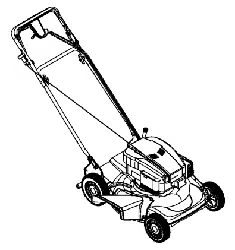
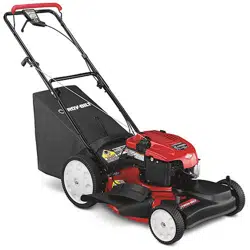
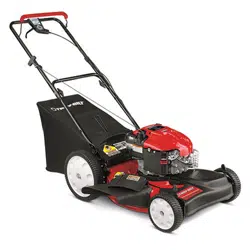
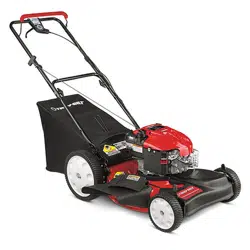
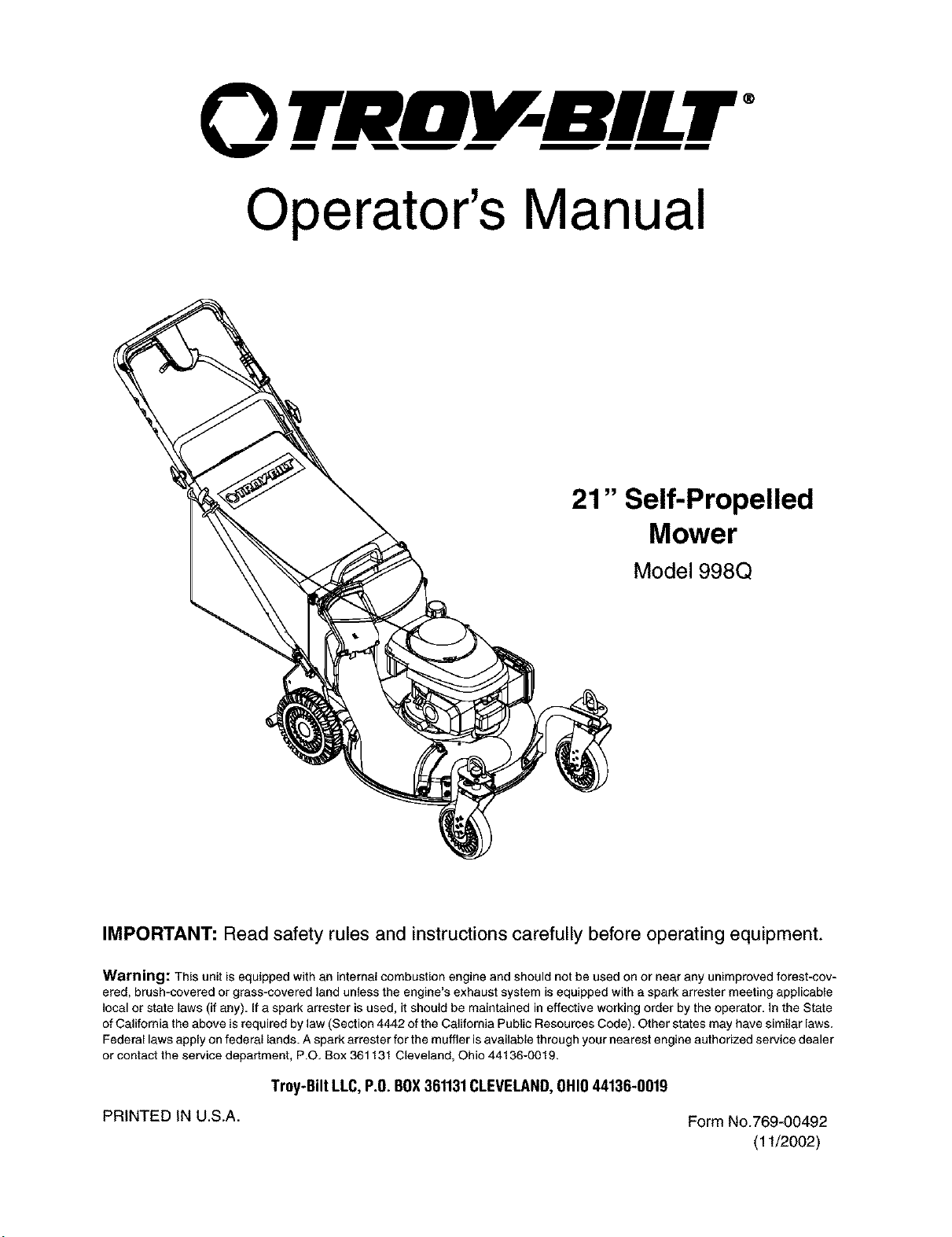
21" Self-Propelled
Mower
Model 998Q
IMPORTANT: Read safety rules and instructions carefully before operating equipment.
Warning: This unit is equipped with an internal combustion engine and should not be used on or near any unimproved forest-cov-
ered, brush-covered or grass-covered land unless the engine's exhaust system is equipped with a spark arrester meeting applicable
local or state laws (if any). If a spark arrester is used, it should be maintained in effective working order by the operator. In the State
of California the above is required by law (Section 4442 of the California Public Resources Code). Other states may have similar laws.
Federal laws apply on federal lands. A spark attester for the muffler is available through your nearest engine authorized service dealer
or contact the service department, P.O. Box 361131 Cleveland, Ohio 44136-0019.
Troy-BiltLLC, P,O.BOX361131CLEVELAND,OHIO44136-0019
PRINTED IN U.S.A.
Form No.769-00492
(11/2002)

TABLEOFCONTENTS
Content Page
Important Safe Operation Practices ...................................................................... 3
Slope Gauge ......................................................................................................... 6
Assembling Your Lawn Mower ............................................................................. 7
Know Your Lawn Mower ....................................................................................... 9
Operating Your Lawn Mower ................................................................................ 10
Making Adjustments ............................................................................................. 11
Maintaining Your Lawn Mower ............................................................................. 13
Troubleshooting .................................................................................................... 17
Parts List ............................................................................................................... 20
FINDINGMODELNUMBER
This Operator's Manual is an important part of your new lawn mower. It will help you assemble, prepare and
maintain the unit for best performance. Please read and understand what it says.
Before you start assembling your new equipment, please locate the model plate on the
equipment and copy the information from it in the space provided below. The information on
the model plate is very important if you need help from our Customer Support Department or
an authorized dealer.
You can locate the model number by standing at the operating position and looking down at the rear
of the mower deck. A sample model plate is explained below. For future reference, please copy the
model number and the serial number of the equipment in the space below.
Model Number) (Serial Number)
O BILT, TROY-BILT LL(
P. O. BOX 361131
www.troybilt.com CLEVELAND,OH44136
330-558-7220
k 866-840-6483
Copy the model number here:
Copy the serial number here:
ENGINEINFORMATION
The engine manufacturer is responsible for all engine-related issues with regards to performance, power-
rating, specifications, warranty and service. Please refer to the engine manufacturer's Owner's/Operator's
Manual packed separately with your unit for more information.
CALLINGCUSTOMERSUPPORT
If you have difficulty assembling this product or have any questions regarding the controls, operation or
maintenance of this unit, please call the Customer Support Department.
Call 1-866-840-6483 or 1-330-558-7220 to reach a Customer Support representative. Please
have your unit's model number and serial number ready when you call. See previous section
to locate this information. You will be asked to enter the serial number in order to process
your call.
SECTION1: IMPORTANTSAFEOPERATIONPRACTICES
WARNING: This symbol points out important safety instructions which, if not followed, could endanger
the personal safety and/or property of yourself and others. Read and follow all instructions in this manual
before attempting to operate this machine. Failure to comply with these instructions may result in personal
injury. When you see this symbol--HEED ITS WARNING.
WARNING: Engine exhaust, some of its constituents, and certain vehicle components contain or emit
chemicals known to State of California to cause cancer and birth defects or other reproductive harm.
WARNING: This machine was built to be operated according to the rules for safe operation in this
manual. As with any type of power equipment, carelessness or error on the part of the operator can result in
serious injury. This machine is capable of amputating hands and feet and throwing objects. Failure to
observe the following safety instructions could result in serious injury or death.
GeneralOperation
1. Read this operator's manual carefully in its entirety
before attempting to assemble this machine. Read,
understand, and follow all instructions on the
machine and in the manual(s) before operation. Be
completely familiar with the controls and the proper
use of this machine before operating it. Keep this
manual in a safe place for future and regular
reference and for ordering replacement parts.
2. This machine is a precision piece of power
equipment, not a plaything. Therefore, exercise
extreme caution at all times. Your unit has been
designed to perform one job: to mow grass. Do not
use it for any other purpose.
3. Never allow children under 14 years old to operate
this machine. Children 14 years old and over
should read and understand the operation
instructions and safety rules in this manual and
should be trained and supervised by a parent. Only
responsible individuals who are familiar with these
safe operation rules should use this machine.
4. Thoroughly inspect the area where equipment is to
be used. Remove all stones, sticks, wire, bones,
toys and other foreign objects which could be
tripped over or picked up and thrown by the blade.
Thrown objects can cause serious personal injury.
Plan your mowing pattern to avoid discharge of
material toward roads, sidewalks, bystanders and
the like. Also, avoid discharging material against a
wall or obstruction which may cause discharged
material to ricochet back toward the operator.
5. To help avoid blade contact or a thrown object
injury, stay in the operator zone behind the handles
and keep bystanders, helpers, children and pets at
least 75 feet from the machine while it is in
operation. Stop machine if anyone enters the area.
6. Always wear safety glasses to protect your eyes
during equipment operation and while performing
an adjustment or repair. Thrown objects which
ricochet can cause serious injury to the eyes.
7. Wear sturdy, rough-soled work shoes and close-
fitting slacks and shirts. Shirts and pants that cover
the arms and legs and steel-toed shoes are
recommended. Never operate this machine in bare
feet, sandals, slippery or light weight (e.g. canvas)
shoes.
8. Do not put hands or feet near rotating parts or
under the cutting deck. Contact with the blade can
amputate hands and feet.
9. A missing or damaged discharge cover can cause
blade contact or thrown object injuries.
10. Many injuries occur as a result of the mower being
pulled over the foot during a fall caused by slipping
or tripping. Do not hold on to the mower ifyou are
falling; release the handle immediately.
11. Never pull the mower back toward you while you
are walking. If you must back the mower away from
a wall or obstruction first look down and behind to
avoid tripping and then follow these steps:
a. Step back from the mower to fully extend
your arms.
b. Be sure you are well balanced with sure
footing.
c. Pull the mower back slowly, no more than
half way toward you.
d. Repeat these steps as needed.
5. Do not operate the mower while under the influence
of alcohol or drugs.
6. Do not engage the self-propelled mechanism on
units so equipped while starting engine.
7. The blade control handle is a safety device. Never
attempt to bypass its operation. Doing so makes
the safety device inoperative and may result in
personal injury through contact with the rotating
blade. The blade control handle must operate
easily in both directions and automatically return to
the disengaged position when released.
8. Never operate the mower in wet grass. Always be
sure of your footing. A slip and fall can cause
serious personal injury. If you feet you are losing
your footing, release the blade control handle
immediatelyandthebladewillstoprotatingwithin
threeseconds.
9. Mowindaylightorgoodartificiallight;walk,notrun.
10.Stopthebladewhencrossinggraveldrives,
walkwaysorroads.
11.Iftheequipmentshouldstarttovibrateabnormally,
stoptheengineandcheckimmediatelyforthe
cause.Vibrationisgenerallyawarningoftrouble.
12.Shuttheengineoffandwaituntilthebladecomes
toacompletestopbeforeremovingthegrass
catcheroruncloggingthechute.Thecuttingblade
continuestorotateforafewsecondsafterthe
engineisshutoff.Neverplaceanypartofthebody
inthebladeareauntilyouaresurethebladehas
stoppedrotating.
13.Neveroperatemowerwithoutpropertrailshield,
dischargecover,grasscatcher,bladecontrol
handleorothersafetyprotectivedevicesinplace
andworking.Neveroperatemowerwithdamaged
safetydevices.Failuretodosocanresultin
personalinjury.
14.Mufflerandenginebecomehotandcancausea
burn.Donottouch.
15.Onlyusepartsandaccessoriesmadebythe
originalequipmentmanufacturer(O.E.M).Failure
todosocanresultinpersonalinjury.
16.Ifsituationsoccurwhicharenotcoveredinthis
manual,usecareandgoodjudgment.Contactyour
dealerforassistance.Call1-866-840-6483forthe
nameofyournearestdealer.
SlopeOperation
Slopes are a major factor related to slip and fall
accidents which can result in severe injury. Operation
on slopes requires extra caution. If you feet uneasy on a
slope, do not mow it. Before operating this unit on a
slope or hilly area, use the slope gauge on page 6 to
measure slopes. If the slope is greater than 15
degrees, do not mow it.
De:
1. Mow across the face of slopes; never up and down.
Exercise caution when changing direction.
2. Watch for holes, ruts, rocks, hidden objects, or
bumps which can cause you to slip or trip. Tall
grass can hide obstacles.
3. Always be sure of your footing. A slip and fall can
cause serious personal injury. If you feel you are
losing your balance, release the blade control
handle immediately, and the blade will stop rotating
within 3 seconds.
DoNot:
1. Do not mow near drop-offs, ditches or
embankments, you could lose your footing or
balance.
2. Do not mow slopes greater than 15 degrees as
shown on the slope gauge.
3. Do not mow on wet grass. Unstable footing could
cause slipping.
Children
Tragic accidents can occur if the operator is not alert to
the presence of children. Children are often attracted to
the mower and the mowing activity. They do not
understand the dangers. Never assume that children
will remain where you last saw them.
1. Keep children out of the mowing area and under
the watchful care of a responsible adult other than
the operator.
2. Be alert and turn mower off if a child enters the
area.
3. Before and while moving backwards, look behind
and down for small children.
4. Use extreme care when approaching blind corners,
doorways, shrubs, trees, or other objects that may
obscure your vision of a child who may run into the
mower.
5. Keep children away from hot or running engines.
They can suffer burns from a hot muffler.
6. Never allow children under 14 years old to operate
a power mower. Children 14 years old and over
should read and understand the operation
instructions and safety rules in this manual and
should be trained and supervised by a parent.
Service
SafeHandlingofGasoline:
1. To avoid personal injuryor property damage use
extreme care in handling gasoline. Gasoline is
extremely flammable and the vapors are explosive.
Serious personal injury can occur when gasoline is
spilled on yourself or your clothes which can ignite.
2. Wash your skin and change clothes immediately.
3. Use only an approved gasoline container.
4. Never fill containers inside avehicle or on a truck or
trailer bed with a plastic liner. Always place
containers on the ground away from your vehicle
before filling.
5. If possible, remove gas-powered equipment from
the truck or trailer and refuel it on the ground. If this
is not possible, then refuel such equipment on a
trailer with a portable container, rather than from a
gasoline dispenser nozzle.
6. Keep the nozzle in contact with the rim of the fuel
tank or container opening at all times until fueling is
complete. Do not use a nozzle lock-open device.
7. Extinguish all cigarettes, cigars, pipes and other
sources of ignition.
8. Never fuel machine indoors because flammable
vapors will accumulate in the area.
9. Never remove gas cap or add fuel while the engine
is hot or running. Allow engine to cool at least two
minutes before refueling.
10.Neveroverfillfueltank.FilltanktonomorethanV2
inch below bottom of filler neck to provide space for
fuel expansion.
11. Replace gasoline cap and tighten securely.
12. If gasoline is spilled, wipe it off the engine and
equipment. Move unit to another area. Wait 5
minutes before starting the engine.
13. Never store the machine or fuet container inside
where there is an open flame, spark or pilot light as
on a water heater, space heater, furnace, clothes
dryer or other gas appliances.
14. To reduce fire hazard, keep mower free of grass,
leaves, or other debris build-up. Clean up oil or fuel
spillage and remove any fuel soaked debris.
15. Allow mower to cool 5 minutes before storing.
GeneralService:
1. Never run an engine indoors or in a poorly
ventilated area. Engine exhaust contains carbon
monoxide, an odorless and deadly gas.
2. Before cleaning, repairing, or inspecting, make
certain the blade and all moving parts have
stopped. Disconnect the spark plug wire and
ground against the engine to prevent unintended
starting.
3. Check the blade and engine mounting bolts at
frequent intervals for proper tightness. Also,
visually inspect blade for damage (e.g., bent,
cracked, worn) Replace blade with the original
equipment manufacture's (O.E.M.) blade only,
listed in this manual. "Use of parts which do not
meet the original equipment specifications may
lead to improper performance and compromise
safety!"
4. Mower blades are sharp and can cut. Wrap the
blade or wear gloves, and use extra caution when
servicing them.
5. Keep all nuts, bolts, and screws tight to be sure the
equipment is in safe working condition.
6. Never tamper with safety devices. Check their
proper operation regularly.
7. After striking a foreign object, stop the engine,
disconnect the spark plug wire and ground against
the engine. Thoroughly inspect the mower for any
damage. Repair the damage before starting and
operating the mower.
8. Never attempt to make a wheel or cutting height
adjustment while the engine is running.
9. Grass catcher components, discharge cover, and
trail shield are subject to wear and damage which
could expose moving parts or allow objects to be
thrown. For safety protection, frequently check
components and replace immediately with original
equipment manufacturer's (O.E.M.) parts only,
listed here. Use of parts which do not meet the
original equipment specifications may lead to
improper performance and compromise safety.
10. Do not change the engine governor setting or
overspeed the engine. The governor controls the
maximum safe operating speed of the engine.
11. Maintain or replace safety and instruction labels, as
necessary.
12. Observe proper disposal laws and regulations.
Improper disposal of fluids and materials can harm
the environment.
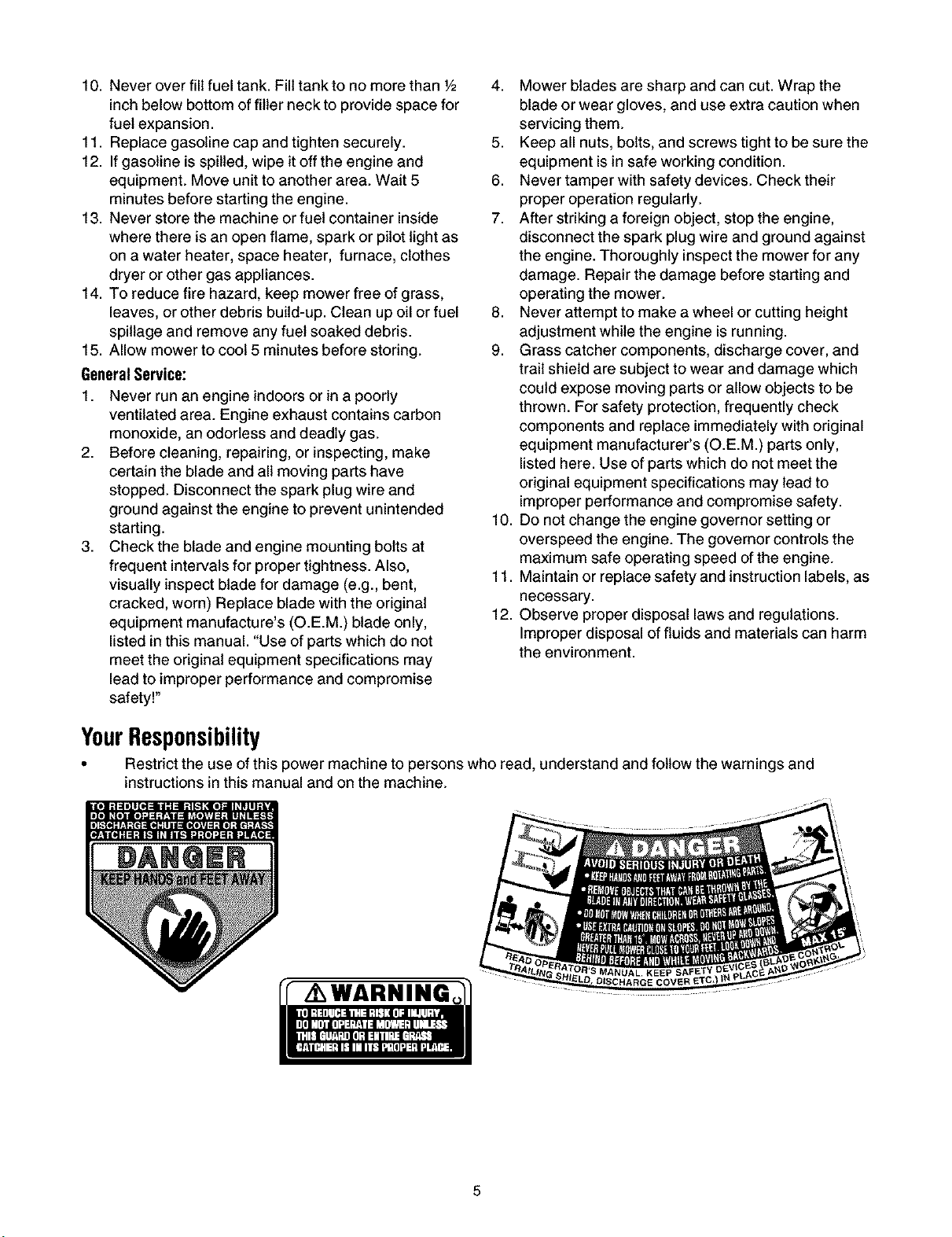
YourResponsibility
• Restrict the use of this power machine to persons who read, understand and follow the warnings and
instructions in this manual and on the machine.
/ WARNING
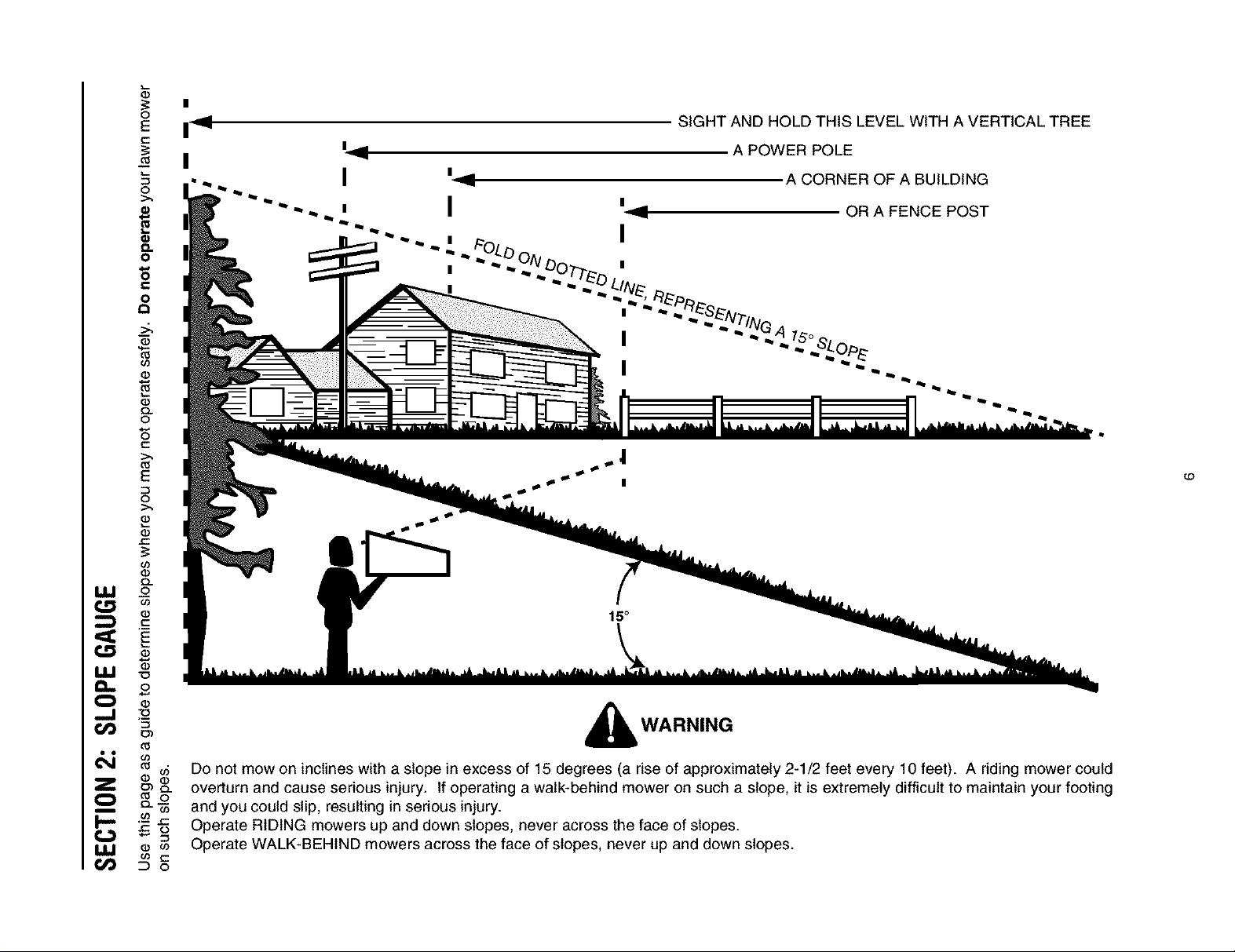
SIGHT AND HOLD THIS LEVEL WITH A VERTICAL TREE
A POWER POLE
A CORNER OF A BUILDING
OR A FENCE POST
|
15°
o
•5 WARNING
¢o _ Do not mow on inclines with a slope in excess of 15 degrees (a rise of approximately 2-1/2 feet every 10 feet). A riding mower could
_ o. overturn and cause serious injury. Ifoperating a walk-behind mower on such a slope, it is extremely difficultto maintain your footing
O
o. -_ and you could slip, resulting in serious injury.
.-_ .c Operate RIDING mowers up and down slopes, never across the face of slopes.
_ o_ _ Operate WALK-BEHIND mowers across the face of slopes, never up and down slopes.
m c
=30
SECTION3: ASSEMBLINGYOURLAWNMOWER
RemovingUnitFromCarton
• Remove staples, break glue on top flaps, or cut
tape at carton end and peel along top flap to open
carton.
• Remove loose parts, if included with unit (i.e., grass
bag etc.), and save it appropriately.
• Cut along corners, lay the carton down flat, and
remove all packing material.
• Roll or slide unit out of carton and check carton
thoroughly for loose parts.
LoosePartsinCarton
1. Grass Bag
2. Grass Bag Adapter
3. Side Discharge Chute
4. Hardware Pack
HardwarePack
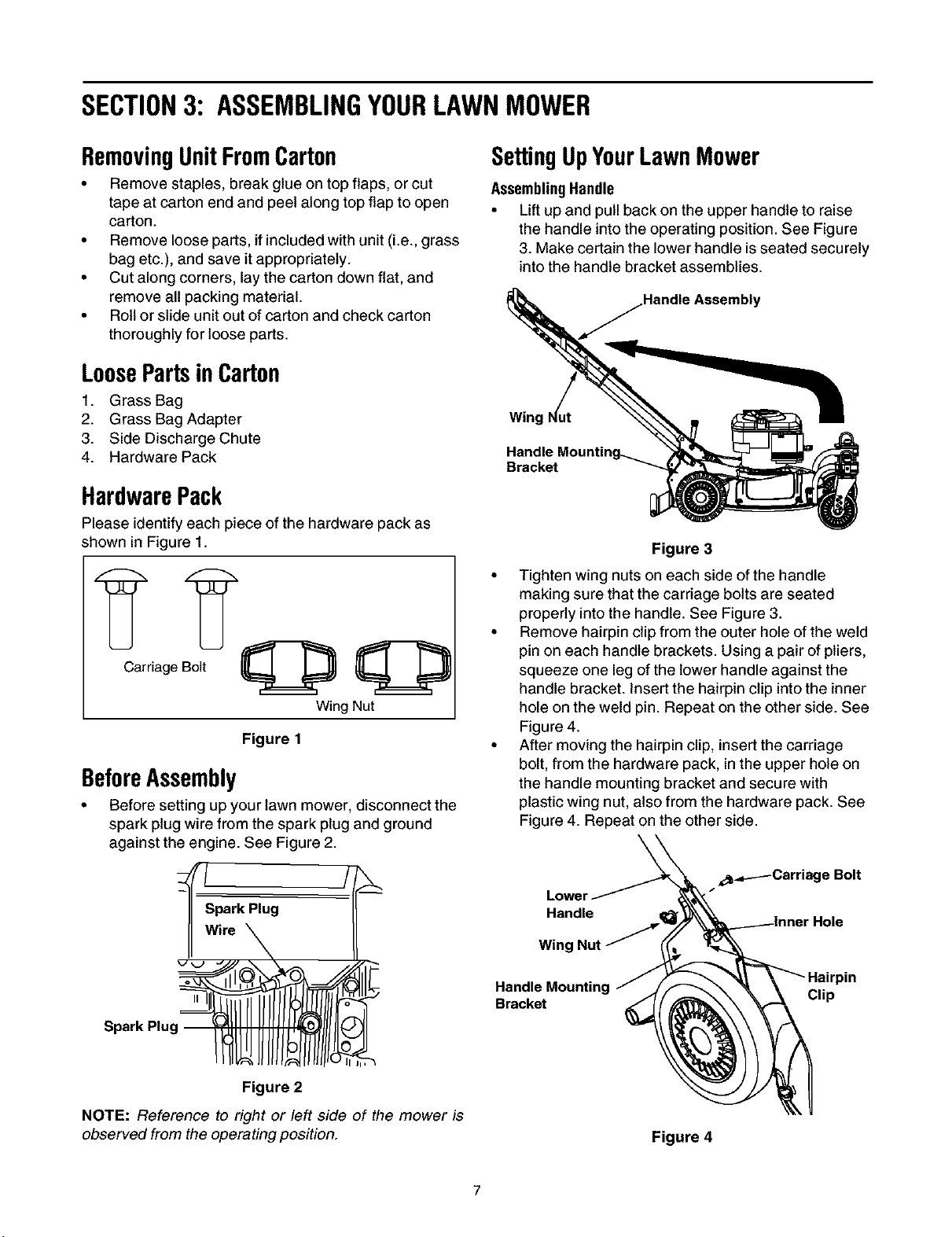
Please identify each piece of the hardware pack as
shown in Figure 1.
.r.eO.t
Wing Nut
Figure 1
BeforeAssembly
• Before setting up your lawn mower, disconnect the
spark plug wire from the spark plug and ground
against the engine. See Figure 2.
Wire \
Figure 2
NOTE: Reference to right or left side of the mower is
observed from the operating position.
SettingUpYourLawnMower
AssemblingHandle
• Lift up and pull back on the upper handle to raise
the handle into the operating position. See Figure
3. Make certain the lower handle is seated securely
into the handle bracket assemblies.
Handle Assembly
Wing I_ut
Handle Mountin
Bracket
Figure 3
• Tighten wing nuts on each side ofthe handle
making sure that the carriage bolts are seated
properly into the handle. See Figure 3.
• Remove hairpin clip from the outer hole of the weld
pin on each handle brackets. Using a pair of pliers,
squeeze one leg of the lower handle against the
handle bracket. Insert the hairpin clip into the inner
hole on the weld pin. Repeat on the other side. See
Figure 4.
• After moving the hairpin clip, insert the carriage
bolt, from the hardware pack, in the upper hole on
the handle mounting bracket and secure with
plastic wing nut, also from the hardware pack. See
Figure 4. Repeat on the other side.
\
,¢b
Lower
Handle
Wing
Bolt
Handle Mounting
Bracket
Clip
Figure 4
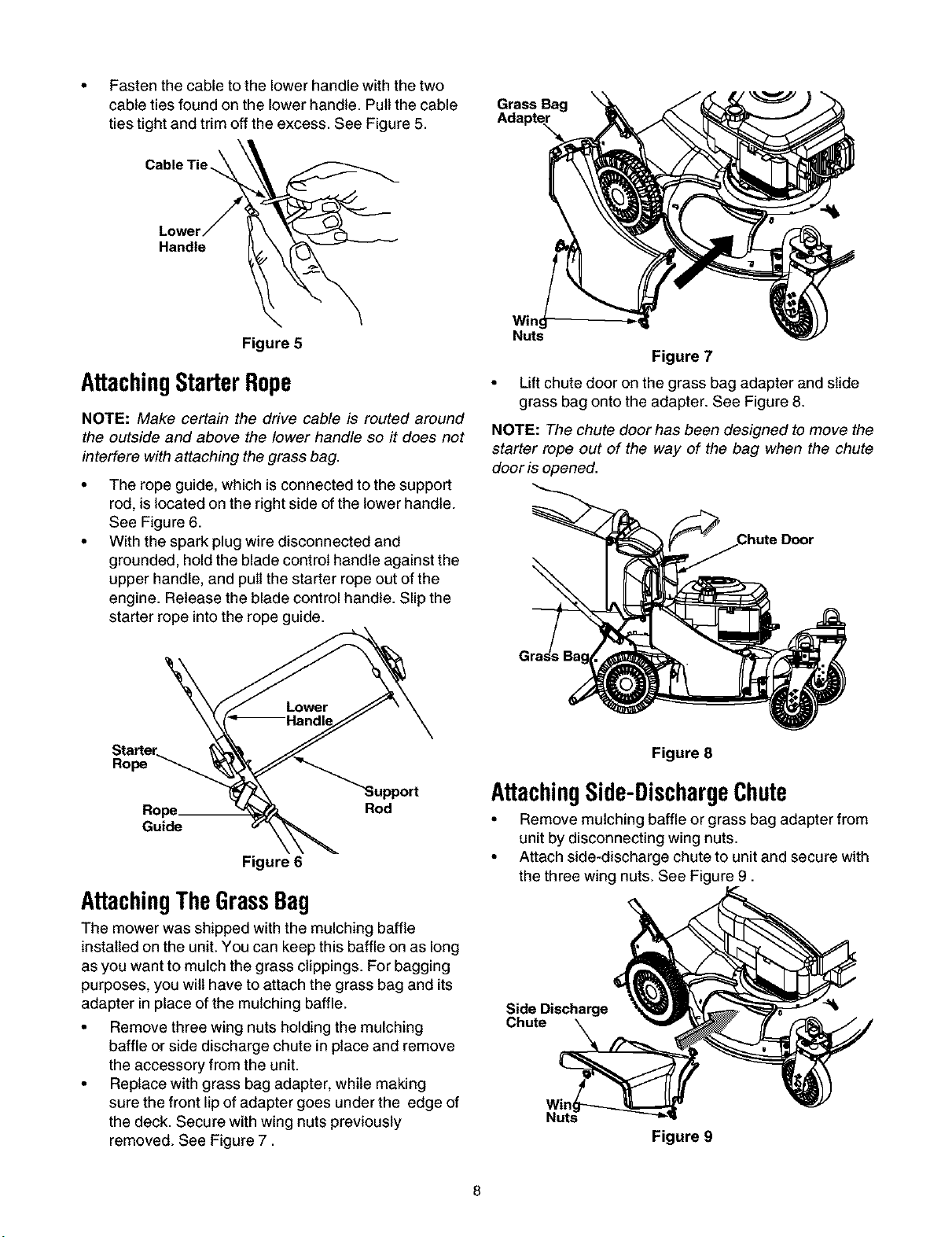
GrassBag
Fasten the cable to the lower handle with the two
cable ties found on the lower handle. Pull the cable
ties tight and trim off the excess. See Figure 5.
Cable Tie.
Handle
Figure 5
AttachingStarterRope
NOTE: Make certain the drive cable is routed around
the outside and above the lower handle so it does not
interfere with attaching the grass bag.
The rope guide, which is connected to the support
rod, is located on the right side of the lower handle.
See Figure 6.
With the spark plug wire disconnected and
grounded, hold the blade control handle against the
upper handle, and pull the starter rope out of the
engine. Release the blade control handle. Slip the
starter rope into the rope guide.
w,oi
Nuts
Figure 7
• Lift chute door on the grass bag adapter and slide
grass bag onto the adapter. See Figure 8.
NOTE: The chute door has been designed to move the
starter rope out of the way of the bag when the chute
door is opened.
Starter
Rope _
Guide
Rod
Figure 6
AttachingTheGrassBag
The mower was shipped with the mulching baffle
installed on the unit. You can keep this baffle on as long
as you want to mulch the grass clippings. For bagging
purposes, you wilt have to attach the grass bag and its
adapter in place of the mulching baffle.
• Remove three wing nuts holding the mulching
baffle or side discharge chute in place and remove
the accessory from the unit.
• Replace with grass bag adapter, while making
sure the front lip of adapter goes under the edge of
the deck. Secure with wing nuts previously
removed. See Figure 7.
Figure 8
AttachingSide-DischargeChute
• Remove mulching baffle or grass bag adapter from
unit by disconnecting wing nuts.
• Attach side-discharge chute to unit and secure with
the three wing nuts. See Figure 9.
Side Discharge
Chute
Nuts
Figure 9

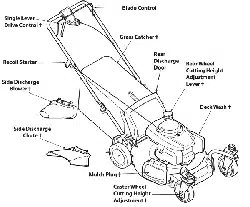
SECTION4: KNOWYOURLAWNMOWER
Read this operator's manual and safety rules before
operating your lawn mower. Compare the illustration in
Figure 10 with your lawn mower to familiarize yourself
with the location of various controls and adjustments.
Save this manual for future reference.
WARNING: The operation of any lawn
mower can result in foreign objects being
thrown into the eyes, which can damage your
eyes severely. Always wear safety glasses
while operating the mower, or while performing
any adjustments or repairs on it.
MulchingPlug
The mulching plug is used only for mulching purposes.
Instead of collecting grass clippings in a grass catcher,
this mower has the option of recirculating the clippings
back to the lawn.
Blade Control Handle
Shift Lever
BladeControlHandle
The blade control handle islocated on the upper handle
of the mower and must be depressed in order to
operate the unit. Release this handle to stop the engine
and the blade.
_lb WARNING: This blade control mechanism is
a safety device. Never attempt to bypass its
operations.
CuttingHeightAdjustmentLever
The rear cutting height adjustment lever is located
above the left rear wheel. To adjust the cutting height,
refer to the Adjustment Section in this manual.
RecoilStarter
The recoil starter is attached to the right upper handle.
Stand behind the unit and pull the recoil starter rope to
start the unit.
DriveClutchControl
The drive clutch control is located on the upper handle.
Squeeze the drive control to engage the drive system;
release to disengage. Also release the clutch control to
stow down when approaching an obstacle, making a
turn, or stopping the mower.
Shift Lever
The shift lever is located on the drive clutch control
housing on the upper handle. This lever is used to
select the forward speed of the mower. When changing
speed selection, release the drive clutch lever.
IMPORTANT: Move the shift lever only when the engine
is running. Changing the shift lever setting with the
engine off can damage the mower.
GrassBag
The grass bag is used to collect grass clippings while
the mower is running.Since this mower isalso equipped
with a side-discharge chute and a mulching plug, both
of these will have to be removed, and the grass catcher
installed on the mower for the bagging operation.
Dr
Clutch
Control
Rear Height
Adjustment Lever
Gas Cap
/
Starter Rope
Trail
Mulch Plug
Side-Discharge
Chute
Rear Height Adj.
Lever
Oil Fill/Dipstick
Figure 10
NOTE: For details on engine controls and operation,
refer to the engine manual packed with your mower.

SECTION5: OPERATINGYOURLAWNMOWER
i_lb WARNING: Read, understand, and follow all
instructions and warnings on the machine and
in this manual before operating.
NOTE: For shipping purposes your mower is set with
the wheels in a low cutting height position. For best
results, raise the cutting position until it is determined
which height is best for your lawn. See the Adjustment
Section for details.
Gas& OilFill-Up
• Check oil level and add oil ifnecessary. Follow
relevant instructionsin the engine manual for this.
• Service the engine with gasoline as instructed in
the engine manual.
_lb WARNING: Use extreme care when
handling gasoline. Gasoline isextremely
flammable and the vapors are explosive. Never
fuel the machine indoors or while the engine is
hot or running. Extinguish cigarettes, cigars,
pipes and other sources of ignition.
NeutralAdjustmentTest
To perform the neutral adjustment test, answer the
following questions.
• With the drive clutch control released, push mower
forward and pull it backward. Does it move freely?
• Squeeze the drive clutch control and pull the
mower backward. Do the rear wheels lock?
• Is the drive clutch control cable free of kinks or
sharp bends?
• If you answered "yes" to all three questions, your
mower passed the test and you can start your
mower.
• If you answered "no" to any of the three questions,
you will have to adjust the drive clutch control as
instructed in the ADJUSTMENT SECTION.
StartingEngine
• Make sure the fuel valve lever found on the left side
of the engine is in the ON position. See Figure 11.
-- Recoil
Starter
BeforeStartingMower
WARNING: Be sure no one other than the
operator isstanding near the lawn mower while
starting engine or operating mower.
WARNING: Never run engine indoors or in
enclosed, poorly ventilated areas. Engine
exhaust contains carbon monoxide, an
odorless and deadly gas.
WARNING: Keep hands, feet, hair and
loose clothing away from any moving parts on
engine and lawn mower.
WARNING: When starting the unit for the
first time, face the mower against a wall or a
fence. Start the unit and ifit shows any signs of
motion while the drive clutch control is still
disengaged, shut engine off immediately.
Attach spark plug wire to spark plug. Make certain
the metal cap on the end of the spark plug wire
(inside the rubber boot) is fastened securely over
the metal tip on the spark plug.
Check for proper drive clutch operation using the
neutral adjustment test described below.
Fuel Valve
Choke
Figure 11
Move the choke lever all the way forward into the
choke position.
Standing behind the mower, depress the blade
control handle and hold itagainst the upper handle.
Once the blade control handle is depressed, the
choke lever will automatically revert to the OFF
position. Refer to engine manual for further details.
Grasp starter handle and pull rope out slowly until
engine reaches the start of compression cycle
(rope will pull slightly harder at this point). Let the
rope rewind slowly. Pull rope with a rapid,
continuous, full arm stroke. Keeping a firm grip on
the starter handle, let the rope rewind slowly.
StoppingEngine
• Release the blade control handle to stop engine
and blade. Wait tilt the blade stops completely.
• Disconnect spark plug wire and move away from
spark plug to prevent accidental starting.
10
UsingYourLawnMower
_lb ARNING: Do not operate the mower
without mulching battle, discharge chute or
grass catcher properly installed.
• For best results, do not cut wet grass. It may stick to
the underside of the mower, preventing proper
discharge of grass clippings, and could cause you
to slip and fall. New grass or thick grass may
require a narrower cut.
• For a healthy lawn, always cut off one-third or less
of the total length of the grass.
IMPORTANT:Move the shift lever only when the engine
is running. Changing the shift lever setting with the
engine off can cause damage to the mower.
Mulching
IMPORTANT: Be sure that the lawn is clear of stones,
sticks, wire, or other objects which could damage lawn
mower or engine. Such objects could be accidently
thrown by the mower in any direction and cause serious
personal injury to the operator and others.
For effective mulching, do not cut wet grass. New or
thick grass may require a narrower cut. If the grass has
grown in excess of 4", mulching is not recommended.
Mow using the side discharge to reduce the grass
height to 3.25" maximum before mulching.
,_ WARNING: If the mower strikes a foreign
object, stop the engine. Remove spark plug
wire from the spark plug and thoroughly inspect
for any damage. Repair the damage promptly
before restarting and operating the mower.
BaggingGrassClippings
You can use the grass catcher bag to collect clippings
while you are operating the mower.
• Attach grass catcher following instructions on page
8 of this manual. Grass clippings will automatically
collect in the bag as you run the mower.
• Operate the mower till the grass bag isfull.
• Stop engine completely by releasing the blade
control handle. Make sure that the unit has come to
a complete stop.
• While holding the grass bag by both the rear handle
and the lower handle, lift the grass bag straight up
off the adapter. The chute door will move the rope
out of the way of the bag.
• Continue to hold the lower handle and raise the
rear of the grass bag up toward your chest. The
grass bag will open and the grass clippings wilt
disperse. When replacing the grass bag, be sure
the top of the bag rests on the wire support
between the handles.
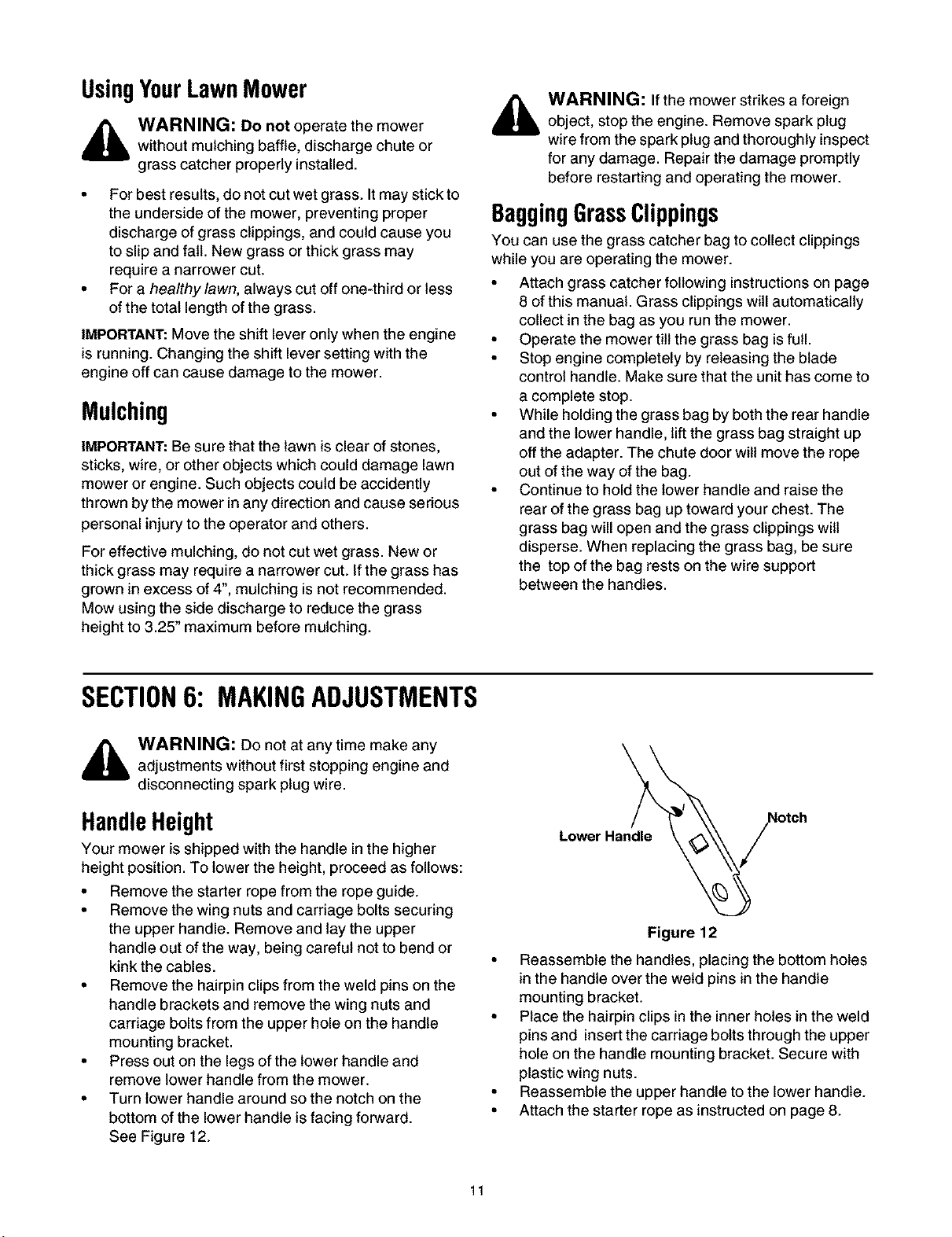
SECTION6: MAKINGADJUSTMENTS
,_ WARNING: Do not at any time make any
adjustments without first stopping engine and
disconnecting spark plug wire.
HandleHeight
Your mower is shipped with the handle in the higher
height position. To lower the height, proceed as follows:
• Remove the starter rope from the rope guide.
• Remove the wing nuts and carriage bolts securing
the upper handle. Remove and lay the upper
handle out of the way, being careful not to bend or
kink the cables.
• Remove the hairpin clips from the weld pins on the
handle brackets and remove the wing nuts and
carriage bolts from the upper hole on the handle
mounting bracket.
• Press out on the legs of the lower handle and
remove lower handle from the mower.
• Turn lower handle around so the notch on the
bottom of the lower handle is facing forward.
See Figure 12.
Lower Handle
Figure 12
• Reassemble the handles, placing the bottom holes
in the handle over the weld pins in the handle
mounting bracket.
• Place the hairpin clips in the inner holes in the weld
pins and insert the carriage bolts through the upper
hole on the handle mounting bracket. Secure with
plastic wing nuts.
• Reassemble the upper handle to the lower handle.
• Attach the starter rope as instructed on page 8.
11
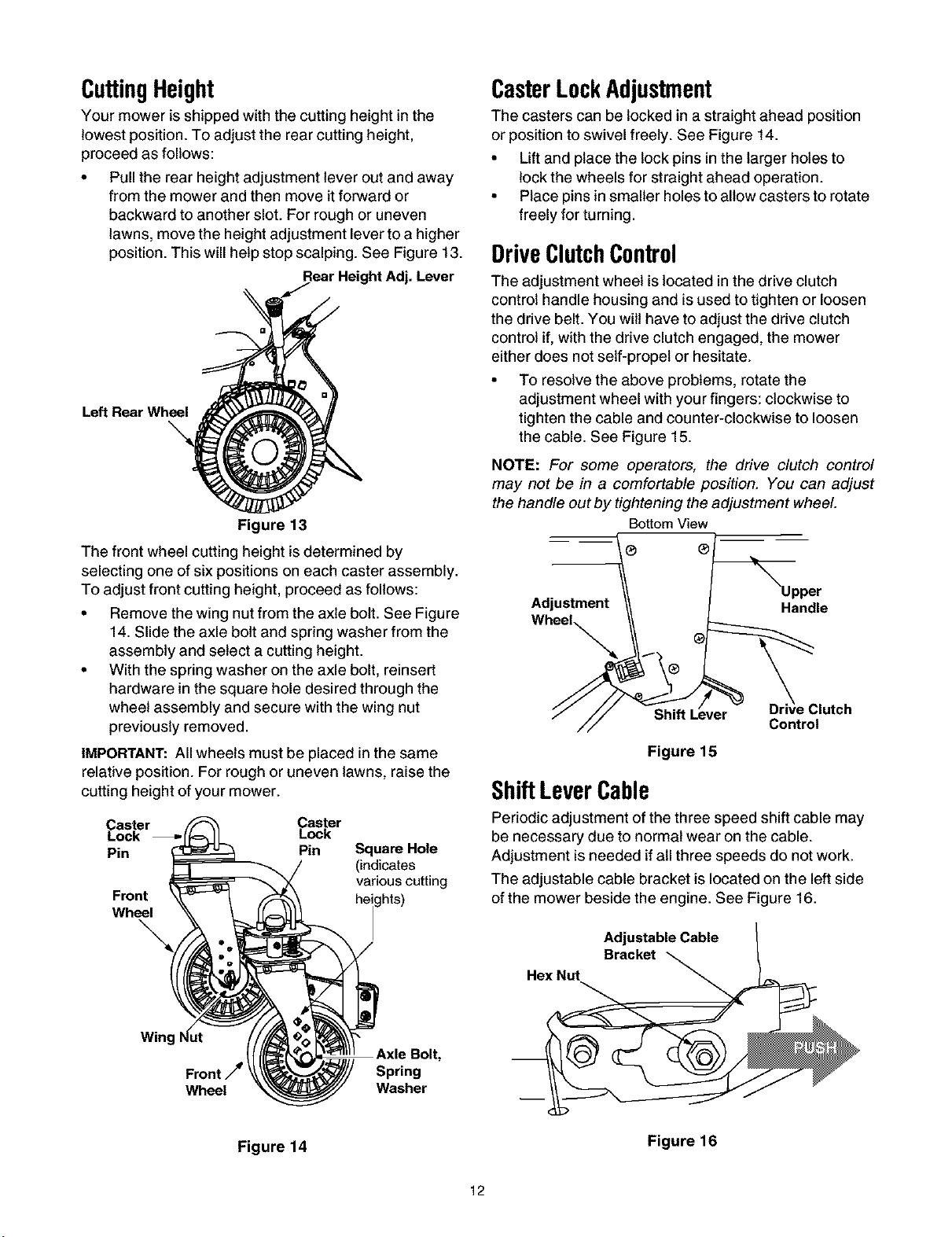
CuttingHeight
Your mower is shipped with the cutting height in the
lowest position. To adjust the rear cutting height,
proceed as follows:
• Pull the rear height adjustment lever out and away
from the mower and then move it forward or
backward to another slot. For rough or uneven
lawns, move the height adjustment lever to a higher
position. This will help stop scalping. See Figure 13.
Rear Height Adj. Lever
Left Rear Wh _
Figure 13
The front wheel cutting height isdetermined by
selecting one of six positions on each caster assembly.
To adjust front cutting height, proceed as follows:
• Remove the wing nut from the axle bolt. See Figure
14. Slide the axle bolt and spring washer from the
assembly and select a cutting height.
• With the spring washer on the axle bolt, reinsert
hardware in the square hole desired through the
wheel assembly and secure with the wing nut
previously removed.
IMPORTANT: All wheels must be placed in the same
relative position. For rough or uneven lawns, raise the
cutting height of your mower.
Caster Caster
Lock Lock
Pin Pin Square Hole
(indicates
various cutting
Whee_Fr°nt he ghts)
CasterLockAdjustment
The casters can be locked in a straight ahead position
or position to swivel freely. See Figure 14.
• Lift and place the lock pins in the larger holes to
lock the wheels for straight ahead operation.
• Place pins in smaller holes to allow casters to rotate
freely for turning.
DriveClutchControl
The adjustment wheel is located in the drive clutch
control handle housing and is used to tighten or loosen
the drive belt. You will have to adjust the drive clutch
control if, with the drive clutch engaged, the mower
either does not self-propel or hesitate.
• To resolve the above problems, rotate the
adjustment wheel with your fingers: clockwise to
tighten the cable and counter-clockwise to loosen
the cable. See Figure 15.
NOTE: For some operators, the drive clutch control
may not be in a comfortable position. You can adjust
the handle out by tightening the adjustment wheel.
Bottom View
® ®
Adjustment
Wheel_
Handle
Shift Lever s Clutch
Control
Figure 15
ShiftLeverCable
Periodic adjustment of the three speed shift cable may
be necessary due to normal wear on the cable.
Adjustment is needed if all three speeds do not work.
The adjustable cable bracket is located on the left side
of the mower beside the engine. See Figure 16.
Adjustable Cable 1
Hex Nut Bracket
Wing
Front ._ Spring
Wheel Washer
Figure 14
Figure 16
12
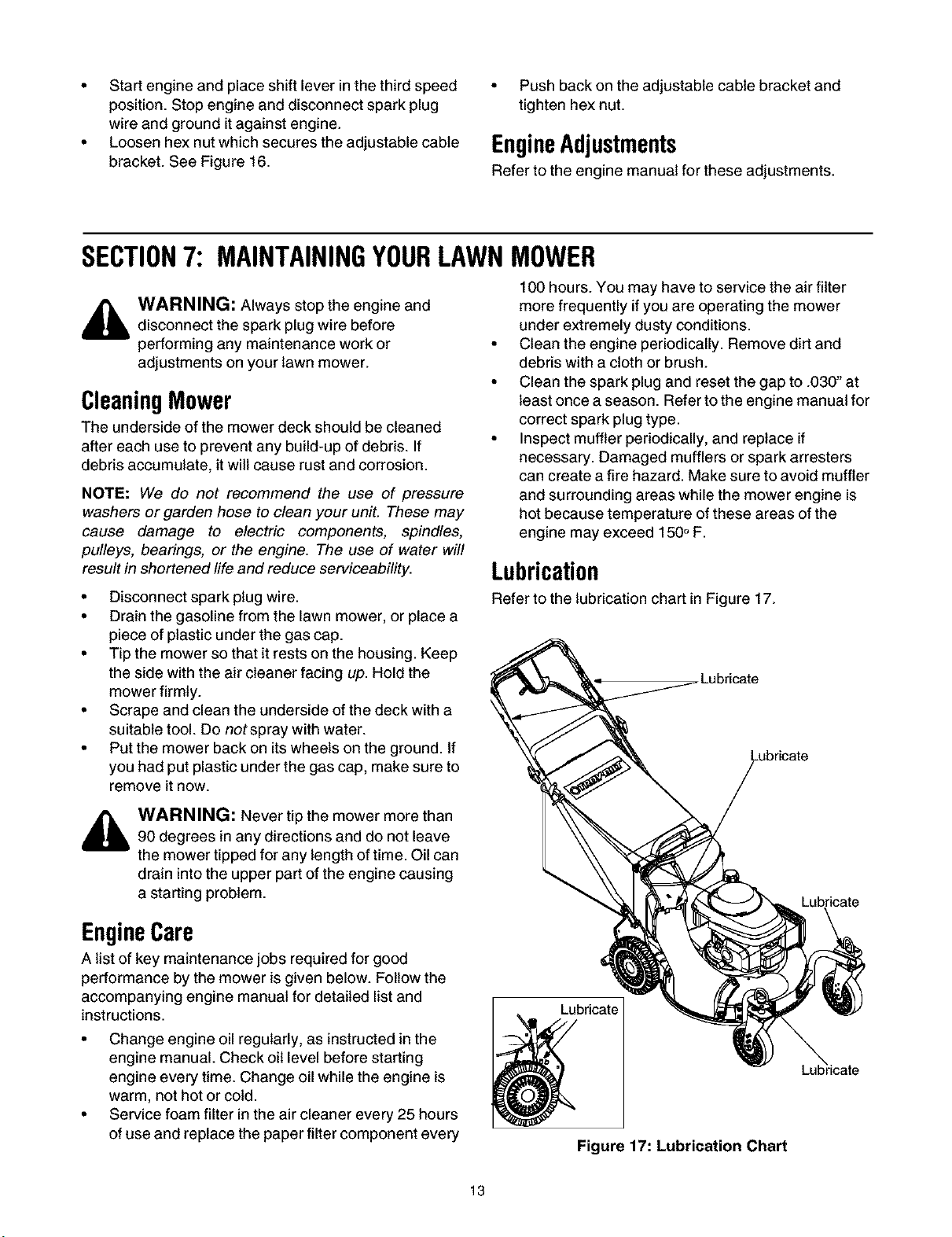
• Start engine and place shift lever in the third speed
position. Stop engine and disconnect spark plug
wire and ground it against engine.
• Loosen hex nut which secures the adjustable cable
bracket. See Figure 16.
• Push back on the adjustable cable bracket and
tighten hex nut.
EngineAdjustments
Refer to the engine manual for these adjustments.
SECTION7: MAINTAININGYOURLAWNMOWER
WARNING: Always stop the engine and
disconnect the spark plug wire before
performing any maintenance work or
adjustments on your lawn mower.
CleaningMower
The underside of the mower deck should be cleaned
after each use to prevent any build-up of debris. If
debris accumulate, it wilt cause rust and corrosion.
NOTE: We do not recommend the use of pressure
washers or garden hose to clean your unit. These may
cause damage to electric components, spindles,
pulleys, bearings, or the engine. The use of water will
result in shortened life and reduce serviceability.
• Disconnect spark plug wire.
• Drain the gasoline from the lawn mower, or place a
piece of plastic under the gas cap.
• Tip the mower so that it rests on the housing. Keep
the side with the air cleaner facing up. Hold the
mower firmly.
• Scrape and clean the underside of the deck with a
suitable tool. Do notspray with water.
• Put the mower back on its wheels on the ground. If
you had put plastic under the gas cap, make sure to
remove it now.
WARNING: Never tip the mower more than
90 degrees in any directions and do not leave
the mower tipped for any length of time. Oil can
drain into the upper part of the engine causing
a starting problem.
EngineCare
A list of key maintenance jobs required for good
performance by the mower is given below. Follow the
accompanying engine manual for detailed list and
instructions.
• Change engine oil regularly, as instructed in the
engine manual. Check oil level before starting
engine every time. Change oil while the engine is
warm, not hot or cold.
• Service foam filter in the air cleaner every 25 hours
of use and replace the paper filter component every
lOg hours. You may have to service the air filter
more frequently if you are operating the mower
under extremely dusty conditions.
Clean the engine periodically. Remove dirt and
debris with a cloth or brush.
Clean the spark plug and reset the gap to .030" at
least once a season. Refer to the engine manual for
correct spark plug type.
Inspect muffler periodically, and replace if
necessary. Damaged mufflers or spark arresters
can create a fire hazard. Make sure to avoid muffler
and surrounding areas while the mower engine is
hot because temperature of these areas of the
engine may exceed 150° F.
Lubrication
Refer to the lubrication chart in Figure 17.
ricate
Figure 17: Lubrication Chart
13
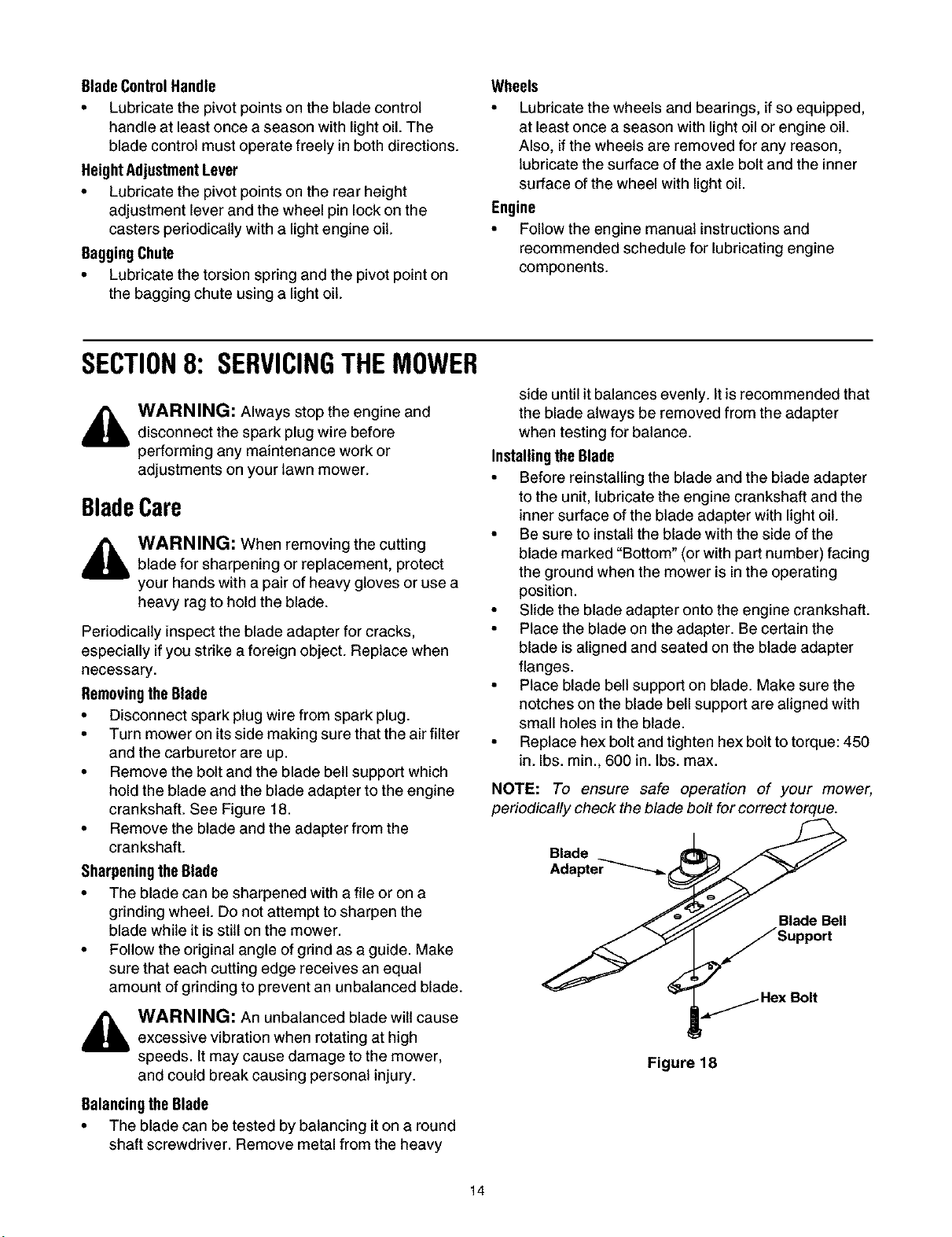
BladeControlHandle
• Lubricate the pivot points on the blade control
handle at least once a season with light oil. The
blade control must operate freely in both directions.
HeightAdjustmentLever
• Lubricate the pivot points on the rear height
adjustment lever and the wheel pin lock on the
casters periodically with a light engine oil.
BaggingChute
• Lubricate the torsion spring and the pivot point on
the bagging chute using a light oil.
Wheels
• Lubricate the wheels and bearings, if so equipped,
at least once a season with light oil or engine oil.
Also, if the wheels are removed for any reason,
lubricate the surface of the axle bolt and the inner
surface of the wheel with light oil.
Engine
• Follow the engine manual instructionsand
recommended schedule for lubricating engine
components.
SECTION8: SERVICINGTHEMOWER
WARNING: Always stop the engine and
disconnect the spark plug wire before
performing any maintenance work or
adjustments on your lawn mower.
BladeCare
WARNING: When removing the cutting
blade for sharpening or replacement, protect
your hands with a pair of heavy gloves or use a
heavy rag to hold the blade.
Periodically inspect the blade adapter for cracks,
especially if you strike a foreign object. Replace when
necessary.
Removingthe Blade
• Disconnect spark plug wire from spark plug.
• Turn mower on its side making sure that the air filter
and the carburetor are up.
• Remove the bolt and the blade bell support which
hold the blade and the blade adapter to the engine
crankshaft. See Figure 18.
• Remove the blade and the adapter from the
crankshaft.
SharpeningtheBlade
• The blade can be sharpened with a file or on a
grinding wheel. Do not attempt to sharpen the
blade while it is still on the mower.
• Follow the original angle of grind as a guide. Make
sure that each cutting edge receives an equal
amount of grinding to prevent an unbalanced blade.
WARNING: An unbalanced blade will cause
excessive vibration when rotating at high
speeds. It may cause damage to the mower,
and could break causing personal injury.
BalancingtheBlade
• The blade can be tested by balancing it on a round
shaft screwdriver. Remove metal from the heavy
side until it balances evenly. It isrecommended that
the blade always be removed from the adapter
when testing for balance.
InstallingtheBlade
• Before reinstalling the blade and the blade adapter
to the unit, lubricate the engine crankshaft and the
inner surface of the blade adapter with light oil.
• Be sure to install the blade with the side of the
blade marked "Bottom" (or with part number) facing
the ground when the mower is in the operating
position.
• Slide the blade adapter onto the engine crankshaft.
• Place the blade on the adapter. Be certain the
blade is aligned and seated on the blade adapter
flanges.
• Place blade bell support on blade. Make sure the
notches on the blade bell support are aligned with
small holes in the blade.
• Replace hex bolt and tighten hex bolt to torque: 450
in. Ibs. min., 600 in. lbs. max.
NOTE: To ensure safe operation of your mower,
periodically check the blade bolt for correct torque.
Blade
Blade Bell
Figure 18
14
DriveBeltReplacement
• Disconnect the spark plug wire and ground it
against the engine.
• Drain the fuel tank or place a piece of plastic
beneath the cap to prevent gasoline leakage.
• Place shift lever in the first position and tip the
mower on its side with air filter facing up.
• Remove the center bolt which secures the blade to
the crankshaft followed by blade bell support,
blade, and blade adapter.
• Move the cutting height adjustment to the highest
position.
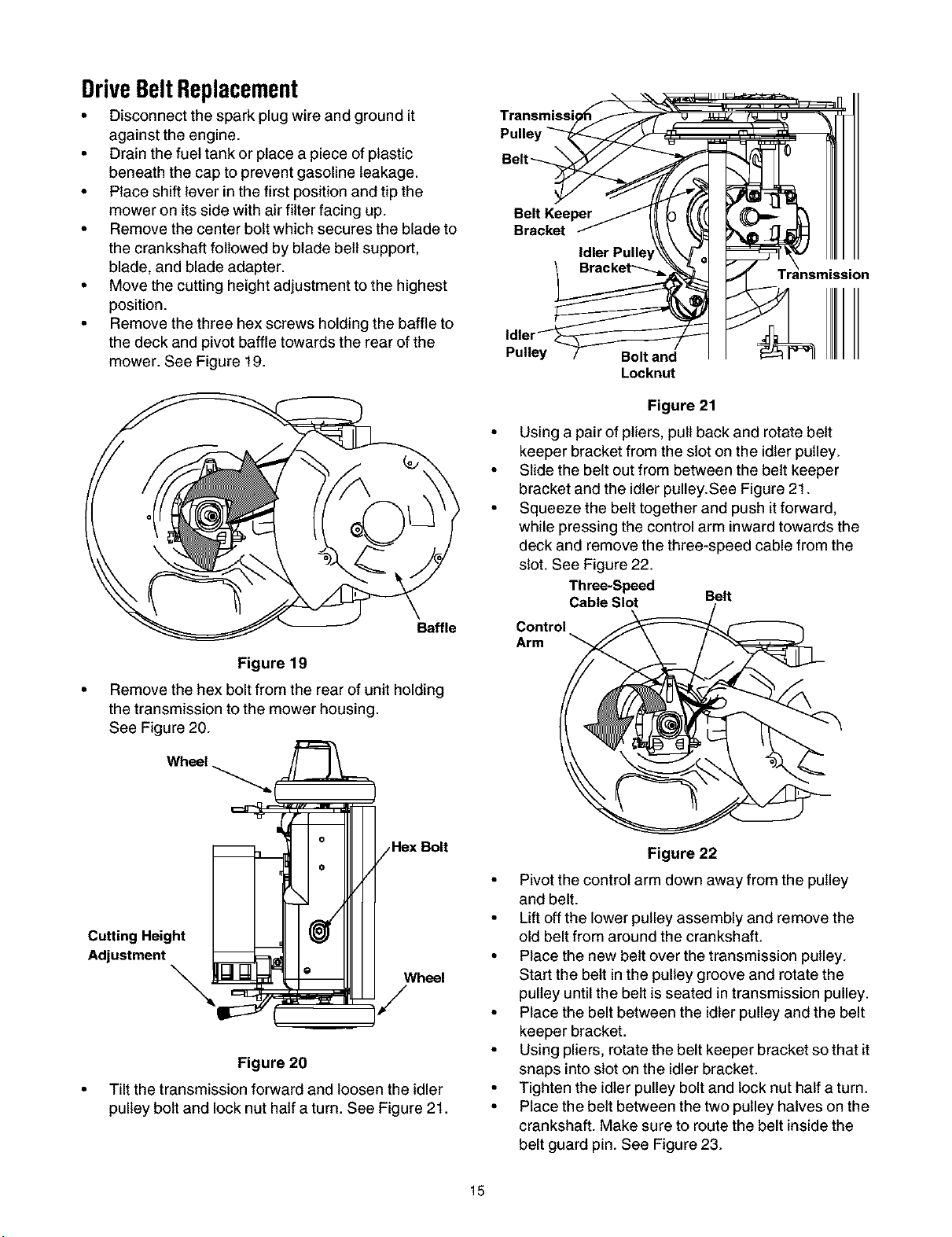
• Remove the three hex screws holding the baffle to
the deck and pivot baffle towards the rear of the
mower. See Figure 19.
Baffle
Figure 19
the transmission to the mower housing.
See Figure 20.
Wheel .__
Cutting Height __
Adjustment_ _ _J_L
Remove the hex bolt from the rear of unit holding
jHex Bolt
Wheel
//
Figure 20
• Tilt the transmission forward and loosen the idler
pulley bolt and lock nut half a turn. See Figure 21.
Transmissi/o_7_'_ _ f_,_L_ "_I
Belt Keeper//_ ((_ _Y_'_ =_ III
Brso.et/ \\\ III
• I_dler.Pulley\_.X_= _" III
ra nsmis.on
Idler
Locknut
Figure 21
Using a pair of pliers, pull back and rotate belt
keeper bracket from the slot on the idler pulley.
Slide the belt out from between the belt keeper
bracket and the idler pulley.See Figure 21.
Squeeze the belt together and push it forward,
while pressing the control arm inward towards the
deck and remove the three-speed cable from the
slot. See Figure 22.
Three-Speed
Cable Slot Belt
Control
Arm
Figure 22
• Pivot the control arm down away from the pulley
and belt.
• Liftoffthe lower pulley assembly and remove the
old belt from around the crankshaft.
• Place the new belt over the transmission pulley.
Start the belt in the pulley groove and rotate the
pulley until the belt is seated in transmission pulley.
• Place the belt between the idler pulley and the belt
keeper bracket.
• Using pliers, rotate the belt keeper bracket so that it
snaps into slot on the idler bracket.
• Tighten the idler pulley bolt and lock nut half a turn.
• Place the belt between the two pulley halves on the
crankshaft. Make sure to route the belt inside the
belt guard pin. See Figure 23.
15

Upper
Ha,,
Tab_Belt
\_ J/_,Lower Pulley
Belt _---_/_-----_'_- Half
Figure 23
IMPORTANT: When replacing the belt, do not disas-
semble the lower pulley assembly.
• Pinch both sides of the belt together so that the belt
is not in the pulley groove, and the lower pulley can
be pushed towards the engine. See Figure 24.
Lower Pulley
Half
Belt
Belt
Guard Pin
Figure 24
• Pivot the control arm back to its original position
and reinstall the three-speed cable into the slot.
See Figure 25.
Three-Speed
Cable O
Control
Arm
Figure 25
• Make sure the belt isrouted inside the pulley halves
and the belt guard pin.
• Reinstall the bolt securing transmission to rear
mower housing.
• Pivot the baffle back to its original position and
secure with three hex screws removed earlier.
• Lightly lubricate the inside of the blade adapter and
reinstall the spacer, wave washer, blade adapter
assembly, and blade in the correct order.
• Tighten the hex bolt to secure the blade to torque:
450-600 in. Ibs.
ReplacingRearFlap
• To remove rear flap, cut off the flat end of the wire
rod which secures it to the deck.
• Attach the new ftap and new rod to deck, bending
the ends of the new rod over to secure to deck.
SECTION9: OFF-SEASONSTORAGE
StoringYourLawnMower
The following steps should be taken to prepare your
lawn mower for storage.
• Clean and lubricate mower thoroughly as described
in the lubrication instructions.
IMPORTANT:We do not recommend the use of a
pressure washer or garden hose to clean your unit.
• Refer to engine manual for correct engine storage
instructions.
• Coat mower's cutting blade with chassis grease to
prevent rusting.
• Store mower in a dry, clean area. Do not store next
to corrosive materials, such as fertilizer.
NOTE: When storing any type of power equipment in a
poorly ventilated or metal storage shed, care should be
taken to rust-proof the equipment. Using a light oil or
silicone, coat the equipment, especially cables and all
moving parts.
16

SECTION10: TROUBLESHOOTING
Problem Cause
Engine fails to start
Engine runs erratic
1. Blade control handle disengaged.
2. Spark plug wire disconnected.
3. Fuel tank empty or stale fuel.
4. Blocked fuel line.
5. Faulty spark plug.
6. Engine flooded
1. Spark plug wire loose.
2. Blocked fuel line or stale fuel.
3. Vent in gas plugged.
4. Water or dirt in fuel system.
5. Dirty air cleaner.
6. Carburetor out of adjustment.
1. Engine oil level low.
2. Air flow restricted.
3. Carburetor not adjusted properly.
1. Spark plug gap too close.
Remedy
1. Engage blade control handle.
2. Connect wire to spark plug.
3. Fill tank with clean, fresh gasoline.
4. Clean fuel line.
5. Clean, adjust gap, or replace.
6. Wait a few minutes to restart, do not
prime.
1. Connect and tighten spark plug wire.
2. Clean fuel line; fill tank with clean, fresh
gasoline
3. Clear vent.
4. Drain fuel tank. Refill with fresh fuel.
5. Clean air cleaner.
6. Adjust carburetor.
1. Fill crankcase with proper oil.
2. Remove blower housing and clean.
3. Adjust carburetor.
1. Adjust gap to .030".
Engine overheats
Occasional skip (hesitates)
at high speed
Idles poorly 1. Spark plug fouled, faulty or gap too 1. Reset gap to .030" or replace spark plug.
wide. 2. Adjust carburetor.
2. Carburetor improperly adjusted. 3. Clean air cleaner.
3. Dirty air cleaner.
Excessive vibration 1. Cutting blade loose or unbalanced. 1. Tighten blade and adapter. Balance
2. Bent cutting blade, blade.
2. Replace blade.
Mower will not mulch grass 1. Wet grass. 1. Do not mow when grass is wet; wait until
later to cut.
2. Excessively high grass. 2. Mow once at a high cutting height, then
mow again at desired height or make a
narrower cutting path.
3. Dullblade. 3. Sharpenor replace blade.
Uneven cut 1. Wheels not positioned correctly. 1. Place all four wheels in same height
position.
2. Dullblade. 2. Sharpenor replace blade.
NOTE: For repairs beyond the minor adjustments listed above, contact your local authorized service dealer.
17

Date
YOURNOTES
Comments
18
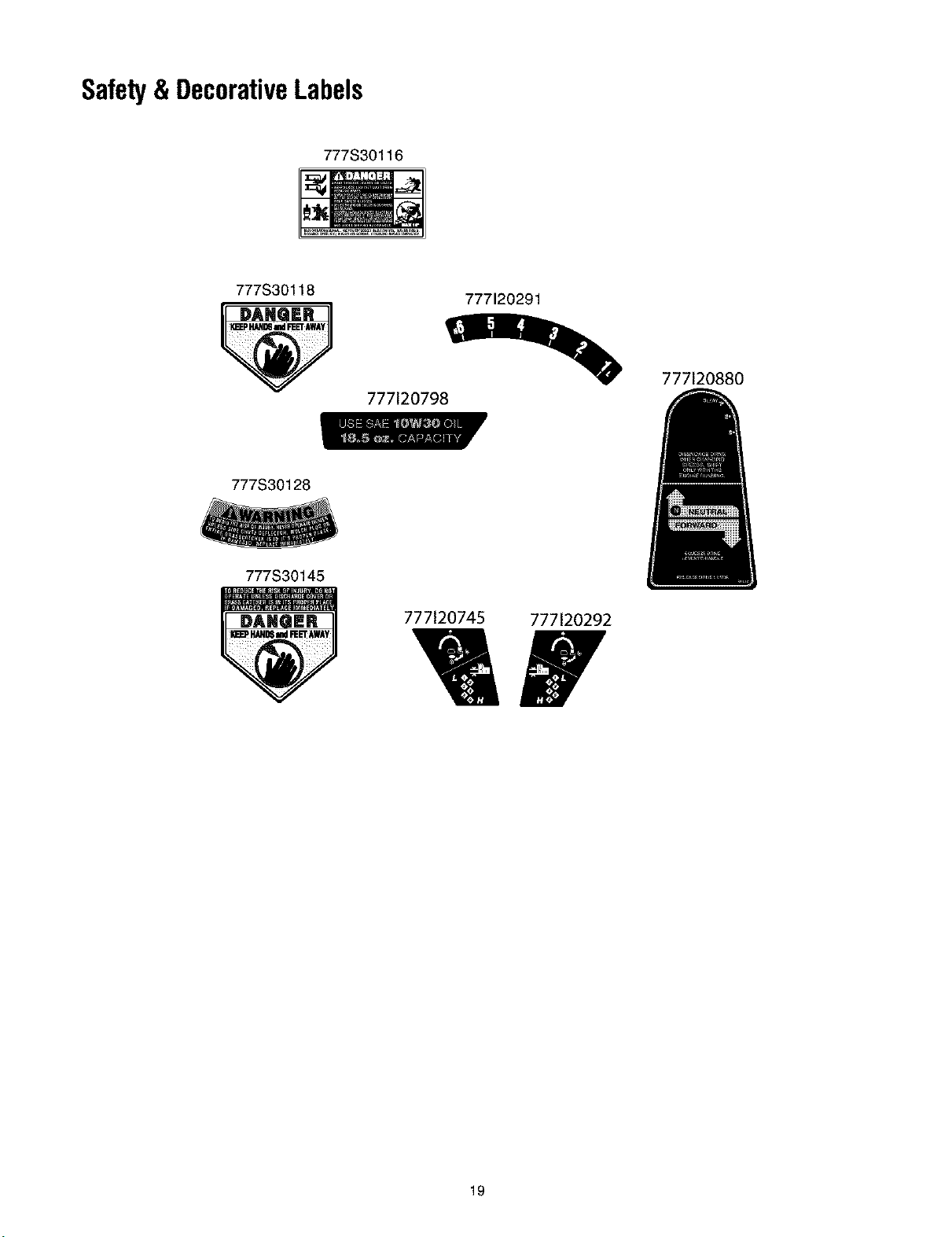
Safety& DecorativeLabels
777S30116
777S30118
I_DAMaIR _1
777120291
777120798
777120880
777S30128
777S30145
,_j , - _.
I1#ANeEn II
777120745 777120292
19
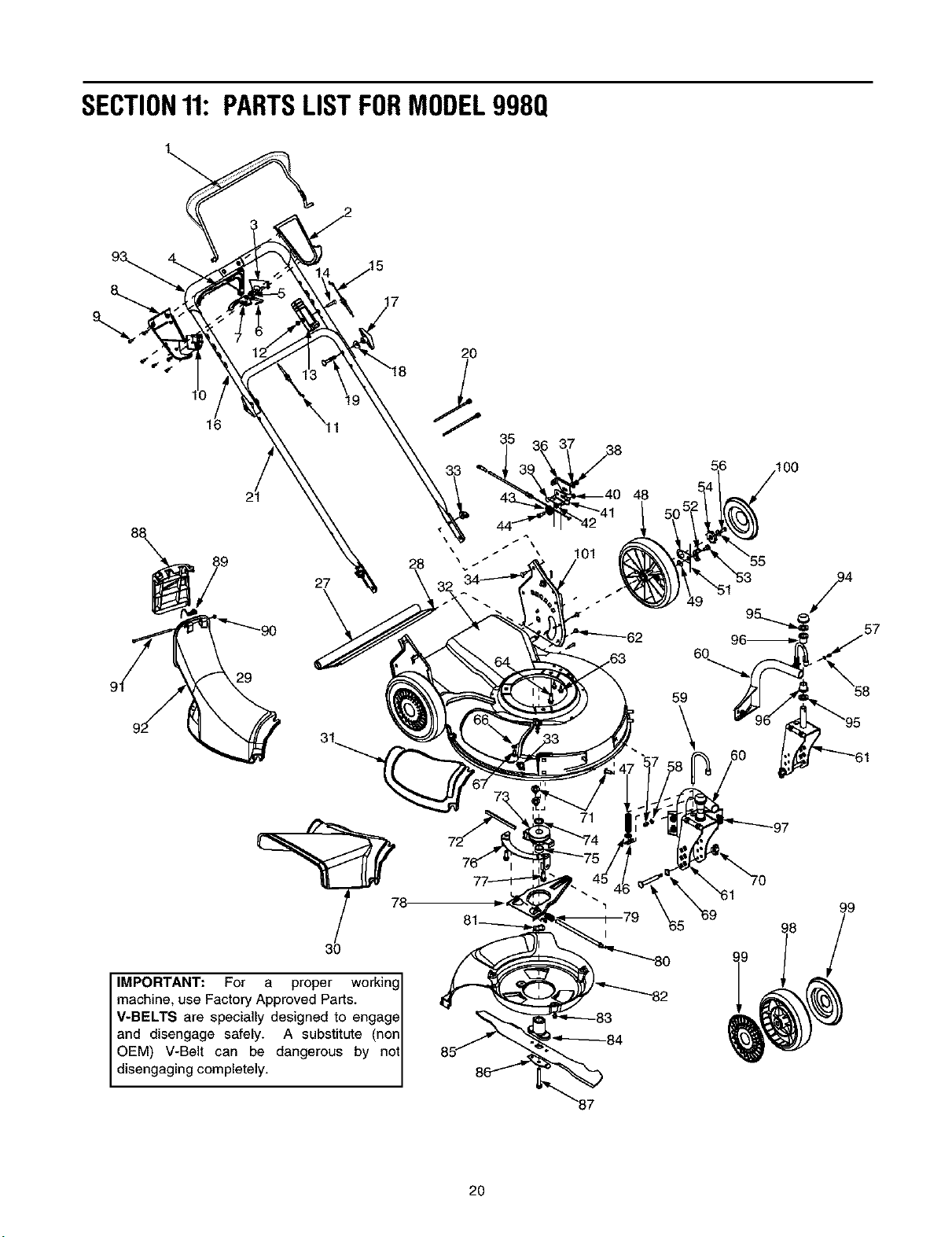
SECTION11: PARTSLISTFORMODEL998Q
29
27
48
59
\
1O0
78
IMPORTANT: For a proper working
machine, use Factory Approved Parts.
V-BELTS are specially designed to engage
and disengage safely. A substitute (non
OEM) V-Belt can be dangerous by nol
disengaging completely.
8
2O
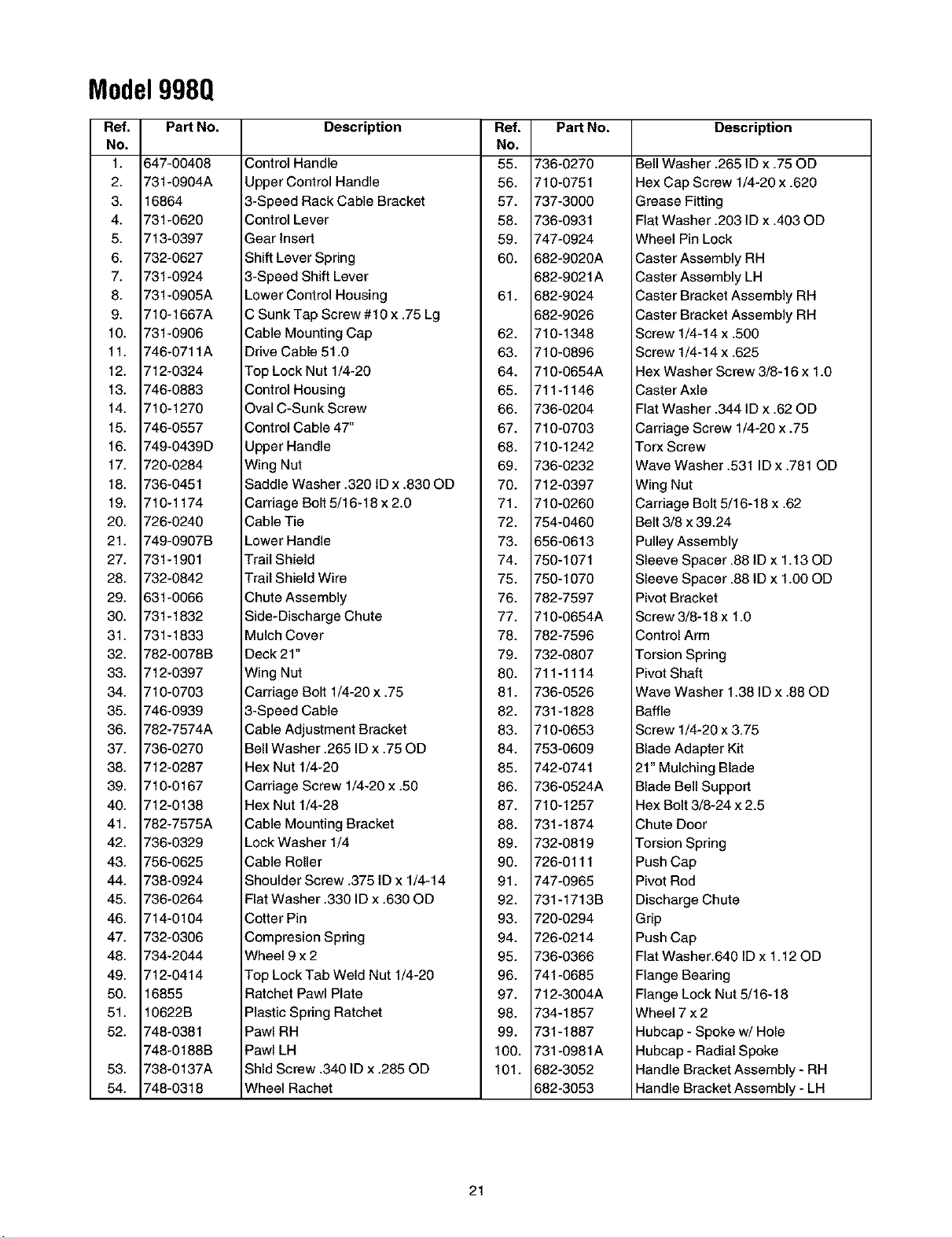
Model998Q
Ref. Part No.
No.
1. B47-00408
2. 731-0904A
3. 16864
4. 731-0620
5. 713-0397
6. 732-0627
7. 731-0924
8. 731-0905A
9. 710-1667A
10. 731-0906
11. 746-0711A
12. 712-0324
13. 746-0883
14. 710-1270
15. 746-0557
16. 749-0439D
17. 720-0284
18. 736-0451
19. 710-1174
20. 726-0240
21. 749-0907B
27. 731-1901
28. 732-0842
29. B31-0066
30. 731-1832
31. 731-1833
32. 782-0078B
33. 712-0397
34. 710-0703
35. 746-0939
36. 782-7574A
37. 736-0270
38. 712-0287
39. 710-0167
40. 712-0138
41. 782-7575A
42. 736-0329
43. 756-0625
44. 738-0924
45. 736-0264
46. 714-0104
47. 732-0306
48. 734-2044
49. 712-0414
50. 16855
51. 10622B
52. 748-0381
748-0188B
53. 738-0137A
54. 748-0318
Description
Control Handle
Upper Control Handle
3-Speed Rack Cable Bracket
Control Lever
Gear Insert
Shift Lever Spring
3-Speed Shift Lever
Lower Control Housing
C Sunk Tap Screw #10 x .75 Lg
Cable Mounting Cap
Drive Cable 51.0
Top Lock Nut 1/4-20
Control Housing
Oval C-Sunk Screw
Control Cable 47"
Upper Handle
Wing Nut
Saddle Washer .320 ID x .830 OD
Carriage Bolt 5/16-18 x 2.0
Cable Tie
Lower Handle
Trail Shield
Trail Shield Wire
Chute Assembly
Side-Discharge Chute
Mulch Cover
Deck 21"
Wing Nut
Carriage Bolt 1/4-20 x .75
3-Speed Cable
Cable Adjustment Bracket
Bell Washer .265 ID x .75 OD
Hex Nut 1/4-20
Carriage Screw 1/4-20 x .50
Hex Nut 1/4-28
Cable Mounting Bracket
Lock Washer 1/4
Cable Roller
Shoulder Screw .375 ID x 1/4-14
Flat Washer .330 ID x .630 OD
Cotter Pin
Compresion Spring
Wheel 9 x 2
Top LockTab Weld Nut 1/4-20
Ratchet Pawl Plate
Plastic Spring Ratchet
Pawl RH
Pawl LH
Shld Screw .340 ID x .285 OD
Wheel Rachet
Ref.
No.
55.
56.
57.
58.
59.
60.
61.
62.
63.
64.
65.
66.
67.
68.
69.
70.
71.
72.
73.
74.
75.
76.
77.
78.
79.
80.
81.
82.
83.
84.
85.
86.
87.
88.
89.
90.
91.
92.
93.
94.
95.
96.
97.
98.
99.
100.
101.
Part No.
736-0270
710-0751
737-3000
736-0931
747-0924
682-9020A
682-9021A
682-9024
682-9026
710-1348
710-0896
710-0654A
711-1146
736-0204
710-0703
710-1242
736-0232
712-0397
710-0260
754-0460
656-0613
750-1071
750-1070
782-7597
710-0654A
782-7596
732-0807
711-1114
736-0526
731-1828
710-0653
753-0609
742-0741
736-0524A
710-1257
731-1874
732-0819
726-0111
747-0965
731-1713B
720-0294
726-0214
736-0366
741-0685
712-3004A
734-1857
731-1887
731-0981A
682-3052
682-3053
Description
Bell Washer .265 ID x .75 OD
Hex Cap Screw 1/4-20 x .620
Grease Fitting
Flat Washer .203 ID x .403 OD
Wheel Pin Lock
Caster Assembly RH
Caster Assembly LH
Caster Bracket Assembly RH
Caster Bracket Assembly RH
Screw 1/4-14 x .500
Screw 1/4-14 x .625
Hex Washer Screw 3/8-16 x 1.0
Caster Axle
Flat Washer .344 ID x .62 OD
Carriage Screw 1/4-20 x .75
Torx Screw
Wave Washer .531 ID x .781 OD
Wing Nut
Carriage Bolt 5/16-18 x .62
Belt 3/8 x 39.24
Pulley Assembly
Sleeve Spacer .88 ID x 1.13 OD
Sleeve Spacer .88 ID x 1.00 OD
Pivot Bracket
Screw 3/8-18 x 1.0
Control Arm
Torsion Spring
Pivot Shaft
Wave Washer 1.38 ID x .88 OD
Baffle
Screw 1/4-20 x 3.75
Blade Adapter Kit
21" Mulching Blade
Blade Bell Support
Hex Bolt 3/8-24 x 2.5
Chute Door
Torsion Spring
Push Cap
Pivot Rod
Discharge Chute
Grip
Push Cap
Flat Washer.640 ID x 1.12 OD
Flange Bearing
Flange Lock Nut 5/16-18
Wheel 7 x 2
Hubcap - Spoke w/Hole
Hubcap - Radial Spoke
Handle Bracket Assembly - RH
Handle Bracket Assembly - LH
21

Model998Q
28
17
16
15
11
I
6O
20
13
31
62
63
22

Model998Q
Ref.
Part No.
No.
1. 720-0223
2. 732-0803A
3. 738-0529
4. 710-0751
5. 736-0270
6. 748-0318
7. 736-0369
8. 782-0566B
9. 750-0515
10. 741-0978
11. 750-1056
12. 710-0653
13. 682-7528
14. 741-0324
15. 682-7526
16. 618-0263A
17. 710-0604A
18. 713-0453
19. 638-0012
20. 741-0522
21. 732-0832
22. 750-0151
23. 710-1315
24. 711-0835
25. 750-0807
26. 782-0568
27. 710-1652
28. 714-0474
29. 712-3025
30. 736-0425
31. 756-0656
32. 736-3084
Part Description
Ref.
Part No.
No.
Grip 33. 712-0896
Spring Lever 34. 782-7598
Shoulder Nut .825 x.165 Lg. 35. 741-0600
Cap Screw 1/4-20 x .620 36. 732-0849A
Bell Washer .285 ID x.75 OD 37. 750-1050
Wheel Rachet 38. 682-0027A
Flat Washer .508 ID x 1.00D 39. 710-0299
Pivot Arm Assembly 40. 741-0682A
Spacer.510 ID x.70 OD 41. 736-0570
Sleeve Bearing .504 ID x .830 OD 42. 721-0329
Shoulder 43. 721-0325
Tap Screw 1/4-20x.375 44. 618-0253
ChainCoverAssembly 45. 782-7601A
Flange Bearing .506 ID x .590 Lg 46. 741-0690
Transmission Axle Assembly 47. 736-0616
Transmission Assembly 48. 782-7595
Hex Screw 5/16-18 49. 741-0324
Chain 50. 711-1168
Rear Axle Assembly 51. 717-1469
Flange Bearing .506 ID x .715 Lg 52. 741-0674
Torsion Spring 53. 717-1487
Spacer.550 ID x .750 OD 54. 736-0314
Screw 3/8-16 x.25 55. 736-0569
Clevis Pin .50 Dia x 4.82 Lg. 56. 618-0252
Spacer.385 ID x.624 OD 57. 710-0642
Spring Bracket: Height Adjustment 58. 611-0066
Screw 1/4-14x.825 59. 664-04016
Cotter Pin 60. 747-0940A
HexJam Nut 5/16-24 61. 747-0939
Bell Washer .325 ID x.930 OD 62. 747-0937
Pulley 63. 631-0071
Flat Washer .510 ID x 1.120 OD
Part Description
Hex Jam Nut 1/4-28
Belt Keeper
Bearing
Extension Spring
Flange Spacer
Idler Bracket Assembly
Hex Cap Screw 1/4-28 x 1.0
Bearing Sleeve
Flat Washer .885 ID x 1.45 OD
Oil Seal
Plug
Upper Housing Assembly
Cable Bracket
Bearing
Thrust Washer .504 ID x .70 OD
Pivot Bracket
Flange Bearing
Output Shaft 6T
Gear 34T
Bearing
Pinion Shaft 10T
Thrust Washer 3/8 x .70
Thrust Washer .388 x .625
Lower Housing Assembly
Hex Screw 1/2-20 x .75
Shaft Assembly
Grassbag Assembly
Support Rod w/Rope Guide
Pivot Rod
Grassbag Frame
Grassbag Cover
23
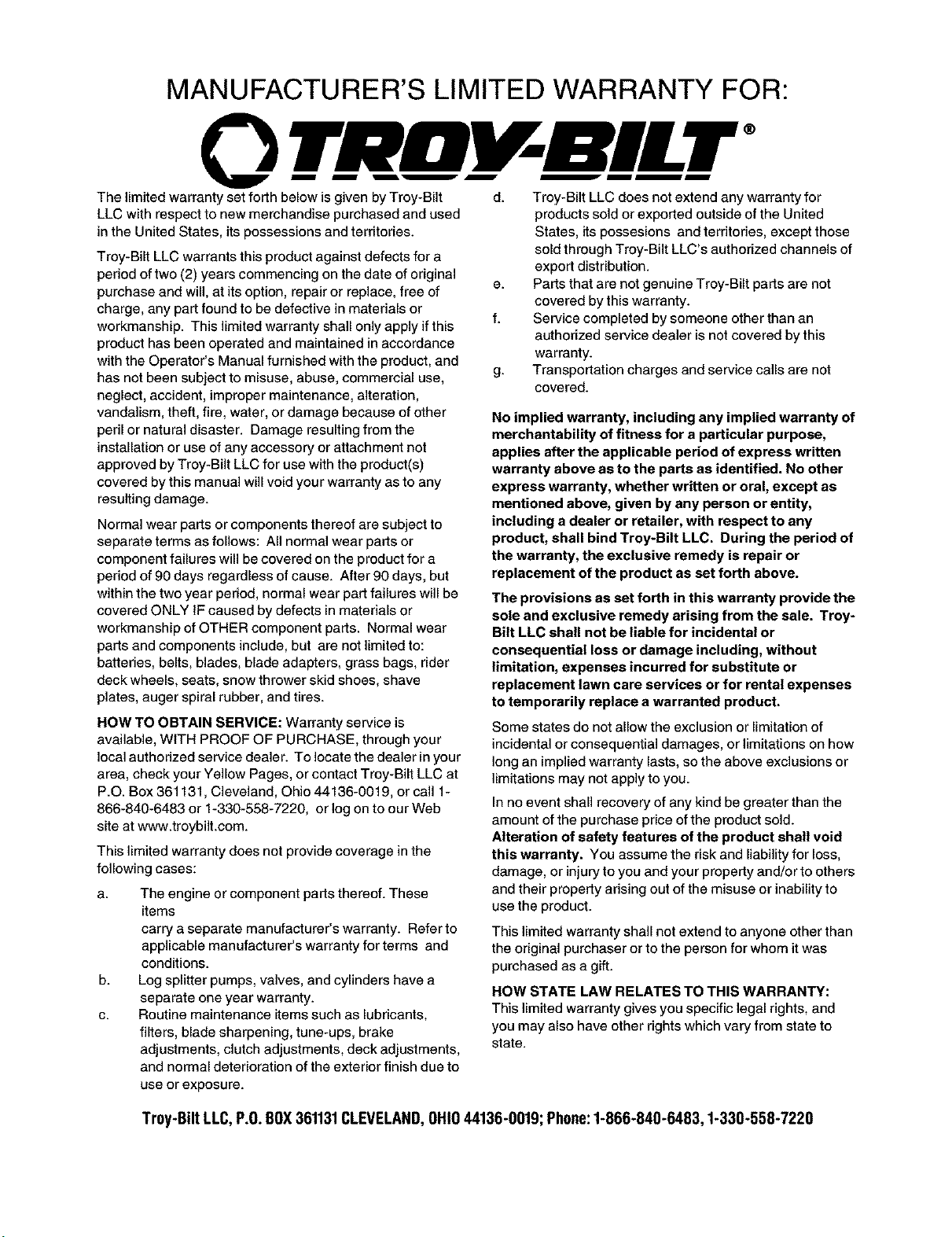
MANUFACTURER'S LIMITED WARRANTY FOR:
0 TPD RILT'___
The limited warranty set forth below is given by Troy-Bilt
LLC with respect to new merchandise purchased and used
in the United States, its possessions and territories.
Troy-Bilt LLC warrants this product against defects for a
period of two (2) years commencing on the date of original
purchase and will, at its option, repair or replace, free of
charge, any part found to be defective in materials or
workmanship. This limited warranty shall only apply if this
product has been operated and maintained in accordance
with the Operator's Manual furnished with the product, and
has not been subject to misuse, abuse, commercial use,
neglect, accident, improper maintenance, alteration,
vandalism, theft, fire, water, or damage because of other
peril or natural disaster. Damage resulting from the
installation or use of any accessory or attachment not
approved by Troy-Bilt LLC for use with the product(s)
covered by this manual will void your warranty as to any
resulting damage.
Normal wear parts or components thereof are subject to
separate terms as follows: All normal wear parts or
component failures will be covered on the product for a
period of 90 days regardless of cause. After 90 days, but
within the two year period, normal wear part failures will be
covered ONLY IF caused by defects in materials or
workmanship of OTHER component pads. Normal wear
parts and components include, but are not limited to:
batteries, belts, blades, blade adapters, grass bags, rider
deck wheels, seats, snow thrower skid shoes, shave
plates, auger spiral rubber, and tires.
HOW TO OBTAIN SERVICE: Warranty service is
available, WITH PROOF OF PURCHASE, through your
local authorized service dealer. To locate the dealer in your
area, check your Yellow Pages, or contact Troy-Bilt LLC at
P.O. Box 361131, Cleveland, Ohio 44136-0019, or call 1-
866-840-6483 or 1-330-558-7220, or log on to our Web
site at www.troybilt.com.
This limited warranty does not provide coverage in the
following cases:
a. The engine or component parts thereof. These
items
carry a separate manufacturer's warranty. Refer to
applicable manufacturer's warranty for terms and
conditions.
b. Log splitter pumps, valves, and cylinders have a
separate one year warranty.
c. Routine maintenance items such as lubricants,
filters, blade sharpening, tune-ups, brake
adjustments, clutch adjustments, deck adjustments,
and normal deterioration of the exterior finish due to
d. Troy-Bilt LLC does not extend any warranty for
products sold or exported outside of the United
States, its possesions and territories, except those
sold through Troy-Bilt LLC's authorized channels of
export distribution.
e. Parts that are not genuine Troy-Bilt parts are not
covered by this warranty.
f. Service completed by someone other than an
authorized service dealer isnot covered by this
warranty.
g. Transportation charges and service calls are not
covered.
No implied warranty, including any implied warranty of
merchantability of fitness for a particular purpose,
applies after the applicable period of express written
warranty above as to the parts as identified. No other
express warranty, whether written or oral, except as
mentioned above, given by any person or entity,
including a dealer or retailer, with respect to any
product, shall bind Troy-Bilt LLC. During the period of
the warranty, the exclusive remedy is repair or
replacement of the product as set forth above.
The provisions as set forth in this warranty provide the
sole and exclusive remedy arising from the sale. Troy-
Bilt LLC shall not be liable for incidental or
consequential loss or damage including, without
limitation, expenses incurred for substitute or
replacement lawn care services or for rental expenses
to temporarily replace a warranted product.
Some states do not allow the exclusion or limitation of
incidental or consequential damages, or limitations on how
long an implied warranty lasts, so the above exclusions or
limitations may not apply to you.
In no event shall recovery of any kind be greater than the
amount of the purchase price of the product sold.
Alteration of safety features of the product shall void
this warranty. You assume the risk and liability for loss,
damage, or injury to you and your property and/or to others
and their property arising out of the misuse or inability to
use the product.
This limited warranty shall not extend to anyone other than
the original purchaser or to the person for whom it was
purchased as a gift.
HOW STATE LAW RELATES TO THIS WARRANTY:
This limited warranty gives you specific legal rights, and
you may also have other rights which vary from state to
state.
use orexposure.
Troy-Bilt LLC,P.O.BOX361131CLEVELAND,OHIO44136-0019; Phone:1-866-840-6483,1-330-558-7220