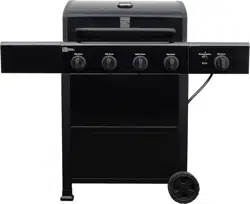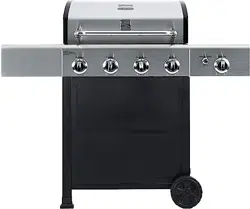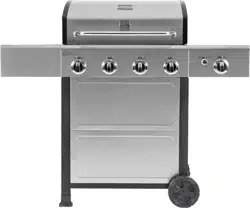

Use & Care Guide
Manual de Uso y Cuidado
English / Español
Kenmore®
Liquid Propane Gas Grill
Parrilla a gas de propano líquido
Kenmore 4 Burner with Side Burner with SS Grill
Model/Modelo: PG-40406S0L
P/N 40600050
®
DANGER
If you smell gas:
1. Shut off gas to the appliance.
2. Extinguish any open flame.
3. Open lid.
4. If odor continues, keep away from the
appliance and immediately call your gas
supplier or your fire department.
WARNING
1.
Do not store or use gasoline or other
flammable liquids or vapors in the vicinity of
this or any other appliance.
2. An LP cylinder not connected for use shall not
be stored in the vicinity of this or any other
appliance.
Safety Symbols
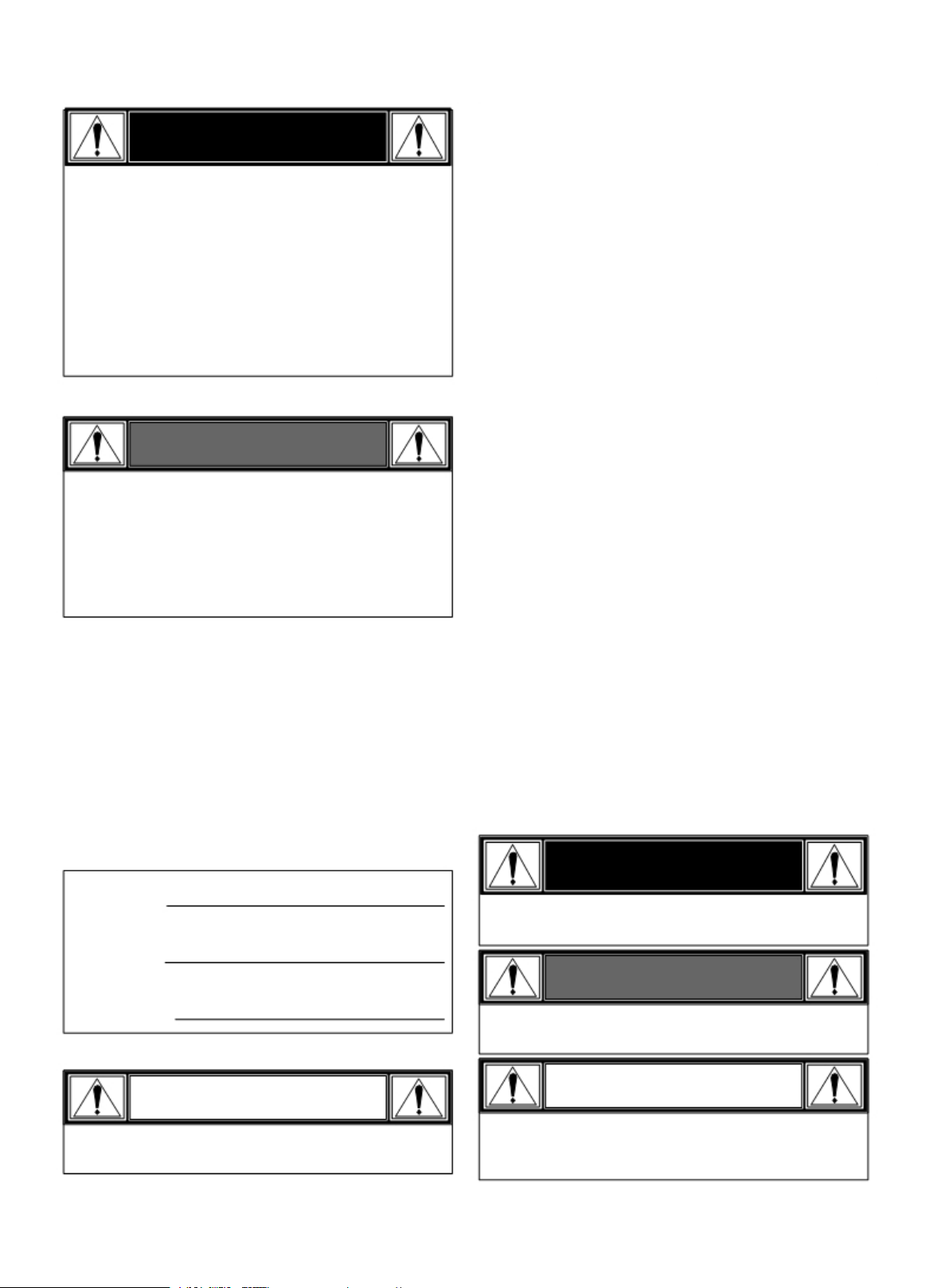
The symbols and boxes shown below explain what each heading
means. Read and follow all of the messages found throughout
the manual.
Product Record
IMPORTANT: Fill out the product record information below.
DANGER
Model Number
Serial Number
See rating label on grill for serial number.
WARNING
Date Purchased
CAUTION
CAUTION
2
Installation Safety Precautions
• Please read this User’s Manual in its entirety before using
the grill.
• Failure to follow the provided instruction can result in
seriously bodily injury and/or property damage.
• Some parts of this grill may have sharp edges. Please
wear suitable protective gloves.
• Use grill, as purchased, only with LP (propane) gas and the
regulator/valve assembly supplied.
• Grill installation must conform with local codes, or in their
absence of local codes, with either the National Fuel Gas
Code, ANSI Z223.1/ NFPA 54, Natural Gas and Propane
Installation Code, CSA B149.1, or Propane Storage and
Handling Code, B149.2, or the Standard for Recreational
Vehicles, ANSI A 119.2/NFPA 1192, and CSA Z240 RV
Series, Recreational Vehicle Code, as applicable.
• All electrical accessories (such as rotisserie) must be
electrically grounded in accordance with local codes, or
National Electrical Code, ANSI / NFPA 70 or Canadian
Electrical Code, CSA C22.1. Keep any electrical cords
and/or fuel supply hoses away from any hot surfaces.
• This grill is safety certified for use in the United States
and/or Canada only. Do not modify for use in any other
location. Modification will result in a safety hazard.
IMPORTANT: This grill is intended for outdoor use only and is
not intended to be installed in or on recreational vehicles or
boats.
NOTE TO INSTALLER: Leave this User’s Manual with the
customer after delivery and/or installation.
NOTE TO CONSUMER: Leave this User’s Manual in a
convenient place for future reference.
Please Contact Permasteel Customer Service For Help
& Parts
If you have questions or need assistance during assembly,
Please call
1-888-287-0735. M – F 8:00 – 5:00 Pacific
You will be speaking to a Representative of the grill
manufacturer.
enDANGER: Indicates an imminently hazardous situation
which, if not avoided, will result in death or serious injury.
WARNING: Indicates an potentially hazardous situation
which, if not avoided, could result in death or serious injury.
CAUTION: Indicates a potentially hazardous situation or
unsafe practice which, if not avoided, may result in minor or
moderate injury.
For residential use only. Do not use for commercial
cooking.
Or Visit us at www.permasteel.net
Installation Safety Precautions . . .
Safety Symbols . . .
Kenmore Grill Warranty . . .
Use and Care . . .
Parts List . . .
Parts Diagram . . .
Before Assembly . . .
Assembly . . .
Troubleshooting . . .
. . 2
. . 2
. 2
. . 2
. . 2
. . 4
. . . 5-11
. . . 12
. . 13
. . . 14-17
. 18-28
. 29-31
WARRANTY
WARRANTY
WARNIG
For Your Safety . . .
Grill Service Center. . .
Product Record Information . . .
TABLE OF CONTENTS
3
Combustion byproducts produced when using this
product include carbon monoxide, a chemical known
to the State of California to cause birth defects or
other reproductive harm. For more information go to
www.P65Warnings.ca.gov
WARNING
4
WARRANTY
KENMORE LIMITED WARRANTY
WITH PROOF OF SALE: the following warranty coverage applies when this appliance is correctly installed,
operated and maintained according to all supplied instructions. Note: Consumer is responsible for Shipping &
handling of all warranty replacement parts.
FOR ONE YEAR: from the date of sale this grill is warranted against defects in material or workmanship,
consumer will receive free replacement parts with proof of purchase, consumer is responsible for S&H cost.
FOR FIVE YEARS: from the date of sale, any stainless-steel burner that rusts through or burns through will be
replaced, proof of purchase must be provided, consumer is responsible for Shipping & Handling cost.
All warranty coverage excludes ignitor batteries and grill part paint loss, discoloration or surface rusting, which
are either expendable parts that can wear out from normal use within the warranty period, or are conditions
that can be the result of normal use, accident or improper maintenance.
All warranty coverage is void if this appliance is ever used for other than private household purposes.
For warranty coverage details to obtain replacement parts, visit the web page: www.permasteel.net
This warranty covers ONLY defects in material and workmanship, and will NOT pay for:
1. Expendable items that can wear out from normal use within the warranty period, including but not limited
to batteries, screw-in base light bulbs and surface coatings or finishes.
2. A service technician to clean or maintain this appliance, or to instruct the user in correct appliance
installation, operation and maintenance.
3. Service calls to correct appliance installation not performed by Permasteel authorized service agents, or to
repair problems with house fuses, circuit breakers, house wiring, and plumbing or gas supply systems
resulting from such installation.
4. Damage to or failure of this appliance resulting from installation not performed by Permasteel authorized
service agents, including installation that was not in accord with electrical, gas or plumbing codes.
5. Damage to or failure of this appliance, including discoloration or surface rust, if it is not correctly operated
and maintained according to all supplied instructions.
6. Damage to or failure of this appliance, including discoloration or surface rust, resulting from accident,
alteration, abuse, misuse or use for other than its intended purpose.
7. Damage to or failure of this appliance, including discoloration or surface rust, caused by the use of
detergents, cleaners, chemicals or utensils other than those recommended in all instructions supplied with
the product.
8. Damage to or failure of this appliance resulting from natural or other catastrophe, such as flood, fire or
storm.
9. Damage to or failure of parts or systems resulting from unauthorized modifications made to this appliance.
10. Service to an appliance if the model and serial plate is missing, altered, or cannot easily be determined to
have the appropriate certification logo.
Disclaimer of implied warranties; limitation of remedies
Customer’s sole and exclusive remedy under this limited warranty shall be product repair or replacement as
provided herein. Implied warranties, including warranties of merchantability or fitness for a particular purpose,
are limited to one year on the appliance, five years on burners, or the shortest period allowed by law. Seller
shall not be liable for incidental or consequential damages. Some states and provinces do not allow the
exclusion or limitation of incidental or consequential damages, or limitation on the duration of implied
warranties of merchantability or fitness, so these exclusions or limitations may not apply to you.
This warranty gives you specific legal rights, and you may also have other rights which vary from state to state.

• Never fill a cylinder beyond 80% full.
• If the information in the two points above is not
followed exactly, a fire causing death or serious
injury may occur.
• An overfilled or improperly stored cylinder is a
hazard due to possible gas release from the safety
relief valve. This could cause an intense fire with
risk of property damage, serious injury or death.
• If you see, smell or hear gas escaping,
i
mmediately get away from the LP cylinder and
appliance and call your fire department.
LP Cylinder
USE AND CARE
• The LP cylinder used with your grill must meet the following
requirements:
• Use LP cylinders only with these required measurements: 12"
(30.5cm) (diameter) x 18" (45.7 cm) (tall) with 20 lb. (9 kg.)
Capacity maximum.
• LP cylinders must be constructed and marked in accordance
with specifications for LP cylinders of the U.S. Department of
Transportation (DOT) or for Canada, CAN/CSA-B339,
cylinders, spheres and tubes for transportation of dangerous
goods. Transport Canada (TC). See LP cylinder collar for
marking.
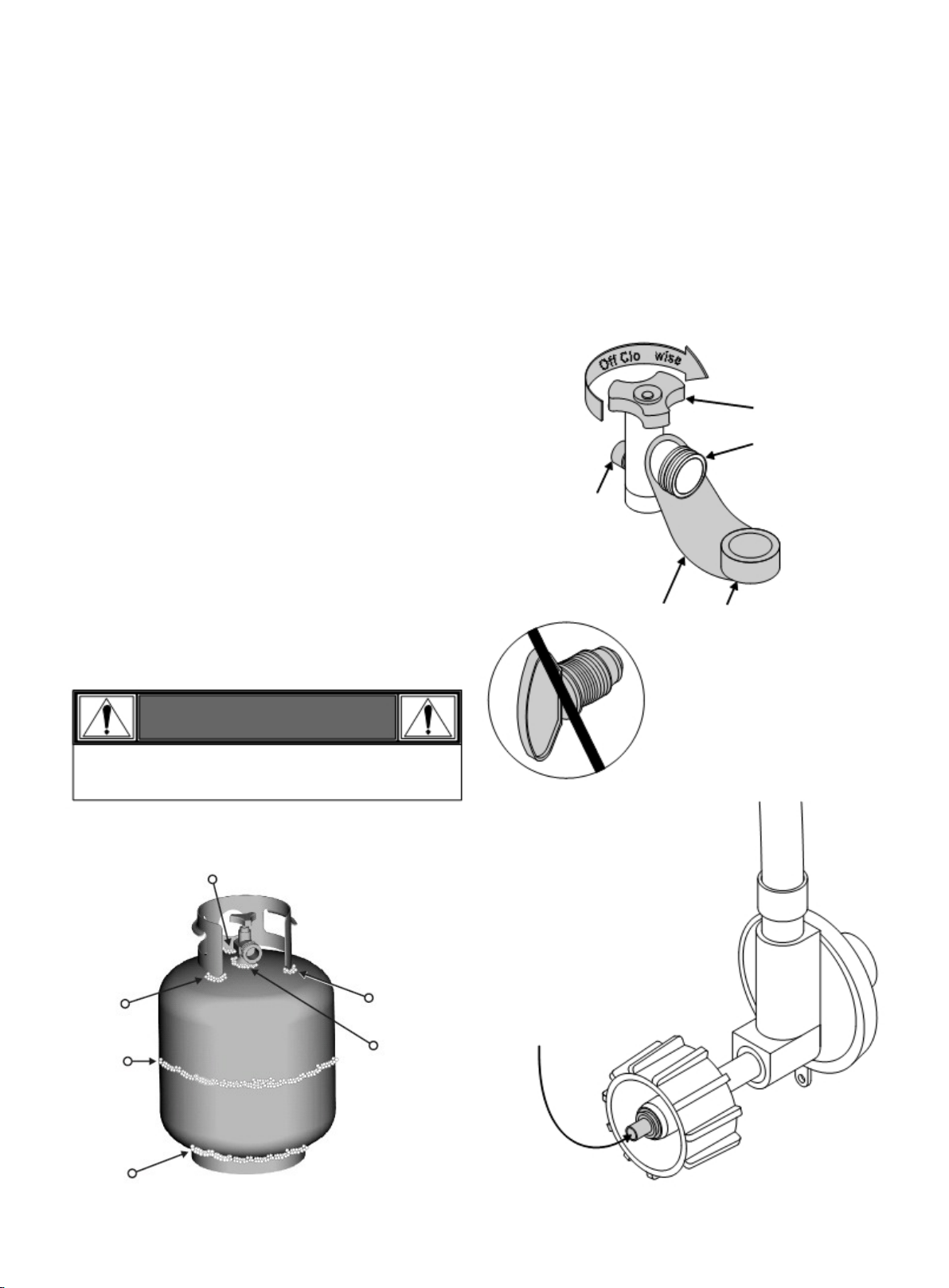
• LP cylinder valve must have:
• Type 1 outlet compatible with
regulator or grill.
• Safety relief valve.
• UL listed Overfill Protection
Device (OPD). This OPD safety
feature is identified by a unique triangular hand wheel.
Use
only LP cylinders equipped with this type of valve.
• LP cylinder must be arranged for vapor withdrawal and
include collar to protect LP cylinder valve. Always keep LP
cylinders in upright position during use, transit or storage.
OPD Hand Wheel
• NEVER store a spare LP cylinder under or near the
appliance or in an enclosed area.
LP cylinder in upright position for vapor withdrawal
LP (Liquefied Petroleum Gas)
LP Tank Removal, Transport And Storage
• Turn OFF all control knobs and LP tank valve. Turn coupling nut
counterclockwise by hand only - do not use tools to
disconnect. Lift LP tank wire upward off of LP tank collar, then lift
LP tank up and off of support bracket. Install safety cap onto LP
tank valve. Always use cap and strap supplied with valve.
Failure to use safety cap as directed may result in serious
personal injury and/or property damage.
LP Tank Valve
• LP gas is nontoxic, odorless and colorless when produced.
For
Your Safety, LP gas has been given an odor (similar to rotten
cabbage) so that it can be smelled.
• LP gas is highly flammable and may ignite unexpectedly when
mixed with air.
LP Cylinder Filling
• Use only licensed and experienced dealers.
• LP dealer must purge new cylinder before filling.
• Dealer should
NEVER fill LP cylinder more than 80% of LP
cylinder volume. Volume of propane in cylinder will vary by
temperature.
• A frosty regulator indicates gas overfill. Immediately close LP
cylinder valve and call local LP gas dealer for assistance.
• Do not release liquid propane (LP) gas into the atmosphere. This
is a hazardous practice.
• To remove gas from LP cylinder, contact an LP dealer or call a
local fire department for assistance. Check the telephone
directory under “Gas Companies” for nearest certified LP
dealers.
Safe
ty Cap
Retainer Strap
• A disconnected LP tank in storage or being transported must
have a safety cap installed (as shown). Do not store an LP tank
in enclosed spaces such as a carport, garage, porch, covered
patio or other building. Never leave an LP tank inside a vehicle
which may become overheated by the sun.
• Do not store an LP tank in an area where children play.
DANGER
5
LP Tank Exchange
• Many retailers that sell grills offer you the option of replacing
your empty LP tank through an exchange service. Use only those
reputable exchange companies that inspect, precision fill, test
and certify their cylinders.
Exchange your tank only for an OPD
safety feature-equipped tank as described in the "LP Tank"
section of this manual.
• Always keep new and exchanged LP tanks in upright position
during use, transit or storage.
•
Leak test new and exchanged LP tanks BEFORE connecting to
grill.
Connecting Regulator To The LP Tank
1. LP tank must be properly secured onto grill. (Refer to
assembly section.)
2. Turn all control knobs to the OFF position.
3. Turn LP tank OFF by turning OPD hand wheel clockwise to a
full stop.
4. Remove the protective cap from LP tank valve. Always use
cap and strap supplied with valve.
ck
LP Tank Leak Test
For your safety
OPD Hand Wheel
Type 1 outlet with
thread on outside
Safety Relief Valve
Strap and Cap
• Leak test must be repeated each time LP tank is exchanged or
refilled.
• Do not smoke during leak test.
• Do not use an open flame to check for gas leaks.
• Grill must be leak tested outdoors in a well-ventilated area,
away from ignition sources such as gas fired or electrical
appliances. During leak test, keep grill away from open flames
or sparks.
• Use a clean paintbrush and a 50/50 mild soap and water
solution. Brush soapy solution onto areas indicated by arrows
in figure below. Leaks are indicated by growing bubbles.
Do not insert a POL transport plug
(plastic part with external threads
into the type 1 valve outlet. It will
defeat the Safety Relief Valve
feature.
WARNING
If “growing” bubbles appear do not use or move the LP
tank. Contact an LP gas supplier or your fire department!
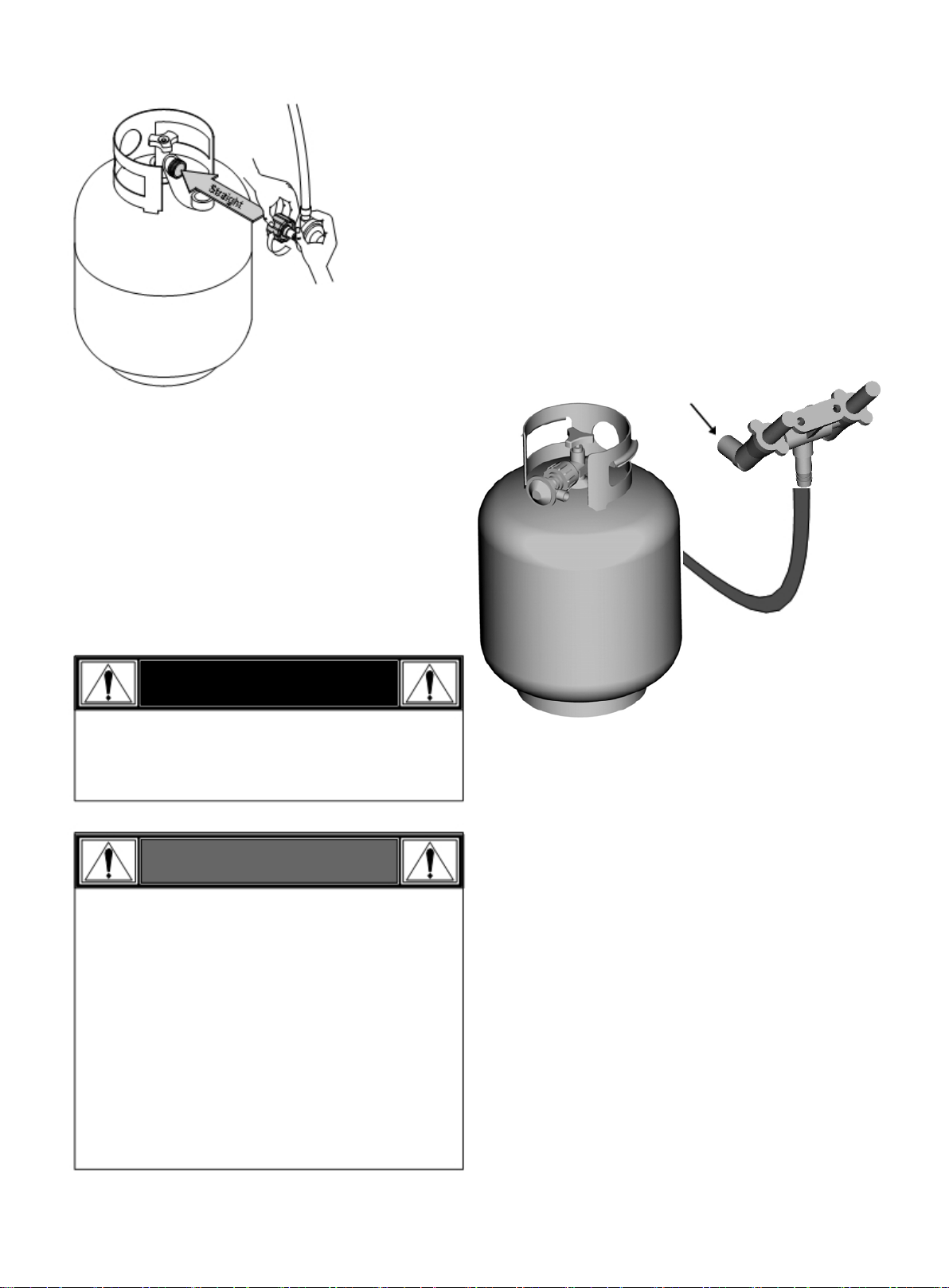
5. Hold regulator and insert nipple into LP
tank valve. Hand-tighten the coupling
nut, holding regulator in a straight line
with LP tank valve so as not to crossth-
thread the connection.
Nipple has to be
centered into the LP
tank valve.
▲Do not use household cleaning agents. Damage to the gas
train components (valve/hose/regulator) can result.
6
Leak Testing Valves, Hose and Regulator
1.
Turn all grill control knobs to OFF.
2. Be sure regulator is tightly connected to LP tank.
3. Completely open LP tank valve by turning OPD hand wheel
counterclockwise. If you hear a rushing sound, turn gas off
immediately. There is a major leak at the connection.
Correct
before proceeding by calling Permasteel for replacement
parts at
1-888-287-0735,
M – F 8:00 – 5:00 PACIFIC
4 .Brush soapy solution onto areas where bubbles are shown in
picture below:
Hold coupling nut and regulator
as shown for proper connection
▲
to LP tank valve.
Never remove threaded
orifice at end of valve.
6.
Turn the coupling nut clockwise and tighten to a full stop. The
regulator will seal on the back-check feature in the LP tank
valve, resulting in some resistance.
An additional one-half to
three-quarters turn is required to complete the connection.
Tighten by hand only - do not use tools.
NOTE:
If you cannot complete the connection, disconnect regulator
and repeat steps 5 and 6. If you are still unable to complete the
connection, do not use this regulator!
Call
1-888-287-0735 for an identical replacement part.
DANGER
• Do not insert any tool or foreign object into the valve
outlet or safety relief valve. You may damage the valve
and cause a leak. Leaking propane may result in
explosion, fire, severe personal injury, or death.
5. If “growing” bubbles appear, there is a leak. Close LP tank
valve immediately and retighten connections. If leaks cannot be
stopped do not try to repair. Call for replacement
parts at 1-888-287-0735.
6. Always close LP tank valve after performing leak test by
turning hand wheel clockwise.
WARNING
•
Outdoor gas appliance is not intended to be installed
in or on a boat.
•
Outdoor gas appliance is not intended to be installed
in or on an RV.
•
Never attempt to attach this grill to the self-contained
LP gas system of a camper trailer or motor home.
•
Do not use grill until leak-tested.
•
If a leak is detected at any time, STOP and call the fire
department.
• If you cannot stop a gas leak, immediately close
LP cylinder valve and call LP gas supplier or your fire
department !
7
▲Do not lean over grill while lighting.
1. Open lid during lighting.
2. Turn on valve from source or tank.
3. To ignite, turn Ignition Burner knob to HI.
4. Push and hold electronic ignition button.
5. If ignition does not occur in 5 seconds, turn the burner
controls OFF, wait 5 minutes, and repeat the lighting
procedure.
6. To ignite other main burners after ignition burner is lit,turn a
control knob that is adjacent to a lit burner to Hi.
Ignite far left burner last.
7. To ignite the Side Burner, follow steps 3-5 using the Side
Burner knob.
If igniter does not work, follow Match Lighting instructions.
Main Burner Igniter Lighting
Safety Tips
F
or Safe Use of Your Grill and to Avoid Serious
Injury:
• Do not let children operate or play near grill.
• Keep grill area clear and free from materials that
burn.
• Do not block holes in sides or back of grill.
• Use grill only in well-ventilated space. NEVER use
in enclosed space such as carport, garage, porch,
covered patio, or under an overhead structure of
any kind.
• Do not use charcoal or ceramic briquets in a gas
grill.
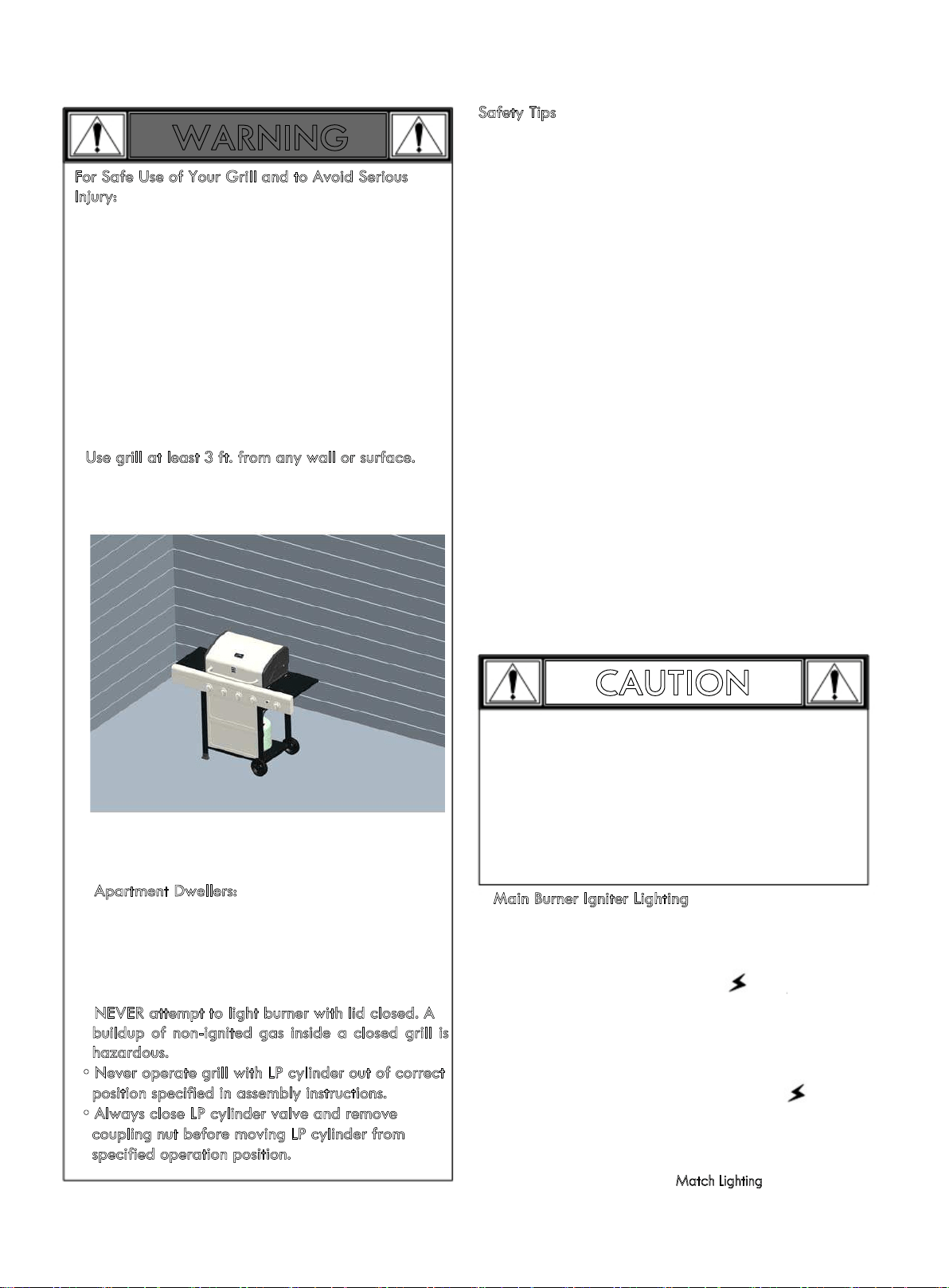
• Use grill at least 3 ft. from any wall or surface.
Maintain 10 ft. clearance to objects that can catch
fire, or to sources of ignition etc.
▲ Before opening LP cylinder valve, check the coupling nut for
tightness.
▲ When grill is not in use, turn off all control knobs and LP cylinder
valve.
▲ Never move grill while in operation or still hot.
▲ Use long-handled barbecue utensils and oven mitts to avoid burns
and splatters.
▲ Maximum load for sideburner and side shelf is 10 lbs.
▲ The drip tray must be inserted into grill and emptied after each use
Do not remove drip tray until grill has completely cooled.
▲ Clean grill often, preferably after each cookout. If a bristle brush is
used to clean any of the grill cooking surfaces, ensure no loose
bristles remain on cooking surfaces prior to grilling. It is not
recommended to clean cooking surfaces while grill is hot.
▲ If you notice drip or other hot material dripping from grill,
determine the cause, correct it, then clean and inspect valve. Keep
ventilation openings in cylinder enclosure (grill cart) free and clear
of debris.
▲ Do not store objects or materials inside the grill cart enclosure that
would block the flow of combustion air to the underside of either
the control panel or the firebox bowl.
▲ The regulator may make a humming or whistling noise during
operation. This will not affect safety or use of grill.
▲ If you have a grill problem see the "Troubleshooting Section".
▲ If the regulator frosts, turn off grill and LP cylinder valve
immediately. This indicates a problem with the cylinder and it
should not be used on any product. Return to supplier!
C
AUTION
• Putting out drip fires by closing the lid is not possible.
Grills are well ventilated for safety reasons.
• Do not use water on a drip fire. Personal injury may result.
If a drip fire develops, turn knobs and LP cylinder off.
• Do not leave grill unattended while preheating or burning
off food residue on HI. If grill has not been regularly
cleaned, a drip fire can occur that may damage the
product.
• A
partment Dwellers:
Check with management to learn the requirements
and fire codes for using an LP gas grill in your
apartment complex. If allowed, use outside on the
ground floor with a three (3) foot clearance from
walls or rails. Do not use on or under balconies.
• NEVER attempt to light burner with lid closed. A
b
uildup of non-ignited gas inside a closed grill is
hazardous.
• Never operate grill with LP cylinder out of correct
position specified in assembly instructions.
• Always close LP cylinder valve and remove
coupling nut before moving LP cylinder from
s
pecified operation position.
8
WARNING
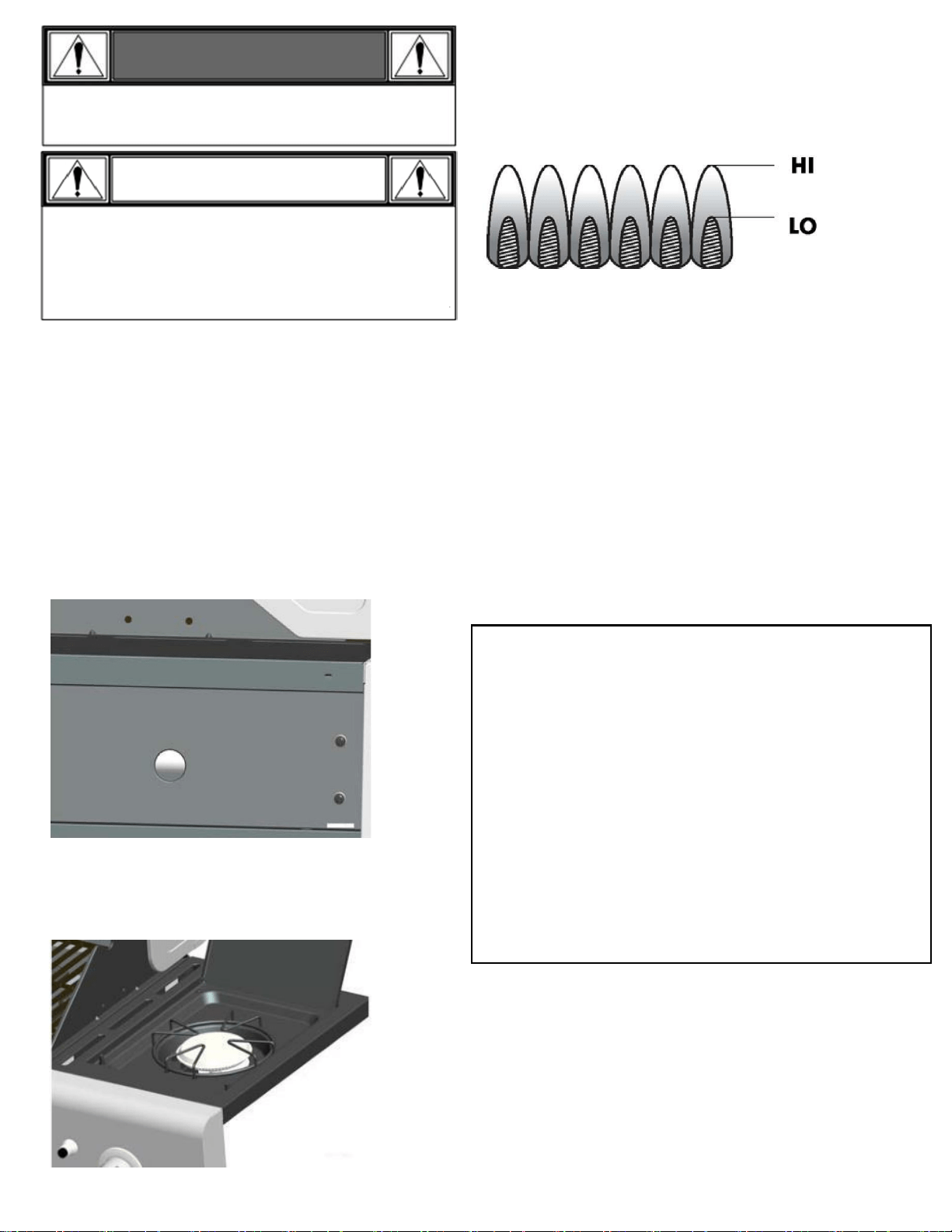
Burner Flame Check
• Remove cooking grates and heat diffusers. Light burners, turn
knobs from HI to LO. You should see a smaller flame in
LO position than seen on HI. Perform burner flame check
on searing burner, also. Always check flame prior to each use. If
only low flame is seen refer to "Sudden flame drop or low flame" in
the Troubleshooting Section.
Match Lighting Instructions
▲Do not lean over grill while lighting.
1. Open lid during lighting.
2. Place match into match holder (hanging on the left front leg
inside cabinet.
3. Light match and insert match holder through lighting hole in left
side of firebox. Align lit match with first burner on left.
4. Turn knob of first left burner to HI position. Be sure burner
lights and stays lit. Withdraw match holder from firebox and
extinguish match.
5. To light other burners, turn each knob in succession to HI.
6. Once burners are lit, adjust knobs to desired flame setting. To
extinguish an individual burner, turn its knob to OFF.
Sideburner Match Lighting
1. Open sideburner lid. Turn on gas at LP cylinder.
2. Place lit match near burner.
3. Turn sideburner knob to HI. Be sure burner lights and stays lit.、
Turning Grill Off
• Turn all knobs to OFF position. Turn LP cylinder off.
When you are finished grilling, raise the grill lid while allowing the grill to
fully cool. If the grill lid is closed during grill cooling, condensation may
occur on interior grill surfaces and possibly cause them to rust.
Igniter Check
• Turn gas off at LP cylinder. Press and hold electronic igniter button.
"Click" should be heard and spark seen each time between collector
box or burner and electrode. See "Troubleshooting" if no click or spark.
Valve Check
• Important: Make sure gas is off at LP cylinder before checking valves.
Knobs lock in OFF position. To check valves, first push in knobs and
release, knobs should spring back. If knobs do not spring back, replace
valve assembly before using grill. Turn knobs to LOW position then turn
back to OFF position. Valves should turn smoothly.
Hose Check
• Before each use, check to see if hoses are cut or worn. Replace
damaged hoses before using grill. Use only valve/hose/regulator as
specified in the parts list of this Use & Care Guide.
General Grill Cleaning
• Do not mistake brown or black accumulation of grease and smoke for
paint. Interiors of gas grills are not painted at the factory
(and should
never be painted). Apply a strong solution of detergent and water or
use a grill cleaner with scrub brush on insides of grill lid and bottom.
Rinse and allow to completely air dry. Do not apply a caustic grill/oven
cleaner to painted surfaces.
• Porcelain surfaces: Because of glass-like composition, most residue can
be wiped away with baking soda/water solution or specially
formulated cleaner. Use nonabrasive scouring powder for stubborn
stains.
9
Cast Iron Grate Seasoning (if applicable)
First Use –Before first use, season cast iron grates as follows: Rinse
cast iron grates with hot water. Do not use soap. Dry grates
thoroughly with a cloth towel. Coat grates with vegetable oil or
non-stick cooking spray. Place grates in grill. Start grill and slowly
raise temperature to 350° - 400° F. Heat grates for one hour.
Turn off grill and allow grates to cool completely before using to cook.
Cleaning – Do not use soap when cleaning grates. Clean grates with a
stiff brush and hot water. Dry grates thoroughly with a cloth towel.
Re-seasoning – Re-season grates when rust spots appear on grate
surface. When re-seasoning grates, soap may be used with
hot water to clean grates. After cleaning, dry grates thoroughly with a
cloth towel. Coat grates with vegetable oil or non-stick
cooking spray. Place grates in grill. Start grill and slowly raise
temperature to 350° - 400° F. Heat grates for one hour.
Turn off grill and allow grates to cool completely before using again.
WARNING
Turn controls and gas source or tank OFF
when not in use.
CAUTION
If ignition does NOT occur in 5 seconds, turn the
burner controls OFF, wait 5 minutes and repeat the
lighting procedure. If the burner does not ignite with
the valve open, gas will continue to flow out of the
burner and could accidently ignite with risk of injury.
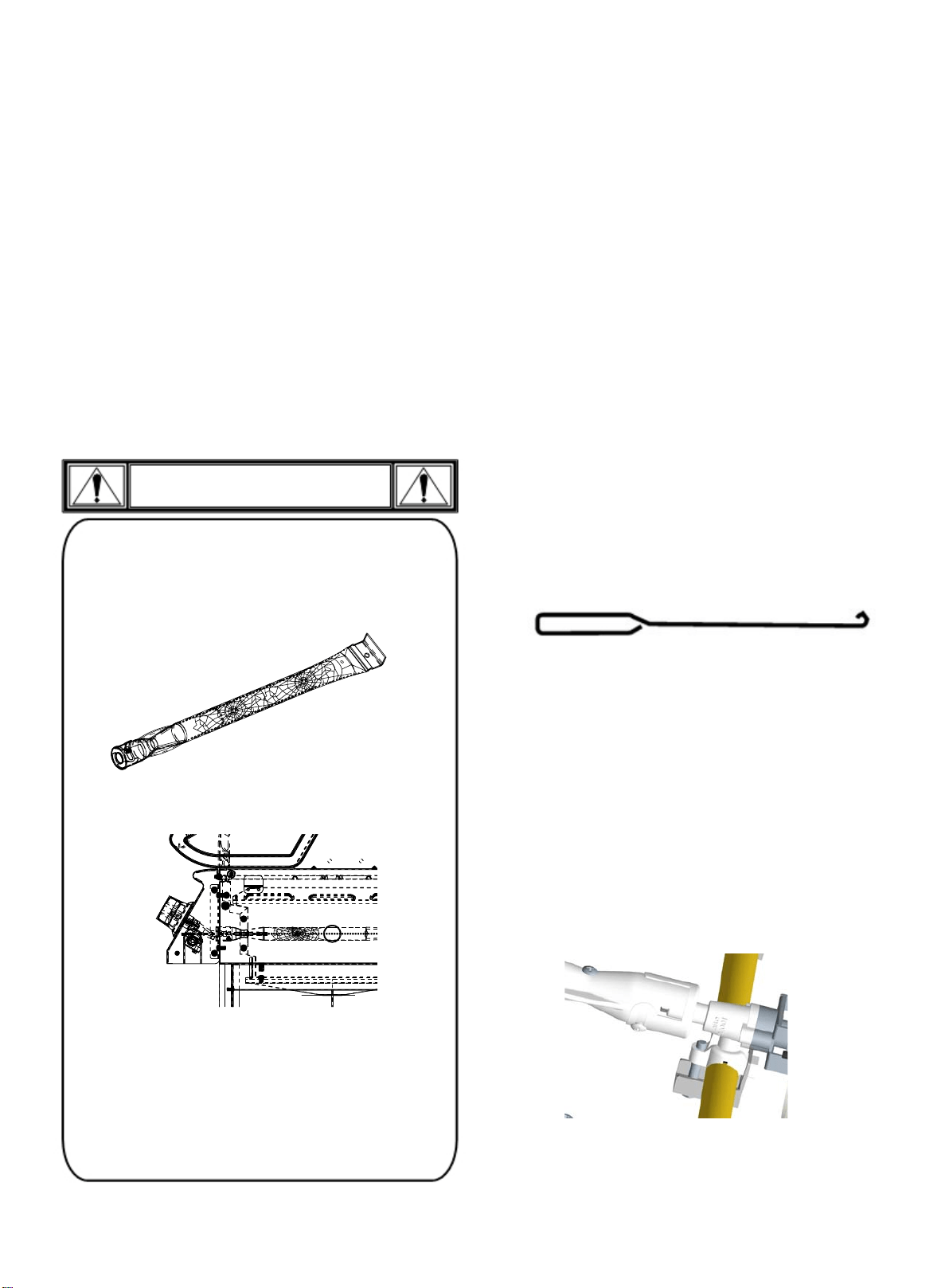
Cleaning the Burner Assembly
CAUTION
Follow these instructions to clean and/or replace parts of burner
assembly or if you have trouble igniting grill.
1. Turn gas off at control knobs and LP cylinder.
2. Remove cooking grates and heat diffusers.
3. Remove cotter pin from rear of burners.
See Fig. A next page.
4. Carefully lift each burner up and away from valve openings.
We suggest three ways to clean the burner tubes. Use the one
easiest for you.
(A) Bend a stiff wire (a light weight coat hanger works well)
into a small hook. Run the hook through each burner
tube several times.
(B) Use a narrow bottle brush with a flexible handle (do not use
a brass wire brush), run the brush through each burner tube
several times.
(C) Wear eye protection: Use an air hose to force air into
the burner tube and out the burner ports. Check each
port to make sure air comes out each hole.
5. Wire brush entire outer surface of burner to remove
food residue and dirt.
6. Clean any blocked ports with a stiff wire such as an
open paper clip.
7. Check burner for damage, due to normal wear and
corrosion some holes may become enlarged. If any large
cracks or holes are found replace burner.
Spiders or small insects have been known to create “flashback”
problems. The spiders spin webs, build nests and lay eggs in the grill’s
venturi tube(s) obstructing the flow of gas to the burner. The
backed-up gas can ignite in the venturi behind the control panel. This
is known as a flashback and it can damage your grill and even cause
injury.
To prevent flashbacks and ensure good performance the burner and
venturi assembly should be removed from the grill and cleaned
before use whenever the grill has been idle for an extended period.
VERY IMPORTANT: Burner tubes must reengage valve
openings. See illustrations below.
8. Carefully replace burners.
9. Attach burners to brackets with cotter pin. See Fig. B next
page.
10
. Replace heat diffusers and cooking grates.
Storing Your Grill
•Clean cooking grates.
•Store in dry location.
•When LP cylinder is connected to grill, store outdoors in a
well-ventilated space and out of reach of children.
•Cover grill if stored outdoors. Choose from a variety of grill
covers offered by manufacturer once available.
•Store grill indoors ONLY if LP cylinder is turned off and
Disconnected, remove from grill and stored outdoors.
• When removing grill from storage, follow “Cleaning the Burner
A
s
sembl
y
” instructions before starting grill.
SPIDER ALERT!
If you notice that your grill is getting hard to light or that the
flame isn’t as strong as it should be, take the time to check and
clean the venturi’s.
IMPORTANT: Always ensure that the venturi burner tubes
are clean. A venturi burner tube has a narrow area in
which spiders tend to build nests.
10
• Painted surfaces: Wash with mild detergent or nonabrasive
cleaner and warm soapy water. Wipe dry with a soft
nonabrasive cloth.
•
Stainless steel surfaces: To maintain your grill’s high quality
appearance, wash with mild detergent and warm soapy water
and wipe dry with a soft cloth after each use. Baked-on drip
deposits may require the use of an abrasive plastic cleaning
pad. Use only in direction of brushed finish to avoid damage. Do
not use abrasive pad on areas with graphics.
•
Cooking surfaces: If a bristle brush is used to clean any of the grill
cooking surfaces, ensure no loose bristles remain on cooking
surfaces prior to grilling. It is not recommended to clean cooking
surfaces while grill is hot.
•Drip Tray and Cup: Regularly clean the drip drippings from the
Drip Tray and Drip Cup. When the grill has completely cooled
down after use, remove the cup from the tray and slide the tray
out of the grill. Clean the drip drippings from the cup and tray
surfaces by washing with mild detergent or nonabrasive cleaner
and warm soapy water. Wipe dry with a soft nonabrasive cloth.
Slide the tray back into the grill and replace the cup back into
the tra
y
before usin
g
the
g
rill a
g
ain.

Indirect Cooking
Poultry and large cuts of meat cook slowly to perfection on the grill
by indirect heat. Place food over unlit burner(s); the heat from lit
burners circulates gently throughout the grill, cooking meat or
poultry without the touch of a direct flame. This method greatly
reduces flare-ups when cooking extra fatty cuts because there is no
direct flame to ignite the fats and juices that drip during cooking.
Food Safety
Food safety is a very important part of enjoying the outdoor
cooking experience. To keep food safe from harmful bacteria,
follow these four basic steps:
Clean: Wash hands, utensils, and surfaces with hot soapy water
before and after handling raw meat and poultry.
Separate: Separate raw meats and poultry from ready-to-eat
foods to avoid cross contamination. Use a clean platter and
utensils when removing cooked foods.
Cook: Cook meat and poultry thoroughly to kill bacteria. Use a
thermometer to ensure proper internal food temperatures.
Chill: Refrigerate prepared foods and leftovers promptly. For
more information call: USDA Meat and Poultry Hotline at
1-800-535-4555 (In Washington, DC (202) 720-3333, 10:00 am
4:00 pm EST).
1 Burner Cooking
Cook with direct or indirect heat.
Best for smaller meals or foods.
Consumes less fuel.
Indirect Cooking Instructions
• Always cook with the lid closed.
• Due to weather conditions, cooking times may vary. During
cold and windy conditions the temperature setting may
need to be increased to insure sufficient cooking
temperature.
• Place food over over unlit burner(s).
How To Tell If Meat Is Grilled Thoroughly
• Meat and poultry cooked on a grill often browns very fast
on the outside. Use a meat thermometer to be sure food has
reached a safe internal temperature, and cut into food to
check for visual signs of doneness.
• Whole poultry should reach 180° F; breasts, 170° F. Juices
should run clear and flesh should not be pink.
• Hamburgers made of any ground meat or poultry should
reach 160° F, and be brown in the middle with no pink juices
Beef, veal and lamb steaks, roasts and chops can be
cooked to 145° F. All cuts of pork should reach 160° F.
• NEVER partially grill meat or poultry and finish cooking
later. Cook food completely to destroy harmful bacteria.
• When reheating takeout foods or fully cooked meats like
hot dogs, grill to 165° F, or until steaming hot.
2 Burner Cooking
Great indirect cooking on low.
Produces slow, even heating.
Ideal for slow roasting and baking.
WARNING: To ensure that it is safe to eat, food must be cooked
to the minimum internal temperatures listed in the table below.
USDA* Safe Minimum Internal Temperatures
Fish 145°F
Pork
160°F
Egg Dishes
160°F
Steaks and Roasts of Beef,
Veal or Lamb
145°F
Ground Beef, Veal or Lamb 160°F
Whole Poultry (Turkey,
Chicken, Duck, etc.)
165°F
Ground or Pieces Poultry
165°F
(Chicken Breast, etc.)
*United States Department of Agriculture
11
USDA* Recommended Safe Minimum Internal Temperatures
Beef, Veal, Lamb and Pork – Whole Cuts** 145° F
Fish 145° F
Beef, Veal, Lamb and Pork – Ground 160° F
Egg Dishes 160° F
Turkey, Chicken & Duck – Whole, Pieces &
Ground
165° F
* United States Department of Agriculture
**Allow meat to rest three minutes before carving or consuming.
A B

12
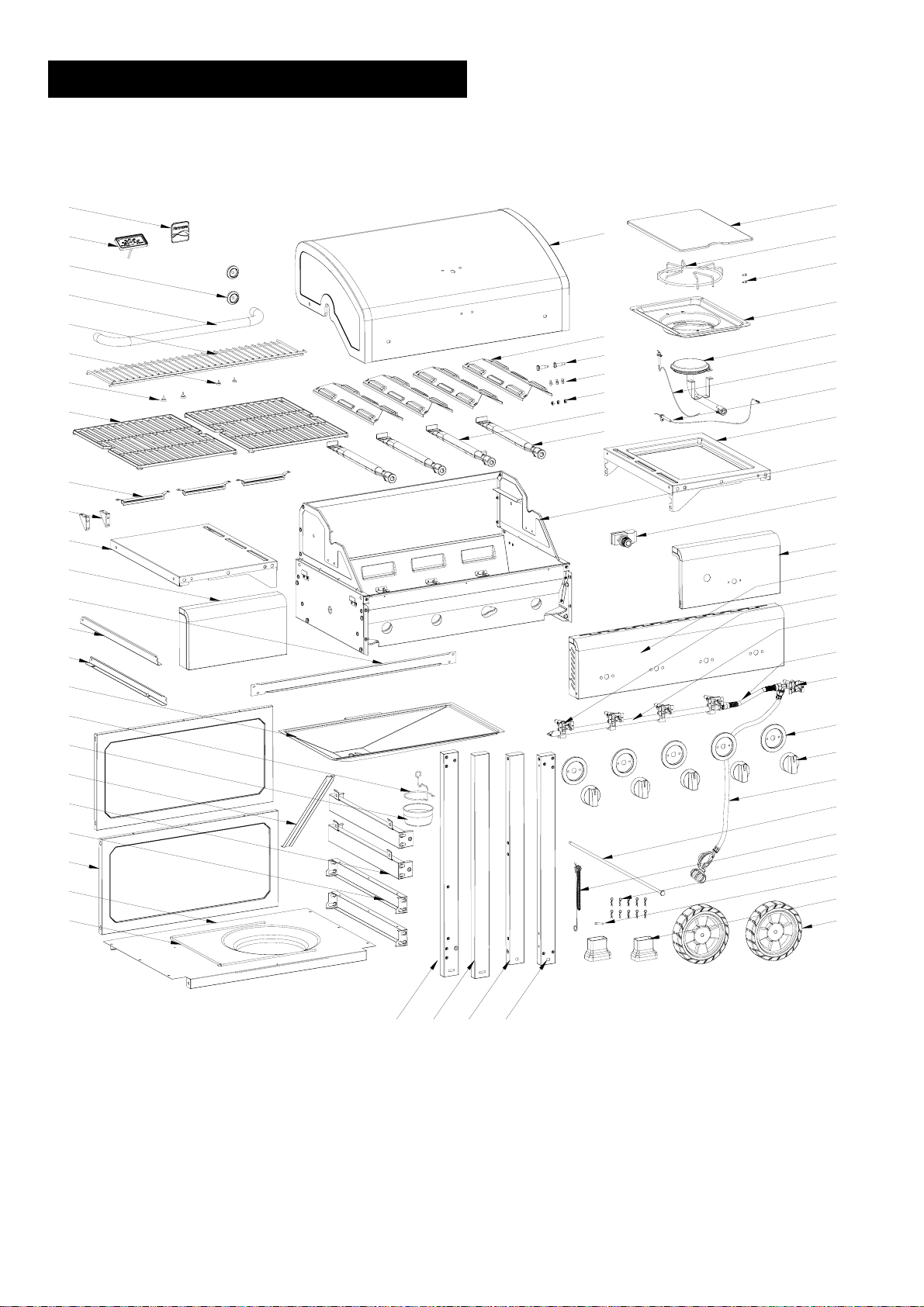
PART LIST
IIf you are missing hardware or have
damaged parts after unpacking grill, call
1-888-287-0735 M – F 8:00 – 5:00
PACIFIC for replacement.
To order replacement part s after using
grill, call 1-888-287-0735, M – F 8:00 –
5:00 PACIFIC
Or Visit us at www.permasteel.net
Key
Description
Qty
Part Number
Key
Description
Qty
Part Number
1
Side Burner Lid
1
40800065
31
Bottom Shelf
1
52200073
2
Side Burner Grid
1
40800119
32
Front Panel
2
40600028
3
Rotate Rod, Side Burner Lid
2
40800118
33
Side Lower Rail
2
52200064
4
Side Burner Base
1
52200052
34
Side Upper Rail
2
52200061
5
Side Burner
1
40600031
35
Tank Baffle
1
40800090
6
Igniter Wire, Side Burner
1
52200054
36
Drip Cup
1
40800026
7
Igniter Wire, Main Burner
1
52200035
37
Drip Cup Clip
1
40800131
8
Right Side Shelf
1
40900145
38
Drip Tray
1
40600014
9
Fire Box
1
40600004
39
Right Drip Tray Support
1
40600027
10
Electronic Ignition Module
1
40600030
40
Left Drip Tray Support
1
40600026
11
Fascia, Right Shelf
1
41100023
41
Back Rail
1
52200074
12
Control Panel
1
40100022
42
Fascia, Left Side Shelf
1
40900040
13
Gas Valve, Main Burner
4
40900205
43
Left Side Shelf
1
40900143
14
Manifold, Main Burner
1
40300037
44
Side Shelf Support Angle Bar
2
40900109
15
Side Burner Hose
1
40900210
45
Flame Carry Over Tube
3
40300019
16
Gas Valve, Side Burner
1
40900209
46
Cooking Grate
2
40100101
17
Bezel, Control Knob
5
40900036
47
Silicone Rubber Bumper, Firebox
2
50300205
18
Control Knob
5
40900206
48
Silicone Rubber Bumper, Lid
2
40700103
19
Regulator
1
408D00115
49
Warming Rack
1
40300104
20
Alex Rod
1
408D00125
50
Lid Handle
1
40900012
21
Match Holder Chain
1
120006
51
Bezel, Lid Handle
2
40900013
22
Cotter Pin
10
110050
52
Temperature Gauge
1
41100101
23
Hose Fixed Pin
1
40800134
53
Logo
1
40800106
24
Leg Extender
2
40800127
54
Lid
1
50500004
25
Caster
2
40800124
55
Heat Diffuser
4
40800023
26
Right Back Leg
1
40600025
56
Rotated Rod, Lid
2
50300207
27
Right Front Leg
1
40600024
57
Flat Washer
3
110018
28
Left Front Leg
1
40600021
58
Hex Nut
3
110011
29
Left Back Leg
1
40600022
59
Burner
1
40600013
30
Tank Holder
1
40800130
60
Main Burner
3
40600012
Not Pictured
Hardware Pack
1
40600049
Manual
1
40600050
13
PARTS DIAGRAM
1
2
3
4
5
6
8
10
11
12
13
14
15
16
17
18
19
20
21
22
23
24
25
31
26272829
30
32
33
34
35
36
37
38
39
40
41
42
43
44
45
46
47
48
49
50
51
52
53
54
55
56
57
58
59
60
7
9
14
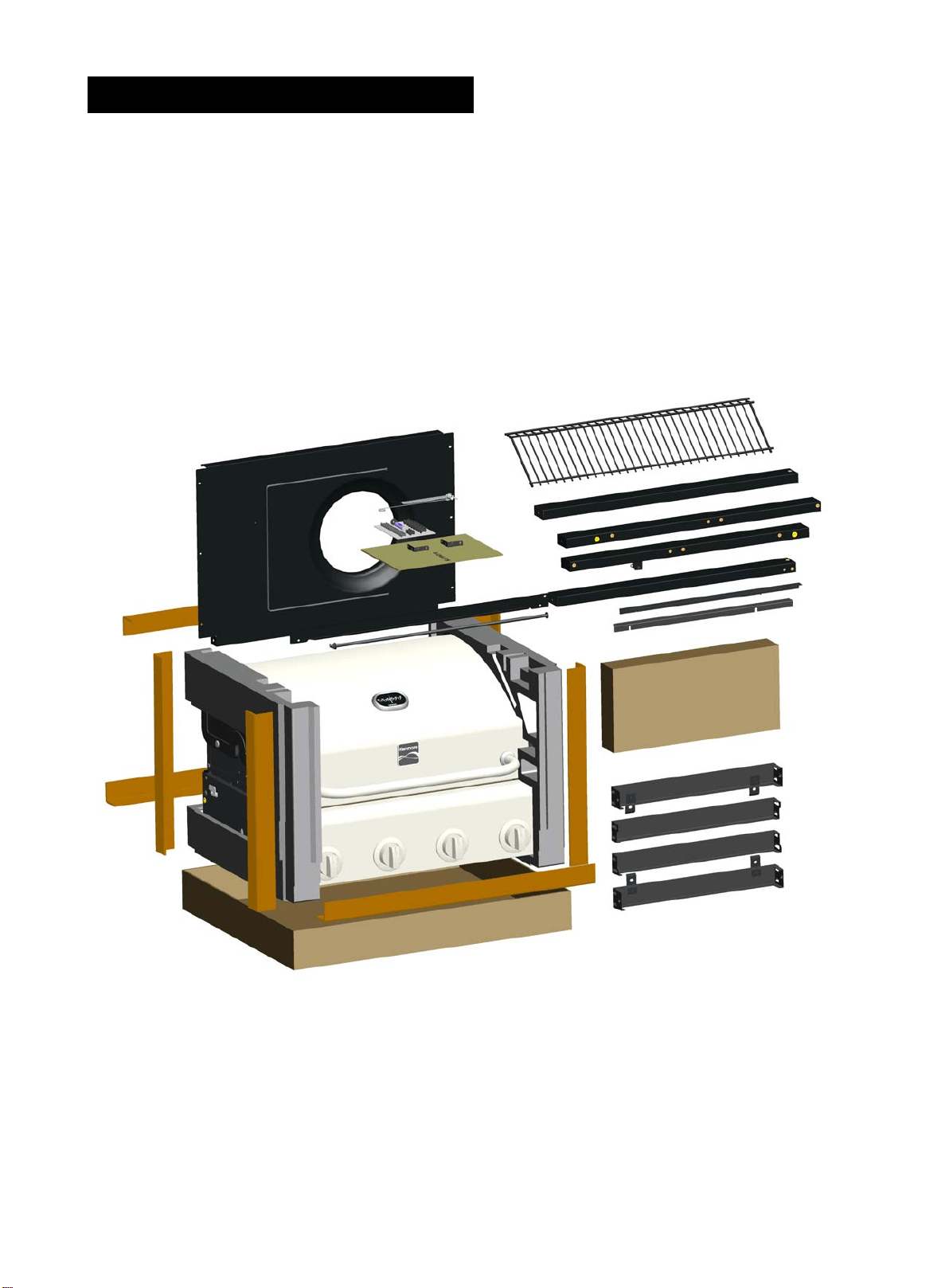
BEFORE ASSEMBLY
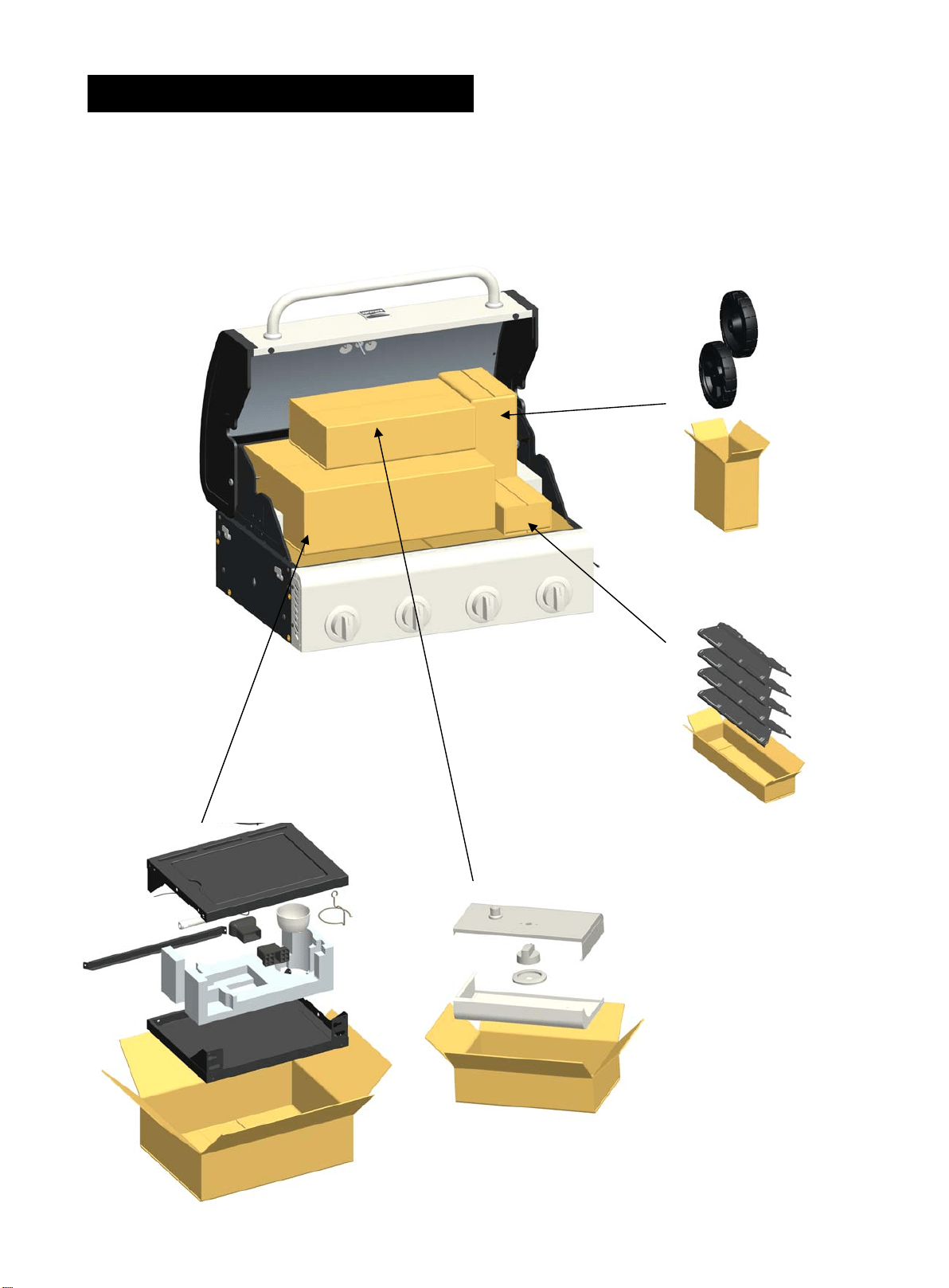
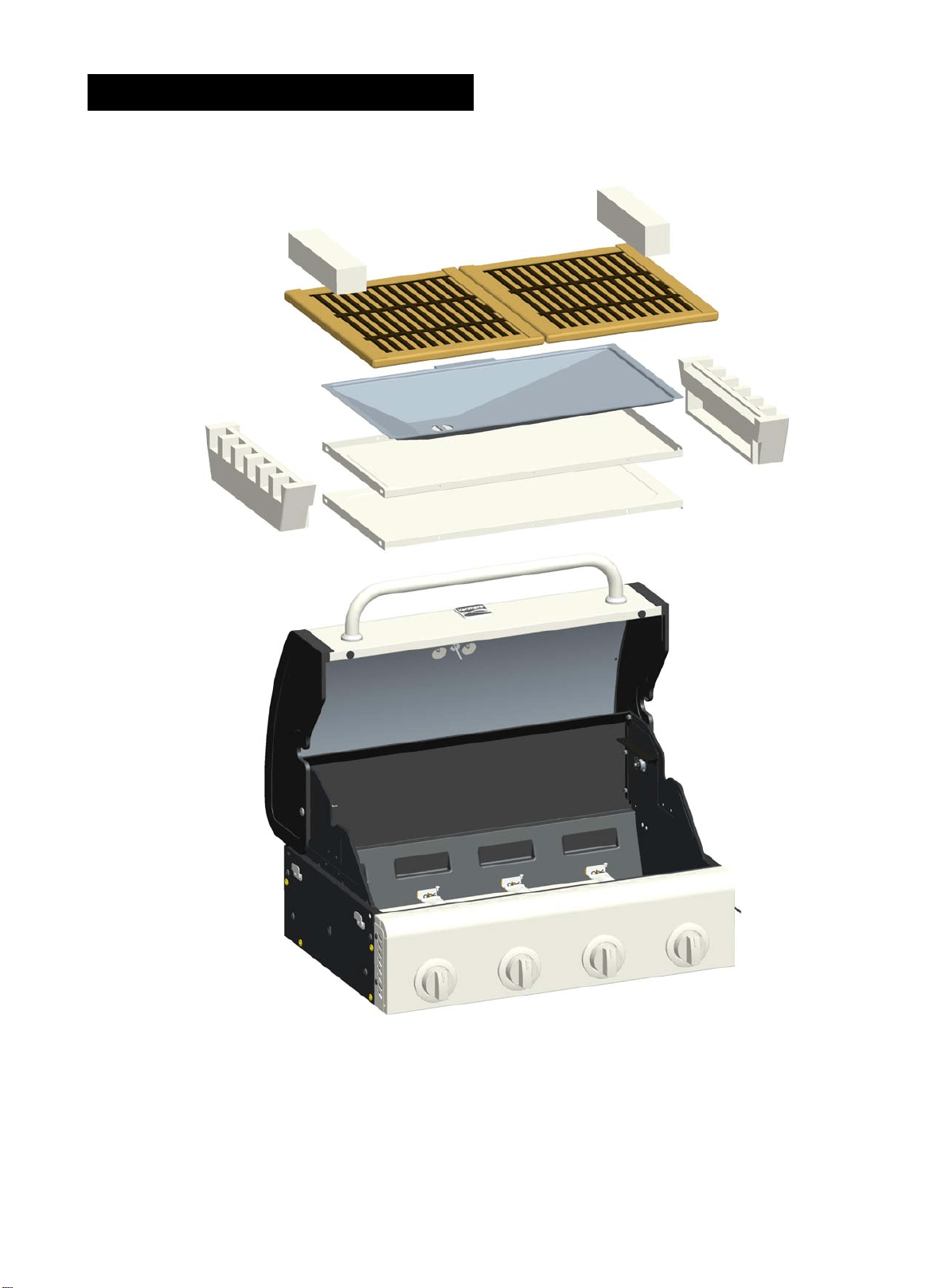
NOTICE: Once you have unpacked the grill according to the STOP SHEET
instructions, check all grill parts against the pictures on this and the following
two pages. If any parts are missing or damaged, call 1-888-287-0735, M – F
8:00 – 5:00 PACIFIC.
15
BEFORE ASSEMBLY
BEFORE ASSEMBLY
16
17
ASSEMBLY
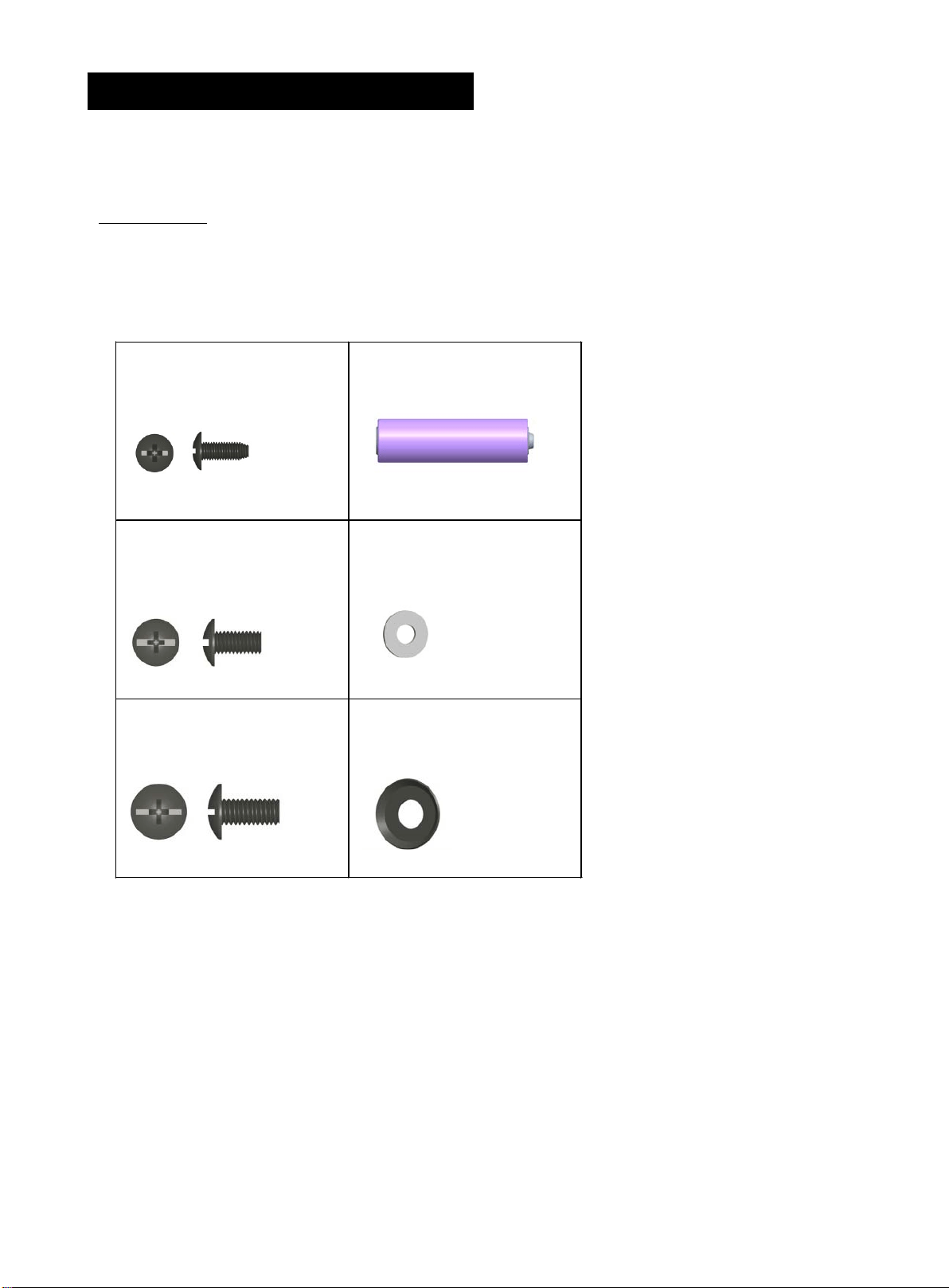
CAREFULLY READ AND PERFORM ALL ASSEMBLY INSTRUCTIONS ON THE FOLLOWING PAGES.
Tools Required:
Adjustable wrench (not provided)
Screwdriver (not provided)
7/16” Combination wrench (not provided)
The following hardware is provided in blister pack for convenient use.
M4X10 screw
Qty: 54 pcs
AA Battery
Qty: 1 pc
M5X10 screw
Qty: 4 pcs
M5 flat washer
Qty: 4 pcs
M6X13 screw
Qty: 16 pcs
M6 compression washer
Qty: 4 pcs
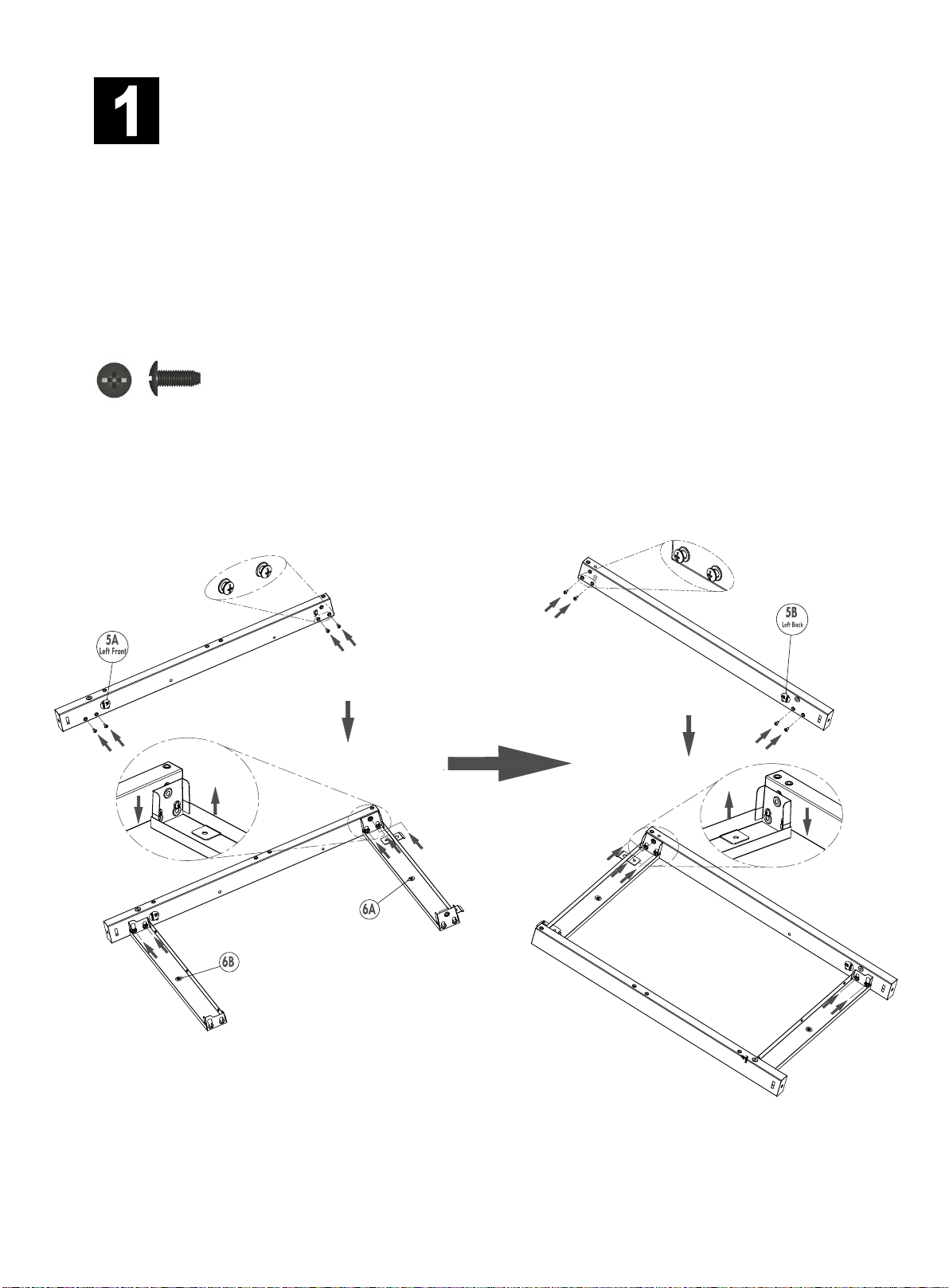
1
2
Left Frame
□ Install
(4)M4×10 Screws as shown to the leg marked “5A”. Do not fully tighten the screws at this
time. Leave 1/8-inch gap below screw head for rail attachment. (A)
□ Attach one end of a Side Upper Rail “6A” to the leg, tighten the screws and install and tighten
another
(1)M4×10 Screw.(C)
□ Attach one end of a Side Lower Rail “6B” to the leg and tighten the screws. (C)
□ Install
(4)M4×10 Screws as shown to the leg marked “5B”. Do not fully tighten the screws at this
time. Leave 1/8-inch gap below screw head for rail attachment. (B)
□ Attach the other end of Side Upper Rail and Side Lower Rail to the “5B” Leg and tighten the
screws. Install and tighten another
(1)M4X10 Screw to the Side Upper Rail. (D)
M4x10 screws Qty: 10 pcs
A
B
C
D
18
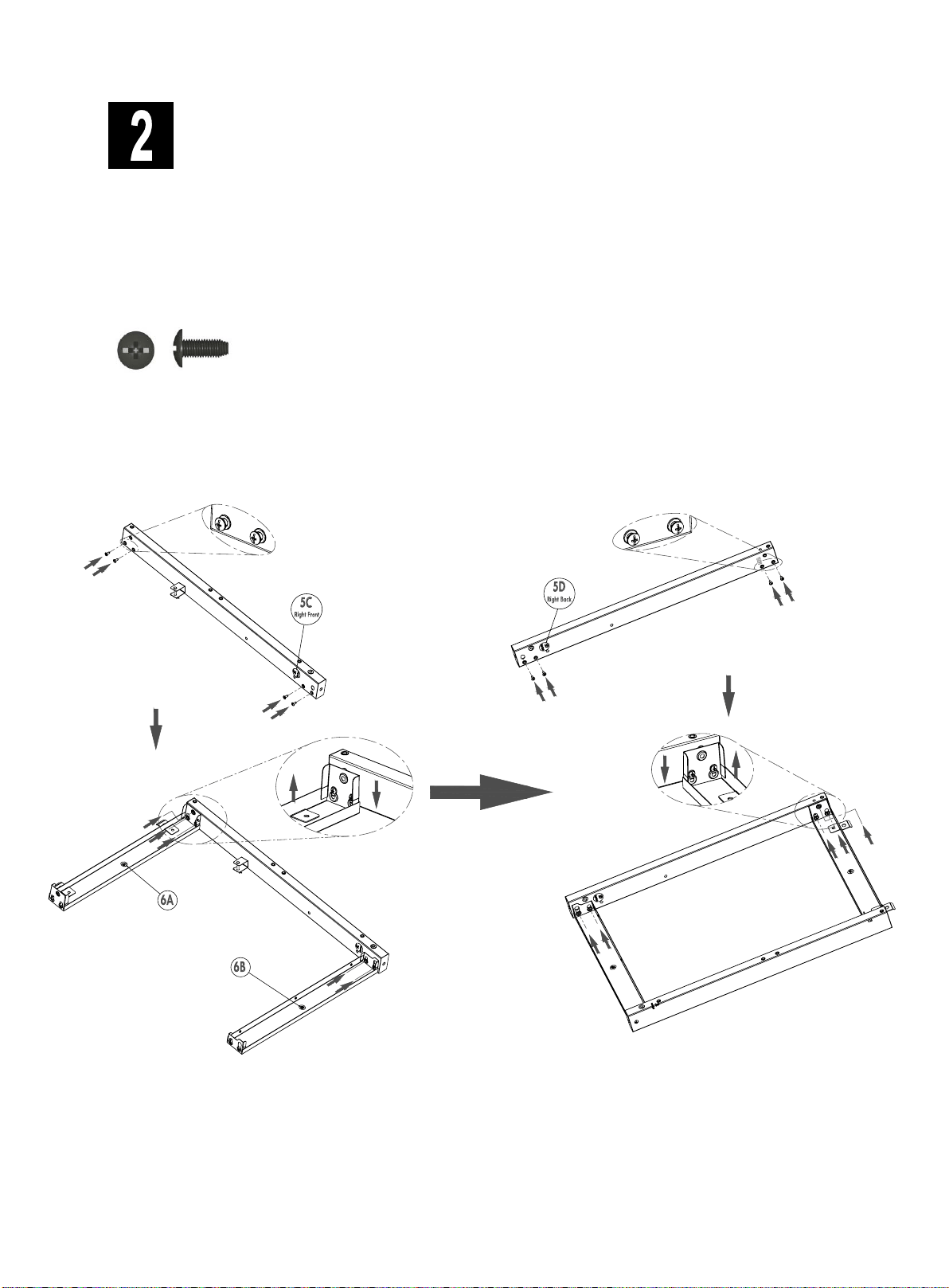
19
Right Frame
□ Install (4)M4×10 Screws as shown to the leg marked “5C”. Do not fully tighten the screws at this
time. Leave 1/8-inch gap below screw head for rail attachment. (A)
□ Attach one end of a Side Upper Rail “6A” to the leg, tighten the screws and install and tighten another
(1)M4×10 Screw.(C)
□ Attach one end of a Side Lower Rail “6B” to the leg and tighten the screws. (C)
□ Install
(4)M4×10 Screws as shown to the leg marked “5D”. Do not fully tighten the screws at this
time. Leave 1/8-inch gap below screw head for rail attachment. (B)
□ Attach the other end of Side Upper Rail and Side Lower Rail to the “5D” Leg and tighten the screws.
Install and tighten another
(1)M4X10 Screw to the Side Upper Rail. (D)
M4x10 screws Qty: 10 pcs
A
B
C
D
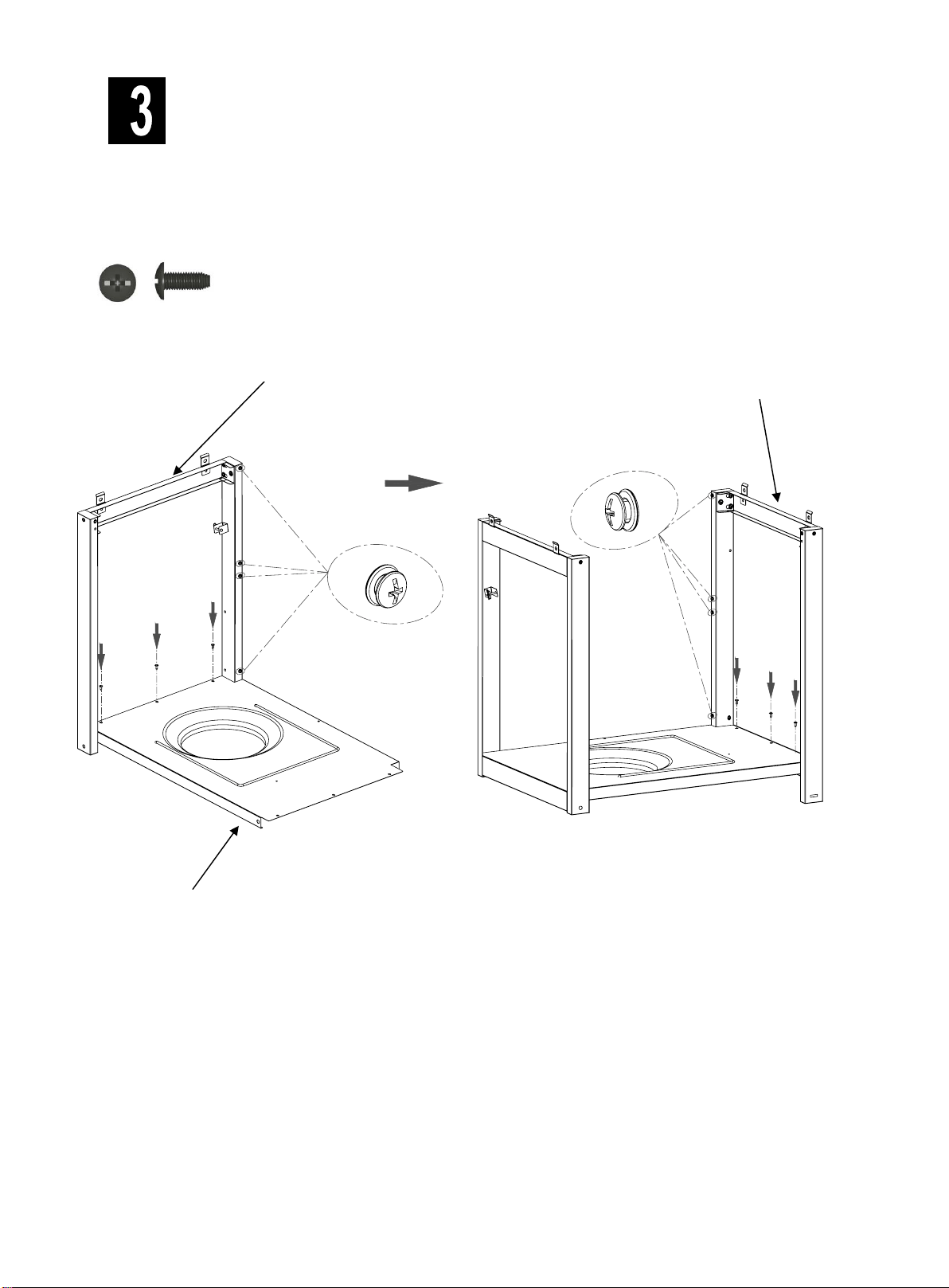
M4x10 screws Qty: 14 pcs
Left Frame
A
B
Bottom Shelf
□ Install (4)M4×10 Screws as shown to Right Frame. Do not fully tighten the screws at this time.
Leave 1/8-inch gap below screw head for panel attachment. (A)
□ Install
(4) M4X10 screws as shown to Left Frame. Do not fully tighten screws at this time. Leave
1/8-inch gap below screw head for panel attachment. (B)
□ Attach Bottom Shelf to Right Frame with
(3) M4X10 screws. Do not yet fully tighten these screws.
(A)
□ Attach Bottom Shelf to Left Frame with
(3) M4X10 screws. Do not yet fully tighten these screws. (B)
Bottom Shelf
Right Frame
20
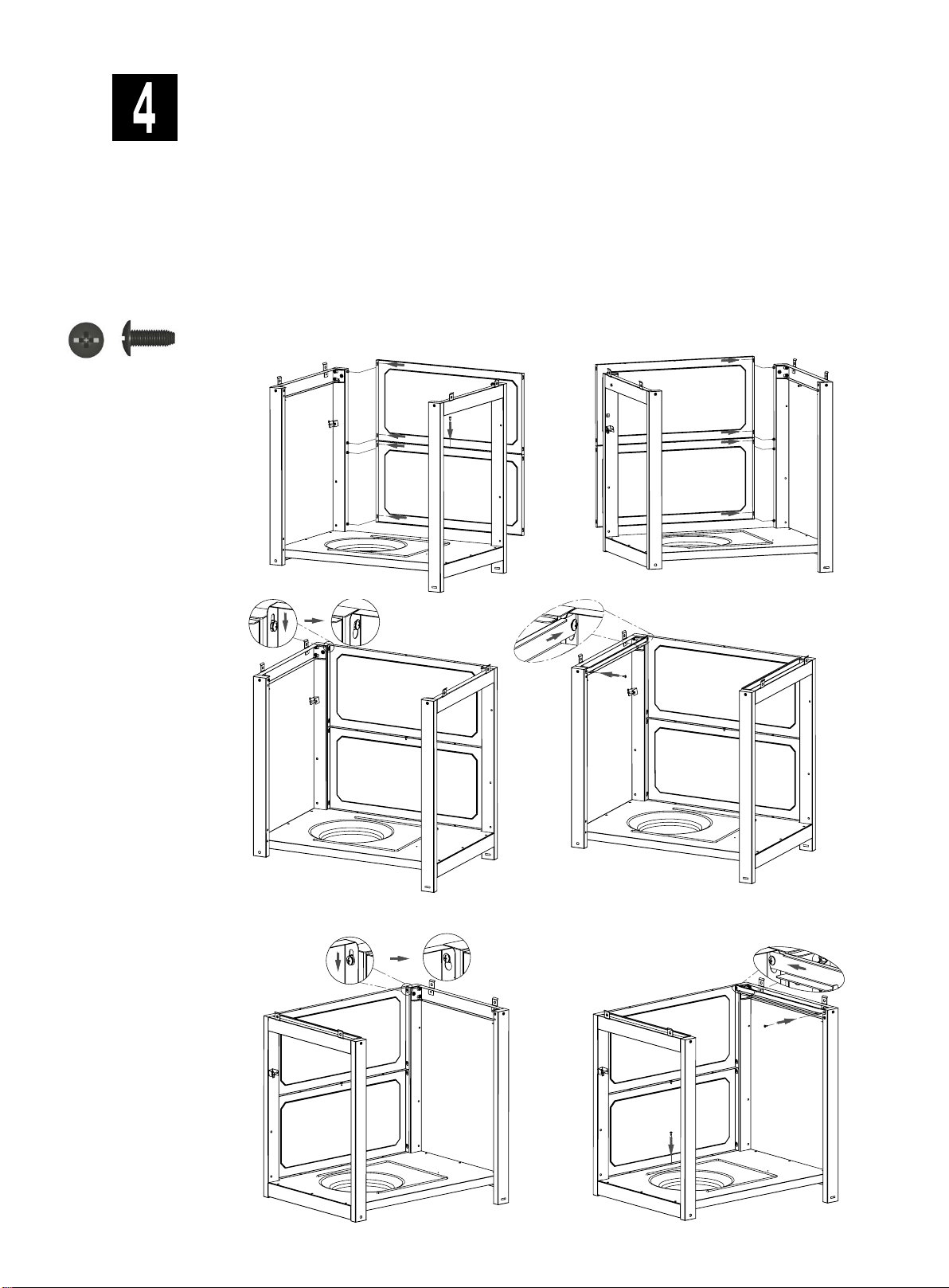
M4x10 screws Qty: 4 pcs
Front Panel
□ Attach the two front panel sections together into a single front panel with
(1) M4X10 screw as shown.
□ Attach the front panel to the cart by slipping the four panel holes on each side over and down onto the
four protruding screw heads on the left and right frames. Leave the top screw loose on each side, and
fully tighten the other three screws on each side.
□ Slide one end of the Right Drip Tray Support Bar “7A” under the front Right Frame top screw. Fully
tighten the screw. Fully tighten other end of bar to the rear Right Frame with
(1)M4×10 Screw. (C)
□ Slide one end of the Left Drip Tray Support Bar “7B” under the front Left Frame top screw. Fully tighten
the screw. Fully tighten other end of bar to the rear Left Frame with
(1)M4×10 Screws as shown. Install
and fully tighten
(1) M4X10 screw through the middle screw hole on the bottom of the front panel into
the bottom shelf. (D)
A
B
C
D
21
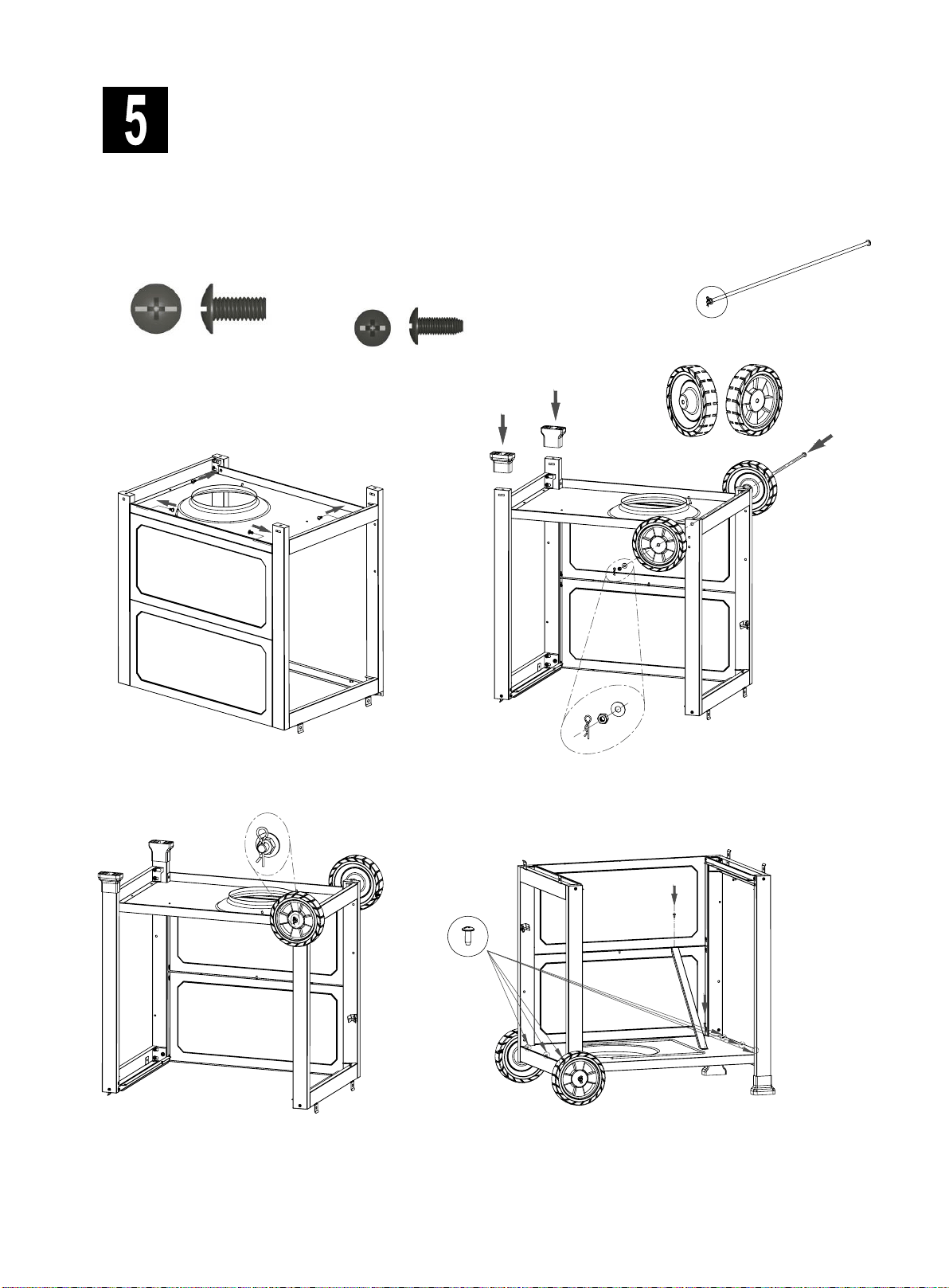
D
9
B
A
M6X13 screw Qty: 4 pcs M4X10 screw Qty: 2 pcs
Wheels to Cart
□ Turn cart upside down and attach Legs to Bottom Shelf with
(4) M6X13 screws as shown. (A)
□ Tap both Leg Extenders onto Left Legs. (B)
□ Remove hitch pin, nut and washer from axle rod. Insert axle rod through Wheels and Right Leg Frame.
Reattach washer, nut and hitch pin. (C)
Note: The convex side of the wheel must face to the cart, and the concave side must face outward.
□ Stand cart right side up and fully tighten the (6) M4X10 bottom shelf screws. (D) Attach Tank Baffle as
shown with
(2) M4X10 screws. (D)
B
C
22
A
23
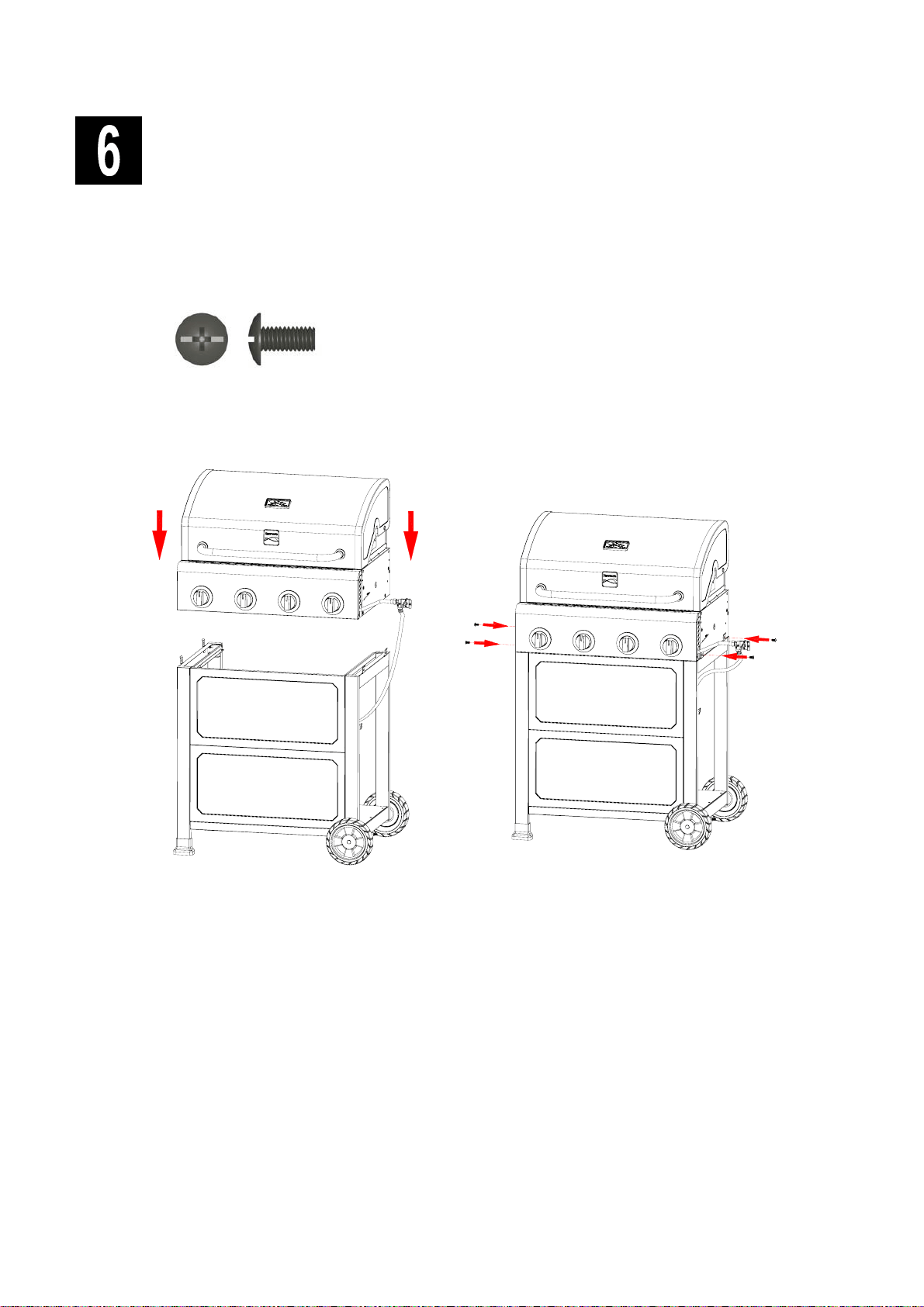
Grill Head to Cart
□ This step requires two people to lift and position grill head onto cart.
□ Remove the tie wraps and packaging material from regulator hose, side burner valve and igniter
wire. Pull hose and igniter wire out to side of grill head.
□ Carefully lower the grill head onto the cart. Make sure the regulator hose and igniter wire are
hanging outside the cart.
□ Line up control panel so that it is flush with front panels. Attach head to cart with
(4) M6X13 screws.
M6X13 screw Qty: 4 pcs
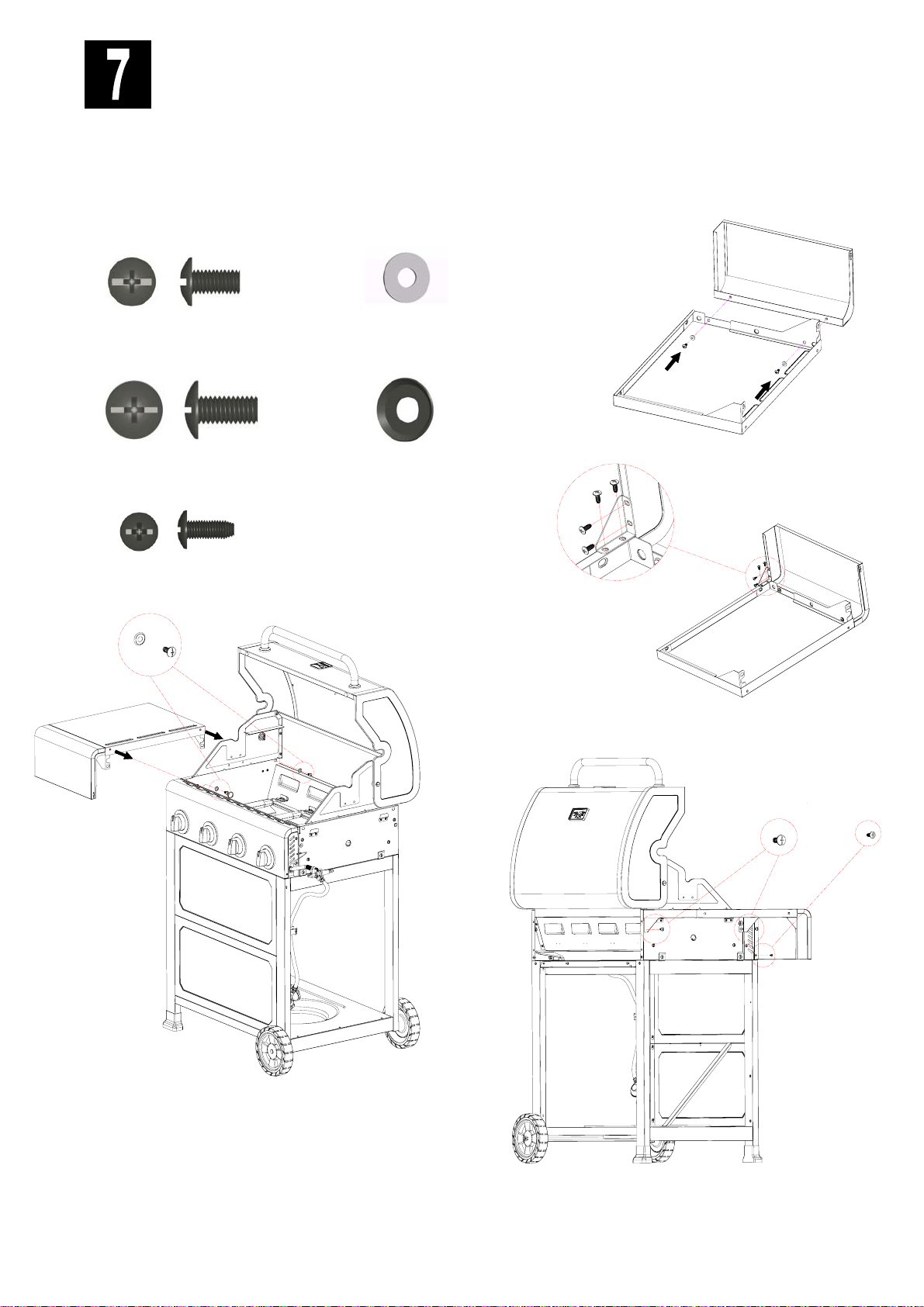
Left Side Shelf
□ Attach fascia to left side shelf with
(2) M5x10 screws and M5 flat washers. (A)
□ Attach Side Shelf Support Angle Bar with (4) M4x10 screws.(B)
□ Hang shelf onto brackets on left side of firebox.
□ Attach shelf to firebox as follows:
- From inside to outside of firebox with (2) M6x13 screws and M6 compression washers. (C)
- From outside to inside of firebox with
(2) M6x13 screws. (D)
□ Attach fascia to control panel with (1) M4x10 screw. (D)
M5 flat washer
Qty: 2 pcs
M6 compression washer
Qty: 2 pcs
M4X10 screw Qty: 5 pc
M6X13 screws Qty: 4 pcs
M5X10 screw Qty: 2 pcs
A
B
C
D
24
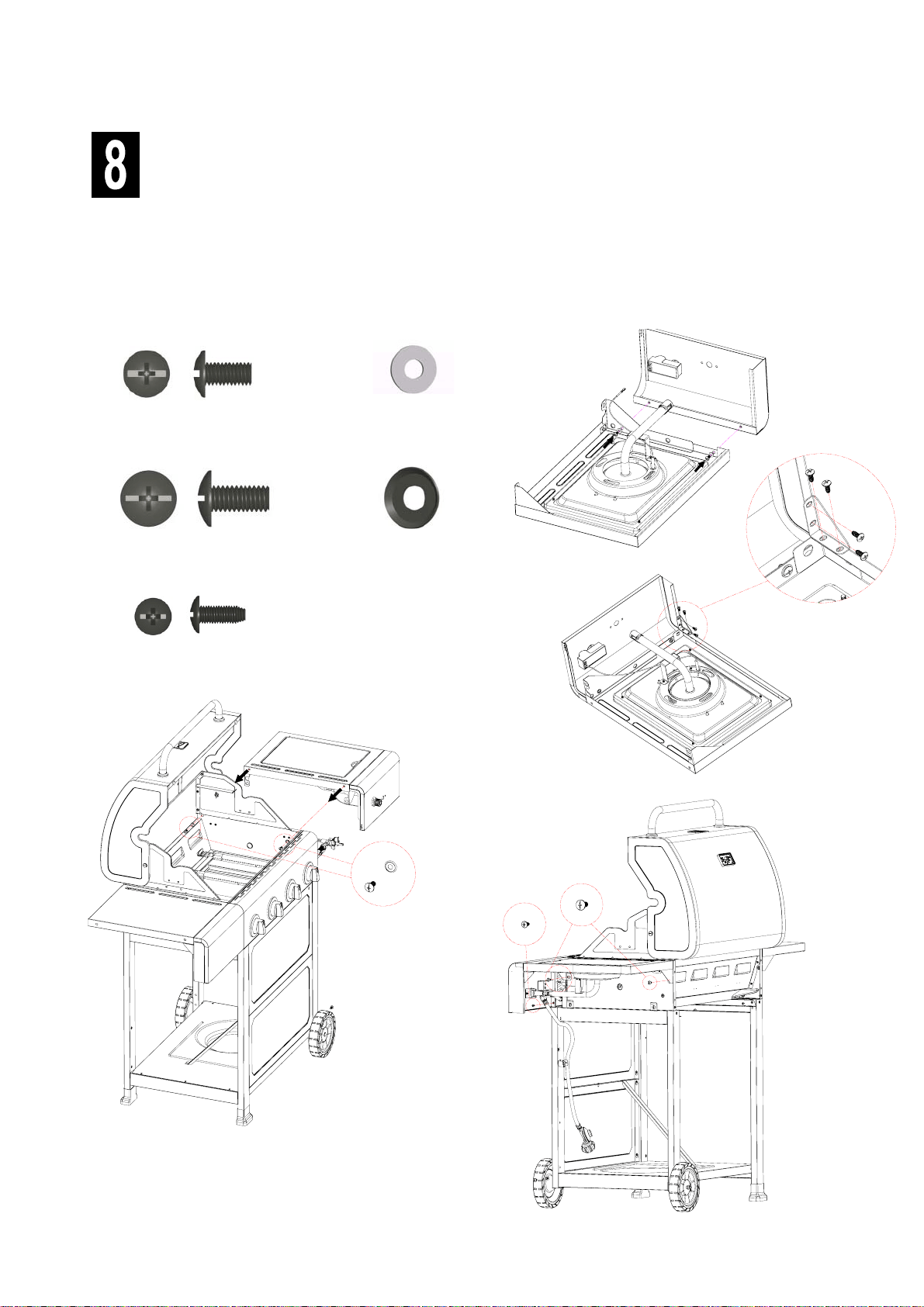
B
NOTES
25
Right Side Shelf
□ Remove side burner grate from side burner before assembling and attaching the right side shelf,
□Attach fascia to right side shelf with
(2) M5x10 screws and M5 flat washers.(A)
□Attach Side Shelf Support Angle Bar with
(4) M4x10 screws.(B)
□Hang right side shelf onto the brackets on right side of firebox.
□Attach shelf to firebox as follows:
- From inside to outside of firebox with
(2) M6x13 screws and M6 compression washers.(C)
- From outside to inside of firebox with
(2) M6x13 screws. (D)
□Attach fascia to control panel with
(1) M4x10 screw. (D)
A
M5X10 screw Qty: 2 pcs
M5 flat washer
Qty: 2 pcs
M6 compression washer
Qty: 2 pcs
M4X10 screw Qty: 5 pc
M6X13 screws Qty: 4 pcs
C D
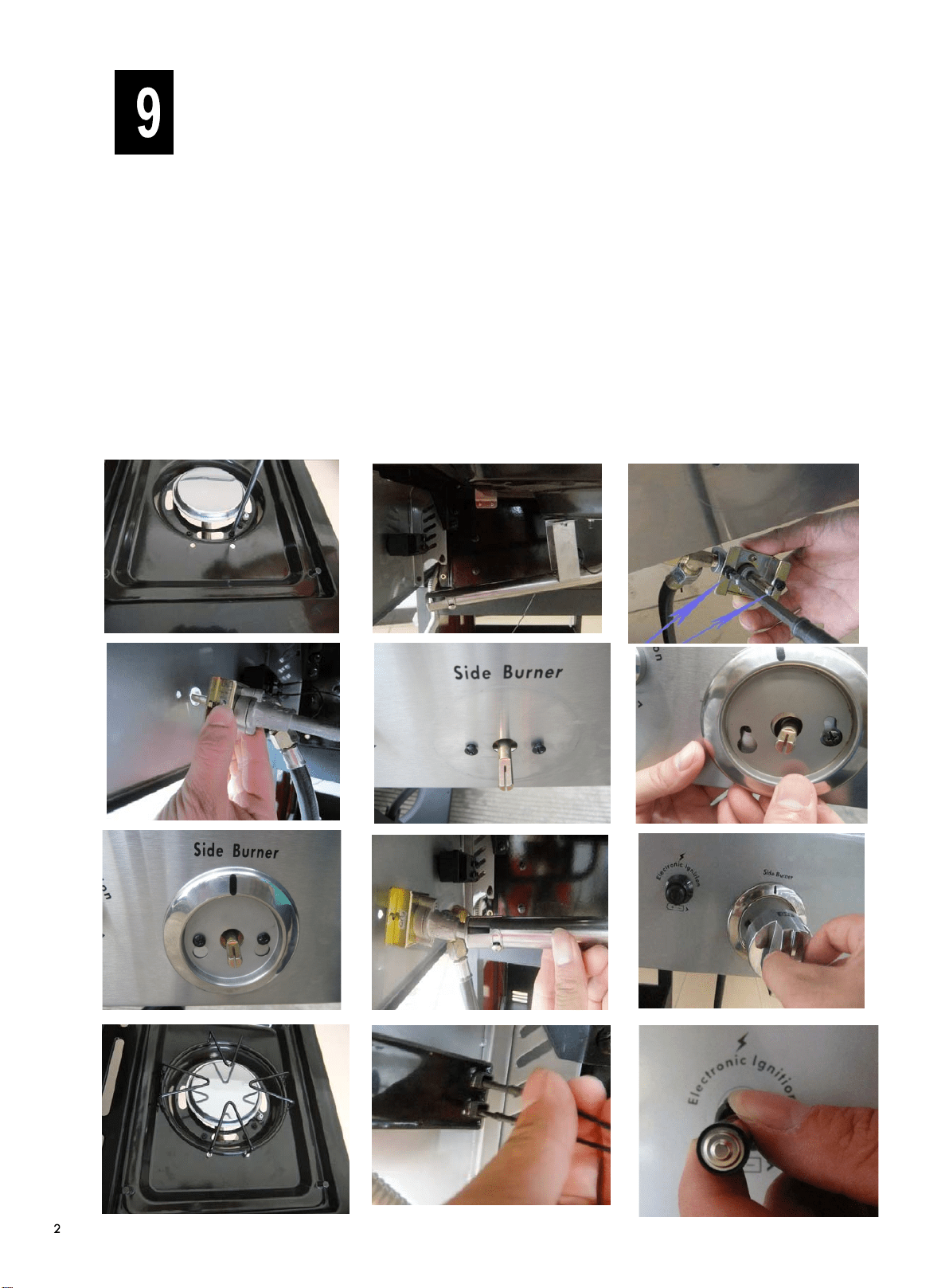
Side burner
□ Loosen side burner in side shelf. (B ). To loosen, unscrew and remove two front screws and washers
holding sideburner in place. (A). Note: Do not loosen electrode screw.
□ Remove the 2 pre-installed screws from the valve stem and set them aside. (C)
□ Insert valve stem through hole in fascia. (D). Install previously removed 2 screws .Note:
Leave a
1/8-inch gap below the screw heads for bezel attachment. (E).
□ Attach bezel to fascia and valve face with the installed screws. Make sure the black mark is facing
up.(F). Tighten the 2 screws.(G)
□ Place sideburner tube over the valve, making sure that valve is inside sideburner tube. (H)
□ Push control knob onto sideburner valve stem. (I)
□ Reattach sideburner to sideburner shelf with the 2 previously removed screws. Replace sideburner
grate. (J)
□ Connect both igniter wires to the igniter module on the inside of the right fascia. To connect, push
igniter wire tips onto pins in igniter module.(K)
□ Unscrew igniter cap from control panel. Insert (1) AA battery (provided in blister pack) into battery
slot with positive end (+) facing outward. Screw igniter cap back onto panel. (L)
A
BC
D E
F
G H
I
J K L
6
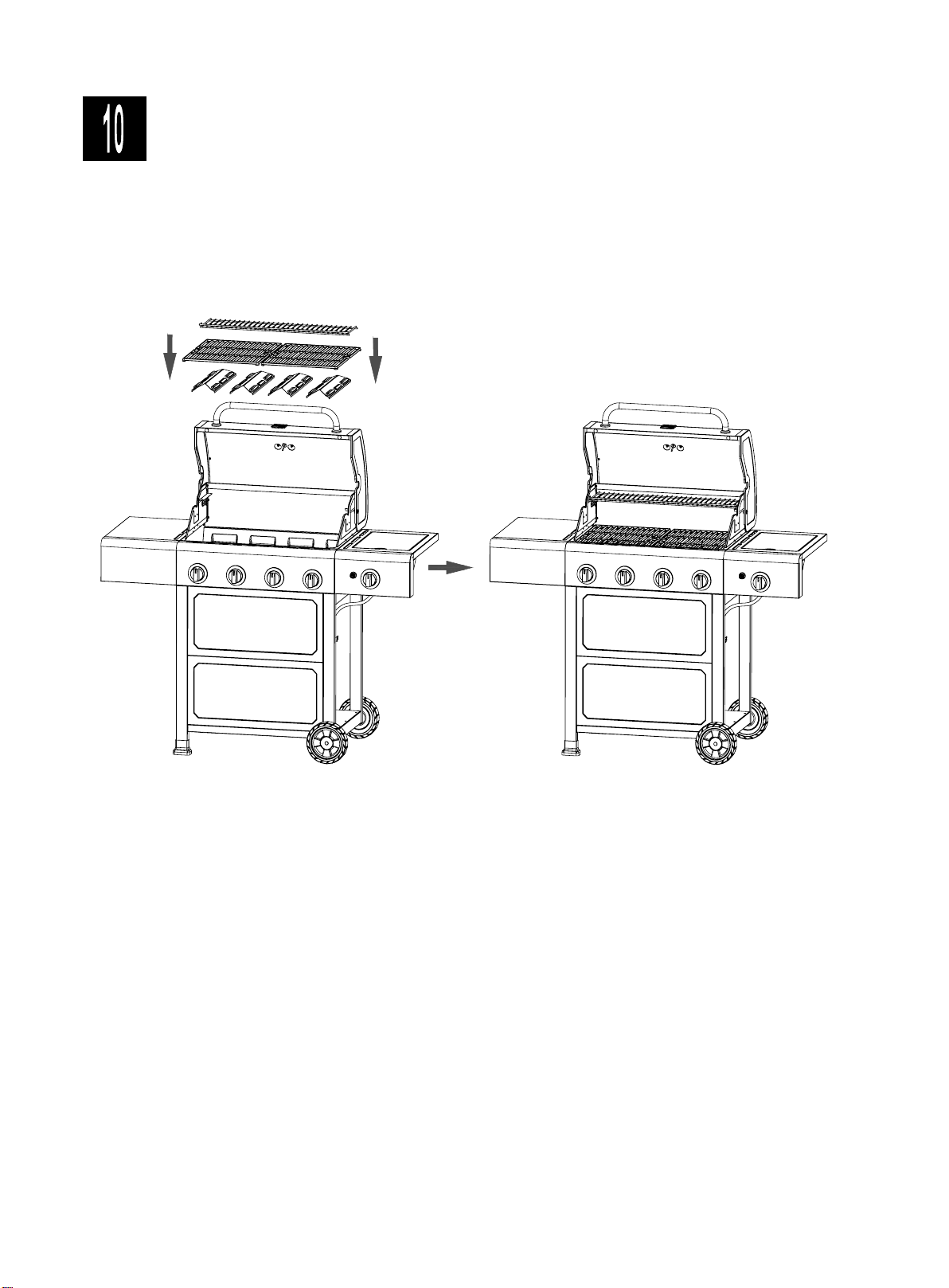
27
Heat Diffusers, Cooking Grates and Warming Rack
□ Place Heat Diffusers over burners. Diffusers will fit in firebox in either direction.
□ Place Cooking Grates onto grate rests at front and rear of Firebox.
□ Insert warming rack into brackets at top of Firebox with Curved edge to front as shown.
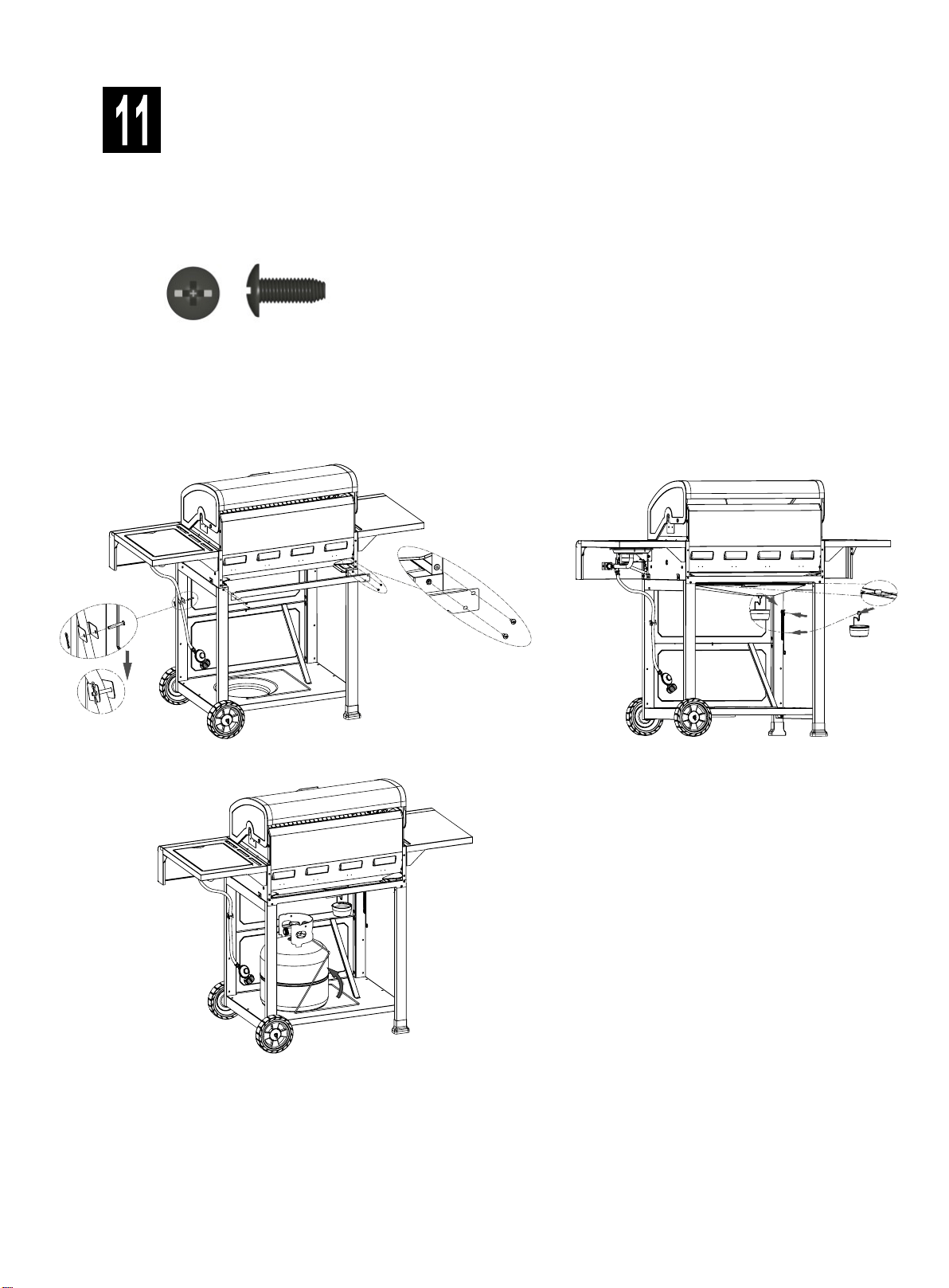
Drip Tray, Drip Cup and LP Tank
□ Attach Back Rail to the Cart and Grill Head with
(4)M4×10 Screws as shown.(A)
□ Remove the cotter key and retention pin from the hose bracket on cart right leg. Insert hose
into bracket and replace cotter and pin.
□ Hang Drip Cup Clip from bottom of drip tray, and insert Drip Tray into bottom of Firebox from
back of cart. Fit Drip Cup into Drip Cup Clip. Insert Match Holder Chain into hole in Front Left
Leg. (B)
□ Place LP tank into hole in bottom shelf with tank collar opening facing to side as shown.(C)
M4X10 screw Qty: 4 pcs
A
B
C
28
29
EMERGENCIES:
If a gas leak cannot be stopped, or a fire occurs due to gas leakage, call the fire department.
Gas leaking from
cracked/cut/burned hose.
Gas leaking from LP
cylinder.
Gas leaking from LP
cylinder valve.
Gas leaking between LP
cylinder and regulator
connection.
Fire coming through
control panel.
Drip fire or continuous
excessive flames above
cooking surface.
• Damaged hose.
• Mechanical failure due to rusting or
mishandling.
• Failure of cylinder valve from mishandling
or mechanical failure.
• Improper installation, connection not
tight, failure of rubber seal.
• Fire in burner tube section of burner due
to blockage.
• Too much Drip buildup in burner area.
•Turn off gas at LP cylinder or at source on natural gas syst
ems. If the
hose is cracked or cut but not burned, simply replace valve / hose /
regulator. If the hose is burned, the cause could be other than a faulty
valve/hose/regulator. Discontinue use of grill until a plumber or gas
technician has investigated and corrected the problem.
• Replace LP cylinder.
• Turn off LP cylinder valve. Return LP cylinder to gas supplier.
•Turn off LP cylinder valve. Remove regulator from cylinder and visually
inspect rubber seal for damage. See LP Cylinder Leak Test and
Connecting Regulator to the LP Cylinder.
•Turn off control knobs and LP cylinder valve. Leave lid open to allow
flames to die down. After fire is out and grill is cold, remove burner
and inspect for spider nests or rust. See Spider Alert and Cleaning the
Burner Assembly sections of this Use & Care Guide.
• Turn off control knobs and LP cylinder valve. Leave lid open to allow
flames to die down. After cooling, clean food particles and excess
Drip from inside firebox area, Drip tray, and other surfaces.
Troubleshooting
Problem Possible Cause
Prevention/Solution
GAS ISSUES:
Burner(s) will not light
using ignitor.
(See Electronic Ignition
Troubleshooting also)
Continued on next
page.
• Trying to light wrong burner.
• Burner not engaged with control valve.
• Obstruction in burner.
• No gas flow.
• Vapor lock at coupling nut to LP cylinder.
• Coupling nut and LP cylinder valve not
fully connected.
• Electrode cracked or broken; “sparks at
crack.
• Electrode tip not in proper position.
• Wire and/or electrode covered with
cooking residue.
• Wires are loose or disconnected.
• Wires are shorting (sparking) between
ignitor and electrode.
• Dead battery.
• See instructions on control panel and in Use and Care section.
• Make sure valves are positioned inside of burner tubes.
• Ensure burner tubes are not obstructed with spider webs o
r other
matter. See cleaning section of Use and Care.
• Make sure LP cylinder is not empty. If LP cylinder is not empty,
refer to “Sudden drop in gas flow.”
• Turn off knobs and disconnect coupling nut from LP cylinder.
Reconnect and retry.
• Turn the coupling nut approximately one-half to three-quarters
additional turn until solid stop. Tighten by hand only - do not use
tools.
• Replace electrode(s).
Main Burners:
• Tip of electrode should be pointing toward gas port opening on
burner. The distance should be 1/8” to 1/4”. Adjust if necessary.
Sideburner
• Tip of electrode should be pointing toward gas port opening on
burner. the distance should be 1/8” to 3/16”. Adjust if necessary.
• Clean wire and/or electrode with rubbing alcohol and clean swab.
• Reconnect wires or replace electrode/wire assembly.
• Replace ignitor wire/electrode assembly.
• Replace with a new AA-size alkaline battery.
ELECTRICAL ISSUES:
Problem
Burner(s) will not light
using ignitor.
(See Electronic Ignition
Troubleshooting also)
Pro
Burner(s) will not match
light.
Sudden drop in gas
flow or low flame.
Flames blow out.
Flare-up.
Persistent Drip fire.
• See “
GAS ISSUES:” on previous page.
• Match will not reach.
• Improper method of match-lighting.
• High or gusting winds.
• Low on LP gas.
• Excess flow valve tripped.
• Drip buildup.
• Excessive fat in meat.
• Excessive cooking temperature.
• Drip trapped by food buildup around
burner system.
• Burner and/or burner tubes are blocked.
Prevention/Solution
• See Section I of Electronic Ignition System.
• See Section II of Electronic Ignition System.
• See Section III of Electronic Ignition System.
• Check for gas in LP cylinder.
•Turn off knobs, wait 30 seconds and light grill. If flames are still low,
turn off knobs and LP cylinder valve. Disconnect regulator.
Reconnect regulator and leak-test. Turn on LP cylinder valve, wait
30 seconds and then light grill.
•Turn off knobs and LP cylinder valve. Disconnect coupling nut from
cylinder. Reconnect and retry.
•Turn knobs to OFF. Turn gas off at LP cylinder. Leave lid in position
and let fire burn out. After grill cools, remove and clean all parts.
• Turn knobs to OFF. Clean burner and/or burner tubes. See burner
cleaning section of Use and Care.
• The worn nozzles don’t have enough “bite” to engage the valve.
Try a second LP dealer.
Troubleshooting (continued)
Possible Cause
ELECTRONIC IGNITION:
• No spark, no ignition noise.
• No spark, some ignition noise.
• Sparks, but not at electrode or at full
strength.
• Use long-stem match (fireplace match).
• See “Match-Lighting” section of Use and Care.
• Clean burners and inside of grill/firebox.
• Trim fat from meat before grilling.
• Adjust (lower) temperature accordingly.
• Clean carry-over tube(s) with wire brush.
One burner does not
light from other
burner(s).
• Drip buildup or food particles in end(s) of
carryover tube(s).
Flashback…
(fire in burner tube(s)).
Unable to fill LP
cylinder.
• Out of gas.
• Excess flow valve tripped.
• Vapor lock at coupling nut/LP cylinder
connection.
• Some dealers have older fill nozzles
with worn threads.
• Turn front of grill to face wind or increase flame height.
• Refill LP cylinder.
• Refer to “Sudden drop in gas flow” above.
30
Troubleshooting - Electronic Ignition
Problem
Possible Cause
Check Item
Prevention/Solution
SECTION I
No sparks appear at
any electrodes when
control knob turned
to HI: no noise can
be heard from spark
module.
• Battery not installed
properly.
• Dead battery.
• Button assembly not
installed properly.
• Faulty spark module.
• Check battery orientation.
• Has battery been used previously?
• Check to insure threads are
properly engaged. Button should
travel up and down without binding.
• If no sparks are generated with
new battery and good wire
connections, module is faulty.
• Install battery (make sure that “+” and “-”
connectors are oriented correctly, with “+”
end up and “-” end down.)
•Replace battery with new AA-size alkaline
battery.
• Unscrew button cap assembly and reinstall,
making sure threads are aligned and
engaged fully.
• Replace spark module assembly.
SECTION II
No sparks appear at
any electrodes when
control knob turned
to HI; noise can be
heard from spark
module.
• Output lead
connections not
connected.
• Are output connections on and
tight?
• Remove and reconnect all output
connections at module and electrodes.
SECTION III
Sparks are present
but not at all
electrodes and/or
not at full strength
• Output lead
connections not
connected.
• Electrical arc
between output wires
and grill frame.
•Weak battery.
• Electrodes are wet.
• Electrode(s)
cracked or broken;
sparks appear where
cracked.
• Are output connections on
and tight?
• If possible, observe grill in dark
location. Operate ignition system and
look for arcing between output wires
and grill frame.
• All sparks present but weak or at
slow rate.
• Has moisture accumulated on
electrode and/or in burner ports?
• Inspect electrodes for cracks.
• Remove and reconnect all output
connections at module and electrodes.
• If sparks are observed other than from
burner(s), wire insulation may be damaged.
Replace wires.
• Replace battery with a new AA-size alkaline
battery.
• Use paper towel to remove moisture.
• Replace cracked or broken electrodes.
SECTION IV
Grill is not getting
hot only reaches 250
– 300 degrees
• This typically occurs
when you turn on your
control knobs before
you turn on the LP tank
valve. If so this will
activate the gas
regulator safety device,
the grill will only reach
temperatures between
250 and 300F even with
all burners on the high
setting.
• Are regulator on and right?
• Make sure regulator is
connected properly to the tank,
and control knobs are all in the
off position.
• Open the grill lid.
• Turn off all knobs on the control panel in
front.
• Turn off the tank knob.
• Disconnect the regulator from the LP tank.
Wait 30 seconds.
• Reconnect the regulator to the LP tank.
• Slowly open the LP tank knob all the way
open. Do not put excessive force on the valve
at the full open position to avoid damaging the
valve.
• Turn on an appropriate control knob and
light the grill per the lighting instructions.
3