
Net Weight 17.18 lbs (7.81 kgs)
Questions, problems, missing parts? Before returning to your retailer, call our customer
service department at 1-888-567-2055, 8 a.m.-5 p.m., EST, Monday-Friday.
Date Code
For best and quickest service please provide date code. You can find the date code on the carton,
hand-held remote (inside of the battery compartment), receiver or ceiling bracket.
Purchase Date
ATTACH YOUR RECEIPT HERE AND REGISTER YOUR FAN AT FANIMATION.COM
READ AND SAVE THESE INSTRUCTIONS
MODEL #FPS8553**
Español p. 19
TM
CEILING FANKWARTET
Important Safety Instructions
WARNING: To avoid fire, shock and serious personal injury, follow these instructions.
Additional Safety Instructions
1. Read your owner’s manual and safety information before installing your new fan. Review the accompanying assembly diagrams.
2. Before servicing or cleaning unit, switch power off at service panel and lock service panel disconnecting means to prevent power
from being switched on accidentally. When the service disconnecting means cannot be locked, securely fasten a warning device, such
as a tag, to the service panel.
3. Be careful of the fan and blades when cleaning, painting, or working near the fan. Always turn off the power to the ceiling fan before
servicing.
4. Do not insert anything into the fan blades while the fan is operating.
5. Do not operate reversing switch until fan blades have come to a complete stop.
6. The appliance is not intended for use by young children or infirm persons without supervision. Young children should be supervised to
ensure that they do not play with the appliance.
1. To avoid possible shock, be sure electricity is turned off at the fuse box before wiring, and do not operate fan without blades.
2. All wiring and installation procedures must satisfy National Electrical Codes (ANSI/ NFPA 70) and Local Codes. The ceiling fan
must be grounded as a precaution against possible electrical shock. Electrical installation should be made or approved by a licensed
electrician.
3. The fan base must be securely mounted and capable of reliably supporting at least 35 lbs. See page 5 of owner’s manual for
support requirements. Consult a qualified electrician if in doubt.
4. The fan must be mounted with the fan blades at least 7 feet from the floor to prevent accidental contact with the fan blades.
5. Follow the recommended instructions for the proper method of wiring your ceiling fan. If you do not have adequate electrical
knowledge or experience, have your fan installed by licensed electrician.
6. Suitable for use with solid-state speed controls.
7. This fan is to be used in damp locations.
9. For supply connections, if the conductor of a fan is identified as a grounded conductor, then it should be connected to a grounded
conductor power supply. If the conductor of a fan is identified as an ungrounded conductor, then it should be connected to an ungrounded
conductor power supply. If the conductor of a fan is identified for equipment grounding, then it should be connected to an
equipment grounding conductor.
CAUTION: Changes or modifications not expressly approved by the party responsible for compliance could void the user’s authority to
operate the equipment.
WARNING: TO REDUCE THE RISK OF ELECTRIC SHOCK, THIS FAN MUST BE INSTALLED WITH A GENERAL USE ISOLATING
WALL CONTROL/SWITCH.
WARNING: This product is designed to use only those parts supplied with this product and/or accessories designated specifically for
use with this product. Using parts and/or accessories not designated for use with this product could result in personal injury or property
damage.
WARNING: To reduce the risk of personal injury, do not bend the blade bracket (flange or blade holder) when installing the brackets,
balancing the blades, or cleaning the fan. Do not insert foreign objects in between rotating fan blades.
WARNING: Mount to an outlet box marked acceptable for fan support of 15.9 kg (35 lbs) or Less.
WARNING: Do not operate this fan with a variable (Rheostat) wall controller or dimmer switch. Doing so could result in damage to the
ceiling fan’s remote control unit.
This device complies with Part 15 of the FCC Rules. Operation is subject to the following two conditions:
(1) This device may not cause harmful interference, and (2) this device must accept any interference received, including
interference that may cause undesired operation. Please note that changes or modifications not expressly approved by the
party responsible for compliance could void the user's authority to operate the equipment.
Note: This equipment has been tested and found to comply with the limits for Class B digital device, pursuant to part 15 of
the FCC Rules. These limits are designed to provide reasonable protection against harmful interference in a residential
installation.
This equipment generates, uses and can radiate radio frequency energy and, if not installed and used in accordance with the
instructions, may cause harmful interference to radio or television reception, which can be determined by turning the
equipment off and on, the user is encouraged to try to correct the interference by one or more of the following measures:
- Reorient or relocate the receiving antenna.
- Increase the separation between the equipment and the receiver.
- Connect the equipment into an outlet on a circuit different from that to which the receiver is connected.
Consult the dealer or an experienced radio/TV technician for help.
8. Use only with light kits marked suitable for use in damp locations.
1. LIMITED LIFETIME MOTOR WARRANTY - If any part of your fan motor fails, due to a defect in materials or workmanship during the
lifetime of the original purchaser, Fanimation will provide the replacement part free of charge, when the defective fan is returned
to our national service center. Proof of purchase is required. Customer shall be responsible for all costs incurred in the removal or
reinstallation and shipping of the product for repairs or replacement.
2. ONE YEAR MOTOR LABOR WARRANTY - If your fan motor fails at any time within one year from the original purchase, due to
defects in materials or workmanship, labor to repair the motor will be provided free of charge at our national service center. Purchaser will
be responsible for labor charges after this one-year period. Customer shall be responsible for all costs incurred in the removal or
reinstallation and shipping of the product for repairs or replacement.
3. If any other part of your fan fails at any time within one year after original purchase, due to a defect in materials or workmanship, we
will repair, or replace, at our option, the defective part free of charge for parts and labor performed at our national service center.
4. Because of varying climate conditions, this warranty does not cover changes in the finish, including rusting, pitting, corroding,
tarnishing, or peeling.
5. This warranty is void and does not apply to damage from improper installation, neglect, accident, misuse, exposure to extremes of
heat or humidity, or as a result of any modification to the original product.
6. All costs of removal and reinstallation of the fan are the sole responsibility of the owner of the fan and not the store that sold the fan or
Fanimation.
7. Fanimation reserves the right to modify or discontinue any product at any time and may substitute any part under this warranty.
8. Under no circumstances may a fan be returned without prior authorization from Fanimation. The receipt of purchase must accompany
authorized returns and must be sent freight prepaid to Fanimation. The fan to be returned must be properly packed to avoid
damage in transit; Fanimation will not be responsible for any damage resulting from improper packaging.
9. It is understood that any repair or replacement is the exclusive remedy available from Fanimation. There is no other expressed or
implied warranty. Fanimation hereby disclaims any and all implied warranties, including, but not limited to those of merchantability and
fitness for a particular purpose to the extent permitted by law. Some states do not allow limitations on implied warranties. Fanimation will
not be liable for incidental, consequential, or special damages arising out of or in conjunction with product use or performance, except as
may otherwise be accorded by law. This warranty gives you special legal rights and you may also have other rights that vary from state to
state.
10. A certain amount of wobble is normal and should not be considered a problem or a defect.
Table of Contents
Unpacking Instructions . . . . . . . . . . . . . . . . . . . . . . . . . . . . . . . . . . . . . . . .
Energy Efficient Use of Ceiling Fans . . . . . . . . . . . . . . . . . . . . . . . . . . . . .
Electrical and Structural Requirements . . . . . . . . . . . . . . . . . . . . . . . . . .
How to Hang and Wire Your Ceiling Fan . . . . . . . . . . . . . . . . . . . . . . . . . .
4
5
5
7
How to Assemble Your Ceiling Fan . . . . . . . . . . . . . . . . . . . . . . . . . . . . . .
How to Assemble Your Ceiling Fan Blades . . . . . . . . . . . . . . . . . . . . . . . .
How to Assemble Your Light Kit or Cap . . . . . . . . . . . . . . . . . . . . . . . . . .
9
10
10
12
13
14
14
14
15
16
How to Operate Your Ceiling Fan . . . . . . . . . . . . . . . . . . . . . . . . . . . . . . .
How to Install Your Remote Control . . . . . . . . . . . . . . . . . . . . . . . . . . . . .
Maintenance . . . . . . . . . . . . . . . . . . . . . . . . . . . . . . . . . . . . . . . . . . . . . . . .
How to Clean Your Ceiling Fan Blades . . . . . . . . . . . . . . . . . . . . . . . . . . .
Troubleshooting . . . . . . . . . . . . . . . . . . . . . . . . . . . . . . . . . . . . . . . . . . . . .
Parts List . . . . . . . . . . . . . . . . . . . . . . . . . . . . . . . . . . . . . . . . . . . . . . . . . . .
Exploded-View illustration . . . . . . . . . . . . . . . . . . . . . . . . . . . . . . . . . . . . .
LIMITED LIFETIME WARRANTY
Extends to the original purchaser of a Fanimation fan from an authorized Fanimation dealer/retailer only
NOTE: Place the parts from the loose parts bags in a small
container to keep them from being lost. If any parts are
missing, contact your local retailer.
Materials
Before assembling your ceiling fan, refer to section on
proper method of wiring your fan (page 8). If you feel you
do not have enough wiring knowledge or experience, have
your fan installed by a licensed electrician.
This manual is designed to make it as easy as possible for you to assemble,
install, operate and maintain your ceiling fan
Wiring outlet box and box connectors must be of type
required by local code. The minimum wire would be a 3-
conductor (2-wire with ground) of the following size:
nstalled ire ength
ire i e
p to ft
ft
Unpacking Instructions
For your convenience, check-off each step. As each step is completed, place a check mark. This will ensure that all steps have been
completed and will be helpful in finding your place should you be interrupted.
4
Tools Needed for Assembly
(Not Included)
• One Phillips head screwdriver
• One ¼˝ blade screwdriver
• One stepladder
• One wire stripper
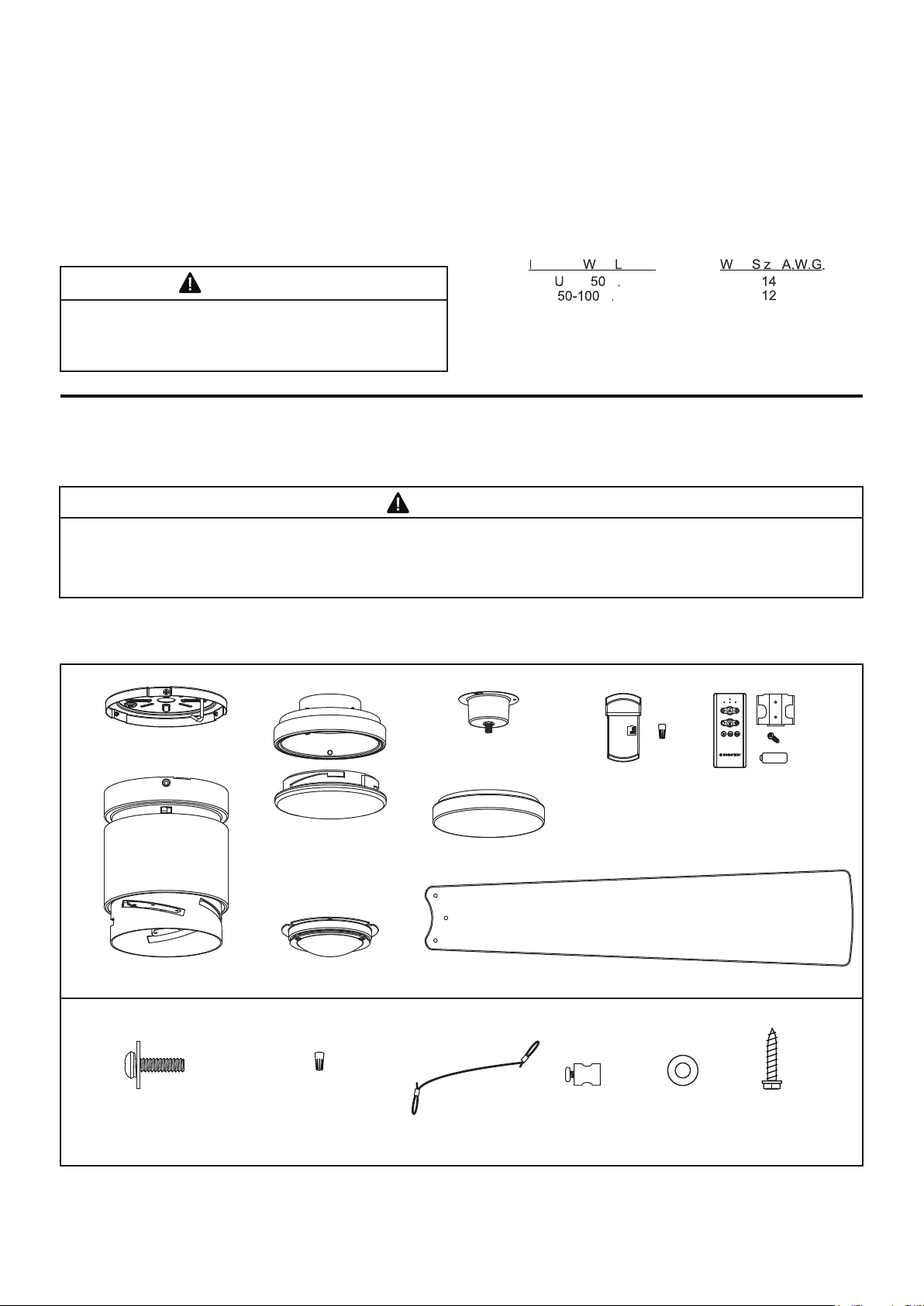
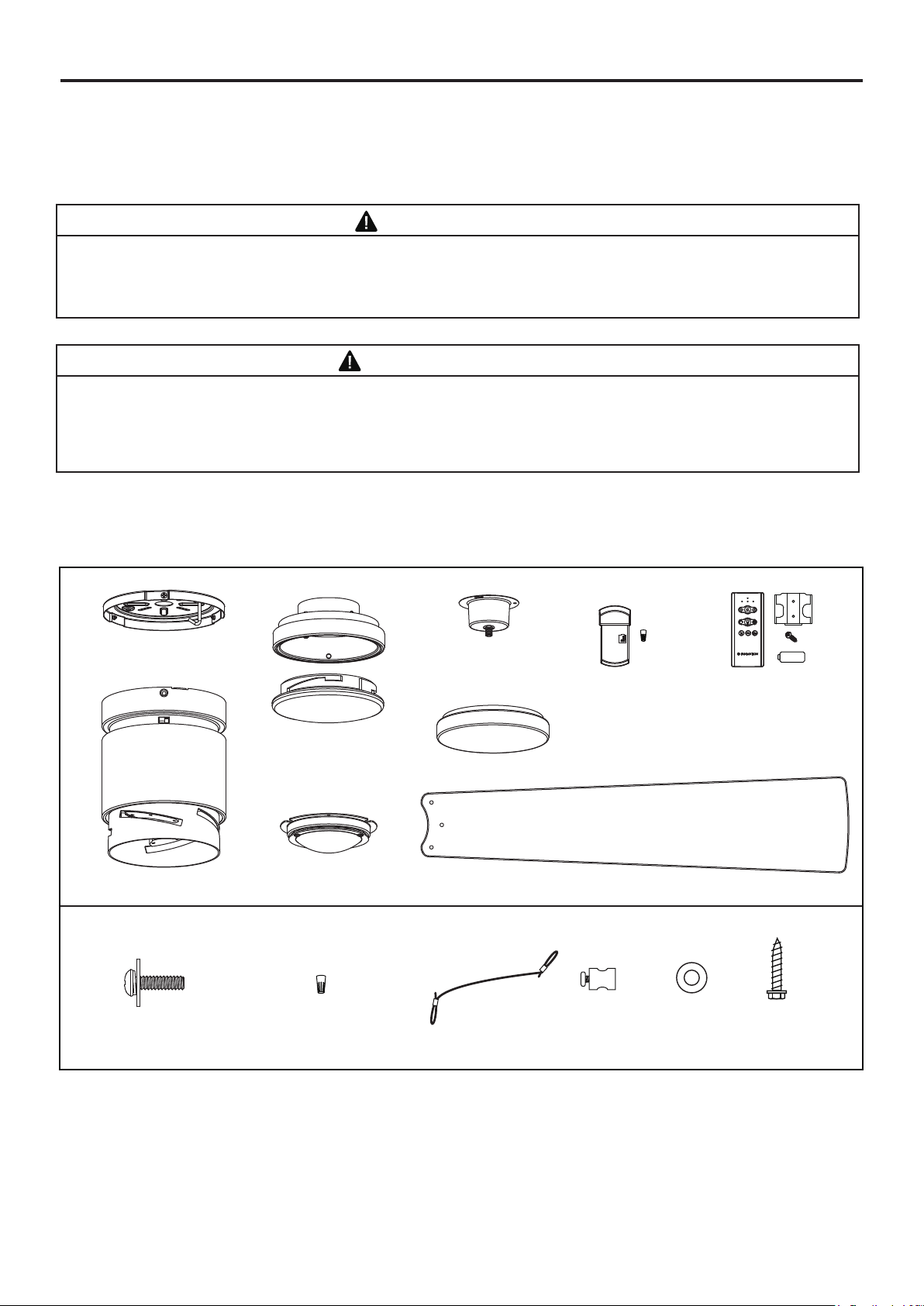
1. Check to see that you have received the following parts:
NOTE: If you are uncertain of part description, refer to exploded view illustration.
WARNING
Do not install or use fan if any part is damaged or missing. This product is designed to use only those parts supplied with
this product and/or any accessories designated specifically for use with this product by Fanimation. Substitution of parts
or accessories not designated for use with this product by Fanimation could result in personal injury or property damage.
Contact your retail store for missing or damaged parts.
WARNING
Ceiling Bracket Assembly (1)
Light Kit/Glass Assembly (1)
Light Kit Wire Cover (1)
LED Assembly (1)Motor Assembly (1)
Hardware Bags
Hand-held Remote (1)
Wall Holder (1)
Screws (2)
Battery (1)
12V 23A
Wire Connectors
(4)
Blade Set (1)
Steel Cap (1)
Safety Cable Kit
Safety Cable
(1)
Cable Clamp
(1)
Flat Washer,
Stainless Steel
(1)
Lag Bolt
(1)
3/16˝-24
Truss Head Screw With
Spring Washer/Flat Washer (13)
Receiver (1)
Wire Connectors (6)
Electrical and Structural Requirements
Energy Efficient Use of Ceiling Fans
Ceiling fan performance and energy savings rely
heavily on the proper installation and use of the
ceiling fan. Here are a few tips to ensure efficient
product performance.
Using the Ceiling Fan Year Round
Summer Season: Use the ceiling fan in the
counterclockwise direction. The airflow produced by
the ceiling fan creates a wind-chill effect, making you
“feel” cooler. Select a fan speed that provides a
comfortable breeze, lower speeds consume less
energy.
Winter Season: Reverse the motor and operate the
ceiling fan at low speed in the clockwise direction.
This produces a gentle updraft, which forces warm air
near the ceiling down into the occupied space.
Remember to adjust your thermostat when using your
ceiling fan-additional energy and dollar savings could
be realized with this simple step!
Choosing the Appropriate Mounting Location
Ceiling fans should be installed, or mounted, in the middle
of the room and at least 7 feet from floor to the blade and
18 inches from wall to the blade. If ceiling height allows,
install the fan 8 - 9 feet from floor to the blade for optimal
airflow. Consult your Fanimation Retailer for optional
mounting accessories.
Turn Off When Not in the Room
Ceiling fans cool people, not rooms. If the room is
unoccupied, turn off the ceiling fan to save energy.
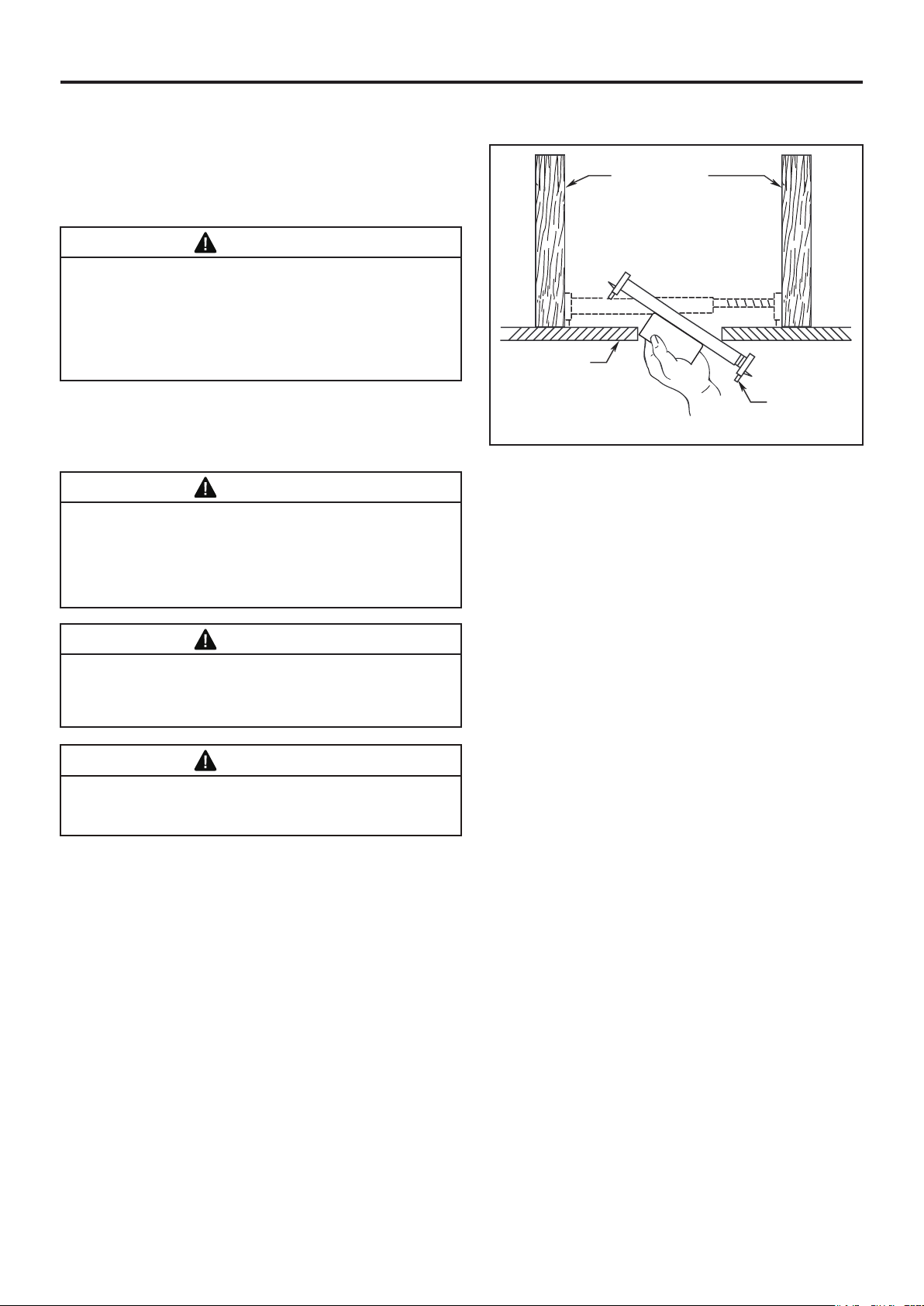
Your new ceiling fan will require a grounded electrical
supply line of 120 volts AC, 60 HZ, 15 Amp Circuit.
Electrical code requires use of a fan-rated outlet box to
support the extra weight and motion associated with a
ceiling fan. A fan-rated box will be labeled as such and
typically supports up to a 70lb ceiling fan. Fan-Rated
Outlet Boxes vary in ratings and design. Ensure the
ratings of your ceiling fan outlet box meet the
requirements for the ceiling fan being installed. Figure
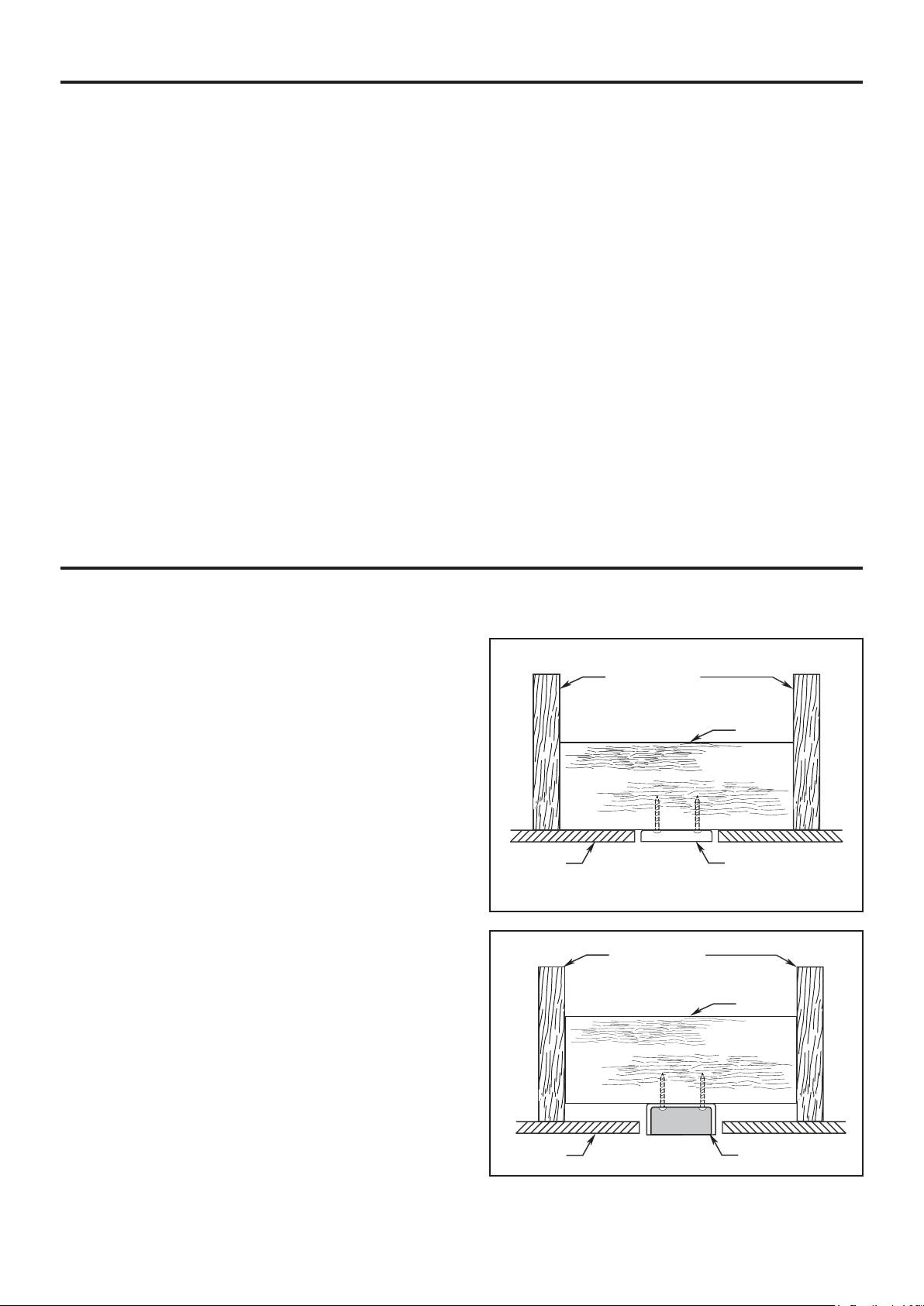
1, Figure 2 and Figure 3 depicts different structural
configurations that may be used for mounting the outlet
box.
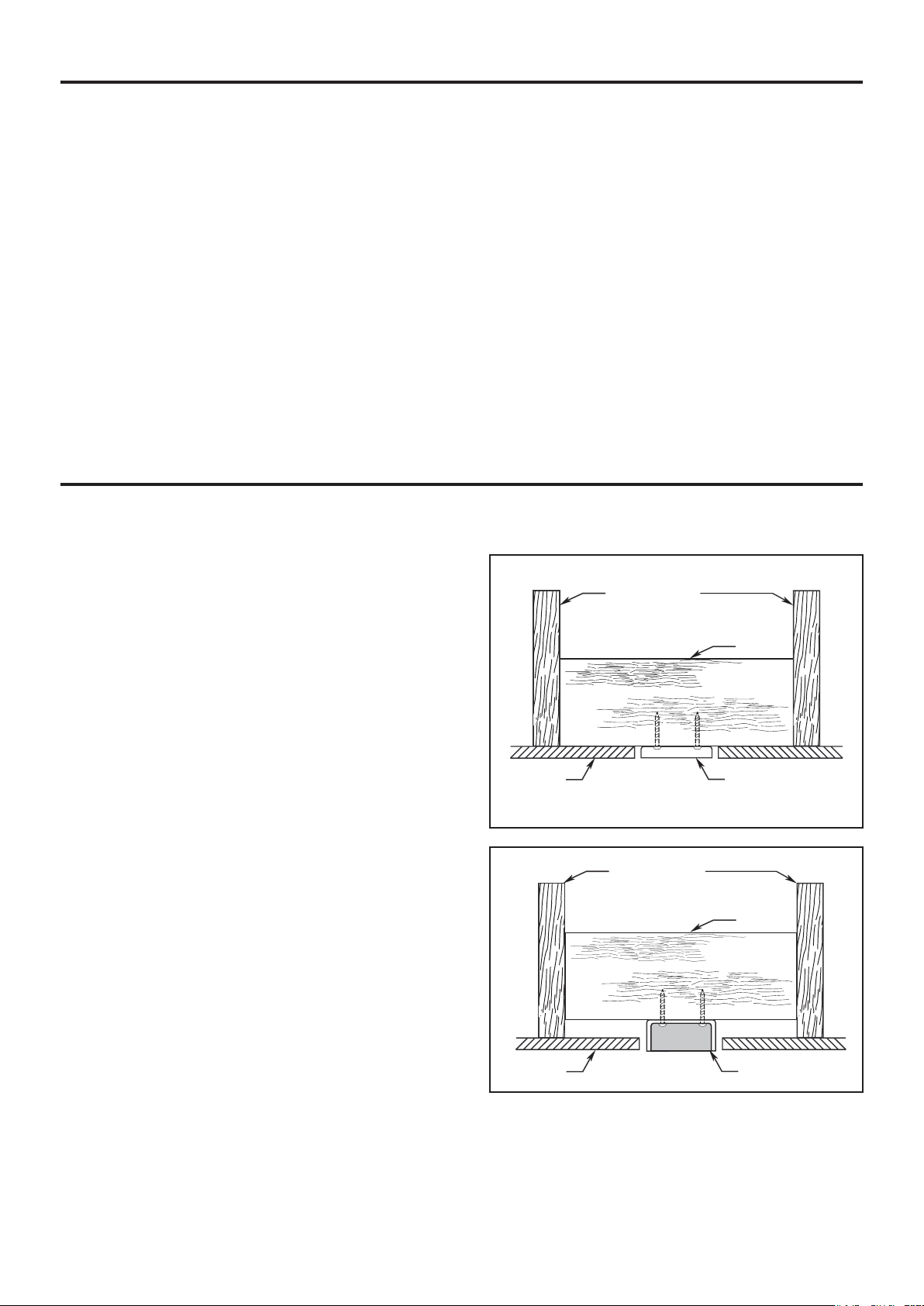
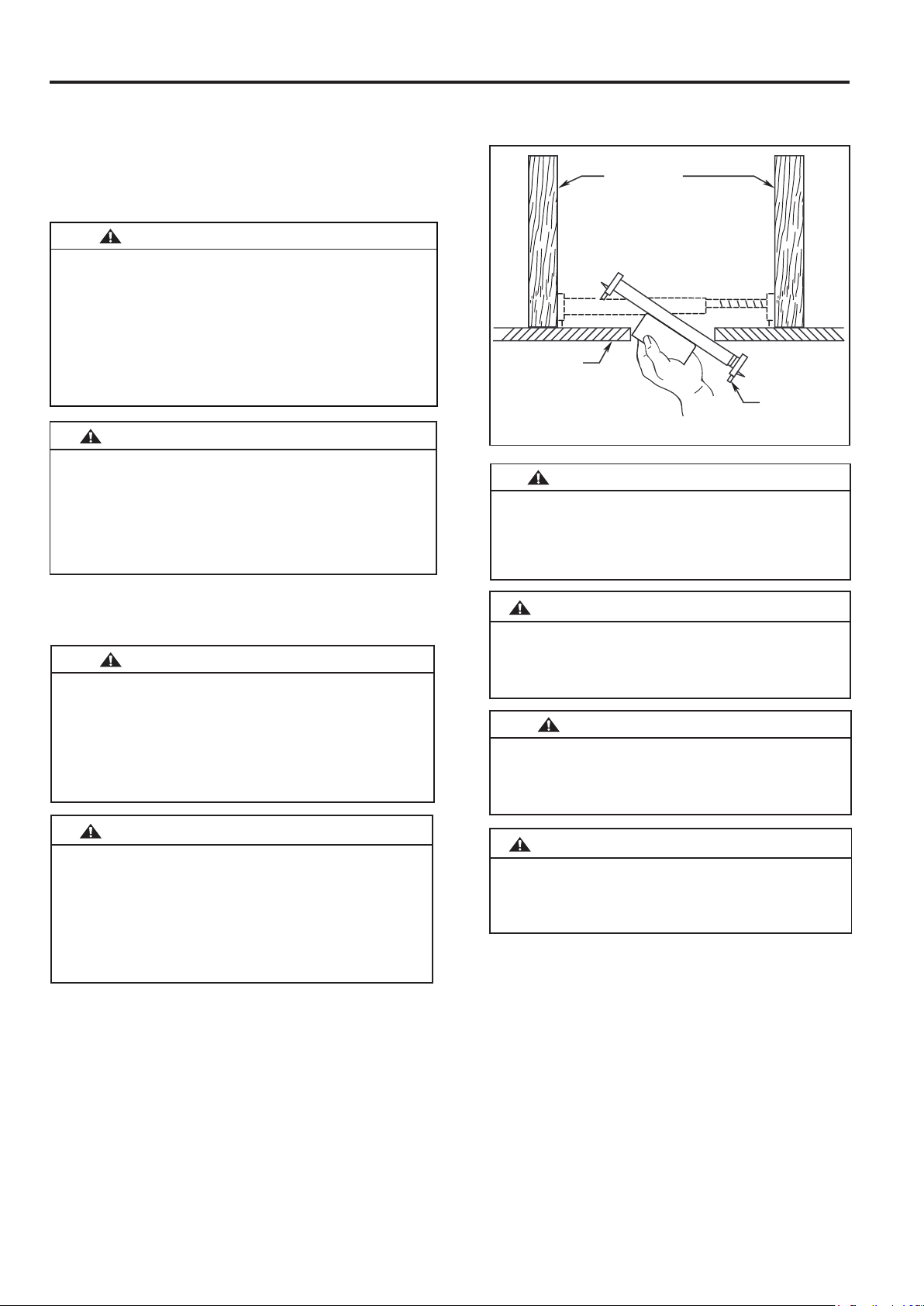
Low profile box (Figure 1)
A 1/2-in.-deep pancake box is meant to be screwed to a
joist or block. It’s used if only one cable is coming into the
box. It is also available in a saddle-mount configuration.
Deep box (Figure 2)
A 2-1/4-in.-deep box can be attached to blocking between
joists and is roomy enough to handle more than one cable.
CEILING JOIST
CEILING
OUTLET BOX
Figure 1
Figure 2
CEILING JOIST
2" x 4"
2" x 4"
CEILING
OUTLET BOX
5
Electrical and Structural Requirements (Continued)
If your fan is to replace an existing light fixture, turn
electricity off at the main fuse box at this time and remove
the existing light fixture.
Turning off wall switch is not sufficient. To avoid
possible electrical shock, be sure electricity is turned off
at the main fuse box before wiring. All wiring must be in
accordance with National and Local codes and the ceiling
fan must be properly grounded as a precaution against
possible electrical shock.
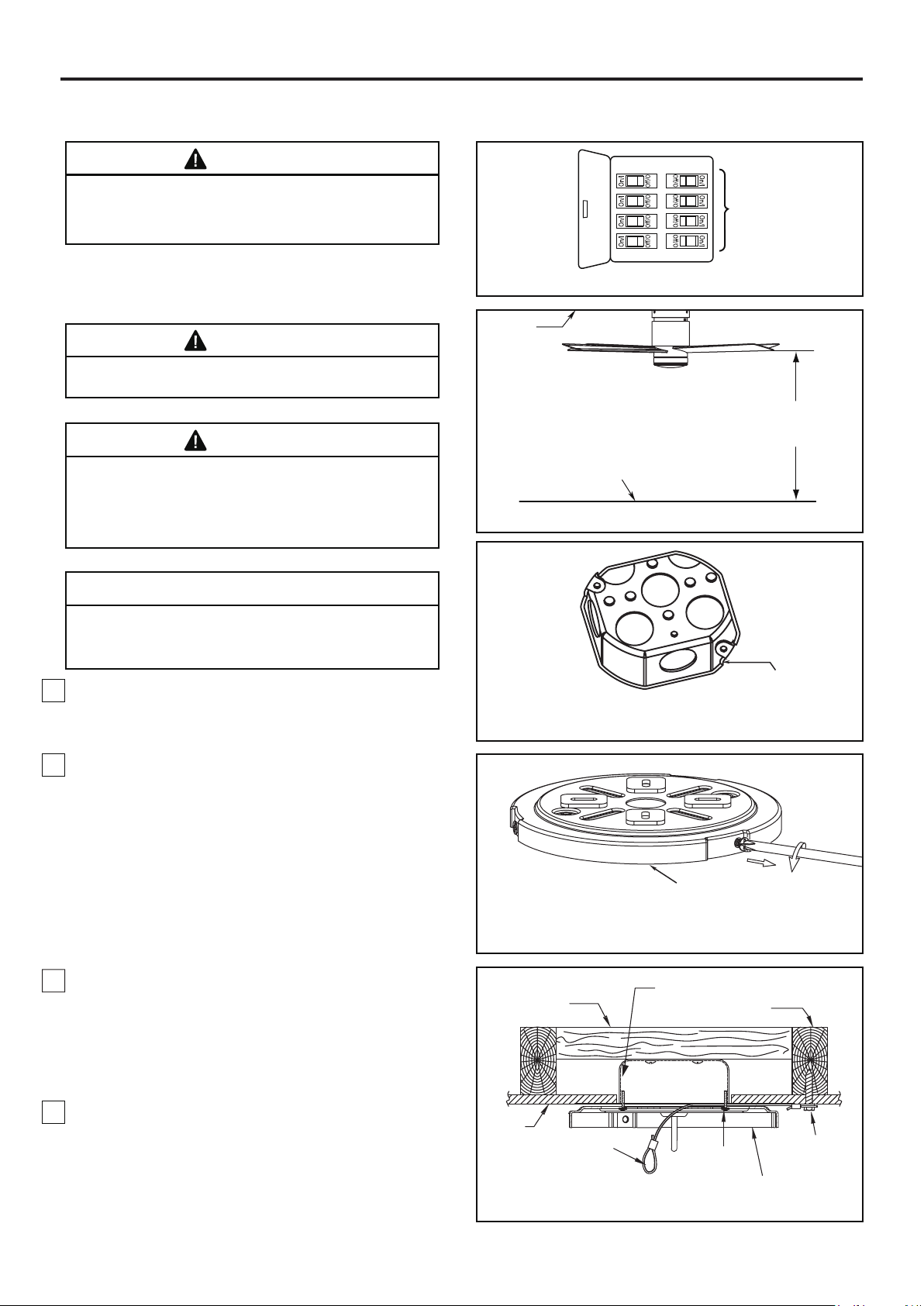
Deep box with brace (Figure 3)
Paired with a deep box, this hanger is meant to span
between two joists and takes the place of wooden blocking.
To avoid fire or shock, follow all wiring instructions
carefully. Any electrical work not described in these
instructions should be done or approved by a licensed
electrician.
Figure 3
CEILING JOIST
CEILING
OUTLET BOX
To reduce the risk of fire, electric shock, or personal injury,
mount to outlet box marked acceptable for fan support of
15.9 kg (35 lbs) or less and use mounting screws provided
with the outlet box. Most outlet boxes commonly used for
the support of luminaires are not acceptable for fan support
and may need to be replaced, consult a qualified electrician
if in doubt.
Do not operate this fan with a variable (Rheostat) wall
controller or dimmer switch. Doing so could result in
damage to the ceiling fan’s remote control unit.
6
WARNING
WARNING
WARNING
WARNING
7
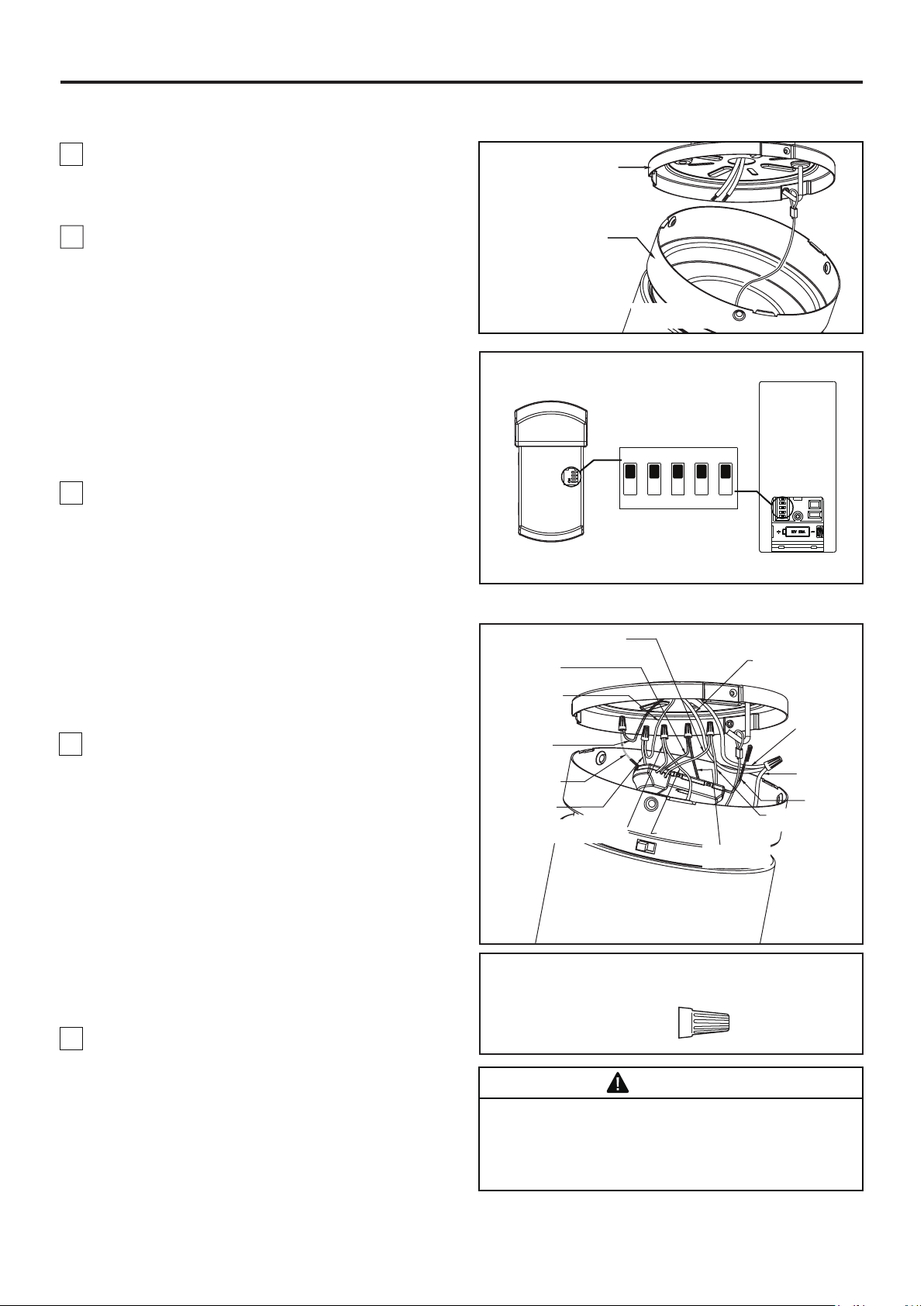
How to Hang and Wire Your Ceiling Fan
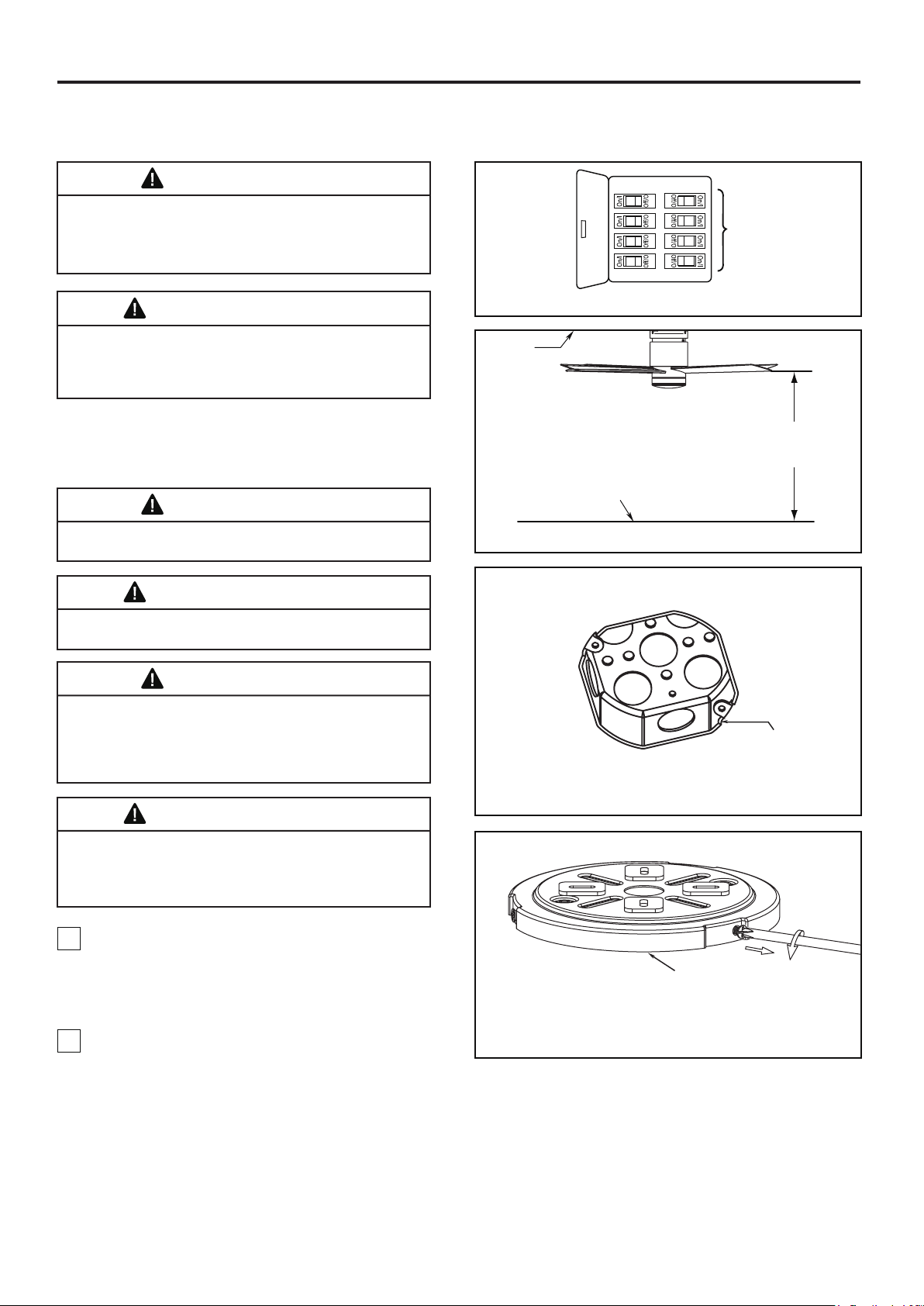
Figure 1
Figure 3
Main Fuse Box
WARNING
To avoid possible electrical shock, be sure electricity
is turned off at the main fuse box before hanging and
wiring. (Figure 1)
WARNING
The fan must be hung with at least 7´ of clearance
from floor to blades. (Figure 2)
WARNING
It is critical that the outlet box and the screws are
securely anchored to the building structure and
capable of withstanding a load of at least 35 lbs.
Failure to verify that the screws are properly installed
could result in the fan falling.
CAUTION
Do not connect fan blades until the fan is completely
installed. Hanging fan with blades connected may
result in damage to the fan blades.
1. Securely attach the outlet box acceptable for ceiling
fan support into the building structure. Outlet box is
not supplied with the fan. (Figure 3)
2. Remove the three screws from the ceiling bracket
assembly and retain for later. (Figure 4)
Outlet Box
Ceiling Bracket
Assembly
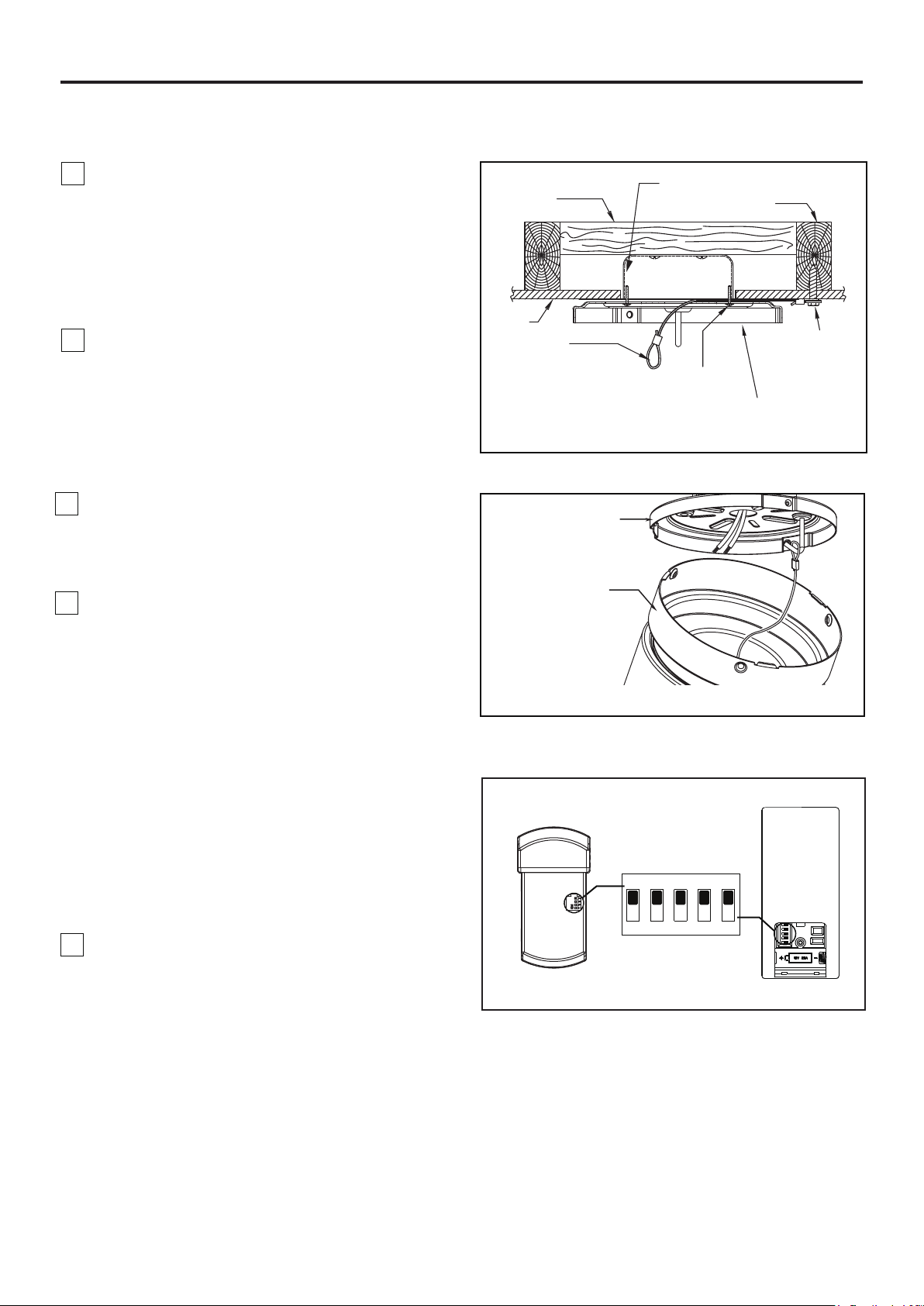
Figure 5
Wood Member
(2 ˝x 4˝Approx.)
Ceiling Joist
Ceiling
Outlet Box
Ceiling Support
Cable
Ceiling Bracket
NOTE: Supply wires and
fan wires omitted for clarity
NOTE: Supply wires and
fan wires omitted for clarity
NOTE: Supply wires and
fan wires omitted for clarity
Figure 4
Figure 2
Floor
No Less
Than
7 Feet
Ceiling
3. Using the 3/8˝ x 2˝ lag bolt and flat washer, attach
safety cable to ceiling joist or wood structural member.
The lag bolt will pass through the flat washer, safety
cable loop, and into the building structure (Figure 5). You
will first drill a ¼
˝ pilot hole into the building structure to
prevent splitting or cracking.
3/8˝ x 2˝ lag bolt
and flat washer
4. The ceiling support cable need to pass through the
center hole of ceiling bracket when mounting. Using
the two #8-32 screws and washers securely attach
the ceiling bracket to ceiling outlet box as shown.
(Figure 5)
Screws (2)
Supplied with
Outlet Box
NOTE: If you are not sure if the outlet box is grounded,
contact a licensed electrician for advice, as it must be
grounded for safe operation.
How to Hang and Wire Your Ceiling Fan (Continued)
8
NOTE: The remote unit has 32 different code
combinations. To prevent possible interference
from or to other remote units, simply change the
combination code in the remote and receiver.
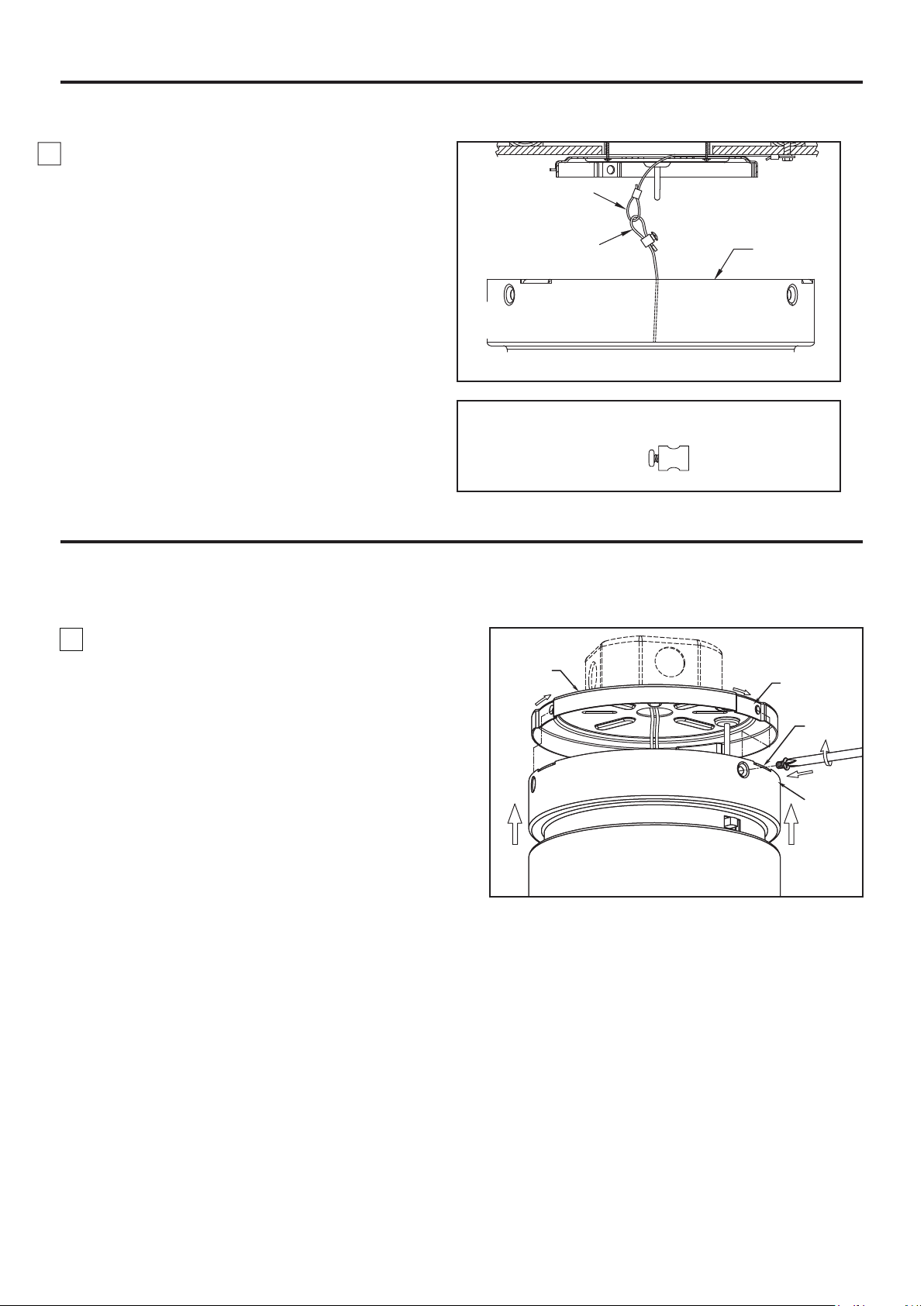
7. To set the code on receiver unit, slide dip switches
to the same positions as set on the remote. (Figure 7)
NOTE: Factory setting is all up. Do not use this
position.
x 6
Wire
Connectors
HARDWARE USED:
CAUTION: INCORRECT WIRE CONNECTION WILL
DAMAGE THIS RECEIVER.
NOTE: If you feel that you do not have enough
electrical wiring knowledge or experience, have your
fan installed by a licensed electrician.
WARNING
Check to see that all connections are tight, including
ground, and that no bare wire is visible at the wire
connectors except for the ground wire. Do not operate
fan until the blades are in place. Noise and motor
damage could result.
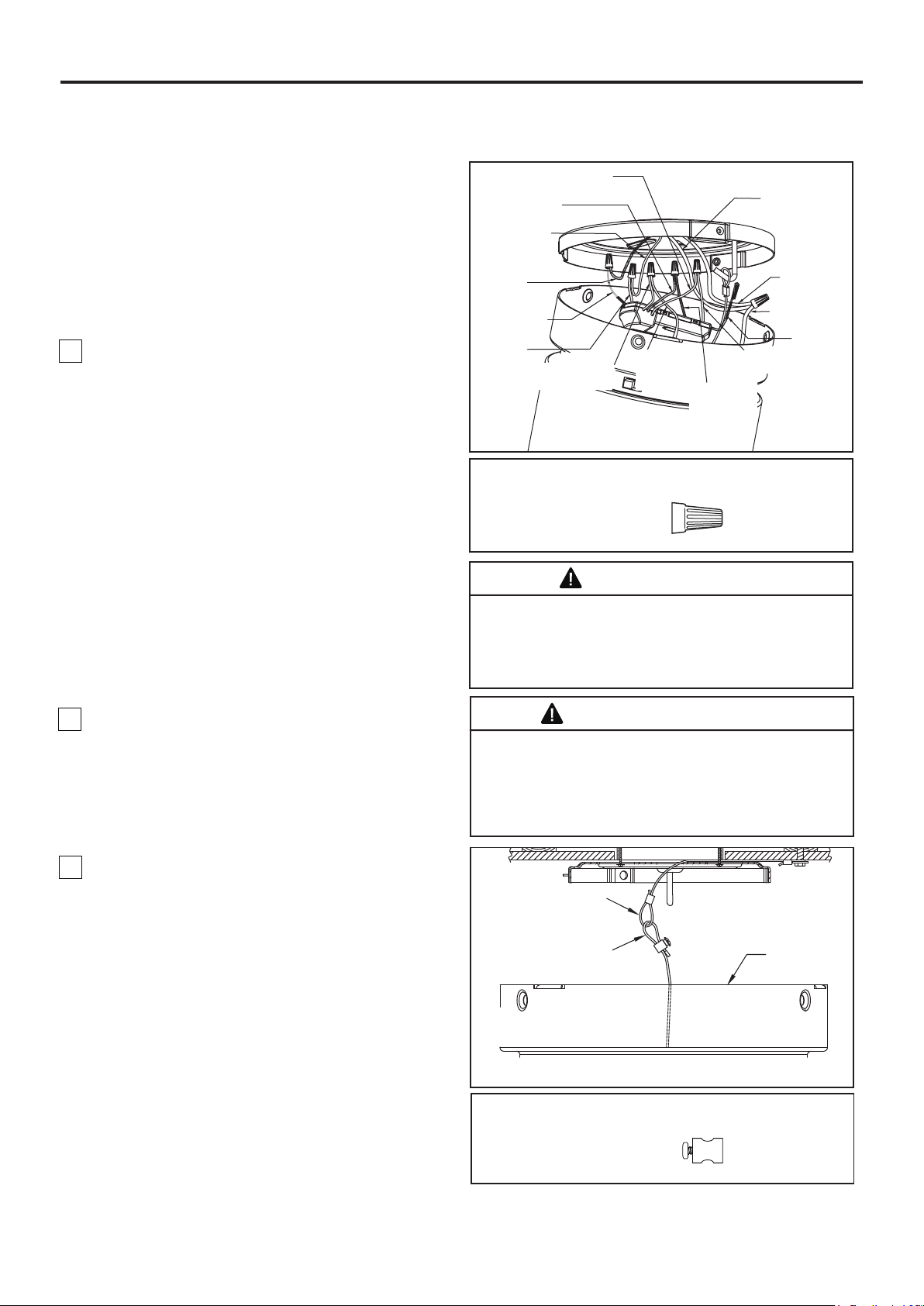
9. After splicing and making the wire connections, the
wires should be spread apart and turned upward with
the grounded conductor (white), the equipment
-grounding conductor (green) on one side of the
ceiling bracket and the ungrounded conductor (black
and blue) on the other side of the ceiling bracket.
(Figure 8)
White Wire
from Supply
Black Wire
from Receiver
White Wire
from Receiver
BLK_ANT
Green Wire (Ground)
from Ceiling Bracket
Green Wire
(Ground)
from Supply
Black Wire
from Receiver
Black Wire
from Supply
White Wire
from Motor
Green Wire
(Ground)
from Motor
Blue Wire
from Motor
NOTE: Supply wires and
fan wires omitted for clarity
Ceiling Bracket
Assembly
5. Hang the motor assembly from the ceiling bracket
assembly using the hook on the ceiling bracket
assembly and the cable loop from the motor assembly
as shown. (Figure 6)
Figure 6
Motor
Assembly
Figure 7
Figure 8
White Wire
Blue Wire
from Receiver
from Receiver
Black Wire
from Motor
6. Make sure the electrical supply wires, including the
ceiling bracket grounding wire and safety cable are
pulled through the center hole of ceiling bracket,
between the ceiling bracket and the motor assembly
so that electrical connections can be made later.
8. Connect green wires from ceiling bracket,
motor and ground from supply using wire connector.
Connect black wire from receiver unit marked
“AC IN L” to black supply wire using wire connector.
Connect white wire from receiver unit marked
“AC IN N” to white supply wire using wire connector.
Connect white wire from receiver unit marked
“TO MOTOR N” to white wire from fan using wire
connector supplied with receiver unit. Connect black
wire from receiver unit marked “TO MOTOR L” to
black wire from fan using wire connector supplied with
receiver unit. Lastly, connect blue wire from receiver
unit to the blue fan light wire using wire connector
supplied with receiver unit. (Figure 8)
Dip Switch
Receiver
Remote Control
ON DIP
1 2 3 4 5
How to Hang and Wire Your Ceiling Fan (Continued)
9
Figure 1
How to Assemble Your Ceiling Fan
Ceiling Bracket
Assembly
Wide Notch
Wide Tab
Motor
Assembly
10. Attach the safety cable to ceiling support cable.
Slide cable clamp onto safety cable (from fan). Place
the end of cable through the loop of ceiling support
cable. Pull as much cable through loop as possible.
Feed end of cable into clamp hole and firmly tighten
screw (Figure 9). Cut off excess safety cable.
Figure 9
NOTE: Supply wires and
fan wires omitted for clarity
Motor
Assembly
Safety Cable
Ceiling Support
Cable
Attach the safety cable
to ceiling support cable
HARDWARE USED:
Ceiling Support
Cable Clamp
W/Screw
x 1
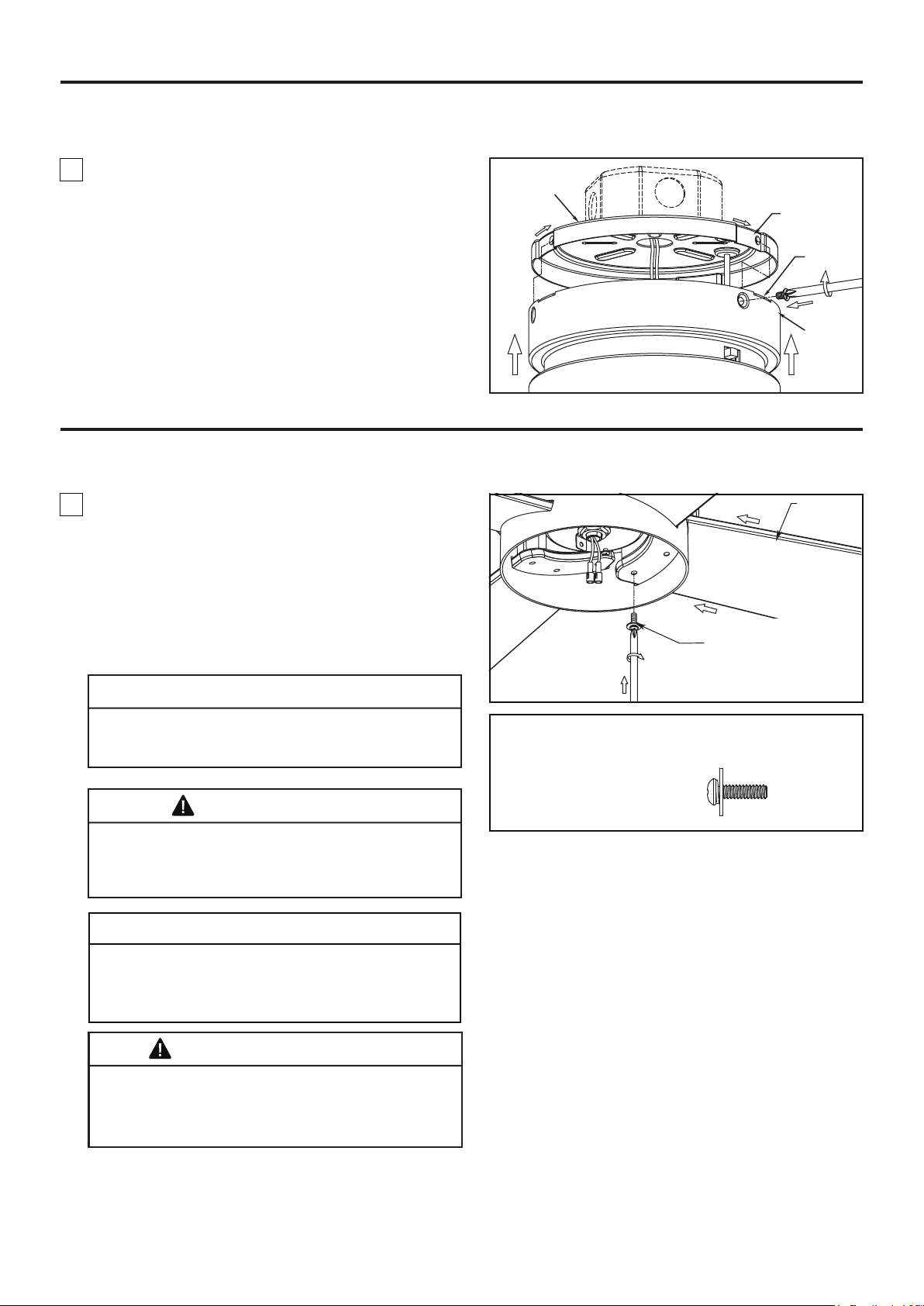
1. Align the wide tab of motor assembly to the wide
notch of ceiling bracket. Carefully secure the motor
housing onto the mounting slots on ceiling bracket
by twisting in a clockwise direction. Be sure the
receiver and all wiring are tucked into the motor
housing and is not pinched. Once the motor assembly
is flush with your ceiling, replace the previously
removed screws and securely tighten all three screws.
(Figure 1)
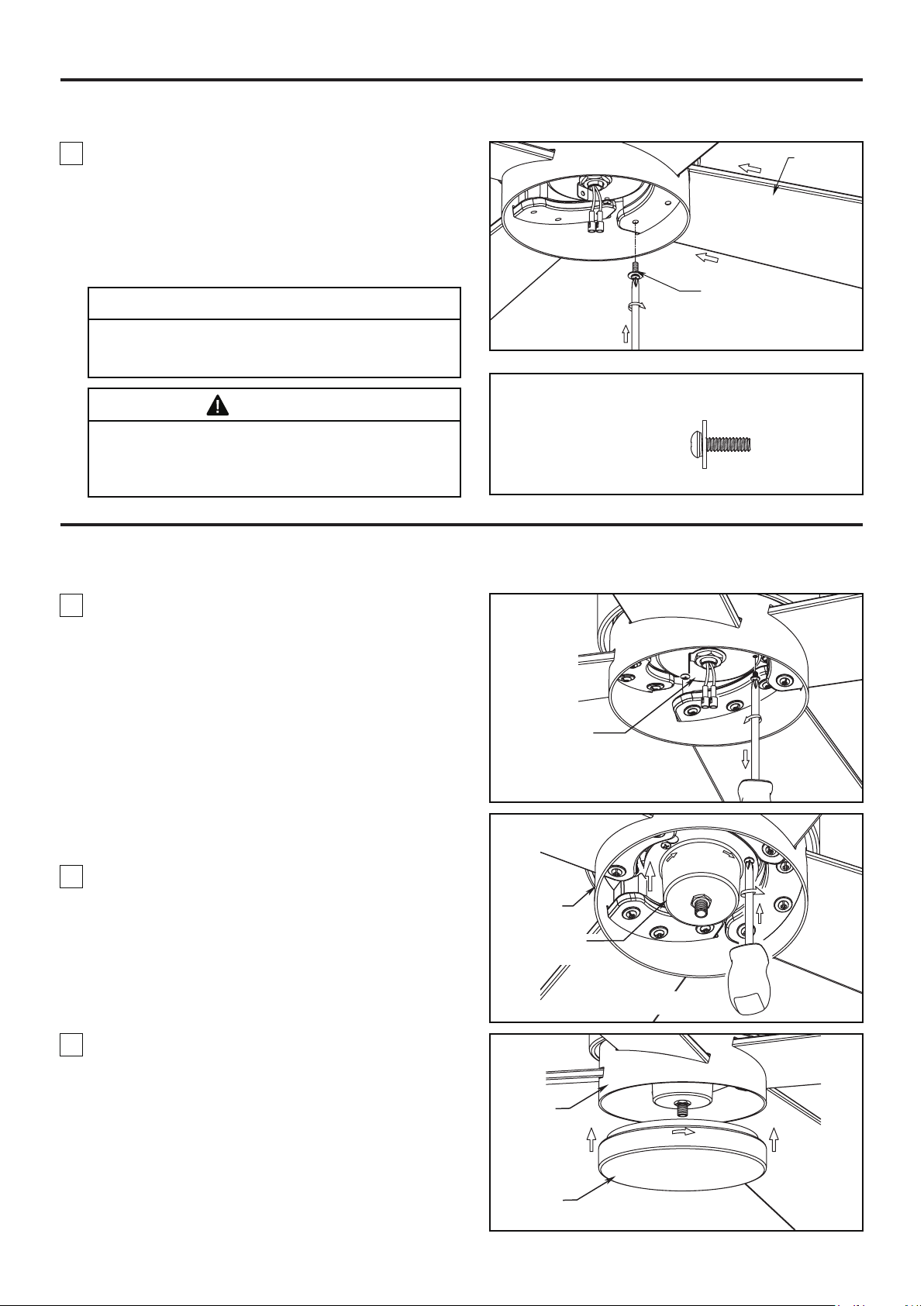
10
How to Assemble Your Ceiling Fan Blades
Motor
Assembly
Motor
Assembly
Motor
Assembly
How to Assemble Your Light Kit or Cap
Figure 1
Figure 2
Figure 3
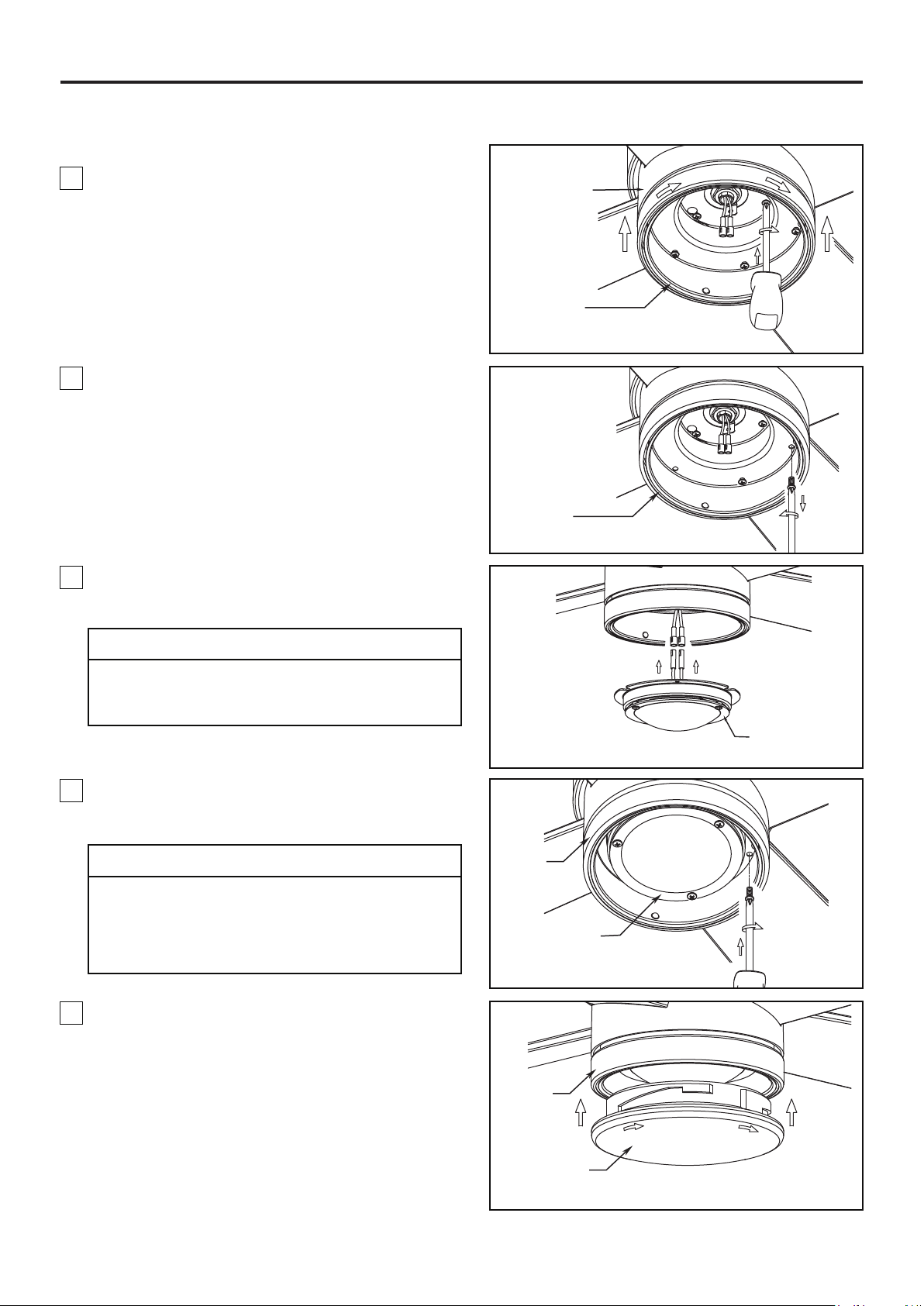
1. Remove one of the three screws in the support
bracket at the bottom of the motor assembly. Retain
the screw for later and slightly loosen the remaining
two screws. (Figure 1)
NOTE: Periodically check blade hardware and
resecure if necessary.
Blade
Figure 1
Do not connect fan blades until the fan is completely
installed. Installing the fan with blades assembled may
result in damage to the fan blades.
CAUTION
WARNING
To reduce the risk of personal injury, do not bend the
blades when installing, balancing or cleaning the fan.
Do not insert foreign objects in between the rotating
blades.
3/16"-24
Truss Head Screw
With Spring Washer/
Flat Washer
X 12
HARDWARE USED:
2. Assemble the light kit wire cover to the motor
assembly using the two key slots. Replace the removed
screw and secure all three screws. (Figure 2)
3. Assemble the steel cap to the motor assembly by
twisting in a clockwise direction. (Figure 3)
NOTE: If installing the light kit, please skip to Step 4.
Option A--for use with steel cap
Light Kit Wire
Cover Assembly
Steel Cap
3/16˝-24
Truss Head Screw With
Spring Washer/Flat Washer
(3 each per blade)
1. Slide blades through slots in motor housing and
attach to the motor hub using the 3/16˝-24 truss head
screw with spring washer/flat washer. Make sure
the screws securing the blades to the motor hub are
tight and are properly seated. (Figure 1)
11
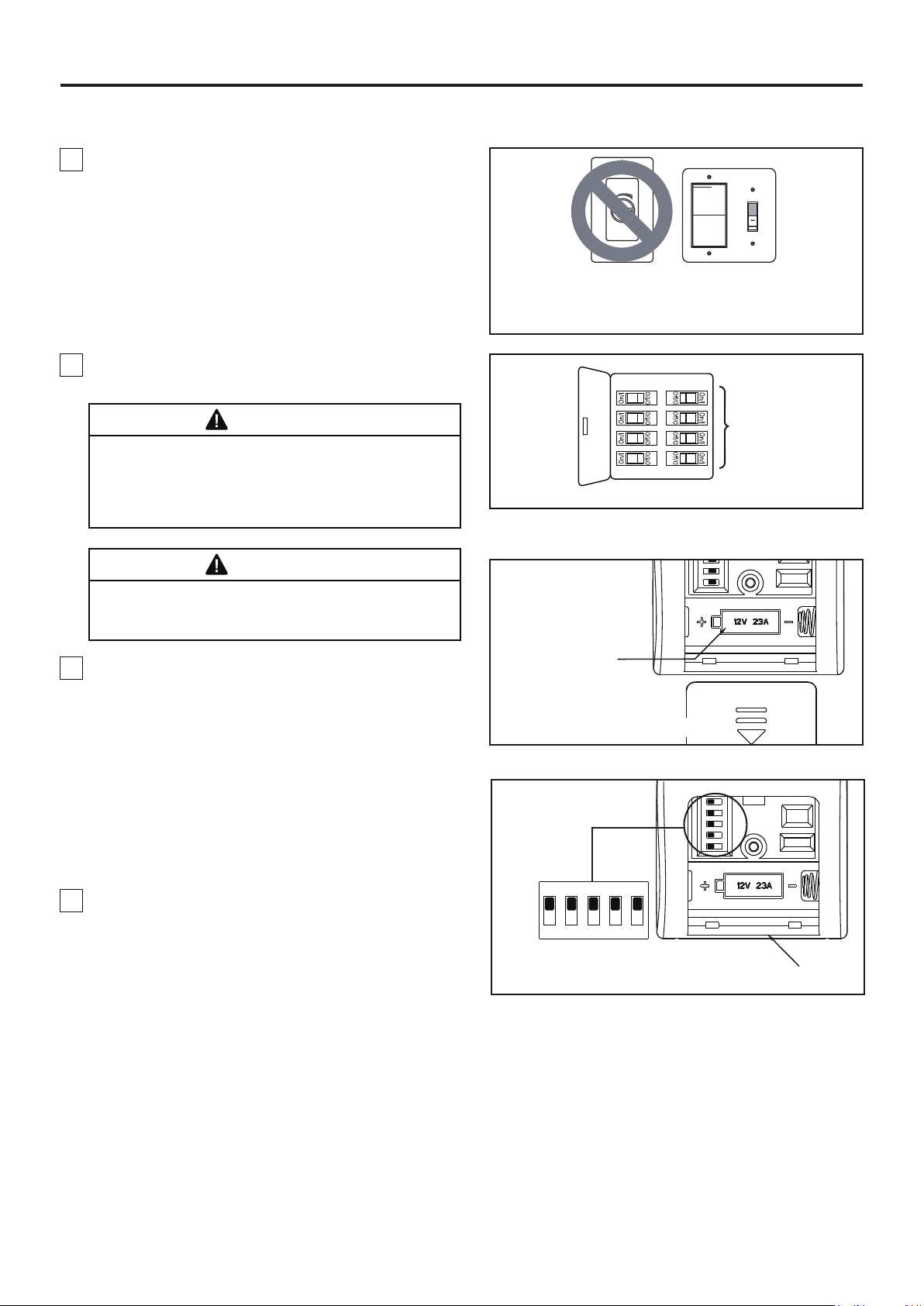
Light Kit
Light Kit
Figure 4
Motor
Assembly
4. Assemble the light kit to the support bracket using
the two key slots in the light kit. Replace the previously
removed screw and securely tighten all three screws.
(Figure 4)
How to Assemble Your Light Kit or Cap (Continued)
LED
Assembly
6. Connect the 2 single pin connectors from the LED
assembly to the 2 single pin connectors from motor
assembly. (Figure 6)
CAUTION
To reduce the risk of electric shock, disconnect the
electrical supply circuit to the fan before installing
your light kit.
Figure 8
Light Kit
Light Kit
LED Assembly
CAUTION
The light source is designed for this specific
application and can overheat if serviced by untrained
personnel. If any servicing is required, the product
should be returned to an authorized service facility
for examination or repair.
Figure 5
Glass
8. Secure the glass to light kit by twisting in a
clockwise direction. Twist the glass gradually
until it
snaps onto the light kit.
Do not over-tighten.
(Figure 8)
Figure 6
Figure 7
Option B--for use with light kit
5. Remove the three screws in the light kit and retain
the screws for later. (Figure 5)
7.
Assemble the LED assembly to the light kit using
the previously removed screws and secure all three
screws. (Figure 7)
12
How to Operate Your Ceiling Fan
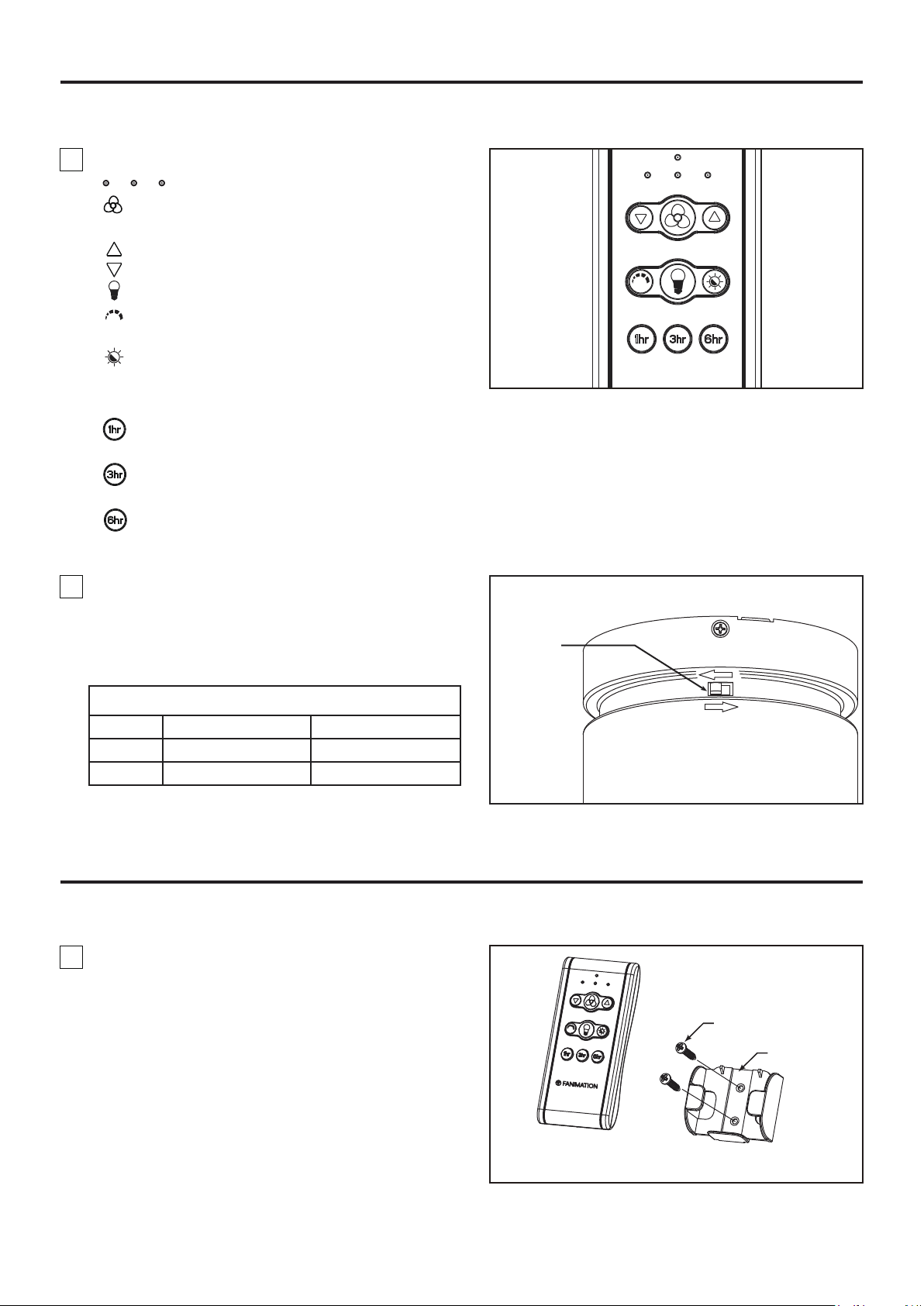
Figure 1
For illustrative purposes only-not
intended to cover all types of controls
1. IMPORTANT: Using a full range dimmer switch (not
included) to control fan speed will damage the fan. To
reduce the risk of fire or electrical shock, do not use a
full range dimmer switch to control the fan speed.
(Figure 1)
Figure 2
Main Fuse Box
2. Restore electrical power to the outlet box by turning
the electricity on at the main fuse box. (Figure 2)
WARNING
Check to see that all connections are tight, including
ground, and that no bare wire is visible at the wire
connectors, except for the ground wire. Do not operate
fan until the blades are in place. Noise and fan damage
could result.
WARNING
Do not operate this fan with a variable (Rheostat) wall
controller or dimmer switch. Doing so could result in
damage to the ceiling fan's remote control unit.
12V 23A
Battery (1 pcs)
Figure 3
3. To make fan operational, install 23A/12V battery
(included) in hand-held remote transmitter, with fan
power off. Then follow the remote code setting process.
(If not used for long periods of time, remove battery to
prevent damage to transmitter). Store the remote away
from excessive heat or humidly. (Figure 3)
NOTE: The remote unit has 32 different code
combinations. To prevent possible interference from
or to other remote units, simply change the
combination code in the remote and receiver.
4. To set the remote code in the same positions as
the receiver, use a small screwdriver or ball point pen
(neither included) to slide dip switches firmly up or
down. (Figure 4)
NOTE: Factory setting is all up. Do not use this
position.
Figure 4
Remote
Dip Switch
ON DIP
1 2 3 4 5
13
How to Operate Your Ceiling Fan (Continued)
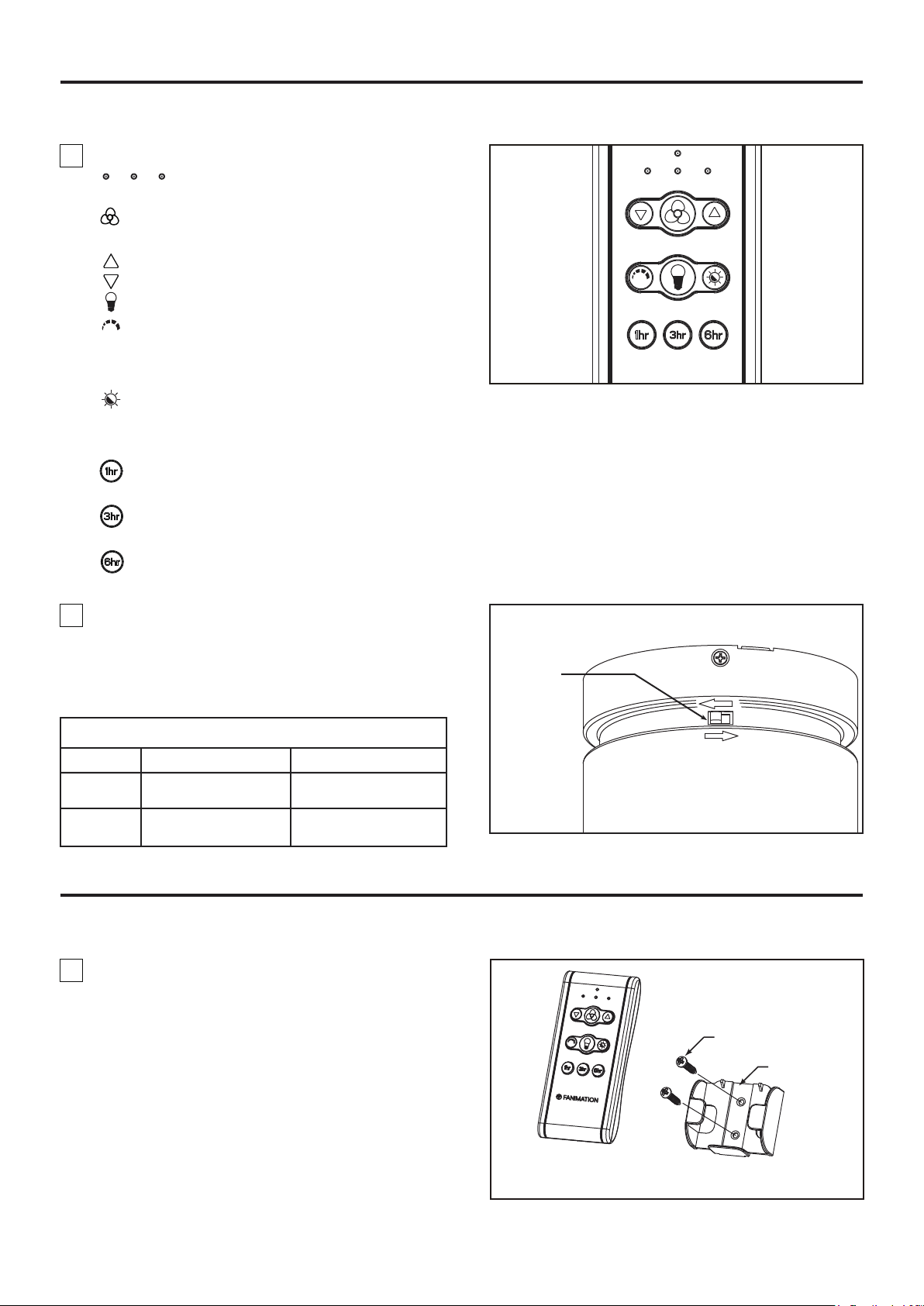
6. If airflow is desired in the opposite direction, turn
the fan off and wait for the blades to stop turning.
Then slide the reverse switch on top of motor
assembly to the opposite position and turn fan on
again. (Figure 6 )
Figure 6
Reverse
Switch
How to Install Your Remote Control
Figure 1
1. Installing Wall Holder: (Figure 1)
Attach wall holder using the two provided screws.
Screws (2)
Wall Holder
Figure 5
• Indicator LED light: fan speed
• button: Turns fan off.
• Fan Speed:
Turns fan on and turns speed up.
Turns fan on and turns speed down.
• Light button: Turn ON\OFF the light.
Press to turn on the light and hold to dim or
brighten light to desired level, then release.
Press this button to switch color temperature
when the light is on.
• Sleep Timer:
Tap and the fan and light will turn off after
1 hour.
Tap and the fan and light will turn off after
3 hours.
Tap and the fan and light will turn off after
6 hours.
5. Remote functions: (Figure 5)
Reverse Switch Information
Season Switch Position
Summer Counterclockwise
Winter Clockwise
Rotation Direction
Left
Right
14
Periodic cleaning of your new ceiling fan is the only
maintenance necessary.
When cleaning, use only a soft brush or lint free cloth to
avoid scratching the finish.
Abrasive cleaning agents are not required and should be
avoided to prevent damage to finish.
Periodic light dusting of the blades is recommended.
A feather duster will work best.
Avoid using water, cleansers, or harsh rags, which
can warp and ruin the blades.
CAUTION
Do not use solvents when cleaning your ceiling fan. It
could damage the motor or the blades and create the
possibility of electrical shock.
Maintenance
How to Clean Your Ceiling Fan Blades
WARNING
Trouble Probable Cause Suggested Remedy
1. Check main and branch circuit fuses or circuit
breakers.
2. Check line wire connections to fan and switch wire
connections in the switch housings.
CAUTION: Make sure main power is turned off !
CAUTION: Make sure main power is turned off !
3. Replace with new battery.
1. Attach blades to fan before operating.
2. Check to make sure all screws in motor housing are
snug (not over-tight).
For your own safety turn off power at fuse box or circuit breaker before trouble shooting your fan.
1. FAN WILL NOT START
2. FAN SOUNDS NOISY
3. FAN WOBBLES
EXCESSIVELY
1. Fuse or circuit breaker blown.
2. Loose power line connections to the fan, or loose
switch wire connections in the switch housing.
3. Dead battery in remote control.
4. Make sure reverse switch position is all the way to
one side.
4. Reverse switch in neutral position.
1. Blades not attached to fan.
1. Check to be sure screws which attach the fan blade
to the flywheel are tight.
1. Screws securing fan blade to motor hub are loose.
2. Loose screws in motor housing.
2. Tighten the ceiling bracket screws to the outlet box,
and secure outlet box.
2. Ceiling bracket and/or ceiling outlet box is not
securely fastened.
3. Check to make sure wire connectors in switch
housing are not rattling against each other or against
the interior wall of the switch housing.
3. Wire connectors inside housing rattling.
4. Some fan motors are sensitive to signals from
solid-state variable speed controls. Solid-state
controls are not recommended, choose an alternative
control method.
4. Motor noise caused by solid state variable speed
control.
Troubleshooting
15
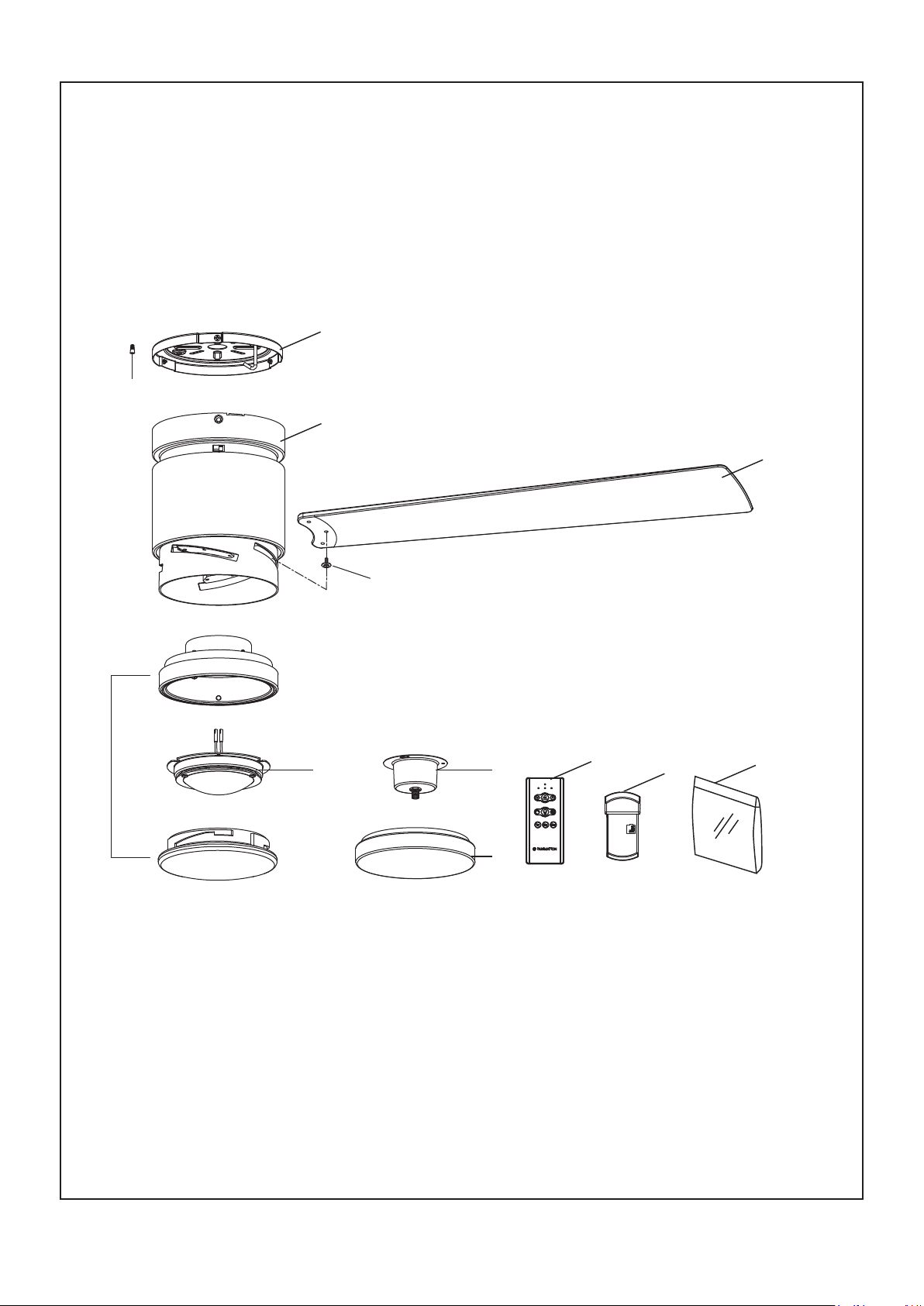
Parts List
Model #FPS8553**
Before discarding packaging materials, be certain all parts have been removed.
How To Order Parts
When ordering repair parts, always give the
following information:
• Part Number
• Part Description
• Fan Model Number
Contact your retail store for repair parts.
1
2
3
4
5
7
6
AP855301**
AMA8553**
AP855304**
AP855308**
AP855311
AP855309BL
AP855310**
TR800
RCCA050050005
8
Light Kit Wire Cover Assembly
Steel Cap Assembly
Hand-held Remote
Receiver
9
10 HDWFPS8553**
Light Kit/Glass Assembly
LED Assembly
Wire Connector (4)
Safety Cable Kit
Hardware Bag Containing:
Blade Mounting Hardware Bag Containing:
Blade Set
Motor Assembly
Ref. # Description Part #
Ceiling Bracket Assembly
3/16˝-24 Truss Head Screw With Spring Washer/Flat Washer (13)
16
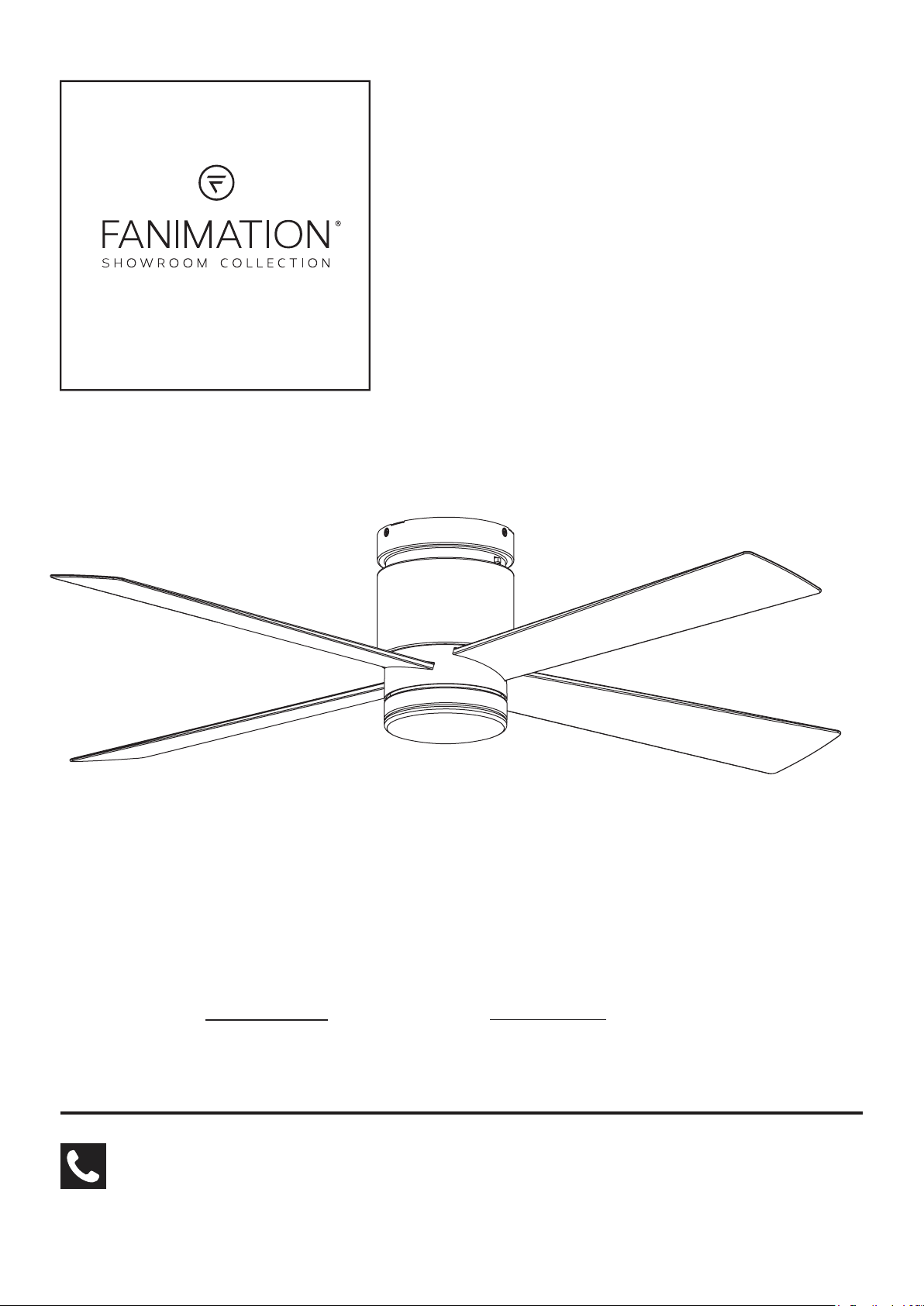
NOTE: The illustration shown is not to scale or its actual configuration may vary.
Product/parts are subject to change without notice.
Model FPS8553**
Exploded-View Illustration
1
2
3
10
9
8
4
5 6
7
10
10
™
Kwartet


2020/12 V.01
Copyright 2020 Fanimation
10983 Bennett Parkway
Zionsville, IN 46077
Phone: 888-567-2055
Outside U.S.: 317-733-4113
FAX: 866-482-5215
FANIMATION.COM
MODELO #FPS8553**
Preguntas, problemas, piezas faltantes? Antes de volver a la tienda, llame a nuestro
Departamento de Servicio al Cliente al 1-888-567-2055, 8 a.m. - 5 pm, hora del Este, de
lunes - viernes.
Código de fecha
Fecha de compra
ADJUNTE SU RECIBO AQUÍ Y REGISTRE SU VENTILADOR EN FANIMATION.COM
LEA Y GUARDE ESTAS INSTRUCCIONES
Peso neto 7.81 kgs (17.18 lbs)
Para ofrecer un servicio rápido y de calidad, por favor suministre el código de fecha. Puede
encontrar el código de fecha en el paquete, en el mando a distancia (dentro del compartimento de
las pilas), en el receptor o unidad de soporte del ventilador.
VENTILADOR DE TECHO KWARTET
TM
Instrucciones de seguridad importantes
ADVERTENCIA: Siga estas instrucciones para prevenir incendios, descargas eléctricas y lesiones personales graves.
Instrucciones de seguridad adicionales
1. Lea el manual del propietario y la información de seguridad antes de instalar su nuevo ventilador. Observe los diagramas de
ensamblaje adjuntos.
2. Antes de llevar a cabo el mantenimiento o la limpieza de la unidad, desconecte la electricidad en el panel de servicio y bloquee los
medios de desconexión del mismo para evitar que se active accidentalmente. Si no se pueden bloquear los medios de desconexión
del servicio, coloque un dispositivo de advertencia, como una etiqueta, en el panel de servicio.
3. Tenga cuidado con la estructura y las aspas del ventilador cuando limpie, pinte o trabaje cerca del mismo. Desconecte siempre la
electricidad del ventilador de techo antes de llevar a cabo el mantenimiento.
4. No coloque nada en las aspas del ventilador cuando éste se encuentra en funcionamiento.
5. No accione el conmutador inversor hasta que las aspas del ventilador se hayan detenido por completo.
6. El dispositivo no ha sido diseñador para ser utilizado por niños o personas enfermas sin supervisión. Los niños deben ser supervisados
para asegurarse de que no juegan con el dispositivo.
1. Para evitar posibles descargas eléctricas, asegúrese de que la electricidad esté desconectada en la caja de fusibles antes de realizar
la instalación eléctrica, y no haga funcionar el ventilador sin las aspas.
2. Todos los procedimientos de conexión eléctrica e instalación deben cumplir con los Códigos eléctricos nacionales (ANSI/NFPA
70) y Códigos locales. El ventilador de techo debe estar conectado a tierra a fin de prevenir posibles descargas eléctricas. La instalación eléctrica
debe ser llevada a cabo o aprobada por un electricista autorizado.
3. Se debe fijar bien la base del ventilador; ésta debe ser capaz de soportar sin problemas al menos 15,9 kg (35 lb). Consulte la página 23
del manual del propietario para ver los requisitos de soporte. Si tiene dudas, consulte a un electricista calificado.
4. Las aspas del ventilador deben instalarse por lo menos a 2,13 m (7 pies) del suelo, a fin de evitar un contacto accidental con las mismas.
5. Siga las recomendaciones sobre el método correcto de instalación eléctrica de su ventilador de techo. Si no posee la experiencia o
los conocimientos eléctricos adecuados, contrate a un electricista autorizado para instalar el ventilador.
6. Apto para usar con controles de velocidad de estado sólido.
7. Este ventilador es apto sólo para lugares secos o húmedos.
8. Úselo únicamente con kit de iluminación adecuados para su uso en lugares húmedos.
9. En lo que respecta a las conexiones de suministro, si el conductor del ventilador está identificado como conductor con conexión a tierra,
se le debe conectar a un suministro de electricidad con conductor de puesta a tierra. Si el conductor del ventilador está identificado
como conductor que no es de puesta a tierra, se le debe conectar a un suministro de electricidad con conductor sin puesta a tierra.
Si el conductor del ventilador está identificado para equipos de puesta a tierra, se le debe conectar al conductor de equipos de puesta a tierra.
PRECAUCIÓN: Los cambios o las modificaciones no aprobadas expresamente por la parte responsable de conformidad podría anular la
autoridad del usuario para operar el equipamiento.
ADVERTENCIA: PARA REDUCIR EL RIESGO DE DESCARGAS ELÉCTRICAS, ESTE VENTILADOR SE DEBE INSTALAR CON UN
CONTROL/INTERRUPTOR DE PARED AISLADO.
ADVERTENCIA: Este producto está diseñado para ser usado sólo con las piezas suministradas o los accesorios indicados
específicamente para el mismo. Si utiliza piezas o accesorios que no están indicados para su uso con este producto, podría
sufrir lesiones personales o dañar el ventilador.
ADVERTENCIA: Para reducir el riesgo de lesiones personales, no doble los soportes de las aspas (borde o soporte de aspas) al instalar
los soportes, balancear las aspas o limpiar el ventilador. No coloque objetos extraños entre las aspas del ventilador en funcionamiento.
ADVERTENCIA: Monte a una caja de salida aceptable para apoyo de los aficionados de 15.9 kg (35 lbs) o menos.
ADVERTENCIA: No utilice este ventilador con un controlador variable de pared (Rheostat) o un regulador de intensidad. Si lo hiciera podría
dañar la unidad del mando a distancia del ventilador de techo.
(1) Este equipo no causará interferencias perjudiciales y (2) este equipo tolerará cualquier interferencia recibida, incluidas las interferencias
que puedan provocar un funcionamiento no deseado. Si el radiador intencional puede ser clasificado como un dispositivo digital de clase B
o un periférico del ordenador, entonces se deberán incluir los siguientes o equivalentes:
Nota: Tras someterlo a las pruebas correspondientes, se ha determinado que este equipo cumple con los límites establecidos para
dispositivos digitales de Clase B de conformidad con la parte 15 de la Normativa FCC. Estos límites se han establecido con el objetivo de
aportar una protección razonable contra interferencias perjudiciales cuando el equipo se utiliza en el hogar. Este equipo genera, utiliza y
puede emitir energía de radiofrecuencia y, a menos que se instale y se utilice de acuerdo con el manual de instrucciones, puede
provocar interferencias perjudiciales en las comunicaciones por radio y televisión. Si el equipo produce interferencias perjudiciales en la
recepción de radio o televisión, lo cual puede probarse encendiendo y apagando el equipo, se recomienda al usuario corregir dichas
interferencias tomando una o varias de las siguientes medidas:
- Modificar la orientación o ubicación de la antena de recepción;
- Aumentar la separación entre el equipo y el receptor;
- Conectar el equipo a una toma de corriente o circuito diferente al del receptor;
Consulte al distribuidor o a un técnico especialista de radio o TV para obtener más ayuda.
Nota: Para un dispositivo digital de clase A, la declaración de 15. 105(a) debe ser incluida cuando sea apropiada para el dispositivo en
cuestión.
AVERTISSEMENT: CE VENTILATEUR DOIT ÊTRE INSTALLÉ AVEC UNE COMMANDE/INTERRUPTEUR MURAL ISOLANT À USAGE
GÉNÉRAL AFIN DE RÉDUIRE LES RISQUES D'ÉLECTROCUTION.
AVERTISSEMENT: Ce produit est conçu pour utiliser uniquement les pièces l'accompagnant et/ou les accessoires spécifiquement conçus
pour ce produit. L'utilisation de pièces et/ou d'accessoires qui ne sont pas conçus pour être utilisés avec ce produit peut provoquer des
blessures ou des dommages matériels.
AVERTISSEMENT: Afin de réduire le risque de blessure, ne pliez pas le support de pale (bride ou porte-pale) lors de l'installation des
supports, de l'équilibrage des pales ou du nettoyage du ventilateur. N'insérez pas de corps étrangers entre les pales du ventilateur
en rotation.
AVERTISSEMENT: Montez sur une boîte de sortie indiquée comme étant acceptable.
AVERTISSEMENT: N'utilisez pas ce ventilateur avec un contrôleur mural (rhéostat) variable ou un gradateur. Cela pourrait endommager
la télécommande du ventilateur de plafond.
AVERTISSEMENT: Suivez ces instructions pour éviter un incendie, une électrocution et des blessures graves.
ATTENTION: Les changements ou modifications non expressément approuvés par la partie responsable de la conformité peuvent
annuler la autorité pour utiliser l'équipement.
21
Tabla de contenidos
GARANTÍA LIMITADA DE POR VIDA
1. GARANTÍA LIMITADA DE POR VIDA DEL MOTOR - Si se produjera una falla en alguna de 1. las partes del motor de su ventilador debido
a un defecto en los materiales o en la fabricación durante el tiempo de vida del comprador original, Fanimation proporcionará la pieza de
repuesto sin cargo una vez que el ventilador defectuoso sea devuelto a nuestro centro de servicios nacional. Se requiere comprobante de
venta. El cliente se hará responsable de todos los gastos de remoción o reinstalación y envío del producto para reparaciones o sustitución.
2. GARANTÍA DE MANO DE OBRA DEL MOTOR POR UN AÑO - Si el motor de su ventilador fallara antes de cumplirse un año a partir del
momento de su compra original debido a defectos en los materiales o en la fabricación, se le efectuará la reparación del mismo sin cargo
en nuestro centro de servicios nacional. El comprador se hará responsable de los gastos de mano de obra luego del período de un año.
El cliente se hará responsable de todos los gastos de remoción o reinstalación y envío del producto para reparaciones o sustitución.
3. Si otra pieza del ventilador fallara dentro del período de un año a partir de la fecha de compra original debido a un defecto en los
materiales o en la fabricación, repararemos o sustituiremos, según creamos conveniente, la pieza defectuosa sin cargo alguno en
nuestro centro de servicios nacional.
4. Debido a las diversas condiciones climáticas, esta garantía no cubre cambios en la terminación, incluidos oxidación, corrosión,
falta de brillo o peladuras.
5. Esta garantía es nula y no se aplica a daños por instalación incorrecta, negligencia, accidentes, uso indebido, exposición al calor o
a la humedad en exceso, o como resultado de cualquier modificación realizada al producto original.
6. Todos los gastos de remoción y reinstalación del ventilador son responsabilidad exclusiva del propietario, y no de la tienda que
vendió el ventilador ni de Fanimation.
7. Fanimation se reserva el derecho de modificar o discontinuar un producto en cualquier momento, o sustituir cualquier pieza según
lo establecido por esta garantía.
8. En ningún caso se podrá devolver un ventilador sin previa autorización por parte de Fanimation. Las devoluciones autorizadas
deberán ir acompañadas del recibo de venta y deberán enviarse a Fanimation, previo pago del flete. El ventilador que se devuelva
deberá estar embalado en forma adecuada a fin de evitar daños durante el transporte. Fanimation no se hará responsable de los
daños que resulten del embalaje incorrecto del producto.
9. Se entiende que las reparaciones y las sustituciones son el único recurso disponible de Fanimation. No existe ninguna otra
garantía expresa o implícita. Por la presente, Fanimation niega todas las garantías implícitas, que incluyen, entre otras, la
comerciabilidad y la aptitud para determinado fin hasta donde la ley lo permita. Algunos estados no permiten limitaciones sobre las
garantías implícitas. Fanimation no se hará responsable por daños accidentales, resultantes o especiales derivados del uso o el
rendimiento del producto o en conjunción con éste, excepto en los casos en los que la ley así lo disponga. Esta garantía le otorga
derechos legales especiales y es posible que también goce de otros derechos que pueden variar según el estado.
10. Es normal que se produzca un cierto movimiento oscilante y esto no debe considerarse un problema o defecto.
Se extiende al comprador original del ventilador Fanimation solo desde un distribuidor/minorista autorizado de Fanimation
NOTA: coloque las piezas de las bolsas de piezas individuales
en un contenedor pequeño para evitar que se extravíen. Si
faltan piezas, póngase en contacto con su proveedor local.
Materiales
Este manual está diseñado para facilitar, en la medida de lo posible, el ensamblaje,
la instalación, el funcionamiento y el mantenimiento de su ventilador de techo
La caja de distribución eléctrica y los conectores de la caja
deben ser del tipo requerido por el código local. El cable
más pequeño debe ser un cable de tres conductores (de dos
conductores con conexión a tierra) del siguiente tamaño:
ADVERTENCIA
Antes de ensamblar el ventilador de techo, consulte la
sección sobre el método correcto de instalación eléctrica
del ventilador (página 27). Si siente que no posee la
experiencia o los conocimientos eléctricos necesarios,
contrate a un electricista autorizado para instalar el
ventilador.
longitud del cable instalado tamaño del cable según el A.W.G.
(Calibre de Alambre Estadounidense)
14
12
hasta 15,2 m (50 pies)
de 15,2 a 30,5 m (50 a 100 pies)
Herramientas necesarias para el ensamblaje
(No incluido)
• Destornillador Phillips
• Escalera de tijera
• Destornillador de ¼˝
• Pelacables
Instrucciones para el desempaque . . . . . . . . . . . . . . . . . . . . . . . . . . . . .
Uso eficiente de la energía en ventiladores de techo . . . . . . . . . . . . . .
Requisitos eléctricos y estructurales . . . . . . . . . . . . . . . . . . . . . . . . . . .
Cómo colgar y realizar la instalación eléctrica del ventilador de techo
22
23
23
25
Cómo ensamblar el ventilador de techo . . . . . . . . . . . . . . . . . . . . . . . . .
Cómo ensamblar las aspas del ventilador de techo . . . . . . . . . . . . . . .
Cómo ensamblar su el kit de iluminación o la tapa . . . . . . . . . . . . . . . .
28
28
29
31
32
33
33
33
34
35
Cómo utilizar su ventilador de techo . . . . . . . . . . . . . . . . . . . . . . . . . . . .
Cómo instalar su mando a distancia . . . . . . . . . . . . . . . . . . . . . . . . . . . .
Mantenimiento. . . . . . . . . . . . . . . . . . . . . . . . . . . . . . . . . . . . . . . . . . . . . . .
Limpieza de las aspas . . . . . . . . . . . . . . . . . . . . . . . . . . . . . . . . . . . . . . . .
Solución de problemas . . . . . . . . . . . . . . . . . . . . . . . . . . . . . . . . . . . . . . .
Lista de piezas . . . . . . . . . . . . . . . . . . . . . . . . . . . . . . . . . . . . . . . . . . . . . .
Ilustración del despiece . . . . . . . . . . . . . . . . . . . . . . . . . . . . . . . . . . . . . . .
Reportez-vous à la section sur la méthode appropriée de
câblage du ventilateur (page 27) avant d'assembler votre
ventilateur de plafond. Faites installer votre ventilateur par
un électricien agréé si vous pensez que vous n'avez pas
assez de connaissances ou d'expérience en câblage.
AVERTISSEMENT
22
ADVERTENCIA
Instrucciones para el desempaque
Para su comodidad, marque cada uno de los pasos. A medida que completa cada paso, coloque una marca de verificación.
Con esto se asegurará de completar todos los pasos y podrá saber desde dónde retomar si fuera interrumpido.
1. Verifique que haya recibido las siguientes piezas:
NOTA: Si no está seguro de la descripción de una
pieza, consulte la ilustración del despiece.
Unidad de soporte
del ventilador (1)
Ensamble del kit de
iluminación/vidrio (1)
Cubierta del cable del
kit de iluminación (1)
Tapa de acero (1)
Unidad de luz LED (1)Unidad del motor (1) Juego de aspas (1)
Receptor (1)
Conectores de cables (6)
Mano a distancia (1)
Placa de la pared (1)
Tornillos (2)
Batería (1)
12V 23A
Bolsas de accesorios Kit de cable de seguridad
Conectores de cables
(4)
Cable de soporte
(1)
Abrazadera del
cable de soporte
(1)
Arandela plana,
acero inoxidable
(1)
Tornillo de
intervalo
(1)
AVERTISSEMENT
N'i nstallez pas et n'utilisez pas le ventilateur si l'une de ses pièces est endommagée ou manquante. Ce produit est conçu
pour utiliser uniquement les pièces l'accompagnant et/ou les accessoires spécifiquement conçus pour ce produit par
Fanimation. La substitution de pièces ou d'accessoires non conçus par Fanimation pour être utilisés avec ce produit peut
provoquer des bless-ures ou des dommages matériels. Contactez votre lieu de vente en cas de pièces manquantes ou
endommagées.
No instale ni utilice el ventilador si falta alguna pieza o si hay piezas dañadas. Este producto está diseñado para
ser utilizado sólo con las piezas suministradas o los accesorios indicados por Fanimation específicamente para el mismo.
La sustitución de piezas o accesorios que Fanimation no designó para usar con este producto podría ocasionar lesiones
personales o daños en el ventilador. Póngase en contacto con su tienda si faltan piezas o hay piezas dañadas.
3/16˝-24 Tornillo de cabeza
troncocónica con arandela
plana/arandela de resorte (13)
23
Requisitos eléctricos y estructurales
Uso eficiente de la energía en ventiladores de techo
El nivel de rendimiento y ahorro de energía de los
ventiladores de techo dependen de su correcta
instalación y uso. Acontinuación le presentamos
algunas sugerencias para asegurar un rendimiento
eficiente del producto.
Uso del ventilador de techo todo el año
En verano: Use el ventilador de techo en sentido
contrario a las agujas del reloj. El flujo de aire que
produce el ventilador creará un efecto frío del aire que
lo refrescará más. Seleccione una velocidad que le
proporcione una brisa confortable. Las velocidades
más bajas consumen menos energía.
En invierno: Invierta el motor y haga funcionar el
ventilador de techo a velocidad baja y en el sentido de
las agujas del reloj. Esto produce una suave corriente
ascendente, que obliga al aire cálido que se acumula
cerca del techo a bajar al espacio ocupado. No olvide
ajustar el termostato cuando utilice el ventilador de
techo. Con este sencillo paso puede ahorrar energía
adicional y dinero.
Selección del lugar de montaje adecuado
Los ventiladores de techo se deben instalar en el centro
de la habitación, a 2,13 m (7 pies) de altura del piso hasta
la cuchilla como mínimo y 0,5m (18 pulgadas) de las
paredes hasta la cuchilla. Si la altura del techo lo permite,
instale el ventilador a 2,5m (8-9 pies) de altura del piso
hasta la cuchilla para un flujo de aire óptimo. Consulte en
su tienda minorista de Fanimation para obtener accesorios
de montaje opcionales.
Apague el ventilador cuando no se encuentre en la
habitación
Los ventiladores son para refrescar a la gente, no a
las habitaciones. Si la habitación está vacía, apague el
ventilador de techo para ahorrar energía.
Su nuevo ventilador de techo requiere una línea de
suministro eléctrico con conexión a tierra de 120 voltios de
CA, 60 Hz, circuito de 15 amperios. La normativa eléctrica
requiere el uso de una caja de distribución eléctrica para
ventiladores que soporte el peso extra y el movimiento
asociado a un ventilador de techo. La caja de distribución
eléctrica será etiquetada como tal y soportará un
ventilador de techo de un peso de hasta 70 libras. Dichas
cajas varían en tipos y diseños. Asegúrese d que el tipo
de su caja reúne los criterios para el ventilador que se
está instalando. Las ilustraciones 1, 2 y 3 muestran las
diferentes configuraciones estructurales que pueden ser
utilizadas para dicha caja de distribución eléctrica.
Uso de perfil bajo (Figura 1)
La caja lisa de 1/2 pulgada de profundidad será atornillada
a una viga o bloque. Se utilizará si solo un cable va a ser
introducido en la caja. También está disponible en una
configuración de montaje endosado.
Uso de perfil profundo (Figura 2)
La caja de 2-1/4 pulgada será atornillada a un bloque
entre vigas que tenga suficiente espacio para colocar más
de un cable.
Vigas del techo
Vigas del techo
Techo
Techo
Caja de distribución
eléctrica
Figura 1
Figura 2
2" x 4"
2" x 4"
Caja de distribución
eléctrica
24
Requisitos eléctricos y estructurales (cont.)
Si su ventilador va a sustituir una instalación de iluminación
existente, desconecte la electricidad de la caja del fusible
principal en esta ocasión y extraiga la unidad de iluminación.
Uso del soporte (Figura 3)
Conectado a una caja de distribución eléctrica, este colgador
sirve para abarcar el espacio entre dos vigas y ocupar el
lugar de bloqueo de la madera.
ADVERTENCIA
Apagar el interruptor de pared no es suficiente. Para
evitar posibles descargas eléctricas, asegúrese de que
la electricidad esté desconectada en la caja de fusibles
principal antes de realizar la instalación eléctrica. Toda
instalación eléctrica debe cumplir con los códigos
nacionales y locales y el ventilador de techo debe tener
la conexión a tierra adecuada como forma de precaución
ante posibles descargas eléctricas.
ADVERTENCIA
AVERTISSEMENT
AVERTISSEMENT
AVERTISSEMENT
AVERTISSEMENT
Para reducir el riesgo de incendios, descargas eléctricas
o lesiones personales, fije el ventilador a la caja de
distribución eléctrica marcada como aceptable para
soporte de ventilador de 15,88kg (35lb). Utilice los tornillos
suministrados con la caja de distribución eléctrica.
La mayoría de las cajas de distribución eléctricas que
comúnmente se utilizan como soporte de lámparas no
son aptas para soporte de ventiladores y es posible
que deban reemplazarse. Consulte a un electricista
calificado si
tiene duda
s.
ADVERTENCIA
ADVERTENCIA
No utilice este ventilador con un controlador variable
de pared (Rheostat) o un regulador de intensidad. Si
lo hiciera podría dañar la unidad del mando a
distancia del ventilador de techo.
Éteindre l'interrupteur mural ne suffit pas. Pour éviter
tout risque d'électrocution, assurez-vous que
l'alimentation électrique est coupée au niveau du boîtier
à fusibles principal avant d'effectuer le câblage.
Le câblage doit être entièrement conforme aux codes
nationaux et locaux, et le ventilateur de plafond doit
être correctement mis à la terre par mesure de précaution
contre les risques d'électrocution.
N'utilisez pas ce ventilateur avec un contrôleur mural
(rhéostat) variable ou un gradateur. Cela pourrait
endommager la télécommande du ventilateur de
plafond.
Respectez attentivement toutes les instructions de
câblage pour éviter tout incendie ou électrocution.
Tout travail électrique non décrit dans ces instructions
doit être fait ou approuvé par un électricien agréé.
Figura 3
Techo
Vigas del
techo
Caja de
distribución
eléctrica
Pour réduire le risque d'incendie, d'électrocution ou de
blessure, montez sur une boîte de sortie indiquée comme
étant acceptable pour supporter un ventilateur. La plupart
des boîtes de sortie communément utilisées pour
supporter les luminaires ne sont pas acceptables pour
supporter des ventilateurs et devraient être remplacées.
Consultez un électricien qualifié en cas de doutes.
A fin de evitar incendios o descargas eléctricas, siga
con cuidado todas las instrucciones de instalación
eléctrica. Cualquier trabajo eléctrico que no se
describa en estas instrucciones deberá ser realizado
o aprobado por un electricista autorizado.
25
EI Techo
EI Piso
No
menos de
2,13 m
Caja de salida
NOTA: Se omiten los
cables de suministro
para mayor claridad.
Cómo colgar y realizar la instalación eléctrica del ventilador
de techo
Principal Caja
De Fusibles
NOTA: Si no está seguro de si la caja de salida tiene
conexión a tierra, pida consejo a un electricista
certificado, ya que debe tener conexión a tierra para
un funcionamiento seguro.
ADVERTENCIA
Para evitar una posible descarga eléctrica, asegúrese
de cortar la alimentación eléctrica de la caja de
fusiblesprincipal antes de colgar y realizar el ventilador.
(Figura 1)
AVERTISSEMENT
Assurez-vous que l'alimentation électrique est coupée
au niveau du boîtier à fusibles principal avant de
suspendre le ventilateur afin d'éviter tout risque
d'électrocution. (Figure 1)
ADVERTENCIA
Es fundamental que la caja de distribución eléctrica y
los tornillos estén bien asegurados a la estructura
armada y que sean capaces de soportar una carga de,
al menos, 15,9 kg (35 lb). Si los tornillos no están
correctamente colocados, el ventilador podría caerse.
AVERTISSEMENT
La boîte de sortie doit être solidement ancrée et
acceptable pour supporter un ventilateur de 15,9 kg (35
livres) au moins. Le support de suspension doit reposer
fermement contre la boîte de sortie.
AVERTISSEMENT
Le ventilateur doit être accroché de façon à ce que ses
pales soient au moins à 7 pieds. (Figure 2)
ADVERTENCIA
Debe colgar el ventilador a una distancia mínima de
2,13 m desde las aspas hasta el piso. (Figura 2)
Figura 3
Figura 2
Figura 1
NOTA: Se omiten los
cables de suministro
para mayor claridad.
Figura 4
Unidad de soporte
del ventilador
1. Ajuste bien la caja de conexiones del techo apta
para soporte de ventilador en la estructura armada.
La caja de conexiones no se suministra con el
ventilador. (Figura 3)
2. Extraiga los tres tornillos desde el unidad de
soporte de techo. Guárdelos para después.
(Figura 4)
26
Cómo colgar y realizar la instalación eléctrica del ventilador
de techo (cont.)
3. Utilice el tornillo de intervalo de 3/8”x 2” y la
arandela plana para fijar el cable de seguridad a la
viga del techo o a la estructura de madera. Dicho
tornillo pasará a través de arandela plana, la presilla
del cable de seguridad y se fijará en la estructura del
edificio (Figura 5). Primero perforará un orificio piloto
de 1/4 ˝ en la estructura del edificio para evitar que se
parta o se agriete.
4. El cable de soporte del techo necesita atravesar el
centro. Orificio del soporte de techo durante el
montaje. Usando los dos Los tornillos # 8-32 sujetan
firmemente la junta del soporte de techo y el soporte
del techo a la caja de conexiones del techo como se
muestra. (Figura 5)
NOTA: Se omiten los
cables de suministro
para mayor claridad.
Figura 5
Viga del techo
Techo
Caja de conexiones
Miembro de madera
(5 x 10 cm
[2”x 4”] aprox.)
Cable de
soporte para techo
Unidad de
soporte del ventilador
Tornillo de intervalo
de 3/8”x 2” y la
arandela plana
Tornillos (2)
suministrados
con la caja de salida
5. Cuelgue la unidad del motor desde el soporte del
techo usando el enganche del soporte del techo y el
enganche para el cable desde la unidad del motor, tal
y como se muestra a continuación. (Figura 6)
6. Asegúrese de que los cables de suministro
eléctrico y el cable de conexión a tierra del soporte
de suspensión, hayan atravesado el unidad de
soporte del ventilador, entre el unidad de soporte del
ventilador y la unidad del motor, de modo que más
tarde se pueda realizar la instalación eléctrica.
NOTA: El mando a distancia incluido en este
ventilador tiene 32 combinaciones diferentes de
códigos. Para evitar posibles interferencias desde o
hacia otros mandos a distancia, modifique el código
de combinación de su transmisor y receptor.
7. Para configurar el código de unidad del receptor.
Deslice los interruptores de código a las mismas
posiciones que en el transmisor. (Figura 7)
NOTA: Los ajustes de fábricas vienen con todos los
interruptores hacia arriba. No utilice esta posición.
NOTA: Se omiten los
cables de suministro
para mayor claridad.
Figura 6
Unidad de soporte
del ventilador
Motor
Interruptores
Receptor
Control remoto de mano
Figura 7
ON DIP
1 2 3 4 5
27
Cómo colgar y realizar la instalación eléctrica del ventilador
de techo (cont.)
NOTA: Se omiten los
cables de suministro
para mayor claridad.
Figura 9
Motor
x 1
8. Conecte los conductores verdes de la unidad de
soporte del ventilador, unidad del motor y conductor
verde del suministro (puesta a tierra) con el conector
de cables. Conecte el conductor negro de la unidad
receptora marcado “AC IN L” al conductor negro de
alimentación con el conector de cables. Conecte el
conductor blanco de la unidad receptora marcado
“AC IN N” al conductor blanco de alimentación con el
conector de cables. Conecte el conductor blanco de
la unidad receptora marcado “TO MOTOR N” al
conductor blanco del ventilador con el conector de
cables incluido con la unidad receptora. Conecte el
conductor negro de la unidad receptora marcado
“TO MOTOR L” al conductor negro del ventilador con
el conector de cables que se adjunta con la unidad
receptora. Finalmente, conecte el conductor azul de
la unidad receptora al conductor azul de la iluminación
del ventilador con el conector de cables que se
adjunta con la unidad receptora. (Figura 8)
NOTA: Si no está seguro de si la caja de salida tiene
conexión a tierra, pida consejo a un electricista
certificado, ya que debe tener conexión a tierra para
un funcionamiento seguro.
PRECAUCIÓN: UNA CONEXIÓN INCORRECTA DEL
CABLE PODRÍA DAÑAR ESTE RECEPTOR.
ATTENTION: UNE CONNEXION INCORRECTE DU
FIL ENDOMMAGER CE RÉCEPTEUR.
Verifique que todas las conexiones estén ajustadas,
incluida la conexión a tierra, y que no haya conductores
desnudos visibles en los conectores. No opere el
ventilador hasta que las aspas estén instaladas. Podría
ocasionar ruidos y daños al motor.
Vérifiez que tous les raccordements sont bien serrés, y
compris la mise à la terre, et qu’aucun fil dénudé n’est
visible au niveau des capuchons de connexion.Ne faites
pas fonctionner le ventilateur avant d'avoir installé les
pales. Du bruit et des dommages au moteur pourraient
en résulter.
ADVERTENCIA
AVERTISSEMENT
x 6
Conectores
de cable
Aditamentos utilizados:
Aditamentos utilizados:
10. Conecte el cable de seguridad para cable de
soporte de techo. Deslice la abrazadera del cable en
el cable de seguridad (del ventilador). Coloque el
extremo del cable a través del bucle del cable de
soporte de techo. Tire de la cantidad de cable a
través del bucle como sea posible. Introduzca el
extremo del cable en el orificio de la abrazadera y
apriete firmemente el tornillo (Figura 9). Corte el
exceso de cable de seguridad.
Figura 8
Conductor blanco
del suministro
Conductor azul
del receptor
Conductor negro
del receptor
Conductor blanco
del receptor
Antena
Conductor
verde de la
placa de techo
(puesta a tierra)
Conductor
blanco del
receptor
Conductor
negro del
receptor
Conductor
negro del
suministro
Conductor
azul del
motor
Conductor
verde del motor
(puesta a tierra)
Conductor
verde del
suministro
(puesta a
tierra)
Conductor
negro del
motor
9. Luego de empalmar los cables y realizar la
conexión,sepárelos y dóblelos hacia arriba con el
conductor conconexión a tierra y el unidad del techo
a tierra delequipo debe ir en un lado de la caja de
distribucióneléctrica y el unidad del techo a tierra
debe ir del otrolado. (Figura 8)
Fije el cable de seguridad al
cable de soporte para techo
Cable de soporte
para techo
Cable de seguridad
Abrazadera del cable
de soporte del techo
con tornillo
Conductor
blanco del motor
Cómo ensamblar el ventilador de techo
NOTA: Revise periódicamente las piezas de los
aspas y vuelva a ajustarlas si fuese necesario.
28
Cómo ensamblar las aspas del ventilador de techo
PRECAUCIÓN
No conecte las aspas hasta que el ventilador esté
totalmente instalado. Instalar el ventilador con las aspas
colocadas podría ocasionar daños en las mismas.
ADVERTENCIA
Para reducir el riesgo de lesiones personales, no doble
las aspas al instalar, balancear o limpiar el ventilador.
No coloque objetos extraños entre las aspas del
ventilador en funcionamiento.
1. Alinee la lengüeta ancha de la unidad del motor
a la muesca ancha de la unidad de soporte del
ventilador. Asegure cuidadosamente la unidad del
motor en las ranuras de montaje en el soporte del
techo girándolo en el sentido de las agujas del reloj.
Asegúrese de que todo el cableado y receptor se
introduce adecuadamente en la cubierta del techo y
que no se presiona ningún cable. Una vez que la
motor está colocada y alineada con el techo, vuelva
a colocar el tornillos retirados previamente y asegure
los tres tornillos. (Figura 1)
Lengüeta
ancha
Muesca
ancha
Figura 1
Motor
Unidad de soporte
del ventilador
Aspas
Figura 1
Aditamentos utilizados:
X 12
Ne raccordez pas les pales du ventilateur tant que le
ventilateur n'est pas complètement installé.
L'installation du ventilateur avec les pales assemblées
peut endommager les pales du ventilateur.
ATTENTION
AVERTISSEMENT
Afin de réduire le risque de blessure, ne pliez pas les
porte-pales lors de l'installation, de l'équilibrage des
pales, ou du nettoyage du ventilateur. N'insérez pas de
corps étrangers entre les pales en rotation.
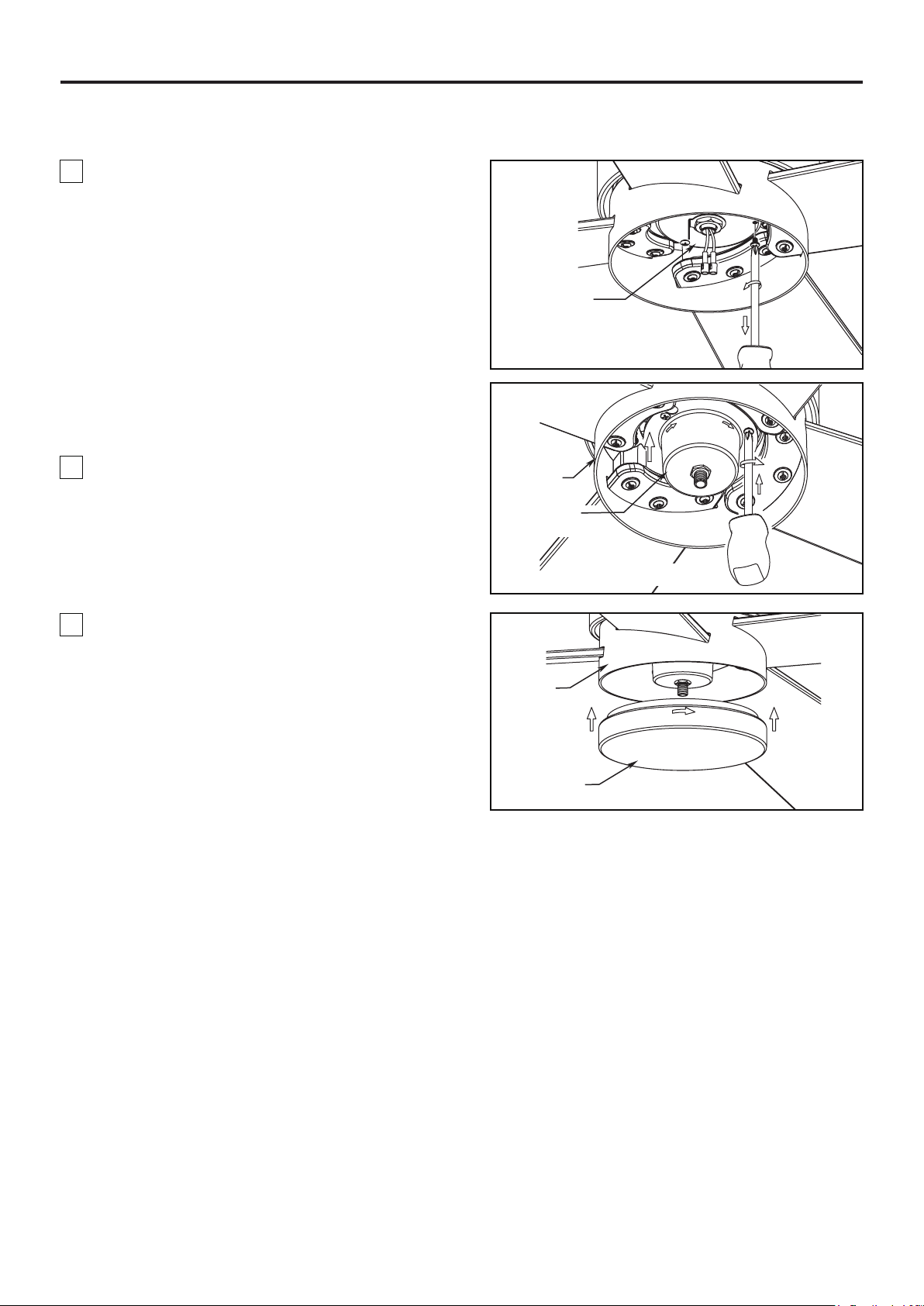
1. Coloque las palas a través de las ranuras en la
cubierta del motor y fije la unidad del motor usando
los 3/16˝-24 Tornillo de cabeza troncocónica.
Asegúrese de que los tornillos fijan adecuadamente
las palas al centro del motor estando éstas colocadas
correctamente. (Figura 1)
3/16˝-24 Tornillo de cabeza
troncocónica con arandela
plana/arandela de resorte
(3 cada uno por aspa)
3/16˝-24 Tornillo de cabeza
troncocónica con arandela
plana/arandela de resorte
29
Cómo ensamblar su el kit de iluminación o la tapa
Motor
Motor
Figura 1
Figura 2
1. Extraiga uno de los tres tornillos del soporte
2. Instale la cubierta del cable del kit de iluminación
en la unidad del motor usando las dos ranuras con
clave. Sustituya el tornillo extraído y fije bien los tres
tornillos. (Figura 2)
3. Monte el la tapa de acero en la unidad del motor
girándolo en el sentido de las agujas del reloj. (Figura 3)
ubicado en la parte inferior de la unidad del motor.
Guárdelos para después y afloje levemente los otros
dos tornillos. (Figura 1)
Cubierta del
cable del kit
de iluminación
NOTA: Si desea instalar el kit de iluminación,
sáltese este al paso 4.
Opción A--Para su uso con la tapa de acero
Motor
Figure 3
Tapa de acero
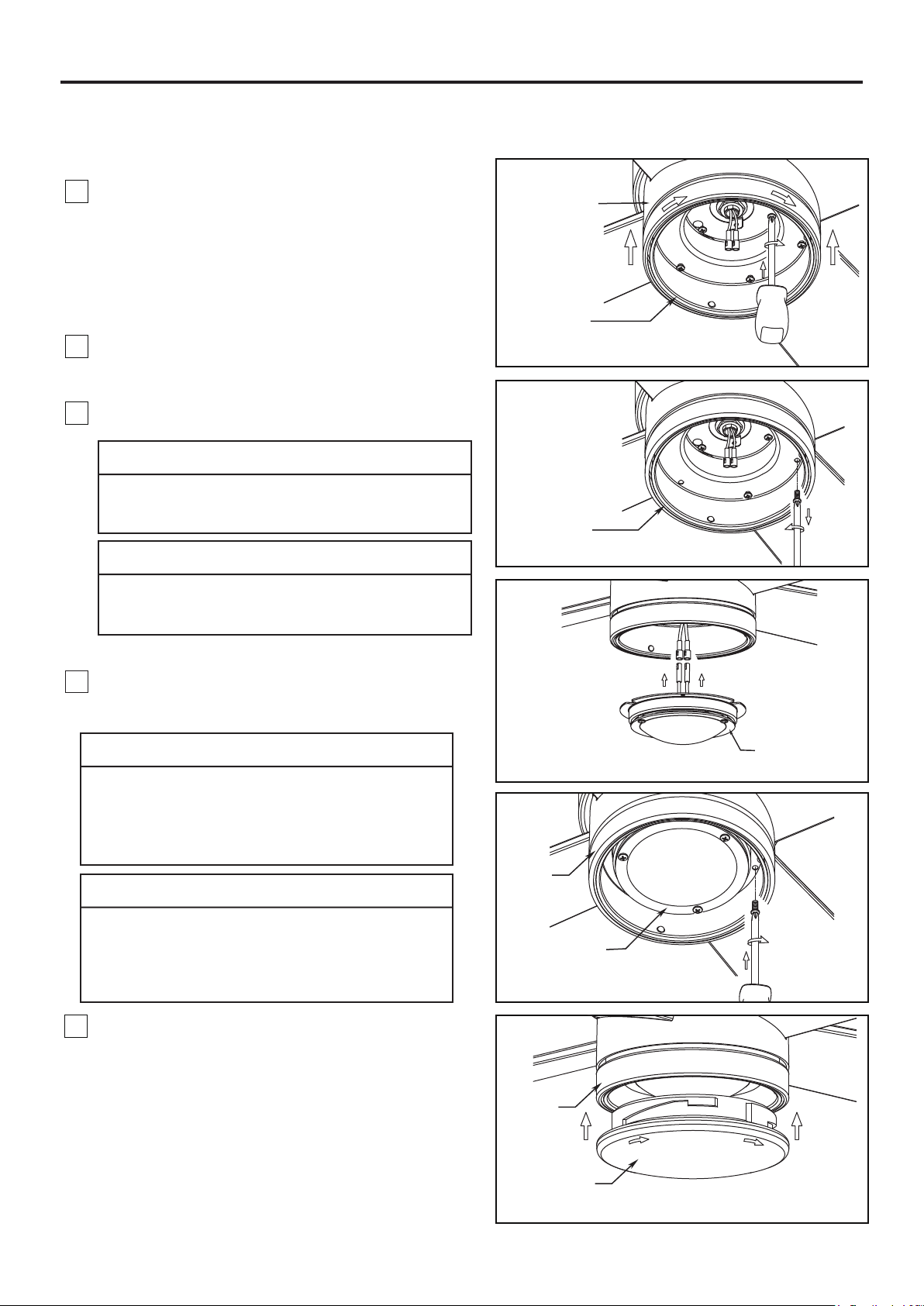
Figura 4
Motor
Figura 8
Figura 5
Figura 6
Figura 7
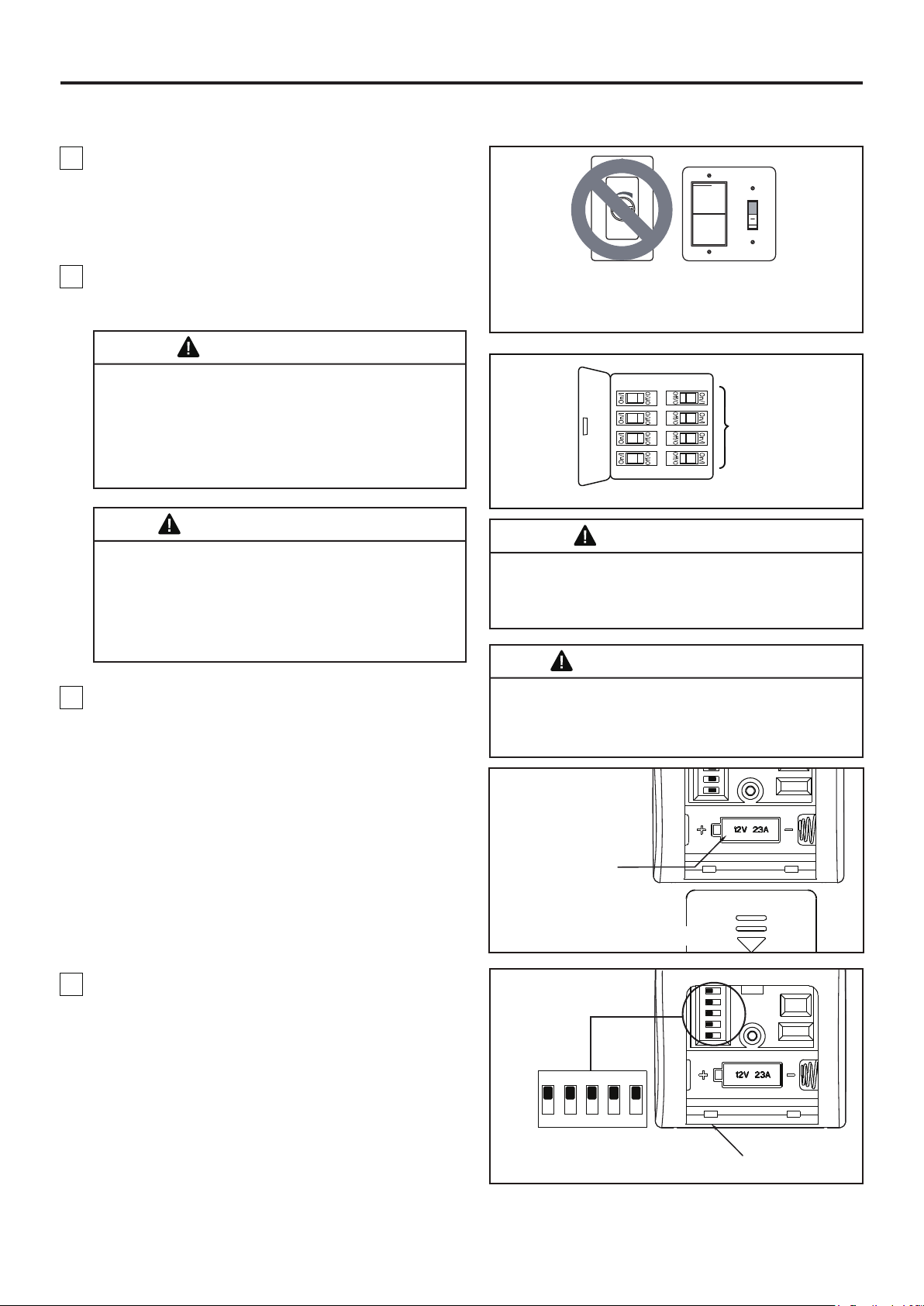
5. Extraiga el tres tornillos del ensamble del kit de
iluminación y guárdelos para después. (Figura 5)
30
Cómo ensamblar su el kit de iluminación o la tapa (cont.)
Opción B--Para su uso con el kit de iluminación
4. Instale la ensamble del kit de iluminación en el
soporte utilizando las dos ranuras principales de
conexión. Vuelva a colocar el tercer tornillo y asegure
los tres tornillos. (Figura 4)
Ensamble del
kit de iluminación
Ensamble del
kit de iluminación
Ensamble
del kit de
iluminación
Ensamble
del kit de
iluminación
Unidad de
luz LED
Unidad de
luz LED
6. Instale el conector de 2 clavijas desde unidad de luz
LED conexión a la unidad del motor. (Figura 6)
PRECAUCIÓN
A fin de reducir el riesgo descargas eléctricas,
desconecte el circuito de suministro eléctrico al
ventilador antes de instalar el kit de iluminación.
ATTENTION
Pour réduire le risque d'électrocution, débranchez le
circuit d'alimentation électrique du ventilateur avant
d'installer le kit d'éclairage.
7. Instale la unidad LED en la ensamble del kit de
iluminación usandos el tornillo previamente retirado
y asegure los tres tronillos. (Figura 7)
ATTENTION
La source lumineuse est conçue pour cette application
spécifique et peut surchauffer si par un personnel non
formé. Si un entretien est nécessaire, le produit doit
être retourné à un centre de service agréé pour examen
ou réparation.
PRECAUCIÓN
La fuente de luz está diseñado para esta aplicación
específica y puede recalentarse si reparado por
personal no capacitado. Si se requiere ningún tipo de
servicio, el producto debe ser devuelto a un centro de
servicio autorizado para su revisión o reparación.
8. Asegure el vidrio en la ensamble del kit de
iluminación girándolo en el sentido de las agujas del
reloj. Gire el vidrio gradualmente
hasta que encaje
en la ensamble del kit de iluminación.
Sin
apretar demasiado. (Figura 8)
Vidrio
31
Cómo utilizar su ventilador de techo
1. IMPORTANTE: El uso de un regulador de la
intensidad completa (no incluido) para controlar la
velocidad del ventilador dañará el dispositivo. Para
reducir el riesgo de incendio o descarga eléctrica, no
utilice dicho regulador para controlar la velocidad del
ventilador. (Figura 1)
2. Restaure la fuente de alimentación de la toma de
corriente enciendo la electricidad del fusible principal.
(Figura 2)
ADVERTENCIA
No utilice este ventilador con un controlador variable
de pared (Rheostat) o un regulador de intensidad. Si lo
hiciera podría dañar la unidad del mando a distancia
del ventilador de techo.
Figura 1
Solo para referencia visual-no ha sido
diseñado para cubrir todos los tipos de controles
Figura 2
Principal Caja
De Fusibles
3. Para que el ventilador sea functional, instale las pila
(incluidas) de 23A/12V en el transmisor del mando a
distancia. Mientras el ventilador esté apagado. A
continuación, siga el proceso de fijación remota de
código. Si no se utiliza el ventilador durante un largo
periodo de tiempo, extraiga la batería para evitar
cualquier daño al transmisor. Almacene el mando a
distancia en un lugar alejado del calor o la humedad
excesiva. (Figura 3)
Batería de
23A/12V (1 pc)
Figura 3
4. Para configurar el código del mando a distancia a
las mismas posiciones que en el receptor. Mueva los
interruptores de código hasta colocar elcódigo de
selección en la posición arriba o abajo. Con un
destornillador pequeño o con una lapicera (no se
incluye) deslice firmemente hacia arriba o hacia abajo.
(Figura 4)
NOTA: Los ajustes de fábricas vienen con todos los
interruptores hacia arriba. No utilice esta posición.
NOTA: El mando a distancia incluido en este
ventilador tiene 32 combinaciones diferentes de
códigos. Para evitar posibles interferencias desde o
hacia otros mandos a distancia, modifique el código
de combinación de su transmisor y receptor.
AVERTISSEMENT
N'utilisez pas ce ventilateur avec un contrôleur mural
(rhéostat) variable ou un gradateur. Cela pourrait
endommager la télécommande du ventilateur de
plafond.
Figura 4
Mando a distancia
Interruptores
ON DIP
1 2 3 4 5
ADVERTENCIA
Compruebe que todas las conexiones realizadas
correctamente, incluyendo la toma de tierra, y que no se
visualizan ningún cable pelado en los conectores de
cables, con la excepción del cable de toma de tierra. No
utilice el ventilador hasta que las palas estén colocadas
en su lugar, ya que de lo contrario se podría causar
ruido y daños.
Vérifiez que tous les raccordements sont bien serrés, y
compris la mise à la terre, et qu’aucun fil dénudé n’est
visible au niveau des capuchons de connexion, à
l’exception du fil de mise à la terre. Ne faites pas
fonctionner le ventilateur avant d'avoir installé les pales.
Du bruit et des dommages au ventilateur pourraient en
résulter.
AVERTISSEMENT
Cómo utilizar su ventilador de techo (cont.)
32
Figura 5
Cómo instalar su mando a distancia
1. Instalación de la placa de la pared: (Figura 1)
Fije la placa de la pared usando los dos tornillos
suministrados.
Tornillos (2)
Placa de la
pared
6. Si desea que el flujo de aire se desplace en la
dirección opuesta, apague el ventilador y espere a
que las aspas se detengan. Luego deslice el
conmutador inversor a la posición contraria y vuelva
a encender el ventilador. (Figura 6)
Información sobre el interruptor de reversa
Temporada Dirección de rotación Posición del interruptor
En dirección con traria
a las manecillas del reloj
En dirección de las
manecillasdel reloj
Verano Izquierda
DerechaInvierno
• Luz LED del indicador: Velocidad del
ventilador
• Botón: Apaga el ventilador.
• Velocidad del ventilado:
Enciende el ventilador y aumenta la velocidad.
Enciende el ventilador y disminuye la velocidad.
• Botón de la lámpara: Enciende o apaga la luz.
Pulse el botón enciende la luz y mantenga el
regulador para aumentar o disminuir la
intensidad de la luz y suéltelo cuando haya
elegido el nivel deseado.
Cuando el luz estar en de encendido toque
este botón para cambiar temperatura de color.
• Temporizador de apagado automático:
Pulse y tanto el ventilador y la iluminación se
apagarán tras 1 hora.
Pulse y tanto el ventilador y la iluminación se
apagarán tras 3 hora.
Pulse y tanto el ventilador y la iluminación se
apagarán tras 6 hora.
5. Funciones del control remoto: (Figura 5)
Interruptor
del Reversa
Figura 6
Figura 1
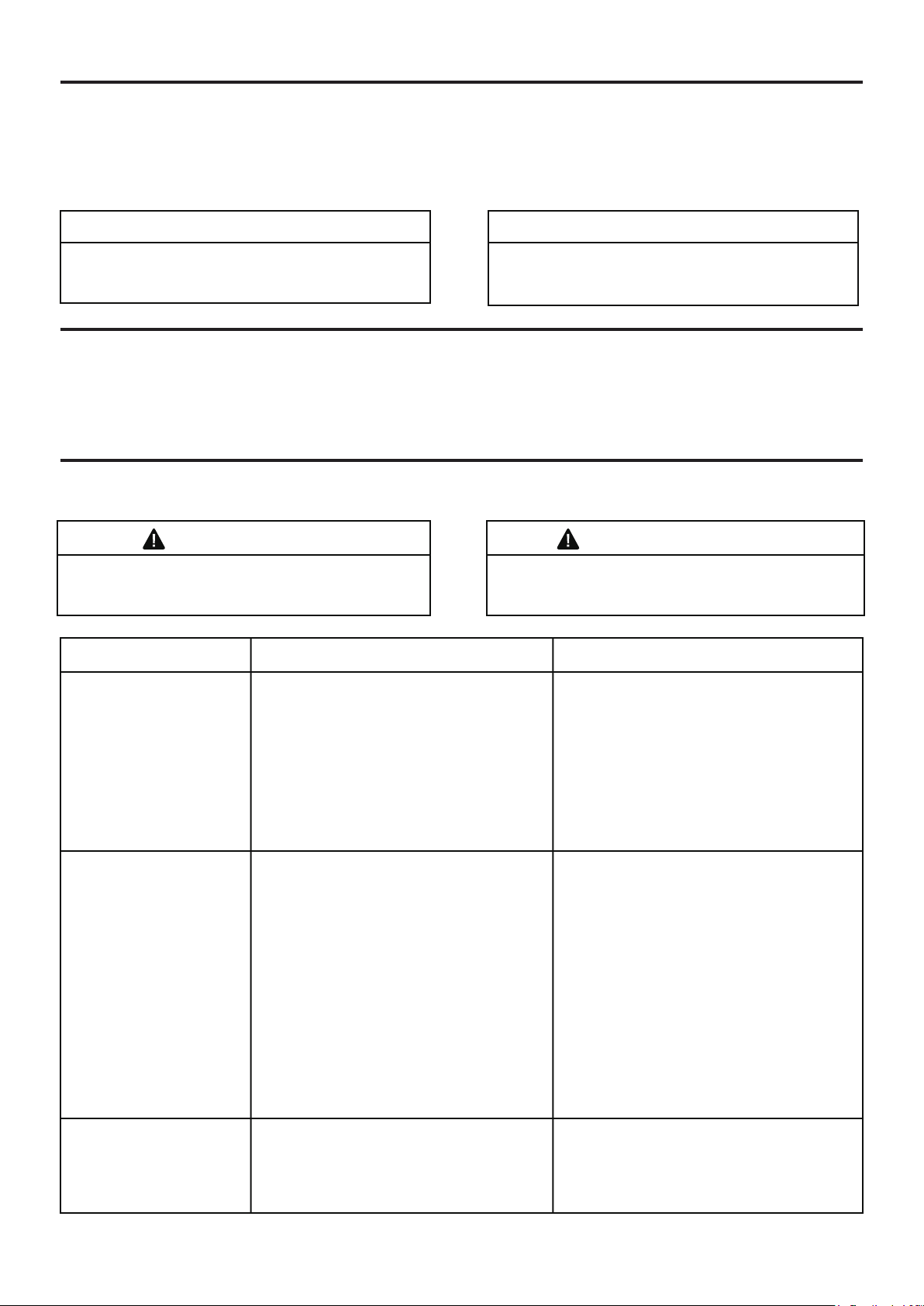
33
El único mantenimiento necesario para el ventilador de techo es una limpieza periódica. Al llevar a cabo la limpieza,
use sólo un cepillo suave o un paño sin pelusas, para evitar rayar el acabado. No se requieren agentes abrasivos de
limpieza; los mismos deben evitarse para prevenir daños en el acabado.
Mantenimiento
Se recomienda limpiar el polvo de las aspas
periódicamente. Lo mejor es utilizar un plumero.
Evite usar agua, productos de limpieza o trapos
ásperos, que pueden combar o dañar las aspas.
Limpieza de las aspas
Solución de problemas
Problema Causa posible Solución sugerida
1. Controle los fusibles del circuito principal y derivado
o los disyuntores.
2. Controle las conexiones eléctricas del ventilador y
del interruptor en las cajas de los interruptores.
PRECAUCIÓN: ¡Asegúrese de que el suministro
principal de electricidad esté desconectado!
3. Sustituir con una pila nueva.
1. Ajuste las aspas al ventilador antes de ponerlo en
funcionamiento.
2. Asegúrese de que todos los tornillos de la caja del
motor estén bien ajustados (pero no en exceso).
1. EL VENTILADOR NO
ARRANCA
2. EL VENTILADOR HACE
RUIDO
3. EL VENTILADOR
OSCILA EN EXCESO
1. El fusible o el disyuntor están fundidos.
2. Las conexiones eléctricas del ventilador o del
interruptor en la caja del interruptor están flojas.
3. Pila agotada del mando a distancia.
4. Asegúrese de que el conmutador inversor esté
completamente a un lado.
4. El conmutador inversor se encuentra en posición
neutra.
4. Algunos motores de ventilador son sensibles a las
señales de los controles de velocidad de estado
sólido variables. Los controles de estado sólido no
son recomendables. Escoja un método de control
alternativo.
4. Ruido del motor provocado por el control de
velocidad de estado sólido variable.
1. Las aspas no están sujetas al ventilador
1. Asegúrese de que los tornillos que fijan los aspas al
buje del motor del ventilador estén bien ajustados.
1. Los tornillos que aseguran los aspas al buje del
motor están flojos.
2. Hay tornillos flojos en la caja del motor.
2. Ajuste los tornillos del soporte de suspensión de la
caja de distribución eléctrica y asegúrela.
2. El soporte de suspensión o la caja de distribución
eléctrica del techo no están bien asegurados.
3. Asegúrese de que los conectores de cables en la
caja del interruptor no produzcan ruido al rozar unos
con otros o al rozar la pared interior de la caja del
interruptor.
3. Los conectores de cables dentro de la caja hacen
ruido.
PRECAUCIÓN
No utilice solventes para limpiar el ventilador de
techo. Podrían dañar el motor o las aspas y ocasionar
posibles descargas eléctricas.
ATTENTION
N'utilisez pas d'eau pour nettoyer votre ventilateur de
plafond. Cela pourrait endommager le moteur ou la
finition, et créer une possibilité d'électrocution.
Para su propia seguridad, desconecte la electricidad
de la caja de fusibles o disyuntor antes de solucionar
problemas en su ventilador.
ADVERTENCIA
Pour votre sécurité, placez le coffret à fusibles ou le
disjoncteur hors tension avant de tenter d’identifier
tout problème pouvant affecter votre ventilateur.
AVERTISSEMENT
ATTENTION: Assurez-vous que l'alimentation
électrique principale est coupée !
PRECAUCIÓN: ¡Asegúrese de que el suministro
principal de electricidad esté desconectado!
ATTENTION: Assurez-vous que l'alimentation
électrique principale est coupée !
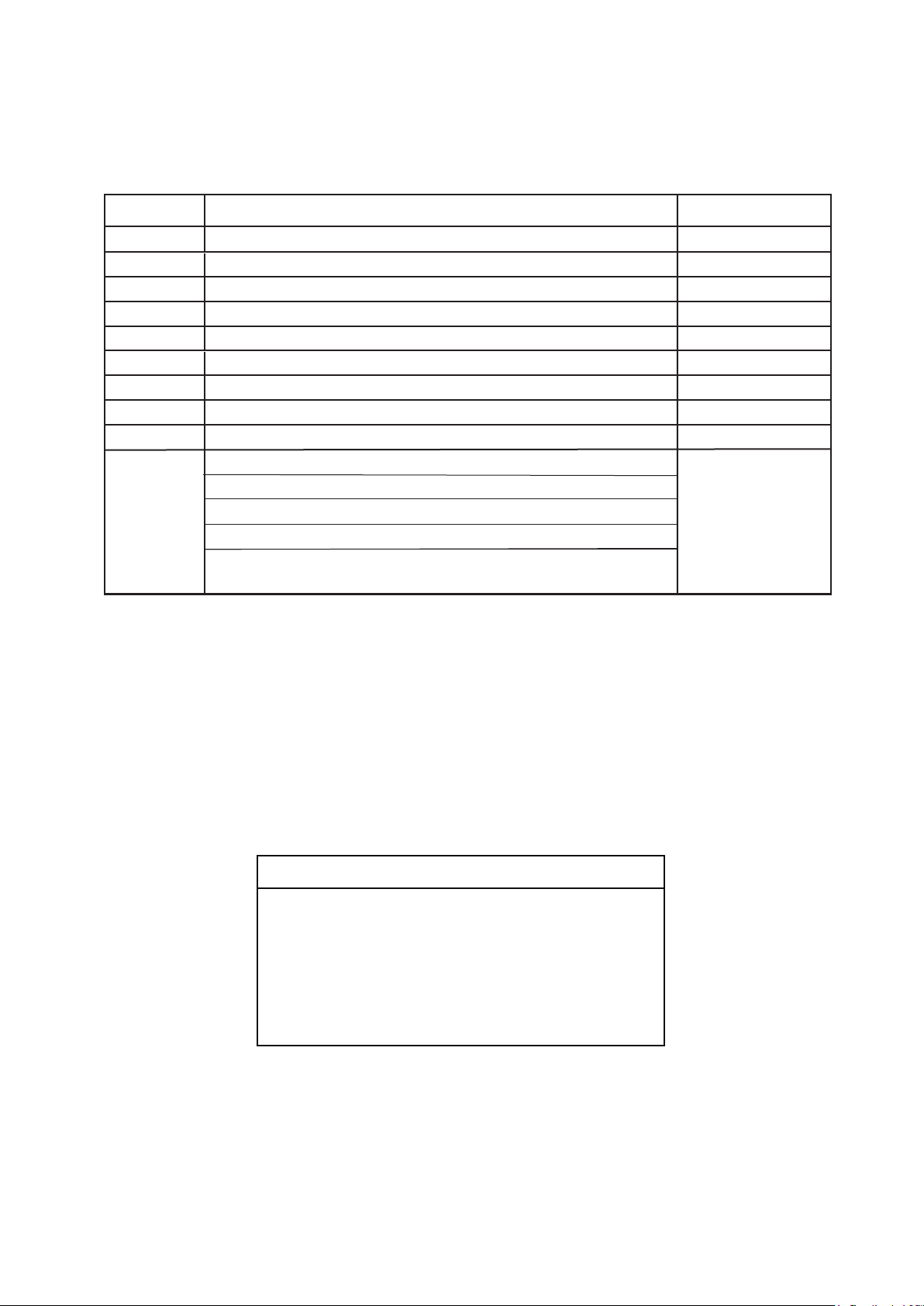
34
Lista de piezas
Modelo N.° FPS8553**
Antes de desechar los materiales de embalaje, asegúrese de haber extraído todas las piezas
Cómo hacer un pedido de piezas
Al hacer un pedido de piezas de repuesto,
proporcione siempre la siguiente información:
• Número de pieza
• Descripción de la pieza
• Número de modelo del ventilador
Póngase en contacto con su tienda para obtener
las piezas de repuesto.
N.° de Ref.
1
2
3
4
5
7
6
8
Cubierta del cable del kit de iluminación
Tapa de acero
Mano a distancia
Receptor
9
10
Ensamble del kit de iluminación / vidrio
Unidad de luz LED
Conectores de cables (4)
Kit de cable de seguridad
Bolsa de accesorios que contiene:
Bolsa de accesorios para el montaje de aspas que contiene:
Juego de aspas
Unidad del motor
Descripción Pieza # N.°
Unidad de soporte del ventilador
3/16˝-24 Tornillo de cabeza troncocónica con arandela
plana/arandela de resorte (13)
AP855301**
AMA8553**
AP855304**
AP855308**
AP855311
AP855309BL
AP855310**
TR800
RCCA050050005
HDWFPS8553**
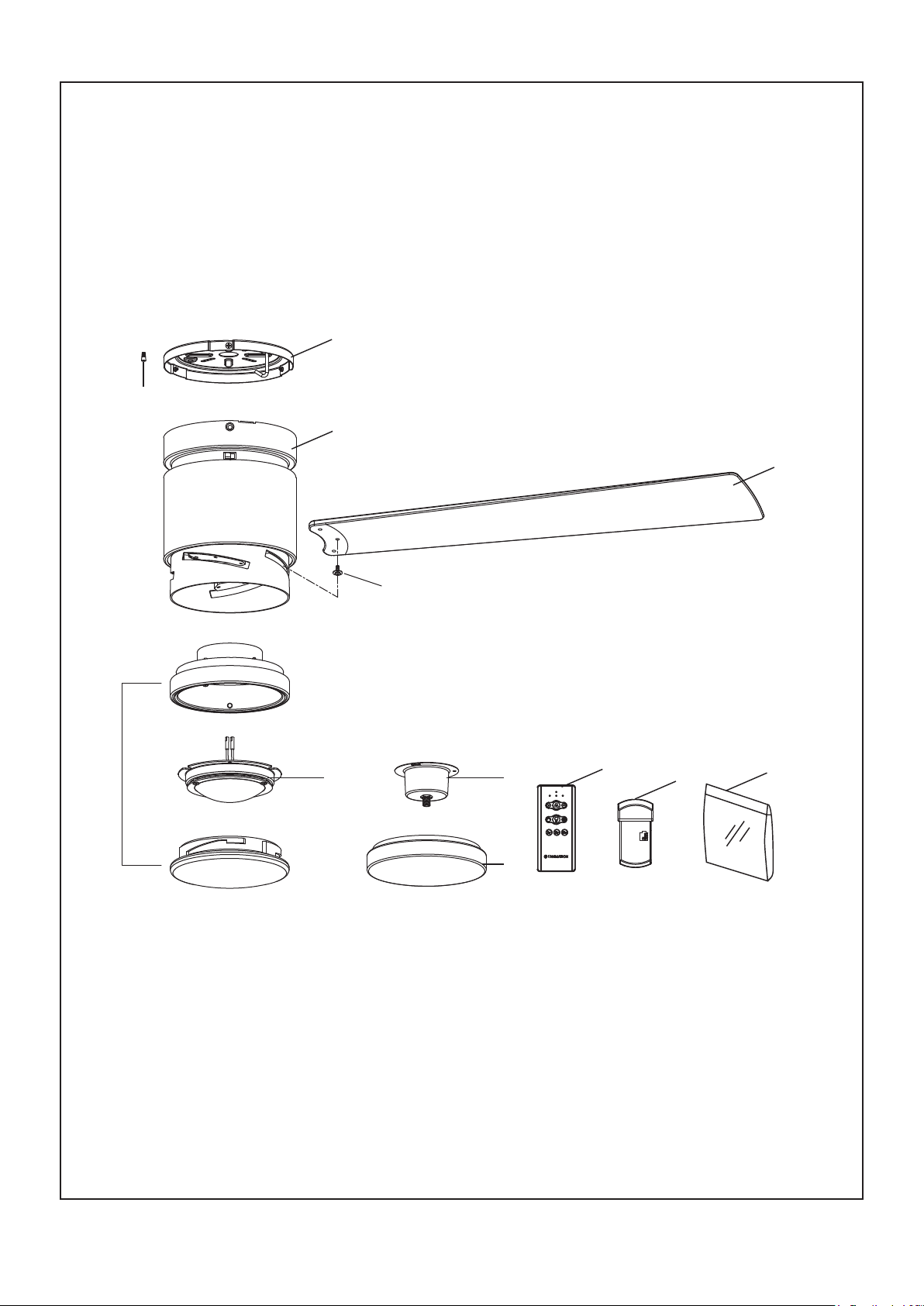
35
Modelo FPS8553
Ilustración del despiece
NOTA: La ilustración que se muestra no está hecha a escala y su c guración real y/o terminación puede variar.
1
2
3
10
9
8
4
5 6
7
10
10
™
Kwartet

2020/12 V.01
Copyright 2020 Fanimation
10983 Bennett Parkway
Zionsville, IN 46077
Llame Sin Cargo al: 888-567-2055
Desde fuera de los EE.UU. llame al : 317-733-4113
www.fanimation.com
FAX: 866-482-5215
