Contents
Precautions
Operating Precautions
User Maintenance
Battery
Before Getting Started...
General Guide
Indicators
Navigating Between Modes
Mode Overview
Charging
Viewing the Face in the Dark
Time Adjustment
Adjusting the Current Time Setting
World Time
Checking World Time
Specifying a World Time City
Alarm and Hourly Time Signal
Configuring Alarm Settings
Configuring the Hourly Time Signal Setting
Turning Off an Alarm or the Hourly Time Signal
Digital Compass
Taking a Compass Reading
Saving a Bearing to an Objective (Bearing
Memory)
Calibrating Compass Readings
Calibrating Compass Readings
Setting Up for True North Readings
(Magnetic Declination Calibration)
Digital Compass Reading Precautions
Altitude Measurement
Checking the Current Altitude
Calibrating Altitude Readings (Offset)
Setting a Reference Altitude and Taking
Altitude Differential Readings
Setting the Measurement Interval for Auto
Record Data and Climb Record Data
Changing Displayed Information
Recording Altitude Readings
Specifying the Altitude Measurement Unit
Altitude Reading Precautions
Barometric Pressure and
Temperature Measurement
Measuring Barometric Pressure and
Temperature
Checking Changes in Barometric Pressure
Over Time
Checking the Change Between Two
Barometric Pressure Readings (Barometric
Pressure Differential)
Sudden Barometric Pressure Change
Indications
Correcting Measured Barometric Pressure
and Temperature Values (Offset)
Specifying the Barometric Pressure Unit
Specifying the Temperature Measurement
Unit
Barometric Pressure and Temperature
Reading Precautions
Viewing Altitude Records
Viewing Recorded Data
Deleting Data
Sunrise and Sunset Times
Looking Up Today’s Sunrise and Sunset
Times
Looking Up Sunrise and Sunset Times by
Specifying a Day
Looking Up Sunrise and Sunset Times by
Specifying a Location
Stopwatch
Measuring Elapsed Time
Measuring a Split Time
Timing the First and Second Place Finishers
Timer
Setting a Start Time
Using the Timer
Other Settings
Enabling the Button Operation Tone
Configuring Power Saving Function Settings
Other Information
City Table
Specifications
Troubleshooting
Watch Operation Guide 3513
1
MA2207-EA
OPUM-G
© 2022 CASIO COMPUTER CO., LTD.
Precautions
Operating Precautions
●
Water Resistance
●
The information below applies to watches
with WATER RESIST or WATER
RESISTANT marked on the back cover.
Water Resistance Under Daily Use
Marking on watch front or on
back cover
No BAR
mark
Example of Daily Use
Hand washing, rain Yes
Water-related work, swimming No
Windsurfing No
Skin diving No
Enhanced Water Resistance Under Daily
Use
5 Atmospheres
Marking on watch front or on
back cover
5BAR
Example of Daily Use
Hand washing, rain Yes
Water-related work, swimming Yes
Windsurfing No
Skin diving No
10 Atmospheres
Marking on watch front or on
back cover
10BAR
Example of Daily Use
Hand washing, rain Yes
Water-related work, swimming Yes
Windsurfing Yes
Skin diving Yes
20 Atmospheres
Marking on watch front or on
back cover
20BAR
Example of Daily Use
Hand washing, rain Yes
Water-related work, swimming Yes
Windsurfing Yes
Skin diving Yes
●
Do not use your watch for scuba diving or
other types of diving that requires air tanks.
●
Watches that do not have WATER RESIST
or WATER RESISTANT marked on the
back cover are not protected against the
effects of sweat. Avoid using such a watch
under conditions where it will be exposed to
large amounts of sweat or moisture, or to
direct splashing with water.
●
Even if a watch is water resistant, note the
usage precautions described below. Such
types of use reduce water resistance
performance and can cause fogging of the
glass.
ー
Do not operate the crown or buttons while
your watch is submersed in water or wet.
ー
Avoid wearing your watch while in the
bath.
ー
Do not wear your watch while in a heated
swimming pool, sauna, or any other high
temperature/high humidity environment.
ー
Do not wear your watch while washing
your hands or face, while doing
housework, or while performing any other
task that involves soaps or detergents.
●
After submersion in seawater, use plain
water to rinse all salt and dirt from your
watch.
●
To maintain water resistance, have the
gaskets of your watch replaced periodically
(about once every two or three years).
●
A trained technician will inspect your watch
for proper water resistance whenever you
have its battery replaced. Battery
replacement requires the use of special
tools. Always request battery replacement
from your original retailer or from an
authorized CASIO service center.
●
Some water-resistant watches come with
fashionable leather bands. Avoid
swimming, washing, or any other activity
that causes direct exposure of a leather
band to water.
●
The inside surface of the watch glass may
fog when the watch is exposed to a sudden
drop in temperature. No problem is
indicated if the fogging clears up relatively
quickly. Sudden and extreme temperature
changes (such as coming into an air
conditioned room in the summer and
standing close to an air conditioner outlet,
or leaving a heated room in the winter and
allowing your watch to come into contact
with snow) can cause it to take longer for
glass fogging to clear up. If glass fogging
does not clear up or if you notice moisture
inside of the glass, immediately stop using
your watch and take it to your original
retailer or to an authorized CASIO service
center.
●
Your water-resistant watch has been tested
in accordance with International
Organization for Standardization
regulations.
●
Band
●
Tightening the band too tightly can cause
you to sweat and make it difficult for air to
pass under the band, which can lead to skin
irritation. Do not fasten the band too tightly.
There should be enough room between the
band and your wrist so you can insert your
finger.
●
Deterioration, rust, and other conditions can
cause the band to break or come off of your
watch, which in turn can cause band pins to
fly out of position or to fall out. This creates
the risk of your watch falling from your wrist
and becoming lost, and also creates the risk
of personal injury. Always take good care of
your band and keep it clean.
●
Immediately stop using a band if you even
notice any of the following: loss of band
flexibility, band cracks, band discoloration,
band looseness, band connecting pin flying
or falling out, or any other abnormality. Take
your watch to your original retailer or to a
CASIO service center for inspection and
repair (for which you will be charged) or to
have the band replaced (for which you will
be charged).
Watch Operation Guide 3513
2
●
Temperature
●
Never leave your watch on the dashboard
of a car, near a heater, or in any other
location that is subject to very high
temperatures. Do not leave your watch
where it will be exposed to very low
temperatures. Temperature extremes can
cause your watch to lose or gain time, to
stop, or otherwise malfunction.
●
Leaving your watch in an area hotter than
+60 °C (140 °F) for long periods can lead to
problems with its LCD. The LCD may
become difficult to read at temperatures
lower than 0 °C (32 °F) and greater than
+40 °C (104 °F).
●
Impact
●
Your watch is designed to withstand impact
incurred during normal daily use and during
light activity such as playing catch, tennis,
etc. Dropping your watch or otherwise
subjecting it to strong impact, however, can
lead to malfunction. Note that watches with
shock-resistant designs (G-SHOCK,
BABY-G, G-MS) can be worn while
operating a chain saw or engaging in other
activities that generate strong vibration, or
while engaging in strenuous sports
activities (motocross, etc.)
●
Magnetism
●
Though operation of your watch normally is
not affected by magnetism, its accuracy
may be affected if the watch itself becomes
magnetized. Also, very strong magnetism
(from medical equipment, etc.) should be
avoided because it can cause malfunction
of your watch and damage to electronic
components.
●
Electrostatic Charge
●
Exposure to very strong electrostatic
charge can cause your watch to display the
wrong time. Very strong electrostatic
charge even can damage electronic
components.
●
Electrostatic charge can cause the display
to go blank momentarily or cause a rainbow
effect on the display.
●
Chemicals
●
Do not allow your watch to come into
contact with thinner, gasoline, solvents,
oils, or fats, or with any cleaners, adhesives,
paints, medicines, or cosmetics that contain
such ingredients. Doing so can cause
discoloration of or damage to the resin
case, resin band, leather, and other parts.
●
Storage
●
If you do not plan to use your watch for a
long time, thoroughly wipe it free of all dirt,
sweat, and moisture, and store it in a cool,
dry place.
●
Resin Components
●
Allowing your watch to remain in contact
with other items or storing it together with
other items for long periods while it is wet
can cause color on resin components to
transfer to the other items, or the color of the
other items to transfer to the resin
components of your watch. Be sure to dry
off your watch thoroughly before storing it
and make sure it is not in contact with other
items.
●
Leaving your watch where it is exposed to
direct sunlight (ultraviolet rays) for long
periods or failure to clean dirt from your
watch for long periods can cause it to
become discolored.
●
Friction caused by certain conditions
(strong external force, sustained rubbing,
impact, etc.) can cause discoloration of
painted components.
●
If there are printed figures on the band,
strong rubbing of the printed area can cause
discoloration.
●
Leaving your watch wet for long periods can
cause fluorescent color to fade. Wipe the
watch dry as soon as possible after it
becomes wet.
●
Semi-transparent resin parts can become
discolored due to sweat and dirt, and if
exposed to high temperatures and humidity
for long periods.
●
Daily use and long-term storage of your
watch can lead to deterioration, breaking, or
bending of resin components. The extent of
such damage depends on usage conditions
and storage conditions.
●
Leather Band
●
Allowing your watch to remain in contact
with other items or storing it together with
other items for long periods while it is wet
can cause the color of the leather band to
transfer to the other items or the color of the
other items to transfer to the leather band.
Be sure to dry off your watch thoroughly with
a soft cloth before storing it and make sure
it is not in contact with other items.
●
Leaving a leather band where it is exposed
to direct sunlight (ultraviolet rays) for long
periods or failure to clean dirt from a leather
band for long periods can cause it to
become discolored.
CAUTION:
Exposing a leather band to rubbing or dirt
can cause color transfer and discoloration.
●
Metal Components
●
Failure to clean dirt from metal components
can lead to formation of rust, even if
components are stainless steel or plated. If
metal components exposed to sweat or
water, wipe thoroughly with a soft,
absorbent cloth and then place the watch in
a well-ventilated location to dry.
●
Use a soft toothbrush or similar tool to scrub
the metal with a weak solution of water and
a mild neutral detergent, or with soapy
water. Next, rinse with water to remove all
remaining detergent and then wipe dry with
a soft absorbent cloth. When washing metal
components, wrap the watch case with
kitchen plastic wrap so it does not come into
contact with the detergent or soap.
Watch Operation Guide 3513
3
●
Bacteria and Odor Resistant Band
●
The bacteria and odor resistant band
protects against odor generated by the
formation of bacteria from sweat, which
ensures comfort and hygiene. In order to
ensure maximum bacteria and odor
resistance, keep the band clean. Use an
absorbent soft cloth to thoroughly wipe the
band clean of dirt, sweat, and moisture. A
bacteria and odor resistant band
suppresses the formation of organisms and
bacteria. It does not protect against rash
due to allergic reaction, etc.
●
Liquid Crystal Display
●
Display figures may be difficult to read when
viewed from an angle.
●
Watch with Data Memory
●
Allowing the battery to go dead, replacing
the battery, or having your watch repaired
can cause all data in watch memory to be
lost. Note that CASIO Computer Co., Ltd.
assumes no responsibility for any damages
or losses caused by data lost due to
malfunction or repair of your watch,
replacement of the battery, etc. Be sure to
keep separate written copies of all
important data.
●
Watch Sensors
●
A watch sensor is a precision instrument.
Never try to take it apart. Never try to insert
any objects into the openings of a sensor,
and take care to ensure that dirt, dust, or
other foreign matter does not get into it.
After using your watch where it has been
immersed in saltwater, rinse it thoroughly
with fresh water.
Note that CASIO Computer Co., Ltd.
assumes no responsibility for any
damage or loss suffered by you or any
third party arising through the use of your
watch or its malfunction.
User Maintenance
●
Caring for Your Watch
Remember that you wear your watch next to
your skin, just like a piece of clothing. To
ensure your watch performs at the level for
which it is designed, keep it clean by
frequently wiping with a soft cloth to keep your
watch and band free of dirt, sweat, water and
other foreign matter.
●
Whenever your watch is exposed to sea
water or mud, rinse it off with clean fresh
water.
●
For a metal band or a resin band with metal
parts, use a soft toothbrush or similar tool to
scrub the band with a weak solution of water
and a mild neutral detergent, or with soapy
water. Next, rinse with water to remove all
remaining detergent and then wipe dry with
a soft absorbent cloth. When washing the
band, wrap the watch case with kitchen
plastic wrap so it does not come into contact
with the detergent or soap.
●
For a resin band, wash with water and then
wipe dry with a soft cloth. Note that
sometimes a smudge like pattern may
appear on the surface of a resin band. This
will not have any effect on your skin or
clothing. Wipe with a cloth to remove the
smudge pattern.
●
Clean water and sweat from a leather band
by wiping with a soft cloth.
●
Not operating a watch crown, buttons, or
rotary bezel could lead to later problems
with their operation. Periodically rotate the
crown and rotary bezel, and press buttons
to maintain proper operation.
●
Dangers of Poor Watch Care
Rust
●
Though the metal steel used for your watch
is highly rust-resistant, rust can form if your
watch is not cleaned after it becomes dirty.
ー
Dirt on your watch can make it impossible
for oxygen to come into contact with the
metal, which can lead to breakdown of
the oxidization layer on the metal surface
and the formation of rust.
●
Rust can cause sharp areas on metal
components and can cause band pins to fly
out of position or to fall out. If you ever notice
any abnormality immediately stop using
your watch and take it to your original
retailer or to an authorized CASIO service
center.
●
Even if the surface of the metal appears
clean, sweat and rust in crevasses can soil
the sleeves of clothing, cause skin irritation,
and even interfere with watch performance.
Premature Wear
●
Leaving sweat or water on a resin band or
bezel, or storing your watch an area subject
to high moisture can lead to premature
wear, cuts, and breaks.
Skin Irritation
●
Individuals with sensitive skin or in poor
physical condition may experience skin
irritation when wearing a watch. Such
individuals should keep their leather band
or resin band particularly clean. Should you
ever experience a rash or other skin
irritation, immediately remove your watch
and contact a skin care professional.
Battery
●
The special rechargeable battery used by
your watch is not intended to be removed or
replaced by you. Use of a rechargeable
battery other than the special one specified
for your watch can damage your watch.
●
The rechargeable (secondary) battery is
charged when the solar panel is exposed to
light, so it does not require regular
replacement as the primary battery
requires. Note, however, that long use or
operating conditions can cause the
capacity or charging efficiency of the
rechargeable battery to deteriorate. If you
feel that the amount of operation provided
by charging is too short, contact your
original retailer or CASIO service center.
Watch Operation Guide 3513
4
Before Getting
Started...
This section provides an overview of the watch
and introduces convenient ways it can be
used.
●
Watch Features
●
Solar Charging
Sunlight and artificial light generate
electricity for watch operation as it charges.
●
World Time
Displays the current time in any one of 48
cities (31 time zones) around the globe and
UTC.
●
Alarm and Hourly Time Signal
An alarm sounds whenever a time specified
by you is reached.
●
Digital Compass
You can use the Compass Mode to
determine the direction of north, and to
check your bearing to a destination.
●
Altitude Measurement
You can use this mode to take an altitude
reading at your current location.
You can record the altitude, along with the
date and time of the measurement.
You can also measure the altitude
differential between two points.
●
Barometric Pressure and Temperature
Measurement
You can display the current barometric
pressure tendency, which helps you be on
the alert for noteworthy pressure changes.
The watch can be used to take current air
temperature readings.
●
Viewing Altitude Records
You can view or delete records of altitude
measurements.
●
Sunrise and Sunset Times
You can look up the sunrise and sunset
times for a specified date and location.
●
Stopwatch
The stopwatch performs elapsed time
measurement up to 999 hours, 59 minutes,
59.9 seconds in 1/10 second units.
●
Timer
Countdown from a start time specified by
you. An alarm sounds when the countdown
reaches zero.
Important!
●
This watch is not a special-purpose
measuring instrument. Measurement
function readings are intended for
general reference only.
●
Whenever using the Digital Compass
of this watch for serious trekking,
mountain climbing, or other activities,
be sure to always take along another
compass to confirm readings. If the
readings produced by the Digital
Compass of this watch are different
from those of the other compass,
perform 2-point calibration of the
Digital Compass to ensure better
accuracy.
ー
Compass readings and calibration
will not be possible if the watch is in
the vicinity of a permanent magnet
(magnetic accessory, etc.), metal
objects, high-voltage wires, aerial
wires, or electrical household
appliances (TV, computer,
cellphone, etc.)
l
Digital Compass
●
The watch’s Altimeter Mode calculates
and displays relative altitude based on
barometric pressure readings
produced by its pressure sensor.
Because of this, altitude values
displayed by the watch may be
different from your actual elevation
and/or sea level elevation indicated for
the area where you are located.
Regular calibration in accordance with
the local altitude (elevation)
indications is recommended.
l
Altitude Measurement
Note
●
The illustrations included in this
operation guide have been created to
facilitate explanation. An illustration
may differ somewhat from the item it
represents.
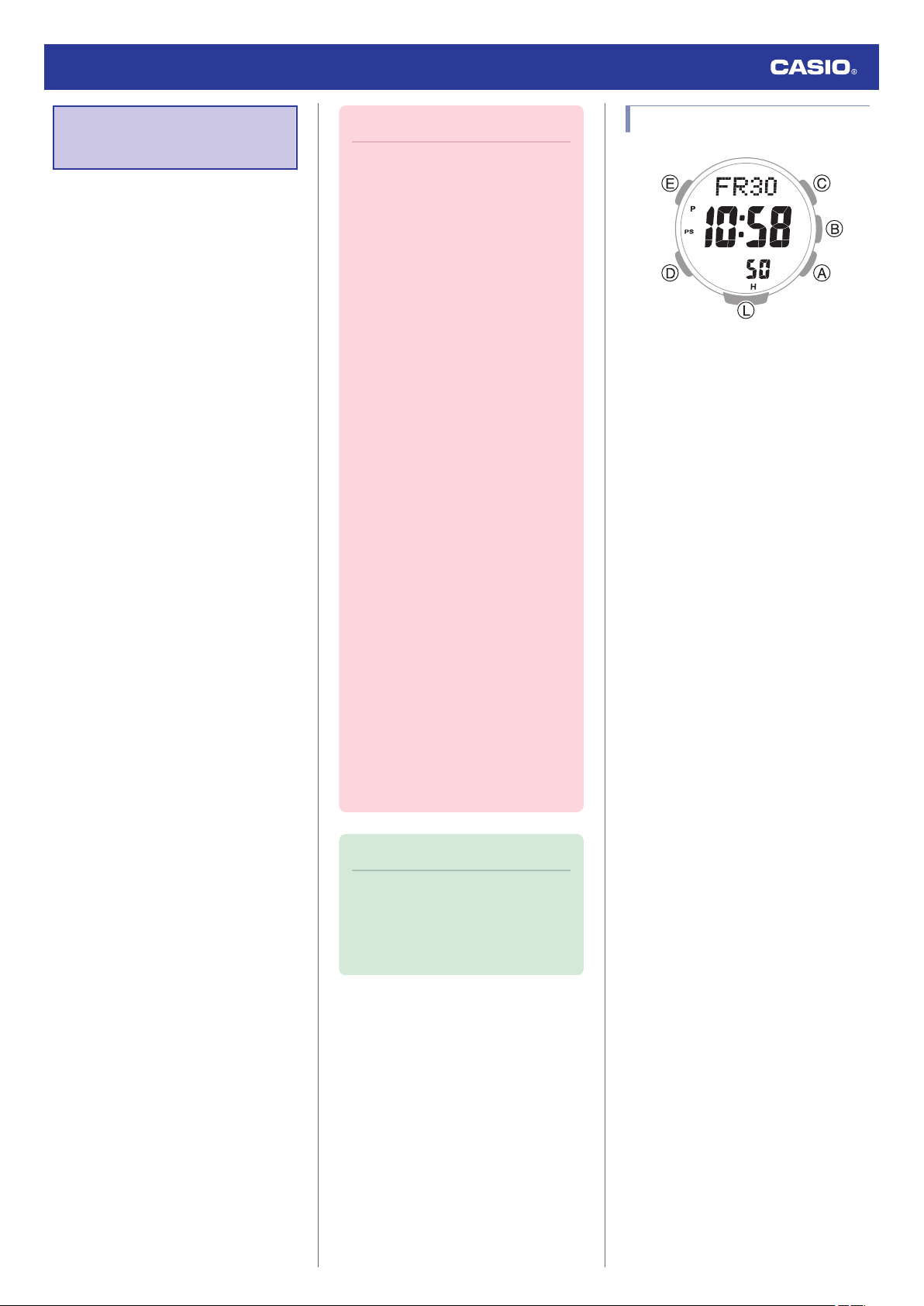
General Guide
A button
Pressing this button in the Timekeeping Mode
enters the Altimeter Mode.
B button
Pressing this button in the Timekeeping Mode
enters the Barometer/Temperature Mode.
C button
Pressing this button in the Timekeeping Mode
enters the Compass Mode.
D button
Each press cycles between watch modes.
In any mode, hold down this button for at least
two seconds to return to the Timekeeping
Mode.
E button
Pressing this button in the Timekeeping Mode
cycles between displays.
L button
Press to turn on illumination.
Watch Operation Guide 3513
5
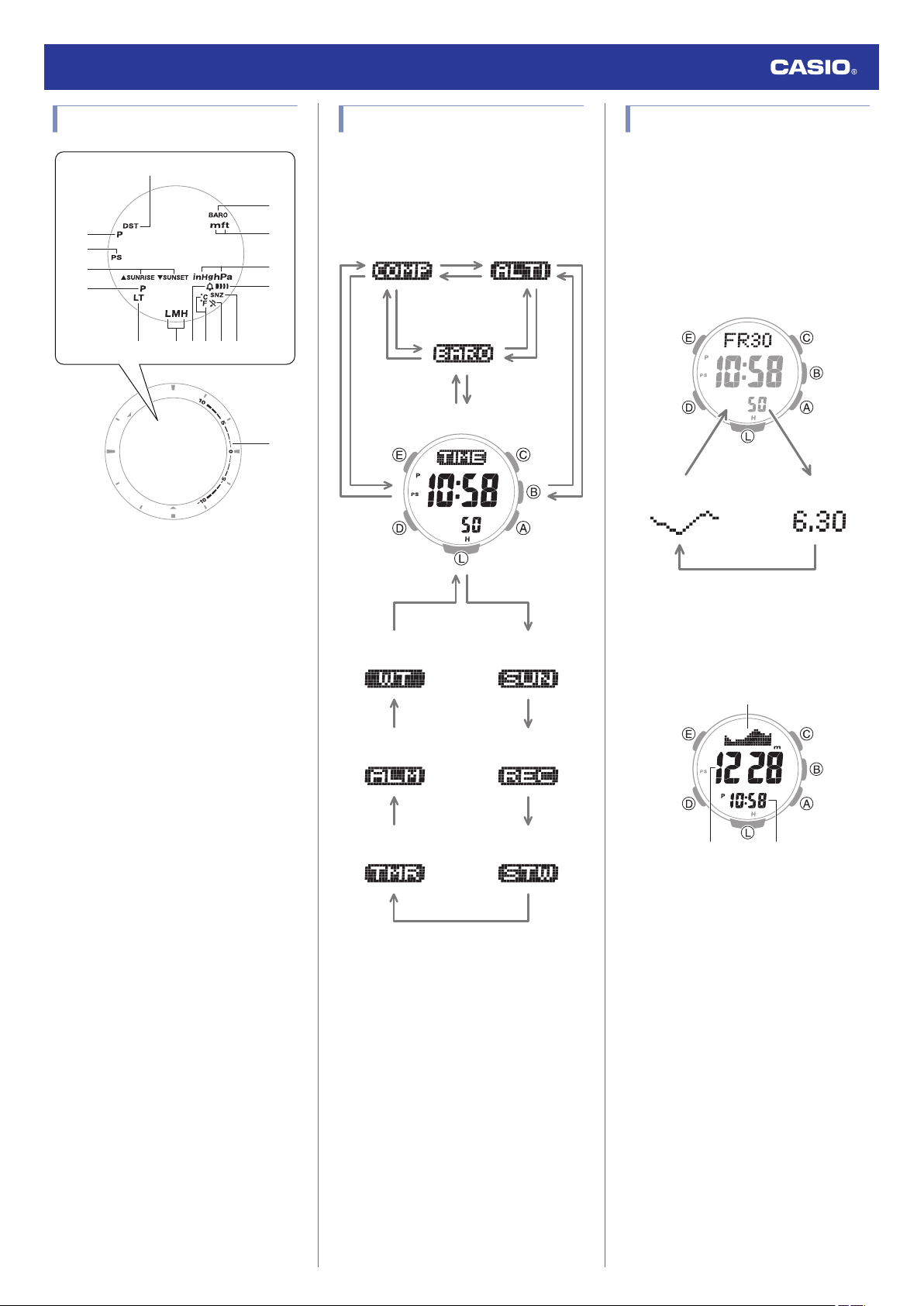
Indicators
②
②
③
④
①
⑤⑥⑧⑨⑩⑦
⑫
⑭
⑬
⑪
⑮
A Displayed while the watch is indicating
summer time.
B Displayed during p.m. times while 12-hour
timekeeping is being used.
C Displayed while Power Saving is enabled.
D Displayed when the watch is in the
Sunrise/Sunset Mode.
E Displayed while Auto Light is enabled.
F Shows the current charge level.
G Appears when the hourly time signal is on.
H Shows the temperature unit being used.
I Displayed while the button operation tone
is disabled.
J Displayed while the snooze alarm is
turned on.
K Displayed while barometric pressure
change indication is enabled.
L Shows the altitude unit being used.
M Shows the barometric pressure
measurement unit.
N Displayed when an alarm is turned on.
O Graphic display of the altitude/barometric
pressure differential.
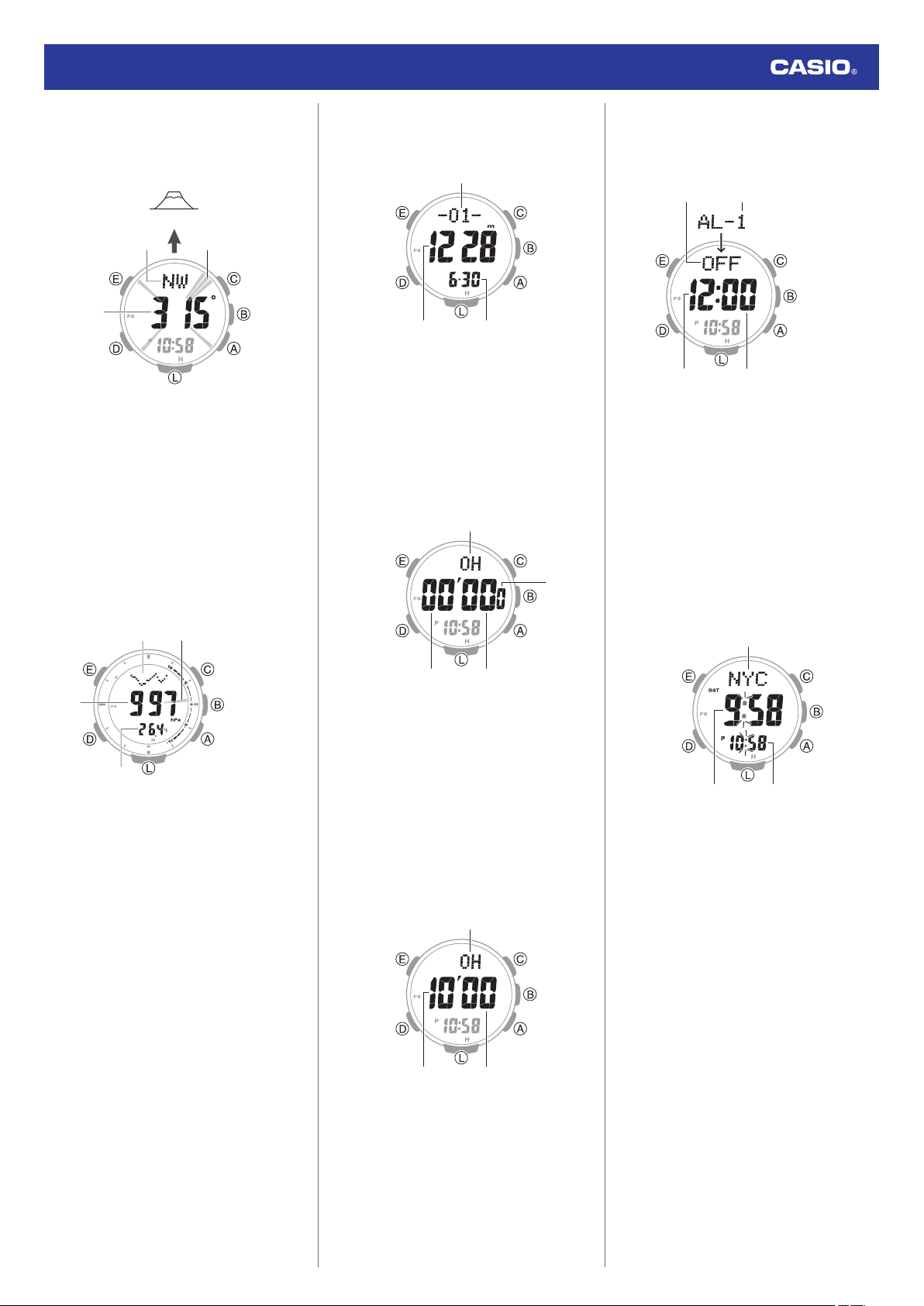
Navigating Between Modes
Your watch has the modes shown below.
●
To return to the Timekeeping Mode from
any other mode, hold down (D) for at least
two seconds.
D
B
C
D
B
A
D
D
DD
D
D
C
C
A
B
D
A
D
Timekeeping Mode
Sunrise/Sunset Mode
Data Recall Mode
World Time Mode
Stopwatch ModeTimer Mode
Alarm Mode
Barometer/
Temperature Mode
Altimeter ModeCompass Mode
Use the buttons in the illustration above to
navigate between modes.
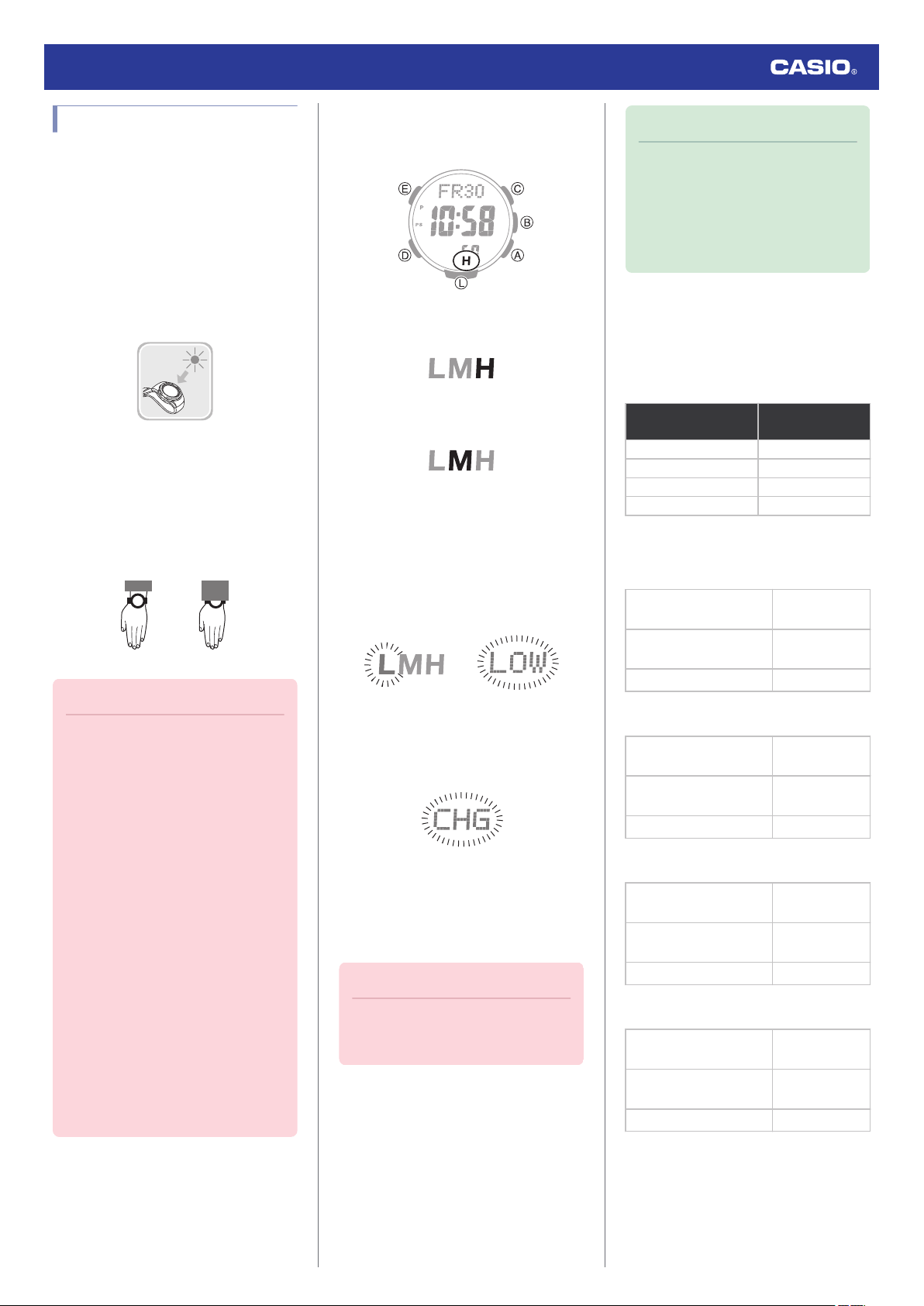
Mode Overview
●
Timekeeping Mode
In this mode, the digital display shows the
current date and time.
You can also display the items below in the
upper display area by pressing (E).
●
Month, day
●
Barometric pressure graph
E
EE
Day of the week, date
Month, dayBarometric pressure
graph
●
Altimeter Mode
Use this mode to take an altitude reading for
your current location.
l
Altitude Measurement
③②
①
Remeasure
A Altitude graph/altitude differential
B Altitude
C Current time
Watch Operation Guide 3513
6
●
Compass Mode
Use this mode to take direction and bearing
angle readings.
l
Digital Compass
②①
③
Remeasure
Objective
A Bearing at 12 o’clock
B Graphic pointer indicating north
C Bearing angle at 12 o’clock
●
Barometer/Temperature Mode
Use this mode to take barometric pressure
and temperature readings for your current
location.
l
Barometric Pressure and Temperature
Measurement
①④
③
②
Remeasure
A Barometric pressure graph
B Barometric pressure
C Temperature
D Barometric pressure differential graphic
●
Data Recall Mode
Use this mode to view altitude records.
l
Viewing Altitude Records
③②
①
Data search
Data search
A Record number
B Altitude
C Recording date
●
Stopwatch Mode
Use this mode to measure elapsed time.
l
Stopwatch
③②
①
④
Start/Stop
Split/reset
A Stopwatch hours
B Stopwatch minutes
C Stopwatch seconds
D Stopwatch 1/10 second
●
Timer Mode
Use this mode to countdown from a desired
start time.
l
Timer
③②
①
Start/Stop
Reset
A Timer hours
B Timer minutes
C Timer seconds
●
Alarm Mode
The watch will beep when an alarm time is
reached.
l
Alarm and Hourly Time Signal
④
②
①
③
Select alarm/
hourly time signal
On/off
Select alarm/
hourly time signal
A Alarm or hourly time signal status (on/off)
B Alarm number
C Alarm hour
D Alarm minute
●
World Time Mode
You can view the current time in 48 cities (31
time zones), and UTC (Coordinated Universal
Time) time.
l
World Time
③②
①
A City Codes (World Time Codes)
B World Time City current time
C Home City time
Watch Operation Guide 3513
7
Charging
This watch runs on power supplied from a
rechargeable (secondary) battery that is
charged by a solar panel. The solar panel is
integrated into the face of the watch, and
power is generated whenever the face is
exposed to light.
●
Charging the Watch
When you are not wearing the watch, put it in
a location where it is exposed to bright light.
While you are wearing the watch, make sure
that its face (solar panel) is not blocked from
light by the sleeve of your clothing. Power
generation efficiency is reduced even when
the face of the watch is blocked only partially.
NOYES
Important!
●
Some light sources and environments
can cause the watch to become
extremely hot during charging, which
creates the risk of burn injury and
damage to internal watch
components.
Avoid charging the watch under
conditions like the ones described
below, where the temperatures may
exceed 60 °C (140 °F).
ー
On the dashboard of a vehicle
parked in the sun
ー
Near incandescent lamps, camera
lights, halogen lamps, or other
sources of heat
ー
In locations exposed to direct
sunlight for long periods and other
hot locations
●
The display panel may become black
(or white, depending on the LCD type)
under very high temperatures. This is
temporary, and the display will return
to normal at lower temperatures.
●
Checking the Charge Level
A display indicator shows the watch’s current
charge level.
Charge Level 1: Good
All functions enabled.
Charge Level 2: Good
All functions enabled.
Charge Level 3: Low
[L] and [LOW] flash on the display and the
functions below become disabled.
●
Compass, altitude, barometric pressure/
temperature measurements
●
Face illumination
●
Sounds (alarm, etc.)
Charge Level 4: Low
When the battery charge drops lower than
Level 3, [CHG] starts to flash on the display
and all functions become disabled.
Charge Level 5: Dead
The digital display will go blank if the battery
goes dead. Memory data is lost, and watch
settings are returned to their initial factory
defaults.
Important!
●
Should the battery go low or go dead,
expose the face (solar panel) to light as
soon as possible.
Note
●
When [H], [M], and [L] are all flashing
on the display, it means that all
functions are disabled due to
momentary battery power
consumption.
l
[H], [M], and [L] are flashing on the
display.
●
Charging Time Guidelines
The table below shows guidelines for
approximate charging times.
Charging Times Required for 1 Day of
Operation
Light Level (Lux)
Approximate
Charging Time
50,000 5 minutes
10,000 24 minutes
5,000 48 minutes
500 8 hours
Times Required to Achieve Next Charge
Level
●
Sunny day, outdoors (50,000 lux)
Dead battery
n
Medium
charge
2 hours
Medium charge
n
High
charge
15 hours
High charge
n
Full charge
4 hours
●
Sunny day, near a window (10,000 lux)
Dead battery
n
Medium
charge
6 hours
Medium charge
n
High
charge
73 hours
High charge
n
Full charge
20 hours
●
Overcast day, near a window (5,000 lux)
Dead battery
n
Medium
charge
11 hours
Medium charge
n
High
charge
148 hours
High charge
n
Full charge
40 hours
●
Indoor fluorescent lighting (500 lux)
Dead battery
n
Medium
charge
147 hours
Medium charge
n
High
charge
-
High charge
n
Full charge
-
Watch Operation Guide 3513
8
Note
●
Actual charging time depends on the
local charging environment.
●
Power Saving Function
Leaving the watch in a dark location for about
one hour between the hours of 10 p.m. and 6
a.m. will cause the display to go blank, and the
watch to enter Level 1 power saving. If the
watch is left in this condition for six or seven
days, the watch will enter Level 2 power
saving.
Power Saving Level 1 :
Digital display goes blank to save power.
Power Saving Level 2 :
Digital display goes blank to save power. All
functions are disabled.
Recovering from Power Saving Operation
Use one of the operations below to exit power
saving.
●
Press any button.
●
Move the watch to a bright location.
●
Trigger auto light by angling the watch
towards your face.
Note
●
The watch will not enter power saving
in the cases below.
ー
While in the Stopwatch Mode
ー
While in the Timer Mode
ー
While the barometric pressure
change indicator is displayed
●
You can enable or disable Power
Saving.
l
Configuring Power Saving
Function Settings
●
Note that the watch also may enter
power saving if its face is blocked from
light by your sleeve while you are
wearing it.
Viewing the Face in the Dark
The face of the watch can be illuminated for
viewing in the dark.
●
To illuminate the face manually
Pressing (L) turns on illumination.
●
Illumination will turn off automatically if an
alarm starts to sound.
●
Illumination may not turn on while a sensor
is taking a reading.
●
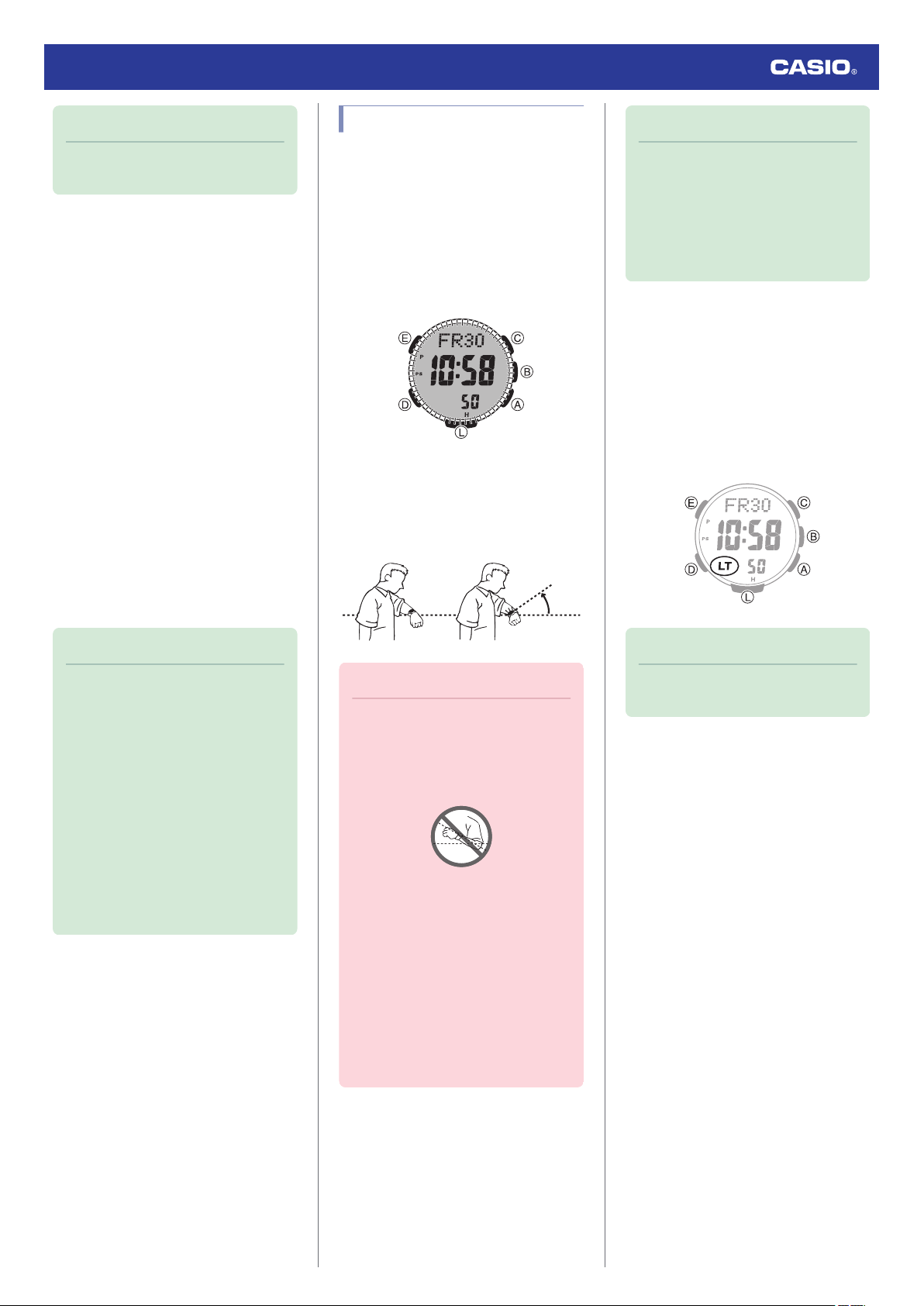
To illuminate the face when Auto Light
is enabled
If Auto Light is enabled, face illumination will
turn on automatically whenever the watch is
positioned at an angle of 40 degrees or more.
40
degrees
or more
Important!
●
Auto Light may not operate properly
when the watch is at a horizontal angle
of 15 degrees or greater from
horizontal as shown in the illustration
below.
●
Electro-static charge or magnetism
can interfere with proper auto light
operation. If this happens, try lowering
your arm and then angle it towards
your face again.
●
When moving the watch you may note
a slight rattling sound. This is due to
operation of the auto light switch,
which determines the current
orientation of the watch. It does not
indicate malfunction.
Note
●
Auto Light is disabled when any one of
the conditions below exists.
ー
Alarm, timer alert, or other beeper
sounding
ー
Watch in the Compass Mode
ー
While sunrise/sunset times are
being calculated
●
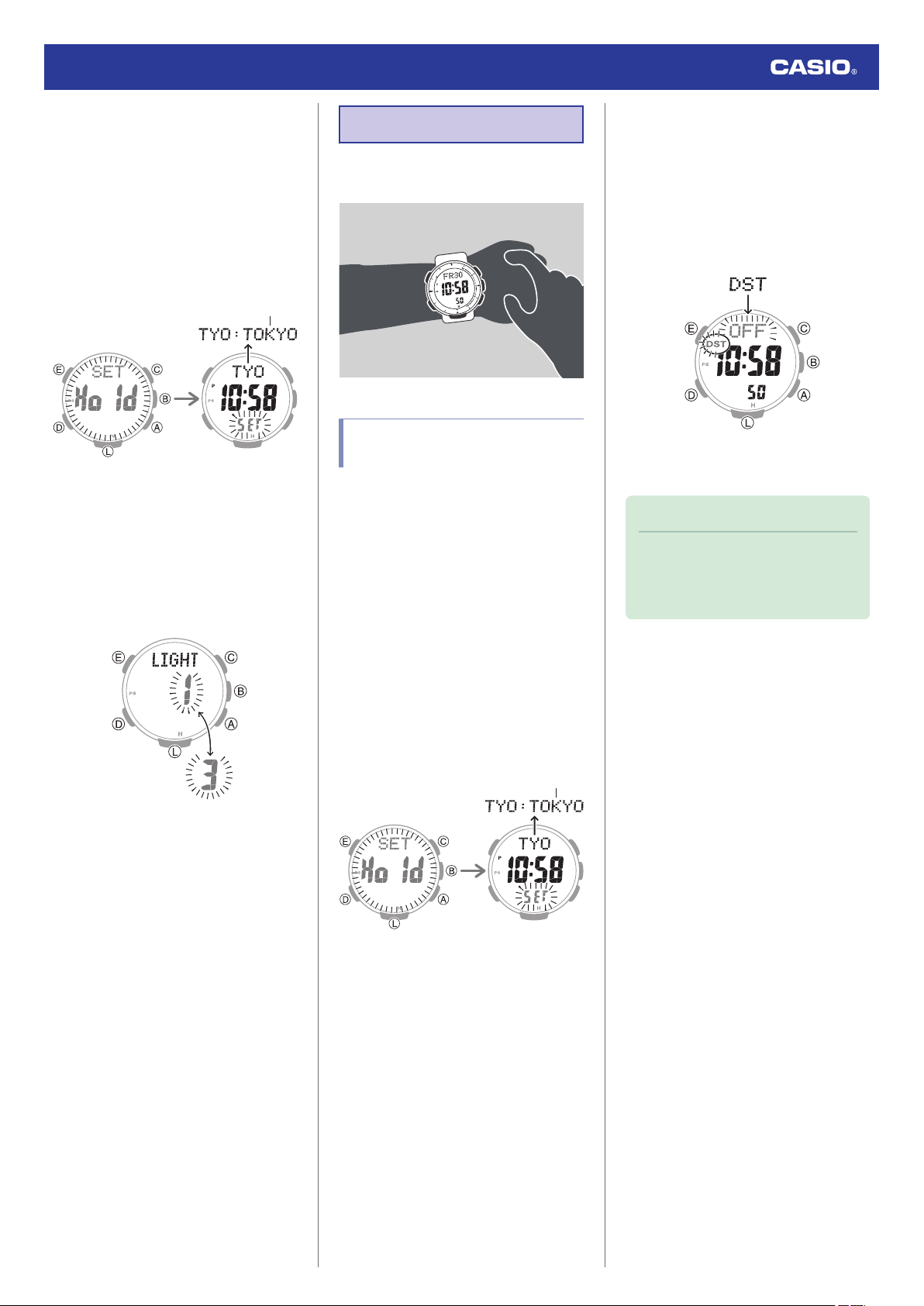
Configuring the Auto Light Setting
1. Enter the Timekeeping Mode.
l
Navigating Between Modes
2. Hold down (L) for at least three seconds
to toggle Auto Light between enabled and
disabled.
●
[LT] is displayed while Auto Light is
enabled.
Note
●
Auto Light is disabled while [CHG] is
shown on the display.
Watch Operation Guide 3513
9
●
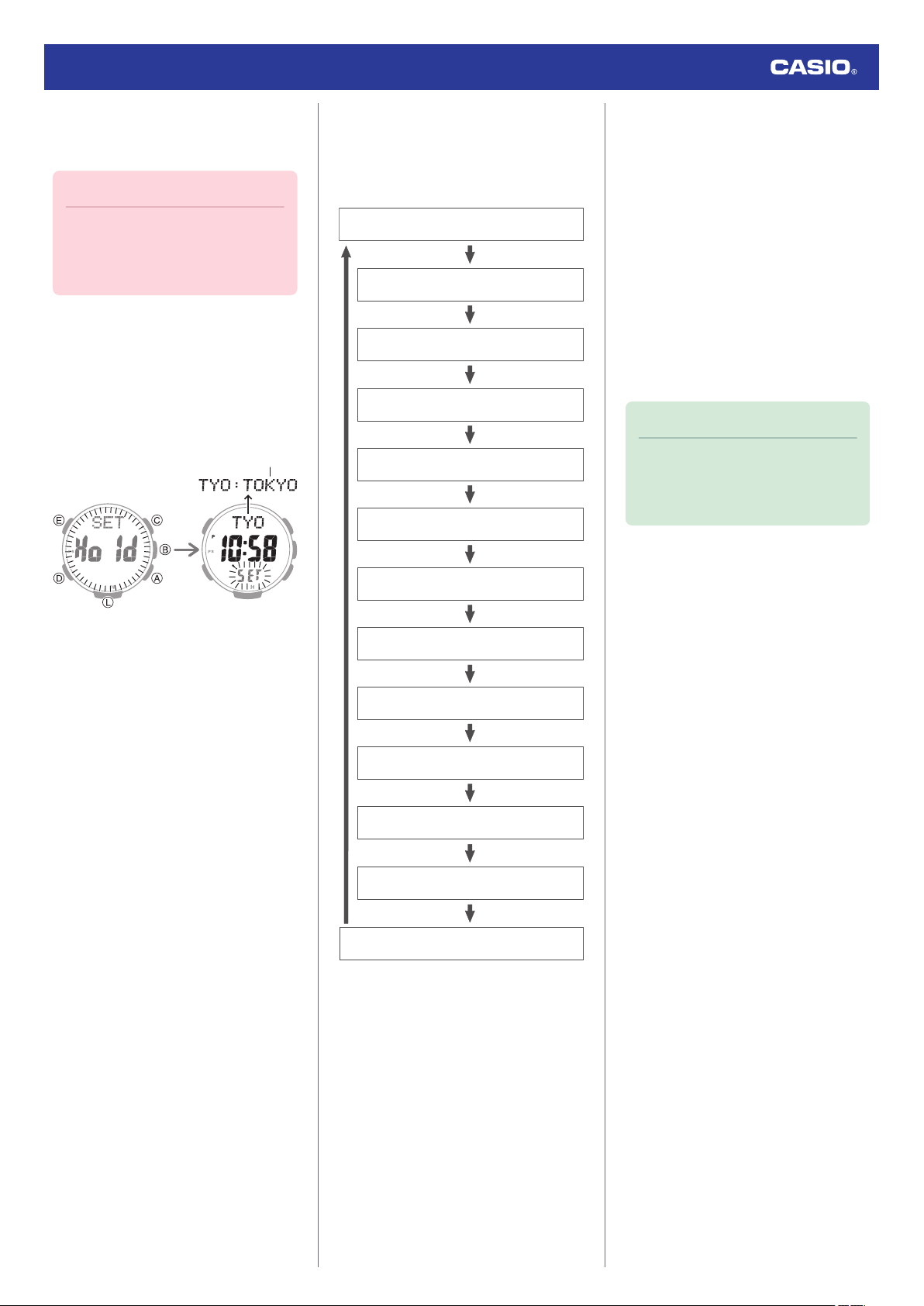
Specifying the Illumination Duration
You can select either 1.5 seconds or three
seconds as the illumination duration.
1. Enter the Timekeeping Mode.
l
Navigating Between Modes
2. Hold down (E) for at least two seconds.
Release the button when the name of the
currently selected Home City appears on
the display.
Home City
3. Press (D) 10 times.
[LIGHT] appears on the display with [1] or
[3] flashing.
4. Press (A) to select an illumination
duration.
[1]: 1.5-second illumination
[3]: 3-second illumination
5. Press (E) twice to complete the setting
operation.
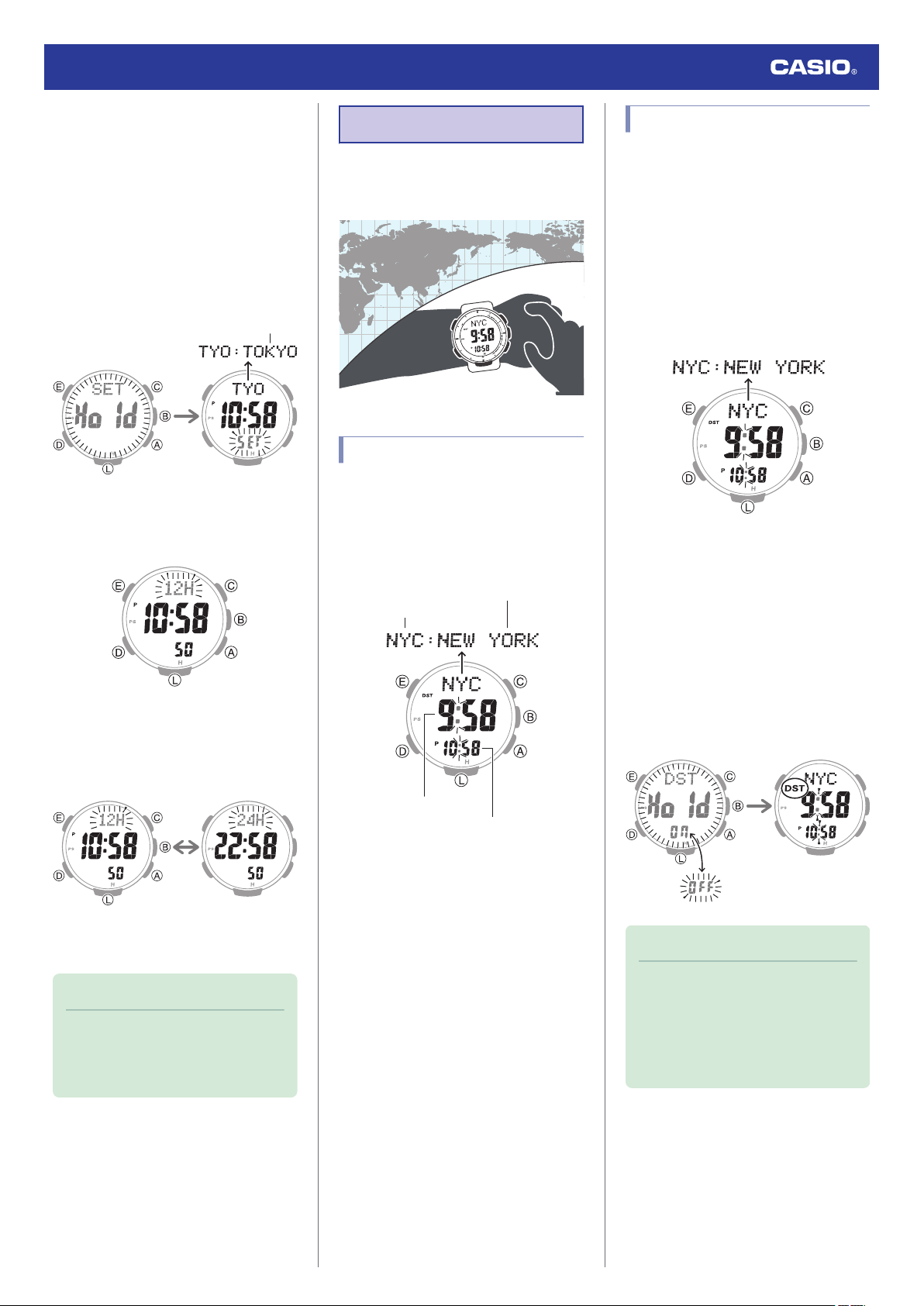
Time Adjustment
Use the procedures in this section to adjust the
date and time settings.
Adjusting the Current Time
Setting
Use the procedures below to adjust the
current date and time settings, and to select a
Home City.
●
Setting a Home City
Use the procedure in this section to select a
city to use as your Home City. If you are in an
area that observes summer time, you can also
enable or disable summer time.
1. Enter the Timekeeping Mode.
l
Navigating Between Modes
2. Hold down (E) for at least two seconds.
Release the button when the name of the
currently selected Home City appears on
the display.
Home City
3. Use (A) and (C) to change the Home City
setting.
●
Holding down (A) or (C) scrolls through
settings at high speed.
●
For details refer to the information
below.
l
City Table
4. Press (D).
5. Use (A) to change the summer time
setting.
●
[OFF]
The watch always indicates standard
time.
●
[ON]
The watch always indicates summer
time.
6. Press (E) twice to complete the setting
operation.
Note
●
While the setting is being configured,
the watch will exit the setting operation
automatically after about two or three
minutes of non-operation.
Watch Operation Guide 3513
10
●
Setting the Time/Date
Use the procedure below to change the time
and date settings.
Important!
●
Configure the Home City setting before
changing the current time and date
settings.
l
Setting a Home City
1. Enter the Timekeeping Mode.
l
Navigating Between Modes
2. Hold down (E) for at least two seconds.
Release the button when the name of the
currently selected Home City appears on
the display.
Home City
3. Use (D) to display the setting you want to
change.
●
Each press of (D) cycles through
settings in the sequence shown below.
Summer time
Home City
Minutes
Hours
Seconds
Day
Month
Ye a r
12/24-hour timekeeping
Changing Units
Illumination duration
Operation tone enable/disable
Power Saving
4. Configure the date and time settings.
●
While the seconds are flashing,
pressing (A) will reset them to 00. 1 is
added to the minutes when the current
seconds count is between 30 and 59
seconds.
●
For all the other settings, use (A) and (C)
to change the flashing setting.
Holding down (A) or (C) scrolls through
settings at high speed.
5. Repeat steps 3 and 4 to select time and
date settings.
6. Press (E) twice to complete the setting
operation.
Note
●
While the setting is being configured,
the watch will exit the setting operation
automatically after about two or three
minutes of non-operation.
Watch Operation Guide 3513
11
●
Switching between 12-hour and 24-
hour Timekeeping
You can specify either 12-hour format or 24-
hour format for the time display.
1. Enter the Timekeeping Mode.
l
Navigating Between Modes
2. Hold down (E) for at least two seconds.
Release the button when the name of the
currently selected Home City appears on
the display.
Home City
3. Press (D) twice.
This causes [12H] or [24H] to flash on the
display.
4. Press (A) to select [12H] (12-hour
timekeeping) or [24H] (24-hour
timekeeping).
24-hour timekeeping12-hour timekeeping
5. Press (E) twice to complete the setting
operation.
Note
●
While the setting is being configured,
the watch will exit the setting operation
automatically after about two or three
minutes of non-operation.
World Time
You can view the current time in 48 cities (31
time zones), and UTC (Coordinated Universal
Time) time.
Checking World Time
1. Enter the World Time Mode.
l
Navigating Between Modes
This displays [WT]. After one second, the
city code and name of your currently
selected World Time City appears.
City code
World Time City Name
World Time
Home Time
Specifying a World Time City
Use the procedure in this section to select a
World Time city. If you are in an area that
observes summer time, you can also enable
or disable summer time.
1. Enter the World Time Mode.
l
Navigating Between Modes
2. Use (A) and (C) to display the city you want
to specify as a World Time City.
●
Holding down (A) or (C) scrolls through
settings at high speed.
3. To change the summer time setting, hold
down (E) for about two seconds.
This causes [DST] [Hold] [On] or [DST]
[Hold] [OFF] to flash on the display. After
that, the setting is changed.
●
[DST] [Hold] [On] flashing on the display
indicates summer time.
●
[DST] [Hold] [OFF] flashing on the
display indicates standard time.
●
[DST] is displayed while summer time is
selected.
Note
●
While [UTC] is selected as the city, you
will not be able to change or check the
summer time setting.
●
The summer time setting you configure
is applied to the currently selected city
only. It does not affect other cities.
Watch Operation Guide 3513
12
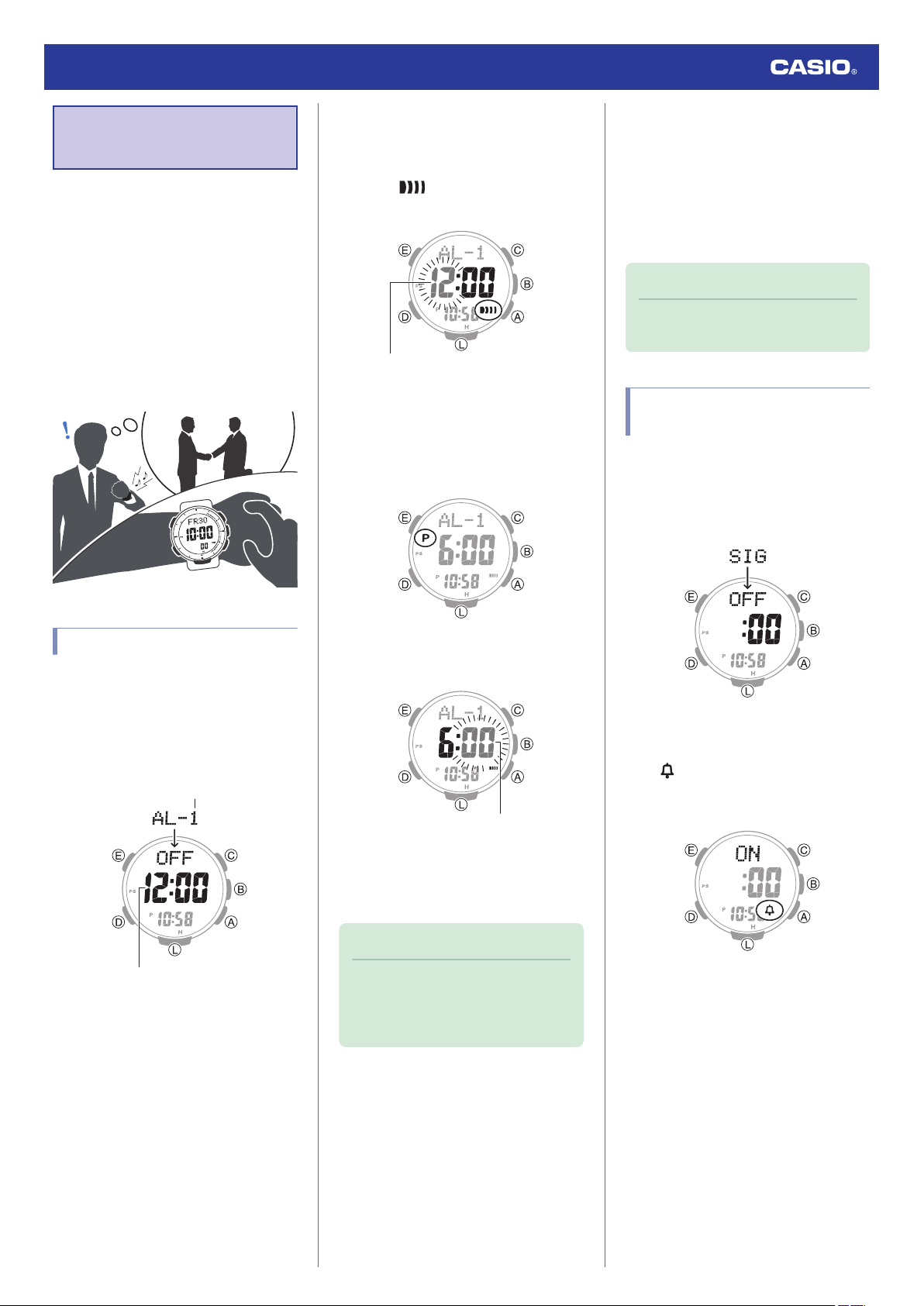
Alarm and Hourly
Time Signal
The watch will beep when the alarm time is
reached. You can configure up to four
standard daily alarms, and one daily alarm
with snooze. The hourly time signal causes the
watch to beep every hour on the hour.
●
Snooze causes the alarm to sound up to
seven times, at five-minute intervals.
●
The alarm sound is muted in the cases
described below.
ー
When battery power is low
ー
When watch is at Level 2 power saving
l
Power Saving Function
Configuring Alarm Settings
1. Enter the Alarm Mode.
l
Navigating Between Modes
2. Use (A) and (C) to select the alarm
([AL-1] to [AL-4], or [SNZ]) whose setting
you want to change.
Alarm number
Alarm time
3. Hold down (E) for at least two seconds.
Release the button when the hour setting
starts to flash.
●
The (alarm) indicator is displayed
when any alarm is turned on.
Alarm hour
4. Use (A) and (C) to change the hour setting.
●
Holding down (A) or (C) scrolls through
settings at high speed.
●
If you are using 12-hour timekeeping,
[P] indicates p.m.
5. Press (D).
This causes the minutes digits to flash.
Alarm minute
6. Use (A) and (C) to set the minute setting.
7. Press (E) to complete the setting
operation.
Note
●
If you do not perform any operation for
about three minutes while in the Alarm
mode, the watch automatically returns
to the Timekeeping Mode.
●
To stop the alarm
To stop the alarm after it starts to sound when
an alarm time is reached, press any button.
Snooze causes the alarm to sound up to seven
times, at five-minute intervals. To cancel a
snooze alarm, turn [SNZ] off.
l
Turning Off an Alarm or the Hourly Time
Signal
Note
●
A beeper sounds for 10 seconds when
an alarm time is reached.
Configuring the Hourly Time
Signal Setting
1. Enter the Alarm Mode.
l
Navigating Between Modes
2. Press (A) or (C) to display the hourly time
signal screen ([SIG]).
3. Press (B) to toggle the hourly time signal
between enabled and disabled.
●
(hourly time signal) is shown on the
display while the hourly time signal is
turned on.
Watch Operation Guide 3513
13
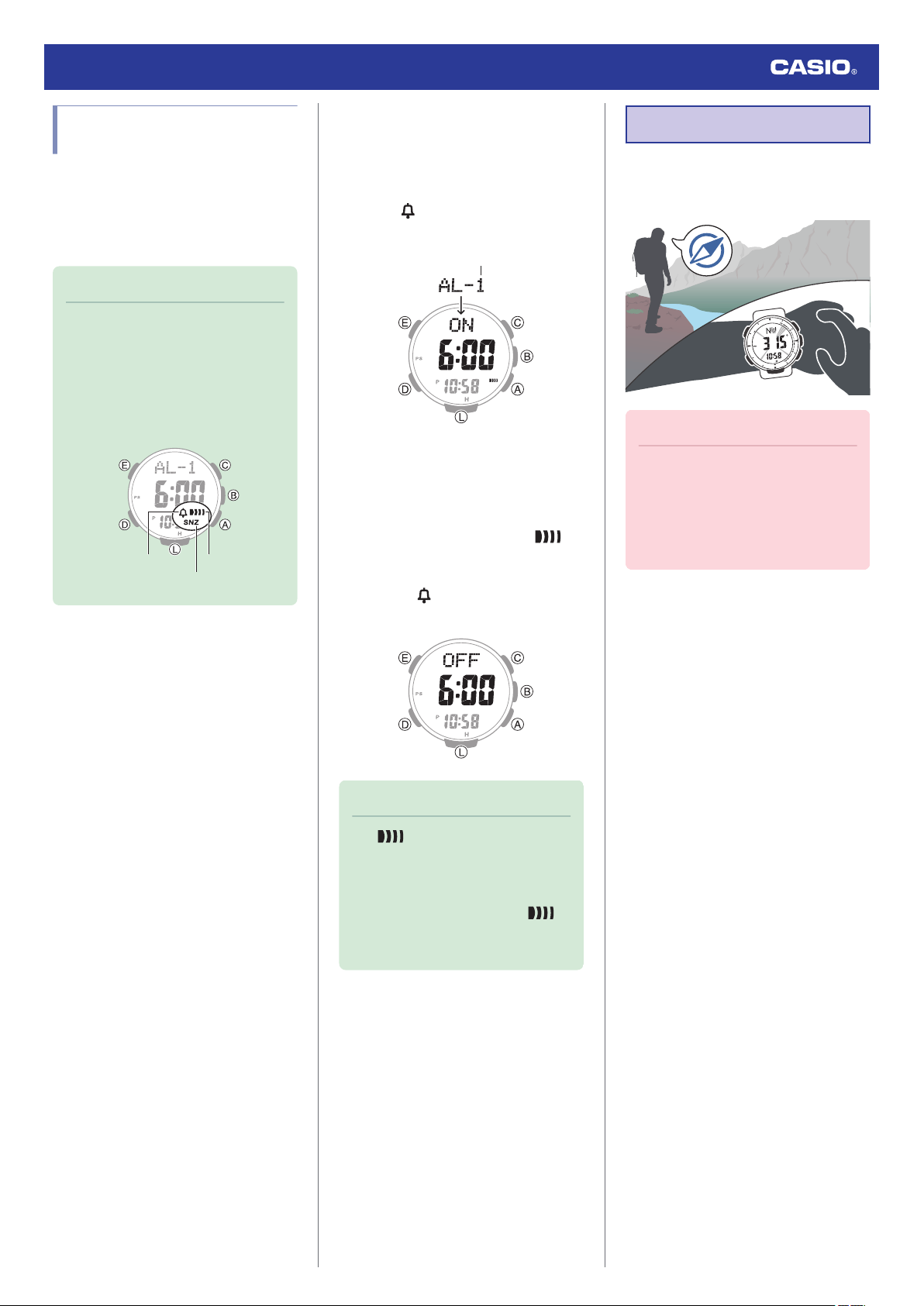
Turning Off an Alarm or the
Hourly Time Signal
To stop an alarm or the hourly time signal from
sounding, perform the steps below to turn it
off.
●
To have an alarm or hourly time signal
sound again, turn it back on.
Note
●
Indicators are displayed while any of
the alarms or the hourly time signal is
turned on.
●
The applicable indicators are not
displayed while all of the alarms are
turned off and/or the hourly time signal
is turned off.
Alarm
Snooze
Hourly time signal
1. Enter the Alarm Mode.
l
Navigating Between Modes
2. Use (A) and (C) to scroll through the alarm
([AL-1] to [AL-4], [SNZ]) and hourly time
signal (
) screens until the one you want
to turn off is displayed.
Alarm number or hourly time signal
3. Press (B) to turn off the displayed alarm or
the hourly time signal.
●
Each press of (B) toggles between on
and off.
●
Turning off all alarms causes
(alarm) to disappear from the display.
Turning off the hourly time signal
causes (hourly time signal) to
disappear.
Note
●
If (alarm) is still displayed after
you turn off an alarm, it means that at
least one of the other alarms is still
turned on. To turn off all of the alarms,
repeat steps 2 and 3 until the
(alarm) indicator is no longer
displayed.
Digital Compass
You can use the Compass Mode to
determine the direction of north, and to
check your bearing to a destination.
Important!
●
Check the information at the link below
to find out how to ensure correct
readings.
l
Calibrating Compass Readings
l
Digital Compass Reading
Precautions
Watch Operation Guide 3513
14
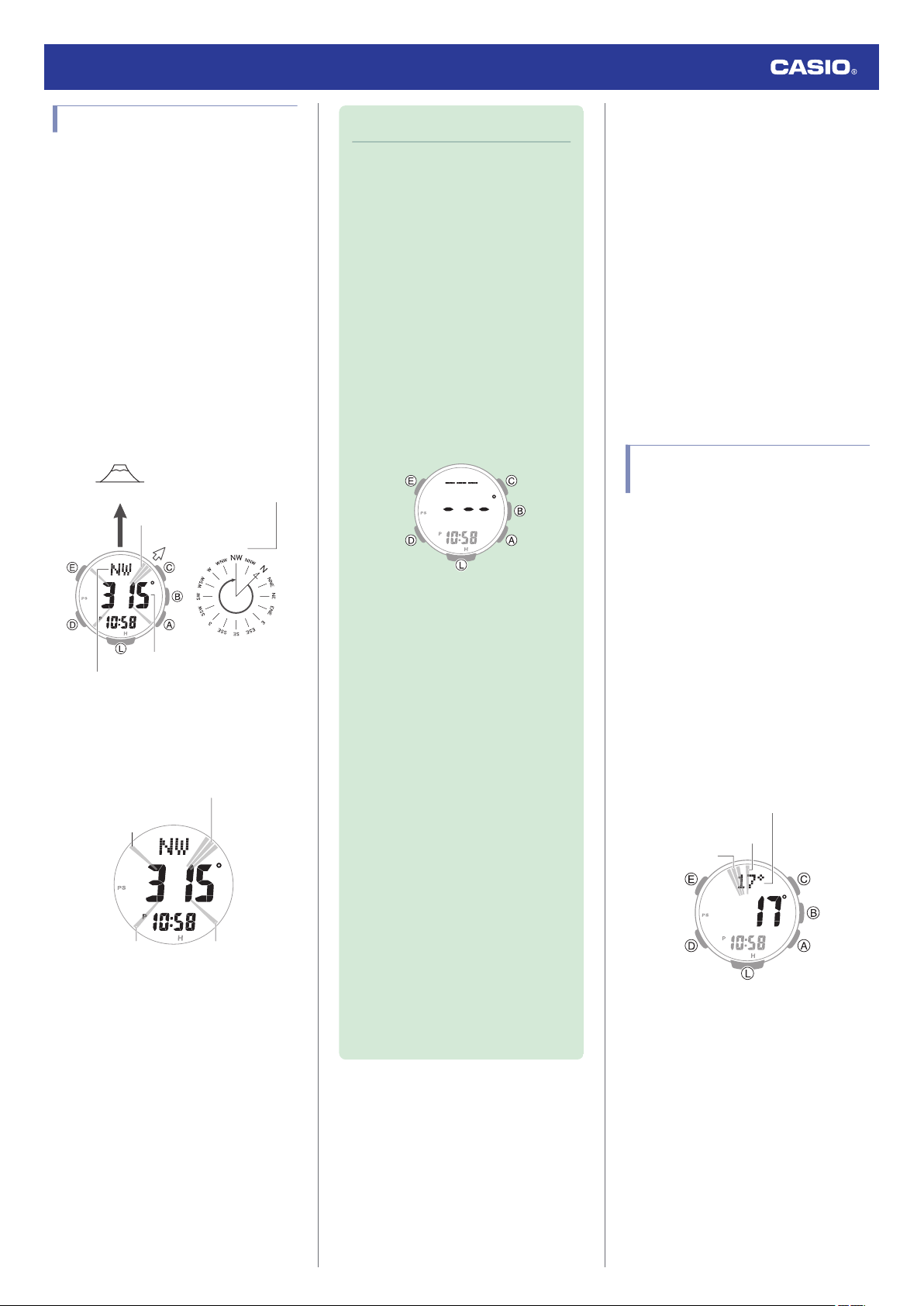
Taking a Compass Reading
1. Enter the Compass Mode.
l
Navigating Between Modes
●
Entering the Compass Mode starts
compass readings.
2. Keeping the watch horizontal, point 12
o’clock in the direction of your desired
objective.
The digital display shows one of 16 literal
direction indications and the bearing
angle.
●
To retrigger the compass operation,
press (C).
Interpreting Bearing Readings
Directions: N (North), E (East), W (West), S
(South)
315°
0°
Bearing angle
Bearing angle to objective
Bearing to objective
North
Graphic direction pointer
Objective
●
The graphic direction pointer indicates
north, south, east, and west. The graphic
direction pointer indicating north consists of
three lines.
Graphic direction pointer (north)
West
South East
Note
●
Normally the Compass Mode
indicates magnetic north. You can also
configure settings to indicate true
north.
l
Setting Up for True North
Readings (Magnetic Declination
Calibration)
l
Magnetic North and True North
●
After the initial reading is displayed, the
watch will continue to take readings
approximately every second for
approximately the next 60 seconds.
After measurement is complete, the
graphic direction pointer disappears
from the display, and [- - -] is shown for
the bearing to your objective and its
bearing angle.
●
If four directions (north, south, east,
west) and your target bearing are not
displayed on the screen when you
press (C), the bearing recorded in the
bearing memory may be displayed
instead of four directions.
Press (E) to clear the recording
bearing.
l
Saving a Bearing to an Objective
(Bearing Memory)
●
Auto Light will not illuminate the face
while a compass operation is in
progress.
●
If an alarm or other beeper sounds, or
if you turn on illumination by pressing
(L) while a compass operation is in
progress, the compass operation will
be suspended momentarily. The
compass operation will resume when
the beeper stops or illumination turns
off.
●
If you do not perform any operation for
about two or three minutes while in the
Compass Mode, the watch
automatically returns to the
Timekeeping Mode.
●
Aligning a Map with Actual
Surroundings (Setting a Map)
Setting a map means to align the map so the
directions indicated on it are aligned with the
actual directions of your location. Once you
set a map, you can more easily get a grasp of
the relationship between map markings and
actual geographic contours. To set a map with
this watch, align north on the map with the
north indication of the watch. Once you set the
map, you can compare your bearing on the
map with your surroundings, which will help
you determine your current location and
destination.
●
Note that map reading skills and experience
are required to determine your current
location and destination on a map.
Saving a Bearing to an
Objective (Bearing Memory)
You can use record the bearing to a
destination. Displaying the recorded bearing
makes it possible to progress towards your
target destination when the visibility is poor.
1. Enter the Compass Mode.
l
Navigating Between Modes
2. Keeping the watch horizontal, point 12
o’clock in the direction of the objective
your want to record.
3. Press (E).
The direction of the 12 o’clock position of
the watch is recorded as the target
direction and indicated by the graphic
direction pointer.
Target bearing
Recorded bearing angle
North
●
To clear a recorded bearing, press (E).
Watch Operation Guide 3513
15
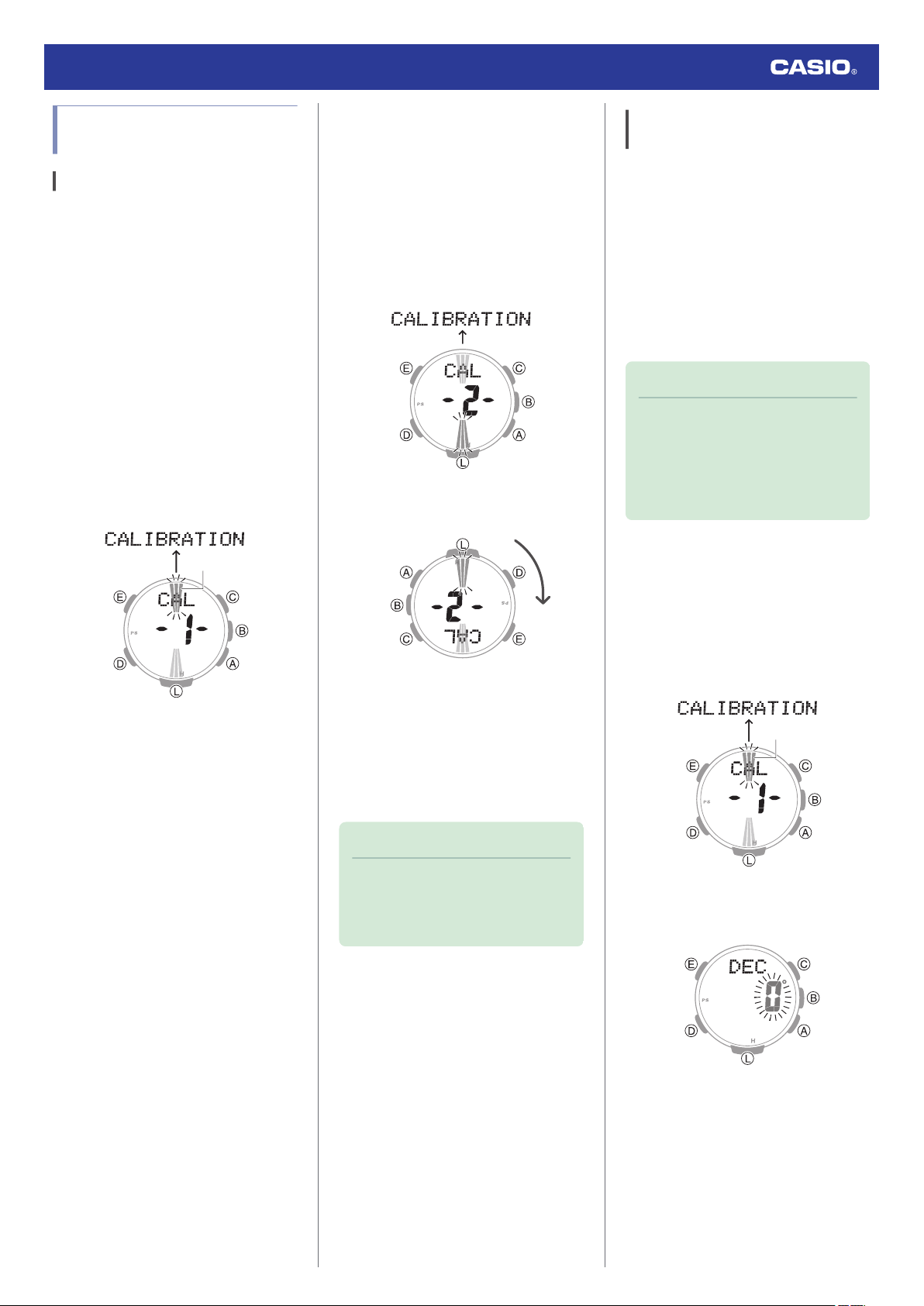
Calibrating Compass
Readings
Calibrating Compass Readings
Perform 2-point calibration whenever you
notice the watch’s compass readings are
different from those of another compass, or
before setting out on a climb or trek.
●
Note that accurate compass readings
and/or calibration will not be possible in an
area where strong magnetism is present.
l
Digital Compass Reading Precautions
2-Point Calibration
1. Enter the Compass Mode.
l
Navigating Between Modes
2. Hold down (E) for at least two seconds
until the three-line graphic direction
pointer flashes at 12 o’clock. Release the
button when [CALIBRATION] [-1-]
appears on the display.
Graphic direction pointer
3. While keeping the watch horizontal, press
(C).
This starts calibration of the first point,
which causes [- - -] to appear on the
display. [Turn 180°] appears on the
display when calibration is successful,
and the three-line graphic direction
pointer flashes at 6 o’clock. One second
later, [CALIBRATION] [-2-] appears on
the display.
4. Rotate the watch 180 degrees, taking care
to be as exact as possible.
5. Press (C).
●
This starts calibration of the second
point, which causes [- - -] to appear on
the display.
●
When calibration is successful, [OK]
appears on the display and the watch
returns to the Digital Compass screen.
Note
●
[ERR] [-1-] appears if calibration fails
for some reason. If this happens,
restart the above procedure from step
3.
Setting Up for True North Readings
(Magnetic Declination Calibration)
If you want the watch to indicate true north
instead of magnetic north, you need to specify
your current location’s magnetic declination
direction (east or west) and declination angle.
l
Magnetic North and True North
●
The magnetic declination angle value can
be set in 1° (degree) units only. Use a value
that is closest to the angle you want to set.
Example: For an angle of 7.4°, set 7°.
Example: For an angle of 7°40’ (7 degrees,
40 minutes), set 8°.
Note
●
Magnetic declination angles (east or
west) and angle degree values for
specific locations can be found on
geographic maps, mountain climbing
maps, and other maps that include
contour lines.
1. Enter the Compass Mode.
l
Navigating Between Modes
2. Hold down (E) for at least two seconds
until the three-line graphic direction
pointer flashes at 12 o’clock. Release the
button when [CALIBRATION] [-1-]
appears on the display.
Graphic direction pointer
3. Press (D).
This displays [DEC] [0°].
Watch Operation Guide 3513
16
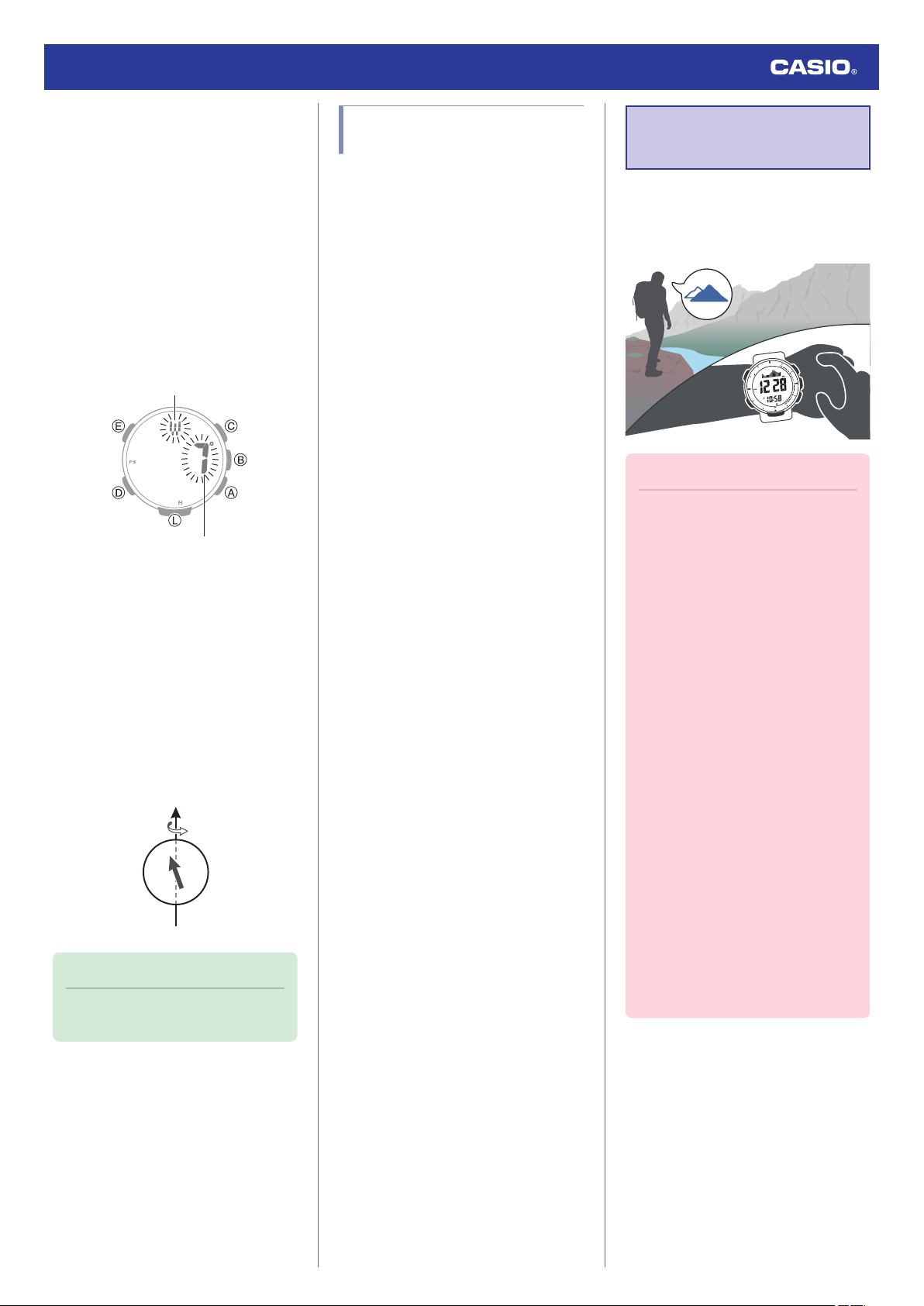
4. Use (A) (East) and (C) (West) to change
the magnetic declination direction and
angle.
●
Holding down (A) or (C) scrolls through
settings at high speed.
Setting range: 90° west to 90° east
[OFF]: Magnetic north
[E]: East declination (Magnetic north is
east of true north.)
[W]: West declination (Magnetic north is
west of true north.)
●
To return the setting to [OFF], press (A)
and (C) at the same time.
Magnetic declination angle
Magnetic declination direction
5. Press (E) to complete the setting
operation.
●
Magnetic North and True North
There are actually two types of north:
magnetic north and true north.
Magnetic north: North indicated by the needle
of a compass
True north: Direction to the North Pole
As shown in the illustration below, magnetic
north and true north are not the same.
Earth
Magnetic north
True north
Note
●
The north indicated on commercially
available maps is normally true north.
Digital Compass Reading
Precautions
Location During Use
Taking readings near sources of strong
magnetism can cause reading error. Keep the
watch away from the following types of items.
Permanent magnets (magnetic accessories,
etc.), metal objects, high-voltage wires, aerial
wires, electrical household appliances (TVs,
computers, cellphones, etc.)
●
Note that correct direction readings are not
possible indoors, especially inside of
reinforced concrete structures.
●
Accurate direction readings are not
possible on electric trains, on boats, on
aircraft, etc.
Storage Location
Exposure of the watch to magnetism can
affect the accuracy of digital compass
readings. Keep the watch away from the types
of items below.
Permanent magnets (magnetic accessories,
etc.), metal objects, electrical household
appliances (TVs, computers, cellphones, etc.)
Altitude
Measurement
The watch takes altitude readings and
displays results based on air pressure
measurements taken by a built-in pressure
sensor.
Important!
●
The altitude readings displayed by the
watch are relative values that are
calculated based on barometric
pressure measured by the watch’s
pressure sensor. This means that
barometric pressure changes due to
weather can cause altitude readings
taken at the same location to be
different. Also note that the value
displayed by the watch may be
different from the actual elevation and/
or sea level elevation indicated for the
area where you are located. When
using the watch’s altimeter while
mountain climbing, it is recommended
that you regularly calibrate its readings
in accordance with local altitude
(elevation) indications.
l
Calibrating Altitude Readings
(Offset)
●
Check the information at the link below
to find out about how to minimize
differences between readings
produced by the watch, and values
provided by local altitude (elevation)
indications.
l
Calibrating Altitude Readings
(Offset)
l
Altitude Reading Precautions
Watch Operation Guide 3513
17
Checking the Current
Altitude
1. Enter the Altimeter Mode.
l
Navigating Between Modes
●
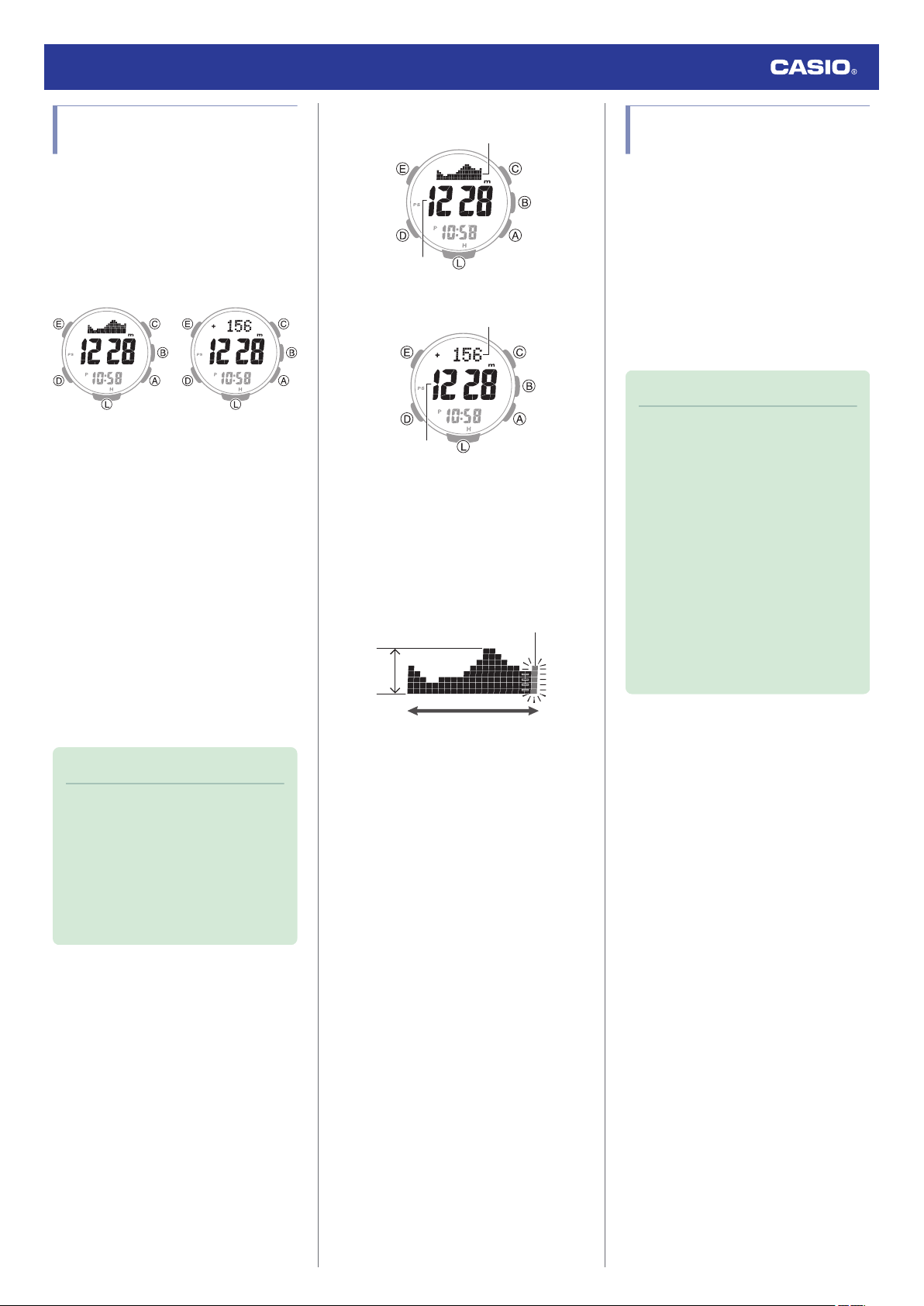
You can select either of two Altimeter
Mode screens.
l
Changing Displayed Information
Altitude Differential
Screen
Altitude Graph Screen
Entering the Altitude Mode will start
altitude measurement and display the
altitude at your current location.
●
The watch takes altitude readings every
second for about the first three minutes.
After that, it takes readings according to
the watch’s auto measurement interval
setting.
●
Check the information at the link below
to find out how to configure the auto
measurement interval.
l
Setting the Measurement Interval for
Auto Record Data and Climb Record
Data
●
To retrigger measurement, press (A).
●
To return to the Timekeeping Mode,
press (D).
Note
●
Measurement range: -700 to 10,000
meters (-2,300 to 32,800 feet)
(Measurement unit: 1 meter (5 feet))
Note that calibrating altitude readings
will cause a change in the
measurement range.
●
[- - -] will appear for the measured value
if it is outside the allowable range.
Altitude Graph Screen
②
①
Altitude Differential Screen
③
①
A Current location altitude
B Altitude graph
C Differential between reference altitude
and current altitude
Interpreting Altitude Graph Contents
80m*
Current reading
Latest
Old
*
1 square (
v
) is 10 m.
Calibrating Altitude
Readings (Offset)
To minimize the difference between locally
indicated and measured values, you should
update the reference altitude value (offset)
before setting off and during treks or any other
activities where you take altitude readings.
Also, you can ensure accurate measurements
by checking a map local altitude indications or
some other source for your current location’s
altitude, and regularly calibrating watch
readings with the latest information while
mountain climbing.
Note
●
You can find out the altitude at your
current location from signs, maps, on
the Internet, etc.
●
Differences between actual altitude
and watch readings can be caused by
the factors below.
ー
Changes in barometric pressure
ー
Changes in temperature caused by
variations in barometric pressure
and by elevation
●
Though altitude readings can be taken
without calibration, doing so may
produce readings that are very
different from indications by altitude
markers, etc.
Watch Operation Guide 3513
18
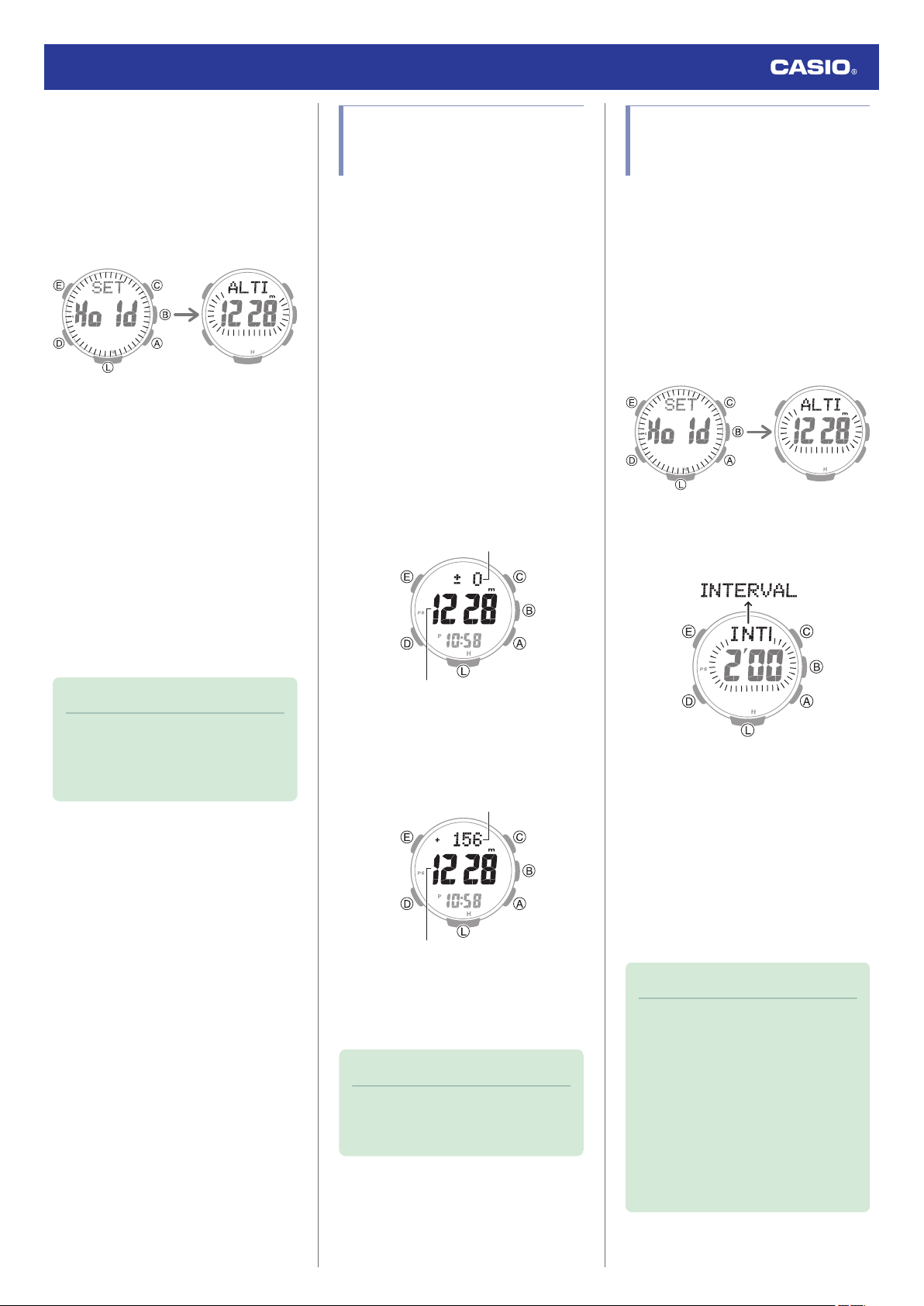
1. Enter the Altimeter Mode.
l
Navigating Between Modes
2. Hold down (E) for at least two seconds.
Release the button when [ALTI] appears
on the display.
This displays the current altitude and
enters the Altitude Offset Mode.
3. Use (A) and (C) to change the altitude
value to an elevation value obtained from
another source.
Setting range: -10,000 to 10,000 meters
(or -32,800 to 32,800 feet)
Setting unit: 1 meter (or 5 feet)
●
Holding down (A) or (C) scrolls through
settings at high speed.
●
To return the altitude setting to its initial
factory default, press (A) and (C) at the
same time.
ー
This displays [OFF].
4. Press (E) to complete the setting
operation.
Note
●
While the setting is being configured,
the watch will exit the setting operation
automatically after about two or three
minutes of non-operation.
Setting a Reference Altitude
and Taking Altitude
Differential Readings
You can use the procedure below to display
the differential between a reference altitude
and another altitude. This makes it easy to
display the altitude differential between two
points while climbing or trekking.
Select the Altitude Differential Screen.
l
Changing Displayed Information
1. Use the contour lines on your map to
determine the altitude differential between
your current location and your destination.
2. Take an altitude reading of your current
location.
l
Checking the Current Altitude
3. Use (E) to set your current location as the
reference altitude.
This makes the altitude differential ±0 m
(±0 feet).
Current location altitude
Altitude differential indicator
4. While comparing the difference between
the altitude you found on the map and the
altitude differential displayed by the
watch, advance towards your destination.
Current location altitude
Altitude differential indicator
●
When the altitude differential you found
on the map is the same as that
displayed by the watch, it means you
are close to your destination.
Note
●
[- - - -] appears when the altitude
differential is outside the measurement
range (±3,000 m).
Setting the Measurement
Interval for Auto Record Data
and Climb Record Data
You can select an auto measurement interval
of either five seconds or two minutes.
1. Enter the Altimeter Mode.
l
Navigating Between Modes
2. Hold down (E) for at least two seconds.
Release the button when [ALTI] appears
on the display.
This displays the altitude for your current
location.
3. Press (D).
This causes the auto measurement
interval to appear on the display.
4. Press (A) to toggle the auto measurement
interval between [0’05] and [2’00].
[0’05]: Readings taken every second for
the first three minutes, and then every five
seconds for about the next one hour.
[2’00]: Readings taken every second for
the first three minutes, and then every two
minutes for about the next 12 hours.
5. Press (E) to complete the setting
operation.
Note
●
While the setting is being configured,
the watch will exit the setting operation
automatically after about two or three
minutes of non-operation.
●
The watch will automatically return to
the Timekeeping Mode if you do not
perform any operation in the Altimeter
Mode for about one hour while [0’05] is
selected as the measurement interval
or about 12 hours while [2’00] is
selected.
Watch Operation Guide 3513
19
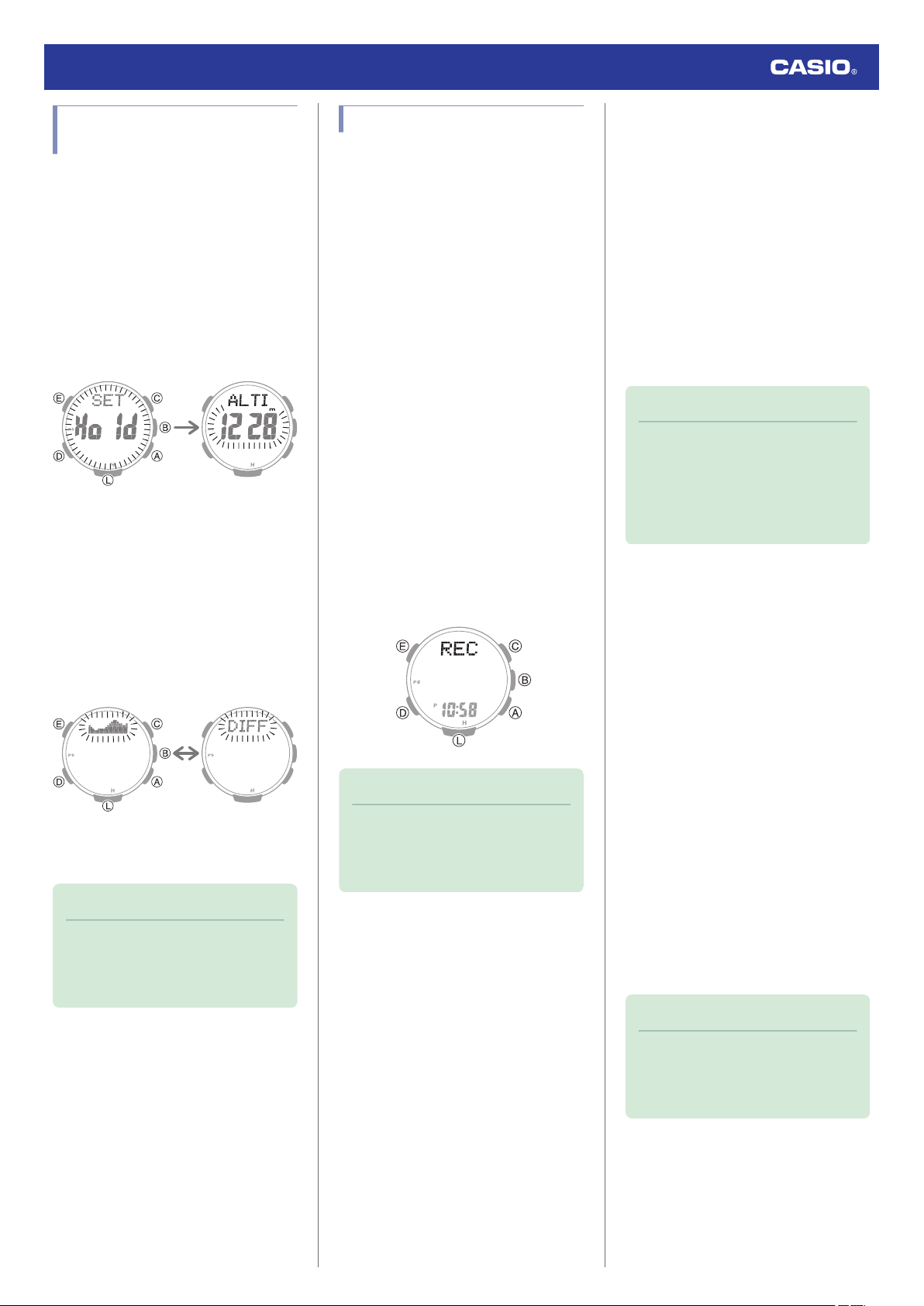
Changing Displayed
Information
In the Altimeter Mode, you can use the
procedure below to select either the Altitude
Graph Screen or Altitude Differential Screen.
1. Enter the Altimeter Mode.
l
Navigating Between Modes
2. Hold down (E) for at least two seconds.
Release the button when [ALTI] appears
on the display.
This displays the altitude for your current
location.
3. Press (D) twice.
After [DISP] appears on the display, the
altitude graph or [DIFF] (altitude
differential) flashes on the display.
4. Use (A) to toggle between the screens.
Each press of (A) toggles between the
Altitude Graph Screen and the Altitude
Differential Screen.
Altitude Graph
Screen
Altitude Differential
Screen
5. Press (E) to complete the setting
operation.
Note
●
While the setting is being configured,
the watch will exit the setting operation
automatically after about two or three
minutes of non-operation.
Recording Altitude Readings
Use the procedure below to record measured
altitude data.
There are three types of altitude data:
manually recorded data, auto record data, and
climb record data.
●
Use the Data Recall Mode to view or delete
records.
l
Viewing Altitude Records
●
Manually Recorded Data
The date and time are also recorded along
with the altitude measurement. The watch has
memory for up to 30 measurement records,
and records are sequentially assigned
numbers from [-01-] to [-30-].
1. Enter the Altimeter Mode.
l
Navigating Between Modes
2. Hold down (A) for at least two seconds
until [REC] stops flashing.
This records the current altitude, date,
and time.
●
If you do not remove your finger and
continue to press (A), climb recording
will be toggled between enabled and
disabled.
Note
●
Recording altitude data when there are
already 30 records in memory
automatically deletes the oldest record
to make room for the new one.
●
Auto Record Data
Entering the Altimeter Mode automatically
starts altitude data measurement at regular
intervals. Each auto record data
measurement uses one memory record. Each
record includes the date (month, day) and
time of the measurement, along with the
altitude data (high/low altitude, cumulative
ascent/descent).
l
Auto Record and Climb Record Data
Contents
●
You can select the measurement interval.
l
Setting the Measurement Interval for
Auto Record Data and Climb Record
Data
Note
●
Auto recording ends when you exit the
Altimeter Mode. Re-entering the
Altimeter Mode restarts recording of
cumulative values from where it was
stopped when you last exited the
Altimeter Mode.
●
Climb Record Data
Starting a climb record operation
automatically records altitude data at regular
intervals, even if you exit the Altimeter Mode.
Each record includes the date (month, day)
and time of the measurement, along with the
altitude data (high/low altitude, cumulative
ascent/descent).
The watch has memory for up to 14
measurement data records, and records are
sequentially assigned numbers from [Mt.1] to
[Mt.14].
l
Auto Record and Climb Record Data
Contents
●
Altitude is measured and recorded at
regular intervals for up to 12 hours even if
you exit the Altimeter Mode.
●
You can select the measurement interval.
l
Setting the Measurement Interval for
Auto Record Data and Climb Record
Data
●
Recording automatically stops when
battery power goes low.
Note
●
Climb record data can be recorded for
up to 14 climbs. It includes high and
low altitudes, and cumulative ascent
and descent.
Watch Operation Guide 3513
20
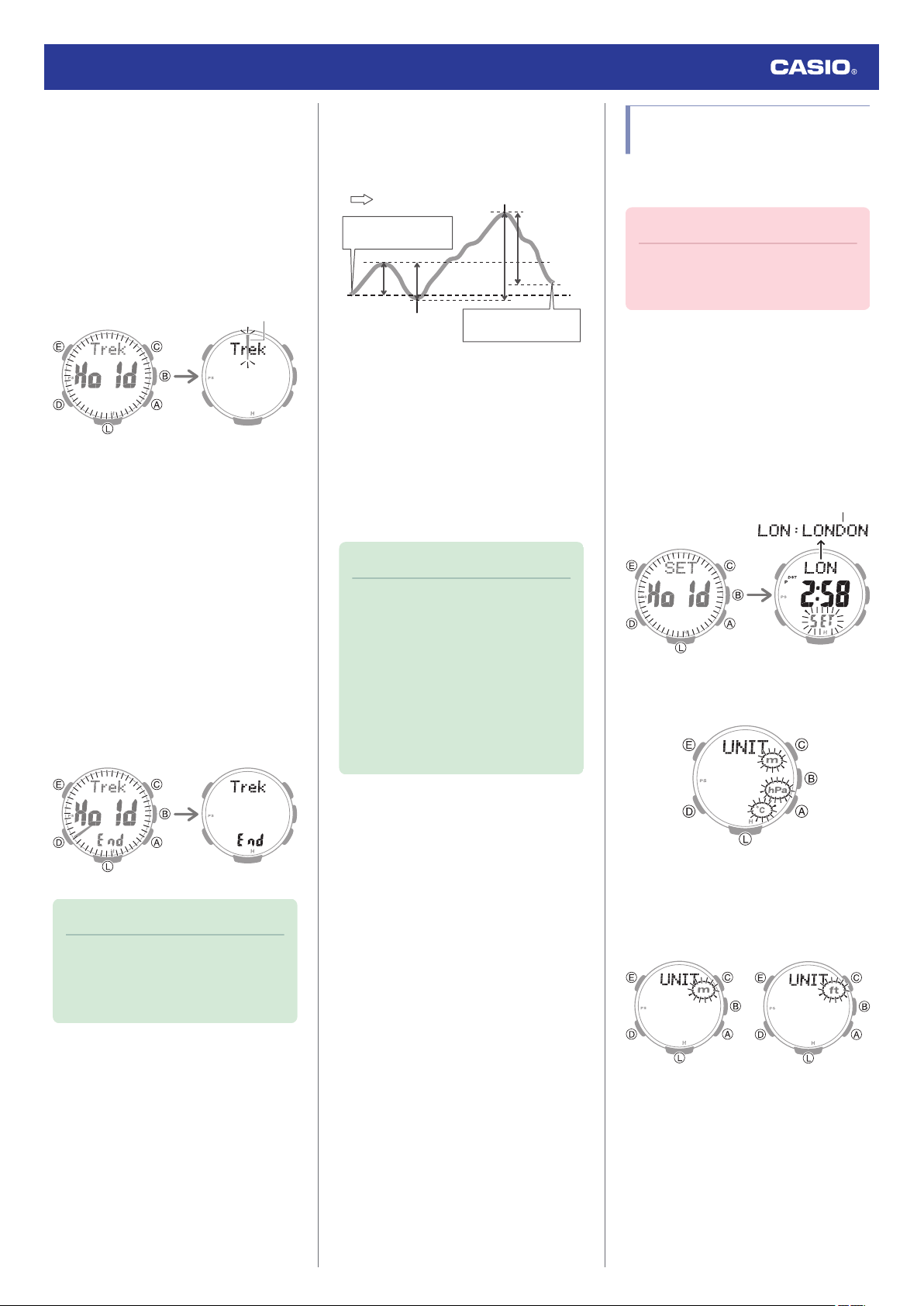
●
To start measurement
1. Enter the Altimeter Mode.
l
Navigating Between Modes
2. Hold down (A) for at least five seconds.
Release the button when [Trek] and
mountain climbing graphic segments
appear on the display.
This starts recording of altitude data (high/
low altitude, cumulative ascent/descent).
Mountain climbing
graphic segments
●
Mountain climbing graphic segments
flash or are displayed around the
periphery of the display while recording
is in progress. Each segment
represents 12 minutes, and one lap
around the periphery represents 12
hours.
●
To stop measurement
1. Enter the Altimeter Mode.
l
Navigating Between Modes
2. Hold down (A) for at least five seconds.
Release the button when [Trek] [END]
appears on the display.
This stops altitude data (high/low altitude,
cumulative ascent/descent) recording.
Note
●
If you want to record more than 15 data
records, delete old records to make
room for the new data.
l
Deleting a Particular Record
●
Auto Record and Climb Record Data
Contents
The altitude data below is recorded by auto
record and climb record operations.
A
B
CD
F
E
End point
Start point
High Altitude (MAX):
E
Low Altitude (MIN):
F
Cumulative Ascent (ASC):
A
+
C
*
Cumulative Descent (DSC):
B
+
D
*
* Cumulative ascent and cumulative descent
values are updated whenever there is a
difference of at least ±15 m (±49 feet) from
one reading to the next.
Note
●
In the case of auto record data, the
auto record operation ends if you exit
the Altimeter Mode. Re-entering the
Altimeter Mode restarts recording of
cumulative values from where it was
stopped when you last exited the
Altimeter Mode.
●
For climb record data, auto
measurement continues even if you
exit the Altimeter Mode.
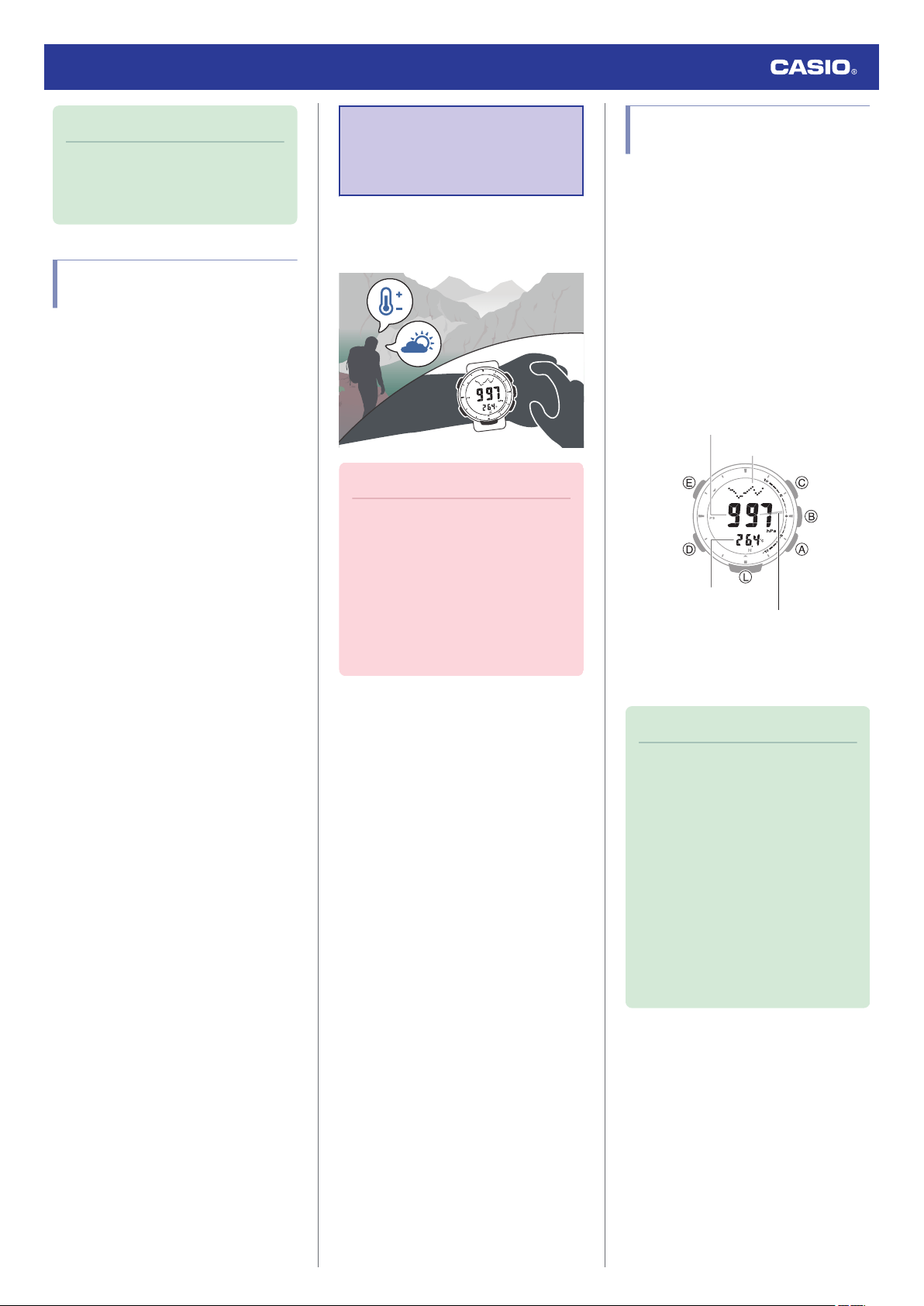
Specifying the Altitude
Measurement Unit
You can select either meters (m) or feet (ft) as
the Altimeter Mode display unit.
Important!
●
When Tokyo (TYO) is set as the Home
City, the altitude unit is fixed as meters
(m) and cannot be changed.
1. Enter the Timekeeping Mode.
l
Navigating Between Modes
2. Hold down (E) for at least two seconds.
Release the button when the name of the
currently selected Home City appears on
the display.
Example: When your Home City is
London
Home City
3. Press (D) 12 times.
This displays [UNIT].
4. Use (A) to select an altitude unit.
[m]: Meters
[ft]: Feet
FeetMeters
5. Press (E) twice to complete the setting
operation.
Watch Operation Guide 3513
21
Note
●
While the setting is being configured,
the watch will exit the setting operation
automatically after about two or three
minutes of non-operation.
Altitude Reading
Precautions
Effects of Temperature
When taking altitude readings, take the steps
below to keep the watch at as stable a
temperature as possible. Changes in
temperature can affect altitude readings.
●
Take readings with the watch on your wrist.
●
Take readings in an area where
temperature is stable.
Altitude Readings
●
Do not use this watch while skydiving, hang
gliding, paragliding, gyrocopter flying, glider
flying, or engaged in other activities where
altitude changes suddenly.
●
Altitude readings produced by this watch
are not intended for special-purpose or
industrial level use.
●
In an aircraft, the watch measures the in-
cabin pressurized air pressure, so readings
will not match altitudes announced by the
crew.
Altitude Readings (Relative Altitude)
This watch uses International Standard
Atmosphere (ISA) relative altitude data
defined by the International Civil Aviation
Organization (ICAO). Barometric pressure
generally becomes lower as altitude
increases.
Correct measurement may not be possible
under the conditions below.
●
During unstable atmospheric conditions
●
During sudden temperature changes
●
After the watch has been subjected to
strong impact
Barometric Pressure
and Temperature
Measurement
You can use the watch to take barometric
pressure and temperature readings for your
current location.
Important!
●
Check the information at the link below
to find out how to ensure correct
readings.
l
Correcting Measured Barometric
Pressure and Temperature Values
(Offset)
l
Barometric Pressure and
Temperature Reading
Precautions
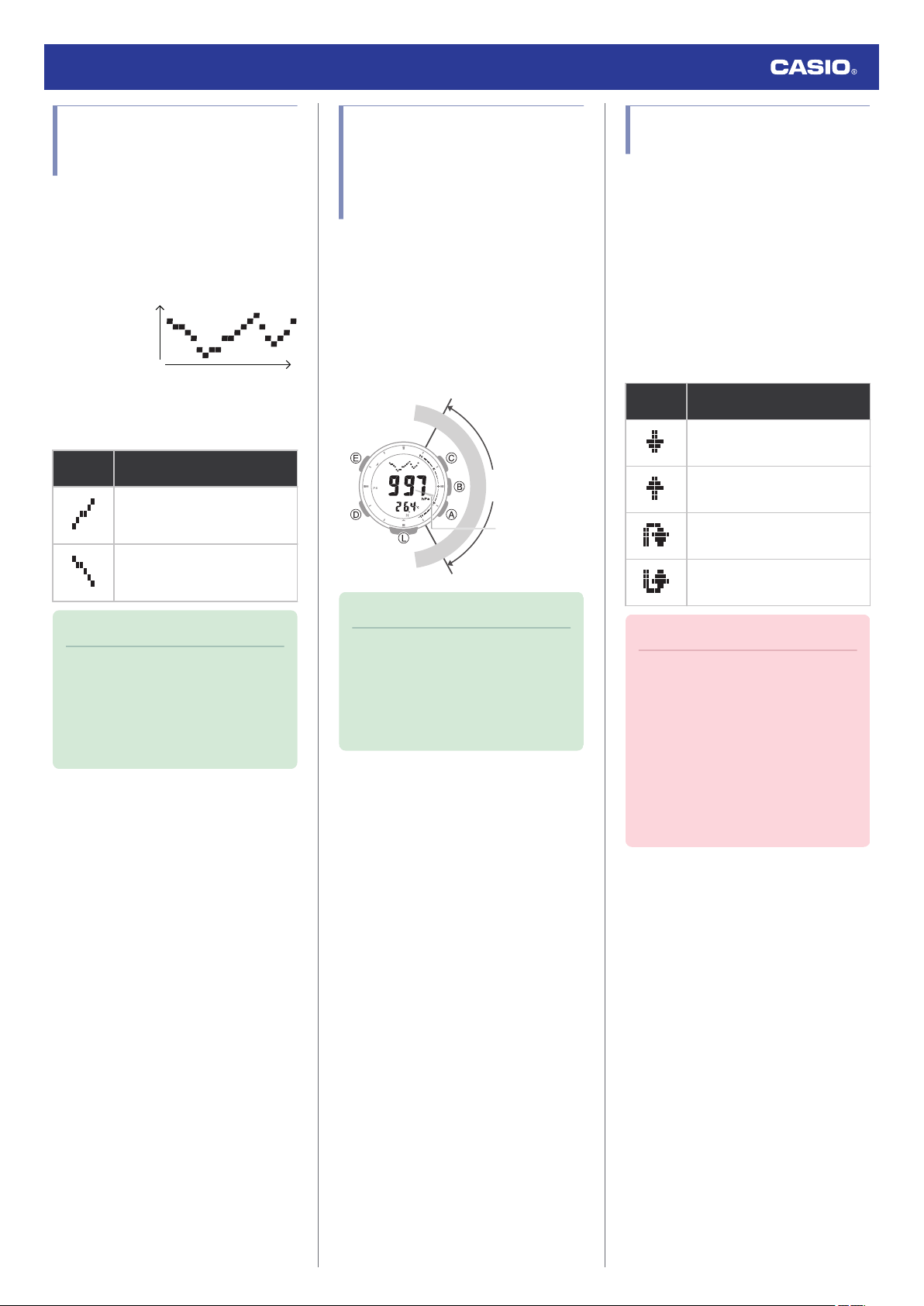
Measuring Barometric
Pressure and Temperature
1. Enter the Barometer/Temperature Mode.
l
Navigating Between Modes
Entering the Barometer/Temperature
Mode starts measurement, and displays
the barometric pressure and temperature
at your current location, and a barometric
pressure graph.
●
After you enter the Barometer/
Temperature Mode, the watch takes
readings about every five seconds for
three minutes. After that, a
measurement is taken about every two
minutes.
Barometric pressure graph
Barometric pressure
Temperature
Barometric pressure differential graphic
●
To re-trigger measurement, press (B).
●
To return to the Timekeeping Mode,
press (D).
Note
●
The watch will automatically return to
the Timekeeping Mode if you do not
perform any operation in the
Barometer/Temperature Mode for
about one hour.
●
Measurement ranges are shown
below. [- - -] will appear for the
measured value if it is outside the
allowable range.
Barometric pressure measurement:
260 hPa to 1,100 hPa (7.65 inHg to
32.45 inHg)
Thermometer measurement: -10.0°C
to 60.0°C (14.0°F to 140.0°F)
Watch Operation Guide 3513
22
Checking Changes in
Barometric Pressure Over
Time
Your watch shows a graph of barometric
pressure readings taken at two-hour intervals.
You can view barometric pressure readings
for the past 42 hours. The square (
v
) at the
far right of the graph indicates the latest
barometric pressure reading.
Barometric
pressure
(1 hPa per division)
Time (2 hours per division)
●
Predicting Upcoming Weather
A trend
like this:
Means this:
Rising barometric pressure,
which indicates that upcoming
weather probably will be fair.
Falling barometric pressure,
which indicates that upcoming
weather probably will be bad.
Note
●
Large changes in barometric pressure
and/or temperature can cause past
data readings to be plotted outside of
the visible area of the graph. Though
plots are not visible, the data is still
maintained in watch memory.
Checking the Change
Between Two Barometric
Pressure Readings
(Barometric Pressure
Differential)
In the Barometer/Temperature Mode, the
display shows the current measured value,
and a graphic indicator of the differential
between the automatically measured current
value and the latest value measured at two-
hour intervals.
Example: Barometric pressure differential of
-3 hPa (approximately -0.9 inHg)
10
5
0
−5
−10
Pressure
Differential Indicator
Range: ±10 hPa
(1 hPa units)
Unit: hPa
Note
●
The barometric pressure differential
graphic indicator will not be displayed
if the barometric pressure differential
exceeds ±10 hPa, or if the barometric
pressure measurement value exceeds
the measurement range.
Sudden Barometric Pressure
Change Indications
Whenever the watch detects a significant
change in air pressure readings (due to
sudden ascent or descent, or to the passage
of a low-pressure or high-pressure area), it will
beep to let you know. An arrow will also flash
on the display at this time if the watch is in the
Barometer/Temperature Mode, or if it is in the
Timekeeping Mode with the barometric
pressure graph displayed. The arrow that
appears shows the direction of the pressure
change. These alerts are called “Barometric
Pressure Change Indications”.
This
indicator:
Means this:
Sudden drop in pressure
Sudden rise in pressure
Sustained rise in pressure,
shifting to a fall
Sustained fall in pressure, shifting
to a rise
Important!
●
To ensure correct barometric pressure
change indicator operation, enable it in
a location where the altitude is
constant (such as a lodge, camp area,
or on the ocean).
●
A change in altitude causes a change
in air pressure. Because of this, correct
readings are impossible. Do not take
readings while ascending or
descending a mountain, etc.
Watch Operation Guide 3513
23
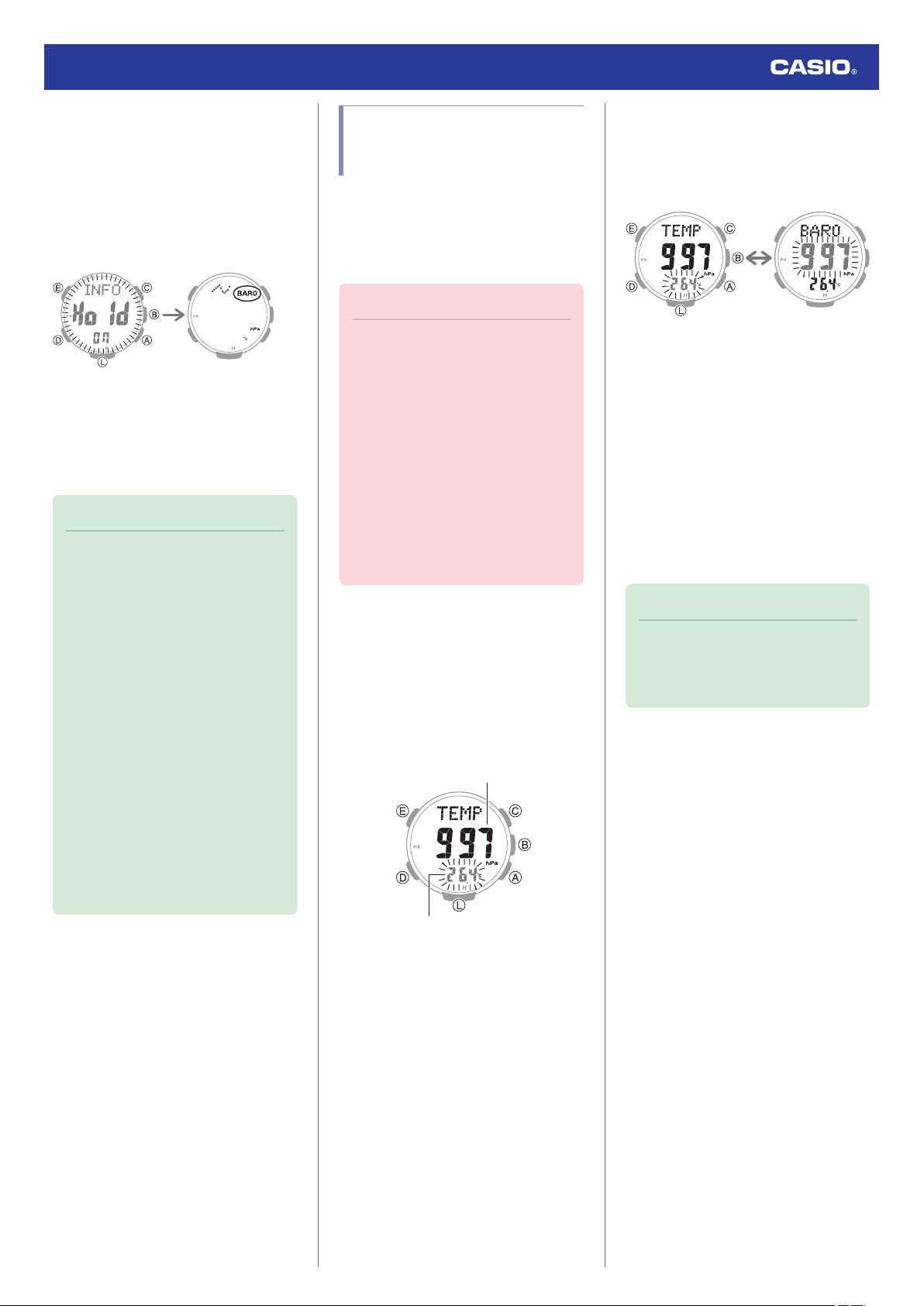
1. Enter the Barometer/Temperature Mode.
l
Navigating Between Modes
2. Hold down (B) for at least two seconds.
If Barometric Pressure Change
Indications are enabled, [INFO] [Hold]
[On] flash on the display, and then [BARO]
appears.
3. To disable Barometric Pressure Change
Indication, hold down (B) again for at least
two seconds.
[INFO] [Hold] [OFF] flash on the display,
and then [BARO] disappears.
Note
●
If the Barometric Pressure Change
Indication is enabled, readings are
taken every two minutes even while the
watch is not in the Barometer/
Temperature Mode.
●
The Barometric Pressure Change
Indication becomes disabled
automatically 24 hours after it is
enabled.
●
Power Saving is disabled while
barometric pressure trend information
is enabled.
l
Power Saving Function
●
You will not be able to turn on
Barometric Pressure Change
Indication while the charge level of the
watch’s battery is low.
●
Low battery power will also cause
Barometric Pressure Change
Indication to turn off.
Correcting Measured
Barometric Pressure and
Temperature Values (Offset)
The watch’s built-in pressure sensor and
temperature sensor are adjusted at the factory
and normally do not require correction.
However, you can correct the displayed value
if you notice major errors in readings.
Important!
●
The watch will not be able to produce
correct barometric pressure readings if
you make a mistake during the
correction procedure. Check to ensure
that the values you use for calibration
produces correct pressure and
temperature readings.
●
Before adjusting the temperature
sensor, remove the watch from your
wrist and leave it in the area where you
plan to measure temperature for about
20 or 30 minutes to allow the case
temperature to become the same as
the air temperature.
1. Enter the Barometer/Temperature Mode.
l
Navigating Between Modes
2. Hold down (E) for at least two seconds.
Release the button when [TEMP] appears
on the display.
This causes the temperature reading to
flash on the display.
Barometric pressure
Temperature
3. Press (D) to select the temperature
correction or barometric pressure
correction screen.
Barometric pressure
correction screen
Temperature
correction screen
4. Use (A) and (C) to change the value.
Temperature Setting Unit: 0.1 °C (or
0.2 °F)
Barometric Pressure Setting Unit: 1 hPa
(or 0.05 inHg)
●
Holding down (A) or (C) scrolls through
settings at high speed.
●
To return the barometric pressure
setting to its initial factory default, press
(A) and (C) at the same time.
5. Press (E) to complete the setting
operation.
Note
●
While the setting is being configured,
the watch will exit the setting operation
automatically after about two or three
minutes of non-operation.
Watch Operation Guide 3513
24
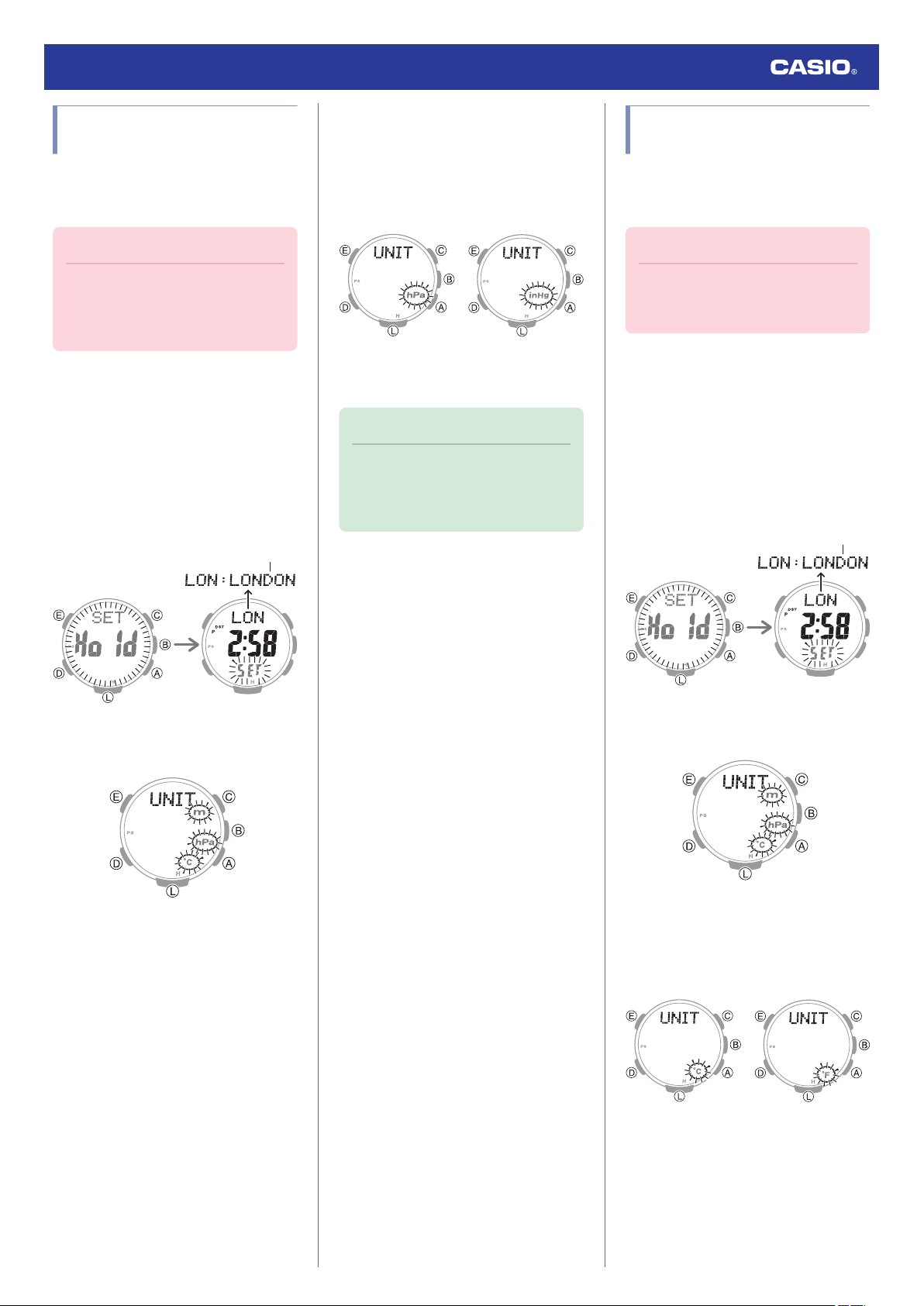
Specifying the Barometric
Pressure Unit
You can specify either hectopascals (hPa) or
inches of mercury (inHg) as the display unit for
barometric pressure values.
Important!
●
When Tokyo (TYO) is the Home City,
the barometric pressure unit is fixed as
hectopascals (hPa) and cannot be
changed.
1. Enter the Timekeeping Mode.
l
Navigating Between Modes
2. Hold down (E) for at least two seconds.
Release the button when the name of the
currently selected Home City appears on
the display.
Example: When your Home City is
London
Home City
3. Press (D) 12 times.
This displays [UNIT].
4. Use (B) to select a barometric pressure
unit.
[hPa]: Hectopascals
[inHg]: Inches of mercury
Inches of mercuryHectopascals
5. Press (E) twice to complete the setting
operation.
Note
●
While the setting is being configured,
the watch will exit the setting operation
automatically after about two or three
minutes of non-operation.
Specifying the Temperature
Measurement Unit
You can select either Celsius (°C) or
Fahrenheit (°F) as the temperature display
unit.
Important!
●
When Tokyo (TYO) is the Home City,
the temperature unit is fixed as Celsius
(°C) and cannot be changed.
1. Enter the Timekeeping Mode.
l
Navigating Between Modes
2. Hold down (E) for at least two seconds.
Release the button when the name of the
currently selected Home City appears on
the display.
Example: When your Home City is
London
Home City
3. Press (D) 12 times.
This displays [UNIT].
4. Use (C) to select a temperature unit.
[°C]: Celsius
[°F]: Fahrenheit
FahrenheitCelsius
5. Press (E) twice to complete the setting
operation.
Watch Operation Guide 3513
25
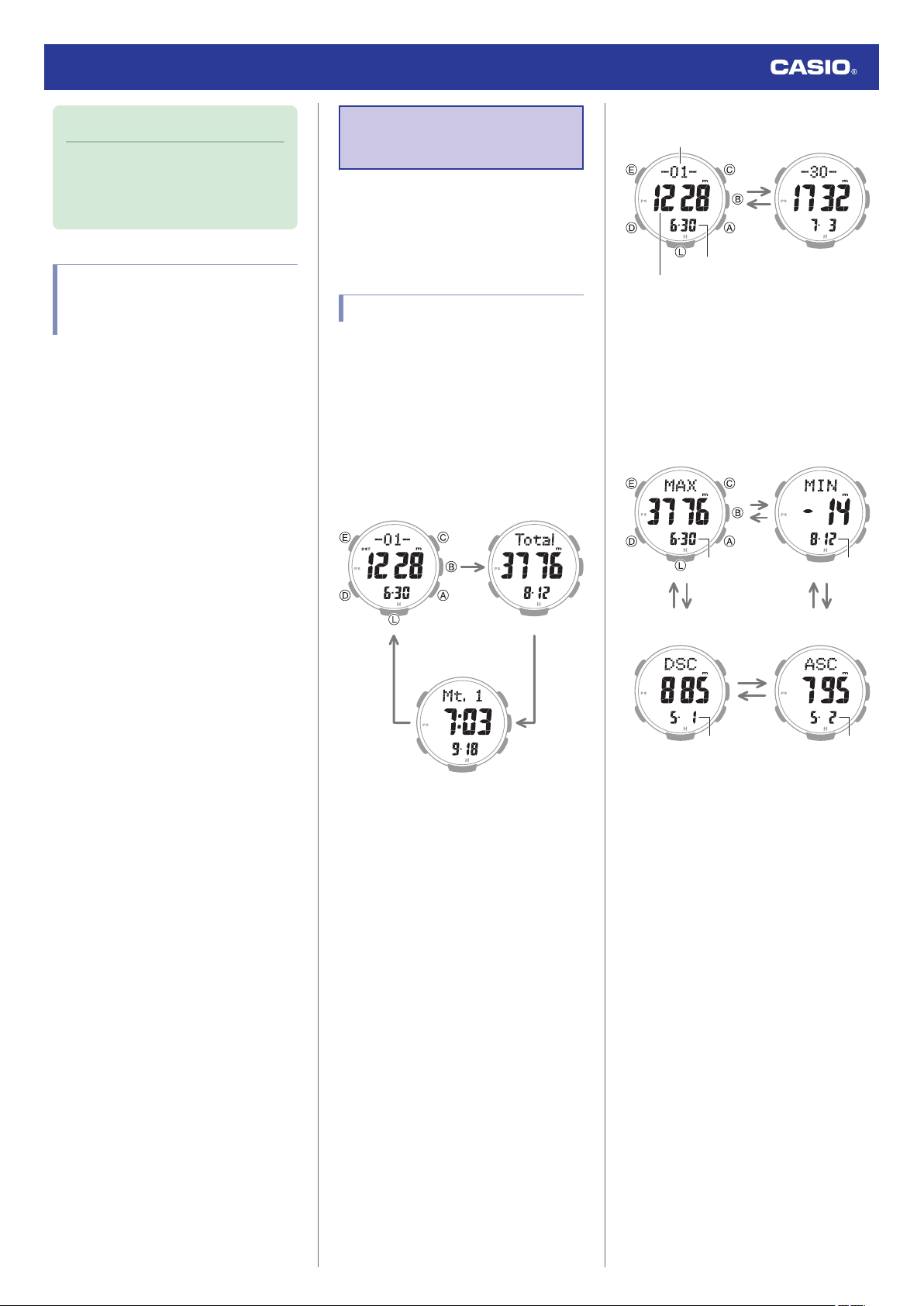
Note
●
While the setting is being configured,
the watch will exit the setting operation
automatically after about two or three
minutes of non-operation.
Barometric Pressure and
Temperature Reading
Precautions
●
Barometric Pressure Reading
Precautions
●
The barometric pressure graph produced
by this watch can be used to obtain an idea
of upcoming weather conditions. However,
this watch should not be used in place of
precision instruments required for official
weather prediction and reporting.
●
Pressure sensor readings can be affected
by sudden changes in temperature.
Because of this, there may be some error in
the readings produced by the watch.
●
Temperature Reading Precautions
●
Body temperature, direct sunlight, and
humidity all have an effect on temperature
readings. To help ensure more accurate
temperature readings, remove the watch
from your wrist, wipe it dry of any moisture,
and place it in a well-ventilated location not
exposed to direct sunlight. You should be
able to take temperature readings after
about 20 to 30 minutes.
Viewing Altitude
Records
You can use the Data Recall Mode to view
manually recorded, auto recorded, and climb
record altitude measurement data.
l
Recording Altitude Readings
Viewing Recorded Data
1. Enter the Data Recall Mode.
l
Navigating Between Modes
This displays a record of data recorded in
the Altimeter Mode.
2. Press (B) to select manually recorded
data, auto record data, or climb record
data.
B
BB*
Manually Recorded
Data
Auto Record Data
Climb Record Data
* Each press of (B) scrolls through climb
data records from record 1 ([Mt.1]) up to
a maximum of record 14 ([Mt.14]).
3. Use (A) and (C) to display the data you
want to view.
●
Holding down (A) or (C) scrolls through
settings at high speed.
●
Manually Recorded Data ([-01-] to [-30-])
C
A*1
Altitude
Month, day * 2
Record number
*1 Each press of the button scrolls through
manually recorded data records from record 1
([-01-]) up to a maximum of record 30 ([-30-]).
*2 The date (month, day) and time alternate
on the display at one-second intervals.
●
Auto Record Data
C
A
A
C
CA
A
C
*1 *1
*2 *2
High Altitude
Cumulative Descent
Low Altitude
Cumulative Ascent
*1 The recording date (month, day) and time
alternate on the display at one-second
intervals.
*2 The date (month, day) and year when
accumulation started alternate on the display
at one-second intervals.
Watch Operation Guide 3513
26
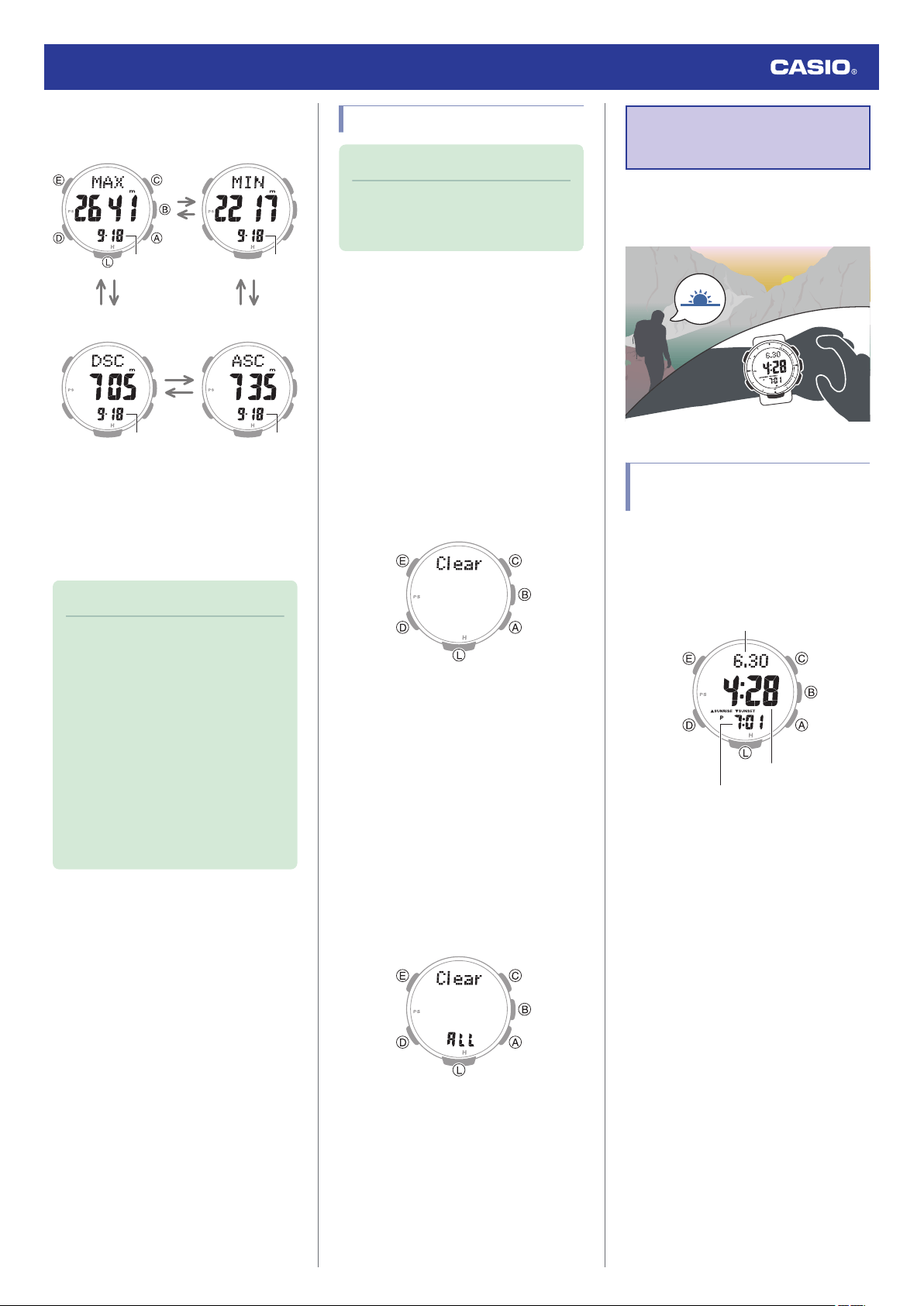
●
Climb Record Data ([Mt.1] to [Mt.14])
C
A
A
C
CA
A
C
*1 *1
*2 *2
High Altitude
Cumulative Descent
Low Altitude
Cumulative Ascent
*1 The recording date (month, day) and time
alternate on the display at one-second
intervals.
*2 The date (month, day) and year when
accumulation started alternate on the display
at one-second intervals.
Note
●
If there is no data left in memory due to
a data delete operation, error, or some
other reason, [- - - -] or [0] will appear
on the display.
●
If the cumulative ascent (ASC) or
cumulative descent (DSC) value
exceeds 99,999 m (327,995 feet), it
will revert to 0 and continue from there.
●
If you do not perform any operation for
about two or three minutes while in the
Data Recall Mode, the watch
automatically returns to the
Timekeeping Mode.
Deleting Data
Note
●
Data cannot be deleted while a climb
record data measurement operation is
in progress.
●
Deleting a Particular Record
1. Enter the Data Recall Mode.
l
Navigating Between Modes
2. Use (B) to select the data you want to
delete.
●
If you selected manually recorded data,
use (A) and (C) to select the data you
want to delete.
3. Hold down the (E) button for at least two
seconds. Release the button as soon as
[Clear] stops flashing.
This deletes the record you selected.
●
Note that holding down (E) for at least
five seconds while manually recorded
data is selected will delete all manually
recorded data.
●
Deleting All Manually Recorded Data
1. Enter the Data Recall Mode.
l
Navigating Between Modes
2. Use (B) to select manually recorded data.
3. Hold down (E) for at least five seconds.
Release the button when [Clear] [ALL]
stops flashing.
This deletes all manually recorded data.
Sunrise and Sunset
Times
You can use the procedures in this section to
check the sunrise and sunset times for a
specified date (year, month, day) and location.
Looking Up Today’s Sunrise
and Sunset Times
1. Enter the Sunrise/Sunset Mode.
l
Navigating Between Modes
This displays the current date’s sunrise
and sunset times for your Home City.
Month, day
Sunrise time
Sunset time
Watch Operation Guide 3513
27
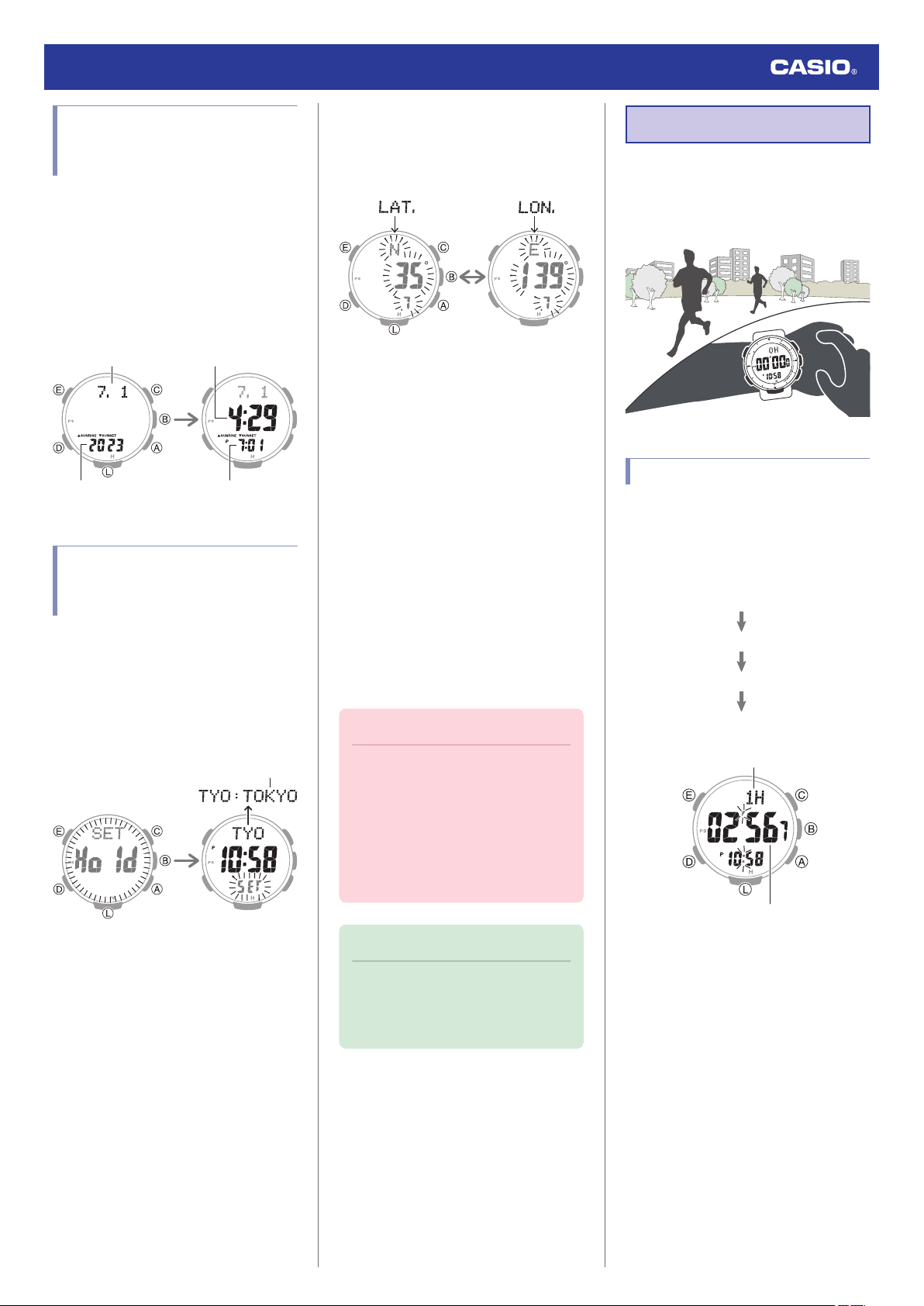
Looking Up Sunrise and
Sunset Times by Specifying a
Day
1. Enter the Sunrise/Sunset Mode.
l
Navigating Between Modes
2. Use (A) and (C) to select the day you want.
This displays the sunrise and sunset
times for the day you specified.
●
Holding down (A) or (C) scrolls through
settings at high speed.
Month, day Sunrise time
Year Sunset time
Looking Up Sunrise and
Sunset Times by Specifying a
Location
1. Enter the Timekeeping Mode.
l
Navigating Between Modes
2. Hold down (E) for at least two seconds.
Release the button when the name of the
currently selected Home City appears on
the display.
Home City
3. Use (A) and (C) to select the city name of
the location whose sunrise/sunset times
you want to look up.
●
Holding down (A) or (C) scrolls through
settings at high speed.
●
If you don’t need to specify a latitude
and longitude, press (E) twice and
advance to step 8.
4. Press (E).
This displays the latitude or longitude
setting screen.
5. Press (D) to toggle between the latitude
and longitude setting screens.
Longitude screen
Latitude screen
6. Use (A) and (C) to specify an angle
Setting ranges are shown below.
Latitude: 65.0°S (65.0 degrees south
latitude) to 0.0°N to 65.0°N (65.0 degrees
north latitude)
Longitude: 179.9°W (179.9 degrees west
longitude) to 0.0°E to 180.0°E (180.0
degrees east longitude)
●
You can change the setting in 0.1°
increments.
●
Holding down (A) or (C) scrolls through
settings at high speed.
7. Press (E) to return to the Timekeeping
Mode.
8. Press (D).
This displays the sunrise/sunset times for
the location you specified.
Important!
●
If you specify a city that is not your
Home City as the location when
checking sunrise and sunset times, be
sure to change back to your Home City
setting after you are finished. If you
don’t, the watch will not display the
correct current time.
l
Setting a Home City
Note
●
While the setting is being configured,
the watch will exit the setting operation
automatically after about two or three
minutes of non-operation.
Stopwatch
The stopwatch performs elapsed time
measurement up to 999 hours, 59 minutes,
59.9 seconds in 1/10 second units.
It can also measure split times.
Measuring Elapsed Time
1. Enter the Stopwatch Mode.
l
Navigating Between Modes
2. Use the operations below to measure
elapsed time.
A
A
A
A
Stop
Resume
Stop
Start
Hours
Minutes, seconds, 1/10 seconds
3. Press (C) to reset the stopwatch to all
zeros.
Watch Operation Guide 3513
28
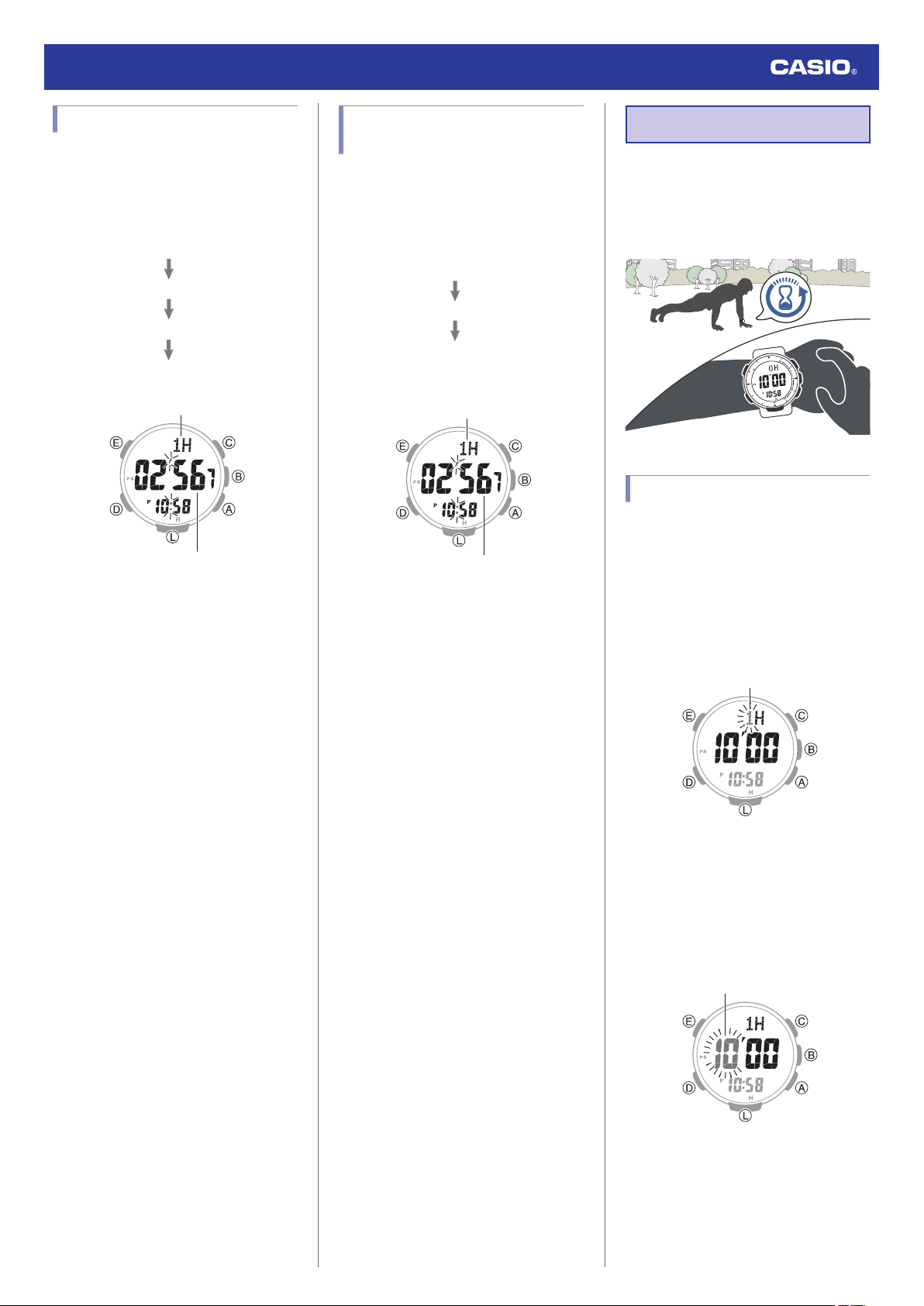
Measuring a Split Time
1. Enter the Stopwatch Mode.
l
Navigating Between Modes
2. Use the operations below to measure
elapsed time.
A
C
C
A
Stop
Split release
Split
Start
Hours
Minutes, seconds, 1/10 seconds
3. Press (C) to reset the stopwatch to all
zeros.
Timing the First and Second
Place Finishers
1. Enter the Stopwatch Mode.
l
Navigating Between Modes
2. Use the operations below to measure
elapsed time.
A
C
A
2nd Finisher*
1st Finisher*
Start
* Displays the time of the first finisher.
Hours
Minutes, seconds, 1/10 seconds
3. Press (C) to display the time of the second
place finisher.
4. Press (C) to reset the stopwatch to all
zeros.
Timer
The timer counts down from a start time
specified by you. A beeper sounds when the
end of the countdown is reached.
●
The beeper will not sound if battery power
is low.
Setting a Start Time
The countdown start time can be set in 1-
minute units up to 24 hours.
1. Enter the Timer Mode.
l
Navigating Between Modes
2. Hold down (E) for at least two seconds.
Release the button when the hour setting
starts to flash.
Hours
3. Use (A) and (C) to change the timer hours
setting.
●
Holding down (A) or (C) scrolls through
settings at high speed.
4. Press (D).
This causes the minutes digits to flash.
Minutes
Watch Operation Guide 3513
29
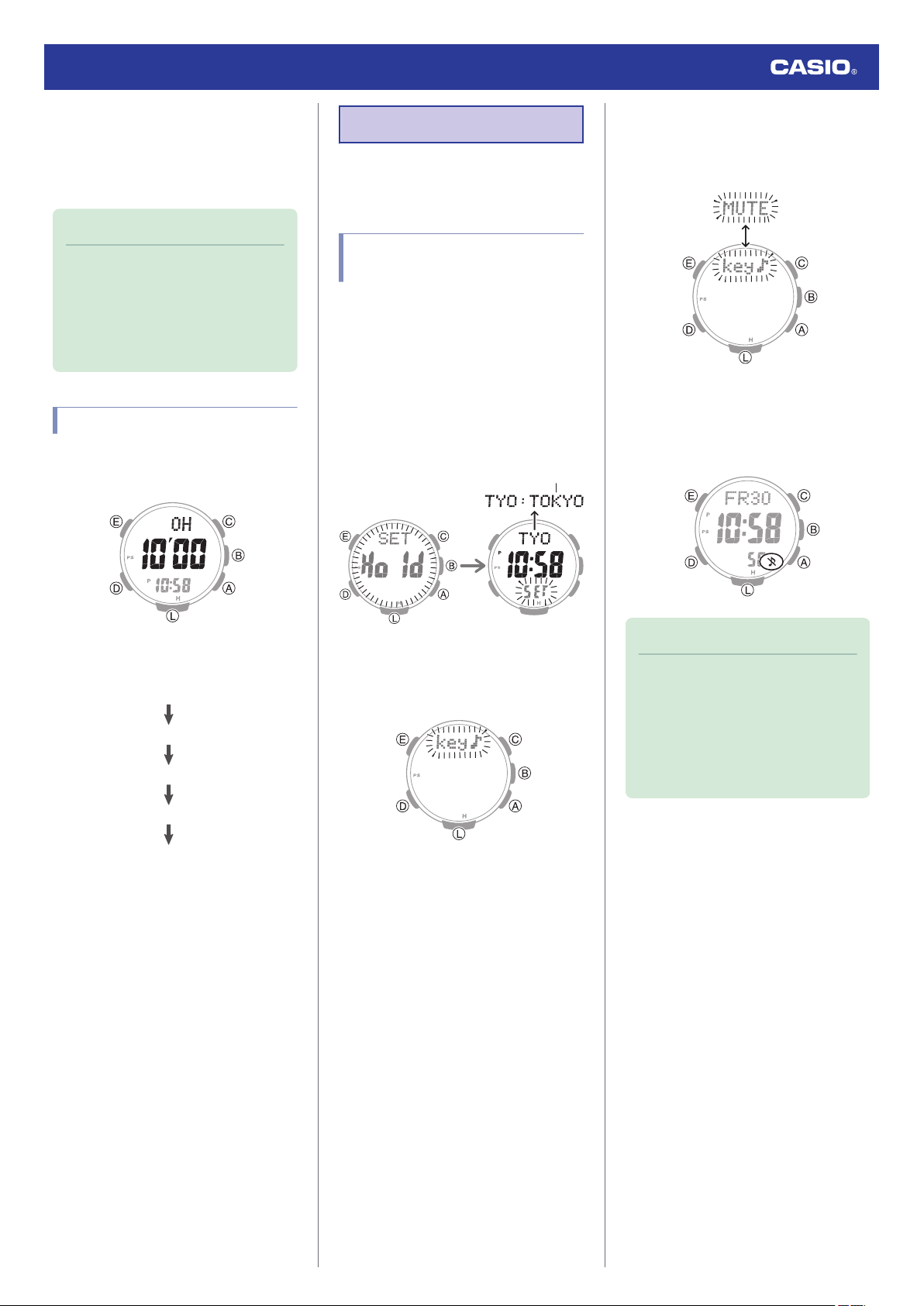
5. Use (A) and (C) to change the minutes
setting.
6. Press (E) to complete the setting
operation.
Note
●
While the setting is being configured,
the watch will exit the setting operation
automatically after about two or three
minutes of non-operation.
●
Setting a start time of “0H00'00” will
perform a countdown of 24 hours.
Using the Timer
1. Enter the Timer Mode.
l
Navigating Between Modes
2. Use the operations below to perform a
timer operation.
A
A
A
(Time up)
Resume
Pause
(Countdown starts)
Start
●
A beeper will sound for 10 seconds to
let you know when the end of a
countdown is reached.
●
You can reset a paused countdown to
its start time, by pressing (C).
3. Press any button to stop the tone.
Other Settings
This section explains other watch settings you
can configure.
Enabling the Button
Operation Tone
Use the procedure below to enable or disable
the tone that sounds when you press a button.
1. Enter the Timekeeping Mode.
l
Navigating Between Modes
2. Hold down (E) for at least two seconds.
Release the button when the name of the
currently selected Home City appears on
the display.
Home City
3. Press (D) nine times.
This causes [key♪] or [MUTE] to flash on
the display.
4. Press (A) to select [key♪] or [MUTE].
[key♪]: Operation tone enabled.
[MUTE]: Operation tone disabled.
5. Press (E) twice to complete the setting
operation.
●
[
O
] is displayed while the operation
tone is muted.
Note
●
While the setting is being configured,
the watch will exit the setting operation
automatically after about two or three
minutes of non-operation.
●
Note that alarm and timer tones will still
sound even while the operation tone is
muted.
Watch Operation Guide 3513
30
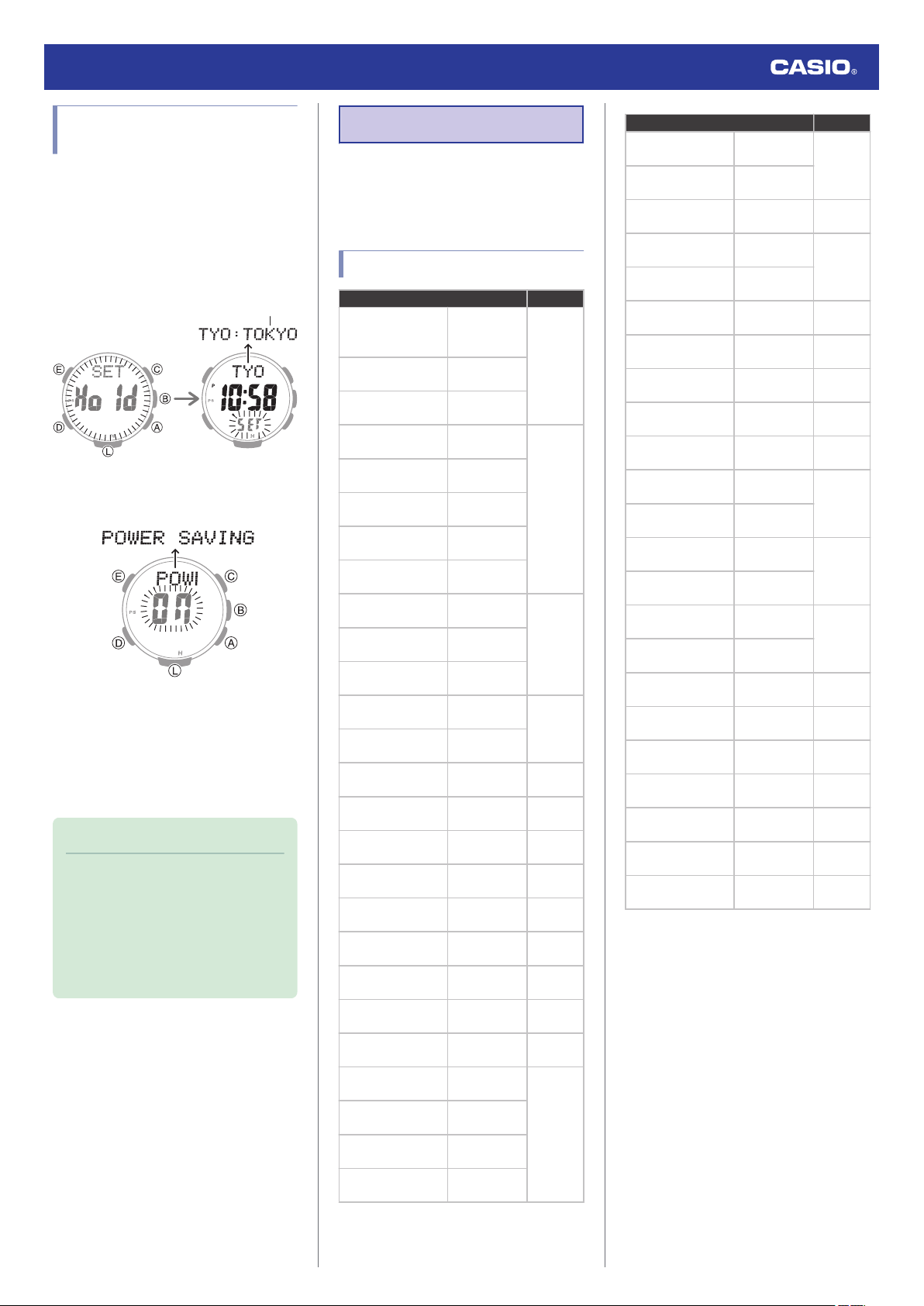
Configuring Power Saving
Function Settings
1. Enter the Timekeeping Mode.
l
Navigating Between Modes
2. Hold down (E) for at least two seconds.
Release the button when the name of the
currently selected Home City appears on
the display.
Home City
3. Press (D) 11 times.
This displays [POWER SAVING].
4. Press (A) to toggle between on and off.
[On]: Power Saving enabled.
[OFF]: Power Saving disabled.
5. Press (E) twice to complete the setting
operation.
Note
●
While the setting is being configured,
the watch will exit the setting operation
automatically after about two or three
minutes of non-operation.
●
For details about Power Saving, refer
to the information below.
l
Power Saving Function
Other Information
This section provides non-operational
information you also need to know. Refer to
this information as required.
City Table
City Offset
UTC
Coordinated
Universal
Time
0
LIS:
LISBON
Lisbon
LON:
LONDON
London
MAD:
MADRID
Madrid
+1
PAR:
PARIS
Paris
ROM:
ROME
Rome
BER:
BERLIN
Berlin
STO:
STOCKHOLM
Stockholm
ATH:
ATHENS
Athens
+2
CAI:
CAIRO
Cairo
JRS:
JERUSALEM
Jerusalem
MOW:
MOSCOW
Moscow
+3
JED:
JEDDAH
Jeddah
THR:
TEHRAN
Tehran +3.5
DXB:
DUBAI
Dubai +4
KBL:
KABUL
Kabul +4.5
KHI:
KARACHI
Karachi +5
DEL:
DELHI
Delhi +5.5
KTM:
KATHMANDU
Kathmandu +5.75
DAC:
DHAKA
Dhaka +6
RGN:
YANGON
Yangon +6.5
BKK:
BANGKOK
Bangkok +7
SIN:
SINGAPORE
Singapore
+8
HKG:
HONG KONG
Hong Kong
BJS:
BEIJING
Beijing
TPE:
TAIPEI
Taipei
City Offset
SEL:
SEOUL
Seoul
+9
TYO:
TOKYO
Tokyo
ADL:
ADELAIDE
Adelaide +9.5
GUM:
GUAM
Guam
+10
SYD:
SYDNEY
Sydney
NOU:
NOUMEA
Noumea +11
WLG:
WELLINGTON
Wellington +12
PPG:
PAGO PAGO
Pago Pago -11
HNL:
HONOLULU
Honolulu -10
ANC:
ANCHORAGE
Anchorage -9
YVR:
VANCOUVER
Vancouver
-8
LAX:
LOS ANGELES
Los Angeles
YEA:
EDMONTON
Edmonton
-7
DEN:
DENVER
Denver
MEX:
MEXICO CITY
Mexico City
-6
CHI:
CHICAGO
Chicago
NYC:
NEW YORK
New York -5
SCL:
SANTIAGO
Santiago -4
YHZ:
HALIFAX
Halifax -4
YYT:
ST. JOHN’S
St. John’s -3.5
RIO:
RIO DE JANEIRO
Rio de
Janeiro
-3
FEN:
F. DE NORONHA
Fernando de
Noronha
-2
RAI:
PRAIA
Praia -1
●
The information in the above table is current
as of January 2022.
●
Time zones may change and UTC
differentials may become different from
those shown in the table above.
Watch Operation Guide 3513
31
Specifications
Accuracy :
±15 seconds a month
Basic Functions :
Hour, minute, second, month, day, day of
the week
Barometric pressure graph
a.m./p.m.(P)/24-hour timekeeping
Full Auto Calendar (2000 to 2099)
Digital Compass :
Measurement range: 0° to 359°
Measurement unit: 1°
Continuous Bearing Measurement (1
minute)
Compass calibration (2-point calibration,
magnetic declination angle)
North, south, east, west indication (four-
direction graphic pointer)
Bearing memory
Altimeter (relative altitude) :
Measuring range: -700 to 10,000 m (or
-2,300 to 32,800 ft.)
Display range: -10,000 m to 10,000 m (or
-32,800 to 32,800 ft.)
(Altitude calibration can be used to display
any 10,700 m within the range above.)
Measuring unit: 1 m (or 5 ft.)
Measuring interval: 2 minutes/5 seconds
Altitude calibration
Altitude graph
Altitude differential measurement: -3,000 to
+3,000m (or -9,840 to 9,840 ft.)
Reference altitude setting
Altitude Memory
Manually Recorded Data
Recording of altitude, date (month,
day), and time by button operation. Up
to 30 records.
Auto Record Data
One record of high altitude, low
altitude, cumulative ascent, cumulative
descent
Climb Record Data
Up to 14 records of high altitude, low
altitude, cumulative ascent, cumulative
descent
Barometer :
Measurement range: 260 to 1,100 hPa (or
7.65 to 32.45 inHg)
Display range: 260 to 1,100 hPa (or 7.65 to
32.45 inHg)
Measurement unit: 1 hPa (or 0.05 inHg)
Barometric pressure adjustment
Barometric pressure graph
Barometric pressure differential graphic
Barometric pressure change indications
Temperature :
Measuring range: -10.0 °C to 60.0 °C (or
14.0 °F to 140.0 °F)
Display range: -10.0 °C to 60.0 °C (or
14.0 °F to 140.0 °F)
Measuring unit: 0.1 °C (or 0.2 °F)
Temperature Correction
Sensor Accuracy :
Direction
Measurement accuracy: Within ±10°
Accuracy guaranteed temperature
range: 10 °C to 40 °C (50 °F to 104 °F)
Bearing graph within ±2 gradations
Pressure
Measurement accuracy: Within ±3 hPa
(0.1 inHg)
(Altimeter measurement accuracy:
Within ±75 m (246 ft.))
Guaranteed accuracy temperature
range: -10 °C to 40 °C (14 °F to 104 °F)
●
Strong impact or prolonged exposure to
temperature extremes may negatively
affect accuracy.
Temperature
Measurement accuracy: Within ±2 °C
(3.6 °F)
Accuracy guaranteed temperature
range: -10 °C to 60 °C (14 °F to 140 °F)
Sunrise/Sunset Functions :
Sunrise and sunset times
Day select
Stopwatch :
Measuring unit: 1/10 seconds
Measuring range
999 hours, 59 minutes, 59.9 seconds
(1000 hours)
Measurement Functions
Elapsed time, cumulative time, split
times, 1st and 2nd place finisher times
Timer :
Setting unit: 1 minute
Countdown range: 24 hours
Countdown unit: 1 second
Time up alert duration: 10 seconds
Alarm :
Time alarms
Alarms: 5 (with one snooze alarm)
Setting units: Hours, minutes
Alarm tone duration: 10 seconds
Hourly time signal: Beep every hour on the
hour
World Time :
48 cities (31 time zones) and Coordinated
Universal Time (UTC)
Summer time
Other :
High-brightness LED light (Full Auto Light,
afterglow, 1.5 or 3-second illumination
duration setting), power saving, battery
power indicator, operation tone on/off
Power Supply :
Solar panel and one rechargeable battery
Battery operating time: Approximately 7
months
Conditions:
Illumination: 1.5 seconds/day
Beeper: 10 seconds/day
Digital Compass Operations: 20 times/
month
Mountain climbing: Once/month
(Altitude readings: Approximately 1
hour; Barometric pressure change
indication measurements:
Approximately 24 hours)
Barometric Pressure Graph:
Measurement every 2 hours
Display: 18 hours/day
Specifications are subject to change without
notice.
Watch Operation Guide 3513
32
Troubleshooting
Altitude Measurement
Q1
Readings produce different results at
the same location.
Watch readings are different from
altitude information available from
other sources.
Correct altitude readings are not
possible.
Relative altitude is calculated based on
changes in barometric pressure measured by
the watch’s pressure sensor. This means that
barometric pressure changes can cause
readings taken at the same location to be
different. Also note that the value displayed by
the watch may be different from the actual
elevation and/or sea level elevation indicated
for the area where you are located. When
using the watch’s altimeter while mountain
climbing, it is recommended that you regularly
calibrate its readings in accordance with local
altitude (elevation) indications.
l
Calibrating Altitude Readings (Offset)
Q2
[ERR] appears during measurement.
There may be a problem with the sensor. Try
taking another measurement.
If [ERR] keeps appearing after multiple
measurement attempts, contact a CASIO
service center or your original retailer.
Digital Compass
Q1
The entire display is flashing.
Abnormal magnetism has been detected.
Move away from any potential source of
strong magnetism and try taking a reading
again.
l
Digital Compass Reading Precautions
●
If the display flashes again, it could mean
that the watch itself has become
magnetized. Move away from any potential
source of strong magnetism, perform 2-
point calibration, and then try taking a
reading again.
l
Calibrating Compass Readings
Q2
[ERR] appears during measurement.
There is a problem with the sensor or there
may be a source strong magnetic force
nearby. Move away from any potential source
of strong magnetism and try taking a reading
again. If [ERR] keeps appearing after multiple
measurement attempts, contact a CASIO
service center or your original retailer.
l
Digital Compass Reading Precautions
Q3
[ERR] appears following 2-point
calibration.
[ERR] on the display could indicate a sensor
problem.
●
If [ERR] disappears after about one second,
try performing 2-point calibration again.
●
If [ERR] keeps appearing after multiple
attempts, contact a CASIO service center or
your original retailer.
Q4
Direction information indicated by the
watch is different from that indicated
by a backup compass.
Move away from any potential source of
strong magnetism, perform 2-point
calibration, and then try taking a reading
again.
l
Calibrating Compass Readings
l
Digital Compass Reading Precautions
Q5
Readings at the same location
produce different results.
Cannot take readings indoors.
Move away from any potential source of
strong magnetism and try taking a reading
again.
l
Digital Compass Reading Precautions
Barometric Pressure
Measurement
Q1
The barometric pressure differential
graphic is not displayed after
barometric pressure measurement.
The barometric pressure differential graphic is
not displayed if the barometric pressure
measurement value exceeds the allowable
measurement range (260hPa to 1,100hPa) or
if the barometric pressure differential exceeds
±10hPa. If [ERR] is displayed, there may be a
problem with the sensor.
l
Checking the Change Between Two
Barometric Pressure Readings
(Barometric Pressure Differential)
Q2
[ERR] appears during measurement.
There may be a problem with the sensor. Try
taking another measurement. If [ERR] keeps
appearing after multiple measurement
attempts, contact a CASIO service center or
your original retailer.
Temperature Measurement
Q1
[ERR] appears during measurement.
There may be a problem with the sensor. Try
taking another measurement. If [ERR] keeps
appearing after multiple measurement
attempts, contact a CASIO service center or
your original retailer.
World Time
Q1
The time for a World Time City is not
correct.
The summer time setting (standard time/
summer time) may be wrong.
l
Specifying a World Time City
Watch Operation Guide 3513
33
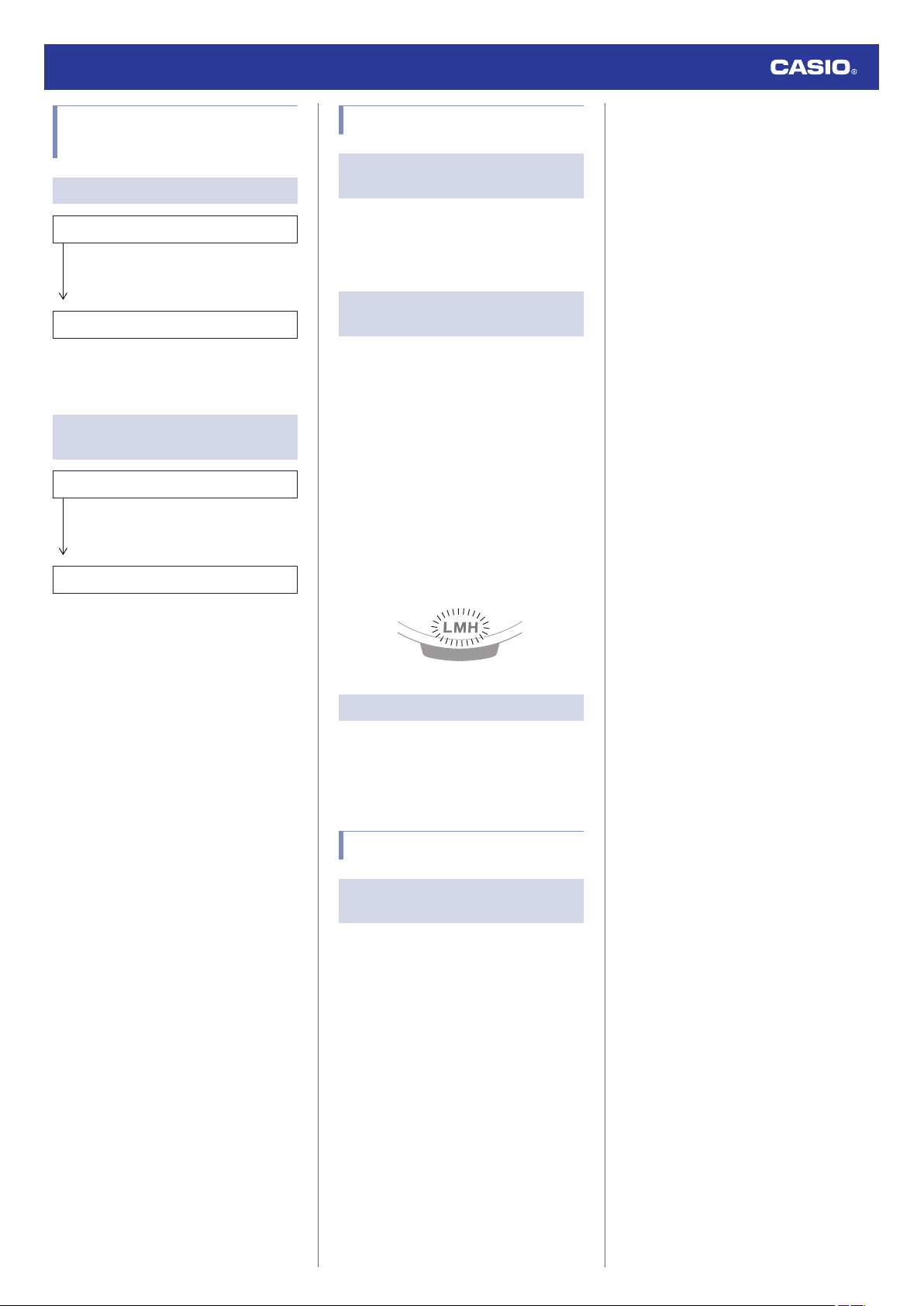
Alarm and Hourly Time
Signal
Q1
An alarm does not sound.
Is the watch’s battery charged?
Keep the watch exposed to light until it
recharges sufficiently.
l
Charging
Other than the above.
The alarm’s settings may not be
configured. Configure the alarm settings.
l
Configuring Alarm Settings
Q2
The hourly time signal does not
sound.
Is the watch’s battery charged?
Keep the watch exposed to light until it
recharges sufficiently.
l
Charging
Other than the above.
The hourly time signal may be disabled.
Enable the hourly time signal.
l
Configuring the Hourly Time Signal
Setting
Charging
Q1
The watch does not work even
though it is exposed to light.
The watch stops operating whenever the
battery goes dead. Keep the watch exposed
to light until it recharges sufficiently.
l
Checking the Charge Level
Q2
[H], [M], and [L] are flashing on the
display.
The watch is in the charge recovery mode.
Wait until the recovery process is complete
(about 15 minutes). The watch will recover
more quickly if you place it in a brightly lit
location.
●
If an alarm, hourly time signal, illumination
and/or other power-intensive functions are
used within a short period of time, the
charging capacity of the battery will drop
and cause the watch to go into a charge
recovery mode. Function availability will be
temporarily limited, but functionality will
return after the battery recovers.
l
Checking the Charge Level
Q3
[CHG] is flashing on the display.
The charge level of the watch is extremely low.
Immediately expose the watch to light to
charge it.
l
Checking the Charge Level
Other
Q1
I can’t find the information I need
here.
Visit the website below.
https://world.casio.com/support/
Watch Operation Guide 3513
34

