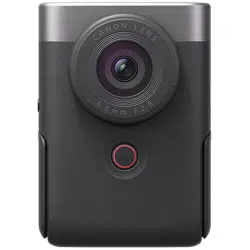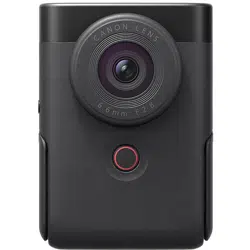
Advanced User Guide
E
CT2-D251-A
© CANON INC. 2023

Contents
Introduction. . . . . . . . . . . . . . . . . . . . . . . . . . . . . . . . . . . . . . . . . . . . . . . . 6
Package Contents. . . . . . . . . . . . . . . . . . . . . . . . . . . . . . . . . . . . . . . . . . . . . . . 7
Supplemental Information. . . . . . . . . . . . . . . . . . . . . . . . . . . . . . . . . . . . . . . . . 8
Compatible Accessories. . . . . . . . . . . . . . . . . . . . . . . . . . . . . . . . . . . . . . . . . . . 9
Instruction Manuals. . . . . . . . . . . . . . . . . . . . . . . . . . . . . . . . . . . . . . . . . . . . . 10
Quick Start Guide. . . . . . . . . . . . . . . . . . . . . . . . . . . . . . . . . . . . . . . . . . . . . . . 11
About This Guide. . . . . . . . . . . . . . . . . . . . . . . . . . . . . . . . . . . . . . . . . . . . . . . 14
Compatible Cards. . . . . . . . . . . . . . . . . . . . . . . . . . . . . . . . . . . . . . . . . . . . . . 16
Safety Instructions. . . . . . . . . . . . . . . . . . . . . . . . . . . . . . . . . . . . . . . . . . . . . . 17
Handling Precautions. . . . . . . . . . . . . . . . . . . . . . . . . . . . . . . . . . . . . . . . . . . . 20
Part Names. . . . . . . . . . . . . . . . . . . . . . . . . . . . . . . . . . . . . . . . . . . . . . . . . . . 22
Preparation and Basic Operations. . . . . . . . . . . . . . . . . . . . . . . . . . . . . 25
Charging the Camera. . . . . . . . . . . . . . . . . . . . . . . . . . . . . . . . . . . . . . . . . . . . 26
Inserting/Removing Cards. . . . . . . . . . . . . . . . . . . . . . . . . . . . . . . . . . . . . . . . 27
Using the Screen and Stand. . . . . . . . . . . . . . . . . . . . . . . . . . . . . . . . . . . . . . 30
Turning on the Power. . . . . . . . . . . . . . . . . . . . . . . . . . . . . . . . . . . . . . . . . . . . 31
Basic Operations. . . . . . . . . . . . . . . . . . . . . . . . . . . . . . . . . . . . . . . . . . . . . . . 33
Menu Operations and Settings. . . . . . . . . . . . . . . . . . . . . . . . . . . . . . . . . . . . . 37
Quick Control. . . . . . . . . . . . . . . . . . . . . . . . . . . . . . . . . . . . . . . . . . . . . . . . . . 42
Touch-Screen Operation. . . . . . . . . . . . . . . . . . . . . . . . . . . . . . . . . . . . . . . . . 45
Shooting and Recording. . . . . . . . . . . . . . . . . . . . . . . . . . . . . . . . . . . . . 47
Movie Recording. . . . . . . . . . . . . . . . . . . . . . . . . . . . . . . . . . . . . . . . . . . . . . . 48
Still Photo Shooting. . . . . . . . . . . . . . . . . . . . . . . . . . . . . . . . . . . . . . . . . . . . . 51
Tab Menus: Movie Recording. . . . . . . . . . . . . . . . . . . . . . . . . . . . . . . . . . . . . 52
Tab Menus: Still Photo Shooting. . . . . . . . . . . . . . . . . . . . . . . . . . . . . . . . . . . 54
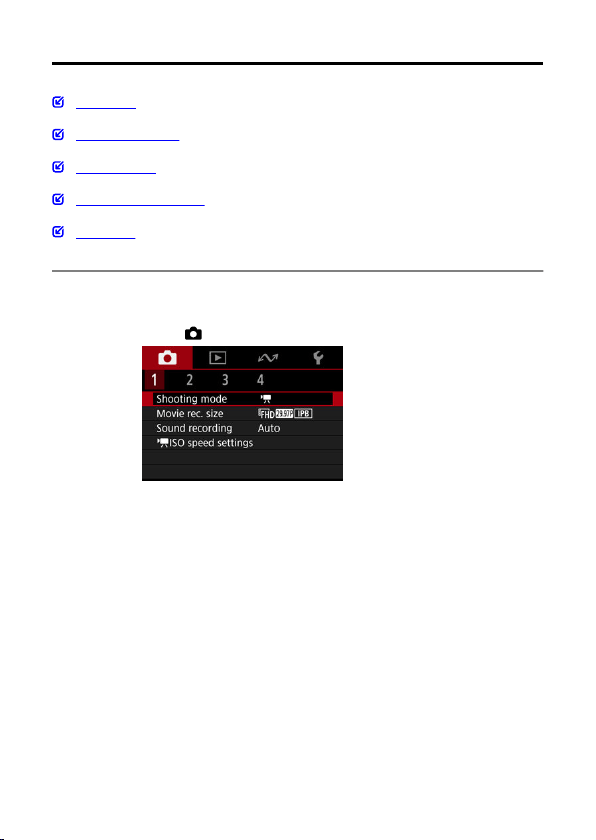
Shooting Mode. . . . . . . . . . . . . . . . . . . . . . . . . . . . . . . . . . . . . . . . . . . . . . . . . 55
Movie Recording Size. . . . . . . . . . . . . . . . . . . . . . . . . . . . . . . . . . . . . . . . . . . 61
Sound Recording. . . . . . . . . . . . . . . . . . . . . . . . . . . . . . . . . . . . . . . . . . . . . . . 66
Movie ISO Speed Settings. . . . . . . . . . . . . . . . . . . . . . . . . . . . . . . . . . . . . . . . 69
Movie Auto Slow Shutter. . . . . . . . . . . . . . . . . . . . . . . . . . . . . . . . . . . . . . . . . 70

ND Filter. . . . . . . . . . . . . . . . . . . . . . . . . . . . . . . . . . . . . . . . . . . . . . . . . . . . . . 72
White Balance. . . . . . . . . . . . . . . . . . . . . . . . . . . . . . . . . . . . . . . . . . . . . . . . . 73
Autofocus Method. . . . . . . . . . . . . . . . . . . . . . . . . . . . . . . . . . . . . . . . . . . . . . 77
Movie Self-Timer. . . . . . . . . . . . . . . . . . . . . . . . . . . . . . . . . . . . . . . . . . . . . . . 82
IS Settings. . . . . . . . . . . . . . . . . . . . . . . . . . . . . . . . . . . . . . . . . . . . . . . . . . . . 83
Movie Auto Level. . . . . . . . . . . . . . . . . . . . . . . . . . . . . . . . . . . . . . . . . . . . . . . 85
Grid. . . . . . . . . . . . . . . . . . . . . . . . . . . . . . . . . . . . . . . . . . . . . . . . . . . . . . . . . 86
Recording Emphasis. . . . . . . . . . . . . . . . . . . . . . . . . . . . . . . . . . . . . . . . . . . . 87
Aspect Marker. . . . . . . . . . . . . . . . . . . . . . . . . . . . . . . . . . . . . . . . . . . . . . . . . 88
Reverse Display. . . . . . . . . . . . . . . . . . . . . . . . . . . . . . . . . . . . . . . . . . . . . . . . 89
Standby: Low Resolution. . . . . . . . . . . . . . . . . . . . . . . . . . . . . . . . . . . . . . . . . 90
Display During HDMI Connection. . . . . . . . . . . . . . . . . . . . . . . . . . . . . . . . . . 91
Image Quality. . . . . . . . . . . . . . . . . . . . . . . . . . . . . . . . . . . . . . . . . . . . . . . . . . 93
Still Image Aspect Ratio. . . . . . . . . . . . . . . . . . . . . . . . . . . . . . . . . . . . . . . . . . 94
Touch Shutter. . . . . . . . . . . . . . . . . . . . . . . . . . . . . . . . . . . . . . . . . . . . . . . . . . 95
Review Duration. . . . . . . . . . . . . . . . . . . . . . . . . . . . . . . . . . . . . . . . . . . . . . . . 97
General Movie Recording Precautions. . . . . . . . . . . . . . . . . . . . . . . . . . . . . . 98
General Still Photo Shooting Precautions. . . . . . . . . . . . . . . . . . . . . . . . . . . 102
Playback. . . . . . . . . . . . . . . . . . . . . . . . . . . . . . . . . . . . . . . . . . . . . . . . 103
Tab Menus: Playback. . . . . . . . . . . . . . . . . . . . . . . . . . . . . . . . . . . . . . . . . . . 104
Movie Playback. . . . . . . . . . . . . . . . . . . . . . . . . . . . . . . . . . . . . . . . . . . . . . . 105
Image Playback. . . . . . . . . . . . . . . . . . . . . . . . . . . . . . . . . . . . . . . . . . . . . . . 108
Playback on a TV Set. . . . . . . . . . . . . . . . . . . . . . . . . . . . . . . . . . . . . . . . . . . 112
Protecting Images. . . . . . . . . . . . . . . . . . . . . . . . . . . . . . . . . . . . . . . . . . . . . 114
Erasing Images. . . . . . . . . . . . . . . . . . . . . . . . . . . . . . . . . . . . . . . . . . . . . . . 118
Rotating Still Photos. . . . . . . . . . . . . . . . . . . . . . . . . . . . . . . . . . . . . . . . . . . . 125
Changing Movie Orientation Information. . . . . . . . . . . . . . . . . . . . . . . . . . . . 127
Rating Images. . . . . . . . . . . . . . . . . . . . . . . . . . . . . . . . . . . . . . . . . . . . . . . . 129
Resuming from Previous Playback. . . . . . . . . . . . . . . . . . . . . . . . . . . . . . . . 134
Wireless Features. . . . . . . . . . . . . . . . . . . . . . . . . . . . . . . . . . . . . . . . 135
Tab Menus: Wireless Features. . . . . . . . . . . . . . . . . . . . . . . . . . . . . . . . . . . 136
Connecting to a Smartphone or Tablet. . . . . . . . . . . . . . . . . . . . . . . . . . . . . 138

Connecting to a Wireless Remote Control. . . . . . . . . . . . . . . . . . . . . . . . . . . 150
Uploading Images to image.canon. . . . . . . . . . . . . . . . . . . . . . . . . . . . . . . . . 154
Live Streaming. . . . . . . . . . . . . . . . . . . . . . . . . . . . . . . . . . . . . . . . . . . . . . . . 160
Advanced Connections. . . . . . . . . . . . . . . . . . . . . . . . . . . . . . . . . . . . . . . . . 168
GPS Settings. . . . . . . . . . . . . . . . . . . . . . . . . . . . . . . . . . . . . . . . . . . . . . . . . 171
Basic Communication Settings. . . . . . . . . . . . . . . . . . . . . . . . . . . . . . . . . . . 175
Reconnecting via Wi-Fi/Bluetooth. . . . . . . . . . . . . . . . . . . . . . . . . . . . . . . . . 196
Editing/Deleting Devices for Connections. . . . . . . . . . . . . . . . . . . . . . . . . . . 198
Airplane Mode. . . . . . . . . . . . . . . . . . . . . . . . . . . . . . . . . . . . . . . . . . . . . . . . 201
Wi-Fi Settings. . . . . . . . . . . . . . . . . . . . . . . . . . . . . . . . . . . . . . . . . . . . . . . . . 202
Bluetooth Settings. . . . . . . . . . . . . . . . . . . . . . . . . . . . . . . . . . . . . . . . . . . . . 204
Camera Name. . . . . . . . . . . . . . . . . . . . . . . . . . . . . . . . . . . . . . . . . . . . . . . . 205
Error Details. . . . . . . . . . . . . . . . . . . . . . . . . . . . . . . . . . . . . . . . . . . . . . . . . . 206
Resetting Communication Settings. . . . . . . . . . . . . . . . . . . . . . . . . . . . . . . . 207
Virtual Keyboard Operations. . . . . . . . . . . . . . . . . . . . . . . . . . . . . . . . . . . . . 208
Responding to Error Messages. . . . . . . . . . . . . . . . . . . . . . . . . . . . . . . . . . . 209
Wireless Communication Precautions. . . . . . . . . . . . . . . . . . . . . . . . . . . . . . 216
Security. . . . . . . . . . . . . . . . . . . . . . . . . . . . . . . . . . . . . . . . . . . . . . . . . . . . . 218
Checking Network Settings. . . . . . . . . . . . . . . . . . . . . . . . . . . . . . . . . . . . . . 219
Wireless Communication Status. . . . . . . . . . . . . . . . . . . . . . . . . . . . . . . . . . 220
Set-up. . . . . . . . . . . . . . . . . . . . . . . . . . . . . . . . . . . . . . . . . . . . . . . . . . 222
Tab Menus: Set-up. . . . . . . . . . . . . . . . . . . . . . . . . . . . . . . . . . . . . . . . . . . . . 223
Folder Settings. . . . . . . . . . . . . . . . . . . . . . . . . . . . . . . . . . . . . . . . . . . . . . . . 225
File Numbering. . . . . . . . . . . . . . . . . . . . . . . . . . . . . . . . . . . . . . . . . . . . . . . . 228
Card Formatting. . . . . . . . . . . . . . . . . . . . . . . . . . . . . . . . . . . . . . . . . . . . . . . 233
Auto Rotate. . . . . . . . . . . . . . . . . . . . . . . . . . . . . . . . . . . . . . . . . . . . . . . . . . 235
Adding Orientation Information to Movies. . . . . . . . . . . . . . . . . . . . . . . . . . . 237
Date/Time/Zone. . . . . . . . . . . . . . . . . . . . . . . . . . . . . . . . . . . . . . . . . . . . . . . 238
Language. . . . . . . . . . . . . . . . . . . . . . . . . . . . . . . . . . . . . . . . . . . . . . . . . . . . 241
Video System. . . . . . . . . . . . . . . . . . . . . . . . . . . . . . . . . . . . . . . . . . . . . . . . . 242
Beeps. . . . . . . . . . . . . . . . . . . . . . . . . . . . . . . . . . . . . . . . . . . . . . . . . . . . . . . 243
Volume. . . . . . . . . . . . . . . . . . . . . . . . . . . . . . . . . . . . . . . . . . . . . . . . . . . . . . 244
Power Saving. . . . . . . . . . . . . . . . . . . . . . . . . . . . . . . . . . . . . . . . . . . . . . . . . 245

Screen Brightness. . . . . . . . . . . . . . . . . . . . . . . . . . . . . . . . . . . . . . . . . . . . . 247
HDMI Resolution. . . . . . . . . . . . . . . . . . . . . . . . . . . . . . . . . . . . . . . . . . . . . . 248
Communication/Multi-Access Button Function (in Movie Mode). . . . . . . . . . 249
App Selection for USB Connections. . . . . . . . . . . . . . . . . . . . . . . . . . . . . . . 250
Resetting the Camera. . . . . . . . . . . . . . . . . . . . . . . . . . . . . . . . . . . . . . . . . . 251
Copyright Information. . . . . . . . . . . . . . . . . . . . . . . . . . . . . . . . . . . . . . . . . . . 252
Other Information. . . . . . . . . . . . . . . . . . . . . . . . . . . . . . . . . . . . . . . . . . . . . . 255
Reference. . . . . . . . . . . . . . . . . . . . . . . . . . . . . . . . . . . . . . . . . . . . . . . 256
Troubleshooting Guide. . . . . . . . . . . . . . . . . . . . . . . . . . . . . . . . . . . . . . . . . . 257
Error Codes. . . . . . . . . . . . . . . . . . . . . . . . . . . . . . . . . . . . . . . . . . . . . . . . . . 263
Information Display. . . . . . . . . . . . . . . . . . . . . . . . . . . . . . . . . . . . . . . . . . . . 264
Specifications. . . . . . . . . . . . . . . . . . . . . . . . . . . . . . . . . . . . . . . . . . . . . . . . . 272
Before Disposal. . . . . . . . . . . . . . . . . . . . . . . . . . . . . . . . . . . . . . . . . . . . . . . 283
Trademarks and Licensing. . . . . . . . . . . . . . . . . . . . . . . . . . . . . . . . . . 286

Introduction
Before starting to shoot, be sure to read the following
To avoid shooting problems and accidents, first read the
Safety Instructions and Handling
Precautions. Also read this Advanced User Guide carefully to ensure that you use the
camera correctly.
Take some test shots, and understand about product liability
After shooting, play images back and check whether they have been properly recorded. If
the camera or memory card is faulty and images cannot be recorded or transferred to a
computer, Canon cannot be held liable for any loss or inconvenience caused.
Copyrights
Unauthorized public use of images captured with the camera that include copyrighted
subjects is prohibited by law. Also be aware that certain public performances, exhibitions,
etc. may prohibit photography even for private enjoyment.
•
Package Contents
• Supplemental Information
• Compatible Accessories
• Instruction Manuals
• Quick Start Guide
• About This Guide
• Compatible Cards
• Safety Instructions
• Handling Precautions
• Part Names
6
Package Contents
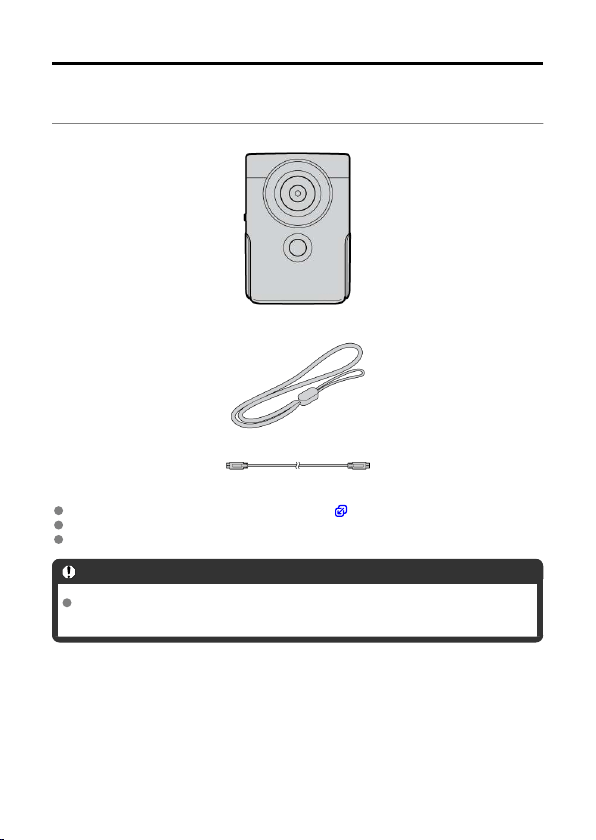
Before use, make sure the following items are included in the package. If anything is
missing, contact your dealer.
Camera
Wrist strap
Interface cable
The camera does not come with a memory card ( ).
The battery is built into the camera.
Be careful not to lose any of these items.
Caution
The transmission rate with the included interface cable is equivalent to Hi-Speed
USB (USB 2.0).
7
Quick Start Guide
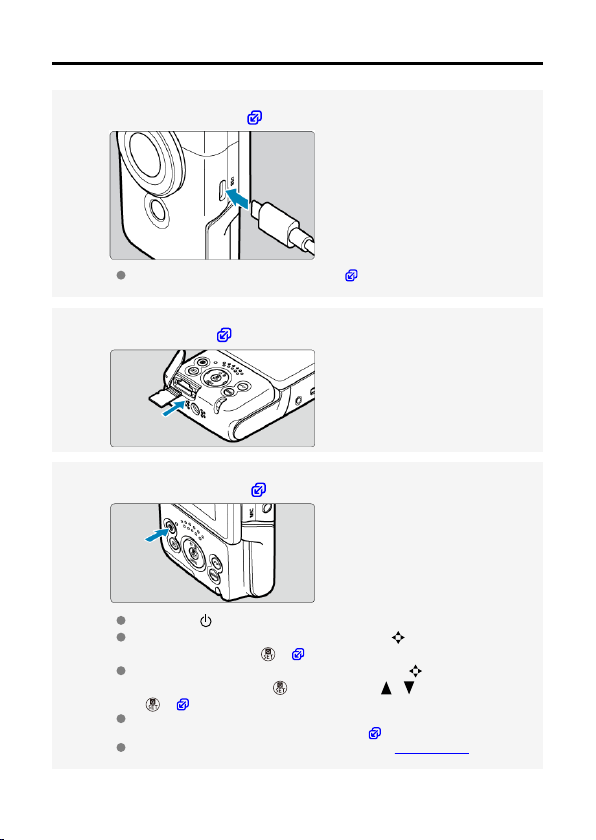
Charge the camera (
).
Charge the camera initially before use ( ).
Insert the card ( ).
Turn the camera on ( ).
Press the < > button.
If the language selection screen appears, use < > to select the
language, then press <
> ( ).
If the date/time/zone setting screen appears, use < > to select a
setting item, then press <
>. Set with the < / > keys, then press
<
> ( ).
After the [Welcome] screen appears, follow the on-screen instructions
to connect the camera to your smartphone ( ).
In areas where the TV video system is PAL, see Video System.
11
1.
2.
3.
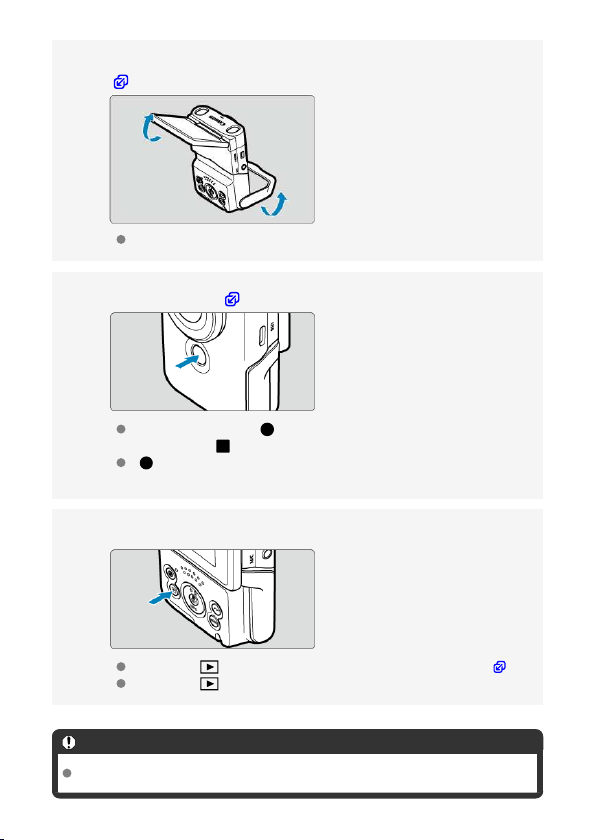
Flip out the screen and stand, then set the camera down
( ).
You can also use the camera in handheld shooting and recording.
Record a movie ( ).
To start recording, tap [ ] or press the Start/Stop button. To stop
recording, tap [
] or press the Start/Stop button again.
[ REC] is displayed in the upper left while movie recording is in
progress, and a blinking red frame is displayed around the screen.
Review the recorded movie.
Press the < > button to play the recorded movie on the screen ( ).
Press the < > button again to return to the shooting screen.
Caution
Avoid pinching your fingers when opening or closing the stand.
12
4.
5.
6.
About This Guide
Icons in This Guide
Basic Assumptions for Operational Instructions and Sample Photos
Icons in This Guide
<
> < >
<
> < >
Indicates the direction to press the cross keys <
>.
<
>
Indicates the Quick Control/Set button.
In addition to the above, the icons and symbols used on the camera's buttons and
displayed on the screen are also used in this guide when discussing relevant operations
and functionality.
Links to pages with related topics.
Warning to prevent shooting problems.
Supplemental information.
Tips or advice for better shooting.
Troubleshooting advice.
14


Compatible Cards
In this guide, all supported memory cards are simply referred to as “the card.”
The following cards can be used with the camera regardless of capacity. If the card is new
or was previously formatted (initialized) by another camera or computer, format the
card with this camera (
).
microSD / microSDHC / microSDXC memory cards
* SD speed class compatible
* UHS speed class compatible
* UHS-I compatible
Cards That Can Record Movies
When recording movies, use a card with ample performance (fast enough writing and
reading speeds) for the movie recording quality (
).
16
WARNING:
Safety Instructions
Be sure to read these instructions in order to operate the product safely.
Follow these instructions to prevent injury or harm to the operator of the product or others.
Denotes the risk of serious injury or death.
Keep the product out of the reach of young children.
A strap wrapped around a person's neck may result in strangulation.
The parts or provided items of cameras or accessories are dangerous if swallowed. If
swallowed, seek immediate medical assistance.
Use only power sources specified in this Advanced User Guide for use with the product.
Do not disassemble or modify the product.
Do not expose the product to strong shocks or vibration.
Do not touch any exposed internal parts.
Stop using the product in any case of unusual circumstances such as the presence of
smoke or a strange smell.
Do not use organic solvents such as alcohol, benzine or paint thinner to clean the
product.
Do not get the product wet. Do not insert foreign objects or liquids into the product.
Do not use the product where flammable gases may be present.
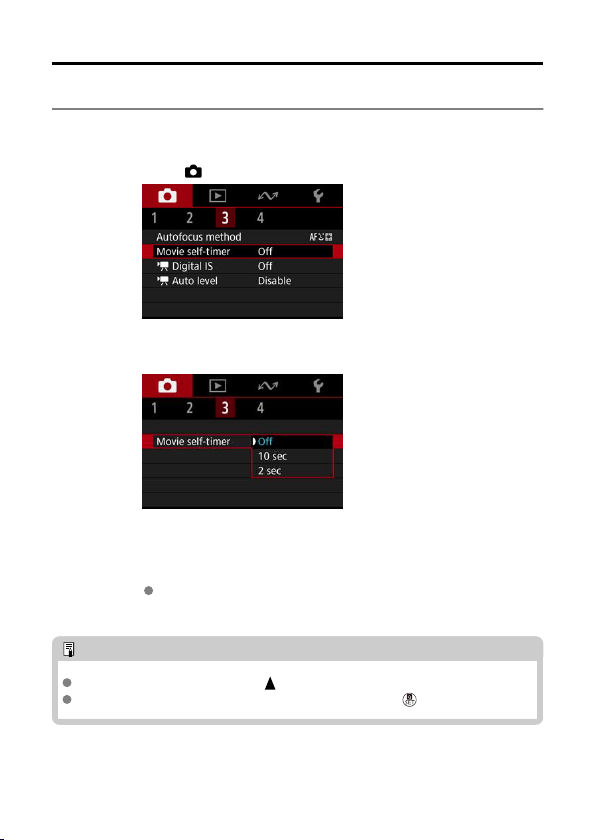
This may cause electric shock, explosion or fire.
Do not touch the product connected to a power outlet during lightning storms.
This may cause electric shock.
Observe the following instructions when using a battery charger or AC adapter.
• Periodically remove any dust buildup from the power plug and power outlet using a
dry cloth.
• Do not plug in or unplug the product with wet hands.
• Do not use the product if the power plug is not fully inserted into the power outlet.
• Do not expose the power plug and terminals to dirt or let them come into contact
with metallic pins or other metal objects.
• Do not touch the battery charger or AC adapter connected to a power outlet during
lightning storms.
Do not place heavy objects on the power cord. Do not damage, break or modify the
power cord.
Do not wrap the product in cloth or other materials when in use or shortly after use when
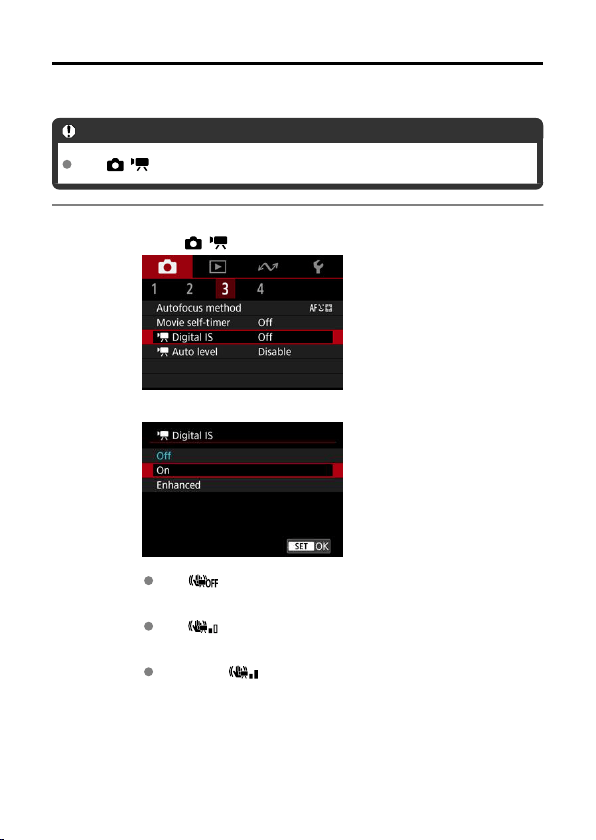
the product is still warm in temperature.
Do not unplug the product by pulling the power cord.
Do not leave the product connected to a power source for long periods of time.
Do not charge batteries/battery packs at temperatures outside the range of 5 - 40 °C (41
- 104 °F).
This may cause electric shock, explosion or fire.
17

Do not allow the product to maintain contact with the same area of skin for extended
periods of time during use.
This may result in low-temperature contact burns, including skin redness and blistering,
even if the product does not feel hot. The use of a tripod or similar equipment is
recommended when using the product in hot places and for people with circulation problems
or less sensitive skin.
Follow any indications to turn off the product in places where its use is forbidden.
Not doing so may cause other equipment to malfunction due to the effect of electromagnetic
waves and even result in accidents.
18
CAUTION:
Follow the cautions below. Otherwise
physical injury or property damage may
result.
Do not look at the screen or through the viewfinder for prolonged periods of time.
This may induce symptoms similar to motion sickness. In such a case, stop using the
product immediately and rest for a while before resuming use.
Do not leave the product in places exposed to extremely high or low temperatures.
The product may become extremely hot/cold and cause burns or injury when touched.
Strap is intended for use on the body only. Hanging the strap with any product attached
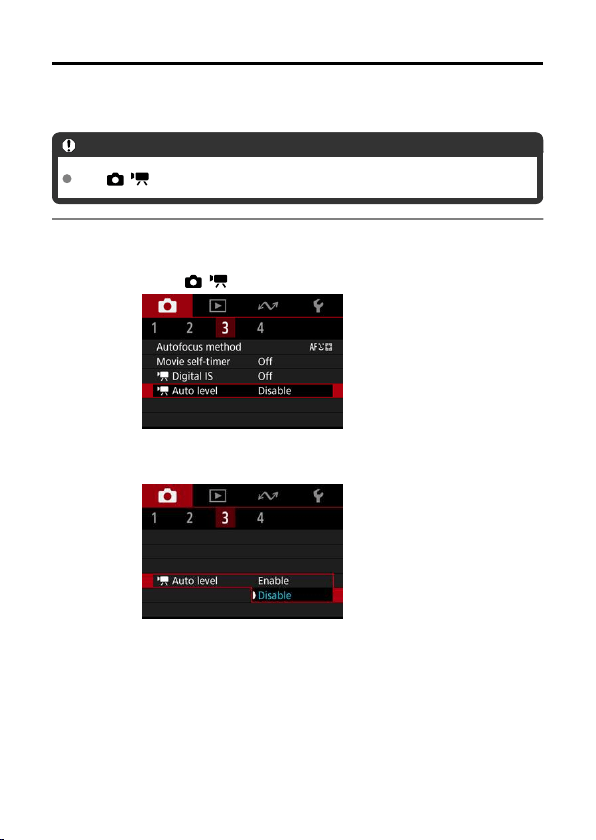
on a hook or other object may damage the product. Also, do not shake the product or
expose the product to strong impacts.
Do not apply strong pressure on the lens or allow an object to hit it.
This may cause injury or damage to the product.
Do not carry the product when it is mounted on a tripod.
This may cause injury or may result in an accident.
Do not touch any parts inside the product.
This may cause injury.
If any abnormal skin reaction or irritation occurs during or following the use of this
product, refrain from further use and get medical advice/attention.
19

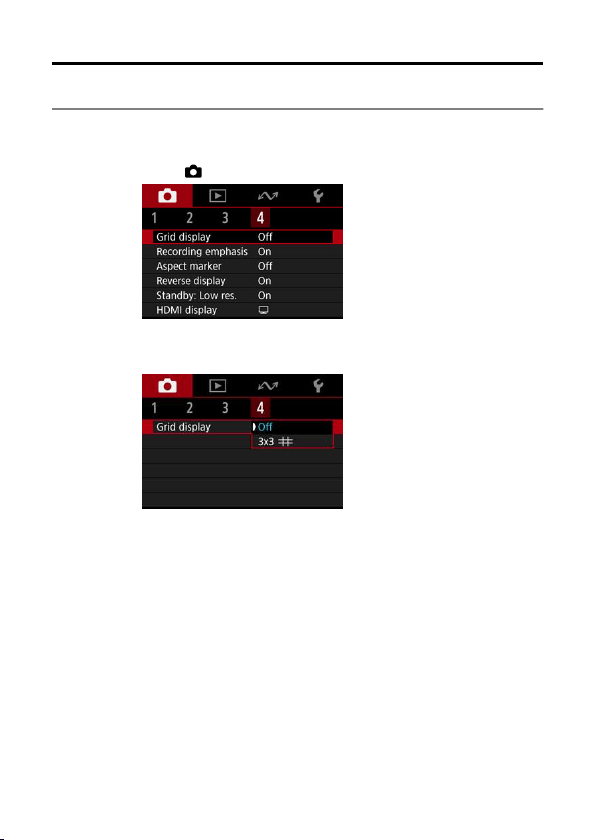
Handling Precautions
Camera care
This camera is a precision instrument. Do not drop it or subject it to physical shock.
The camera is not waterproof and cannot be used underwater. If the camera gets wet,
contact a Canon Service Center immediately. Wipe off any water droplets with a clean,
dry cloth, and if the camera is exposed to salty air, wipe it off with a clean, well-wrung
wet cloth.
Never leave the camera near anything having a strong magnetic field such as a magnet
or electric motor. Also, avoid using or leaving the camera near anything emitting strong
radio waves, such as a large antenna. Strong magnetic fields can cause camera
malfunction or destroy image data.
Do not leave the camera in excessive heat, such as in a car in direct sunlight. High
temperatures can cause the camera to malfunction.
The camera contains precision electronic circuitry. Never attempt to disassemble the
camera yourself.
If the camera is suddenly brought in from the cold into a warm room, condensation may
form on the camera and internal parts. To prevent condensation, first put the camera in
a sealed plastic bag and let it adjust to the warmer temperature before taking it out of
the bag.
If condensation forms on the camera, to avoid damage, do not use the camera or
remove the card. Turn the camera off and wait until the moisture has fully evaporated
before resuming use. Even after the camera is completely dry, if it is still internally cold,
do not remove the card until the camera has adjusted to the ambient temperature.
Condensation may form inside the camera lens if you record 4K movies in [Smooth
skin movie] mode in humid environments. Keep the camera off until the moisture has
evaporated before resuming use. If the condensation does not dissipate, try changing
the recording mode or setting the camera to an option other than 4K movies.
If the camera will not be used for an extended period, store it in a cool, dry, well-
ventilated location. Record occasionally during storage to make sure the camera is still
working correctly.
Avoid storing the camera where there are chemicals that result in rust and corrosion
such as in a chemical lab.
If the camera has not been used for an extended period, test all its functions before
using it. If you have not used the camera for some time or if there is an important shoot
such as a foreign trip coming up, have the camera checked by your nearest Canon
Service Center or check the camera yourself and make sure it is working properly.
The camera may become hot after repeated continuous shooting or still photo/movie
shooting over an extended period. This is not a malfunction.
If there is a bright light source inside or outside the image area, ghosting may occur.
When shooting with backlighting, keep the sun sufficiently away from the angle of view.
Always keep intense light sources such as the sun, lasers, and other intense artificial
light sources out of the image area and not near it. Concentrated intense light may
cause smoke or damage the image sensor or other internal components.
20

Screen
The following does not affect images captured by the camera.
Although the screen is produced under extremely high-precision manufacturing
conditions and more than 99.99% of the pixels meet design specifications, 0.01% or
fewer pixels may be defective or appear as red or black dots. This is not a malfunction.
If the screen is left on for a prolonged period, screen burn-in may occur where you see
remnants of what was displayed. However, this is only temporary and will disappear
when the camera is left unused for a few days.
The screen display may seem slightly slow in low temperatures or may look black in
high temperatures. It will return to normal at room temperature.
Cards
To protect the card and its recorded data, note the following:
Do not drop, bend, or wet the card. Do not subject it to excessive force, physical shock,
or vibration.
Do not touch the card's electronic contacts with your fingers or anything metallic.
Do not affix any stickers, etc. on the card.
Do not store or use the card near anything that has a strong magnetic field, such as a
television, speakers, or magnets. Also avoid places prone to having static electricity.
Do not leave the card in direct sunlight or near a heat source.
Store the card in a case.
Do not store the card in hot, dusty, or humid locations.
Cards may become hot after long sessions of repeated continuous shooting or still photo
shooting/movie recording. This is not a malfunction.
21
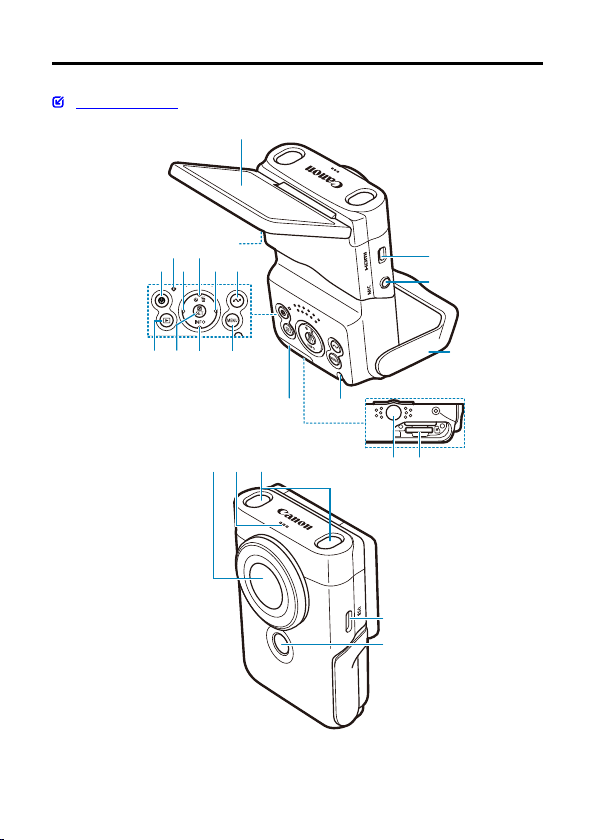
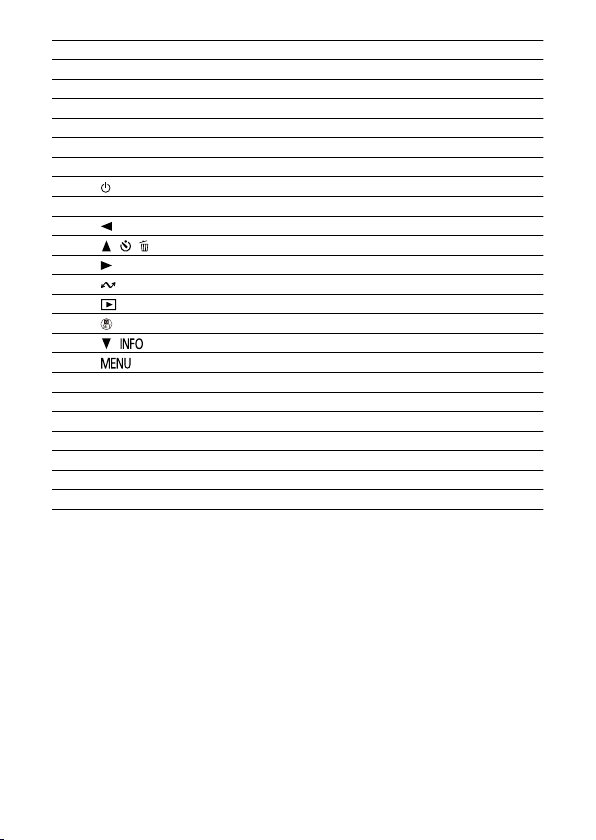
(1) Screen
(2) HDMI terminal
(3) External microphone IN terminal
(4) Stand
(5) Strap mount
(6) Card slot cover
(7) Serial number
(8) <
> Power button
(9) Indicator
(10) <
> Left button
(11) <
/ / > Up/Self-timer/Erase button
(12) <
> Right button
(13) <
> Comm/Multi-access button
(14) <
> Playback button
(15) <
> Quick Control/Set button
(16) <
/ > Down/Info button
(17) <
> Menu button
(18) Tripod socket
(19) Card slot
(20) Lens
(21) Speaker
(22) Stereo microphone
(23) Digital terminal
(24) Start/Stop button
23
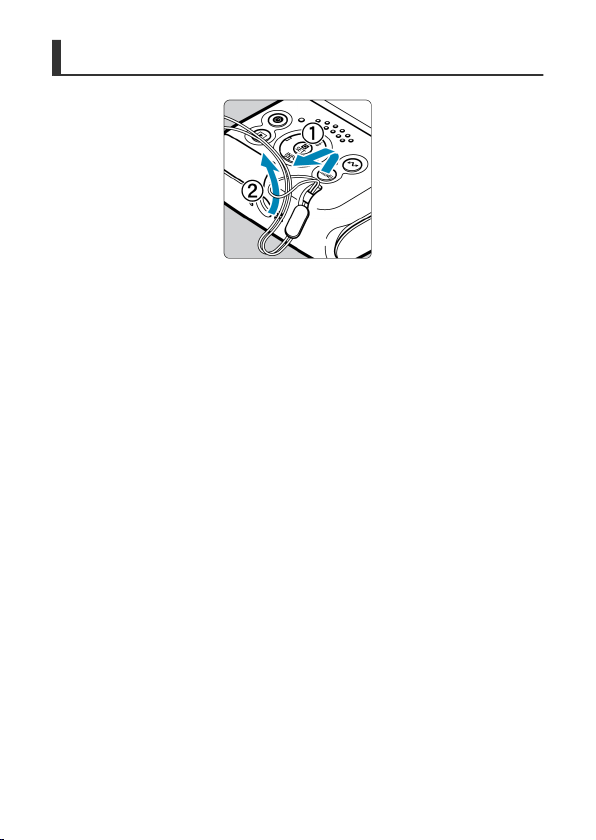
Attaching the Strap
Attach the included wrist strap to the camera strap mount.
24

Preparation and Basic Operations
This chapter describes preparatory steps before you start shooting and the basic camera
operations.
•
Charging the Camera
• Inserting/Removing Cards
• Using the Screen and Stand
• Turning on the Power
• Basic Operations
• Menu Operations and Settings
• Quick Control
• Touch-Screen Operation
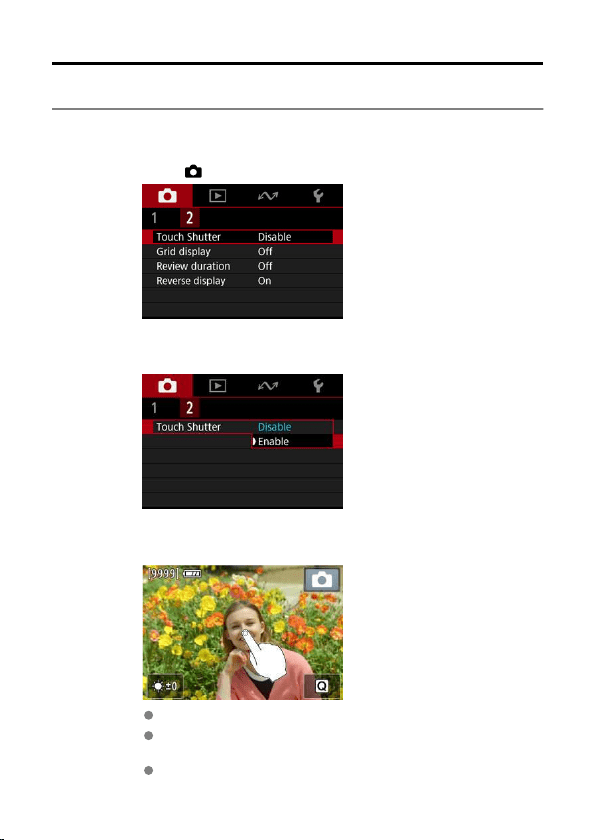
25
Charging the Camera
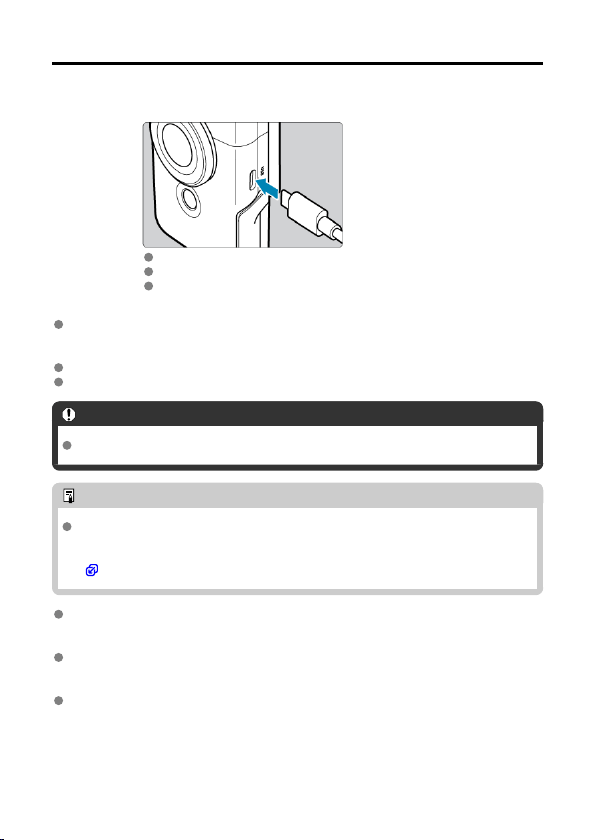
1.
Charge the camera.
Charge the camera over a USB connection with the included cable.
After charging begins, the indicator turns orange.
The indicator goes off after the camera is fully charged.
Charging the camera when it is fully depleted takes approx. 1 hr. and 50 min. at
room temperature (23°C/73°F). The time required to charge the battery will vary greatly
depending on the ambient temperature and the battery's remaining capacity.
For safety, charging in low temperatures (5–10°C/41–50°F) takes longer.
The camera can also be used while plugged in for charging.
Caution
Charging may stop if the camera becomes hot.
Note
For charging and powering the camera, an optional USB Power Adapter PD-E1 is
recommended. Some commercially available power adapters (USB Type-C) have
also been confirmed to work with the camera. For details, check the Canon website
( ).
Upon purchase, the built-in battery is not fully charged.
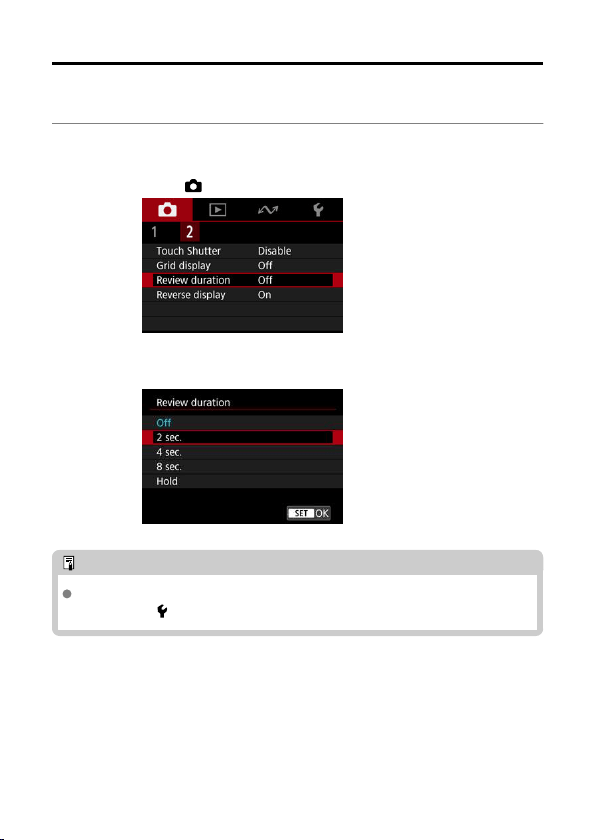
Charge the battery before use.
Charge the camera on the day you will use it or the day before.
The built-in battery will gradually lose its charge, even if it is not used.
Use the camera where the temperature is 0–35°C (32–95°F).
For optimal camera performance, use where the ambient temperature is 0–35°C (32–
95°F). Lower temperatures may temporarily reduce the performance and life of the built-
in battery. Higher temperatures may prevent continuous shooting if the camera becomes
hot.
26
Inserting/Removing Cards
Insertion
Removal
Caution
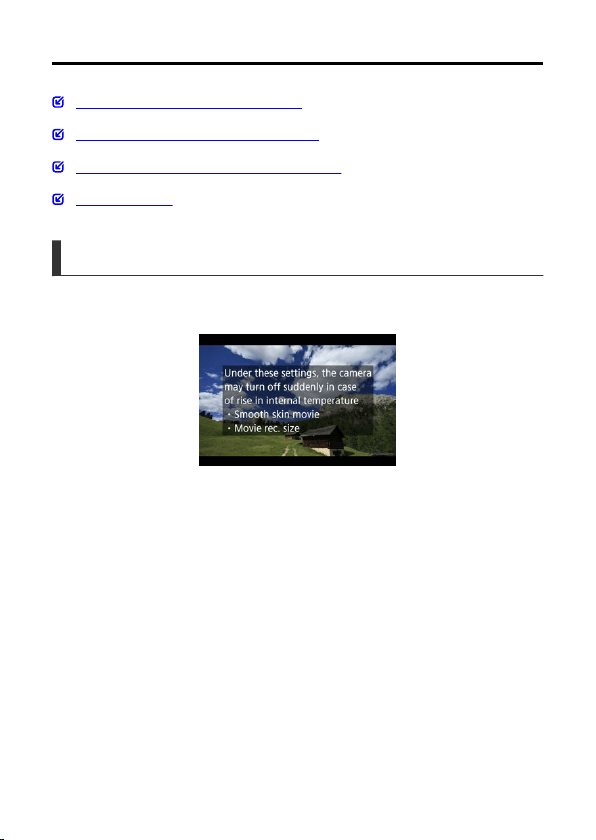
Use of memory cards other than microSD / microSDHC / microSDXC cards is not
supported.
Insertion
1.
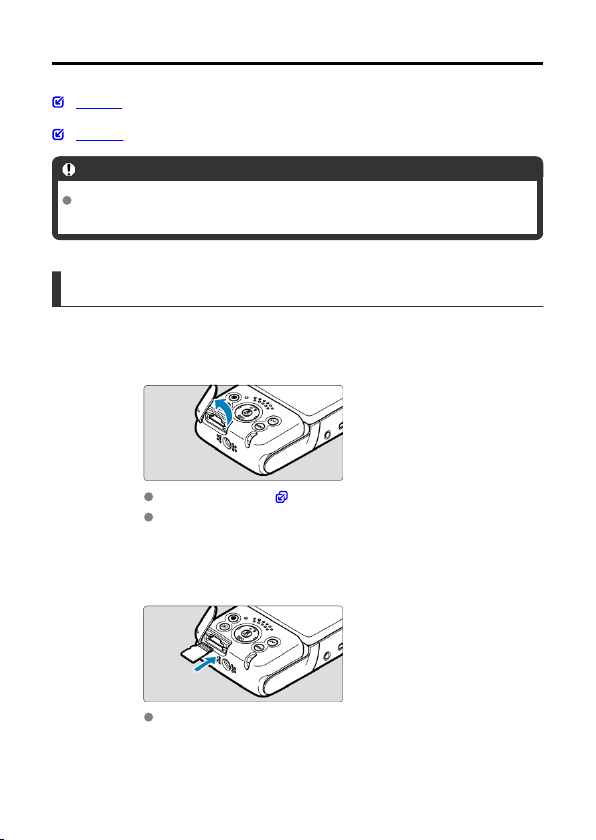
Open the cover.
Turn the camera off ( ).
After making sure the indicator is off, open the cover and rotate it
out of the way.
2.
Insert the card.
Insert the card with the label face-down. Inserting cards the wrong
way may damage the camera.
27
3.
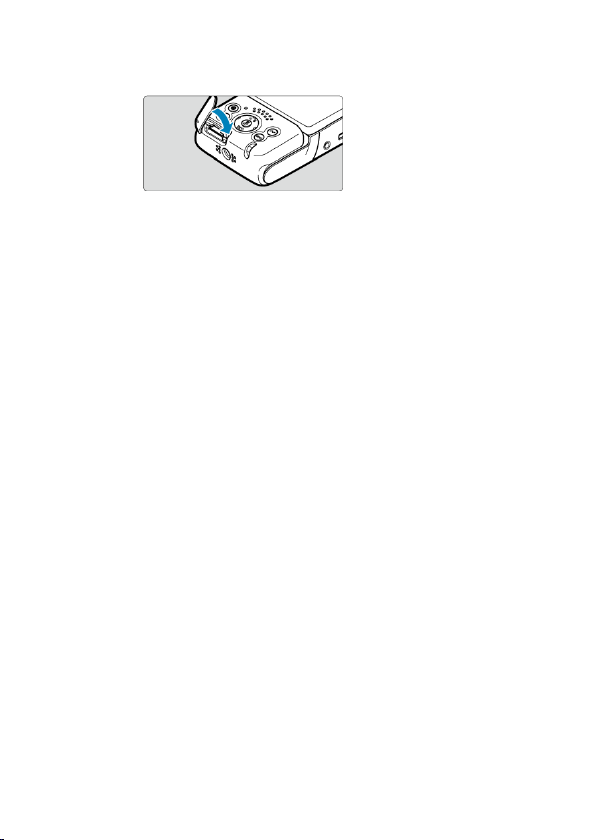
Close the cover.
28
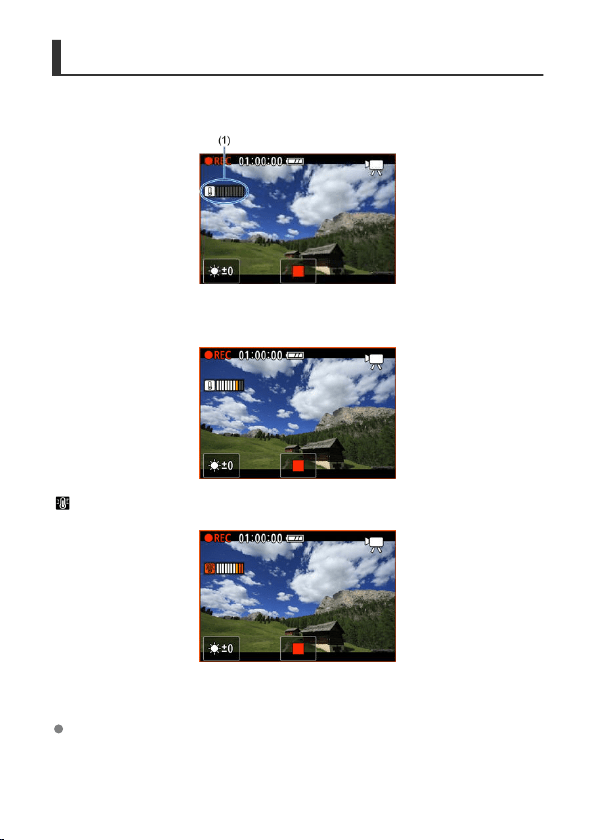
Removal
1.
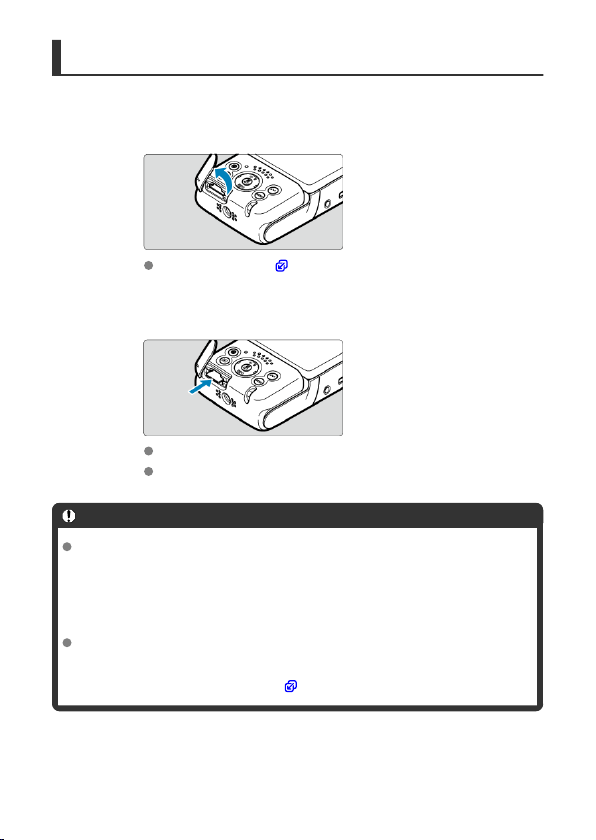
Open the cover.
Turn the camera off ( ).
2.
Remove the card.
Press the card in to eject it.
Pull the card straight out, then close the cover.
Caution
A lit indicator indicates that the camera is writing to, reading from, erasing
from, or transferring data to the card. Do not open the card slot cover during
this time. To avoid image data corruption and damage to cards or the
camera, never do any of the following while the indicator is lit.
• Removing the card
• Shaking or striking the camera
If a card-related error message is displayed on the screen, remove and reinsert the
card. If the error persists, use a different card.
If you can transfer images on the card to a computer, transfer all the images and
then format the card with the camera ( ). The card may then return to normal.
29
Using the Screen and Stand
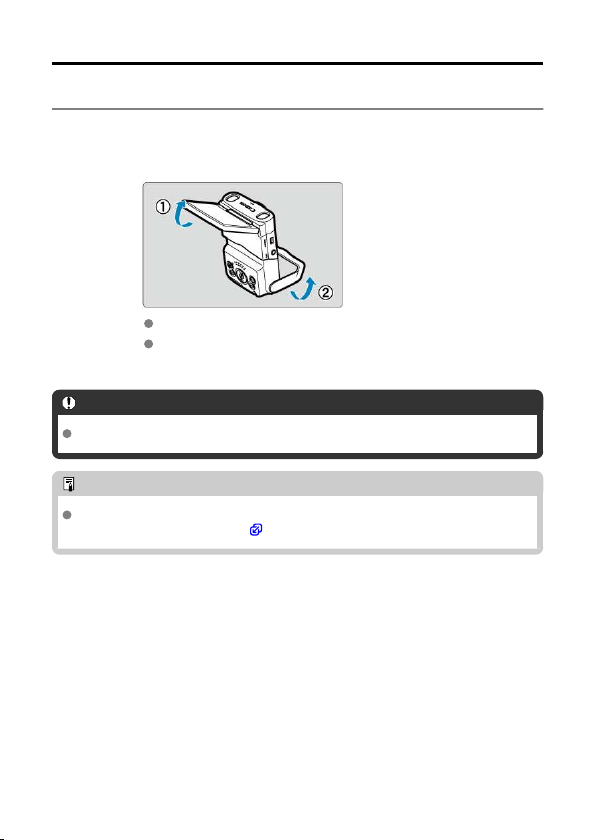
You can change the direction and angle of the screen.
1.
Flip out the screen and stand.
The screen lifts upward and opens to about 180°.
Using the stand, you can set up the camera tilting downward in a range
of –30° to –10° or upward in a range of 10° to 30°.
Caution
Avoid forcing the screen too far open, which puts undue pressure on the hinge.
Note
A mirror image (right/left reversed) of subjects is displayed when the screen faces
subjects in front of the camera ( ).
30

Turning on the Power
Battery Level Indicator
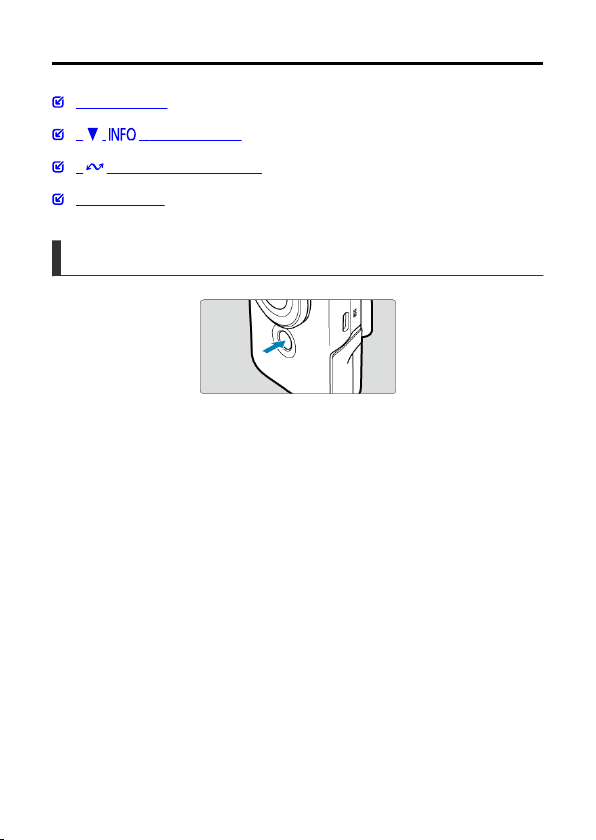
To turn the camera on, press the < > button. Press it again to turn the camera off.
Changing the interface language
A language selection screen is displayed on initial startup.
To change the interface language, see
Language.
Setting the date, time, and time zone
If the date/time/zone setting screen appears when you turn the camera on, see
Date/Time/
Zone.
Changing the video system
The video system is set to NTSC.
Change it to PAL in areas where the TV video system is PAL.
To change the video system, see
Video System.
31
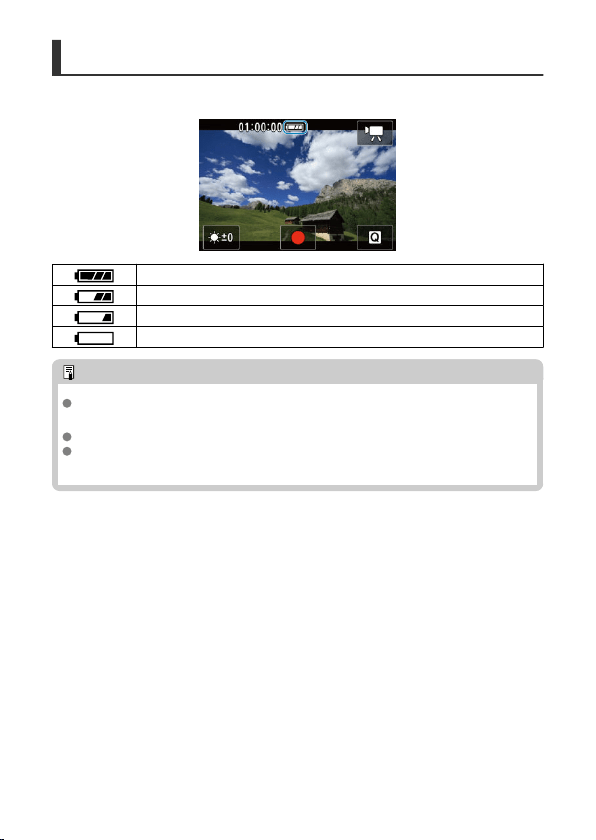
Battery Level Indicator
The battery level indicator appears when the camera is turned on.
Battery level is sufficient.
Battery level is low, but the camera can still be used.
Battery will be depleted soon (blinks).
Charge the battery.
Note
Doing the following will deplete the battery faster:
• Using the Wi-Fi function or Bluetooth function.
Less recording time may be available depending on the actual shooting conditions.
In low ambient temperatures, shooting may not be possible even with a sufficient
battery level.
32
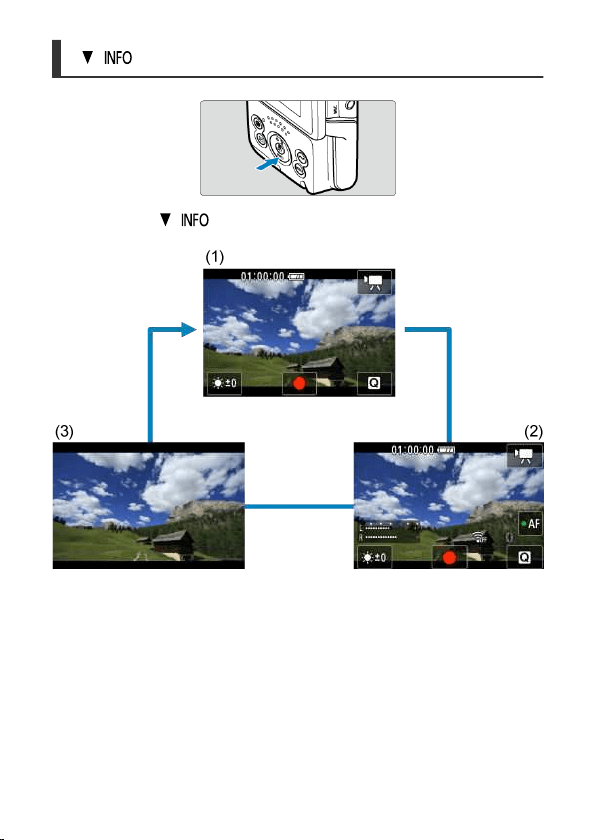
< / > Down/Info Button
Each press of the < / > Down/Info button changes the information shown.
The following sample screens are for movie recording.
34
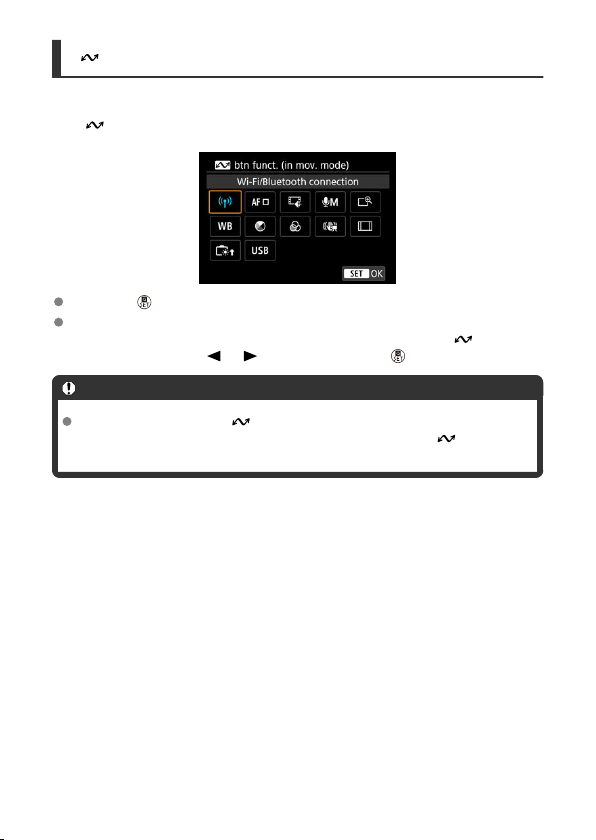
< > Comm/Multi-Access Button
Shows wireless communication features.
The <
> button can also be assigned to frequently used Movie mode functions. To view
the setting screen for this button, press and hold the button on the movie recording screen.
Press the < > button to set it.
During playback, you can send images to a smartphone or tablet (collectively referred to
as “smartphones
”) connected to the camera via Wi-Fi by pressing the
<
> button.
Select images with the <
> < > keys, then press the < > button.
Caution
Functions assigned to the < > button may not be available in some recording
modes. In this case, a message is displayed when you press the <
> button to
indicate that it is not available.
35
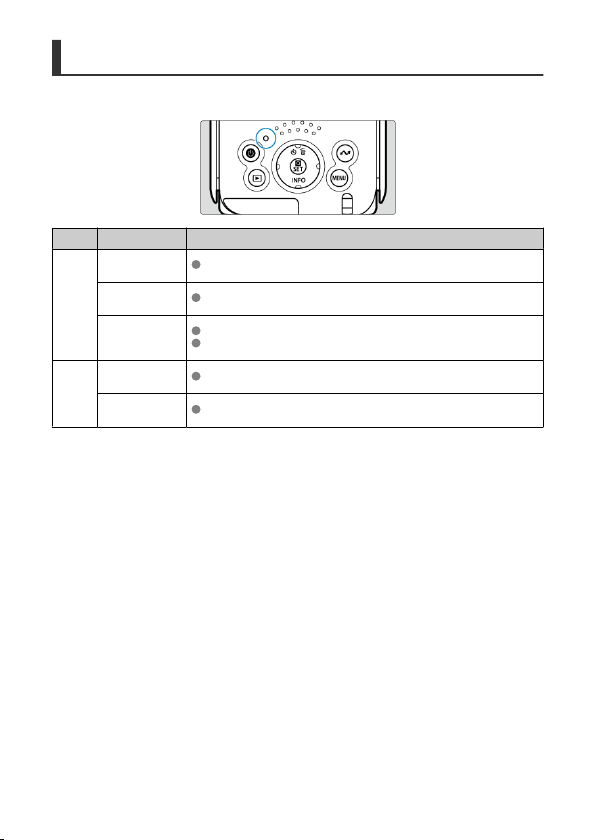
Indicator Display
Indicator display varies depending on the camera status.
Color Indicator Status Camera Status
Green
Turned on
Recording stills to the memory card, or reading stills from the card
Slow blinking Display off
Blinking
Recording movies to the memory card, or reading movies from the card
Transmitting via Wi-Fi
Orange
Turned on
Charging via USB
Blinking USB charging error
36

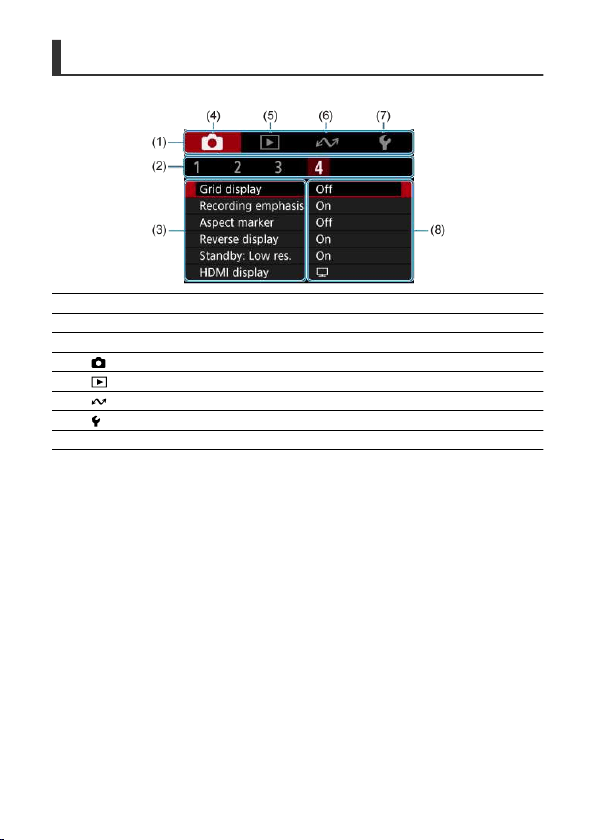
Menu Screen
(1) Main tabs
(2) Secondary tabs
(3) Menu items
(4)
: Shooting
(5)
: Playback
(6)
: Wireless communication
(7)
: Set-up
(8) Menu settings
* Some tabs, menu items, and setting options may not be displayed, depending on the recording
mode.
38
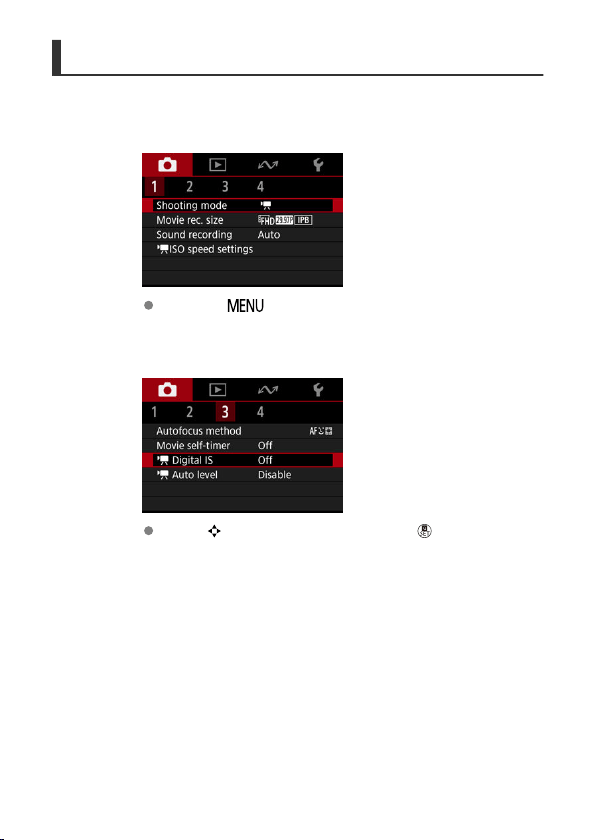
Menu Setting Procedure
1.
Display the menu screen.
Press the < > button to display the menu screen.
2.
Select an item.
Press < > to select an item, then press the < > button.
39
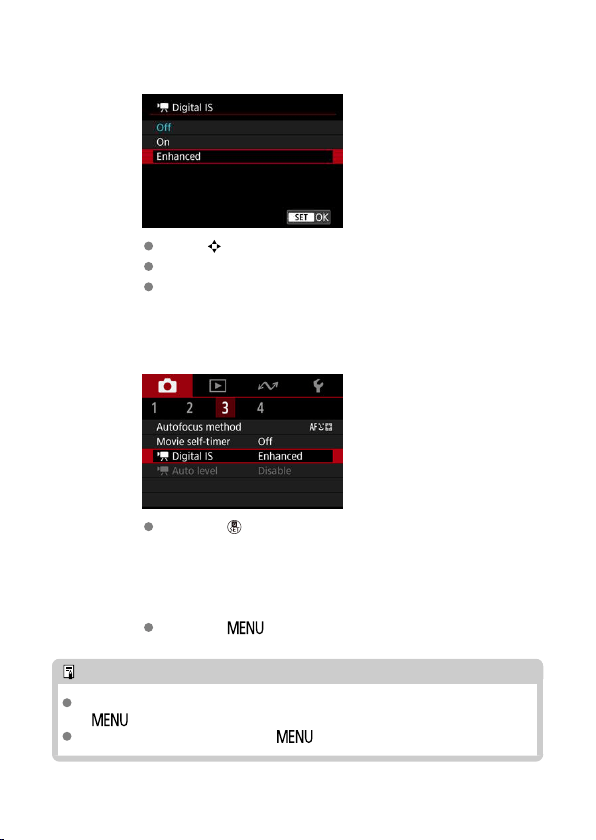
3.
Select an option.
Press < > to select an option.
The current setting is indicated in blue.
For some setting items, a standby screen is displayed. Select an option
to configure the setting.
4.
Set the option.
Press the < > button to set it.
5.
Exit the setting.
Press the < > button.
Note
The description of menu functions hereafter assumes that you have pressed the
<
> button to display the menu screen.
To cancel the operation, press the < > button.
40
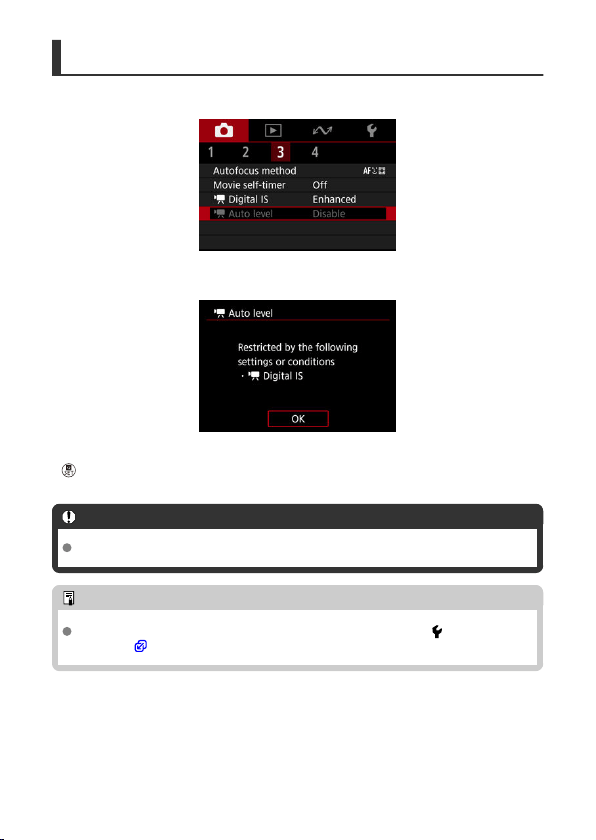
Dimmed Menu Items
Example: With the Digital IS setting set to [Enhanced]
Dimmed menu items cannot be set. The menu item is dimmed if another function setting is
overriding it.
You can see the overriding function by selecting the dimmed menu item and pressing the
<
> button.
If you cancel the overriding function's setting, the dimmed menu item will become settable.
Caution
You may not be able to see the overriding function for certain dimmed menu items.
Note
You can reset menu functions to the default settings by selecting [ : Reset
camera] ( ).
41
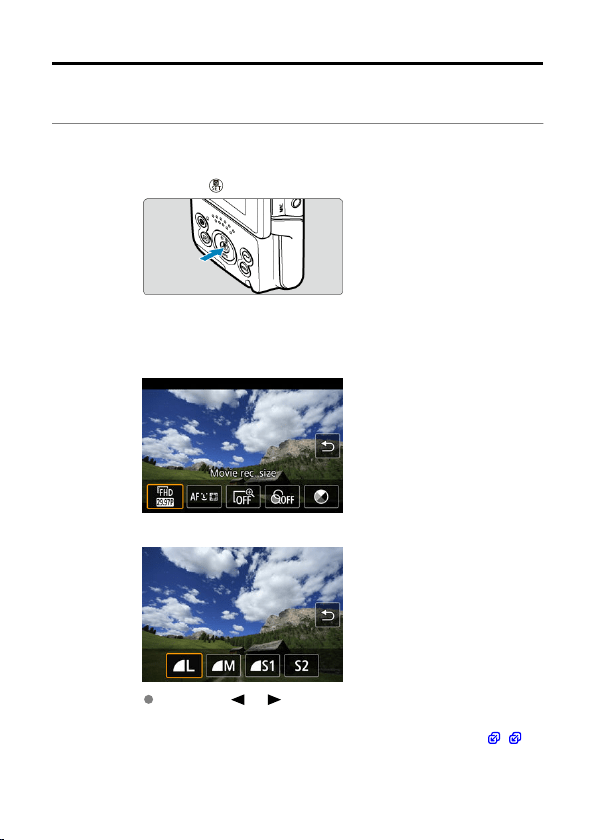
Quick Control
You can directly and intuitively select and set the settings displayed.
Available setting items vary by shooting mode.
1.
Press the <
> button.
2.
Select a setting item and set your preferred option.
Movie recording mode
Still photo shooting mode
Press the < > < > keys to select an item.
You can also set [Movie rec. size] and [Autofocus method] from menu screens ( , ).
42
Digital zoom
You can shoot with up to approx. 3× digital zoom.
Caution
[ : Digital IS] is fixed to [Off] and [ : Autofocus method] to
[Specified frame AF].
Images look grainier at higher magnifications, because Movie digital zoom
applies digital image processing. Noise or dots of light may also become
noticeable.
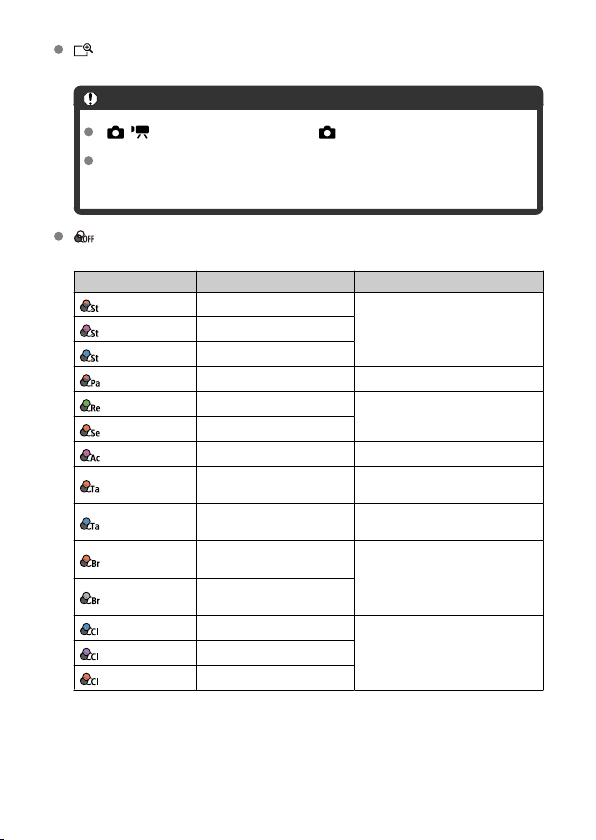
Color filter
You can adjust colors as you watch the screen.
Filter Effect Recommended Scenes
StoryTeal&Orange
Matte with teal shadows and
amber highlights
High-contrast daytime scenes and
other scenes with contrast, such as
well-lit rooms
StoryMagenta
Matte with a magenta filter
effect overall
StoryBlue
Matte with a blue filter effect
overall
PaleTeal&Orange
Teal shadows and amber
highlights
Scenes with contrast that include some
amber or yellowish colors
RetroGreen
Faded with a green filter effect
overall
Old buildings, cityscapes
Sepiatone
Faded with a sepia filter effect
overall
AccentRed
All colors except reds are faded
Scenes that include some reddish
colors
TastyWarm
High saturation and bright
midtones, with warm colors
overall
Scenes that include food or beverages
in warm tones
TastyCool
High saturation and bright
midtones, with cool colors
overall
Scenes that include food or beverages
in cool tones
BrightAmber
Low contrast, light shadows
while keeping the ambiance
dark, and warm colors
Dimly lit scenes with warm-toned light
sources
BrightWhite
Low contrast, light shadows
while keeping the ambiance
dark, and cool colors
ClearLightBlue
Low contrast, bright shadows,
with light blue overall
Bright evening cityscapes, indoor
scenes
ClearPurple
Low contrast, bright shadows,
with light purple overall
ClearAmber
Low contrast, bright shadows,
with light amber overall
43

Caution
Color filters may prevent images from being rendered with smooth gradation
and may result in image noise.
Some camera settings or subjects may prevent you from obtaining your
expected colors.
Color tone
Press to shift color tones toward Blue or Amber, and press the <
> button to shift
toward Magenta or Green.
44
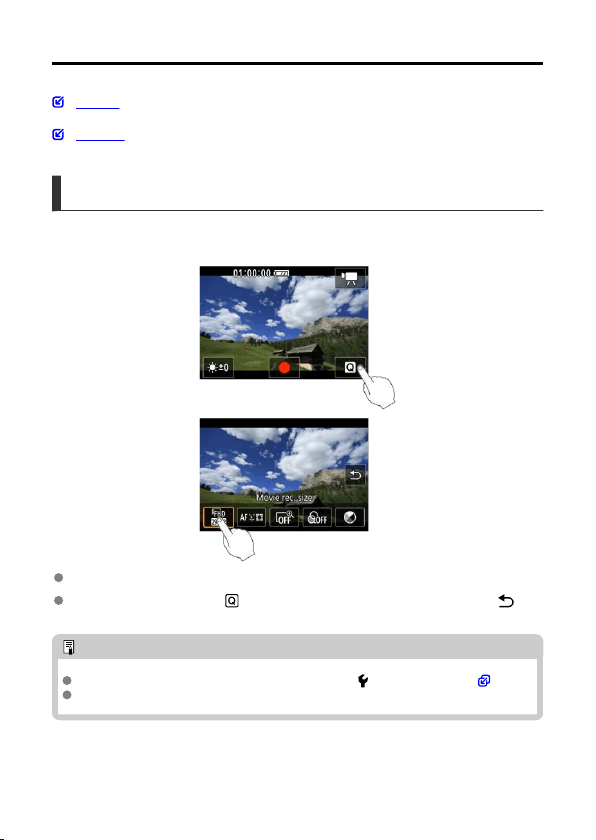
Touch-Screen Operation
Tapping
Dragging
Tapping
Sample screen (Quick Control)
Use your finger to tap (touch briefly and then remove your finger from) the screen.
For example, when you tap [ ], the Quick Control screen appears. By tapping [ ],
you can return to the preceding screen.
Note
To have the camera beep for touch operations, set [ : Beep] to [Enable] ( ).
By default, beeping volume for touch operations is set to [0].
45
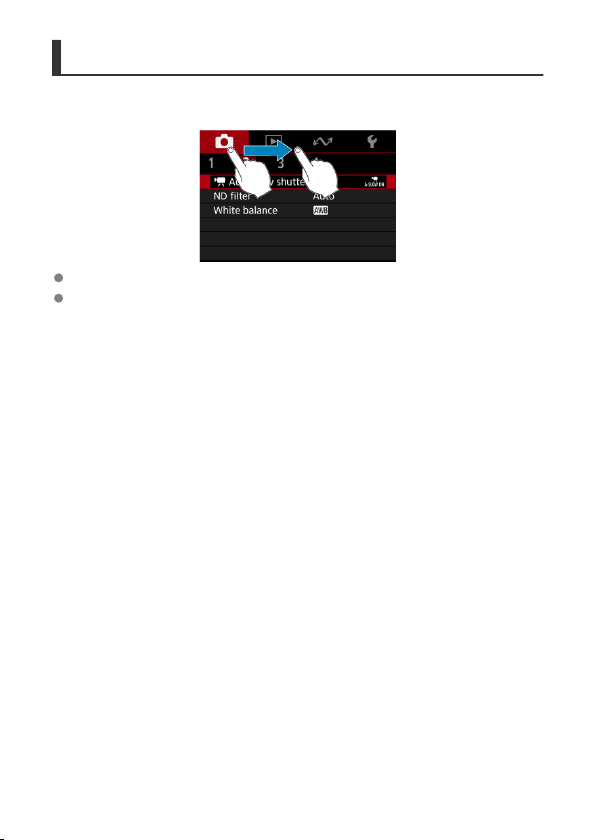
Dragging
Sample screen (Menu screen)
Slide your finger while touching the screen.
For example, drag on the main tabs to move to a different tab.
46

Shooting and Recording
This chapter describes shooting and recording and introduces menu settings on the
shooting [
] tab.
• Movie Recording
• Still Photo Shooting
• Tab Menus: Movie Recording
• Tab Menus: Still Photo Shooting
• Shooting Mode
• Movie Recording Size
• Sound Recording
• Movie ISO Speed Settings
• Movie Auto Slow Shutter
• ND Filter
• White Balance
• Autofocus Method
• Movie Self-Timer
• IS Settings
• Movie Auto Level
• Grid
• Recording Emphasis
• Aspect Marker
• Reverse Display
• Standby: Low Resolution
• Display During HDMI Connection
• Image Quality
• Still Image Aspect Ratio
• Touch Shutter
• Review Duration
• General Movie Recording Precautions
• General Still Photo Shooting Precautions
47
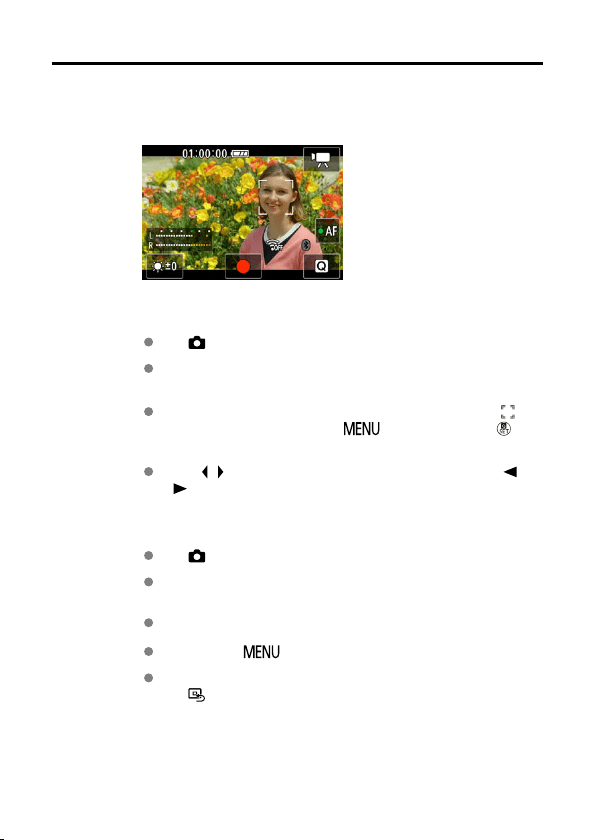
Movie Recording
1.
Focus on the subject.
Tracking a subject to focus on it
Set [ : Autofocus method] to [Face tracking AF].
An AF point is displayed over a person's face or other subject, which
the camera keeps in focus.
To focus on a different subject, tap it. The AF point changes to [ ]. To
exit subject selection, press the <
> button. Press the < >
button again to return to the shooting screen.
When [ ] [ ] is displayed around an AF point, you can use the < >
<
> keys to change the subject to focus on.
Focusing on subjects in a specific position
Set [ : Autofocus method] to [Specified frame AF].
Tap a position to focus on, then move the AF point on the AF point
screen.
Align the AF point with the subject.
Pressing the < > button returns the AF point to the center.
Tapping [SET] returns to the shooting screen. To center the AF point,
tap [
].
48
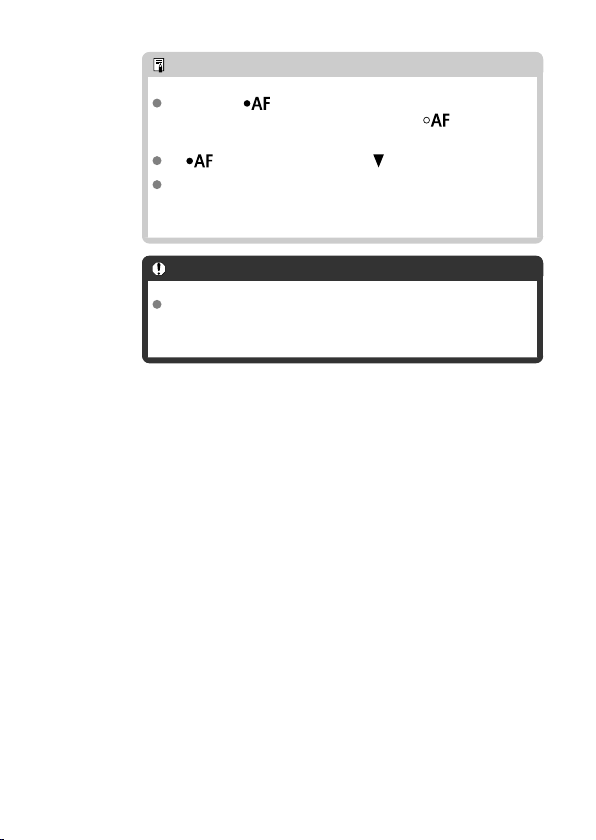
Note
You can tap [ ] to activate autofocus during standby, after
which focusing is locked. The icon changes to [
]. To unlock
focusing, tap it again.
If [ ] is not displayed, press the < > key.
A green frame appears once the subject is in focus. A yellow
frame is displayed with [!] when the camera cannot focus on
subjects.
Caution
If you perform camera operations during movie recording, the
camera's built-in microphone may also record sounds of the
camera operations.
49
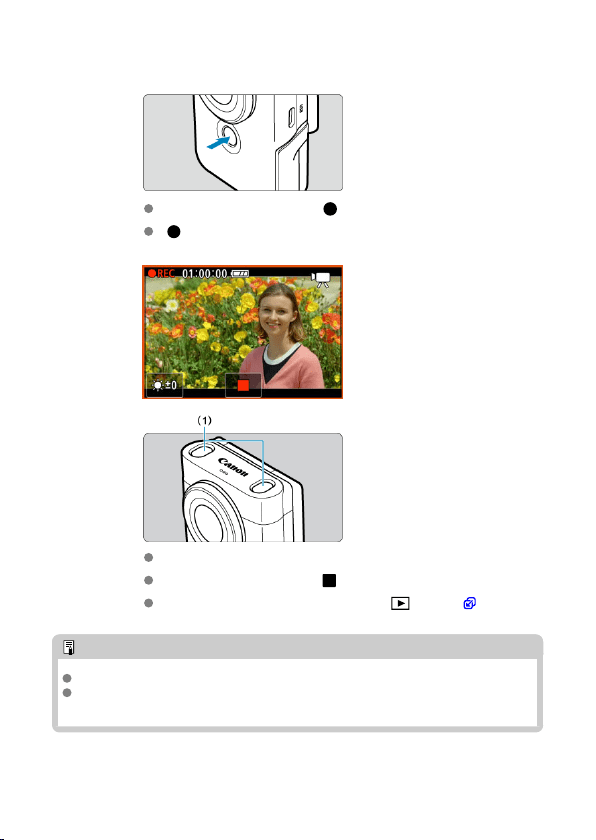
2.
Record the movie.
To start movie recording, tap [ ] or press the Start/Stop button.
[ REC] is displayed in the upper left while movie recording is in
progress, and a blinking red frame is displayed around the screen.
Sound is recorded by the microphone (1).
To stop movie recording, tap [ ] or press the Start/Stop button.
To review the recorded movie, press the < > button ( ).
Note
Audio is recorded in stereo.
The microphone picks up sound in front of and behind the camera, on the left and
right, and above it.
50
Still Photo Shooting
To focus, tap a subject you want to capture. Press the Start/Stop button to shoot.
A yellow frame is displayed when the camera cannot focus on subjects.
Note
For fully automatic operation from focusing to shooting, simply by tapping a subject,
set [
: Touch Shutter] to [Enable] ( ).
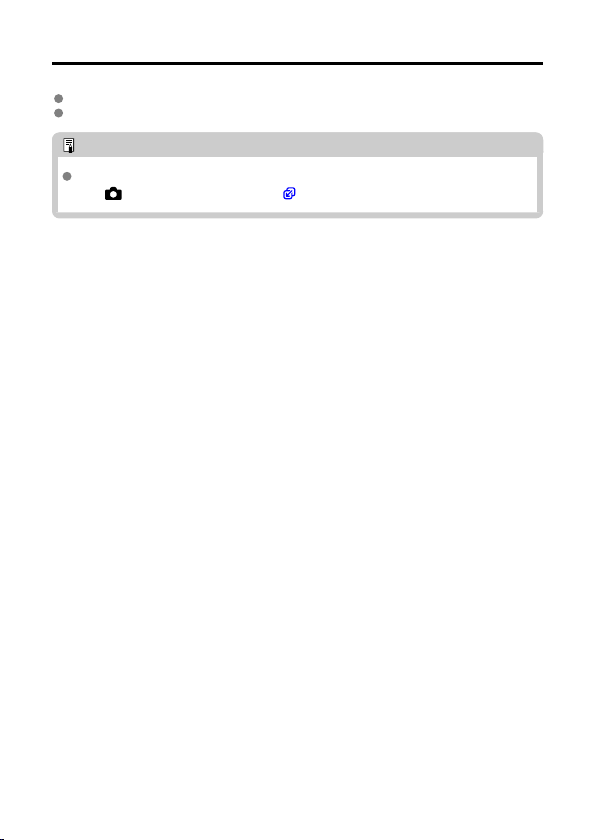
51
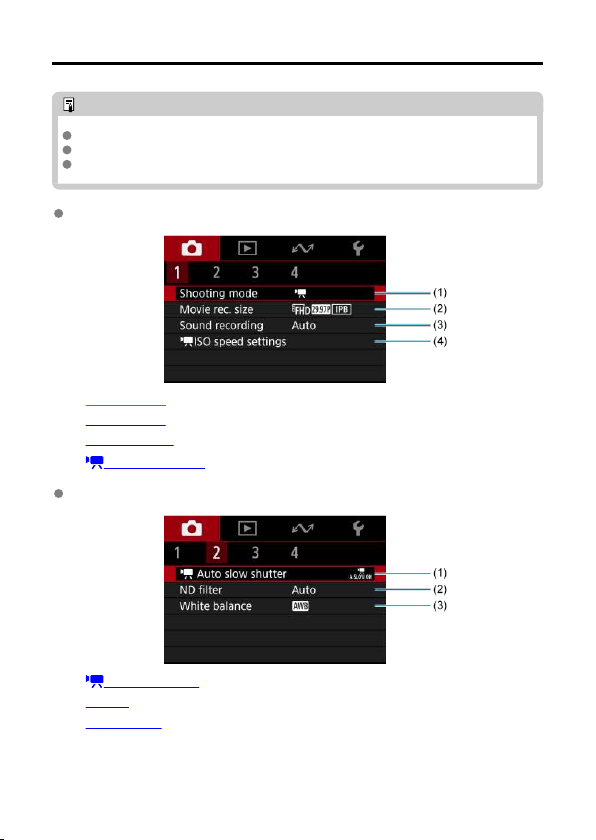
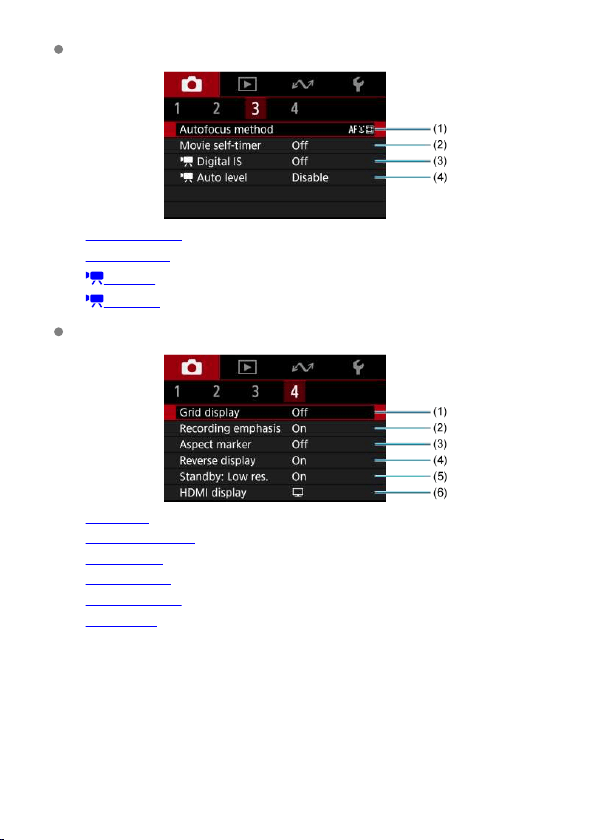
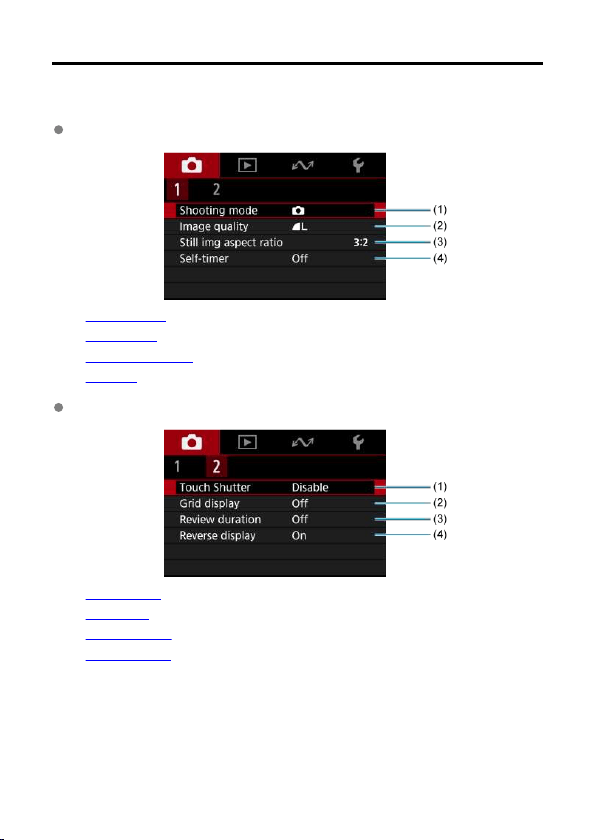
Tab Menus: Movie Recording
Note
*1 Not displayed in [Smooth skin movie] mode or [Movie IS mode].
*2 Available only in [Auto movie] or [Manual exposure movie] mode.
*3 Not displayed in [Smooth skin movie] mode.
Shooting 1
(1) Shooting mode
(2) Movie rec. size
(3) Sound recording
(4) ISO speed settings*
2
Shooting 2
(1) Auto slow shutter*
1
(2) ND filter
(3)
White balance*
1
52
2.
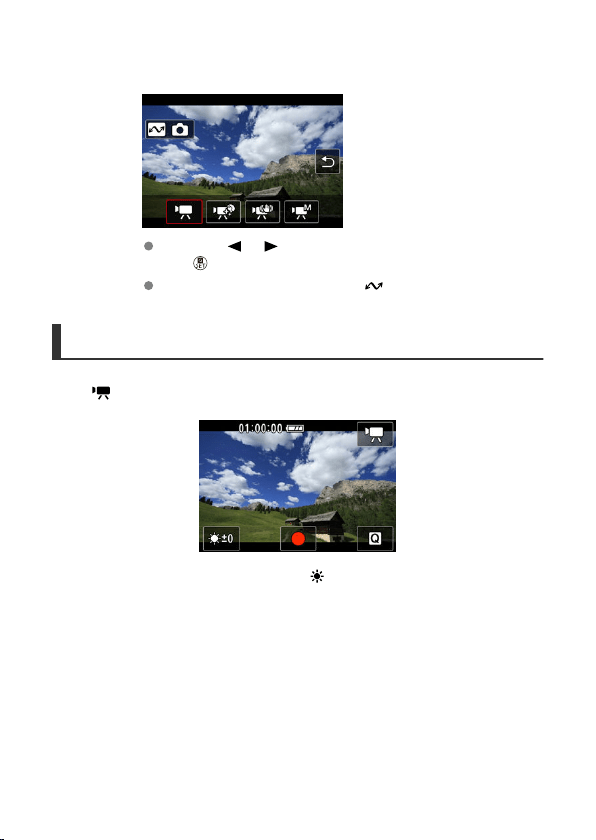
Select a shooting mode.
Press the < > < > keys to select the recording mode, then press
the <
> button.
To switch to Photo mode, press the < > button.
Auto Movie
Select [
].
Exposure is controlled automatically to suit the brightness.
Screen brightness can be adjusted by selecting [ ].
56
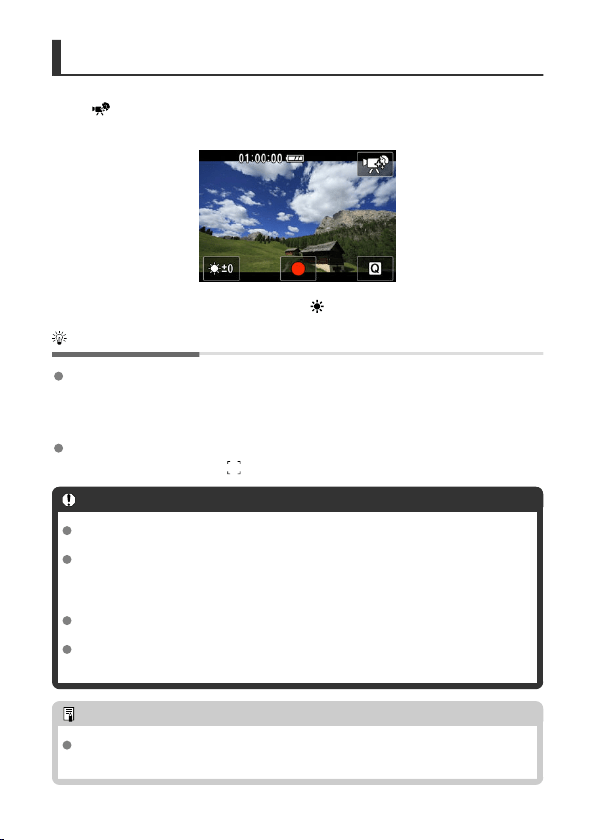
Smooth Skin Movie
Select [
].
Image processing makes skin look smoother.
The level of this effect can be set in [Smooth skin effect] on the Quick Control screen.
Screen brightness can be adjusted by selecting [ ].
Shooting tips
Enable the camera to detect faces.
Frames are displayed around any main subjects detected for skin smoothing. For more
effective skin smoothing, you can move closer to or farther from the subject so that the
frame is displayed on the subject's face.
Focus on the face.
Before shooting, make sure [
] appears on the subject's face when you are focusing.
Caution
Areas other than people's skin may be modified, depending on the shooting
conditions.
If the smooth skin effect is too strong, images may not look as expected. Take
some test shots in advance and check the results.
4K movie recording precautions
Image quality on the standby screen may differ from image quality on the screen
during movie recording.
Briefly when you start recording movies, image display may remain on the current
frame instead of being updated.
Note
The [Smooth skin effect] setting is retained even if you change shooting modes or
turn the camera off.
57
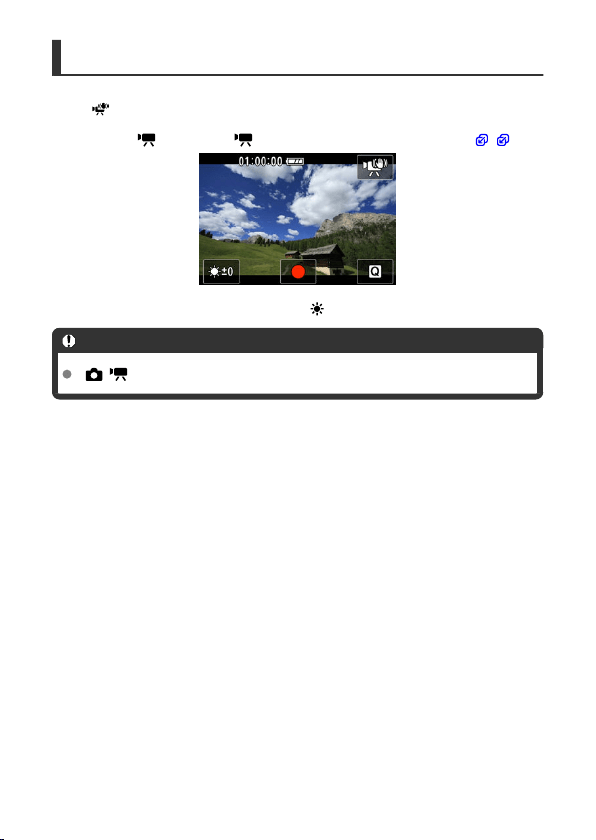
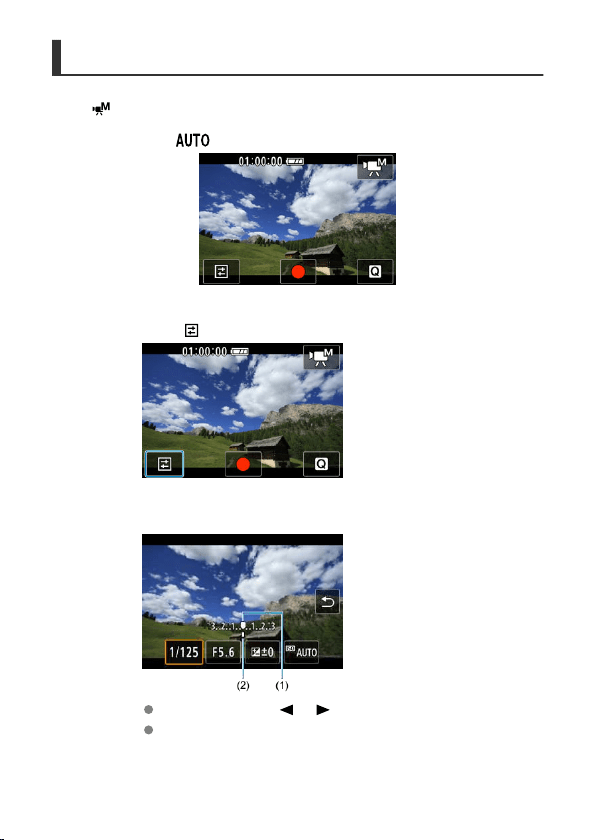
Manual Exposure Movie
Select [
].
Enables you to set the shutter speed, aperture value, and ISO speed.
With ISO speed set to [
], you can set exposure compensation.
1.
Select [
].
2.
Select an item.
Set by pressing the < > < > keys.
Check the exposure level mark (2) to see how far the current exposure
level is from the standard exposure level (1).
59
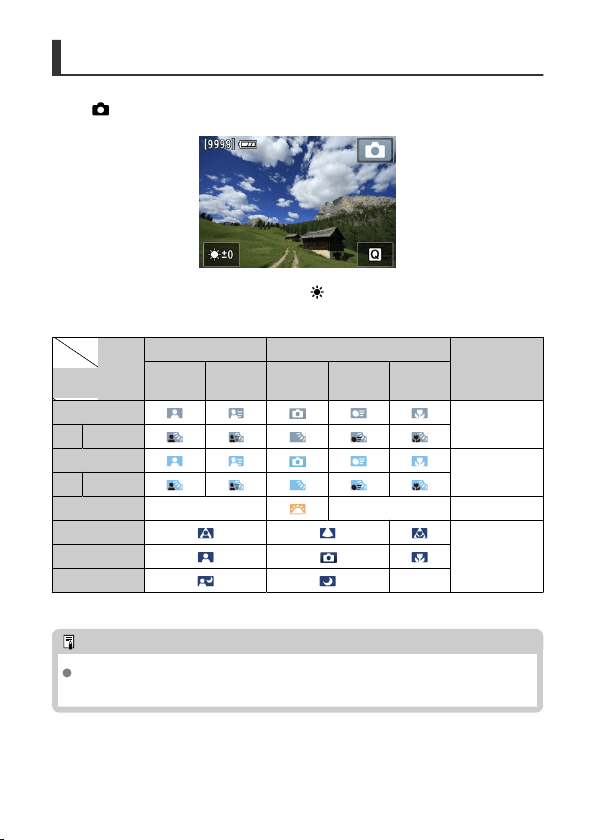
Subject
Background
Auto Photo
Select [
].
The camera analyzes the scene and sets the optimum settings automatically.
Screen brightness can be adjusted by selecting [ ].
An icon representing the type of scene detected appears in the upper right of the screen
during shooting.
People Subjects Other Than People
Background Color
In Motion
Nature/
Outdoor
Scene
In Motion Close
Bright
Gray
Backlit
Blue Sky Included
Light blue
Backlit
Sunset
*
1
*
1
Orange
Spotlight
Dark blueDark
Night Scenes
*
1
* 1: Icons of scenes selected from those that can be detected are displayed.
Note
For certain scenes or shooting conditions, the icon displayed may not match the
actual scene.
60
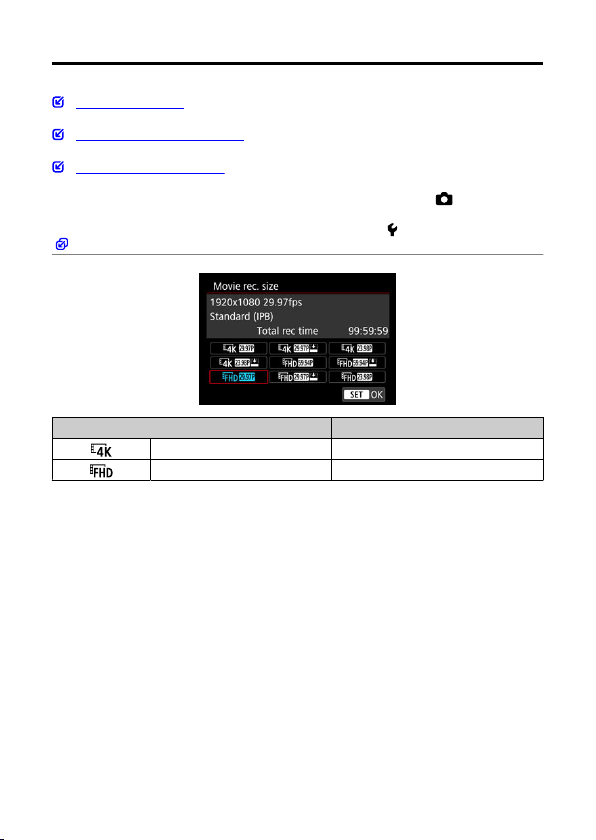
Movie Recording Size
4K Movie Recording
Cards That Can Record Movies
Movie Recording Time Limit
You can set the recording size, frame rate, and compression method in [ : Movie rec.
size].
Note that the frame rate is updated automatically to match the [
: Video system] setting
( ).
Image Size Aspect Ratio
3840×2160 16:9
1920×1080 16:9
61
Frame rate (fps: frames per second)
[ ] 59.94 fps / [ ] 29.97 fps
For areas using the NTSC TV system, such as North America, Japan, South Korea, and
Mexico.
[ ] 50.00 fps / [ ] 25.00 fps
For areas using the PAL TV system, such as Europe, Russia, China, and Australia.
[ ] 23.98 fps
Mainly for cinematic purposes. Available when [
: Video system] is set to [For NTSC].
Compression method
[ ] IPB (Standard)
Compresses multiple frames at a time efficiently for recording.
[ ] IPB (Light)
Since the movie is recorded at a bit rate lower than with IPB (Standard), the file size will
be smaller than with IPB (Standard) and the playback compatibility will be higher. This
will make the available recording time longer than with IPB (Standard) (with a card of the
same capacity).
Movie recording format
[ ] MP4
All movies you record with the camera are recorded as movie files in MP4 format (file
extension “.MP4”).
Caution
If you change the [ : Video system] setting, also set [ : Movie rec. size] again.
Normal playback of files such as 4K or / movies may not be possible
on other devices, because playback is processing-intensive.
Image quality (sense of resolution, noise, etc.) varies slightly depending on the
movie recording size setting.
Note
To obtain better performance with the card, formatting the card with the camera
before recording movies is recommended ( ).
Movies cannot be recorded in HD or VGA quality.
62

4K Movie Recording
Recording 4K movies requires a stable card with a fast writing speed. For details, see
Cards That Can Record Movies.
4K movie recording greatly increases the processing load, which may increase the
internal camera temperature faster or higher than for regular movies. If a white
[
] or red [ ] icon appears during movie recording, the card may be
hot, so stop recording the movie and let the camera cool down before removing
the card. (Do not remove the card immediately.)
Condensation may form inside the camera lens if you record 4K movies in [Smooth
skin movie] mode in humid environments.
63
Cards That Can Record Movies
See
Card performance requirements for details on cards supporting all movie recording
sizes.
Test cards by recording a few movies to make sure they can record correctly at your
specified size ( ).
Caution
If you use a slow-writing card when recording movies, the movie may not be
recorded properly. Also, if you play back a movie on a card with a slow reading
speed, the movie may not be played back properly.
When recording movies, use high-performance cards with a writing speed
sufficiently higher than the bit rate.
When movies cannot be recorded properly, format the card and try again. If
formatting the card does not resolve the problem, refer to the card manufacturer's
website, etc.
Note
To obtain better performance with the card, formatting the card with the camera
before recording movies is recommended ( ).
To check the card's writing/reading speed, refer to the card manufacturer's website,
etc.
64

Movie Recording Time Limit
The maximum recording time per movie is 1 hr. Once 1 hr. is reached, recording stops
automatically. You can start recording a movie again by pressing the Start/Stop button
(which records the movie as a new file).
Caution
The camera's internal temperature may rise and less recording time may be
available after extended movie playback/Live View display.
65
Sound Recording
Sound Recording/Sound-Recording Level
Wind Filter
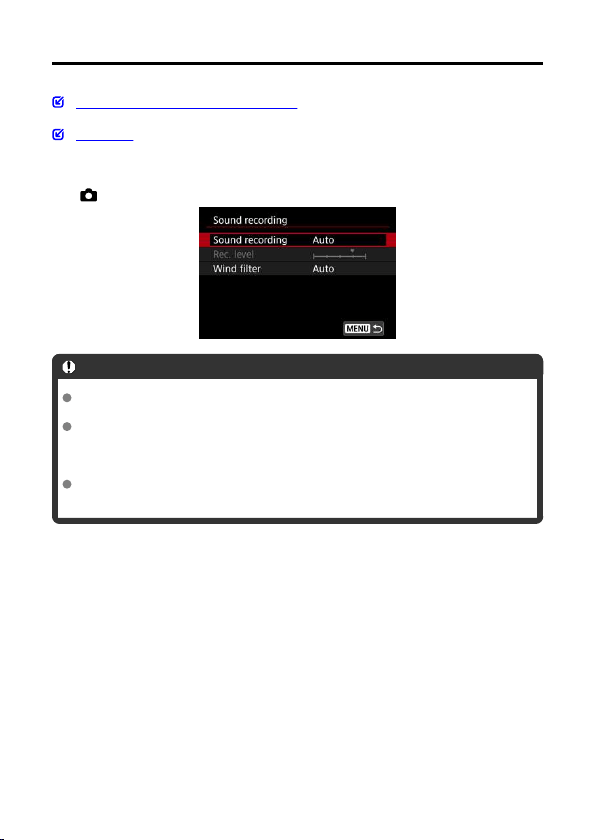
You can record movies while recording sound with the built-in stereo microphone or an
external stereo microphone. You can also freely adjust the sound-recording level.
Use [
: Sound recording] to set sound recording functions.
Caution
Sounds from Wi-Fi operations may be captured with built-in or external
microphones. For best results, avoid using wireless features when recording.
If you perform camera operations during movie recording, the camera's built-in
microphone may also record sounds of lens or camera operations. If so, it may help
reduce these sounds if you use an external microphone equipped with an output
plug and position it away from the camera.
Do not connect anything other than an external microphone to the camera's
external microphone IN terminal.
66

Note
Audio is also output when the camera is connected to televisions via HDMI, unless
[Sound recording] is set to [Disable]. In case of feedback from television audio
output, move the camera away from the television or turn down the volume.
The volume balance between L/R (left/right) cannot be adjusted.
Sound Recording/Sound-Recording Level
Auto
The sound-recording level is adjusted automatically. Auto level control will take effect
automatically in response to the sound level.
Manual
You can adjust the sound-recording level as needed. Select [Rec. level] and press the
<
> < > keys while looking at the level meter to adjust the sound-recording level.
Look at the peak hold indicator, and adjust so that the level meter sometimes lights up
on the right of the “12” (–12 dB) mark for the loudest sounds. If it exceeds “0,” the sound
will be distorted.
You can adjust the recording level during recording by tapping [
].
Disable
Sound will not be recorded.
67

Wind Filter
Set to [Auto] to reduce audio distortion in windy outdoor scenes. Disabled when external
microphone is connected to the external microphone IN terminal. When the wind filter
function takes effect, part of the low bass sounds will also be reduced.
68
Movie ISO Speed Settings
ISO speed
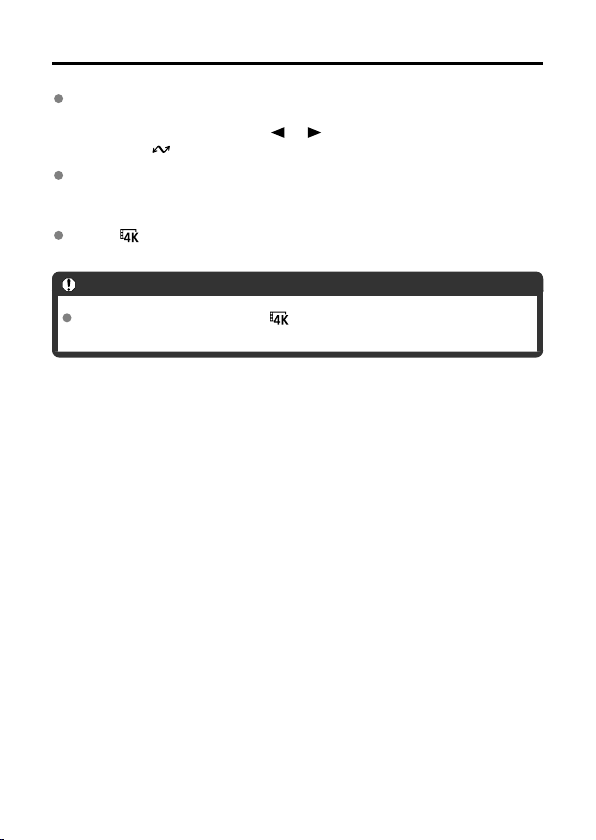
You can set your preferred ISO speed. Select [ISO speed] to access the ISO speed
setting screen. Set by pressing the <
> < > keys. You can also select ISO Auto by
pressing the <
> button.
Max for ISO speed
Enables you to set the maximum value for [ISO speed] used for Full HD movie
recording.
Max for
Enables you to set the maximum value for [ISO speed] used for 4K movie recording.
Caution
[Max for ISO speed] and [Max for ] do not determine the maximum value for
ISO Auto.
69
Movie Auto Slow Shutter
You can choose whether to record movies that are brighter and less affected by image noise
than when set to [Disable] by automatically slowing the shutter speed under low light.
Available in [
] recording mode. With [Movie IS mode], this feature is fixed to [Enable],
and with [Smooth skin movie], to [Disable]. Applies when the frame rate of the movie
recording size is
or .
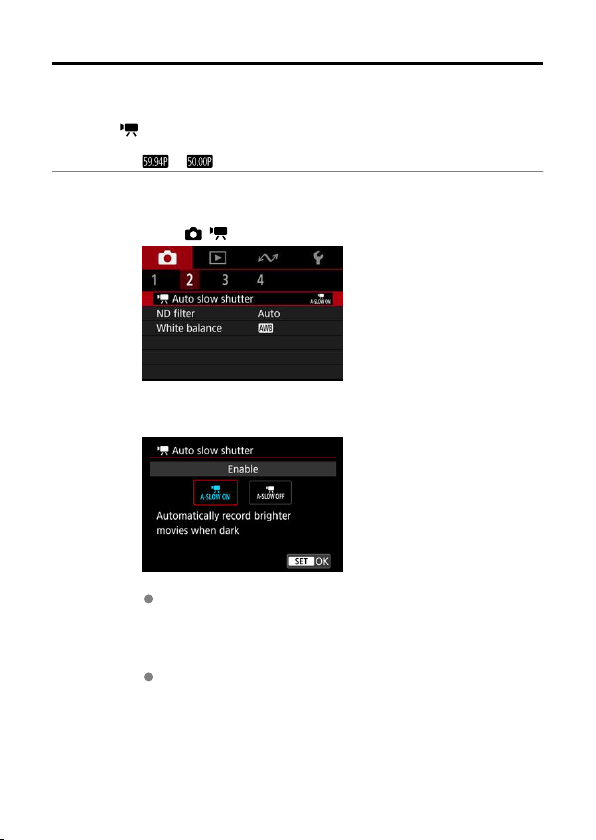
1.
Select [
: Auto slow shutter].
2.
Select an option.
Disable
Enables you to record movies with smoother, more natural movement,
less affected by subject shake than when set to [Enable]. Note that
under low light, movies may be darker than when set to [Enable].
Enable
Enables you to record brighter movies than when set to [Disable] by
automatically reducing the shutter speed to 1/30 sec. (NTSC) or 1/25
sec. (PAL) under low light.
70
Note
Setting to [Disable] is recommended when recording moving subjects under low
light, or when afterimages such as trails may occur.
71
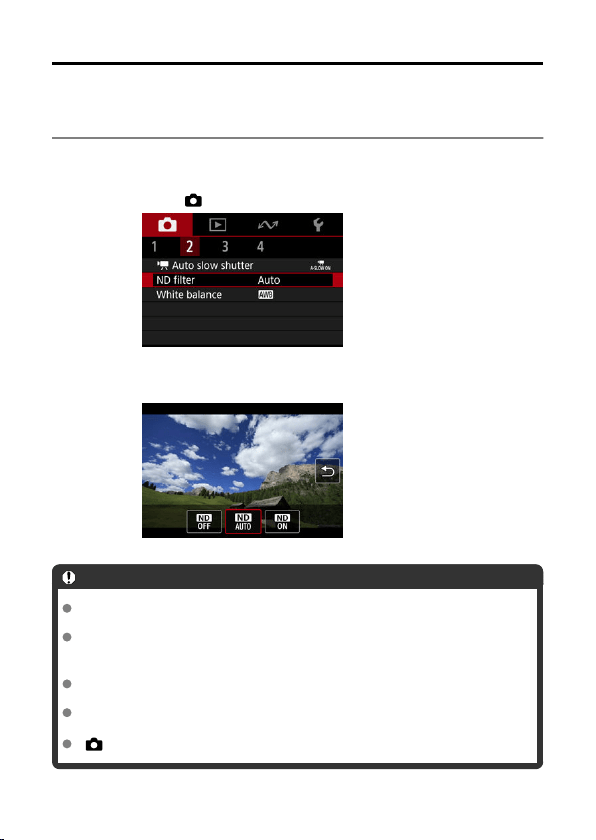
ND Filter
For optimal brightness in the scenes you shoot, Auto ND filter reduces light intensity to 1/8
the actual level, by an amount equivalent to three stops. Besides [Auto], you can also select
[Off] or [On].
1.
Select [
: ND filter].
2.
Select an option.
Caution
Selecting [On] or [Auto] makes it more likely that image noise will occur, even in
bright scenes, because it is easier for the ISO speed to increase.
ND: Neutral Density
Precaution on using Auto ND filter
ND filter status does not change once recording begins for movie recording or
streaming, even when [Auto] is set.
For best results, set to [Off] if you will go from a bright to a dark environment while
recording movies.
[ : ND filter] is set to [Off] when the camera is used as webcam.
72
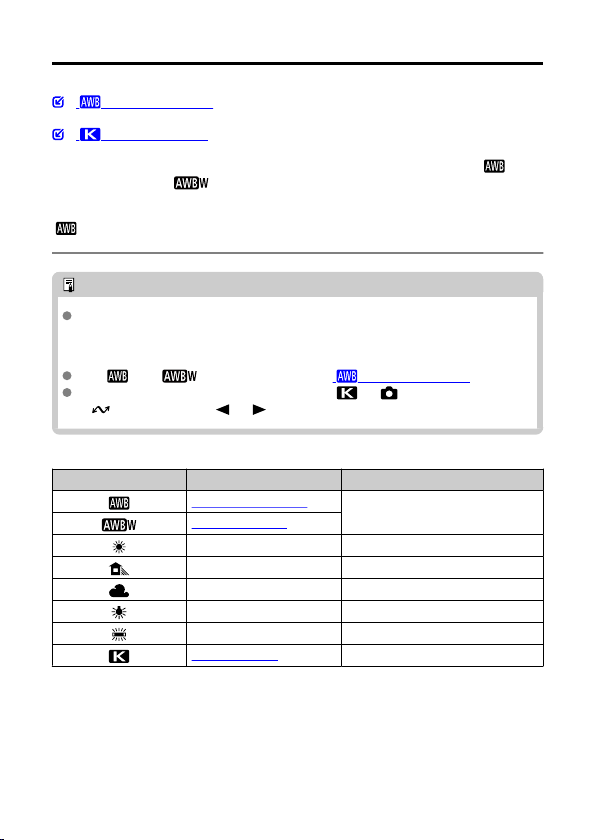
White Balance
[ ] Auto White Balance
[ ] Color Temperature
White balance (WB) is for making the white areas look white. Normally, the Auto [ ]
(Ambience priority) or [
] (White priority) setting will obtain the correct white balance. If
natural-looking colors cannot be obtained with Auto, you can select a white balance
corresponding to the light source.
[
] (Ambience priority) is set automatically for [Smooth skin movie], [Movie IS mode], or
[Auto photo] modes.
Note
The human eye adapts to changes in lighting so that white objects look white under
all kinds of lighting. Cameras determine white from the color temperature of lighting
and, based on this, apply image processing to make color tones look natural in
your shots.
For [ ] and [ ] setting instructions, see [ ] Auto White Balance.
To set your preferred color temperature, select [ ] in [ : White balance], press
<
>, then press the < > < > keys.
(Approx.)
Display Mode Color Temperature (K: Kelvin)
Auto (Ambience priority)
3000–7000
Auto (White priority)
Daylight 5200
Shade 7000
Cloudy, twilight, sunset 6000
Tungsten light 3200
White fluorescent light 4000
Color temperature 2500–10000
73
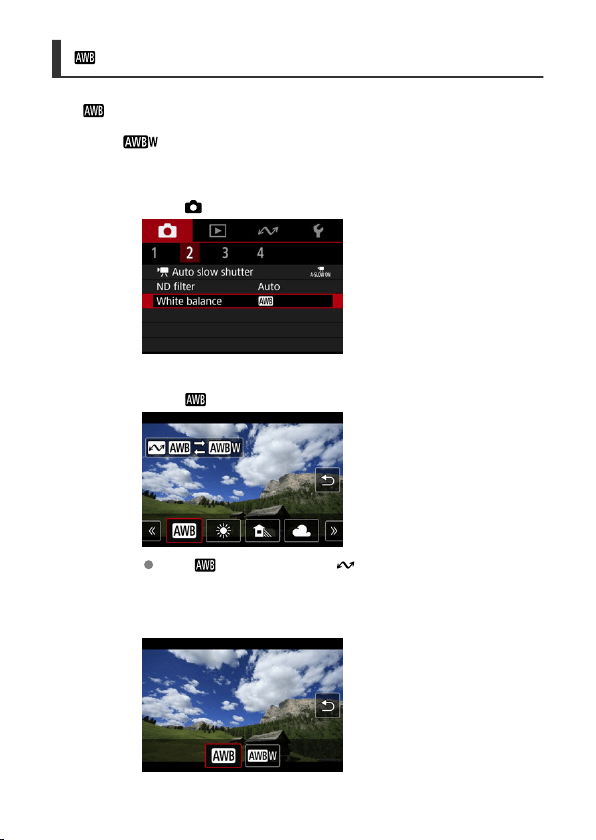
[ ] Auto White Balance
With [
] (Ambience priority), you can slightly increase the intensity of the image's warm
color cast when shooting a tungsten-light scene.
If you select [
] (White priority), you can reduce the intensity of the image's warm color
cast.
1.
Select [
: White balance].
2.
Select [
].
With [ ] selected, press the < > button.
3.
Select an option.
74

Caution
Precautions when set to [ ] (White priority)
The warm color cast of subjects may fade.
When multiple light sources are included in the scene, the warm color cast of the
picture may not be reduced.
75
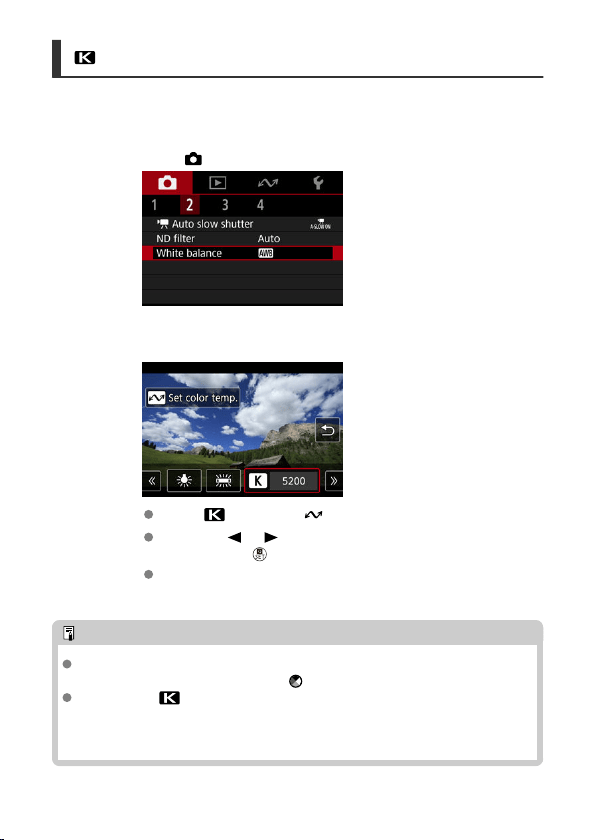
[ ] Color Temperature
A value can be set representing the white balance color temperature.
1.
Select [
: White balance].
2.
Set the color temperature.
Select [ ], then press < >.
Press the < > < > keys to set your preferred color temperature,
then press the <
> button.
The color temperature can be set from approx. 2500K to 10000K in
100K increments.
Note
When setting the color temperature for an artificial light source, correct the white
balance (toward magenta or green) in [
] on the Quick Control screen as needed.
When setting [ ] to a value measured with a commercially available color
temperature meter, take some test shots in advance and adjust the setting as
needed to compensate for any difference between the color temperature meter and
the camera.
76
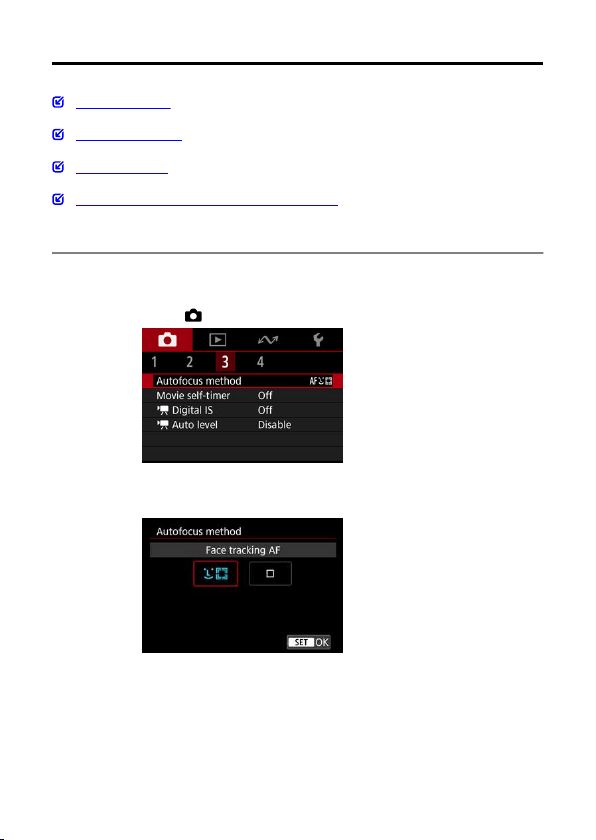
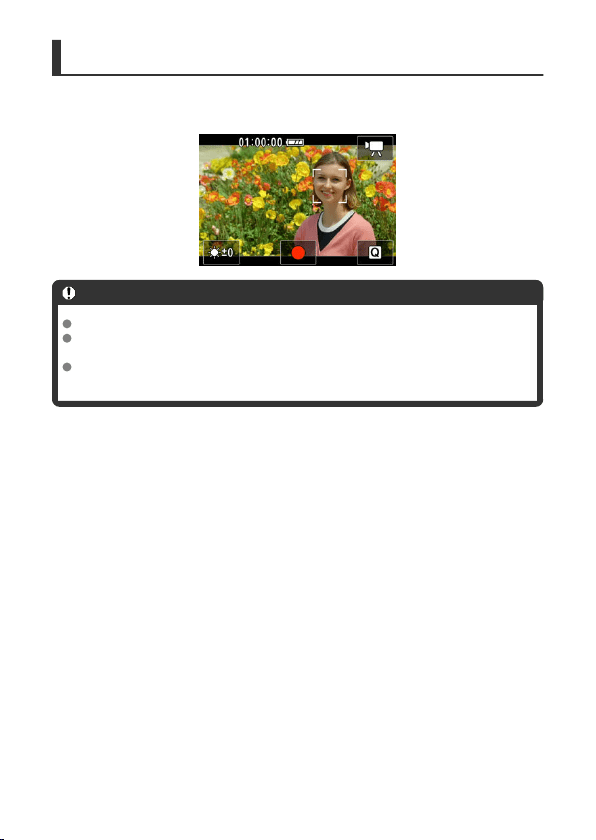
Face Tracking AF
The camera detects and focuses on people's faces.
When no face is detected, focusing areas are determined automatically.
Caution
An object other than a human face may be detected as a face.
The camera may not detect faces that are very small or large in the picture, too
bright or dark, or partly hidden.
AF may not detect subjects or people's faces at the edges of the screen.
Recompose the shot to center the subject or bring the subject closer to the center.
78
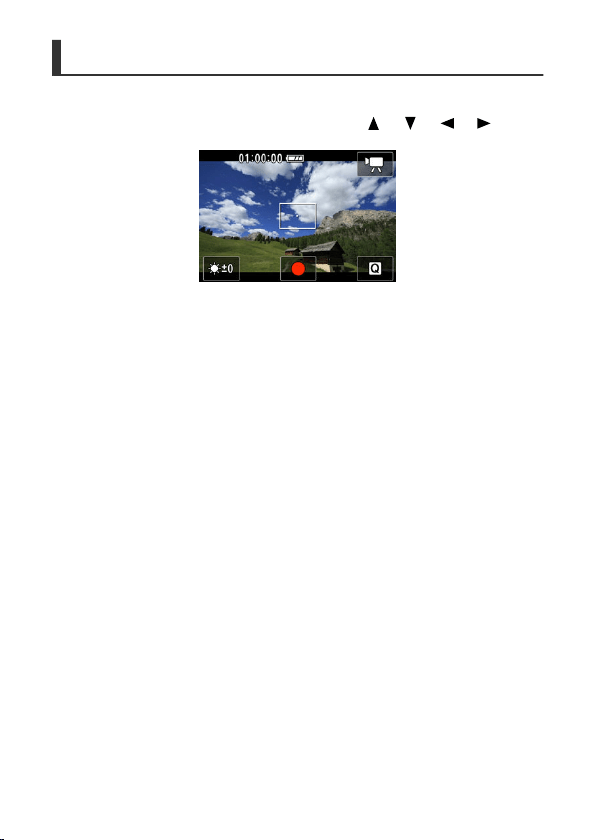
Specified Frame AF
The camera focuses in a single AF point that you specify. You can move the AF point to
your preferred position by tapping, dragging, or using the <
> < > < > < > keys
after tapping the screen to display the AF point selection screen.
79

AF Shooting Tips
It may take some time to focus, depending on the subject and shooting conditions.
The available autofocus range varies depending on the aspect ratio, image stabilization,
and other settings.
80

Shooting Conditions That Make Focusing Difficult
Subjects with low contrast, such as a blue sky or flat surfaces in solid colors, or other
cases when highlight or shadow details are clipped.
Subjects in low light.
Stripes and other patterns where there is contrast only in the horizontal direction.
Fine lines and subject outlines.
Under light sources with constantly changing brightness, colors, or patterns.
Night scenes or points of light.
The image flickers under fluorescent or LED lighting.
Extremely small subjects.
Subjects at the edge of the screen.
Strongly backlit or reflective subjects (Example: Car with a highly reflective surfaces,
etc.).
Near and distant subjects covered by an AF point (Example: Animal in a cage, etc.).
Subjects that keep moving within the AF point and will not stay still due to camera shake
or subject blur.
Performing AF when the subject is very far out of focus.
Noise (dots of light, banding, etc.) appears on the screen during AF.
81
Movie Self-Timer
Recording can be started by the self-timer.
1.
Select [
: Movie self-timer].
2.
Select an option.
3.
Record the movie.
After you press the Start/Stop button, the camera beeps and displays
number of seconds left before recording.
Note
Can also be set by pressing the < > key on the shooting screen.
To cancel the self-timer, either tap the screen or press the < > button.
82
IS Settings
You can reduce camera shake as movies are recorded.
Caution
Set [ : Auto level] to [Disable].
1.
Select [
: Digital IS].
2.
Select an option.
Off ( )
Deactivates image stabilization.
On ( )
Camera shake will be corrected. The image will be slightly magnified.
Enhanced ( )
Compared to when [On] is set, stronger camera shake can be
corrected. The image will be more magnified.
83

Caution
Stabilization from the Digital IS setting may be less effective at some movie
recording sizes.
Consider setting to [Off] when using a tripod.
Depending on the subject and shooting conditions, subject blur may be noticeable
(subjects may look out of focus momentarily) due to the effect of the Digital IS
setting.
Images look more grainy due to the Digital IS setting, which magnifies images.
Noise, dots of light, etc. may also become noticeable.
84
Movie Auto Level
Auto leveling helps keep movies straight as you record them. With this feature set, the
display area may narrow, and subjects may be enlarged.
Caution
Set [ : Digital IS] to [Off].
1.
Select [
: Auto level].
2.
Select an option.
85
Grid
A grid can be displayed on the screen.
1.
Select [
: Grid display].
2.
Select an option.
86
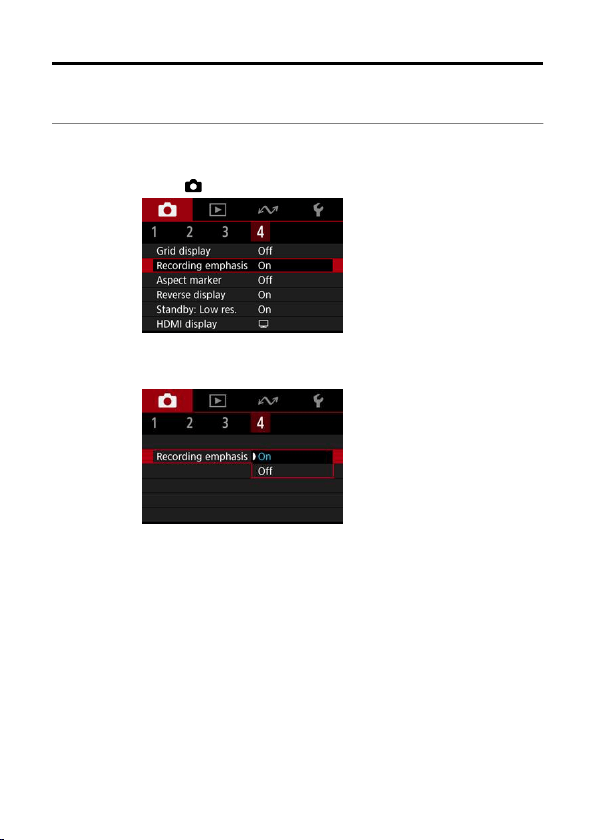
Recording Emphasis
Displays a blinking red frame around the screen during movie recording. This makes it easy
to see at a glance that recording is in progress.
1.
Select [
: Recording emphasis].
2.
Select [On].
87
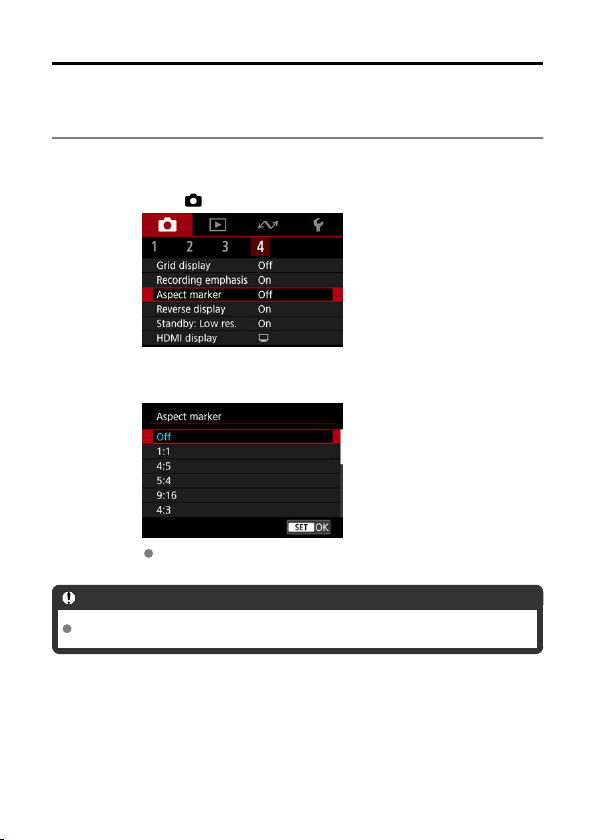
Aspect Marker
If you will change the image aspect ratio when editing the recorded movie, you can display
aspect markers on the movie recording screen (during standby and recording) to be aware
of the final angle of view after editing.
1.
Select [
: Aspect marker].
2.
Select an option.
To hide the markers, select [Off].
Caution
Markers are not included in recorded movies.
88
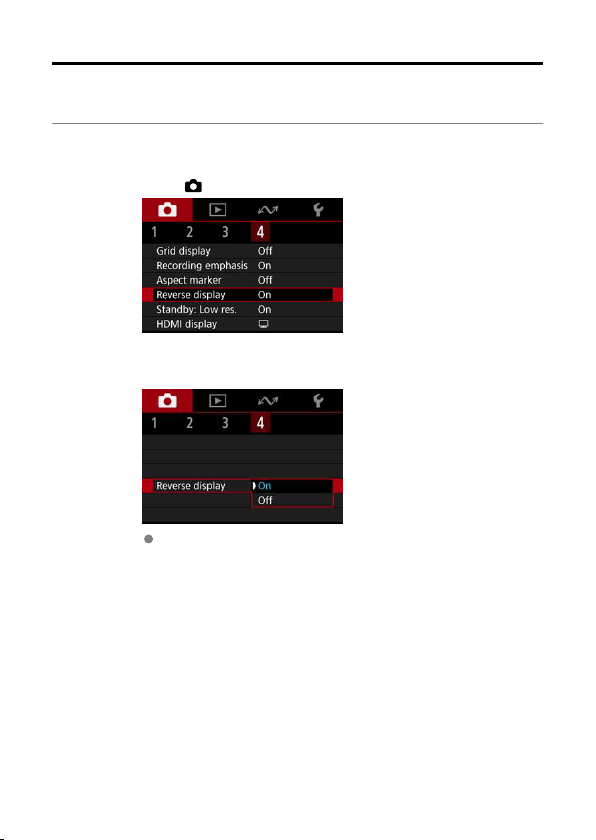
Reverse Display
A mirror image can be displayed when you shoot with the screen rotated toward the subject
(toward the front of the camera).
1.
Select [
: Reverse display].
2.
Select [On].
Select [Off] if you prefer not to reverse display when the screen is
facing the subject.
89
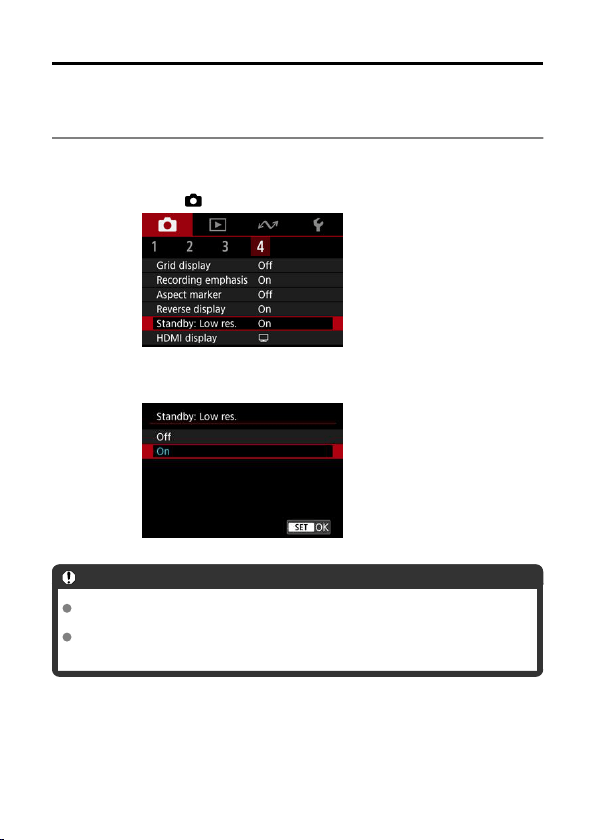
Standby: Low Resolution
Set to [On] to conserve battery power and control the rise of camera temperature during
standby.
As a result, it may enable you to record movies over a longer period.
1.
Select [
: Standby: Low res.].
2.
Select [On].
Caution
Image quality on the standby screen may differ from image quality on the screen
during movie recording.
Briefly when you start recording movies, image display may remain on the current
frame instead of being updated.
90
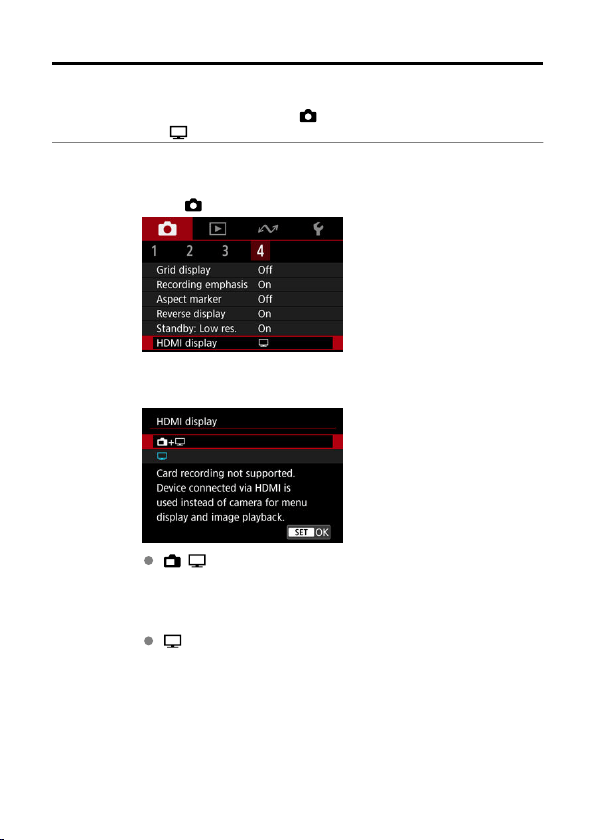
Display During HDMI Connection
You can specify how movies are displayed as they are recorded via HDMI to an external
device. Movie output itself corresponds to the [
: Movie rec. size] setting.
The default setting is [
].
1.
Select [
: HDMI display].
2.
Select an option.
+
Enables movie display both on the camera screen and on the other
device, via HDMI output.
Camera operations such as image playback or menu display are
shown on the other device via HDMI, not on the camera screen.
Deactivates the camera screen during output via HDMI, so that the
screen is blank.
Shooting information, AF points, and other information is shown in the
HDMI video output.
91
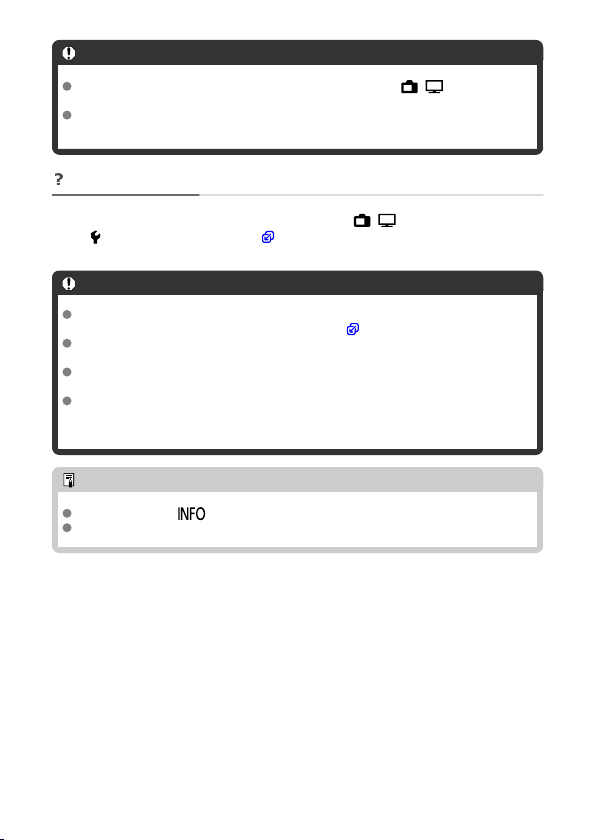
Caution
Card recording is not performed with [HDMI display] set to [ + ]. Camera
menus and image playback are only displayed on the screen connected via HDMI.
The HDMI output resolution and frame rate are automatically adjusted to suit the
movie recording size.
For longer HDMI output
To continue HDMI output for longer than 30 min., select [ + ], then set [Auto power
off] in [
: Power saving] to [Disable] ( ). HDMI output will continue after the camera
screen turns off when the time set in [Screen off] elapses.
Caution
HDMI output without information prevents display of warnings about the card
space, battery level, or high internal temperature ( ) via HDMI.
During HDMI output, display of the next image may take some time if you switch
between movies of different recording sizes or frame rates.
Avoid operating the camera when recording movies to external devices, which may
cause information to be displayed in the HDMI video output.
Brightness and color of movies recorded with the camera may look different from
those of HDMI video output recorded by external devices, depending on the
viewing environment.
Note
By pressing the < > button, you can change the information displayed.
Audio is also output via HDMI, except when set to [Sound recording: [Disable].
92
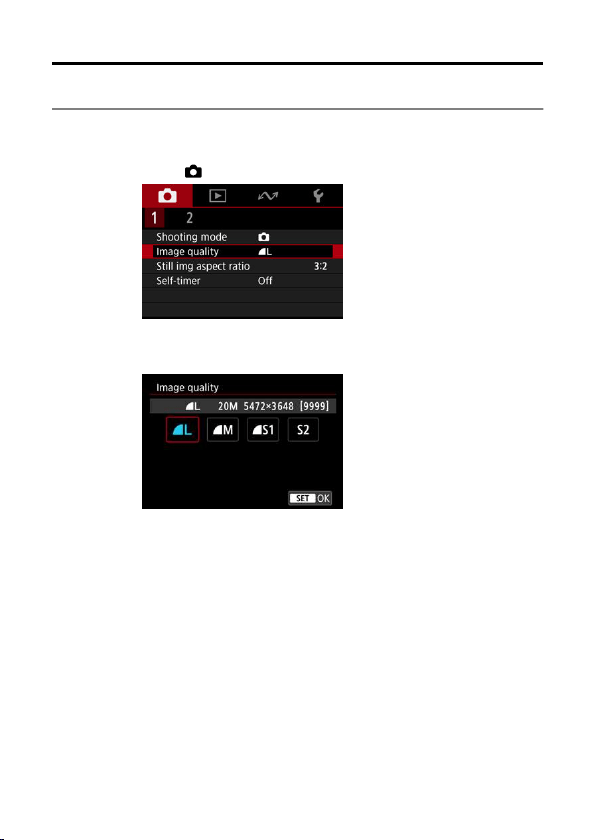
Image Quality
You can select the pixel count and the image quality.
1.
Select [
: Image quality].
2.
Select an option.
93
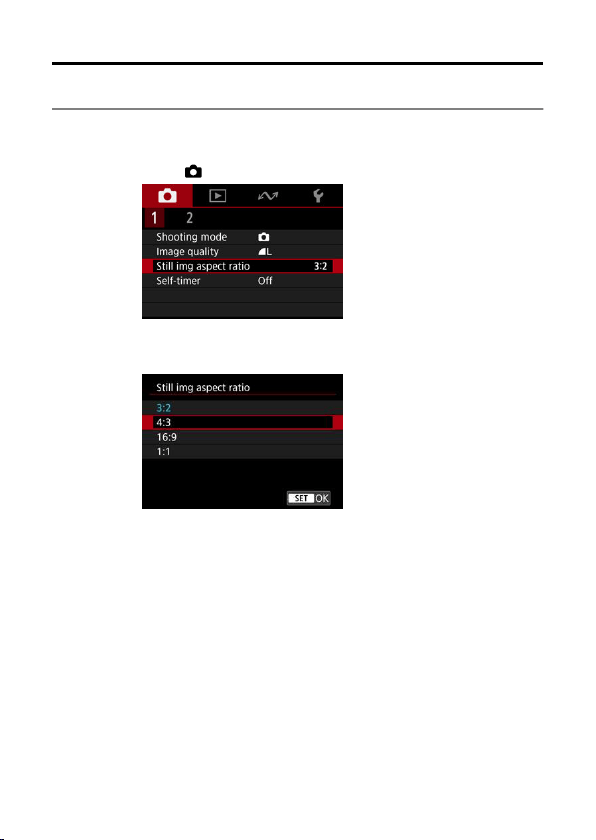
Still Image Aspect Ratio
You can change the image's aspect ratio.
1.
Select [
: Still img aspect ratio].
2.
Select an option.
94
Touch Shutter
Just by tapping the screen, you can focus and take the picture automatically.
1.
Select [
: Touch Shutter].
2.
Select [Enable].
3.
Tap the screen to shoot.
Tap the face or subject on the screen.
After the camera focuses, the AF point turns green and a picture is
taken automatically.
The AF point turns yellow if the camera cannot focus, but a picture is
still taken.
95

Caution
When shooting by tapping with [ : Review duration] set to [Hold], you can take
the next shot by tapping [
].
96
Review Duration
To keep the image displayed immediately after you shoot, set to [Hold], and if you prefer not
to have the image displayed, set to [Off].
1.
Select [
: Review duration].
2.
Select an option.
Note
When [Hold] is set, images are displayed as long as the time set in the [Screen
off] option of [
: Power saving].
97
General Movie Recording Precautions
Guidance Display Before Movie Recording
Warning Indicator Display in Movie Recording
Warning Icon for Low-Temperature Contact Burns
Other Precautions
Guidance Display Before Movie Recording
Guidance may be displayed when the camera starts up, after settings are adjusted, or in
other situations.
The guidance warns that the camera may become hot internally if movies are recorded
under the current settings, and that if you continue recording, the camera may turn off
automatically.
If you will record over an extended period, consider changing the setting indicated by the
guidance, so that you can record without the camera displaying guidance.
If you prefer to record without changing the settings, note any warning indicators displayed
as you record.
98
Warning Indicator Display in Movie Recording
A 10-level indicator (1) is displayed during movie recording in case of excessive internal
camera temperature.
As the internal temperature rises, the level on the indicator extends to the right. How fast the
level increases will depend on shooting conditions. Levels 1–7 are marked in white, but once
the temperature reaches level 8, the color changes.
[ ] flashes in red if you continue recording after the indicator reaches level 9, marked in
orange. A flashing icon indicates that the camera will soon turn off automatically.
A message is displayed if you continue to record while the icon is flashing, and the camera
automatically turns off.
Subsequent recording
To keep recording under the same settings, leave the camera off and let it cool down a
while. Note that the camera may overheat again after you resume recording.
99
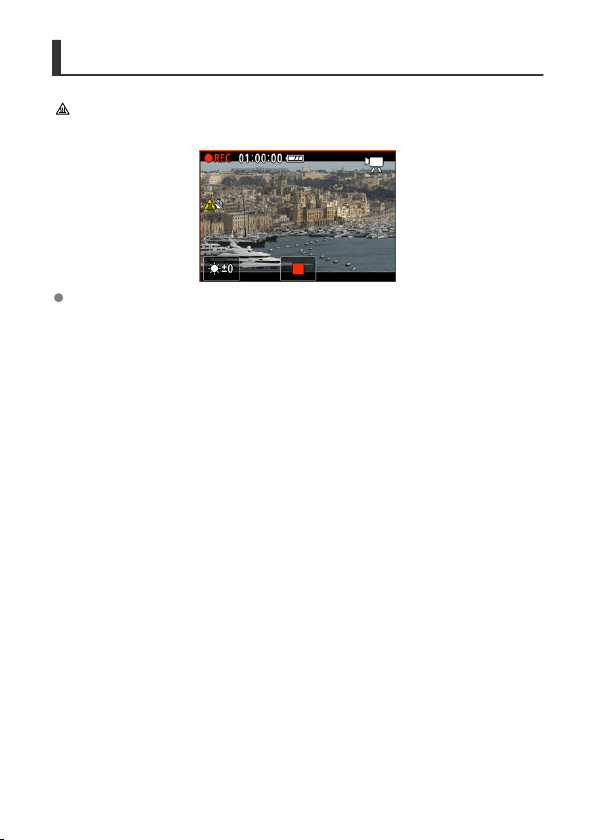
Warning Icon for Low-Temperature Contact Burns
[
] is displayed if the camera becomes warm during streaming or during image output to
external devices. To avoid low-temperature contact burns at this time, do not touch the
camera over an extended period.
The camera may turn off automatically if communication or an external device
connection is lost.
100
Other Precautions
Caution
Precautions for movie recording
Do not point the camera toward an intense light source, such as the sun or an
intense artificial light source. Doing so may damage the image sensor or the
camera's internal components.
If you record something that has fine detail, moire or false colors may result.
If [ ] or [ ] is set and the ISO speed or aperture value changes during
movie recording, the white balance may also change.
If you record a movie under fluorescent or LED lighting, the movie image may
flicker.
Large aperture values may delay or prevent accurate focusing.
Performing AF during movie recording may cause the following kinds of issues:
significant temporary loss of focus, recording of changes in movie brightness,
temporary stopping of movie recording, or recording of mechanical lens sounds.
Avoid covering the built-in microphone with your fingers or other objects.
Connecting or disconnecting an HDMI cable during movie recording will end
recording.
If necessary, also see General Still Photo Shooting Precautions.
The camera may become warm during streaming or during image output to
external devices. Use the stand or a tripod, or take other measures to avoid
handheld recording.
Recording and image quality
If there is a very bright light source in the image, the bright area may appear black
on the screen. Movies are recorded almost exactly as they appear on the screen.
Image noise (such as dots of light or banding) or irregular colors may occur when
shooting at high ISO speeds, high temperatures, slow shutter speeds, or under low
light. Movies are recorded almost exactly as they appear on the screen.
Video and audio quality of recorded movies may be worse on other devices, and
playback may not be possible, even if the devices support MP4 formats.
Note
Notes for movie recording
Each time you record a movie, a new movie file is created on the card.
With some cards, a new file is created each time the file size exceeds approx. 4
GB.
Field of view (coverage) is approx. 100%.
Most external microphones equipped with a 3.5 mm mini-plug can be used.
Any connected external microphone is used instead of the built-in microphone.
101
General Still Photo Shooting Precautions
Caution
Do not point the camera toward an intense light source, such as the sun or an
intense artificial light source. Doing so may damage the image sensor or the
camera's internal components.
Image quality
Shooting in high temperatures may cause noise and irregular colors in the image.
Frequent shooting over an extended period may cause high internal temperatures
and affect image quality. When you are not shooting, always turn off the camera.
White [
] internal temperature warning icon
A white [ ] icon indicates high internal camera temperature. The white [ ] icon
indicates that the image quality of still photos will decline. Stop shooting for a while
and allow the camera to cool down.
If the camera's internal temperature is high, the quality of images shot with a high
ISO speed may decline even before the white [
] icon is displayed.
Images and display
Under low- or bright-light conditions, the displayed image may not reflect the
brightness of the captured image.
Pointing the camera at different direction may momentarily prevent correct display
of brightness. Wait until the brightness level stabilizes before shooting.
If there is a very bright light source in the image, the bright area may appear black
on the screen. However, the actual captured image will correctly show the bright
area.
Under low light, bright [ : Screen brightness] settings may cause noise or
irregular colors in images. However, the noise or irregular colors will not be
recorded in the captured image.
When you magnify the image, the image sharpness may look more pronounced
than in the actual image.
Note
Field of view (coverage) is approx. 100%.
If the camera is idle over an extended period, the screen will turn off automatically
after the time set in [Auto power off] or [Screen off] under [
: Power saving]. If
the screen turns off automatically after the time set in [Screen off], the camera will
then turn off automatically after the time set in [Auto power off] ( ).
Using a commercially available HDMI cable, you can display images on a television
( ). Note that no sound will be output.
102

Playback
This chapter covers topics related to playback—playing back captured still photos and
movies—and introduces menu settings on the playback [
] tab.
Caution
Normal display or selection on this camera may not be possible for images
captured on other cameras, or images from this camera that have been edited or
renamed on a computer.
•
Tab Menus: Playback
• Movie Playback
• Image Playback
• Playback on a TV Set
• Protecting Images
• Erasing Images
• Rotating Still Photos
• Changing Movie Orientation Information
• Rating Images
• Resuming from Previous Playback
103
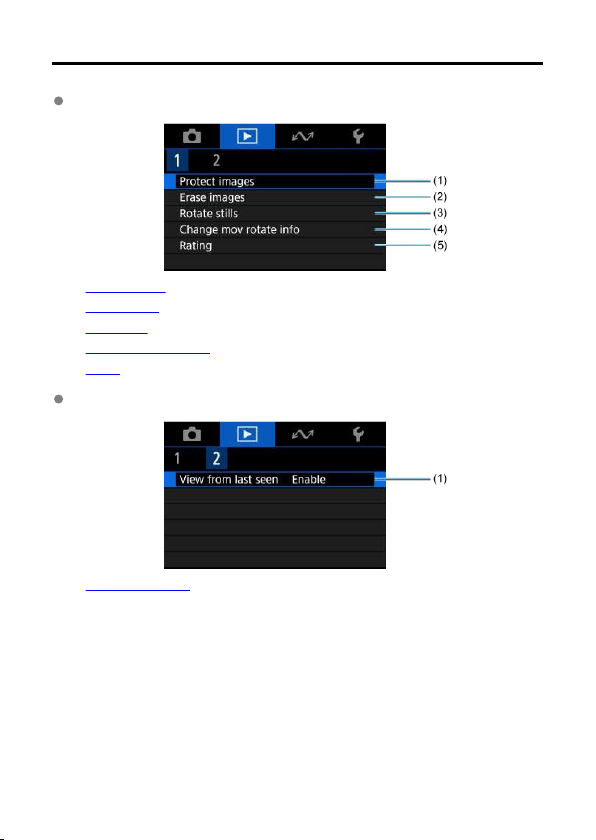
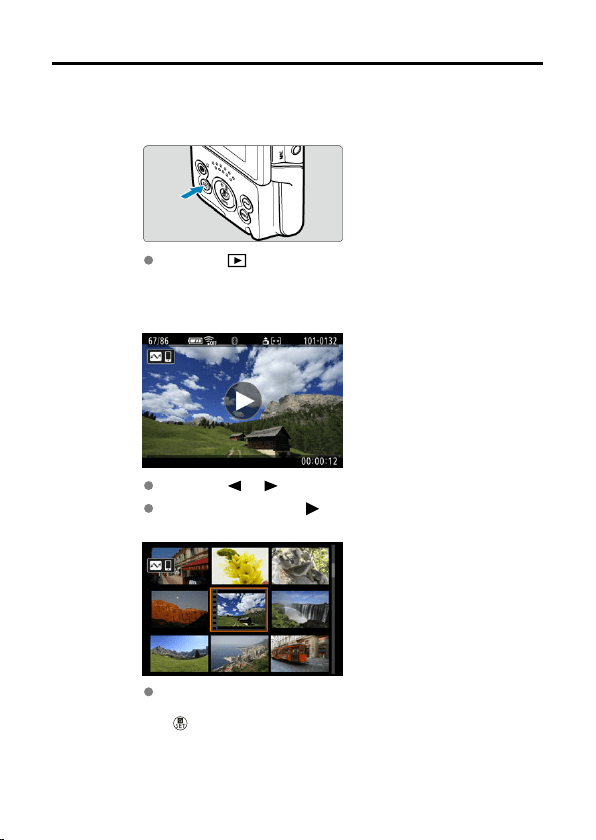
Movie Playback
1.
Switch to playback.
Press the < > button.
2.
Select a movie.
Press the < > < > keys to select a movie to play.
In single-image display, a [ ] icon in the center of the screen indicates
that the image is a movie.
In index display, perforations at the left edge of a thumbnail indicate a
movie. Movies cannot be played from index display, so press the
<
> button to switch to single-image display.
105
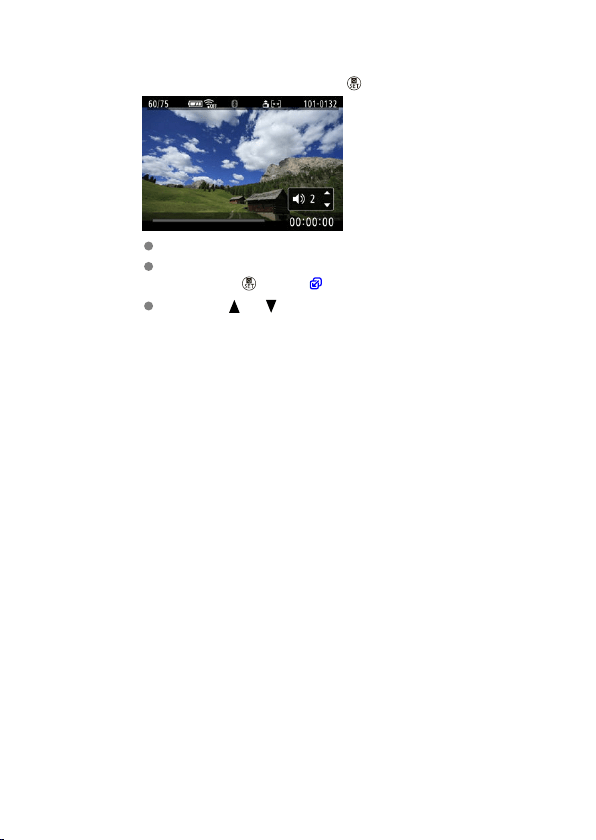
3.
In single-image display, press the <
> button.
The movie will start playing back. Sound is played through the speaker.
You can pause playback and access the movie playback panel by
pressing the <
> button ( ). Press it again to resume the playback.
Press the < > < > keys to adjust the volume (even during
playback).
106
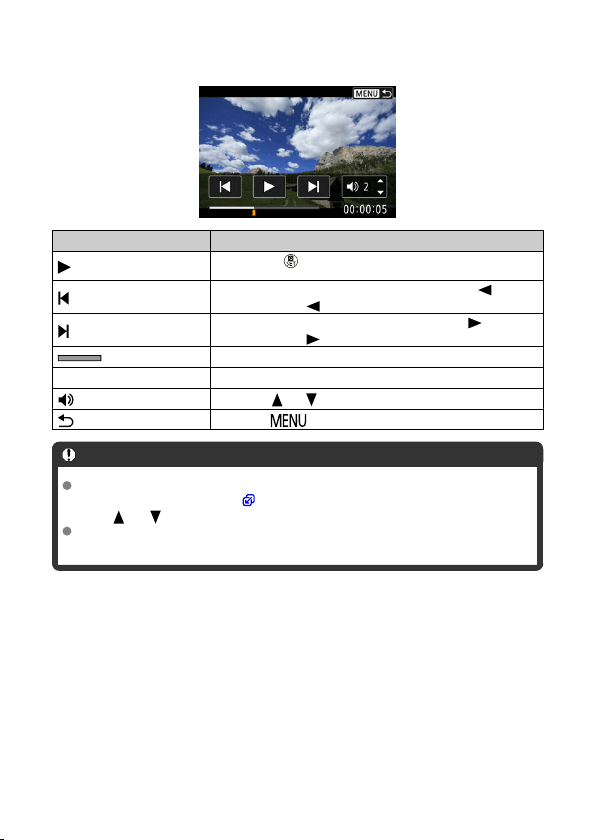
Movie playback panel
Item Playback Operations
Playback
Pressing the <
> button toggles between playing movies and
pausing playback.
Skip backward
Skips backward approx. 1 sec. each time you press the <
> key.
Holding down the <
> key will rewind the movie.
Skip forward
Skips forward approx. 1 sec. each time you press the <
> key.
Holding down the <
> key will fast forward the movie.
Playback position
hh:mm:ss Playback time (hours:minutes:seconds)
Volume Press the < > < > keys to adjust the speaker volume.
Press the < > button to return to single-image display.
Caution
Adjust the volume using television controls when the camera is connected to a
television for movie playback ( ), because volume cannot be adjusted by pressing
the <
> < > keys.
Movie playback may stop if the card's read speed is too slow or movie files have
corrupted frames.
107
Image Playback
Single-Image Display
Touch Playback
Single-Image Display
1.
Switch to playback.
Press the < > button.
The last image captured or played back is displayed.
2.
Browse images.
To play back images starting with your most recent shot, press the
<
> key. To play back images starting with the first captured image,
press the <
> key.
Each time you press the < > button, the display will change.
108
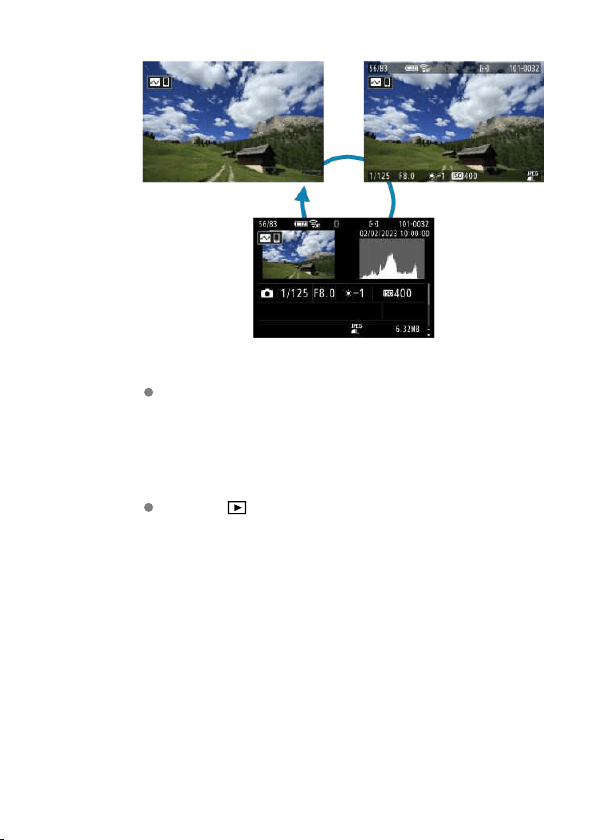
No information Basic information display
Shooting information display
With the shooting information screen displayed, you can swipe up or
down to view other information.
3.
Exit image playback.
Press the < > button to exit image playback and return to shooting
standby.
109
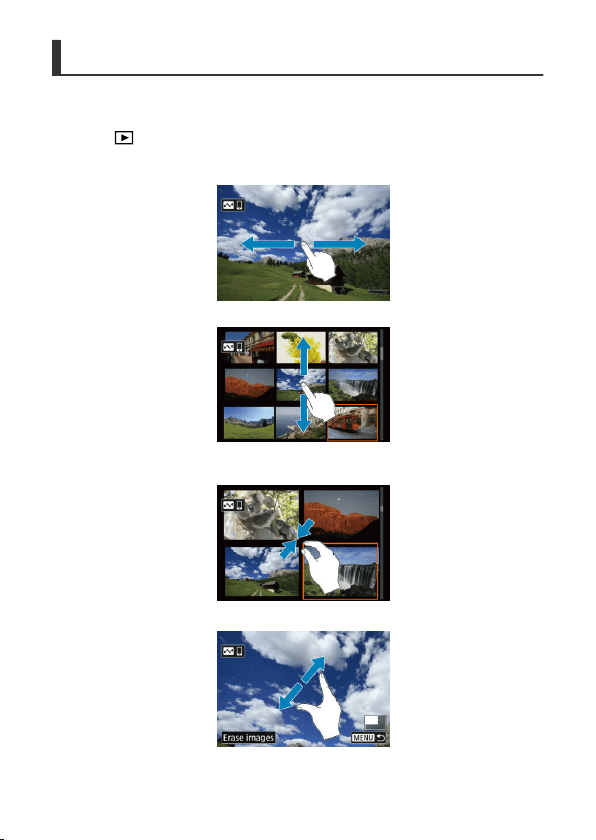
Touch Playback
The camera features a touch-screen panel that you can touch to control playback.
Supported touch operations are like those used with smartphones and similar devices. First,
press the <
> button to prepare for touch playback.
Browse images
Index display
Magnified view
110

Note
You can also magnify display by double-tapping with one finger.
111
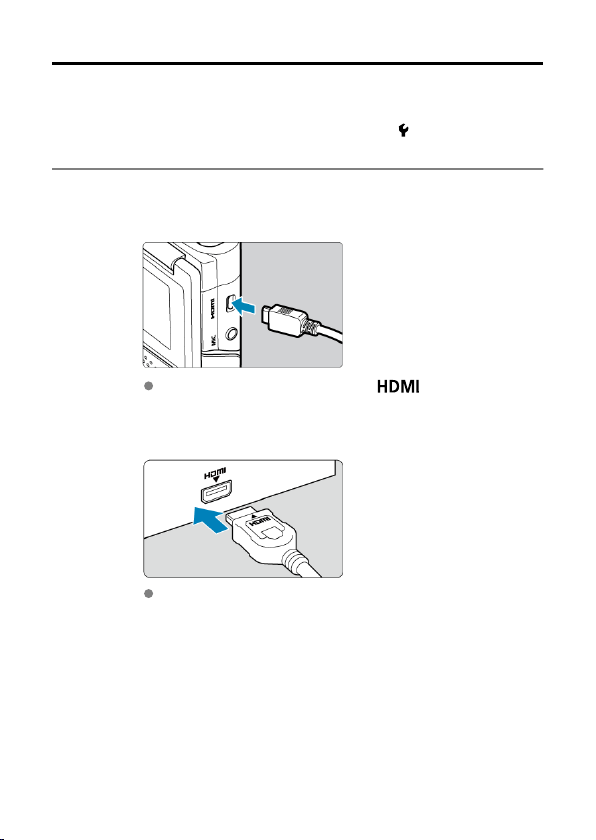
Playback on a TV Set
By connecting the camera to a television with a commercially available HDMI cable, you can
play back the captured still photos and movies on the television.
If the image does not appear on the TV screen, confirm that [
: Video system] is
correctly set to [For NTSC] or [For PAL] (depending on the video system of your
television).
1.
Connect the HDMI cable to the camera.
Insert the HDMI cable in the camera's < > terminal.
2.
Connect the HDMI cable to the television.
Connect the HDMI cable to the television's HDMI IN port.
3.
Turn on the television and switch the television's video input to select
the connected port.
4.
Turn the camera on.
112
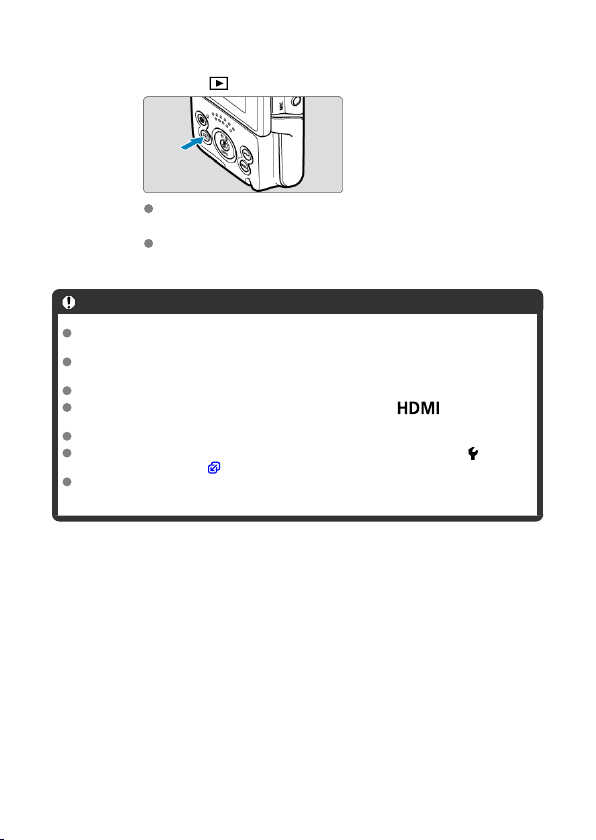
5.
Press the <
> button.
Images are now displayed on the television, with nothing displayed on
the camera screen.
The images will automatically be displayed at the optimum resolution
matching the connected television.
Caution
Adjust movie sound volume with the television. The sound volume cannot be
adjusted with the camera.
Before connecting or disconnecting the cable between the camera and television,
turn off the camera and television.
Depending on the television, part of the image displayed may be cut off.
Do not connect any other device's output to the camera's < > terminal.
Doing so may cause a malfunction.
Certain televisions may not display the images due to incompatibility.
It may take some time before images are displayed. To avoid delay, set [ : HDMI
resolution] to [1080p] ( ).
Touch-screen operations are not supported while connected to a television with the
camera screen off.
113
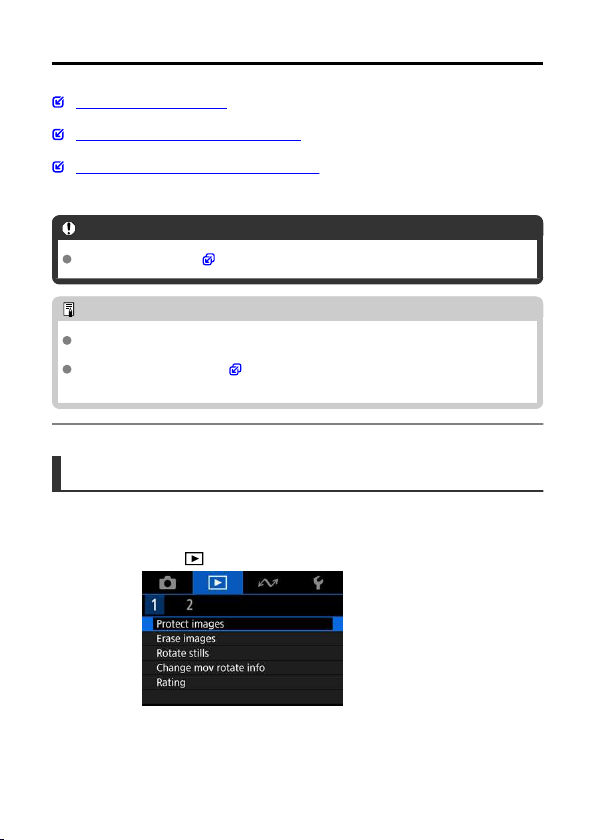
Protecting Images
Protecting Individual Images
Specifying the Range of Images to Protect
Protecting All Images in a Folder or on a Card
You can protect important images from being accidentally erased.
Caution
If you format the card ( ), the protected images will also be erased.
Note
Once an image is protected, it cannot be erased by the camera's erase function. To
erase a protected image, you must first cancel the protection.
If you erase all the images ( ), only the protected images will remain. This is
convenient when you want to erase all unneeded images at once.
Protecting Individual Images
1.
Select [
: Protect images].
114
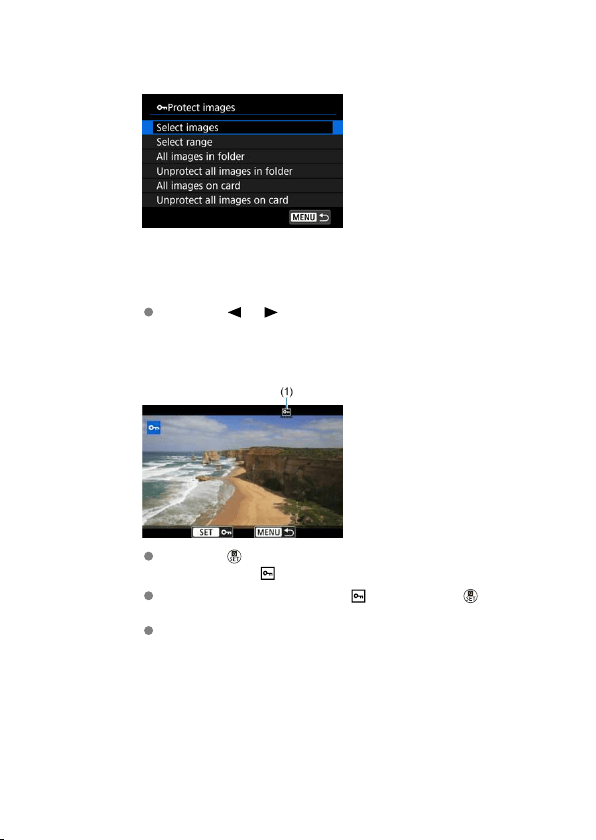
2.
Select [Select images].
3.
Select the image to protect.
Press the < > < > keys to select the image to protect.
4.
Protect the image.
Press the < > button to protect the selected image, after which it will
be labeled with a [
] icon (1) at the top of the screen.
To cancel protection and clear the [ ] icon, press the < > button
again.
To protect another image, repeat steps 3 and 4.
115
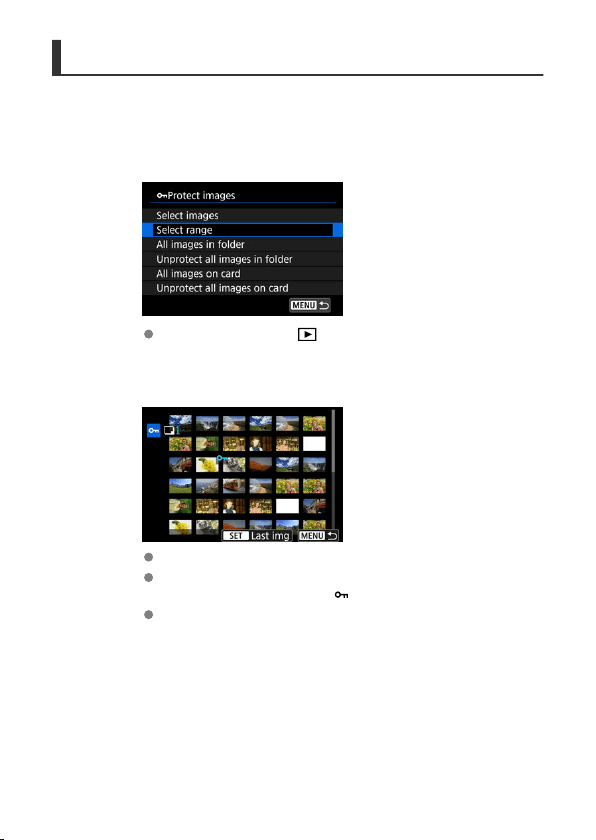
Specifying the Range of Images to Protect
While looking at the images in the index display, you can specify the first and last images for
a range to protect all the specified images at once.
1.
Select [Select range].
Select [Select range] in [ : Protect images].
2.
Specify the range of images.
Select the first image (start point).
Next, select the last image (end point). The images in the specified
range will be protected and the [
] icon will appear.
To select another image to protect, repeat step 2.
116
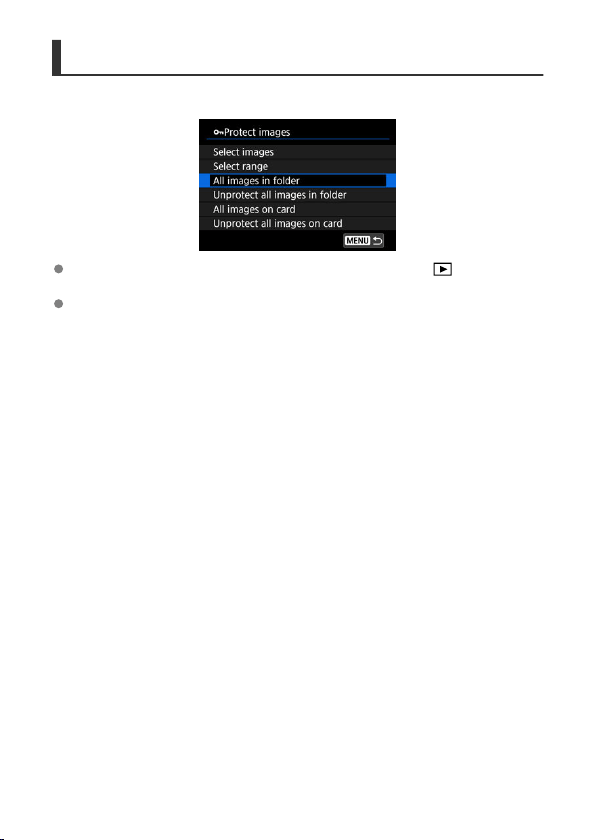
Protecting All Images in a Folder or on a Card
You can protect all the images in a folder or on a card at once.
When you select [All images in folder] or [All images on card] in [ : Protect
images], all the images in the folder or on the card will be protected.
To cancel protection, select [Unprotect all images in folder] or [Unprotect all images
on card].
117
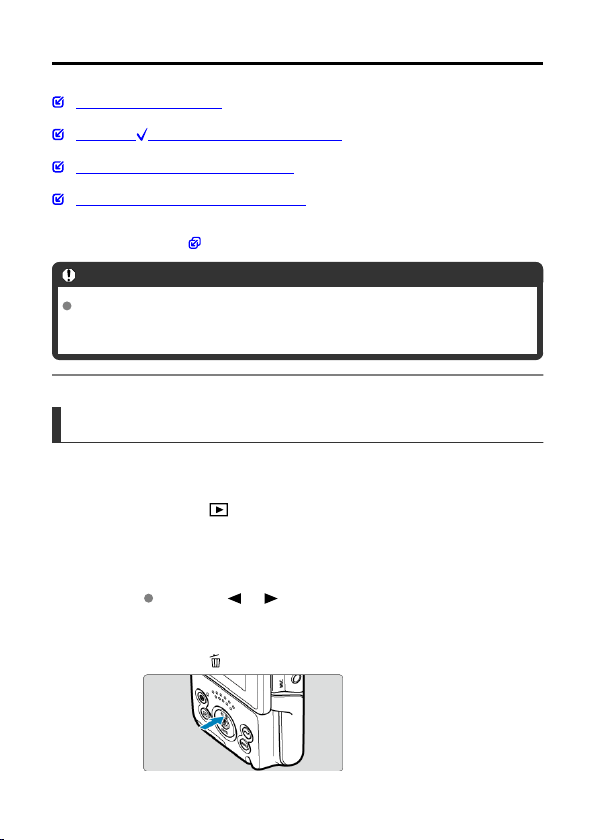
Erasing Images
Erasing Images Individually
Selecting ([ ]) Multiple Images to Erase Together
Specifying the Range of Images to Erase
Erasing All Images in a Folder or on a Card
You can either select and erase unnecessary images individually or erase them in one
batch. Protected images ( ) will not be erased.
Caution
Once an image is erased, it cannot be recovered. Make sure you no longer
need the image before erasing it. To prevent important images from being
erased accidentally, protect them.
Erasing Images Individually
1.
Press the <
> button.
2.
Select the image to be erased.
Press the < > < > keys to select the image to erase.
3.
Press the <
> button.
118

4.
Erase the image.
Select [Erase].
119
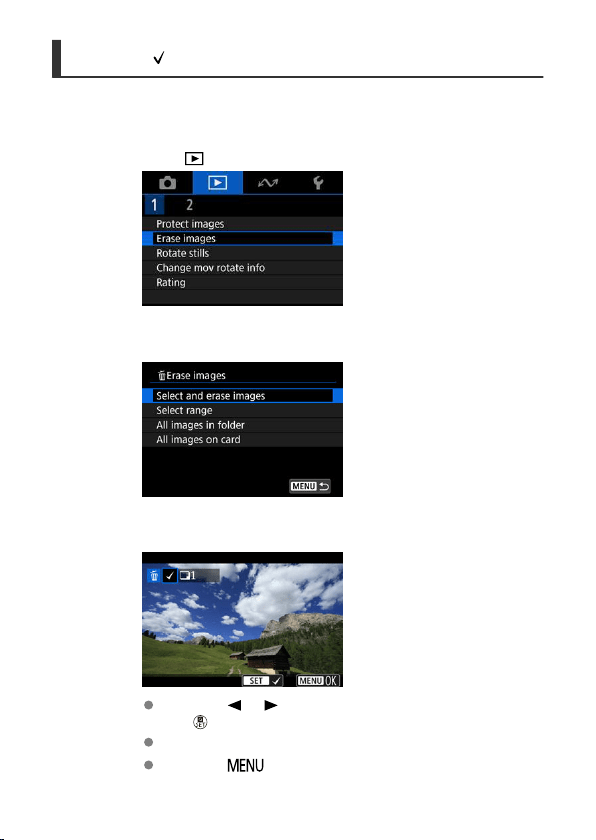
Selecting ([ ]) Multiple Images to Erase Together
By adding checkmarks to the images to be erased, you can erase all those images at once.
1.
Select [
: Erase images].
2.
Select [Select and erase images].
3.
Browse images.
Press the < > < > keys to select the image to erase, then press
the <
> button.
To select another image to be erased, repeat step 3.
Press the < > button.
120
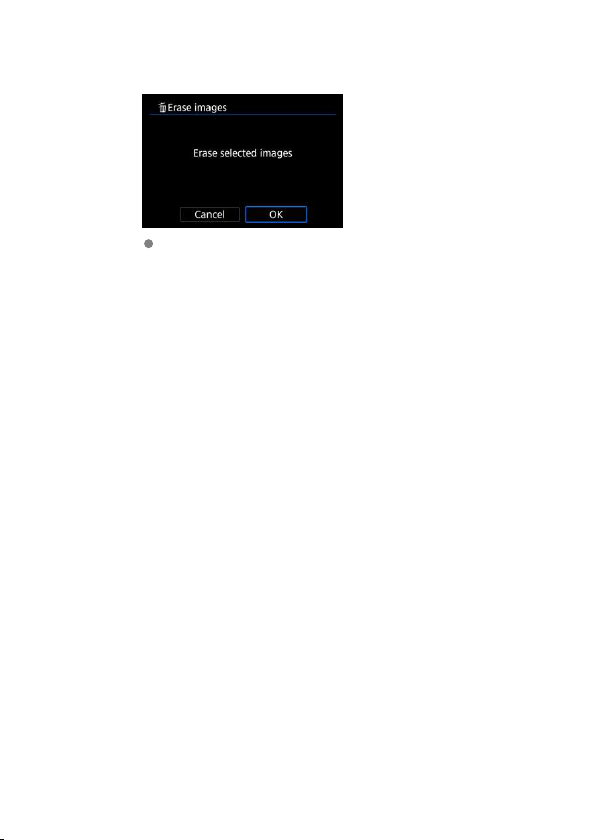
4.
Erase the images.
Select [OK].
121
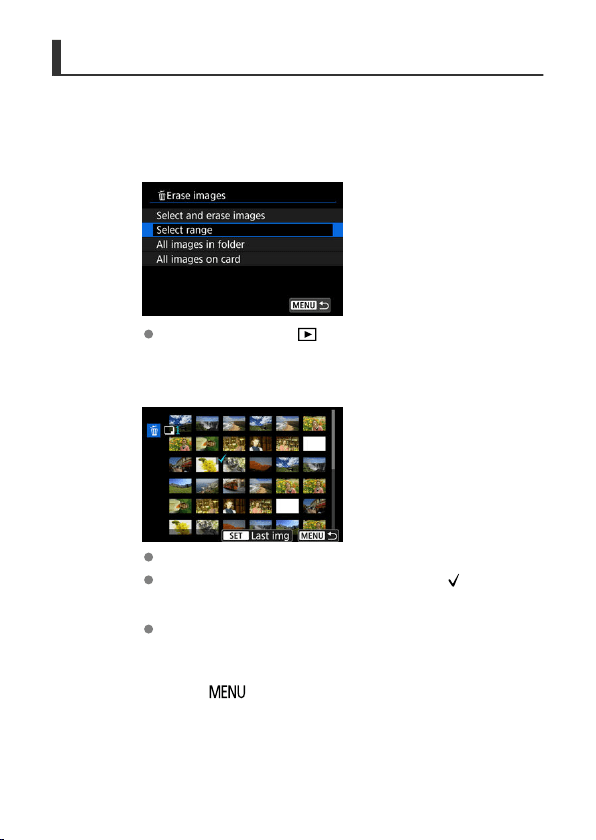
Specifying the Range of Images to Erase
While looking at the images in the index display, you can specify the first and last images for
a range to erase all the specified images at once.
1.
Select [Select range].
Select [Select range] in [ : Erase images].
2.
Specify the range of images.
Select the first image (start point).
Next, select the last image (end point). A checkmark [ ] will be
appended to all the images within the range between first and last
images.
To select another image to be erased, repeat step 2.
3.
Press the <
> button.
122
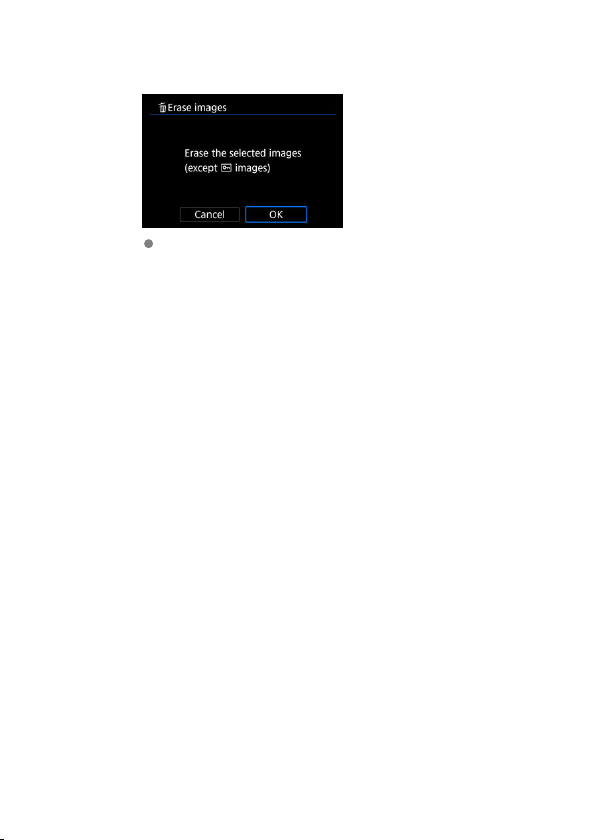
4.
Erase the images.
Select [OK].
123
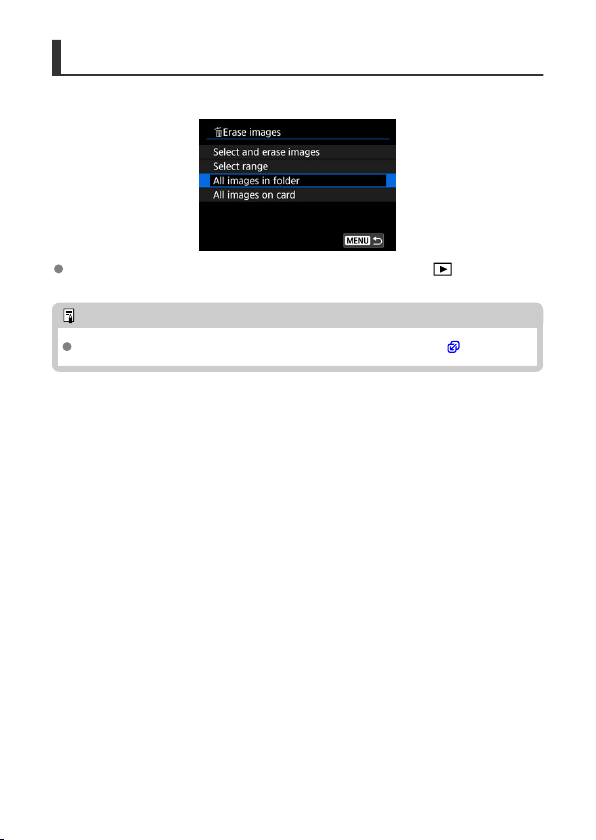
Erasing All Images in a Folder or on a Card
You can erase all the images in a folder or on a card at once.
When you select [All images in folder] or [All images on card] in [ : Erase images],
all the images in the folder or on the card will be erased.
Note
To erase all the images including protected images, format the card ( ).
124
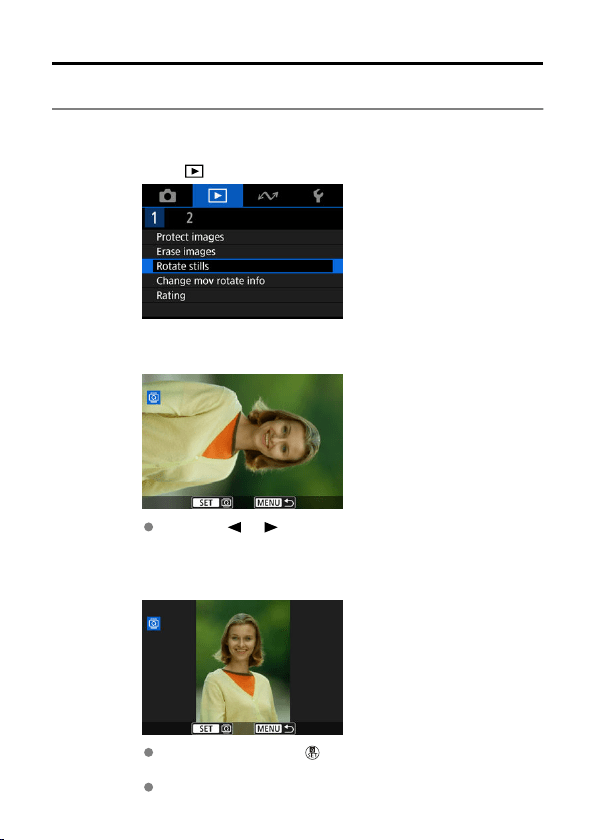
Rotating Still Photos
You can use this feature to rotate the displayed image to the desired orientation.
1.
Select [
: Rotate stills].
2.
Select an image to rotate.
Press the < > < > keys to select an image.
3.
Rotate the image.
Each time you press the < > button, the image is rotated clockwise
as follows: 90° → 270° → 0°.
To rotate another image, repeat steps 2 and 3.
125
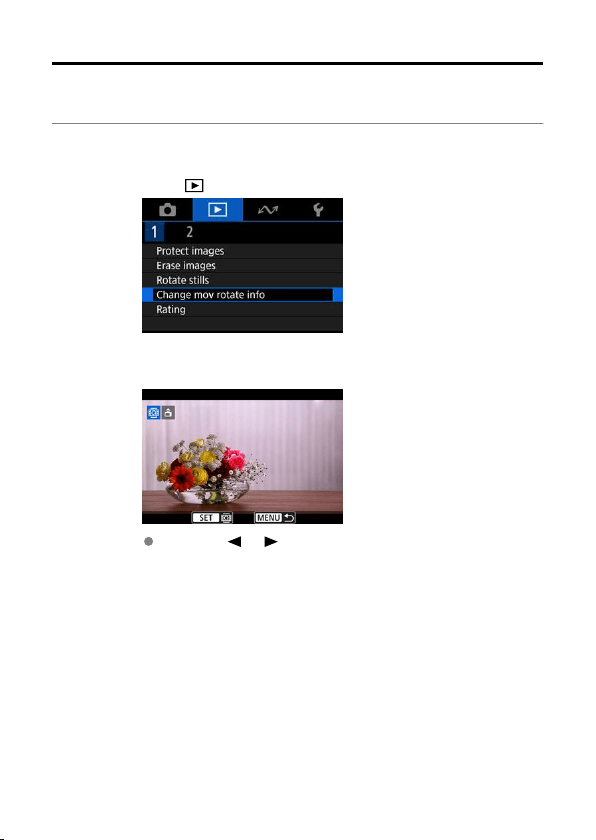
Changing Movie Orientation Information
You can manually edit movie playback orientation information (which determines which side
is up).
1.
Select [
: Change mov rotate info].
2.
Select a movie.
Press the < > < > keys to select the movie with orientation
information to change.
127
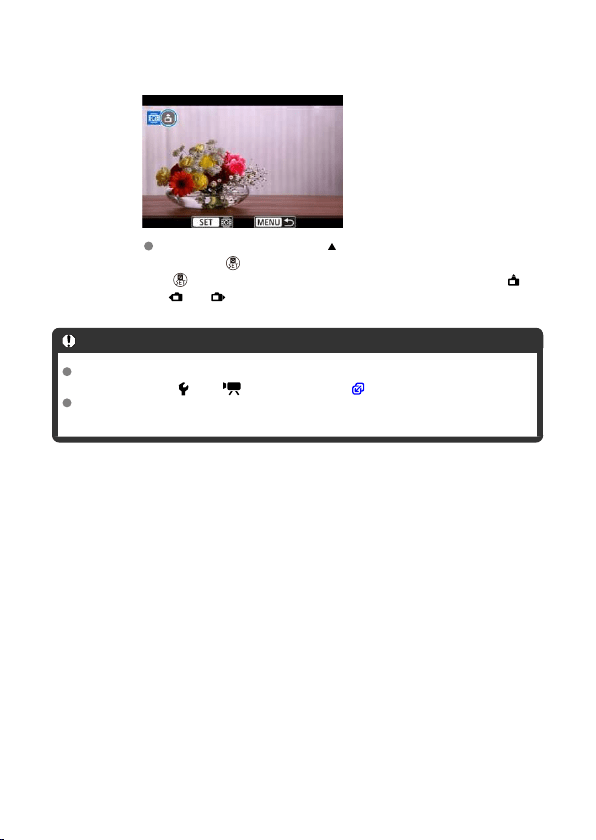
3.
Change the orientation information.
As you watch the camera and icon in the upper left of the screen,
press the <
> button to specify which side is up. Each press of the
<
> button edits the movie orientation information as follows: [ ] →
[
] → [ ].
Caution
Movies are played horizontally on the camera and via HDMI video output,
regardless of the [
: Add rotate info] setting ( ).
Movie orientation information of movies recorded with other cameras cannot be
edited with this camera.
128
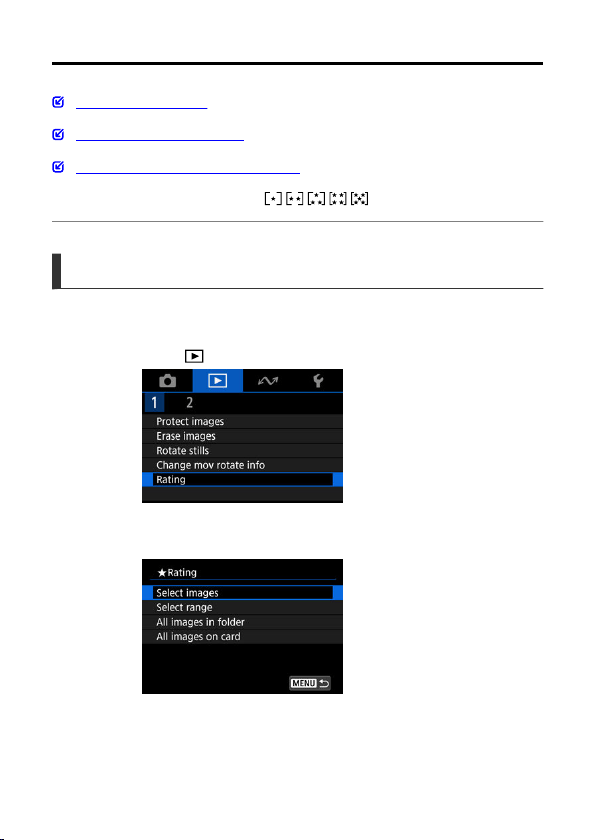
Rating Images
Rating Individual Images
Rating by Specifying the Range
Rating All Images in a Folder or on a Card
You can rate images on a scale of 1–5 ( / / / / ). This function is called rating.
* Rating images can help you organize them.
Rating Individual Images
1.
Select [
: Rating].
2.
Select [Select images].
129
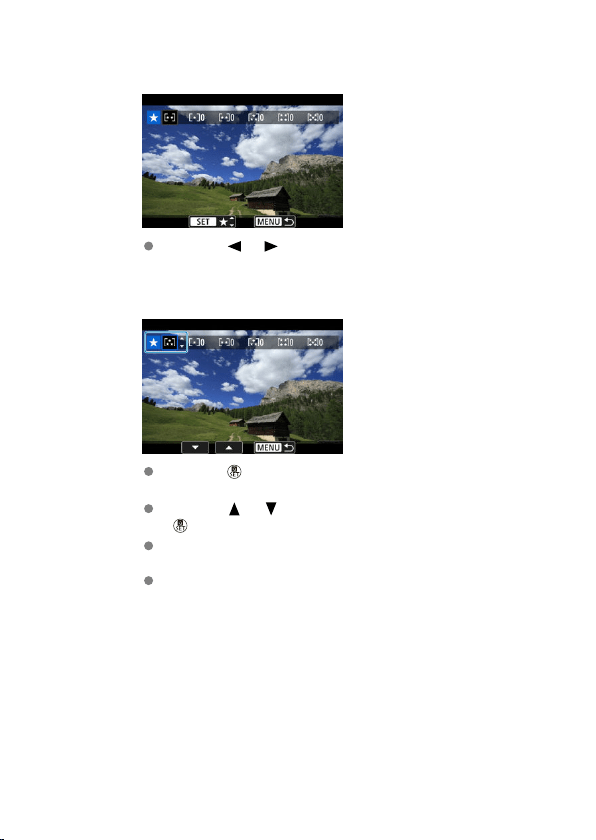
3.
Select the image to be rated.
Press the < > < > keys to select the image to rate.
4.
Rate the image.
Press the < > button so that the current rating is outlined in blue, as
shown.
Press the < > < > keys to select a rating mark, then press the
<
> button.
When you append a rating mark to the image, the number beside the
set rating will increase by one.
To rate another image, repeat steps 3 and 4.
130
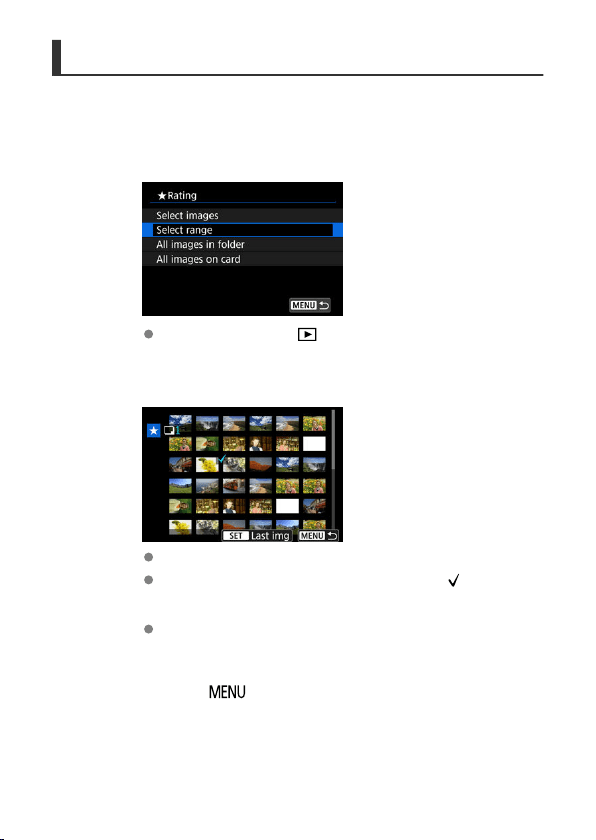
Rating by Specifying the Range
While looking at the images in the index display, you can specify the first and last images for
a range to rate all the specified images at once.
1.
Select [Select range].
Select [Select range] in [ : Rating].
2.
Specify the range of images.
Select the first image (start point).
Next, select the last image (end point). A checkmark [ ] will be
appended to all the images within the range between first and last
images.
To select other images, repeat step 2.
3.
Press the <
> button.
131
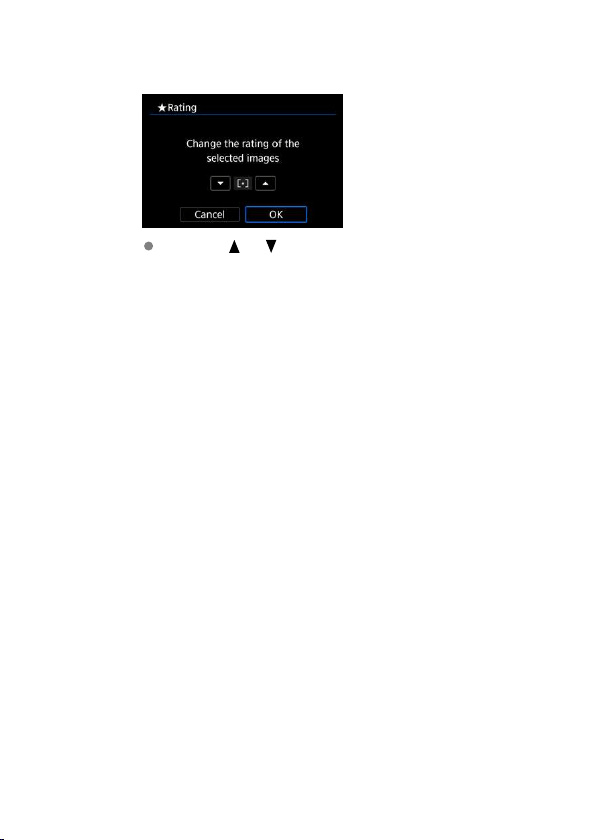
4.
Rate the image.
Press the < > < > keys to select a rating mark, then select [OK].
All the images in the specified range will be rated (same rating) at
once.
132
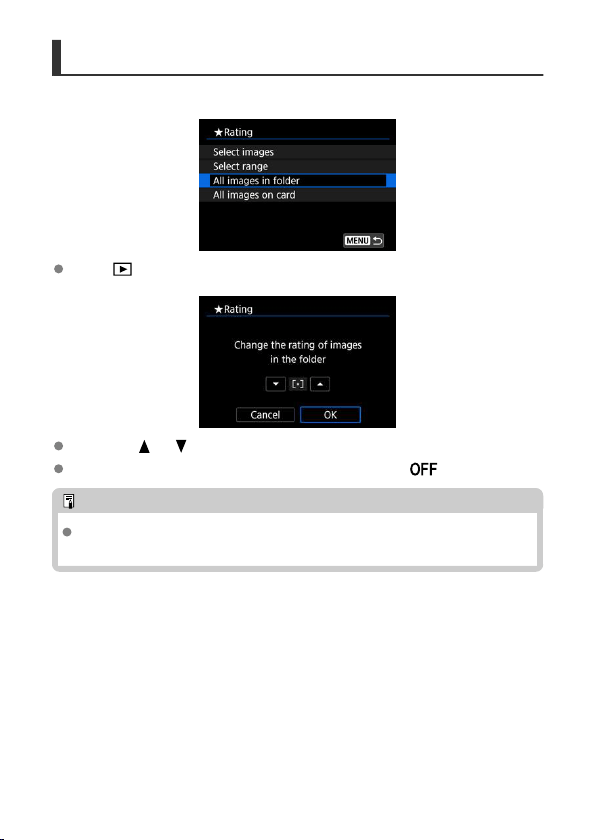
Rating All Images in a Folder or on a Card
You can rate all the images in a folder or on a card at once.
Under [ : Rating], when you select [All images in folder] or [All images on card], all
the images in the folder or on the card will be rated.
Press the < > < > keys to select a rating, then select [OK].
When you are not rating images or canceling the rating, select [ ].
Note
Values next to rating marks are displayed as [###] if more than 1,000 images have
that rating.
133
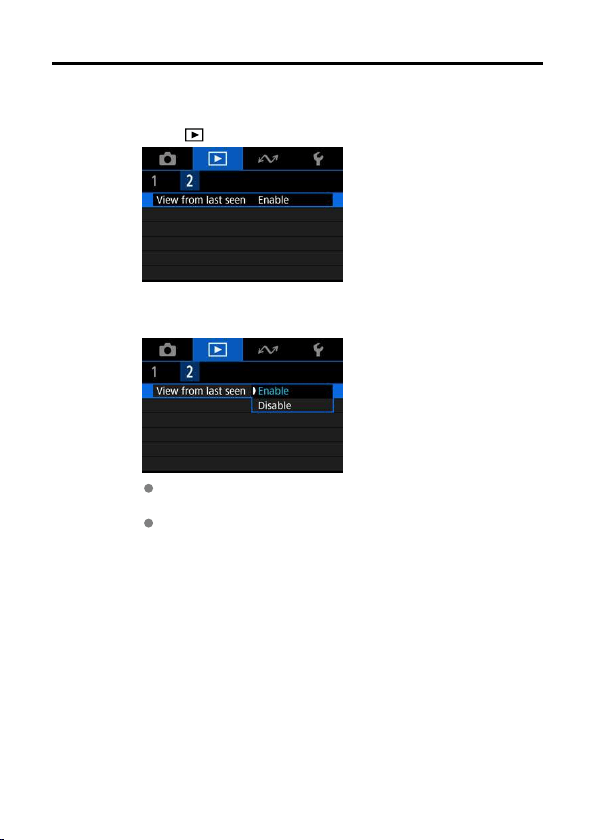
Resuming from Previous Playback
1.
Select [
: View from last seen].
2.
Select an option.
[Enable]: Playback resumes from the last image displayed (unless you
have just finished shooting).
[Disable]: Playback resumes from your most recent shot whenever the
camera is restarted.
134
Wireless Features
This chapter describes how to stream or perform other operations over a Bluetooth
®
or Wi-Fi
connection.
Caution
Important
Note that Canon cannot be held liable for any loss or damage caused by erroneous
wireless communication settings when using the camera. In addition, Canon cannot
be held liable for any other loss or damage caused by use of the camera.
When using wireless communication functions, establish appropriate security at
your own risk and discretion. Canon cannot be held liable for any loss or damage
caused by unauthorized access or other security breaches.
• Tab Menus: Wireless Features
• Connecting to a Smartphone or Tablet
• Connecting to a Wireless Remote Control
• Uploading Images to image.canon
• Live Streaming
• Advanced Connections
• GPS Settings
• Basic Communication Settings
• Reconnecting via Wi-Fi/Bluetooth
• Editing/Deleting Devices for Connections
• Airplane Mode
• Wi-Fi Settings
• Bluetooth Settings
• Camera Name
• Error Details
• Resetting Communication Settings
• Virtual Keyboard Operations
• Responding to Error Messages
• Wireless Communication Precautions
• Security
• Checking Network Settings
• Wireless Communication Status
135
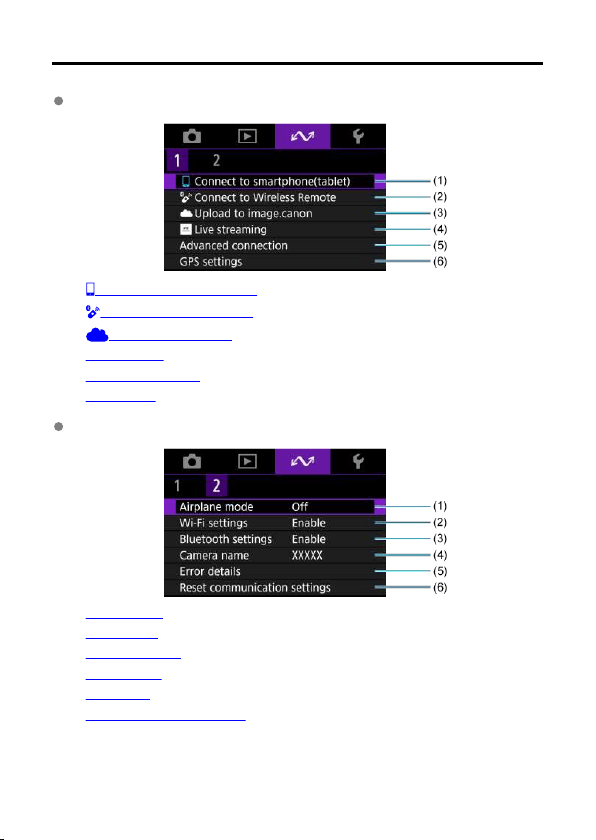
Tab Menus: Wireless Features
Communication functions 1
(1) Connect to smartphone(tablet)
(2) Connect to Wireless Remote
(3) Upload to image.canon
(4) Live streaming
(5) Advanced connection
(6) GPS settings
Communication functions 2
(1) Airplane mode
(2) Wi-Fi settings
(3) Bluetooth settings
(4) Camera name
(5) Error details
(6) Reset communication settings
136

Caution
Some menu items cannot be configured while the camera is connected to
computers or other devices via an interface cable.
Wi-Fi connections are terminated when you turn the camera off.
With a Wi-Fi connection established, the camera's auto power off does not function.
137
Connecting to a Smartphone or Tablet
Preparing the Smartphone
Connecting to a Smartphone via Wi-Fi
Main Functions of Camera Connect
Maintaining a Wi-Fi Connection When the Camera Is Off
Canceling the Pairing
You can do the following after pairing the camera with a smartphone.
Establish a Wi-Fi connection using only the smartphone ( ).
Establish a Wi-Fi connection with the camera even when it is off ( ).
Geotag images with GPS information acquired by the smartphone ( ).
Control the camera remotely from a smartphone ( ).
You can also do the following after connecting the camera to a smartphone via Wi-Fi.
Browse and save images on the camera from a smartphone ( ).
Control the camera remotely from a smartphone ( ).
138
Preparing the Smartphone
Turning on Bluetooth and Wi-Fi on a Smartphone
Turn on Bluetooth and Wi-Fi from the smartphone settings screen. Note that pairing with the
camera is not possible from the smartphone's Bluetooth settings screen.
Installing Camera Connect on a Smartphone
The dedicated app Camera Connect (free of charge) must be installed on the smartphone
on which Android or iOS is installed.
Use the latest version of the smartphone OS.
Camera Connect can be installed from Google Play or App Store. Google Play or App
Store can also be accessed using the QR codes that appear when the camera is paired
or connected via Wi-Fi to a smartphone.
Note
For the operating system versions supported by Camera Connect, refer to the
download site of Camera Connect.
Sample screens and other details in this guide may not match the actual user
interface elements after camera firmware updates or updates to Camera Connect,
Android, or iOS.
139
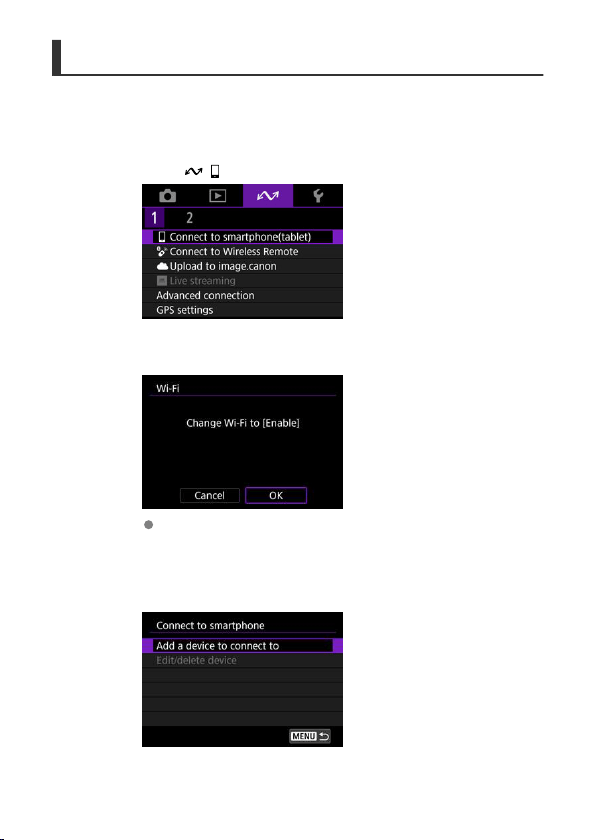
Connecting to a Smartphone via Wi-Fi
If the [Welcome] screen displayed initially indicates that the smartphone and camera are
already paired, go to step 10.
1.
Select [
: Connect to smartphone(tablet)].
2.
Select [OK].
This screen is not displayed if the Wi-Fi setting is already set to
[Enable].
3.
Select [Add a device to connect to].
140
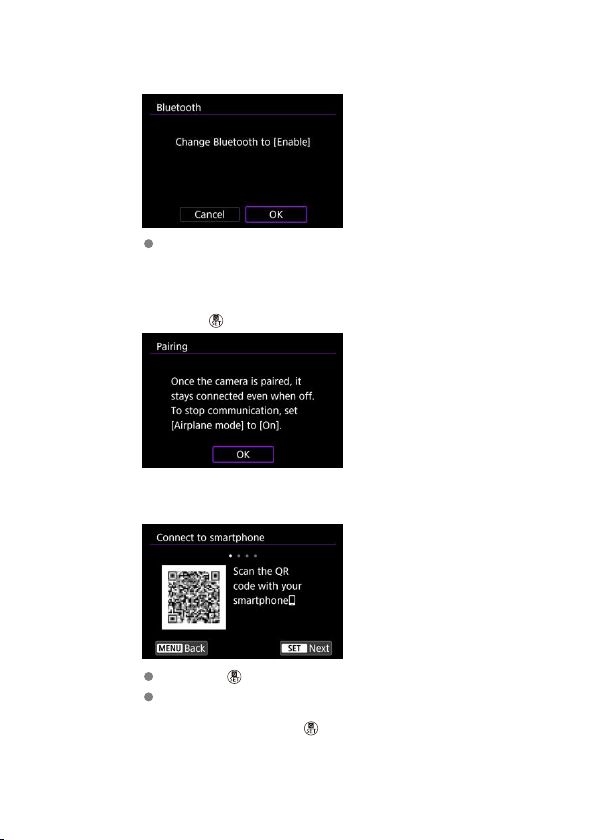
4.
Select [OK].
This screen is not displayed if the Bluetooth setting is already set to
[Enable].
5.
Press the <
> button.
6.
Start pairing.
Press the < > button to start pairing.
If Camera Connect is not installed, use the smartphone to scan the QR
code on the screen, go to Google Play or App Store to install Camera
Connect, then press the <
> button to start pairing.
141
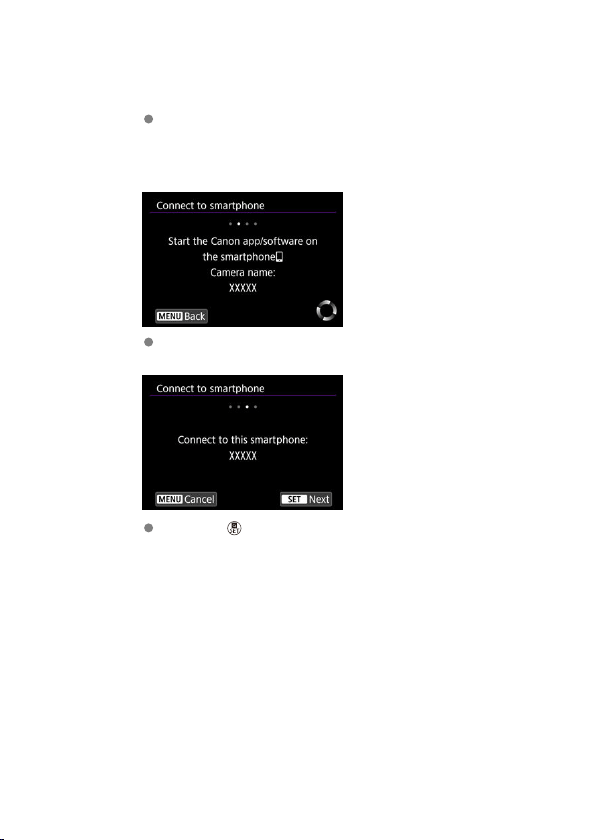
7.
Start Camera Connect.
Following the instructions in the app, select the camera for pairing.
8.
Establish a Bluetooth connection.
When a message appears on the smartphone, use the smartphone as
indicated.
Press the < > button.
142
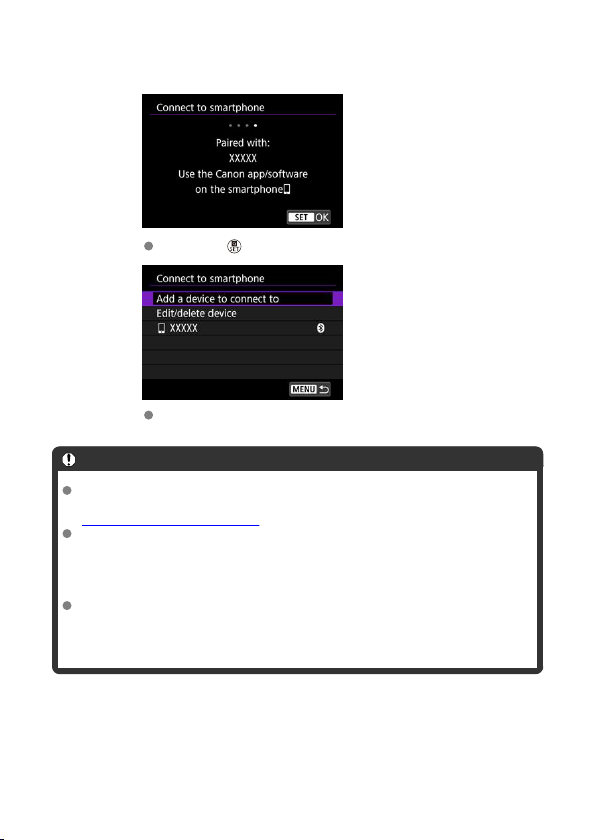
9.
Complete the pairing process.
Press the < > button to finish pairing.
The name of the connected device is displayed.
Caution
The camera cannot be connected to two or more devices at the same time via
Bluetooth. To switch to a different smartphone for the Bluetooth connection, see
Reconnecting via Wi-Fi/Bluetooth.
Keep in mind that the camera battery level may be low the next time you want to
use it, because Bluetooth connections consume battery power even when the
camera is off.
Troubleshooting pairing
Keeping pairing records for previously paired cameras on your smartphone will
prevent it from pairing with this camera. Before you try pairing again, remove
pairing records for previously paired cameras from your smartphone's Bluetooth
settings screen.
143
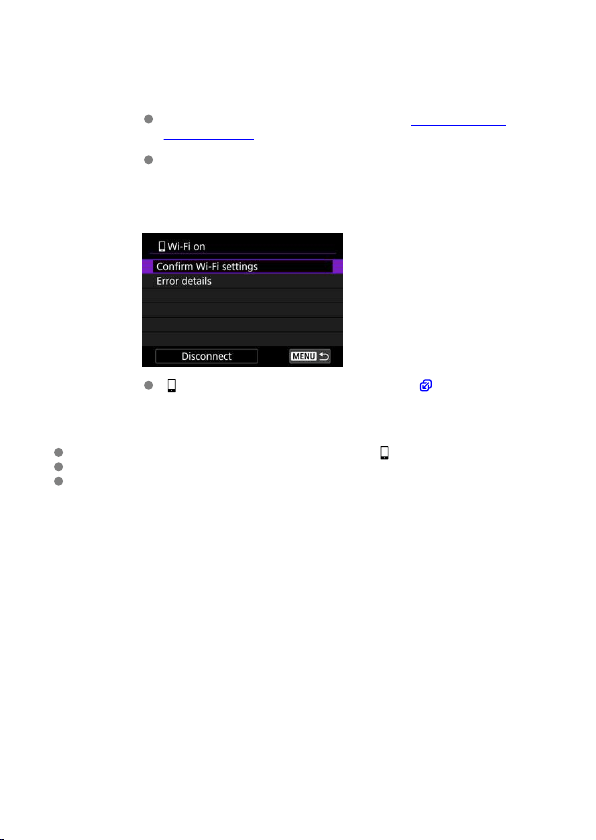
10.
Tap a Camera Connect function.
For details on Camera Connect functions, see Main Functions of
Camera Connect.
Tap a Camera Connect function to initiate a Wi-Fi connection.
11.
Confirm that the devices are connected via Wi-Fi.
[ Wi-Fi on] is displayed on the camera screen ( ).
The Wi-Fi connection to a smartphone is now complete.
To end the Wi-Fi connection, select [Disconnect] on the [ Wi-Fi on] screen.
Terminating the Wi-Fi connection will switch the camera to the Bluetooth connection.
To reconnect, start Camera Connect and tap the function you will use.
144


Main Functions of Camera Connect
Images on camera
Images can be browsed, deleted, or rated.
Images can be saved on a smartphone.
Remote live view shooting
Enables remote shooting as you view a live image on the smartphone.
Bluetooth remote controller
Enables remote control of the camera from a smartphone paired via Bluetooth. (Not
available when connected via Wi-Fi.)
Auto power off is disabled while you are using the Bluetooth remote controller feature.
Camera settings
Camera settings can be changed.
You can check other functions from the main Camera Connect screen.
146
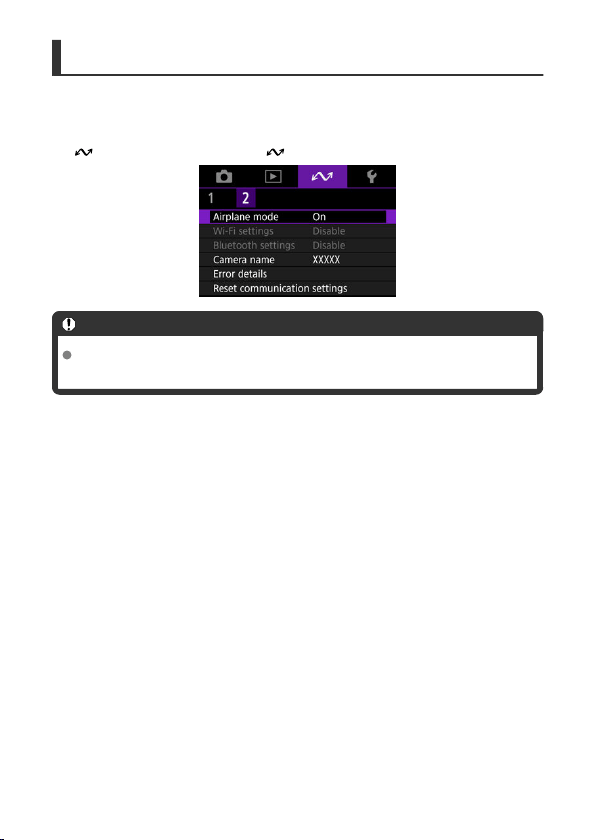
Maintaining a Wi-Fi Connection When the Camera Is Off
You can use a smartphone to browse images on the camera or perform other operations
even when the camera is off, as long as it is paired to the smartphone via Bluetooth.
If you prefer not to stay connected to the camera via Wi-Fi or Bluetooth when it is off, either
set [
: Airplane mode] to [On] or set [ : Bluetooth settings] to [Disable].
Caution
This function can no longer be used if the wireless settings are reset or the
smartphone connection information is erased.
147
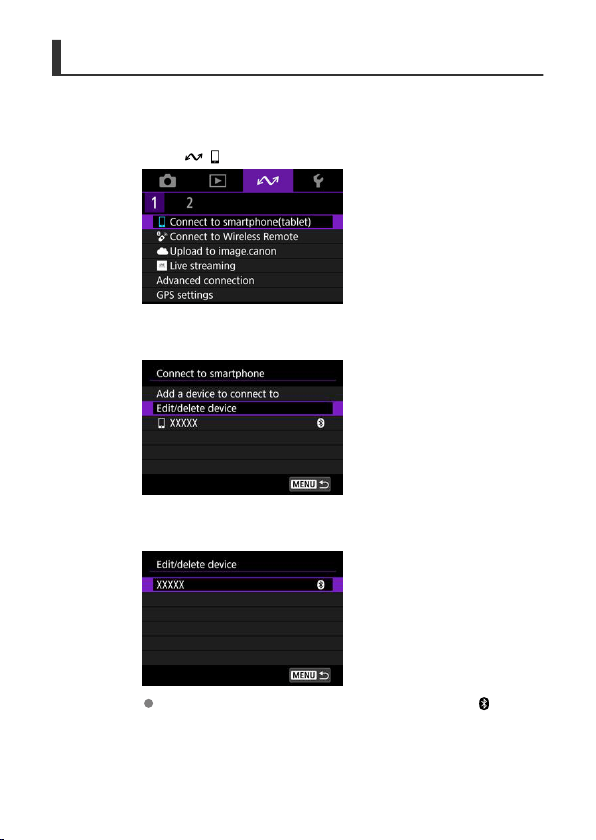
Canceling the Pairing
Cancel pairing with a smartphone as follows.
1.
Select [
: Connect to smartphone(tablet)].
2.
Select [Edit/delete device].
3.
Select the smartphone to cancel pairing with.
Smartphones currently paired with the camera are labeled [ ].
148
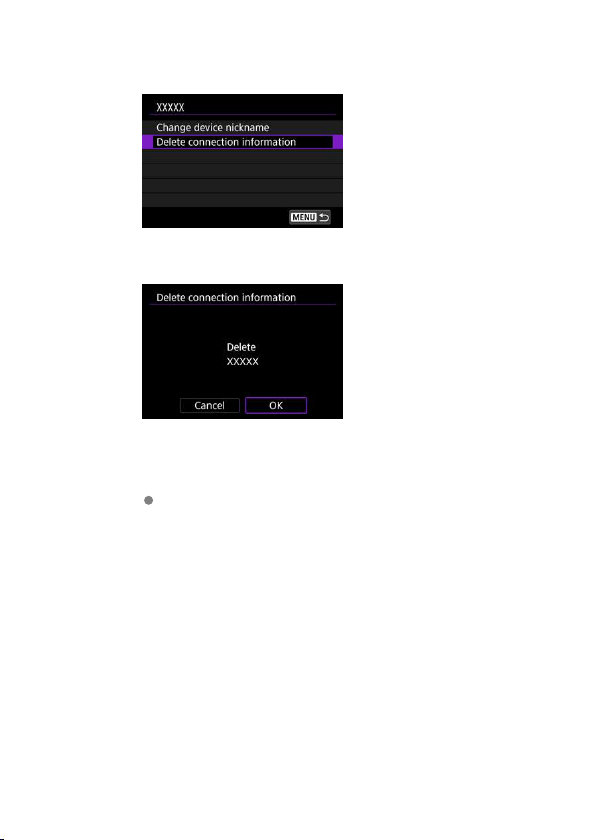
4.
Select [Delete connection information].
5.
Select [OK].
6.
Clear the camera information on the smartphone.
In the smartphone's Bluetooth setting menu, clear the camera
information registered on the smartphone.
149
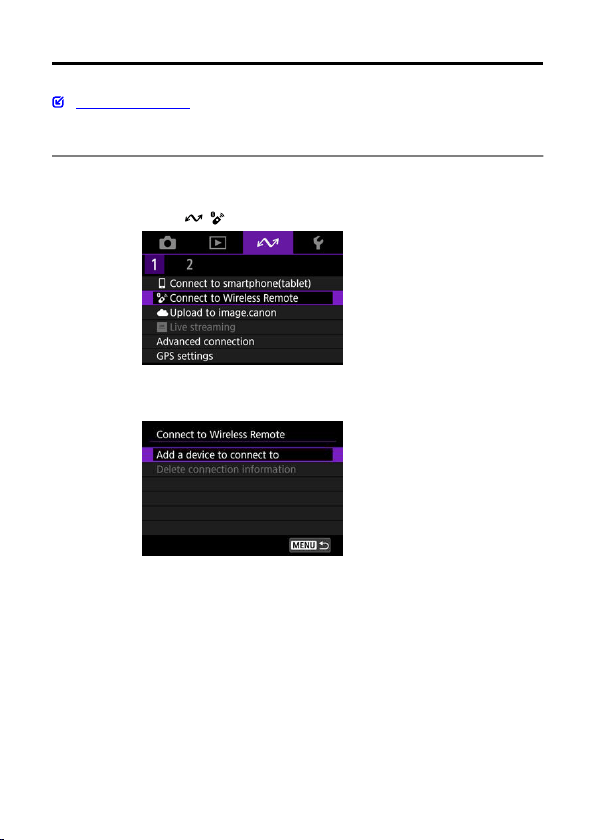
Connecting to a Wireless Remote Control
Canceling the Pairing
This camera can also be connected to Wireless Remote Control BR-E1 (sold separately) via
Bluetooth for remote control shooting.
1.
Select [
: Connect to Wireless Remote].
2.
Select [Add a device to connect to].
The following message appears if the camera is paired with a smartphone:
[End the current Bluetooth connection and pair with the Wireless
Remote].
150
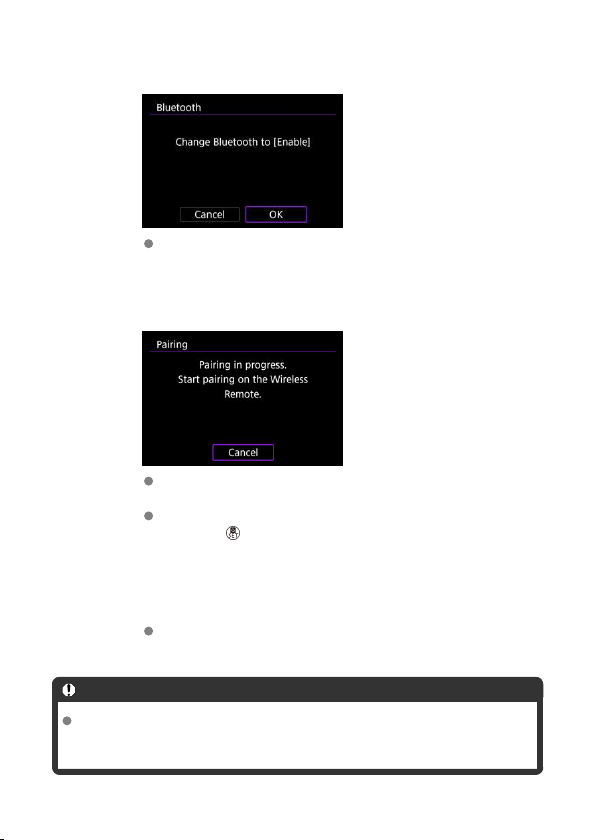
3.
Select [OK].
This screen is not displayed if the Bluetooth setting is already set to
[Enable].
4.
Pair the devices.
When the screen shown above appears, press and hold the <W> and
<T> buttons on the BR-E1 simultaneously for at least 3 sec.
After a message confirms that the camera is paired with the BR-E1,
press the <
> button.
5.
Set up the camera for remote shooting.
For instructions after the pairing is complete, refer to the BR-E1's
Instruction Manual.
Caution
Keep in mind that the camera battery level may be low the next time you want to
use it, because Bluetooth connections consume battery power even when the
camera is off.
151
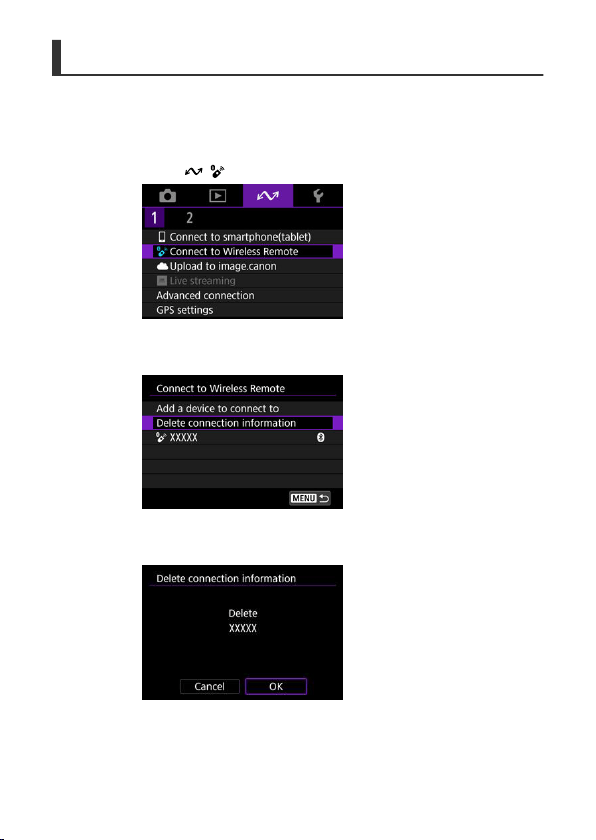
Canceling the Pairing
Before pairing with a different BR-E1, clear the information about the connected remote
control.
1.
Select [
: Connect to Wireless Remote].
2.
Select [Delete connection information].
3.
Select [OK].
153
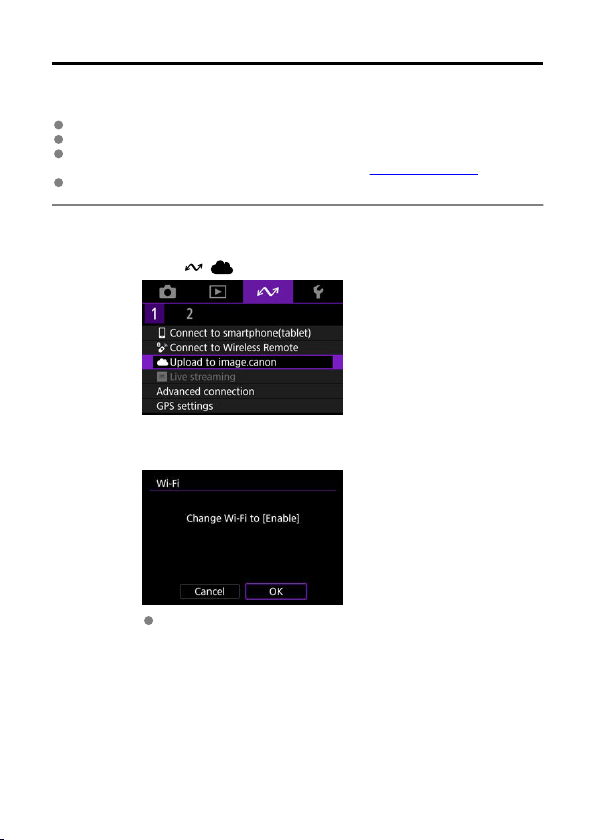
Uploading Images to image.canon
Link the camera to image.canon to send images directly from the camera.
A smartphone with a browser and internet connection is required.
You will need to enter an email address used on the smartphone.
For instructions on how to use image.canon services and details on countries and
regions where it is available, visit the image.canon site (https://image.canon/).
Separate ISP connection and access point fees may apply.
1.
Select [
: Upload to image.canon].
2.
Select [OK].
This screen is not displayed if the Wi-Fi setting is already set to
[Enable].
154
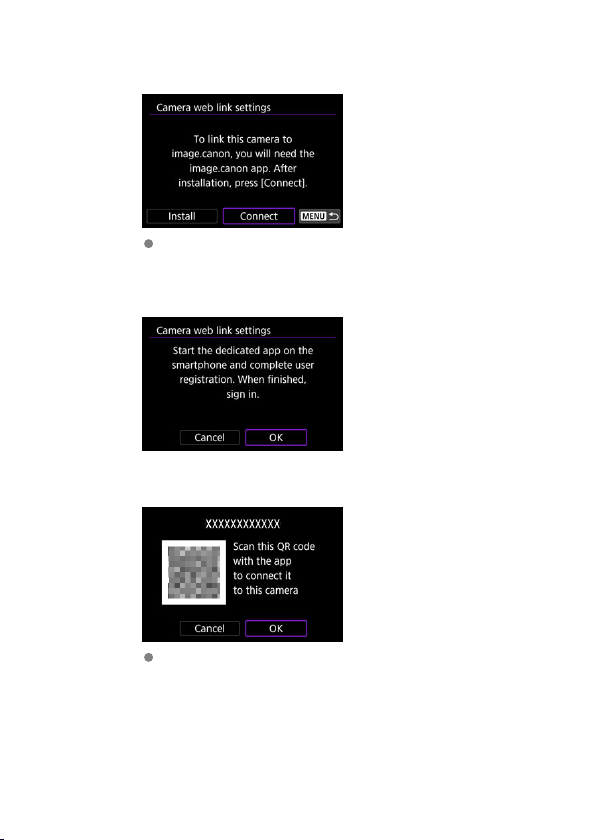
3.
Select [Connect].
If the dedicated app has not been installed, select [Install].
4.
Select [OK].
5.
Scan the QR code with the dedicated app.
Select [OK].
155
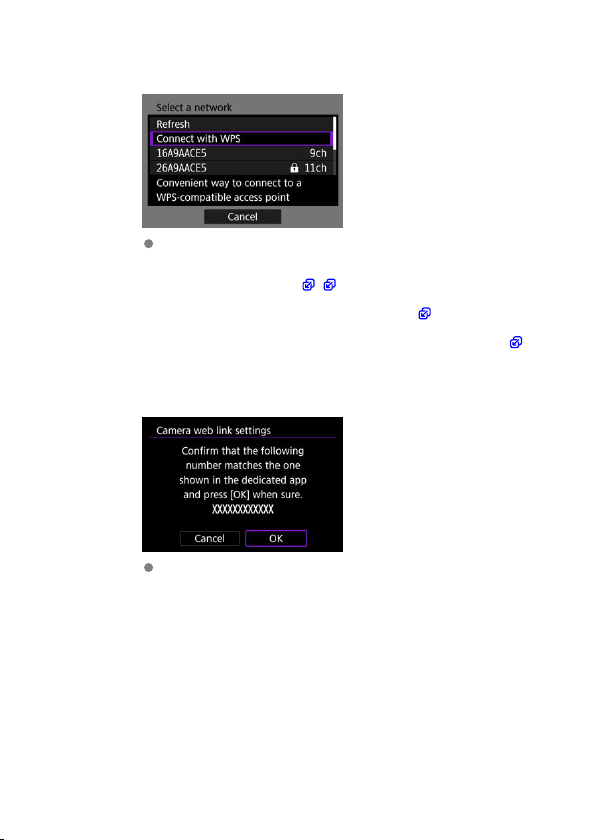
6.
Establish a Wi-Fi connection.
Connect to an access point via Wi-Fi. Follow the instructions for the
connection method used.
• Connecting via WPS ( , )
• Connecting manually to detected networks ( )
• Connecting manually by specifying access point information ( )
7.
Confirm that the number is displayed in the dedicated app.
Select [OK].
156

8.
Set up automatic image transfer.
Complete the [Auto send] setting item as needed.
[When charging battery (high power)]: Auto send starts when the
camera is off and connected to a power source to charge it over USB.
Note that auto send will start after the camera has been charged for a
while if the remaining capacity is initially low.
[When camera is turned on]: Auto send starts when the camera is
turned on.
Select [OK], then press the < > button.
157
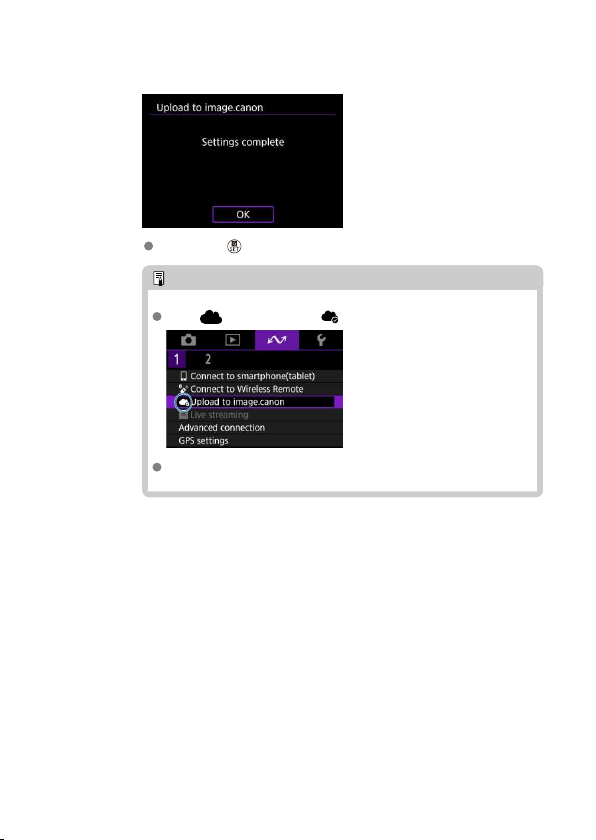
9.
Complete the settings.
Press the < > button.
Note
The [ ] icon changes to [ ].
The camera model name is registered at image.canon.
158
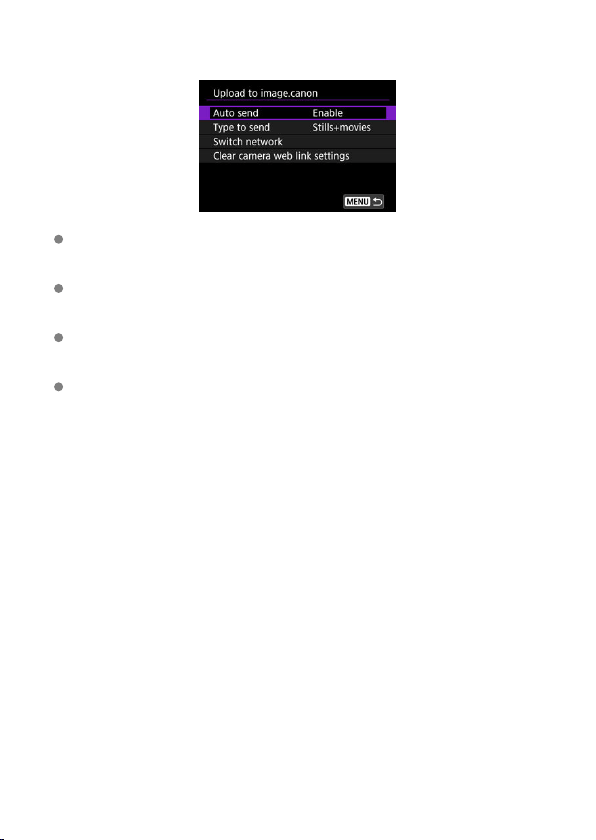
[Upload to image.canon] screen
Auto send
Change the auto send settings.
Type to send
Select the type of images uploaded.
Switch network
Change the settings for Wi-Fi connections.
Clear camera web link settings
Clear the camera web link settings.
159
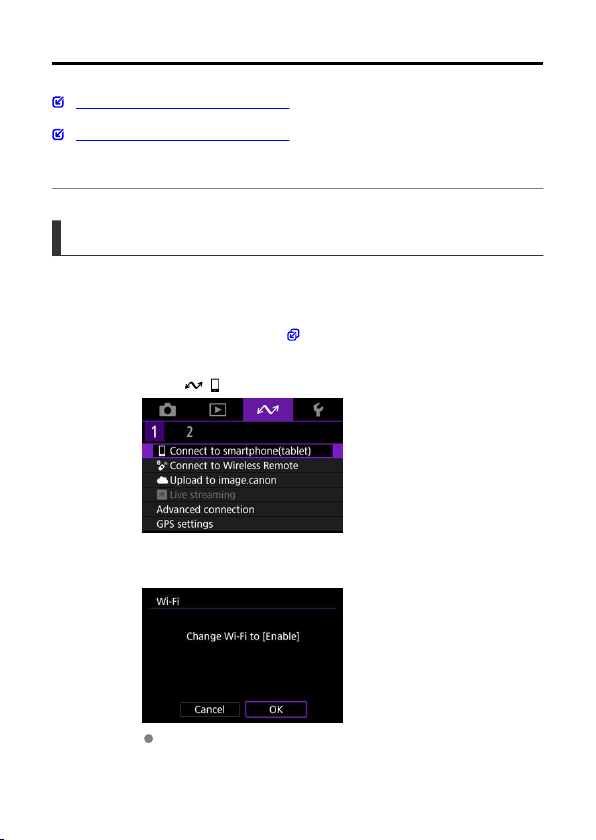
Live Streaming
Pairing with a Smartphone via Bluetooth
Connecting to an Access Point via Wi-Fi
You can live-stream images from the camera.
Check the streaming requirements and terms of service in advance on the streaming site.
Pairing with a Smartphone via Bluetooth
Go to step 11 if the smartphone and camera are already paired.
1.
Prepare the smartphone (
).
2.
Select [
: Connect to smartphone(tablet)].
3.
Select [OK].
This screen is not displayed if the Wi-Fi setting is already set to
[Enable].
160
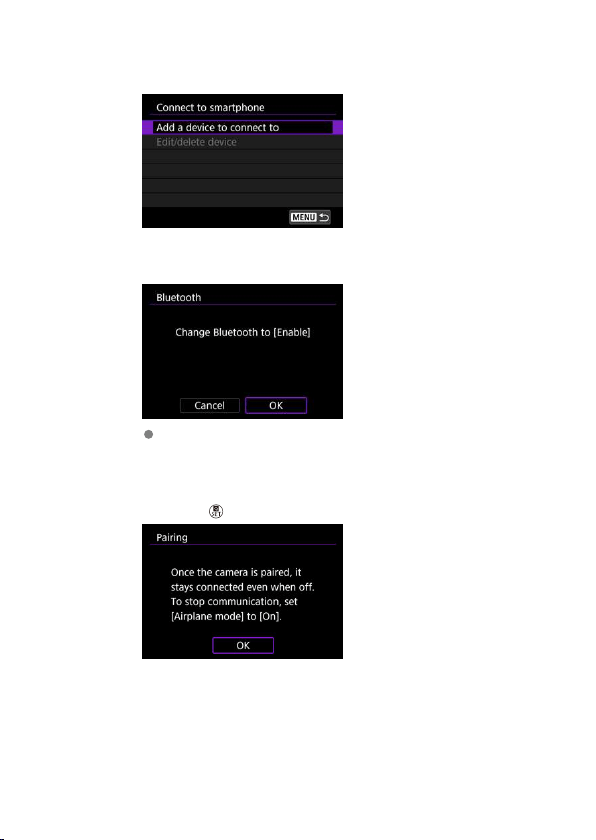
4.
Select [Add a device to connect to].
5.
Select [OK].
This screen is not displayed if the Bluetooth setting is already set to
[Enable].
6.
Press the <
> button.
161
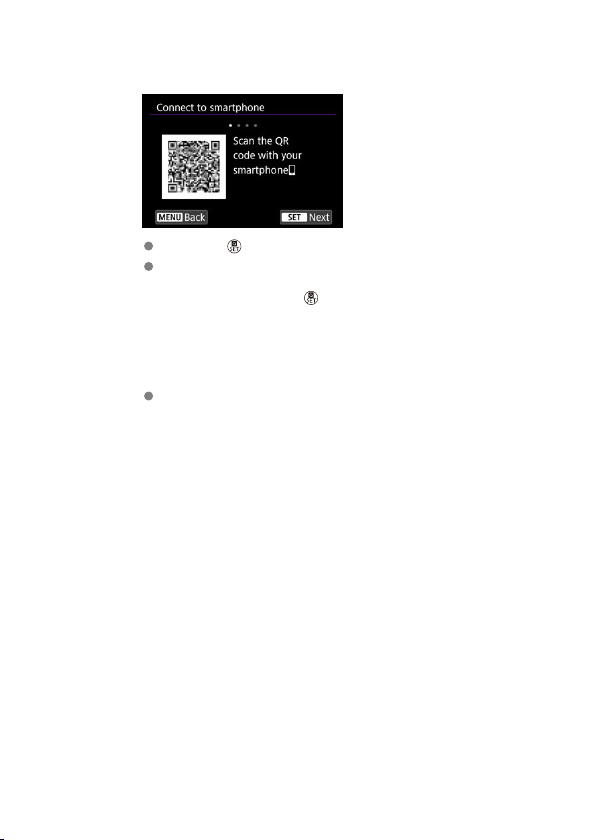
7.
Start pairing.
Press the < > button to start pairing.
If Camera Connect is not installed, use the smartphone to scan the QR
code on the screen, go to Google Play or App Store to install Camera
Connect, then press the <
> button to start pairing.
8.
Start Camera Connect.
Following the instructions in the app, select the camera for pairing.
162
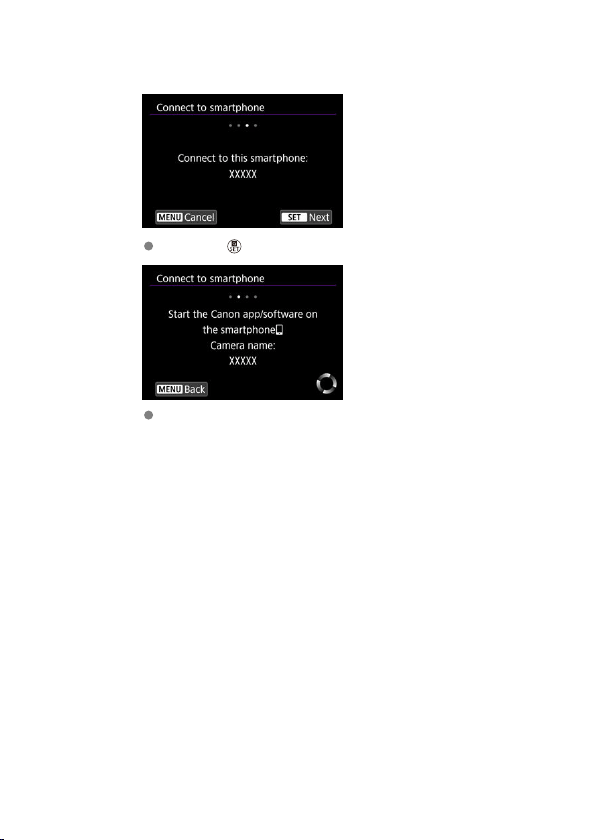
9.
Establish a Bluetooth connection.
Press the < > button.
When a message appears on the smartphone, use the smartphone as
indicated.
163
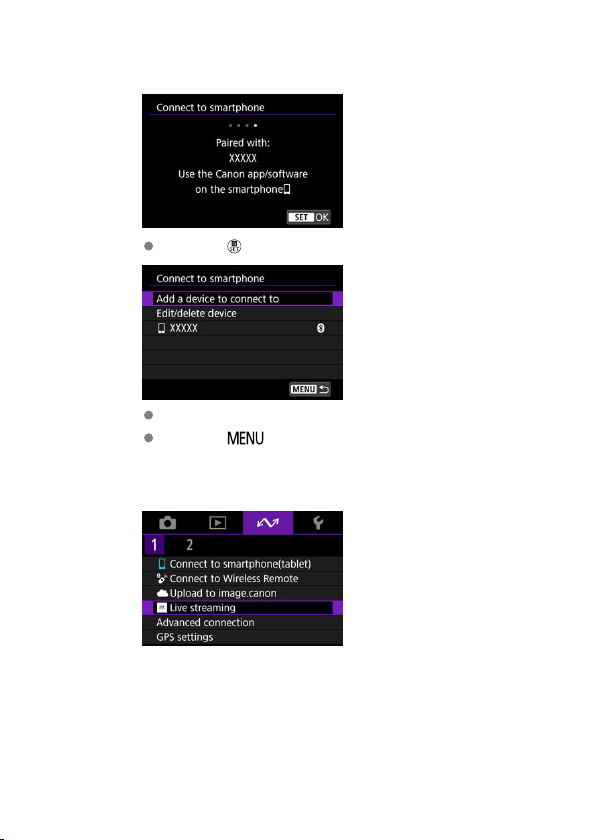
10.
Complete the pairing process.
Press the < > button to finish pairing.
The name of the connected device is displayed.
Press the < > button.
11.
Select [Live streaming].
164
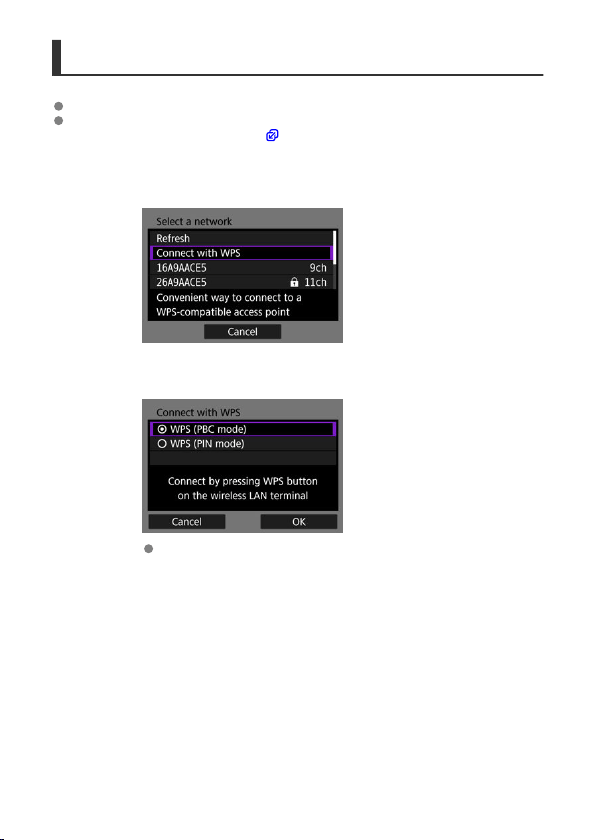
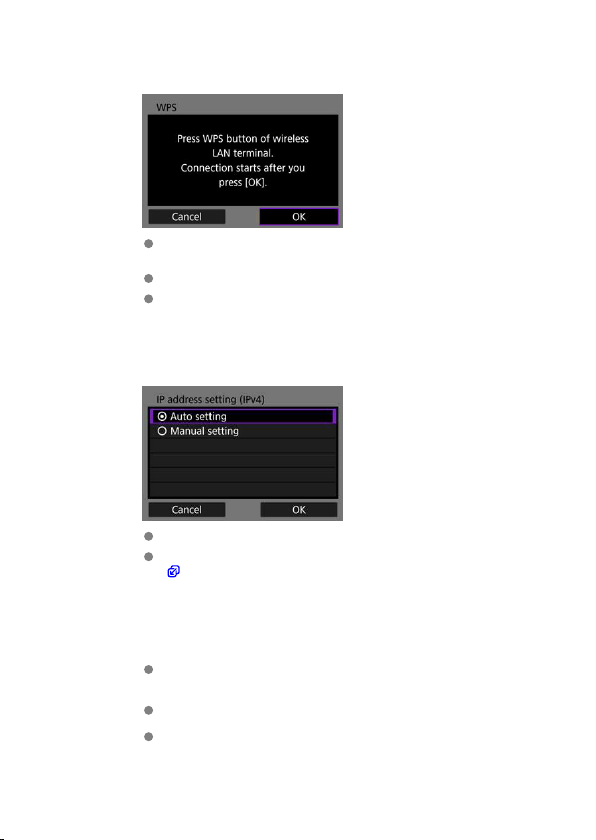
3.
Connect to the access point.
Press the access point's WPS button. For details on where the button
is and how long to press it, refer to the access point user manual.
Select [OK] to initiate connection with the access point.
The following screen is displayed once the camera is connected to the
access point.
4.
Select [Auto setting].
Select [OK].
If an error is displayed for [Auto setting], set the IP address manually
( ).
5.
Complete the streaming settings in Camera Connect.
Select the streaming platform you will use, then configure the settings
accordingly.
You can enter a URL on the screen to select a streaming site.
As the streaming quality, select 6 Mbps or 3.5 Mbps, depending on the
communication environment.
166
6.
Start streaming.
[STBY] is shown on the recording standby screen.
Use Camera Connect to start and stop streaming. You can also stop
streaming by pressing the Start/Stop button on the camera.
Caution
Video and audio may be noisy during streaming, depending on the communication
environment. Test streaming in advance and check the video and audio quality.
Try the following if video and audio is noisy or skips. These steps may improve the
quality.
• Bring the camera and access point (wireless router, tethering smartphone, etc.)
closer together, change their relative positions, and keep the space between
them free of people and objects.
• Indoors, set up the access point and camera in the same room.
• Set up away from devices that use the 2.4 GHz band, such as microwave
ovens or cordless phones.
If noise from an external microphone is distracting, try placing the microphone on
the side of the camera with the external microphone IN terminal as far from the
camera as possible.
Although selecting 3.5 Mbps as the streaming quality in Camera Connect may
enable more stable streaming than with 6 Mbps, image quality will be lower.
The camera will become warmer during streaming. Use the stand or a tripod, or
take other measures to avoid handheld recording. Once the camera becomes hot,
[
] appears on the screen as a warning.
Note that Canon is in no way responsible for third-party services.
No image is recorded to the card during streaming (but a card must be in the
camera).
Test streaming in advance to make sure the image is straight and in the correct
orientation, and adjust the orientation as needed.
Be sure to read Wireless Communication Precautions.
167
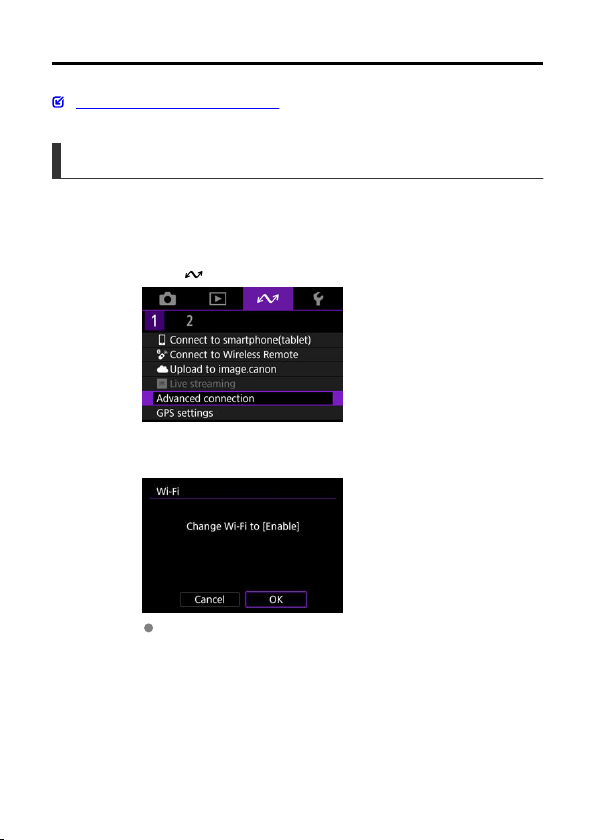
Advanced Connections
Connecting to a Smartphone or Tablet
Connecting to a Smartphone or Tablet
You can establish a direct Wi-Fi connection with a smartphone and use Camera Connect to
control the camera.
1.
Select [
: Advanced connection].
2.
Select [OK].
This screen is not displayed if the Wi-Fi setting is already set to
[Enable].
168
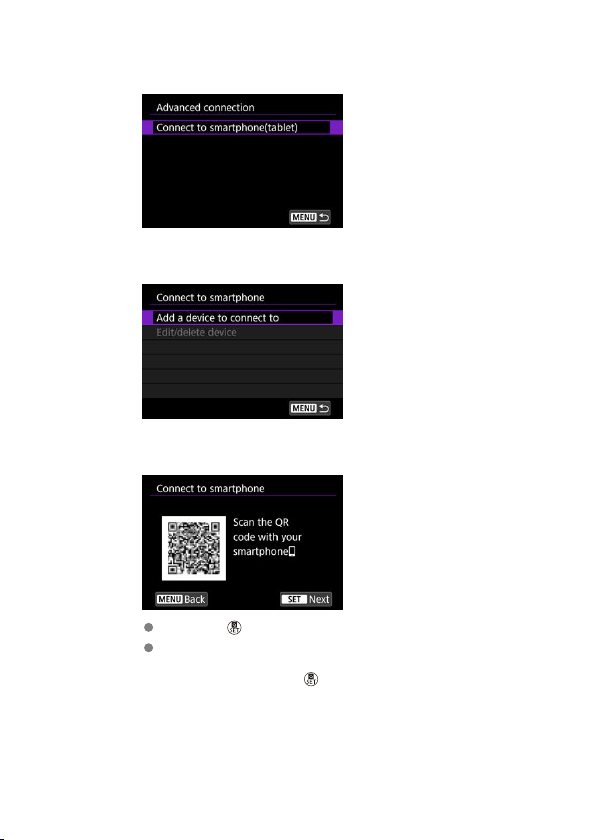
3.
Select [Connect to smartphone(tablet)].
4.
Select [Add a device to connect to].
5.
Start searching for access points.
Press the < > button to start searching.
If Camera Connect is not installed, use the smartphone to scan the QR
code on the screen, go to Google Play or App Store to install Camera
Connect, then press the <
> button to start searching.
169
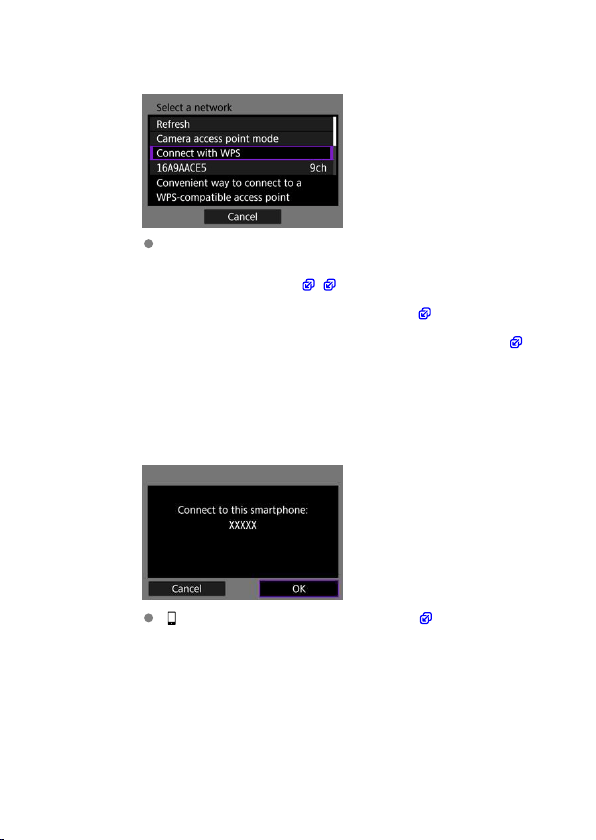
6.
Establish a Wi-Fi connection.
Connect to an access point via Wi-Fi. Follow the instructions for the
connection method used.
• Connecting via WPS ( , )
• Connecting manually to detected networks ( )
• Connecting manually by specifying access point information ( )
7.
Start Camera Connect and tap the camera name.
8.
Select [OK].
[ Wi-Fi on] is displayed on the camera screen ( ).
170
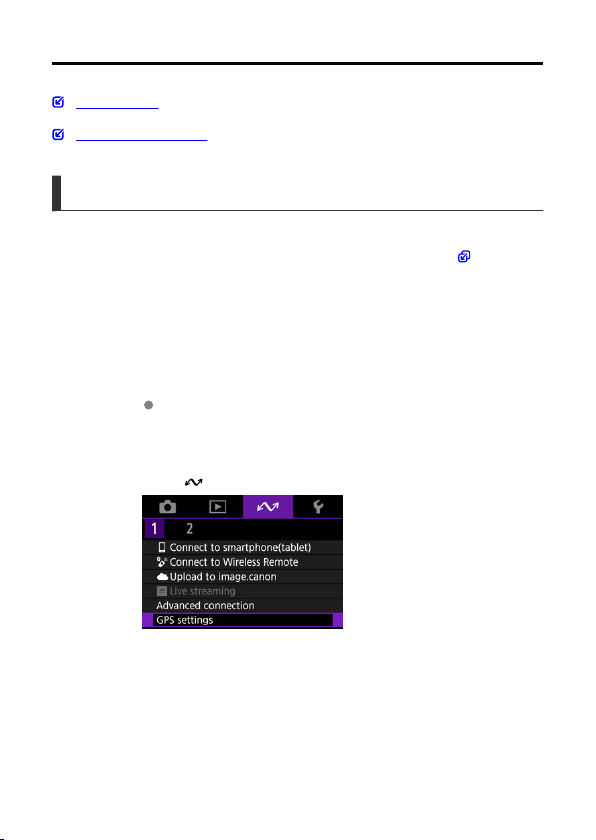
GPS Settings
GPS via Mobile
GPS Information Display
GPS via Mobile
You can geotag images with a Bluetooth-compatible smartphone.
Complete these settings after installing the dedicated Camera Connect app (
) on the
smartphone.
1.
On the smartphone, activate location services.
2.
Establish a Bluetooth connection.
Start Camera Connect and pair the camera and smartphone via
Bluetooth.
3.
Select [
: GPS settings].
171
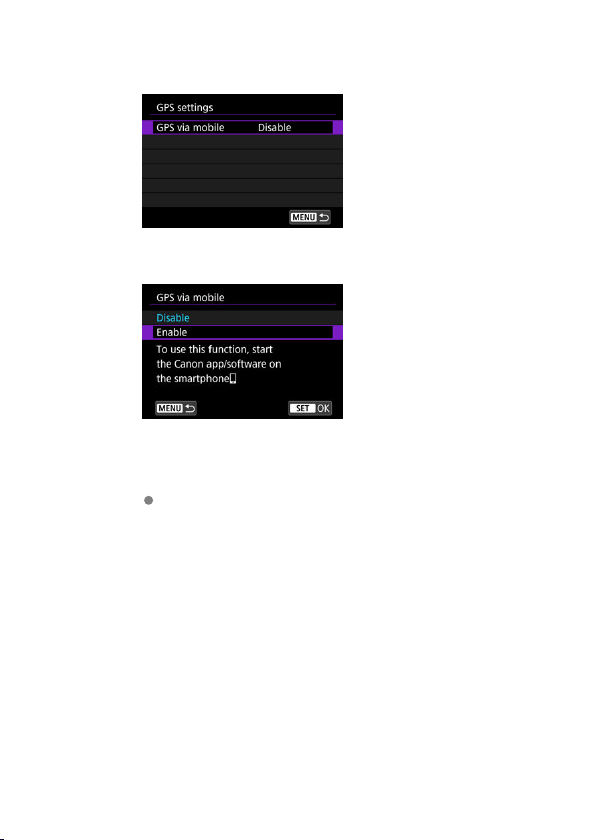
4.
Select [GPS via mobile].
5.
Select [Enable].
6.
Take the picture.
Images are geotagged with the information from the smartphone.
172
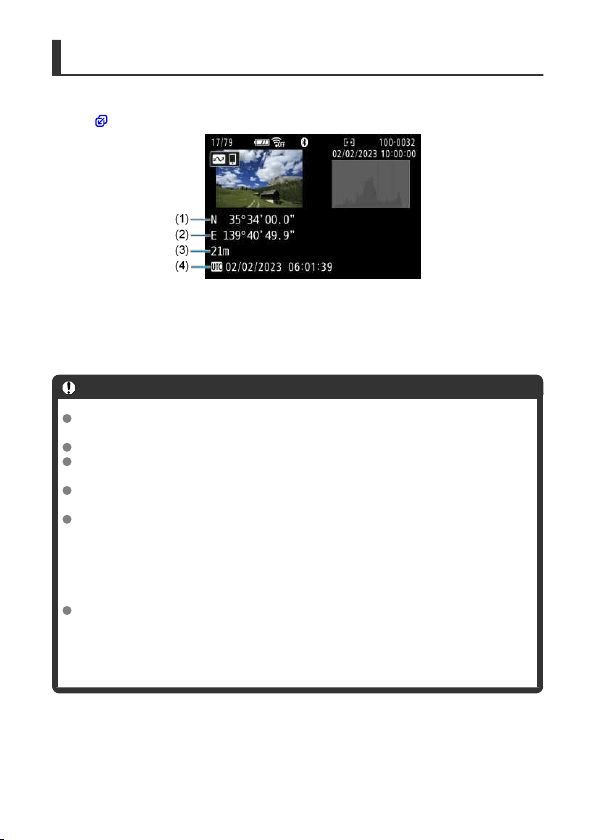
GPS Information Display
You can check the location information added to your shots on the shooting information
screen (
).
(1) Latitude
(2) Longitude
(3) Elevation
(4) UTC (Coordinated Universal Time)
Caution
Location information is acquired from the smartphone only while the camera is
paired with it via Bluetooth.
Direction information is not acquired.
Acquired location information may not be accurate, depending on traveling
conditions or smartphone status.
It may take some time to acquire location information from the smartphone after
you turn the camera on.
Location information is no longer acquired after any of the following operations.
• Pairing with a wireless remote control via Bluetooth
• Turning the camera off
• Quitting Camera Connect
• Deactivating location services on the smartphone
Location information is no longer acquired in any of the following situations.
• The camera power turns off
• The Bluetooth connection is ended
• The smartphone's remaining battery level is low
173
Note
Coordinated Universal Time, abbreviated as UTC, is essentially the same as
Greenwich Mean Time.
For movies, the GPS information initially acquired is added.
174

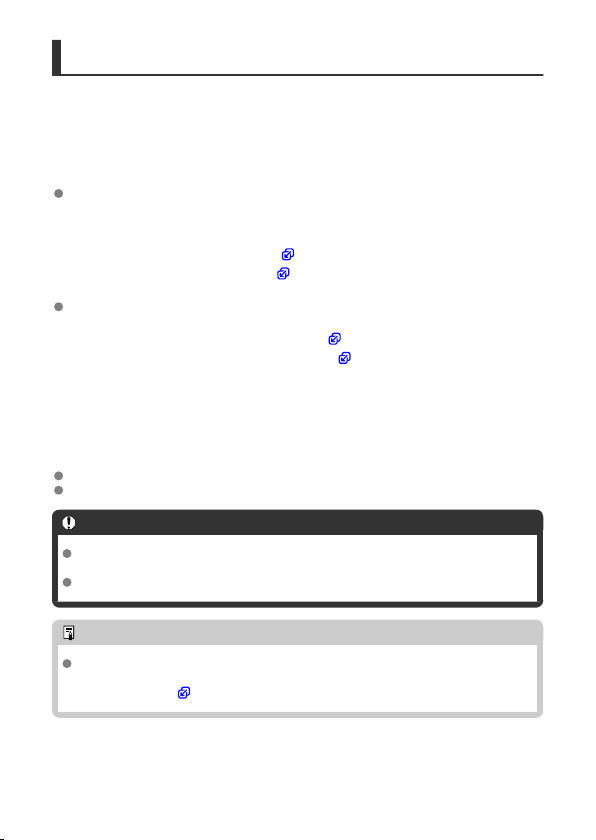
Checking the Type of Access Point
When connecting via an access point, check whether the access point supports WPS*,
which simplifies connections between Wi-Fi devices.
If you are unsure about WPS compatibility, refer to the access point user manual or other
documentation.
* Stands for Wi-Fi Protected Setup.
When WPS is supported
Two connection methods are available, as follows. You can connect more easily via
WPS in PBC mode.
• Connecting via WPS (PBC mode) (
)
• Connecting via WPS (PIN mode) ( )
When WPS is not supported
• Connecting manually to detected networks (
)
• Connecting manually by specifying networks ( )
Access point encryption
The camera supports the following options for [Authentication] and [Encryption settings].
For this reason, the encryption used by the access point must be set to one of the following
when you will connect to detected networks manually.
[Authentication]: Open system, shared key, or WPA/WPA2/WPA3-Personal
[Encryption settings]: WEP, TKIP, or AES
Caution
Connections may not be possible when access point stealth functions are
enabled. Deactivate stealth functions.
Ask any network administrator in charge of networks you will join for setting details.
Note
If MAC address filtering is used on networks you will join, add the camera's MAC
address to the access point. The MAC address can be checked on the [MAC
address] screen ( ).
176

Connecting via WPS (PBC Mode)
Instructions in this section are continued from
Checking the Type of Access Point.
This is a connection method used with access points compatible with WPS. In pushbutton
connection mode (PBC mode), the camera and access point can be connected simply by
pressing the WPS button on the access point.
Connecting may be more difficult if multiple access points are active nearby. If so, try to
connect with [WPS (PIN mode)].
Check the position of the WPS button on the access point in advance.
It may take approx. 1 min. to establish a connection.
1.
Select [Connect with WPS] on the [Select a network] screen.
2.
Select [WPS (PBC mode)].
Select [OK].
177
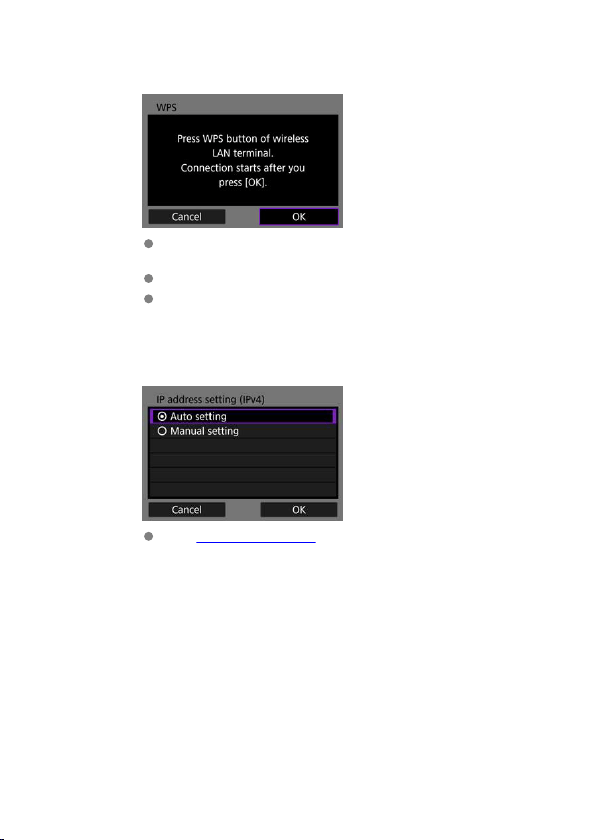
3.
Connect to the access point.
Press the access point's WPS button. For details on where the button
is and how long to press it, refer to the access point user manual.
Select [OK] to initiate connection with the access point.
The following screen is displayed once the camera is connected to the
access point.
4.
Set the IP address.
Go to Setting the IP Address.
178
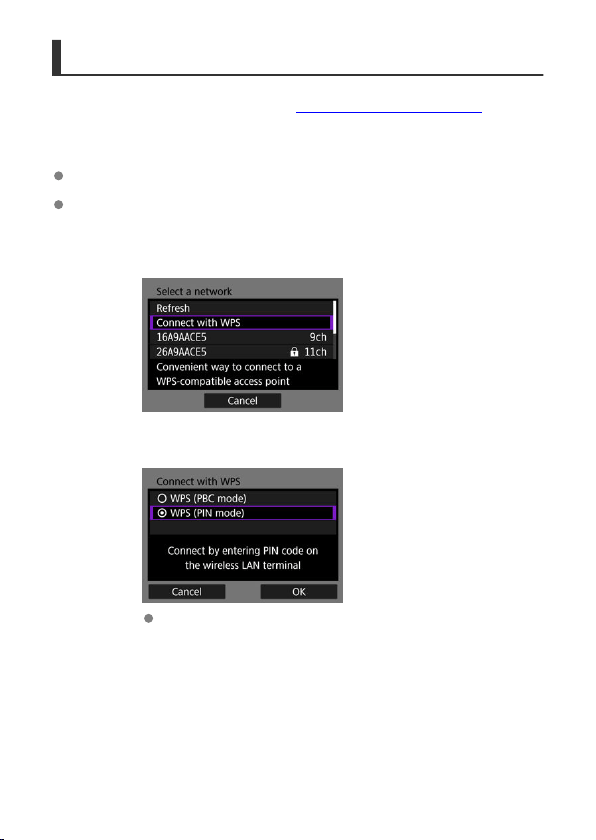
Connecting via WPS (PIN Mode)
Instructions in this section are continued from
Checking the Type of Access Point.
This is a connection method used with access points compatible with WPS. In PIN code
connection mode (PIN mode), an 8-digit identification number indicated on the camera is
entered on the access point to establish a connection.
Even if multiple access points are active nearby, connecting by using this shared
identification number is relatively reliable.
It may take approx. 1 min. to establish a connection.
1.
Select [Connect with WPS] on the [Select a network] screen.
2.
Select [WPS (PIN mode)].
Select [OK].
179
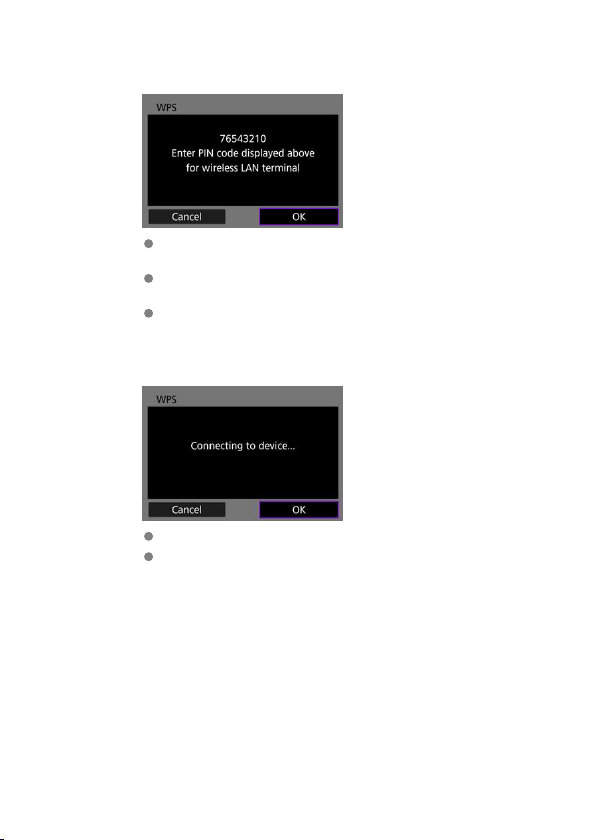
3.
Enter the PIN code.
On the access point, enter the 8-digit PIN code displayed on the
camera screen.
For instructions on entering PIN codes on the access point, refer to the
access point's Instruction Manual.
After entering the PIN code, select [OK] on the camera.
4.
Connect to the access point.
Select [OK] to initiate connection with the access point.
The following screen is displayed once the camera is connected to the
access point.
180
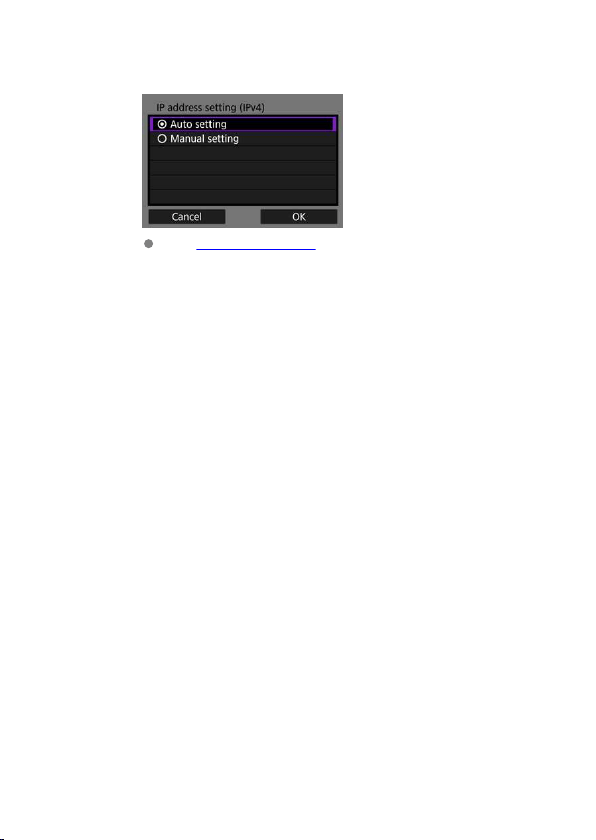
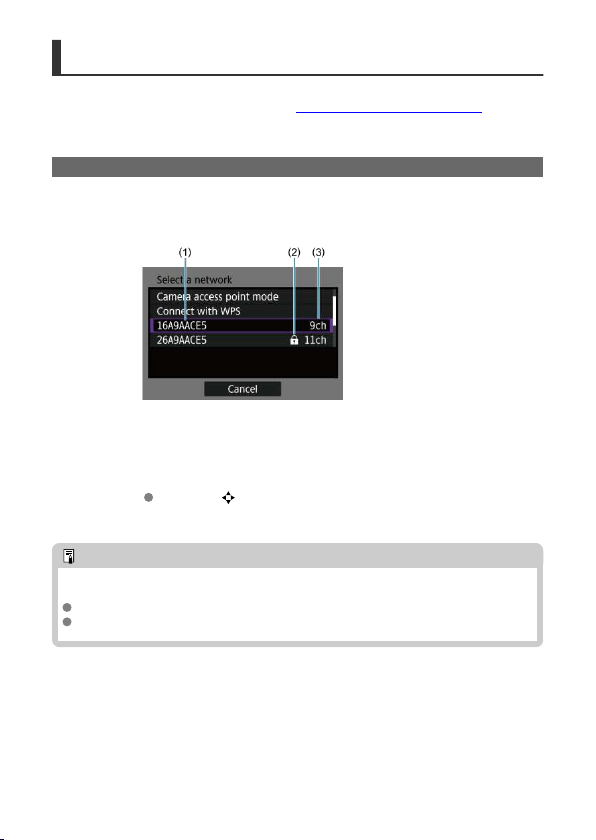
Connecting Manually to Detected Networks
Instructions in this section are continued from
Checking the Type of Access Point.
Connect to an access point by selecting its SSID (or ESS-ID) in a list of active access points
nearby.
Selecting the access point
1.
Select an access point on the [Select a network] screen.
(1) SSID
(2) Security icon (only for encrypted access points)
(3) Channel used
Turn the < > dial to select the access point to connect to in the list of
access points.
Note
[Refresh]
To display [Refresh], scroll down the screen in step 1.
Select [Refresh] to search for access points again.
182
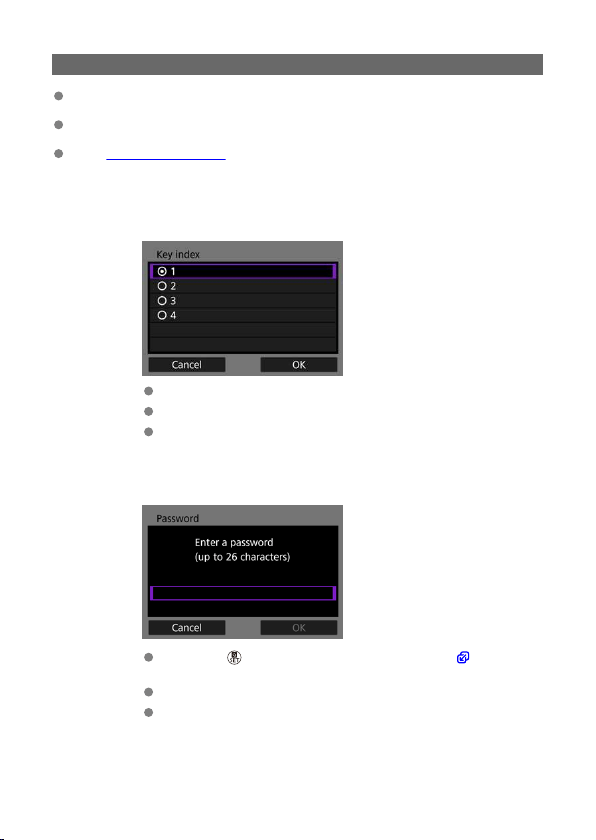
Entering the access point encryption key
Enter the encryption key (password) set on the access point. For details on the
encryption key that has been set, refer to the access point's user manual.
The screens displayed in steps 2–3 vary depending on the authentication and
encryption set on the access point.
Go to Setting the IP Address if the [IP address set.] screen is displayed instead of the
screens shown for steps 2–3.
2.
Select a key index.
The [Key index] screen is displayed for WEP-encrypted access points.
Select the key index number set on the access point.
Select [OK].
3.
Enter the encryption key.
Press the < > button to access the virtual keyboard ( ), then enter
the encryption key.
Select [OK] to initiate connection with the access point.
The following screen is displayed once the camera is connected to the
access point.
183
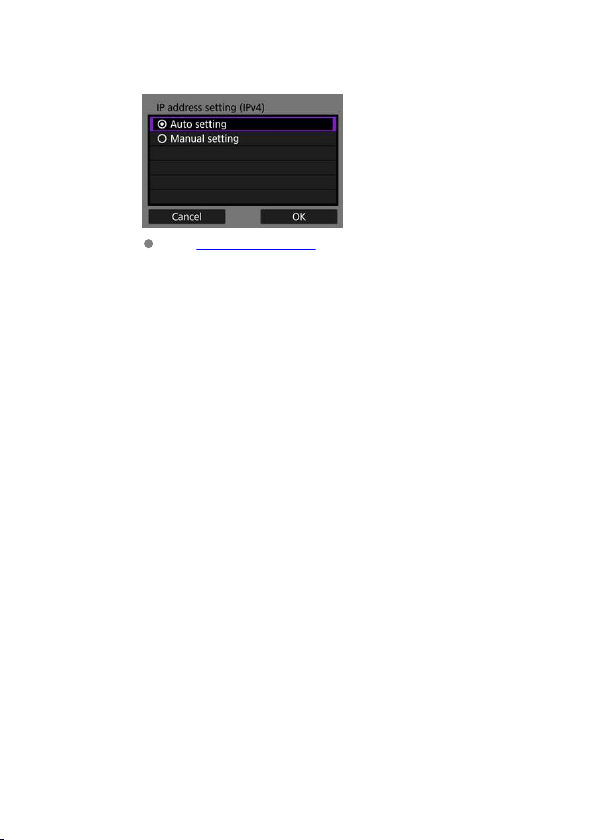
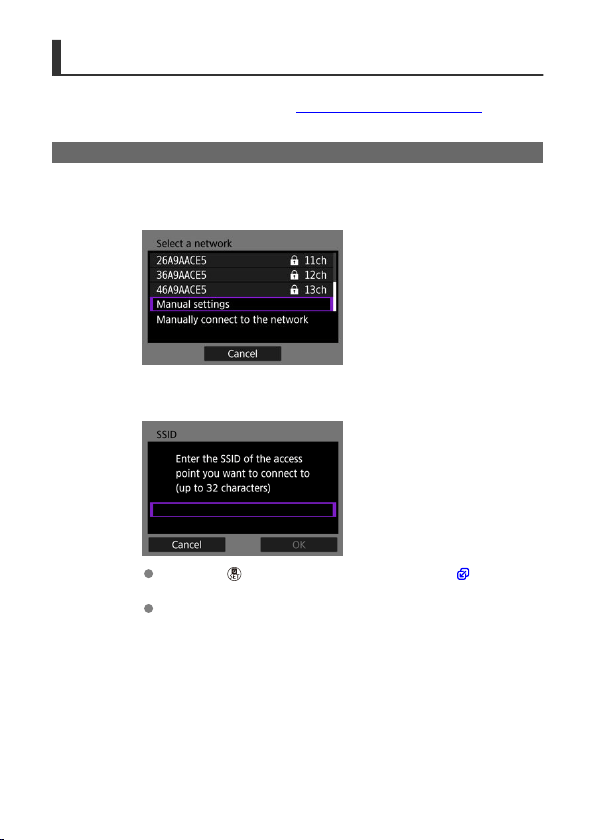
Connecting Manually by Specifying Networks
Instructions in this section are continued from
Checking the Type of Access Point.
Connect to an access point by entering its SSID (or ESS-ID).
Entering the SSID
1.
Select [Manual settings] on the [Select a network] screen.
2.
Enter the SSID (network name).
Press the < > button to access the virtual keyboard ( ), then enter
the SSID.
Select [OK].
185
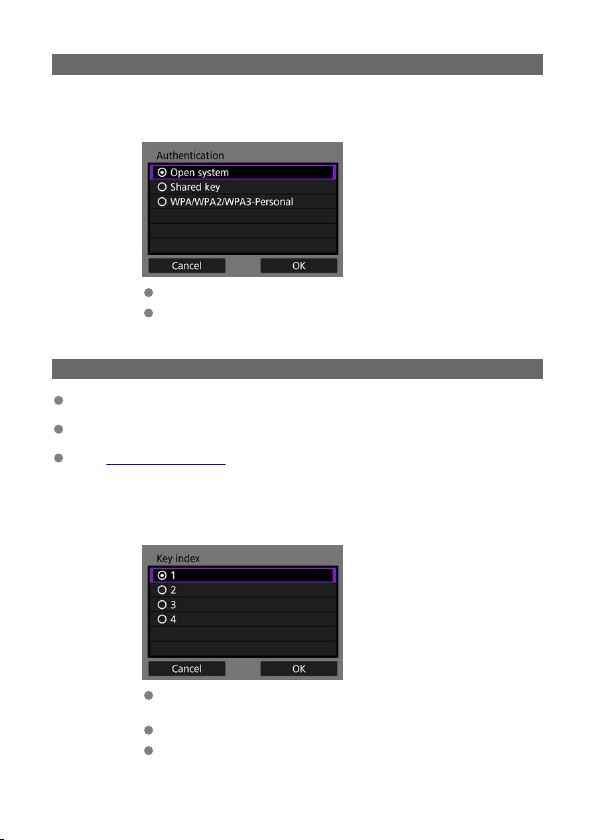
Setting the access point authentication method
3.
Select the authentication method.
Select an option and then [OK] to go to the next screen.
On the [Encryption settings] screen displayed if [Open system] is
selected, select [Disable] or [WEP].
Entering the access point encryption key
Enter the encryption key (password) set on the access point. For details on the
encryption key that has been set, refer to the access point's user manual.
The screens displayed in steps 4–5 vary depending on the authentication and
encryption set on the access point.
Go to Setting the IP Address if the [IP address set.] screen is displayed instead of the
screens shown for steps 4–5.
4.
Select a key index.
The [Key index] screen is displayed if you have selected [Shared key]
or [WEP] in step 3.
Select the key index number set on the access point.
Select [OK].
186
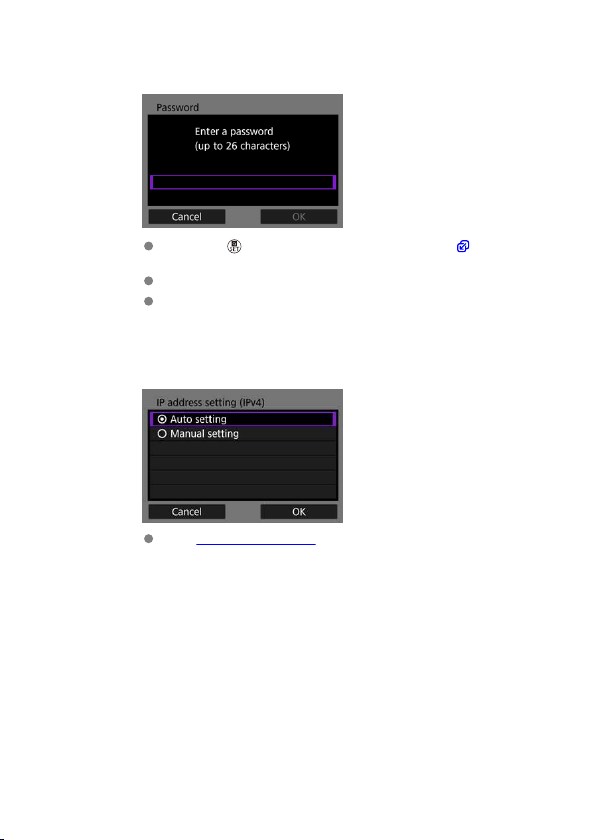
5.
Enter the encryption key.
Press the < > button to access the virtual keyboard ( ), then enter
the encryption key.
Select [OK] to initiate connection with the access point.
The following screen is displayed once the camera is connected to the
access point.
6.
Set the IP address.
Go to Setting the IP Address.
187
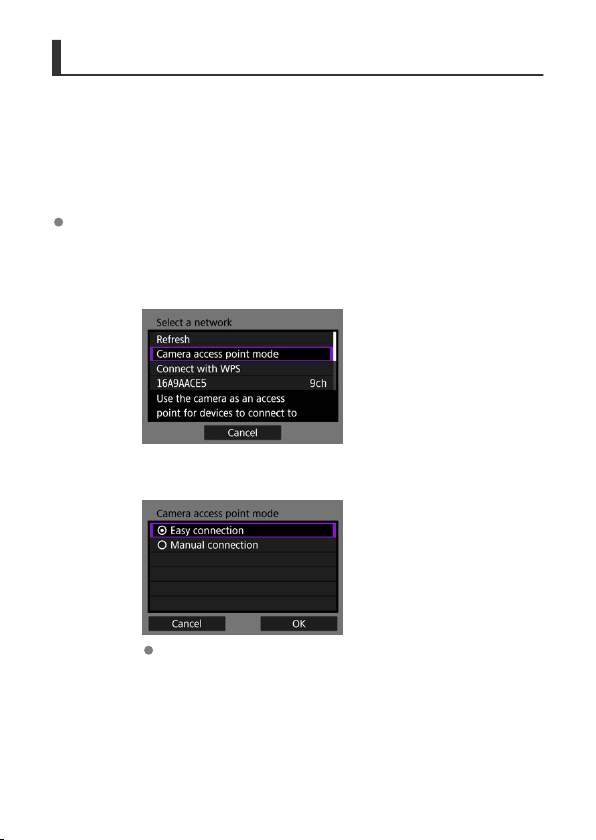
Connecting in Camera Access Point Mode
Camera access point mode is a connection method for directly connecting the camera and
other devices via Wi-Fi without using an access point. Two connection methods are
available, as follows.
Connecting with Easy connection
Network settings for camera access point mode are configured automatically.
For instructions on using the devices you will connect to, refer to the device instruction
manual.
1.
Select [Camera access point mode] on the [Select a network] screen.
2.
Select [Easy connection].
Select [OK].
188
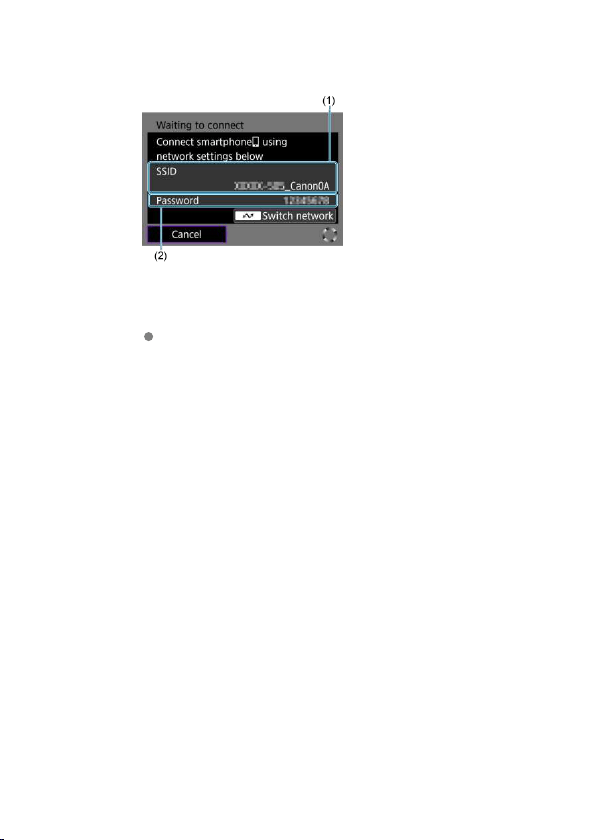
3.
Use the other device to connect to the camera.
(1) SSID (network name)
(2) Encryption key (password)
In other device's Wi-Fi settings, select the SSID (network name) shown
on the camera screen, then enter the password.
4.
Complete the connection settings based on the device to connect to.
189
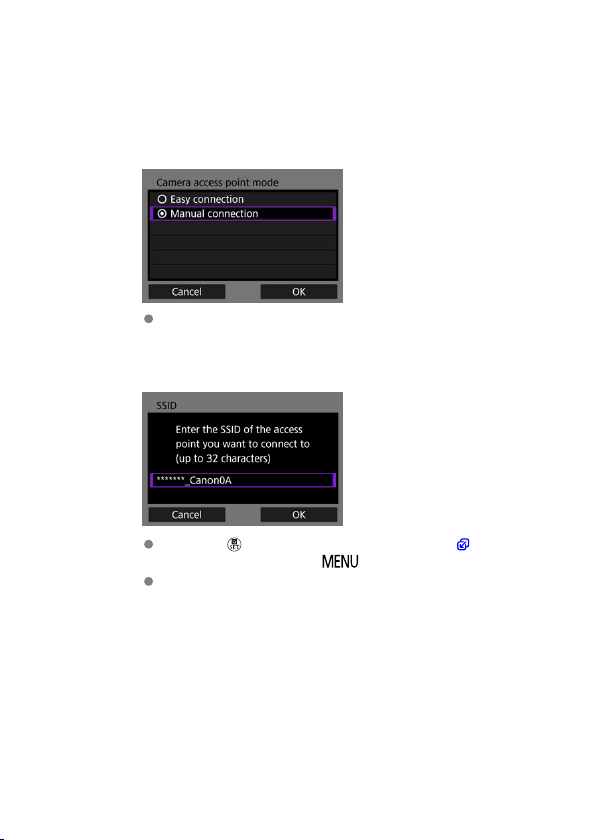
Connecting with Manual connection
Network settings for camera access point mode are configured manually. Set [SSID],
[Channel setting], and [Encryption settings] on each screen displayed.
1.
Select [Manual connection].
Select [OK].
2.
Enter the SSID (network name).
Press the < > button to access the virtual keyboard ( ), then enter
the SSID. After input, press <
>.
Select [OK].
190
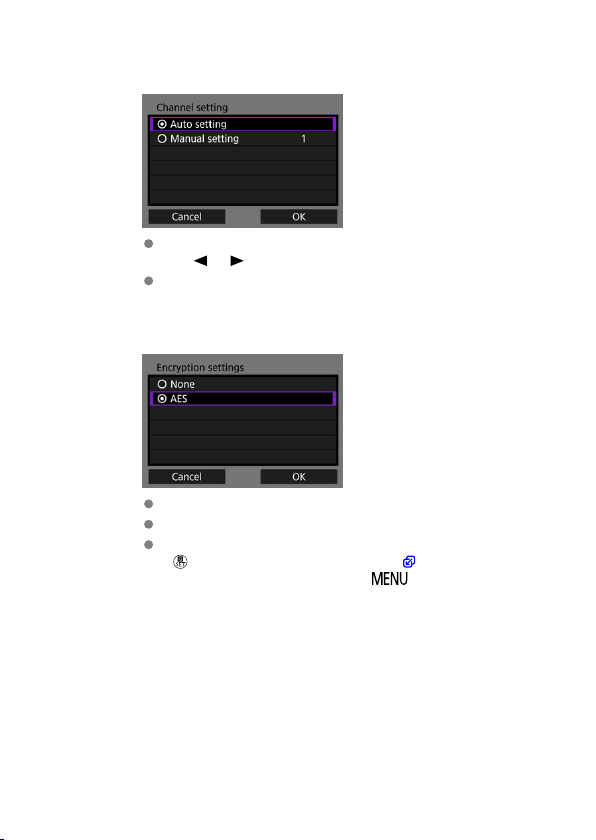
3.
Select a channel setting option.
To specify the settings manually, select [Manual setting], then press
the <
> < > keys.
Select [OK].
4.
Select an encryption setting option.
For encryption, select [AES].
Select [OK].
When [AES] is selected, the [Password] screen is displayed. Press the
<
> button to access the virtual keyboard ( ), then enter the
encryption key. After input, press the <
> button.
191
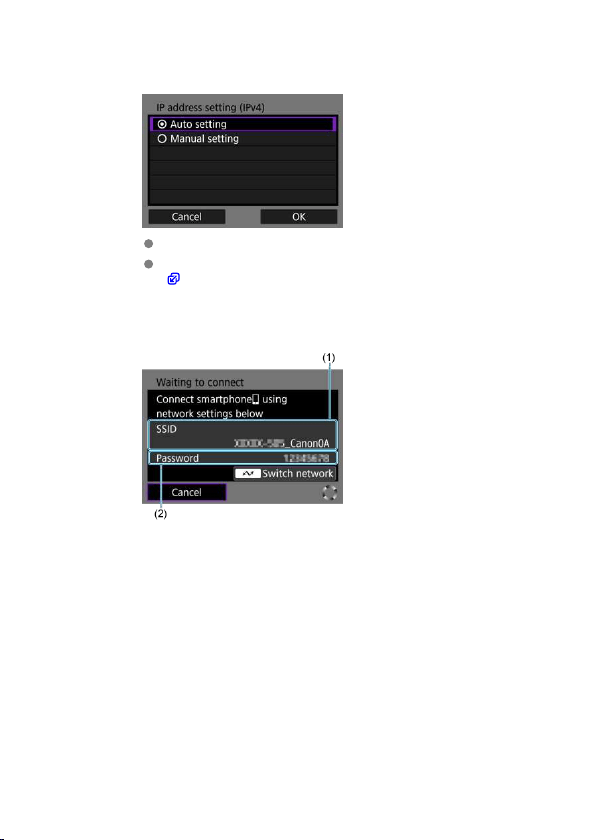
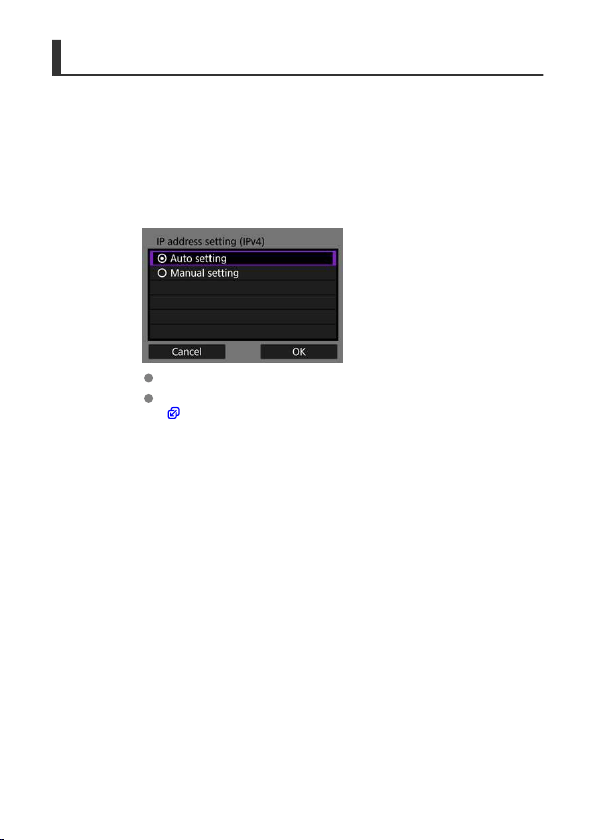
Setting the IP Address
Select a method of setting the IP address, and then set the IP address on the camera.
Setting the IP address automatically
Set up the IP address settings automatically.
1.
Select [Auto setting].
Select [OK].
If an error is displayed for [Auto setting], set the IP address manually
( ).
2.
Complete the connection settings based on the device to connect to.
193
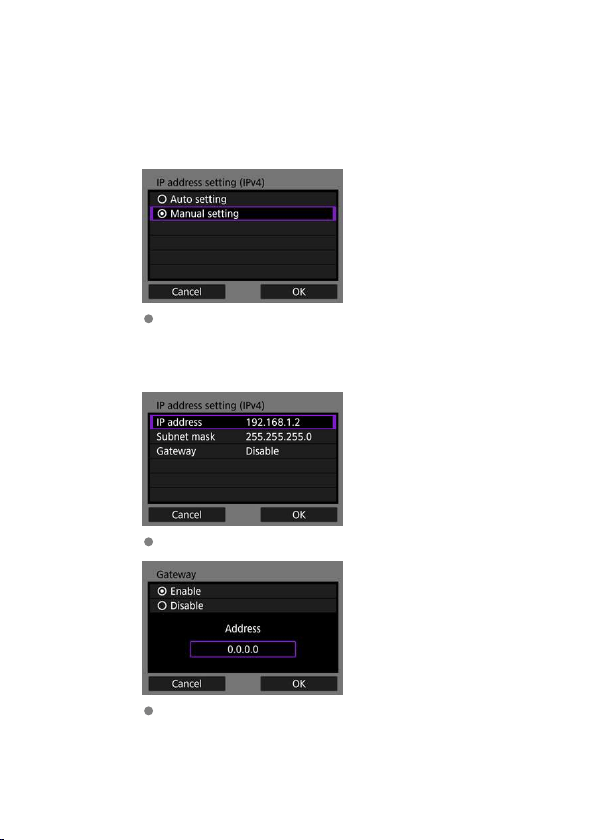
Setting the IP address manually
Set up the IP address settings manually. Note that the items displayed vary depending on
the communication function.
1.
Select [Manual setting].
Select [OK].
2.
Select an option to configure.
Select an option to access the screen for numerical input.
To use a gateway or DNS address, select [Enable], then select
[Address].
194
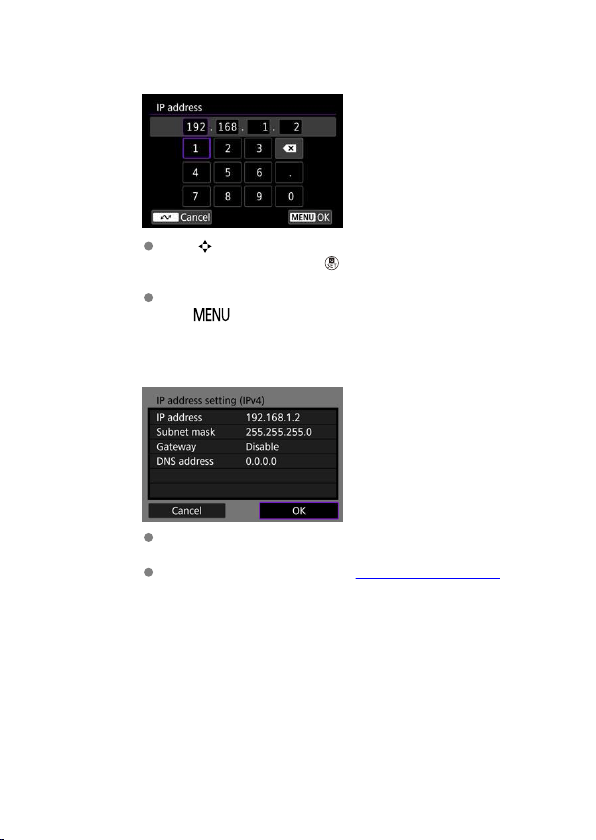
3.
Enter the number.
Use < > to select an input position in the upper area, then select
numbers to enter. Press the <
> button to enter the selected
number.
To set the entered numbers and return to the screen for step 2, press
the <
> button.
4.
Select [OK].
When you have completed setting the necessary items, select [OK].
The next screen is displayed.
If you are unsure what to enter, see Checking Network Settings or ask
the network administrator or other person in charge of the network.
5.
Complete the connection settings based on the device to connect to.
195
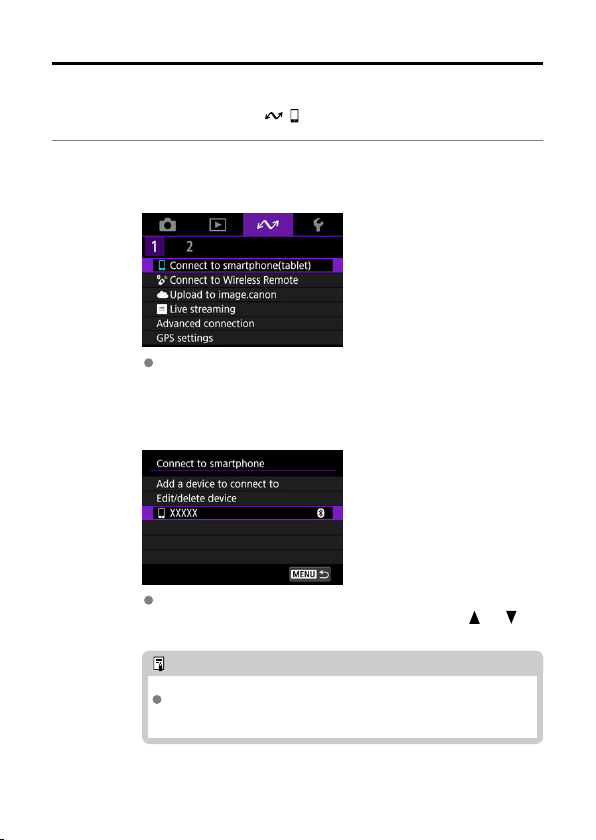
Reconnecting via Wi-Fi/Bluetooth
The camera keeps a record of past Wi-Fi or Bluetooth connections. You can use this record
to reconnect to the same device. Here, [
: Connect to smartphone(tablet)] is used as
an example.
1.
Select the record for the device to connect to.
After the [Wi-Fi on] screen appears, select [Disconnect], then repeat
step 1.
2.
Select the device for the connection.
Select an option to connect to via Wi-Fi or Bluetooth from the past
connections listed. If the option is not shown, press the <
> < >
keys to switch screens.
Note
Records for up to 10 connections for all wireless communication
functions are retained.
196

3.
Use the connected device as needed.
197
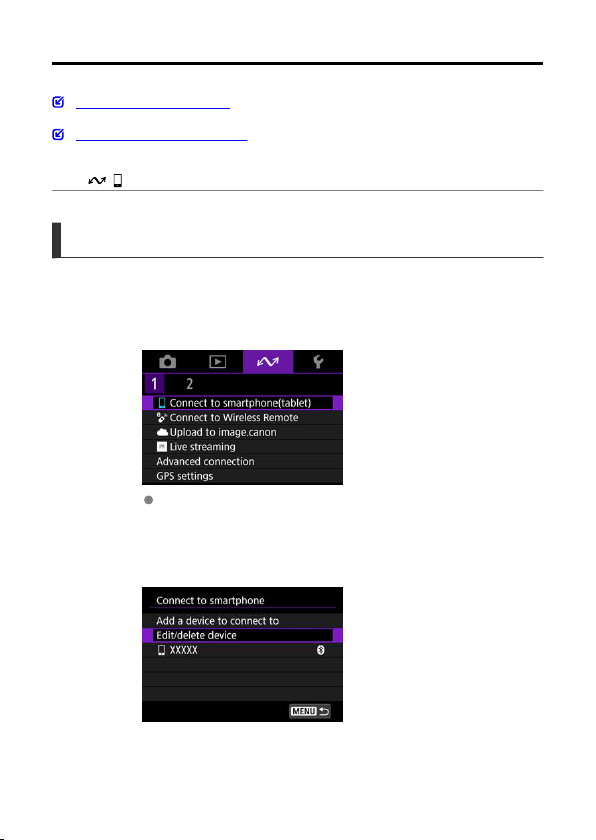
Editing/Deleting Devices for Connections
Changing Device Nicknames
Deleting Connection Information
Before editing or deleting connection settings for other devices, end the Wi-Fi connection.
Here, [
: Connect to smartphone(tablet)] is used as an example.
Changing Device Nicknames
You can change the nickname of devices the camera connects to.
1.
Select an item.
After the [Wi-Fi on] screen appears, select [Disconnect], then repeat
step 1.
2.
Select [Edit/delete device].
198
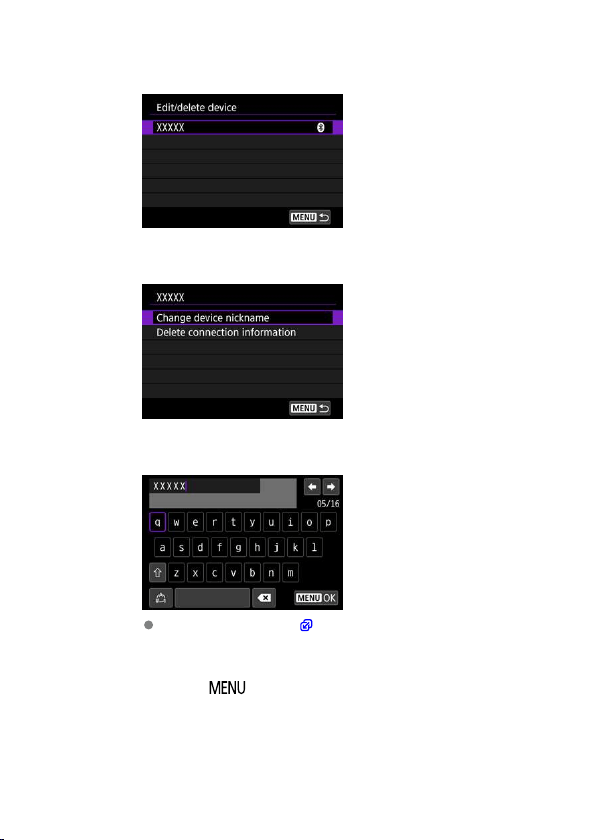
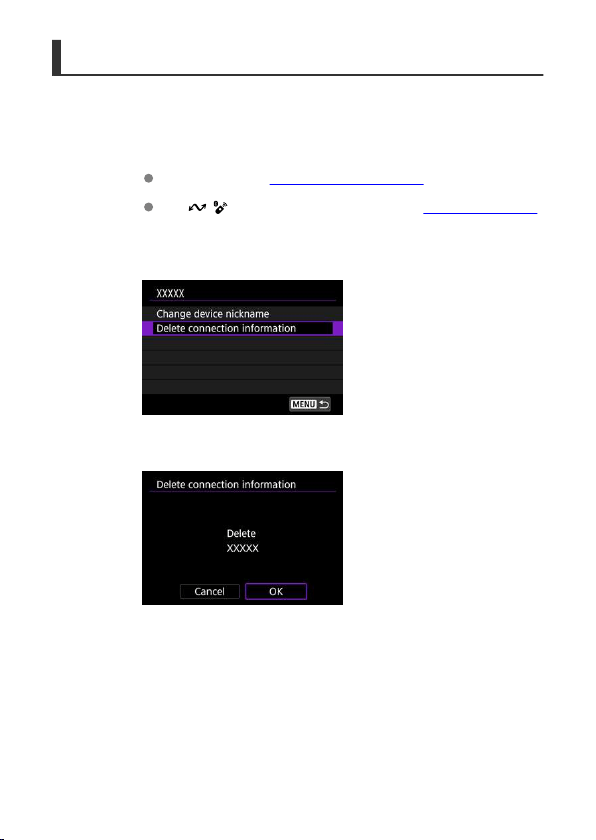
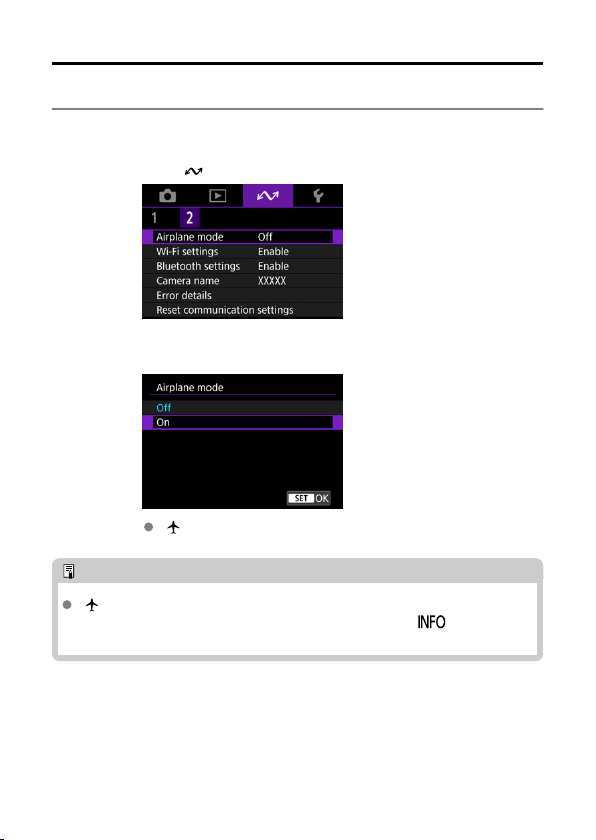
Airplane Mode
You can temporarily disable Wi-Fi and Bluetooth functions.
1.
Select [
: Airplane mode].
2.
Set to [On].
[ ] is displayed on the screen.
Note
[ ] may not be displayed in still photo shooting, movie recording, or playback,
depending on display settings. If it is not displayed, press the <
> button
repeatedly to access detailed information display.
201
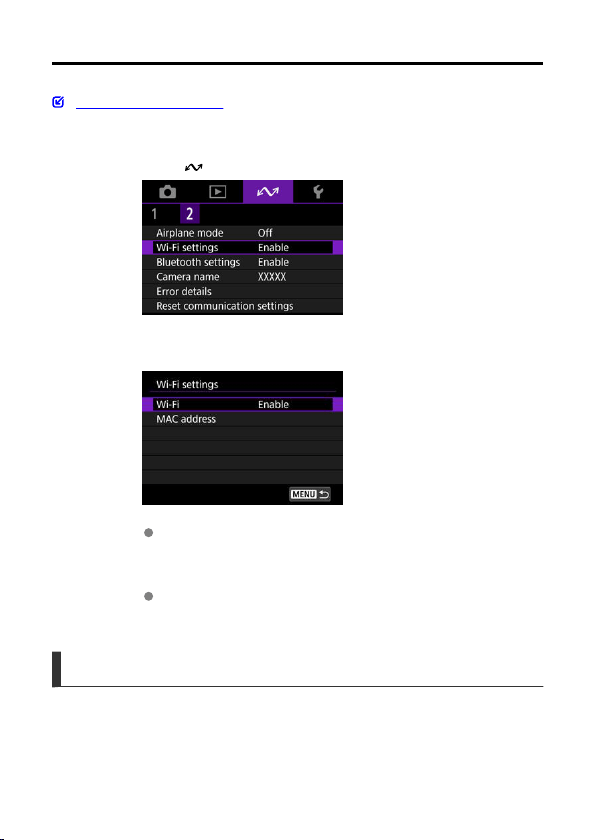
Wi-Fi Settings
Checking the MAC Address
1.
Select [
: Wi-Fi settings].
2.
Select an option.
Wi-Fi
When the use of electronic devices and wireless devices is prohibited,
such as on board airplanes or in hospitals, set it to [Disable].
MAC address
You can check the MAC address of the camera.
Checking the MAC Address
You can check the camera's MAC address.
202
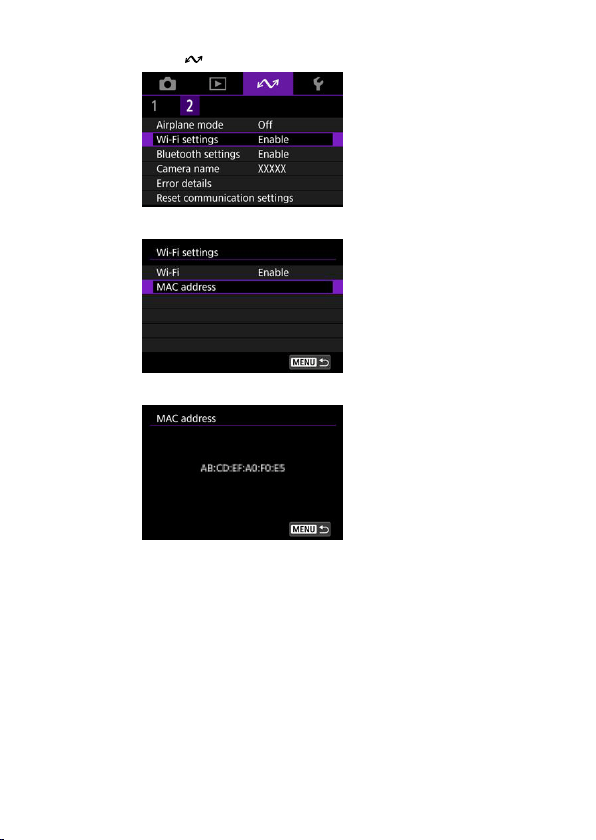
1.
Select [
: Wi-Fi settings].
2.
Select [MAC address].
3.
Check the MAC address.
203
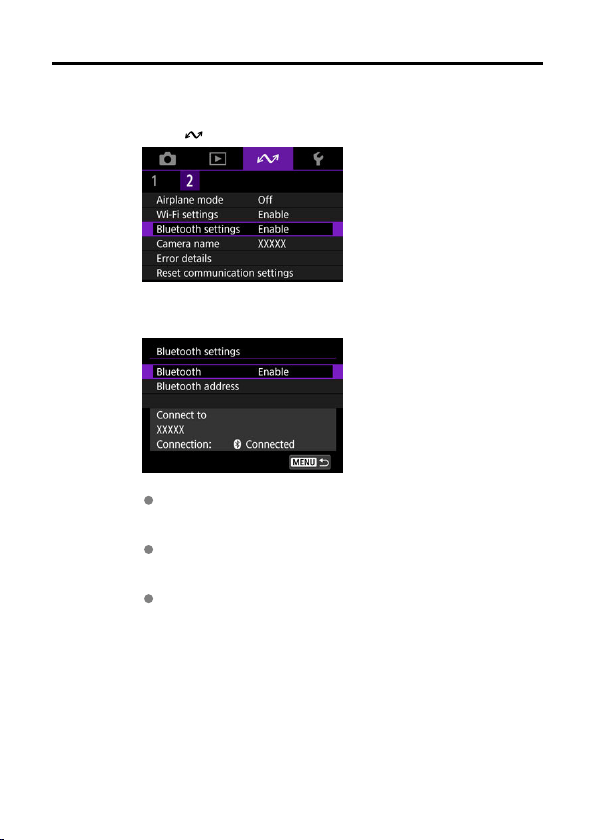
Bluetooth Settings
1.
Select [
: Bluetooth settings].
2.
Select an option.
Bluetooth
If you will not use the Bluetooth function, select [Disable].
Bluetooth address
You can check the camera's Bluetooth address.
Connect to
You can check the name and communication status of the paired
device.
204
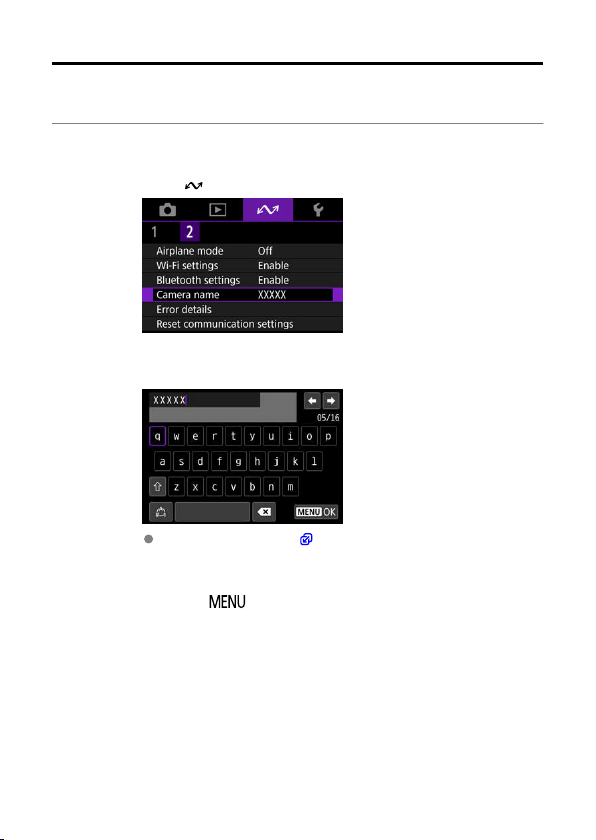
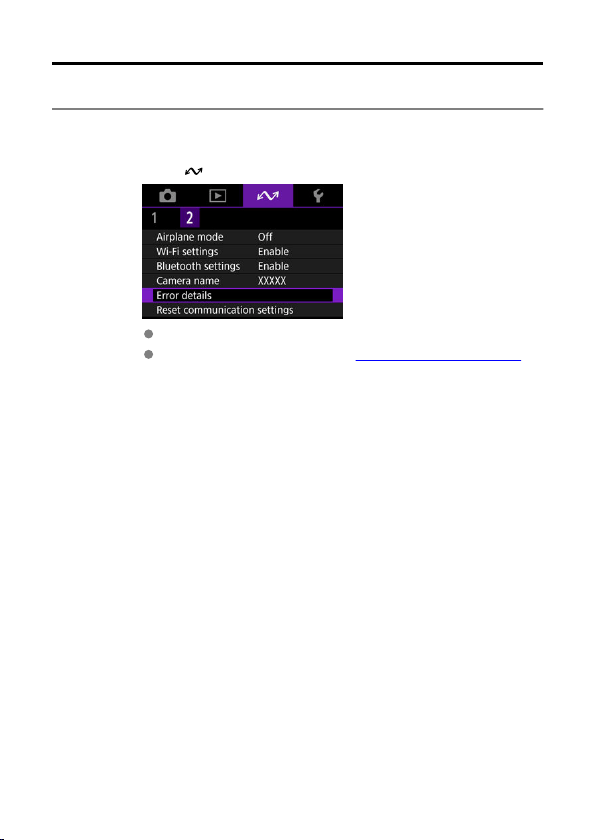
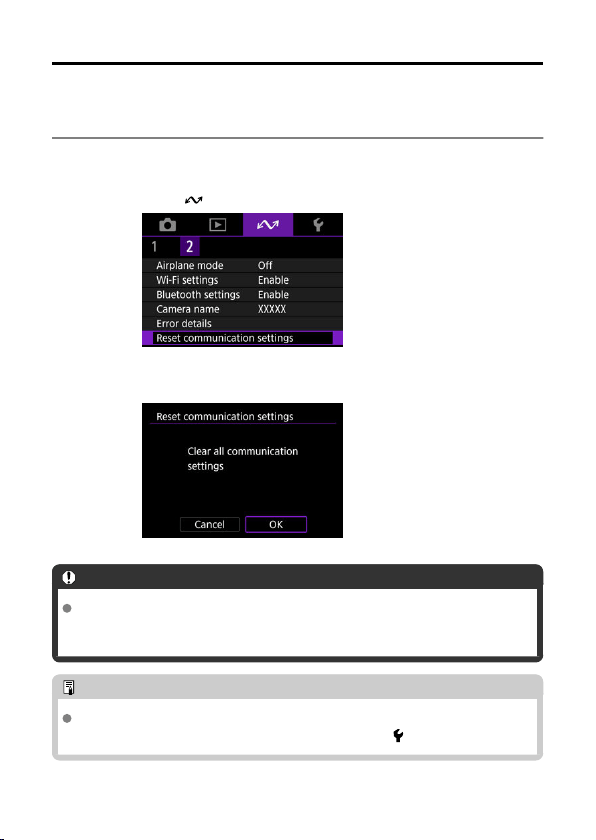
Resetting Communication Settings
All wireless communication settings can be deleted. By deleting the wireless communication
settings, you can prevent their information from being exposed when you lend or give your
camera to other people.
1.
Select [
: Reset communication settings].
2.
Select [OK].
Caution
If you have paired the camera with a smartphone, on the smartphone's Bluetooth
settings screen, delete the connection information of the camera for which you
restored default wireless communication settings.
Note
All wireless communication settings can be cleared by selecting the
[Communication settings] option for [Other settings] in [
: Reset camera].
207
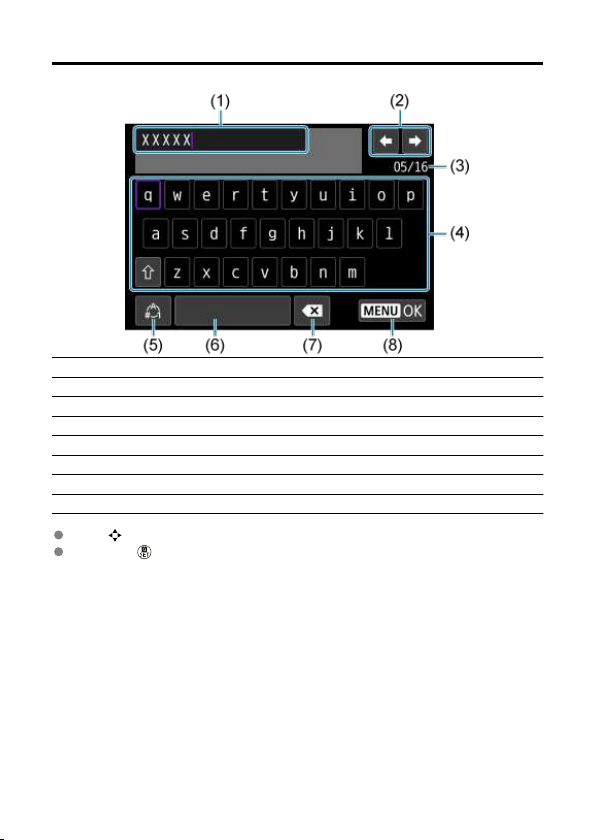
Virtual Keyboard Operations
(1) Input area, for entering text
(2) Cursor keys, for moving in the input area
(3) Current no. of characters/no. available
(4) Keyboard
(5) Switch input modes
(6) Space
(7) Delete a character in the input area
(8) Exit input
Use < > to move within (2) and (4)–(7).
Press the < > button to confirm input or when switching input modes.
208
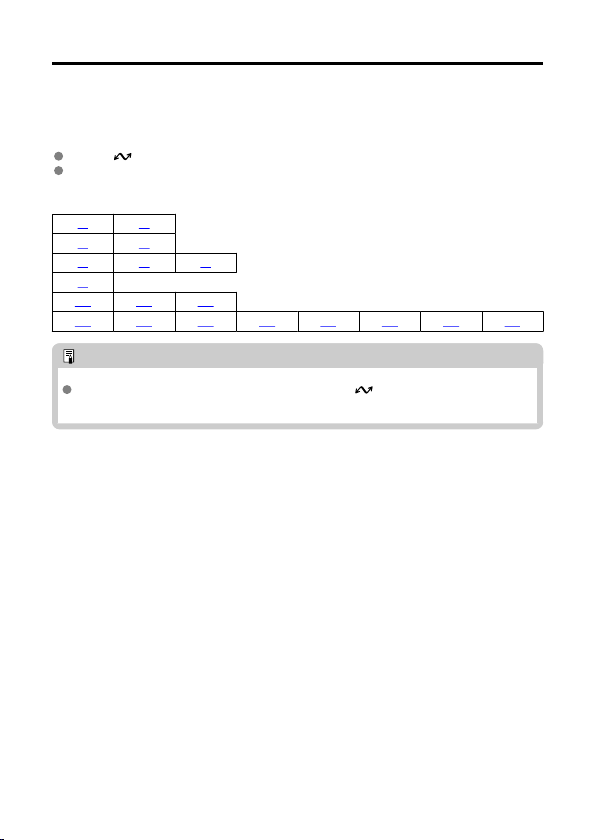
Responding to Error Messages
When an error occurs, display the details of the error by following one of the procedures
below. Then, eliminate the cause of the error by referring to the examples shown in this
chapter.
Select [ : Error details].
Select [Error details] on the [Wi-Fi on] screen.
Click the following error numbers to jump to the corresponding section.
11 12
21 23
61 64 65
91
121 125 127
130 131 132 133 134 135 136 137
Note
In case of errors, [Err**] is displayed to the right of [ : Error details]. It is no
longer displayed after the camera is turned off.
209

11: Connection target not found
In the case of [Connect to smartphone(tablet)], is Camera Connect running?
• Establish a connection using Camera Connect ( ).
Are the camera and the access point set to use the same encryption key for
authentication?
• This error occurs if the encryption keys do not match when the authentication
method for encryption is [Open system].
Check upper- and lower-case letters, and make sure the correct encryption key for
authentication is set on the camera ( ).
12: Connection target not found
Are the other device and access point for the connection turned on?
• Turn on the other device and access point, then wait a while. If a connection still
cannot be established, perform the procedures to establish the connection again.
21: No address assigned by DHCP server
What to check on the camera
On the camera, the IP address is set to [Auto setting]. Is this the correct setting?
• If no DHCP server is used, configure the setting after setting the IP address to
[Manual setting] on the camera ( ).
What to check on the DHCP server
Is the power of the DHCP server on?
• Turn on the DHCP server.
Are there enough addresses for assignment by the DHCP server?
• Increase the number of addresses assigned by the DHCP server.
• Remove devices assigned addresses by the DHCP server from the network to
reduce the number of addresses in use.
Is the DHCP server working correctly?
• Check the DHCP server settings to make sure it is working correctly as a DHCP
server.
• If applicable, ask your network administrator to ensure the DHCP server is available.
210
23: Device with same IP address exists on selected network
Is another device on the camera network using the same IP address as the
camera?
• Change the camera's IP address to avoid using the same address as another
device on the network. Otherwise, change the IP address of the device that has a
duplicate address.
• If the camera's IP address is set to [Manual setting] in network environments using
a DHCP server, change the setting to [Auto setting] ( ).
Note
Responding to error messages 21–23
Also check the following points when responding to errors numbered 21–23.
Are the camera and the access point set to use the same password for
authentication?
• This error occurs if the passwords do not match when the authentication
method for encryption is set to [Open system]. Check upper- and lower-case
letters, and make sure the correct password for authentication is set on the
camera ( ).
211

61: Selected SSID wireless LAN network not found
Are any obstacles blocking the line of sight between the camera and the antenna
of the access point?
• Move the antenna of the access point to a position clearly visible from the point of
view of the camera.
What to check on the camera
Does the SSID set on the camera match that of the access point?
• Check the SSID at the access point, then set the same SSID on the camera ( ).
What to check at the access point
Is the access point turned on?
• Turn on the power of the access point.
If filtering by MAC address is active, is the MAC address of the camera in use
registered at the access point?
• Register the MAC address of the camera used to the access point. The MAC
address can be checked on the [MAC address] screen ( ).
64: Cannot connect to wireless LAN terminal
Are the camera and the access point set to use the same encryption method?
• The camera supports the following encryption methods: WEP, TKIP, and AES ( ).
If filtering by MAC address is active, is the MAC address of the camera in use
registered at the access point?
• Register the MAC address of the camera used to the access point. The MAC
address can be checked on the [MAC address] screen ( ).
65: Wireless LAN connection lost
Are any obstacles blocking the line of sight between the camera and the antenna
of the access point?
• Move the antenna of the access point to a position clearly visible from the point of
view of the camera.
The wireless LAN connection was lost, for some reason, and the connection
cannot be restored.
• The following are possible reasons: excessive access to the access point from
another device, a microwave oven or similar appliance in use nearby (interfering
with IEEE 802.11b/g/n (2.4 GHz band)), or influence of rain or high humidity.
212

91: Other error
A problem other than error code number 11 to 83 occurred.
• Turn the camera's power switch off and on.
213

121: Not enough free space on server
The target Web server does not have enough free space.
• Delete unnecessary images on the Web server, check the free space on the Web
server, then try sending the data again.
125: Check the network settings
Is the network connected?
• Check the connection status of the network.
127: An error has occurred
A problem other than error code number 121 to 125 occurred while the camera is
connected to the Web service.
• Try again to establish the Wi-Fi connection.
130: The server is currently busy
Please wait a moment and try again
The image.canon site is busy at the moment.
• Try accessing image.canon over Wi-Fi again later.
131: Try again
An error occurred when connecting to image.canon over Wi-Fi.
• Try again to establish the Wi-Fi connection to image.canon.
132: Error detected on server
Try again later
The image.canon site is currently offline for maintenance.
• Try accessing image.canon over Wi-Fi again later.
133: Cannot log in to Web service
An error occurred when signing in to image.canon.
• Check the image.canon settings.
• Try accessing image.canon over Wi-Fi again later.
214

134: Set the correct date and time
The date, time, and time zone settings are incorrect.
• Check the [
: Date/Time/Zone] settings.
135: Web service settings have been changed
The settings for image.canon were changed.
• Check the image.canon settings.
136: The QR code shown on the camera was not scanned correctly
by the dedicated app. Try camera web link setup again.
The QR code was not scanned correctly by the smartphone.
• Reconfigure camera web link settings and scan the QR code displayed again on the
camera.
137: The QR code shown on the camera has expired. Try camera web
link setup again.
The QR code displayed has expired.
• Reconfigure camera web link settings and scan the QR code displayed again on the
camera.
215

Wireless Communication Precautions
Distance Between the Camera and the Smartphone
Installation Location of Access Point Antenna
Nearby Electronic Devices
Precautions for Using Multiple Cameras
If the transmission rate drops, the connection is lost, or other problems occur when using the
wireless communication functions, try the following corrective actions.
216

Distance Between the Camera and the Smartphone
If the camera is too far from the smartphone, a Wi-Fi connection may not be established
even when Bluetooth connection is possible. In this case, bring the camera and the
smartphone closer together, then establish a Wi-Fi connection.
Installation Location of Access Point Antenna
When using indoors, install the device in the room where you are using the camera.
Install the device where people or objects do not come between the device and the
camera.
Nearby Electronic Devices
If the Wi-Fi transmission rate drops because of the influence of the following electronic
devices, stop using them or move further away from the devices to transmit communication.
The camera communicates over Wi-Fi via IEEE 802.11b/g/n using radio waves in the
2.4 GHz band. For this reason, the Wi-Fi transmission rate will drop if there are
Bluetooth devices, microwave ovens, cordless telephones, microphones, smartphones,
other cameras, or similar devices operating on the same frequency band nearby.
Precautions for Using Multiple Cameras
When connecting multiple cameras to one access point via Wi-Fi, make sure the
cameras' IP addresses are different.
When multiple cameras are connected to one access point via Wi-Fi, the transmission
rate drops.
When there are multiple IEEE 802.11b/g/n (2.4 GHz band) access points, leave a gap of
five channels between each Wi-Fi channel to reduce radio wave interference. For
example, use channels 1, 6, and 11, channels 2 and 7, or channels 3 and 8.
217

Security
If security settings have not been properly set, the following problems may occur.
Transmission monitoring
Third parties with malicious intent may monitor wireless LAN transmissions and attempt
to acquire the data you are sending.
Unauthorized network access
Third parties with malicious intent may gain unauthorized access to the network you are
using to steal, modify, or destroy information. Additionally, you could fall victim to other
types of unauthorized access such as impersonation (where someone assumes an
identity to gain access to unauthorized information) or springboard attacks (where
someone gains unauthorized access to your network as a springboard to cover their
tracks when infiltrating other systems).
It is recommended to make use of the systems and functions to thoroughly secure your
network, preventing these types of problems from occurring.
218

Checking Network Settings
Windows
Open the Windows [Command Prompt], then enter ipconfig/all and press the <Enter> key.
In addition to the IP address assigned to the computer, the subnet mask, gateway, and DNS
server information are also displayed.
macOS
In macOS, open the [Terminal] application, enter ifconfig -a, and press the <Return> key.
The IP address assigned to the computer is indicated in the [enX] item (X: number) next to
[inet], in the format “***.***.***.***”.
For information about the [Terminal] application, refer to the macOS help.
To avoid using the same IP address for the computer and other devices on the network,
change the rightmost number when configuring the IP address assigned to the camera in
the processes described in
Setting the IP address manually.
Example: 192.168.1.10
219
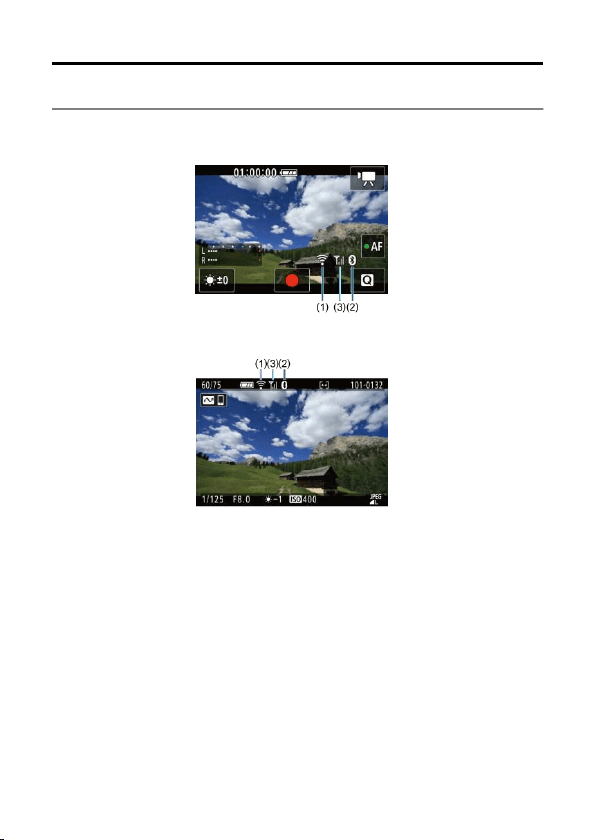
Wireless Communication Status
Wireless communication status can be checked on the screen.
Recording standby screen
Information display screen during playback
(1) Wi-Fi function
(2) Bluetooth function
(3) Wireless signal strength
220
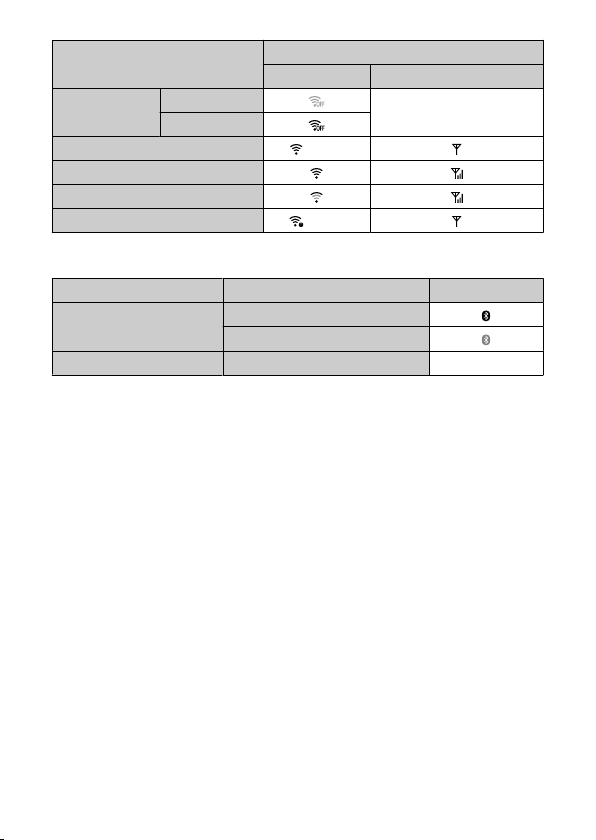
Communication Status
Screen
Wi-Fi Function Wireless Signal Strength
Not connected
Wi-Fi: Disable
Off
Wi-Fi: Enable
Connecting
(Blinking)
Connected
Sending data
Connection error
(Blinking)
Bluetooth Function Indicator
Bluetooth Function Connection Status Screen
Other than [Disable]
Bluetooth connected
Bluetooth not connected
[Disable] Bluetooth not connected Not displayed
221

Set-up
This chapter describes menu settings on the set-up [
] tab.
•
Tab Menus: Set-up
• Folder Settings
• File Numbering
• Card Formatting
• Auto Rotate
• Adding Orientation Information to Movies
• Date/Time/Zone
• Language
• Video System
• Beeps
• Volume
• Power Saving
• Screen Brightness
• HDMI Resolution
• Communication/Multi-Access Button Function (in Movie Mode)
• App Selection for USB Connections
• Resetting the Camera
• Copyright Information
• Other Information
222
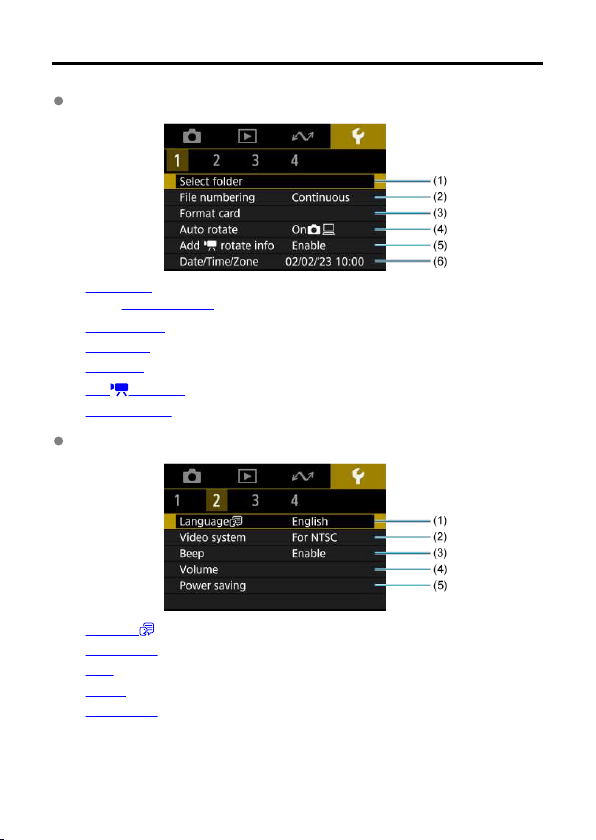
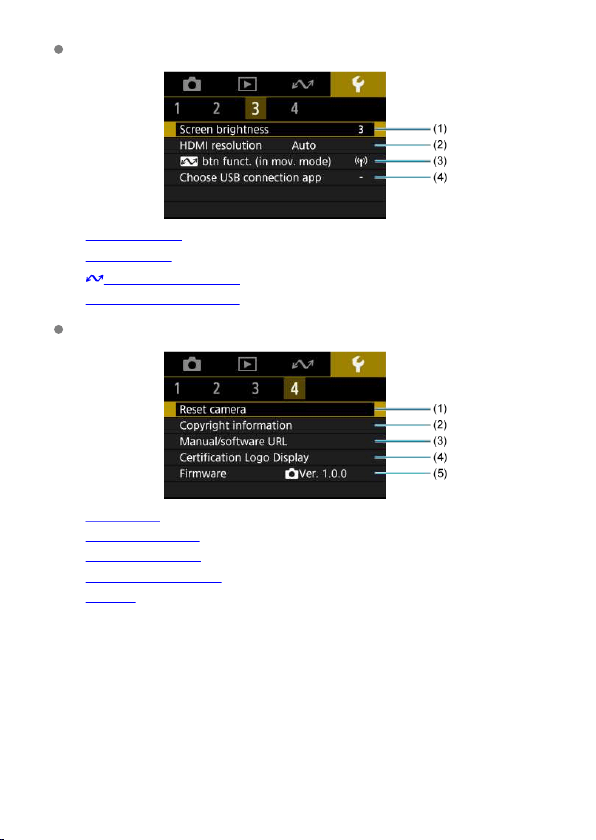
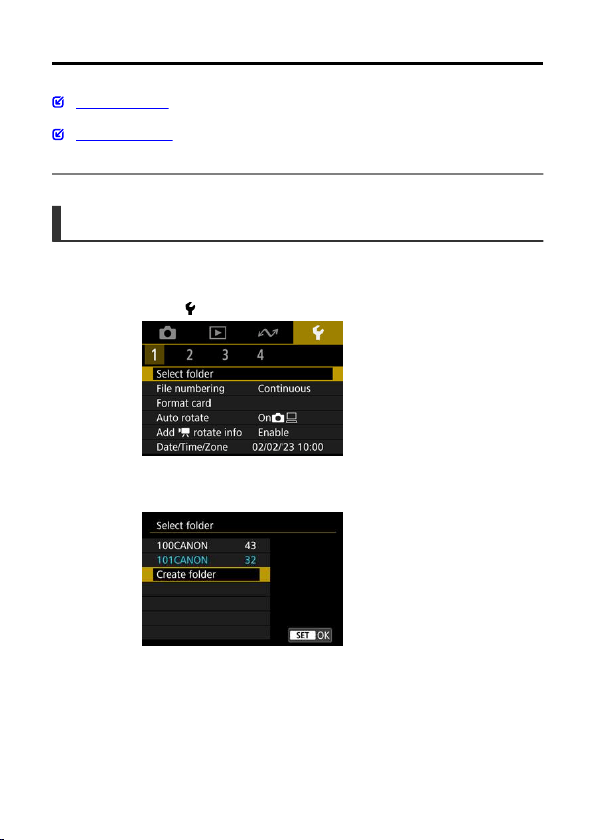
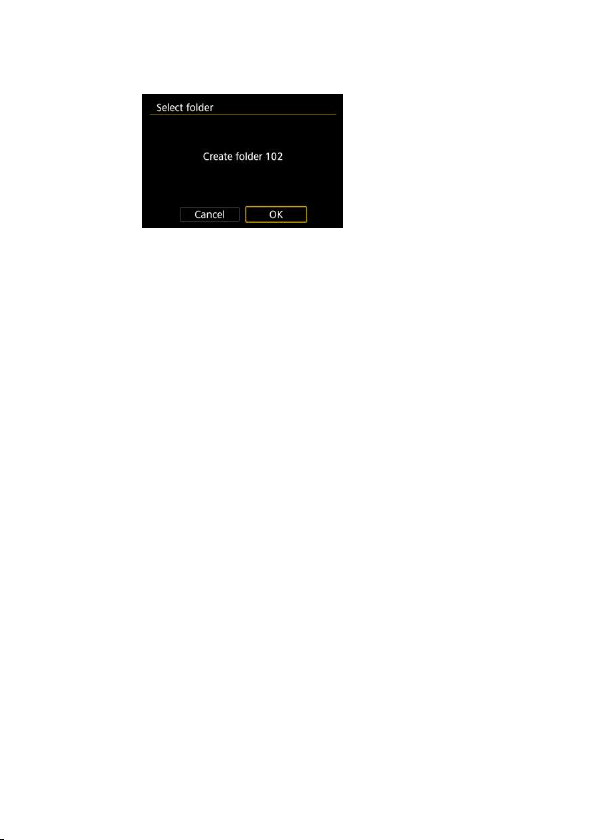
3.
Select [OK].
226
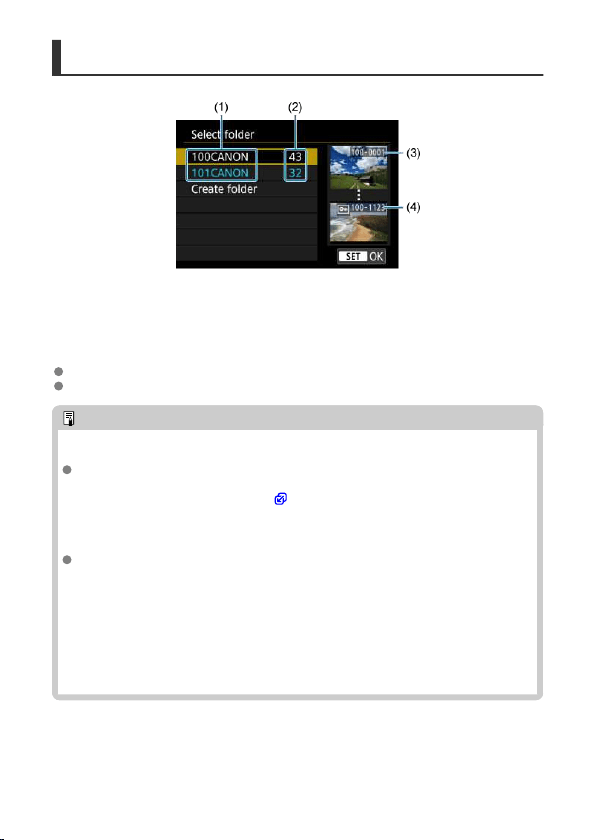
Selecting a Folder
(1) Folder name
(2) Number of images in folder
(3) Lowest file number
(4) Highest file number
Select a folder on the folder selection screen.
Captured images are stored in your selected folder.
Note
Folders
A folder can contain up to 9999 images (file number 0001–9999). When a folder
becomes full, a new folder with the folder number increased by one is created
automatically. Also, if manual reset ( ) is executed, a new folder will be created
automatically. Folders numbered from 100 to 999 can be created.
Creating folders with a computer
With the card open on the screen, create a new folder with “DCIM” as the name.
Open the DCIM folder and create as many folders as necessary to save and
organize your images. “100ABC_D” is the required format for folder names, and
the first three digits must be a folder number in the range 100–999. The last five
characters can be any combination of upper- and lower-case letters from A to Z,
numerals, and the underscore “_”. The space cannot be used. Also note that two
folder names cannot share the same three-digit folder number (for example,
“100ABC_D” and “100W_XYZ”) even if the remaining five characters in each name
are different.
227
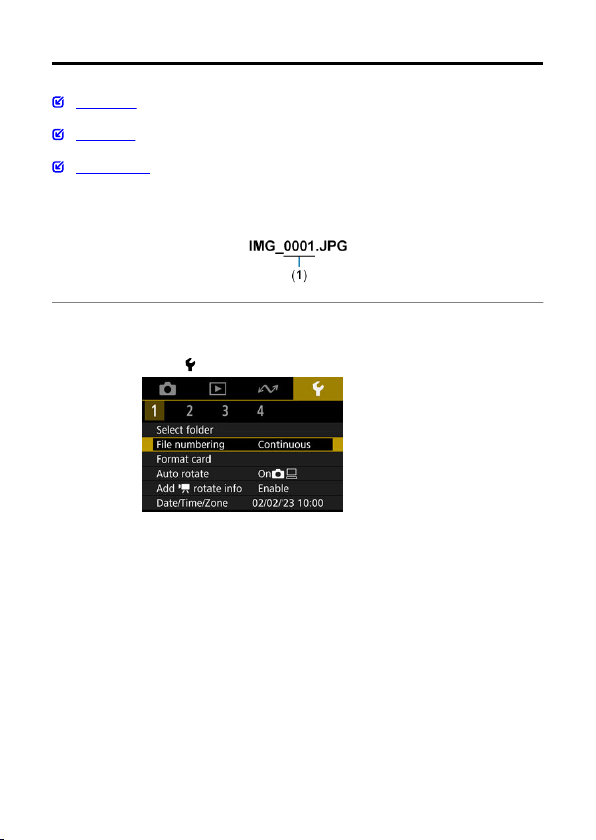
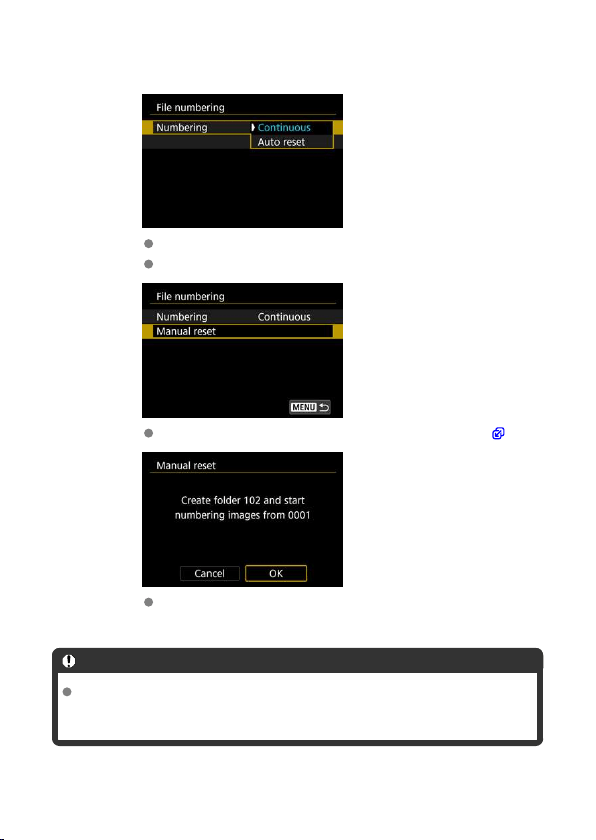
2.
Set the item.
Select [Numbering].
Select [Continuous] or [Auto reset].
If you want to reset the file numbering, select [Manual reset] ( ).
Select [OK] to create a new folder, and the file number will start with
0001.
Caution
If the file number in folder 999 reaches 9999, shooting will not be possible even if
the card still has free space. After a message requesting you to replace the card is
displayed, switch to a new card.
229
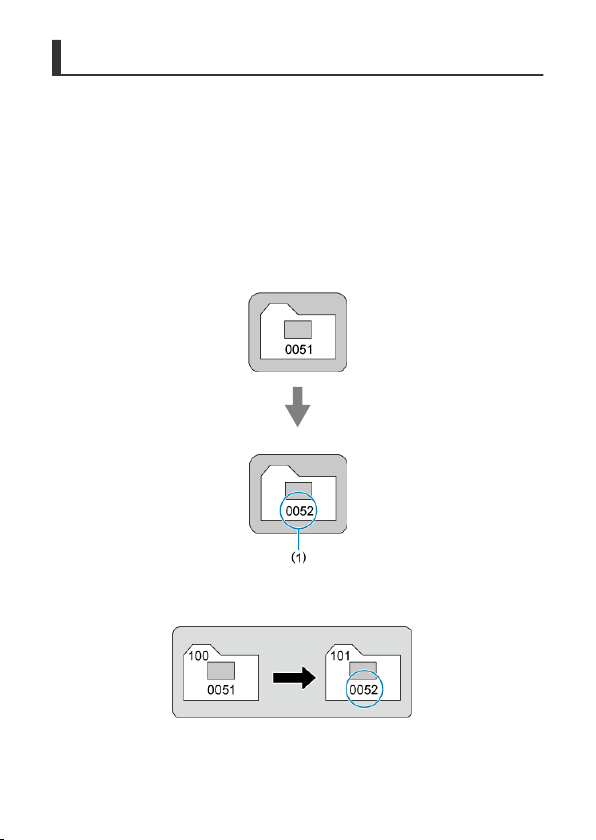
Continuous
For continuous file numbering regardless of switching cards or
creating folders
Even after you replace the card or create a new folder, the file numbering continues in
sequence up to 9999. This is useful when you want to save images numbered anywhere
between 0001 to 9999 on multiple cards or in multiple folders into one folder on a computer.
If the replacement card or existing folder already contains images recorded previously, the
file numbering of the new images may continue from the file numbering of the existing
images on the card or in the folder. If you want to use continuous file numbering, it is
recommended that you use a newly formatted card each time.
File numbering after replacing the card
Card 1
Card 2
(1) Next sequential file number
File numbering after creating a folder
Card 1
230
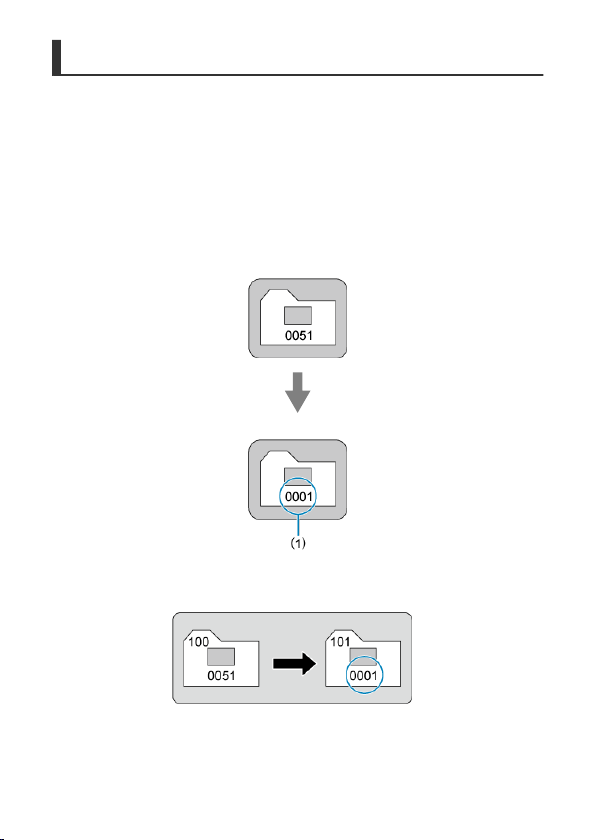
Auto Reset
For restarting file numbering from 0001 after switching cards or
creating folders
When you replace the card or create a folder, the file numbering restarts from 0001 for the
new images saved. This is useful if you want to organize images by cards or folders.
If the replacement card or existing folder already contains images recorded previously, the
file numbering of the new images may continue from the file numbering of the existing
images on the card or in the folder. If you want to save images with the file numbering
starting from 0001, use a newly formatted card each time.
File numbering after replacing the card
Card 1
Card 2
(1) File numbering is reset
File numbering after creating a folder
Card 1
231

Manual Reset
For resetting file numbering to 0001 or starting from 0001 in new
folders
When you reset the file numbering manually, a new folder is created automatically and the
file numbering of images saved to that folder starts from 0001.
This is useful, for example, if you want to use different folders for the images taken
yesterday and the ones taken today.
232
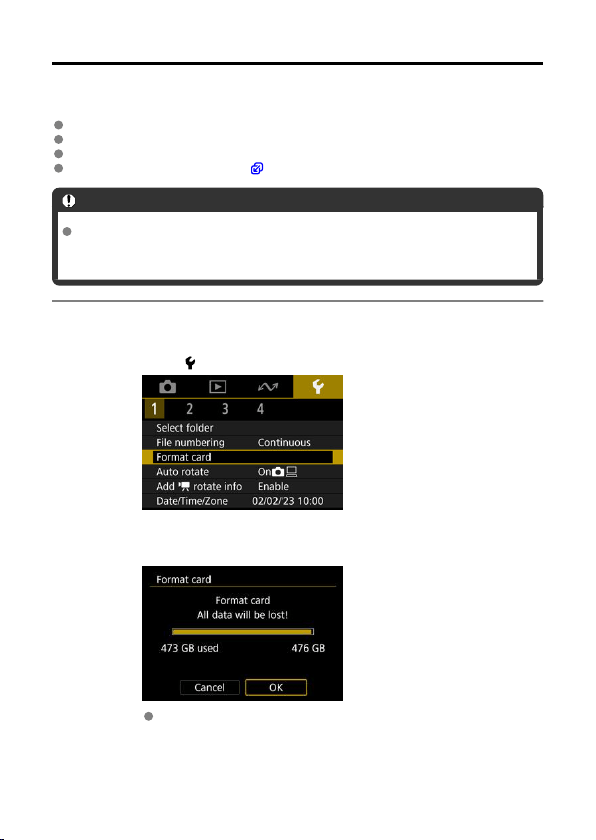
Card Formatting
Use this camera to format (initialize) the card in the following cases.
The card is new.
The card was formatted by a different camera or a computer.
The card is full of images or data.
A card-related error is displayed ( ).
Caution
Formatting a card will erase all data on it. Before formatting, check what is on
the card. If necessary, transfer the images and data to a computer, etc. before
formatting the card.
1.
Select [
: Format card].
2.
Format the card.
Select [OK].
233
Card file formats
microSD cards will be formatted in FAT12/16, microSDHC cards in FAT32, and
microSDXC in exFAT.
Caution
It may not be possible to use microSDXC cards formatted with this camera in other
cameras. Also note that exFAT-formatted cards may not be recognized by some
computer operating systems or card readers.
Formatting or erasing data on a card does not completely erase the data. Be aware
of this when selling or discarding the card. When disposing of cards, take steps to
protect personal information if necessary, as by physically destroying cards.
Note
The card capacity displayed on the card format screen may be smaller than the
capacity indicated on the card.
This device incorporates exFAT technology licensed from Microsoft.
234
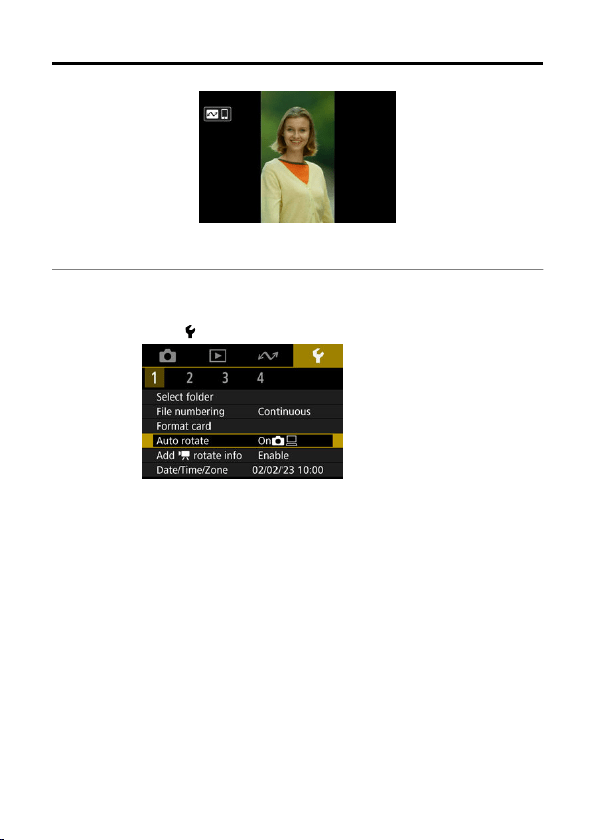
Auto Rotate
You can change the auto rotation setting that straightens images shot in vertical orientation
when they are displayed.
1.
Select [
: Auto rotate].
235
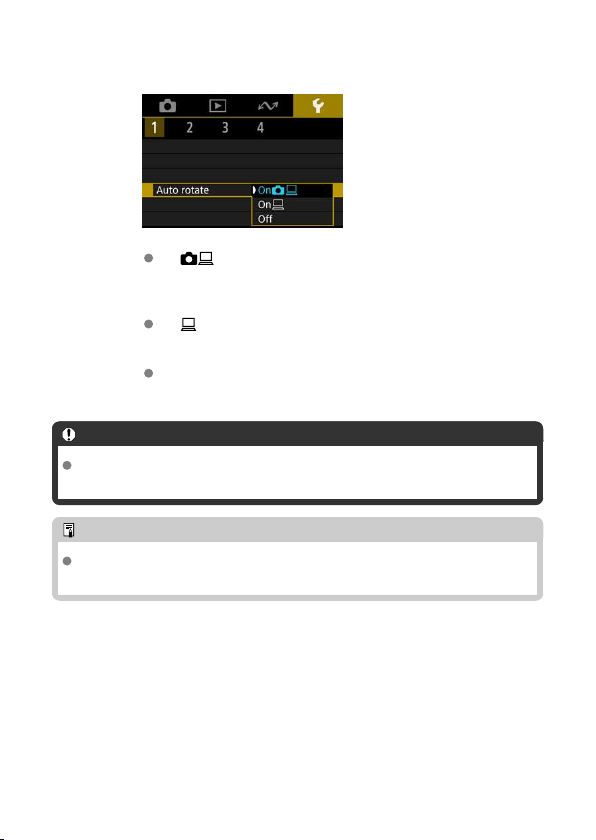
2.
Select an option.
On
Automatically rotates images for display on both the camera and
computers.
On
Automatically rotates images only for display on computers.
Off
Images are not automatically rotated.
Caution
Images captured with auto rotation set to [Off] will not rotate during playback even
if you later set auto rotation to [On].
Note
If a picture is taken while the camera is aimed up or down, automatic rotation to the
proper orientation for viewing may not be performed correctly.
236
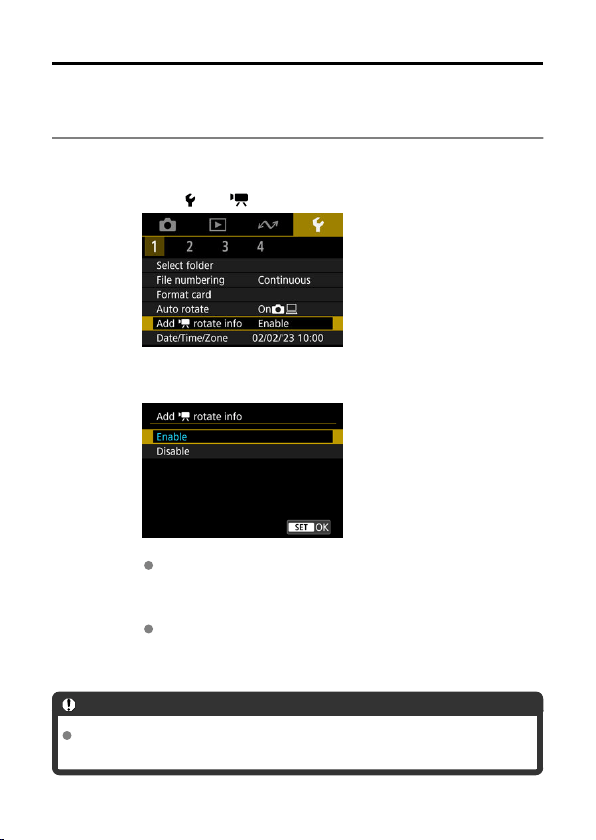
Adding Orientation Information to Movies
For movies recorded with the camera held vertically, orientation information indicating which
side is up can be added automatically to enable playback in the same orientation on
smartphones or other devices.
1.
Select [
: Add rotate info].
2.
Select an option.
Enable
Play movies on smartphones or other devices in the orientation in
which they were recorded.
Disable
Play movies horizontally on smartphones or other devices, regardless
of the recording orientation.
Caution
Movies are played horizontally on the camera and via HDMI video output,
regardless of this setting.
237
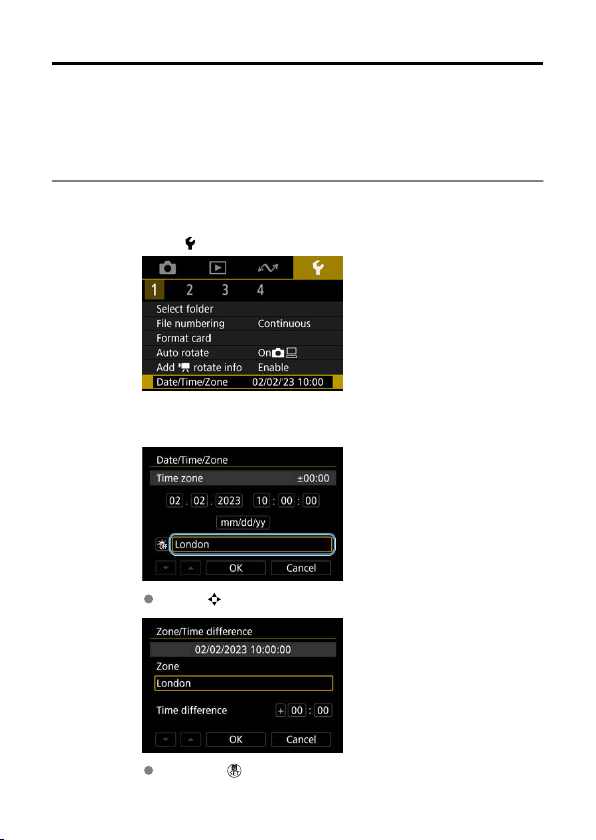
Date/Time/Zone
When you turn on the power for the first time or if the date/time/zone have been reset, follow
these steps to set the time zone first.
By setting the time zone first, you can simply adjust this setting as needed in the future and
the date/time will be updated to match it.
Since the captured images will be appended with the shooting date and time information, be
sure to set your date/time.
1.
Select [
: Date/Time/Zone].
2.
Set the time zone.
Press < > to select [Time zone].
Press the < > button.
238
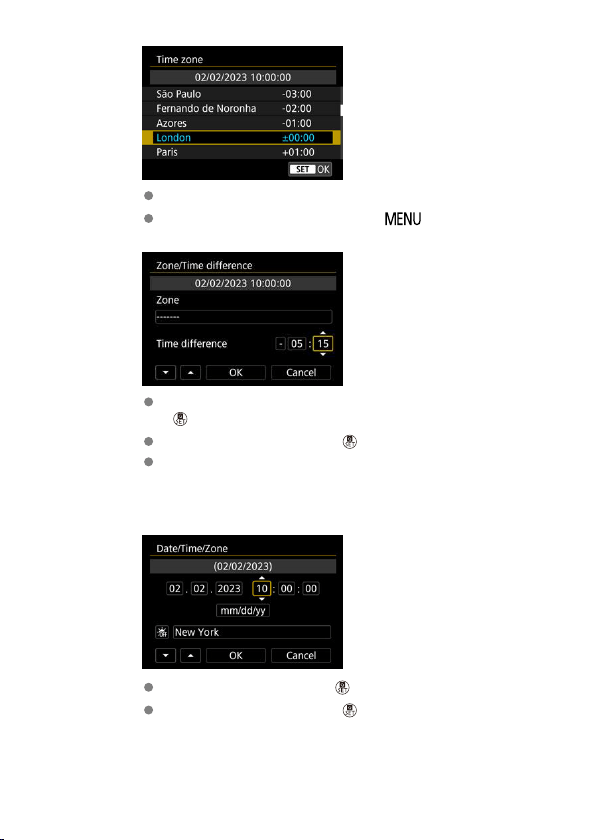
Select the time zone.
If your time zone is not listed, press the < > button, then set the
difference from UTC in [Time difference].
Select a [Time difference] option (+–/hour/minute), then press the
<
> button.
After setting the item, press the < > button.
After entering the time zone or time difference, select [OK].
3.
Set the date and time.
Select an item, then press the < > button.
After setting the item, press the < > button.
239
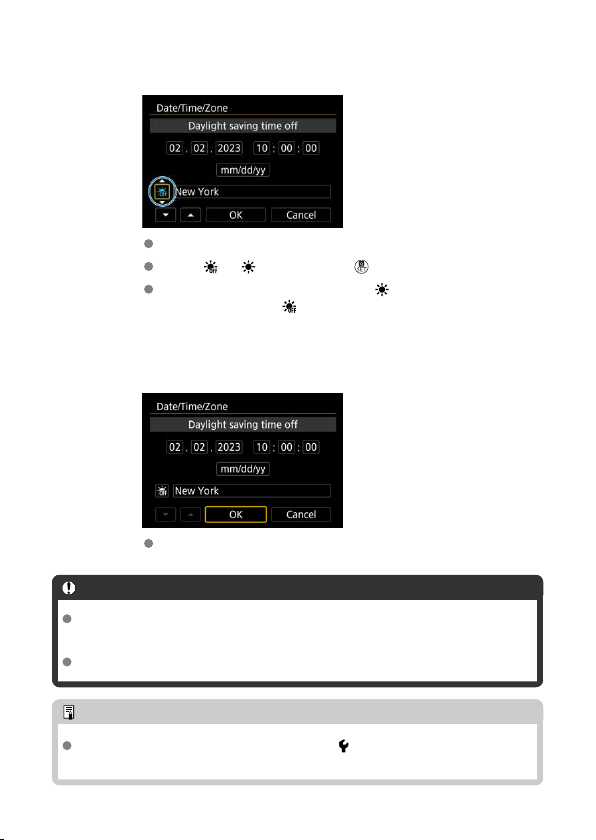
4.
Set daylight saving time.
Set it as necessary.
Select [ ] or [ ], then press the < > button.
When the daylight saving time is set to [ ], the time set in step 3 will
advance by 1 hour. If [
] is set, the daylight saving time will be
canceled and the time will go back by 1 hour.
5.
Exit the setting.
Select [OK].
Caution
Date, time, and time zone settings may be reset when the battery is depleted, or if
the camera is exposed to freezing temperatures for an extended period. If this
happens, set them once again.
After changing [Zone/Time difference], check that the correct date/time are set.
Note
Auto power off time may be extended while the [ : Date/Time/Zone] screen is
displayed.
240
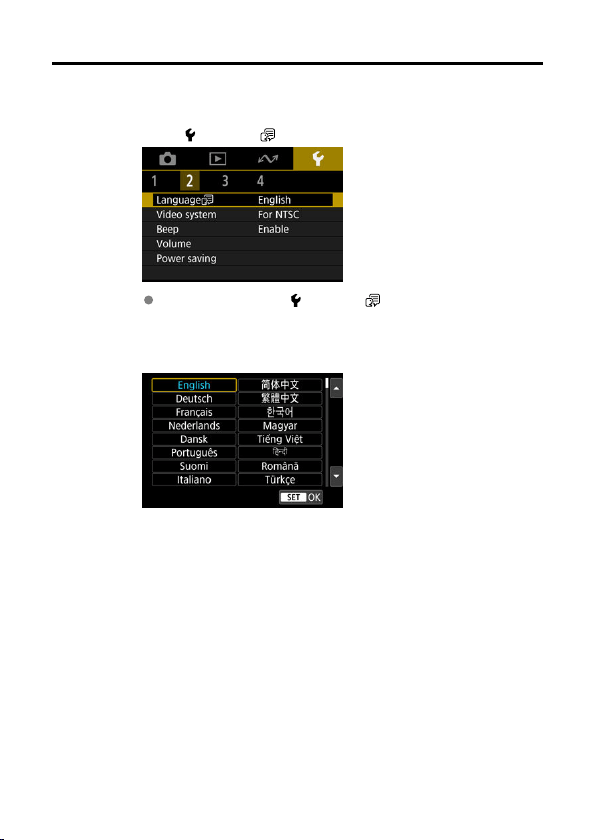
Language
1.
Select [
: Language ].
To set it initially, select [ : Language ].
2.
Set the desired language.
241
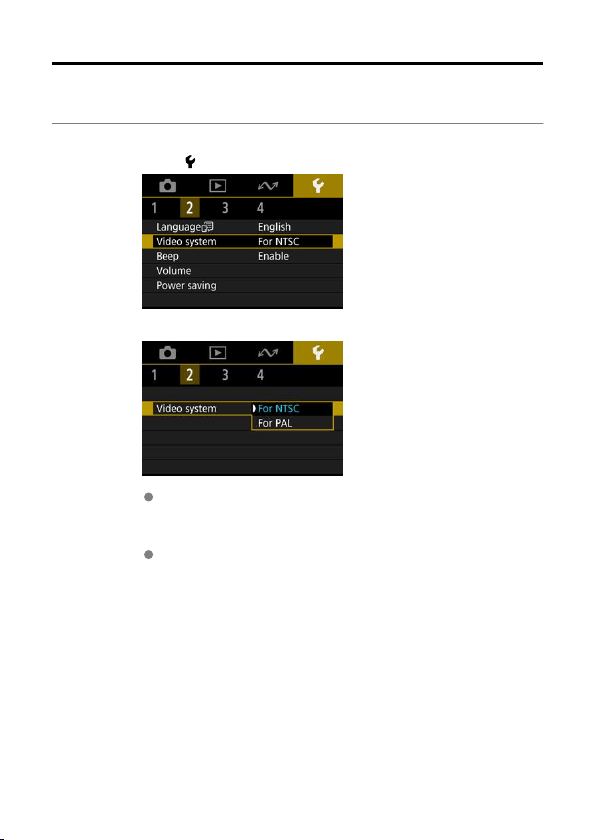
Video System
Set the video system of any television used for display. This setting determines the frame
rates available when you record movies.
1.
Select [
: Video system].
2.
Select an option.
For NTSC
For areas using the NTSC TV system, such as North America, Japan,
South Korea, and Mexico.
For PAL
For areas using the PAL TV system, such as Europe, Russia, China,
and Australia.
242
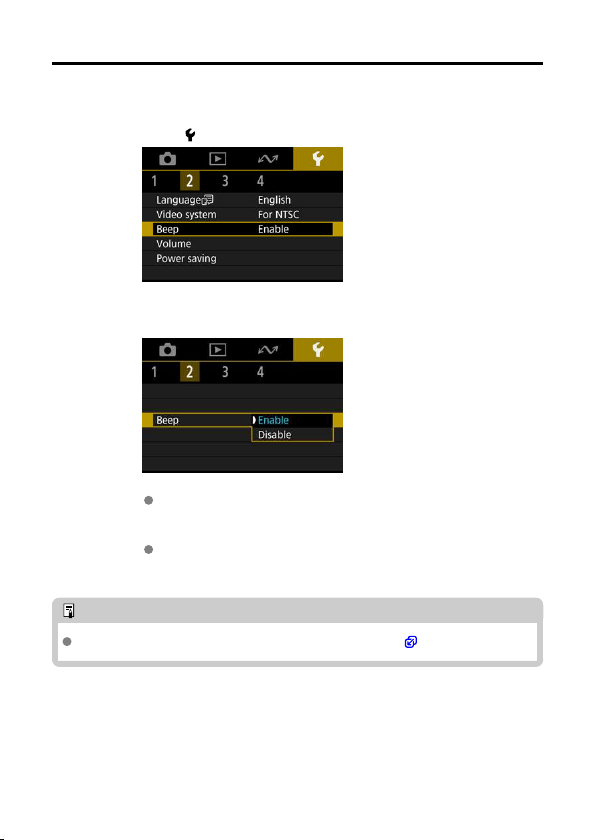
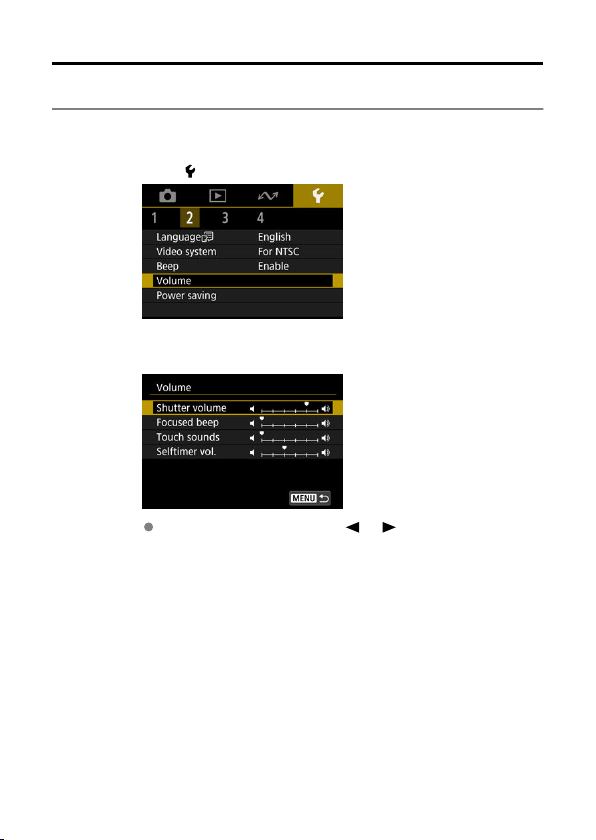
Volume
The volume of camera sounds is adjustable.
1.
Select [
: Volume].
2.
Set the option.
Select an option, then press the < > < > keys to adjust the
volume.
244
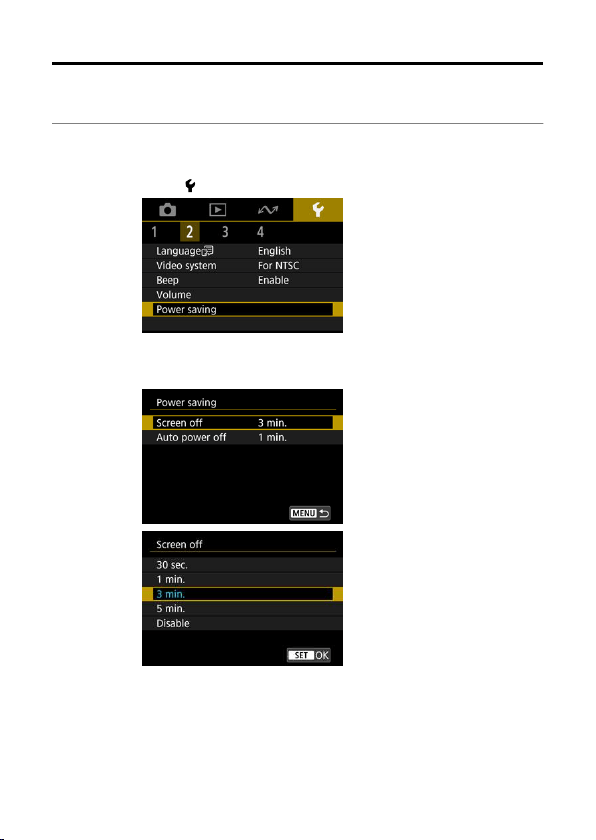
Power Saving
You can adjust the timing of when the screen turns off and when the camera turns off after
the camera is left idle (Screen off and Auto power off).
1.
Select [
: Power saving].
2.
Select an option.
245

Note
[Screen off] applies while the shooting screen is displayed. These settings do not
apply during menu display or image playback.
The camera turns off during menu display or image playback after the time set in
[Screen off] and [Auto power off] elapses.
To protect the screen, the screen turns off 30 min. after it is dimmed (although the
camera itself remains on), even if [Screen off] and [Auto power off] are set to
[Disable].
Power saving settings do not apply during shooting, or when connected via USB or
wirelessly.
246
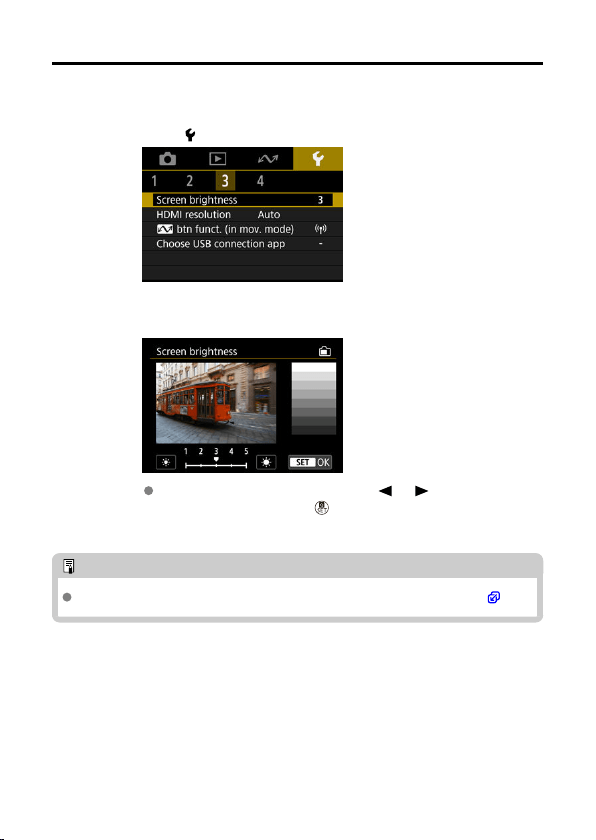
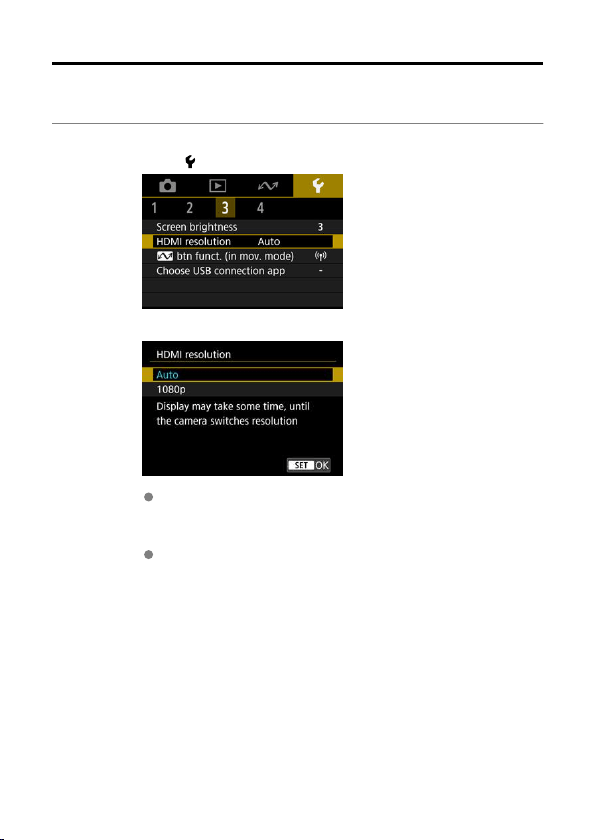
HDMI Resolution
Set the image output resolution used when the camera is connected to a television or
external recording device with an HDMI cable.
1.
Select [
: HDMI resolution].
2.
Select an option.
Auto
The images will automatically be displayed at the optimum resolution
matching the connected television.
1080p
Output at 1080p resolution. Select if you prefer to avoid display or
delay issues when the camera switches resolution.
248
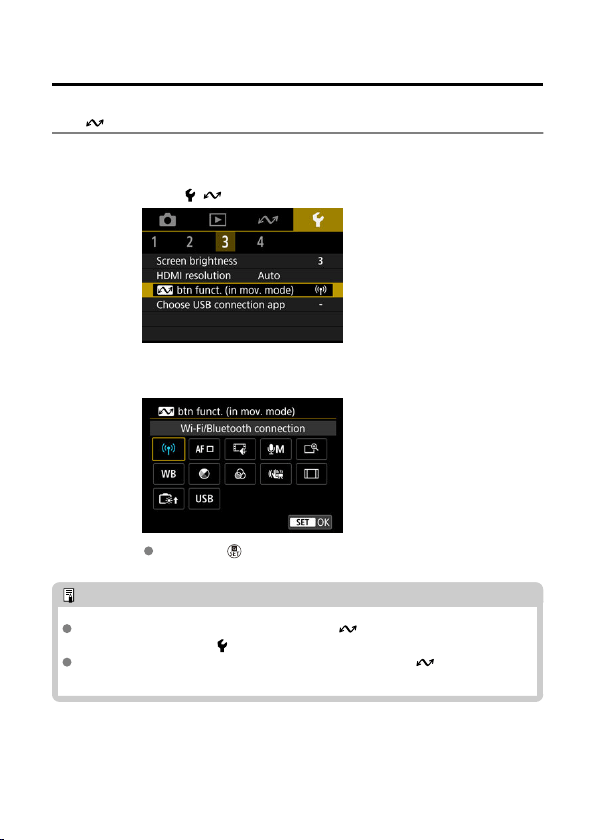
Communication/Multi-Access Button Function (in
Movie Mode)
The <
> button can be assigned to frequently used Movie mode functions.
1.
Select [
: btn funct. (in mov. mode)].
2.
Select a function to assign.
Press the < > button to set it.
Note
To clear the function you have assigned, select [ btn funct. (in mov. mode)]
from [Other settings] in [
: Reset camera].
You can also change the setting by pressing and holding the < > button on the
movie recording screen.
249
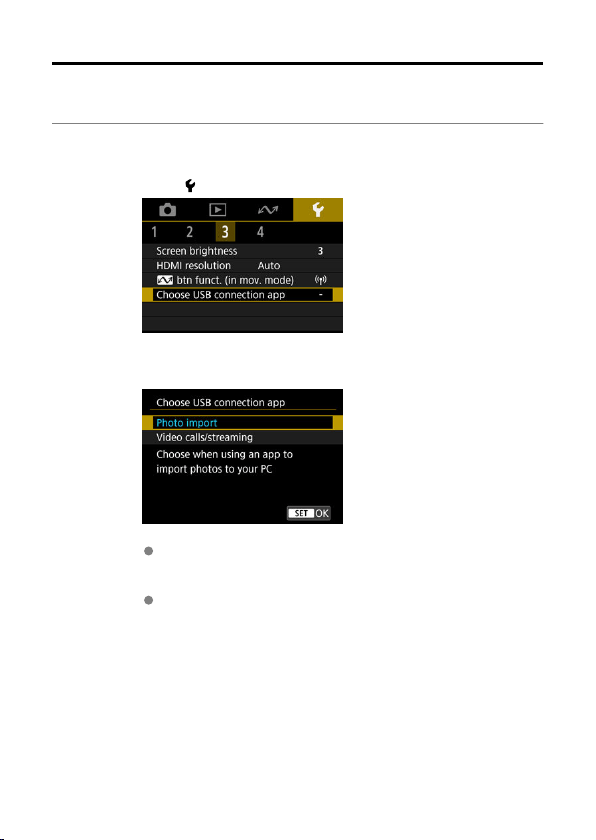
App Selection for USB Connections
By connecting the camera to a smartphone or computer with the interface cable, you can
transfer images or import images to the smartphone or computer.
1.
Select [
: Choose USB connection app].
2.
Select an option.
Photo import
Select when importing images to a computer.
Video calls/streaming
Select if you will use UVC/UAC-compatible applications after
connecting to a computer.
After selecting [Video calls/streaming], use the interface cable to
connect to the computer, then start the application.
The resolution and frame rate of image output is 2K (1920×1080) at 30
fps.
250
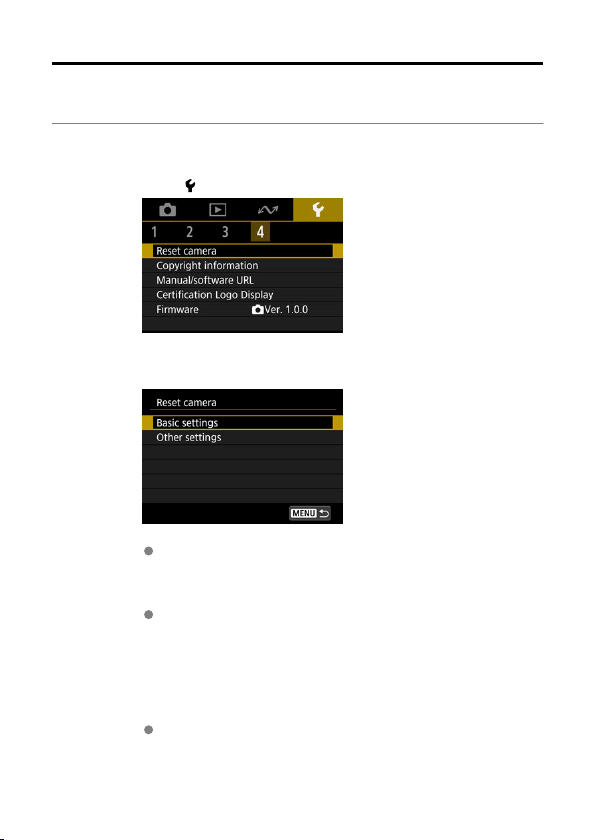
Resetting the Camera
The camera's settings for shooting functions and menu functions can be restored to their
defaults.
1.
Select [
: Reset camera].
2.
Select an option.
Basic settings
Restores default settings for camera shooting functions and menu
settings.
Other settings
Settings for individual selected options can be reset.
3.
Clear the settings.
Select [OK] on the confirmation screen.
251
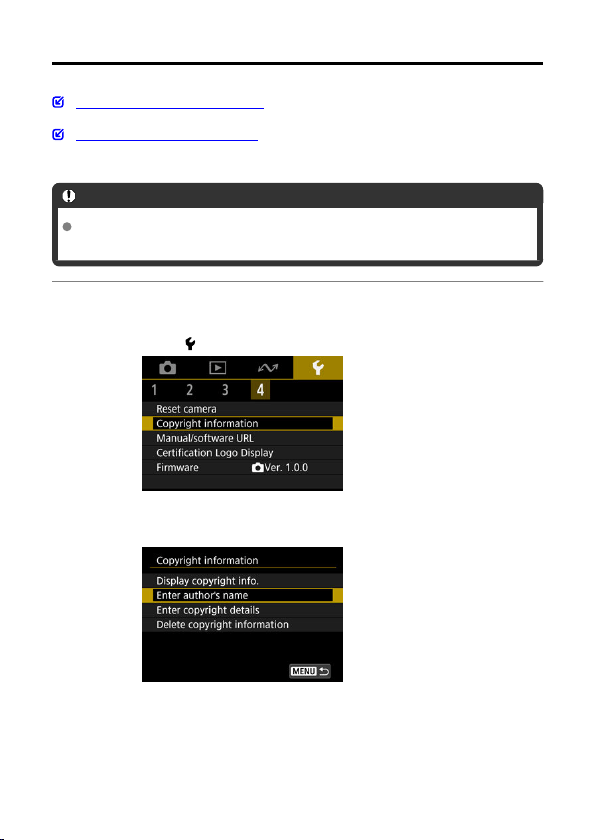
Copyright Information
Checking the Copyright Information
Deleting the Copyright Information
When you set the copyright information, it will be recorded to the image as Exif information.
Caution
If the entry for “Author” or “Copyright” is long, it may not be displayed entirely when
you select [Display copyright info.].
1.
Select [
: Copyright information].
2.
Select an option.
252
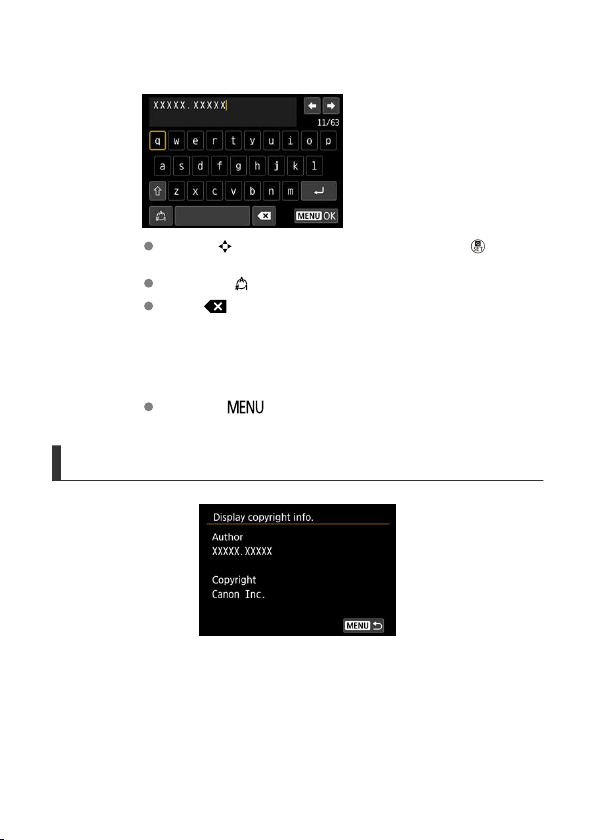
3.
Enter text.
Use the < > dial to select a character, then press the < > button
to enter it.
By selecting [ ], you can change the input mode.
Select [ ] to delete a character.
4.
Exit the setting.
Press the < > button, then press [OK].
Checking the Copyright Information
When you select [Display copyright info.] in step 2, you can check the [Author] and
[Copyright] information that you entered.
253

Deleting the Copyright Information
When you select [Delete copyright information] in step 2, you can delete the [Author] and
[Copyright] information.
254
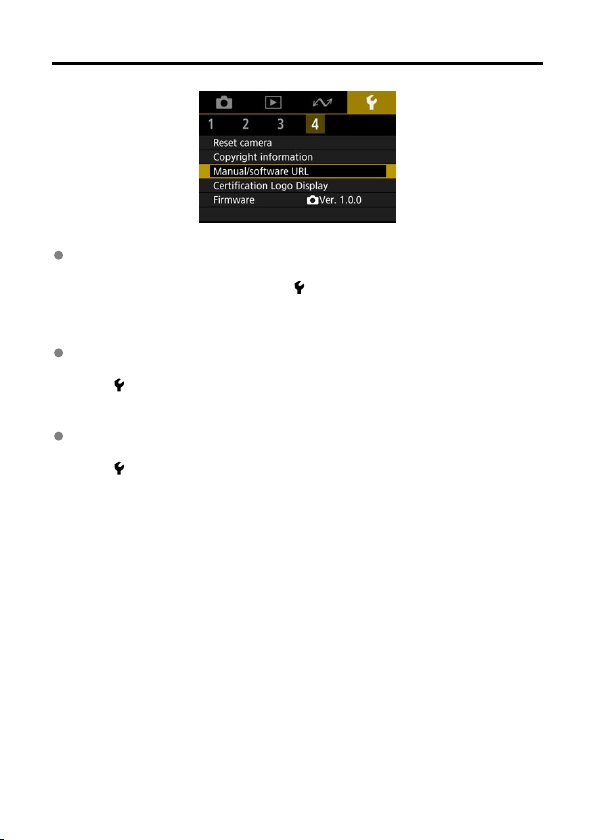
Other Information
Manual/software URL
To download instruction manuals, select [ : Manual/software URL] and scan the
displayed QR code with a smartphone. You can also use a computer to access the
website at the URL displayed and download software.
Certification Logo Display
Select [ : Certification Logo Display] to display some of the logos of the camera's
certifications. Other certification logos can be found on the camera body and packaging.
Firmware
Select [
: Firmware] to update the camera firmware.
255

Troubleshooting Guide
Power-related problems
Shooting-related problems
Problems with wireless features
Operation problems
Display problems
Playback problems
If a problem occurs with the camera, first refer to this Troubleshooting Guide. If this
Troubleshooting Guide does not resolve the problem, contact your dealer or nearest Canon
Service Center.
Power-related problems
Cannot charge the camera.
In case of charging issues, see Charging the Camera.
If charging does not begin, an internal error may have occurred. Force the camera off by
holding down the <
> and < > buttons together for 8 sec. Wait a while before
restarting the camera by pressing the <
> button.
The camera is not activated even when turned on.
Charge the camera ( ).
The indicator lamp is still lit or blinking when the camera is off.
The indicator lamp will remain on or continue to blink for a few seconds if the camera is
turned off while an image is being recorded to the card. When the image recording is
complete, the power will turn off automatically.
Battery life does not last long.
Using the camera when it is fully charged is recommended ( ).
The following operations reduce battery life and the number of shots available.
• Recording movies over an extended period
• Using the wireless communication functions
257

Shooting-related problems
No images can be shot or recorded.
Make sure the card is properly inserted ( ).
If the card is full, replace the card or delete unnecessary images to make space
( , ).
The card cannot be used.
If a card error message is displayed, see Inserting/Removing Cards and Error Codes.
The image is out of focus or blurred.
Press the Start/Stop button gently to prevent camera shake ( ).
Subjects look distorted during recording.
If you move the camera from left to right (panning) or shoot a moving subject during
recording, the image may look distorted.
A white [ ] or red [ ] icon is displayed during movie
recording.
Indicates that the camera's internal temperature is high. For details, see the information
on warning indicator display in movie recording (
).
During movie recording, the red
icon is displayed.
It indicates that the camera's internal temperature is high. Display of the red [ ] icon
indicates that movie recording will soon stop automatically.
Movie recording stops by itself.
If the card's writing speed is slow, movie recording may stop automatically. For details
on cards that can record movies, see Cards That Can Record Movies. To find out the
card's writing speed, refer to the card manufacturer's website, etc.
Format the card if the writing or reading speed seems slow ( ).
Movie recording stops automatically at 1 hr.
259

The image flickers or horizontal stripes appear during movie recording.
Flickering, horizontal stripes (noise), or irregular exposures can be caused by
fluorescent lighting, LED lighting, or other light sources during movie recording. Also,
changes in the exposure (brightness) or color tone may be recorded.
I cannot take still photos during movie recording.
Still photos cannot be taken during movie recording. Stop movie recording before
shooting still photos.
260

Problems with wireless features
Cannot pair with a smartphone.
Use a smartphone compliant with Bluetooth Specification Version 4.2 or later.
Turn on Bluetooth from the smartphone settings screen.
Note that pairing with the camera is not possible from the smartphone's Bluetooth
settings screen. Install the dedicated app Camera Connect (free of charge) on the
smartphone ( ).
Pairing with a previously paired smartphone is not possible if pairing information
registered for another camera remains on the smartphone. In this case, remove the
camera's registration retained in the Bluetooth settings on the smartphone and try
pairing again ( ).
Operations such as shooting and playback are not possible.
With a Wi-Fi connection established, operations such as shooting and playback may not
be possible. Terminate the Wi-Fi connection, then perform the operation.
Cannot reconnect to a smartphone.
Reconnecting may not be possible, even with the same camera and smartphone, if you
have changed the settings or selected other settings. In this case, delete the camera
connection settings from the Wi-Fi settings on the smartphone and set up a connection
again.
A connection may not be established if Camera Connect is running when you
reconfigure connection settings. In this case, quit Camera Connect for a moment and
then restart it.
261
Operation problems
Camera operation is erratic. The buttons are unresponsive.
An internal error may have occurred. Force the camera off by holding down the
<
> and < > buttons together for 8 sec. Wait a while before restarting the
camera by pressing the <
> button.
Display problems
The shooting date and time displayed are incorrect.
Make sure the correct date and time are set ( ).
Check the time zone and daylight saving time ( ).
Playback problems
Still photos and movies cannot be played back.
The camera may not be able to play back images taken with another camera.
Movies edited with a computer cannot be played back with the camera.
Mechanical sounds or sounds of camera operations can be heard
during movie playback.
If you perform camera operations during movie recording, the camera's built-in
microphone may also record sounds of the camera operations.
The movie appears to freeze momentarily.
Significant changes in exposure during movie recording may cause recording to stop
momentarily until the brightness stabilizes.
262
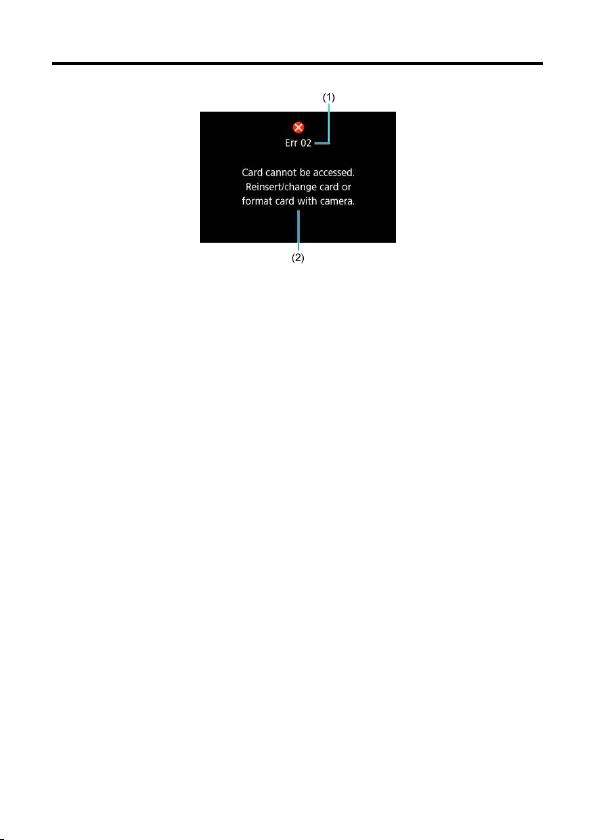
Error Codes
(1) Error number
(2) Cause and countermeasures
If there is a problem with the camera, an error message will appear. Follow the on-screen
instructions.
If the problem persists, write down the error code (Err xx) and request service.
263
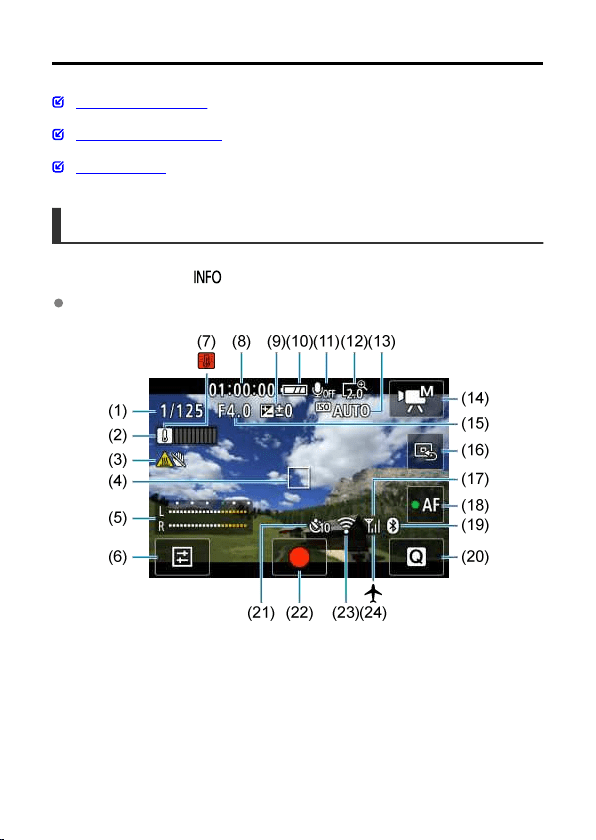
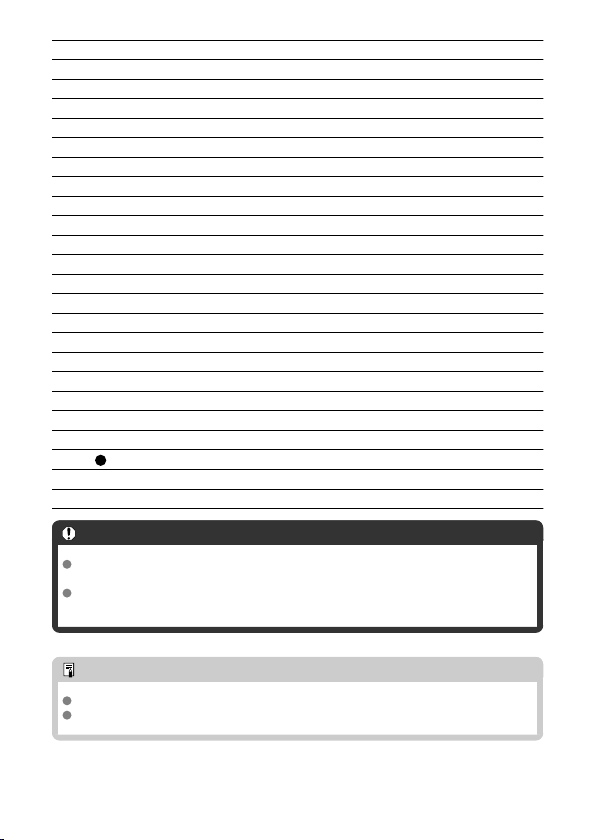
(1) Shutter speed
(2) Temperature increase
(3) High temperature warning
(4) AF point
(5) Audio recording level indicator
(6) Shutter speed/Aperture value/Exposure compensation amount/ISO speed
(7) Overheating warning
(8) Movie recording time available/Elapsed recording time
(9) Exposure compensation amount
(10) Battery level
(11) Sound recording off
(12) Digital zoom
(13) ISO speed
(14) Shooting mode
(15) Aperture value
(16) Set AF point to center
(17) Wi-Fi signal strength
(18) Autofocus status
(19) Bluetooth function
(20) Quick Control button
(21) Self-timer
(22) [
] Movie shooting button
(23) Wi-Fi function
(24) Airplane mode
Caution
The grid cannot be displayed during movie recording (and if it is currently
displayed, recording a movie will clear the display).
When movie recording starts, the movie recording remaining time will change to the
elapsed time.
Note
Other icons may be displayed temporarily after setting adjustments.
Flipping out the screen switches the display position of the information shown.
265
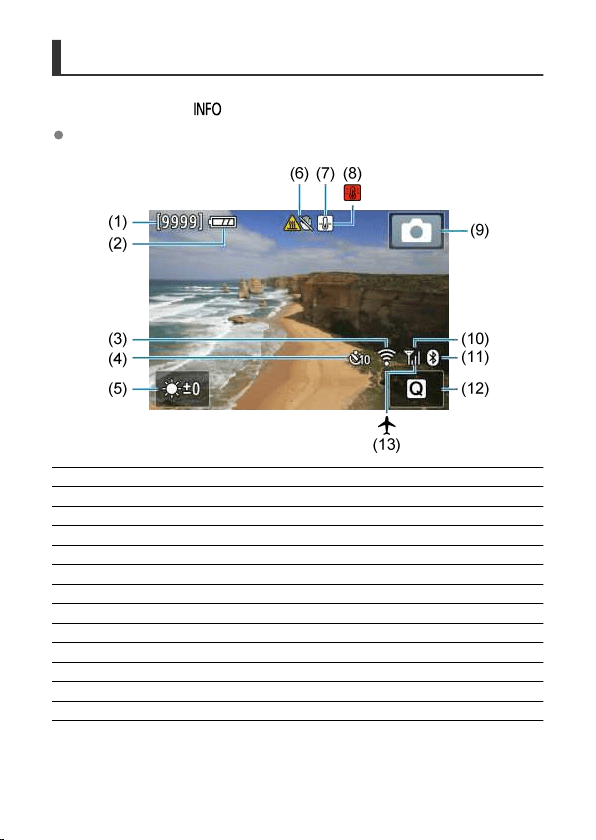
Still Photo Shooting Screen
Each time you press the <
> button, the information display will change.
The display will show only the settings currently applied.
(1) Available shots
(2) Battery level
(3) Wi-Fi function
(4) Self-timer
(5) Brightness
(6) High temperature warning
(7) Still photo image quality warning
(8) Overheating warning
(9) Shooting mode
(10) Wi-Fi signal strength
(11) Bluetooth function
(12) Quick Control button
(13) Airplane mode
266

Note
Other icons may be displayed temporarily after setting adjustments.
Flipping out the screen switches the display position of the information shown.
267
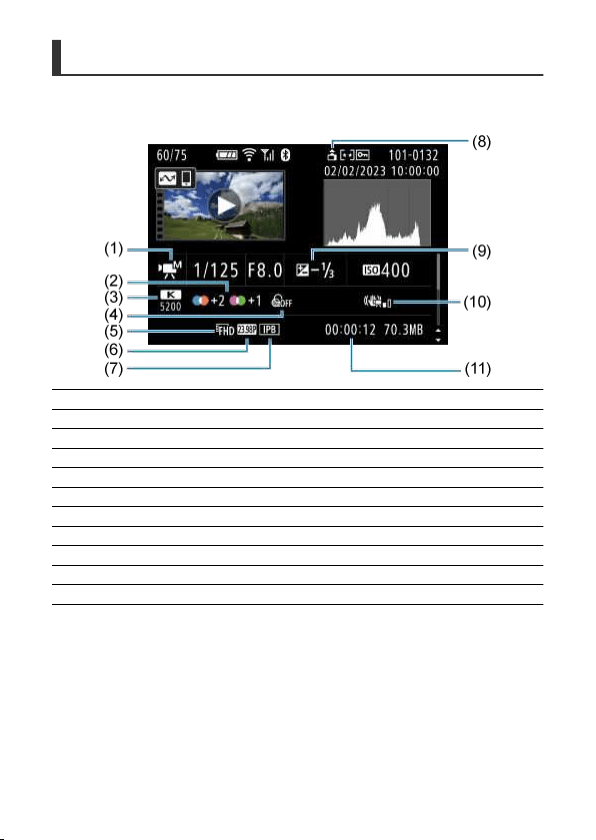
Playback Screen
Detailed information display for movies
(1) Movie recording mode
(2) Color tone
(3) White balance
(4) Color filter
(5) Movie recording size
(6) Frame rate
(7) Movie compression method
(8) Movie orientation information
(9) Exposure compensation amount
(10) Digital IS setting
(11) Recording time
* For simplicity, explanations are omitted for items that are also included in basic/detailed information display for still photos,
which are not shown here.
268
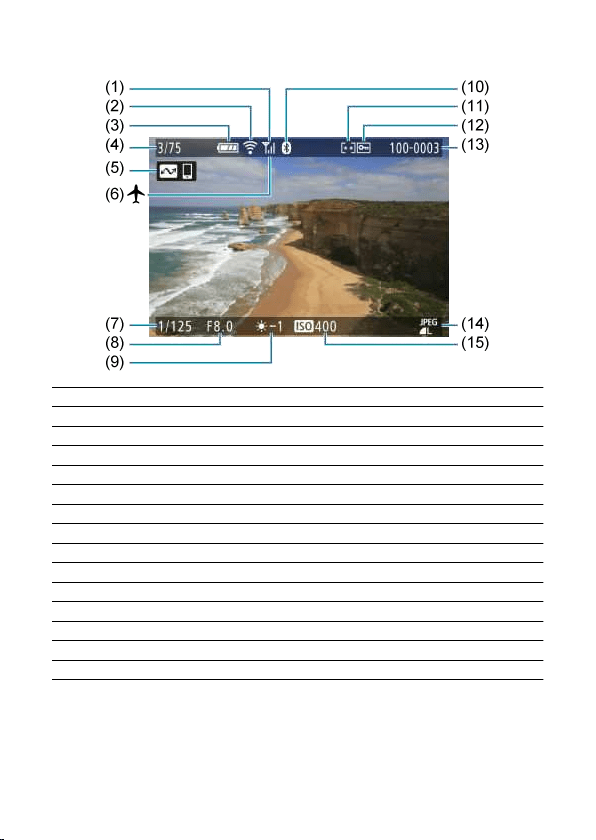
Basic information display for still photos
(1) Wi-Fi signal strength
(2) Wi-Fi function
(3) Battery level
(4) Playback number/Total images recorded
(5) Send images to smartphone
(6) Airplane mode
(7) Shutter speed
(8) Aperture value
(9) Brightness
(10) Bluetooth function
(11) Rating
(12) Image protection
(13) Folder no.-File no.
(14) Image quality
(15) ISO speed
269

Caution
If the image was taken by another camera, certain shooting information may not be
displayed.
It may not be possible to play back images taken with this camera on other
cameras.
270
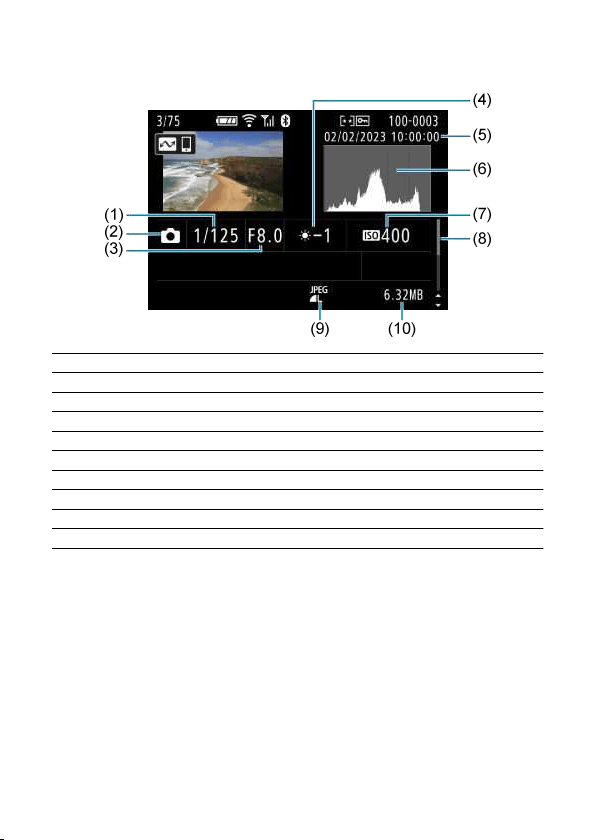
Detailed information display for still photos
(1) Shutter speed
(2) Shooting mode
(3) Aperture value
(4) Brightness
(5) Shooting date and time
(6) Histogram (Brightness/RGB)
(7) ISO speed
(8) Scroll bar
(9) Image quality
(10) File size
271
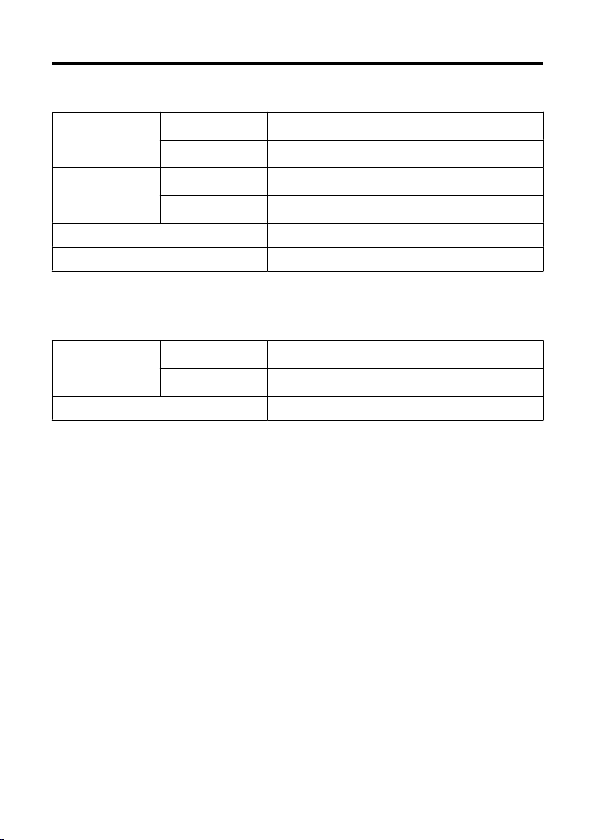
Specifications
Lens
Focal length
During Movie recording
(Full HD, 16:9)
6.6 mm (Approx. 19 mm equivalent, 35mm format equivalent)
During Still photo
shooting
6.6 mm (Approx. 18mm equivalent, 35mm format equivalent)
Angle of view
During Movie recording
(Full HD, 16:9)
97.5°
During Still photo
shooting
100.2°
Optical zoom None
Focusing range 0.05 m / 0.16 ft. to infinity
Image sensor
Type: 1-inch high-sensitivity CMOS sensor (back-illuminated)
Effective pixels*
1
During Movie recording
(Full HD, 16:9)
Approx. 13.1 megapixels
During Still photo
shooting
Approx. 15.2 megapixels
Total pixels*
1
Approx. 20.9 megapixels
* 1: Rounded to the nearest 100,000.
272

Recording system
Image recording format: Compliant with Design rule for Camera File system 2.0 and Exif
2.31*
1
* 1: Supports time offset information
Image type and extension
Image type Extension
Still photos JPEG .JPG
Movies IPB (Standard) / IPB (Light) .MP4
Recording media
microSD, microSDHC, and microSDXC memory cards
UHS-II Not supported
UHS-I Supported
UHS speed class Supported
SD speed class Supported
273
Still photo recording
Still photo pixel count
Image size
Resolution (pixels)
Aspect ratio
3:2 4:3 16:9 1:1
JPEG
Approx. 20.0
megapixels
(5472 × 3648)
Approx. 17.7
megapixels
(4864 × 3648)
Approx. 16.8
megapixels*
1
(5472 × 3072)
Approx. 13.3
megapixels
(3648 × 3648)
Approx. 8.9
megapixels
(3648 × 2432)
Approx. 7.9
megapixels*
1
(3248 × 2432)
Approx. 7.5
megapixels*
1
(3648 × 2048)
Approx. 5.9
megapixels
(2432 × 2432)
Approx. 5.0
megapixels
(2736 × 1824)
Approx. 4.4
megapixels
(2432 × 1824)
Approx. 4.2
megapixels*
1
(2736 × 1536)
Approx. 3.3
megapixels
(1824 × 1824)
Approx. 3.8
megapixels
(2400 × 1600)
Approx. 3.4
megapixels*
1
(2112 × 1600)
Approx. 3.2
megapixels*
1
(2400 × 1344)
2.6 megapixels
(1600 × 1600)
* Values for recorded pixels are rounded off to the nearest 100,000th.
*
Image quality for L / M / S1: Fixed to Fine.
* HEIF / RAW / C-RAW: Not supported
* Because distortion correction is applied, the camera's effective pixel count may be lower than the image
pixel count.
* 1: Aspect ratios are slightly different for these image sizes.
File size/number of shots available
Image quality
File size
[Approx. MB]
Available shots
[Approx.]*
1
JPEG
9.6 2880
4.8 5270
2.8 7940
1.9 15630
* 1: Number of shots using a 32 GB card that conforms to Canon testing standards.
* File sizes are determined based on Canon testing standards.
* File size and number of shots available vary by shooting conditions (such as aspect ratio, subject, ISO
speed, and Custom Functions).
274
Movie recording
Movie recording format
Container format MP4
Compression H.264 / MPEG-4 AVC
Audio AAC
Movie recording size overview
Movie
recording size
Resolution Aspect ratio
Frame rate
(fps)
Video
compression
Audio
compression
NTSC PAL
4K UHD 3840×2160 16:9
29.97
23.98
25.00
IPB (Standard)
IPB (Light)
AAC
Full HD 1920×1080 16:9
59.94
29.97
50.00
25.00
23.98 25.00 IPB (Standard)
Video system: NTSC / PAL
Movie recording angle of view
Movie recording size
Recording angle of view (approx. %)
Horizontal Vertical
4K UHD 100 84.4
Full HD 100 84.3
* Based on the angle of view of a still photo (JPEG 3:2) (100%).
275
Estimated recording time, movie bit rate, and file size
Movie recording size
Total recording time (approx.)
Video bit
rate
(Approx.
Mbps)
File size
(Approx.
MB/min.)
32 GB 128 GB 512 GB
4K UHD
29.97 fps
25.00 fps
23.98 fps
IPB
(Standard)
35 min. 2 hr. 21 min. 9 hr. 27 min. 120 860
IPB
(Light)
1 hr. 10 min. 4 hr. 43 min.
18 hr. 52
min.
60 431
Full HD
59.94 fps
50.00 fps
IPB
(Standard)
1 hr. 10 min. 4 hr. 43 min.
18 hr. 52
min.
60 431
IPB
(Light)
2 hr. 1 min. 8 hr. 4 min.
32 hr. 15
min.
35 252
29.97 fps
25.00 fps
IPB
(Standard)
2 hr. 20 min. 9 hr. 23 min.
37 hr. 35
min.
30 216
IPB
(Light)
5 hr. 47 min.
23 hr. 11
min.
92 hr. 47
min.
12 88
23.98 fps
IPB
(Standard)
2 hr. 20 min. 9 hr. 23 min.
37 hr. 35
min.
30 216
* Bit rate only applies to video output, not audio or metadata.
*
Movie recording stops when the maximum recording time per movie is reached.
* No audio is recorded for approx. the last two frames with the compression method for movie recording
quality set to IPB (Standard) or IPB (Light). Moreover, the video and sound may be slightly out of sync when
movies are played back in Windows.
Maximum file size
Card capacity (format) Maximum file size
SDXC: exFAT Unlimited
SDHC: FAT32
4 GB (If exceeded, a new file is created for movie
recording.)
SD: FAT16 / FAT12 2 GB
276
Card performance requirements (movie recording) [write/read speed]
Movie recording size
Card performance
requirements
4K UHD
29.97 fps
25.00 fps
23.98 fps
IPB (Standard)
UHS Speed Class 3 or
higher
IPB (Light)
SD Speed Class 10 or
higher
Full HD
59.94 fps
50.00 fps
IPB (Standard)
SD Speed Class 10 or
higher
IPB (Light) SD Speed Class 6 or higher
29.97 fps
25.00 fps
23.98 fps
IPB (Standard) SD Speed Class 6 or higher
IPB (Light) SD Speed Class 4 or higher
Built-in microphone: Stereo microphones
Auto stopping of movie recording
Maximum recording time per recording
Normal movie and during movie recording other than
below
Maximum: Approx. 1 hr.
Smooth skin movie [4K movie recording] Maximum: Approx. 5 min.
* Longest time available per recording.
*
Except when recording stops from overheating or due to the power source used, errors, or other reasons.
277

Autofocus (AF)
Focusing method: Contrast detection
Focusing operation
Still photo shooting Movie recording
AF operation • One-Shot AF • Movie Servo AF
AF method • Face tracking AF
• Face tracking AF
• Specified frame AF
AF lock • Not supported
• Tap to start/stop AF*
1
Manual focus (MF) Not supported
* 1: Activated by the right cross key during output to a single screen over HDMI.
*
AF lock icon is displayed only in the detailed information screen.
Focusing area
Still photo shooting (with face detection): Approx. 100% vertical and horizontal coverage
Movie recording (with face detection): Approx. 100% vertical and horizontal coverage
Number of AF areas for One-Shot AF (still photos): Max. 31 areas (7×5; corners not
available)
Screen
Type: TFT color, liquid-crystal monitor
Screen size: 2.0 inch (aspect ratio of 3:2)
Dot count: Approx. 460,000 dots
Touch-screen: Capacitive sensing
Angle adjustment
Tilt: Approx. 180° upward
Reverse display: On / Off
Auto invert display: Automatically inverts images by detecting the camera orientation and
whether the screen is open.
278

Exposure control
Metering mode: 384-zone (24×16) metering using the image sensor
Metering mode: Evaluative metering
Shutter
Still photo shooting
Type: Rolling shutter, using the image sensor
Shutter speed: 1/2000–1/8 sec.
* Up to 1.0 sec. depending on the scene.
Movie recording
Type: Rolling shutter, using the image sensor
Shutter Speed:
1/4000–1/25 sec.
* Varies by movie recording mode and frame rate.
Manual exposure movies: 1/4000–1/8 sec.
External interface
Digital terminal
Terminal type USB Type-C
Transmission Equivalent to Hi-Speed USB (USB 2.0)
Applications
• For computer communication
• USB battery charging / camera power supply
HDMI output terminal: HDMI micro OUT terminal (Type D)
*
Resolution switches automatically
* HDMI CEC not supported
* Images not displayed unless [For NTSC] or [For PAL] is set correctly for the TV video system
External microphone input terminal: 3.5 mm diameter stereo mini jack
* Stereo Microphone DM-E100 is recommended if plug-in power will be used.
279

Power source
Battery: Built-in rechargeable lithium-ion battery
* Not user-replaceable.
USB charging time
Battery charger used Charging time
PD-E1 (at room temperature) Approx. 1 hr. 50 min.
* To fully recharge a completely depleted battery (unless over-discharged; details conform to Canon testing
standards).
*
The charging time required and the amount charged vary depending on ambient temperature and
remaining capacity.
* Charging is possible in a range of 5–40°C / 41–104°F. For safety, charging takes longer in colder
environments (5–10°C / 41–50°F).
Number of shots available: Approx. 290
* At 23°C / 73°F.
* The number of shots available may vary greatly depending on the shooting environment.
Available operating time
Conditions of use Temperature
Available operating
time
Time available for
movie recording
4K
• IPB (Standard)
• 29.97 fps / 25.00
fps
+23°C / 73°F Approx. 55 min.
0°C / 32°F Approx. 55 min.
Full HD
• IPB (Standard)
• 59.94 fps / 50.00
fps
+23°C / 73°F Approx. 1 hr. 20 min.
0°C / 32°F Approx. 1 hr. 20 min.
Time available for
continuous playback
(normal playback)
4K
• IPB (Standard)
• 29.97 fps / 25.00
fps
+23°C / 73°F Approx. 2 hr. 40 min.
* With a fully charged new battery
280

Dimensions and weight
Dimensions
(W) × (H) × (D) Approx. 63.4 × 90.0 × 34.3mm / Approx. 2.50 × 3.54 × 1.35 in.
Weight
Exterior color Weight
Body
(including card)
Black Approx. 211 g / Approx. 7.44 oz.
Silver Approx. 211 g / Approx. 7.44 oz.
Operating environment
Operating temperature: 0–40°C / 32–104°F
Operating humidity: 10%
–90%
281

Wi-Fi (Wireless LAN) communication
Supported standards (equivalent to IEEE 802.11b/g/n standards)
Wi-Fi standards Transmission method Maximum link speed
IEEE 802.11b DSSS modulation 11 Mbps
IEEE 802.11g
OFDM modulation
54 Mbps
IEEE 802.11n 72.2 Mbps
* Not compatible with MIMO (Multiple-input and multiple-output).
Transmission frequency (Center frequency)
Frequency 2412 to 2462 MHz
Channels 1 to 11 ch
Authentication and data encryption methods
Connection method Authentication
Encryption
Encryption Key format and length
Camera access point
WPA2 / WPA3-Personal AES ASCII 8 characters
Open Disable
Infrastructure
Open
WEP
Hexadecimal 10 digits
Hexadecimal 26 digits
ASCII 5 characters
ASCII 13 characters
Disable
Shared key WEP
Hexadecimal 10 digits
Hexadecimal 26 digits
ASCII 5 characters
ASCII 13 characters
WPA / WPA2 /
WPA3-Personal
TKIP
AES
1–127 characters
Bluetooth
Standards compliance: Bluetooth Specification Version 4.2 compliant (Bluetooth Low
Energy technology)
Transmission method: GFSK modulation
282
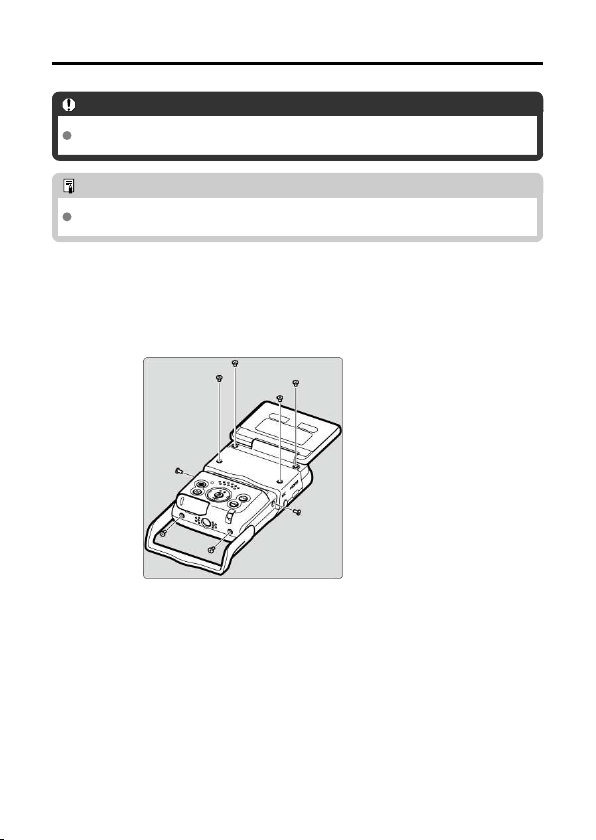
Before Disposal
Caution
DISPOSE OF USED BATTERIES ACCORDING TO LOCAL REGULATIONS.
Note
A screwdriver for M1.4 Phillips head screws is recommended for screw removal.
1.
Turn the camera off.
2.
Remove the eight screws.
283
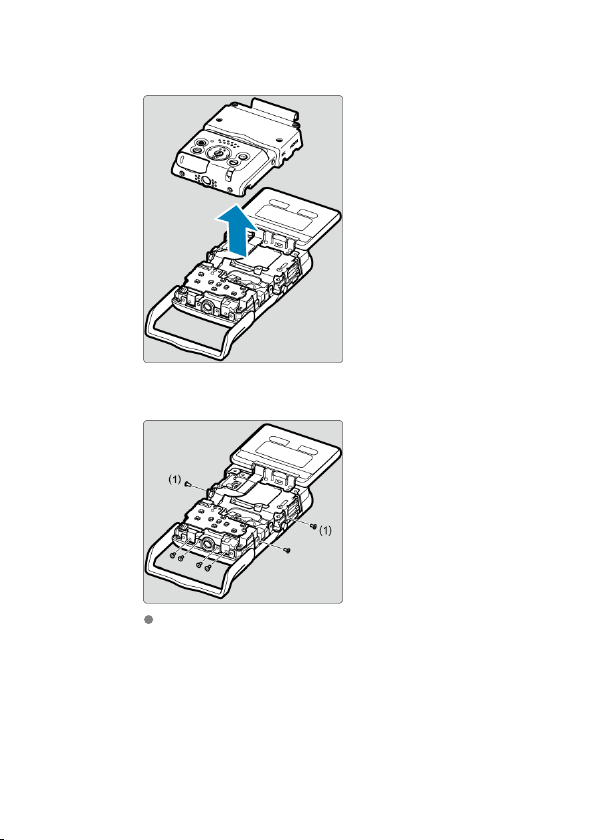
3.
Remove the back cover.
4.
Remove the seven screws.
There is no need to remove the small screws next to screw (1).
284
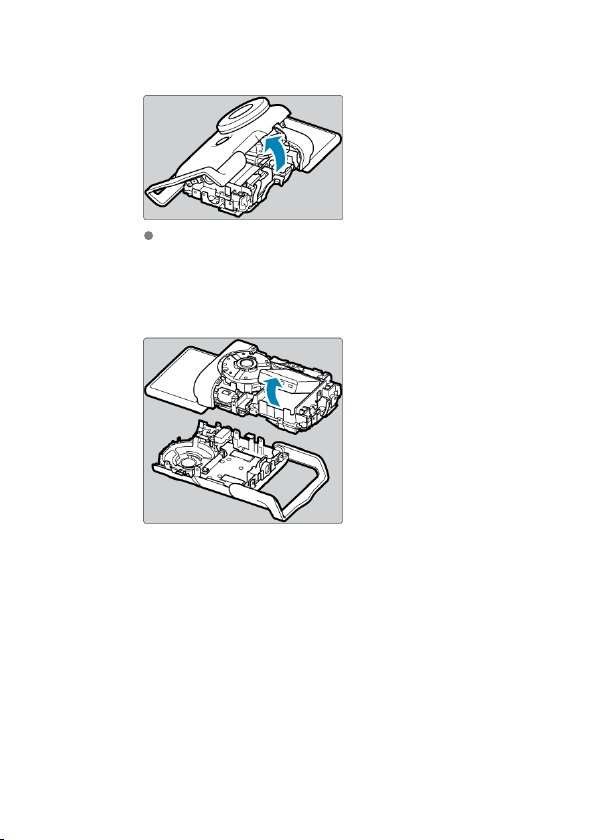
5.
Remove the front cover as shown, holding it by the side.
A tab that holds the cover in place is located near the top of the front
cover. The tab may make it difficult to remove the cover, so gradually
apply some force as you remove the cover.
6.
Remove the battery by hand as shown.
285

Trademarks and Licensing
Trademarks
About MPEG-4 Licensing
Accessories
Trademarks
Microsoft and Windows are trademarks or registered trademarks of Microsoft
Corporation in the United States and/or other countries.
App Store and macOS are trademarks of Apple Inc., registered in the U.S. and other
countries.
Google Play and Android are trademarks of Google LLC.
IOS is a trademark or registered trademark of Cisco in the U.S. and other countries and
is used under license.
QR Code is a trademark of Denso Wave Inc.
SDXC logo is a trademark of SD-3C, LLC.
The terms HDMI, HDMI High-Definition Multimedia Interface, HDMI Trade dress and the
HDMI Logos are trademarks or registered trademarks of HDMI Licensing Administrator,
Inc.
The Wi-Fi CERTIFIED logo and the Wi-Fi Protected Setup mark are trademarks of the
Wi-Fi Alliance.
The Bluetooth
®
word mark and logos are registered trademarks owned by Bluetooth
SIG, Inc. and any use of such marks by Canon Inc. is under license. Other trademarks
and trade names are those of their respective owners.
USB Type-C™ and USB-C™ are trademarks of USB Implementers Forum.
All other trademarks are the property of their respective owners.
286

About MPEG-4 Licensing
“This product is licensed under AT&T patents for the MPEG-4 standard and may be used for
encoding MPEG-4 compliant video and/or decoding MPEG-4 compliant video that was
encoded only (1) for a personal and non-commercial purpose or (2) by a video provider
licensed under the AT&T patents to provide MPEG-4 compliant video. No license is granted
or implied for any other use for MPEG-4 standard.”
THIS PRODUCT IS LICENSED UNDER THE AVC PATENT PORTFOLIO LICENSE FOR
THE PERSONAL USE OF A CONSUMER OR OTHER USES IN WHICH IT DOES NOT
RECEIVE REMUNERATION TO (i) ENCODE VIDEO IN COMPLIANCE WITH THE AVC
STANDARD (''AVC VIDEO'') AND/OR (ii) DECODE AVC VIDEO THAT WAS ENCODED BY
A CONSUMER ENGAGED IN A PERSONAL ACTIVITY AND/OR WAS OBTAINED FROM
A VIDEO PROVIDER LICENSED TO PROVIDE AVC VIDEO. NO LICENSE IS GRANTED
OR SHALL BE IMPLIED FOR ANY OTHER USE. ADDITIONAL INFORMATION MAY BE
OBTAINED FROM MPEG LA, L.L.C. SEE
HTTP://WWW.MPEGLA.COM
* Notice displayed in English as required.
287

Accessories
Use of genuine Canon accessories is recommended
This product is designed to achieve optimum performance when used with genuine Canon
accessories. Therefore, using this product with genuine accessories is highly recommended.
Canon shall not be liable for any damage to this product and/or accidents such as
malfunction, fire, etc. caused by the failure of non-genuine Canon accessories. Please note
that repairs arising out of the malfunction of non-genuine accessories will not be covered by
the warranty for repairs, although you may request such repairs on a chargeable basis.
288