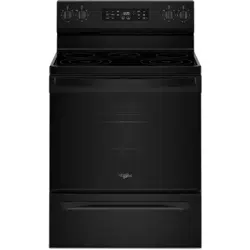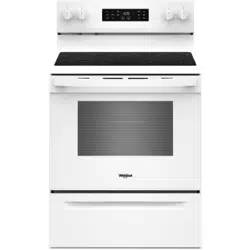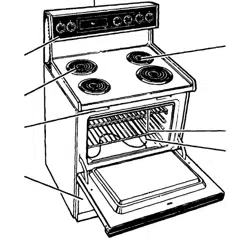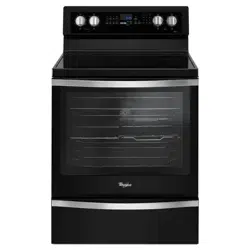
THANK YOU for purchasing this high-quality product.
For future reference, please make a note of your product model and serial numbers. These can be found on the label located on the
upper-right corner of the front frame.
Model Number__________________________________________ Serial Number__________________________________________
Table of Contents
ELECTRIC RANGE
USERINSTRUCTIONS
W11314863A
RANGE SAFETY .............................................................................2
The Anti-Tip Bracket ....................................................................2
FEATURE GUIDE ............................................................................4
COOKTOP USE ..............................................................................5
Cookware .....................................................................................7
Home Canning .............................................................................7
OVEN USE ....................................................................................... 8
Electronic Oven Controls .............................................................8
Sabbath Mode..............................................................................8
Aluminum Foil ............................................................................... 9
Positioning Racks and Bakeware ................................................9
Oven Vent ...................................................................................10
Baking and Roasting ..................................................................10
Broiling........................................................................................10
Cook Time ..................................................................................10
RANGE CARE ...............................................................................11
Self-Cleaning Cycle ....................................................................11
General Cleaning ........................................................................12
Oven Light ..................................................................................13
TROUBLESHOOTING ..................................................................13
ASSISTANCE OR SERVICE .........................................................15
2
RANGE SAFETY
The Anti-Tip Bracket
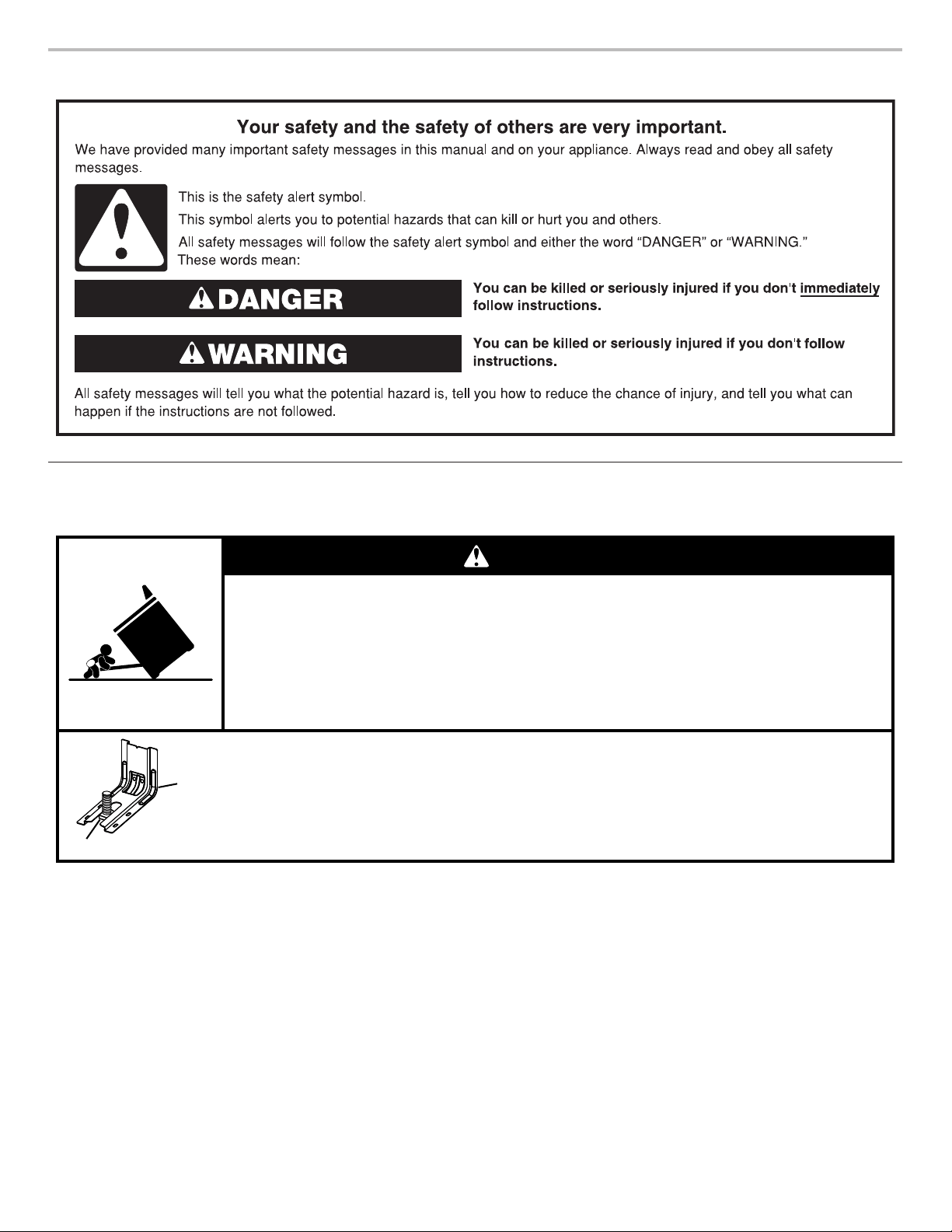
The range will not tip during normal use. However, the range can tip if you apply too much force or weight to the open door without having
the anti-tip bracket fastened down properly.
Tip Over Hazard
A child or adult can tip the range and be killed.
Verify the anti-tip bracket has been properly installed and engaged per installation instructions.
Re-engage anti-tip bracket if range is moved.
Do not operate range without anti-tip bracket installed and engaged.
Failure to follow these instructions can result in death or serious burns to children and adults.
To verify the anti-tip bracket is installed and engaged:
• Slide range forward.
• Look for the anti-tip bracket securely attached to floor or wall.
• Slide range back so rear range foot is under anti-tip bracket.
• See installation instructions for details.
WARNING
Anti-Tip
Bracket
Range Foot

3
IMPORTANT SAFETY INSTRUCTIONS
SAVE THESE INSTRUCTIONS
WARNING: To reduce the risk of fire, electrical shock,
injury to persons, or damage when using the range, follow
basic precautions, including the following:
■ WARNING:
TO REDUCE THE RISK OF TIPPING OF
THE RANGE, THE RANGE MUST BE SECURED BY
PROPERLY INSTALLED ANTI-TIP DEVICES. TO CHECK
IF THE DEVICES ARE INSTALLED PROPERLY, SLIDE
RANGE FORWARD, LOOK FOR ANTI-TIP BRACKET
SECURELY ATTACHED TO FLOOR OR WALL, AND
SLIDE RANGE BACK SO REAR RANGE FOOT IS
UNDER ANTI-TIP BRACKET.
■ CAUTION: Do not store items of interest to children in
cabinets above a range or on the backguard of a range –
children climbing on the range to reach items could be
seriously injured.
■ Proper Installation – Be sure the range is properly installed
and grounded by a qualified technician.
■ Never Use the Range for Warming or Heating the Room.
■ Do Not Leave Children Alone – Children should not be left
alone or unattended in area where the range is in use.
They should never be allowed to sit or stand on any part of
the range.
■
Wear Proper Apparel – Loose-fitting or hanging garments
should never be worn while using the range.
■
User Servicing – Do not repair or replace any part of the
range unless specifically recommended in the manual. All
other servicing should be referred to a qualified technician.
■ Storage in or on the Range – Flammable materials should
not be stored in an oven or near surface units.
■ Do Not Use Water on Grease Fires – Smother fire or flame
or use dry chemical or foam-type extinguisher.
■ Use Only Dry Potholders – Moist or damp potholders on
hot surfaces may result in burns from steam. Do not let
potholder touch hot heating elements. Do not use a towel
or other bulky cloth.
■ DO NOT TOUCH SURFACE UNITS OR AREAS NEAR
UNITS – Surface units may be hot even though they are
dark in color. Areas near surface units may become hot
enough to cause burns. During and after use, do not touch,
or let clothing or other flammable materials contact surface
units or areas near units until they have had sufficient time
to cool. Among those areas are the cooktop and surfaces
facing the cooktop.
■ Use Proper Pan Size – The range is equipped with one or
more surface units of different size. Select utensils having
flat bottoms large enough to cover the surface unit heating
element. The use of undersized utensils will expose a
portion of the heating element to direct contact and may
result in ignition of clothing. Proper relationship of utensil to
burner will also improve efficiency.
■ Never Leave Surface Units Unattended at High Heat
Settings – Boilover causes smoking and greasy spillovers
that may ignite.
■ Make Sure Reflector Pans or Drip Bowls Are in Place –
Absence of these pans or bowls during cooking may
subject wiring or components underneath to damage.
■ Protective Liners – Do not use aluminum foil to line surface
unit drip bowls or oven bottoms, except as suggested in
the manual. Improper installation of these liners may result
in a risk of electric shock, or fire.
■
Glazed Cooking Utensils – Only certain types of glass,
glass/ceramic, ceramic, earthenware, or other glazed
utensils are suitable for range-top service without breaking
due to the sudden change in temperature.
■ Utensil Handles Should Be Turned Inward and Not Extend
Over Adjacent Surface Units – To reduce the risk of burns,
ignition of flammable materials, and spillage due to
unintentional contact with the utensil, the handle of a
utensil should be positioned so that it is turned inward, and
does not extend over adjacent surface units.
■ Do Not Soak Removable Heating Elements – Heating
elements should never be immersed in water.
■ Do Not Cook on Broken Cooktop – If cooktop should
break, cleaning solutions and spillovers may penetrate the
broken cooktop and create a risk of electric shock. Contact
a qualified technician immediately.
■ Clean Cooktop With Caution – If a wet sponge or cloth is
used to wipe spills on a hot cooking area, be careful to
avoid steam burn. Some cleaners can produce noxious
fumes if applied to a hot surface.
■
Use Care When Opening Door – Let hot air or steam
escape before removing or replacing food.
■
Do Not Heat Unopened Food Containers – Build-up of
pressure may cause container to burst and result in injury.
■
Keep Oven Vent Ducts Unobstructed.
■ Placement of Oven Racks – Always place oven racks in
desired location while oven is
cool. If rack must be moved
while oven is hot, do not let potholder contact hot heating
element in oven.
■
DO NOT TOUCH HEATING ELEMENTS OR INTERIOR
SURFACES OF OVEN – Heating elements may be hot even
though they are dark in color. Interior surfaces of an oven
become hot enough to cause burns. During and after use,
do not touch, or let clothing or other flammable materials
contact heating elements or interior surfaces of oven until
they have had sufficient time to cool. Other surfaces of the
appliance may become hot enough to cause burns – among
these surfaces are oven vent openings and surfaces near
these openings, oven doors, and windows of oven doors.
For self-cleaning ranges –
■ Do Not Clean Door Gasket – The door gasket is essential
for a good seal. Care should be taken not to rub, damage,
or move the gasket.
■ Do Not Use Oven Cleaners – No commercial oven cleaner
or oven liner protective coating of any kind should be used
in or around any part of the oven.
■ Clean Only Parts Listed in Manual.
■ Before Self-Cleaning the Oven – Remove broiler pan and
other utensils.
For units with ventilating hood –
■ Clean Ventilating Hoods Frequently – Grease should not
be allowed to accumulate on hood or filter.
■ When flambeing foods under the hood, turn the fan on.
4
FEATURE GUIDE
This manual covers several models. Your model may have some or all of the items listed. Refer to this manual or the Frequently Asked
Questions (FAQs) section of our website at www.whirlpool.com for more detailed instructions.
WARNING
Food Poisoning Hazard
Do not let food sit in oven more than one hour before
or after cooking.
Doing so can result in food poisoning or sickness.
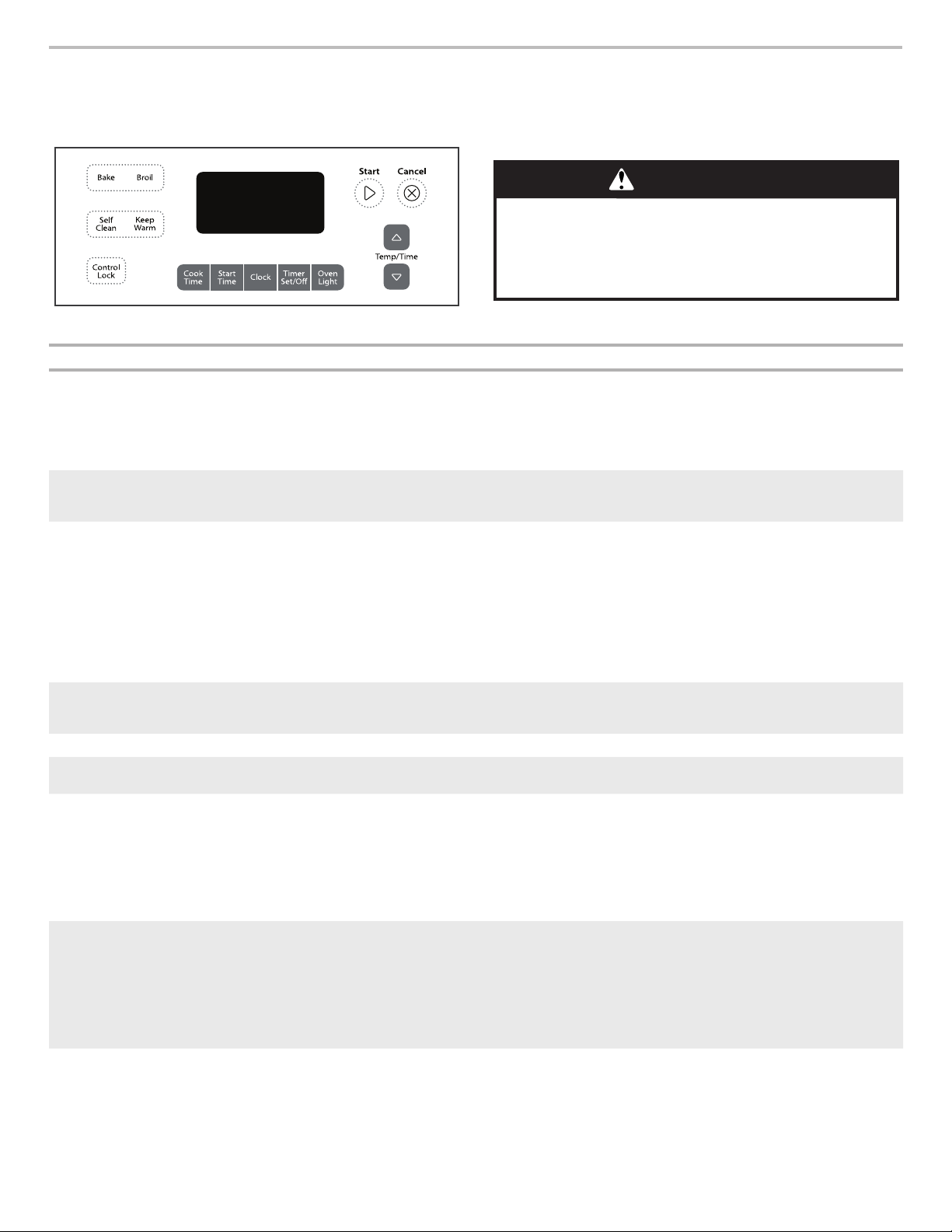
KEYPAD FEATURE INSTRUCTIONS
CLOCK Clock The Clock uses a 12-hour cycle.
1. Check that the oven is off.
2. Press CLOCK.
3. Press TEMP/TIME “up” or “down” arrow pads to set the time of day.
4. Press CLOCK or START.
OVEN LIGHT Oven cavity light The oven light is controlled by a keypad on the oven control panel. While the oven door is
closed, press the oven light switch to turn the light on and off. On some models, the oven
light will come on when the oven door is opened.
TIMER SET/OFF Oven timer The Timer can be set in hours or minutes up to 12 hours and 59 minutes.
1. Press TIMER SET/OFF.
2. Press TEMP/TIME “up” or “down” arrow pads to set the length of time.
3. Press START to begin the countdown. If enabled, end-of-cycle tones will sound at end of
countdown.
4. Press TIMER SET/OFF twice to cancel the Timer. Do not press the Cancel keypad
because the oven will turn off.
5. If the TIMER is running, but not in the display, press TIMER to display the countdown for
5 seconds.
START Cooking start The Start pad begins any oven function. If Start is not pressed within 5 seconds, “PUSH”
appears in the display. If Start is not pressed within 1 minute after pressing a keypad, the
function is canceled and the time of day is displayed.
CANCEL Range function The Cancel keypad stops any function except the Clock, Timer and Oven Control Lockout.
TEMP/TIME Temperature
andtime adjust
The “up” or “down” arrow pads are used to adjust time and temperature settings.
BAKE Baking and
roasting
1. Press BAKE.
2. Press TEMP/TIME “up” or “down” arrow pads to set a temperature other than 350°F
(175°C) in 5°F (5°C) increments between 170°F and 500°F (75°C and 260°C).
3. Press START.
4. To change the temperature, repeat Step 2. Press START or wait 5 seconds for the change
to take effect.
5. Press CANCEL when nished.
BROIL Broiling 1. Press BROIL.
2. Press TEMP/TIME “up” or “down” arrow pads to change the temperature in 5°F (5°C)
increments between 300°F and 500°F (150°C and 260°C).
3. Press START, and allow oven to preheat for 5 minutes.
4. Position cookware in the oven and close the oven door to the broil stop position so that
the door is open approximately 6" (15 cm).
5. Press CANCEL when nished.
KEEP WARM
(on some models)
Hold warm Food must be at serving temperature before placing it in the warmed oven.
1. Press KEEP WARM.
2. Temperature is set at 170°F (75°C) for 60 minutes (1.00 hour).
3. Press START.
4. Press CANCEL when nished.
NOTE: The oven will automatically turn off after 60 minutes.
5
KEYPAD FEATURE INSTRUCTIONS
START TIME
(on some models)
Delayed start The Start Time keypad is used to enter the starting time for an oven function with a delayed
start. Start Time should not be used for foods such as breads and cakes because they may
not bake properly. To set a Timed Cook or a Delayed Timed Cook, see “Cook Time” section.
COOK TIME
(on some models)
Timed cooking Timed Cooking allows the oven to be set to turn on at a certain time of day, cook for a set
length of time, and/or shut off automatically.
To set a Timed Cook or a Delayed Timed Cook, see “Cook Time” section.
SELF CLEAN
(on some models)
Self-Cleaning
cycle
See the “Self-Cleaning Cycle” section.
CONTROL LOCK Oven control
lockout
1. Check that the oven is off.
2. Press and hold the CONTROL LOCK keypad for 3 seconds.
3. A tone will sound, and “Loc” will be displayed.
4. Repeat to unlock. Only the CLOCK, OVEN LIGHT and TIMER keypads will function with
the controls locked. The cooktop functions are not affected by the oven control lockout.
COOKTOP USE
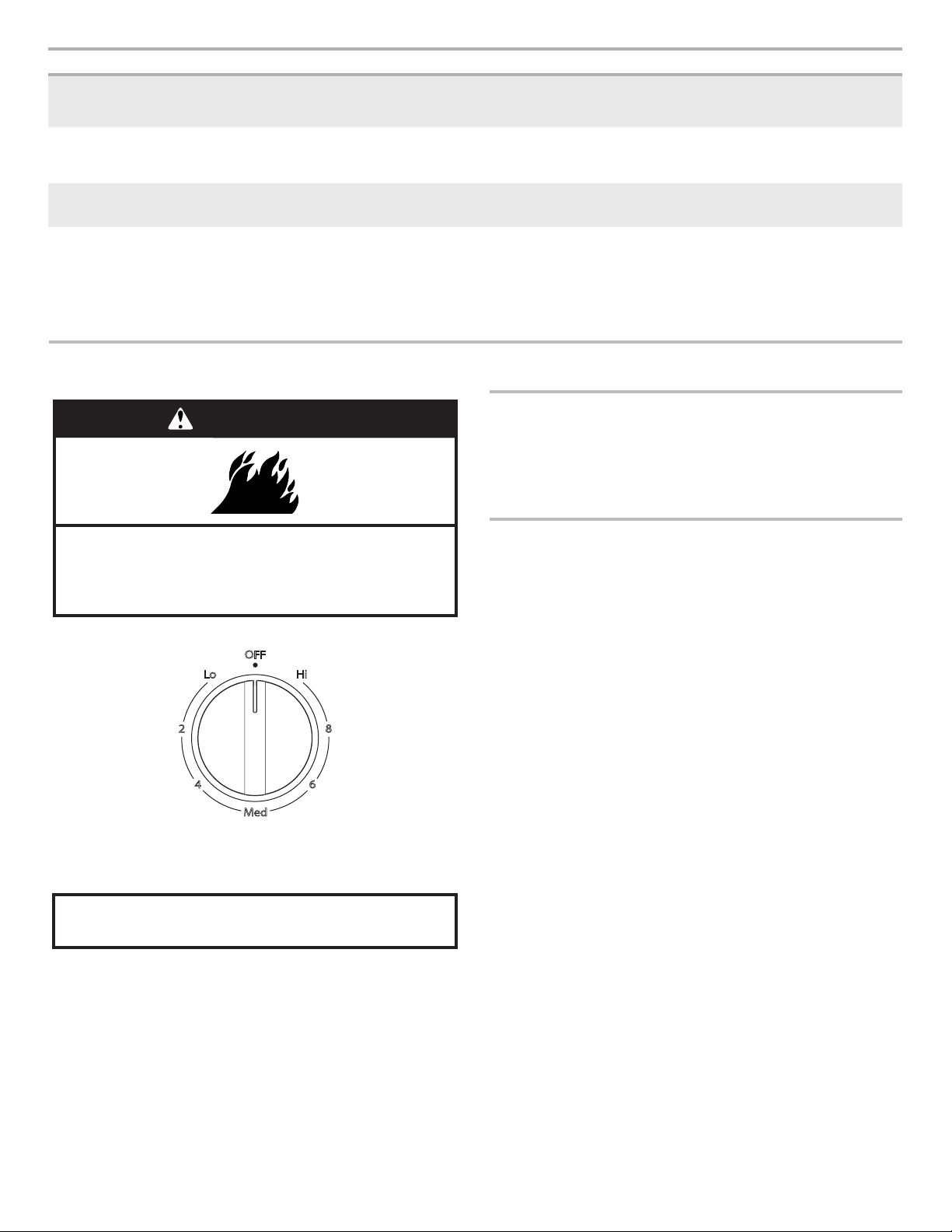
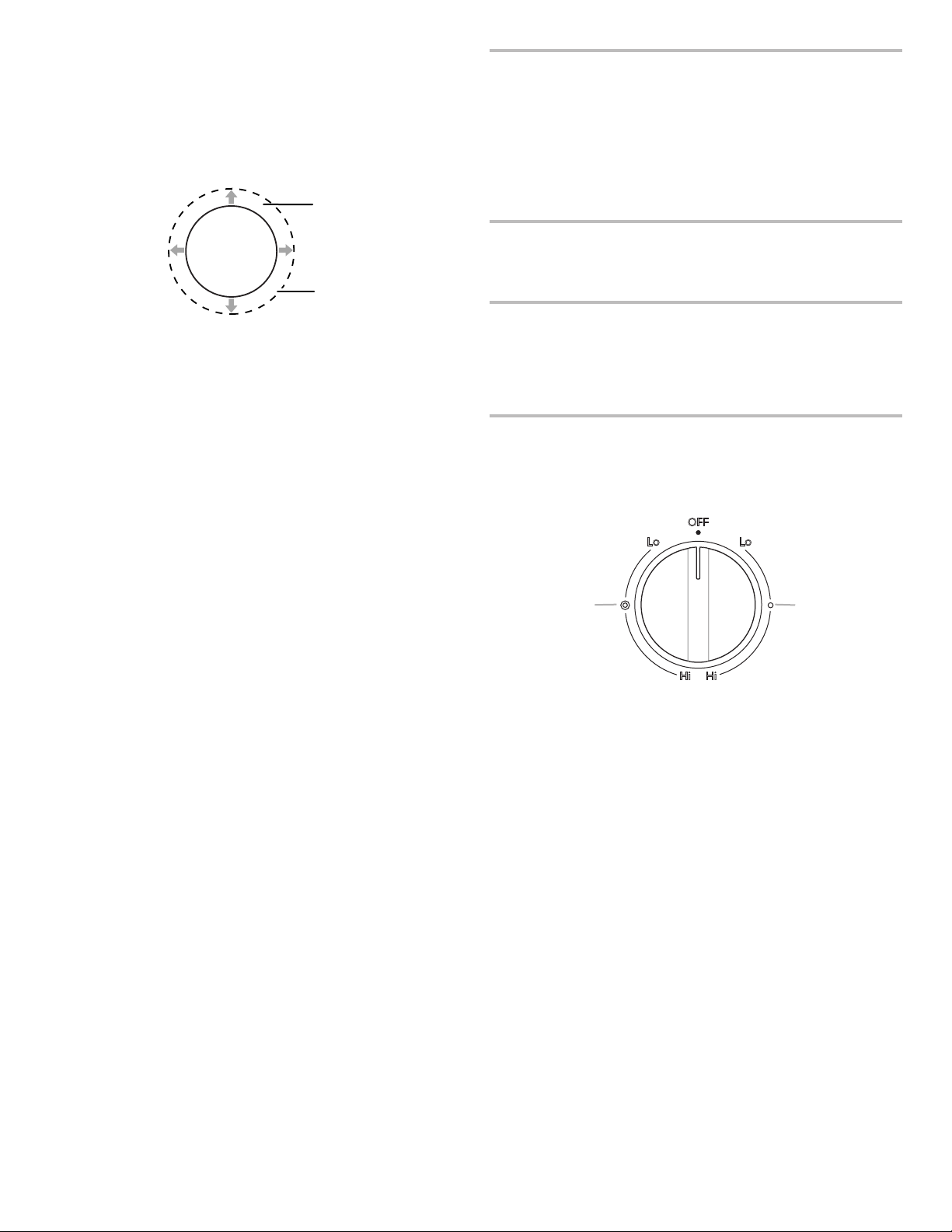
The control knobs can be set to anywhere between HIGH and
LOW. Push in and turn to setting.
Coil Elements and Burner Bowls (on some models)
Coil elements should be level for optimal cooking results. Burner
bowls, when clean, reect heat back to the cooktop. They also
help catch spills.
Cookware should not extend more than 1/2" (1.3 cm) over the coil
element. If cookware is uneven or too large, it can produce excess
heat, causing the burner bowl to change color.
Ceramic Glass (on some models)
The surface cooking area will glow red when an element is on.
Some parts of the surface cooking area may not glow red when
an element is on. This is normal operation. The burner will cycle
on and off to maintain the selected heat level. It will also randomly
cycle off and back on again even while in High to keep the
cooktop from extreme temperatures.
It is normal for the surface of light colored ceramic glass to appear
to change color when surface cooking areas are hot. Asthe glass
cools, it will return to its original color.
Clean the cooktop after each use to help avoid scratches, pitting,
abrasions, and to condition the glass surface. Baking soda and
a non scratch heavy duty scrub sponge are also recommended
for stubborn soils. Do not use abrasive cleaners, cleaning pads or
harsh chemicals for cleaning. Refer to the “Range Care” section
for additional information.
IMPORTANT: To avoid permanent damage to the cooktop surface
and to make soils easier to remove, clean the cooktop after each
use to remove all soils.
■ Avoid storing jars or cans above the cooktop. Dropping
a heavy or hard object onto the cooktop could crack the
cooktop.
■ To avoid damage to the cooktop, do not leave a hot lid on
the cooktop. As the cooktop cools, air can become trapped
between the lid and the cooktop, and the ceramic glass
couldbreak when the lid is removed.
■ For foods containing sugar in any form, clean up all spills and
soils as soon as possible. Allow the cooktop to cool down
slightly. Then, while wearing oven mitts, remove the spills
using a scraper while the surface is still warm. If sugary spills
are allowed to cool down, they can adhere to the cooktop and
can cause pitting and permanent marks.
■ To avoid scratches, do not slide cookware or bakeware across
the cooktop. Aluminum or copper bottoms and rough nishes
on cookware or bakeware could leave scratches or marks on
the cooktop.
■ Do not cook popcorn in prepackaged aluminum containers on
the cooktop. They could leave aluminum marks that cannot be
removed completely.
WARNING
Fire Hazard
Turn off all controls when done cooking.
Failure to do so can result in death or fire.
REMEMBER: When range is in use, the entire cooktop area
may become hot.
6
■ To avoid damage to the cooktop, do not allow objects that
could melt, such as plastic or aluminum foil, to touch any
partof the entire cooktop.
■ To avoid damage to the cooktop, do not use the cooktop
asacutting board.
■ Use cookware about the same size as the surface cooking
area. Cookware should not extend more than 1/2" (1.3 cm)
outside the area.
■ Use at-bottomed cookware for best heat conduction and
energy efciency. Cookware with rounded, warped, ribbed,
ordented bottoms could cause uneven heating and poor
cooking results.
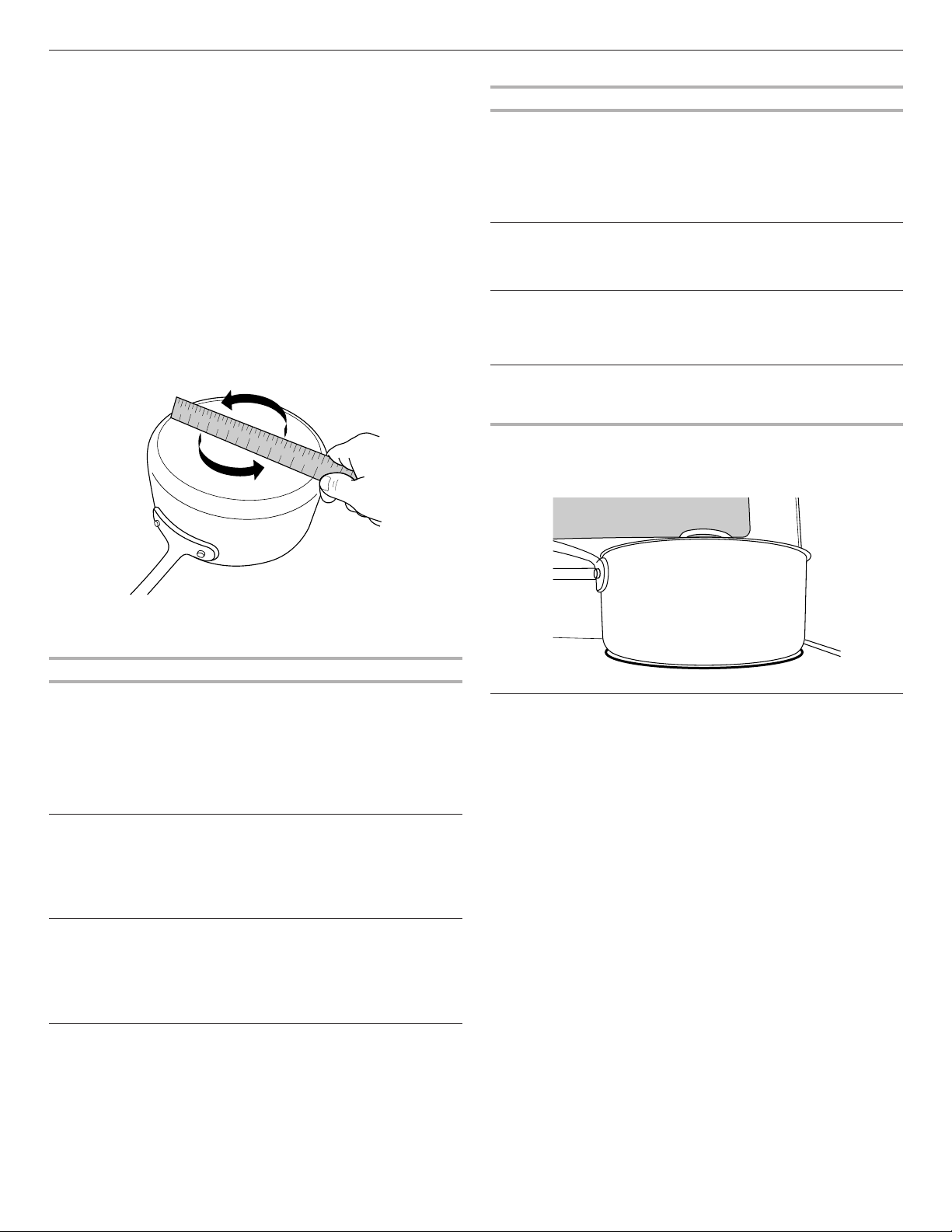
■ Determine atness by placing the straight edge of a ruler
across the bottom of the cookware. While you rotate the
ruler, no space or light should be visible between it and
thecookware.
■ Cookware designed with slightly indented bottoms or small
expansion channels can be used.
■ Make sure the bottoms of pots and pans are clean and dry
before using them. Residue and water can leave deposits
when heated.
■ To avoid damage to the cooktop, do not cook foods directly
on the cooktop.
Ceramic Glass Cooktop Cleaning (on some models)
Clean the cooktop after each use to help avoid scratches, pitting,
abrasions and to condition the glass surface. Baking soda and a
non scratch heavy duty scrub sponge are also recommended for
stubborn soils. Do not use abrasive cleaners, cleaning pads or
harsh chemicals for cleaning. Refer to the “Range Care” section
for additional information.
IMPORTANT: To avoid permanent damage to the cooktop surface
and to make soils easier to remove, clean the cooktop after each
use to remove all soils.
Cooktop On Indicator Light
The Cooktop On indicator light is located on the console panel.
When any control knob on the console panel is turned on, the
Cooktop On indicator light will glow.
Hot Surface Indicator Light (on some models)
On ceramic glass models, the hot surface indicator light is located
on the console panel.
The hot surface indicator light will glow as long as any surface
cooking area is too hot to touch, even after the surface cooking
area is turned off.
Dual Zone Cooking Element (on some models)
The Dual Zone cooking element offers exibility depending on the
size of the cookware. Single size can be used in the same way as
a regular element. The dual size combines both the single and
outer element and is recommended for larger size cookware.
A
B
C
A. Surface cooking area
B. Cookware/canner
C. 1/2" (1.3 cm) maximum overhang
A
B
C
A
B
A. Dual
B. Single
7
Cookware
IMPORTANT: Do not leave empty cookware on a hot surface
cooking area, element, or surface burner.
Ideal cookware should have a at bottom, straight sides, and a
well-tting lid, and the material should be of medium-to-heavy
thickness.
Rough nishes may scratch the cooktop. Aluminum and
coppermay be used as a core or base in cookware. However,
when used as a base, they can leave permanent marks on
thesurfaces.
Cookware material is a factor in how quickly and evenly heat
is transferred, which affects cooking results. A nonstick nish
has thesame characteristics as its base material. For example,
aluminum cookware with a nonstick nish will take on the
properties of aluminum.
Cookware with nonstick surfaces should not be used under
thebroiler.
Check for atness by placing the straight edge of a ruler across
the bottom of the cookware. While you rotate the ruler, no space
or light should be visible between it and the cookware.
Use the following chart as a guide for cookware material
characteristics.
COOKWARE CHARACTERISTICS
Aluminum ■ Heats quickly and evenly.
■ Suitable for all types of cooking.
■ Medium or heavy thickness is best
formost cooking tasks.
■ May leave aluminum residues,
which may be diminished if cleaned
immediately after cooking.
Cast iron ■ Heats slowly and evenly.
■ Good for browning and frying.
■ Maintains heat for slow cooking.
■ Rough edges or burrs may scratch
thecooktop.
Ceramic or
ceramic glass
■ Follow manufacturer’s instructions.
■ Heats slowly, but unevenly.
■ Ideal results on low to medium heat
settings.
■ May scratch the cooktop.
COOKWARE CHARACTERISTICS
Copper ■ Heats very quickly and evenly.
■ May leave copper residues, which may
be diminished if cleaned immediately
after cooking.
■ Can leave a permanent stain or bond
tothe cooktop if overheated.
Earthenware ■ Follow manufacturer’s instructions.
■ Use on low heat settings.
■ May scratch the cooktop.
Porcelain
enamel-on-steel
or castiron
■ See stainless steel or cast iron.
■ Porcelain enamel bakeware without the
metal base may bond to the cooktop if
overheated.
Stainless steel ■ Heats quickly, but unevenly.
■ A core or base of aluminum or copper
on stainless steel provides even heating.
Use at-bottomed cookware for best cooking results and energy
efciency. The cookware should be about the same size as the
cooking area outlined on the cooktop. Cookware should not
extend more than 1/2" (1.3 cm) outside the area.
Home Canning
Canning can be performed on a glass smooth top cooking surface
or traditional coil element cooktop. When canning for long periods,
alternate the use of surface cooking areas or elements between
batches. This allows time for the most recently used areas to cool.
■ Center the canner on the largest surface cooking area or
element. On electric cooktops, canners should not extend
more than 1/2" (1.3 cm) beyond the surface cooking area
orelement.
■ Do not place canner on 2 surface cooking areas or elements
atthe same time.
■ On ceramic glass models, use only at-bottomed canners
toavoid damage to the cooktop and elements.
■ For more information, contact your local agricultural extension
ofce or refer to published home canning guides. Companies
that manufacture home canning products can also offer
assistance.
1
2
3
4
5
6
7
8
9
1 0
1 1
1 2
1 3
1 4
1 5
1 6
1 7
1 8
1 9
2 0
1
2
3
4
5
6
7

8
OVEN USE
Odors and smoke are normal when the oven is used the rst few
times, or when it is heavily soiled.
IMPORTANT: The health of some birds is extremely sensitive to
the fumes given off. Exposure to the fumes may result in death
to certain birds. Always move birds to another closed and well-
ventilated room.
Electronic Oven Controls
Control Display
The display will ash when powered up or after a power loss.
Press CANCEL to clear. When oven is not in use, the time of day
isdisplayed.
Options Mode
Press and hold TIMER for 5 seconds, and “Opt” will appear. Use
the Temp/Time “up” or “down” arrow pads to cycle through the
following options. Press CANCEL to exit the mode.
Fahrenheit and Celsius
The temperature is preset at Fahrenheit, but can be changed to
Celsius. Press TIMER to toggle between Fahrenheit and Celsius.
Press CANCEL to exit.
End of Cycle Tones
“b1” (beep once) or “b” (continue to beep) will be displayed. Press
TIMER to toggle through selections. Press CANCEL to exit.
Oven Light with Door Open
“LOn” indicates that the oven light will turn on when the door is
open. If “LOFF” is displayed, the oven light will turn on only with
the oven light switch. Press TIMER to toggle through selection.
Press CANCEL to exit.
12-Hour Shutoff
If “12 Hr” is displayed, the oven will automatically shut off after
12 hours. Press TIMER to toggle to “- - Hr” to disable the 12-hour
shutoff. Press CANCEL to exit.
Tones
Tones are audible signals, indicating the following:
Basic Functions
One Tone
■ Valid keypad press
■ Oven is preheated (long tone)
■ Function has been entered
■ Reminder (on some models), repeating every 20 seconds after
the end-of-cycle tones
Three Tones
■ Invalid keypad press
Four Tones
■ End of cycle
Oven Temperature Control
IMPORTANT: Do not use a thermometer to measure oven
temperature. Elements will cycle on and off as needed to provide
consistent temperature but may run slightly hot or cool at any
point in time due to this cycling. Most thermometers are slow
to react to temperature change and will not provide an accurate
reading due to this cycling.
The oven provides accurate temperatures; however, it may cook
faster or slower than your previous oven, so the temperature can
be adjusted to personalize it for your cooking needs. It can be
changed in Fahrenheit or Celsius.
To Adjust Oven Temperature:
1. Press and hold BAKE for 5 seconds until the oven display
shows the current setting, for example “0°F CAL” or “00.”
2. Press the Temp/Time “up” or “down” arrow pads to increase
or to decrease the temperature in 10°F (5°C or 6°C) amounts.
The adjustment can be set between 30°F (17°C) and -30°F
(-17°C).
3. Press START.
Sabbath Mode (on some models)
The Sabbath mode sets the oven to remain on in a Bake setting
until turned off. A Timed Bake can also be set to keep the oven on
for only part of the Sabbath. The Oven Control Lockout Feature
(if present) will be disabled during the Sabbath mode. After the
Sabbath mode is set, no tones will sound, the display will not
show the temperature, the Kitchen Timer mode will be canceled
(ifactive), and only the following keypads will function:
■ “Up” or “down” arrow pads
■ Cancel
When the oven door is opened or closed, the oven light will not
turn on or off and the heating elements will not turn on or off
immediately.
When power is restored after a power failure, the oven will return
to Sabbath Mode and remain Sabbath compliant with the bake
elements off until the Cancel keypad is pressed.
Pressing the Cancel keypad at any time returns the oven to the
normal cooking mode (not Sabbath Mode compliant).
Before entering the Sabbath Mode, it must be decided if the oven
light is to be on or off for the entire Sabbath Mode period. If the
light is on when entering Sabbath Mode, it will remain on for the
entire time Sabbath Mode is in use. If the light is off when entering
Sabbath Mode, it will remain off for the entire time Sabbath Mode
is in use. Opening the oven door or pressing the Oven Light
keypad will not affect the oven light once Sabbath Mode has been
entered.
If the oven has the Convection Bake feature, the oven light is
controlled by a separate Oven Light switch on the console. If the
oven light is n when entering the Sabbath mode, it will remain on
for the entire time Sabbath mode is in use. For the oven light to
be off during the Sabbath mode, the light bulb must be removed
from the oven prior to entering the Sabbath mode. Not performing
these steps will cause the oven light to turn on when the oven
door is opened, resulting in the oven being not Sabbath compliant.
On the Holiday, the oven temperature can be changed once the
oven is in Sabbath mode by pressing the “up” or “down” arrow
keypad. The oven temperature will change 25°F (14°C) each time
the keypad is pressed. The display will not change and there will
be no sounds during this adjustment.
9
To Bake Using Sabbath Mode:
1. Press BAKE.
2. Press the “up” or “down” arrow pads.
3. Press START.
4. Press and hold the TIMER keypad for 5 seconds. “SAb” will
ash in the display.
5. Press START within 5 seconds to enter Sabbath Mode;
otherwise, the entire cycle cancels out. “SAb” will stop ashing
and remain on in the display. The oven is now in Sabbath
Mode and is Sabbath compliant.
Pressing the Cancel keypad at any time returns the oven to the
normal cooking mode (not Sabbath mode compliant).
To Set a Timed Bake Using Sabbath Mode
(onsomemodels):
1. Press BAKE.
2. Press the “up” or “down” arrow pads to enter a temperature
other than the one displayed.
3. Press COOK TIME. The Cook Time oven indicator light will
light up.
4. Press the “up” or “down” arrow pads to enter a cook time
length.
5. Press START.
6. Press and hold the TIMER keypad for 5 seconds. “SAb” will
ash in the display.
7. Press START within 5 seconds to enter Sabbath Mode;
otherwise, the entire cycle cancels out. “SAb” will stop ashing
and remain on in the display. The oven is now in Sabbath
Mode and is Sabbath compliant. The Bake, On and Cook Time
indicator lights will be displayed.
When the set cook time ends, the oven will shut off automatically
and the indicator lights will turn off, indicating the end of the cycle.
Pressing the Cancel keypad at any time returns the oven to the
normal cooking mode (not Sabbath mode compliant).
To Set a Delayed Timed Bake Using Sabbath Mode
(onsome models):
1. Press BAKE.
2. Press the “up” or “down” arrow pads to enter a temperature
other than the one displayed.
3. Press COOK TIME. The Cook Time oven indicator light will
light up.
4. Press the “up” or “down” arrow pads to enter a cook time
length.
5. Press START TIME. The Start Time indicator light will light up.
6. Press the “up” or “down” arrow pads to enter a start time.
7. Press START.
8. Press and hold the TIMER keypad for 5 seconds. “SAb” will
ash in the display.
9. Press START within 5 seconds to enter Sabbath Mode;
otherwise, the entire cycle cancels out. “SAb” will stop ashing
and remain on in the display. The oven is now in Sabbath
Mode and is Sabbath compliant. The On and Delay indicator
lights will be displayed.
When the start time is reached the Bake, On and Cook Time
indicator lights will automatically turn on. When the set cook time
ends, the oven will shut off automatically and the indicator lights
will turn off, indicating the end of the cycle.
Pressing the Cancel keypad at any time returns the oven to the
normal cooking mode (not Sabbath Mode compliant).
Aluminum Foil
IMPORTANT: To avoid permanent damage to the oven bottom
nish, do not line the oven bottom with any type of foil or liner.
For best cooking results, do not cover entire oven rack with foil
because air must be able to move freely.
Positioning Racks and Bakeware
IMPORTANT: To avoid permanent damage to the porcelain
nish, do not place food or bakeware directly on the oven door or
bottom.
Bakeware
To cook food evenly, hot air must be able to circulate. Allow
2"(5cm) of space around bakeware and oven walls. Make
surethatno bakeware piece is directly over another.
Racks
■ Position racks before turning on the oven.
■ Do not move racks with bakeware on them.
■ Make sure racks are level.
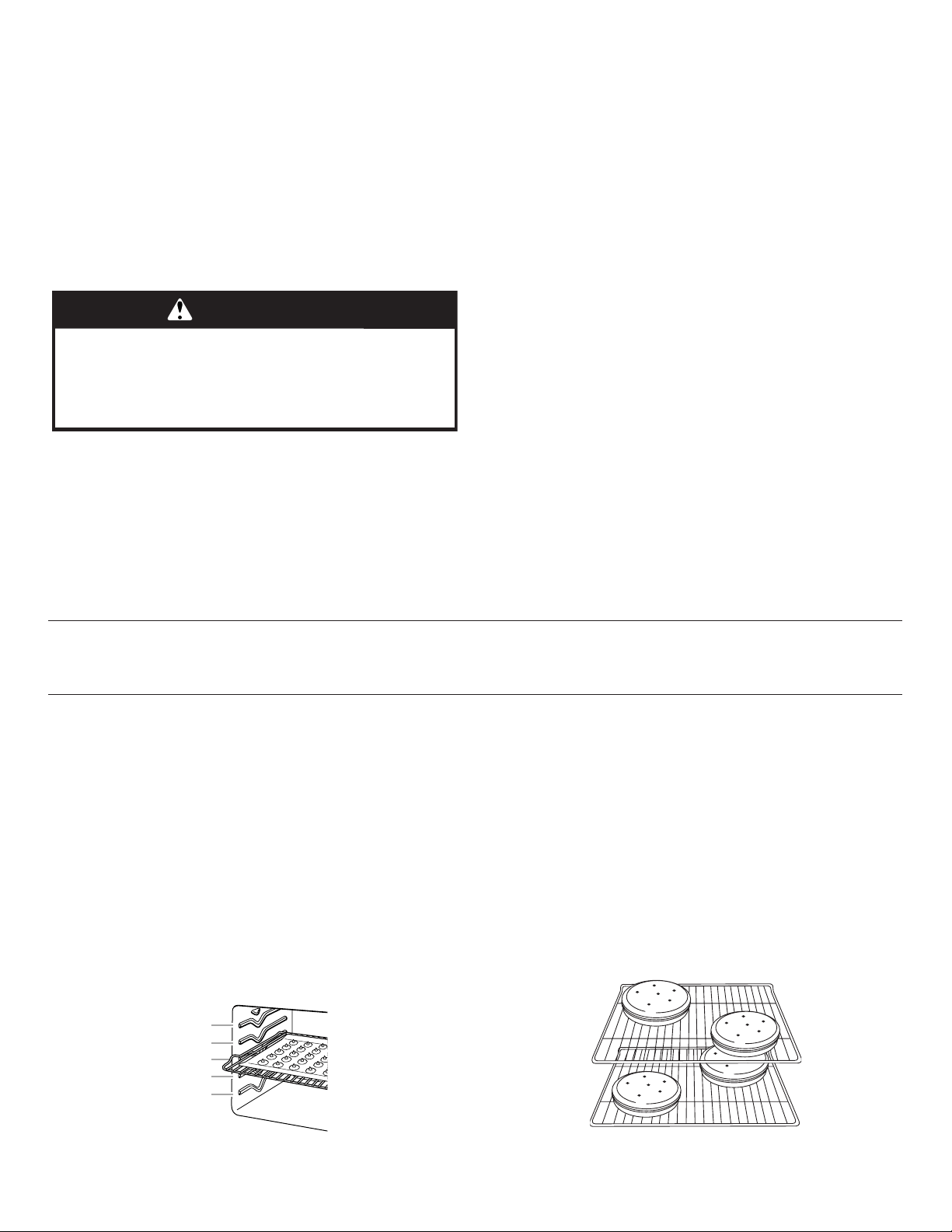
To move a rack, pull it out to the stop position, raise the front
edge, and then lift out. Use the following illustration asa guide.
Rack Positions
Rack 5: Toasting bread or broiling thin, non-fatty foods.
Rack 4: Use for 2-rack baking and broiling.
Rack 3: Most baked goods on a cookie sheet or jelly roll pan, layer
cakes, frozen convenience foods. Broiling chicken pieces.
Rack 2: Roasting small cuts of meat, pies, casseroles, bundt
cakes, and 2-rack baking.
Rack 1: Roasting large cuts of meat and poultry.
Multiple Rack Cooking
2-rack: Use rack positions 2 and 4.
Baking Layer Cakes on 2 Racks
For best results when baking cakes on 2 racks, use racks 2 and 4
for baking. Place the cakes on the racks as shown.
WARNING
Food Poisoning Hazard
Do not let food sit in oven more than one hour before
or after cooking.
Doing so can result in food poisoning or sickness.
1
2
3
4
5
10
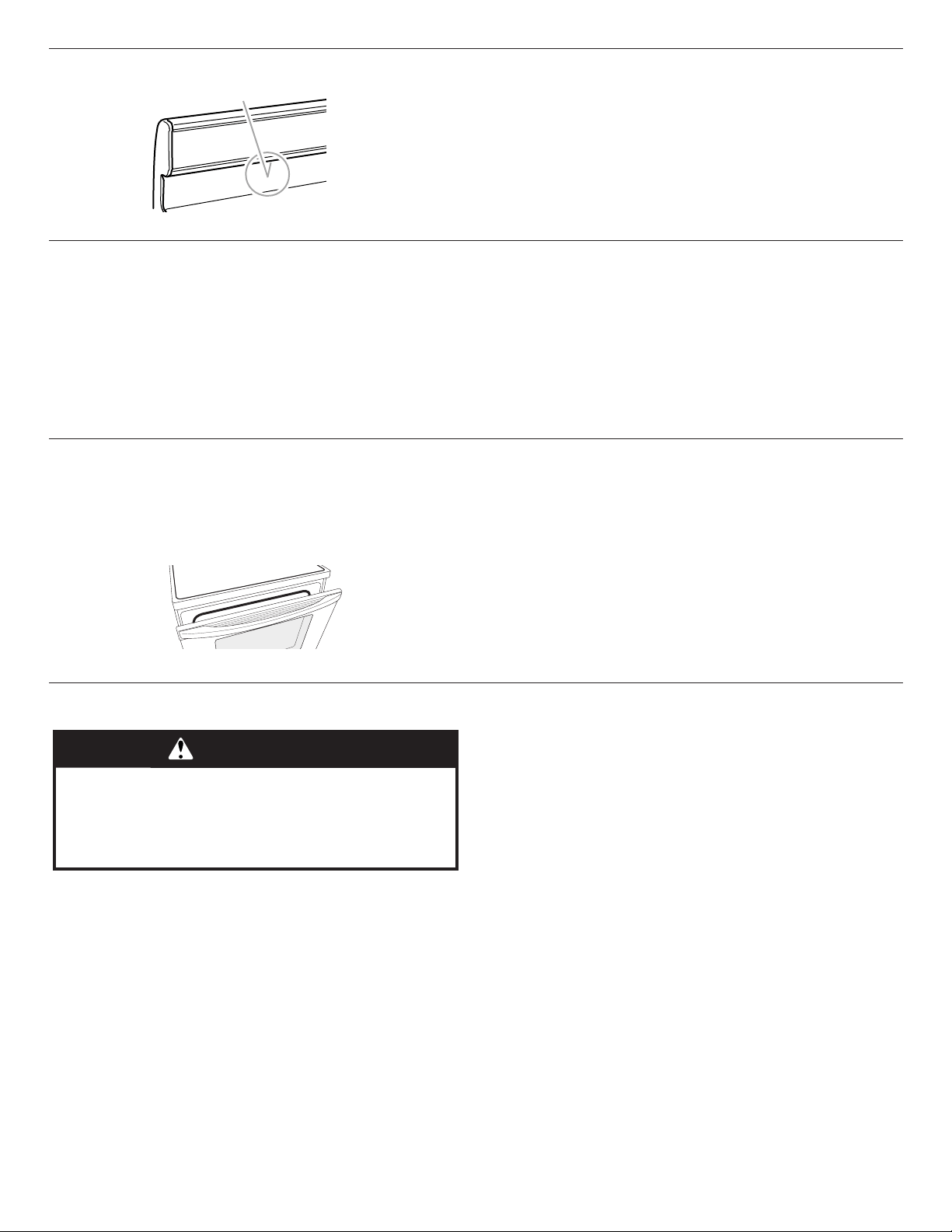
Oven Vent
The oven vent releases hot air and moisture from the oven,
andshould not be blocked or covered. Blocking or covering the
oven vent will cause poor air circulation, affecting cooking and
cleaning results. Do not set plastics, paper, or other items that
could melt or burn near the oven vent.
Baking and Roasting
ACCUBAKE
®
Temperature Management System
The ACCUBAKE
®
system electronically regulates the oven heat
levels during preheat and bake to maintain a precise temperature
range for optimal cooking results. The bake and broil elements
cycle on and off in intervals. The bake element will glow red when
cycling on; the broil element will not. This feature is automatically
activated when the oven is in use.
Before baking and roasting, position racks according to
“Positioning Racks and Bakeware” section. When roasting, it is not
necessary to wait for the oven preheat cycle to end before putting
food in unless it is recommended in the recipe.
Preheating
When START is pressed, the oven will begin preheating. Once
100ºF (38ºC) is reached, the display temperature will increase as
the actual temperature of the oven increases. When the preheat
temperature is reached, a tone will sound, and the selected
temperature will appear on the display.
Broiling
Leave the door open 6" (15 cm) at the broil stop position to ensure
proper broiling temperature. Preheat the oven for 5 minutes before
putting food in unless recommended otherwise in the recipe.
Position food on grid in a broiler pan, then place it in the center of
the oven rack.
NOTE: Odors and smoke are normal the rst few times the oven
isused or if the oven is heavily soiled.
Changing the temperature when broiling allows more precise
control when cooking. The lower the broil setting, the slower the
cooking. Thicker cuts and unevenly shaped pieces of meat, sh
and poultry may cook better at lower broil settings. Use racks 4
or 5 for broiling. Refer to the “Positioning Racks and Bakeware”
section for more information.
On lower settings, the broil element will cycle on and off to
maintain the proper temperature.
■ For best results, use a broiler pan and grid. It is designed to
drain juices and help avoid spatter and smoke.
Cook Time (on some models)
To Set a Timed Cook:
1. Press BAKE. The bake indicator light will light up.
2. Press the TEMP/TIME “up” or “down” arrow pads to enter a
temperature other than the one displayed.
3. Press COOK TIME. The cook time oven indicator light will light
up.
4. Press the TEMP/TIME “up” or “down” arrow pads to enter the
length of time to cook.
5. Press START. The display will count down the time. When the
time ends, the oven will shut off automatically and “End” will
appear on the display.
6. Press CANCEL to clear the display.
To Set a Delayed Timed Cook:
Before setting, make sure the clock is set to the correct time
of day. See the “Clock” keypad feature in the “Feature Guide”
section.
1. Press BAKE.
2. Press the TEMP/TIME “up” or “down” arrow pads to enter a
temperature other than the one displayed.
3. Press COOK TIME. The cook time oven indicator light will light
up.
4. Press TEMP/TIME “up” or “down” arrow pads to enter the
length of time to cook.
5. Press START TIME. The start time/delay oven indicator light
will light up.
6. Press TEMP/TIME “up” or “down” arrow pads to enter the time
of day to start.
7. Press START.
When the start time is reached, the oven will automatically turn
on. The temperature and/or time settings can be changed anytime
after pressing Start by repeating steps 1-7. When the set cook
time ends, the oven will shut off automatically and “End” will
appear on the display.
8. Press CANCEL to clear the display.
A
A. Oven vent
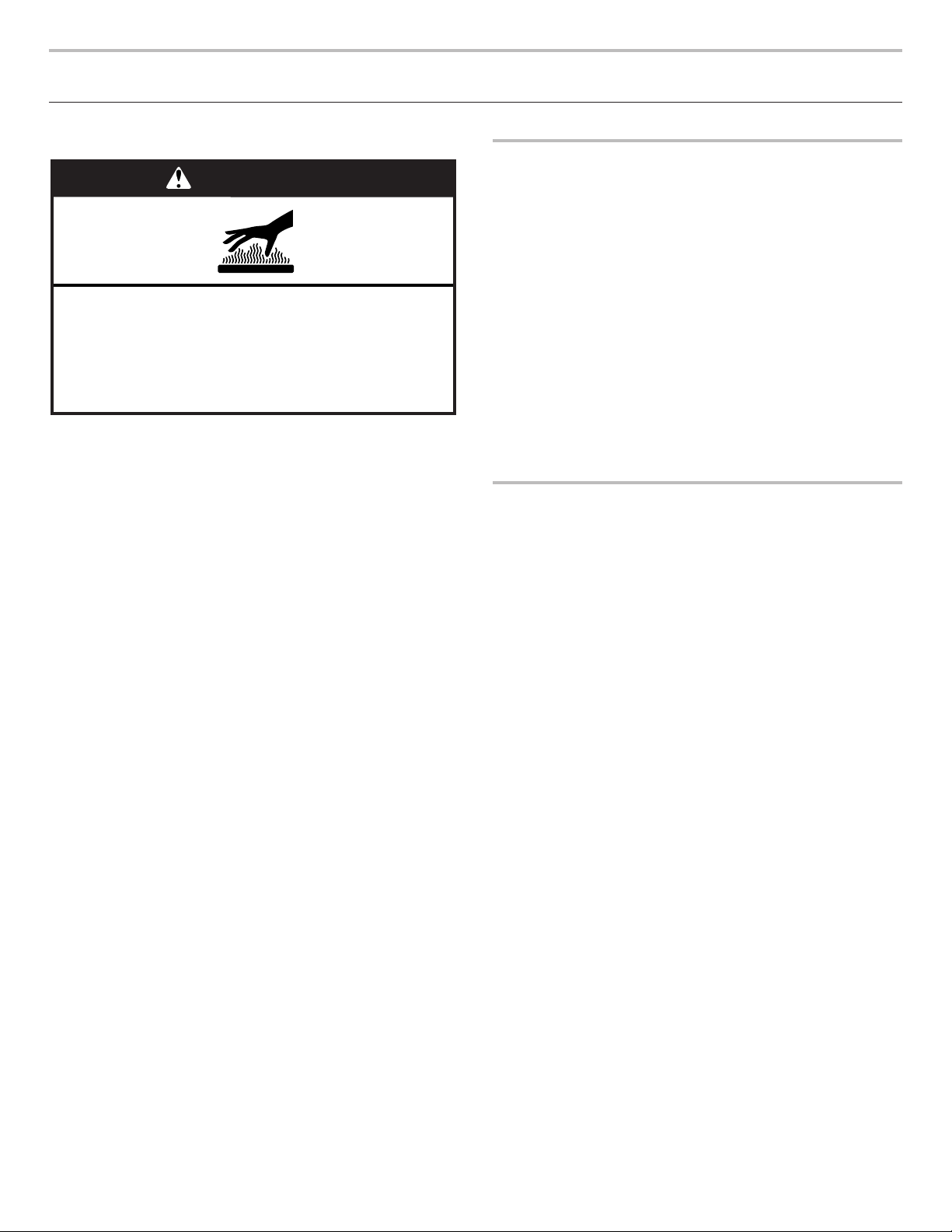
WARNING
Food Poisoning Hazard
Do not let food sit in oven more than one hour before
or after cooking.
Doing so can result in food poisoning or sickness.
11
RANGE CARE
Self-Cleaning Cycle (on some models)
IMPORTANT: The health of some birds is extremely sensitive to
the fumes given off during the Self-Cleaning cycle. Exposure to
thefumes may result in death to certain birds. Always move birds
to another closed and well-ventilated room.
Do not block the oven vent(s) during the Self-Cleaning cycle.
Air must be able to move freely. Depending on your model, see
“Oven Vent” section.
Do not clean, rub, damage, or move the oven door gasket.
Prepare Range:
■ Remove the broiler pan, grid, cookware and bakeware, all
cooking utensils, oven racks, aluminum foil, and, on some
models, the temperature probe from the oven.
■ Use a damp cloth to clean inside door edge and the 1
1
/
2
"
(3.8cm) area around the inside oven cavity frame, being
certain not to move or bend the gasket.
■ Remove plastic items from the cooktop because they
maymelt.
■ Remove all items from the storage drawer.
How the Cycle Works
IMPORTANT: The heating and cooling of porcelain on steel in the
oven may result in discoloring, loss of gloss, hairline cracks and
popping sounds.
Before self-cleaning, make sure the door is completely closed or
the door will not lock and the self-cleaning cycle will not begin.
Once the oven has completely cooled, remove ash with a damp
cloth. To avoid breaking the glass, do not apply a cool damp cloth
to the inner door glass before it has completely cooled.
To stop the self-cleaning cycle at anytime, press the CANCEL
keypad. If the temperature is too high, the oven door will remain
locked and “cool” and “locked” will be displayed.
The oven light will not function during the self-cleaning cycle.
Style 1 - Electronic Oven Control with Adjustable Clean
Time (on some models)
The SELF CLEAN self-cleaning cycle is time adjustable between
2 hours 30 minutes and 4 hours 30 minutes in 15-minute
increments. Suggested clean times are 2 hours 30 minutes
for light soil, and 4 hours 30 minutes for heavy soil. The last
30minutes of the cycle is for cool down.
To Self-Clean:
1. Press SELF CLEAN.
2. Press the TEMP/TIME “+” or “-” arrow keypads to enter the
desired self-clean cycle time.
3. Press START.
The oven door will automatically lock. The DOOR LOCKED
and CLEAN indicator lights will be displayed. The time
remaining willalso be displayed.
4. When the self-clean cycle is complete and the oven cools, the
DOOR LOCKED and CLEAN indicator lights will turn off.
5. When the oven is completely cooled, remove ash with a damp
cloth.
Style 2 - Electronic Oven Control with Adjustable Self-
Clean (HI - LO) (on some models)
The self-cleaning cycle can be set at HI self-clean time (4 hours
30 minutes) or LO self-clean time (3 hours 30 minutes). The
suggested clean times are 3 hours 30 minutes for light soil, or 4
hours 30 minutes for heavy soil. The last 30 minutes of the cycles
is for cool down.
To Self-Clean:
1. Press SELF CLEAN to set the clean time to HI (4 hours
30minutes).
2. Press the TEMP/TIME “+” or “-” arrow pads to cycle between
LO and HI clean time.
3. Press START.
The oven door will automatically lock. The CLEAN indicator
light will be displayed. The time remaining will also be
displayed.
4. When the self-clean cycle is complete and the oven cools, the
CLEAN indicator light will turn off.
5. When the oven is completely cooled, remove ash with a damp
cloth.
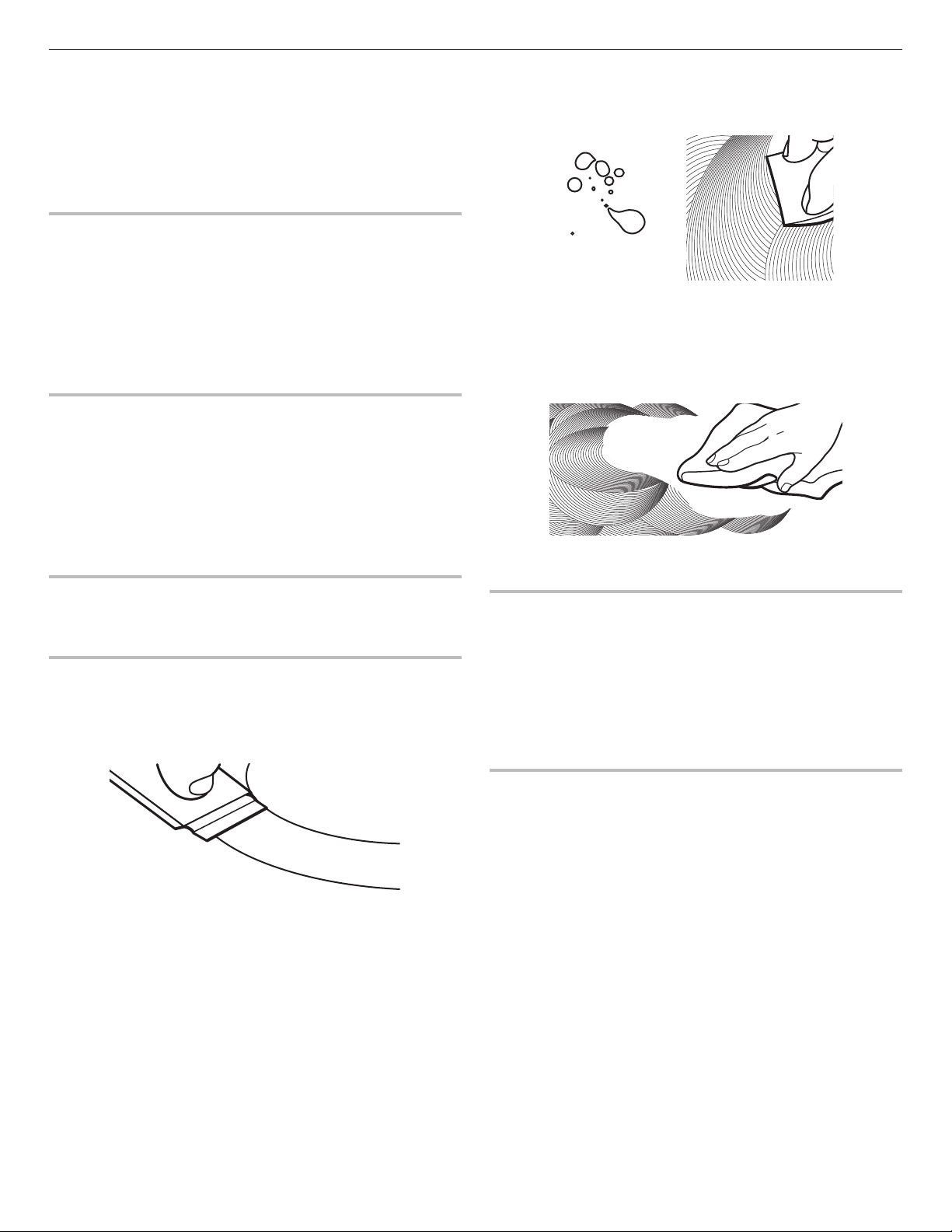
WARNING
Burn Hazard
Do not touch the oven during the Self-Cleaning cycle.
Keep children away from oven during
Self-Cleaning cycle.
Failure to follow these instructions can result in burns.
12
General Cleaning
IMPORTANT: Before cleaning, make sure all controls are off and
the oven and cooktop are cool. Always follow label instructions
on cleaning products. For additional information, you can visit
the Frequently Asked Questions (FAQs) section of our website at
www.whirlpool.com.
Soap, water, and a soft cloth or sponge are suggested rst
unlessotherwise noted.
EXTERIOR PORCELAIN ENAMEL SURFACES
(onsomemodels)
Food spills containing acids, such as vinegar and tomato, should
be cleaned as soon as the entire range is cool. These spills may
affect the nish.
Cleaning Method:
■ Glass cleaner, mild liquid cleaner, or nonabrasive
scrubbingpad:
Gently clean around the model and serial number plate
becausescrubbing may remove numbers.
STAINLESS STEEL (on some models)
NOTE: To avoid damage to stainless steel surfaces, do not use
soap-lled scouring pads, abrasive cleaners, Cooktop Cleaner,
steel-wool pads, gritty washcloths, or abrasive paper towels.
Damage may occur to stainless steel surfaces, even with one-time
or limited use.
Cleaning Method:
Rub in direction of grain to avoid damaging.
All-purpose cleaner:
Rinse with clean water and dry with soft, lint-free cloth.
METALLIC PAINT (on some models)
Do not use abrasive cleaners, cleaners with bleach, rust removers,
ammonia, or sodium hydroxide (lye) because the paintsurface
maystain.
CERAMIC GLASS (on some models)
Cleaning Method:
To avoid damaging the cooktop, do not use steel wool, abrasive
powder cleansers, chlorine bleach, rust remover, or ammonia.
1. Remove food/residue with the Cooktop Scraper.
■ For best results, use the Cooktop Scraper while the
cooktop is still warm but not hot to the touch. It is
recommended to wear an oven mitt while scraping
thewarm cooktop.
■ Hold the Cooktop Scraper at approximately a 45° angle
against the glass surface and scrape the residue. It will
be necessary to apply pressure in order to remove the
residue.
Allow the cooktop to cool down completely before proceeding
to Step 2.
2. Apply a few dime-sized drops of Cooktop Cleaner tothe
affected areas.
■ Rub Cooktop Cleaner onto the cooktop surface with the
blue Cooktop Cleaning Pad. Some pressure is needed to
remove stubborn stains.
■ Allow the cleaner to dry to a white haze before proceeding
to Step 3.
3. Polish with a clean, dry cloth or a clean, dry paper towel.
■ Repeat steps 1 through 3 as necessary for stubborn
orburned-on stains.
COOKTOP CONTROLS
To avoid damage to the cooktop controls, do not use steel wool,
abrasive cleansers, or oven cleaner.
To avoid damage, do not soak knobs.
When replacing knobs, make sure knobs are in the Off position.
On some models, do not remove seals under knobs.
Cleaning Method:
■ Soap and water:
Pull knobs straight away from control panel to remove.
CONTROL PANEL AND OVEN DOOR EXTERIOR
To avoid damage to the control panel, do not use abrasive
cleaners, steel-wool pads, gritty washcloths, or abrasive
papertowels.
Cleaning Method:
■ Glass cleaner and soft cloth or sponge:
Apply glass cleaner to soft cloth or sponge, not directly
onpanel.

13
COIL ELEMENTS (on some models)
Cleaning Method:
■ Damp cloth: Make sure control knobs are off and elements are
cool.
Do not clean or immerse in water. Soil will burn off when hot.
BURNER BOWLS (on some models)
Before removing or replacing coil elements and burner bowls,
make sure they are cool and the control knobs are in the OFF
position.
Remove the coil element by pushing the edge of the coil element
toward the receptacle. Lift it enough to clear the burner bowl. Pull
the coil element straight away from the receptacle to remove. Lift
out the burner bowl.
Cleaning Method:
Chrome burner bowls
Wash frequently in warm, soapy water. (It is not recommended to
wash chrome bowls in a dishwasher.) A mild abrasive cleaner and
a plastic scrubber can be used to remove stubborn stains.
For heavily soiled bowls, place an ammonia soaked paper towel
on the stains and allow to soak for a short time, then gently scrub
with a plastic scrubber.
OVEN RACKS
Cleaning Method:
■ Steel-wool pad
■ For racks that have discolored and are harder to slide, a light
coating of vegetable oil applied to the rack guides will help
them slide.
STORAGE DRAWER OR WARMING DRAWER (on some
models)
Check that storage drawer or warming is cool and empty before
cleaning.
Cleaning Method:
■ Mild detergent
OVEN CAVITY
Do not use oven cleaners on models with self-clean.
Food spills should be cleaned when oven cools. At high
temperatures, foods react with porcelain. Staining, etching,
pitting,or faint white spots can result.
Cleaning Method:
■ See the “Self-Cleaning Cycle” section, if available on your
model.
Oven Light
The oven light is a standard 40 W appliance bulb. Before
replacing, make sure the oven and cooktop are cool and the
control knobs are in the off position.
To Replace:
1. Unplug range or disconnect power.
2. Turn the glass bulb cover in the back of the oven
counterclockwise to remove.
3. Turn bulb counterclockwise to remove from socket.
4. Replace bulb, then bulb cover by turning clockwise.
5. Plug in range or reconnect power.
TROUBLESHOOTING
Try the solutions suggested here rst in order to avoid the cost of an unnecessary service call.
Operation
PROBLEM POSSIBLE CAUSES SOLUTIONS
Nothing will operate Power supply cord is unplugged. Plug into a grounded outlet.
Household fuse is blown, or a
circuit breaker is tripped.
Replace the fuse or reset the circuit breaker. If the problem
continues, call an electrician.
The control displays an F9 or
F9E0 error code.
The electrical outlet in the home may be miswired. Contact
aqualied electrician to verify the electrical supply.
Cooktop will not operate The control knob is not set
correctly.
Push in knob before turning to a setting.
On ceramic glass models, the
oven control lockout is set.
See the “Control Lock” keypad feature in the “Feature
Guide”section.
Excessive heat around
cookware on cooktop
Cookware that is not the
propersize.
Use cookware about the same size as the surface cooking area,
element, or surface burner. Cookware should not extend more
than 1/2" (1.3 cm) outside the cooking area.
Cooktop cooking results not
what expected
Control knob set to incorrect
heat level.
See the “Cooktop Use” section.
Range is not level. Level the range. See the Installation Instructions.
Cooktop element cycles
onand off on High setting
Element cycling due to a
temperature limiter.
This is normal operation. The element may cycle on and off
tokeep the cooktop from overheating.

14
PROBLEM POSSIBLE CAUSES SOLUTIONS
Oven will not operate Delay start is set. See the “Cook Time” section.
Control lock is on. Press and hold START for 3 seconds to unlock.
Control is in Demo mode. Press and hold START TIME for 10 seconds to exit Demo Mode.
Demo Mode is used for display models in showroom.
Electronic oven control set
incorrectly.
See the “Electronic Oven Controls” section.
Oven temperature
toohighortoo low
Oven temperature needs
adjustment.
See “Oven Temperature Control” in the “Electronic Oven
Controls” section.
Oven indicator lights ash Power to range is turned on
or restored.
See “Control Display” in the “Electronic Oven Controls” section.
If the indicator light(s) keep(s) ashing, call for service. See cover
for contact information.
Display shows messages Power failure (display shows
ashing time).
Clear the display. On some models, reset the clock, if needed.
See the “Clock” keypad feature in the “Feature Guide” section.
Error code (display shows letter
followed by number).
Depending on your model, press the CANCEL to clear the
display. See “Control Display” in the “Electronic Oven Controls”
section. If it reappears, call for service. See cover for contact
information.
The Start keypad needs to be
pressed so acycle can begin
(display shows “PUSH” or “PSH”).
See the “Start” keypad feature in the “Feature Guide” section.
Self-Cleaning cycle
willnotoperate
The oven door is not closed. Make sure the oven door is fully closed.
The Self-Cleaning function has
notbeen entered correctly.
See the “Self-Cleaning Cycle” section.
A Timed Cooking function has
been entered.
See the “Cook Time” section.
The range is in Sabbath mode. See the “Sabbath Mode” section.
Oven cooking results not
what expected
Range is not level. Level the range. See the Installation Instructions.
The temperature set wasincorrect. Double-check the recipe in a reliable cookbook.
Oven temperature is needs
adjustment.
See “Oven Temperature Control” in the “Electronic Oven
Controls” section.
Oven was not preheated. See the “Baking and Roasting” section.
Racks were positioned improperly. See the “Positioning Racks and Bakeware” section.
Not enough air circulation around
bakeware.
See the “Positioning Racks and Bakeware” section.
Batter distributed unevenly in pan. Check that batter is level in the pan.
Darker browning of food caused
by dull or dark bakeware.
Lower oven temperature 25°F (15°C) or move rack to a higher
position in the oven.
Lighter browning of food
caused by shiny or light-colored
bakeware.
Move rack to a lower position in the oven.
Incorrect length of cooking time
was used.
Adjust cooking time.
Oven door was not closed. Be sure that the bakeware does not keep the door from closing.
Oven door was opened
duringcooking.
Oven peeking releases oven heat and can result in longer
cooking times.
Oven door was open for too long. If the oven door remains open for too long, the heating elements
will shut off until the oven door is closed.
Rack is too close to bake burner,
making baked items too brown
onbottom.
Move rack to higher position in the oven.
Pie crusts browning too quickly. Use aluminum foil to cover the edge of the crust and/or reduce
baking temperature.

15
ASSISTANCE OR SERVICE
Before calling for assistance or service, please check “Troubleshooting.” It may save you the cost of a service call. If you still need help,
check the contact information on the Certicate of Warranty that accompanies the product.
When calling, please know the purchase date and the complete model and serial number of your appliance. This information will help us
to better respond to your request.