Contents
Before Getting Started...
General Guide
Creating Your Profile
Indicators
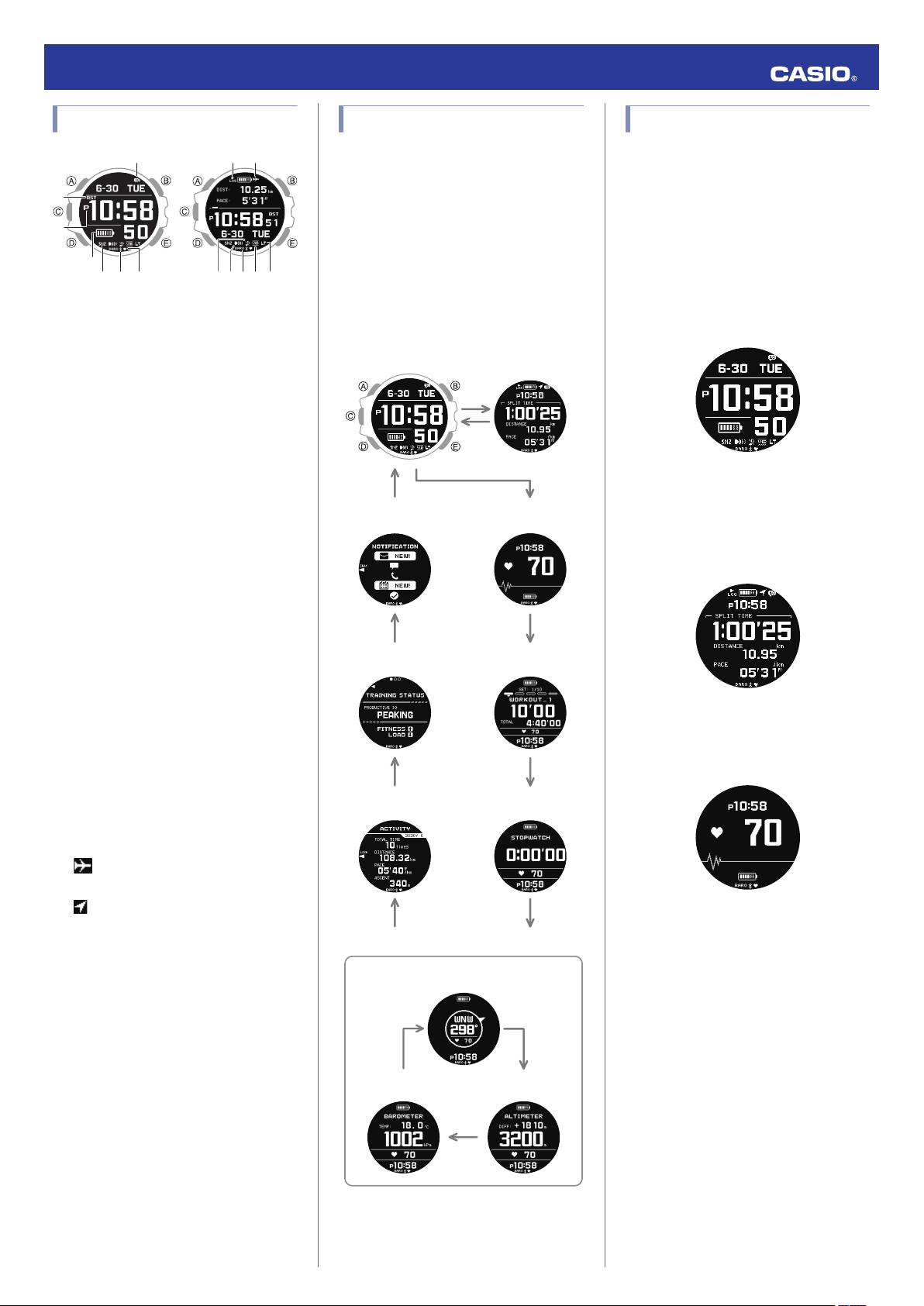
Navigating Between Modes
Mode Overview
Selecting a Timekeeping Mode Digital Display
Format
Charging the Watch
Solar Charging
Charging with the Charger Cable
Checking the Charge Level
Charging Time Guidelines
Power Saving Function
Viewing the Face in the Dark
Useful Features
Time Adjustment
GPS Time Adjustment
Overview
Appropriate Signal Reception Location
Acquiring GPS Location Information
Manually
Acquiring GPS Time Information Manually
Receiving Time Information
Automatically
Leap Second Reception
Signal Reception Precautions
Using GPS Outside Your Country
Using Watch Operations to Adjust the Time
Setting
Using the Watch in a Medical Facility or
Aircraft
Using Mobile Link with a Mobile
Phone
Getting Ready
Auto Time Adjustment
Viewing Training Records
Viewing Life Log Related Data
Setting Target Values
Creating a Training Plan
Specifying Checkpoints Along a Running
Course (Altitude Navigation)
Specifying the Alert Interval (Target Alert)
Specifying the Distance for Auto Lap Timing
Setting Up Programmable Timers
Configuring World Time Settings
Setting the Alarm
Phone Finder
Configuring Watch Settings
Connection
Connecting with a Phone
Unpairing
If you purchase another phone
Measuring Your Heart Rate
Using Heart Rate Measurement
Starting Heart-rate Training
Heart Rate Measurement Precautions
Precautions When Putting on the Watch
Using the Training Function
Run Timing
Changing Display Information During Run
Timing
Changing the GPS Receive Interval
Checking the Altitude Differential Between
Your Current Location and a Checkpoint
Setting Up Alerts
Displaying Your Actual Running Distance
Specifying the Distance Unit
Enabling Auto Run Timing (Auto Run
Detection)
Enabling Auto Lap Timing
Enabling Auto Pause
Specifying the Screen to be Displayed During
Running (RUN FACE)
Settings Configured with the Application
Run Timing Precautions
Viewing Training Log Records
Viewable Training Log Items
Viewing Recorded Log Data Records
Deleting a Particular Log Data Record
Deleting All Log Data Records
Viewing Your Training
Performance Condition
Checking Your Training Status
Checking Your VO2MAX
Checking Your Recovery Time
Training Status Display Precautions
Operation Guide 3475
1
MA2202-EI
© 2020 CASIO COMPUTER CO., LTD.
Receiving Phone Notifications
Enabling and Disabling Incoming Call
Notifications
Displaying Notification Contents
Deleting a Particular Notification
Deleting All Notifications
Digital Compass
Taking a Compass Reading
Calibrating the Compass
Calibrating Compass Readings
Setting Up for True North Readings
(Magnetic Declination Calibration)
Magnetic North and True North
Digital Compass Reading Precautions
Altitude Measurement
Checking the Current Altitude
Setting a Reference Altitude and Taking
Relative Altitude Readings
Calibrating Altitude Readings
Setting Up the Auto Measurement Interval
Changing Displayed Information
Specifying the Altitude Measurement Unit
Altitude Reading Precautions
Barometric Pressure and
Temperature Measurement
Checking the Current Barometric Pressure
and Temperature
Barometric Pressure Change Indications
Calibrating Barometric Pressure Readings
Calibrating Temperature Readings
Changing Displayed Information
Specifying the Barometric Pressure Unit
Specifying the Temperature Unit
Barometric Pressure and Temperature
Reading Precautions
Timer
Setting the Timer Start Time
Using the Timer
Using the Programmable Timer for Interval
Training
Overview
Configuring Programmable Timer
Settings
Using a Programmable Timer
Stopwatch
Measuring Elapsed Time
Measuring a Split Time
World Time
Checking World Time
World Time City Setting
Configuring the Summer Time Setting
Alarms
Configuring Alarm Settings
Turning Off an Alarm
Pedometer
Counting Steps
Causes of Incorrect Step Count
Other Settings
Button Operation Sound Setting
Configuring Notification Sound Settings
Configuring Vibration Settings
Specifying the Height and Weight Units
Specifying the Calorie Display Unit
Resetting Watch Settings
Other Information
City Table
Summer Time Table
Fitness Categories
Supported Phones
Specifications
Checking Wireless Compliance Information
Mobile Link Precautions
Copyrights and Registered Copyrights
Troubleshooting
Operation Guide 3475
2
Before Getting
Started...
This section provides an overview of the watch
and introduces convenient ways it can be
used.
●
What you can do with this watch
●
Acquisition of accurate time and location
information by receiving GPS signals and
connecting with a phone
●
Measurement and recording of running and
other data
ー
Auto run detection
ー
Auto lap
ー
Auto pause
ー
Training log data recording
●
Heart rate measurement
●
Measurement of calories burned
●
Step count
●
Measurement of direction, altitude,
barometric pressure, and temperature
●
Transfer of data to your phone for viewing
with the app
Important!
●
This watch is not a special-purpose
measuring instrument. Measurement
function readings are intended for
general reference only.
●
Whenever using the Digital Compass
of this watch for serious trekking,
mountain climbing, or other activities,
be sure to always take along another
compass to confirm readings. If the
readings produced by the Digital
Compass of this watch are different
from those of the other compass,
perform 3-point calibration or figure 8
calibration of the watch compass to
correct direction measurement.
ー
Compass readings and calibration
will not be possible if the watch is in
the vicinity of a permanent magnet
(magnetic accessory, etc.), metal
objects, high-voltage wires, aerial
wires, or electrical household
appliances (TV, computer,
cellphone, etc.)
l
Digital Compass
●
The watch’s Altimeter Mode calculates
and displays relative altitude based on
barometric pressure readings
produced by its pressure sensor.
Because of this, altitude values
displayed by the watch may be
different from your actual elevation
and/or sea level elevation indicated for
the area where you are located.
Regular calibration in accordance with
the local altitude (elevation)
indications is recommended.
l
Altitude Measurement
Note
●
The illustrations included in this
operation guide have been created to
facilitate explanation. An illustration
may differ somewhat from the item it
represents.
●
For more accurate display values,
create your profile before using heart
rate measurement or the Training
Function.
l
Creating Your Profile
●
Depending on the version of your
watch’s software, its operations and
display contents may differ from those
described in this Operation Guide.
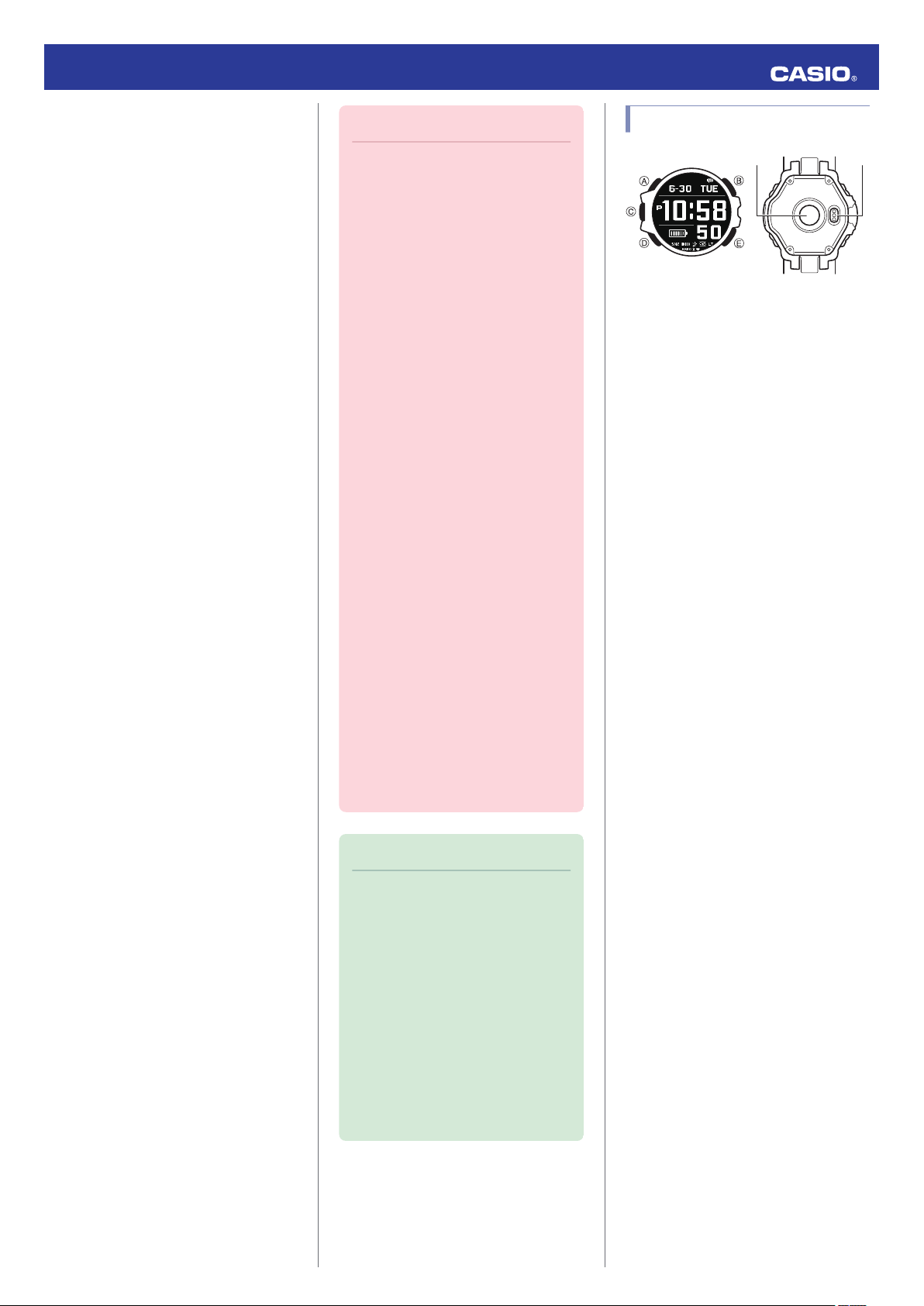
General Guide
①②
A button
Pressing this button in any mode cycles
between displays.
While a setting screen is displayed, pressing
this button scrolls available menu items
upwards.
B button
Press to turn on illumination.
C button
In the Timekeeping Mode, pressing this button
enters the Training Mode.
Pressing this button while any mode’s setting
screen is displayed applies all of the screen’s
pending settings or changes.
D button
Hold down this button for at least one second
to return to the Timekeeping Mode. Pressing
this button while a run timing operation is in
progress returns to the run timing screen.
Pressing this button while a setting screen is
displayed scrolls available menu items
downwards.
E button
In other modes, pressing this button returns to
the Timekeeping Mode.
While configuring settings, pressing this
button goes back to the previous screen.
A
Optical sensor (heart rate detection)
Detects your pulse for heart rate
measurement.
B
Charging terminal
Plug in the charger cable here to connect to a
device with a USB terminal for charging.
l
Charging with the Charger Cable
Operation Guide 3475
3
Creating Your Profile
You can use the procedure in this section to
input information and create a profile (height,
weight, gender, date of birth, wrist where
watch is worn). You need to create a profile
before you can display information in the
Training Status Mode. Creation of a profile is
also recommended to enable calculation of
more accurate heart rate zones.
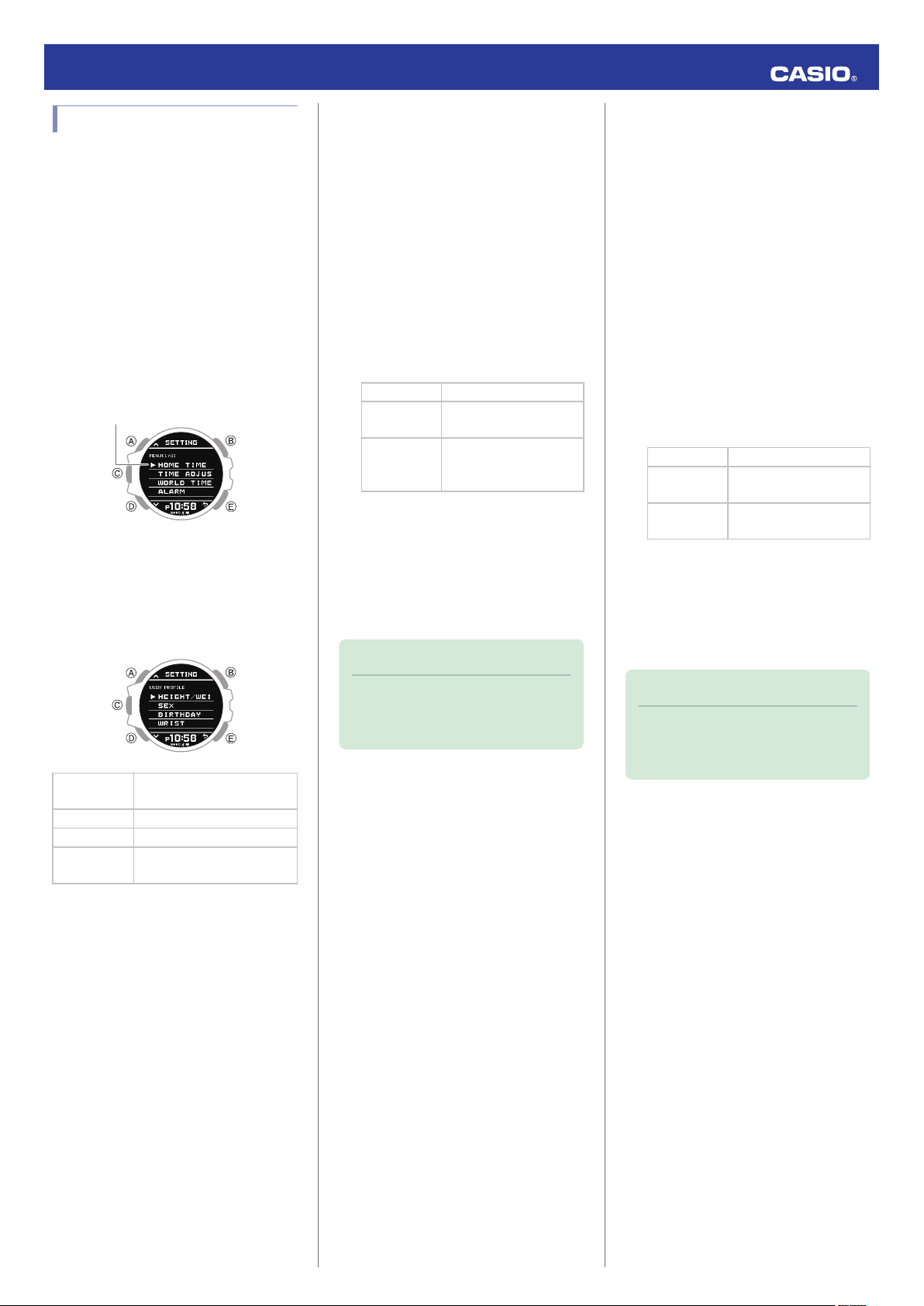
1. Enter the Timekeeping Mode.
l
Navigating Between Modes
2. Hold down (A) for at least two seconds.
This displays the Timekeeping Mode
setting screen.
Pointer
3. Use (A) and (D) to move the pointer to
[PROFILE].
4. Press (C).
This displays the profile item selection
screen.
[HEIGHT/
WEIGHT]
Height/weight
[SEX] Gender
[BIRTHDAY] Date of birth
[WRIST]
Wrist where you wear the
watch
5. Use (A) and (D) to select the item you want
to input.
6. Press (C).
7. Record your height and weight.
●
On the profile item selection screen,
select [HEIGHT/WEIGHT].
A Use (A) and (D) to input your height.
B Press (C).
C Use (A) and (D) to input your weight.
D Press (C).
E Use (A) and (D) to select whether or
not you want to save the current input
values.
[YES] Saves current settings.
[NO]
Discards current
settings.
[RETURN]
Returns to the height
and weight setting
screen.
F Press (C) to register your height and
weight.
After registration of the information is
complete, [SETTING COMPLETED]
will appear for a few seconds, and
then the profile item selection screen
will re-appear.
Note
●
To exit the height and weight setting
operation at any point, press (E) and
advance to step
E
.
8. Specify your gender.
●
On the profile item selection screen,
select [SEX].
A
Use (A) and (D) to move the pointer to
[MALE] or [FEMALE].
B Press (C) to register your gender.
After registration of the information is
complete, [SETTING COMPLETED]
will appear for a few seconds, and
then the profile item selection screen
will re-appear.
9. Specify your date of birth.
●
On the profile item selection screen,
select [BIRTHDAY].
A Use (A) and (D) to specify a year.
B Press (C).
C Use (A) and (D) to specify a month.
D Press (C).
E Use (A) and (D) to specify a day.
F Press (C).
G Use (A) and (D) to select whether or
not you want to save the current input
values.
[YES] Saves current settings.
[NO]
Discards current
settings.
[RETURN]
Returns to the date of
birth setting screen.
H Press (C) to register your date of birth.
After registration of the information is
complete, [SETTING COMPLETED]
will appear for a few seconds, and
then the profile item selection screen
will re-appear.
Note
●
To exit the date of birth setting
operation at any point, press (E) and
advance to step
G
.
10. Specify the wrist where you wear the
watch.
●
On the profile item selection screen,
select [WRIST].
A
Use (A) and (D) to move the pointer to
[LEFT] or [RIGHT].
B Press (C) to register your wrist setting.
After registration of the information is
complete, [SETTING COMPLETED]
will appear for a few seconds, and
then the profile item selection screen
will re-appear.
11. Press (E) twice to exit the setting screen.
Operation Guide 3475
4
Indicators
①⑧⑨
⑩⑪ ⑬
⑫⑭
②
③
④
⑤⑥
⑦
A Indicates the number of new phone
notifications.
B Displayed when the indicated time is
summer time.
C Displayed during p.m. times while 12-hour
timekeeping is being used.
D Shows the current battery level.
E Displayed when the alarm snooze
function is enabled.
F Displayed while there is connection
between the watch and a phone.
●
While re-connection with your phone is
being attempted after loss of the
connection, this indicator flashes at
one-second intervals.
●
While re-connection with your phone is
not being attempted after loss of the
connection, this indicator flashes at
two-second intervals.
G Displayed while heart rate measurement
is in progress.
H Shows the running data measurement
status and remaining log storage space.
I Airplane Mode/GPS icon
: Displayed while the Airplane Mode is
enabled.
: Indicates GPS receive is in progress.
J Displayed while the operation sound or
notification sound is disabled.
K Displayed when an alarm is enabled.
L Displayed while barometric pressure
trend information is enabled.
M Displayed while vibration is enabled.
N Displayed while Auto Light is enabled.
Navigating Between Modes
Your watch has the modes shown below.
●
You can also return to the Timekeeping
Mode directly from any mode besides the
Training Mode by holding down (D) for at
least one second, or by pressing (E).
●
In the Timekeeping Mode, pressing (C)
enters the Training Mode.
●
To go from the Training Mode to the
Timekeeping Mode, first stop training
measurement and then press (E).
A
A
A
D
D
D
D
D
C
E
D
D
D
HR (Heart Rate) Mode
Altimeter Mode
Digital Compass Mode
Barometer/
Temperature Mode
Training Status Mode Timer Mode
Stopwatch ModeTraining Log Mode
Compass, Altimeter, Barometer, Temperature
Notification Mode
Timekeeping Mode Training Mode
Use the buttons in the illustration above to
navigate between modes.
Mode Overview
This section provides an overview of the
modes of your watch.
●
Timekeeping Mode
You can use the Timekeeping Mode to check
the current time and date, and to view your
daily step count, your running distance for a
specific month, your training status, and other
information. You can also use this mode to
configure Home City, alarm, and other basic
timekeeping settings.
●
Training Mode
Use this mode to measure and record
distance, elapsed time, pace, and other
running data.
l
Using the Training Function
●
HR (Heart Rate) Mode
This mode shows your current heart rate.
l
Measuring Your Heart Rate
Operation Guide 3475
5

●
Timer Mode
The timer counts down from a start time
specified by you. The watch performs a sound
and/or vibration operation when the end of the
countdown is reached.
l
Timer
●
Stopwatch Mode
Use this mode to measure elapsed time.
l
Stopwatch
●
Digital Compass Mode
Use this mode to find north, and to take
direction and bearing angle readings.
l
Digital Compass
●
Altimeter Mode
Use this mode to take an altitude reading for
your current location.
l
Altitude Measurement
●
Barometer/Temperature Mode
Use this mode to take barometric pressure
and temperature readings for your current
location.
l
Barometric Pressure and Temperature
Measurement
●
Training Log Mode
Use this mode to view recorded training log
data.
l
Viewing Training Log Records
●
Training Status Mode
Use this mode to check your training status.
l
Viewing Your Training Performance
Condition
●
Notification Mode
The Notification Mode receives incoming call,
mail, and SNS notifications and information.
l
Receiving Phone Notifications
Selecting a Timekeeping
Mode Digital Display Format
Each press of (A) in the Timekeeping Mode
cycles display contents as shown below. Note
that you can display the current time along with
one other type of information.
BASIC: Watch Only (Basic Screen)/Activity Start
TIME+WORLD TIME
TIME+HR
TIME+MONTHLY
TIME+STATUS
TIME+DAILY
BASIC: Watch Only (Basic Screen)
Activity Start
Starting a run or some other activity causes
the BASIC screen to change as shown below.
Note
●
Regardless of what screen is currently
displayed, starting an activity causes
the Activity Start screen to appear
(Auto Run Detection). If the displayed
screen is not changed while Auto Run
Timing is being performed, the display
will always return to the BASIC screen
after the Auto Run Timing (Auto Run
Detection) operation is ended.
Operation Guide 3475
6
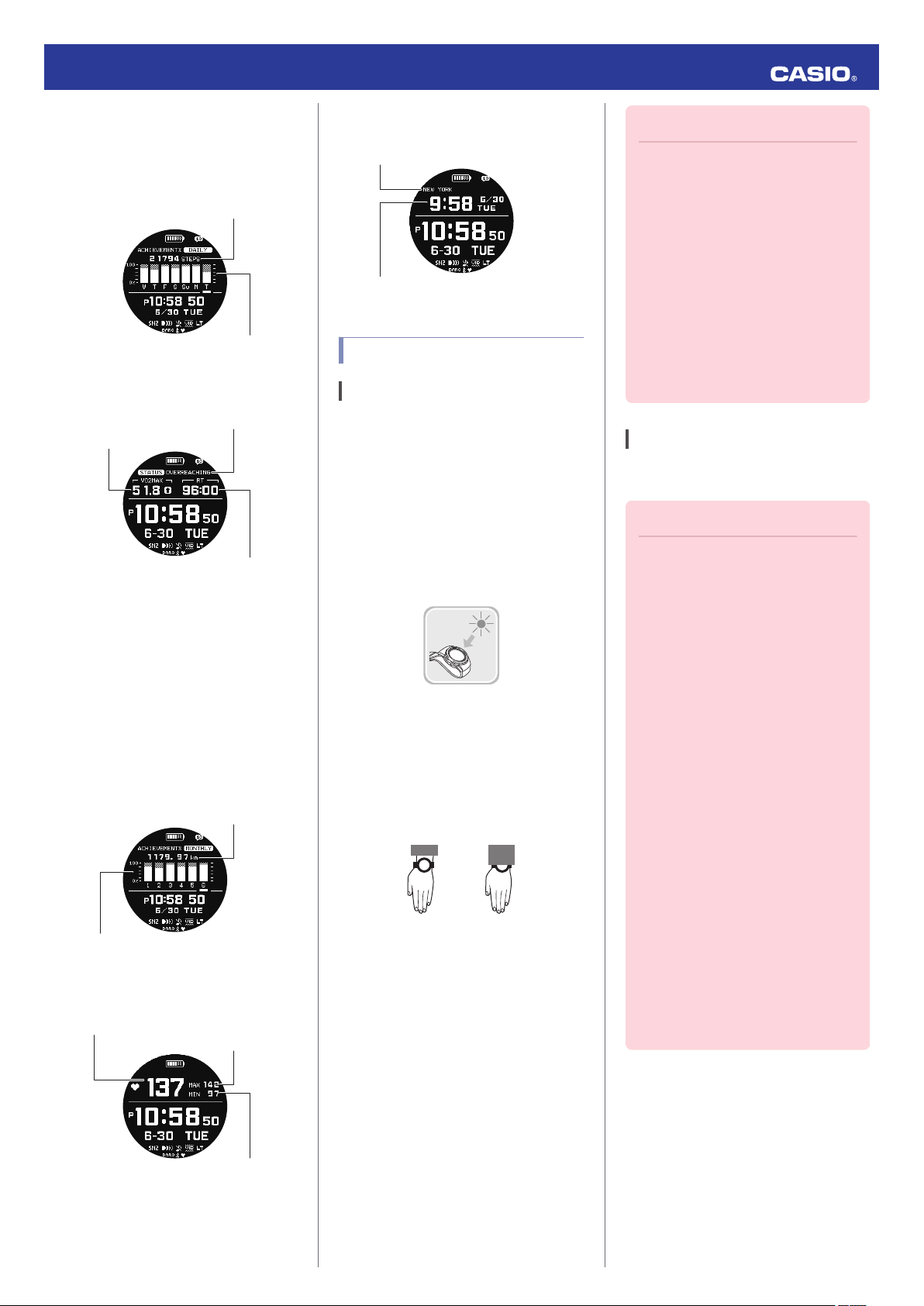
TIME+DAILY: Current Time + Weekly
Information
This screen shows the current time, today’s
step count, and daily step count goal
progress.
Today’s step count
Daily step count goal progress
TIME+STATUS: Current Time + Training
Status
Training status
Vo2Max value
Recovery time
TIME+MONTHLY: Current Time + Monthly
Information
This screen shows the current time, this
month’s running distance, and monthly
running distance goal progress. Instead of
running distance, you could also specify
display of running time or the altitude you
attained. Note that you must use the CASIO
“G-SHOCK MOVE” app to change what data
(running distance, running time, altitude
attained) should be displayed.
This month’s running distance, time,
or attained altitude
Monthly goal progress
(running distance, time, or attained altitude)
TIME+HR: Current Time + Heart Rate
Today’s minimum heart rate
Today’s maximum heart rate
Current heart rate
TIME+WORLD TIME: Current Time +
World Time
World Time City
World Time
Charging the Watch
Solar Charging
Power generated by the solar panel powers
watch operations and also is used to charge a
rechargeable (secondary) battery. The solar
panel is integrated into the LCD of the watch,
and power for charging is generated
whenever the face is exposed to light.
●
Charging the Watch
When you are not wearing the watch, put it in
a location where it is exposed to bright light.
While you are wearing the watch, make sure
that its LCD (solar panel) is not blocked from
light by the sleeve of your clothing. Power
generation efficiency is reduced even when
the LCD is blocked only partially.
NOYES
Important!
●
Depending on light intensity and local
conditions, the watch may become hot
to the touch when exposed to light for
charging. Take care to avoid burn
injury after charging. Also, avoid
charging the watch under high-
temperature conditions like the ones
described below.
ー
On the dashboard of a vehicle
parked in the sun
ー
Near an incandescent light bulb or
other source of heat
ー
Under direct sunlight or in other hot
areas for long periods
Charging with the Charger Cable
Charging with the charger cable is faster than
solar charging.
Important!
●
Use only the supplied charger cable for
charging.
●
A device with a USB port (Type-A) can
also be used for charging.
●
Your watch can be charged from a
device with a USB2.0 or higher USB
port.
●
Note that no guarantees are made
concerning the suitability of all types of
USB ports for charging. If charging is
not possible for some reason,
disconnection from the USB port is
recommended.
●
Place the charger on a desk or other
stable surface, making sure there is
plenty of open space around it.
Charging with the charger and watch in
a bag or some other enclosed space
can cause overheating of the watch.
●
Should water or any other liquid get
onto the watch or charger cable during
charging, immediately unplug the
charger cable from the power source.
●
Perform charging in an environment
where ambient temperature is
between 5°C and 35°C (41°F and
95°F).
Operation Guide 3475
7
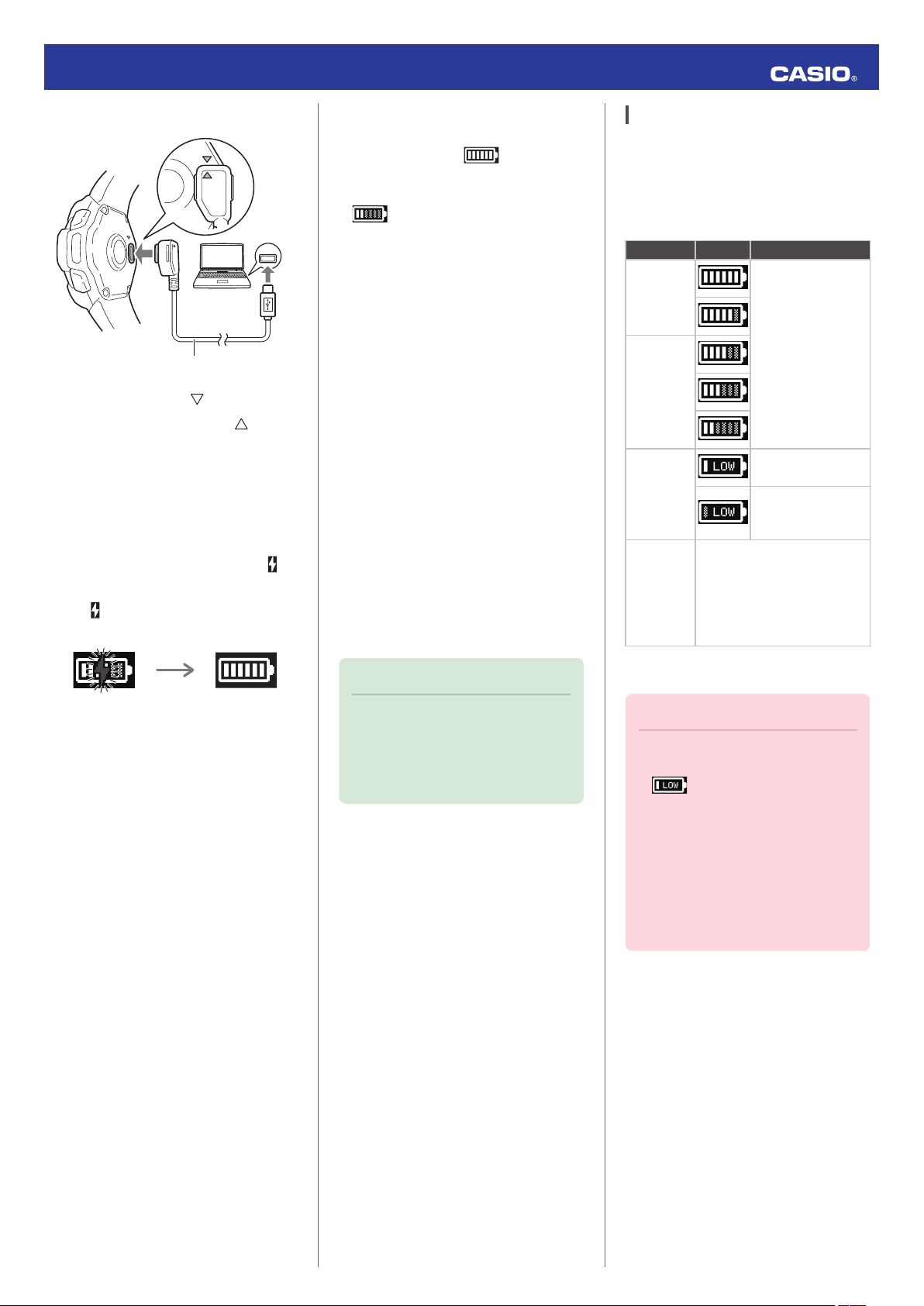
●
Charging the Watch
Charger cable
USB
●
Align the down arrow (
) mark on the
watch with the up arrow mark (
) of the
connector.
1. Turn on your computer or other device
with a USB port (power source), and
connect the charger cable to it.
2. Connect the charger cable to the watch.
●
This starts charging and causes to
flash on the watch display.
●
disappears from the display when a
full charge is achieved.
●
Charging from a Non-computer
Device’s USB Port
You can charge using power from a USB port
(Type-A) that meets USB standards.
●
Voltage: 5 V
●
Current: 0.5 A min.
●
Precautions When Charging
●
Avoid charging while the battery level
indicator is showing . To obtain
longer chargeable battery life, charge only
when the battery level indicator is showing
or lower.
●
Note that any of the conditions below can
hasten battery deterioration.
ー
Frequent charging while the battery is
fully or near fully charged
ー
Connecting and disconnecting the
charger cable multiple times during a
single day even though the battery is fully
charged
●
Do not attempt charging at high ambient
temperatures of 35°C or greater. The watch
becomes hot during charging, which can
cause charging to stop automatically. High
ambient temperature may result in a less
than full charge.
●
Operation on a custom computer or a
computer that has been modified from its
original configuration is not guaranteed.
●
Make sure that the charger cable connector
is oriented correctly when you plug it into the
watch.
●
The watch may become warm during
charging. This is normal and does not
indicate malfunction.
Note
●
Starting from a blank display, it takes
about 2.5 hours to achieve a full
charge.
●
Charging time depends on ambient
temperature and other factors.
Checking the Charge Level
You can check the watch’s current charge
level in all modes, except those below.
●
Training Log Mode
●
Training Status Mode
●
Notification Mode
Level Indicator Usable Functions
HIGH
All
MID
LOW
All functions except
those that use GPS
All functions except
those that use GPS,
HR (heart rate)
CHG
●
Normally (not charging):
Blank display
●
During USB charging
(charging in progress):
[CHARGING BATTERY] only
displayed
●
The display goes blank when the battery
goes dead.
Important!
●
Charge the watch as soon as possible
after the battery indicator becomes
or lower. Leaving the watch
without charging for a number of
months will result in over-discharge,
and may make future charging
impossible. If this happens, contact
your original retailer.
●
If the battery is dead and the watch
display is blank, use the charger cable
to charge the watch.
Operation Guide 3475
8

Charging Time Guidelines
Charging each day for the approximate times
shown in this section should be enough to
maintain a charge of
or higher.
Except for GPS and HR (heart rate), all watch
functions are operational at a charge level of
.
l
Checking the Charge Level
Note
●
Actual charging time depends on the
local charging environment.
●
Solar Charging
Charging Times Required for 1 Day of
Operation
Light Level (Lux)
Approximate
Charging Time
50,000 9 minutes
10,000 42 minutes
5,000 83 minutes
500 14 hours
Note
●
Charging is performed even with
exposure to indoor fluorescent lighting
(500 lux). The watch will be able to
maintain a charge of or higher
if it is exposed to indoor fluorescent
lighting for eight hours a day, in
addition to light near a window on a
sunny day (10,000 lux) for two hours a
week.
Times Required to Achieve Next Charge
Level
●
Sunny day, outdoors (50,000 lux)
LOW
n
MID
3 hours
MID
n
HIGH
26 hours
●
Sunny day, near a window (10,000 lux)
LOW
n
MID
15 hours
MID
n
HIGH
131 hours
●
Overcast day, near a window (5,000 lux)
LOW
n
MID
31 hours
MID
n
HIGH
270 hours
●
Charging with the Charger Cable
Times Required to Achieve Next Charge
Level
CHG
n
LOW
7 minutes
LOW
n
MID
5 minutes
MID
n
HIGH
42 minutes
Power Saving Function
Leaving the watch in a dark location for about
one hour between the hours of 10 p.m. and 6
a.m. will cause the watch to enter Level 1
power saving. If the watch is left in this
condition for six or seven days, the watch will
enter Level 2 power saving. The display of the
watch goes blank when the watch is in power
saving.
Power Saving Level 1 :
Basic timekeeping functions are operational.
Power Saving Level 2 :
All functions disabled.
●
Recovering from Power Saving
Use one of the operations below to exit power
saving.
●
Press any button.
●
Move the watch to a bright location.
●
Angle the watch towards your face.
Note
●
The watch will enter the power saving
state only while it is in one of the modes
below.
ー
Timekeeping Mode
ー
Stopwatch Mode (reset to all zeros)
ー
Timer Mode (timer start time
displayed)
●
Certain conditions may keep the watch
from entering the power saving state.
●
Note that the watch also may enter
power saving if its face is blocked from
light by your sleeve while you are
wearing it.
Viewing the Face in the Dark
The watch has a light that illuminates the face
for viewing in the dark.
●
To illuminate the face manually
Press (B) to turn on illumination.
●
Illumination will turn off automatically if an
alarm starts to sound.
●
Using Auto Light
If Auto Light is enabled, face illumination will
turn on automatically whenever the watch is
positioned at an angle of 40 degrees or more.
40
degrees
or more
Important!
●
Auto Light may not operate properly
when the watch is at a horizontal angle
of 15 degrees or greater from
horizontal as shown in the illustration
below.
●
Electro-static charge or magnetism
can interfere with proper auto light
operation. If this happens, try lowering
your arm and then angle it towards
your face again.
●
When moving the watch you may note
a slight rattling sound. This is due to
operation of the auto light switch,
which determines the current
orientation of the watch. It does not
indicate malfunction.
Operation Guide 3475
9
Note
●
Auto Light is disabled when any one of
the conditions below exists.
ー
While an alarm sound, timer sound,
and/or vibration operation is in
progress
●
If Auto Light is enabled, face
illumination may be delayed if you
angle the watch towards your face
while a compass, altitude, barometric
pressure, or temperature reading
operation is being performed.
Configuring the Auto Light Setting
1. Enter the Timekeeping Mode.
l
Navigating Between Modes
2. Hold down (A) for at least two seconds.
This displays the Timekeeping Mode
setting screen.
Pointer
3. Use (A) and (D) to move the pointer to
[LIGHT].
4. Press (C).
5. Use (A) and (D) to move the pointer to
[AUTO LIGHT].
6. Press (C).
7. Use (A) and (D) to move the pointer to
[OFF] (disabled) or [ON] (enabled).
●
The [LT] indicator is displayed in the
Timekeeping Mode while Auto Light is
enabled.
8. Press (C) to complete the setting
operation.
After the setting operation is complete,
[SETTING COMPLETED] will appear for
a few seconds, and then the illumination
setting screen will re-appear.
9. Press (E) twice to exit the setting screen.
Specifying the Illumination Duration
You can select either 1.5 seconds or three
seconds as the illumination duration.
1. Enter the Timekeeping Mode.
l
Navigating Between Modes
2. Hold down (A) for at least two seconds.
This displays the Timekeeping Mode
setting screen.
Pointer
3. Use (A) and (D) to move the pointer to
[LIGHT].
4. Press (C).
5. Use (A) and (D) to move the pointer to
[DURATION].
6. Press (C).
7. Use (A) and (D) to select an illumination
duration.
[1.5 SEC.] 1.5-second illumination
[3.0 SEC.] 3-second illumination
8. Press (C) to complete the setting
operation.
After the setting operation is complete,
[SETTING COMPLETED] will appear for
a few seconds, and then the illumination
setting screen will re-appear.
9. Press (E) twice to exit the setting screen.
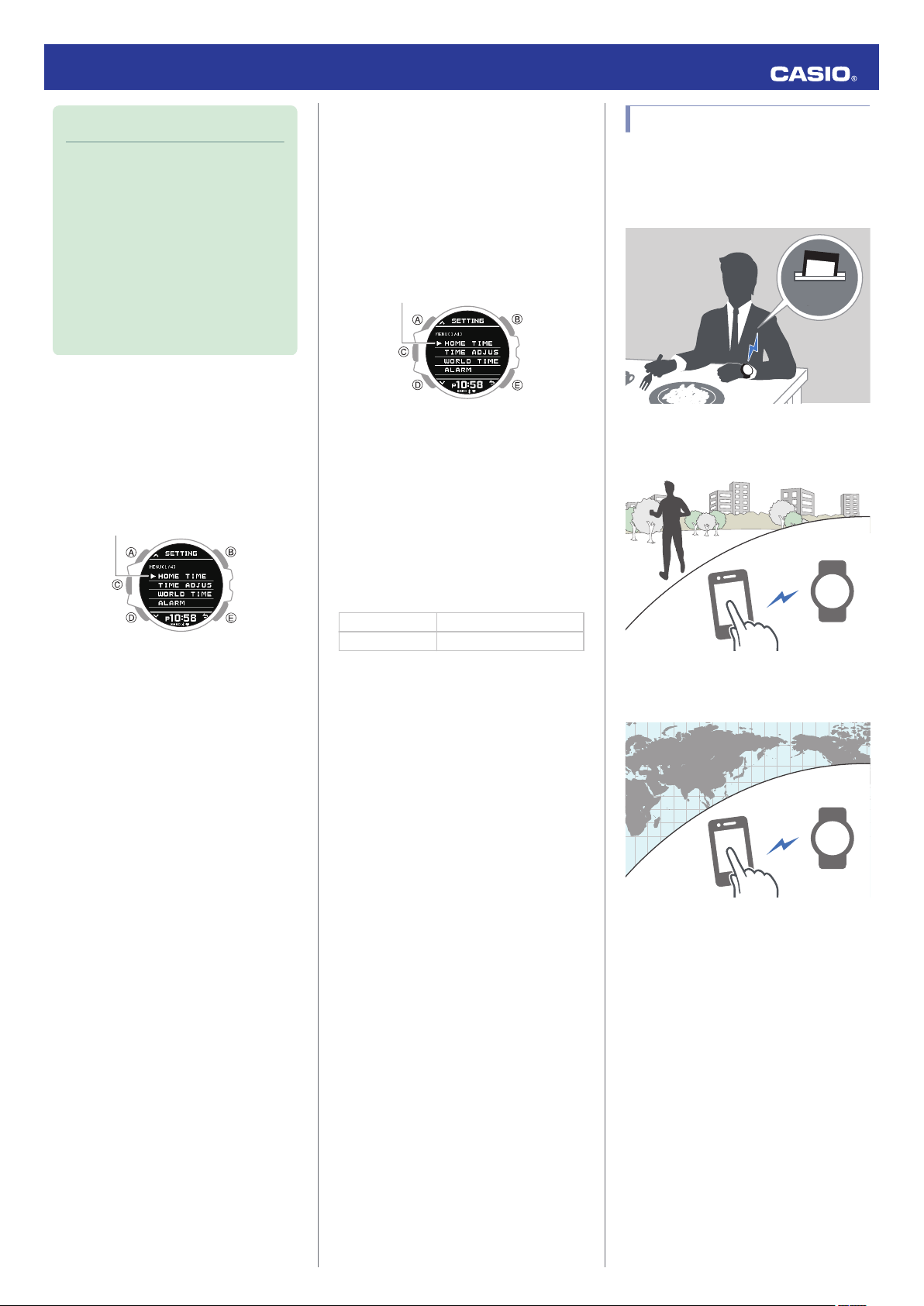
Useful Features
Pairing the watch with your phone makes a
number of the watch’s features easier to use.
Auto time adjustment
l
Auto Time Adjustment
12:30
Data transfer to a phone
l
Viewing Training Records
l
Viewing Life Log Related Data
Selection of More Than 300 World Time
cities
l
Configuring World Time Settings
In addition, a number of other watch settings
can be configured using your phone.
To transfer data to a watch and to
configure settings, you first need to pair
the watch with your phone.
l
Getting Ready
●
Your phone needs to have the CASIO “G-
SHOCK MOVE” app installed to pair with
the watch.
Operation Guide 3475
10

Time Adjustment
Your watch can receive GPS signals and
connect with a phone to obtain information
that it uses to adjust its date and time setting.
Important!
●
Enable the Airplane Mode whenever
you are inside an aircraft or in any other
area where radio wave reception and
phone use is prohibited or restricted.
l
Using the Watch in a Medical
Facility or Aircraft
Referring to the information below, configure
the time setting in accordance with the method
that suits your own lifestyle.
Are you in a location where a GPS signal
can be received?
Time adjustment using GPS signal
reception is recommended.
l
GPS Time Adjustment
Do you use a phone?
Your watch can connect with a phone to
obtain information that it uses to adjust its
time setting.
l
Auto Time Adjustment
12:30
Other than the above.
If your watch cannot receive GPS signals
and cannot connect with your phone for
some reason, you can adjust time settings
by performing manual operations on the
watch.
l
Using Watch Operations to Adjust the
Time Setting
GPS Time Adjustment
Overview
The watch’s time and day settings can be
configured in accordance with your current
time zone by receiving a GPS signal.
●
GPS signal location information: Used to
update time zone, time, and day settings.
●
GPS signal time information: Used to
update time and day settings.
Important!
●
Before receiving GPS time
information, be sure to set your time
zone.
●
GPS signals are not received by the
watch while it is paired with a phone.
Appropriate Signal Reception
Location
GPS signal reception is possible outdoors
where the sky is visible and not blocked by
buildings, trees, or other objects.
Note
●
In areas where reception is poor, keep
the watch LCD pointed upwards and
do not move the watch.
●
When the watch is set up for auto
receive, take care to avoid covering its
LCD with the sleeve of your clothing.
●
GPS signal reception is not possible in
the areas described below.
ー
Where the sky is not visible
ー
Indoors (Reception may be possible
near a window.)
ー
Near wireless communication
equipment or other devices that
generate magnetism.
●
You may experience GPS signal
reception problems in the areas
described below.
ー
Where the view of the sky above is
narrow
ー
Near trees or buildings
ー
Near a train station, airport, or other
congested areas
Operation Guide 3475
11
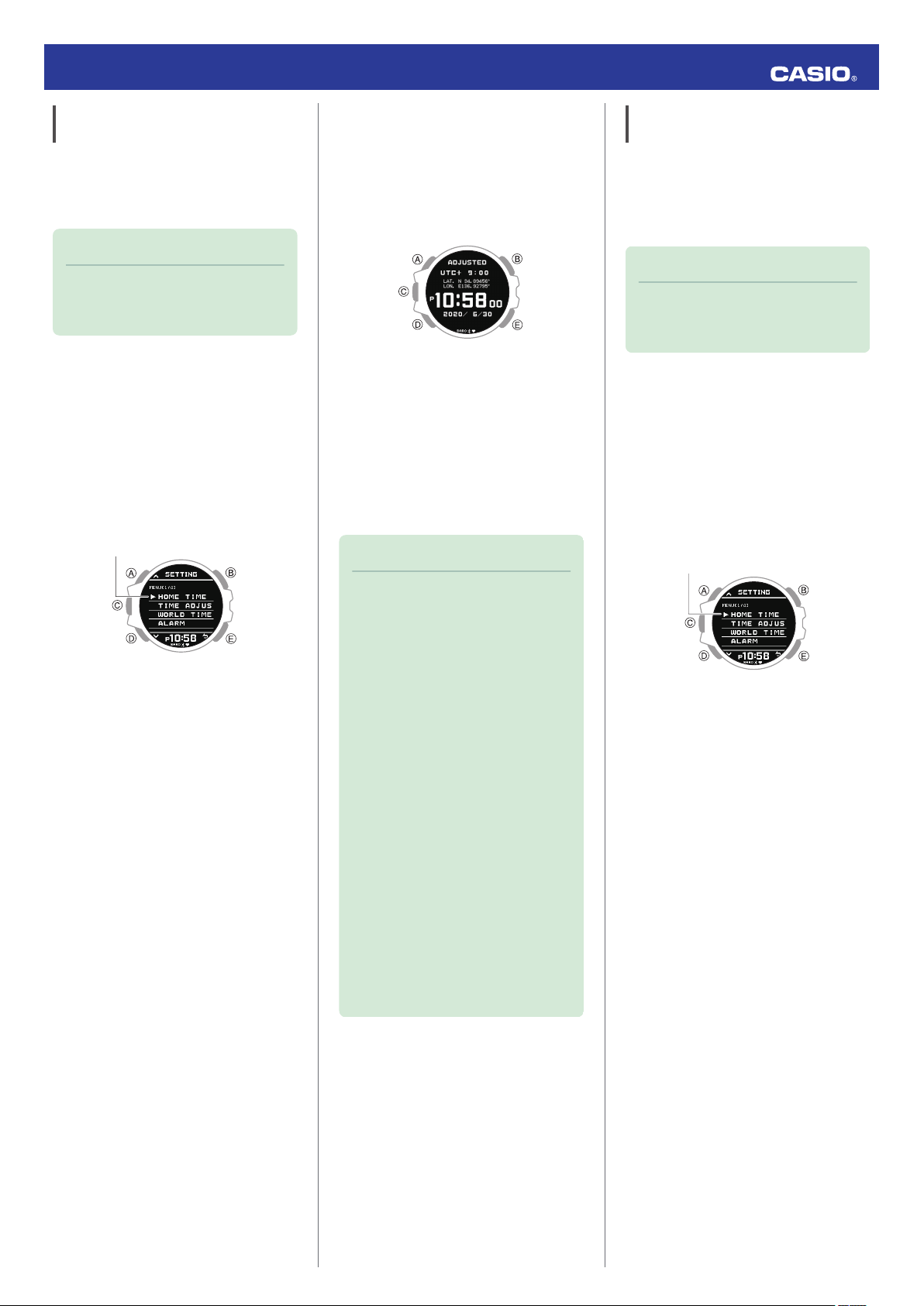
Acquiring GPS Location
Information Manually
You can use a button operation to acquire
GPS location information and adjust your time
zone, time, and day settings in accordance
with your current location.
Note
●
GPS signal reception requires large
amounts of power. Perform it only
when necessary.
1. Move to a location appropriate for signal
reception and point the LCD of the watch
straight up at the sky.
2. Enter the Timekeeping Mode.
l
Navigating Between Modes
3. Hold down (A) for at least two seconds.
This displays the Timekeeping Mode
setting screen.
Pointer
4. Use (A) and (D) to move the pointer to
[TIME ADJUSTMENT].
5. Press (C).
6. Use (A) and (D) to move the pointer to
[AUTO].
7. Press (C).
8. Use (A) and (D) to move the pointer to
[TIME+POSITION (GPS)].
9. Press (C).
This starts location information
acquisition.
●
The acquired information will appear on
the watch display when location
acquisition is successful.
●
[RECEIVING FAILED] will appear on
the display if location information
acquisition fails for some reason.
10. Press (C) to complete the setting
operation.
●
If the receive operation fails, pressing
(C) will return to the screen in step 6.
Press (E) twice to return to the
Timekeeping Mode.
Note
●
Receive normally takes anywhere
from about 40 to 80 seconds.
●
It can take as long as 13 minutes when
leap second information is included.
●
You may experience location
information acquisition problems when
you are in the vicinity of a city
borderline.
The watch’s time and day will not be
indicated correctly if the time zone
setting is not right for your location. If
this happens, move to a location near
the center of the city you want to set as
your Home City and acquire location
information again. Or you can perform
a time information receive operation to
adjust time and day settings after
configuring Home City and summer
time settings manually.
l
Acquiring GPS Time Information
Manually
l
Setting a Home City
l
Configuring the Summer Time
Setting
Acquiring GPS Time Information
Manually
You can use a button operation on the watch
to receive GPS signal time information. When
the receive operation is successful, the
watch’s Home City (time zone), day, and time
settings will be adjusted accordingly.
Note
●
GPS signal reception requires large
amounts of power. Perform it only
when necessary.
1. Move to a location appropriate for signal
reception and point the LCD of the watch
straight up at the sky.
2. Enter the Timekeeping Mode.
l
Navigating Between Modes
3. Hold down (A) for at least two seconds.
This displays the Timekeeping Mode
setting screen.
Pointer
4. Use (A) and (D) to move the pointer to
[TIME ADJUSTMENT].
5. Press (C).
6. Use (A) and (D) to move the pointer to
[AUTO].
7. Press (C).
8. Use (A) and (D) to move the pointer to
[TIME (GPS)].
Operation Guide 3475
12
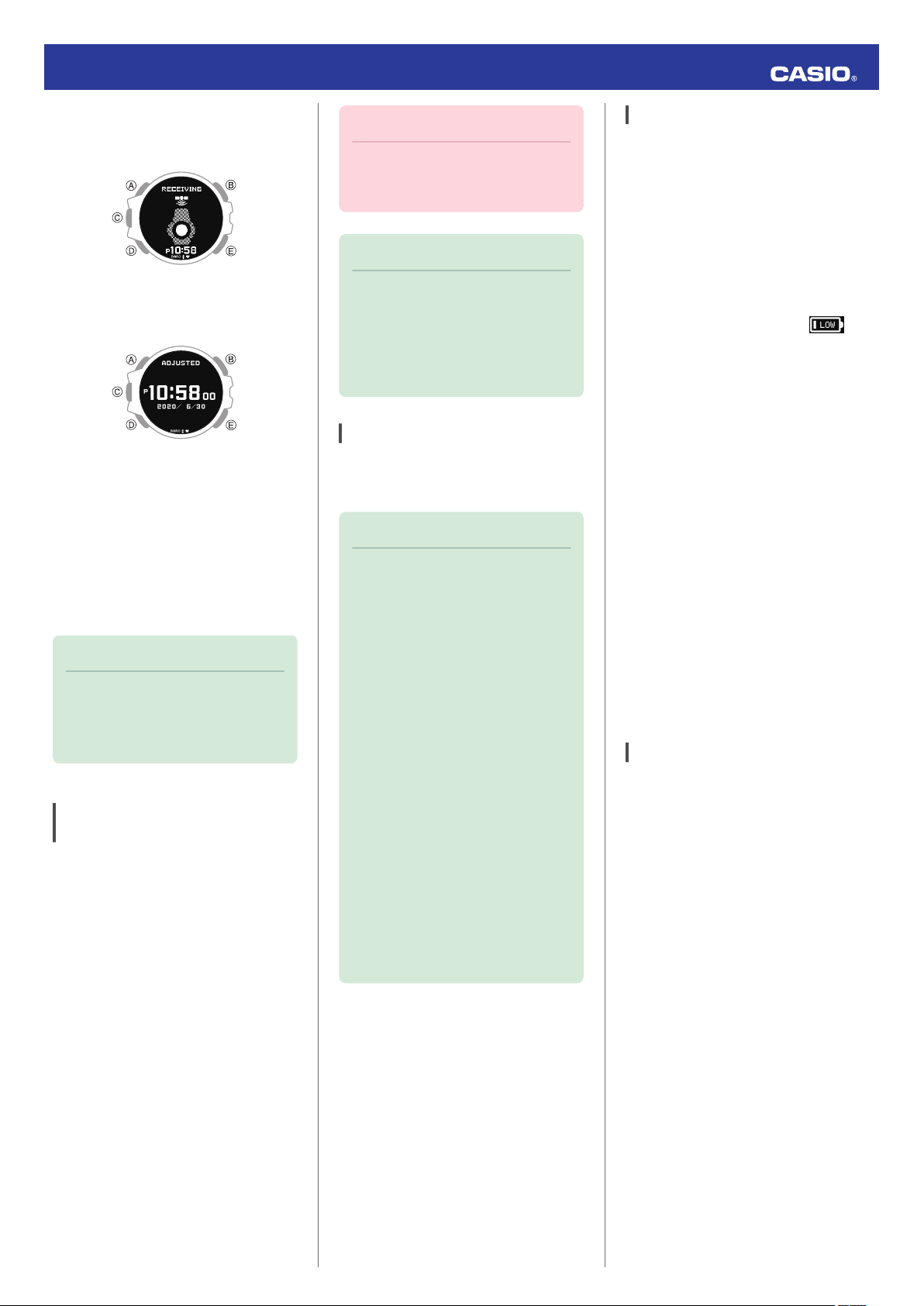
9. Press (C).
This starts time information acquisition.
●
The acquired information will appear on
the watch display when time acquisition
is successful.
●
[RECEIVING FAILED] will appear if time
information acquisition fails for some
reason.
10. Press (C) to complete the setting
operation.
●
If the receive operation fails, pressing
(C) will return to the screen in step 6.
Press (E) twice to return to the
Timekeeping Mode.
Note
●
Receive normally takes anywhere
from about 10 to 65 seconds.
●
It can take as long as 13 minutes when
leap second information is included.
Receiving Time Information
Automatically
When the conditions below are satisfied, the
watch will automatically receive time
information from a GPS signal. If any time
information receive operation is successful,
the watch will no longer attempt to receive a
signal for the rest of the day.
●
Watch is in the Timekeeping Mode.
●
Current time is between 6:00 a.m. and
10:00 p.m.
●
Light (near a window on a clear day)
continually shining on the LCD of the watch
for about one to two minutes.
Important!
●
Auto GPS signal receive is disabled
while the watch is paired with a phone
for auto time adjustment.
Note
●
The time information receive operation
normally takes anywhere from about
10 to 65 seconds.
●
The receive operation can take as long
as 13 minutes when leap second
information is included.
Leap Second Reception
GPS signal reception each year on June 1 or
later and on December 1 or later also receives
leap second information.
Note
●
It can take as long as 13 minutes to
complete the leap second information
receive operation.
●
The leap second information receive
operation is repeated until information
receipt is complete.
●
Once the leap second information
receive operation is complete, the
watch will not make any attempt to
receive it again until the following June
1 or December 1.
●
When connecting with a phone to
adjust the watch date and time
settings, leap seconds will also be
received along with the time
information. If this happens, leap
seconds may not be received when
receiving a GPS signal.
●
The first GPS signal receive operation
after the watch’s current time and/or
date setting has been changed
manually will include receipt of leap
second information.
Signal Reception Precautions
●
When the watch is unable to adjust its time
in accordance with a GPS signal for some
reason, average timekeeping accuracy is
within ±15 seconds per month.
●
Note that an internal decoding process the
watch performs after it receives a GPS
signal may cause the time setting to be
slightly off (by less than one second).
●
GPS signal reception is not possible under
the conditions described below.
ー
While the battery indicator is
or
lower
ー
In any mode besides the Timekeeping
Mode
ー
During power saving
ー
While the watch is connected with a
phone and data communication is in
progress
●
If the receive operation is successful, the
time and day settings will be adjusted
automatically in accordance with the Home
City (time zone) and summer time settings.
Summer time will not be applied correctly in
the cases described below.
ー
When the summer time start date and
time, end date and time, or other rules are
changed by authorities
ー
When location information is received,
but it is not location information for your
actual location (For example, when you
are near a borderline of a city and the
acquired location information is for a
neighboring city, etc.)
Using GPS Outside Your Country
Some countries or geographic areas put legal
restrictions on the use of GPS, on the
collection and logging of location information,
etc. Your watch has built-in GPS functionality,
so before embarking on international travel to
a country or area outside of the country where
you purchased your watch, you should check
with the embassy of the countries you plan to
visit, your travel agency, or some other reliable
source of information to find out if there are any
prohibitions or restrictions on bringing in
devices with GPS functionality, or on the
logging of location information, etc.
Operation Guide 3475
13

Using Watch Operations to
Adjust the Time Setting
You can use the procedure below to adjust the
watch’s date and time settings manually when
GPS signal reception or communication with
a phone is not possible for some reason.
●
Setting a Home City
Use the procedure in this section to select a
city to use as your Home City.
1. Enter the Timekeeping Mode.
l
Navigating Between Modes
2. Hold down (A) for at least two seconds.
This displays the Timekeeping Mode
setting screen.
Pointer
3. Use (A) and (D) to move the pointer to
[HOME TIME].
4. Press (C).
5. Use (A) and (D) to move the pointer to
[CITY].
6. Press (C).
7. Use (A) and (D) to move the pointer to the
city you want to use as your Home City.
8. Press (C) to complete the setting
operation.
After the setting operation is complete,
[SETTING COMPLETED] will appear for
a few seconds, and then the Home Time
setting screen will re-appear.
9. Press (E) twice to exit the setting screen.
●
Configuring the Summer Time Setting
If you are in an area that observes summer
time, you can also enable or disable summer
time.
Note
●
The initial factory default summer time
setting for all cities is [AUTO]. In many
cases, [AUTO] lets you use the watch
without switching manually between
summer time and standard time.
●
In the cases described below,
receiving location information by GPS
will cause [AUTO] to be automatically
selected for the summer time setting.
ー
When the time zone of the current
receive operation is different from
the watch’s time zone setting prior to
the receive operation.
ー
When the time zone is unchanged,
but the acquired location information
is for a geographic area with
different summer time rules (start
date, end date)
1. Enter the Timekeeping Mode.
l
Navigating Between Modes
2. Hold down (A) for at least two seconds.
This displays the Timekeeping Mode
setting screen.
Pointer
3. Use (A) and (D) to move the pointer to
[HOME TIME].
4. Press (C).
5. Use (A) and (D) to move the pointer to
[DST].
6. Press (C).
7. Use (A) and (D) to select a summer time
setting.
[AUTO]
Auto switching between standard
time and summer time
[OFF] Always standard time
[ON] Always summer time
8. Press (C) to complete the setting
operation.
After the setting operation is complete,
[SETTING COMPLETED] will appear for
a few seconds, and then the Home Time
setting screen will re-appear.
9. Press (E) twice to exit the setting screen.
●
Manual Time Adjustment
You can use the procedure below to adjust the
watch’s time and day settings manually when
GPS signal reception or communication with
a phone is not possible for some reason.
1. Enter the Timekeeping Mode.
l
Navigating Between Modes
2. Hold down (A) for at least two seconds.
This displays the Timekeeping Mode
setting screen.
Pointer
3. Use (A) and (D) to move the pointer to
[TIME ADJUSTMENT].
4. Press (C).
5. Use (A) and (D) to move the pointer to
[MANUAL].
6. Press (C).
This causes a cursor to appear under the
hour setting.
7. Use (A) and (D) to change the current time
hour setting.
8. Press (C).
This moves the cursor to the minute
setting.
9. Use (A) and (D) to change the current time
minute setting.
10. Press (C).
This moves the cursor to the year setting.
11. Use (A) and (D) to change the year setting.
12. Press (C).
This moves the cursor to the month
setting.
13. Use (A) and (D) to change the month
setting.
Operation Guide 3475
14
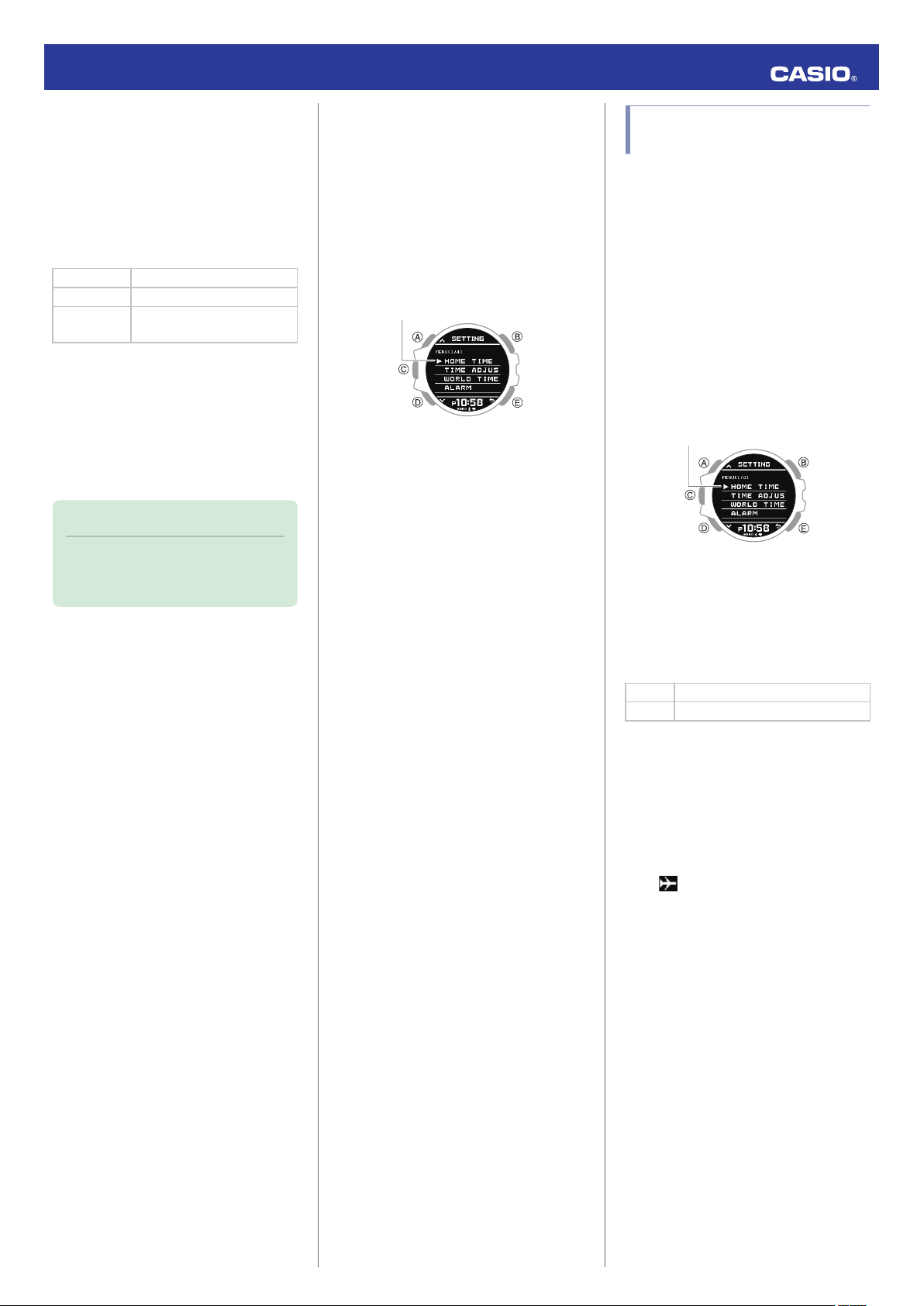
14. Press (C).
This moves the cursor to the day setting.
15. Use (A) and (D) to change the day setting.
16. Press (C).
17. Use (A) and (D) to select whether or not
you want to save your current settings.
[YES] Saves current settings.
[NO] Discards current settings.
[RETURN]
Returns to the hour setting
screen.
18. Press (C) to complete the setting
operation.
After the setting operation is complete,
[SETTING COMPLETED] will appear for
a few seconds, and then the time
adjustment screen will re-appear.
19. Press (E) twice to exit the setting screen.
Note
●
To exit the current time setting
operation at any point, press (E) and
advance to step 17.
●
Switching between 12-hour and 24-
hour Timekeeping
You can specify either 12-hour format or 24-
hour format for the time display.
1. Enter the Timekeeping Mode.
l
Navigating Between Modes
2. Hold down (A) for at least two seconds.
This displays the Timekeeping Mode
setting screen.
Pointer
3. Use (A) and (D) to move the pointer to
[TIME ADJUSTMENT].
4. Press (C).
5. Use (A) and (D) to move the pointer to
[12/24H].
6. Press (C).
7. Use (A) and (D) to select [12H] (12-hour
timekeeping) or [24H] (24-hour
timekeeping).
8. Press (C) to complete the setting
operation.
After the setting operation is complete,
[SETTING COMPLETED] will appear for
a few seconds, and then the time
adjustment screen will re-appear.
9. Press (E) twice to exit the setting screen.
●
While 12-hour timekeeping is selected,
[P] will be displayed for p.m. times.
Using the Watch in a Medical
Facility or Aircraft
When you are in a hospital, on an aircraft, or
in any other location where radio signals may
cause problems, you can perform the
procedure below to enter the watch’s Airplane
Mode, which disables auto GPS signal
receive and connection with a phone. To re-
enable auto time adjustment, perform the
same operation again.
1. Enter the Timekeeping Mode.
l
Navigating Between Modes
2. Hold down (A) for at least two seconds.
This displays the Timekeeping Mode
setting screen.
Pointer
3. Use (A) and (D) to move the pointer to
[AIRPLANE MODE].
4. Press (C).
5. Use (A) and (D) to select an Airplane
Mode setting.
[OFF] Exits Airplane Mode.
[ON] Enables Airplane Mode.
6. Press (C) to complete the setting
operation.
After the setting operation is complete,
[SETTING COMPLETED] will appear for
a few seconds, and then the Timekeeping
Mode setting screen will re-appear.
7. Press (E) to exit the setting screen.
●
is displayed while the watch is in the
Airplane Mode.
Operation Guide 3475
15
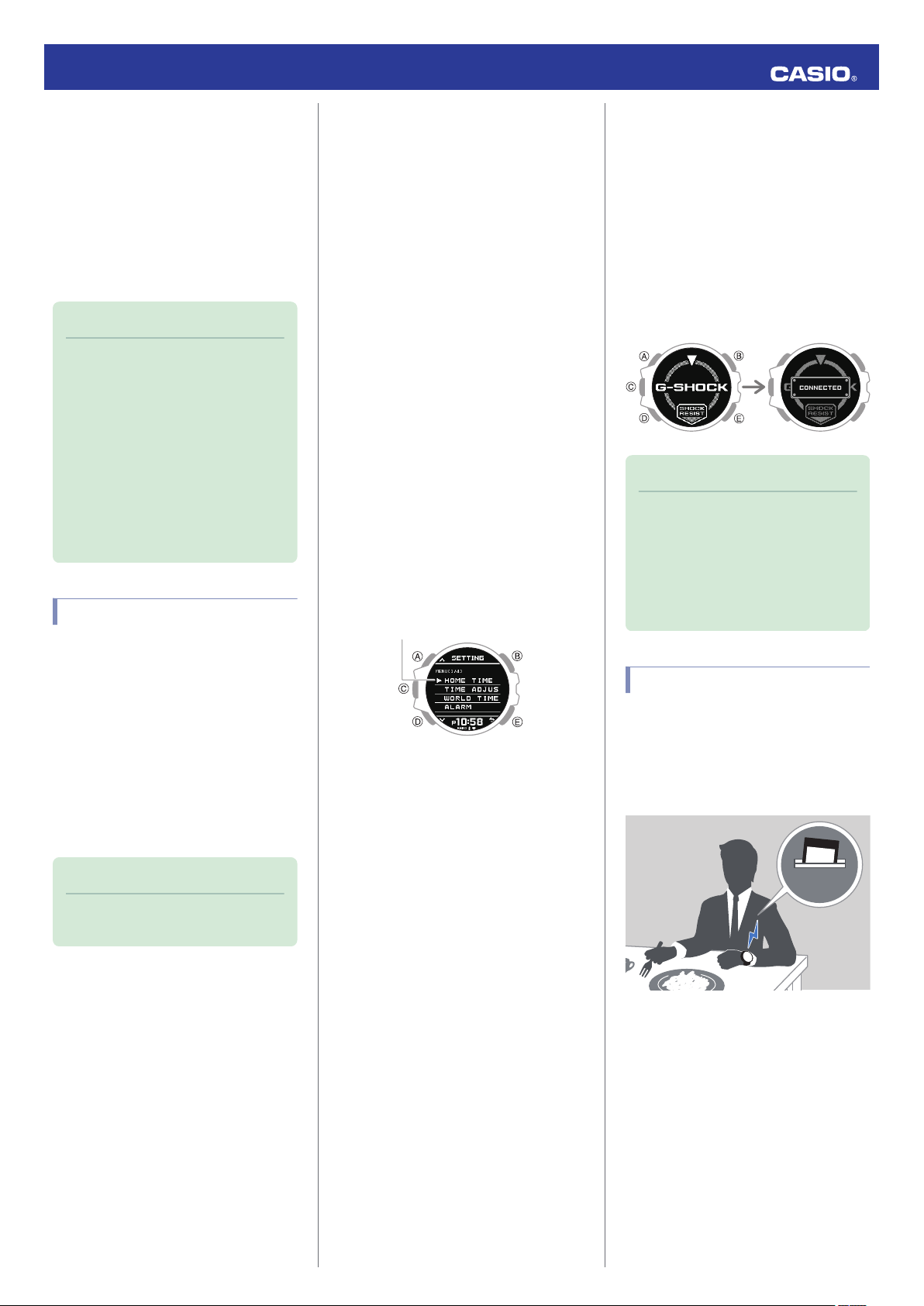
Using Mobile Link with
a Mobile Phone
While there is a Bluetooth connection
between the watch and phone, the watch time
setting is adjusted automatically. You can also
change the watch’s other settings.
Also, you can use the CASIO “G-SHOCK
MOVE” app to view training records and
create training plans.
Note
●
For best results with this watch, use of
the latest versions of the smartphone
app and watch software is
recommended.
●
This function is available only while G-
SHOCK MOVE is running on the
phone.
●
This section describes watch and
phone operations.
X
: Watch operation
Y
: Phone operation
Getting Ready
To use your watch in combination with a
phone, you first need to pair them. Perform the
steps below to pair the watch with a phone.
●
A
Install the required app on your
phone.
In Google Play or the App Store, search for the
CASIO “G-SHOCK MOVE” app and install it
on your phone.
●
B
Configure Bluetooth settings.
Enable the phone’s Bluetooth.
Note
●
For details about setting procedures,
see your phone documentation.
●
C
Pair the watch with a phone.
Before you can use the watch in combination
with a phone, you first need to pair them.
1.
Y
Tap the “G-SHOCK MOVE” icon.
2.
Y
Follow the instructions on the display to
advance to the initial setup screen.
This will display a message telling you to
connect with the watch.
●
If your phone is already paired with
another watch
A
Y
On the menu bar, tap “More”.
B
Y
Tap “Watch”.
C
Y
Tap “Manage”.
D
Y
Perform the operation shown on
the screen to prepare to add a new
watch.
3.
X
Enter the Timekeeping Mode.
l
Navigating Between Modes
4.
X
Hold down (A) for at least two seconds.
This displays the Timekeeping Mode
setting screen.
Pointer
5.
X
Use (A) and (D) to move the pointer to
[PAIRING].
6.
X
Press (C).
7.
X
Use (A) and (D) to move the pointer to
[CONNECT].
8.
X
Press (C).
9. Move the phone to be paired with close to
(within one meter of) the watch.
10.
Y
When the watch you want to pair with
appears, follow the instructions on the
display to pair with it.
●
If a pairing prompt message appears,
perform the operation shown on the
phone screen.
●
If pairing fails for some reason, the
watch will return to the state in step 5 of
this procedure. Perform the pairing
procedure again from the beginning.
Pairing complete.Pairing started.
Note
●
The first time you start up G-SHOCK
MOVE, a message will appear on your
phone asking if you want to enable
location information acquisition.
Configure settings to allow
background use of location
information.
Auto Time Adjustment
Your watch can connect with your phone to
adjust the watch’s time setting.
If you leave your watch in the Timekeeping
Mode, it will perform the adjustment operation
automatically as you go about your daily life,
without any operation required by you.
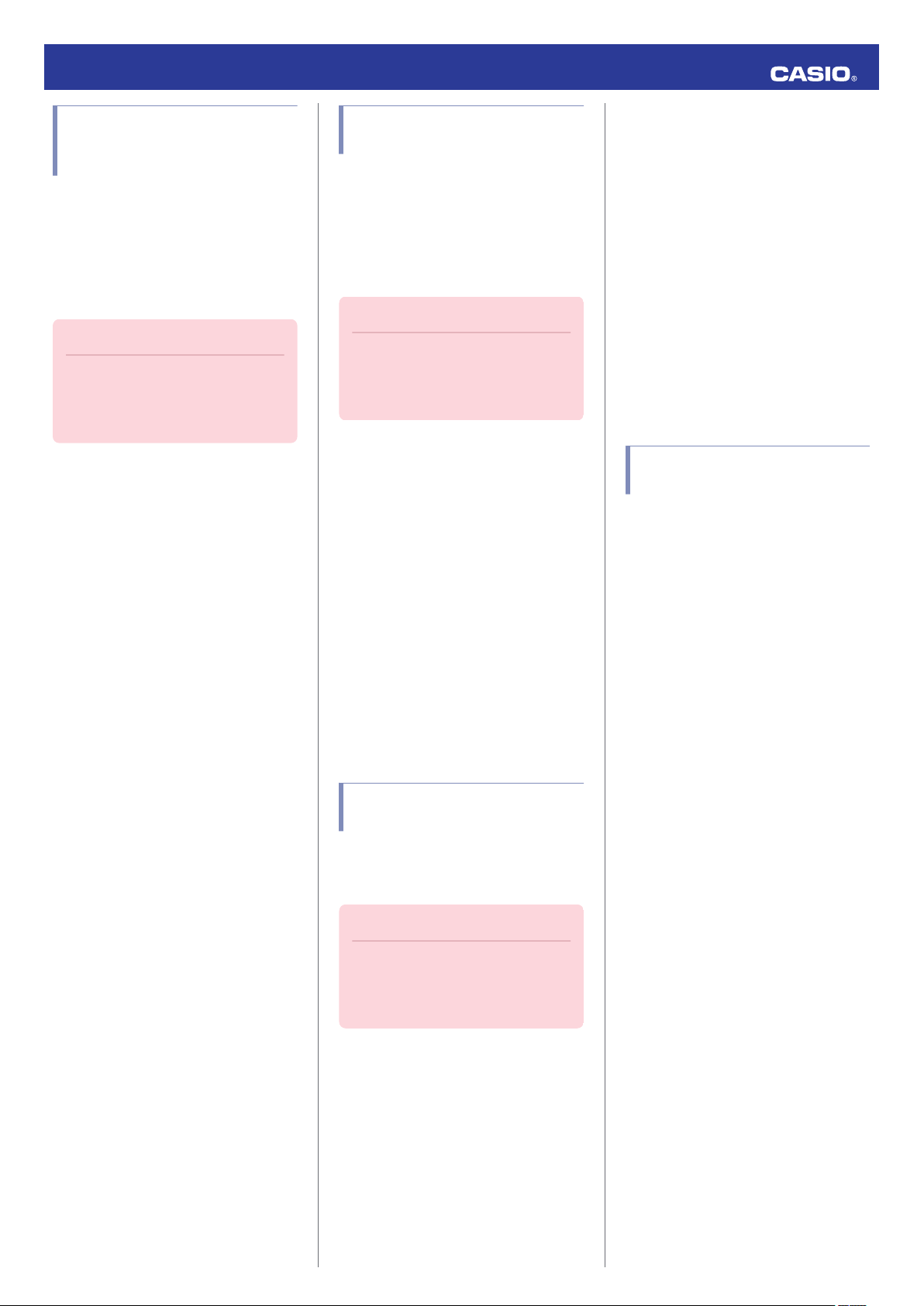
12:30
Operation Guide 3475
16
Important!
●
The watch may not be able to perform
auto time adjustment under the
conditions described below.
ー
While the watch is too far away from
its paired phone
ー
While communication is not possible
due to radio interference, etc.
ー
While the phone is updating its
system
ー
While G-SHOCK MOVE is not
running on the phone
Note
●
If there is a World Time City specified
with G-SHOCK MOVE, its time will
also be adjusted automatically.
●
Auto time adjustment is performed at
the times described below.
ー
After your phone’s time zone or
summer time setting is changed
ー
After 24 hours or more have passed
since the last time adjustment using
Bluetooth connection
ー
After 24 hours or more have passed
since the last home city change or
time adjustment using watch
operation
●
The watch remains connected with
your phone even after time adjustment
is complete.
●
If time adjustment fails for some
reason, [CONNECT FAILED] will
appear.
●
Watch operation can be performed
even while it is connected with your
phone.
●
Connection with your phone is not
possible while the watch’s Airplane
Mode is enabled. To connect with your
phone, disable the Airplane Mode.
l
Using the Watch in a Medical
Facility or Aircraft
Viewing Training Records
You can use G-SHOCK MOVE to view the
training data below, which is measured by the
watch.
●
Training log data and lap data
●
Training analysis results
●
Make sure that the
e
symbol is shown on the
watch display when you perform the
procedure below.
●
If
e
is not displayed, refer to the information
at the link below.
l
Connecting with a Phone
1.
Y
Tap the “G-SHOCK MOVE” icon.
2.
Y
On the menu bar, tap “Activity”.
3.
Y
Tap “History”.
4.
Y
Perform the operation shown on the
screen.
Viewing Life Log Related
Data
G-SHOCK MOVE can be used to view the
information below, which is measured by the
watch.
●
Daily, weekly, or monthly number of steps
and calories burned
●
Daily, weekly, or monthly heart rate while
[ON (ALWAYS)] is selected for Heart Rate
Measurement
l
Using Heart Rate Measurement
●
Make sure that the
e
symbol is shown on the
watch display when you perform the
procedure below.
●
If
e
is not displayed, refer to the information
at the link below.
l
Connecting with a Phone
1.
Y
Tap the “G-SHOCK MOVE” icon.
2.
Y
On the menu bar, tap “Home”.
3.
Y
Use the “Life Log” widget to view the
data.
Note
●
You can also use G-SHOCK MOVE to
specify a daily step target.
l
Setting Target Values
Setting Target Values
You can use G-SHOCK MOVE to specify daily
or monthly target values.
Important!
●
Target values cannot be specified
using watch operations. Use G-
SHOCK MOVE to configure settings.
You can specify target values for the items
below.
●
Daily step count
●
Monthly running distance
●
Monthly running time
●
Monthly attained altitude
●
Make sure that the
e
symbol is shown on the
watch display when you perform the
procedure below.
●
If
e
is not displayed, refer to the information
at the link below.
l
Connecting with a Phone
1.
Y
Tap the “G-SHOCK MOVE” icon.
2.
Y
On the menu bar, tap “More”.
3.
Y
Tap “User”.
4.
Y
Select the target you want to specify and
then perform the operation shown on the
phone screen.
Creating a Training Plan
You can use G-SHOCK MOVE to create a
personalized training plan to suit your
objectives, fitness level, training conditions
and other factors
You can create a daily training plan to maintain
or increase your athletic performance, or one
with a specific target date or time.
●
Make sure that the
e
symbol is shown on the
watch display when you perform the
procedure below.
●
If
e
is not displayed, refer to the information
at the link below.
l
Connecting with a Phone
1.
Y
Tap the “G-SHOCK MOVE” icon.
2.
Y
On the menu bar, tap “Activity”.
3.
Y
Tap “Plan”.
4.
Y
Perform the operation shown on the
screen.
Operation Guide 3475
17
Specifying Checkpoints
Along a Running Course
(Altitude Navigation)
You can use G-SHOCK MOVE to specify
checkpoints along a running course. You can
use the watch to check the altitude differential
between a checkpoint and your current
location.
l
Checking the Altitude Differential Between
Your Current Location and a Checkpoint
Important!
●
Note that you cannot specify
checkpoints using watch operations.
Use G-SHOCK MOVE to configure
settings.
●
Make sure that the
e
symbol is shown on the
watch display when you perform the
procedure below.
●
If
e
is not displayed, refer to the information
at the link below.
l
Connecting with a Phone
1.
Y
Tap the “G-SHOCK MOVE” icon.
2.
Y
On the menu bar, tap “More”.
3.
Y
Tap “Watch”.
4.
Y
Select your preferred watch.
5.
Y
Select the setting you want to change
and then perform the operation shown on
the screen.
Specifying the Alert Interval
(Target Alert)
You can use G-SHOCK MOVE to specify alert
intervals to keep you informed of your calories
burned, elapsed time, and attained altitude
while training. Then the watch will perform a
sound and/or vibration alert operation
whenever you reach an alert interval value
while training.
Important!
●
Note that you cannot specify the alert
interval using watch operations. Use
G-SHOCK MOVE to configure
settings.
●
Make sure that the
e
symbol is shown on the
watch display when you perform the
procedure below.
●
If
e
is not displayed, refer to the information
at the link below.
l
Connecting with a Phone
1.
Y
Tap the “G-SHOCK MOVE” icon.
2.
Y
On the menu bar, tap “More”.
3.
Y
Tap “Watch”.
4.
Y
Select your preferred watch.
5.
Y
Select the setting you want to change
and then perform the operation shown on
the screen.
Specifying the Distance for
Auto Lap Timing
Before using Auto Lap Timing, you need to
use G-SHOCK MOVE to specify the Auto Lap
Timing distance.
Important!
●
Note that you cannot specify the Auto
Lap Timing distance using watch
operations. Use G-SHOCK MOVE to
configure settings.
●
Make sure that the
e
symbol is shown on the
watch display when you perform the
procedure below.
●
If
e
is not displayed, refer to the information
at the link below.
l
Connecting with a Phone
1.
Y
Tap the “G-SHOCK MOVE” icon.
2.
Y
On the menu bar, tap “More”.
3.
Y
Tap “Watch”.
4.
Y
Select your preferred watch.
5.
Y
Select the setting you want to change
and then perform the operation shown on
the screen.
Setting Up Programmable
Timers
You can use G-SHOCK MOVE to configure
programmable timer settings and create a
group of multiple timers.
●
For information about programmable
timers, refer to the information at the link
below.
l
Overview
●
Make sure that the
e
symbol is shown on the
watch display when you perform the
procedure below.
●
If
e
is not displayed, refer to the information
at the link below.
l
Connecting with a Phone
1.
Y
Tap the “G-SHOCK MOVE” icon.
2.
Y
On the menu bar, tap “More”.
3.
Y
Tap “Watch”.
4.
Y
Select your preferred watch.
5.
Y
Select the setting you want to change
and then perform the operation shown on
the screen.
Operation Guide 3475
18
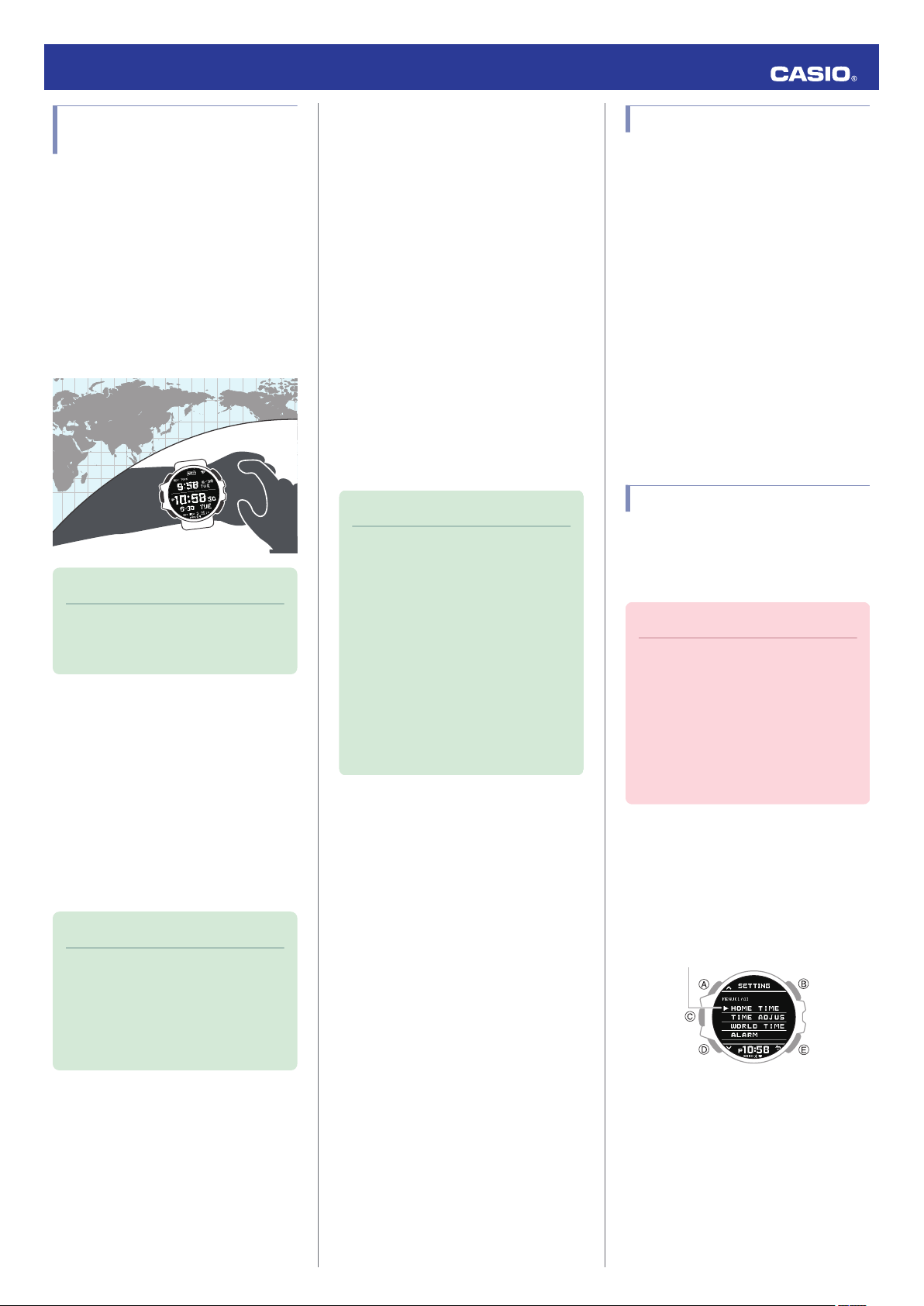
Configuring World Time
Settings
Specifying a World Time City with G-SHOCK
MOVE causes the watch’s World Time City to
change accordingly. Settings can be
configured to perform auto summer time
switching for the World Time City.
●
Make sure that the
e
symbol is shown on the
watch display when you perform the
procedure below.
●
If
e
is not displayed, refer to the information
at the link below.
l
Connecting with a Phone
Note
●
G-SHOCK MOVE World Time lets you
select from among approximately 300
cities as the World Time City.
●
Selecting a World Time City
1.
Y
Tap the “G-SHOCK MOVE” icon.
2.
Y
On the menu bar, tap “More”.
3.
Y
Tap “Watch”.
4.
Y
Select your preferred watch.
5.
Y
Select the setting you want to change
and then perform the operation shown on
the screen.
Note
●
You can use G-SHOCK MOVE to
configure settings for user cities that
are not included in the watch’s built-in
World Time Cities. You must use G-
SHOCK MOVE to select a user city as
your World Time City.
●
Configuring the Summer Time Setting
1.
Y
Tap the “G-SHOCK MOVE” icon.
2.
Y
On the menu bar, tap “More”.
3.
Y
Tap “Watch”.
4.
Y
Select your preferred watch.
5.
Y
Select the setting you want to change
and then perform the operation shown on
the screen.
●
“Auto”
The watch switches between standard
time and summer time automatically.
●
“OFF”
The watch always indicates standard
time.
●
“ON”
The watch always indicates summer
time.
Note
●
While the summer time setting is
“Auto”, the watch will switch between
standard time and summer time
automatically. You do not need to
switch between standard time and
summer time manually. Even if you are
in an area that does not observe
summer time, you can leave the
watch’s summer time setting as “Auto”.
●
For information about summer time
periods, refer to the “Summer Time
Table”.
l
Summer Time Table
Setting the Alarm
●
Make sure that the
e
symbol is shown on the
watch display when you perform the
procedure below.
●
If
e
is not displayed, refer to the information
at the link below.
l
Connecting with a Phone
1.
Y
Tap the “G-SHOCK MOVE” icon.
2.
Y
On the menu bar, tap “More”.
3.
Y
Tap “Watch”.
4.
Y
Select your preferred watch.
5.
Y
Select the setting you want to change
and then perform the operation shown on
the screen.
Phone Finder
You can use phone finder to trigger a sound
on the paired phone to help you find it. The
sound operation is performed even if your
phone is in vibrate mode.
Important!
●
Phone finder will not sound the tone
unless G-SHOCK MOVE is running on
the phone.
●
Do not use this function in areas where
phone call tones are restricted.
●
The tone sounds at a high volume. Do
not use this function when listening to
phone output over earphones.
1.
X
Enter the Timekeeping Mode.
l
Navigating Between Modes
2.
X
Hold down (A) for at least two seconds.
This displays the Timekeeping Mode
setting screen.
Pointer
Operation Guide 3475
19
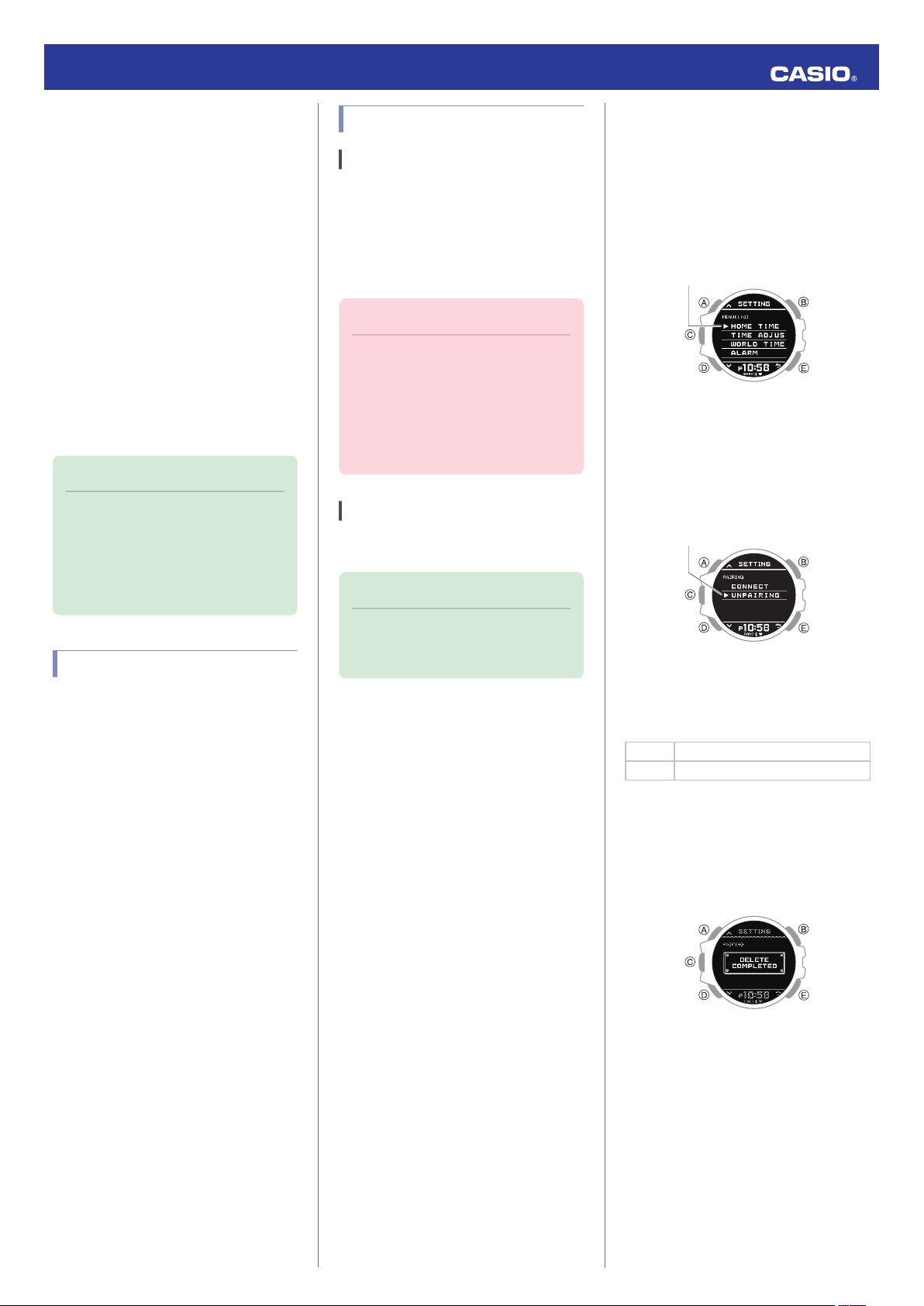
3.
X
Use (A) and (D) to move the pointer to
[PHONE FINDER].
4.
X
Press (C).
5.
X
Use (A) and (D) to move the pointer to
[EXECUTE].
6.
X
Press (C).
This will establish a connection between
the watch and phone, and sound the
phone’s ringtone.
●
It will take a few seconds before the
phone tone sounds.
7.
X
Press any button to stop the sound.
●
You can press any watch button to stop
the phone tone, but only during the first
30 seconds after it starts to sound.
Note
●
Connection with your phone is not
possible while the watch’s Airplane
Mode is enabled. To connect with your
phone, disable the Airplane Mode.
l
Using the Watch in a Medical
Facility or Aircraft
Configuring Watch Settings
After establishing a connection between the
watch and a phone, you can use G-SHOCK
MOVE to configure watch settings and to view
information acquired by the watch.
●
Make sure that the
e
symbol is shown on the
watch display when you perform the
procedure below.
●
If
e
is not displayed, refer to the information
at the link below.
l
Connecting with a Phone
1.
Y
Tap the “G-SHOCK MOVE” icon.
2.
Y
On the menu bar, tap “More”.
3.
Y
Tap “Watch”.
4.
Y
Select your preferred watch.
5.
Y
Select the setting you want to change
and then perform the operation shown on
the screen.
Connection
Connecting with a Phone
Your watch can connect with a phone that is
paired with it.
●
If the watch is not paired with the phone you
want to connect with, refer to the information
below and pair them.
l
C
Pair the watch with a phone.
Important!
●
If you have problems establishing a
connection, it could mean that G-
SHOCK MOVE is not running on your
phone. On your phone’s home screen,
tap the “G-SHOCK MOVE” icon.
Perform the operation shown on the
screen to pair with the watch.
Unpairing
Unpairing the watch from a phone requires
both G-SHOCK MOVE and watch operations.
Note
●
If you are using an iPhone, also delete
the pairing information stored on the
phone.
●
Deleting Pairing Information from G-
SHOCK MOVE
1.
Y
Tap the “G-SHOCK MOVE” icon.
2.
Y
On the menu bar, tap “More”.
3.
Y
Tap “Watch”.
4.
Y
Tap “Manage”.
5.
Y
Tap the watch you want to unpair.
6.
Y
Perform the operation shown on the
screen.
●
Deleting Pairing Information from the
Watch
1.
X
Enter the Timekeeping Mode.
l
Navigating Between Modes
2.
X
Hold down (A) for at least two seconds.
This displays the Timekeeping Mode
setting screen.
Pointer
3.
X
Use (A) and (D) to move the pointer to
[PAIRING].
4.
X
Press (C).
5.
X
Use (A) and (D) to move the pointer to
[UNPAIRING].
Pointer
6.
X
Press (C).
7.
X
Use (A) and (D) to select whether or not
you want to delete the pairing information.
[YES] Deletes pairing information.
[NO] Does not delete pairing information.
8.
X
Press (C).
After pairing information deletion is
complete, [DELETE COMPLETED] will
appear for a few seconds, and then the
Timekeeping Mode setting screen will re-
appear.
9.
X
Press (E) to exit the setting screen.
●
iPhone Only
Deleting the phone’s pairing
information
For details about setting procedures, see your
phone documentation.
“Settings”
n
“Bluetooth”
n
Cancel the
watch’s device registration.
Operation Guide 3475
20
If you purchase another phone
Note
●
Before pairing with the new phone,
delete the old phone’s pairing
information from the watch.
l
Deleting Pairing Information from
the Watch
You need to perform the pairing operation
whenever you want to establish a Bluetooth
connection with a phone for the first time.
l
C
Pair the watch with a phone.
Measuring Your Heart
Rate
While wearing the watch on your wrist, you can
use it to perform approximate measurement of
your heart rate.
You can use heart rate measurements to
monitor your daily health and to make your
training more effective.
Important!
●
Be sure to affix the watch to your wrist
before starting a heart rate
measurement operation. Starting a
measurement operation and then
affixing the watch to your wrist may
make correct measurement
impossible.
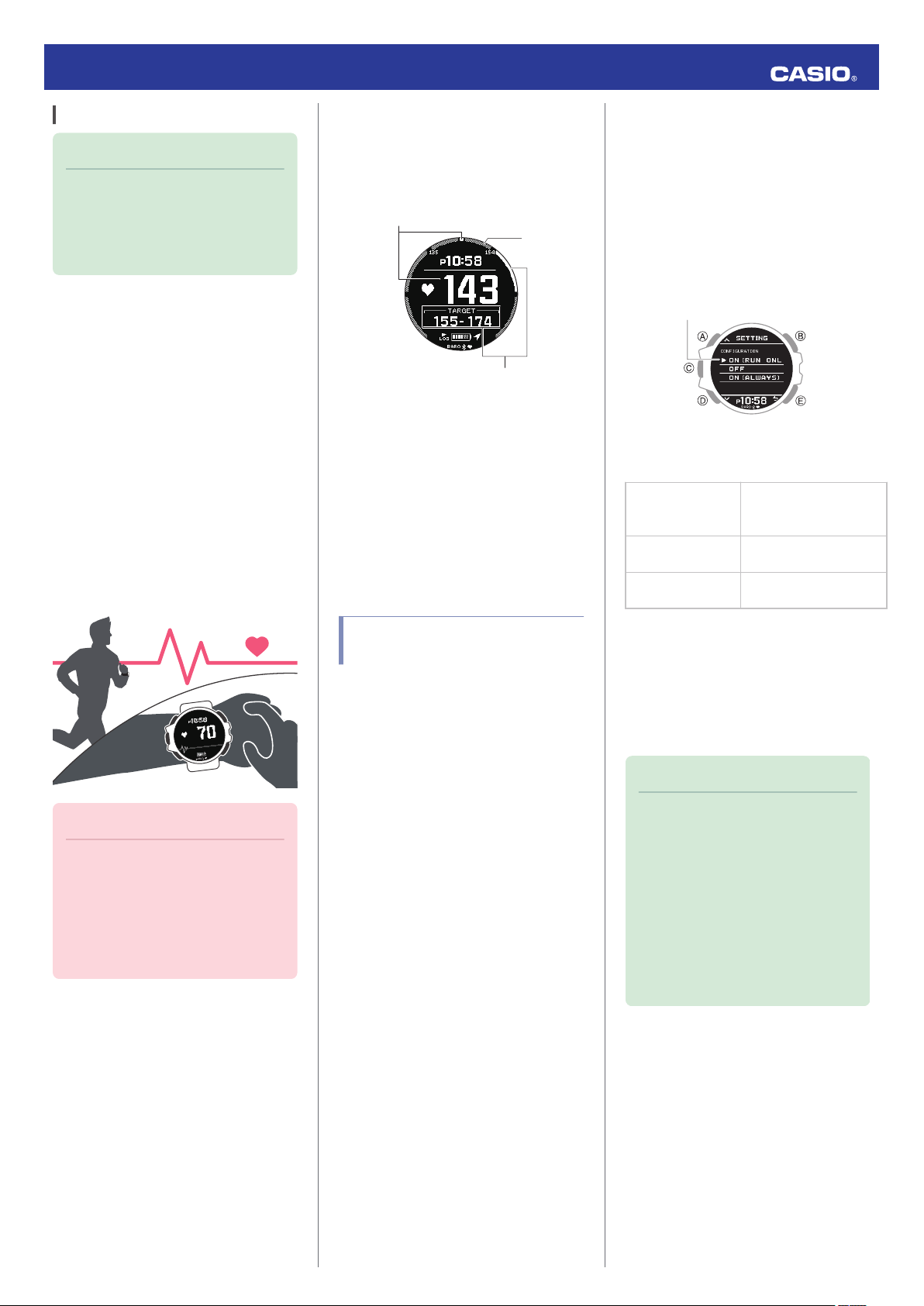
You can check your current heart rate by
entering the HR (Heart Rate) Mode. The
watch display will show the information shown
below during run timing.
②
③
①
Run Timing
A Current heart rate
B Target heart rate zone
The target zone is displayed in white.
C Current heart rate zone
Shows your current heart rate zone.
For details about heart rate zones, refer to the
information at the link below.
l
Starting Heart-rate Training
Using Heart Rate
Measurement
Even if you exit the HR (Heart Rate) Mode
while a heart rate measurement operation is in
progress, the watch will continue to display
your current heart rate.
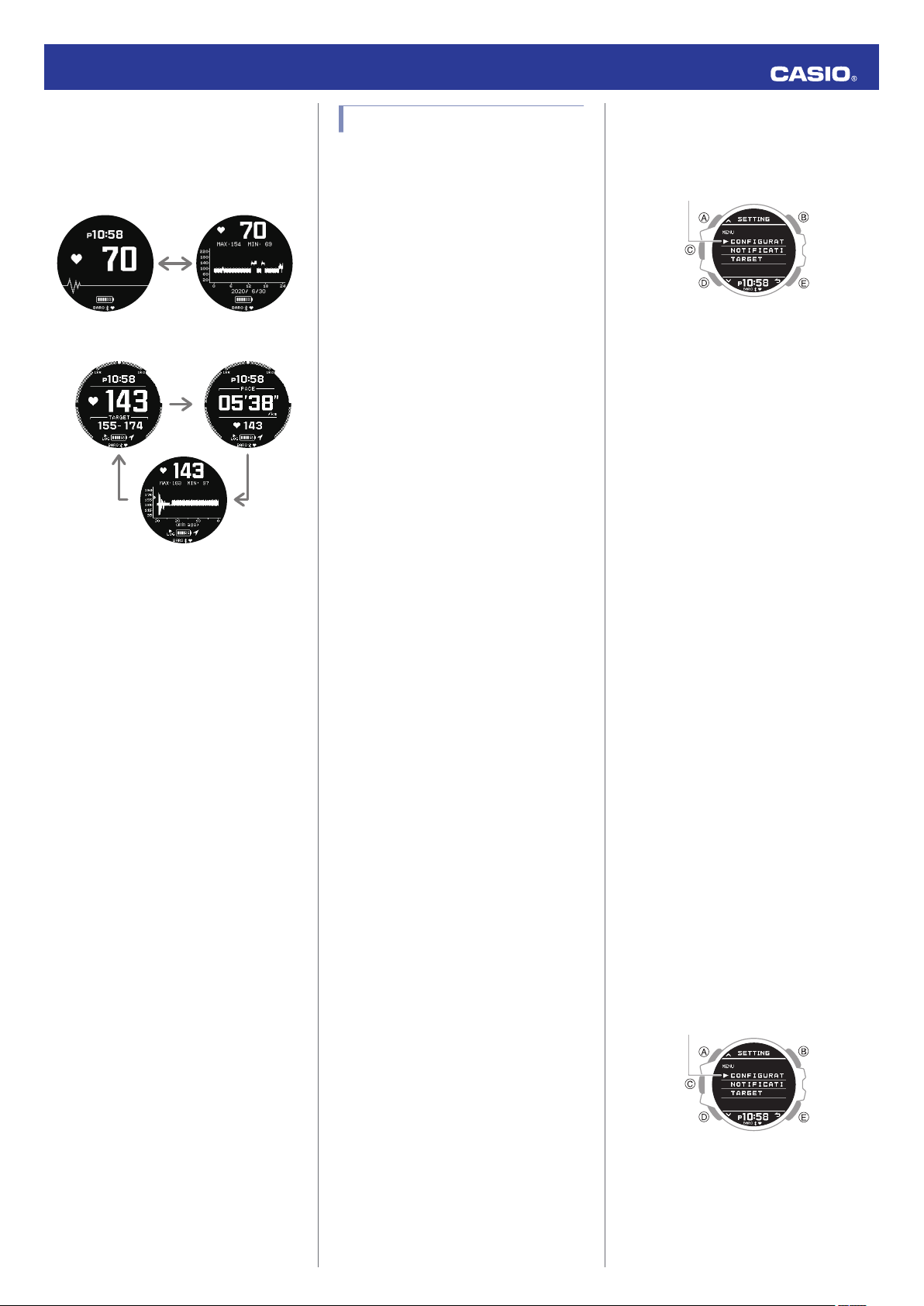
In the HR (Heart Rate) Mode, you can view
heart rate data on a graph.
●
For more accurate display values, create
your profile before using heart rate
measurement.
l
Creating Your Profile
●
Enabling and Disabling Heart Rate
Measurement
While heart rate measurement is enabled, the
watch displays your current heart rate.
1. Enter the HR (Heart Rate) Mode.
l
Navigating Between Modes
2. Hold down (A) for at least two seconds.
This displays the heart rate measurement
enable/disable screen.
Pointer
3. Use (A) and (D) to select an ON/OFF
setting.
[ON (RUN ONLY)]
Enables heart rate
measurement while
running.
[OFF]
Disables heart rate
measurement.
[ON (ALWAYS)]
Enables constant heart
rate measurement.
4. Press (C) to complete the setting
operation.
After the setting operation is complete,
[SETTING COMPLETED] will appear for
a few seconds, and then the normal HR
(Heart Rate) mode screen or HR (Heart
Rate) Mode setting screen will re-appear.
Note
●
If the current heart rate measurement
setting is [ON (ALWAYS)], your heart
rate will be displayed in all modes
except for the Training Log Mode,
Training Status Mode, and Notification
Mode.
l
Viewing Life Log Related Data
●
Even if the current heart rate
measurement setting is [OFF], your
current heart rate is displayed in the
HR (Heart Rate) Mode.
Operation Guide 3475
21
●
Switching Between Heart Rate Data
Display Screens
Each press of (A) in the HR (Heart Rate) Mode
toggles between the screens shown below.
Normal
Run Timing
●
The Heart Rate Graph shows data for up to
30 minutes or for up to 24 hours.
●
Each reading plotted along the horizontal
axis shows the range between the
maximum and minimum measured values
during a 15-second or 12-minute interval.
Starting Heart-rate Training
With heart-rate training, you measure your
heart rate and then use the resulting value as
a benchmark for training. You can monitor
your heart rate levels and keep your exercise
intensity in line with your training goals, which
contributes to more efficient training,
improved cardiopulmonary function, and
better health.
●
Specifying a Target Heart Rate Zone
Specify a target heart rate zone that matches
your training objectives.
Your heart rate changes in accordance with
your exercise intensity. The five heart rate
zones of your watch, which are numbered
from 1 to 5, are determined based on
percentages of your maximum heart rate. The
greater the zone number, the higher the
exercise intensity level.
●
Zone 1 (50 to 60%*): Warm up
Used for warm up at the beginning of an
exercise session and cool down at the end.
●
Zone 2 (61 to 70%*): Fat burning
Promotes metabolism and burns fat. Better
than more rigorous training for increasing
physical ability.
Breathing is comfortable, which is good for
prolonged training. Start of perspiration.
●
Zone 3 (71 to 80%*): Aerobic training
Improves basic endurance and athletic
performance.
Breathing is easy, light perspiration.
●
Zone 4 (81 to 90%*): Anaerobic training
Improves endurance exercise performance
and basal metabolism.
Breathing is heavier, increased
perspiration.
●
Zone 5 (91 to 100%*): Maximum effort
Improves athletic performance and
instantaneous power.
The physical load is high, so this zone
should be maintained for short periods.
Recommended for occasional training or for
athletes who train daily.
*
Percent of maximum heart rate
1. Enter the Timekeeping Mode.
l
Navigating Between Modes
2. Press (C).
This displays the GPS signal receive start
screen.
3. Press (D) to enter the HR (Heart Rate)
Mode.
4. Hold down (A) for at least two seconds.
This displays the HR (Heart Rate) Mode
setting screen.
Pointer
5. Use (A) and (D) to move the pointer to
[TARGET].
6. Press (C).
7. Use (A) and (D) to move the pointer to the
heart rate zone you want to specify as your
target.
8. Press (C) to complete the setting
operation.
After the setting operation is complete,
[SETTING COMPLETED] will appear for
a few seconds, and then the HR (Heart
Rate) mode setting screen will re-appear.
9. Press (E) to exit the setting screen.
●
Setting Up the Heart Rate Zone Alert
If you engage in heart-rate training while the
heart rate zone alert is enabled, the watch will
perform a sound and/or vibration operation to
let you know when your current heart rate is ±5
bpm or greater outside of the zone currently
specified as your target. If you do not re-enter
the target zone after the alert, an out-of-zone
alert operation will be performed at one-
minute intervals.
1. Enter the Timekeeping Mode.
l
Navigating Between Modes
2. Press (C).
This displays the GPS signal receive start
screen.
3. Press (D) to enter the HR (Heart Rate)
Mode.
4. Hold down (A) for at least two seconds.
This displays the HR (Heart Rate) Mode
setting screen.
Pointer
Operation Guide 3475
22

5. Use (A) and (D) to move the pointer to
[NOTIFICATION].
6. Press (C).
7. Use (A) and (D) to move the pointer to
[ON] (enabled) or [OFF] (disabled).
8. Press (C) to complete the setting
operation.
After the setting operation is complete,
[SETTING COMPLETED] will appear for
a few seconds, and then the HR (Heart
Rate) mode setting screen will re-appear.
9. Press (E) to exit the setting screen.
Heart Rate Measurement
Precautions
Heart Rate Measurement Functions
●
The back cover of the watch has a built-in
sensor that detects your pulse. This is used
to calculate and display an approximate
heart rate value. The factors below can
cause error in the displayed heart rate
value.
ー
How the watch is affixed to the wrist
ー
Individual wrist characteristics and
condition
ー
Training type and/or intensity
ー
Sweat, dirt, and/or other foreign matter
around the sensor
All of this means that heart rate values
displayed by the watch are approximate, and
no guarantees are made concerning their
accuracy.
●
The heart rate measurement function of this
watch is intended for recreational purposes,
and should not be used in any way for
medical purposes.
●
Heart rate measurement is automatically
disabled when the battery level indicator
shows
or lower.
Wrist Heart Rate Measurement Sleep
(Power Saving)
Regardless of whether or not you are wearing
the watch, the heart rate measurement sensor
will automatically stop measurement and
enter a sleep state if you do not move for a
certain amount of time.
If heart rate measurement does not start when
you strap the watch onto your wrist, it will start
when you move your wrist.
Precautions When Putting on
the Watch
Correctly wearing the watch on your wrist is
essential obtain more accurate heart rate
measurements. In particular, before running
or engaging in any other exercise, follow the
steps below to ensure that the watch will not
shake or slide as you exercise.
1. With the watch fastened loosely on your
wrist, place at least one finger to the right
of the pressure sensor on the right side of
the watch* (Figure
A
).
* If you wear the watch on your right wrist,
place your finger(s) to the left of the (C)
button (left side of the watch).
Figure A
●
If the watch covers the protruding bone
of your wrist (your ulna, which is circled
in the nearby figure), keep adding
fingers until it doesn’t anymore.
●
The location and shape of this bone
differ from person to person.
2. Position the watch so there is at least one
finger width between it and your wrist joint
when you bend your hand back (Figure
B
).
Figure B
3. After you determine the best wrist position
for the watch, tighten the band securely
enough to keep the watch from sliding on
your wrist.
Important!
●
A band that is snugly tightened for
heart rate measurement can make it
difficult for air to pass under the band
and cause you to sweat, which can
lead to skin irritation. After you are
finished measuring your heart rate,
loosen the band enough so you can
insert a finger between it and your
wrist.
Using the Training
Function
The Training Function uses GPS and an
accelerometer to measure and record
distance, elapsed time, pace, and other data
while you are running or walking.
You can review recorded data on the watch or
with G-SHOCK MOVE.
Run Timing
Using the Training Function, start running.
●
Starting Run Timing
1.
Enter the Timekeeping Mode.
l
Navigating Between Modes
2. Press (C).
This causes the watch to start searching
for GPS signals.
Run timing using GPS is enabled when
the on-screen message changes to [GPS
CAPTURE].
Operation Guide 3475
23
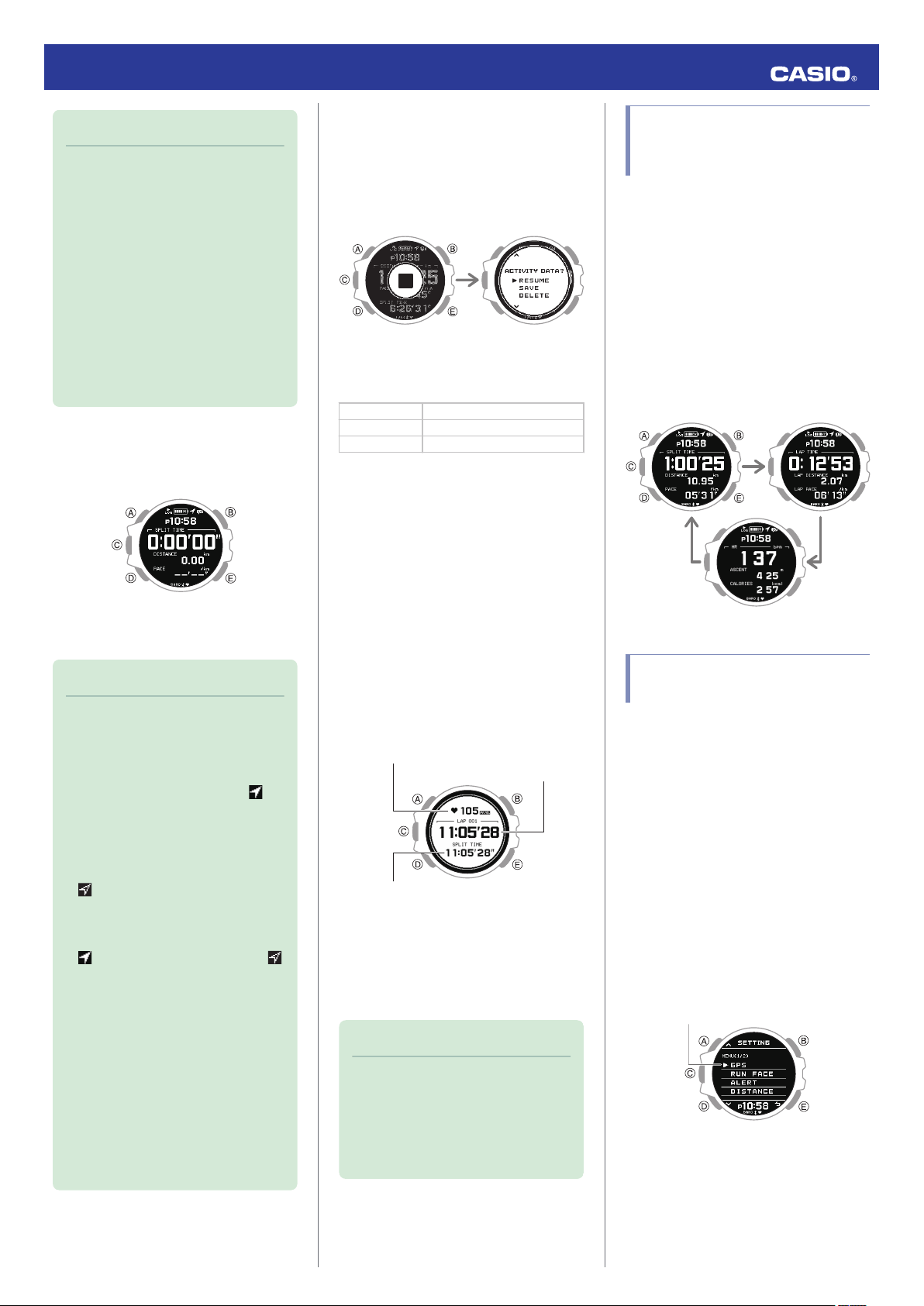
Note
●
Pressing (C) (step 3 of this procedure)
before the [GPS CAPTURE] message
appears causes run timing to start
using the watch’s accelerometer. Note
that your route is not recorded during
run timing using the accelerometer.
If you want your route to be recorded,
make sure that the [GPS CAPTURE]
message is displayed before you start
run timing.
●
It can take from about 30 seconds to
two minutes after you press (C) in step
2 for run timing using GPS to become
enabled. Under some signal reception
conditions, it may take as long as five
minutes.
Enabling run timing using GPS will
automatically cause the Training Mode
screen to appear.
Training Mode
3. Press (C).
Start run timing.
Note
●
The screen shown in step 2 of the
above procedure will not appear if the
Airplane Mode is enabled or if the GPS
setting is off.
●
You can find out the current GPS status
by checking whether or not the
mark on the display is flashing.
Not flashing: GPS enabled
Flashing: GPS disabled (Watch is
searching for GPS signals.)
●
After [GPS CAPTURE] appears and
is on the display, it means that the
GPS signal was lost and the watch is
searching for a signal.
●
If, while run time is being performed,
starts flashing on the display or
appears on the display, it means that
the watch is performing measurement
using its accelerometer and that your
route is not being recorded.
●
Entering the settings of the Compass,
Altimeter, Barometer, or Temperature
Mode during training will cause run
timing using GPS to stop momentarily.
The watch will start searching for GPS
signals again when you exit the setting.
If you want to use GPS for your run
timing, wait until [GPS CAPTURE]
appears on the display before you
start.
●
Pausing Run Timing
1. While the run timing screen is displayed,
press (C).
This pauses run timing and displays the
pause menu screen.
Pause Pause menu
2. Use (A) and (D) to select what you want to
do with the run timing data you have just
measured.
[RESUME] Resumes timing.
[SAVE] Saves data.
[DELETE] Deletes data.
3. Press (C).
●
If you select the data save option, the
run timing result screen will appear.
Pressing any button returns to the
Timekeeping Mode.
●
If you select the data delete option, the
watch returns to the Timekeeping
Mode.
●
Measuring Lap Times
1.
Start run timing.
l
Starting Run Timing
2. Press (E).
Each press of (E) displays the elapsed
time of the current section (lap time) to
appear.
Split time, lap distance
Lap time
Heart rate (average, maximum)
3. Press (A) or (D) to return to the run timing
screen.
●
If you do not perform any button
operation, the watch will return to the
run timing screen automatically after
about 10 seconds.
Note
●
You can change the lap time display
using G-SHOCK MOVE. Each of the
screens displays the items below.
ー
Heart rate [AVG] (average), lap time,
[SPLIT TIME] (split time)
ー
Heart rate [MAX] (maximum), lap
time, [DISTANCE] (lap distance)
Changing Display
Information During Run
Timing
One of three screens can be displayed during
run timing (Training Mode), and you can
specify the items you want to appear on each
screen.
This means you can configure a screen with
the items you want to monitor and display that
screen while you train.
l
Specifying the Screen to be Displayed
During Running (RUN FACE)
You can navigate between display screens by
pressing (A).
Example:
Changing the GPS Receive
Interval
Use the procedure below to specify the
interval for receiving GPS signals to acquire
location information while running.
1. Enter the Timekeeping Mode.
l
Navigating Between Modes
2. Press (C).
This displays the GPS signal receive start
screen.
3. Press (A) or (D).
This displays the Training Mode screen.
4. Hold down (A) for at least two seconds.
This displays the Training Mode setting
screen.
Pointer
Operation Guide 3475
24

5. Use (A) and (D) to move the pointer to
[GPS].
6. Press (C).
7. Use (A) and (D) to move the pointer to
[USING GPS].
8. Press (C).
9. Use (A) and (D) to move the pointer to
[ON] (enabled) or [OFF] (disabled).
10. Press (C).
After the setting operation is complete,
[SETTING COMPLETED] will appear for
a few seconds, and then the GPS setting
screen will re-appear.
11. Use (A) and (D) to move the pointer to
[INTERVAL].
This option is for specifying the location
information acquisition interval by GPS
signal reception.
12. Press (C).
13. Use (A) and (D) to select a GPS receive
interval.
[NORMAL]
Acquires location info every
second.
[LONG]
Acquires location info every
minute.
14. Press (C) to complete the setting
operation.
After the setting operation is complete,
[SETTING COMPLETED] will appear for
a few seconds, and then the GPS setting
screen will re-appear.
15. Press (E) twice to exit the setting screen.
Note
●
You can also change the GPS receive
interval using G-SHOCK MOVE.
Checking the Altitude
Differential Between Your
Current Location and a
Checkpoint
You can use G-SHOCK MOVE during run
timing to check the altitude differential
between a checkpoint and your current
location.
●
You can specify up to 10 checkpoints.
1. Enter the Training Mode.
l
Navigating Between Modes
2. Press (D) three times.
This displays the altimeter navigation
screen.
Checkpoint altitude
Current location altitude
Differential between checkpoint
and current altitudes
Travel time
●
A pointer (
) to the right of the scale
along the left of the screen also
indicates the altitude differential
between the checkpoint and current
altitude. The appearance of the pointer
changes as described below.
This
pointer:
Means this:
Altitude differential of +100m (Or:
+100ft) or more
Altitude differential within -100 to
100m (-100 to 100ft)
Altitude differential of -100m (Or:
-100ft) or more
Each press of (A) switches the checkpoint
display.
Important!
●
You can use G-SHOCK MOVE to
specify checkpoints along a running
course. Note that you cannot configure
settings using watch operations.
Setting Up Alerts
You can use G-SHOCK MOVE to specify alert
intervals to keep you informed of your calories
burned, elapsed time, and attained altitude
while training. Then the watch will perform a
sound and/or vibration alert operation
whenever you reach an alert interval value
while training. Use watch operations to enable
or disable alerts.
l
Specifying the Alert Interval (Target Alert)
1. Enter the Timekeeping Mode.
l
Navigating Between Modes
2. Press (C).
This displays the GPS signal receive start
screen.
3. Press (A) or (D).
This displays the Training Mode screen.
4. Hold down (A) for at least two seconds.
This displays the Training Mode setting
screen.
Pointer
5. Use (A) and (D) to move the pointer to
[ALERT].
6. Press (C).
7. Use (A) and (D) to select the item whose
setting you want to change.
[CALORIES] Calories burned
[TIME 1] Time 1
[TIME 2] Time 2
[ALTITUDE] Altitude
8. Press (C).
9. Use (A) and (D) to select an alert setting.
[OFF] Disabled
[ON (REPEAT)] Enabled (repeat)
[ON (1 TIME)] Enabled (one time)
●
While [ON (REPEAT)] is selected, an
alert operation is performed whenever
an alert interval value is reached.
10. Press (C) to complete the setting
operation.
After the setting operation is complete,
[SETTING COMPLETED] will appear for
a few seconds, and then the alert setting
screen will re-appear.
●
If you want to configure settings for
another item, repeat steps 7 through 10.
11.
Press (E) twice to exit the setting screen.
Operation Guide 3475
25

Important!
●
To specify the alert interval for each
item, use G-SHOCK MOVE. Note that
you cannot configure settings using
watch operations.
Note
●
You can also use G-SHOCK MOVE to
enable or disable alerts.
Displaying Your Actual
Running Distance
You can select either of two distance display
types: horizontal distance (straight-line
distance) or surface distance (actual
distance).
The surface distance display is calculated by
taking horizontal travel as well as vertical
movement into consideration.
1. Enter the Timekeeping Mode.
l
Navigating Between Modes
2. Press (C).
This displays the GPS signal receive start
screen.
3. Press (A) or (D).
This displays the Training Mode screen.
4. Hold down (A) for at least two seconds.
This displays the Training Mode setting
screen.
Pointer
5. Use (A) and (D) to move the pointer to
[DISTANCE].
6. Press (C).
7. Use (A) and (D) to move the pointer to [3D
DISTANCE].
8. Press (C).
9. Use (A) and (D) to select a setting.
[OFF] Displays horizontal distance.
[ON] Displays surface distance.
10. Press (C) to complete the setting
operation.
After the setting operation is complete,
[SETTING COMPLETED] will appear for
a few seconds, and then the distance
display setting screen will re-appear.
11. Press (E) twice to exit the setting screen.
Note
●
You can also use G-SHOCK MOVE to
change the distance display type.
Specifying the Distance Unit
Important!
●
When Tokyo (TOKYO) is the Home
City, the distance unit is fixed as
kilometers (km) and cannot be
changed.
1. Enter the Timekeeping Mode.
l
Navigating Between Modes
2. Hold down (A) for at least two seconds.
This displays the Timekeeping Mode
setting screen.
Pointer
3. Use (A) and (D) to move the pointer to
[UNIT].
4. Press (C).
5. Use (A) and (D) to move the pointer to
[DISTANCE].
6. Press (C).
7. Use (A) and (D) to select a distance unit.
[KILOMETER] Kilometers
[MILE] Miles
8. Press (C) to complete the setting
operation.
After the setting operation is complete,
[SETTING COMPLETED] will appear for
a few seconds, and then the unit setting
screen will re-appear.
9. Press (E) twice to exit the setting screen.
Note
●
You can also use G-SHOCK MOVE to
change the distance unit.
Enabling Auto Run Timing
(Auto Run Detection)
Starting to run while Auto Run Timing (auto run
detection) is enabled will cause run timing to
start automatically.
1. Enter the Timekeeping Mode.
l
Navigating Between Modes
2. Hold down (A) for at least two seconds.
This displays the Timekeeping Mode
setting screen.
Pointer
3. Use (A) and (D) to move the pointer to
[AUTO RUN DETECTION].
4. Press (C).
5. Use (A) and (D) to move the pointer to
[ON] (enabled) or [OFF] (disabled).
6. Press (C) to complete the setting
operation.
After the setting operation is complete,
[SETTING COMPLETED] will appear for
a few seconds, and then the Timekeeping
Mode setting screen will re-appear.
7. Press (E) to exit the setting screen.
Note
●
You can also use G-SHOCK MOVE to
enable or disable Auto Run Timing
(auto run detection).
Operation Guide 3475
26
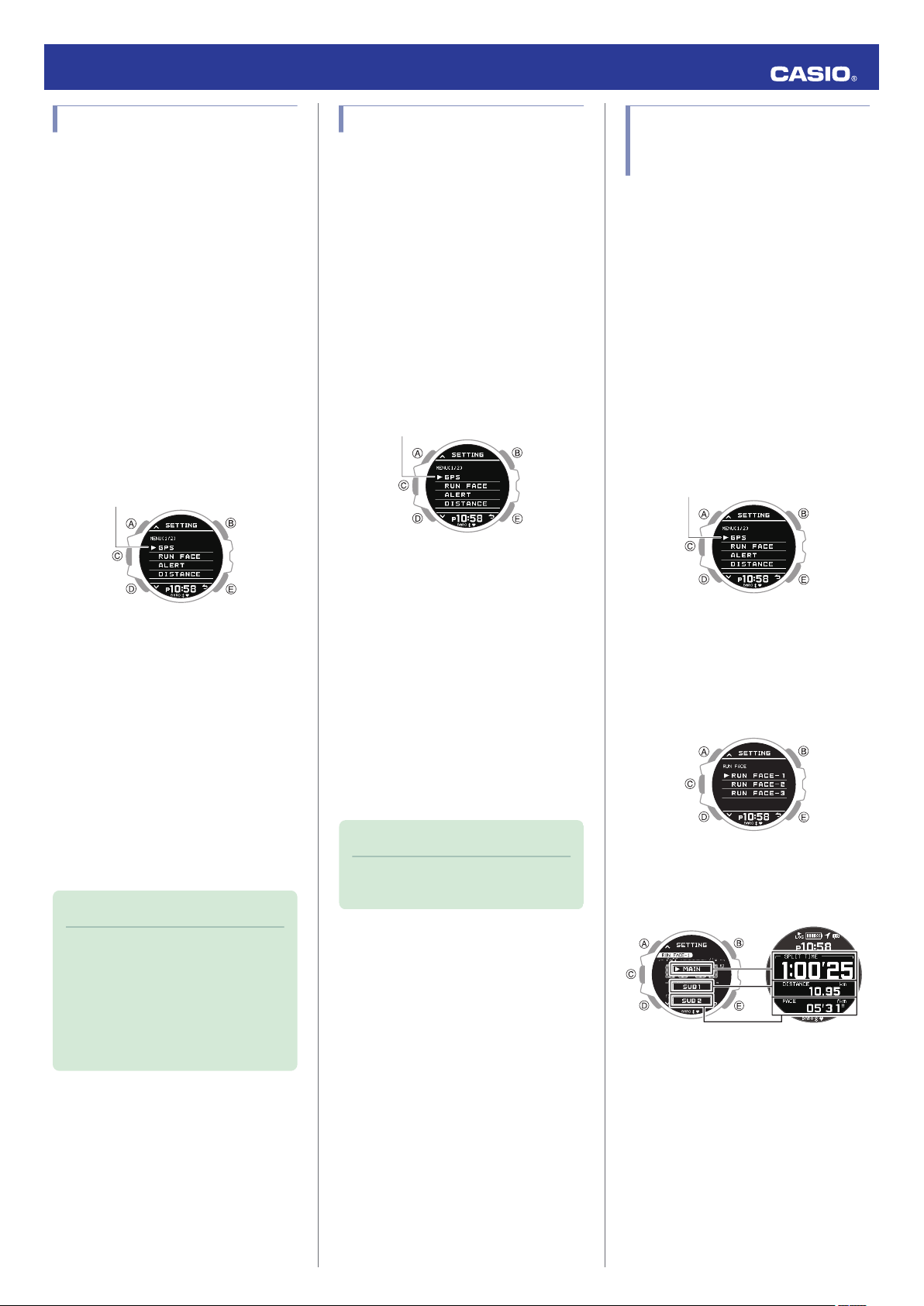
Enabling Auto Lap Timing
While Auto Lap Timing is enabled, each time
you run the distance you specified with G-
SHOCK MOVE the lap time will be recorded
automatically.
l
Specifying the Distance for Auto Lap
Timing
1. Enter the Timekeeping Mode.
l
Navigating Between Modes
2. Press (C).
This displays the GPS signal receive start
screen.
3. Press (A) or (D).
This displays the Training Mode screen.
4. Hold down (A) for at least two seconds.
This displays the Training Mode setting
screen.
Pointer
5. Use (A) and (D) to move the pointer to
[AUTO LAP].
6. Press (C).
7. Use (A) and (D) to move the pointer to
[ON] (enabled) or [OFF] (disabled).
8. Press (C) to complete the setting
operation.
After the setting operation is complete,
[SETTING COMPLETED] will appear for
a few seconds, and then the Training
Mode setting screen will re-appear.
9. Press (E) to exit the setting screen.
Note
●
If GPS is being used for Auto Lap
measurement, the Auto Lap
measurement timing may be
somewhat different from the distance
setting.
●
You can also use G-SHOCK MOVE to
enable or disable Auto Lap Timing.
Enabling Auto Pause
While Auto Pause is enabled, timing will pause
whenever you stop running.
1. Enter the Timekeeping Mode.
l
Navigating Between Modes
2. Press (C).
This displays the GPS signal receive start
screen.
3. Press (A) or (D).
This displays the Training Mode screen.
4. Hold down (A) for at least two seconds.
This displays the Training Mode setting
screen.
Pointer
5. Use (A) and (D) to move the pointer to
[AUTO PAUSE].
6. Press (C).
7. Use (A) and (D) to move the pointer to
[ON] (enabled) or [OFF] (disabled).
8. Press (C) to complete the setting
operation.
After the setting operation is complete,
[SETTING COMPLETED] will appear for
a few seconds, and then the Training
Mode setting screen will re-appear.
9. Press (E) to exit the setting screen.
Note
●
You can also use G-SHOCK MOVE to
enable or disable Auto Pause.
Specifying the Screen to be
Displayed During Running
(RUN FACE)
You can customize the items on the three
screens can be displayed during run timing
(Training Mode).
1. Enter the Timekeeping Mode.
l
Navigating Between Modes
2. Press (C).
This displays the GPS signal receive start
screen.
3. Press (A) or (D).
This displays the Training Mode screen.
4. Hold down (A) for at least two seconds.
This displays the Training Mode setting
screen.
Pointer
5. Use (A) and (D) to move the pointer to
[RUN FACE].
6. Press (C).
7. Use (A) and (D) to select the customize
screen (RUN FACE).
8. Press (C).
9. Use (A) and (D) to select the display area
whose contents you want to change.
10. Press (C).
Operation Guide 3475
27
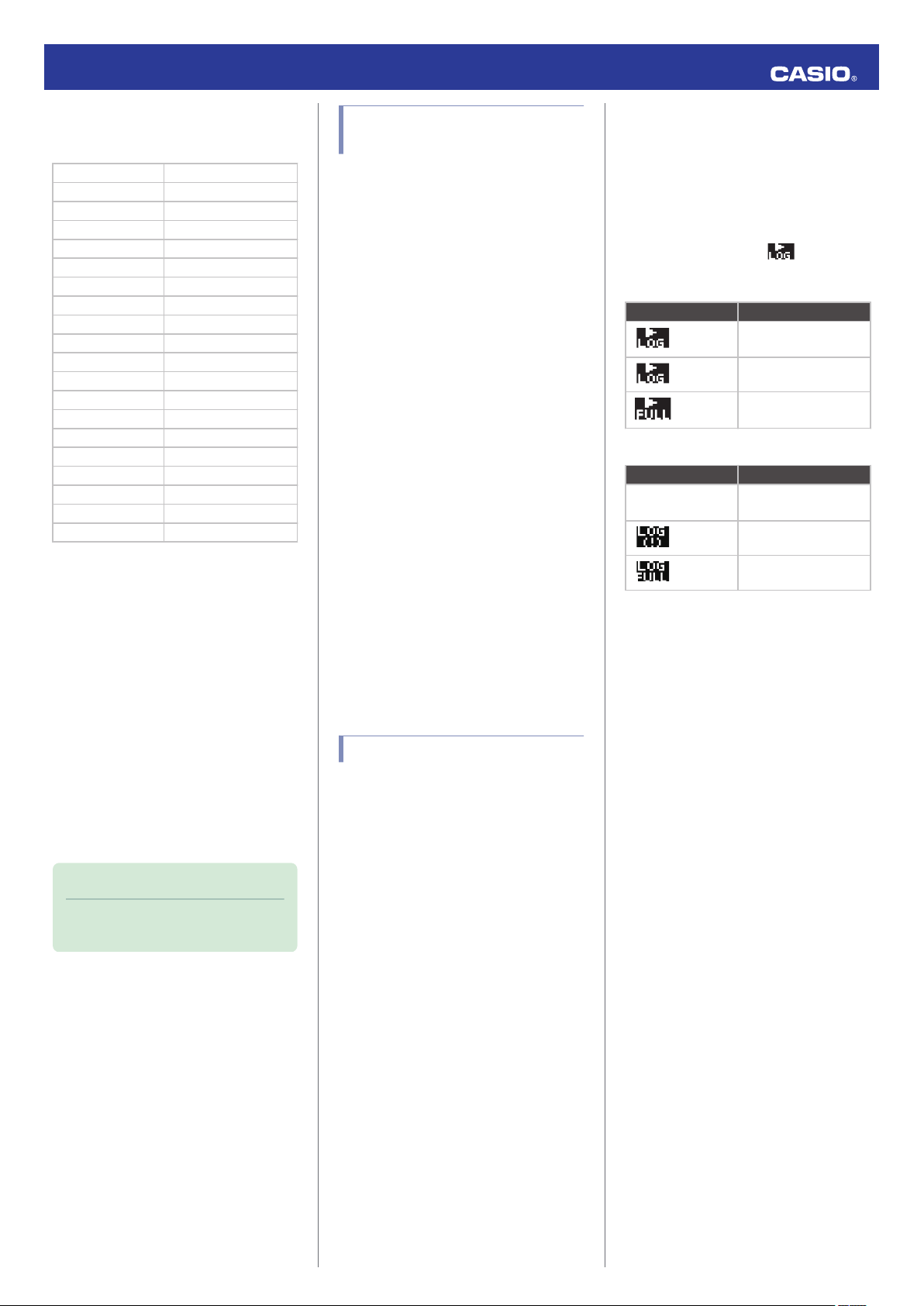
11. Use (A) and (D) to select the item you want
to in the currently selected display area.
[SPLIT TIME] Split time
[DISTANCE] Running distance
[PACE] Pace
[LAP TIME] Lap time
[LAP DISTANCE] Lap distance
[LAP PACE] Lap pace
[AVG.PACE] Average pace
[SPEED] Speed
[AVG.SPEED] Average speed
[CALORIES]* Calories burned
[HR] Heart rate
[AVG.HR] Average heart rate
[GRADE] Grade
[ALTITUDE] Altitude
[ASCENT] Total ascent
[DESCENT] Total descent
[ASC PACE] Ascent pace
[DSC PACE] Descent pace
[TIME] Time
[DATE] Day
* While heart rate measurement is
enabled, calories burned are calculated
based on your heart rate and shown on
the display.
●
If you want to change the contents of
another display area, press (E) and then
select the display area you want.
Repeat steps 9, 10, and 11 above as
required.
12. Press (C) to complete the setting
operation.
After the setting operation is complete,
[SETTING COMPLETED] will appear for
a few seconds, and then the RUN FACE
setting screen will re-appear.
13. Press (E) twice to exit the setting screen.
Note
●
You can also use G-SHOCK MOVE to
customize display screen items.
Settings Configured with the
Application
Some Training Function settings can be
configured using either watch operations or G-
SHOCK MOVE, while some settings must be
configured using G-SHOCK MOVE.
Settings that can be configured on the
watch or using G-SHOCK MOVE
●
Customization of screens displayed during
run timing
●
GPS enable/disable
●
GPS receive interval
●
Alert enable/disable
●
Distance display type (horizontal, surface)
●
Distance unit
●
Auto Lap Timing enable/disable
●
Auto Pause enable/disable
Settings that can be configured using G-
SHOCK MOVE only
●
Auto Lap display screen:
[AVG](Average Heart Rate) +[SPLIT TIME]
(Split Time) or [MAX](Maximum Heart Rate)
+[DISTANCE](Lap Distance)
●
Altitude checkpoints
●
Alert calories burned interval
●
Alert time interval
●
Alert altitude interval
●
Auto Lap Timing distance
Run Timing Precautions
●
After using the Training Function, use the
charger cable to charge the watch.
l
Charging with the Charger Cable
Viewing Training Log
Records
Your watch stores data (log records) acquired
during run timing. There is enough memory to
store up to 100 log records.
You can tell how much storage space is
available by checking the indicator.
●
During run timing
Indicator: Meaning:
Displayed
Storage space
available
Flashing Storage space low
Flashing Storage memory full
●
Not during run timing
Indicator: Meaning:
None
Storage space
available
Displayed Storage space low
Displayed Storage memory full
Training Log Data Accuracy
●
Training log values are calculated based on
step count, calories burned, heart rate,
VO2MAX, and other data picked up by the
watch’s sensors. No guarantees are made
concerning the statistics and values
calculated by this watch, so they should be
used as general reference information only.
Operation Guide 3475
28
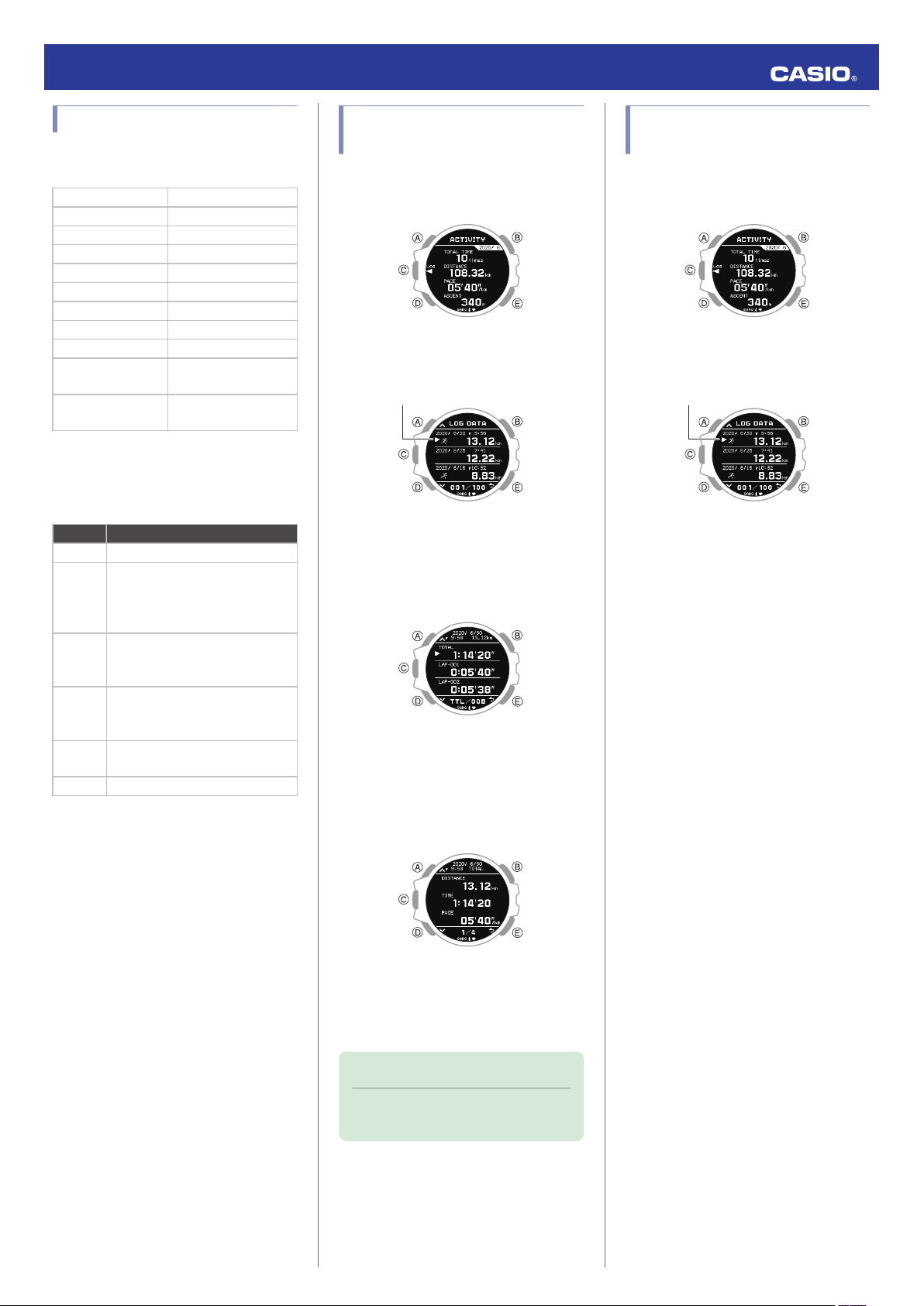
Viewable Training Log Items
The items below are shown on the Training
Log screen.
[DISTANCE] Running distance
[TIME] Travel time
[PACE] Pace
[CALORIES] Calories burned
[CADENCE] Cadence
[ASCENT] Total ascent
[DESCENT] Total descent
[AVG.HR] Average heart rate
[MAX.HR] Maximum heart rate
[AEROBIC TE]
Aerobic training effect
value*
[ANAEROBIC TE]
Anaerobic training
effect value*
* Training effect quantifies training
productivity, which allows you to find the
training activity that suits your needs.
●
Interpreting training effect values
Value Means this:
0.0 - 0.9 No effect on fitness
1.0 - 1.9
Improves endurance, training for
more than one hour contributes to
health maintenance. Suitable for
recovery from hard training.
2.0 - 2.9
Effective for maintaining cardio
function and for attaining basic
physical fitness.
3.0 - 3.9
Effective for maintaining
cardiopulmonary function and as
the basis of a training plan.
4.0 - 4.9
Training that suddenly raises
cardiopulmonary function.
5.0 Overloads the body.
Viewing Recorded Log Data
Records
1. Enter the Training Log Mode.
l
Navigating Between Modes
2. Press (C).
This displays the training log list.
Pointer
3. Use (A) and (D) to move the pointer to the
log data record you want to view.
4. Press (C).
This displays the selected log data items.
5. Use (A) and (D) to move the pointer to the
item whose details you want to view.
6. Press (C).
This displays details about the selected
item.
●
You can use (A) and (D) to scroll screen
contents.
7.
Hold down (D) for at least one second to
return to the Timekeeping Mode.
Note
●
Pressing (E) during the above
procedure will go back one screen.
Deleting a Particular Log
Data Record
1. Enter the Training Log Mode.
l
Navigating Between Modes
2. Press (C).
This displays the training log list.
Pointer
3. Use (A) and (D) to move the pointer to the
data you want to delete.
4. Hold down (A) for at least two seconds.
This displays a delete menu.
5. Use (A) and (D) to move the pointer to
[ONE].
6. Press (C).
7. Use (A) and (D) to move the pointer to
[EXECUTE].
To cancel log data deletion, move the
pointer to [CANCEL].
8. Press (C).
After the data delete operation is
complete, [DELETE COMPLETED] will
appear for a few seconds, and then the
Training Log Mode screen will re-appear.
Operation Guide 3475
29
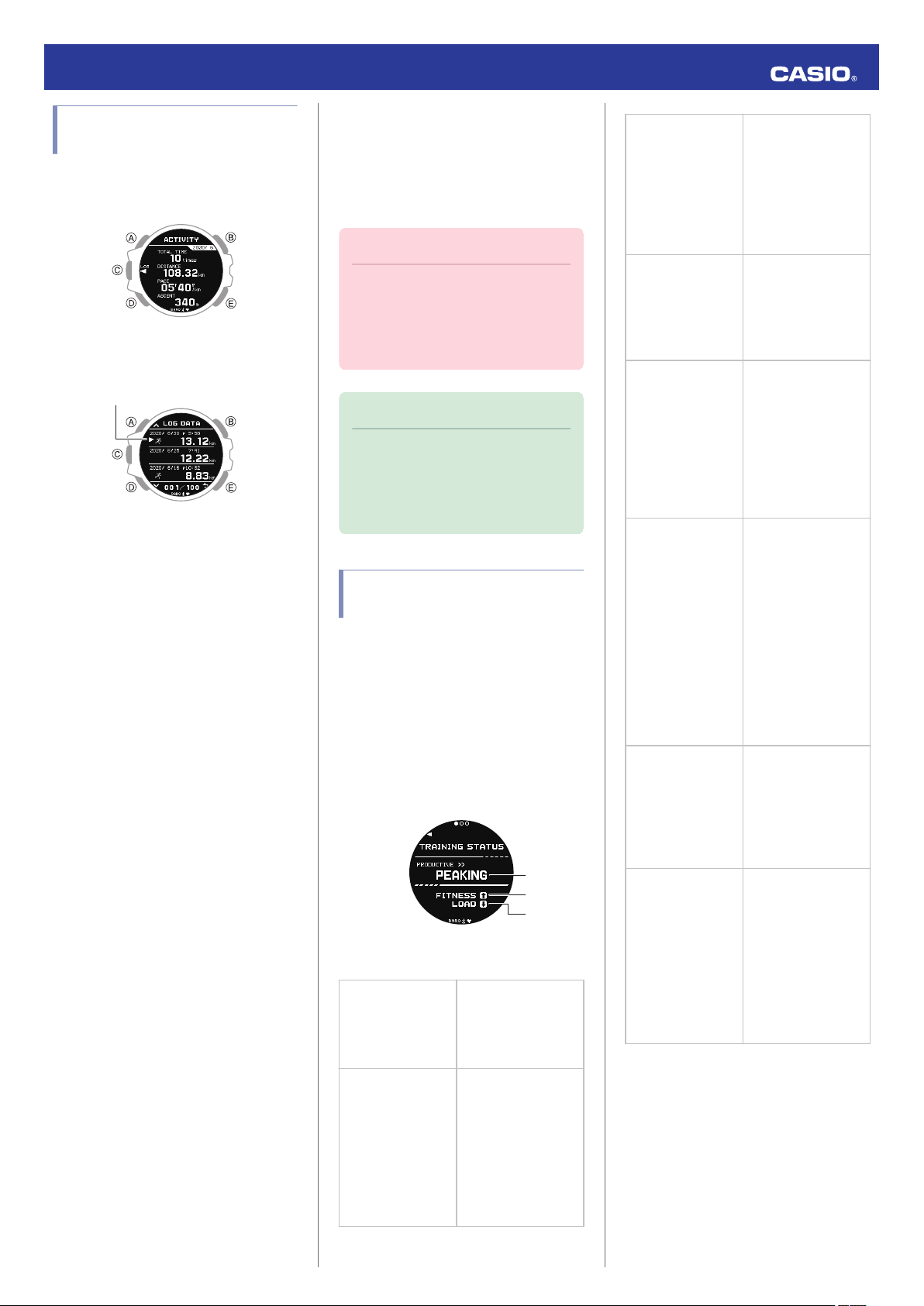
Deleting All Log Data
Records
1. Enter the Training Log Mode.
l
Navigating Between Modes
2. Press (C).
This displays the training log list.
Pointer
3. Hold down (A) for at least two seconds.
This displays a delete menu.
4. Use (A) and (D) to move the pointer to
[ALL].
5. Press (C).
6. Use (A) and (D) to move the pointer to
[EXECUTE].
To cancel log data deletion, move the
pointer to [CANCEL].
7. Press (C).
This displays a confirmation screen.
8. Use (A) and (D) to move the pointer to
[YES].
9. Press (C).
After the data delete operation is
complete, [DELETE COMPLETED] will
appear for a few seconds, and then the
Training Log Mode screen will re-appear.
Viewing Your Training
Performance Condition
You can use your watch to measure your heart
rate, running speed, and altitude, and display
your training status.
Important!
●
To measure your training status, you
need to measure your heart rate and
create your profile.
l
Using Heart Rate Measurement
l
Creating Your Profile
Note
●
You can check your training status
even after entering the Timekeeping
Mode.
l
Selecting a Timekeeping Mode
Digital Display Format
Checking Your Training
Status
Training status evaluates the training effect. It
shows how your training affects your fitness
level and performance. You can use training
status information to improve your fitness
level.
1. Enter the Training Status Mode.
l
Navigating Between Modes
●
Entering the Training Status Mode
displays the Training Status screen.
②
③
①
A
Training status
[NO STATUS]
Data is required for
runs (of at least 10
minutes) that update
VO2MAX at least twice
a week.
[DETRAINING]
Training at a load that
is less than
recommended has
continued for one
week, which is
affecting your fitness
level. Correct by
increasing your
training load.
[RECOVERY]
Lighten your training
load to recover. This is
necessary when
engaging in hard
training. Increase your
training load after you
feel you have
recovered.
[MAINTAINING]
Training load suitable
for maintaining your
fitness level. For better
effect, try other types of
training or increasing
the training volume.
[PRODUCTIVE]
Maintain this status.
The training load is
either laying a
foundation for fitness
or leading in the right
direction. To maintain
this status, schedule
recovery time between
training.
[PEAKING]
This is the ideal
condition. By
lessening the training
load, you can recover
and compensate for
previous training.
Since this peak status
can be maintained only
for short periods, your
training plan should
take the next training
session into
consideration.
[OVERREACHING]
This status has a high
training load, which is
counterproductive.
Rest is required.
Create recovery time
by including low-load
training.
[UNPRODUCTIVE]
The training level is
good, but the fitness
level decreases.
Physical recovery is
difficult. Take care to
avoid stress, to
maintain good
nutrition, and to
monitor your overall
health.
Operation Guide 3475
30
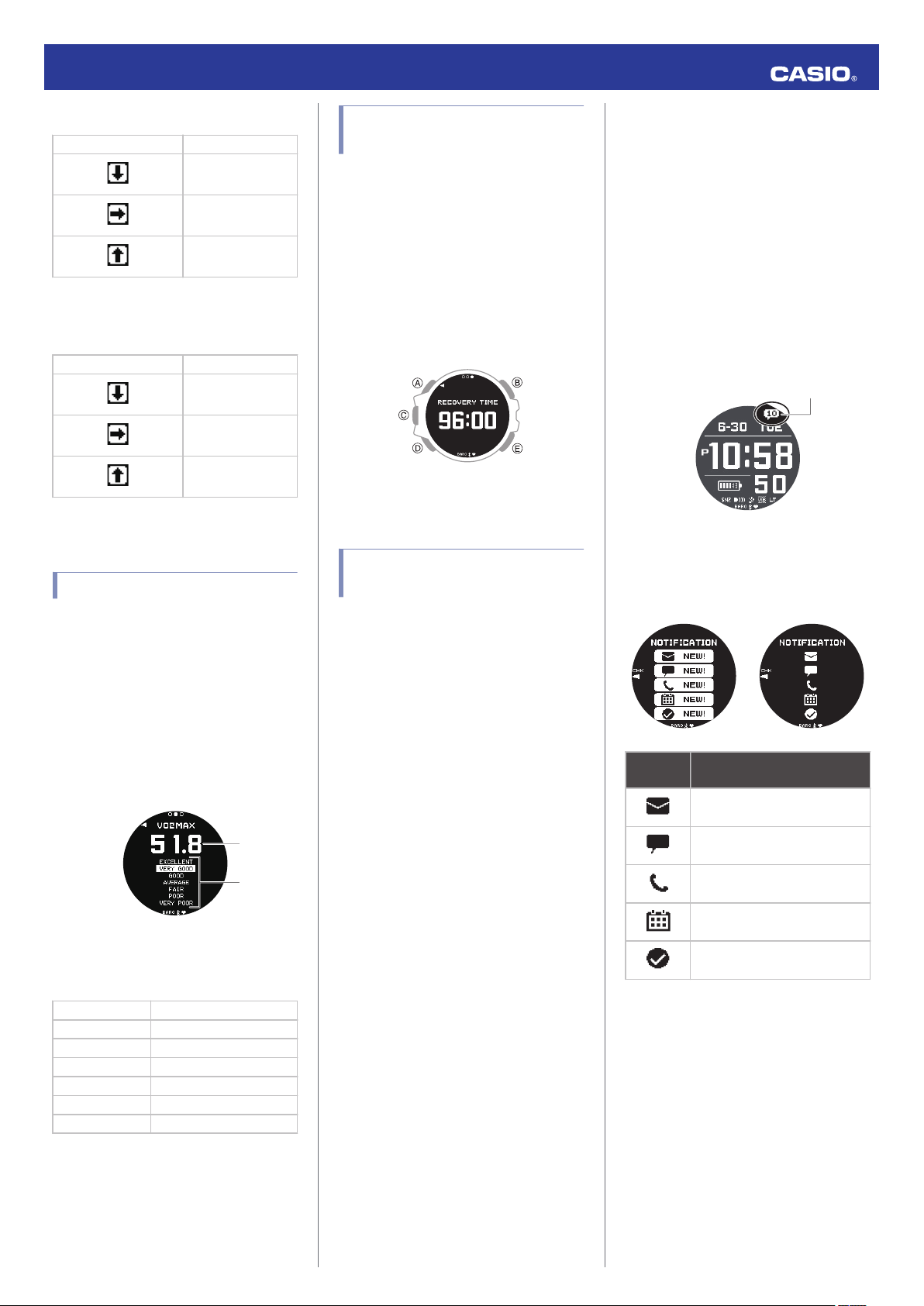
B
FITNESS LEVEL *1
(No symbol) No effect
Decrease
Maintain
Increase
*1 Indicates training productivity based on
long-term changes in VO2MAX.
C
TRAINING LOAD *2
(No symbol) No effect
Decrease
No change
Increase
*2 Indicates training productivity based on
long-term training load.
Checking Your VO2MAX
VO2MAX is your actual fitness level. A greater
VO2MAX value is said to indicate better
cardiopulmonary capacity and greater
endurance. It comes in handy when creating
future training plans.
1. Enter the Training Status Mode.
l
Navigating Between Modes
2. Press (A).
This displays the VO2MAX screen.
①
②
A
VO2MAX value
B
Fitness category
[EXCELLENT]
Excellent
[VERY GOOD] Very high
[GOOD] High
[AVERAGE] Normal
[FAIR] Rather low
[POOR] Low
[VERY POOR] Very low
●
The applicable category is indicated by
white highlighting.
●
You can also check age-specific reference
values.
l
Fitness Categories
Checking Your Recovery
Time
Recovery time is the appropriate rest period
needed to recover, which increases the
training effect.
The maximum recovery time period is four
days (96 hours).
1. Enter the Training Status Mode.
l
Navigating Between Modes
2. Press (A) twice.
This displays the recovery time screen.
●
Recovery time is reduced every at
intervals of 30 minutes.
Training Status Display
Precautions
●
To measure your VO2MAX, you will need to
input correct profile information (height,
weight, gender, etc.) and then run for at
least 10 minutes outdoors.
●
Note that the factors below can cause
fluctuation of the measured VO2MAX value.
ー
Running course (hills, etc.)
ー
Non-running training
ー
Environment (temperature, humidity,
elevation, etc.)
●
To display a training status, you need to
enable heart rate measurement, and go on
a VO2MAX update run (of at least 10
minutes) at least twice a week and store the
resulting data.
Receiving Phone
Notifications
You can use your watch to check the details
of incoming calls, mail, and SNS alerts and
information that are received by a phone
connected to the watch by Bluetooth. The
watch can have up to 10 notifications stored in
its memory.
●
To receive notifications from your phone,
you need to pair the watch with it.
l
Getting Ready
The number of new messages is shown on the
Timekeeping Mode display.
New messages
You can use the Notification Mode to check
notification types and whether there are any
new messages.
New Messages
Received
No New Messages
This
indicator: Means this:
Mail
SNS
Incoming calls, missed calls
Schedule
Other
●
While notification receive is enabled,
reception of a notification causes its
contents to appear on the display,
regardless of the mode (Notification Cut-in).
l
Enabling and Disabling Incoming Call
Notifications
Operation Guide 3475
31
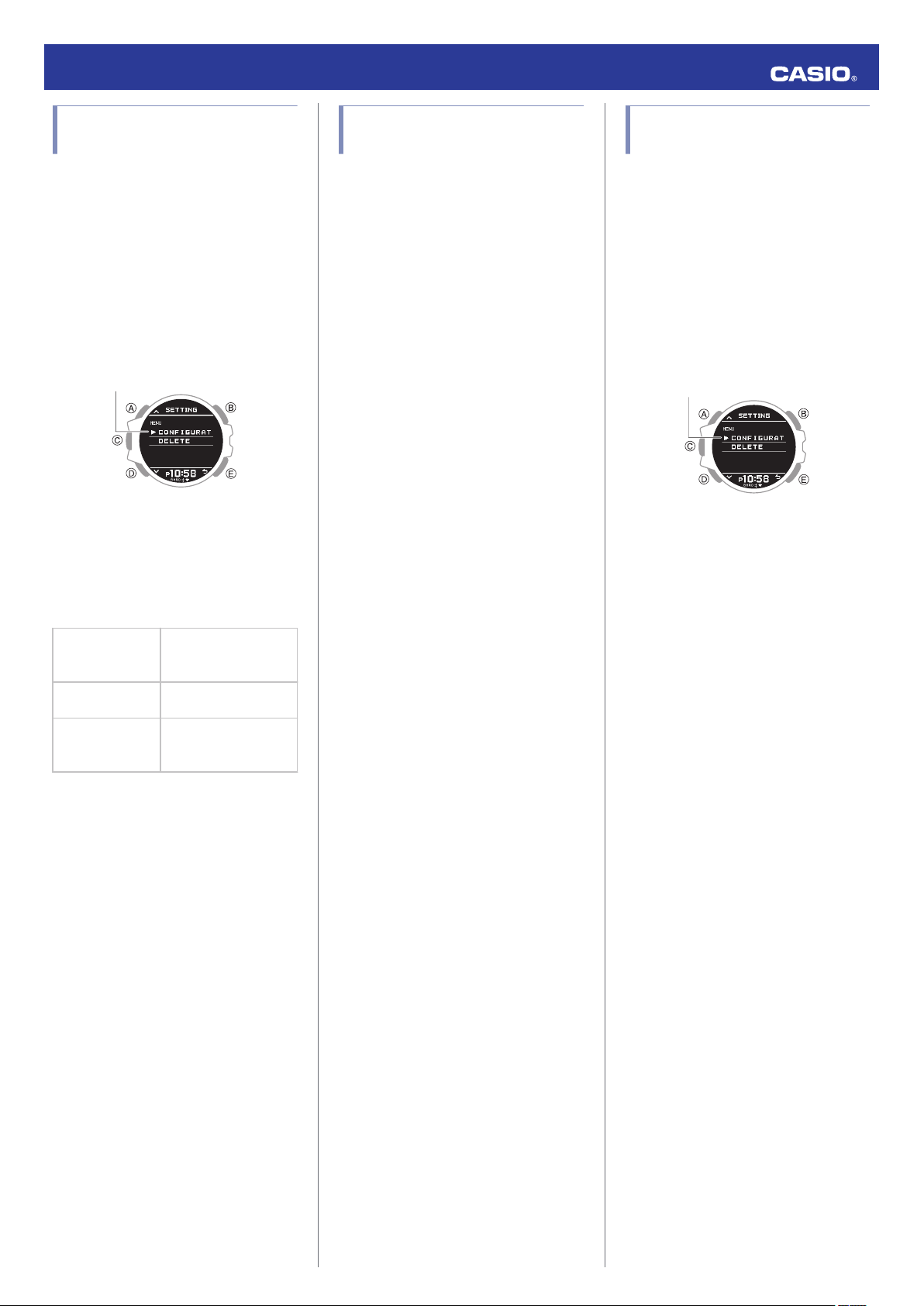
Enabling and Disabling
Incoming Call Notifications
You can enable or disable notification receive
as required.
1. Enter the Notification Mode.
l
Navigating Between Modes
2. Press (C).
This displays the notification list.
3. Hold down (A) for at least two seconds.
This displays the Notification Mode
setting screen.
Pointer
4. Use (A) and (D) to move the pointer to
[CONFIGURATION].
5. Press (C).
6. Use (A) and (D) to select a notification
receive ON/OFF setting.
[ON]
Enables receive and
notification cut-in
display.
[ON (RUN OFF)]
Disables receive during
run timing only.
[OFF]
Disables receive and
notification cut-in
display.
●
Notification cut-in displays the contents
of a received notification, regardless of
the watch mode.
●
After about 30 seconds, the display will
return to what it was before the
notification cut-in appeared.
7. Press (C) to complete the setting
operation.
After the setting operation is complete,
[SETTING COMPLETED] will appear for
a few seconds, and then the Notification
Mode setting screen will re-appear.
8. Press (E) to exit the setting screen.
Displaying Notification
Contents
1. Enter the Notification Mode.
l
Navigating Between Modes
2. Press (C).
This displays the notification list.
●
The notification list can contain up to 10
notifications.
●
Addition of a notification to the list when
it already contains 10 notifications, will
cause the oldest notification in the list to
be deleted to make room for the new
one.
3. Use (A) and (D) to move the pointer to the
title of the notification you want to view.
4. Press (C).
This displays the details of the notification.
From 83 to 100 double-width characters
are displayed for the body text.
●
You can use (A) and (D) to scroll.
●
To return to the notification list, press
(E).
●
To return to the Timekeeping Mode,
hold down (D) for at least one second.
Deleting a Particular
Notification
1. Enter the Notification Mode.
l
Navigating Between Modes
2. Press (C).
This displays the notification list.
3. Use (A) and (D) to move the pointer to the
title of the notification you want to delete.
4. Hold down (A) for at least two seconds.
This displays the Notification Mode
setting screen.
Pointer
5. Use (A) and (D) to move the pointer to
[DELETE].
6. Press (C).
7. Use (A) and (D) to move the pointer to
[ONE].
8. Press (C).
9. Use (A) and (D) to move the pointer to
[EXECUTE].
●
To cancel data deletion, move the
pointer to [CANCEL].
10. Press (C).
After the data delete operation is
complete, [DELETE COMPLETED] will
appear for a few seconds, and then the
Notification Mode screen will re-appear.
Operation Guide 3475
32
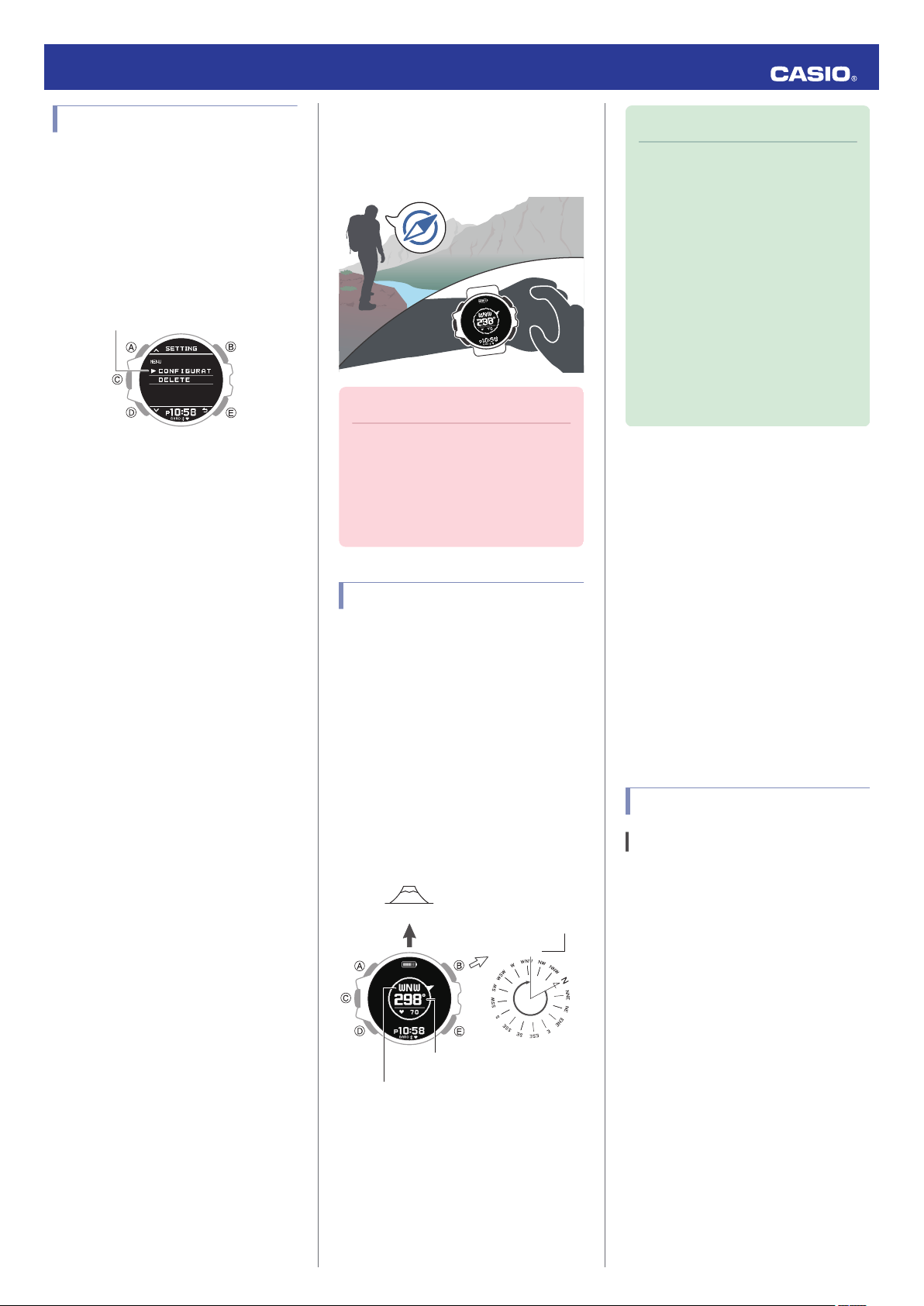
Deleting All Notifications
1. Enter the Notification Mode.
l
Navigating Between Modes
2. Press (C).
This displays the notification list.
3. Hold down (A) for at least two seconds.
This displays the Notification Mode
setting screen.
Pointer
4. Use (A) and (D) to move the pointer to
[DELETE].
5. Press (C).
6. Use (A) and (D) to move the pointer to
[ALL].
7. Press (C).
8. Use (A) and (D) to move the pointer to
[EXECUTE].
●
To cancel data deletion, move the
pointer to [CANCEL].
9. Press (C).
This displays a confirmation screen.
10. Use (A) and (D) to move the pointer to
[YES].
11. Press (C).
After the data delete operation is
complete, [DELETE COMPLETED] will
appear for a few seconds, and then the
Notification Mode screen will re-appear.
Digital Compass
You can use the Digital Compass Mode to
determine the direction of north, and to check
your bearing to a destination.
Important!
●
Check the information at the link below
to find out how to ensure correct
readings.
l
Calibrating Compass Readings
l
Digital Compass Reading
Precautions
Taking a Compass Reading
1. Enter the Compass Mode.
l
Navigating Between Modes
●
Entering the Compass Mode starts
compass readings.
2. Keeping the watch level, point 12 o’clock
in the direction of your desired objective.
●
North is indicated by
p
. The bearing
and bearing angle to your objective will
also appear on the display.
●
To retrigger the compass operation,
press (C).
Interpreting Bearing Readings
298°
0°
Bearing angle
Bearing angle to objective
Bearing to objective
North
Objective
Directions: N (North), E (East), W (West), S
(South)
Note
●
Normally the Compass Mode
indicates magnetic north. You can also
configure settings to indicate true
north.
l
Setting Up for True North
Readings (Magnetic Declination
Calibration)
l
Magnetic North and True North
●
After the initial reading is displayed, the
watch will continue to take readings
about every 0.5 seconds for about the
next 60 seconds. The watch will return
to the Timekeeping Mode
automatically about 60 seconds after
you start a direction reading operation.
●
Aligning a Map with Actual
Surroundings (Setting a Map)
Setting a map means to align the map so the
directions indicated on it are aligned with the
actual directions of your location. Once you
set a map, you can more easily get a grasp of
the relationship between map markings and
actual geographic contours. To set a map with
this watch, align north on the map with the
north indication of the watch. Once you set the
map, you can compare your bearing on the
map with your surroundings, which will help
you determine your current location and
destination.
●
Note that map reading skills and experience
are required to determine your current
location and destination on a map.
Calibrating the Compass
Calibrating Compass Readings
Perform 3-point or figure 8 calibration
whenever you notice the watch’s compass
readings are different from those of another
compass, or before setting out on a climb or
trek.
●
Note that accurate compass readings
and/or calibration will not be possible in an
area where strong magnetism is present.
l
Digital Compass Reading Precautions
Operation Guide 3475
33
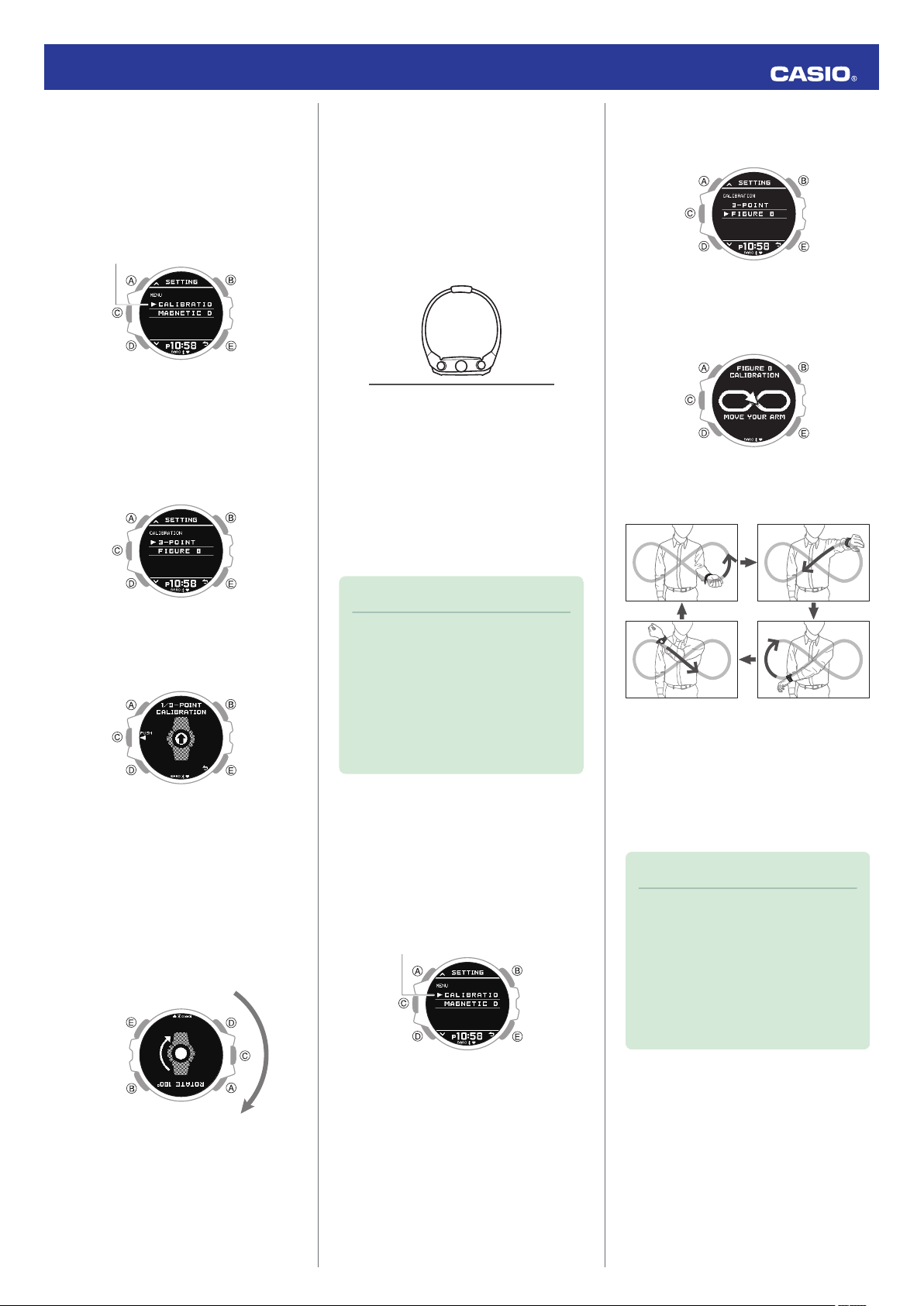
3-Point Calibration
1. Enter the Compass Mode.
l
Navigating Between Modes
2. Hold down (A) for at least two seconds.
This displays the Digital Compass Mode
setting screen.
Pointer
3. Use (A) and (D) to move the pointer to
[CALIBRATION].
4. Press (C).
5. Use (A) and (D) to move the pointer to [3-
POINT].
6. Press (C).
This displays the 3-point calibration
screen.
7. While keeping the watch horizontal, press
(C).
This starts calibration of the first point,
which causes [PLEASE WAIT] to appear
on the display. [ROTATE 180°] will appear
when calibration is successful.
8. Keeping the LCD of the watch pointing
upwards, rotate it 180 degrees. Be as
exact as possible.
9. While keeping the watch horizontal, press
(C).
This starts calibration of the second point,
which causes [PLEASE WAIT] to appear
on the display. [TURN OVER] will appear
when calibration is successful.
10. Turn the watch over so the LCD is pointing
at the ground.
Ground
11. While keeping the watch horizontal, press
(C).
This starts calibration of the third point,
which causes [PLEASE WAIT] to appear
on the display. [SUCCESSFUL] will
appear when calibration is successful. A
few seconds later, the watch will return to
the Digital Compass screen.
Note
●
If the calibration operation fails, the
message [FAILED RETRY?] will
appear. To retry calibration, press (C).
To stop a calibration operation, press
(E).
●
Pressing (E) during the above
procedure will return to the calibration
method selection screen.
Figure 8 calibration
1. Enter the Compass Mode.
l
Navigating Between Modes
2. Hold down (A) for at least two seconds.
This displays the Digital Compass Mode
setting screen.
Pointer
3. Use (A) and (D) to move the pointer to
[CALIBRATION].
4. Press (C).
5. Use (A) and (D) to move the pointer to
[FIGURE 8].
6. Press (C).
This displays the figure 8 calibration
screen.
When the screen shown above appears,
move your arm in a figure 8 pattern as
shown in the illustrations below.
●
Allow your wrist to twist.
●
Keep your arm as far as possible from
your body as you move it.
●
[SUCCESSFUL] will appear when
calibration is successful. A few seconds
later, the watch will return to the Digital
Compass screen.
Note
●
If the calibration operation fails, the
message [FAILED RETRY?] will
appear. To retry calibration, press (C).
To stop a calibration operation, press
(E).
●
Pressing (E) during the above
procedure will return to the calibration
method selection screen.
Operation Guide 3475
34
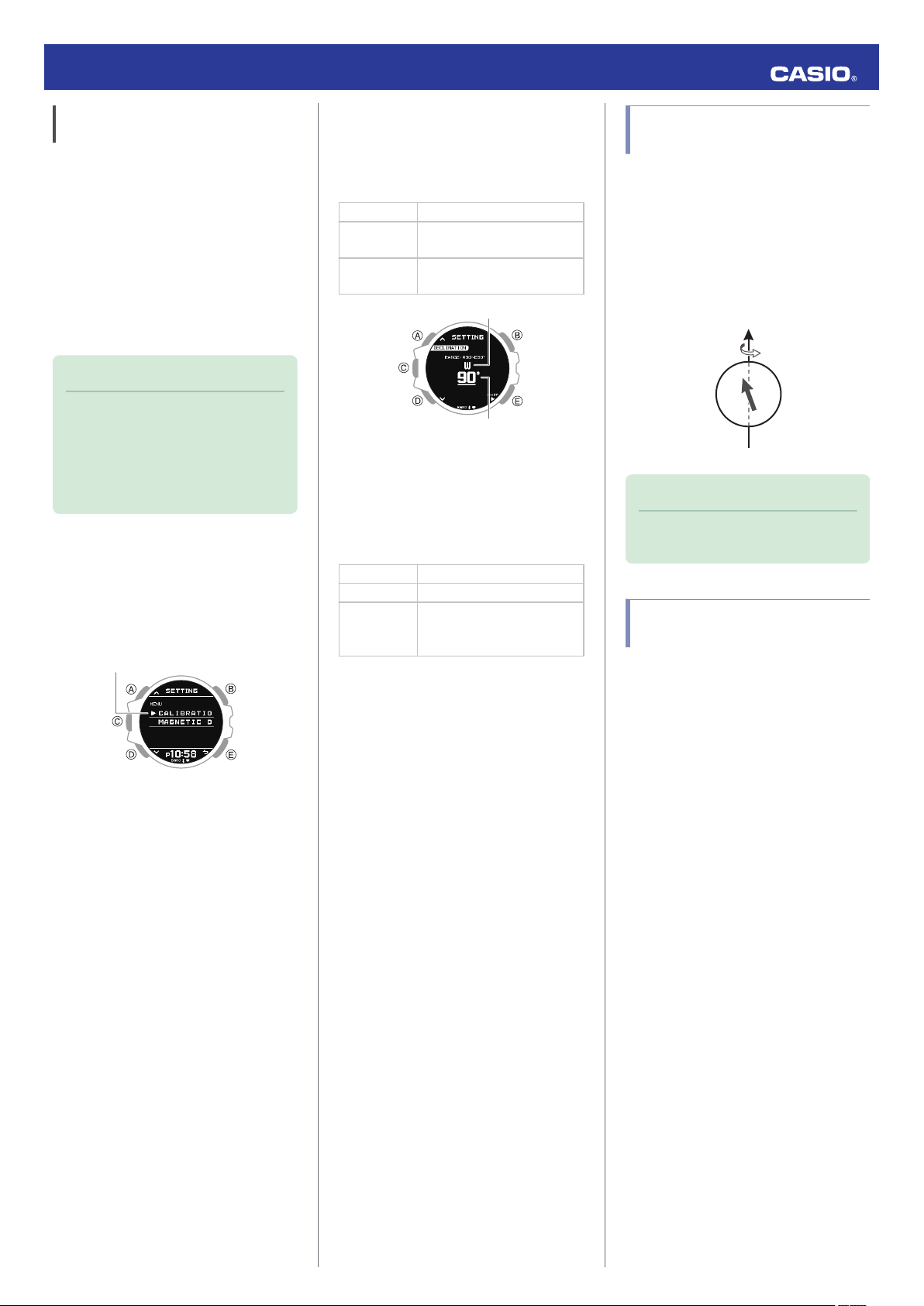
Setting Up for True North Readings
(Magnetic Declination Calibration)
If you want the watch to indicate true north
instead of magnetic north, you need to specify
your current location’s magnetic declination
direction (east or west) and declination angle.
l
Magnetic North and True North
●
The magnetic declination angle value can
be set in 1° (degree) units only. Use a value
that is closest to the angle you want to set.
Example: For an angle of 7.4°, set 7°.
Example: For an angle of 7°40’ (7 degrees,
40 minutes), set 8°.
Note
●
Magnetic declination angles (east or
west) and angle degree values for
specific locations can be found on
geographic maps, mountain climbing
maps, and other maps that include
contour lines.
1. Enter the Compass Mode.
l
Navigating Between Modes
2. Hold down (A) for at least two seconds.
This displays the Digital Compass Mode
setting screen.
Pointer
3. Use (A) and (D) to move the pointer to
[MAGNETIC DECLINATION].
4. Press (C).
5. Use (A) (East) and (D) (West) to change
the magnetic declination direction and
angle.
Setting range: 90° west to 90° east
[0° (OFF)] Magnetic north
[E]
Magnetic north east of true
north (East declination)
[W]
Magnetic north west of true
north (West declination)
Magnetic declination direction
Magnetic declination angle
●
To stop the setting operation, press (E)
and advance to step 7.
6. Press (C).
7. Use (A) and (D) to select whether or not
you want to save your current settings.
[YES] Saves current settings.
[NO] Discards current settings.
[RETURN]
This returns to the magnetic
declination angle calibration
screen.
8. Press (C) to complete the setting
operation.
After the setting operation is complete,
[SETTING COMPLETED] will appear for
a few seconds, and then the Digital
Compass Mode setting screen will re-
appear.
9. Press (E) to exit the setting screen.
Magnetic North and True
North
There are actually two types of north:
magnetic north and true north.
Magnetic north: North indicated by the needle
of a compass
True north: Direction to the North Pole
As shown in the illustration below, magnetic
north and true north are not the same.
Earth
Magnetic north
True north
Note
●
The north indicated on commercially
available maps is normally true north.
Digital Compass Reading
Precautions
Location During Use
Taking readings near sources of strong
magnetism can cause reading error. Keep the
watch away from the following types of items.
Permanent magnets (magnetic accessories,
etc.), metal objects, high-voltage wires, aerial
wires, electrical household appliances (TVs,
computers, cellphones, etc.)
●
Note that correct direction readings are not
possible indoors, especially inside of
reinforced concrete structures.
●
Accurate direction readings are not
possible in motor vehicles, on boats, on
aircraft, etc.
Storage Location
Exposure of the watch to magnetism can
affect the accuracy of digital compass
readings. Keep the watch away from the types
of items below.
Permanent magnets (magnetic accessories,
etc.), metal objects, electrical household
appliances (TVs, computers, cellphones, etc.)
Operation Guide 3475
35
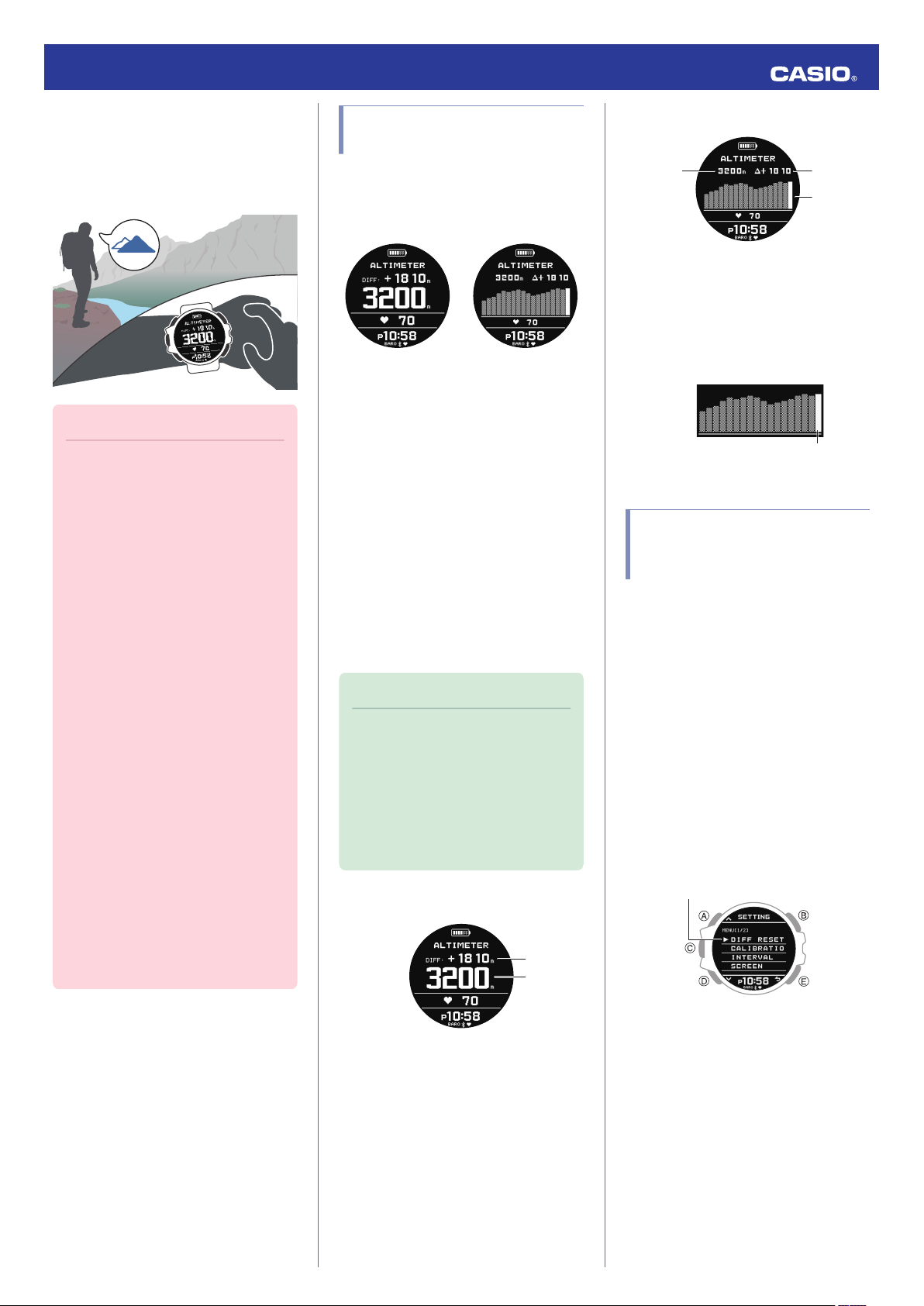
Altitude Measurement
The watch takes altitude readings and
displays results based on air pressure
measurements taken by a built-in pressure
sensor.
Important!
●
The altitude readings displayed by the
watch are relative values that are
calculated based on barometric
pressure measured by the watch’s
pressure sensor. This means that
barometric pressure changes due to
weather can cause altitude readings
taken at the same location to be
different. Also note that the value
displayed by the watch may be
different from the actual elevation and/
or sea level elevation indicated for the
area where you are located. When
using the watch’s altimeter while
mountain climbing, it is recommended
that you regularly calibrate its readings
in accordance with local altitude
(elevation) indications.
l
Calibrating Altitude Readings
●
The altitude correction value you
specify and/or barometric pressure
changes may cause a negative value
to be displayed.
●
Check the information at the link below
to find out about how to minimize
differences between readings
produced by the watch, and values
provided by local altitude (elevation)
indications.
l
Altitude Reading Precautions
Checking the Current
Altitude
1. Enter the Altimeter Mode.
l
Navigating Between Modes
l
Changing Displayed Information
Entering the Altitude Mode will start
altitude measurement and display the
altitude at your current location.
●
The watch takes altitude readings every
second for about the first three minutes.
After that, it takes readings according to
the watch’s auto measurement interval
setting.
●
Check the information at the link below
to find out how to configure the auto
measurement interval.
l
Setting Up the Auto Measurement
Interval
●
To retrigger measurement, press (C).
●
Press (E) to return to the Timekeeping
Mode.
Note
●
Measurement range: -10,000 m to
10,000 m (-32,800 to 32, 800 feet)
(Measurement unit: 1 meter (5 feet))
Note that calibrating altitude readings
will cause a change in the
measurement range.
●
[----] will appear for the measured value
if it is outside the allowable range.
Value Screen
②
①
Graph Screen
①②
③
A Current location altitude
B Differential between reference altitude
and current altitude
C Altitude graph
Current reading
Setting a Reference Altitude
and Taking Relative Altitude
Readings
You can use the procedure below to display
the differential between a reference altitude
and another altitude. This makes it easy to
measure the altitude differential between two
points while climbing or trekking.
1. Use the contour lines on your map to
determine the altitude differential between
your current location and your destination.
2. Take an altitude reading of your current
location.
l
Checking the Current Altitude
3. Hold down (A) for at least two seconds.
This displays the Altimeter Mode setting
screen.
Pointer
4. Use (A) and (D) to move the pointer to
[DIFF RESET].
5. Use (C) to set your current location’s
altitude as the reference altitude.
This makes the altitude differential ±0 m
(±0 feet).
Operation Guide 3475
36
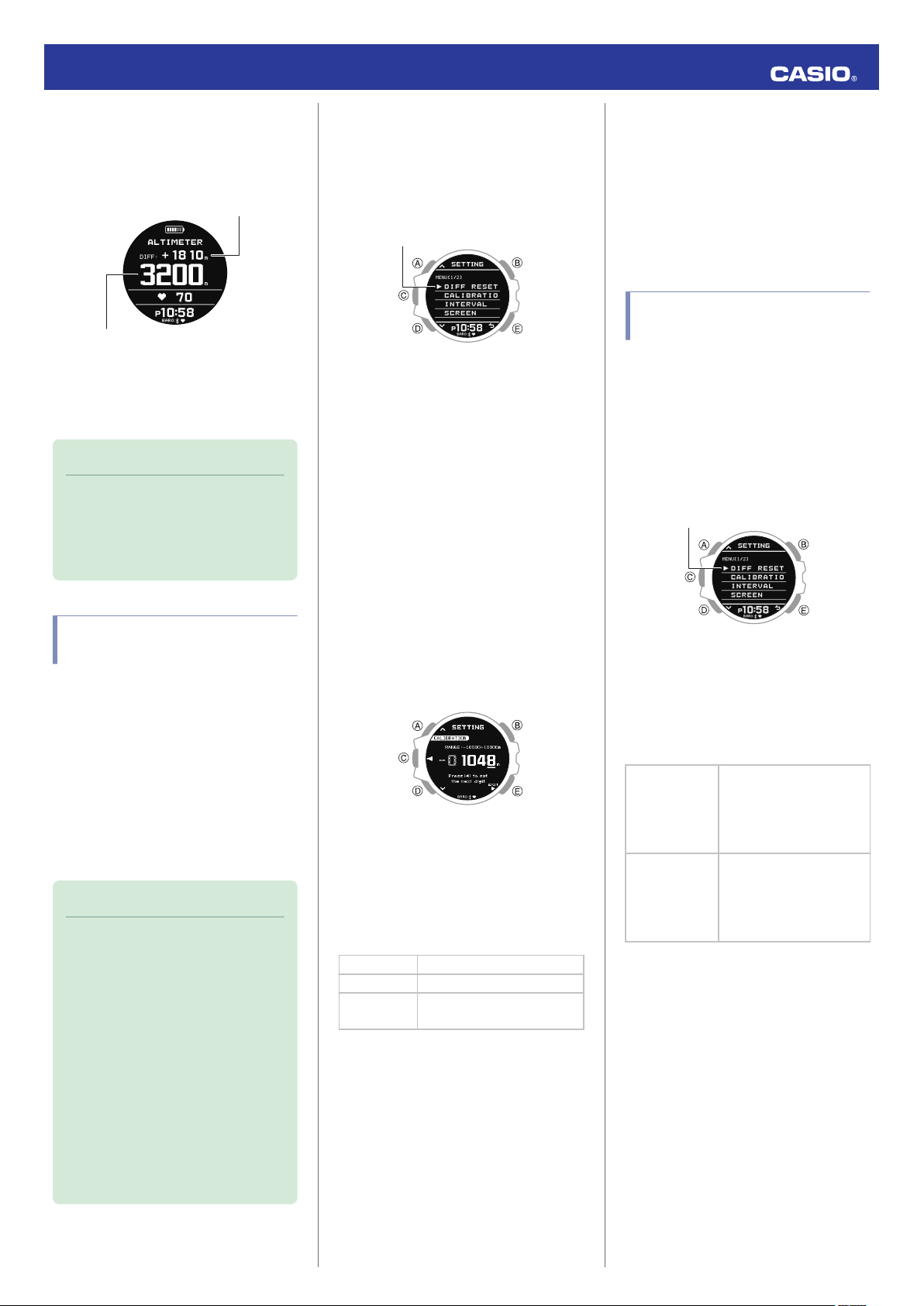
6. While comparing the difference between
the altitude you found on the map and the
altitude differential displayed by the
watch, advance towards your destination.
Current location altitude
Altitude differential indicator
●
When the altitude differential you found
on the map is the same as that
displayed by the watch, it means you
are close to your destination.
Note
●
[-----] will appear on the display when a
reading is outside the allowable
altitude measurement range (±3,000
m (±9,840 feet)), or if a measurement
error occurs.
Calibrating Altitude
Readings
To minimize the difference between locally
indicated and measured values, you should
update the reference altitude value before
setting off on and during treks or any other
activities where you take altitude readings.
Also, you can ensure accurate measurements
by checking a map local altitude indications or
some other source for your current location’s
altitude, and regularly calibrating watch
readings with the latest information while
mountain climbing.
Note
●
You can find out the altitude at your
current location from signs, maps, on
the Internet, etc.
●
Differences between actual altitude
and watch readings can be caused by
the factors below.
ー
Changes in barometric pressure
ー
Changes in temperature caused by
variations in barometric pressure
and by elevation
●
Though altitude readings can be taken
without calibration, doing so may
produce readings that are very
different from indications by altitude
markers, etc.
1. Enter the Altimeter Mode.
l
Navigating Between Modes
2. Hold down (A) for at least two seconds.
This displays the Altimeter Mode setting
screen.
Pointer
3. Use (A) and (D) to move the pointer to
[CALIBRATION].
4. Press (C).
5. Use (A) and (D) to move the pointer to
[MANUAL].
●
To return the altitude setting to its initial
factory default value, select [OFFSET
OFF].
6. Press (C).
7. Repeat the steps below to input the
altitude in your current location.
●
Use (A) and (D) to change the
underlined value or symbol. To specify
a negative value, display the minus (-)
sign.
●
Use (C) to move between digits.
●
To stop the setting operation, press (E)
and advance to step 9.
8. After all the values are the way you want,
press (C).
9. Use (A) and (D) to select whether or not
you want to save your current settings.
[YES] Saves current settings.
[NO] Discards current settings.
[RETURN]
This returns to the altitude
manual calibration screen.
10. Press (C) to complete the setting
operation.
After the setting operation is complete,
[SETTING COMPLETED] will appear for
a few seconds, and then the Altimeter
Mode setting screen will re-appear.
11. Press (E) to exit the setting screen.
Setting Up the Auto
Measurement Interval
You can select an auto measurement interval
of either five seconds or two minutes.
1. Enter the Altimeter Mode.
l
Navigating Between Modes
2. Hold down (A) for at least two seconds.
This displays the Altimeter Mode setting
screen.
Pointer
3. Use (A) and (D) to move the pointer to
[INTERVAL].
4. Press (C).
5. Use (A) and (D) to select an auto
measurement interval.
[2 MINUTES]
Readings taken every
second for the first three
minutes, and then every
two minutes for about the
next 12 hours.
[5 SECONDS]
Readings taken every
second for the first three
minutes, and then every
five seconds for about one
hour.
6. Press (C) to complete the setting
operation.
After the setting operation is complete,
[SETTING COMPLETED] will appear for
a few seconds, and then the Altimeter
Mode setting screen will re-appear.
7. Press (E) to exit the setting screen.
Operation Guide 3475
37

Note
●
The watch will automatically return to
the Timekeeping Mode if you do not
perform any operation in the Altimeter
Mode for about one hour while [5
SECONDS] is selected as the
measurement interval or for about 12
hours while [2 MINUTES] is selected.
Changing Displayed
Information
You can use the procedure below to display
an altitude graph in the Altimeter Mode.
1. Enter the Altimeter Mode.
l
Navigating Between Modes
2. Hold down (A) for at least two seconds.
This displays the Altimeter Mode setting
screen.
Pointer
3. Use (A) and (D) to move the pointer to
[SCREEN].
4. Press (C).
5. Use (A) and (D) to select a display type.
[VALUE]
Display the latest measurement
values only.
[GRAPH]
Display measurement values
and an altitude graph.
6. Press (C) to complete the setting
operation.
After the setting operation is complete,
[SETTING COMPLETED] will appear for
a few seconds, and then the Altimeter
Mode setting screen will re-appear.
7. Press (E) to exit the setting screen.
Specifying the Altitude
Measurement Unit
You can select either meters (m) or feet (ft) as
the Altimeter Mode display unit.
Important!
●
When Tokyo (TOKYO) is the Home
City, the altitude unit is fixed as meters
(m) and cannot be changed.
1. Enter the Timekeeping Mode or Altimeter
Mode.
l
Navigating Between Modes
2. Hold down (A) for at least two seconds.
This displays the mode setting screen.
Altimeter Mode
Timekeeping Mode
Pointer
3. Use (A) and (D) to move the pointer to
[UNIT].
4. Press (C).
5. If you started from the Timekeeping Mode
in step 1, use (A) and (D) to move the
pointer to [ALTIMETER].
If you started from the Altimeter Mode in
step 1, advance to step 7.
6. Press (C).
7. Use (A) and (D) to select an altitude unit.
[METER] Meters
[FEET] Feet
8. Press (C) to complete the setting
operation.
After the setting operation is complete,
[SETTING COMPLETED] will appear for
a few seconds, and then the mode setting
screen will re-appear.
9. If you started from the Timekeeping Mode,
press (E) twice to exit the setting screen.
If you started from the Altimeter Mode in
step 1, press (E) to exit the setting screen.
Altitude Reading
Precautions
Effects of Temperature
When taking altitude readings, take the steps
below to keep the watch at as stable a
temperature as possible. Changes in
temperature can affect altitude readings.
●
Take readings with the watch on your wrist.
●
Take readings in an area where
temperature is stable.
Altitude Readings
●
Do not use this watch while skydiving, hang
gliding, paragliding, gyrocopter flying, glider
flying, or engaged in other activities where
altitude changes suddenly.
●
Altitude readings produced by this watch
are not intended for special-purpose or
industrial level use.
●
In an aircraft, the watch measures the in-
cabin pressurized air pressure, so readings
will not match altitudes announced by the
crew.
Altitude Readings (Relative Altitude)
This watch uses International Standard
Atmosphere (ISA) relative altitude data
defined by the International Civil Aviation
Organization (ICAO). Barometric pressure
generally becomes lower as altitude
increases.
Correct measurement may not be possible
under the conditions below.
●
During unstable atmospheric conditions
●
During sudden temperature changes
●
After the watch has been subjected to
strong impact
Measured Altitude Value Adjustment
Using GPS Signal Data
If you perform a GPS signal receive operation
before you start running, the received
correction information will be used for
automatic correction of altitude measurement
values. Note, however, that this also may
result in some difference between the
measured value and the actual altitude.
Also note that the measured altitude value
adjustment operation using GPS signal data
may take a few minutes. The adjustment
operation may take even longer, depending
on your current environment. Regular manual
adjustment of the measured altitude value
using locally available information is
recommended. The watch will not use GPS
signal data to adjust measured altitude values
for one hour after you adjust the measured
altitude value manually.
Operation Guide 3475
38
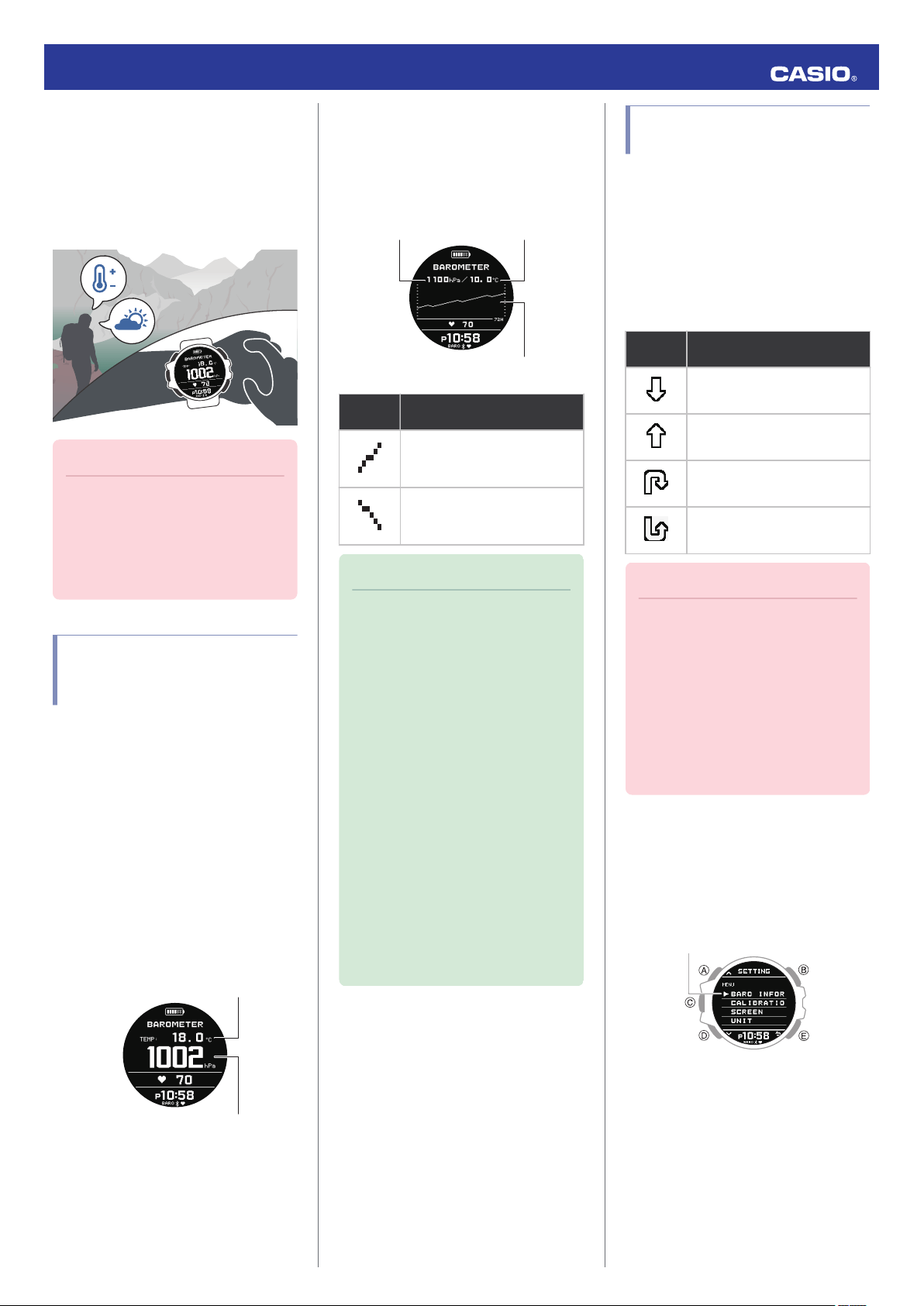
Barometric Pressure
and Temperature
Measurement
You can use the watch to take barometric
pressure and temperature readings for your
current location.
Important!
●
Check the information at the link below
to find out how to ensure correct
readings.
l
Barometric Pressure and
Temperature Reading
Precautions
Checking the Current
Barometric Pressure and
Temperature
1. Enter the Barometer/Temperature Mode.
l
Navigating Between Modes
Entering the Barometer/Temperature
Mode starts measurement and displays
the current barometric pressure and
temperature.
●
After you enter the Barometer/
Temperature Mode, the watch takes
readings about every five seconds for
three minutes. After that, a
measurement is taken about every two
minutes.
Value Screen
Temperature
Barometric pressure
Barometric Pressure Graph Screen
The graph shows barometric readings taken
every two hours. You can use the graph to
view changes in barometric pressure over the
past 72 hours, which can be used to predict
upcoming weather.
Temperature
Barometric pressure graph
Barometric pressure
A trend
like this:
Means this:
Rising barometric pressure,
which indicates that upcoming
weather probably will be fair.
Falling barometric pressure,
which indicates that upcoming
weather probably will be bad.
Note
●
To retrigger measurement, press (C).
●
The watch will automatically return to
the Timekeeping Mode if you do not
perform any operation in the
Barometer/Temperature Mode for
about one hour.
●
Measurement ranges are shown
below. [- - -] will appear for the
measured value if it is outside the
allowable range.
Barometric pressure measurement:
260 hPa to 1,100 hPa (7.65 inHg to
32.45 inHg)
Thermometer measurement: -10.0°C
to 60.0°C (14.0°F to 140.0°F)
●
Large changes in barometric pressure
and/or temperature can cause past
data readings to be plotted outside of
the visible area of the graph. Though
plots are not visible, the data is still
maintained in watch memory.
Barometric Pressure Change
Indications
Whenever the watch detects a significant
change in air pressure readings (due to
sudden altitude change, or to the passage of
a low pressure or high pressure area), it will
perform a sound and/or vibration operation
and display a flashing arrow to let you know.
The arrow that appears shows the direction of
the pressure change. These alerts are called
“Barometric Pressure Change Indications”.
This
indicator:
Means this:
Sudden drop in pressure
Sudden rise in pressure
Sustained rise in pressure,
shifting to a fall
Sustained fall in pressure, shifting
to a rise
Important!
●
To ensure correct barometric pressure
change indicator operation, enable it in
a location where the altitude is
constant (such as a lodge, camp area,
or on the ocean).
●
A change in altitude causes a change
in air pressure. Because of this, correct
readings are impossible. Do not take
readings while ascending or
descending a mountain, etc.
1. Enter the Barometer/Temperature Mode.
l
Navigating Between Modes
2. Hold down (A) for at least two seconds.
This displays the Barometer/
Temperature Mode setting screen.
Pointer
Operation Guide 3475
39
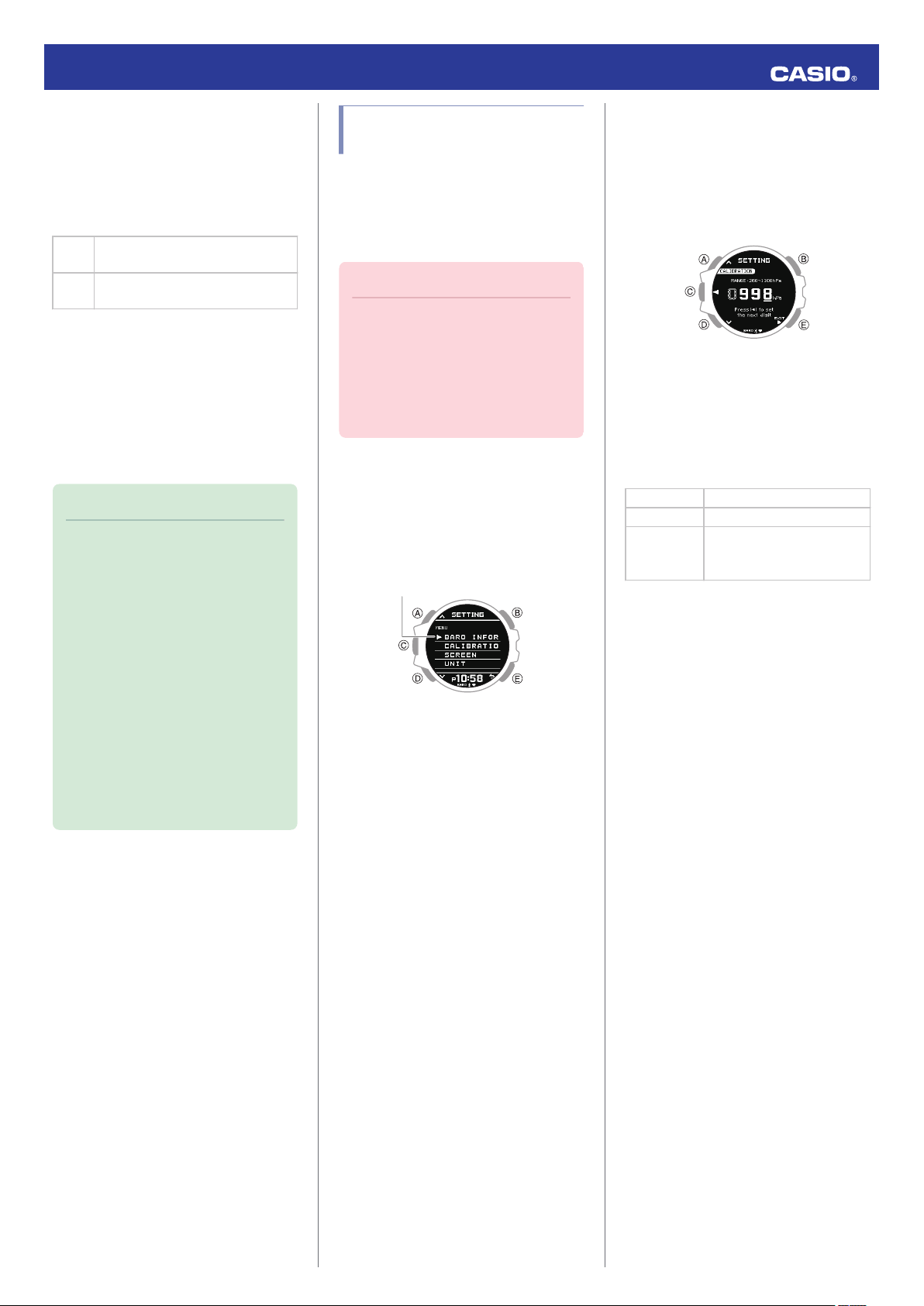
3. Use (A) and (D) to move the pointer to
[BARO INFORMATION].
4. Press (C).
5. Use (A) and (D) to select a barometric
pressure change indicator setting.
[ON]
Enables the barometric pressure
change indicator.
[OFF]
Disables the barometric pressure
change indicator.
6. Press (C) to complete the setting
operation.
After the setting operation is complete,
[SETTING COMPLETED] will appear for
a few seconds, and then the Barometer/
Temperature Mode setting screen will re-
appear.
7. Press (E) to exit the setting screen.
Note
●
If the barometric change indicator is
enabled, readings are taken every two
minutes even while the watch is not in
the Barometer/Temperature Mode.
●
The barometric pressure change
indicator becomes disabled
automatically 24 hours after it is
enabled.
●
Power Saving is disabled while
barometric pressure trend information
is enabled.
l
Power Saving Function
●
The barometric pressure change
indicator will become disabled
automatically when the battery
becomes [CHG] or lower.
Calibrating Barometric
Pressure Readings
The watch’s pressure sensor is adjusted at the
factory and normally does not require
calibration. However, you can calibrate the
displayed value if you notice major errors in
readings.
Important!
●
The watch will not be able to produce
correct barometric pressure readings if
you make a mistake during the
calibration procedure. Check to make
sure that the value you use for
calibration produces correct pressure
readings.
1. Enter the Barometer/Temperature Mode.
l
Navigating Between Modes
2. Hold down (A) for at least two seconds.
This displays the Barometer/
Temperature Mode setting screen.
Pointer
3. Use (A) and (D) to move the pointer to
[CALIBRATION].
4. Press (C).
5. Use (A) and (D) to move the pointer to
[BAROMETER].
6. Press (C).
7. Use (A) and (D) to move the pointer to
[MANUAL].
●
Selecting [OFFSET OFF] returns
barometric pressure calibration to its
factory default state.
8. Press (C).
9. Repeat the steps below to change the
value.
●
Use (A) and (D) to change the
underlined value.
●
Use (C) to move the underlining to the
value you want to change.
●
To stop the setting operation, press (E)
and advance to step 11.
10. After all the values are the way you want,
press (C).
11. Use (A) and (D) to select whether or not
you want to save your current settings.
[YES] Saves current settings.
[NO] Discards current settings.
[RETURN]
Return to the barometric
pressure manual calibration
screen.
12. Press (C) to complete the setting
operation.
After the setting operation is complete,
[SETTING COMPLETED] will appear for
a few seconds, and then the calibration
method selection screen will re-appear.
13. Press (E) twice to exit the setting screen.
Operation Guide 3475
40
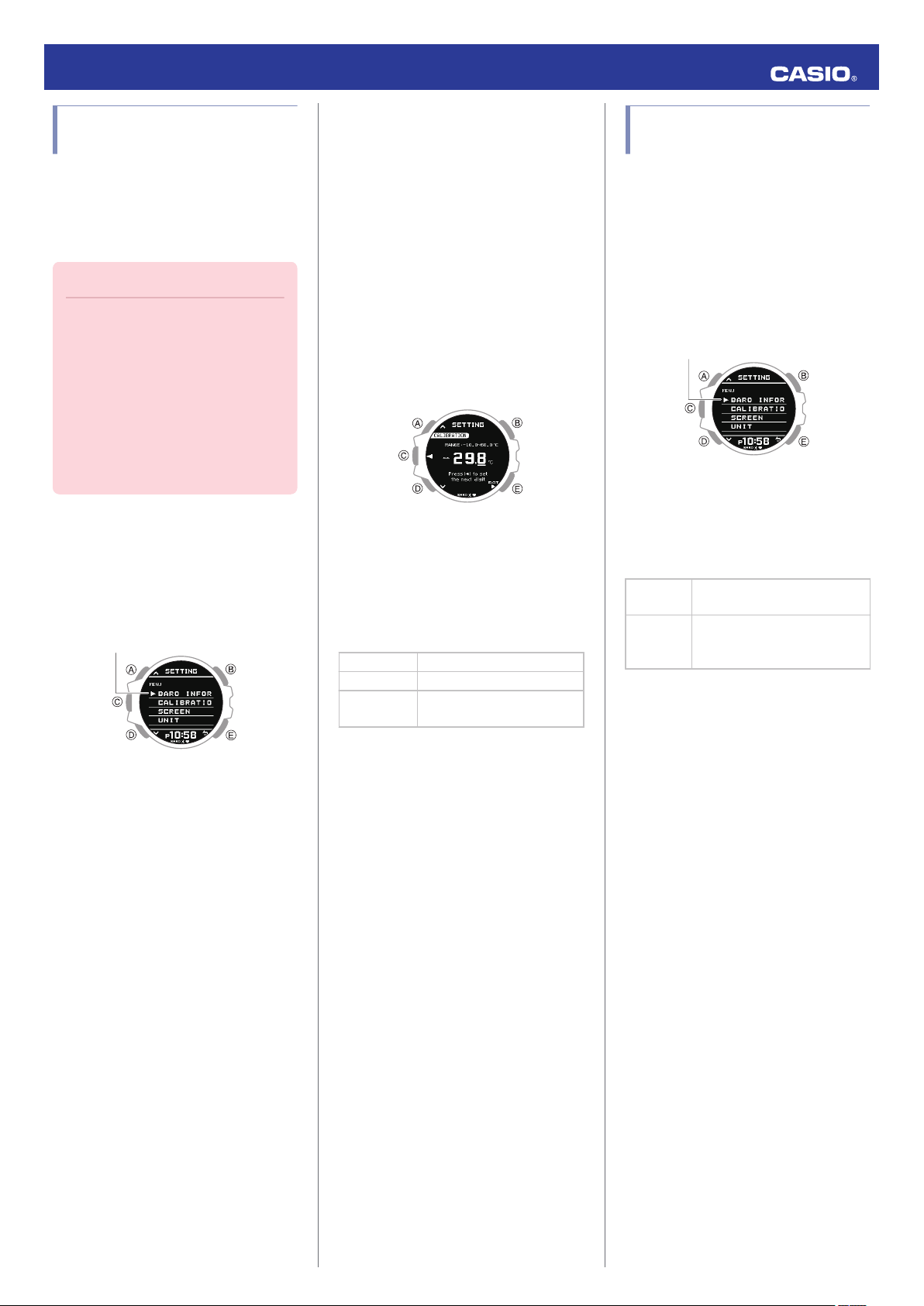
Calibrating Temperature
Readings
The watch’s temperature sensor is adjusted at
the factory and normally does not require
calibration. However, you can calibrate the
displayed value if you notice major errors in
readings.
Important!
●
Check to make sure that the value you
use for calibration produces correct
temperature readings.
●
Before calibrating the temperature
reading, remove the watch from your
wrist and leave it in the area where you
plan to measure temperature for about
20 or 30 minutes to allow the case
temperature to become the same as
the air temperature.
1. Enter the Barometer/Temperature Mode.
l
Navigating Between Modes
2. Hold down (A) for at least two seconds.
This displays the Barometer/
Temperature Mode setting screen.
Pointer
3. Use (A) and (D) to move the pointer to
[CALIBRATION].
4. Press (C).
5. Use (A) and (D) to move the pointer to
[THERMOMETER].
6. Press (C).
7. Use (A) and (D) to move the pointer to
[MANUAL].
●
Selecting [OFFSET OFF] returns
barometric pressure calibration to its
factory default state.
8. Press (C).
9. Repeat the steps below to change the
value.
●
Use (A) and (D) to change the
underlined value or symbol. To specify
a sub-zero value, display the minus (-)
sign.
●
Use (C) to move the underlining to the
value you want to change.
●
To stop the setting operation, press (E)
and advance to step 11.
10. After all the values are the way you want,
press (C).
11. Use (A) and (D) to select whether or not
you want to save your current settings.
[YES] Saves current settings.
[NO] Discards current settings.
[RETURN]
Return to the temperature
manual calibration screen.
12. Press (C) to complete the setting
operation.
After the setting operation is complete,
[SETTING COMPLETED] will appear for
a few seconds, and then the calibration
method selection screen will re-appear.
13. Press (E) twice to exit the setting screen.
Changing Displayed
Information
You can use the procedure below to display a
barometric pressure graph in the Barometer/
Temperature Mode.
1. Enter the Barometer/Temperature Mode.
l
Navigating Between Modes
2. Hold down (A) for at least two seconds.
This displays the Barometer/
Temperature Mode setting screen.
Pointer
3. Use (A) and (D) to move the pointer to
[SCREEN].
4. Press (C).
5. Use (A) and (D) to select a display type.
[VALUE]
Displays the latest measurement
value only.
[GRAPH]
Displays a measurement value
and a barometric pressure
graph.
6. Press (C) to complete the setting
operation.
This returns to the Barometer/
Temperature Mode setting screen.
7. Press (E) to exit the setting screen.
Operation Guide 3475
41
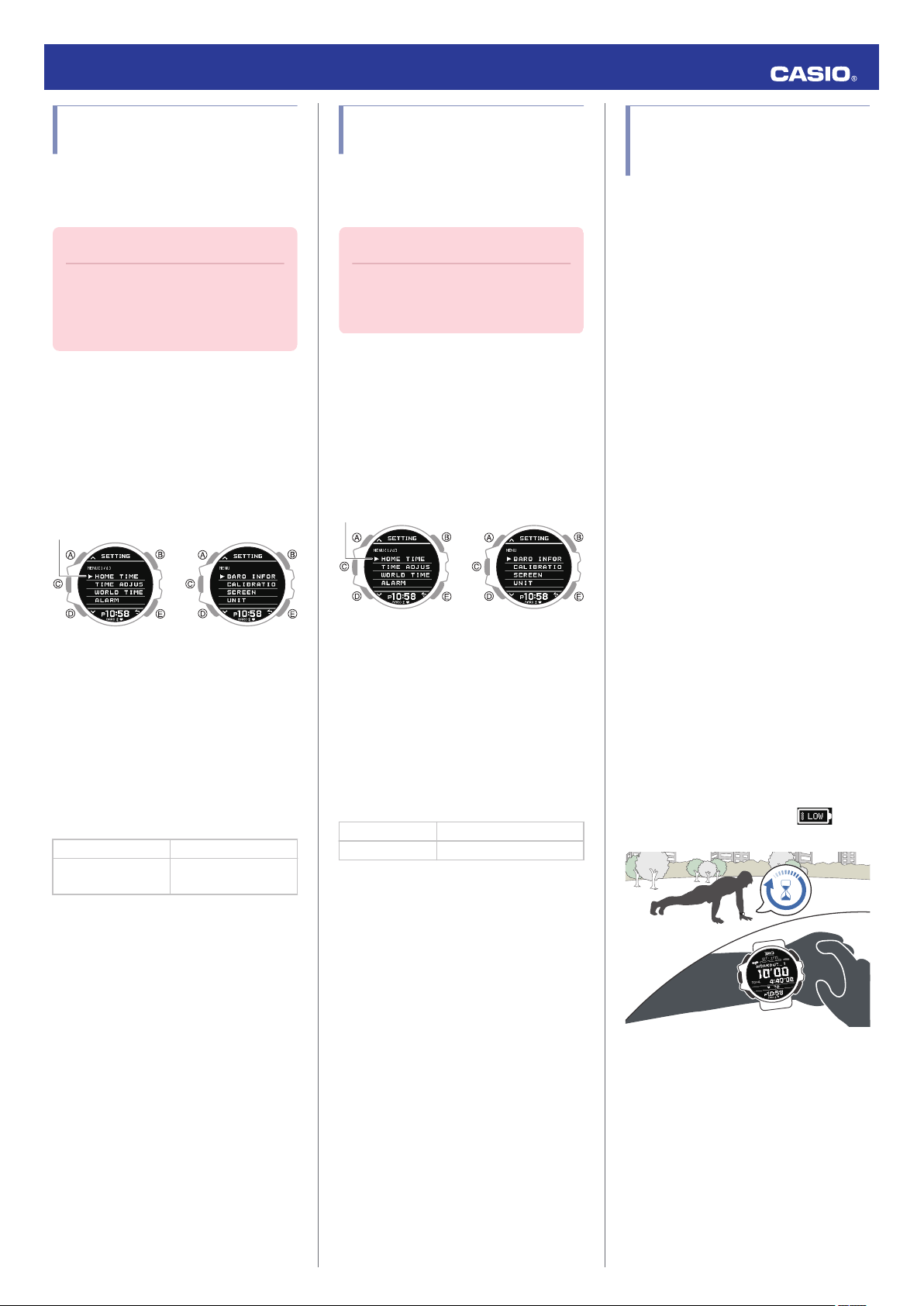
Specifying the Barometric
Pressure Unit
You can specify either hectopascals (hPa) or
inches of mercury (inHg) as the display unit for
barometric pressure values.
Important!
●
When Tokyo (TOKYO) is the Home
City, the altitude unit is fixed as
hectopascals (hPa) and cannot be
changed.
1. Enter the Timekeeping Mode or
Barometer/Temperature Mode.
l
Navigating Between Modes
2. Hold down (A) for at least two seconds.
This displays the mode setting screen.
Barometer/
Temperature Mode
Timekeeping Mode
Pointer
3. Use (A) and (D) to move the pointer to
[UNIT].
4. Press (C).
5. Use (A) and (D) to move the pointer to
[BAROMETER].
6. Press (C).
7. Use (A) and (D) to select a barometric
pressure unit.
[HECTOPASCAL] Hectopascals (hPa)
[INCH OF
MERCURY]
Inches of mercury
(inHg)
8. Press (C) to complete the setting
operation.
After the setting operation is complete,
[SETTING COMPLETED] will appear for
a few seconds, and then the
measurement unit setting screen will re-
appear.
9. Press (E) twice to exit the setting screen.
Specifying the Temperature
Unit
You can select either Celsius (℃) or
Fahrenheit (℉) as the temperature display
unit.
Important!
●
When Tokyo (TOKYO) is the Home
City, the unit is fixed as Celsius (℃) and
cannot be changed.
1. Enter the Timekeeping Mode or
Barometer/Temperature Mode.
l
Navigating Between Modes
2. Hold down (A) for at least two seconds.
This displays the mode setting screen.
Barometer/
Temperature Mode
Timekeeping Mode
Pointer
3. Use (A) and (D) to move the pointer to
[UNIT].
4. Press (C).
5. Use (A) and (D) to move the pointer to
[THERMOMETER].
6. Press (C).
7. Use (A) and (D) to select a temperature
unit.
[CELSIUS] Celsius (°C)
[FAHRENHEIT] Fahrenheit (°F)
8. Press (C) to complete the setting
operation.
After the setting operation is complete,
[SETTING COMPLETED] will appear for
a few seconds, and then the
measurement unit setting screen will re-
appear.
9. Press (E) twice to exit the setting screen.
Barometric Pressure and
Temperature Reading
Precautions
●
Barometric Pressure Reading
Precautions
●
The barometric pressure graph produced
by this watch can be used to obtain an idea
of upcoming weather conditions. However,
this watch should not be used in place of
precision instruments required for official
weather prediction and reporting.
●
Pressure sensor readings can be affected
by sudden changes in temperature.
Because of this, there may be some error in
the readings produced by the watch.
●
Temperature Reading Precautions
Body temperature, direct sunlight, and
humidity all have an effect on temperature
readings. To help ensure more accurate
temperature readings, remove the watch from
your wrist, wipe it dry of any moisture, and
place it in a well-ventilated location not
exposed to direct sunlight. You should be able
to take temperature readings after about 20 to
30 minutes.
Timer
The timer counts down from a start time
specified by you. The watch performs a sound
and/or vibration operation when the end of the
countdown is reached.
●
The watch will not perform a sound and/or
vibration notification operation while the
battery level indicator shows or
lower.
Operation Guide 3475
42
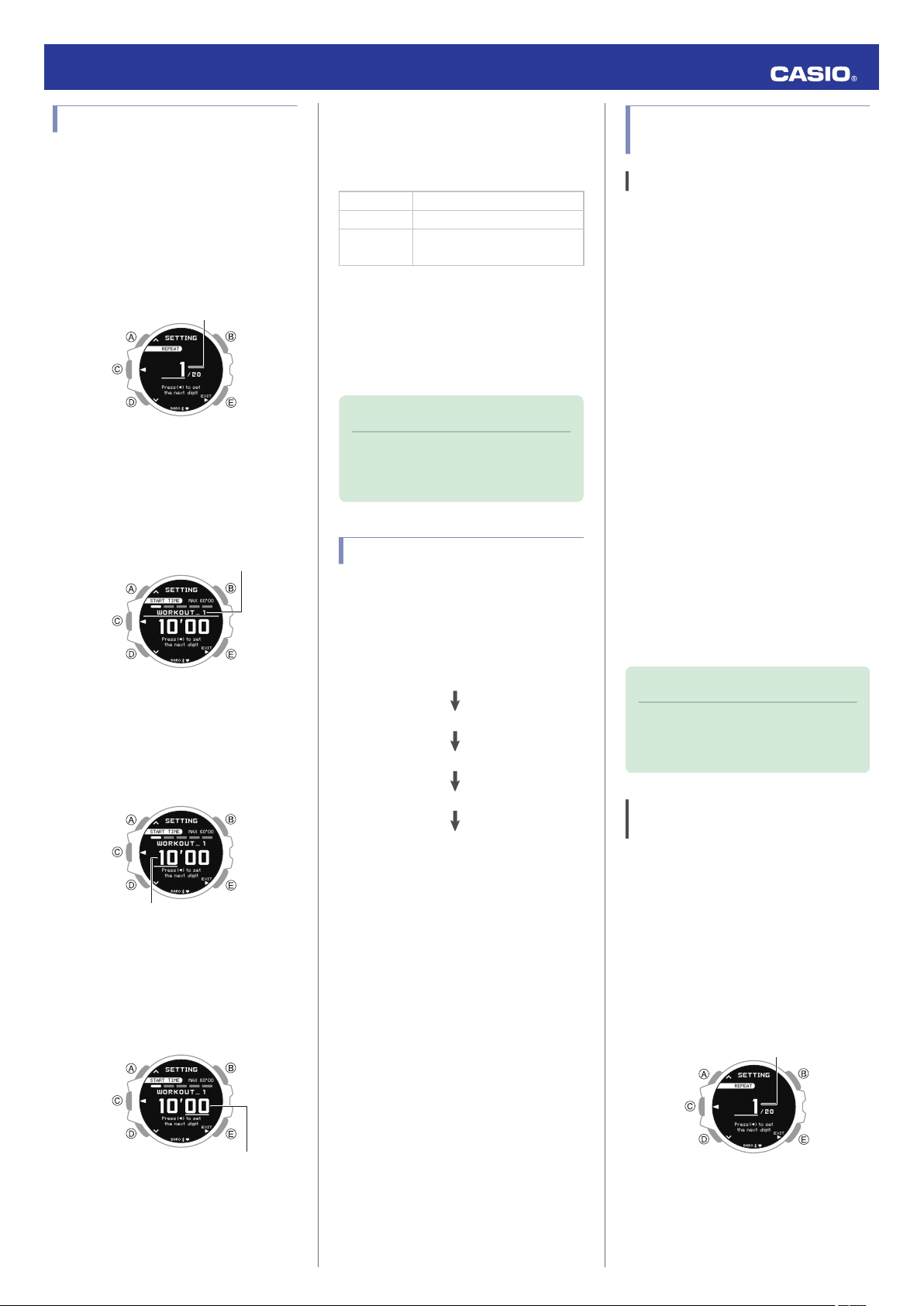
Setting the Timer Start Time
The start time can be set in 1-second units up
to 60 minutes.
1. Enter the Timer Mode.
l
Navigating Between Modes
2. Hold down (A) for at least two seconds.
This displays the number of timer repeats
(1 to 20) setting screen.
Number of repeats
3. Use (A) and (D) to specify the number of
timer repeats (Auto Repeat).
4. Press (C).
5. Use (A) and (D) to specify the position of
the timer in the sequence.
Timer sequence
6. Press (C).
This moves the cursor to the minutes
setting.
7. Use (A) and (D) to change the minutes
setting.
Minutes
8. Press (C).
This moves the cursor to the seconds
setting.
9. Use (A) and (D) to change the seconds
setting.
Seconds
10. Press (C).
11. Use (A) and (D) to select whether or not
you want to save your current settings.
[YES] Saves current settings.
[NO] Discards current settings.
[RETURN]
Returns to the number of
repeats setting.
12. Press (C) to complete the setting
operation.
After the setting operation is complete,
[SETTING COMPLETED] will appear for
a few seconds, and then the Timer Mode
screen will re-appear.
Note
●
To exit the timer setting operation at
any point, press (E) and advance to
step 11.
Using the Timer
1. Enter the Timer Mode.
l
Navigating Between Modes
2. Use the operations below to perform a
timer operation.
C
C
C
(Time up)
Resume
Pause
(Countdown starts)
Start
●
The watch performs a sound and/or
vibration operation for 10 seconds
when the end of the countdown is
reached.
●
You can reset a paused countdown to
its start time, by pressing (E).
3. Press any button to stop the sound and/or
vibration operation.
Using the Programmable
Timer for Interval Training
Overview
You can configure settings for multiple timers
so they perform different count downs one
after the other to create an interval timer. You
can use the programmable timer to create a
sequence for interval training that alternates
jogging with sprinting.
For example, you could configure an interval
timer as shown below and have intervals
A
through
D
repeat 10 times.
Timer Settings
●
[WORKOUT_1]: 10 minutes 00 seconds
●
[WORKOUT_2]: 4 minutes 00 seconds
●
[WORKOUT_3]: 10 minutes 00 seconds
●
[WORKOUT_4]: 4 minutes 00 seconds
●
Sets: 10
Interval Training Workout
A Jog: 10 minutes 00 seconds
B Sprint 1 km: 4 minutes 00 seconds
C Jog: 10 minutes 00 seconds
D Sprint 1 km: 4 minutes 00 seconds
Note
●
You can configure up to five different
timers to repeat up to 20 times (Auto
Repeat).
Configuring Programmable Timer
Settings
●
If a timer countdown operation is in
progress, reset the timer to its current start
time before performing this operation.
l
Using the Timer
1. Enter the Timer Mode.
l
Navigating Between Modes
2. Hold down (A) for at least two seconds.
This displays the number of timer repeats
(1 to 20) setting screen.
Number of repeats
Operation Guide 3475
43

3. Use (A) and (D) to specify the number of
timer repeats (Auto Repeat).
4. Press (C).
5. Use (A) and (D) to specify the position of
the timer in the sequence.
●
To setup the first timer, setup
[WORKOUT_1].
Timer sequence
6. Press (C).
This causes the cursor to appear at the
minutes setting of the first timer.
7. Use (A) and (D) to change the minutes
setting.
Minutes
8. Press (C).
This causes the cursor to move to the
seconds setting of the first timer.
9. Use (A) and (D) to change the seconds
setting.
Seconds
10. Press (C).
11. Use (A) and (D) to select whether or not
you want to save your current settings.
[YES] Saves current settings.
[NO] Discards current settings.
[RETURN]
Returns to the number of
repeats setting.
12. Press (C) to complete the setting
operation.
After the setting operation is complete,
[SETTING COMPLETED] will appear for
a few seconds, and then the Timer Mode
screen will re-appear.
13. Repeat steps 2 through 12 as many times
as necessary to configure the settings of
the other timers.
Note
●
To exit the program setting operation
at any point, press (E) and advance to
step 11.
●
You can use G-SHOCK MOVE to
change [WORKOUT_1] and other
timer names to something else. A timer
name can include a combination of up
to 14 alphabetic letters (A to Z),
numbers (0 to 9), and symbols.
Using a Programmable Timer
1. Enter the Timer Mode.
l
Navigating Between Modes
2. Press (C) to start the timer countdown.
●
To pause an ongoing timer countdown,
press (C). You can reset a paused
countdown to its start time, by pressing
(E).
●
When there is a multiple timer
countdown operation in progress, you
can immediately terminate the current
countdown and start the next
countdown by holding down (A) for at
least two seconds.
Stopwatch
The stopwatch can be used to perform 1-
second unit elapsed time measurement up to
99 hours, 59 minutes, 59 seconds.
It can also measure split times.
Measuring Elapsed Time
1. Enter the Stopwatch Mode.
l
Navigating Between Modes
2. Use the operations below to measure
elapsed time.
C
C
C
C
Stop
Resume
Stop
Start
Hour, minute, second
3. Press (E) to reset the stopwatch to all
zeros.
Operation Guide 3475
44
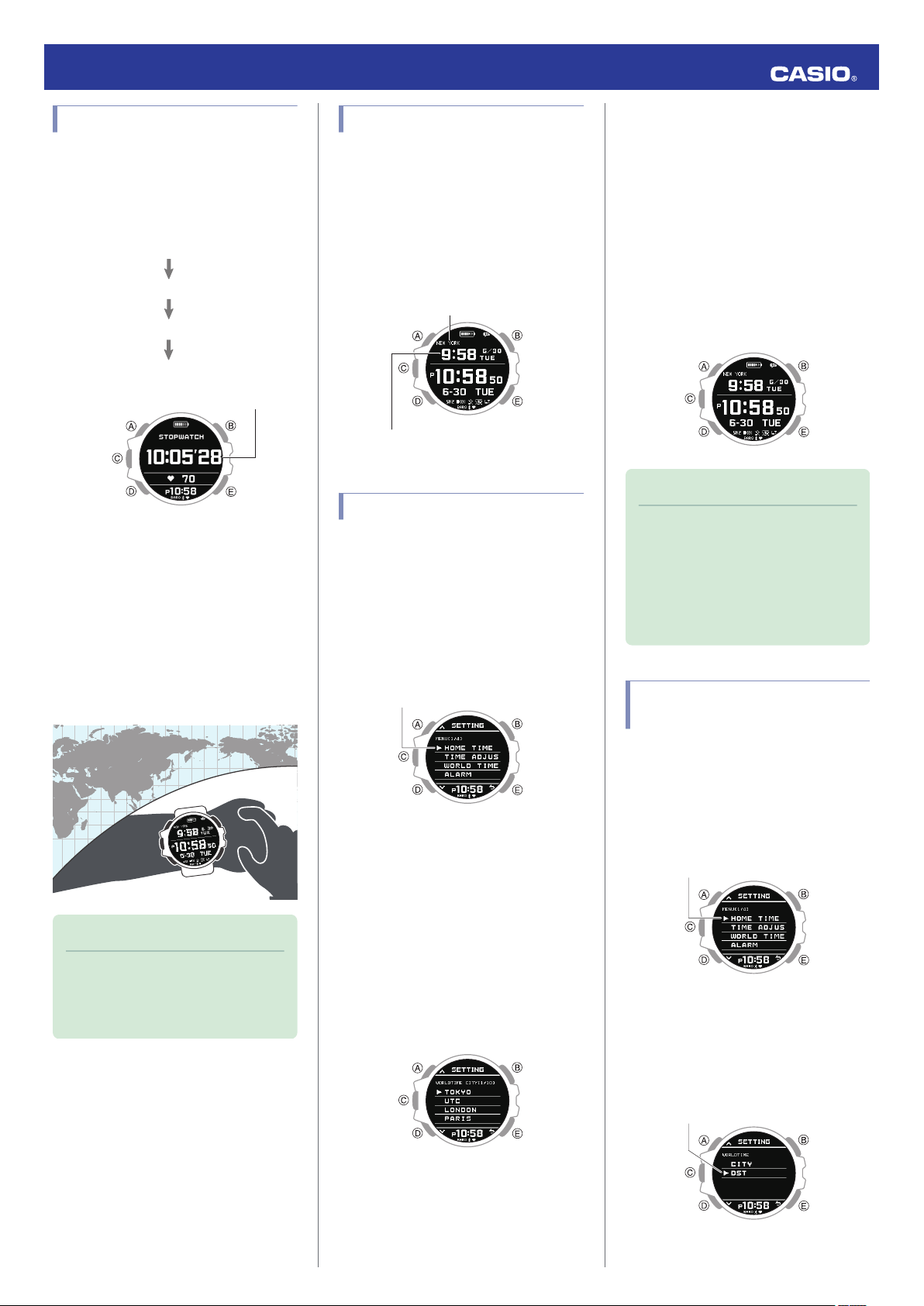
Measuring a Split Time
1. Enter the Stopwatch Mode.
l
Navigating Between Modes
2. Use the operations below to measure
elapsed time.
C
E
E
C
Stop
Split release
Split
Start
Hour, minute, second
3. Press (E) to reset the stopwatch to all
zeros.
World Time
World Time lets you look up the current time
in any one of 38 cities around the globe, and
UTC (Coordinated Universal Time).
Note
●
World Time cities that can be selected
only by using G-SHOCK MOVE cannot
be selected using watch operations.
l
Configuring World Time Settings
Checking World Time
1. Enter the Timekeeping Mode.
l
Navigating Between Modes
2. Use (A) to display the World Time.
l
Selecting a Timekeeping Mode Digital
Display Format
This displays to the current World Time
City and the current time there.
World Time City
World Time
World Time City Setting
Use the procedure in this section to select a
World Time city.
1. Enter the Timekeeping Mode.
l
Navigating Between Modes
2. Hold down (A) for at least two seconds.
This displays the Timekeeping Mode
setting screen.
Pointer
3. Use (A) and (D) to move the pointer to
[WORLD TIME].
4. Press (C).
This displays the World Time setting
screen.
5. Use (A) and (D) to move the pointer to
[CITY].
6. Press (C).
This displays a menu of World Time
Cities.
7. Use (A) and (D) to move the pointer to the
city you want to use.
8. Press (C) to complete the setting
operation.
After the setting operation is complete,
[SETTING COMPLETED] will appear for
a few seconds, and then the World Time
setting screen will re-appear.
9. Press (E) twice to exit the setting screen.
This will display the current time and date
in the selected city.
Note
●
If you currently have a World Time City
that is selectable with G-SHOCK
MOVE only and then use watch
operation to change to a different city,
the G-SHOCK MOVE city information
will be deleted from the watch.
l
Configuring World Time Settings
Configuring the Summer
Time Setting
1. Enter the Timekeeping Mode.
l
Navigating Between Modes
2. Hold down (A) for at least two seconds.
This displays the Timekeeping Mode
setting screen.
Pointer
3. Use (A) and (D) to move the pointer to
[WORLD TIME].
4. Press (C).
This displays the World Time setting
screen.
Pointer
Operation Guide 3475
45
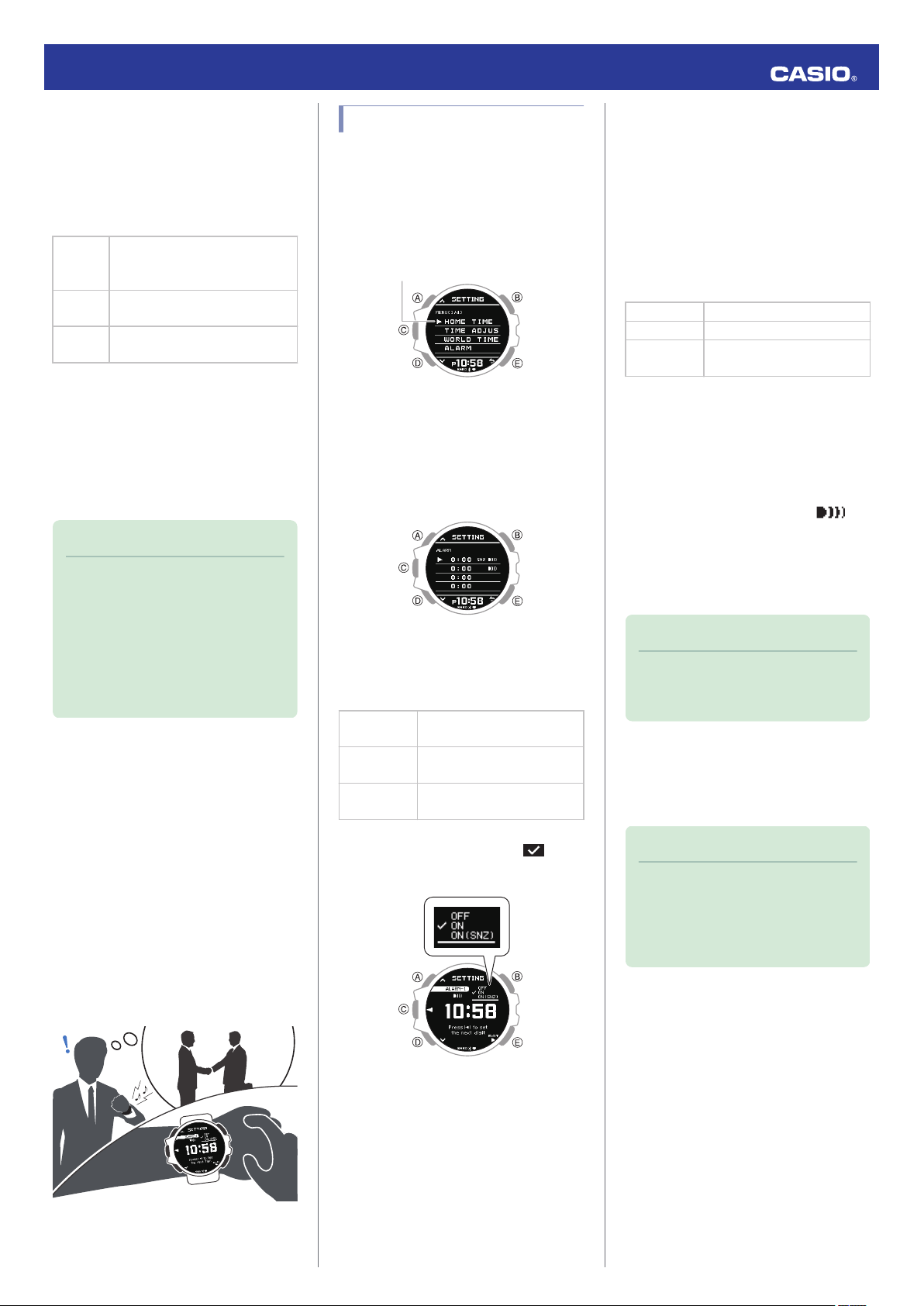
5. Use (A) and (D) to move the pointer to
[DST].
6. Press (C).
7. Use (A) and (D) to select a summer time
setting.
[AUTO]
The watch switches between
standard time and summer time
automatically.
[OFF]
The watch always indicates
standard time.
[ON]
The watch always indicates
summer time.
8. Press (C) to complete the setting
operation.
After the setting operation is complete,
[SETTING COMPLETED] will appear for
a few seconds, and then the World Time
setting screen will re-appear.
9. Press (E) twice to exit the setting screen.
Note
●
The initial factory default summer time
setting for all cities is [AUTO]. In many
cases, [AUTO] lets you use the watch
without switching manually between
summer time and standard time.
●
While [UTC] is selected as the city, you
will not be able to change or check the
summer time setting.
Alarms
The watch performs a sound and/or vibration
operation when an alarm time is reached. You
can set up to four different alarms.
●
Sound and/or vibration operations are not
performed in the cases below.
ー
While the battery indicator is [CHG] or
lower
ー
When watch is at Level 2 power saving
l
Power Saving Function
●
When snooze is enabled for an alarm, it will
sound every five minutes up to seven times.
Configuring Alarm Settings
1. Enter the Timekeeping Mode.
l
Navigating Between Modes
2. Hold down (A) for at least two seconds.
This displays the Timekeeping Mode
setting screen.
Pointer
3. Use (A) and (D) to move the pointer to
[ALARM].
4. Press (C).
5. Use (A) and (D) to move the pointer to the
alarm you want to set.
6. Press (C).
7. Use (A) and (D) to select an alarm and
snooze function ON/OFF setting.
[OFF]
Disables alarms, disables
snooze.
[ON]
Enables alarms, disables
snooze.
[ON (SNZ)]
Enables alarms, enables
snooze.
●
The currently selected setting will be
indicated by a check mark ( ) to the
left.
8. Press (C).
9. Use (A) and (D) to set the alarm hour.
10. Press (C).
11. Use (A) and (D) to set the alarm minute.
12. Press (C).
13. Use (A) and (D) to select whether or not
you want to save your current settings.
[YES] Saves current settings.
[NO] Discards current settings.
[RETURN]
Returns to the alarm setting
screen.
14. Press (C) to complete the setting
operation.
After the setting operation is complete,
[SETTING COMPLETED] will appear for
a few seconds, and then the alarm setting
selection screen will re-appear.
●
Turning on an alarm causes to
appear on the display to the right of the
time setting. If snooze is enabled, [SNZ]
also appears.
15. Press (E) twice to exit the setting screen.
Note
●
To exit the alarm setting operation at
any point, press (E) and advance to
step 13.
●
To stop a sounding alarm
While an alarm sound and/or vibration
operation is being performed, press any
button to stop it.
Note
●
When snooze is enabled for an alarm,
alarm sound and/or vibration will
repeat every five minutes, up to seven
times. To stop an alarm’s ongoing
snooze operation, turn off the alarm.
Operation Guide 3475
46
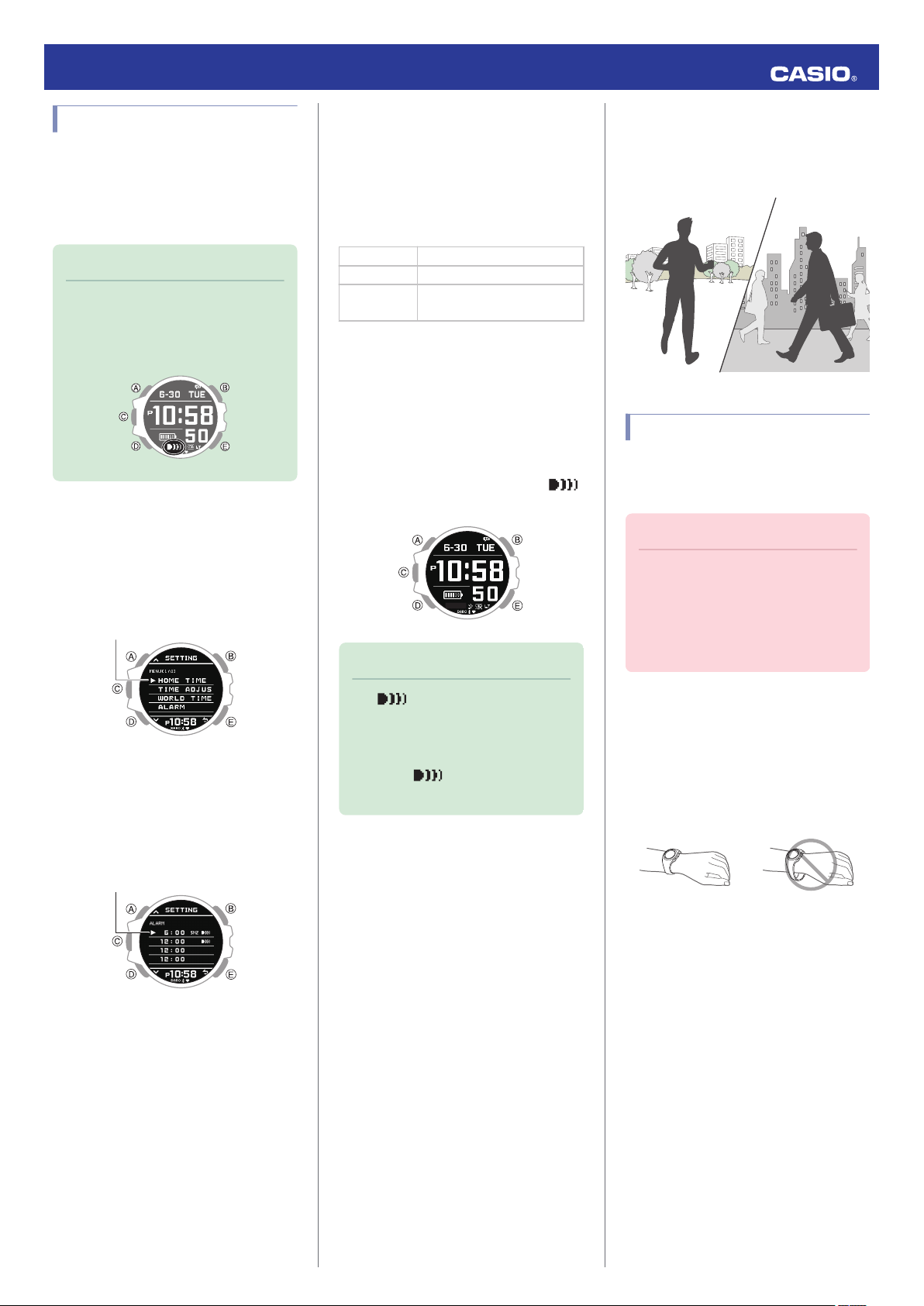
Turning Off an Alarm
To stop an alarm sound and/or vibration
operation, perform the steps below to turn it
off.
●
To reactivate an alarm sound and/or
vibration operation, turn it back on.
Note
●
An indicators is displayed while any
one of the alarms is turned on.
●
The alarm indicator is not displayed
while all of the alarms are turned off.
1. Enter the Timekeeping Mode.
l
Navigating Between Modes
2. Hold down (A) for at least two seconds.
This displays the Timekeeping Mode
setting screen.
Pointer
3. Use (A) and (D) to move the pointer to
[ALARM].
4. Press (C).
5. Use (A) and (D) to move the pointer to the
alarm you want to turn off.
Pointer
6. Press (C).
7. Use (A) and (D) to select [OFF].
8. Press (E).
9. Use (A) and (D) to select whether or not
you want to save your current settings.
[YES] Saves current settings.
[NO] Discards current settings.
[RETURN]
Returns to the alarm setting
screen.
10. Press (C) to complete the setting
operation.
After the setting operation is complete,
[SETTING COMPLETED] will appear for
a few seconds, and then the alarm setting
selection screen will re-appear.
11. Press (E) twice to exit the setting screen.
●
Turning off all alarms will cause
(alarm) to disappear from the display.
Note
●
If (alarm) is still displayed, it
means that at least one of the other
alarms is still turned on. To turn off all
of the alarms repeat steps 5 through 10
until the
(alarm) indicator is no
longer displayed.
Pedometer
You can use the pedometer to keep track of
your step count while walking, engaging in
your normal daily activities, etc.
Counting Steps
If you are wearing the watch correctly, the
pedometer will count your steps as you walk
or engage in your normal daily activities.
Important!
●
Since this watch’s pedometer is a
wrist-worn device, it may detect non-
step movements and count them as
steps. Also, abnormal arm movements
while walking may cause a miss count
of steps.
●
Getting Ready
To enable the most accurate step count, wear
the watch with the face on the outside of your
wrist and tighten the band securely. A loose
band may make it impossible to obtain correct
measurement.
NOYES
●
Counting Steps
The pedometer will start counting your steps
when you start walking.
Operation Guide 3475
47
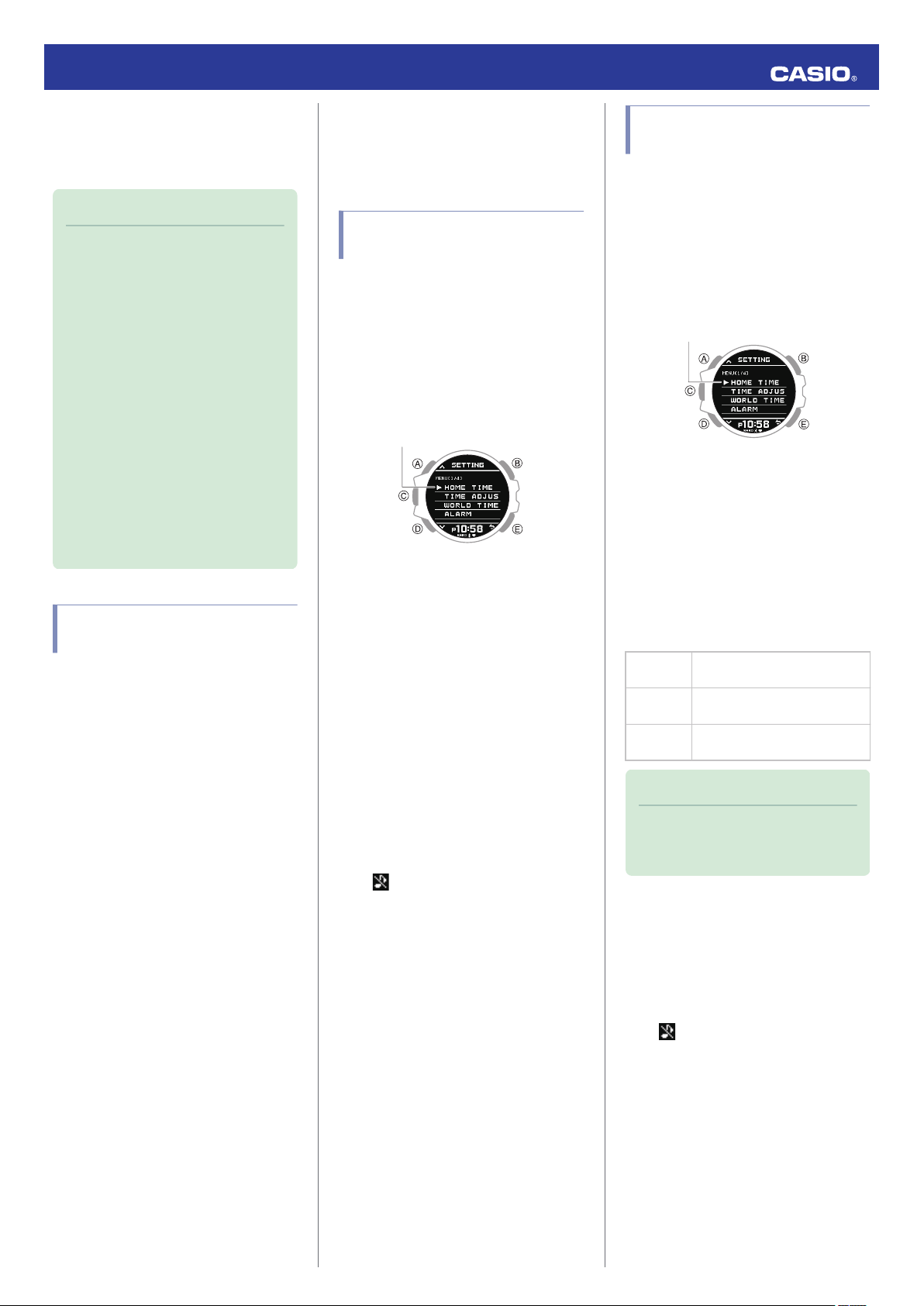
●
To check the step count
Display the TIME+DAILY screen.
l
Selecting a Timekeeping Mode Digital
Display Format
Note
●
The step count can show a value up to
99,999 steps. If the step count
exceeds 99,999, the maximum value
(99,999) remains on the display.
●
To avoid miscounting of non-walking
movements, the step count is not
displayed at the beginning of a walk. It
appears only after you have continued
walking for about 20 seconds, with the
number of steps you took during the
first 20 seconds included in to the total.
●
The step count is reset to zero at
midnight each day.
●
To save power, measurement stops
automatically if you take off the watch
(no watch movement) and do not
perform any operation for two or three
minutes.
Causes of Incorrect Step
Count
Any of the conditions below may make proper
counting impossible.
●
Walking while wearing slippers, sandals, or
other footwear that encourages a shuffling
gait
●
Walking on tile, carpeting, snow, or other
surface that causes a shuffling gait
●
Irregular walking (in a crowded location, in
a line where walking stops and starts at
short intervals, etc.)
●
Extremely slow walking or extremely fast
running
●
Pushing a shopping cart or baby stroller
●
In a location where there is a lot of vibration,
or riding on a bicycle or in a vehicle
●
Frequent movement of the hand or arm
(clapping, fanning movement, etc.)
●
Walking while holding hands, walking with
a cane or stick, or engaging in any other
movement in which your hand and leg
movements are not coordinated with each
other
●
Normal daily non-walking activities
(cleaning, etc.)
●
Wearing the watch on your dominant hand
●
Walking for 20 seconds or less
Other Settings
This section explains other watch settings you
can configure.
Button Operation Sound
Setting
Use the procedure below to enable or disable
the tone that sounds when you press a button.
1. Enter the Timekeeping Mode.
l
Navigating Between Modes
2. Hold down (A) for at least two seconds.
This displays the Timekeeping Mode
setting screen.
Pointer
3. Use (A) and (D) to move the pointer to
[BEEP].
4. Press (C).
5. Use (A) and (D) to move the pointer to
[OPERATION].
6. Press (C).
7. Use (A) and (D) to move the pointer to
[ON] (enabled) or [OFF] (disabled).
8. Press (C) to complete the setting
operation.
After the setting operation is complete,
[SETTING COMPLETED] will appear for
a few seconds, and then the BEEP
(sound) setting screen will re-appear.
●
is displayed in the Timekeeping
Mode while the operation tone is
disabled.
9. Press (E) twice to exit the setting screen.
Configuring Notification
Sound Settings
You can use the procedure below to enable or
disable the notification sound.
1. Enter the Timekeeping Mode.
l
Navigating Between Modes
2. Hold down (A) for at least two seconds.
This displays the Timekeeping Mode
setting screen.
Pointer
3. Use (A) and (D) to move the pointer to
[BEEP].
4. Press (C).
5. Use (A) and (D) to move the pointer to
[NOTIFICATION].
6. Press (C).
7. Use (A) and (D) to select a notification
sound ON/OFF setting.
[ALL ON]
Enables sound for all
notifications.
[USER]
Enables sound only for items
specified by you.
[ALL OFF]
Disables sound for all
notifications.
Note
●
The configuration of [USER]
notifications can be changed using G-
SHOCK MOVE.
8. Press (C) to complete the setting
operation.
After the setting operation is complete,
[SETTING COMPLETED] will appear for
a few seconds, and then the BEEP
(sound) setting screen will re-appear.
●
is displayed in the Timekeeping
Mode while the notification tone is
disabled.
9.
Press (E) twice to exit the setting screen.
Operation Guide 3475
48

Configuring Vibration
Settings
In addition to operation sounds and
notification sounds, your watch also uses
vibration for alerts. You can use the procedure
below to enable or disable vibration.
●
The icon is shown on the Timekeeping
Mode display while operation vibration or
notification vibration is enabled.
●
Configuring Operation Vibration
Settings
1. Enter the Timekeeping Mode.
l
Navigating Between Modes
2. Hold down (A) for at least two seconds.
This displays the Timekeeping Mode
setting screen.
Pointer
3. Use (A) and (D) to move the pointer to
[VIBRATION].
4. Press (C).
5. Use (A) and (D) to move the pointer to
[OPERATION].
6. Press (C).
7. Use (A) and (D) to enable or disable
operation vibration.
[ON] Enables operation vibration.
[OFF] Disables operation vibration.
8. Press (C).
After the setting operation is complete,
[SETTING COMPLETED] will appear for
a few seconds, and then the vibration
setting selection screen will re-appear.
9. Press (E) twice to exit the setting screen.
●
Configuring Notification Vibration
Settings
1. Enter the Timekeeping Mode.
l
Navigating Between Modes
2. Hold down (A) for at least two seconds.
This displays the Timekeeping Mode
setting screen.
Pointer
3. Use (A) and (D) to move the pointer to
[VIBRATION].
4. Press (C).
5. Use (A) and (D) to move the pointer to
[NOTIFICATION].
6. Press (C).
7. Use (A) and (D) to select a notification
vibration ON/OFF setting.
[ALL ON]
Enables vibration for all
notifications.
[USER]
Enables vibration only for items
specified by you.
[ALL OFF]
Disables vibration for all
notifications.
Note
●
The configuration of [USER]
notifications can be changed using G-
SHOCK MOVE.
8. Press (C).
After the setting operation is complete,
[SETTING COMPLETED] will appear for
a few seconds, and then the vibration
setting selection screen will re-appear.
9. Press (E) twice to exit the setting screen.
Specifying the Height and
Weight Units
You can specify the units of measurement
used for height and weight.
●
You can select either centimeters (cm) or
feet (ft) as the height unit.
●
You can select either kilograms (kg) or
pounds (lb) as the weight unit.
Important!
●
When Tokyo (TOKYO) is the Home
City, the height unit is fixed as
centimeters (cm) and the weight unit is
fixed as kilograms (kg), and these
settings cannot be changed.
1. Enter the Timekeeping Mode.
l
Navigating Between Modes
2. Hold down (A) for at least two seconds.
This displays the Timekeeping Mode
setting screen.
Pointer
3. Use (A) and (D) to move the pointer to
[UNIT].
4. Press (C).
5. Use (A) and (D) to select the unit setting
item.
[HEIGHT] Height unit
[WEIGHT] Weight unit
6. Press (C).
7. Use (A) and (D) to select the unit you want.
●
Height
[CENTIMETER] Centimeters
[FEET] Feet
●
Weight
[KILOGRAM] Kilograms
[POUND] Pounds
8. Press (C) to complete the setting
operation.
After the setting operation is complete,
[SETTING COMPLETED] will appear for
a few seconds, and then the unit setting
screen will re-appear.
9. Press (E) twice to exit the setting screen.
Operation Guide 3475
49
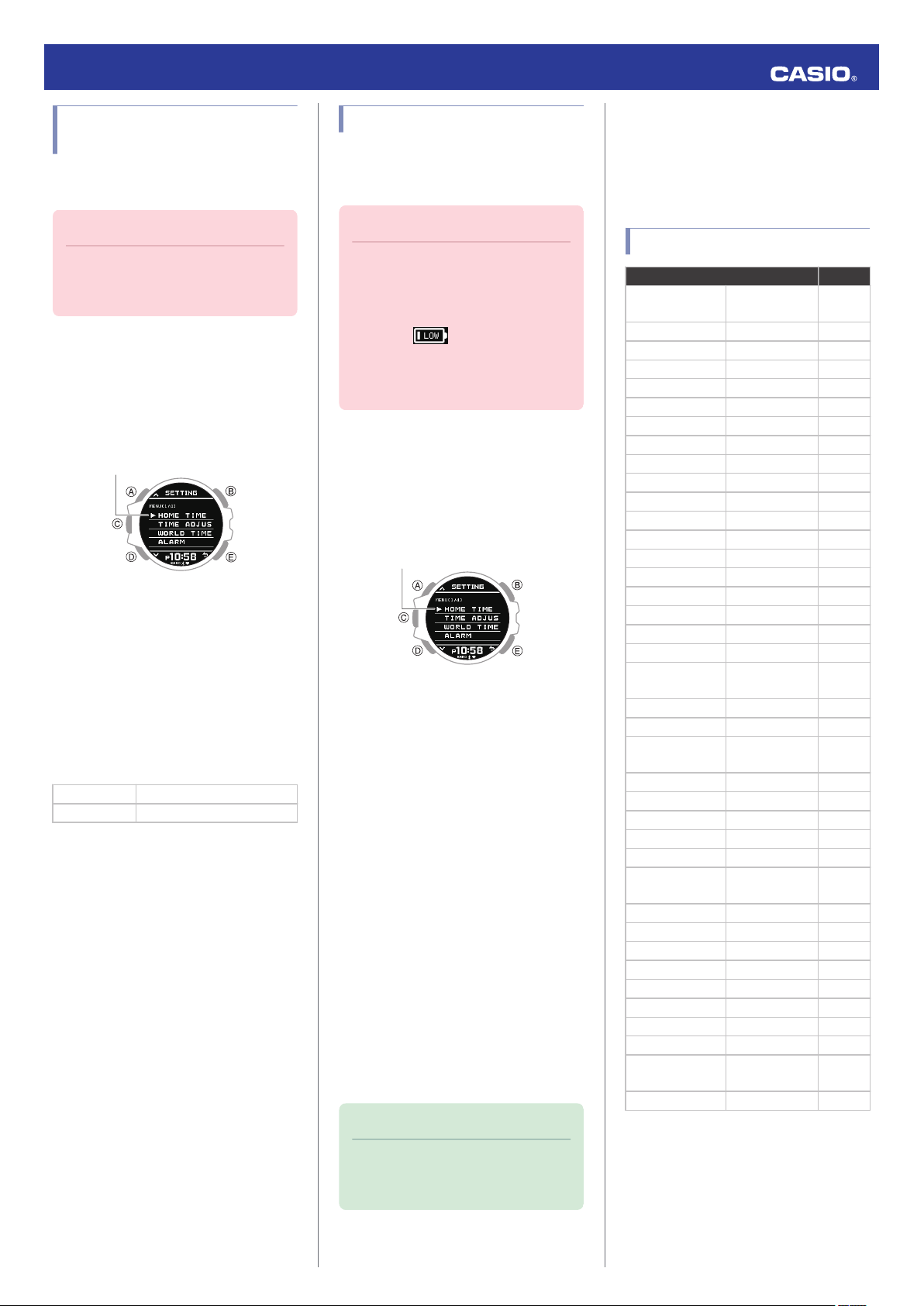
Specifying the Calorie
Display Unit
You can select either calories (cal) or joules
(J) as the calories burned unit.
Important!
●
When Tokyo (TOKYO) is the Home
City, the unit is fixed as calories (cal)
and cannot be changed.
1. Enter the Timekeeping Mode.
l
Navigating Between Modes
2. Hold down (A) for at least two seconds.
This displays the Timekeeping Mode
setting screen.
Pointer
3. Use (A) and (D) to move the pointer to
[UNIT].
4. Press (C).
5. Use (A) and (D) to move the pointer to
[CALORIES].
6. Press (C).
7. Use (A) and (D) to select the calorie unit
you want.
[CALORIE] Calories
[JOULE] Joules
8. Press (C) to complete the setting
operation.
After the setting operation is complete,
[SETTING COMPLETED] will appear for
a few seconds, and then the unit setting
screen will re-appear.
9. Press (E) twice to exit the setting screen.
Resetting Watch Settings
This section explains how to return the watch
settings, training log, and notifications to their
initial factory defaults.
Important!
●
A watch reset cannot be undone.
●
Reset the watch settings is not
possible under the conditions
described below.
ー
While
or lower is displayed
for the battery level
ー
While the watch’s airplane mode is
enabled
1. Enter the Timekeeping Mode.
l
Navigating Between Modes
2. Hold down (A) for at least two seconds.
This displays the Timekeeping Mode
setting screen.
Pointer
3. Use (A) and (D) to move the pointer to
[RESET ALL SETTINGS].
4. Press (C).
5. Use (A) and (D) to move the pointer to
[EXECUTE].
●
To cancel the reset operation, move the
pointer to [CANCEL].
6. Press (C).
7. Use (A) and (D) to move the pointer to
[YES].
●
To stop the reset operation, move the
pointer to [NO].
8. Press (C).
The watch will return to the Timekeeping
Mode after the reset operation is
complete. The reset operation is
complete when [AC] appears in the lower
right corner of the display.
9. Press (A) to clear [AC] from the display.
Note
●
Resetting the watch will also delete
information for pairing the watch with a
phone, and unpair them.
Other Information
This section provides non-operational
information you also need to know. Refer to
this information as required.
City Table
City Offset
UTC
Coordinated
Universal Time
0
LONDON London 0
PARIS Paris +1
ATHENS Athens +2
JEDDAH Jeddah +3
TEHRAN Tehran +3.5
DUBAI Dubai +4
KABUL Kabul +4.5
KARACHI Karachi +5
DELHI Delhi +5.5
KATHMANDU Kathmandu +5.75
DHAKA Dhaka +6
YANGON Yangon +6.5
BANGKOK Bangkok +7
HONG KONG Hong Kong +8
EUCLA Eucla +8.75
TOKYO Tokyo +9
ADELAIDE Adelaide +9.5
SYDNEY Sydney +10
LORD HOWE
ISLAND
Lord Howe
Island
+10.5
NOUMEA Noumea +11
WELLINGTON Wellington +12
CHATHAM
ISLAND
Chatham
Islands
+12.75
NUKU’ALOFA Nuku’alofa +13
KIRITIMATI Kiritimati +14
BAKER ISLAND Baker Island -12
PAGO PAGO Pago Pago -11
HONOLULU Honolulu -10
MARQUESAS
ISLANDS
Marquesas
Islands
-9.5
ANCHORAGE Anchorage -9
LOS ANGELES Los Angeles -8
DENVER Denver -7
CHICAGO Chicago -6
NEW YORK New York -5
HALIFAX Halifax -4
ST. JOHN’S St. John’s -3.5
RIO DE JANEIRO Rio de Janeiro -3
F. DE NORONHA
Fernando de
Noronha
-2
PRAIA Praia -1
Operation Guide 3475
50

●
The information in the above table is current
as of January 2020.
●
Time zones may change and UTC
differentials may become different from
those shown in the table above. If this
happens, connect the watch with a phone
to update the watch with the latest time zone
information.
Summer Time Table
When [AUTO] is selected for a city that
observes summer time, switching between
standard time and summer time will be
performed automatically at the timing shown
in the table below.
Note
●
Summer time start and end dates for
your current location may be different
from those shown below. If this
happens, you can have new summer
time information for your Home City
and World Time city sent to the watch
by connecting the watch with a phone.
If the watch is not connected with a
phone, you can change the summer
time setting manually.
City Name
Summer Time
Start
Summer Time
End
London
01:00, last
Sunday in March
02:00, last
Sunday in
October
Paris
02:00, last
Sunday in March
03:00, last
Sunday in
October
Athens
03:00, last
Sunday in March
04:00, last
Sunday in
October
Tehran
00:00, March 22
or 21
00:00,
September 22 or
21
Sydney,
Adelaide
02:00, first
Sunday in
October
03:00, first
Sunday in April
Lord Howe
Island
02:00, first
Sunday in
October
02:00, first
Sunday in April
Wellington
02:00, last
Sunday in
September
03:00, first
Sunday in April
Chatham
Islands
02:45, last
Sunday in
September
03:45, first
Sunday in April
Anchorage
02:00, second
Sunday in March
02:00, first
Sunday in
November
Los
Angeles
02:00, second
Sunday in March
02:00, first
Sunday in
November
Denver
02:00, second
Sunday in March
02:00, first
Sunday in
November
Chicago
02:00, second
Sunday in March
02:00, first
Sunday in
November
New York
02:00, second
Sunday in March
02:00, first
Sunday in
November
Halifax
02:00, second
Sunday in March
02:00, first
Sunday in
November
St. John’s
02:00, second
Sunday in March
02:00, first
Sunday in
November
●
The information in the above table is current
as of January 2020.
Fitness Categories
Men
Age Category Evaluation
24 or below
VERY POOR <32
POOR 32-37
FAIR 38-43
AVERAGE 44-50
GOOD 51-56
VERY GOOD 57-62
EXCELLENT >62
25-29
VERY POOR <31
POOR 31-35
FAIR 36-42
AVERAGE 43-48
GOOD 49-53
VERY GOOD 54-59
EXCELLENT >59
30-34
VERY POOR <29
POOR 29-34
FAIR 35-40
AVERAGE 41-45
GOOD 46-51
VERY GOOD 52-56
EXCELLENT >56
35-39
VERY POOR <28
POOR 28-32
FAIR 33-38
AVERAGE 39-43
GOOD 44-48
VERY GOOD 49-54
EXCELLENT >54
40-44
VERY POOR <26
POOR 26-31
FAIR 32-35
AVERAGE 36-41
GOOD 42-46
VERY GOOD 47-51
EXCELLENT >51
45-49
VERY POOR <25
POOR 25-29
FAIR 30-34
AVERAGE 35-39
GOOD 40-43
VERY GOOD 44-48
EXCELLENT >48
50-54
VERY POOR <24
POOR 24-27
FAIR 28-32
AVERAGE 33-36
GOOD 37-41
VERY GOOD 42-46
EXCELLENT >46
55-59
VERY POOR <22
POOR 22-26
FAIR 27-30
AVERAGE 31-34
GOOD 35-39
VERY GOOD 40-43
EXCELLENT >43
Operation Guide 3475
51
60 or above
VERY POOR <21
POOR 21-24
FAIR 25-28
AVERAGE 29-32
GOOD 33-36
VERY GOOD 37-40
EXCELLENT >40
Women
Age Category Evaluation
24 or below
VERY POOR <27
POOR 27-31
FAIR 32-36
AVERAGE 37-41
GOOD 42-46
VERY GOOD 47-51
EXCELLENT >51
25-29
VERY POOR <26
POOR 26-30
FAIR 31-35
AVERAGE 36-40
GOOD 41-44
VERY GOOD 45-49
EXCELLENT >49
30-34
VERY POOR <25
POOR 25-29
FAIR 30-33
AVERAGE 34-37
GOOD 38-42
VERY GOOD 43-46
EXCELLENT >46
35-39
VERY POOR <24
POOR 24-27
FAIR 28-31
AVERAGE 32-35
GOOD 36-40
VERY GOOD 41-44
EXCELLENT >44
40-44
VERY POOR <22
POOR 22-25
FAIR 26-29
AVERAGE 30-33
GOOD 34-37
VERY GOOD 38-41
EXCELLENT >41
45-49
VERY POOR <21
POOR 21-23
FAIR 24-27
AVERAGE 28-31
GOOD 32-35
VERY GOOD 36-38
EXCELLENT >38
50-54
VERY POOR <19
POOR 19-22
FAIR 23-25
AVERAGE 26-29
GOOD 30-32
VERY GOOD 33-36
EXCELLENT >36
55-59
VERY POOR <18
POOR 18-20
FAIR 21-23
AVERAGE 24-27
GOOD 28-30
VERY GOOD 31-33
EXCELLENT >33
60 or above
VERY POOR <16
POOR 16-18
FAIR 19-21
AVERAGE 22-24
GOOD 25-27
VERY GOOD 28-30
EXCELLENT >30
Source:
Shvartz E Reibold RC: Aerobic fitness norms
for males and females aged 6 to 75 years: a
review. Aviat Space Environ Med;61:3-11
1990 Shvartz E, Reibold RC.
Supported Phones
For information about phones that can
connect with the watch, visit the CASIO
website.
https://world.casio.com/os_mobile/wat/
Specifications
Accuracy :
±15 seconds per month average when time
adjustment by communication with a phone is
not possible.
Basic Functions :
Hour, minute, second, month, day, day of
the week
a.m./p.m. (P), 24-hour timekeeping
Full Auto Calendar (2000 to 2099)
Positioning :
GPS, GLONASS, QZSS
Mobile Link :
Function linking by wireless connection with
Bluetooth
®
compatible devices*
* Operation enhanced by Mobile Link
Auto Time Adjustment
Simple time setting
World Time: Current time in 300 cities (38
time zones, auto summer time switching),
and UTC (Coordinated Universal Time)
time
Watch settings
Phone finder
Data updating
Updating of time zone and summer time
rule information
Training plan creation
Training function settings
Target alerts
Altimeter navigation settings
Training log data management
Training log data and lap data
management
Training analysis results
Notifications
Communication Specifications
Bluetooth
®
Frequency band: 2400MHz to 2480MHz
Maximum transmission power: 0 dBm (1
mW)
Communication range: Up to 2 meters
(depends on environment)
Training Function :
Distance, speed, pace, and other
information calculated using GPS and
accelerometer data
Auto/Manual lap
Auto Pause
Auto Run Timing start
Target alert setting (time, altitude, calories)
enable/disable
Training display customization
Training Analysis :
Training status
Fitness level trend
Training load trend
VO2MAX
Recovery time
Training log data :
Up to 100 runs, up to 140 lap records per
run
Elapsed time, distance, pace, calories
burned, heart rate, maximum heart rate,
aerobic training effect, anaerobic training
effect
Digital Compass :
Measurement range: 0° to 359°
16-direction display
60-second continuous measurement
Auto level correction
Bearing calibration (3-point calibration,
figure 8 calibration)
Magnetic declination correction
Barometric Pressure Measurement :
Measurement range: 260 to 1,100 hPa (or
7.65 to 32.45 inHg)
Display range: 260 to 1,100 hPa (or 7.65 to
32.45 inHg)
Measurement unit: 1 hPa (or 0.05 inHg)
Auto measurement interval: 2 hours
Calibration
Barometric pressure graph
Barometric Pressure Change Indicator
Operation Guide 3475
52
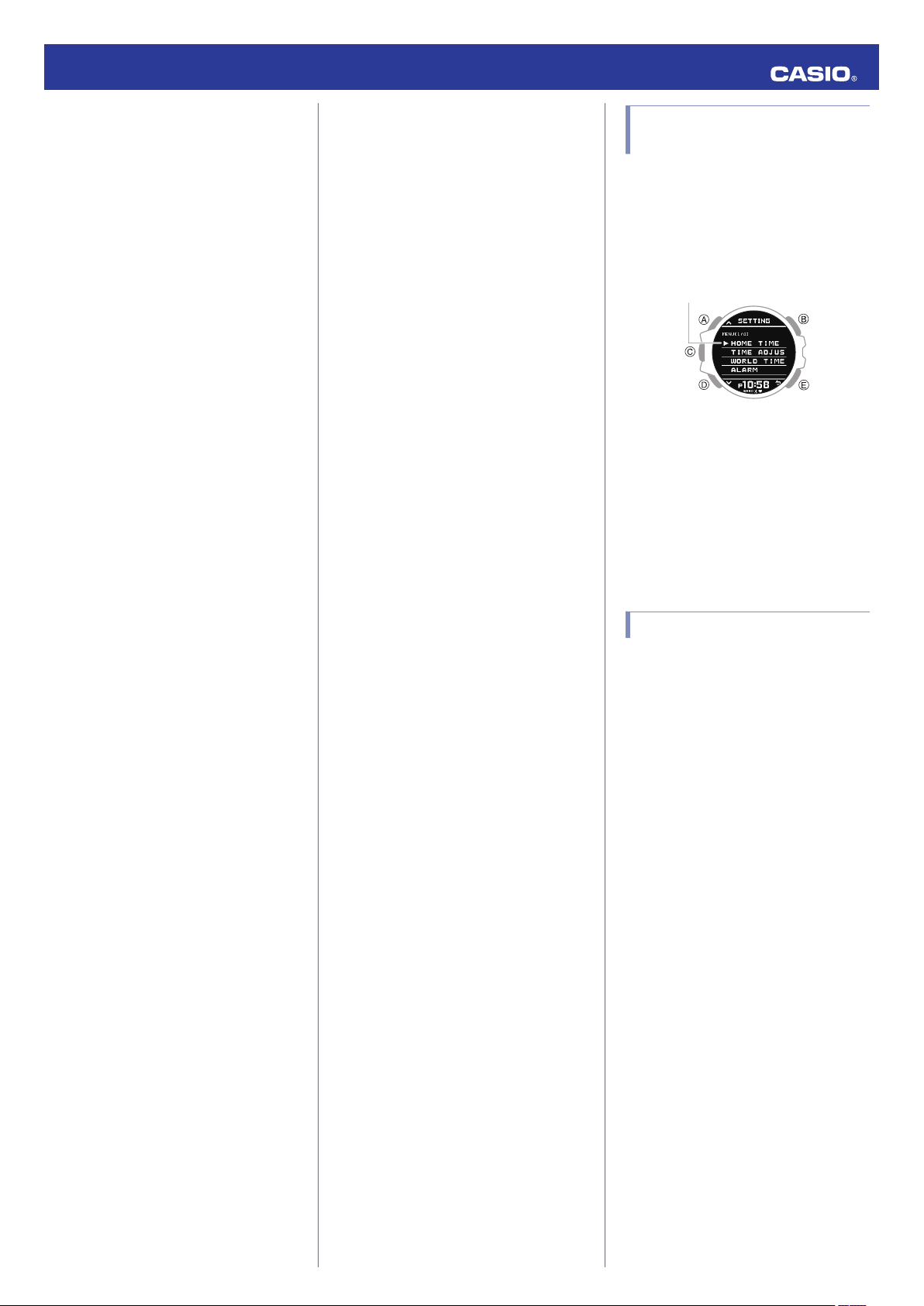
Temperature Measurement :
Measuring range: -10.0 °C to 60.0 °C (or
14.0 °F to 140.0 °F)
Display range: -10.0 °C to 60.0 °C (or
14.0 °F to 140.0 °F)
Measuring unit: 0.1 °C (or 0.2 °F)
Calibration
Altimeter :
Measuring range: -700 to 10,000 m (or
-2,300 to 32,800 ft.)
Display range: -10,000 m to 10,000 m (or
-32,800 to 32,800 ft.)
Measuring unit: 1 m (or 5 ft.)
Measuring interval: 2 minutes/5 seconds
Reference altitude setting
Altitude differential measurement: -3,000 to
+3,000m (or -9,840 to 9,840 ft.)
Altitude graph
Wrist heart rate measurement :
Maximum Measurement Value: 220 bpm
Heart rate
Daily target heart rate
Graphic heart rate zones
Heart rate graph
Maximum/minimum heart rate
Sensor Accuracy :
Direction
Measurement accuracy: Within ±10°
Assured accuracy temperature range:
-10°C to 60°C (14°F to 140°F)
Temperature
Measurement accuracy: Within ±2.0℃
Guaranteed accuracy temperature
range: -10℃ to 60℃
Pressure
Measurement accuracy: ±3 hPa
(Altimeter measurement accuracy:
Within ±75 meters)
Guaranteed accuracy temperature
range: -10℃ to 60℃
Step Count :
Step count measurement using a 3-axis
accelerometer
Step count display range: 0 to 99,999 steps
Step count reset: Auto reset at midnight
each day
Step count accuracy: ±3% (According to
vibration testing)
Stopwatch :
Measuring unit: 1 second
Measuring capacity: 99:59’59” (100 hours)
Split times
Countdown Timer :
Setting unit: 1 second
Measuring unit: 1 second
Maximum setting: 60 minutes
Up to five start times
Auto Repeat
World Time :
Displays current time in 38 cities (38 time
zones)* and UTC, Auto DST
* Subject to updates by connection
between the watch and a phone.
Other :
Power Saving
LED backlight (Full Auto Light, Super
Illuminator, afterglow, 1.5 or 3-second
selectable illumination duration)
Charge Level Indication
Operation sound enable/disable
Vibration
Airplane Mode
4 alarms (with snooze)
Power Supply :
Lithium-ion battery
Approximate Battery Life :
Timekeeping Mode: Approximately 12
months*
Timekeeping Mode, Wrist heart rate
measurement: Approximately 66 hours*
* With Power Saving and Heart Rate
Measurement Sleep used.
Training Mode (GPS continuous
measurement), Wrist heart rate
measurement: Approximately 14 hours
Training Mode (GPS intermittent
measurement), Wrist heart rate
measurement: Approximately 18 hours
Other Conditions
Step counting: 12 hours/day
Bluetooth Connection Time: 12
hours/day
Notifications (including vibration): 20
times/day
Alarm: Once (10 seconds)/day
Illumination: Once (1.5 seconds)/day
Accessories :
Charger cable
When unpackaging, check to make sure
everything is included. If something is
missing, contact your original retailer.
Specifications are subject to change without
notice.
Checking Wireless
Compliance Information
1. Enter the Timekeeping Mode.
l
Navigating Between Modes
2. Hold down (A) for at least two seconds.
This displays the Timekeeping Mode
setting screen.
Pointer
3. Use (A) and (D) to move the pointer to
[REGULATORY].
4. Press (C).
5. Use (A) and (D) to select the information
you want to view.
6. Hold down (D) for at least one second to
return to the Timekeeping Mode.
Mobile Link Precautions
●
Legal Precautions
●
This watch complies with or has received
approval under the radio laws of various
countries and geographical areas. Using
this watch in an area where it does not
comply with or has not received approval
under applicable radio laws may be a
criminal offense. For details, visit the CASIO
Website.
https://world.casio.com/ce/BLE/
●
Use of this watch inside of aircraft is
restricted under the aviation laws of each
country. Be sure to follow the instructions of
airline personnel.
Operation Guide 3475
53

●
Precautions when using Mobile Link
●
When using this watch in combination with
a phone, keep the watch and phone close
to each other. A range of two meters is
recommended as a guideline, but the local
environment (walls, furniture, etc.), the
structure of a building, and other factors
may require a much closer range.
●
This watch can be affected by other devices
(electrical devices, audio-visual equipment,
office equipment, etc.) In particular, it can
be affected by operation of a microwave
oven. The watch may not be able to
communicate normally with a phone if a
microwave oven is operating nearby.
Conversely, this watch may cause noise in
radio reception and the video image of a TV.
●
Bluetooth of this watch uses the same
frequency band (2.4 GHz) as wireless LAN
devices, and use of such devices in close
proximity of this watch may result in radio
interference, slower communication
speeds and noise for the watch and the
wireless LAN device, or even
communication failure.
●
Stopping Radio Wave Emission by This
Watch
The watch is emitting radio waves while
e
is
on the display or while GPS is in use.
When in a hospital, on an aircraft, or in any
other area where the use of radio waves is not
allowed, enable the Airplane Mode.
l
Using the Watch in a Medical Facility or
Aircraft
Copyrights and Registered
Copyrights
●
The Bluetooth
®
word mark and logos are
registered trademarks owned by the
Bluetooth SIG, Inc. and any use of such
marks by CASIO Computer Co., Ltd. is
under license.
●
iPhone and App Store are trademarks of
Apple Inc. in the United States and other
countries.
●
iOS is a trademark or registered trademark
of Cisco Systems, Inc.
●
GALAXY is a registered trademark of
Samsung Electronics Co., Ltd.
●
Android and Google Play
TM
are trademarks
or registered trademarks of Google LLC.
●
Other company names and product names
used herein are trademarks or registered
trademarks of their respective companies.
Troubleshooting
Charging with the Charger
Cable
Q1
The watch won’t charge with the
charger cable.
Is the end of the charger cable with the
special watch connector securely inserted
into watch charger terminal?
Charging may fail if there is space
between the terminals.
l
Precautions When Charging
Did you leave the watch attached to the
charger cable after charging was
complete?
Charging stops automatically after the
watch becomes fully charged. If you want
to charge again, unplug the charger cable
from the watch and then re-attach it.
Is charging still impossible after checking
the above points?
Check to make sure that the USB device
or power source is functioning normally.
Q2
Charging stops before it is complete.
Charging may stop if some temporary
abnormality occurs. Unplug the charger cable
from the watch and check for abnormalities. If
there is nothing wrong, try charging again.
If the above does not eliminate the problem,
contact your original retailer or a CASIO
service center.
Signal Reception (GPS)
Q1
The watch cannot perform a GPS
signal receive operation.
Is the watch’s battery charged?
GPS signal reception is not possible while
the battery indicator is or lower.
Charge the watch.
l
Charging the Watch
Is the watch’s Airplane Mode enabled?
GPS signal reception is not possible while
the watch’s Airplane Mode is enabled.
Disable the Airplane Mode.
l
Using the Watch in a Medical Facility or
Aircraft
After checking the above, the watch still
cannot perform a GPS signal receive
operation.
GPS signal reception is not possible
under the conditions described below.
●
During power saving
Q2
The watch is not receiving time
information.
The watch will not perform auto GPS signal
receive while there is a connection between it
an a phone. If you want to receive GPS signals
in this case, perform manual receive.
l
Acquiring GPS Time Information Manually
l
Auto Time Adjustment
Q3
A screen showing that a receive
operation is in progress has been on
the display for a long time.
The watch may be receiving leap second
information.
l
Leap Second Reception
Operation Guide 3475
54
Q4
The GPS signal receive operation
always fails.
Is the watch in a location that is appropriate
for signal reception?
Check your surroundings and move the
watch to a location where GPS signal
reception is better.
l
Appropriate Signal Reception Location
Is the LCD of the watch pointed straight up
at the sky?
Minimize movement of the watch while the
receive operation is in progress.
When the watch is set up for auto receive,
take care to avoid covering its LCD with
the sleeve of your clothing.
Q5
Signal reception should have been
successful, but the watch’s time and/
or day is wrong.
Is your Home City (time zone) setting
correct for your location?
Change your Home City (time zone)
setting so it correctly indicates your
location.
l
Acquiring GPS Location Information
Manually
l
Setting a Home City
After checking the above, the time and/or
day settings is still wrong.
Adjust time and day settings manually.
I can’t pair the watch with a
phone.
Q1
I’ve never been able to establish a
(pairing) connection between the
watch and phone.
Are you using a supported phone model?
Check if the phone model and its
operating system are supported by the
watch.
For information about supported phone
models, visit the CASIO Website.
https://world.casio.com/os_mobile/wat/
Did you install G-SHOCK MOVE on your
phone?
G-SHOCK MOVE needs to be installed on
your phone in order to connect with the
watch.
l
A
Install the required app on your
phone.
Are your phone’s Bluetooth settings
configured correctly?
Configure the phone’s Bluetooth settings.
For details about setting procedures, see
your phone documentation.
iPhone Users
●
“Settings”
n
“Bluetooth”
n
On
●
“Settings”
n
“Privacy”
n
“Bluetooth”
n
“G-SHOCK MOVE”
n
On
Android Users
●
Enable Bluetooth.
Other than the above.
Some phones need to have BT Smart
disabled to use G-SHOCK MOVE. For
details about setting procedures, see your
phone documentation.
On the Home Screen, tap: “Menu”
n
“Settings”
n
“Bluetooth”
n
“Menu”
n
“BT Smart settings”
n
“Disable”.
I can’t reconnect the watch
and phone.
Q1
The watch will not re-connect with the
phone after they are disconnected.
Is G-SHOCK MOVE running?
The watch cannot re-connect with your
phone unless G-SHOCK MOVE is
running on the phone. On your phone’s
home screen, tap the G-SHOCK MOVE
icon. Perform the operation shown on the
screen that appears to pair with the watch.
l
C
Pair the watch with a phone.
Have you tried turning your phone off and
then back on again?
Turn your phone off and then back on
again, and then tap the G-SHOCK MOVE
icon. Perform the operation shown on the
screen to pair with the watch.
l
C
Pair the watch with a phone.
Q2
I can’t connect while my phone is in
the Airplane Mode.
Connection with the watch is not possible
while the phone’s Airplane Mode is enabled.
Disable your phone’s Airplane Mode. On it’s
home screen, tap the “G-SHOCK MOVE”
icon. Next, perform the operation shown on
the screen to pair with the watch.
l
C
Pair the watch with a phone.
Q3
I can’t connect while the watch is in
the Airplane Mode.
Exit the watch’s Airplane Mode.
l
Using the Watch in a Medical Facility or
Aircraft
Q4
I changed the phone’s Bluetooth
from enabled to disabled, and now I
can’t connect anymore.
On your phone, turn on Bluetooth. Then on its
home screen, tap the “G-SHOCK MOVE”
icon. Next, perform the operation shown on
the screen to pair with the watch.
l
C
Pair the watch with a phone.
Q5
I can’t connect after turning off the
phone.
Turn on your phone. On its home screen, tap
the G-SHOCK MOVE icon. Next, perform the
operation shown on the screen to pair with the
watch.
l
C
Pair the watch with a phone.
Operation Guide 3475
55
Phone-Watch Connection
Q1
I can’t establish a connection
between the phone and watch.
Have you tried turning your phone off and
then back on again?
Turn your phone off and then back on
again, and then tap the G-SHOCK MOVE
icon. Perform the operation shown on the
screen to pair with the watch.
l
C
Pair the watch with a phone.
Is the watch in the Airplane Mode?
Connection with your phone is not
possible while the watch’s Airplane Mode
is enabled. To connect with your phone,
disable the Airplane Mode.
l
Using the Watch in a Medical Facility or
Aircraft
Has the watch been re-paired with the
phone?
Delete the pairing information from G-
SHOCK MOVE and your phone (iPhone
only), and then re-pair them.
l
Deleting Pairing Information from G-
SHOCK MOVE
l
iPhone Only
Deleting the phone’s pairing
information
l
C
Pair the watch with a phone.
If you are unable to establish a
connection...
After deleting pairing information from the
watch, re-pair it with your phone.
l
Deleting Pairing Information from the
Watch
l
C
Pair the watch with a phone.
Changing to a Different
Phone Model
Q1
How do I connect my watch to a
different phone?
Pair the watch with the phone.
l
If you purchase another phone
Auto Time Adjustment by
Bluetooth Connection (Time
Adjustment)
Q1
When does the watch adjust its time?
Your watch can connect with a paired phone
to adjust its time setting. Auto time adjustment
is performed at the times described below.
●
After your phone’s time zone or summer
time setting is changed
●
After 24 hours or more have passed since
the last time adjustment using Bluetooth
connection
●
After 24 hours or more have passed since
the last home city change or time
adjustment using watch operation
Also, GPS signal auto receive will be
performed if there has been no auto time
adjustment based on connection between the
watch and phone for more than one day.
Q2
Auto time setting is not correct.
Is
e
displayed?
To preserve battery power, the watch will
automatically terminate Bluetooth
connection with your phone temporarily if
it detects the connection has been unused
for approximately one hour. Auto Time
Adjustment is disabled while there is no
connection. To reconnect, press any
watch button or angle the watch towards
your face.
Have 24 hours or more passed since the
last time adjustment using Bluetooth
connection?
Note that auto time adjustment is not
performed for 24 hours after you adjust
the time setting manually on the watch.
Auto time adjustment will resume after 24
hours.
Have 24 hours or more passed since the
last manual time adjustment or city
change?
Auto time adjustment is not performed for
24 hours after a manual time adjustment
or city change. Auto time adjustment will
resume after 24 hours or more have
elapsed after either of the above
operations is performed.
Is the watch’s Airplane Mode enabled?
Connection with your phone is not
possible while the watch’s Airplane Mode
is enabled. To connect with your phone,
disable the Airplane Mode.
l
Using the Watch in a Medical Facility or
Aircraft
Q3
Time is not displayed correctly.
The phone’s time setting may be incorrect
because it is unable to connect with its
network due to being out of range, etc. If this
happens, connect the phone to its network
and then adjust the time setting.
Operation Guide 3475
56
Heart Rate Measurement
Q1
[ERROR] is displayed during
measurement.
There may be a problem with the sensor. Try
taking another measurement. If [ERROR]
keeps appearing after multiple measurement
attempts, contact a CASIO service center or
your original retailer.
Altitude Measurement
Q1
Readings produce different results at
the same location.
Watch readings are different from
altitude information available from
other sources.
Correct altitude readings are not
possible.
Relative altitude is calculated based on
changes in barometric pressure measured by
the watch’s pressure sensor. This means that
barometric pressure changes can cause
readings taken at the same location to be
different. Also note that the value displayed by
the watch may be different from the actual
elevation and/or sea level elevation indicated
for the area where you are located. When
using the watch’s altimeter while mountain
climbing, it is recommended that you regularly
calibrate its readings in accordance with local
altitude (elevation) indications.
l
Calibrating Altitude Readings
Q2
[-----] appears on the display
following altitude differential
measurement.
[-----] appears when the altitude differential is
outside the allowable measuring range
(±3,000 m (±9,840 feet)). If [ERROR] appears
on the display, there may be a problem with
the sensor.
l
Setting a Reference Altitude and Taking
Relative Altitude Readings
Q3
[ERROR] is displayed during
measurement.
There may be a problem with the sensor. Try
taking another measurement. If [ERROR]
keeps appearing after multiple measurement
attempts, contact a CASIO service center or
your original retailer.
Digital Compass
Q1
The symbol is shown on the
display.
Abnormal magnetism has been detected.
Move away from any potential source of
strong magnetism and try taking a reading
again.
If appears again, it could mean that the
watch body has become magnetized. Move
away from any potential source of strong
magnetism, perform direction calibration, and
then try taking a reading again.
l
Calibrating the Compass
l
Digital Compass Reading Precautions
Q2
[ERROR] is displayed during
measurement.
There is a problem with the sensor or there
may be a source strong magnetic force
nearby. Move away from any potential source
of strong magnetism and try taking a reading
again. If [ERROR] keeps appearing after
multiple measurement attempts, contact a
CASIO service center or your original retailer.
l
Digital Compass Reading Precautions
Q3
[ERROR] appears on the display
following direction calibration.
If [- - -] is followed by [ERROR] on the display,
it could mean there is something wrong with
the sensor.
●
If [ERROR] disappears after about one
second, try calibrating again.
●
If [ERROR] keeps appearing after multiple
attempts, contact a CASIO service center or
your original retailer.
Q4
Direction information indicated by the
watch is different from that indicated
by a backup compass.
Move away from any potential source of
strong magnetism, perform bidirectional
calibration, and then try taking a reading
again.
l
Calibrating the Compass
l
Digital Compass Reading Precautions
Q5
Readings at the same location
produce different results.
Cannot take readings indoors.
Move away from any potential source of
strong magnetism and try taking a reading
again.
l
Digital Compass Reading Precautions
Barometric Pressure
Measurement
Q1
[ERROR] is displayed during
measurement.
There may be a problem with the sensor. Try
taking another measurement. If [ERROR]
keeps appearing after multiple measurement
attempts, contact a CASIO service center or
your original retailer.
Temperature Measurement
Q1
[ERROR] is displayed during
measurement.
There may be a problem with the sensor. Try
taking another measurement. If [ERROR]
keeps appearing after multiple measurement
attempts, contact a CASIO service center or
your original retailer.
Operation Guide 3475
57

Pedometer
Q1
Displayed step count is not correct.
While the watch is on your wrist, the
pedometer may detect non-step movements
and count them as steps.
l
Counting Steps
Also, step count problems can also be caused
by how the watch is being worn and abnormal
arm movement while walking.
l
Causes of Incorrect Step Count
Q2
The step count does not increase.
To avoid miscounting of non-walking
movements, the step count is not displayed at
the beginning of a walk.
It appears only after you have continued
walking for about 20 seconds, with the number
of steps you took during the first 20 seconds
included in to the total.
Q3
[ERROR] appears when using the
pedometer.
[ERROR] (error) is displayed when sensor
operation is disabled because of sensor or
internal circuitry malfunction.
If the indicator remains on the display for more
than three minutes or if it frequently appears,
it could indicate a faulty sensor.
Contact a CASIO service center or your
original retailer.
Alarms
Q1
There is no sound and/or vibration
operation performed for alarms.
Is the watch’s battery charged?
Charge the watch until the battery is
sufficiently recharged.
l
Charging the Watch
Is alarm sound and/or vibration enabled?
Enable the alarm.
l
Turning Off an Alarm
Operation Guide 3475
58

