ruse and Care Guide
KitchenAid*
Table of Contents
(complete) ................. 2
A Note to You ............... 3
Range Safety ............. 4-6
Getting to Know
Your Range .................. 7
Using and Caring for
Your Cooktop ............. 11
Using and Caring for
Your Oven .................. 18
Using EASY
CONVECT*
Conversion .............. 36
Using the
Self-Cleaning Cycle ... 51
Troubleshooting ........ 55
Requesting Assistance
or Service .................... 57
Index ........................... 62
Warranty ..................... 64
In the U.S.A. for assistance or service,
call the Consumer Assistance Center:
1-800-422-1230
In Canada for assistance or service,
see page 58.
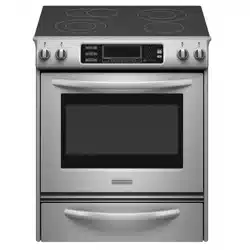
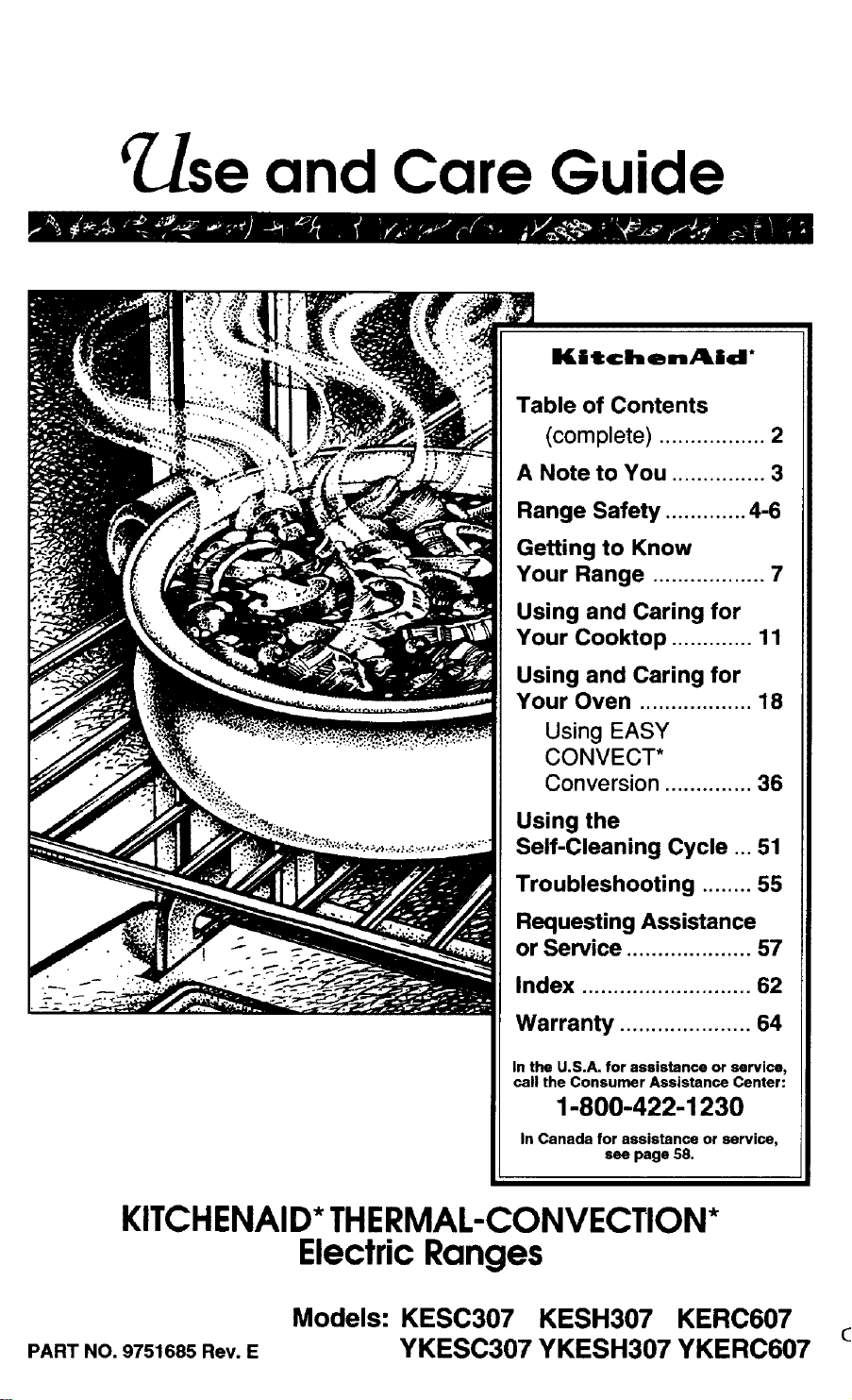
KITCHENAID*THERMAL-CONVECTION*
Electric Ranges
Models: KESC307 KESH307 KERC607
PART NO. 9751685 Rev. E YKESC307 YKESH307 YKERC607
-able of Contents
A Note to You ............................................ 3
Range Safety ......................................... 4-6
Getting to Know Your Range ................... 7
Feature locations ................................. 7
The oven vent ....................................... 9
The storage drawer ............................... 9
The anti-tip bracket ............................. 10
Using and Caring for Your Cooktop ...... 11
Using the surface units ....................... 11
Cookware tips ..................................... 13
Caring for your cooktop ....................... 14
Using and replacing the surface light ... 16
Using and Caring for Your Oven ............ 18
Using the electronicoven control ........ 18
Oven settings ..................................... 21
Setting the clock ................................. 22
Using the timer ................................... 22
Baking or convection baking ............... 24
Roasting ............................................. 25
Cooking tips ........................................ 27
Adjusting oven temperature ................ 30
Using the temperature probe ............... 31
Using Convect Full Meal ..................... 33
Using EASY CONVECT*
Conversion ......................................... 36
Broiling ............................................... 38
Convection broiling ............................. 40
Timed cooking .................................... 43
Dehydrating ........................................ 46
Raising (proofing) bread ...................... 47
Cleaning your oven and controls ......... 48
Using and replacing the oven light(s)... 50
Using the Self-Cleaning Cycle ............... 51
Before you start .................................. 51
Before setting the controls................... 52
Setting the controls ............................. 52
For best cleaning results..................... 54
How the cycle works ........................... 54
Troubleshooting ...................................... 55
Requesting Assistance or Service ......... 57
Index ........................................................ 62
Warranty .................................................. 64
m Note to You
_nkyou for buying a KITCHENAID* appliance!
KitchenAid designs the best tools for the most important room in your house. To ensure
that you enjoy many years of trouble-free operation, we developed this Use and Care
Guide. It contains valuable information concerning how to operate and maintain your
new appliance properly and safely. Please read it carefully.
Also, please complete and mail the enclosed Product Registration Card.
If you need assistance or service, first see the "Troubleshooting" section of this book.
After checking "Troubleshooting," additional help can be found by checking the
"Requesting Assistance or Service" section.
When calling, you will need to know your appliance's complete model number and
serial number. You can find this information on the model and serial number plate
(see diagrams on pages 7 or 8).
Keep this book and the sales slip together in a safe place for future reference. You
must provide proof of purchase or Installation date for in-warranty service.
Model Number Builder/Dealer Name
Serial Number Address
Date Installed Phone
nge Safety
IMPORTANTSAFETYINSTRUCTIONS
Your safety is important to us.
This guide contains safety symbols and
statements. Please pay special attention to
these symbols and follow any instructions
given. Here is a brief explanation of the use
of the symbol.
General
This symbol alerts you to
hazards such as fire,
electrical shock, or
other injuries.
To reduce the risk of fire, electrical
shock, injury to persons, or damage
when using the range, follow basic
precautions, including the following:
• Read all instructions before using
the range.
• Install or locate the range only
in accordance with the provided
Installation Instructions. The
range must be installed by a
qualified installer. The range must
be properly connected to electri-
cal supply and grounded.
• WARNING: To reduce the risk
of tipping the appliance, the
appliance must be secured by a
properly installed anti-tip bracket.
To check if the bracket is installed
properly, see "The anti-tip bracket"
on page 10.
• CAUTION: Do not siore things
children might want above the
range. Children could be burned
or injured while climbing on it.
• Do not leave children alone or
unattended in area where the
range is in use. They should
never be allowed to sit or stand
on any part of the range. They
could be burned or injured.
• Do not use the range for warming
or heating the room. Persons could
be burned or injured, or a fire could
start.
• Use the range only for its intended
use as described in this manual.
• Do not touch surface units, areas
near units, heating elements, or
interior surfaces of oven. Surface
units and heating elements may
be hot even though they are dark
in color. Areas near surface units
and interior surfaces of an oven be-
come hot enough to cause burns.
During and after use, do not touch,
or let clothing or other flammable
materials contact surface units,
areas near units, heating elements,
or interior surfaces of oven until
they have had sufficient time to
cool. Other surfaces of the range,
such as the oven vent opening, the
surface near the vent opening, the
cooktop, and the oven door and
window, could also become hot
enough to cause burns.
nge Safety
*Do not operate the range if it is
damaged or not working properly.
oDo not wear loose or hanging
garments when using the range.
They could ignite if they touch a
hot surface unit and you could
be burned.
*Use only dry pot holders. Moist or
damp pot holders on hot surfaces
could result in burns from steam.
Do not let pot holder touch hot
heating elements. Do not use a
towel or bulky cloth for a pot
holder. It could catch on fire.
*Keep range vents unobstructed.
*Do not heat unopened containers.
They could explode. The hot
contents could cause burns and
container particles could cause
injury.
.Use only cookware approved for
oven use. Follow cookware manu-
facturer's instructions, especially
when using glass or plastic
cookware.
.Do not store flammable materials
on or near the range. The fumes
could create an explosion and/or
fire hazard.
*Do not repair or replace any part
of the range unless specifically
recommended in this manual. All
other servicing should be referred
to a qualified technician.
oDisconnect the electrical supply
before servicing the range.
When using the cooktop
.Do not cook on a broken ceramic
glass cooktop. If cooktop should
break, cleaning solutions and
spillovers could penetrate the
broken cooktop and create a risk
of electrical shock. Contact a
qualified technician immediately.
*Select a pan with a flat bottom
that is about the same size as the
surface unit. If pan is smaller than
the surface unit, some of the
heating element will be exposed
and could result in the igniting of
clothing or pot holders. Correct
pan size also improves cooking
efficiency.
*Check to be sure glass cookware
is safe for use on the range. Only
certain types of glass, glass-
ceramic, ceramic, earthenware,
or other glazed cookware are
suitable for cooktops without
breaking due to the sudden
change in temperature.
*Never leave surface units un-
attended at high heat settings.
A boilover could result and cause
smoking and greasy spillovers
that could ignite.
oTurn pan handles inward, but not
over other surface units. This will
help reduce the chance of burns,
igniting of flammable materials,
and spills due to bumping of
the pan.
continued on next page
5
_ange Safety
*Grease is flammable. Do not
allow grease to collect around
cooktop or in vents. Wipe spill-
overs immediately.
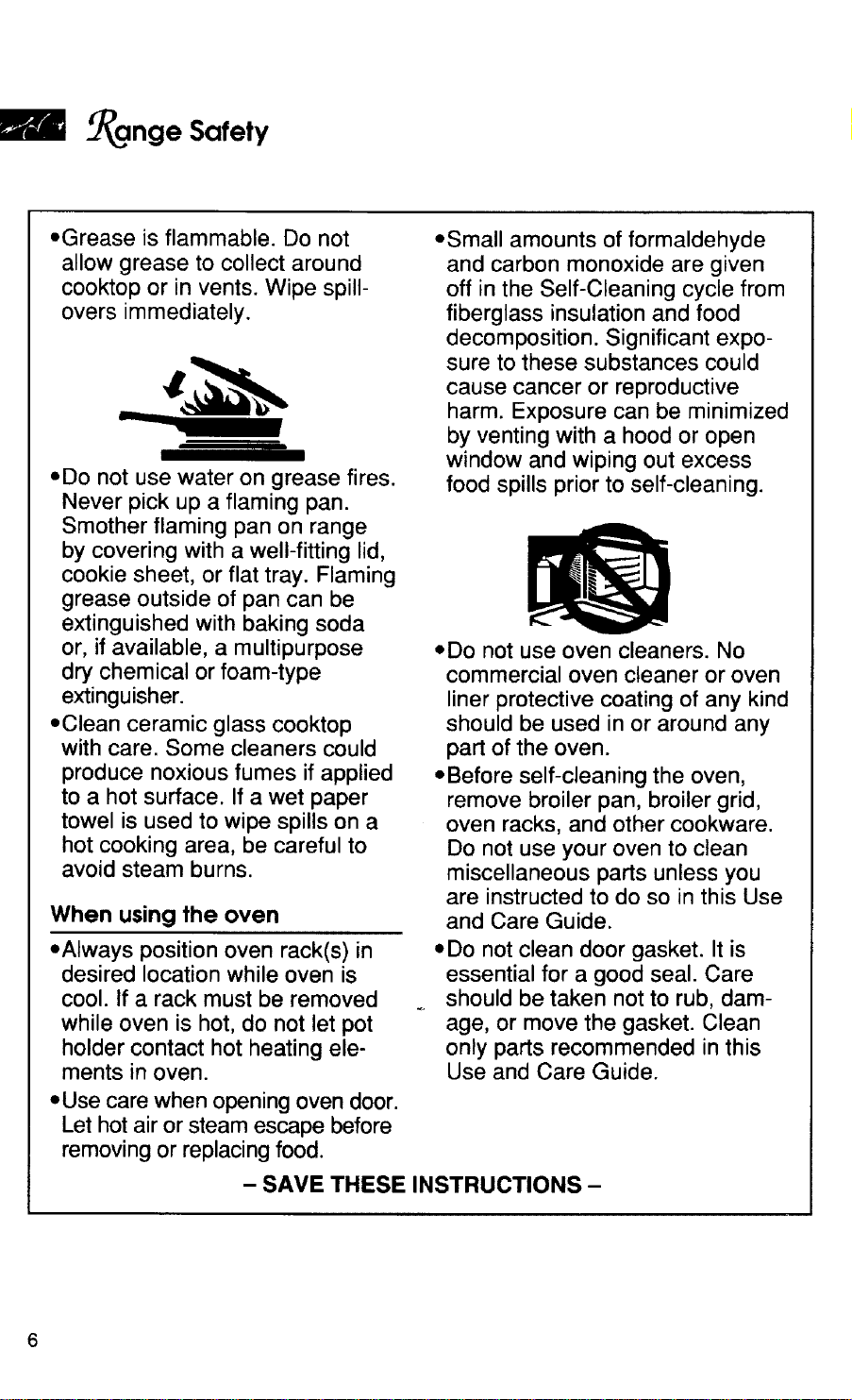
*Do not use water on grease fires.
Never pick up a flaming pan.
Smother flaming pan on range
by covering with a well-fitting lid,
cookie sheet, or flat tray. Flaming
grease outside of pan can be
extinguished with baking soda
or, if available, a multipurpose
dry chemical or foam-type
extinguisher.
*Clean ceramic glass cooktop
with care. Some cleaners could
produce noxious fumes if applied
to a hot surface. If a wet paper
towel is used to wipe spills on a
hot cooking area, be careful to
avoid steam burns.
When using the oven
• Always position oven rack(s) in
desired location while oven is
cool. If a rack must be removed
while oven is hot, do not let pot
holder contact hot heating ele-
ments in oven.
• Use care when opening oven door.
Let hot air or steam escape before
removing or replacing food.
*Small amounts of formaldehyde
and carbon monoxide are given
off in the Self-Cleaning cycle from
fiberglass insulation and food
decomposition. Significant expo-
sure to these substances could
cause cancer or reproductive
harm. Exposure can be minimized
by venting with a hood or open
window and wiping out excess
food spills prior to self-cleaning.
• Do not use oven cleaners. No
commercial oven cleaner or oven
liner protective coating of any kind
should be used in or around any
part of the oven.
*Before self-cleaning the oven,
remove broiler pan, broiler grid,
oven racks, and other cookware.
Do not use your oven to clean
miscellaneous parts unless you
are instructed to do so in this Use
and Care Guide.
• Do not clean door gasket. It is
essential for a good seal. Care
should be taken not to rub, dam-
age, or move the gasket. Clean
only parts recommended in this
Use and Care Guide.
-SAVE THESEINSTRUCTIONS-
etting to Know Your Range
This section tells you what features your range has and where they are located. It
also discusses some convenience features that you should know about, but which
are not needed to operate the range. Please review this information before using
your range. To help you find information on specific parts or features quickly, page
references are included.
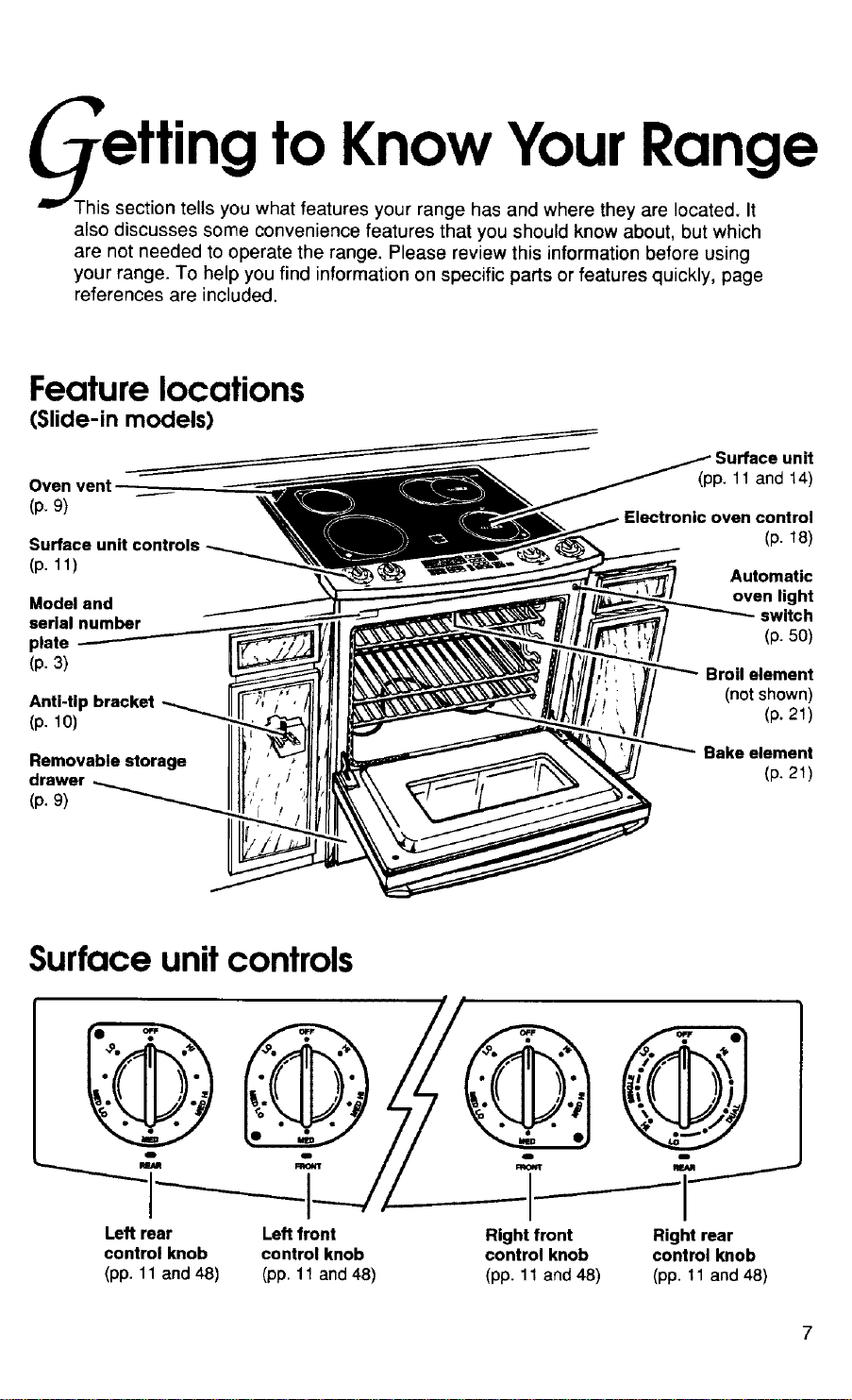
Feature locations
(Slide-in models)
Oven vent
(p. 9)
Surface unit controls
(p. 11)
(pp. 11 and 14)
(p. 18)
Automatic
Model and oven light
aerial number switch
plate (p. 50)
(p. 3) Broil element
Anti-tip bracket (not shown)
(p. 10) (p. 21)
Removable storage Bake element
drawer (p. 21)
(p. 9)
Surface unit controls
Left rear Left front Right front Right rear
control knob control knob control knob control knob
(pp. 11 and 48) (pp, 11 and 48) (pp. 11 and 48) (pp. 11 and 48)
Getting to Know Your Range
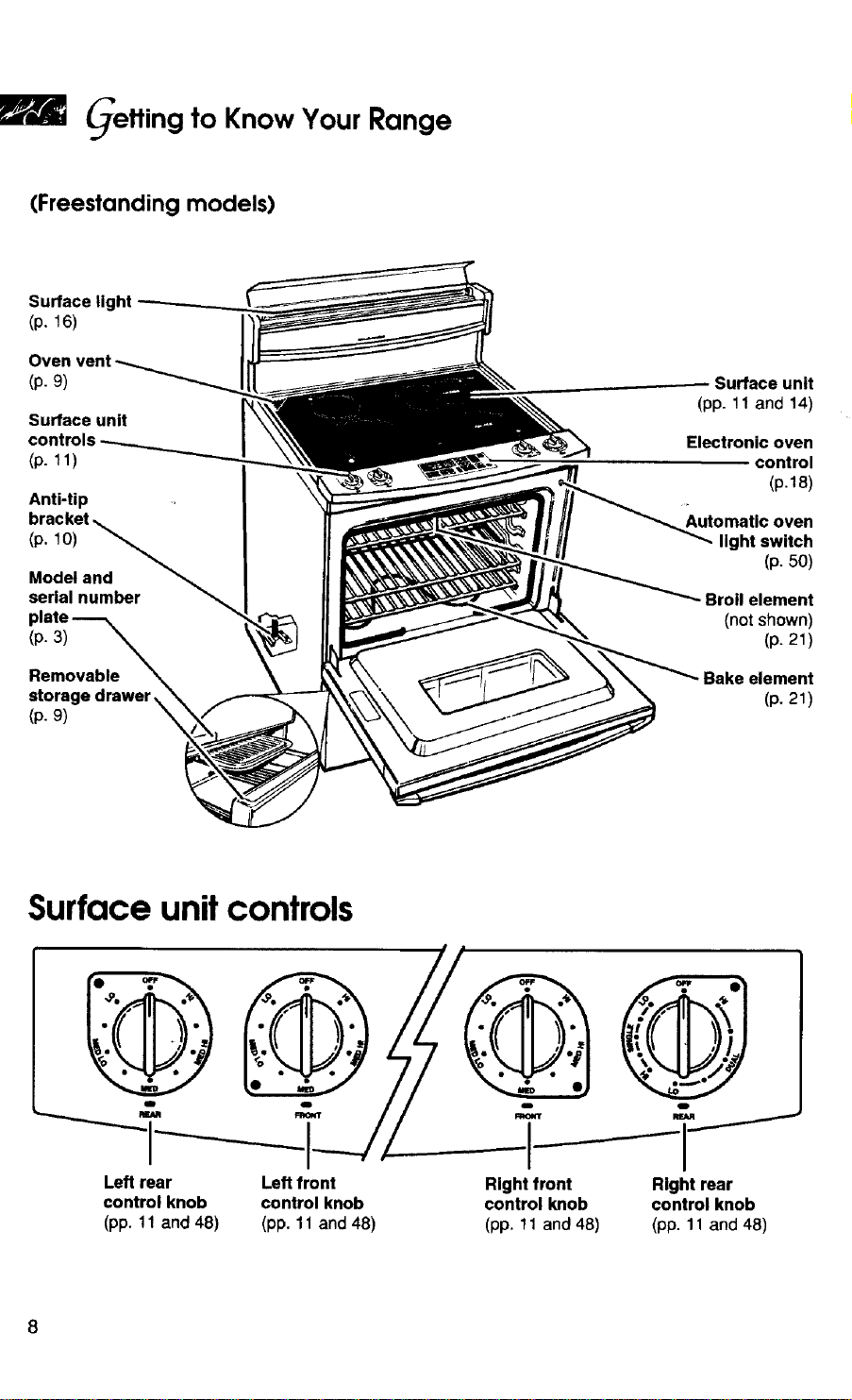
(Freestanding models)
Surface Iigl
(p. 16)
Oven ven
(p. 9)
Surface unit
controls
(p. 11)
Anti-tip •
brac ket
(p. 10)
Model and
serial number
(p. 3)
Removable
storage drawer,
(p. 9)
Surface unit
(pp. 11 and 14)
Electronic oven
control
(p.18)
Automatic oven
light switch
(p. 50)
Broil element
(not shown)
(p. 21)
element
(p. 21)
Surface unit controls
Left rear Left front
control knob control knob
(pp. ! 1 and 48) (pp. 11 and 48)
Right front
control knob
(pp. 11 and 48)
Right rear
control knob
(pp. 11 and 48)
Getting to Know Your Range
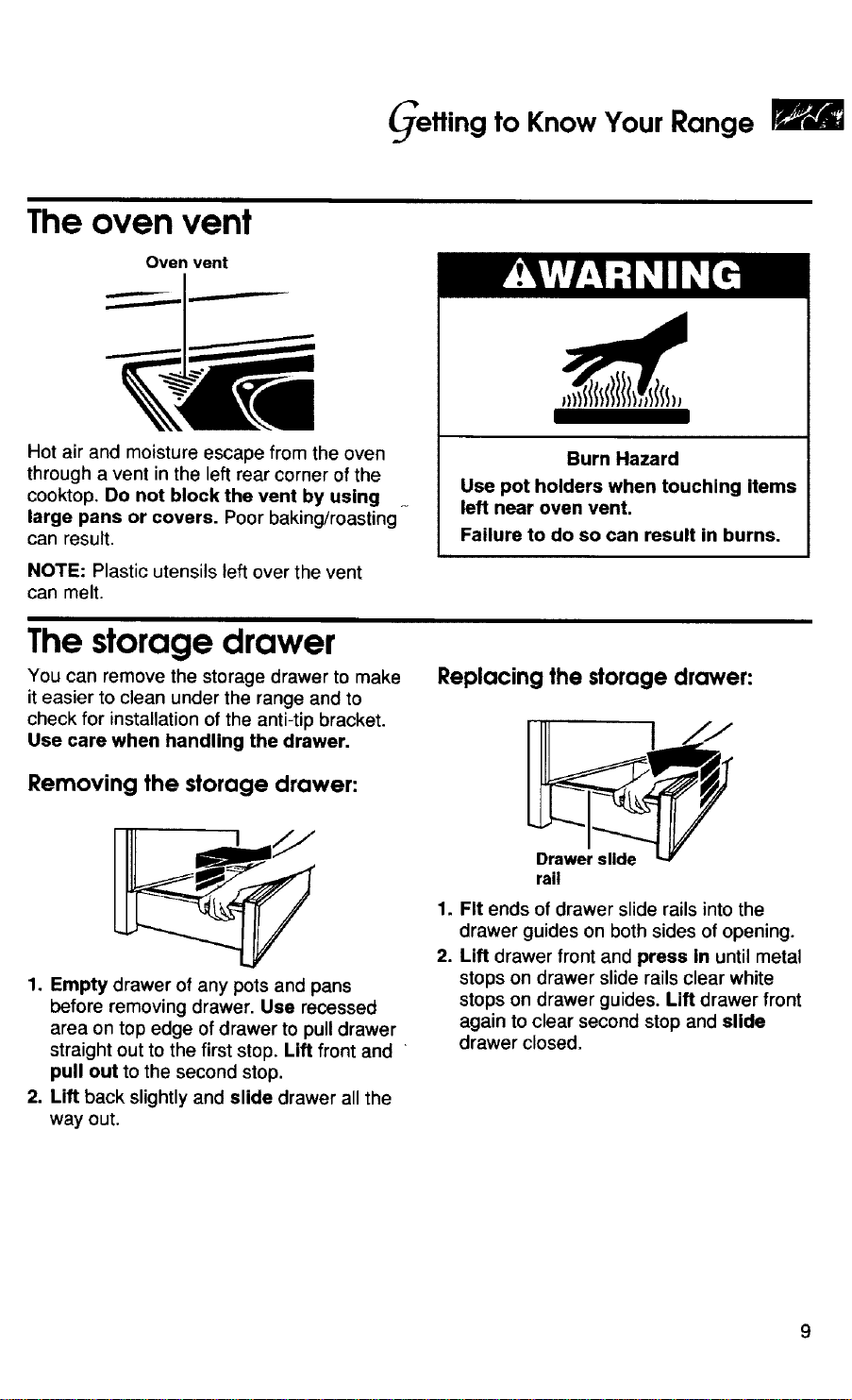
The oven vent
Oven vent
Hot air and moisture escape from the oven
through a vent in the left rear corner of the
cooktop. Do not block the vent by using
large pans or covers. Poor baking/roasting _
can result.
NOTE: Plastic utensils left over the vent
can melt.
The storage drawer
You can remove the storage drawer to make
it easier to clean under the range and to
check for installation of the anti-tip bracket.
Use care when handling the drawer.
Removing the storage drawer:
1. Empty drawer of any pots and pans
before removing drawer. Use recessed
area on top edge of drawer to pull drawer
straight out to the first stop. Lift front and
pull out to the second stop.
2. Lift back slightly and slide drawer all the
way out.
Burn Hazard
Use pot holders when touching Items
left near oven vent.
Failure to do so can result in burns.
Replacing the storage drawer:
Drawer slide
rail
1. Fit ends of drawer slide rails into the
drawer guides on both sides of opening.
2. Lift drawer front and press in until metal
stops on drawer slide rails clear white
stops on drawer guides. Lift drawer front
again to clear second stop and slide
drawer closed.
Getting to Know Your Range
The anti-tip bracket
The range will not tip during normal use. However, tipping can occur if you apply too much
force or weight to the open door without the anti-tip bracket properly secured.
Tip Over Hazard
Connect anti-tip bracket to the range.
Reconnect anti-tip bracket, if the range is moved.
Do not push down on the open oven door.
Follow the Installation Instructions.
Do not let children climb onto the oven door.
Failure to follow these instructions can result in death, burns,
or other injury.
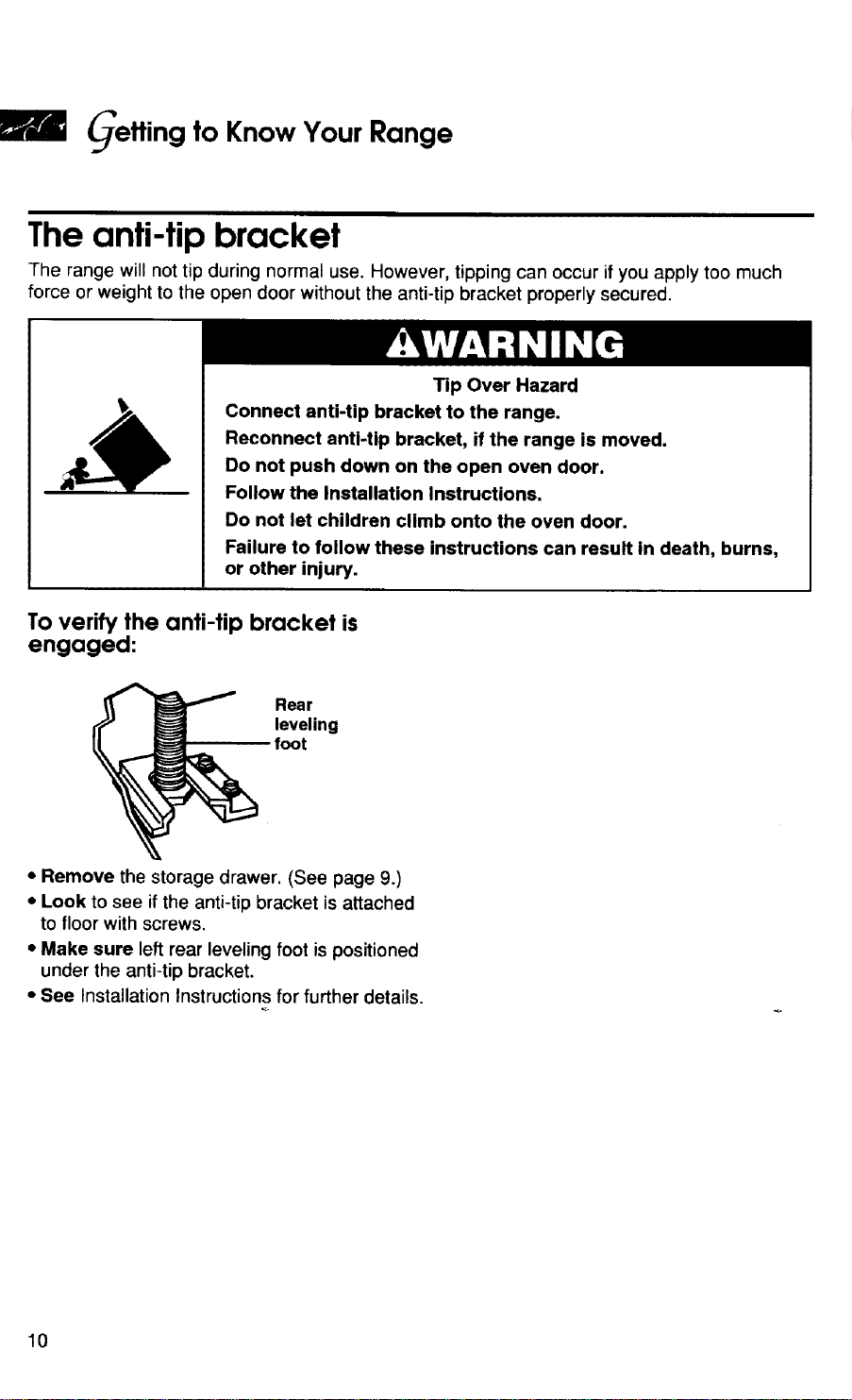
To verify the anti-tip bracket is
engaged:
Rear
leveling
foot
• Remove the storage drawer. (See page 9.)
• Look to see if the anti-tip bracket is attached
to floor with screws.
• Make sure left rear leveling foot is positioned
under the anti-tip bracket.
• See Installation Instructions for further details.
10
sing and Caring for Your
Cooktop
This section tells you how to operate the controls to the cooktop. It aSsodiscusses
how the ceramic glass cooktop works, and includes tips on how to cook with and
maintain the cooktop.
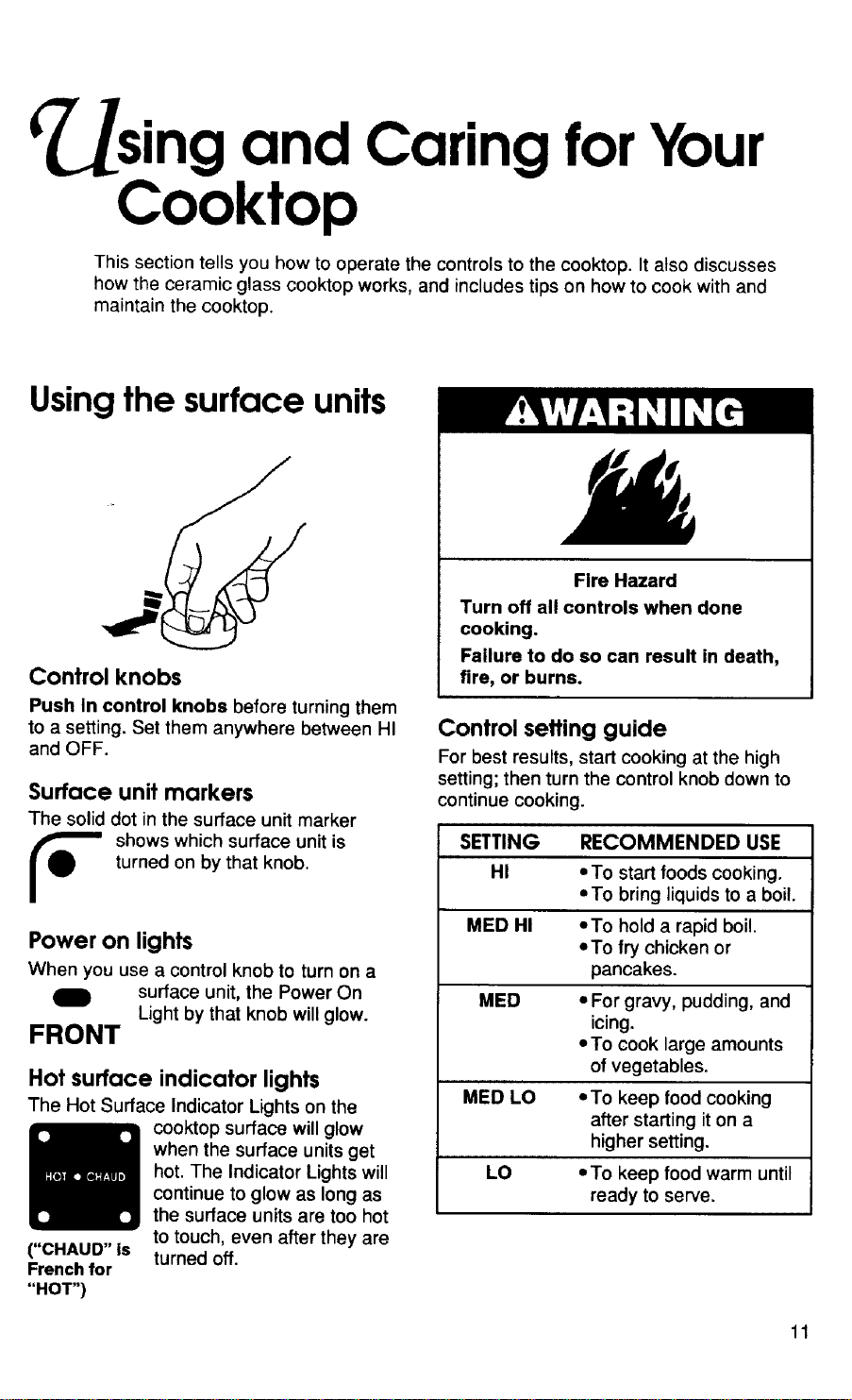
Using the surface units
Control knobs
Push In control knobs before turning them
to a setting. Set them anywhere between HI
and OFF.
Surface unit markers
The solid dot in the surface unit marker
shows which surface unit is
turned on by that knob.
Power on lights
When you use a control knob to turn on a
surface unit, the Power On
Light by that knob will glow.
FRONT
Hot surface indicator lights
The Hot Surface Indicator Lights on the
cooktop surface will glow
when the surface units get
hot. The Indicator Lights will
continue to glow as long as
the surface units are too hot
to touch, even after they are
turned off.
("CHAUD" Is
French for
"HOT")
Fire Hazard
Turn off all controls when done
cooking.
Failure to do so can result in death,
fire, or burns.
Control seffing guide
For best results, start cooking at the high
setting; then turn the controlknob down to
continue cooking.
SETTING RECOMMENDED USE
HI • To start foods cooking.
• To bring liquids to a boil.
MED HI ,,To hold a rapid boil.
• To fry chicken or
pancakes.
MED • For gravy, pudding, and
icing.
oTo cook large amounts
of vegetables.
MED LO ,,To keep food cooking
after starting it on a
higher setting.
LO *To keep food warm until
ready to serve.
11
Using and Caring for Your Cooktop
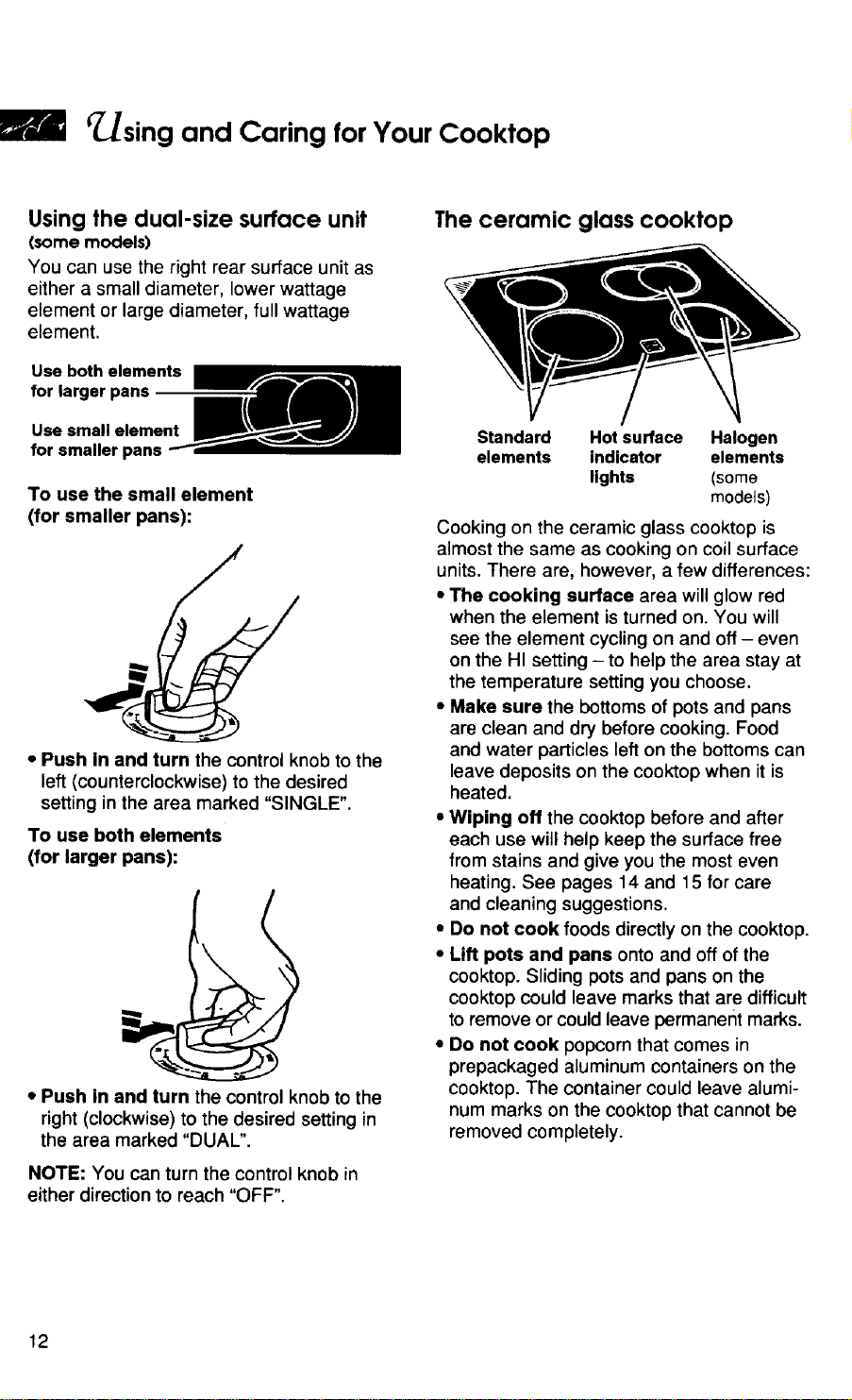
Using the dual-size surface unit
(some models)
You can use the right rear surface unit as
either a small diameter, lower wattage
element or large diameter, full wattage
element.
Use both element_
for larger pans
Use small element
for smaller pans
To use the small element
(for smaller pans):
• Push in and turn the control knob to the
left (counterclockwise) to the desired
setting in the area marked "SINGLE".
To use both elements
(for larger pans):
• Push in and turn the control knob to the
right (clockwise) to the desired setting in
the area marked "DUAL".
NOTE: You can turn the control knob in
either direction to reach "OFF".
The ceramic glass cooktop
Standard Hot surface Halogen
elements indicator elements
lights (some
models)
Cooking on the ceramic glass cooktop is
almost the same as cooking on coil surface
units. There are, however, a few differences:
• The cooking surface area willglow red
when the element is turned on. You will
see the element cycling on and off- even
on the HI setting - to help the area stay at
the temperature setting you choose.
• Make sure the bottoms of pots and pans
are clean and dry before cooking. Food
and water particles lefton the bottoms can
leave deposits on the cooktop when it is
heated.
• Wiping off the cooktop before and after
each use will help keep the surface free
from stains and give you the most even
heating. See pages 14 and 15 for care
and cleaning suggestions.
• Do not cook foods directly on the cooktop.
• Lift pots and pans onto and off of the
cooktop. Sliding pots and pans on the
cooktop could leave marks that are difficult
to remove or could leave permanent marks.
• Do not cook popcorn that comes in
prepackaged aluminum containers on the
cooktop. The container could leave alumi-
num marks on the cooktop that cannot be
removed completely.
12
' sing and Caring for Your Cooktop
• Do not use the cooktop as a cutting
board.
• Do not allow anything that could melt,
such as plastic or aluminum foil, to come
in contact with the cooktop while it is hot.
• Dropping a heavy or hard object on the
cooktop could crack it. Be careful when
using heavy skillets and large pots. Do
not store jars or cans above the cooktop.
• Sugary spills and soils can cause pitting.
See page 15 for more information.
Cookware tips
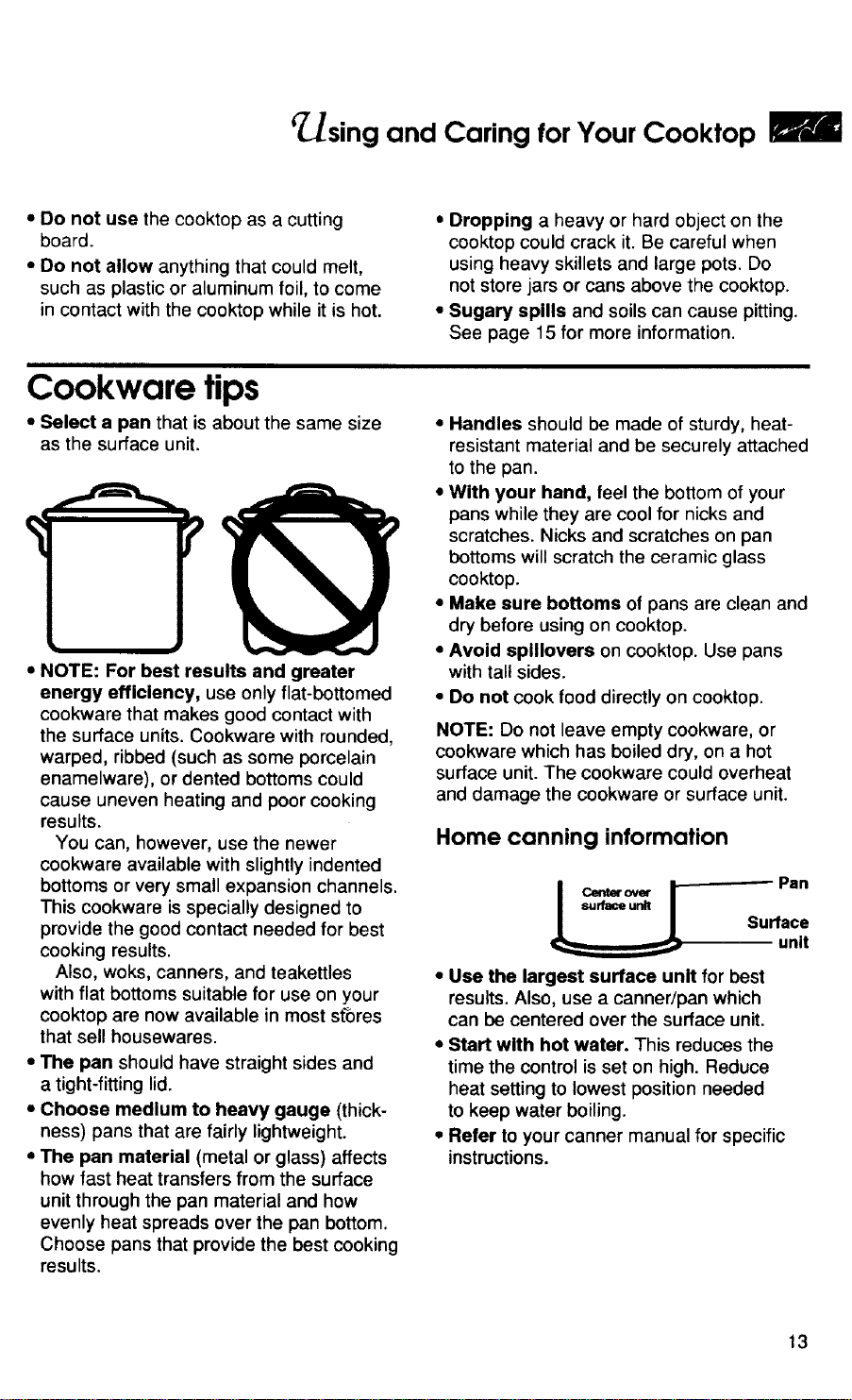
• Select a pan that is about the same size
as the surface unit.
},
• NOTE: For best results and greater
energy efficiency, use only flat-bottomed
cookware that makes good contact with
the surface units. Cookware with rounded,
warped, ribbed (such as some porcelain
enamelware), or dented bottoms could
cause uneven heating and poor cooking
results.
You can, however, use the newer
cookware available with slightlyindented
bottoms or very small expansion channels.
This cookware isspecially designed to
provide the good contact needed for best
cooking results.
Also, woks, canners, and teakettles
with flat bottoms suitable for use on your
cooktop are now available in most stbres
that sell housewares.
• The pan should have straight sides and
a tight-fitting lid.
• Choose medium to heavy gauge (thick-
ness) pans that are fairly lightweight.
• The pan material (metal or glass) affects
how fast heat transfers from the surface
unit through the pan material and how
evenly heat spreads over the pan bottom.
Choose pans that provide the best cooking
results.
• Handles should be made of sturdy, heat-
resistant material and be securely attached
to the pan.
• With your hand, feel the bottom of your
pans while they are cool for nicks and
scratches. Nicks and scratches on pan
bottoms will scratch the ceramic glass
cooktop.
• Make sure bottoms of pans are clean and
dry before using on cooktop.
• Avoid spillovers on cooktop. Use pans
with tall sides.
• Do not cook food directly on cooktop.
NOTE: Do not leave empty cookware, or
cookware which has boiled dry, on a hot
surface unit. The cookware could overheat
and damage the cookware or surface unit.
Home canning information
I Centerov__ Pan
I .._.,_ u..
I | Surface
unit
• Use the largest surface unit for best
results. Also, use a canner/pan which
can be centered over the surface unit.
• Start with hot water. This reduces the
time the control is set on high. Reduce
heat setting to lowest position needed
to keep water boiling.
• Refer to your canner manual for specific
instructions.
13
Using and Caring for Your Cooktop
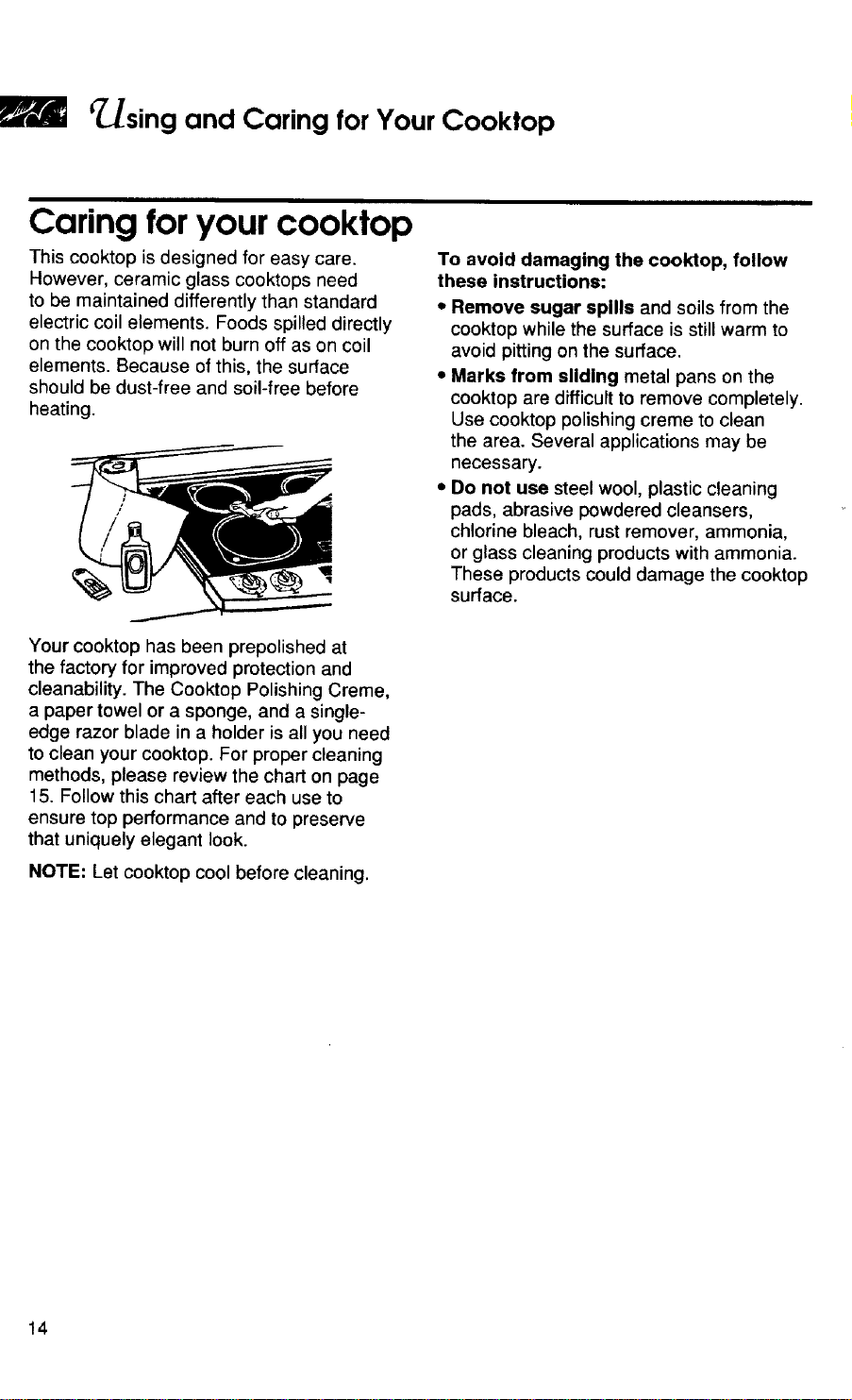
Caring for your cooktop
This cooktop is designed for easy care.
However, ceramic glass cooktops need
to be maintained differently than standard
electric coil elements. Foods spilled directly
on the cooktop will not burn off as on coil
elements. Because of this, the surface
should be dust-free and soil-free before
heating.
%
To avoid damaging the cooktop, follow
these instructions:
• Remove sugar spills and soils from the
cooktop while the surface is still warm to
avoid pitting on the surface.
• Marks from sliding metal pans on the
cooktop are difficult to remove completely.
Use cooktop polishing creme to clean
the area. Several applications may be
necessary.
• Do not use steel wool, plastic cleaning
pads, abrasive powdered cleansers,
chlorine bleach, rust remover, ammonia,
or glass cleaning products with ammonia.
These products could damage the cooktop
surface.
Your cooktop has been prepolished at
the factory for improved protection and
cleanability. The Cooktop Polishing Creme,
a paper towel or a sponge, and a single-
edge razor blade in a holder is all you need
to clean your cooktop. For proper cleaning
methods, please review the chart on page
15. Follow this chart after each use to
ensure top performance and to preserve
that uniquely elegant look.
NOTE: Let cooktop cool before cleaning.
14
r sing and Caring for Your Cooktop
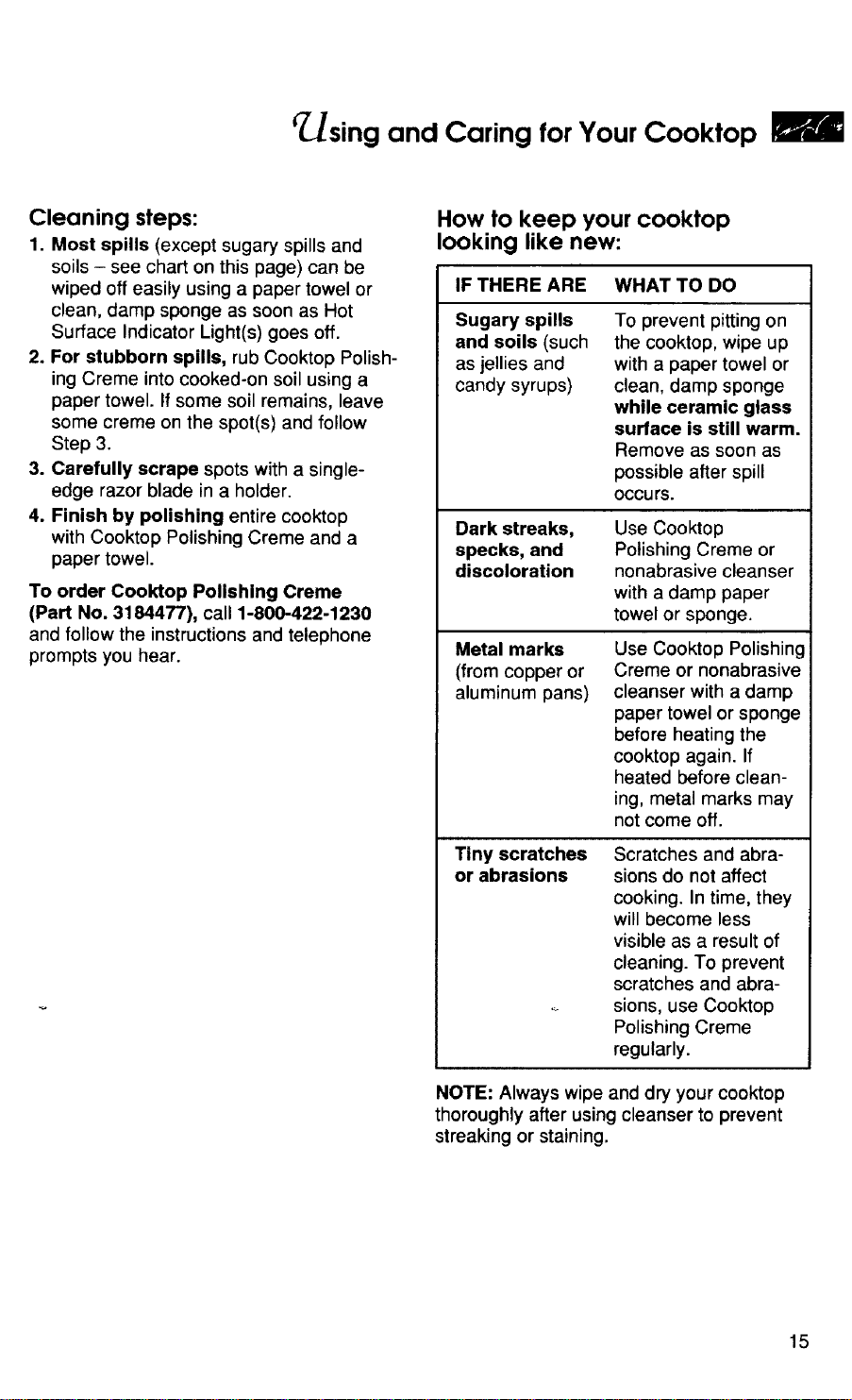
Cleaning steps:
1. Most spills (except sugary spills and
soils - see chart on this page) can be
wiped off easily using a paper towel or
clean, damp sponge as soon as Hot
Surface Indicator Light(s) goes off.
2. For stubborn spills, rub Cooktop Polish-
ing Creme into cooked-on soil using a
paper towel. If some soil remains, leave
some creme on the spot(s) and follow
Step 3.
3. Carefully scrape spots with a single-
edge razor blade in a holder.
4. Finish by polishing entire cooktop
with Cooktop Polishing Creme and a
paper towel.
To order Cooktop Polishing Creme
(Part No. 3184477), call 1-800-422-1230
and follow the instructions and telephone
prompts you hear.
How to keep your cooktop
looking like new:
IF THERE ARE WHAT TO DO
Sugary spills
and soils (such
as jellies and
candy syrups)
To prevent pitting on
the cooktop, wipe up
with a paper towel or
clean, damp sponge
while ceramic glass
surface is still warm.
Remove as soon as
possible after spill
occurs.
Dark streaks,
specks, and
discoloration
Metal marks
(from copper or
aluminum pans)
Use Cooktop
Polishing Creme or
nonabrasive cleanser
with a damp paper
towel or sponge.
Use Cooktop Polishing
Creme or nonabrasive
cleanser with a damp
paper towel or sponge
before heating the
cooktop again. If
heated before clean-
ing, metal marks may
not come off.
Tiny scratches
or abrasions
Scratches and abra-
sions do not affect
cooking. In time, they
will become less
visible as a result of
cleaning. To prevent
scratches and abra-
sions, use Cooktop
Polishing Creme
regularly.
NOTE: Always wipe and dry your cooktop
thoroughly after using cleanser to prevent
streaking or staining.
15

c{.]sing and Caring for Your Cooktop
Using and replacing the surface light
(Freestanding model)
The surface light is in the backguard. It is
controlled by the Surface Light Command
Pads on the control panel. The On Com-
mand Pad turns on the light immediately and
keeps it on until you press OFF. The Night
Command Pad will turn on the surface light
automatically when the light in the room is
low enough to require a night light. When
the night light comes on, it will also dim all
lights appearing on the display. Press OFF
to turn off the regular surface light or press
NIGHT again to turn off the night light.
Replacing the surface light:
1. Unplug appliance or disconnect at
main power supply.
2. Flip up the top of the backguard.
To turn on the surface light:
PRESS
To turn off surface light:
PRESS
3. Pull up glass on front of backguard.
To turn on night light:
PRESS
w
"NIGHT LIGHT" shows on the display when
the night light is on.
To turn off night light:
PRESS again
4. Grasp the fluorescent light tube at both
ends. Turn the tube approximately 90°
in either direction until both ends come
out of the receptacles. Replace with a
20-watt cool-white fluorescent lighttube.
16
'_._sing and Caring for Your Cooktop
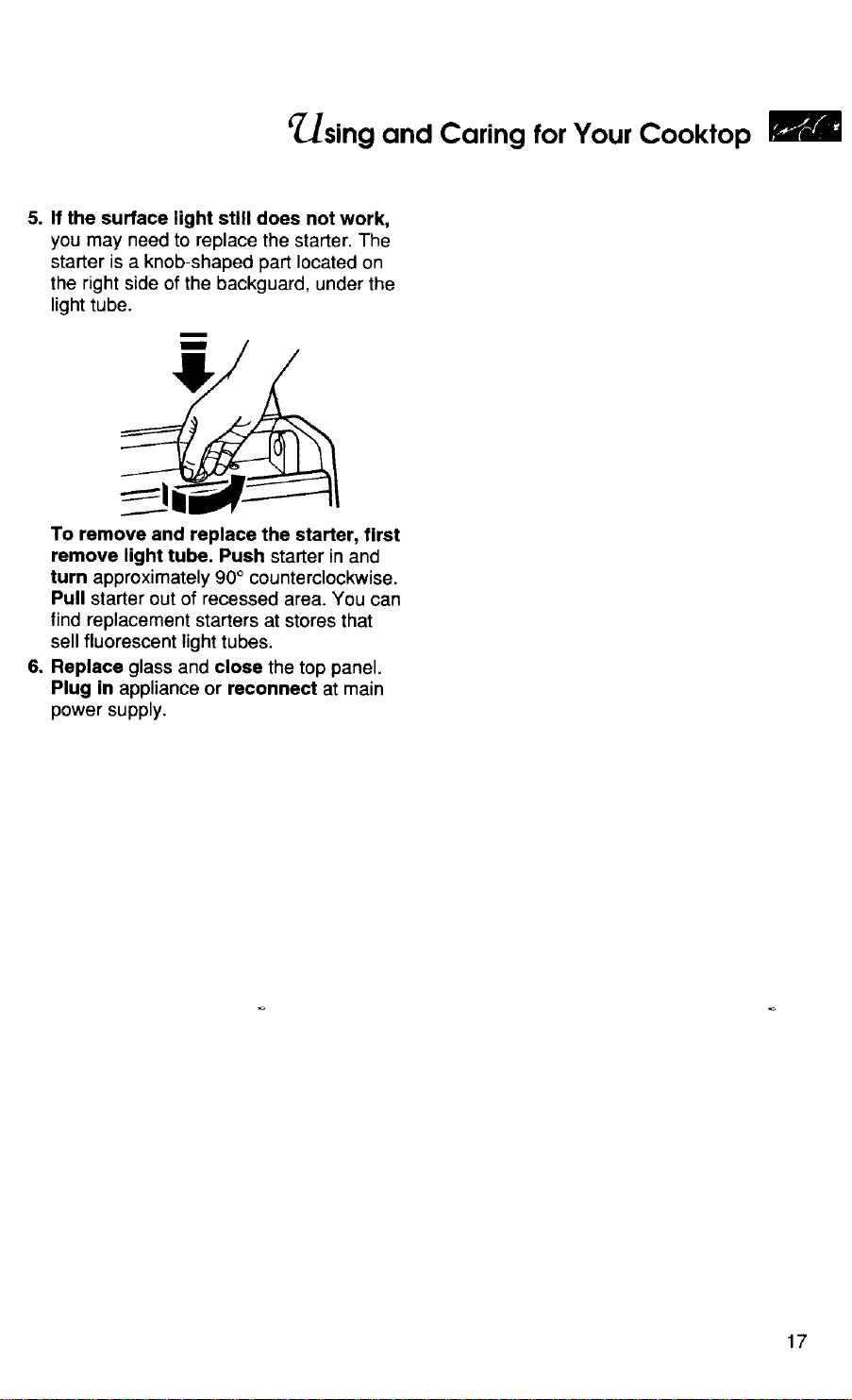
5. If the surface light still does not work,
you may need to replace the starter. The
starter is a knob-shaped part located on
the rightside of the backguard, under the
lighttube.
To remove and replace the starter, first
remove light tube. Push starter in and
turn approximately 90° counterclockwise.
Pull starter out of recessed area. You can
find replacement starters at stores that
sell fluorescent light tubes.
6. Replace glass and close the top panel.
Plug in appliance or reconnect at main
power supply.
17
sing and Caring for Your
Oven
This section tells you, step by step, how to operate all oven functions controlled by
the electronic control. Carefully follow these instructions, along with the cooking tips
and cleaning information, for successful use of your range. Your model may not have
all the features shown on the control display.
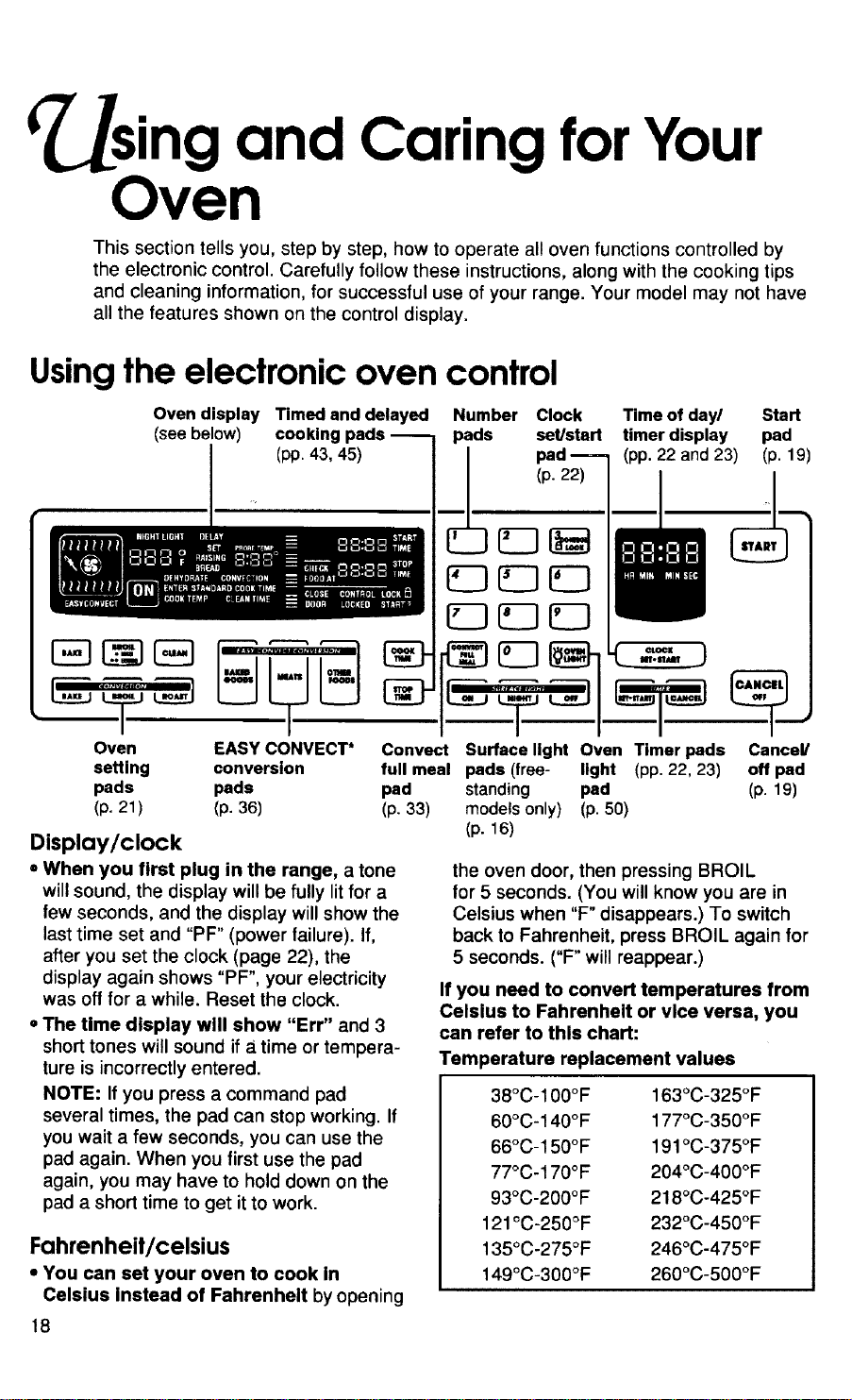
Usingthe electronic oven control
Oven display Timed and delayed
(see below) cooking pads
(pp. 43, 45)
Oven EASY CONVECT* Convect
setting conversion full meal
pads pads pad
(p.21) (p. 36) (p. 33)
Display/clock
Number Clock
pads set/start
pad
(p.22)
KD O
Surface light Oven Timer pads
pads (free- light (pp.22, 23)
standing pad
models only) (p. 50)
(p. 16)
• When you first plug in the range, atone
will sound, the display will be fully lit for a
few seconds, and the display will show the
last time set and "PF" (power failure). If,
after you set the clock (page 22), the
display again shows "PF", your electricity
was off for a while. Reset the clock.
• The time display will show "Err" and 3
short tones will sound if a time or tempera-
ture is incorrectly entered.
Time of day/ Start
timer display pad
(pp.22 and23) (p. 19)
,
Cancel/
off pad
(p. 19)
NOTE: If you press a command pad
several times, the pad can stop working. If
you wait a few seconds, you can use the
pad again. When you first use the pad
again, you may have to hold down on the
pad a short time to get it to work.
Fahrenheit/celsius
• You can set your oven to cook in
Celsius instead of Fahrenheit by opening
the oven door, then pressing BROIL
for 5 seconds. (You will know you are in
Celsius when "F" disappears.) To switch
back to Fahrenheit, press BROIL again for
5 seconds. ("F" will reappear.)
If you need to convert temperatures from
Celsius to Fahrenheit or vice versa, you
can refer to this chart:
Temperature replacement values
38°C-100°F
60°C-140°F
66°C-150°F
77°C-170°F
93°C-200°F
121°C-250°F
135°C-275°F
149°C-300°F
163°C-325°F
177°C-350°F
191°C-375°F
204°C-400°F
218°C-425°F
232°C-450°F
246°C-475°F
260°C-500°F
18

"Using and Caring for Your Oven
Starting an operation
After programming afunction, you must press
8TA{__ the Start pad to start the func-
tion. If you do not press the
Start pad within 5 seconds of
programming, "START?" will show on the
display as a reminder.
Canceling an operation
The Cancel/Off pad will cancel any function,
fCANCEI, xcept for the Clock Set!Start
and Timer functions. When you
press the Cancel/Off pad, the
large display will show the time of day or,
if Timer is also being used, the time
remaining.
Changing audible signals
Audible signals tell you if a function is entered
correctly or not. They also tell you when a
cycle is completed.
To shut off end-of-cycle tone:
Open the door
Then
PRESS and hold for 5 seconds
To change pitch and loudness of key tone:
Open the door
Then
PRESS and hold for 5 seconds
To shut off reminder tones:
Open the door
Then
PRESS and hold for 5 seconds
To shut off key entry tone:
Open the door
Then
PRESS and hold for 5 seconds
STOP
TIME J
A short tone will sound to tell you the signals
have been changed. Repeat step above to
turn the signals back on.
Using the control lock
The control lock prevents unwanted use of
the oven by disabling the control panel
command pads.
NOTES:
• Control lock is only available when oven
is not active or set.
• Control lock will not disable the Timer.
• Set control lock when cleaning the control
panel to prevent oven from accidentally
turning on.
To lock or deactivate the control panel:
Open the door, then press and hold the
Control Lock pad (Number Pad 3) for
5 seconds. A single tone willsound and
"CONTROL LOCK I_" will appear on
the display.
To unlock the control panel:
Open the door, then press and hold the
Control Lock pad (Number Pad 3) for
5 seconds. A single tone will sound after
5 seconds and "CONTROL LOCK I_" will
disappear from the display.
19
Using and Caring for Your Oven
Setting your range for the
Sabbath_
If you want to set your range to meet "no
work" requirements for the Sabbath, follow
these steps:
1. Turn the oven light on or off (see page
50). This light will stay turned on or off
(whichever you set) while in the Sabbath
mode. Opening the door will not turn
on the oven light if it is programmed to
be off.
2. If a power failure occurs, the oven will
automatically run the Favorite Cycle set
in Convect Full Meal when power is back
on. To prevent the oven from running a
cook time and turning off at the end of
that time, set CONVECT FULL MEAL
with the bake cycle you want to use
during the Sabbath. (Be sure to set a
cook time of "0".) To set a favorite cycle:
A. Press CONVECT FULL MEAL.
B. Press BAKE.
C. Press Number Pads to enter the
temperature.
D. Press COOK TIME, followed by
Number Pad 0.
E. Press CONVECT FULL MEAL to save
the cycle.
F. Press CONVECT FULL MEAL again
to confirm that setting is programmed.
G. Press CANCEIJOFF.
NOTE: After a long power failure, you
may see the oven temperature increase
on the display. This will happen only when
the oven has cooled enough to require
prel'_eating. The temperature display will
stop changing once the Favorite Cycle's
set temperature is reached.
t Star K certification pending. Full certifica-
tion by Star K is expected in early 1997.
Information is accurate as of 9/96.
3. Press BAKE.
4. Press Number Pads to set the tempera-
ture you want.
5. Press START. Wait for the oven to
preheat. (A tone will sound when oven is
preheated.)
6. Open the door, then press and hold
Number Pad 6 for 5 seconds to go into
the Sabbath mode.
NOTE: Use the Sabbath mode with the
Bake function only.
What your oven will do while in the
Sabbath mode:
• The time display willshow "SAbb"to tell
you that the oven is inthe Sabbath mode.
• The ON Indicator Light will light up
when the heating element turns on, and
ON will go off when the heating element
turns off.
• To prevent accidental key presses, the
key pads will only work after you press
them for 1 second.
• No tones will sound.
To end the Sabbath mode:
• Open the door, then press CANCEL/OFF
for 1 second. Next, press and hold
Number Pad 6 for 5 seconds. (Or you
can press and hold Number Pad 6
for 5 seconds first, followed by
CANCEL!OFF.)
2O
Using and Caring for Your Oven
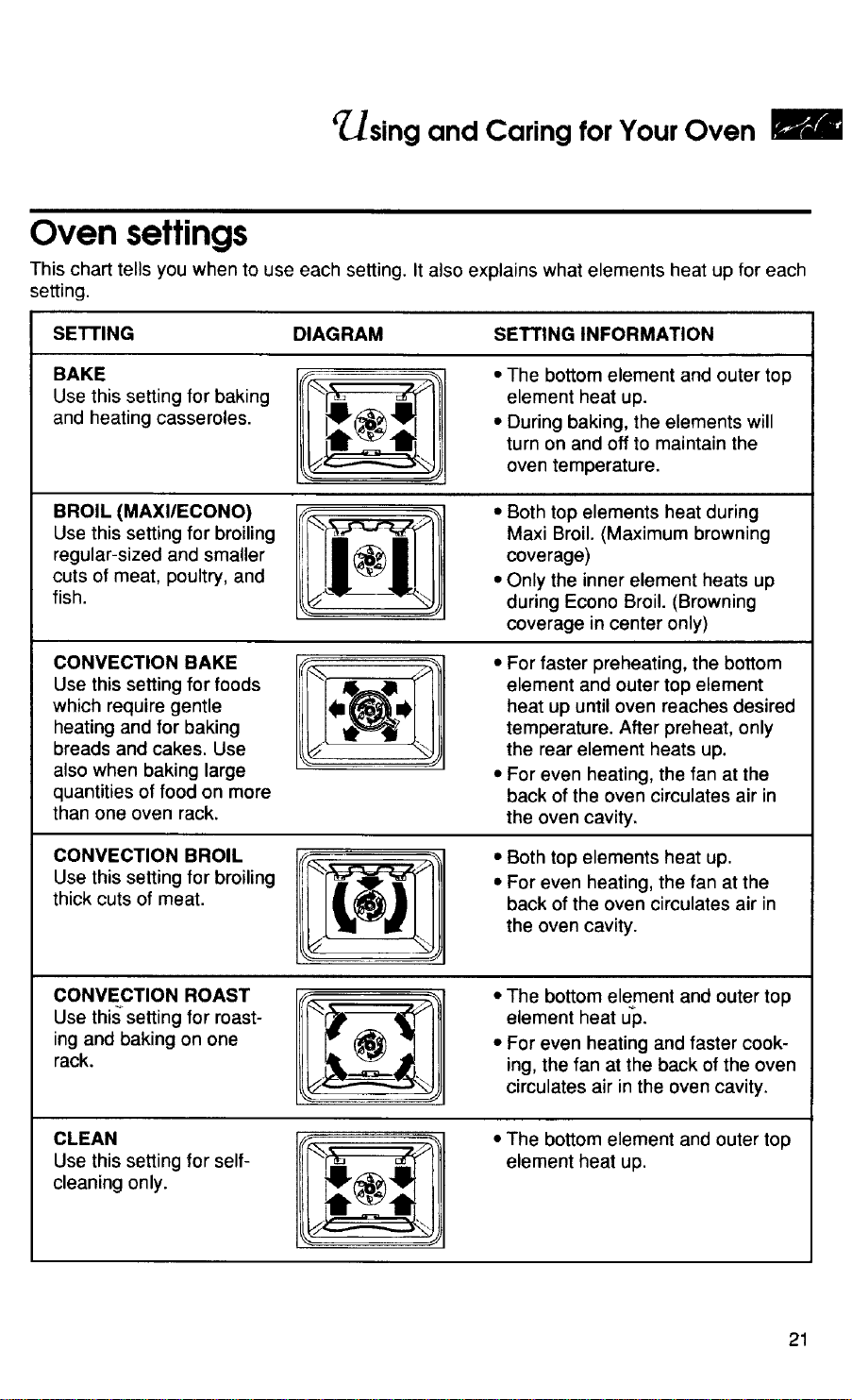
Oven settings
This chart tells you when to use each setting. It also explains what elements heat up for each
setting.
SETTING DIAGRAM SETTING INFORMATION
BAKE
Use this setting for baking
and heating casseroles.
BROIL (MAXI/ECONO)
Use this setting for broiling
regular-sized and smaller
cuts of meat, poultry, and
fish.
• The bottom element and outer top
element heat up.
• During baking, the elements will
turn on and off to maintain the
oven temperature.
• Both top elements heat during
Maxi Broil. (Maximum browning
coverage)
• Only the inner element heats up
during Econo Broil. (Browning
coverage in center only)
CONVECTION BAKE
Use this setting for foods
which require gentle
heating and for baking
breads and cakes. Use
also when baking large
quantities of food on more
than one oven rack.
CONVECTION BROIL
Use this setting for broiling
thick cuts of meat.
• For faster preheating, the bottom
element and outer top element
heat up until oven reaches desired
temperature. After preheat, only
the rear element heats up.
• For even heating, the fan at the
back of the oven circulates air in
the oven cavity.
• Both top elements heat up.
• For even heating, the fan at the
back of the oven circulates air in
the oven cavity.
CONVECTION ROAST
Use thissetting for roast-
ing and baking on one
rack.
• The bottom element and outer top
element heat u_p.
• For even heating and faster cook-
ing, the fan at the back of the oven
circulates air in the oven cavity.
CLEAN
Use this setting for self-
cleaning only.
• The bottom element and outer top
element heat up.
21
'_sing and Caring for Your Oven
Setting the clock
NOTE: If an oven function is active or
programmed, you cannot change the clock.
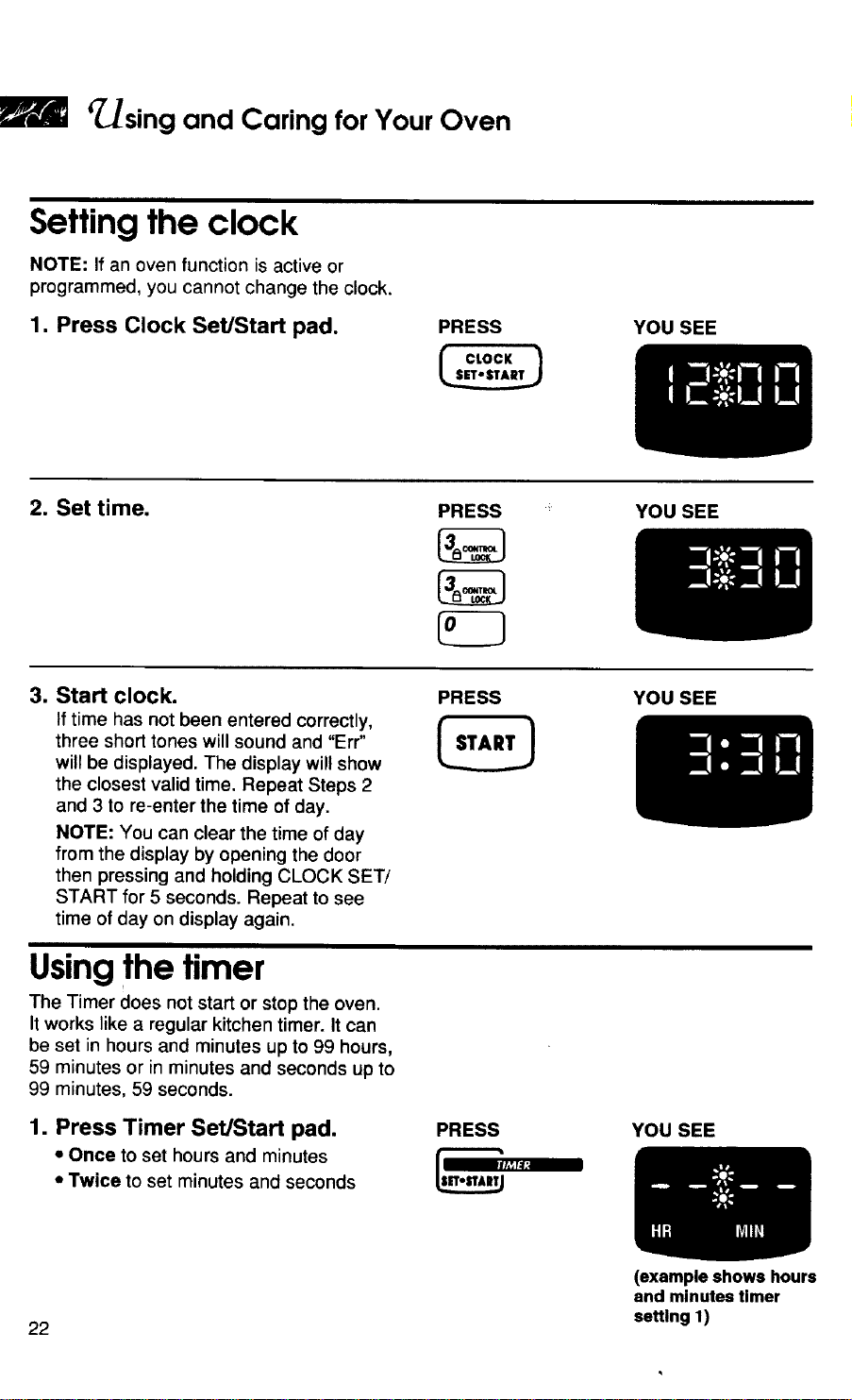
1. Press Clock Set/Start pad.
PRESS
=oc, 1
YOU SEE
2. Set time.
PRESS YOU SEE
3. Start clock.
Iftime has not been entered correctly,
three short tones will sound and "Err"
will be displayed. The display will show
the closest valid time. Repeat Steps 2
and 3 to re-enter the time of day.
NOTE: You can clear the time of day
from the display by opening the door
then pressing and holding CLOCK SET/
START for 5 seconds. Repeat to see
time of day on display again.
Usingthe timer
The Timer does not start or stop the oven.
Itworks like a regular kitchen timer. It can
be set in hours and minutes up to 99 hours,
59 minutes or in minutes and seconds up to
99 minutes, 59 seconds.
1. Press Timer Set/Start pad.
,, Once to set hours and minutes
• Twice to set minutes and seconds
PRESS
PRESS
YOU SEE
YOU SEE
22
(example shows hours
and minutes timer
setting 1)
Using and Caring for Your Oven
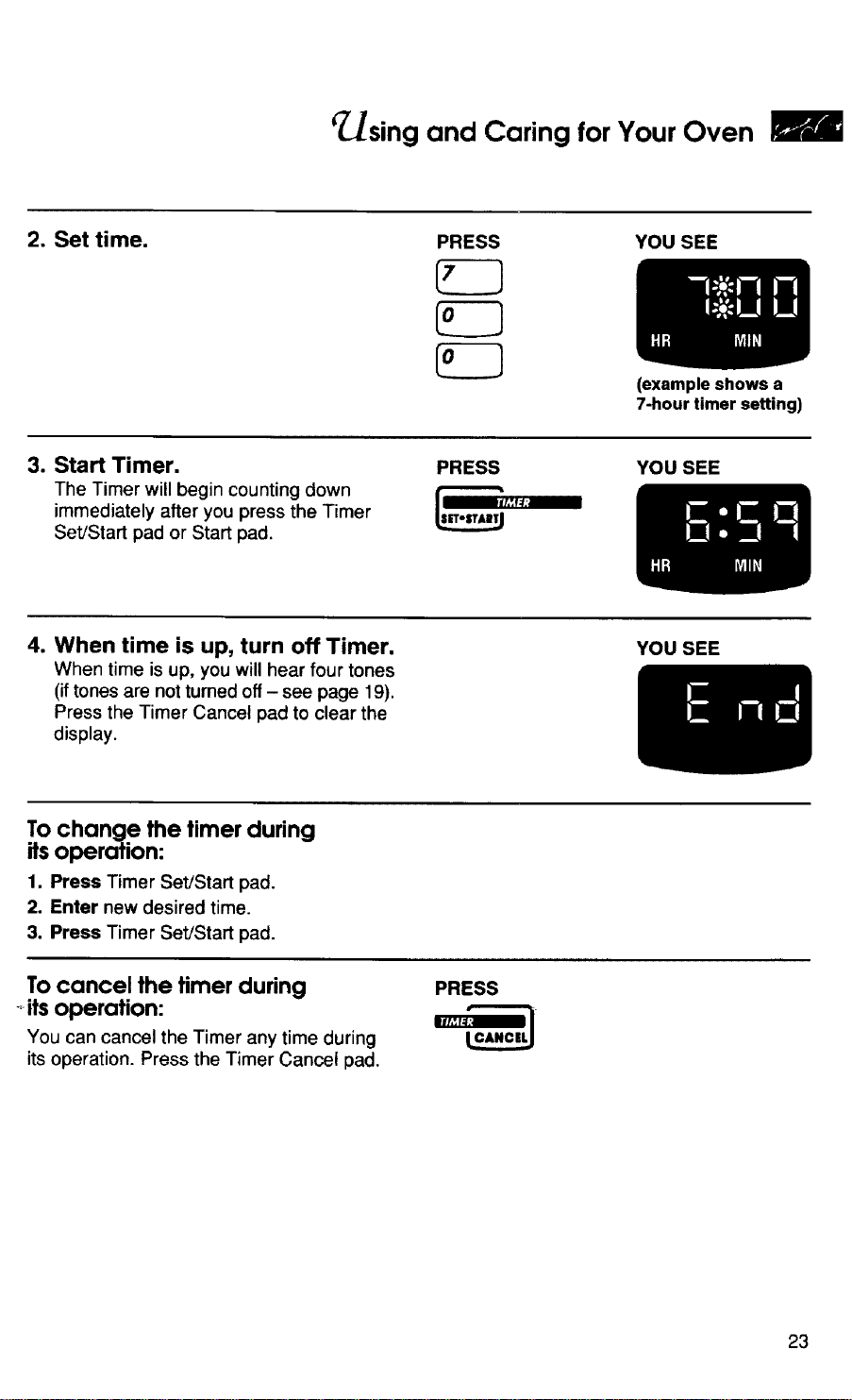
2. Set time.
PRESS
YOU SEE
3. Start Timer.
The Timer will begin counting down
immediately after you press the Timer
Set/Start pad or Start pad.
PRESS
(example shows a
7-hour timer setting)
YOU SEE
4. When time is up, turn off Timer.
When time is up, you will hear four tones
(iftones are notturned off- see page 19).
Press the Timer Cancel pad to clear the
display.
YOU SEE
To change the timer during
its operation:
1. Press Timer Set/Start pad.
2. Enter new desired time.
3. Press Timer Set/Start pad.
Tocancel the timer during
+itsoperation:
You can cancel the Timer any time during
its operation. Press the Timer Cancel pad.
PRESS
23
Using and Caring for Your Oven
,JII
Baking or convection baking
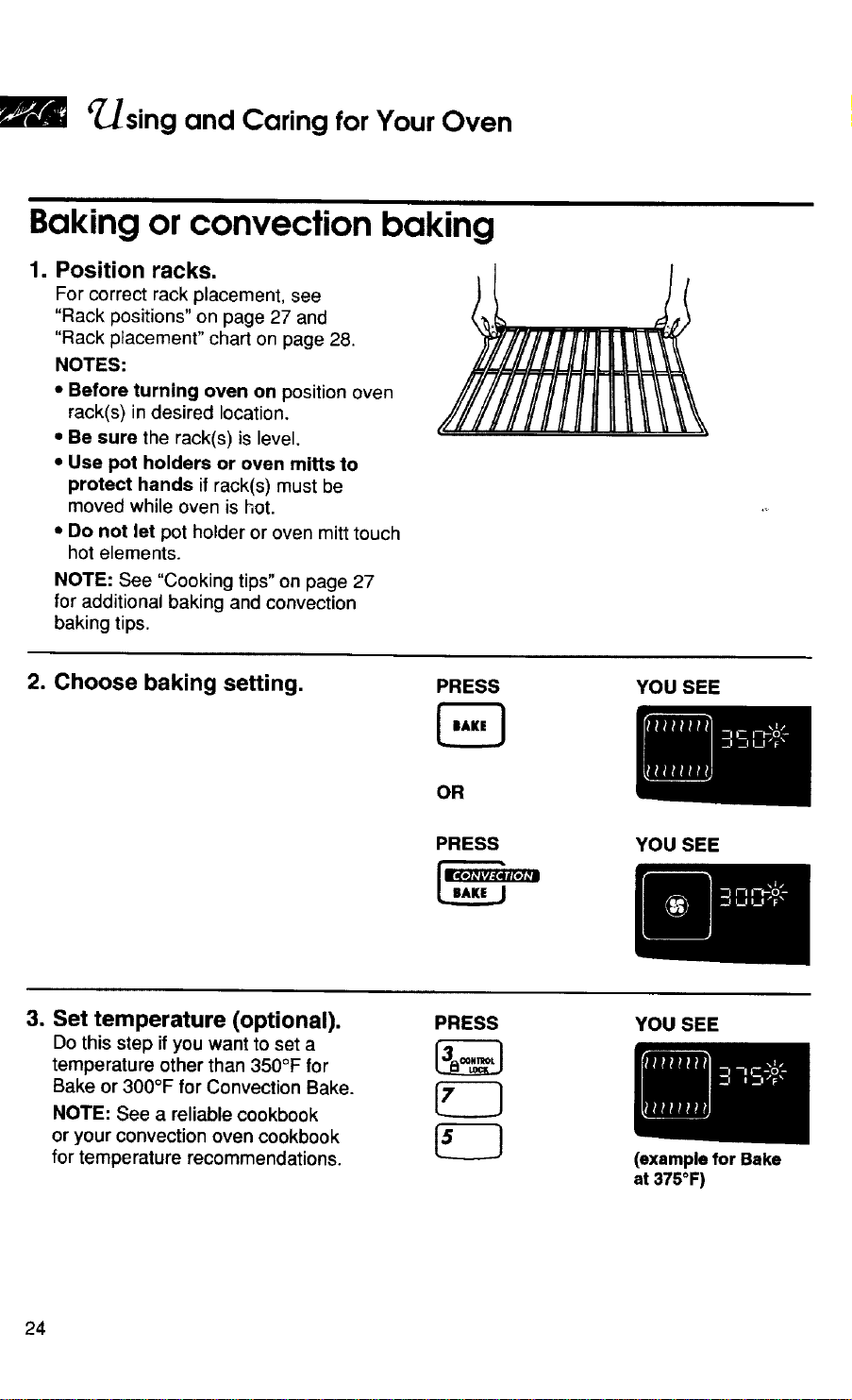
1. Position racks.
For correct rack placement, see
"Rack positions"on page 27 and
"Rack placement" chart on page 28.
NOTES:
• Before turning oven on position oven
rack(s) in desired location.
• Be sure the rack(s) is level.
• Use pot holders or oven mitts to
protect hands if rack(s) must be
moved while oven is hot.
• Do not let pot holder or oven mitt touch
hot elements.
NOTE: See "Cooking tips" on page 27
for additional baking and convection
baking tips.
2. Choose baking setting. PRESS
YOU SEE
OR
PRESS
YOU SEE
3. Set temperature (optional).
Do this step ifyou want to set a
temperature other than 350°F for
Bake or 300°F for Convection Bake.
NOTE: See a reliable cookbook
or your convection oven cookbook
for temperature recommendations.
PRESS YOU SEE
24
(example for Bake
at 375°F)
Using and Coring for Your Oven
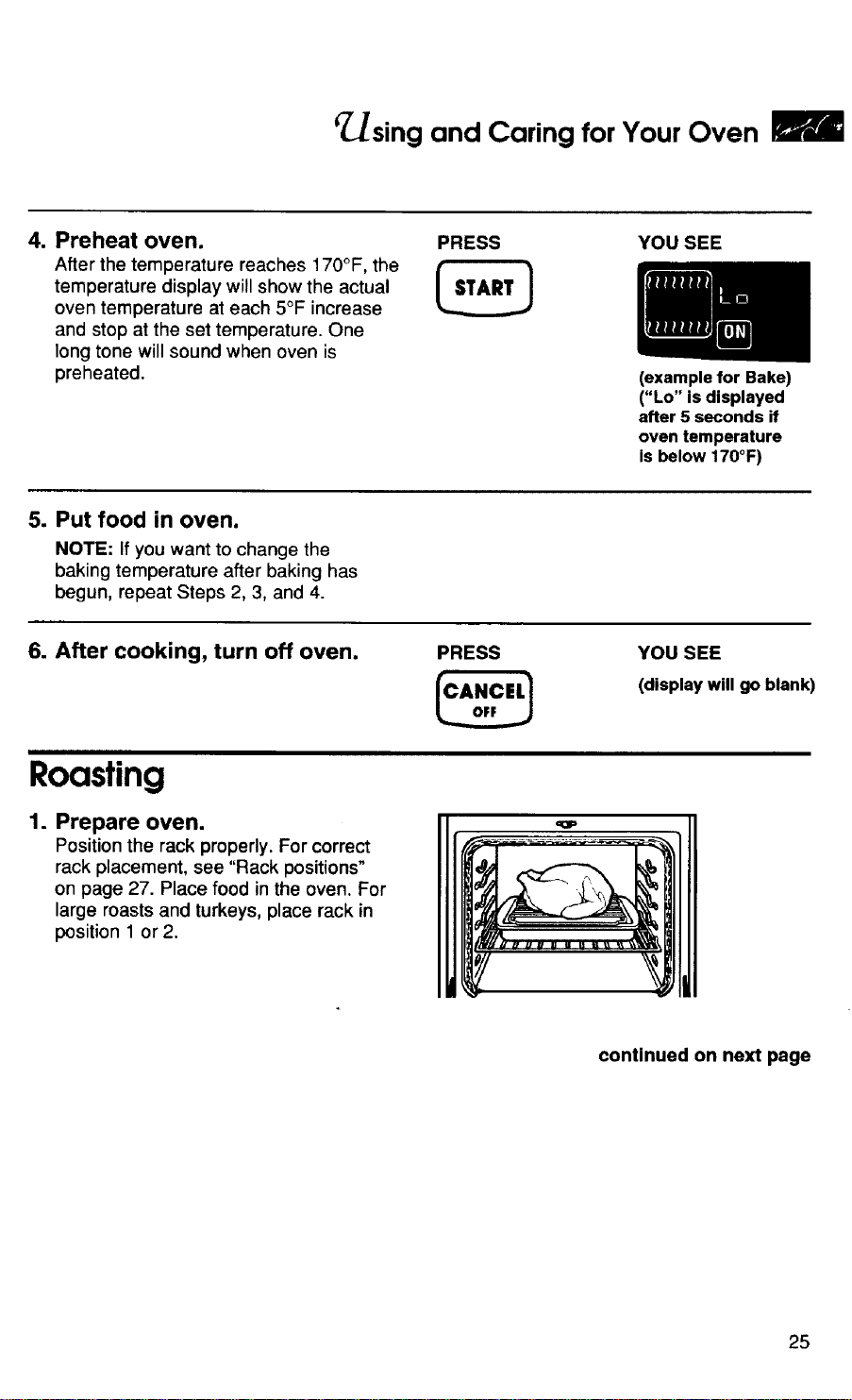
4. Preheat oven.
After the temperature reaches 170°F, the
temperature display will show the actual
oven temperature at each 5°F increase
and stop at the set temperature. One
long tone will sound when oven is
preheated.
PRESS YOU SEE
(example for Bake)
("Lo" is displayed
after 5 seconds if
oven temperature
is below 170°F)
5. Put food in oven.
NOTE: If you want to change the
baking temperature after baking has
begun, repeat Steps 2, 3, and 4.
6. After cooking, turn off oven.
PRESS YOU SEE
(display will go blank)
Roasting
1. Prepare oven.
Position the rack properly. For correct
rack placement, see "Rack positions"
on page 27. Place food in the oven. For
large roasts and turkeys, place rack in
position 1 or 2.
continued on next page
25
Using and Caring for Your Oven
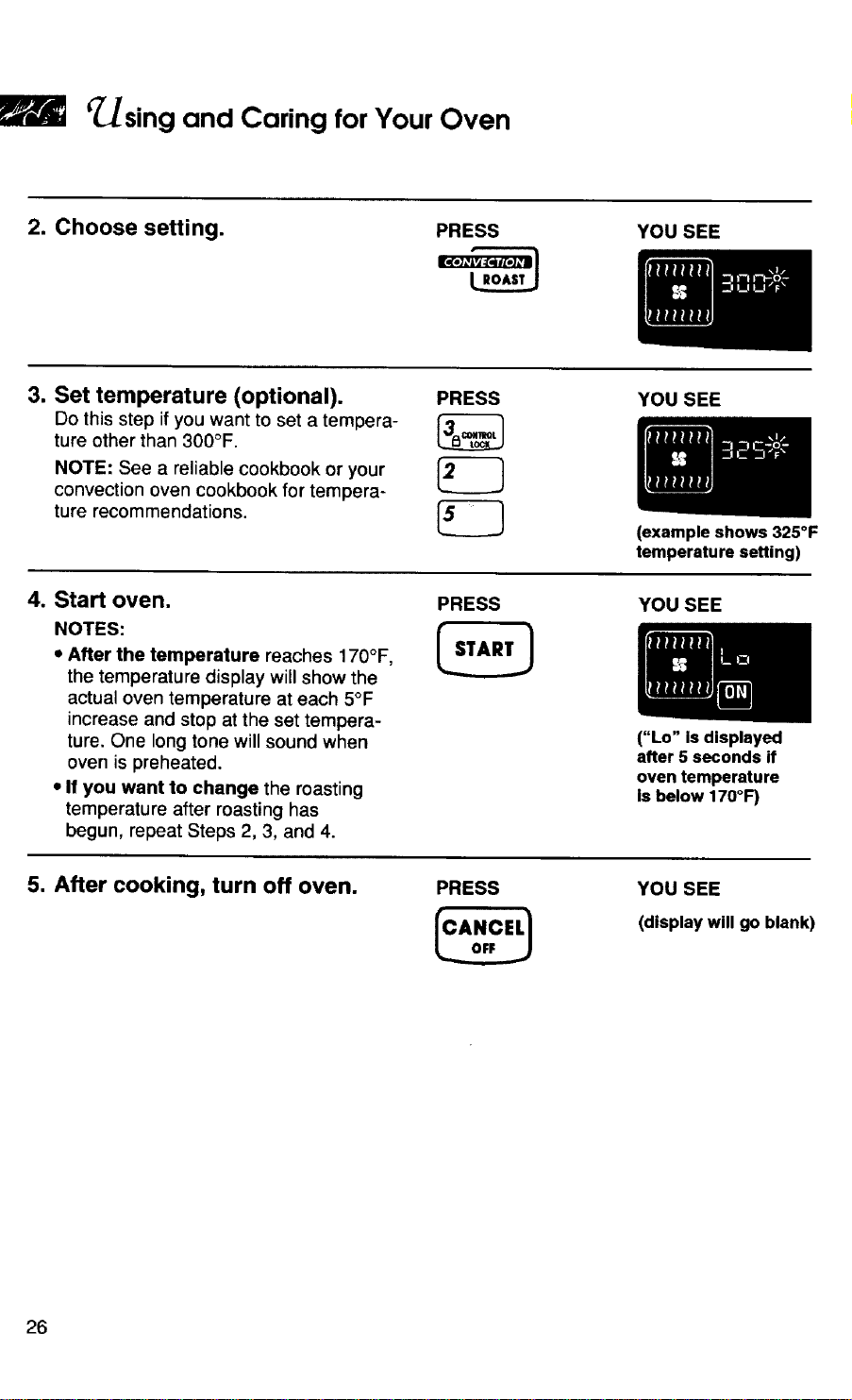
2. Choose setting. PRESS YOU SEE
3. Set temperature (optional).
Do this step if you want to set a tempera-
ture other than 300°F.
NOTE: See a reliable cookbook or your
convection oven cookbook for tempera-
ture recommendations.
PRESS
YOU SEE
(example shows 325°F
temperature setting)
4. Start oven.
NOTES:
• After the temperature reaches 170°F,
the temperature display will show the
actual oven temperature at each 5°F
increase and stop at the set tempera-
ture. One long tone will sound when
oven is preheated.
• If you want to change the roasting
temperature after roasting has
begun, repeat Steps 2, 3, and 4.
PRESS
YOU SEE
("Lo" is displayed
after 5 seconds if
oven temperature
is below 170°1=)
5. After cooking, turn off oven. PRESS
YOU SEE
(display will go blank)
26
Using and Caring for Your Oven
Cooking tips
Baking/convection baking tips
The hot air must circulate around the pans
in the oven for even heat to reach all parts
of the oven. This results in better baking.
For best air circulation:
* Place the pans so that one is not directly
over the other.
Mdlorl 11/,._2 _ _ _ 41/,, -_- Iwallor
o_J'ler ,-_ -L J_ -L other
panl Ipen
• For best results, allow 11/2to 2 inches of
space around each pan and between pans
and oven walls.
• When baking with one pan, place pan in
the center of the oven rack.
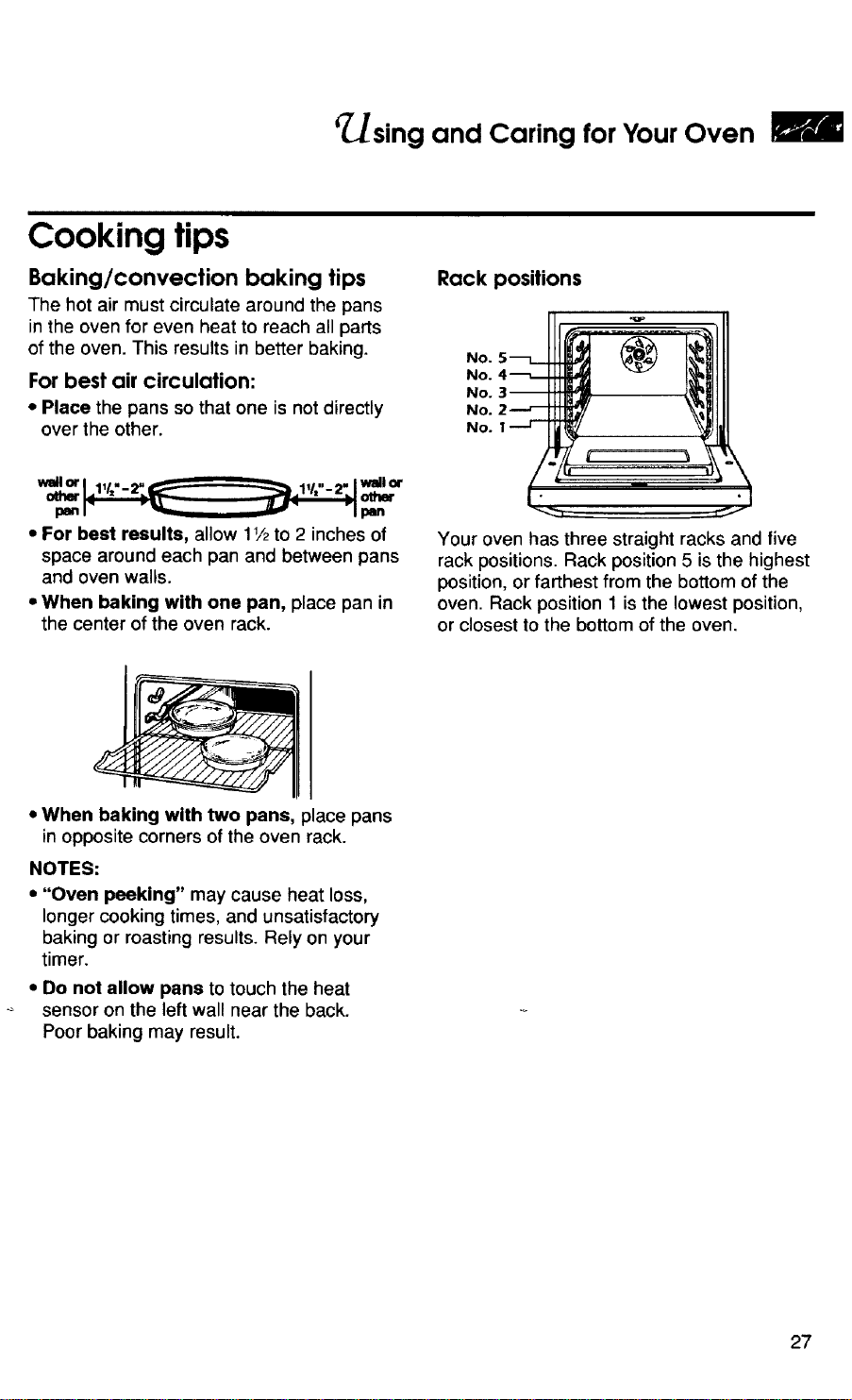
Rack positions
®
Your oven has three straight racks and five
rack positions. Rack position 5 is the highest
position, or farthest from the bottom of the
oven. Rack position 1 is the lowest position,
or closest to the bottom of the oven.
• When baking with two pans, place pans
in opposite corners of the oven rack.
NOTES:
• "Oven peeking" may cause heat loss,
longer cooking times, and unsatisfactory
baking or roasting results. Rely on your
timer.
• Do not allow pans to touch the heat
sensor on the left wall near the back.
Poor baking may result.
27
rU sing and Caring for Your Oven
Baking tips
(Bake pad)
For proper cooking, follow these
guidelines:
• When using one rack, place the rack so
the top of the food will be centered in
the oven.
• When using more than one rack, use the
Convection Bake setting.
• Use only one cookie sheet in the oven at
a time when using the Bake setting.
Bakeware tips
• When baking with insulated cookie
sheets or baking pans, place them in the
bottom third of the oven. You may need to
increase the recommended baking times,
so test for doneness before removing
from the oven.
• When using ovenproof glassware or
dark bakeware, reduce the oven tempera-
ture by 25°F, but use the same baking
time. Because these pans absorb heat,
producing darker bottom browning and
crispier crusts, place the rack in the center
of the oven. When baking pies and bread,
you can use the temperature suggested in
the recipe.
Rack placement for specific foods:
(For rack positions, see "Rack positions" on
page 27.)
RACK
FOOD POSITION
Frozen pies 2
Angel food and bundt cakes,
most quick breads, yeast 1 or 2
breads, casseroles, meats
Cookies, biscuits, muffins, 2 or 3
cakes, nonfrozen pies
NOTE: For additional baking tips see
"Baking or convection baking" on page 24.
Using aluminum foil in the oven
[forthermal baking)
Use aluminum foil to catch spillovers from
pies or casseroles.
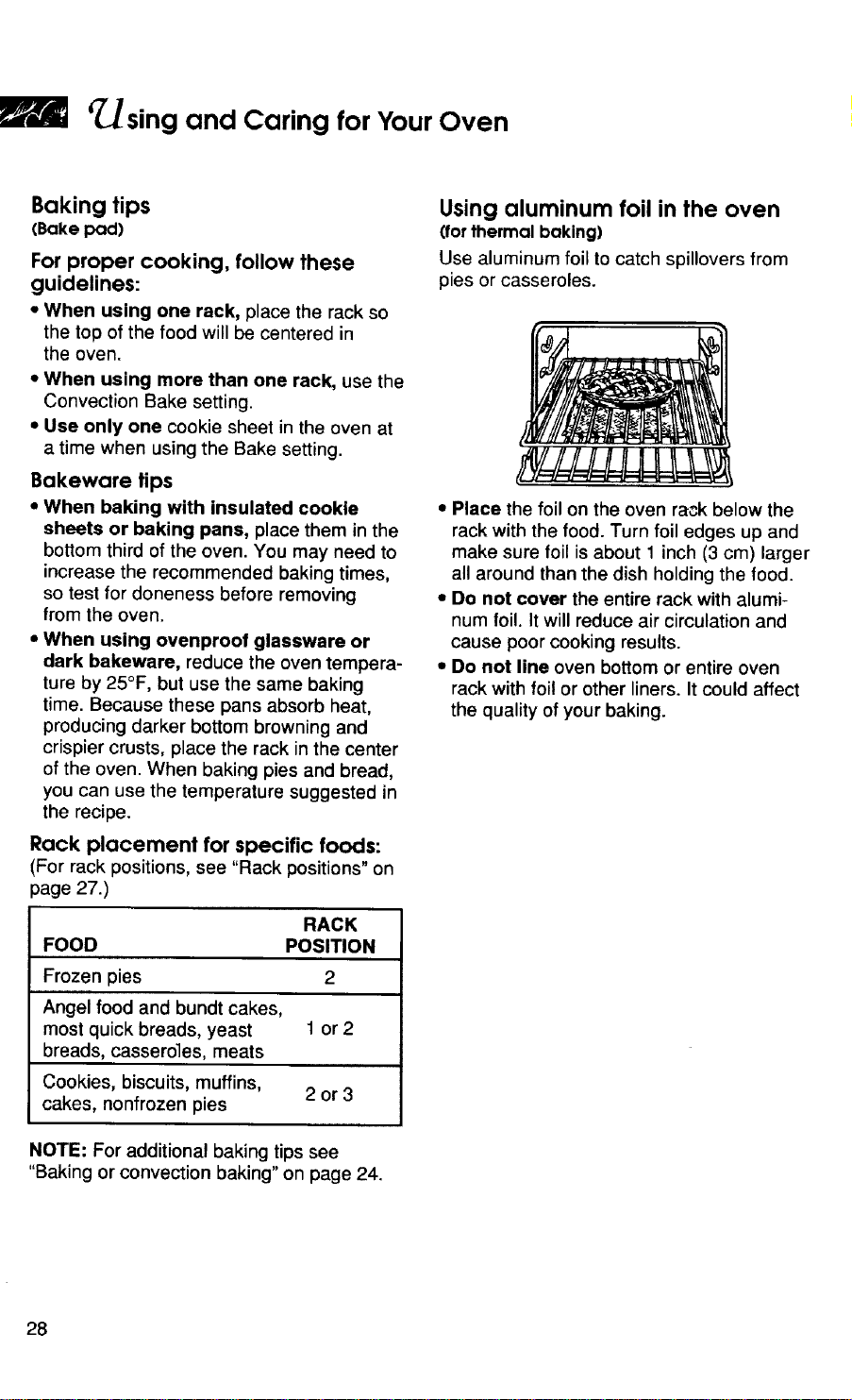
* Place the foil on the oven rack below the
rack with the food. Turn foil edges up and
make sure foil is about 1 inch (3 cm) larger
all around than the dish holding the food.
,, Do not cover the entire rack with alumi-
num foil. It will reduce air circulation and
cause poor cooking results.
• Do not line oven bottom or entire oven
rack with foil or other liners. Itcould affect
the quality of your baking.
28
Using and Caring for Your Oven
Convection baking tips
(Convection Bake pad)
• Do not use aluminum foil when convection
baking. Aluminum foil may block airflow.
• Reduce recommended recipe oven
temperature by approximately 25°F. See
recipe adaption chart in your convection
oven cookbook for recommended
temperatures, or use EASY CONVECT*
Conversion (see page 36).
• For most recipes, you can reduce con-
vection baking time compared to standard
baking times. See recipe adaption chart or
convection baking chart in your convection
oven cookbook for recommended
baking times, or use EASY CONVECT
Conversion (see page 36).
NOTE: Cooking time may be longer when
you use more than one rack.
• When baking on two or three racks, use
the Convection Bake setting for more even
results. (You can, however, use only one
rack when Convection Baking.)
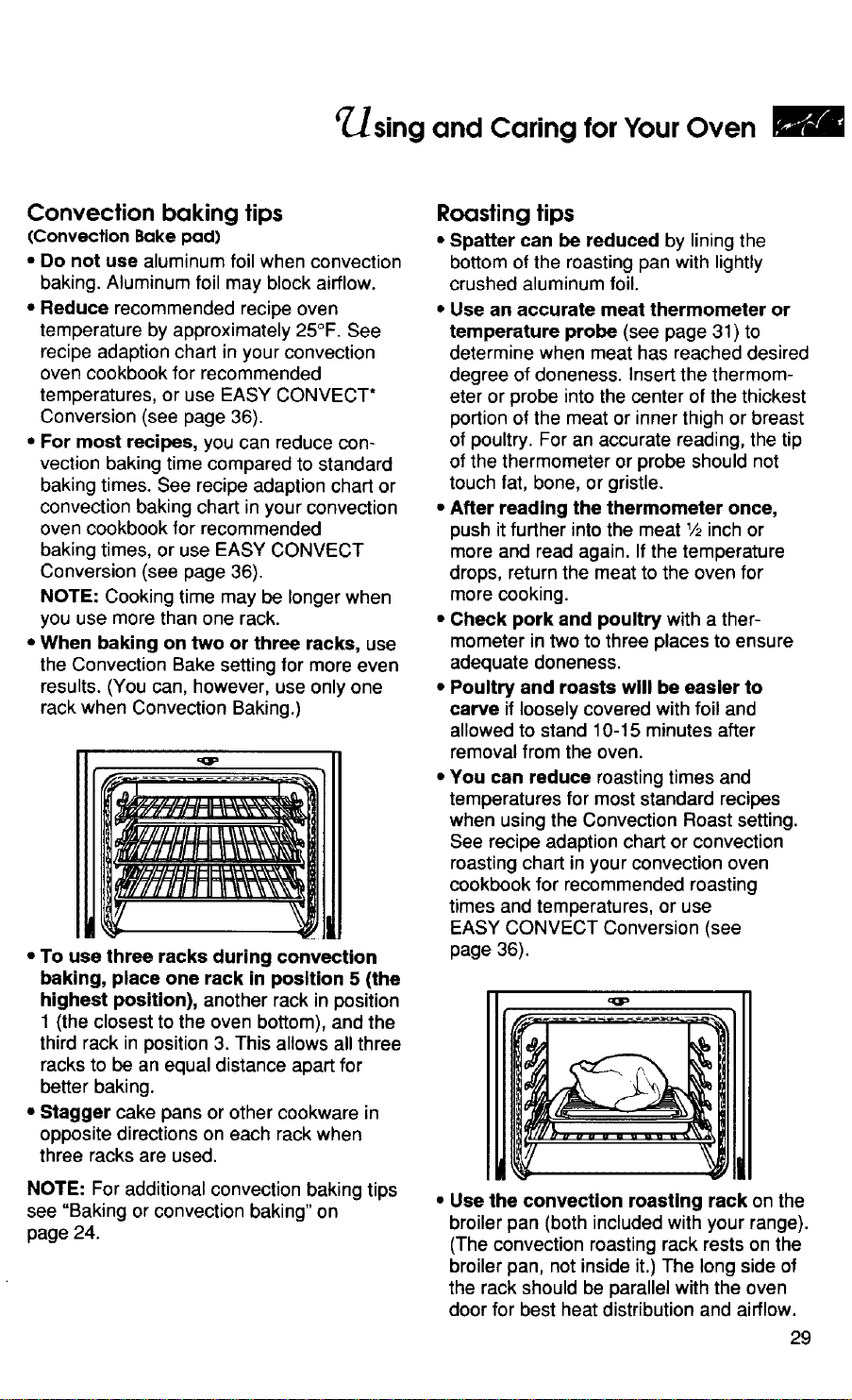
• To use three racks during convection
baking, place one rack in position 5 (the
highest position), another rack in position
1 (the closest to the oven bottom), and the
third rack in position 3, This allows all three
racks to be an equal distance apart for
better baking.
• Stagger cake pans or other cookware in
opposite directions on each rack when
three racks are used.
NOTE: For additional convection baking tips
see "Baking or convection baking" on
page 24.
Roasting tips
• Spatter can be reduced by lining the
bottom of the roasting pan with lightly
crushed aluminum foil.
• Use an accurate meat thermometer or
temperature probe (see page 31) to
determine when meat has reached desired
degree of doneness. Insert the thermom-
eter or probe into the center of the thickest
portion of the meat or inner thigh or breast
of poultry. For an accurate reading, the tip
of the thermometer or probe should not
touch fat, bone, or gristle.
• After reading the thermometer once,
push it further into the meat 1/2inch or
more and read again. If the temperature
drops, return the meat to the oven for
more cooking.
• Check pork and poultry with a ther-
mometer in two to three places to ensure
adequate aloneness.
• Poultry and roasts will be easier to
carve ff loosely covered with foil and
allowed to stand 10-15 minutes after
removal from the oven.
• You can reduce roastingtimes and
temperatures for most standard recipes
when using the Convection Roast setting.
See recipe adaption chart or convection
masting chart in your convection oven
cookbook for recommended roasting
times and temperatures, or use
EASY CONVECT Conversion (see
page 36).
• Use the convection roasting rack on the
broiler pan (both included with your range).
(The convection roasting rack rests on the
broiler pan, not inside it.) The long side of
the rack should be parallel with the oven
door for best heat distributionand airflow.
29
Using and Caring for Your Oven
Adjusting oven temperature
Although your new oven is properly adjusted
to provide accurate temperatures, it may
cook faster or slower than your old oven.
If, after using the oven for a period of time,
you are not satisfied with the baking/roasting
results, you can change the offset tempera-
ture by following the steps below. The control
will "remember" the selected offset even after
the power has been interrupted or lost.
NOTE: DO NOT measure oven temperature
with a thermometer. Opening the oven door
will lower the oven temperature and give
you an inaccurate reading. Also, the thermo-
meter temperature reading will change as
your oven cycles.
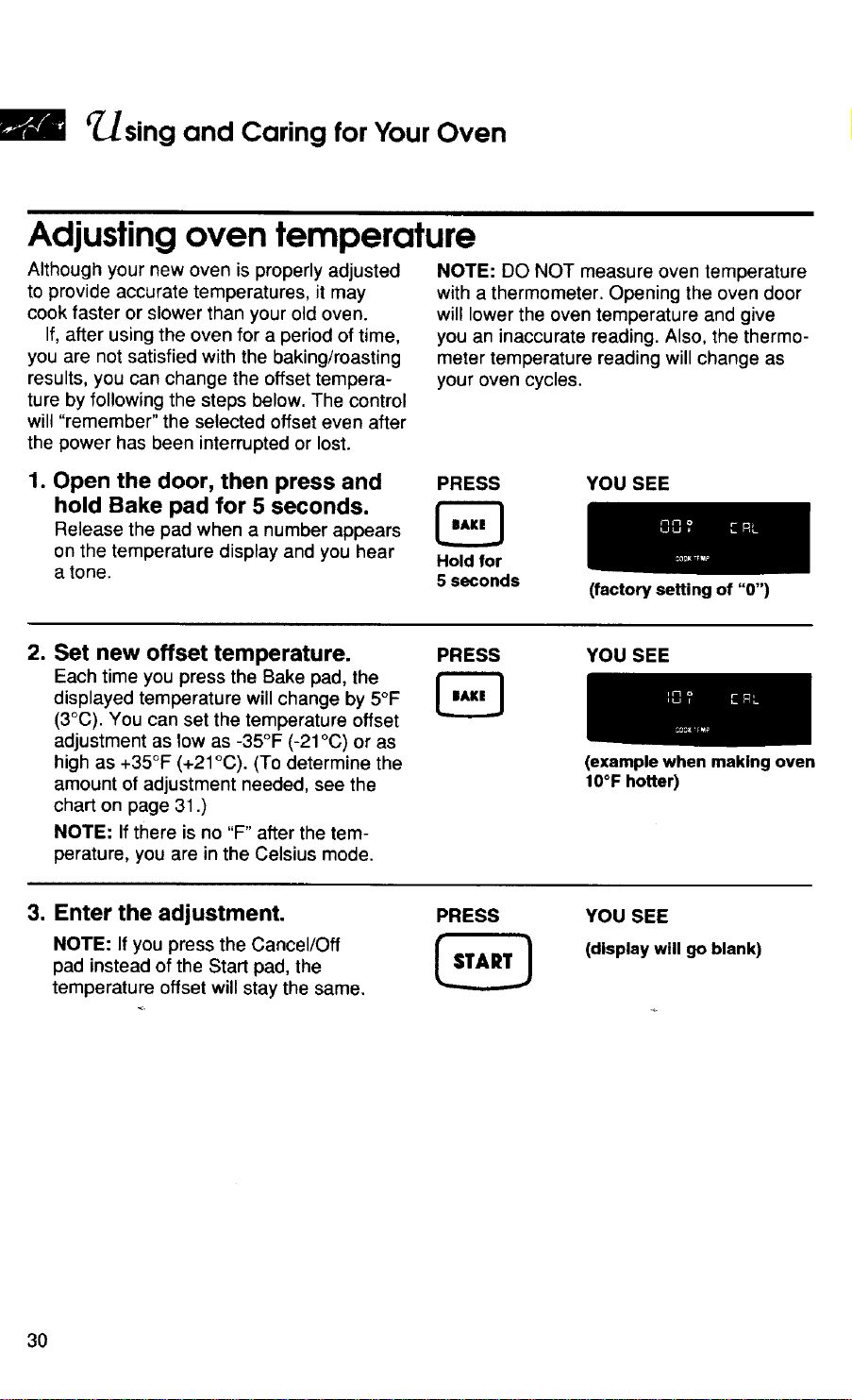
1. Open the door, then press and
hold Bake pad for 5 seconds.
Release the pad when a number appears
on the temperature display and you hear
a tone.
PRESS
Hold for
5 seconds
YOU SEE
1
Set new offset temperature.
Each time you press the Bake pad, the
displayed temperature will change by 5°F
(3°C). You can set the temperature offset
adjustment as low as -35°F (-21°C) or as
high as +35°F (+21°C). (To determine the
amount of adjustment needed, see the
chart on page 31 .)
NOTE: If there is no "F" after the tem-
perature, you are in the Celsius mode.
PRESS
(factory setting of "0")
YOU SEE
(example when making oven
10°F hotter)
=
Enter the adjustment.
NOTE: If you press the Cancel/Off
pad instead of the Start pad, the
temperature offset will stay the same.
PRESS YOU SEE
(display will go blank)
3O
Using and Caring for Your Oven
How to determine the amount of
adjustment needed
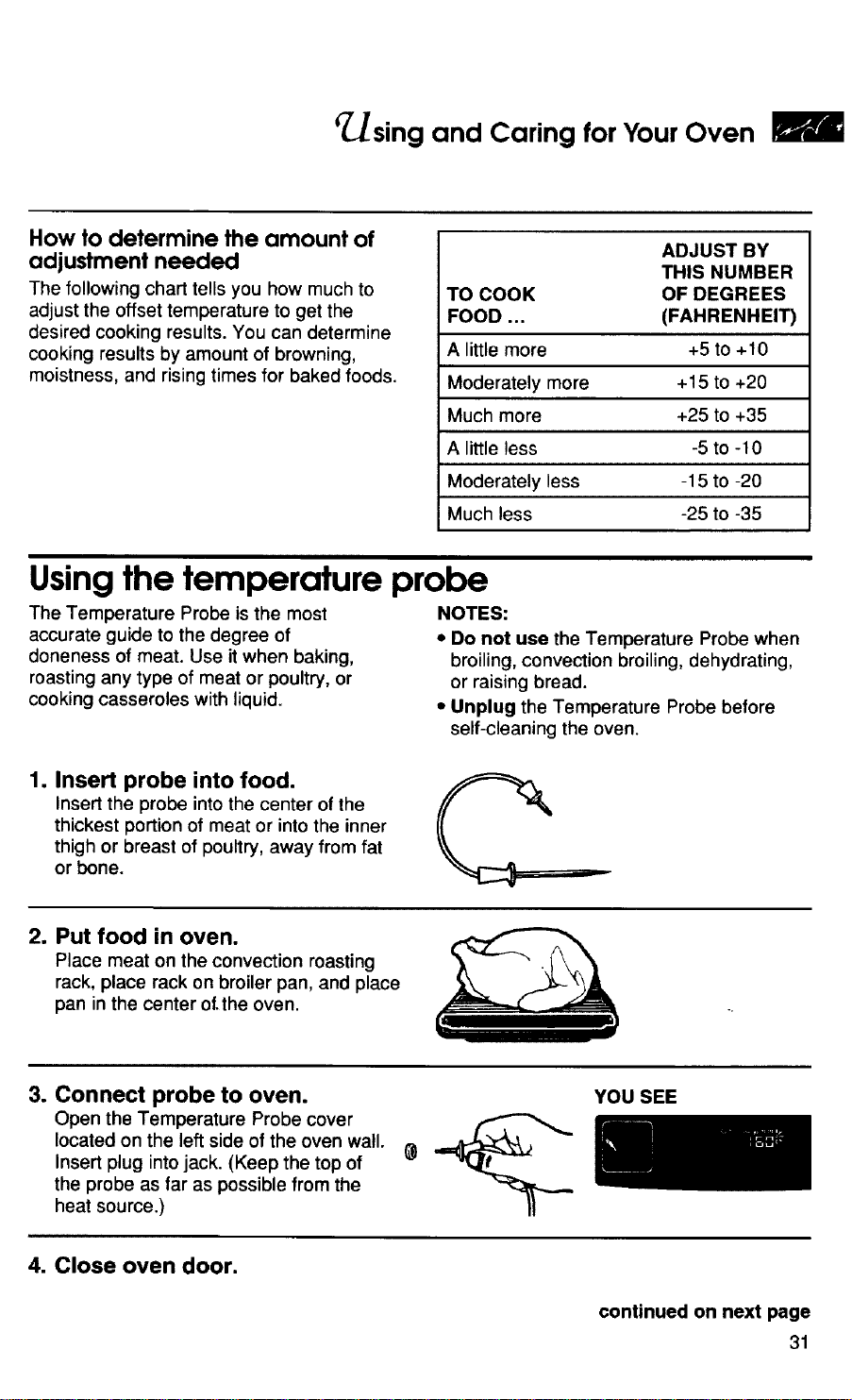
The following chart tells you how much to
adjust the offset temperature to get the
desired cooking results. You can determine
cooking results by amount of browning,
moistness, and rising times for baked foods.
ADJUST BY
THIS NUMBER
TO COOK OF DEGREES
FOOD ... (FAHRENHEIT)
A little more +5 to +10
Moderately more +15 to +20
Much more +25 to +35
A little less -5 to -10
Moderately less -15 to -20
Much less -25 to -35
Using the temperature probe
The Temperature Probe is the most
accurate guide to the degree of
doneness of meat. Use it when baking,
roasting any type of meat or poultry, or
cooking casseroles with liquid.
NOTES:
• Do not use the Temperature Probe when
broiling, convection broiling,dehydrating,
or raising bread.
• Unplug the Temperature Probe before
self-cleaning the oven.
1. Insert probe into food.
Insert the probe intothe center of the
thickest portion of meat or intothe inner
thigh or breast of poultry, away from fat
or bone.
2. Put food in oven.
Place meat on the convection roasting
rack, place rack on broiler pan, and place
pan in the center of.the oven.
3. Connect probe to oven.
Open the Temperature Probe cover
located on the left side of the oven wall.
Insert plug into jack. (Keep the top of 0
the probe as far as possible from the
heat source.)
YOU SEE
4. Close oven door.
continued on next page
31

TJ
Using and Caring for Your Oven
5. Set temperature (optional).
Do this step if you want to set an internal
food temperature (from 130°F-190°F)
other than 160°F.
NOTE: See a reliable cookbook or your
convection oven cookbook for internal
food temperature recommendations.
PRESS
YOU SEE
6. Choose cook setting.
• BAKE,
• CONVECTION BAKE, or
• COHVECTION ROAST
PRESS
(example
for Bake)
(example shows 150°F Internal
temperature setting)
YOU SEE
7. Set temperature (optional).
Do this step if you want to set an
oven temperature other than the
one displayed.
NOTE: See a reliable cookbook or your
convection oven cookbook for oven
temperature recommendations.
PRESS YOU SEE
(example shows 375°F
temperature setting)
8. Start oven.
NOTES:
• If you do not choose a cook setting
and press START, the display will show
a bake setting at 350°F. Ifyou want to
bake at 350°F, press START to begin.
If you want to cook with another setting
or at another temperature, do Steps 6
and 7 above and press START.
• The temperature display willshow
the set oven temperature throughout
temperature probe cooking.
• After the food temperature reaches
130°F, the probe display will show the
actual food temperature at each 5°F
increase and stop at the set tempera-
ture. Four tones will sound and "End"
will show when food reaches the set
temperature (unless tones have been
shut off [see page 19]). The oven then
shuts off.
PRESS YOU SEE
(example for Bake)
• If you want to change the probe tempera-
ture after cooking has begun, repeat Steps
6, 5, and 8, in that order. At Step 6, you
will be prompted for a new probe tempera-
ture. You may also change the oven
temperature at this point by pressing the
Bake pad again.
32
r_sing and Caring for Your Oven
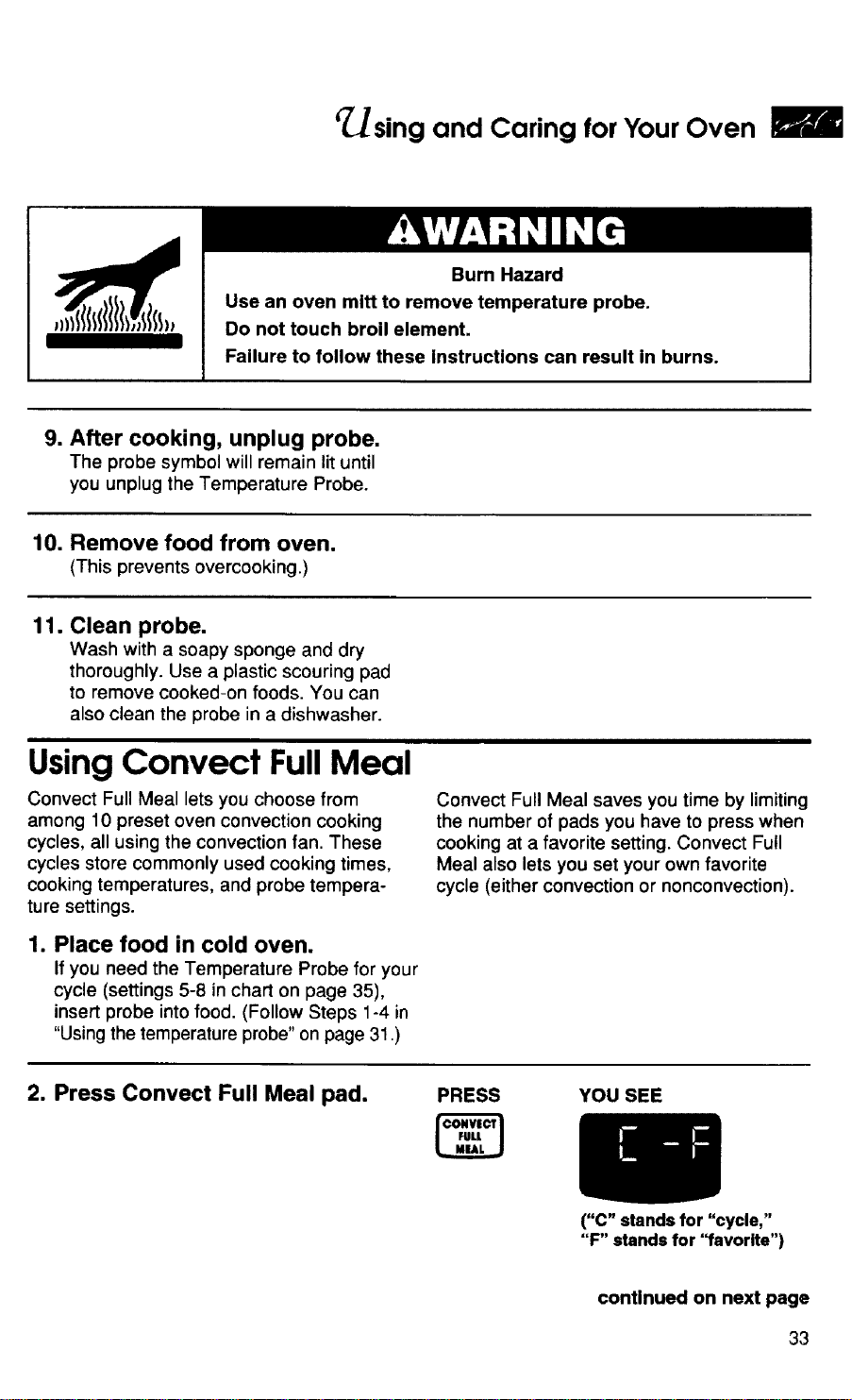
Burn Hazard
Use an oven mitt to remove temperature probe.
Do not touch broil element.
Failure to follow these instructions can result in burns.
9. After cooking, unplug probe.
The probe symbol will remain lit until
you unplug the Temperature Probe.
10. Remove food from oven.
(This prevents overcooking.)
11. Clean probe.
Wash with a soapy sponge and dry
thoroughly. Use a plastic scouring pad
to remove cooked-on foods. You can
also clean the probe in a dishwasher.
UsingConvect FullMeal
Convect Full Meal lets you choose from
among 10 preset oven convection cooking
cycles, all using the convection fan. These
cycles store commonly used cooking times,
cooking temperatures, and probe tempera-
ture settings.
Convect Full Meal saves you time by limiting
the number of pads you have to press when
cooking at a favorite setting. Convect Full
Meal also lets you set your own favorite
cycle (either convection or nonconvection).
1. Place food in cold oven.
Ifyou need the Temperature Probe for your
cycle (settings 5-8 in chart on page 35),
insert probe into food. (Follow Steps 1-4 in
"Using the temperature probe" on page 31.)
2. Press Convect Full Meal pad.
PRESS YOU SEE
("C" stands for "cycle,"
"F" stands for "favorite")
continued on next page
33
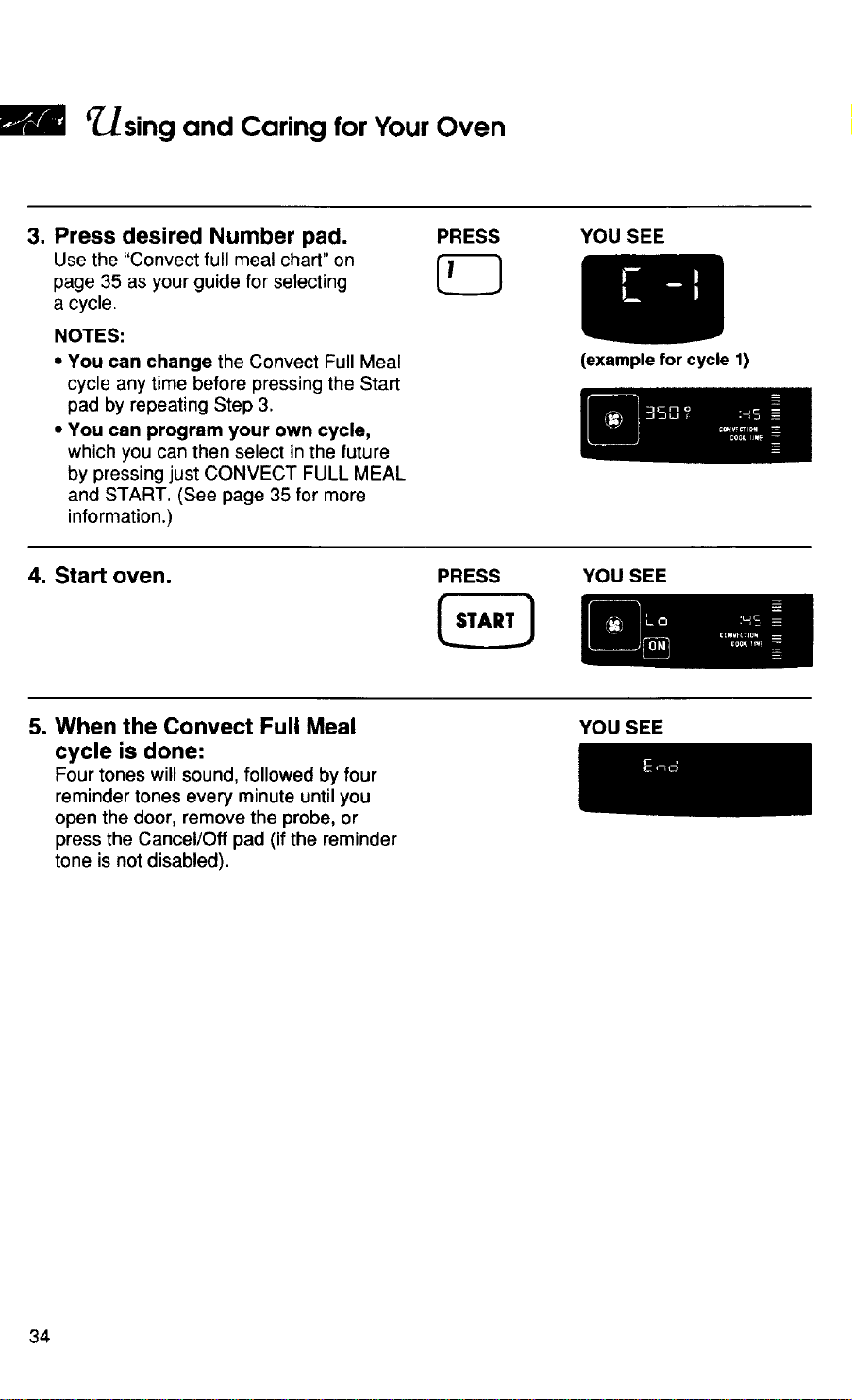
r_ sing and Caring for Your Oven
3. Press desired Number pad. PRESS
Use the "Convect full meal chart" on
page 35 as your guide for selecting
LL__J
a cycle.
NOTES:
• You can change the Convect Full Meal
cycle any time before pressing the Star[
pad by repeating Step 3.
• You can program your own cycle,
which you can then select in the future
by pressing just CONVECT FULL MEAL
and START. (See page 35 for more
information.)
YOU SEE
(example for cycle 1)
4. Start oven. PRESS YOU SEE
5. When the Convect Full Meal
cycle is done:
Four tones will sound, followed by four
reminder tones every minute until you
open the door, remove the probe, or
press the Cancel/Off pad (if the reminder
tone is not disabled).
YOU SEE
34
Using and Caring for Your Oven
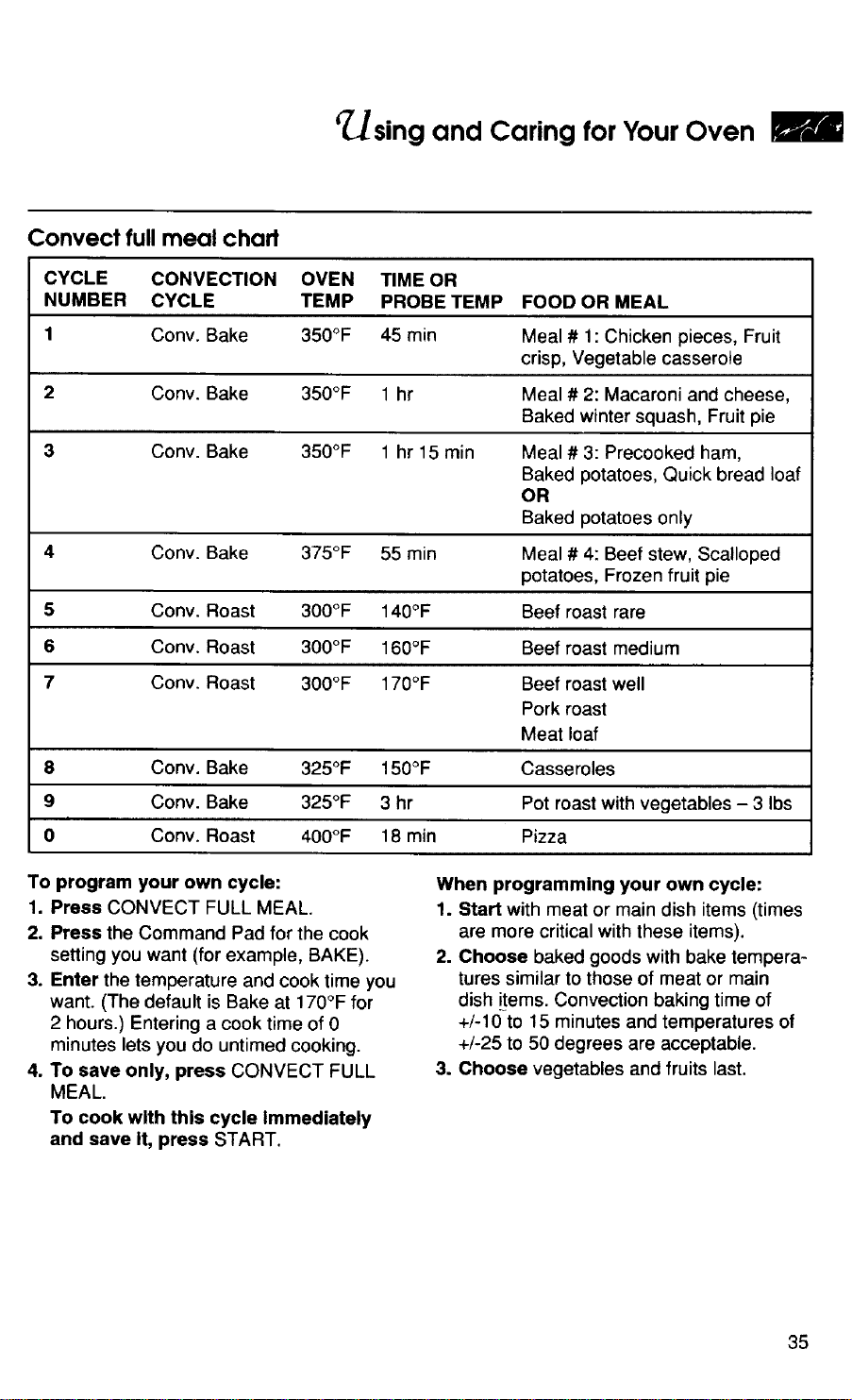
Convect full meal chart
CYCLE CONVECTION OVEN TIME OR
NUMBER CYCLE TEMP PROBETEMP FOOD OR MEAL
1 Cony. Bake 350°F 45 min Meal # 1: Chicken pieces, Fruit
crisp, Vegetable casserole
2 Conv. Bake 350°F 1 hr Meal # 2: Macaroni and cheese,
Baked winter squash, Fruit pie
3 Conv. Bake 350°F 1 hr 15 min Meal # 3: Precooked ham,
Baked potatoes, Quick bread loaf
OR
Baked potatoes only
4 Conv. Bake 375°F 55 min Meal # 4: Beef stew, Scalloped
potatoes, Frozen fruit pie
5 Cony. Roast 300°F 140°F Beef roast rare
6 Conv. Roast 300°F 160°F Beef roast medium
7 Conv. Roast 300°F 170°F Beef roast well
Pork roast
Meat loaf
8 Conv. Bake 325°F 150°F Casseroles
9 Cony. Bake 325°F 3 hr Pot roast with vegetables - 3 Ibs
0 Cony. Roast 400°F 18 min Pizza
To program your own cycle:
1. Press CONVECT FULL MEAL.
2. Press the Command Pad for the cook
setting you want (for example, BAKE).
3. Enter the temperature and cook time you
want. (The default is Bake at 170°F for
2 hours.) Entering a cook time of 0
minutes lets you do untimed cooking.
4. To save only, press CONVECT FULL
MEAL.
To cook with this cycle Immediately
and save it, press START.
When programming your own cycle:
1. Start with meat or main dish items (times
are more critical with these items).
2. Choose baked goods with bake tempera-
tures similar to those of meat or main
dish items. Convection baking time of
+/-10 to 15 minutes and temperatures of
+/-25 to 50 degrees are acceptable.
3. Choose vegetables and fruits last.
35

rU sing and Caring for Your Oven
UsingEASYCONVECT* Conversion
EASY CONVECT Conversion lets you con-
vection cook without entering convection
cook temperatures and times. Simply enter
the standard cook temperature and time for
the food to be cooked. The oven will reduce
the temperature, or the temperature and
time, for convection cooking. (Convection
temperatures and times are not as long
because the heated air is circulated in the
oven cavity for quicker cooking.)
NOTE: The converted temperatures and
times are not precise because the food
categories you choose from are general.
(See "EASY CONVECT Conversion setting
chart" on page 38 for which foods you can
cook in each category.) To ensure proper
cooking, the oven will prompt you to check
food at the end of cook time. If food needs
more cooking, the oven will continue to
cook. If food does not need more cooking,
press CANCEL/OFF.
Food Poisoning Hazard
Do not let food sit in oven more than
one hour before or after cooking.
Doing so can result in death,
food poisoning, or sickness.
1. Place food in oven.
2. Press one of three EASY
CONVECT Conversion Pads.
Example for Meats:
PRESS YOU SEE
3. Enter standard cook
temperature.
PRESS YOU SEE
(example showing 325°F -
cooking without temperature
probe)
36
fusing and Caring for Your Oven
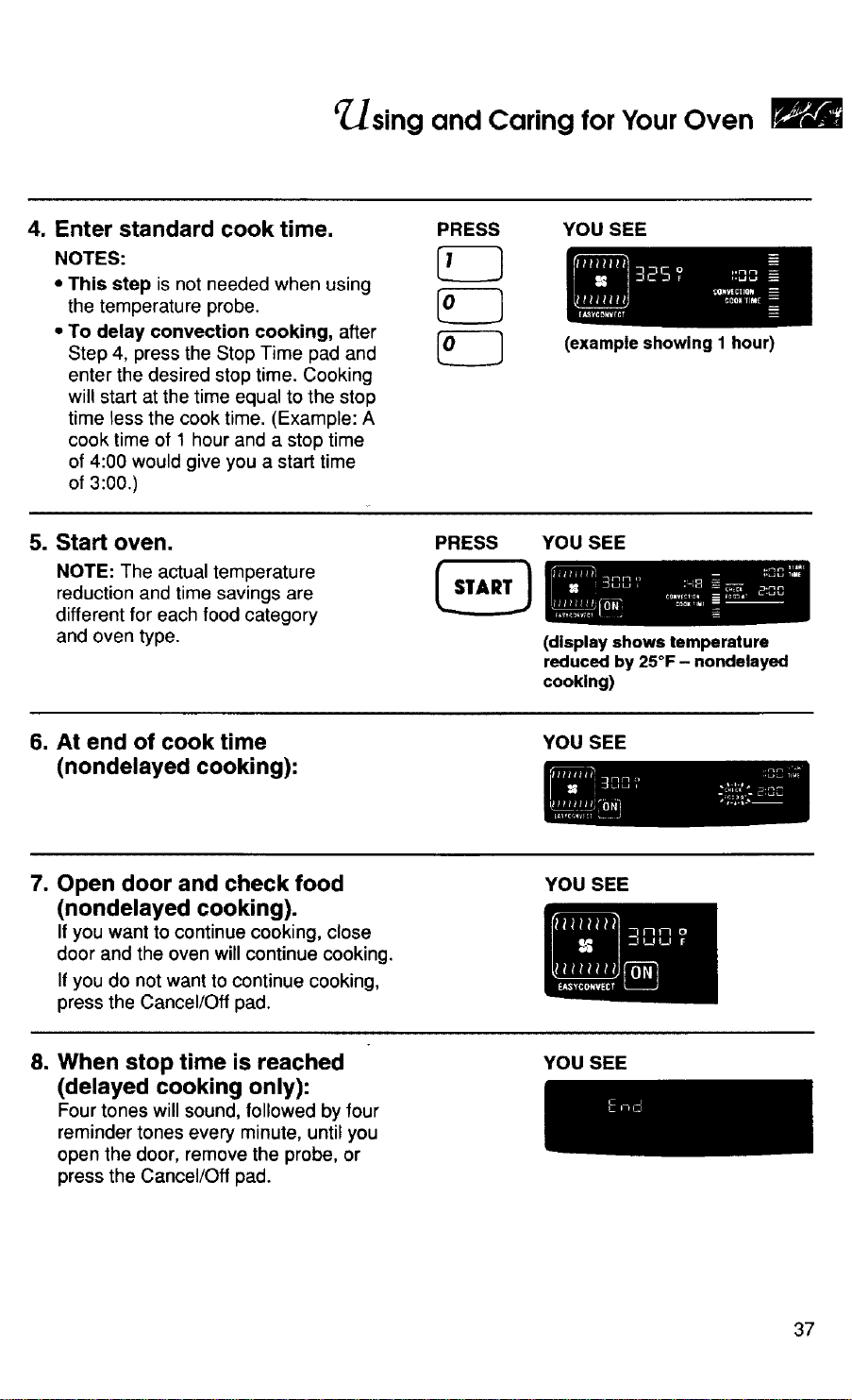
4. Enter standard cook time.
NOTES:
• This step is not needed when using
the temperature probe.
• To delay convection cooking, after
Step 4, press the Stop Time pad and
enter the desired stop time. Cooking
will start at the time equal to the stop
time less the cook time. (Example: A
cook time of 1 hour and a stop time
of 4:00 would give you a start time
of 3:00.)
PRESS YOU SEE
(example showing I hour)
5. Start oven.
NOTE: The actual temperature
reduction and time savings are
different for each food category
and oven type.
PRESS YOU SEE
(display shows temperature
reduced by 25°F - nondelayed
cooking)
6. At end of cook time
(nondelayed cooking):
YOU SEE
7. Open door and check food
(nondelayed cooking).
If you want to continue cooking, close
door and the oven will continue cooking.
If you do not want to continue cooking,
press the Cancel/Off pad.
YOU SEE
8. When stop time is reached
(delayed cooking only):
Four tones will sound, followed by four
reminder tones every minute, until you
open the door, remove the probe, or
press the Cancel/Off pad.
YOU SEE
37
fusing and Caring for Your Oven
E JII
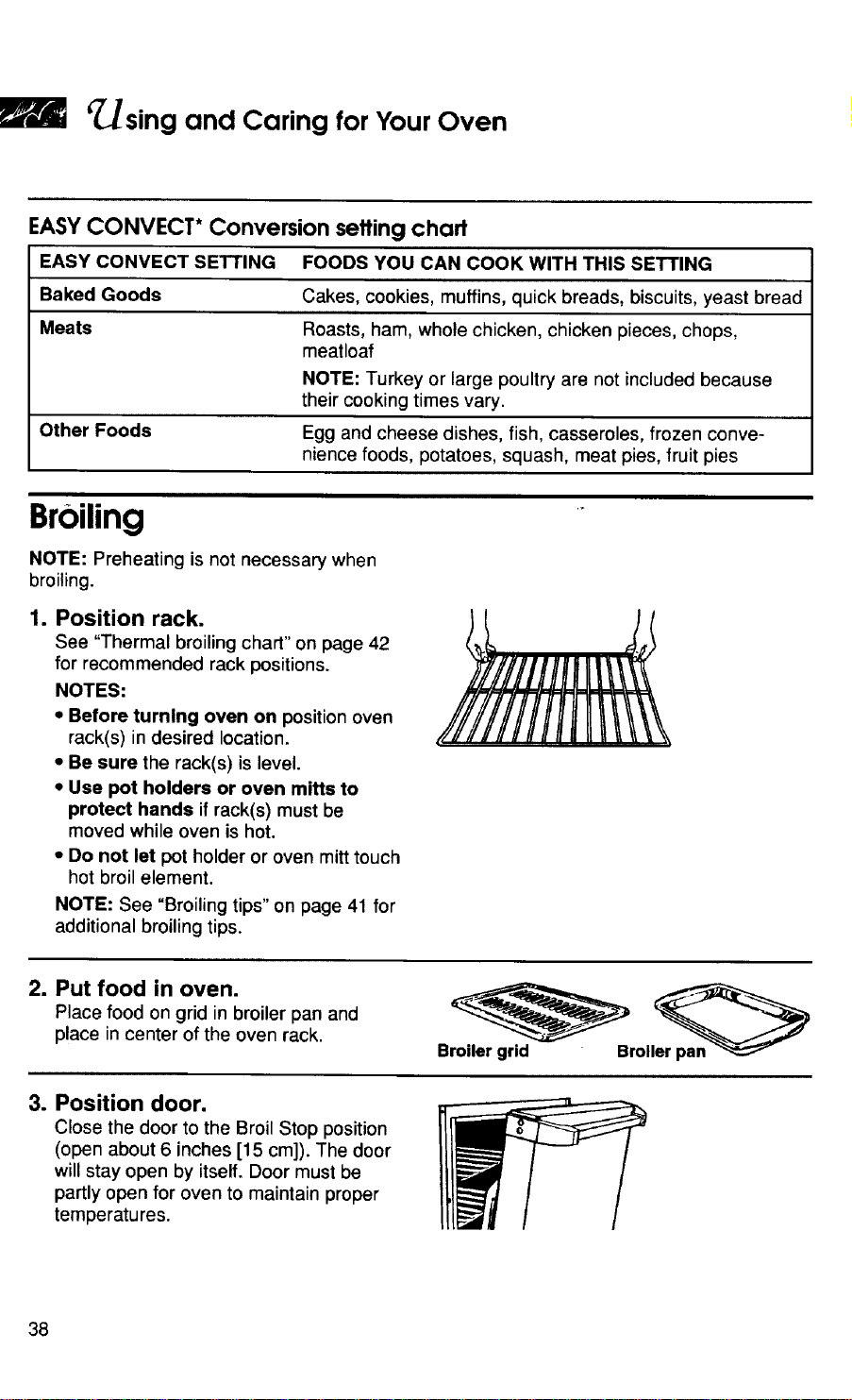
EASY CONVECT* Conversion setting chart
EASY CONVECT SETTING FOODS YOU CAN COOK WITH THIS SETTING
Baked Goods Cakes, cookies, muffins, quick breads, biscuits, yeast bread
Meats Roasts, ham, whole chicken, chicken pieces, chops,
meatloaf
NOTE: Turkey or large poultry are not included because
their cooking times vary.
Other Foods Egg and cheese dishes, fish, casseroles, frozen conve-
nience foods, potatoes, squash, meat pies, fruit pies
Broiling
NOTE: Preheating is not necessary when
broiling.
1. Position rack.
See "Thermal broilingchart" on page 42
for recommended rack positions.
NOTES:
• Before turning oven on position oven
rack(s) in desired location.
• Be sure the rack(s) is level.
• Use pot holders or oven mitts to
protect hands if rack(s) must be
moved while oven is hot.
• Do not let pot holder or oven mitt touch
hot broilelement.
NOTE: See "Broiling tips" on page 41 for
additional broiling tips.
2. Put food in oven.
Place food on grid in broiler pan and
place in center ofthe oven rack,
3. Position door.
Close the door to the Broil Stop position
(open about 6 inches [15 cm]). The door
will stay open by itseff. Door must be
partly open for oven to maintain proper
temperatures.
38
fusing and Caring for Your Oven
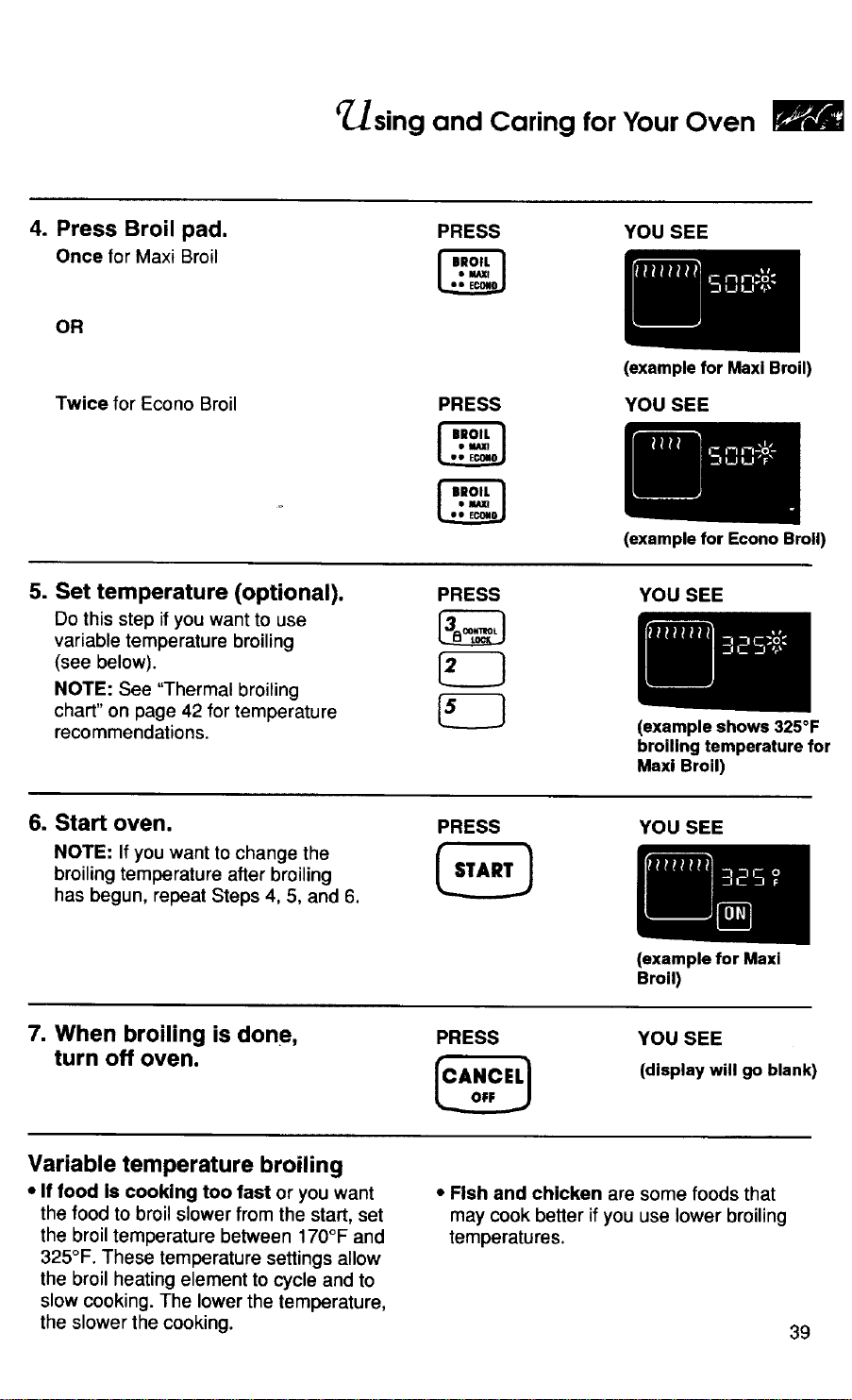
4. Press Broil pad.
Once for Maxi Broil
OR
PRESS YOU SEE
(example for Maxi Broil)
Twice for Econo Broil
PRESS YOU SEE
(example for Econo Broil)
5. Set temperature (optional).
Do this step if you want to use
variable temperature broiling
(see below).
NOTE: See "Thermal broiling
chart" on page 42 for temperature
recommendations.
PRESS
YOU SEE
(example shows 325°F
broiling temperature for
Maxi Broil)
6. Start oven.
NOTE: Ifyou want to change the
broiling temperature after broiling
has begun, repeat Steps 4, 5, and 6.
PRESS
YOU SEE
7. When broiling is done,
turn off oven.
PRESS
(example for Maxi
Broil)
YOU SEE
(display will go blank)
Variable temperature broiling
• If food is cooking too fast or you want
the food to broilslower from the start, set
the broil temperature between 170°F and
325°F. These temperature settings allow
the broil heating element to cycle and to
slow cooking. The lower the temperature,
the slower the cooking.
• Fish and chicken are some foods that
may cook better if you use lower broiling
temperatures.
39
U sing and Caring for Your Oven
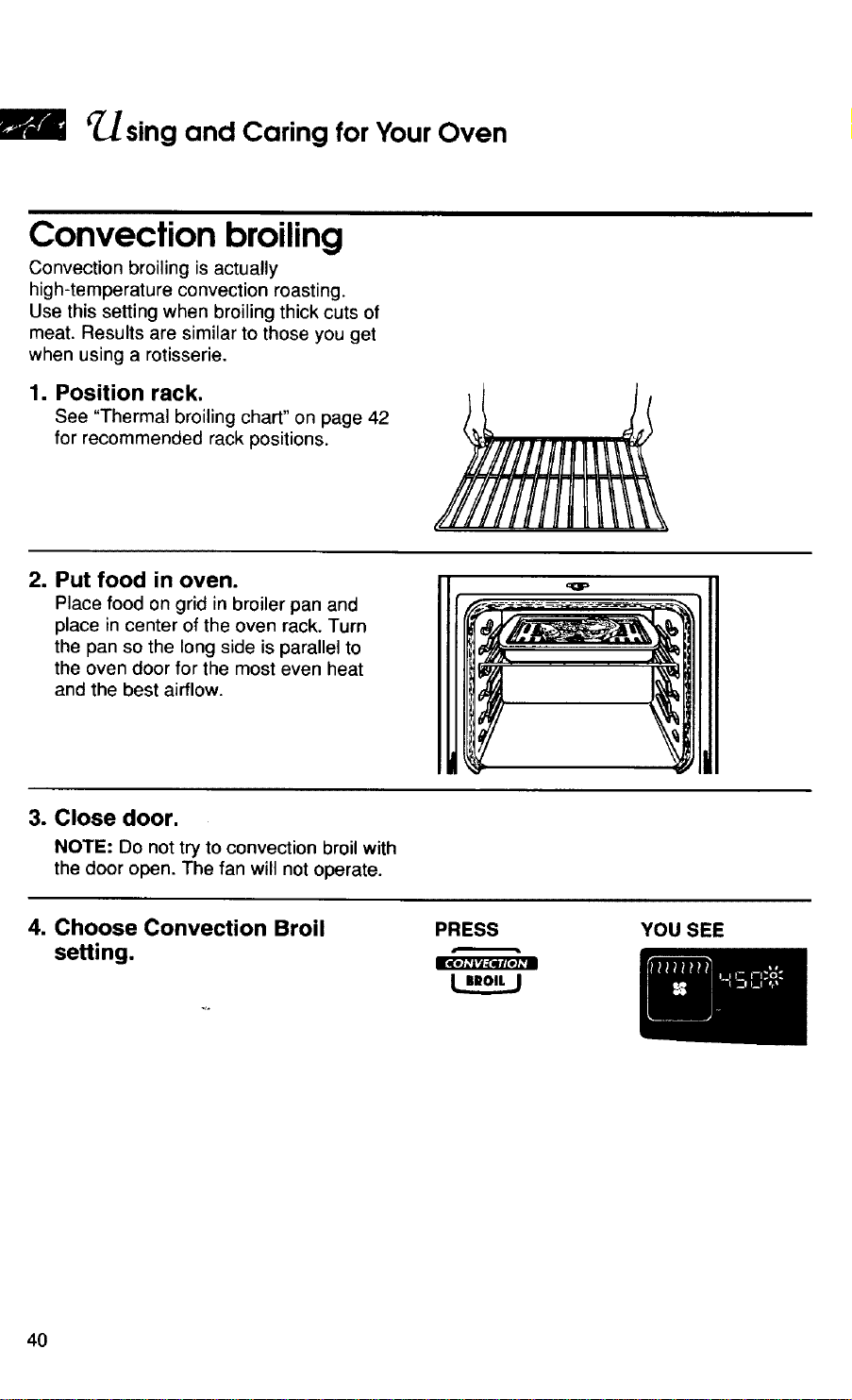
Convection broiling
Convection broiling is actually
high-temperature convection roasting.
Use this setting when broiling thick cuts of
meat. Results are similar to those you get
when using a rotisserie.
1. Position rack.
See "Thermal broiling chart" on page 42
for recommended rack positions.
2. Put food in oven.
Place food on grid in broiler pan and
place in center of the oven rack. Turn
the pan so the long side is parallel to
the oven door for the most even heat
and the best airflow.
3. Close door.
NOTE: Do not tryto convection broilwith
the door open. The fan will not operate.
4. Choose Convection Broil
setting.
PRESS YOU SEE
4O
Using and Caring for Your Oven
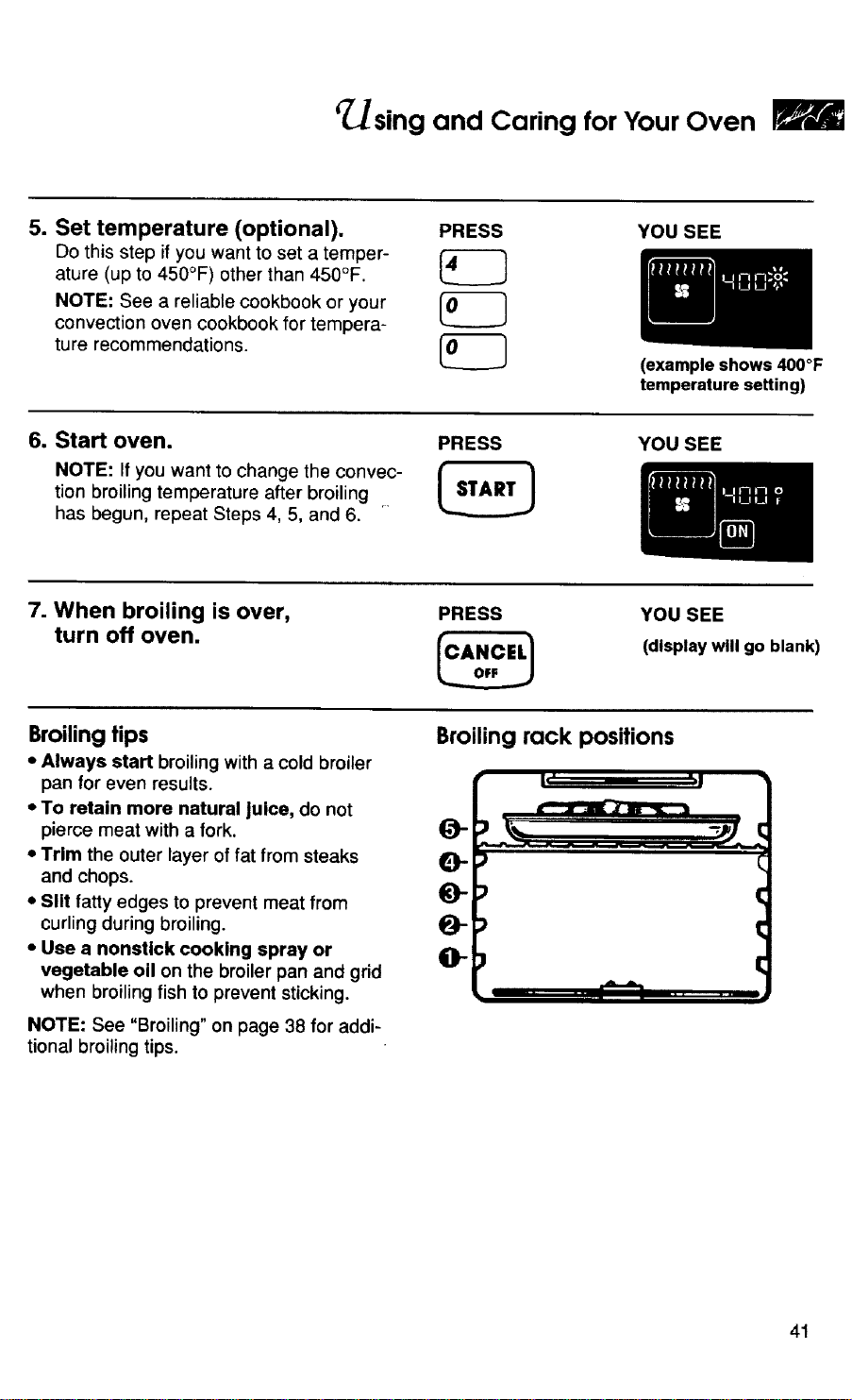
5. Set temperature (optional).
Do this step if you want to set a temper-
ature (up to 450°F) other than 450°F.
NOTE: See a reliable cookbook or your
convection oven cookbook for tempera-
ture recommendations.
PRESS YOU SEE
(example shows 400°F
temperature setting)
6. Start oven.
NOTE: If you want to change the convec-
tion broiling temperature after broiling
has begun, repeat Steps 4, 5, and 6. "
PRESS
YOU SEE
7. When broiling is over,
turn off oven.
PRESS
YOU SEE
(display will go blank)
Broiling tips
• Always start broilingwith a cold broiler
pan for even results.
• To retain more natural Juice, do not
pierce meat with a fork.
• Trim the outer layer of fatfrom steaks
and chops.
• Slit fatty edges to prevent meat from
curling during broiling.
• Use a nonstick cooking spray or
vegetable oil on the broiler pan and grid
when broiling fish to prevent sticking.
NOTE: See "Broiling" on page 38 for addi-
tional broiling tips.
Broiling rack positions
0-
0-
@-
0-
O-
• I,' ',1 •
C
€
41
Using and Caring for Your Oven
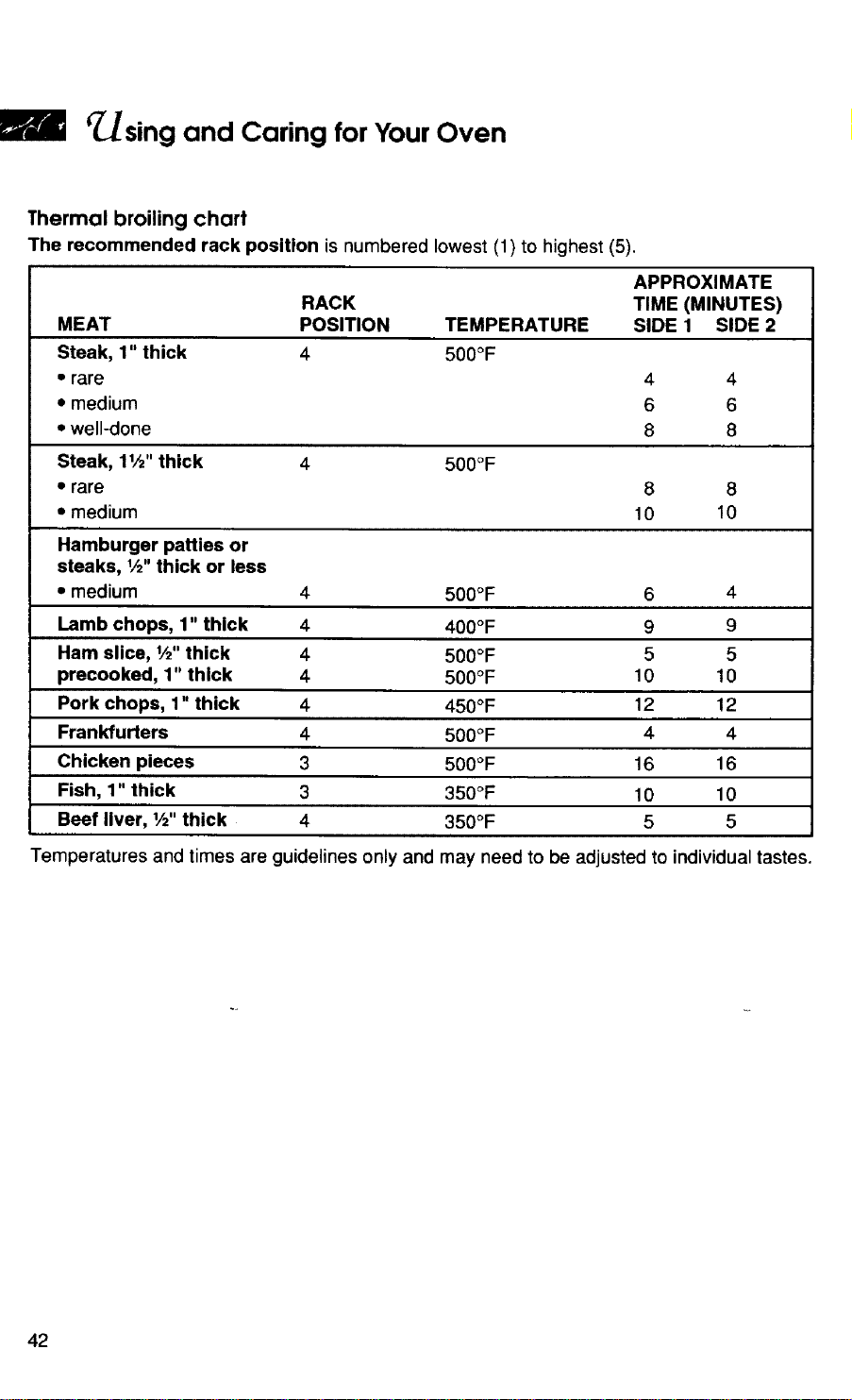
Thermal broiling chart
The recommended rack position is numbered lowest (1) to highest (5),
APPROXIMATE
RACK TIME (MINUTES)
MEAT POSITION TEMPERATURE SIDE 1 SIDE 2
Steak, 1" thick 4 500°F
• rare 4 4
• medium 6 6
• well-done 8 8
Steak, 11/2"thick 4 500°F
• rare 8 8
• medium 10 10
Hamburger patties or
steaks, 1/2"thick or less
• medium 4 500°F 6 4
Lamb chops, 1" thick 4 400°F 9 9
Ham slice, W' thick 4 500°F 5 5
precooked, 1" thick 4 500°F 10 10
Pork chops, 1" thick 4 450°F 12 12
Frankfurters 4 500°F 4 4
Chicken pieces 3 500°F 16 16
Fish, 1" thick 3 350°F 10 10
Beef liver, 1/z"thick 4 350°F 5 5
Temperatures and times are guidelines only and may need to be adjusted to individual tastes.
42
r_ sing and Caring for Your Oven
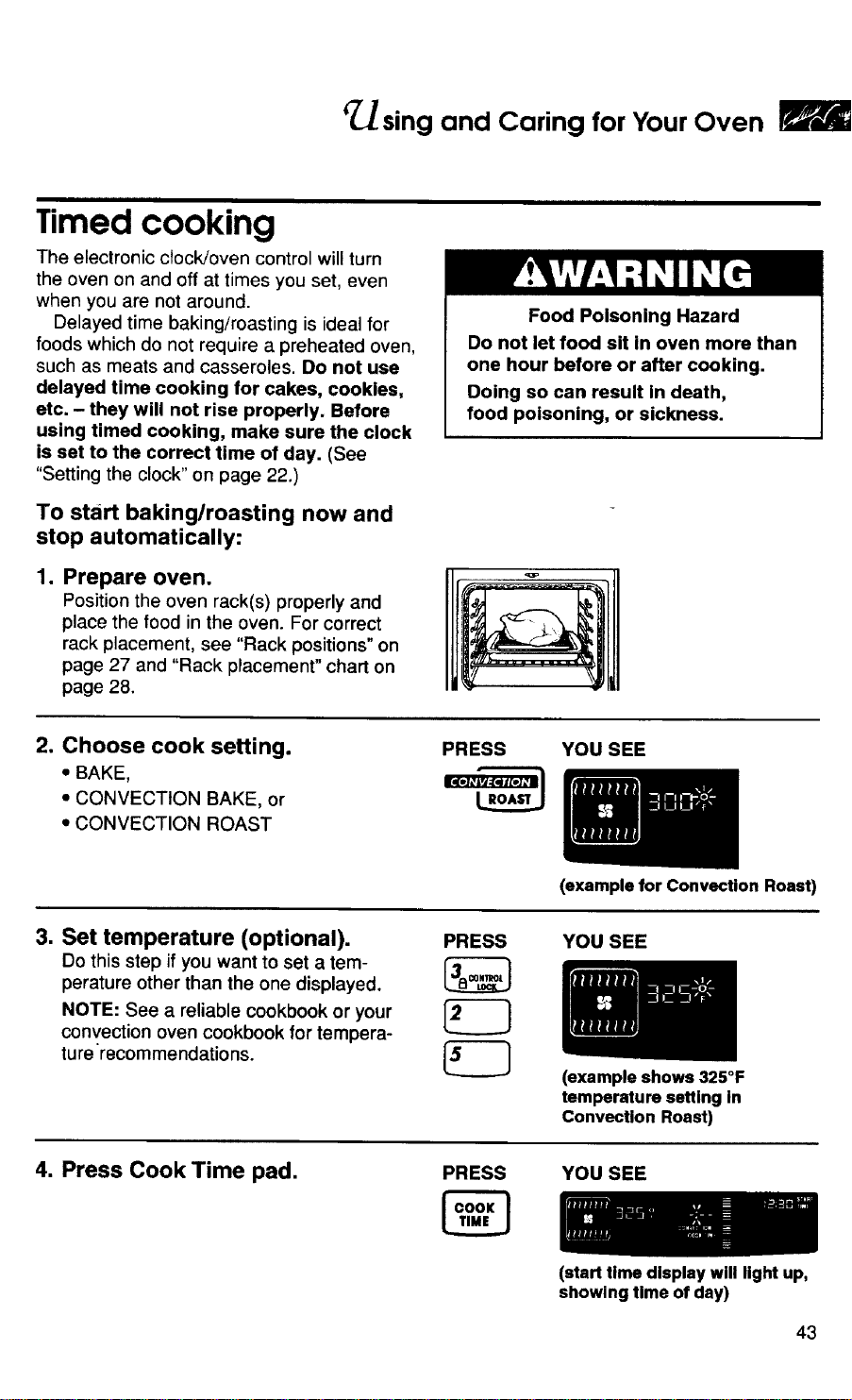
Timed cooking
The electronic clock/oven control will turn
the oven on and off at times you set, even
when you are not around.
Delayed time baking/roasting is ideal for
foods which do not require a preheated oven,
such as meats and casseroles. Do not use
delayed time cooking for cakes, cookies,
etc. - they will not rise properly. Before
using timed cooking, make sure the clock
is set to the correct time of day. (See
"Setting the clock" on page 22.)
To start baking/roasting now and
stop automatically:
1, Prepare oven.
Position the oven rack(s) properly and
place the food in the oven. For correct
rack placement, see "Rack positions"on
page 27 and "Rack placement" chart on
page 28.
Food Poisoning Hazard
Do not let food sit in oven more than
one hour before or after cooking.
Doing so can result in death,
food poisoning, or sickness.
2. Choose cook setting.
• BAKE,
• CONVECTION BAKE, or
• CONVECTION ROAST
PRESS YOU SEE
(example for Convection Roast)
3. Set temperature (optional).
Do this step if you want to set a tem-
perature other than the one displayed.
NOTE: See a reliable cookbook or your
convection oven cookbook for tempera-
ture recommendations.
PRESS YOU SEE
(example shows 325°F
temperature setting in
Convection Roast)
4. Press Cook Time pad.
PRESS YOU SEE
(start time display will light up,
showing Ume of day)
43
fusing and Caring for Your Oven
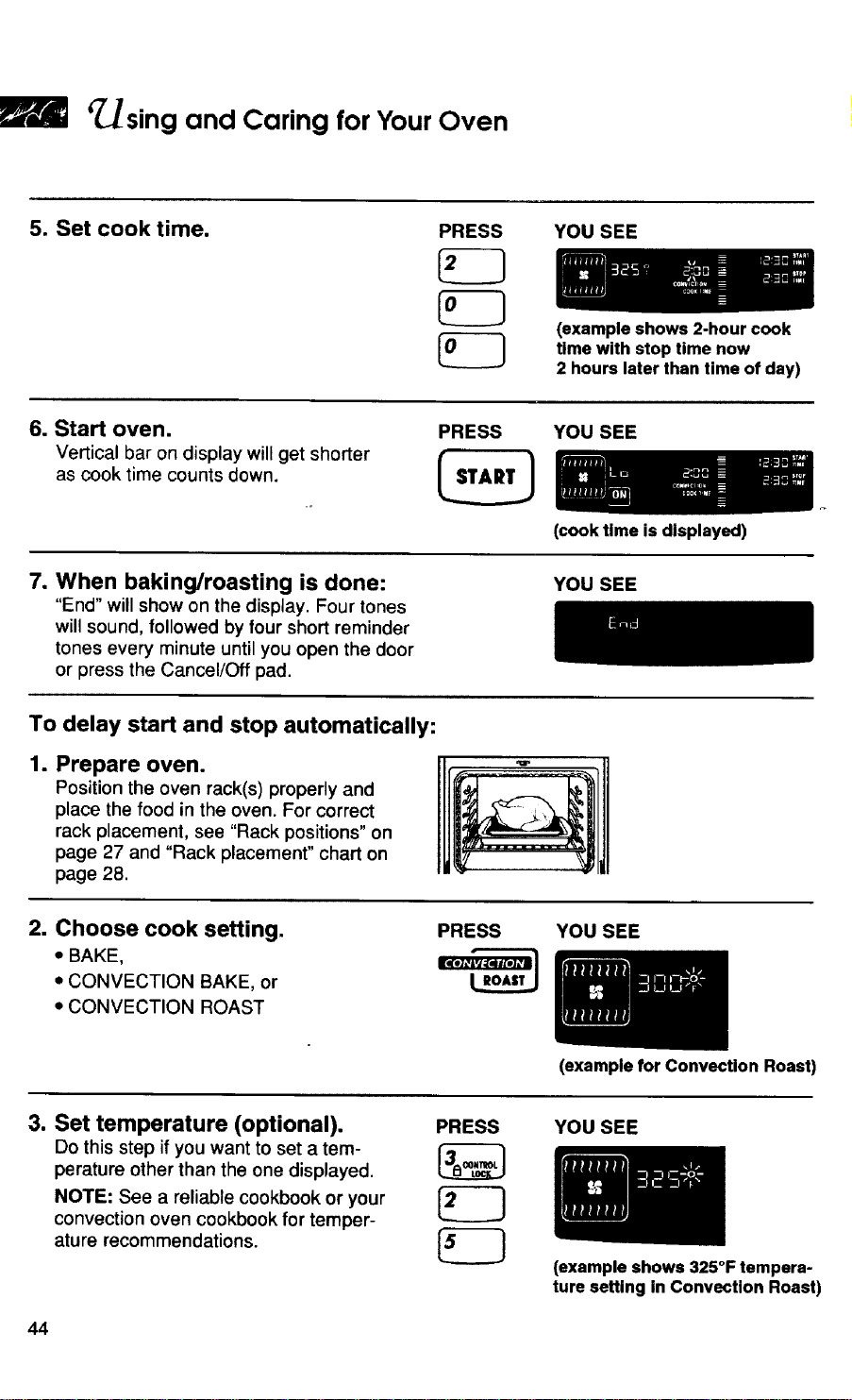
5. Set cook time.
PRESS YOU SEE
(example shows 2-hour cook
time with stop time now
2 hours later than time of day)
6. Start oven.
Vertical bar on display will get shorter
as cook time counts down.
PRESS YOU SEE
7. When baking/roasting is done:
"End" will show on the display, Four tones
will sound, followed by four short reminder
tones every minute until you open the door
or press the Cancel/Off pad.
(cook time is displayed)
YOU SEE
To delay start and stop automatically:
1. Prepare oven.
Position the oven rack(s) properly and
place the food in the oven. For correct
rack placement, see "Rack positions"on
page 27 and "Rack placement" chart on
page 28.
2. Choose cook setting.
• BAKE,
• CONVECTION BAKE, or
• CONVECTION ROAST
PRESS YOU SEE
(example for Convection Roast)
3. Set temperature (optional).
Do this step if you want to set a tem-
perature other than the one displayed.
NOTE: See a reliable cookbook or your
convection oven cookbook for temper-
ature recommendations.
PRESS YOU SEE
(example shows 325°F tempera-
ture setting in Convection Roast)
44
_Using and Caring for Your Oven
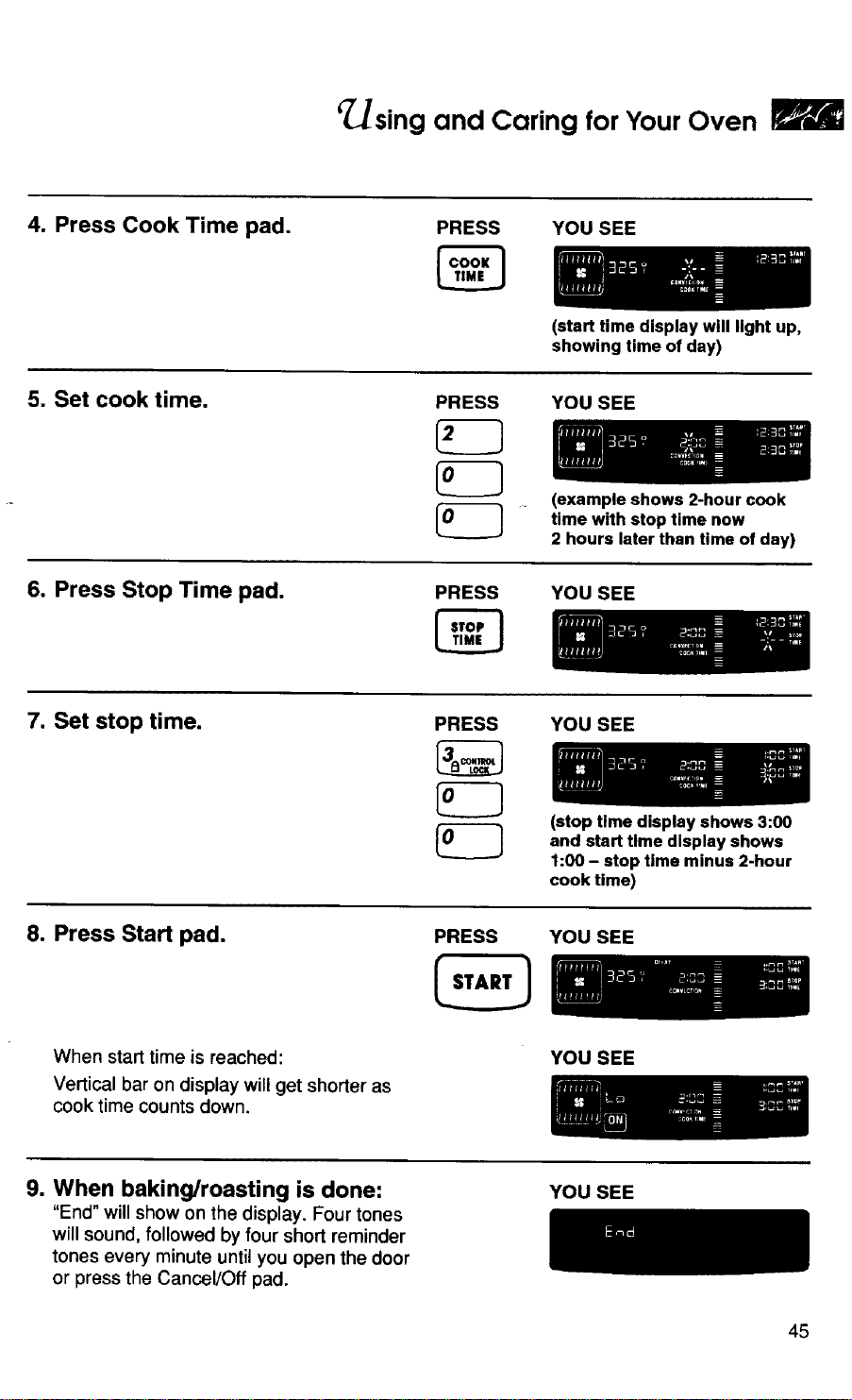
4. Press Cook Time pad.
PRESS YOU SEE
(start time display will light up,
showing time of day)
5. Set cook time.
PRESS
YOU SEE
(example shows 2-hour cook
time with stop time now
2 hours later than time of day)
6. Press Stop Time pad.
PRESS
YOU SEE
7. Set stop time. PRESS YOU SEE
(stop Ume display shows 3:00
and start time display shows
1:00 - stop time minus 2-hour
cook time)
8. Press Start pad. PRESS YOU SEE
When start time is reached:
Vertical bar on display will get shorter as
cook time counts down.
YOU SEE
9. When baking/roasting is done:
"End" will show on the display. Four tones
will sound, followed by four short reminder
tones every minute until you open the door
or press the Cancel/Off pad.
YOU SEE
45
Using and Caring for Your Oven
To cancel timed cooking settings:
Press Cancel/Off pad.
PRESS YOU SEE
o___)FFCANCEL! (displaywill go blank)
Dehydrating
You can use your THERMAL-CONVECTION*
oven to dehydrate a variety of foods.
1. Prepare food.
Prepare foods as recommended in
recipe.
NOTE: To learn detailed information about
dehydration, refer to a book written specifi-
cally about dehydrating and/or preserving
foods.
2. Arrange food on drying racks.
Racks are not included with oven. See
below to order a dehydration kitt which
includes racks and a spacer or contact a
local store handling specialty cookware.
3. Place drying racks in the oven
to allow maximum air circula-
tion around the racks.
NUMBER OF USE OVEN
RACKS RACK POSITION
1 rack 3
2 racks 2 and 4
3 racks 1,3, and 5
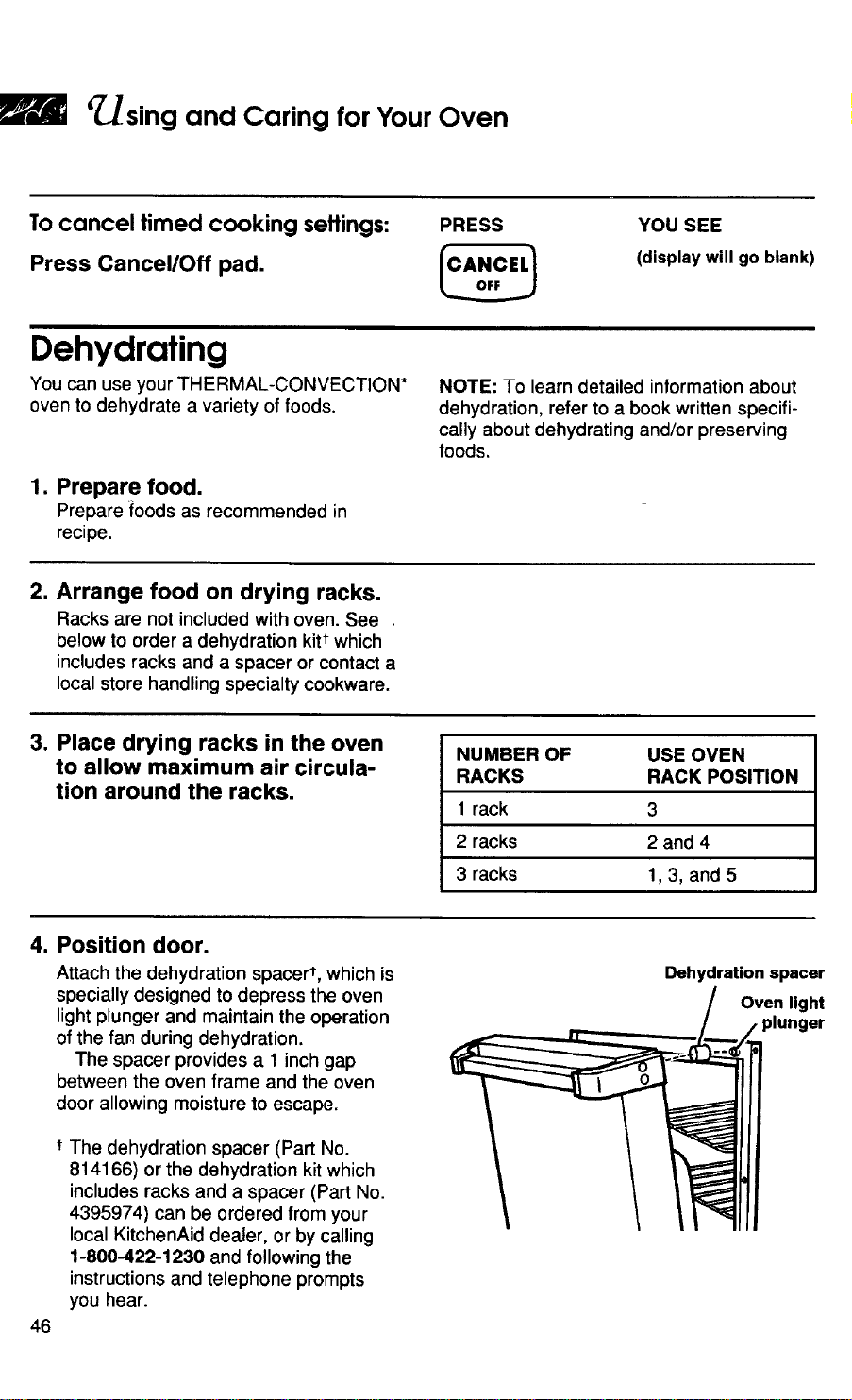
4. Position door.
Attach the dehydration spacert, which is
specially designed to depress the oven
light plunger and maintain the operation
of the fan during dehydration.
The spacer provides a 1 inch gap
between the oven frame and the oven
door allowing moisture to escape.
46
t The dehydration spacer (Part No.
814166) or the dehydration kit which
includes racks and a spacer (Part No.
4395974) can be ordered from your
local KitchenAid dealer, or by calling
1-800-422-1230 and following the
instructions and telephone prompts
you hear.
Dehydration spacer
Oven light
plunger
Using and Caring for Your Oven
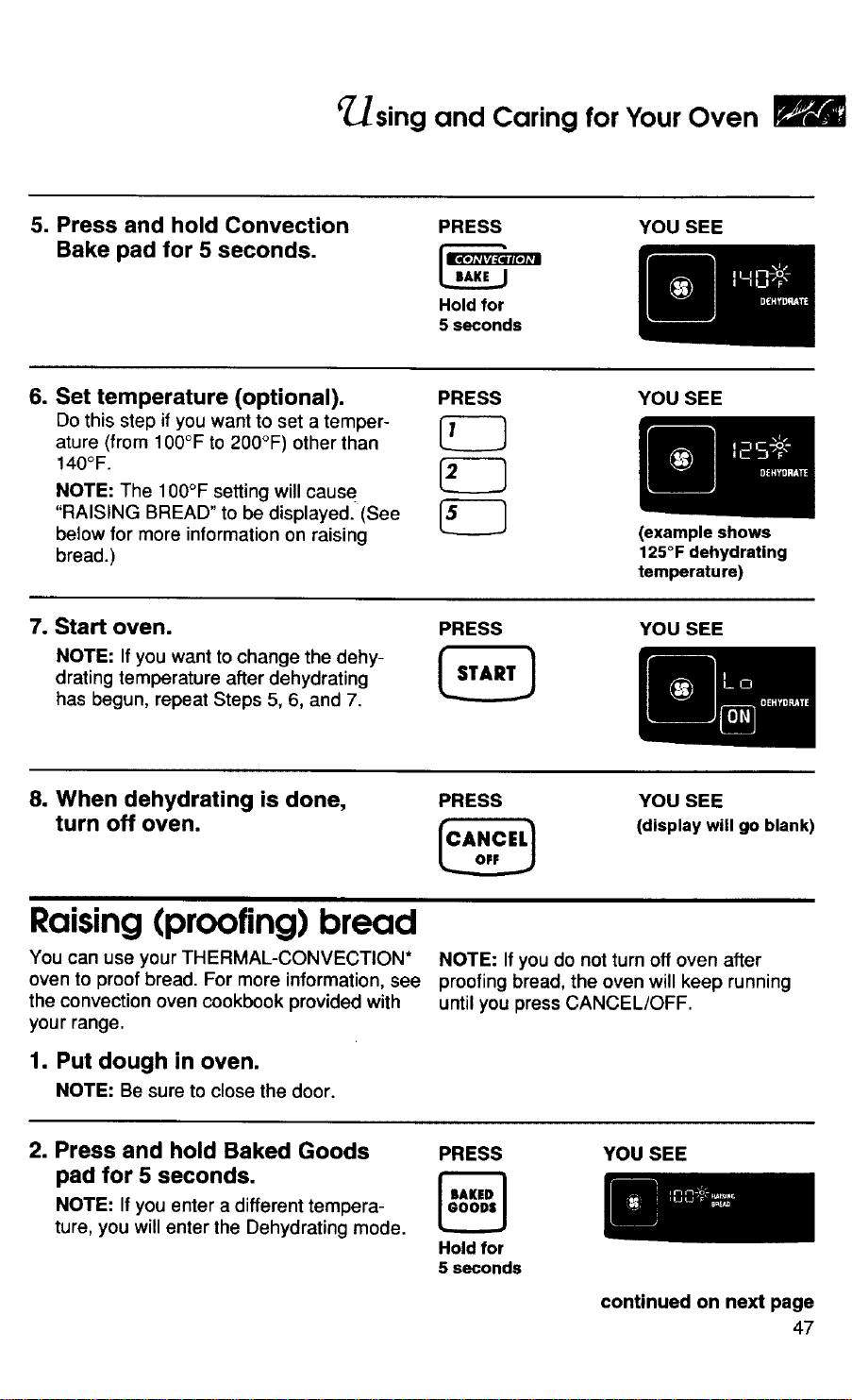
5. Press and hold Convection
Bake pad for 5 seconds.
PRESS
Hold for
5 seconds
YOU SEE
6. Set temperature (optional).
Do this step if you want to set a temper-
ature (from 100°F to 200°F) other than
140°F.
NOTE: The 100°F setting will cause
"RAISING BREAD" to be displayed.(See
below for more information on raising
bread.)
PRESS YOU SEE
(example shows
125°F dehydrating
temperature)
7. Start oven.
NOTE: If you want to change the dehy-
drating temperature after dehydrating
has begun, repeat Steps 5, 6, and 7.
PRESS YOU SEE
8. When dehydrating is done,
turn off oven.
PRESS YOU SEE
fCANCELI (display will go blank)
I- I
Raising (proofing) bread
You can use your THERMAL-CONVECTION*
oven to proof bread. For more information, see
the convection oven cookbook provided with
your range.
1. Put dough in oven.
NOTE: Be sure to close the door.
NOTE: If you do not turn off oven after
proofing bread, the oven will keep running
until you press CANCEL/OFF.
2. Press and hold Baked Goods
pad for 5 seconds.
NOTE: If you enter a different tempera-
ture, you willenter the Dehydrating mode.
PRESS
Hold for
5 seconds
YOU SEE
continued on next page
47
¢_sing and Caring for Your Oven
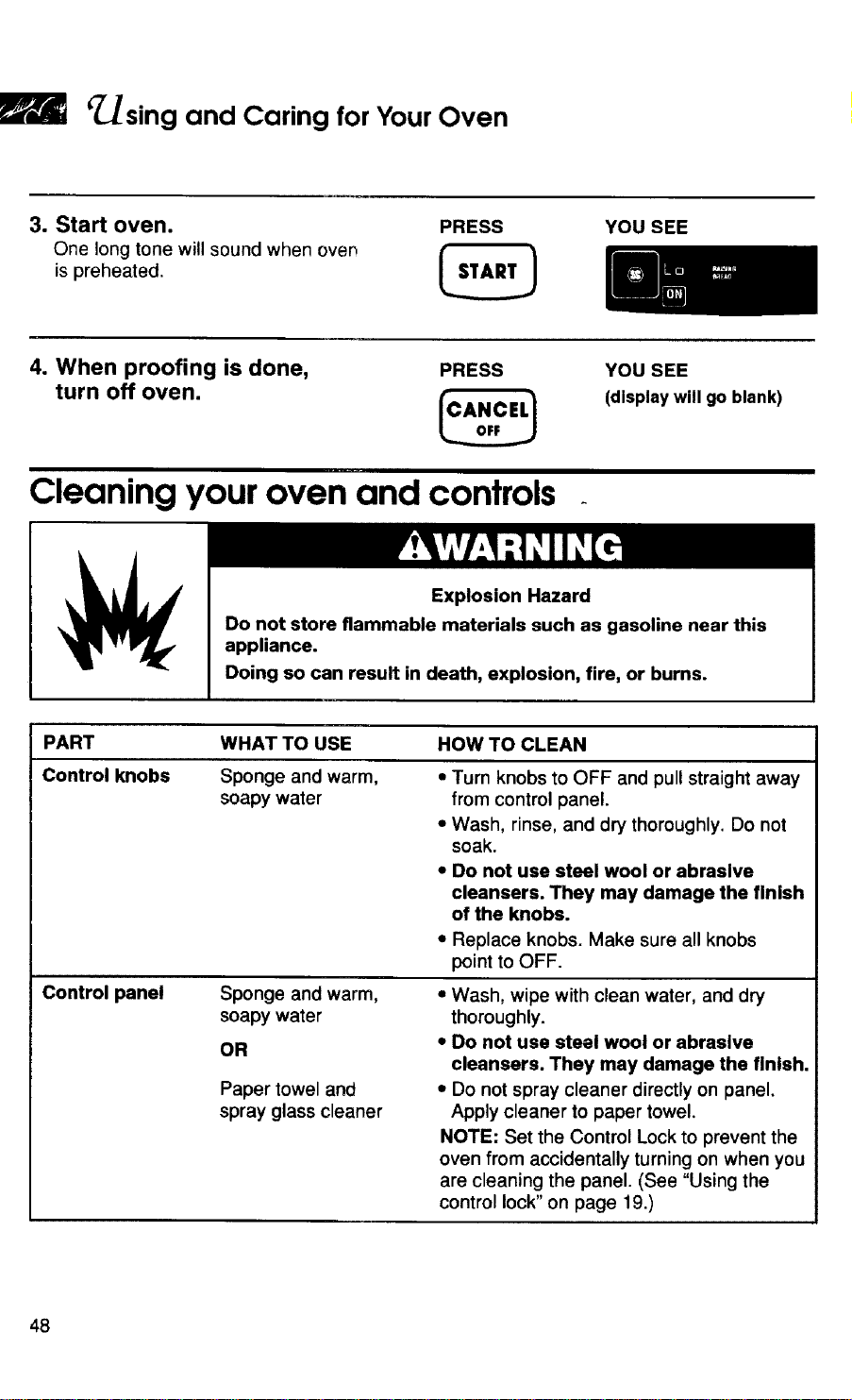
3. Start oven.
One long tone will sound when oven
is preheated.
PRESS
YOU SEE
4. When proofing is done,
turn off oven.
PRESS
fCANCEL I
YOU SEE
(display will go blank)
Cleaning your oven and controls
Explosion Hazard
Do not store flammable materials such as gasoline near this
appliance.
Doing so can result in death, explosion, fire, or burns.
PART WHAT TO USE HOW TO CLEAN
Control knobs Sponge and warm,
soapy water
Control panel Sponge and warm,
soapy water
OR
Paper towel and
spray glass cleaner
• Turn knobs to OFF and pull straight away
from control panel.
• Wash, rinse, and dry thoroughly. Do not
soak.
• Do not use steel wool or abrasive
cleansers. They may damage the finish
of the knobs.
• Replace knobs. Make sure all knobs
point to OFF.
• Wash, wipe with clean water, and dry
thoroughly.
• Do not use steel wool or abrasive
cleansers. They may damage the finish.
• Do not spray cleaner directly on panel.
Apply cleaner to paper towel.
NOTE: Set the Control Lock to prevent the
oven from accidentally turning on when you
are cleaning the panel. (See "Using the
control lock" on page 19.)
48
Jsing and Caring for Your Oven
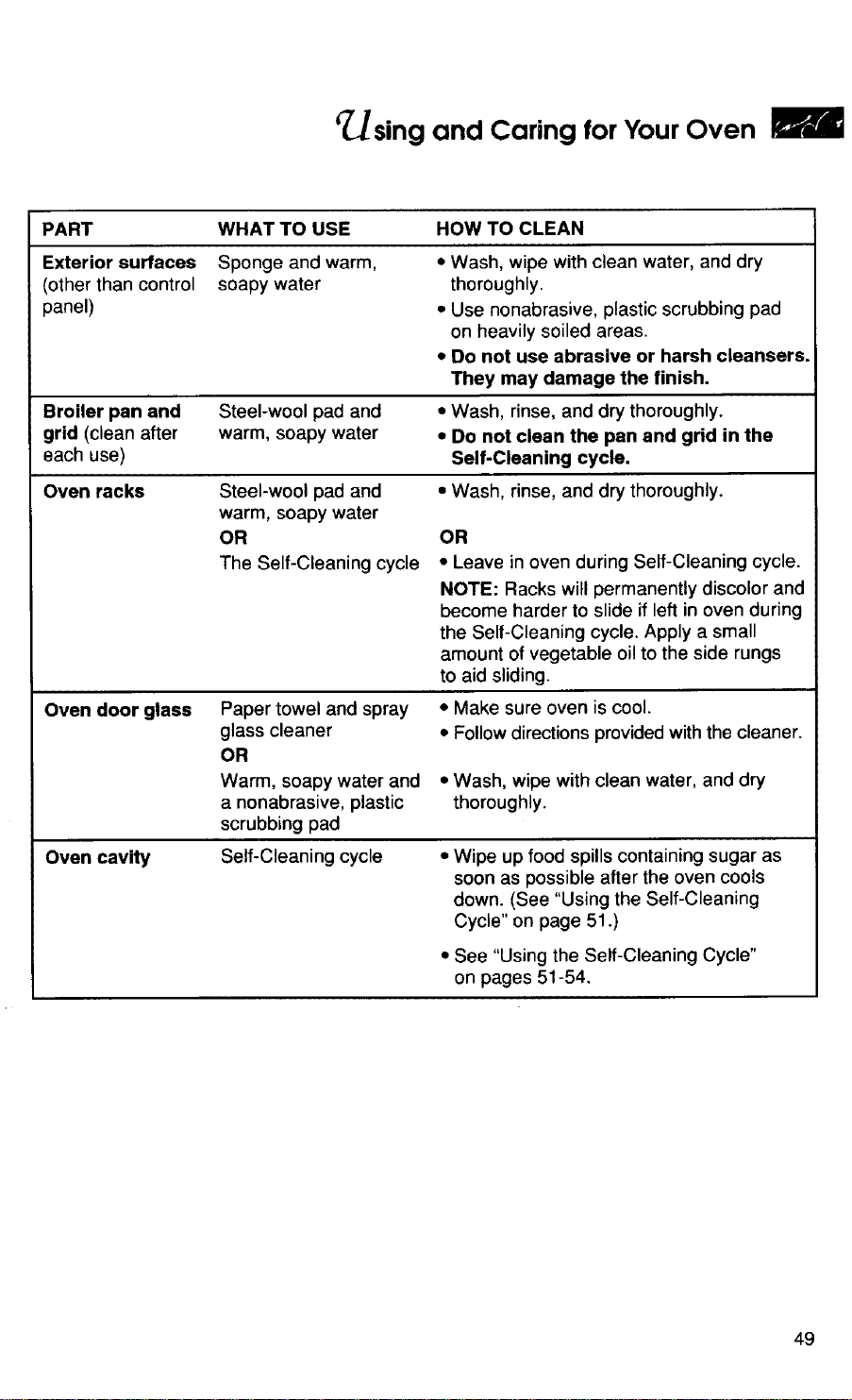
PART WHAT TO USE HOW TO CLEAN
Exterior surfaces
(other than control
panel)
Broiler pan and
grid (clean after
each use)
Oven racks
Oven door glass
Oven cavity
Sponge and warm,
soapy water
Steel-wool pad and
warm, soapy water
Steel-wool pad and
warm, soapy water
OR
The Self-Cleaning cycle
Paper towel and spray
glass cleaner
OR
Warm, soapy water and
a nonabrasive, plastic
scrubbing pad
Self-Cleaning cycle
• Wash, wipe with clean water, and dry
thoroughly.
• Use nonabrasive, plastic scrubbing pad
on heavily soiled areas.
• Do not use abrasive or harsh cleansers.
They may damage the finish.
• Wash, rinse, and dry thoroughly.
• Do not clean the pan and grid in the
Self-Cleaning cycle.
• Wash, rinse, and dry thoroughly.
OR
• Leave in oven during Self-Cleaning cycle.
NOTE: Racks will permanently discolor and
become harder to slide if left in oven during
the Self-Cleaning cycle. Apply a small
amount of vegetable oil to the side rungs
to aid sliding.
• Make sure oven is cool.
• Follow directions provided withthe cleaner.
• Wash, wipe with clean water, and dry
thoroughly.
• Wipe up food spills containing sugar as
soon as possible after the oven cools
down. (See "Using the Self-Cleaning
Cycle" on page 51.)
• See "Using the Self-Cleaning Cycle"
on pages 51-54.
49
Using and Caring for Your Oven
Using and replacing the oven light(s)
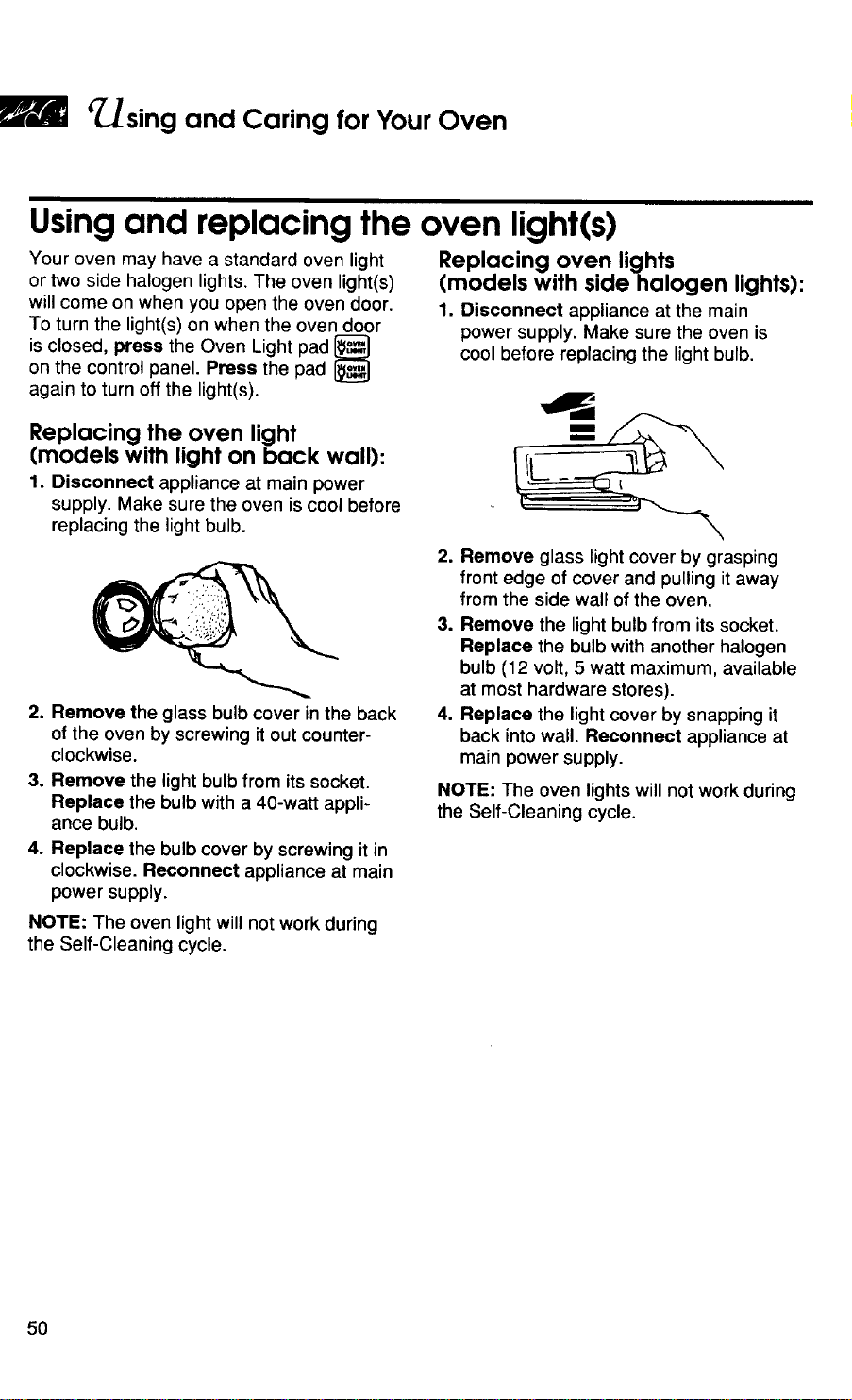
Your oven may have a standard oven light
or two side halogen lights. The oven light(s)
will come on when you open the oven door.
To turn the light(s) on when the oven door
is closed, press the Oven Light pad
on the control panel. Press the pad
again to turn off the light(s).
Replacing the oven light
(models with light on back wall):
1. Disconnect appliance at main power
supply. Make sure the oven is cool before
replacing the light bulb.
2. Remove the glass bulb cover in the back
of the oven by screwing it out counter-
clockwise.
3. Remove the light bulb from its socket.
Replace the bulb with a 40-watt appli-
ance bulb.
4. Replace the bulb cover by screwing it in
clockwise. Reconnect appliance at main
power supply.
Replacing oven lights
(models with side halogen lights):
I. Disconnect appliance at the main
power supply. Make sure the oven is
cool before replacing the light bulb.
2,
.
.
\
Remove glass light cover by grasping
front edge of cover and pulling it away
from the side wall of the oven.
Remove the light bulb from its socket.
Replace the bulb with another halogen
bulb (12 volt, 5 watt maximum, available
at most hardware stores).
Replace the light cover by snapping it
back into wall. Reconnect appliance at
main power supply.
NOTE: The oven lights will not work during
the Self-Cleaning cycle.
NOTE: The oven light will not work during
the Self-Cleaning cycle.
50
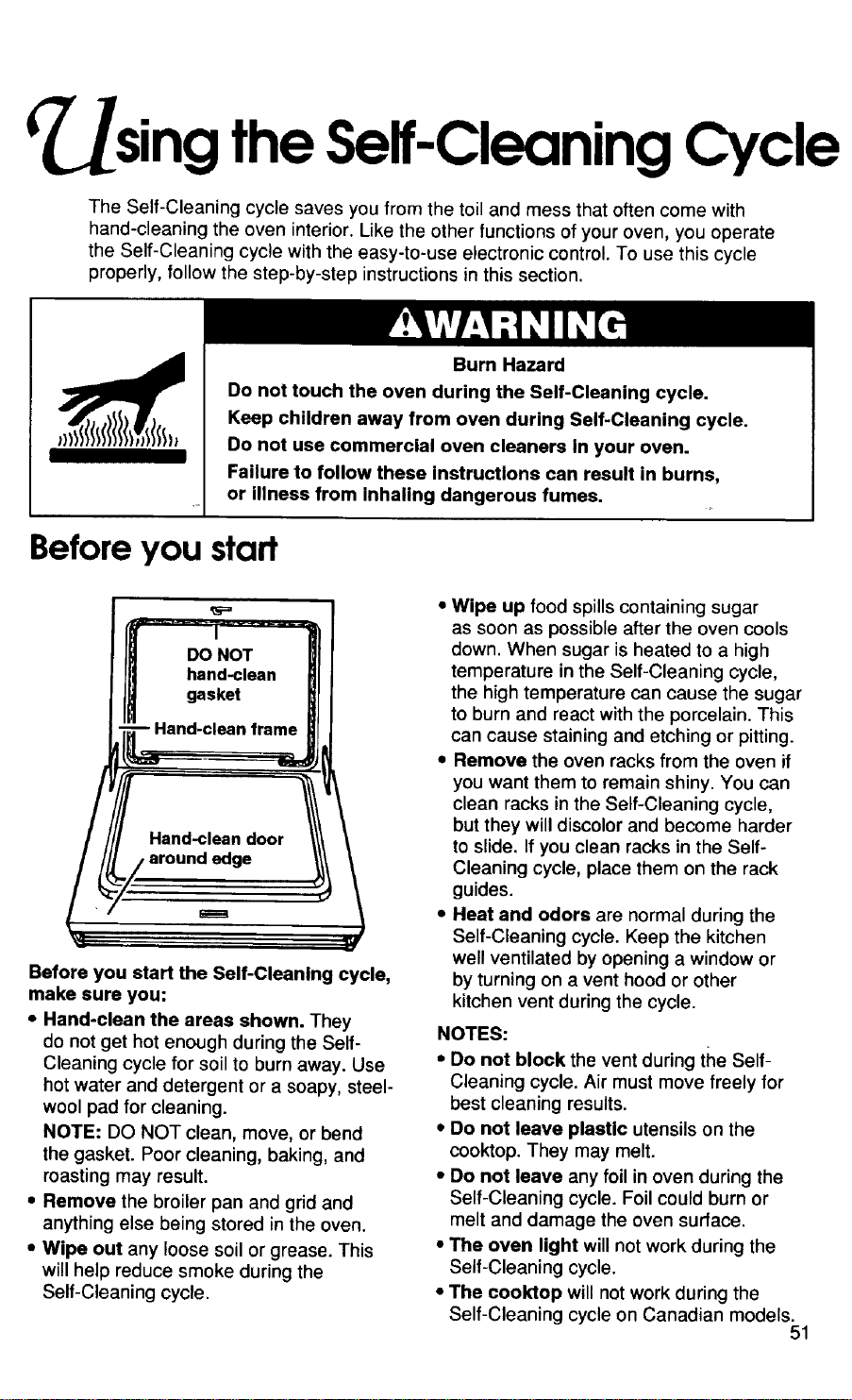
("(.]singthe Self-CleaningCycle
The Self-Cleaning cycle saves you from the toil and mess that often come with
hand-cleaning the oven interior. Like the other functions of your oven, you operate
the Self-Cleaning cycle with the easy-to-use electronic control. To use this cycle
properly, follow the step-by-step instructions in this section.
Burn Hazard
Do not touch the oven during the Self-Cleaning cycle.
Keep children away from oven during Self-Cleaning cycle.
Do not use commercial oven cleaners In your oven.
Failure to follow these instructions can result in burns,
or illness from inhaling dangerous fumes.
Before you start
DO NOT
hand-clean
gasket
Hand-clean door
around edge
Before you start the Self-Cleaning cycle,
make sure you:
• Hand-clean the areas shown. They
do not get hot enough during the Self-
Cleaning cycle for soil to burn away. Use
hot water and detergent or a soapy, steel-
wool pad for cleaning.
NOTE: DO NOT clean, move, or bend
the gasket. Poor cleaning, baking, and
roasting may result.
• Remove the broiler pan and grid and
anything else being stored in the oven.
• Wipe out any loose soil or grease. This
will help reduce smoke during the
Self-Cleaning cycle.
• Wipe up food spills containing sugar
as soon as possible after the oven cools
down. When sugar is heated to a high
temperature in the Self-Cleaning cycle,
the high temperature can cause the sugar
to burn and react with the porcelain. This
can cause staining and etching or pitting.
• Remove the oven racks from the oven if
you want them to remain shiny. You can
clean racks in the Self-Cleaning cycle,
but they willdiscolor and become harder
to slide. If you clean racks in the Self-
Cleaning cycle, place them on the rack
guides.
• Heat and odors are normal during the
Self-Cleaning cycle. Keep the kitchen
well ventilated by opening a window or
by turning on a vent hood or other
kitchen vent during the cycle.
NOTES:
• Do not block the vent during the Self-
Cleaning cycle. Air must move freely for
best cleaning results.
• Do not leave plastic utensils on the
cooktop. They may melt.
• Do not leave any foil in oven during the
Self-Cleaning cycle. Foil could burn or
melt and damage the oven surface.
• The oven light willnot work during the
Self-Cleaning cycle.
• The cooktop will not work during the
Self-Cleaning cycle on Canadian models.
51
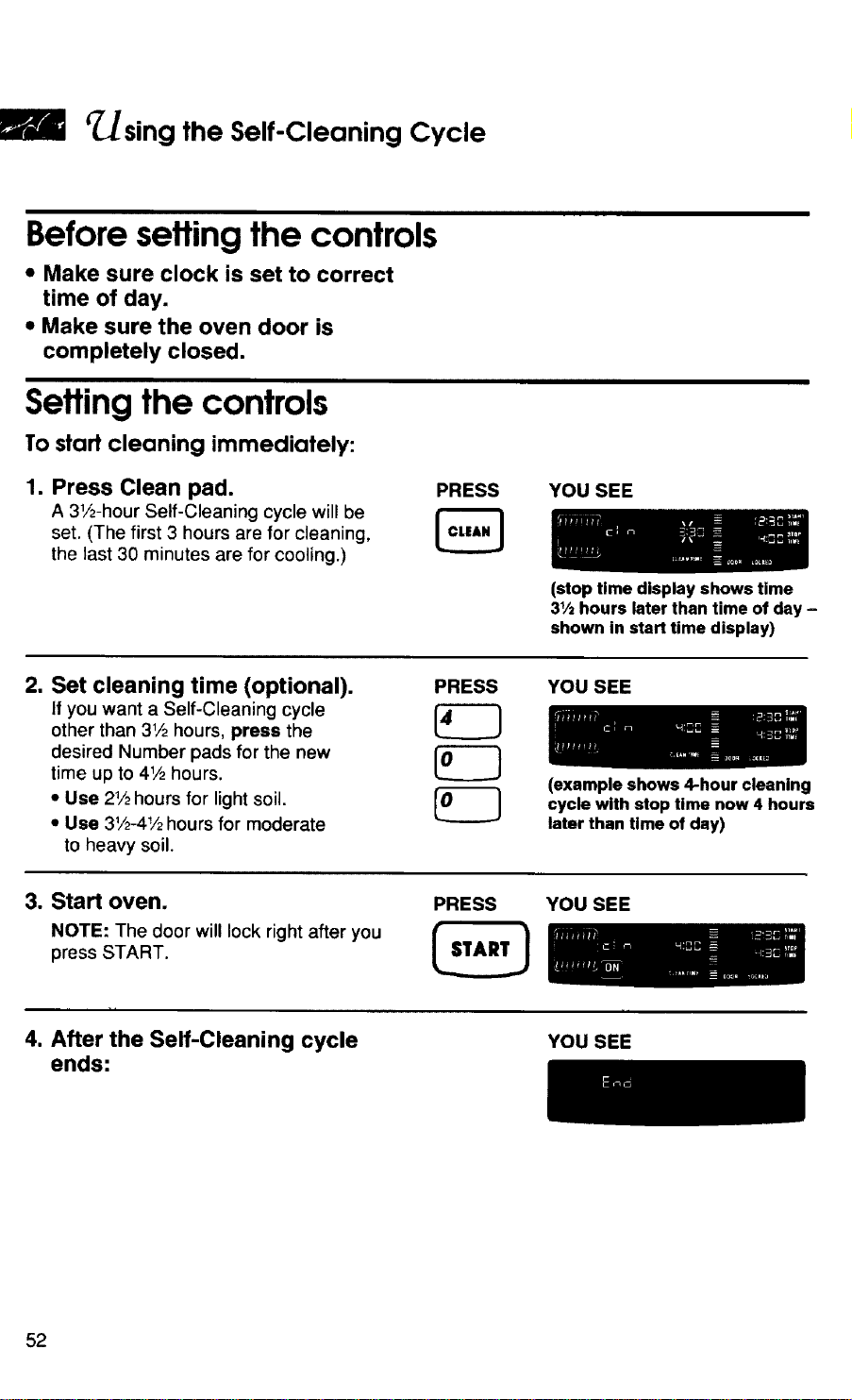
q_sing the Self-Cleaning Cycle
Before setting the controls
= Make sure clock is set to correct
time of day.
= Make sure the oven door is
completely closed.
Setting the controls
To start cleaning immediately:
1. Press Clean pad.
A 31/2-hourSelf-Cleaning cycle will be
set. (The first 3 hours are for cleaning,
the last 30 minutes are for cooling.)
PRESS YOU SEE
(stop time display shows time
3!/=hours later than time of day -
shown in start time display)
2. Set cleaning time (optional).
If you want a Self-Cleaning cycle
other than 31/2hours, press the
desired Number pads for the new
time up to 41/2hours.
• Use 21/2hours for light soil.
• Use 31/2-41/2hours for moderate
to heavy soil.
PRESS YOU SEE
(example shows 4-hour cleaning
cycle with stop time now 4 hours
later than time of day)
3. Start oven.
NOTE: The door will lock right after you
press START.
PRESS YOU SEE
4. After the Self-Cleaning cycle
ends:
YOU SEE
52
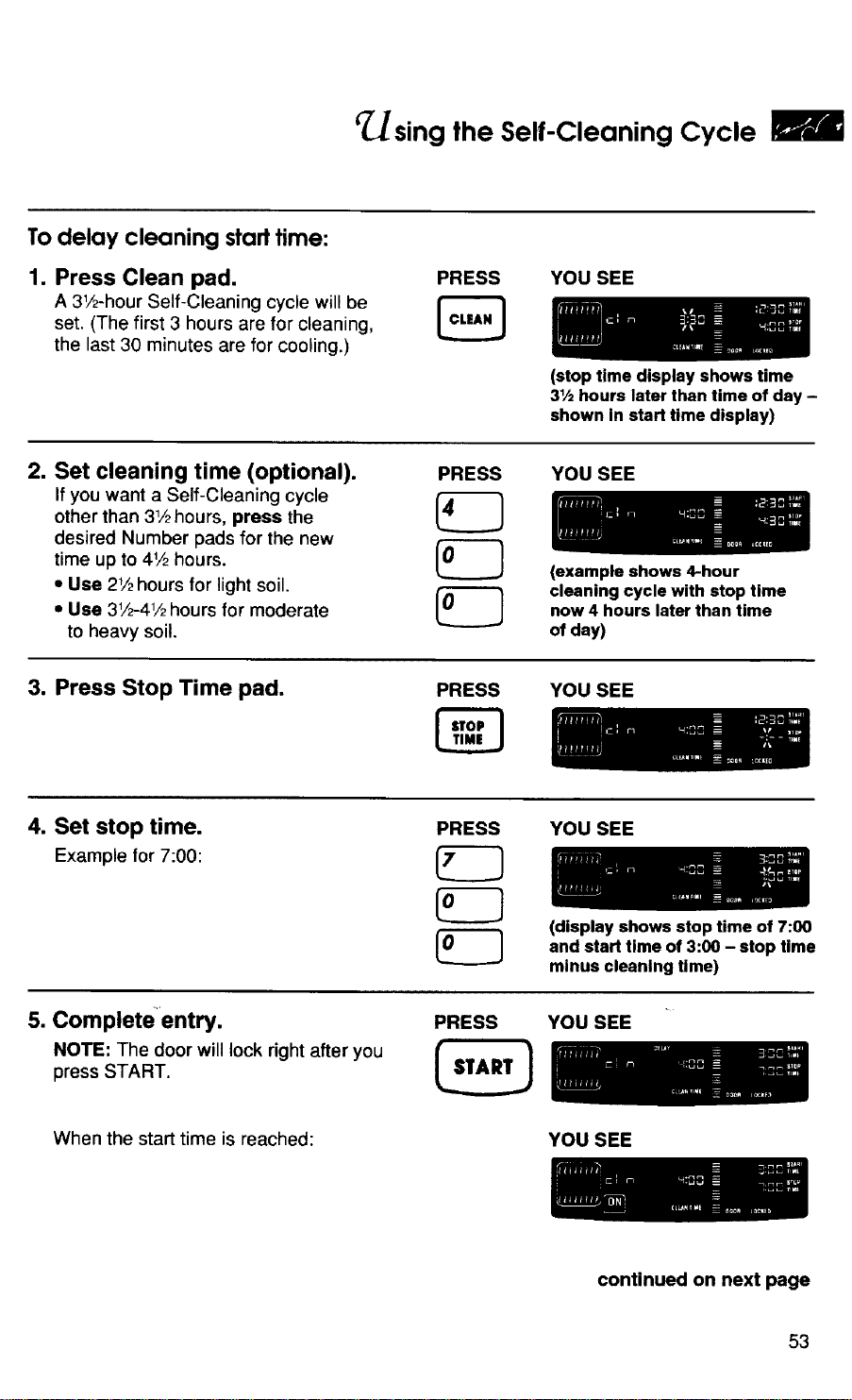
r_sing the Self-Cleaning Cycle
To delay cleaning start time:
1. Press Clean pad.
A 31/2-hourSelf-Cleaning cycle will be
set. (The first 3 hours are for cleaning,
the last 30 minutes are for cooling.)
PRESS YOU SEE
(stop time display shows time
31/2hours later than time of day -
shown in start time display)
2. Set cleaning time (optional).
if you want a Self-Cleaning cycle
other than 31/2hours, press the
desired Number pads for the new
time up to 41/2hours.
• Use 21/2hours for lightsoil,
• Use 31/2-41/2hours for moderate
to heavy soil.
PRESS YOU SEE
(example shows 4-hour
cleaning cycle with stop time
now 4 hours later than time
of day)
3. Press Stop Time pad.
PRESS YOU SEE
4. Set stop time.
Example for 7:00:
PRESS
YOU SEE
(display shows stop time of 7:00
and start time of 3:00 - stop time
minus cleaning time)
5. Complete entry.
NOTE: The door will lock right after you
press START.
PRESS YOU SEE
When the start time is reached:
YOU SEE
continued on next page
53

r_ sing the Self-Cleaning Cycle
6. After the Self-Cleaning cycle
ends:
YOU SEE
To stop the Self-Cleaning cycle at
any time:
PRESS
{c,.c.,I
YOU SEE
For best cleaning results
• After the oven cools to room tempera-
ture, wipe up any residue or ash with a
damp cloth or sponge. If any spots remain,
clean with a mild abrasive cleanser or
cleaning sponge.
• Clean the oven before it gets heavily
soiled. Cleaning a very soiled oven
takes longer and results in more smoke
than usual.
("DOOR LOCKED" will appear
if oven has not cooled down)
• If the Self-Cleaning cycle does not get
the oven as clean as you expected, the
cycle may not have been set long enough
or you may not have prepared the oven
properly. Set the Self-Cleaning cycle
longer the next time and hand-clean areas
noted on page 51.
How the cycle works
The Self-Cleaning cycle uses very high heat
to burn away soil and grease. During the
cycle, the oven gets much hotter than it does
for normal baking or broiling. This high heat £
breaks up the soil or grease and burns it away. "_
Your oven is preset for a 31/2-hourSelf- _.
Cleaning cycle. However, you can adjust the
cycle time to the amount of soil in your oven.
You can set the cycie anywhere between
21/2and 41/2hours. (See "Setting the con-
trols" on page 52.)
The graph at the right is representative of
a normal, 31/2-hourSelf-Cleaning cycle. Note
that the heating stops after 3 hours, but it
takes longer for the oven to cool enough to
unlock.
87s'F ( _o8oc)
(,_,,_ b;,_Ti,_t;,_,h;,,,3 - -_ -
®o.o..oc,\
4,== DOOR LOCKS
START 1 2 3
Time In Hours
STOP
54
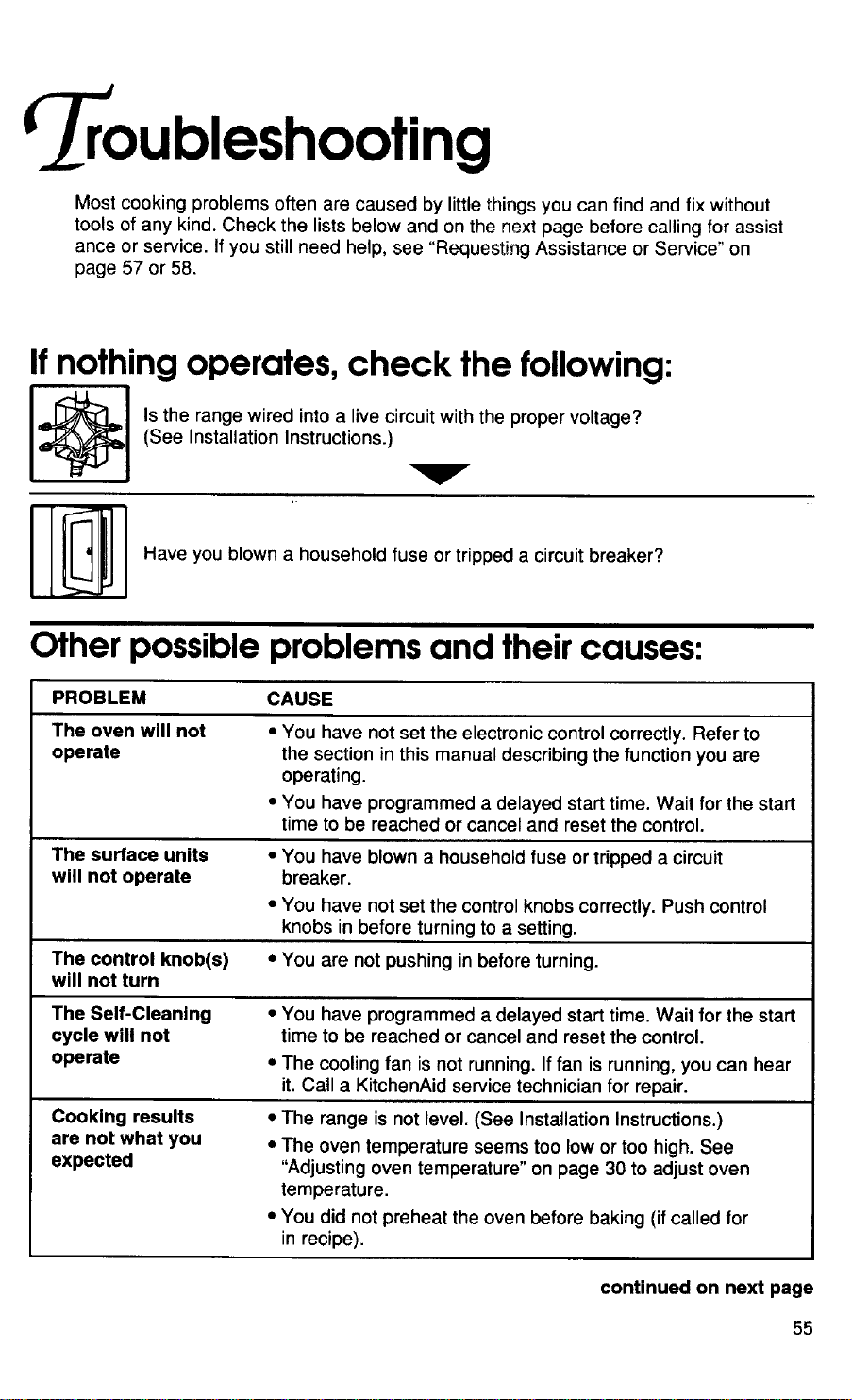
'oubleshooting
Most cooking problems often are caused by littlethings you can find and fix without
tools of any kind. Check the lists below and on the next page before calling for assist-
ance or service. If you still need help, see "Requesting Assistance or Service" on
page 57 or 58.
If nothing operates, check the following:
Is the range wired into a live circuit with the proper voltage?
(See Installation Instructions.)
Have you blown a household fuse or tripped a circuit breaker?
Other possible problems and their causes:
PROBLEM
The oven will not
operate
The surface units
will not operate
The control knob(s)
will not turn
CAUSE
• You have not set the electronic control correctly. Refer to
the section in this manual describing the function you are
operating.
• You have programmed a delayed start time. Wait for the start
time to be reached or cancel and reset the control.
• You have blown a household fuse or tripped a circuit
breaker.
• You have not set the control knobs correctly. Push control
knobs in before turning to a setting.
• You are not pushing in before turning.
The Self-Cleaning
cycle will not
operate
Cooking results
are not what you
expected
• You have programmed a delayed start time. Wait for the start
time to be reached or cancel and reset the control.
• The cooling fan is not running. If fan is running, you can hear
it. Call a KitchenAid service technician for repair.
• The range is not level. (See Installation Instructions.)
• The oven temperature seems too low or too high. See
"Adjusting oven temperature" on page 30 to adjust oven
temperature.
• You did not preheat the oven before baking (if called for
in recipe).
continued on next page
55
Troubleshooting
PROBLEM CAUSE
Cooking results
are not what you
expected
(continued)
• The recipe you are using may need to be altered to
improve the taste or appearance of the food.
• You are using a pan that is not the correct type or size.
Refer to a reliable cookbook or recipe for recommended
pan type and size.
• There is not enough air space around pan when baking.
Allow 11/2to 2 inches (4-5 cm) of air space on all sides
of pan.
• The cookware is too large or too small for the surface
unit being used. Pan should be the same size or slightly
larger than the surface unit being used.
The display is • There has been a power failure. Reset the clock.
showing"PF" (See page 22.)
A letter followed by a • Press CANCEL/OFF. If the code does not disappear, call
number shows on the for service. (See Step 2 on page 57 or 58.)
display (for example
"E3", "F1")
The key pads do not • The Control Lock has been set. (See "Using the control
operate lock"on page 19.) Turn off the Control Lock by pressing
and holdingthe Control Lock pad (Number Pad 3) for
5 seconds.
• The Sabbath mode has been set ("SAbb" appears on the
display). Turn off the Sabbath mode by opening the oven
door, waiting up to 15 seconds, and pressing and holding
Number Pad 6 for 5 seconds.
• The range is not grounded. Call the KitchenAid service
technician to ground the range.
If none of these items was causing your problem, see "Requesting Assistance or Service" on
page 57 or 58.
56
_ questing Assistance or
Service
Before calling for assistance or service, please check the "Troubleshooting" section.
It may save you the cost of a service call. If you still need help, follow the instructions
below.
If you need assistance or service in the U.S.A.:
I. If the problem is not due to one
of the items listed in "Trouble-
shooting" on pages 55-56t:
• Call the KitchenAid Consumer Assistance
Center:
_ -800-422-1230
One of our trained consultants
can instructyou in how to ob-
tain satisfactory operation from
your appliance or, if service is necessary,
recommend a qualified service company
in your area.
• If you prefer, write to:
KitchenAid Brand Home Appliances
Consumer Assistance Center
c/o Correspondence Dept.
2000 North M-63
Benton Harbor, MI 49022-2692
Please include a daytime phone number in
your correspondence.
2. If you need servicet:
• Call your dealer or the repair service he
recommends.
• All service should be handled
locally by the dealer from whom
you purchased the unit or an
authorized KitchenAid servicer.
• If you are unable to obtain the name of
a local authorized KitchenAid servicer,
call our Consumer Assistance Center
telephone number (see Step 1).
3. If you are not satisfied with the
action taken:
• Contact the Major Appliance Consumer
Action Program (MACAP). MACAP is a
group of independent consumer experts
that voices consumer views at the highest
levels of the major appliance industry.
• Contact MACAP only when the dealer,
authorized servicer, and KitchenAid have
failed to resolve your problem.
Major Appliance Consumer Action Program
20 North Wacker Drive
Chicago, IL 60606
• MACAP will in turn inform us of your action.
t When asking for help or service:
Please provide a detailed description
of the problem, your appliance's
complete model and serial numbers,
and the purchase date. (See page 3.)
This information will help us respond
properly to your request.
57
_questing Assistance or Service
Ifyou need assistance or service in Canada:
I. If the problem is not due to
one of the items listed in
"Troubleshooting"t...
Contact the dealer from whom you
_ urchased your appliance,
or call the KitchenAid Canada
Consumer Assistance Centre
toll free, 8:30 a.m. - 6 p.m.
(EST), at 1-800-461-5681.
Please include a daytime phone number in
your correspondence.
2. If you need service t...
Contact your nearest KitchenAid Canada
Appliance Service branch or authorized
servicing outlet to service your appliance.
See list below.)
t When asking for help or service:
Please provide a detailed description
of the problem, your appliance's
complete model and serial numbers,
and the purchase date. (See page 3.)
This informationwill help us respond
properly to your request.
KitchenAid Canada Appliance Service - Consumer Services
Direct service branches:
BRITISH COLUMBIA 1-800-665-6788
ALBERTA 1-800-661-6291
ONTARIO Ottawa area 1-800-267-3456
(except 807 area code) Outside the Ottawa area 1-800-807-6777
MANITOBA, SASKATCHEWAN 1-800-665-1683
and 807 area code In ONTARIO
QUEBEC Montreal (except South Shore) 1-800-361-3032
South Shore Montreal 1-800-361-0950
Quebec City 1-800-463-1523
Sherbrooke 1-800-567-6966
ATLANTIC PROVINCES 1-800-565-1598
58
questing Assistance or Service
Forfurther assistance
If you need further assistance, you can write
to KitchenAid Canada with any questions or
concerns at:
Consumer Relations Department
KitchenAid Canada
1901 Minnesota Court
Mississauga, Ontario L5N 3A7
Please include a daytime phone number in
your correspondence.
Don't forget, KitchenAid offers a full line of quality home appliances.
Built-In Refrigerators Trash Compactors Ranges & Cooktops
Freestanding Refrigerators Hot Water Dispensers Microwave Ovens
50-Pound Ice Makers Food Waste Disposers Washers & Dryers
Dishwashers Built-In Ovens Mixers & Blenders
For more information on these appliances, or the one you have purchased, call our toll-
free Consumer Assistance Center telephone number, 1-800-422-1230 (in U.S.A.), or
contact your authorized KitchenAid Canada Appliance Service branch (in Canada).
59

.._tes
60

_tes
61
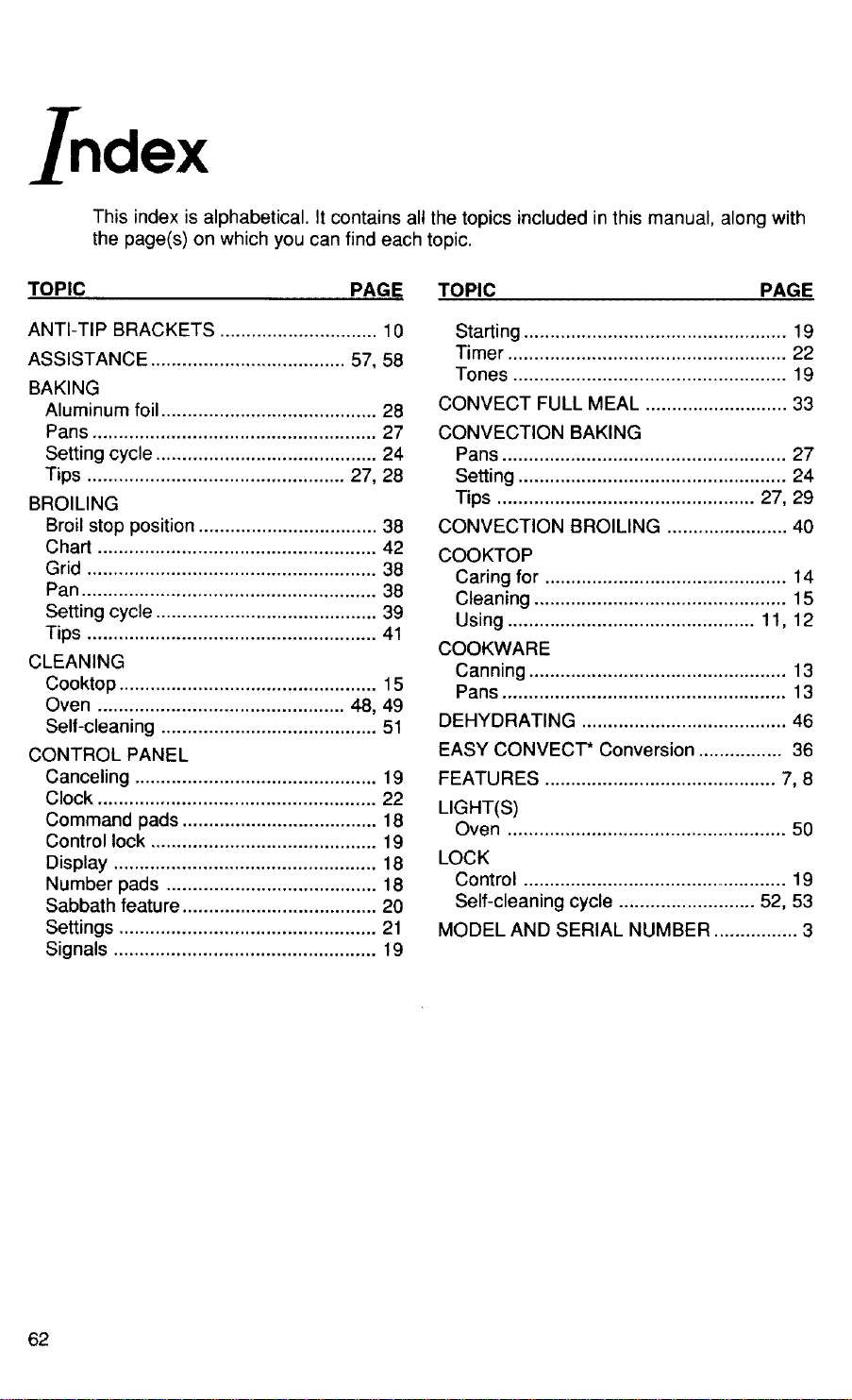
Index
This index is alphabetical. It contains all the topics included in this manual, along with
the page(s) on which you can find each topic.
TOPIC PAGE TOPIC PAGE
ANTI-TIP BRACKETS .............................. 10
ASSISTANCE ..................................... 57, 58
BAKING
Aluminum foil ......................................... 28
Pans ...................................................... 27
Setting cycle .......................................... 24
Tips ................................................. 27, 28
BROILING
Broil stop position .................................. 38
Chart ..................................................... 42
Grid ....................................................... 38
Pan ........................................................ 38
Setting cycle .......................................... 39
Tips ....................................................... 41
CLEANING
Cooktop ................................................. 15
Oven ............................................... 48, 49
Self-cleaning ......................................... 51
CONTROL PANEL
Canceling .............................................. 19
Clock ..................................................... 22
Command pads ..................................... 18
Control lock ........................................... 19
Display .................................................. 18
Number pads ........................................ 18
Sabbath feature ..................................... 20
Settings ................................................. 21
Signals .................................................. 19
Starting .................................................. 19
Timer ..................................................... 22
Tones .................................................... 19
CONVECT FULL MEAL ........................... 33
CONVECTION BAKING
Pans ...................................................... 27
Setting ................................................... 24
Tips ................................................. 27, 29
CONVECTION BROILING ....................... 40
COOKTOP
Caring for .............................................. 14
Cleaning ................................................ 15
Using ............................................... 11, 12
COOKWARE
Canning ................................................. 13
Pans ...................................................... 13
DEHYDRATING ....................................... 46
EASY CONVECT* Conversion ................ 36
FEATURES ............................................ 7, 8
LIGHT(S)
Oven ..................................................... 50
LOCK
Control .................................................. 19
Self-cleaning cycle .......................... 52, 53
MODEL AND SERIAL NUMBER ................ 3
62
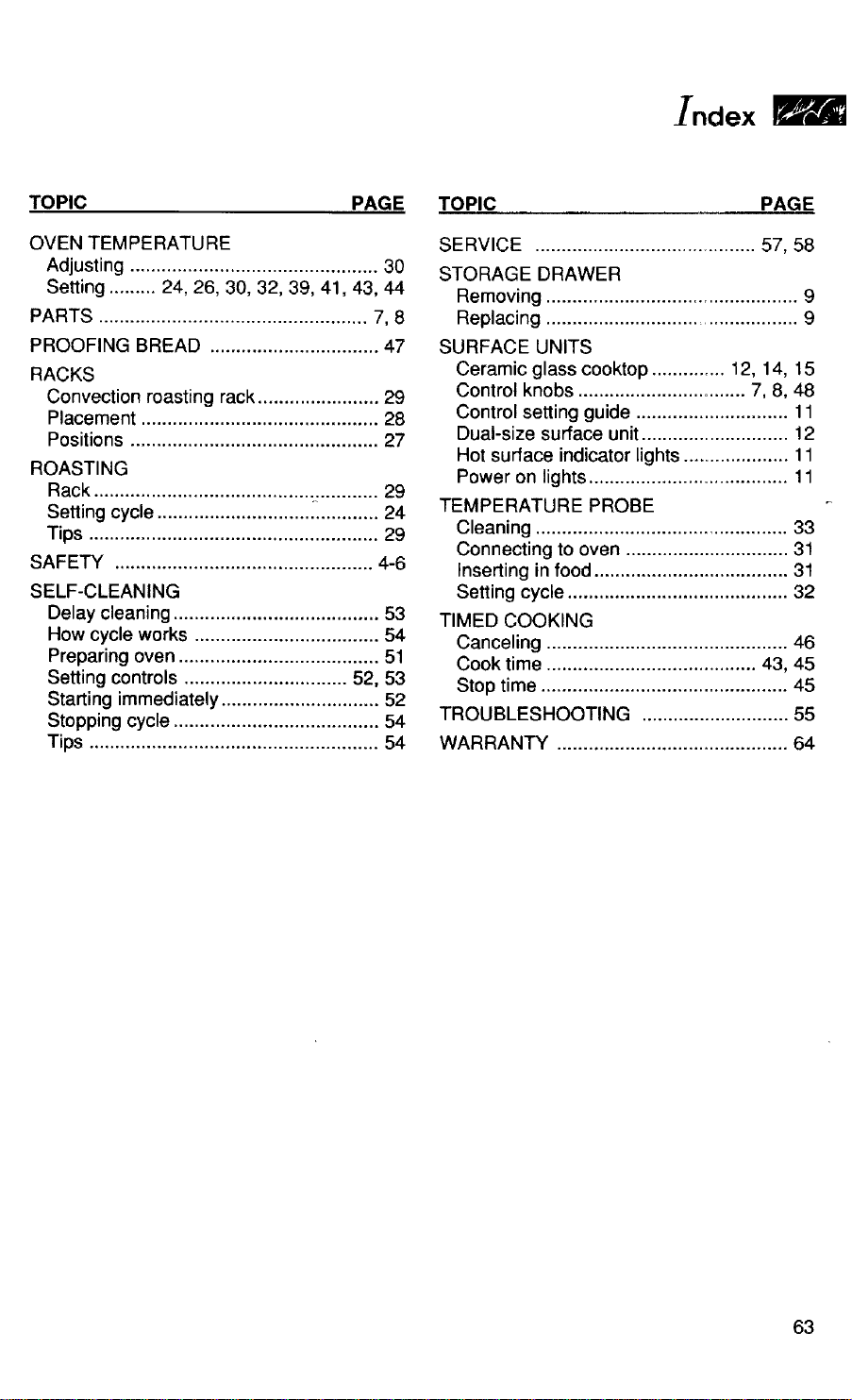
ndex
TOPIC PAGE TOPIC PAGE
OVEN TEMPERATURE
Adjusting ............................................... 30
Setting ......... 24, 26, 30, 32, 39, 41,43, 44
PARTS ................................................... 7, 8
PROOFING BREAD ................................ 47
RACKS
Convection roasting rack ....................... 29
Placement ............................................. 28
Positions ............................................... 27
ROASTING
Rack ...................................................... 29
Setting cycle ............................. _i........... 24
Tips ....................................................... 29
SAFETY ................................................. 4-6
SELF-CLEANING
Delay cleaning ....................................... 53
How cycle works ................................... 54
Preparing oven ...................................... 51
Setting controls ............................... 52, 53
Starting immediately .............................. 52
Stopping cycle ....................................... 54
Tips ....................................................... 54
SERVICE ......................................... 57, 58
STORAGE DRAWER
Removing ................................................ 9
Replacing ................................................ 9
SURFACE UNITS
Ceramic glass cooktop .............. 12, 14, 15
Control knobs ................................ 7, 8, 48
Control setting guide ............................. 11
Dual-size surface unit ............................ 12
Hot surface indicator lights .................... 11
Power on lights ...................................... 11
TEMPERATURE PROBE
Cleaning ................................................ 33
Connecting to oven ............................... 31
Inserting in food ..................................... 31
Setting cycle .......................................... 32
TIMED COOKING
Canceling .............................................. 46
Cook time ........................................ 43, 45
Stop time ............................................... 45
TROUBLESHOOTING ............................ 55
WARRANTY ............................................ 64
63

Kitchen kid*
Electric Range
arranty
LENGTH OF KITCHENAID KITCHENAID
WARRANTY: WILL PAY FOR: WILL NOT PAY FOR:
ONE-YEAR FULL
WARRANTY
FROM DATE OF
PURCHASE.
SECOND-
THROUGH FIFTH-
YEAR LIMITED
WARRANTY
FROM DATE OF
PURCHASE.
SECOND-
THROUGH TENTH-
YEAR LIMITED
WARRANTY
FROM DATE OF
PURCHASE.
Replacement parts
and repair labor costs
to correct defects in
materials or workman-
ship. Service must be
provided by an autho-
rized KitchenAid
servicing outlet.
Replacement parts for
any electric element
to correct defects in
materials or workman-
ship. Replacement
ceramic glass if
breakage is due to
defects in materials
or workmanship.
Replacement parts for
solid state touch control
system to correct
defects in materials or
workmanship.
Replacement parts for
the porcelain oven
cavity/inner door if the
part rusts through due
to defects in materials
or workmanship.
A. Service calls to:
1. Correct the installation of the
range.
2. Instruct you how to use the
range.
3. Replace house fuses or correct
house wiring.
B. Repairs when range is used in other
than normal home use.
C. Damage resulting from accident,
alteration, misuse, abuse, improper
installation, or installation not in
accordance with local electrical
codes.
D. Any labor costs during the limited
warranties.
E. Replacement parts or repair labor
costs for units operated outside the
United States and Canada.
F. Pickup and delivery. This product
is designed to be repaired in the
home.
G. Repairs to ceramic glass cooktop if
it has not been cared for as recom-
mended in this Use and Care Guide.
H. Repairs to parts or systems caused
by unauthorized modifications made
to the appliance. 7Jgs
KITCHENAID DOES NOT ASSUME ANY RESPONSIBILITY FOR INCIDENTAL OR
CONSEQUENTIAL DAMAGES. Some states or provinces do not allow the exclusion or
limitation of incidental or consequential damages, so this exclusion or limitation may not apply
to you. This warranty gives you specific legal rights, and you may also have other rights
which vary from state to state or province to province.
Outside the United States and Canada, a different warranty may apply. For details,
please contact your authorized KitchenAid dealer.
If you need service, first see the "Troubleshooting" section of this book. After checking
"Troubleshooting," additional help can be found by checking the "Requesting Assistance
or Service" section or by calling our Consumer Assistance Center telephone number,
1-800-422-1230, from anywhere in the U.S.A. In Canada, call KitchenAid Canada at one
of the telephone numbers listed on page 58.
KitchenAid
Benton Harbor, Michigan 49022-2692 U.S.A.
PART NO. 9751685 Rev. E • R_i_e,,_T_e_._T,_rn_rkofKitche,Ai,_.U.S.A; 9t_
© 1996 KitchenA_ KitchanAid Canada, Licensee in Canada. Printed in Canada