
De’Longhi Appliances via Seitz, 47 31100 Treviso Italia www.delonghi.com
5721010572_00_0321
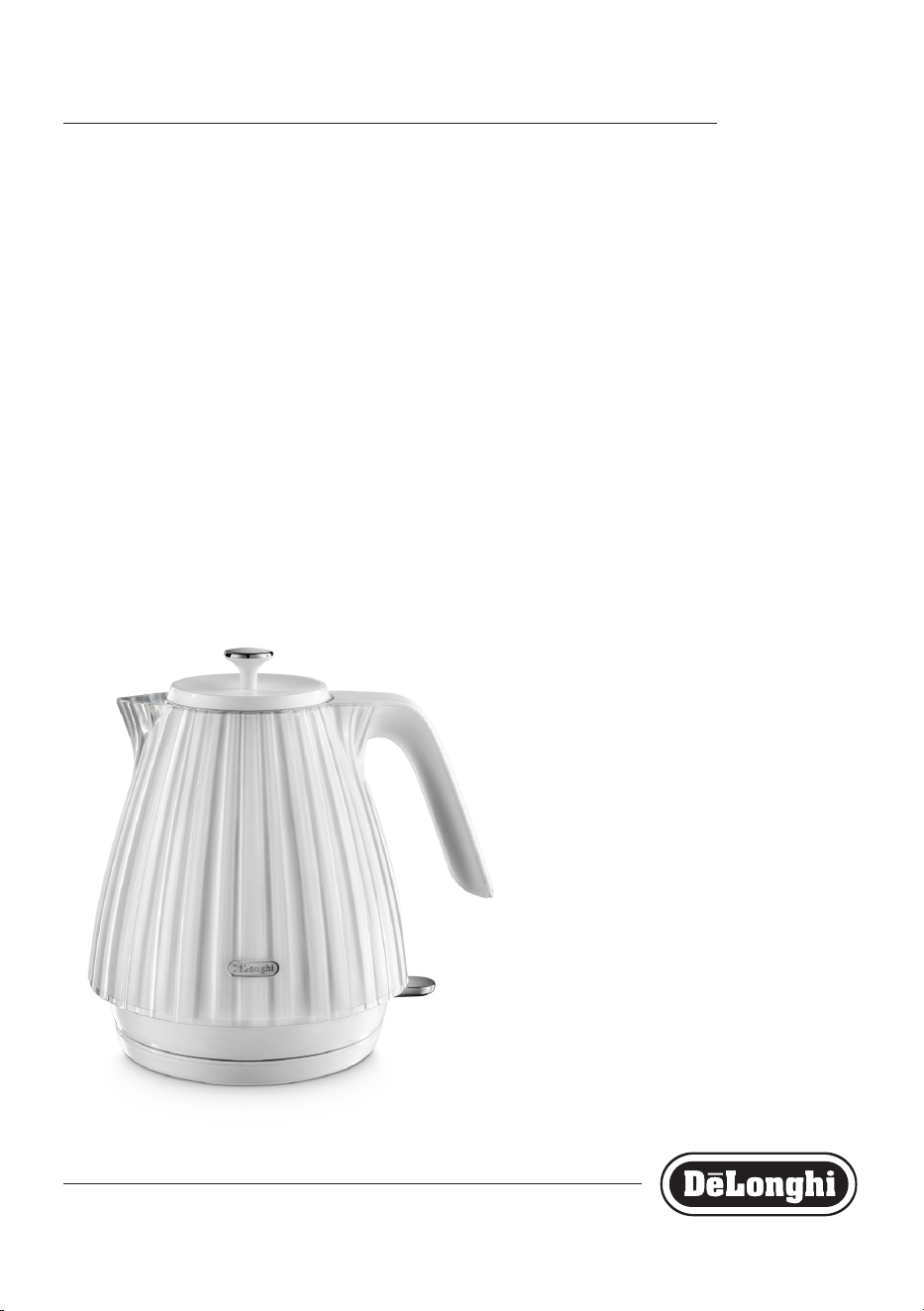
KBD2001
غلاية لامعتسا تاداشرإ
KBZ2001
BOLLITORE
Istruzioni per l’uso
BOLLITORE
KETTLE
BOUILLOIRE
WASSERKOCHER
WATERKOKER
HERVIDOR
JARRO
ΒΡΑΣΤΗΡΑΣ
ЭЛЕКТРИЧЕСКИЙ ЧАЙНИК
ШӘЙНЕК
VÍZFORRALÓ KANNA
VARNÁ KONVICE
VARNÁ KANVICA
CZAJNIK ELEKTRYCZNY
VANNKOKER
VATTENKOKARE
VANDKOGER
VEDENKEITIN
KUHALO
GRELNIK VODE
ЕЛЕКТРИЧЕСКА КАНА
FIERBĂTOR
SU ISITICISI
یرتک
2
ELECTRICAL CONNECTION (UK ONLY)
A) If your appliance comes tted with a plug, it will incorporate a 13 Amp fuse. If it does not t your socket, the plug should be
cut o from the mains lead, and an appropriate plug tted, as below. WARNING: Very carefully dispose of the cut o plug
after removing the fuse: do not insert in a 13 Amp socket elsewhere in the house as this could cause a shock hazard.
With alternative plugs not incorporating a fuse, the circuit must be protected by a 15 Amp fuse. If the plug is a moulded-on
type, the fuse cover must be re-tted when changing the fuse using a 13 Amp Asta approved fuse to BS 1362. In the event
of losing the fuse cover, the plug must NOT be used until a replacement fuse cover can be obtained from your nearest
electrical dealer. The colour of the correct replacement fuse cover is that as marked on the base of the plug.
B) If your appliance is not tted with a plug, please follow the instructions provided below:
WARNING - THIS APPLIANCE MUST BE EARTHED
IMPORTANT
The wires in the mains lead are coloured in accordance with the following code:
Green and yellow: Earth
Blue: Neutral
Brown: Live
As the colours of the wires in the mains lead may not correspond with the coloured markings identifying the terminals in your
plug, proceed as follows:
The green and yellow wire must be connected to the terminal in the plug marked with the letter E or the earth symbol or
coloured green or green and yellow. The blue wire must be connected to the terminal marked with the letter N or coloured black.
The brown wire must be connected to the terminal marked with the letter L or coloured red.
IT
EN
FR
DE
NL
ES
pag. 4 page 8 page 11 S.15 pag. 19 pág. 23
PT
EL
RU
KZ
HU
CS
pág. 27 σελ. 31 стр. 35 Бет. 39 old. 44 str. 48
SK
PL
NO
SV
DA
FI
str. 52 str. 56 sid. 60 sid. 64 sid. 68 siv. 72
HR
SL
BG
RO
TR
IR
str. 76 str. 79 стр. 83 pag. 87 Sey. 91 6
AR
2
ةحفص( زاهجلا فصو عم هقافرإ مت يذلا
3
A
B
C
D
E
F
21
4
3
5
4
5
AVVERTENZE IMPORTANTI
Avvertenze per la sicurezza
Pericolo!
La mancata osservanza può essere causa di lesioni da scossa
elettrica con pericolo per la vita.
- Evitare versamenti sul connettore.
Attenzione!
La mancata osservanza può essere o è causa di lesioni o di danni
all’apparecchio.
- L’apparecchio è destinato esclusivamen-
te alla bollitura di acqua.
Qualunque altro utilizzo è da considerar-
si improprio e dunque pericoloso. Il pro-
duttore declina ogni responsabilità per
eventuali danni provocati da un utilizzo
inadeguato, improprio o irresponsabile
e/o per riparazioni eettuate da perso-
nale non autorizzato.
- Questo apparecchio è destinato esclusi-
vamente all’uso domestico. Ne è previsto
l’uso anche in ambienti adibiti a cucina
per il personale di negozi, uci e altre
aree di lavoro, agriturismi, hotel, motel
o altre strutture ricettive e attacame-
re. Copia di questo manuale dev’essere
sempre disponibile all’utente nale e al
personale addetto alla manutenzione.
- Questo apparecchio può essere utilizzato
da bambini di età compresa dagli 8 anni
in su e da persone con ridotte capacità
siche, sensoriali o mentali o mancanza
di esperienza e conoscenza, a condizio-
ne che siano attentamente sorvegliate e
istruite riguardo l’uso in sicurezza dell’
apparecchio e siano consapevoli dei ri-
schi connessi. I bambini non devono gio-
care con l’apparecchio.
Pulizia e manutenzione da parte dell’u-
tente non deve essere eseguita da
bambini a meno che non siano di età
superiore a 8 e siano sorvegliati. Tenete
l’apparecchio e il cavo lontano dalla por-
tata dei bambini sotto gli 8 anni di età.
- Il cavo di alimentazione di questo appa-
recchio non deve essere sostituito dall’u-
tente in quanto tale operazione richiede
l’utilizzo di particolari utensili. In caso di
danneggiamento del cavo, o per la sua
sostituzione, rivolgersi esclusivamente
a un Centro di Assistenza autorizzato dal
costruttore.
- Usare il bollitore solo con la base elettrica
fornita (e vice versa).
- Non usare il bollitore su un piano inclina-
to.
- Non utilizzare il bollitore a meno che l’e-
lemento sia completamente immerso.
- Per evitare danni all’apparecchio non uti-
lizzare detergenti alcalini per la pulizia.
Utilizzare un panno morbido e un deter-
gente delicato.
- Non utilizzare l’apparecchio ad un’altitu-
dine superiore ai 2000m.
- Per la pulizia dell’apparecchio fare riferi-
mento al relativo paragrafo.
Pericolo di scottature!!
In caso di mancata osservanza, possibili ustioni o scottature.
- Non rimuovere il coperchio durante la
bollitura.
- Se il bollitore viene riempito eccessiva-
mente potrà esserci tracimazione di ac-
qua bollente.
- La supercie dell’elemento riscaldante è
soggetta a calore residuo dopo l’uso.
Nota:
Questo simbolo segnala raccomandazioni e informazioni impor-
tanti per l’utente.
- Non spostare mai il bollitore quando è in
funzione.
5
Pericolo!
La mancata osservanza può essere causa di lesioni da scossa
elettrica con pericolo per la vita.
- Per evitare rischi elettrici, non immergere le parti elettri-
che, la base contenente la spina o il bollitore in acqua o in
altro liquido.
Non usare in bagno o vicino a qualsiasi sorgente d’acqua.
Non usare all’esterno.
- Rimuovere la spina dalla presa elettrica quando non in uso
e prima di eettuare la pulizia. Lasciar rareddare il bolli-
tore prima di procedere alla pulizia.
- Non usare con mani bagnate.
- Non riporre alcunché all’interno del bollitore.
- L’uso di accessori non indicati dal costruttore potrebbe cau-
sare incendi, scosse elettriche o ferite.
Attenzione!
La mancata osservanza può essere o è causa di lesioni o di danni
all’apparecchio.
- Prestare attenzione quando si versa, non inclinare troppo
il bollitore. L’acqua potrebbe penetrare nel meccanismo di
accensione.
- È necessaria un’attenta sorveglianza qualora l’apparecchio
venga usato vicino a un bambino.
- Non usare il bollitore in caso di danneggiamento delle parti
elettriche o della spina, in caso di cattivo funzionamento
del bollitore o di un suo guasto. Per evitare qualsiasi tipo di
pericolo portare l’apparecchio presso un Centro di Assisten-
za autorizzato per eventuali riparazioni o sostituzioni.
Pericolo di scottature!!
In caso di mancata osservanza, possibili ustioni o scottature.
- Non toccare le parti calde, come il corpo o il coperchio del
bollitore. Utilizzare manici e manopole.
- All’interno del bollitore l’acqua si mantiene calda a lungo
anche dopo la fase di bollitura, potendo presentare rischi
di ustione. Si raccomanda di tenere il bollitore lontano dal
bordo del piano di lavoro e dalla portata dei bambini.
- Fare attenzione che le parti elettriche del bollitore non
sporgano dal bordo del tavolo o dalla supercie di lavoro.
- Evitare il contatto con il vapore che fuoriesce dal beccuccio
quando si versa e che fuoriesce dal coperchio e beccuccio in
fase di riempimento.
- Non avvicinare il bollitore, la base elettrica e le parti elettri-
che a ripiani caldi, piani di cottura o fornelli.
Nota:
Questo simbolo segnala raccomandazioni e informazioni impor-
tanti per l’utente.
- Prima di riempire il bollitore, rimuoverlo dalla sua base.
- Non usare il bollitore per usi diversi dallo scaldare l’acqua.
- De’Longhi declina qualunque responsabilità in caso di uso
improprio dell’apparecchio o di mancata osservanza delle
presenti istruzioni.
- Non usare il bollitore senza il coperchio e il ltro. (il bollitore
potrebbe non spegnersi).
- Posizionare il bollitore in modo corretto nella sua base pri-
ma di accenderlo.
I materiali e gli accessori destinati al contatto con gli
alimenti sono conformi al Regolamento (CE) 1935/2004.
Smaltimento dell’apparecchio
Non smaltire l’apparecchio insieme ai riuti domestici
ma consegnatelo ad un centro di raccolta dierenziata
uciale.
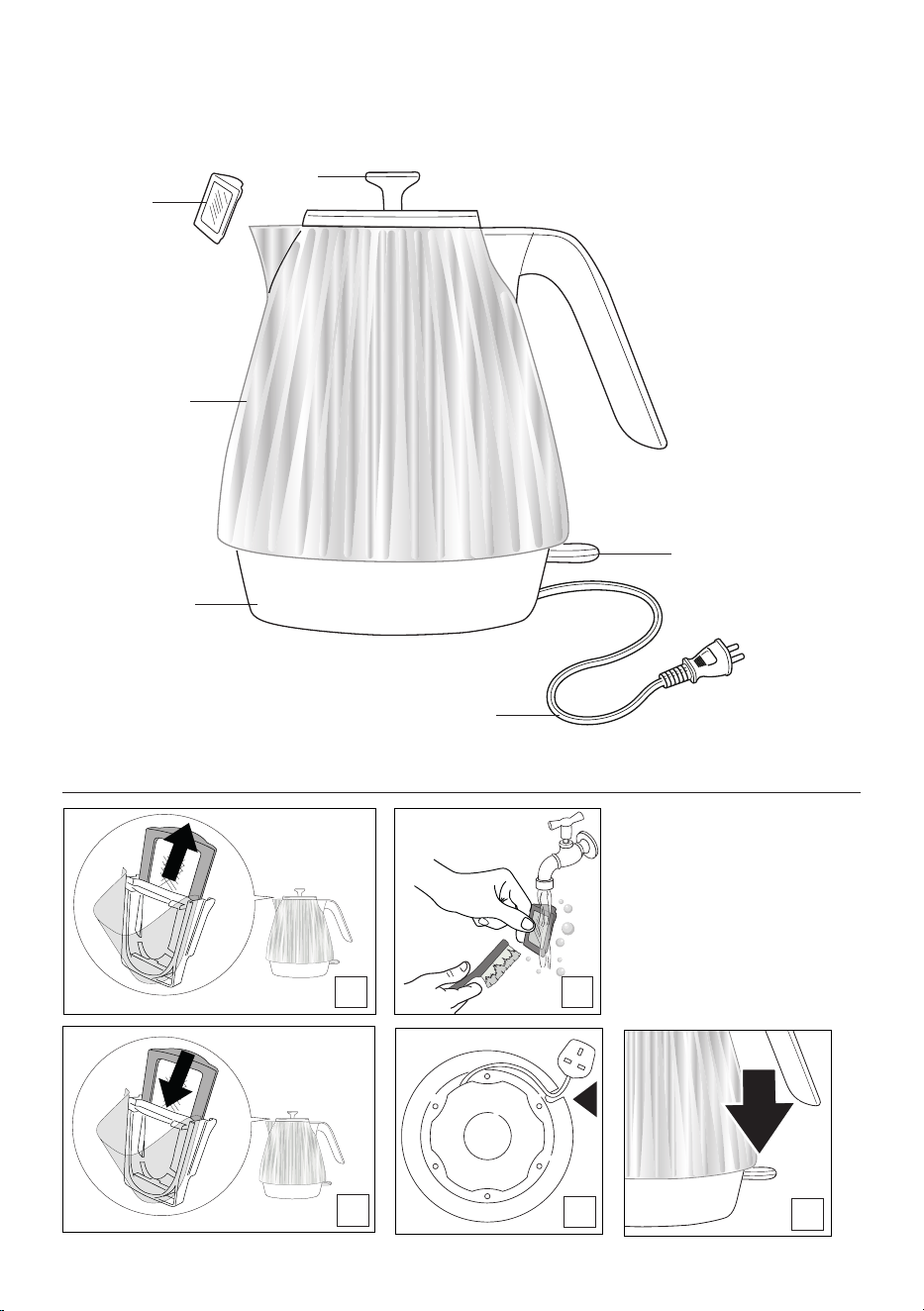
DESCRIZIONE
A Filtro amovibile
B Coperchio amovibile
C Corpo del bollitore
D Pulsante di accensione/spegnimento
E Base elettrica a 360° con avvolgicavo
F Spina
USO
Prima dell’uso
- Rimuovere l’involucro del bollitore e della base elettrica.
- Non lasciare che i bambini giochino con i sacchetti di plasti-
ca per evitare il pericolo di soocamento.
- Rimuovere qualsiasi etichetta dalle superci esterne in ac-
ciaio.
- Rimuovere il ltro (g.1) e lavarlo con acqua (g.2). Vedi
“Rimozione del ltro anticalcare”.
- Riempire d’acqua il bollitore no al livello massimo (MAX) e
portare ad ebollizione.
- Gettare l’acqua e risciacquare il bollitore con acqua fredda.
Eseguire questa operazione per tre volte per rimuovere
qualsiasi residuo di lavorazione, ecc.
- Dopo aver sciacquato il bollitore, reintrodurre il ltro (g.3).
Uso del bollitore
Con la speciale base elettrica e il connettore centrale, potrete
mettere il bollitore sulla base con qualsiasi angolatura e da qual-
siasi posizione.
- Tirare dalla base avvolgicavo il lo e regolarne la lunghezza
per raggiungere la presa che si intende usare (g.4).

6
7
- Non lasciare penzolare il cavo di alimentazione dal bordo
del tavolo e non fargli toccare superci calde (esempio: la
parte superiore B).
Riempimento
- Prima di riempire, rimuovere il bollitore dalla sua base.
- Togliere il coperchio e riempire il bollitore no al livello de-
siderato.
Riempire sempre oltre i 0,3 litri di acqua per evitare
che il bollitore rimanga senza acqua durante l’uso; un uso
scorretto in questo senso limita la durata dell’apparecchio.
Non riempire oltre i 1.7 litri di acqua (no al livello
MAX).
Nel caso di un eccessivo riempimento, vi è il rischio
che l’acqua durante la fase di bollitura fuoriesca e
causi ustioni.
Accensione
- Inserire la spina nella presa
- Posizionare il bollitore sulla base elettrica
- Abbassare il pulsante di accensione ON/OFF (g.5) per ac-
cendere il bollitore.
- Si accende la spia luminosa.
- Il bollitore si spegne automaticamente quando l’acqua è
in ebollizione (il pulsante di accensione ON/OFF scatta e la
spia si spegne).
- Per spegnere il bollitore prima che l’acqua bolla spostare
il pulsante di accensione nella posizione OFF o, semplice-
mente, rimuovere il bollitore dalla sua base. L’apparecchio
si spegnerà e il pulsante di accensione tornerà automatica-
mente nella posizione OFF.
Versamento
- Rimuovere il bollitore dalla sua base elettrica e versare
attentamente l’acqua. Non inclinare improvvisamente il
bollitore e non inclinare eccessivamente.
- Quando si toglie il bollitore dalla base, potreste vedere
dell’umidità sulla supercie superiore della base.
Il vapore fuoriesce tramite un piccolo foro posto nella parte
inferiore del bollitore. La condensa sulla base è perfetta-
mente normale e non deve preoccupare.
Nota: svuotare il bollitore dopo ogni utilizzo. risciacquare
il bollitore con acqua se non lo si è utilizzato da più di due giorni.
Per ridurre il consumo energetico e lo spreco d’acqua, usate solo
la quantità d’acqua che eettivamente vi serve.
DISPOSITIVI DI SICUREZZA
1) Pulsante di accensione automatico ON/OFF:
Questo bollitore ha un pulsante di accensione ON/OFF che
permette lo spegnimento automatico quando l’acqua ha
raggiunto l’ebollizione.
Prima di far bollire nuovamente l’acqua, attendere circa un
minuto. Non tentare di mantenere il pulsante di accensione
ON/OFF nella posizione ON o di regolarne il meccanismo.
2) Interruzione di sicurezza:
Se il bollitore viene acceso con troppo poca o addirittura
senza acqua, è protetto da un sistema di sicurezza che in-
terromperà l’alimentazione elettrica.
In un simile caso, disconnettere il bollitore dalla rete elettri-
ca e lasciare rareddare prima di riempire con acqua fredda
(in caso contrario l’apparecchio potrebbe danneggiarsi).
3) Il bollitore si spegnerà automaticamente se lasciato acceso
(ON) sulla sua base.
MANUTENZIONE
Pulizia del bollitore
- Prima di procedere alla pulizia, lasciare rareddare comple-
tamente e scollegare l’apparecchio dalla rete elettrica
- Non immergere il bollitore o la base in acqua.
- Per mantenere inalterata la preziosa nitura dell’appa-
recchio, si consiglia di pulire l’esterno del bollitore con un
panno umido e acqua.
- NON usare spugnette metalliche liquidi inammabili o
agenti smacchianti e corrosivi.
- Assicurarsi che i connettori e le prese rimangano asciutti.
Incrostazioni
Quando si riscalda l’acqua, i minerali in essa contenuti si solidi-
cano rendendola opaca.
Quando noterete il formarsi di una pellicola sull’acqua e, duran-
te la pulizia del ltro, troverete del calcare sulle pareti o sulle
componenti, procedere con la decalcicazione del bollitore e del
ltro.
Filtro anticalcare
Questo bollitore ha un ltro calcare che impedisce che le par-
ticelle di calcare vengano versate nelle bevande. Il ltro si può
rimuovere e lavare. Il ltro dovrà essere rimosso e pulito non
appena vi noterete dei depositi o nel caso in cui diminuisca l’ef-
cienza nel versamento.
Rimozione del ltro anticalcare
- Lasciare completamente rareddare il bollitore
- Scollegare l’apparecchio dalla rete elettrica
- Assicurarsi che le vostre mani siano pulite e prive di residui

7
di sapone, crema o di altri prodotti che potrebbero inquina-
re l’acqua.
- Svuotare il bollitore e rimuovere il ltro (g.1).
- Risciacquare sotto il rubinetto spazzolando con uno spazzo-
lino a setole morbide (g.2).
- Riposizionare il ltro (g.3). Il ltro può rapprensentare
un pericolo di soocamento, non lasciarlo incustodi-
to dopo averlo pulito.
Pulizia del bollitore e del ltro
E’ molto importante pulire e togliere regolarmente il calcare per
mantenere un buon funzionamento dell’apparecchio.
Un accumulo eccessivo di calcare può compromettere il buon
funzionamento dell’apparecchio e va pertanto evitato.
- Usare un prodotto decalcicante adatto per bollitori (si
consiglia a base di acido citrico). Quando il calcare comincia
a depositarsi sulla resistenza, acquistare un decalcicante
adatto ed eettuare la decalcicazione seguendo le istru-
zioni allegate al decalcicante.
- A decalcicazione avvenuta, far bollire acqua fresca e
risciacquare accuratamente il bollitore per eliminare com-
pletamente qualsiasi residuo di decalcicante che potrebbe
danneggiare l’apparecchio. Ripetere questa operazione per
almeno tre volte.
- Nel caso in cui i ltro necessiti di una pulizia anticalcare,
rimuoverlo ed immergerlo nella stessa soluzione di decal-
cicante.
- Assicurarsi che le parti elettriche siano completamente
asciutte prima di mettere in uso il bollitore.
CARATTERISTICHE TECNICHE
Tensione di alimentazione Vedi targhetta
caratteristiche
Potenza assorbita “
8
IMPORTANT WARNINGS
Safety warnings
Danger!
Failure to observe the warning may result in life threatening injury
by electric shock.
- Avoid spillage on the connector.
Important!
Failure to observe the warning could result in injury or damage to
the appliance.
- The appliance is exclusively for the use
of boiling water. Any other use is to be
considered inappropriate and therefore
dangerous. The manufacturer cannot be
held responsible for eventual damage
caused by inappropriate, improper or
irresponsible use and/or for repairs made
to the product by unauthorised personnel.
- The appliance is designed and produced
for domestic use only. The appliance is also
suitable for use in: sta kitchens in shops,
oces and other workplaces; farm houses;
by clients in hotels, motels or other holiday
accommodation; bed and breakfast or
guest houses. Copy of this manual should
be kept in a location available at all times
to clients/end-users and maintenance/
management sta.
- This appliance can be used by children
aged 8 upwards and by persons with
reduced physical, sensory or mental
capabilities or who lack of experience and
knowledge if they are supervised or have
been given instructions concerning use of
the appliance in a safe way and understand
the hazards involved. Children must not
play with the appliance. Cleaning and user
maintenance must not be carried out by
children unless they are older than 8 and
supervised. Keep the appliance and its cord
out of the reach of children under 8 years of
age.
- The power cable must not be replaced by
the user as this requires the use of special
tools. If the supply cord is damaged, it
must be replaced by the manufacturer, its
service agent or similarly qualied persons
in order to avoid a hazard.
- Use the kettle only with the power base
supplied (and vice versa).
- Do not operate the kettle on an inclined
surface.
- Do not operate the kettle unless the
element is fully immersed.
- To prevent damage to the appliance do
not use alkaline cleaning agents when
cleaning, use a soft cloth and a mild
detergent.
- Do not use the appliance at altitudes
exceeding 2000m.
- Details for cleaning refer to cleaning part of
user manual.
Danger of burns!!
Failure to observe the warning could result in burns or scalds.
- Do not remove the lid while the kettle is
boiling.
- If the kettle is overlled, boiling water may
be ejected.
- The heating element surface is subject to
residual heat after use.
Please note:
This symbol indicates recommendations and important information
for the user.
- Never move the kettle while it is in use.
Danger!
Failure to observe the warning may result in life threatening injury
by electric shock.
- To protect against electrical hazards do not immerse the mains
lead, plug power base or kettle in water or any other liquid. Do
not use in the bathroom or near any source of water. Do not
use outdoors.
9
- Remove the plug from the mains socket when not in use and
before cleaning. Allow the kettle to cool before cleaning.
- Do not use the kettle if you have wet hands.
- Do not store anything into the kettle. The use of accessory
attachments not recommended by the appliance manufacturer
may result in re, electric shock or personal injury.
Important!
Failure to observe the warning could result in injury or damage to
the appliance.
- Take care when pouring - do not over-tilt the kettle as water
may enter into the switch mechanism.
- Close supervision is necessary when any appliance is used near
children.
- Do not operate this kettle if the mains lead or plug is damaged,
if the kettle malfunctions, or has been damaged in any
manner.
It must be returned to an authorised service agent for repair or
replacement in order to avoid hazard.
Danger of burns!!
Failure to observe the warning could result in burns or scalds.
- Do not touch hot surfaces i.e. body or lid. Use handles or knobs.
- Water can remain hot for a long time after boiling and can
present a scald hazard.
Keep the kettle and the mains lead away from the edge of the
work surface and out of the reach of children.
- Do not allow the mains lead to hang over the edge of the table
or work surface.
- Avoid contact with steam coming out of the spout when
pouring, and out of the lid or spout when relling.
- Never put the kettle, its base or cord near or on cooker, hot
plates or gas burners.
Please note:
This symbol indicates recommendations and important information
for the user.
- Remove the kettle from its power base before lling.
- Do not use the kettle for any purpose other than heating
water.
- De’Longhi will not accept any liability if the appliance is
subject to improper use, or failure to comply with these
instructions.
- Never use the kettle without its lid and lter (kettle may not
switch o).
- Position the kettle properly on the power base before
switching on.
This appliance conforms to EC Regulation 1935/2004 on ma-
terials and articles intended to come into contact with food.
Disposing of the appliance
The appliance must not be disposed of with household
waste, but taken to an authorised waste separation and
recycling centre.
DESCRIPTION
A Removable lter
B Removable lid
C Kettle body
D ON/OFF switch
E 360° base with cord storage
F Plug
USE
Before use
- Remove all packaging from the kettle and power base.
- Do not let children play with them to avoid suocation hazard.
- Remove any labels from the outer stainless steel surfaces.
- Remove the lter (g. 1) and wash with water (g. 2). Refer to
“Removing the scale lter”.
- Fill the kettle to ‘MAX’ level and boil.
- The boiled water should be discarded and the kettle rinsed
out with cold water. Repeat the boil and rinse steps for at least
three times to remove any manufacturing dust, etc.
- After the kettle has been rinsed out, re-t the lter (g. 3).
In use
With the specially designed power base and central connector, you
can now set the kettle on the base at any angle, from any position.
- Release cord from storage base and adjust length by winding
around the base to give the correct cord length to reach the
plug socket to be used (g. 4).
- Do not let cord hang over edge of table or counter, or touch hot
surfaces (for example the top B).
Filling
- Remove the kettle from the base unit before lling.
- Open lid and ll kettle to desired level.
Do not ll with less than 0.3 litres of water to prevent
the kettle running dry while operating; misuse of this kind
will shorten the life of the element. Do not ll with more
than 1.7 litres of water (up to the MAX level). If the kettle
is overlled, there is a risk that boiling water may be
ejected causing burns.
Switching on
- Plug the power base into the mains socket.

10
- Place kettle on power base.
- Press the ON/OFF switch down (g. 5) to switch the kettle on.
- The pilot light will switch on.
- The kettle will automatically switch o once the water is
boiled (the ON/OFF switch will click upwards and the lights
will switch o ).
- To turn the kettle o before the water boils, you may move the
ON/OFF switch up to the OFF position, or simply lift the kettle
from its base it will switch o and the switch will return to the
OFF position automatically.
Pouring
- Remove the kettle from the power base and carefully pour out
the water. Do not tilt the kettle suddenly or pour water out at
too sharp an angle.
- When you lift the kettle from the base, you may see moisture
on the top surface of the base. Condensation on the base is
perfectly normal, and should not be a cause for alarm.
Please note: Empty the kettle after each use. Rinse the
kettle with fresh water if you have not used for more than two days.
To reduce energy consumption and waste of water, use only the
amount of water you need.
SAFETY DEVICES
1) Automatic ON/OFF switch:
Your kettle is tted with an ON/OFF switch which automatically
switches o once the water has boiled. If the kettle has just
boiled, wait a minute or so before re-boiling the kettle. Do not
attempt to hold the ON/OFF switch in the on position or adjust
the switch mechanism.
2) Safety cut-out:
If the kettle is switched ON with too little or no water, it is
protected against damage by a safety cut-out which will
switch o the power. If this cut-out operates, disconnect the
kettle from the mains supply and leave to cool down before
relling with cold water (otherwise the element could be
damaged).
3) If kettle is lifted from base while operating (ON), it will
automatically switch o.
MAINTENANCE
Cleaning the kettle
- Allow the kettle to cool down fully and disconnect the
appliance from the mains before cleaning.
- Do not immerse the kettle or base in water.
- To maintain the precious nish of the appliance, we
recommend cleaning the outside of the appliance with a
damp cloth and water only.
- DO NOT use metal polish, ammable liquids or harsh scouring
agents.
- Ensure that all connectors and sockets are kept dry.
Scale
When the water is heated, the minerals in the water solidify, making
the water appear cloudy. As soon as you notice a lm forming on
the water, or, when cleaning the lter, if you notice a lm on the
walls or the element, descale the kettle and its lter.
Scale lter
Your kettle is tted with a scale lter to prevent loose particles of
scale being poured into your beverage. This lter is both removable
and washable. You should remove and clean the water lter when
you notice any deposits being left on the lter or if the pouring
eciency is impaired.
Removing the scale lter
- Allow the kettle to cool down fully and disconnect the
appliance from the mains electrical supply. Make sure that
your hands are clean and free from soap, cream or anything
which might taint the water.
- Empty the kettle and remove the lter as shown in g. 1.
Rinse under a tap whilst brushing with a soft brush (g. 2) and
replace the lter (g. 3). Filter may pose suocation risk,
do not let it unattended after cleaning.
To clean the kettle and the scale lter
It is vital to clean and descale regularly in order to maintain good
working order. Excessive scale build-up may aect the performance
of the product and shall be avoided.
- Use descaler for kettles (tip: use citric-acid based descaling
solutions). When limescale starts forming on the heating
element, buy a suitable descaler for kettles and descale
according to the instructions given on the descaler pack.
- After descaling, boil repeatedly with fresh water and rinse
thoroughly to completely eliminate all residues of descaler
which could damage the appliance. Repeat the boil and rinse
steps for at least three times.
- If the lter requires descaling, remove and immerse in the
same descaling solution.
- Make sure electric parts are completely dry before using the
kettle.
TECHNICAL CHARACTERISTICS
Supply voltage See rating plate
Absorbed power “
4
5
AVVERTENZE IMPORTANTI
Avvertenze per la sicurezza
Pericolo!
La mancata osservanza può essere causa di lesioni da scossa
elettrica con pericolo per la vita.
- Evitare versamenti sul connettore.
Attenzione!
La mancata osservanza può essere o è causa di lesioni o di danni
all’apparecchio.
- L’apparecchio è destinato esclusivamen-
te alla bollitura di acqua.
Qualunque altro utilizzo è da considerar-
si improprio e dunque pericoloso. Il pro-
duttore declina ogni responsabilità per
eventuali danni provocati da un utilizzo
inadeguato, improprio o irresponsabile
e/o per riparazioni eettuate da perso-
nale non autorizzato.
- Questo apparecchio è destinato esclusi-
vamente all’uso domestico. Ne è previsto
l’uso anche in ambienti adibiti a cucina
per il personale di negozi, uci e altre
aree di lavoro, agriturismi, hotel, motel
o altre strutture ricettive e attacame-
re. Copia di questo manuale dev’essere
sempre disponibile all’utente nale e al
personale addetto alla manutenzione.
- Questo apparecchio può essere utilizzato
da bambini di età compresa dagli 8 anni
in su e da persone con ridotte capacità
siche, sensoriali o mentali o mancanza
di esperienza e conoscenza, a condizio-
ne che siano attentamente sorvegliate e
istruite riguardo l’uso in sicurezza dell’
apparecchio e siano consapevoli dei ri-
schi connessi. I bambini non devono gio-
care con l’apparecchio.
Pulizia e manutenzione da parte dell’u-
tente non deve essere eseguita da
bambini a meno che non siano di età
superiore a 8 e siano sorvegliati. Tenete
l’apparecchio e il cavo lontano dalla por-
tata dei bambini sotto gli 8 anni di età.
- Il cavo di alimentazione di questo appa-
recchio non deve essere sostituito dall’u-
tente in quanto tale operazione richiede
l’utilizzo di particolari utensili. In caso di
danneggiamento del cavo, o per la sua
sostituzione, rivolgersi esclusivamente
a un Centro di Assistenza autorizzato dal
costruttore.
- Usare il bollitore solo con la base elettrica
fornita (e vice versa).
- Non usare il bollitore su un piano inclina-
to.
- Non utilizzare il bollitore a meno che l’e-
lemento sia completamente immerso.
- Per evitare danni all’apparecchio non uti-
lizzare detergenti alcalini per la pulizia.
Utilizzare un panno morbido e un deter-
gente delicato.
- Non utilizzare l’apparecchio ad un’altitu-
dine superiore ai 2000m.
- Per la pulizia dell’apparecchio fare riferi-
mento al relativo paragrafo.
Pericolo di scottature!!
In caso di mancata osservanza, possibili ustioni o scottature.
- Non rimuovere il coperchio durante la
bollitura.
- Se il bollitore viene riempito eccessiva-
mente potrà esserci tracimazione di ac-
qua bollente.
- La supercie dell’elemento riscaldante è
soggetta a calore residuo dopo l’uso.
Nota:
Questo simbolo segnala raccomandazioni e informazioni impor-
tanti per l’utente.
- Non spostare mai il bollitore quando è in
funzione.
5
Pericolo!
La mancata osservanza può essere causa di lesioni da scossa
elettrica con pericolo per la vita.
- Per evitare rischi elettrici, non immergere le parti elettri-
che, la base contenente la spina o il bollitore in acqua o in
altro liquido.
Non usare in bagno o vicino a qualsiasi sorgente d’acqua.
Non usare all’esterno.
- Rimuovere la spina dalla presa elettrica quando non in uso
e prima di eettuare la pulizia. Lasciar rareddare il bolli-
tore prima di procedere alla pulizia.
- Non usare con mani bagnate.
- Non riporre alcunché all’interno del bollitore.
- L’uso di accessori non indicati dal costruttore potrebbe cau-
sare incendi, scosse elettriche o ferite.
Attenzione!
La mancata osservanza può essere o è causa di lesioni o di danni
all’apparecchio.
- Prestare attenzione quando si versa, non inclinare troppo
il bollitore. L’acqua potrebbe penetrare nel meccanismo di
accensione.
- È necessaria un’attenta sorveglianza qualora l’apparecchio
venga usato vicino a un bambino.
- Non usare il bollitore in caso di danneggiamento delle parti
elettriche o della spina, in caso di cattivo funzionamento
del bollitore o di un suo guasto. Per evitare qualsiasi tipo di
pericolo portare l’apparecchio presso un Centro di Assisten-
za autorizzato per eventuali riparazioni o sostituzioni.
Pericolo di scottature!!
In caso di mancata osservanza, possibili ustioni o scottature.
- Non toccare le parti calde, come il corpo o il coperchio del
bollitore. Utilizzare manici e manopole.
- All’interno del bollitore l’acqua si mantiene calda a lungo
anche dopo la fase di bollitura, potendo presentare rischi
di ustione. Si raccomanda di tenere il bollitore lontano dal
bordo del piano di lavoro e dalla portata dei bambini.
- Fare attenzione che le parti elettriche del bollitore non
sporgano dal bordo del tavolo o dalla supercie di lavoro.
- Evitare il contatto con il vapore che fuoriesce dal beccuccio
quando si versa e che fuoriesce dal coperchio e beccuccio in
fase di riempimento.
- Non avvicinare il bollitore, la base elettrica e le parti elettri-
che a ripiani caldi, piani di cottura o fornelli.
Nota:
Questo simbolo segnala raccomandazioni e informazioni impor-
tanti per l’utente.
- Prima di riempire il bollitore, rimuoverlo dalla sua base.
- Non usare il bollitore per usi diversi dallo scaldare l’acqua.
- De’Longhi declina qualunque responsabilità in caso di uso
improprio dell’apparecchio o di mancata osservanza delle
presenti istruzioni.
- Non usare il bollitore senza il coperchio e il ltro. (il bollitore
potrebbe non spegnersi).
- Posizionare il bollitore in modo corretto nella sua base pri-
ma di accenderlo.
I materiali e gli accessori destinati al contatto con gli
alimenti sono conformi al Regolamento (CE) 1935/2004.
Smaltimento dell’apparecchio
Non smaltire l’apparecchio insieme ai riuti domestici
ma consegnatelo ad un centro di raccolta dierenziata
uciale.
DESCRIZIONE
A Filtro amovibile
B Coperchio amovibile
C Corpo del bollitore
D Pulsante di accensione/spegnimento
E Base elettrica a 360° con avvolgicavo
F Spina
USO
Prima dell’uso
- Rimuovere l’involucro del bollitore e della base elettrica.
- Non lasciare che i bambini giochino con i sacchetti di plasti-
ca per evitare il pericolo di soocamento.
- Rimuovere qualsiasi etichetta dalle superci esterne in ac-
ciaio.
- Rimuovere il ltro (g.1) e lavarlo con acqua (g.2). Vedi
“Rimozione del ltro anticalcare”.
- Riempire d’acqua il bollitore no al livello massimo (MAX) e
portare ad ebollizione.
- Gettare l’acqua e risciacquare il bollitore con acqua fredda.
Eseguire questa operazione per tre volte per rimuovere
qualsiasi residuo di lavorazione, ecc.
- Dopo aver sciacquato il bollitore, reintrodurre il ltro (g.3).
Uso del bollitore
Con la speciale base elettrica e il connettore centrale, potrete
mettere il bollitore sulla base con qualsiasi angolatura e da qual-
siasi posizione.
- Tirare dalla base avvolgicavo il lo e regolarne la lunghezza
per raggiungere la presa che si intende usare (g.4).

6
7
- Non lasciare penzolare il cavo di alimentazione dal bordo
del tavolo e non fargli toccare superci calde (esempio: la
parte superiore B).
Riempimento
- Prima di riempire, rimuovere il bollitore dalla sua base.
- Togliere il coperchio e riempire il bollitore no al livello de-
siderato.
Riempire sempre oltre i 0,3 litri di acqua per evitare
che il bollitore rimanga senza acqua durante l’uso; un uso
scorretto in questo senso limita la durata dell’apparecchio.
Non riempire oltre i 1.7 litri di acqua (no al livello
MAX).
Nel caso di un eccessivo riempimento, vi è il rischio
che l’acqua durante la fase di bollitura fuoriesca e
causi ustioni.
Accensione
- Inserire la spina nella presa
- Posizionare il bollitore sulla base elettrica
- Abbassare il pulsante di accensione ON/OFF (g.5) per ac-
cendere il bollitore.
- Si accende la spia luminosa.
- Il bollitore si spegne automaticamente quando l’acqua è
in ebollizione (il pulsante di accensione ON/OFF scatta e la
spia si spegne).
- Per spegnere il bollitore prima che l’acqua bolla spostare
il pulsante di accensione nella posizione OFF o, semplice-
mente, rimuovere il bollitore dalla sua base. L’apparecchio
si spegnerà e il pulsante di accensione tornerà automatica-
mente nella posizione OFF.
Versamento
- Rimuovere il bollitore dalla sua base elettrica e versare
attentamente l’acqua. Non inclinare improvvisamente il
bollitore e non inclinare eccessivamente.
- Quando si toglie il bollitore dalla base, potreste vedere
dell’umidità sulla supercie superiore della base.
Il vapore fuoriesce tramite un piccolo foro posto nella parte
inferiore del bollitore. La condensa sulla base è perfetta-
mente normale e non deve preoccupare.
Nota: svuotare il bollitore dopo ogni utilizzo. risciacquare
il bollitore con acqua se non lo si è utilizzato da più di due giorni.
Per ridurre il consumo energetico e lo spreco d’acqua, usate solo
la quantità d’acqua che eettivamente vi serve.
DISPOSITIVI DI SICUREZZA
1) Pulsante di accensione automatico ON/OFF:
Questo bollitore ha un pulsante di accensione ON/OFF che
permette lo spegnimento automatico quando l’acqua ha
raggiunto l’ebollizione.
Prima di far bollire nuovamente l’acqua, attendere circa un
minuto. Non tentare di mantenere il pulsante di accensione
ON/OFF nella posizione ON o di regolarne il meccanismo.
2) Interruzione di sicurezza:
Se il bollitore viene acceso con troppo poca o addirittura
senza acqua, è protetto da un sistema di sicurezza che in-
terromperà l’alimentazione elettrica.
In un simile caso, disconnettere il bollitore dalla rete elettri-
ca e lasciare rareddare prima di riempire con acqua fredda
(in caso contrario l’apparecchio potrebbe danneggiarsi).
3) Il bollitore si spegnerà automaticamente se lasciato acceso
(ON) sulla sua base.
MANUTENZIONE
Pulizia del bollitore
- Prima di procedere alla pulizia, lasciare rareddare comple-
tamente e scollegare l’apparecchio dalla rete elettrica
- Non immergere il bollitore o la base in acqua.
- Per mantenere inalterata la preziosa nitura dell’appa-
recchio, si consiglia di pulire l’esterno del bollitore con un
panno umido e acqua.
- NON usare spugnette metalliche liquidi inammabili o
agenti smacchianti e corrosivi.
- Assicurarsi che i connettori e le prese rimangano asciutti.
Incrostazioni
Quando si riscalda l’acqua, i minerali in essa contenuti si solidi-
cano rendendola opaca.
Quando noterete il formarsi di una pellicola sull’acqua e, duran-
te la pulizia del ltro, troverete del calcare sulle pareti o sulle
componenti, procedere con la decalcicazione del bollitore e del
ltro.
Filtro anticalcare
Questo bollitore ha un ltro calcare che impedisce che le par-
ticelle di calcare vengano versate nelle bevande. Il ltro si può
rimuovere e lavare. Il ltro dovrà essere rimosso e pulito non
appena vi noterete dei depositi o nel caso in cui diminuisca l’ef-
cienza nel versamento.
Rimozione del ltro anticalcare
- Lasciare completamente rareddare il bollitore
- Scollegare l’apparecchio dalla rete elettrica
- Assicurarsi che le vostre mani siano pulite e prive di residui

7
di sapone, crema o di altri prodotti che potrebbero inquina-
re l’acqua.
- Svuotare il bollitore e rimuovere il ltro (g.1).
- Risciacquare sotto il rubinetto spazzolando con uno spazzo-
lino a setole morbide (g.2).
- Riposizionare il ltro (g.3). Il ltro può rapprensentare
un pericolo di soocamento, non lasciarlo incustodi-
to dopo averlo pulito.
Pulizia del bollitore e del ltro
E’ molto importante pulire e togliere regolarmente il calcare per
mantenere un buon funzionamento dell’apparecchio.
Un accumulo eccessivo di calcare può compromettere il buon
funzionamento dell’apparecchio e va pertanto evitato.
- Usare un prodotto decalcicante adatto per bollitori (si
consiglia a base di acido citrico). Quando il calcare comincia
a depositarsi sulla resistenza, acquistare un decalcicante
adatto ed eettuare la decalcicazione seguendo le istru-
zioni allegate al decalcicante.
- A decalcicazione avvenuta, far bollire acqua fresca e
risciacquare accuratamente il bollitore per eliminare com-
pletamente qualsiasi residuo di decalcicante che potrebbe
danneggiare l’apparecchio. Ripetere questa operazione per
almeno tre volte.
- Nel caso in cui i ltro necessiti di una pulizia anticalcare,
rimuoverlo ed immergerlo nella stessa soluzione di decal-
cicante.
- Assicurarsi che le parti elettriche siano completamente
asciutte prima di mettere in uso il bollitore.
CARATTERISTICHE TECNICHE
Tensione di alimentazione Vedi targhetta
caratteristiche
Potenza assorbita “
8
IMPORTANT WARNINGS
Safety warnings
Danger!
Failure to observe the warning may result in life threatening injury
by electric shock.
- Avoid spillage on the connector.
Important!
Failure to observe the warning could result in injury or damage to
the appliance.
- The appliance is exclusively for the use
of boiling water. Any other use is to be
considered inappropriate and therefore
dangerous. The manufacturer cannot be
held responsible for eventual damage
caused by inappropriate, improper or
irresponsible use and/or for repairs made
to the product by unauthorised personnel.
- The appliance is designed and produced
for domestic use only. The appliance is also
suitable for use in: sta kitchens in shops,
oces and other workplaces; farm houses;
by clients in hotels, motels or other holiday
accommodation; bed and breakfast or
guest houses. Copy of this manual should
be kept in a location available at all times
to clients/end-users and maintenance/
management sta.
- This appliance can be used by children
aged 8 upwards and by persons with
reduced physical, sensory or mental
capabilities or who lack of experience and
knowledge if they are supervised or have
been given instructions concerning use of
the appliance in a safe way and understand
the hazards involved. Children must not
play with the appliance. Cleaning and user
maintenance must not be carried out by
children unless they are older than 8 and
supervised. Keep the appliance and its cord
out of the reach of children under 8 years of
age.
- The power cable must not be replaced by
the user as this requires the use of special
tools. If the supply cord is damaged, it
must be replaced by the manufacturer, its
service agent or similarly qualied persons
in order to avoid a hazard.
- Use the kettle only with the power base
supplied (and vice versa).
- Do not operate the kettle on an inclined
surface.
- Do not operate the kettle unless the
element is fully immersed.
- To prevent damage to the appliance do
not use alkaline cleaning agents when
cleaning, use a soft cloth and a mild
detergent.
- Do not use the appliance at altitudes
exceeding 2000m.
- Details for cleaning refer to cleaning part of
user manual.
Danger of burns!!
Failure to observe the warning could result in burns or scalds.
- Do not remove the lid while the kettle is
boiling.
- If the kettle is overlled, boiling water may
be ejected.
- The heating element surface is subject to
residual heat after use.
Please note:
This symbol indicates recommendations and important information
for the user.
- Never move the kettle while it is in use.
Danger!
Failure to observe the warning may result in life threatening injury
by electric shock.
- To protect against electrical hazards do not immerse the mains
lead, plug power base or kettle in water or any other liquid. Do
not use in the bathroom or near any source of water. Do not
use outdoors.
9
- Remove the plug from the mains socket when not in use and
before cleaning. Allow the kettle to cool before cleaning.
- Do not use the kettle if you have wet hands.
- Do not store anything into the kettle. The use of accessory
attachments not recommended by the appliance manufacturer
may result in re, electric shock or personal injury.
Important!
Failure to observe the warning could result in injury or damage to
the appliance.
- Take care when pouring - do not over-tilt the kettle as water
may enter into the switch mechanism.
- Close supervision is necessary when any appliance is used near
children.
- Do not operate this kettle if the mains lead or plug is damaged,
if the kettle malfunctions, or has been damaged in any
manner.
It must be returned to an authorised service agent for repair or
replacement in order to avoid hazard.
Danger of burns!!
Failure to observe the warning could result in burns or scalds.
- Do not touch hot surfaces i.e. body or lid. Use handles or knobs.
- Water can remain hot for a long time after boiling and can
present a scald hazard.
Keep the kettle and the mains lead away from the edge of the
work surface and out of the reach of children.
- Do not allow the mains lead to hang over the edge of the table
or work surface.
- Avoid contact with steam coming out of the spout when
pouring, and out of the lid or spout when relling.
- Never put the kettle, its base or cord near or on cooker, hot
plates or gas burners.
Please note:
This symbol indicates recommendations and important information
for the user.
- Remove the kettle from its power base before lling.
- Do not use the kettle for any purpose other than heating
water.
- De’Longhi will not accept any liability if the appliance is
subject to improper use, or failure to comply with these
instructions.
- Never use the kettle without its lid and lter (kettle may not
switch o).
- Position the kettle properly on the power base before
switching on.
This appliance conforms to EC Regulation 1935/2004 on ma-
terials and articles intended to come into contact with food.
Disposing of the appliance
The appliance must not be disposed of with household
waste, but taken to an authorised waste separation and
recycling centre.
DESCRIPTION
A Removable lter
B Removable lid
C Kettle body
D ON/OFF switch
E 360° base with cord storage
F Plug
USE
Before use
- Remove all packaging from the kettle and power base.
- Do not let children play with them to avoid suocation hazard.
- Remove any labels from the outer stainless steel surfaces.
- Remove the lter (g. 1) and wash with water (g. 2). Refer to
“Removing the scale lter”.
- Fill the kettle to ‘MAX’ level and boil.
- The boiled water should be discarded and the kettle rinsed
out with cold water. Repeat the boil and rinse steps for at least
three times to remove any manufacturing dust, etc.
- After the kettle has been rinsed out, re-t the lter (g. 3).
In use
With the specially designed power base and central connector, you
can now set the kettle on the base at any angle, from any position.
- Release cord from storage base and adjust length by winding
around the base to give the correct cord length to reach the
plug socket to be used (g. 4).
- Do not let cord hang over edge of table or counter, or touch hot
surfaces (for example the top B).
Filling
- Remove the kettle from the base unit before lling.
- Open lid and ll kettle to desired level.
Do not ll with less than 0.3 litres of water to prevent
the kettle running dry while operating; misuse of this kind
will shorten the life of the element. Do not ll with more
than 1.7 litres of water (up to the MAX level). If the kettle
is overlled, there is a risk that boiling water may be
ejected causing burns.
Switching on
- Plug the power base into the mains socket.

10
- Place kettle on power base.
- Press the ON/OFF switch down (g. 5) to switch the kettle on.
- The pilot light will switch on.
- The kettle will automatically switch o once the water is
boiled (the ON/OFF switch will click upwards and the lights
will switch o ).
- To turn the kettle o before the water boils, you may move the
ON/OFF switch up to the OFF position, or simply lift the kettle
from its base it will switch o and the switch will return to the
OFF position automatically.
Pouring
- Remove the kettle from the power base and carefully pour out
the water. Do not tilt the kettle suddenly or pour water out at
too sharp an angle.
- When you lift the kettle from the base, you may see moisture
on the top surface of the base. Condensation on the base is
perfectly normal, and should not be a cause for alarm.
Please note: Empty the kettle after each use. Rinse the
kettle with fresh water if you have not used for more than two days.
To reduce energy consumption and waste of water, use only the
amount of water you need.
SAFETY DEVICES
1) Automatic ON/OFF switch:
Your kettle is tted with an ON/OFF switch which automatically
switches o once the water has boiled. If the kettle has just
boiled, wait a minute or so before re-boiling the kettle. Do not
attempt to hold the ON/OFF switch in the on position or adjust
the switch mechanism.
2) Safety cut-out:
If the kettle is switched ON with too little or no water, it is
protected against damage by a safety cut-out which will
switch o the power. If this cut-out operates, disconnect the
kettle from the mains supply and leave to cool down before
relling with cold water (otherwise the element could be
damaged).
3) If kettle is lifted from base while operating (ON), it will
automatically switch o.
MAINTENANCE
Cleaning the kettle
- Allow the kettle to cool down fully and disconnect the
appliance from the mains before cleaning.
- Do not immerse the kettle or base in water.
- To maintain the precious nish of the appliance, we
recommend cleaning the outside of the appliance with a
damp cloth and water only.
- DO NOT use metal polish, ammable liquids or harsh scouring
agents.
- Ensure that all connectors and sockets are kept dry.
Scale
When the water is heated, the minerals in the water solidify, making
the water appear cloudy. As soon as you notice a lm forming on
the water, or, when cleaning the lter, if you notice a lm on the
walls or the element, descale the kettle and its lter.
Scale lter
Your kettle is tted with a scale lter to prevent loose particles of
scale being poured into your beverage. This lter is both removable
and washable. You should remove and clean the water lter when
you notice any deposits being left on the lter or if the pouring
eciency is impaired.
Removing the scale lter
- Allow the kettle to cool down fully and disconnect the
appliance from the mains electrical supply. Make sure that
your hands are clean and free from soap, cream or anything
which might taint the water.
- Empty the kettle and remove the lter as shown in g. 1.
Rinse under a tap whilst brushing with a soft brush (g. 2) and
replace the lter (g. 3). Filter may pose suocation risk,
do not let it unattended after cleaning.
To clean the kettle and the scale lter
It is vital to clean and descale regularly in order to maintain good
working order. Excessive scale build-up may aect the performance
of the product and shall be avoided.
- Use descaler for kettles (tip: use citric-acid based descaling
solutions). When limescale starts forming on the heating
element, buy a suitable descaler for kettles and descale
according to the instructions given on the descaler pack.
- After descaling, boil repeatedly with fresh water and rinse
thoroughly to completely eliminate all residues of descaler
which could damage the appliance. Repeat the boil and rinse
steps for at least three times.
- If the lter requires descaling, remove and immerse in the
same descaling solution.
- Make sure electric parts are completely dry before using the
kettle.
TECHNICAL CHARACTERISTICS
Supply voltage See rating plate
Absorbed power “
11
CONSIGNES IMPORTANTES
Consignes de sécurité
Danger !
Le non-respect de ces consignes peut entraîner des lésions par
choc électrique qui peuvent être mortelles.
- Evitez tout déversement sur le
connecteur.
Attention!
Le non-respect de ces consignes peut provoquer des blessures ou
endommager l’appareil.
- Cet appareil a été conçu exclusivement
pour bouillir de l’eau. Tout autre usage
est jugé impropre et, par conséquent,
dangereux. Le Fabricant décline toute
responsabilité pour les éventuels
dommages découlant d’une utilisation
impropre, incorrecte ou irresponsable
et/ou de réparations eectuées par un
personnel non qualié.
- Cet appareil est destiné à un usage exclu-
sivement domestique. Il peut être utilisé
dans les cuisines réservées au personnel
de magasins, bureaux et autres environ-
nements professionnels, dans les gîtes
ruraux, hôtels, motels et autres structu-
res d’accueil, les meublés. Une copie de
ce manuel doit toujours être à la disposi-
tion de l’utilisateur nal et du personnel
d’entretien.
- Faites attention, en versant, de ne pas
trop incliner l'appareil. L'eau pourrait
pénétrer dans le mécanisme d'allumage.
- Cet appareil peut être utilisé par
des enfants de plus de 8 ans et par
des personnes ayant des capacités
physiques, sensorielles ou mentales
réduites, ou dénuées d'expérience ou
de connaissance, à condition qu'elles
puissent bénécier d'une surveillance ou
d'instructions préalables sur l'utilisation
en toute sécurité de l'appareil et qu'elles
soient informées sur les risques liés à son
utilisation.
Les enfants ne doivent pas jouer avec
l'appareil.
Le nettoyage et l'entretien ne doivent
pas être eectués par des enfants, à
moins que ceux-ci ne soient âgés de plus
de 8 ans et surveillées par un adulte. Ne
laissez pas l’appareil et son cordon à la
portée des enfants de moins de 8 ans.
- Ne remplacez pas vous-même le cordon
d'alimentation de l'appareil, car cette
opération exige des outils spéciques.
Si le cordon est détérioré et doit être
remplacé, adressez-vous exclusivement
à un Centre de service agréé par le
Fabricant.
- Utilisez la bouilloire exclusivement sur
le socle électrique fourni avec (et vice
versa).
- Évitez d’utiliser la bouilloire sur un plan
incliné.
- Ne pas faire fonctionner la bouilloire sauf
si l'élément est complètement immergé .
- Pour éviter d'endommager l'appareil
ne pas utiliser de produits de nettoyage
alcalins, utilisez un chion doux et un
nettoyant non agressif.
- Ne pas utiliser l’appareil à une altitude
supérieure à 2000m.
- Pour le nettoyage de l’appareil se
reporter au paragraphe correspondant.
Danger brûlures!!
L’inobservation peut être ou est la cause de brûlres même graves.
- Ne retirez pas le couvercle pendant que
l’eau bout.
- Si la bouilloire est trop remplie, l’eau
bouillante risque de déborder.
- Après utilisation, la surface de la
12
résistance est soumise à la chaleur
résiduelle.
Remarque:
Ce pictogramme signale des consignes et informations
importantes pour l’utilisateur.
- Ne déplacez jamais la bouilloire quand
elle est en marche.
Danger !
Le non-respect de ces consignes peut entraîner des lésions par
choc électrique qui peuvent être mortelles.
- Pour prévenir les risques électriques, évitez d’immerger
dans l’eau ou dans tout autre liquide les parties électriques,
la base où se trouve la prise ou la bouilloire.
Évitez de l’utiliser dans la salle de bains ou à proximité
d’une source d’eau. Évitez de l’utiliser en plein air.
- Débranchez l’appareil si vous ne l’utilisez pas et toujours
avant de le nettoyer. Laissez refroidir la bouilloire avant de
la nettoyer.
- Ne la touchez pas les mains mouillées.
- Ne mettre aucun objet dans la bouilloire. L’utilisation
d’accessoires non préconisés par le Fabricant peut
provoquer un risque d'incendie, de décharges électriques
ou de blessures.
Attention!
Le non-respect de ces consignes peut provoquer des blessures ou
endommager l’appareil.
- Faites attention, en versant, de ne pas trop incliner
l'appareil. L'eau pourrait pénétrer dans le mécanisme
d'allumage.
- Soyez très vigilant si vous utilisez l’appareil près d’un
enfant.
- Évitez d’utiliser la bouilloire si les parties électriques ou la
che sont abîmées, ni en cas de mauvais fonctionnement
ou de panne.
Par mesure de sécurité, rapportez l’appareil dans un SAV
agréé pour réparation ou remplacement an d'éviter tout
danger.
Danger brûlures!!
L’inobservation peut être ou est la cause de brûlres même graves.
- Évitez de toucher les surfaces chaudes, comme le corps ou
le couvercle. Utilisez les boutons ou les poignées.
- Dans la bouilloire, l’eau reste chaude longtemps après avoir
bouilli, ce qui représente un risque de brûlure.
Il est recommandé de tenir la bouilloire loin du bord du
plan de travail et hors de la portée des enfants.
- Veillez à ce que les parties électriques de la bouilloire ne
dépassent pas du bord de table ou du plan de travail.
- Évitez le contact avec la vapeur qui sort du bec verseur,
lorsque vous versez, ou du couvercle et du bec verseur
pendant le remplissage.
- N’approchez pas la bouilloire, ni son socle, ni ses parties
électriques, de surfaces chaudes, plans de cuisson ou
fourneaux.
Remarque:
Ce pictogramme signale des consignes et informations
importantes pour l’utilisateur.
- Avant de remplir la bouilloire, retirez-la de son socle.
- Utilisez la bouilloire exclusivement pour chauer de l’eau.
- De’Longhi décline toute responsabilité en cas d’usage
impropre de l’appareil ou d’inobservation des instructions.
- N’utilisez pas la bouilloire sans couvercle ni ltre. (La
bouilloire pourrait ne pas s'éteindre)
- Positionnez la bouilloire correctement sur son socle avant
de l’allumer.
Les matières et les objets destinés au contact avec
des produits alimentaires sont conformes au règlement
européen (CE) 1935/2004.
Mise au rebut de l’appareil
Ne jetez pas l’appareil avec les déchets domestiques,
mais portez-le à un centre de collecte sélective agréé.
DESCRIPTION
A Filtre amovible
B Couvercle amovible
C Corps de la bouilloire
D Bouton marche/arrêt
E Socle électrique à 360° avec enrouleur de cordon
F Fiche
UTILISATION
Avant la mise en marche
- Sortir la bouilloire et le socle électrique de l'emballage.
- Ne pas laisser les enfants jouer avec les sacs en plastique
an d'éviter tout risque d'étouement..
- Enlever toutes les étiquettes des surfaces extérieures en
acier.
- Enlever le ltre (g. 1) et le laver à l'eau (g. 2).
Voir le paragraphe “Comment enlever et nettoyer le ltre
anti-tartre”.
- Remplir la bouilloire avec de l’eau jusqu’au niveau

13
maximum (MAX) et la faire bouillir.
- Jeter l'eau et rincer la bouilloire à l'eau froide. Eectuer
cette opération à trois reprises an d'éliminer tout résidu
des produits de fabrication, etc.
- Après avoir rincé la bouilloire, remettre en place le ltre
(g. 3).
Utilisation
Grâce au socle électrique spécial et au connecteur central, vous
pourrez placer la bouilloire sur son socle dans n'importe quelle
direction et de n'importe quelle position.
- Extraire de son logement le cordon sur une longueur
susante pour atteindre la prise souhaitée (g. 4).
- Ne laissez pas pendre le câble de la table et ne le faites pas
passer sur des surfaces chaudes (ex. la partie supérieure B).
Comment remplir la bouilloire
- Enlever la bouilloire de son socle avant de la remplir.
- Enlever le couvercle et remplir la bouilloire jusqu'au niveau
souhaité.
Remplir toujours au-delà de 0,3 litre d'eau pour éviter
que la bouilloire ne reste sans eau pendant son utilisation;
une utilisation incorrecte en ce sens réduit la durée de vie
de l'appareil.
Ne versez pas plus de 1,7 litre d’eau (jusqu’au niveau
MAX). Un remplissage excessif peut entraîner une
fuite d'eau pendant l'ébullition et, par conséquent,
des risques de brûlure.
Mise en marche
- Brancher la che dans la prise de courant.
- Placer la bouilloire sur son socle électrique.
- Actionner vers le bas l'interrupteur de mise en marche ON/
OFF (g. 5) pour mettre en marche la bouilloire.
- La lampe témoin s'éclaire.
- La bouilloire s'éteint automatiquement lorsque l'eau bout
(l'interrupteur ON/OFF se repositionne vers le haut et la
lampe témoin s'éteint).
- Pour éteindre la bouilloire avant que l'eau ne bouille,
déplacer l'interrupteur sur la position OFF ou, tout
simplement, enlever la bouilloire de son socle - elle
s'éteindra automatiquement et l'interrupteur retournera
sur la position OFF.
Comment verser l'eau bouillante
- Enlever la bouilloire de son socle électrique et verser
précautionneusement l'eau. Ne pas incliner subitement ou
excessivement la bouilloire.
- Quand vous retirez la bouilloire de sa base, cette dernière
peut présenter des traces d’humidité.
La vapeur est évacuée par un petit trou dans le bas de la
bouilloire. La condensation sur la base est parfaitement
normale et elle ne doit pas vous inquiéter.
Remarque: vider la bouilloire après chaque utilisation.
Rincer la bouilloire à l’eau si on ne l’a pas utilisée depuis
plus de deux jours. Pour réduire la consommation d'énergie
et économiser l'eau ne faites chauer que la quantité d'eau
dont vous avez besoin.
DISPOSITIFS DE SÉCURITÉ
1) Interrupteur de mise en marche et arrêt
automatique ON/OFF:
Cette bouilloire est munie d'un interrupteur ON/OFF qui
interrompt automatiquement son fonctionnement dès
que l'eau bout. vant de faire bouillir à nouveau de l'eau,
attendre environ une minute.
Ne pas essayer de maintenir l'interrupteur ON/OFF sur la
position ON ou d'en régler le mécanisme.
2) Système de sécurité:
Si la bouilloire est allumée lorsqu'elle contient très peu
ou pas du tout d'eau, un système de sécurité coupera
l'alimentation électrique pour protéger la bouilloire.
En pareil cas, débrancher la bouilloire du réseau électrique
et la laisser refroidir avant de la remplir d'eau froide.
Dans le cas contraire, l'appareil pourrait s'abîmer.
3) La bouilloire s'éteindra automatiquement si elle reste
allumée (sur la position ON) sur son socle.
ENTRETIEN
Nettoyage de la bouilloire
- Avant de procéder à son nettoyage, débrancher la bouilloire
du réseau électrique et la laisser refroidir complètement.
- Ne jamais plonger la bouilloire ou le socle dans l'eau.
- Pour préserver la nition de l'appareil, il est recommandé
de nettoyer l'extérieur de la bouilloire avec un chion
imbibé d'eau claire.
- NE JAMAIS UTILISER d'éponges métalliques, de liquides
inammables ou d'agents détachants et corrosifs.
- S'assurer que les connecteurs et les prises restent bien secs.
Incrustations
Lorsque l'on chaue de l'eau, les minéraux qui y sont contenus se
solidient et la rendent trouble. Si vous remarquez la formation
d'un lm sur l'eau ou de tartre sur les parois ou sur les composants
durant le nettoyage du ltre, détartrez la bouilloire et le ltre.

14
Filtre anti-tartre
Cette bouilloire est équipée d'un ltre anti-tartre empêchant
que les particules de calcaire ne puissent être versées dans les
boissons. Le ltre peut être enlevé pour être nettoyé.
Vous devez enlever et nettoyer le ltre dès que vous constatez
des dépôts ou une diminution de l'ecacité lorsque vous versez
l'eau.
Comment enlever et nettoyer le ltre anti-tartre
- Laisser refroidir complètement la bouilloire.
- Débrancher l'appareil du réseau électrique.
- S'assurer que vos mains sont bien propres et ne portent
aucune trace de savon, crème ou autres produits qui
pourraient polluer l'eau.
- Vider la bouilloire et enlever le ltre comme indiqué dans la
g. 1.
- Rincer le ltre sous le robinet en le brossant avec une brosse
à poils doux (g. 2).
- Remettre le ltre en place (g. 3). Le ltre peut
présenter un risque d'étouement, ne pas le laisser
sans surveillance après l'avoir nettoyé.
Nettoyage de la bouilloire et du ltre
Il est très important de nettoyer et de détartrer régulièrement la
bouilloire an de garantir son bon fonctionnement.
- Utiliser un produit détartrant pour bouilloires (de préférence
à base d’acide citrique). Une accumulation excessive de
calcaire peut compromettre le bon fonctionnement de
l'appareil, il faut donc éliminer les dépôts.
- Quand le calcaire commence à se déposer sur la résistance,
achetez un détartrant approprié et eectuez le détartrage
en suivant le mode d’emploi.
Après quoi, faites bouillir plusieurs fois de l’eau fraîche dans
l’appareil et rincez-le soigneusement pour éliminer tous les
résidus de détartrant qui pourraient l’abîmer. Répéter cette
opération au moins trois fois.
- Si le ltre a besoin d’un nettoyage détartrant, retirez-le et
immergez-le dans la même solution détartrante.
- Assurez-vous que les pièces électriques ont bien séché
avant de mettre la bouilloire en marche.
CARACTÉRISTIQUES TECHNIQUES
Tension d’alimentation Voir plaque signalétique
Puissance absorbée “
15
WICHTIGE WARNHINWEISE
Sicherheitshinweise
Gefahr!
Die Nichtbeachtung kann zu Verletzungen durch Stromschlag
mit Lebensgefahr führen.
- Nichts auf die Anschlussstelle
verschütten.
Achtung!
Die Nichtbeachtung kann zu Verletzungen oder Beschädigungen
am Gerät führen.
- Das Gerät ist ausschließlich für das
Sieden von Wasser bestimmt. Jeder
andere Gebrauch ist als unsachgemäß
anzusehen und ist daher gefährlich.
Der Hersteller lehnt jegliche
Verantwortung für eventuelle
Schäden, die durch unsachgemäßen,
ungeeigneten oder verantwortungslosen
Gebrauch entstehen, ab.
- Dieses Gerät ist ausschließlich für den
Hausgebrauch bestimmt. Der Gebrauch
ist ebenfalls vorgesehen in: Räumen, die
als Küchen für das Personal von Geschäf-
ten, Büros und anderen Arbeitsbereichen
eingerichtet sind, in landwirtschaftli-
chen touristischen Einrichtungen, Hotels,
Motels und sonstigen Übernachtungsbe-
trieben, Zimmervermietungen. Ein
Exemplar dieses Handbuchs muss im-
mer dem Endanwender und dem War-
tungspersonal zur Verfügung stehen.
- Dieses Gerät darf von Kindern ab
8 Jahren und von Personen mit
eingeschränkten Kenntnissen
hinsichtlich seiner Handhabung
bzw. einer Beeinträchtigung der
Sinnesorgane verwendet werden,
unter der Voraussetzung, sie werden
überwacht und im sicheren Gebrauch
des Gerätes geschult, und sind sich der
damit verbundenen Gefahren bewusst.
Kinder dürfen nicht mit dem Gerät
spielen. Die Reinigung und Wartung
durch den Anwender darf nicht von
Kindern durchgeführt werden, es sei
denn, sie sind mindestens 8 Jahre alt und
werden überwacht. Gerät und Netzkabel
außerhalb der Reichweite von Kindern
unter 8 Jahren aufbewahren.
- Das Netzkabel dieses Gerätes darf nicht
durch den Anwender ersetzt werden, da
dieser Vorgang den Gebrauch besonderer
Werkzeuge verlangt. Wenden Sie sich bei
Beschädigungen oder erforderlichem
Ersatz desselben ausschließlich an
eine vom Hersteller autorisierte
Kundendienststelle.
- Den Wasserkocher nur mit dem
gelieferten elektrischen Untersatz
benutzen (und umgekehrt).
- Den Wasserkocher nicht auf einer
geneigten Fläche benutzen.
- Bedienen Sie den Kessel nur, wenn das
Element vollständig eingetaucht ist.
- Um Schäden am Gerät zu verhindern,
verwenden Sie zur Reinigung keine
alkalischen Reinigungsmittel, sondern
ein weiches Tuch und ein mildes
Reinigungsmittel.
- Verwenden Sie das Gerät nicht in einer
Höhe von über 2000m.
- Für die Reinigung des Gerätes wird
auf den entsprechenden Abschnitt
verwiesen.
Verbrühungsgefahr!!
Bei Nichtbeachtung können Verbrennungen oder Verbrühungen
verursacht werden.
- Während des Siedens den Deckel nicht
abnehmen.
- Falls der Wasserkocher zu sehr gefüllt
16
wird, kann dies zum Überlaufen von
kochendem Wasser führen.
- An den Heizelemente verbleibt auch
nach dem Gebrauch noch Restwärme.
Hinweis:
Dieses Symbol weist auf Ratschläge und wichtige Informationen
für den Anwender hin.
- Den im Betrieb bendlichen
Wasserkocher niemals verstellen.
Gefahr!
Die Nichtbeachtung kann zu Verletzungen durch Stromschlag
mit Lebensgefahr führen.
- Um elektrische Gefahren auszuschließen, die elektrischen
Teile, den Untersatz mit dem Stecker oder den Wasserkocher
nicht in Wasser oder in andere Flüssigkeiten tauchen. Nicht
im Badezimmer oder in der Nähe einer Wasserquelle
benutzen. Nicht in Außenbereichen verwenden.
- Den Stecker aus der Steckdose ziehen, wenn sich das
Gerät nicht im Betrieb bendet und bevor die Reinigung
vorgenommen wird. Vor Durchführung der Reinigung den
Wasserkocher abkühlen lassen.
- Nicht mit nassen Händen benutzen.
- Nichts im Wasserkocher ablegen. Der Gebrauch von nicht
vom Hersteller angegebenem Zubehör kann Brände,
elektrischen Stromschlag oder Verletzungen verursachen.
Achtung!
Die Nichtbeachtung kann zu Verletzungen oder Beschädigungen
am Gerät führen.
- Beim Ausgießen darauf achten, den Wasserkocher
nicht zu sehr zu neigen. Das Wasser könnte in den
Einschaltmechanismus eindringen.
- Wenn das Gerät in der Nähe eines Kindes benutzt wird, ist
besondere Aufmerksamkeit erforderlich.
- Den Wasserkocher im Fall von Beschädigung der
elektrischen Teile oder des Steckers, bei Betriebsstörungen
oder Defekten nicht benutzen. Um jegliche Gefahr
auszuschließen, sollte das Gerät für eventuell
vorzunehmende Reparaturen oder Auswechslungen zu
einer autorisierten Kundendienststelle gebracht werden.
Verbrühungsgefahr!!
Bei Nichtbeachtung können Verbrennungen oder Verbrühungen
verursacht werden.
- Heiße Teile, wie das Gehäuse oder den Deckel, nicht
berühren. Immer die Grie oder Drehschalter benutzen
- Das Wasser bleibt im Wasserkocher auch nach
dem Siedevorgang noch lange warm, daher kann
Verbrennungsgefahr bestehen. Es wird empfohlen, den
Wasserkocher vom Rand der Arbeitsäche und von Kindern
entfernt zu halten.
- Darauf achten, dass die elektrischen Teile des Wasserkochers
nicht über den Tischrand oder die Arbeitsäche
hinausragen.
- Den Kontakt mit dem Dampf vermeiden, der beim
Einschütten aus dem Ausguss und beim Einfüllen aus
Deckel und Ausguss tritt.
- Den Wasserkocher, den elektrischen Untersatz und die
elektrischen Teile nicht in die Nähe von heißen Oberächen,
Kochächen oder Herden bringen.
Hinweis:
Dieses Symbol weist auf Ratschläge und wichtige Informationen
für den Anwender hin.
- Den Wasserkocher vor dem Befüllen vom Untersatz
nehmen.
- Den Wasserkocher nicht für andere Zwecke als für das
Erwärmen von Wasser benutzen.
- De’Longhi lehnt jegliche Verantwortung im Fall eines
unsachgemäßen Gebrauchs oder fehlender Einhaltung
dieser Anweisungen ab.
- Den Wasserkocher nicht ohne Deckel und ohne Filter
benutzen (der Wasserkocher könnte sich nicht ausschalten).
- Den Wasserkocher vor dem Einschalten korrekt in seinen
Untersatz einsetzen.
Die mit Nahrungsmitteln in Kontakt kommenden
Materialien und Zubehörteile entsprechen der Verordnung
(EU) 1935/2004.
Entsorgung des Gerätes
Das Gerät nicht zusammen mit anderen Hausabfällen
entsorgen, sondern einem Zentrum für ozielle
Mülltrennung übergeben.
BESCHREIBUNG
A Abnehmbarer Filter
B Abnehmbarer Deckel
C Wasserkochergehäuse
D Ein-/Ausschalttaste
E Elektrischer, um 360° drehbarer Untersatz mit
Kabelaufwicklung
F Stecker
17
GEBRAUCH
Vor der Inbetriebnahme
- Entfernen Sie die Verpackung vom Wassertopf und vom
Sockel.
- Kinder dürfen nicht mit den Plastikbeuteln spielen, um
Erstickungsgefahr zu vermeiden.
- Entfernen Sie alle Etiketten, die sich auf der äußeren
Edelstahläche benden.
- Nehmen Sie den Filter (Abb. 1) heraus und reinigen Sie
diesen mit Wasser (Abb. 2). Siehe “Herausnehmen des
Kalklters”.
- Den Wasserkocher bis zum maximalen Füllstand (MAX) mit
Wasser füllen und zum Sieden bringen.
- Gießen Sie das Wasser aus und spülen Sie den Wassertopf
mit kaltem Wasser aus. Wiederholen Sie diesen Vorgang
drei Mal, um alle Bearbeitungsrückstände und sonstiges zu
entfernen.
- Nach dem Ausspülen des Wassertopfs, den Filter wieder
einsetzen (Abb. 3).
Gebrauchsanweisung
Mit dem speziellen Sockel und der zentralen Steckverbindung
können Sie den Wassertopf in jeder Richtung und von jeder
Position aus auf den Sockel stellen.
- Ziehen Sie das Kabel von der Kabelaufwicklung und
regulieren Sie die Länge, um die Steckdose zu erreichen,
die Sie verwenden möchten (Abb. 4).
- Das Netzkabel nicht vom Tischrand herunterhängen lassen
und darauf achten, dass es nicht mit heißen Flächen in
Berührung kommt (beispielsweise der Oberseite B).
Auüllen
- Den Wassertopf vor dem Auüllen vom Sockel nehmen.
- Nehmen Sie den Deckel ab und füllen Sie den Wassertopf
bis zum gewünschten Füllstand. Füllen Sie stets mehr
als 0.3 Liter Wasser ein, damit der Wasserkocher
nicht trocken arbeitet. Eine derartige, unsachgemäße
Verwendung, verkürzt die Lebenszeit des Gerätes.
Nicht mehr als 1.7 Liter Wasser einfüllen (bis zum
MAX Füllstand).
Bei Überfüllung besteht die Gefahr, daß das Wasser
überkocht und Verbrennungen verursacht.
Einschalten
- Schließen Sie den Netzstecker an der Steckdose an.
- Stellen Sie den Wassertopf auf den Sockel.
- Drücken Sie den Ein-/Aus-Schalter (Abb. 5) nach unten, um
den Wasserkocher einzuschalten.
- Die Kontrolllampe leuchtet auf.
- Der Wasserkocher schaltet automatisch ab, wenn das
Wasser kocht (der Ein-/Ausschalter klickt nach oben und
die Kontrolllampe erlischt).
- Um den Wasserkocher abzuschalten, bevor das Wasser
kocht, den Ein-/Aus-Schalter auf Position OFF stellen
oder den Wassertopf einfach vom Sockel nehmen - der
Wasserkocher schaltet ab und der Ein-/Aus-Schalter kehrt
automatisch in Position OFF zurück.
Ausgießen
- Nehmen Sie den Wassrtopf vom Sockel und gießen
Sie das Wasser vorsichtig aus. Den Wassertopf nicht
unvorhergesehen und nicht zu stark neigen.
- Wenn der Kocher vom Untersatz genommen wird, könnte
auf der Oberäche des Untersatzes Feuchtigkeit sichtbar
sein. Der Dampf entweicht durch eine kleine Önung
auf der unteren Seite des Kochers. Auf dem Untersatz
vorhandenes Kondenswasser ist vollkommen normal.
Hinweis: den Wasserkocher nach jedem Gebrauch leeren.
Den Wasserkocher mit Wasser ausspülen, wenn er mehr als
zwei Tage nicht benutzt wurde. Um den Energieverbrauch
zu reduzieren und kein Wasser zu vergeuden, nur soviel
Wasser verwenden wie wirklich benötigt wird.
SICHERHEITSEINRICHTUNGEN
1) Automatischer Ein-/Aus-Schalter:
Dieser Wasserkocher ist mit einem Ein-/Aus-Schalter
ausgerüstet, der das Gerät automatisch abschaltet,
wenn das Wasser kocht. Bevor Sie erneut Wasser kochen,
warten Sie etwa eine Minute ab. Versuchen Sie nicht, den
Ein-/Aus-Schalter in der Position ON zu halten oder den
Mechanismus zu regulieren.
2) Überhitzungsschutz:
Wird der Wasserkocher mit zu wenig oder sogar ohne
Wasser eingeschaltet, ist er durch einen Überhitzungsschutz
gesichert, der die elektrische Versorgung unterbricht. In
einem derartigen Fall, ziehen Sie den Netzstecker und
lassen den Wasserkocher abkühlen bevor Sie ihn mit
kaltem Wasser auüllen (andernfalls könnten Schäden am
Gerät auftreten).
3) Der Wassertopf schaltet automatisch ab, wenn er auf dem
Sockel eingeschaltet (ON) bleibt).
WARTUNG
Reinigung des Wasserkochers
- Bevor Sie mit Reinigungsarbeiten beginnen, lassen Sie den
Wasserkocher vollständig abkühlen und ziehen den Stecker
aus der Steckdose.

18
- Tauchen Sie weder den Wassertopf noch den Sockel ins
Wasser.
- Um die hochwertige Oberäche des Gerätes zu erhalten,
empfehlen wir, den Wasserkocher außen mit einem
feuchten Tuch und Wasser zu reinigen.
- Verwenden Sie keine Metallschwämme, brennbare
Flüssigkeiten oder Fleckenentferner bzw. Beizmittel.
- Achten Sie darauf, daß die Steckverbindung und die
Netzanschlüsse trocken bleiben.
Verkrustungen
Wenn Wasser erwärmt wird, verfestigen sich die in ihm
enthaltenen Mineralien und lassen es trübe werden. Sobald Sie
feststellen, dass sich auf dem Wasser ein Film bildet und wenn
Sie während der Reinigung des Filters Kalk an den Wänden oder
den Bestandteilen des Wassertopfs nden, muss die Entkalkung
des Wasserkochers und des Filters vorgenommen werden.
Kalklter
Dieser Wasserkocher ist mit einem Kalklter ausgerüstet, der
verhindert, daß die Kalkpartikel in die Getränke gelangen. Der
Filter kann heruasgenommen und gespült werden.
Der Filter muß dann herausgenommen und gereinigt werden,
wenn Sie Ablagerungen feststellen oder die Ezienz beim
Ausgießen nachläßt.
Herausnehmen des Kalklters
- Lassen Sie den Wasserkocher vollständig abkühlen.
- Ziehen Sie den Netzstecker des Gerätes aus der Steckdose.
- Vergewissern Sie sich, daß Ihre Hände sauber und frei von
Seifen-, Creme- oder sonstigen Rückständen sind, die das
Wasser verunreinigen könnten.
- Entleeren Sie den Wassertopf und nehmen Sie den Filter
heraus, wie im Abb. 1 gezeigt .
- Spülen Sie den Filter unter laufendem Wasser ab und
bürsten Sie ihn mit einer Bürste mit weichen Borsten (Abb.
2).
- Setzen Sie den Filter wieder ein (Abb. 3). Der Filter kann
eine Erstickungsgefahr darstellen, lassen Sie ihn
nach der Reinigung nicht unbeaufsichtigt.
Reinigung: Reinigung des Wasserkochers und des Filters
Es ist sehr wichtig, regelmäßig das Gerät zu reinigen um den
Kalk zu entfernen um den sachgemäßen Betrieb des Gerätes
zu gewährleisten. Übermäßige Kalkablagerungen können den
einwandfreien Betrieb des Gerätes beeinträchtigen und sind
daher zu vermeiden.
- Ein für Wasserkocher geeignetes Entkalkungsprodukt
verwenden (empfehlenswert sind Produkte auf Basis
von Zitronensäure). Wenn der Kalk beginnt, sich auf dem
Heizstab anzusammeln, mit einem geeigneten Entkalker
die Entkalkung nach den Angaben, die dem Produkt
beiliegen, durchführen.
- Nach erfolgter Entkalkung das Gerät einige Kochvorgänge
mit frischem Wasser ausführen lassen, dabei sorgfältig
ausspülen, um vollständig jeden Rückstand des
Entkalkungsmittels zu beseitigen, da sonst das Gerät
beschädigt werden kann.
- Sollte der Filter eine Entkalkungsbehandlung
benötigen, diesen herausnehmen und in die gleiche
Entkalkungsmittellösung geben.
- Sicherstellen, dass die elektrischen Teile vollkommen
trocken sind bevor der Kocher benutzt wird.
TECHNISCHE DATEN
Versorgungsspannung Siehe Typenschild
Leistungsaufnahme “
BELANGRIJKE WAARSCHUWINGEN
Waarschuwingen betreende de veiligheid
Gevaar!
Veronachtzaming kan de oorzaak zijn van letsels door elektrische
schokken met levensgevaar.
- Voorkom lekken op de connector.
Opgelet!
Veronachtzaming kan de oorzaak zijn of is de oorzaak van letsel
of schade aan het apparaat.
-
Het apparaat is uitsluitend bestemd voor
het koken van water. Elk ander gebruik
dient als oneigenlijk en dientengevolge
als gevaarlijk te worden beschouwd. De
fabrikant wijst alle aansprakelijkheid
af voor eventuele schade veroorzaakt
door oneigenlijk, verkeerd en
onverantwoordelijk gebruik en/of door
reparaties uitgevoerd door onbevoegd
personeel.
- Dit apparaat is uitsluitend bestemd voor
huishoudelijk gebruik. Het is ook bedo-
eld om te worden gebruikt in ruimten in-
gericht als keuken voor het personeel van
winkels, kantoren en andere werkzones,
vakantieboerderijen, hotels, motels of
andere logiesgelegenheden en huurka-
mers. Een exemplaar van deze handlei-
ding moet altijd beschikbaar zijn voor de
eindgebruiker en het onderhoudsperso-
neel.
- Dit apparaat mag gebru
ikt worden door
kinderen ouder dan 8 jaar en personen met
verstandelijke, lichamelijke en zintuiglijke
beperkingen of met onvoldoende ervaring
of kennis, mits ze onder streng toezicht
staan en bekend zijn met het veilig gebruik
van het apparaat en de risico’s die eraan
verbonden zijn. Kinderen mogen niet met
het apparaat spelen. De reiniging en het
onderhoud mogen niet worden uitgevoerd
door kinderen, tenzij ze ouder zijn dan
8 jaar en onder toezicht staan. Houd het
apparaat en de kabel uit de buurt van
kinderen jonger dan 8 jaar.
- Het netsnoer van dit apparaat mag niet
door de gebruiker worden vervangen,
want hier is speciaal gereedschap voor
nodig.
Als het snoer beschadigd is of aan
vervanging toe is, dient u zich uitsluitend
tot een Servicecentrum te wenden dat
door de fabrikant erkend is.
- Gebruik de waterkoker uitsluitend
in combinatie met het bijgeleverde
voetstuk (en omgekeerd).
- Gebruik de waterkoker niet op een schuin
vlak.
- Schakel de ketel niet aan mits het ele-
ment volledig ondergedompeld is.
- Gebruik om schade aan het apparaat te
voorkomen, geen basische reinigings-
middelen tijdens het reinigen. Gebruik
een zacht doekje en een mild schoon-
maakmiddel.
- Gebruik het apparaat niet op een hoogte
van meer dan 2000 m.
- Raadpleeg voor de reiniging van het
apparaat de betreende paragraaf.
Gevaar voor brandwonden!!
Bij veronachtzaming mogelijke verbranding of brandwonden.
- Verwijder het deksel niet tijdens het
koken.
- Wanneer de koker met te veel water
wordt gevuld kan het gebeuren dat er
water overkookt.
- Na gebruik kan het verwarmende
oppervlak warm blijven.
Opmerking:
Dit symbool duidt op belangrijke tips en informatie voor de
gebruiker.
19
- Verplaats de waterkoker nooit wanneer
hij werkt.
Gevaar!
Veronachtzaming kan de oorzaak zijn van letsels door elektrische
schokken met levensgevaar.
- Om elektrische risico's te vermijden, mogen de
elektrische onderdelen, het voetstuk met de stekker of de
waterkoker niet in water of andere vloeistoen worden
ondergedompeld. Niet in de badkamer of in de buurt van
waterbronnen gebruiken. Niet buitenshuis gebruiken.
- Verwijder de stekker uit het stopcontact wanneer het
apparaat niet wordt gebruikt en om het schoon te maken.
Laat de waterkoker afkoelen alvorens hem te reinigen.
- Gebruik hem niet met natte handen.
- Stop of steek niets in de waterkoker.
- Steek geen keukengerei in de waterkoker.
Gebruik van niet door de fabrikant aanbevolen accessoires
kan brand, elektrische schokken of verwondingen
veroorzaken.
Opgelet!
Veronachtzaming kan de oorzaak zijn of is de oorzaak van letsel
of schade aan het apparaat.
- Wees voorzichtig tijdens het uitschenken en houd de
waterkoker niet te schuin. Het water kan anders in het
inschakelmechanisme binnendringen.
- Ga zeer voorzichtig te werk wanneer het apparaat gebruikt
wordt in de nabijheid van een kind.
- Gebruik de waterkoker niet wanneer de elektrische
onderdelen of de stekker beschadigd zijn, wanneer de
koker slecht werkt of een defect vertoont.
Breng, om elk risico te vermijden, het apparaat voor
eventuele reparatie of vervanging naar een erkend
Servicecentrum.
Gevaar voor brandwonden!!
Bij veronachtzaming mogelijke verbranding of brandwonden.
- Raak niet de hete delen, zoals de behuizing of het
deksel van de waterkoker, aan. Gebruik handgrepen en
pannenlappen.
- In de waterkoker blijft het water, ook na de kookfase, lang
warm, wat kans op verbranding tot gevolg kan hebben.
Men adviseert om de waterkoker ver van de rand van het
werkblad en buiten het bereik van kinderen te houden.
- Zorg ervoor dat de elektrische onderdelen van de
waterkoker niet buiten de tafel of het werkblad uitsteken.
- Voorkom aanraking van de damp die tijdens het schenken
uit de tuit komt en tijdens het vullen uit tuit en deksel.
- Houd de waterkoker, het elektrische voetstuk en
de elektrische onderdelen uit de buurt van warme
oppervlakken, kookplaten of kooktoestellen.
Opmerking:
Dit symbool duidt op belangrijke tips en informatie voor de
gebruiker.
- Neem de waterkoker eerst van het voetstuk en vul hem
dan.
- Gebruik de waterkoker uitsluitend om water te warmen.
- De’Longhi wijst alle aansprakelijkheid af in geval van
oneigenlijk gebruik van het apparaat of wanneer deze
gebruiksaanwijzingen niet worden opgevolgd.
- Gebruik de waterkoker niet zonder deksel en lter (de
waterkoker zou mogelijk niet uitschakelen).
- Plaats de waterkoker correct op het voetstuk alvorens hem
in te schakelen.
Dit product voldoet aan de Verordening (EG) nr.
1935/2004 inzake materialen en voorwerpen bestemd om met
levensmiddelen in contact te komen.
Verwerking van het apparaat
Mag het apparaat niet samen met het huishoudelijke
afval worden verwerkt, maar moet het naar een ocieel
inzamelcentrum gebracht worden.
BESCHRIJVING
A Uitneembaar lter
B Verwijderbaar deksel
C Behuizing van de waterkoker
D Inschakel-/uitschakelknop
E Elektrisch voetstuk, 360° draaibaar, met
snoeropbergsysteem
F Stekker
GEBRUIK
Voor het gebruik
- De boiler en de electrische basis van hun verpakking
ontdoen.
- Zorg ervoor dat kinderen niet met de plastic zakken kunnen
spelen in verband met verstikkingsgevaar.
- Alle aanwezige stickers verwijderen van de stalen
buitenkant.
- Het lter (g. 1) verwijderen en deze wassen met water
(g. 2). Zie op “Het verwijderen van het kalklter”.
- Vul de koker met water tot het maximum niveau (MAX)
en breng het aan de kook.
- Het water weggooien en de boiler met koud water
20
21

omspoelen. Deze handeling driemaal uitvoeren om alle
eventueel achtergebleven bewerkingsresten enz. te
verwijderen.
- Na de boiler omgespoeld te hebben, het lter er weer
inzetten (g. 3).
Gebruik
Met de speciale electrische basis en het centrale verbindingsstuk,
kan de boiler met elke hoek en vanuit elke positie op de basis
geplaatst worden.
- Het snoer uit de berging in de basis trekken en de lengte
ervan regelen om het stopcontact te bereiken dat men
denkt te gebruiken. (g. 4)
- Laat het netsnoer niet over de rand van de tafel hangen en
zorg dat het geen contact maakt met hete oppervlakken
(bijvoorbeeld: de bovenkant B).
Filling
- Vóór het vullen de boiler van zijn basis afhalen.
- Het deksel verwijderen en de boiler vullen tot aan het
gewenste niveau.
Altijd vullen met meer dan 0.3 liter water om te
voorkomen dat de boiler zonder water komt te staan
tijdens het gebruik; een verkeerd gebruik in deze zin
beperkt de levensduur van het apparaat.
Met niet meer dan 1,7 liter water vullen (tot het
niveau MAX). Bij overdadig vullen ontstaat het risico
dat het water tijdens de kookfase naar buiten komt
en brandwonden veroorzaakt.
Het aanzetten
- De stekker in het stopcontact steken.
- De boiler op de electrische basis plaatsen.
- De schakelaar ON/OFF (g. 5) naar beneden drukken om de
boiler aan te zetten.
- Het controlelampje zal gaan branden.
- De boiler slaat automatsch af wanneer het water het
kookpunt bereikt (de ON/OFF-schakelaar springt terug en
het controlelampje gaat uit).
- Om de boiler af te zetten voordat het water kookt
de schakelaar op de stand OFF zetten of, de boiler
eenvoudigweg verwijderen van zijn basis - de boiler zal
afslaan en de schakelaar springt automatisch terug naar de
stand OFF.
Het gieten
- De boiler van zijn electrische basis afhalen en voorzichtig
het water gieten. De boiler niet onverwachts naar voren
buigen en niet té schuin houden.
- Wanneer de waterkoker van het voetstuk wordt verwijderd,
kan er vocht op de bovenkant van het voetstuk aanwezig
zijn. De damp verdwijnt via een klein gaatje in het onderste
gedeelte van de waterkoker. De condens op het voetstuk is
volkomen normaal en hoeft niet te verontrusten.
Opmerking:
Leeg de waterkoker na gebruik. Spoel
hem met water als hij langer dan twee dagen niet gebruikt
is. Gebruik, om het energieverbruik en verspilling van water te
verminderen, alleen de hoeveelheid water die werkelijk nodig
is.
VEILIGHEIDSVOORZIENINGEN
1) De automatische ON/OFF schakelaar:
Deze boiler heeft een ON/OFF schakelaar waardoor het
apparaat automatisch afslaat wanneer het water het
kookpunt bereikt heeft. Voordat opnieuw water gekookt
wordt, dient ongeveer een minuut te verstrijken. Niet
proberen de ON/OFF schakelaar op de stand ON te houden
of het mechanisme bij te stellen.
2) Veiligheidsonderbreking:
Indien de boiler aangezet wordt met té weinig of zelfs
zonder water, treedt een veiligheidssysteem in werking dat
de electriciteitstoevoer zal onderbreken.
In een dergelijk geval, de stekker van de boiler uit
het stopcontact halen en het apparaat laten afkoelen
voordat deze weer met koud water gevuld wordt (in het
tegenovergestelde geval zou het apparaat beschadigd
kunnen worden).
3) De boiler zal automatisch afslaan indien het apparaat
aangezet (ON) op zijn basis achtergelaten wordt.
ONDERHOUD
Het schoonmaken van de boiler
- Laat de waterkoker volledig afkoelen en koppel hem van
het elektriciteitsnet af alvorens hem schoon te maken.
- Dompel de waterkoker of het voetstuk niet in water onder.
- Om de kostbare afwerking van het apparaat te behouden,
adviseren wij om de buitenkant van het apparaat
uitsluitend met een met water bevochtigde doek te
reinigen.
- Gebruik GEEN metalen sponsjes, ontvlambare vloeistoenof
ontvlekkingsmiddelen en bijtende middelen.
- Zorg ervoor dat stekker en stopcontact droog blijven.
Kalkafzetting
Wanneer het water opwarmt, stollen de erin aanwezige
mineralen en wordt het water troebel.
Wanneer zich een lm begint te vormen op het water en u
21

tijdens het schoonmaken van het lter kalkafzetting op de
wanden of onderdelen constateert, moeten de waterkoker en
het lter ontkalkt worden.
Kalk lter
Deze waterkoker heeft een kalklter dat voorkomt dat er
kalkdeeltjes in de drank terechtkomen.
Het lter kan verwijderd en gewassen worden.
Het lter moet verwijderd en gereinigd worden zodra u
kalkafzetting constateert of wanneer het uitschenken niet meer
geheel probleemloos verloopt.
Het verwijderen van het kalk lter
- Laat de boiler volkomen afkoelen
- De stekker uit het stopcontact halen
- Controleren of uw handen schoon zijn en zonder resten van
zeep, crème of van andere produkten die het water zouden
kunnen vervuilen.
- De boiler legen en het lter verwijderen zoals en (g. 1)
aangegeven staat.
- Onder de kraan afspoelen en afborstelen met een zacht
borsteltje (g. 2).
- Het lter weer op zijn plaats zetten (g. 3). Het lter
kan verstikkingsgevaar opleveren: laat het na het
reinigen niet onbewaakt achter.
Reiniging van de waterkoker en het lter
Met het oog op de goede werking van het apparaat is het van het
grootste belang om het regelmatig te reinigen en te ontkalken.
Een overmatige afzetting van kalk kan de goede werking van het
apparaat in gevaar brengen en moet dus vermeden worden.
-
Gebruik een ontkalkingsproduct dat geschikt is voor
waterkokers (wij adviseren een product op basis van
citroenzuur).
Gebruik een ontkalkingsproduct dat geschikt is voor
waterkokers. Wanneer er zich kalk begint af te zetten op
de weerstand, dient u een geschikt ontkalkingsmiddel
te kopen en de ontkalking volgens de bij het product
gevoegde aanwijzingen uit te voeren.
- Na ontkalking dient u het apparaat verschillende malen
met vers water te laten koken en zorgvuldig uit te spoelen
om alle resten ontkalkingsmiddel volledig te verwijderen,
die anders het apparaat zouden kunnen beschadigen.
Herhaal deze handeling minstens drie keer.
- Als het lter ontkalkt moet worden, verwijder het dan en
dompel het in dezelfde oplossing met ontkalkingsmiddel.
- Controleer of de elektrische onderdelen volledig droog zijn
alvorens de waterkoker in werking te stellen.
TECHNISCHE GEGEVENS
Netspanning Zie gegevensplaatje
Opgenomen vermogen “
22
23
ADVERTENCIAS IMPORTANTES
Advertencias para la seguridad
¡Peligro!
El incumplimiento puede causar lesiones mortales provocadas
por descargas eléctricas.
- Evite las salpicaduras en el conector.
¡Atención!
El incumplimiento puede ser o es causa de lesiones o daños
al aparato.
- El aparato se ha de usar exclusivamente
para hervir agua. Otros usos se
considerarán impropios y, por
consiguiente, peligrosos. El fabricante
queda eximido de toda responsabilidad
por los daños provocados por un uso
inadecuado, impropio o irresponsable
y/o por reparaciones realizadas por
personal no autorizado.
-
Este aparato está destinado exclusiva-
mente al uso doméstico. También está
destinado a ser utilizado en cocinas para
el personal en tiendas, ocinas y otros
entornos de trabajo; casas de turismo ru-
ral, hoteles, bed and breakfast, moteles y
otras estructuras semejantes. Una copia
de este manual debe estar a disposición
del usuario nal y del personal encarga-
do del mantenimiento.
- Este aparato puede ser utilizado por
niños a partir de los 8 años y por
personas con capacidades físicas,
sensoriales o mentales reducidas, o falta
de experiencia o conocimiento, siempre
y cuando sean vigilados e instruidos
atentamente en cuanto al uso seguro
del aparato y a los posibles peligros. Los
niños no deben jugar con el aparato.
El usuario no debe permitir que niños
realicen la limpieza y el mantenimiento
del aparato a no ser que sean mayores
de 8 años y bajo vigilancia. Mantenga el
aparato y el cable fuera del alcance de
niños menores de 8 años.
- El usuario no puede sustituir el cable
de alimentación de este aparato ya
que para dicha operación se requieren
herramientas especiales. Si se estropea
el cable o se debe sustituir, deberá
dirigirse exclusivamente a un Centro de
Asistencia autorizado por el fabricante.
- Use el hervidor solamente con la base
eléctrica de la dotación (y viceversa).
- No use el hervidor sobre una supercie
inclinada.
- No haga funcionar la pava, a menos que
el elemento se sumerja por completo.
- Para evitar daños al aparato no utilice
productos de limpieza alcalinos, utilice
un paño suave y un detergente suave.
- No utilizar el aparato a una altitud su-
perior a los 2000 m.
- Para la limpieza del aparato tomar
como referencia el respectivo párrafo.
¡Peligro de quemaduras!
En caso de incumplimiento, posibles ustiones o quemaduras.
- No destape el hervidor mientras el agua
está hirviendo.
- Si llena excesivamente el hervidor, el
agua hirviendo puede derramarse.
- La supercie del elemento calentador
mantiene el calor residual después del
uso.
Nota:
Este símbolo indica recomendaciones e información
importantes para el usuario.
- No cambie nunca de lugar el hervidor
cuando está funcionando.
24
¡Peligro!
El incumplimiento puede causar lesiones mortales provocadas
por descargas eléctricas.
- No sumerja las partes eléctricas, la base con la clavija o el
hervidor en agua o en otros líquidos para evitar riesgos
eléctricos. No use el aparato en el baño o cerca de fuentes
de agua. No lo use al aire libre.
- Cuando no use el aparato y antes de limpiarlo, ha de
desenchufarlo de la corriente. Deje enfriar el hervidor
antes de limpiarlo.
- No lo use con las manos mojadas.
- No colocar nada adentro del hervidor.
El uso de accesorios no indicados por el fabricante podría
causar incendios, descargas eléctricas o heridas.
¡Atención!
El incumplimiento puede ser o es causa de lesiones o daños
al aparato.
- No incline demasiado el hervidor al echar el agua. El agua
podría penetrar en el mecanismo de encendido.
- Extreme la vigilancia si usa el aparato cerca de niños.
- No use el hervidor si sus partes eléctricas o la clavija
están estropeadas, si no funciona correctamente o en
caso de avería. Lleve el aparato a un Centro de asistencia
autorizado para repararlo o reemplazar piezas, evitando
así cualquier peligro.
¡Peligro de quemaduras!
En caso de incumplimiento, posibles ustiones o quemaduras.
- No toque las partes calientes: el cuerpo o la tapadera del
hervidor. Utilice las asas y los mandos.
- El agua se mantiene caliente durante mucho tiempo
dentro del hervidor incluso después de la fase ebullición,
por lo que puede haber riesgos de quemaduras. Se
recomienda mantener el hervidor lejos del borde de la
supercie de trabajo y fuera del alcance de los niños.
- Tenga cuidado de que las partes eléctricas del hervidor
no sobresalgan del borde de la mesa o de la supercie de
trabajo. Evite el contacto con el vapor que sale por el pico
vertedor cuando echa agua y también con el que sale por
la tapadera y el pico vertedor durante el llenado.
- No acerque el hervidor, la base eléctrica y las partes
eléctricas a estantes calientes, encimeras u cocinas.
Nota:
Este símbolo indica recomendaciones e información
importantes para el usuario.
- Quite el hervidor de su base antes de llenarlo.
- Use el hervidor exclusivamente para calentar agua y no
para otros usos.
- De’Longhi declina toda responsabilidad en caso de uso
impropio del aparato o de incumplimiento de estas
instrucciones.
- No use el hervidor sin la tapadera y el ltro (el hervidor
podría no apagarse).
- Coloque el hervidor correctamente en su base antes de
encenderlo.
Los materiales y objetos destinados al contacto con los
alimentos cumplen el Reglamento (CE) 1935/2004.
Eliminación del aparato
No elimine el aparato con los residuos domésticos, ha
de entregarlo a un centro de recogida selectiva ocial.
DESCRIPCIÓN
A Filtro amovible
B Tapadera amovible
C Cuerpo del hervidor
D Botón de encendido/apagado
E Base eléctrica a 360° con recogecable
F Clavija
USO
Antes de usar
- Quitar la envoltura del hervidor y de la parte eléctrica.
- No permitir que los niños jueguen con las bolsas de
plástico para evitar el riesgo de asxia.
- Quitar todas las etiquetas pegadas en las partes externas
de acero.
- Sacar el ltro (g.1) y lavarlo con agua (g.2). Ver
“Extracción del ltro antical”.
- Llenar con agua el hervidor hasta el nivel máximo (MAX)
y llevar a ebullición.
- Tirar el agua y enjuagar el hervidor con agua fría.
Realizar esta operación tres veces, con el n de extraer
cualquier residuo de fabricación que haya quedado, etc.
- Después de haber enjuagado el hervidor, volver a colocar
el ltro (g.3).
Uso
Con la base eléctrica especial y el conector central, se puede
poner el hervidor sobre la base con cualquier angulación y
desde cualquier posición.
- Tirar de la base guarda cable, el cable y regular la longitud

25
para alcanzar la toma que se desea usar (g.4)
- No deje que el cable de alimentación cuelgue del borde
de la mesa y controle que no toque supercies calientes
(ejemplo: la parte superior B).
Llenado
- Antes de llenarlo, sacar el hervidor de la base.
- Quitar la tapa y llenar el hervidor hasta el nivel deseado.
Llenar siempre más de 0.3 litros de agua para evitar
que el hervidor quede sin agua durante el uso; un uso
incorrecto, en este sentido, limita la duración del aparato.
No eche más de 1,7 litros de agua (hasta el nivel
MÁX). En el caso que se llene demasiado, se corre
el riesgo que el agua, durante la fase de hervido,
salga y cause quemaduras.
Encendido
- Enchufar el aparato.
- Colocar el hervidor sobre la base eléctrica.
- Bajar el pulsador de encendido ON/OFF (g. 5) para
encender el hervidor.
- Se encenderá la señal luminosa.
- El hervidor se apaga automáticamente cuando el agua
está hirviendo (el pulsador ON/OFF salta y la señal se
apaga).
- Para apagar el hervidor antes que el agua hierva,
desplazar el pulsador de encendido en la posición OFF o,
simplemente, sacar el hervidor de su base se apagará y
el pulsador de encendido volverá automáticamente a la
posición OFF.
Volcado
- Sacar el hervidor de su base eléctrica y verter con cuidado
el agua. No inclinar improvisamente el hervidor y no
inclinarlo excesivamente.
- Al quitar el hervidor de la base, podría ver humedad en
la supercie superior de la base. El vapor sale por un
pequeño oricio situado en la parte inferior del hervidor.
La formación de condensación en la base es del todo
normal y no debe preocuparse por ello.
Nota: Vaciar el hervidor después de su uso, aclararlo con
agua si no se ha utilizado desde hace más de dos días. Para
reducir el consumo de energía y el derroche de agua, utilice
solo la cantidad de agua que le servirá efectivamente.
DISPOSITIVOS DE SEGURIDAD
1) Pulsador de encendido automático ON/OFF:
Este hervidor tiene un pulsador de encendido ON/OFF
que permite el apagado automático cuando el agua
ha hervido. Antes de hacer hervir nuevamente el agua,
esperar aproximadamente un minuto. No tratar de
mantener el pulsador de encendido ON/OFF en la posición
ON o de regular el mecanismo.
2) Interruptor de seguridad:
Si el hervidor se enciende con poca agua o sin agua, está
protegido por un sistema de seguridad que interrumpe
la alimentación eléctrica. En este caso, desenchufar el
hervidor y dejarlo enfriar antes de llenarlo de agua fría
(en caso contrario el aparato podría dañarse).
3) El hervidor se apagará automáticamente si se deja
encendido (ON) sobre su base.
MANTENIMIENTO
Limpieza del hervidor
- Antes de proceder a la limpieza, dejarlo enfriar
completamente y desenchufarlo de la red eléctrica.
- No sumergir el hervidor o la base en agua.
- Para conservar inalterado el precioso acabado del
aparato, se recomienda limpiar el exterior del hervidor
con un paño húmedo y agua.
- NO usar esponjas metálicas, líquidos inamables o
agentes quitamanchas y corrosivos.
- Controlar que los conectores y las tomas estén secos.
Incrustaciones
Cuando se calienta el agua, los minerales que ella contiene, se
solidican, haciéndola opaca. Cuando se vea en la supercie
del agua la formación de una película y, durante la limpieza del
ltro, se encuentra antical en las paredes o en los componentes,
se debe realizar la descalcicación del hervidor y del ltro.
Filtro antical
Este hervidor tiene un ltro antical que impide que las
partículas se viertan con las bebidas, el ltro se puede sacar
y lavar. Se tendrá que sacar y limpiar el ltro apenas se vean
depósitos o en el caso que disminuya la eciencia al momento
de verter el líquido.
Extracción del ltro antical
- Dejar que el hervidor se enfríe completamente.
- Desenchufar el aparato de la red eléctrica.
- Vericar que sus manos estén limpias sin residuos de
jabón, crema u otros productos que podrían contaminar

26
el agua.
- Vaciar el hervidor y sacar el ltro, como indicado en la g.
1.
- Enjuagar debajo del grifo, cepillándolo con un cepillo con
cerdas suaves (g.2)
- Volver a colocar el ltro (Fig.3). No dejar el ltro
desatendido después de la limpieza, podría
representar un riesgo de asxia.
Limpieza del hervidor y del ltro
Es muy importante limpiar y eliminar con regularidad el
depósito antical para mantener un buen funcionamiento
del aparato. Su acumulación excesiva puede afectar el
funcionamiento correcto del aparato y debe ser evitada.
- Usar un producto para eliminar el sarro que sea adecuado
para hervidores (se aconseja un producto a base de
ácido cítrico). Cuando la cal empieza a depositarse en
la resistencia, compre un descalcicante apto para
realizar la descalcicación siguiendo las indicaciones del
descalcicante.
- Después de haber realizado la descalcicación, haga
hervir agua fresca varias veces en el aparato y enjuáguelo
meticulosamente para eliminar totalmente cualquier
resto de descalcicante que podría estropear el aparato.
Reiterar esta operación tres veces como mínimo.
- Si el ltro necesita una limpieza antical, quítelo y
sumérjalo en la misma solución de descalcicante.
- Asegúrese de que las partes eléctricas estén secas del
todo antes de usar el hervidor.
CARACTERÍSTICAS TÉCNICAS
Tensión de alimentación Véase la placa de datos
Potencia consumida “
ADVERTÊNCIAS IMPORTANTES
Advertências de segurança
Perigo!
A inobservância pode ser causa de lesões, por choques elétricos,
com risco de vida.
- Evitar derramamentos no conector.
Atenção!
A inobservância pode ser ou é causa de lesões ou danos no apa-
relho.
- O aparelho destina-se exclusivamente a
ferver água. Qualquer outra utilização
deve ser considerada imprópria e, logo,
perigosa. O fabricante declina toda e
qualquer responsabilidade por eventuais
danos provocados por uma utilização
inadequada, imprópria ou irresponsável
e/ou por reparações efectuadas por pes-
soal não autorizado.
- Este aparelho destina-se apenas a um
uso doméstico. Está igualmente prevista
a sua utilização em espaços utilizados
como cozinhas para o pessoal de lojas,
escritórios e outros locais de trabalho,
unidades de turismo rural, hotéis, mo-
téis ou outras estruturas de alojamento
e aluguer de quartos. Uma cópia deste
manual deve estar sempre disponível
para o utilizador nal e para o pessoal
responsável pela manutenção.
- Este aparelho pode ser utilizado por
crianças com mais de 8 anos e por pes-
soas com capacidades físicas, sensoriais
ou mentais reduzidas, ou com uma ex-
periência e conhecimentos insucientes,
desde que sejam atentamente vigiadas
e ensinadas a utilizarem o aparelho de
forma segura e consciente dos perigos
associados ao uso. As crianças não devem
brincar com o aparelho. As operações de
limpeza e manutenção que cabem ao
utilizador não devem ser realizadas por
crianças, a menos que tenham mais de 8
anos e sejam vigiadas. Mantenha o apa-
relho e o cabo fora do alcance das crian-
ças de idade inferior a 8 anos.
- O cabo de alimentação deste aparelho
não deve ser substituído pelo utilizador,
pois essa operação exige a utilização de
ferramentas especiais. Em caso de dano
ou de necessidade de substituição do
cabo, contacte exclusivamente um Cen-
tro de Assistência autorizado pelo fabri-
cante.
- Utilize o fervedor apenas com a base
eléctrica fornecida (e vice-versa).
- Não utilize o fervedor numa superfície
inclinada.
- Não opere a chaleira a menos que o ele-
mento esteja totalmente mergulhado.
- Para impedir danos ao aparelho, não use
produtos de limpeza alcalinos, use um
pano macio e um detergente suave.
- Não utilize o aparelho acima dos 2000 m
de altitude.
- Para a limpeza do aparelho, consulte o
respetivo parágrafo.
Perigo de queimaduras!
Em caso de inobservância, possíveis abrasões ou queimaduras.
- Não retire a tampa enquanto estiver a
ferver água.
- Se encher demasiado o fervedor, a água
em ebulição poderá transbordar.
- A superfície do fervedor está sujeita a ca-
lor resíduo após a utilizaçăo.
Nota:
Este símbolo evidencia conselhos e informações importantes
para o utilizador.
- Nunca desloque o fervedor quando ele
estiver em funcionamento.
27
Perigo!
A inobservância pode ser causa de lesões, por choques elétricos,
com risco de vida.
- Para evitar riscos elétricos, não mergulhe as partes elétri-
cas, a base que contém a cha ou o fervedor em água ou
noutro líquido. Não utilize o aparelho na casa de banho ou
junto a qualquer fonte de água.
Não utilize o aparelho ao ar livre.
- Retire a cha da tomada elétrica quando o aparelho não
estiver a ser utilizado e antes de fazer a limpeza.
Deixe arrefecer o fervedor antes de proceder à limpeza.
- Não o utilize com as mãos molhadas.
- Não coloque nada dentro do fervedor.
O uso de acessórios não indicados pelo fabricante poderá
causar incêndios, choques elétricos ou lesões.
Atenção!
A inobservância pode ser ou é causa de lesões ou danos no apa-
relho.
- Preste atenção quando servir a água, não incline demasia-
do o fervedor. A água poderá penetrar no mecanismo de
ligação.
- É necessária uma vigilância atenta caso o aparelho seja usa-
do junto a uma criança.
- Não utilize o fervedor em caso de danos nas partes elétricas
ou da cha, em caso de mau funcionamento do fervedor ou
de uma avaria. Para evitar qualquer tipo de perigo, leve o
aparelho a um Centro de Assistência autorizado para even-
tuais reparações ou substituições.
Perigo de queimaduras!
Em caso de inobservância, possíveis abrasões ou queimaduras.
- Não toque nas partes quentes, como o corpo ou a tampa do
fervedor. Utilize os manípulos e as pegas.
- No interior do fervedor a água mantém-se quente duran-
te um longo período, mesmo depois de fervida, podendo
constituir um risco de queimaduras. É recomendável man-
ter o fervedor afastado do rebordo da superfície de trabalho
e fora do alcance das crianças.
- Certique-se de que as partes eléctricas do fervedor não ul-
trapassam o rebordo da mesa ou da superfície de trabalho.
- Evite o contacto com o vapor que sai pelo bico ao servir a
água e que sai pela tampa e pelo bico na fase de enchimen-
to.
- Não aproxime o fervedor, a base eléctrica e as partes eléc-
tricas de superfícies quentes, fogões ou fornos.
Nota:
Este símbolo evidencia conselhos e informações importantes
para o utilizador.
- Antes de encher o fervedor, retire-o da respetiva base.
- Não utilize o fervedor para outra coisa que não seja aquecer
água.
- A De’Longhi declina toda e qualquer responsabilidade em
caso de uso impróprio do aparelho ou de inobservância das
presentes instruções.
- Não utilize o fervedor sem a tampa e o ltro (o fervedor
poderá não se desligar).
- Coloque o fervedor de forma correcta na respectiva base
antes de o ligar.
Os materiais e os acessórios destinados ao contacto com
alimentos estão em conformidade com o Regulamento (CE)
1935/2004.
Eliminação do aparelho
Não elimine o aparelho juntamente com os resíduos
domésticos; deposite-o num centro de recolha selectiva
ocial.
DESCRIÇÃO
A Filtro amovível
B Tampa amovível
C Corpo do fervedor
D Botão de ligar/desligar
E Base eléctrica de 360° com enrolador do cabo
F Ficha
UTILIZAÇÃO
Antes de usar
- Retirar o invólucro do fer vedor e da base eléctrica.
- Não permita que as crianças brinquem com os sacos de plás-
tico para evitar o risco de asxia.
-
Retirar qualquer etiqueta das superfícies externas em aço.
- Retirar o ltro (g.1) e lavá-lo com água (g.2). Ver “Como
retirar o ltro de calcário”.
- Encha o fervedor com água até ao nível máximo (MAX) e
ferva.
- Deitar fora a água e enxaguar o fervedor com água fria.
Realizar esta operação por três vezes para retirar qualquer
resíduo de fábrica.
- Depois de ter enxaguado o fervedor, reintroduzir o ltro
(g.3).
28
29

Utilização
Com a base eléctrica especial e o conector central, é possível
colocar o fervedor na base em qualquer ângulo e de qualquer
posição.
- Tirar o o da base com enrolador e regular o seu compri-
mento para alcançar a tomada que se pretende usar (g.4).
- Não deixe o cabo de alimentação pendurado no rebordo da
mesa e não permita que ele toque em superfícies quentes (por
exemplo: a parte superior B).
Enchimento
- Antes de encher, retirar o fervedor da sua base.
- Tirar a tampa e encher o fervedor até ao nível desejado.
Encher sempre além dos 0,3 litros de água para evi-
tar que o fervedor que sem água durante o uso; um uso
incorrecto neste sentido limita a duração do aparelho. Não
ultrapasse os 1,7 litros de água (encha até ao nível
MAX).
No caso de um excessivo enchimento, há risco de que
a água, durante a fase de fervura, saia e cause quei-
maduras.
Modo de ligar
- Colocar a cha na tomada.
- Posicionar o fervedor na base eléctrica.
- Abaixar o botão ON/OFF (g. 5) para ligar o fervedor.
- Acende-se a lâmpada avisadora.
- O fervedor desliga-se automaticamente quando a água
estiver em ebulição (o botão ON/OFF dispara para cima e
apaga-se a lâmpada).
- Para desligar o fervedor antes que a água ferva, mudar o
botão para a posição OFF ou, simplesmente, retirar o ferve-
dor da sua base, que se desligará, e o botão ON/OFF voltará
automaticamente para a posição OFF.
Como deitar o líquido
- Retirar o fervedor da sua base eléctrica e deitar atenta-
mente a água. Não inclinar excessiva e imprevistamente o
fervedor.
- Quando retirar o fervedor da base, é possível que veja algu-
ma humidade na superfície superior da mesma. O vapor sai
através de um pequeno orifício situado na parte inferior do
fervedor.
A condensação na base é perfeitamente normal e não deve
constituir motivo para preocupações.
Nota:
esvazie o fervedor depois de cada utilização.
Enxague o fervedor com água se já não o utilizar há mais de
dois dias. Para reduzir o consumo de energia e o desperdício
de água, use apenas a quantidade de água de que realmente
necessita.
DISPOSITIVOS DE SEGURANÇA
1) Botão automático ON/OFF:
Este fervedor tem um botão ON/OFF que permite o desliga-
mento automático quando a água atingir o ponto de ebu-
lição. Antes de ferver novamente a água, esperar cerca de
um minuto. Não tentar manter o botão ON/OFF na posição
ON ou regular o mecanismo.
2) Protecção de segurança:
Se o fervedor for ligado com muito pouca água ou com-
pletamente sem água, será protegido por um sistema de
segurança que interromperá a corrente eléctrica.
Em caso semelhante, desligar o fervedor da rede eléctrica
e deixar arrefecer antes de encher com água fria (em caso
contrário, o aparelho poderá danicar-se).
3) O fervedor desligar-se-á automaticamente se deixado liga-
do (ON) na base.
MANUTENÇÃO
Limpeza do fervedor
- Antes de realizar a limpeza, deixar arrefecer completamen-
te e desligar o aparelho da rede eléctrica.
- Não mergulhar o fervedor ou a base em água.
- Para manter inalterado o renado acabamento do apare-
lho, aconselhamos a limpar o exterior do fervedor com um
pano húmido e água.
- NÃO usar esponjas metálicas, líquidos inamáveis ou agen-
tes removedores de manchas e corrosivos.
- Assegurar-se de que os conectores e as tomadas estejam
limpos.
Incrustações
Quando se reaquece a água, os minerais nela contidos solidi-
cam-se, tornando-a opaca.
Quando notar a formação de uma película sobre a água e, du-
rante a limpeza do ltro, encontrar calcário nas paredes ou em
seus componentes, proceda à descalcicação do fervedor e do
ltro.
Filtro de calcário
Este fervedor tem um ltro de calcário que impede que as partí-
culas de calcário sejam deitadas nas bebidas.
O ltro pode ser removido e lavado. O ltro deverá ser retirado
e limpo assim que se notar sedimentos ou quando diminuir a
eciência ao deitar o líquido.
29

Como retirar o ltro de calcário
- Deixar o fervedor arrefecer completamente.
- Desligar o aparelho da rede eléctrica.
- Assegurar-se de que as mãos estejam limpas e sem resí-
duos de sabão, creme ou outros produtos que poderão sujar
a água.
- Esvaziar o fervedor e retirar o ltro como indicado en g.1.
- Enxaguar debaixo da torneira, escovando-o com uma esco-
vinha de cerdas macia (g.2).
- Recolocar o ltro (g.3). O ltro pode constituir um ris-
co de asxia; não o deixe sem vigilância depois de o
limpar.
Limpeza do fervedor e do ltro
É muito importante limpar e tirar regularmente o calcário do
ltro para manter um bom funcionamento do aparelho. Uma
acumulação excessiva de calcário pode comprometer o bom fun-
cionamento do aparelho, pelo que deve ser evitada.
-
Use um produto descalcicante adequado para fervedores
(recomenda-se que seja à base de ácido cítrico).
Utilize um produto descalcicante adequado para fervedo-
res. Quando o calcário se começar a depositar na resistên-
cia, adquira um descalcicante adequado e faça a descalci-
cação de acordo com as instruções fornecidas juntamente
com o descalcicante.
- Após a descalcicação, ferva várias vezes água fresca e en-
xagúe bem o aparelho para eliminar totalmente qualquer
resíduo de descalcicante que o possa danicar. Repita esta
operação pelo menos três vezes.
- Caso o ltro necessite de uma limpeza anti-calcário, remo-
va-o e mergulhe-o na mesma solução de descalcicante.
- Certique-se de que as partes eléctricas estão devidamen-
te secas antes de usar o fervedor.
CARACTERÍSTICAS TÉCNICAS
Tensão de alimentação Ver chapa de características
Potência absorvida “
30