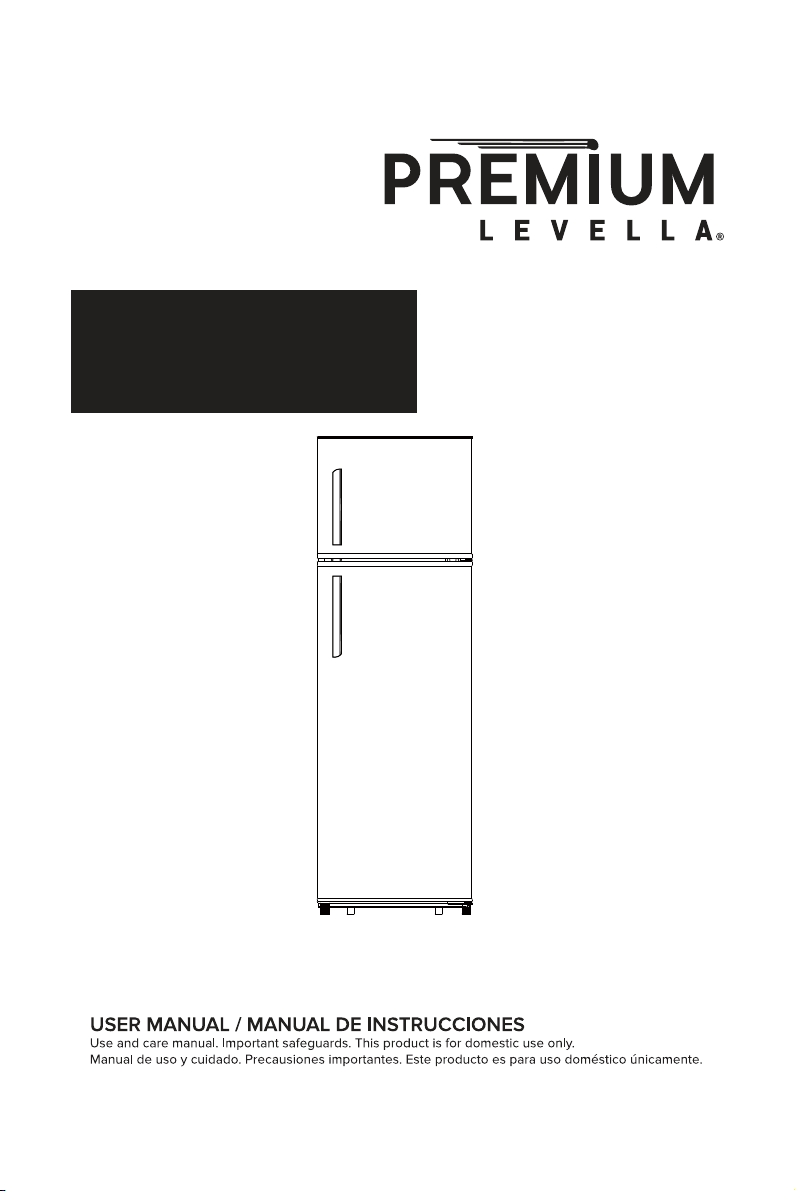
Model/Modelo: PRF12005HW
PRF12006HS
12
REFRIGERADOR DE 12 CU.FT.
CU.FT. REFRIGERATOR


Español-1
INDICE
INSTRUCCIONES DE SEGURIDAD IMPORTANTES........................................................P2
GUÍA DE INSTALACIÓN......................................................................................................P5
DIAGRAMA DE LA UNIDAD.................................................................................................P7
USO DIARIO........................................................................................................................P9

Español-2
INSTRUCCIONES DE SEGURIDAD
IMPORTANTES
Con el interés por su seguridad y asegurar el uso correcto, antes de instalar y utilizar por
primera vez esta unidad, debe leer cuidadosamente este manual, incluyendo los consejos
y advertencias. De igual forma, para evitar accidentes innecesarios es importante asegu-
rarse que todas las personas que utilizaran esta unidad, estén familiarizados con el uso
correcto y precauciones de seguridad. Este manual deberá permanecer junto con la uni-
dad en caso de ser removido o vendido; de esta forma todas las personas que lo utilicen
durante su vida útil, estén informadas sobre su uso y advertencias de seguridad. Dado a
la seguridad y vida útil de la unidad, se deberán cumplir las precauciones compartidas en
este manual ya que el fabricante no se hace responsable por los daños ocasionados por
negligencia u omisiones.
LA SEGURIDAD DE LOS NIÑOS Y PERSONAS CON INCAPACIDADES
Esta unidad puede ser utilizado por niños de 8 años o más y las personas con reducidas
capacidades sensoriales, físicas o mentales o falta de experiencia y conocimiento si han
sido supervisados o instruidos acerca del uso de la unidad de forma segura y comprenden
el peligro involucrados. Los niños no deben jugar con la t. La limpieza y mantenimiento de
la unidad no será llevada a cabo por niños sin supervisión. Así mismo, se deberá desechar
todo empaque y envolturas para evitar el riesgo de sofocamiento entre los niños.
Antes de deshacerse de la unidad, se deberá desconectar, cortar el cable de poder (cone-
xión) lo más cercano a la unidad en sí, y por último, remover las puertas para prevenir que
los niños puedan sufrir algún shock eléctrico o quedarse atrapados en él. Si esta unidad
con cerradura magnética en la puerta se usará para reemplazar otra unidad antiguo con
cerradura de resorte o aldaba en la puerta, se deberá deshabilitar dicha cerradura antes
de desechar esta unidad; previniendo que los niños puedan quedar atrapados en él.
ADVERTENCIA
Se debe mantener abiertos y libre de obstrucción todos los accesos de ventilación
ADVERTENCIA
No utilice dispositivos mecánicos u otros medios para acelerar el proceso de descongela-
ción, que no sean los recomendados por el fabricante.
ADVERTENCIA
No dañe el circuito refrigerante.
ADVERTENCIA
No utilice unidades eléctricas dentro de los compartimentos de almacenamiento (tal como ma-
quinas para hacer helado casero) de alimentos de la unidad, a menos que sean del tipo reco-
mendado por el fabricante.

Español-3
ADVERTENCIA
No tocar el bombillo si se ha mantenido encendido por mucho tiempo ya que podría estar
muy caliente.
• No se deberán almacenar sustancias explosivas tal como aerosol inamable en lata
dentro de esta unidad.
• El circuito de refrigeración contiene isobutane (R600a), un gas natural con alto grado de
compatibilidad con el ambiente por lo que no es inamable.
• Durante se transporta e instala, asegurarse a que los componentes del circuito de refri-
geración no se dañen.
• Evitar llamas abiertas o fuentes de ignición.
• Ventilar apropiadamente el espacio/habitación donde se ubique esta unidad.
• Es peligroso alterar o modicar esta unidad; cualquier daño al cable de poder podrá
ocasionar un corto circuito, corto eléctrico o incendio.
• Esta unidad está destinado a ser utilizado en el hogar y aplicaciones similares,como
- Áreas de cocina personal en tiendas, ocinas y otros ambientes de trabajo;
- Casas de campo y por los clientes en hoteles, moteles y otros entornos de tipo
residencial;
- Entornos tipo hoteles de posada/familiares.
• La restauración y aplicaciones no comerciales similares.
ADVERTENCIA
Cualquier componente eléctrico (toma corrientes, cable de poder, compressor, etc.) debe-
rá ser reemplazado por un agente certicado o personal de servicio capacitado.
• El bombillo suministrado con esta unidad es especícamente para uso en el mismo “lám-
para para uso especíco’’. Por lo que este no es apto para uso doméstico.
• El cable del poder no podrá estirarse.
• Asegurarse que el enchufe no quedeaplastado o dañado en la parte trasera de la unidad;
ya que esto ocasionaría sobrecalentamiento provocando un incendio.
• Asegurarse tener acceso al enchufe principal de la unidad.
• No halar los cables.
• Si el enchufe está ojo, no se deberá conectar ya que hay riesgo a ocasionar un shock
eléctrico u incendio.
• No se deberá usar sin la lámpara (bombillo).
•Esta unidad es pesado, por lo que se deberá mover/transportar con cuidado.
• No se deberá tocar o remover componentes del congelador con las manos húmedas o
mojadas, ya que esto podría ocasionar quemaduras o daños en la piel.
• Evitar exposición solar por tiempo prolongado.

Español-4
USO DIARIO
• No colocar cosas calientes en las áreas con plástico.
• No colocar alimentos directamente contra el panel trasero.
• Los alimentos no pueden volverse a congelar una vez se haya descongelado.
• Reempacar los alimentos congelada según las instrucciones del fabricante.
• Las recomendaciones de almacenamiento sobre esta unidad, deberán seguirse tal como
el fabricante las expone en este manual.
• No congelar bebidas carbonatadas ya que ocasiona presión en el compartimiento del
congelador pudiendo estallarse y ocasionar daños a la unidad.
• El hielo producido por el congelador puede ocasionar quemaduras si se consume direc-
tamente del mismo.
CUIDADO Y LIMPIEZA
• Antes de hacer mantenimiento, desconectar la unidad
• No limpiarlo con objetos metálicos
• No utilizar objetos punzantes para limpiar la escarcha, usar una espátula de plástico
• Examinar regularmente la válvula del agua descongelada; limpiarla si fuese necesario.
Si la válvula se obstruye, esta agua se acumularía en la parte inferior de la unidad.
Español-5
GUÍA DE INSTALACIÓN
IMPORTANTE
Para las conexiones eléctricas se deberán seguir cuidadosamente las instrucciones com-
partidas:
• Desempacar la unidad y revisar que este no haya sufrido algún tipo de daño. En caso de
haberse dañado, no se debe conectar. Se deberán reportar al lugar donde fue comprado.
• Es recomendable esperar 4 horas antes de conectarlo para permitir que el aceite uya
nuevamente hasta el compresor.
• Se debe readecuar la ventilación alrededor de la unidad. La falta de circulación de aire,
podría ocasionar sobrecalentamiento. Para lograr obtener la ventilación correcta, se de-
berá seguir las instrucciones de instalación.
• La parte trasera de la unidad, deberá ser colocada contra la pared para evitar quemadu-
ras accidentales ocasionadas por el compresor o condensador.
• Evitar colocar la unidad cerca de una fuente de calor, por ejemplo, una caldera o radiador.
SERVICIO
• Cualquier mantenimiento eléctrico que sea requerido, deberá ser ejecutado por personal
calicado.
• Se deberá brindar el mantenimiento y reparación en un centro de servicio autorizado y
usar únicamente piezas originales
AHORRO DE ENERGÍA
• No almacenar alimentos calientes.
• No almacenar alimentos muy cerca entre si ya que obstaculiza el ujo de aire circulante,
así como, asegurase que los alimentos no toca la parte trasera del compartimiento.
• Si hay un corte de energía eléctrica, no abrir las puertas.
• No abrir las puertas frecuentemente.
• No mantener las puertas abiertas por mucho tiempo.
• No programar el termostato a temperaturas muy altas.
• Algunos accesorios, tal como las gavetas, se pueden remover para expandir el espacio
de almacenamiento, así como, reducir el consumo de energía.
PROTECCIÓN AMBIENTAL
Esta unidad no contiene gases en su circuito de refrigeración o materiales de aisla-
miento que puedan dañar la capa de ozono. Esta unidad no deberá ser desechado
junto con los residuos y basura urbana. La espuma de aislamiento contiene gases in-
amablesz por lo que la unidad deberá ser desechado según las regulaciones de las
autoridades locales. Se debe evitar dañar la unidad de enfriamiento especialmente el
intercambiador de calor. Los materiales con el símbolo son reciclables.
Español-6
Este símbolo en la unidad o empaque signica que no puede tratarse como desecho
doméstico. Por lo que deberá ser trasladado a los puntos de reciclaje para productos
eléctricos y electrónicos. Al deshacerse de esta unidad correctamente se previenen con-
secuencias negativas para el medio ambiente y la salud; consecuencias que pueden ser
resultados del manejo inapropiado del mismo. Para mayor información de reciclaje, de-
berá avocarse con su municipalidad local, servicios de desperdicios o al comercio donde
adquirió esta unidad.
EMPAQUES
Los materiales con este símbolo son reciclables. Desechar los empaques en los
contenedores asignados para el reciclaje.
Eliminación de la unidad
• Desconectarlo del toma corriente.
• Cortar el cable de poder y desecharlo.
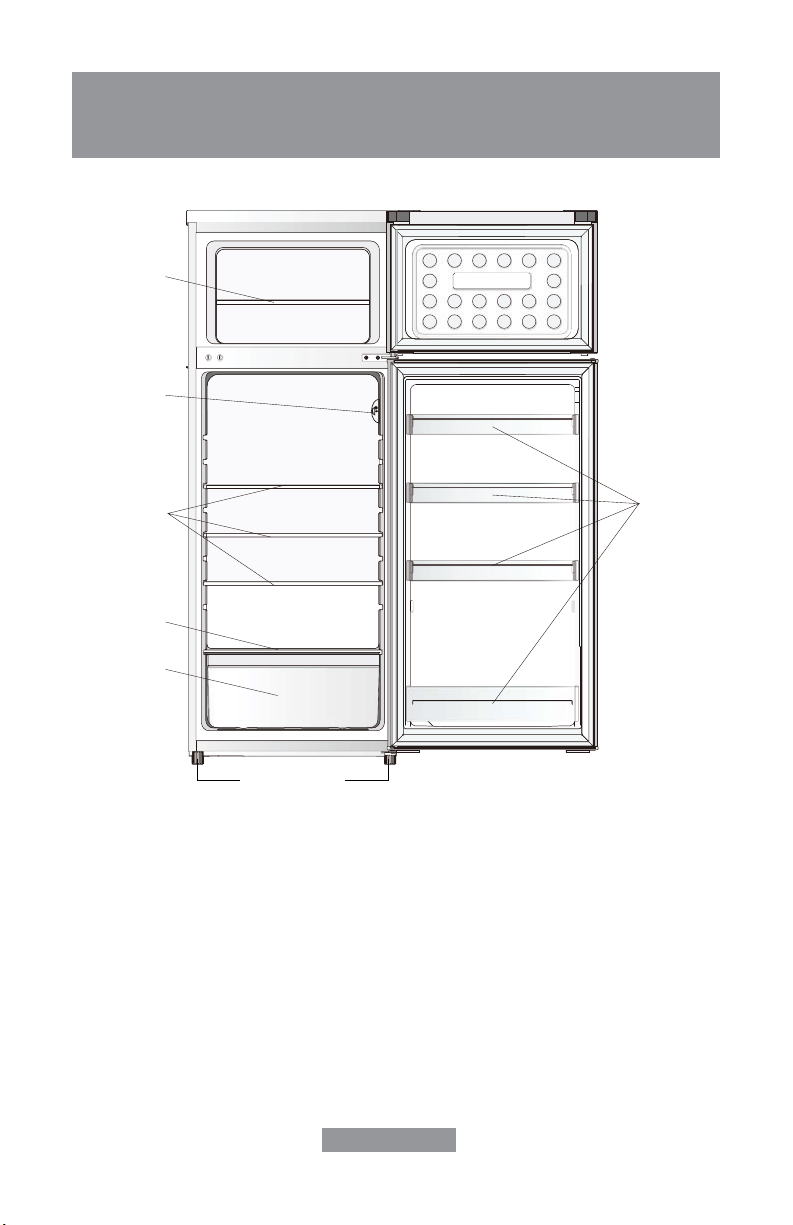
DIAGRAMA DE LA UNIDAD
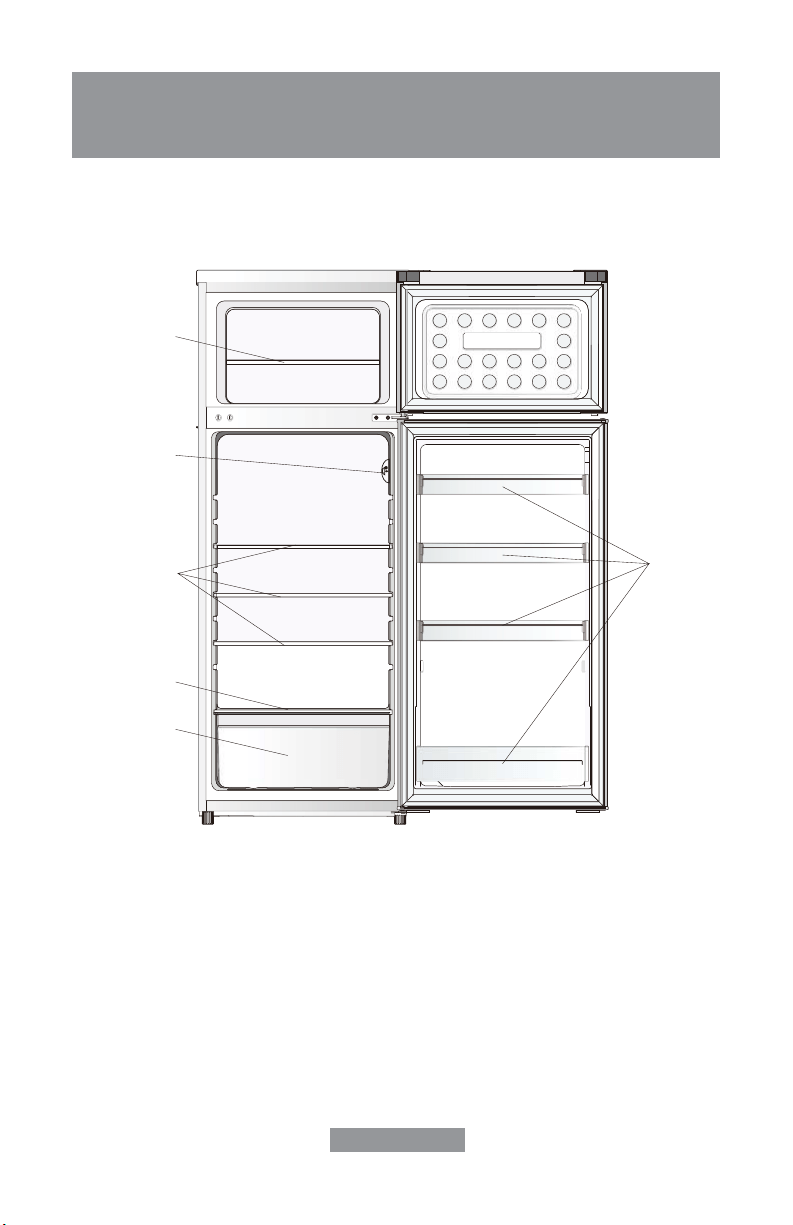
Todas las imágenes en este manual de instrucciones son solamente para indicación, por
favor revise su unidad individual para más detalles.
Patas Niveladoras
Gaveta
Tapadera de Gaveta
Bandejas de Vidrio
Templado
Termostato y lámpara
Congelador
Compartimientos
Español-7
Español-8
POSICIONAMIENTO
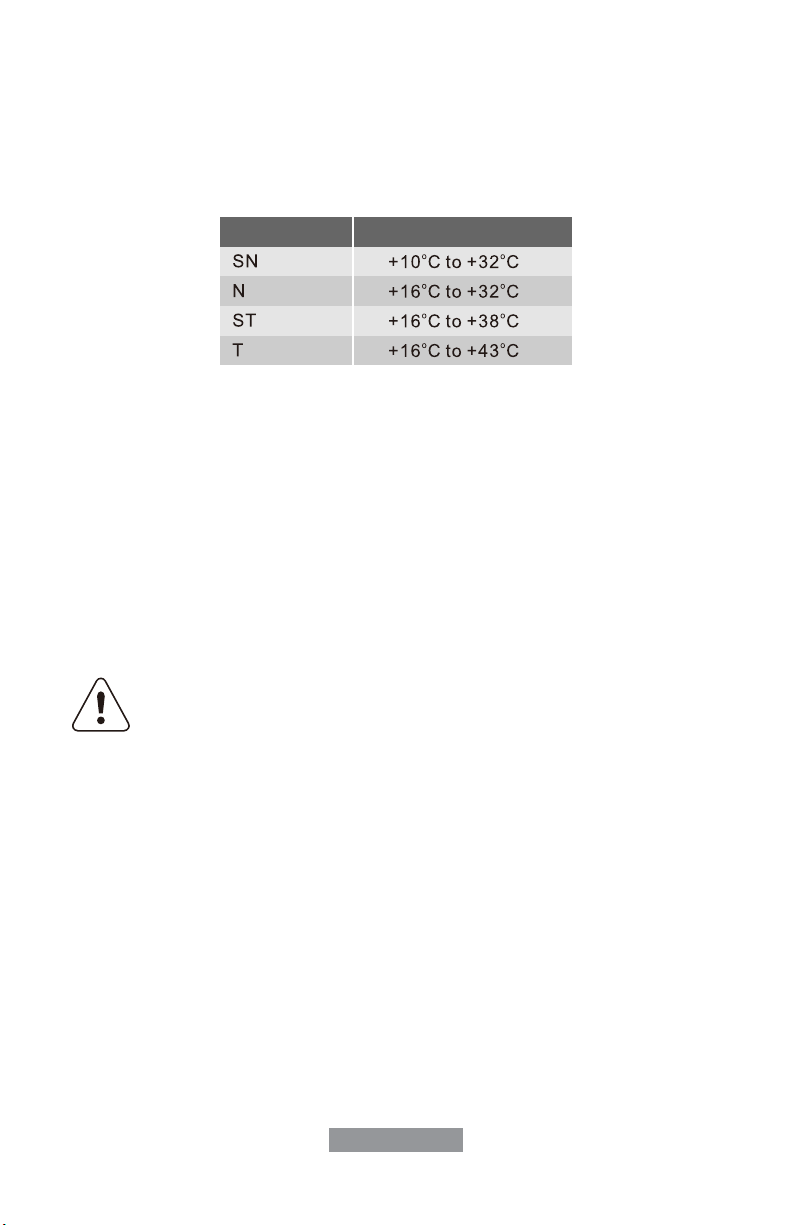
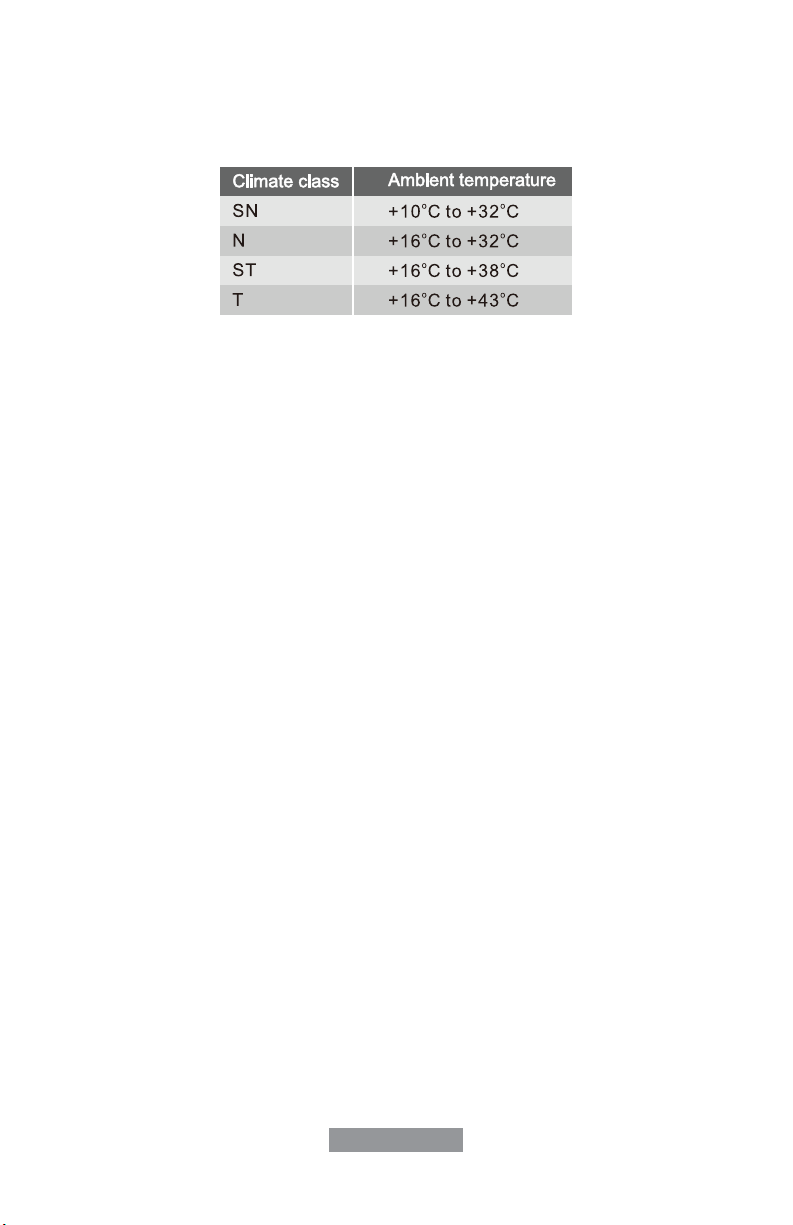
El unidad deberá instalarse en un lugar donde la temperatura de ambiente
corresponda a la clase de temperatura determinada en la placa de carac-
terísticas.
UBICACIÓN
Evitar colocar el unidad cerca de una fuente de calor, por ejemplo, una
caldera, radiador o exposición directa a luz solar. Asegurarse que el aire
circule apropiadamente en la parte trasera del unidad; deberá haber un es-
pacio de separación de 100mm entre el mismo y la pared. Idealmente, no
se debe ubicar debajo de unidades de pared con algún tipo de colgantes.
Por otro lado, la nivelación correcta se asegura con una o más de las patas
niveladoras colocadas en la base.
ADVERTENCIA Se deberá considerar que después de haber ins-
talado el unidad, el tomacorriente quede con libre acceso para ser
desconectado.
CONEXIÓN ELÉCTRICA
Antes de conectar favor asegurarse que el voltaje y frecuencia expuestas
en la placa de características corresponda a la fuente de poder domésti-
ca. El unidad deberá ser conectado a polo tierra; con el cable de poder
se provee un contacto para lograrlo. En caso que el enchufe doméstico
no esté conectado a polo tierra, se deberá conectar por separado según
las regulaciones actuales; favor consulte con un electricista calicado. El
fabricante no se hace responsable por daños si las advertencias de segu-
ridad expuestas no son cumplidas a cabalidad. El unidad cumple con las
regulaciones y directrices del E.E.C.
Clase de temperatura
Temperatura ambiente
Español-9
LIMPIEZA DEL INTERIOR
Antes de usar el unidad por primera vez, lavar el interior y todos los acce-
sorios con agua tibia y detergente neutral para remover el olor a unidad
nuevo; luego secar muy bien.
IMPORTANTE No utilizar detergentes muy fuertes o abrasivos ya que
puede dañar la pintura y acabado.
AJUSTE DE TEMPERATURA
• Conectar la unidad.
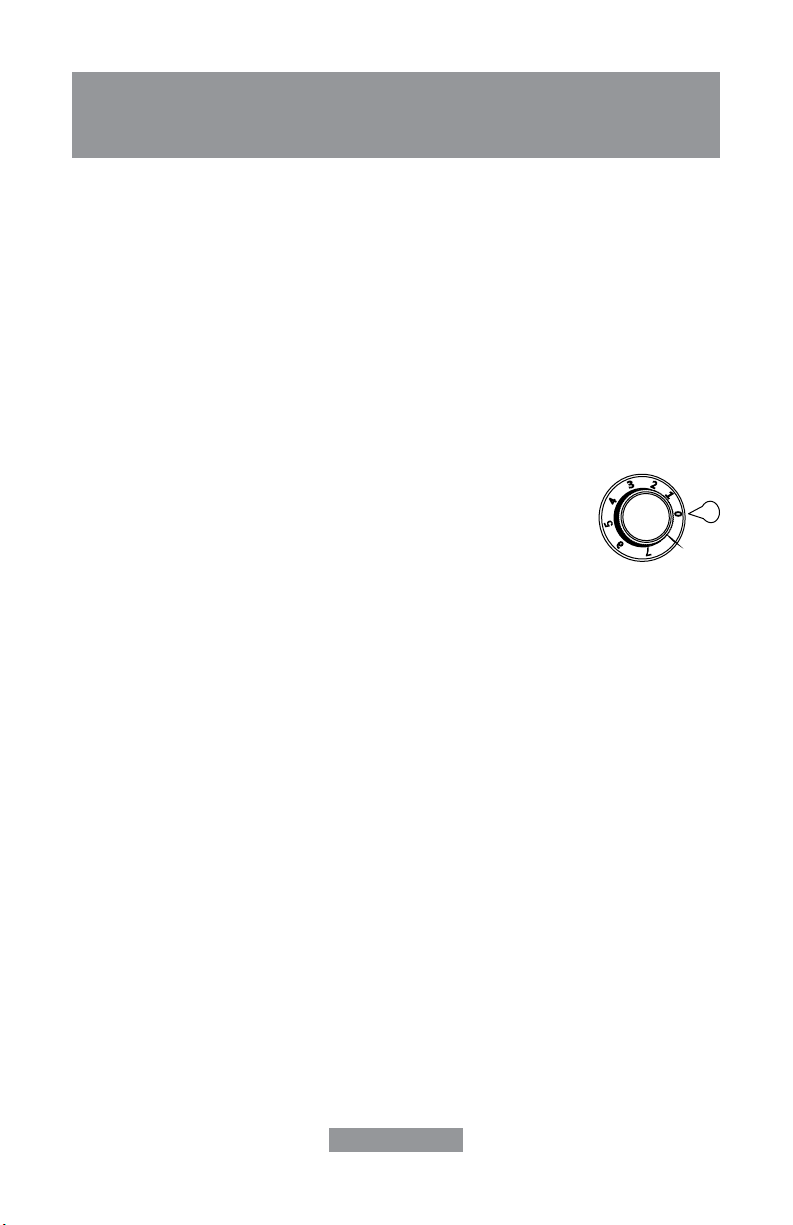
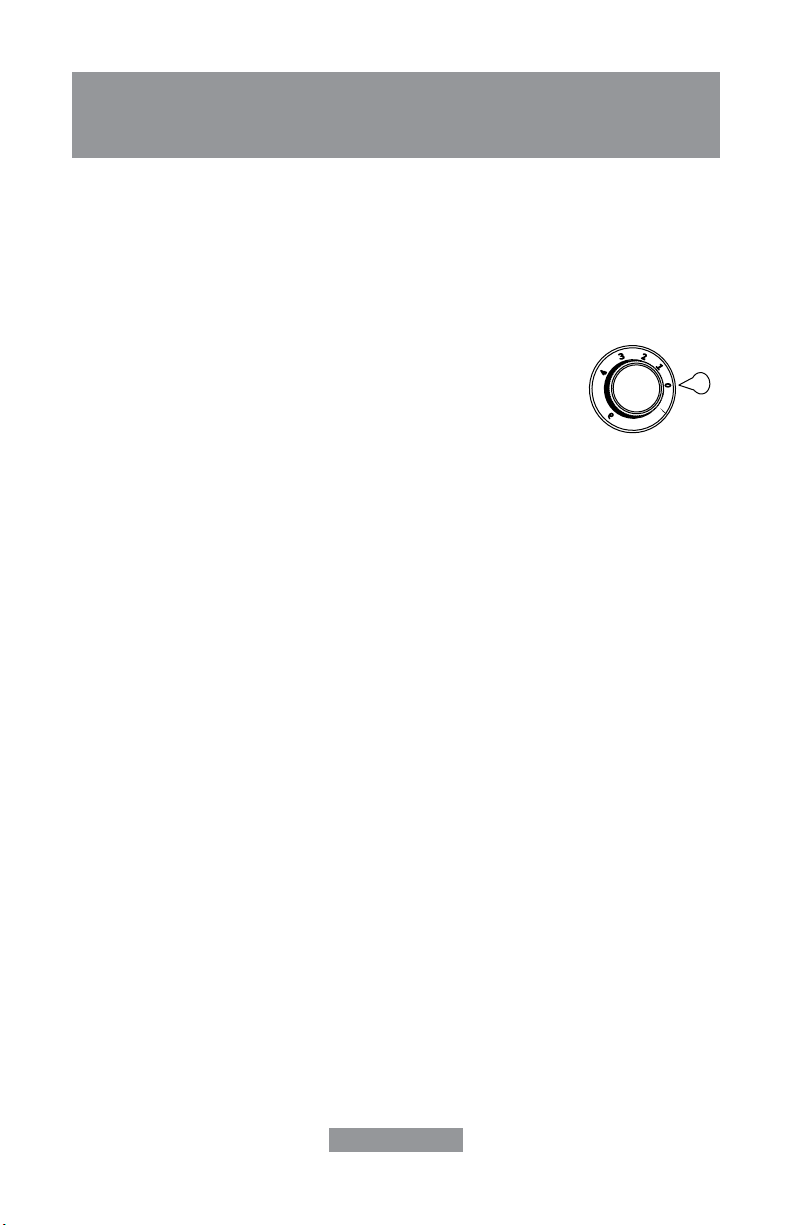
• La temperatura interna es controlada por un termostato,
el cual contiene 8 tipos de ajustes, siendo el 1 el más
caliente, el 7 el más helado y el 0 es apagado.
• El unidad no funcionará a la temperatura correcta si se
coloca en un lugar muy caliente o se abre la puerta muy frecuentemente.
ALMACENAMIENTO DE ALIMENTOS FRESCOS
• El compartimiento del congelador es ideal para congelar alimentos fres-
cos y alimentos congelados por largos periodos de tiempo.
• Colocar los alimentos frescos en dicho compartimiento para congelarlos
• La cantidad máxima de alimentos que pueden ser congelados en 24hrs,
está expuesto en la placa de características del unidad.
• El proceso de congelamiento dura 24 hrs, por lo que no se deberá agre-
gar más alimentos durante ese periodo de tiempo.
ALMACENAMIENTO DE ALIMENTOS CONGELADOS
• Cuando se utilizará por primera vez o se usara nuevamente después de
haber estado fuera de servicio, antes de almacenar los alimentos, el uni-
dad se deberá ajustar a la máxima temperatura por lo menos por 2 horas.
USO DIARIO
Español-10
IMPORTANTE En caso de un descongelamiento accidental ocasionado por
ejemplo, un apagón por un periodo de tiempo más de lo permitido según
las características técnicas; los alimentos deberán consumirse o cocinarse
inmediatamente y después de cocinados se pueden volver a congelar.
DESCONGELAMIENTO
Dependiendo del tiempo disponible antes de ser consumidos, los alimentos
congelados pueden ser colocados en el compartimiento de la refrigeradora
para su descongelación o expuestos a temperatura ambiente. Los alimentos
en porciones pequeñas pueden ser cocinados aún congelados, sin embargo,
esto tomará más tiempo.
HIELO
Este unidad puede estar equipado con uno o más bandejas para hacer cubos
de hielo.
ACCESORIOS
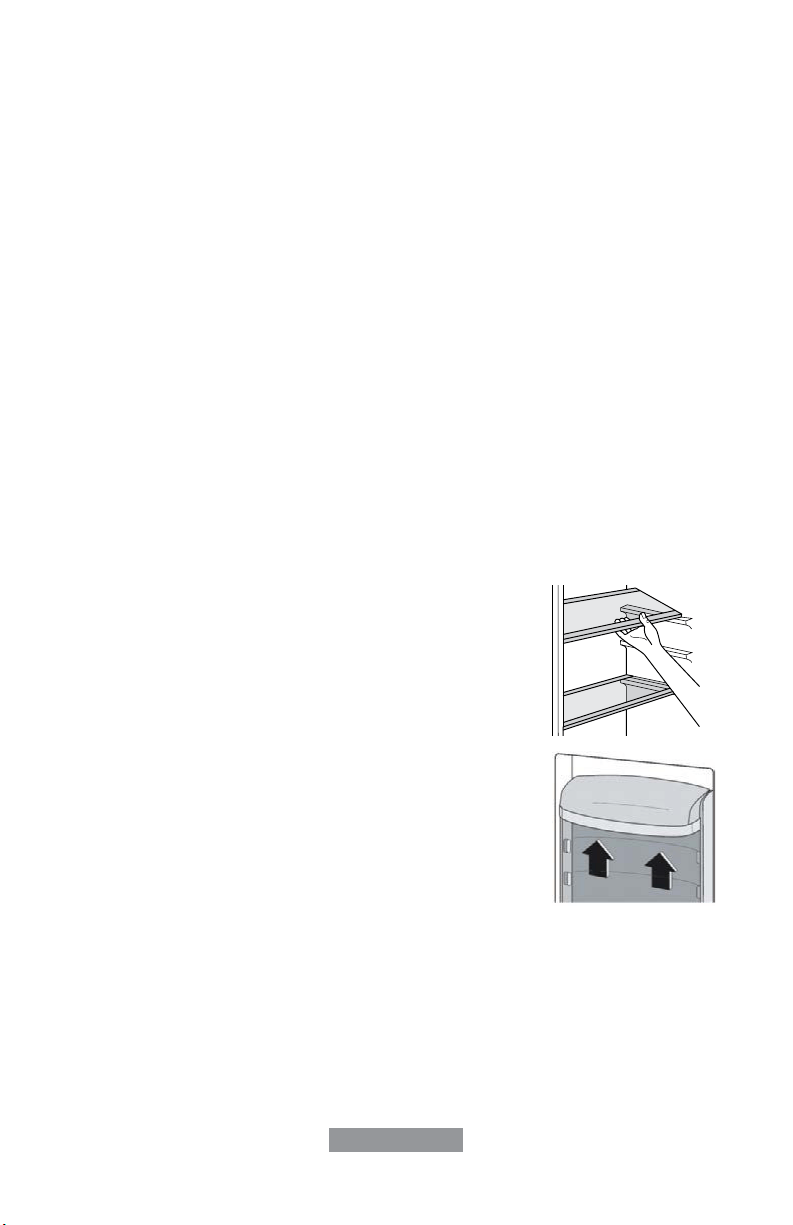
Estantes removibles
Las paredes de la refrigeradora cuentan con series
de corredores para que los estantes se puedan rea-
comodar según sea deseado.
Posicionamiento de los compartimientos de la
puerta
Para permitir el almacenamiento de varios alimentos,
estos compartimientos se pueden ajustar a distintas
alturas. Para lograrlo se debe hacer lo siguiente:
gradualmente levantar el compartimiento en la direc-
ción que lo indique las echas hasta que este se ao-
je, luego se reposiciona según sea deseado.
Consejos relevantes
Para obtener mayores benecios del proceso de congelamiento, les com-
partimos varios consejos relevantes:
• La cantidad máxima de alimentos que puede ser congelada en 24hrs, está
expuesto en la placa de características del unidad.

Español-11
• El proceso de congelamiento dura 24 hrs, por lo que no se deberá agregar
más alimentos durante ese periodo de tiempo.
• Solo se deberá congelar alimentos frescos previamente limpios y prepara-
dos.
• Almacenar los alimentos en porciones pequeñas y separadas para permitir
un congelamiento más rápido así como un posible descongelamiento sola-
mente de la cantidad deseada.
• Los alimentos pueden ser guardados en papel aluminio o polietileno. Tam-
bién, asegurarse que los empaques estén sellados herméticamente.
• No permitir que los alimentos frescos descongelados rocen alimentos ya
congelados, ya que ocasiona un cambio en la temperatura.
• Los alimentos sin grasa se preservan mejor y duran más que los que la con-
tienen. Así mismo, la sal reduce el periodo de conservación de los alimentos.
• El agua del hielo puede ocasionar quemaduras si se consume inmediat-
amente después de haberse removido del compartimiento del congelador.
• Aconsejamos colocar de manera visible las fechas de caducidad y conge-
lamiento para facilitar cuando éstos sean removidos del compartimiento y
evitar quemaduras por lo helado.
• Aconsejamos colocar de manera visible las fechas de caducidad y conge-
lamiento para llevar mejor control sobre el tiempo de almacenamiento.
Consejos para el almacenamiento de alimentos congelados
Para obtener mayores benecios de su unidad, debe:
• Asegurarse que todos los alimentos comerciales previamente congelados
hayan sido almacenados correctamente por la distribuidora
• Asegurarse de almacenar casi inmediatamente los alimentos en su conge-
lador después de haberlos comprado.
• No abrir la puerta frecuentemente o mantenerla abierta por más del tiempo
necesario.
• Una vez que los alimentos se hayan descongelado, estos se deterioran
rápidamente y no podrán ser congelados nuevamente.
• No exceder el tiempo de almacenamiento según lo haya indicado el fabri-
cante de los alimentos.
Consejos para la refrigeración de los alimentos frescos
Para obtener mayores benecios de su unidad, debe:

Español-12
• No almacenar alimentos calientes o líquidos que emiten vapor.
• No cubrir o envolver los alimentos, especialmente si este es de sabor fuerte
• Envolver en bolsas de polietileno y colocar sobre los estantes de vidrio
sobre la gaveta de las verduras. Por su seguridad, se deberá almacenar
máximo de uno a dos días.
• Los alimentos ya cocinados o platos fríos podrán ser almacenados en cual-
quier estante.
• Las frutas y vegetales deberán estar previamente limpios antes de almace-
narlos y se colocan en la gaveta especial provista.
• La mantequilla y queso deberán ser empacados herméticamente, envueltos
en papel aluminio o colocados en bolsas de polietileno para excluir el aire
tanto como sea posible.
• Las botellas con leche deben estar tapadas y colocadas en los compar-
timientos de la puerta.
• Si los bananos, papas, cebolla y ajo no estén empacados apropiadamente,
no deberán almacenarse dentro de la refrigeradora.
LIMPIEZA
• Por razones de higiene, el interior y todos los compartimientos internos
deberán ser limpiados regularmente.
PRECAUCIÓN
El unidad no puede estar conectado mientras se limpia ya que incurre el
riesgo de un shock eléctrico. Antes de limpiarlo, se debe apagar por dentro y
desconectar o deshabilitar el breaker del circuito o fusible. El unidad nunca
deberá ser limpiado con una máquina de vapor, ya que la humedad se puede
acumular en los componentes eléctricos ocasionando riesgo de un shock
eléctrico. Los vapores calientes pueden dañar los plásticos. El unidad debe
secarse bien antes de volverse a usar.
IMPORTANTE
Los aceites etéreos y disolventes orgánicos pueden dañar los plásticos, por
ejemplo, el jugo de limón, zumo de la cascara de naranja o ácido butírico,
limpiador que contenga ácido acético.

Español-13
Limpiar oricio de drenaje
Para evitar que el agua de descongelación se desborde en la refrigeradora,
limpiar periódicamente el agujero de drenaje en la parte posterior del com-
partimento frigoríco. Use un limpiador para limpiar el agujero . Sin embargo,
no permita que residuos del limpiador hagan contacto con los componentes
del unidad.
• No usar limpiadores abrasivos.
• Remover los alimentos del congelador, por mientras se almacenan en un
lugar fresco bien cubiertos.
• Apagar y desconectarlo o deshabilitar el breaker del circuito o fusible.
• Limpiarlo incluyendo los accesorios internos con un paño y agua tibia. Lu-
ego, limpiar con agua fresca y secarlo muy bien.
• Después de haberlo secado, puede volverse a usar.
Descongelamiento del congelador
El compartimiento del congelador progresivamente estará cubierto con es-
carcha; esta deberá ser removida. Nunca use utensilios metálicos para quitar
la escarcha del evaporador ya que podría dañarlo. Sin embargo, cuando la
capa de escarcha está muy gruesa en el revestimiento interior, se debe com-
pletar el proceso de descongelación:
• Desconectar el unidad.
• Remover todos los alimentos y colocarlos sobre papel periódico ubicándo-
los en un lugar fresco.
• Mantener la puerta abierta y colocar un recipiente para recolectar todo el
agua por el descongelamiento.
• Una vez se haya descongelado por completo, el interior se debe secar muy
bien.
• Conectar y encender nuevamente.
Reemplazo de la lámpara
PRECAUCIÓN Antes de reemplazarla, se debe desconectar el unidad. Las
especicaciones de la lámpara están en la placa de características. Seguir
las siguientes instrucciones:
• Mover la perilla de la temperatura en 0 para apagarlo.
• Desconectarlo.
• Desenroscar el tornillo del cobertor de la lámpara.
Español-14
• Remover dicho cobertor.
• Desenroscar la lámpara (bombillo).
• Colocar la nueva lámpara según la dirección opuesta luego colocar el co-
bertor y enroscarlo.
• Conectarlo nuevamente y mover la perilla hacia la derecha para encenderlo.
MANTENIMIENTO
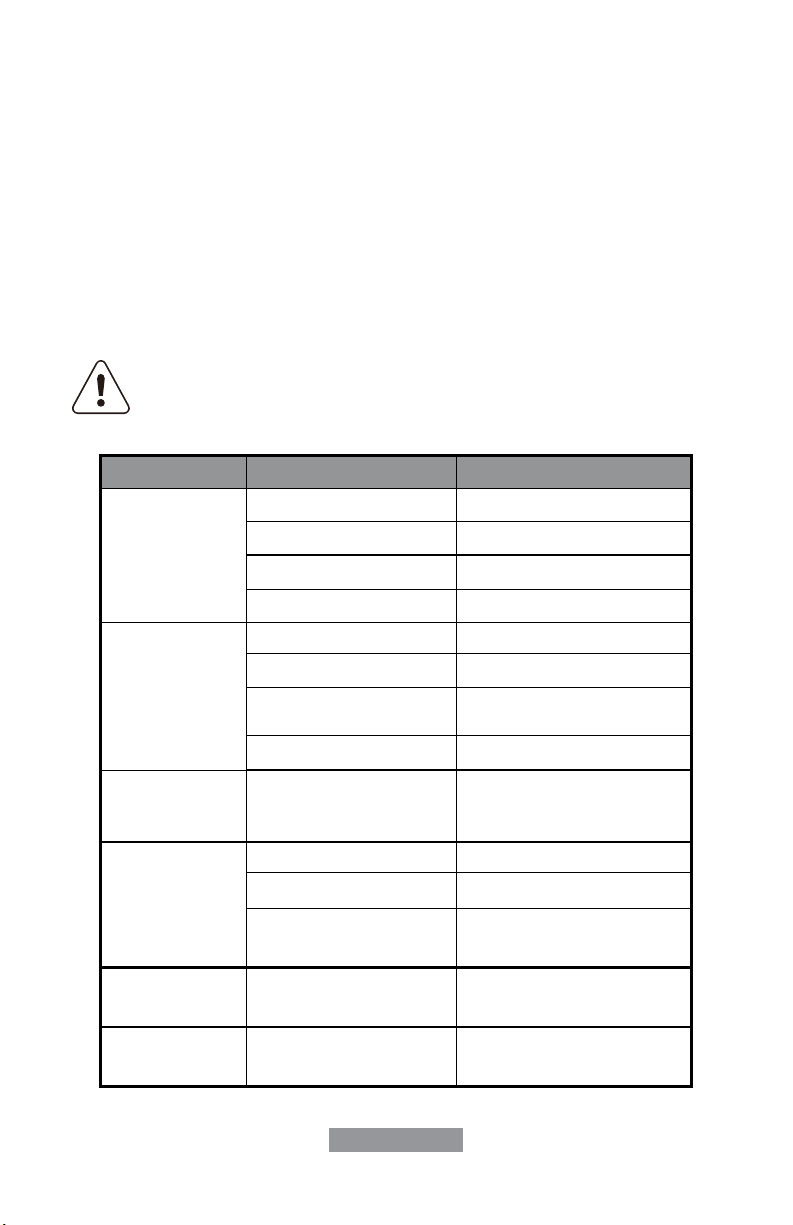
Resolución de problemas
Precaución! Antes de la resolución de problemas, desconecte la fuente de
poder. Sólo un electricista calicado debe hacer la solución de problemas
que no se encuentra en este manual.
IMPORTANTE Hay algunos sonidos durante el uso normal (com-
presor, circulación del refrigerante).
Problema Posible causa Solución
El unidad no funciona
Los alimentos estan
muy calientes
El unidad enfría
mucho
Ruidos irregulares
La perilla de la temperatura este en ‘’0’
La temperatura no esta ajustada
correctamente
Revisar la sección de ajuste incial de
temperatura
Mover la perilla a otro numero para
encender el unidad
No esta conectado o tiene una
conexión oja
La puerta se mantuvo abierta por
mucho tiempo
Abrir la puerta solo cuando sea
necesario
Conectarlo al toma corriente
Fusible se haya fundido o esté
defectuoso
Grandes cantidades de alimentos
calientes se almacenaron dentro de
las ultimas 24 hrs.
Ajuste la regulación de la temperatura
al más frío temporalmente.
Revisar fusible, repararlo de ser
necesario
El enchue esté defectuoso
El unidad esta ubicado cerca a una
fuente de calor
Esta ajustado a la temperatura más
fria.
La unidad no esta nivelado
La unidad esta en contacto paredes
u objetos
Un componente , por ejemplo, una
tubería, en el parte posterior del unidad
está tocando otra parte del unidad o
la pared.
Ajuste la regulación de la temperatura
a uno más caliente temporalmente.
Ajustar las patas niveladoras.
Mueva el unidad ligeramente.
Si es necesario, mueva
cuidadosamente el componente.
Revisar la sección de limpieza
Es normal
El drenaje del agua esta obstruido
Condensador está dentro del panel
Agua en el piso
El panel lateral está
caliente
Revisar la sección de la instalación y
ubicación
Las principales averias deberan ser
resueltas por un electricista

English-1
TABLE OF CONTENTS
IMPORTANT SAFETY INSTRUCTIONS..............................................................................P2
INSTALLATION....................................................................................................................P5
OVERVIEW..........................................................................................................................P7
DAILY USE...........................................................................................................................P9

English-2
IMPORTANT SAFETY
INSTRUCTIONS
In the interest of your safety and to ensure the correct use, before installing and rst
using the appliance, read this user manual carefully, including its hints and warnings. To
avoid unnecessary mistakes and accidents, it is important to ensure that all people using
the appliance are thoroughly familiar with its operation and safety features. Save these
instructions and make sure that they remain with the appliance if it is moved or sold, so
that everyone using it through its life will be properly informed on appliance use and safety.
For the safety of life and property keep the precautions of these user’s instructions as the
manufacturer is not responsible for damages caused by omission.
CHILDREN AND VULNERABLE PEOPLE SAFETY
This appliance can be used by children aged from 8 years and above and persons with
reduced physical, sensory or mental capabilities or lack of experience and knowledge if
they have been given super vision or instruction concerning use of the appliance in a safe
way and understand the hazards involved.
Children should be supervised to ensure that they do not play with the appliance.
Cleaning and user maintenance shall not be made by children unless they are aged from
8 years and above and supervised.
Keep all packaging well away from children. There is risk of suffocation.
If you are discarding the appliance pull the plug out of the socket, cut the connection cable
(as close to the appliance as you can) and remove the door to prevent playing children to
suffer electric shock or to close themselves into it.
If this appliance featuring magnetic door seals is to replace an older appliance having a
spring lock (latch) on the door or lid, be sure to make that spring lack unusable before you
discard the old appliance. This will prevent it from becoming a death trap for a child.
WARNING! Keep ventilation openings, in the appliance enclosure or in the built-in struc-
ture, clear of obstruction.
WARNING! Do not use mechanical devices or other means to accelerate the defrosting
process, other than those recommended by the manufacturer.
WARNING! Do not damage the refrigerant circuit.

English-3
WARNING! Do not use other electrical appliances (such as ice cream makers) inside of
refrigerating appliances, unless they are approved for this purpose by the manufacture.
WARNING! Do not touch the light bulb if it has been on for a long period of time because
it could be very hot.
• Do not store explosive substances such as aerosol cans with a ammable propellant in
this appliance.
• The refrigerant isobutane (R600a) is contained within the refrigerant circuit of the appli-
ance, a natural gas with a high level of environmental compatibility, which is nevertheless
ammable.
• During transportation and installation of the appliance, be certain that none of the compo-
nents of the refrigerant circuit become damaged.
- avoid open ames and sources of ignition.
- thoroughly ventilate the room in which the appliance is situated.
• It is dangerous to alter the specications or modify this product in any
way. Any damage to the cord may cause a short circuit, re and/or
electric shock.
• This appliance is intended to be used in household and similar applications such as
- staff kitchen areas in shops, ofces and other working environments;
- farm houses and by clients in hotels, motels and other residential type environments;
- bed and breakfast type environments;
- catering and similar non-retail applications.
WARNING! Any electrical components(plug, power cord, compressor and etc.) must be
replaced by a certied service agent or qualied service personnel.
WARNING! The light bulb supplied with this appliance is a “special use lamp bulb” usable
only with this appliance. This “special use lamp” is not usable for domestic lighting.
• Power cord must not be lengthened.
• Make sure that the power plug is not squashed or damaged by the back of the appliance.
A squashed or damaged power plug may overheat and cause a re.
• Make sure that you can come to the main plug of the appliance.
• Do not pull the main cable.
• If the power plug socket is loose, do not insert the power plug. There is a risk of electric
shock or re.
• You must not operate the appliance without the lamp.
This appliance is heavy. Care should be taken when moving it.
Do not remove nor touch items from the freezer compartment if you
hands are damp/wet, as this could cause skin abrasions or frost/freezer burns.
• Avoid prolonged exposure of the appliance to direct sunlight.

English-4
DAILY USE
• Do not place hot foodstuffs on the plastic parts of the appliance.
• Do not place food products directly against the rear wall.
• Frozen food must not be re-frozen once it has been thawed out.
• Store pre-packed frozen food in accordance with the frozen food manufacture’s instruc-
tions.
• Appliance’s manufacturer storage recommendations should be strictly adhered to. Refer
to relevant instructions.
• Do not place carbonated drinks in the freezer compartment as it creates pressure on the
container, which may cause it to explode, resulting in damage to the appliance.
• Ice lollies can cause frost burns if consumed straight from the appliance.
CARE AND CLEANING
• Before maintenance, switch off the appliance and disconnect the main plug from the
main socket.
• Do not clean the appliance with metal objects.
• Do not use sharp objects to remove frost from the appliance. Use a plastic scraper.
• Regularly examine the drain in the refrigerator for defrosted water. If necessary, clean the
drain. If the drain is blocked, water will collect in the bottom of the appliance.
English-5
Important! For electrical connection carefully follow the instructions given in specic para-
graphs.
• Unpack the appliance and check if there are damages on it. Do not connect the appliance
if it is damaged. Report possible damages immediately to the place you bought it. In that
case retain packing.
• It is advisable to wait at least four hours before connecting the appliance to allow the oil
to ow back into the compressor.
• Adequate air circulation should be around the appliance, lacking this leads to overheat-
ing. To achieve sufcient ventilation follow the instructions relevant to installation.
• Wherever possible the spacers of the product should be against a wall to avoid touching
or catching warm parts (compressor, con- denser) to prevent possible burn.
• The appliance must not be located close to radiators or cookers.
• Make sure that the main plug is accessible after the installation of the appliance.
SERVICE
• Any electrical work required to do the servicing of the appliance should be carried out by
a qualied electrician or competent person.
•This product must be serviced by an authorized Service Center, and only genuine spare
parts must be used.
ENERGY SAVING
• Don’t put hot food in the appliance;
• Don’t pack food close together as this prevents air circulating; Make sure food don’t touch
the back of the compartment(s);
• If electricity goes off, don’t open the door(s);
• Don’t open the door(s) frequently;
• Don’t keep the door(s) open for too long;
• Don’t set the thermostat on exceeding cold temperatures;
• Some accessories, such as drawers, can be removed to get larger storage volume and
lower energy consumption.
ENVIRONMENT PROTECTION
This appliance does not contain gases which could damage the ozone layer, in either
its refrigerant circuit or insulation materials. The appliance shall not be discarded to-
gether with the urban refuse and rubbish. The insulation foam contains ammable gases:
the appliance shall be disposed according to the appliance regulations to obtain from your
local authorities. Avoid damaging the cooling unit, especially the heat exchanger. The ma-
terials used on this appliance marked by the symbol are recyclable.
INSTALLATION
The symbol on the product or on its packaging indicates that this product may
not be treated as household waste. Instead it should be taken to the appropri-
ate collection point for the recycling of electrical and electronic equipment. By
ensuring that this product is disposed correctly, you wil help prevent potential negative
consequences for the environment and human health, wich could otherwise be caused by
inappropriate waste handling. For more detailed information about recycling of this prod-
uct, please contact your local council, your household waste disposal service or the shop
where you purchased the product.
PACKAGE MATERIALS
The materials with the symbol are recyclable. Dispose the package in a suitable collec-
tion container to recycle it.
DISPOSAL OF THE APPLIANCE
1. Disconnect the main plug from the main socket.
2. Cut off the main cable and discard it.
English-6
English-7
OVERVIEW
Freezer Shelf
Glass Shelves
Crisper Cover
Crisper
Thermostat
and Light
Balconies
This image is for illustration purposes only, for more details, please check
your appliance.
Tempered
English-8
POSITIONING
Install this appliance at a location where the ambient temperature corresponds to the
climate class indicated on the rating plate of the appliance:
LOCATION
The appliance should be installe well away from sources of heat such as radiators, boil-
ers, direct sunlight etc. Ensure that are can circulate freely around the back of the cabinet
and the wall unit must be at least 100 mm. Ideally, however, the appliance should not be
positioned below overhanging wall units. Accurate leveling is ensured by one or more
adjustable feet at the base of the cabinet.
WARNING!
It must be possible to disconnect the appliance from the main power supply; the plug
must therefore be easily accessible after installation.
ELECTRICAL CONNECTION
Before plugging in, ensure that the voltage and frequency shown on the rating plate
correspond to your domestic power supply. The appliance must be earthed. The power
supply cable plug is provided with a contact for this purpose. If the domestic power sup-
ply socket is not earthed, connect the appliance to a separate earth in compliance with
current regulations, consulting a qualied electrician.
The manufacturer declines all responsability if the above safety precautions are not
observed. This appliance complies with the E.E.C. Directives.
FIRST USE
Cleaning the interior
Before using the appliance for the rst time, wash the interior and all internal accessories
with lukewarm water and some neutral soap so as to remove the typical smell of a brand
new product, then dry thoroughly.
Important! Do not use detergents or abrasive powders, as these will damage the nish.
Temperature Setting
• Plug on your appliance. The internal temperature is controlled by
a thermostat. There are 8 settings . 1 is warmest setting and 7 is
coldest setting and 0 is off.
• The appliance may not operate at the correct temperature if it is in a
particularly hot or if you open the door often.
Freezing fresh food
• The freezer compartment is suitable for freezing fresh food and storing frozen and
deep-frozen food for a long time.
• Place the fresh food to be frozen in the freezer compartment.
• The maximum amount of food that can be frozen in 24 hours is specied on the rating
plate.
• The freezing process lasts 24 hours: during this period do not add other food to be
frozen.
Storing frozen food
When rst starting-up or after a period out of use, before putting the product in the com-
partment let the appliance run at least 2 hours on the higher settings.
IMPORTANT! In the event of accidental defrosting, for example the power has been off
for longer than the value shown in the technical characteristics chart under “rising time”,
the defrosted food must be consumed quickly or cooked immediately and then re-frozen
(after cooked).
Thawing
Deep-frozen or frozen food, prior to be used, can be thawed in the fridge compartment
or at room temperature, depending on the time available for this operation. Small pieces
may even be cooked still frozen, directly from the freezer. In this case, cooking will take
longer.
English-9
DAILY USE
0
1
2
3
4
6
7
5
7
English-10
Ice-cube
This appliance may be equipped with one or more ice-cube to
produce ice.
ACCESSORIES
Movable shelves
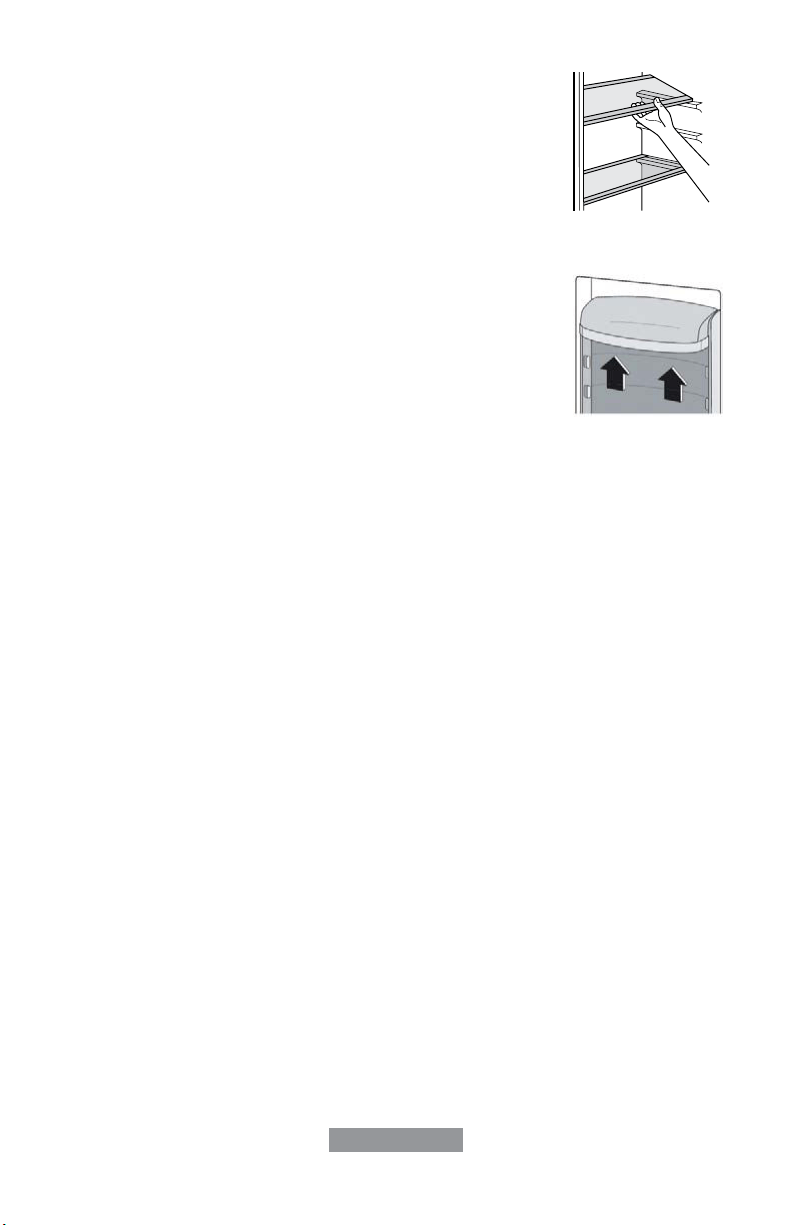
The walls of the refrigerator are equipped with a series of runners
so that the shelves can be positioned as desired.
Positioning the door balconies
To permit storage of food packages of various sizes, the door balco-
nies can be placed at different heights. To make these adjustments
proceed as follows: gradually pull the balcony in the direction of the
arrows until it comes free, then reposition as required.
Helpful hints and tips
To help you make the most of the freezing process, here are some important hints:
• The maximum quantity of food which can be frozen in 24 hrs. is shown on the rating
plate;
• The freezing process takes 24 hours. No further food to be frozen should be added
during this period;
• only freeze top quality, fresh and thoroughly cleaned, foodstuffs;
• Prepare food in small portions to enable it to be rapidly and completely frozen and to
make it possible subsequently to thaw only the quantity required;
• Wrap up the food in aluminum foil or polythene and make sure that the packages are
airtight;
• Do not allow fresh, unfrozen food to touch food which is already frozen, thus avoiding a
rise in temperature of the latter;
• Lean foods store better and longer than fatty ones; salt reduces the storage life of food;
• Water ices, if consumed immediately after removal from the freezer compartment, can
possibly cause the skin to be freeze burnt;
• It is advisable to show the freezing in date on each individual pack to enable you
removal from the freezer compartment, can possibly cause the skin to be freeze burnt;
• It is advisable to show the freezing in date on each individual pack to enable you to
keep tab of the storage time.
Hints for storage of frozen food
To obtain the best performance from this appliance, you should:
• Make sure that the commercially frozen foodstuffs were adequately stored by the
retailer;
• Be sure that frozen foodstuffs are transferred from the food store to the freezer in the
shortest possible time;
• Not open the door frequently or leave it open longer than absolutely necessary.
English-11
• Once defrosted, food deteriorates rapidly and cannot be re-frozen;
• Do not exceed the storage period indicated by the food manufacture.
Hints for fresh food refrigeration
To obtain the best performance:
• Do not store warm food or evaporating liquids in the refrigerator
• Do cover or wrap the food, particularly if it has a strong avour
• Make (all types): wrap in polythene bags and place on the glass shelves above the
vegetable drawer.
• For safety, store in this way only one or two days at the most.
• Cooked foods, cold dishes, etc...: these should be covered and may be placed on any
shelf.
• Fruit and vegetables: these should be thoroughly cleaned and placed in the special
drawer(s) provided.
• butter and cheese: these should be placed in special airtight containers or wrapped in
aluminum foil or polythene bags to exclude as much air as possible.
• Milk bottle: these should have a cap and should be stored in the balconies on the door.
• Bananas, potatoes, onions and garlic, if not packed, must not be kept in the fridge.
Cleaning
For hygienic reasons the appliance interior, including interior accessories, should be
cleaned regularly.
CAUTION! The appliance may not be connected to the main during cleaning. Danger of
electrical shock! Before cleaning switch the appliance off and remove the plug from the
main, or switch off or turn out the circuit breaker or fuse. Never clean the appliance with a
steam cleaner. Moisture could accumulate in electrical components, danger of electrical
shock! Hot vapors can lead to the damage of plastic parts. The appliance must be dry
before it is placed back into service.
IMPORTANT! Ethereal oils and organic solvents can attack
plastic parts, e.g. lemon juice or the juice form orange peel,
butyric acid, cleanser that contain acetic acid.
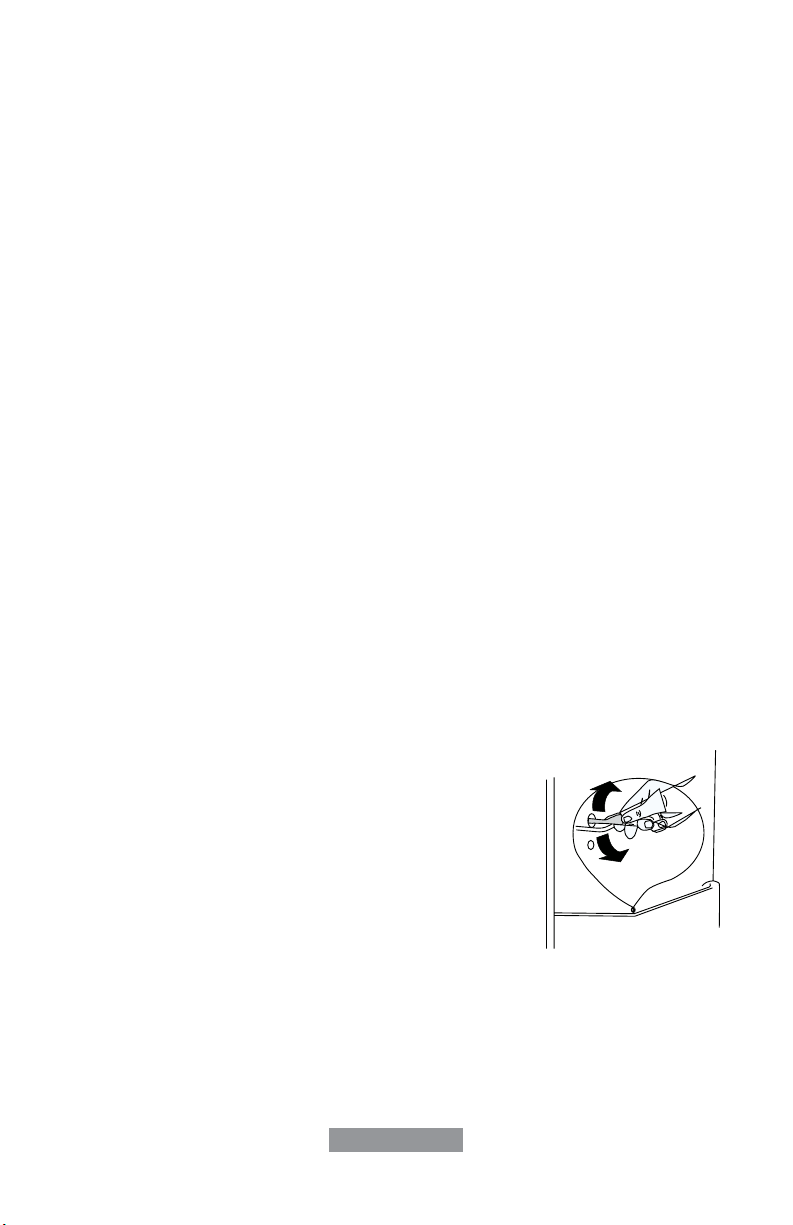
Clean drain hole
To avoid defrost water overowing into the fridge, periodically
clean the drain hole at back of fridge compartment. Use a
cleaner to clean the hole as showed in right picture.
• Do not allow such substances to come into contact the appliance parts.
• Do not use any abrasive cleaners
• Remove the food from the freezer. Store them in a cool place, well covered.

English-12
• Switch the appliance off and remove the plug from the main, or switch off or turn out
the circuit breaker of fuse.
• Clean the appliance and the interior accessories with a cloth and lukewarm water. After
cleaning wipe with fresh water and rub dry.
• After everything is dry place appliance back into service.
Defrosting of the freezer
The freezer compartment, however, will become progressively covered with frost. This
should be removed. Never use sharp metal tools to scrape off frost from the evaporator
as you could damage it. However, when the ice becomes very thick on the inner liner,
complete defrosting should be carried out as fellows:
• pull out the plug from the socket;
• remove all stored food, wrap it in several layers of newspaper and put it in a cool
place;
• keep the door open, and placing a basin underneath of the appliance to collect the
defrost water;
• when defrosting is completed, dry the interior thoroughly
•replace the plug in the power socket to run the appliance again.
Replace the lamp
Caution! Before replacing the lamp, shall disconnect the appliance from main power
supply.
Lamp specication is listed in rating label. Follow below process to replace the lamp:
1. Set the temperature regulation knob at number “0” to switch off the appliance.
2. Unplug the appliance to make sure the appliance is disconnected from main power
supply.
3. Remove the screw of the lamp cover.
4. Pull the lamp cover out.
5. Unscrew the lamp.
6. Fit new lamp according to the opposite direction,
then replace the lamp cover and screw.
7. Plug in the appliance and regulate the knob to right
position.
English-13
MAINTENANCE
TROUBLESHOOTING
CAUTION! Before troubleshooting, disconnect the power supply. Only a qualied electri-
cian of competent person must do the troubleshooting that is not in this manual.
IMPORTANT! There are some sounds during normal use (compressor, refrigerant circu-
lation).
TROUBLE
Appliance does not work
Unusual noises
The food is too warm.
Appliance cools too much
Water on the oor
Side panel is hot
a. Temperature regulation knob is
set at number “0”
b. Main plug is not plugged in or
loose
c. Fuse has blown or defective
d. Socket is defective
a.Appliance is not level.
b. The appliance is touching the wall
or objects.
c. A component, E.G. a pipe, on the
rear of the appliance is touching
another part of the appliance or the
wall.
a. Temperature is not properly ad-
justed
b. Door was open for an extended
period .
c.A large quantity of warm food was
placed in the appliance within the
last 24 hours
d. The appliance is near a heat
source
Temperature is set too cold
Water drain hole is blocked
Condenser is inside the panel.
a. Set the knob at other number to
switch on the appliance.
b. Insert main plug
c. Check fuse, replace if necessary
d. Main malfunctions are to be co-
rrected by an electrician
a. Re-adjust the feet.
b. Move the appliance slightly.
c. If necessary, carefully bend the
component out of the way.
a. Please look in the initial tempera-
ture setting section
b. Open door only as long as ne-
cessary
c. Turn the temperature regulation
to colder setting temporarily.
d.Please look in the installation lo-
cation section
a. Turn the temperature regulation
knob to a warmer setting tempora-
rily
See the Cleaning section.
It’s normal.
POSSIBLE CAUSE POSSIBLE REMEDY
If the malfunction shows again, contact the Service Center


CKPEM-P01