GENERAL SPECIFICATIONS
The Klein Tools Coax Explorer
®
2 verifies proper continuity of F-connector coaxial cables
and maps their location. Color-coded push-on remotes allow for up to four cables to be
tested and mapped, displaying cable status via LED indicators (PASS, OPEN, or SHORT)
that also identify the cable/remote location. Remote #1 (red) is included, additional
remotes are available separately.
• Environment: Indoor
• Operating Altitude: 10000 ft. (3000 m) maximum
• Operating Temperature: 32° to 122°F (0° to 50°C)
• Storage Temp: -4° to 140°F (-20° to 60°C)
• Relative Humidity: 10% to 90% non-condensing
• Dimensions (including remote holder): 5.7" x 2.3" x 1.1" (145 x 32 x 29 mm)
• Weight (including batteries): 4.8 oz. (136 g)
Specifications subject to change.
TESTING/MAPPING CABLES
NOTE: Not for use on powered circuits or outlets.
1. Connect test remote
1
to one end of the cable or outlet to be tested. If
necessary, use an F-adapter (not included) to connect the test remote to the cable.
2. Connect the opposite end of the cable or outlet to be tested to the F-connector
2
on the Coax Explorer
®
2.
3. Press and hold the TEST button
5
. If the cable is wired correctly, the top (red)
PASS LED
6
will light. If there is a problem with the cable, one of the FAULT LEDs
(OPEN
7
or SHORT
8
) will light.
TESTING AN UNINSTALLED CABLE
1. Using an F-adapter (not included), connect a test remote
1
to one end of the
cable to be tested.
2. Connect the opposite end of the cable to be tested to the F-connector
2
on the
Coax Explorer
®
2.
3. Press and hold the TEST button
5
. If the cable is wired correctly, the
corresponding PASS LED
6
will light. If there is a problem with the cable, one of
the FAULT LEDs (OPEN
7
or SHORT
8
) will light.
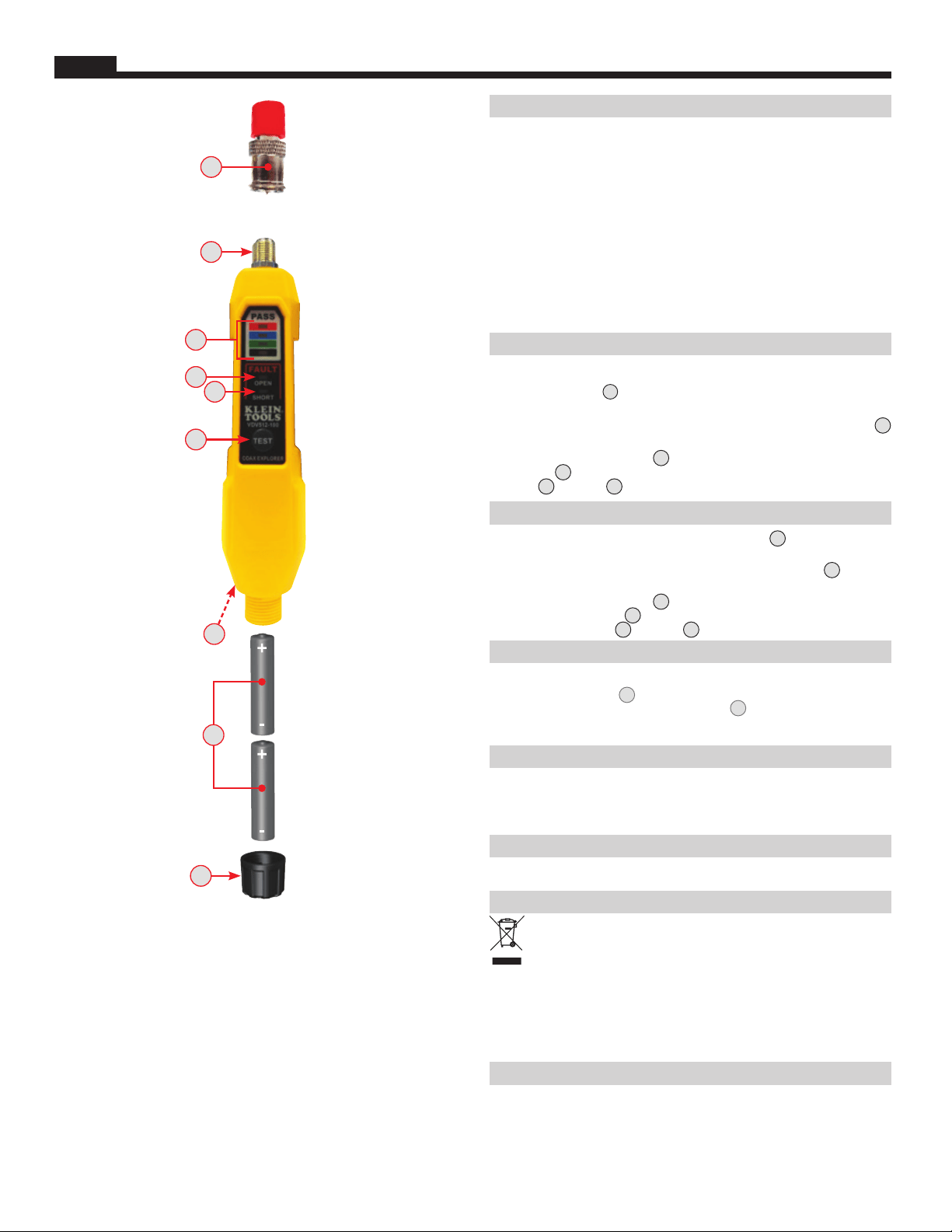
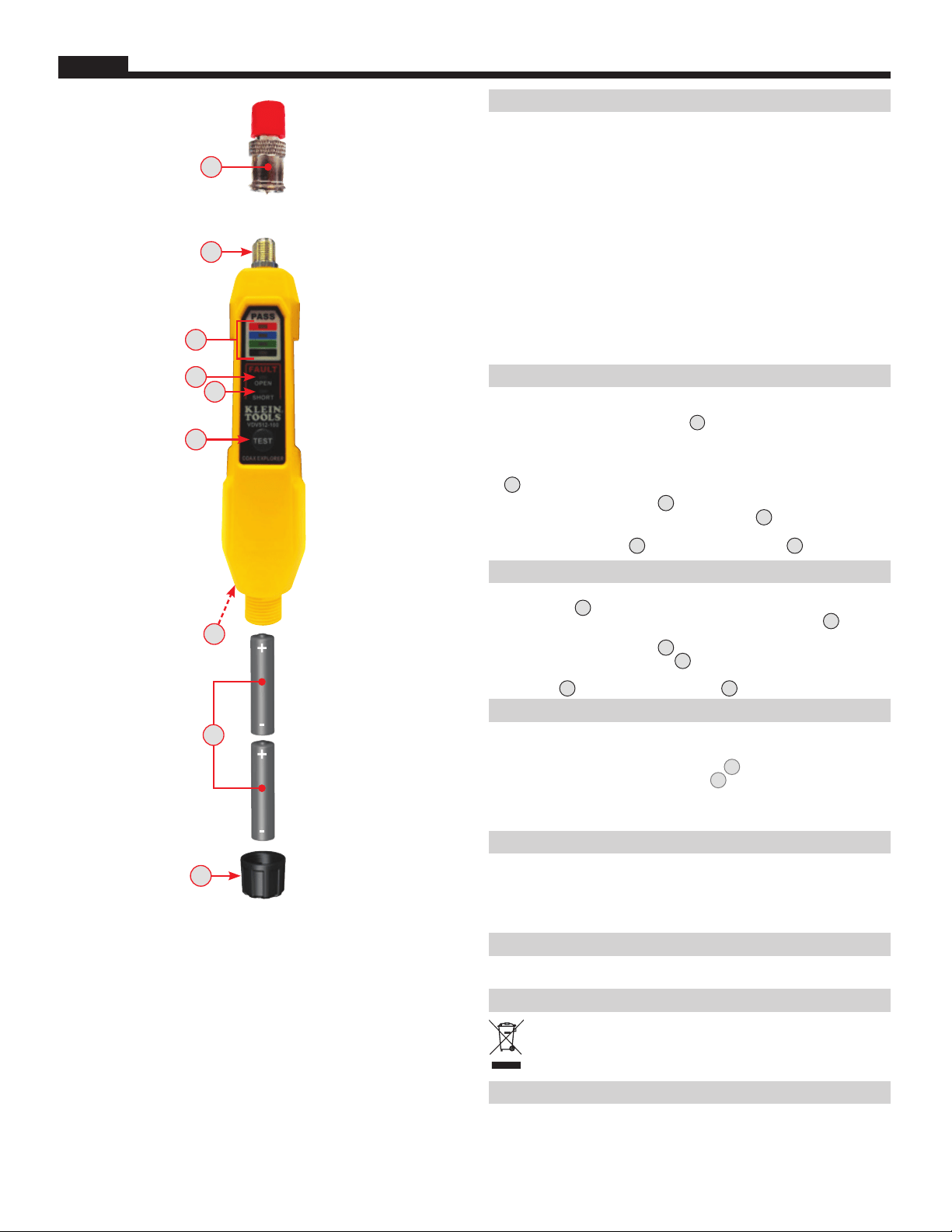
BATTERY REPLACEMENT (FIG. 1)
When the TEST button is pressed and no LEDs light, the batteries must be replaced.
1. Unscrew the battery cap
3
.
2. Remove and recycle the two spent AAA batteries
4
.
3.
Install two new AAA batteries, with the positive (+) side facing into the tester as shown.
4. Screw battery cap tightly back into place.
STORAGE
Remove the batteries when the tester is not in use for a prolonged period of time. Do not
expose to high temperatures or humidity. After a period of storage in extreme conditions
exceeding the limits mentioned in the GENERAL SPECIFICATIONS section, allow the tester
to return to normal operating conditions before using.
WARRANTY
www.kleintools.com/warranty
DISPOSAL / RECYCLE
Do not place equipment and its accessories in the trash. Items must be
properly disposed of in accordance with local regulations. Please see
www.epa.gov or www.erecycle.org for additional information.
CUSTOMER SERVICE
KLEIN TOOLS, INC.
450 Bond Street, Lincolnshire, IL 60069
1-877-775-5346
www.kleintools.com
1
2
3
4
9
5
7
8
6
1.
Test Remote #1 (Red)
2.
F-Connector
3.
Battery Cap
4.
2x AAA Batteries (included)
5.
TEST Button
6.
PASS LEDs
7.
OPEN Fault LED
8.
SHORT Fault LED
9.
Pocket Clip (Back)
NOTE: There are no
user-serviceable parts
inside tester.
ENGLISH
FIG. 1
VDV512-100 Instructions
ESPECIFICACIONES GENERALES
El probador Coax Explorer
®
2 de Klein Tools verifica la continuidad apropiada de los
cables coaxiales con conectores F y mapea su ubicación. Los transmisores remotos
a presión codificados por color permiten probar y mapear hasta cuatro cables, y
los indicadores LED (PASS ["PRUEBA APROBADA"] OPEN ["CIRCUITO ABIERTO"]
o SHORT ["CORTOCIRCUITO"]) muestran el estado de los cables e identifican la
ubicación del cable/transmisor remoto. Se incluye el transmisor remoto de prueba
n.º1 (rojo); losdemás transmisores remotos están disponibles por separado.
• Entorno: Interior
• Altitud de funcionamiento: 10000pies (3000 m) como máximo
• Temperatura de operación: 32°F a 122°F (0°C a 50°C)
• Temperatura de almacenamiento: -4°F a 140°F (-20°C a 60°C)
• Humedad relativa: 10% a 90%, sin condensación
• Dimensiones (incluido el portatransmisor): 5,7" × 2,3" × 1,1"
(145mm × 32mm × 29mm)
• Peso (incluidas las baterías): 4,8 oz (136 g)
Especificaciones sujetas a cambios.
PRUEBA Y MAPEO DE CABLES
NOTA: No utilizar en circuitos o tomacorrientes con energía.
1. Conecte un transmisor remoto de prueba
1
a un extremo del cable o al
tomacorriente que desee probar. Si es necesario, utilice el adaptador F (no
incluido) para conectar el transmisor remoto de prueba al cable.
2. Conecte el otro extremo del cable o el tomacorriente que desee probar al conector
F
2
en el probador Coax Explorer
®
2.
3.
Mantenga presionado el botón TEST ("PROBAR")
5
. Si el cable está correctamente
cableado, se encenderá el LED superior PASS ("PRUEBA APROBADA") (rojo)
6
.
Sihay un problema en el cable, se encenderá uno de los LED FAULT (FALLA)
(OPEN["CIRCUITO ABIERTO"]
7
o SHORT ["CORTOCIRCUITO"]
8
).
PRUEBA DE UN CABLE NO INSTALADO
1. Utilice el adaptador F (no incluido) para conectar el transmisor remoto de prueba
1
a un extremo del cable que desee probar.
2. Conecte el otro extremo del cable que desee probar al conector F
2
en el
probador coaxialExplorer
®
2.
3. Mantenga presionado el botón TEST ("PROBAR")
5
. Si el cable está
correctamente cableado, se encenderá el LED PASS ("PRUEBA APROBADA")
6
. Si hay un problema con el cable, se encenderá uno de los LED FAULT ("FALLA")
(OPEN [CIRCUITO ABIERTO]
7
o SHORT [CORTOCIRCUITO]
8
).
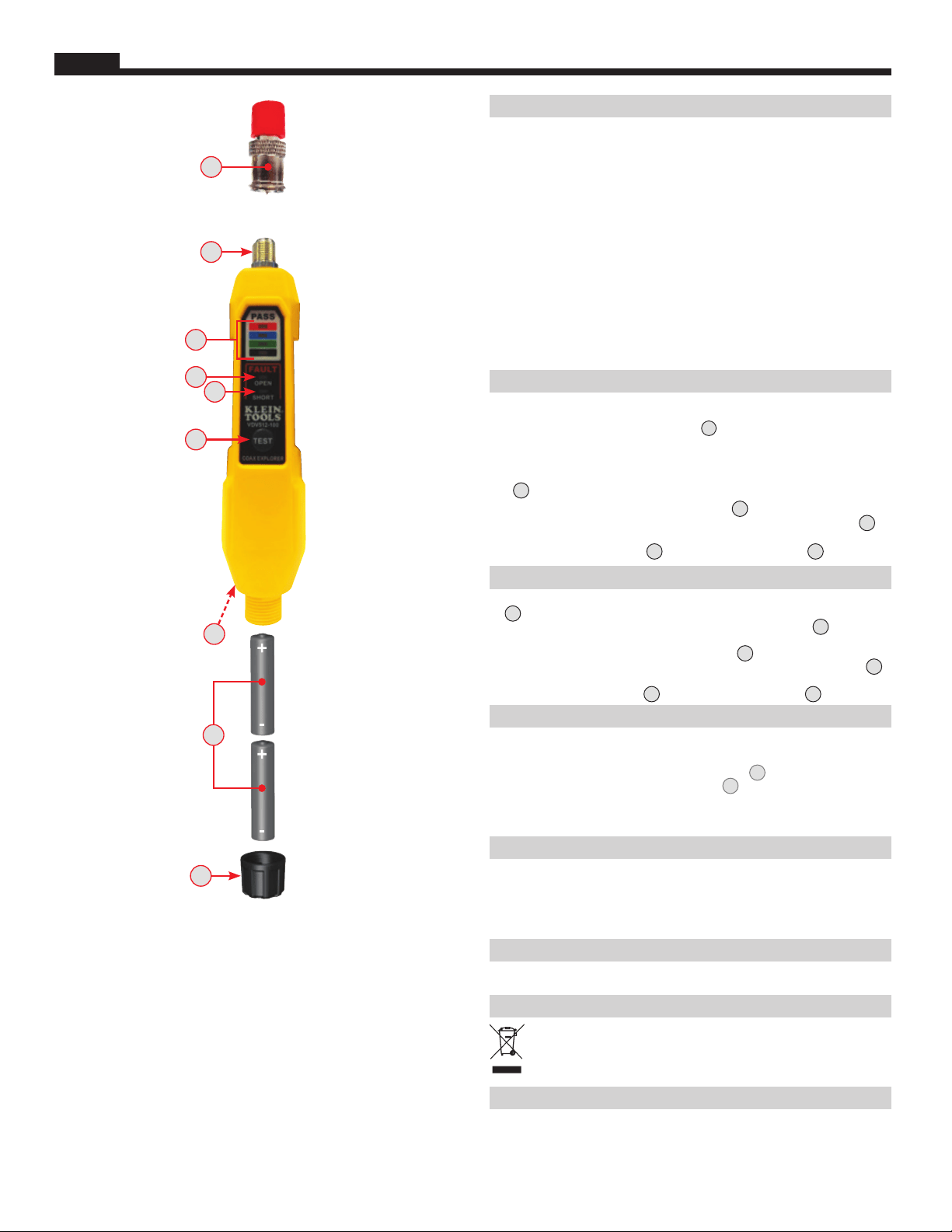
REEMPLAZO DE LAS BATERÍAS (FIG. 1)
Las baterías deben reemplazarse si no se enciende ningún LED al presionar el botón
TEST ("PROBAR").
1. Desenrosque la tapa del compartimento de baterías
3
.
2. Retire y recicle las dos baterías AAA agotadas
4
.
3. Instale dos baterías AAA nuevas con el lado positivo (+) orientado hacia el
probador, como se muestra.
4. Enrosque la tapa del compartimento de baterías firmemente en su lugar.
ALMACENAMIENTO
Retire las baterías si no va a utilizar el probador durante un tiempo prolongado.
No lo exponga a la humedad ni a altas temperaturas. Luego de un período de
almacenamiento en condiciones extremas que sobrepasen los límites mencionados
en la sección ESPECIFICACIONES GENERALES, deje que el probador vuelva a las
condiciones de funcionamiento normales antes de utilizarlo.
GARANTÍA
www.kleintools.com/warranty
ELIMINACIÓN/RECICLAJE
No arroje el equipo ni sus accesorios a la basura. Los elementos se deben
desechar correctamente de acuerdo con las regulaciones locales. Para
obtener más información, consulte www.epa.gov o www.erecycle.org.
SERVICIO AL CLIENTE
KLEIN TOOLS, INC.
450 Bond Street, Lincolnshire, IL 60069
1-877-775-5346
www.kleintools.com
ESPAÑOL
1.
Transmisor remoto de prueba n.º1 (rojo)
2.
Conector F
3.
Tapa del compartimento debaterías
4.
2baterías AAA (incluidas)
5.
Botón TEST ("PROBAR")
6.
LED que indica PASS ("PRUEBA APROBADA")
7.
LED FAULT ("FALLA") queindica OPEN ("CIRCUITO ABIERTO")
8.
LED FAULT ("FALLA") que indica SHORT ("CORTOCIRCUITO")
9.
Clip de bolsillo (espalda)
NOTA: El probador no contiene en su interior piezas que
el usuario pueda reparar.
1
2
3
4
9
5
7
8
6
FIG. 1
VDV512-100 Instrucciones
CARACTÉRISTIQUES GÉNÉRALES
Le CoaxExplorer
®
2 de KleinTools vérifie la continuité des câbles coaxiaux à
connecteur enF et mappe leur emplacement. Les capteurs à distance chromocodés
à enfiler permettent de tester et de mapper jusqu’à 4câbles en indiquant l’état
de chacun d’eux par des voyantsDEL («PASS» [test réussi], «OPEN» [circuit
ouvert] ou «SHORT» [court-circuit]), qui précisent aussi l’emplacement du câble
et du capteur à distance. Le capteur de test à distance n
o
1 (rouge) est inclus, mais
d’autres capteurs à distance sont offerts séparément.
• Environnement: À l’intérieur
• Altitude de fonctionnement: 3000m (10000pi) maximum
• Température de fonctionnement: 0°C à 50°C (32°F à 122°F)
• Température d’entreposage: -20°C à 60°C (-4°F à 140°F)
• Humidité relative: 10 à 90%, sans condensation
• Dimensions (incluant le support pour capteurs à distance): 145x 32x 29mm
(5,7x 2,3x 1,1po)
• Poids (avec les piles): 136g (4,8oz)
Les caractéristiques techniques peuvent faire l’objet de modifications.
TEST ET MAPPAGE DES CÂBLES
REMARQUE: Évitez l’utilisation sur des prises et des circuits alimentés.
1. Connectez le capteur de test à distance
1
à une extrémité du câble ou de la prise
à tester. Au besoin, utilisez un adaptateur de connecteur enF (non compris) pour
connecter le capteur de test à distance au câble.
2. Connectez l’extrémité opposée du câble ou de la prise à tester au connecteur enF
2
sur le Coax Explorer
®
2.
3. Appuyez sur le bouton «TEST»
5
et maintenez-le enfoncé. Si le câblage est
correct, le voyantDEL «PASS» (test réussi) du haut
6
(rouge) s’allumera.
Si un problème survient avec le câble, un des voyantsDEL FAULT (anomalie)
(«OPEN» [circuit ouvert]
7
ou «SHORT» [court-circuit]
8
) s’allumera.
TEST D’UN CÂBLE NON INSTALLÉ
1. À l’aide de l’adaptateur de connecteur enF (non compris), connectez le capteur de
test à distance
1
à une extrémité du câble à tester.
2. Connectez l’extrémité opposée du câble à tester au connecteur enF
2
sur le
CoaxExplorer
®
2.
3. Appuyez sur le bouton «TEST»
5
. et maintenez-le enfoncé. Si le câblage
est correct, le voyantDEL «PASS»
6
(test réussi) correspondant s’allumera.
Si un problème survient avec le câble, un des voyantsDEL FAULT (anomalie)
(«OPEN»
7
[circuit ouvert] ou «SHORT»
8
[court-circuit]) s’allumera.
REMPLACEMENT DES PILES (FIG. 1)
Lorsque vous enfoncez le bouton «TEST» et qu’aucun voyantDEL ne s’allume,
remplacez les piles.
1. Dévissez le couvercle du compartiment à piles
3
.
2. Retirez et recyclez les deux pilesAAA à plat
4
.
3. Placez deux nouvelles pilesAAA dans le testeur, côté positif (+) vers le haut,
comme illustré.
4. Replacez le couvercle du compartiment à piles en le vissant bien serré.
ENTREPOSAGE
Retirez les piles lorsque vous ne prévoyez pas utiliser le testeur pendant une longue
période. N’exposez pas l’appareil à des températures ou à un taux d’humidité élevés.
Après une période de stockage dans des conditions extrêmes (hors des limites
mentionnées dans la section CARACTÉRISTIQUES GÉNÉRALES), laissez le testeur
revenir à des conditions d’utilisation normales avant de l’utiliser.
GARANTIE
www.kleintools.com/warranty
MISE AU REBUT/RECYCLAGE
Ne mettez pas l’appareil et ses accessoires au rebut. Ces articles doivent
être éliminés conformément aux règlements locaux. Pour de plus amples
renseignements, consultez les sites www.epa.gov ou www.erecycle.org.
SERVICE À LA CLIENTÈLE
KLEINTOOLS, INC.
450Bond Street, Lincolnshire, IL60069
1877775-5346
www.kleintools.com
FRANÇAIS
1
2
3
4
9
5
7
8
6
1.
Capteur de test à distance n
o
1 (rouge)
2.
Connecteur enF
3.
Couvercle de piles
4.
2pilesAAA (comprises)
5.
Bouton «TEST»
6.
VoyantsDEL «PASS» (testréussi)
7.
VoyantDEL «FAULT» (anomalie) indiquant «OPEN» (circuit ouvert)
8.
VoyantDEL «FAULT» (anomalie) indiquant «SHORT» (court-circuit)
9.
Agrafe pour poche (àl’arrière)
REMARQUE: Ce testeur ne contient aucune pièce réparable
par l’utilisateur.
FIG. 1
VDV512-100 Directives