Safe Operation Practices • Set-Up • Operation • Maintenance • Service • Troubleshooting • Warranty
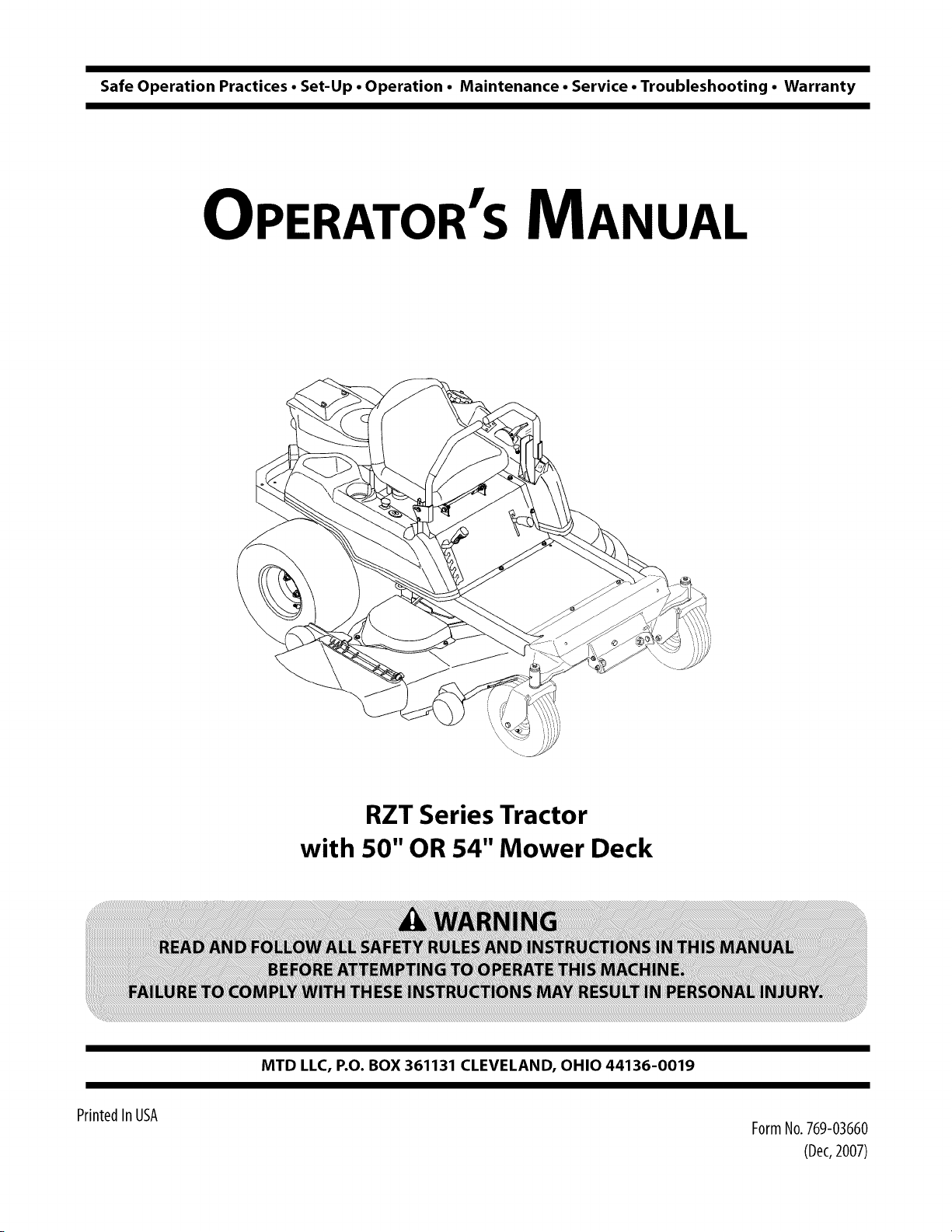
OPERATOR'S MANUAL
RZT Series Tractor
with 50" OR 54" Mower Deck
MTD LLC, P.O. BOX 361131 CLEVELAND, OHIO 44136-0019
PrintedIn USA
FormNo.769-03660
(Dec,2007)
ToTheOwner
1
ThankYou
Thank you for purchasing an RZT series tractor manufactured
by MTD LLC. It was carefully engineered to provide excellent
performance when properly operated and maintained.
Please read this entire manual prior to operating the equipment.
It instructs you how to safely and easily set up, operate and
maintain your machine. Please be sure that you, and any other
persons who will operate the machine, carefully follow the
recommended safety practices at all times. Failure to do so could
result in personal injury or property damage.
All information in this manual is relative to the most recent
product information available at the time of printing. Review
this manual frequently to familiarize yourself with the machine,
its features and operation. Please be aware that this Operator's
Manual may cover a range of product specifications for various
models. Characteristics and features discussed and/or illustrated
in this manual may not be applicable to all models. MTD LLC.
reserves the right to change product specifications, designs and
equipment without notice and without incurring obligation.
This product has met the rigid safety standards of the Outdoor
Power Equipment Institute and an independent testing
laboratory. If you have any problems or questions concerning the
machine, phone a authorized MTD service dealer or contact us
directly. MTD's Customer Support telephone numbers, website
address and mailing address can be found on this page. We want
to ensure your complete satisfaction at all times.
IMPORTANT: In this manual, all references to rightand leftside
of the machine are observed from the operating position.
The engine manufacturer is responsible for all engine-related
issues with regards to performance, power-rating, specifications,
warranty and service. Please refer to the engine manufacturer's
Owner's/Operator's Manual, packed separately with your
machine, for more information.
Table of Contents
Safe Operation Practices ........................................ 3
Assembly & Set-Up .................................................. 8
Controls & Features ................................................ 10
Opera tion ................................................................ 13
Maintenance & Adjustment ................................ 20
Service .................................................................... 26
Troubleshooting ..................................................... 31
Replacement Parts ............................................... 32
Attachments & Accessories .................................. 34
Warranty ................................................. Back Cover
RecordProductInformation
Before setting up and operating your new equipment, please
locate the model plate on the equipment and record the
information in the provided area to the right. Pivot the seat
assembly forward to locate the model plate on the underside of
the seat pivot bracket.This information will be necessary, should
you seek technical support via our web site, Customer Support
Department, or with a local authorized service dealer.
MODEL NUMBER
DDDDDDDDDDD
SERIAL NUMBER
DDDDDDDDDDD
CustomerSupport
Please do NOT return the machine to the retailer or dealer without first contacting our Customer Support Department.
If you have difficulty assembling this product or have any questions regarding the controls, operation, or maintenance of
this machine, you can seek help from the experts. Choose from the options below:
0 Visit us on the web at www.mtdproducts.com
0 Call a Customer Support Representative at (800) 800-7310 or (330) 220-4683
0 Write us at MTD LLC • P.O. Box 361131 • Cleveland, OH • 44136-0019
ImportantSafeOperationPractices
2
WARNING: This symbol points out important safety instructions which, if not followed,
could endanger the personal safety and/or property of yourself and others. Read and follow
all instructions in this manual before attempting to operate this machine. Failure to comply
with these instructions may result in personal injury.
When you see this symbol. HEED ITS WARNING!
CALIFORNIA PROPOSITION 65
WARNING: Engine Exhaust, some of its constituents, and certain vehicle components
contain or emit chemicals known to State of California to cause cancer and birth defects
or other reproductive harm.
WARNING: Battery posts, terminals, and related accessories contain lead and lead
compounds, chemicals known to the State of California to cause cancer and reproductive
harm. Wash hands after handling
DANGER: This machine was built to be operated according to the safe operation practices in
this manual. As with any type of power equipment, carelessness or error on the part of the
operator can result in serious injury. This machine is capable of amputating hands and feet
and throwing objects. Failure to observe the following safety instructions could result in
serious injury or death.
General Operation
1. Read, understand, and follow all instructions on the
machine and in the manual(s) before attempting to
assemble and operate. Keep this manual in a safe place for
future and regular reference and for ordering replacement
parts.
2. Be familiar with all controls and their proper operation.
Know how to stop the machine and disengage them
quickly.
3. Never allow children under 14 years of age to operate this
machine. Children 14 and over should read and understand
the instructions and safe operation practices in this manual
and on the machine and should be trained and supervised
by an adult.
4. Never allow adults to operate this machine without proper
instruction.
S.
To help avoid blade contact or a thrown object injury,
keep bystanders, helpers, children and pets at least 75 feet
from the machine while it is in operation. Stop machine if
anyone enters the area.
6. Thoroughly inspect the area where the equipment is to be
used. Remove all stones, sticks, wire, bones, toys, and other
foreign objects which could be picked up and thrown by
the blade(s). Thrown objects can cause serious personal
injury.
7. Plan your mowing pattern to avoid discharge of material
toward roads, sidewalks, bystanders and the like. Also,
avoid discharging material against a wall or obstruction
which may cause discharged material to ricochet back
toward the operator.
8. Always wear safety glasses or safety goggles during
operation and while performing an adjustment or repair
to protect your eyes. Thrown objects which ricochet can
cause serious injury to the eyes.
9. Wear sturdy, rough-soled work shoes and close-fitting
slacks and shirts. Loose fitting clothes and jewelry can be
caught in movable parts. Never operate this machine in
bare feet or sandals.
10. Be aware of the mower and attachment discharge direction
and do not point it at anyone. Do not operate the mower
without the discharge cover or entire grass catcher in its
proper place.
11. Do not put hands or feet near rotating parts or under the
cutting deck. Contact with the blade(s) can amputate
hands and feet.
23.
24.
12. Amissingordamageddischargecovercancauseblade
contactorthrownobjectinjuries.
13. Stoptheblade(s)whencrossinggraveldrives,walks,or
roadsandwhilenotcuttinggrass.
14. Watchfortrafficwhenoperatingnearorcrossing
roadways.Thismachineisnotintendedforuseonany
publicroadway.
15. Donotoperatethemachinewhileundertheinfluenceof
alcoholordrugs.
16. Mowonlyindaylightorgoodartificiallight.
17. Nevercarrypassengers.
18. Backupslowly.Alwayslookdownandbehindbeforeand
whilebackingtoavoidaback-overaccident.Beaware
andpayattentiontothesafetysystemfunctionthat
stopspowertothebladeswhendrivinginreverse.Ifnot
functioningproperly,contactanauthorizedMTDService
Dealerforsafetysysteminspectionandrepair.
19. Slowdownbeforeturning.Operatethemachinesmoothly.
Avoiderraticoperationandexcessivespeed.
20. Disengageblade(s),setparkingbrake,stopengineand
waituntiltheblade(s)cometoacompletestopbefore
removinggrasscatcher,emptyinggrass,uncloggingchute,
removinganygrassordebris,ormakinganyadjustments.
21. Neverleavearunningmachineunattended.Alwaysturnoff
blade(s),placedrivecontrolleversinneutral,setparking
brake,stopengineandremovekeybeforedismounting.
22. Useextracarewhenloadingorunloadingthemachineinto
atrailerortruck.Thismachineshouldnotbedrivenupor
downramp(s),becausethemachinecouldtipover,causing
seriouspersonalinjury.Themachinemustbepushed
manuallyonramp(s)toloadorunloadproperly.
Mufflerandenginebecomehotandcancauseaburn.Do
nottouch.
25.
26.
Checkoverheadclearancescarefullybeforedrivingunder
lowhangingtreebranches,wires,dooropeningsetc.,
wheretheoperatormaybestruckorpulledfromthe
machine,whichcouldresultinseriousinjury.
Disengageallattachmentclutches,settheparkingbrake
tothe'ON' position and move the RH and LH drive
control levers fully outward to the neutral position before
attempting to start the engine.
Your machine is designed to cut normal residential grass of
a height no more than 10". Do not attempt to mow through
unusually tall, dry grass (e.g., pasture) or piles of dry leaves.
Dry grass or leaves may contact the engine exhaust and/or
build up on the mower deck presenting a potential fire
hazard.
27. Use only accessories and attachments approved for this
machine by the machine manufacturer. Read, understand
and follow all instructions provided with the approved
accessory or attachment.
28. Data indicates that operators, age 60 years and above, are
involved in a large percentage of riding mower-related
injuries. These operators should evaluate their ability
to operate the riding mower safely enough to protect
themselves and others from serious injury.
29. If situations occur which are not covered in this manual, use
care and good judgment. Contact your customer service
representative for assistance.
SlopeOperation
Slopes are a major factor related to loss of control and tip-over
accidents which can result in severe injury or death. All slopes
require extra caution. If you cannot back up the slope or if you
feel uneasy on it, do not mow it.
For your safety, use the slope gauge included as part of this
manual to measure slopes before operating this machine on
a sloped or hilly area. If the slope is greater than 15 degrees as
shown on the slope gauge, do not operate this machine on that
area or serious injury could result.
Do:
I.
Mow across slopes, not up and down. Exercise extreme
caution when changing direction on slopes.
2. Watch for holes, ruts, bumps, rocks, or other hidden
objects. Uneven terrain could overturn the machine. Tall
grass can hide obstacles.
3. Use slow speed. Choose a low enough speed so that you
will not have to stop while on the slope. Avoid starting
or stopping on a slope. If the tires are unable to maintain
traction, disengage the blades and proceed slowly and
carefully straight down the slope.
4. Follow the manufacturer's recommendations for wheel
weights or counterweights to improve stability.
5. Use extra care with grass catchers or other attachments.
These can change the stability of the machine.
6. Keep all movement on the slopes slow and gradual. Do
not make sudden changes in speed or direction. Rapid
acceleration or deceleration could cause the front of the
machine to lift and rapidly flip over backwards, which
could cause serious injury.
DoNot:
1. Do not turn on slopes unless necessary; then turn slowly
uphill and use extra care while turning.
2. Do not mow near drop-offs, ditches or embankments. The
mower could suddenly turn over if a wheel is over the edge
of a cliff, ditch, or if an edge caves in.
3. Do not try to stabilize the machine by putting your foot on
the ground.
4. Do not use a grass catcher on steep slopes.
5. Do not mow on wet grass. Reduced traction could cause
sliding.
6. Do not tow heavy pull behind attachments (e.g. loaded
dump cart, lawn roller, etc.) on slopes greater than 5
degrees. When going down hill, the extra weight tends to
push the tractor and may cause you to loose control (e.g.
tractor may speed up, braking and steering ability are
reduced, attachment may jack-knife and cause tractor to
overturn).
4 I SECTION 2-- IMPORTANT SAFE OPERATION PRACTICES
Children
I. Tragic accidents can occur if the operator is not alert to the
presence of children. Children are often attracted to the
machine and the mowing activity. They do not understand
the dangers. Never assume that children will remain where
you last saw them.
a. Keep children out of the mowing area and in
watchful care of a responsible adult other than the
operator.
b. Be alert and turn machine off ifa child enters the
area.
c. To avoid back-over accidents, always look behind
and down for small children.
d. Never carry children, even with the blade(s) shut off.
They may fall off and be seriously injured or interfere
with safe machine operation.
e. Use extreme care when approaching blind corners,
doorways, shrubs, trees or other objects that may
block your vision of a child who may run into the
path of the machine.
f. Keep children away from hot or running engines.
They can suffer burns from a hot muffler.
g. Remove key when machine is unattended to
prevent unauthorized operation.
2. Never allow children under 14 years of age to operate this
machine. Children 14 and over should read and understand
the instructions and safe operation practices in this manual
and on the machine and should be trained and supervised
by an adult.
Towing
I. Tow only with a machine that has a hitch designed for
towing. Do not attach towed equipment except at the
hitch point.
Follow the manufacturers recommendation for weight
limits for towed equipment and towing on slopes.
Never allow children or others in or on towed equipment.
On slopes, the weight of the towed equipment may cause
loss of traction and loss of control.
2.
3.
4.
5.
6.
Travel slowly and allow extra distance to stop.
Do not shift to neutral and coast downhill.
Service
SafeHandlingof Gasoline:
I. To avoid personal injury or property damage use extreme
care in handling gasoline. Gasoline is extremely
flammable and the vapors are explosive. Serious
personal injury can occur when gasoline is spilled on
yourself or your clothes which can ignite. Wash your skin
and change clothes immediately.
a. Use only an approved gasoline container.
b. Never fill containers inside a vehicle or on a truck
or trailer bed with a plastic liner. Always place
containers on the ground away from your vehicle
before filling.
c. When practical, remove gas-powered equipment
from the truck or trailer and refuel it on the ground.
If this is not possible, then refuel such equipment on
a trailer with a portable container, rather than from a
gasoline dispenser nozzle.
d. Keep the nozzle in contact with the rim of the fuel
tank or container opening at all times until fueling is
complete. Do not use a nozzle lock-open device.
e. Extinguish all cigarettes, cigars, pipes and other
sources of ignition.
f. Never fuel machine indoors.
g. Never remove gas cap or add fuel while the engine
is hot or running. Allow engine to cool at least two
minutes before refueling.
h. Never over fill fuel tank. Fill tank to no more than 1/2
inch below bottom of filler neck to allow space for
fuel expansion.
i. Replace gasoline cap and tighten securely.
j. If gasoline is spilled, wipe it off the engine and
equipment. Move machine to another area. Wait 5
minutes before starting the engine.
k. To reduce fire hazards, keep machine free of grass,
leaves, or other debris build-up. Clean up oil or fuel
spillage and remove any fuel soaked debris.
I. Never store the machine or fuel container inside
where there is an open flame, spark or pilot light
as on a water heater, space heater, furnace, clothes
dryer or other gas appliances.
m. Allow a machine to cool at least five minutes before
storing.
GeneralService
1. Never run an engine indoors or in a poorly ventilated area.
Engine exhaust contains carbon monoxide, an odorless,
and deadly gas.
2. Before cleaning, repairing, or inspecting, make certain the
blade(s) and all moving parts have stopped. Disconnect the
spark plug wire and ground against the engine to prevent
unintended starting.
3. Periodically check to make sure the blades come to
complete stop within approximately (5) five seconds after
operating the blade disengagement control. If the blades
do not stop within the this time frame, your machine
should be serviced professionally by an authorized MTD
Service Dealer.
4.
Regularly check the safety interlock system for proper
function, as described later in this manual. If the safety
interlock system does not function properly, have your
machine serviced professionally by an authorized MTD
Service Dealer.
SECTION2 -- IMPORTANT SAFE OPERATION PRACTICES S
5. Check the blade(s) and engine mounting bolts at frequent
intervals for proper tightness. Also, visually inspect blade(s)
for damage (e.g., excessive wear, bent, cracked). Replace
the blade(s) with the original equipment manufacturer's
(O.E.M.) blade(s) only, listed in this manual. "Use of parts
which do not meet the original equipment specifications
may lead to improper performance and compromise
safety!"
6. Mower blades are sharp. Wrap the blade or wear gloves,
and use extra caution when servicing them.
7. Keep all nuts, bolts, and screws tight to be sure the
equipment is in safe working condition.
8. Never tamper with the safety interlock system or other
safety devices. Check their proper operation regularly.
9. After striking a foreign object, stop the engine, disconnect
the spark plug wires) and ground against the engine.
Thoroughly inspect the machine for any damage. Repair
the damage before starting and operating.
10. Never attempt to make adjustments or repairs to the
machine while the engine is running.
11. Grass catcher components and the discharge cover are
subject to wear and damage which could expose moving
parts or allow objects to be thrown. For safety protection,
frequently check components and replace immediately
with original equipment manufacturer's (O.E.M.) parts only,
listed in this manual. "Use of parts which do not meet the
original equipment specifications may lead to improper
performance and compromise safety!"
12. Do not change the engine governor settings or over-speed
the engine. The governor controls the maximum safe
operating speed of the engine.
13. Maintain or replace safety and instruction labels, as
necessary.
14. Observe proper disposal laws and regulations for gas, oil,
etc. to protect the environment.
Donot modify engine
To avoid serious injury or death, do not modify engine in any
way. Tampering with the governor setting can lead to a runaway
engine and cause it to operate at unsafe speeds. Never tamper
with factory setting of engine governor.
Notice Regarding Emissions
Engines which are certified to comply with California and federal
EPA emission regulations for SORE (Small Off Road Equipment)
are certified to operate on regular unleaded gasoline, and
may include the following emission control systems: Engine
Modification (EM) and Three Way Catalyst (TWC) if so equipped.
SparkArrestor
_ ARNING: This machine is equipped with an
internal combustion engine and should not be used
on or near any unimproved forest-covered, brush
covered or grass-covered land unless the engine's
exhaust system is equipped with a spark arrester
meeting applicable local or state laws (if any).
Ira spark arrester is used, it should be maintained in
effective working order by the operator. In the State of California
the above is required by law (Section 4442 of the California
Public Resources Code). Other states may have similar laws.
Federal laws apply on federal lands.
A spark arrester for the muffler is available through your
nearest engine authorized service dealer or contact the service
department, P.O.Box 361131 Cleveland, Ohio 44136-0019.
Average Useful Life
According to the Consumer Products Safety Commission
(CPSC) and the U.S. Environmental Protection Agency (EPA),
this product has an Average Useful Life of seven (7) years, or 270
hours of operation. At the end of the Average Useful Life, buy a
new machine or have the machine inspected annually by an
authorized service dealer to ensure that all mechanical and
safety systems are working properly and not worn excessively.
Failure to do so can result in accidents, injuries or death.
WARNING: Your Responsibility--Restrict the use of this power machine to persons who read, understand and
follow the warnings and instructions in this manual and on the machine.
SAVETHESEINSTRUCTIONS!
6 I SECTION 2-- IMPORTANT SAFE OPERATION PRACTICES
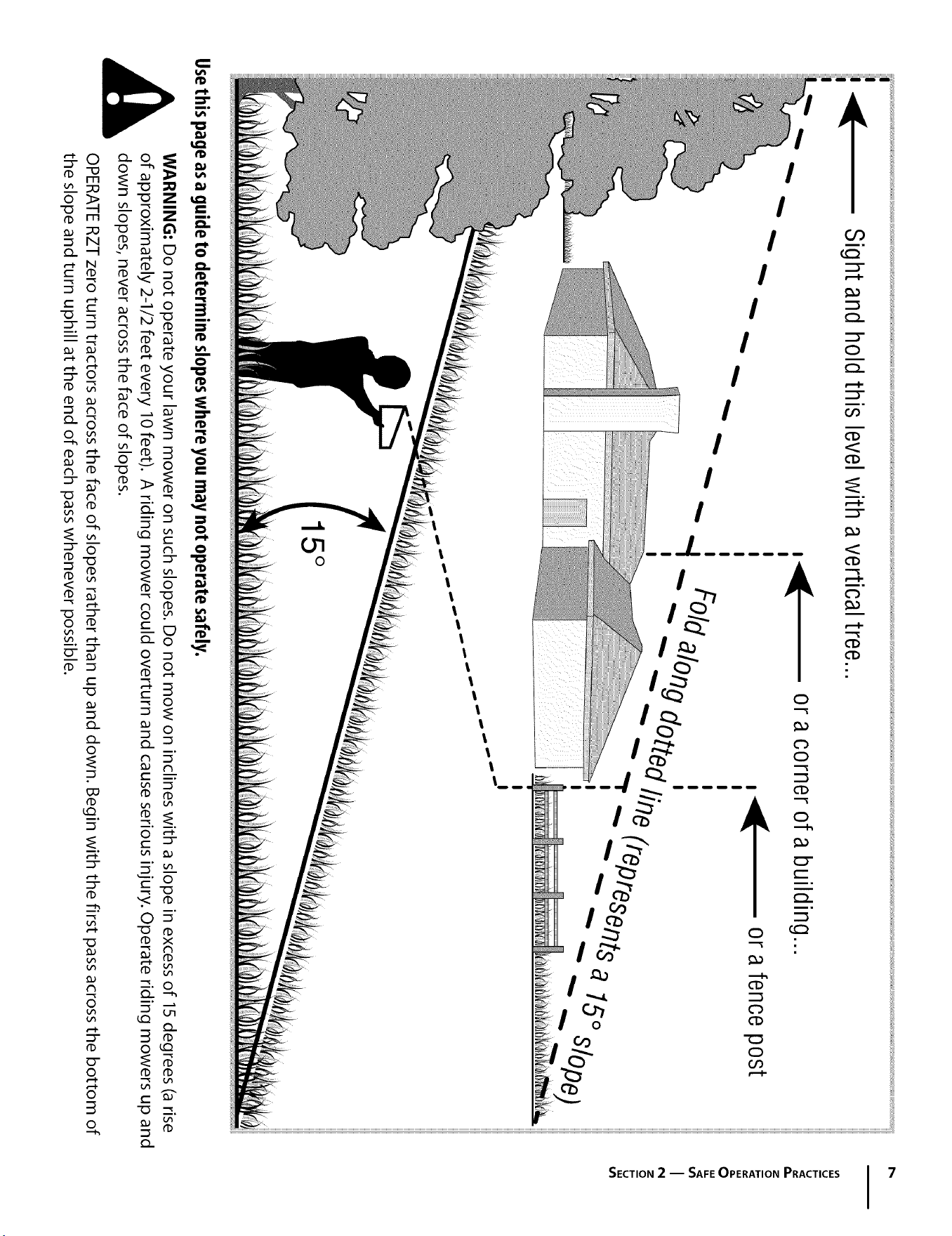
Sight and h01dthis levelwith a vertical tree...
I
I
I
I
I
I
!
!
or a corner of a building...
or a fencepost
15 °
u
I--
Q.
Z
O
O
I
z
£
I-
.v,
Usethis page as a guide to determine slopeswhere you may not operate safely.
WARNING: Do not operate your lawn mower on such slopes. Do not mow on inclines with a slope in excess of 15 degrees (a rise
of approximately 2-1/2 feet every 10 feet). A riding mower could overturn and cause serious injury. Operate riding mowers up and
down slopes, never across the face of slopes.
OPERATE RZT zero turn tractors across the face of slopes rather than up and down. Begin with the first pass across the bottom of
the slope and turn uphill at the end of each pass whenever possible.
Assembly& Set-Up
3
Contentsof Crate
• One Lawn Tractor •
• One RZT Tractor Operator's •
Manual
One Oil Drain Tube
One Briggs & Stratton Engine
Operator's Manual
• One Deck Wash Hose Coupler
• One Product Registration Card
TRACTORPREPARATION
Remove the upper crating material from the shipping
pallet, and cut any bands or tie straps securing the tractor
to the pallet.
Use the lift handle to raise the deck to its highest position.
Engage the transmission bypass rods on each side of the
tractor; then carefully roll the tractor off the shipping
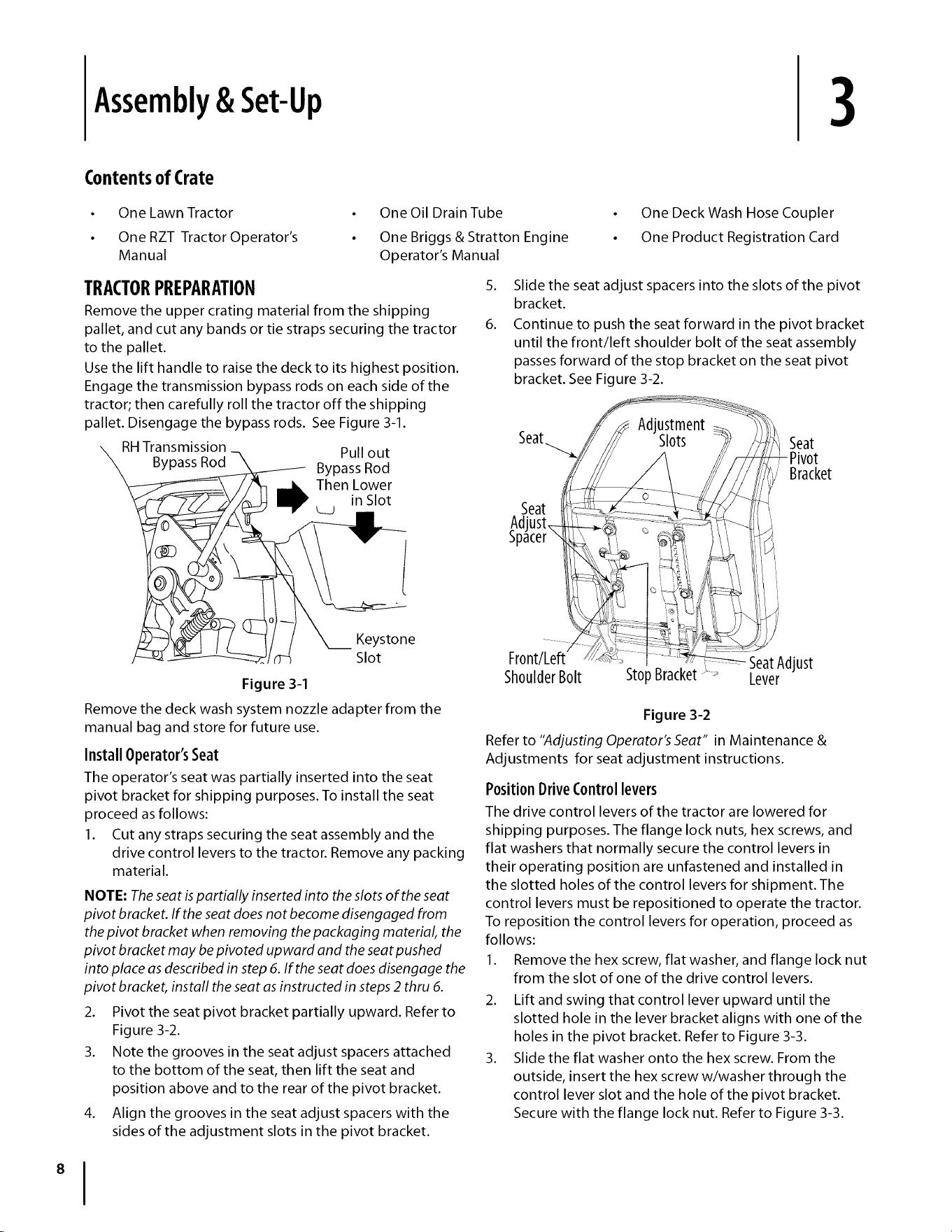
pallet. Disengage the bypass rods. See Figure 3-1.
RH Transmission Pull out
Bypass Rod Bypass Rod
Then Lower
in Slot
k._,3
Keystone
Slot
Figure 3-1
Remove the deck wash system nozzle adapter from the
manual bag and store for future use.
Install Operator'sSeat
The operator's seat was partially inserted into the seat
pivot bracket for shipping purposes. To install the seat
proceed as follows:
1. Cut any straps securing the seat assembly and the
drive control levers to the tractor. Remove any packing
material.
NOTE: The seat ispartially inserted into the slots of the seat
pivot bracket. If the seat does not become disengaged from
the pivot bracket when removing the packaging material, the
pivot bracket may be pivoted upward and the seat pushed
into place as described in step 6. If the seat does disengage the
pivot bracket, install the seat as instructed in steps 2 thru 6.
2. Pivot the seat pivot bracket partially upward. Refer to
Figure 3-2.
3. Note the grooves in the seat adjust spacers attached
to the bottom of the seat, then lift the seat and
position above and to the rear of the pivot bracket.
4. Align the grooves in the seat adjust spacers with the
sides of the adjustment slots in the pivot bracket.
S.
6.
Slide the seat adjust spacers into the slots of the pivot
bracket.
Continue to push the seat forward in the pivot bracket
until the front/left shoulder bolt of the seat assembly
passes forward of the stop bracket on the seat pivot
bracket. See Figure 3-2.
Seat
Seat
Ad
ShoulderBolt
Sto Bracket-_
Seat
Bracket
SeatAdjust
Lever
Figure 3-2
Refer to "Adjusting Operator's Seat" in Maintenance &
Adjustments for seat adjustment instructions.
Position DriveControllevers
The drive control levers of the tractor are lowered for
shipping purposes. The flange lock nuts, hex screws, and
flat washers that normally secure the control levers in
their operating position are unfastened and installed in
the slotted holes of the control levers for shipment. The
control levers must be repositioned to operate the tractor.
To reposition the control levers for operation, proceed as
follows:
1. Remove the hex screw, flat washer, and flange lock nut
from the slot of one of the drive control levers.
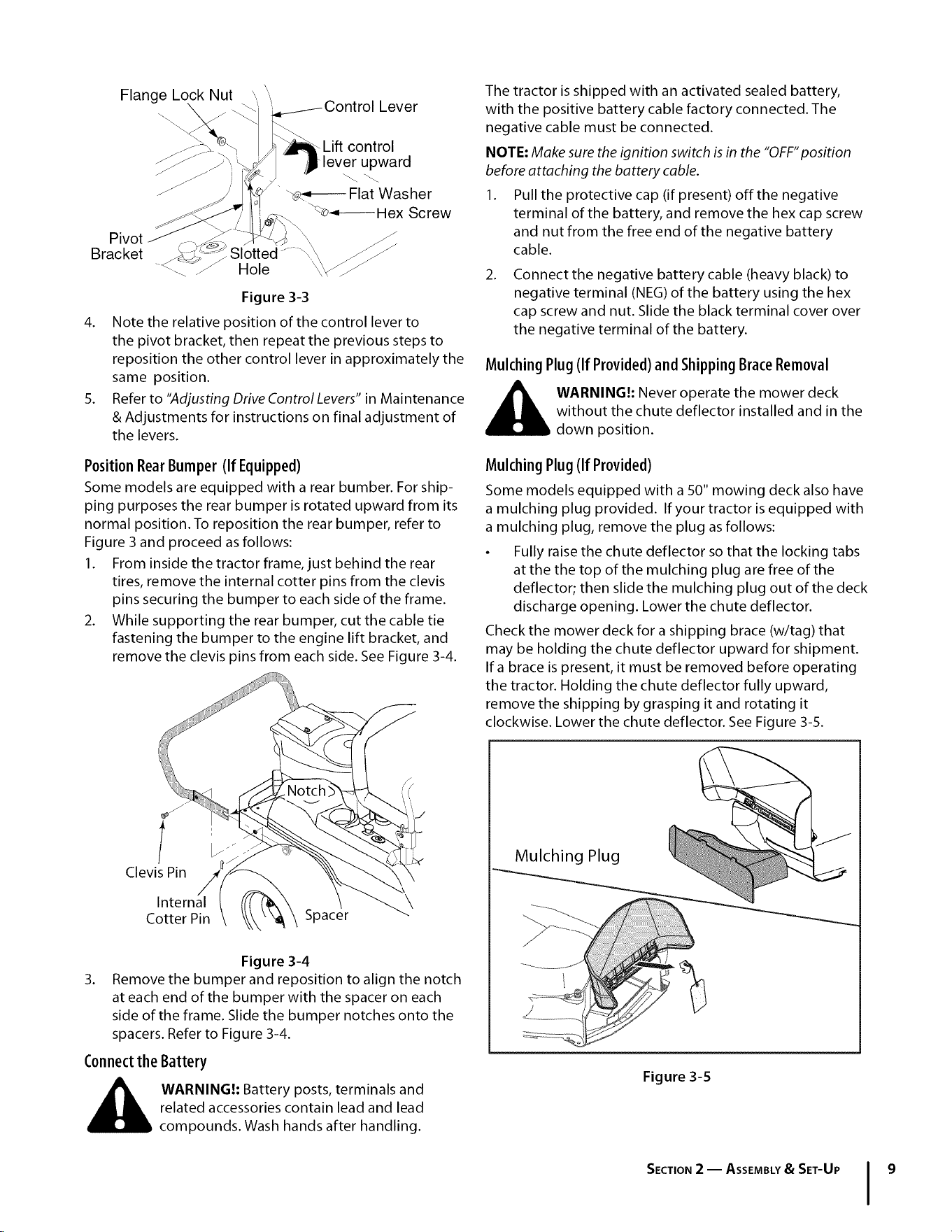
2. Lift and swing that control lever upward until the
slotted hole in the lever bracket aligns with one of the
holes in the pivot bracket. Refer to Figure 3-3.
3. Slide the flat washer onto the hex screw. From the
outside, insert the hex screw w/washer through the
control lever slot and the hole of the pivot bracket.
Secure with the flange lock nut. Refer to Figure 3-3.
\\
Flange Lock Nut ',, ,.
Lever
Pivot \
Slotted ........\,___Bracket -4 Hole
Figure 3-3
4. Note the relative position of the control lever to
the pivot bracket, then repeat the previous steps to
reposition the other control lever in approximately the
same position.
5. Refer to "Adjusting Drive Control Levers" in Maintenance
& Adjustments for instructions on final adjustment of
the levers.
Position RearBumper(If Equipped)
Some models are equipped with a rear bumber. For ship-
ping purposes the rear bumper is rotated upward from its
normal position. To reposition the rear bumper, refer to
Figure 3 and proceed as follows:
1. From inside the tractor frame, just behind the rear
tires, remove the internal cotter pins from the clevis
pins securing the bumper to each side of the frame.
2. While supporting the rear bumper, cut the cable tie
fastening the bumper to the engine lift bracket, and
remove the clevis pins from each side. See Figure 3-4.
3.
Figure 3-4
Remove the bumper and reposition to align the notch
at each end of the bumper with the spacer on each
side of the frame. Slide the bumper notches onto the
spacers. Refer to Figure 3-4.
Connectthe Battery
_ WARNINGh Battery posts, terminals and
related accessories contain lead and lead
compounds. Wash hands after handling.
The tractor is shipped with an activated sealed battery,
with the positive battery cable factory connected. The
negative cable must be connected.
NOTE: Make sure the ignition switch is in the "OFF"position
before attaching the battery cable.
1. Pull the protective cap (if present) off the negative
terminal of the battery, and remove the hex cap screw
and nut from the free end of the negative battery
cable.
2.
Connect the negative battery cable (heavy black) to
negative terminal (NEG) of the battery using the hex
cap screw and nut. Slide the black terminal cover over
the negative terminal of the battery.
Mulching Plug(If Provided)and Shipping BraceRemoval
WARNINGh Never operate the mower deck
without the chute deflector installed and in the
down position.
Mulching Plug(If Provided)
Some models equipped with a 50" mowing deck also have
a mulching plug provided. If your tractor is equipped with
a mulching plug, remove the plug as follows:
• Fully raise the chute deflector so that the locking tabs
atthe the top of the mulching plug are free of the
deflector; then slide the mulching plug out of the deck
discharge opening. Lower the chute deflector.
Check the mower deck for a shipping brace (w/tag) that
may be holding the chute deflector upward for shipment.
If a brace is present, it must be removed before operating
the tractor. Holding the chute deflector fully upward,
remove the shipping by grasping it and rotating it
clockwise. Lower the chute deflector. See Figure 3-5.
Mulching Plug
Figure 3-5
SECTION2 -- ASSEMBLY • SET-UP 9
ControlsandFeatures
4
K
J
/ /
!
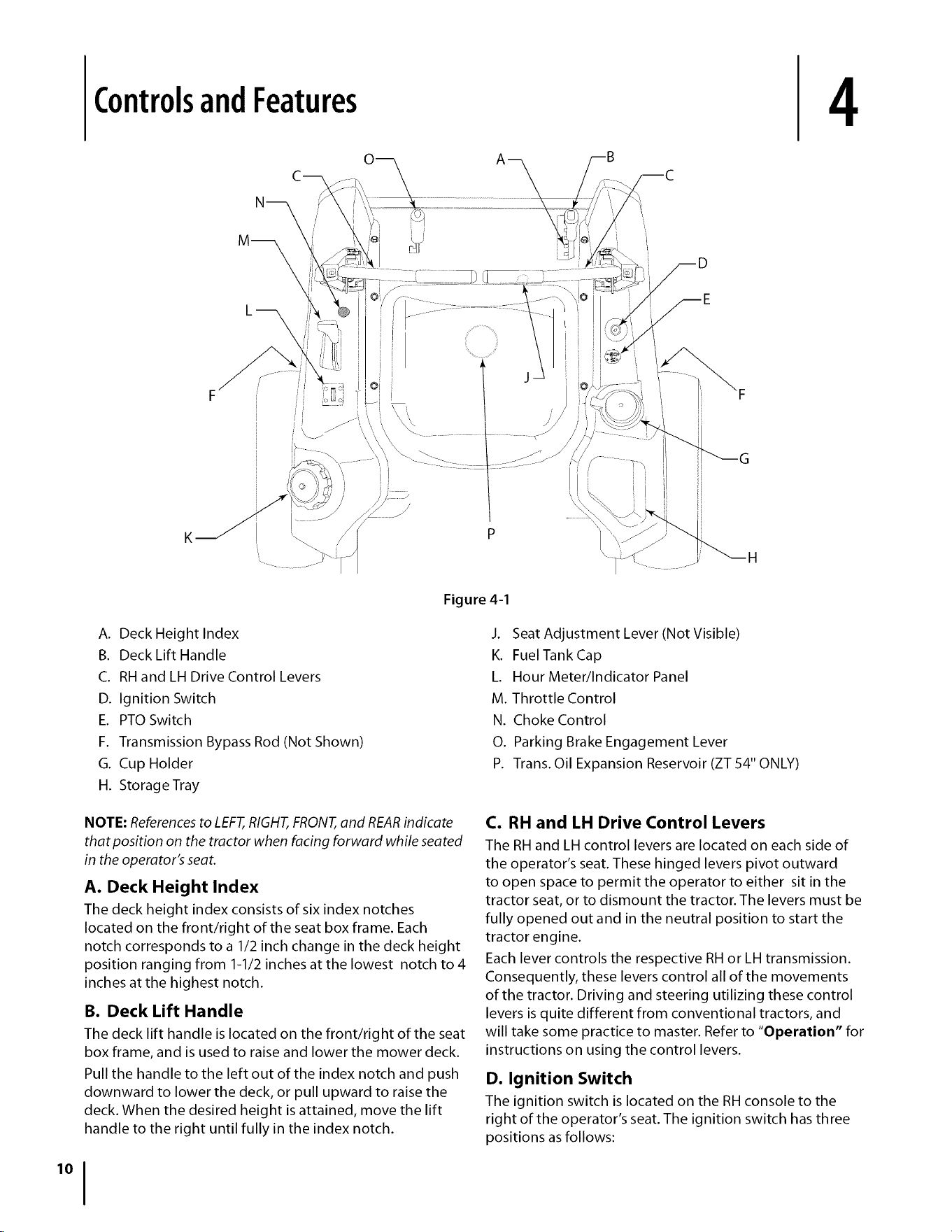
Figure4-1
A. Deck Height Index
B. Deck Lift Handle
C. RH and LH Drive Control Levers
D. Ignition Switch
E. PTO Switch
F. Transmission Bypass Rod (Not Shown)
G. Cup Holder
H. Storage Tray
J.
K.
L.
M.
N.
O.
P.
Seat Adjustment Lever (Not Visible)
Fuel Tank Cap
Hour Meter/Indicator Panel
Throttle Control
Choke Control
Parking Brake Engagement Lever
Trans. Oil Expansion Reservoir (ZT 54" ONLY)
NOTE: References to LEFT,RIGHT,FRONT,and REARindicate
that position on the tractor when facing forward while seated
in the operator's seat.
A. Deck Height Index
The deck height index consists of six index notches
located on the front/right of the seat box frame. Each
notch corresponds to a 1/2 inch change in the deck height
position ranging from 1-1/2 inches at the lowest notch to 4
inches at the highest notch.
B. Deck Lift Handle
The deck lift handle is located on the front/right of the seat
box frame, and is used to raise and lower the mower deck.
Pull the handle to the left out of the index notch and push
downward to lower the deck, or pull upward to raise the
deck. When the desired height is attained, move the lift
handle to the right until fully in the index notch.
C. RH and LH Drive Control Levers
The RH and LH control levers are located on each side of
the operator's seat. These hinged levers pivot outward
to open space to permit the operator to either sit in the
tractor seat, or to dismount the tractor. The levers must be
fully opened out and in the neutral position to start the
tractor engine.
Each lever controls the respective RH or LH transmission.
Consequently, these levers control all of the movements
of the tractor. Driving and steering utilizing these control
levers is quite different from conventional tractors, and
will take some practice to master. Refer to "Operation" for
instructions on using the control levers.
D. Ignition Switch
The ignition switch is located on the RH console to the
right of the operator's seat. The ignition switch has three
positions as follows:
_-'iOFF
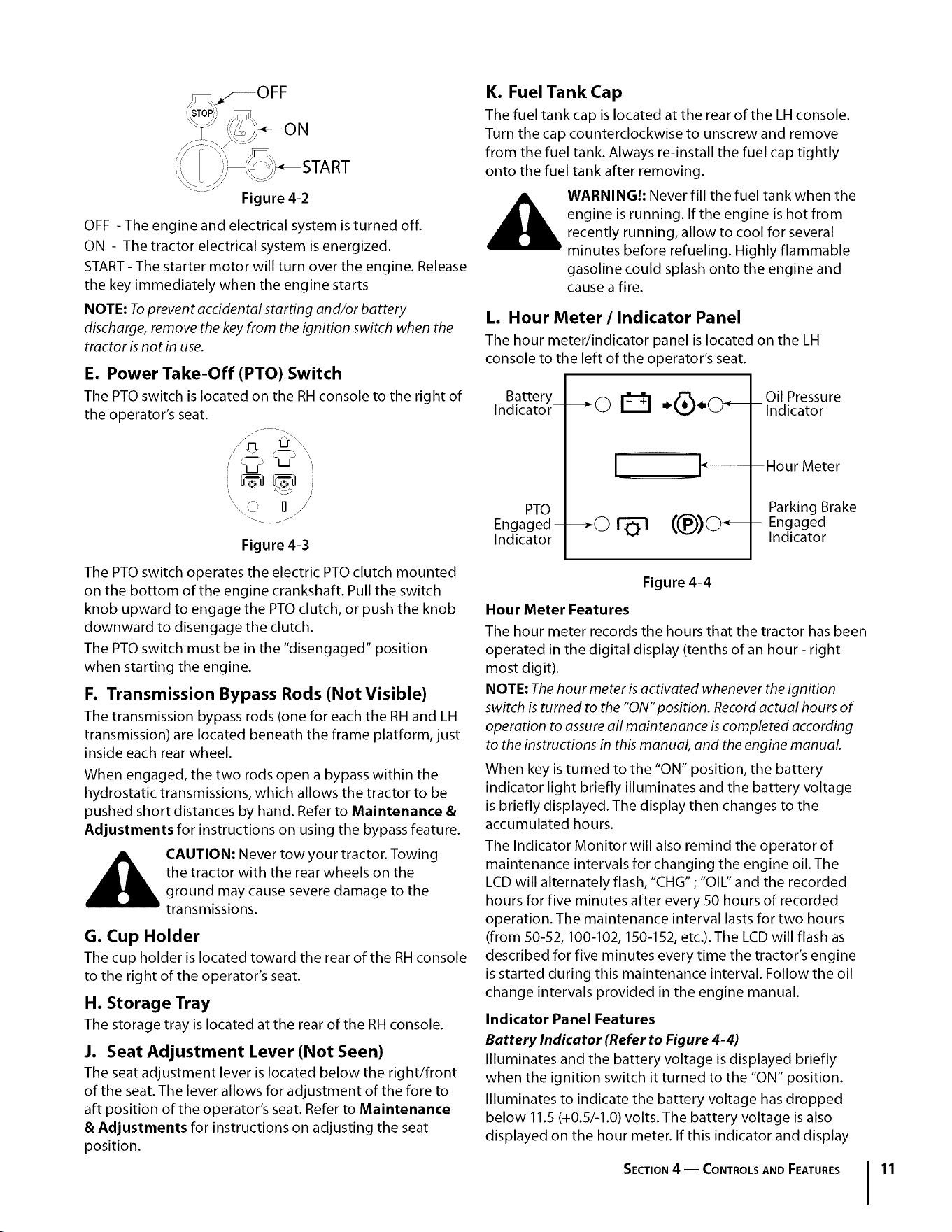
Figure 4-2
OFF -The engine and electrical system is turned off.
ON - The tractor electrical system is energized.
START - The starter motor will turn over the engine. Release
the key immediately when the engine starts
NOTE: Toprevent accidental starting and/or battery
discharge, remove the key from the ignition switch when the
tractor isnot in use.
E. Power Take-Off (PTO) Switch
The PTO switch is located on the RH console to the right of
the operator's seat.
/
/-%
Figure 4-3
The PTO switch operates the electric PTO clutch mounted
on the bottom of the engine crankshaft. Pull the switch
knob upward to engage the PTO clutch, or push the knob
downward to disengage the clutch.
The PTO switch must be in the "disengaged" position
when starting the engine.
F. Transmission Bypass Rods (Not Visible)
The transmission bypass rods (one for each the RH and LH
transmission) are located beneath the frame platform, just
inside each rear wheel.
When engaged, the two rods open a bypass within the
hydrostatic transmissions, which allows the tractor to be
pushed short distances by hand. Refer to Maintenance &
Adjustments for instructions on using the bypass feature.
CAUTION: Never tow your tractor. Towing
the tractor with the rear wheels on the
ground may cause severe damage to the
transmissions.
G. Cup Holder
The cup holder is located toward the rear of the RH console
to the right of the operator's seat.
H. Storage Tray
The storage tray is located at the rear of the RH console.
J. Seat Adjustment Lever (Not Seen)
The seat adjustment lever is located below the right/front
of the seat. The lever allows for adjustment of the fore to
aft position of the operator's seat. Refer to Maintenance
& Adjustments for instructions on adjusting the seat
position.
K. Fuel Tank Cap
The fuel tank cap is located at the rear of the LH console.
Turn the cap counterclockwise to unscrew and remove
from the fuel tank. Always re-install the fuel cap tightly
onto the fuel tank after removing.
_ ARNINGh Never fill the fuel tank when the
engine is running. If the engine is hot from
recently running, allow to cool for several
minutes before refueling. Highly flammable
gasoline could splash onto the engine and
cause a fire.
L. Hour Meter / Indicator Panel
The hour meter/indicator panel is located on the LH
console to the left of the operator's seat.
Battery
Indicator-
PTO
Engaged -
Indicator
D -6}-0
Oil Pressure
- Indicator
Hour Meter
Parking Brake
- Engaged
Indicator
Figure 4-4
Hour Meter Features
The hour meter records the hours that the tractor has been
operated in the digital display (tenths of an hour- right
most digit).
NOTE: The hour meter isactivated whenever the ignition
switch is turned to the "ON" position. Record actual hours of
operation to assure all maintenance iscompleted according
to the instructions in this manual, and the engine manual
When key is turned to the "ON" position, the battery
indicator light briefly illuminates and the battery voltage
is briefly displayed. The display then changes to the
accumulated hours.
The Indicator Monitor will also remind the operator of
maintenance intervals for changing the engine oil. The
LCD will alternately flash, "CHG" ; "OIL" and the recorded
hours for five minutes after every 50 hours of recorded
operation. The maintenance interval lasts for two hours
(from 50-52, 100-102, 150-152, etc.). The LCD will flash as
described for five minutes every time the tractor's engine
is started during this maintenance interval. Follow the oil
change intervals provided in the engine manual.
Indicator Panel Features
Battery Indicator (Refer to Figure 4-4)
Illuminates and the battery voltage is displayed briefly
when the ignition switch it turned to the "ON" position.
Illuminates to indicate the battery voltage has dropped
below 11.5 (+0.5/-1.0) volts. The battery voltage is also
displayed on the hour meter. If this indicator and display
SECTION4 -- CONTROLS AND FEATURES 11
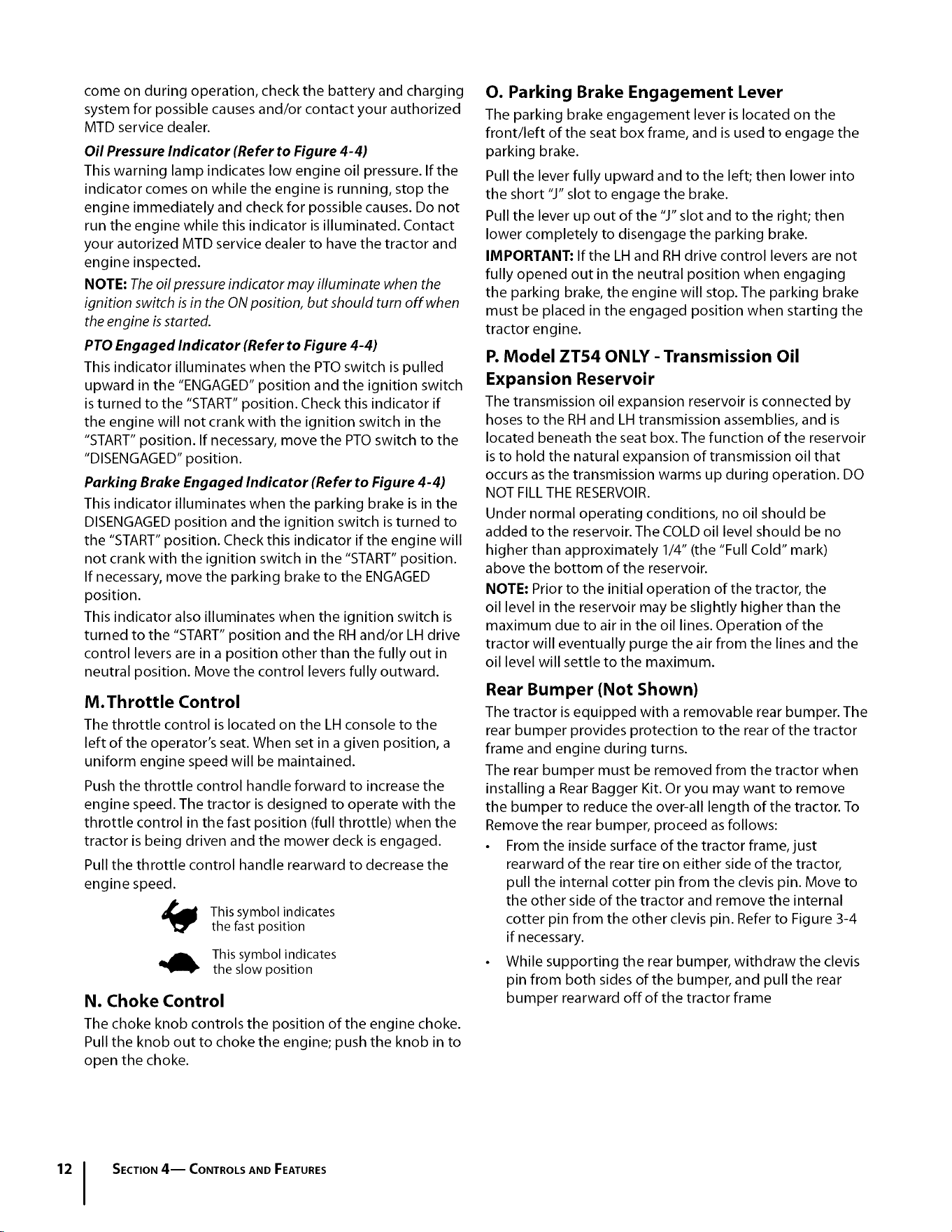
comeonduringoperation,checkthebatteryandcharging
systemforpossiblecausesand/orcontactyourauthorized
MTDservicedealer.
Oil Pressure Indicator (Refer to Figure 4-4)
This warning lamp indicates low engine oil pressure. If the
indicator comes on while the engine is running, stop the
engine immediately and check for possible causes. Do not
run the engine while this indicator is illuminated. Contact
your autorized MTD service dealer to have the tractor and
engine inspected.
NOTE: The oil pressure indicator may illuminate when the
ignition switch is in the ON position, but should turn off when
the engine isstarted.
PTO Engaged Indicator (Refer to Figure 4-4)
This indicator illuminates when the PTO switch is pulled
upward in the "ENGAGED" position and the ignition switch
is turned to the "START" position. Check this indicator if
the engine will not crank with the ignition switch in the
"START" position. If necessary, move the PTO switch to the
"DISENGAGED" position.
Parking Brake Engaged Indicator (Refer to Figure 4-4)
This indicator illuminates when the parking brake is in the
DISENGAGED position and the ignition switch is turned to
the "START" position. Check this indicator if the engine will
not crank with the ignition switch in the "START" position.
If necessary, move the parking brake to the ENGAGED
position.
This indicator also illuminates when the ignition switch is
turned to the "START" position and the RH and/or LH drive
control levers are in a position other than the fully out in
neutral position. Move the control levers fully outward.
M.Throttle Control
The throttle control is located on the LH console to the
left of the operator's seat. When set in a given position, a
uniform engine speed will be maintained.
Push the throttle control handle forward to increase the
engine speed. The tractor is designed to operate with the
throttle control in the fast position (full throttle) when the
tractor is being driven and the mower deck is engaged.
Pull the throttle control handle rearward to decrease the
engine speed.
This symbol indicates
the fast position
This symbol indicates
the slow position
N. Choke Control
The choke knob controls the position of the engine choke.
Pull the knob out to choke the engine; push the knob in to
open the choke.
O. Parking Brake Engagement Lever
The parking brake engagement lever is located on the
front/left of the seat box frame, and is used to engage the
parking brake.
Pull the lever fully upward and to the left; then lower into
the short "J" slot to engage the brake.
Pull the lever up out of the "J" slot and to the right; then
lower completely to disengage the parking brake.
IMPORTANT: If the LH and RH drive control levers are not
fully opened out in the neutral position when engaging
the parking brake, the engine will stop. The parking brake
must be placed in the engaged position when starting the
tractor engine.
P• Model ZT54 ONLY - Transmission Oil
Expansion Reservoir
The transmission oil expansion reservoir is connected by
hoses to the RH and LH transmission assemblies, and is
located beneath the seat box. The function of the reservoir
is to hold the natural expansion of transmission oil that
occurs as the transmission warms up during operation. DO
NOT FILL THE RESERVOIR.
Under normal operating conditions, no oil should be
added to the reservoir. The COLD oil level should be no
higher than approximately 1/4" (the "Full Cold" mark)
above the bottom of the reservoir.
NOTE: Prior to the initial operation of the tractor, the
oil level in the reservoir may be slightly higher than the
maximum due to air in the oil lines. Operation of the
tractor will eventually purge the air from the lines and the
oil level will settle to the maximum.
Rear Bumper (Not Shown)
The tractor is equipped with a removable rear bumper. The
rear bumper provides protection to the rear of the tractor
frame and engine during turns.
The rear bumper must be removed from the tractor when
installing a Rear Bagger Kit. Or you may want to remove
the bumper to reduce the over-all length of the tractor. To
Remove the rear bumper, proceed as follows:
• From the inside surface of the tractor frame, just
rearward of the rear tire on either side of the tractor,
pull the internal cotter pin from the clevis pin. Move to
the other side of the tractor and remove the internal
cotter pin from the other clevis pin. Refer to Figure 3-4
if necessary.
• While supporting the rear bumper, withdraw the clevis
pin from both sides of the bumper, and pull the rear
bumper rearward off of the tractor frame
12 I SECTION4-- CONTROLSANDFEATURES
Operation
General Safety
• RECEIVEINSTRUCTION - Entirely read this operator's
manual. Learn to operate this machine SAFELY. Do
not risk INJURY or DEATH. Allow only those who have
become competent in its usage to operate this tractor.
• Before starting the engine or beginning operation,
be familiar with the controls. The operator should be
in the operator's seat. The PTO switch must be in the
disengaged position, the parking brake engaged,
and the RH and LH drive control levers moved fully
outward in the neutral position.
• Keep all shields in place. Keep away from moving parts.
• NO RIDERS! Keep all people and pets a safe distance
away. Look behind and down to both sides of the
tractor before and while backing up.
• DO NOT direct the mower discharge at people.
• Avoid slopes where possible. Never operate on slopes
greater than 15°. Slopes with a greater incline present
dangerous operating conditions. Tractors can be rolled
over.
• Before leaving the operator's seat: Shut off the PTO,
move the RH and LH drive control levers fully outward
in the neutral position, engage the parking brake, shut
off the engine and remove the ignition key. Wait for all
movement to stop before servicing or cleaning.
• Operate the drive control levers smoothly and avoid
any sudden movements of the levers when starting
and stopping. Keep a firm grip on the control levers; do
not allow the levers to return to neutral on their own.
• Be careful when operating near roadways. Stop the
tractor motion and wait for vehicles to pass before
operating along the road.
• Do not operate the tractor with the mower deck
removed. Removal of the deck will change the balance
of the tractor, and could contribute to a tractor rollover.
• Avoid operation on traction surfaces that are unstable;
use extreme caution if the surface is slippery.
• Slow down before turning and come to a complete
stop before any zero turn maneuver.
• Do not stop the tractor or park the tractor over
combustible materials such as dry grass, leaves, debris,
etc.
• Do not fill the fuel tankwhen the engine is running
or while the engine is hot. Allow the engine several
minutes to cool before refueling. Tighten the fuel cap
securely.
Before Operating Your Tractor
• Before you operate the tractor, study this manual
carefully to familiarize yourself with the operation of all
the instruments and controls. It has been prepared to
help you operate and maintain your tractor efficiently.
• This engine is certified to operate on unleaded
gasoline. For best results, fill the fuel tank with only
clean, fresh, unleaded gasoline with a pump sticker
octane rating of 85 or higher. Unleaded gasoline is
recommended because it leaves less combustion
chamber deposits.
• Some fuels are gasoline blended with alcohols or
ethers. Excessive amounts of the these blends can
damage the fuel system or cause engine performance
problems. If undesirable operating symptoms occur,
use gasoline with a lower percentage of alcohol or
ether. Do not use gasoline that contains Methanol.
NOTE: Purchase gasoline in small quantities. Do not use
gasoline leftover from the previous season, to minimize gum
deposits in the fuel system.
• Check the engine oil level.
• Clean the air cleaner element if necessary. Refer to
engine manual.
• Checkthe tire inflation pressures.
• Adjust the seat for operator's maximum comfort,
visibility and for maintaining complete control of the
tractor.
Safety Interlock System
This tractor is equipped with a safety interlock system
for the protection of the operator. If the interlock system
should ever malfunction, do not operate the tractor.
Contact your authorized MTD Service Dealer.
• The safety interlock system prevents the engine
from cranking or starting unless the RH and LH drive
control levers are moved fully outward in the neutral
position, the parking brake is engaged, and the PTO is
disengaged.
• To avoid sudden movement when disengaging the
parking brake, the safety interlock system will shut
off the engine if the RH and/or LH drive control levers
are moved to a position other than the fully out in the
neutral position when the parking brake is engaged.
13
• Thesafetyinterlocksystemwillshutofftheengine
iftheoperatorleavestheseatbeforeengagingthe
parkingbrake
• Thesafetyinterlocksystemwillshutofftheengineif
theoperatorleavestheseatwiththePTOengaged,
regardlessofwhethertheparkingbrakeisengaged
NOTE: The PTO switch must be moved to the "OFF"
position to restart the engine.
• The safety interlock system will shut off the PTO and
the mower blades will stop if both drive control levers
are moved into the reverse position. The PTO will re-
engage when one or both of the levers are moved back
to the neutral or forward position.
Starting the Engine
_ ARNINGh This unit is equipped with a
safety interlock system designed for the
protection of the operator Do not operate
the tractor if any part of the interlock system
is malfunctioning Periodically check the
functions of the interlock system for proper
operation
WARNINGh For personal safety, the operator
must be sitting in the tractor seat when
starting the engine
Operator must be sitting in the tractor seat
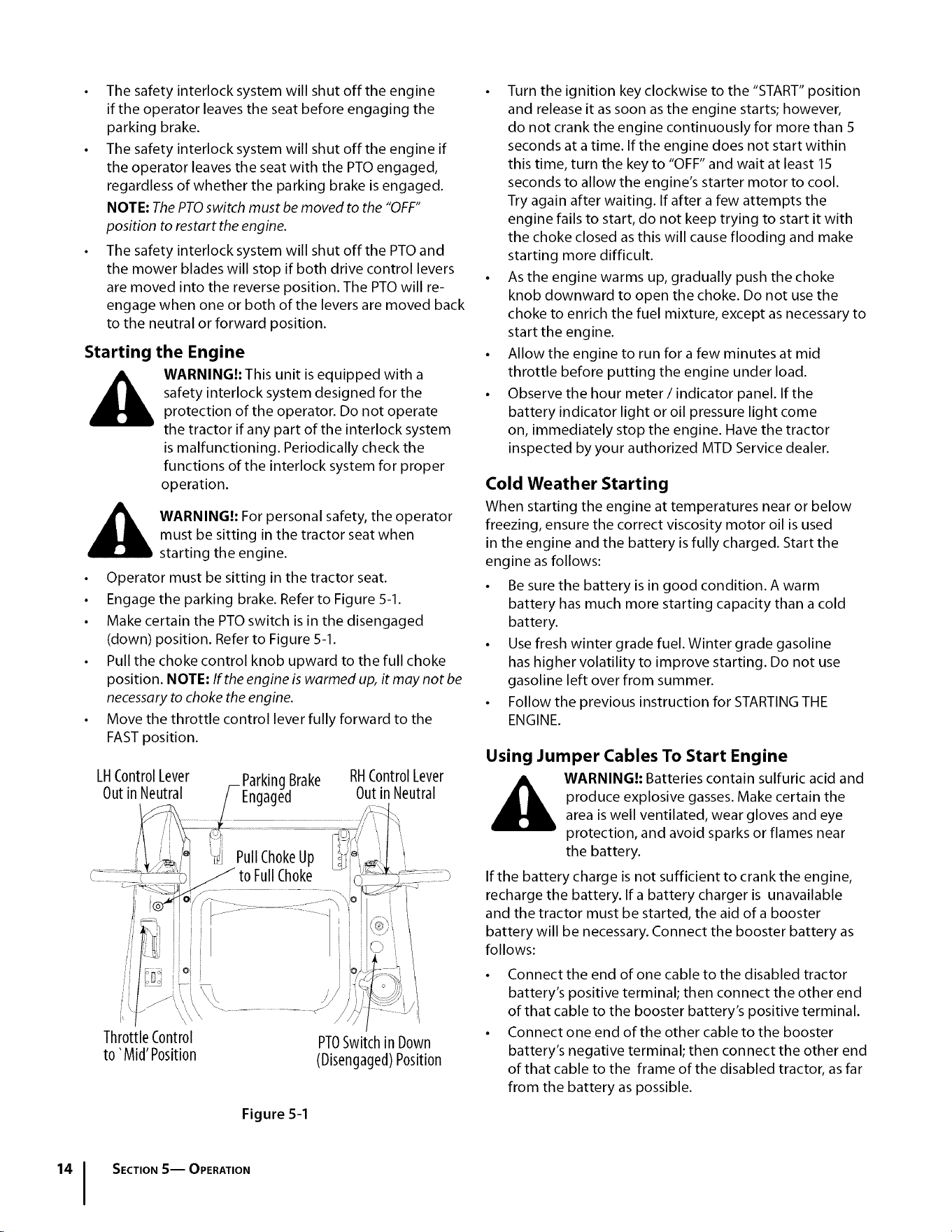
Engage the parking brake Refer to Figure 5-1
Make certain the PTO switch is in the disengaged
(down) position Refer to Figure 5-1
Pull the choke control knob upward to the full choke
position. NOTE: If the engine is warmed up, it may not be
necessary to choke the engine.
Move the throttle control lever fully forward to the
FAST position.
LHControlLever g Brake RHControlLever
Outin Neutral ed Outin Neutral
ThrottleControl
to "Mid' Position
PT0Switchin Down
(Disengaged)Position
Figure 5-1
• Turn the ignition key clockwise to the "START" position
and release it as soon as the engine starts; however,
do not crank the engine continuously for more than 5
seconds at a time If the engine does not start within
this time, turn the key to "OFF" and wait at least 15
seconds to allow the engine's starter motor to cool
Try again after waiting If after a few attempts the
engine fails to start, do not keep trying to start it with
the choke closed as this will cause flooding and make
starting more difficult
• As the engine warms up, gradually push the choke
knob downward to open the choke Do not use the
choke to enrich the fuel mixture, except as necessary to
start the engine
• Allow the engine to run for a few minutes at mid
throttle before putting the engine under load
• Observe the hour meter / indicator panel If the
battery indicator light or oil pressure light come
on, immediately stop the engine Have the tractor
inspected by your authorized MTD Service dealer
Cold Weather Starting
When starting the engine at temperatures near or below
freezing, ensure the correct viscosity motor oil is used
in the engine and the battery is fully charged Start the
engine as follows:
• Be sure the battery is in good condition A warm
battery has much more starting capacity than a cold
battery
• Use fresh winter grade fuel Winter grade gasoline
has higher volatility to improve starting Do not use
gasoline left over from summer
• Follow the previous instruction for STARTING THE
ENGINE
Using Jumper Cables To Start Engine
_ ARNINGh Batteries contain sulfuric acid and
produce explosive gasses. Make certain the
area is well ventilated, wear gloves and eye
protection, and avoid sparks or flames near
the battery.
If the battery charge is not sufficient to crank the engine,
recharge the battery. If a battery charger is unavailable
and the tractor must be started, the aid of a booster
battery will be necessary. Connect the booster battery as
follows:
Connect the end of one cable to the disabled tractor
battery's positive terminal; then connect the other end
of that cable to the booster battery's positive terminal
Connect one end of the other cable to the booster
battery's negative terminal; then connect the other end
of that cable to the frame of the disabled tractor, as far
from the battery as possible
SECTION S-- OPERATION
• Start the disabled tractor following the normal starting
instructions previously provided; then disconnect
the jumper cables in the exact reverse order of their
connection.
• Have the tractor's electrical system checked and
repaired as soon as possible to eliminate the need for
jump starting.
Stopping the Engine
• Place the PTO switch in the "OFF" position.
• Move the RH and LH drive control levers fully outward
in the neutral position.
• Engage the parking brake.
• Move the throttle control to the "SLOW" throttle
position, and turn the ignition key to the "OFF"
position.
• Remove the key from the ignition switch.
NOTE: Always remove the key from the ignition switch
to prevent accidental starting or battery discharge if the
equipment isleft unattended.
Practice Operation (Initial Use)
Operating a zero-turn tractor is not like operating a
conventional type riding tractor. Although and because a
zero turn tractor is more maneuverable, getting used to
operating the control levers takes some practice.
We strongly recommend that you locate a reasonably
large, level and open "practice area" where there are no
obstructions, pedestrians, or animals. You should practice
operating the tractor for a minimum of 30 minutes.
Carefully move (or have moved) the tractor to the practice
area. When performing the practice session, the PTO
should not be engaged. While practicing, operate the
tractor at approximately 1/2-3/4 throttle and at less than
full speed in both forward and reverse.
Carefully practice maneuvering the tractor using the
instructions in the following section "Driving the Tractor."
Practice until you are confident that you can safely operate
the tractor.
Driving the Tractor
WARNINGh Avoid sudden starts, excessive
speed and sudden stops.
• Adjust the operator's seat to the most comfortable
position that allows you to operate the controls. See
seat adjustment in the ADJUSTMENTS section.
• Release the parking brake.
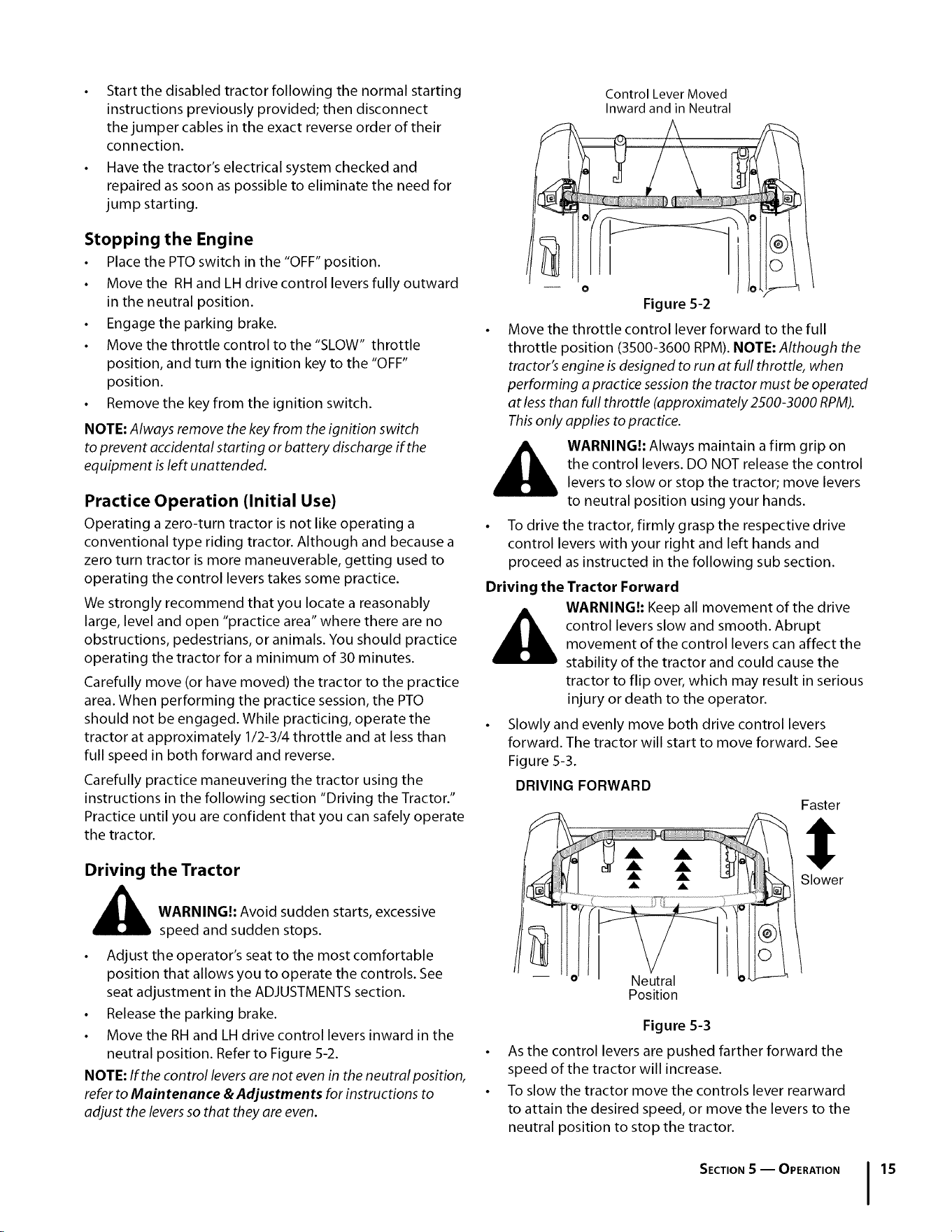
• Move the RH and LH drive control levers inward in the
neutral position. Refer to Figure 5-2.
NOTE: If the control levers are not even in the neutral position,
refer to Maintenance &Adjustments for instructions to
adjust the levers so that they are even.
Control Lever Moved
Inward and in Neutral
o ii :
Figure 5-2
• Move the throttle control lever forward to the full
throttle position (3500-3600 RPM). NOTE: Although the
tractor's engine is designed to run at full throttle, when
performing a practice session the tractor must be operated
at less than full throttle (approximately 2500-3000 RPM).
This only applies to practice.
WARNINGh Always maintain a firm grip on
the control levers. DO NOT release the control
levers to slow or stop the tractor; move levers
to neutral position using your hands.
• To drive the tractor, firmly grasp the respective drive
control levers with your right and left hands and
proceed as instructed in the following sub section.
Driving the Tractor Forward
_ ARNINGh Keep all movement of the drive
control levers slow and smooth. Abrupt
movement of the control levers can affect the
stability of the tractor and could cause the
tractor to flip over, which may result in serious
injury or death to the operator.
• Slowly and evenly move both drive control levers
forward. The tractor will start to move forward. See
Figure 5-3.
DRIVING FORWARD
Position
Faster
Slower
Figure 5-3
As the control levers are pushed farther forward the
speed of the tractor will increase.
To slow the tractor move the controls lever rearward
to attain the desired speed, or move the levers to the
neutral position to stop the tractor.
SECTION S -- OPERATION 15
IMPORTANT: Always maintain your grasp on the drive
control levers. Do not release the levers to slow the tractor or
to retum to neutral.
Turning the Tractor While Driving Forward
_ ARNINGh When reversing the direction of
travel, we recommend performing gradual 'U'
turns where possible. Sharper turns increase
the possibility of turf defacement, and could
affect control of the tractor. ALWAYS slow the
tractor before making sharp turns.
To turn the tractor while driving forward, move the control
levers as necessary so that one lever is rearward of the
other. The tractor will turn in the direction of the rearward
control lever.
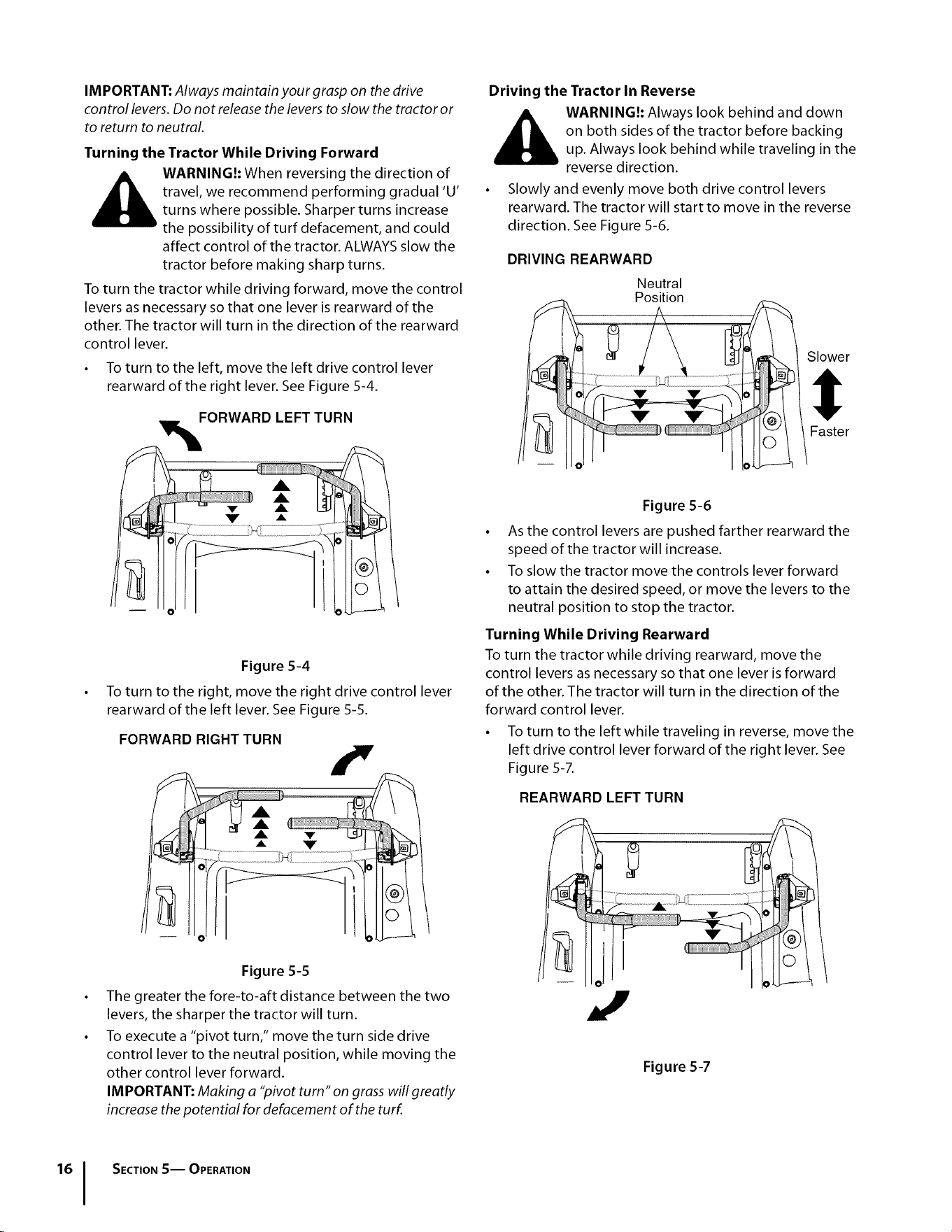
• To turn to the left, move the left drive control lever
rearward of the right lever. See Figure 5-4.
FORWARD LEFT TURN
f
Figure 5-4
To turn to the right, move the right drive control lever
rearward of the left lever. See Figure 5-5.
FORWARD RIGHT TURN
Figure 5-5
The greater the fore-to-aft distance between the two
levers, the sharper the tractor will turn.
To execute a "pivot turn," move the turn side drive
control lever to the neutral position, while moving the
other control lever forward.
IM PORTANT: Making a "pivot turn" on grass will greatly
increase the potential for defacement of the turf.
Driving the Tractor In Reverse
WARNINGh Always look behind and down
on both sides of the tractor before backing
up. Always look behind while traveling in the
reverse direction.
• Slowly and evenly move both drive control levers
rearward. The tractor will start to move in the reverse
direction. See Figure 5-6.
DRIVING REARWARD
Neutral
Position
Slower
Faster
Figure 5-6
As the control levers are pushed farther rearward the
speed of the tractor will increase.
To slow the tractor move the controls lever forward
to attain the desired speed, or move the levers to the
neutral position to stop the tractor.
Turning While Driving Rearward
To turn the tractor while driving rearward, move the
control levers as necessary so that one lever is forward
of the other. The tractor will turn in the direction of the
forward control lever.
• To turn to the left while traveling in reverse, move the
left drive control lever forward of the right lever. See
Figure 5-7.
REARWARD LEFT TURN
/
i /
Figure 5-7
SECTION S-- OPERATION
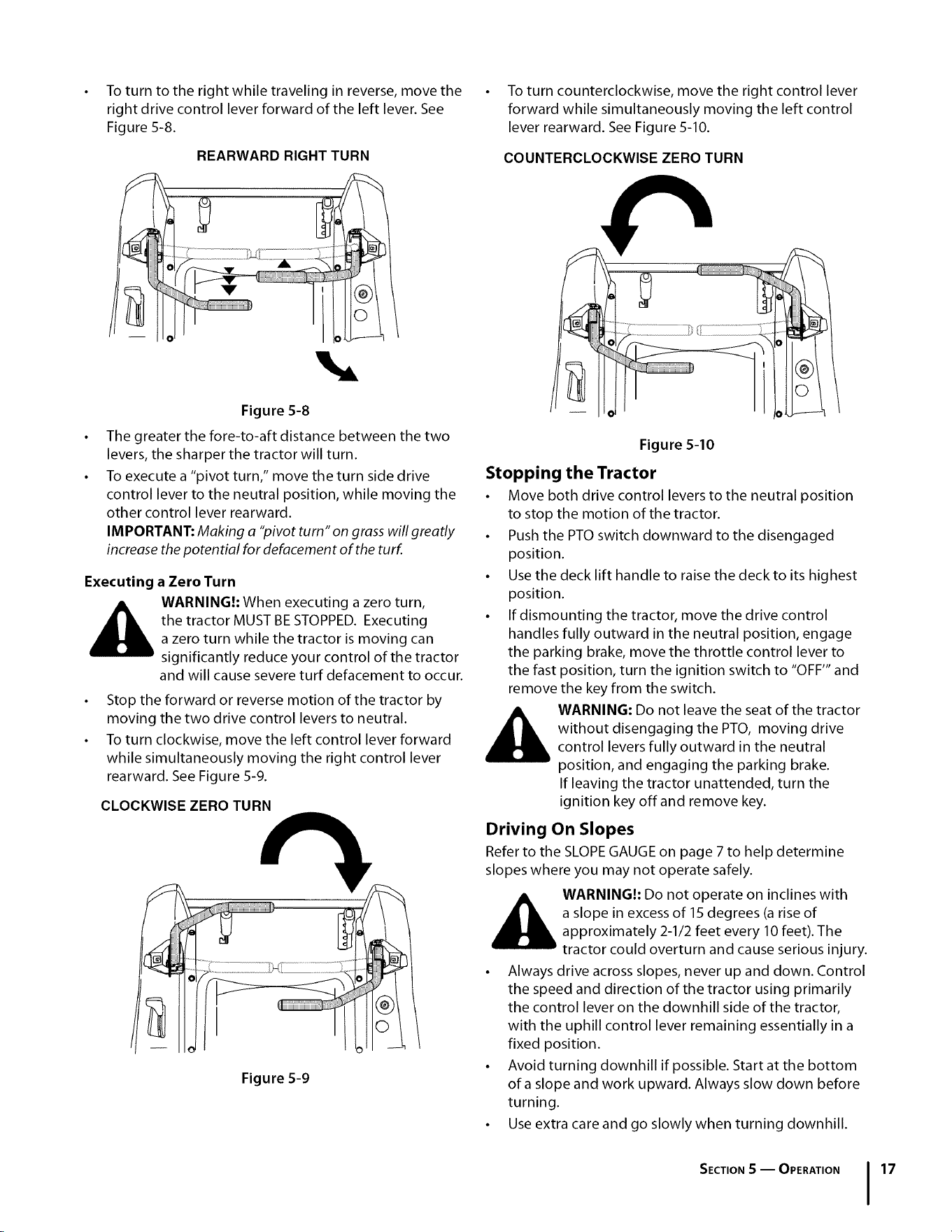
To turn to the right while traveling in reverse, move the
right drive control lever forward of the left lever. See
Figure 5-8.
REARWARD RIGHT TURN
Figure 5-8
The greater the fore-to-aft distance between the two
levers, the sharper the tractor will turn.
To execute a "pivot turn," move the turn side drive
control lever to the neutral position, while moving the
other control lever rearward.
IM PORTANT: Making a "pivot turn" on grass will greatly
increase the potential for defacement of the turf.
Executing a Zero Turn
WARNINGh When executing a zero turn,
the tractor MUST BE STOPPED. Executing
a zero turn while the tractor is moving can
significantly reduce your control of the tractor
and will cause severe turf defacement to occur.
Stop the forward or reverse motion of the tractor by
moving the two drive control levers to neutral.
To turn clockwise, move the left control lever forward
while simultaneously moving the right control lever
rearward. See Figure 5-9.
CLOCKWISE ZERO TURN
Figure 5-9
To turn counterclockwise, move the right control lever
forward while simultaneously moving the left control
lever rearward. See Figure 5-10.
COUNTERCLOCKWISE ZERO TURN
Figure 5-10
Stopping the Tractor
• Move both drive control levers to the neutral position
to stop the motion of the tractor.
• Push the PTO switch downward to the disengaged
position.
• Use the deck lift handle to raise the deck to its highest
position.
• If dismounting the tractor, move the drive control
handles fully outward in the neutral position, engage
the parking brake, move the throttle control lever to
the fast position, turn the ignition switch to "OFF'" and
remove the key from the switch.
WARNING: Do not leave the seat of the tractor
without disengaging the PTO, moving drive
control levers fully outward in the neutral
position, and engaging the parking brake.
If leaving the tractor unattended, turn the
ignition key off and remove key.
Driving On Slopes
Refer to the SLOPE GAUGE on page 7 to help determine
slopes where you may not operate safely.
WARNINGh Do not operate on inclines with
a slope in excess of 15 degrees (a rise of
approximately 2-1/2 feet every 10 feet). The
tractor could overturn and cause serious injury.
• Always drive across slopes, never up and down. Control
the speed and direction of the tractor using primarily
the control lever on the downhill side of the tractor,
with the uphill control lever remaining essentially in a
fixed position.
• Avoid turning downhill if possible. Start at the bottom
of a slope and work upward. Always slow down before
turning.
• Use extra care and go slowly when turning downhill.
SECTION S -- OPERATION 17
Operating The PTO
Operate the PTO clutch as follows:
• Move the throttle control lever to approximately the
mid throttle position.
• Pull the PTO switch upward to the "ENGAGED" position.
• Advance the throttle lever to the operating speed (full
engine speed).
• The operator must remain in the tractor seat at all
times. If the operator should leave the seat without
turning off the power take-off switch, the tractor's
engine will shut off.
• The PTO clutch cannot be operated when the tractor is
driving in the reverse direction. The PTO will disengage
when both drive control levers are moved to the
reverse position, and will re-engage when one (or
both) control lever(s) is moved to the neutral or forward
position.
Using the Mower Deck
_ ARNINGh Make certain the area to be
mowed is free of debris, sticks, stones, wire
or other objects that can be thrown by the
rotating blades.
IMPORTANT: Do not engage the mower deck when lowered in
grass. Premature wear and possible failure of the 'V" belt and
PTO dutch will result. Fully raise the deck or move to a non
grassy area before engaging the mower deck.
• Mow across slopes, not up and down. If mowing a
slope, start at bottom and work upward to ensure turns
are made uphill.
• On the first pass pick a point on the opposite side of
the area to be mowed.
• Engage the PTO clutch using the PTO switch and move
the throttle control to the fast position.
• Lower the mower deck to the desired height setting
using the lift handle.
• Slowly and evenly push the RH and LH drive control
levers forward to move the tractor forward, and keep
the tractor headed directly toward the alignment point.
NOTE:The speed of the tractor will affect the quality of
the mower cut. Mowing at full speed will adversely affect
the cut quality. Control the ground speed with the control
levers.
• When approaching the other end of the strip, slow
down or stop before turning. A U-turn is recommended
unless a pivot or zero turn is required.
• Align the mower with an edge of the mowed strip and
overlap approximately 3 inches.
• Direct the tractor on each subsequent strip to align
with a previously cut strip.
• To prevent rutting or grooving of the turf, if possible,
change the direction that the strips are mowed by
approximately 45° for the next and each subsequent
mowing.
WARNINGh Be careful when crossing gravel
paths or driveways. Disengage the PTO and
raise the deck to the highest position before
crossing.
IMPORTANT: When stopping the tractor for any reason while
on a grass surface, always:
• Place the shift lever in neutral,
Engage the parking brake,
Shut engine off and remove the key.
Doing so will minimize the possibility of having your
lawn "browned" by hot exhaust from your tractor's
running engine.
Checking the Safety Interlock Circuits
Periodically check the safety interlock circuits to ensure
they are working properly. If a safety circuit is not working
as designed, contact your authorized MTD Service dealer
to have the tractor inspected. DO NOT operate the tractor
if any safety circuit is not functioning properly. To check
the safety circuits, proceed as follows:
• Sitting in the tractor seat with both drive control levers
opened fully outward, disengage the parking brake
and momentarily turn the ignition switch to the start
position. The engine should not crank.
• Engage the parking brake and pull the PTO switch
upward to the engaged position. Momentarily turn the
ignition switch to the start position; the engine should
not crank.
• Push the PTO switch downward to the disengaged
position and engage the parking brake. Start the
engine and move one of the drive control levers from
the fully outward neutral position. The engine should
stop running. Repeat the procedure with the opposite
control lever.
• Move both control levers fully outward in the neutral
position and disengage the parking brake; then lift
upward from the operator's seat. The engine should
stop.
• With both control levers fully outward in the neutral
position and the parking brake engaged, engage the
PTO. Lift upward from the operator's seat; the engine
should stop.
• Start the tractor, disengage the parking brake, and
move the control levers inward to the neutral operating
position. Engage the PTO and move both control lever
slowly into the slow reverse position; the PTO should
disengage and the mower deck should stop until one
or both of the control levers is moved to the neutral or
forward position.
SECTION S-- OPERATION
Maintenance&Adjustments
6
Maintenance
WARNING! Before performing any
maintenance or repairs, disengage the PTO,
move the drive control levers fully outward
in the neutral position, engage the parking
brake, stop the engine and remove the key to
prevent unintended starting.
Engine
Refer to the Briggs & Stratton Owner's Manual for all
engine maintenance intervals, procedures, specifications
and instructions.
Changingthe EngineOil
_ ARNING! If the engine has been recently run,
the engine, muffler and surrounding metal
surfaces will be hot and can cause burns to the
skin. Exercise caution to avoid burns.
To complete an oil change, proceed as follows:
1. Run the engine fora short time to warm the engine
oil. The oil will flow more freely and carry away more
impurities, Use care to avoid burns from hot oil.
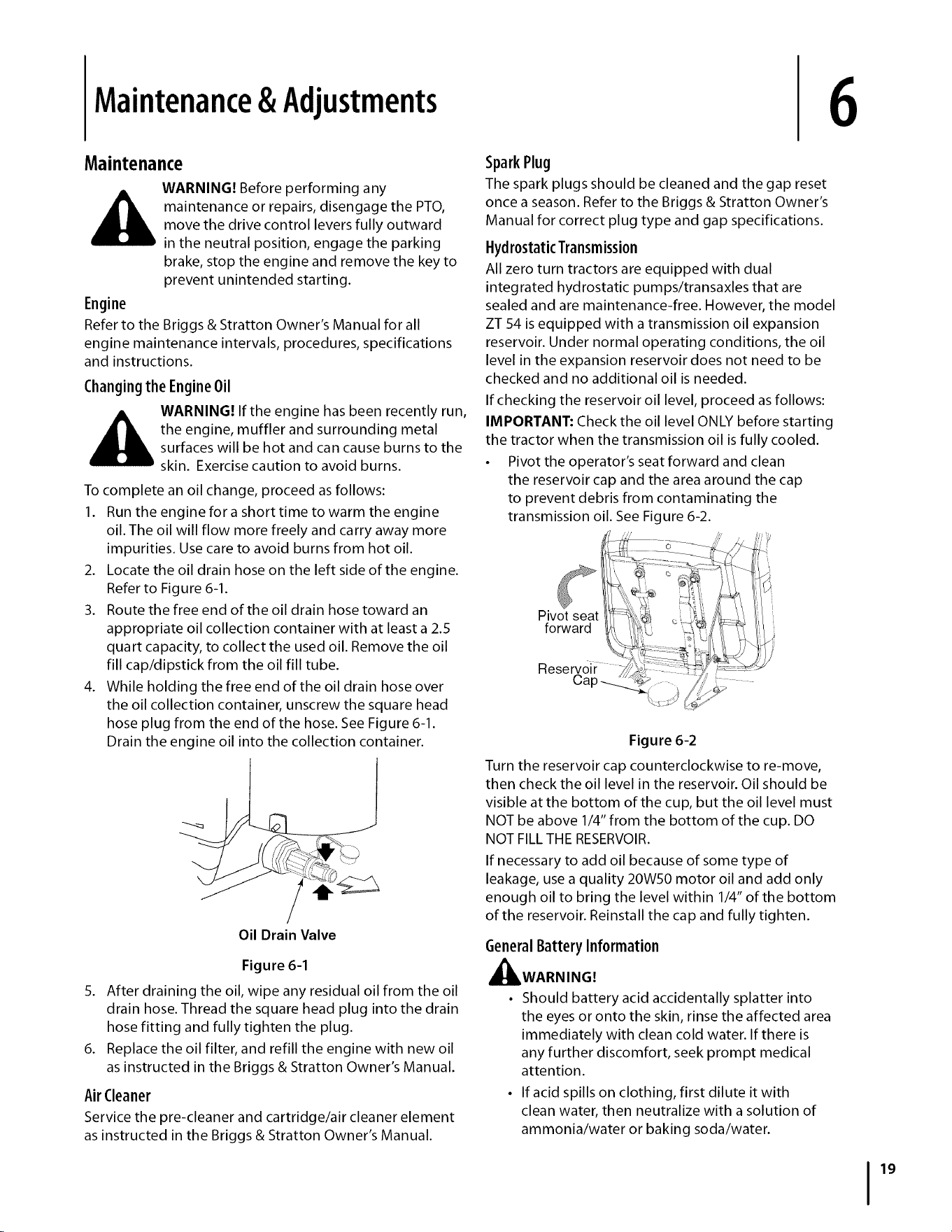
2. Locate the oil drain hose on the left side of the engine.
Refer to Figure 6-1.
3. Route the free end of the oil drain hose toward an
appropriate oil collection container with at least a 2.5
quart capacity, to collect the used oil. Remove the oil
fill cap/dipstick from the oil fill tube.
4. While holding the free end of the oil drain hose over
the oil collection container, unscrew the square head
hose plug from the end of the hose. See Figure 6-1.
Drain the engine oil into the collection container.
Oil Drain Valve
Figure 6-I
5. After draining the oil, wipe any residual oil from the oil
drain hose. Thread the square head plug into the drain
hose fitting and fully tighten the plug.
6. Replace the oil filter, and refill the engine with new oil
as instructed in the Briggs & Stratton Owner's Manual.
AirCleaner
Service the pre-cleaner and cartridge/air cleaner element
as instructed in the Briggs & Stratton Owner's Manual.
SparkPlug
The spark plugs should be cleaned and the gap reset
once a season. Refer to the Briggs & Stratton Owner's
Manual for correct plug type and gap specifications.
HydrostaticTransmission
All zero turn tractors are equipped with dual
integrated hydrostatic pumps/transaxles that are
sealed and are maintenance-free. However, the model
ZT 54 is equipped with a transmission oil expansion
reservoir. Under normal operating conditions, the oil
level in the expansion reservoir does not need to be
checked and no additional oil is needed.
If checking the reservoir oil level, proceed as follows:
IMPORTANT: Check the oil level ONLY before starting
the tractor when the transmission oil is fully cooled.
• Pivot the operator's seat forward and clean
the reservoir cap and the area around the cap
to prevent debris from contaminating the
transmission oil. See Figure 6-2.
Pivot seat
forward
Reservoir
Cap ;: ....
Figure 6-2
Turn the reservoir cap counterclockwise to re-move,
then check the oil level in the reservoir. Oil should be
visible at the bottom of the cup, but the oil level must
NOT be above I/4" from the bottom of the cup. DO
NOT FILL THE RESERVOIR.
If necessary to add oil because of some type of
leakage, use a quality 20WSO motor oil and add only
enough oil to bring the level within I/4" of the bottom
of the reservoir. Reinstall the cap and fully tighten.
GeneralBatteryInformation
WARNING!
• Should battery acid accidentally splatter into
the eyes or onto the skin, rinse the affected area
immediately with clean cold water. If there is
any further discomfort, seek prompt medical
attention.
• If acid spills on clothing, first dilute it with
clean water, then neutralize with a solution of
ammonia/water or baking soda/water.
19
• NEVERconnect(ordisconnect)batterychargerclips
tothebatterywhilethechargeristurnedon,asitcan
causesparks.
• Keepallsourcesofignition(cigarettes,matches,
lighters)awayfromthebattery.Thegasgenerated
duringchargingcanbecombustible.
• Asafurtherprecaution,onlychargethebatteryina
wellventilatedarea.
• Alwaysshieldeyesandprotectskinandclothing
whenworkingnearbatteries.
• Batteriescontainsulfuricacidandmayemitexplosive
gases.Useextremecautionwhenhandlingbatteries.
Keepbatteriesoutofthereachofchildren.
BatteryMaintenance
• The battery is filled with battery acid and then sealed
at the factory. However, even a "maintenance free"
battery requires some maintenance to ensure its
proper life cycle.
• Spray the terminals and exposed wire with a battery
terminal sealer, or coat the terminals with a thin coat of
grease or petroleum jelly, to protect against corrosion.
• Always keep the battery cables and terminals clean and
free of corrosion.
• Avoid tipping. Even a sealed battery will leak
electrolyte when tipped.
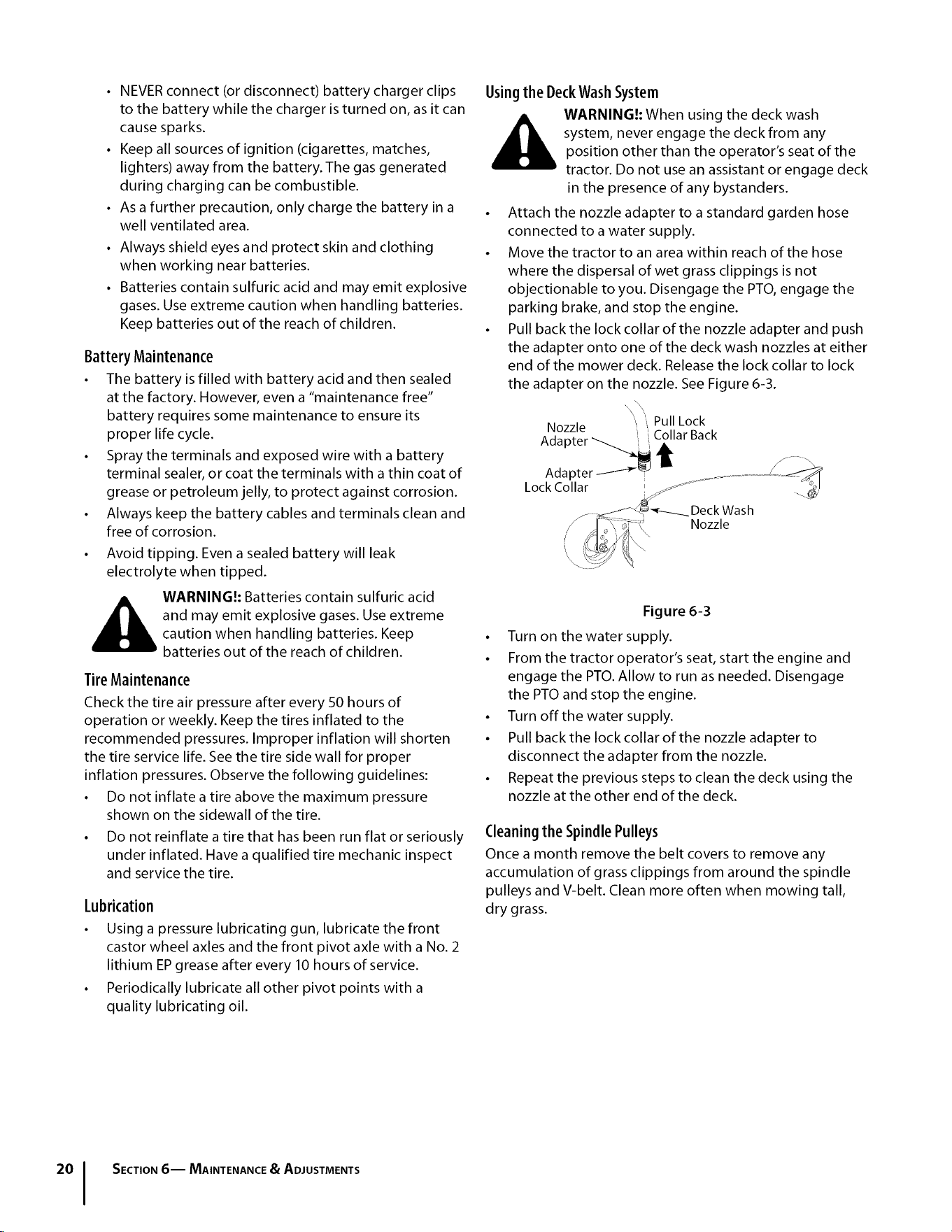
_ WARNING!: Batteries contain sulfuric acid
and may emit explosive gases. Use extreme
caution when handling batteries. Keep
batteries out of the reach of children.
TireMaintenance
Check the tire air pressure after every 50 hours of
operation or weekly. Keep the tires inflated to the
recommended pressures. Improper inflation will shorten
the tire service life. See the tire side wall for proper
inflation pressures. Observe the following guidelines:
• Do not inflate a tire above the maximum pressure
shown on the sidewall of the tire.
• Do not reinflate a tire that has been run flat or seriously
under inflated. Have a qualified tire mechanic inspect
and service the tire.
Lubrication
• Using a pressure lubricating gun, lubricate the front
castor wheel axles and the front pivot axle with a No. 2
lithium EPgrease after every 10 hours of service.
• Periodically lubricate all other pivot points with a
quality lubricating oil.
UsingtheDeckWashSystem
,__ WARNINGh When using the deck wash
system, never engage the deck from any
position other than the operator's seat of the
tractor. Do not use an assistant or engage deck
in the presence of any bystanders.
• Attach the nozzle adapter to a standard garden hose
connected to a water supply.
• Move the tractor to an area within reach of the hose
where the dispersal of wet grass clippings is not
objectionable to you. Disengage the PTO, engage the
parking brake, and stop the engine.
• Pull back the lock collar of the nozzle adapter and push
the adapter onto one of the deck wash nozzles at either
end of the mower deck. Release the lock collar to lock
the adapter on the nozzle. See Figure 6-3.
Nozzle ' Pull Lock
Adapter _ Collar Back
Adapter J"_J_ t
Lock Collar
Deck Wash
Nozzle
Figure 6-3
• Turn on the water supply.
• From the tractor operator's seat, start the engine and
engage the PTO. Allow to run as needed. Disengage
the PTO and stop the engine.
• Turn off the water supply.
• Pull back the lock collar of the nozzle adapter to
disconnect the adapter from the nozzle.
• Repeat the previous steps to clean the deck using the
nozzle at the other end of the deck.
Cleaning the Spindle Pulleys
Once a month remove the belt covers to remove any
accumulation of grass clippings from around the spindle
pulleys and V-belt. Clean more often when mowing tall,
drygrass.
SECTION6-- MAINTENANCE _ ADJUSTMENTS
UsingtheTransmissionBypassRods
If for any reason the tractor will not drive or you wish to
move the tractor, the two hydrostatic transmissions are
equipped with a bypass rod that will allow you to manually
move the tractor short distances.
_ ARNING! : Do not tow the tractor, even with
the bypass rod engaged. Serious transmission
damage will result from doing so.
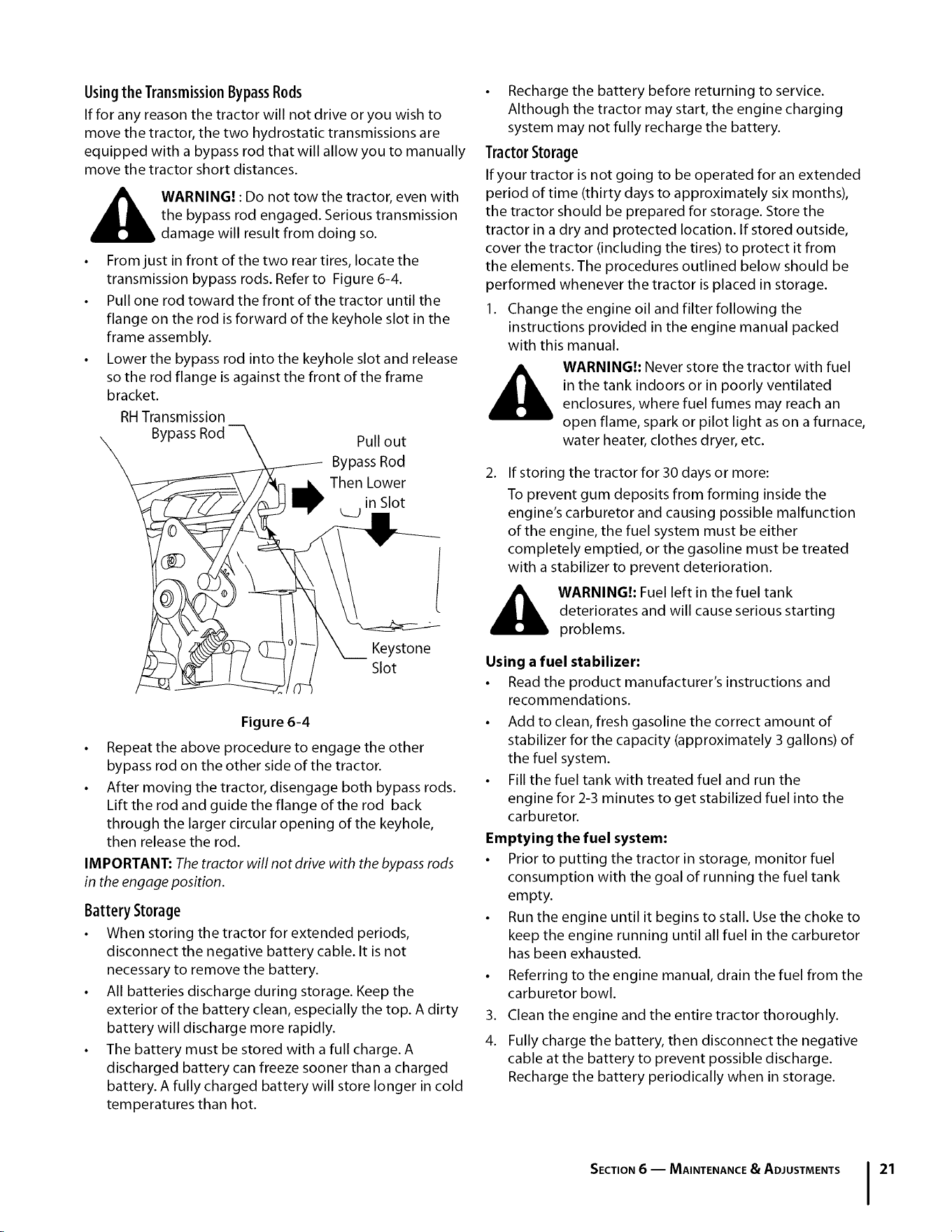
• From just in front of the two rear tires, locate the
transmission bypass rods. Refer to Figure 6-4.
• Pull one rod toward the front of the tractor until the
flange on the rod is forward of the keyhole slot in the
frame assembly.
• Lower the bypass rod into the keyhole slot and release
so the rod flange is against the front of the frame
bracket.
RHTransmission
Bypass Rod
Pull out
Bypass Rod
Then owerin Slot
Keystone
Slot
Figure 6-4
• Repeat the above procedure to engage the other
bypass rod on the other side of the tractor.
• After moving the tractor, disengage both bypass rods.
Lift the rod and guide the flange of the rod back
through the larger circular opening of the keyhole,
then release the rod.
IM PORTANT: The tractor will not drive with the bypass rods
in the engage position.
BatteryStorage
• When storing the tractor for extended periods,
disconnect the negative battery cable. It is not
necessary to remove the battery.
• All batteries discharge during storage. Keep the
exterior of the battery clean, especially the top. A dirty
battery will discharge more rapidly.
• The battery must be stored with a full charge. A
discharged battery can freeze sooner than a charged
battery. A fully charged battery will store longer in cold
temperatures than hot.
• Recharge the battery before returning to service.
Although the tractor may start, the engine charging
system may not fully recharge the battery.
TractorStorage
If your tractor is not going to be operated for an extended
period of time (thirty days to approximately six months),
the tractor should be prepared for storage. Store the
tractor in a dry and protected location. If stored outside,
cover the tractor (including the tires) to protect it from
the elements. The procedures outlined below should be
performed whenever the tractor is placed in storage.
1. Change the engine oil and filter following the
instructions provided in the engine manual packed
with this manual.
_ ARNINGh Never store the tractor with fuel
in the tank indoors or in poorly ventilated
enclosures, where fuel fumes may reach an
open flame, spark or pilot light as on a furnace,
water heater, clothes dryer, etc.
2. If storing the tractor for 30 days or more:
To prevent gum deposits from forming inside the
engine's carburetor and causing possible malfunction
of the engine, the fuel system must be either
completely emptied, or the gasoline must be treated
with a stabilizer to prevent deterioration.
_ ARNINGh Fuel left in the fuel tank
deteriorates and will cause serious starting
problems.
Using a fuel stabilizer:
• Read the product manufacturer's instructions and
recommendations.
• Add to clean, fresh gasoline the correct amount of
stabilizer for the capacity (approximately 3 gallons) of
the fuel system.
• Fill the fuel tank with treated fuel and run the
engine for 2-3 minutes to get stabilized fuel into the
carburetor.
Emptying the fuel system:
• Prior to putting the tractor in storage, monitor fuel
consumption with the goal of running the fuel tank
empty.
• Run the engine until it begins to stall. Use the choke to
keep the engine running until all fuel in the carburetor
has been exhausted.
• Referring to the engine manual, drain the fuel from the
carburetor bowl.
3. Clean the engine and the entire tractor thoroughly.
4. Fully charge the battery, then disconnect the negative
cable at the battery to prevent possible discharge.
Recharge the battery periodically when in storage.
SECTION6 -- MAINTENANCE • ADJUSTMENTS 21
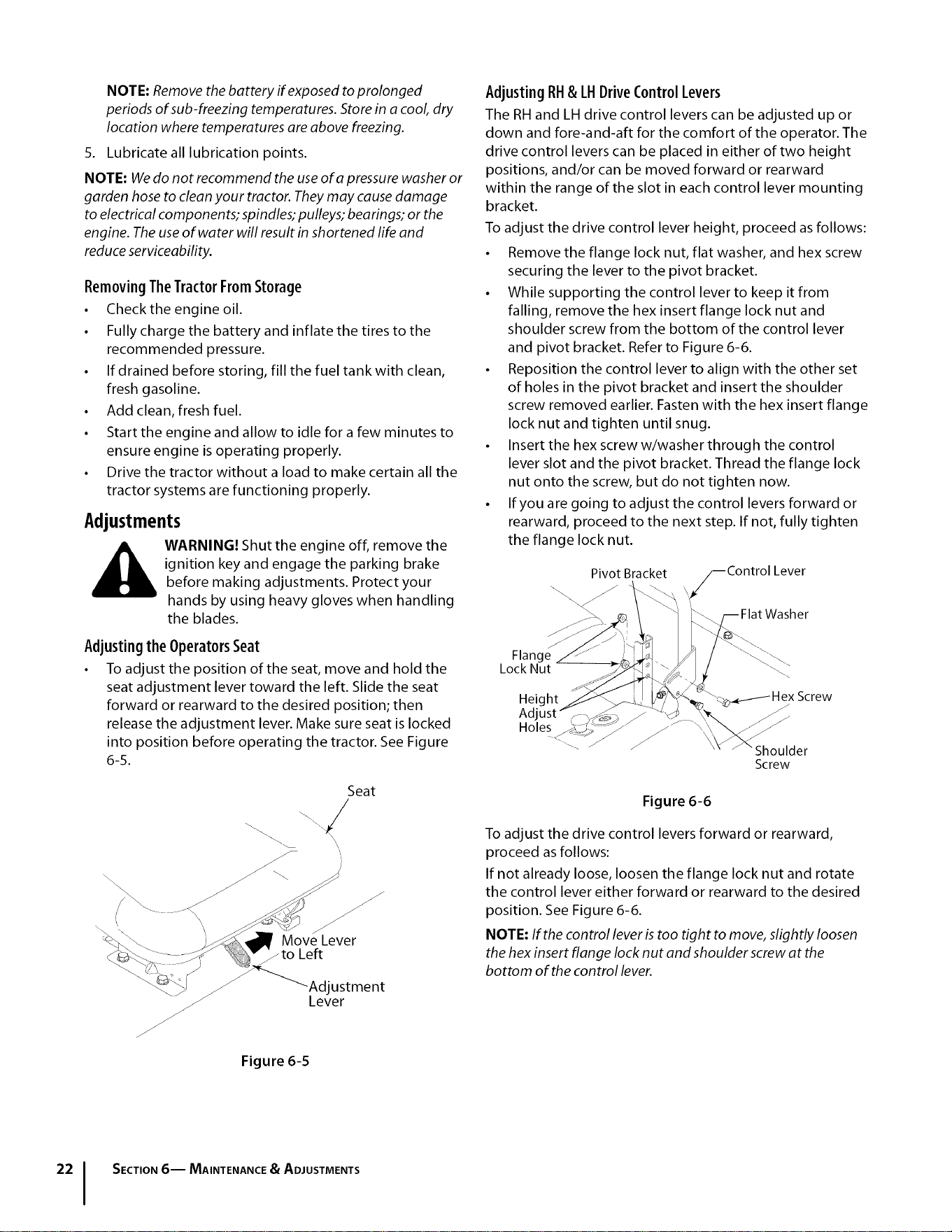
NOTE:Remove the battery if exposed to prolonged
periods of sub-freezing temperatures. Store in a cool dry
location where temperatures are above freezing.
5. Lubricate all lubrication points.
NOTE: We do not recommend the use of a pressure washer or
garden hose to clean your tractor. They may cause damage
to electrical componen ts; spindles; pulleys; bearings; or the
engine. The use of water will result in shortened life and
reduce serviceability.
RemovingTheTractorFromStorage
• Check the engine oil.
• Fully charge the battery and inflate the tires to the
recommended pressure.
• If drained before storing, fill the fuel tank with clean,
fresh gasoline.
• Add clean, fresh fuel.
• Start the engine and allow to idle for a few minutes to
ensure engine is operating properly.
• Drive the tractor without a load to make certain all the
tractor systems are functioning properly.
Adjustments
_ ARNING! Shut the engine off, remove the
ignition key and engage the parking brake
before making adjustments. Protect your
hands by using heavy gloves when handling
the blades.
Adjusting the Operators Seat
• To adjust the position of the seat, move and hold the
seat adjustment lever toward the left. Slide the seat
forward or rearward to the desired position; then
release the adjustment lever. Make sure seat is locked
into position before operating the tractor. See Figure
6-5.
/-
Seat
J
Move Lever
- to Left
Adjustment
Lever
Figure 6-5
AdjustingRH& LHDriveControlLevers
The RH and LH drive control levers can be adjusted up or
down and fore-and-aft for the comfort of the operator. The
drive control levers can be placed in either of two height
positions, and/or can be moved forward or rearward
within the range of the slot in each control lever mounting
bracket.
To adjust the drive control lever height, proceed as follows:
• Remove the flange lock nut, flat washer, and hex screw
securing the lever to the pivot bracket.
• While supporting the control lever to keep it from
falling, remove the hex insert flange lock nut and
shoulder screw from the bottom of the control lever
and pivot bracket. Refer to Figure 6-6.
• Reposition the control lever to align with the other set
of holes in the pivot bracket and insert the shoulder
screw removed earlier. Fasten with the hex insert flange
lock nut and tighten until snug.
• Insert the hex screw w/washer through the control
lever slot and the pivot bracket. Thread the flange lock
nut onto the screw, but do not tighten now.
• If you are going to adjust the control levers forward or
rearward, proceed to the next step. If not, fully tighten
the flange lock nut.
Pivot Bracket /--Control Lever
/
Flange
Lock Nut
Figure 6-6
To adjust the drive control levers forward or rearward,
proceed as follows:
If not already loose, loosen the flange lock nut and rotate
the control lever either forward or rearward to the desired
position. See Figure 6-6.
NOTE: If the control lever is too tight to move, slightly loosen
the hex insert flange lock nut and shoulder screw at the
bottom of the control lever.
SECTION6-- MAINTENANCE & ADJUSTMENTS
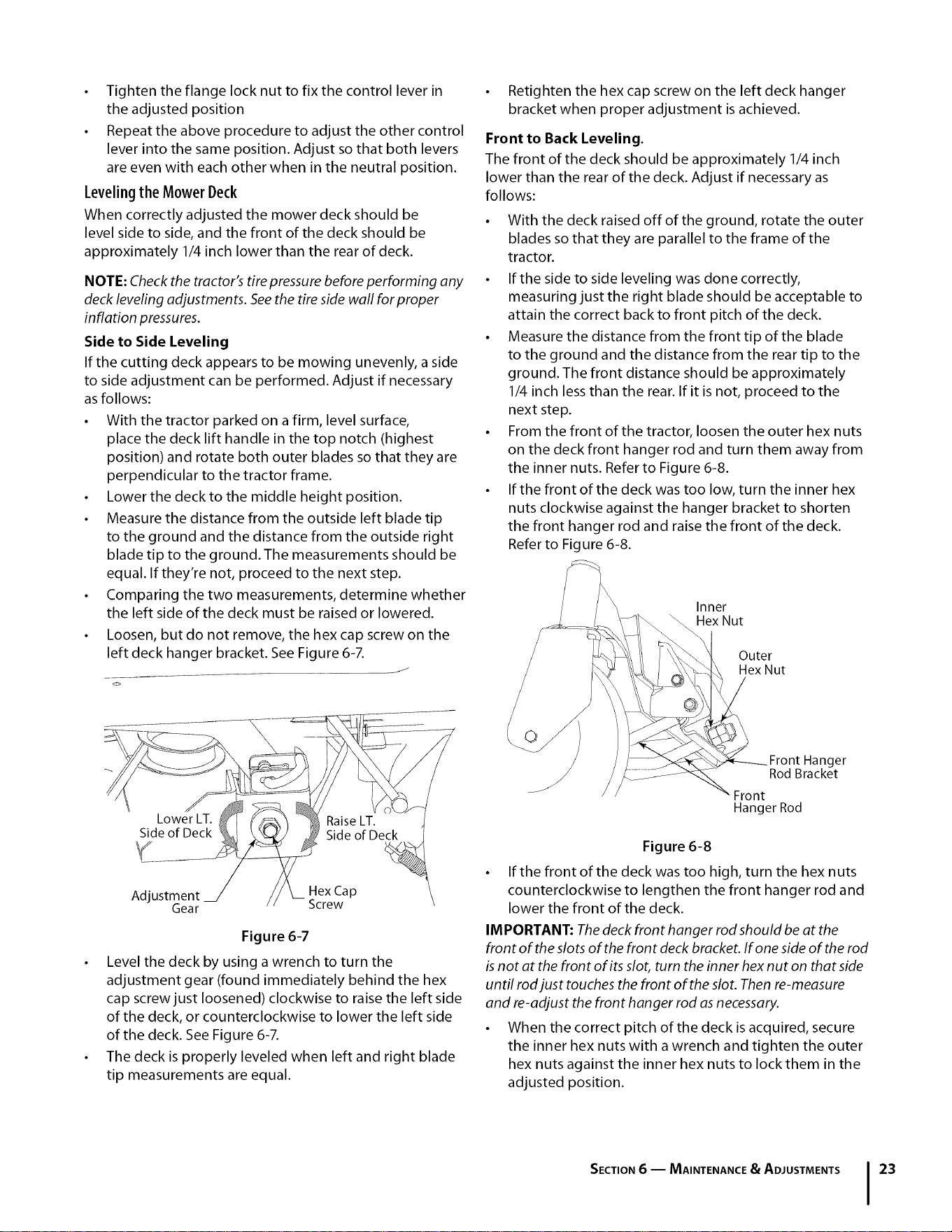
• Tighten the flange lock nut to fix the control lever in
the adjusted position
• Repeat the above procedure to adjust the other control
lever into the same position. Adjust so that both levers
are even with each other when in the neutral position.
Levelingthe Mower Deck
When correctly adjusted the mower deck should be
level side to side, and the front of the deck should be
approximately 1/4 inch lower than the rear of deck.
NOTE: Check the tractor's tire pressure before performing any
deck leveling adjustments. Seethe tire side wall for proper
inflation pressures.
Side to Side Leveling
If the cutting deck appears to be mowing unevenly, a side
to side adjustment can be performed. Adjust if necessary
as follows:
• With the tractor parked on a firm, level surface,
place the deck lift handle in the top notch (highest
position) and rotate both outer blades so that they are
perpendicular to the tractor frame.
• Lower the deck to the middle height position.
• Measure the distance from the outside left blade tip
to the ground and the distance from the outside right
blade tip to the ground. The measurements should be
equal. If they're not, proceed to the next step.
• Comparing the two measurements, determine whether
the left side of the deck must be raised or lowered.
• Loosen, but do not remove, the hex cap screw on the
left deck hanger bracket. See Figure 6-7.
Gear
Figure 6-7
• Level the deck by using a wrench to turn the
adjustment gear (found immediately behind the hex
cap screw just loosened) clockwise to raise the left side
of the deck, or counterclockwise to lower the left side
of the deck. See Figure 6-7.
• The deck is properly leveled when left and right blade
tip measurements are equal.
• Retighten the hex cap screw on the left deck hanger
bracket when proper adjustment is achieved.
Front to Back Leveling.
The front of the deck should be approximately 1/4 inch
lower than the rear of the deck. Adjust if necessary as
follows:
• With the deck raised off of the ground, rotate the outer
blades so that they are parallel to the frame of the
tractor.
• If the side to side leveling was done correctly,
measuring just the right blade should be acceptable to
attain the correct back to front pitch of the deck.
• Measure the distance from the front tip of the blade
to the ground and the distance from the rear tip to the
ground. The front distance should be approximately
1/4 inch less than the rear. If it is not, proceed to the
next step.
• From the front of the tractor, loosen the outer hex nuts
on the deck front hanger rod and turn them away from
the inner nuts. Refer to Figure 6-8.
• If the front of the deck was too low, turn the inner hex
nuts clockwise against the hanger bracket to shorten
the front hanger rod and raise the front of the deck.
Refer to Figure 6-8.
Inner
Hex Nut
Outer
Hex Nut
Front Hanger
Rod Bracket
•Front
Hanger Rod
Figure 6-8
• If the front of the deck was too high, turn the hex nuts
counterclockwise to lengthen the front hanger rod and
lower the front of the deck.
IMPORTANT." The deck front hanger rod should be at the
front of the slots of the front deck bracket. If one side of the rod
isnot at the front of its slot, turn the inner hex nut on that side
until rodjust touches the front of the slot. Then re-measure
and re-adjust the front hanger rod as necessary.
• When the correct pitch of the deck is acquired, secure
the inner hex nuts with a wrench and tighten the outer
hex nuts against the inner hex nuts to lock them in the
adjusted position.
SECTION6 -- MAINTENANCE & ADJUSTMENTS 23
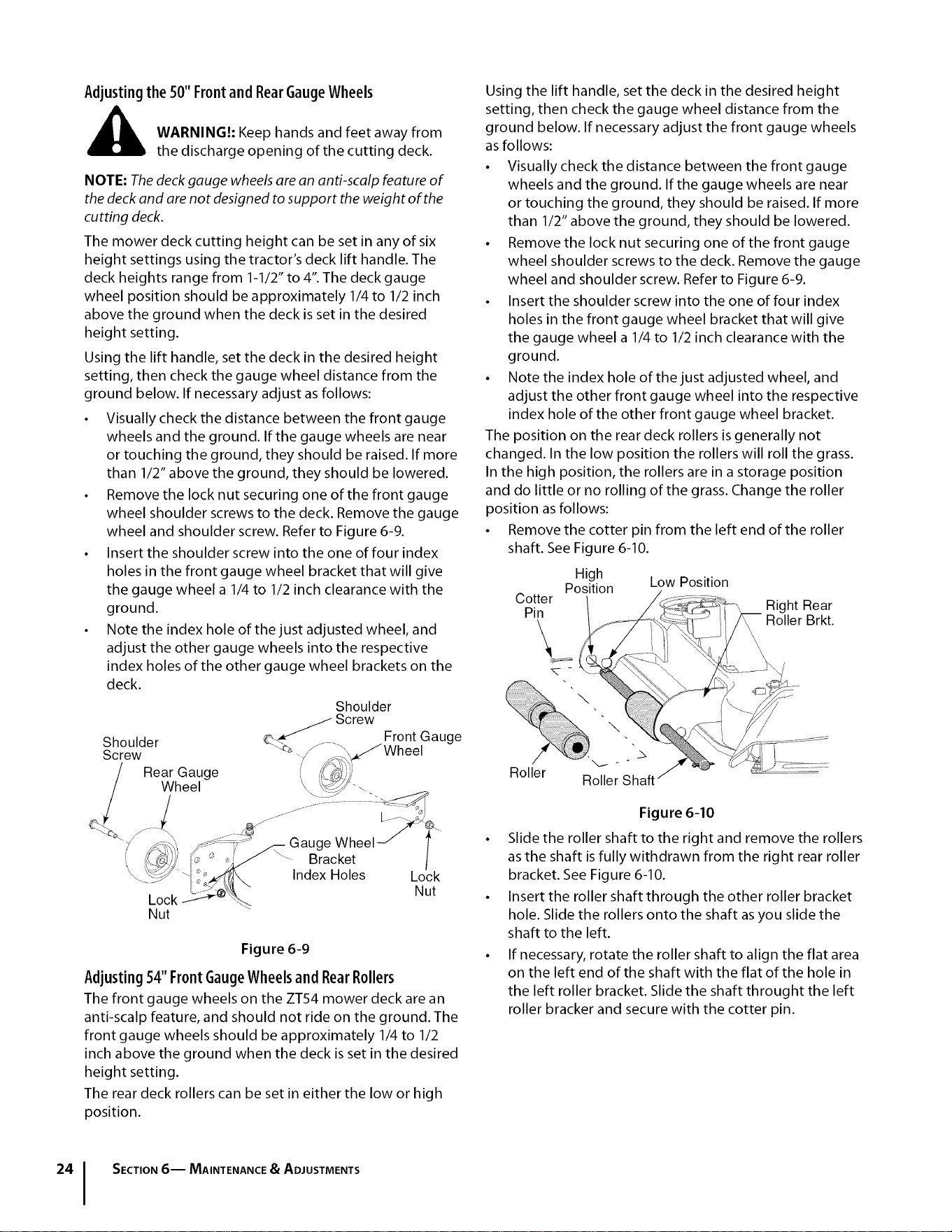
Adjustingthe50"FrontandRearGaugeWheels
WARNINGhKeep hands and feet away from
the discharge opening of the cutting deck
NOTE: The deck gauge wheels are an antiscalp feature of
the deck and are not designed to support the weight of the
cutting deck.
The mower deck cutting height can be set in any of six
height settings using the tractor's deck lift handle. The
deck heights range from 1-1/2" to 4". The deck gauge
wheel position should be approximately 1/4 to 1/2 inch
above the ground when the deck is set in the desired
height setting.
Using the lift handle, set the deck in the desired height
setting, then check the gauge wheel distance from the
ground below. If necessary adjust as follows:
• Visually check the distance between the front gauge
wheels and the ground. If the gauge wheels are near
or touching the ground, they should be raised. If more
than 1/2" above the ground, they should be lowered.
• Remove the lock nut securing one of the front gauge
wheel shoulder screws to the deck. Remove the gauge
wheel and shoulder screw. Refer to Figure 6-9.
• Insert the shoulder screw into the one of four index
holes in the front gauge wheel bracket that will give
the gauge wheel a 1/4 to 1/2 inch clearance with the
ground.
• Note the index hole of the just adjusted wheel, and
adjust the other gauge wheels into the respective
index holes of the other gauge wheel brackets on the
deck.
Shoulder
Screw
_ Rear Gauge
Wheel
©
Lock
Nut
Shoulder
_._ Screw
Front Gauge
_ \\ ,.,--/Wheel
Gauge
Bracket
Index Holes
Lock
Nut
Figure 6-9
Adjusting54" Front GaugeWheelsand RearRollers
The front gauge wheels on the ZT54 mower deck are an
anti-scalp feature, and should not ride on the ground The
front gauge wheels should be approximately 1/4 to 1/2
inch above the ground when the deck is set in the desired
height setting
The rear deck rollers can be set in either the low or high
position
Using the lift handle, set the deck in the desired height
setting, then check the gauge wheel distance from the
ground below If necessary adjust the front gauge wheels
as follows:
• Visually check the distance between the front gauge
wheels and the ground If the gauge wheels are near
or touching the ground, they should be raised If more
than 1/2" above the ground, they should be lowered
• Remove the lock nut securing one of the front gauge
wheel shoulder screws to the deck Remove the gauge
wheel and shoulder screw Refer to Figure 6-9
• Insert the shoulder screw into the one of four index
holes in the front gauge wheel bracket that will give
the gauge wheel a 1/4 to 1/2 inch clearance with the
ground
• Note the index hole of the just adjusted wheel, and
adjust the other front gauge wheel into the respective
index hole of the other front gauge wheel bracket
The position on the rear deck rollers is generally not
changed In the low position the rollers will roll the grass
In the high position, the rollers are in a storage position
and do little or no rolling of the grass Change the roller
position as follows:
• Remove the cotter pin from the left end of the roller
shaft See Figure 6-10
High
Position
Cotter
Pin
Roller
Roller
Low Position
Right Rear
Roller Brkt.
Figure 6-10
• Slide the roller shaft to the right and remove the rollers
as the shaft is fully withdrawn from the right rear roller
bracket See Figure 6-10
• Insert the roller shaft through the other roller bracket
hole Slide the rollers onto the shaft as you slide the
shaft to the left
• If necessary, rotate the roller shaft to align the flat area
on the left end of the shaft with the flat of the hole in
the left roller bracket Slide the shaft throught the left
roller bracket and secure with the cotter pin
SECTION6-- MAINTENANCE _ ADJUSTMENTS
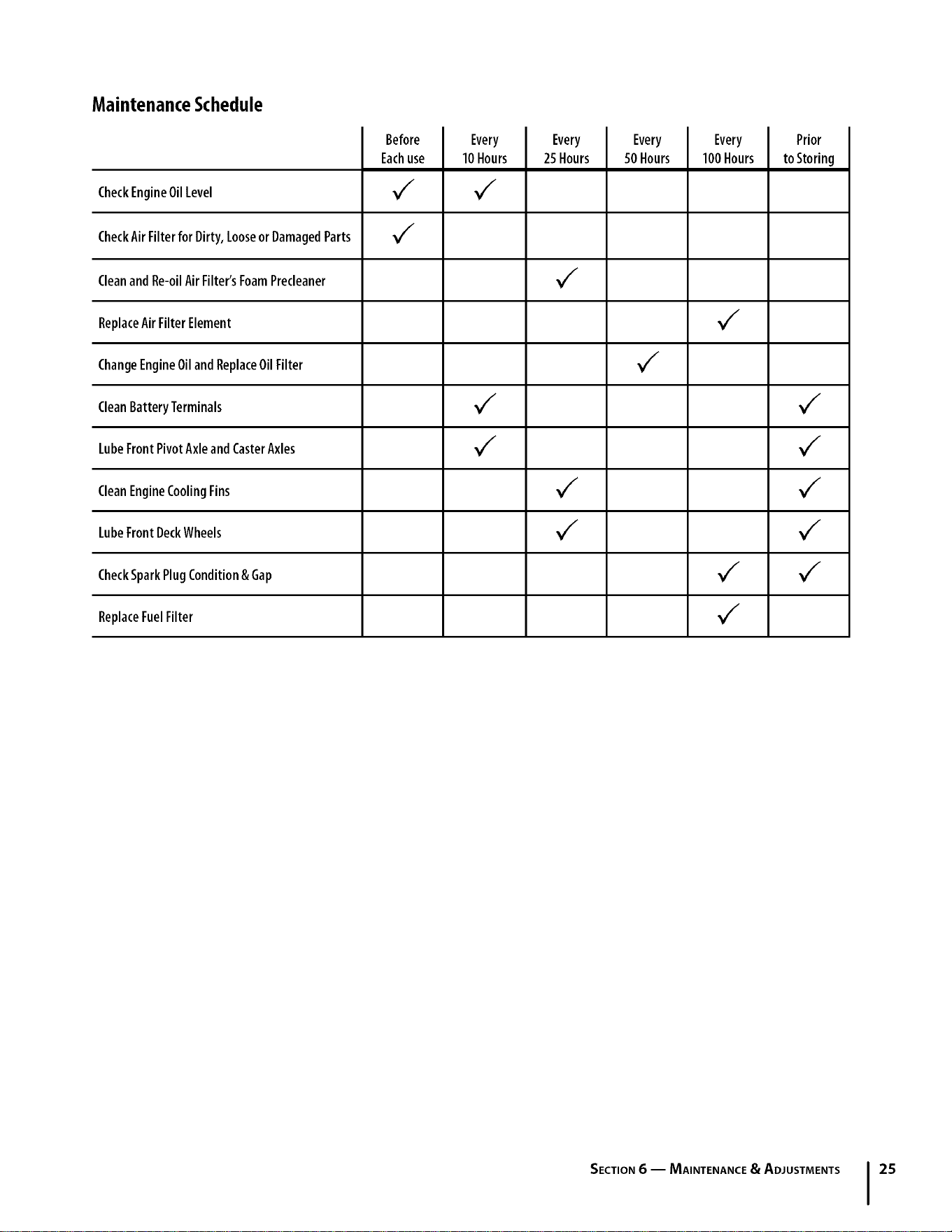
Maintenance Schedule
Before
Eachuse
Every
10Hours
Every
25Hours
Every
SOHours
Every
100Hours
Prior
toStoring
CheckEngineOilLevel _
CheckAirFilterfor Dirty,LooseorDamagedParts
CleanandRe-oilAirFilter'sFoamPrecleaner V f
ReplaceAirFilterElement
ChangeEngineOilandReplaceOilFilter V f
CleanBatteryTerminals _
LubeFrontPivotAxleandCasterAxles V f V f
CleanEngineCoolingFins V f V f
LubeFrontDeckWheels V f V f
CheckSparkPlugCondition& Gap V f V f
ReplaceFuelFilter V f
SECTION6 -- MAINTENANCE & ADJUSTMENTS 25
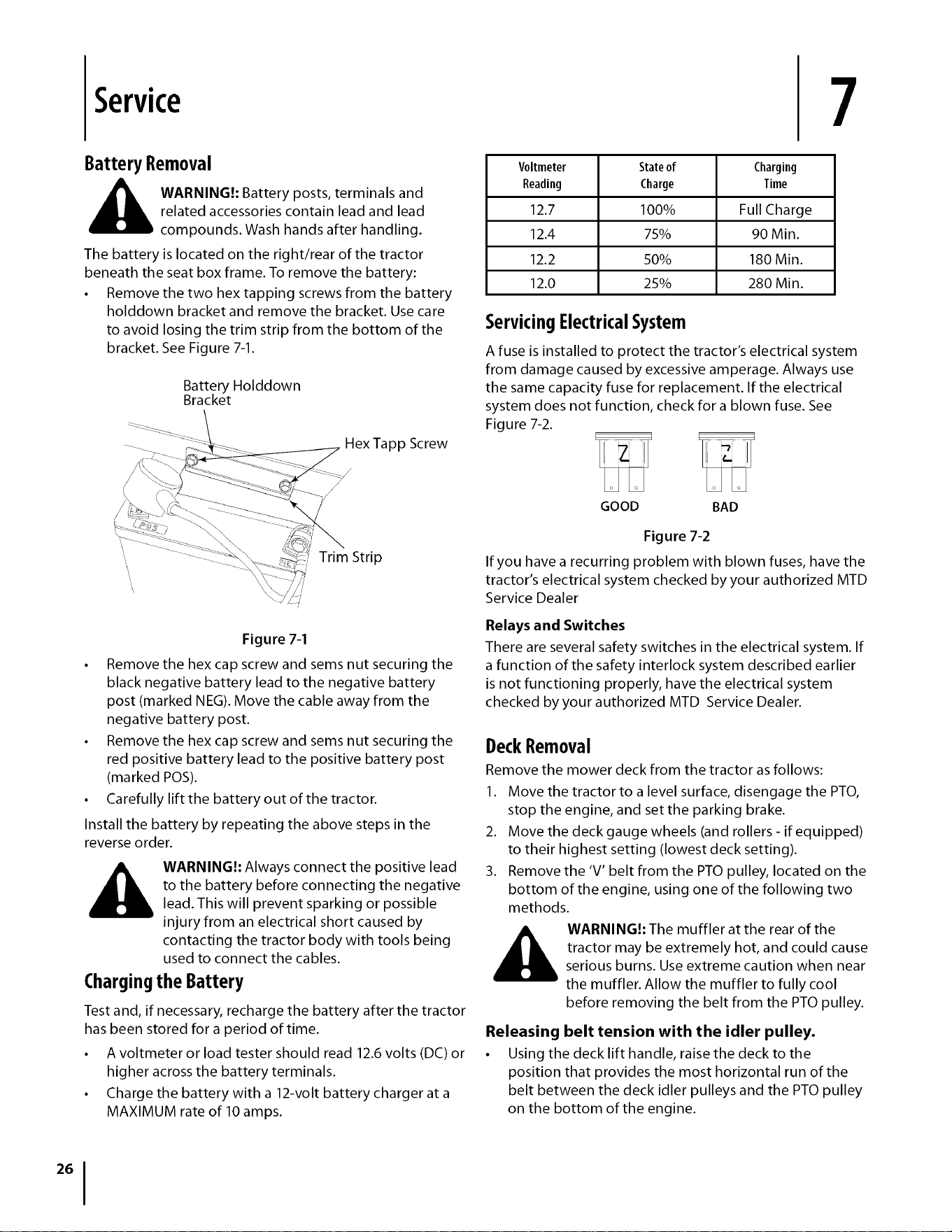
Service
7
Battery Removal
_ WARNINGh Battery posts, terminals and
related accessories contain lead and lead
compounds. Wash hands after handling.
The battery is located on the right/rear of the tractor
beneath the seat box frame. To remove the battery:
• Remove the two hex tapping screws from the battery
holddown bracket and remove the bracket. Use care
to avoid losing the trim strip from the bottom of the
bracket. See Figure 7-I.
Battery Holddown
Bracket
Hex Tapp Screw
v
\
Trim Strip
Figure 7-1
• Remove the hex cap screw and sems nut securing the
black negative battery lead to the negative battery
post (marked NEG). Move the cable away from the
negative battery post.
• Remove the hex cap screw and sems nut securing the
red positive battery lead to the positive battery post
(marked POS).
• Carefully lift the battery out of the tractor.
Install the battery by repeating the above steps in the
reverse order.
_ WARNING!" Always connect the positive lead
to the battery before connecting the negative
lead. This will prevent sparking or possible
injury from an electrical short caused by
contacting the tractor body with tools being
used to connect the cables.
Charging the Battery
Test and, if necessary, recharge the battery after the tractor
has been stored for a period of time.
• A voltmeter or load tester should read 12.6 volts (DC) or
higher across the battery terminals.
• Charge the battery with a 12-volt battery charger at a
MAXIMUM rate of 10 amps.
Voltmeter Stateof Charging
Reading Charge Time
12.7 100% Full Charge
12.4 75% 90 Min.
12.2 50% 180 Min.
12.0 25% 280 Min.
Servicing Electrical System
A fuse is installed to protect the tractor's electrical system
from damage caused by excessive amperage. Always use
the same capacity fuse for replacement. If the electrical
system does not function, check for a blown fuse. See
Figure 7-2.
GOOD BAD
Figure 7-2
If you have a recurring problem with blown fuses, have the
tractor's electrical system checked by your authorized MTD
Service Dealer
Relays and Switches
There are several safety switches in the electrical system. If
a function of the safety interlock system described earlier
is not functioning properly, have the electrical system
checked by your authorized MTD Service Dealer.
Deck Removal
Remove the mower deck from the tractor as follows:
1. Move the tractor to a level surface, disengage the PTO,
stop the engine, and set the parking brake.
2. Move the deck gauge wheels (and rollers - if equipped)
to their highest setting (lowest deck setting).
3. Remove the 'V' belt from the PTO pulley, located on the
bottom of the engine, using one of the following two
methods.
_ WARNING!" The muffler at the rear of the
tractor may be extremely hot, and could cause
serious burns. Use extreme caution when near
the muffler. Allow the muffler to fully cool
before removing the belt from the PTO pulley.
Releasing belt tension with the idler pulley.
• Using the deck lift handle, raise the deck to the
position that provides the most horizontal run of the
belt between the deck idler pulleys and the PTO pulley
on the bottom of the engine.
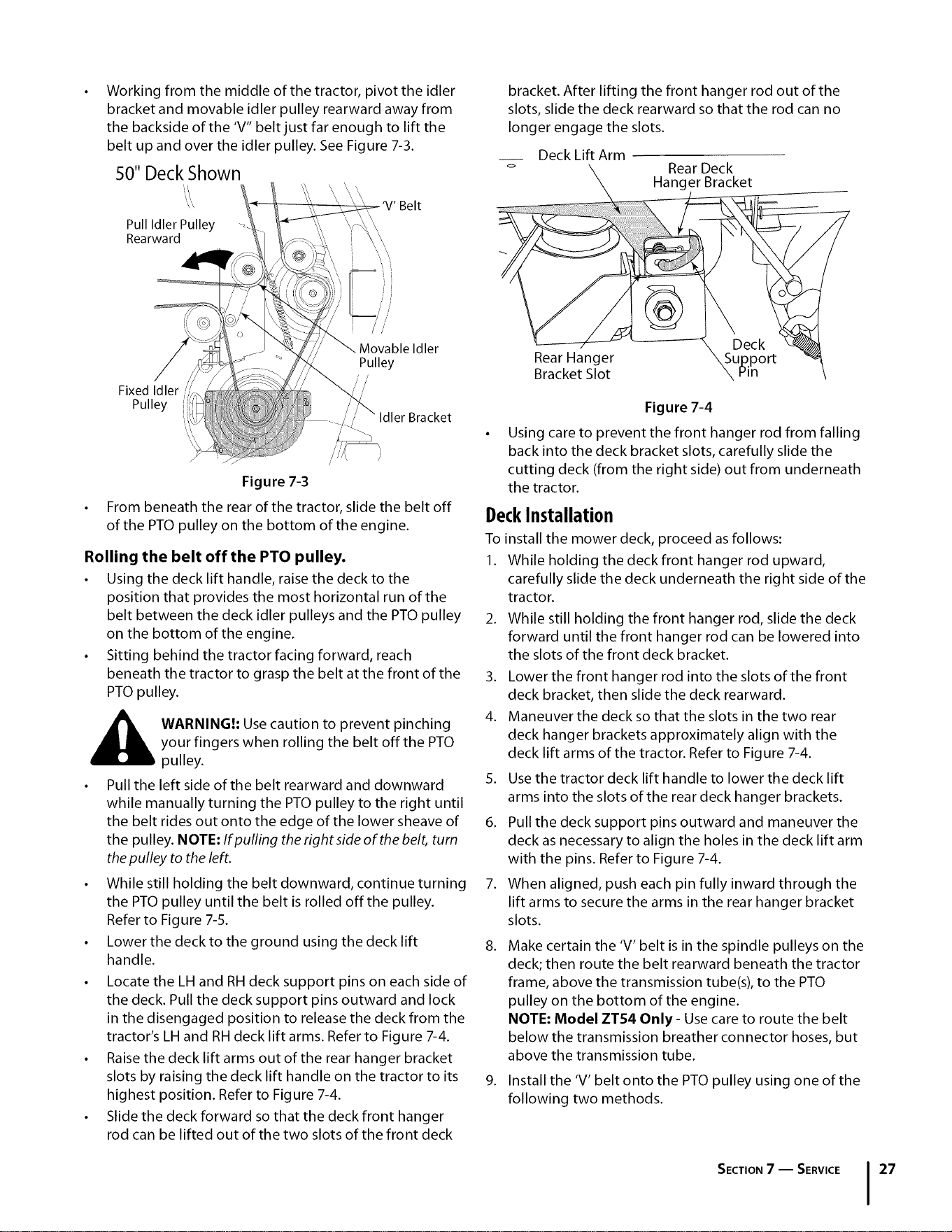
Workingfromthemiddleofthetractor,pivottheidler
bracketandmovableidlerpulleyrearwardawayfrom
thebacksideofthe'V"beltjustfarenoughtoliftthe
beltupandovertheidlerpulley.SeeFigure7-3.
50" Deck Shown
Pull Idler Pulley
Rearward
\
\
Movable Idler
Pulley
Fixed Idler
Pulley
Idler Bracket
\
/
Figure 7-3
From beneath the rear of the tractor, slide the belt off
of the PTO pulley on the bottom of the engine.
Rolling the belt off the PTO pulley.
• Using the deck lift handle, raise the deck to the
position that provides the most horizontal run of the
belt between the deck idler pulleys and the PTO pulley
on the bottom of the engine.
• Sitting behind the tractor facing forward, reach
beneath the tractor to grasp the belt at the front of the
PTO pulley.
_ WARNINGh Use caution to prevent pinching
your fingers when rolling the belt off the PTO
pulley.
• Pull the left side of the belt rearward and downward
while manually turning the PTO pulley to the right until
the belt rides out onto the edge of the lower sheave of
the pulley. NOTE: If pulling the right side of the belt, rum
the pulley to the left.
• While still holding the belt downward, continue turning
the PTO pulley until the belt is rolled off the pulley.
Refer to Figure 7-5.
• Lower the deck to the ground using the deck lift
handle.
• Locate the LH and BH deck support pins on each side of
the deck. Pull the deck support pins outward and lock
in the disengaged position to release the deck from the
tractor's LH and RH deck lift arms. Refer to Figure 7-4.
• Raise the deck lift arms out of the rear hanger bracket
slots by raising the deck lift handle on the tractor to its
highest position. Refer to Figure 7-4.
• Slide the deck forward so that the deck front hanger
rod can be lifted out of the two slots of the front deck
bracket. After lifting the front hanger rod out of the
slots, slide the deck rearward so that the rod can no
longer engage the slots.
Deck Lift Arm
Rear Deck
Hanger Bracket
Deck
Rear Hanger _ul_iPort
Bracket Slot
Figure 7-4
Using care to prevent the front hanger rod from falling
back into the deck bracket slots, carefully slide the
cutting deck (from the right side) out from underneath
the tractor.
Deck Installation
To install the mower deck, proceed as follows:
1. While holding the deck front hanger rod upward,
carefully slide the deck underneath the right side of the
tractor.
2. While still holding the front hanger rod, slide the deck
forward until the front hanger rod can be lowered into
the slots of the front deck bracket.
3. Lower the front hanger rod into the slots of the front
deck bracket, then slide the deck rearward.
4. Maneuver the deck so that the slots in the two rear
deck hanger brackets approximately align with the
deck lift arms of the tractor. Refer to Figure 7-4.
5. Use the tractor deck lift handle to lower the deck lift
arms into the slots of the rear deck hanger brackets.
6. Pull the deck support pins outward and maneuver the
deck as necessary to align the holes in the deck lift arm
with the pins. Refer to Figure 7-4.
7. When aligned, push each pin fully inward through the
lift arms to secure the arms in the rear hanger bracket
slots.
8.
9.
Make certain the 'V' belt is in the spindle pulleys on the
deck; then route the belt rearward beneath the tractor
frame, above the transmission tube(s), to the PTO
pulley on the bottom of the engine.
NOTE: Model ZT54 Only - Use care to route the belt
below the transmission breather connector hoses, but
above the transmission tube.
Install the 'V' belt onto the PTO pulley using one of the
following two methods.
SECTION7 -- SERVICE 27
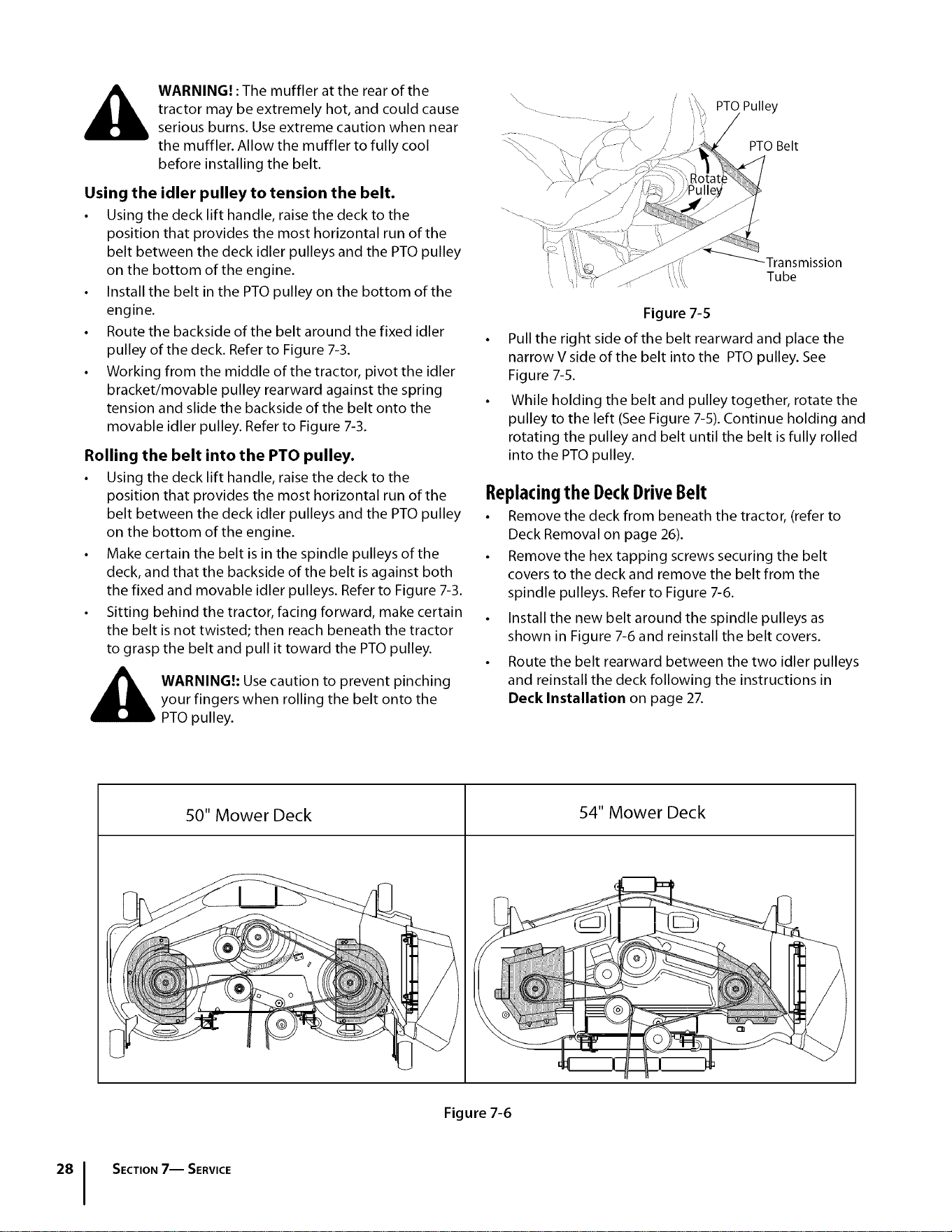
WARNING!: The muffler at the rear of the
tractor may be extremely hot, and could cause
serious burns. Use extreme caution when near
the muffler. Allow the muffler to fully cool
before installing the belt.
Using the idler pulley to tension the belt.
• Using the deck lift handle, raise the deck to the
position that provides the most horizontal run of the
belt between the deck idler pulleys and the PTO pulley
on the bottom of the engine.
• Install the belt in the PTO pulley on the bottom of the
engine.
• Route the backside of the belt around the fixed idler
pulley of the deck. Refer to Figure 7-3.
• Working from the middle of the tractor, pivot the idler
bracket/movable pulley rearward against the spring
tension and slide the backside of the belt onto the
movable idler pulley. Refer to Figure 7-3.
Rolling the belt into the PTO pulley.
• Using the deck lift handle, raise the deck to the
position that provides the most horizontal run of the
belt between the deck idler pulleys and the PTO pulley
on the bottom of the engine.
• Make certain the belt is in the spindle pulleys of the
deck, and that the backside of the belt is against both
the fixed and movable idler pulleys. Refer to Figure 7-3.
• Sitting behind the tractor, facing forward, make certain
the belt is not twisted; then reach beneath the tractor
to grasp the belt and pull it toward the PTO pulley.
_ ARNINGh Use caution to prevent pinching
your fingers when rolling the belt onto the
PTO pulley.
\\4\
PTO Pulley
PTO Belt
Transmission
Tube
Figure 7-5
Pull the right side of the belt rearward and place the
narrow V side of the belt into the PTO pulley. See
Figure 7-5.
While holding the belt and pulley together, rotate the
pulley to the left (See Figure 7-5). Continue holding and
rotating the pulley and belt until the belt is fully rolled
into the PTO pulley.
Replacing the DeckDrive Belt
• Remove the deck from beneath the tractor, (refer to
Deck Removal on page 26).
• Remove the hex tapping screws securing the belt
covers to the deck and remove the belt from the
spindle pulleys. Refer to Figure 7-6.
• Install the new belt around the spindle pulleys as
shown in Figure 7-6 and reinstall the belt covers.
• Route the belt rearward between the two idler pulleys
and reinstall the deck following the instructions in
Deck Installation on page 27.
50" Mower Deck 54" Mower Deck
Figure 7-6
SECTION7-- SERVICE
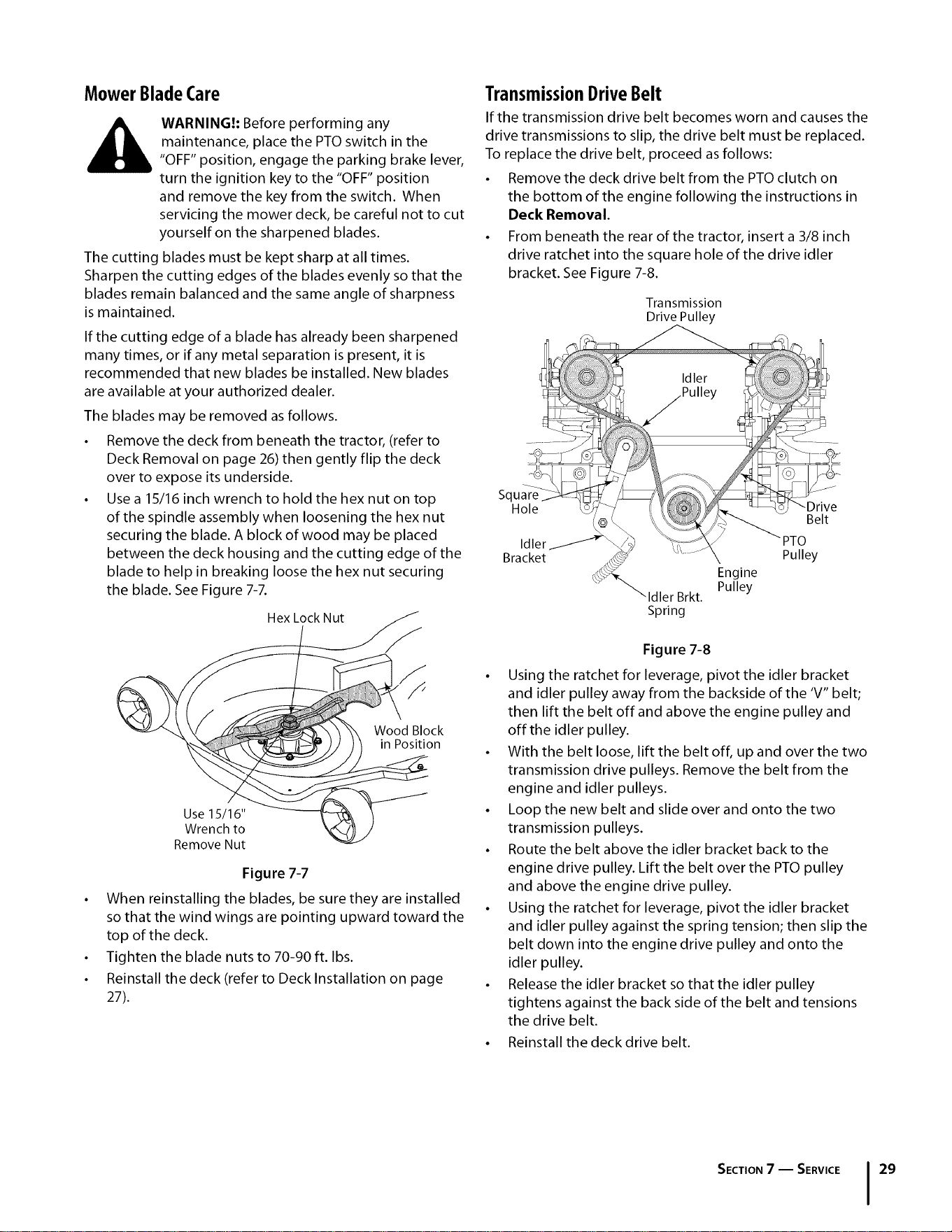
MowerBladeCare
_ ARNINGh Before performing any
maintenance, place the PTO switch in the
"OFF" position, engage the parking brake lever,
turn the ignition key to the "OFF" position
and remove the key from the switch. When
servicing the mower deck, be careful not to cut
yourself on the sharpened blades.
The cutting blades must be kept sharp at all times.
Sharpen the cutting edges of the blades evenly so that the
blades remain balanced and the same angle of sharpness
is maintained.
If the cutting edge of a blade has already been sharpened
many times, or if any metal separation is present, it is
recommended that new blades be installed. New blades
are available at your authorized dealer.
The blades may be removed as follows.
• Remove the deck from beneath the tractor, (refer to
Deck Removal on page 26) then gently flip the deck
over to expose its underside.
• Usea 15/16 inch wrench to hold the hex nut on top
of the spindle assembly when loosening the hex nut
securing the blade. A block of wood may be placed
between the deck housing and the cutting edge of the
blade to help in breaking loose the hex nut securing
the blade. See Figure 7-7.
lock
ion
Wrench to \_')) ,,/
Remove Nut -_-_"
Figure 7-7
• When reinstalling the blades, be sure they are installed
so that the wind wings are pointing upward toward the
top of the deck.
• Tighten the blade nuts to 70-90 ft. Ibs.
• Reinstall the deck (refer to Deck Installation on page
27).
TransmissionDrive Belt
If the transmission drive belt becomes worn and causes the
drive transmissions to slip, the drive belt must be replaced.
To replace the drive belt, proceed as follows:
• Remove the deck drive belt from the PTO clutch on
the bottom of the engine following the instructions in
Deck Removal.
• From beneath the rear of the tractor, insert a 3/8 inch
drive ratchet into the square hole of the drive idler
bracket. See Figure 7-8.
Transmission
Drive Pulley
idler _-_4'_
Bracket
_ldler Brkt.
Spring
Engine
Pulley
Figure 7-8
• Using the ratchet for leverage, pivot the idler bracket
and idler pulley away from the backside of the 'V" belt;
then lift the belt off and above the engine pulley and
off the idler pulley.
• With the belt loose, lift the belt off, up and over the two
transmission drive pulleys. Remove the belt from the
engine and idler pulleys.
• Loop the new belt and slide over and onto the two
transmission pulleys.
• Route the belt above the idler bracket back to the
engine drive pulley. Lift the belt over the PTO pulley
and above the engine drive pulley.
• Using the ratchet for leverage, pivot the idler bracket
and idler pulley against the spring tension; then slip the
belt down into the engine drive pulley and onto the
idler pulley.
• Release the idler bracket so that the idler pulley
tightens against the back side of the belt and tensions
the drive belt.
• Reinstall the deck drive belt.
SECTION7 -- SERVICE 29
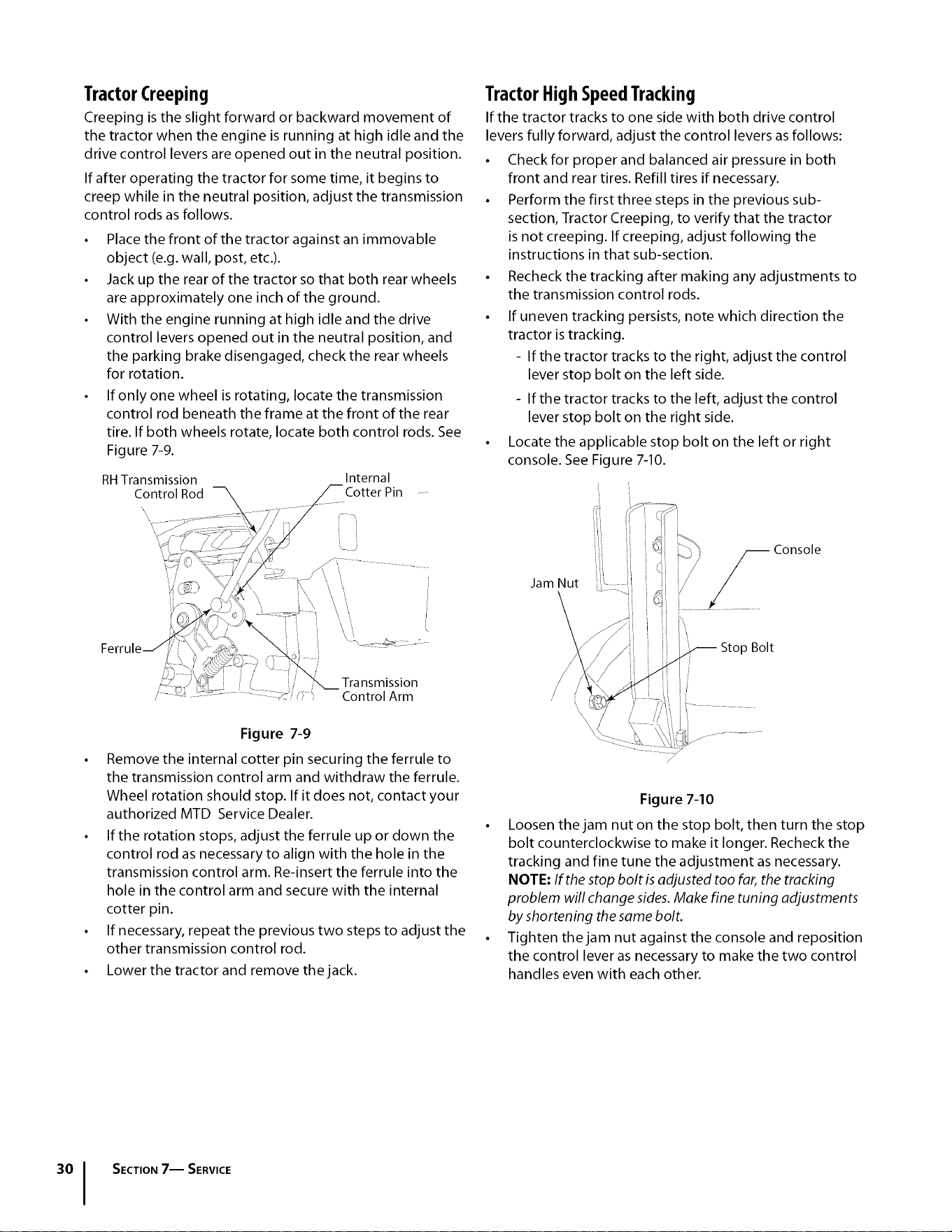
TractorCreeping
Creeping is the slight forward or backward movement of
the tractor when the engine is running at high idle and the
drive control levers are opened out in the neutral position.
If after operating the tractor for some time, it begins to
creep while in the neutral position, adjust the transmission
control rods as follows.
• Place the front of the tractor against an immovable
object (e.g. wall, post, etc.).
• Jack up the rear of the tractor so that both rear wheels
are approximately one inch of the ground.
• With the engine running at high idle and the drive
control levers opened out in the neutral position, and
the parking brake disengaged, check the rear wheels
for rotation.
• If only one wheel is rotating, locate the transmission
control rod beneath the frame at the front of the rear
tire. If both wheels rotate, locate both control rods. See
Figure 7-9.
RHTransmission Internal
Control Rod Pin
\\\_ i !
\ j
Transmission
_T_. Control Arm
Figure 7-9
• Remove the internal cotter pin securing the ferrule to
the transmission control arm and withdraw the ferrule.
Wheel rotation should stop. If it does not, contact your
authorized MTD Service Dealer.
• If the rotation stops, adjust the ferrule up or down the
control rod as necessary to align with the hole in the
transmission control arm. Re-insert the ferrule into the
hole in the control arm and secure with the internal
cotter pin.
• If necessary, repeat the previous two steps to adjust the
other transmission control rod.
• Lower the tractor and remove the jack.
TractorHighSpeedTracking
If the tractor tracks to one side with both drive control
levers fully forward, adjust the control levers as follows:
• Check for proper and balanced air pressure in both
front and rear tires. Refill tires if necessary.
• Perform the first three steps in the previous sub-
section, Tractor Creeping, to verify that the tractor
is not creeping. If creeping, adjust following the
instructions in that sub-section.
• Recheck the tracking after making any adjustments to
the transmission control rods.
• If uneven tracking persists, note which direction the
tractor is tracking.
- If the tractor tracks to the right, adjust the control
lever stop bolt on the left side.
- If the tractor tracks to the left, adjust the control
lever stop bolt on the right side.
• Locate the applicable stop bolt on the left or right
console. See Figure 7-10.
-- Console
Jam Nut
Stop Bolt
Figure 7-10
• Loosen the jam nut on the stop bolt, then turn the stop
bolt counterclockwise to make it longer. Recheck the
tracking and fine tune the adjustment as necessary.
NOTE: If the stop bolt isadjusted too far, the tracking
problem will change sides. Make fine tuning adjustments
by shortening the same bolt.
• Tighten the jam nut against the console and reposition
the control lever as necessary to make the two control
handles even with each other.
SECTION7-- SERVICE
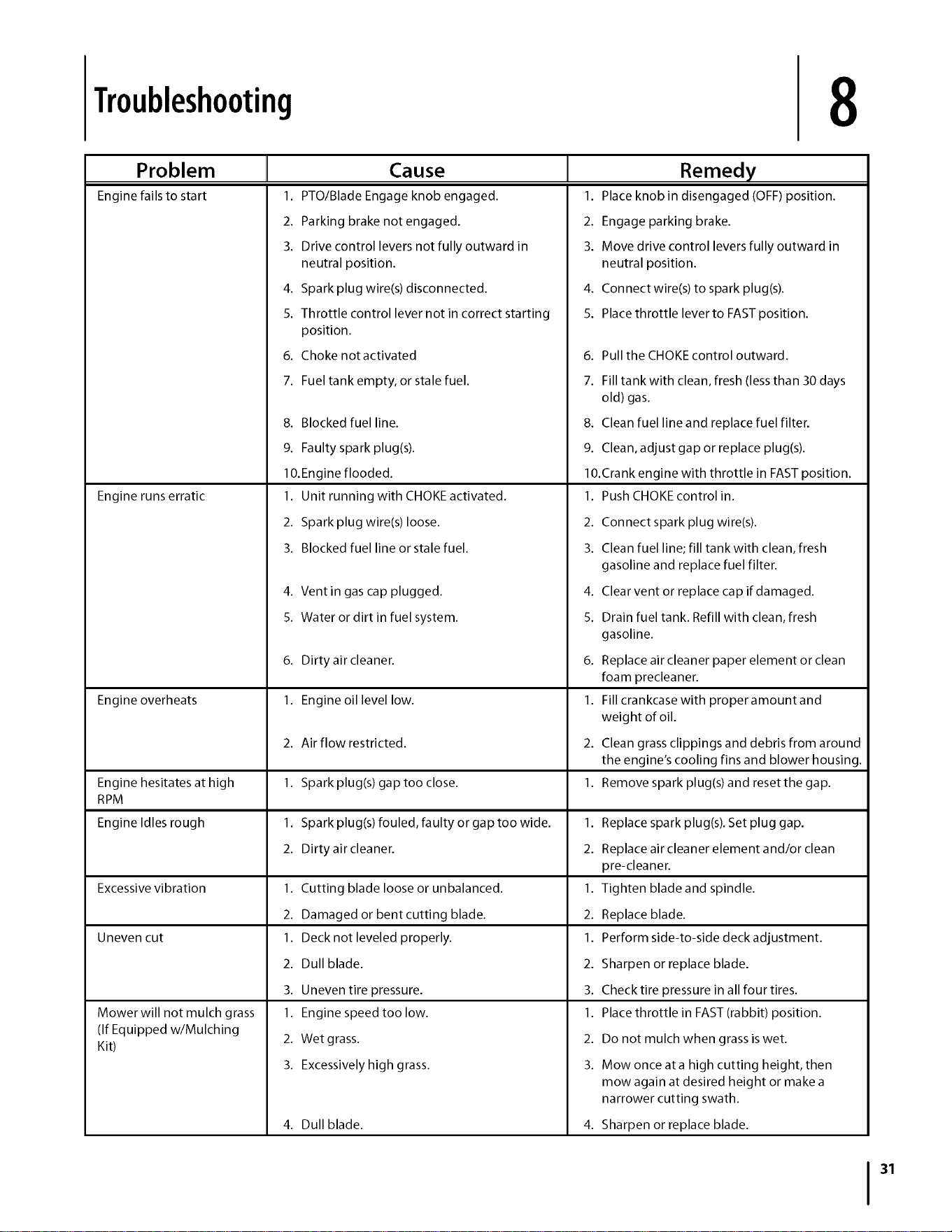
Troubleshooting
8
Problem
Engine fails to start
Engine runs erratic
Engine overheats
Engine hesitates at high
RPM
Engine Idles rough
Excessive vibration
Uneven cut
Mower will not mulch grass
(If Equipped w/Mulching
Kit)
Cause
1. PTO/Blade Engage knob engaged.
2. Parking brake not engaged.
3. Drive control levers not fully outward in
neutral position.
4. Spark plug wire(s) disconnected.
5. Throttle control lever not in correct starting
position.
6. Choke not activated
7. Fuel tank empty, or stale fuel.
8. Blocked fuel line.
9. Faulty spark plug(s).
lO.Engine flooded.
1. Unit running with CHOKE activated.
2. Spark plug wire(s) loose.
3. Blocked fuel line or stale fuel.
4. Ventin gas cap plugged.
5. Water or dirt in fuel system.
6. Dirty air cleaner.
1. Engine oil level low.
2. Air flow restricted.
1. Spark plug(s) gap too close.
1. Spark plug(s) fouled, faulty or gap too wide.
2. Dirty air cleaner.
1. Cutting blade loose or unbalanced.
2. Damaged or bent cutting blade.
1. Deck not leveled properly.
2. Dull blade.
3. Uneven tire pressure.
1. Engine speed too low.
2. Wet grass.
3. Excessively high grass.
4. Dull blade.
Remedy
1. Place knob in disengaged (OFF) position.
2. Engage parking brake.
3. Move drive control levers fully outward in
neutral position.
4. Connectwire(s) to spark plug(s).
5. Place throttle lever to FAST position.
6. Pull the CHOKE control outward.
7. Fill tankwith clean, fresh (less than 30 days
old) gas.
8. Clean fuel line and replace fuel filter.
9. Clean, adjust gap or replace plug(s).
10.Crank engine with throttle in FAST position.
I. Push CHOKE control in.
2. Connect spark plug wire(s).
3. Clean fuel line; fill tank with clean, fresh
gasoline and replace fuel filter.
4. Clearvent or replace cap if damaged.
5. Drain fuel tank. Refill with clean, fresh
gasoline.
6. Replace air cleaner paper element or clean
foam precleaner.
I. Fill crankcase with properamountand
weight of oil.
2. Clean grass clippings and debris from around
the engine's cooling fins and blower housing.
I. Remove spark plug(s) and resetthe gap.
1. Replace spark plug(s). Set plug gap.
2. Replace air cleaner element and/or clean
pre-cleaner.
1. Tighten blade and spindle.
2. Replace blade.
1. Perform side-to-side deckadjustment.
2. Sharpen or replace blade.
3. Check tire pressure in all four tires.
1. Place throttle in FAST (rabbit) position.
2. Do not mulch when grass is wet.
3. Mowonceata high cutting height, then
mow again at desired height or make a
narrower cutting swath.
4. Sharpen or replace blade.
31
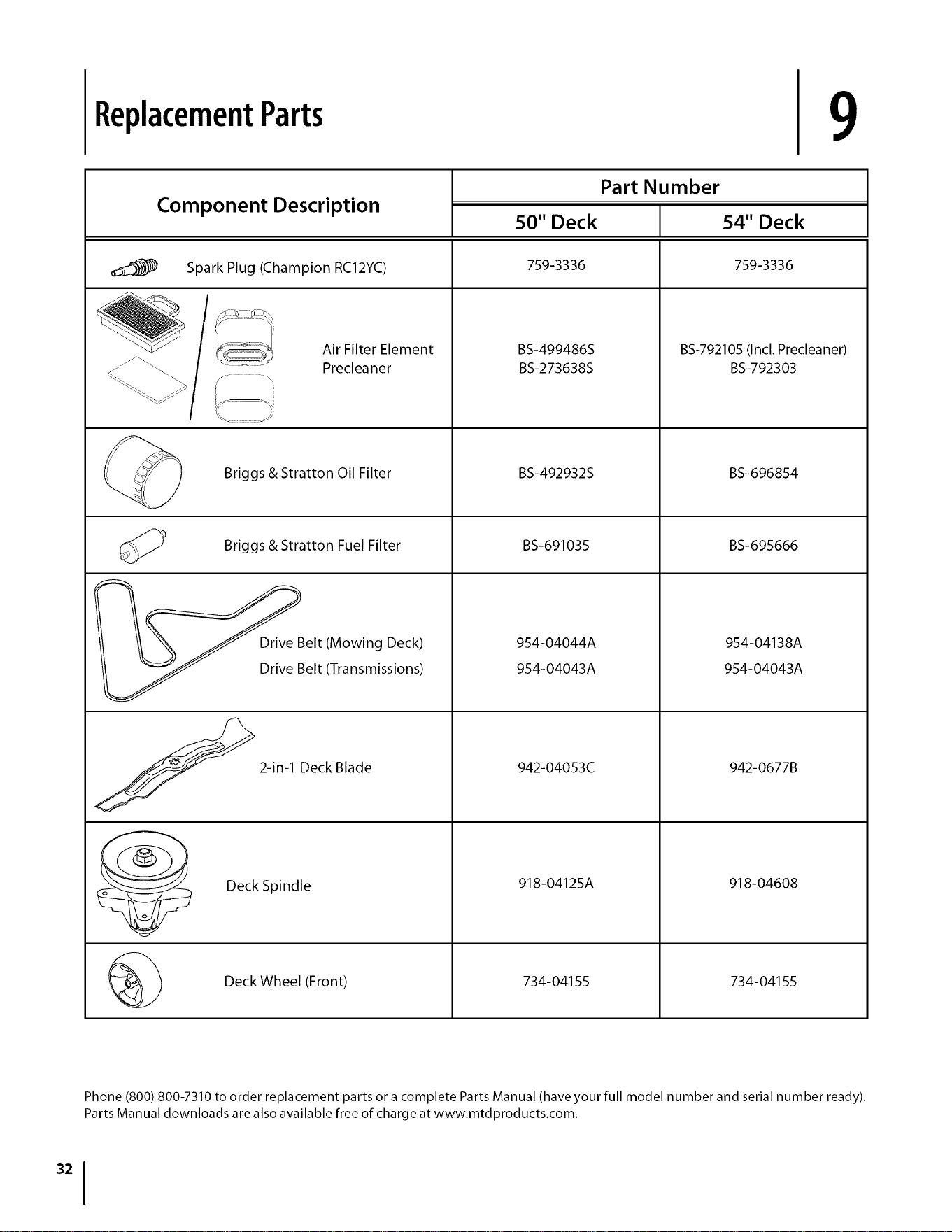
ReplacementParts
9
Component Description
Spark Plug (Champion RC12YC)
Briggs & Stratton Oil Filter
& Stratton Fuel Filter
Briggs
I __Belt (Mowing Deck)
Drive Belt (Transmissions)
f 2-in-1 Deck Blade
! Deck Spindle
Deck Wheel (Front)
50" Deck
759-3336
BS-499486S
BS-273638S
BS-492932S
BS-691035
954-04044A
954-04043A
942-04053C
Air Filter Element
Precleaner
918-04125A
734-04155
Part Number
54" Deck
759-3336
BS-79210S(Incl. Precleaner)
BS-792303
BS-696854
BS-695666
954-04138A
954-04043A
942-0677B
918-04608
734-04155
Phone (800) 800-7310 to order replacement parts or a complete Parts Manual (have your full model number and serial number ready).
Parts Manual downloads are also available free of charge at www.mtdproducts.com.
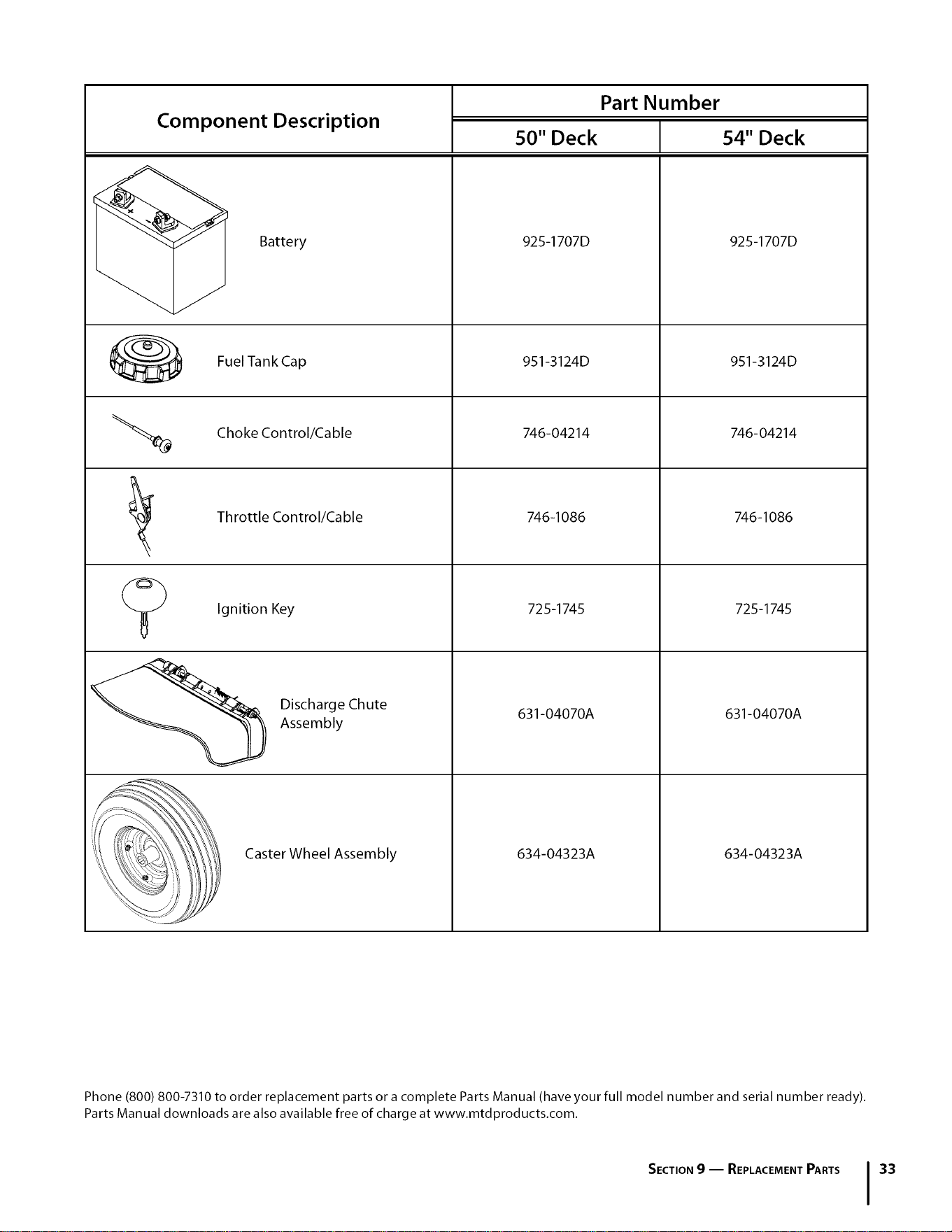
Component Description
Battery
Fuel Tank Cap
(_ Ignition Key
50" Deck
925-1707D
54" Deck
925-1707D
Choke Control/Cable
Throttle Control/Cable
Discharge Chute
Assembly
Caster Wheel Assembly
951-3124D
746-04214
746-1086
725-1745
631-04070A
634-04323A
Part Number
951-3124D
746-04214
746-1086
725-1745
631-04070A
634-04323A
Phone (800) 800-7310 to order replacement parts or a complete Parts Manual (have your full model number and serial number ready).
Parts Manual downloads are also available free of charge at www.mtdproducts.com.
SECTION9 -- REPLACEMENT PARTS 33
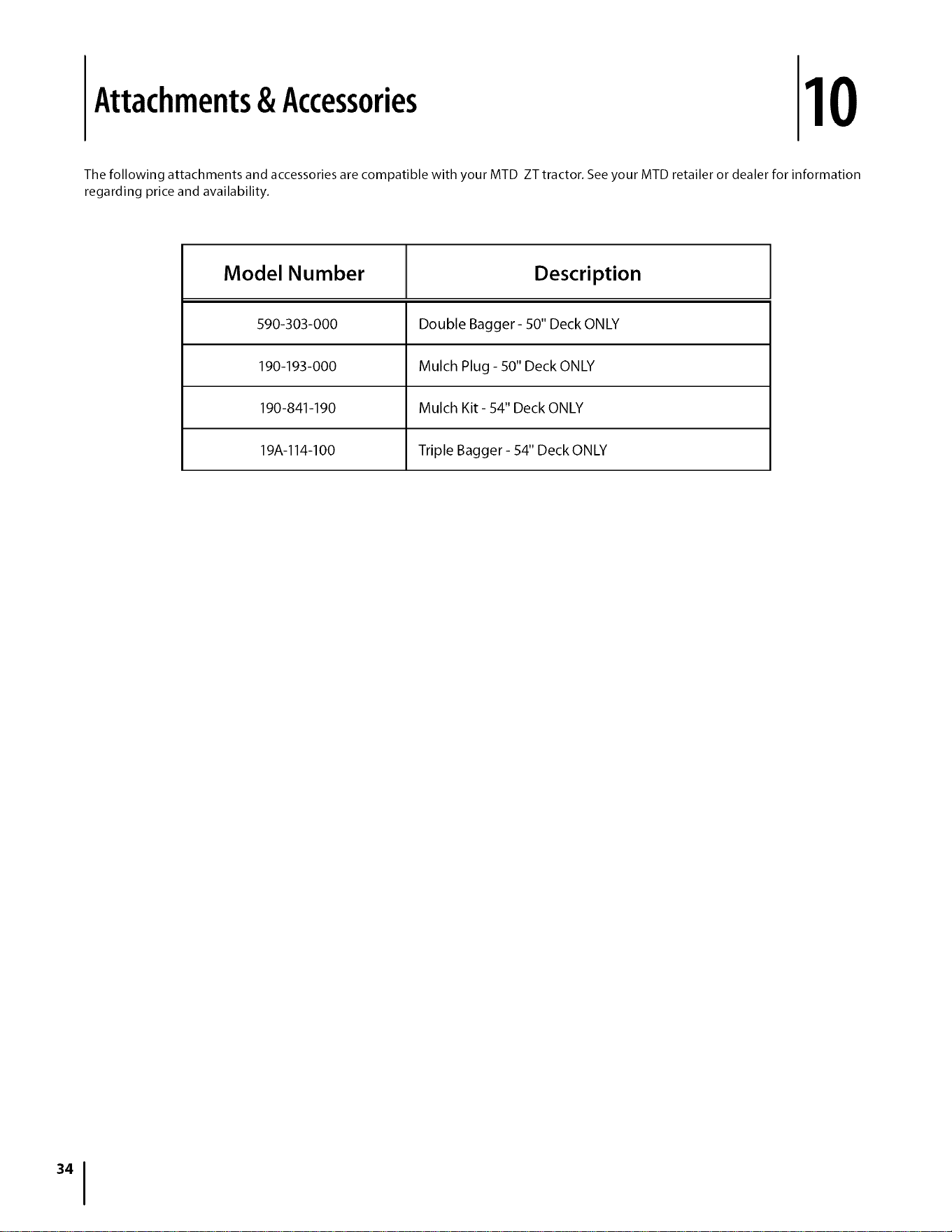
Attachments& Accessories
10
The following attachments and accessories are compatible with your MTD ZT tractor. See your MTD retailer or dealer for information
regarding price and availability.
Model Number Description
590-303-000 Double Bagger- 50" Deck ONLY
190-193-000 Mulch Plug - 50" Deck ONLY
190-841-190 Mulch Kit - 54" Deck ONLY
19A-114-100 Triple Bagger - 54" Deck ON LY
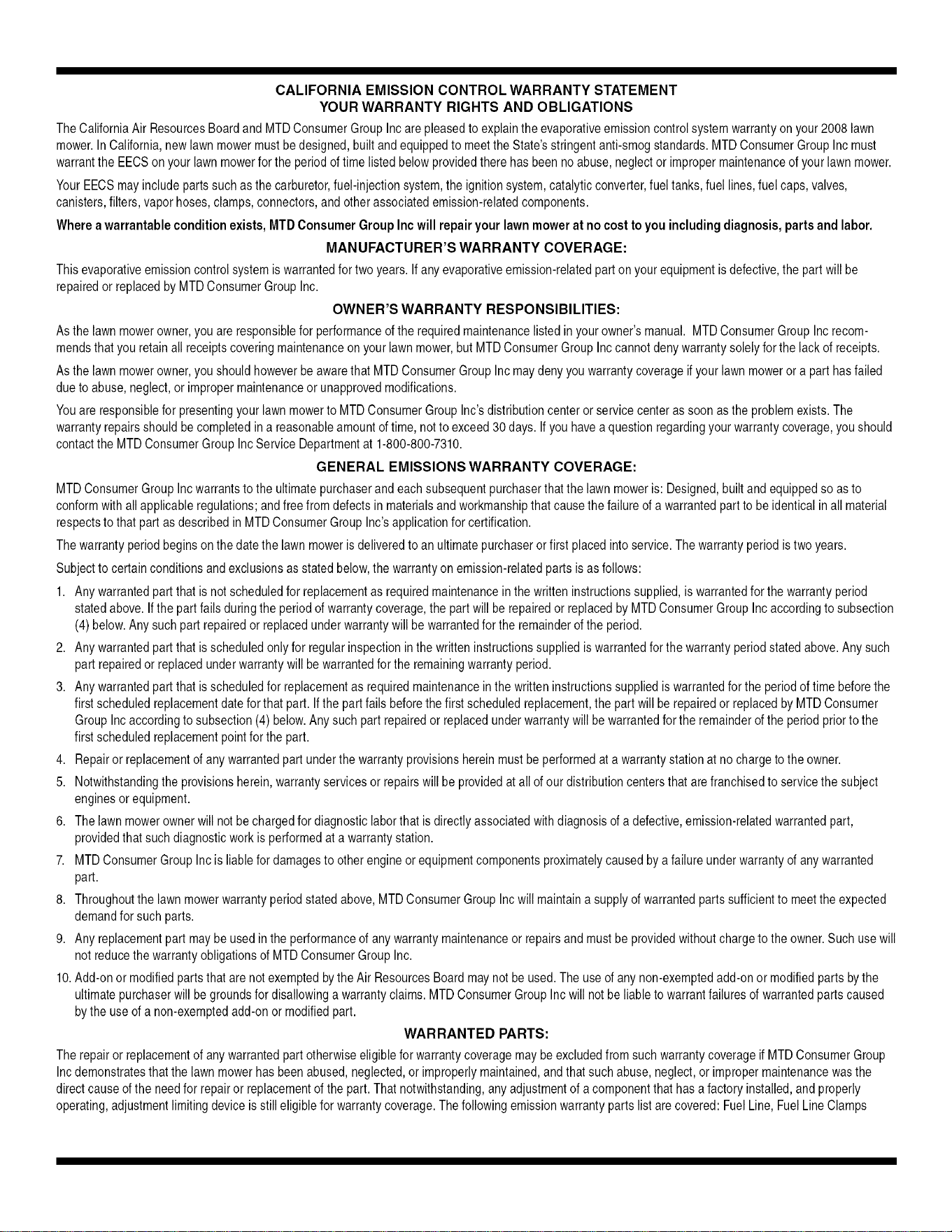
CALIFORNIAEMISSIONCONTROLWARRANTYSTATEMENT
YOURWARRANTYRIGHTSANDOBLIGATIONS
TheCaliforniaAirResourcesBoardandMTDConsumerGroupIncarepleasedtoexplaintheevaporativeemissioncontrolsystemwarrantyonyour2008lawn
mower.InCalifornia,newlawnmowermustbedesigned,builtandequippedtomeettheState'sstringentanti-smogstandards.MTDConsumerGroupIncmust
warranttheEECSonyourlawnmowerfortheperiodoftimelistedbelowprovidedtherehasbeennoabuse,neglectorimpropermaintenanceofyourlawnmower.
YourEECSmayincludepartssuchasthecarburetor,fuel-injectionsystem,theignitionsystem,catalyticconverter,fueltanks,fuellines,fuelcaps,valves,
canisters,filters,vaporhoses,clamps,connectors,andotherassociatedemission-relatedcomponents.
Whereawarrantableconditionexists,MTDConsumerGroupIncwillrepairyourlawnmoweratnocosttoyouincludingdiagnosis,partsandlabor.
MANUFACTURER'SWARRANTYCOVERAGE:
Thisevaporativeemissioncontrolsystemiswarrantedfortwoyears.Ifanyevaporativeemission-relatedpartonyourequipmentisdefective,thepartwillbe
repairedorreplacedbyMTDConsumerGroupInc.
OWNER'SWARRANTYRESPONSIBILITIES:
Asthelawnmowerowner,youareresponsibleforperformanceoftherequiredmaintenancelistedinyourowner'smanual.MTDConsumerGroupIncrecom-
mendsthatyouretainallreceiptscoveringmaintenanceonyourlawnmower,butMTDConsumerGroupInccannotdenywarrantysolelyforthelackofreceipts.
Asthelawnmowerowner,youshouldhoweverbeawarethatMTDConsumerGroupIncmaydenyyouwarrantycoverageifyourlawnmoweroraparthasfailed
duetoabuse,neglect,orimpropermaintenanceorunapprovedmodifications.
YouareresponsibleforpresentingyourlawnmowertoMTDConsumerGroupInc'sdistributioncenterorservicecenterassoonastheproblemexists.The
warrantyrepairsshouldbecompletedinareasonableamountoftime,nottoexceed30days.Ifyouhaveaquestionregardingyourwarrantycoverage,youshould
contacttheMTDConsumerGroupIncServiceDepartmentat1-800-800-7310.
GENERALEMISSIONSWARRANTYCOVERAGE:
MTDConsumerGroupIncwarrantstotheultimatepurchaserandeachsubsequentpurchaserthatthelawnmoweris:Designed,builtandequippedsoasto
conformwithallapplicableregulations;andfreefromdefectsinmaterialsandworkmanshipthatcausethefailureofawarrantedparttobeidenticalinallmaterial
respectstothatpartasdescribedinMTDConsumerGroupInc'sapplicationforcertification.
Thewarrantyperiodbeginsonthedatethelawnmowerisdeliveredtoanultimatepurchaserorfirstplacedintoservice.Thewarrantyperiodistwoyears.
Subjecttocertainconditionsandexclusionsasstatedbelow,thewarrantyonemission-relatedpartsisasfollows:
1. Anywarrantedpartthatisnotscheduledforreplacementasrequiredmaintenanceinthewritteninstructionssupplied,iswarrantedforthewarrantyperiod
statedabove.Ifthepartfailsduringtheperiodofwarrantycoverage,thepartwillberepairedorreplacedbyMTDConsumerGroupIncaccordingtosubsection
(4)below.Anysuchpartrepairedorreplacedunderwarrantywillbewarrantedfortheremainderoftheperiod.
2. Anywarrantedpartthatisscheduledonlyforregularinspectioninthewritteninstructionssuppliediswarrantedforthewarrantyperiodstatedabove.Anysuch
partrepairedorreplacedunderwarrantywillbewarrantedfortheremainingwarrantyperiod.
3. Anywarrantedpartthatisscheduledforreplacementasrequiredmaintenanceinthewritteninstructionssuppliediswarrantedfortheperiodoftimebeforethe
firstscheduledreplacementdateforthatpart.Ifthepartfailsbeforethefirstscheduledreplacement,thepartwillberepairedorreplacedbyMTDConsumer
GroupIncaccordingtosubsection(4)below.Anysuchpartrepairedorreplacedunderwarrantywillbewarrantedfortheremainderoftheperiodpriortothe
firstscheduledreplacementpointforthepart.
4. Repairorreplacementofanywarrantedpartunderthewarrantyprovisionshereinmustbeperformedatawarrantystationatnochargetotheowner.
5. Notwithstandingtheprovisionsherein,warrantyservicesorrepairswillbeprovidedatallofourdistributioncentersthatarefranchisedtoservicethesubject
enginesorequipment.
6. Thelawnmowerownerwillnotbechargedfordiagnosticlaborthatisdirectlyassociatedwithdiagnosisofadefective,emission-relatedwarrantedpart,
providedthatsuchdiagnosticworkisperformedatawarrantystation.
7. MTDConsumerGroupIncisliablefordamagestootherengineorequipmentcomponentsproximatelycausedbyafailureunderwarrantyofanywarranted
part.
8. Throughoutthelawnmowerwarrantyperiodstatedabove,MTDConsumerGroupIncwillmaintainasupplyofwarrantedpartssufficienttomeettheexpected
demandforsuchparts.
9. Anyreplacementpartmaybeusedintheperformanceofanywarrantymaintenanceorrepairsandmustbeprovidedwithoutchargetotheowner.Suchusewill
notreducethewarrantyobligationsofMTDConsumerGroupInc.
10.Add-onormodifiedpartsthatarenotexemptedbytheAirResourcesBoardmaynotbeused.Theuseofanynon-exemptedadd-onormodifiedpartsbythe
ultimatepurchaserwillbegroundsfordisallowingawarrantyclaims.MTDConsumerGroupIncwillnotbeliabletowarrantfailuresofwarrantedpartscaused
bytheuseofanon-exemptedadd-onormodifiedpart.
WARRANTEDPARTS:
TherepairorreplacementofanywarrantedpartotherwiseeligibleforwarrantycoveragemaybeexcludedfromsuchwarrantycoverageifMTDConsumerGroup
Incdemonstratesthatthelawnmowerhasbeenabused,neglected,orimproperlymaintained,andthatsuchabuse,neglect,orimpropermaintenancewasthe
directcauseoftheneedforrepairorreplacementofthepart.Thatnotwithstanding,anyadjustmentofacomponentthathasafactoryinstalled,andproperly
operating,adjustmentlimitingdeviceisstilleligibleforwarrantycoverage.Thefollowingemissionwarrantypartslistarecovered:FuelLine,FuelLineClamps

MANUFACTURER'S LIMITED WARRANTY FOR
The limited warranty set forth below is given by MTD LLC with
respect to new merchandise purchased and used in the United States
and/or its territories and possessions, and by MTD Products Limited
with respect to new merchandise purchased and used in Canadaand/
or its territories and possessions (either entity respectively, "MTD").
"MTD" warrants this product (excluding its Normal WearParts and
Attachments as described below) against defects in material and
workmanship for a period of two (2) years commencing on the date
of original purchase and will, at its option, repair or replace, free of
charge, any part found to be defective in materials or workmanship.
This limited warranty shall only apply if this product has been
operated and maintained in accordance with the Operator's Manual
furnished with the product, and has not been subject to misuse,
abuse, commercial use, neglect, accident, improper maintenance,
alteration, vandalism, theft, fire, water, or damage because of other
peril or natural disaster. Damage resulting from the installation or use
of any part, accessory or attachment not approved by MTD for use
with the product(s) covered by this manual will void your warranty as
to any resulting damage.
Normal WearPartsare warranted to befree from defects in material
and workmanship for a period of thirty (30) days from the date of
purchase. Normal wear parts include, but are not limited to items
such as: batteries, belts, blades, blade adapters, tines, grass bags,
wheels, rider deck wheels, seats, snow thrower skid shoes, friction
wheels, shave plates, auger spiral rubber and tires.
Attachments-- MTD warrants attachments for this product against
defects in material and workmanship for a period of one (1)year,
commencing on the date of the attachment's original purchase or
lease. Attachments include, but are not limited to items such as:
grass collectors and mulch kits.
HOWTO OBTAINSERVICE:Warranty service is available, WITH
PROOFOFPURCHASE,through your local authorized service dealer.
To locate the dealer in your area:
In the U.S.A.
Check your Yellow Pages,or contact MTD LLC at P.O.Box 361131,
Cleveland, Ohio 44136-0019, or call 1-800-800-7310, 1-330-220-
4683 or log on to our Web site at www.mtdproducts.com.
In Canada
Contact MTD Products Limited, Kitchener, ON N2G4J1, or call 1-800-
668-1238 or log onto our Web site at www.mtdcanada.com.
This limited warranty does not provide coverage in the following
cases:
a. The engine or component parts thereof. These items may carry a
separate manufacturer's warranty. Refer to applicable manufactur-
er's warranty for terms and conditions.
b. Log splitter pumps, valves, and cylinders havea separate one-
year warranty.
c. Routine maintenance items such as lubricants, filters, blade
sharpening, tune-ups, brake adjustments, clutch adjustments,
deck adjustments, and normal deterioration of the exterior finish
due to use or exposure.
d. Service completed by someone other than an authorized service
dealer.
e. MTD does not extend any warranty for products sold or exported
outside of the United States and/or Canada,and their respective
possessions and territories, except those sold through MTD's
authorized channels of export distribution.
f. Replacement parts that are not genuine MTD parts.
g. Transportation charges and service calls.
h. MTD does not warrant this product for commercial use.
No implied warranty, including any implied warranty of
merchantability of fitness for a particular purpose, applies after
the applicable period of expresswritten warranty aboveas to the
parts as identified. No other expresswarranty, whether written or
oral, except as mentioned above, given by any person or entity,
including a dealer or retailer, with respect to any product, shall
bind IVITD.Duringthe period of the warranty, the exclusiveremedy
is repair or replacement of the productasset forth above.
The provisions asset forth in this warranty providethe sole and
exclusive remedyarising from the sale. IVITDshall not he liable
for incidental or consequential loss or damage including, without
limitation, expenses incurred for substitute or replacement lawn
care services or for rental expenses to temporarily replace a
warranted product.
Some states do not allow the exclusion or limitation of incidental
or consequential damages, or limitations on how long an implied
warranty lasts, so the above exclusions or limitations may not apply
to you.
In no event shall recovery of any kind be greater than the amount of
the purchase price of the product sold. Alteration of safety features of
the product shall void this warranty. You assume the risk and liability
for loss, damage, or injury to you and your property and/or to others
and their property arising out of the misuse or inability to use the
product.
This limited warranty shall not extend to anyone other than the
original purchaser or to the person for whom it was purchased as a
gift.
HOWSTATELAW RELATESTOTHIS WARRANTY: This limited
warranty gives you specific legal rights, and you may also have other
rights which vary from state to state.
IMPORTANT: Owner must present Original Proof of Purchase to
obtain warranty coverage.
MTD LLC, P.O. BOX 361131 CLEVELAND, OHIO 44136-0019; Phone: 1-800-800-7310, 1-330-220-4683
MTD Canada Limited - KITCHENER, ON N2G 4J1; Phone 1-800-668-1238
GDOC-100015 REV.B

