F642-9301
OWNER"
MA UAL
Model No.
390.291352
390.291552
390.291652
390.291690
390.291751
CAUTION:
Read and Follow
All Safety Rulesand
Operating Instructions
BeforeFirstUseof
ThisProduct.
Save ThisManual For
FutureReference.
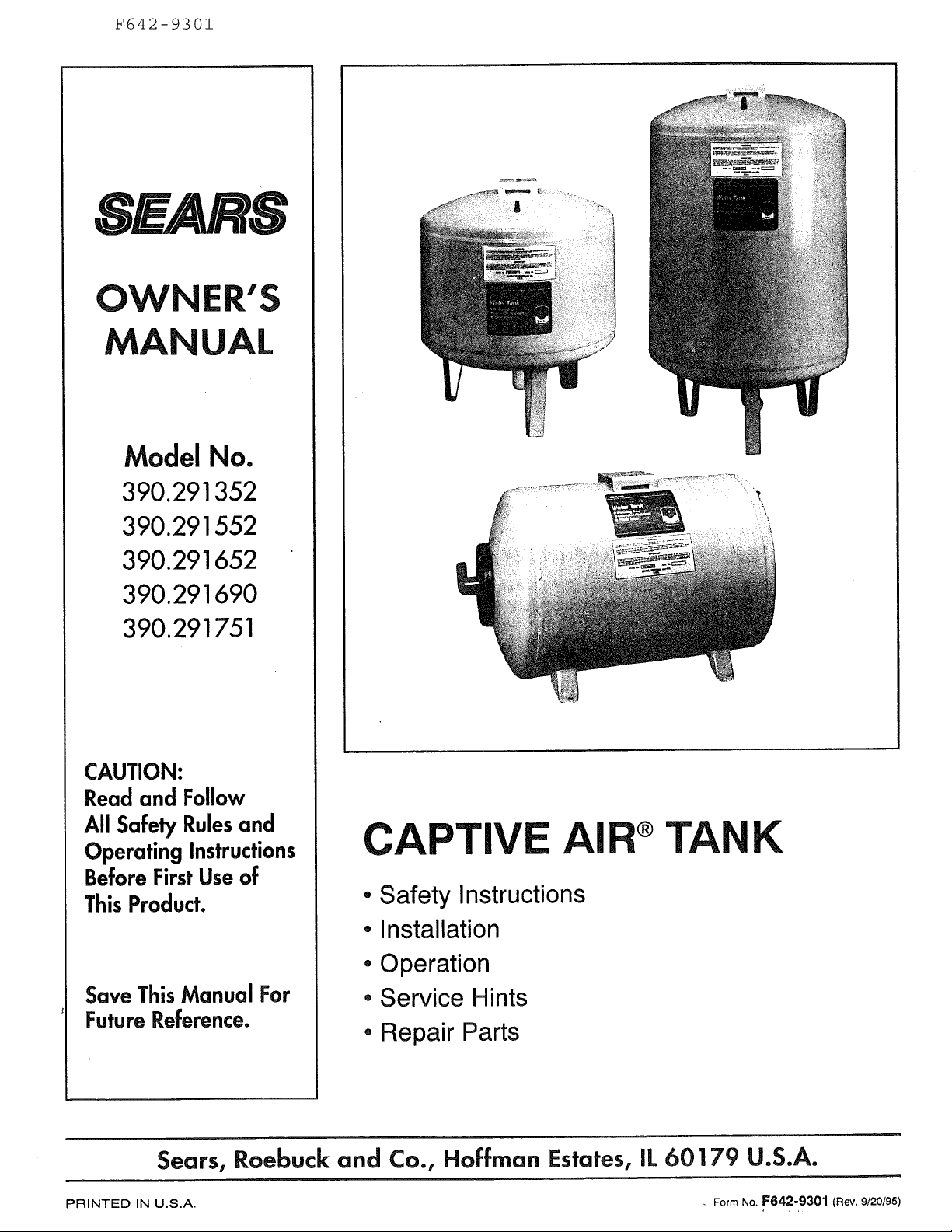
CAPTIVE AIR®TANK
• Safety Instructions
• Installation
• Operation
• Service Hints
. Repair Parts
Sears, Roebuck and Co., Hoffman Estates, IL 60179 U.S.A.
PRINTED IN USA Form No F642-9301 (Rev 9/20/95)
READ AND FOLLOW SAFETY INSTRUCTIONS!
N,NGi
o,oT,oNI
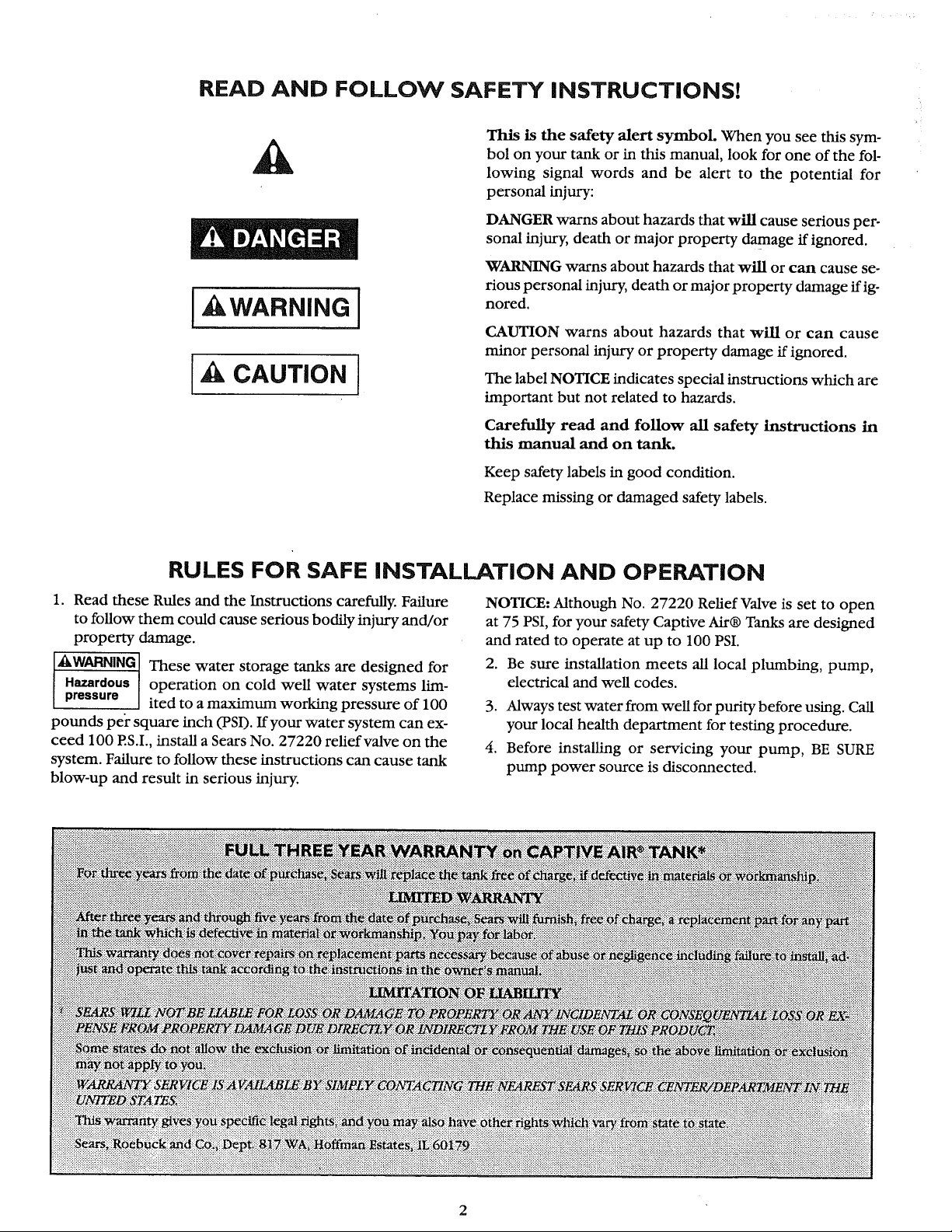
This is the safety alert symbol. When you see this sym-
bol on your tank or in this manual, look for one of the fol-
lowing signal words and be alert to the potential for
personal injury:
DANGER warns about hazards that will cause serious per-
sonal injury, death or major property damage if ignored.
WARNING warns about hazards that will or can cause se-
rious personal injury, death or major property damage if ig-
nored.
CAUTION warns about hazards that will or can cause
minor personal injury or property damage if ignored.
The label NOTICE indicates special instructions which are
important but not related to hazards.
Carefully read and follow all safety instructions in
this manual and on tank.
Keep safety labels in good condition.
Replace missing or damaged safety labels.
RULES FOR SAFE INSTALLATION AND OPERATION
1. Read these Rules and the Instructions carefully. Failure
to follow them could cause serious bodily injury and/or
property damage.
&WARNING These water storage tanks are designed for
Hazardous operation on cold well water systems lira-
pressure ited to a maximum working pressure of 100
pounds per square inch (PSI). If your water system can ex-
ceed 100 P.S.I., install a Sears No. 27220 relief valve on the
system. Failure to follow these instructions can cause tank
blow-up and result in serious injury.
NOTICE: Mthough No. 27220 Relief Valve is set to open
at 75 PSI, for your safety Captive Air@ Tanks are designed
and rated to operate at up to 100 PSI.
2. Be sure installation meets all local plumbing, pump,
electrical and well codes.
3. Always test water from well for purity before using. Call
your local health department for testing procedure.
4. Before installing or servicing your pump, BE SURE
pump power source is disconnected.
CONTENTS
W._NTY ........... ,................. , .... ,, .... ,, ............. ,.o,.., ..... ,.2
SAFETY ............................................................................ 2
INSTALLATION ............................................................. 3-6
OPERATION ...................... :............................................. 7
SERVICE HINTS ............................................................ 7-9
REPAIR PARTS........................................................... 10-11
INTRODUCTION
Please read our instructions before you install and use your
tank. This will help you obtain full benefits from this tank.
It will also help you avoid needless service expense that
result from causes we cannot control and cannot cover in
our Wan-anty.
BASIC TOOLS AND HATERIALS NEEDED
PLASTIC PIPE INSTALLATIONS
TOOLS HATERIALS
Pipe Wrenches
Screwdriver
Knife or Saw to Cut Plastic Pipe
Tire Pressure Gauge
Plastic Pipe and Fittings (as required to complete job).
Teflon Tape (DO NOT use pipe joint compound on
plastic fittings) or Plasto-Joint Stik*
GALVANIZED STEEL PIPE INSTALLATIONS
TOOLS
Pipe Wrenches
Screwdrivers
Pipe Cutting and Threading Tools
Tire Pressure Gauge
HATERIALS
Galvanized Pipe and Fittings (as required to complete job).
Pipe Joint Compound or Teflon tape
INSTALLATION
,_kWARNING ff your system can develop more than 100
Hazardous PSI pressure, install a Sears No. 27220 re-
pressure lieve valve in system to prevent possibility
of tank blow-up.
NOTICE: DO NOT use any type of lubricant other than
water on Hose to Plastic fittings.
If rigid piping is installed to elbow on inlet flange, BE SURE
to support the piping.
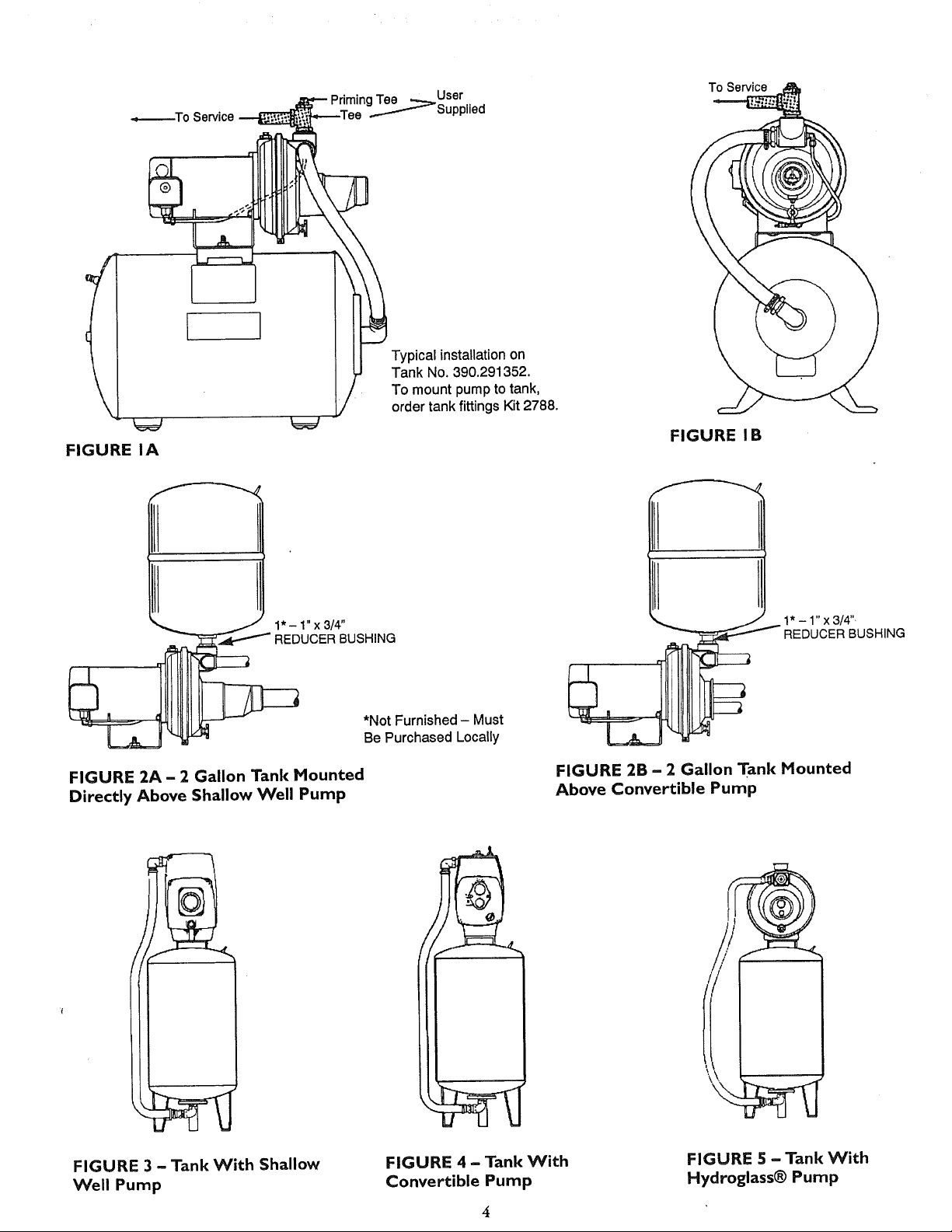
For proper installation of your pump to tank, follow one
of the typical installations on Page 4 and 5. Use Teflon tape
on all threaded connections to tank.
Standard pipe fittings, such as nipples, tees and elbows
must be purchased locally. If you are using a horizontal jet
pump mounted on top of tank, Figures 3, 4 and 5, Kit No.
2788 is required. See Page 10 for contents of kit.
If your present system has an air volume control (AVC), re-
move it and plug AVC port on pump.
Complete pump, tank, and piping system MUST be pro-
tected against below freezing temperature. Failure to do
so could cause severe damage and voids the warranty.
* lake Chemical Co., Chicago, Illinois.
To Service
Priming Tee .._= User, .
......---_- _upp eo
--To Service
[
FIGURE IA
]
Typical installation on
Tank No. 390.291352,
To mount pump to tank,
order tank fittings Kit 2788.
FIGURE I B
i
1* - 1" x 3/4"
UCER BUSHING
•Not Furnished - Must
Be Purchased Locally
FIGURE 2A - 2 Gallon Tank Hounted
Directly Above Shallow Well Pump
- 1" x 3/4"-
REDUCER BUSHING
FIGURE 2B - 2 Gallon Tank Hounted
Above Convertible Pump
FIGURE 3 - Tank With Shallow
Well Pump
FIGURE 4 - Tank With
Convertible Pump
FIGURE 5 - Tank With
Hydroglass® Pump
INSTALLATION
To Service
#
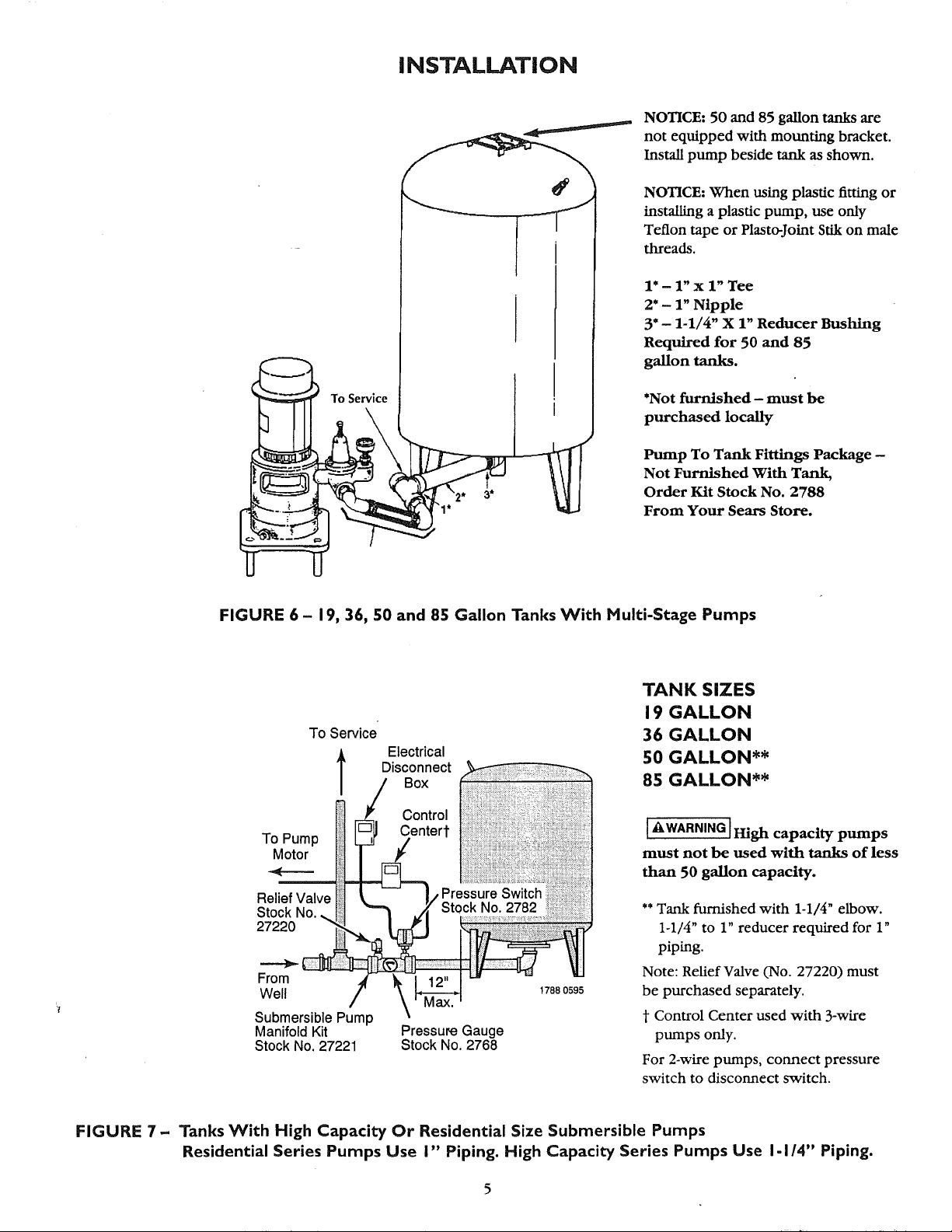
NOTICE. 50 and 85 gallon tanks are
not equipped with mounting bracket.
Install pump beside tank as shown.
NOTICE. When using plastic fitting or
installing a plastic pump, use only
Teflon tape or Plasto-Joint Stik on male
threads.
1" - 1" x 1" Tee
2* - 1" Nipple
3* - 1-1/4" X 1" Reducer Bushing
Required for 50 and 85
gallon tanks.
*Not furnished- must be
purchased locally
Pump To Tank Fittings Package-
Not Furnished With Tank,
Order Kit Stock No. 2788
From Your Sears Store.
FIGURE 6 - 19, 36, 50 and 85 Gallon Tanks With Multi-Stage Pumps
TANK SIZES
19 GALLON
To Service 36 GALLON
T Electrical 50 GALLON**
Disconnect
Box 85 GALLON**
To Pump
Motor
Relief Valve
Stock No.
27220
From
Well
Submersible Pump
Manifold Kit
Stock No. 27221
Control
Centert
/
Pressure Gauge
Stock No. 2768
1789 0595
I
_WARNING
I __
IHigh capacity pumps
must not be used with tanks of less
than 50 gallon capacity.
**Tank furnished with I-I/4" elbow.
I-I/4" to I" reducer required for I"
piping.
Note: Relief Valve (No. 27220) must
be purchased separately.
t Control Center used with 3-wire
pumps only.
For 2-wire pumps, connect pressure
switch to disconnect switch.
FIGURE 7-
Tanks With High Capacity Or Residential Size Submersible Pumps
Residential Series Pumps Use I" Piping. High Capacity Series Pumps Use I-I/4" Piping.
INSTALLATION
IAWARNING If your system can develop more than
Hazardous 100 PSI pressure, install a Sears No.
pressure 27220 relieve valve in system to pre-
vent possibility of tank blow-up.
NOTICE: All Captive Air® Tanks except Model 390.291352
are designed to operate in the vertical position.
The tank is shipped from the factory with a pre-charge of
air. This system DOES NOT require the use of any outside
air charging devices such as air volume controls on jet
pumps, or bleeder orifices on submersible pumps.
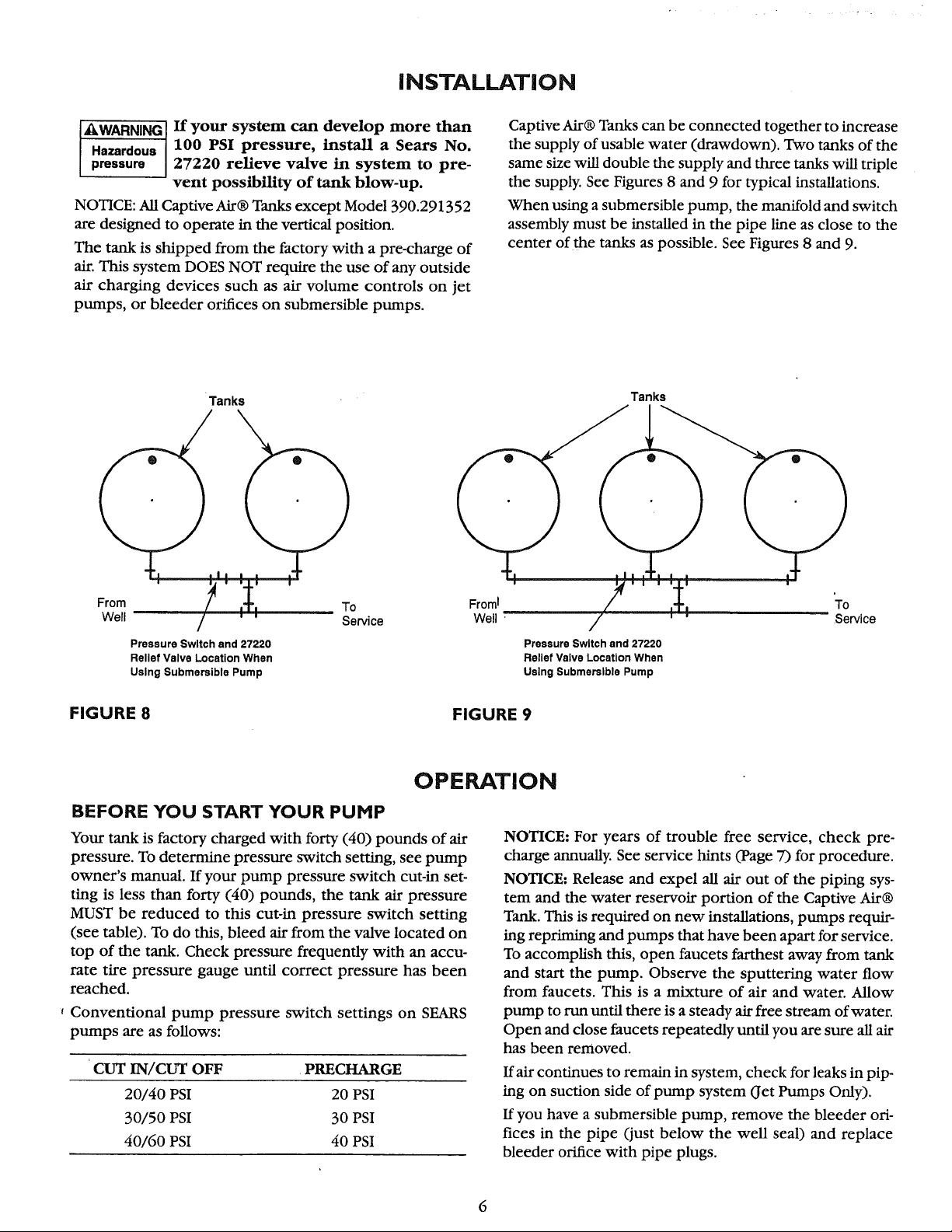
Captive Air® Tanks can be connected together to increase
the supply of usable water (drawdown). Two tanks of the
same size will double the supply and three tanks will triple
the supply. See Figures 8 and 9 for typical installations.
When using a submersible pump, the manifold and switch
assembly must be installed in the pipe line as close to the
center of the tanks as possible. See Figures 8 and 9.
Tanks
From To Froml
Well Service Well '
Pressure Switch and 27220
Relief Valve Location When
Using Submersible Pump
Tanks
I I I I I I
/
Pressure Switch end 27220
Relief Valve Location When
Using Submersible Pump
To
Service
FIGURE 8
FIGURE 9
OPERATION
BEFORE YOU START YOUR PUHP
Your tank is factory charged with forty (40) pounds of air
pressure. To determine pressure switch setting, see pump
owner's manual. If your pump pressure switch cut-in set-
ting is less than forty (40) pounds, the tank air pressure
MUST be reduced to this cut-in pressure switch setting
(see table). To do this, bleed air from the valve located on
top of the tank. Check pressure frequently with an accu-
rate tire pressure gauge until correct pressure has been
reached.
, Conventional pump pressure switch settings on SEARS
pumps are as follows:
CUT IN/CUT OFF PRECHARGE
20/40 PSI 20 PSI
30/50 PSI 30 PSI
40/60 PSI 40 PSI
NOTICE: For years of trouble free service, check pre-
charge annually. See service hints (Page 7) for procedure.
NOTICE: Release and expel all air out of the piping sys-
tem and the water reservoir portion of the Captive Air®
Tank. This is required on new installations, pumps requir-
ing repriming and pumps that have been apart for service.
To accomplish this, open faucets farthest away from tank
and start the pump. Observe the sputtering water flow
from faucets. This is a mixture of air and water. Allow
pump to run until there is a steady air free stream of water.
Open and close faucets repeatedly until you are sure all air
has been removed.
If air continues to remain in system, check for leaks in pip-
ing on suction side of pump system (Jet Pumps Only).
If you have a submersible pump, remove the bleeder 015-
rices in the pipe (just below the well seal) and replace
bleeder orifice with pipe plugs.
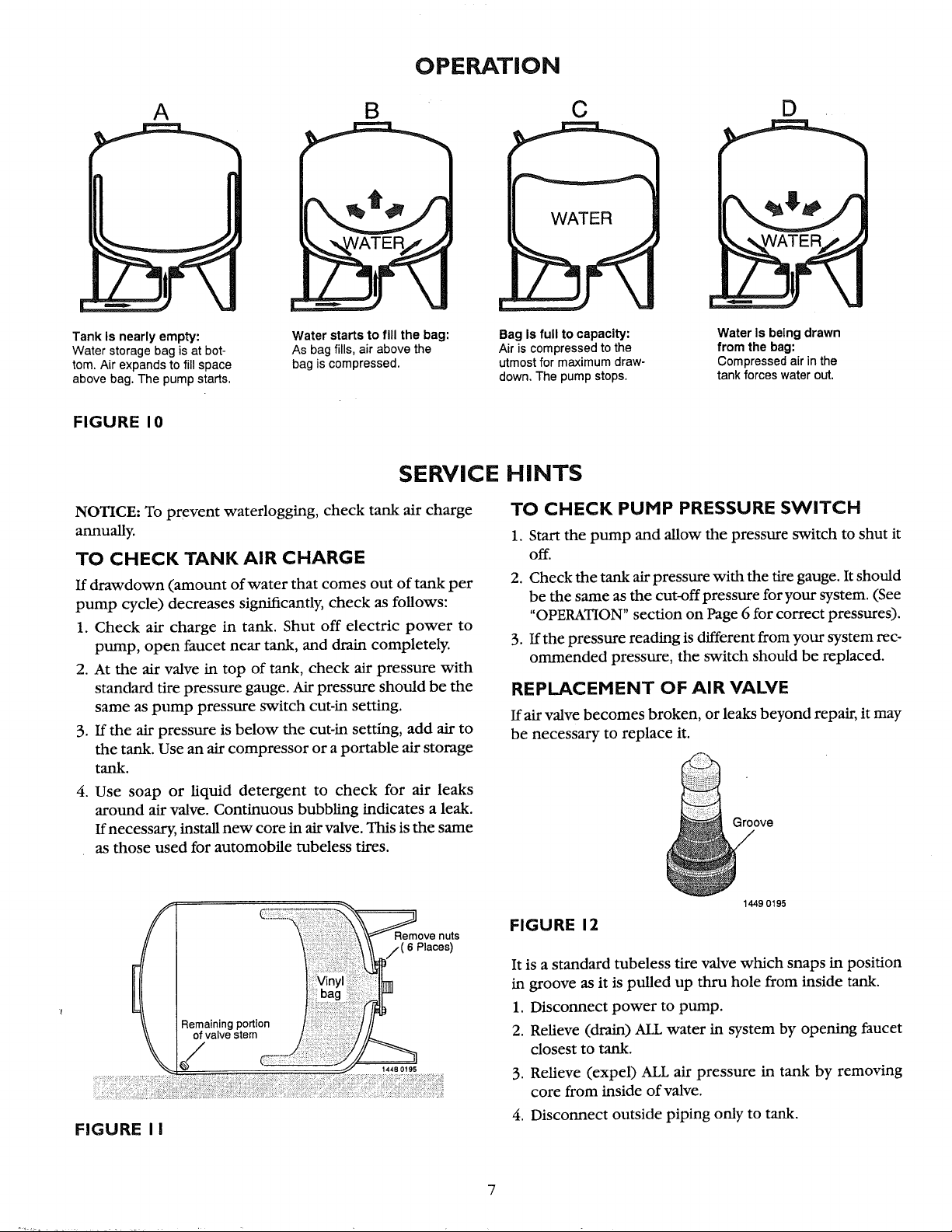
A
Tank Is nearly empty:
Water storage bag is at bot-
tom.Air expandsto fillspace
above bag.The pumpstarts.
OPERATION
B
C
Water starts to fill the bag:
As bag fills, air above the
bag is compressed.
Bag Is full to capacity:
Air is compressedtothe
utmostfor maximumdraw-
down.The pumpstops.
D
Water Isbeing drawn
from the bag:
Compressedairinthe
tankforces waterout.
FIGURE I 0
SERVICE HINTS
NOTICE: To prevent waterlogging, check tank air charge
annually.
TO CHECK TANK AIR CHARGE
If drawdown (amount of water that comes out of tank per
pump cycle) decreases significantly, check as follows:
1. Check air charge in tank. Shut off electric power to
pump, open faucet near tank, and drain completely.
2. At the air valve in top of tank, check air pressure with
standard tire pressure gauge. Air pressure should be the
same as pump pressure switch cut-in setting.
3. If the air pressure is below the cut-in setting, add air to
the tank. Use an air compressor or a portable air storage
tank.
4. Use soap or Hquid detergent to check for air leaks
around air valve. Continuous bubbling indicates a leak.
If necessary, install new core in air valve. This is the same
as those used for automobile tubeless tires.
Remove nuts
j( 6 Places)
of valve stem
FIGURE I I
TO CHECK PUHP PRESSURE SWITCH
1. Start the pump and allow the pressure switch to shut it
off.
2. Check the tank air pressure with the tire gauge. It should
be the same as the cut-offpressure for your system. (See
"OPERATION" section on Page 6 for correct pressures).
3. If the pressure reading is different from your system rec-
ommended pressure, the switch should be replaced.
REPLACEHENT OF AIR VALVE
If air valve becomes broken, or leaks beyond repair, it may
be necessary to replace it.
Groove
1449 0195
FIGURE 12
It is a standard tubeless tire valve which snaps in position
in groove as it is pulled up thru hole from inside tank.
1. Disconnect power to pump.
2. Relieve (drain) ALL water in system by opening faucet
closest to tank.
3. Relieve (expel) ALL air pressure in tank by removing
core from inside of valve.
4. Disconnect outside piping only to tank.
.
6.
SERVICE
With sharp knife, cut off stem as close to tank as pos-
sible. Push remaining portion into tank.
Lay tank on side and remove six (6) nuts from studs.
Tap cover to break seal and remove cover assembly
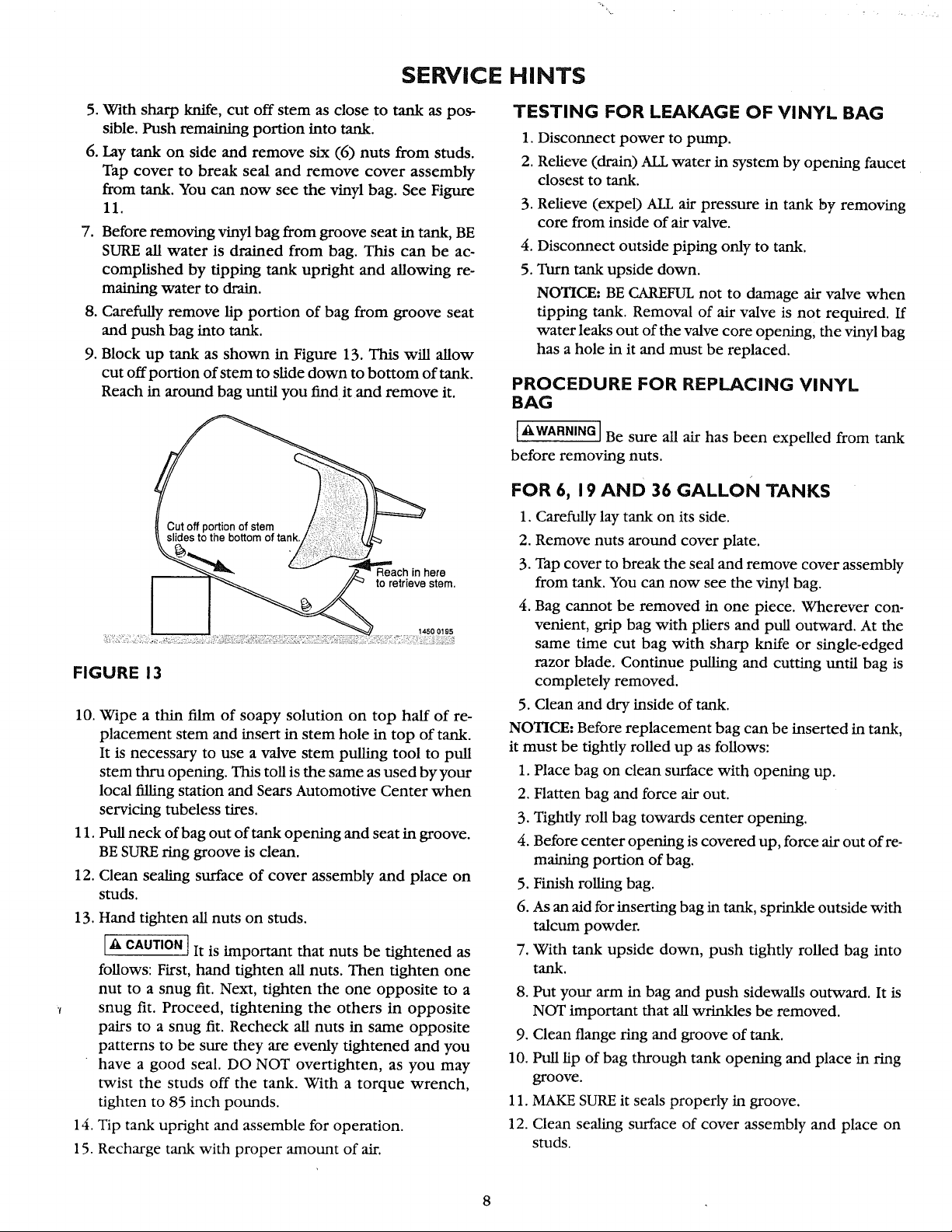
from tank. You can now see the vinyl bag. See Figure
11.
7. Before removing vinyl bag from groove seat in tank, BE
SURE all water is drained from bag. This can be ac-
complished by tipping tank upright and aUowing re-
maining water to drain.
8. Carefully remove lip portion of bag from groove seat
and push bag into tank.
9. Block up tank as shown in Figure 13. This will allow
cut offportion of stem to slide down to bottom of tank.
Reach in around bag until you find it and remove it.
in here
to retrieve stem.
FIGURE 13
10.
11.
12.
13.
14.
15.
Wipe a thin film of soapy solution on top half of re-
placement stem and insert in stem hole in top of tank.
It is necessary to use a valve stem pulling tool to pull
stem thru opening. This toll is the same as used by your
local filling station and Sears Automotive Center when
servicing tubeless tires.
Pull neck of bag out of tank opening and seat in groove.
BE SURE ring groove is clean.
Clean sealing surface of cover assembly and place on
studs.
Hand tighten all nuts on studs.
]& CAUTION ] It is important that nuts be tightened as
follows: First, hand tighten all nuts. Then tighten one
nut to a snug fit. Next, tighten the one opposite to a
snug fit. Proceed, tightening the others in opposite
pairs to a snug fit. Recheck all nuts in same opposite
patterns to be sure they are evenly tightened and you
have a good seal. DO NOT overtighten, as you may
twist the studs off the tank. With a torque wrench,
tighten to 85 inch pounds.
Tip tank upright and assemble for operation.
Recharge tank with proper amount of air.
HINTS
TESTING FOR LEAKAGE OF VINYL BAG
1. Disconnect power to pump.
2. Relieve (drain) ALL water in system by opening faucet
closest to tank.
3. Relieve (expel) ALL air pressure in tank by removing
core from inside of air valve.
4. Disconnect outside piping only to tank.
5. Turn tank upside down.
NOTICE: BE CAREFUL not to damage air valve when
tipping tank. Removal of air valve is not required. If
water leaks out of the valve core opening, the vinyl bag
has a hole in it and must be replaced.
PROCEDURE FOR REPLACING VINYL
BAG
[AkWARNING ]Be sure all air has been expelled from tank
before removing nuts.
FOR 6, 19 AND 36 GALLON TANKS
1. Carefiflly lay tank on its side.
2. Remove nuts around cover plate.
3. Tap cover to break the seal and remove cover assembly
from tank. You can now see the vinyl bag.
4. Bag cannot be removed in one piece. Wherever con-
venient, grip bag with pliers and pull outward. At the
same time cut bag with sharp knife or single-edged
razor blade. Continue pulling and cutting until bag is
completely removed.
5. Clean and dry inside of tank.
NOTICE: Before replacement bag can be inserted in tank,
it must be tightly rolled up as follows:
1. Place bag on clean surface with opening up.
2. Flatten bag and force air out.
3. Tightly roll bag towards center opening.
4. Before center opening is covered up, force air out of re-
maining portion of bag.
5. Finish rolling bag.
6. As an aid for inserting bag in tank, sprinkle outside with
talcum powder.
7. With tank upside down, push tightly rolled bag into
tank.
8. Put your arm in bag and push sidewalls outward. It is
NOT important that all wrinkles be removed.
9. Clean flange ring and groove of tank.
10. Pull lip of bag through tank opening and place in ring
groove.
11. MAKE SURE it seals properly in groove.
12. Clean sealing surface of cover assembly and place on
studs.
8
SERVICE HINTS
13. Hand tighten all nuts on studs.
[& CAUTION[It is important that nuts be tightened as
follows: First, hand tighten all nuts. Then tighten one
nut to a snug fit. Next, tighten the one opposite to a
snug fit. Proceed, tightening the others in opposite
pairs to a snug fit. Recheck all nuts in same opposite
patterns to be sure they are evenly tightened and you
have a good seal. DO NOT overtighten, as you may
twist the studs off the tank. With a torque wrench,
tighten to 85 inch pounds.
14. Tip tank upright and reassemble for operation.
15. Recharge tank with proper amount of air.
FOR 50 AND 85 GALLON TANKS
_kWARNING Be sure all air has been expelled from tank
Hazardous before removing nuts.
pressure
1. Carefully lay tank on its side.
2. Remove nuts around cover plate:
3. Tap cover to break the seal and remove cover assembly
from tank. You can now see the vinyl bag.
4. Bag cannot be removed in one piece. Wherever con-
venient, grip bag with pliers and pull outward. At the
same time cut bag with sharp knife or single-edged
razor blade. Continue pulling and cutting until bag is
completely removed.
5. Clean and dry inside of tank.
6. Place bag on its side on dry clean surface.
7. Flatten bag and force air out.
8. Starting on one side, tightly roll bag to other side.
NOTICE: Before opening is rolled closed, force re-
maining air out.
9. Finish rolling bag.
10. As a aid for inserting bag in tank, sprinkle outside with
talcum powder.
11. With tank on its side, push tightly rolled bag into tank
opening.
NOTICE: Push bag in tank only the length of the rolled
bag.
12. insert arm in bag and push sidewalls outward. It is NOT
important that all wrinkles be removed.
13. Clean flange ring and groove to tank.
NOTICE: Two people are required for the following
steps:
14. Holding the bag, stand tank open end up.
NOTICE. DO NOT damage air valve. It may be of help
to lean tank in comer.
15. Pull lip ring of bag through tank opening and place in
ring groove.
16. MAKE SURE it seats properly in groove.
17. Clean sealing surface of cover assembly and place on
studs.
18. Hand tighten all nuts on studs.
14 CAUTION ] It is important that nuts be tightened as
follows: First, hand tighten all nuts. Then tighten one
nut to a snug fit. Next, tighten the one opposite to a
snug fit. Proceed, tightening the others in opposite
pairs to a snug fit. Recheck all nuts in same opposite
patterns to be sure they are evenly tightened and you
have a good seal. DO NOT overtighten, as you may
twist the studs off the tank. With a torque wrench,
tighten to 85 inch pounds.
19. Tip tank upright and reassemble for operation.
20. Recharge tank with proper amount of air.
\ %
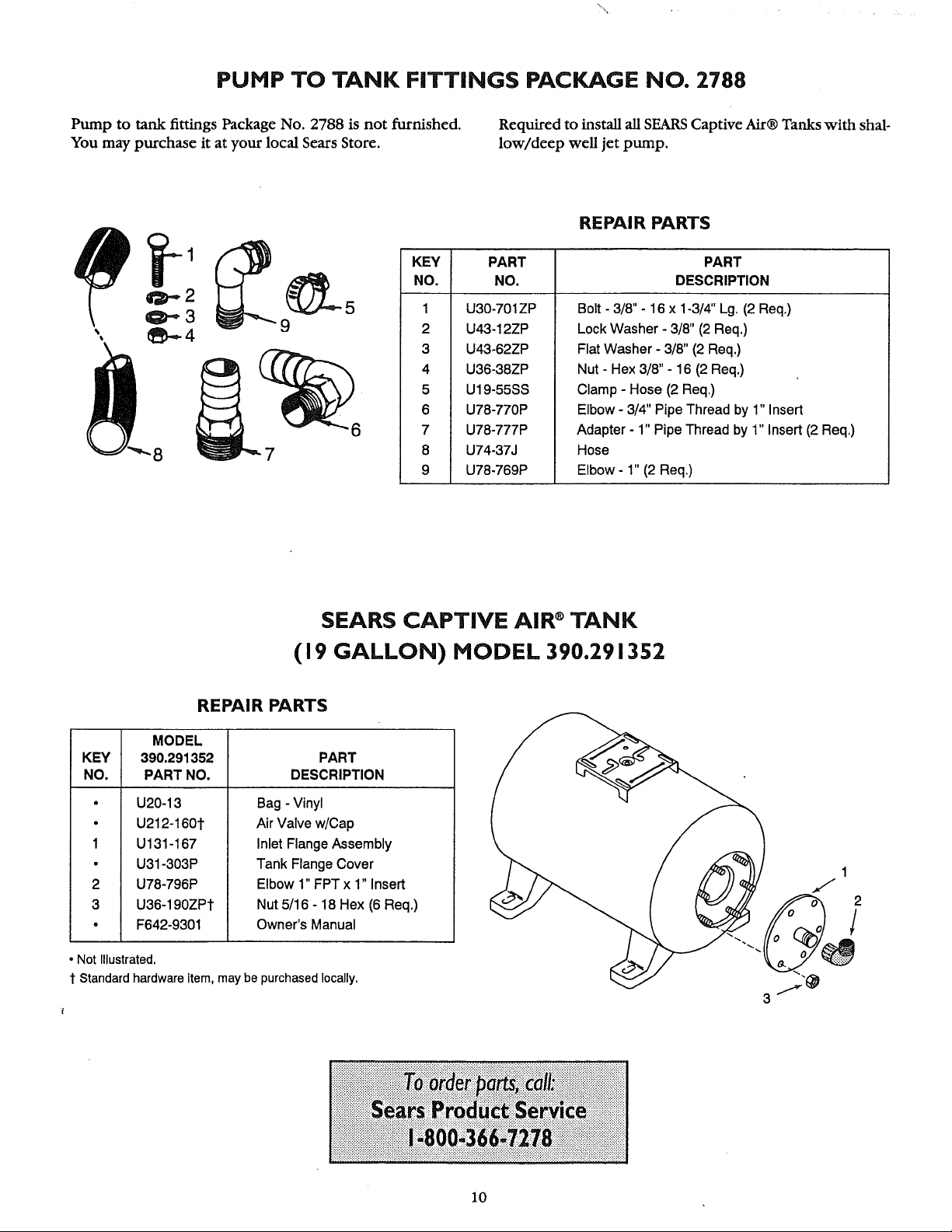
PUHP TO TANK FITTINGS PACKAGE NO. 2788
Pump to tank fittings Package No. 2788 is not furnished.
You may purchase it at your local Sears Store.
Required to install all SEARS Captive Air@ Tanks with shal-
low/deep well jet pump.
NO. NO,
5 1 U30-701ZP
2 U43-12ZP
4 U36-38ZP
5 U19-55SS
6 U78-770P
7 U78-777P
8 8 U74-37J
9 U78-769P
REPAIR PARTS
PART
DESCRIPTION
Bolt - 3/8" - 16 x 1-3/4" Lg. (2 Req.)
Lock Washer - 3/8" (2 Req.)
Flat Washer - 3/8" (2 Req.)
Nut - Hex 3/8" - 16 (2 Req.)
Clamp - Hose (2 Req,)
Elbow - 3/4" Pipe Thread by 1" Insert
Adapter - 1" Pipe Thread by 1" Insert (2 Req.)
Hose
Elbow- 1" (2 Req.)
SEARS CAPTIVE AIR* TANK
(19 GALLON) HODEL 390.291352
REPAIR PARTS
MODEL
KEY 390.291352
NO. PART NO.
• U20-13
• U212-160t
1 U131-167
• U31-303P
2 U78-796P
3 U36-190ZPt
• F642-9301
PART
DESCRIPTION
Bag - Vinyl
Air Valve w/Cap
Inlet Flange Assembly
Tank Flange Cover
Elbow 1" FPT x 1" Insert
Nut 5/16 - 18 Hex (6 Req.)
Owner's Manual
• Not Illustrated.
t Standard hardware item, may be purchased locally.
1
2
J
10
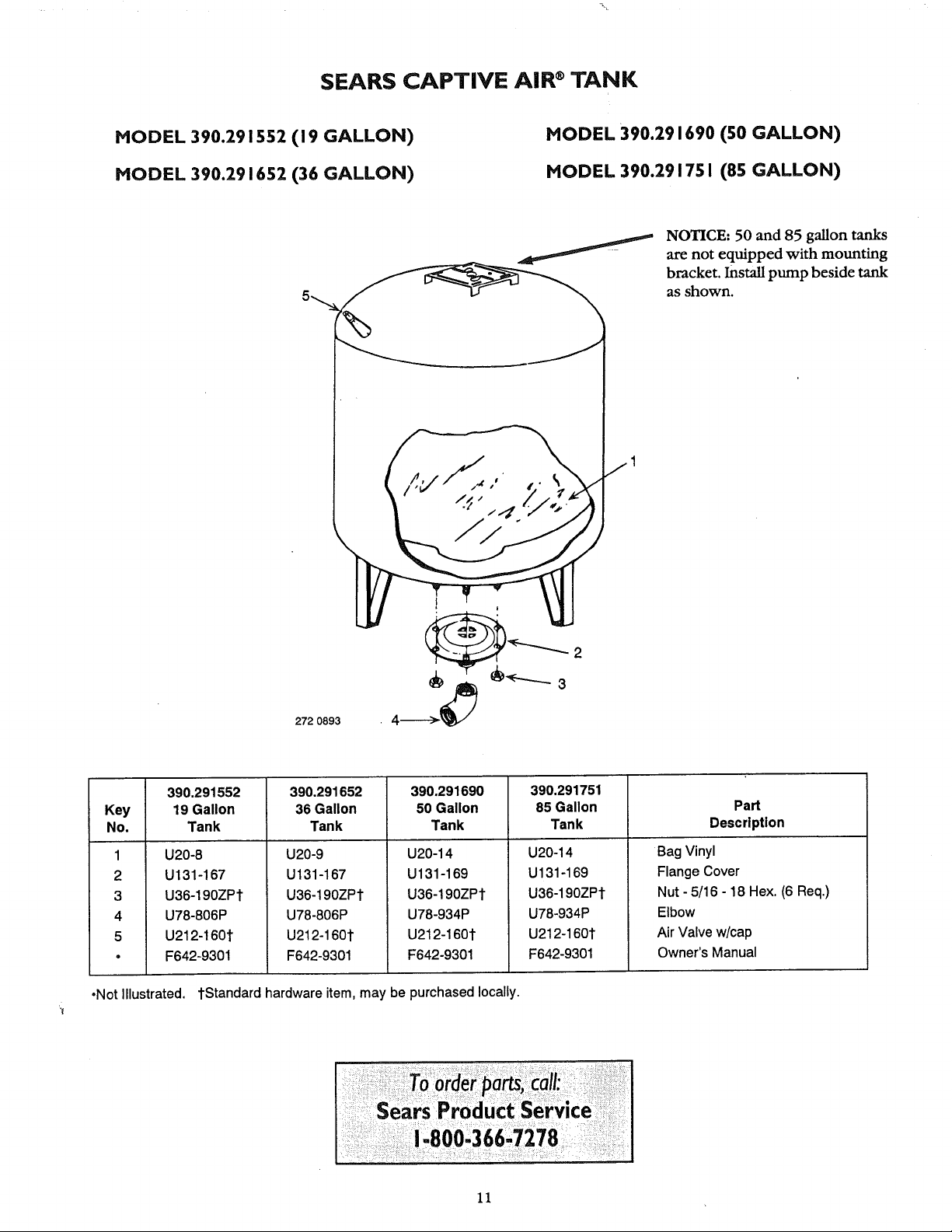
SEARS CAPTIVE AIR ®TANK
MODEL 390.291552 (I 9 GALLON)
MODEL 390.291652 (36 GALLON)
MODEL 390.291690 (50 GALLON)
MODEL 390.291751 (85 GALLON)
NOTICE: 50 and 85 gallon tanks
are not equipped with mounting
bracket. Install pump beside tank
as shown.
2
272 0893
Key
No.
1
2
3
4
5
e
390.291552
19 Gallon
Tank
U20-8
U131-167
U36-190ZPt
U78-806P
U212-160f
F642-9301
390.291652
36 Gallon
Tank
U20-9
U131-167
U36-190ZPt
U78-806P
U212-160t
F642-9301
390.291690
50 Gallon
Tank
U20-14
U131-169
U36-190ZPt
U78-934P
U212-160t
F642-9301
390.291751
85 Gallon
Tank
U20-14
U131-169
U36-190ZPt
U78-934P
U212-160t
F642-9301
Part
Description
Bag Vinyl
Flange Cover
Nut - 5/16 - 18 Hex. (6 Req.)
Elbow
Air Valve w/cap
Owner's Manual
•Not Illustrated. tStandard hardware item, may be purchased locally.
11
SWAII S
OWNER'S
MANUAL
Model No.
390.291352
390.291552
390.291652
390.291690
390.291751
Themodel number of
your Captive Air®Tank
will be found on a label
attached to the tank.
When requesting service
or ordering parts, always
give the following
information:
* Product Type
° Model Number
* Part Number
o Part Description
CAPTIVE AIR®
Fortherepairor replacementpartsyouneed
Call7 am- 7 pm,7 claysaweek
1-800-366-PART
(1-800-366-7278)
Forin-homemajorbrandrepairservice
Call24 hours aday,7 daysaweek
1-800-4-REPAIR
(1-800-473-7247)
Forthe location ofa
SearsRepairServiceCenterin yourarea
Call24 hoursa day,7 daysa week
t -800-488-1222
Forinformationonpurchasinga Sears
MaintenanceAgreementorto inquire
aboutanexistingAgreement
callg am- 5 pro,Monday-Saturday
t -800-827-6655
SF=ARS
America's Repair Specialists
TAN
Sears, Roebuck and Co., Hoffman Estates, IL 601 79 U.S.A.