

3
product safety
Please read these instructions before operating the appliance and retain them for
future use.
This product is not suitable for use by children, and may not be suitable for persons
requiring supervision unless they receive instruction by a competent person on how to
safely use the product.
Children should be supervised to ensure that they do not play with the product.
Never use this appliance for anything other than its intended use.
This appliance is for domestic household use only. Application areas unsuitable for this
appliance include, but are not limited to, staff kitchens, shops, ofces, farm houses,
hotels, motels and similar residential or working environments
Do not use this appliance outdoors.
Always ensure that hands are dry before handling the plug or switching on the
appliance.
Always use the appliance on a stable, secure, dry and level surface.
Never operate the appliance by means of an external timer or separate remote-control
system.
Ensure the appliance is switched off and unplugged from the supply socket if it is
left unattended, when it is not in use or before cleaning. Never leave the appliance
unattended when it is in use.
Always allow the appliance to fully cool down before cleaning or storing.
The power cord is not replaceable by the user. Always return the appliance if the power
cord is damaged to avoid any hazard.
Do not use the appliance if it has been dropped, if there are any visible signs of
damage or if it is leaking.
Never immerse any part of the appliance or power cord and plug in water or any other
liquid.
Never let the power cord hang over the edge of a worktop, touch hot surfaces or
become knotted, trapped or pinched.
Do not touch the external surfaces of the appliance during use as they may become
very hot.
Only use spares or accessories that are recommended by the manufacturer.
!
!
!
!
!
!
!
!
!
!
!
!
!
!
!
!

4
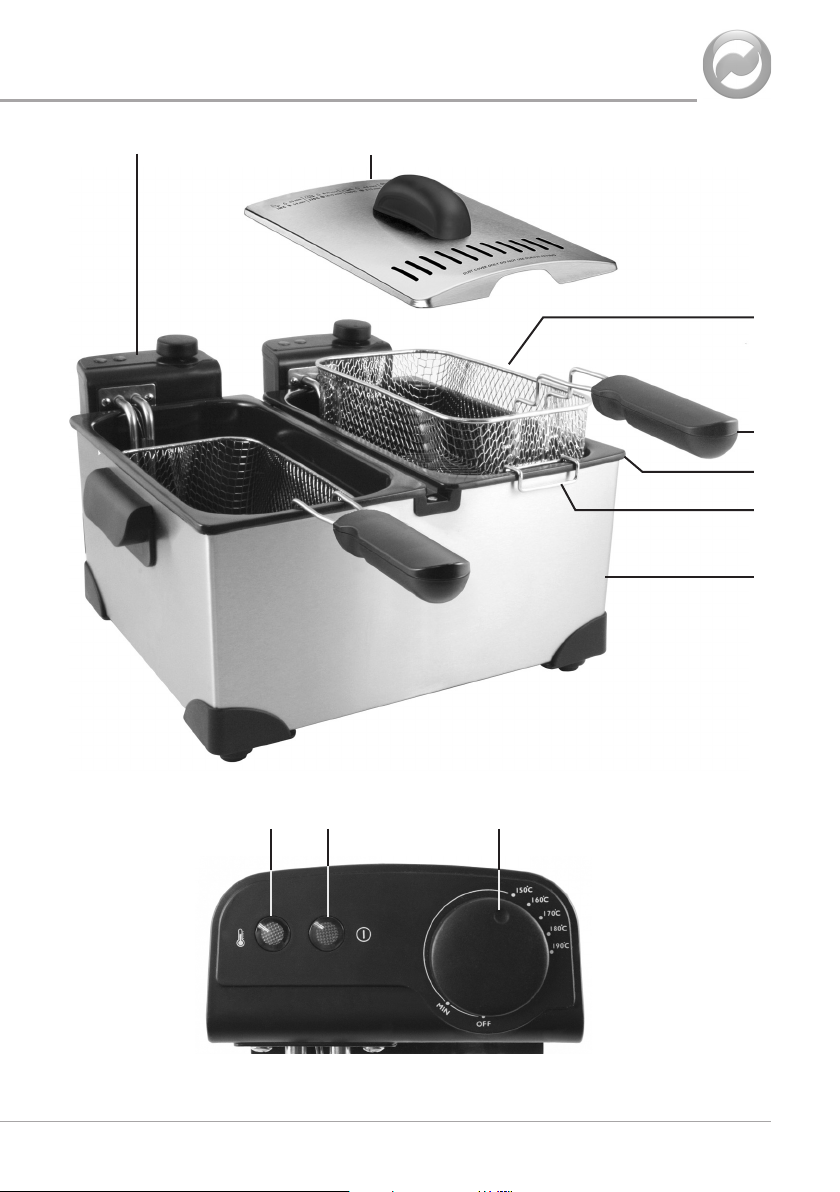
1 Control panel/heating assemblies (x2)
This consists of the control panel, heating element, handy cord storage and reset
switch.
2 Lid (x2)
Use the lid to cover cooling oil or for storing when not in use. (DO NOT use when
frying).
3 Frying basket (x2)
Allows food to be lowered and removed from the fryer easily and quickly.
4 Basket handle (x2)
The handle folds for easy storage.
5 Removable frying bowls (x2)
Has an integrated MIN and MAX mark. It separates from the control panel/heating
assembly and body for easy cleaning.
6 Frying basket rest (x2)
The frying basket can be hooked over the rim of the bowl for draining etc.
7 Body with carrying handles
Houses the removable frying bowls and control units and keeps the fryer stable on
the work surface. The carry handles allow your fryer to be moved easily.
8 Ready-to-cook indicator
Lets you know the oil is heating up. The light goes out when the temperature you
have set has been reached.
9 Power indicator
Lights up when your fryer is connected to the mains supply.
10 Temperature control
Allows you to choose the desired frying temperature.
features
5
Due to our policy of continuous improvement, the actual product may differ slightly from the one illustrated in these instructions.
q
u
w
u
i o a
e
t
r
y
6
other important features
Over-temperature trip device
The fryer is tted with a manually resettable over-temperature trip device. This is a safety
feature that will switch off your fryer if it becomes too hot, or if there is too little or no oil
present.
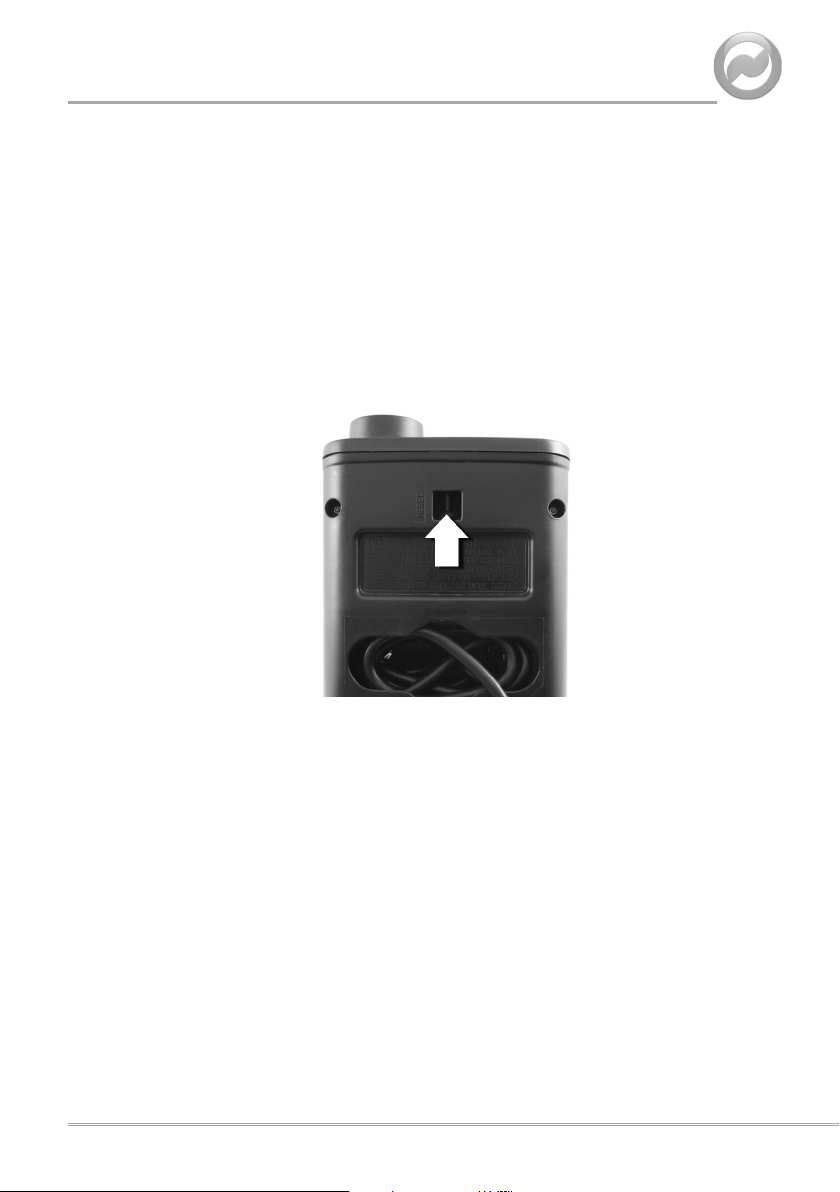
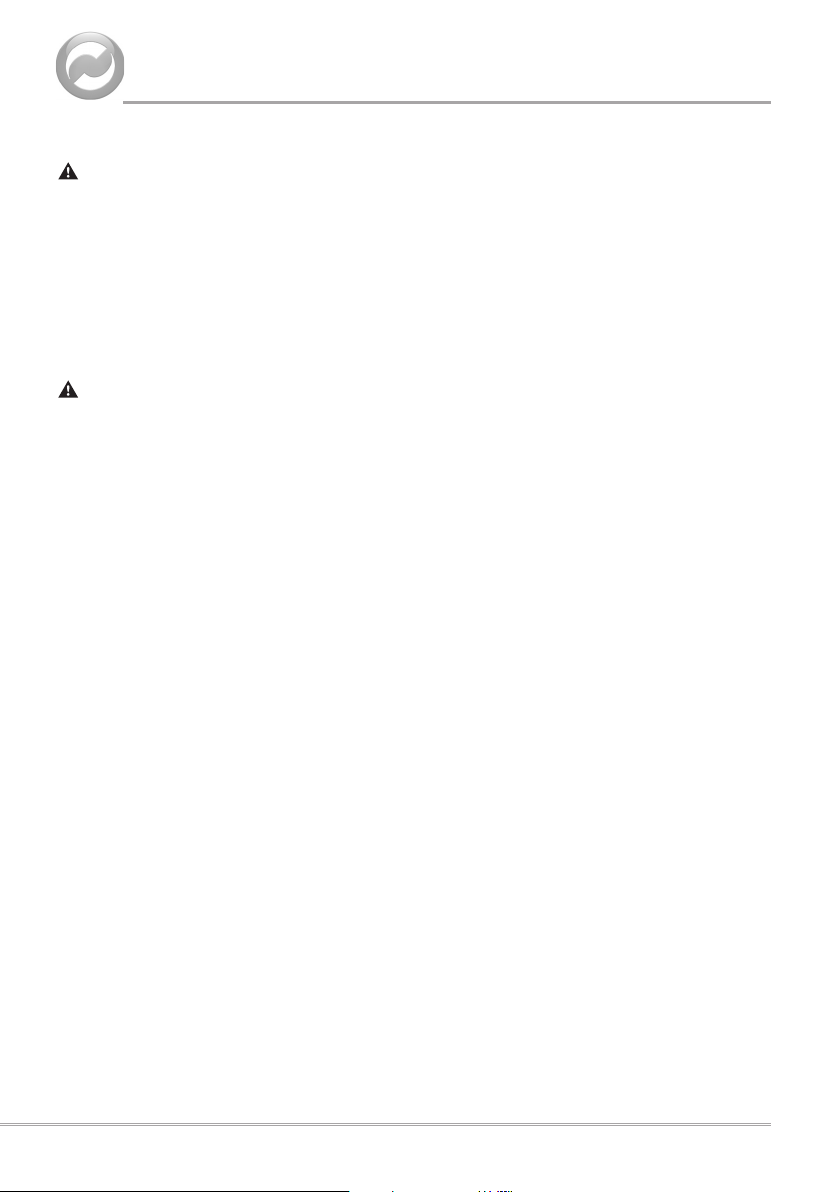
Switch off and unplug the fryer and allow the product to cool down completely. The
reset button is located on the rear of the control panel. Press the button upwards to reset
the trip device. Fill with new clean oil above the MIN mark and not exceeding the MAX
mark then, plug the appliance back in.
Cool zone
There is a cool zone area below the element that ensures that any stray pieces of food
which have dropped to the bottom will not burn and contaminate the oil. After cooking wait
until the oil has cooled completely then drain the oil to remove the scraps.
RESET BUTTON
7
before using your fryer
Before use
Never immerse any part of the heating element, control panel, power cord or
plug in water or any other liquid.
Before using your fryer unpack the appliance and remove all packaging, promotional
materials and stickers. Remove all printed documents. Check that there is no packing
around the bowl.
Next wash the lids, frying baskets and fryer bowls in hot soapy water. Wipe the elements,
control units and body with a damp cloth only—see page 16 for cleaning instructions.
Before assembling or disassembling your appliance, ensure it is unplugged, all
parts are cool, the oil has cooled completely and has been removed from the frying
bowl.
To disassemble before cleaning:
Remove both lids and frying baskets.
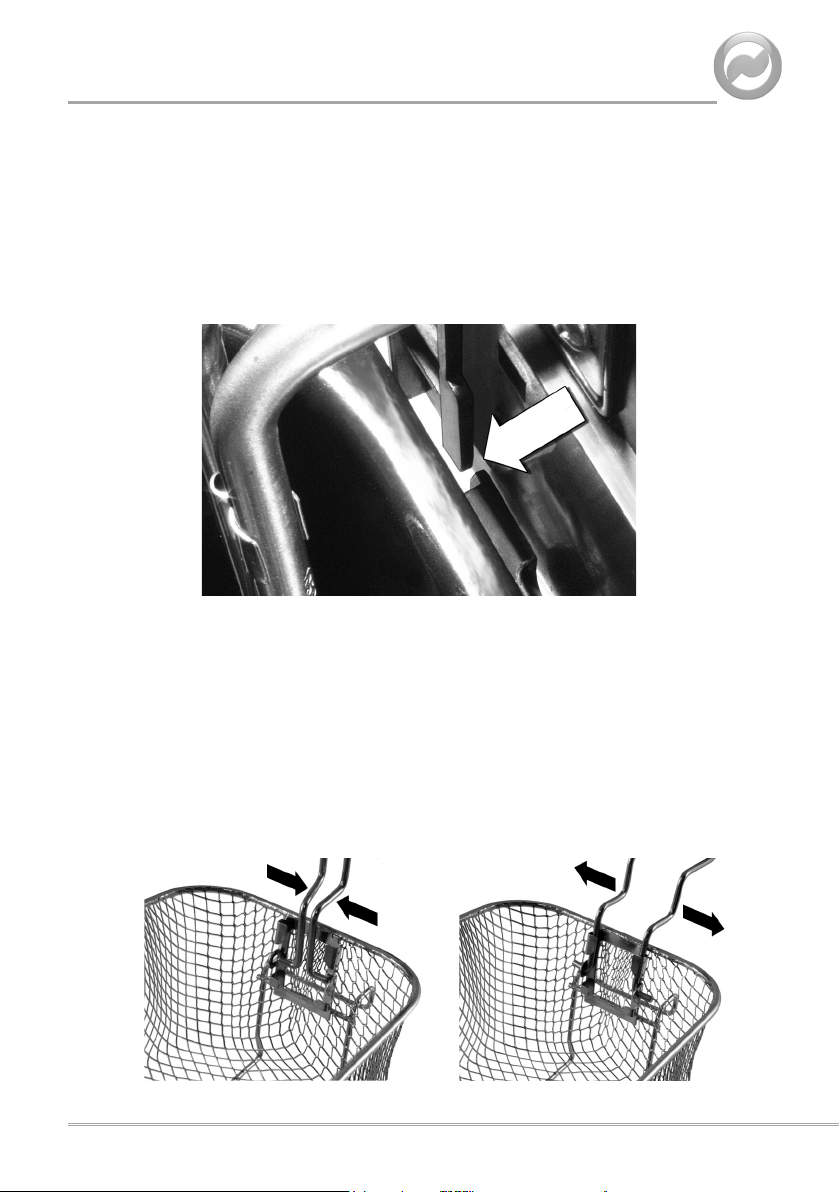
Carefully remove the control panel/heating element assemblies from the body. To do
this, hold the control unit with one hand whilst holding the body with the other. Simply
lift the control unit upwards until it clears the body.
Remove the frying bowls. Grip the rim of the frying bowl with both hands and lift it out
of the body.
1.
2.
3.
8
before using your fryer
1. Replace the fryer bowls one at a time. Ensure that the rim of each fryer bowl slots
over the edge of the main body. The recess in each bowl should be positioned at the
back of the fryer. The fryer cannot operate if the bowls are tted incorrectly.
2. Replace each control assembly by sliding it downwards into the retaining slots on
the rear of the fryer main body. Ensure that the outer “L” shaped ribs on the control
assembly engage correctly onto the rear of the fryer body. Check that the control
assembly is securely located in position before use. Your fryer will only work if the
control assembly is tted correctly.
3. If you are not using the fryer straight away, place the baskets inside the fryer bowls.
Protect the baskets and fryer bowls from dust by tting the dust covers.
The lid is only for storage and when the fryer is cooling. DO NOT use it whilst
frying.
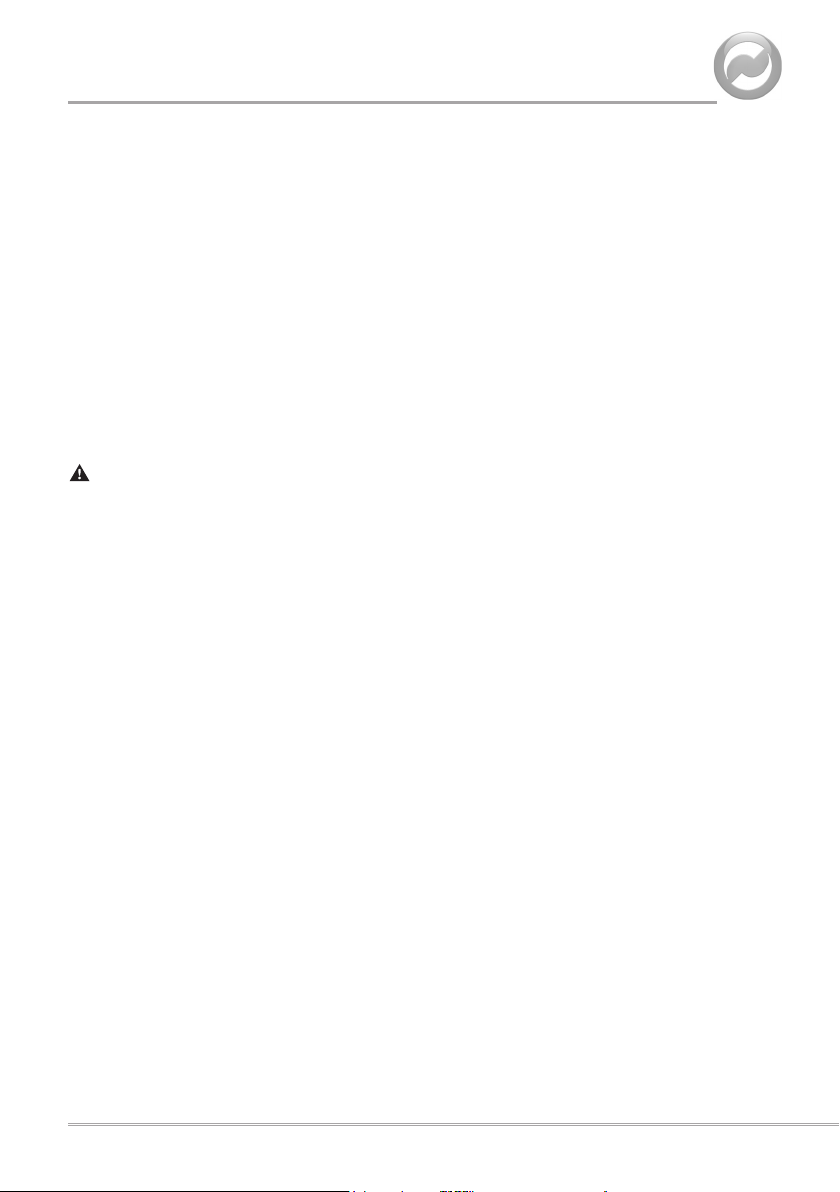
4. Connect the basket handle to the basket by rst squeezing the two handle wires
together. Then, locate the two handle arms in the holes inside the basket and release
them.
Ensure the handle is connected securely to the basket before operating your fryer.

9
how to use your fryer
Always use your fryer on a stable, secure, dry and level surface.
Allow adequate space above and on all sides for air circulation.
Do not allow the appliance to touch any ammable material during use (such as
curtains or wall coverings).
Care is required when using the appliance on surfaces that may be damaged by
heat. The use of an insulated pad is recommended.
1. Assemble your fryer.
2. Pour oil (see page 12 for recommended types) into each frying bowl up to the MAX
mark indicated on the inside of the bowl. Do not ll above the MAX mark or below the
MIN mark.
Handy Tip: Don’t throw the empty oil bottle away. You can use this to dispose of or
to store the used oil once it has cooled—see page 11.
3. Hook the frying basket over the basket rest on the inside of the frying bowl.
4. Plug your fryer into a suitable mains supply and switch the socket on.
5. The red power indicator light will illuminate.
6. Turn the temperature control dial to the desired temperature setting (see frying
guidelines for temperature suggestions). The oil will now start to heat up and the
green ready-to-cook light will illuminate.
7. When the oil has reached its set temperature, the green ready-to-cook light will go
out. This light will cycle on and off during cooking as the thermostat regulates the
temperature. The red power indicator will remain on.
8. Your fryer is now ready for use.
10
To fry using the frying basket
With the basket on the basket rest add the food item(s). Using the handle, lift the basket
off the basket rest and gently lower it into the hot oil. Take care from the HOT oil spitting,
and from rising steam. When the food is cooked, lift the basket out of the oil and place it
onto the basket rest. This will allow excess oil to drain from the food. Next, lift the basket
out onto a drip tray and/or kitchen paper.
Note: Battered or coated food may stick to the frying basket. To prevent this, use a slotted
spoon to lift the food away from the mesh straight after the basket has been lowered into
the oil. Then, allow the food to cook, gently moving the basket from side to side once or
twice during cooking.
To fry without the frying basket
HOT OIL CAN CAUSE SCALDING! NEVER drop or tip food into the bowl. NEVER
put your hand or other body parts into the hot oil. ALWAYS keep hands and face
away from rising steam or spitting oil.
Carefully lower or slide the food directly into the frying bowl. Always use utensils to do this
e.g. tongs or a slotted spoon.
Use a slotted spoon or a slotted sh slice to remove the food from the oil. Drain on
kitchen paper or on a drip tray.
After frying
Once you have nished using your fryer turn the temperature control dial fully
anticlockwise. Unplug it from the mains supply socket.
Replace the lid and allow the oil and your fryer to completely cool before moving or
cleaning your fryer. Always use the carrying handles when moving your fryer. Never
attempt to move your fryer using the lid or frying bowl.
We recommend that once the oil has cooled completely, it is best to remove the oil from
your fryer and to clean the appliance before storing—see page 11.
how to use your fryer

11
how to remove oil from your fryer
Before removing oil from your fryer ALWAYS switch off, unplug and allow the oil
to cool completely.
You will need a slotted spoon, a suitable tray or large plate, kitchen paper, a funnel or
jug with a pouring lip, muslin (if reusing the oil), and the original oil bottle you saved
earlier! If you’ve thrown it away, any suitable sized bottle with a lid will do.
Using a slotted spoon, skim off any food scraps oating on the surface of the oil.
If you have used it, remove the basket from your fryer and place it on kitchen paper
to drain.
Line the drip tray with kitchen paper. Carefully remove the control panel/heating
element assembly and place it on a drip tray.
Next, place the oil bottle in the sink, remove its cap and place the funnel in the top. If
you wish to reuse the oil, line the funnel with a piece of muslin to act as a lter.
With the rounded edge of the fryer facing away from you, grip the rim of the
removable frying bowl with both hands and carefully lift it out of the body. Take it over
to the sink and pour the oil from the rounded end of the bowl slowly into the bottle
through the funnel. Alternatively, pour the oil into a jug which has a pouring lip and
use the jug to transfer the oil into the bottle.
Do not attempt to pour the oil from the fryer straight into the bottle—you’ll only end up
spilling the oil!
7. When all the oil has been poured into the bottle, remove the funnel (discard the
muslin, if used), and replace the bottle cap. The oil can now either be stored for
reuse, or discarded safely and cleanly.
8. You can now clean your fryer—see page 16.
Always dispose of the oil in an environmentally safe way. Never pour the oil into
drains. Contact your recycling centre for advice on the disposal of the oil.
1.
2.
3.
4.
5.
6.
12
frying guidelines
ºC ºF
130 265
150 300
170 340
190 375
Oil
Oils recommended for use in the fryer include:
Sunower
Vegetable
Groundnut
Rape seed
Corn
Oils and fats not recommended:
Hard fats
Olive oil (any type)
Oil quantity:
Always use the recommended (MAX) quantity of oil when deep frying. Never exceed this
amount, and never use the fryer without any oil in it. Always ll above the MIN mark with
oil before using the fryer.
Utensils
Select your cooking utensils carefully. Do not use utensils which may melt (e.g. plastic).
Take care when using metal utensils not to damage the heating element. Metal handles
might get hot so use oven gloves, or buy utensils with insulated handles.
Suitable utensils include metal or heat resistant plastic, slotted spoons, slotted sh slices,
or tongs.
Not suitable: wooden or plastic non-heat resistant utensils, knives or other sharp
implements.
Frying
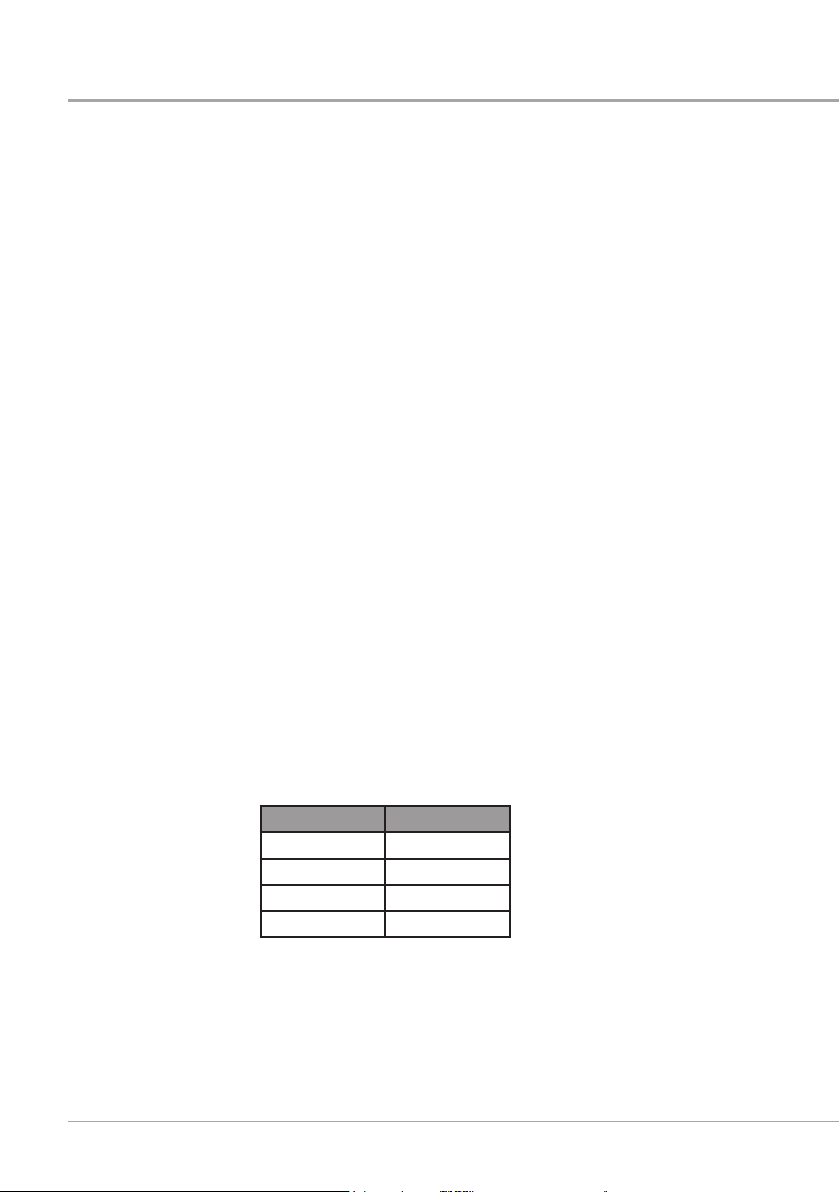
The temperature indicated on your fryer is in degrees Centigrade (ºC). If your recipes
state temperatures in degrees Fahrenheit (ºF) use the conversion chart below as a guide.
The maximum basket capacity is 1kg but for the best results, we recommend you
do not exceed the weights given in the table.
•
•
•
•
•
•
•
13
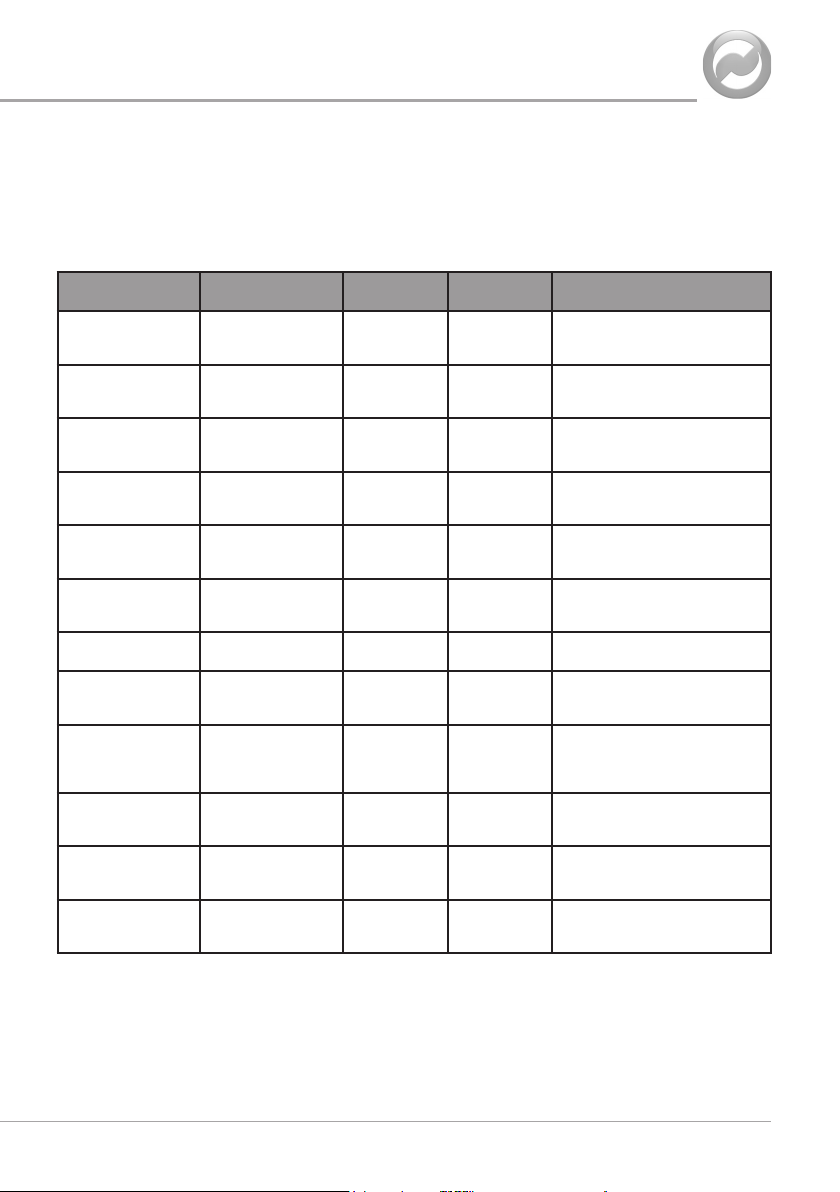
Conversion Table
The table below provides cooking guidelines for foods which are commonly deep fried. All
the foods have been fried using the oil at the MAX level.
The information given in this table is intended as a guide only. Timings and temperature
may vary according to food thickness, size and your own preference.
Food Type Weight / Quantity Temp Approx. Frying
Time (minutes)
Comments
Fresh frying chips 500g 190ºC 12 - 15 Move the basket from side to side
once or twice during frying to ensure
even cooking.
Frozen frying chips 500g 190ºC 10 - 12 Move the basket from side to side
once or twice during frying to ensure
even cooking.
Frozen scampi in
breadcrumbs
300g 180ºC 4 - 6 The scampi will go a deep golden
colour when cooked. Ensure food is
piping hot throughout.
Frozen plaice coated in
batter/breadcrumbs
2 portions approx. 125g
each
180ºC 5 - 7 Fry without the basket and use a sh
slice to remove the sh from the oil
once cooked.
Frozen cod/haddock
coated in batter
2 portions approx. 125g
each
180ºC 8 - 12 Fry without the basket and use a sh
slice to remove the sh from the oil
once cooked.
Fresh cod/haddock
coated in batter
2 portions approx. 125g
each
190ºC 4 - 8 Fry without the basket and use a sh
slice to remove the sh from the oil
once cooked.
Fresh prawns in batter 2 portions approx. 90g
each
190ºC 3 - 5 Ensure food is piping hot throughout.
Frozen cod sh ngers 10 ngers (300g pack) 180ºC 5 - 7 Move the basket from side to side
once or twice during frying to ensure
even cooking.
Frozen chicken
nuggets
2 portions approx. 100g
each
170ºC 8 - 10 Move the basket from side to side
once or twice during frying to ensure
even cooking. Ensure food is piping
hot throughout.
Frozen onion rings 2 portions approx. 100g
each
190ºC 5 - 9 Move the basket from side to side
once or twice during frying to ensure
even cooking.
Vegetable fritters in
batter
2 portions approx. 100g
each
150ºC 2 - 5 Move the basket from side to side
once or twice during frying to ensure
even cooking.
Banana/fruit fritters 2 portions approx. 100g
each
150ºC 2 - 5 Move the basket from side to side
once or twice during frying to ensure
even cooking.
When frying shop bought food items, follow the manufacturer’s instructions.
When frying meats, ensure that they are piping hot throughout before serving..

14
frying guidelines
For even frying, cut food items such as chips to the same size and choose similar
sized pieces of sh and chicken.
Always make sure that the food you are frying is as dry as possible (battered foods
are the exception) to avoid spitting and overowing. Take care.
It is important to take into account the food to be cooked and the temperature it
requires. Use the guidelines in table 1, manufacturer’s cooking instructions and your
own expertise to guide you.
Don’t overload the fryer basket. Doing so will cause the oil temperature to drop,
causing your food to become greasy rather than crispy.
Also, food in an over full basket will not cook evenly as the oil may not reach all of
the items. Cook large quantities in batches.
Make sure that you check that food has cooked through to the centre. If your oil
temperature is too hot, the outside may brown quickly while the food inside is still
uncooked.
To check food has heated through, use this quick test:
Take a knife or metal skewer and push it into the centre of the food. Hold it there for a few
seconds then remove it. If the skewer or knife is hot to the touch, the food is hot in the
middle.
Alternatively use a food thermometer. Chicken is cooked when the juices run clear and
the meat is no longer pink in the centre.
1.
2.
3.
4.
5.

15
Preparing food
Cut food items such as chips to the same size and choose similar sized pieces of sh
and chicken.
Make sure food is as dry as possible (except battered food) before frying. Water and
oil do not mix well, water causes hot oil to spit. Use kitchen paper to absorb excess
water from sh, meat, vegetables and fruit.
Frying
Do not use the lid when frying. It is for storage purposes only.
Smaller pieces of food will fry faster than larger ones. It may be necessary to cook
chicken or frozen items for longer on a lower heat to avoid the outside cooking before
the middle is cooked.
Delicate foods such as prawns or thinly sliced vegetables require less cooking at a
higher temperature than more robust food types.
Use a food thermometer or the skewer test to ensure that the food has been cooked
through to the centre.
Never exceed the MAX level when lling the frying bowl with oil.
Always ll above the MIN level with oil before using the fryer.
Avoid overlling the frying basket.
DO NOT place face or hands in contact with hot oil or steam.
To avoid battered or coated food sticking to the frying basket, use a slotted spoon to
lift the food away from the mesh. Then allow to cook, gently moving the basket from
side to side once or twice during cooking.
For even cooking of foods, stir or turn the food with suitable utensils, or move the
basket gently during cooking.
Draining
Use a drip tray (and rack) to drain large food items after frying. The drip tray without
the rack can also be used to drain smaller items when lined with kitchen paper, as a
rest for the frying basket, or as a tray for the element when cleaning—see page 16.
Avoid leaving food to drain for too long in the basket over the fryer as the food may
become soft and lose its crunchiness.
•
•
•
•
•
•
•
•
•
•
•
•
•
•
hints and tips

16
how to clean and care for your fryer
Always unplug your fryer and allow the oil and appliance to cool completely
before cleaning it.
NEVER immerse the control unit, cord set or plug in water or any other liquid.
Never use harsh abrasive cleaners or cleaning materials.
No parts of this appliance are dishwasher safe. Always hand wash.
Follow the instructions on page 11 How to Remove Oil from your Fryer.
Cleaning the removable frying bowls, frying baskets and lids
Remove any food deposits from the frying bowl and frying basket using kitchen
paper. Wash the components by hand in warm soapy water using a cloth, sponge or
brush. Dry completely before use or storage.
Cleaning the control units, elements and body
Wipe the excess oil from the element with kitchen paper (take care not to damage the
wires connected to the heating element). Wipe over the control unit and body with a
clean, slightly damp cloth and dry.
•
•
•
17
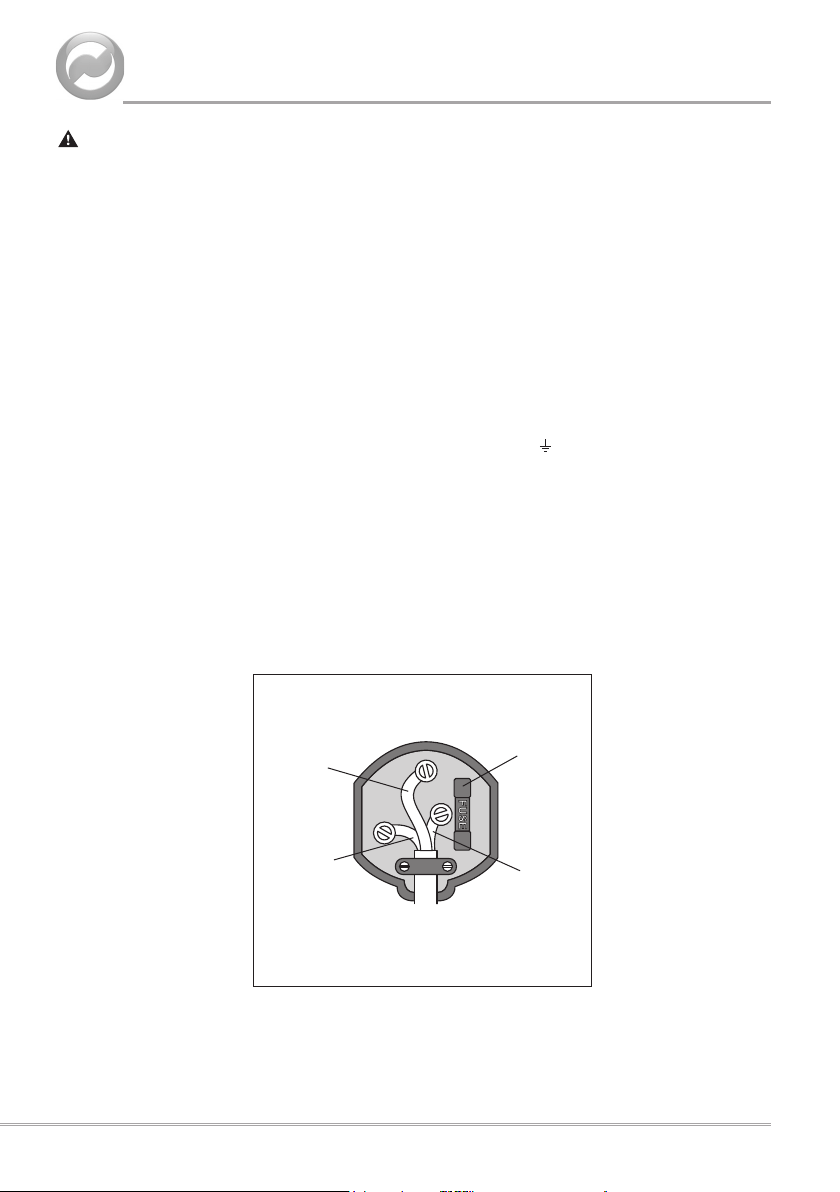
This appliance must be earthed.
This appliance is tted with either a moulded or rewirable BS1363, 13 amp plug. The fuse
should be rated at 13 amps and be ASTA approved to BS1362.
If the fuse in a moulded plug needs to be changed, the fuse cover must be retted. The
appliance must not be used without the fuse cover tted.
If the plug is unsuitable, it should be dismantled and removed from the supply cord
and an appropriate plug tted as detailed below. If you remove the plug it must not be
connected to a 13 amp socket and the plug must be disposed of immediately.
The wires of the mains lead are coloured in accordance with the following code:
GREEN/YELLOW = EARTH BLUE = NEUTRAL BROWN = LIVE
The wire which is coloured GREEN/YELLOW must be connected to the terminal in
your plug which is marked with an E or by the earth symbol ( ) or coloured GREEN or
GREEN /YELLOW.
The wire which is coloured BLUE must be connected to the terminal in your plug which is
marked with the letter N or coloured BLACK.
The wire which is coloured BROWN must be connected to the terminal in your plug which
is marked with the letter L or coloured RED.
If any other plug is used, a 13 amp fuse must be tted either in the plug or adaptor or at
the distributor board.
Plug should be BS1363 approved
Fit a 13 Amp Fuse
Ensure that the outer sheath of the cable
is rmly held by the clamp
BROWN
(Live)
13 Amp
Fuse
BLUE
(Neutral)
GREEN/YELLOW
(Earth)
connection to the mains supply

18
after sales service
These appliances are built to the very highest of standards. There are no user serviceable
parts. Follow these steps if the unit fails to operate:
Check the instructions have been followed correctly.
Check that the fuse has not blown.
Check that the mains supply is functional.
If the appliance will still not operate, return the appliance to the place it was purchased for
a replacement. To return the appliance to the Customer Service Department, follow the
steps below:
Pack it carefully (preferably in the original carton). Ensure the unit is clean.
Enclose your name and address and quote the model number on all correspondence.
Give the reason why you are returning it.
If within the guarantee period, state when and where it was purchased and include
proof of purchase (e.g. till receipt).
Send it to our Customer Service Department at the address below:
Customer Service Department
Pulse Home Products Limited
Middleton Road
Royton
Oldham
OL2 5LN, UK.
Telephone: 0161 621 6900 Fax: 0161 626 0391
e-mail: [email protected]
1.
2.
3.
1.
2.
3.
4.
5.

19
This product is guaranteed for a period of 1 year from the date of purchase against
mechanical and electrical defects.
This guarantee is only valid if the appliance is used solely for domestic purposes in
accordance with the instructions provided, that it is not connected to an unsuitable
electricity supply, dismantled or interfered with in any way or damaged through misuse.
Under this guarantee we undertake to repair or replace free of charge any parts found to
be defective.
Nothing in this guarantee or the instructions relating to the product excludes, restricts or
otherwise affects your statutory rights.
In line with our policy of continuous development, we reserve the right to change this
product, packaging and documentation without notice.
guarantee
93309-0VDF073_Iss_1 04/11

