AP470-E-3A
EN
USER’S GUIDE (Full)
Before using this Digital Piano for the first time,
be sure to read the separate USER’S GUIDE to
familiarize yourself with basic operations.
AP
-
470
EN-1
Contents
General Guide .................................EN-3
FUNCTION Button......................................................... EN-4
Auto Resume and Operation Lock ................................ EN-4
About Music Score data ................................................ EN-4
Power Outlet....................................EN-5
Turning Power On or Off ............................................... EN-5
Returning the Digital Piano to Its Factory Default
Settings.......................................................................... EN -5
Playing with Different Tones .........EN-6
Selecting and Playing a Tone........................................ EN-6
Adjusting Acoustic Piano Sound Characteristics........... EN-7
Layering Two Tones ...................................................... EN-8
Using Effects ................................................................. EN-9
Using the Digital Piano’s Pedals.................................. EN-10
Using the Metronome .................................................. EN -11
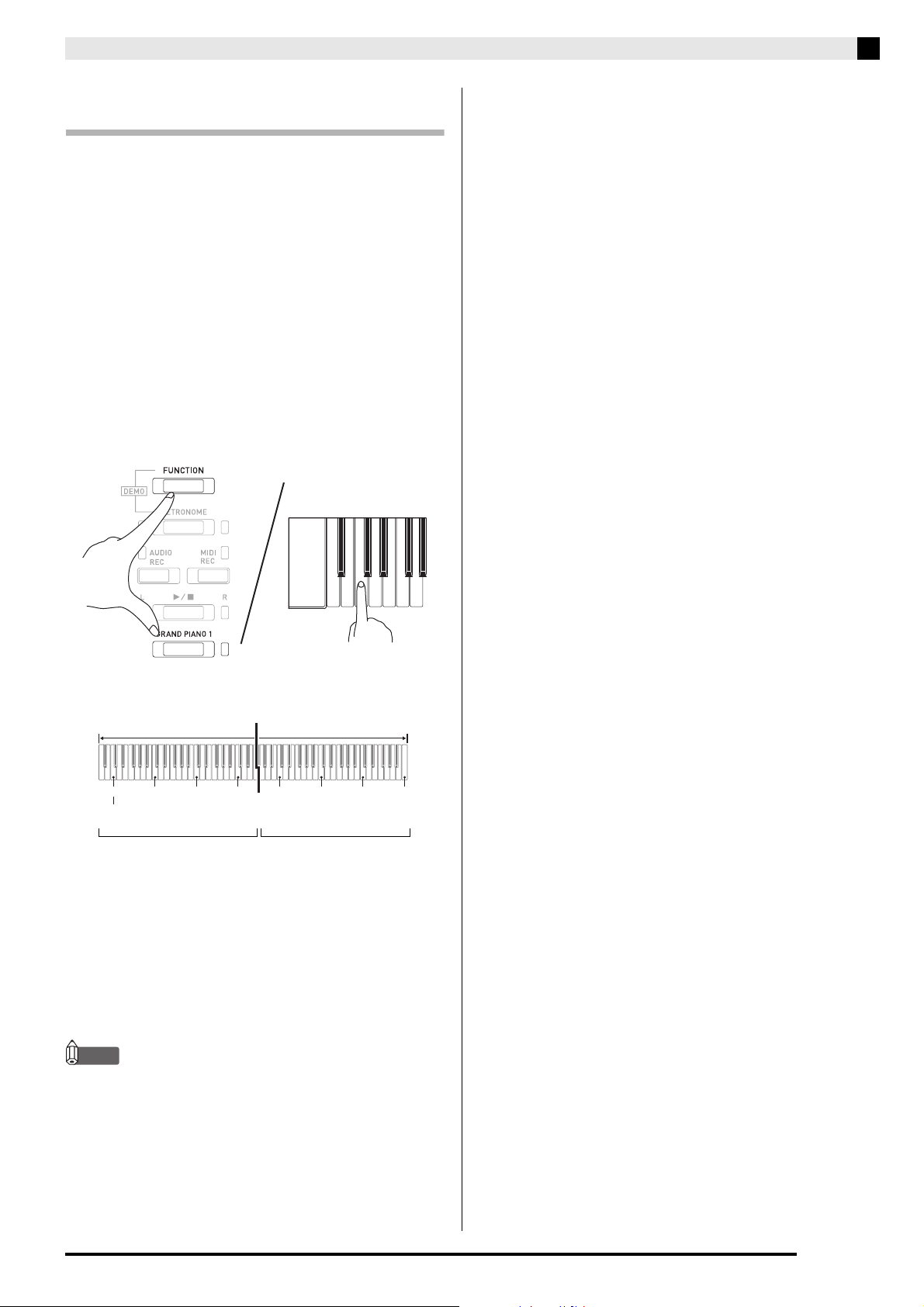
Splitting the Keyboard for Duet Play............................ EN-12
Using Built-in Songs
(Concert Play, Music Library,
Demo Tunes) .................................EN-14
Performing Demo Play ................................................ EN-14
Concert Play................................................................ EN -14
Practicing with a Concert Play Song ........................... EN-14
Music Library ............................................................... EN-16
Playing Back a Specific Music Library Song ............... EN-16
Practicing with a Music Library Song........................... EN-17
Playing Back Audio Data Stored on
a USB Flash Drive ....................................................... EN-17
Recording and Playback ..............EN-18
Recording to Built-in MIDI Recorder............................ EN-18
Using the MIDI REC Button......................................... EN-18
Recording to a USB Flash Drive (Audio Recorder) ..... EN-21
Configuring Settings with
the Keyboard .................................EN-25
To configure settings with the keyboard ...................... EN-25
Keyboard Keys Used for Configuring Settings ............ EN-26
Parameter List ............................................................. EN-28
Hall simulator ........................................................... EN-28
Tone selection.......................................................... EN-28
Chorus...................................................................... EN-28
Brilliance................................................................... EN-28
Layer balance........................................................... EN-28
Lower Pedal ............................................................. EN-28
Damper noise........................................................... EN-28
Hammer response.................................................... EN-28
String resonance...................................................... EN-28
Lid simulator............................................................. EN-28
Key-on action noise.................................................. EN-28
Key-off action noise.................................................. EN-28
Select layer tone ...................................................... EN-29
Duet mode................................................................ EN-29
Music Library song select
(MUSIC LIBRARY SELECT).................................... EN-30
Tempo (TEMPO)...................................................... EN-30
Beat (BEAT) ............................................................. EN-30
METRONOME TEMPO............................................ EN-30
METRONOME BEAT ............................................... EN-30
CONCERT PLAY a
............................................. EN-30
LISTEN..................................................................... EN-30
LESSON................................................................... EN-30
PLAY ........................................................................ EN-30
CONCERT PLAY SELECT (Song) (SELECT +/–) ... EN-30
CONCERT PLAY VOLUME (VOLUME +/–) ............ EN-30
Music Library Song Volume ..................................... EN-30
Metronome volume .................................................. EN-30
Temperament........................................................... EN-31
Temperament Base note.......................................... EN-31
Temperament select ................................................ EN-31
Touch response ....................................................... EN-31
Transpose ................................................................ EN-31
A-tuning.................................................................... EN-31
Octave shift .............................................................. EN-31
Keyboard volume ..................................................... EN-31
USB flash drive mode .............................................. EN-32
Local control............................................................. EN-32
Send channel ........................................................... EN-32
Audio Recorder Volume ........................................... EN -32
Operation tone ......................................................... EN -32
Panel lock................................................................. EN-32
USB flash drive mode .............................................. EN-33
Format...................................................................... EN-33
Save ......................................................................... E
N-33
Load ......................................................................... EN-33
Delete....................................................................... EN-33
Getting Ready ..................................................................................................... EN-49
Assembling the Stand............................................... EN-49
To connect the cable................................................. EN-52
To install the music stand............................................ EN-53
Install the Headphones Hook ...................................... EN-53
Removing the Protective Tape from the Keyboard
..... EN-53
Opening and Closing the Piano Lid ...........................EN-54
Connecting Headphones ...........................................EN-54
Connecting Audio Equipment or an Amplifier............EN-55
Bundled and Optional Accessories............................EN-55
EN-2
Contents
Speaker out.............................................................. EN-33
Head phone mode ................................................... EN-33
Volume Sync Equalizer............................................ EN-33
Auto Resume ........................................................... EN-33
Linking with an Application (APP Function)................. EN-34
USB Flash Drive............................EN-35
Storing Standard Audio Data (WAV Files) to
a USB Flash Drive ....................................................... EN-36
Connecting a USB Flash Drive to and
Detaching It from the Digital Piano .............................. EN-37
Formatting a USB Flash Drive..................................... EN-37
Saving a Recorded Song to a USB Flash Drive.......... EN-38
Loading Song Data from a USB Flash Drive into
Digital Piano Memory .................................................. EN-40
Deleting Data from a USB Flash Drive ........................ EN-41
Simple Play Back of a Song on a USB Flash Drive..... EN-42
Error Indicators ............................................................ EN-43
Connecting to a Computer...........EN-45
Minimum Computer System Requirements................. EN-45
Connecting the Digital Piano to Your Computer.......... EN-45
Using MIDI................................................................... EN-46
Transferring Song Data with a Computer .................... EN -46
Reference ......................................EN-56
Troubleshooting........................................................... EN -56
Product Specifications ................................................. EN-57
Appendix ........................................... A-1
Tone List...........................................................................A-1
Concert Play List ..............................................................A-1
Music Library List..............................................................A-1
MIDI Implementation Chart
Company and product names used in this manual may
be registered trademarks of others.
EN-3
General Guide
1
3
4
7
8
9
65
2
bk
bn
bl
bm
bo
bp
Front
Bottom
Rear
EN-4
General Guide
*CAUTION
• Make sure that the cover is fully open whenever you are playing on the keyboard. A partially open cover can
suddenly close unexpectedly and pinch your fingers.
NOTE
• The names shown here are always indicated in bold when they appear within the text of this manual.
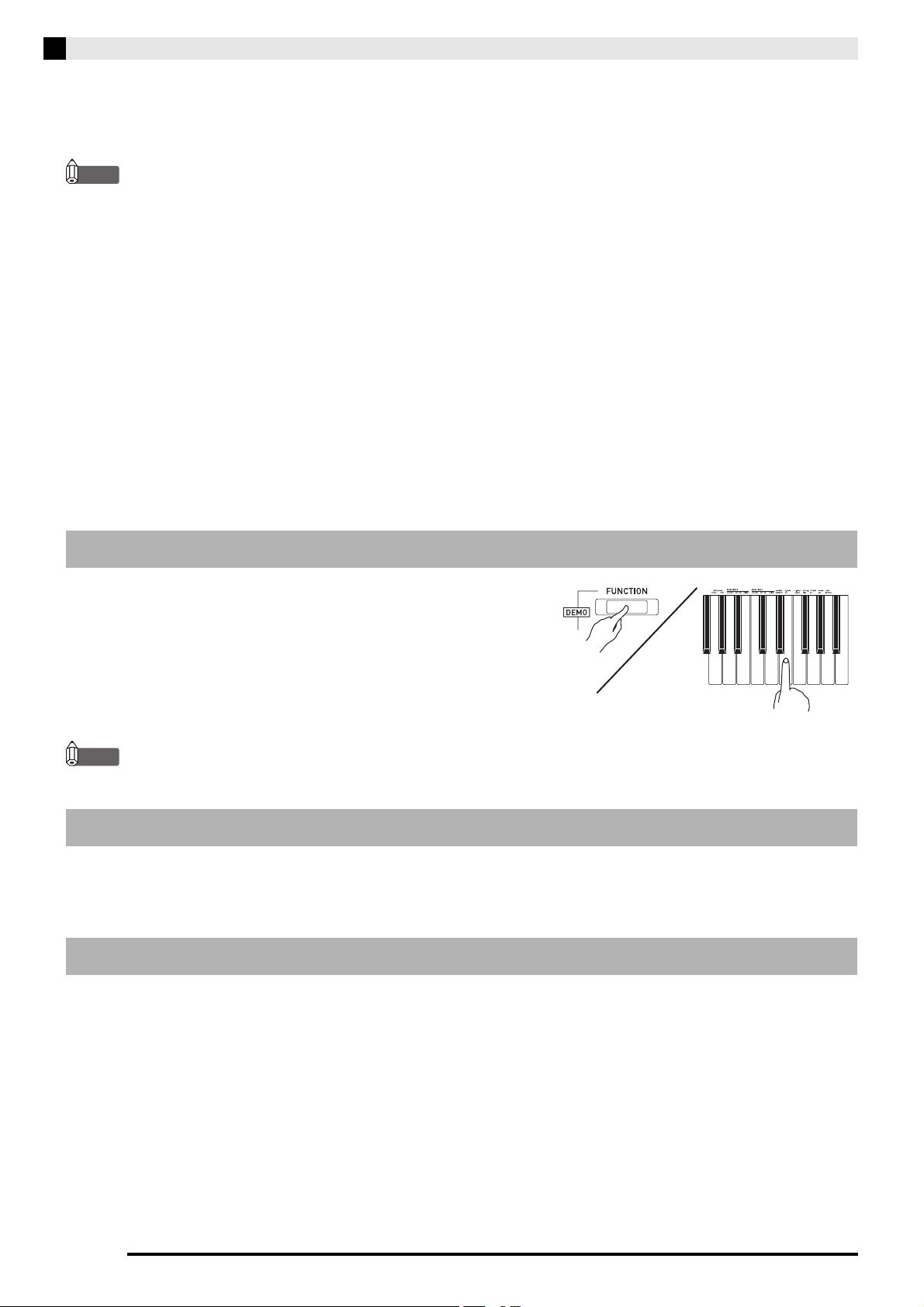
The FUNCTION button is used in combination with other buttons
and keys.
To change a setting, hold down the FUNCTION button as you press
the button or key that is assigned the setting you want to configure.
When you press a key, the Digital Piano beeps to indicate the
current setting.
A long beep indicates that a setting is turned off.
NOTE
• For details about operations and settings, see “Configuring Settings with the Keyboard” on page EN-25.
Your Digital Piano can be configured to save its current settings when power is turned off and restore them when
turned back on again (Auto Resume). You can also lock its buttons to protect against operation errors (Operation
Lock). For details, see “Parameter List” on pages EN-28 - EN-33.
You can use a computer to download music score data from the CASIO Website. For more information, visit the
URL below.
http://world.casio.com/
FUNCTION Button
Auto Resume and Operation Lock
About Music Score data
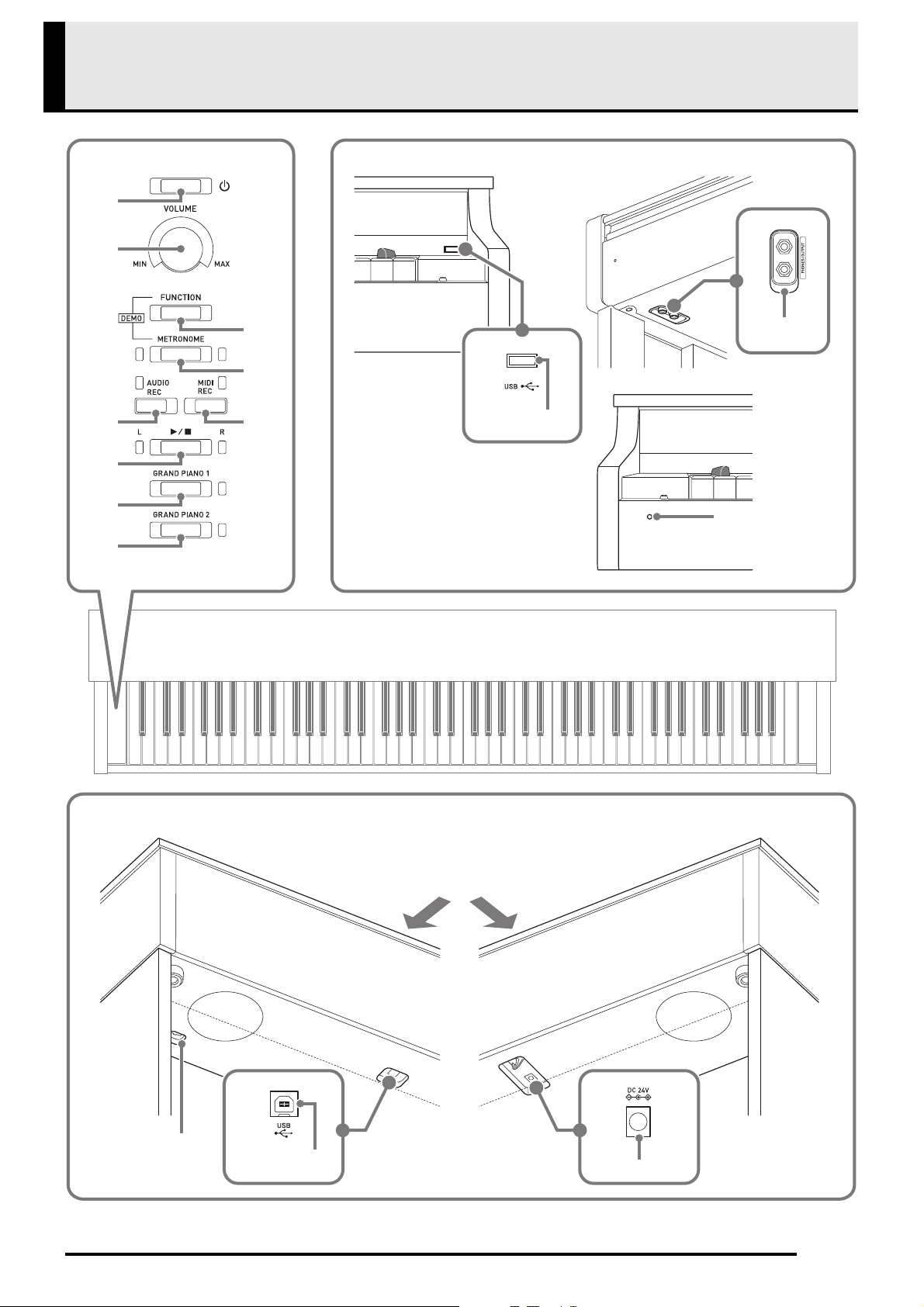
P (POWER) button
VOLUME controller
FUNCTION button
METRONOME button
AUDIO REC button
MIDI REC button
a button
GRAND PIANO 1 button
GRAND PIANO 2 button
Pedal connector
USB port
Power terminal (DC 24V)
USB flash drive port
PHONES/OUTPUT jacks
Power lamp
EN-5
Power Outlet
After you finish assembling the stand, turn on the
Digital Piano. For details, see “Getting Ready” on page
EN-49.
1.
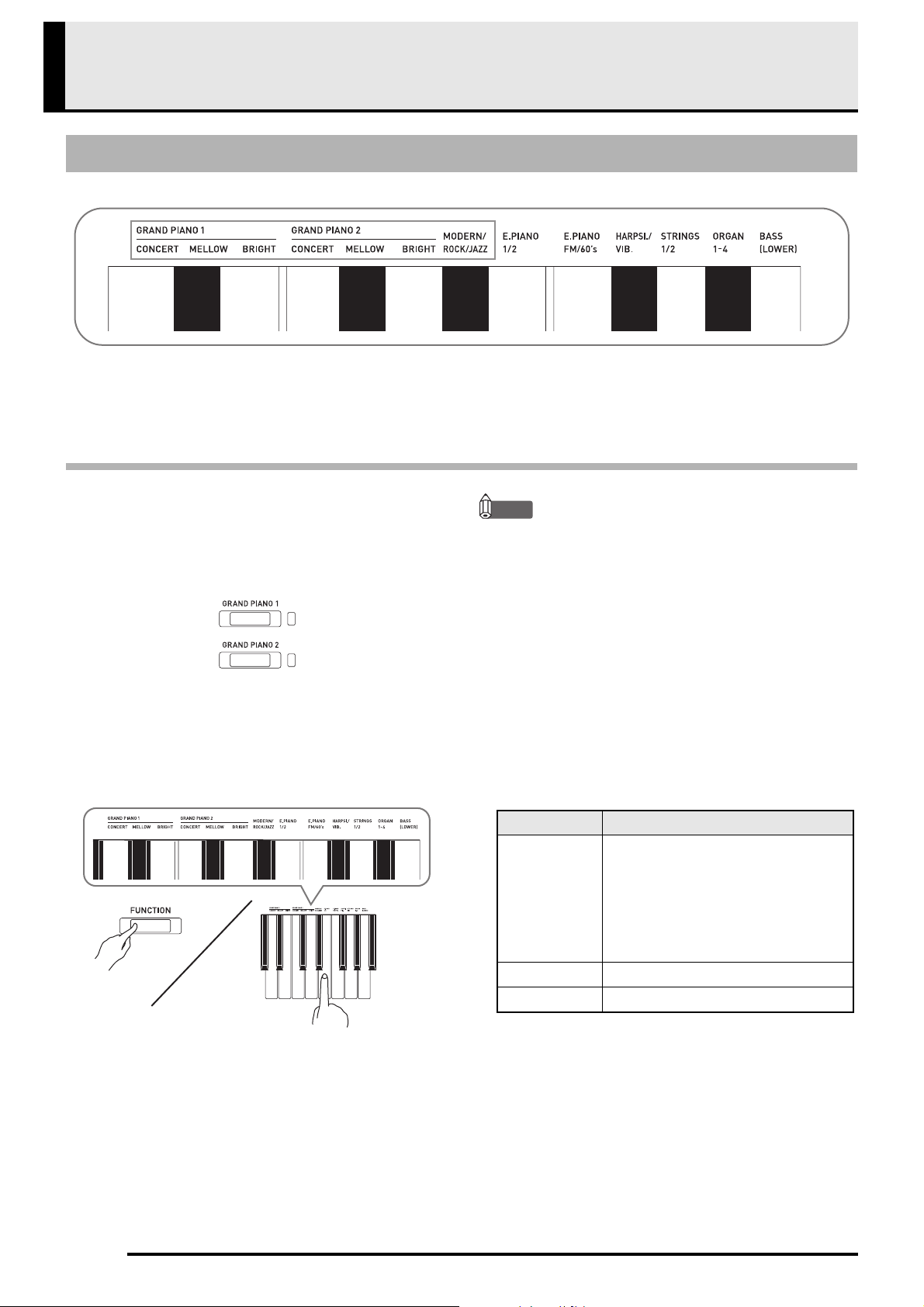
Press the P (POWER) button to turn on
Digital Piano power.
• The power lamp lights and the Digital Piano powers
up. The power up operation takes about 5 seconds.
2.
To turn off the Digital Piano, hold down the
P (POWER) button until the power lamp
goes out.
NOTE
• Pressing the P (POWER) button to turn off power
actually puts the Digital Piano into a standby state.
Minute amounts of current continue to flow within
the Digital Piano in the standby state. If you do not
plan to use the Digital Piano for a long time or if
there is a lightning storm in your area, be sure to
unplug the AC adaptor from the power outlet.
Auto Power Off
This Digital Piano is designed to turn off automatically
to avoid wasting power after no operation is
performed for a preset amount of time. The Auto
Power Off trigger time is about four hours.
• You also can use the procedure below to temporarily
suspend Auto Power Off.
■ To disable Auto Power Off
1.
While the Digital Piano is turned on, press the
P (POWER) button to turn it off.
2.
While holding down the FUNCTION button,
press the P (POWER) button to turn on the
Digital Piano.
• Auto Power Off will be disabled at this time.
NOTE
• Turning off the Digital Piano after performing the
above steps will re-enable Auto Power Off.
Perform the following procedure when you want to
return the Digital Piano’s stored data and settings to
their initial factory defaults.
1.
Turn off the Digital Piano.
2.
Holding down the FUNCTION, MIDI REC and
GRAND PIANO 2 buttons, press the P
(POWER) button.
3.
Hold down the FUNCTION, MIDI REC and
GRAND PIANO 2 buttons until the GRAND
PIANO 2 lamp, and then the GRAND PIANO 1
lamp, and then the R lamp start to flash.
• After some time, the flashing will stop.
4.
Release the FUNCTION, MIDI REC and
GRAND PIANO 2 buttons.
• The Digital Piano will initialize its internal system.
You will be able to use the Digital Piano in a short
while.
NOTE
• See “Turning Power On or Off” (page EN-5) for
information about turning power on and off.
Turning Power On or Off
Returning the Digital Piano to
Its Factory Default Settings
EN-6
Playing with Different Tones
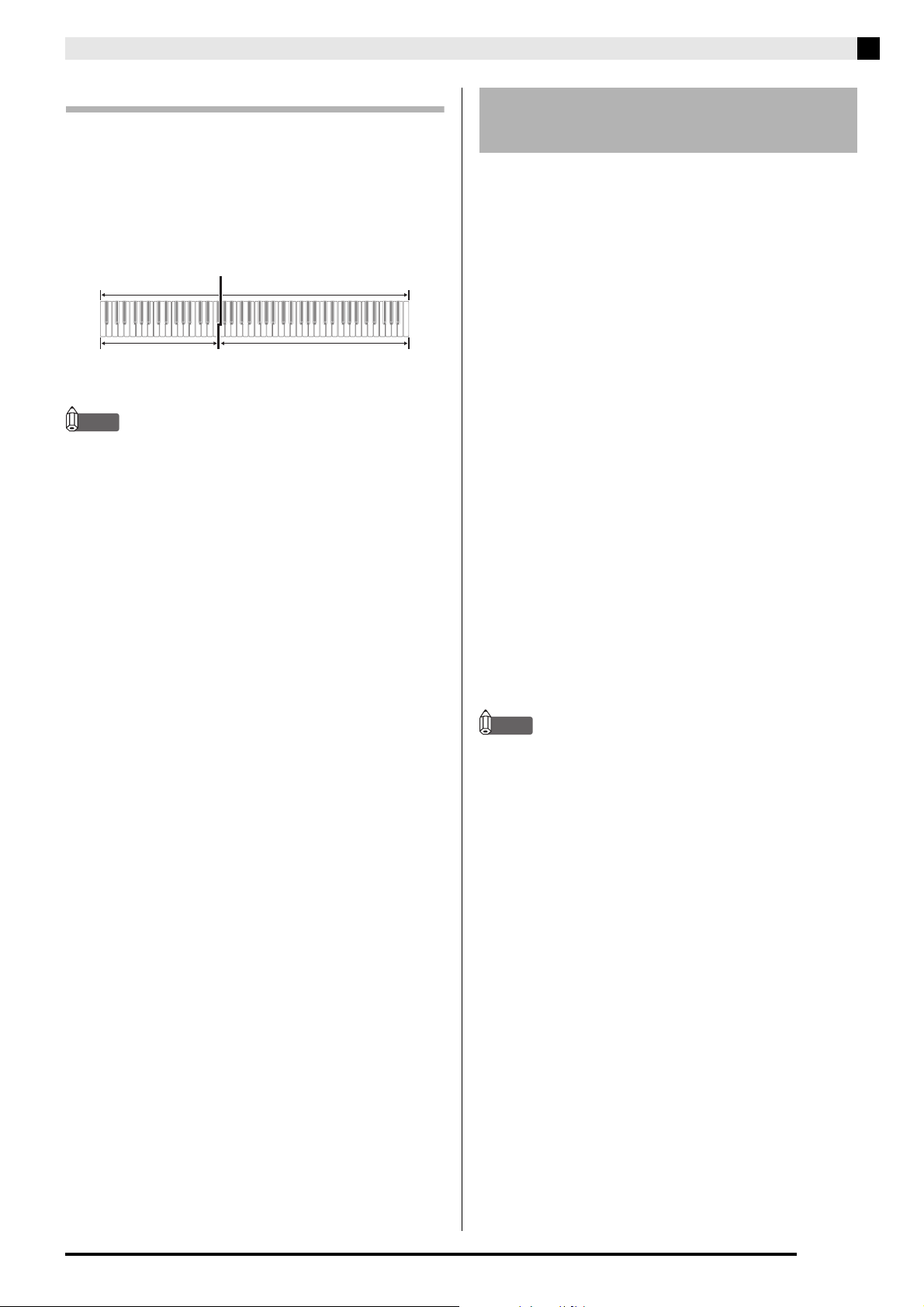
The Digital Piano comes with 22 built-in tones.
*1
*1: The names of the tones are marked above the keyboard keys to which they are assigned.
*2: In this manual, these nine tones are collectively referred to as “piano tones”. The CONCERT, MELLOW, and
BRIGHT tones are collectively referred to as “GRAND PIANO tones”.
To select a tone
Selecting and Playing a Tone
*2
1.
Select the tone you want.
To select GRAND PIANO 1 CONCERT or
GRAND PIANO 2 CONCERT
• Press the GRAND PIANO 1 button or
GRAND PIANO 2 button.
• The button lamp of the selected tone will
light.
To select one of the other tones
• While holding down the FUNCTION
button, press the keyboard key that
corresponds to the tone you want to select.
2.
Use the VOLUME controller to adjust the
volume.
NOTE
• Some keys may have more than one tone assigned.
In this case, each press of the key cycles to the next
assigned tone. Which tone is selected by the key
press is indicated by beeps.
Example: Cycling through MODERN, ROCK, and
JAZZ settings
MODERN: (1 beep)
ROCK: (2 beeps)
JAZZ: (3 beeps)
• Of the Digital Piano’s 22 built-in tones, the first six
are grand piano tone. Each tone has its own
distinctive merits, so you should select the tone that
suits the song you are playing along with or your
own personal preferences.
Tone Name Characteristics
CONCERT This is a full concert grand piano tone
for dynamic and natural tone changes.
This tone is designed to reproduce
damper, resonance, and other piano
nuances, which makes it ideal for
virtually any type of piano
performance.
MELLOW A warm, subdued grand piano tone.
BRIGHT A bright and clear grand piano tone.
Playing with Different Tones
EN-7
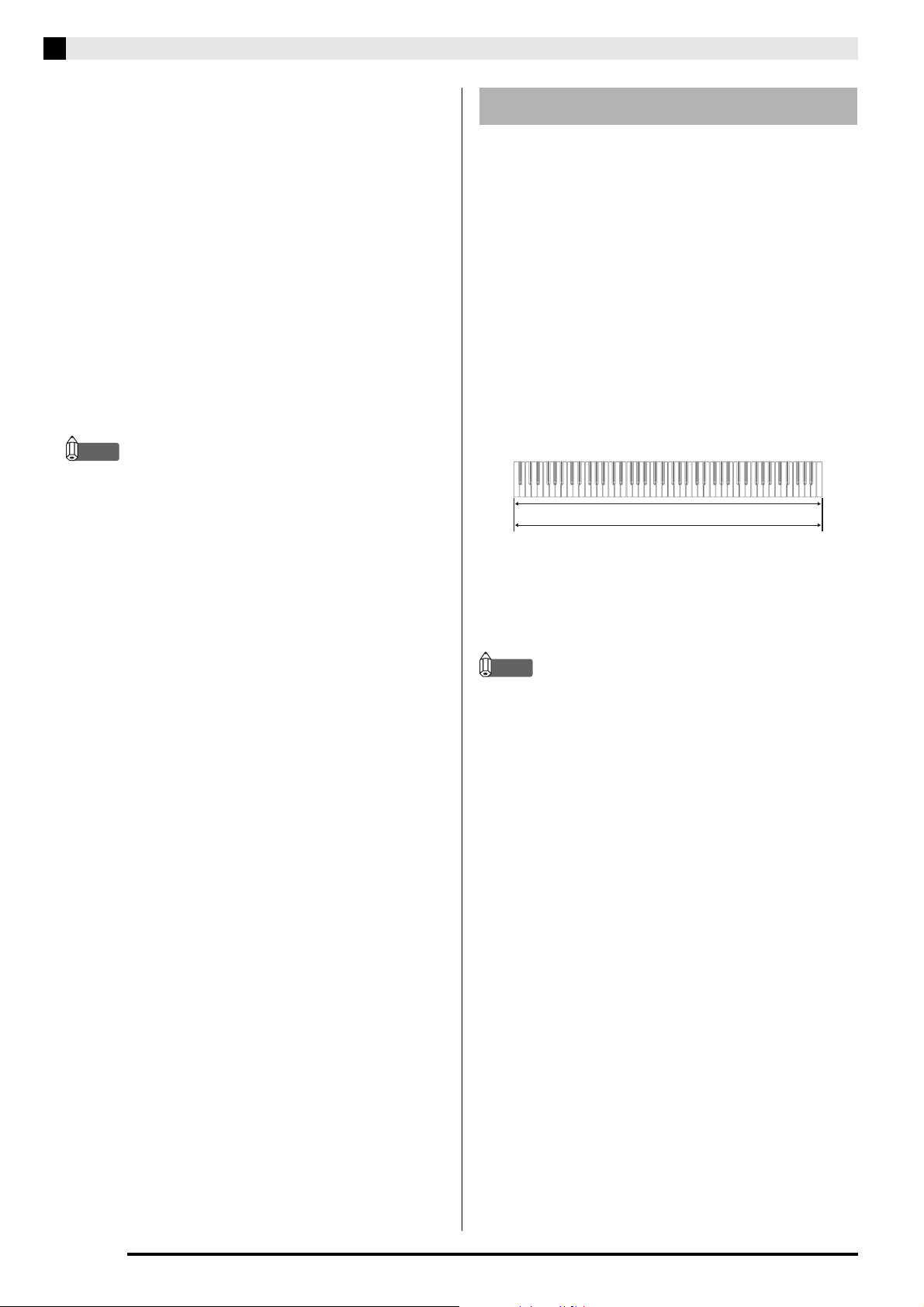
Bass Tone (BASS)
Selecting the BASS (LOWER) tone in step 1 of the
above procedure will assign the bass tone to the low
range (left side) of the keyboard. The high range (right
side) will be assigned the tone that was selected when
you pressed the BASS key.
• BASS tone lets you effectively split the keyboard
between two different tones.
NOTE
• To return the keyboard to a single tone, select any
tone other than BASS.
• You cannot select BASS when recording to Track 2.
• You can configure settings to sustain reverberation
of the BASS (LOWER) tone while the damper pedal
or sostenuto pedal is pressed. For more information,
see “Lower Pedal” (page EN-28).
The tones of your Digital Piano have built-in elements
that give them the characteristic reverberation of an
acoustic piano (ACOUSTIC SIMULATOR). Each of
these elements can be individually adjusted to one of
four levels.
HAMMER RESPONSE
STRING RESONANCE
LID SIMULATOR
NOTE
• Opening or closing the Digital Piano’s lid does not
affect the Lid Simulator setting.
1.
Hold down the FUNCTION button and press
the desired tone key.
• Each press of the keyboard key cycles to the next
option for that setting. The Digital Piano emits a beep
pattern that indicates the currently selected option:
One beep: Option 1 3 Two beeps: Option 2 3
Three beeps: Option 3 3 Four beeps: Option 4 3
One beep: Option 1, etc.
Split Point
Low Range High Range
BASS GRAND PIANO 2 MELLOW
(Currently selected tone)
Adjusting Acoustic Piano
Sound Characteristics
Controls the time deviation between when a key is
pressed and when the note actually sounds.
Settings
1: Fast 2: Grand piano feel 3: Slightly slower 4: Slow
Adjusts the characteristic reverberation (string
resonance) of an acoustic piano.
You can select a reverberation setting that matches
the song being played or your own personal
preference.
Settings
1: Suppressed 2: Slightly suppressed
3: Reverberation 4: Strong reverberation
Adjusts how sound resonates in accordance with the
opening state of a grand piano lid.
Settings
1: Lid closed 2: Lid opened slightly 3: Lid fully open
4: Lid removed
EN-8
Playing with Different Tones
In addition to piano tones, the elements below are also
available.
KEY OFF SIMULATOR
KEY-ON ACTION NOISE*
KEY-OFF ACTION NOISE*
* Can be applied for any piano tone other than ROCK
PIANO and JAZZ PIANO. For details, see
“Parameter List” on pages EN-28 - EN-33.
NOTE
• If you change the ACOUSTIC SIMULATOR setting,
the newly applied setting is saved. To return the
piano tones to their initial default settings, disable
Auto Resume and then turn power off and then back
on again.
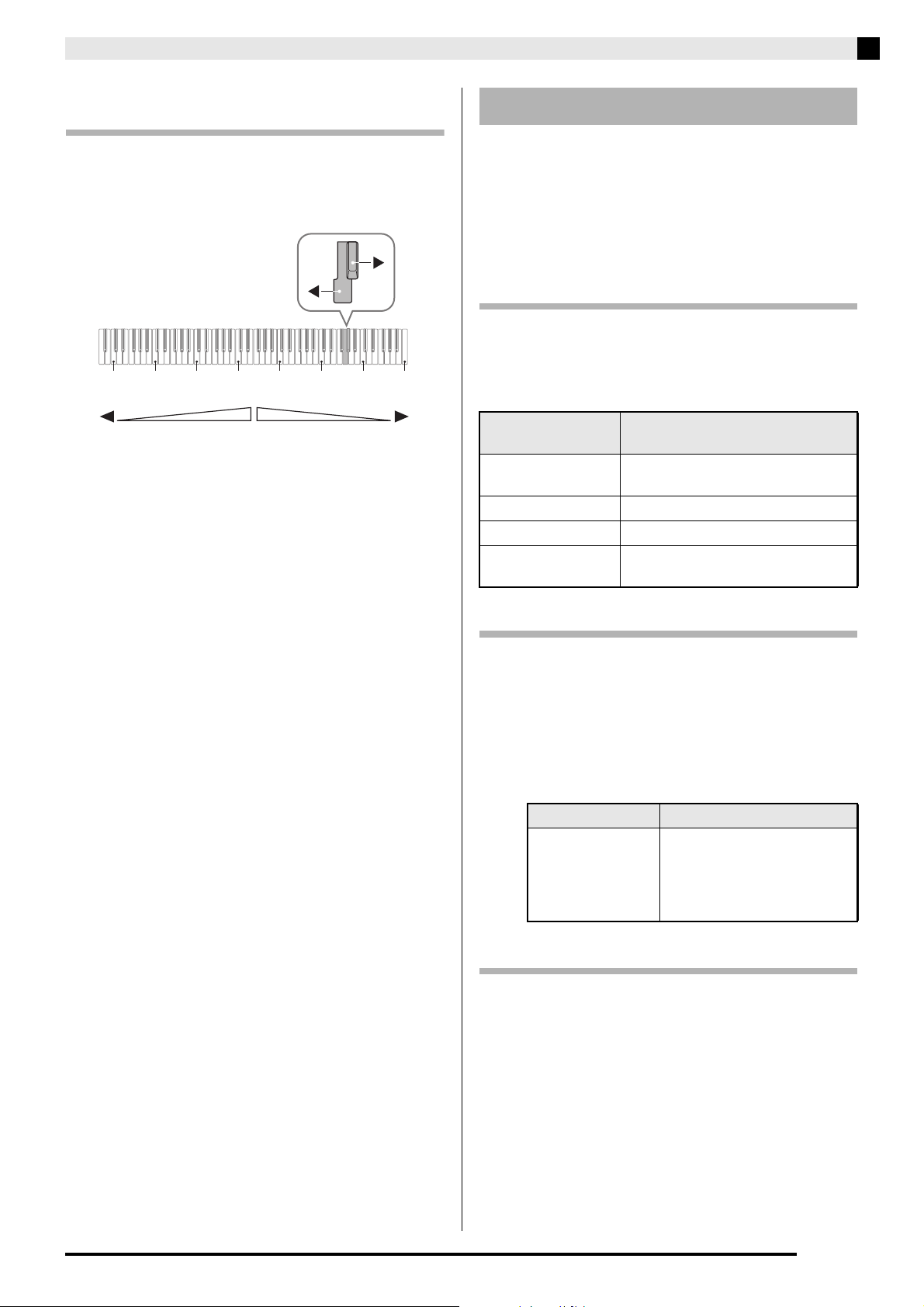
Use the following procedure to layer two tones, so they
sound at the same time.
When specifying two tones for layering, first tone you
select will be the main tone, while the second tone will
be the layered tone.
1.
Hold down the FUNCTION button and press
the Select Layer Tone key.
• For details about using the keyboard keys for
settings, see “Keyboard Keys Used for Configuring
Settings” (page EN-26).
• Each press of the keyboard key toggles between on
and off.
2.
Hold down the FUNCTION button and press
key of the tone to be layered.
3.
To return to the original tone, hold down the
FUNCTION button and press the Select
Layer Tone key (which exits the Layer Mode).
NOTE
• You cannot layer the BASS tone with another tone.
• You cannot perform the layer operation when
recording to Track 2.
Causes notes to decay when keyboard keys are
released.
Reproduces the mechanical operation sound (noise)
that can be heard when keys of an acoustic piano are
tapped with extremely light pressure.
Reproduces the mechanical operation sound (noise)
that can be heard when keys of an acoustic piano are
released.
Layering Two Tones
GRAND PIANO 1 BRIGHT
STRINGS 2
Playing with Different Tones
EN-9
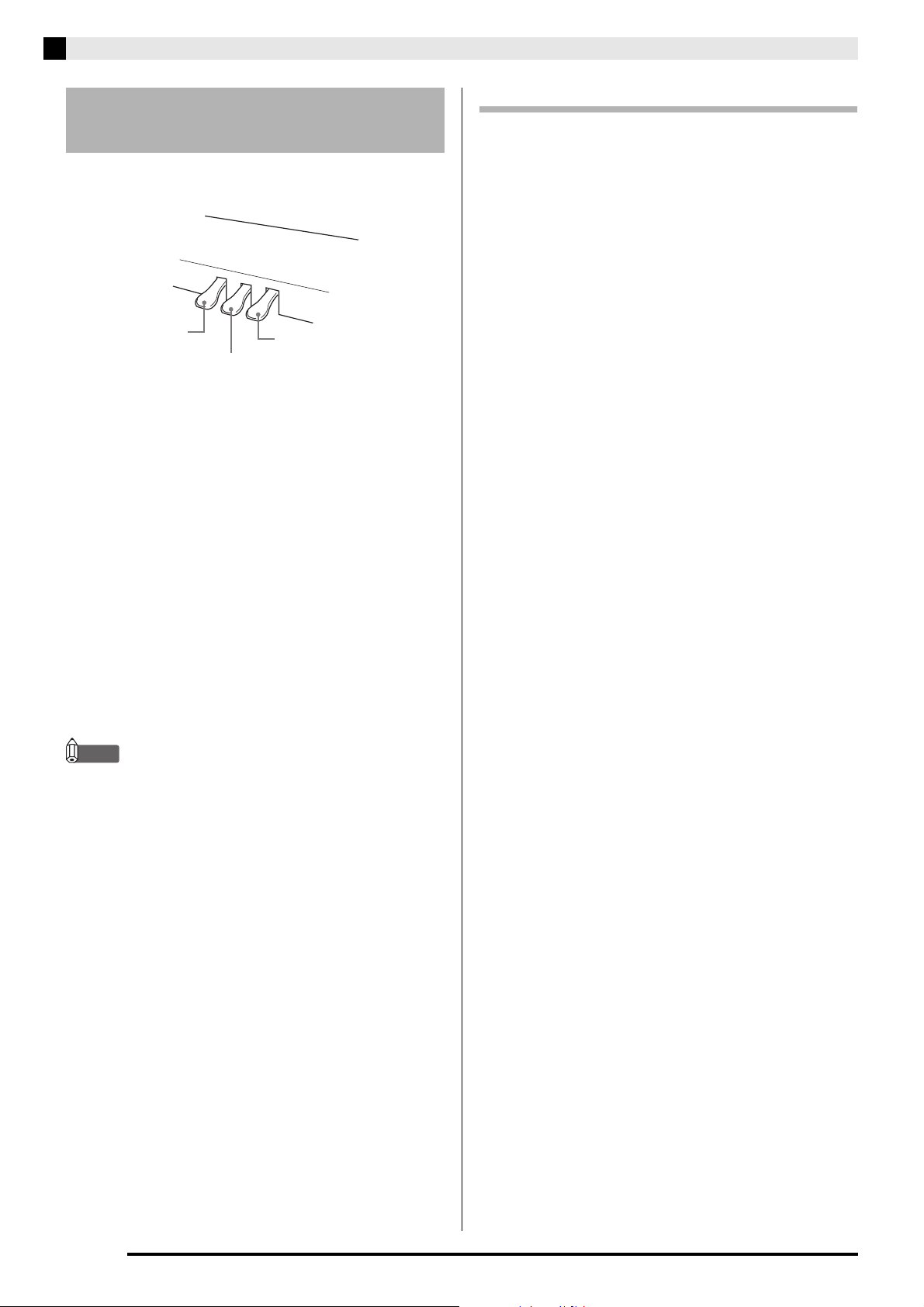
To adjust the volume balance between
two layered tones
1.
While holding down the FUNCTION button,
use the keyboard keys shown below to adjust
the volume of the layered tones.
• To return the volume setting to its initial default, hold
down the FUNCTION button and press both of the
keys at the same time.
• For details about using the keyboard keys for
settings, see “Keyboard Keys Used for Configuring
Settings” (page EN-26).
To apply a hall simulator
1.
While holding down the FUNCTION button,
press the keyboard key that corresponds to
the hall simulator name you want to select.
To apply chorus to a tone
1.
While holding down the FUNCTION button,
use the Chorus keyboard key to cycle
through the available settings.
• Each press of the Chorus keyboard key causes the
Digital Piano to beep according to which setting is
selected, as shown in the table below.
• Chorus
About DSP
DSP makes it possible to digitally produce complex
acoustic effects. The DSP is assigned to each tone
whenever you turn on Digital Piano power.
C1 C2 C3 C4 C5 C6 C7 C8
Center
Volume of the main tone
(First tone you selected)
Volume of the layered tone
(Second tone you selected)
Using Effects
Hall simulator: Makes your notes resonate.
Chorus : Adds more breadth to your notes.
Hall simulator
Name
Description
DUTCH CHURCH Amsterdam church with acoustics
that are suitable for music
STANDARD HALL Standard concert hall
BERLIN HALL Berlin arena type classic concert hall
FRENCH
CATHEDRAL
Large gothic cathedral in Paris
Number of Beeps Setting
1 (long)
1 (short)
2
3
4
Off (OFF)
Light Chorus
Medium Chorus
Deep Chorus
Flanger (whooshing effect)
EN-10
Playing with Different Tones
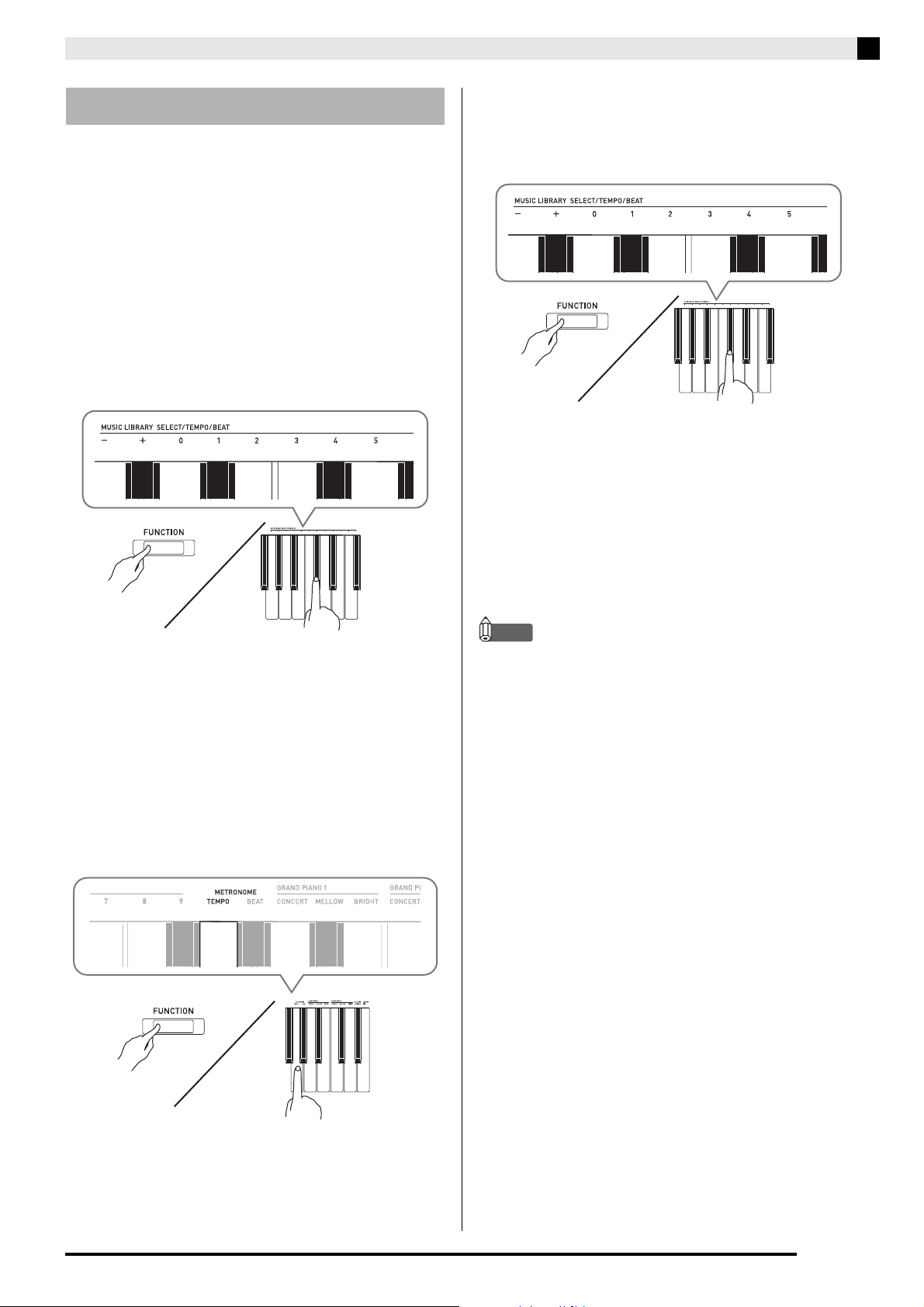
Your Digital Piano comes equipped with three pedals:
damper, soft, and sostenuto
Pedal Functions
Damper Pedal
Pressing the damper pedal while playing will cause the
notes you play to reverberate.
• When one of the piano tone is selected, using the
damper pedal adds damper resonance that is similar
to that produced on an acoustic grand piano.
Sostenuto Pedal
Only the notes of the keys that are depressed when this
pedal is pressed are sustained, even if the keyboard
keys are released, until the pedal is released.
Soft Pedal
Pressing this pedal while playing suppresses notes
played on the keyboard after the pedal was pressed,
and makes them sound softer.
NOTE
• If pressing the pedal does not produce the desired
effect, it could mean that the pedal cord is not
connected properly. Refer to step 1 under “To
connect the cable” (page EN-52).
Disabling Damper Noise Output
Damper noise is a slight metallic ringing sound that is
generated as the damper of an acoustic piano separates
from the wires pedal when the damper pedal is
pressed. The damper resonance of your Digital Piano
normally includes damper noise, but you can perform
the procedure below to disable its output. Damper
noise can be applied to the six GRAND PIANO tones
and MODERN.
1.
While holding down the FUNCTION button,
press the Damper Noise keyboard key.
• For details about using the keyboard keys for
settings, see “Keyboard Keys Used for Configuring
Settings” (page EN-26).
• Each press of the key toggles the setting and causes
the Digital Piano to beep as described below.
– Long beep: Damper noise output disabled
– Short beep: Damper noise output enabled
Using the Digital Piano’s
Pedals
Soft pedal
Damper pedal
Sostenuto pedal
Playing with Different Tones
EN-11
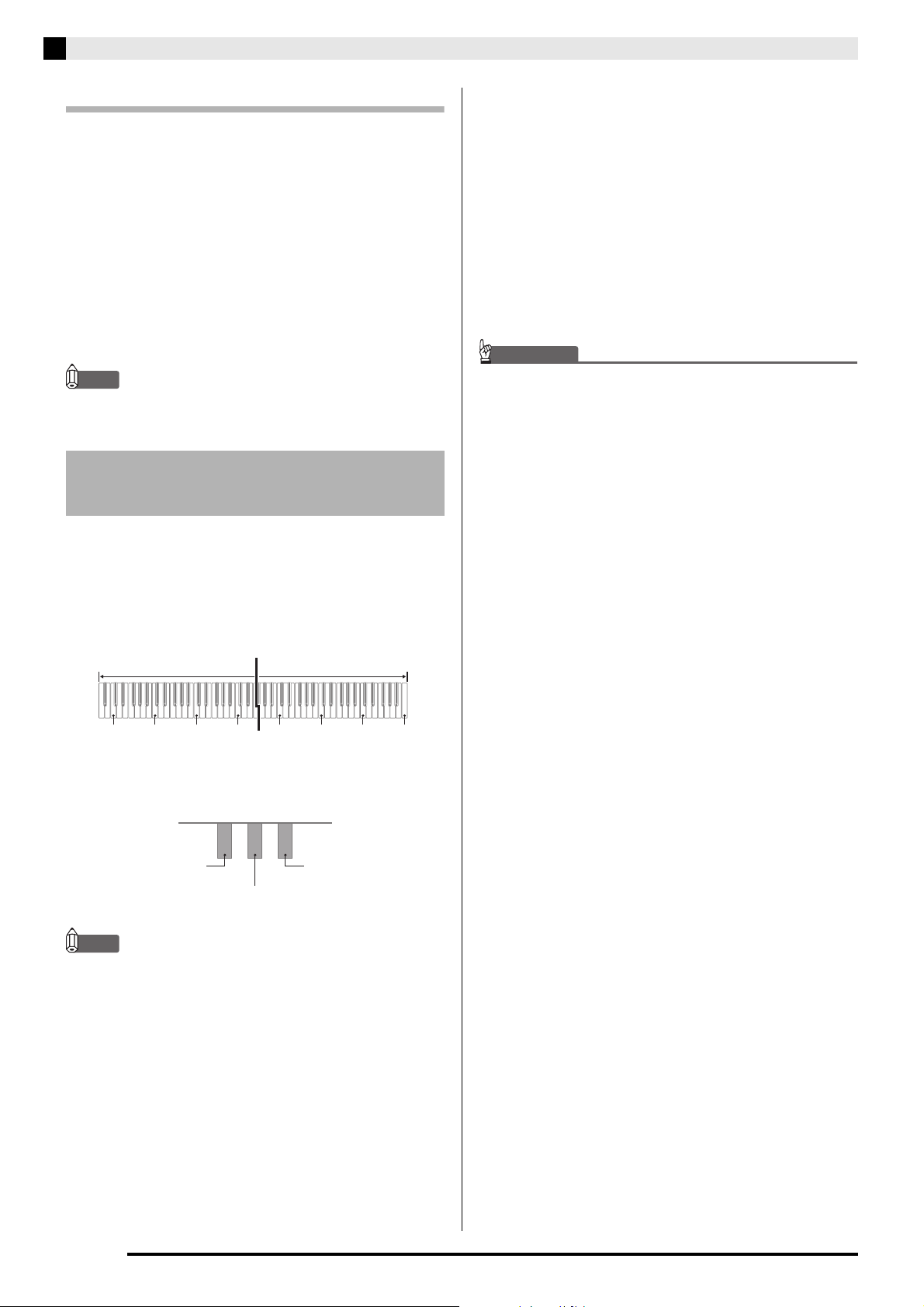
1.
Press the METRONOME button.
• This starts the metronome.
• The lamp flashes with each beat.
2.
While holding down the FUNCTION button,
press the METRONOME BEAT keyboard
key.
• Keep the FUNCTION button depressed as you
advance to step 3.
3.
Hold down the FUNCTION button and press
the BEAT keyboard key (0 to 9) that
corresponds to the beat you want to specify.
• You can specify a beat value in the range of 0 to 9
(beats per measure). A chime will sound on the first
beat of each measure, and clicks will sound for the
remaining beats. Specifying 0 plays a straight click,
without any chime. This setting lets you practice with
a steady beat.
4.
Release the FUNCTION button and then hold
it down again as you press the
METRONOME TEMPO keyboard key.
• Keep the FUNCTION button depressed as you
advance to step 5.
5.
While holding down the FUNCTION button,
use the TEMPO keys to specify a tempo
value in the range of 20 to 255 beats per
minute.
• Each press of the + or – key raises or lowers the
tempo value by 1.
• You can also use the tempo value input keys (0 to 9)
to enter a specific tempo value.
• Input three digits as the tempo value.
Example: To set a tempo of 20, press keys 0, 2, and
then 0.
6.
Press the METRONOME button to turn off
the metronome.
NOTE
• If you used the numeric input (0 to 9) keyboard keys
to input beat and/or tempo values and the values
are within the allowable setting ranges, the Digital
Piano will emit a high pitch beep when you release
the FUNCTION button. If a value is outside the
allowable range, a low-pitch sound will be emitted.
• You could also use the procedure below in place of
steps 4 and 5 of the above procedure to specify a
tempo value.
– While holding down the FUNCTION button, use
the TEMPO keyboard keys to specify a tempo
value in the range of 20 to 255 (beats per minute).
• In step 5 of the above procedure, pressing the + and
– keys at the same time will set the tempo of the
Concert Play lesson song or Music Library song (in
the case of a recorded song, the tempo when the
song was recorded) that was last selected on the
Digital Piano.
Using the Metronome
EN-12
Playing with Different Tones
To adjust the metronome volume
You can perform the following procedure at any time,
regardless of whether or not the metronome is
sounding.
1.
While holding down the FUNCTION button,
use the Metronome Volume keys to specify a
volume value in the range of 0 to 42.
• For details about using the keyboard keys for
settings, see “Keyboard Keys Used for Configuring
Settings” on page EN-26.
• Each press of the + and – key raises or lowers the
metronome volume value by 1.
NOTE
• To return to the initial default setting, press + and –
at the same time.
You can split the keyboard in the center so the left and
right sides have the same range. The left outer pedal is
the left side damper pedal, while the right outer pedal
is the right side damper pedal.
NOTE
• Only the damper pedal for the right side keyboard
supports half-pedal operations.
1.
Select the piano tone you want to use for the
duet.
Example: GRAND PIANO 1 (BRIGHT)
2.
To cycle between the Duet Mode settings
below, hold down the FUNCTION button and
press the Duet Mode key.
Off
On
Pan: Outputs left side keyboard tone from the left
speaker and right side keyboard tone from the
right speaker.
IMPORTANT!
• The Octave Shift and Transpose settings cannot be
changed while On or Pan is selected for the Duet
Mode setting.
• While “Pan” is selected for the Duet Mode settings,
the Hall Simulator, and Chorus settings cannot be
changed.
Splitting the Keyboard for
Duet Play
C3 C4 C5 C6 C3 C4 C5 C6
Keyboard
Split point
Left keyboard Right keyboard
(middle C)(middle C)
Pedals
Left side damper pedal
Left and right side damper pedal
Right side damper pedal
Playing with Different Tones
EN-13
Changing the Octaves of the duet
keyboards
You can change the ranges of the left and right
keyboards in octave units from their initial default
settings. This comes in handy, for example, if the initial
default range is not enough when one person is
playing the left hand part and another person is
playing the right hand part.
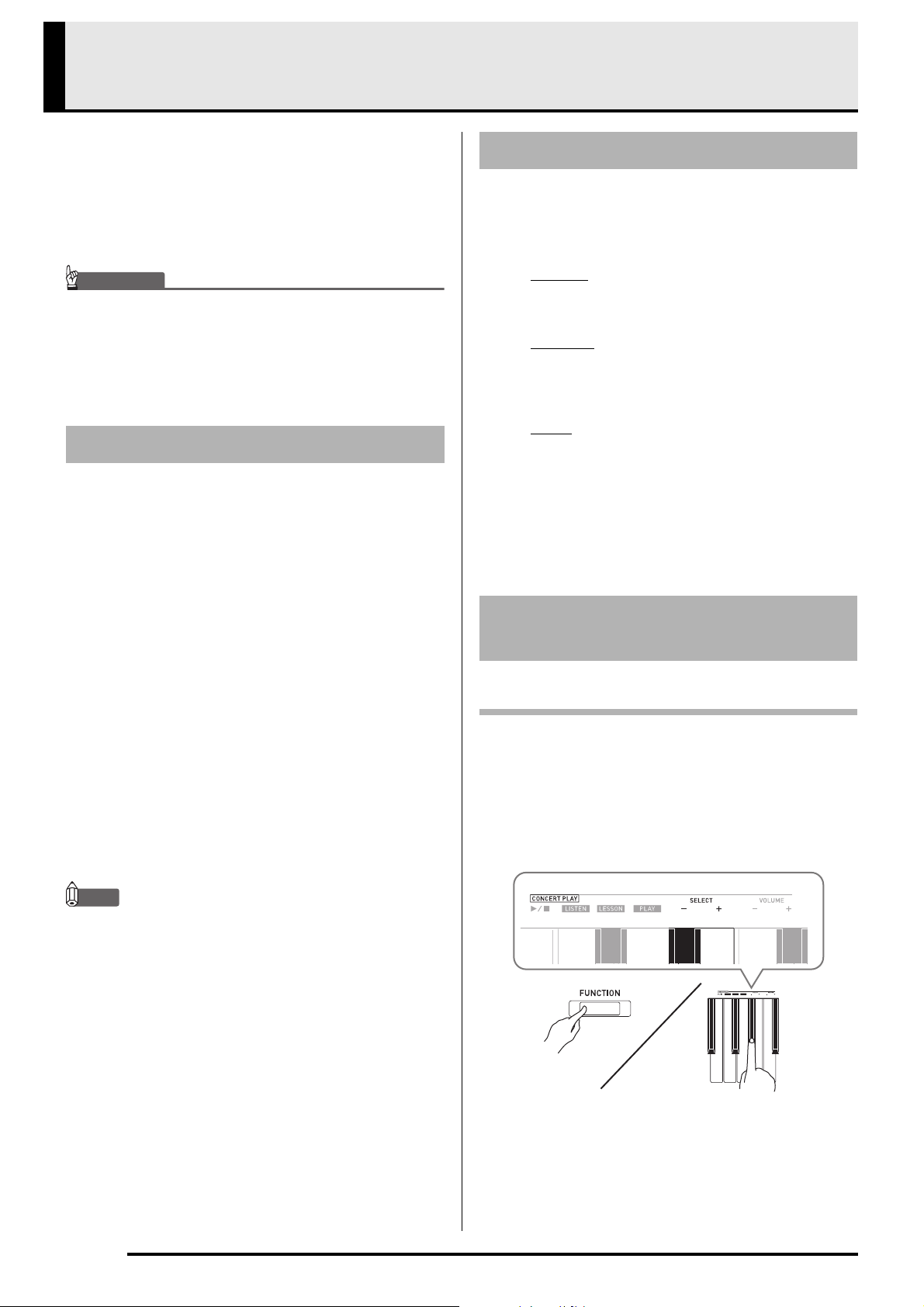
1.
While holding down the FUNCTION and
GRAND PIANO 1 buttons, press the
keyboard C key that you want located at C4
(middle C) of the left keyboard. Keep
FUNCTION and GRAND PIANO 1 buttons
depressed as you advance to step 2, below.
• This will sound the note assigned to C4 and change
the octave of the left keyboard.
Example:Press the keyboard key of the leftmost C (C4)
will assign the range shown below.
2.
While still holding down the FUNCTION and
GRAND PIANO 1 buttons, press the
keyboard C key that you want located at C4
(middle C) of the right keyboard.
• This will sound the note assigned to C4 and change
the octave of the right keyboard.
NOTE
• Exiting the Duet Mode and then selecting On or Pan
for the Duet Mode setting again will return the
keyboards to their initial default ranges.
C4 C5 C6 C7 C3 C4 C5 C6
Left keyboard Right keyboard
(Pressed key)
1 octave higher than initial
setting
Unchanged
EN-14
Using Built-in Songs (Concert Play, Music
Library, Demo Tunes)
Your Digital Piano comes with 10 built-in piano and
orchestra tunes (Concert Play 1 through 10), and 60
piano solos (Music Library 1 to 60).
Concert Play lets you enjoy playing along with
orchestral accompaniment. You can use Music Library
to practice famous piano pieces.
IMPORTANT!
• Whenever you change to another song, this Digital
Piano loads the song data. Note that button
operations are disabled while song loading is in
progress. If you are playing something on the
keyboard, changing the song may cause note output
to stop.
1.
While holding down the FUNCTION button,
press the METRONOME button.
• This starts sequentially looped playback of all
Concert Play (Listen) songs and Music Library songs.
• You can play along with a song on the keyboard as it
is playing. The tone assigned to the keyboard is the
one that is preset for the song that is playing.
2.
To change the demo song, hold down the
FUNCTION button and press the MIDI REC
button or AUDIO REC button.
• To advance to the next demo song, hold down the
FUNCTION button and press the MIDI REC button.
• To return to the previous demo song, hold down the
FUNCTION button and press the AUDIO REC
button.
• For a list of songs, see page A-1.
3.
Press the a button again to stop built-in
song play.
NOTE
• Pressing the METRONOME button while holding
down the FUNCTION button during Concert Play
jumps to the first Music Library song. Performing
the same operation during Music Library play jumps
to the first Concert Play song.
• The tune selection and playback stop operations
described above are the only operations that are
possible during demo tune play.
Concert Play has recordings of a live orchestra, which
you can use to play along with authentic
accompaniment.
You can also use Concert Play for 3-step practice.
Step 1: LISTEN
Listen to playback of the piano and orchestra to
familiarize yourself with the music.
Step 2: LESSON
Practice the Concert Play piano part.
• You can turn off the left hand part or right hand
part of a built-in song and play along on the piano.
Step 3: PLAY
Play along with the orchestra accompaniment.
• The Concert Play contains actual recordings of an
orchestra. Because of this, the instrument sounds are
different from the tones that can be selected with this
piano (page EN-6). This also means that Concert
Play playback includes breath sounds and
performance noises.
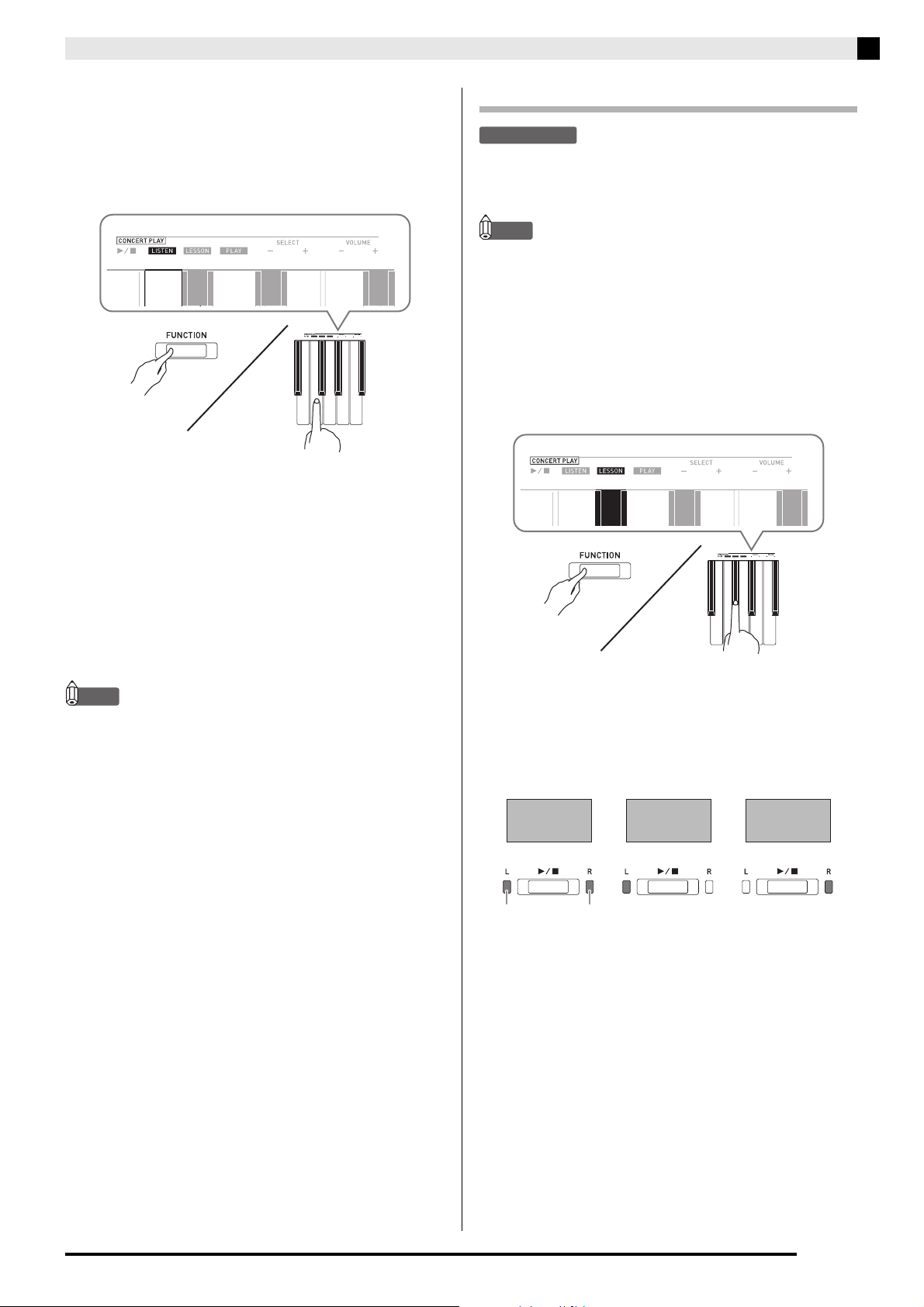
To listen to a Concert Play song (LISTEN)
1.
While holding down the FUNCTION button,
use the CONCERT PLAY SELECT + and –
keyboard keys to scroll song numbers in
sequences (from 1 to 10).
• For information about Concert Play songs, see the
“Concert Play List
” on page A-1.
Performing Demo Play
Concert Play
Practicing with a Concert Play
Song
Using Built-in Songs (Concert Play, Music Library, Demo Tunes)
EN-15
2.
While holding down the FUNCTION button,
press the LISTEN keyboard key.
• This enters the Listen Mode for listening to the piano
and orchestra performance.
• Playback tempo is fixed and cannot be changed
during Listen Mode playback.
3.
While holding down the FUNCTION button,
press the CONCERT PLAY a keyboard
key to start playback.
• Playback will stop automatically when the end of the
song is reached.
4.
To stop playback, hold down the FUNCTION
button as you press the CONCERT PLAY
a keyboard key again.
NOTE
• You can use adjust the volume level of the playback,
if you want. See “Configuring Settings with the
Keyboard” (page EN-25) for more information.
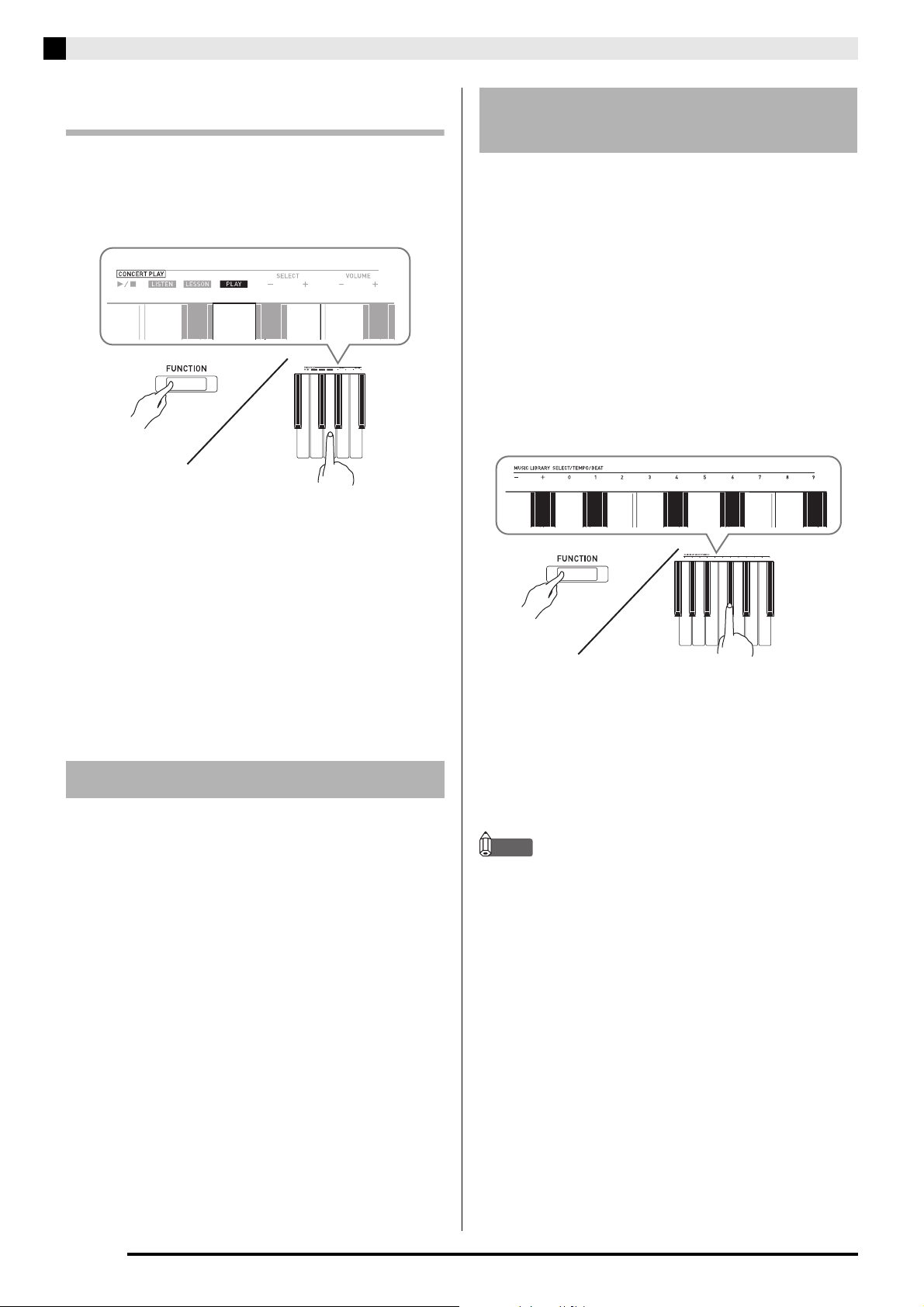
To practice the piano part (LESSON)
PREPARATION
• You can change tempo of the playback, if you want.
See “Configuring Settings with the Keyboard” (page
EN-25) for more information.
NOTE
• Some Concert Play tunes incorporate tempo changes
in their arrangements. Because of this, the playback
tempo may at times be faster or slower than the
tempo setting.
1.
While holding down the FUNCTION button,
press the LESSON keyboard key.
• This enters the Lesson Mode, which allows simple
play along with the piano part.
2.
While holding down the FUNCTION button,
press the a button to select the part you
want to turn off.
• Pressing a button toggles its part on (button lamp on)
and off (button lamp off).
3.
While holding down the FUNCTION button,
press the CONCERT PLAY a keyboard
key.
• This starts playback, without the part you turned off
in step 2.
4.
Play the missing part on the keyboard.
5.
To stop playback, hold down the FUNCTION
button as you press the CONCERT PLAY
a keyboard key again.
Left hand Right hand
Both parts on
Right hand
part off
Left hand
part off
EN-16
Using Built-in Songs (Concert Play, Music Library, Demo Tunes)
To play along with the orchestra
accompaniment (PLAY)
1.
While holding down the FUNCTION button,
press the PLAY keyboard key.
• This will enter the Play Mode, which plays the
orchestra part without the piano part.
2.
While holding down the FUNCTION button,
press the CONCERT PLAY a keyboard
key to start playback.
• Playback tempo is fixed and cannot be changed
during Play Mode playback.
3.
Play the piano part on the keyboard.
4.
To stop playback, hold down the FUNCTION
button as you press the CONCERT PLAY
a keyboard key again.
You can use the Music Library for your listening
enjoyment or to practice piano songs.
• The Music Library includes 60 songs, numbered 1
through 60.
• You can also import up to 10 songs* from a
computer to Digital Piano memory, and assign them
Music Library song numbers 61 through 70.
* You can download music data from the Internet and
then transfer it from your computer to Digital Piano
memory. See “Transferring Song Data with a
Computer” on page EN-46 for more information.
1.
Find the song number of the song you want to
play in the “Music Library List” on page A-1.
2.
To change to another song, hold down the
FUNCTION button as you use the MUSIC
LIBRARY SELECT (+, –, 0 to 9) keys to
specify a song number.
• Each press of the + or – key raises or lowers the song
number by 1.
• You can also input a value from 0 to 9 to specify a
Music Library song number.
• Input two digits as the song number.
Example: To specify song number 5, press keys 0 and
then 5.
3.
Press the a button.
• This starts the playback of the song.
4.
To stop playback, press the a button
again.
• Playback will stop automatically when the end of the
song is reached.
NOTE
• Pressing the + and – keys at the same time in step 2
of the above procedure will select song number 1.
• You also can adjust the playback tempo and volume
of the song. See “Configuring Settings with the
Keyboard” on page EN-25 for more information.
Music Library
Playing Back a Specific Music
Library Song
Using Built-in Songs (Concert Play, Music Library, Demo Tunes)
EN-17
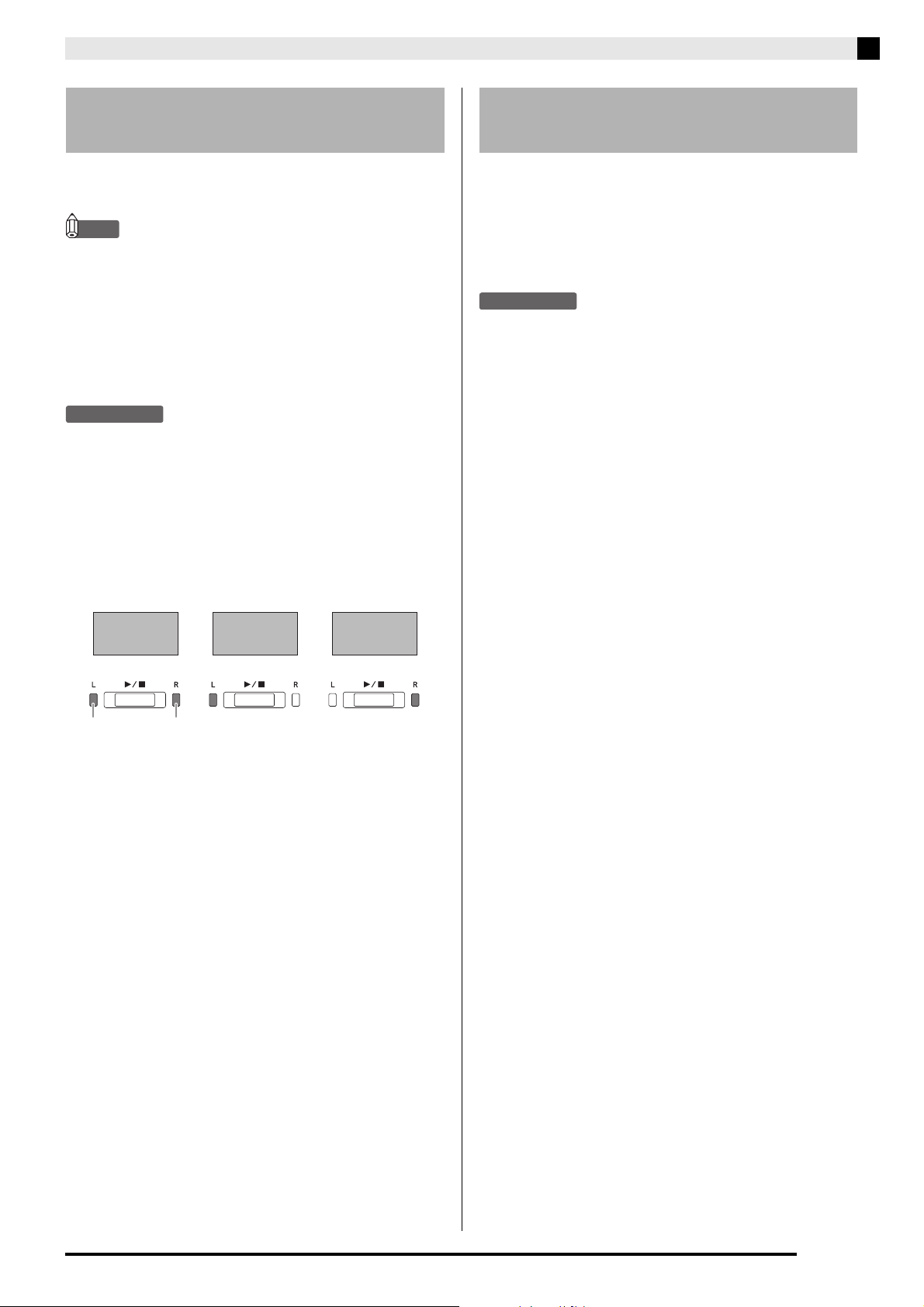
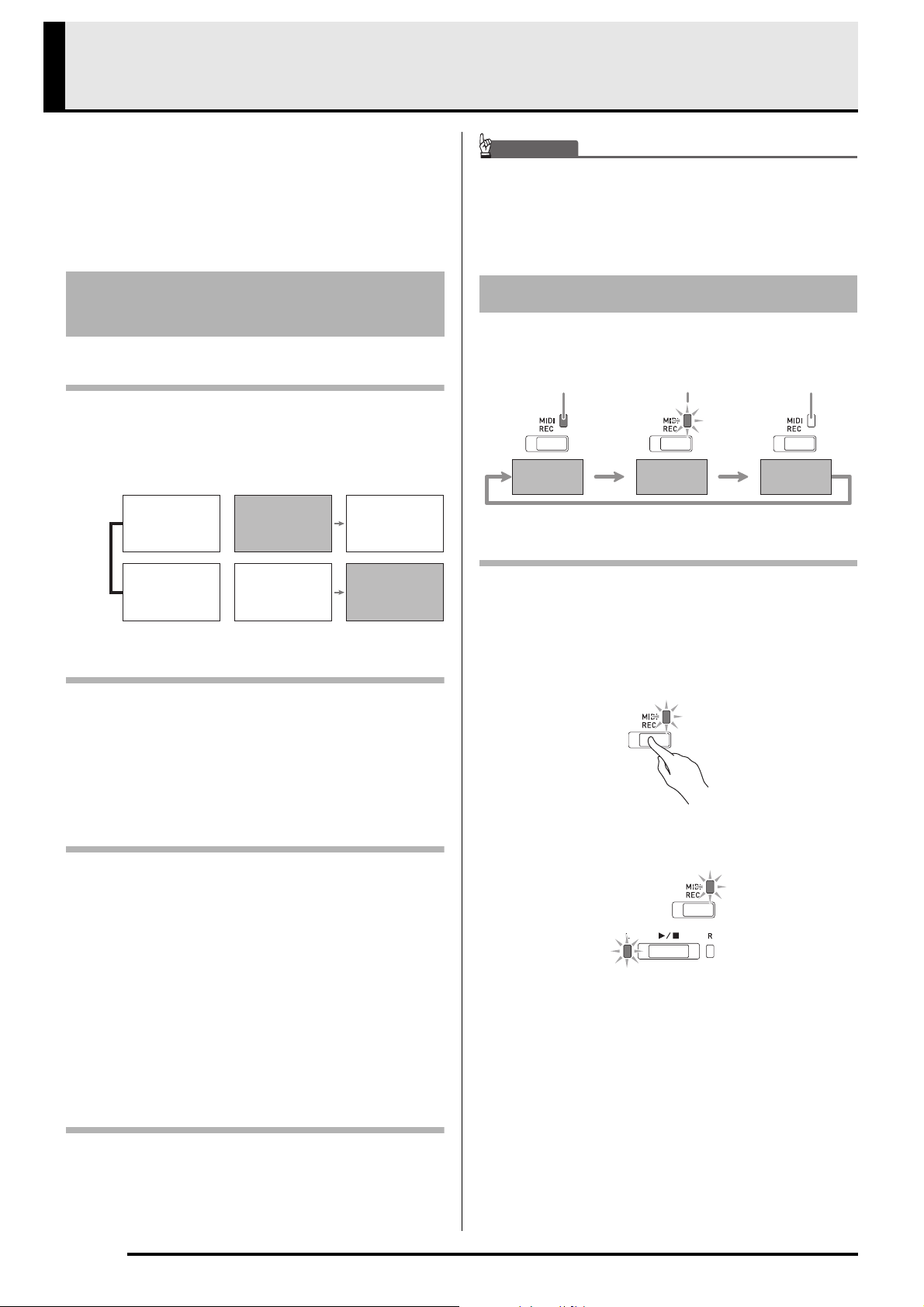
You can turn off the left hand part or right hand part of
a song and play along on the Digital Piano.
NOTE
• The Music Library includes a number of duets.
While a duet is selected, you can turn off the first
piano (Primo) or second piano (Secondo) tone and
play along with the song.
• Some music library tunes incorporate tempo
changes in their arrangements. Because of this, the
playback tempo may at times be faster or slower
than the tempo setting.
PREPARATION
• Select the song you want to practice and adjust the
tempo. See step 3 under “Using the Metronome”
(page EN-11).
1.
While holding down the FUNCTION button,
press the a button to select the part you
want to turn off.
• Pressing a button toggles its part on (button lamp on)
and off (button lamp off).
2.
Press the a button.
• This starts playback, without the part you turned off
in step 1.
3.
Play the missing part on the keyboard.
4.
To stop playback, press the a button
again.
You can use your Digital Piano to play back audio data
(WAV files*) stored on a commercially available USB
flash drive.
See “USB Flash Drive” on page EN-35 for more
information.
* Linear PCM, 16bit, 44.1 kHz, Stereo
PREPARATION
• Prepare a USB flash drive that contains data
recorded to it using the Digital Piano’s Audio
Recorder. See “Recording to a USB Flash Drive
(Audio Recorder)” on page EN-21 for more
information.
• You can also use a computer to save audio data
(WAV file) to the USB Flash Drive for playback. See
“Storing Standard Audio Data (WAV Files) to a USB
Flash Drive” on page EN-36 for more information.
• Insert the USB flash drive that contains the data you
want to play back into your Digital Piano’s USB
flash drive port.
1.
Press the AUDIO REC button once or twice
so the AUDIO REC lamp is lit.
• This enters playback standby.
2.
Hold down the FUNCTION button and press
a MUSIC LIBRARY SELECT keyboard key.
• Pressing the plus (+) key scrolls forward through
song file names (TAKE01.WAV, TAKE02.WAV, etc.)
Pressing the minus (–) key scrolls backward.
• You also can use the number (0 through 9) keyboard
keys to specify a file number (1 to 99) directly. The
Digital Piano will beep if there is no file that
corresponds to the number you input.
3.
Press the a button.
• This will start playback of the selected song.
4.
To stop playback of the song, press the a
button.
Practicing with a Music Library
Song
Left hand Right hand
Both parts on
Right hand
part off
Left hand
part off
Playing Back Audio Data
Stored on a USB Flash Drive
EN-18
Recording and Playback
You can record notes you play with the Digital Piano’s
MIDI recorder for later playback. When a commercially
available USB flash drive is inserted in the Digital
Piano’s USB flash drive port, audio data is recorded to
and played back from the USB flash drive (Audio
Recorder).
Tracks
A track is a container of recorded data, and a song
consists of two tracks: Track 1 and Track 2. You can
record each track separately and then combine them so
they play back together as a single song.
Memory Capacity
• You can record approximately 5,000 notes in Digital
Piano memory.
• The MIDI REC button lamp will flash at high speed
when memory runs low.
• Recording stops automatically if the number of
notes in memory exceeds the maximum.
Recorded Data
• Keyboard play
• Tone used for keyboard play
• Beat (Track 1 only)
• Tempo setting (Track 1 only)
• Layer setting (Track 1 only)
• Duet (Track 1 only)
• Temperament (Track 1 only)
• Keyboard volume (Track 1 only)
• Chorus (Track 1 only)
• Brilliance (Track 1 only)
• Hall Simulator setting (Track 1 only)
• Acoustic Simulator (Track 1 only)
Recording Data Storage
• Starting a new recording deletes any data that was
previously recorded in memory.
• Should power fail during recording, all of the data in
the track you are recording will be deleted.
IMPORTANT!
• CASIO COMPUTER CO., LTD. takes no
responsibility for any damages, lost profits, or claims
by third parties arising from the deletion of recorded
data due to malfunction, repair, or for any other
reason.
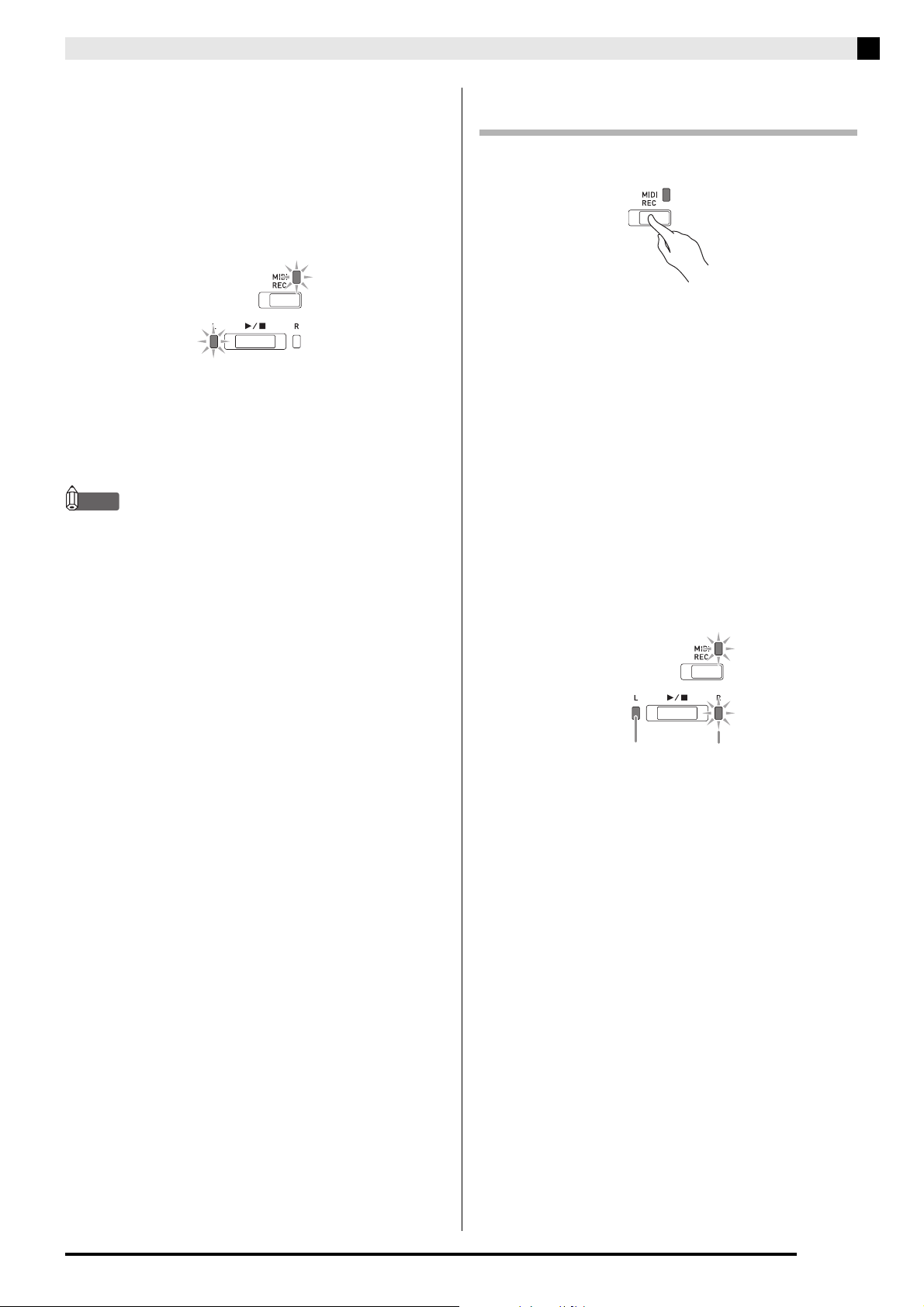
Each press of the MIDI REC button cycles through the
recording options in the sequence shown below.
Recording to a Specific Song Track
After recording to either of the tracks of a song, you can
record to the other track while listening to playback
what you recorded in the first track.
1.
Press the MIDI REC button once or twice so
the MIDI REC lamp is flashing.
• At this time the L lamp will flash to indicate that the
Digital Piano is standing by for recording to Track 1.
Recording to Built-in MIDI
Recorder
Track 1 Record
While playing
back. . .
Track 2 Record
Song
Using the MIDI REC Button
Playback
Standby
Record
Standby
Normal
Lit Flashing Off
Recording and Playback
EN-19
2.
While holding down the FUNCTION button,
press the a button to select the track you
want to record.
• Make sure that the indicator lamp for the record track
is flashing.
Track 1: L lamp
Track 2: R lamp
Example:Track 1 selected
3.
Select the tone and effects (Track 1 only) you
want to use in your recording.
• Tone (page EN-6)
• Effects (page EN-9)
NOTE
• If you want the metronome to sound while you are
recording, configure the beat and tempo settings,
and then press the METRONOME button. See
“Using the Metronome” on page EN-11 for more
information.
4.
Press the a button or start playing.
• Recording will start automatically.
5.
To stop recording, press the a button.
• This will cause the MIDI REC button lamp and the
lamp of the track you recorded to change from
flashing to lit.
• To play back the track you just recorded, press the
a button.
6.
After you are finished recording or playing
back, press the MIDI REC button so its lamp
goes out.
Recording to One Track while Listening
to Playback of the Other Track
1.
Press the MIDI REC button so its lamp is lit.
2.
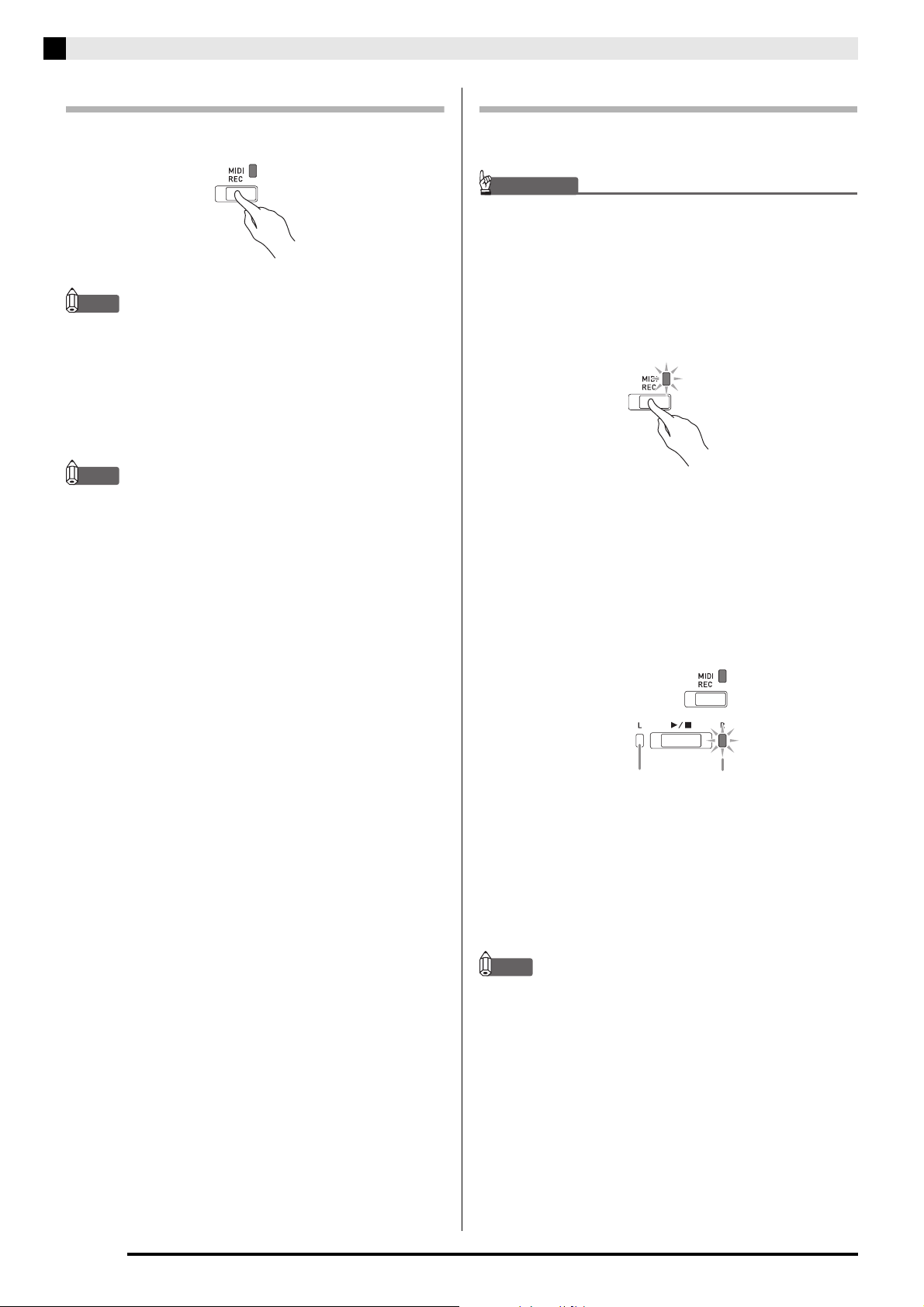
While holding down the FUNCTION button,
press the a button to select the track you
want to play back while recording.
3.
Press the MIDI REC button so its lamp is
flashing.
• This will cause the L lamp to flash.
4.
While holding down the FUNCTION button,
press the a button to select the track you
want to record.
• Make sure that the indicator lamp for the record track
is flashing.
Example: To listen to playback of Track 1 as you record
to Track 2
5.
Select the tone and effects (Track 1 only) you
want to use for your recording.
6.
Press the a button or start playing.
• This will start both playback of the recorded track
and recording to the other track.
• If, while recording is in progress, you want to
re-record from the beginning, hold down the MIDI
REC button until the Digital Piano beeps. This
discards the current recording data and enters
recording standby.
7.
To stop recording, press the a button.
Lit (Play) Flashing (Record Standby)
EN-20
Recording and Playback
Playing Back from Digital Piano Memory
1.
Press the MIDI REC button so its lamp is lit.
NOTE
• When a song has something recorded in both tracks,
you can turn off one track and play back just the
other track, if you want.
2.
Press the a button.
• This starts playback of the song and/or track you
selected.
NOTE
• You can change the tempo setting as a track is
playing.
• Press the a button again to stop playback.
Deleting Recorded Data
The following procedure deletes a specific track of a
song.
IMPORTANT!
• The procedure below deletes all of the data of the
selected track. Note that the delete operation cannot
be undone. Check to make sure you really do not
need the data in Digital Piano memory before you
perform the following steps.
1.
Press the MIDI REC button once or twice so
the MIDI REC lamp is flashing.
2.
While holding down the FUNCTION button,
press the a button to select the track you
want to delete.
3.
Press the MIDI REC button until its lamp is lit.
• This will cause the lamp of the track you selected in
step 2 of this procedure to flash.
Example: If you selected Track 2 for deletion
4.
Once again, hold down the FUNCTION
button as you press the a button.
• This deletes the selected track and enters record
standby.
• To cancel the delete operation at any time, press the
MIDI REC button so its lamp becomes unlit.
NOTE
• Only the Digital Piano’s a button are operational
from step 3 until you actually perform the delete
operation in step 4. No other button operation can be
performed.
Off Flashing: Delete standby
Recording and Playback
EN-21
Anything played on the Digital Piano is recorded to the
USB flash drive as audio data (WAV files*). If you play
along on the Digital Piano as you play back data stored
in song memory, the memory playback and your
keyboard play are both recorded to USB flash drive.
* Linear PCM, 16bit, 44.1 kHz, Stereo
Recording Capacity
• 99 files (TAKE01.WAV to TAKE99.WAV)
• Approximately 25 minutes maximum recording per
file.
Recorded Data
• Everything played on the Digital Piano and
operation sounds are recorded.*
• Individual part recording is not supported.
* If you do not want operation sounds to be recorded,
turn them off. Refer to “ Operation tone” in the
“Parameter List” on pages EN-28 through EN-33.
Recording Data Storage
Each new recording of audio data to a USB flash drive
is automatically assigned a new file name, so existing
data is not overwritten.
Recording Digital Piano Play
(Audio Recorder)
PREPARATION
• Be sure to format the USB flash drive on the Digital
Piano before using it. See “USB Flash Drive” on page
EN-35 for more information.
1.
Insert the USB flash drive into the Digital
Piano’s USB flash drive port.
• When you plug in a USB flash drive, the Digital Piano
initially needs to “mount” the USB flash drive and
prepare for data exchange. Note that Digital Piano
operations are momentarily disabled while a USB
flash drive mounting sequence is being performed.
The Digital Piano’s L/R lamps flash while the
mounting process is in progress. It may take up to 10
or 20 seconds or even longer for a USB flash drive to
be mounted. Do not attempt to perform any
operation on the Digital Piano while a mounting
sequence is in progress (while L/R lamps are
flashing). A USB flash drive needs to be mounted
each time it is connected to the Digital Piano.
2.
Press the AUDIO REC button once or twice
so the AUDIO REC lamp is flashing.
3.
To start recording, press the a button or
start playing.
This starts recording to the USB flash drive.
• Recording can also be started by pressing a pedal or
performing another operation.
• If, while recording is in progress, you want to re-
record from the beginning, hold down the AUDIO
REC button until the Digital Piano beeps. This
discards the current recording data and enters
recording standby.
NOTE
• Do not remove the USB flash drive from the USB
flash drive port while the AUDIO REC lamp is
flashing. Doing so interrupts recording and may
corrupt data.
4.
To stop recording, press the a button or
AUDIO REC button.
• If you want to continue recording, perform the
operations from step 2 of this procedure. If you want
to play back what you recorded, perform the
operations from step 3 under “Playing Back Data
Recorded on a USB Flash Drive” (page EN-22). To
exit the audio record/playback operation, press the
AUDIO REC button so its lamp becomes unlit.
Recording to a USB Flash
Drive (Audio Recorder)
EN-22
Recording and Playback
Recording Digital Piano Play as Data
Recorded in MIDI Recorder Plays Back
(Audio Recorder)
1.
Press the MIDI REC button once or twice until
the MIDI REC lamp is lit.
2.
Hold down the FUNCTION button and press
the a button to select the playback track.
3.
Press the AUDIO REC button once or twice
so the AUDIO REC lamp is flashing.
4.
To start recording, press the a button or
start playing.
• This simultaneously starts playback of the content
recorded on the MIDI recorder and recording to the
USB flash drive.
5.
To stop playback and recording, press the
a button.
• If you want to continue recording, perform the
operations from step 2 under “Recording Digital
Piano Play (Audio Recorder)” (page EN-21). If you
want to play back what you recorded, perform the
operations from step 3 under “Playing Back Data
Recorded on a USB Flash Drive” (page EN-22). To
exit the audio record/playback operation, press the
AUDIO REC button so its lamp becomes unlit.
Playing Back Data Recorded on a USB
Flash Drive
1.
Press the AUDIO REC button once or twice
so the AUDIO REC lamp is lit.
2.
Select the song you want to play back.
If you want to play back the last file you recorded, jump
directly to step 3.
To select the previous song
Hold down the FUNCTION button and press the Select
Music Library Song minus (–) key.
Each press scrolls back one song.
To scroll in file number sequence
Hold down the FUNCTION button and press the Select
Music Library Song plus (+) key.
Each press scrolls forward one song.
To specify a file number
Use the Select Music Library Song number keys (0
through 9) to specify the file number (1 to 99) you want.
(TAKE01.WAV, TAKE02.WAV, etc.)
The Digital Piano beeps if a file with the specified
number does not exist.
3.
To start playback, press the a button.
4.
To stop playback of the song, press the a
button.
Recording and Playback
EN-23
Adjusting the Audio Recorder Volume
Level
You can use the procedure below to adjust the volume
level of audio data recorded to a USB flash drive.
1.
While holding down the FUNCTION button,
use the Audio Recorder Volume keyboard
keys to adjust the volume level.
• For details about using the keyboard keys for
settings, see “Keyboard Keys Used for Configuring
Settings” (page EN-26).
• Each press of the + (increase) or – (decrease)
keyboard key changes the volume value by 1.
NOTE
• To return to the initial default setting, press the +
and – keyboard keys at the same time.
Deleting an Audio File from a USB Flash
Drive
Files can be deleted one at a time.
IMPORTANT!
• The procedure below deletes all of the data of the
selected file. Note that the delete operation cannot
be undone. Check to make sure you really do not
need the data in Digital Piano memory before you
perform the following steps.
1.
Press the AUDIO REC button once or twice
so the AUDIO REC lamp is lit.
2.
Select the song you want to delete.
If you want to delete the last file you recorded, jump
directly to step 3.
To select the previous song
Hold down the FUNCTION button and press the Select
Music Library Song minus (–) key.
Each press scrolls back one song.
To scroll in file number sequence
Hold down the FUNCTION button and press the Select
Music Library Song plus (+) key.
Each press scrolls forward one song.
To specify a file number
Use the Select Music Library Song number keys (0
through 9) to specify the file number (1 to 99) you want.
(TAKE01.WAV, TAKE02.WAV, etc.)
The Digital Piano beeps if a file with the specified
number does not exist.
3.
Press the AUDIO REC button so the AUDIO
REC lamp is flashing.
4.
Hold down the AUDIO REC button until both
the L and R lamps flash.
EN-24
Recording and Playback
5.
Once again, hold down the FUNCTION
button as you press the a button.
• To cancel the delete operation at any time, press the
AUDIO REC button so its lamp is unlit.
NOTE
• When you record a new file, it is always
automatically assigned the next new file number in
the sequence of files currently on the USB flash
drive, even if a previous number is unused (because
a file was deleted).
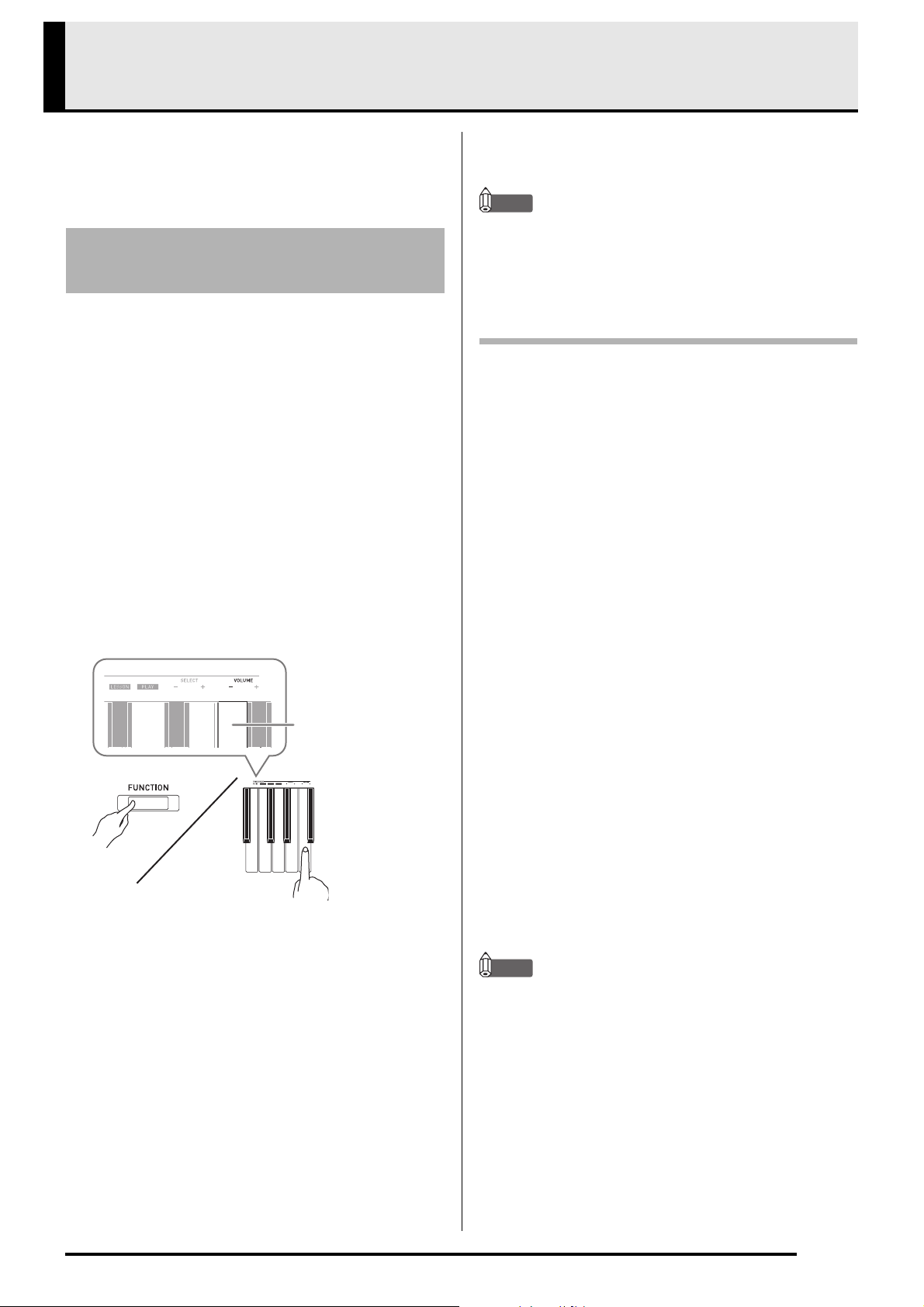
EN-25
Configuring Settings with the Keyboard
In addition to selecting tones and songs (Concert Play
or Music Library), you also can use the FUNCTION
button in combination with the keyboard keys to
configure effect, keyboard touch, and other settings.
1.
Use the “Parameter List” on pages EN-28 -
EN-33 to find the setting you want to
configure, and note its details.
2.
Use “Keyboard Keys Used for Configuring
Settings” on page EN-26 to find the location
on the keyboard for configuring the setting
you want.
3.
While holding down the FUNCTION button,
press the keyboard key for the setting you
want to configure.
• The Digital Piano will sound an operation tone after it
configures the setting.
Example:To lower the Concert Play volume, press the
CONCERT PLAY VOLUME minus (–) key.
4.
Release the FUNCTION button to complete
the setting procedure.
NOTE
• You can configure the Digital Piano so no operation
tone sounds in step 3. For details, see “ Operation
tone” under “Parameter List” on pages EN-28 -
EN-33.
Keyboard Setting Operation Types
There are four types of operations that you can perform
while configuring settings with the keyboard keys:
Type A, Type B, Type C, and Type D.
Example: Pressing the GRAND PIANO 1 BRIGHT
keyboard key to select the GRAND PIANO 1
BRIGHT tone
• Holding down a key raises or lowers the setting at
high speed.
• To return to the initial default setting, press both
keys at the same time.
• To input a two-digit value, press 0 and then 2. To
input a three-digit value, press 0, 2, and then 0.
• When you press a key, the Digital Piano will beep to
let you know which setting is selected.
• A long beep indicates that the applicable setting is
turned off.
Example: While chorus is turned off, pressing the Chorus
keyboard key twice will cause the Digital Piano
to beep twice, which indicates that the Medium
Chorus setting is selected.
NOTE
• You can find out what operation type applies to each
setting by checking the “Operation Type” in the
“Parameter List” on pages EN-28 - EN-33.
To configure settings with the
keyboard
CONCERT PLAY
VOLUME – key
Type A : Direct input
Type B: Raising or lowering a setting using the + and
– keyboard keys
Type C: Inputting a value using the number
(0 through 9) keyboard keys.
Type D: Toggling or cycling through settings by
pressing a keyboard key
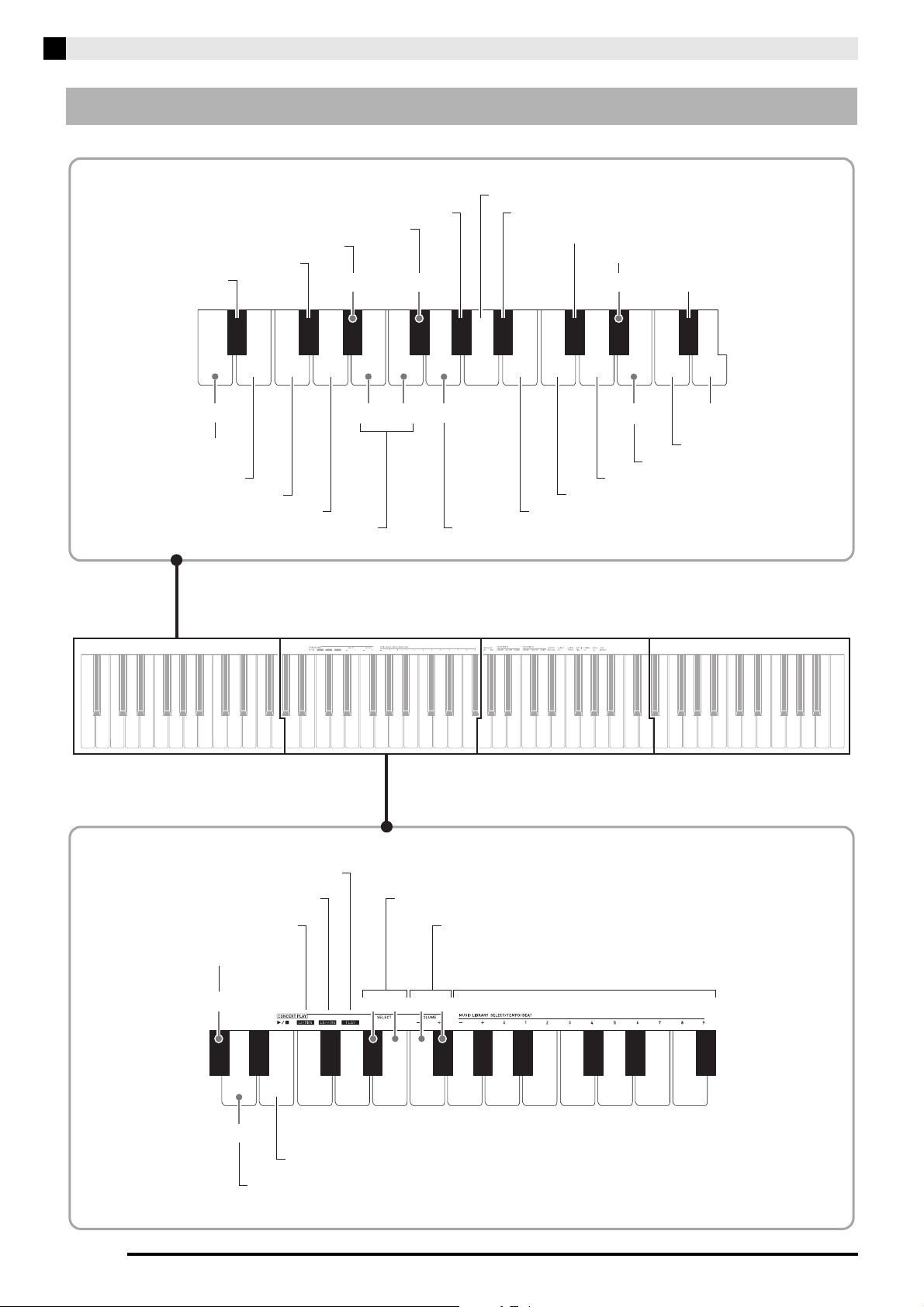
EN-26
Configuring Settings with the Keyboard
• The numbers through correspond to the same numbers in the “Parameter List” on pages EN-28 - EN-33.
Keyboard Keys Used for Configuring Settings
− +
(C2)(C1)
− + − +
(C4)(C3)
OFF/ON OFF/ONOFF/ON
OFF/ONOFF/ON OFF/ON
OFF/ON
OFF/ON
[Left keyboard]
[Overall]
[Middle Left Keyboard]
Music Library song Select/Tempo/Beat/
Temperament select
Local Control
Send Channel
USB Flash Drive Mode
Format
Save
Load
Delete
USB Flash Drive Mode
Hall Simulator (Off)
String Resonance
Lid Simulator
Key-on Action Noise
CONCERT PLAY a (Song)
LISTEN
LESSON
PLAY
CONCERT PLAY SELECT (Song)
Damper Noise
CONCERT PLAY VOLUME
Speaker Out
Chorus
Head Phone Mode
Volume Sync Equalizer
Lower Pedal
Hammer Response
Key-off Action Noise
Hall Simulator (BERLIN HALL)
Hall Simulator (STANDARD HALL)
Hall Simulator (DUTCH CHURCH)
Hall Simulator (FRENCH CATHEDRAL)
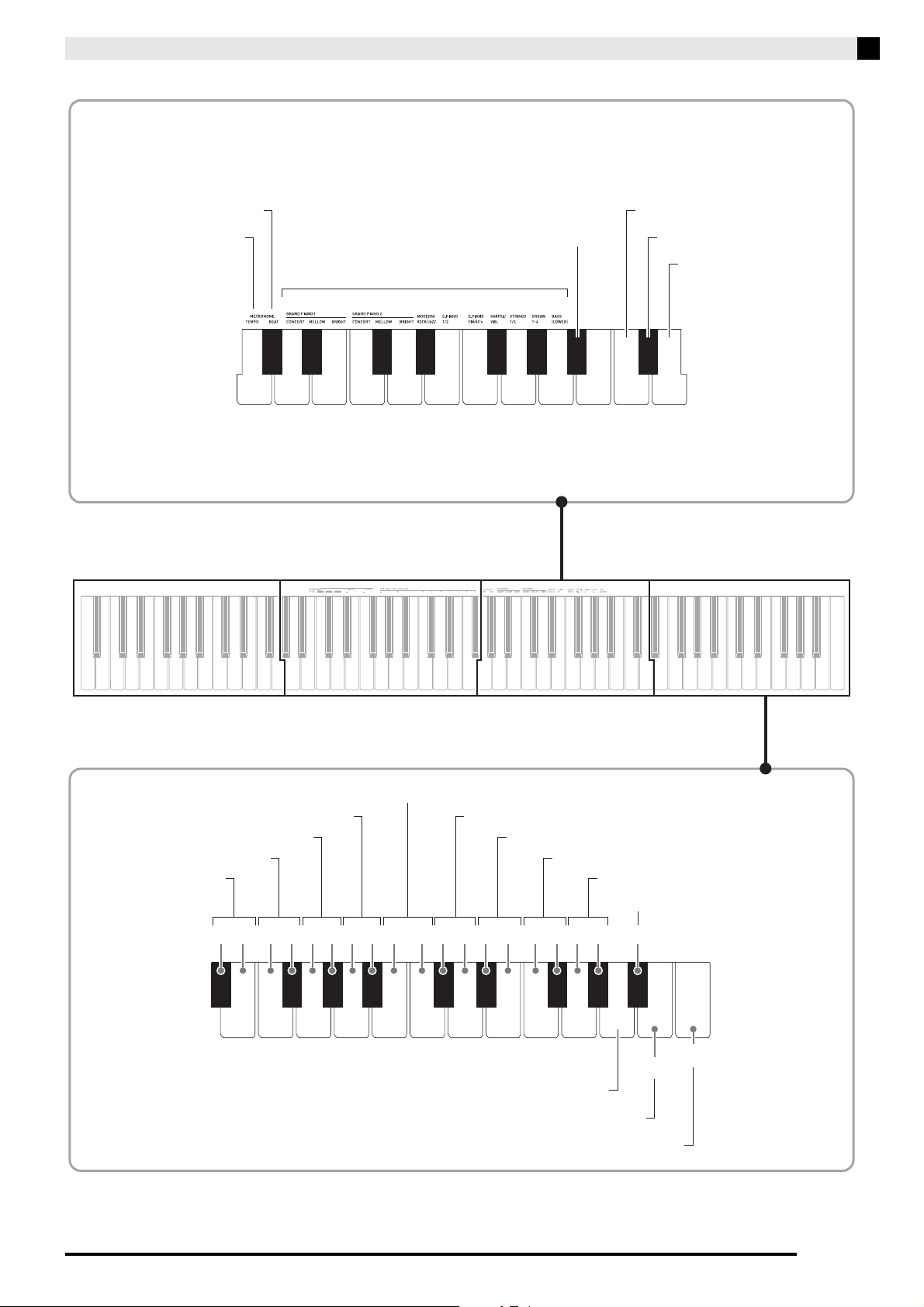
Configuring Settings with the Keyboard
EN-27
OFF/ON
OFF/ON
OFF/ON
− + − + − +− + − + − +− + − + − +
(C8)(C7)
(C6)(C5)
[Overall]
[Right keyboard]
Temperament
METRONOME BEAT
Tone
Select Layer Tone
METRONOME TEMPO
Base Note
Touch Response
Brilliance
Transpose
Layer Balance
A-tuning
Octave Shift
Keyboard Volume
Music Library Song Volume
Metronome Volume
Audio Recorder Volume
Duet Mode
Auto Resume
Operation Tone
Panel Lock
[Middle Right Keyboard]
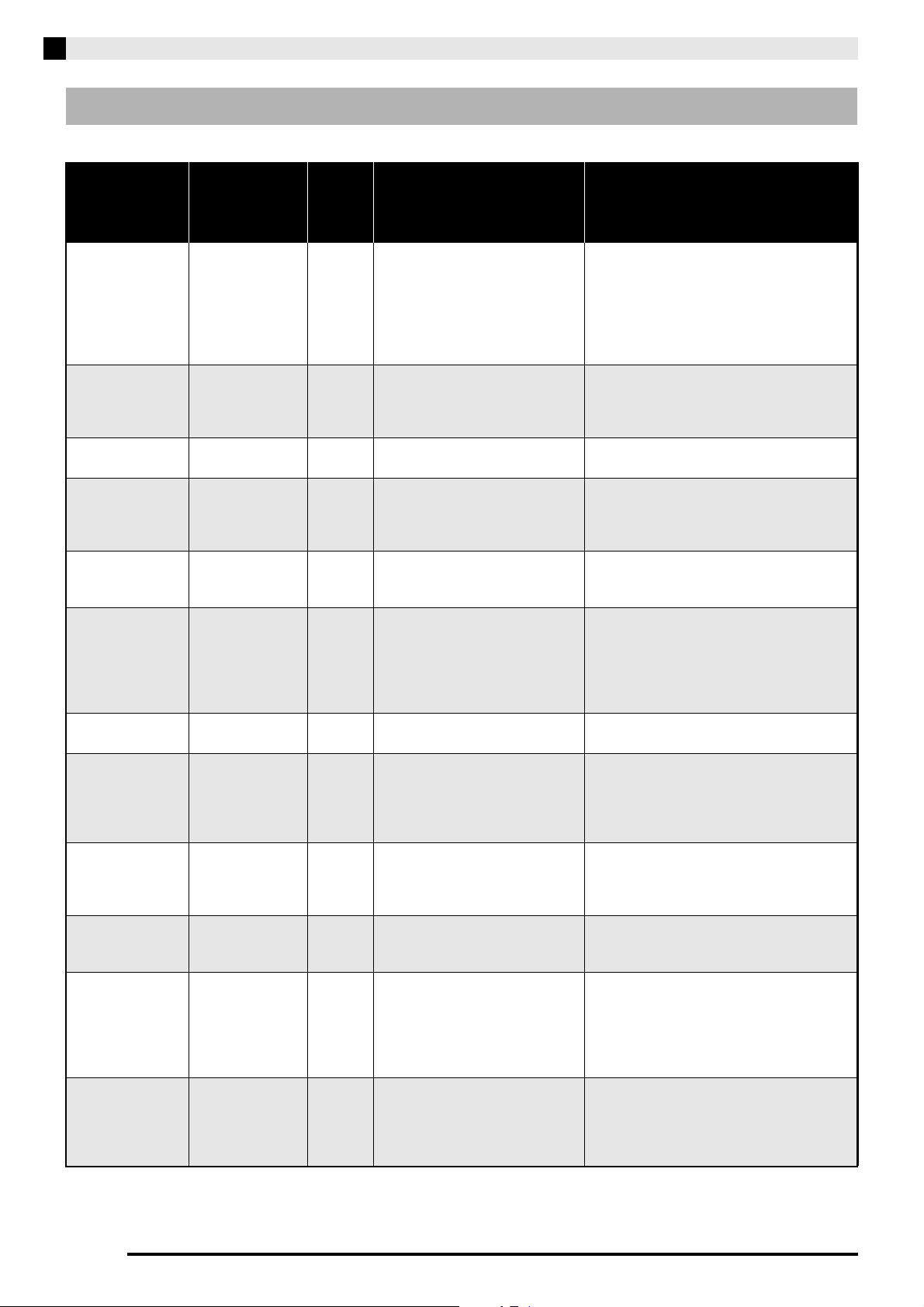
EN-28
Configuring Settings with the Keyboard
■ Tones
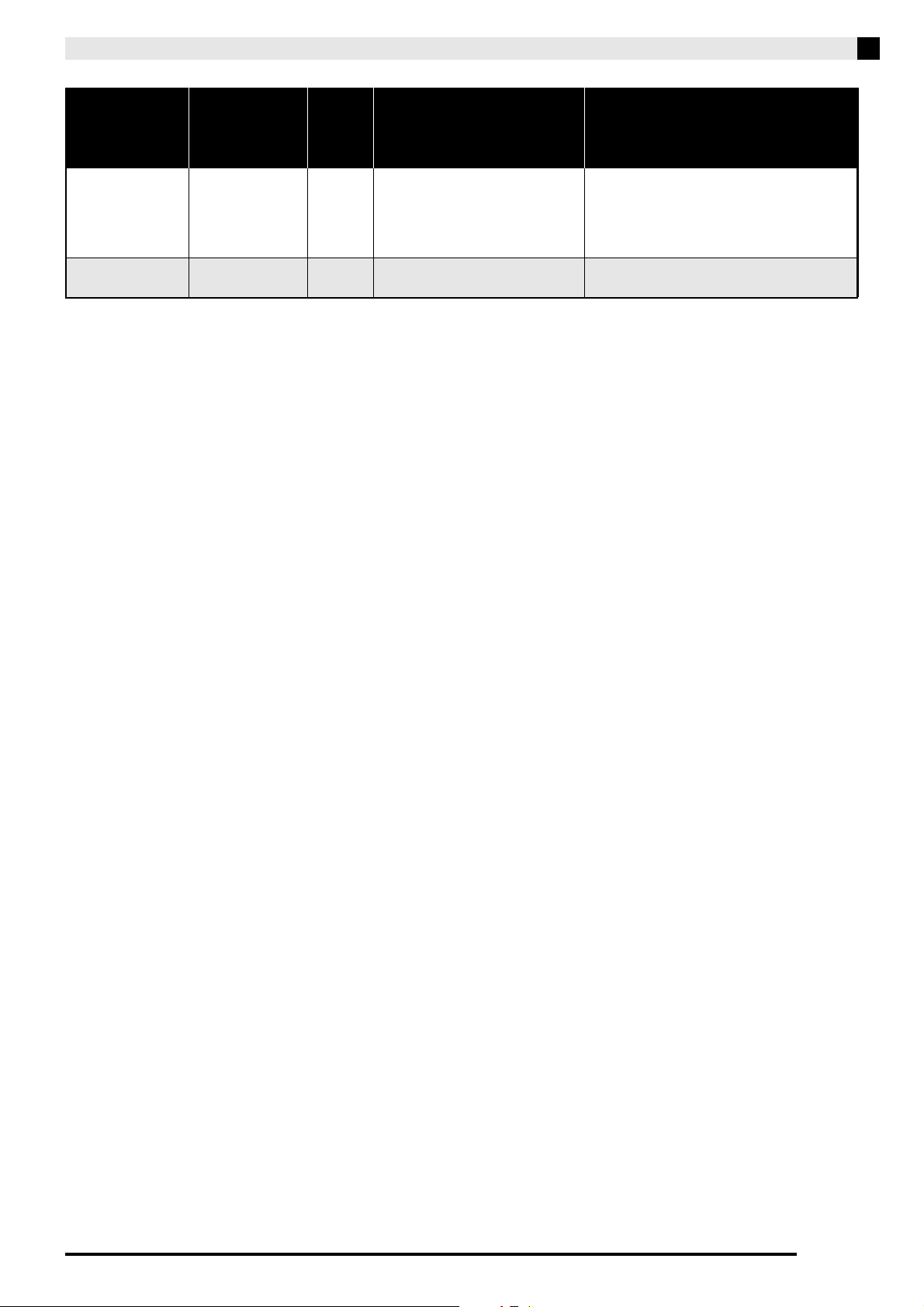
Parameter List
Parameter Settings
Operation
Type
(page
EN-25)
Description Remarks
Hall simulator
Off, DUTCH
CHURCH to
FRENCH
CATHEDRAL
Default:
STANDARD
HALL
A Specifies the hall simulator of
notes. (page EN-9)
Tone selection
See page EN-6.
Default: GRAND
PIANO
(CONCERT)
A Assigns a tone to the keyboard.
(page EN-6)
Chorus
Off, 1 to 4
Default: Off
D Controls the breadth of notes.
(page EN-9)
Brilliance
–3 to 0 to 3
Default: 0
B Specifies the brilliance of notes.
Pressing [+] makes notes brighter
and harder. Pressing [–] makes
notes mellower and softer.
• To return the setting to its initial default (0),
press [+] and [–] at the same time.
Layer balance
–24 to 0 to 24
Default: –10
B Specifies the volume balance
between the main tone and the
layered tone. (page EN-8)
• To return the setting to its initial default
(–10), press [+] and [–] at the same time.
Lower Pedal Off, On
Default: Off
D When turned on and the BASS
(LOWER) tone is selected, pressing
the damper pedal or sostenuto
pedal will apply sustained
reverberation to the BASS
(LOWER) tone. (page EN-7)
Damper noise
Off, On
Default: On
D Enables/disables damper noise
output. (page EN-10)
Hammer
response
Off, 1 to 4
Default: Depends
on tone
D Specifies the time lag between
when a key is pressed and the note
actually sounds. A greater value
specifies a longer time lag.
(page EN-7)
String
resonance
Off, 1 to 4
Default: Depends
on tone
D Specifies the string resonance that
is characteristic of an acoustic
piano. A larger value increases the
resonance level. (page EN-7)
Lid simulator
1 to 4
Default: Depends
on tone
D Specifies the lid its open position
effect. (page EN-7)
Key-on action
noise
Off, On
Default: On
D Enables or disables reproduction of
the mechanical operation sound
(noise) that can be heard when
keys of an acoustic piano are
tapped with extremely light
pressure.
Key-off action
noise
Off, On
Default: On
D Enables or disables reproduction of
the mechanical operation sound
(noise) that can be heard when
keys of an acoustic piano are
released.
Configuring Settings with the Keyboard
EN-29
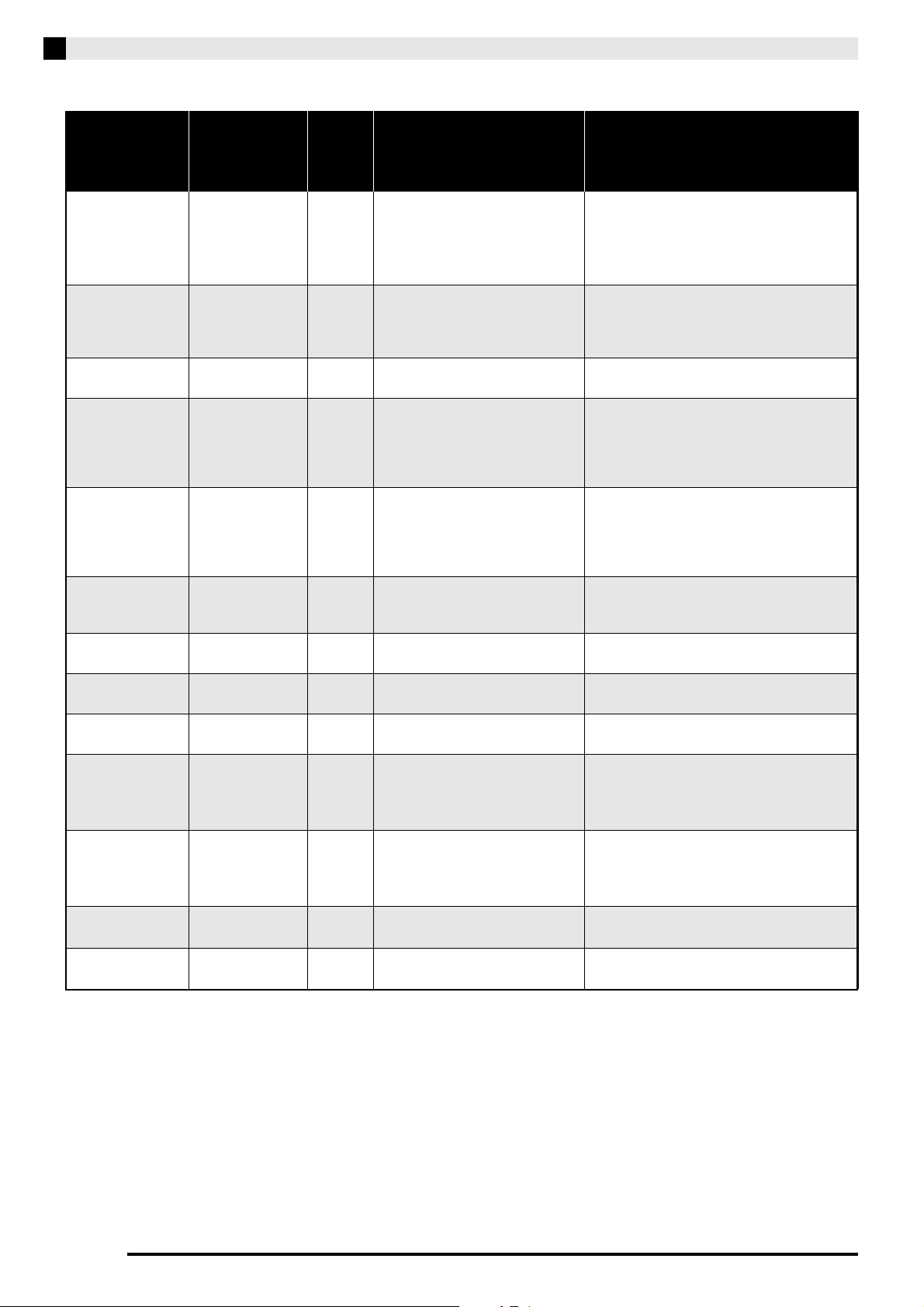
Select layer tone
Off, On
Default: Off
D Enables or disables layering.
(page EN-8)
• BASS (LOWER) cannot be layered with
another tone.
• Configuring of layering settings is not
supported for recording function Track 2
recording.
Duet mode
Off, On, Pan
Default: Off
D Enables or disables the Duet Mode.
(page EN-12)
• When Pan is specified, Hall Simulator and
Chorus effects cannot be applied.
Parameter Settings
Operation
Type
(page
EN-25)
Description Remarks
EN-30
Configuring Settings with the Keyboard
■ Song/Metronome
Parameter Settings
Operation
Type
(page
EN-25)
Description Remarks
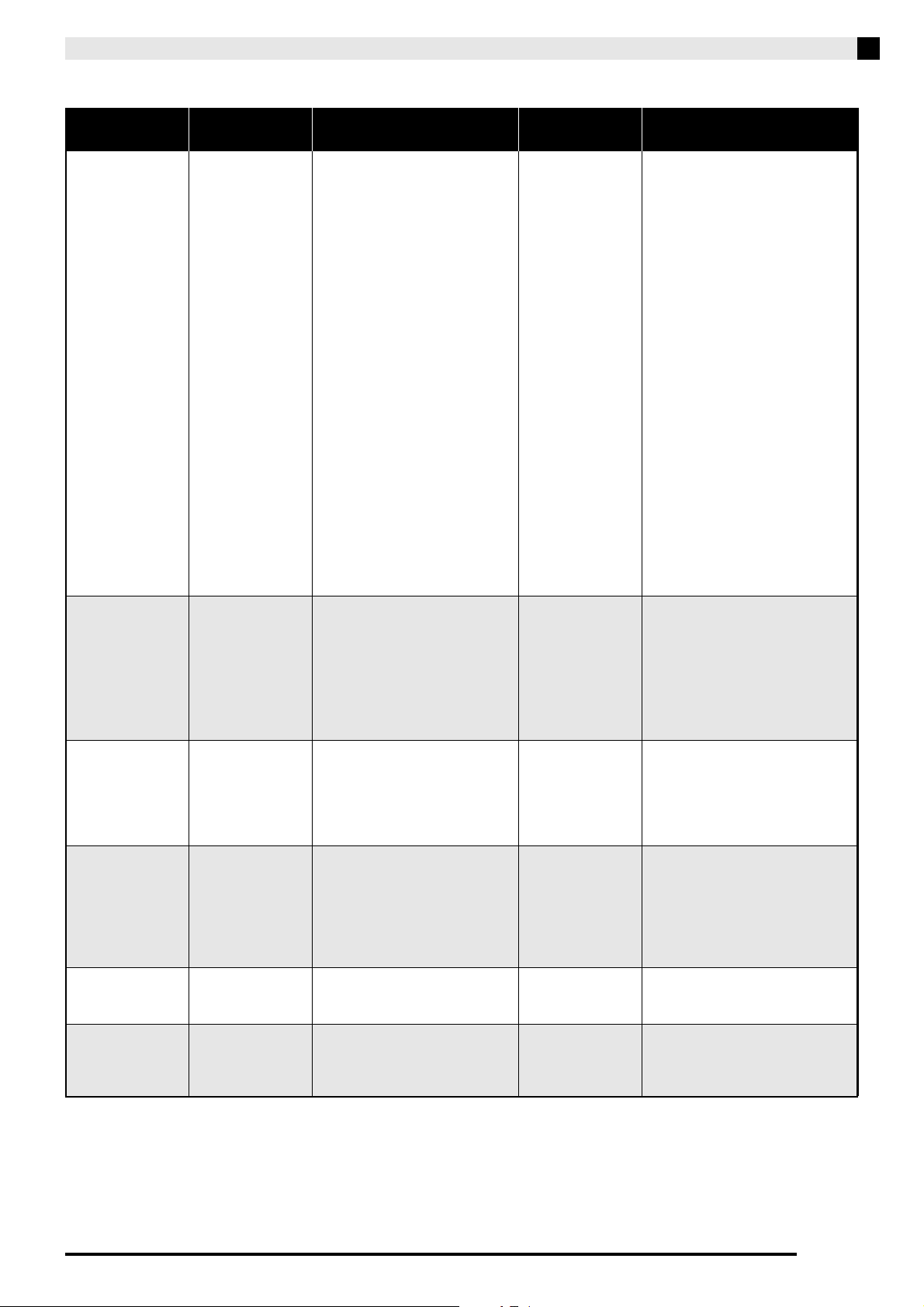
Music Library
song select
(MUSIC
LIBRARY
SELECT)
1 to 70
Default: 1
B
C
Selects a Music Library tune.
(page EN-16)
• This setting cannot be changed while
recording.
Tempo
(TEMPO)
20 to 255
Default: 120
B
C
Specifies the tempo of Concert Play
Lesson Mode songs, Music Library
songs, the metronome, recording
and playback, etc. (page EN-11)
• During recording, pressing + and – at the
same time sets a value of 120.
Beat (BEAT)
0 to 9
Default: 4
C Specifies the metronome beat.
(page EN-11)
• The tempo cannot be changed while in the
Concert Play LISTEN Mode or PLAY Mode.
METRONOME
TEMPO
– – Enters a setting mode for
specifying the metronome tempo
with keyboard keys. Use the
TEMPO keyboard keys to input a
tempo value. (page EN-11)
• The tempo cannot be changed while in the
Concert Play LISTEN Mode or PLAY Mode.
METRONOME
BEAT
– – Enters a setting mode for
specifying the metronome beat
with keyboard keys. Use the
BEAT keyboard keys to input a
beat value. (page EN-11)
CONCERT
PLAY a
Play, Stop D Toggles a Concert Play song
between play and stop. (page
EN-14)
• This setting cannot be changed while
recording.
LISTEN
– A Enters the Concert Play Listen
Mode. (page EN-14)
• This setting cannot be changed while
recording.
LESSON
– A Enters the Concert Play Lesson
Mode. (page EN-15)
• This setting cannot be changed while
recording.
PLAY
– A Enters the Concert Play Play Mode.
(page EN-16)
• This setting cannot be changed while
recording.
CONCERT
PLAY SELECT
(Song)
(SELECT +/–)
1 to 10
Default: 1
B Specifies a Concert Play song
number. (page EN-14)
• This setting cannot be changed while
recording.
CONCERT
PLAY
VOLUME
(VOLUME +/–)
0 to 42
Default: 32
B Sets the volume level of Concert
Play playback.
• This setting cannot be changed while
recording.
Music Library
Song Volume
0 to 42
Default: 42
B Sets the volume level of Music
Library playback.
• This setting cannot be changed while
recording.
Metronome
volume
0 to 42
Default: 36
B Specifies the metronome volume.
(page EN-12)
Configuring Settings with the Keyboard
EN-31
■ Keyboard
Parameter Settings
Operation Type
(page EN-25)
Description Remarks
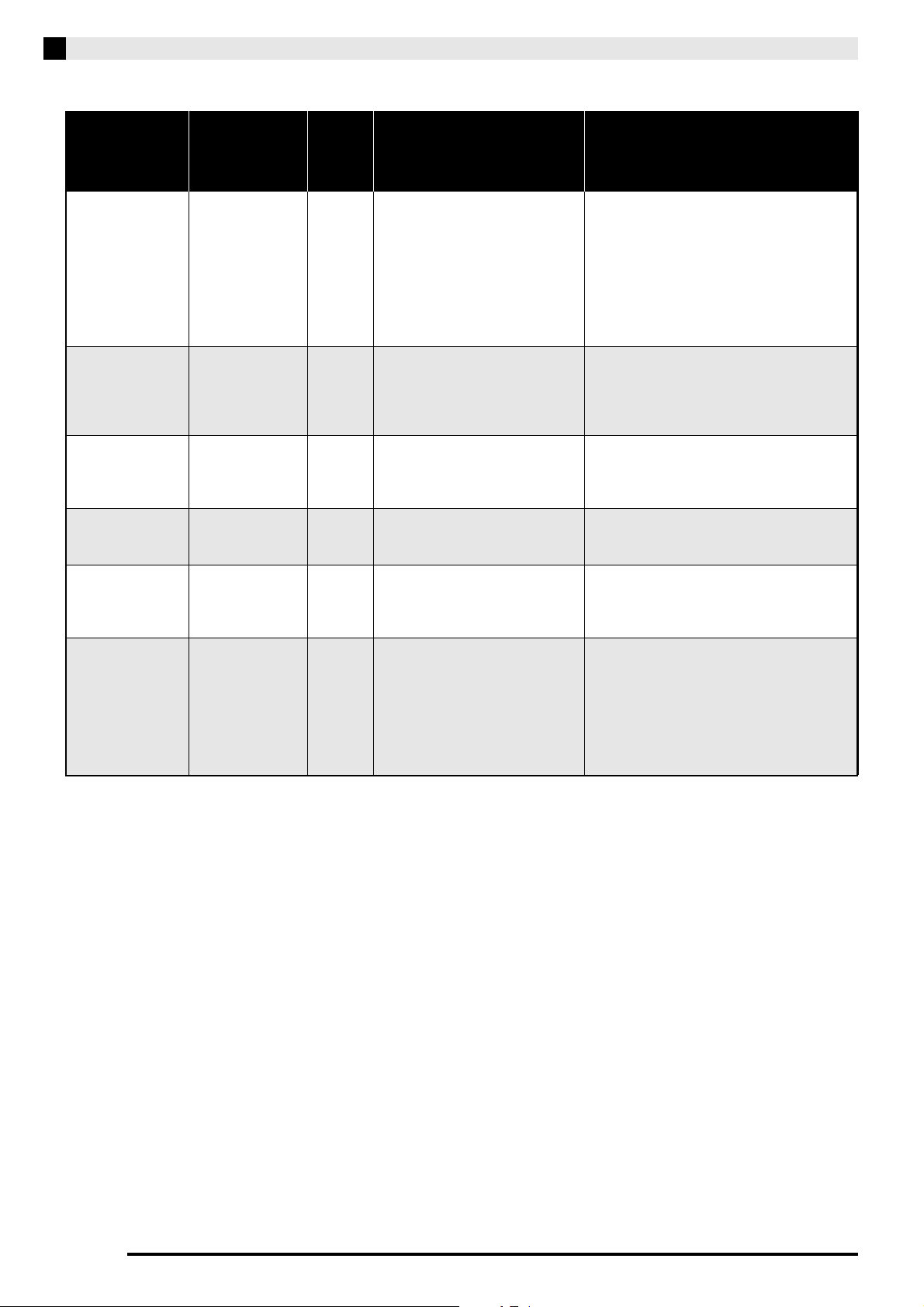
Temperament
Temperament
Base note
Temperament
select
Temperament:
0 to 16
Base note:
C to B
Defaults:
Temperament: 0
(Equal Temperament)
Base note: C
<Selecting a Temperament>
While holding down the
FUNCTION
button, press the
applicable keyboard keys as described
below.
1. Press the
Temperament
keyboard key.
2. Use the
Temperament Select
keyboard keys to select the desired
temperament.
• If you want to advance directly
base note selection from here,
release the
FUNCTION
button
and continue with the procedure
below.
<Selecting a Base Note>
While holding down the
FUNCTION
button, press the
applicable keyboard keys as described
below.
1. Press the
Base Note keyboard
key.
2. Press the keyboard key of the note
you want to specify as the base
note. You can specify any note in
any register.
You can change the
scale (tuning
system) of the
keyboard from
standard equal
temperament to
another tuning that
is more suitable for
playing Indian
music, Arabic
music, classical
pieces, etc.
•When you select
any temperament
other than “Equal”,
you must also
configure a base
note (base note of
the temperament of
the song being
performed) setting.
• For details about
temperament, refer
to a book that
covers music
theory.
<Temperaments>
0: Equal /
1: Pure Major /
2: Pure Minor /
3: Pythagorean /
4: Kirnberger 3 /
5: Werckmeister /
6: Mean-Tone /
7: Rast /
8: Bayati /
9: Hijaz /
10: Saba /
11: Dashti /
12: Chahargah /
13: Segah /
14: Gurjari Todi /
15: Chandrakauns /
16: Charukeshi
Touch response
Off, 1 to 3
Default: 2
D Specifies the
relative touch of the
keyboard keys.
Setting a smaller
value causes lighter
touch to produce
more powerful
sound.
• Each press of the keyboard key
causes it to beep the number of
times shown below to indicate
the current setting.
Once (long): Off
Once (short): 1
Twice: 2
Three times: 3
Transpose
–12 to 0 to 12
Default: 0
B Raises or lowers the
tuning of the Digital
Piano in semitone
steps.
• The transpose setting cannot be
changed while in the Duet Mode.
• Raising the key of the Digital
Piano can cause notes the highest
part of the range to become
distorted.
A-tuning
415.5Hz to 440.0Hz
to 465.9Hz
Default: 440.0Hz
B Raises or lowers the
overall pitch of the
Digital Piano in
0.1Hz steps from
the standard pitch
of A4 = 440.0Hz.
• To toggle between the two
settings below, hold down the
FUNCTION button and press the
A-tuning keyboard keys (+ and –)
at the same time.
440.0 Hz (1 beep)
442.0 Hz (2 beeps)
Octave shift
–2 to 0 to 2
Default: 0
B Change the range of
the keyboard in
octave units.
Keyboard
volume
0 to 42
Default: 42
B Adjusts the volume
levels of all parts
that are controlled
by the keyboard.
EN-32
Configuring Settings with the Keyboard
■ MIDI and Other Settings
Parameter Settings
Operation
Type
(page
EN-25)
Description Remarks
USB flash drive
mode
MIDI, Storage
Default: MIDI
DThe Digital Piano enters MIDI
mode automatically when it is
connected to a computer by a USB
cable. Select storage when saving
Recorder memory song data to a
computer or when loading
computer song data to Digital
Piano memory. (page EN-46)
• After this setting is changed to Storage, the
GRAND PIANO 1, GRAND PIANO 2, and
R lamps will flash, and all other lamps will
be unlit.
• All Digital Piano operations are disabled at
this time.
• Each press of the USB device mode
keyboard key toggles between the MIDI
and storage modes.
Local control
Off, On
Default: On
D Selecting “Off” for Local control
cuts off the Digital Piano’s sound
source, so no sound is produced by
the Digital Piano when keys are
pressed.
Send channel
1 to 16
Default: 1
B Specifies one of the MIDI channels
(1 through 16) as the Send channel,
which is used for sending MIDI
messages to an external device.
Audio Recorder
Volume
00 to 42
Default: 42
B You can adjust the volume level of
audio data recorded to a USB flash
drive.
• The volume level cannot be adjusted while
recording.
Operation tone
Off, On
Default: On
D Selecting “Off” disables sounding
of the operation tone whenever a
keyboard key is pressed while the
FUNCTION is depressed.
• This setting is retained even when the
Digital Piano is turned off.
Panel lock
Off, On
Default: Off
D Selecting “On” for this setting locks
the Digital Piano’s buttons (except
for the P (Power) button and the
buttons required for unlock), so no
operation can be performed.
Turn on operation lock when you
want to protect against
unintentional button operations.
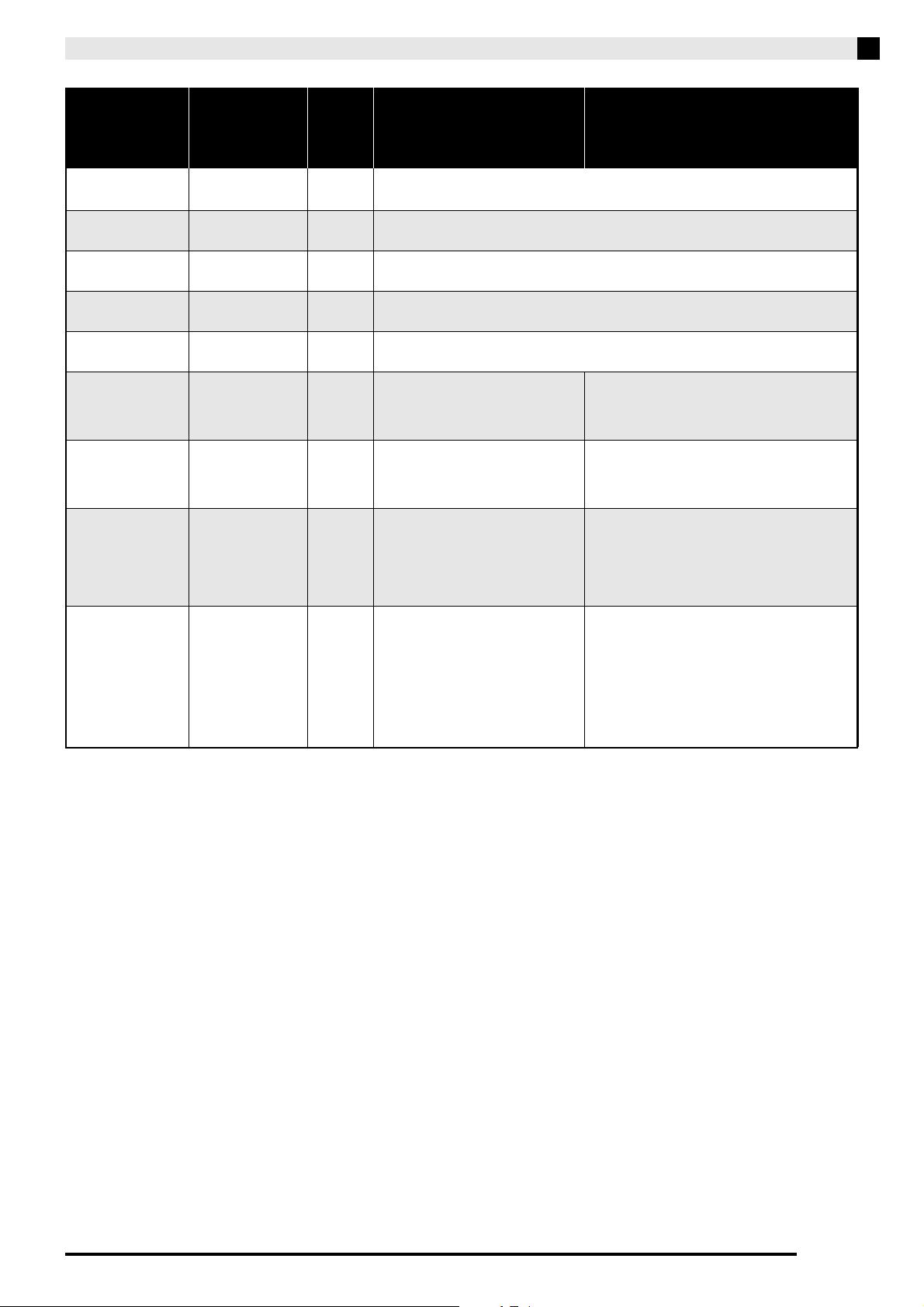
Configuring Settings with the Keyboard
EN-33
USB flash drive
mode
Off, On
Default: Off
– USB flash drive mode.
Format
Off, On
Default: Off
– Formats a USB flash drive.
Save
Off, On
Default: Off
– Stores data to a USB flash drive.
Load
Off, On
Default: Off
– Loads data from a USB flash drive to Digital Piano song memory.
Delete
Off, On
Default: Off
– Deletes USB flash drive data.
Speaker out
Off, On
Default: Off
D When On is selected for this
setting, sound is output to the
speakers even while headphones
are connected.
Head phone
mode
Off, On
Default: On
D When On is selected for this
setting, natural sounding acoustic
piano tones are reproduced when
using headphones.
Volume Sync
Equalizer
Off, Weak, Normal,
Strong
Default: Normal
D Automatically performs timbre
compensation in accordance with
the volume level. This feature
ensures that low range and/or
high range sounds are easier to
hear, even at low volume levels.
• Off: No equalization
• Weak: Weak equalization
• Normal: Normal equalization
• Strong: Strong equalization
Auto Resume
Off, On
Default: Off
D When On is selected for this
setting, the Digital Piano will
remember its settings whenever it
is turned off, and restore them
when power is turned on again.
When Off is selected, settings are
reset to their initial defaults
whenever the Digital Piano is
turned on.
• The settings below are not remembered,
even if Auto Resume is enabled.
Duet Mode
Layered
Tune LR (part) setting
Local Control
Parameter Settings
Operation
Type
(page
EN-25)
Description Remarks
EN-34
Configuring Settings with the Keyboard
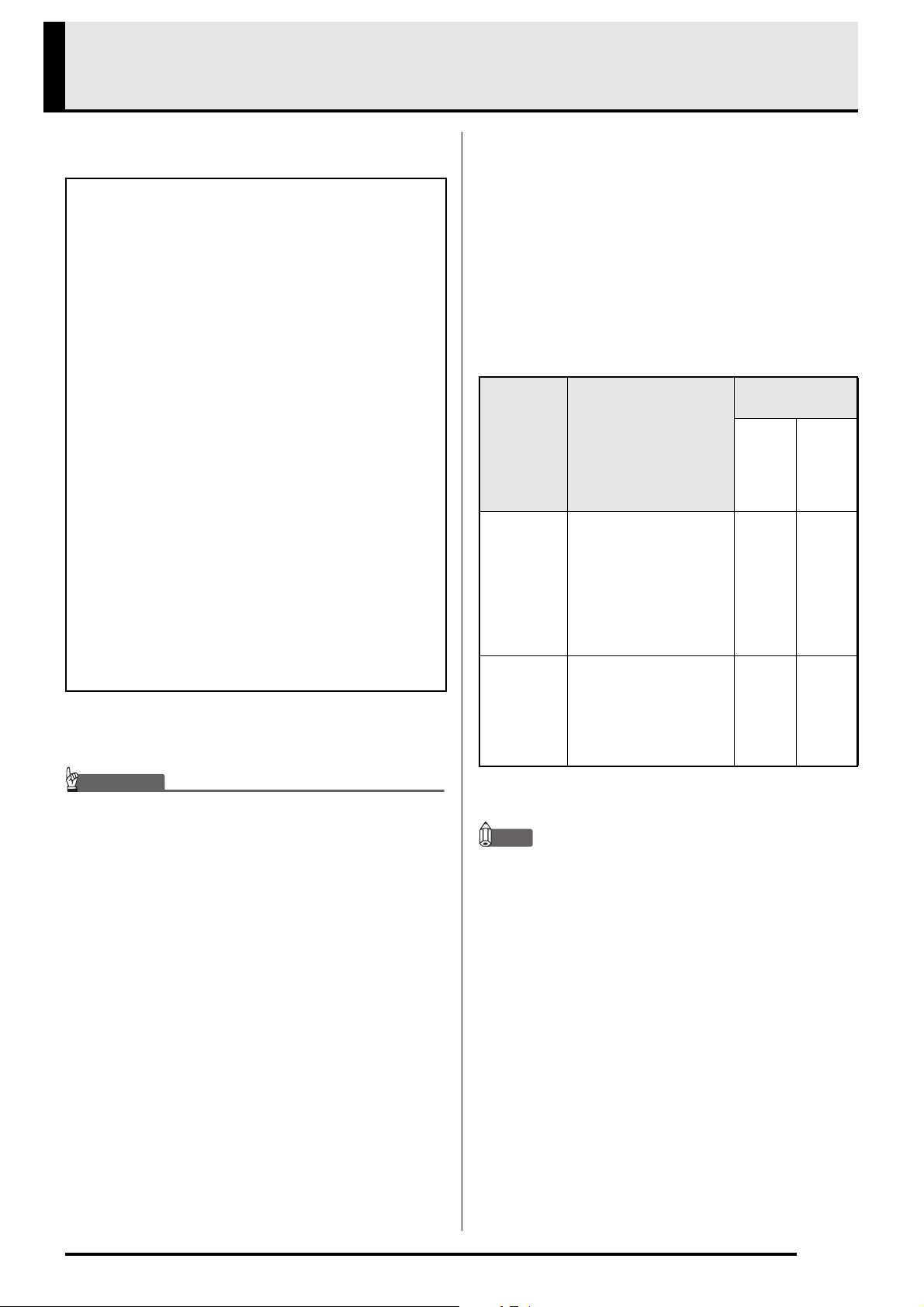
Your Digital Piano can connect with a smartphone,
tablet, or other smart device. A special app is available
to display music scores and a piano roll display to
support your practice.
Downloading the Special App
Go to the website below to download the app and
install it on your smart device.
http://web.casio.com/app/en/
Linking with an Application
(APP Function)
EN-35
USB Flash Drive
Your Digital Piano supports the following USB flash
drive operations.
■ Supported USB Flash Drives
Capacity: 32GB or less recommended
IMPORTANT!
• Operation of the above type of USB flash drive has
been confirmed, but this does not guarantee
operation.
• Use a FAT (FAT32) format USB flash drive.
•You may not be able to use a USB flash drive that is
recognized as multiple drives on your computer.
• A USB flash drive that is recognized as a CD-ROM
on your computer is not supported.
• A USB flash drive with an anti-virus function and/or
security functions is not supported.
■ Data Types Supported by the Digital Piano
■ Save and Load Data Formats and Capacities
* Can be converted to a standard MIDI file (SMF
format 0, file name extension .MID) and saved.
NOTE
• Since audio data can be directly recorded to and
played back from a USB flash drive, there is no need
to store or load it into Digital Piano memory.
Direct recording of keyboard play to the USB flash
drive as audio (.WAV) data
See “Recording to a USB Flash Drive (Audio
Recorder)” (page EN-21).
Direct playback of audio (.WAV) data stored on a
USB flash drive
See “Storing Standard Audio Data (WAV Files)
to a USB Flash Drive” (page EN-36) and “Playing
Back Audio Data Stored on a USB Flash Drive”
(page EN-17).
Using the Song Recorder to save recorded song
(.MID) data to a USB flash drive
See “Saving a Recorded Song to a USB Flash
Drive” (page EN-38)
Loading of song (.MID, .CM2) data stored on a USB
flash drive to a Digital Piano user song number
See “Loading Song Data from a USB Flash Drive
into Digital Piano Memory” (page EN-40)
Direct playback of song (.MID, .CM2) data from a
USB flash drive
See “Simple Play Back of a Song on a USB Flash
Drive” (page EN-42).
See “Formatting a USB Flash Drive” (page EN-37).
See “Deleting Data from a USB Flash Drive” (page
EN-41)
.MID : Can be stored in Digital Piano memory, on a
USB flash drive, or on a computer (connected
via USB).
.CM2 : Can be stored in Digital Piano memory, on a
USB flash drive, or on a computer (connected
via USB).
.CSR : Can be stored in Digital Piano memory or on a
computer (connected via USB).
.WAV: Can be saved on a USB flash drive.
Data Type
Description
(File Name Extension)
Supported
Operations
Save to
USB
flash
drive
Load
from
USB
flash
drive
User songs
(page
EN-46)
One of the following two
types of music data
1. CASIO format data
(CM2)
2. Standard MIDI files
(MID)
SMF Format 0 or
Format 1
– O
Songs
recorded
with song
recorder
(page
EN-18)
Song data recorded on
this Digital Piano (MID)
O* –
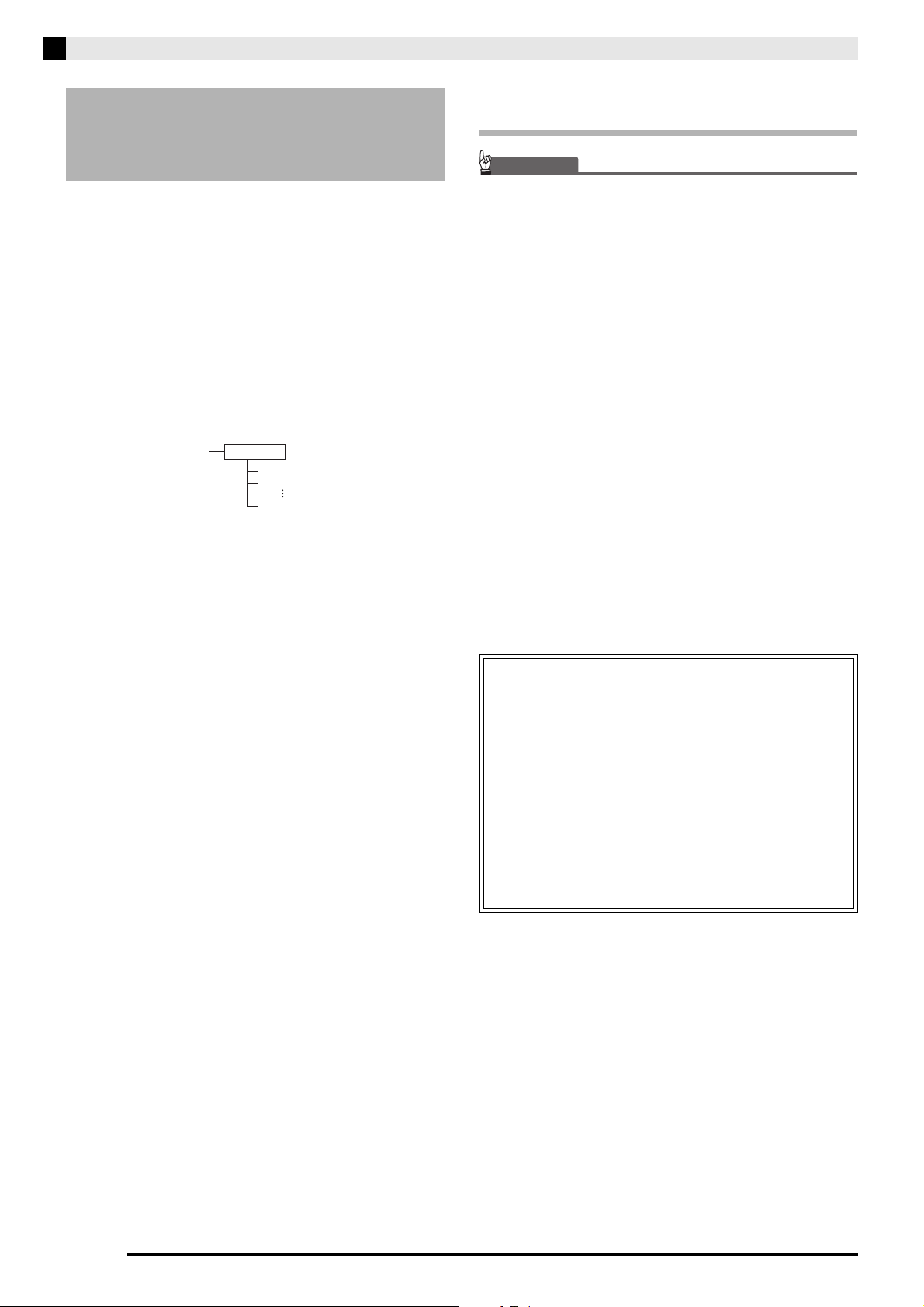
EN-36
USB Flash Drive
Performing a record operation with the Digital Piano’s
audio recorder creates a folder named AUDIO on the
USB flash drive. WAV files are stored in the AUDIO
folder, automatically assigning them names from
TAKE01.WAV to TAKE99.WAV. You also can connect
a USB flash drive to a computer and change the names
of audio data (WAV) files to the format
“TAKEXX.WAV”*, and move them to the AUDIO
folder. Then you will be able to play them back on the
Digital Piano.
* XX = 01 to 99
For information about playback see “Playing Back
Audio Data Stored on a USB Flash Drive” (page
EN-17).
USB Flash Drive and USB Flash Drive
Port Handling Precautions
IMPORTANT!
•Be sure to observe the precautions provided in the
documentation that comes with the USB flash drive.
• Avoid using a USB flash drive under the following
conditions. Such conditions can corrupt data stored
on the USB flash drive.
– Areas subjected to high temperature, high
humidity, or corrosive gas
– Areas subjected to strong electrostatic charge and
digital noise
• Never remove the USB flash drive while data is
being written to or loaded from it. Doing so can
corrupt the data on the USB flash drive and damage
the USB flash drive port.
• Never insert anything besides a USB flash drive into
the USB flash drive port. Doing so creates the risk of
malfunction.
• A USB flash drive can become warm after very long
use. This is normal and does not indicate
malfunction.
• Static electricity conducted to the USB flash drive
port from your hand or from a USB flash drive can
cause malfunction of the Digital Piano. If this
happens, turn the Digital Piano off and then back on
again.
Storing Standard Audio Data
(WAV Files) to a USB Flash
Drive
\AUDIO
TAKE01.WAV
TAKE02.WAV
TAKE99.WAV
USB flash drive
.WAV files
Copyrights
You are allowed to use recordings for your own
personal use. Any reproduction of an audio or music
format file, without the permission of its copyright
holder, is strictly prohibited under copyright laws
and international treaties. Also, making such files
available on the Internet or distributing them to third
parties, regardless of whether such activities are
conducted with or without compensation, is strictly
prohibited under copyright laws and international
treaties. CASIO COMPUTER CO., LTD. shall not be
held in any way liable for any use of this Digital
Piano that is illegal under copyright laws.
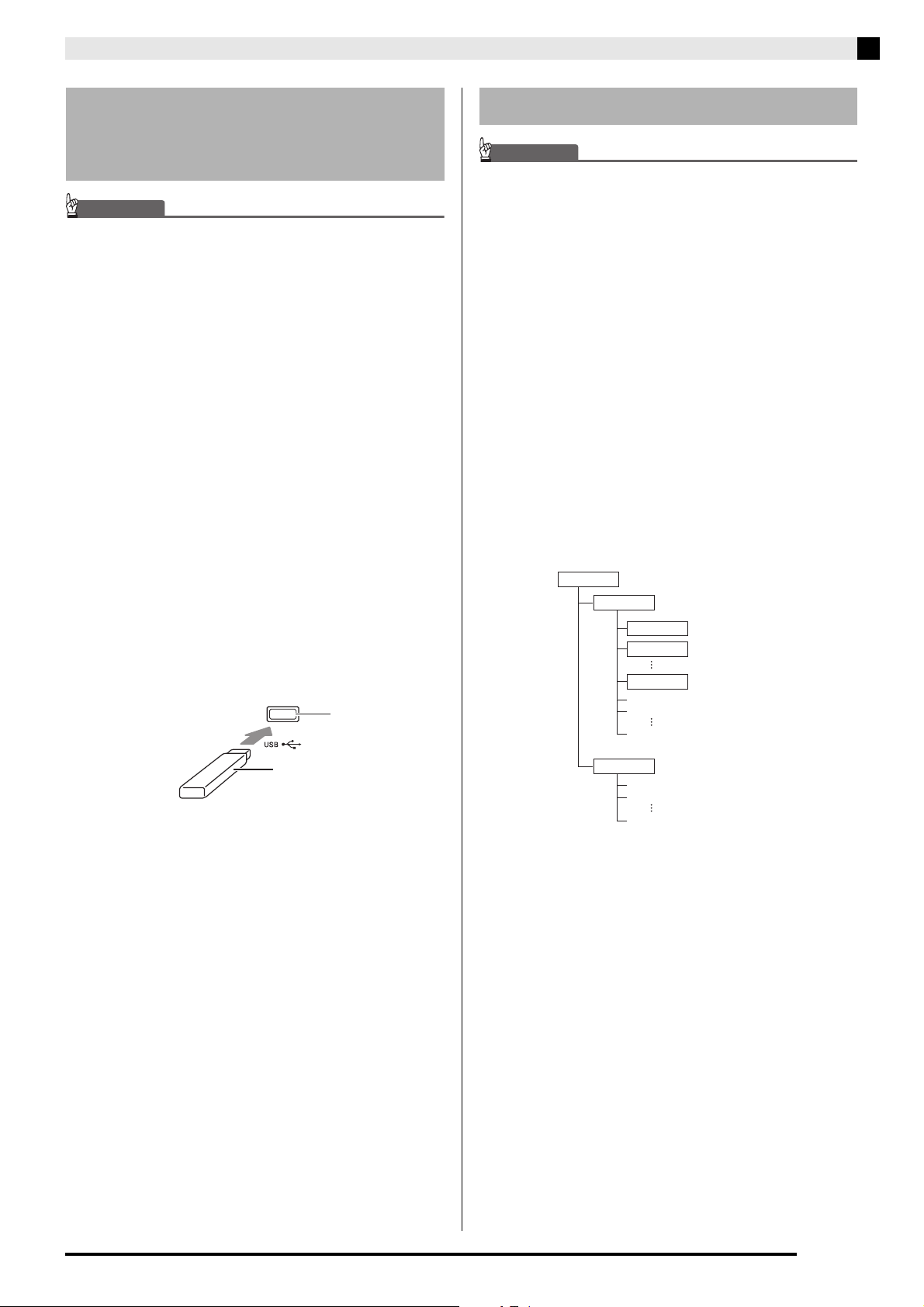
USB Flash Drive
EN-37
IMPORTANT!
• Never plug any other device besides a USB flash
drive into the USB flash drive port.
• When you plug in a USB flash drive, the Digital
Piano initially needs to “mount” the USB flash drive
and prepare for data exchange. Note that Digital
Piano operations are momentarily disabled while a
USB flash drive mounting sequence is being
performed. The Digital Piano’s L/R lamps flash while
the mounting process is in progress. It may take up
to 10 or 20 seconds or even longer for a USB flash
drive to be mounted. Do not attempt to perform any
operation on the Digital Piano while a mounting
sequence is in progress (while L/R lamps are
flashing). A USB flash drive needs to be mounted
each time it is connected to the Digital Piano.
■ To insert a USB flash drive
1.
As shown in the illustration below, insert the
USB flash drive into the Digital Piano’s USB
flash drive port.
• Carefully push the USB flash drive in as far as it will
go. Do not use undue force when inserting the USB
flash drive.
■ To remove a USB flash drive
1.
Check to confirm that there is no data
exchange operation being performed, and
then pull the USB flash drive straight out.
IMPORTANT!
•Be sure to format a USB flash drive on the Digital
Piano before using it for the first time.
• Before formatting a USB flash drive, make sure it
does not have any valuable data stored on it.
• The format operation performed by this Digital Piano
is a “quick format”. If you want to completely delete
all of the data in USB flash drive, format it on your
computer or some other device.
<Supported USB Flash Drives>
This Digital Piano supports USB flash drives formatted
to FAT32. If your USB flash drive is formatted to a
different file system, use the Windows format function
to reformat it to FAT32. Do not use quick format.
■ USB Flash Driver Folder Structure Diagram
Formatting a USB flash drive on the Digital Piano will
automatically create the folders shown in the diagram
below.
1.
Insert the USB flash drive you want to format
into the Digital Piano’s USB flash drive port.
Connecting a USB Flash Drive
to and Detaching It from the
Digital Piano
USB flash drive
USB flash drive port
Formatting a USB Flash Drive
\AUDIO
TAKE01.WAV
TAKE02.WAV
TAKE99.WAV
\MUSICLIB
AAAA.MID
BBBB.CM2
CCCC.MID
\70
\62
\61
\
.MID files or .CM2 files
.WAV files
USB flash drive
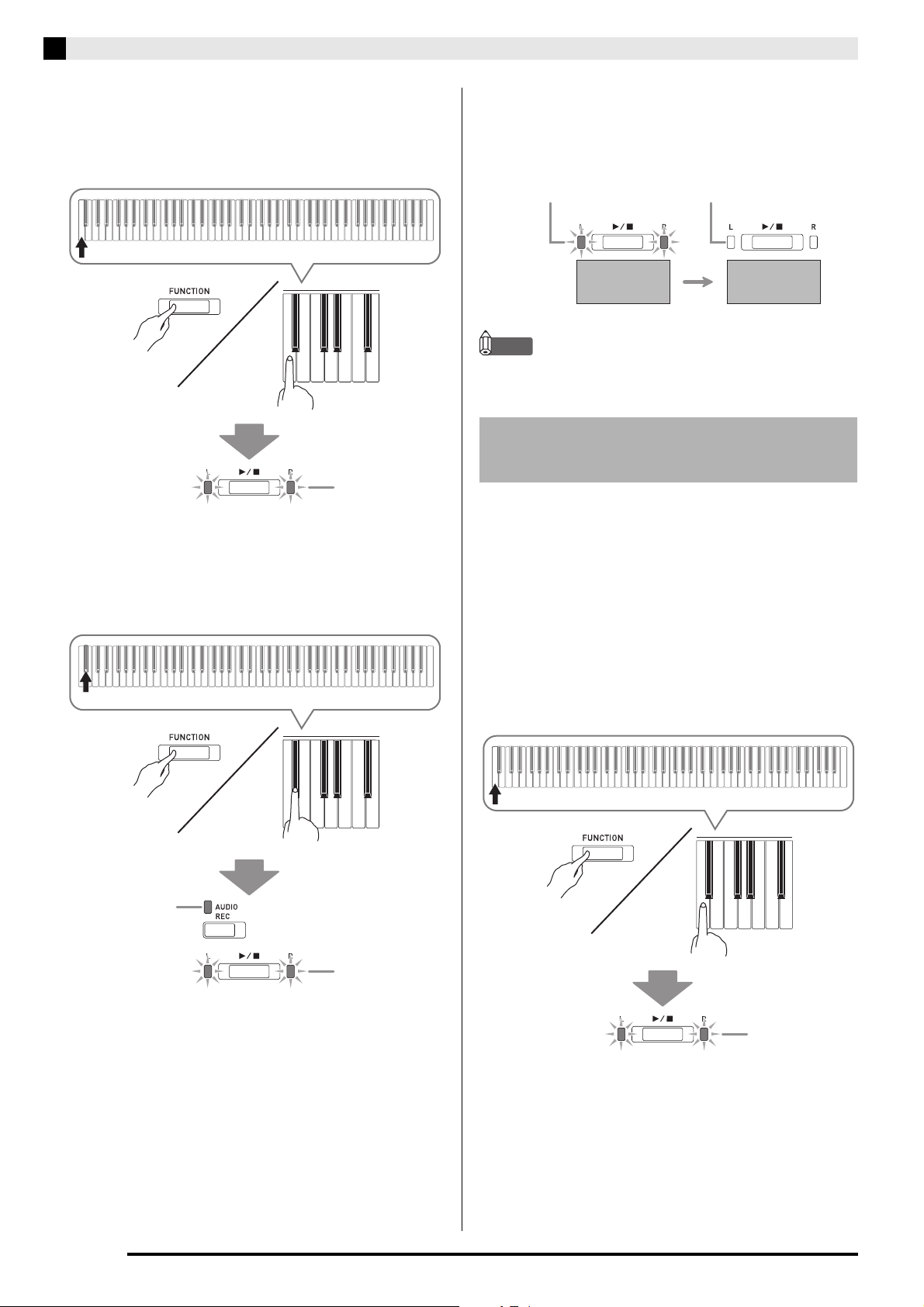
EN-38
USB Flash Drive
2.
While holding down the FUNCTION button,
press the keyboard key that corresponds to
the USB flash drive mode.
• This will cause the L/R lamps to flash.
3.
While holding down the FUNCTION button,
press the format USB flash drive keyboard
key.
• This will cause the AUDIO REC lamp to light.
• To cancel the format operation, hold down the
FUNCTION button as you press the USB flash drive
mode key.
4.
Press the a button.
• This starts formatting.
• After formatting is complete, the L/R lamps will go
out and the Digital Piano will exit the formatting
operation.
NOTE
• Formatting a large-capacity USB flash drive can take
several minutes.
Use the procedure below to save data you recorded on
the Digital Piano to a USB flash drive as a MIDI file
(SMF format 0).
1.
Insert the USB flash drive into the Digital
Piano’s USB flash drive port.
2.
While holding down the FUNCTION button,
press the keyboard key that corresponds to
the USB flash drive mode.
• This will cause the L/R lamps to flash.
Flashing
Lit
Flashing
Saving a Recorded Song to a
USB Flash Drive
Flashing Unlit
Formatting
started
Formatting
complete
Flashing
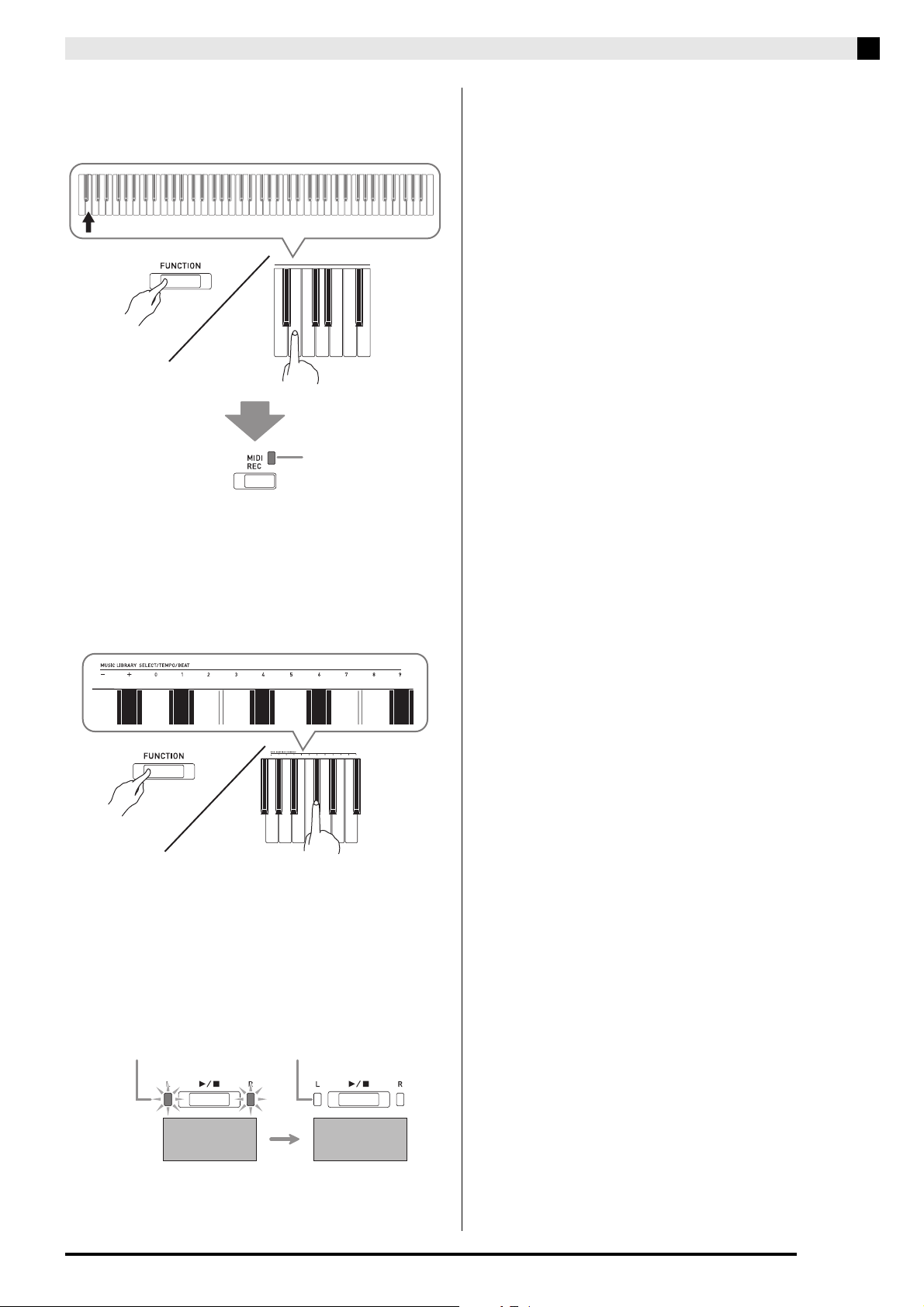
USB Flash Drive
EN-39
3.
While holding down the FUNCTION button,
press the save USB flash drive keyboard key.
• This will cause the MIDI REC lamp to light.
• To exit the data save operation, hold down the
FUNCTION button as you press the USB flash drive
mode key.
4.
Hold down the FUNCTION button as you use
the MUSIC LIBRARY SELECT keyboard
keys to select a song number (61 to 70).
• The Digital Piano will emit a short beep if you specify
a correct song number, and a long beep if the song
number is not correct.
5.
Press the a button.
• This starts the data save operation.
• When saving is complete, the L/R lamps will go out
to indicate that the USB flash drive mode has been
exited.
■ USB Flash Drive Data (File) Storage
Locations
The above procedure stores piano data in a folder
named MUSICLIB on the USB flash drive.
• The MUSICLIB folder is created automatically when
you format the USB flash drive on the Digital Piano
(page EN-37).
• Note that files not in the MUSICLIB folder cannot be
loaded or deleted by this Digital Piano.
• The “MUSICLIB” folder contains sub-folders named
“61” through “70”. Data is saved in the sub-folder
whose name corresponds to the song number you
specify in step 4 of the procedure above.
Lit
Flashing Unlit
Save started Save complete
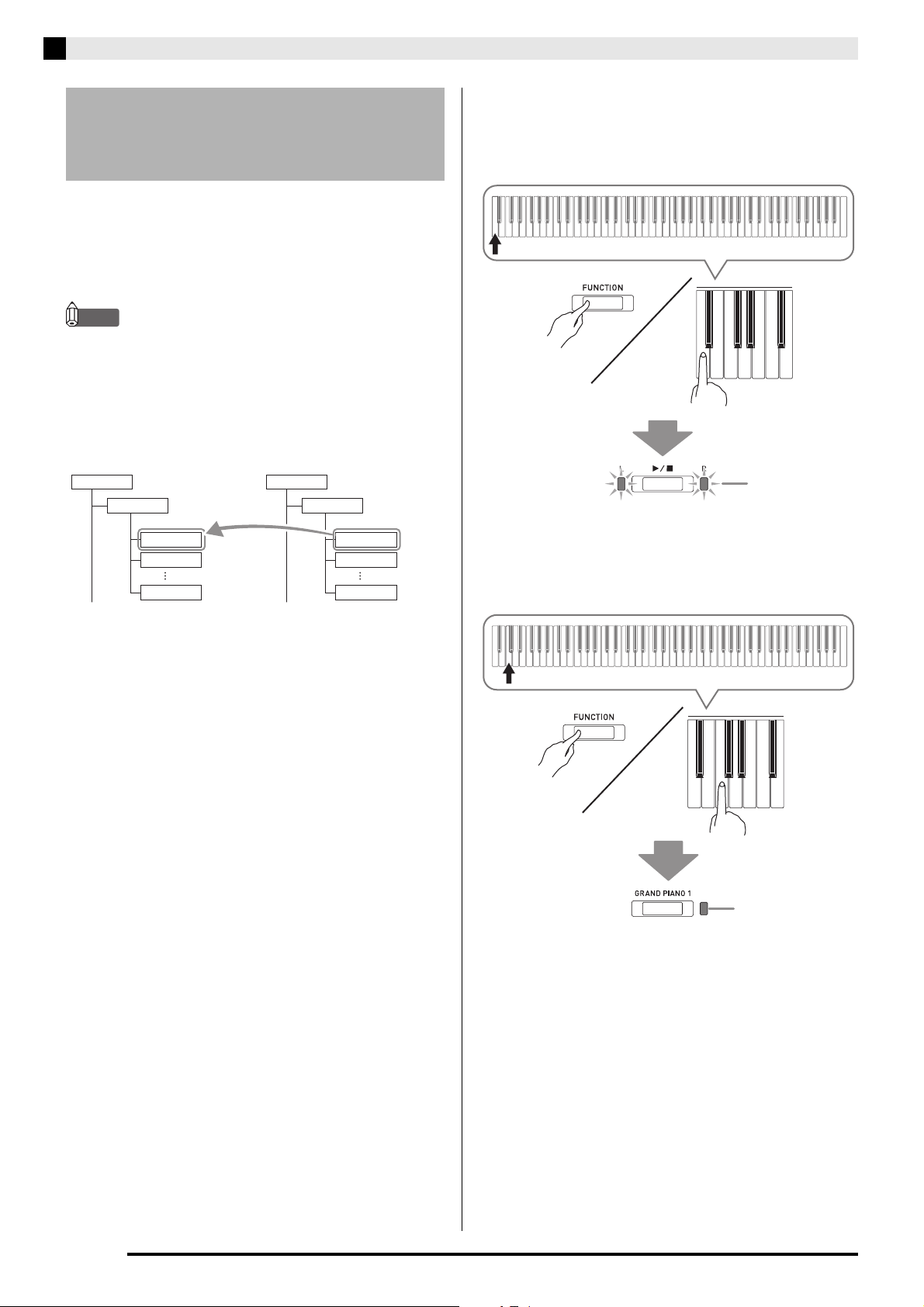
EN-40
USB Flash Drive
You can use the procedure below to load user song
data (page EN-46) from a USB flash drive to the Digital
Piano’s Music Library (song numbers 61 to 70). After
that, you can play back the user song or use it for
lesson play.
NOTE
• Loading song data from a USB flash drive assigns it
to the corresponding user song number. Loading
song data 61 from a USB flash drive, for example,
will assign it to user song number 61 in Digital Piano
memory. Then you will be able to select the song by
selecting user (Music Library) song 61.
1.
On your computer, copy the file you want to
load to one of the numbered sub-folders (61
through 70) inside the “MUSICLIB” folder on
the USB flash drive.
• The number names of the sub-folders correspond to
the Digital Piano’s user song numbers (61 to 70).
2.
Insert the USB flash drive into the Digital
Piano’s USB flash drive port.
3.
While holding down the FUNCTION button,
press the keyboard key that corresponds to
the USB flash drive mode.
• This will cause the L/R lamps to flash.
4.
While holding down the FUNCTION button,
press the load USB flash drive keyboard key.
• This will cause the GRAND PIANO 1 lamp to light.
• To cancel the load operation, hold down the
FUNCTION button as you press the USB flash drive
mode key.
Loading Song Data from a
USB Flash Drive into Digital
Piano Memory
\MUSICLIB
\70
\62
\61
\MUSICLIB
\70
\62
\61
\PIANO\
.MID files or
.CM2 files
.MID files or
.CM2 files
<Data Loaded>
USB flash driveDigital Piano memory
Flashing
Lit
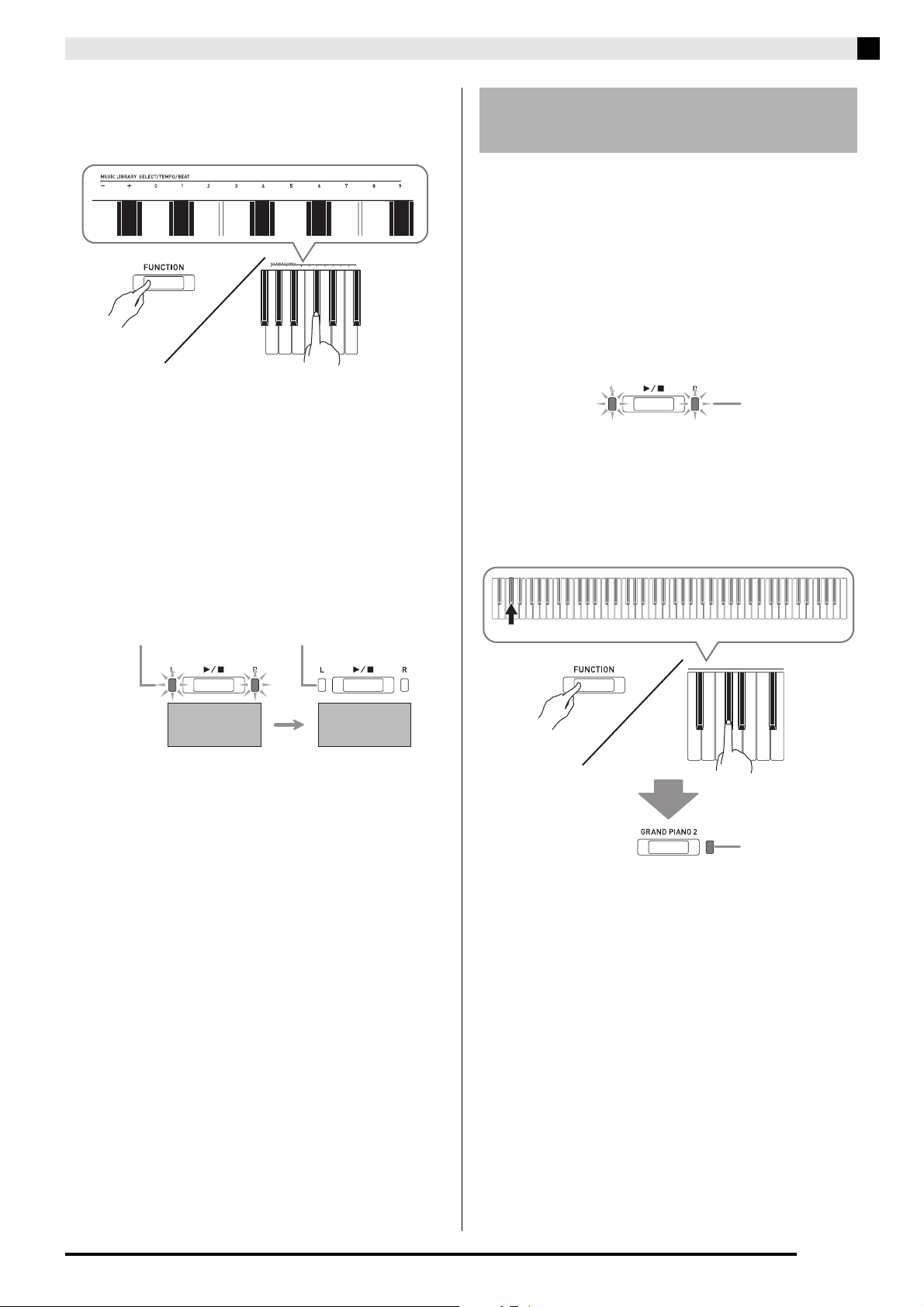
USB Flash Drive
EN-41
5.
Hold down the FUNCTION button as you use
the MUSIC LIBRARY SELECT keyboard
keys to select a song number (61 to 70).
• The Digital Piano will emit a short beep if you specify
a correct song number, and a long beep if the song
number is not correct.
• Selecting song number 00 will batch load the 10 files
from 61 through 70 to the Digital Piano’s song
memory.
6.
Press the a button.
• This starts loading of the data to the Music Library
user song area.
• After data loading is complete, the L/R lamps will go
out and the Digital Piano will exit the loading
operation.
• To play back loaded song data, exit (turn off) the USB
flash drive mode and then press the a button.
You can use the procedure below to delete song data
stored in the “MUSICLIB” folder on a USB flash drive.
1.
Insert the USB flash drive into the Digital
Piano’s USB flash drive port.
2.
While holding down the FUNCTION button,
press the keyboard key that corresponds to
the USB flash drive mode.
• This will cause the L/R lamps to flash.
3.
While holding down the FUNCTION button,
press the delete USB flash drive keyboard
key.
• This will cause the GRAND PIANO 2 lamp to light.
• To exit the data delete operation, hold down the
FUNCTION button as you press the USB flash drive
mode key.
Flashing Unlit
Loading start Loading complete
Deleting Data from a USB
Flash Drive
Flashing
Lit
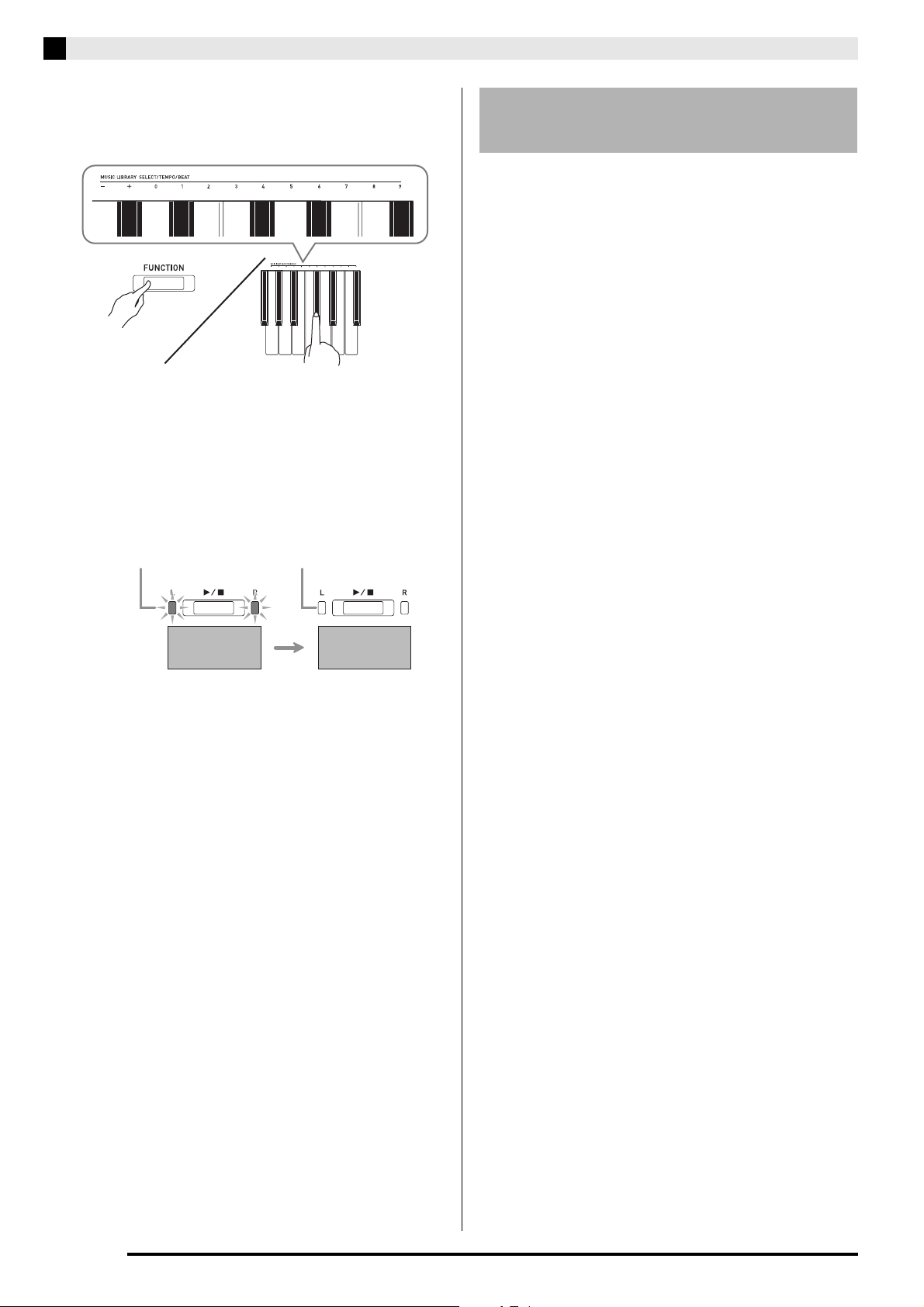
EN-42
USB Flash Drive
4.
Hold down the FUNCTION button as you use
the MUSIC LIBRARY SELECT keyboard
keys to select a song number (61 to 70).
• The Digital Piano will emit a short beep if you specify
a correct song number, and a long beep if the song
number is not correct.
5.
Press the a button.
• This starts deletion of the selected data.
• When deleting is complete, the L/R lamps will go out
to indicate that the USB flash drive mode has been
exited.
You can use the procedure below to play back a user
song (page EN-46) stored on a USB flash drive without
loading the song into Digital Piano Music Library
memory (song numbers 61 to 70).
1.
On your computer, copy the data you want to
play back on the Digital Piano into the
MUSICLIB folder on the USB flash drive.
• Of the song data in the MUSICLIB folder, you can
select any of the first 00 to 99 songs, sorted in file
name sequence, for playback.
2.
Insert the USB flash drive into the Digital
Piano’s USB flash drive port.
3.
While holding down the FUNCTION button,
press the keyboard key that corresponds to
the USB flash drive mode.
• This will cause the L/R lamps to flash.
4.
Press the a button.
• This will start playback of the song data.
• Press the a button again to stop playback.
5.
To change to another song, hold down the
FUNCTION button as you use the MUSIC
LIBRARY SELECT plus (+) and minus (–)
keyboard keys to select the song you want to
hear.
• Pressing the plus (+) or minus (–) key scrolls through
song file names.
• You can also input a value from 0 to 9 to specify a
Music Library song number.
• Input two digits as the song number.
Example: To specify song number 5, press keys 0 and
then 5
6.
To exit the USB flash drive song playback
function, hold down the FUNCTION button as
you press the USB flash drive mode key.
Flashing Unlit
Delete start Delete complete
Simple Play Back of a Song on
a USB Flash Drive
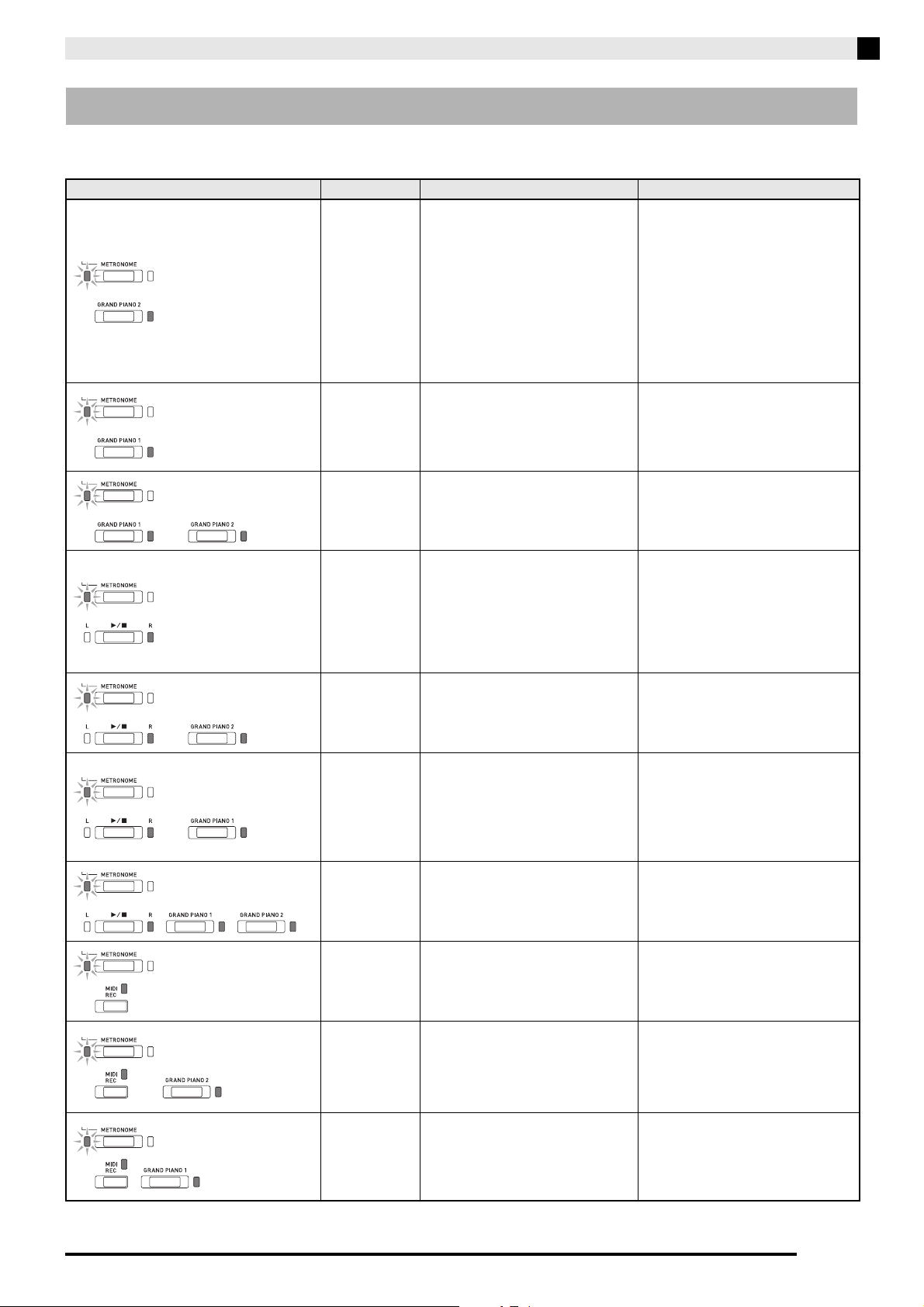
USB Flash Drive
EN-43
The following shows how the lamps indicate the error type when an error occurs due to data transfer failure or
some other reason.
Error Indicators
Lamps Error Type Cause Action
No Media
1. The USB flash drive is not
connected to the Digital
Piano’s USB flash drive port.
1. Correctly plug the USB flash
drive into the USB flash drive
port.
2. The USB flash drive was
removed while some
operation was in progress.
2. Do not remove the USB flash
drive while any operation is in
progress.
3. The USB flash drive is write-
protected.
3. Unprotect the USB flash drive.
4. The USB flash drive has anti-
virus software.
4. Use a USB flash drive that does
not have anti-virus software.
No File
There is no loadable file in the
“MUSICLIB” folder or no
playable file in the “AUDIO”
folder.
Move the file you want to load
into the “MUSICLIB” folder or the
file you want to play into the
“AUDIO” folder (pages EN-36
and EN-38).
No Data
You are attempting to save data
to a USB flash drive when there is
no data to save.
Record something before
performing a save operation.
Read Only
A read-only file with the same
name you are trying to use is
already stored on USB flash
drive.
• Change the name and then save
the new data.
• Remove the read-only attribute
from the existing USB flash
drive file and overwrite it with
the new data.
• Use a different USB flash drive.
Media Full
There is not enough space
available on the USB flash drive.
Delete some of the files on the USB
flash drive to make room for new
data (page EN-41) or use a
different USB flash drive.
File Full
1. There are too many files on
the USB flash drive.
1. Delete some of the files on the
USB flash drive to make room
for new data.
2. There is a file named
TAKE99.WAV in the
“AUDIO” folder.
2. Delete the WAV file in the
“AUDIO” folder.
Not SMF01
You are attempting to play back
SMF Format 2 song data.
This Digital Piano supports
playback of SMF Format 0 or
Format 1 only.
Size Over
The data on the USB flash drive is
too big to play.
This Digital Piano supports
playback of song data files with a
maximum size of 90 kbytes.
Wrong Data
1. The USB flash drive data is
corrupted.
—
2. USB flash drive contains data
that is not supported by this
Digital Piano.
Convert
There is not enough Digital Piano
memory available to convert a
MIDI Recorder song to SMF data
and store it on the USB flash
drive.
Reduce the size of the song data.
Example:
Delete any tracks that are not
required.
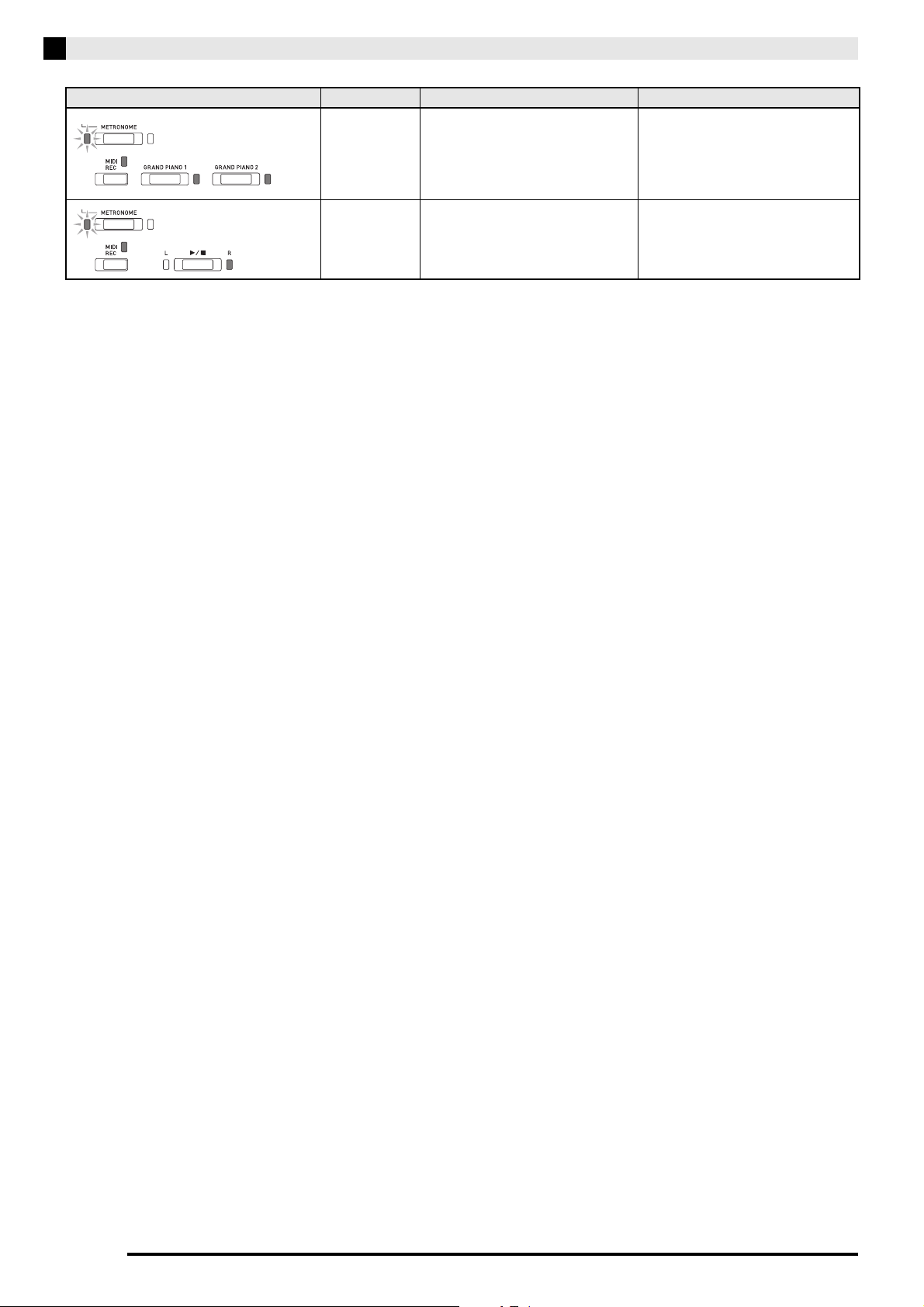
EN-44
USB Flash Drive
Format
1. The USB flash drive format is
not compatible with this
Digital Piano.
1. Format the USB flash drive on
the Digital Piano.
2. The USB flash drive is
corrupted.
2. Use a different USB flash drive.
Media R/W
The USB flash drive is corrupted. Use a different USB flash drive.
Lamps Error Type Cause Action
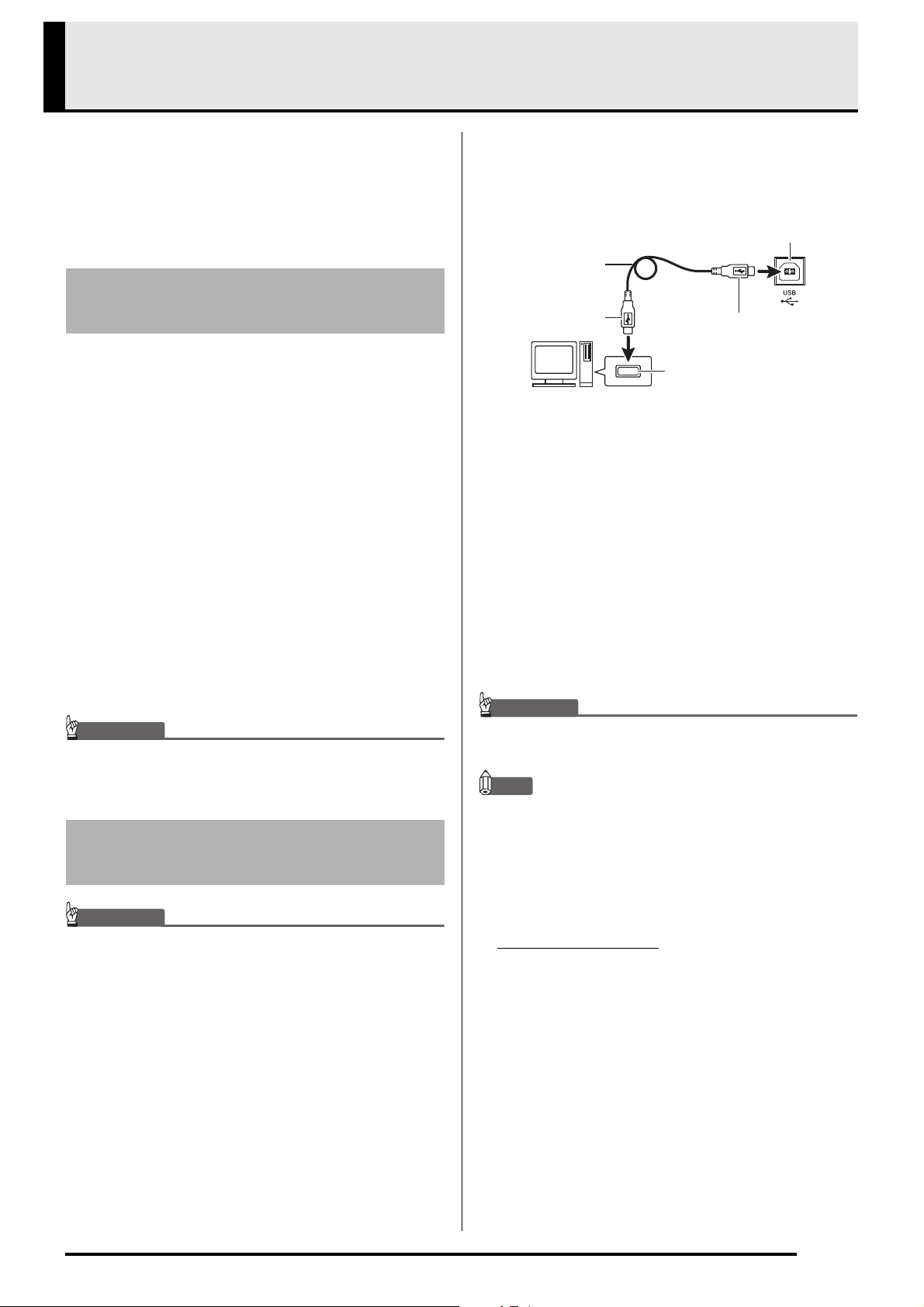
EN-45
Connecting to a Computer
You can connect the Digital Piano to a computer and
exchange MIDI data between them. You can send play
data from the Digital Piano to commercially available
music software running on your computer, or you can
send MIDI data from your computer to the Digital
Piano for playback.
The following shows the minimum computer system
requirements for sending and receiving MIDI data.
Check to make sure that your computer complies with
these requirements before connecting the Digital Piano
to it.
Operating System
Windows Vista
*1
Windows 7
*2
Windows 8.1
*3
Windows 10
*4
macOS (OS X/Mac OS X) 10.7, 10.8, 10.9, 10.10, 10.11,
10.12
USB port
IMPORTANT!
• Never connect to a computer that does not conform
to the above requirements. Doing so can cause
problems with your computer.
IMPORTANT!
• Make sure you follow the steps of the procedure
below exactly. Connecting incorrectly can make data
send and receive impossible.
1.
Turn off the Digital Piano and then start up
your computer.
• Do not start up the music software on your computer
yet!
2.
After starting up your computer, use a
commercially available USB cable to connect
it to the Digital Piano.
• Use a USB 2.0 or 1.1 A-B connector type USB cable.
3.
Turn on the Digital Piano.
• If this is the first time you are connecting the Digital
Piano to your computer, the driver software required
to send and receive data will be installed on your
computer automatically.
4.
Start up commercially available music
software on your computer.
5.
Configure the music software settings to
select “CASIO USB-MIDI” as the MIDI device.
• For information about how to select the MIDI device,
see the user documentation that comes with the
music software you are using.
IMPORTANT!
•Be sure to turn on the Digital Piano first before
starting up your computer’s music software.
NOTE
• Once you are able to connect successfully, there is no
problem with leaving the USB cable connected when
you turn off your computer and/or Digital Piano.
• For detailed specifications and connections that
apply to MIDI data send and receive by this Digital
Piano, see the latest support information provided
by the website at the following URL.
http://world.casio.com/
Minimum Computer System
Requirements
*1: Windows Vista (32-bit)
*2: Windows 7 (32-bit, 64-bit)
*3: Windows 8.1 (32-bit, 64-bit)
*4: Windows 10 (32-bit, 64-bit)
Connecting the Digital Piano
to Your Computer
Computer USB port
A connector
Digital Piano USB port
B connector
USB cable
(USB 2.0 or 1.1 A-B
connector type)
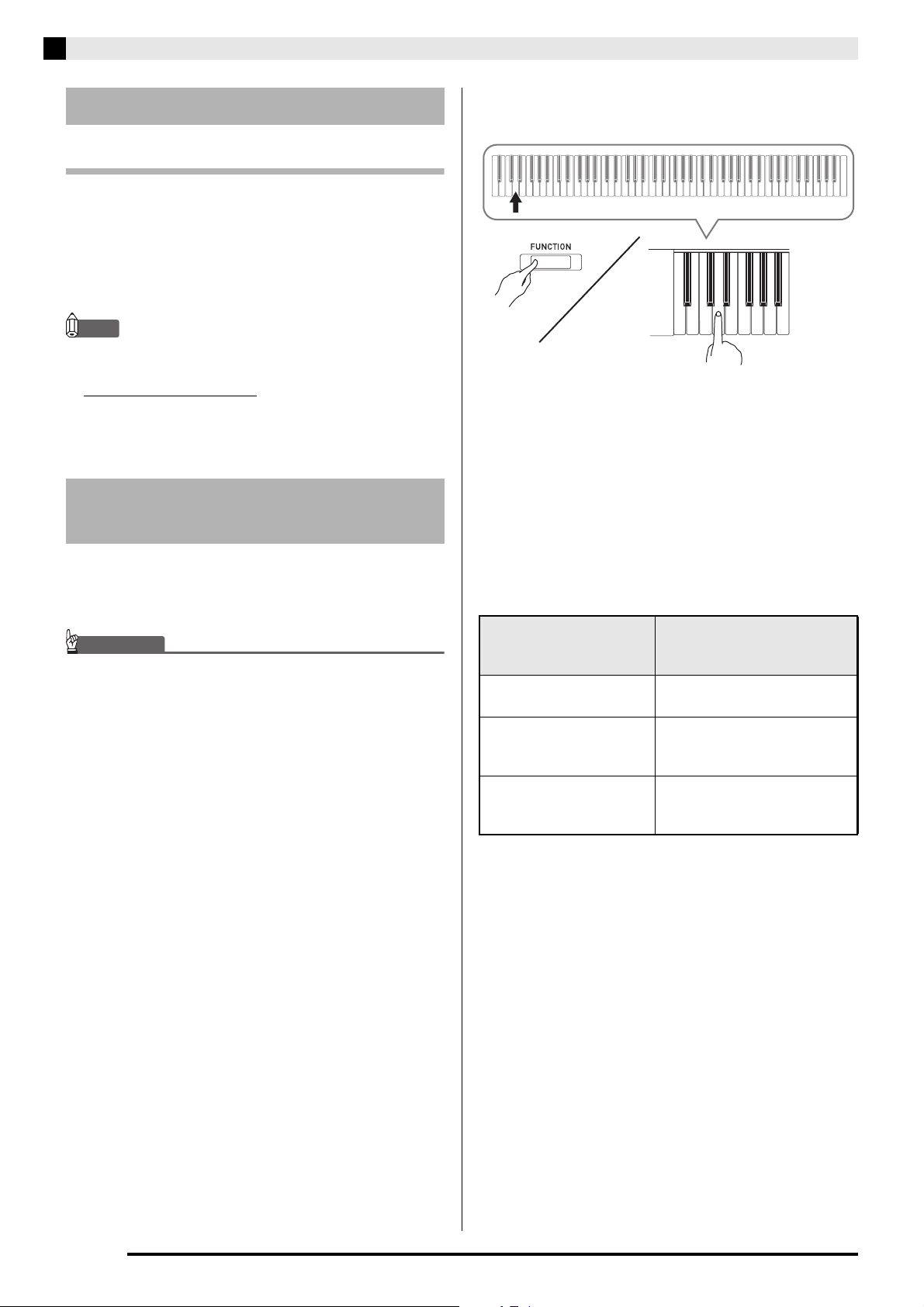
EN-46
Connecting to a Computer
What is MIDI?
The letters MIDI stand for Musical Instrument Digital
Interface, which is the name of a worldwide standard
for digital signals and connectors that makes it possible
to exchange musical data between musical instruments
and computers (machines) produced by different
manufacturers.
NOTE
• For detailed information about MIDI
Implementation, visit the CASIO website at:
http://world.casio.com/
.
See “Send channel” and “Local control” on page
EN-32.
Use the procedures in this section to transfer Recorder
memory data to a computer for storage, and to load
songs to user song memory (Music Library 61 to 70).
IMPORTANT!
•Turning off the Digital Piano while data is being
saved or loaded can cause all data currently stored
in Digital Piano memory (recorded songs, etc.) to be
deleted. Take care so power is not turned off
accidentally during data save and load operations. If
data is deleted, it will take longer than normal for the
Digital Piano to power up the next time you turn it on
(page EN-5).
1.
Perform steps 1 through 3 of the procedure
under “Connecting the Digital Piano to Your
Computer” on page EN-45.
2.
Change the Digital Piano’s USB device mode
to storage.
• While holding down the FUNCTION button, press
the keyboard key that corresponds to the USB device
mode.
• After this setting is changed, the GRAND PIANO 1,
GRAND PIANO 2, R lamps flash, and all other lamps
are unlit.
• See “USB flash drive mode” on page EN-32 for more
information.
3.
On your computer, perform the required
operation to display your computer’s storage
devices.
• The memory of this Digital Piano will appear as
“PIANO” under “Devices with Removable Storage”.
Using MIDI
Transferring Song Data with a
Computer
If your computer is
running this operating
system:
Do this:
Windows Vista,
Windows 7
Double-click “Computer”.
Windows 8.1,
Windows 10
Open any folder. On the
navigation window, click
“PC”.
Mac OS Skip step 3 and double-click
“PIANO” on your Mac
desktop.
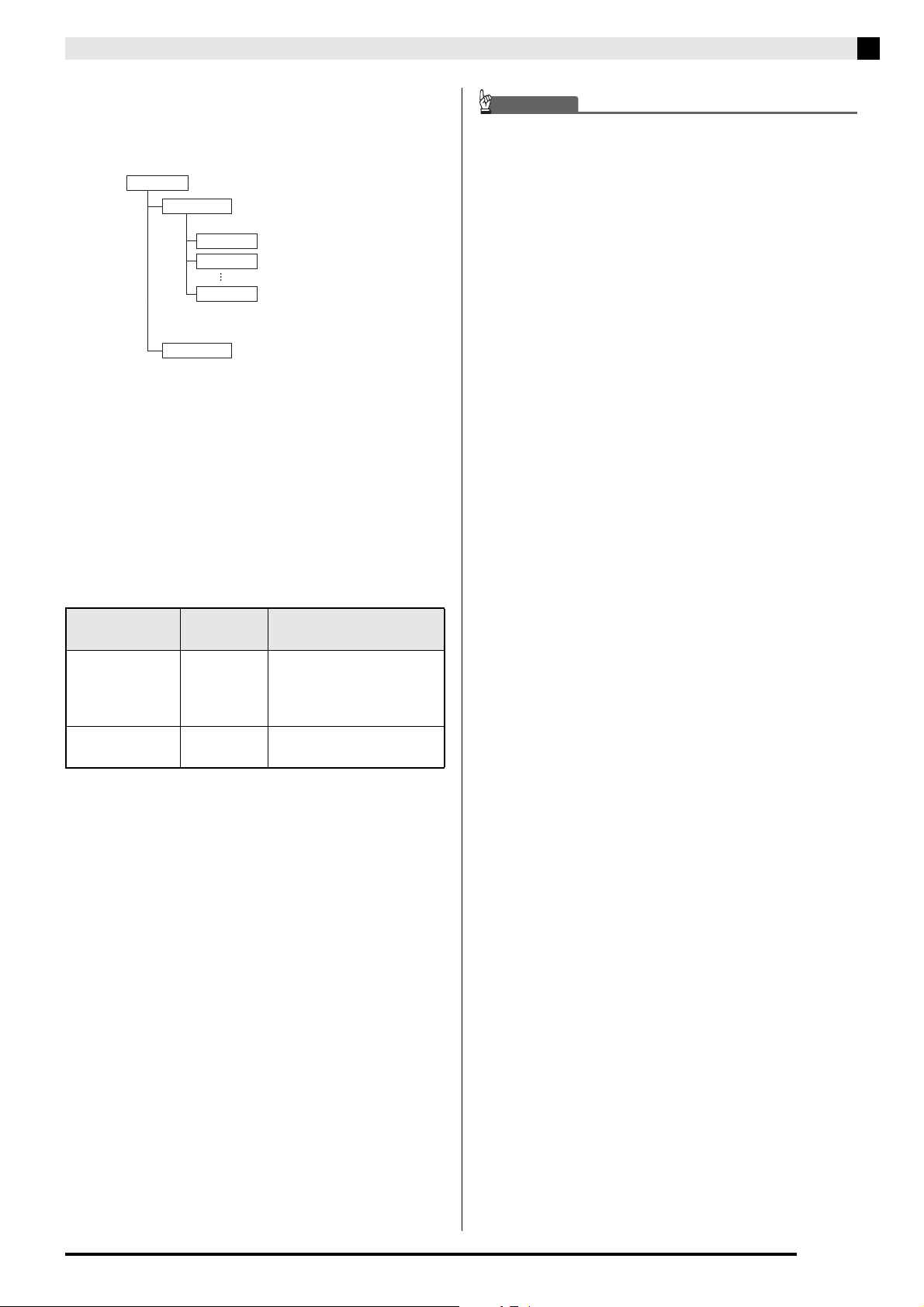
Connecting to a Computer
EN-47
4.
Double-click “PIANO”.
• “PIANO” contains folders named “MUSICLIB” and
“RECORDER”.
• To transfer a user song to the Digital Piano from your
computer, open the “MUSICLIB” folder and put the
song into one of the numbered subfolders (61
through 70). Each subfolder corresponds to a Music
Library number: Subfolder 61 to Music Library 61,
and so on.
• For example, storing song data in sub-folder 61 will
cause it to be treated as Music Library song 61 data by
the Digital Piano.
• To store Recorder song (.CSR) data on a computer,
copy the .CSR file in the RECORDER folder to the
computer. To return saved song (.CSR) data to Digital
Piano memory, copy it to the RECORDER folder.
* Before starting a store or load operation, first check
the file name extension to ensure it matches the ones
shown in this column.
In the case of a song recorded with the Digital
Piano’s recorder function, change its file name to one
of the names and extensions shown in this column.
IMPORTANT!
• The initial default configuration for Windows Vista,
Windows 7, Windows 8.1, and Windows 10 is to hide
file name extensions. Perform one of the following
operations on your computer to show file name
extensions.
• To show file name extensions under Windows Vista
or Windows 7
• To show file name extensions under Windows 8.1 or
Windows 10
■ To load a song into user song memory
(Music Library 61 to 70)
Data Type
Folder
Name
File Name and Extension
*
User songs MUSICLIB .MID: SMF format data
(format 0/1)
.CM2: CASIO original
format data
Recorder
memory data
RECORDER BIDREC01.CSR: CASIO
original format data
\RECORDER
\MUSICLIB
\70
\62
\61
\PIANO
.MID files or .CM2 files
.CSR file (only one song data)
Digital Piano memory
1. Open Folder Options by clicking the [Start] button,
clicking [Control Panel], clicking [Appearance and
Personalization], and then clicking [Folder Options].
2. Click the [View] tab. Under [Advanced settings]
clear the [Hide extensions for known file types]
check box.
3. Click [OK].
1. Open any folder.
2. Click the [View] menu and then select the [File name
extensions] check box in the [Show/hide] group.
1. Open the MUSICLIB folder.
2. Copy the song file (.MID or .CM2) to the number-
named subfolder (61 to 70) whose name matches the
number of the Music Library location to which you
want to load the song.
• If there are two files with the filename extensions
.MID and .CM2 in the MUSICLIB folder, only the
.MID data will be loaded into user song memory.
EN-48
Connecting to a Computer
■ To transfer Recorder memory data between
the Digital Piano and your computer
To transfer the Digital Piano’s current Recorder
memory data to your computer, copy the contents of
the RECORDER folder to your computer.
To return Recorder data you previously saved to your
computer back to Recorder memory, copy it back to the
RECORDER folder (and replace the current
RECORDER folder contents).
5.
After the file copy operation is complete,
return the USB device mode to MIDI.
• If you are using a Macintosh, perform the eject
operation (drag them to the trash can).
• While holding down the FUNCTION button, press
the applicable keyboard key. See “USB flash drive
mode” on page EN-32 for more information.
• Returning the USB device mode to MIDI will load the
contents of MUSICLIB into user song memory and
the contents of RECORDER into Recorder memory.
IMPORTANT!
• A data conversion error is indicated when the
GRAND PIANO 1, GRAND PIANO 2, L/R lamps are
all lit, and all other lamps are unlit.
Copyrights
The rights of creators and copyright holders of music,
images, computer programs, databases, and other
data are protected by copyright laws. You are allowed
to reproduce such works for personal or non-
commercial use only. For any other purpose, all
reproduction (including data format conversion),
modification, transfer of reproductions, distribution
over a network, or any other use without permission
of the copyright holder exposes you to claims for
damages and criminal prosecution for copyright
infringement and violation of the author’s personal
rights. Be sure to reproduce and otherwise use
copyrighted works only in accordance with applicable
copyright laws.
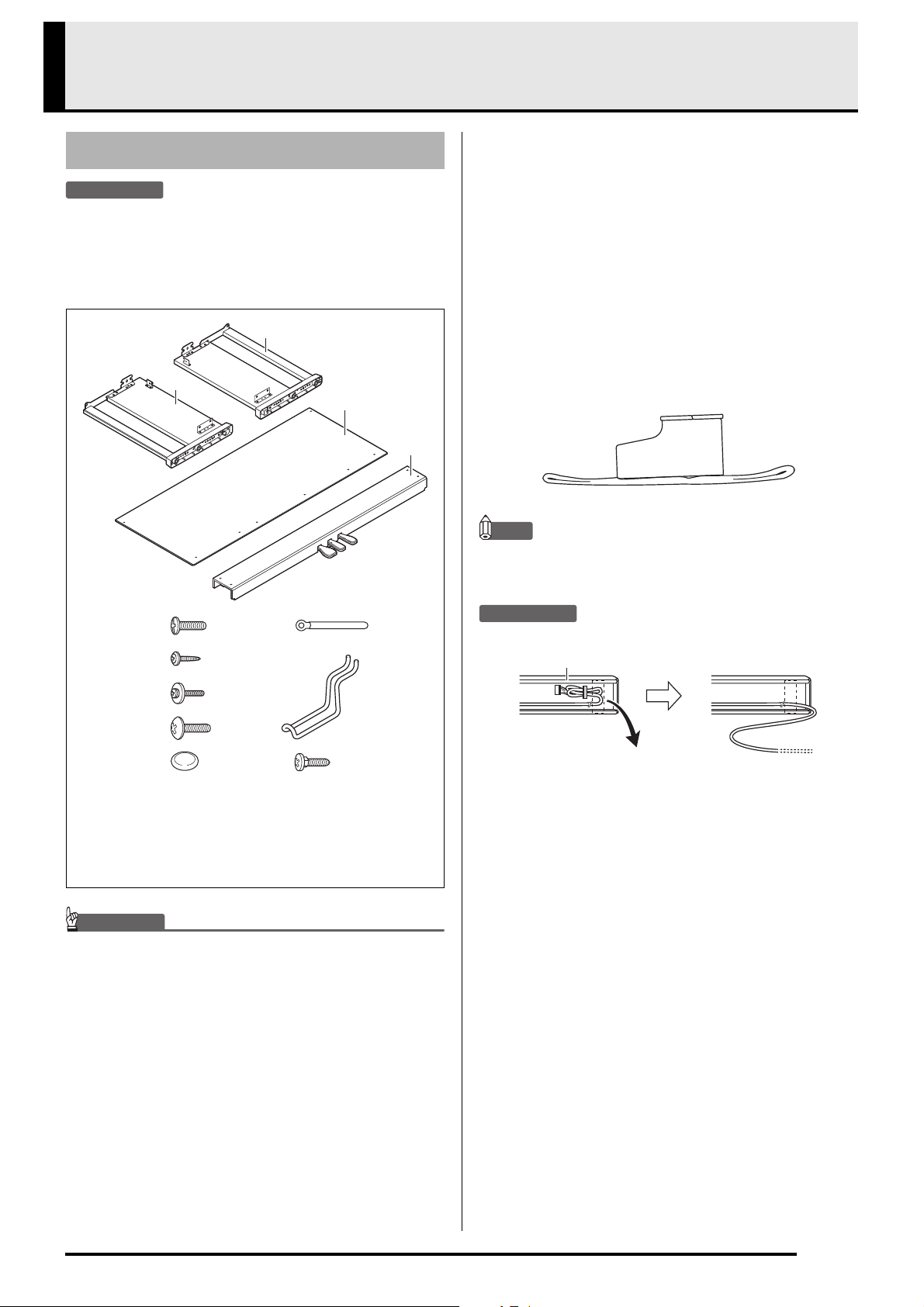
EN-49
Getting Ready
PREPARATION
• Before starting assembly, check to make sure that
you have all the parts shown below.
• This stand does not include any of the tools required
for assembly. It is up to you to prepare a large
Philips head (+) screwdriver for assembly.
IMPORTANT!
• Do not remove the tape securing the keyboard cover
in place until assembly is complete. Removing the
tape can cause the keyboard cover to open and
close during assembly, creating the risk of personal
injury to your hands and fingers.
• Do not use any screws other than those that come
with the stand. Doing so risks damage to the stand
and/or Digital Piano.
•You can find the screws in a plastic bag inside of the
packing material.
• If anything is missing or damaged, contact your local
CASIO service provider.
*CAUTION
• To assemble the stand, at least two persons should
work together on a flat surface.
• Take care that you do not pinch your fingers
between parts when assembling them.
• Spread felt or some other type of cloth under the
bench to avoid direct contact between the rubber at
the tips of the legs and the floor surface. Direct
contact between the rubber and flooring can cause
discoloration, marring, or other damage to the
flooring.
• When placing the Digital Piano on the floor, be sure
to place it on something soft (a blanket, cushion, etc.)
Do not place the Digital Piano directly onto the floor.
NOTE
• Be sure to follow the proper procedure when
assembling the stand.
PREPARATION
• Pull the pedal unit cable out from the crosspiece
.
Assembling the Stand
Side panel ........................... ×1
Side panel ........................... ×1
Back panel .......................... ×1
Crosspiece .......................... ×1
Screws ................................ ×4
Screws ................................ ×6
Screws ................................ ×2
Screws ................................ ×4
Screw caps ......................... ×4
Clip...................................... ×1
Headphones hook............... ×1
Screw .................................. ×1
K
H
F
G
I
J
L
E
A
B
C
D
D
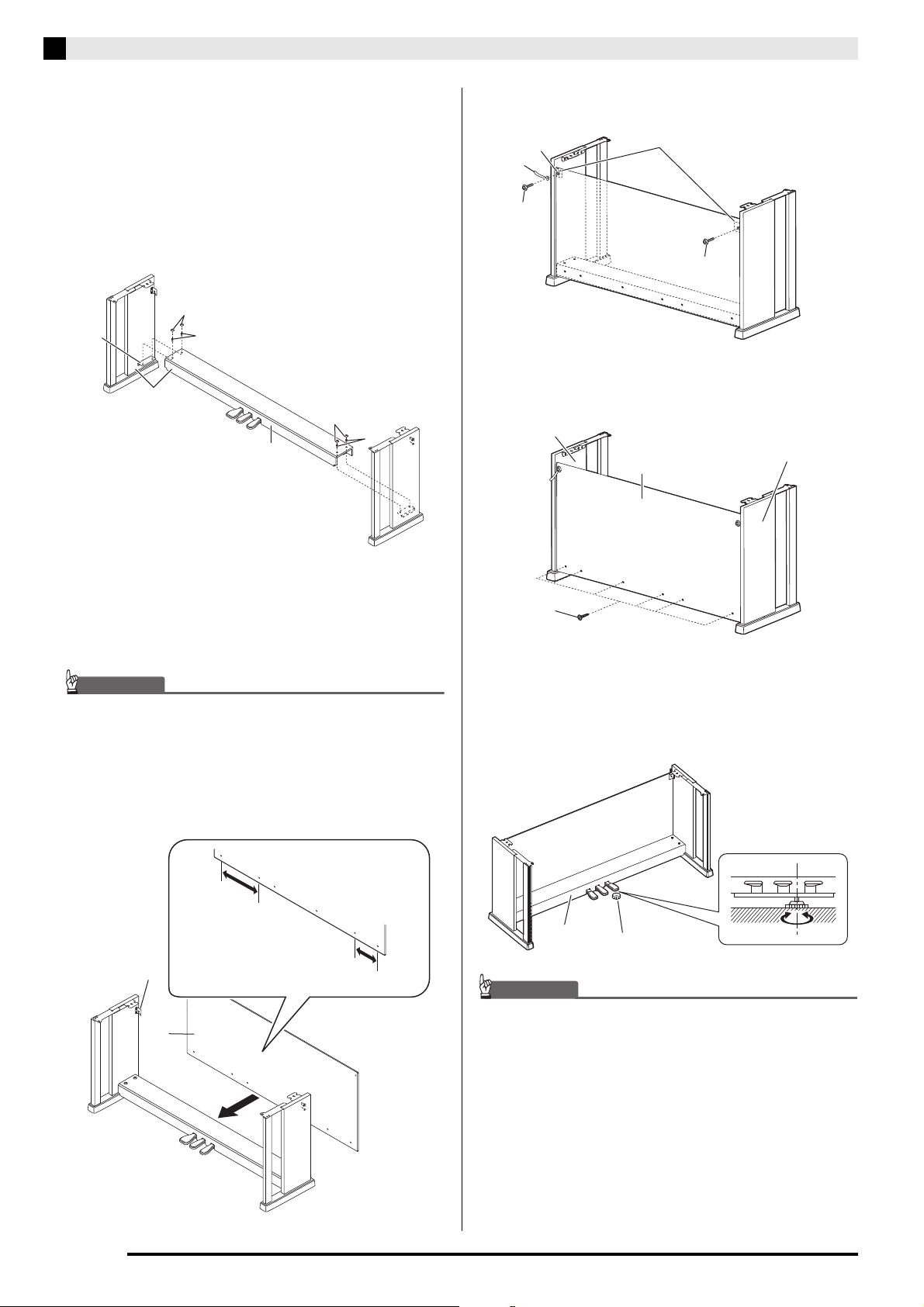
EN-50
Getting Ready
1.
Attach side panels and to crosspiece .
Secure the side panels using four
screws.
• When installing parts , slide the brackets into the
slots in either end of crosspiece . If the brackets
are not inserted into the ends of the crosspiece
as
far as they will go, the screws
will not be able to
enter into the screw holes of the brackets , which
can strip the threads of the screws.
• Cover the screw heads with the caps .
2.
Use the two screws
to secu re the top left
and right edges of the back panel
to the
brackets
of side panels
and
.
IMPORTANT!
• Make sure that the back panel
is positioned
correctly as described below when installing it.
– Before sliding back panel
into place, make sure
that the widely spaced screw holes along the
bottom of the panel are on the left (when viewed
from the front of the stand), and the narrowly
spaced holes are on the right.
• At location
, slip the clip
onto to the screw
before installing the screw.
3.
Next, secure the bottom of the back panel
with the six screws
.
4.
Adjust the height adjustment screw
to
provide support so crosspiece
does not
bow downwards when the pedals are
pressed.
IMPORTANT!
• Pressing the pedals without adjusting height
adjustment screw
can result in damage to
crosspiece
. Always make su re you adjust height
adjustment screw
before operating the pedals.
B
A
I
I
E
2
1
D
E
3
C
Wide
Narrow
J
G
G
3
4
F
C
A
B
5
D
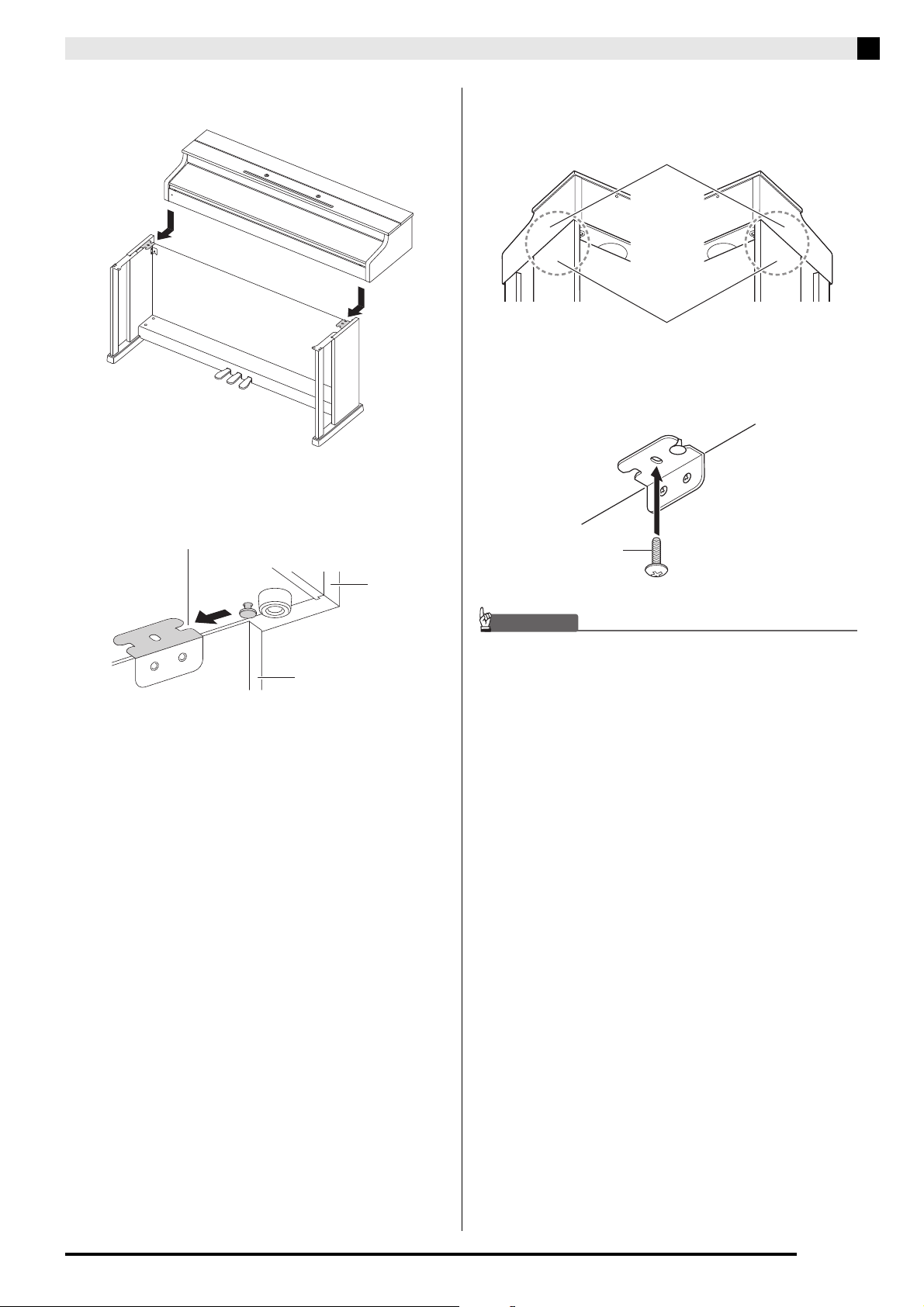
Getting Ready
EN-51
5.
Place the piano onto the stand.
• Slide the piano onto the stand from behind so the
bolts on the bottom of the piano engage with the slots
of stand brackets.
• The sides of the piano will overhang the left and right
side panels slightly. Adjust the piano position so the
left and right overhang is the same.
6.
Use the four screws to secure the piano to
the stand.
IMPORTANT!
• The screws keep the piano from slipping off the
stand. Never use the piano without the screws
installed.
Bracket slot
Back of piano
Stand side panel
Piano
Side panels
H
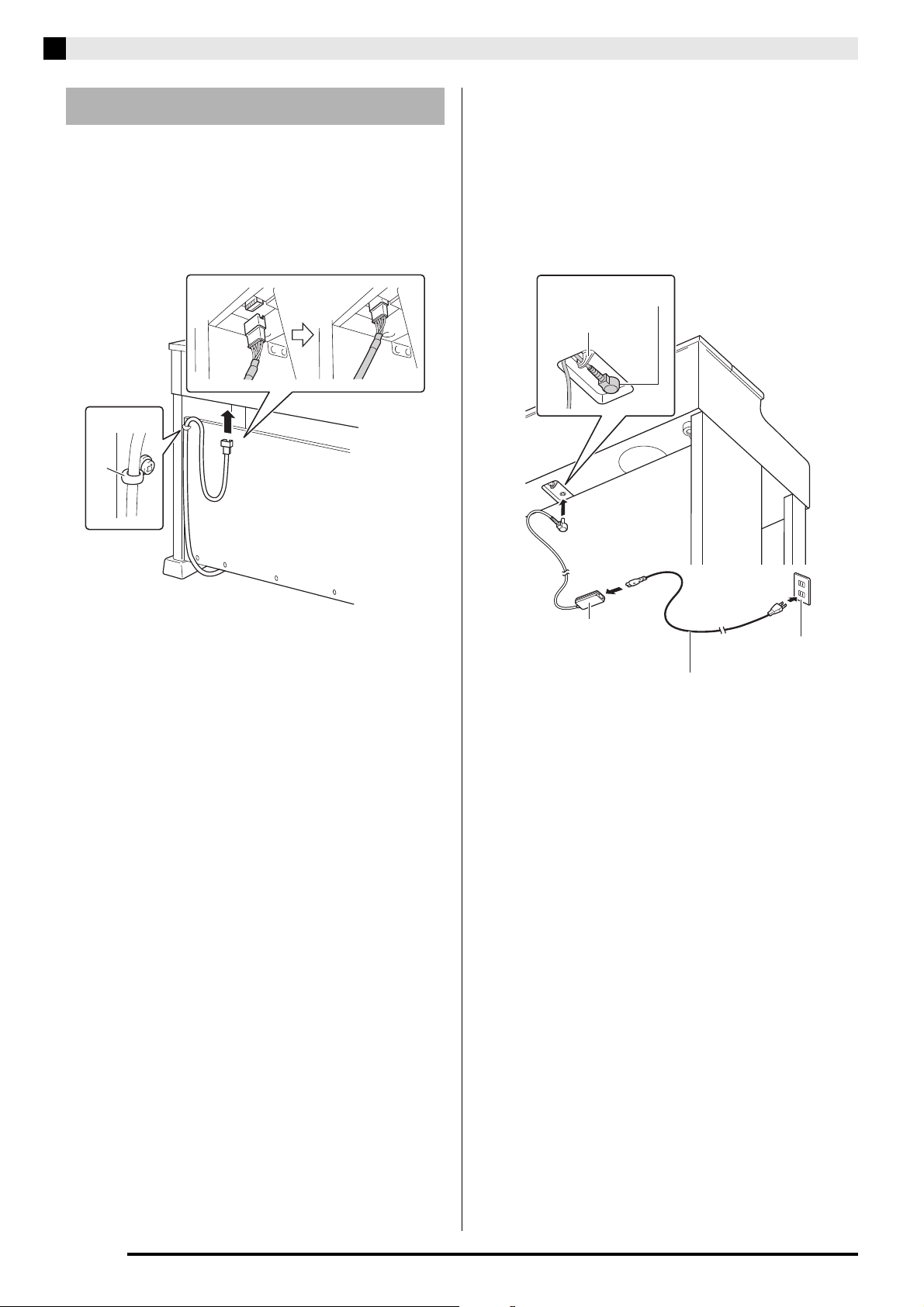
EN-52
Getting Ready
1.
With the pedal unit cable plug oriented as
shown in the illustration below, plug it into the
pedal connector on the bottom of the piano.
a.Push the plug fully in as far as it goes.
b.Use the
clip to secure the pedal cable to side panel
.
2.
Plug the AC adaptor that comes with the
digital piano (24 VDC) into the AC adaptor
terminal. Plug the power cord of the AC
adaptor that comes with the Digital Piano into
a household power outlet as shown in the
illustration below.
• Secure the AC adaptor cord by hooking it onto the
hook next to the AC adaptor terminal.
To connect the cable
J
a.
b.
AC adaptor plug
AC adaptor unit
Household power outlet
Supplied power cord
Hook
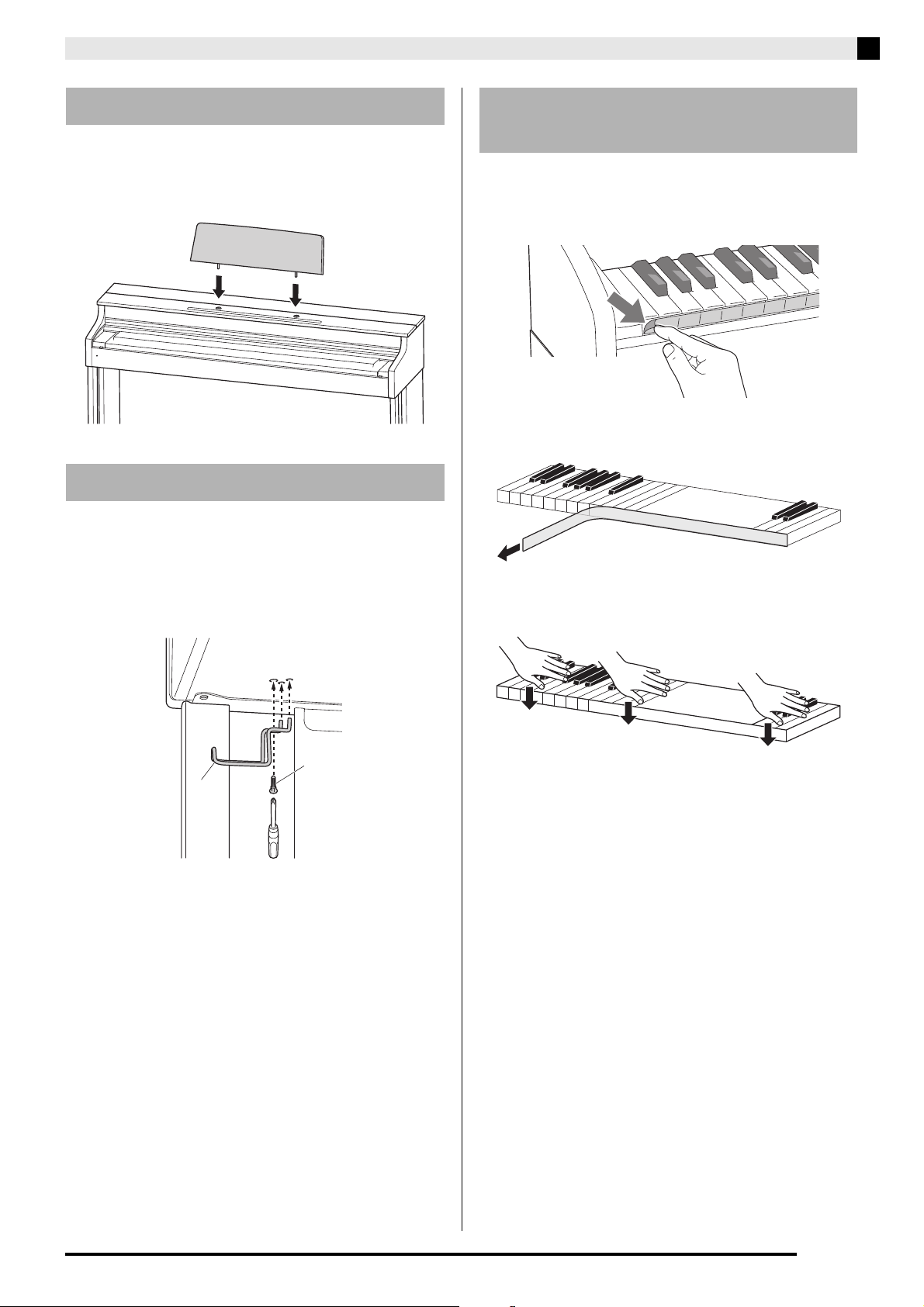
Getting Ready
EN-53
1.
Insert the tabs on the bottom of the music
stand into the two holes on the top of the
piano.
1.
Insert the headphones hook
into the two
holes on the bottom of the piano.
2.
Use screw
to secure the headphones hook
in place.
Protective tape is affixed to the front edges of the
keyboard keys to protect them during shipment.
Remove the protective tape before using the Digital
Piano.
• Peel off the tape by pulling carefully towards you as
shown in the illustration.
• If some keys seem to be raised up after you remove
the tape, press down to return them to their normal
positions.
To install the music stand
Install the Headphones Hook
K
L
Removing the Protective Tape
from the Keyboard
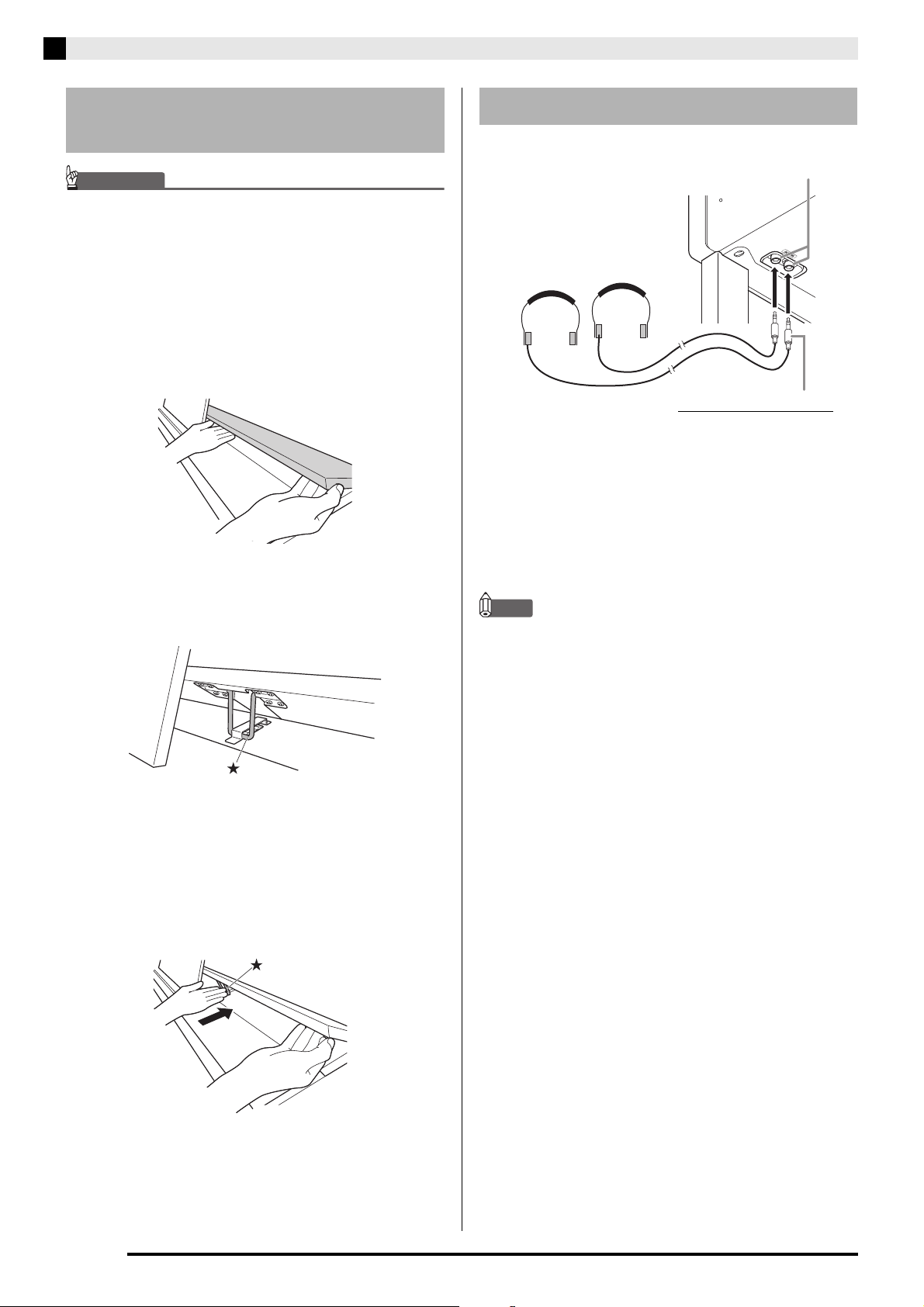
EN-54
Getting Ready
IMPORTANT!
• Use both hands whenever opening or closing the lid,
and take care that you do not close it on your fingers.
• Do not open the lid too wide. Doing so creates the
risk of damage to the cover and digital piano.
• Stand in front of the digital piano on the right side
when opening or closing the lid.
■ To open the lid
1.
Lift up the lid as shown in the illustration.
• The lid has a support bracket (indicated by the star
in the illustration) attached to its inside surface.
Check to make sure that the support bracket is
standing up fully.
■ To close the lid
1.
Carefully lift up slightly on the lid.
2.
Use the fingers of your left hand to press
back on the support bracket () as you
slowly and carefully lower the lid.
Connect commercially available headphones to the
PHONES/OUTPUT jacks. Connecting headphones to
either of the PHONES/OUTPUT jack cuts off output to
the speakers, which means you can practice even late at
night without bothering others. To protect your
hearing, make sure that you do not set the volume level
too high when using headphones.
NOTE
• Be sure to push the headphones plug into the
PHONES/OUTPUT jacks as far as it will go. If you
don’t, you may hear sound from only one side of the
headphones.
• If the plug of the headphones you are using does not
match the PHONES/OUTPUT jacks, use the
applicable commercially available adaptor plug.
• If you are using headphones that require an adaptor
plug, make sure you do not leave the adaptor
plugged in when you unplug the headphones. If you
do, nothing will sound from the speakers when you
play.
Opening and Closing the
Piano Lid
Connecting Headphones
PHONES/OUTPUT jacks
Front
Stereo standard plug
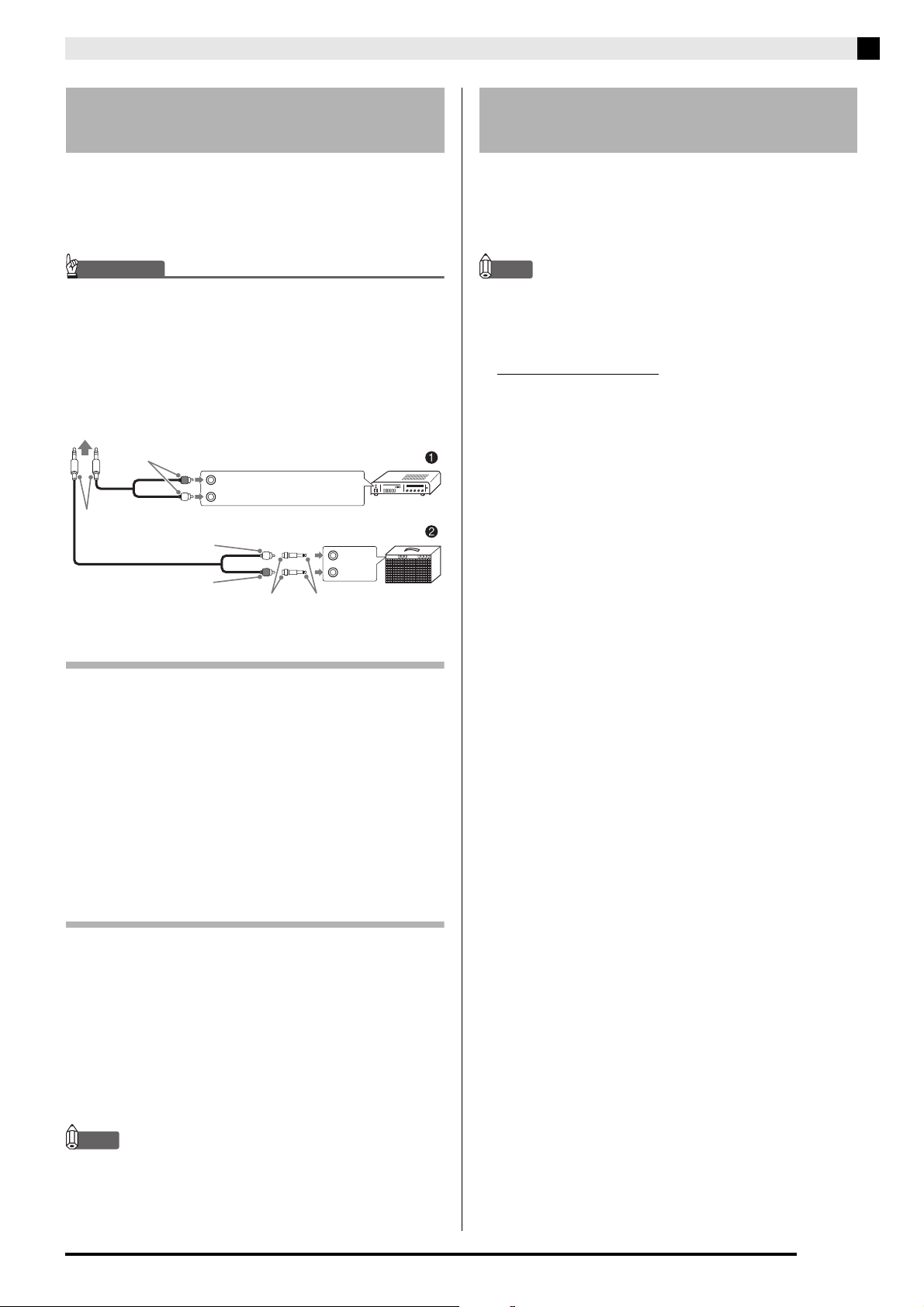
Getting Ready
EN-55
You can connect audio equipment or a music amplifier
to the Digital Piano and then play through external
speakers for more powerful volume and better sound
quality.
IMPORTANT!
• Whenever connecting a device to the Digital Piano,
first use the VOLUME controller to set the volume to
a low level. After connecting, you can adjust the
volume to the level you want.
• Whenever you connect any device to the Digital
Piano, be sure to read the user documentation that
comes with the device.
Connecting Audio Equipment (Figure )
Use commercially available connecting cords
(Standard Plug × 1, Pin Plugs × 2) to connect as shown
in Figure . Make sure that the end of the cord that
you connect to the Digital Piano is a stereo standard
plug. A monaural standard plug will result in output of
only one of the two stereo channels. Normally, you
should set the input selector of the audio equipment to
the terminal where the Digital Piano is connected
(AUX IN, etc.) Adjust volume using the Digital Piano’s
VOLUME controller.
Connecting a Music Amplifier (Figure )
Connect the connecting cord* to one of the types of
amplifiers shown in Figure .
Adjust volume using the Digital Piano’s VOLUME
controller.
NOTE
• Change the Head Phone Mode setting to OFF
whenever the Digital Piano is connected to an audio
system or amplifier.
Use only accessories that are specified for use with this
Digital Piano.
Use of unauthorized accessories creates the risk of fire,
electric shock, and personal injury.
NOTE
• You can get information about accessories that are
sold separately for this product from the CASIO
catalog available from your retailer, and from the
CASIO website at the following URL.
http://world.casio.com/
Connecting Audio Equipment
or an Amplifier
* Digital Piano: Stereo standard plug
Amplifier : Inputs signals for the left and right
channels. Not connecting either plug
will result in output of only one of the
two stereo channels.
INPUT 1
INPUT 2
Audio amplifier AUX IN jack, etc.
Guitar amplifier
Keyboard amplifier, etc.
Pin plug
Pin jack Standard plug
RIGHT (Red)
To either of the Digital Piano’s PHONES/OUTPUT jack
Stereo standard plug
Pin plug (red)
Pin plug (white)
LEFT (White)
Bundled and Optional
Accessories
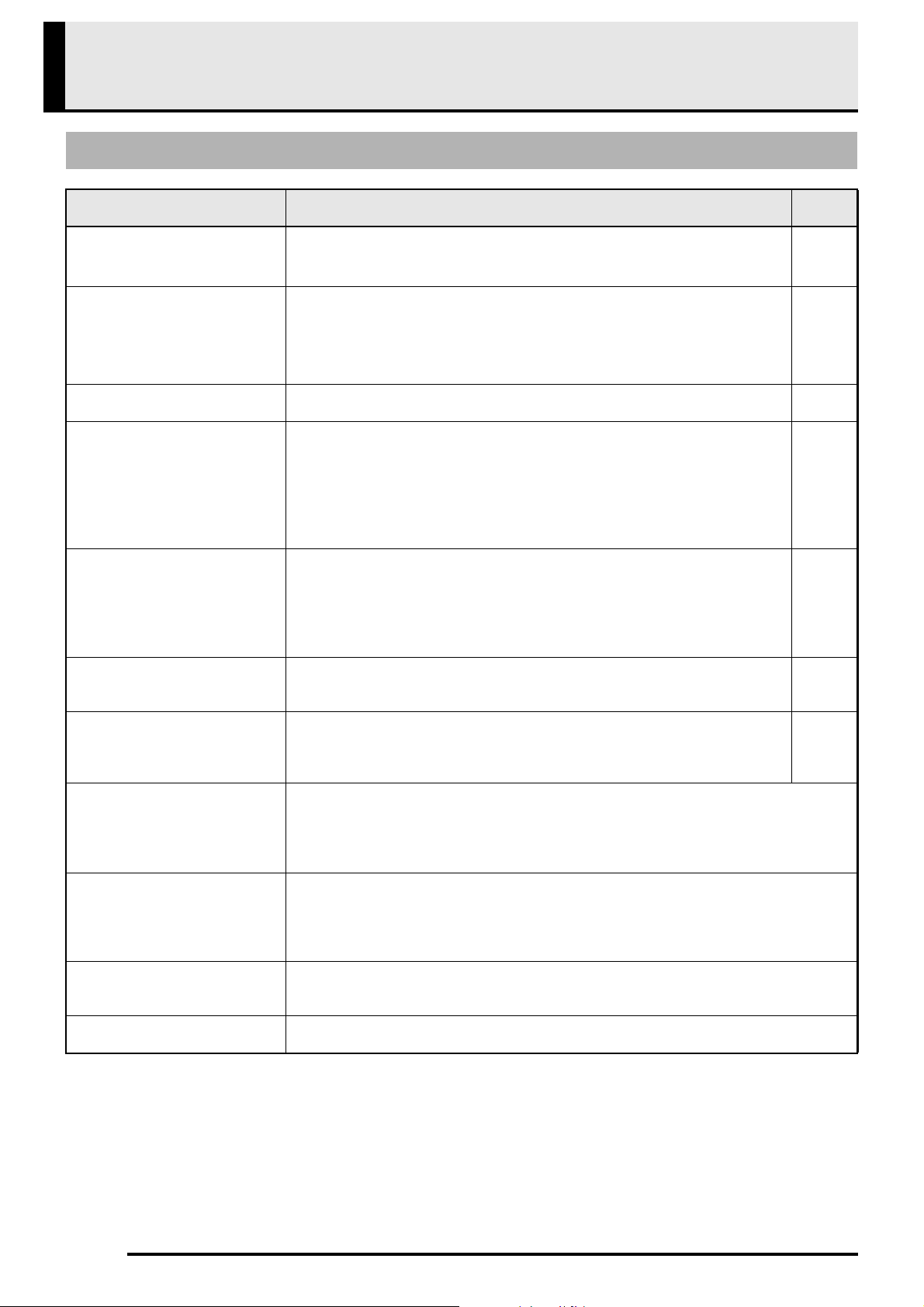
EN-56
Reference
Troubleshooting
Problem Action
See
Page
No sound is produced when I
press a keyboard key.
1. Rotate the VOLUME controller more towards “MAX”. EN-6
2. Disconnect whatever is connected to the PHONES/OUTPUT jacks. EN-54
3. Turn on the Local control setting. EN-32
The pitch of the Digital Piano is
off.
1. Change the transpose setting to “0”. Or turn power off and then back on. EN-31
2. Change the tuning setting to 440.0 Hz. Or turn power off and then back on. EN-31
3. Change the octave shift setting to 0. EN-31
4. Change the temperament setting to “0: Equal”, which is the standard modern
tuning.
EN-31
Nothing happens when I press
a pedal.
Check the orientation of the pedal unit plug and makes sure it is inserted as far
as it goes.
EN-52
Tones and/or effects sound
strange. Turning power off and
then back on again does not
eliminate the problem.
Example:
Note intensity does not
change even though I alter key
pressure.
Turn off Auto Resume, and then turn power off and then back on again. EN-33
I cannot transfer data after
connecting the Digital Piano to
a computer.
1. Check to make su re that the USB cable is connected to the Digital Piano and
computer, and that the correct device is selected with your computer’s music
software.
EN-45
2. Turn off the Digital Piano and then exit the music software on your computer.
Next, turn the Digital Piano back on and then restart the music software on
your computer.
I cannot store data to a USB
flash drive or load data from a
USB flash drive.
See “Error Indicators”. EN-43
It takes a long time before I can
use the Digital Piano after I turn
it on.
It takes about 20 seconds after you turn on power to perform the memory format
operation. Wait until the format operation is complete. Note that you should take
care to avoid turning off the Digital Piano while a data transfer operation with a
computer is in progress.
EN-46
A tone’s quality and volume
sounds slightly different
depending where it is played on
the keyboard.
This is an unavoidable result of the digital sampling process,
*
and does not indicate
malfunction.
* Multiple digital samples are taken for the low range, middle range, and high range of the
original musical instrument. Because of this, there may be very slight differences in tonal
quality and volume between sample ranges.
When I press a button, the note
that is sounding cuts out
momentarily or there is a slight
change in how effects are
applied.
This happens when the sounds of multiple parts are sounding at the same time while using
layer, using the Duet Mode, playing back a built-in tune, recording, etc. Pressing a button
when one of these conditions exists will cause the effect setting that is built into the tone to
change automatically, which causes notes to cut out momentarily or causes a slight change
in how effects are being applied.
I need to reset all Digital Piano
data and settings to their initial
defaults.
Hold down the FUNCTION, MIDI REC and GRAND PIANO 2 buttons, and press the power
bu
tton to turn on power.
I need to reset a specific setting
to its initial default.
Hold down the FUNCTION button and press the + and – keyboard keys of the setting at the
same time.
Reference
EN-57
• Specifications and designs are subject to change without notice.
Product Specifications
Model AP-470BK/AP-470BN/AP-470WE
Keyboard 88-key piano keyboard, with Tou ch Response
Maximum Polyphony 256 notes
Tone 22 types
• Layer (excluding bass tones)
Acoustic Simulator Damper Resonance (Damper Noise on/off), Hammer Response, String Resonance, Lid Simulator, Key Off Simulator,
Key On Action Noise, Key Off Action Noise
Effects Brilliance (–3 to 0 to 3), Hall Simulator (4 types), Chorus (4 types), DSP, Head Phone Mode, Volume Sync Equalizer
Metronome • Beats: 0 to 9
• Tempo range: 20 to 255
Duet Mode Adjustable tone range (–2 to 2 octaves)
Concert Play • Songs: 10
• Song volume: Adjustable
• Part On/Off: L, R (Lesson Mode only)
•3 Modes: LISTEN, LESSON, PLAY
Music Library • Songs: 60; 10 download songs
(Up to approximately 90 KB per song, up to approximately 900 KB/10 songs total)*
* Based on 1 KB = 1024 bytes
• Song volume: Adjustable
• Part On/Off: L, R
Recorder MIDI Recorder
• Modes: Real-time recording, playback
• Songs: 1
• Tracks: 2
• Capacity: Approximately 5,000 notes total
• Recording storage: Built-in flash memory
Audio Recorder
• USB flash drive real-time recording and playback; Linear PCM, 16bit, 44.1 kHz, stereo .WAV format
• Songs: 99 files
• Approximately 25 minutes maximum recording per file.
•Audio file volume: Adjustable
Pedals Damper (seamless half-pedal support), sostenuto, soft
Other Functions • Touch Response: 3 levels, Off
• Transpose: 2 octaves (–12 to 0 to +12)
•Tuning: 415.5 Hz to 440.0 Hz to 465.9 Hz (0.1 Hz steps)
• Temperament: Equal + 16 other types
• Octave Shift: 4 octaves (–2 to 0 to +2)
• Panel Lock
MIDI 16-channel multi-timbre receive
USB Memory • Supported capacity: 32 GB or less recommended
•Functions: SMF playback, recorded song storage, song data import, formatting, audio data playback and storage
Input/Output
Terminals
•PHONES/OUTPUT jacks: Stereo standard jacks × 2
• AC Adaptor Terminal: 24 VDC
• USB port: Type B
• USB flash drive port: Type A
• Pedal connector
Speakers
φ
12cm × 2 +
φ
4cm × 2 (Output: 20W + 20W)
Power Requirements AC adaptor: AD-E24250LW
•Auto Power Off: Approximately 4 hours; Can be disabled.
Power Consumption 24V = 20W
Dimensions Piano and Stand: 141.7(W) × 42.7(D) × 86.1(H) cm
(55 13/16 × 16 13/16 × 33 15/16 inches)
Weight Piano and Stand: Approximately 43.4kg (95.7 lbs)
A-1
Appendix
Tone List
Tone Name
Program
Change
Bank Select
MSB
GRAND PIANO 1 CONCERT 0 0
MELLOW 1 0
BRIGHT 2 0
GRAND PIANO 2 CONCERT 3 0
MELLOW 4 0
BRIGHT 5 0
MODERN PIANO 6 0
ROCK PIANO 7 0
JAZZ PIANO 8 0
ELEC.PIANO 1 9 0
ELEC.PIANO 2 10 0
FM E.PIANO 11 0
60’S E.PIANO 12 0
HARPSICHORD 13 0
VIBRAPHONE 14 0
STRINGS 1 15 0
STRINGS 2 16 0
ORGAN 1 (PIPE ORGAN) 17 0
ORGAN 2 (JAZZ ORGAN) 18 0
ORGAN 3 (ELEC.ORGAN 1) 19 0
ORGAN 4 (ELEC.ORGAN 2) 20 0
BASS(LOWER) 21 0
Concert Play List
Song No.
Song Name
1Je Te Veux
2 Vltava (Má vlast)
3Canon
4 Tableaux d’Une Exposition “Promenade”
5 Piano Concerto No.20 K.466 2nd Mov.
6 Polovetzian Dance (Prince Igor)
7 Sonate K.331 1st Mov.
8 Violin Concerto 1st Mov.
9 Jesus, Bleibet Meine Freude
10 Melody In F
Music Library List
Song No.
Song Name
01 Nocturne Op.9-2
02 Fantaisie-Impromptu Op.66
03 Étude Op.10-3 “Chanson de l’adieu”
04 Étude Op.10-5 “Black Keys”
05 Étude Op.10-12 “Revolutionary”
06 Étude Op.25-9 “Butterflies”
07 Prélude Op.28-7
08 Valse Op.64-1 “Petit Chien”
09 Valse Op.64-2
10 Moments Musicaux 3
11 Impromptu Op.90-2
12 Marche Militaire 1 (Duet)
13 Frühlingslied [Lieder Ohne Worte Heft 5]
14 Fröhlicher Landmann [Album für die Jugend]
15 Von fremden Ländern und Menschen [Kinderszenen]
16 Träumerei [Kinderszenen]
17 Tambourin
18
Menuet BWV Anh.114
[Clavierbüchlein der Anna Magdalena Bach]
19 Inventio 1 BWV 772
20 Inventio 8 BWV 779
21 Inventio 13 BWV 784
22 Praeludium 1 BWV 846 [Das Wohltemperierte Klavier 1]
23 Le Coucou
24 Gavotte
25 Sonatina Op.36-1 1st Mov.
26 Sonatine Op.20-1 1st Mov.
27 Sonate K.545 1st Mov.
28 Sonate K.331 3rd Mov. “Turkish March”
29 Rondo K.485
30 Für Elise
31 Marcia alla Turca
32 Sonate Op.13 “Pathétique” 1st Mov.
33 Sonate Op.13 “Pathétique” 2nd Mov.
34 Sonate Op.13 “Pathétique” 3rd Mov.
35 Sonate Op.27-2 “Moonlight” 1st Mov.
36 Rhapsodie 2
37 Waltz Op.39-15 (Duet)
38 Liebesträume 3
39 Blumenlied
40 La Prière d’une Vierge
41 Csikos Post
42 Humoresque Op.101-7
43 Melodie [Lyrische Stücke Heft 2]
44 Sicilienne Op.78
45 Berceuse [Dolly] (Duet)
46 Arabesque 1
47 La Fille aux Cheveux de Lin [Préludes]
48 Passepied [Suite bergamasque]
49 Gymnopédie 1
50 Je Te Veux
51 Salut d’Amour
52 The Entertainer
53 Maple Leaf Rag
54 L’arabesque [25 Etüden Op.100]
55 La Styrienne [25 Etüden Op.100]
56 Ave Maria [25 Etüden Op.100]
57 Le retour [25 Etüden Op.100]
58 La chevaleresque [25 Etüden Op.100]
59 No.13 [Études de Mécanisme Op.849]
60 No.26 [Études de Mécanisme Op.849]
Song No.
Song Name
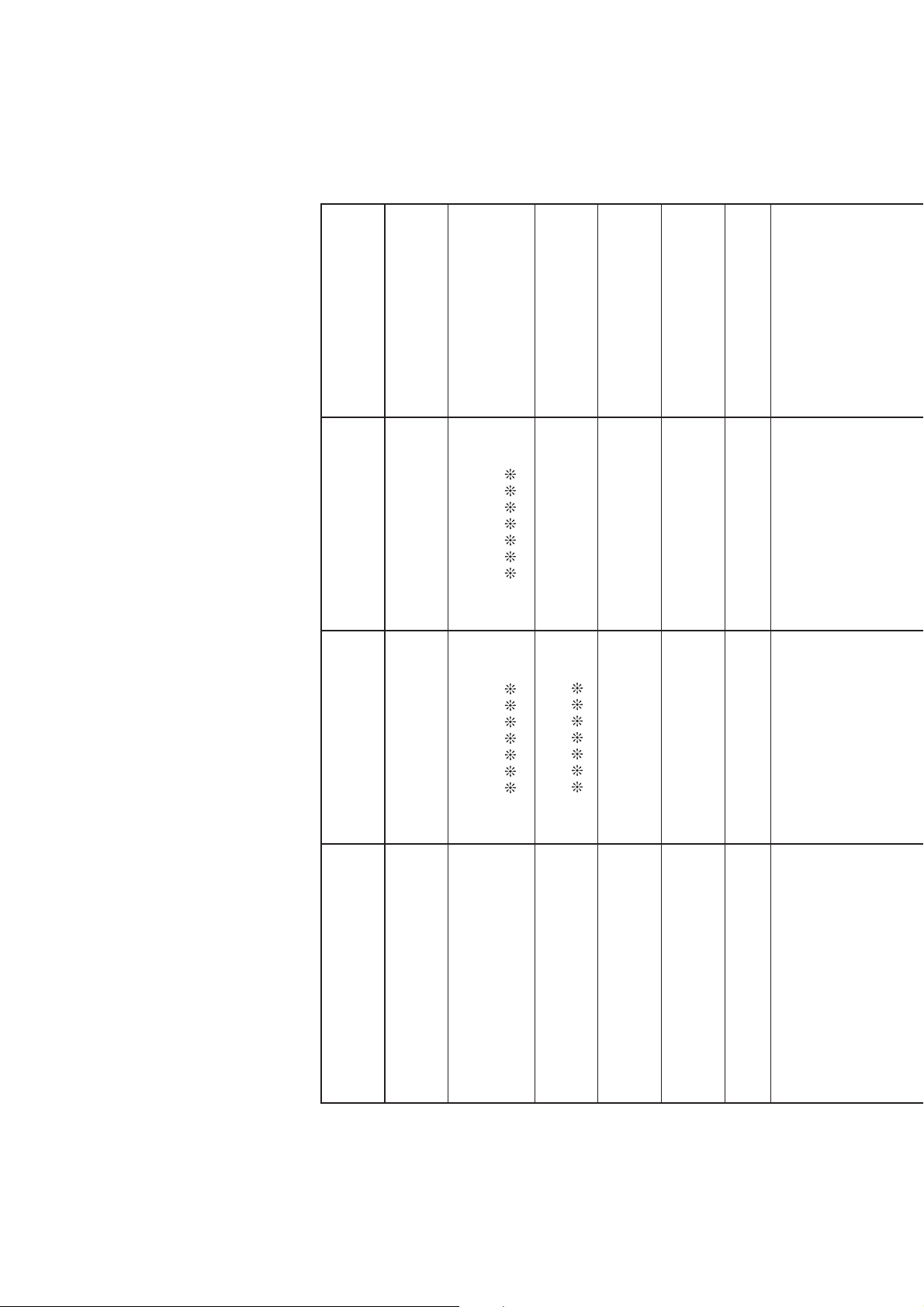
Function Transmitted Recognized Remarks
Basic
Channel
1 - 16
1 - 16
1 - 16
1 - 16
Default
Changed
Note
Number
0 - 127 0 - 127
0 - 127
*
1True voice
After
Touch
Control
Change
X
X
X
O
Pitch Bender
XO
Key’s
Ch’s
Velocity
O
9nH v = 1 - 127
O
8nH v = 0 - 127
O
9nH v = 1 - 127
X
9nH v = 0,
O
8nH v = 0 - 127
Note ON
Note OFF
Mode
Mode 3
X
Mode 3
X
Default
Messages
Altered
0, 32
1
5
6, 38
7
10
11
16
17
18
19
64
65
66
67
Bank select
Modulation
Portamento Time
Data entry LSB, MSB
*2
Volume
Pan
Expression
DSP Parameter0
*2
DSP Parameter1
*2
DSP Parameter2
*2
DSP Parameter3
*2
Damper
Portamento Switch
Sostenuto
Soft pedal
O
O
O
O
O
O
O
O
O
O
O
O
O
O
O
O
X
X
X
O
X
X
X
X
X
X
O
X
O
O
Model AP-470 Version : 1.0
*1 : Depends on tone
MIDI Implementation Chart
Program
Change
OO
0 - 127:True #
System Exclusive
OO
System
Common
X
X
X
X
X
X
: Song Pos
: Song Sel
: Tune
Aux
Messages
Remarks
X
O
X
X
X
O
O
X
: Local ON/OFF
: All notes OFF
: Active Sense
: Reset
System
Real Time
X
O
X
X
: Clock
: Commands
76
77
78
80
81
82
83
84
88
91
93
100, 101
120
121
Vibrato rate
Vibrato depth
Vibrato delay
DSP Parameter4
*2
DSP Parameter5
*2
DSP Parameter6
*2
DSP Parameter7
*2
Portamento Control
High resolution velocity prefix
*3
Reverb send
*
4
Chorus send
RPN LSB, MSB
*2
All sound off
Reset all controller
Mode 1 : OMNI ON, POLY
Mode 3 : OMNI OFF, POLY
Mode 2 : OMNI ON, MONO
Mode 4 : OMNI OFF, MONO
O : Yes
X : No
O
O
O
O
O
O
O
O
O
O
O
O
O
O
X
X
X
X
X
X
X
X
O
X
O
X
X
O
*2
*2 :For details, see MIDI Implementation at http://world.casio.com/.
*3:Note on only
*4:This Instrument treats a hall simulator as a reverb.
MA1802-A