Operating instructions
Dishwasher
To avoid the risk of accidents or damage to the appliance, it is
essential to read these instructions as well as the installation plan
before it is installed and used for the first time.
en-AU, NZM.-Nr. 12 383 510HG07

Contents
2
Warning and Safety instructions......................................................................6
Notes on the operating instructions................................................................16
Notes on the layout.............................................................................................16
Items supplied...................................................................................................17
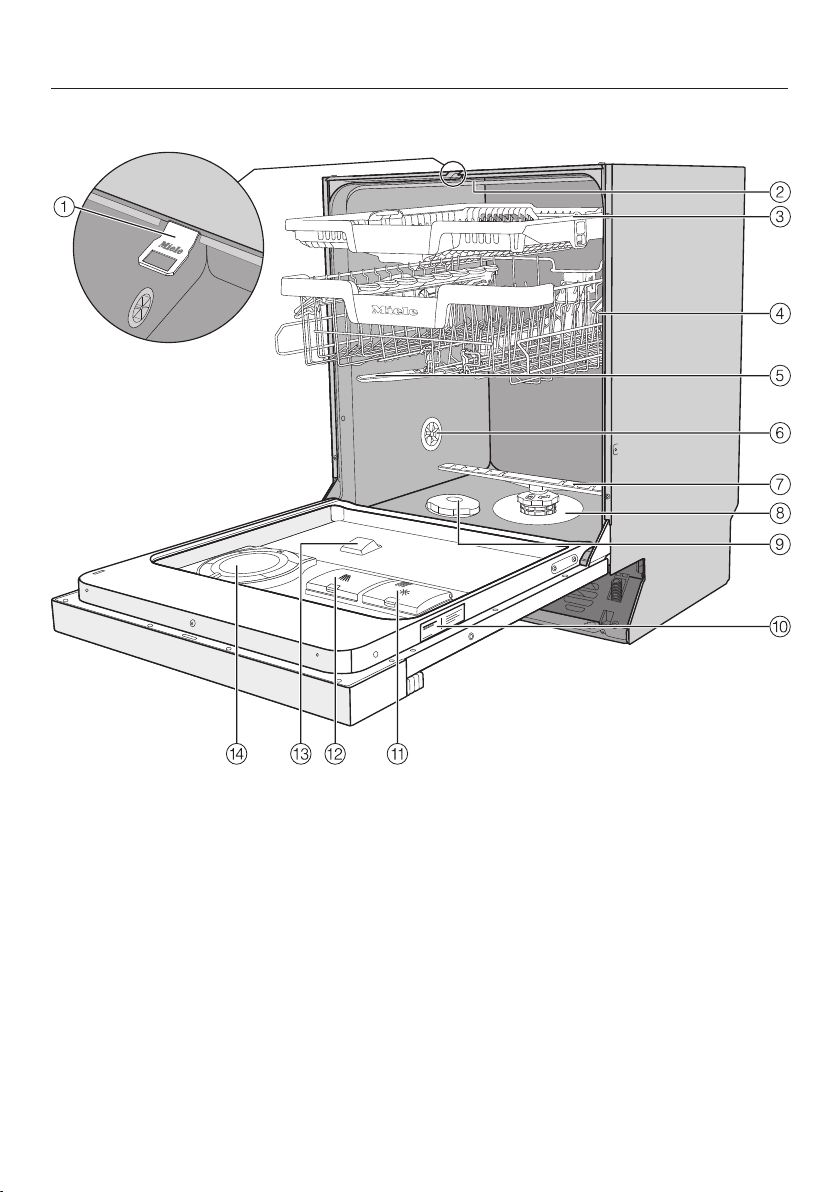
Guide to the appliance......................................................................................18
Appliance overview.............................................................................................18
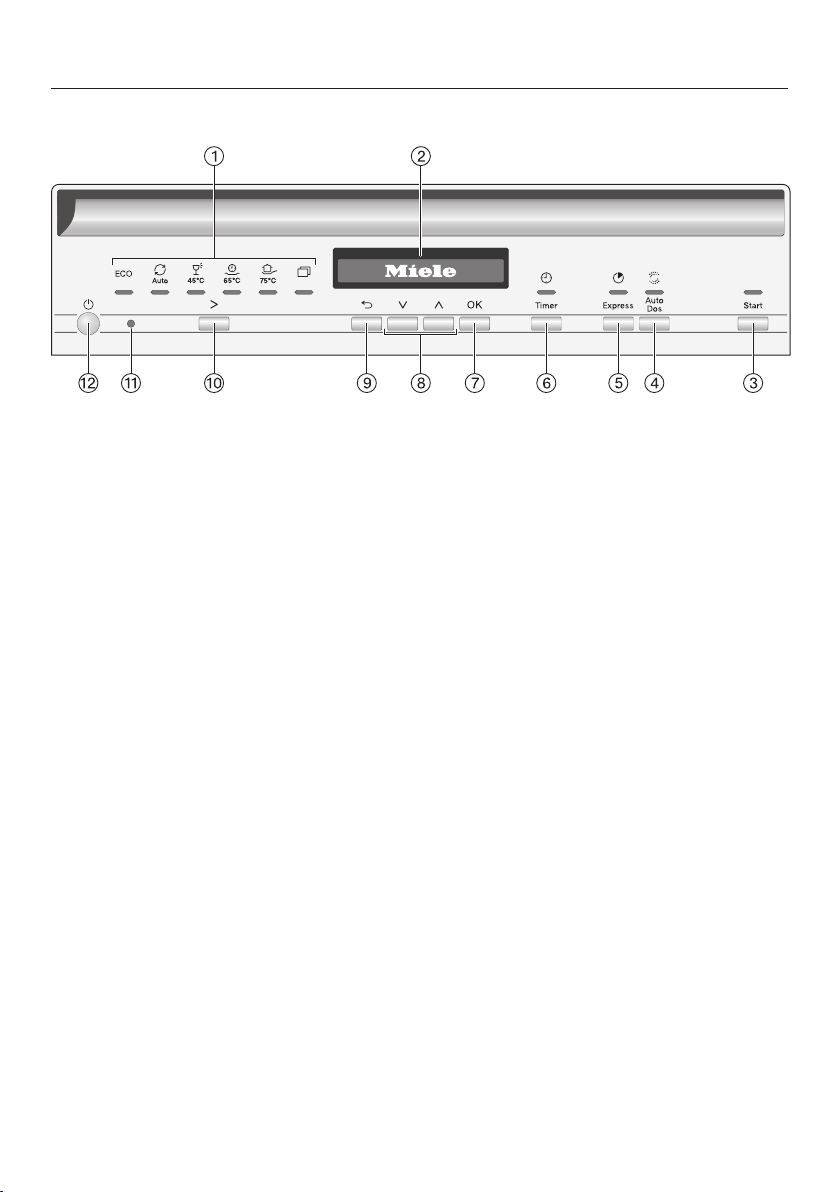
Control panel.......................................................................................................19
Display functions.................................................................................................20
Caring for the environment..............................................................................21
Using for the first time......................................................................................22
Opening the door................................................................................................22
Closing the door..................................................................................................23
Activating the safety lock....................................................................................23
Miele@home........................................................................................................24
Standard settings................................................................................................25
Setting the language......................................................................................25
Setting up Miele@home .................................................................................25
Setting the water hardness ............................................................................26
Activating AutoDos.........................................................................................26
Dishwasher salt...................................................................................................28
Filling the salt reservoir...................................................................................29
Replenishing salt............................................................................................30
Rinse aid..............................................................................................................31
Adding rinse aid .............................................................................................32
Refilling rinse aid............................................................................................32
Settings..............................................................................................................33
Opening the Settings menu.................................................................................33
Changing settings...............................................................................................33
Closing the Settings menu..................................................................................33
Language .........................................................................................................34
Water hardness...................................................................................................34
AutoDos (automatic dispensing).........................................................................35
Rinse Aid.............................................................................................................35
Miele@home........................................................................................................36
Remote control....................................................................................................39
RemoteUpdate....................................................................................................39
Consumption (EcoFeedback)..............................................................................40
Display brightness...............................................................................................41

Contents
3
Refill reminders....................................................................................................41
AutoOpen............................................................................................................41
Extra clean...........................................................................................................42
Extra dry..............................................................................................................42
2nd interim rinse..................................................................................................42
Hygiene cycle......................................................................................................42
Software version..................................................................................................43
Showroom...........................................................................................................43
Factory default.....................................................................................................43
Copyright and licences for the communication module.....................................43
Caring for the environment..............................................................................44
Economical dishwashing.....................................................................................44
EcoFeedback consumption display....................................................................45
Loading the dishwasher....................................................................................46
General information.............................................................................................46
Upper basket.......................................................................................................48
Adjusting the upper basket.................................................................................51
Lower basket.......................................................................................................52
Cutlery tray/Cutlery basket (depending on model)..............................................54
Loading the 3D MultiFlex tray.........................................................................54
Loading the cutlery basket.............................................................................55
Loading examples...............................................................................................56
Dishwashers with cutlery tray.........................................................................56
Dishwashers with cutlery basket....................................................................58
Comparison tests..............................................................................................59
Detergents .........................................................................................................68
Types of detergents ............................................................................................68
Detergent dispensing..........................................................................................69
Automatic dispensing/AutoDos...........................................................................70
Activating AutoDos.........................................................................................70
Inserting a PowerDisk.....................................................................................71
Manual detergent dispensing..............................................................................73
Detergent dispensing.....................................................................................73
Adding detergent............................................................................................73
Operation............................................................................................................75
Switching on the dishwasher..............................................................................75
Selecting a programme.......................................................................................75
Display of programme duration...........................................................................76
Starting a programme .........................................................................................76

Contents
4
At the end of the programme..............................................................................77
Energy management...........................................................................................77
Switching off the dishwasher..............................................................................78
Unloading the dishwasher...................................................................................78
Interrupting a programme....................................................................................79
Cancelling or changing a programme.................................................................79
Options...............................................................................................................80
Timer ..............................................................................................................80
Guide for selecting a programme....................................................................82
Programme chart ..............................................................................................84
Further programmes ......................................................................................86
Programme options...........................................................................................87
Selecting programme options.............................................................................87
Express......................................................................................................87
Cleaning and care.............................................................................................88
Cleaning the wash cabinet..................................................................................88
Cleaning the door and the door seal...................................................................89
Cleaning the control panel..................................................................................89
Cleaning the appliance front...............................................................................89
Cleaning the AutoDos.........................................................................................90
Cleaning the spray arms......................................................................................92
Checking the filters in the wash cabinet.............................................................95
Cleaning the filters...............................................................................................95
Cleaning the water inlet filter...............................................................................97
Cleaning the drain pump.....................................................................................98
Problem solving guide......................................................................................100
Technical problems.............................................................................................100
Fault messages ...................................................................................................101
Door release........................................................................................................102
Water intake fault.................................................................................................103
Water drainage fault............................................................................................104
Fault with the AutoDos (automatic dispensing)...................................................105
General problems with the dishwasher...............................................................108
Noises..................................................................................................................109
Unsatisfactory cleaning result.............................................................................110
Service................................................................................................................114
Contact in case of fault.......................................................................................114
Warranty..............................................................................................................114

Contents
5
Optional accessories........................................................................................115
Installation..........................................................................................................117
The Miele Waterproof system..............................................................................117
Water intake ........................................................................................................117
Drainage..............................................................................................................119
Electrical connection ..........................................................................................121
Technical data....................................................................................................122

Warning and Safety instructions
6
This dishwasher complies with all current local and national safety
requirements. However, inappropriate use can lead to personal
injury and damage to property.
Please observe the installation sheet and read the operating
instructions carefully before setting up the dishwasher and using it
for the first time. They both contain important information on the
installation, safety, use, and maintenance of the machine. This
prevents both personal injury and damage to the dishwasher.
In accordance with standard IEC 60335-1, Miele expressly and
strongly advises that you read and follow the instructions in
"Installation" and in "Warning and Safety instructions".
Miele cannot be held liable for injury or damage caused by non-
compliance with these instructions.
Keep the installation sheet and the operating instructions in a safe
place and pass them on to any future owner.

Warning and Safety instructions
7
Correct application
This appliance is designed for domestic use and for use in similar
environments by guests in hotel or motel rooms, bed & breakfasts,
and other typical living quarters. This does not include common/
shared facilities or commercial facilities within hotels, motels or bed
& breakfasts.
This dishwasher is not suitable for outdoor use.
The dishwasher is intended for use at altitudes of up to 4,000m
above sea level.
The dishwasher must only be used for cleaning domestic crockery
and cutlery. Any other use is not permitted.
This appliance is not intended for use by persons (including
children) with reduced physical, sensory or mental capabilities, or
lack of experience and knowledge, unless they have been given
supervision or instruction concerning its use by a person responsible
for their safety, and are able to recognise the dangers of misuse.

Warning and Safety instructions
8
Safety with children
Young children must not be allowed to use this appliance.
Older children may only use the dishwasher if its operation has
been clearly explained to them and they are able to use it safely.
They must be able to understand and recognise the possible
dangers of misuse.
Cleaning work may only be carried out by older children under the
supervision of an adult.
Children should be supervised in the vicinity of the dishwasher.
Keep small children away from the appliance at all times to avoid the
risk of injury. Ensure that they do not play with the appliance. There
is a risk that children may lock themselves in the dishwasher.
If the automatic door opening mechanism is active (depending on
the model), keep young children away from the area in which the
door opens. There is a danger of injury in the unlikely event of a fault
with the opening mechanism.
Danger of suffocation! While playing, children may become
entangled in packaging material (such as plastic wrapping) or pull it
over their head with the risk of suffocation. Keep packaging material
away from children.
Keep detergents and other household cleaning agents out of
reach of children. Some dishwasher detergents are strongly alkaline
and contain irritants and corrosive ingredients. They can be
extremely dangerous if swallowed, and can cause severe skin burns
and eye damage. They can cause burning in the mouth, nose and
throat, or inhibit breathing. Avoid contact with the skin and eyes.
Keep children away from the dishwasher when the door is open.
There could still be detergent residues in the cabinet or dispenser.
Check that the dispenser is empty after the completion of a
programme. Seek medical advice immediately if a child has
swallowed or inhaled any detergent. Contact a Poisons Information
Centre (Australia) or the National Poisons Centre (NZ).

Warning and Safety instructions
9
Technical safety
Unauthorised installation, maintenance and repairs can cause
considerable danger for the user. Installation, maintenance, and
repairs must only be carried out by a Miele authorised technician.
Damage to the dishwasher can compromise your safety. Before
using the dishwasher and in particular following transport, check it
for any visible damage. Never use a damaged dishwasher.
The electrical safety of this dishwasher can only be guaranteed
when continuity is complete between it and an effective earthing
system. It is most important that this basic safety requirement is
present. If in doubt, the electrical installation should be checked by a
qualified electrician.
Miele cannot be held liable for the consequences of an inadequate
earthing system (e.g. electric shock).
Temporary or permanent operation with a self-sufficient or non-
mains synchronous energy supply system (e.g. isolated networks,
back-up systems) is possible. A requirement for the operation is that
the energy supply system complies with all current local and national
requirements that apply to stand-alone, solar and/or battery
systems.
The protective measures provided in the installation and in this Miele
product must also be assured in their function and operation in
isolated operation or in non-mains synchronous operation, or
replaced with equivalent measures in the installation.
The dishwasher must only be connected to the electricity supply
via a suitable switched socket using a 3-pole plug with protective
contact (it must not be hardwired). The socket must be easily
accessible after the dishwasher is installed so that it can be
disconnected from the electricity supply at any time.
There must be no electrical sockets concealed behind the
dishwasher because the building-in niche may be too small, creating
a risk of overheating if the dishwasher were to be pushed up against
the plug (fire hazard).

Warning and Safety instructions
10
The dishwasher must not be installed underneath a cooktop. The
high temperatures radiated by cooktops could damage the
dishwasher below. For the same reason, the dishwasher must not be
installed next to open fires or other appliances that give off heat,
such as heaters etc.
Ensure that the connection data on the dishwasher’s data plate
(fuse rating, frequency and voltage) match the electricity supply to
prevent damage to the dishwasher. Compare these before
connecting the appliance to the mains electricity. If in any doubt,
consult a qualified electrician.
Do not connect the dishwasher to the electricity supply until it has
been fully installed and any adjustment has been made to the door
springs.
The dishwasher may only be operated if the door opening
mechanism is working correctly, as otherwise there could be a
danger when the automatic door opening is activated (depending on
the model).
To check that the door opening mechanism is working correctly:
-The door springs must be evenly adjusted on both sides. They are
correctly adjusted when the door remains stationary when left half
open (approx. 45° opening angle). The door must not fall open on
its own beyond this point.
-The door locking pin retracts automatically after the drying phase
when the door is opened.
Multi-socket adapters and extension leads do not guarantee the
required safety of the appliance (e.g. danger of overheating). Do not
connect the dishwasher to the electricity supply using a multi-socket
adapter or an extension cord.
The dishwasher must not be installed and operated in mobile
locations (e.g. on a ship).

Warning and Safety instructions
11
Do not install the dishwasher in a room where there is a risk of
frost. Frozen hoses can break or burst. The reliability of the electronic
control unit may be impaired at temperatures below freezing point.
To avoid any damage to the dishwasher, it must only be operated
when it is connected to a fully vented plumbing system.
The plastic housing of the water connection contains an electrical
valve. The housing must not be dipped in water.
There are live wires in the water inlet hose. Do not cut the hose,
even if it is too long.
The integrated water protection system offers protection from
water damage, provided the following conditions are met:
-Installation has been carried out correctly.
-The dishwasher is properly maintained and parts are replaced
when they are visibly damaged.
-The tap is turned off during longer absences from the home (e.g.
whilst on holiday).
The Waterproof system will work even when the dishwasher is
switched off. However, the dishwasher must remain connected to
the electricity supply.
The water connection pressure needs to be between 50 and
1,000kPa.
A damaged dishwasher could be dangerous. If the dishwasher
gets damaged, switch it off at the mains immediately and contact
Miele customer service.
The manufacturer’s warranty will be invalidated if the appliance is
not repaired by a Miele authorised service technician.
Defective components must be replaced with original parts. If
original Miele parts are installed correctly, Miele ensures full
compliance with safety requirements and the warranty remains valid.

Warning and Safety instructions
12
During installation, maintenance, and repair work, the dishwasher
must be disconnected from the electricity supply (switch it off and
withdraw the plug from the socket).
If the mains connection cable is damaged, it must only be
replaced with a specific mains connection cable of the same type
(available Miele). For safety reasons, such replacement may only be
carried out by a Miele authorised technician or by Miele in order to
avoid a hazard.
In areas which may be subject to infestation by cockroaches or
other vermin, pay particular attention to keeping the appliance and
its surroundings in a clean condition at all times. Any damage which
may be caused by cockroaches or other vermin will not be covered
by the warranty.
Correct installation
The dishwasher must be installed and connected in accordance
with the installation instructions and the supplied installation plan.
Be careful before and while installing the dishwasher.
Some metal parts pose a risk of injury/cutting. Wear
protective gloves.
The dishwasher must be correctly aligned horizontally to ensure
trouble-free operation.
In order to ensure stability, built-under and integrated dishwashers
must only be installed under a continuous countertop which is
secured to adjacent cabinetry.
The dishwasher must only be built into a tall unit if additional
safety precautions are taken. In order to safely install the appliance
in a tall unit, please use the "Tall unit installation kit" and observe the
installation plan provided. Otherwise there is the danger of the unit
tipping over.

Warning and Safety instructions
13
The door springs must be evenly adjusted on both sides. They are
correctly adjusted when the door remains stationary when left half
open (approx. 45° opening angle). The door must not fall open on its
own beyond this point.
The appliance must only be operated with properly adjusted door
springs.
If the door cannot be adjusted properly, contact Miele customer
service.
The maximum weight of the front panel that can be aligned with the
factory fitted door springs is 10–12kg (depending on model).
Correct use
Do not use solvents in the dishwasher. There is a danger of
explosion.
Do not inhale or ingest dishwasher detergent. Some dishwasher
detergents are strongly alkaline and contain irritants or corrosive
ingredients. They can be extremely dangerous if swallowed, and can
cause burning in the eyes, nose, mouth, and throat, or inhibit
breathing. Avoid contact with the skin and eyes. Do not inhale
powder detergents. Do not swallow dishwasher detergents. Seek
medical advice immediately if detergent has been swallowed or
inhaled. Contact a Poisons Information Centre (Australia) or the
National Poisons Centre (NZ).
Avoid leaving the dishwasher door open unnecessarily. You could
injure yourself on the open door or trip over it.
Do not sit, stand, or lean on the open door. The dishwasher could
tip over. This could injure you or damage the dishwasher.
Dishes may be very hot at the end of the programme. Allow the
dishes to cool until they are comfortable enough to handle before
unloading them.
Only use detergent and rinse aid formulated for domestic
dishwashers. Do not use washing-up liquid.

Warning and Safety instructions
14
Do not use any commercial or industrial detergents. These may
cause material damage, and there is a risk of a severe explosive
chemical reaction (such as an explosive oxyhydrogen gas reaction).
Do not fill the rinse aid reservoir with powder or liquid detergent.
This will cause serious damage to the rinse aid reservoir.
Do not fill the AutoDos (depending on model) with powder or
liquid detergent. Loose detergent will damage the AutoDos.
Do not fill the salt reservoir with powder or liquid detergent.
Dishwasher detergent will damage the water softener.
Only use special coarse-grained dishwasher salt or other pure
evaporated salts for reactivation. Other types of salt (such as
cooking salt, rock salt, agricultural grade or gritting salt) may contain
insoluble components which can impair the functioning of the water
softener.
In dishwashers with a cutlery basket (depending on model), knives
and forks should be placed with the handles upwards in the basket
for safety reasons. Knives and forks placed with the handles
downwards pose a danger of injury. However, cutlery placed handle
down in the cutlery basket will come out cleaner and drier.
Plastic items which cannot withstand being washed in hot water,
such as disposable plastic containers or plastic cutlery, should not
be cleaned in the dishwasher. The high temperatures in the
dishwasher may cause them to melt or lose shape.
If you use the timer option (depending on model), the detergent
compartment must be dry. Wipe dry with a cloth first if necessary.
The detergent will clump together if the detergent compartment is
not dry, and it may not be fully rinsed out.
Please observe the information listed under Technical data
regarding the capacity of the dishwasher.

Warning and Safety instructions
15
Accessories and spare parts
Only use original Miele accessories. If other parts are used,
warranty, performance, and, if applicable, product liability claims will
be invalidated.
Miele will guarantee to supply functional spare parts for a
minimum of 10years and up to 15years following the
discontinuation of your dishwasher.
Transport
Damage to the dishwasher can compromise your safety. Before
using the dishwasher, check it for any visible transport damage.
Never use a damaged dishwasher.
Only transport the dishwasher in an upright position so that no
water flows into the electrical controls, as this would cause faults.
If you wish to transport the dishwasher, empty it and securely
fasten all loose parts such as baskets, hoses and mains connection
cables.
Disposal of your old dishwasher
Make the door lock inoperative so that children cannot
accidentally shut themselves in. Remove or destroy the locking
bracket of the door lock, and make appropriate arrangements for the
disposal of the appliance.
Notes on the operating instructions
16
These operating instructions apply to
several different dishwasher models of
different heights.
The different dishwasher models will be
named as follows:
Standard = dishwasher measuring
80.5cm high (built-in appliance) or
84.5cm high (freestanding appliance)
XXL = dishwasher measuring 84.5cm
high (built-in appliance).
Notes on the layout
Warnings
Information which is important
for safety is highlighted in a thick
framed box with a warning symbol.
This alerts you to the potential
danger of injury to people or damage
to property.
Read these warning notes carefully
and observe the procedural
instructions and codes of practice
they describe.
Notes
Notes contain information of
particular importance that must be
observed.
They are highlighted by a thick
framed box.
Additional information and
comments
Additional information and comments
are highlighted in a box framed with a
thin black line.
Instructions for the user
Instructions on how to operate the
dishwasher are identified by marked
operating steps. They explain the
procedure step by step.
Operating steps are indicated by a
black square bullet point.
Example:
Select the setting you want and press
OK to confirm.
Display
Information given via the display
appears in a special display font to
match the font on the appliance.
Example:
When the message Close the door
appears in the display...

Items supplied
17
The following items are supplied:
-Dishwasher
-Operating instructions for operating
the dishwasher
-Installation sheet for installing the
dishwasher
-Other installation accessories for
installing the dishwasher (see
installation sheet)
-Funnel for filling the dishwasher salt
-Additional printed matter and add-
ons if required
Guide to the appliance
18
Appliance overview
a
Door locking pin
b
Upper spray arm (not visible)
c
3D MultiFlex cutlery tray (depending
on model)
d
Upper basket
e
Middle spray arm
f
Aeration valve
g
Lower spray arm
h
Filter combination
i
Salt reservoir
j
Data plate
k
Rinse aid reservoir
l
Detergent compartment
m
AutoDos detergent outlet
n
AutoDos (automatic dispensing)
Guide to the appliance
19
Control panel
a
Programme selection
ECO= ECO
Auto= Auto45–65°C
45°C= Gentle45°C
65°C= QuickPowerWash65°C
75°C= Intensive75°C
= Further programmes/
Settings
b
Display
For further information, see “Guide
to the appliance - Display functions”
in the operating instructions..
c
Start button with indicator light
For starting the selected programme.
d
AutoDos button
For activating/deactivating AutoDos.
e
Express button
For reducing the programme
duration.
f
Timer button
For selecting a later programme
start.
g
OK button
For selecting menu options and
values displayed.
For confirming messages.
h
buttons
For programme selection.
For changing the values displayed.
For scrolling to other menu pages.
i
Back button
For navigating back to the previous
menu or deleting values which have
been set previously.
j
Programme selection button
For programme selection.
k
Optical interface
For service technicians.
l
On/Off button
For switching the dishwasher on and
off.

Guide to the appliance
20
Display functions
The display is used to select or set the
following:
-further programmes
-the timer
-the Settings
The display can show the following:
-the programme stage
-the estimated time left for the
programme to run
-the energy and water consumption
(EcoFeedback)
-any relevant fault messages and
information
To save energy, the dishwasher
switches off after a few minutes if you
do not press any buttons during this
time.
Press the button to switch the
dishwasher back on.
The OKbutton is used to confirm
messages or settings and also to move
to the next menu or another menu level.
Under Further programmes/Settings,
a scroll bar will appear in the right of
the display. This offers further options.
These options can be viewed using the
buttons.
You can alter the dishwasher’s controls
to suit changing requirements in the
Settings menu (see “Settings”).
The option that is selected will have a
tick next to it.
To exit a submenu, press the
Backbutton.
If you do not press any buttons for
several seconds, the display will revert
to the previous menu. You will then
have to enter your settings again.
Caring for the environment
21
Disposal of the packing
material
The transport and protective packaging
has been selected from materials which
are environmentally friendly for
disposal, and can normally be recycled.
Recycling the packaging reduces the
use of raw materials in the
manufacturing process and also
reduces the amount of waste in landfill
sites. Ensure that any plastic
wrappings, bags etc. are disposed of
safely and kept out of the reach of
babies and young children. Danger of
suffocation.
Disposing of your old
appliance
Electrical and electronic appliances
often contain valuable materials. They
also contain specific materials,
compounds and components, which
were essential for their correct function
and safety. These could be hazardous
to human health and to the environment
if disposed of with your domestic waste
or if handled incorrectly. Please do not,
therefore, dispose of your old appliance
with your household waste.
Please dispose of it at your local
community waste collection / recycling
centre for electrical and electronic
appliances. You are also responsible for
deleting any personal data that may be
stored on the appliance prior to
disposal. Please ensure that your old
appliance poses no risk to children
while being stored prior to disposal.
Using for the first time
22
Every dishwasher is tested at the
factory. There will be residual water in
the machine from this test. It is not an
indication that the dishwasher has
been used previously.
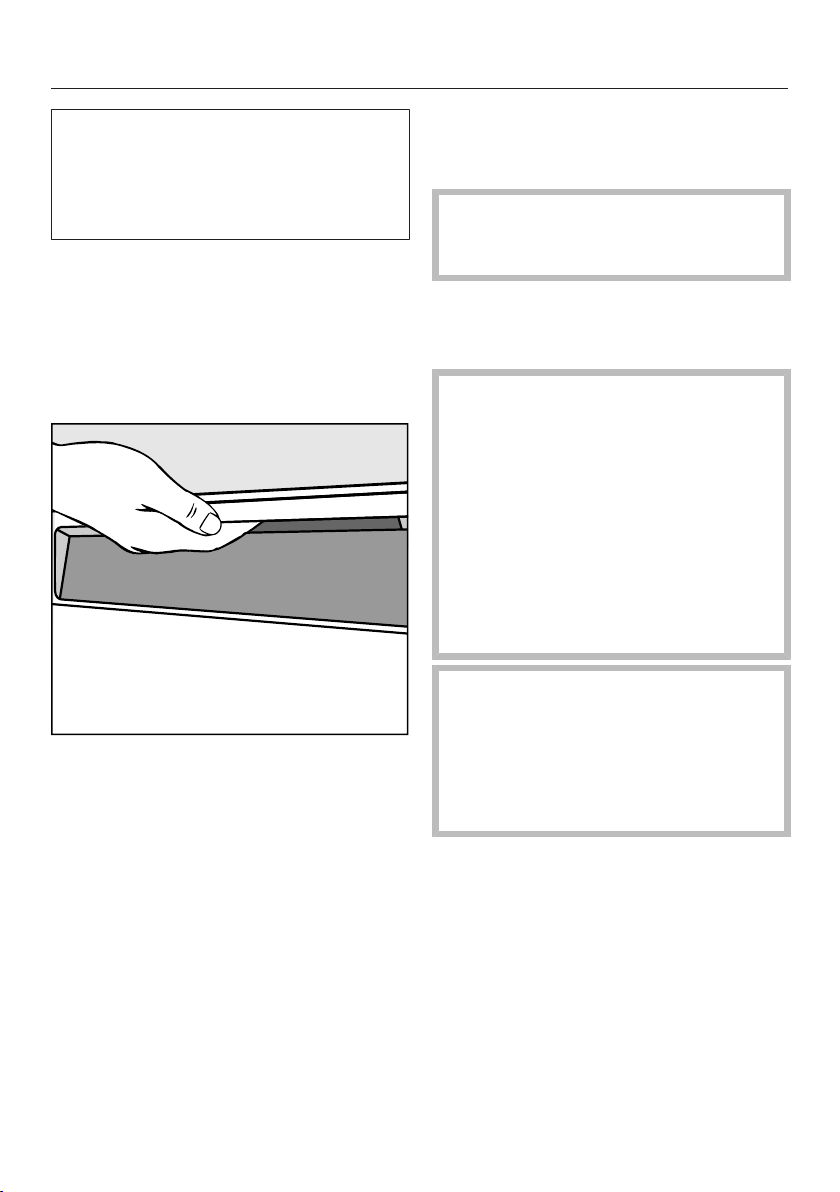
Opening the door
In some programmes the door
automatically opens slightly to assist
the drying process.
This function can be deactivated, if
preferred (see “Settings - AutoOpen”).
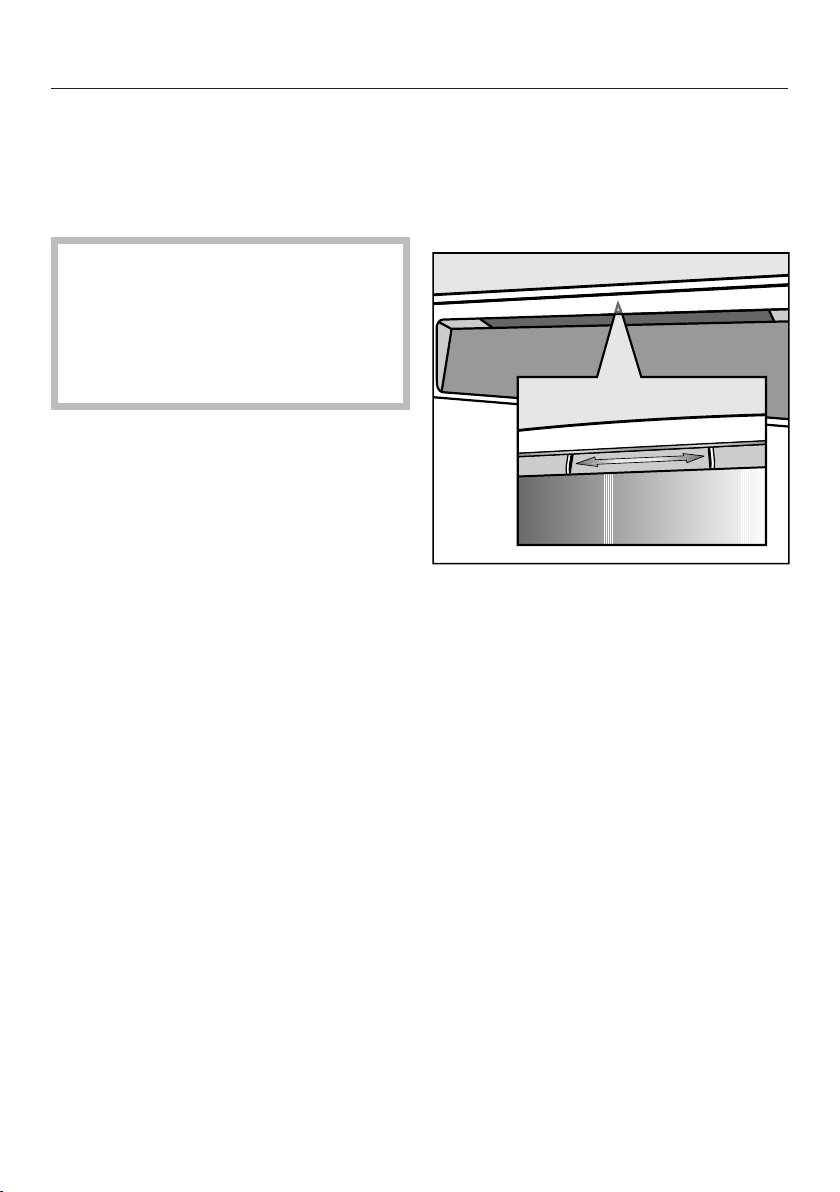
To open the door, reach under the
door grip and pull.
Open the door fully to disengage the
locking mechanism.
At the end of the programme, if the
AutoOpen function is on, the door
locking pins automatically retract.
To prevent a technical fault, do not
hold the door locking pins firmly
when they are retracting.
If the door is opened during operation,
all functions are automatically
interrupted.
Risk of scalding due to hot
water.
During operation, water in the
dishwasher may be very hot.
Only open the door if absolutely
necessary and exercise extreme
caution when doing so. Before
closing the door again, leave it ajar
for approx. 20 seconds. This will
enable the temperature in the wash
cabinet to settle.
Risk of injury due to door
opening automatically.
The door may open automatically at
the end of a programme.
Keep the area around the door free
of obstructions.
Using for the first time
23
Closing the door
Push the baskets right in.
Raise the door upwards until the
catch engages.
Risk of crushing due to the door
closing.
When closing the door, you are at
risk of shutting your fingers in it.
Do not put your hand inside the door
as it is closing.
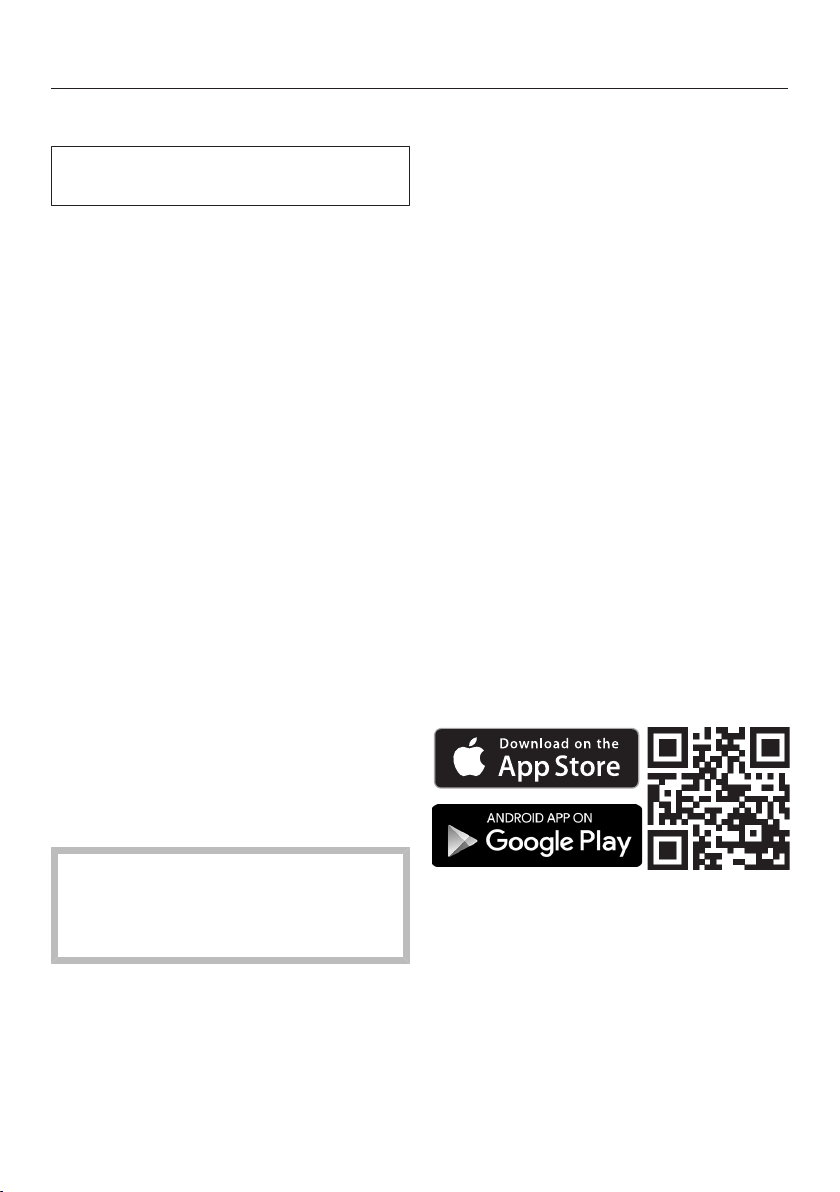
Activating the safety lock
Use the safety lock to prevent children
opening the dishwasher door. The door
can then only be opened by using a lot
of force.
To lock the door, push the slide
underneath the door grip to the right.
To unlock the door, push the slide to
the left.
Using for the first time
24
Miele@home
Your dishwasher is equipped with an
integrated Wi-Fi module.
To use this feature, you will need:
-a Wi-Fi network
-the Miele App
-a Miele user account. The user
account can be created via the Miele
App.
The Miele App will guide you as you
connect your dishwasher to your home
Wi-Fi network.
Once your dishwasher is connected to
your Wi-Fi network, you can use the
App to carry out the following tasks:
-Control your dishwasher remotely
-Call up information on the operating
status of your dishwasher
-Call up information on the
programme sequence of your
dishwasher
Connecting the dishwasher to your Wi-
Fi network will increase energy
consumption, even when the
dishwasher is switched off.
Make sure that your Wi-Fi network
signal strength is strong enough at
the installation site of your
dishwasher.
Availability of the Wi-Fi connection
The Wi-Fi connection shares a
frequency range with other appliances
(including microwave ovens and remote
control toys). This may result in
sporadic or even complete connection
failures. Therefore, a constant
availability of featured functions cannot
be guaranteed.
Miele@home availability
The ability to use the Miele App
depends on the availability of the
Miele@home service in your country.
The Miele@home service is not
available in every country.
For information about availability,
please visit www.miele.com.
Miele App
You can download the Miele App from
the Apple App Store
®
or the Google
Play Store™ free of charge (only
functional in selected countries).
Using for the first time
25
Standard settings
Switching on the dishwasher
Switch the dishwasher on with the
button.
The welcome screen will appear when
the dishwasher is switched on for the
first time.
For further information about the
display functionality, see “Guide to the
appliance - Display functions”.
Setting the language
The display will change automatically to
the screen for setting the language.
Select the language and the country,
if applicable, using the buttons
and confirm with OK.
For further information on setting the
language, see “Settings - Language”.
A tick will appear next to the
language that has been set.
Setting up Miele@home
The message Set up Miele@home will
appear in the display.
To set up Miele@home now, confirm
by touching OK.
Useful tip: To postpone setup until
later, select the optionSkip and confirm
with OK.
There are two ways of connecting your
dishwasher to your Wi-Fi network:
Select the connection method you
want and confirm your selection with
OK.
1. Connect using App
2. Connect using WPS
You will then be guided by the display
and the Miele App.
For further information on
Miele@home, see “Settings -
Miele@home”.
Using for the first time
26
Setting the water hardness
The display will change to the screen
for setting the water hardness.
-The dishwasher needs to be
programmed to the correct water
hardness for your area.
-Your local water authority will be able
to advise you of the water hardness
level in your area.
-Where the water hardness fluctuates,
e.g. between 1.8 and 2.7mmol/l (10-
15°dH - German scale), always
programme the dishwasher to the
higher value (2.7mmol/l or 15°dH in
this example).
In the event of a fault, it will help the
service technician if you know the
hardness of your local water supply.
Enter the water hardness below:
____________mmol/l
The dishwasher is programmed at the
factory for a water hardness level of
0.36 mmol/l (2 °dH - German scale).
Set the water hardness level in your
area and confirm with OK.
See “Settings - Water hardness” for
more information.
Activating AutoDos
The display changes to the settings
screen for AutoDos (see “Detergents -
Automatic dispensing/AutoDos”).
Even if you do not wish to use
AutoDos, you must remove the
transport locking device from the
PowerDisk compartment before
running the first programme (see
“Detergents - Activating AutoDos”).
You can activate AutoDos.
If you do not wish to use AutoDos, you
can manually dispense the detergent
via the detergent compartment (see
“Detergents - Manual detergent
dispensing”).
Select the setting you want and
confirm with OK.
This setting applies to all programmes
and can be changed at any time using
the AutoDossensor.

Using for the first time
27
Finally, prompts will appear in the
display.
After confirming these prompts with
OK, the messages Refill salt and
Refill rinse aid may appear.
Add salt and rinse aid if necessary
(see “Using for the first time -
Dishwasher salt” and “Rinse aid”).
Select OK to confirm the messages.
When a programme is selected, it will
appear briefly in the display and the
relevant indicator light will come on.
Next, the estimated energy and water
consumption may be shown for the
selected programme for several
seconds.
Finally, the display will show the
estimated programme duration for the
programme selected.
Using for the first time
28
Dishwasher salt
In order to achieve good cleaning
results, the dishwasher needs to
operate with soft (low limescale) water.
Hard water results in the build-up of
calcium deposits on crockery and in the
appliance.
Water with a hardness level higher than
0.9mmol/l (5°dH – German scale) must
be softened. This occurs automatically
in the integrated water softener. The
water softener is suitable for a water
hardness level of up to 12.5mmol/l
(70°dH - German scale).
The water softener requires reactivation
salt.
Depending on the water hardness level
(<3.8mmol/l, or <21°dH – German
scale), dishwasher salt is not required if
combination detergents are being used
(see “Detergents - Types of
detergents”).
If the water in your area is very soft
and constantly lower than 0.9mmol/l
(5 °dH - German scale) you do not
need to add dishwasher salt. The salt
refill indicator will automatically switch
off after the water hardness has been
set accordingly (see “Settings - Water
hardness”).
Damage to the water softener
from detergents.
Dishwasher detergents will damage
the water softener.
Do not fill the salt reservoir with
powder or liquid detergent.
Damage caused by using
unsuitable salts.
Other types of salt (such as cooking
salt, rock salt, agricultural grade or
gritting salt) may contain insoluble
components which can impair the
functioning of the water softener.
Only use special coarse-grained
dishwasher salt or other pure
evaporated salts for reactivation.
If you only ever use combination
detergent products in your
dishwasher, you can switch off both
refill reminders if you wish (see
“Settings - Refill reminders”).
Please make sure that if you stop
using combination detergents, you
refill the dishwasher salt and rinse
aid. Switch the refill reminders back
on if required.
Using for the first time
29
Filling the salt reservoir
Before filling the salt reservoir for the
first time, you must fill it with approx.
2litres of water to enable the salt to
dissolve.
Once the dishwasher has been used,
there is always sufficient water in the
salt reservoir.
Remove the lower basket from the
wash cabinet and unscrew the salt
reservoir cap.
Risk of corrosion due to saline
solution.
Water or saline solution will run out
of the reservoir when the cap is
opened. Saline solution that runs out
can cause corrosion in the wash
cabinet and to the dishwasher load.
The salt reservoir should therefore
only be opened to replenish the salt.
Fill the salt reservoir with approx. 2l
of water (first use only).
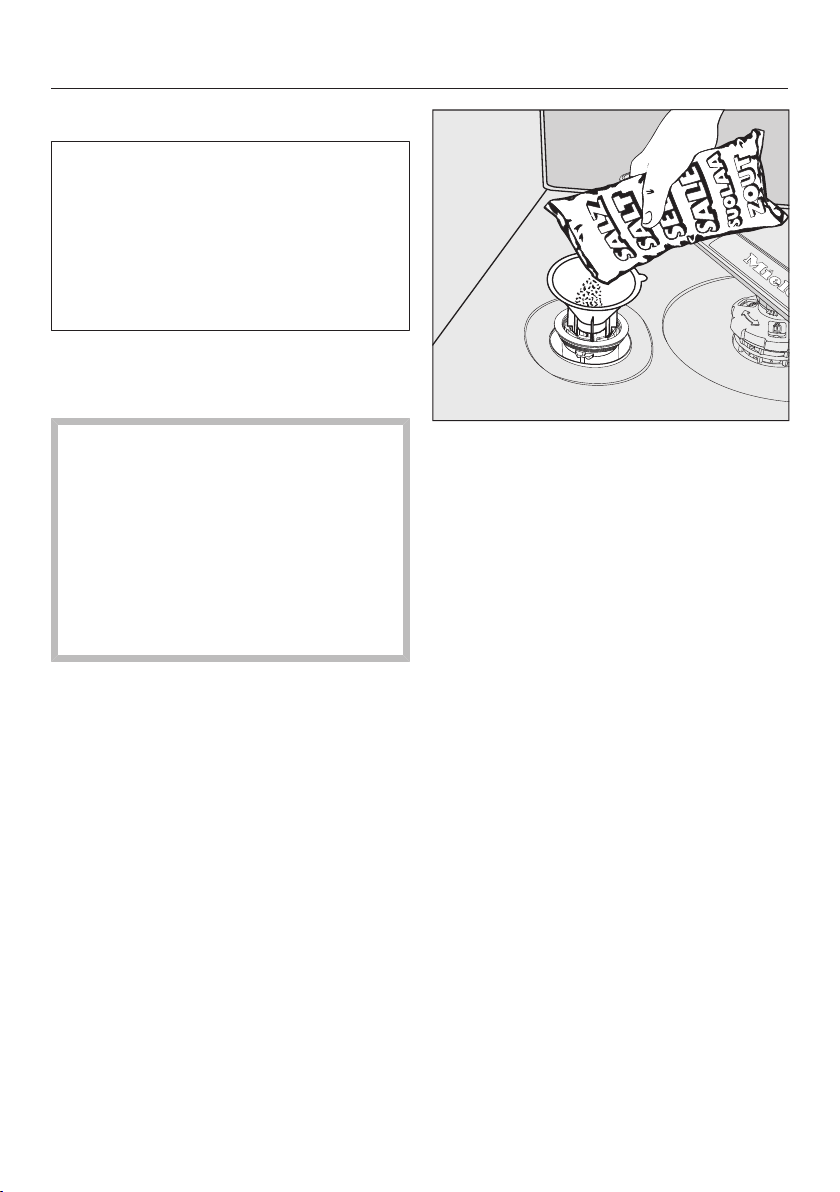
Place the funnel provided on the salt
reservoir and carefully fill with
dishwasher salt until the reservoir is
full. The salt reservoir holds up to
2kg of salt, depending on the type of
salt used.
Clean off salt residues from around
the salt reservoir opening. Next,
screw the salt reservoir cap on again
firmly.
Immediately after filling the salt
container, run the 65 °C
QuickPowerWash programme with
the Express option and without
any load in the dishwasher to
dissolve and remove any traces of
salt from the wash cabinet.

Using for the first time
30
Replenishing salt
When Refill salt appears in the
display wait until the end of the
programme and then refill the salt
reservoir.
Confirm with OK.
The salt refill indicator will go out.
Risk of corrosion due to saline
solution.
Saline solution that runs out can
cause corrosion in the wash cabinet
and to the dishwasher load.
Each time you have opened the salt
reservoir lid, immediately run the
65 °C QuickPowerWash programme
with the Express option and
without any dishes. This will dissolve
and remove any traces of salt from
the wash cabinet.
After the salt reservoir has been filled,
the refill reminder may still appear in the
display if the salt concentration has not
yet reached the correct level. In this
case, confirm with OK again.
The salt refill indicator is deactivated if
the dishwasher is set to a water
hardness below 0.9mmol/l (5 °dH -
German scale).
Using for the first time
31
Rinse aid
Rinse aid is necessary to ensure water
does not cling to and leave marks on
crockery during the drying phase, and it
helps crockery dry faster after it has
been washed.
Rinse aid is poured into the storage
reservoir and the amount set is
dispensed automatically.
Damage caused by washing-up
liquid or detergents.
Dishwasher detergent will destroy
the rinse aid reservoir.
Only fill rinse aid designed for
domestic dishwashers into the
reservoir.
Alternatively, you can use liquid citric
acid with up to 10% acid content. The
dishes will be more moist and stained
than with rinse aid.
Damage caused by acids.
The dishwasher can be damaged by
acids with a higher concentration.
Never use citric acid or vinegar with
a higher acid content (e.g. vinegar
essence 25% acid).
If you only ever use combination
detergent products in your
dishwasher, you do not need to fill
the rinse aid reservoir.
However, the best rinsing and drying
results will be achieved by using a
detergent together with separate
dishwasher salt and rinse aid.
If you want to permanently use
combination detergent products in
your dishwasher, you can switch off
the refill reminders for salt and rinse
aid if you wish (see “Settings - Refill
reminders”).
Please make sure that if you stop
using combination detergents, you
refill the dishwasher salt and rinse
aid. Switch the refill reminders back
on if required.
Using for the first time
32
Adding rinse aid
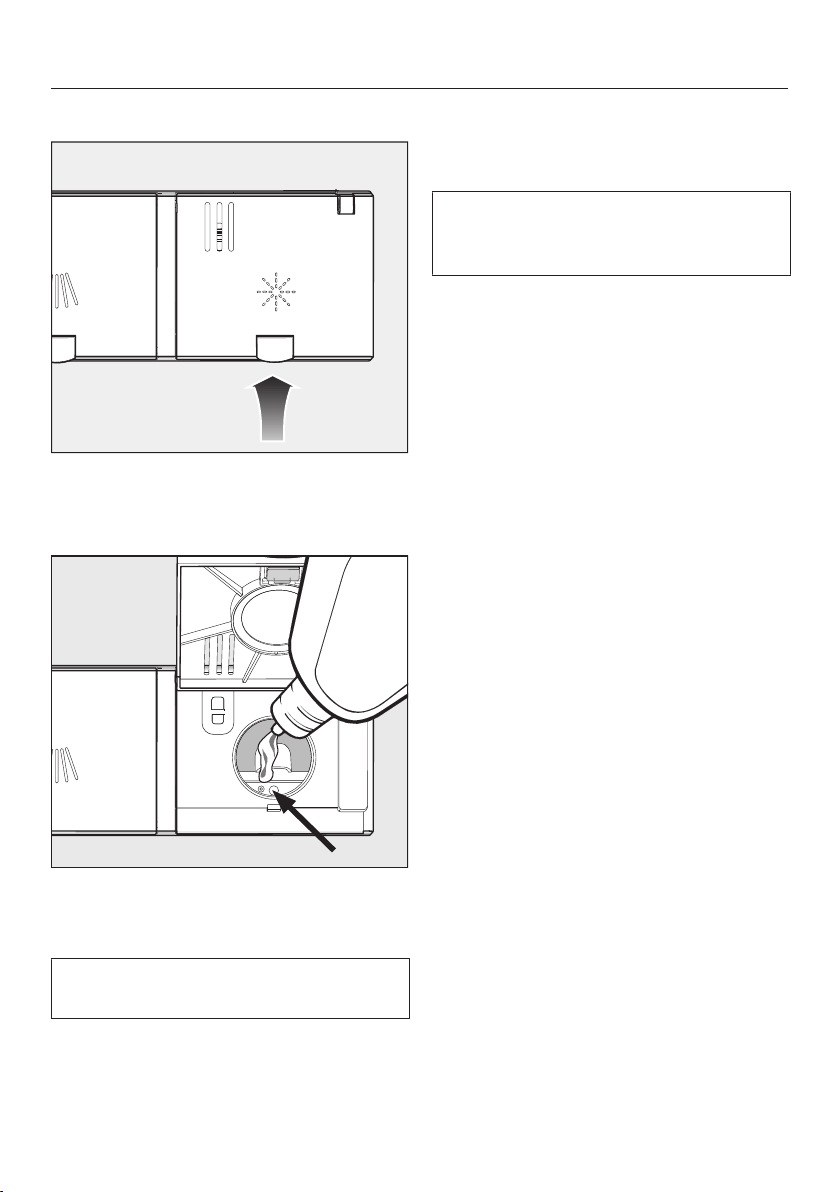
Lift the yellow catch on the lid of the
rinse aid container .
The lid will spring open.
Only add rinse aid until the fill level
indicator (see arrow) turns dark when
the door is open horizontally.
The rinse aid reservoir holds approx.
110 ml.
Close the flap firmly so that it clicks
into place. Otherwise water can enter
the rinse aid reservoir during a
programme.
Wipe up any spilled rinse aid. This
prevents over-foaming occurring
during the next programme.
You can adjust the rinse aid dosage
for best results (see "Settings - Rinse
aid").
Refilling rinse aid
When the Refill rinse aid message
appears, the reservoir only contains
sufficient rinse aid for another 2 - 3
programmes.
Add rinse aid in good time.
Confirm with OK.
The refill rinse aid reminder will go out.

Settings
33
You can alter the dishwasher’s
controls to suit changing requirements
by adjusting the settings.
Settings can be altered at any time.
Opening the Settings menu
Switch the dishwasher on with the
button if it is switched off.
Use the programme selection
button to select the Further
programmes/Settings option.
The first of the further programmes will
appear in the display.
Select the Settings menu option
using the buttons and confirm
with OK.
The first option in the Settings menu will
appear in the display.
For further information about the
display functionality, see “Guide to the
appliance - Display functions”.
Changing settings
Use the buttons to select the
menu option you want to change and
confirm your selection with OK.
Submenu options that have already
been selected will have a tick
beside them.
Use the buttons to select the
required setting and confirm with OK.
To exit a submenu, press the
button.
The display will revert to the menu
above.
Closing the Settings menu
Press the button.
The display will change to the menu.
Settings
34
Language
The display can be set to appear in one
of several different languages.
You can change the language used in
the display and also the country via the
Language submenu.
The flag after the word Language
serves as a guide if a language that
you do not understand has been set.
In this case keep selecting the menu
option that has a flag after it until you
reach the Language submenu.
Water hardness
Your dishwasher is fitted with a water
softener.
-The dishwasher needs to be
programmed to the correct water
hardness for your area.
-Your local water authority will be able
to advise you of the water hardness
level in your area.
-Where the water hardness fluctuates,
e.g. between 1.8 and 2.7mmol/l (10-
15°dH - German scale), always
programme the dishwasher to the
higher value (2.7mmol/l or 15°dH in
this example).
If the water hardness in your area is
available in a unit other than °dH, you
can convert the values as follows:
1°dH = 0.18mmol/l = 1.78°fH
Setting the water hardness
Select the water hardness level in
your area and confirm with OK.

Settings
35
AutoDos (automatic
dispensing)
Automatic dispensing automatically
adjusts the amount of detergent to the
selected programme. In the Auto45–
65°C programme, the quantity is
adjusted depending on the degree of
soiling of the crockery.
If you want to extend the service life of
the PowerDisk, you can reduce the
dispensing quantity. The programme’s
cleaning performance may decrease as
a result.
If you want to improve the cleaning
performance, you can increase the
dispensing quantity. This reduces the
service life of the PowerDisk.
Setting theDosage amount
For best results, you can adjust the
dispensing quantity of the PowerDisk.
Select the Dosage amountmenu
option and confirm with OK.
Select the setting you want and
confirm with OK.
Rinse Aid
You can adjust the rinse aid dosage for
best results.
The rinse aid dosage can be set from 0
to 6ml.
3ml is the factory default setting.
If spots appear on crockery and
glassware:
-Increase the rinse aid dosage.
If clouding or smearing appears on
crockery and glassware:
-Decrease the rinse aid dosage.
Settings
36
Miele@home
Your dishwasher is equipped with an
integrated Wi-Fi module.
You can connect your dishwasher to
your Wi-Fi network.
This will increase the energy
consumption, even when the
dishwasher is switched off.
Additional menu options will be added
to the “Settings“ and “Miele@home”
menus.
Make sure that your Wi-Fi network
signal strength is strong enough at
the installation site of your
dishwasher.
There are a number of ways of
connecting your dishwasher to your Wi-
Fi network:
Connect using App
The Miele App is available to download
free of charge from the Apple App
Store
®
or from the Google Play Store™.
Select the Connect using Appmenu
option and confirm with OK.
Follow the instructions in the App.
Once the dishwasher is connected to
your Wi-Fi network, you can use the
App to carry out the following tasks:
-Control your dishwasher remotely
-Call up information on the operating
status of your dishwasher
-Call up information on the
programme sequence of your
dishwasher
-Set up a Miele@home network with
other Wi-Fi-enabled Miele appliances

Settings
37
Connect using WPS
As an alternative to networking via the
Miele App, you can connect your
dishwasher to your Wi-Fi network using
WPS (Wireless Protected Setup).
Your Wi-Fi router must support WPS.
Confirm the messagePress WPS
button with OK.
Activate the WPS function on your
router within twominutes.
Once the connection has been
established, confirm the message
with OK.
If the connection fails, you have
probably not connected WPS on your
router quickly enough. Repeat the steps
above.
Deactivate
If you do not wish to use the Wi-Fi
module of your dishwasher, you can
switch it off.
Select the Deactivatemenu option
and confirm with OK.
In the Miele@home menu, the menu
option Activate will now be displayed
instead of Deactivate.
Activate
If you wish to connect your dishwasher
to your Wi-Fi network, you can switch
on the Wi-Fi module.
Select the Activatemenu option and
confirm with OK.
In the Miele@home menu, the menu
option Deactivate will now be displayed
instead of Activate.

Settings
38
DisplayingConnection status
You can call up the current connection
status of your dishwasher.
Select the Connection statusmenu
option and confirm with OK.
Use the sensors to consecutively
call up the Wi-Fi signal strength, the
name of your router, and the
associated IP address.
Select OK to confirm the messages.
Set up again
This menu option only appears if you
have connected your dishwasher to
your Wi-Fi network before.
Connect using App
Select the Connect using Appmenu
option and confirm with OK.
Follow the instructions in the App.
Connect using WPS
Select the Connect using WPSmenu
option and confirm with OK.
Follow the instructions in the display.
Reset
This menu option only appears if you
have connected your dishwasher to
your Wi-Fi network before.
You can use this menu option to reset
all Wi-Fi module settings to the factory
default settings.
The network configuration should be
reset whenever a dishwasher is being
disposed of or sold, or if a used
dishwasher is being put into operation.
This is the only way to ensure that all
personal data has been removed and,
in the case of the latter, a previous
owner will no longer be able to access
the dishwasher.
Select the Resetmenu option and
confirm with OK.

Settings
39
Remote control
This menu option will only be
displayed if you have connected your
dishwasher to your Wi-Fi network (see
“Settings - Miele@home”).
If you have switched on the option
Remote control, the menu item
MobileStart is displayed under
Further programmes/Settings.
If you wish to permanently switch off
the Remote control option, you can do
this under this menu option. The menu
item MobileStart will then no longer be
displayed.
Even if the Remote control option is
switched off, you can use Miele to call
up information about your appliance.
However, you cannot start any
programmes or change any settings
from it.
RemoteUpdate
The RemoteUpdate menu option is
only displayed and can only be
selected if the requirements for using
Miele@home have been met (see
“Using for the first time -
Miele@home”).
The RemoteUpdate function is used for
updating the software in your
dishwasher. If an update is available for
your dishwasher, it will automatically
download it. Updates will not be
installed automatically. They must be
initiated manually.
If you do not install an update, you can
continue to use your dishwasher as
usual. However, Miele recommends
installing updates.
Activating/deactivating
The RemoteUpdate function is
activated as standard. Available
updates will be downloaded
automatically but will only be installed if
you initiate the installation manually.
Deactivate RemoteUpdate if you do not
want any updates to be downloaded
automatically.
Settings
40
Running a RemoteUpdate
Information about the content and
scope of a RemoteUpdate will be
provided in the Miele App.
A message will appear in your
dishwasher display if a software update
is available.
You can install the update immediately
or postpone this until later. When the
appliance is switched on again, you will
be reminded about the update.
Deactivate RemoteUpdate if you do not
want to install the update.
The update may take several minutes.
Please note the following information
about the RemoteUpdate function:
-You will only receive a message when
an update is available.
-Once an update has been installed, it
cannot be undone.
-Do not switch the dishwasher off
during the update. Otherwise, the
update will be aborted and will not be
installed.
-Some software updates can only be
carried out by a Miele service
technician.
Consumption (EcoFeedback)
You can set whether the energy and
water consumption is displayed for the
selected programme. This function
shows the estimated consumption
before a programme, and the actual
consumption after the end of the
programme.
In this menu you can also call up the
total consumption of energy and water
for all the wash programmes you have
run on your dishwasher to date (see
“Caring for the environment -
EcoFeedback consumption display“).
DisplayingConsumption
Select the Consumption displaymenu
option and confirm with OK.
Select the setting you want and
confirm with OK.
DisplayingTotal consumption
Select the Total consumptionmenu
option and confirm with OK.
You can display the values for Energy
and Water using the buttons.
You can also reset the values for the
total consumption to 0.
Select the Resetmenu option and
confirm with OK.
Select the Yesmenu option and
confirm with OK.
Confirm the message with OK.
The values are now reset to 0.
Settings
41
Display brightness
You can set the display brightness to
one of seven different levels.
Refill reminders
If you only ever use combination
detergent products or automatic
dispensing using Miele PowerDisks (if
available), you can switch off the refill
reminders for reactivation salt and rinse
aid if you wish.
Please make sure that if you stop
using combination detergents, you
refill the dishwasher salt and rinse
aid. Switch the refill reminders back
on.
AutoOpen
In some programmes the door
automatically opens slightly to assist
the drying process.
This function can be deactivated if you
wish.
Risk of damage due to steam.
Steam from the dishwasher could
damage the edges of delicate
worktops when you open the door at
the end of the programme if the fan
is no longer running.
If you have deactivated the
automatic door opening function but
would still like to open the door at
the end of the programme, make
sure that you open the door fully.

Settings
42
Extra clean
You can choose this function to
increase the cleaning performance of
the programmes.
If you activate this function, the
programme cycle times and the main
wash temperatures will increase.
Programmes normally without a pre-
wash will incorporate a pre-wash
phase. The water and energy
consumption may increase.
If this function is switched on, it will be
applied to all programmes until it is
switched off again (except for the ECO
programme).
Extra dry
You can select this function in order to
increase the drying performance of the
programmes.
If you activate this function, the
programme cycle times and final rinse
temperatures will increase. Programmes
normally without a pre-wash will
incorporate a pre-wash phase. The
energy consumption may increase.
If this function is switched on, it will be
applied to all programmes until it is
switched off again (except for the ECO
programme).
2nd interim rinse
You can choose this function to
increase the cleaning performance of
the programmes with a second interim
rinse.
When this function is activated, water
consumption may increase.
If this function is switched on, it will be
applied to all programmes until it is
switched off again (except for the ECO
programme).
Hygiene cycle
If you mainly use low temperature
programmes (<50°C), there is a risk of
bacteria and unpleasant odours
building up in the wash cabinet (see
“Cleaning and care – Hygiene cycle”).
If this function is switched on, a
message will be displayed
recommending the use of a high
temperature programme after several
low temperature programmes have
been run.

Settings
43
Software version
You can display the electronic software
version of your dishwasher for technical
support purposes.
Showroom
For demonstration purposes only.
The dishwasher is equipped with a
demo mode for showroom use.
Factory default
You can reset all dishwasher settings to
the factory default settings.
The settings of the Wi-Fi module (where
applicable) have to be reset separately
(see "Settings – Miele@home – Reset").
Select Reset and confirm with OK.
Copyright and licences for the
communication module
For the purpose of operating and
controlling the communication module,
Miele uses proprietary or third-party
software that is not covered by open
source licensing terms. These items of
software/software components are
protected by copyright. The copyright
powers of Miele and third parties must
be respected.
In addition, the communication module
contains software components which
are distributed under open source
licensing terms. The open source
components contained in the appliance
along with the corresponding copyright
notices, copies of the licensing terms
valid at the time, and any further
information can be accessed locally via
IP using a web browser (http://<IP
address>/Licenses), where <IP
address> is the IP address of the
appliance. The liability and warranty
arrangements for the open source
licences displayed in this location only
apply in relation to the respective rights
holders.

Caring for the environment
44
Economical dishwashing
This dishwasher is exceptionally
economical in its use of water and
electricity.
You can support the economical
operation of your appliance by following
these tips:
-Washing in a dishwasher generally
uses less water and energy than
washing dishes by hand.
-Pre-rinsing dishes under running
water is not necessary and
unnecessarily increases water and
energy consumption.
-For the most economical
dishwashing, make full use of the
basket capacity without overloading
the dishwasher. This results in the
most economical use of the
dishwasher in terms of energy and
water consumption.
-Choose the programme to suit the
type of crockery being washed and
the degree of soiling (see
“Programme chart”).
-Select the ECOprogramme for
energy-saving dishwashing. This
programme is the most efficient in
terms of its combined energy and
water consumption for cleaning
dishes with a normal level of soiling.
-Follow the detergent manufacturer’s
recommendations on detergent
dosage.
-When using powder or liquid
detergent, you can use
1
/
3
less
detergent if the baskets are only half
full.
-You can connect the dishwasher to a
hot water supply. A hot water
connection is particularly suitable
with energy-saving water heating
sources, such as solar water heaters.
If the water is heated by electricity,
we recommend connection to cold
water.

Caring for the environment
45
EcoFeedback consumption
display
The "Consumption" function is used for
calling up information about the energy
and water consumption of your
dishwasher (see "Settings -
Consumption (EcoFeedback)").
The following information can be
viewed in the display:
-An estimate of the consumption
before the programme begins
-The actual consumption at the end of
the programme
-The total consumption of the
dishwasher to date
1. Consumption estimate
After a programme has been selected,
first the name of the programme and
after a few seconds the estimated
energy consumption and water
consumption will appear in the
display.
The estimated consumption will be
shown as a bar chart. The more bars
are shown (), the higher the energy or
water consumption.
The values are influenced by the
programme, any programme options
selected, the ambient conditions and
the size of the load.
The display will change automatically
from showing the estimated
consumption to showing the time
remaining.
The estimated consumption function is
activated as standard. It can be
deactivated, if preferred (see “Settings -
Consumption (EcoFeedback)”).
2. Displaying consumption
At the end of the programme, you can
call up the actual energy and water
consumption for the programme that
has just been run.
Confirm the messageConsumption
(OK) with OK.
Switching the dishwasher off at the
end of the programme will delete the
actual consumption values for the
programme that has just been run.
3. Total consumption
You can call up the total consumption
of energy and water for all programmes
you have run on your dishwasher to
date (see “Settings - Consumption
(EcoFeedback)”).

Loading the dishwasher
46
General information
Remove coarse food residues from
crockery.
There is no need to pre-rinse items
under running water.
Damage can be caused by ash,
sand, wax, lubricating grease, or
paint.
These substances will contaminate
the dishwasher and can then no
longer be removed.
Do not wash items soiled with these
substances in the dishwasher.
Dishes can be loaded anywhere in the
baskets. However, please try to observe
the following notes:
-Do not place dishes and utensils
inside other items where they will
cover one another.
-Load the crockery so that water can
access all surfaces. This ensures that
they will get properly cleaned.
-Make sure that all items are securely
positioned.
-Hollow items such as cups, glasses,
and saucepans etc. must be inverted
in the baskets.
-Tall and narrow, hollow items such as
champagne glasses should be
placed in the centre of the basket
rather than in the corners. This
ensures the hollow items are more
easily accessed by the water jets.
-Wide based items should be placed
at an angle so that water can run off
them freely.
-The spray arms must not be blocked
by items that are too tall or hang
through the baskets. Test for free
movement by manually rotating the
spray arms.
-Make sure that small items cannot
fall through the holders in the
baskets.
Small items such as lids should
therefore be placed in the cutlery tray
or cutlery basket (depending on
model).
Some foods such as carrots,
tomatoes, or tomato sauce may
contain natural dyes. These dyes can
discolour plastic items in the
dishwasher if large quantities of these
foods are in contact with the crockery
inside the machine. The stability of
plastic items is not affected by this
discolouration.
Washing silverware can also cause
plastic items to discolour.

Loading the dishwasher
47
Items not suitable for washing in the
dishwasher:
-Wooden cutlery and crockery or
items with wooden parts. These may
discolour and fade. Furthermore, the
glue used in these items is not
dishwasher safe. Wooden handles
may come loose after being washed
in the dishwasher.
-Craft items, antiques, valuable vases,
and decorative glassware. Such
items are not suitable for
dishwashers.
-Plastic items that are not heat
resistant. The high temperatures in
the dishwasher may cause them to
melt or lose shape.
-Copper, brass, tin, and aluminium
items. These may discolour or
become dull.
-Colours painted over a glaze. These
may fade after a number of washes.
-Delicate glassware and glassware
containing lead crystal. Clouding may
occur over time.
Silverware
Silver can discolour when in contact
with foods containing sulphur. These
include egg yolk, onions, mayonnaise,
mustard, pulses, fish, fish brine, and
marinades.
Silverware previously cleaned with a
silver polish may still be damp or
spotted at the end of a programme, as
water has not run off smoothly.
Useful tip: Rub the silverware dry with
a cloth.
Damage due to caustic alkaline
detergents.
Aluminium parts (e.g. the grease
filters of rangehoods) can be
damaged by caustic alkaline
detergents. In extreme cases, there
is a risk of an explosive chemical
reaction (such as an explosive
oxyhydrogen gas reaction).
Aluminium components must not be
cleaned in the dishwasher with
caustic alkaline commercial or
industrial detergents.
Useful tip: When purchasing new
crockery and cutlery, make sure they
are dishwasher safe if you want to wash
them in the dishwasher.
Glass care
-Clouding may occur on glasses after
frequent washing in the dishwasher.
When washing delicate glassware in
the dishwasher, select a special glass
care programme with a low
temperature (see “Programme chart”).
This will reduce the risk of clouding.
-Purchase glassware that is
dishwasher safe (e.g. Riedel
glassware).
-Use detergents with glass protective
additives.

Loading the dishwasher
48
Upper basket
See “Loading the dishwasher -
Loading examples” for examples of
how to load crockery and cutlery.
Loading the upper basket
Damage due to leaking water.
If you run the dishwasher without the
upper basket, water can leak out of
the dishwasher.
Only run the dishwasher with the
upper basket in place (except with
the programmeTall items, if available).
Use the upper basket for small,
lightweight, and delicate items such
as cups, saucers, glasses, dessert
bowls, etc.
Shallow pans or casserole dishes can
also be placed in the upper basket.
Long items such as soup ladles and
mixing spoons should be placed lying
down across the front of the upper
basket.
Loading the FlexCare cup rack
You can put cups, small bowls, and flat
dishes on the FlexCare cup rack.
Glasses can be arranged along the cup
rack so they sit securely during the
programme.
Fold down the cup rack.
Raise the cup rack upwards to make
room for tall items.

Loading the dishwasher
49
Adjusting the FlexCare cup rack
You can set the height and depth of the
cup rack at twodifferent levels so that it
can accommodate larger cups and so
that taller items can be placed
underneath it.
Pull the cup rack upwards and click it
into the desired position (see arrows).
Loading the silicone elements of the
FlexCare cup rack
The silicone elements on the cup rack
are specially designed to hold tall
glasses with long stems securely.
Fold down the cup rack and lean the
glasses in the openings.
If you wish you can adjust the left
insert of the 3D MultiFlex tray to
make space for taller glasses (see
“Cutlery tray/Cutlery basket –
Loading the 3D MultiFlex tray”).
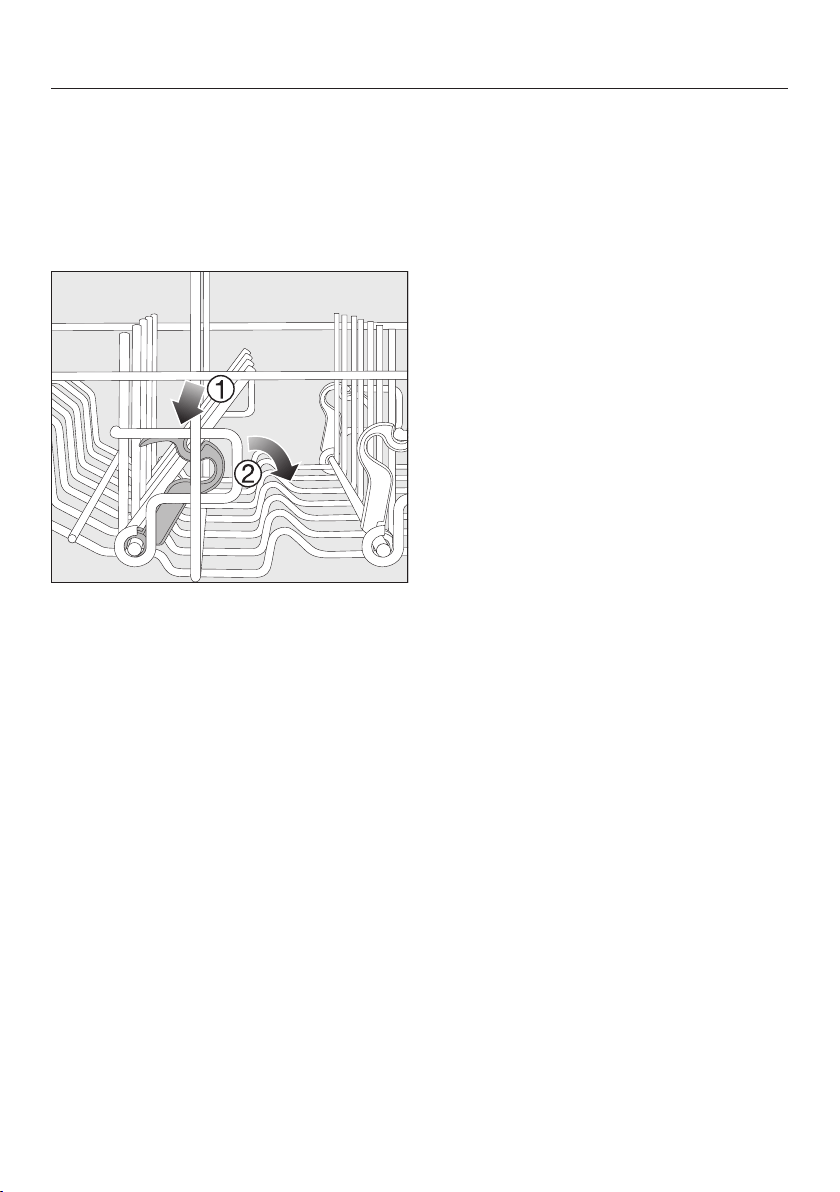
Loading the dishwasher
50
Lowering the spikes
You can fold down every second spike
in the two front right hand rows of
spikes to make it easier to arrange
larger pieces of crockery, e.g. cereal
bowls.
Press the yellow lever downwards,
and then lower the dark gray
spikes.
Place the items vertically in the row of
spikes.
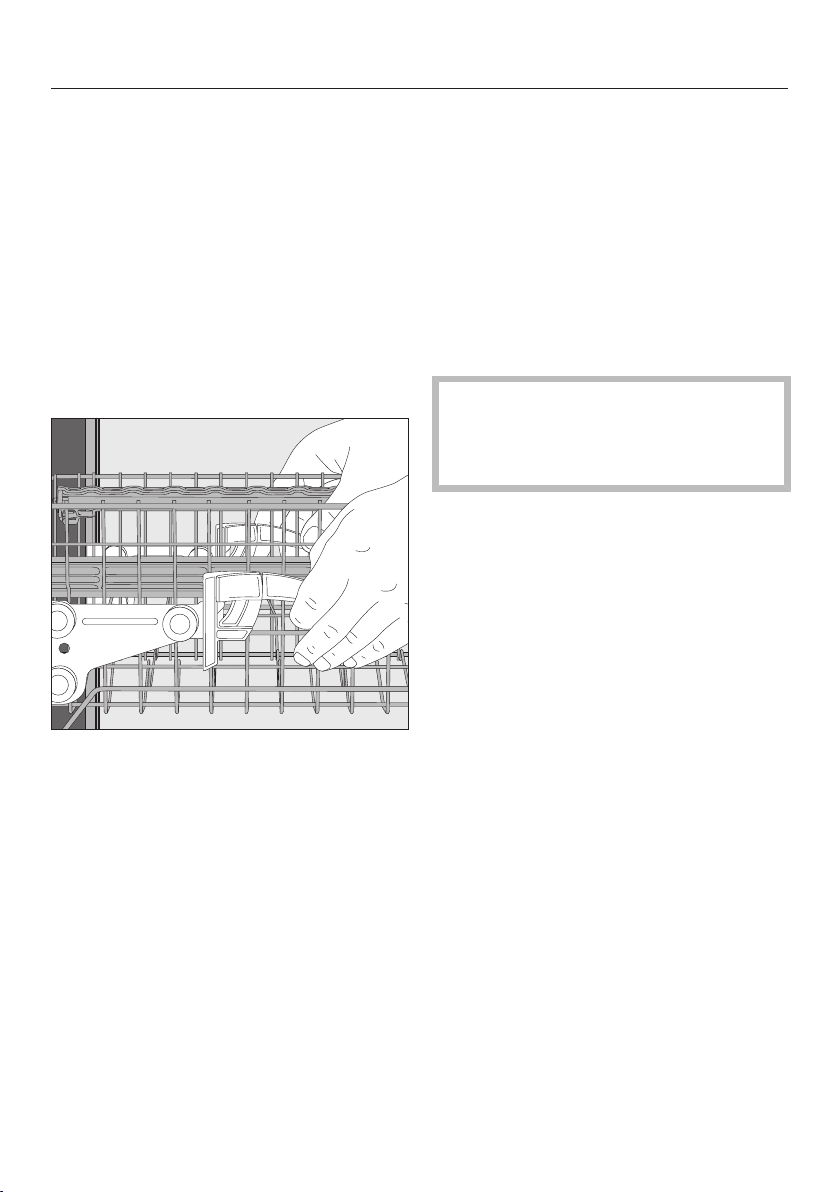
Loading the dishwasher
51
Adjusting the upper basket
In order to gain more space for taller
items, the upper basket can be
adjusted on three levels with 2cm
between each level.
The upper basket can also be set at an
angle so that water can run off freely
from recesses. However, make sure
that the basket can slide smoothly in
and out of the wash cabinet.
Pull out the upper basket.
To raise the upper basket:
Pull the basket up until it clicks into
place.
To lower the upper basket:
Pull upwards on the levers at either
side of the upper basket.
Adjust the basket to the desired
height and then push the levers
securely back down into position.
When adjusting the upper basket,
make sure that tall plates in the lower
basket do not block the middle spray
arm.
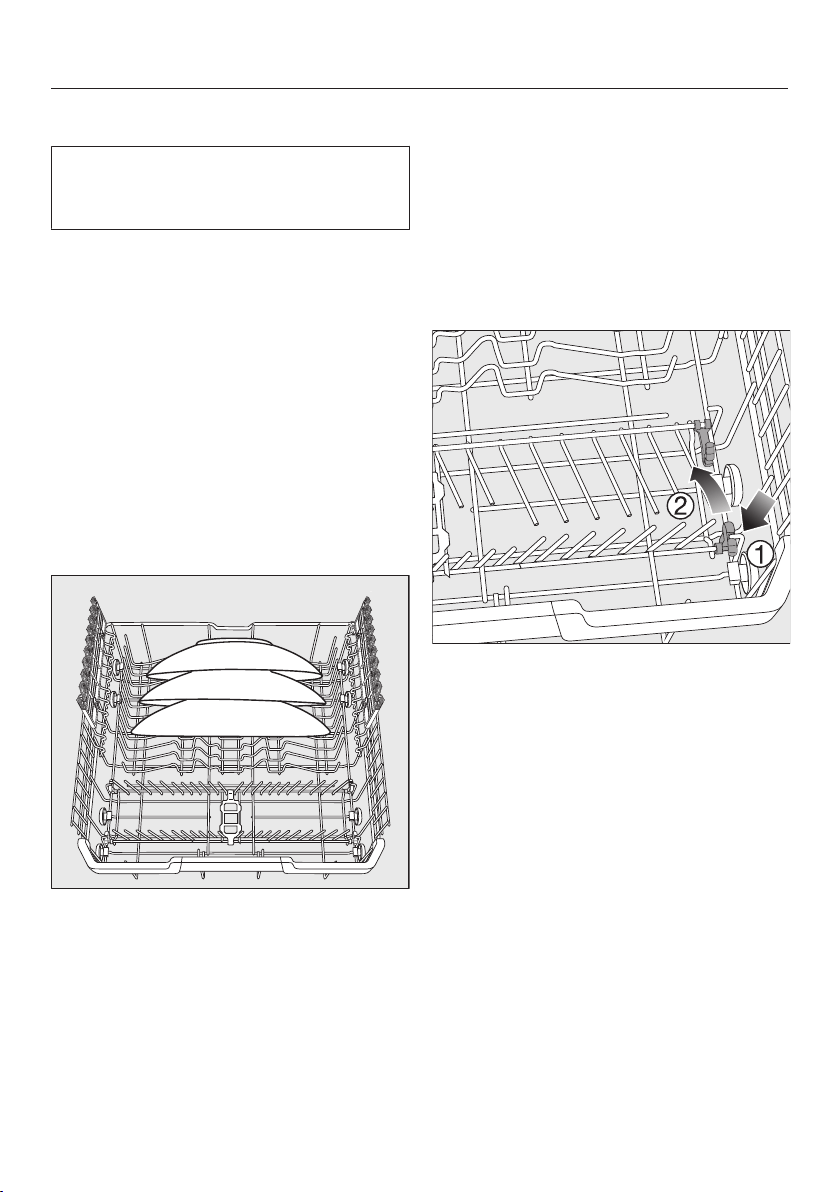
Loading the dishwasher
52
Lower basket
See “Loading the dishwasher -
Loading examples” for examples of
how to load crockery and cutlery.
Loading the lower basket
Place larger and heavier items such
as plates, serving platters,
saucepans, serving bowls etc., in the
lower basket.
Glasses, cups, small plates and
saucers can also be placed in the
lower basket.
Loading the MultiComfort area
The rear section of the lower basket is
used for washing cups, glasses, plates,
and saucepans.
Place large platters and dishes in the
centre of the lower basket.
Useful tip: When tilted, plates up to
35cm in diameter can be
accommodated.
Lowering the spikes
The rows of spikes at the front are used
for loading plates, soup bowls, platters,
dessert bowls and saucers.
Both right-hand rows of spikes can be
folded down to make more room for
large items such as pots, pans, and
serving dishes and bowls.
Press the yellow lever downwards ,
and then fold down the spikes .
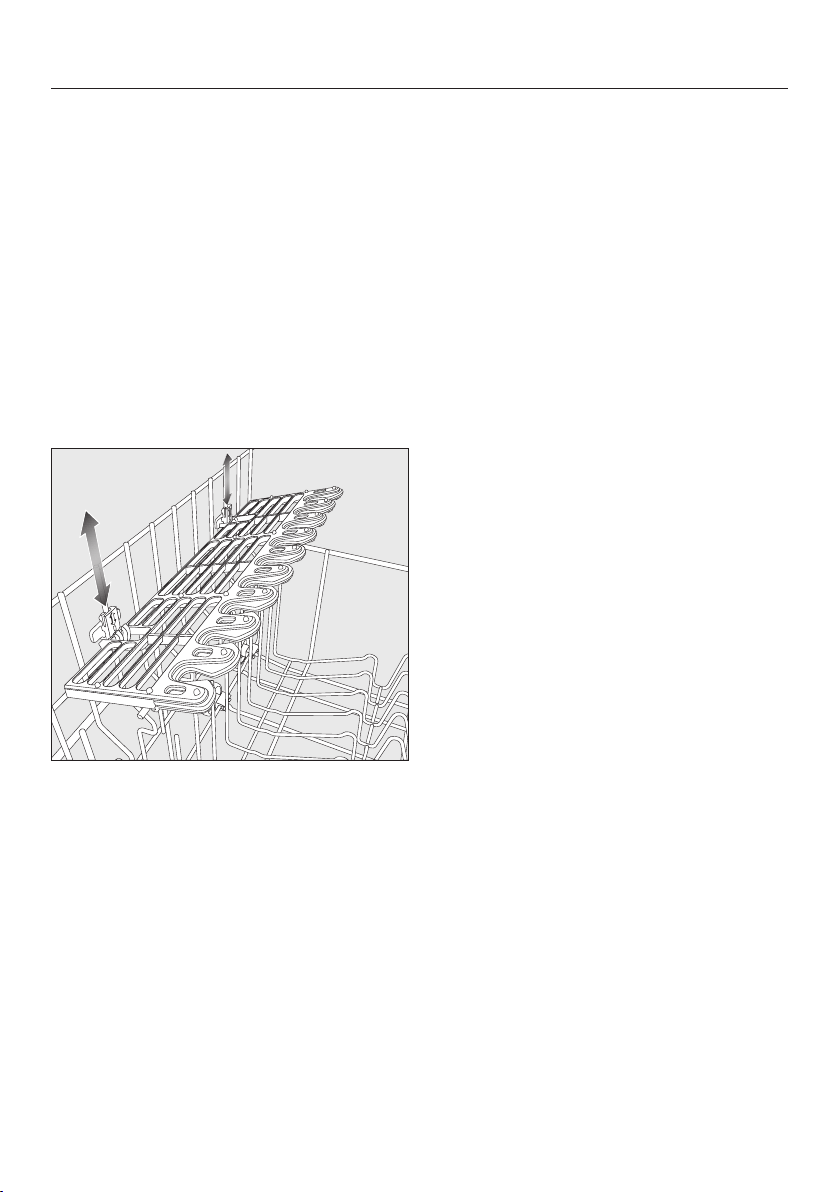
Loading the dishwasher
53
Loading the FlexCare glass holder
The silicone elements in the glass
holder provide a stable and secure hold
for delicate stemware.
Stemware such as wine glasses and
champagne flutes can be leaned
against the glass holder or
suspended from it.
The glass holder can be folded up to
make more room for tall items.
You can set the glass holder to two
different heights.
Slide the glass holder to the desired
height until the catches click into
place at the top or the bottom.
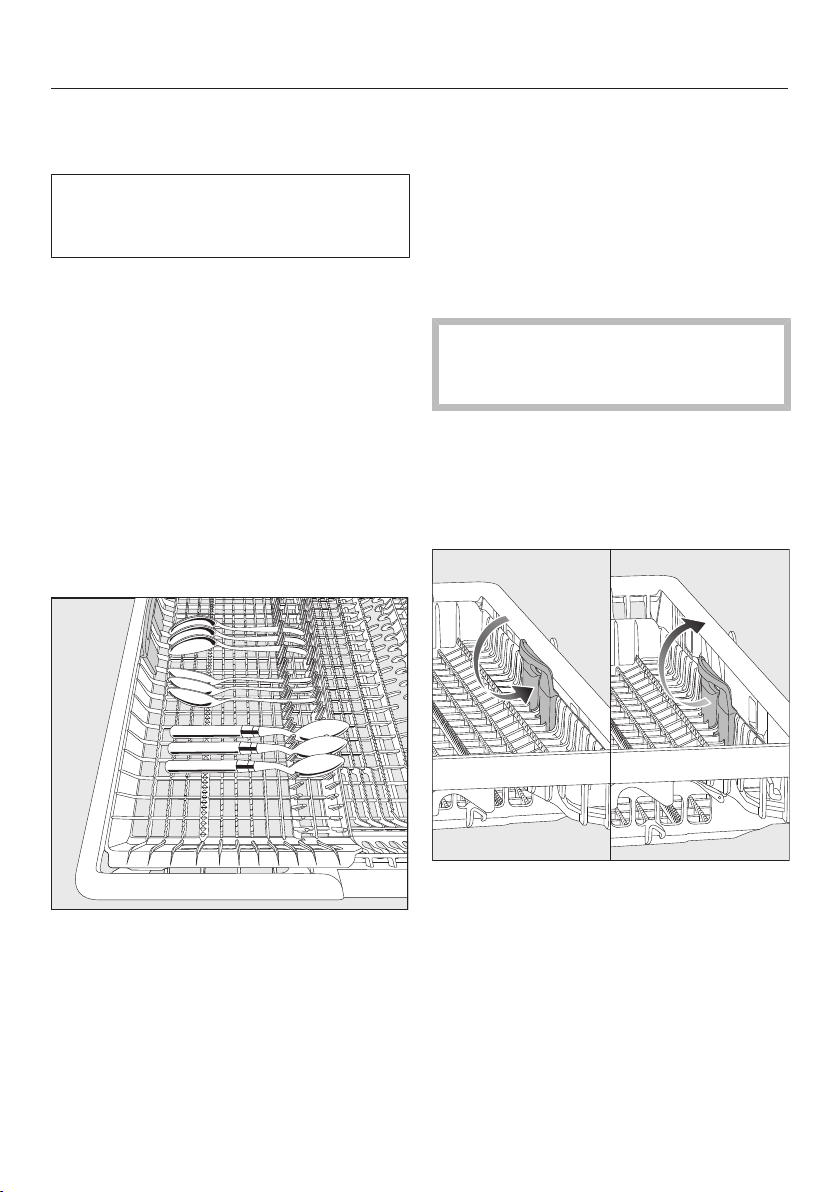
Loading the dishwasher
54
Cutlery tray/Cutlery basket
(depending on model)
See “Loading the dishwasher -
Loading examples” for examples of
how to load crockery and cutlery.
Load cutlery into the 3D MultiFlex tray
or the cutlery basket (depending on
model).
Loading the 3D MultiFlex tray
To make unloading easier, cutlery
should be grouped in zones, one for
knives, one for forks, one for spoons,
etc.
Spoon heads should be placed to rest
on the serrated retainers on the base of
the tray to ensure that water runs off
them freely.
If spoon handles do not fit between
the holders, lay them the other way
round.
You can push the left insert to the
middle in order to accommodate tall
items of crockery and long stemmed
glasses in the upper basket (see “Upper
basket – Loading the silicone elements
of the FlexCare cup rack”).
You can put large and long cutlery in
the recessed centre part of the tray.
Arrange tall items (such as cake
servers) so that they do not block the
upper spray arm.
You can adjust the height of the right-
hand insert to create more space in the
right-hand part of the tray for larger
cutlery items or smaller pieces of
crockery.
Pull the insert inwards by the yellow
handle and click it into place in one of
the two positions.
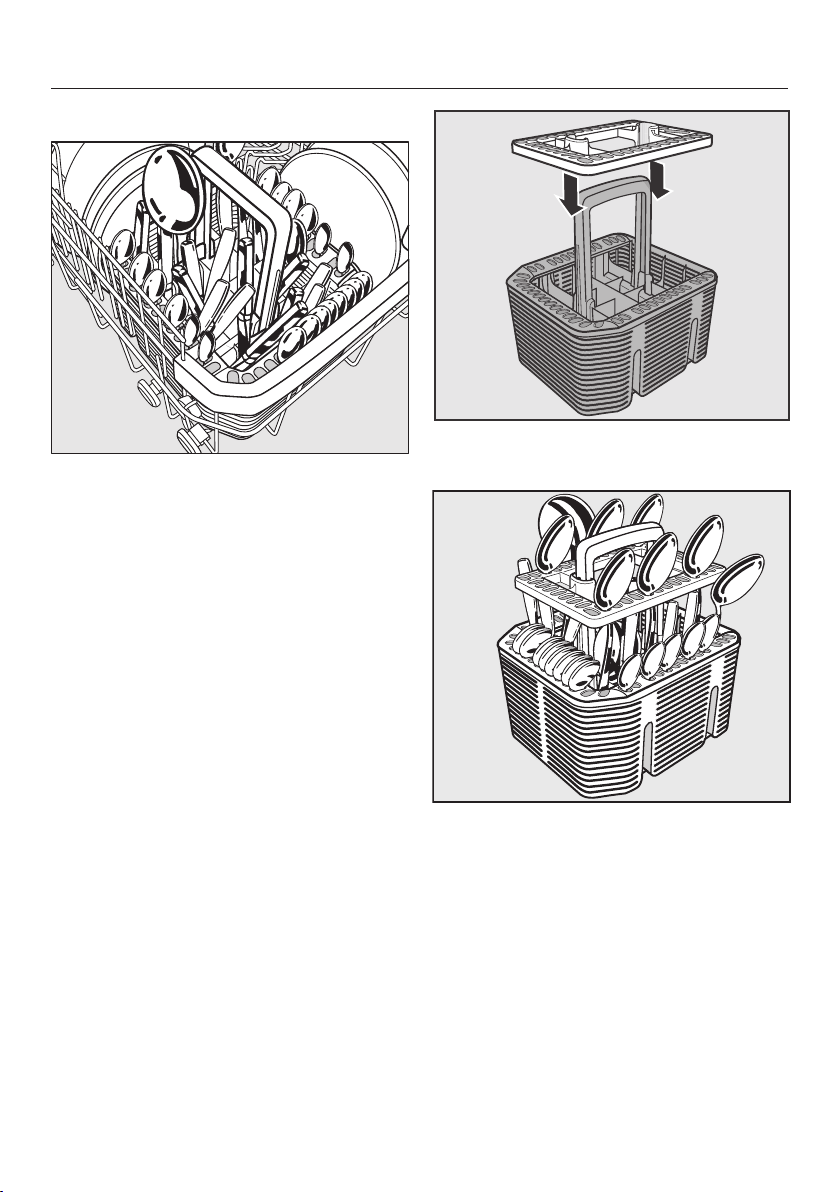
Loading the dishwasher
55
Loading the cutlery basket
The cutlery basket can be placed
anywhere on the front rows of spikes in
the left or right corner of the lower
basket.
To avoid the risk of injury, knives and
forks should be placed with the
handles upwards in the cutlery
basket. However, cutlery placed
handle down in the cutlery basket will
come out cleaner and drier.
Place small items of cutlery in the
individual slots on three sides of the
cutlery basket.
Loading the cutlery insert for the
cutlery basket
Use the insert supplied for heavily
soiled items of cutlery. As this insert
separates the items, they do not
overlap and can be more easily
accessed by the water jets.
Fit the insert onto the cutlery basket if
required.
Place cutlery into the insert with the
handles facing downwards.
Arrange them evenly along the insert.
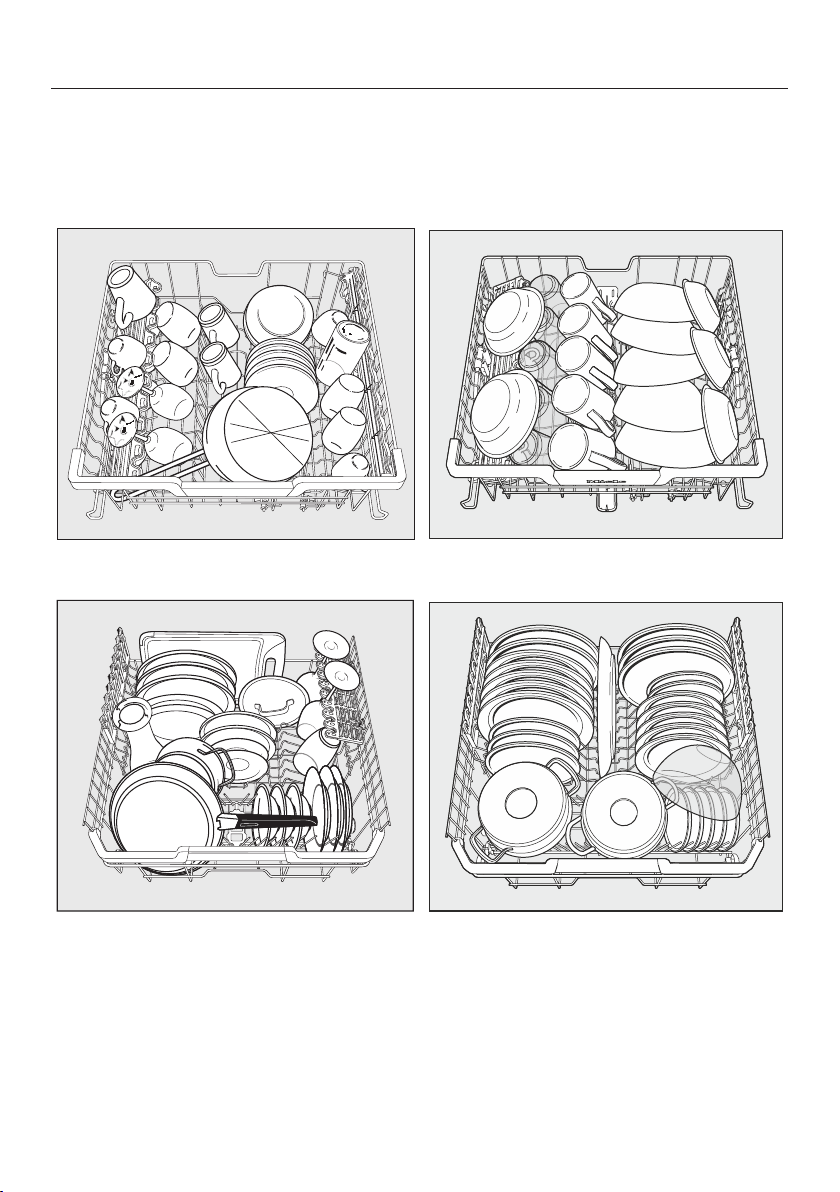
Loading the dishwasher
56
Loading examples
Dishwashers with cutlery tray
Upper basket
Lower basket

Loading the dishwasher
57
Cutlery tray
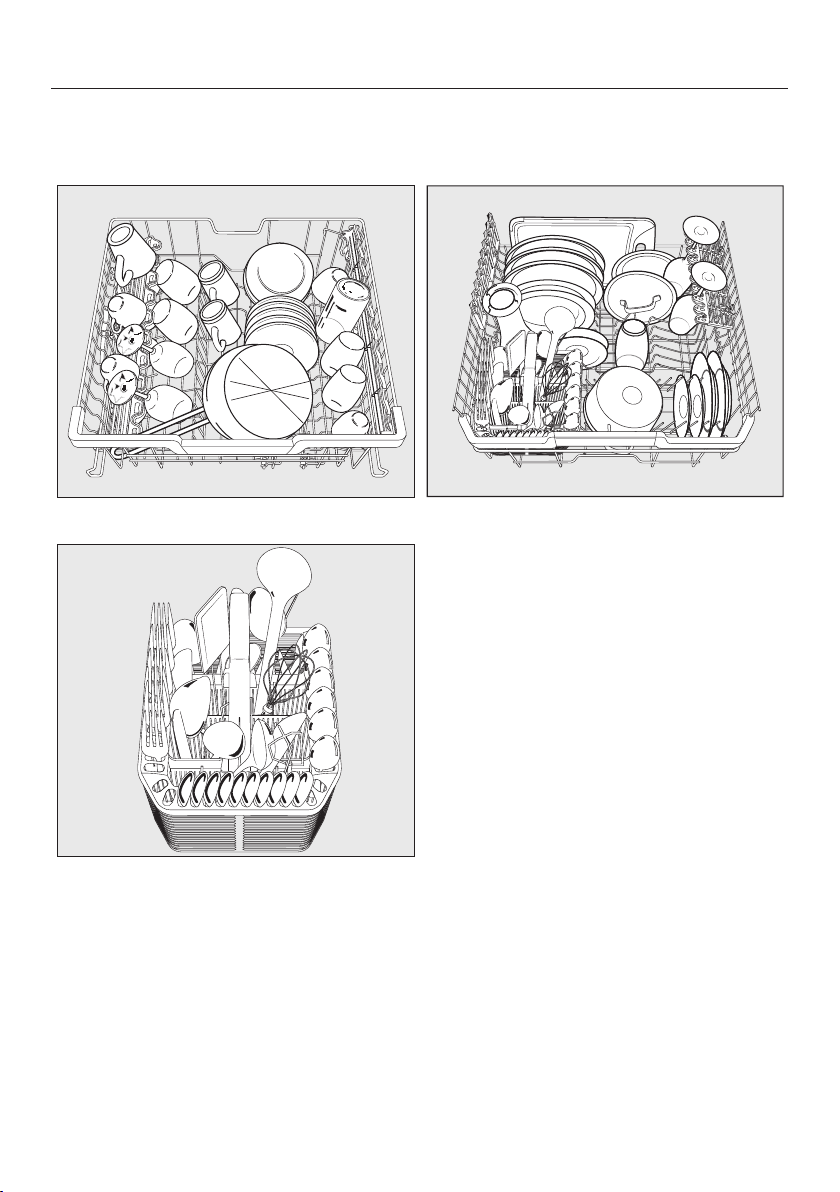
Loading the dishwasher
58
Dishwashers with cutlery basket
Upper basketLower basket
Cutlery basket
Comparison tests
59
Test standard:AS/NZS 2007.1:2005, AS/NZS 2007.2:2005;
AS/NZS 6400:2005
Standard programme
(for energy label):
ECO
Capacity:14place settings
Detergent amount:27.5 g
Rinse aid dosage:Setting 3
You can find information on adjusting the rinse aid dosage in the "Rinse aid"
section of this booklet.
The door opens automatically during the drying phase.
Do not close the door until the drying test has finished.
Upper basket setting:
Position:Bottom
FlexCare cup rack
(if available):
Left lower position, right upper position
Loading examples
Pictures illustrating how to load the dishwasher for each model (see data plate) are
shown on the following pages.
Picture : Upper basket
Picture : Lower basket
Picture : Cutlery basket
Do not lower or remove the basket inserts.
Squeeze and remove the bottle holder from the lower basket
(if available).
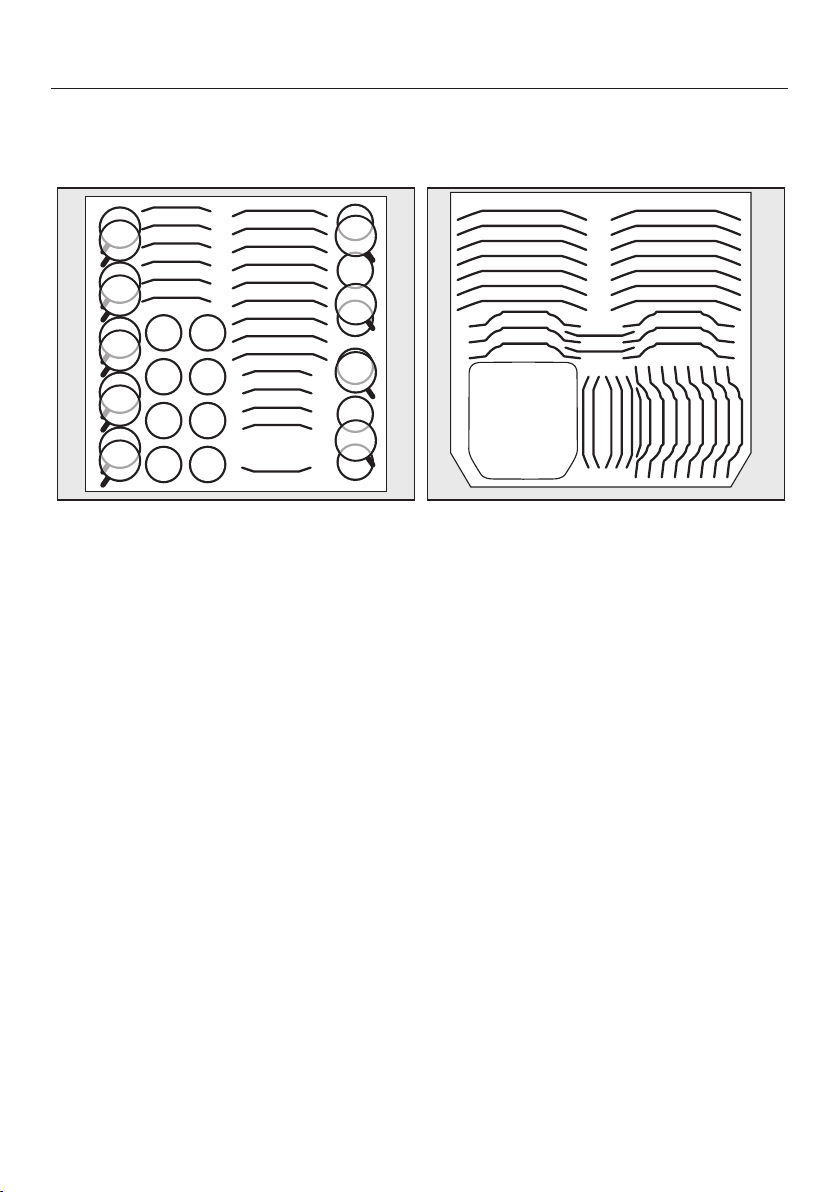
Comparison tests
60
Capacity
14
Upper basketLower basket
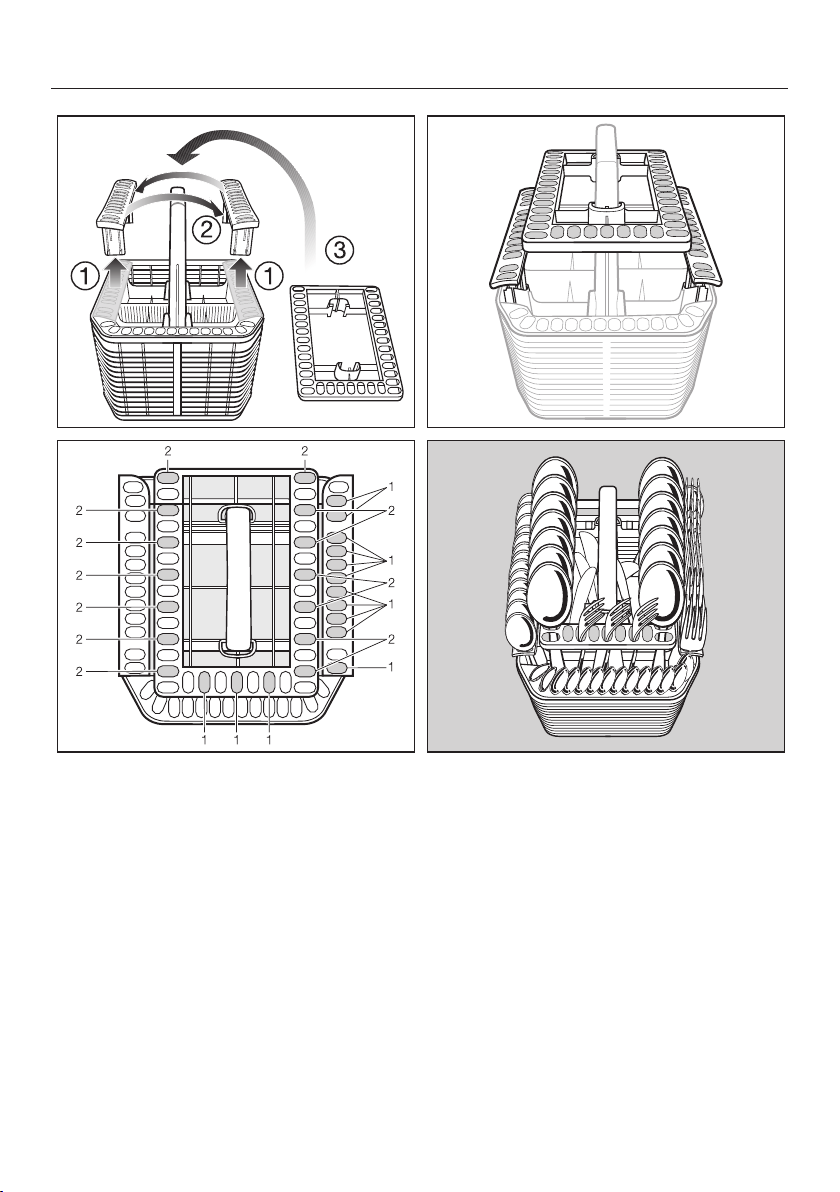
Comparison tests
61
Cutlery basket
1 fork
2 soup spoons
Comparison tests
62
Test standard:AS/NZS 2007.1:2005, AS/NZS 2007.2:2005;
AS/NZS 6400:2005
Standard programme
(for energy label):
ECO
Capacity:14place settings
Detergent amount:27.5 g
Rinse aid dosage:Setting 3
You can find information on adjusting the rinse aid dosage in the "Rinse aid"
section of this booklet.
The door opens automatically during the drying phase.
Do not close the door until the drying test has finished.
Upper basket setting:
Position:Bottom
FlexCare cup rack: Left lower position
Loading examples
Pictures illustrating how to load the dishwasher for each model (see data plate) are
shown on the following pages.
Picture : Upper basket
Picture : Lower basket
Picture : Cutlery tray
Do not lower or remove the basket inserts.
Squeeze and remove the bottle holder from the lower basket
(if available).
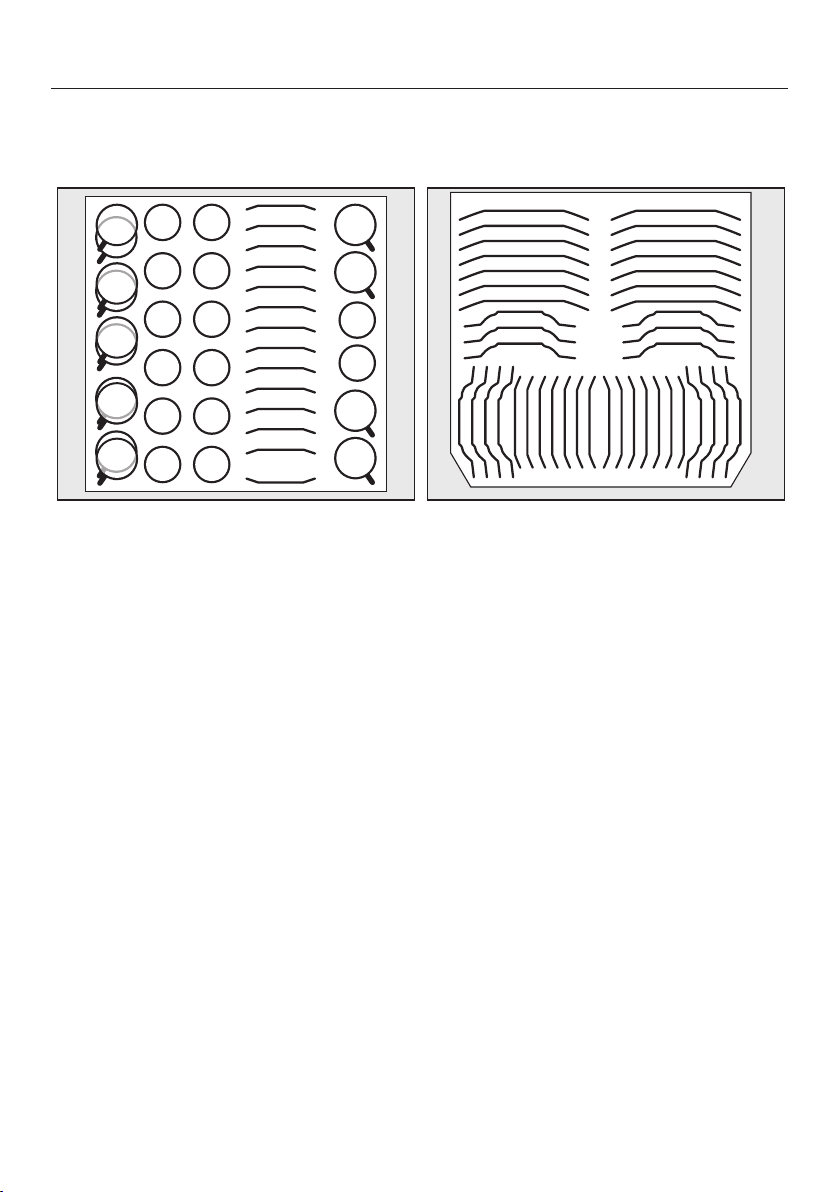
Comparison tests
63
Capacity
14
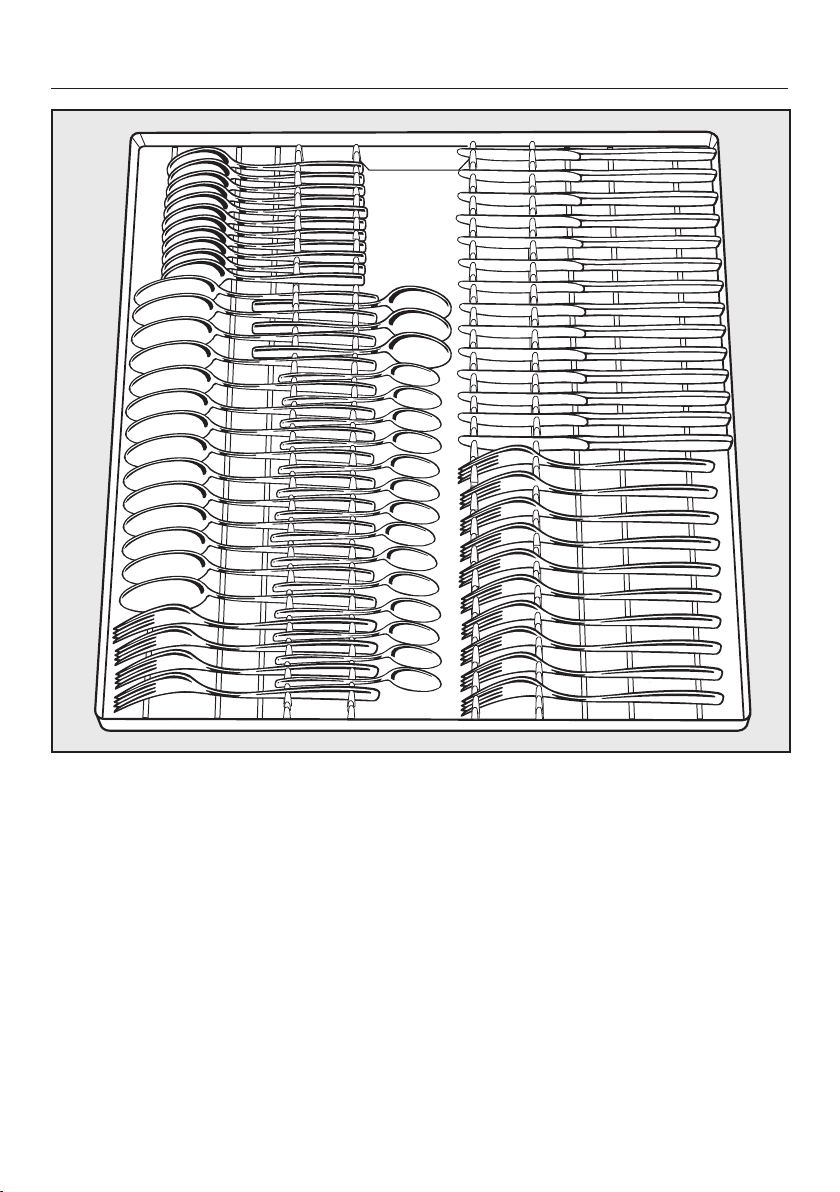
Comparison tests
64
Comparison tests
65
Test standard:AS/NZS 2007.1:2005, AS/NZS 2007.2:2005;
AS/NZS 6400:2005
Standard programme
(for energy label):
ECO
Capacity:15place settings
Detergent amount:33.7 g
Rinse aid dosage:Setting 3
You can find information on adjusting the rinse aid dosage in the "Rinse aid"
section of this booklet.
The door opens automatically during the drying phase.
Do not close the door until the drying test has finished.
Upper basket setting:
Position:Bottom
FlexCare cup rack Left lower position, right upper position
Loading examples
Pictures illustrating how to load the dishwasher for each model (see data plate) are
shown on the following pages.
Picture : Upper basket
Picture : Lower basket
Picture : Cutlery tray
Do not lower or remove the basket inserts.
Squeeze and remove the bottle holder from the lower basket
(if available).
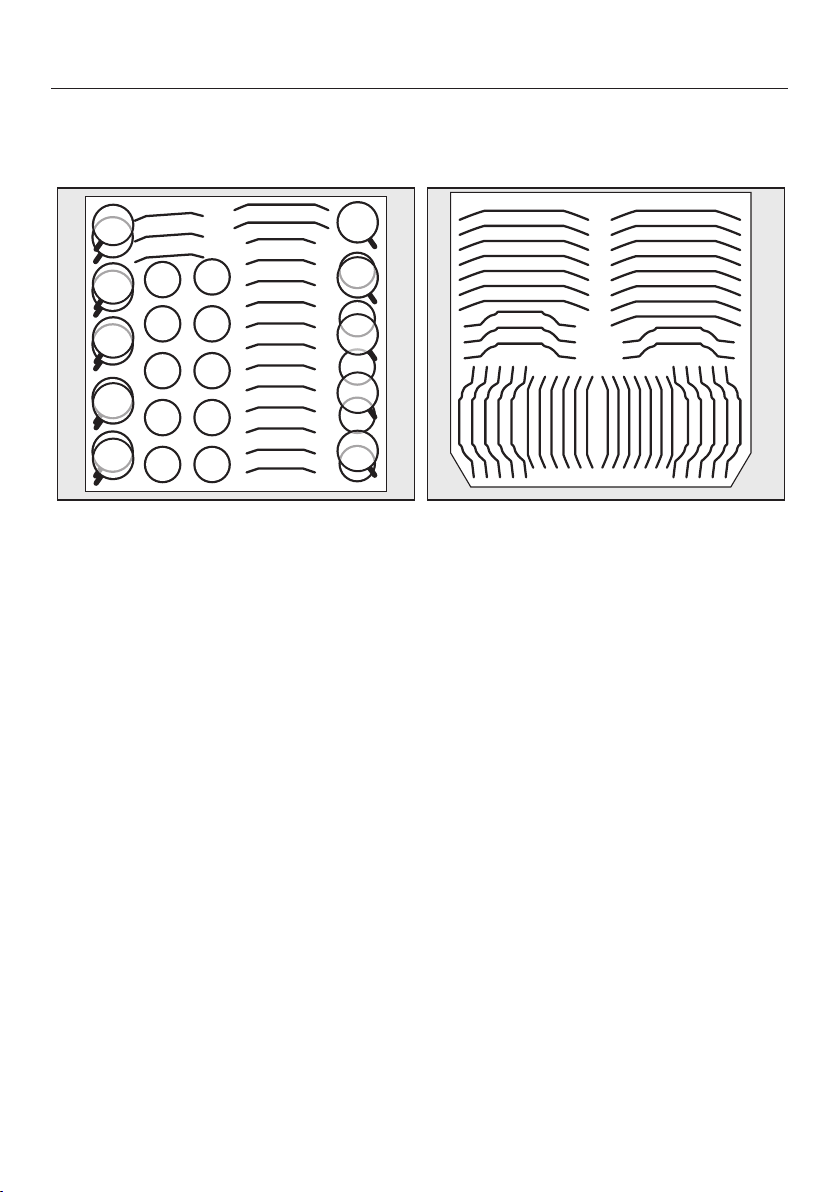
Comparison tests
66
Capacity
15
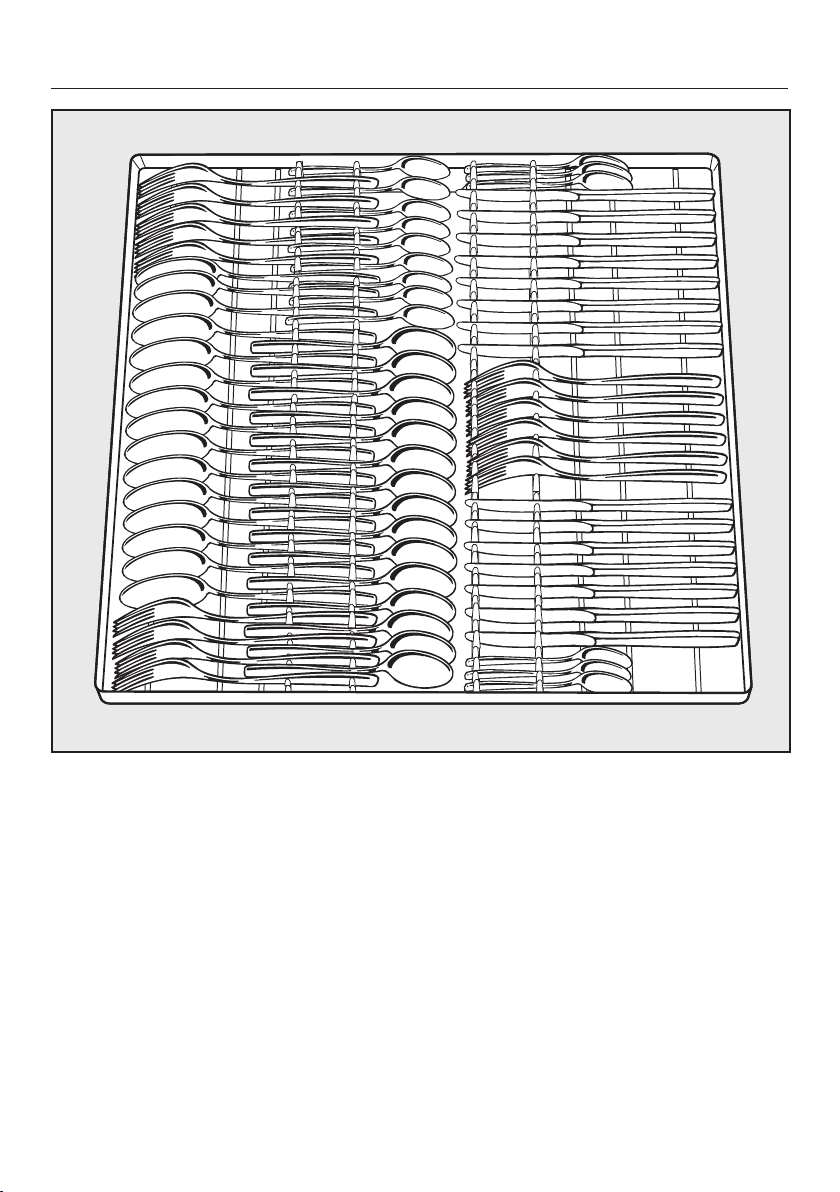
Comparison tests
67
Detergents
68
Types of detergents
Damage due to unsuitable
detergents.
Detergents that are not suitable for
domestic dishwashers can cause
damage to the dishwasher or to the
load.
Only use detergents formulated for
domestic dishwashers.
Modern detergents contain various
active ingredients, the most important
of which are:
-Water softening complexing agents
to prevent calcification.
-Alkalis to aid removal of dried-on
soiling.
-Enzymes to break down starch and
loosen protein.
-Oxygen-based bleaching agents to
remove coloured stains (e.g. tea,
coffee, tomato sauce).
Most dishwasher detergents are mildly
alkaline and contain enzymes and
oxygen-based bleaching agents.
There are different types of detergents:
-Powder and liquid gel detergents.
These detergents allow you to adjust
the amount dispensed according to
the size of the load and the level of
soiling.
-Tablet detergents. These are suitable
for most levels of soiling.
As well as the usual detergents,
combination products are also
available.
These contain rinse aid and water
softener (reactivation salt).
Only use these combination detergents
for the water hardness levels
recommended by the manufacturer on
the packaging.
The cleaning and drying performance of
these combination detergents can vary
greatly.
For optimum cleaning and drying
results, use dishwasher detergent and
add salt and rinse aid separately.

Detergents
69
Risk of chemical burns from
detergent.
Dishwasher detergents can cause
burning on the skin and in the eyes,
nose, mouth, and throat.
Avoid contact with detergents.
Do not inhale or ingest powder
detergents. Do not swallow
dishwasher detergent. Seek medical
attention immediately if detergent
has been swallowed or inhaled.
Keep detergents out of reach of
children. Detergent residues could
still be present in the machine. Keep
children away from the dishwasher
when the door is open. Do not fill the
detergent dispenser until just before
starting the programme and activate
the door safety lock (depending on
model).
Detergent dispensing
There are two ways of dispensing the
detergent.
During automatic dispensing, the
AutoDos function will automatically
dispense the required amount of
detergent for each programme once a
PowerDisk has been inserted (see
“Detergents - Automatic dispensing/
AutoDos”).
If you do not wish to use AutoDos, you
can manually dispense the detergent
into the detergent compartment. This
means you will have to fill the required
amount of detergent into the detergent
compartment before each programme
(see “Detergents - Manual detergent
dispensing”).

Detergents
70
Automatic dispensing/AutoDos
Before you can use AutoDos, you must
insert a PowerDisk containing powder
detergent into the PowerDisk
compartment.
One PowerDisk contains enough
detergent for approx. 20cycles,
depending on the selected programme.
PowerDisks are available to order
directly from the Miele online store or
a Miele Experience Centre.
Risk of chemical burns from
residual detergent.
Detergents have a caustic effect.
This can cause health problems and
damage to surfaces. If the AutoDos
is used incorrectly or leaks, residual
detergent may drip onto the floor
area in front of the dishwasher.
Always remove residual detergent
from in front of the dishwasher
immediately.
Activating AutoDos
Switch the dishwasher on with the
button.
Before you use AutoDos for the first
time, remove the transport lock from
the PowerDisk compartment and
dispose of it appropriately.
Insert a PowerDisk (see “Automatic
dispensing/AutoDos - Inserting a
PowerDisk”).
TheAutoDos function will be
activated automatically.
The message AutoDos activated will
appear in the display.
This setting applies to all programmes
and can be changed at any time using
the AutoDosbutton.
If no programme is started for
48hours, the PowerDisk will
automatically be rotated so that the
detergent does not clump together. If
this happens, the messagePowder
refreshing will appear in the display
when the dishwasher is switched on.
No detergent is dispensed during this
refreshing process.
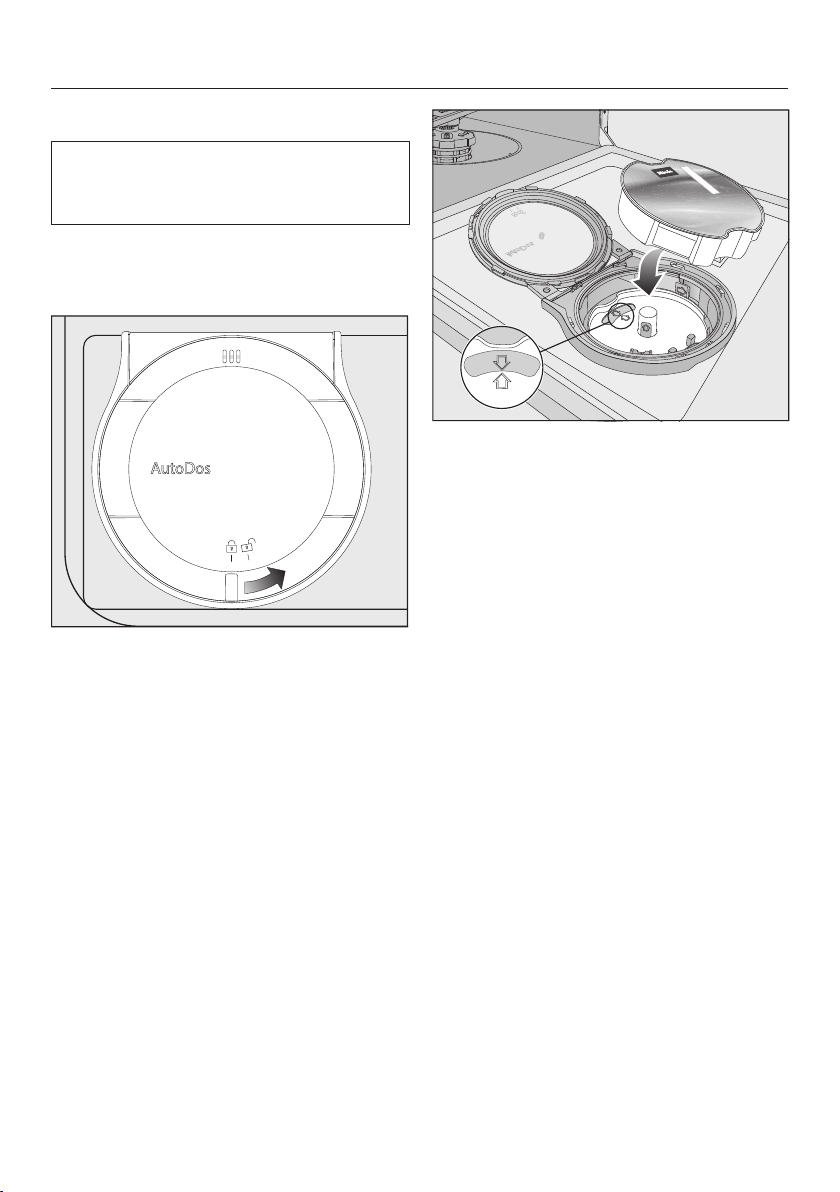
Detergents
71
Inserting a PowerDisk
Switch on the dishwasher before you
replace the PowerDisk so that the
dishwasher recognises it.
Only replace the PowerDisk when the
messagePowerDisk empty. Deactivate
AutoDos with OK. appears.
Slide the yellow catch of the AutoDos
lid to and open it.
The message AutoDos lid open will
appear in the display.
Remove the empty PowerDisk.
If the arrows in the PowerDisk holder
and in the viewing window are not
pointing towards each other, remove
the PowerDisk holder (see “Cleaning
and care - Cleaning the AutoDos”).
Put the holder back into place so that
the arrows point towards each other
and the holder lies flat.
When doing this, only hold the
PowerDisk holder by the yellow tab in
the middle. Do not hold it by the side
tab.
Insert the new PowerDisk and press it
evenly downwards until it sits flush.
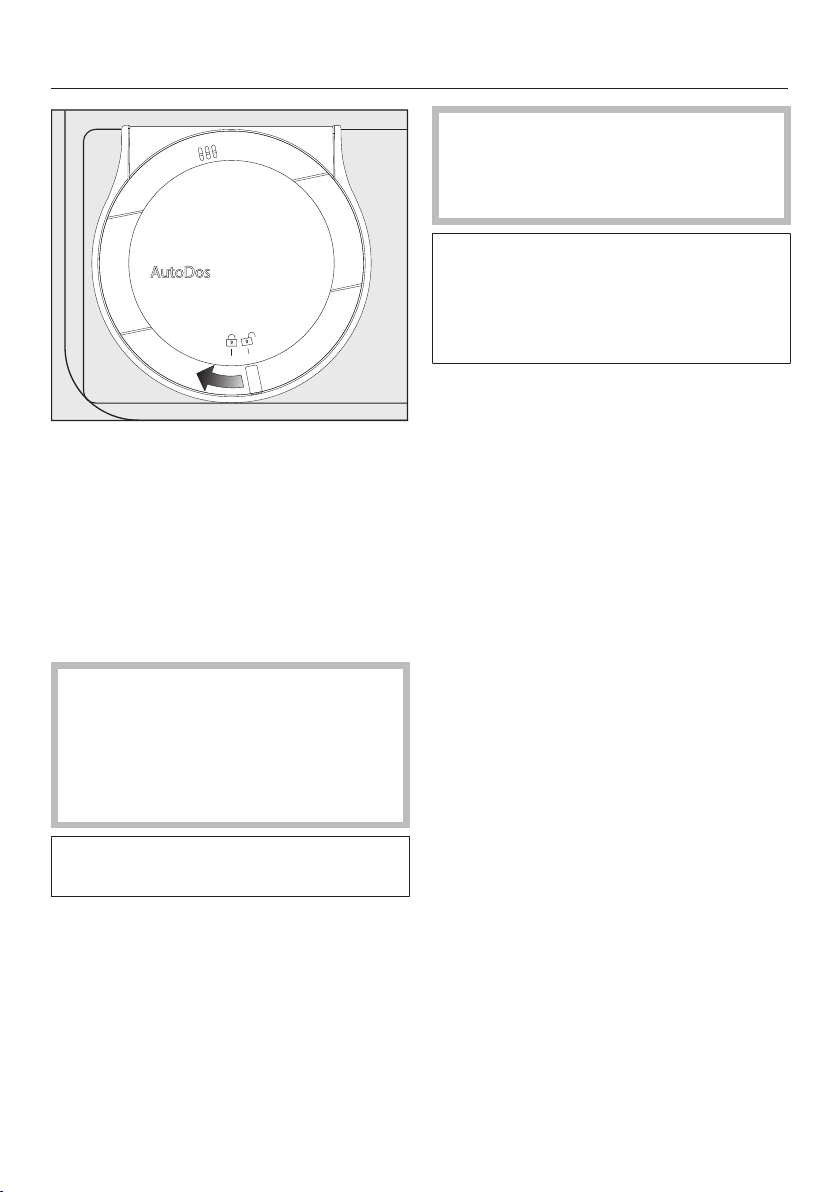
Detergents
72
Close the AutoDos lid and slide the
yellow catch until it is aligned with the
symbol.
If the PowerDisk is not in the correct
starting position, it will be rotated
automatically and the AutoDos
function will be activated.
Wait until this process is finished before
you start a programme.
The AutoDos lid must be closed to
prevent damage to the AutoDos.
Always close the AutoDos lid before
you close the dishwasher door.
Otherwise, the AutoDos may be
damaged.
Programmes cannot start when the
AutoDos lid is open.
The detergent powder must be dry
so that it does not clump together.
Do not fill the AutoDos with any type
of liquid.
In order to ensure that the AutoDos
works at its best, check it each time
you replace the PowerDisk and clean
it if needed (see “Cleaning and care -
Cleaning the AutoDos”).
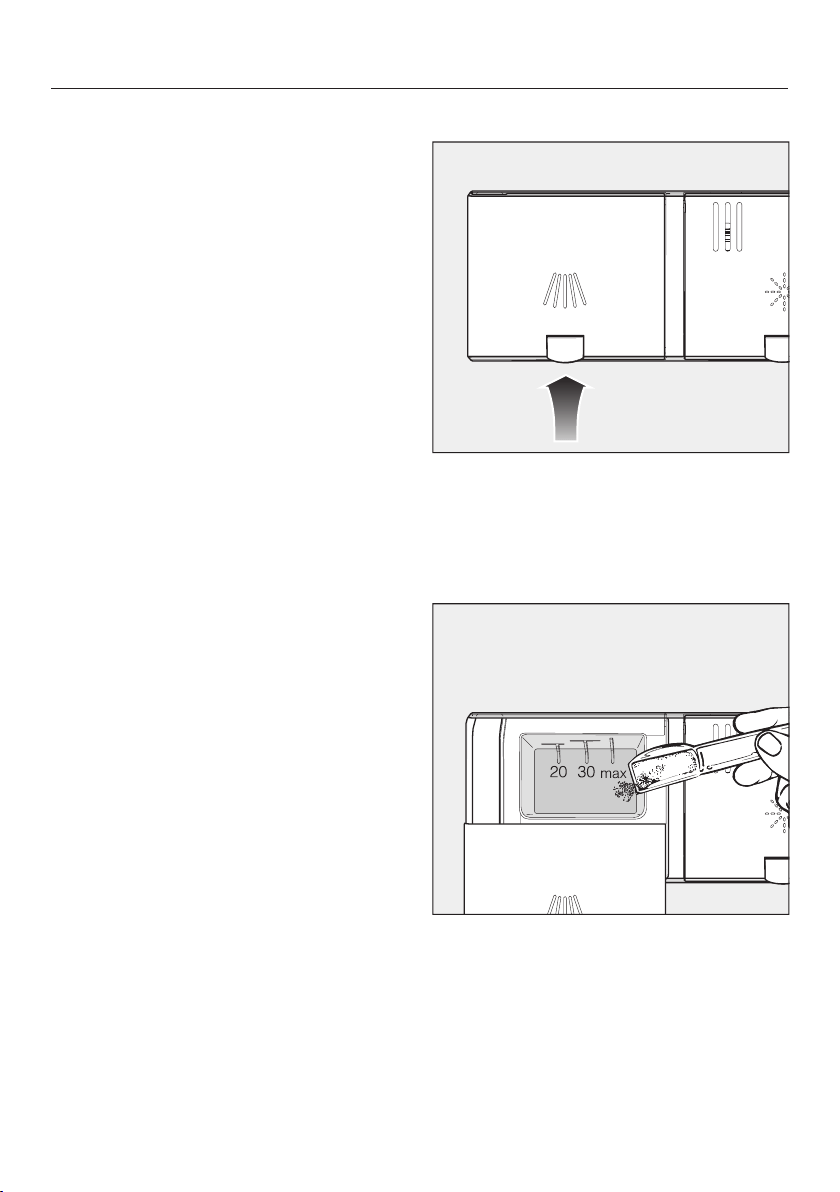
Detergents
73
Manual detergent dispensing
Detergent must be manually dispensed
if you have deactivated automatic
dispensing using the
AutoDossensor.
Detergent dispensing
The detergent compartment holds a
maximum of 50ml.
There are marks in the detergent
compartment to aid with dispensing:
20, 30, max. When the door is opened
to a horizontal position, they show the
approximate fill level in ml and the
maximum fill height.
Follow the detergent dosage
recommended by the manufacturer
on the packaging.
Unless directed otherwise, use one
detergent tab or add 20 to 30ml of
detergent to the detergent
compartment, depending on the
degree of soiling of the crockery.
If you use less than the recommended
amount of detergent, the dishes may
not get properly clean.
Some tabs may not dissolve completely
when the programmeQuickPowerWash
is used.
Adding detergent
Lift the yellow catch on the lid of the
detergent compartment .
The lid will open.
The lid will also be open at the end of
the programme.
Add the detergent to the detergent
compartment.
Slide the lid shut until you hear it click
into place.
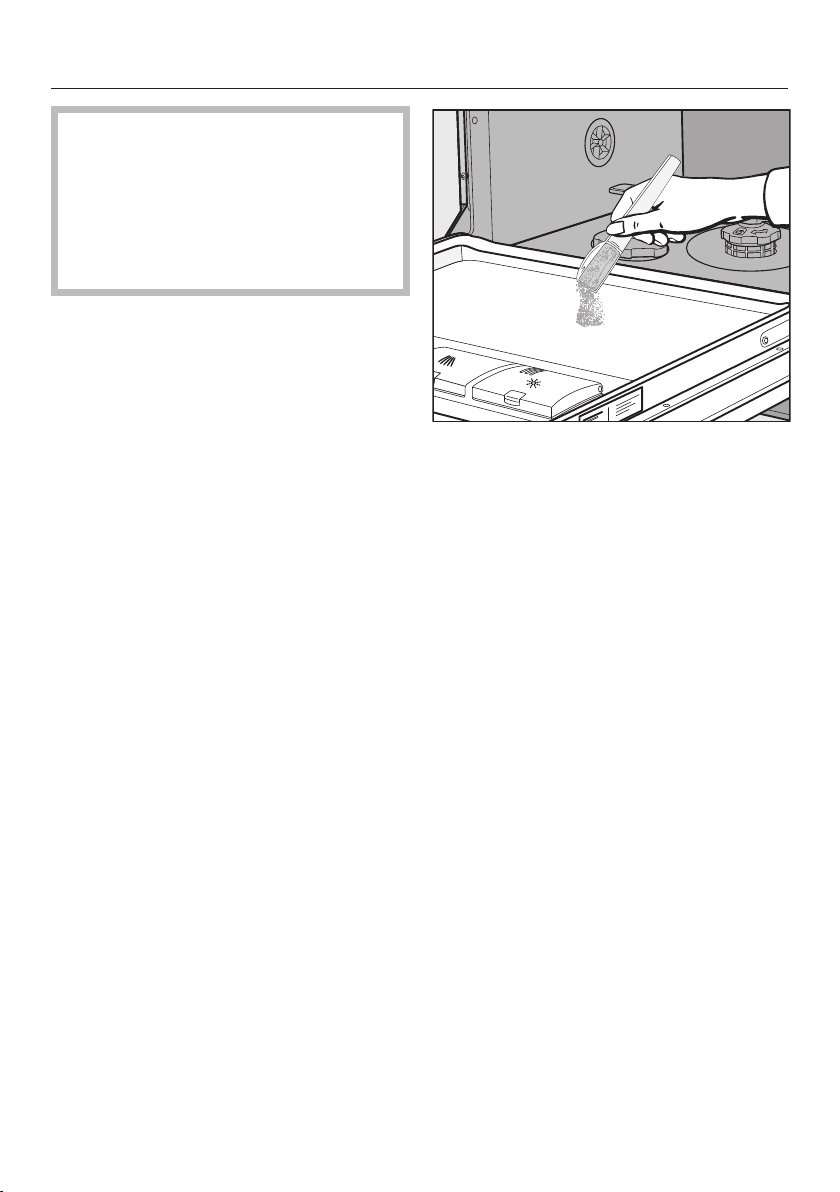
Detergents
74
The detergent must not cause the
detergent compartment lid to get
stuck. This can prevent the lid from
opening during the programme
sequence.
Do not overfill the detergent
compartment.
Automatic dispensing/AutoDos
should be deactivated if detergent is
manually dispensed.
Ensure that the detergent packaging
is properly closed after use. This
prevents the detergent from getting
damp and clumping together.
You can also apply a small amount of
detergent to the inner panel of the
door in programmes that have a pre-
wash stage (see “Programme chart”).

Operation
75
Switching on the dishwasher
Make sure the spray arms can rotate
freely.
Close the door.
Turn on the tap if it is turned off.
Press the button.
When a programme is selected, it will
appear briefly in the display and the
relevant indicator light will come on.
Next, the estimated energy and water
consumption may be shown for the
selected programme for several
seconds.
Then the display will show the
estimated duration of the selected
programme.
The Start indicator light will flash.
Selecting a programme
Choose your programme according to
the type of crockery and the degree of
soiling.
The different programmes and their use
are described in the “Programme
chart”.
Use the programme selection
button to select the programme
you want.
The indicator light for the selected
programme will come on.
Further programmes can be selected
under .
Use the programme selection
button to select the option.
The first of the further programmes will
appear in the display.
Use the buttons in the display to
select the programme you want.
You can now select programme options
(see “Programme options”).
If any programme options are selected,
the appropriate indicator lights will also
light up.

Operation
76
Display of programme duration
The estimated duration of the selected
programme appears in the display
before the programme begins. During
the programme, the time left until the
end of the programme is displayed.
Each programme stage is indicated by
a symbol:
Pre-wash/Soak
Main wash
Interim rinse
Final rinse
Drying
Finish
The displayed duration may vary for the
same programme. It is influenced by,
for example, the temperature of the
incoming water, the reactivation cycle
of the water softener, the detergent
type, and the amount of dishes and
how soiled they are.
When a programme is selected for the
first time, the display will show the
average programme duration for a cold
water connection.
The programme durations shown in the
“Programme chart” refer to standard
test loads and temperatures.
Each time a programme is run, the
control module calculates the
programme duration depending on the
temperature of the water taken into the
dishwasher and the size of the load.
Starting a programme
Press the Startbutton.
If necessary, confirm the previously
displayed message with OK.
The programme will start.
The Start indicator light will come on.
During the programme sequence, you
can use OK to display the name of the
programme that is currently running.
Risk of scalding due to hot
water.
During operation, water in the
dishwasher may be very hot.
Only open the door if absolutely
necessary and exercise extreme
caution when doing so. Before
closing the door again, leave it ajar
for approx. 20 seconds. This will
enable the temperature in the wash
cabinet to settle.
Operation
77
At the end of the programme
The programme has finished when the
display shows the message Finished.
In some programmes, if the AutoOpen
function is activated, the door will
automatically open slightly (see
“Settings – AutoOpen”). This improves
the drying process.
If the Consumptionprogrammable
function is switched on, you can now
call up the actual energy and water
consumption of the programme that
has just finished (see “Caring for the
environment – EcoFeedback
consumption display”).
The drying fan may continue to run for
a few minutes at the end of the
programme.
Risk of damage due to steam.
Steam from the dishwasher could
damage the edges of delicate
worktops when you open the door at
the end of the programme if the fan
is no longer running.
If you have deactivated the
automatic door opening function (see
“Settings – AutoOpen”), but would
still like to open the door at the end
of the programme, then make sure
that you open the door fully.
Energy management
To save energy, the dishwasher will
switch off automatically 10minutes
after the last time a button is pressed or
after the end of a programme.
You can switch the dishwasher back on
with the button.
The dishwasher will not switch itself
off while a programme is running or if
there is a fault.

Operation
78
Switching off the dishwasher
The dishwasher can be switched off
at any time using the button.
Confirm the query Switch off with OK.
Switching the dishwasher off during a
programme cancels the programme.
You can also do this to stop an ongoing
timer.
Risk of damage from leaking
water.
Overflowing water can cause
damage.
If the dishwasher is not going to be
used for a longer period of time, e.g.
whilst on holiday, the tap should be
turned off.
Unloading the dishwasher
Dishes tend to break and chip more
easily when they are hot. Allow the
dishes to cool until they are comfortable
enough to handle before unloading
them.
The dishes will cool much faster if you
open the door when the programme
has ended.
First unload the lower basket, then
the upper basket, and finally the 3D
MultiFlex tray.
This will prevent water drops from the
upper basket and 3D MultiFlex tray
from falling onto the dishes in the
lower basket.

Operation
79
Interrupting a programme
A programme will be interrupted as
soon as the door is opened.
If the door is closed again, the
programme will continue from the point
it was at before the door was opened.
Risk of scalding due to hot
water.
During operation, water in the
dishwasher may be very hot.
Only open the door if absolutely
necessary and exercise extreme
caution when doing so. Before
closing the door again, leave it ajar
for approx. 20 seconds. This will
enable the temperature in the wash
cabinet to settle.
Cancelling or changing a
programme
If a programme is cancelled,
important programme stages may be
missed.
A programme should only be
cancelled in the first few minutes of
the programme sequence.
If a programme has already started and
you wish to cancel it, proceed as
follows:
Switch the dishwasher off with the
button.
Confirm the query Switch off with OK.
If you would like to select another
programme:
Switch the dishwasher back on with
the button.
If you have dispensed detergent
manually, check whether the
detergent compartment is still closed.
If the lid is already open, fill it with
detergent again and close the lid.
Select the programme you want, and
then start it.
Options
80
Timer
You can set the start time of a
programme. The programme start time
can be delayed for between 30minutes
and 24hours.
With a start time delay between
30minutes and 3hours, the delay can
be set in 30-minute increments. It is set
in hours for periods longer than this.
With manual detergent dispensing,
the detergent can clump together if
the detergent compartment is not
dry, and it may not be fully rinsed
out.
When using the timer function, make
sure that the detergent compartment
is dry before adding detergent. Wipe
it dry with a cloth first if necessary.
Do not use liquid detergents. These
can leak out.
Danger to health due to
detergent.
To prevent children coming into
contact with dishwasher detergent:
Do not fill the detergent dispenser
until just before starting the
programme, i.e. before you activate
the timer. Use the safety lock to
secure the dishwasher door.
Activating the timer
Switch the dishwasher on with the
button.
The Start indicator light will flash.
Select the required programme.
Press the Timer button.
The most recently set “Start in” time will
be shown in the display. The Timer
indicator light will light up.
Set the required time after which the
programme should start automatically
using the buttons.
If you press and hold the or
buttons, the numbers will increase
automatically.
Confirm with OK.
The Start indicator will light up
continuously.

Options
81
After you have activated the timer, the
display and the indicator lights will
switch off after a few minutes to save
energy.
Press the button to switch the
display back on for a few minutes.
The time up until the programme starts
can be seen counting down in the
display in hours for durations above
10hours, and in minutes for durations
below 10 hours.
At the end of the start delay period, the
programme selected will start
automatically. The time remaining will
be shown in the display and the
Timer indicator light will go out.
Starting a programme before the
time for the timer has elapsed:
A programme can be started before the
timer has elapsed.
Proceed as follows:
Switch the dishwasher off with the
button.
Switch the dishwasher back on with
the button.
Select the required programme.
Press the Startbutton.
The programme will start. The Start
indicator will light up continuously.
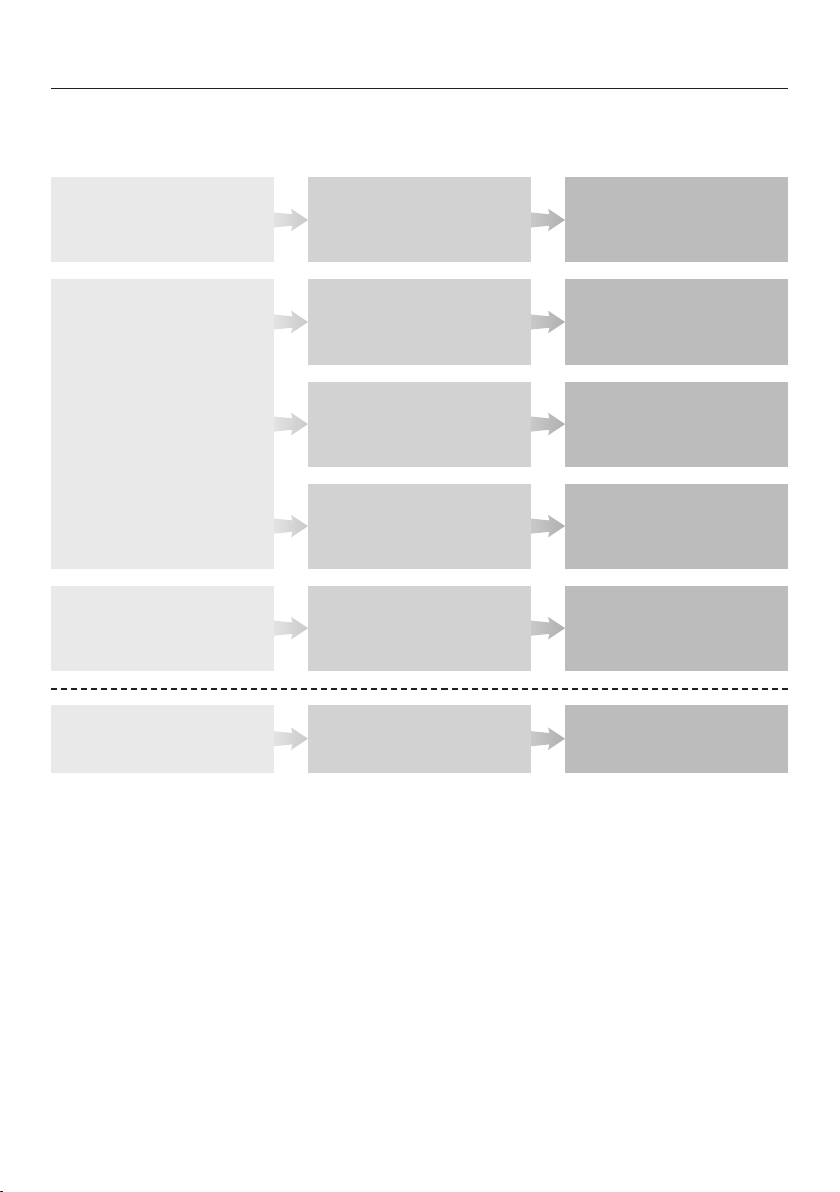
Guide for selecting a programme
82
Pots, pans, everyday porcelain
and cutlery
Standard dried-on normal
food deposits
Stubborn dried-on, burnt-on
food deposits containing
starch or protein
1
Water and
energy saving programme
Maximum
cleaning performance
Crockery Food deposits Programme
features
Temperature-sensitive dishes,
glasses and plastics
Mixed crockery
Lightly dried-on food deposits
All fresh to dried-on food
deposits
Lightly dried-on food deposits
Programme with glass care
Variable,
sensor-controlled programme
Short programme taking
less than an hour
No crockery
Residual salt after refilling
the salt container
Flushes out
salt residues
1
Food such as potatoes, pasta, rice or stews can leave starchy deposits.
Deposits containing protein can be left by food such as fried meat or fish.
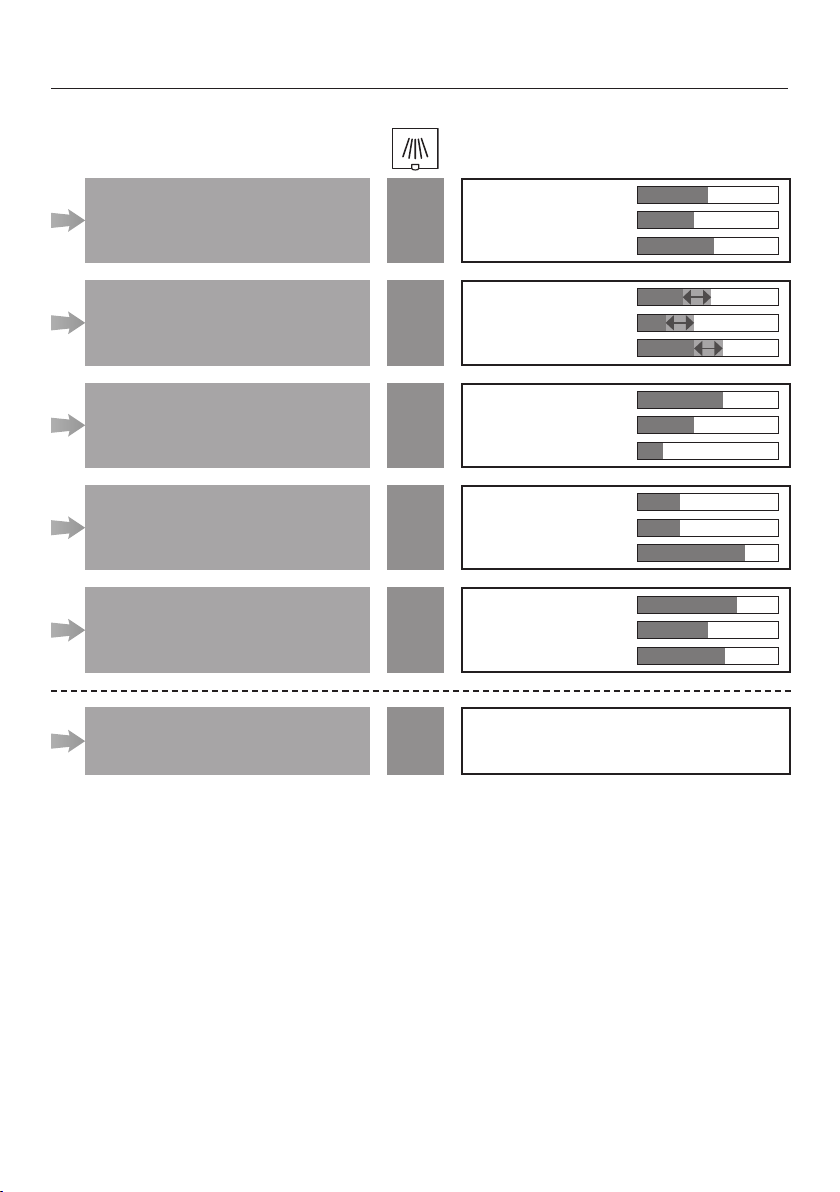
Guide for selecting a programme
83
Gentle45°C
Auto 45–65°C
QuickPowerWash 65°C
ECO
Intensive 75°C
Programme
2
Consumption estimate
4
QuickPowerWash 65°C
+ Express
2
The programmes can be combined with the “Express” or “IntenseZone” programme options
(if available) (see “Programme options”).
You can also select the “Extra clean”, “Extra dry” and “Second interim rinse” function
(if available) (see “Settings”).
3
Recomended amount of detergent (see “Detergent”).
4
The estimated values may change due to the selected settings or programme options,
or the conditions in which the appliance is being used.
Programme duration 13 minutes,
no heating up,
solely for flushing out salt.
Energy consumption
Water consumption
Programme duration
Energy consumption
Water consumption
Programme duration
Energy consumption
Water consumption
Programme duration
Energy consumption
Water consumption
Programme duration
Energy consumption
Water consumption
Programme duration
20 ml
30 ml
30 ml
30 ml
30 ml
-
3
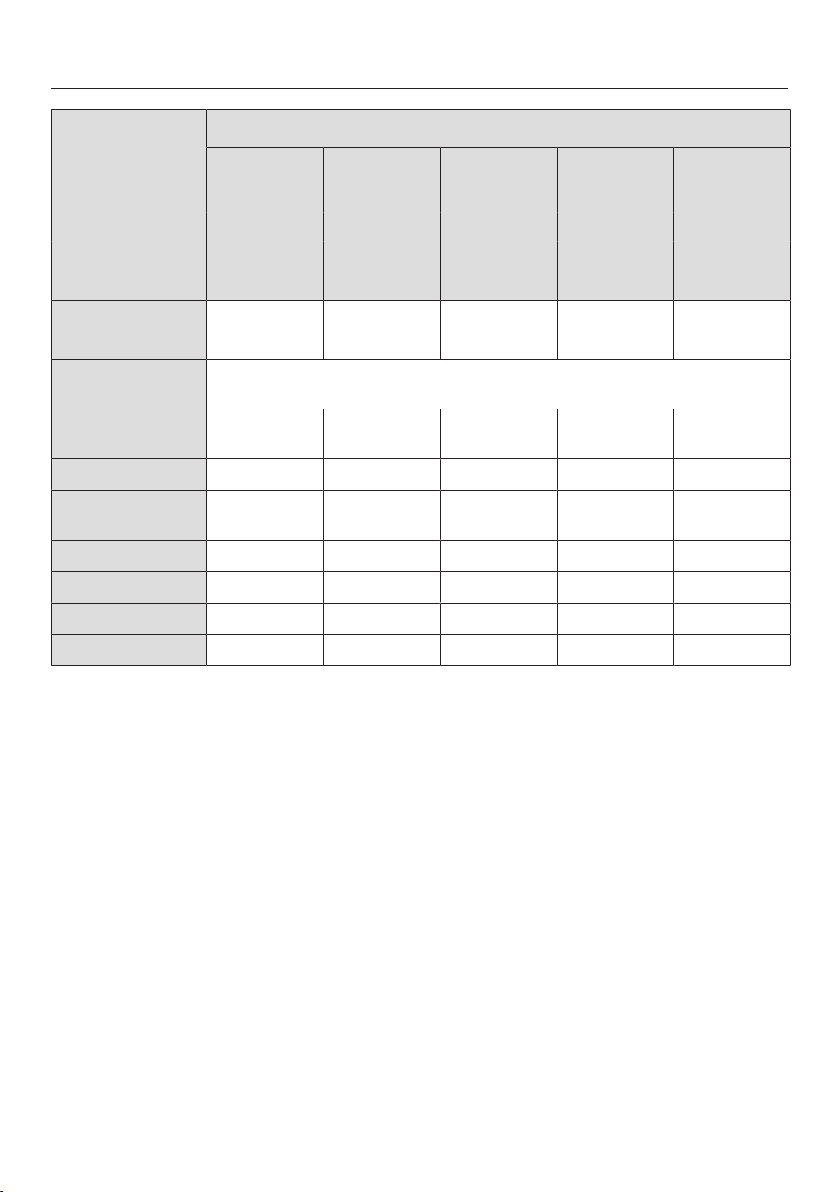
Programme chart
84
ProgrammeProgramme sequence
Pre-washMain washInterim rinseFinal rinseDrying
°C°C
ECO
1
47
34
Auto45–65°CVariable programme sequence,
sensor-controlled adjustment to load size and level of soiling
As
required
45–65
As
required
55–70
Intensive 75°C
75
55–70
QuickPowerWash
65°C
-65
65
Gentle45°C
45
55–70
PowerWash60°C
60
55–70
ExtraQuiet55°C
-55
55–70
Maintenance
-75
70
1
This programme is the most efficient in terms of its combined energy and water
consumption for cleaning dishes with a normal level of soiling.
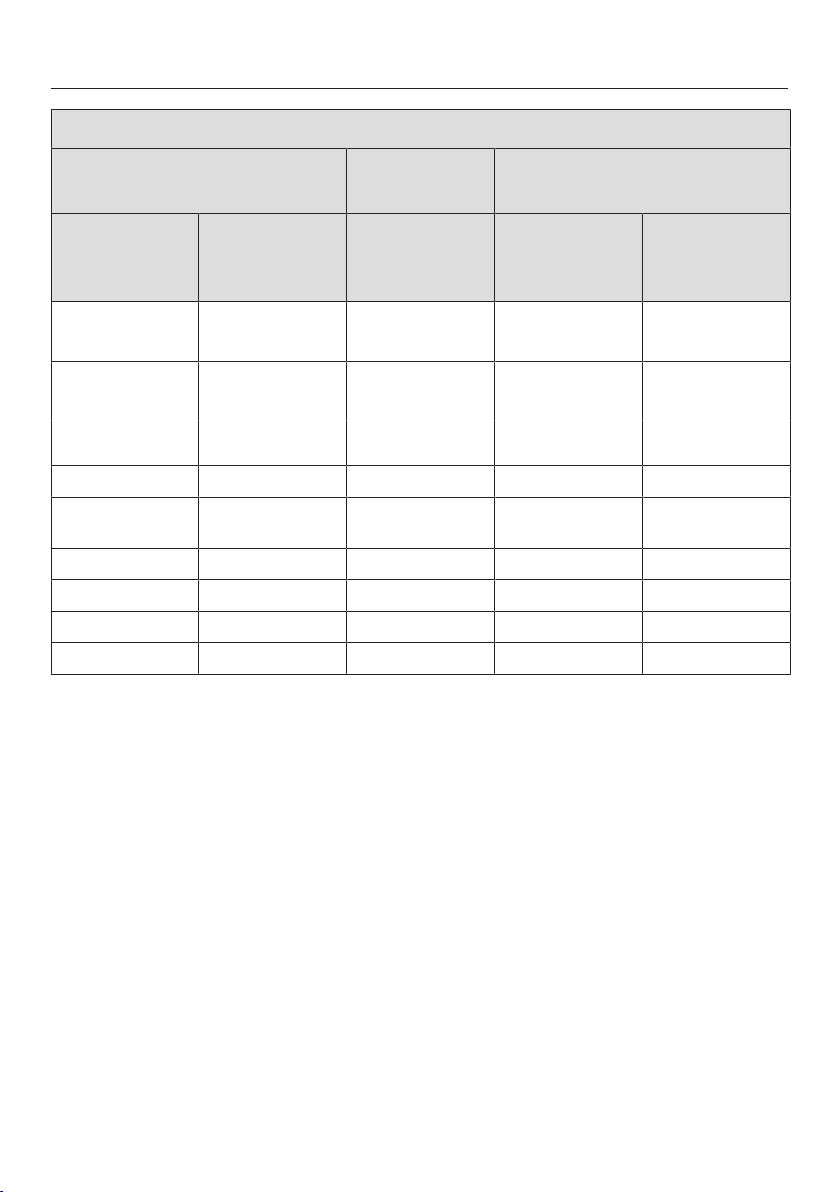
Programme chart
85
Consumption
2
ElectricityWater
Time
Cold waterHot waterLitresCold waterHot water
kWhkWhh:minh:min
0.50 / 0.51 /
0.54
3,4,5
0.34 / 0.34 /
0.36
3,4,5
9.2 / 9.2 /
9.6
3,4,5
3:48 / 3:48 /
3:45
3,4,5
3:49 / 3:47 /
3:42
3,4,5
0.75–1.05
6,7
0.45–0.55
6,7
6.0–13.0
6,7
2:05–3:351:57–3:21
1.350.8514.03:113:03
1.200.7510.50:580:58
0.900.4013.02:442:28
1.000.5013.02:242:12
0.950.609.53:593:50
1.751.0019.02:091:47
2
The values for the ECO programme were calculated under standardised testing
conditions. Values for the remaining programmes were calculated under comparable
testing conditions.
In practice, the selected settings, programme options or use conditions may result in
different values.
3
Standard height dishwashers with cutlery basket
4
Standard height dishwashers with cutlery tray
5
XXL dishwashers with cutlery tray
6
Minimum value: half load with light soiling
7
Maximum value: full load with heavy soiling

Programme chart
86
Further programmes
PowerWash60°C
Programme for cleaning a mixed load
with fresh food deposits which have
begun to dry on.
ExtraQuiet55°C
Very quiet programme with longer
duration. This programme is suitable for
a mixed load with lightly dried on food
deposits.
Maintenance programme
The dishwasher wash cabinet is
generally self-cleaning. However, if
residues or deposits occur, use the
Maintenanceprogramme to clean it. The
dishwasher must not be loaded for this
programme. This programme is
designed for cleaning the wash cabinet
using care products (dishwasher
cleaner/dishwasher conditioner) (see
“Optional accessories - Appliance
care”). Follow the instructions on the
packaging. When using dishwasher
care products, no detergent should be
added. For this reason, automatic
dispensing (if available) is deactivated
for this programme.

Programme options
87
Selecting programme options
You can use programme options to
adjust the programmes.
To do this, you can select the
programme options before starting the
programme.
Switch the dishwasher on with the
button.
The Start indicator light will flash.
Select a programme as required.
Press the button for the programme
option you want.
The indicator light for the relevant
button will come on when the
programme option is selected.
If the programme option is not
compatible with the selected
programme, a message to this effect
will appear in the display.
In this event, confirm the message
with OK.
The selected programme option will
remain active for that particular
programme until the selection is
changed.
Express
The Express programme option
reduces the programme duration.
In order to achieve optimum cleaning
results, the temperature, and therefore
the energy consumption, will increase
with this option.
The time by which the programme
duration is shortened varies according
to the selected programme.
Selecting the Express programme
option may take precedence over other
selected options.
When used in combination with the
QuickPowerWash programme, the
Express programme option results
in a rinse designed solely for the
purpose of flushing out the wash
cabinet to remove salt solution that
leaked out after refilling the salt
reservoir.
Cleaning and care
88
Check the condition of your
dishwasher regularly (approx. every
4–6months). This way, faults and
problems can be avoided.
Damage caused by unsuitable
cleaning agents.
All surfaces of this appliance are
susceptible to scratching. Contact
with unsuitable cleaning agents can
alter or discolour all surfaces.
Only use cleaning agents formulated
for use on the relevant surfaces.
Cleaning the wash cabinet
The wash cabinet is largely self-
cleaning, provided that the correct
amount of detergent is always used.
The frequent use of low-temperature
wash programmes (<50°C) increases
the risk of contamination and odours
inside the wash cabinet. Run the
Intensive 75°C programme once a
month to clean the wash cabinet and
prevent odours from developing.
However, if residues such as limescale
or grease have been deposited, use the
Maintenance programme to clean the
dishwasher (see “Programme chart –
Further programmes”) with dishwasher
cleaner (see “Optional accessories –
Maintenance”). Follow the instructions
on the product packaging.
Miele cleaning and care products are
available to order from Miele Service or
from Miele’s online store.
Clean the filters in the wash cabinet
regularly.
Hygiene cycle
If you mainly use low temperature
programmes, there is a risk of bacteria
and unpleasant odours building up in
the wash cabinet. If you repeatedly use
low temperature programmes, you
should regularly run a high temperature
programme. This is to prevent the build-
up of residues and odours.
You can activate or deactivate a
Hygiene info message (see “Settings –
Hygiene cycle”).
If you deactivate this message, run the
Intensive75°Cprogramme once per
month to clean the wash cabinet and
prevent odours from developing.

Cleaning and care
89
Cleaning the door and the door
seal
The door seal and the sides of the
dishwasher door are not accessed and
cleaned by the spray arm jets. As a
result, mould can develop here.
Wipe the door seals regularly with a
damp cloth to remove food deposits.
Wipe off any food or drink residues
which may have dripped onto the
sides of the dishwasher door before
closing it.
Cleaning the control panel
The control panel should only be
wiped with a damp cloth.
Cleaning the appliance front
Damage due to soiling.
Soiling that is left too long might
become impossible to remove and
could cause the external surfaces to
alter or discolour.
It is therefore best to remove any
soiling immediately.
Clean the front with a soft sponge
and a solution of warm water and a
little washing-up liquid. After
cleaning, wipe the front dry using a
soft cloth.
A clean, damp microfibre cloth (such
as the Original Miele all purpose
microfibre cloth) without detergent
can also be used.
To avoid damaging the external
surfaces, do not use the following:
-cleaning agents containing soda,
ammonia, acids or chlorides
-cleaning agents containing descaling
agents
-abrasive cleaning agents, e.g.
powder cleaners and cream cleaners
-solvent-based cleaning agents
-stainless steel cleaning agents
-dishwasher cleaners
-oven cleaners or sprays
-glass cleaning agents
-hard, abrasive brushes or sponges,
e.g. pot scourers, brushes, or
sponges which have been previously
used with abrasive cleaning agents
-dirt eraser sponges
-sharp metal scrapers
-steel wool or metal scourers
-steam cleaners
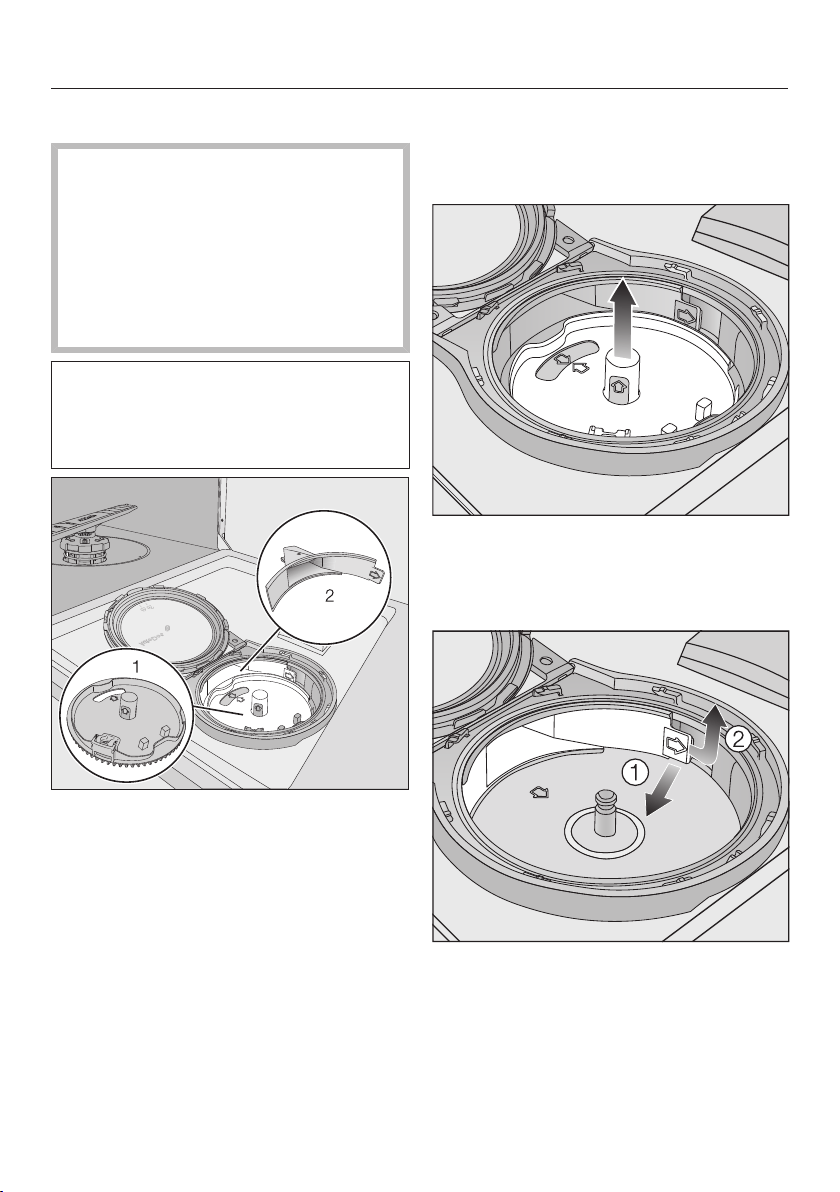
Cleaning and care
90
Cleaning the AutoDos
You should check that the detergent
fill channel is clean every time you
replace the PowerDisk, and clean it if
necessary, e.g. powder residues.
This should be done at the latest
when the Clean AutoDos message is
displayed. This helps keep the
AutoDos working properly.
In order to ensure that the AutoDos
works at its best, check it each time
you replace the PowerDisk and clean
it if needed.
1 PowerDisk holder
2 Detergent chute for dispensing the
detergent from the PowerDisk into the
wash cabinet
Slide the yellow catch of the AutoDos
lid to and open it.
Remove the PowerDisk if applicable.
Pull the PowerDisk holder upwards
by the yellow tabs and remove it.
When doing so, do not pull on the
side tab.
Use the tab (see arrow) to release
the fill channel and pull it out.
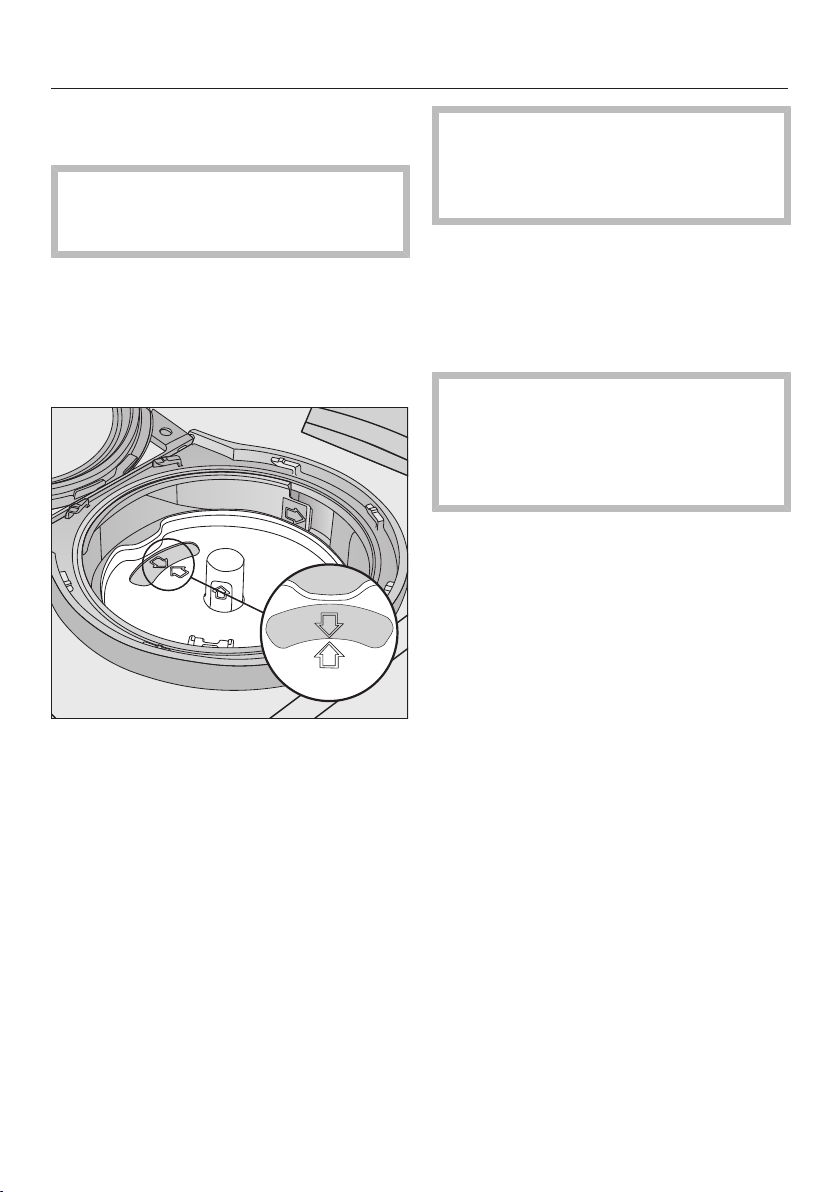
Cleaning and care
91
Clean the fill channel with water and a
soft brush if necessary.
It is very important that no moisture
gets inside the AutoDos system
during cleaning.
Dry the fill channel well so that the
detergent powder does not clump
together.
Insert the fill channel until the tab
clicks into place.
Put the holder back into place so that
the arrows in the PowerDisk holder
and in the viewing window point
towards each other. The holder must
lie flat.
The AutoDos lid must close tightly so
that the detergent powder does not
get wet and clump together.
Make sure that all seals are clean.
Insert a PowerDisk.
Close the AutoDos lid and slide the
yellow catch until it is aligned with the
symbol (see “Detergents -
Inserting a PowerDisk”).
Regularly check the lower spray arm
for any blockages to ensure that the
detergent outlet of the AutoDos can
be fully flushed out (see “Cleaning
and care - Cleaning the spray arms”).
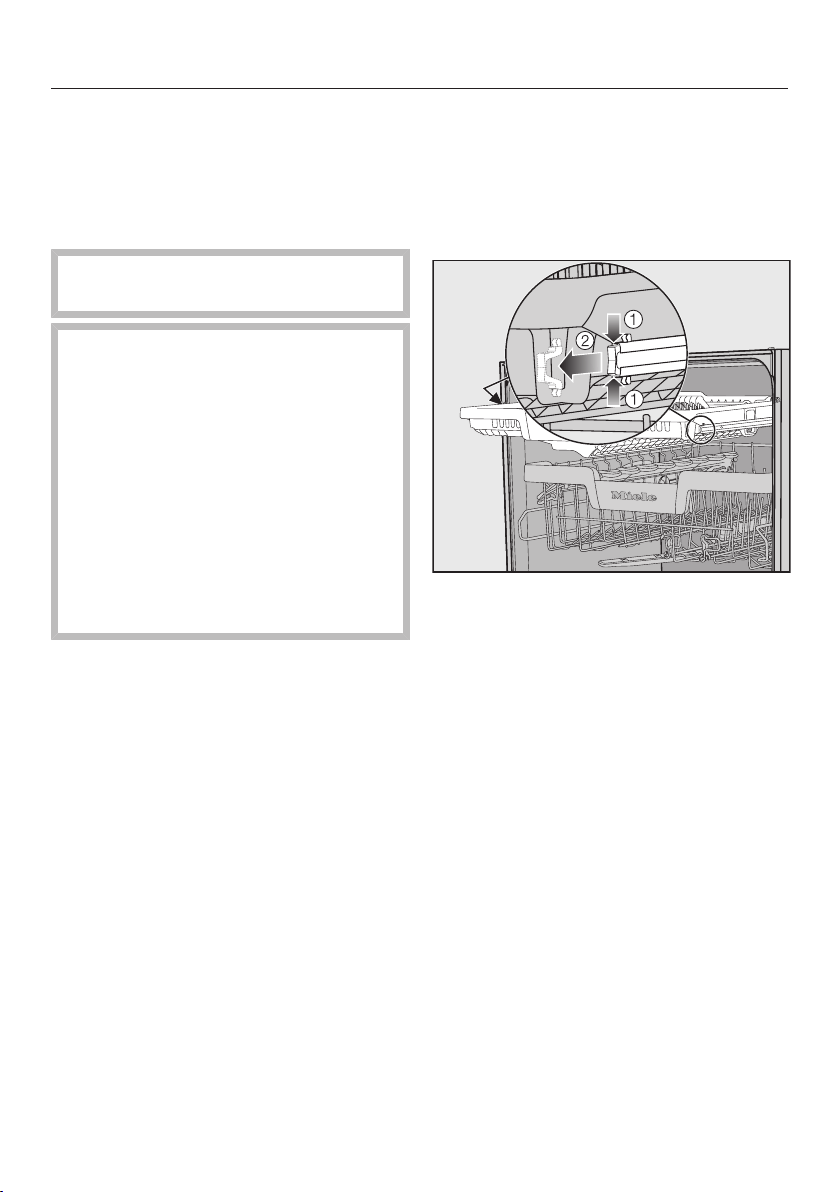
Cleaning and care
92
Cleaning the spray arms
Particles of food can get stuck in the
spray arm jets and bearings. The spray
arms should therefore be inspected
regularly (approx. every 2–4months).
Never run a wash programme
without using the spray arms.
Damage due to soiling entering
the circulation system.
Without filters, soiling can enter the
circulation system and cause a
blockage.
Do not run a wash programme
without the lower spray arm or
without the filters fitted.
When cleaning the filters and spray
arms, make sure that coarse soiling
cannot get into the circulation
system.
Switch the dishwasher off.
Removing the cutlery tray (if present)
In order to be able to remove the upper
spray arm, you first have to remove the
cutlery tray (if present).
Pull out the cutlery tray.
Press the rail safety clips on both
sides of the cutlery tray together
and remove the safety clips.
Take out the cutlery tray completely.
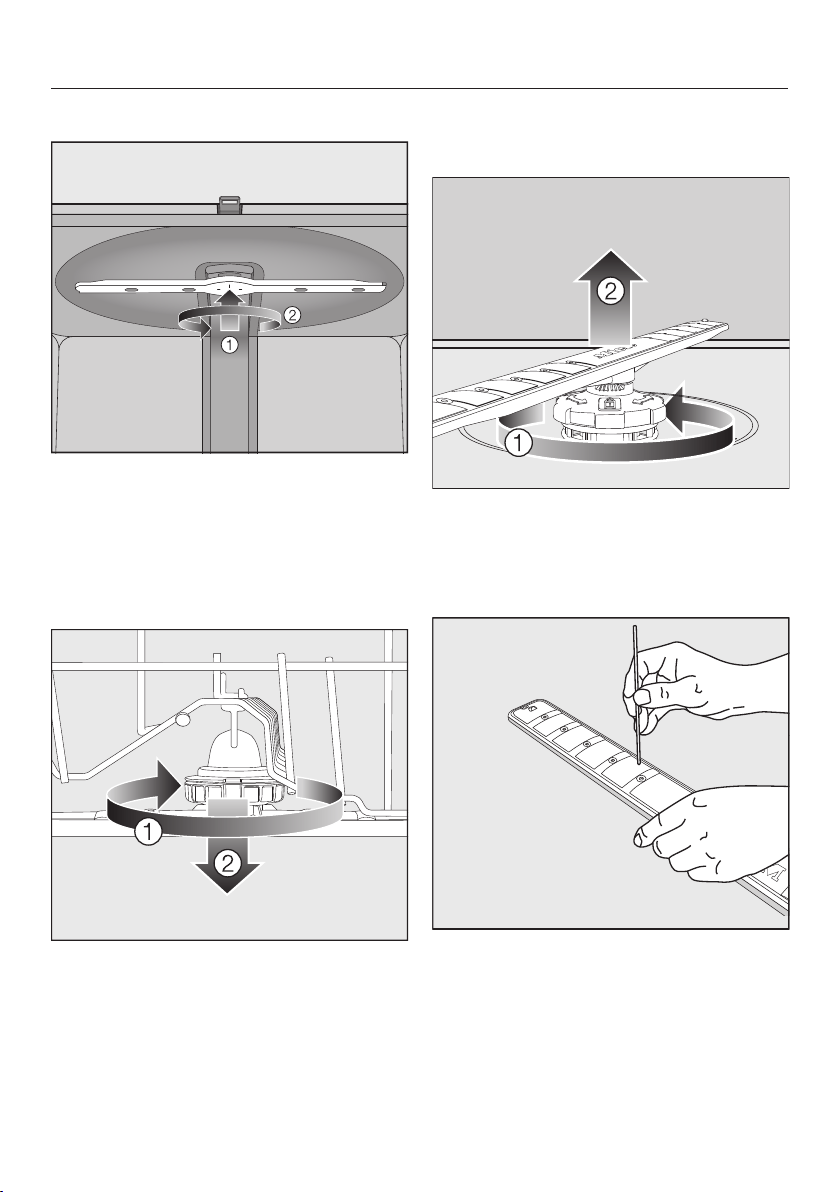
Cleaning and care
93
Removing the upper spray arm
Push the upper spray arm upwards
to engage the inner ratchet. Then
unscrew the spray arm by rotating the
screw thread anti-clockwise (when
viewed from below) .
Removing the middle spray arm
Rotate the screw thread of the middle
spray arm clockwise (overhead
perspective) (see diagram) and
remove the spray arm .
Removing the lower spray arm
Remove the lower basket.
Rotate the screw thread of the lower
spray arm anti-clockwise and pull
the spray arm upwards to remove.
Cleaning the spray arms
Use a pointed object to push food
particles stuck in the jets into the
spray arm.
Rinse the spray arm thoroughly under
running water.
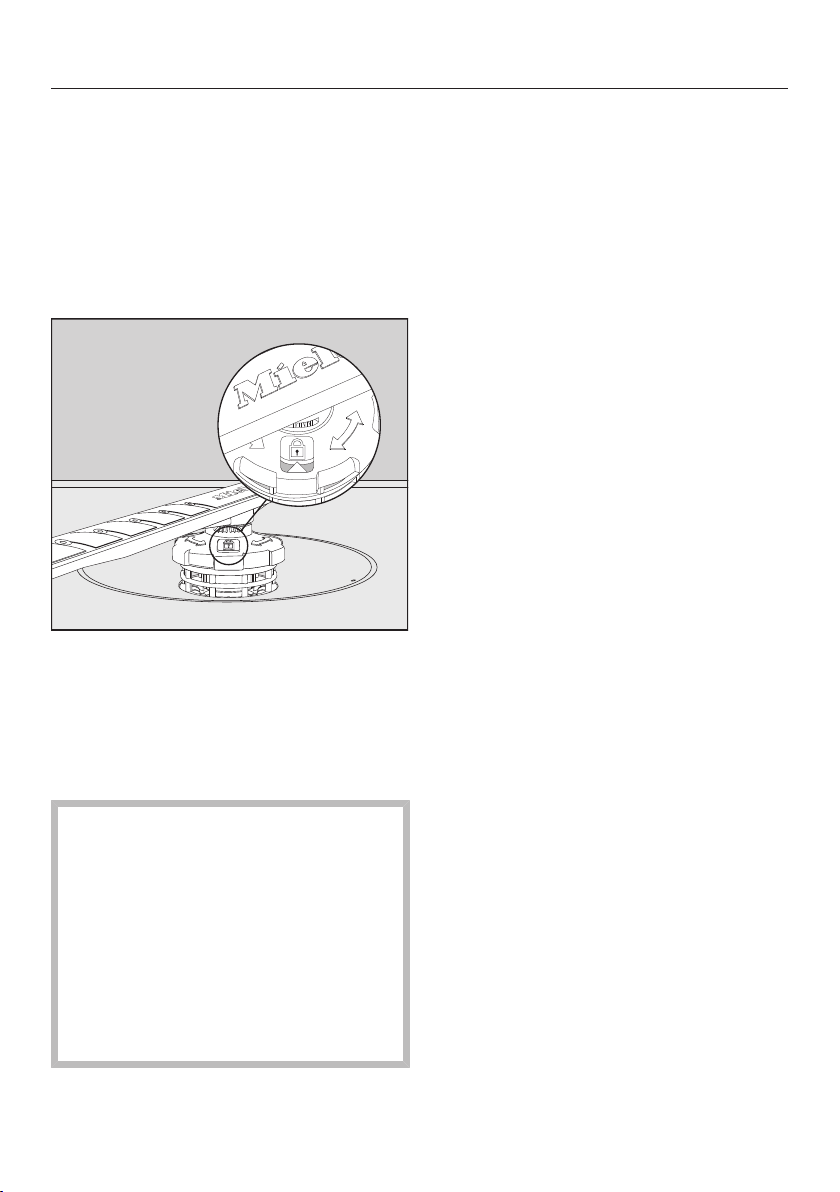
Cleaning and care
94
Refitting the spray arms
Reinstall the upper spray arm and
tighten it by hand.
Reinstall the middle spray arm.
Refit the lower spray arm and ensure
that the filter combination lies flat in
the base of the wash cabinet.
Rotate the screw thread of the lower
spray arm clockwise until the arrow in
the viewing window points to the lock
symbol.
Make sure the spray arms can rotate
freely.
Damage due to soiling entering
the circulation system.
The lower spray arm is used to
secure the filter combination.
Without filters, coarse soiling can
enter the circulation system and
cause a blockage.
Do not run a wash programme
without the lower spray arm or
without the filters fitted.
Inserting the cutlery tray (if present)
Slide the cutlery tray back onto the
rails from the front.
Replace the safety clips in the rails on
both sides of the cutlery tray.
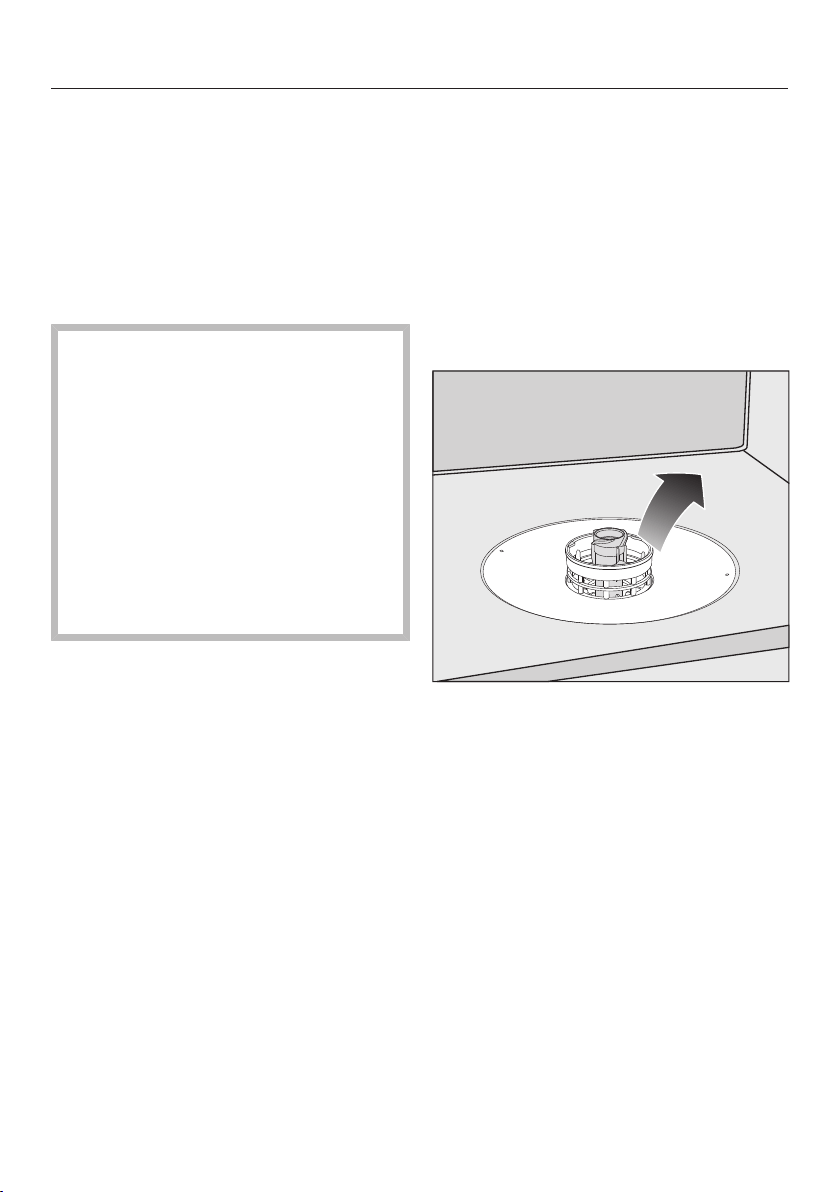
Cleaning and care
95
Checking the filters in the
wash cabinet
The filter combination in the base of the
wash cabinet retains coarse soiling
from the suds solution. This prevents
soiling getting into the circulation
system and re-entering the wash
cabinet through the spray arms.
Damage due to soiling entering
the circulation system.
Without filters, soiling can enter the
circulation system and cause a
blockage.
Do not run a wash programme
without the lower spray arm or
without the filters fitted.
When cleaning the filters and spray
arms, make sure that coarse soiling
cannot get into the circulation
system.
The filters can become clogged by
soiling that collects over time. The level
of soiling and the time it takes before
the filters need cleaning will vary
depending on use.
The message Check filters will appear in
the display after every 50 programme
sequences.
Check the filter combination.
Clean the filter combination if
necessary.
Then confirm the message with OK.
Cleaning the filters
Switch the dishwasher off.
Remove the lower spray arm (see
“Cleaning and care - Cleaning the
spray arms”).
Before removing the filter
combination, remove any coarse
soiling to prevent it from entering the
circulation system.
Remove the filter combination.
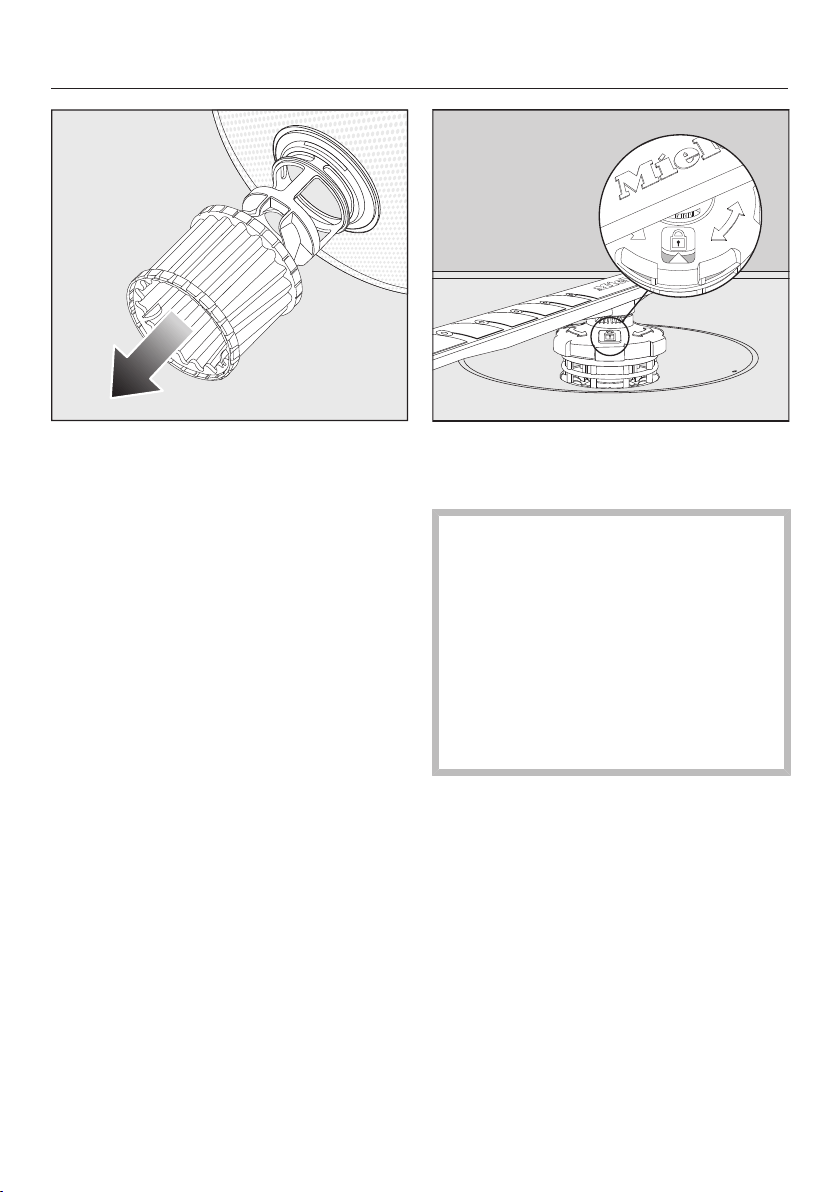
Cleaning and care
96
In order to clean the inside of the
filter, pull the microfilter downwards
and away from the filter combination.
Rinse all the parts under running
water.
If necessary, use a soft cleaning
brush to remove soiling.
Push the microfilter back onto the
filter combination.
Refit the filter combination so that it
lies flat in the base of the wash
cabinet.
Refit the lower spray arm to the filter
combination using the screw thread.
Rotate the screw thread clockwise
until the arrow in the viewing window
points to the lock symbol.
Damage due to soiling entering
the circulation system.
The lower spray arm is used to
secure the filter combination.
Without filters, coarse soiling can
enter the circulation system and
cause a blockage.
Do not run a wash programme
without the lower spray arm or
without the filters fitted.
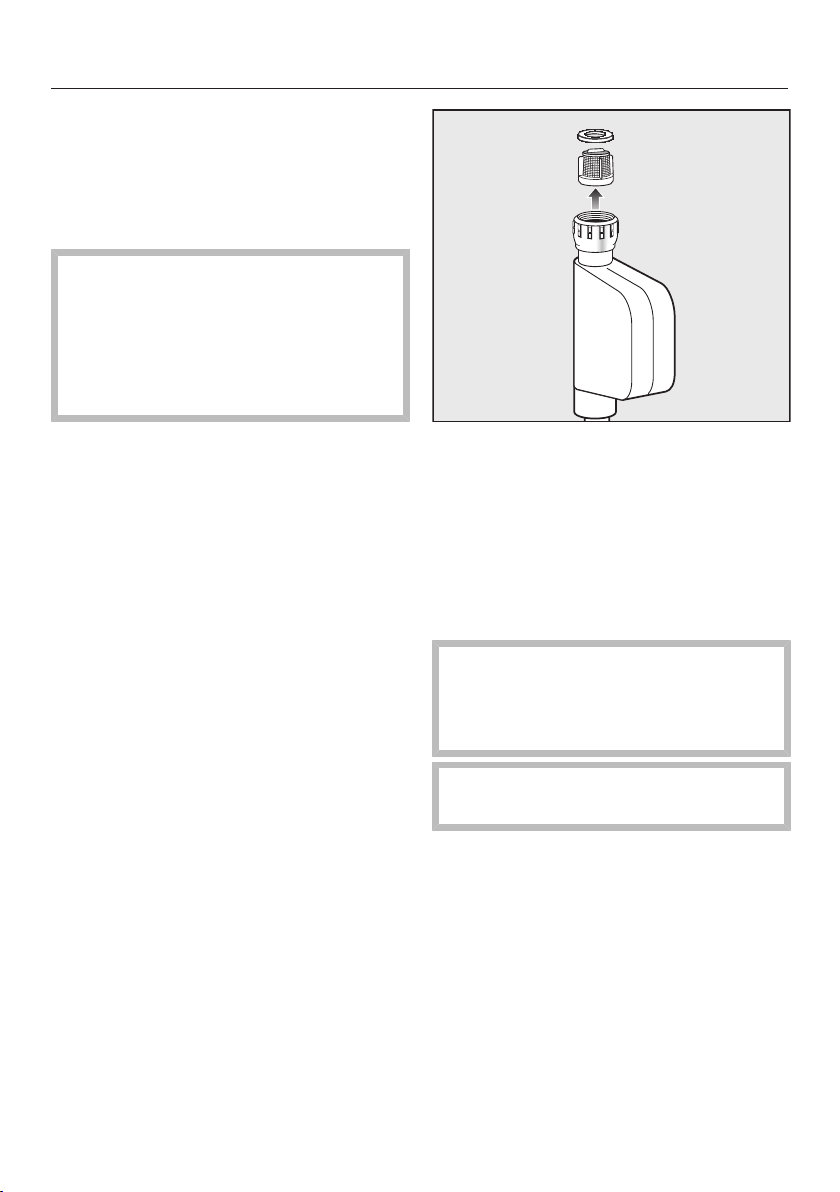
Cleaning and care
97
Cleaning the water inlet filter
A filter is incorporated in the screw
thread to protect the water inlet valve. If
the filter is soiled, insufficient water
flows into the wash cabinet.
Risk of electric shock.
The plastic housing of the water
connection contains an electrical
valve.
The housing must not be dipped in
water.
Disconnect the dishwasher from the
power supply.
To do this, switch off at the socket
and withdraw the plug.
Turn off the tap.
Unscrew the water inlet valve.
Carefully remove the seal from the
threaded union.
Using combination or pointed pliers,
take hold of the plastic filter bar and
remove the filter.
Rinse the filter under running water.
Reassemble in reverse order.
Screw the threaded union securely
back onto the tap. Slowly turn on the
tap. If water drips out, tighten the
connection.
Never forget to put the filter back in
place after cleaning.
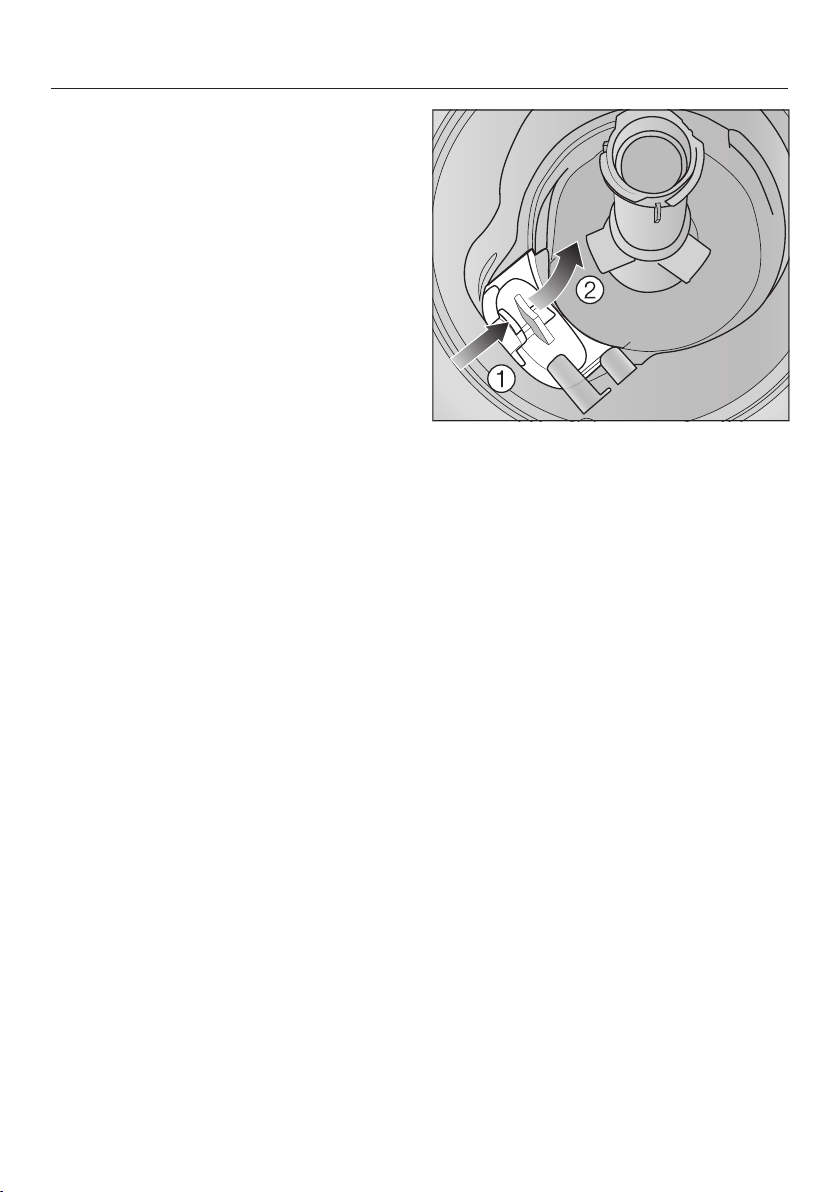
Cleaning and care
98
Cleaning the drain pump
If water remains in the wash cabinet
after the end of a programme, the water
has not been pumped away. The drain
pump may be blocked by foreign
objects. These foreign objects are easy
to remove.
Disconnect the dishwasher from the
power supply.
To do this, switch off at the socket
and withdraw the plug.
Take the filter combination out of the
wash cabinet (see “Cleaning and care
- Cleaning the filters”).
Scoop the water out of the wash
cabinet using a suitable container or
utensil.
Press the catch of the drain pump
cover inwards.
Tip the cover inwards until it is
released.
Rinse the cover thoroughly under
running water and remove all foreign
objects.
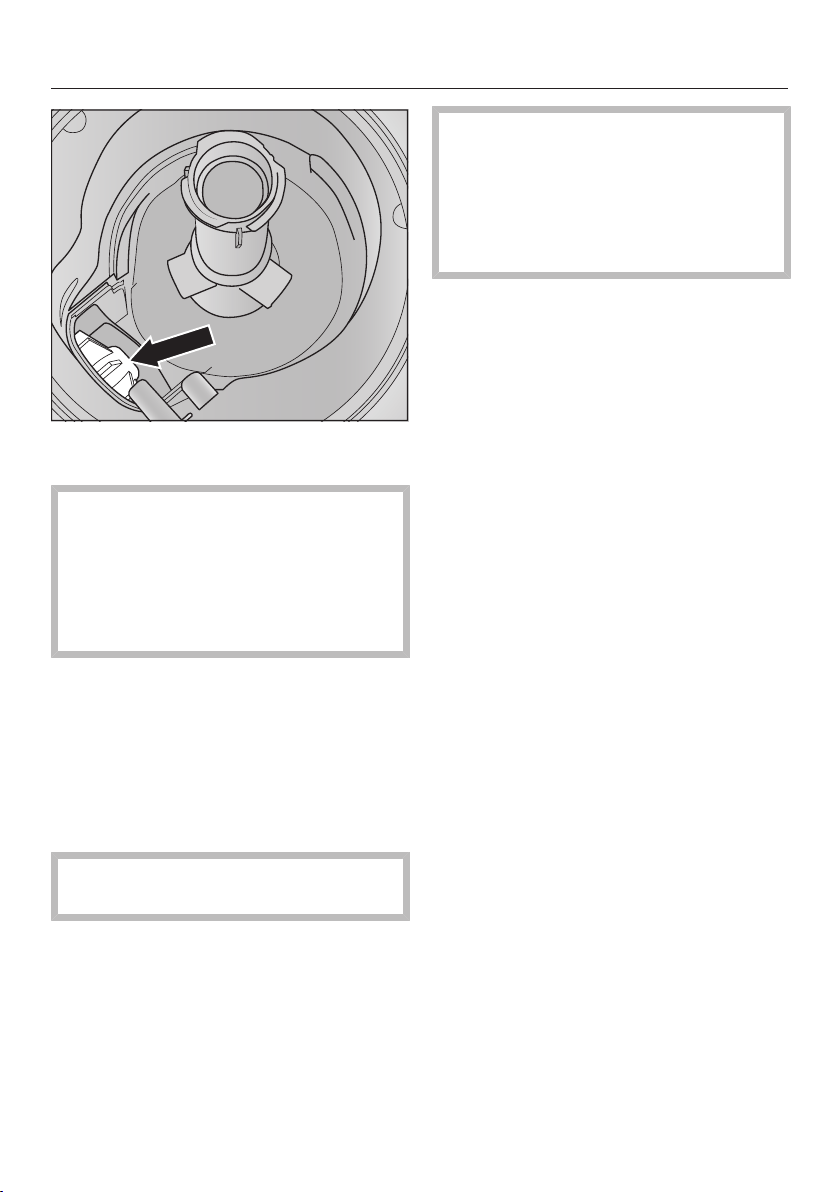
Cleaning and care
99
The drain pump (see arrow) is
underneath the cover.
Risk of injury from glass
splinters.
It is especially difficult to see glass
splinters in the drain pump.
Take care when cleaning the drain
pump.
Carefully remove all foreign objects
from the drain pump. Check the drain
pump impeller by manually turning it.
You will feel a little resistance when
you turn the impeller.
Refit the cover in the reverse order of
removing it.
Ensure that the catch engages
correctly.
Damage caused by incorrect
cleaning.
The components are delicate and
can be damaged during cleaning.
Take care when cleaning the drain
pump.
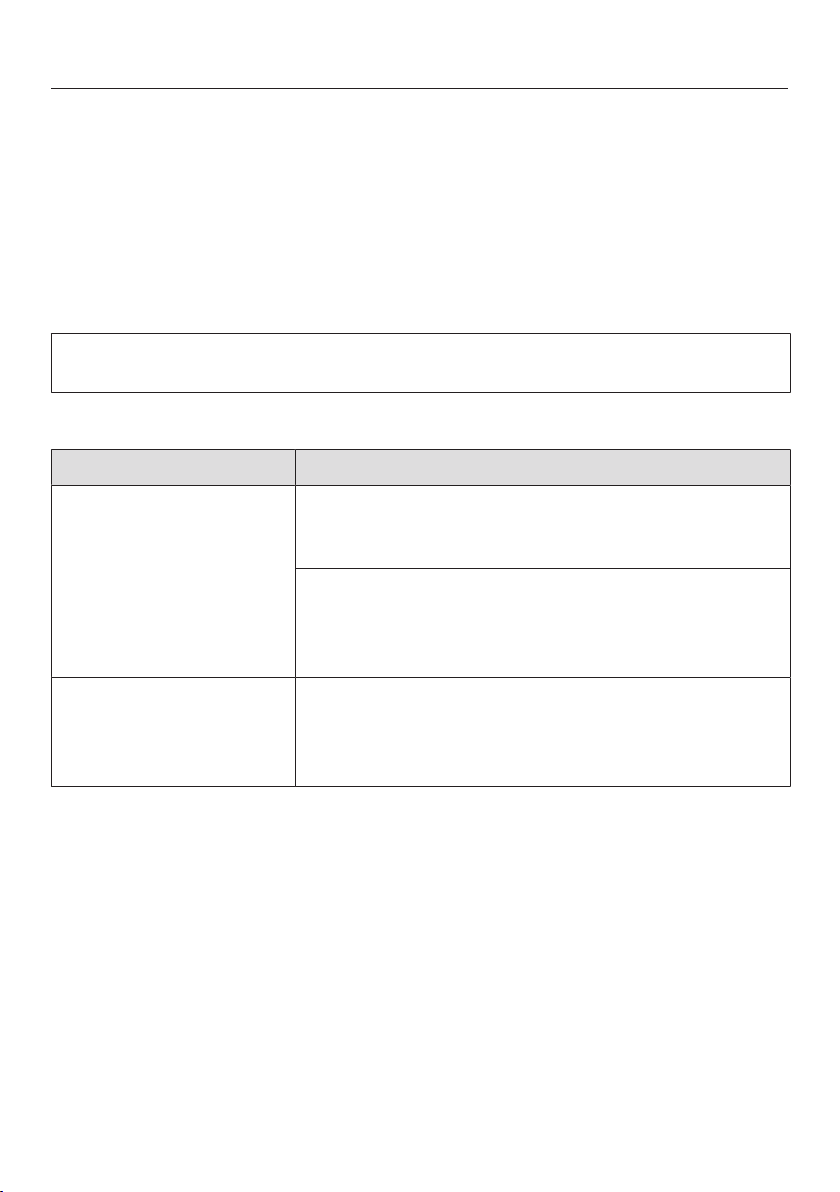
Problem solving guide
100
Many malfunctions and minor faults that can occur in daily operation can be
corrected without contacting Miele. This will save you time and money because
you will not need a service call.
You can find information on how to remedy faults yourself at www.miele.com/
service.
Please note, however, that a call-out charge will be applied to unnecessary service
visits where the problem could have been rectified as described in these operating
instructions.
This section only lists faults that you can remedy yourself. All other faults are
shown in Fault FXX.
Technical problems
ProblemPossible cause and remedy
The display remains
dark and the Start
indicator light is not
flashing after the
dishwasher has been
switched on with the
button.
The dishwasher is not plugged in or the socket is not
switched on.
Insert the plug and switch on at the socket.
The circuit breaker has tripped.
Reset the circuit breaker in the mains fuse box
(see data plate for minimum fuse rating).
If the circuit breaker trips again, call Miele.
The dishwasher stops
during a programme.
The circuit breaker has tripped.
Reset the circuit breaker in the mains fuse box
(see data plate for minimum fuse rating).
If the circuit breaker trips again, call Miele.

Problem solving guide
101
Fault messages
ProblemPossible cause and remedy
One of the following
faults appears in the
display:
Before rectifying the problem, you must:
Switch the dishwasher off.
Fault FXX There may be a technical fault.
Switch the dishwasher back on after a few
seconds.
Restart the desired programme.
If the fault message appears again, there is a
technical fault.
Switch the dishwasher off.
Turn off the tap.
Call Miele.
Waterproof The Waterproof system has reacted.
Switch the dishwasher off.
Turn off the tap.
Call Miele.
Fault F78 Circulation pump fault.
Switch the dishwasher off.
Switch the dishwasher back on.
Restart the desired programme.
If the fault message appears again, there is a
technical fault.
Switch the dishwasher off.
Turn off the tap.
Call Miele.
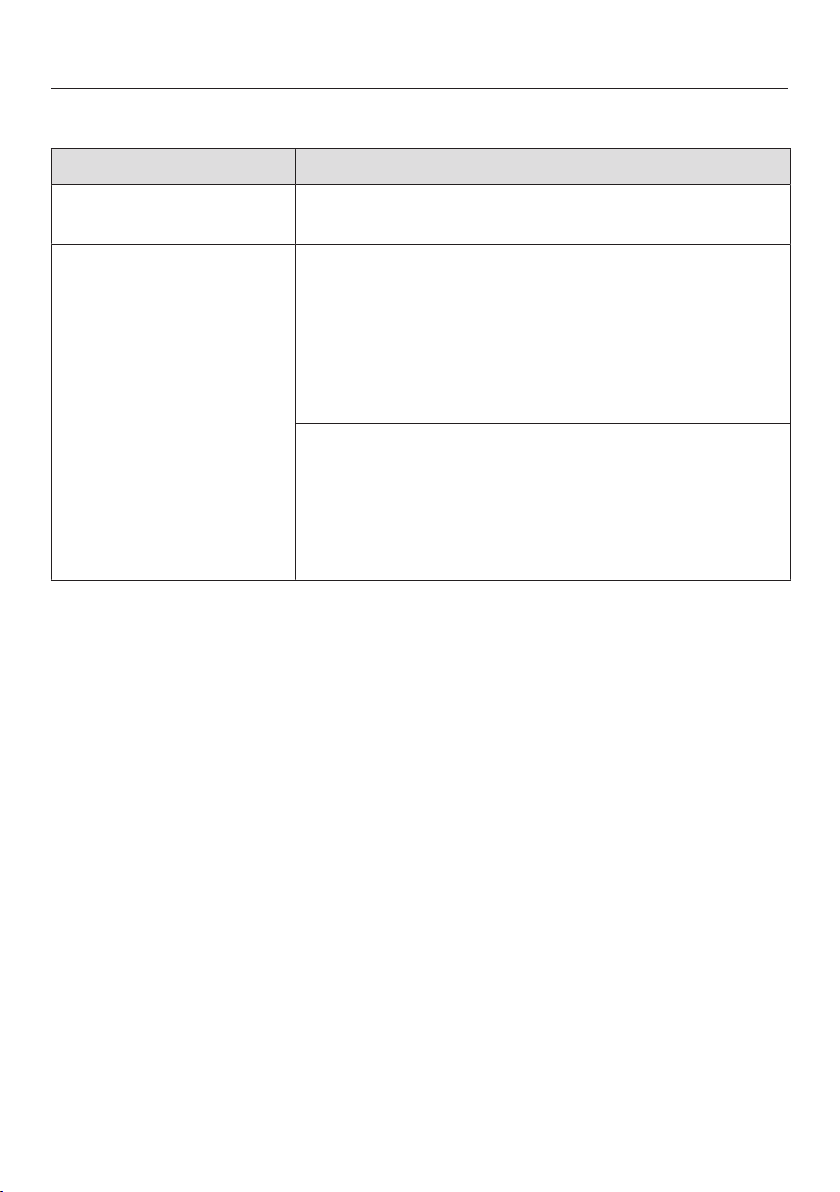
Problem solving guide
102
Door release
ProblemPossible cause and remedy
The following fault is
indicated in the display:
Before rectifying the problem, you must:
Switch the dishwasher off.
Door fault The door does not open automatically.
There may be a technical fault.
Open the door manually (see “Using for the first
time – Opening the door”) and switch the
dishwasher back on.
If the same fault message appears again, call
Miele.
The door locking pin does not retract after the door is
opened.
There may be a technical fault.
Switch the dishwasher back on.
If the same fault message appears again, call
Miele.

Problem solving guide
103
Water intake fault
ProblemPossible cause and remedy
One of the following
messages appears in
the display:
Turn on tap The tap is turned off.
Turn on the tap fully.
Water intake Before rectifying the problem, you must:
Switch the dishwasher off.
Water intake is restricted.
Turn on the tap fully and start the programme
again.
Clean the filter in the water inlet (see “Cleaning
and care – Cleaning the water inlet filter”).
The water connection pressure is lower than
50kPa.
Seek professional advice.
The on-site connection for the water drainage may
be too low and you will need to vent the water
drainage (see “Installation – Drainage”).
Fault F18 A technical fault has occurred.
Switch the dishwasher off.
Turn off the tap.
Call Miele.
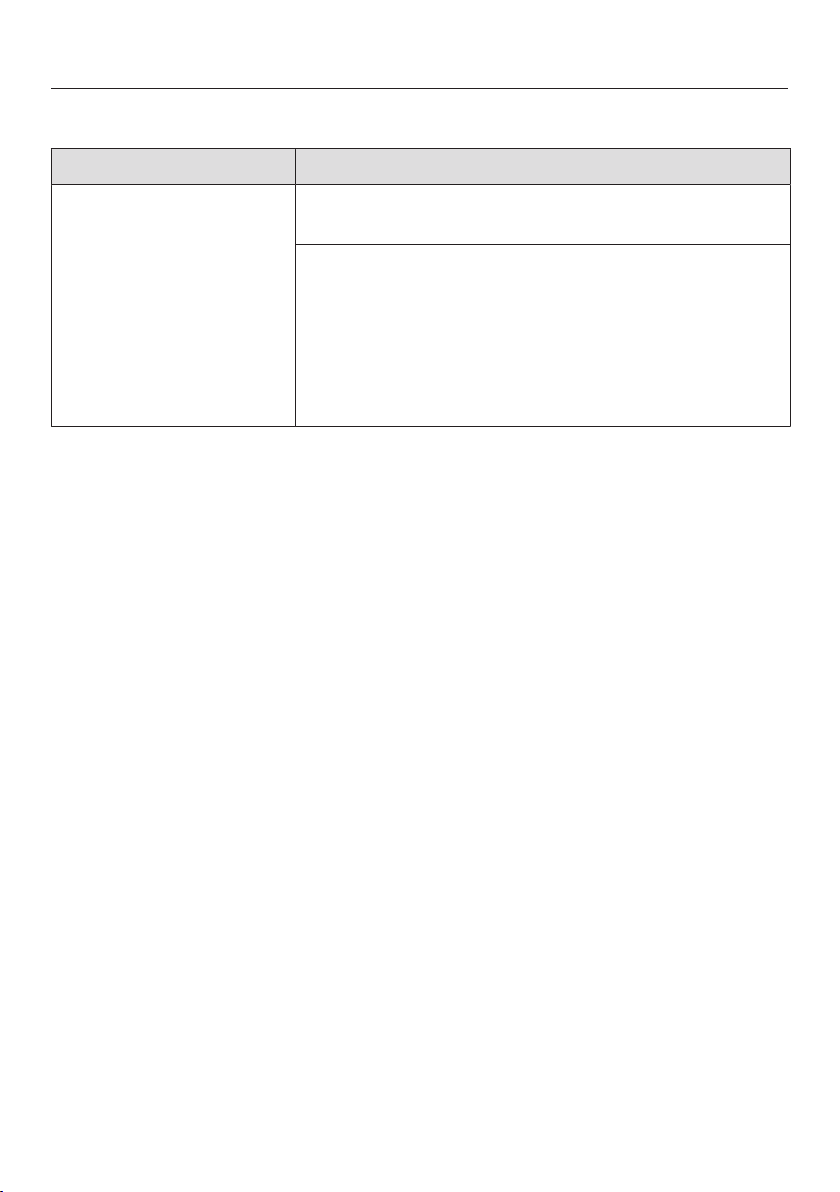
Problem solving guide
104
Water drainage fault
ProblemPossible cause and remedy
The message
Drain appears in the
display.
Before rectifying the problem, you must:
Switch the dishwasher off.
Water drainage fault.
There might be water in the wash cabinet.
Clean the filter combination (see “Cleaning and
care – Cleaning the filters”).
Clean the drain pump (see “Cleaning and care –
Cleaning the drain pump”).
Remove any kink or loop in the drain hose.

Problem solving guide
105
Fault with the AutoDos (automatic dispensing)
ProblemPossible cause and remedy
The following message
appears in the display:
Insert PowerDisk or
deactivate AutoDos with OK
The AutoDosfunction is active but no PowerDisk
has been inserted.
Insert a PowerDisk (see “Detergents - Automatic
dispensing/AutoDos”).
If you do not wish to use automatic dispensing,
deactivate the function using OK or the
AutoDossensor.
The programme does
not start or a
programme that has
already started stops.
The following message
appears in the display:
AutoDos lid open
The AutoDos lid has not been closed properly.
Close the AutoDos lid and lock it fully (see
“Detergents - Automatic dispensing/AutoDos”).
If the lid cannot be fully closed, check whether the
PowerDisk holder is lying flat (see “Detergents -
Inserting a PowerDisk”).
If the same fault message appears again, call
Miele.
The following message
appears in the display:
PowerDisk empty.
Deactivate AutoDos with
OK.
The AutoDosfunction is active and the PowerDisk
is empty.
Replace the PowerDisk (see “Detergents -
Automatic dispensing/AutoDos”).
If you do not wish to use automatic dispensing,
deactivate the function using OK or the
AutoDossensor.
The message
PowerDisk empty.
Deactivate AutoDos with
OK. appears in the
display even though you
have inserted a new
PowerDisk.
The dishwasher was switched off when the
PowerDisk was replaced and it has therefore not
recognised the new PowerDisk.
Switch the dishwasher on before replacing the
PowerDisk (see “Detergents - Automatic
dispensing/AutoDos” and “Inserting a
PowerDisk”).

Problem solving guide
106
ProblemPossible cause and remedy
At the end of the
programme, the alarm
tone sounds and the
display shows the
following message:
Fault F601
There is a fault with the AutoDos.
Switch the dishwasher off and back on again.
Check whether the PowerDisk holder and the
PowerDisk have been fitted correctly (see
“Detergents – Automatic dispensing/AutoDos”).
Activate the AutoDosfunction and start the
programme again.
If the fault message appears again, there is a
technical fault. You can continue to use your
dishwasher by deactivating automatic dispensing
with the AutoDossensor and manually dispensing
the detergent via the detergent compartment.
If you wish to use automatic dispensing again,
contact Miele.
At the end of the
programme, the alarm
tone sounds and the
display shows the
following message:
AutoDos maintenance
The dishwasher does
not switch off at the end
of the programme.
The dishes may not be
clean because an
insufficient amount of
detergent was
dispensed.
The AutoDos
function is
automatically
deactivated during the
programme sequence.
An empty PowerDisk has been inserted or the
AutoDos is blocked by residual detergent. The
detergent dosage is insufficient.
The AutoDos function was automatically
deactivated.
Switch the dishwasher off and back on again.
Multiple messages appear in the display.
Clean the detergent chute of the AutoDos (see
“Cleaning and care - Cleaning the AutoDos”).
Clean the lower spray arm (see “Cleaning and care
- Cleaning the spray arms”).
Confirm each message with OK.
Activate the AutoDos function by confirming the
message AutoDos available with OK.
Restart the programme.
The programme duration will be extended by up to
2.5hours to flush out the AutoDos detergent outlet.

Problem solving guide
107
ProblemPossible cause and remedy
During the programme
and at the end of the
programme, the display
shows the following
message:
Check spray arms
The dishwasher does
not switch off at the end
of the programme.
The crockery may not
be clean because no
detergent was
dispensed. The
AutoDos function is
automatically
deactivated during the
programme sequence.
The lower spray arm is blocked or the jets of the
lower spray arm are clogged. The AutoDos
function is automatically deactivated during the
programme because the AutoDos detergent outlet
cannot be completely flushed out.
Switch the dishwasher off and back on again.
Messages appear in the display.
Perform a rotation check of the lower spray arm
and rearrange the crockery if it is blocking the
spray arm.
Clean the lower spray arm (see “Cleaning and care
- Cleaning the spray arms”).
Confirm each message with OK.
Restart the programme.
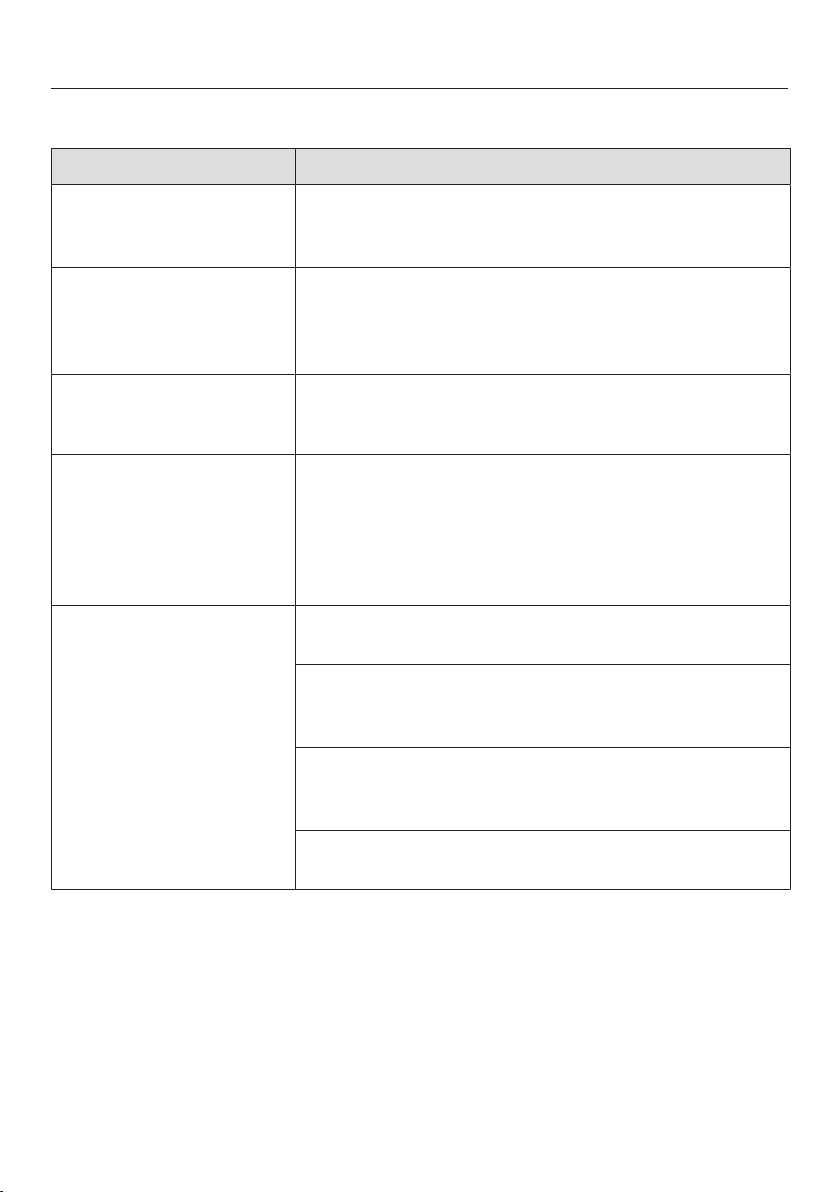
Problem solving guide
108
General problems with the dishwasher
ProblemPossible cause and remedy
The indicator lights and
the display are dark.
The dishwasher has switched off automatically to
save energy.
Switch the dishwasher back on with the button.
Detergent residue is left
in the detergent
compartment at the end
of a programme.
The detergent compartment was still damp when
detergent was added.
Only add the detergent when the detergent
compartment is dry.
The detergent
compartment lid cannot
be closed.
Residual detergent is blocking the catch.
Remove the residual detergent.
At the end of a
programme there is a
film of moisture on the
inside of the door and
possibly on the interior
walls.
This is part of the normal function of the drying
system. The moisture will dissipate after a short
while.
Water remains in the
wash cabinet at the end
of a programme.
Before rectifying the problem, you must:
Switch the dishwasher off.
The filter combination in the wash cabinet is clogged.
Clean the filter combination (see “Cleaning and
care – Cleaning the filters”).
The drain pump is blocked.
Clean the drain pump (see “Cleaning and care –
Cleaning the drain pump”).
The drain hose is kinked.
Remove any kinks from the drain hose.

Problem solving guide
109
Noises
ProblemPossible cause and remedy
Knocking noise in the
wash cabinet.
A spray arm is knocking against a crockery piece.
Carefully open the door and rearrange the wash
items that are obstructing the spray arm.
Rattling noise in the
wash cabinet.
Items of crockery are not secure in the wash cabinet.
Carefully open the door and rearrange the wash
items so that they sit securely.
There is a foreign object (e.g. glass shard) in the drain
pump.
Remove the foreign object from the drain pump
(see “Cleaning and care - Cleaning the drain
pump”).
Knocking noise in the
water pipes
This may be caused by the on-site installation or the
cross-section of the piping.
However, this will not affect the functioning of the
dishwasher in any way. If in doubt, contact a
suitably qualified plumber.
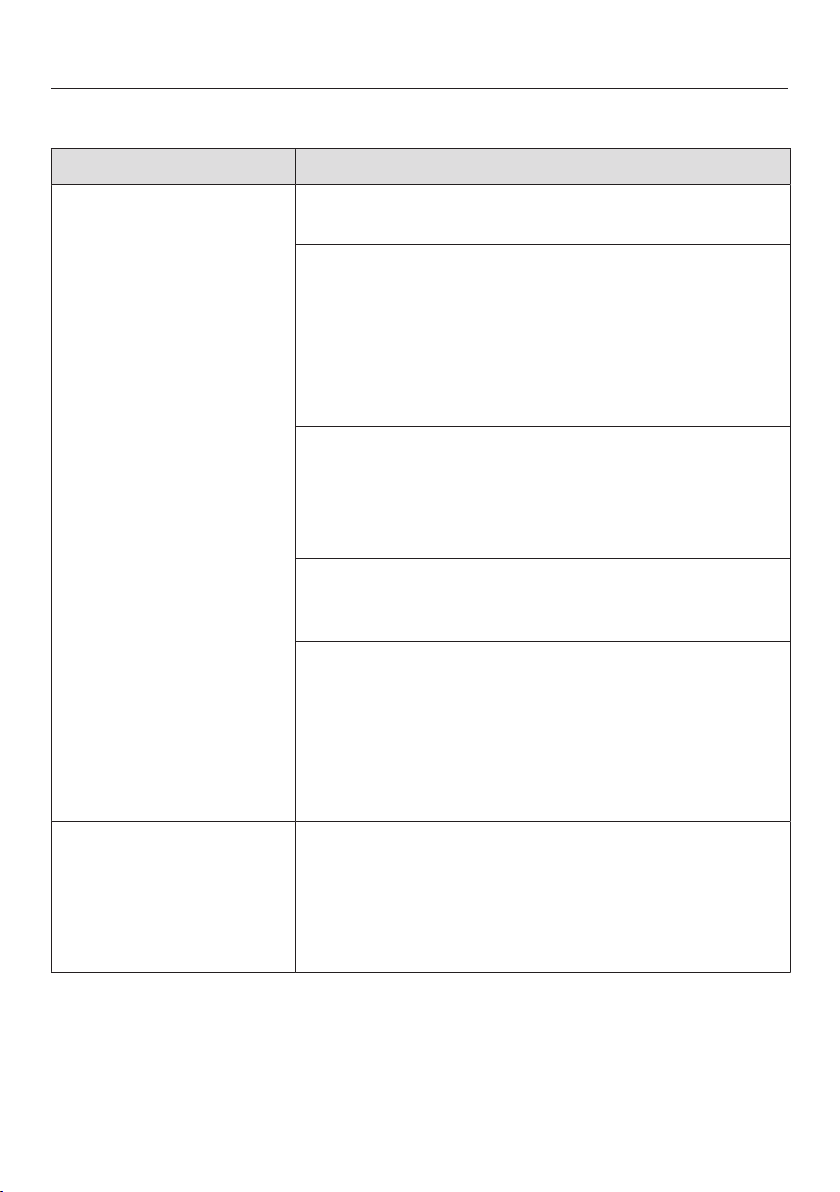
Problem solving guide
110
Unsatisfactory cleaning result
ProblemPossible cause and remedy
The dishes are not
clean.
The items were not loaded correctly.
See notes under “Loading the dishwasher”.
The programme was not thorough enough.
Select a more intensive programme (see
“Programme chart”).
Activate the "Extra clean" function (see “Settings –
Extra clean”).
Activate the "Second interim rinse" function (see
“Settings - 2nd interim rinse”).
Not enough detergent was dispensed.
Use more detergent during manual dispensing or
change the detergent you are using.
Increase the dispensing quantity during automatic
dispensing (if available) (see “Settings – AutoDos”).
Items are blocking the path of the spray arms.
Carry out a rotation check and if needed rearrange
the items so that the spray arms can rotate freely.
The filter combination in the base of the wash
cabinet is not clean or not correctly fitted.
This may have caused the spray arm jets to become
blocked.
Clean and/or fit the filter combination correctly.
Clean the spray arm jets if necessary (see
“Cleaning and care - Cleaning the spray arms”).
There are smears on
glassware and cutlery.
There is a bluish sheen
on the surface of
glassware. The film can
be wiped off.
The rinse aid dosage is set too high.
Reduce the dosage (see “Settings - Rinse aid”).

Problem solving guide
111
ProblemPossible cause and remedy
Dishes are not dry or
cutlery and glasses are
blotchy.
The amount of rinse aid may be insufficient, or the
rinse aid reservoir is empty.
Replenish the rinse aid, increase the dosage, or
change the brand of rinse aid (see “Using for the
first time - Rinse aid”).
Dishes were taken out of the wash cabinet too soon.
Leave dishes in longer (see “Operation - Unloading
the dishwasher”).
The duration of the drying phase for the selected
programme is not sufficient for the crockery
(particularly for plastic crockery).
Select the "Extra dry" function (see “Settings -
Extra dry”).
You have used combination products that have
insufficient drying performance.
Switch to another detergent or add rinse aid (see
“Using for the first time - Rinse aid”).
Glassware has a brown
or blue tinge. The film
cannot be wiped off.
Ingredients from the detergent have formed a
deposit.
Switch to another detergent straight away.
Glassware is dull and
discoloured. The film
cannot be wiped off.
The glassware is not dishwasher safe. The surface
has altered.
There is no remedy.
Purchase glassware which is dishwasher safe.
Tea or lipstick stains
have not been
completely removed.
The wash temperature of the selected programme
was too low.
Select a programme with a higher wash
temperature.
The bleaching effect of the detergent is too low.
Change your detergent.
Plastic items are
discoloured.
Natural dyes, e.g. from carrots, tomatoes or tomato
sauce may be the cause. The amount of detergent
used or its bleaching effect was not sufficient to deal
with natural dyes.
Use more detergent (see “Detergents”).
Parts that are already discoloured will not revert to
their original colour.
Problem solving guide
112
ProblemPossible cause and remedy
White residue is visible
on the dishware.
Clouding has occurred
on glassware and
cutlery. The film can be
wiped off.
Not enough rinse aid was added.
Increase the dosage (see “Settings – Rinse aid”).
The salt reservoir is empty.
Fill the salt reservoir (see “Using for the first time -
Dishwasher salt”).
The salt reservoir cap has not been screwed on
correctly.
Replace it, making sure that it screws back on
correctly.
Unsuitable combination detergents were used.
Change your detergent. If using tabs or powder
detergent, do not choose combination products
and ensure you refill the reactivation salt and rinse
aid.
The water softener is programmed to a setting which
is too low for the water hardness level.
Programme the water softener to a higher water
hardness level (see “Settings - Water hardness”).
Too much detergent was dispensed.
Reduce the dispensing quantity during automatic
dispensing (if available) (see “Settings – AutoDos”).
Activate the “Second interim rinse” function (see
“Settings - 2nd interim rinse”).
Not enough combination detergent was dispensed.
The water softener performance is not sufficient.
Increase the dispensing quantity during automatic
dispensing (if available) (see “Settings – AutoDos”).
Add more reactivation salt.
Problem solving guide
113
ProblemPossible cause and remedy
There are rust stains on
cutlery.
The affected items are not corrosion resistant.
There is no remedy.
Purchase cutlery which is dishwasher safe.
A programme was not run after dishwasher salt was
added. Traces of salt have gotten into the normal
wash cycle.
Always run the 65°C QuickPowerWash
programme with the Expressoption selected
and without any load in the dishwasher
immediately after adding dishwasher salt.
The salt reservoir cap has not been screwed on
correctly.
Replace it, making sure that it screws back on
correctly.
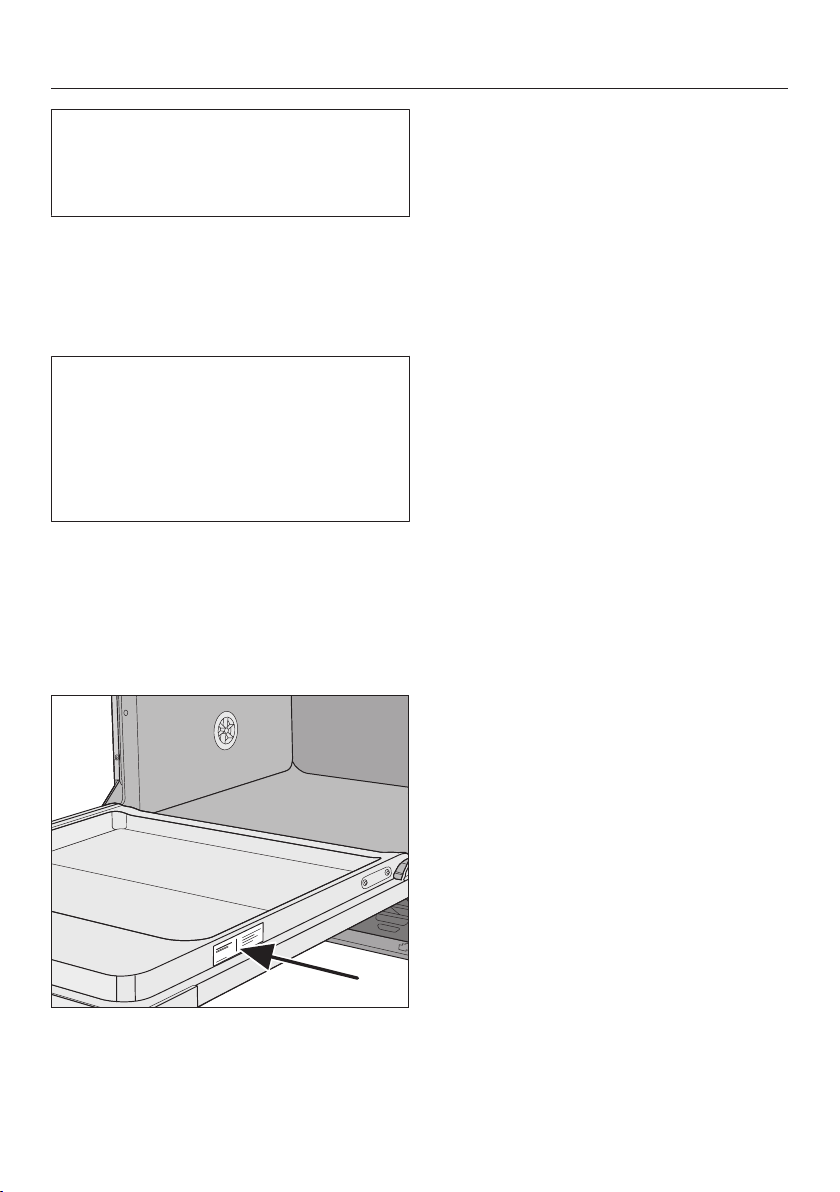
Service
114
You can find information on how to
remedy faults yourself and about
Miele spare parts at www.miele.com/
service.
Contact in case of fault
In the event of any faults which you
cannot remedy yourself, please contact
Miele.
You can book a Miele customer
service call-out online at
www.miele.com.au/service or
www.miele.co.nz/service.
Contact information for Miele can be
found at the end of this booklet.
Please quote the model and serial
number of your appliance when
contacting Miele. This information can
be found on the data plate.
The data plate is located on the right
side of the door.
Warranty
The manufacturer's warranty for this
appliance is 2years.
For further information, please refer to
your warranty booklet.

Optional accessories
115
Dishwasher detergent, rinse aid, and
cleaning and care products are
available for this dishwasher, as are
optional accessories.
All the products have been designed for
Miele appliances.
These and many other useful products
can be ordered from the Miele online
store or a Miele Experience Centre.
Detergents
With your Miele dishwasher you have
chosen excellent quality and
performance. To achieve optimum
results all the time, it is important to use
the right dishwasher detergents. Not all
off-the-shelf products deliver the same
results in all dishwashers.
For this reason Miele offers dishwasher
products specifically designed for Miele
appliances.
PowerDisk
Special Miele formula – for outstanding
cleaning results in Miele dishwashers
with AutoDos automatic dispensing.
-exclusive Miele powder granulate
-with rinse aid and salt functions
-with components to protect silver
and glass
-with active oxygen for thorough
cleaning
-with super-active enzymes – effective
even at low temperatures
In hard water areas, we recommend
using the complete Miele system: the
PowerDisk, rinse aid, and salt perfectly
match each other.
Detergent tablets
-sparkling results even with stubborn
food deposits
-combination product with other
functions such as rinse aid, salt, and
glass protective additives
-phosphate-free – environmentally
friendly
-water-soluble wrapping – no need to
unwrap
Powder detergent
-with active oxygen for thorough
cleaning
-with enzymes which are effective
even at low-temperatures
-with glass protective formula against
corrosion
Rinse aid
-for sparkling glasses
-helps dishes to dry
-with glass protective formula against
corrosion
-specially designed cap for accurate
and easy dispensing
Dishwasher salt
-prevents limescale deposits on
dishes and in the appliance
-extra coarse-grained

Optional accessories
116
Appliance care
Miele cleaning and care products
provide optimum care for your
dishwasher.
IntenseClean
-for use with the Maintenance
programme (depending on model)
without detergent dispensing
-cleans the dishwasher effectively and
thoroughly
-removes grease, bacteria and
associated unpleasant odours
-ensures excellent dishwashing results
Descaling agent
-removes heavy limescale deposits
-mild and gentle with natural citric
acid
DishClean
-removes odours, limescale and light
deposits
-maintains the elasticity and leak
tightness of the seals
Installation
*INSTALLATION*
117
The Miele Waterproof system
Provided that your dishwasher has
been installed correctly, the Miele
Waterproof system will protect you from
water damage throughout its lifetime.
Water intake
Danger to health due to rinsing
water.
Water in the dishwasher must not be
used as drinking water.
Do not drink any water from the
dishwasher.
Health risk and risk of damage
due to contaminated mains water.
The quality of the water used must
correspond to the drinking water
specification of the country in which
the dishwasher is being operated.
Connect the dishwasher to a drinking
water supply.
The dishwasher may be connected to
cold or hot water (up to max. 60°C).
If energy-saving water heating sources,
such as a solar water heating system,
are used, we recommend connecting to
the hot water. This saves both time and
electricity costs. Hot water is used in all
programmes.
The SolarSaveprogramme (if available)
requires a hot water connection of
between a minimum of 45°C and a
maximum of 60°C (inlet temperature).
The higher the water intake
temperature, the better the cleaning and
drying results.
The intake hose is approx. 1.5m long.
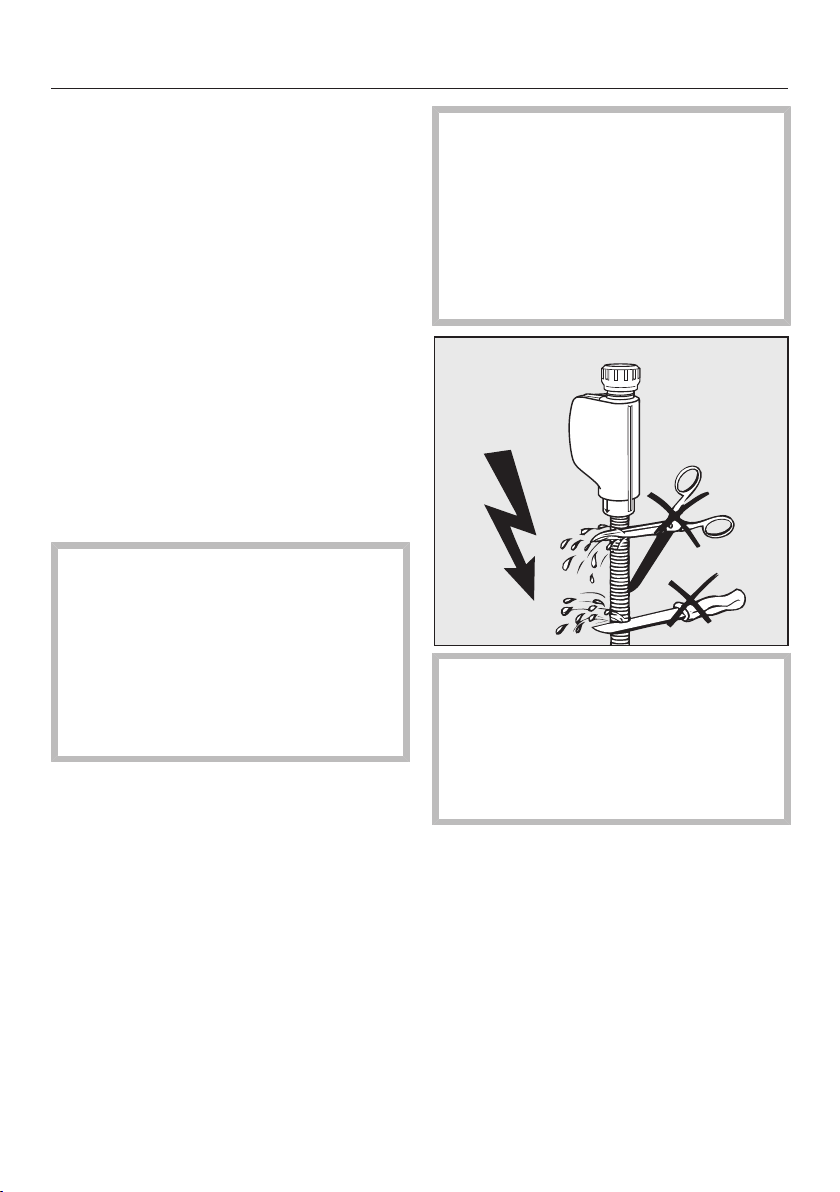
Installation
*INSTALLATION*
118
A tap with a ¾" male thread must be
provided on site. If this type of tap is
not available, only a qualified plumber
may connect the dishwasher to the
household water supply.
The dishwasher must be connected to a
mains water supply in accordance with
current local and national safety
regulations.
The water connection pressure needs
to be between 50 and 1,000kPa. If the
water pressure is lower than this, the
fault message Water intake will appear in
the display (see “Problem solving guide
- Water intake fault”). If the water
pressure is too high, a pressure
reducing valve must be fitted.
Risk of damage from leaking
water.
The threaded union is subject to
water pressure. Water leaking from it
can cause damage.
Turn on the tap slowly and check for
leaks. Correct the position of the seal
and union if necessary.
Risk of damage due to excessive
pressure.
A brief increase in the water pressure
can damage components of the
dishwasher.
This dishwasher must only be
operated when it is connected to a
fully vented plumbing system.
Risk of electric shock.
There are electrical components in
the water inlet hose.
The inlet hose must not be shortened
or damaged in any way (see
illustration).
Installation
*INSTALLATION*
119
Drainage
The appliance drainage system is fitted
with a non-return valve, which prevents
dirty water from flowing back into the
dishwasher via the drain hose.
The dishwasher is supplied with
approx.1.5m of flexible drain hose with
an internal diameter of 22mm.
The hose can be extended using a
connection piece to attach a further
length of hose. The drainage length
must not be longer than 4m and the
delivery head no higher than 1m.
If the hose is to be directly connected
to the drainage outlet on site, use the
supplied hose clip (see the installation
plan).
The hose can be directed to the left or
the right of the appliance.
The on-site connector for the drain hose
can be adapted to different hose
diameters. If the connector extends too
far into the drain hose, it must be
shortened. Otherwise, the drain hose
can become clogged.
The drain hose must not be shortened.
Lay the drain hose so that it does not
kink and is not being subjected to
pressure or being tugged.
Risk of damage from leaking
water.
Overflowing water can cause
damage.
After using the appliance for the first
time, make sure that the water drain
does not leak.
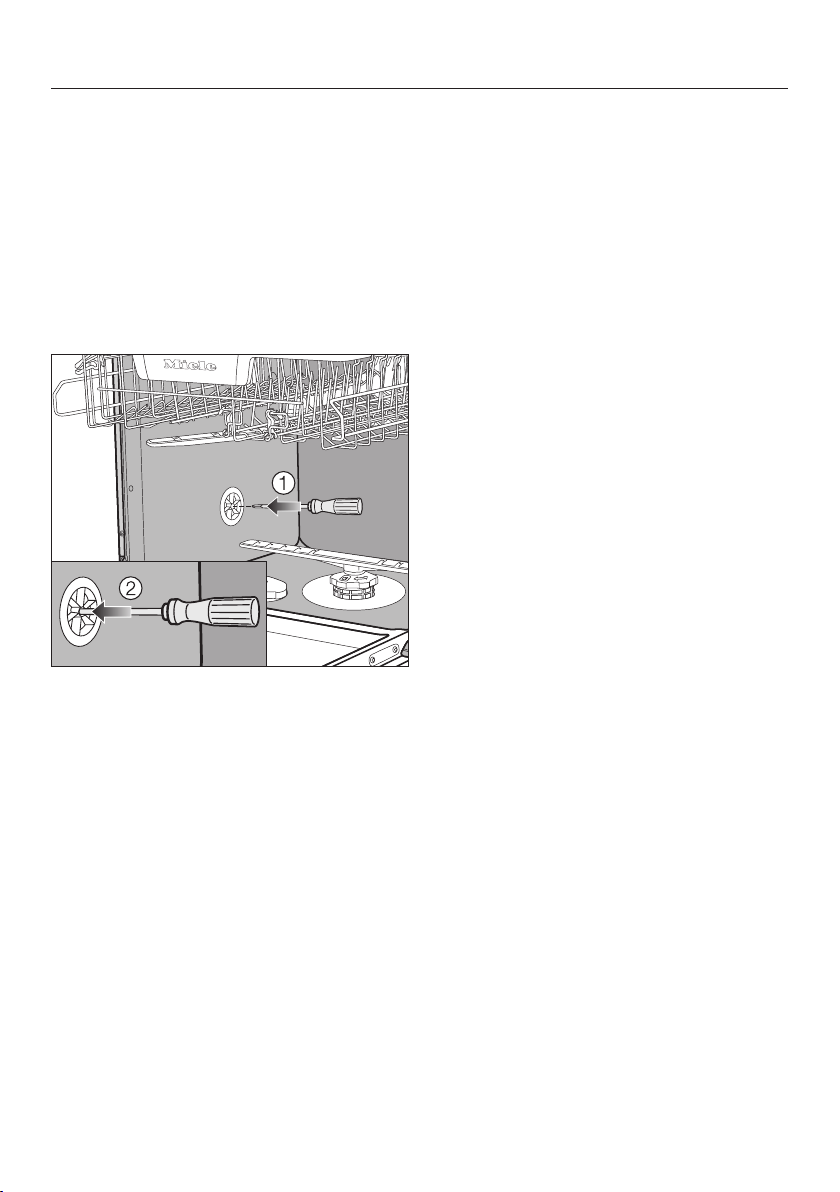
Installation
*INSTALLATION*
120
Venting the water drainage
If the on-site drainage connection is
situated lower than the guide for the
rollers of the lower basket in the door,
the drainage system must be vented.
Otherwise, a siphoning effect during a
programme can cause the appliance to
empty itself of water.
Open the dishwasher door fully.
Remove the lower basket.
Insert a screwdriver into the middle
opening of the vent valve in the left
wash cabinet wall.
Press the screwdriver further into the
opening and push it through the
membrane behind.
The vent opening for the water drain is
now open.

Installation
*INSTALLATION*
121
Electrical connection
The dishwasher is supplied with a
mains cable with moulded plug ready
for connection to an earthed socket.
The socket must be easily accessible
after the dishwasher has been installed.
If the switch is not accessible after
installation, an additional means of
disconnection must be provided for all
poles.
Risk of fire from overheating.
Connecting the dishwasher to a
multi-socket plug adapter or to an
extension lead can overload the
cable.
Do not use an extension lead or
multi-socket plug adapter.
The electrical installation and all
electrical work must be carried out by a
suitably qualified and competent person
in strict accordance with national and
local safety regulations. For extra
safety, it is advisable to install a residual
current device (RCD) with a trip current
of 30 mA. Ensure power is not supplied
to the appliance until after the
installation has been completed.
Connection should be made via a
suitable switched socket.
If the mains connection cable is
damaged, it must only be replaced with
a specific mains connection cable of
the same type (available Miele). For
safety reasons, such replacement may
only be carried out by a suitably
qualified and competent technician or
by a Miele authorised service
technician, in order to avoid a hazard.
For technical data, see the data plate
located on the right side of the door.
Compare this information with the data
of the on-site electrical connection.
If in any doubt, consult a qualified
electrician.
Do not connect the dishwasher solely
to a stand-alone inverter such as those
used with an autonomous energy
source (e.g. solar power). When the
dishwasher is switched on, power
surges could result in a safety switch-
off. This could damage the electronics.
Temporary or permanent operation with
a self-sufficient or non-mains
synchronous energy supply system
(e.g. isolated networks, back-up
systems) is possible. A requirement for
the operation is that the energy supply
system complies with all current local
and national requirements that apply to
stand-alone, solar and/or battery
systems.
The protective measures provided in
the domestic installation and in this
Miele product must also be assured in
their function and operation in isolated
operation or in non-mains synchronous
operation, or replaced with equivalent
measures in the installation.
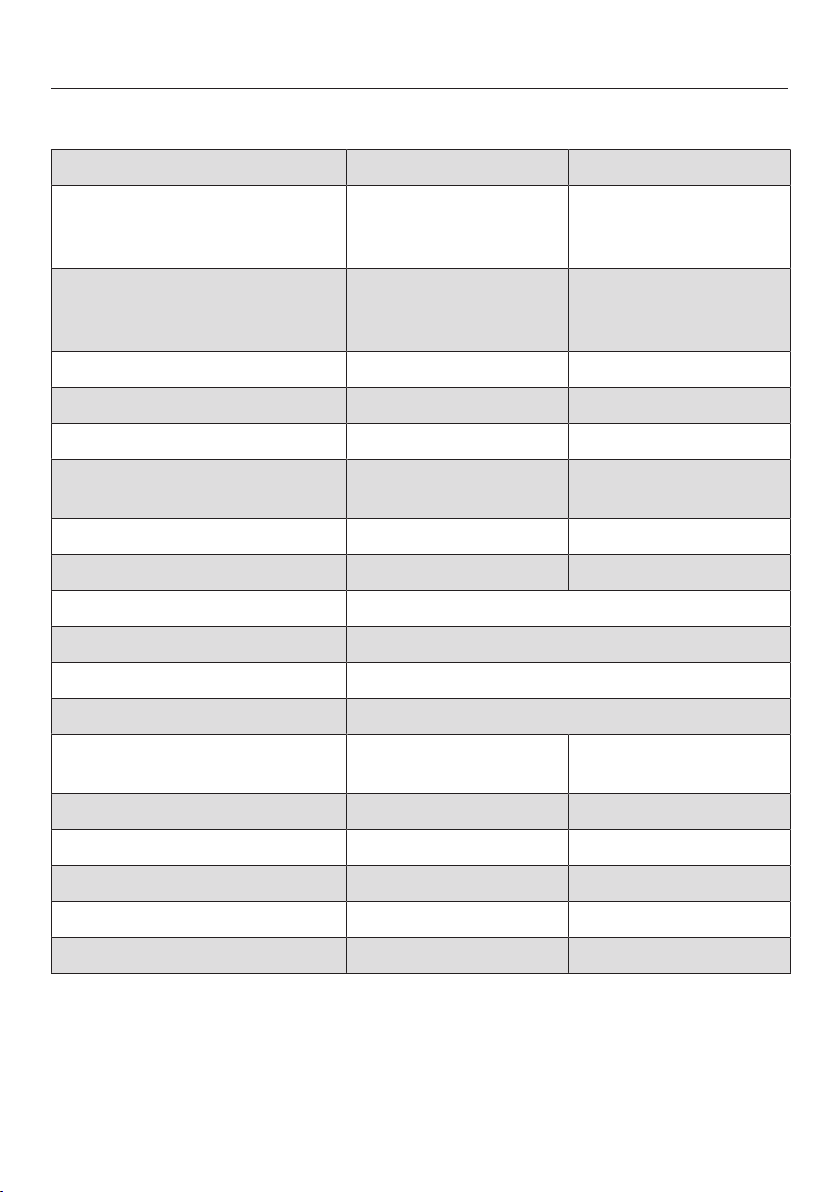
Technical data
122
Technical data
Dishwasher modelNormalXXL
Height of freestanding
appliance
84.5cm
(adjustable by
+3.5cm)
-
Height of built-in appliance80.5cm
(adjustable by
+6.5cm)
84.5cm
(adjustable by
+6.5cm)
Niche heightmin. 80.5cm (+6.5cm)min. 84.5cm (+6.5cm)
Width59.8cm59.8cm
Niche width60cm60cm
Depth of freestanding
appliance
60cm-
Depth of built-in appliance57cm57cm
Weightmax. 58kgmax. 49kg
Voltagesee data plate
Rated loadsee data plate
Fuse ratingsee data plate
Test certifications awardedsee data plate
Water pressure50–1000kPa50–1000kPa
Hot water connectionup to max. 60°Cup to max. 60°C
Delivery headmax. 1mmax. 1m
Drainage lengthmax. 4mmax. 4m
Mains connection cableapprox. 1.7mapprox. 1.7m
Capacity14/15 place settings*14/15 place settings*
* depending on model

Miele Head Office Melbourne:
Level 4, 141 Camberwell Road
Hawthorn East, VIC 3123
Miele Experience Centre South Melbourne:
206-210 Coventry Street
South Melbourne, VIC 3205
Miele Experience Centre and Office Sydney:
3 Skyline Place
Frenchs Forest, NSW 2086
Miele Experience Centre and Office Brisbane:
Tenancy 4C, 63 Skyring Terrace
Newstead, QLD 4006
Miele Experience Centre and Office Perth:
83-85 Sir Donald Bradman Drive
Hilton, SA 5033
Miele Experience Centre and Office Adelaide:
Miele Australia Pty. Ltd.Miele New Zealand Limited
Miele Global Headquarters
Germany
Miele & Cie. KG
Carl-Miele-Straße 29
33332 Gütersloh
Federal Republic of Germany
IRD 98 463 631
ACN 005 635 398
ABN 96 005 635 398
Miele Experience Centre Gold Coast:
131 Ferry Road
Southport, QLD 4215
Miele Experience Centre
and Head Office Auckland:
8 College Hill
Freemans Bay, Auckland 1011
Miele Experience Centre
Wellington:
183 Featherston Street
Wellington 6011
0800 464 353 (0800 4 MIELE)
www.miele.co.nz
205-207 Stirling Highway
Claremont, WA 6010
1300 464 353 (1300 4 MIELE)
www.miele.com.au
Miele Experience Centre Doncaster:
1136/7 Doncaster Shopping Centre
619 Doncaster Rd, Doncaster, VIC 3108

M.-Nr. 12 383 510 / 00en-AU, NZ
G 7114, G 7119