Spacemake(MLaundry
_ Safety Instructions ....................3-5
Operating Instructions, Tips
Operating the Washer ...........................6-13
Agitator ..........................................................7
Control Settings ...........................................6
Cycle Descriptions ......................................5
Cycle Times ..................................................7
Energy-Saving Tips .....................................7
Fabric and Cycle Settings .........................8
...........................................Lint Filter ................................................7, 18
Soak................................................................7
Washer Lid Latch ........................................6
Operating the Dryer .............................14-17
Air Fluff Drying ..........................................15
Automatic and Timed Drying ................15
Control Settings ........................................ 14
Energy-Saving Tips .................................. 17
Fabric and Cycle Settings .......................16
Lint Filter ..............................................14, 18
Loading ....................................................... 14
Sorting .................................................14, 17
Care and Cleaning ...............18,19
Storage and Vacation Tips ........................21
User Maintenance Instructions ................21
Problem Solver .......................20-24
More questions ?...call
GEAnswer Center® 800,628,2000
Preparation
Detergents and Additives ...................10, 11
Ha rd Water .................................................... 10
Loading the Washer ..................................6, 8
Sorting Clothes ...........................................6, 9
Stains .............................................................. 12
Stain Removal Guide ................................... 13
Consumer Services ...................27
Appliance Registration ..................................2
Important Phone Numbers ........................27
Model and Serial Numbers ..........................2
Repair Service ..................................................2
Warranty ........................................Back Cover
I Models: WSM2420, WSM2480 1
GEAppliances
HELP US HELP YOU...
Before using your
Spacemaker TM Laundry,
read this book carefully.
It is intended to help you
operate and maintain your
new appliance properly.
Keep it handy for answers to
your questions.
If you don't understand something
or need more help, write (include
your phone number):
Consumer Affairs
GE Appliances, Appliance Park
Louisville, KY 40225
Save time and money.
Before you request service...
check the Problem Solver
section. It lists causes of minor
operating problems that you can
correct yourself
If you received a
damaged appliance...
Immediately contact the dealer (or
builder) that sold you the appliance.
Write down the model
and serial numbers.
You'll find them on a label on the
inside of the door or the rating
plate on top of the dryer.
These numbers are also on the
Consumer Product Ownership
Registration Card that came with
your appliance. Before sending in
this card, please write these
numbers here:
Model Number
Serial Number
Use these numbers in any
correspondence or service
calls concerning your appliance.
WARNING: For your safety the information in this manual must be followed to minimize
the risk of fire or explosion or to prevent property damage, personal injury or loss of life.
--Do not store or use gasoline or other • Immediately call your gas supplier from a
flammable vapors and liquids in the neighbor's phone. Follow the gas supplier's
vicinity of this or any other appliance, instructions.
WHAT TO DO IF YOU SMELL GAS • ff you cannot reach your gas supplier, call
• Do not try to fight any appliance, the fire department.
• Do not touch any electrical switch: Installation and service must be performed
do not use any phone in your building, by a qualified installer, service agency or
the gas supplier.
• Clear the room. building or area
All washing and drying instruction terms in this book conform to the Care
Labeling Rule established by the Federal Trade Commission, January 1984.
If You Need Service
To obtain service, see the
Consumer Services page
in the back of this book.
We're proud of our service and
want you to be pleased. If for some
reason you are not happy with the
service you receive, here are three
steps to follow for further help.
2
First, contact the people who
serviced your appliance. Explain
why you are not pleased. In most
cases, this will solve the problem.
NEXT, if you are still not pleased,
write all the details--including
your phone number--to:
Manager, Consumer Relations
GE Appliances, Appliance Park
Louisville, KY 40225
FINALLY, if your problem
is still not resolved, write:
Major Appliance Consumer
Action Panel
20 North Wacker Drive
Chicago, IL 60606
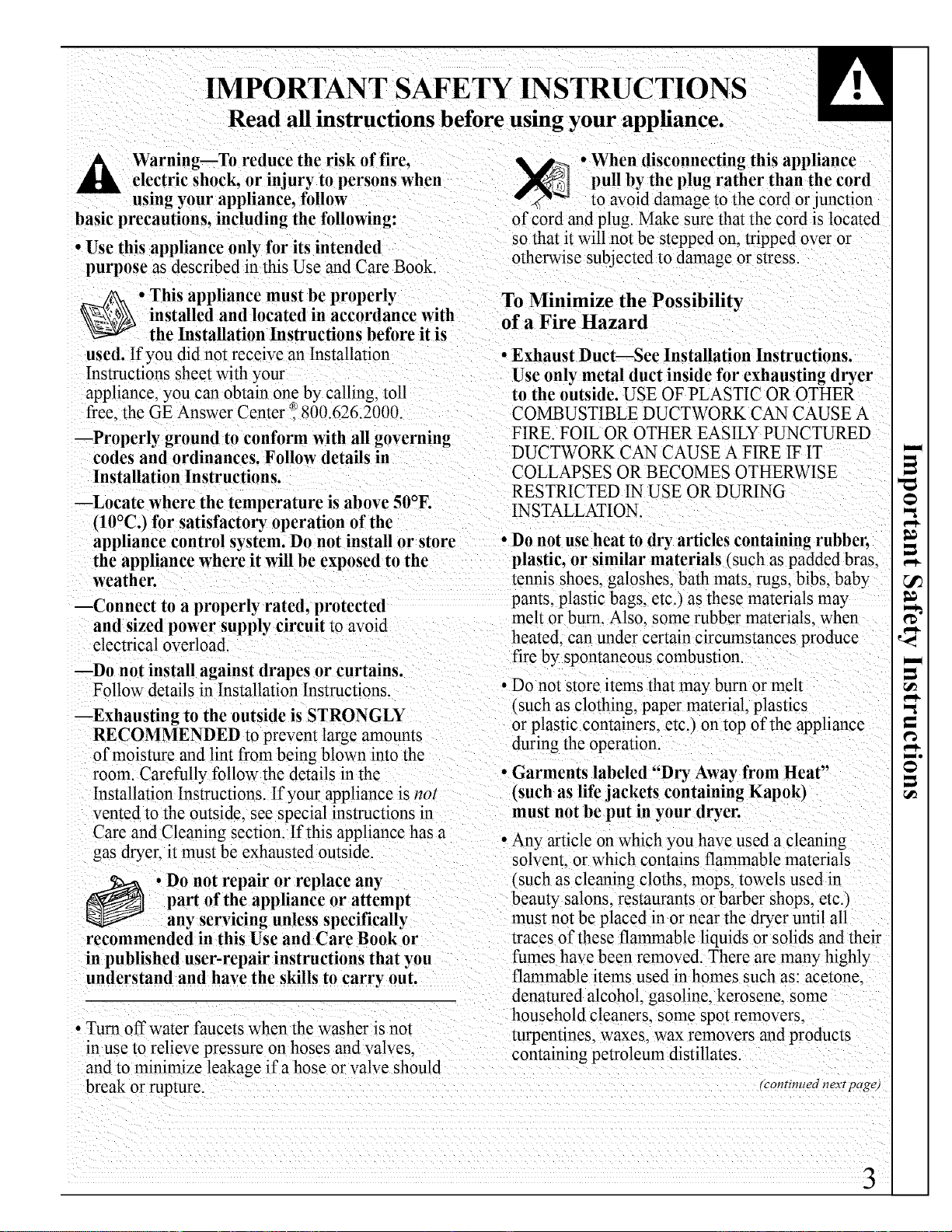
IMPORTANT SAFETY INSTRUCTIONS
Read all instructions before using your appliance.
Warning--To reduce the risk of fire.
electric shock, or injury to persons when
using your appliance, follow
basic precautions, including the following:
• Use this appliance only for its intended
• When disconnecting this appliance
pull by the plug rather than the cord
to avoid damage to the cord or junction
of cord and plug. Make sure that the cord is located
so that it will not be stepped on. tripped over or
purpose as described in this Use and Care Book. otherwise subjected to damage or stress.
_. This appliance must be properly
installed and located in accordance with To Minimize the Possibility
the Installation Instructions before it is of a Fire Hazard
used. If you did not receive an Installation • Exhaust Duct--See Installation Instructions.
Instructions sheet with your Use only metal duct inside for exhausting dryer
appliance, you can obtain one by calling, toll to the outside. USE OF PLASTIC OR OTHER
free. the GE Answer Center _ 800.626.2000. COMBUSTIBLE DUCTWORK CAN CAUSE A
--Properly ground to conform with all governing
codes and ordinances. Follow details in
Installation Instructions.
--Locate where the temperature is above 50°E
{10°C.) for satisfactory operation of the
FIRE. FOIL OR OTHER EASILY PUNCTURED
DUCTWORK CAN CAUSE A FIRE IF IT
COLLAPSES OR BECOMES OTHERWISE
RESTRICTED IN USE OR DURING
INSTALLATION.
appliance control system. Do not install or store • Do not use heat to dry articles containing rubber,
the appliance where it will be exposed to the
weather.
--Connect to a properly rated, protected
and sized power supply circuit to avoid
electrical overload.
--Do not install against drapes or curtains.
Follow details in installation Instructions.
plastic, or similar materials (such as padded bras.
tennis shoes, galoshes, bath mats. rugs, bibs. baby
pants, plastic bags, etc.) as these materials may
melt or burn. Also. some rubber materials, when
heated, can under certain circumstances produce
fire by spontaneous combustion.
- -Exhausting to the outside is STRONGLY
RECOMMENDED to prevent large amounts
of moisture and lint from being blown into the
room. Carefully follow the details in the
Installation Instructions. If your appliance is not
vented to the outside, see special instructions in
Care and Cleaning section. If this appliance has a
gas dryer, it must be exhausted outside.
• Do not repair or replace any
part of the appliance or attempt
any servicing unless specifically
recommended in this Use and Care Book or
in published user-repair instructions that you
understand and have the sMlls to carry out,
• Do not store items that may burn or melt
(such as clothing, paper material, plastics
orplastic containers, etc. _on top of the appliance
during the operation.
• Garments labeled "Dry Away from Heat"
(such as life jackets containing Kapok)
must not be put in your dryer.
• Turn offwater faucets when the washer is not
in use to relieve pressure on hoses and valves.
and to minimize leakage if a hose or valve should
break or rupture ..........
• Any article on which you have used a cleaning
solvent, or which contains flammable materials
(such as cleaning cloths, mops, towels used in
beauty" salons, restaurants or barber shops, etc.)
must not be placed in or near the dryer until all
traces of these flammable liquids or solids and their
fumes have been removed. There are many"highly
flammable items used in homes such as: acetone.
denatured alcohol, gasoline, kerosene, some
household cleaners, some spot removers.
turpentines, waxes, wax removers and products
containing petroleum distillates.
@optinued next page/
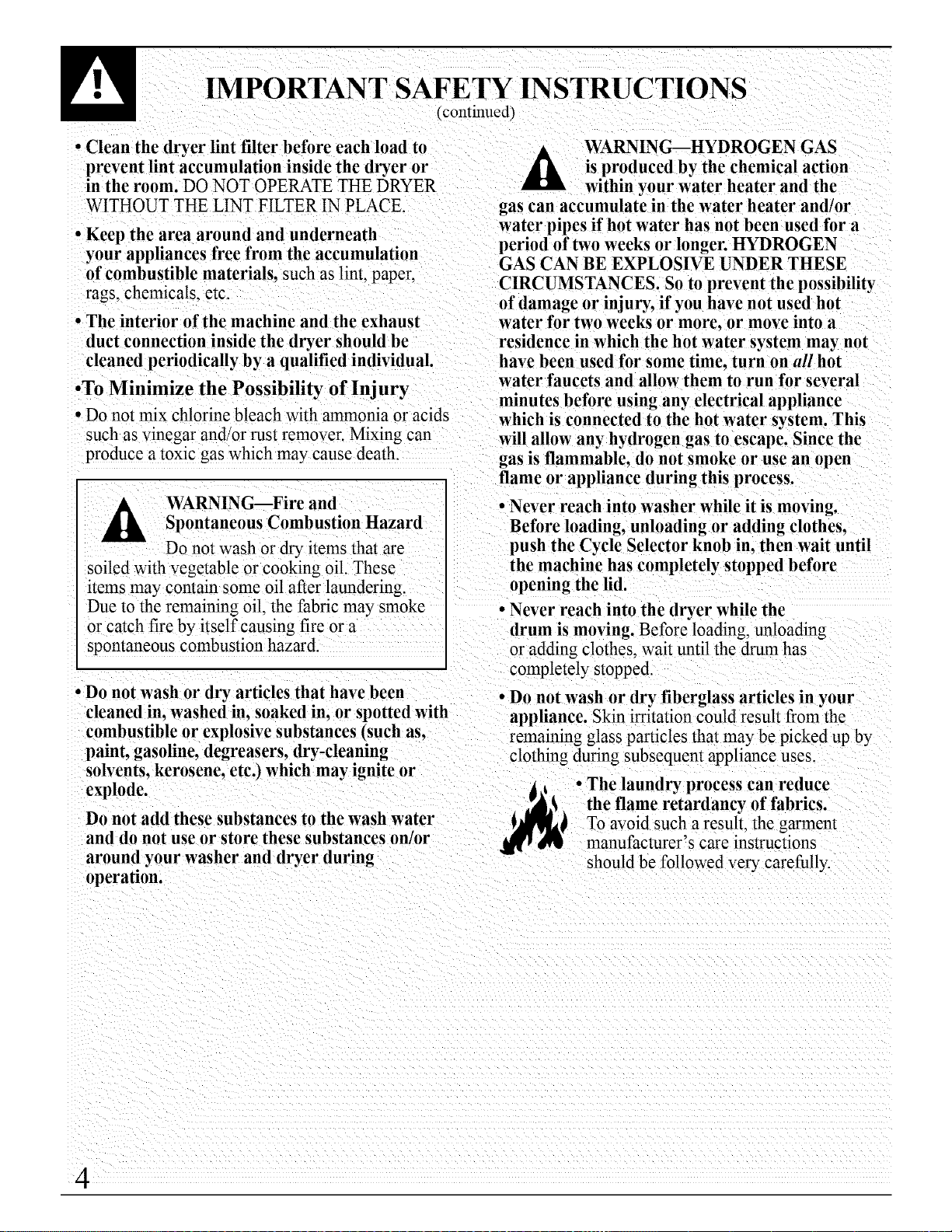
IMPORTANT SAFETY INSTRUCTIONS
Icontinued)
• Clean the dryer lint filter before each load to
prevent lint accumulation inside the dryer or
in the room. DO NOT OPERATE THE DRYER
WITHOUT THE LINT FILTER IN PLACE
• Keep the area around and underneath
A ARNING---HYDROGEN GAS
is produced by the chemical action
within your water heater and the
gas can accumulate in the water heater and/or
water pipes if hot water has not been used for a
your appliances free from the accumulation period of two weeks or longer. HYDROGEN
GAS CAN BE EXPLOSIVE UNDER THESE
of combustible materials, such as lint. paper,
rags, chemicals, etc.
• The interior of the machine and the exhaust
duct connection inside the dryer should be
cleaned periodically by a qualified individual.
CIRCUMSTANCES. So to prevent the possibility
of damage or injury, if you have not used hot
water for two weeks or more. or move into a
residence in which the hot water system may not
have been used for some time. turn on all hot
water faucets and allow them to run for several
•To Minimize the Possibility of Injury
minutes before using any electrical appliance
• Do not mix chlorine bleach with ammonia or acids
such as vinegar and/or rust remover. Mixing can
produce a toxic gas which may cause death.
A WARNINCr-Fire and
Spontaneous Combustion Hazard
Do not wash or dry items that are
soiled with vegetable or cooking oil. These
items may contain some oil after laundering.
Due to the remaining oil. the fabric may smoke
or catch fire by itself causing fire or a
spontaneous combustion hazard.
• Do not wash or dry articles that have been
cleaned in. washed in. soaked in. or spotted with
combustible or explosive substances Isuch as.
paint, gasoline, degreasers, dry-cleaning
solvents, kerosene, etc.) which may ignite or
explode.
Do not add these substances to the wash water
and do not use or store these substances on/or
around your washer and dryer during
operation.
which is connected to the hot water system. This
will allow any hydrogen gas to escape. Since the
gas is flammable, do not smoke or use an open
flame or appliance during this process.
• Never reach into washer while it is moving.
Before loading, unloading or adding clothes.
push the Cycle Selector knob in. then wait until
the machine has completely stopped before
opening the lid.
• Never reach into the dryer while the
drum is moving. Before loading, unloading
or adding clothes, wait until the drum has
completely stopped
• Do not wash or dry fiberglass articles in your
appliance. Skin irritation could result from the
remaining glass particles that may be picked up by
clothing during subsequent appliance uses
• The laundry process can reduce
the flame retardancy of fabrics.
t To avoid such a result, the garment
manufacturer's care instructions
should be followed very carefully.
4
• Close supervision is necessary if this appliance • Do not tamper with the controls.
is used by or near children. Do not allow • Do not operate this appliance if it is damaged,
children to play inside, on. or with this malfunctioning, partially disassembled, or has
appliance or any discarded appliance. Dispose missing or broken parts, including a damaged
of discarded appliances and shipping or
packing materials properly. Before discarding cord or plug.
an appliance, or removing from service. • Never climb on or stand on the dryer top.
remove the lid and door.
. eep all laundry aids (such as
detergents, bleaches, fabric
softeners, etc.) out of the reach of
children, preferably in a locked cabinet. Always
read and follow instructions on packages of
detergent and laundry aids. Observe all warnings
on container labels to avoid personal injury.
• Keep the floor around your appliance clean
and dry to reduce the possibility of slipping.
. o minimize the possibility of electric
shock, unplug this appliance from the
power supply before attempting any
maintenance or cleaning (except the removal
and cleaning of the lint filter _.
NOTE: Pushing the washer cycle
selector knob in or turning the dryer
cycle selector to OFF does NOT
disconnect the appliance from the
For washer operation
• Do not leave washer lid up during cycle. This
will stop the spin action and prevent completion
of the cycle.
Dryer-applied Fabric Softeners or
Anti-static Conditioners
You may wish to soften your laundered
fabrics or reduce the static electricity in them.
We recommend you use either a fabric softener ,
in the wash cycle, according to the manufacturer s
instructions for those products, or try a dryer-added
product for which the manufacturer gives written
assurance on the package that their product can be
safely used in your dryer.
Service or performance problems caused by
the use of these products are the responsibility
......................... products and are
not covered under the warranty of this appliance.
power supply.
SAVE THESE
INSTRUCTIONS
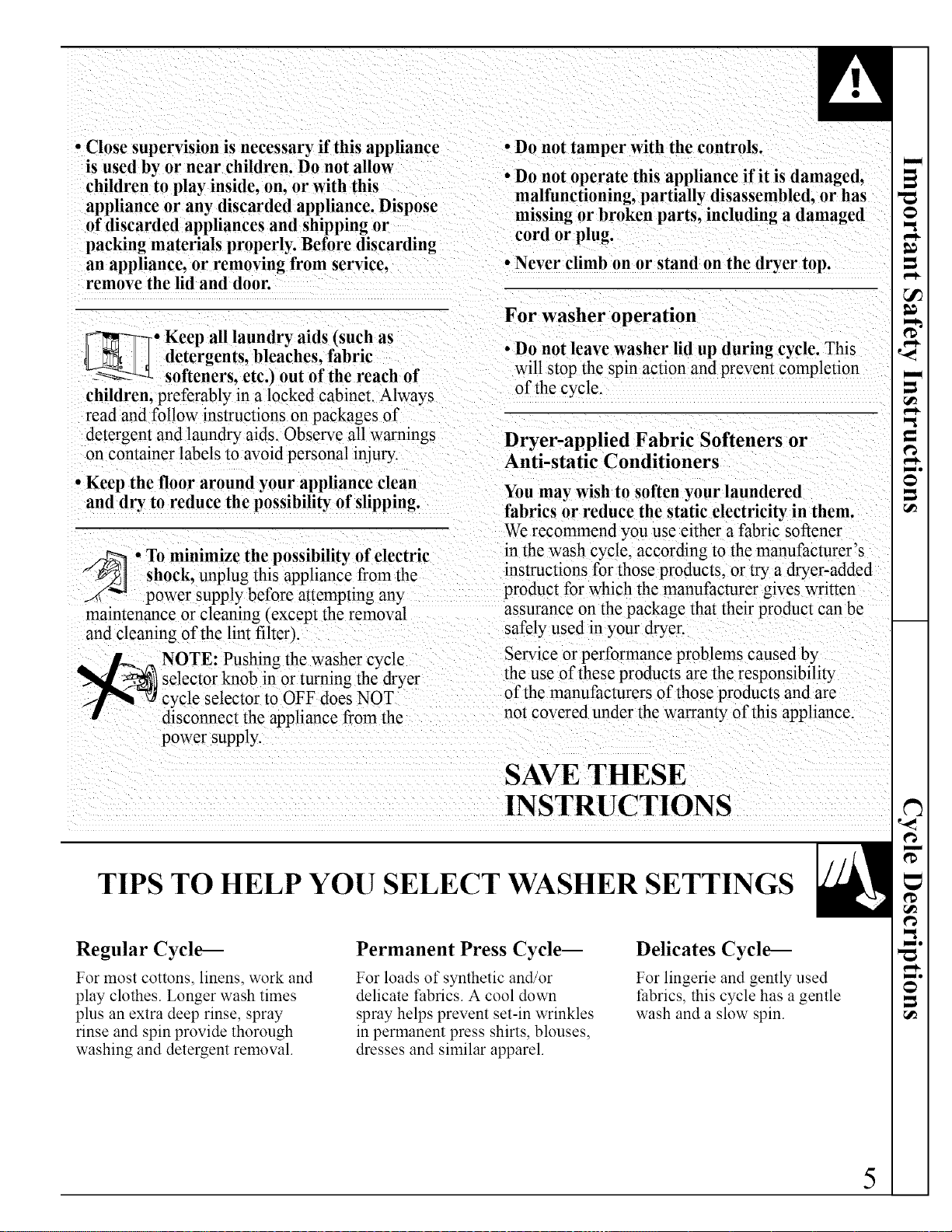
TIPS TO HELP YOU SELECT WASHER SETTINGS
Regular Cycle---
For most cottons, linens, work and
play clothes. Longer wash times
plus an extra deep rinse, spray
rinse and spin provide thorough
washing and detergent removal.
Permanent Press Cycle--
For loads of synthetic and/or
delicate t:abrics. A cool down
spray helps prevent set-in wrinkles
in permanent press shirts, blouses,
dresses and similar apparel.
Delicates Cycle---
For lingerie and gently used
fabrics, this cycle has a gentle
wash and a slow spin.
5
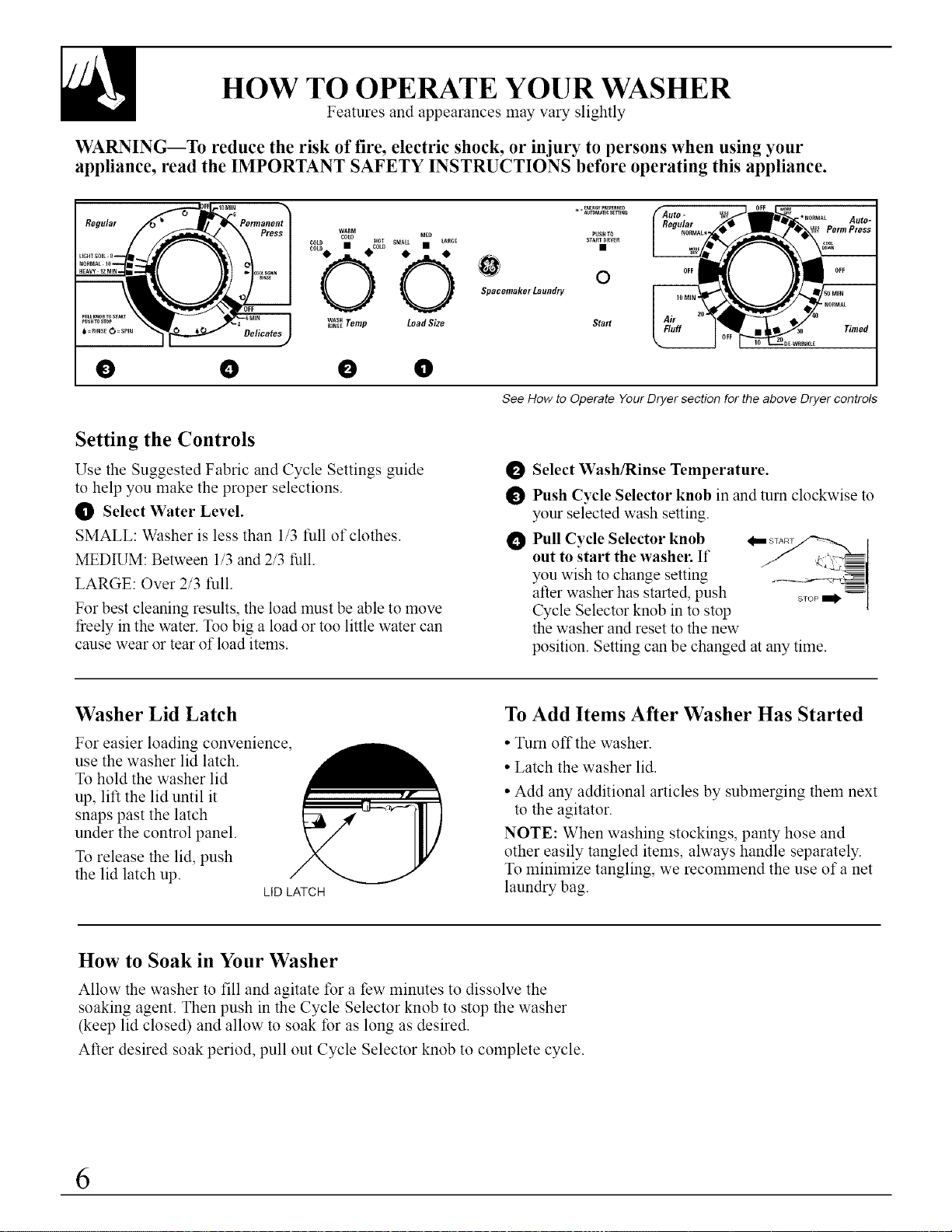
HOW TO OPERATE YOUR WASHER
Features and appearances may vary slightly
WARNINCr-To reduce the risk of fire, electric shock, or injury to persons when using your
appliance, read the IMPORTANT SAFETY INSTRUCTIONS before operating this appliance.
Regular
0 0
_v a
* _TOMAn_nEN_
W,_RM
COW MEO PUS_TO
COLD HOT
COL OLD SMALL • L_R_E
0
Spacemaker Laundry
WASH
_INSETemp Load Size Start
0 0
Auto-
Timed
See How to Operate Your Dryer section for the above Dryer controls
Setting the Controls
Use the Suggested Fabric and Cycle Settings guide
to help you make the proper selections.
O Select Water Level.
SMALL: Washer is less than 1/3 full of clothes.
MEDIUM: Between 1/3 and 2/3 full.
LARGE: Over 2/3 full.
For best cleaning results, the load must be able to move
freely in the water. Too big a load or too little water can
cause wear or tear of load items.
Select Wash/Rinse Temperature.
Push Cycle Selector knob in and turn clockwise to
your selected wash setting.
_1_ Pull Cycle Selector knob
out to start the washer. If
you wish to change setting
after washer has started, push
Cycle Selector knob in to stop
the washer and reset to the new
J_ _'_22r /
STOp_ _l
position. Setting can be changed at any time.
Washer Lid Latch
For easier loading convenience,
use the washer lid latch.
To hold the washer lid
up, lift the lid until it
snaps past the latch
under the control panel.
To release the lid, push
the lid latch up.
LID LATCH
To Add Items After Washer Has Started
• Turn off the washer.
• Latch the washer lid.
• Add any additional articles by submerging them next
to the agitator.
NOTE: When washing stockings, panty hose and
other easily tangled items, always handle separately.
To minimize tangling, we recommend the use of a net
laundry bag.
How to Soak in Your Washer
Allow the washer to fill and agitate for a few minutes to dissolve the
soaking agent. Then push in the Cycle Selector knob to stop the washer
(keep lid closed) and allow to soak for as long as desired.
After desired soak period, pull out Cycle Selector knob to complete cycle.
6
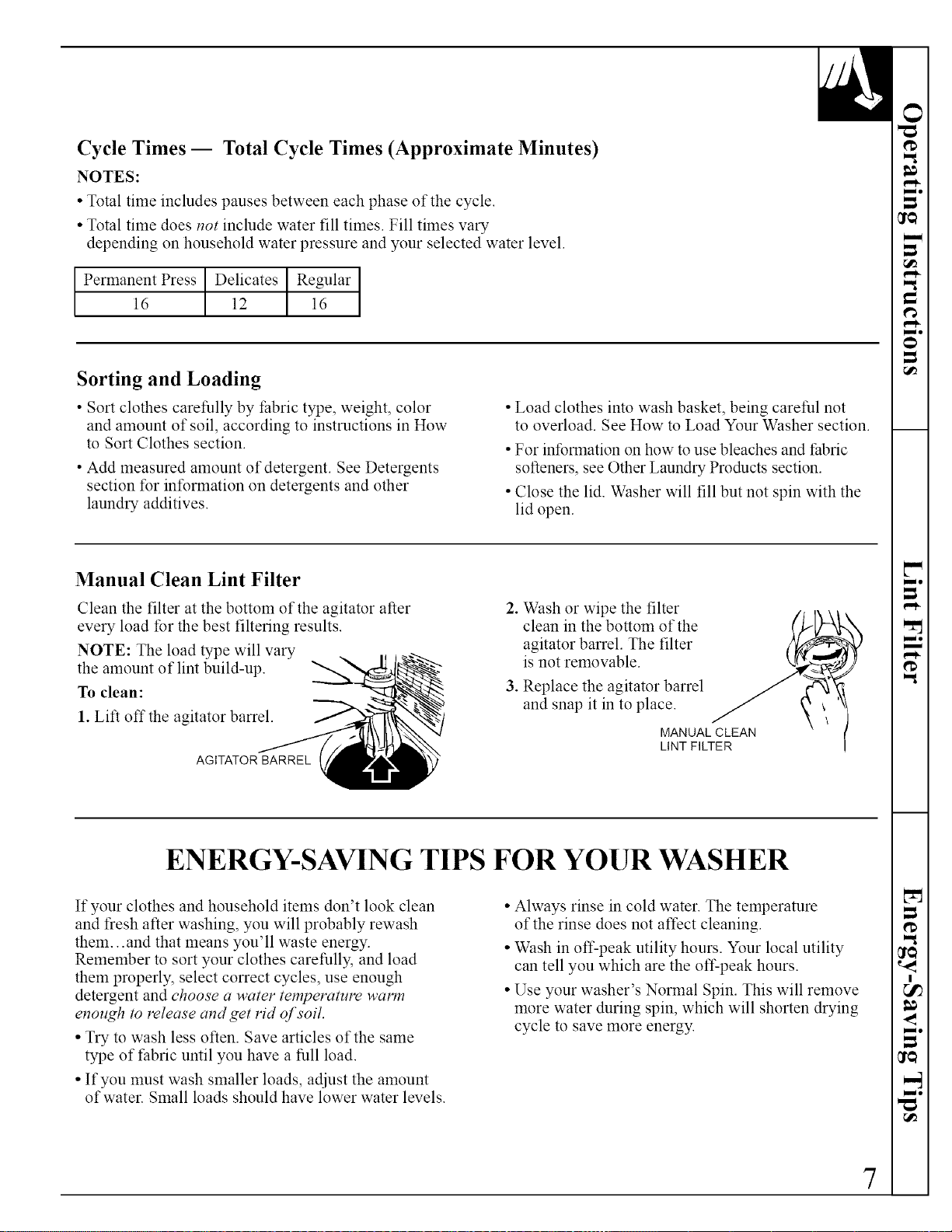
Cycle Times -- Total Cycle Times (Approximate Minutes)
NOTES:
• Total time includes pauses between each phase of the cycle.
• Total time does t_ot include water fill times. Fill times vary
depending on household water pressure and your selected water level.
Permanent Press Delicates l Regular
16 12 / 16
Sorting and Loading
• Sort clothes carefully by fabric type, weight, color
and amount of soil, according to instructions in How
to Sort Clothes section.
• Add measured amount of detergent. See Detergents
section for information on detergents and other
laundry additives.
• Load clothes into wash basket, being careful not
to overload. See How to Load Your Washer section.
• For information on how to use bleaches and fabric
softeners, see Other Laundry Products section.
• Close the lid. Washer will fill but not spin with the
lid open.
Manual Clean Lint Filter
Clean the filter at the bottom of the agitator after
every load for the best filtering results.
NOTE: The load type will vary
the amount of lint build-up.
To clean:
1. Lift off the agitator barrel.
AGITATOR BARREL
2. Wash or wipe the filter
clean in the bottom of the
agitator barrel. The filter
is not removable.
3. Replace the agitator barrel
and snap it in to place.
MANUAL CLEAN
LINT FILTER
ENERGY-SAVING TIPS FOR YOUR WASHER
If your clothes and household items don't look clean
and fresh after washing, you will probably rewash
them.., and that means you'll waste energy.
Remember to sort your clothes carefully, and load
them properly, select correct cycles, use enough
detergent and choose a water temperature warm
enough to release and get rid of soil.
• Try to wash less often. Save articles of the same
type of fabric until you have a full load.
• If you must wash smaller loads, adjust the amount
of water. Small loads should have lower water levels.
• Always rinse in cold water. The temperature
of the rinse does not affect cleaning.
• Wash in off-peak utility hours. Your local utility
can tell you which are the off-peak hours.
• Use your washer's Normal Spin. This will remove
more water during spin, which will shorten drying
cycle to save more energy.
7
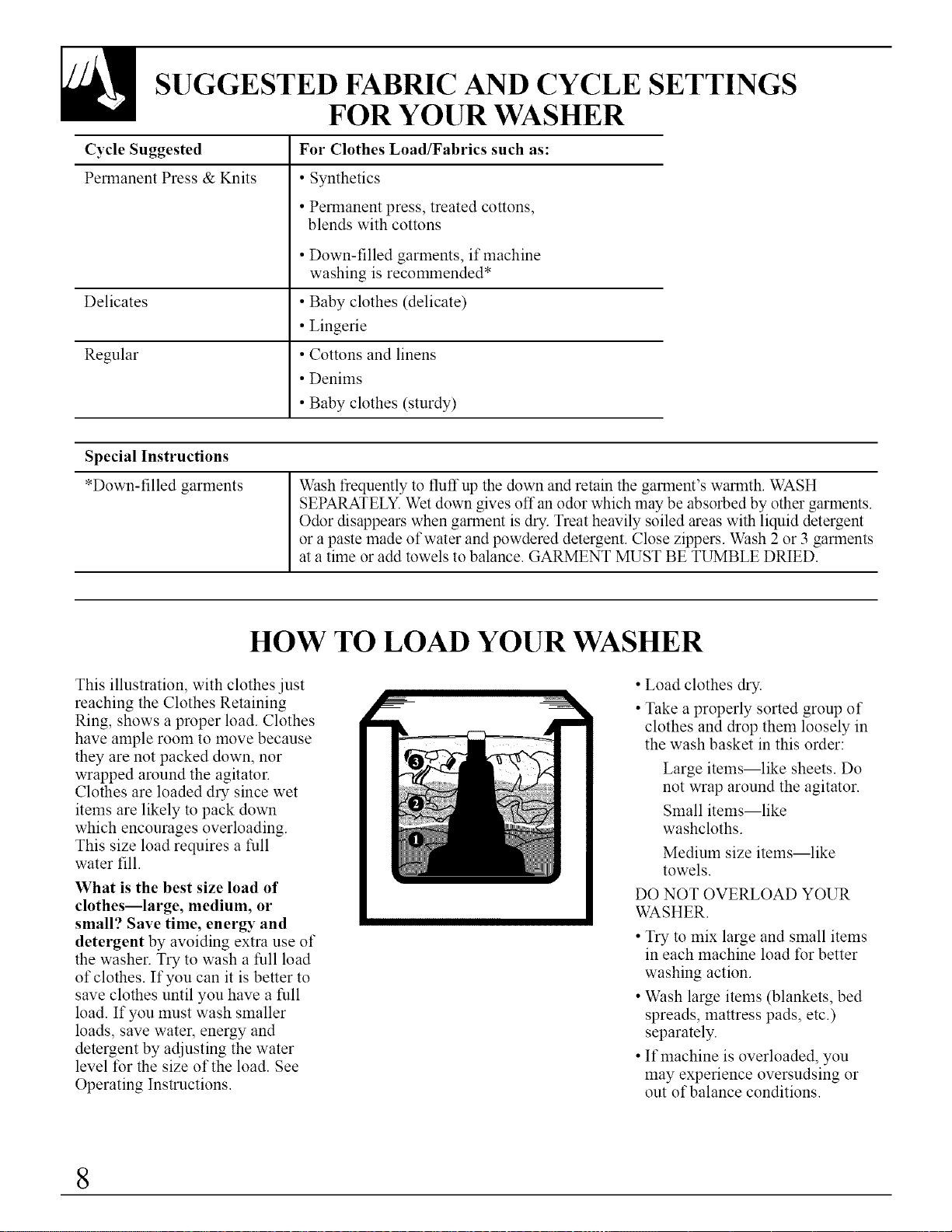
SUGGESTED FABRIC AND CYCLE SETTINGS
FOR YOUR WASHER
Cycle Suggested
Permanent Press & Knits
Delicates
Regular
For Clothes Load/Fabrics such as:
• Synthetics
• Permanent press, treated cottons,
blends with cottons
• Down-filled garments, if machine
washing is recommended*
• Baby clothes (delicate)
• Lingerie
• Cottons and linens
• Denims
• Baby clothes (sturdy)
Special Instructions
*Down-filled garments Wash frequently to fluffup the down and retain the garment's warmth. WASH
SEPARATELY. Wet down gives offan odor which may be absorbed by other garments.
Odor disappears when garment is dry. Treat heavily soiled areas with liquid detergent
or a paste made of water and powdered detergent. Close zippers. Wash 2 or 3 garments
at a time or add towels to balance. GARMENT MUST BE TUMBLE DRIED.
HOW TO LOAD YOUR WASHER
This illustration, with clothes just
reaching the Clothes Retaining
Ring, shows a proper load. Clothes
have ample room to move because
they are not packed down, nor
wrapped around the agitator.
Clothes are loaded dry since wet
items are likely to pack down
which encourages overloading.
This size load requires a full
water fill.
What is the best size load of
clothes--large, medium, or
small? Save time, energy and
detergent by avoiding extra use of
the washer. Try to wash a full load
of clothes. If you can it is better to
save clothes until you have a thll
load. If you must wash smaller
loads, save water, energy and
detergent by adjusting the water
level for the size of the load. See
Operating Instructions.
• Load clothes dry.
• Take a properly sorted group of
clothes and drop them loosely in
the wash basket in this order:
Large items--like sheets. Do
not wrap around the agitator.
Small items--like
washcloths.
Medium size items--like
towels.
DO NOT OVERLOAD YOUR
WASHER.
• Try to mix large and small items
in each machine load for better
washing action.
• Wash large items (blankets, bed
spreads, mattress pads, etc.)
separately.
• If machine is overloaded, you
may experience oversudsing or
out of balance conditions.
8
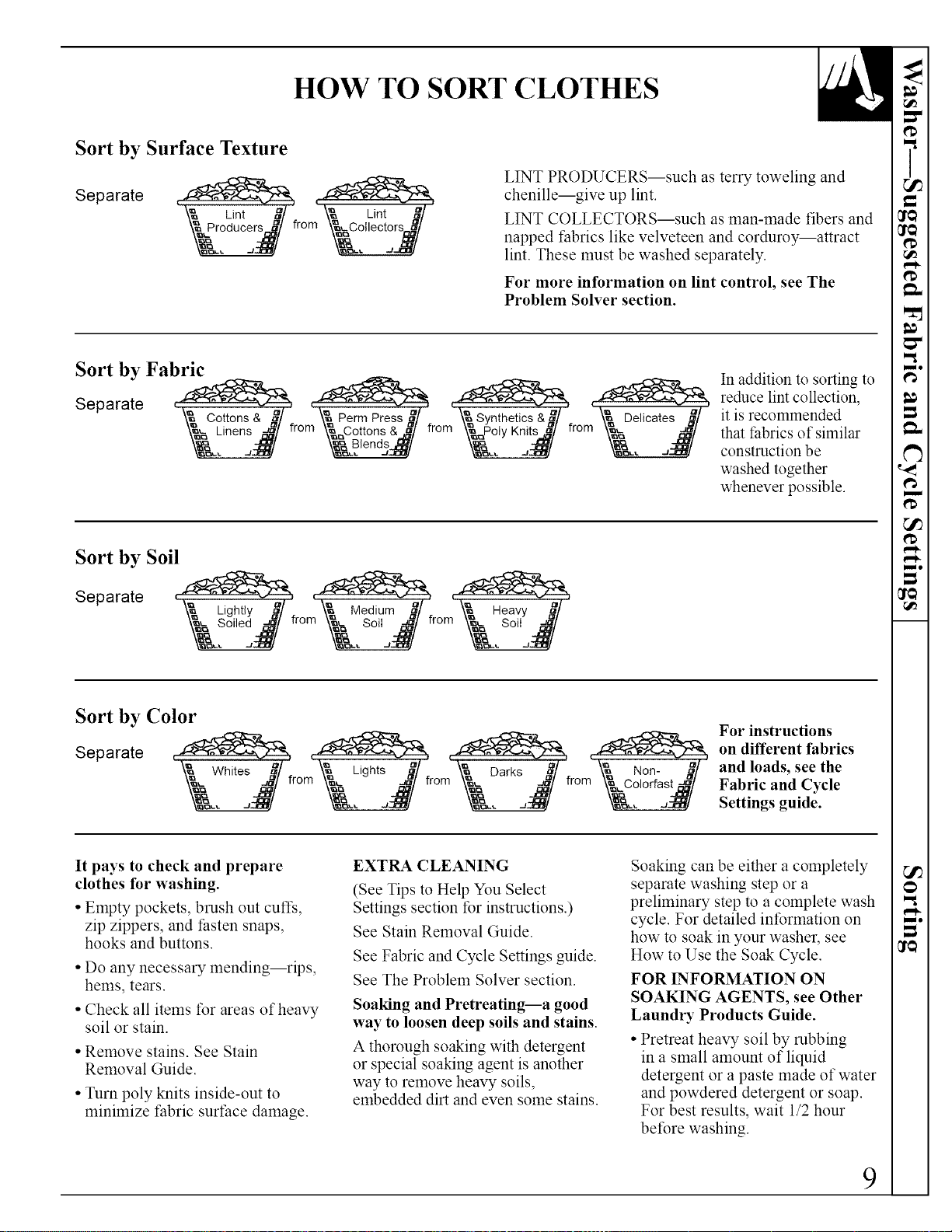
HOW TO SORT CLOTHES
Sort by Surface Texture
Separate ,_ ,_
LINT PRODUCERS--such as terry toweling and
chenille--give up lint.
LINT COLLECTORS--such as man-made fibers and
napped fabrics like velveteen and corduroy--attract
lint. These must be washed separately.
For more information on lint control, see The
Problem Solver section.
Sort by Fabric
Separate
In addition to sorting to
reduce lint collection,
it is recommended
that fabrics of similar
construction be
washed together
whenever possible.
Sort by Soil
Sort by Color
For instructions
on different fabrics
and loads, see the
Fabric and Cycle
Settings guide.
It pays to check and prepare
clothes for washing.
• Empty pockets, brush out cufl_,
zip zippers, and fasten snaps,
hooks and buttons.
• Do any necessary mending--rips,
hems, tears.
• Check all items for areas of heavy
soil or stain.
• Remove stains. See Stain
Removal Guide.
• Turn poly knits inside-out to
minimize t:abric surt:ace damage.
EXTRA CLEANING
(See Tips to Help You Select
Settings section for instructions."
See Stain Removal Guide.
See Fabric and Cycle Settings guide.
See The Problem Solver section.
Soaking and Pretreating--a good
way to loosen deep soils and stains.
A thorough soaking with detergent
or special soaking agent is another
way to remove heavy soils,
embedded dirt and even some stains.
Soaking can be either a completely
separate washing step or a
preliminary step to a complete wash
cycle. For detailed information on
how to soak in your washer, see
How to Use the Soak Cycle.
FOR INFORMATION ON
SOAKING AGENTS, see Other
Laundry Products Guide.
• Pretreat heavy soil by rubbing
in a small amount of liquid
detergent or a paste made of water
and powdered detergent or soap.
For best results, wait 1/2 hour
before washing.
9
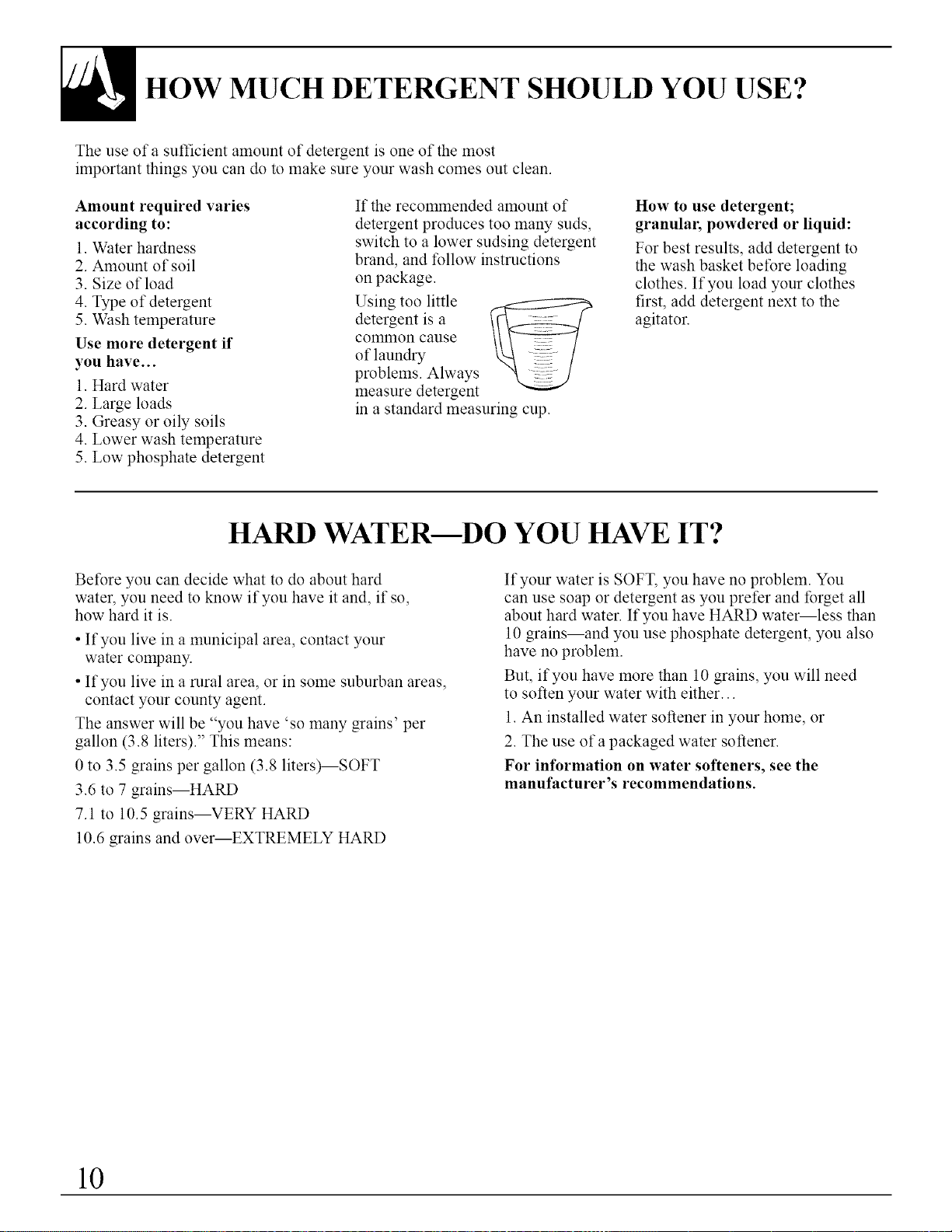
HOW MUCH DETERGENT SHOULD YOU USE?
The use of a sufficient amount of detergent is one of the most
important things you can do to make sure your wash comes out clean.
Amount required varies
according to:
1. Water hardness
2. Amount of soil
3. Size of load
4. Type of detergent
5. Wash temperature
Use more detergent if
you have...
1. Hard water
2. Large loads
3. Greasy or oily soils
4. Lower wash temperature
5. Low phosphate detergent
If the recommended amount of
detergent produces too many suds,
switch to a lower sudsing detergent
brand, and follow instructions
on package.
Using too little
detergent is a
common cause
of laundry
problems. Always
measure detergent
in a standard measuring cup.
How to use detergent;
granular, powdered or liquid:
For best results, add detergent to
the wash basket before loading
clothes. If you load your clothes
first, add detergent next to the
agitator.
HARD WATERmDO YOU HAVE IT?
Before you can decide what to do about hard
water, you need to know if you have it and, if so,
how hard it is.
• If you live in a municipal area, contact your
water company.
• If you live in a rural area, or in some suburban areas,
contact your county agent.
The answer will be "you have 'so many grains' per
gallon (3.8 liters)." This means:
0 to 3.5 grains per gallon (3.8 liters)--SOFT
3.6 to 7 grains--HARD
7.1 to 10.5 grains--VERY HARD
10.6 grains and over--EXTREMELY HARD
If your water is SOFT, you have no problem. You
can use soap or detergent as you prefer and forget all
about hard water. If you have HARD water--less than
10 grains--and you use phosphate detergent, you also
have no problem.
But, if you have more than 10 grains, you will need
to soften your water with either...
1. An installed water softener in your home, or
2. The use of a packaged water softener.
For information on water softeners, see the
manufacturer's recommendations.
10
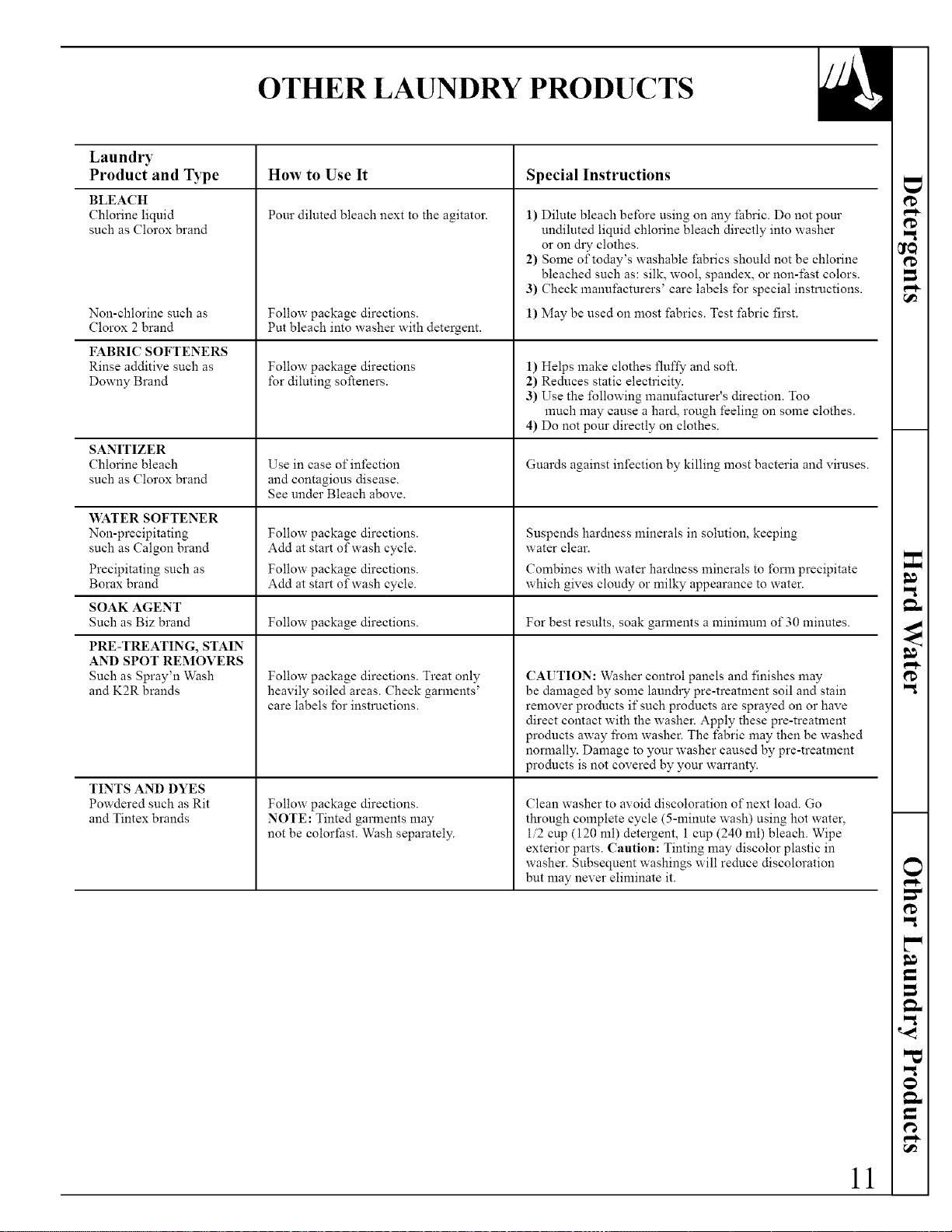
OTHER LAUNDRY PRODUCTS
Laundry
Product and Type How to Use It Special Instructions
BLEACH
Chlorine liquid
such as Clorox brand
Non-chlorine such as
Clorox 2 brand
FABRIC SOFTENERS
Rinse additive such as
Downy Brand
Pour diluted bleach next to the agitator.
Follow package directions.
Put bleach into washer with detergent.
Follow package directions
for diluting softeners.
1) Dilute bleach before using on any fabric. Do not pour
undiluted liquid chlorine bleach directly into washer
or on &y clothes.
2) Some of today's washable fabrics should not be chlorine
bleached such as: silk, wool, spandex, or non-fast colors.
3) Check manufi_eturers' care labels for special instructions.
1) May be used on most fabrics. Test fabric first.
1) Helps make clothes fluffy and soft.
2) Reduces static electricity.
3) Use the following manufacturer's direction. Too
much may cause a hard, rough feeling on some clothes.
Do not pour directly on clothes.4)
SANITIZER
Chlorine bleach Use in case of infection Guards against infection by killing most bacteria and viruses.
such as Clorox brand and contagious disease.
See under Bleach above.
WATER SOFTENER
Non-precipitating Follow package directions. Suspends hardness minerals in solution, keeping
such as Calgon brand Add at start of wash cycle, water clear.
Precipitating such as Follow package directions. Combines with water hardness minerals to form precipitate
Borax brand Add at start of wash cycle, which gives cloudy or milky appearance to water.
SOAK AGENT
Such as Biz brand Follow package directions. For best results, soak garments a minimum of 30 minutes.
Follow package directions. Treat only
heavily soiled areas. Check garments'
care labels for instructions.
PRE-TREATING, STAIN
AND SPOT REMOVERS
Such as Spray'n Wash
and K2R brands
TINTS AND DYES
Powdered such as Rit
and Tintex brands
Follow package directions.
NOTE: Tinted garments may
not be coloriZast. Wash separately.
CAUTION: Washer control panels and finishes may
be damaged by some laun&y pre-treatment soil and stain
remover products if such products are sprayed on or have
direct contact with the washer. Apply these pre-treatment
products away fi'om washer. The fabric may then be washed
normally. Damage to your washer caused by pre-treatment
products is not covered by your warranty.
Clean washer to avoid discoloration of next load. Go
through complete cycle (5-minute wash) using hot water,
i/2 cup (120 nil) detergent, 1 cup (240 ml) bleach. Wipe
exterior parts. Caution: Tinting may discolor plastic in
washer. Subsequent washings will reduce discoloration
but may never eliminate it.
11
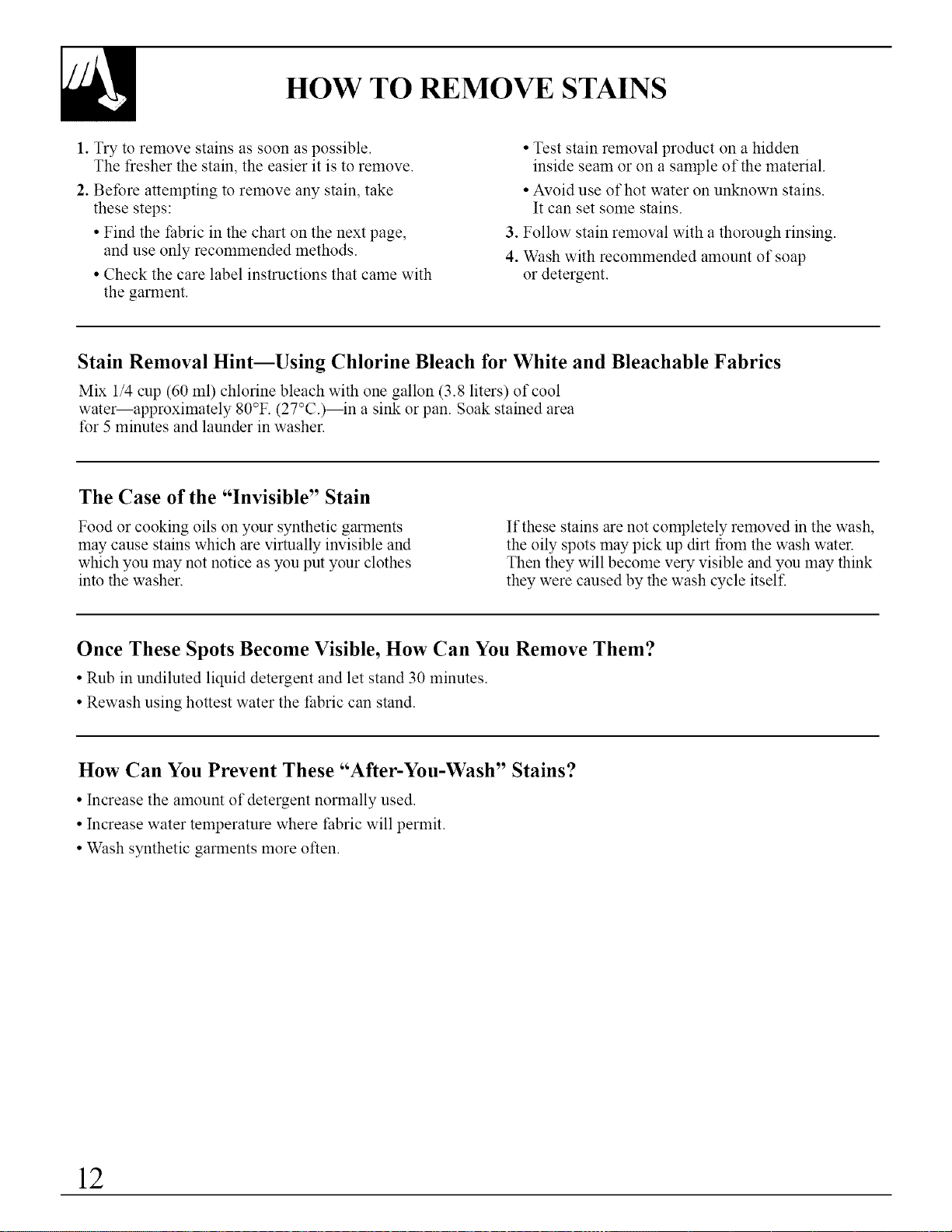
HOW TO REMOVE STAINS
1. Try to remove stains as soon as possible.
The fresher the stain, the easier it is to remove.
2. Before attempting to remove any stain, take
these steps:
• Find the fabric in the chart on the next page,
and use only recommended methods.
• Check the care label instructions that came with
the garment.
• Test stain removal product on a hidden
inside seam or on a sample of the material.
• Avoid use of hot water on unknown stains.
It can set some stains.
3. Follow stain removal with a thorough rinsing.
4. Wash with recommended amount of soap
or detergent.
Stain Removal Hint--Using Chlorine Bleach for White and Bleachable Fabrics
Mix 1/4 cup (60 ml) chlorine bleach with one gallon (3.8 liters) of cool
water--approximately 80°F. (27°C.)--in a sink or pan. Soak stained area
for 5 minutes and launder in washer.
The Case of the "Invisible" Stain
Food or cooking oils on your synthetic garments
may cause stains which are virtually invisible and
which you may not notice as you put your clothes
into the washer.
If these stains are not completely removed in the wash,
the oily spots may pick up dirt from the wash water.
Then they will become very visible and you may think
they were caused by the wash cycle itself.
Once These Spots Become Visible, How Can You Remove Them?
• Rub in undiluted liquid detergent and let stand 30 minutes.
• Rewash using hottest water the fabric can stand.
How Can You Prevent These "After-You-Wash" Stains?
• Increase the amount of detergent normally used.
• Increase water temperature where fabric will permit.
• Wash synthetic garments more often.
12
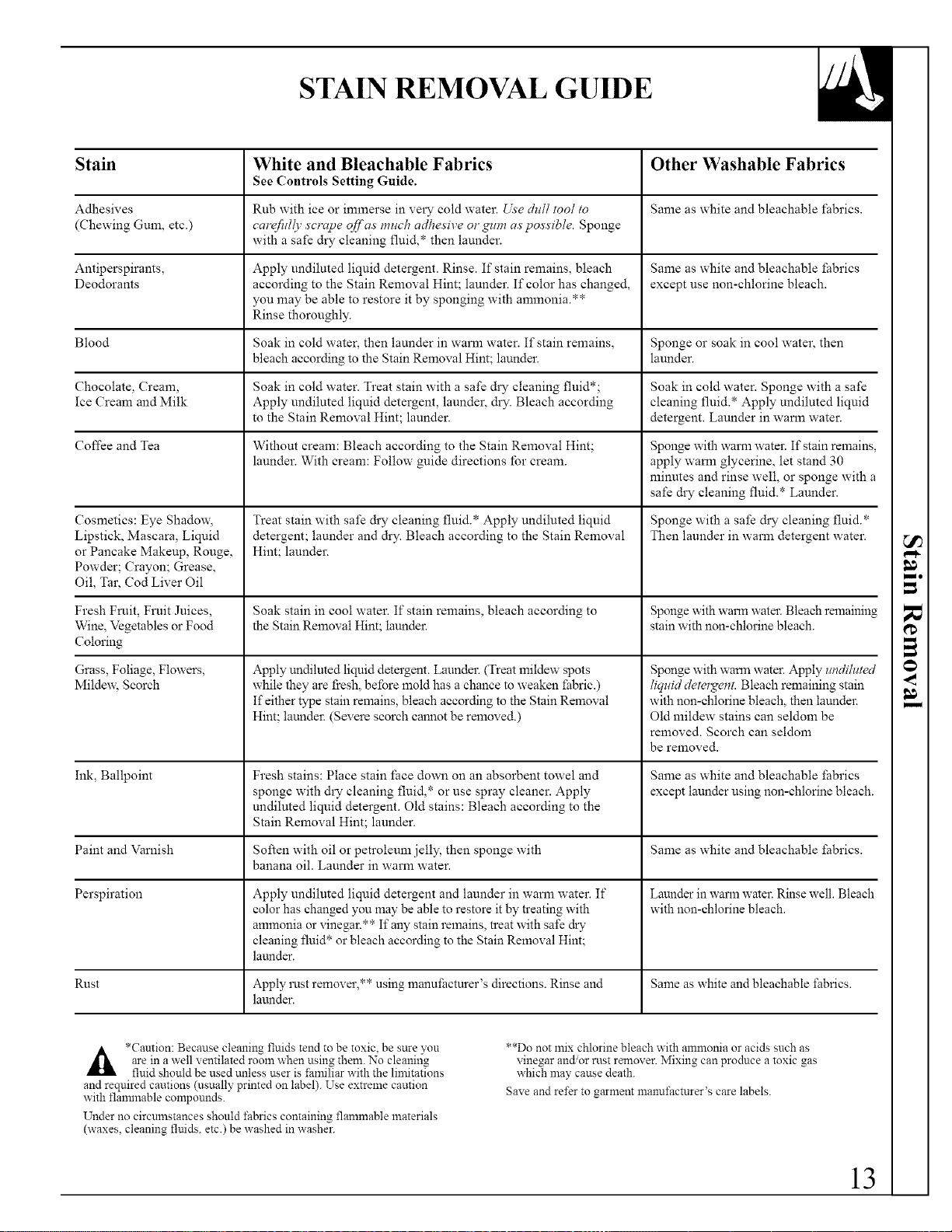
STAIN REMOVAL GUIDE
Stain White and Bleachable Fabrics Other Washable Fabrics
See Controls Setting Guide.
Adhesives Rub with ice or immerse in very cold water. Use dzd/tool to Same as white and bleachable fabrics.
(Chewing Gum, etc.) carejh//v scrape off as much adhesive or gum as possible. Sponge
with a safe dry cleaning fluid,* then launder.
Antiperspirants, Apply undiluted liquid detergent. Rinse. If stain remains, bleach Same as white and bleachable fabrics
Deodorants according to the Stain Removal Hint; launder. If color has changed, except use non-chlorine bleach.
you may be able to restore it by sponging with ammonia.**
Rinse thoroughly.
Blood Soak in cold water, then launder in warm water. If stain remains, Sponge or soak in cool water, then
bleach according to the Stain Removal Hint; launder, launder.
Chocolate, Cream, Soak in cold water. Treat stain with a safe dry cleaning fluid*; Soak in cold water. Sponge with a sate
Ice Cream and Milk Apply undiluted liquid detergent, launder, dry. Bleach according cleaning fluid.* Apply undiluted liquid
to the Stain Removal Hint; launder, detergent. Launder in warm water.
Coffee and Tea Without cream: Bleach according to the Stain Removal Hint; Sponge with wama water. If stain remains,
launder. With cream: Follow guide directions for cream, apply warn1 glycerine, let stand 30
minutes and rinse well, or sponge with a
safe &y cleaning fluid.* Launder.
Cosmetics: Eye Shadow, Treat stain with sate @ cleaning fluid.* Apply undiluted liquid Sponge with a safe dry cleaning fluid.*
Lipstick, Mascara, Liquid detergent; launder and dry. Bleach according to the Stain Removal Then launder in warm detergent water.
or Pancake Makeup, Rouge, Hint; launder.
Powder; Crayon; Grease,
Oil, Tar, Cod Liver Oil
Fresh Fruit, Fruit Juices, Soak stain in cool water. If stain remains, bleach according to Sponge with warn1 water. Bleach remaining
Wine, Vegetables or Food the Stain Removal Hint; launder, stain with non-chlorine bleach.
Coloring
Grass, Foliage, Flowers,
Mildew, Scorch
Apply undiluted liquid detergent. Launder. (Treat mildew spots
while they are fresh, belbre mold has a chance to weaken fabric.)
If either type stare remains, bleach according to the Stain Removal
Hint; launder. (Severe scorch cannot be removed.)
Sponge with warm water. Apply undih¢ted
liquid detergent. Bleach remaining stare
with non-chlorine bleach, then launder.
Old mildew stains can seldom be
removed. Scorch can seldom
be removed.
Ink, Ballpoint Fresh stains: Place stain face down on an absorbent towel and Same as white and bleachable fabrics
sponge with dry cleaning fluid,* or use spray cleaner. Apply except lannder using non-chlorine bleach.
undiluted liquid detergent. Old stains: Bleach according to the
Stain Removal Hint; launder.
Paint and Varnish Soften with oil or petroleum jelly, then sponge with Same as white and bleachable fabrics.
banana oil. Launder in warm water.
Perspiration Apply undiluted liquid detergent and launder in warm water. If Launder in warm water. Rinse well. Bleach
color has changed you may be able to restore it by treating with with non-chlorine bleach.
ammonia or vinegar.** If any stain remains, treat with safe dry
cleaning fluid* or bleach according to the Stain Removal Hint;
launder.
Rust Apply lust remover,** using manufacturer's directions. Rinse and Same as white and bleachable fabrics.
launder.
A *Caution: Because cleaning fluids tend to be toxic, be sure you
are in a well ventilated room when using them. No cleaning
fluid should be used unless user is l'alniliar with the limitations
and required cautions (usually printed on label). Use extreme caution
with flammable compounds.
Under no circumstances should lhbrics containing flammable materials
(waxes, cleaning fluids, etc.) be washed in washer.
**Do not mix chlorine bleach with almnonia or acids such as
vinegar andor rust remover. Mixing can produce a toxic gas
which may cause death.
Save anti refer to garment manufacturer's care labels.
13
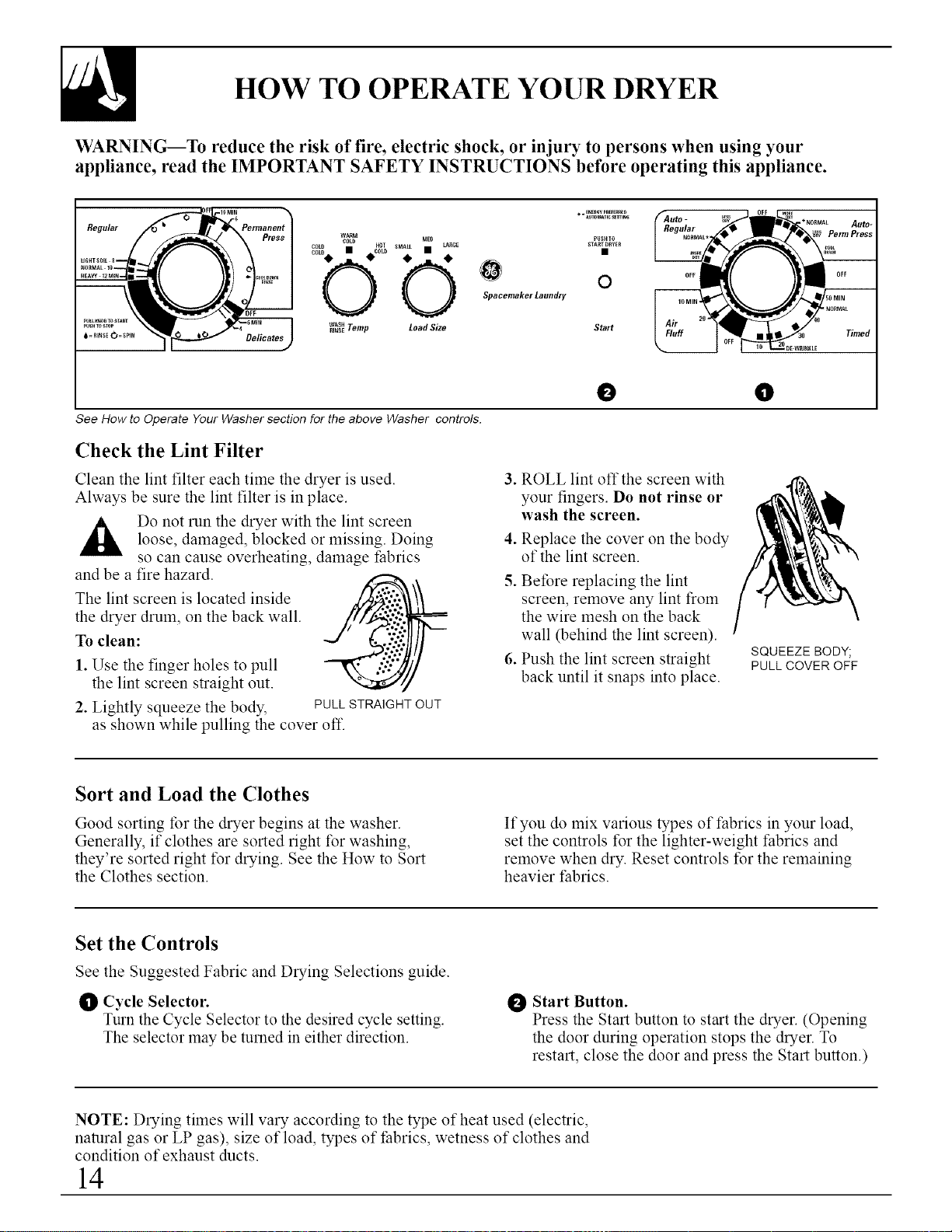
HOW TO OPERATE YOUR DRYER
WARNINCr-To reduce the risk of fire, electric shock, or injury to persons when using your
appliance, read the IMPORTANT SAFETY INSTRUCTIONS before operating this appliance.
Regu/ar
_ _ENER_VPREFE_D
_mMA_IC_mN_
WAeM MED PUSHTO
COLD HOT SM ;_E START,_DRyERb% • .... _ •
C3© °
Spacemaker Laundry
WASUmNSETemp Load Size Start
0
See How to Operate Your Washer section for the above Washer controls.
Check the Lint Filter
Clean the lint filter each time the dryer is used.
Always be sure the lint filter is in place.
Do not run the dryer with the lint screen
loose, damaged, blocked or missing. Doing
so can cause overheating, damage fabrics
and be a fire hazard.
The lint screen is located inside
the dryer drum, on the back wall.
To clean:
.
.
5.
ROLL lint offthe screen with
your fingers. Do not rinse or
wash the screen.
Replace the cover on the body
of the lint screen.
1. Use the finger holes to pull
the lint screen straight out.
2. Lightly squeeze the body, PULLSTRAIGnTOUT
as shown while pulling the cover off.
O
Timed
Before replacing the lint
screen, remove any lint from
the wire mesh on the back
wall (behind the lint screen).
6. Push the lint screen straight SQUEEZEBODY;
PULL COVER OFF
back until it snaps into place.
Sort and Load the Clothes
Good sorting for the dryer begins at the washer.
Generally, if clothes are sorted right for washing,
they're sorted right for drying. See the How to Sort
the Clothes section.
If you do mix various types of t:abrics in your load,
set the controls for the lighter-weight fabrics and
remove when dry. Reset controls for the remaining
heavier t:abrics.
Set the Controls
See the Suggested Fabric and Drying Selections guide.
O Cycle Selector.
Turn the Cycle Selector to the desired cycle setting.
The selector may be turned in either direction.
O Start Button.
Press the Start button to start the dryer. (Opening
the door during operation stops the dryer. To
restart, close the door and press the Start button.)
NOTE: Drying times will vary according to the type of heat used (electric,
natural gas or LP gas), size of load, types of fabrics, wetness of clothes and
condition of exhaust ducts.
14
Polyester Knits & Permanent Press Drying Tips
• DO NOT OVERLOAD--
Garments being dried or
dewrinkled should tumble freely.
• REMOVE CLOTHES
PROMPTLY--To help prevent
wrinkling, remove clothes from
the dryer promptly at the end of
the drying cycles.
• PLACE ON HANGERS--
Permanent press and polyester
knit garments look best if placed
on hangers after drying.
The Difference Between Automatic and Timed Drying
Automatic Drying
When using the Automatic cycles, the
Automatic Dry (>ntrol system continually senses
the temperature of the air in the dryer drum. Wet
laundry keeps the air cool. When laundry is dry
enough (and the drum air warm enough) the heat
turns off. When the air cools, the heat turns back on.
This off and on cycling may happen a number of
times (depending on the fabric, load size and Cycle
Selector setting). The Cycle Selector advances (when
the heat is oft) until it automatically turns off dryer.
Auto Regular. Use this cycle to dry heavy and
medium weight cotton items. The load tumbles
without heat during the last 5 minutes. This helps
make the load easier to handle.
Timed Drying. When using the Timed Cycles, you
select the number of minutes you wish the dryer to
run and it turns off at the end of this time period. The
last 5 minutes of this cycle are without heat. This
helps make the load easier to handle.
Air Fluff cycle. The dryer does not heat when the
Cycle Control knob is set in AIR FLUFF. This cycle
can be used to fluff or air dry bedding, plastic
tablecloths, foam rubber pillows, stuffed toys,
sneakers, etc.
Do not dry plastic or rubber items with heat.
Use AIR FLUFF setting, or line dry. Failure
to do so could result in fire or damaged items.
Auto Permanent Press. Use this cycle to dry
permanent press, knits and other synthetic items. The
load tumbles without heat during the last 10 minutes.
This helps keep wrinkles from setting in and makes
the load easier to handle.
Drying Selections Guide for the Automatic Cycles
Set to NORMAL Position Set toward More Dry Set toward Less Dr3:
Auto-
PormPross
• Energy preferred automatic setting.
• For most normal loads.
• For loads that include heavy-
weight fabrics.
• If you desire to remove
more moisture.
• For light weight fabric loads.
• If you desire to remove
less moisture.
• For very small loads.
15
SUGGESTED FABRIC
AND DRYING SELECTIONS
Cycle Suggested For Clothes Load/Fabrics such as:
Automatic Regular • Cottons and linens
• Down-filled garments, if machine
washing and drying is recommended
Automatic Permanent • Permanent press fabrics with cotton
Press & Knits
• Synthetics
Delicates • Silks and wools
• Rayon and acetate
Timed • Pillows*
The terms High, Medium and Low Heat are those usually found on
fabric care labels. For best results, follow your specific fabric care label.
Special Instructions
Refer to garment manufacturer's care labels for more information.
*Pillows
Check ticking for holes or weak seams where feathers or filling could escape.
DRY ONLY ONE PILLOW AT A TIME. Set dryer for maximum time. Stop
dryer occasionally and shake pillow to redistribute filling for more even drying.
Check pillow at end of drying time--if not completely dry, return pillow to dryer
and reset for more drying time. Feather pillows dry very slowly and must be dried
completely to prevent mildew. DO NOT tumble dry pillows containing kapok.
16
HOW TO SORT CLOTHES
Sort by Surface Texture
Separate ,_ ,_
_ProLintcers i/ fr°m _Cel_;nttors [
LINT PRODUCERS--such as terry toweling and
chenille--give up lint.
LINT COLLECTORS--such as man-made fibers and
napped fabrics like velveteen and corduroy--attract
lint. These must be dried separately.
Sort by Fabric
Separate
Cottons &
Linens
Permanent Delicates
Press
In addition to
sorting to reduce
lint collection, we
recommend that you
wash fabrics of similar
construction together
whenever possible.
Sort by Color
_ Whites [from_ Lights lJfrom _ Darks !J from _cNO_astl_
Sort by Weight
Separate ,_ ,_
_H_avYhltaesmSi/ from _Li(gshutc_ems i/
\_ towels) #'/ \_ ourtains)_/
For information on tumble drying extra large
items and different t:abrics and loads, see the
Suggested Fabrics and Drying Selections guide.
ENERGY-SAVING TIPS FOR YOUR DRYER
• Sort clothes by weight so you won't have to
run an extra cycle for one or two heavier, slower-
drying items.
• Do not overload dryer. The drum should be no more
than half full of wet articles. For efficient drying,
clothes need to tumble t_eely. Overloading prolongs
drying time and produces uneven drying.
• Use Automatic Drying Cycle whenever possible
to help prevent overdrying and save energy.
• To help prevent ironing, remove garments
immediately at end of drying cycle and place
on hangers.
• Dry your clothes in consecutive loads. Using a
"warm" dryer will save energy.
• Clean lint filter each time you dry.
• Clean dryer exhaust ducting at least once a year. A
partially clogged exhaust can lengthen drying time.
17
CARE AND CLEANING
USER MAINTENANCE INSTRUCTIONS
• Wipe the cabinet with a damp cloth. Occasionally
wash it with mild soap and water and then apply
a light coat of appliance polish to help preserve
the finish.
• Keep the area around and underneath your appliance
free of combustible materials such as lint, paper,
rags, chemical, etc.
• Keep the floor around your appliance clean and dry
to reduce the possibility of slipping.
For long vacations
Be sure water supply is shut off at t:aucets. Drain all
water from hoses if the appliance will be exposed to
freezing weather.
Always shut off the gas valve before leaving
on vacation.
Winterizing instructions for your washer:
The washer cannot be operated in freezing
temperatures. Before you store the appliance,
remove water from all parts of the washer.
1. Turn off water supply faucets. Disconnect hoses
from faucets and drain.
2. Add 1 gallon (3.8 liters) of non-toxic RV antifreeze
(available from a hardware or recreational vehicle
store) to the washer tub.
3. Push the timer knob in, turn the knob to the right to
a spin cycle and pull the knob out.
4. Let the washer spin for 1 or 2 minutes to let all the
water drain out. Some but not all of the RV
antifreeze will be expelled.
5. Push in the timer knob, disconnect the electrical
plug, dry the tub interior, close the lid.
6. Store the appliance in an upright position.
7. Before reusing washer, after storage, run washer
through a cycle to rinse out the antifreeze.
Washer
• Wash basket. After each use, leave the lid open to
allow moisture to evaporate. Clean thoroughly with
nonabrasive household cleanser to remove deposit
left by heavily soiled clothes. Do not use harsh,
gritty or abrasive cleaners.
• Lint Filter. Clean the filter at the bottom of the
agitator after every load for the best filtering results.
See section, How to Operate Your Washer.
18
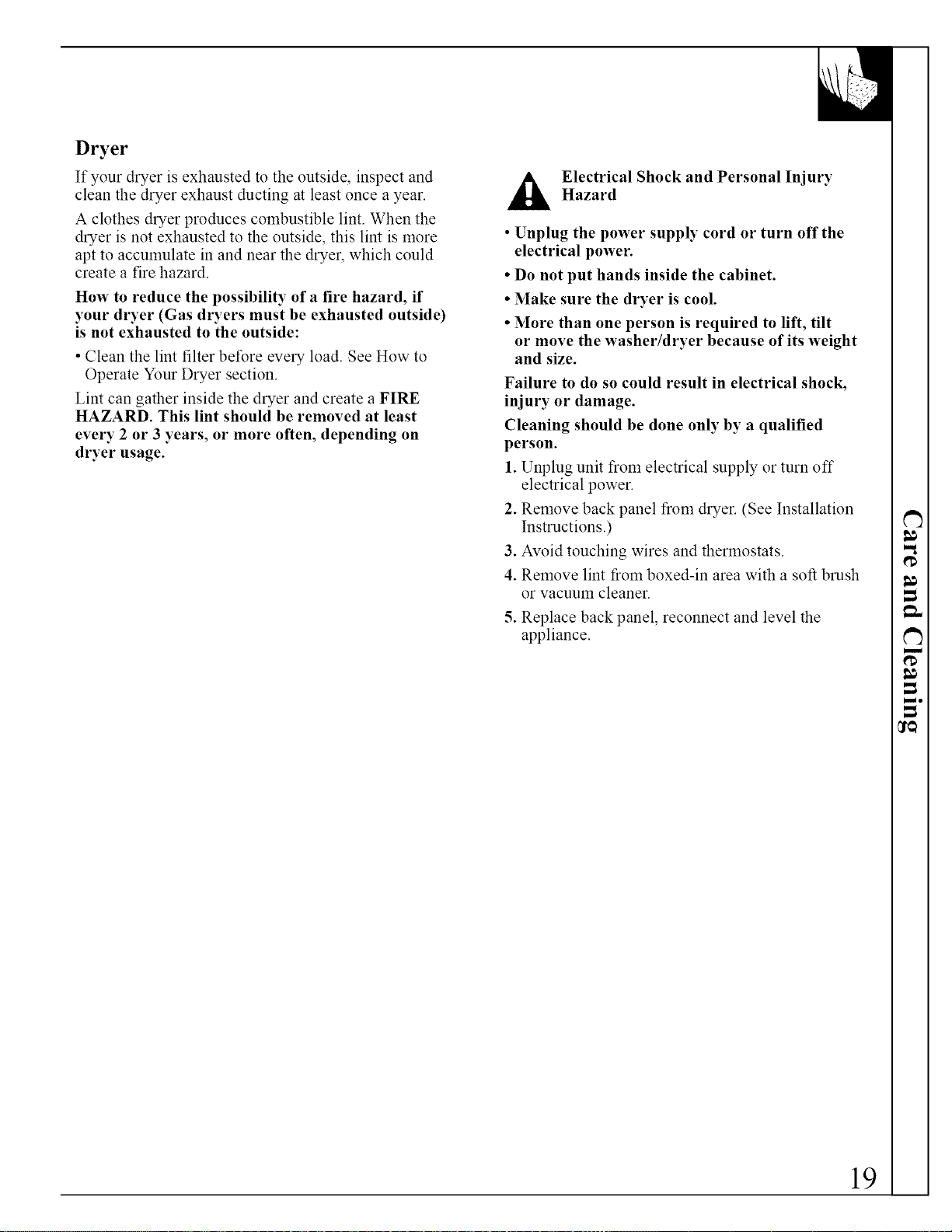
Dryer
If your dryer is exhausted to the outside, inspect and
clean the dryer exhaust ducting at least once a year.
A clothes dryer produces combustible lint. When the
dryer is not exhausted to the outside, this lint is more
apt to accumulate in and near the dryer, which could
create a fire hazard.
How to reduce the possibility of a fire hazard, if
your dryer (Gas dryers must be exhausted outside)
is not exhausted to the outside:
• Clean the lint filter before every load. See How to
Operate Your Dryer section.
Lint can gather inside the dryer and create a FIRE
HAZARD. This lint should be removed at least
every 2 or 3 years, or more often, depending on
dryer usage.
Electrical Shock and Personal Injury
Hazard
• Unplug the power supply cord or turn off the
electrical power.
• Do not put hands inside the cabinet.
• Make sure the dryer is cool.
• More than one person is required to lift, tilt
or move the washer/dryer because of its weight
and size.
Failure to do so could result in electrical shock,
injury or damage.
Cleaning should be done only by a qualified
person.
1. Unplug unit from electrical supply or turn off
electrical power.
2. Remove back panel from dryer. (See Installation
Instructions.)
3. Avoid touching wires and thermostats.
4. Remove lint t_om boxed-in area with a soft brush
or vacuum cleaner.
5. Replace back panel, reconnect and level the
appliance.
19
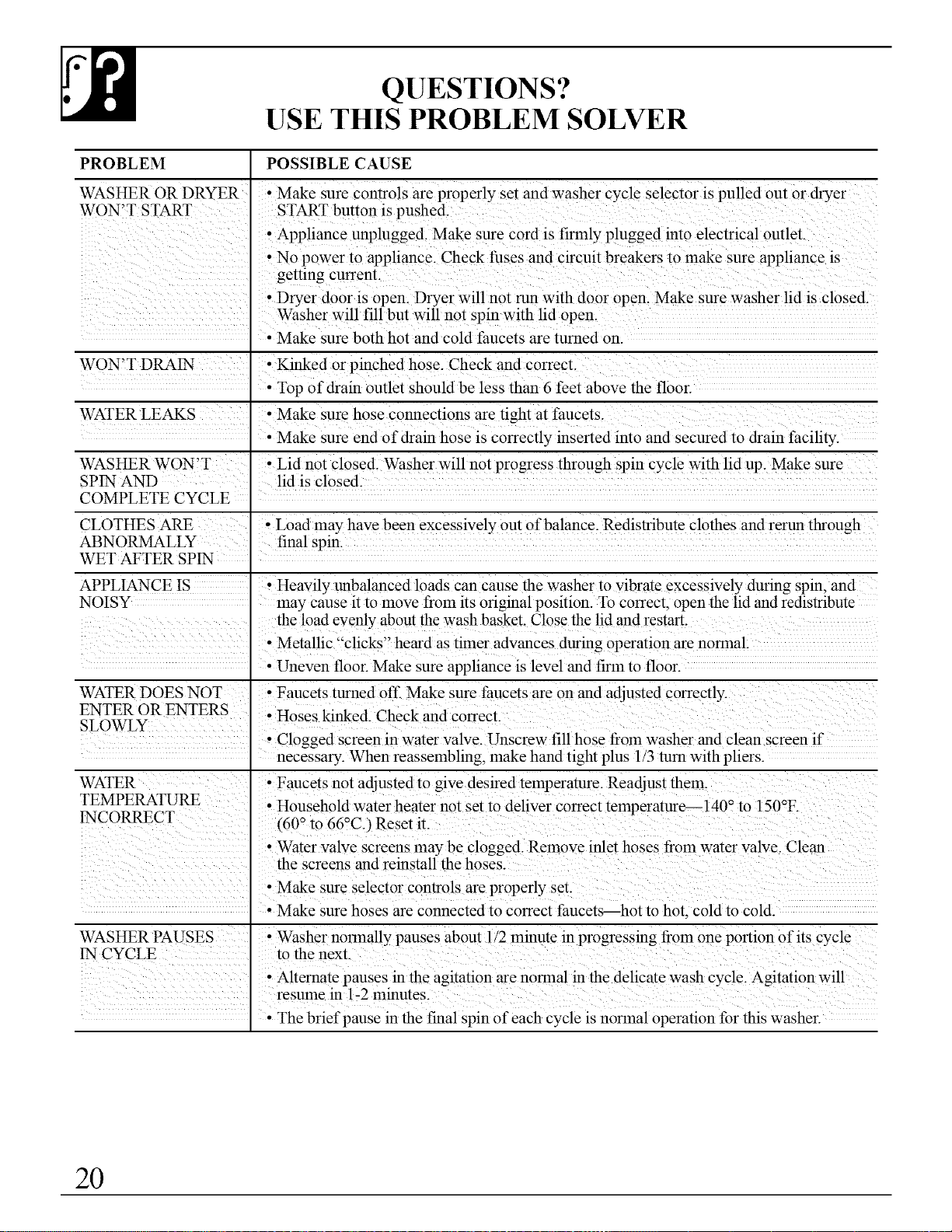
QUESTIONS?
USE THIS PROBLEM SOLVER
PROBLEM
WASHER OR DRYER
WON'T START
WON'T DRAIN
WATER LEAKS
WASHER WON'T
SPIN AND
COMPLETE CYCLE
CLOTHES ARE
ABNORMALLY
WET AFTER SPIN-
APPLIANCE IS
NOISY
WATER DOES NOT
ENTER OR ENTERS
SLOWLY
WATER
TEMPERATURE
INCORRECT
WASHER PAUSES
IN CYCLE
POSSIBLE CAUSE
• Make sure controls are properly set and washer cycle selector is pulled out or drver
START button is pushed.
• Appliance unplugged. Make sure cord is firmly plugged into electrical outlet.
• No power to appliance. Check fuses and circuit breakers to make sure appliance is
getting current.
• Dryer door is open. Dryer will not run with door open. Make sure washer lid is closed.
Washer will fill but will not spin with lid open.
• Make sure both hot and cold faucets are turned on.
• Kinked or pinched hose. Check and correct.
• Top of drain outlet should be less than 6 feet above the floor.
• Make sure hose connections are tight at faucets.
• Make sure end of drain hose is correctly inserted into and secured to drain facility.
• Lid not closed. Washer will not progress through spin cycle with lid up. Make sure
lid is closed.
• Load mav have been excessively out of balance. Redistribute clothes and rerun through
final spin.
• Heavily unbalanced loads can cause the washer to vibrate excessively dunng spin, and
may cause it to move from its original position. To correct, open the lid and redistribute
the load evenly about the wash basket. Close the lid and restart.
• Metallic "clicks" heard as timer advances during operation are normal.
• Uneven floor. Make sure appliance is level and finn to floor.
• Faucets turned off: Make sure faucets are on and adjusted correctly.
• Hoses kinked. Check and correct_
• Clogged screen in water valve. Unscrew fill hose from washer and clean screen if
necessary. When reassembling, make hand tight plus 1/3 turn with pliers.
• Faucets not adjusted to give desired temperature. Readjust them.
• Household water heater not set to deliver correct temperature--140 ° to 150°F.
!60° to 66°C. / Reset it.
• Water valve screens may be clogged. Remove inlet hoses from water valve. Clean
the screens and reinstall the hoses.
• Make sure selector controls are properly set.
• Make sure hoses are connected to correct faucets--hot to hot_ cold to cold.
• Washer nonnally pauses about 1/2 minute in progressing from one portion of its cycle
to the next_
• Alternate pauses m the agitation are normal in the delicate wash cycle. Agitation will
resume in 1-2 minutes.
• The brief pause in the final spin of each cycle is nonnal operation for this washer.
20
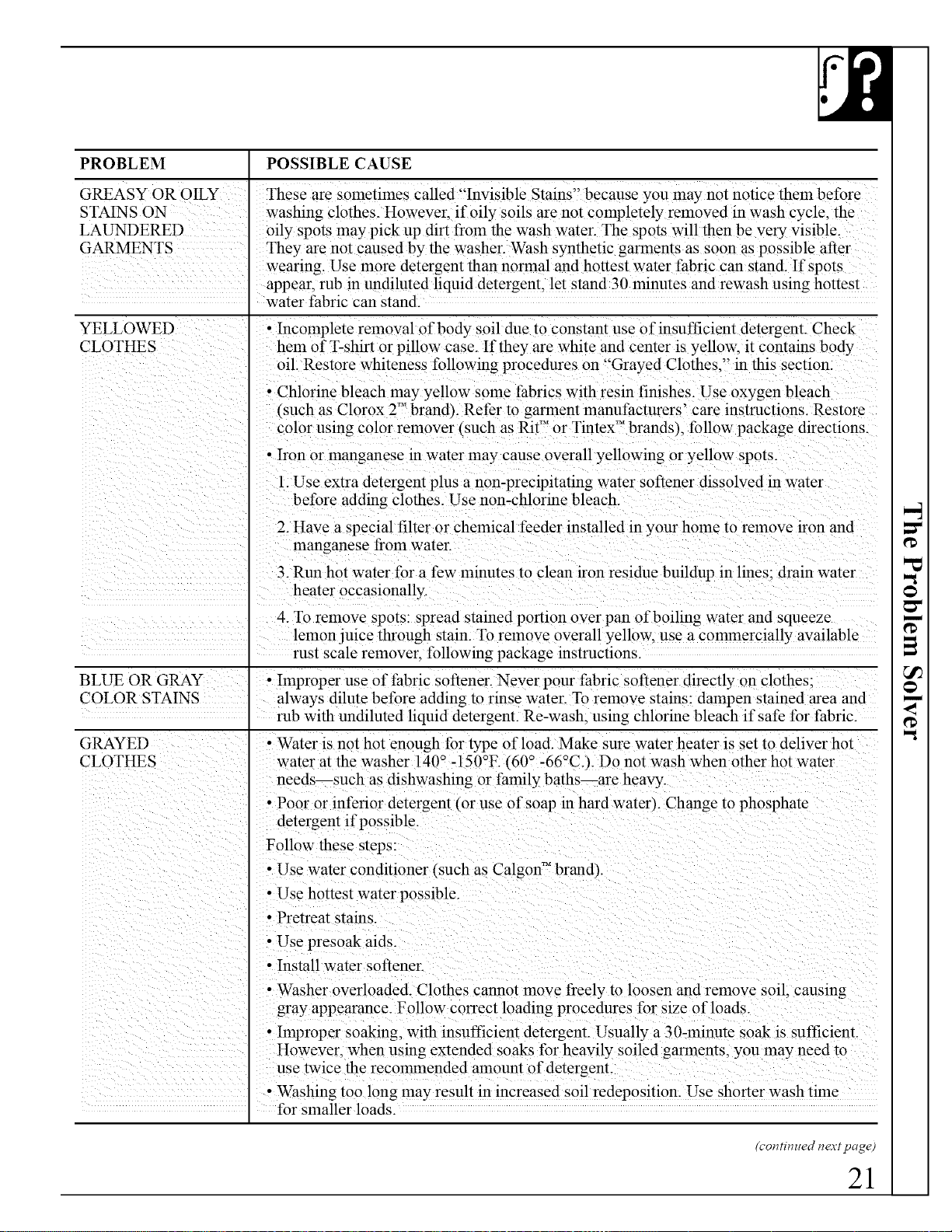
PROBLEM POSSIBLE CAUSE
GREASY OR OILY
STAINS ON
LAUNDERED
GARMENTS
YELLOWED
CLOTHES
BLUE OR GRAY"
COLOR STAINS
GRAYED
CLOTHES
These are sometimes called "Invisible Stains" because you may not notice them before
washing clothes. However. if oily soils are not completely removed in wash cycle, the
oily spots may pick up dirt from the wash water. The spots will then be veEy visible.
They are not caused by the washer. Wash synthetic garments as soon as possible after
wearing. Use more detergent than normal and hottest water fabric can stand. If spots
appear, rub in undiluted liquid detergent_ let stand 30 minutes and rewash using hottest
water fabric can stand.
• Incomplete removal of body soil due to constant use of insufficient detergent. Check
hem of T-shirt or pillow case. If they are white and center is yellow, it contains body
oil. Restore whiteness following procedures on "Grayed Clothes." in this section.
• Chlorine bleach may yellow some fabrics with resin finishes. Use oxygen bleacE
Isuch as Clorox 2TM brand I. Refer to gannent manufacturers' care instructions. Restore
color using color remover _such as Rif _or Tintex TM brands L follow package directions.
• Iron or manganese in water may cause overall yellowing or yellow spots.
I. Use extra detergent plus a non-precipitating water softener dissolved in water
before adding clothes. Use non-chlorine bleach.
2. Have a special filter or chemical feeder installed in your home to remove iron and
manganese from water.
3. Run hot water for a few minutes to clean iron residue buildup in lines: drain water
heater occasionallv.
4. To remove spots: spread stained portion over pan of boiling water and squeeze
lemon juice through stain. To remove overall yellow, use a connnercially available
rust scale remover_ following package instructions.
• hnproper use of fabric softener. Never pour fabric softener directly on clothes;
always dilute before adding to rinse water. To remove stains: dampen stained area and
rub with undiluted liquid detergent. Re-wash. using chlorine bleach if safe lbr fabric.
• Water is not hot enough for type of load. Make sure water heater is set to deliver hot
water at the washer 140° -150°F. (60 ° -66°C_ _.Do not wash when other hot water
needs--such as dishwashing or family baths--are heavy.
• Poor or inferior detergent ( or use of soap in hard water). Change to phosphate
detergent if possible.
Follow these steps:
• Use water conditioner Isuch as Calgon TM brmad).
• Use hottest water possible.
• Pretreat stains.
• Use presoak aids.
• Install water softener.
• Washer overloaded. Clothes cannot move freely to loosen and remove soil. causing
gray appearance. Follow correct loading procedures for size of loads.
• hnproper soaking, with insufficient detergent. Usually a 30-minnte soak is sufficient.
However. when using extended soaks for heavily soiled garments, you may need to
use twice the reconmaended amount of detergent.
• Washing too long ntay result in increased soil redeposition. Use shorter wash time
for smaller loads.
(continued next page)
21
.<
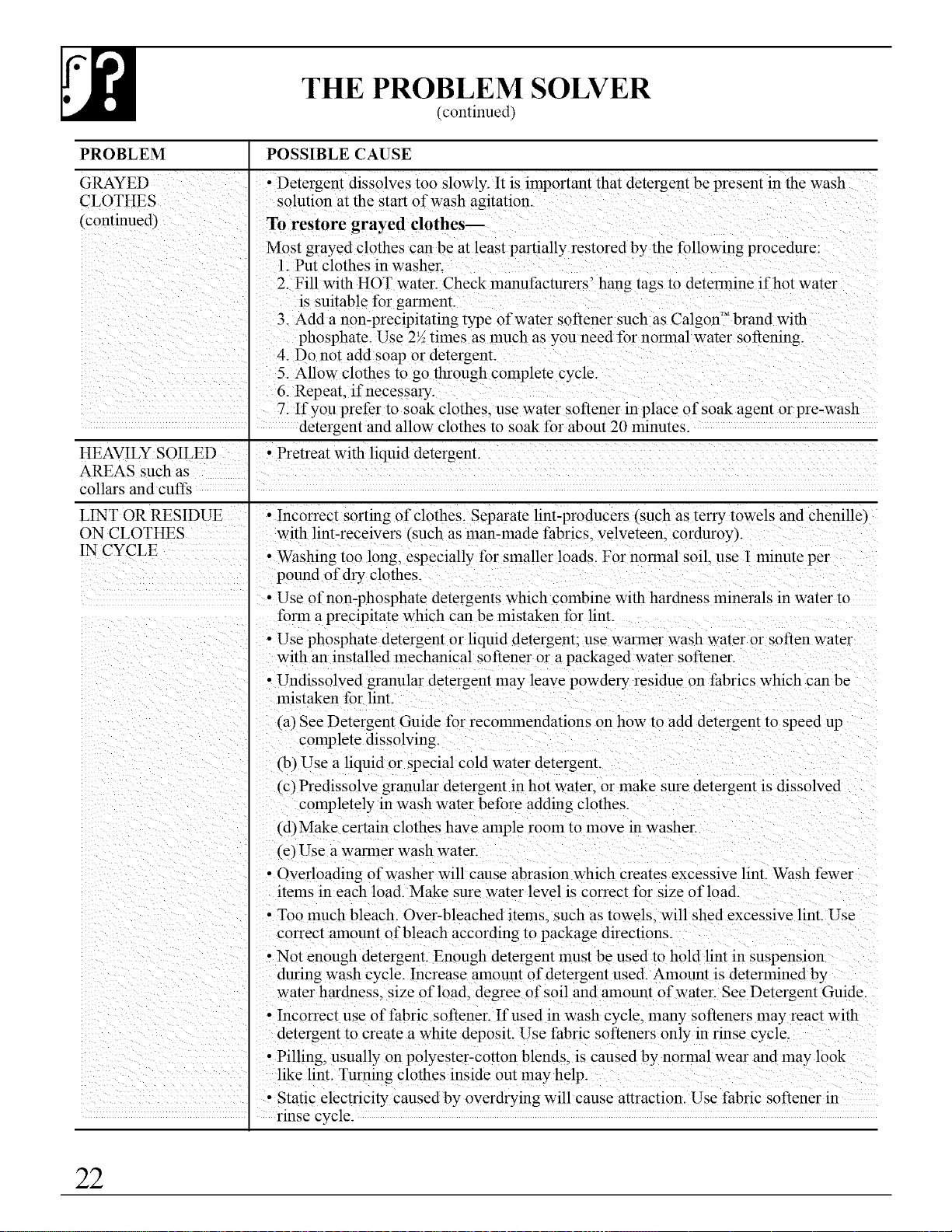
THE PROBLEM SOLVER
(continued)
PROBLEM
GRAYED
CLOTHES
Icontinued)
HEAVILY SOILED
AREAS such as
collars and cuffs
LINT OR RESIDUE
ON CLOTHES
IN CYCLE
POSSIBLE CAUSE
• Detergent dissolves too slowly. It is important that detergent be present in the wash
solution at the start of wash agitation.
To restore grayed clothes--
Most grayed clothes can be at least partially restored by the following procedure:
1. Put clothes in washer.
2. Fill with HOT water. Check manufacturers' hang tags to determine if hot water
is suitable for garment.
3. Add a non-precipitating type of water softener such as Calgoff _brand with
phosphate. Use 2_ times as much as you need for normal water softening.
4. Do not add soap or detergent.
5. Allow clothes to go through complete cycle.
6. Repeat. if necessary.
7. If you prefer to soak clothes, use water softener in place of soak agent or pre-wash
detergent and allow clothes to soak for about 20 nfinntes.
• Pretreat with liquid detergent .......
• Incorrect sorting of clothes. Separate lint-producers (such as terry towels and chenille)
with lint-receivers _such as man-lnade fabrics, velveteen_ corduroy).
• Washing too long, especially lbr smaller loads. For nornral soil. use 1 minute per
pound of dry clothes.
• Use of non-phosphate detergents which combine with hardness minerals in water to
form a precipitate which can be mistaken for lint.
• Use phosphate detergent or liquid detergent: use warn_er wash water or soften water
with an installed mechanical softener or a packaged water softener.
• Undissolved granular detergent may leave powdery residue on fabrics which can be
mistaken for lint.
abSee Detergent Guide for recommendations on how to add detergent to speed up
complete dissolving.
(bIUse a liquid or special cold water detergent.
c_Predissolve granular detergent in hot water, or make sure detergent is dissolved
completely in wash water before adding clothes.
(d) Make certain clothes have ample room to move m washer.
(e) Use a wanner wash water.
• Overloading of washer will cause abrasion which creates excessive lint. Wash fewer
items in each load. Make sure water level is correct for size of load
• Too much bleach. Over-bleached items, such as towels, will shed excessive lint. Use
correct amount of bleach according to package directions.
• Not enough detergent. Enough detergent must be used to hold lint in suspension
during wash cycle. Increase amount of detergent used. Amount is determined by
water hardness, size of load. degree of soil and amount of water. See Detergent Guide.
• Incorrect use of fabric softener. If used in wash cycle, many softeners may react with
detergent to create a white deposit. Use labric softeners only in rinse cycle.
• Pilling, usually on polyester-cotton blends, is caused by normal wear and may look
like lint. Turning clothes inside out nlay help_
• Static electricity caused by overdrying will cause attraction. Use fabric softener in
rinse cycle.
22
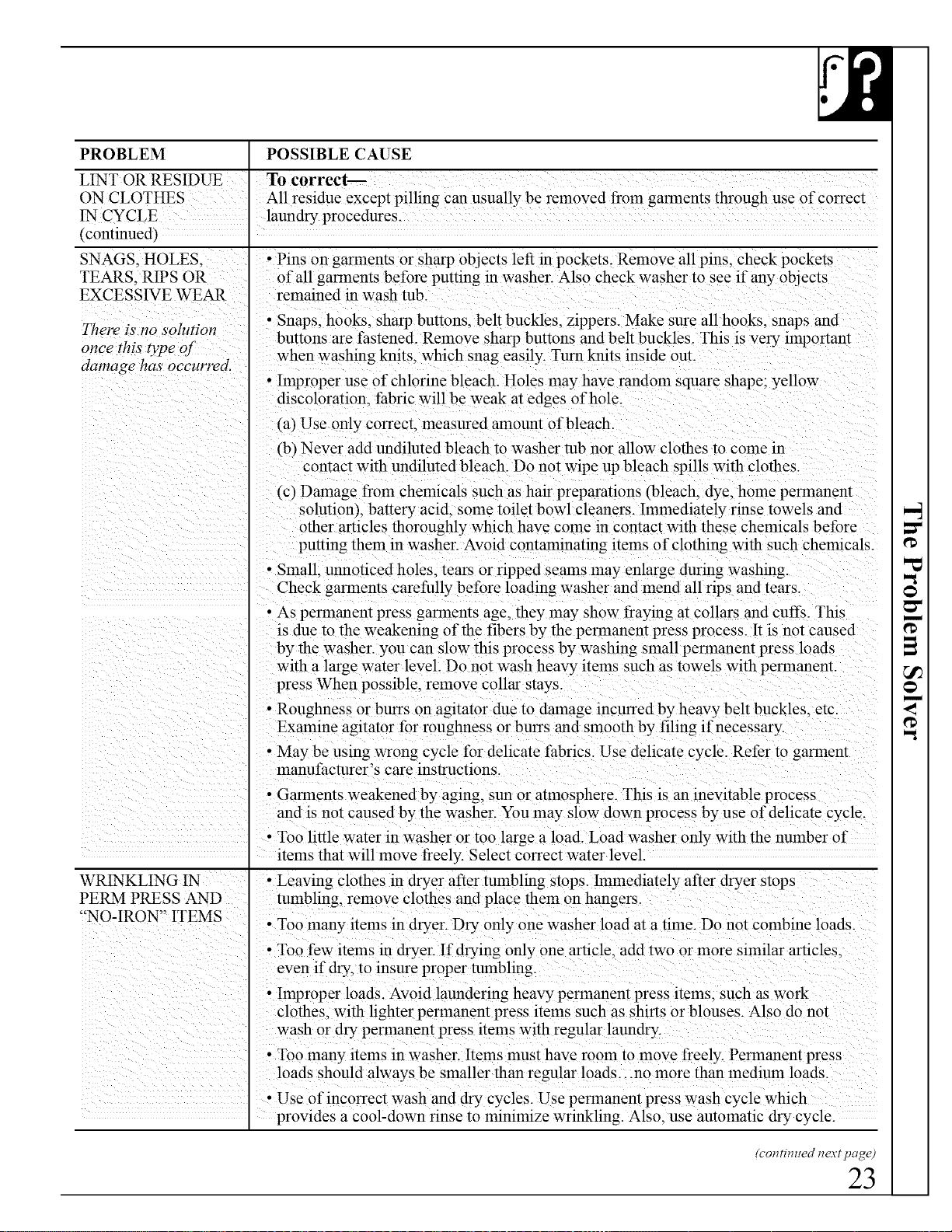
PROBLEM
LINT OR RESIDUE
ON CLOTHES
IN CYCLE
!continued)
SNAGS_ HOLES.
TEARS. RIPS OR
EXCESSIVE WEAR
There is no solution
once thi,s type of
damage has occurred.
WRINKLING IN
PERM PRESS AND
"NO-IRON" ITEMS
POSSIBLE CAUSE
To correct--
Allresidue except pilling can usuallybe removed from garmentsthrough use ofcorrect
laundry procedures_
• Pins on garments or sharp objects left in pockets. Remove all pins. check pockets
of all garments before putting in washer. Also check washer to see if any objects
remained in wash tub.
• Snaps. hooks, sharp buttons, belt buckles, zippers. Make sure all hooks, snaps and
buttons are fastened. Remove sharp buttons and belt buckles. This is very important
when washing knits, which snag easily, rum knits reside out.
• hnproper use of chlorine bleach. Holes may have random square shape; yellow
discoloration, fabric will be weak at edges of hole.
lab Use only correct, measured amount of bleach
(b I Never add undiluted bleach to washer tub nor allow clothes to come in
contact with undilntedbleach. Do not wipe up bleach spills with clothes.
/c) Damage from chemicals such as hair preparations Ibleach. dye, home perlnanent
solution), battery acid. some toilet bowl cleaners, hmnediately rinse towels and
other articles thoroughly which have come in contact with these chemicals before
putting them in washer. Avoid contaminating items of clothing with such chemicals.
• Small. unnoticed holes, tears or ripped seams may enlarge during washing.
Check garlnents carefully before loading washer and mend all rips and tears.
• As permanent press garments age, they may show fraying at collars and cuffs. This
is due to the weakening of the fibers by the pemmnent press process. It is not caused
by the washer, you can slow this process by washing small pemmnent press loads
with a large water level. Do not wash heavy items such as towels with permanent.
press When possible, remove collar stays.
• Roughness or burrs on agitator due to damage incurred by heavybelt buckles, etc.
Examine agitator for roughness or burrs and smooth by filing if necessary.
• May be using wrong cycle lbr delicate fabrics. Use delicate cycle. Refer to gamlent
manufacturer's care instructions.
• Garments weakened by aging, sun or annosphere. This is an inevitable process
and is not caused by the washer. You may slow down process by use of delicate cycle_
• Too little water in washer or too large a load. Load washer only with the number of
items that will move freely. Select correct water level.
• Leaving clothes in dryer after tumbling stops, hmnediately after dryer stops
tumbling, remove clothes and place them on hangers.
• Too many items in dryer. Dry only one washer load at a time. Do not combine loads.
• Too few items in dryer. If drying only one article, add two or more similar articles.
even if dry, to insure proper tumbling.
• Improper loads. Avoid laundering heavy pemmnent press items, such as work
clothes, with lighter permanent press items such as shirts or blouses. Also do not
wash or dry permanent press items with regular laundry.
• Too many items in washer. Items must have room to move freelv. Permanent press
loads should always be smaller than regular loads...no more than medium loads.
• Use of incorrect wash and dry cycles. Use permanent press wash cycle which
provides a cool-down rinse to minimize wrinkling. Also. use automatic dry cycle.
(continued next page)
23
-t
,<
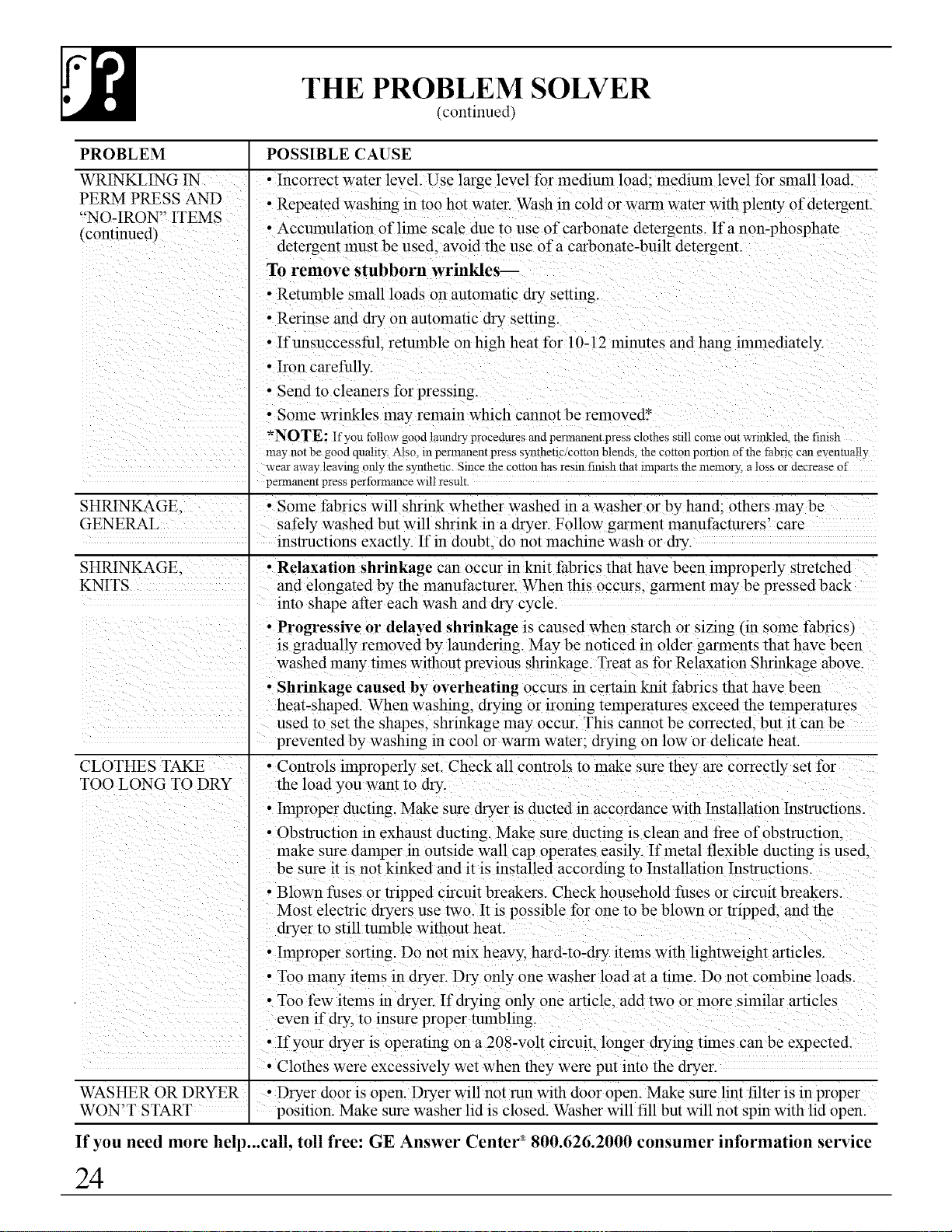
THE PROBLEM SOLVER
(continued)
PROBLEM
WRINKLING IN
PERM PRESS AND
"NO-IRON" ITEMS
!continued_
SHRINKAGE_
GENERAL
SHRINKAGE_
KNITS
CLOTHES TAKE
TOO LONG TO DRY
WASHER OR DRYER
WON'T START
POSSIBLE CAUSE
• Incorrect water level. Use large level for medium load: medium level for small load.
• Repeated washing in too hot water. Wash in cold or waxm water with plenty of detergent.
• Accumulation of lime scale due to use of carbonate detergents. Ifa non-phosphate
detergent must be used. avoid the use of a carbonate-built detergent.
To remove stubborn wrinMes--
• Retunthle small loads on automatic dry setting
• Rerinse and dry on automatic dry setting
• If unsuccessful retumble on high heat for 10-12 minutes and hang immediately
• Iron carefully.
• Send to cleaners for pressing
- Some wrinkles may remain which cannot be removed*
_NOTE: If you follow- good laundry procedures and permanent press clothes sill! come out wnnkle& the finish
may not be good quahty. Also, in permanent press syntbenc/cotton blends, the cotton portion of the fabric can eventually
wear away leaving only the synthetic. Since the cotton has resin finish that imparts the memory, a loss or decrease of
pemlanem press performance will result.
• Some fabrics will shrink whether washed in a washer or by hand: others may be
safely washed but will shrink in a dryer. Follow garment manufacturers' care
instructions exactly. If in doubt_ do not machine wash or dry.
• Relaxation shrinkage can occur in knit fabrics that have been improperly stretched
and elongated by the manufacturer. When this occurs, garment may be pressed back
into shape after each wash and dry cycle.
- Progressive or delayed shrinkage is caused when starch or sizing Iin some fabrics
is gradually removed by laundering. May be noticed in older garments that have been
washed many times without previous shrinkage. Treat as Ibr Relaxation Shrinkage above.
• Shrinkage caused by overheating occurs in certain knit fabrics that have been
heat-shaped. When washing, drying or ironing temperatures exceed the temperatures
used to set the shapes, shrinkage may occur. This cannot be corrected, but it can be
prevented by washing in cool or warm water: drying on low or delicate heat.
• Controls improperly set. Check all controls to make sure they are correctly set for
the load you want to dry.
• Improper ducting. Make sure dryer is ducted in accordance with Installation Instructions.
• Obstruction in exhaust ducting. Make sure ducting is clean and free of obstruction.
make sure damper in outside wall cap operates easily. If metal flexible ducting is used.
be sure it is not kinked and it is installed according to Installation Instructions.
• Blown fuses or tripped circuit breakers. Check household fuses or circuit breakers.
Most electric dryers use two. It is possible for one to be blown or tripped, and the
dryer to still tumble without heat.
• hnproper sorting. Do not mix heavy, hard-to-dry items with lightweight articles.
• Too many items in dryer. Dry only one washer load at a time. Do not combine loads.
• Too few items in dryer. If drying only one article, add two or more similar articles
even if dry. to insure proper tunthling.
• If your dryer is operating on a 208-volt circuit, longer drying times can be expected.
• Clothes were excessively wet when they were put into the dryer.
• Dryer door is open. Dryer will not run with door open. Make sure lint filter is in proper
position. Make sure washer lid is closed. Washer will fill but will not spin with lid open.
If you need more help...call, toll free: GE Answer Center * 800.626.2000 consumer information service
24
NOTES
25
,,.1
NOTES
26
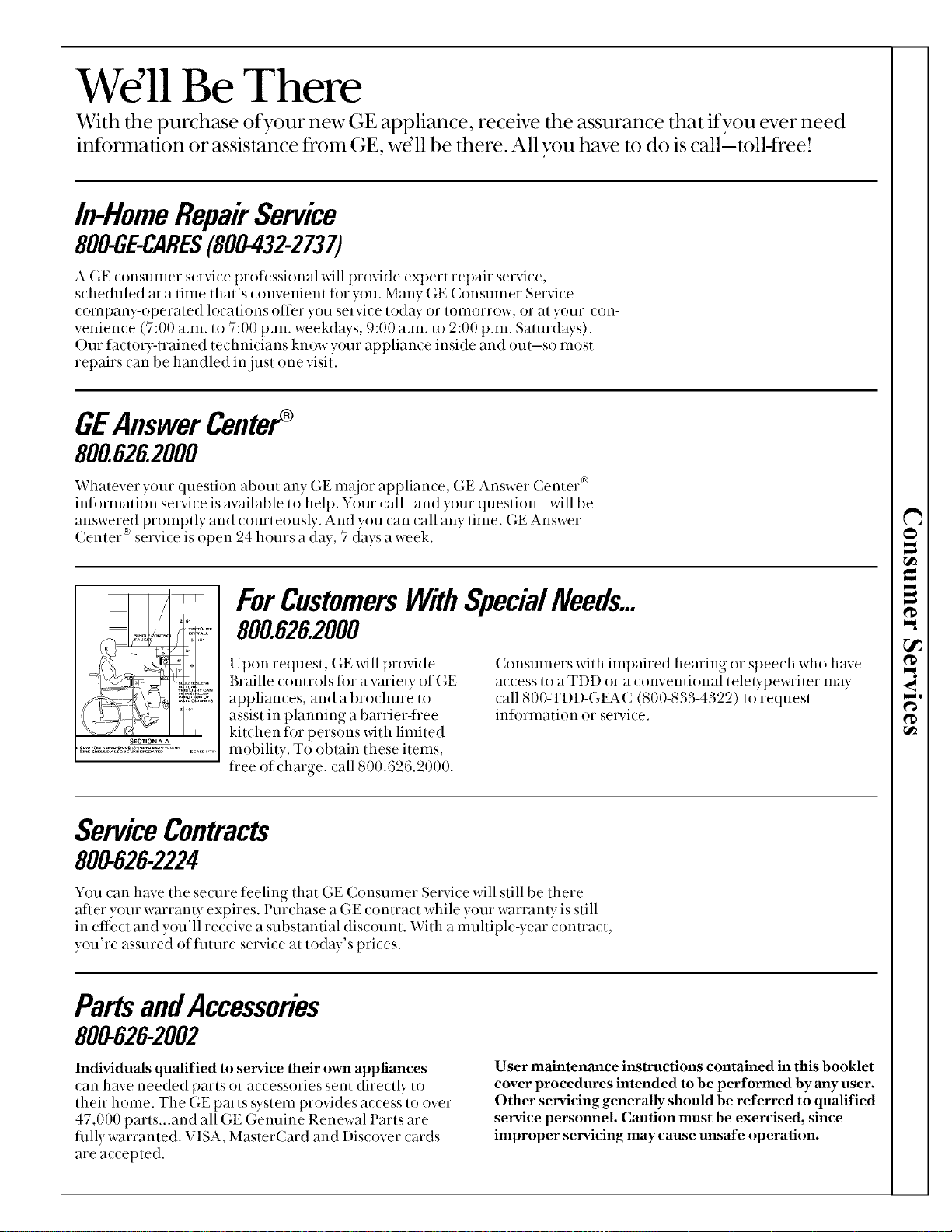
WCll Be There
With the purchase of your new GE appliance, receive the assurance that if you ever need
infbrrnation or assistance from GE, wgll be there. All you have to do is call-toll-fiee!
In-HomeRepairService
800-GE-CARES(800-432-2737)
AGE consumer service professional xdll provide expert repair service,
scheduled at a tilne that's convenient for you. Many GE Consulner Service
company-operated locations otter you service today or tomorrow, or at your con-
venience (7:00 a.m. to 7:00 p.m. weekdays, 9:0/! a.m. to 2:0/! p.m. Saturdays).
Our thctoD_trained technicians know your appliance inside and ore-so most
repairs can be handled in just one visit.
GEAnswerCenter®
800.626.2000
Whatever your question about ..... ®any (,E malor apphance, (,E Answer Center
information servi( e is available to help. Your (all-and your question-will be
answered promptly and (ourteouslv. At_d you (an call any time. GE Answer
Center secvtce ts open 24 hours a day, ¢days a week.
= I
SECT,ONA A
ForCustomersWithSpecialNeeds...
800.626.2000
Upon request, GE will provide
Braille controls fi)r a varie/y of GE
appliances, and a brochure to
assist in planning a barrier-flee
kitchen for persons _dth limited
mobility. To obtain these items,
flee of charge, call 8110.626.20011.
Consumers wifll impaired hearing or speech who have
a((ess to a TDD or a conventional teletype_Titer may
call 800-TI)I)-(;E_(_ (800-833-4322) to request
inforlnafion or servi(e.
ServiceContracts
800-626-2224
You can have the secure feeling that GE Consumer Service will still be there
after your warranty expires. Purchase a GE contract while your warranty is still
in effect and you'll receive a substantial discount. With a muhiple-year contract,
you're assured offi_ture service at today's prices,
PartsandAccessories
800-626-2002
Individuals qualified to service their own appliances
can have needed parts or accessories sent directly to
their home. The GE parts system provides access to ()vet
47,1100 parts...and all GE Genuine Renewal Parts are
fiflly warranted. VISA, MasterCard and Discover cards
are accepted.
User maintenance instructions contained in this booklet
cover procedures intended to be performed by any user.
Other servicing generally should be referred to qualified
service personnel. Caution must be exercised, since
improper servicing may cause unsafe operation.
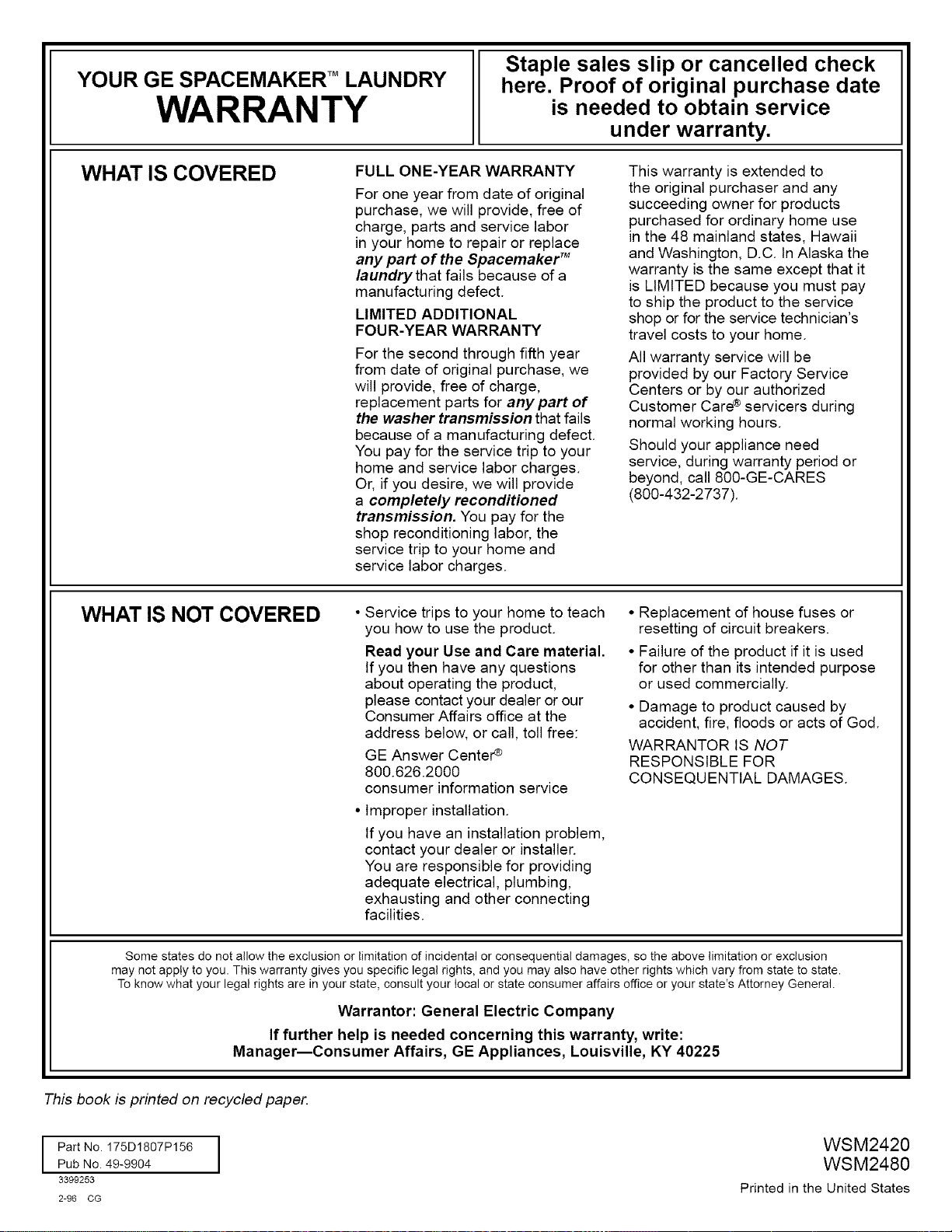
Staple sales slip or cancelled check
YOUR GE SPACEMAKER TM LAUNDRY here. Proof of original purchase date
WARRANTY is needed to obtain service
under warranty.
WHAT IS COVERED FULL ONE-YEAR WARRANTY This warranty is extended to
For one year from date of original
purchase, we will provide, free of
charge, parts and service labor
in your home to repair or replace
any part of the Spacemaker TM
laundry that fails because of a
manufacturing defect.
LIMITED ADDITIONAL
FOU R-YEAR WARRANTY
For the second through fifth year
from date of original purchase, we
will provide, free of charge,
replacement parts for anypart of
the washer transmission thatfails
because of a manufacturing defect.
You pay for the service trip to your
home and service labor charges.
Or, if you desire, we will provide
a completely reconditioned
transmission. You pay for the
shop reconditioning labor, the
service trip to your home and
service labor charges.
the original purchaser and any
succeeding owner for products
purchased for ordinary home use
in the 48 mainland states, Hawaii
and Washington, D.C. In Alaska the
warranty is the same except that it
is LIMITED because you must pay
to ship the product to the service
shop or for the service technician's
travel costs to your home.
All warranty service will be
provided by our Factory Service
Centers or by our authorized
Customer Care®servicers during
normal working hours.
Should your appliance need
service, during warranty period or
beyond, call 800-GE-CARES
(800-432-2737).
WHAT IS NOT COVERED
• Service trips to your home to teach
you how to use the product.
Read your Use and Care material.
If you then have any questions
about operating the product,
please contact your dealer or our
Consumer Affairs office at the
address below, or call, toll free:
GE Answer Center e
800.626.2000
consumer information service
• Improper installation.
If you have an installation problem,
contact your dealer or installer.
You are responsible for providing
adequate electrical, plumbing,
exhausting and other connecting
facilities.
• Replacement of house fuses or
resetting of circuit breakers.
• Failure of the product if it is used
for other than its intended purpose
or used commercially.
• Damage to product caused by
accident, fire, floods or acts of God.
WARRANTOR IS NOT
RESPONSIBLE FOR
CONSEQUENTIAL DAMAGES.
Some states do not allow the exclusion or limitation of incidental or consequential damages, so the above limitation or exclusion
may not apply to you. This warranty gives you specific legal rights, and you may also have other rights which vary from state to state.
To know what your legal rights are in your state, consult your local or state consumer affairs office or your state's Attorney General.
Warrantor: General Electric Company
If further help is needed concerning this warranty, write:
Manager--Consumer Affairs, GE Appliances, Louisville, KY 40225
This book is printed on recycled paper.
I art No. 175D1807P156 I
Pub No. 49-9904
3399253
2-96 CG
WSM2420
WSM2480
Printed in the United States