TflPPfln
GASRANGE
READAND SAVE THESEINSTRUCTIONS OWNER'SGUIDE
_ Recycled paper P/N 318200753 (0109) Rev. B
Product Registration
Register Your Product
The PRODUCT REGISTRATION CARD
should be filled in completely, signed and
returned to Electrolux Home Products
North America.
Thank you for choosing this appliance. The information contained within this
Owner's Guide will instruct you on how to properly operate and care for your
appliance. Pleaseread through the information contained in your literature pack to
learn more about your new appliance.
Record Your Model and Serial Numbers
Record in the space provided belowthe model and serial numbers found on the serial
plate located under the lift-up cooktop.
Model Number:
Serial Number:
Date of Purchase:
Contents
This Owner's Guide contains general
operating instructions for your appliance
and feature information for several
models. Your appliance may not have all
the described features.
Versibn en espafiol
Si desea obtener una copia en espahol de
este Manual del Usuario, sirvase escribir a
la direcci6n que se incluye a contin uaci6n.
Solicite la 318204013.
Spanish Owner's Guides
Electrolux Home Products North America
Consumer Relations
P. O. Box 212378
Augusta, Georgia, 30917-2378
Product Registration ...................................................... 2
Versi6n en espa6ol ........................................................ 2
Important Safety Instructions ..................................... 3-5
Liquefied Petroleum (Propane) Gas Conversion ............. 6
Grounding Instructions (electric ignition models only) . 6
Cooktop and Oven Ignition ........................................... 6
Flame Size ...................................................................... 7
Proper Burner Adjustments ........................................... 7
Selecting Surface Cooking Ustensils .............................. 7
Specialty Pans & Trivets .................................................. 8
Canning Tips & Informations ........................................ 8
Setting Surface Controls ................................................ 9
Before Setting Oven Controls ...................................... 10
Setting Oven Controls ................................................. 10
Air Circulation in the Oven .......................................... 11
Oven Baking ................................................................ 11
Oven Cleaning ........................................................ 12-13
General Cleaning ................................................... 14-16
Storage Drawer ............................................................ 16
Changing Cooktop and Oven Lights ........................... 17
Adjusting Oven Temperature ...................................... 17
Avoid Service Checklist ........................................... 18-19
Warranty ...................................................................... 20
© 2001 White Consolidated Industries
All rights reserved
If the information in this manual is not
followed exactly, a fire or explosion may result causing
property damage, personal injury or death.
FOR YOUR SAFETY:
-- Do not store or use gasoline or other flammable vapors
and liquids in the vicinity of this or any other appliance.
-- WHAT TO DO IF YOU SMELL GAS:
= Do not try to light any appliance.
= Do not touch any electrical switch; do not use any phone
in your building.
= Immediately call your gas supplier from a neighbor's
phone. Follow the gas supplier's instructions.
= If you cannot reach your gas supplier, call the fire
department.
-- Installation and service must be performed bya qualified
installer, servicer or the gas supplier.
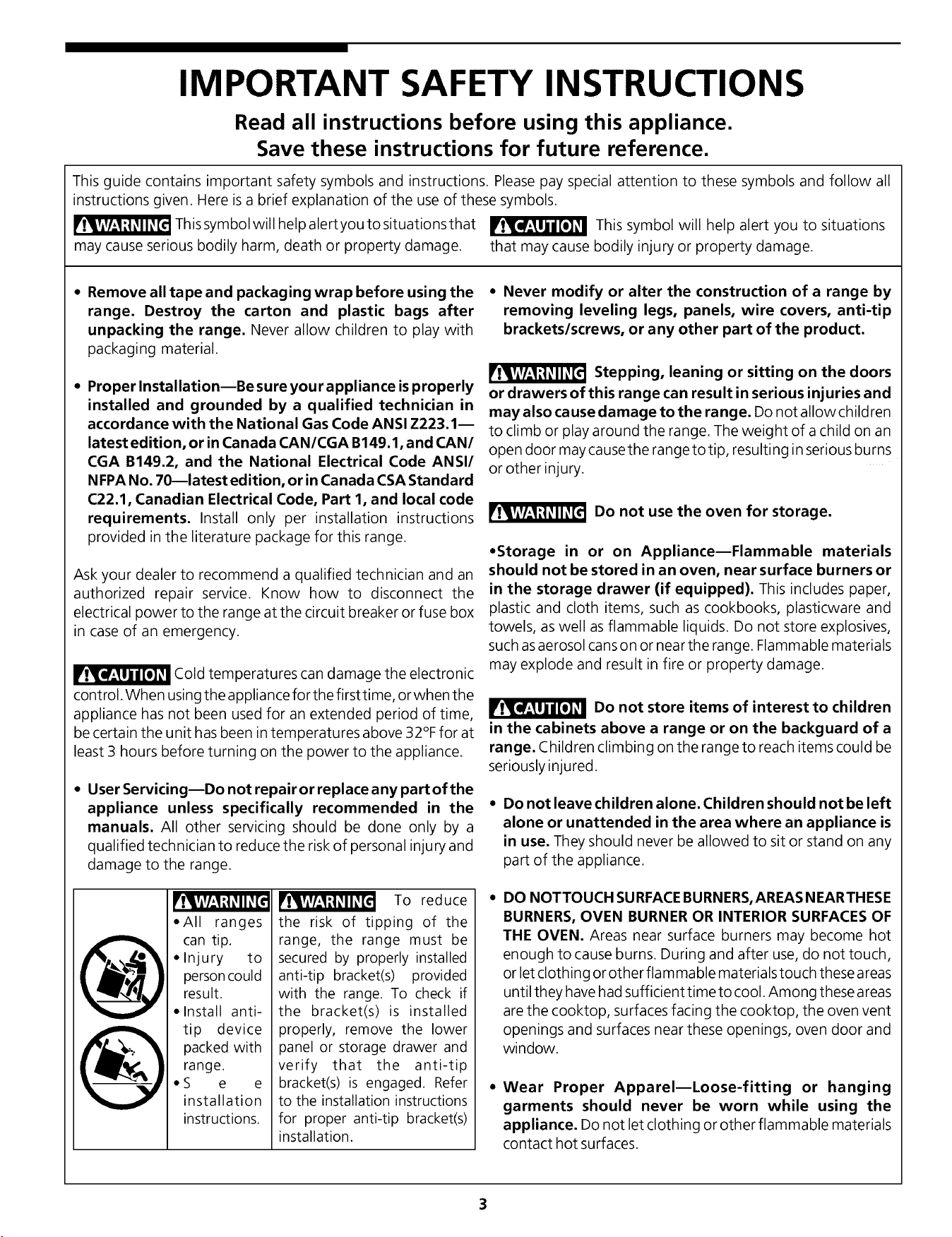
IMPORTANT SAFETY INSTRUCTIONS
Read all instructions before using this appliance.
Save these instructions for future reference.
This guide contains important safety symbols and instructions. Please pay special attention to these symbols and follow all
instructions given. Here is a brief explanation of the use of these symbols.
Thissymbolwill helpalertyoutosituationsthat _ This symbol will help alert you to situations
may cause serious bodily harm, death or property damage, that may cause bodily injury or property damage.
• Remove all tape and packaging wrap before using the
range. Destroy the carton and plastic bags after
unpacking the range. Never allow children to play with
packaging material.
• Proper Installation--Besure yourappliance is properly
installed and grounded by a qualified technician in
accordance with the National Gas Code ANSI Z223.1--
latest edition, or in Canada CAN/CGA B149.1, and CAN/
CGA B149.2, and the National Electrical Code ANSI/
NFPA No. 70--latest edition, or in Canada CSA Standard
C22.1, Canadian Electrical Code, Part 1, and local code
requirements. Install only per installation instructions
provided in the literature package for this range.
Ask your dealer to recommend a qualified technician and an
authorized repair service. Know how to disconnect the
electrical power to the range at the circuit breaker or fuse box
in case of an emergency.
Cold temperatures can damage the electronic
control. When using the appliance for the firsttime, or when the
appliance has not been used for an extended period of time,
be certain the unit has been in temperatures above 32°F for at
least 3 hours before turning on the power to the appliance.
• User Servicing--Do not repairor replace any partofthe
appliance unless specifically recommended in the
manuals. All other servicing should be done only by a
qualified technician to reduce the riskof personal injury and
damage to the range.
oAII ranges
can tip.
i njury to
personcould
result.
Install anti-
tip device
packed with
range.
oS e e
installation
instructions.
To reduce
the risk of tipping of the
range, the range must be
secured by properly installed
anti-tip bracket(s) provided
with the range. To check if
the bracket(s)is installed
properly, remove the lower
panel or storage drawer and
verify that the anti-tip
bracket(s) is engaged. Refer
to the installation instructions
for proper anti-tip bracket(s)
installation.
• Never modify or alter the construction of a range by
removing leveling legs, panels, wire covers, anti-tip
brackets/screws, or any other part of the product.
Stepping, leaning or sitting on the doors
or drawers of this range can result in serious injuries and
may also causedamage to the range. Do not allow child ten
to climb or play around the range. The weight of achild on an
open door maycausethe rangetotip, resulting in serious burns
or other injury.
Do not use the oven for storage.
• Storage in or on Appliance--Flammable materials
should not be stored in an oven, near surface burners or
in the storage drawer (if equipped). This includes paper,
plastic and cloth items, such as cookbooks, plasticware and
towels, as well as flammable liquids. Do not store explosives,
suchasaerosol canson or nearthe range. Flammable materials
may explode and result in fire or property damage.
Do not store items of interest to children
in the cabinets above a range or on the backguard of a
range. Children climbing on the range to reach items could be
seriously injured.
Do not leave children alone. Children should not be left
alone or unattended in the area where an appliance is
in use. They should never be allowed to sit or stand on any
part of the appliance.
DO NOTTOUCH SURFACEBURNERS,AREASNEARTHESE
BURNERS, OVEN BURNER OR INTERIOR SURFACES OF
THE OVEN. Areas near surface burners may become hot
enough to cause burns. During and after use, do not touch,
or let clothing or other flammable materialstouch these areas
until they have hadsufficient time to cool. Among these areas
are the cooktop, surfaces facing the cooktop, the oven vent
openings and surfaces near these openings, oven door and
window.
Wear Proper Apparel--Loose-fitting or hanging
garments should never be worn while using the
appliance. Do not let clothing or other flammable materials
contact hot surfaces.
IMPORTANT SAFETY INSTRUCTIONS(continued)
Never use your appliance for warming or
heating the room.
• Do Not Use Water or Flour on Grease Fires--Smother
the fire with a pan lid, or use baking soda, a dry
chemical or foam-type extinguisher.
• When heating fat or grease, watch it closely. Fat or
grease may catch fire if allowed to become too hot.
Use Only Dry Potholders--Moist or damp potholders
on hot surfaces may result in burns from steam. Do not
let the potholders touch the flame or burners. Do not use a
towel or other bulky cloth instead of a potholder.
• Do Not Heat Unopened Food Containers--Build-up of
pressure may cause the container to burst and result
in injury.
• Remove the oven door from any unused range if it is
to be stored or discarded.
• IMPORTANT--Do not attempt to operate the oven
during a power failure. If the power fails, always turn
the oven off. If the oven is not turned off and the power
resumes, the oven will begin to operate again. Food left
unattended could catch fire or spoil.
IMPORTANT INSTRUCTIONS FOR USING YOUR
COOKTOP
• Know which knob controls each surface heating unit.
Use Proper Flame SizeiAdjust flame size so
it does not extend beyond the edge of the utensil. The use of
undersized utensils will expose a portion of the burner flame to
direct contact and may result in ignition of clothing. Proper
relationship of utensil to flame will also improve efficiency.
• Utensil Handles Should Be Turned Inward and Not
Extend Over Adjacent Surface Burners--To reducethe
risk of burns, ignition of flammable materials, and spillage
due to unintentional contact with the utensil, the handle of
the utensil should be positioned so that it is turned inward, •
and does not extend over adjacent surface burners.
• Never Leave Surface Burners Unattended at High
SettingsiBoilovers cause smoking and greasy spillovers
that may ignite, or a pan that has boiled dry may melt.
• Protective LinersiDo not usealuminum foil to line surface
burner pans,oven bottom or anyother part of the range. Use
of protective liners or aluminum foil may interfere with heat
and air distribution, and combustion. Damagetothe rangeor
personal injury may result.
• Glazed Cooking UtensilsiOnly certain types of glass,
glass/ceramic, ceramic, earthenware, or other glazed
utensils are suitable for rangetop service without
breaking due to the sudden change in temperature. Check
the manufacturer's recommendations for rangetop use.
Do Not Use Decorative Surface Burner Covers. Ifa burner
is accidentally turned on, the decorative cover will become
hot and possibly melt. You will not be able to see that the
burner is on. Burns will occur if the hot covers are touched.
Damage mayalso bedone to the cooktop or burners because
the covers may cause overheating. Air will be blocked from
the burner and cause combustion problems.
IMPORTANT INSTRUCTIONS FOR USING YOUR
OVEN
• Use Care When Opening DooriStand to the side of the
range when opening the door of a hot oven. Let hot air or
steam escapebefore you remove or replace food inthe oven.
Keep Oven Vent Ducts Unobstructed. The oven isvented
below the backguard. Touching the surfaces in this area
when the oven isoperating may causesevere burns. Also, do
not place plastic or heat-sensitive items on or near the oven
vent. These items could melt or ignite.
Placement of Oven Racks. Always place oven racks in
desired location while oven is cool. If rack must be moved
while oven is hot, use extreme caution. Use potholders and
grasp the rack with both hands to reposition. Do not let
potholderscontactthe oven burner flame or interior of the
oven. Remove all utensils from the rack before removing
rack.
Do not use the broiler pan without its insert. The broiler
pan and grid allow dri0ping fat to drain and be kept away
from the high heat of the broiler.
4
IMPORTANT SAFETY INSTRUCTIONSccontinued)
* Do not cover the broiler grid with aluminum foil.
Exposed fat and grease could ignite.
• Do not touch a hot light bulb (some models) with a
dampcloth. Doing so could cause the bulb to break.
Disconnecttherange or turn off the power to the range
before removing and replacing light bulb.
IMPORTANT INSTRUCTIONS FOR CLEANING
YOUR RANGE
• Clean the range regularlyto keep all parts free of grease
that could catch fire. Pay particular attention to the area
underneath each surface burner. Exhaust fan ventilation
hoods and grease filters should be kept clean. Do not allow
grease to accumulate. Greasy deposits in the fan could catch
fire. Refer to the hood manufacturer's instructions for
cleaning.
• Kitchen cleaners/aerosolsiAIways follow the
manufacturer's recommended directions for use. Beaware
that excess residue from cleaners and aerosols may ignite
causing damage and/or injury.
CONTINUOUS CLEANING OVENS (some models):
• Do not use oven cleaners on the oven liner or any of the
continuous cleaning surfaces. Continuous cleaning surfaces can
be identified by their rough surface finish.
SELF-CLEANING OVENS (some models):
• Clean in the self-cleaning cycleonlythe parts of the oven listed
in this owner's guide. Before self-cleaning the oven, remove the
broiler pan and any utensils stored in the oven.
• Do not clean the oven door gasket. The door gasket is essential
for a good seal. Care should betaken notto rub, damage or remove
the gasket.
• Do not useoven cleaners. No oven clea ner or oven liner protective
coating of any kind should be used in or around any part of the
oven.
IMPORTANT SAFETY NOTICE
The California Safe Drinking Water and Toxic Enforcement Act requires the Governor of California to publish a list of substances known
to the state to cause cancer, birth defects or other reproductive harm, and requires businesses to warn customers of potential exposure
to such substances.
SAVE THESE INSTRUCTIONS
Liquefied Petroleum
(Propane) Gas
Conversion
This appliance can be used with Natural Gas or Liquefied Petroleum (Propane) Gas.
It is shipped from the factory for use with Natural Gas.
Refertothe Installation Instructions for conversion from Natural Gasto Propane Gas,
or from Propane Gas to Natural Gas.
Severe shock or damage to the appliance may occur if the
appliance is not installed by a qualified installer.
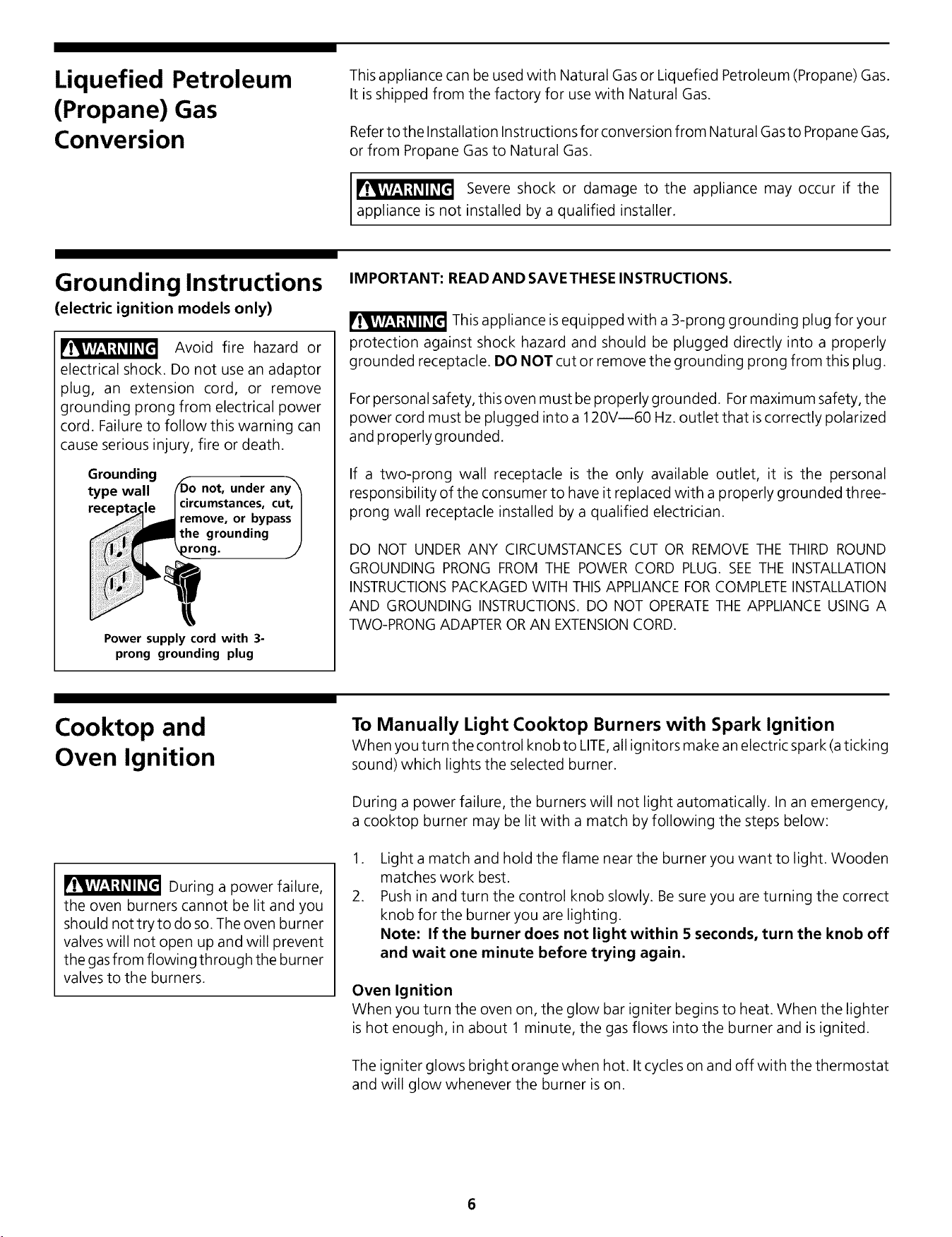
Grounding Instructions
(electric ignition models only)
Avoid fire hazard or
electrical shock. Do not use an adaptor
plug, an extension cord, or remove
grounding prong from electrical power
cord. Failure to follow this warning can
cause serious injury, fire or death.
Grounding
type wall
not, under any_
circumstances, cut, I
remove, or bypass I
the grounding J
_rong. j,
Power supply cord with 3-
prong grounding plug
IMPORTANT: READ AND SAVE TH ESE INSTRUCTIONS.
This appliance is equipped with a 3-prong grounding plug for your
protection against shock hazard and should be plugged directly into a properly
grounded receptacle. DO NOT cut or remove the grounding prong from this plug.
For personal safety, this oven must be properly grounded. For maximum safety, the
power cord must be plugged into a 120Vi60 Hz. outlet that iscorrectly polarized
and properlygrounded.
If a two-prong wall receptacle is the only available outlet, it is the personal
responsibility of the consumer to have it replaced with a properly grounded three-
prong wall receptacle installed by a qualified electrician.
DO NOT UNDER ANY CIRCUMSTANCES CUT OR REMOVE THE THIRD ROUND
GROUNDING PRONG FROM THE POWER CORD PLUG. SEE THE INSTALLATION
INSTRUCTIONS PACKAGED WITH THIS APPLIANCE FOR COMPLETE INSTALLATION
AND GROUNDING INSTRUCTIONS. DO NOT OPERATE THE APPLIANCE USING A
TWO-PRONG ADAPTER OR AN EXTENSION CORD.
Cooktop and
Oven Ignition
During a power failure,
the oven burners cannot be lit and you
should not tryto do so. The oven burner
valves will not open up and will prevent
the gasfrom flowing through the burner
valves to the burners.
To Manually Light Cooktop Burners with Spark Ignition
When you turn the control knob to LITE,all ign itors make an electric spark (aticking
sound) which lights the selected burner.
During a power failure, the burners will not light automatically. In an emergency,
a cooktop burner may be lit with a match by following the steps below:
.
2.
Light a match and hold the flame near the burner you want to light. Wooden
matches work best.
Push in and turn the control knob slowly. Besure you are turning the correct
knob for the burner you are lighting.
Note: If the burner does not light within 5 seconds, turn the knob off
and wait one minute before trying again.
Oven Ignition
When you turn the oven on, the glow bar igniter begins to heat. When the lighter
is hot enough, in about 1 minute, the gas flows into the burner and is ignited.
The igniter glows bright orange when hot. It cycles on and off with the thermostat
and will glow whenever the burner is on.
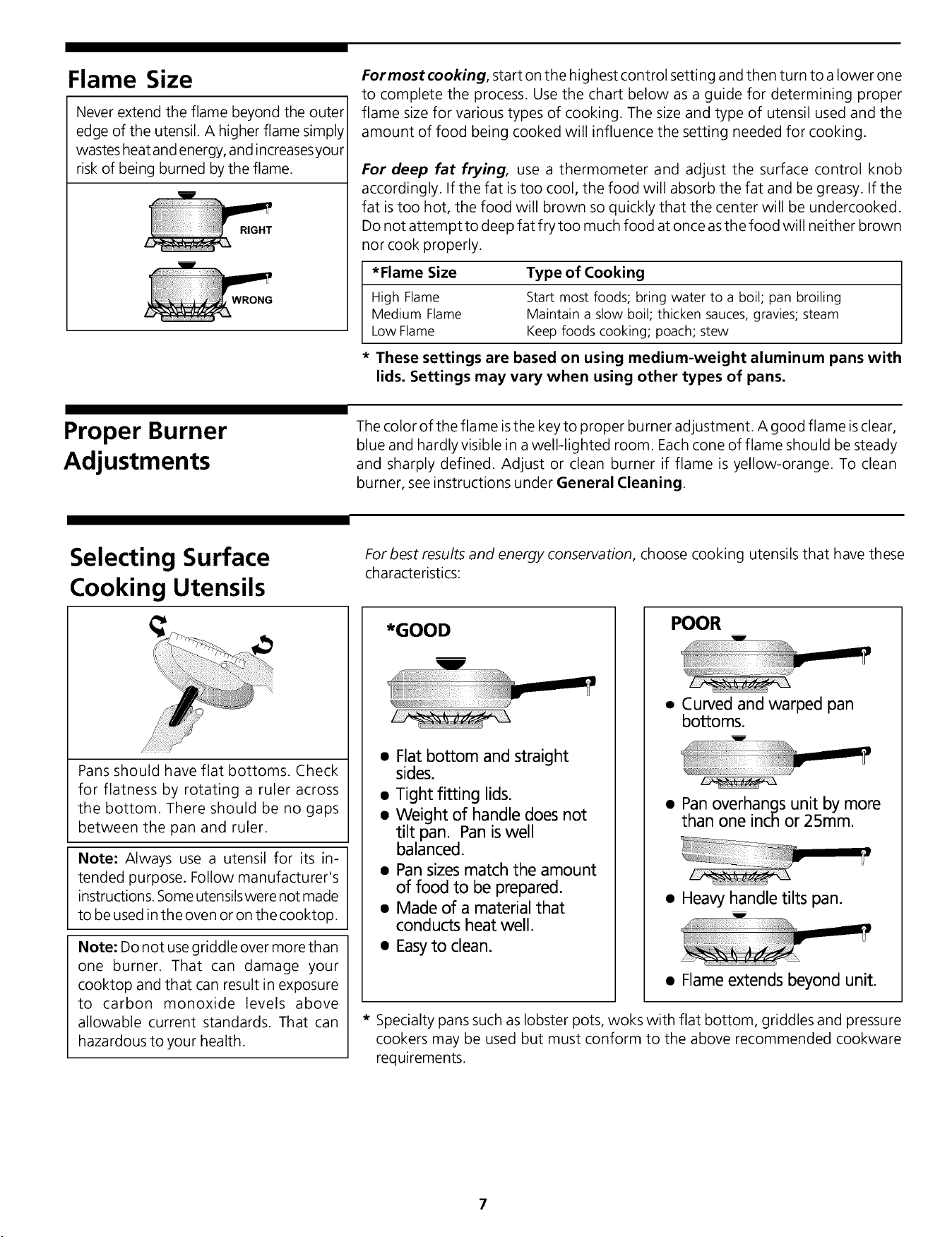
Flame Size
Never extend the flame beyond the outer
edge of the utensil. A higher flame simply
wastes heat andenergy, and increasesyour
risk of being burned by the flame.
RIGHT
WRONG
For most cooking, start on the highest control setting and then turn toa lower one
to complete the process. Use the chart below as a guide for determining proper
flame size for various types of cooking. The size and type of utensil used and the
amount of food being cooked will influence the setting needed for cooking.
For deep fat frying, use a thermometer and adjust the surface control knob
accordingly. If the fat is too cool, the food will absorb the fat and be greasy. If the
fat is too hot, the food will brown so quickly that the center will be undercooked.
Do not attempt to deep fat fry too much food at once as the food will neither brown
nor cook properly.
*Flame Size Type of Cooking
High Flame Start most foods; bring water to a boil; pan broiling
Medium Flame Maintain a slow boil; thicken sauces, gravies; steam
Low Flame Keep foods cooking; poach; stew
* These settings are based on using medium-weight aluminum pans with
lids. Settings may vary when using other types of pans.
Proper Burner
Adjustments
The color of the fla me isthe key to proper burner adjustment. A good fla me is clear,
blue and hardly visible in a well-lighted room. Eachcone of flame should be steady
and sharply defined. Adjust or clean burner if flame is yellow-orange. To clean
burner, see instructions under General Cleaning.
Selecting Surface
Cooking Utensils
q
Pans should have flat bottoms. Check
for flatness by rotating a ruler across
the bottom. There should be no gaps
between the pan and ruler.
Note: Always use a utensil for its in-
tended purpose. Follow manufacturer's
instructions. Some utensilswere not made
to be used inthe oven or on the cooktop.
Note: Do not usegriddle over more than
one burner. That can damage your
cooktop and that can result in exposure
to carbon monoxide levels above
allowable current standards. That can
hazardous to your health.
For best results and energy conservation, choose cooking utensils that have these
characteristics:
*GOOD
• Flat bottom and straight
sides.
• Tight fitting lids.
• Weight of handle does not
tilt pan. Pan is well
balanced.
• Pan sizes match the amount
of food to be prepared.
• Made of a material that
conducts heat well.
• Easy to clean.
POOR
• Curved and warped pan
bottoms.
• Pan overhangs unit by more
than one inch or 25mm.
• Heavy handle tilts pan.
• Flame extends beyond unit.
* Specialty pans such as lobster pots, woks with flat bottom, griddles and pressure
cookers may be used but must conform to the above recommended cookware
requirements.
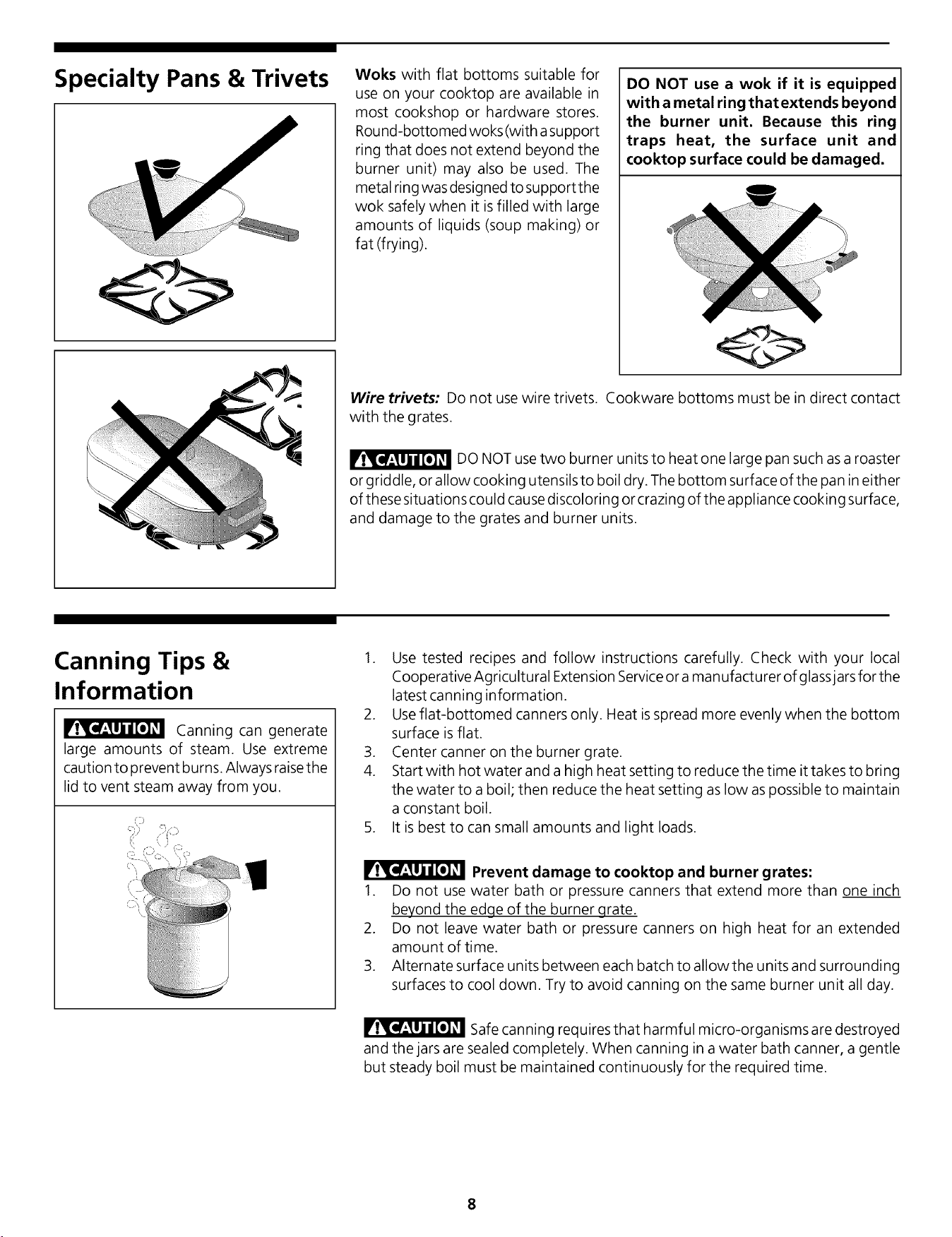
Specialty Pans & Trivets
Woks with flat bottoms suitable for
use on your cooktop are available in
most cookshop or hardware stores.
Round-bottomed woks (with asupport
ring that does not extend beyond the
burner unit) may also be used. The
metal ringwas designed tosupportthe
wok safely when it is filled with large
amounts of liquids (soup making) or
fat (frying).
DO NOT use a wok if it is equipped
with a metal ring that extends beyond
the burner unit. Because this ring
traps heat, the surface unit and
cooktop surface could be damaged.
Wire trivets: Do not use wire trivets. Cookware bottoms must be in direct contact
with the grates.
DO NOT use two burner units to heat one large pan such as a roaster
or griddle, or allow cooking utensilsto boil dry. The bottom surface of the pan in either
of these situations could causediscoloring or crazing of the appliance cooking surface,
and damage to the grates and burner units.
Canning Tips &
Information
Canning can generate
large amounts of steam. Use extreme
caution to prevent burns. Always raisethe
lid to vent steam away from you.
_--;,
1. Use tested recipes and follow instructions carefully. Check with your local
Cooperative Agricultural Extension Serviceor a manufacturer of glassjars for the
latest canning information.
2. Useflat-bottomed canners only. Heat is spread more evenly when the bottom
surface is flat.
3. Center canner on the burner grate.
4. Start with hot water and a high heat setting to reduce the time it takes to bring
the water to a boil; then reduce the heat setting as low as possible to maintain
a constant boil.
5. It is best to can small amounts and light loads.
Prevent damage to cooktop and burner grates:
1. Do not use water bath or pressure canners that extend more than one inch
beyond the edge of the burner grate.
2. Do not leave water bath or pressure canners on high heat for an extended
amount of time.
3. Alternate surface units between each batch to allowthe units and surrounding
surfaces to cool down. Try to avoid canning on the same burner unit all day.
Safe canning requires that harmful micro-organisms are destroyed
and the jars are sealed completely. When canning in a water bath canner, a gentle
but steady boil must be maintained continuously for the required time.
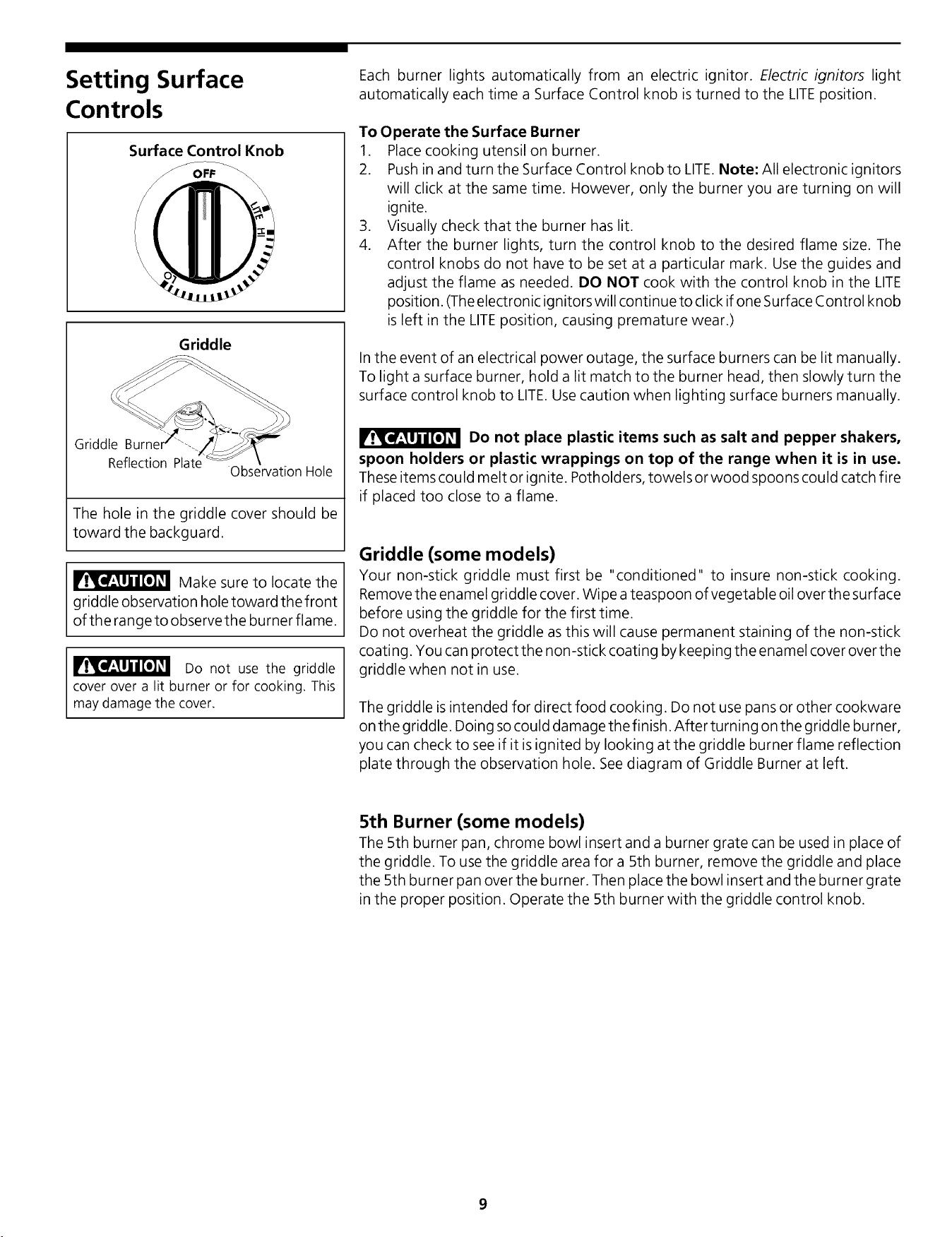
Setting Surface
Controls
Surface Control Knob
Griddle
Griddle
Reflection Plate
Observation Hole
The hole in the griddle cover should be
toward the backguard.
Make sure to locate the
griddle observation hole toward the front
of the range to observe the burner flame.
Do not use the griddle
cover over a lit burner or for cooking. This
maydamagethe cover.
Each burner lights automatically from an electric ignitor. Electric ignitors light
automatically each time a Surface Control knob is turned to the LITEposition.
To Operate the Surface Burner
1. Place cooking utensil on burner.
2. Push in and turn the Surface Control knob to LITE.Note: All electronic ignitors
will click at the same time. However, only the burner you are turning on will
ignite.
3. Visually check that the burner has lit.
4. After the burner lights, turn the control knob to the desired flame size. The
control knobs do not have to be set at a particular mark. Usethe guides and
adjust the flame as needed. DO NOT cook with the control knob in the LITE
position. (The electronic ignitors will continue to click if one Surface Control knob
is left in the LITEposition, causing premature wear.)
In the event of an electrical power outage, the surface burners can be lit manually.
To light a surface burner, hold a lit match to the burner head, then slowly turn the
surface control knob to LITE.Use caution when lighting surface burners manually.
Do not place plastic items such as salt and pepper shakers,
spoon holders or plastic wrappings on top of the range when it is in use.
These items could melt or ignite. Potholders, towels or wood spoons could catch fire
if placed too close to a flame.
Griddle (some models)
Your non-stick griddle must first be "conditioned" to insure non-stick cooking.
Remove the enamel griddle cover. Wipe a teaspoon of vegetable oil over the surface
before using the griddle for the first time.
Do not overheat the griddle as this will cause permanent staining of the non-stick
coating. You can protect the non-stick coating by keeping the enamel cover over the
griddle when not in use.
The griddle is intended for direct food cooking. Do not use pans or other cookware
onthe griddle. Doing socould damage the finish. After turning onthe griddle burner,
you can check to see if it is ignited by looking at the griddle burner flame reflection
plate through the observation hole. See diagram of Griddle Burner at left.
5th Burner (some models)
The 5th burner pan, chrome bowl insert and a burner grate can be used in place of
the griddle. To use the griddle area for a 5th burner, remove the griddle and place
the 5th burner pan over the burner. Then place the bowl insert and the burner grate
in the proper position. Operate the 5th burner with the griddle control knob.
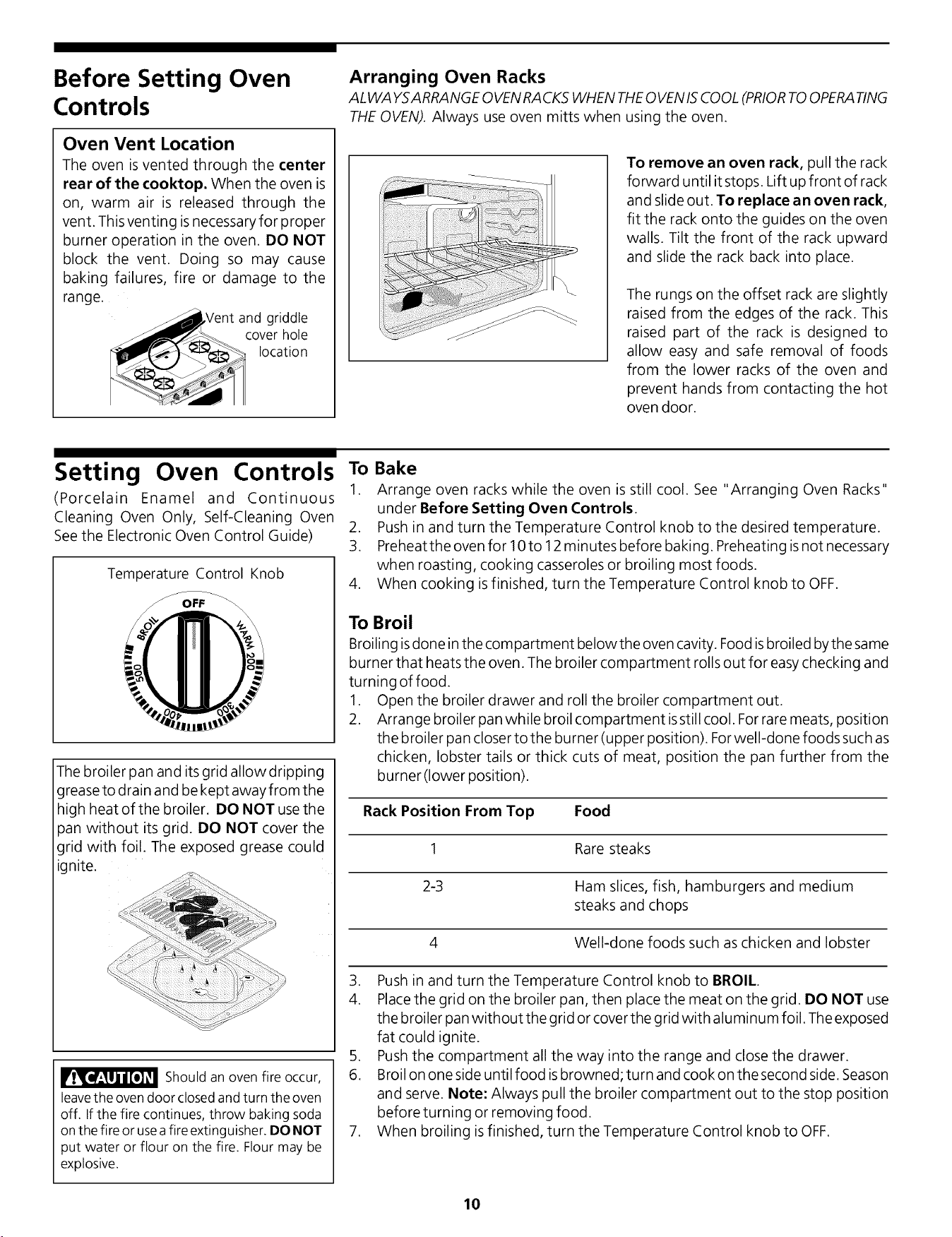
Before Setting Oven
Controls
Oven Vent Location
The oven is vented through the center
rear of the cooktop. When the oven is
on, warm air is released through the
vent. This venting is necessaryfor proper
burner operation in the oven. DO NOT
block the vent. Doing so may cause
baking failures, fire or damage to the
range.
Vent and griddle
cover hole
location
Arranging Oven Racks
ALWA YSARRANGE OVENRACKSWHEN THEOVEN ISCOOL(PRIORTOOPERATING
THEOVEN). Always use oven mitts when using the oven.
To remove an oven rack, pull the rack
forward until it stops. Lift up front of rack
and slide out. To replace an oven rack,
fit the rack onto the guides on the oven
walls. Tilt the front of the rack upward
and slide the rack back into place.
The rungs on the offset rack are slightly
raised from the edges of the rack. This
raised part of the rack is designed to
allow easy and safe removal of foods
from the lower racks of the oven and
prevent hands from contacting the hot
oven door.
Setting Oven Controls
(Porcelain Enamel and Continuous
Cleaning Oven Only, Self-Cleaning Oven
Seethe Electronic Oven Control Guide)
Temperature Control Knob
The broiler pan and its grid allow dripping
grease to drain and be kept away from the
high heat of the broiler. DO NOT use the
_anwithout its grid. DO NOT cover the
grid with foil. The exposed grease could
ignite.
ir!_[w_,_qll[OJ_llShouldan oven fire occur,
leavethe oven doorclosedandturn the oven
off. Ifthe fire continues,throw baking soda
onthe fire oruseafire extinguisher.DONOT
put water or flour on the fire. Flourmay be
explosive.
To Bake
1. Arrange oven racks while the oven is still cool. See "Arranging Oven Racks"
under Before Setting Oven Controls.
2. Push in and turn the Temperature Control knob to the desired temperature.
3. Preheatthe oven for 10to 12 minutes before baking. Preheating isnot necessary
when roasting, cooking casseroles or broiling most foods.
4. When cooking is finished, turn the Temperature Control knob to OFF.
To Broil
Broiling isdone inthe compartment belowthe oven cavity. Food is broiled bythe same
burner that heatsthe oven. The broiler compartment rolls out for easychecking and
turning of food.
1. Open the broiler drawer and roll the broiler compartment out.
2. Arrange broiler pan while broil compartment isstill cool. For rare meats, position
the broiler pan closertothe burner (upper position). Forwell-done foods such as
chicken, lobster tails or thick cuts of meat, position the pan further from the
burner (lower position).
Rack Position From Top Food
1 Rare steaks
2-3 Ham slices, fish, hamburgers and medium
steaks and chops
4 Well-done foods such as chicken and lobster
3. Push in and turn the Temperature Control knob to BROIL.
4. Placethe grid on the broiler pan, then place the meat on the grid. DO NOT use
the broiler panwithout the grid or cover the grid with aluminum foil. The exposed
fat could ignite.
5. Pushthe compartment all the way into the range and close the drawer.
6. Broilon one side until food isbrowned; turn and cook on the second side. Season
and serve. Note: Always pull the broiler compartment out to the stop position
beforeturning or removing food.
7. When broiling is finished, turn the Temperature Control knob to OFF.
10
Air Circulation in the
Oven
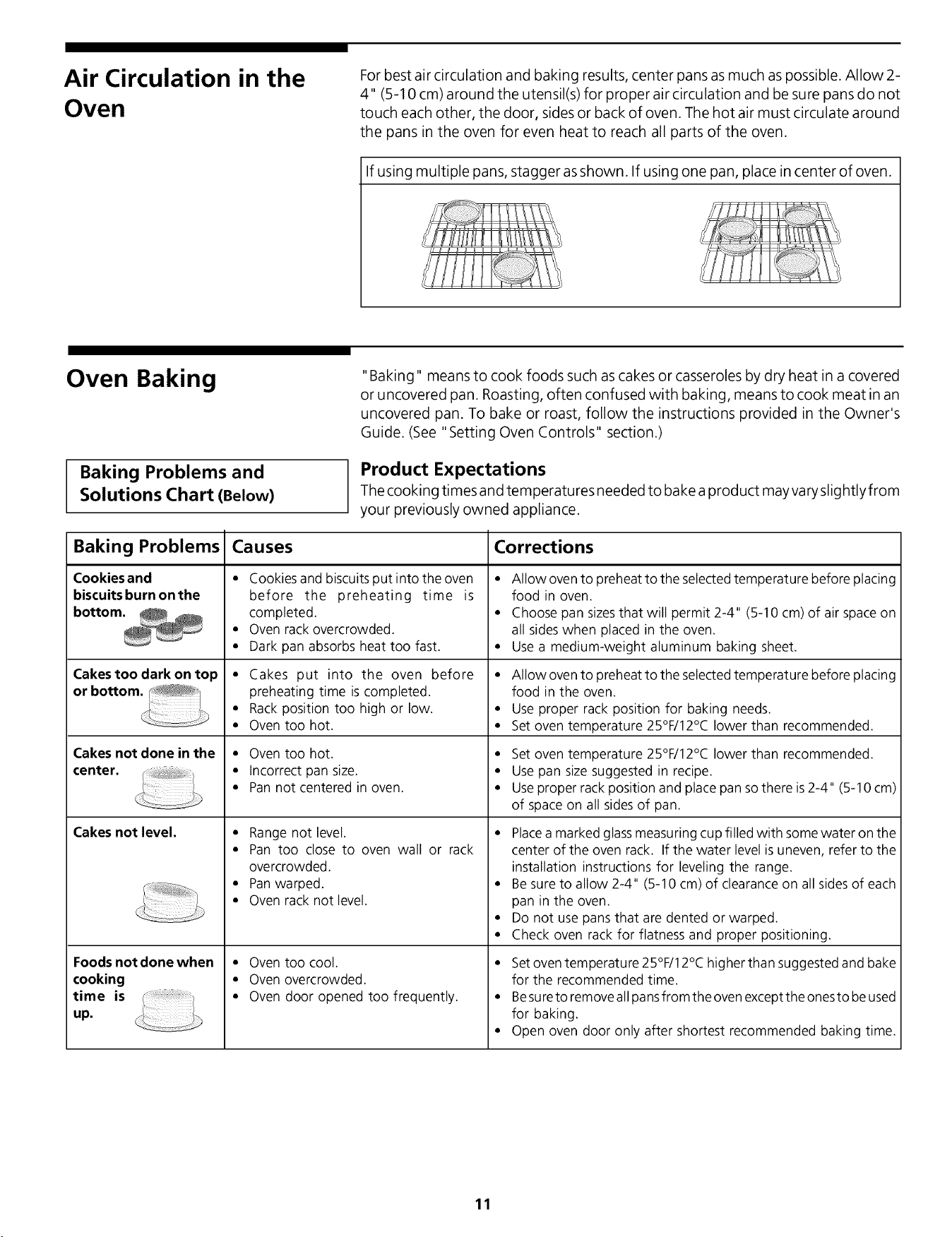
For best air circulation and baking results, center pans as much as possible. Allow 2-
4" (5-10 cm) around the utensil(s) for proper air circulation and be sure pans do not
touch each other, the door, sidesor back of oven. The hot air must circulate around
the pans in the oven for even heat to reach all parts of the oven.
If using multiple pans, stagger as shown. If using one pan, place incenter of oven.
Oven Baking
"Baking" means to cook foods such as cakes or casserolesby dry heat in a covered
or uncovered pan. Roasting, often confused with baking, means to cook meat in an
uncovered pan. To bake or roast, follow the instructions provided in the Owner's
Guide. (See "Setting Oven Controls" section.)
Baking Problems and
Solutions Chart (Below)
Product Expectations
The cooking times and temperatures needed to bake a product mayvaryslightly from
your previously owned appliance.
Baking Problems
Cookiesand
biscuits burn on the
Cakes too dark on top
or bottom
Cakes not done in the
center.
Cakes not level.
Foods not done when
cooking
time is
up.
Causes Corrections
Cookies and biscuits put into the oven
before the preheating time is
completed.
Oven rack overcrowded.
Dark pan absorbs heat too fast.
• Cakes put into the oven before
preheating time is completed.
• Rack position too high or low.
• Oven too hot.
• Oven too hot.
• Incorrect pan size.
• Pan not centered in oven.
• Range not level.
• Pan too close to oven wall or rack
overcrowded.
• Pan warped.
• Oven rack not level.
• Oven too cool.
• Oven overcrowded.
• Oven door opened too frequently.
Allow oven to preheat to the selected temperature before placing
food in oven.
Choose pan sizesthat will permit 2-4" (5-10 cm) of air space on
all sides when placed in the oven.
Use a medium-weight aluminum baking sheet.
Allow oven to preheat to the selected temperature before placing
food in the oven.
Use proper rack position for baking needs.
Set oven temperature 25°F/12°C lower than recommended.
Set oven temperature 25°F/12°C lower than recommended.
Use pan size suggested in recipe.
Useproper rack position and place pan so there is2-4" (5-10 cm)
of space on all sides of pan.
Placea marked glass measuring cup filled with some water on the
center of the oven rack. If the water level is uneven, refer to the
installation instructions for leveling the range.
Be sure to allow 2-4" (5-10 cm) of clearance on all sides of each
pan in the oven.
Do not use pans that are dented or warped.
Check oven rack for flatness and proper positioning.
Set oven temperature 25°F/12°C higher than suggested and bake
for the recommended time.
Besureto remove all pans from the oven except the onesto be used
for baking.
Open oven door only after shortest recommended baking time.
11
Oven Cleaning (continued) Self-Cleaning Oven (some models)
Refer to your Electonic Oven Control Guide
During the self-cleaning cycle, the outside of the wall oven can
become very hot to the touch. DO NOT leave small children unattended near the
appliance. Usecare when opening the oven door after self-cleaning cycle. Stand to
the side of the oven when opening the door to allow hot air or steam to escape.
Adhere to the following cleaning
precautions:
• AIIowthe oven to cool before cleaning.
• Wear rubber gloves when cleaning the
range manually.
REMOVE SPILLOVERS AND HEAVY SOIL-
ING AS SOON AS POSSIBLE. REGULAR
CLEANINGS WILL REDUCE THE NUM-
BER OF MAJOR CLEANINGS LATER.
Ammonia must be rinsed
before operating the oven. Provide
adequate vent at on.
DO NOT line the oven
walls, bottom, racks or any other part of
the range with aluminum foil. Doing so
will destroy heat distribution, produce
poor baking results and cause permanent
damage to the oven interior (aluminum
foil will melt to the interior surface of the
oven).
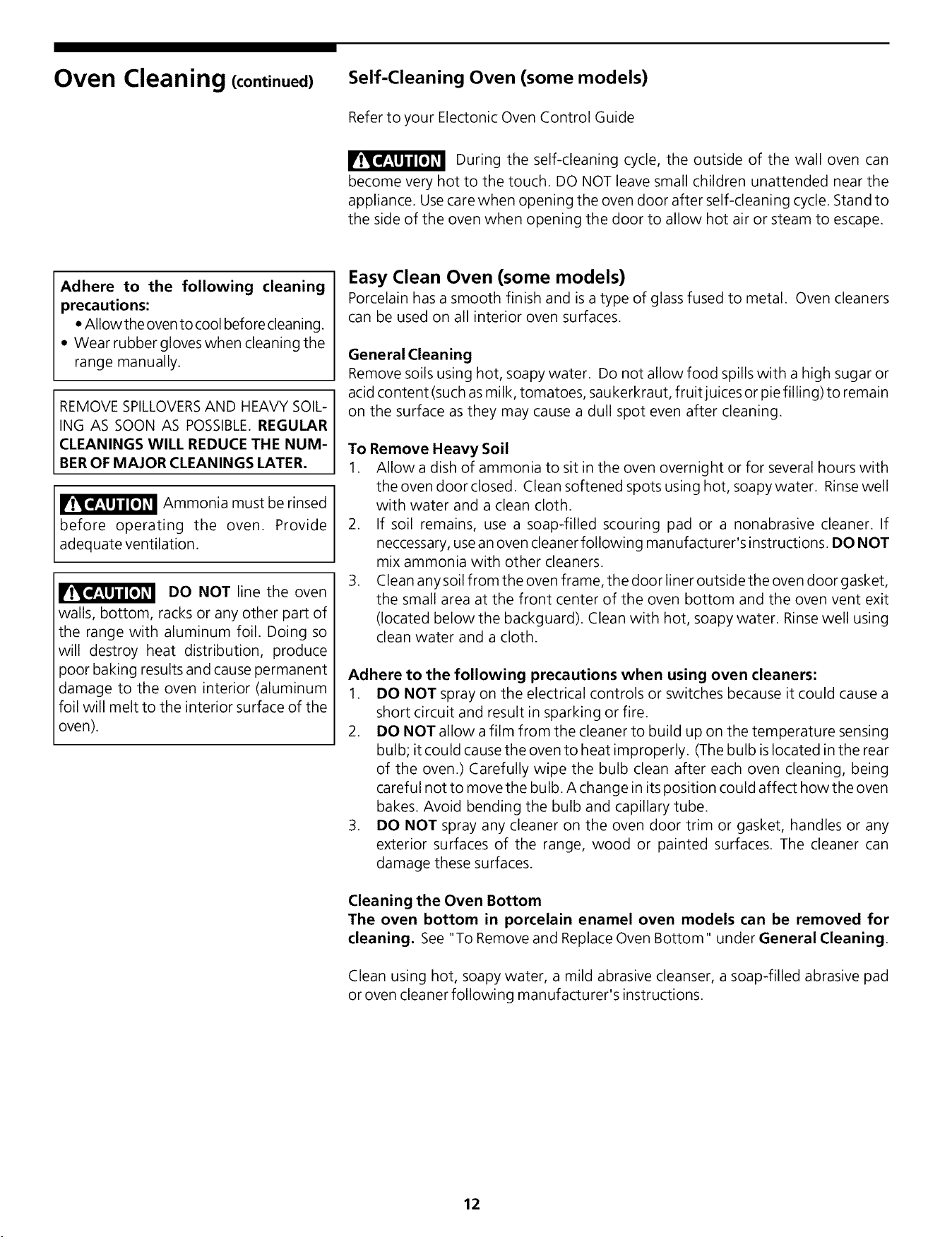
Easy Clean Oven (some models)
Porcelain has a smooth finish and is a type of glass fused to metal. Oven cleaners
can be used on all interior oven surfaces.
General Cleaning
Remove soils using hot, soapy water. Do not allow food spills with a high sugar or
acid content (such as milk, tomatoes, saukerkraut, fruit juices or pie filling)to remain
on the surface as they may cause a dull spot even after cleaning.
To Remove Heavy Soil
1. Allow a dish of ammonia to sit in the oven overnight or for several hours with
the oven door closed. Clean softened spots using hot, soapy water. Rinsewell
with water and a clean cloth.
2. If soil remains, use a soap-filled scouring pad or a nonabrasive cleaner. If
neccessary,use anoven cleaner following manufacturer's instructions. DO NOT
mix ammonia with other cleaners.
3. Clean anysoil from the oven frame, the door liner outside the oven door gasket,
the small area at the front center of the oven bottom and the oven vent exit
(located below the backguard). Clean with hot, soapy water. Rinsewell using
clean water and a cloth.
Adhere to the following precautions when using oven cleaners:
1. DO NOT spray on the electrical controls or switches because it could cause a
short circuit and result in sparking or fire.
2. DO NOT allow a film from the cleaner to build up on the temperature sensing
bulb; it could causethe oven to heat improperly. (The bulb islocated in the rear
of the oven.) Carefully wipe the bulb clean after each oven cleaning, being
careful not to move the bulb. A change in its position could affect howthe oven
bakes. Avoid bending the bulb and capillary tube.
3. DO NOT spray any cleaner on the oven door trim or gasket, handles or any
exterior surfaces of the range, wood or painted surfaces. The cleaner can
damage these surfaces.
Cleaning the Oven Bottom
The oven bottom in porcelain enamel oven models can be removed for
cleaning. See "To Remove and Replace Oven Bottom" under General Cleaning.
Clean using hot, soapy water, a mild abrasive cleanser, a soap-filled abrasive pad
or oven cleaner following manufacturer's instructions.
12
Oven Cleaning (continued)
Adhere to the following cleaning
precautions:
• AIIowthe oven to cool before cleaning.
• Wear rubber gloveswhen cleaning the
range manually.
REMOVE SPILLOVERS AND HEAVY
SOILING AS SOON AS POSSIBLE.REGUlaR
CLEANINGS WILL REDUCE THE NUM-
BER OF MAJOR CLEANINGS LATER.
Ammonia must be rinsed
before operating the oven. Provide
adequate ventilation.
DO NOT use oven
cleaners, gritty cleansers, coarse abrasive
pads or brushes, silicone sprays or metal
scrapers on the interior walls, oven frame
or ceiling of a continuous cleaning oven.
Permanent damage to the oven may
result.
DO NOT line the oven
walls, bottom, racks or any other part of
the range with aluminum foil. Doing so
will destroy heat distribution, produce
poor baking results and cause permanent
damage to the oven interior (aluminum
foil will melt to the interior surface of the
oven).
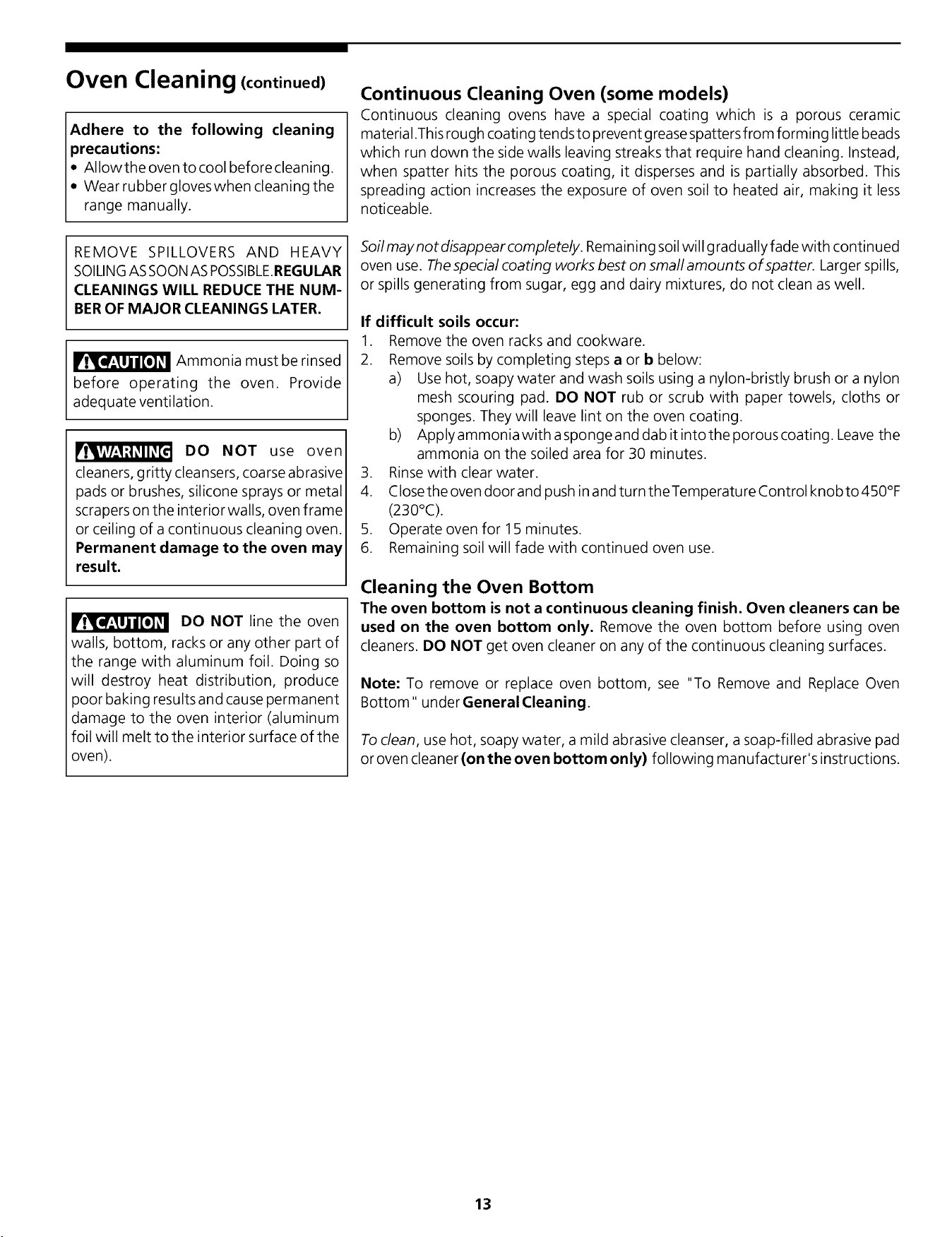
Continuous Cleaning Oven (some models)
Continuous cleaning ovens have a special coating which is a porous ceramic
material.This rough coating tendsto prevent greasespatters from forming little beads
which run down the side walls leaving streaks that require hand cleaning. Instead,
when spatter hits the porous coating, it disperses and is partially absorbed. This
spreading action increases the exposure of oven soil to heated air, making it less
noticeable.
Soilmaynotdisappearcompletely. Remaining soil will gradually fade with continued
oven use. The special coating works best on small amounts of spatter. Larger spills,
or spills generating from sugar, egg and dairy mixtures, do not clean as well.
If difficult soils occur:
1. Remove the oven racks and cookware.
2. Remove soils by completing steps a or b below:
a) Use hot, soapy water and wash soils using a nylon-bristly brush or a nylon
mesh scouring pad. DO NOT rub or scrub with paper towels, cloths or
sponges. They will leave lint on the oven coating.
b) Applyammoniawith aspongeand dab it intothe porouscoating. Leave the
ammonia on the soiled area for 30 minutes.
3. Rinsewith clear water.
4. Closethe oven door and push inand turn theTemperature Control knobto450°F
(230°C).
5. Operate oven for 15 minutes.
6. Remaining soil will fade with continued oven use.
Cleaning the Oven Bottom
The oven bottom is not a continuous cleaning finish. Oven cleaners can be
used on the oven bottom only. Remove the oven bottom before using oven
cleaners. DO NOT get oven cleaner on any of the continuous cleaning surfaces.
Note: To remove or replace oven bottom, see "To Remove and Replace Oven
Bottom" under General Cleaning.
To dean, use hot, soapy water, a mild abrasive cleanser, a soap-filled abrasive pad
or oven cleaner (on the oven bottom only) following manufacturer's instructions.
13
General Cleaning
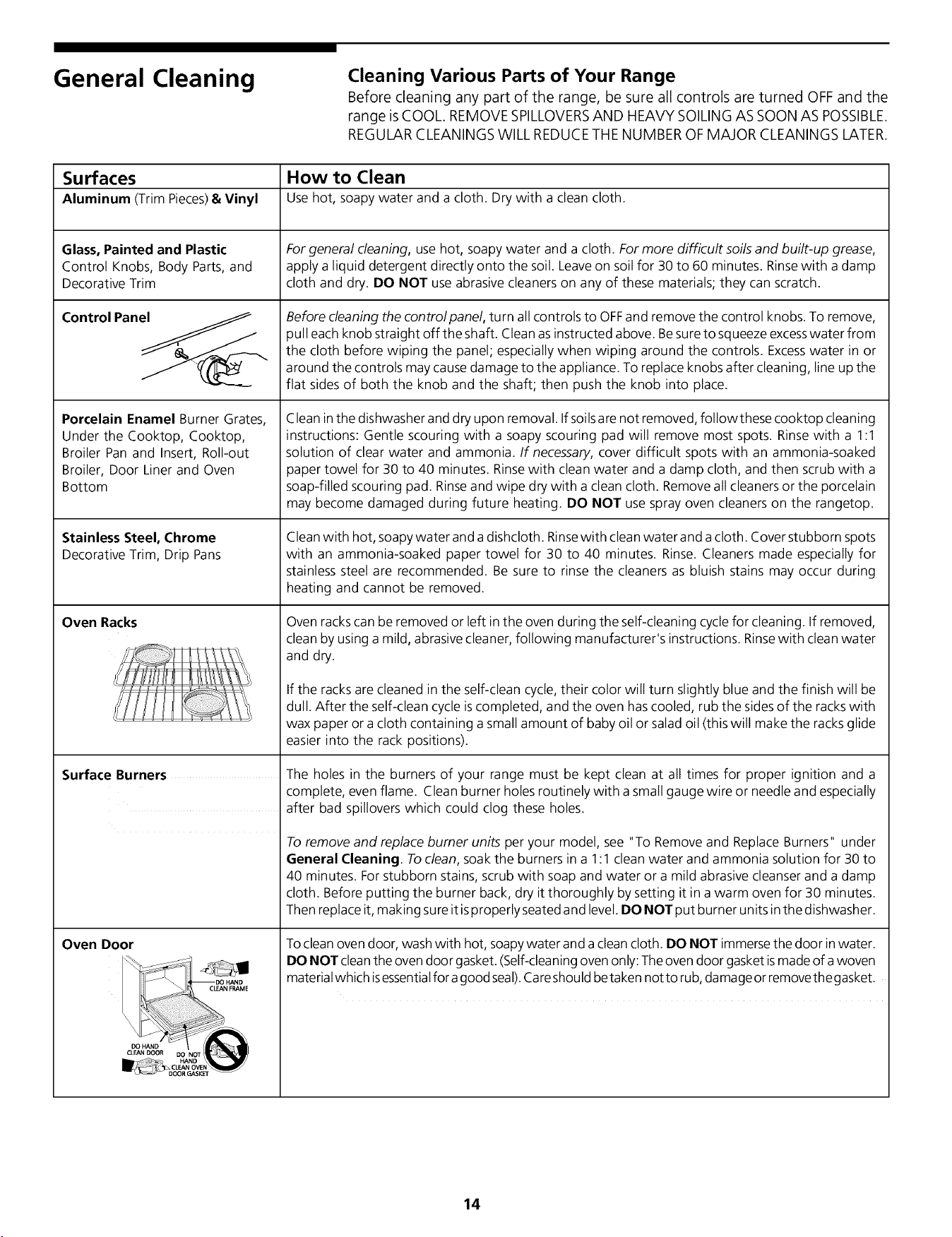
Cleaning Various Parts of Your Range
Before cleaning any part of the range, be sure all controls are turned OFF and the
range is COOL. REMOVE SPILLOVERS AND HEAVY SOILING AS SOON AS POSSIBLE.
REGULAR CLEANINGS WILL REDUCE THE NUMBER OF MAJOR CLEANINGS LATER.
Surfaces How to Clean
Aluminum (Trim Pieces)& Vinyl Use hot, soapy water and a cloth. Dry with a clean cloth.
Glass, Painted and Plastic For general cleaning, use hot, soapy water and a cloth. For more difficult soils and built-up grease,
Control Knobs, Body Parts, and apply a liquid detergent directly onto the soil. Leaveon soil for 30 to 60 minutes. Rinsewith a damp
Decorative Trim cloth and dry. DO NOT use abrasive cleaners on any of these materials; they can scratch.
Control Pane_
Porcelain Enamel Burner Grates,
Under the Cooktop, Cooktop,
Broiler Pan and Insert, Roll-out
Broiler, Door Liner and Oven
Bottom
Stainless Steel, Chrome
Decorative Trim, Drip Pans
Oven Racks
Surface Burners
Oven Door
Before cleaning the controlpanel, turn all controls to OFFand remove the control knobs. To remove,
pull each knob straight off the shaft. Clean as instructed above. Besure to squeeze excesswater from
the cloth before wiping the panel; especially when wiping around the controls. Excesswater in or
around the controls may cause damage to the appliance. To replace knobs after cleaning, line up the
flat sides of both the knob and the shaft; then push the knob into place.
C lean in the dishwasher and dry upon removal. If soilsare not removed, followthese cooktop cleaning
instructions: Gentle scouring with a soapy scouring pad will remove most spots. Rinse with a 1:1
solution of clear water and ammonia. If necessary, cover difficult spots with an ammonia-soaked
paper towel for 30 to 40 minutes. Rinsewith clean water and a damp cloth, and then scrub with a
soap-filled scouring pad. Rinse and wipe dry with a clean cloth. Remove all cleaners or the porcelain
may become damaged during future heating. DO NOT use spray oven cleaners on the rangetop.
Cleanwith hot, soapy water and a dishcloth. Rinsewith clean water and a cloth. Cover stubborn spots
with an ammonia-soaked paper towel for 30 to 40 minutes. Rinse. Cleaners made especially for
stainless steel are recommended. Be sure to rinse the cleaners as bluish stains may occur during
heating and cannot be removed.
Oven racks can be removed or left in the oven during the self-cleaning cycle for cleaning. If removed,
clean by using a mild, abrasive cleaner, following manufacturer's instructions. Rinsewith clean water
and dry.
If the racks are cleaned in the self-clean cycle, their color will turn slightly blue and the finish will be
dull. After the self-clean cycle is completed, and the oven has cooled, rub the sides of the racks with
wax paper or a cloth containing a small amount of baby oil or salad oil (this will make the racks glide
easier into the rack positions).
The holes in the burners of your range must be kept clean at all times for proper ignition and a
complete, even flame. Clean burner holes routinely with a small gauge wire or needle and especially
after bad spillovers which could clog these holes.
To remove and replace burner units per your model, see "To Remove and Replace Burners" under
General Cleaning. To clean, soak the burners in a 1:1 clean water and ammonia solution for 30 to
40 minutes. For stubborn stains, scrub with soap and water or a mild abrasive cleanser and a damp
cloth. Before putting the burner back, dry it thoroughly by setting it in a warm oven for 30 minutes.
Then replace it, making sure it isproperly seated and level. DO NOT put burner units inthe dishwasher.
To clean oven door, wash with hot, soapy water and a clean cloth. DO NOT immerse the door inwater.
DO NOT clean the oven door gasket. (Self-cleaning oven on ly:The oven door gasket is made of awoven
materialwhich isessential for agood seal).Careshould betaken not to rub, damage or removethe gasket.
14
General Cleaning
(continued)
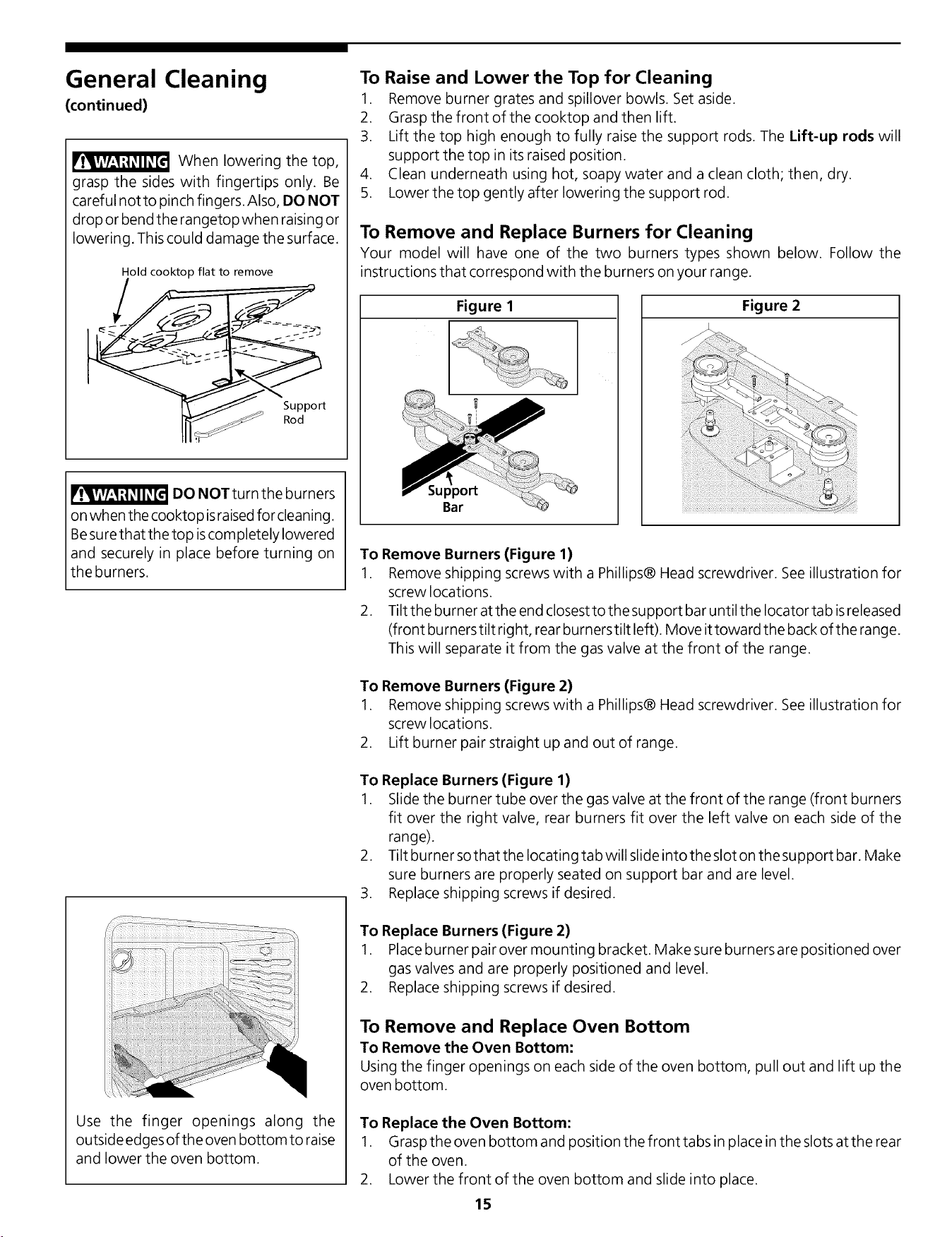
When lowering the top,
grasp the sides with fingertips only. Be
careful notto pinch fingers. Also, DO NOT
drop or bend the rangetopwhen raising or
lowering. This could damage the surface.
Hold cooktop flat to remove
J_" _Support
Ill,, .od
DO NOTturn the burners
on when the cooktop israisedfor cleaning.
Besurethat the top iscompletely lowered
and securely in place before turning on
the burners.
Use the finger openings along the
outside edges of the oven bottom to raise
and lower the oven bottom.
To Raise and Lower the Top for Cleaning
1. Remove burner grates and spillover bowls. Set aside.
2. Grasp the front of the cooktop and then lift.
3. Lift the top high enough to fully raise the support rods. The Lift-up rods will
support the top in its raised position.
4. Clean underneath using hot, soapy water and a clean cloth; then, dry.
5. Lower the top gently after lowering the support rod.
To Remove and Replace Burners for Cleaning
Your model will have one of the two burners types shown below. Follow the
instructions that correspond with the burners on your range.
Figure I
Bar
Figure 2
To Remove Burners (Figure 1)
I. Remove shipping screws with a Phillips® Head screwdriver. See illustration for
screw locations.
2. Tiltthe burner atthe end closesttothe support bar until the locator tab isreleased
(front burnerstilt right, rear burnerstilt left). Move it toward the back of the range.
This will separate it from the gas valve at the front of the range.
To Remove Burners (Figure 2)
I. Remove shipping screws with a Phillips® Head screwdriver. See illustration for
screw locations.
2. Lift burner pair straight up and out of range.
To Replace Burners (Figure 1)
I. Slidethe burner tube over the gas valve at the front of the range (front burners
fit over the right valve, rear burners fit over the left valve on each side of the
range).
2. Tilt burner sothat the locating tab will slide intothe slot on the support bar. Make
sure burners are properly seated on support bar and are level.
3. Replaceshipping screws if desired.
To Replace Burners (Figure 2)
I. Placeburner pair over mounting bracket. Make sure burners are positioned over
gas valves and are properly positioned and level.
2. Replaceshipping screws if desired.
To Remove and Replace Oven Bottom
To Remove the Oven Bottom:
Using the finger openings on each side of the oven bottom, pull out and lift up the
oven bottom.
To Replace the Oven Bottom:
1. Grasp the oven bottom and position the front tabs in place in the slots at the rear
of the oven.
2. Lower the front of the oven bottom and slide into place.
15
General Cleaning
(continued)
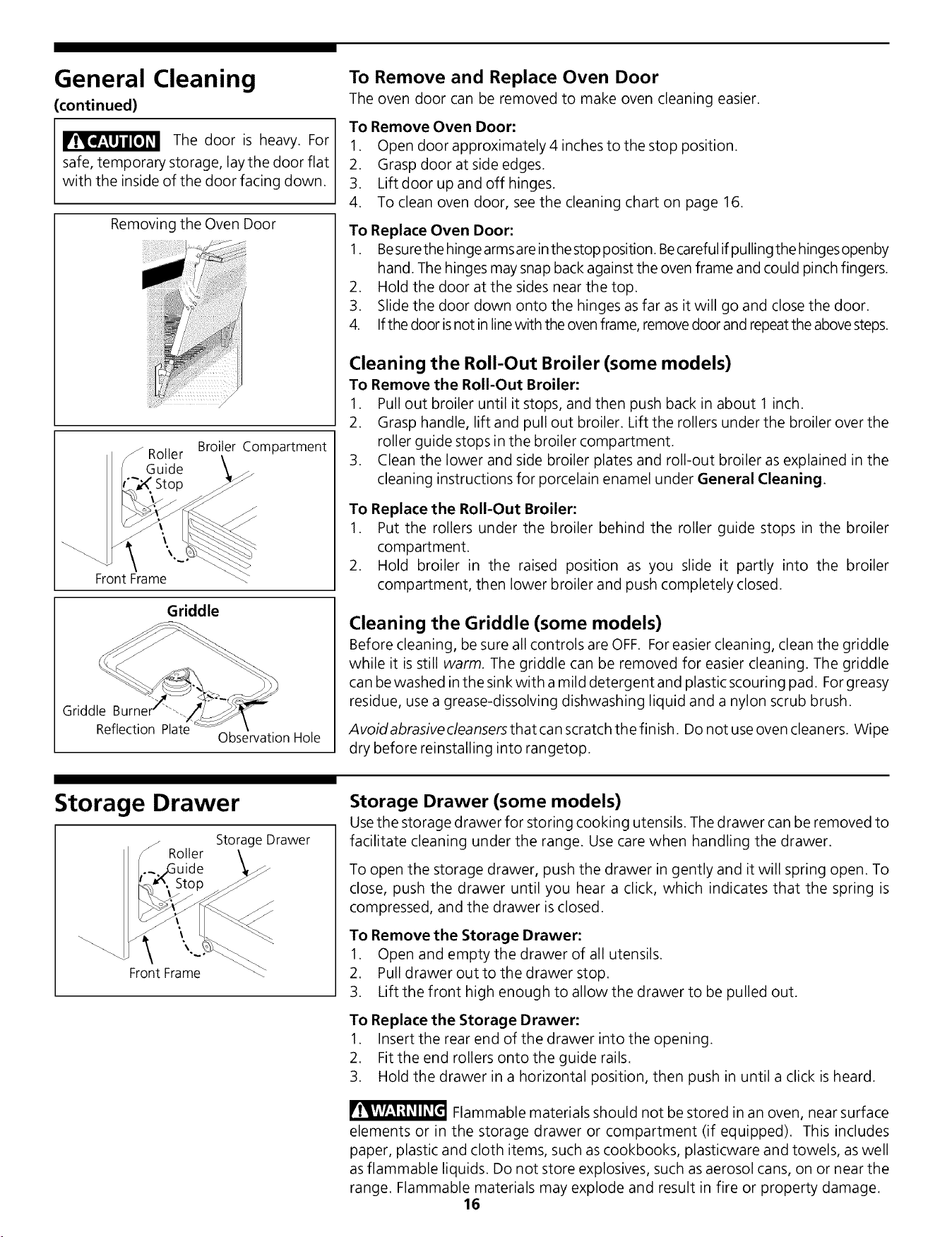
The door is heavy. For
safe, temporary storage, laythe door flat
with the inside of the door facing down.
Removing the Oven Door
Roller Broiler Compartment
Guide
FrontFrame
Griddle
Griddle
Reflection Plate
Observation Hole
To Remove and Replace Oven Door
The oven door can be removed to make oven cleaning easier.
To Remove Oven Door:
1. Open door approximately 4 inches to the stop position.
2. Grasp door at side edges.
3. Lift door up and off hinges.
4. To clean oven door, see the cleaning chart on page 16.
To Replace Oven Door:
1. Besurethe hingearmsare inthe stopposition. Becareful if pulling the hingesopenby
hand. The hinges maysnap back against the oven frame and could pinch fingers.
2. Hold the door at the sides near the top.
3. Slide the door down onto the hinges as far as it will go and close the door.
4. Ifthe door isnot inlinewith the oven frame, removedoor and repeatthe abovesteps.
Cleaning the Roll-Out Broiler (some models)
To Remove the Roll-Out Broiler:
1. Pull out broiler until it stops, and then push back in about 1 inch.
2. Grasp handle, lift and pull out broiler. Lift the rollers under the broiler over the
roller guide stops in the broiler compartment.
3. Clean the lower and side broiler plates and roll-out broiler as explained in the
cleaning instructions for porcelain enamel under General Cleaning.
To Replace the Roll-Out Broiler:
1. Put the rollers under the broiler behind the roller guide stops in the broiler
compartment.
2. Hold broiler in the raised position as you slide it partly into the broiler
compartment, then lower broiler and push completely closed.
Cleaning the Griddle (some models)
Before cleaning, be sure all controls are OFF. For easier cleaning, clean the griddle
while it is still warm. The griddle can be removed for easier cleaning. The griddle
can bewashed inthe sink with a mild detergent and plastic scouring pad. For greasy
residue, use a grease-dissolving dishwashing liquid and a nylon scrub brush.
Avoidabrasivecleansersthat can scratch the finish. Do not use oven cleaners. Wipe
dry before reinstalling into rangetop.
Storage Drawer
Storage Drawer
Roller
FrontFrame
Storage Drawer (some models)
Usethe storage drawer for storing cooking utensils. The drawer can be removed to
facilitate cleaning under the range. Use care when handling the drawer.
To open the storage drawer, push the drawer in gently and it will spring open. To
close, push the drawer until you hear a click, which indicates that the spring is
compressed, and the drawer is closed.
To Remove the Storage Drawer:
1. Open and empty the drawer of all utensils.
2. Pull drawer out to the drawer stop.
3. Lift the front high enough to allow the drawer to be pulled out.
To Replace the Storage Drawer:
1. Insert the rear end of the drawer into the opening.
2. Fit the end rollers onto the guide rails.
3. Hold the drawer in a horizontal position, then push in until a click is heard.
Flammable materials should not be stored in an oven, near surface
elements or in the storage drawer or compartment (if equipped). This includes
paper, plastic and cloth items, such as cookbooks, plasticware and towels, as well
as flammable liquids. Do not store explosives, such as aerosol cans, on or near the
range. Flammable materials may explode and result in fire or property damage.
16
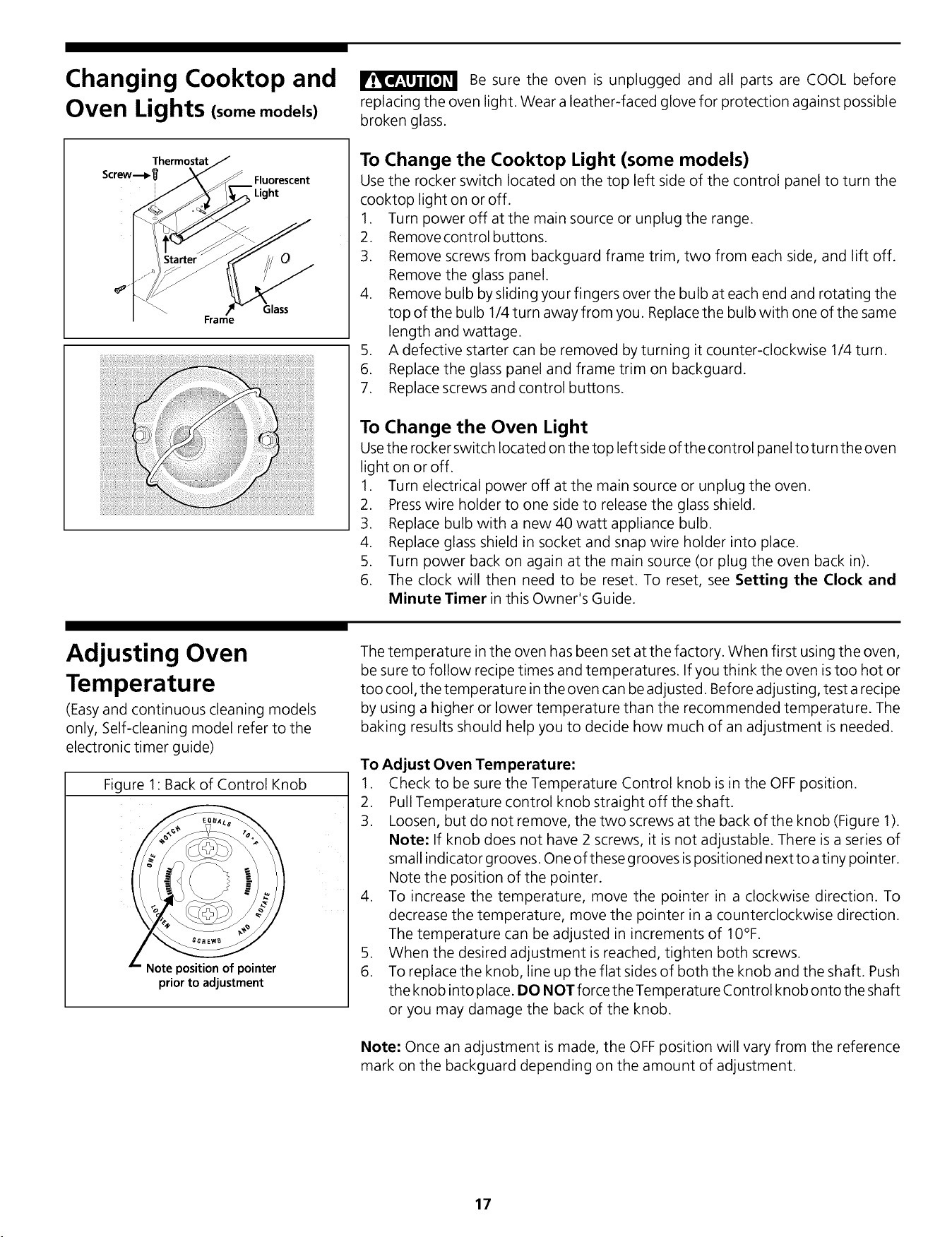
Changing Cooktop and
Oven Lights (somemodels)
Thermostat
Screw_ _ Fluorescent
i Light
0
Glass
Frame
Be sure the oven is unplugged and all parts are COOL before
replacing the oven light. Wear a leather-faced glove for protection against possible
broken glass.
To Change the Cooktop Light (some models)
Usethe rocker switch located on the top left side of the control panel to turn the
cooktop light on or off.
1. Turn power off at the main source or unplug the range.
2. Removecontrol buttons.
3. Remove screws from backguard frame trim, two from each side, and lift off.
Remove the glass panel.
4. Remove bulb by sliding your fingers over the bulb at each end and rotating the
top of the bulb 1/4 turn away from you. Replacethe bulb with one of the same
length and wattage.
5. A defective starter can be removed by turning it counter-clockwise 1/4 turn.
6. Replacethe glass panel and frame trim on backguard.
7. Replacescrews and control buttons.
To Change the Oven Light
Usethe rocker switch located on the top left side of the control panel toturn the oven
light on or off.
1. Turn electrical power off at the main source or unplug the oven.
2. Presswire holder to one side to release the glass shield.
3. Replace bulb with a new 40 watt appliance bulb.
4. Replace glass shield in socket and snap wire holder into place.
5. Turn power back on again at the main source (or plug the oven back in).
6. The clock will then need to be reset. To reset, see Setting the Clock and
Minute Timer in this Owner's Guide.
Adjusting Oven
Temperature
(Easyand continuous cleaning models
only, Self-cleaning model refer to the
electronic timer guide)
Figure 1 Back of Control Knob
Z Note position of pointer
prior to adjustment
The temperature in the oven has been set atthe factory. When first using the oven,
be sure to follow recipe times and temperatures. If you think the oven is too hot or
too cool, the temperature inthe oven can beadjusted. Before adjusting, test a recipe
by using a higher or lower temperature than the recommended temperature. The
baking results should help you to decide how much of an adjustment is needed.
To Adjust Oven Temperature:
1. Check to be sure the Temperature Control knob is in the OFFposition.
2. Pull Temperature control knob straight off the shaft.
3. Loosen, but do not remove, the two screws at the back of the knob (Figure 1).
Note: If knob does not have 2 screws, it is not adjustable. There is a series of
small indicator grooves. One of these grooves is positioned next to atiny pointer.
Note the position of the pointer.
4. To increase the temperature, move the pointer in a clockwise direction. To
decrease the temperature, move the pointer in a counterclockwise direction.
The temperature can be adjusted in increments of 10°F.
5. When the desired adjustment is reached, tighten both screws.
6. To replace the knob, line up the flat sides of both the knob and the shaft. Push
the knob into place. DO NOT force the Temperature Control knob onto the shaft
or you may damage the back of the knob.
Note: Once an adjustment is made, the OFFposition will vary from the reference
mark on the backguard depending on the amount of adjustment.
17
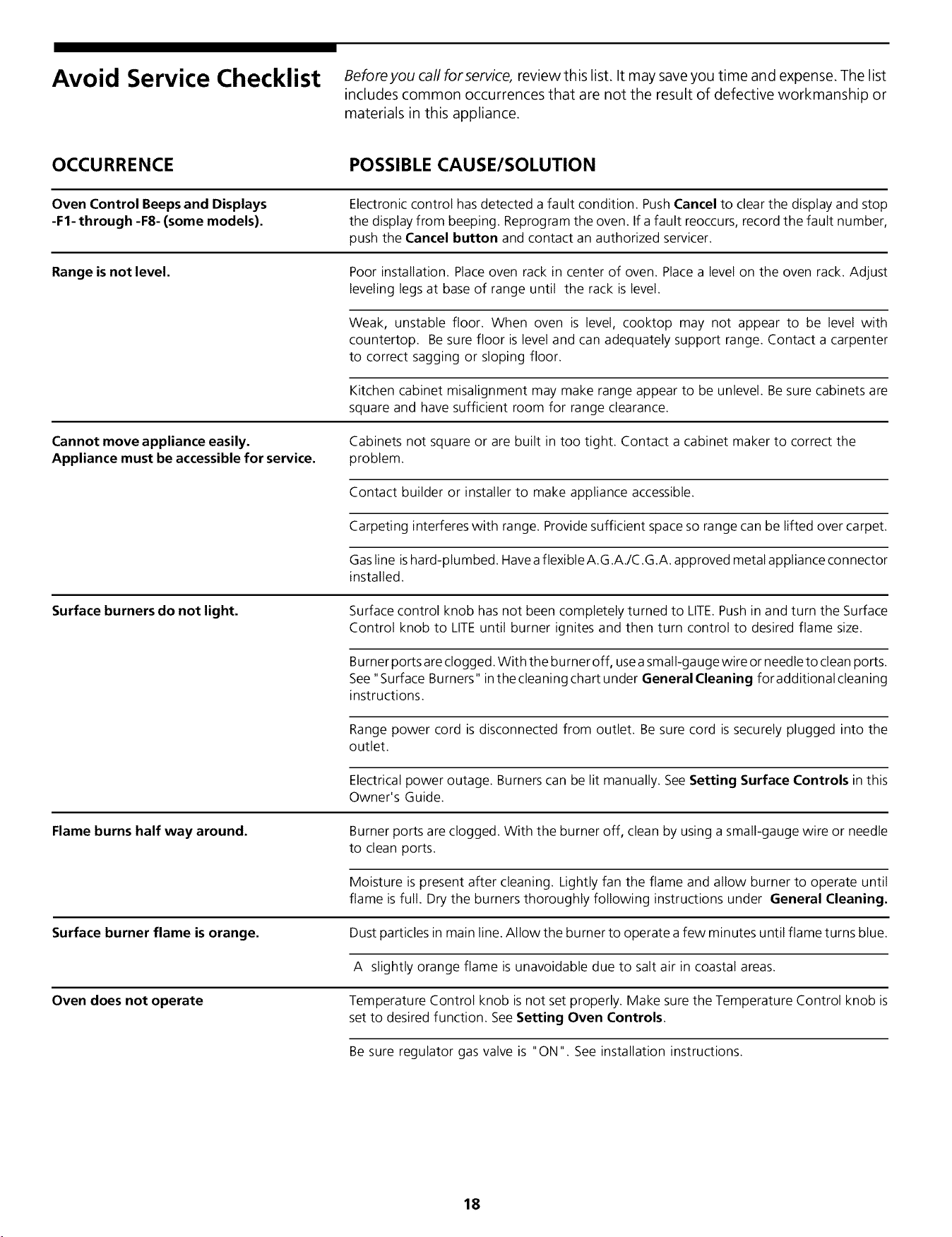
Avoid Service Checklist Before you call for service, reviewthislist. It may save you time and expense. The list
includes common occurrences that are not the result of defective workmanship or
materials in this appliance.
OCCURRENCE POSSIBLE CAUSE/SOLUTION
Oven Control Beeps and Displays
-F1- through -F8- (some models).
Electronic control has detected a fault condition. Push Cancel to clear the display and stop
the display from beeping. Reprogram the oven. If a fault reoccurs, record the fault number,
push the Cancel button and contact an authorized servicer.
Range is not level. Poor installation. Place oven rack in center of oven. Placea level on the oven rack. Adjust
leveling legs at base of range until the rack is level.
Weak, unstable floor. When oven is level, cooktop may not appear to be level with
countertop. Be sure floor is level and can adequately support range. Contact a carpenter
to correct sagging or sloping floor.
Kitchen cabinet misalignment may make range appear to be unlevel. Be sure cabinets are
square and have sufficient room for range clearance.
Cannot move appliance easily.
Appliance must be accessible for service.
Cabinets not square or are built in too tight. Contact a cabinet maker to correct the
problem.
Contact builder or installer to make appliance accessible.
Carpeting interferes with range. Provide sufficient space so range can be lifted over carpet.
Gas line is hard-plumbed. Have a flexible A.G.A./C.G.A. approved metal appliance connector
installed.
Surface burners do not light. Surface control knob has not been completely turned to LITE.Push in and turn the Surface
Control knob to LITE until burner ignites and then turn control to desired flame size.
Burner ports are clogged. With the burner off, useasmall-gaugewire or needleto clean ports.
See"Surface Burners" inthe cleaning chart under General Cleaning for additional cleaning
instructions.
Range power cord is disconnected from outlet. Be sure cord is securely plugged into the
outlet.
Electrical power outage. Burners can be lit manually. See Setting Surface Controls in this
Owner's Guide.
Flame burns half way around.
Surface burner flame is orange.
Oven does not operate
Burner ports are clogged. With the burner off, clean by using a small-gauge wire or needle
to clean ports.
Moisture is present after cleaning. Lightly fan the flame and allow burner to operate until
flame is full. Dry the burners thoroughly following instructions under General Cleaning.
Dust particles in main line. Allow the burner to operate a few minutes until flame turns blue.
A slightly orange flame is unavoidable due to salt air in coastal areas.
Temperature Control knob is not set properly. Make sure the Temperature Control knob is
set to desired function. See Setting Oven Controls.
Be sure regulator gas valve is "ON". See installation instructions.
18
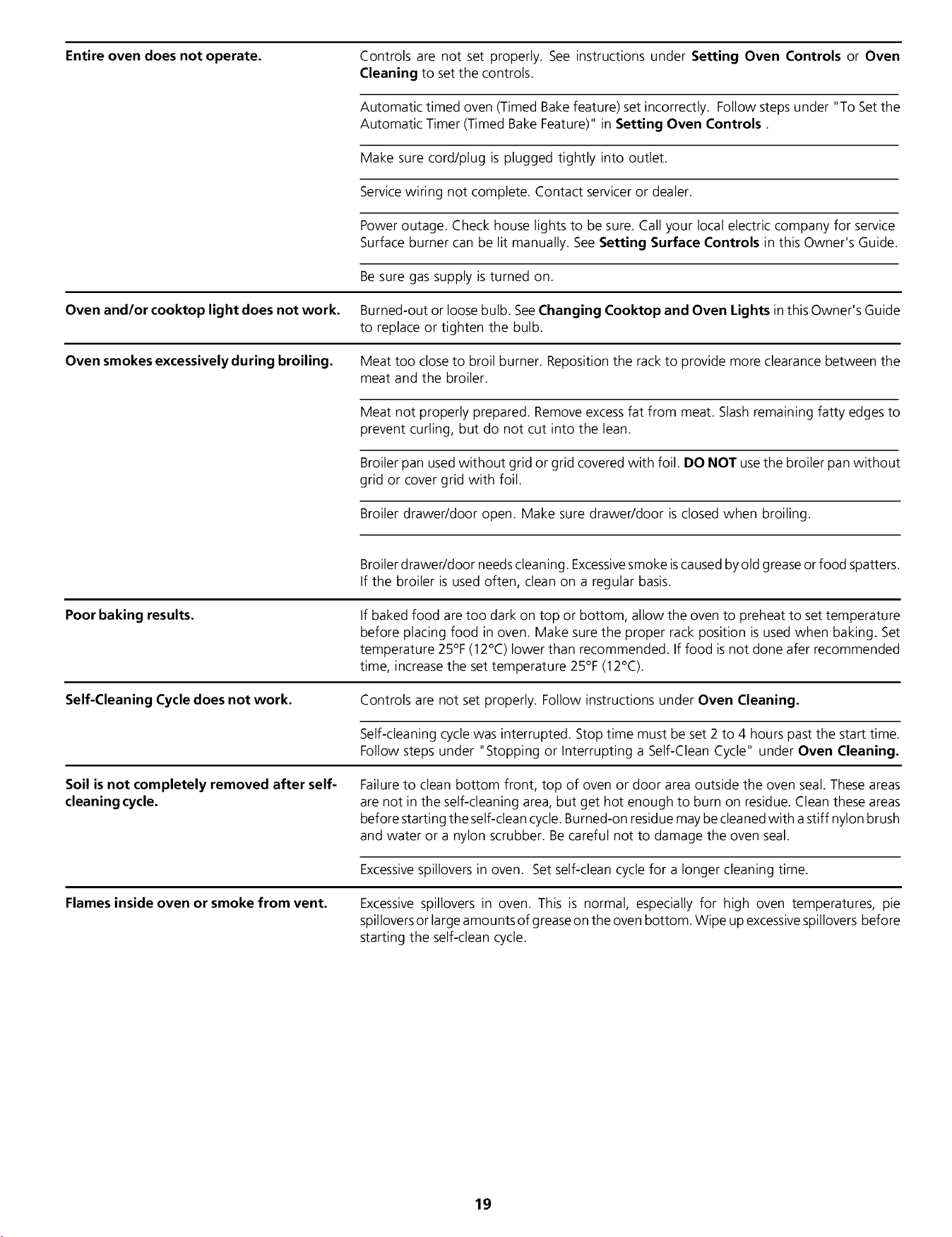
Entire oven does not operate.
Oven and/or cooktop light does not work.
Oven smokes excessively during broiling.
Controls are not set properly. See instructions under Setting Oven Controls or Oven
Cleaning to set the controls.
Automatic timed oven (Timed Bake feature) set incorrectly. Follow steps under "To Setthe
Automatic Timer (Timed Bake Feature)" in Setting Oven Controls.
Make sure cord/plug is plugged tightly into outlet.
Service wiring not complete. Contact servicer or dealer.
Power outage. Check house lights to be sure. Call your local electric company for service
Surface burner can be lit manually. See Setting Surface Controls in this Owner's Guide.
Be sure gas supply is turned on.
Burned-out or loose bulb. SeeChanging Cooktop and Oven Lights in this Owner's Guide
to replace or tighten the bulb.
Meat too close to broil burner. Reposition the rack to provide more clearance between the
meat and the broiler.
Meat not properly prepared. Remove excess fat from meat. Slash remaining fatty edges to
prevent curling, but do not cut into the lean.
Broiler pan used without grid or grid covered with foil. DO NOT usethe broiler pan without
grid or cover grid with foil.
Broiler drawer/door open. Make sure drawer/door is closed when broiling.
Broiler drawer/door needs cleaning. Excessivesmoke iscaused by old grease or food spatters.
If the broiler is used often, clean on a regular basis.
Poor baking results. If baked food are too dark on top or bottom, allow the oven to preheat to set temperature
before placing food in oven. Make sure the proper rack position is used when baking. Set
temperature 25°F (12°C) lower than recommended. If food is not done afer recommended
time, increase the set temperature 25°F (12°C).
Self-Cleaning Cycle does not work. Controls are not set properly. Follow instructions under Oven Cleaning.
Self-cleaning cycle was interrupted. Stop time must be set 2 to 4 hours past the start time.
Follow steps under "Stopping or Interrupting a Self-Clean Cycle" under Oven Cleaning.
Soil is not completely removed after self-
cleaning cycle.
Failure to clean bottom front, top of oven or door area outside the oven seal. These areas
are not in the self-cleaning area, but get hot enough to burn on residue. Clean these areas
before starting the self-clean cycle. Burned-on residue may be cleaned with a stiff nylon brush
and water or a nylon scrubber. Be careful not to damage the oven seal.
Excessivespillovers in oven. Set self-clean cycle for a longer cleaning time.
Flames inside oven or smoke from vent.
Excessive spillovers in oven. This is normal, especially for high oven temperatures, pie
spillovers or large amounts of grease on the oven bottom. Wipe up excessivespillovers before
starting the self-clean cycle.
19
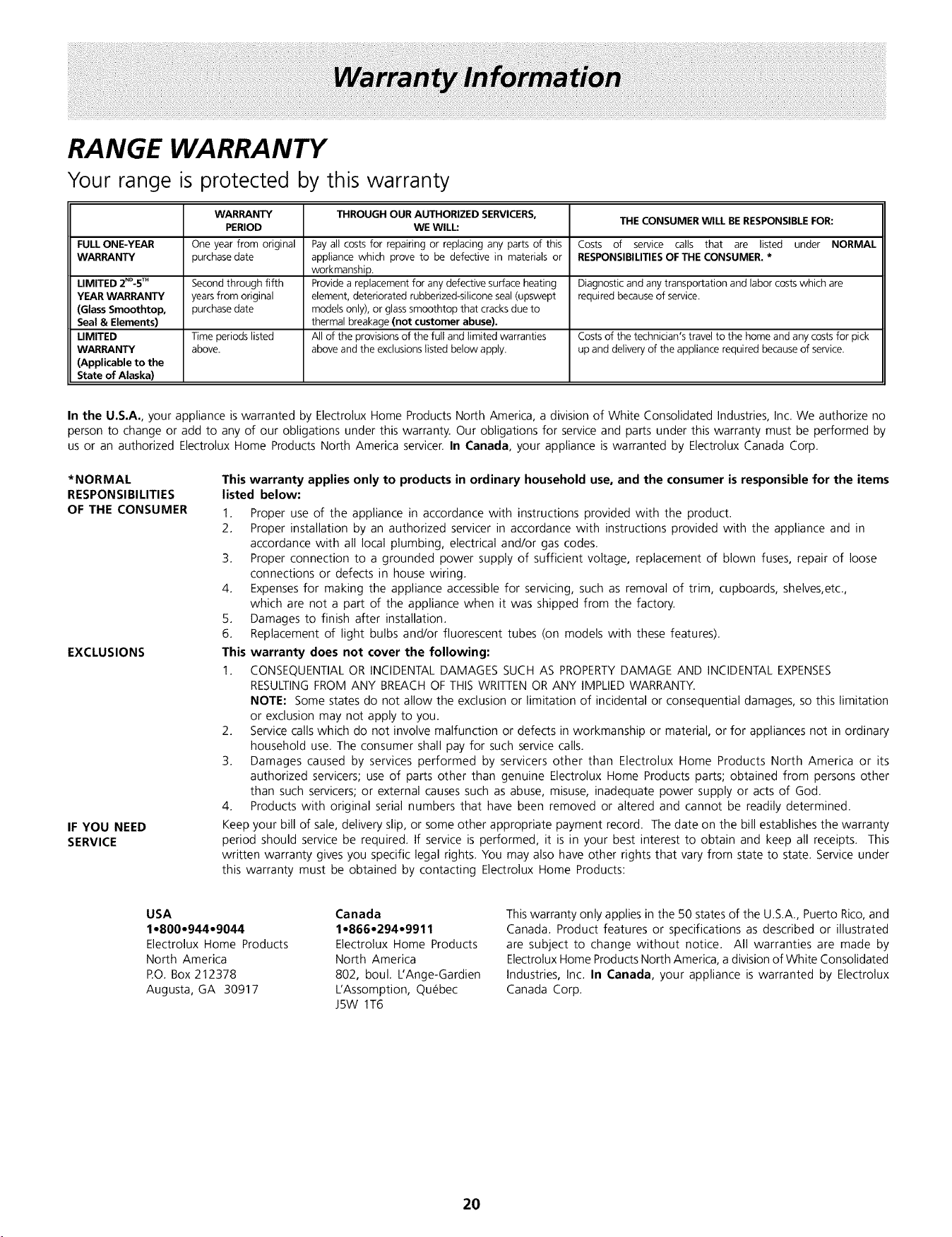
RANGE WARRANTY
Your range is protected by this warranty
FULLONE-YEAR
WARRANTY
LIMITED 2ND-5T"
YEAR WARRANTY
(Glass Smoothtop,
Seal & Elements)
LIMITED
WARRANTY
(Applicable to the
State of Alaska)
WARRAI_.q'Y
PERIOD
One year from original
purchase date
Second through fifth
years from original
purchase date
THE CONSUMER WILL BE RESPONSIBLEFOR:
Costs of service calls that are IBted under NORMAL
RESPONSIBILITIESOF THE CONSUMER. *
Diagnostic and any transportation and labor costs which are
required because of service.
THROUGH OUR AUTHORIZED SERVICERS,
WE WILL:
Payall costs for repairing or replacing any parts of this
appliance which prove to be defective in materials or
workmanship.
Provide a replacement for any defective surface heating
element, deteriorated rubberized-silicone seal (upswept
models only), or glass smoothtop that cracks due to
thermal breakage (not customer abuse).
All of the provisions of the full and Iimked warranties
above and the exclusions IBted below apply.
Time periods listed Costs of the technician's travel to the home and any costs for pick
above, up and delivery of the appliance required because of service.
In the U.S.A., your appliance iswarranted by Electrolux Home Products North America, a division of White Consolidated Industries, Inc. We authorize no
person to change or add to any of our obligations under this warranty. Our obligations for service and parts under this warranty must be performed by
us or an authorized Electrolux Home Products North America servicer. In Canada, your appliance is warranted by Electrolux Canada Corp.
*NORMAL
RESPONSIBILITIES
OF THE CONSUMER
EXCLUSIONS
IF YOU NEED
SERVICE
This warranty applies only to products in ordinary household use, and the consumer is responsible for the items
listed below:
1. Proper use of the appliance in accordance with instructions provided with the product.
2. Proper installation by an authorized servicer in accordance with instructions provided with the appliance and in
accordance with all local plumbing, electrical and/or gas codes.
3. Proper connection to a grounded power supply of sufficient voltage, replacement of blown fuses, repair of loose
connections or defects in house wiring.
4. Expenses for making the appliance accessible for servicing, such as removal of trim, cupboards, shelves,etc.,
which are not a part of the appliance when it was shipped from the factory.
5. Damages to finish after installation.
6. Replacement of light bulbs and/or fluorescent tubes (on models with these features).
This warranty does not cover the following:
1. CONSEQUENTIAL OR INCIDENTAL DAMAGES SUCH AS PROPERTYDAMAGE AND INCIDENTAL EXPENSES
RESULTINGFROM ANY BREACH OF THIS WRITTEN OR ANY IMPLIED WARRANTY.
NOTE: Some states do not allow the exclusion or limitation of incidental or consequential damages, so this limitation
or exclusion may not apply to you.
2. Service calls which do not involve malfunction or defects in workmanship or material, or for appliances not in ordinary
household use. The consumer shall pay for such service calls.
3. Damages caused by services performed by servicers other than Electrolux Home Products North America or its
authorized servicers; use of parts other than genuine Electrolux Home Products parts; obtained from persons other
than such servicers; or external causes such as abuse, misuse, inadequate power supply or acts of God.
4. Products with original serial numbers that have been removed or altered and cannot be readily determined.
Keep your bill of sale, delivery slip, or some other appropriate payment record. The date on the bill establishes the warranty
period should service be required. If service is performed, it is in your best interest to obtain and keep all receipts. This
written warranty gives you specific legal rights. You may also have other rights that vary from state to state. Service under
this warranty must be obtained by contacting Electrolux Home Products:
USA
1,800,944,9044
Electrolux Home Products
North America
RO. Box 212378
Augusta, GA 30917
Canada
1,866,294,9911
Electrolux Home Products
North America
802, boul. L'Ange-Gardien
L'Assomption, Quebec
J5W IT6
This warranty only applies in the 50 states of the U.S.A., Puerto Rico, and
Canada. Product features or specifications as described or illustrated
are subject to change without notice. All warranties are made by
Electrolux Home Products North America, a division of White Consolidated
Industries, Inc. In Canada, your appliance is warranted by Electrolux
Canada Corp.
2O