Basic Operations
This section provides an overview of the watch
and its operations.
Note
●
The illustrations included in this
manual have been created to
facilitate explanation. An illustration
may differ somewhat from the item it
represents.
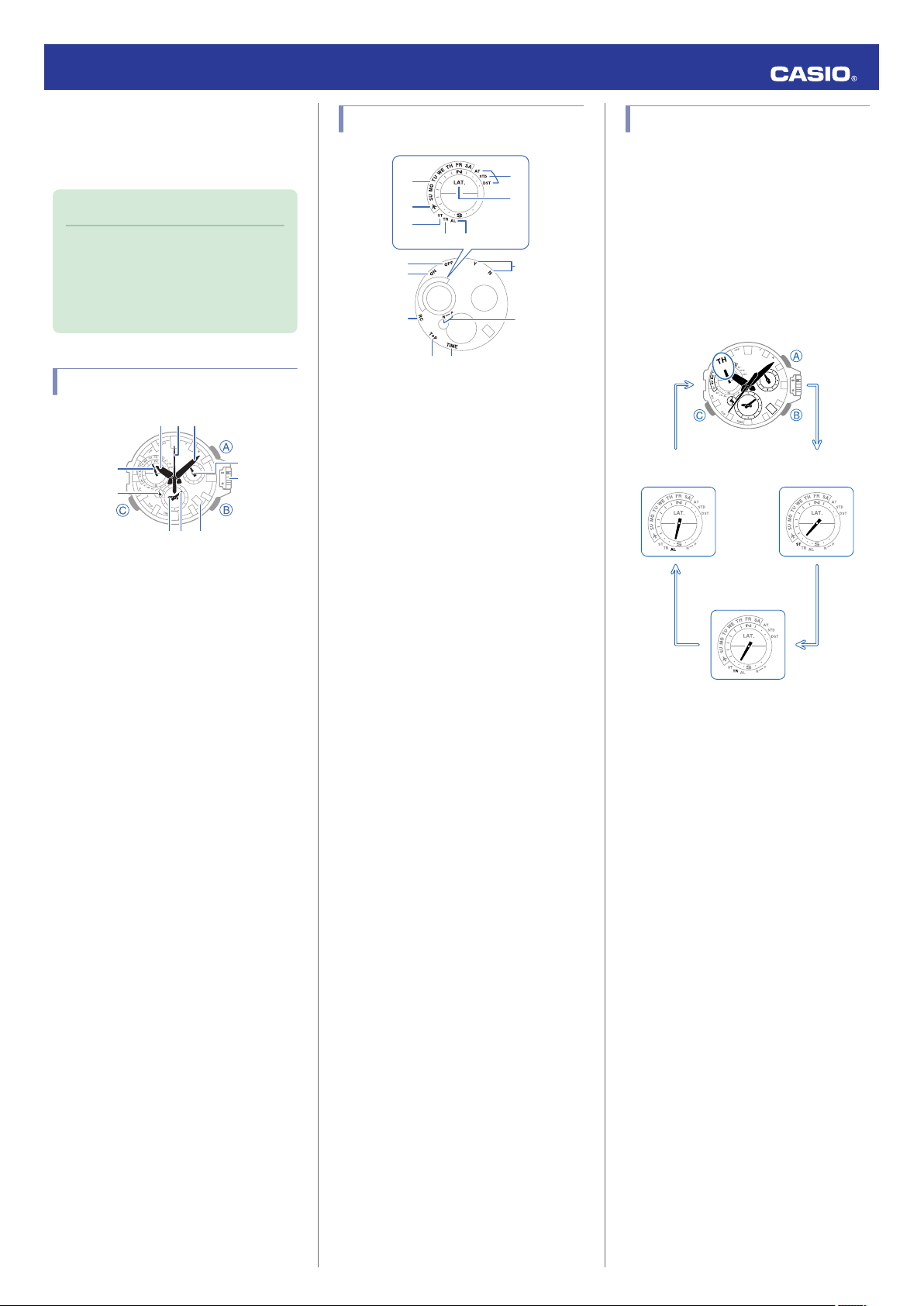
General Guide
30
③①
②
⑧
⑨
⑩
⑦⑥
⑤
④
A
Hour hand
B
Second hand
C
Minute hand
D
24-hour hand
E
Crown
F
Day indicator
G
Small minute hand
H
Small hour hand
I
Small 24-hour hand
J
Mode hand
MA2110-EG
© 2015 CASIO COMPUTER CO., LTD.
Watch Face Items
①
②
③
④⑤
⑥
⑦
⑧
⑨
⑬
⑭
⑩
⑪⑫
A
Day of the week
B
Airplane Mode
C
Stopwatch Mode
D
Timer Mode
E
Alarm Mode
F
Summer time setting
G
Approximate latitude
(N side: North latitude, S side: South
latitude)
H
Alarm off
I
Alarm on
J
Time calibration reception in progress
K
GPS signal time information and position
information acquisition in progress
L
GPS signal time information reception in
progress
M
Last GPS or time calibration signal receive
(acquisition) result
N
When checking the last receive result:
“P”: Last receive (acquisition) was for GPS
signal time information and position
information
“N”: Last receive was for GPS signal time
information or time calibration signal
When setting the Home City or World
Time City:
“P”: With position information
“N”: Without position information
Navigating Between Modes
Your watch has four modes.
You tell which mode the watch is currently in
by checking the position of the mode hand.
●
Timekeeping Mode (normal timekeeping):
Current day of the week
●
Stopwatch Mode: ST (STW)
●
Timer Mode: TR
●
Alarm Mode: AL
CC
CC
Timekeeping Mode
30
Alarm Mode
Timer Mode
Stopwatch Mode
Use the (C) button to navigate between
modes.
●
Hold down (C) for at least two seconds to
return to the Timekeeping Mode.
●
Holding down (C) for four seconds or longer
will enter or exit the Airplane Mode. The
mode hand points to h while the watch is in
the Airplane Mode.
l Using the Watch on an Aircraft
Operation Guide 5455
1

Mode Overview
Timekeeping Mode
The main hour, minute, and second hands
indicate the current time.
The small hour and minute hands indicate the
current World Time.
30
⑤⑥ ③
②
①
④
Current location time/
World Time swapping
(Hold down about
3 seconds.)
Airplane Mode
(Hold down about
4 seconds.)
A
Day of the week at current location
B
Current location time (24-hour time)
C
Current location date
D
World Time hour (24-hour time)
E
World Time hour
F
World Time minute
Stopwatch Mode
The main hour and minute hands indicate the
current time.
The second hand, and the small hour and
minute hands indicate the elapsed stopwatch
time.
30
③②
⑤
①
④
Airplane Mode
(Hold down about
4 seconds.)
Start/
Stop
Reset
A
Stopwatch seconds
B
Stopwatch minutes
C
Stopwatch hours
D
Stopwatch hours (24-hour time)
E
Current location time (24-hour time)
Timer Mode
The main hour and minute hands indicate the
current time.
The second hand, and the small hour and
minute hands indicate the current countdown
time.
30
③②
⑤
①
④
Airplane Mode
(Hold down about
4 seconds.)
Start/
Stop
Reset
A
Timer seconds
B
Timer minutes
C
Timer hours
D
Timer hours (24-hour time)
E
Current location time (24-hour time)
Alarm Mode
The main hour and minute hands indicate the
current time.
The small hour and minute hands indicate the
alarm time.
The second hand indicates the alarm enabled/
disabled setting.
30
③②
⑤
①
④
Airplane Mode
(Hold down about
4 seconds.)
Enabling/
Disabling the Alarm
A
Alarm enabled/disabled
B
Alarm minute
C
Alarm hour
D
Alarm hour (24-hour time)
E
Current location time (24-hour time)
Using the Crown
The crown is a simple lock type.
Before using the crown, first unlock it.
As shown in the illustration, rotating the crown
to the u position unlocks it.
As shown in the illustration, rotating the crown
to the t position locks it.
Important!
●
To prevent loss of water resistance
and/or damage due to impact, be
sure to push the crown in and lock it
when not in use.
●
When pushing the crown back in,
take care not to apply too much
force.
●
Fast Forward/Fast Reverse
Normal position
Second click
First click
Crown
After pulling out the crown to the first or second
click, rotating it quickly in succession in either
direction will start a fast forward or fast reverse
operation. While a fast forward operation is in
progress, quickly rotating the crown in
succession again will increase the speed even
further.
●
The fast reverse operation speed is fixed
and cannot be changed.
●
Stopping Fast Forward/Fast Reverse
Rotate the crown in the direction opposite that
of the ongoing operation or press any button.
Note
●
If you do not perform any operation
for about two minutes after pulling
out the crown, crown operations will
automatically become disabled. If
that happens, push the crown back
in and then pull it out again.
Operation Guide 5455
2

Changing Hand and the Day
Indicator Settings
30
Day indicator
Mode
hand
●
Mode Hand and Day Indicator
Movement
Changing the day setting of the watch will also
cause the mode hand to move.
●
Day
●
It can take anywhere from about one minute
to three minutes for the day indicator to
change after timekeeping reaches
midnight. The mode hand moves as the day
indicator changes.
●
The day may not be indicated correctly while
the watch’s crown is pulled out.
Solar Charging
What is solar charging?
This watch runs on power supplied from a
rechargeable (secondary) battery that is
charged by a solar panel. The solar panel is
integrated into the face of the watch, and
power is generated whenever the face is
exposed to light.
●
This watch uses a special rechargeable
(secondary) battery.
ー
The watch’s battery will not charge if the
watch’s temperature is less than
approximately -10°C (14°F) or greater
than approximately 60°C (140°F).
ー
Over-discharge will occur if the watch is
not charged within approximately three
months after it stops operation due to low
battery power. Charging may not be
possible after over-discharge occurs.
Charging the Watch
When you are not wearing the watch, put it in
a location where it is exposed to bright light.
While you are wearing the watch, make sure
that its face (solar panel) is not blocked from
light by the sleeve of your clothing. Power
generation efficiency is reduced even when
the face of the watch is blocked only partially.
NOYES
Important!
●
If the second hand stops for some
time after the watch is continuously
exposed to light, it could mean that
charging is not possible due to over-
discharge. Request chargeable
(secondary) battery replacement by
your original retailer or authorized
CASIO service center.
●
Depending on light intensity and
local conditions, the watch may
become hot to the touch when
exposed to light for charging. Take
care to avoid burn injury after
charging. Also, avoid charging the
watch under high-temperature
conditions like the ones described
below.
ー
On the dashboard of a vehicle
parked in the sun
ー
Near an incandescent light bulb or
other source of heat
ー
Under direct sunlight or in other
hot areas for long periods
Note
●
Exposing the watch face to light after
the battery goes dead will cause the
second hand to revolve
counterclockwise until it stops at
second 57. This indicates charging
has started.
●
A fully charged watch can operate
for approximately seven months
without further charging. Watch
operation will stop approximately 20
days after the battery goes low.
Charging Time Guidelines
The table below shows guidelines for
approximate charging times.
Charging Times Required for 1 Day of
Operation
Light Intensity
Approximate Charging Time
High
p
Low
A
8 minutes
B
30 minutes
C
48 minutes
D
8 hours
Times Required to Achieve Next Charge
Level
Light Intensity
Approximate Charging Time
Charge Level
1
Charge Level
2
High
p
Low
A
7 hours 36 hours
B
25 hours 135 hours
C
39 hours 218 hours
D
438 hours -
Light Intensity
A
Sunny day, outdoors (50,000 lux)
B
Sunny day, near a window (10,000 lux)
C
Overcast day, near a window (5,000 lux)
D
Indoor fluorescent lighting (500 lux)
Charge Level 1 :
Time from dead battery until watch operation
starts.
Charge Level 2 :
Time from watch operation start until a full
charge.
Note
●
Actual charging time depends on the
local charging environment.
Operation Guide 5455
3

Checking the Charge Level
The charge level is indicated by watch hand
movement. Functions become disabled as
battery power goes low.
Important!
●
Should the battery go low or go
dead, expose the face (solar panel)
to light as soon as possible.
Immediately after pressing (C) to enter to the
Timekeeping Mode, the second hand will
move to one of the positions below to indicate
the battery charge level.
●
Battery Charged
2 o'clock12 o'clock
●
Low Battery Power
4 o'clock 6 o'clock
Also, the second hand jumps at two-second
or five-second intervals.
30
30
Two-second intervals Five-second intervals
Second hand
●
Above right figures indicate a lower battery
charge.
●
Dead Battery
All hands are stopped.
1
Power Saving Function
Leaving the watch in a dark location for about
one hour between the hours of 10 p.m. and 6
a.m. will cause the second hand to stop, and
the watch will enter Level 1 power saving. If
the watch is left in this condition for six or
seven days, all hands will stop and the watch
will enter Level 2 power saving.
Level 1 :
Basic timekeeping functions are operational.
Level 2 :
Only the day indicator is operational.
Note
●
Note that the watch also may enter
the power saving state if its face is
blocked from light by your sleeve
while you are wearing it.
●
The watch will enter power saving
from the Timekeeping Mode only.
●
Recovering from Power Saving
Operation
Press any button or place the watch in a well-
lit area to recover from power saving.
Time Adjustment (GPS,
Time Calibration
Signal)
The watch’s time, day, and Home City (time
zone) settings can be configured in
accordance with a received GPS signal or
time calibration signal.
●
GPS signal position information: Used to
update Home City (time zone), time, and
day settings.
●
GPS signal time information: Used to
update time and day settings.
●
Time calibration signal: Used to update time
and day settings.
Important!
●
Before trying to receive GPS signal
time information and/or a time
calibration signal, first use GPS to
acquire position information and
configure Home Time (time zone)
settings.
●
Put the watch into the Airplane Mode
whenever you are inside an aircraft
or in any other area where radio
wave reception is prohibited or
restricted.
l Using the Watch on an Aircraft
Note
●
Areas where time calibration signal
reception is supported are limited.
When the watch in an area where
time calibration signal reception is
not supported, adjust time and day
settings based on GPS signals.
l Time Calibration Signal
Reception Ranges
Operation Guide 5455
4
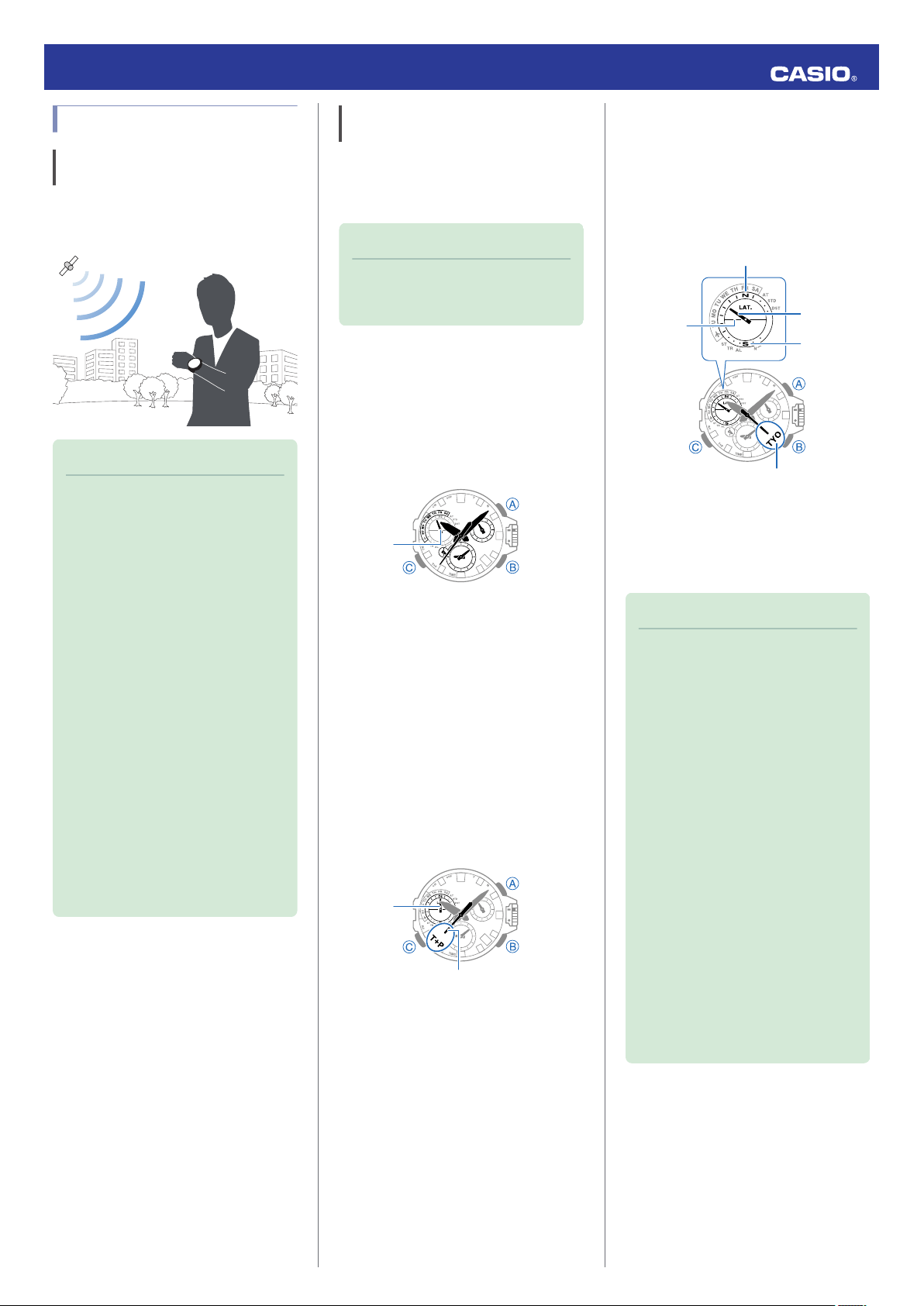
Time Adjustment Using GPS
Appropriate Signal Reception
Location
GPS signal reception is possible outdoors
where the sky is visible and not blocked by
buildings, trees, or other objects.
Note
●
In areas where reception is poor,
keep the watch face oriented
upwards and do not move the watch.
●
When the watch is set up for auto
receive, take care to avoid covering
the watch face with the sleeve of
your clothing.
●
GPS signal reception is not possible
in the areas described below.
ー
Where the sky is not visible
ー
Indoors (Reception may be
possible near a window.)
ー
Near wireless communication
equipment or other devices that
generate magnetism.
●
You may experience GPS signal
reception problems in the areas
described below.
ー
Where the view of the sky above
is narrow
ー
Near trees or buildings
ー
Near a train station, airport, or
other congested areas
Acquiring GPS Position Information
Manually
You can use a button operation to acquire
GPS position information and adjust your
Home City (time zone), time, and day settings
in accordance with your current location.
Note
●
GPS signal reception requires large
amounts of power. Perform it only
when necessary.
Getting Ready
The receive operation is performed only while
the watch is in the Timekeeping Mode (normal
timekeeping).
●
Normally the mode hand points to the
current day of the week.
l Navigating Between Modes
30
Mode
hand
1.
Move to a location appropriate for signal
reception and orient the watch so its
display is pointed straight up at the sky.
2.
Hold down (B) for at least three seconds.
Release the button as soon as the second
hand points to “T+P”.
●
The second hand will move in the
following sequence: “Y(YES)” or
“N(NO)” n “T (TIME)” n “T+P”.
●
This indicates that position information
acquisition has started. While
acquisition is in progress, the mode
hand will move up and down in a semi-
circular pattern.
30
Mode
hand
Second hand
●
If position information acquisition is
successful, the second hand will move
to “Y(YES)” and then the watch will
automatically adjust its time and day
settings. The watch will also display the
acquired Home City (time zone) and the
approximate latitude of your current
position.
30
South Pole
Equator
North Pole
Latitude
Home City
●
If position information acquisition fails
for some reason, the second hand will
move to “N(NO)” and then the watch will
indicate the current time and day
without adjusting them.
Note
●
Reception takes anywhere from
about 30 seconds to about two
minutes.
●
It can take as long as 13 minutes
when leap second information is
included.
●
You may experience location
information acquisition problems
when you are in the vicinity of a time
zone borderline.
The watch’s time and day will not be
indicated correctly if the Home City
(Time Zone) setting is not right for
your location. Perform position
information acquisition in a
representative city in your time zone
or in a location that is well within the
time zone. Or you can perform a time
information receive operation to
adjust time and day settings after
configuring Home City (Time Zone)
and summer time settings manually.
l
Selecting a Time Zone
l Acquiring GPS Time Information
Manually
Operation Guide 5455
5

Acquiring GPS Time Information
Manually
You can use a button operation on the watch
to receive GPS signal time information. When
the receive operation is successful, the
watch’s Home City (time zone), day, and time
settings will be adjusted accordingly.
Note
●
GPS signal reception requires large
amounts of power. Perform it only
when necessary.
Getting Ready
The receive operation is performed only while
the watch is in the Timekeeping Mode (normal
timekeeping).
●
Normally the mode hand points to the
current day of the week.
l Navigating Between Modes
30
Mode
hand
1.
Move to a location appropriate for signal
reception and orient the watch so its
display is pointed straight up at the sky.
2.
Hold down (B) for at least one second.
Release the button as soon as the second
hand points to “T (TIME)”.
●
The second hand will move in the
following sequence: “Y(YES)” or
“N(NO)” n “T(TIME)”.
●
This indicates that time information
receipt has started.
30
Second
hand
●
If information acquisition is successful,
the second hand will move to “Y(YES)”,
and then the watch will automatically
adjust its time and day settings.
3
0
●
If reception fails for some reason, the
second hand will move to “N(NO)” and
then the watch will indicate the current
time and day without adjusting them.
Note
●
Reception takes anywhere from
about seven seconds to about one
minute.
●
It can take as long as 13 minutes
when leap second information is
included.
Auto GPS Signal Receive
When the conditions below are satisfied, the
watch will automatically receive a GPS signal.
If any time information receive is successful,
the watch will no longer attempt to receive a
signal for the rest of the day.
●
Time information
●
Watch in the Timekeeping Mode (normal
timekeeping)
●
Current time is between 6:00 a.m. and 10:00
p.m.
●
Light (near a window on a clear day)
continually shining on the face of the watch
for about one to two minutes.
●
Time calibration signal reception was not
successful during the previous evening.
Note
●
The time information receive
operation takes anywhere from
about seven seconds to one minute.
●
The receive operation can take as
long as 13 minutes when leap
second information is included.
Leap Second Reception
GPS signal reception each year on June 1 or
later and on December 1 or later also receives
leap second information.
Note
●
It can take as long as 13 minutes to
complete the leap second
information receive operation.
●
The leap second information receive
operation is repeated until
information receipt is complete.
●
Once the leap second information
receive operation is complete, the
watch will not make any attempt to
receive it again until the following
June 1 or December 1.
Time Adjustment Using a
Time Calibration Signal
Appropriate Signal Reception
Location
A time calibration signal can be received while
the watch is near a window.
●
Keep metal objects away from the watch.
●
Do not move the watch.
●
Do not perform any operation on the watch.
6 o’clock position
Note
●
You may experience time calibration
signal reception problems in the
areas described below.
ー
Among or near buildings
ー
While riding in a vehicle
ー
Near household appliances,
office machines, mobile phones,
etc.
ー
On a construction site, in an
airport, or any other location
where radio wave interference
occurs
ー
Near high-voltage lines
ー
In mountainous areas or behind a
mountain
Operation Guide 5455
6
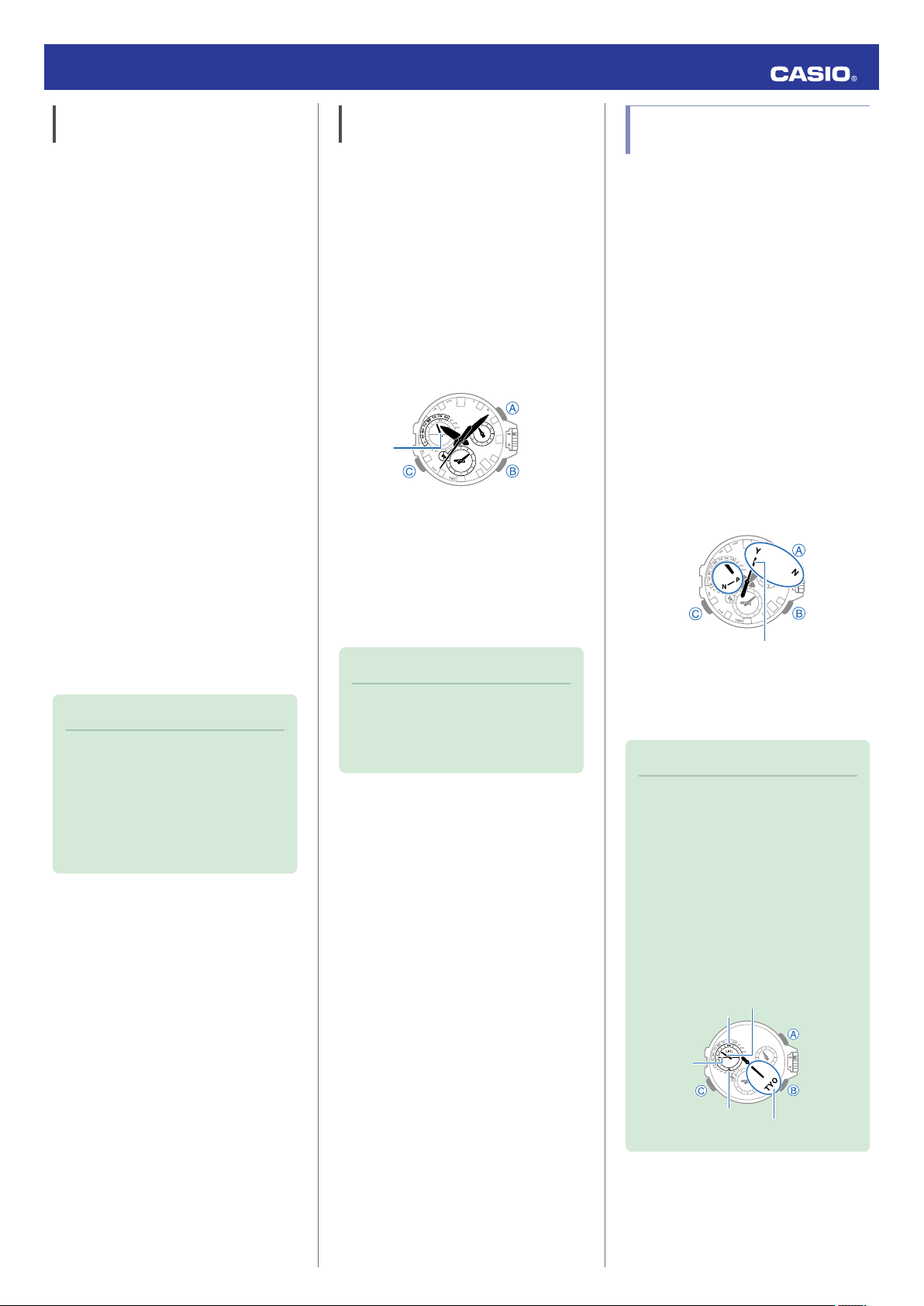
Time Calibration Signal Reception
Ranges
●
Japan (JJY)
The Japan time signal radio stations are
located on Mt. Otakadoya in Fukushima and
Mt. Hagane in Fukuoka/Saga.
The reception range of the Japanese time
signals is approximately 1,000 km from each
transmission station.
●
China (BPC)
The China time signal radio station is located
in Shangqiu, Henan Province, China.
The reception range of the Chinese time
signal is approximately 1,500 km from the
transmission station.
●
United States (WWVB)
The United States time signal radio station is
located in Fort Collins, Colorado.
The reception range of the U.S. time signal is
approximately 3,000 km from the transmission
station.
●
U.K. (MSF)/Germany (DCF77)
The U.K. time signal radio station is located in
Anthorn, Cumbria.
The German time signal radio station is
located in Mainflingen, southeast of Frankfurt.
The reception range of the U.K. and German
time signals is approximately 1,500 km from
each transmission station.
Note
●
Even if you are within the normal
reception range of a time calibration
signal, reception may be made
impossible by the following factors:
geographic contours, weather, the
season, the time of day, wireless
noise.
Auto Time Calibration Signal
Receive
An automatic time calibration signal receive
operation is performed and the time and day
settings are adjusted between midnight and
5:00 a.m. Once a signal receive operation is
successful, no more auto receive operations
are performed that day.
The receive operation is performed only while
the watch is in the Timekeeping Mode (normal
timekeeping).
●
Normally the mode hand points to the
current day of the week.
l Navigating Between Modes
30
Mode
hand
Place the watch near a window or some other
location appropriate for signal reception.
●
The second hand points to [RC] while time
calibration reception in progress.
●
When the receive operation is successful,
the time and day settings will be adjusted
automatically.
Note
●
Reception takes anywhere from
about two minutes to about 10
minutes. It can take as long as 20
minutes.
Checking the Receive
Operation Result
You can use the procedure below to check the
result of the last GPS or time calibration signal
receive operation.
Getting Ready
Enter the Timekeeping Mode.
l Navigating Between Modes
1.
Press (B).
The second hand will move and indicate
the receive operation result.
“Y (YES)”: Receive successful
“N (NO)”: Receive failed
The mode hand indicates details about
the receive (acquisition) operation.
“P”: Time information and position
information (GPS signal)
“N”: Time information (GPS signal) or time
calibration signal
30
Second hand
2.
Press (B) or do not perform any operation
for one or two seconds to return to the
current time.
Note
●
Even if there was a successful
receive operation, the second hand
will point to “N(NO)” if you adjusted
the time setting manually.
●
If you do not perform any watch
operation for about one or two
seconds after position information is
acquired, the watch will display the
acquired Home City (time zone) and
the rough latitude of your current
position.
30
Equator
South Pole
North Pole
Latitude
Home City
Operation Guide 5455
7

Signal Reception
Precautions
●
When the watch is unable to adjust its time
in accordance with a calibration signal for
some reason, average timekeeping
accuracy is within ±15 seconds per month.
●
GPS signal and time calibration signal
reception will not be possible under any of
the watch conditions described below.
ー
While battery power is low
ー
While the watch is in the Airplane Mode,
Stopwatch Mode, Timer Mode, or Alarm
Mode
ー
When power saving is at Level 2 (GPS
signal reception also is not possible at
Level 1.)
ー
While the crown is pulled out
ー
Timer countdown operation in progress
ー
While the temperature of the watch is less
than approximately -10°C (14°F) or
greater than approximately 60°C (140°F)
●
Note that an internal decoding process the
watch performs after it receives a signal may
cause the time setting to be slightly off (by
less than one second).
●
If the receive operation is successful, the
time and day settings will be adjusted
automatically in accordance with the Home
City (time zone) and summer time settings.
Summer time will not be applied correctly in
the cases described below.
ー
When the summer time start date and
time, end date and time, or other rules are
changed by authorities
ー
When position information cannot be
acquired correctly
ー
When position information can be
acquired, but it is wrong because the
watch is located near a time zone
boundary, etc.
●
As of December 2014, China does not
observe summer time. If China starts to
observe summer time in the future, the time
displayed by the watch for China may not be
correct.
Using the Watch on an
Aircraft
Enter the Airplane Mode when in an aircraft or
anywhere else where GPS or time calibration
signal reception is restricted.
Entering the Watch Airplane
Mode
Holding down (C) for about four seconds to
enter the watch’s Airplane Mode. The mode
hand will move to the Airplane mark.
30
Airplane mark
●
Each time (C) is held down for about four
seconds, the watch enters or exits the
Airplane Mode.
World Time
World Time lets you look up the current time
in any one of 27 cities and 40 time zones
around the globe.
30
Getting Ready
Enter the Timekeeping Mode.
l Navigating Between Modes
Selecting a Time Zone
Use the procedure in this section to select a
World Time city (time zone). If you are in an
area that observes summer time, you can also
enable or disable summer time.
Note
●
The initial factory default summer
time setting for all cities (time zones)
is “AT (AUTO)”. In many cases, the
“AT (AUTO)” setting lets you use the
watch without switching between
summer time and standard time.
1.
Pull out the crown to the first click.
The second hand will move to the time
zone of the currently selected World Time
City.
30
Mode
hand
Time zone
Crown
Small hour hand
Small minute hand
Small 24-hour hand
The mode hand indicates the acquisition
status for the currently selected World
Time location.
“P”: Available
“N”: Not available
2.
Rotate the crown to change the time zone.
The small hour hand and small minute
hand indicate the current time in the
selected time zone.
●
Hold down (B) for about one second to
display UTC (Coordinated Universal
Time) time.
30
World Time hour (24-hour)
World Time hour and minute
Crown
Operation Guide 5455
8

3.
Press (A) to change the summer time
setting.
●
While the mode hand is pointed at “AT
(AUTO)”, “STD”, or “DST”, you can hold
down (A) for about one second to cycle
the summer time setting in the
sequence below.
“AT (AUTO)”n“STD”n“DST”
3
0
●
“AT (AUTO)”
The watch switches between standard
time and summer time automatically.
●
“STD”
The watch always indicates standard
time.
●
“DST”
The watch always indicates summer
time.
4.
Push the crown back in.
Note
●
You cannot switch between “STD”
and “DST” while “UTC” is selected
as the Home City (time zone).
Swapping Your Current
Location Time and World
Time
Holding down (A) for about three seconds will
swap your current location time with your
World Time.
●
Pressing (A) will cause the illumination light
to turn on. Keep (A) depressed for three
seconds.
30
30
n
Current location time
Current location time
World Time
World Time
After swappingBefore swapping
●
If a swapping operation causes a change in
the day indicator setting, the mode hand will
rotate repeatedly.
l Changing Hand and the Day Indicator
Settings
Note
●
This function comes in handy when
you need to move to another time
zone. For details about how to use it,
see “Moving to Another Time Zone”.
Stopwatch
The stopwatch measures elapsed time in units
of one second up to 23 hours, 59 minutes, 59
seconds (24 hours).
Getting ready
Enter the Stopwatch Mode.
l Navigating Between Modes
3
0
Measuring Elapsed Time
30
Seconds
Hours
Minutes
Hour (24-hour time)
1.
Use the operations below to measure
elapsed time.
A
A
A
A
Stop
Resume
Stop
Start
2.
Press (B) to reset the stopwatch.
3.
Press (C) three times to return to the
Timekeeping Mode.
Timer
The timer counts down from a start time
specified by you. A beeper sounds when the
end of the countdown is reached.
●
The beeper is muted in the cases described
below.
ー
When battery power is low
ー
When watch is at Level 2 power saving
l Power Saving Function
Getting Ready
Enter the Timer Mode.
l Navigating Between Modes
3
0
Operation Guide 5455
9

Setting the Timer Start Time
1.
Pull out the crown to the first click.
2.
Rotate the crown to change the
countdown start time setting.
●
The countdown start time can be set in
1-minute units up to 24 hours.
30
Crown
MinutesHours
Hour (24-hour time)
Seconds
3.
Push the crown back in.
Note
●
When the small hour hand and small
minute hand are at 12 o’clock, a
countdown start time of 24 hours is
specified.
Using the Timer
1.
Press (A) to start the countdown.
3
0
A beeper will sound for 10 seconds to let
you know when the end of a countdown is
reached.
●
To pause an ongoing countdown, press
(A). To reset a paused countdown to the
start time, press (B).
2.
Press any button to stop the tone.
3.
Press (C) twice to return to the
Timekeeping Mode.
Alarms
The watch will beep when the alarm time is
reached.
●
The beeper is muted in the cases described
below.
ー
When battery power is low
ー
When watch is at Level 2 power saving
l Power Saving Function
Getting ready
Enter the Alarm Mode.
l Navigating Between Modes
3
0
Configuring Alarm Settings
1.
Pull out the crown to the first click.
This turns on the alarm.
2.
Rotate the crown to change the alarm time
setting.
30
Crown
MinutesHours
Alarm on
3.
Push the crown back in.
4.
Press (C) once to return to the
Timekeeping Mode.
Note
●
A beeper will sound for 10 seconds
to let you know when the alarm time
is reached.
Enabling/Disabling the Alarm
Press (B) to toggle the alarm between on and
off.
30
Alarm off
Alarm on
Stopping an Alarm
While the alarm is sounding, press any button
to stop it.
Illumination Light
The watch has an LED light that you can turn
on for reading in the dark. When you turn on
the LED light, it gradually becomes brighter.
After about two seconds, it gradually becomes
dimmer until it turns off.
Getting ready
Enter the Timekeeping Mode or Alarm Mode.
l Navigating Between Modes
Turning On the Illumination
Light
Pressing (A) turns on the light.
3
0
●
Illumination will turn off automatically if an
alarm starts to sound.
●
Illumination is disabled while the hands are
moving at high speed.
Operation Guide 5455
10

Adjusting Time
Settings Manually
You can use the procedure below to adjust the
watch’s time and day settings when GPS and
time calibration signal reception is not
possible for some reason.
Selecting a Time Zone
Use the procedure in this section to select a
city (time zone) to use as your Home City. If
you are in an area that observes summer time,
you can also enable or disable summer time.
Note
●
The initial factory default summer
time setting for all cities (time zones)
is “AT (AUTO)”. In many cases, the
“AT (AUTO)” setting lets you use the
watch without switching between
summer time and standard time.
●
In the cases described below,
receiving GPS position information
will automatically cause “AT
(AUTO)” to be selected for the
summer time setting.
ー
When the time zone of the current
receive operation is different from
the watch’s time zone setting prior
to the receive operation.
ー
When the time zone is
unchanged, but the acquired
position information is for a
geographic area with different
summer time rules (start date, end
date)
1.
Pull out the crown to the second click.
The second hand will move to the
currently selected time zone.
The mode hand indicates the acquisition
status of position information for the
currently selected time zone.
“P”: Available
“N”: Not available
30
Crown
Time zone
2.
Rotate the crown to change the time zone.
●
You can also select a time zone whose
name is not indicated on the face of the
watch.
●
For information about time zones, see
the “City (Time Zone) List”.
3.
To change the summer time setting, press
(A).
●
While the mode hand is pointed at “AT
(AUTO)”, “STD”, or “DST”, you can hold
down (A) for about one second to cycle
the summer time setting in the
sequence below.
“AT (AUTO)”n“STD”n“DST”
3
0
●
“AT (AUTO)”
The watch switches between standard
time and summer time automatically.
●
“STD”
The watch always indicates standard
time.
●
“DST”
The watch always indicates summer
time.
4.
Push the crown back in to its normal
position.
Summer Time
Summer time, which is also known as Daylight
Saving Time (DST), advances the time setting
one hour, 30 minutes, or some other amount
of time from standard time (STD) during the
summer months. Whether or not and how
summer time is used depends on your country
or local area. Summer time is not used in some
countries and local areas.
Adjusting the Time and Day
Setting
1.
Pull out the crown to the second click.
The second hand will move to the
currently selected time zone.
30
Time zone
Crown
MinutesHours
2.
Hold down (C) for about 10 seconds.
This causes the second hand to move to
12 o’clock, and enables the minute setting
operation.
3.
Rotate the crown to change the minute
setting.
4.
Press (C).
The hour hand will move slightly,
indicating that the hour setting operation
is enabled.
5.
Rotate the crown to change the hour
setting.
6.
Press (C).
This changes to the year setting
operation.
80
90
30
40
20
50
70
10
60
00
+
−
Year (10’s digit)
3
+
−
8
9
4
2
5
7
1
6
0
Year (one’s digit)
7.
Rotate the crown to move the hour hand
to the desired setting for the year ten’s
digit, and the minute hand to the desired
one’s digit.
Operation Guide 5455
11

8.
Press (C).
This enables the month setting operation.
3
+
−
8
9
10
4
2
5
7
11
1
6
12
Month
9.
Rotate the crown to change the month.
10.
Press (C).
The mode hand will move slightly,
indicating that the day setting operation is
enabled.
30
+
−
Day
●
Changing the date setting will cause the
mode hand to rotate repeatedly.
l Changing Hand and the Day
Indicator Settings
11.
Rotate the crown to change the day.
12.
On a time signal at the top of a minute,
push the crown back in.
Adjusting Hand and
Day Indicator
Alignment
Strong magnetism or impact can cause the
time indicated by the hands and the day
indicator to go out of alignment. If this
happens, adjust hand and day indicator
alignment.
●
The watch performs alignment of the hour
hand, minute hand, second hand, and 24-
hour hand automatically.
Adjusting Hand and Day
Indicator Alignment
1.
Pull out the crown to the second click.
2.
Hold down (B) for about five seconds, until
the second hand moves to 12 o’clock.
This will start auto alignment of the hour
hand, minute hand, second hand, and 24-
hour hand.
●
After auto alignment is complete, the
hands should be in the positions shown
below.
30
Second
hand
Minute hand
Hour hand
24-hour hand
Crown
3.
Press (C).
Confirm that the small hour hand and
small minute hand are stopped at 12
o’clock.
30
Small minute hand
Small hour hand
4.
If the small hour hand and small minute
hand are not at 12 o’clock, rotate the
crown to align them correctly.
5.
Press (C).
Confirm that the mode hand is stopped at
12 o’clock, and check if the day is
indicated properly.
30
Day (Operation start day)
Mode hand
6.
If the mode hand or the day indicator is not
in the proper position, rotate the crown to
move the mode hand to 12 o’clock and the
day to the center of the indicator window.
●
The movement range of the mode hand
and day indicator is limited when you
rotate the crown. The maximum left-
right movement of the mode hand is 180
degrees in either direction. The day
indicator moves only slightly.
●
After the mode hand and day indicator
are in the positions you want, advance
to step 9 of this procedure. If you are
unable to make the adjustments you
want, go to step 7.
7.
Press (C).
Confirm that the day indicator shows “1”.
1
Day
●
Changing the date setting will cause the
mode hand to rotate repeatedly. In
some cases, the mode dial may
continue to rotate for about 30 minutes.
l Changing Hand and the Day
Indicator Settings
8.
If “1” is not shown for the day, rotate the
crown until “1” is shown for the day.
●
The mode hand moves in conjunction
with crown rotation. Move the mode
hand to 12 o’clock.
9.
Push the crown back in.
Note
●
Leaving the crown pulled out for
more than approximately 30 minutes
without performing any operation
will automatically cause the
adjustment operation to become
disabled. If this happens, push the
crown back in to its normal position
and then pull it out again to restart
the procedure from the beginning.
Pushing the crown in to its normal
position part way through the
alignment procedure will cause the
hands to return to their normal
position. Any alignment you
performed up to that point will be
applied.
Operation Guide 5455
12

Moving to Another Time
Zone
Use the procedure below to easily change day
and time settings of the watch to a destination
location.
●
Before Boarding
Configure the World Time to the current time
at your destination.
30
Destination time
Current time
l
Selecting a Time Zone
●
Prior to Takeoff
Enter the watch’s Airplane Mode when
instructed to do so by airline personnel.
30
Airplane mark
l
Entering the Watch Airplane Mode
●
After Arriving
1.
Exit the Airplane Mode.
l
Entering the Watch Airplane Mode
2.
Swap the origin time zone time with the
destination time zone time.
30
30
n
Destination time
After swappingBefore swapping
Destination time
l
Swapping Your Current Location Time
and World Time
Other Information
City (Time Zone) List
A time zone for which no city name is
displayed by the watch is indicated in the table
below by a hyphen (-) in the “City Code”
column. The “City Name” column will contain
the name of a representative city in that zone.
City
code
City Name
Second
Hand
Position
UTC
Offset
UTC
Coordinated
Universal Time
Second 0 0
LON London Second 2 0
PAR Paris Second 4 +1
ATH Athens Second 6 +2
JED Jeddah Second 8 +3
- (Tehran) Second 9 +3.5
DXB Dubai Second 10 +4
- (Kabul) Second 11 +4.5
- (Karachi) Second 12 +5
DEL Delhi Second 13 +5.5
- (Kathmandu) Second 14 +5.75
DAC Dhaka Second 15 +6
- (Yangon) Second 16 +6.5
BKK Bangkok Second 17 +7
HKG Hong Kong Second 19 +8
- (Eucla) Second 21 +8.75
TYO Tokyo Second 22 +9
- (Adelaide) Second 23 +9.5
SYD Sydney Second 24 +10
-
(Lord Howe
Island)
Second 25 +10.5
NOU Noumea Second 26 +11
- (Norfolk Island) Second 27 +11.5
WLG Wellington Second 28 +12
-
(Chatham
Islands)
Second 30 +12.75
TBU Nuku’alofa Second 31 +13
CXI Kiritimati Second 33 +14
BAR Baker Island Second 36 -12
PPG Pago Pago Second 38 -11
HNL Honolulu Second 40 -10
-
(Marquesas
Islands)
Second 41 -9.5
ANC Anchorage Second 42 -9
LAX Los Angeles Second 44 -8
DEN Denver Second 46 -7
CHI Chicago Second 48 -6
NYC New York Second 50 -5
- (Caracas) Second 51 -4.5
YHZ Halifax Second 52 -4
- (St. John’s) Second 53 -3.5
RIO Rio de Janeiro Second 54 -3
FEN
Fernando de
Noronha
Second 56 -2
RAI Praia Second 58 -1
●
The information in the above table is current
as of December 2014.
Summer Time Table
When [AT (AUTO)] is selected for a city that
observes summer time, switching between
standard time and summer time will be
performed automatically at the timing shown
in the table below.
Note
●
If the summer time start and end
dates for your current location have
been changed from those indicated
in the table, you will need switch
between “STD” and “DST” manually.
●
In the case of a time zone for which
no city name is displayed, you can
automatically switch between
standard time and summer time by
acquiring GPS position information.
City Name
Summer Time
Start
Summer Time
End
London
01:00, last
Sunday in March
02:00, last
Sunday in
October
Paris
02:00, last
Sunday in March
03:00, last
Sunday in
October
Athens
03:00, last
Sunday in March
04:00, last
Sunday in
October
Sydney
02:00, first
Sunday in
October
03:00, first
Sunday in April
Wellington
02:00, last
Sunday in
September
03:00, first
Sunday in April
Anchorage
02:00, second
Sunday in March
02:00, first
Sunday in
November
Los
Angeles
02:00, second
Sunday in March
02:00, first
Sunday in
November
Denver
02:00, second
Sunday in March
02:00, first
Sunday in
November
Chicago
02:00, second
Sunday in March
02:00, first
Sunday in
November
New York
02:00, second
Sunday in March
02:00, first
Sunday in
November
Halifax
02:00, second
Sunday in March
02:00, first
Sunday in
November
Rio de
Janeiro
00:00, third
Sunday in
October
00:00, third
Sunday in
February or
00:00, fourth
Sunday in
February
●
The information in the above table is current
as of December 2014.
Operation Guide 5455
13
Map Data Source
This watch uses the map database of Tokyo
Cartographic Co., Ltd.
Function Limitations
●
How temperature affects watch
functions
This functions below are disabled while the
temperature of the watch is less than
approximately -10°C (14°F) or greater than
approximately 60°C (140°F).
●
GPS signal and time calibration signal
receive operation
●
Solar charging
●
Sounds (alarms, etc.)
●
Illumination Light
●
Hand and day indicator alignment
adjustment
Troubleshooting
Signal Reception (GPS)
Q1
The watch cannot perform a receive
operation.
Is the watch’s battery charged?
Signal reception is not possible while
battery power is low. Keep the watch
exposed to light until it recharges
sufficiently.
l Charging the Watch
Is the watch in the Timekeeping Mode (not
Airplane Mode)?
Signal reception is possible only while the
watch is in the Timekeeping Mode (not
Airplane Mode).
l Navigating Between Modes
After checking the above, the watch still
cannot perform a receive operation.
GPS signal reception is not possible
under the conditions described below.
●
During power saving
●
While the crown is pulled out
●
Timer countdown operation in progress
●
While the watch temperature is less
than approximately -10°C (14°F) or
more than approximately 60°C (140°F)
Q2
The second hand remains at “T+P” or
“T(TIME)” during the signal receive
operation.
The watch may be receiving leap second
information.
l Leap Second Reception
Q3
The signal receive operation always
fails.
Is the watch in a location that is appropriate
for signal reception?
Check your surroundings and move the
watch to a location where signal reception
is better.
l Appropriate Signal Reception Location
Is the face of the watch pointed straight
upwards at the sky?
Minimize movement of the watch while the
receive operation is in progress.
When the watch is set up for auto receive,
take care to avoid covering the watch face
with the sleeve of your clothing.
An alarm started sounding while the
receive operation was in progress.
Receive stops if an alarm operation starts
while it is being performed. Disable the
alarm.
l Enabling/Disabling the Alarm
Q4
Signal reception should have been
successful, but the watch’s time and/
or day is wrong.
Is your Home City (time zone) setting
correct for your location?
Change your Home City (time zone)
setting so it correctly indicates your
location.
l Acquiring GPS Position Information
Manually
l Selecting a Time Zone
Do the hand and/or day indicator look out
of alignment?
Correct hand and day indicator alignment.
l Adjusting Hand and Day Indicator
Alignment
After checking the above, the time and/or
day settings is still wrong.
Adjust time and day settings manually.
Operation Guide 5455
14
Signal Reception (Time
Calibration Signal)
Q1
The watch cannot perform a receive
operation.
Is the watch’s battery charged?
Signal reception is not possible while
battery power is low. Keep the watch
exposed to light until it recharges
sufficiently.
l Charging the Watch
Is the watch in the Timekeeping Mode (not
Airplane Mode)?
Signal reception is possible only while the
watch is in the Timekeeping Mode (not
Airplane Mode).
l Navigating Between Modes
Is your Home City (time zone) setting
correct for your location?
The watch will not indicate the correct time
if the Home City (time zone) setting is
wrong. Change your Home City (time
zone) setting so it correctly indicates your
location.
l Acquiring GPS Position Information
Manually
l Selecting a Time Zone
After checking the above, the watch still
cannot perform a receive operation.
Time calibration signal reception is not
possible under the conditions described
below.
●
When watch is at Level 2 power saving
●
When the crown is pulled out
●
Timer countdown operation in progress
●
While the watch temperature is less
than approximately -10°C (14°F) or
more than approximately 60°C (140°F)
If successful reception is not possible for
some reason, you can adjust the time and
day settings manually.
Q2
The signal receive operation always
fails.
Is the watch in a location that is appropriate
for signal reception?
Check your surroundings and move the
watch to a location where signal reception
is better.
l Appropriate Signal Reception Location
Did you avoid touching the watch while the
receive operation was in progress?
Minimize movement of the watch and do
not perform any watch operation while a
receive operation is in progress.
Is there an alarm configured to sound
during the same period that the signal
receive operation is performed?
Receive stops if an alarm operation starts
while it is being performed. Disable the
alarm.
l Enabling/Disabling the Alarm
Is the signal transmitter in your area
transmitting a signal?
The transmitter of the time calibration may
not be transmitting a signal.
Try again later.
Q3
Signal reception should have been
successful, but the watch’s time and/
or day is wrong.
Do the hand and/or day indicator look out
of alignment?
Correct hand and day indicator alignment.
lAdjusting Hand and Day Indicator
Alignment
After checking the above, the time and/or
day settings is still wrong.
Adjust time and day settings manually.
l Adjusting Time Settings Manually
Alarms
Q1
The alarm does not sound.
Is the watch’s battery charged?
Keep the watch exposed to light until it
recharges sufficiently.
l Charging the Watch
The crown is pulled out.
The alarm will not sound while the crown
is pulled out. Push the crown back in to its
normal position.
Is the alarm enabled?
Enable the alarm.
l Enabling/Disabling the Alarm
Hand Movement and
Indications
Q1
I don’t know what mode the watch is
in.
Hold down (C) for at least two seconds to
return to the Timekeeping Mode.
●
Take care not to hold down (C) too long.
Holding down (C) for about four seconds will
enter or exit the Airplane Mode.
l Navigating Between Modes
3
0
Q2
The second hand is jumping at two-
second or five-second intervals.
Battery power is low. Keep the watch exposed
to light until it recharges sufficiently.
l Charging the Watch
Q3
All hands are stopped and buttons do
not work.
The battery is dead. Keep the watch exposed
to light until it recharges sufficiently.
l Charging the Watch
Operation Guide 5455
15

Q4
The hands suddenly start moving at
high speed.
This is due to one of the reasons below, and
does not indicate malfunction. Simply wait
until normal hand movement resumes.
●
The watch is recovering from a power
saving state.
l Power Saving Function
●
The hands are moving to their new positions
following a GPS signal or time calibration
signal receive operation.
l Time Adjustment (GPS, Time Calibration
Signal)
Q5
Hands are stopped and buttons do
not work.
The watch is in the charge recovery mode.
Wait until the recovery process is complete
(for about 15 minutes). The watch will recover
more quickly if you place it in a brightly lit
location.
Q6
Why is the current time indicated by
the watch is off by a certain amount
of time (nine hours, three hours and
15 minutes, etc.)?
The city (time zone) setting is not correct.
Select the correct setting.
l Acquiring GPS Position Information
Manually
l Selecting a Time Zone
Q7
The current time indicated by the
watch is off by one hour or 30
minutes.
The summer time setting is not correct. Select
the correct setting.
l Acquiring GPS Position Information
Manually
l Selecting a Time Zone
Q8
Hands and/or the day indicator is out
of alignment.
Strong magnetism or impact may cause the
hands of the watch to go out of alignment.
Correct hand position alignment.
l Adjusting Hand and Day Indicator
Alignment
Crown Operations
Q1
Nothing happens when I rotate the
crown.
If you do not perform any operation for about
two minutes after pulling out the crown
(approximately 30 minutes in the case of hand
and day indicator alignment operations),
crown operations will automatically become
disabled. Push the crown back in to its normal
position and then pull it out again.
l Using the Crown
Operation Guide 5455
16

