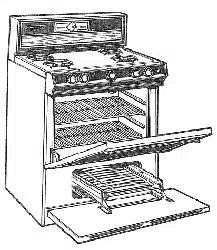
.L*~..--.-me/-
.--,.—. =. *— - —--—...—.
,.---
>,.
‘.. ...
.
-=.-.
>’
UseandCareofGas Models~
with
+“39=-422%?
Standing
Electric
Pilot
Ignition
Rmymc
RGB5241
RG13528
RGB5281
RGB628G
RGB628GI
.<,
Featuresof
yourrange
-p6
Lightinginstructions -
p~
9
surface;Oohng-
‘@o
——
—.—.
iiinCooting
-@l
————-—-
....——.—-.—_______________
Save
timemillmoney.
Beforeyoucdlforservice,
usetheProblemsolver
p’n
.-
.———_-=--..=_______-
-.--.—-.—.—..
—-
._—-_ ,. _______.
——---- -------.....
——.-
-———.-
.-
.
... ....--—.-.-. .
.
Downloaded from www.ManualsFile.com manuals search engine
Read ‘l-m Book carefully
it is designed to help you operate
and maintain your new Range
properly.
Keep it handy for answers to your
questions.
if you don’t understand something
or need more help. . .
Call, toil free:
The GE Answer Center’”
800.626.2000
consumer information service
or write: (include your phone
number):
Consumer Affairs
t-lotpoint
Appliance Park
Louisville, KY 40225
Write Down the
Modeland
serial Numbers
You’ll find them on a label located
under the cooktop.
These numbers are also on the
Consumer Product Ownership
Registration Card that came with
your Range. Before sending in
this card, please write these
numbers here:
Model No.
Serial No.
Use these numbers in any corres-
pondence or service calls con-
cerning your Range.
uMm Received
a Damaged R8nge
Immediately contact the dealer
(or builder) that sold you the
Range.
save-mmand Moneys ❑ a
Before Y“aJ cdl forservice
Check “The Problem Solver”. (See
page 21.) It lists minor causes of
operating problems that you can
correct yourself and may saveyou
an unnecessary service call,
/---
,... .-
‘!. . .
-..: ..-
._L
2
Downloaded from www.ManualsFile.com manuals search engine
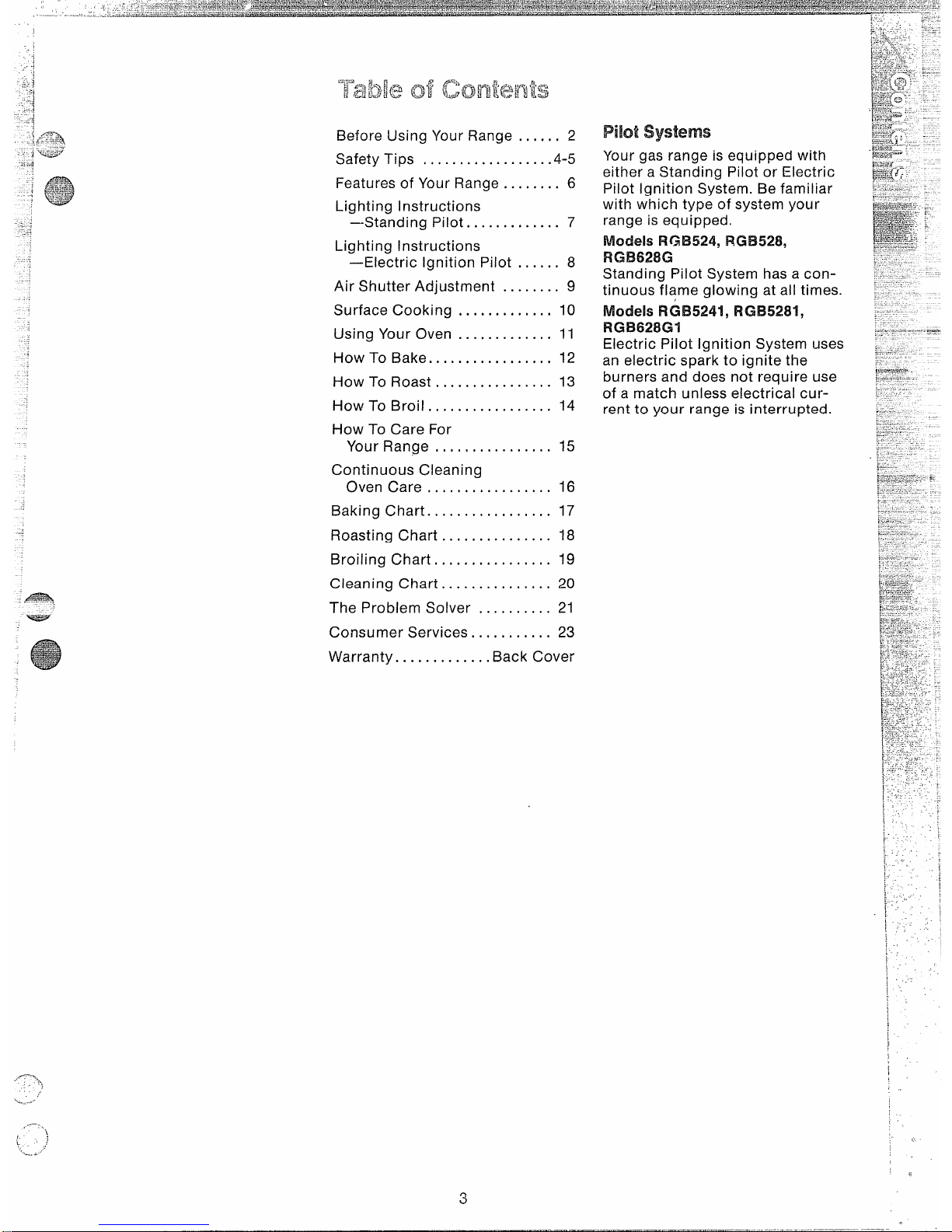
Before Using Your Range ., . . .. 2
Safety Tips . . . . . . . .. .. .. . . ...4-5
Features of Your Range ..,..... 6
Lighting Instructions
–-Standing Pilot . . .. . .. ..... . 7
Lighting Instructions
—Electric ignition Pilot...,.. 8
Air Shutter Adjustment . .. . . . . . 9
Surface Cooking . ... .. . . . . . . . 10
Using Your Oven .. .. .. .......11
How To Bake..............,.. 12
How To Roast . . . . . . . .. . .. .. ..13
How To Broil . . . . .. . . . . . . . . . . . 14
How To Care For
Your Range . .... . . . . . . . . . ..l5
Continuous Cleaning
Oven Care, . . . . . . . .. . .. .. ..l6
Baking Chart . ... .... ... . . . . ..17
Roasting Chart .... . . . . . . . . . ..18
Broiling Chart ..... . . . . .... . .. 19
Cleaning Chart .. .. . . . . .. .....20
The Problem Solver . . . . . . . . . . 21
Consumer Services . . . . .. . . .. . 23
Warranty . . . .. . . . . . . ..Back Cover
Pilot
systems
Your gas rangeis equipped with
either a Standing Pilot or Electric
Piiotlgnition System. Be familiar
with which type ofsystem your
range is equipped.
Models RG13524,RGB528,
BGB628G
Standing Pilot System has aeon-
tinuous flame glowing atall times.
Mc9de!sF$bE15241,lRGB528f,
RG13628GI
Electric Pilot Ignition System uses
an electric spark to ignite the
burners and does not require use
of a match unless electrical cur-
rent to your range is interrupted.
3
-—.—..-—————.
.—..-..-———-—....——.-——--- ..--—.—.....-————-
Downloaded from www.ManualsFile.com manuals search engine
..
!.
..-!4
-, -l..!,
?!2., e ~
:
,“:.
k ~i>i>t:
~
Q;,2 i~-$ :Jj; .’F-5 ; L:, ‘~ S+
.
..s k. .
~-
gd+i.’,,&lcl;’\}{;@
Q Have the installer show-you
me!Cmaticmofthe I%wlcy?C&H
cut-cmwaive and hm’wtoshut
it
offifnecessary.
@
Have it irtstalk?d and prop-
erly grounded by a qualified
installer, in accordance with
the installation instructions.
Any adjustment and service
should be performed only by
qualified gas range installers
or service technicians.
@Locate range out of “kitchen
traffic path” and out of drafty
locations to prevent pilot out-
age and poor air circulation.
@Be sure your range is cor-
rectly adjusted by a qualified
service technician or installer
for the type of gas (Natural or
LP) on which it is to be used.
Gas can be converted from
one type to the other. See
Installation Instructions.
@After prolonged use of a
range, high floor temperatures
may result and many floor
coverings will not withstand
this kind of use. Never install
the range over interior kitchen
carpeting, vinyl tile or linoleum
that cannot withstand such
type of use.
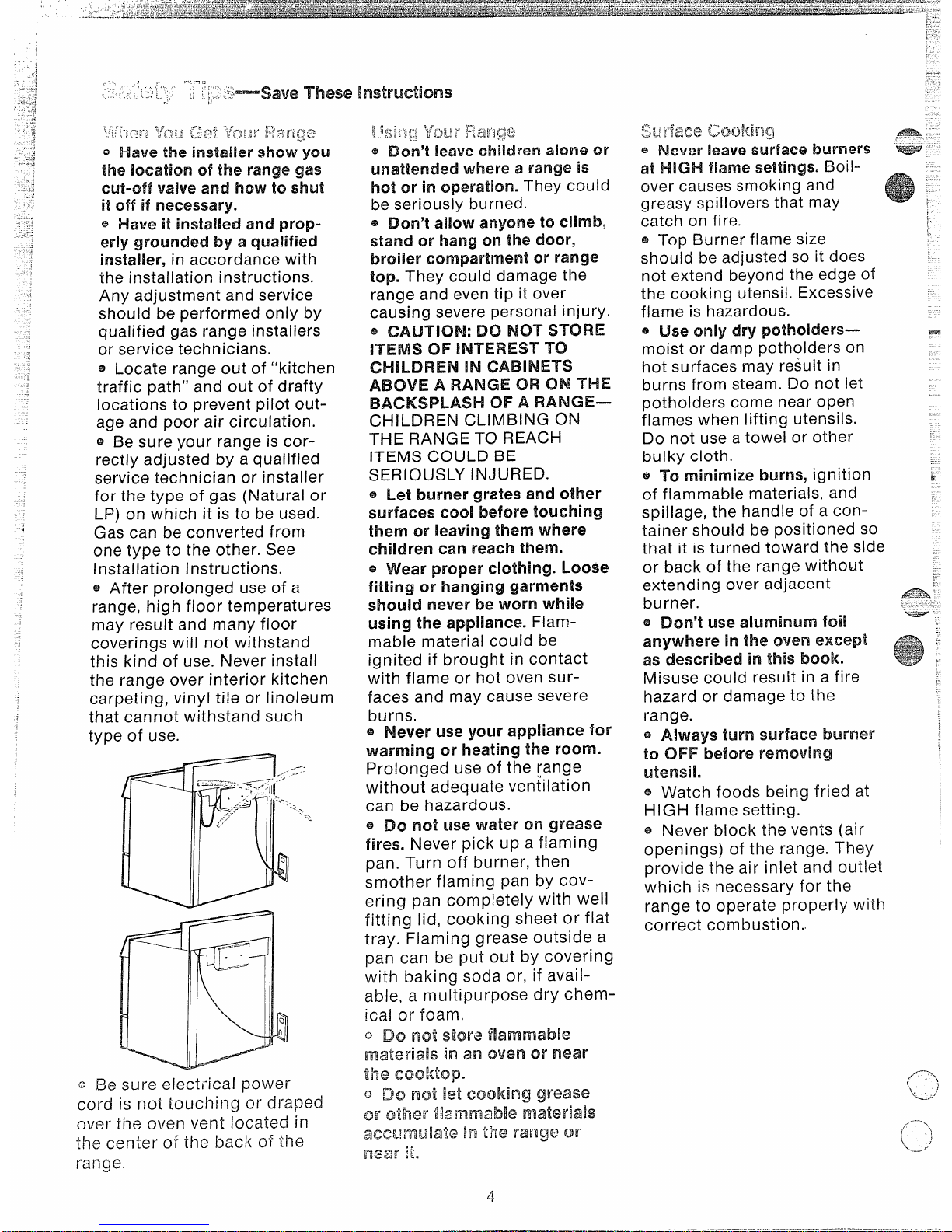
a Be sure elect l-ical power
cord is not touching or draped
over the oven vent located in
the cenfer of the back of the
range.
i) ? .%;, “t,)e,,T~~w ~.’:!s + ,-j ~:,
[:4:Iy,j: j{:,:
Q $“)
{.4:
u id$ I:;:JW
.,.
@
Don’t kiwi? $211ildreulalone or
unattended
where a range is
hot or In operation. They could
be seriously burned.
@Don’t allow anyone to climb,
stand or hang on the door,
broih?r compartment or range
top. They could damage the
range and even tip it over
causing severe personal injury.
@CAUTION: DO NOT STORE
ITEMS OF INTEREST -i-o
cHiLDREN IN CABINETS
ABOVE A RANGE OR ON THE
BACKSPLASH OF A RANGE—
CHILDREN CLIMBING ON
THE RANGE TO REACH
ITEMS COULD BE
SERIOUSLY INJURED.
@Let burner grates and other
surfaces cool before touching
them or leaving them where
children can reach them.
ISWear proper clothing. Loose
fitting or hanging garments
should never be worn while
using the appliance. Flamm-
able material could be
ignited if brought in contact
with flame or hot oven sur-
faces and may cause severe
burns.
@Never use your appliance for
warming or heating the mom.
Prolonged use of the range
without adequate ventilation
can be hazardous.
@Do not use water on grease
fires. Never pick up a flaming
pan. Turn off burner, then
smother flaming pan by cov-
ering pan completely with well
fitting lid, cooking sheet or flat
tray. Flaming grease outside a
pan can be put out by covering
with baking soda or, if avail-
able, a multipurpose dry chem-
ical or foam.
G DQ not store flammable
materials In an oven or near
the CxxM@2p.
~ Do iaelt let $xMlking grease
Qr other fuah~amablematerials
aKxx?mLBlatQllnlthe range or
ijqj~7Jyg~m
!2!L3!’A2QC2x>king
,fs?a%
@ !Nevel’leave surfaceburne=
‘Q%fw‘-
atIHUGHflame settings. Boil-
over causes smoking and
greasy spillovers that may
catch on fire.
}-
,-.
i-
@Top Burner flame size
~
should be adjusted so it does
not extend beyond the edge of
the cooking utensil. Excessive
flame is hazardous.
~ use only dry pothohNW+==—
m
moist or damp potholders on
hot surfaces may result in
burns from steam. Do not let
potholders come near open
flames when lifting utensils.
Do not use a towel or other
bulky cloth.
@To minimize burns, ignition
k
of flammable materials, and
spillage, the handle of a con-
tainer should be positioned so
that it is turned toward the side
or back of the range without
extending over adjacent
burner.
s Don’t use aluminum foil
anywhere in the oven except
as described in this book.
Misuse could result in a fire
hazard or damage to the
range.
@Ahvays turn surface burner
to OFF before removing
utensil.
~ Watch foods being fried at
HIGH flame setting.
@Never block the vents (air
openings) of the range. They
provide the air inlet and outlet
which is necessary for the
range to operate properly with
correct combustion..
4
Downloaded from www.ManualsFile.com manuals search engine
. .
~+Jesh foods can cause hot fat
(3
“~~-’ bubble up and over sides
of pan,
@Use least possible amount
of fat for effective shallow or
deep-fat frying. Filling the pan
too full of fat can cause spili-
overs when food is added.
@If a combination of oils or
fats will be used in frying, stir
together before heating, or as
fats melt slowly.
@Always beat fat slowfy, and
watch as it heats.
= Use deep fat thermometer
whenever possible to prevent
over-heating fat beyond the
smoking point.
@Use Proper Pan
Size—Avoid
pans that are unstable or easily
tipped. Select utensils having
flat bottoms large enough to
-ap!!,~e,~~-containfood i3VoidillCJ
w~uiluvers and spillovers, but
large enough to ccver burner
ate. This will both save
aning and prevent hazard-
ous accumulations of food,
since heavy spattering or spill-
overs left on range can ignite.
Use pans with handles that can
be easily grasped and remain
cool.
~ Use only glass cookware that
is recommended for use on gas
cooktops or gas ovens.
@Keep all plastics away from
top burners.
Q To avOid the possibility of
a
19umalways be certain
that the
controls for all burners
are at
OFFposition and ‘al!grates
are etxcdbefore
attempting to
remove the grate”
@~f!-$enffamhlg foods under
the hood, turn ‘the fan C9ff.The
%3nyif QpeFaiingJ may spread
--lthe “flame.
\
./
,
..
..-.-
.,
1
.,
,
-.-,
@If range is located near a
window, do not use long cur-
tains which could blow over
the top burners and create
a fire hazard.
~ When a pilot goes out, you
will detect a faint odor of gas
as your signal to relight pilot.
When relighting pilot, make
sure burner controls are in
“OFF” position and follow
instructions described on fol-
lowing pages to relight.
~ If you smell gas and you
have already made sure pilots
are lit, turn off the gas to the
range and call a qualified ser-
vice technician. Never use an
open flame to locate a leak.
. .
. .
~ Rt.mmNJE3amg9 Ph’cm’%g
an%
@Do not use oven for a storage
area.
~ stand away from the range
::x:::::::i:::::;:s
can cause burns to hands, face
and/or eyes.
@Keep oven free from grease
build up.
~ Place oven rack in desired
position while oven is cool.
@Pulling out shelf to the shelf
stop is a convenience in lifting
heavy foods. It is also a pre-
caution against burns from
touching hot surfaces of the
door or oven walls.
~ Don’t heat unopened fm.3d
Cx3ntaine$’sin the oven. Pres-
sure could build up and the
container could burst causing
an injury.
@When using cooking or
roasting bags in oven, follow
the manufacturer’s directions.
~ when CXX)kingpork> follow
our directions exactly and
always cook the meat to at
least 170°. This assures that,
in the remote possibility that
trichina may be present in the
meat, it will be killed and meat
will be safe to eat.
@Always remove broiler pan
from broiler compartment as
soon as you finish broiling.
Grease left in the pan can
catch fire if oven is used
without removing the grease
from the broiler pan.
@When broiling, if meat is too
close to the flame, the fat may
ignite. Trim excess fat to pre-
vent excessive flare-ups.
@Make sure broiler grill pan is
in place correctly to reduce the
possibility of grease fires.
~ If you should have a grease
fire in the broiler griil pan, turn
off oven,
keep drawer closed to
contain fire until it burns out.
fiikmniF?g
YCNJYRange
@Clean only parts listed in
this Use and Care Book.
@ Keep range clean and free
of accumulations of grease
or spillovers which may ignite.
1; jfQ~J ~q~@~q $j~{q#’~f:Q
@Read “The Problem Solver”
on page 21 of this book.
@Don’t attempt to repair Of’
replace any part of your range
unless it is specifically recom-
mended in this book. All other
servicing should be referred
to a qualified technician.
+
\
!,
.
I
Downloaded from www.ManualsFile.com manuals search engine
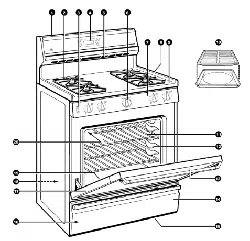
Features ofYour Range
‘–
Model RGB524
@
1. Mode!RGB5241
7
@
/’
“63
-e.
@
RGB528
RGB5281
.——..-..—
-—.-.,
.,.*,—M .. . .. WL.A”.--”4OUE(’-- m,,,mw——
4
:.
2.
3.
4.
5.
6.
7.
8.
9.
t 0.
11.
12.
13.
14.
35.
16.
-i7.
c
r-
C
F
1(
r
c
B
u
0
El
:
ir
E!
0
B
I
I
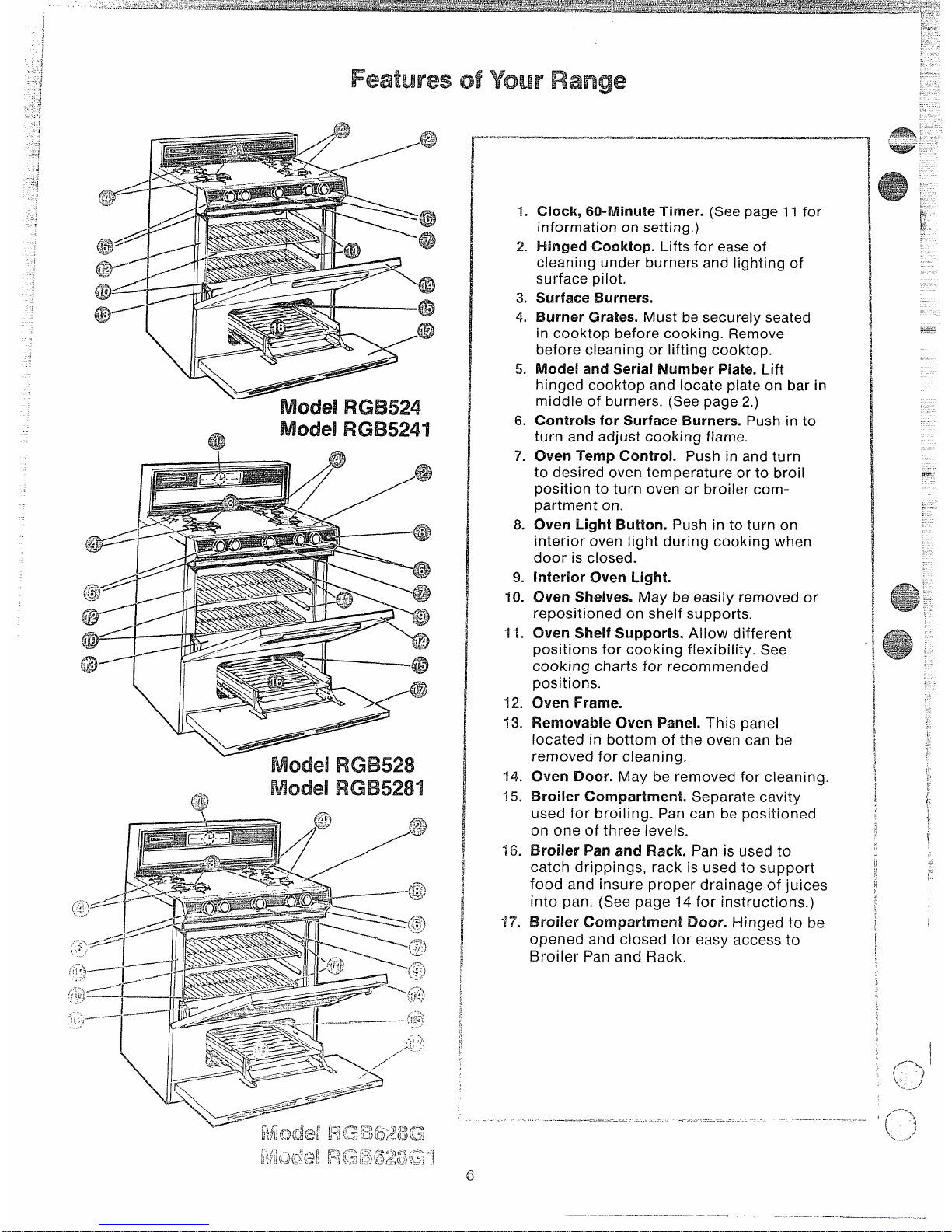
CJwk, 60-Minute Timer. (See page 11for
information on setting. )
Hinged Cooktop. Lifts for easeof
cleaning under burners and lighting of
surface pilot.
Surface Burners.
Burner(Mates.Must be securely seated
in cooktop before cooking. Remove
before cleaning or lifting cooktop.
Mode! arm!Serial Number Plate. Lift
hinged cooktop and locate plate on bar in
middle of burners. (See page 2.)
Controlsfor SurfaceBurners.Push in to
turn and adjust cooking flame.
CM?nTemp CXNWcd.Push in and turn
to desired oven temperature or to broil
position to turn oven or broiler com-
partment on.
Oven Light 13ut~on.Push in to turn on
interior oven light during cooking when
door is closed.
Interior C)WrtLight
(hum Shelves.May be easily removed or
repositioned on shelf supports.
Oven Shelf Supports. Allow different
positions for cooking flexibility. See
;ooking charts for recommended
]ositions.
>ven Frame.
?emovabh?Oven Panel. This panel
ocated in bottom of the oven can be
emoved for cleaning,
Jven Door. May be removed for cleaning.
3roi!erCompartment. Separate cavity
ised for broiling. Pan can be positioned
]n one of three levels.
lroiler Pan and Rack. Pan is used to
:atch drippings, rack is used to support
~od and insure proper drainage of juices
lto pan. (See page 14 for instructions. )
roiler Compartment Door. Hinged to be
pened and closed for easy access to
roiler Pan and Rack.
f.
J
..-.,>
6
.——_________
——.———..—,.._ -- ___
Downloaded from www.ManualsFile.com manuals search engine
.-
~:::
Your range is equipped with a
‘“: -*tanding pilot light that must be
-,
L
+&&g
...
‘“ match lit initially.
.
.-.
Usethe following steps to light
your standing pilot range. BE
SURE the burner control knobs
are in the “OFF” position.
r-. ;.
.?~e;l
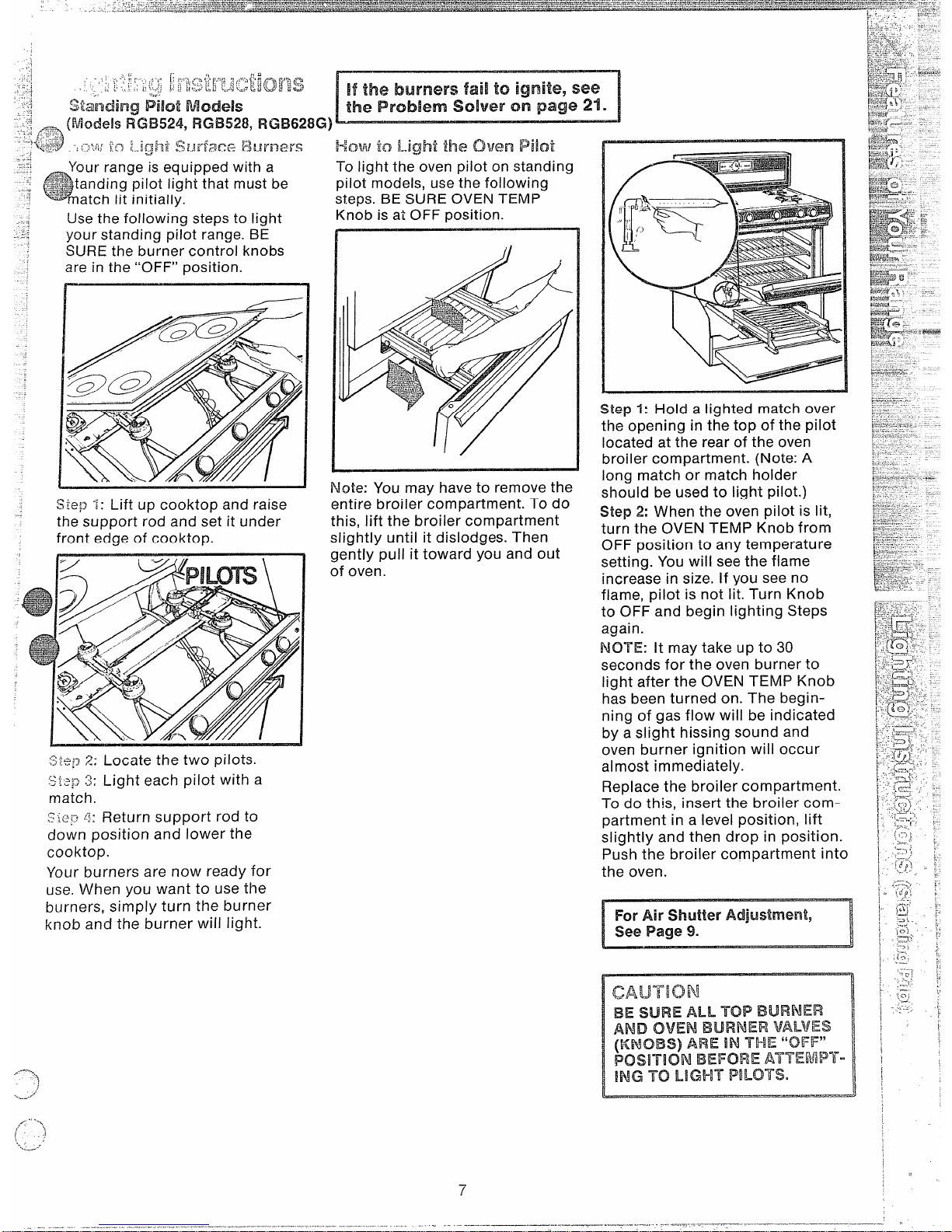
7: Lift up cooktop and raise
the support rod and set it under
front edge of cooktop.
k
!
s’:<::>2: Locate the two pilots.
,-,,
-.~>i-!
Q“Light each pilot with a
-../b:< .--=
match.
,2.:.,*:-,/“;’.
,.i..,.--... Return support rod to
down position and lower the
cooktop.
Your burners are now ready for
use. When you want to use the
burners, simply turn the burner
knob and the burner will light.
How
toLight ‘Me C.mEmIP’ilcli
To light the oven pilot on standing
pilot models, usethe following
steps. BE SURE OVENTEMP
Knob is at OFF position.
Note: You may haveto remove the
entire broiler compartment. To do
this, lift the broiler compartment
slightly until it dislodges. Then
gently pull it toward you and out
of oven.
Step t: Hold a lighted match over
the opening in the top of the pilot
located at the rear of the oven
broiler compartment. (Note: A
long match or match holder
should be used to light pilot.)
Step 2: When the oven pilot is lit,
turn the OVEN TEMP Knob from
OFF position to any temperature
setting. You will seethe flame
increase in size. If you see no
flame, pilot is not lit. Turn Knob
to OFF and begin lighting Steps
again.
NOTE: It may take up to 30
seconds for the oven burner to
light after the OVEN TEMP Knob
has been turned on. The begin-
ning of gas flow will be indicated
by a slight hissing sound and
oven burner ignition will occur
almost immediately.
Replace the broiler compartment.
To do this, insert the broiler com-
partment in a level position, lift
slightly and then drop in position.
Push the broiler compartment into
the oven.
1
For Air shutter Adjustment!,
seePage 9.
1
—.
.
Downloaded from www.ManualsFile.com manuals search engine
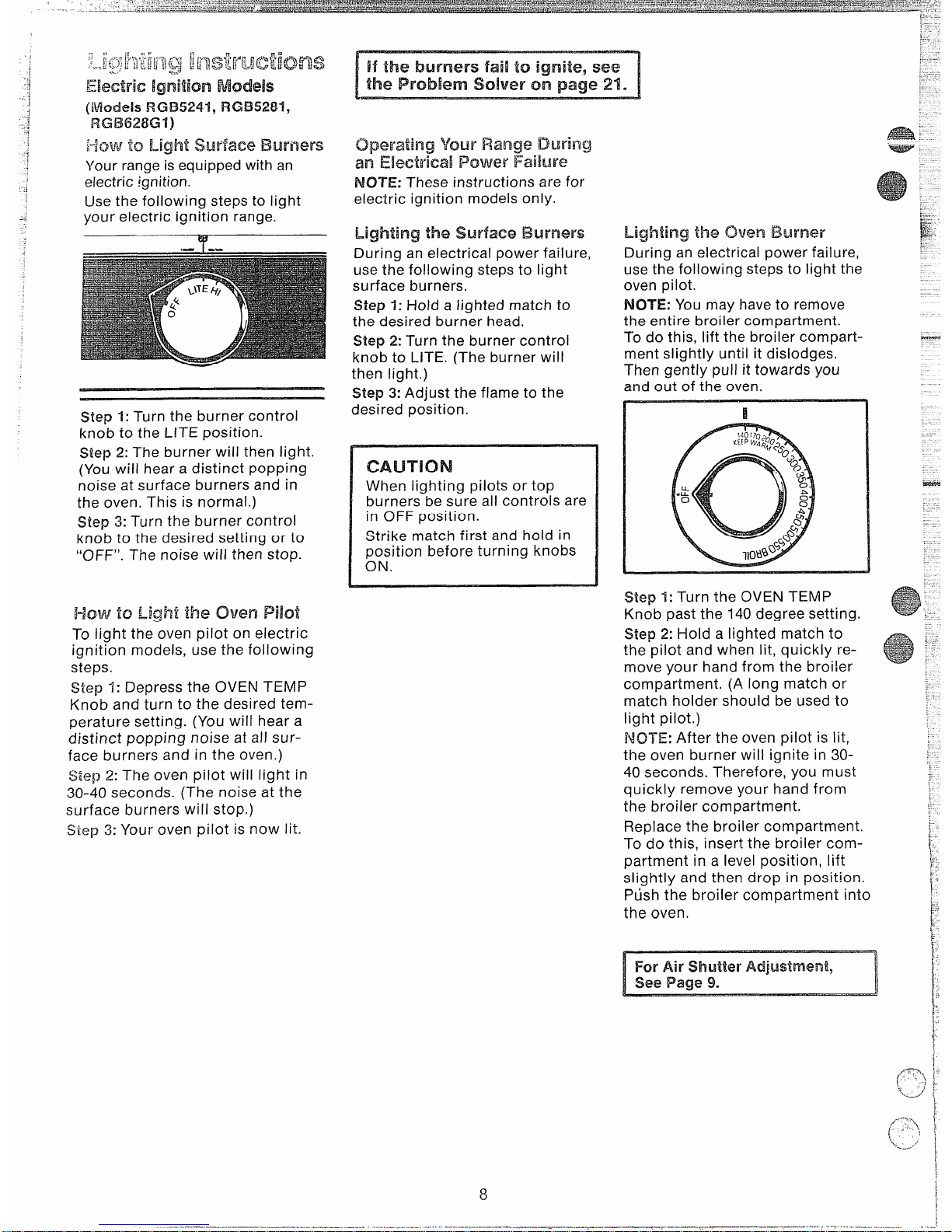
Ekdrk Ignition Models
(Models RGWX?41,RGB5281,
RGEHX?8GI)
i-:wvto Light SUrfac%Bun-iers
Your rangeisequipped with an
electric ignition.
Usethe following steps to light
your electric ignition range.
Step 1: Turn the burner control
knob to the LITE position.
Step 2: The burner will then light.
(You will hear a distinct popping
noise at surface burners and in
the oven. This is normal.)
Step 3:Turn the burner control
knob to the desired setting or to
“OFF”. The noise will then stop.
HOW
to.ughi the chef-lPilot
To light the oven pilot on electric
ignition models, use the following
steps.
Step 1: Depress the OVEN TEMP
Knob and turn to the desired tem-
perature setting. (You will hear a
distinct popping noise at all sur-
face burners and in the oven.)
Step 2: The oven pilot will light in
30-40
seconds. (The noise at the
surface burners will stop.)
.Siep3: Your oven pilot is now lit.
I
if
the+!bUmers faiil MI ignite,see
the Problem SU3kw cm page 21.
I
operatingYCwrF%mg$?!ch.wirmj
an E!ectl”ica!Power Fai!ure
NOTE: These instructions are for
electric ignition models only.
Lighting the surface Burners
During an electrical power failure,
use the following steps to light
surface burners.
Step 1: Hold a lighted match to
the desired burner head.
Step 2:Turn the burner control
knob to LITE. (The burner will
then light.)
Step 3:Adjust the flame to the
desired position.
CAUTION
When lighting pilots or top
burners be sure all controls are
in OFF position.
Strike match first and hold in
position before turning knobs
ON.
Lighting
w?ovenBurner
During an electrical power failure,
usethe following steps to light the
oven pilot.
NOTE: You may haveto remove
the entire broiler compartment.
To do this, lift the broiler compart-
ment slightly until it dislodges.
Then gently pull it towards you
and out of the oven.
Step 1:Turn the OVEN TEMP
Knob past the 140degree setting.
Step 2: Hold a lighted match to
the pilot and when lit, quickly re-
move your hand from the broiler
compartment. (A long match or
match holder should be used to
light pilot.)
NOI-E: After the oven pilot is lit,
the oven burner will ignite in 30-
40 seconds. Therefore, you must
quickly remove your hand from
the broiler compartment.
Replace the broiler compartment.
To do this, insert the broiler com-
partment in a level position, lift
slightly and then drop in position.
Push the broiler compartment into
the oven.
For Air
shutter Adjustment,
see’ Page 9.
—.
8
..
...—..— .-...—————————.=-——-.—.
.— —.=——..
————--—..—“-- . . . .. - .Y. . . . “,.... ....
I
Downloaded from www.ManualsFile.com manuals search engine
,~;
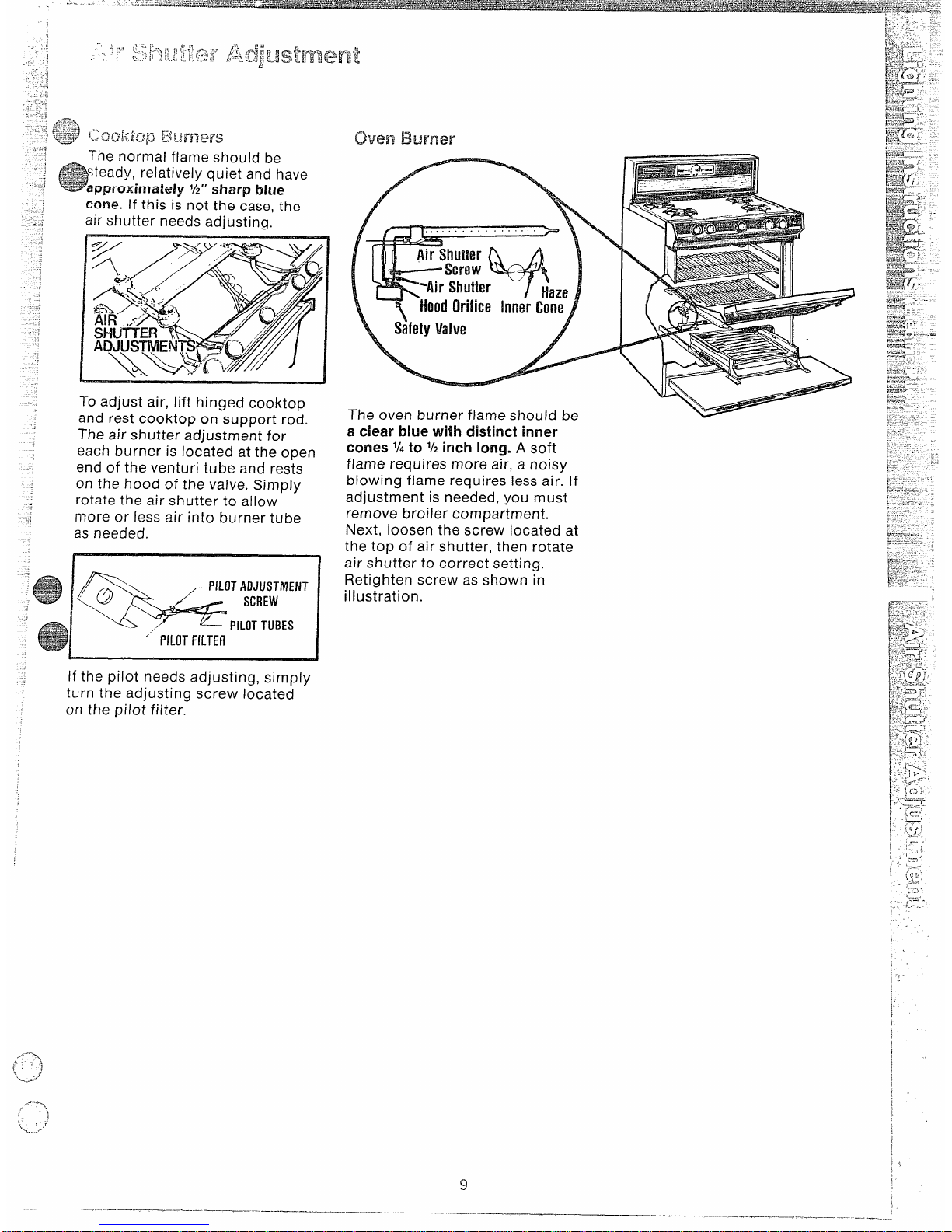
The normal flame should be
:“
‘o
&&& teady, relatively quiet and have
,;
—.
‘%F
~pp~oxjmaiely 1/2”sharp blue
cone. If this is not the case,the
air shutter needs adjusting,
To adjust air, lift hinged cooktop
and rest cooktop on support rod.
The air shutter adjustment for
each burner is located at the open
end of the venturi tube and rests
on the hood of the valve. Simply
rotate the air shutter to allow
more or less air into burner tube
asneeded.
If the pilot needs adjusting, simply
turn the adjusting screw located
on the pilot filter.
P
Ill! .-
—
&,_,<kL-J
..--—
.-
—
LL!iL-!-!
................,
‘Ixl ‘1?
T
a clear blue with disfinctinner
cones1/4to %inch long. A soft
flame requires more air, a noisy
blowing flame requires lessair. If
adjustment is needed, you must
remove broiler compartment.
Next, loosen the screw located at
the top of air shutter, then rotate
air shutter to correct setting.
Retighten screw as shown in
illustration.
9
.—._—_ ___,_
———
______ ._._
————-———-----.——...
———
—
—..,_.-= -——____.
--—..-
Downloaded from www.ManualsFile.com manuals search engine
—
—’l—
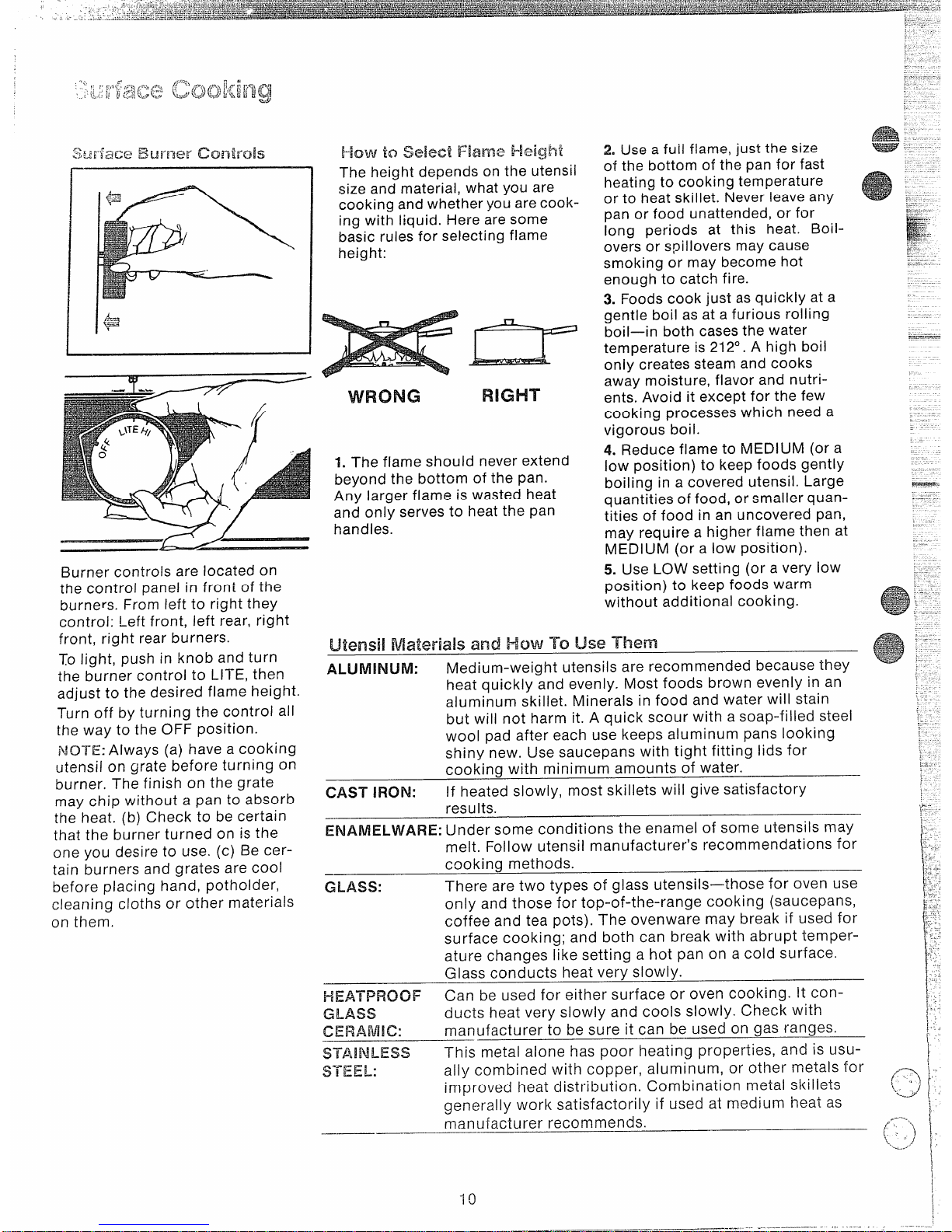
Burner controls are located on
the control panel in front of the
burnew. From left to right they
control: Left front, left rear, right
front, right rear burners.
To light, push in knob and turn
the burner control to LITE, then
adjust to the desired flame height.
Turn off by turning the control all
the way to the OFF position.
~~~TE:Always (a)
have a cooking
utensil on grate before turning on
burner. The finish on the grate
may chip without a pan to absorb
the heat. (b) Check to be certain
that the burner turned on !sthe
one you desire to use. (c) Be cer-
tain burners and grates are cool
before placing hand, potholder,
cleaning cloths or other materials
on them.
How WI
sde’ix! Flame’ i=’kight
The height depends on the utensil
size and material, what you are
cooking and whether you arecook-
ing with liquid. Here aresome
basic rules for selecting flame
height:
WRONG
RIGHT’
1. The flame should never extend
beyond the bottom of the pan.
Any larger flame is wasted heat
and only serves to heat the pan
handles.
2. Use a full flame, just the size
of the bottom of the pan for fast
heating to cooking temperature
or to heat skillet. Never leaveany
pan or food unattended, or for
long periods at this heat. Boil-
overs or spillovers may cause
smoking or may become hot
enough to catch fire.
3. Foods cook just asquickly at a
gentle boil as at a furious rolling
boil—in both casesthe water
temperature is 212°. A high boil
only creates steam and cooks
away moisture, flavor and nutri-
ents. Avoid it except for the few
cooking processes which need a
vigorous boil.
4. Reduce flame to MEDIUM (or a
low position) to keep foods gently
boiling in a covered utensil. Large
quantities of food, or smaller quan-
tities of food in an uncovered pan,
may require a higher flame then at
MEDIUM (or a low position).
5. Use LOW setting (or a very low
position) to keep foods warm
without additional cooking.
heat quickly and evenly. Most foods brown evenly in an
aluminum skillet. Minerals in food and water will stain
but will not harm it. A quick scour with a soap-filled steel
wool pad after each use keeps aluminum pans looking
shiny new. Use saucepans with tight fitting lids for
cooking with minimum amounts of water.
CAST IRON:
If heated slowly, most skillets will give satisfactory
results.
utensil BAak?rkd’sand How T-OuseT-I-m-R
ALUMINUM:
Medium-weight utensils are recommended because they
ENAMELWARE: Under some conditions the enamel of some utensils may
melt. Follow utensil manufacturer’s recommendations for
cooking methods.
GLASS:
There are two types of glass utensils—those for oven use
only and those for top-of-the-range cooking (saucepans,
coffee and tea pots). The ovenware may break if used for
surface cooking; and both can break with abrupt temper-
ature changes like setting a hot pan on a cold surface.
Glass conducts heat very slowly.
HEATPROOF Can be used for either surface or oven cooking. It con-
GL.ASS
ducts heat very slowly and cools slowly. Check with
CERAMIC: manufacturer to be sure it can be used on gas ranges.
STAINLESSThis metal alone has poor heating properties, and is usu-
‘STEEL:
ally combined with copper, aluminum, or other metals for
improved heat distribution. Combination metal skillets
generally work satisfactorily if used at medium heal as
manufacturer recommends.
i
1
{
\
I
——
.—..-. —-.————-- .. .-------
-—.-
Downloaded from www.ManualsFile.com manuals search engine
: {~$j.,
=7 ..’’-eit:f$;eLkiing Yciwr CN.H’3
~m~,.Look at the control. Be sure you
‘ L
&~#~nderstandhow to set it properly.
“-”=?.Check oven interior. Look at the
shelves.Take a practice run at
removing and replacing them prop-
erly, to give sure sturdy support.
3. Read over information and tips
that follow.
4, Keep this book handy so you
can refer to it, especially during
the first weeks of getting ac-
quainted with your oven.
over! Tempemhm’e Cc?nti’d
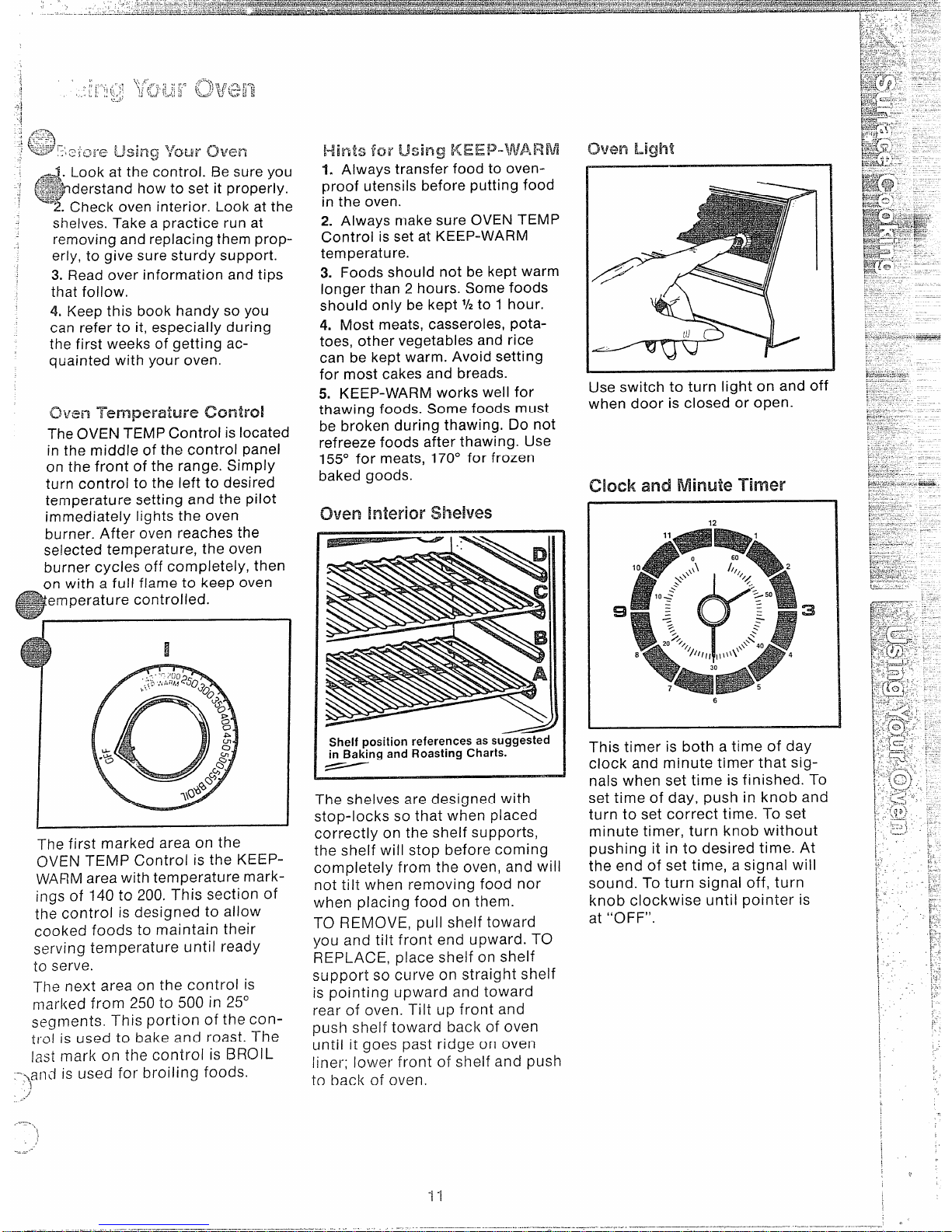
The OVEN TEMP Control islocated
in the middle of the control panel
on the front of the range. Simply
turn control to the left to desired
temperature setting and the pilot
immediately lights the oven
burner. After oven reaches the
selected temperature, the oven
burner cycles off completely, then
on with a full flame to keep oven
–.& emperature controlled.
#“J
.
‘~
The first marked area on the
OVEN TEMP Control is the KEEP-
WARMarea with temperature mark-
ings of 140to 200. This section of
the control is designed to allow
cooked foods to maintain their
serving temperature until ready
to serve.
The next area on the control is
marked from 250 to 500 in 25°
segments. This portion of the con-
trol is
used to bake and roast. The
last mark on the control is BROIL
-l:and is used for broiling foods.
,,
,,-
n..
. .
-.....,-
IPflirfits
farkhing k(EE!~-w$ARNl
1. Always transfer food to oven-
proof utensils before putting food
in the oven.
2. Always rrlakesure OVEN TEMP
Control is set at KEEP-WARM
temperature.
3. Foods should not be kept warm
longer than 2 hours. Some foods
should only be kept %to 1 hour.
4. Most meats, casseroles, pota-
toes, other vegetables and rice
can be kept warm. Avoid setting
for most cakes and breads.
5. KEEP-WARM works well for
thawing foods. Some foods must
be broken during thawing. Do not
refreeze foods after thawing. Use
155° for meats, 170° for frozen
baked goods.
Cwen
!nkrior shdves
Shelf position references as suggested
in Baking and Roasting Charts.
~~
The shelves are designed with
stop-locks so that when placed
correctly on the shelf supports,
the shelf will stop before coming
completely from the oven, and w
not tilt when removing food nor
when placing food on them.
TO REMOVE, pull shelf toward
you and tilt front end upward. TO
REPLACE, place shelf on shelf
support so curve on straight shelf
is pointing upward and toward
rear of oven. Tilt up front and
push shelf toward back of oven
until it goes past ridge on oven
liner; lo-werfront of shelf and push
to back of oven.
Use switch to turn light on and off
when door is closed-or open.
clock and Minute Timer
This timer is both a time of day
clock and minute timer that sig-
nals when set time is finished. To
set time of day, push in knob and
turn to set correct time. To set
minute timer, turn knob without
pushing it in to desired time. At
the end of set time, a signal will
sound. To turn signal off, turn
knob clockwise until pointer is
at “OFF”,
-.
..—- .-..
~.—-—...—. --—-—--—---
-...
Downloaded from www.ManualsFile.com manuals search engine
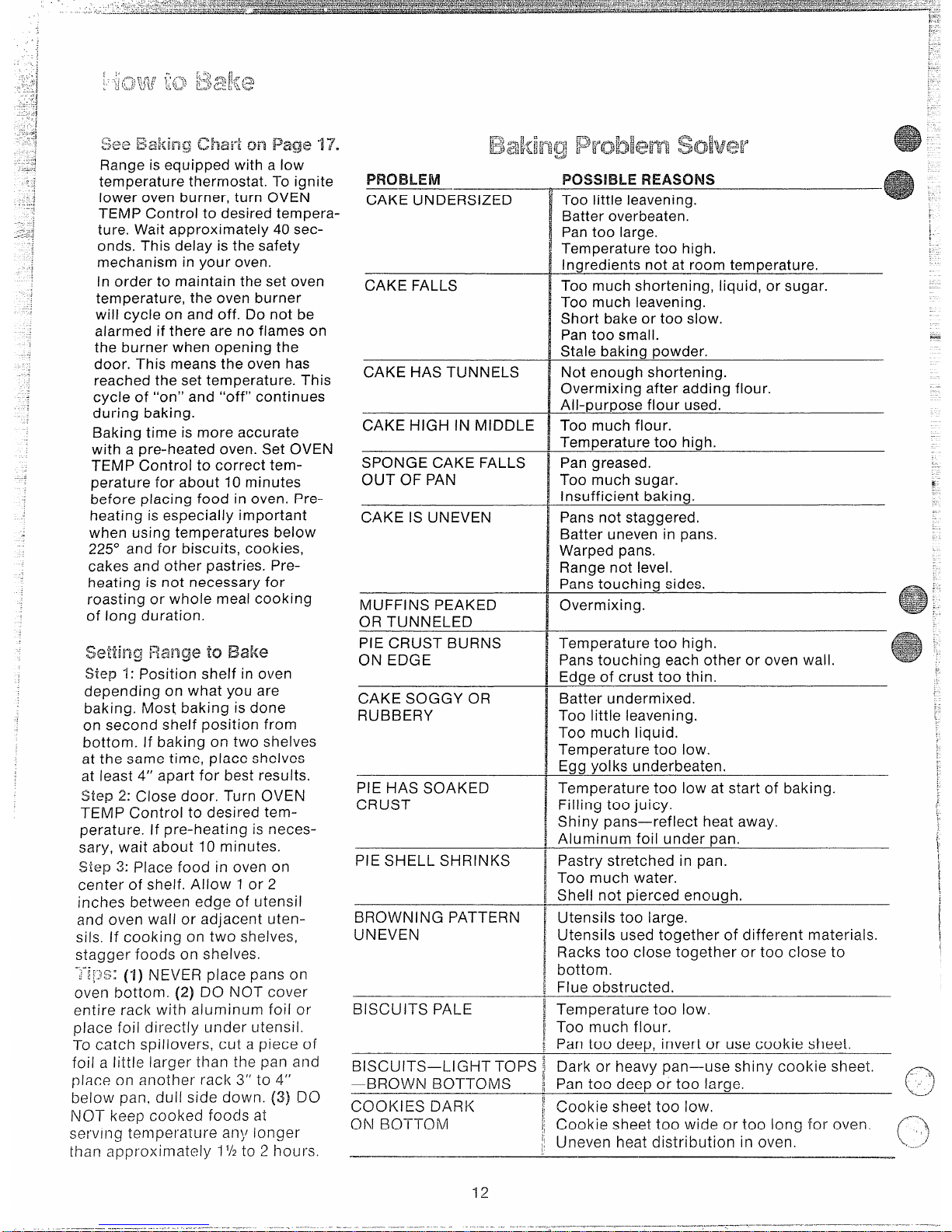
Range is equipped with a low
temperature thermostat. To ignite
lower oven burner, turn OVEN
TEMP Control to desired tempera-
ture. Wait approximately 40 sec-
onds. This delay is the safety
mechanism in your oven.
In order to maintain the set oven
temperature, the oven burner
will cycle on and off. Do not be
alarmed if there are no flames on
the burner when opening the
door. This means the oven has
reached the set temperature. This
cycle of “on” and “off” continues
during baking.
Baking time is more accurate
with a pre-heated oven. Set OVEN
TEMP Control to correct tem-
perature for about 10 minutes
before placing food in oven. Pre-
heating is especially important
when using temperatures below
225° and for biscuits, cookies,
cakes and other pastries. Pre-
heating is not necessary for
roasting or whole meal cooking
of long duration.
settingFkmge toBake
Step 1: Position shelf in oven
depending on what you are
baking. Most baking is done
on second shelf position from
bottom. If baking on two shelves
at the same time, place shelves
at least 4“ apart for best results.
Step 2: Close door. Turn OVEN
TEMP Control to desired tem-
perature. If pre-heating is neces-
sary, wait about 10 minutes.
Step 3: Place food in oven on
center of shelf. Allow 1or 2
inches between edge of utensil
and oven wall or adjacent uten-
sils. If cooking on two shelves,
stagger foods on shelves.
.,-.
:
1[’l$n(1) NEVER place pans on
oven bottom. (2) DO NOT cover
entire rack with aluminum foil or
place foil directly under utensil.
To catch spillovers, cut a piece of
foil a Iiitle larger than the pan and
place on another rack 3“ to 4“
below pan, dull side down. (3) DO
NOT keep cooked foods at
sewing temperature any longer
than approximately 11/2to 2 hours.
PROBLEM
CAKE UNDERSIZED
CAKE FALLS
CAKE HAS TUNNELS
CAKE HIGH IN MIDDLE
SPONGE CAKE FALLS
OUT OF PAN
CAKE IS UNEVEN
MUFFINS PEAKED
OR TUNNELED
PIE CRUST BURNS
ON EDGE
CAKE SOGGY OR
RUBBERY
PIE HAS SOAKED
CRUST
PIE SHELL SHRINKS
BROWNING PATTERN
UNEVEN
BISCUITS
PALE
BISCUITS—LIGtiT TOPS
—BROWN BOTTOMS
COOKIES DARK
ON BOTTOIM
F%3SS!BLEREASONS
Too little leavening.
Batter overbeaten.
L
Pantoo large.
i
,
Temperature too high.
Ingredients not at room temperature,
Too much shortening, liquid, or sugar.
Too much leavening.
Short bakeor too slow.
Pantoo small.
..-
Stale baking powder.
Not enough shortening.
Overmixing after adding flour.
All-purpose flour used.
Too much flour.
Temperature too high.
Pan greased.
Too much sugar.
E
Insufficient baking.
Pans not staggered.
Batter uneven in pans.
Warped pans.
Range not level.
Panstouching sides.
Overmixing.
@
$--., f
:+T
~=..
.-
Temperature too high.
@
. .=
%$&
. =-
Pans touching each other or oven wall.
Edge of crust-too thin.
Batter undermined.
Too little leavening.
.-
Too much liquid.
Temperature too low.
Egg yolks underbeaten.
Temperature too low at start of baking.
Filling too juicy.
Shiny pans—reflect heat away.
Aluminum foil under pan,
{
Pastry stretched in pan.
f
i
Too much water.
~
Shell not pierced enough.
~
~
Utensils too large.
1
Utensils used together of different materials.
{
Racks too close together or too close to
~
bottom.
Flue obstructed.
Temperature too low.
Too much flour.
Pan too deep, invert or use cookie sheet.
Dark or heavy pan—use shiny cookie sheet. _ ,
Pan too deep or too large.
o
,!
“\._,’
Cookie sheet too low.
Cookie sheet too wide or too long for oven. ,,]
(
‘-\
Uneven heat distribution in oven.
~.___
—-—.............. .. ...-—--———---—-
..... .... —-
—— -
.——.—.
.—..-..-.-----.—.—.——.--——.—————
——.-——
Downloaded from www.ManualsFile.com manuals search engine
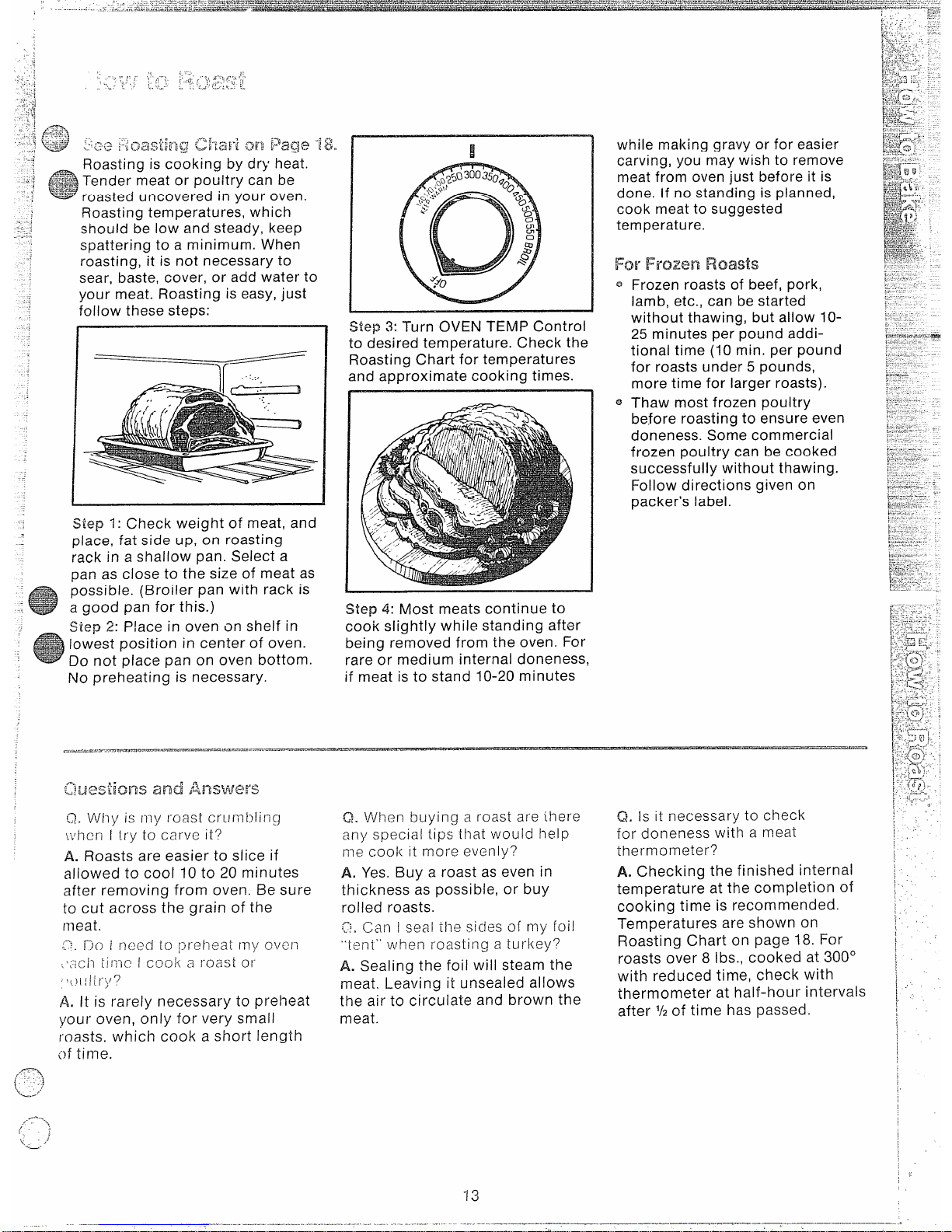
...~,
Roasting is cooking by dry heat.
.&
~ ~$$$$Tender meat or poultry can be
~ w roasted
uncovered in your oven.
-,
Roasting temperatures, which
should be low and steady, keep
spattering to a minimum. When
roasting, it is not necessary to
sear, baste, cover, or add water to
your meat. Roasting is easy,just
follow these steps:
Step 3: Turn OVEN TEMP Control
to desired temperature. Check the
Roasting Chart for temperatures
and approximate cooking times.
Step f: Check weight of meat, and
place, fat side up, on roasting
rack in a shallow pan. Select a
pan as close to the size of meat as
possible. (Broiler pan with rack is
a good pan for this. )
Step 4: Most meats continue to
Step 2: Place in oven on shelf in
cook slightly while standing after
lowest position in center of oven.
being removed from the oven. For
Do not place pan on oven bottom.
rare or medium internal doneness,
if meat is to stand 10-20 minutesNo preheating is necessary.
while making gravy or for easier
carving, you may wish to remove
meat from oven just before it is
done. If no standing is planned,
cook meat to suggested
temperature.
For FU&?X.?rlRoa$ts
Frozen roasts of beef, pork,
lamb, etc., can be started
without thawing, but allow 10-
25 minutes per pout7daddi-
tional time (10 min. per pound
for roasts under 5 pounds,
more time for larger roasts).
Thaw most frozen poultry
before roasting to ensure even
doneness. Some commercial
frozen poultry can be cooked
successfully without thawing.
Follow directions given on
packer’s label.
...
,.,Ls&s.a, ,.- , x ‘ls+T.m.-.- . .... . .. ..- .. ..-=. ..-.-. ‘.-..as=--.-.=.=..-
_ -—.—.
.z----
“if’jgnsar[G~Answers
i-’J~&22~
O. Why
is my roast crunlblif7g
i“vhen [ try to carve it’?
1%.
Roasts are easier to slice if
allowed to cool 10 to 20 minutes
after removing from oven. Be sure
to cut across the grain of the
meat.
‘-:. i_10i tlecd to ~j~e}-!eai
my oven
L
(
‘Ceil time I cook a roast or
lol{l~ry’?
A. It is rarely necessary to preheat
your oven, only for very small
roasts, which cook a short length
df time,
-. ..—....—-—.-..- ..-.?—...--....-4...................—
.
.....--
Q. When buying a roast are ~here
any special tips that would help
t17e cook it more evenly?
A. Yes. Buy a roast as even in
thickness as possible, or buy
rolled roasts.
5.
Ca.17 I seal i17esicles of my (oil
“tent”
when roasting a turifey?
A. Sealing the foil will steam the
meat. Leaving it unsealed allows
the air to circulate and brown the
meat.
13
Q. Is it necessary to check
for doneness with a meat
t17ermometer?
A. Checking the finished internal
temperature at the completion of
cooking time is recommended.
Temperatures are shown on
Roasting Chart on page 18. For
roasts over 8 Ibs., cooked at 300°
with reduced time, check with
thermometer at half-hour intervals
after 1/2of time has passed.
Downloaded from www.ManualsFile.com manuals search engine
%
-.,;~j:-:
i’Xg-ffi-~jyiip
.- -.,.
k-
),.,2 , .J$’hii.,.. [::/75!-/LID !’%3ae-i9“
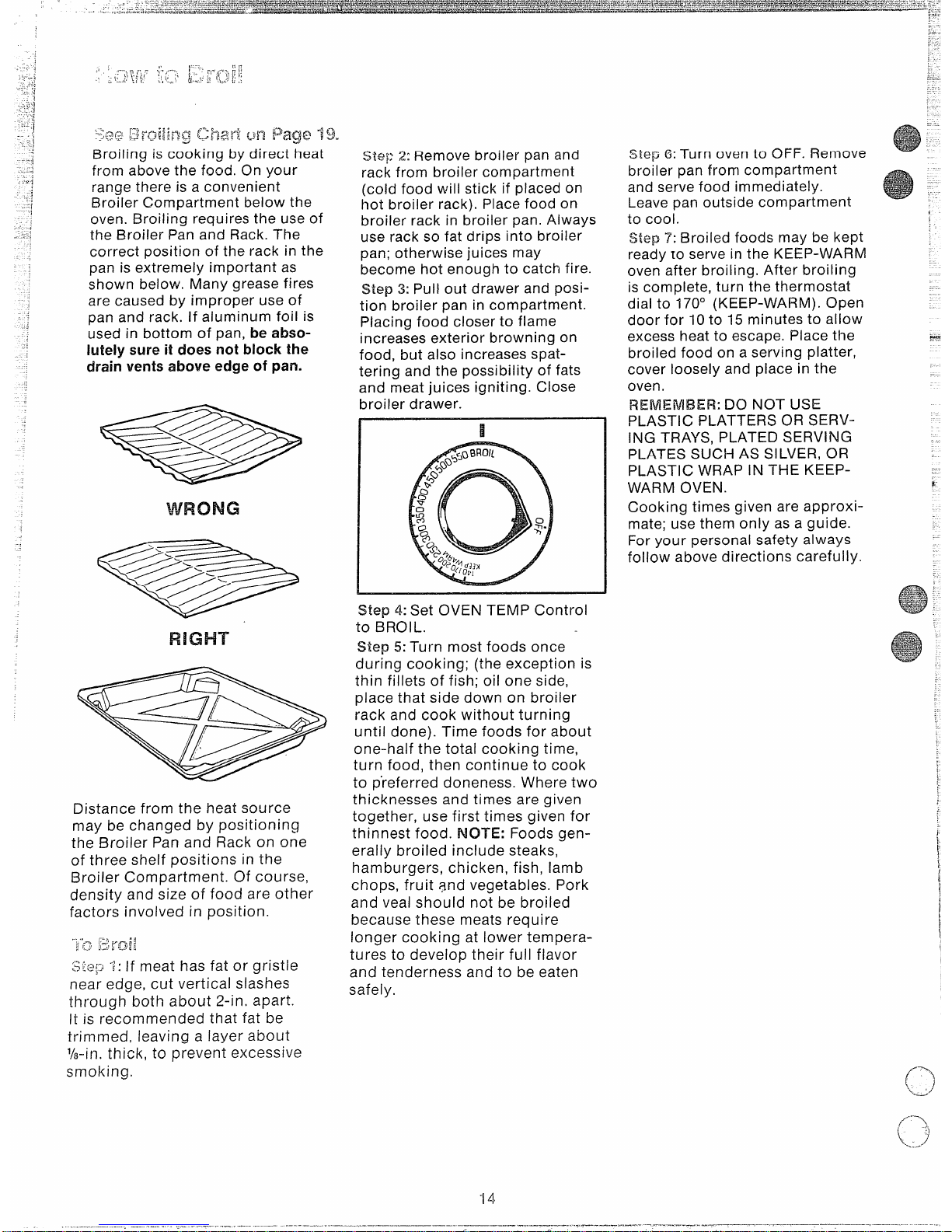
Broiling is cooking by direct ~eat
from above the food. On your
range there is a convenient
Broiler Compartment below the
oven. Broiling requires the use of
the Broiler Pan and Rack. The
correct position of the rack in the
pan is extremely important as
shown below. Many grease fires
are caused by improper use of
pan and rack. If aluminum foil is
used in bottom of pan, be abso-
lutelysure it doesnot Mock the
drainventsaboveedgeof pan.
WRONG
RIGHT
Distance from the heat source
may be changed by positioning
the Broiler Pan and Rack on one
of three shelf positions in the
Broiler Compartment. Of course,
density and size of food are other
factors involved in position.
Ste~>‘i: If meat has fat or gristle
near edge, cut vertical slashes
through both about 2-in. apart.
It is recommended that fat be
trim freed,leaving a layer about
%-in. thick, to prevent excessive
smoking.
Step 2: Remove broiler pan and
rack from broiler compartment
(coid food will stick if placed on
hot broiler rack). Place food on
broiler rack in broiler pan. Always
use rack so fat drips into broiler
pan; otherwise juices may
become hot enough to catch fire.
Step 3: Pull out drawer and posi-
tion broiler pan in compartment.
Placing food closer to flame
increases exterior browning on
food, but also increases spat-
tering and the possibility of fats
and meat juices igniting. Close
broiler drawer.
Step 4:Set OVEN TEMP Control
to BROIL.
Step 5:Turn most foods once
during cooking; (the exception is
thin fillets of fish; oil one side,
place that side down on broiler
rack and cook without turning
until done). Time foods for about
one-half the total cooking time,
turn food, then continue to cook
to preferred doneness. Where two
thicknesses and times are given
together, use first times given for
thinnest food. NOTE: Foods gen-
erally broiled include steaks,
hamburgers, chicken, fish, lamb
chops, fruit ~nd vegetables. Pork
and veal should not be broiled
because these meats require
longer cooking at lower tempera-
tures to develop their full flavor
and tenderness and to be eaten
safely.
2tep 6:Turn oven to OFF. Remove
broiler pan from compartment
and servefood immediately.
Leavepan outside compartment
to cool.
Step 7: Broiled foods may be kept
ready TOserve in the KEEP-WARM
oven after broiling. After broiling
is complete, turn the thermostat
dial to 170° (KEEP-WARM). Open
door for 10to 15 minutes to allow
excess heat to escape. Place the
broiled food on a serving platter,
cover loosely and place in the
oven.
REMEMBER: DO NOT USE
PLASTIC PLATTERS OR SERV-
ING TRAYS, PLATED SERVING
PLATES SUCi-i AS SILVER, OR
PLASTIC WRAP IN THE KEEP-
WARM OVEN.
Cooking times given are approxi-
mate; use them only as a guide.
For your personal safety always
follow above directions carefully.
Downloaded from www.ManualsFile.com manuals search engine
r—-–––
,.%! ~orCare ofthe Continuous
4
c
roper care and cleaning are
.~~~$ipportantso your Range will give
‘-%uefficient and satisfactory ser-
vice. Follow these directions and
directions on the Cleaning Chart
page20 carefully in caring for
your range.
...
bnaimei F!rlisl-1
:=’lj;’@#:~ z
The porcelain enamel finish is
sturdy but breakable if misused.
This finish is acid resistant. How-
ever,any acid foods spilled (such
asfruit juices, tomato, or vinegar)
should not be permitted to remain
on the finish.
, ,.
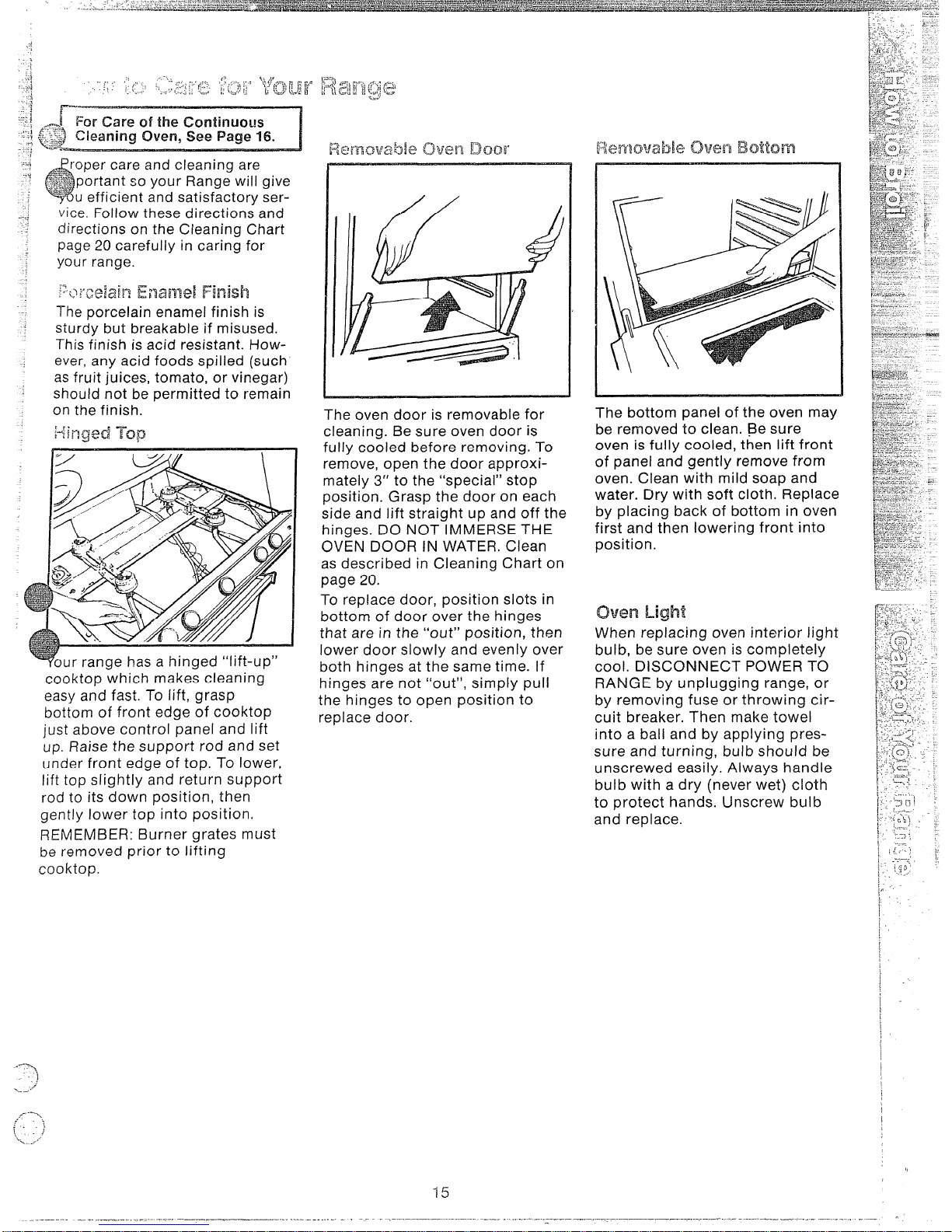
~-~j.rj<g~“~Top
.
4
cooktop ‘which makes cleaning
easy and fast. To lift, grasp
bottom of front edge of cooktop
just above control panel and lift
up. Raise the support rod and set
under front edge of top. To lower,
lift top slightly and return support
rod to its down position, then
gently lower top into position.
REMEMBER: Burner grates must
be removed prior to lifting
cooktop.
.-..—....- ...... ........-——--.———.-—
— .——....... .
The oven door is removable for
cleaning. Be sure oven door is
fully cooled before removing. To
remove, open the door approxi-
mately 3“ to the “special” stop
position. Grasp the door on each
side and lift straight up and off the
hinges. DO NOT IMMERSE THE
OVEN DOOR IN WATER. Clean
as described in Cleaning Chart on
page 20.
To replace door, position slots in
bottom of door over the hinges
that are in the “out” position, then
lower door slowly and evenly over
both hinges at the same time. If
hinges are not “out”, simply pull
the hinges to open position
to
replace door.
The bottom panel of the oven may
be removed to clean. pe sure
oven is fully cooled, then lift front
of panel and gently remove from
oven. Clean with mild soap and
water. Dry with soft cloth. Replace
by placing back of bottom in oven
first and then lowering front into
position.
Owen
Light
When replacing oven interior light
bulb, be sure oven is completely
cool. DISCONNECT POWER TO
RANGE by unplugging range, or
by removing fuse or throwing cir-
cuit breaker. Then make towel
into a ball and by applying pres-
sure and turning, bulb should be
unscrewed easily. Always handle
bulb with a dry (never wet) cloth
to protect hands. Unscrew bulb
and replace.
1
I
I
0
Downloaded from www.ManualsFile.com manuals search engine
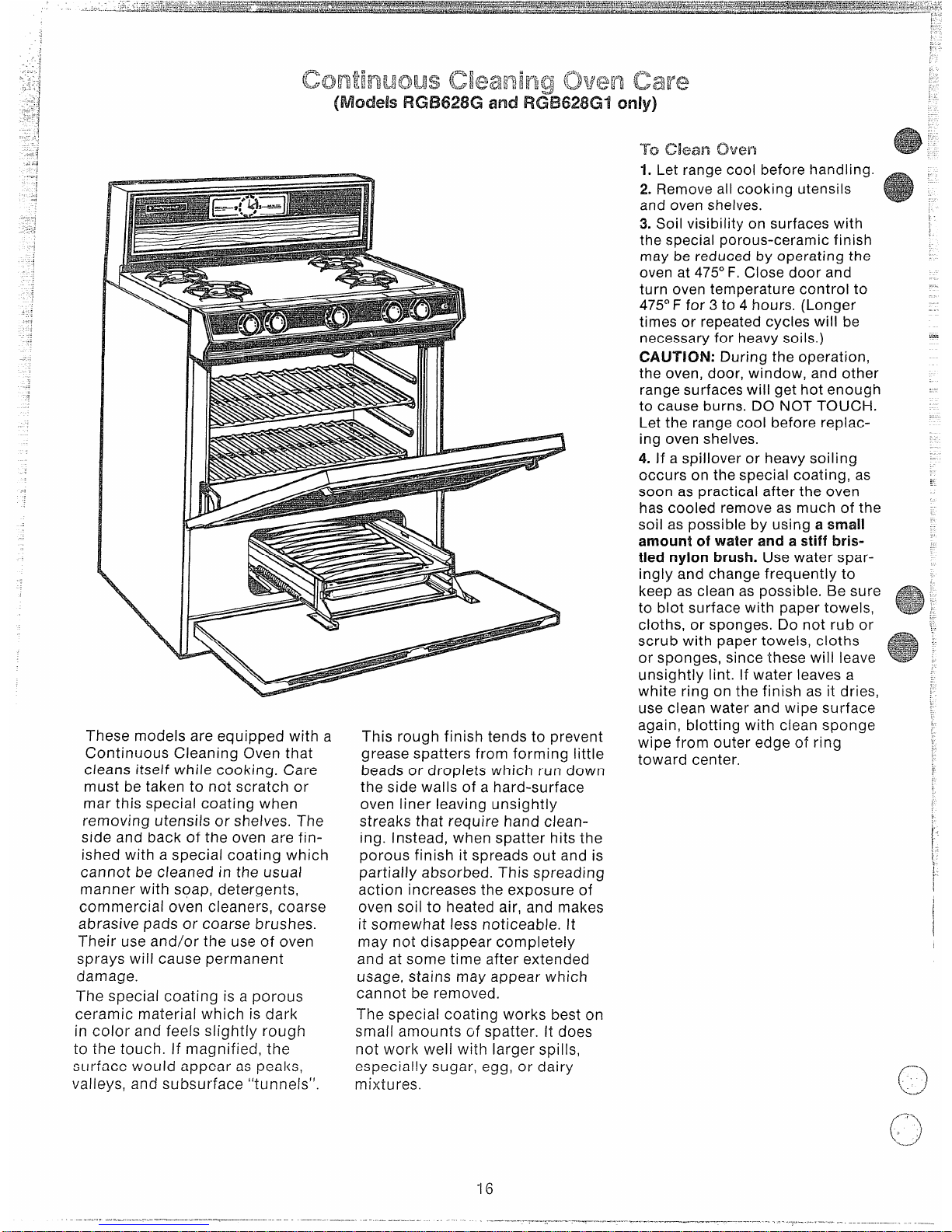
\
These models are equipped with a
Continuous Cleaning Oven that
cleans itself while cooking. Care
must be taken to not scratch or
mar this special coating when
removing utensils or shelves. The
side and back of the oven are fin-
ished with a special coating which
cannot be cleaned in the usual
manner with soap, detergents,
commercial oven cleaners, coarse
abrasive pads or coarse brushes.
Their use andjor the use of oven
sprays will cause permanent
damage.
The special coating is a porous
ceramic material which is dark
in color and feels slightly rough
to the touch. If magnified, the
surface would appear as peaks,
valleys, and subsurface “tunnels”.
This rough finish tends to prevent
grease spatters from forming little
beads or droplets which run down
the side walls of a hard-surface
oven liner leaving unsightly
streaks that require hand clean-
ing. instead, when spatter hits the
porous finish it spreads out and is
partially absorbed. This spreading
action increases the exposure of
oven soil to heated air, and makes
it somewhat less noticeable. It
may not disappear completely
and at some time after extended
usage, stains may appear which
cannot be removed.
The special coating works best on
small amounts Gfspatter. it does
not work well with larger spills,
especially sugar, egg, or dairy
mixtures.
~. Let range cool before handling.
2. Remove all cooking utensils
and oven shelves.
3. Soil visibility on surfaces with
the special porous-ceramic finish
may be reduced by operating the
oven at 475°F.Close door and
turn oven temperature control to
475”F for 3 to 4 hours. (Longer
times or repeated cycles will be
necessary for heavy soils.)
CAUTION: During the operation,
the oven, door, window, and other
range surfaces will get hot enough
to cause burns. DO NOT TOUCH.
Let the range cool before replac-
ing oven shelves.
4. If a spillover or heavy soiling
occurs on the special coating, as
soon as practical after the oven
has cooled remove as much of the
soil as possible by using a small
amount of water and a stiff bris-
tled nylon brush.Use water spar-
ingly and change frequently to
keep as clean as possible. Be sure
to blot surface with paper towels,
cloths, or sponges. Do not rub or
scrub with paper towels, cloths
or sponges, since these will leave
unsightly lint. If water leaves a
white ring on the finish as it dries,
use clean water and wipe surface
again, blotting with clean sponge
wipe from outer edge of ring
toward center.
Downloaded from www.ManualsFile.com manuals search engine
“1
&+=-
. ,:
.-
>
b;&&:”
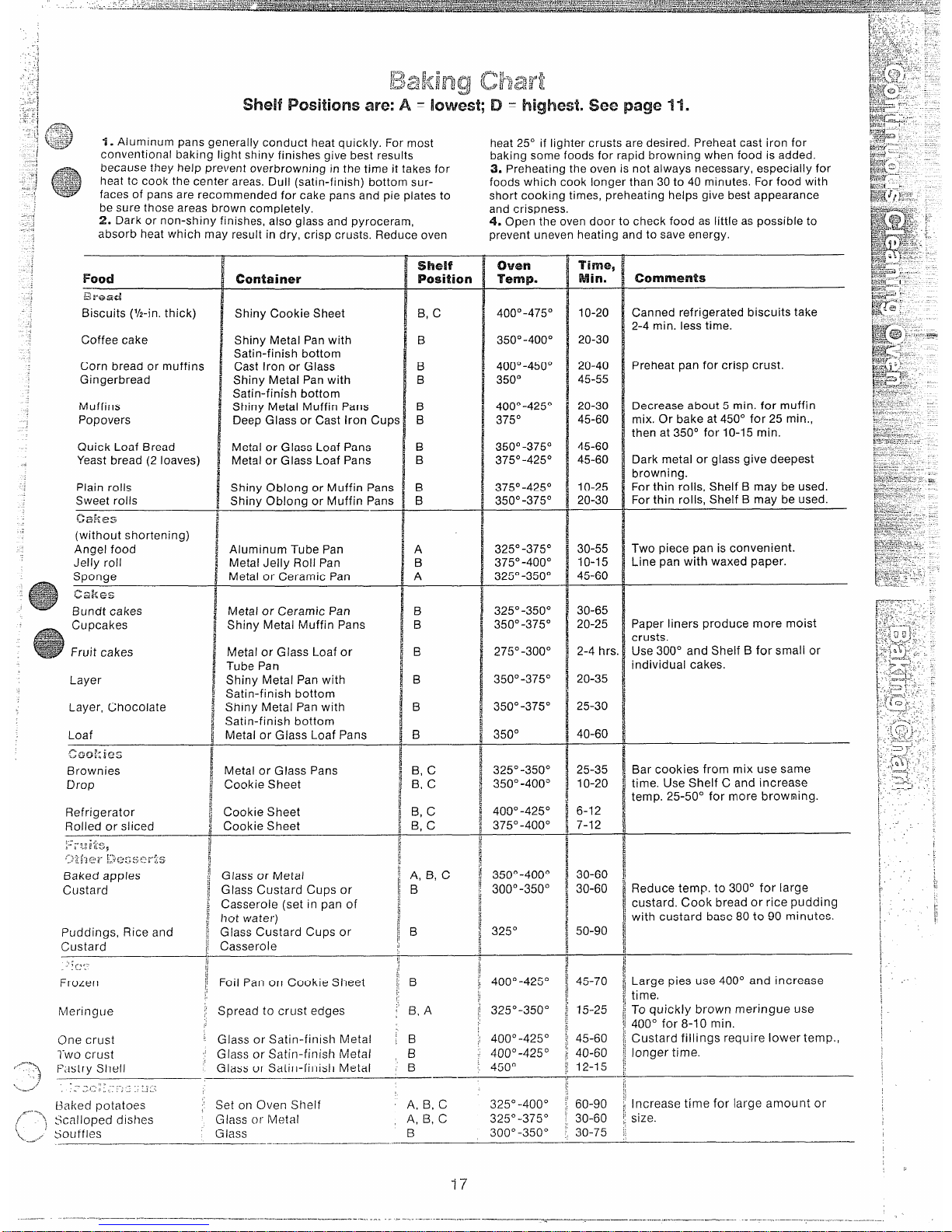
1. Aluminum pans generally conduct heat quickly. For most
heat 25° if lighter crusts are desired. Preheat cast iron
for
.;
conventional baking light shiny finishes give best results
baking some foods for rapid browning when food is
added.
. .
‘?
because they
help prevent overbrowning in the time it takes for
3. Preheating the oven is not always necessary, especially for
.]
.!
X_
.;jg;g
heat tc cook the center areas. Dull (satin-finish) bottom
sur-
..~ ..
‘*%% faces of pans are recommended for cake pans and pie plates
to
foods which cook longer than 30 to 40 minutes. For food with
short cooking times, preheating helps give best appearance
be
sure those areas brown completely.
and crispness.
Z!. Dark or non-shiny finishes, also glass and pyroceram,
4. Open the oven
door to check food as little as possible to
absorb heat which may result in dry, crisp crusts. Reduce oven
prevent uneven heating and to save energy.
U3wenl
Temp.
—
Tmae9
Min.
10-20
20-30
20-40
45-55
20-30
45-60
45-60
45-60
10-25
20-30
shelf
Position
Fboci Chmmnents
Canned refrigerated biscuits take
2-4 min. lesstime.
Preheat pan for crisp crust.
Decrease about 5 min. for muffin
mix. Or bake at 450° for25 min.,
then at 350° for 10-15 min.
Dark metal or glass give deepest
browning.
For thin rolls, Shelf B may be used.
For thin rolls, Shelf B may be used.
Two piece pan is convenient.
Line pan with waxed paper.
Paper liners produce more moist
crusts.
Use 300° and Shelf B for small or
individual cakes.
Container
E3meici
Biscuits (V2-in.thick)
Coffee cake
Corn bread or muffins
Gingerbread
Muffins
Popovers
Quick Loaf Bread
Yeastbread (2 loaves)
Plain rolls
Sweet rolls
Shiny Cookie Sheet
Shiny Metal Panwith
Satin-finish bottom
Cast Iron or Glass
Shiny Metal Pan with
Satin-finish bottom
Shiny Metal Muffin Pans
Deep Glass or Cast Iron Cup:
Metal or Glass Loaf Pans
Metal or Glass Loaf Pans
Shiny Oblong or Muffin Pans
Shiny Oblong or Muffin Pans
B, C
B
B
B
B
B
B
B
B
B
400°-4750
350°-400°
400°-4500
350°
400°-4250
375°
350°-3750
375°-4250
375°-4250
350°-3750
Gag:es
(without shortening)
Angel food
Jelly roll
Sponge
-~*=@~
Bundt cakes
Cupcakes
325°-3750
375°-4000
325°-3500
30-55
10-15
45-60
Aluminum Tube Pan
Metal Jelly Roll Pan
Metal or Ceramic Pan
A
B
A
325°-3500
350°-3750
275°-3000
350°-3750
350°-3750
350°
325°-3500
350°-400”
400°-4250
375°-4000
350°-4000
300°-350°
325°
30-65
20-25
2-4 hrs.
20-35
25-30
40-60
25-35
10-20
6-12
7-12
Metal
or Ceramic Pan
Shiny Metal Muffin Pans
B
B
B
B
B
B
Fruit cakes
Metal or Glass Loaf or
Tube Pan
Shiny Metal Pan with
Satin-finish bottom
Shiny Metal Pan with
Satin-finish bottom
vletal or Glass Loaf Pans
Layer
Layer, Chocolate
Loaf
r.
-.JLLM’’I!: ifiia~
Brownies
Drop
Refrigerator
Rolled or sliced
Jetal or Glass Pans
Cookie Sheet
B, C
B, C
B, C
B, c
Bar cookies from mix use same
time. Use Shelf C and increase
temp. 25-50° for more browning.
Cookie Sheet
Cookie Sheet
30-60
30-60
50-90
45-70
15-25
45-60
40-60
12-15
60-90
30-60
30-75
————
Glass or Metal
Glass Custard Cups or
Casserole (set in pan of
hot water)
Glass Custard Cups or
Casserole
4, B, C
3
3
Reduce temp. to 300° for large
custard. Cook bread or rice pudding
with custard base 80 to 90 minutes.
Large pies use 400° and increase
time.
To quickly brown meringue use
400° for 8-10 min.
Custard fillings require Iower temp.,
longer time.
Increase time for large amount or
size.
Puddings, Rice and
Custard
:’:F.,-
. ..>.
Frozen
Meringue
One crust
‘oil Pan on Cookie Sheet “
~,
;pread to crust edges
;t3, A
3
400°-4250
325°-3500
;Iass or Satin-finish Metal
;6
400°-4250
400°-4250
450°
Two crust
: Glass or Satin-finish Metal
B
fnastry Shell
Glass or Satin-finish Metal
B
—..
--..,-,.:. . . ..
. . . . ...
.,.
Haked potatoes
,’ Set on Oven Shelf
~ A,B, C
325°-400°
Scalloped dishes
Glass or Metal
,A, B,C 325°-3750
~OLlffli?S Glass
B
300°-3500
— . ...—--.-——
———..
17
—
————..——
-—-—---------
.--————...——
-----
. .. . ,.- .
——
—.—...———..——-..
—....
..”. -.—— . . ..—- —-- -. --- ——. ..—— .-—.. . ..— .- .
.—
Downloaded from www.ManualsFile.com manuals search engine
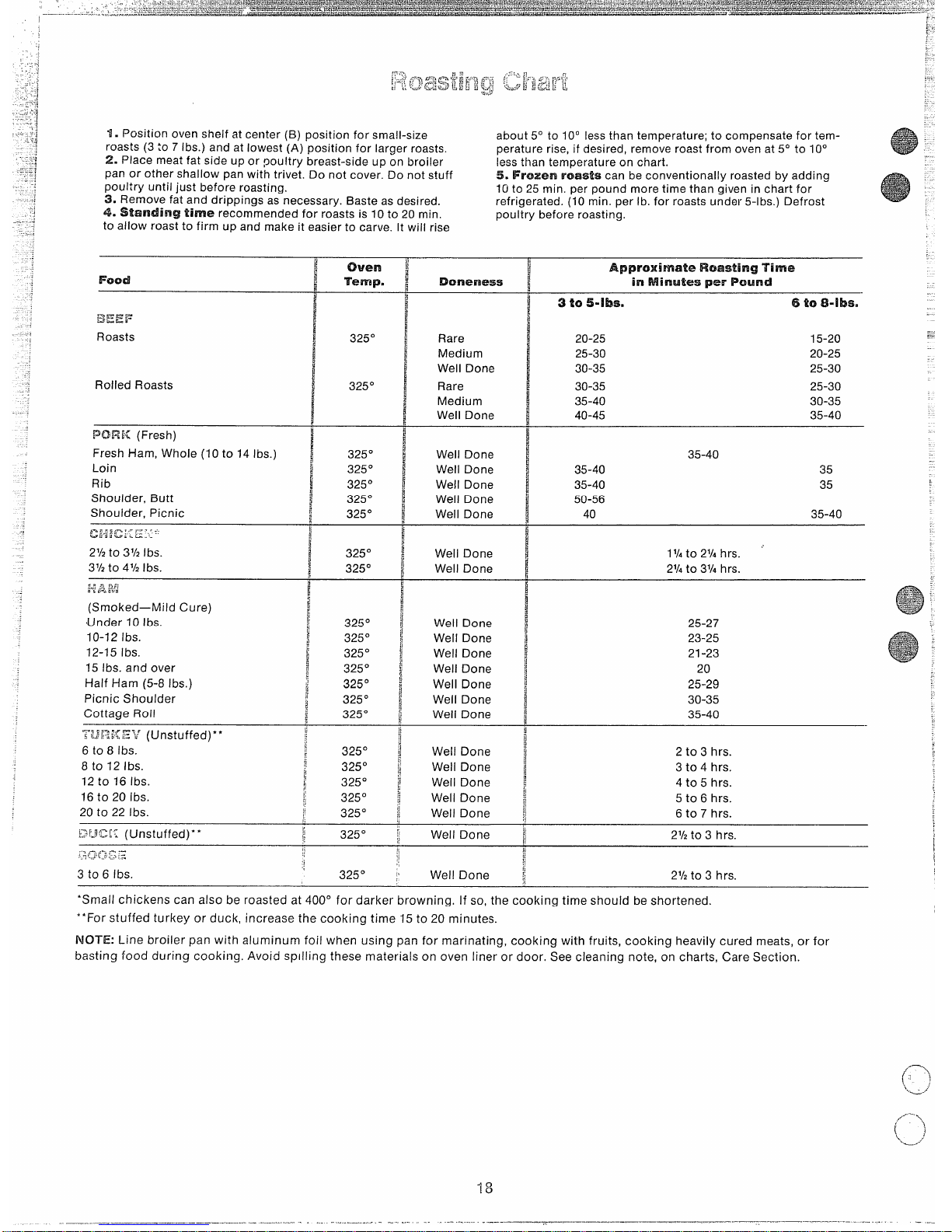
%.Position oven shelf at center (B) position for small-size
about 5° to 10° lessthan temperature; to compensate
for tem-
roasts (3 to 7
Ibs.) and at lowest (A) position for larger roasts.
perature rise, if desired, remove roast from oven at 5° to 10°
Z?.Place meat fat side up or poultry breast-side up on broiler
less than temperature on chart.
pan or other shallow pan with trivet.
Do not cover. Do not stuff
?5.F%wzer$rcm$%%can be conventionally roasted by adding
poultry until just before roasting.
10 to 25 min. per pound more time than given in chart for
3. Remove fat and drippings as necessary. Baste as desired.
refrigerated. (10
min. per lb. for roasts under 5-ibs.) Defrost
& ~~t%w%dingtimmz?recommended
for roasts is 10 to 20 min.
~oultrv before roastina.
to allow roast to firm
up and make it easier to carve. It will rise
J
1
I
oven
Temp.
Approxnmm mmsting Time
in Mi!Ewtes pa’ RMmd
Food
!Dommess
3 to 5-nbsm
6 to tklbs.
325°
325°
Rare
Medium
Well Done
Rare
Medium
Well Done
20-25 15-20
25-30
20-25
30-35
25-30
30-35
25-30
35-40 30-35
40-45
35-40
Rolled Roasts
PO$?K (Fresh)
Fresh Ham,
Whole (10 to 14 Ibs.)
Loin
Rib
Shoulder, Butt
Shoulder, Picnic
325°
325°
325°
325°
325°
Well Done
Well Done
Well Done
Well Done
Well Done
35-40
35-40
35
35-40
35
50-56
40
35-40
11/4
tO z% hrs.
2%
tO 31/4hrs.
325°
325°
Well Done
Well Done
;...:~~iywr-j
(Smoked–Mild Cure)
Under 10 Ibs.
10-12 Ibs.
12-15 Ibs.
15 Ibs. and over
Half Ham (5-8 Ibs.)
Picnic Shoulder
Cottage Roll
325°
325°
325°
325°
325°
325°
325°
Well Done
Well Done
Well Done
Well Done
Well Done
Well Done
Well Done
25-27
23-25
21-23
20
25-29
30-35
35-40
TUFiE’%2!’t’(Unstuffed)**
6 to 8 Ibs.
8 to 12 Ibs.
12to161bs.
16 to 20 Ibs,
20 to 22 Ibs.
1
!TP.fiS~;(Unstuffed)**
I
325°
325” ~
325° ;
325° !
325° j
Well Done
Well Done
Well Done
Well Done
Well Done
2t03hrs.
3t04hrs.
4t05hrs.
5t06hrs.
6t07hrs.
325° \
I
,
Well Done
2%to 3 hrs.
3 to 6 Ibs.
325° }
Well Done
2%to 3 hrs.
●Small chickens can also be roasted at 400° for darker browning. If so, the cooking time should be shortened.
‘*For stuffed turkey or duck, increase the cooking time 15 to 20 minutes.
NOTE: Line broiler pan with aluminum foil when using pan for marinating, cooking with fruits, cooking heavily cured meats, or for
basting food during cooking. Avoid spilling these materials on oven liner or door, See cleaning note, on charts, Care Section.
Downloaded from www.ManualsFile.com manuals search engine
.-3
,=-
““:!
-:
g5J
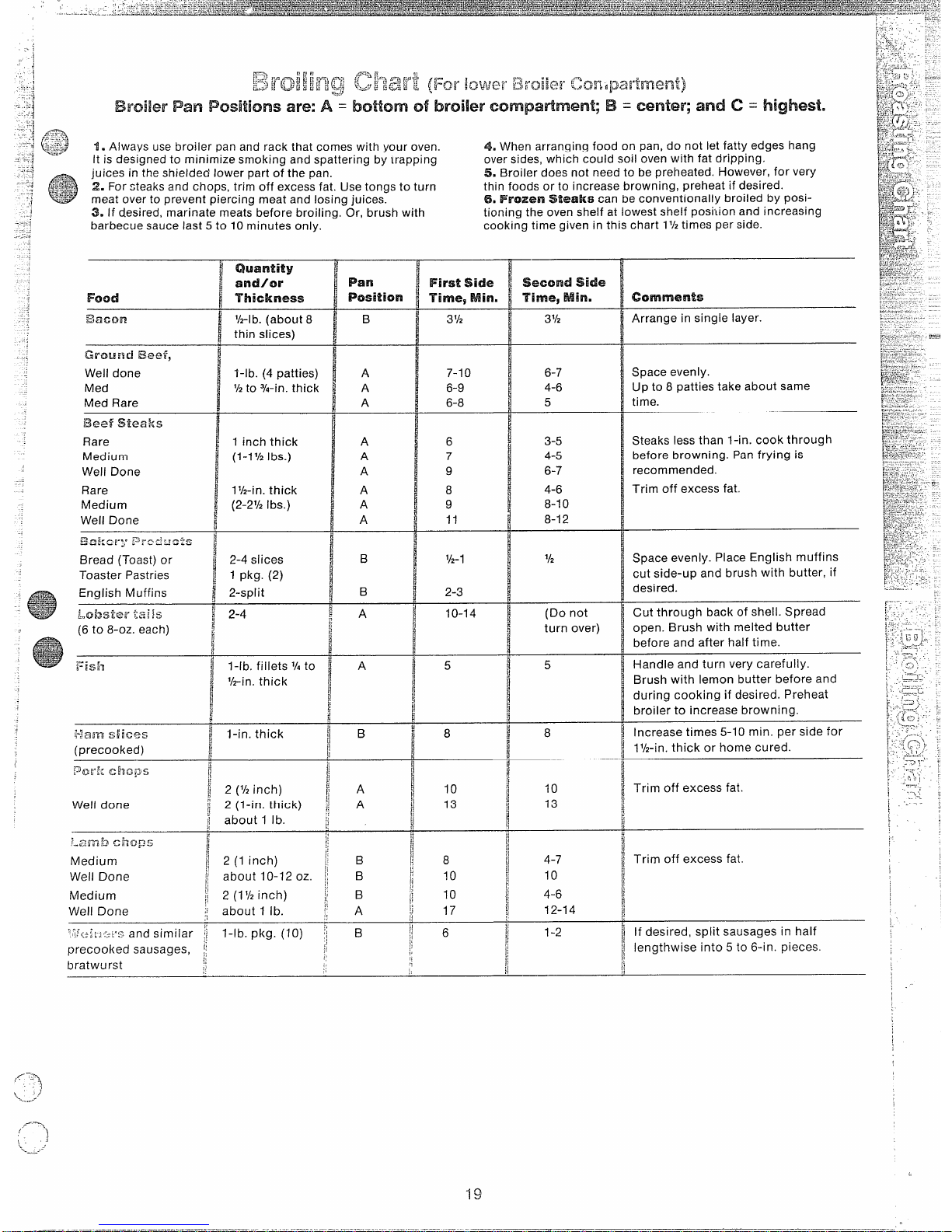
1. Always use broiler pan and rack that comes with your oven.
4. When arranging food on pan, do not let fatty edges hang
It is designed to minimize smoking and spattering by Irapping
~
over sides, which could soil oven with fat dripping.
.,.,
‘o
#&$-
juices in the shielded lower part of the pan,
& Broiler does not need to be preheated. However, for very
...
:4
‘2. For steaks and chops, trim off excessfat. Usetongs to turn
.;
thin foods or to increase browning, preheat if desired.
>-:.-~-;~.-~
-j.. -=
, meat over to Drevent Diercina meat and Iosina iuices.
63.F%ozwn SifiedkS can be conventionally broiled by posi-
3L If desired,”marinat~ meat~before broilina,-Or, brush with
tionina the oven shelf at lowest shelf posi~ion and increasing
barbecue sauce last 5 to 10 minutes only. -
cooki~g time given in this chart 11/2times per side.
,,
First Side
7WW?SMin.
$kxwml Skie
Time, Min.
3%
6-7
4-6
5
Food
! %-lb. (about 8
j
~ thin slices)
I
E
I
g
3%
Arrange in single layer.
~ l-lb, (4 patties)
1
A
~
I/2to %-in. thick A
A
7-1o
6-9
6-8
Space evenly.
Up to 8 patties take about same
time.
Steaks less than l-in. cook through
before browning. Panfrying is
recommended.
Trim off excess fat.
Rare
Medium
Well Done
1 inch thick
(1-11/2tbs.)
6
7
9
8
9
11
3-5
4-5
6-7
4-6
8-10
8-12
l%in. thick
(2-21/2tbs.)
Space evenly. Place English muffins
cut side-up and brush with butter, if
desired.
Bread (Toast) or
Toaster Pastries
2-4 slices
1 pkg. (2)
2-split
‘/2-1
2-3
‘/2
English Muffins
10-14
(Do not
turn over)
Cut through back of shell. Spread
open. Brush with melted butter
before and after half time.
Handle and turn very carefully.
Brush with lemon butter before and
during cooking if desired. Preheat
broiler to increase browning.
l-lb. fillets %to
1A
%-in. thick ,
[
#
;!
5
5
Increase times 5-10 min. per side for
11/2-in.thick or home cured.
l-in. thick
5
B
1
8
8
i
2 (%inch)
1A
2 (l-in. thick)
.1
;
A
10
13
10
13
Trim off excess fat.
Well done
8
10
10
17
4-7
10
4-6
12-14
Trim off excess fat.
about 1 lb. ~ A
If desired, split sausages in half
lengthwise into 5 to 6-in. pieces.
l-lb. pkg. (10) ~j B
::
I
6
1-2
bratwurst
:;
,)
:.
:<“-3
.-3
‘...- ,- .;
,-
---%
(-
)
i< -~
---,-----
Downloaded from www.ManualsFile.com manuals search engine
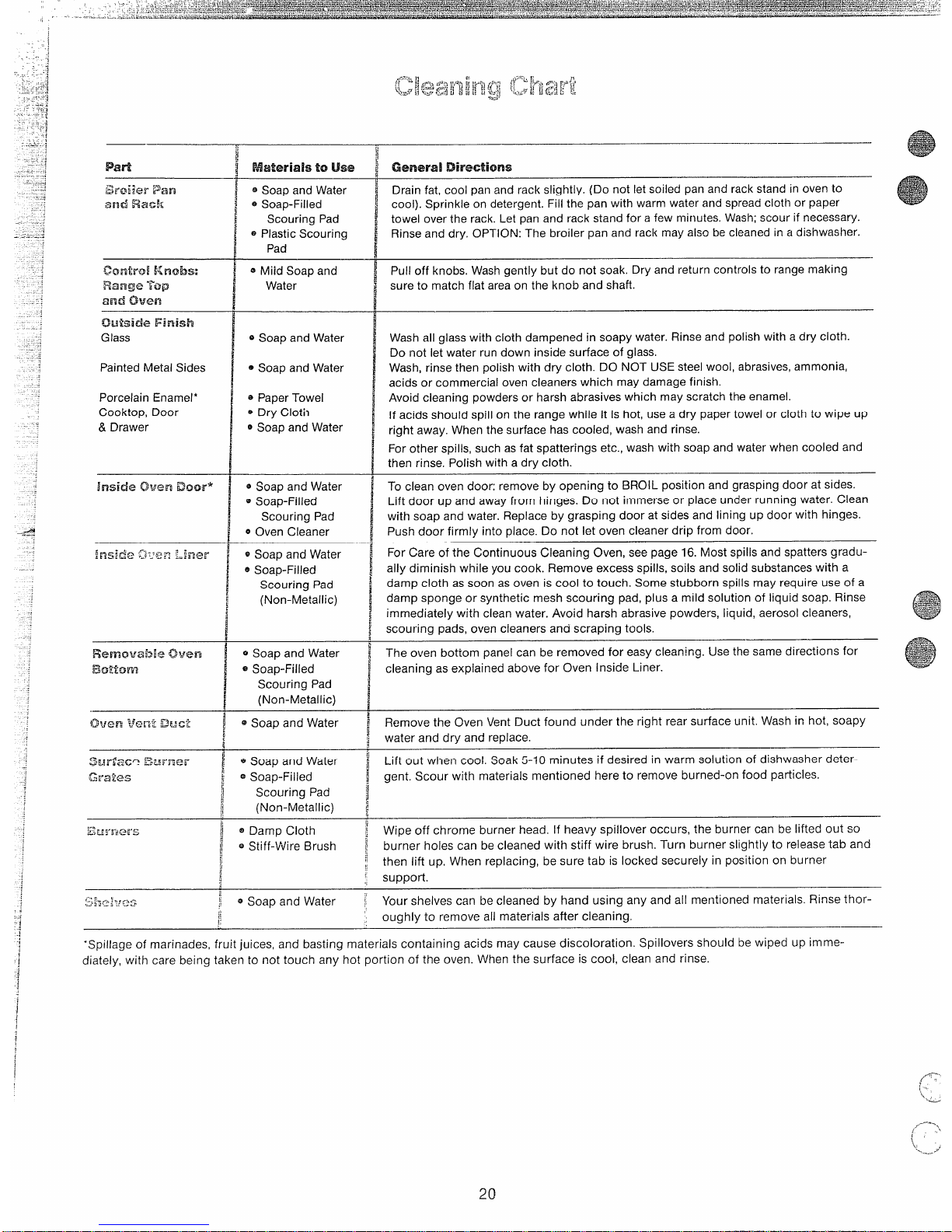
R?@
~ Soap and Water
~ Soap-Filled
Scouring Pad
e Plastic Scouring
Pad
e Miid Soap and
Water
Cwtsiek Finish
Glass
1
0 Soap and Water
~
Painted Metal Sides
I
e Soap and Water
,
Porcelain Enamel*
! ~ PaperTowel
Cooktop, Door
!
I
e Dry Cloth
& Drawer o Soap and Water
z
I
~ Soap and Water
@Soap-Filled
Scouring Pad
e Oven Cleaner
@Soap and Water
@Soap-Filled
Scouring Pad
(Non-Metaliic)
Fkwnm%li?ie ‘tw?n!
~ @Soap and Water
BQitow?
~ e Soap-Filled
I
Scouring Pad
j
(Non-Metallic)
~ Soap and Water
@Soap-Filled
Scouring Pad ,
(Non-Metallic) !
Gernwd Directions
—
Drain fat, cool pan and rack slightly. (Do not let soiled pan and rackstand in oven to
cool). Sprinkle on detergent. Fill the pan with warm water andspreadcloth or paper
towel overthe rack.Let pan and rack standfor a few minutes.Wash;scour if necessary.
Rinseand dry. OPTION:The broiler pan and rack mayalso be cleaned in a dishwasher.
Pull off knobs. Washgently but do not soak. Dryand return controls to range making
sure to match flat areaon the knob and shaft.
Washall glasswith cloth dampened in soapy water, Rinseand polish with adry cloth.
Do not let water run down inside surface of glass.
Wash,rinse then polish with dry cloth. DO NOT USEsteelwool, abrasives,ammonia,
acids or commercial oven cleaners which may damage finish.
Avoid cleaning powders or harsh abrasiveswhich may scratch the enamel.
If acids should spill on the range while it is hot, use a dry papertowel or cloth to wipe up
right away. When the surface has cooled, wash and rinse.
For other spills, such asfat smatteringsetc.,wash with soap and water when cooled and
then rinse. Polish with a dry cloth.
To clean oven dooc remove by opening to BROILposition and grasping door at sides.
Lift door up and awayfrom hinges. Do not immerse or place under running water. Clean
with soap and water. Replace by grasping door at sidesand lining up door with hinges.
Push door firmlv into date. Do not let oven cleaner drip from door.
For Care of the Continuous Cleaning Oven, see page 16.Most spills and spatters gradu-
ally diminish while you cook. Remove excessspills, soils and solid substanceswith a
damp cloth assoon as oven is cool to touch. Some stubborn spills may require use of a
damp sponge or synthetic mesh scouring pad, plus a mild solution of liquid soap. Rinse
immediately with clean water. Avoid harsh abrasive powders, liquid, aerosol cleaners,
scouring pads, oven cleaners and scraping tools.
The oven bottom panel can be removed for easycleaning. Usethe same directions for
cleaning as explained above for Oven Inside Liner.
Remove the Oven Vent Duct found under the right rear surface unit. Wash in hot, soapy
water and dry and replace.
Lift out when cool. Soak 5-10 minutes if desired in warm solution of dishwasher deter-
gent. Scour with materials mentioned here to remove burned-on food particles.
Wipe off chrome burner head. If heavy spillover occurs, the burner can be lifted out so
burner holes can be cleaned with stiff wire brush. Turn burner slightly to releasetab and
then lift up. When replacing, be sure tab is locked securely in position on burner
]
support.
;
,,-p
.,,T+9.,~h=-
$..s a i .- J.:..._, ~ Soap and Water
~ Your shelves can be cleaned by hand using any and all mentioned materials. Rinse thor-
r~
oughly to remove all materials after cleaning.
‘Spillage of marinades, fruit juices, and basting materials containing acids may cause discoloration. Spillovers should be wiped up imme-
diately, with care being taken to not touch any hot portion of the oven. When the surface is cool, clean and rinse.
,7.,
{
\
..
-._;
------
,-.
:.
/
1,,
3
. .
..-=
20
Downloaded from www.ManualsFile.com manuals search engine
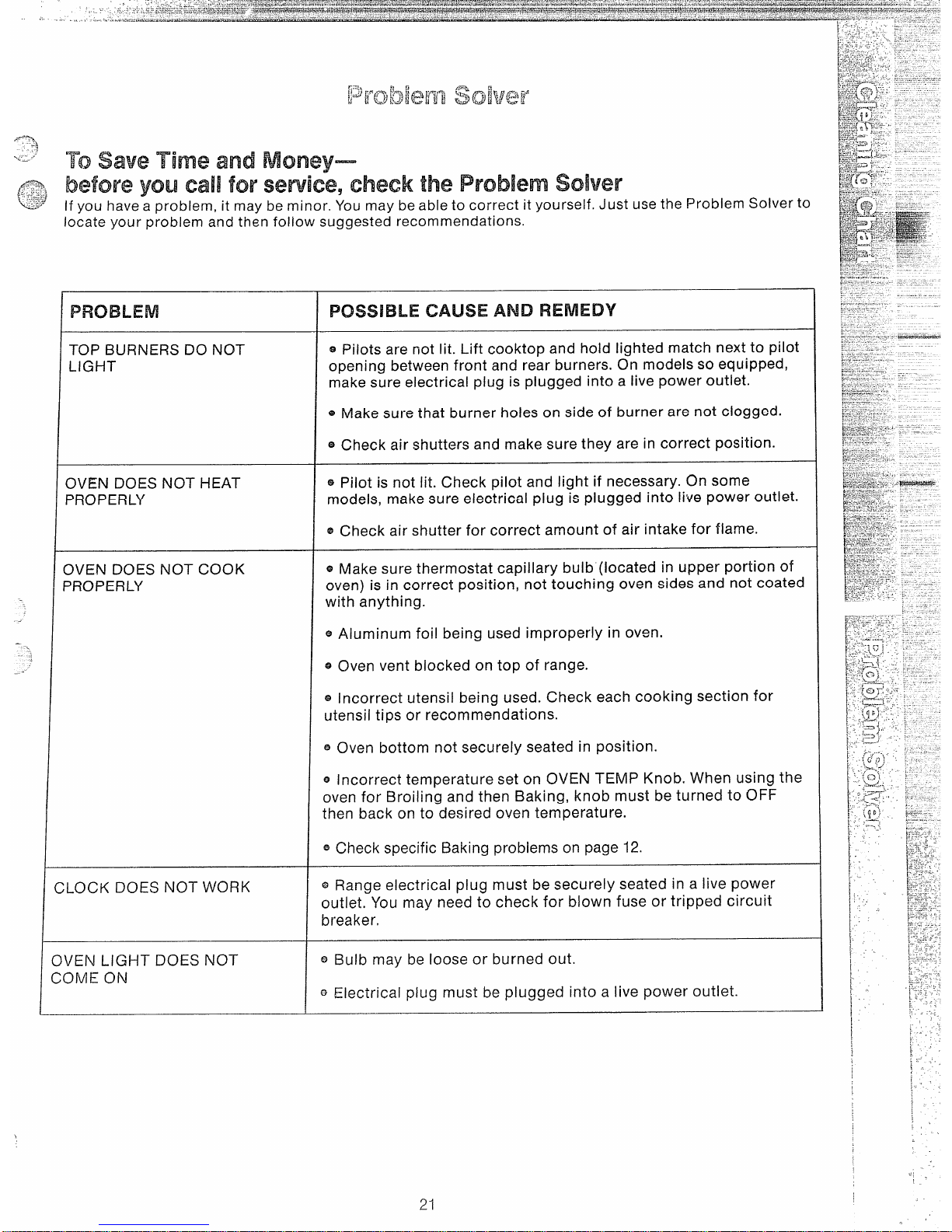
%: -
‘ To Save Time mad
& - :%.
.
%.
before you edil for
~.,
~....e.3
&?: If you have a problem, it may be minor. YOU r-nay be ableto correct it yourself. Just use the Problem SOIVertO
locate your problem and then follow suggested recommendations.
PROBLEM POSSIBLE CLAUSE!AND REMEDY
TOP BURNERS DO NOT
~ pilots are not lit. Lift
Cooktop and hold lighted match next to pilot
LIGHT
opening between front and rear burners. On
models so equipped,
make sure electrical plug is plugged into a live power outlet.
@Make
sure that burner holes on side of burner are not clogged.
~ Check air shutters and make sure they are
in correct position.
OVEN DOES NOT HEAT
e pilot is not lit. Check pilot and light if necessary. On some
3ROPERLY models, make sure electrical plug is plugged into live power outlet.
@Check air shutter for correct amount of air intake for flame.
)VEN DOES NOT COOK
e Make sure thermostat capillary bulb (located in upper
POrtjOn Of
‘ROPERLY
oven) is in correct position, not touching oven sides and not coated
with anything.
~ Aluminum foil being used improperly in oven.
@Oven vent blocked on top of range.
e incorrect utensil
beingused.Check each cooking section for
utensil tips or recommendations.
= Oven bottom
not securely seated in position.
@Incorrect temperature set on OVEN TEMP Knob. When using the
oven for Broiling and then Baking, knob must be turned to OFF
then back on to desired oven temperature.
@Check specific Baking problems on page 12.
LOCK DOES NOT WORK
@Range electrical plug must be securely seated in a live power
outlet. You may need to check for blown fuse or tripped circuit
breaker.
VEN LIGHT DOES NOT
0 Bulb may be loose or burned out.
OME
ON
o~lectricalplugmustbepluggedintoa
live power outlet.
2-1
Downloaded from www.ManualsFile.com manuals search engine
,,
.-. .
-: @%----- —1
-:,,%
K&j?
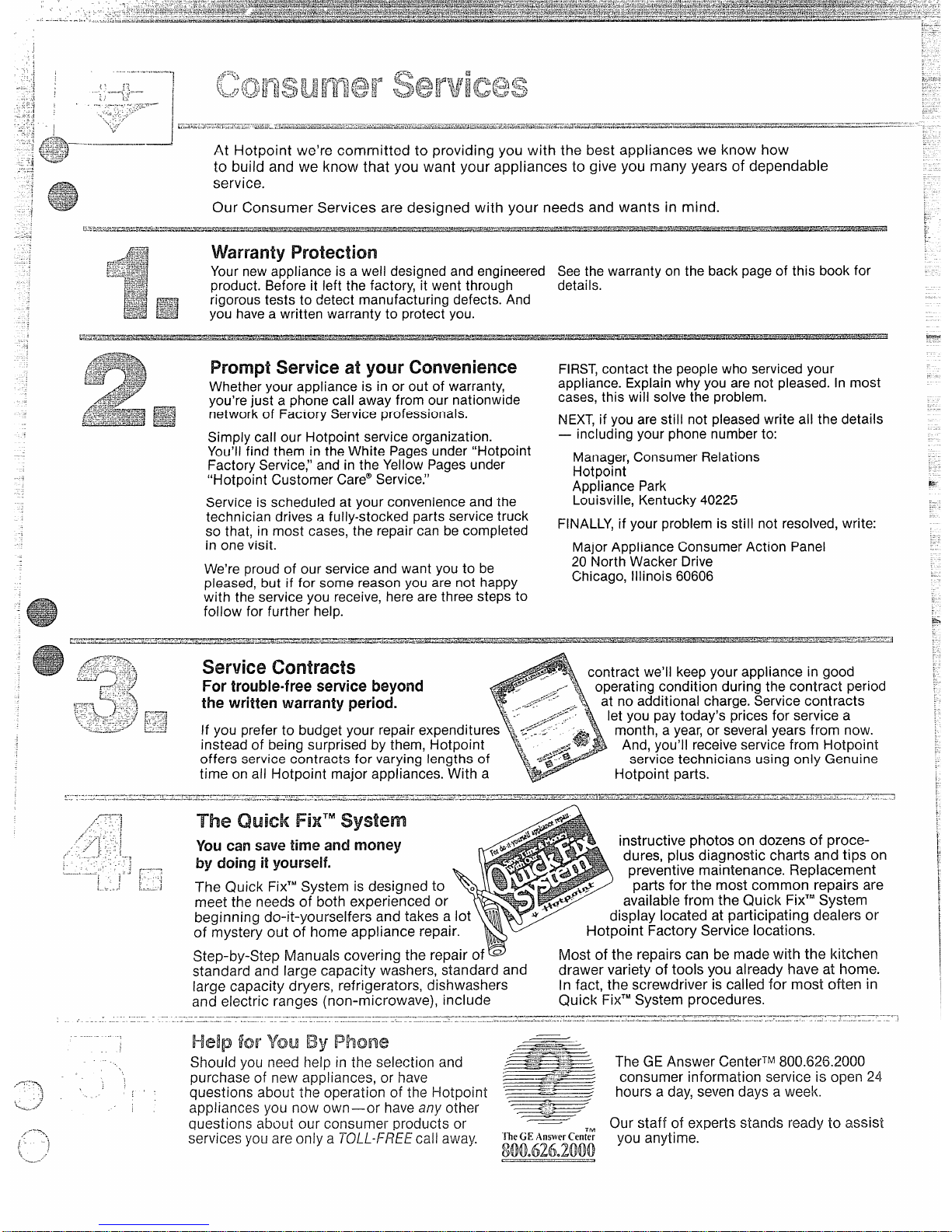
At Hotpoint we’re committed to providing you with the best appliances we know how
. ...
to build and we know that you want
your appliances to give you many years of dependable
:3
-..*-
-?
service.
-r%,.
‘Q%%-
+:~-p
Our Consumer Services are designed with your needs and wants in mind.
.q,~
+wf~:gx
warranty Protection
gg~f$
Your new appliance is a well designed and engineered Seethe warranty on the back pageof this book for
~g:@q
~!
_:>+.;.-;-
product. Before it left the factory, it went through details.
:;=:F@
....,..--i
E
$:5$3
rigorous tests to detect manufacturing defects. And
&&+;&z:$g
you havea written warranty to protect you.
PromptService atyour Ckmvenience
Whether your appliance is in or out of warranty,
you’re just a phone call away from our nationwide
network of Factory Service professionals.
Simply call our Hotpoint service organization.
You’ll find them in the White Pagesunder “Hotpoint
Factory Service;’ and in the Yellow Pages under
“Hotpoint Customer Care@Service.”
Service is scheduled at your convenience and the
FIRST,contact the people who serviced your
appliance. Explain why you are not pleased. In most
cases, this will solve the problem.
NEXT,if you are still not pleased write all the details
—
including your phone numberto:
Manager,Consumer Relations
Hotpoint
Appliance Park
Louisville, Kentucky 40225
technician drives a fully%tocked parts service truck
so that, in most cases, the repair can be completed
FINALLY,if your problem is still not resolved,write:
in one visit.
Major Appliance Consumer Action Panel
We’re proud of our service and want you to be
20 hlorth Wacker Drive
pieased, but if for some reason you are not happy
Chicago, Illinois 60606
with the service you receive, here are three steps to
follow for further help.
> -._.- _—------ --
...
. ,
-,
.,.-+
.
..
,-
\
[ .;
---
.-...
.—!
Service Contracts
For
trouble-free service beyond
ante in good
he contract period
the written warrantyperiod.
rvice contracts
for service a
[f you prefer to budget your repair e
years from now.
instead of being surprised by them, ce from Hotpoint
offers service contracts for varying
ing only Genuine
time on all Hotpoint major applianc
‘1-heQuick FixTMsystem
‘km can savetime and money
by doingityourself.
The Quick FixTMSystem is designed to
meet the needs of both experienced or
beginning do-it-yourselfers and takes a
of mystery out of home appliance repai
Step-by-Step Manuals covering the rep
standard and large capacity washers, standard and
drawer variety of tools you already have at home.
large capacity dryers, refrigerators, dishwashers
In fact, the screwdriver is called for most often in
and electric ranges (non-microwave), include
Quick Fix’” System procedures.
Help forYin.!By PhwRe
~—,
—A:p---
--~”.&-~”-
Should you need help in the selection and ,-~~~~~.
The GE Answer CenterTM800.626.2000
purchase of new appliances, or have
—.-% --—-
— - ----
—Tz
consumer information service is open 24
questions about the operation of the Hotpoint “-= ~~~
hours a day, seven days a week.
appliances you now own—or have
any other
====2C’~
——
questions about our consumer products or
~ ... Our staff of experts stands ready to assist
services you are only a TC)LL-FREE”call away.
!,,,
“l_heGE Answer Center
800.626.2000 ‘ou anytime
-
Downloaded from www.ManualsFile.com manuals search engine
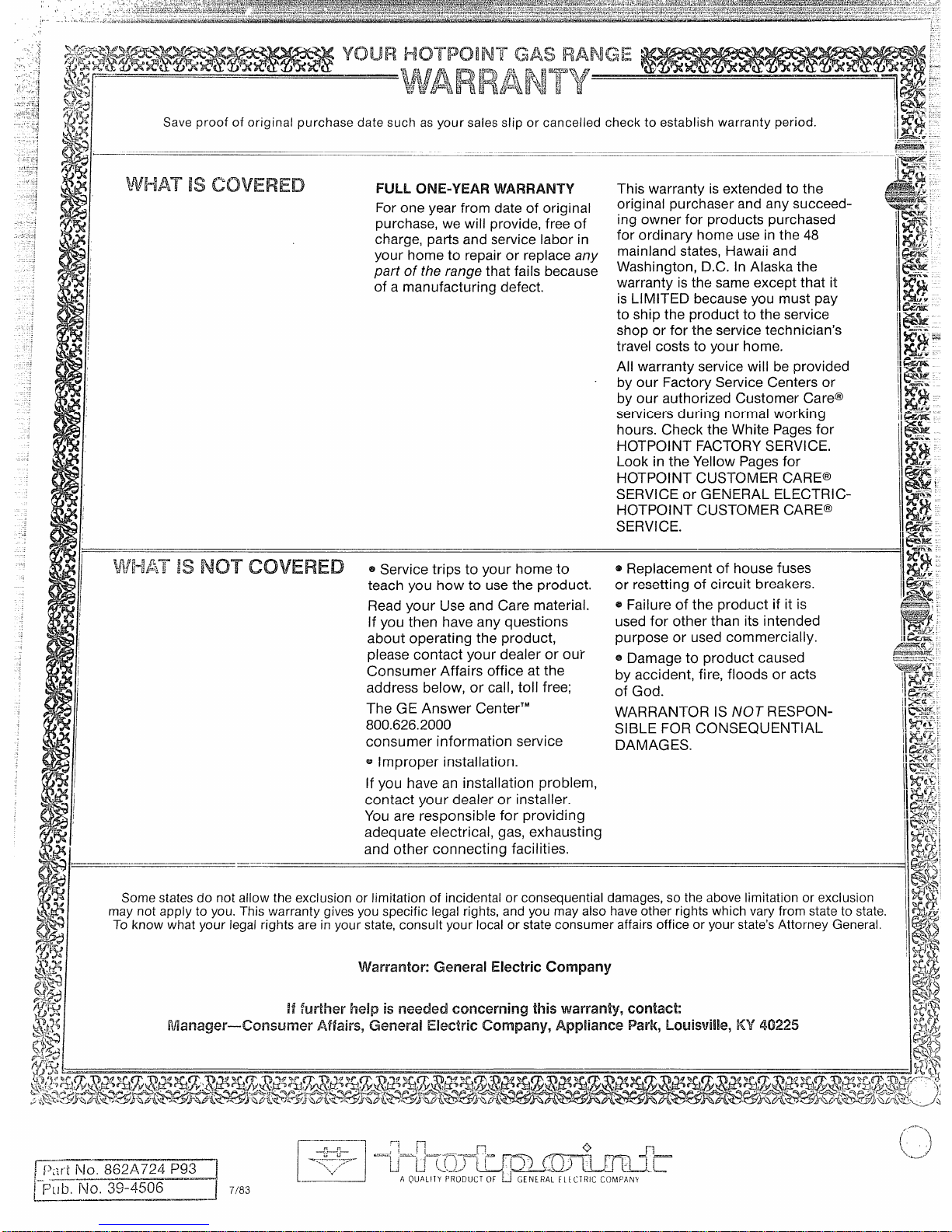
Save proof of original purchase
lhJ[+@,T Is COVERED
date such as your sales slip or cancelled
FUN. ONE-YEAR WARRANTY
For one year from date of original
purchase, we will provide,
free of
charge, parts and service labor in
your home to repair or replace any
part of the range that fails because
of a manufacturing defect.
check to establish warranty period.
This warranty is extended to the
original purchaser and any succeed-
ing
owner for products purchased
for ordinary home use in the 48
mainland states, Hawaii and
Washington, D.(2. In Alaska the
warranty is the same except that it
is LIMITED because you must pay
to ship the product to the service
shop or for the service technician’s
travel costs to your home.
All warranty service will be provided
by our Factory Service Centers or
by our authorized Customer Care@
servicers during normal working
hours. Check the White Pages for
HOTPOINT FACTORYSERVICE.
Look
in the Yellow Pages for
HOTPOINT CUSTOMER CARE@
SERVICE or GENERAL ELECTRIC-
HOTPOINT CUSTOMER CARE@
SERVICE.
p : ___
4 i
$
~!#&!./%~ ~~ l?d~~ ~~~~~~~ @
Service trips to your home to
e Replacement of house fuses
3
teach you how to use the product.
or resetting of circuit breakers.
Read your Use and Care material.
~ Failure of the product if it is
If you then have any questions
used for other than its intended
about operating the product,
purpose or used commercially.
please contact your dealer or our
@Damage to product caused
Consumer Affairs office at the
by accident, fire, floods or acts
address below, or call, toll free;
of God.
The GE Answer Center’”
WARRANTOR IS NOT RESPON-
800.626.2000
SIBLE
FORCONSEQUENTIAL
consumer information service
DAMAGES.
e Improper installation.
If you have an installation problem,
contact your dealer or installer.
You are responsible for providing
adequate electrical, gas, exhausting
and other connecting facilities.
&sI–— ‘—
.-—-...—————.
_.. _____
ffii$y~
Some states do not aHow the exclusion or limitation of incidental or consequential damages, so the above limitation or exclusion
~if~
may not apply to you. This warranty gives you specific legal rights, and you may also have other rights which vary from state to state.
To know what your legal rights are in your state, consult your local or state consumer affairs office or your state’s Attorney General.
&g
1
f$$k$
~l%:?
VtkwrarWIr:
Genera! Electric Company
$
=,$
~
&
{
If fudherhelpisneededconcerningthiswarranty,
contact:
iJR
Manager—$l%nsumer Affairs, General Electric Company, Appliance Park, Louisville, KY 40225
%J&
@g,<
L
,_.——
——.—
-1
Downloaded from www.ManualsFile.com manuals search engine