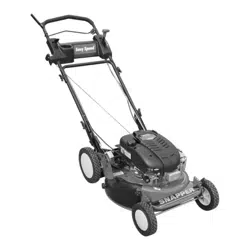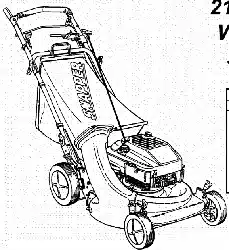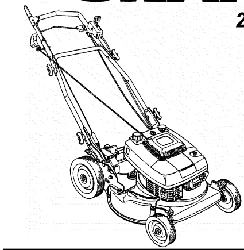
Safety Instructions & Operator's Manual for
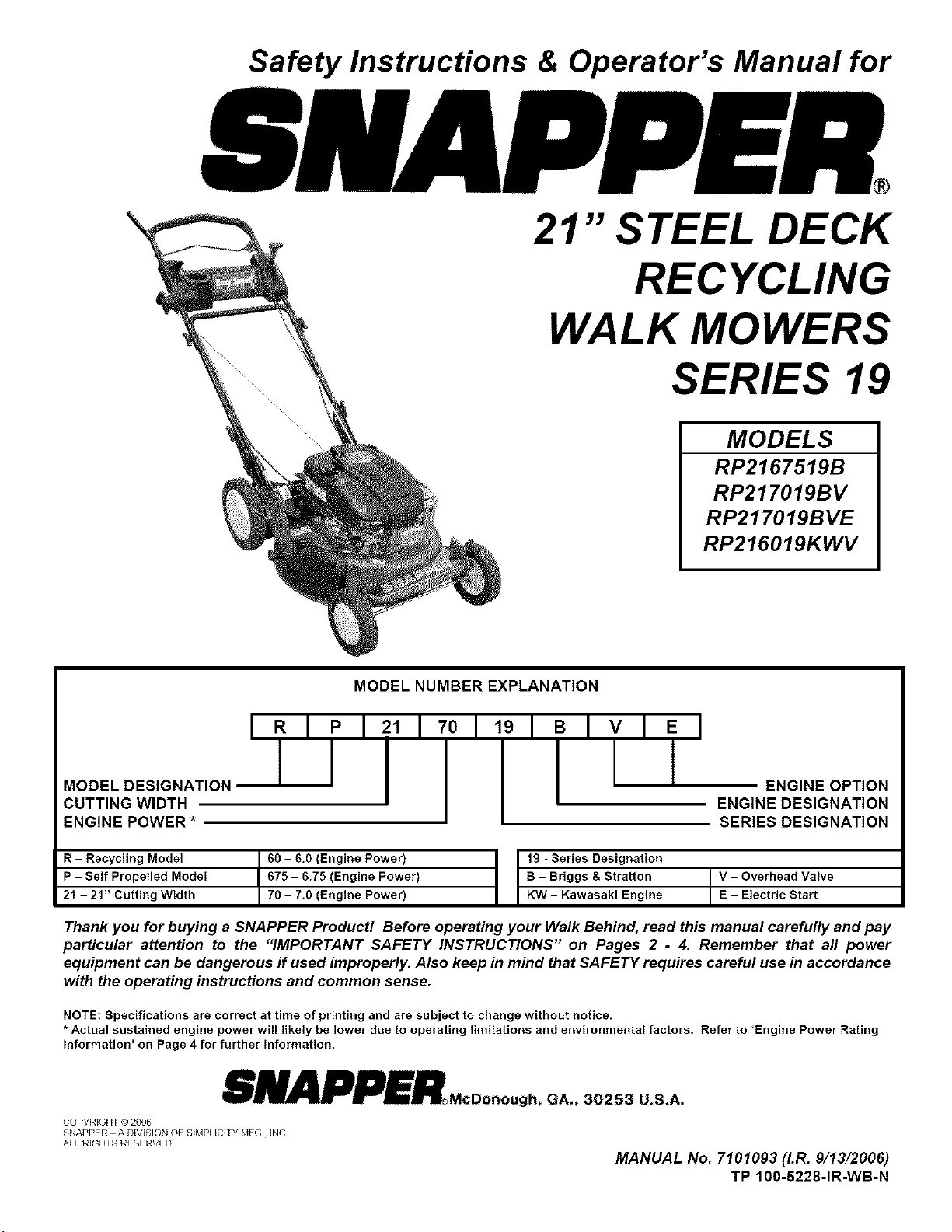
21" STEEL DECK
RECYCLING
WALK MOWERS
SERIES 19
MODELS
RP2167519B
RP217019BV
RP217019BVE
RP216019KWV
MODEL NUMBER EXPLANATION
MODEL DESIGNATION --
CUTTING WIDTH
ENGINE POWER *
I R I P 121 1701 _IBIVlEI
ENGINE OPTION
ENGINE DESIGNATION
SERIES DESIGNATION
R - Recycling Model
P- Self Propelled Model
21 - 21" Cutting Width
60 - 6.0 (Engine Power)
675 - 6.75 (Engine Power)
70 - 7.0 (Engine Power)
I I 19 - Series Designation
B - Briggs & Stratton
KW - Kawasaki Engine
V - Overhead Valve
E - Electric Start
Thank you for buying a SNAPPER Product! Before operating your Walk Behind, read this manual carefully and pay
particular attention to the "IMPORTANT SAFETY INSTRUCTIONS" on Pages 2 - 4. Remember that all power
equipment can be dangerous if used improperly. Also keep in mind that SAFETY requires careful use in accordance
with the operating instructions and common sense.
NOTE: Specifications are correct at time of printing and are subject to change without notice.
* Actual sustained engine power will likely be lower due to operating limitations and environmental factors. Refer to 'Engine Power Rating
Information' on Page 4 for further information.
COPYRIGHT © 2006
SNAPPER A DIVISION OF SIMPLICITY _,'IFG INC
ALL RIGHTS RESERVED
GA., 30253 U.S.Ao
MANUAL No. 7101093 (I.R. 9/13/2006)
TP 100-5228-1R-WB-N
IMPORTANT SAFETY INSTRUCTIONS
WARNING: This powerful cutting machine is capable of amputating hands and feet and can throw objects that
can cause injury and damage! Failure to comply with the following SAFETY instructions could result in serious
injury or death to the operator or other persons. The owner of the machine must understand these instructions
and must allow only persons who understand these instructions to operate machine. Each person operating
the machine must be of sound mind and body and must not be under the influence of any substance, which
might impair vision, dexterity or judgment. If you have any questions pertaining to your machine which your
dealer cannot answer to your satisfaction, call or write the Customer Service Department at SNAPPER,
McDonough, Georgia 30253. Phone: (1-800-935-2967).
PROTECTION FOR CHILDREN
Tragic accidents can occur if the operator is not alert to
the presence of children. Children are often attracted to
the machine and the mowing activity. Never assume
that children will remain where you last saw them.
1. KEEP children out of the mowing area and under
the watchful care of a responsible adult other than
the operator.
2. DO NOT allow children in yard when machine is
operated and turn machine OFF if anyone enters
the area.
3. DO NOT allow pre-teenage children to operate
machine.
4. ALLOW only responsible adults & teenagers with
mature judgment under close adult supervision to
operate machine.
5. DO NOT pull mower backwards unless absolutely
necessary. LOOK and SEE behind and down for
children, pets and hazards before and while
backing.
6. USE EXTRA CARE when approaching blind
corners, shrubs, trees, or other objects that may
obscure vision.
SLOPE OPERATION
1. Slopes are a major factor related to slip and fall
accidents, which can result in severe injury. All
slopes require extra caution. If you feel uneasy on
a slope, DO NOT mow it.
2. Mow across slopes, never up-and-down. Exercise
extreme CAUTION when changing directions on
slopes. DO NOT mow steep slopes or other areas
where stability or traction is in doubt.
3. Use extra care with grass catchers or other
attachments; these affect the handling and the
stability of the machine.
PREPARATION
1. Read, understand, and follow instructions and
warnings in this manual and on the mower, engine
and attachments. Know the controls and the
proper use ofthe mower before starting.
2. Only mature, responsible persons shall operate the
machine and only after proper instruction.
PREPARATION
(Continued From Previous Column)
3. Data indicates that operators age 60 and above, are
involved in a large percentage of mower-related
injuries. These operators should evaluate their
ability to operate the mower safely enough to
protect themselves and others from serious injury.
4. Handle fuel with extra care. Fuels are flammable
and vapors are explosive. Use only an approved
fuel container. DO NOT remove fuel cap or add fuel
with engine running. Add fuel outdoors only with
engine stopped and cool. Clean spilled fuel and oil
from machine. DO NOT smoke.
5. Check the area to be mowed and remove all
objects such as toys, wire, rocks, limbs and other
objects that could cause injury if thrown by blade
or interfere with mowing. Also note the location of
holes, stumps, and other possible hazards.
6. Keep people and pets out of the mowing area.
Immediately, STOP Blade, Stop engine and Stop
mower if anyone enters the area.
7. Check shields, deflectors, switches, blade controls
and other safety devices frequently for proper
operation and location.
8. Make sure all safety decals are clearly legible.
Replace if damaged.
9. Protect yourself when mowing and wear safety
glasses, long pants and substantial footwear. DO
NOT mow barefooted or with sandals.
10. Know how to STOP blade and engine quickly in
preparation for emergencies.
11. Use extra care when loading or unloading the
machine into a trailer or truck.
12. Check grass catcher components frequently for
signs of wear or deterioration and replace as
needed to prevent injury from thrown objects
going through weak or torn spots.
SAFE HANDLING OF GASOLINE
To avoid personal injury or property damage, use
extreme care in handling gasoline. Gasoline is
extremely flammable and the vapors are explosive
1. Extinguish all cigarettes, cigars, pipes and other
sources of ignition.
2. Use only an approved fuel container.
A
IMPORTANT SAFETY INSTRUCTIONS
A
SAFE HANDLING OF GASOLINE
(Continued From Previous Page)
3. DO NOT remove fuel cap or add fuel with the engine
running. Allow the engine to cool before refueling.
4. DO NOT refuel the machine indoors.
5. DO NOT store the machine or fuel container inside
where there is an open flame, spark or pilot light
such as on a water heater or other appliances.
6. DO NOT fill fuel containers inside a vehicle or on a
truck or trailer bed with a plastic liner. Always place
the containers on the ground away from the vehicle
beforefilling.
7. Remove gas-powered equipment from the vehicle or
trailer and refuel it on the ground. If this is not
possible, then refuel equipment using a portable
container, ratherthan a gasoline dispenser nozzle.
8. DO NOT start gas powered equipment in enclosed
vehicles or trailers.
9. Keep the nozzle in contact with the rim of the fuel
tank or container opening at all times until fueling is
complete. DO NOT use a nozzle lock-open device
10. If fuel is spilled on clothing, change clothing
immediately.
11. DO NOT overfill a fuel tank. Replace fuel cap and
tighten securely.
OPERATION
1. DO NOT put hands or feet near or under rotating
parts. Keep clear of discharge area while engine is
running.
2. STOP engine when crossing gravel drives, walks, or
roads, and under any conditions where thrown
objects might be a hazard.
3. Mow only in daylight or good artificial light.
4. DO NOT operate mower while under the influence of
alcohol or drugs.
5. After striking a foreign object or if mower vibrates
abnormally, STOP the engine, disconnect and
secure spark plug wire. Inspect the mower for any
damage and repair the damage before starting.
6. DO NOT mow near drop offs, ditches or
embankments. Operator could lose footing or
balance.
7. STAY ALERT for holes and other hidden hazards.
Tall grass can hide obstacles. Keep away from
ditches, washouts, culverts, fences and protruding
objects.
8. DO NOT mow on wet grass. Always be sure of your
footing. Keep a firm hold on the handle and walk,
never run. Slipping could cause injury.
9. ALWAYS stay behind handle when engine (motor) is
running.
10. DO NOT leavethe machine with the engine running.
STOP BLADE and STOP ENGINE before leaving the
operators position for any reason.
OPERATION
(Continued From Previous Column)
11. Before cleaning, repairing or inspecting make
certain engine, blade and all moving parts have
STOPPED. Disconnect and secure spark plug wire
away from plug to prevent accidental starting.
12. STOP engine and wait until the blade comes to
complete STOP before removing grass bag and/or
clearing grass.
13. DO NOT operate mower without the entire grass
catcher, discharge guard, rear guard or other safety
devices in place and working. DO NOT point
discharge at people, passing cars, windows or
doors.
14. DO NOT discharge material against a wall or
obstruction. Material may ricochet back towards the
operator.
15. Slow down before turning.
16. Watch out for traffic when near or crossing
roadways.
17. DO NOT operate engine in enclosed areas. Engine
exhaust gases contain carbon monoxide, a deadly
poison.
18. Only use accessories approved by the
manufacturer. See manufacturer's instructions for
proper operation and installation of accessories.
MAINTENANCE AND STORAGE
1. DO NOT store mower or fuel container inside where
fumes may reach an open flame, spark or pilot light
such as in a water heater, furnace, clothes dryer or
other gas appliance. Allow engine to cool before
storing machine in an enclosure. Store fuel
container out of reach of children in a well
ventilated, unoccupied building.
2. Keep mower and engine free of grass, leaves or
excess grease to reduce fire hazard and engine
overheating.
3. When draining fuel tank, drain fuel into an approved
container outdoors and away from open flame.
4. Keep all bolts, especially blade bolts, nuts and
screws properly tight. Check that all cotter pins are
in proper position.
5. Always provide adequate ventilation when running
engine. Engine exhaust gases contain carbon
monoxide, a deadly poison.
6. Service engine and make adjustments only when
engine is stopped. Removed spark plug wire from
spark plug and secure wire away from spark plug to
prevent accidental starting.
7. DO NOT change engine governor speed settings or
overspeed engine.
8. Check grass bag assembly frequently for wear or
deterioration to avoid thrown objects and exposure
to moving parts. Replace with new bag if loose
seams or tears are evident. Replace slider or bag
adapter ifbroken or cracked.
A
IMPORTANT SAFETY INSTRUCTIONS
A
MAINTENANCE AND STORAGE
(Continued From Previous Page)
9. Mower blades are sharp and can cut. Wrap the
blades or wear heavy leather gloves and use
CAUTION when handling them.
10. DO NOT test for spark by grounding spark plug next
to spark plug hole; spark plug could ignite gas
exiting engine,
11. Have machine serviced by an authorized SNAPPER
dealer at leastonce a year and have the dealer install
any new safety devices.
12. Use only genuine SNAPPER replacement parts to
assure that original standards are maintained.
Engine Power Rating Information
The gross power rating for individual gas engine models is labeled in accordance with SAE (Society of
Automotive Engineers) code J1940 (Small Engine Power & Torque Rating Procedure), and rating performance
has been obtained and corrected in accordance with SAE J1995 (Revision 2002-05). Actual gross engine
power will be lower and is affected by, among other things, ambient operating conditions and engine-to-engine
variability. Given both the wide array of products on which engines are placed and the variety of environmental
issues applicable to operating the equipment, the gas engine will not develop the rated gross power when used
in a given piece of power equipment (actual "on-site" or net horsepower). This difference is due to a variety of
factors including, but not limited to, accessories (air cleaner, exhaust, charging, cooling, carburetor, fuel pump,
etc.), application limitations, ambient operating conditions (temperature, humidity, altitude), and engine-to-
engine variability. Due to manufacturing and capacity limitations, Briggs & Stratton may substitute an engine of
higher rated power for this Series engine.
Usage Statement
This manual contains safety information to make you aware of the hazards and risks associated with the
machine and how to avoid them. This machine is designed and intended to be used and maintained according
to the manual for finish cutting of established lawns and is not intended for any other purpose. It is important
that you read and understand these nstruct ons thorough y before attempt ng to start or operate th s equ pment.
4
TABLE OF CONTENTS
IMPORTANT SAFETY INSTRUCTIONS ...................................................................... 2 - 4
TABLE OF CONTENTS ...................................................................................................... 5
SECTION 1 - FAMILIARIZATION ....................................................................................... 6
SECTION 2 - OPERATING INSTRUCTIONS ............................................................... 7-10
Pre-start Checklist ................................................................................................ 7
Starting & Stopping Engine & Blade .............................................................. 7-8
Starting & Stopping Wheel Drive ........................................................................ 8
Handle Height Adjustment .................................................................................. 8
Cutting Height Adjustment .............................................................................. 8-9
Recycling Operation ............................................................................................. 9
Installation of Side Discharge Deflector ............................................................ 9
Installation of Grass Bag Assembly ............................................................. 9-10
SECTION 3 -MAINTENANCE INSTRUCTIONS ....................................................... 11-12
Change Engine Oil .............................................................................................. 11
Check Transmission Grease ............................................................................. 11
Check Mower Blade ........................................................................................... 12
Check Engine Drive Belt .................................................................................... 12
Check Transmission Poly-V Belt ...................................................................... 12
Service - Annually .............................................................................................. 12
Engine .............................................................................................................. 12
Air Filter ............................................................................................................ 12
Engine Oil ......................................................................................................... 12
Storage Procedure ............................................................................................. 12
SECTION 4 -ADJUSTMENTS AND REPAIR ............................................................ 13-20
Mower Blade Replacement ................................................................................ 13
Blade Sharpening ......................................................................................... 13-14
Wheel Drive Control Adjustment ...................................................................... 14
Driven and Drive Disc Service .................................................................... 15-18
Cleaning Drive Disc and Driven Disc ............................................................ 15
Drive Spring Repair/Replacement ................................................................. 15
Driven Disc Adjustment ............................................................................ 15-16
Driven Disc Replacement ......................................................................... 16-17
Driven Disc Bearing Replacement ................................................................ 17
Hex Shaft Bearing Replacement .................................................................... 18
Belt Service ................................................................................................... 18-19
Engine Drive Belt Replacement ............................................................... 18-19
Transmission Poly-V Belt Replacement ....................................................... 19
Battery Service ................................................................................................... 20
TROUBLESHOOTING ...................................................................................................... 21
SERVICE SCHEDULE ...................................................................................................... 22
Maintenance/Replacement Parts ...................................................................... 22
WARRANTY ...................................................................................................................... 23
PRIMARY MAINTENANCE ........................................................................................ 24-27
PRODUCT REGISTRATION FORM ................................................................................. 28
I ! IMPORTANT !
The figures and illustrations in this manual are provided for reference only and may differ from your specific
model. Contact your local SNAPPER dealer if you have questions.
5
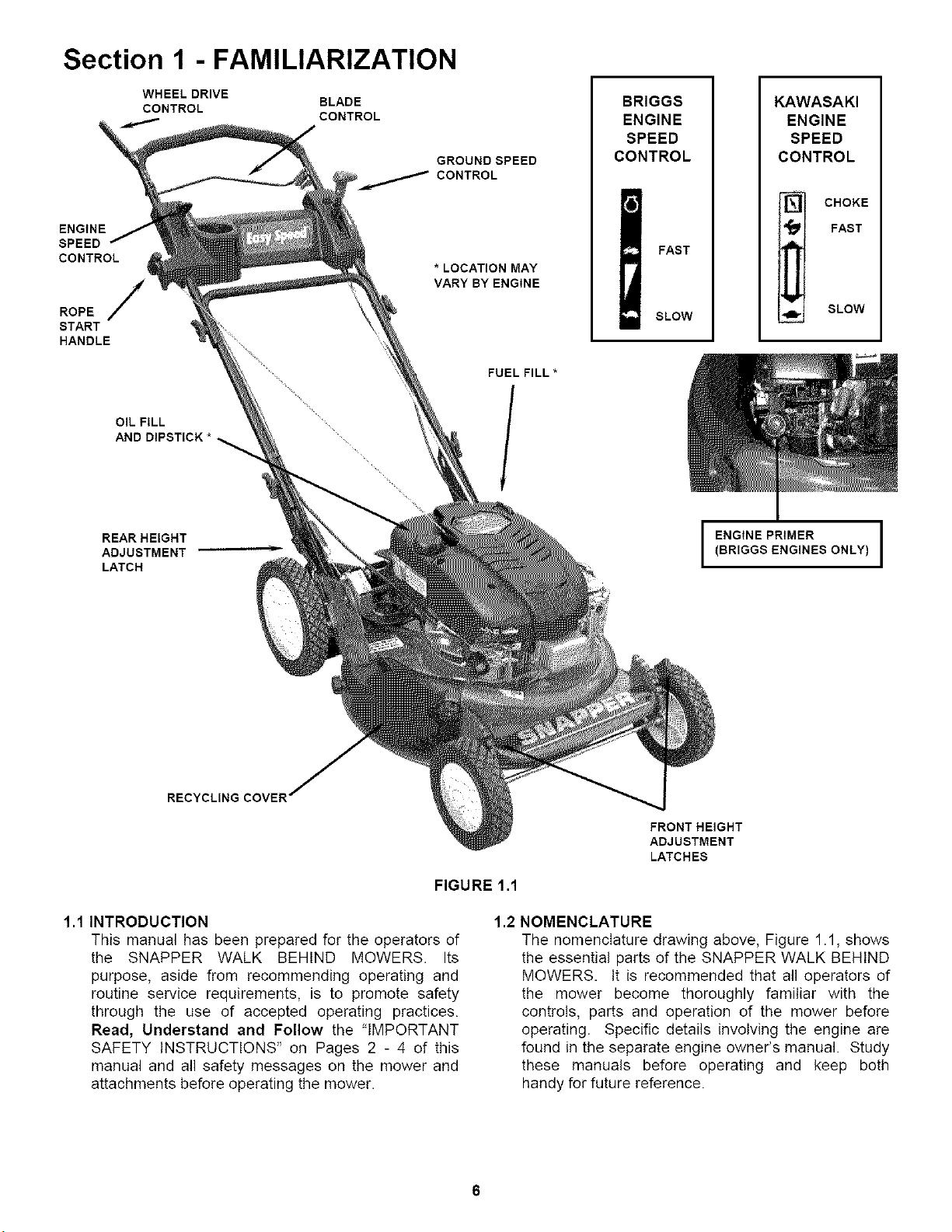
Section 1 - FAMILIARIZATION
WHEEL DRIVE
BLADE
CONTROL
CONTROL
ENGINE
SPEED
CONTROL
ROPE /
START
HANDLE
GROUND SPEED
*LOCATION MAY
VARY BY ENGINE
BRIGGS
ENGINE
SPEED
CONTROL
FAST
SLOW
KAWASAKI
ENGINE
SPEED
CONTROL
CHOKE
FAST
SLOW
%
"'%%'%,%%,%
OIL FILL
AND DIPSTICK * ._
REAR HEIGHT
ADJUSTMENT
LATCH
RECYCLING COVER
FUEL FILL *
/
ENGINE PRIMER
(BRIGGS ENGINES ONLY)
FRONT HEIGHT
ADJUSTMENT
LATCHES
FIGURE 1.1
1.1 INTRODUCTION
This manual has been prepared for the operators of
the SNAPPER WALK BEHIND MOWERS. Its
purpose, aside from recommending operating and
routine service requirements, is to promote safety
through the use of accepted operating practices.
Read, Understand and Follow the "IMPORTANT
SAFETY INSTRUCTIONS" on Pages 2 - 4 of this
manual and all safety messages on the mower and
attachments before operating the mower.
1.2 NOMENCLATURE
The nomenclature drawing above, Figure 1.1, shows
the essential parts of the SNAPPER WALK BEHIND
MOWERS. It is recommended that all operators of
the mower become thoroughly familiar with the
controls, parts and operation of the mower before
operating. Specific details involving the engine are
found in the separate engine owner's manual. Study
these manuals before operating and keep both
handy for future reference.
6
Section 2 - OPERATING INSTRUCTIONS
2,1 PRE-START CHECK LIST
Make the following checks and perform the service
required before each start-up
2.1.1. Check guards, deflectors, grass bag, adapter
and covers to make sure all are in place and securely
tightened.
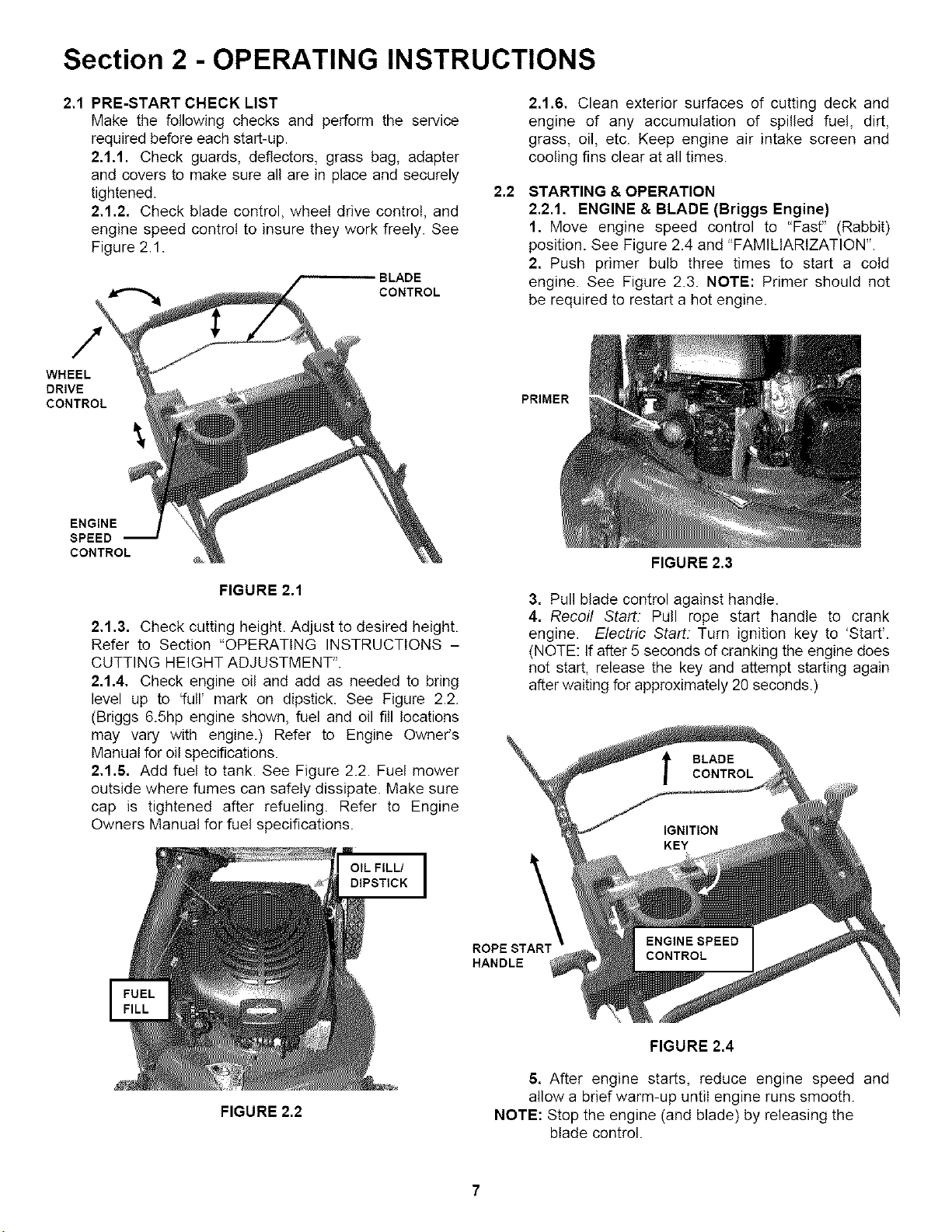
2.1.2. Check blade control, wheeI drive control, and
engine speed control to insure they work freely. See
Figure 2.1.
BLADE
CONTROL
/
WHEEL
DRIVE
CONTROL
2.2
2.1.6. Clean exterior surfaces of cutting deck and
engine of any accumulation of spilled fuel, dirt,
grass, oil, etc. Keep engine air intake screen and
cooling fins clear at all times.
STARTING & OPERATION
2.2.1. ENGINE & BLADE (Briggs Engine)
1. Move engine speed control to "Fast" (Rabbit)
position. See Figure 2.4 and "FAMILIARIZATION".
2. Push primer bulb three times to start a cold
engine. See Figure 2.3. NOTE: Primer should not
be required to restart a hot engine.
PRIMER
ENGINE
SPEED
CONTROL
FIGURE 2.1
2.1.3. Check cutting height. Adjust to desired height.
Refer to Section "OPERATING INSTRUCTIONS -
CUTTING HEIGHT ADJUSTMENT".
2.1.4, Check engine oil and add as needed to bring
level up to 'full' mark on dipstick. See Figure 2.2.
(Briggs 6.5hp engine shown, fuel and oil fill locations
may vary with engine.) Refer to Engine Owner's
Manual for oil specifications.
2,1.5. Add fuel to tank. See Figure 2.2. Fuel mower
outside where fumes can safely dissipate. Make sure
cap is tightened after refueling. Refer to Engine
Owners Manual for fuel specifications.
\
ROPE START
HANDLE
FIGURE 2.3
3. Pull blade control against handle.
4. Recoil Start: Pull rope start handle to crank
engine. Electric Start: Turn ignition key to 'Start'.
(NOTE: If after 5 seconds of cranking the engine does
not start, release the key and attempt starting again
after waiting for approximately 20 seconds.)
FIGURE 2.2
FIGURE 2.4
5, After engine starts, reduce engine speed and
allow a brief warm-up until engine runs smooth.
NOTE: Stop the engine (and blade) by releasing the
blade control.
Section 2 - OPERATING INSTRUCTIONS
2.2 STARTING & OPERATION 2.3
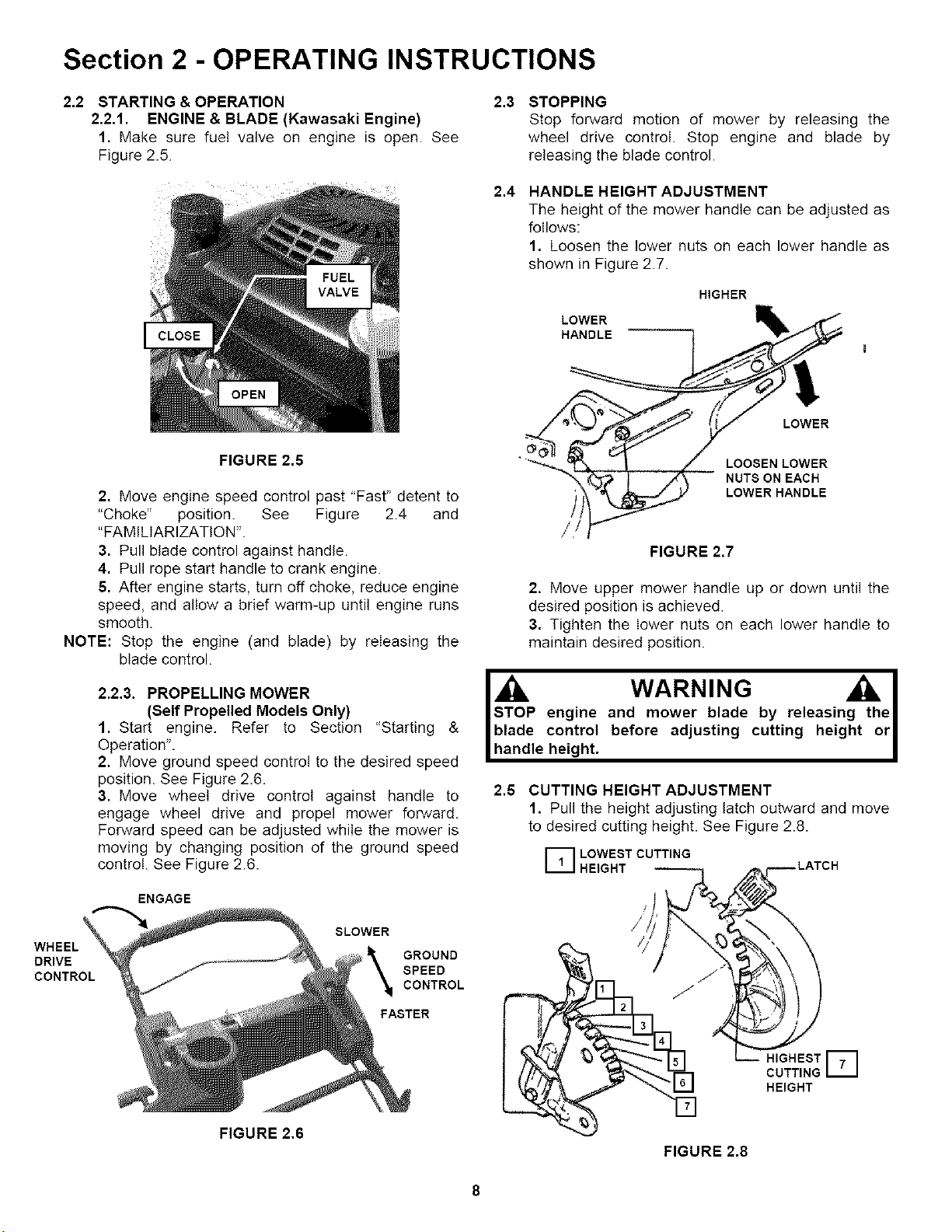
2.2.1. ENGINE & BLADE (Kawasaki Engine)
1. Make sure fuel valve on engine is open. See
Figure 2.5.
CLOSE
FIGURE 2.5
2. Move engine speed control past "Fast" detent to
"Choke" position. See Figure 2.4 and
"FAMILIARIZATION".
3. Pull blade control against handle.
4. Pull rope start handle to crank engine.
5. After engine starts, turn off choke, reduce engine
speed, and allow a brief warm-up until engine runs
smooth.
NOTE: Stop the engine (and blade) by releasing the
blade control.
2.2.3, PROPELLING MOWER
(Self Propelled Models Only)
1. Start engine. Refer to Section "Starting &
Operation".
2, Move ground speed control to the desired speed
position. See Figure 2.6.
3. Move wheel drive control against handle to
engage wheel drive and propel mower forward.
Forward speed can be adjusted while the mower is
moving by changing position of the ground speed
control. See Figure 2.6.
ENGAGE
WHEEL
DRIVE
CONTROL
SLOWER
GROUND
SPEED
CONTROL
FASTER
2,4
STOPPING
Stop forward motion of mower by releasing the
wheel drive control. Stop engine and blade by
releasing the blade control.
HANDLE HEIGHT ADJUSTMENT
The height of the mower handle can be adjusted as
follows:
1. Loosen the lower nuts on each lower handle as
shown in Figure 2.7.
HIGHER
LOWER
HANDLE
LOWER
LOOSEN LOWER
NUTS ON EACH
LOWER HANDLE
FIGURE 2,7
2. Move upper mower handle up or down until the
desired position is achieved.
3. Tighten the lower nuts on each lower handle to
maintain desired position.
WARNING [
i!_ir_l and mower blade by releasing the[
e before adjusting cutting height oI
2,5 CUTTING HEIGHT ADJUSTMENT
1, Pull the height adjusting latch outward and move
to desired cutting height. See Figure 2.8.
LOWEST
D HEIGHT CUTTING
"E_ HEIGHT
FIGURE 2,6
FIGURE 2.8
Section 2 - OPERATING INSTRUCTIONS
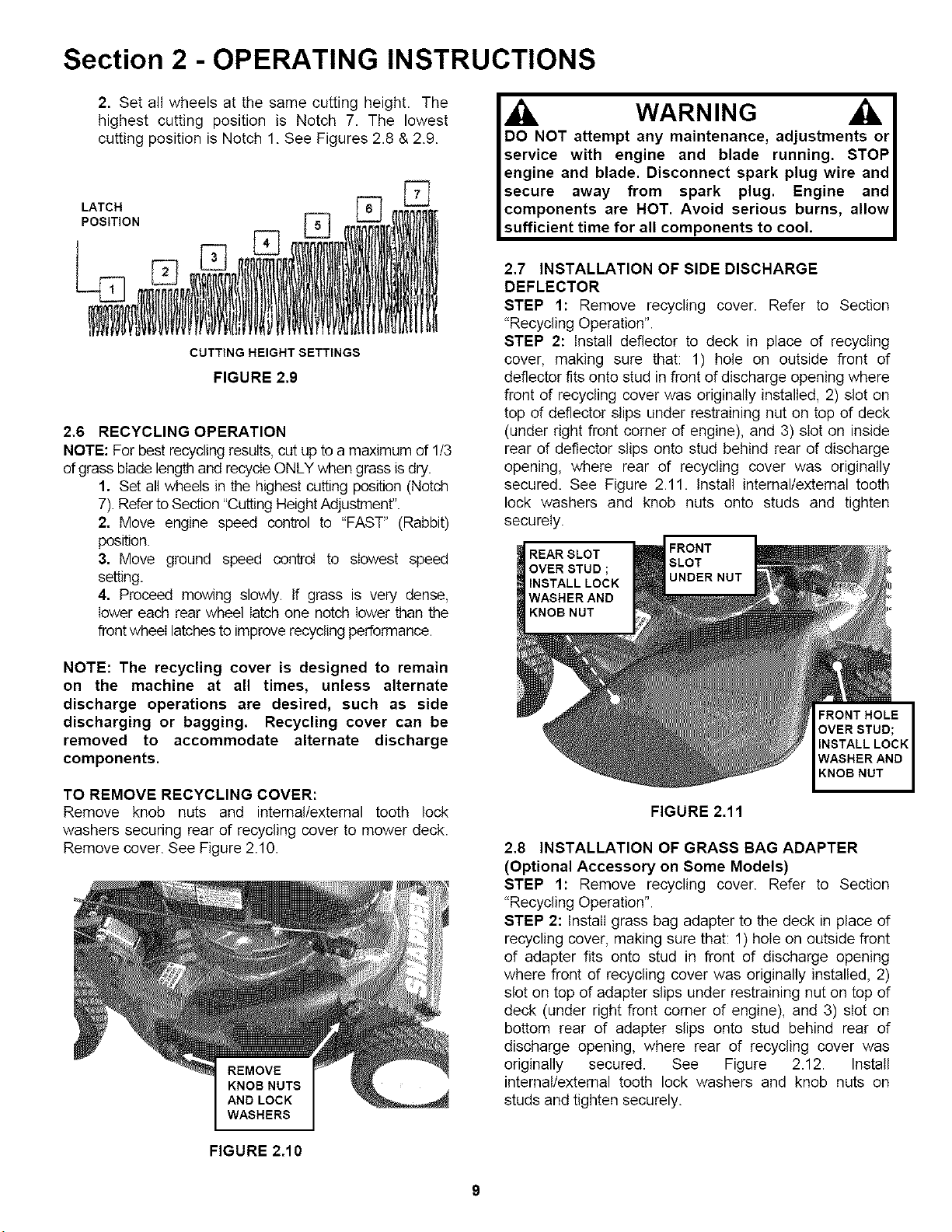
2. Set all wheels at the same cutting height. The
highest cutting position is Notch 7. The lowest
cutting position is Notch 1. See Figures 2.8 & 2.9.
LATCH
POSITION
[]
[]
CUTTINGHEIGHT SETTINGS
FIGURE 2,9
2,6 RECYCLING OPERATION
NOTE: For best recycling results, cut up to a maximum of 1/3
of grass blade length and recycle ONLY when grass is dry.
1. Set all wheels in the highest cutting position (Notch
7). Refer to Section "Cutting HeightAdjustment".
2. Move engine speed control to "FAST" (Rabbit)
position.
3. Move ground speed control to slowest speed
setting.
4. Proceed mowing slowly. If grass is very dense,
lower each rear wheel latch one notch lower than the
front wheel latchesto improve recycling performance.
NOTE: The recycling cover is designed to remain
on the machine at all times, unless alternate
discharge operations are desired, such as side
discharging or bagging. Recycling cover can be
removed to accommodate alternate discharge
components.
TO REMOVE RECYCLING COVER:
Remove knob nuts and internal/external tooth lock
washers securing rear of recycling cover to mower deck.
Remove cover. See Figure 2.10.
REMOVE
KNOB NUTS
AND LOCK
WASHERS
FIGURE 2.10
WARNING
DO NOT attempt any maintenance, adjustments or
service with engine and blade running. STOP
engine and blade. Disconnect spark plug wire and
secure away from spark plug. Engine and
components are HOT. Avoid serious burns, allow
sufficient time for all components to cool.
2.7 INSTALLATION OF SIDE DISCHARGE
DEFLECTOR
STEP 1: Remove recycling cover. Refer to Section
"Recycling Operation".
STEP 2: Install deflector to deck in place of recycling
cover, making sure that: 1) hole on outside front of
deflector fits onto stud in front of discharge opening where
front of recycling cover was originally installed, 2) slot on
top of deflector slips under restraining nut on top of deck
(under right front corner of engine), and 3) slot on inside
rear of deflector slips onto stud behind rear of discharge
opening, where rear of recycling cover was originally
secured. See Figure 2.11. Install internaltexternal tooth
lock washers and knob nuts onto studs and tighten
securely.
REAR SLOT FRONT
OVER STUD; SLOT
INSTALL LOCK UNDER NUT
WASHERAND
KNOB NUT
FRONT HOLE
OVER STUD;
INSTALL LOCK
WASHER AND
KNOB NUT
FIGURE 2.11
2.8 INSTALLATION OF GRASS BAG ADAPTER
(Optional Accessory on Some Models)
STEP 1: Remove recycling cover. Refer to Section
"Recycling Operation".
STEP 2: Install grass bag adapter to the deck in place of
recycling cover, making sure that: 1) hole on outside front
of adapter fits onto stud in front of discharge opening
where front of recycling cover was originally installed, 2)
slot on top of adapter slips under restraining nut on top of
deck (under right front corner of engine)_ and 3) slot on
bottom rear of adapter slips onto stud behind rear of
discharge opening, where rear of recycling cover was
originally secured. See Figure 2.12. Install
internal/external tooth lock washers and knob nuts on
studs and tighten securely.
Section 2 - OPERATING INSTRUCTIONS
WARNING
DO NOT attempt any maintenance, adjustments or
service with engine and blade running. STOP
engine and blade. Disconnect spark plug wire and
secure away from spark plug. Engine and
components are HOT. Avoid serious burns, allow
sufficient time for all components to cool.
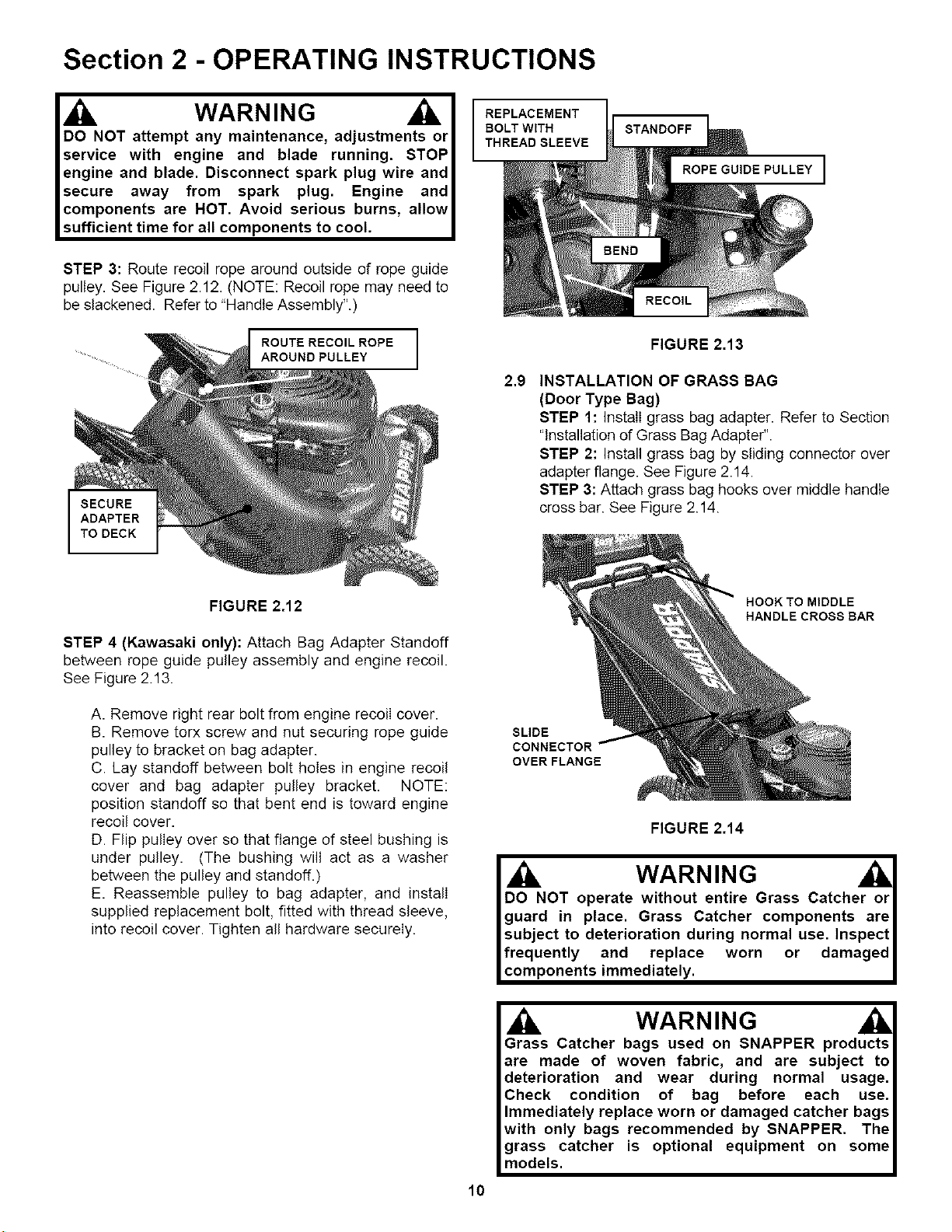
STEP 3: Route recoil rope around outside of rope guide
pulley. See Figure 2.12. (NOTE: Recoil rope may need to
be slackened. Refer to "Handle Assembly".)
ROUTE RECOIL ROPE
AROUND PULLEY
SECURE
ADAPTER
TO DECK
REPLACEMENT
BOLT WITH STANDOFF
THREAD SLEEVE
RECOIL
FIGURE 2.13
2,9 INSTALLATION OF GRASS BAG
(Door Type Bag)
STEP 1: InstatI grass bag adapter. Refer to Section
"Installation of Grass Bag Adapter".
STEP 2: Install grass bag by sliding connector over
adapter flange. See Figure 2.14.
STEP 3: Attach grass bag hooks over middle handle
cross bar. See Figure 2.14.
FIGURE 2.12
STEP 4 (Kawasaki only): Attach Bag Adapter Standoff
between rope guide pulley assembly and engine recoil.
See Figure 2.13.
A. Remove right rear bolt from engine recoil cover.
B. Remove torx screw and nut securing rope guide
pulley to bracket on bag adapter.
C. Lay standoff between bolt holes in engine recoil
cover and bag adapter pulley bracket. NOTE:
position standoff so that bent end is toward engine
recoil cover.
D. Flip pulley over so that flange of steel bushing is
under pulley. (The bushing will act as a washer
between the pulley and standoff.)
E. Reassemble pulley to bag adapter, and install
supplied replacement bolt, fitted with thread sleeve,
into recoil cover. Tighten all hardware securely.
HOOK TO MIDDLE
HANDLE CROSS BAR
SLIDE
CONNECTOR
OVER FLANGE
FIGURE 2.14
WARNING
DO NOT operate without entire Grass Catcher or
guard in place. Grass Catcher components are
subject to deterioration during normal use. Inspect
frequently and replace worn or damaged
components immediately.
10
WARNING
Grass Catcher bags used on SNAPPER products
are made of woven fabric, and are subject to
deterioration and wear during normal usage.
Check condition of bag before each use.
Immediately replace worn or damaged catcher bags
with only bags recommended by SNAPPER. The
grass catcher is optional equipment on some
models.
Section 3 - MAINTENANCE
3.1 INTRODUCTION
To retain the quality of the mower, use genuine
SNAPPER replacement parts only. Contact a local
SNAPPER dealer for parts and service assistance.
For the correct part or information for a particular
mower, always mention model and serial number.
WARNING
DO NOT attempt any maintenance, adjustments or
service with engine and blade running. STOP engine
and blade. Disconnect spark plug wire and secure
away from spark plug. Engine and components are
HOT. Avoid serious burns, allow sufficient time for
all components to cool.
3.2 SERVICE - AFTER FIRST 5 HOURS
3.2.1. CHANGE ENGINE OIL
IMPORTANT: Drain fuel tank before tipping machine.
DO NOT tip machine with carburetor or spark plug down.
Oil from crankcase will saturate the air filter and cause the
engine to be hard to start or not start at all. If
contamination does occur, the air filter will have to be
replaced.
1. Refer to Engine Manual for proper oil
specifications, procedures and proper service
intervals.
2. For simplest!cieanest oil change, loosen lower
handle nuts and fold handles. Stand mower up on
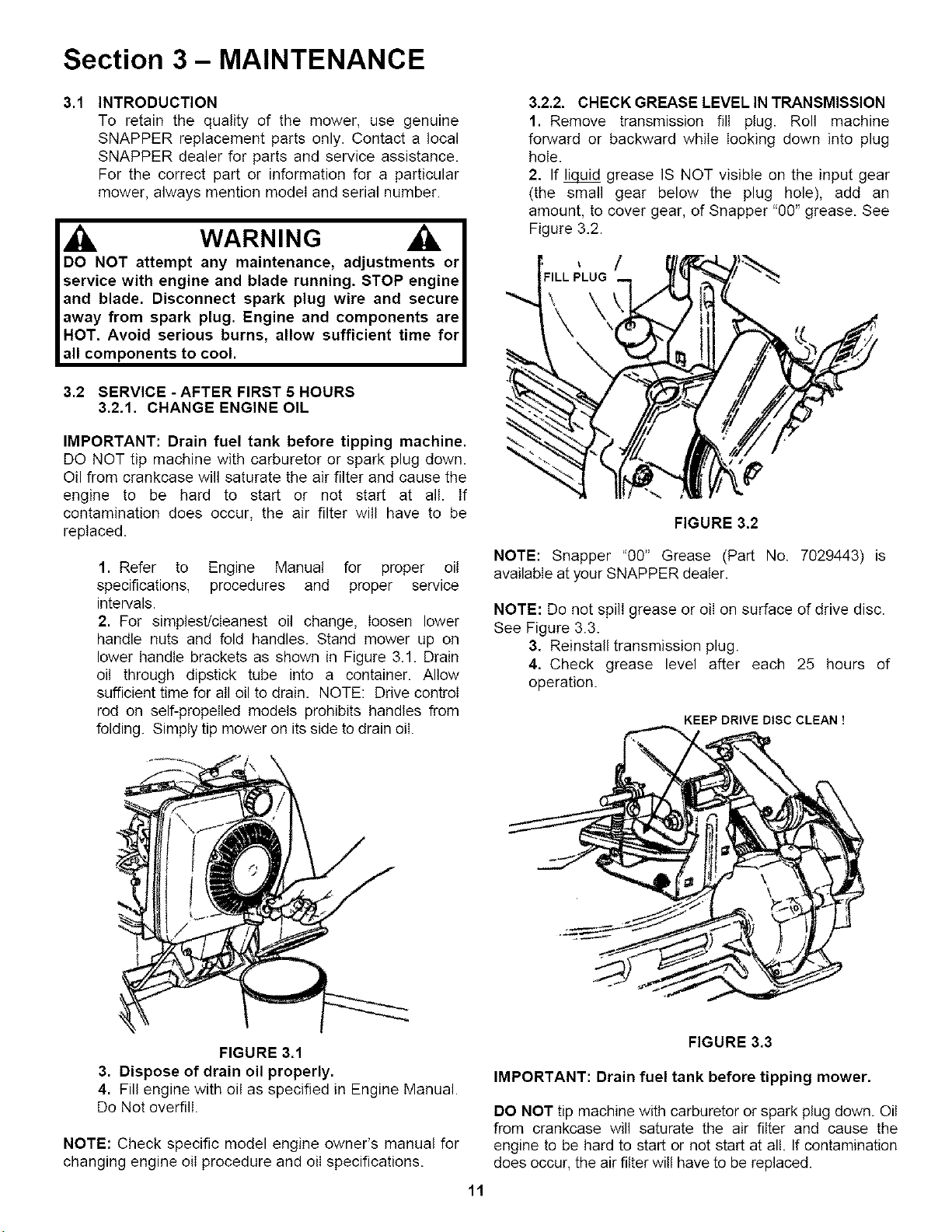
lower handle brackets as shown in Figure 3.1. Drain
oil through dipstick tube into a container. Allow
sufficient time for ail oil to drain. NOTE: Drive control
rod on self-propelled models prohibits handles from
folding. Simply tip mower on its side to drain oil.
3,2.2, CHECK GREASE LEVEL IN TRANSMISSION
1. Remove transmission fill plug. Roll machine
forward or backward while looking down into plug
hole.
2. If liquid grease IS NOT visible on the input gear
(the small gear below the plug hole), add an
amount, to cover gear, of Snapper "00" grease. See
Figure 3.2.
, /
FILL PLUG
FIGURE 3.2
NOTE: Snapper "00" Grease (Part No. 7029443) is
available at your SNAPPER dealer.
NOTE: Do not spill grease or oil on surface of drive disc.
See Figure 3.3.
3. Reinstall transmission plug.
4. Check grease level after each 25 hours of
operation.
KEEP DRIVE DISC CLEAN !
FIGURE 3.1
3. Dispose of drain oil properly.
4. Fill engine with oil as specified in Engine Manual.
Do Not overfill.
NOTE: Check specific model engine owner's manual for
changing engine oil procedure and oil specifications.
FIGURE 3.3
IMPORTANT: Drain fuel tank before tipping mower.
DO NOT tip machine with carburetor or spark plug down. Oil
from crankcase will saturate the air filter and cause the
engine to be hard to start or not start at alt. If contamination
does occur, the air filter will have to be replaced.
11
Section 3 - MAINTENANCE
WARNING
DO NOT attempt any maintenance, adjustments or
service with engine and blade running. STOP engine
and blade. Disconnect spark plug wire and secure
away from spark plug. Engine and components are
HOT. Avoid serious burns, allow sufficient time for
all components to cool. Wear heavy leather gloves
when handling or working around cutting blades.
Blades are extremely sharp and can cause severe
injury.
3.2,3, CHECK MOWER BLADE
1. Disconnect spark ptug wire and secure end
away from plug.
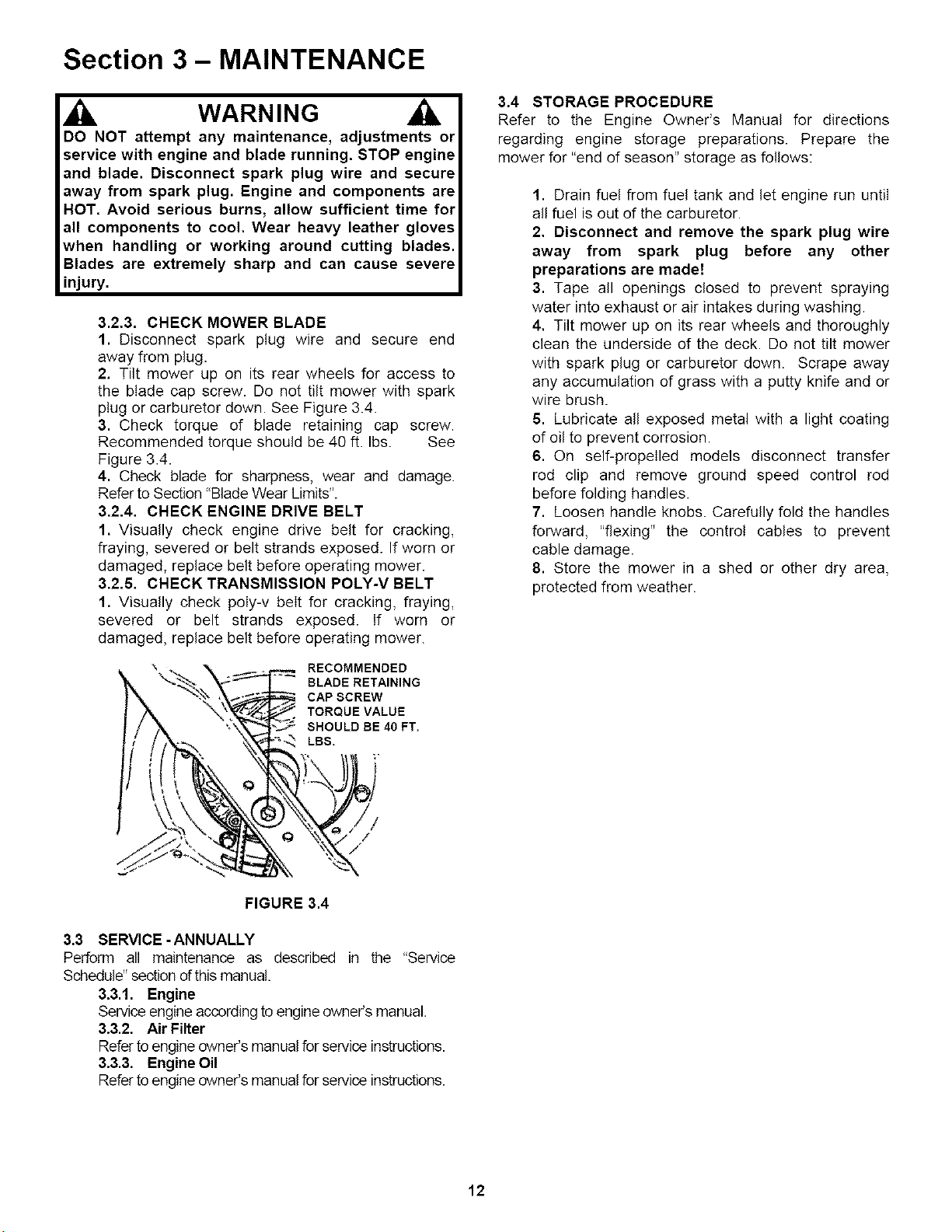
2. Tilt mower up on its rear wheels for access to
the blade cap screw. Do not tilt mower with spark
ptug or carburetor down. See Figure 3.4.
3. Check torque of blade retaining cap screw.
Recommended torque should be 40 ft. Ibs. See
Figure 3.4.
4. Check blade for sharpness, wear and damage.
Refer to Section "Blade Wear Limits".
3.2.4. CHECK ENGINE DRIVE BELT
1. Visually check engine drive belt for cracking,
fraying, severed or belt strands exposed. If worn or
damaged, replace belt before operating mower.
3.2.5. CHECK TRANSMISSION POLY-V BELT
1. Visually check poly-v belt for cracking, fraying,
severed or belt strands exposed. If worn or
damaged, replace belt before operating mower.
RECOMMENDED
BLADE RETAINING
CAPSCREW
TORQUEVALUE
SHOULD BE40FT,
LBS.
3.4 STORAGE PROCEDURE
Refer to the Engine Owner's Manual for directions
regarding engine storage preparations. Prepare the
mower for "end of season" storage as follows:
1. Drain fuel from fuel tank and let engine run until
all fuel is out of the carburetor.
2, Disconnect and remove the spark plug wire
away from spark plug before any other
preparations are made!
3. Tape all openings closed to prevent spraying
water into exhaust or air intakes during washing.
4, Tilt mower up on its rear wheels and thoroughly
clean the underside of the deck. Do not tilt mower
with spark plug or carburetor down. Scrape away
any accumulation of grass with a putty knife and or
wire brush.
5. Lubricate all exposed metal with a light coating
of oil to prevent corrosion.
6. On self-propelled models disconnect transfer
rod clip and remove ground speed control rod
before folding handles.
7. Loosen handle knobs. Carefully fold the handles
forward, "flexing" the control cables to prevent
cable damage.
8. Store the mower in a shed or other dry area,
protected from weather.
FIGURE 3.4
3.3 SERVICE-ANNUALLY
Perform all maintenance as described in the "Service
Schedule" section of this manual.
3.3.1. Engine
Service engine according to engine owner's manual.
3.3.2. Air Filter
Refer to engine owner's manual for service instructions.
3.3.3. Engine Oil
Refer to engine owner's manual for service instructions.
12
Section 4 - REPAIR & ADJUSTMENTS
WARNING
DO NOT attempt any maintenance, adjustments or
service with engine and blade running. STOP engine
and blade. Disconnect spark plug wire and secure
away from spark plug. Engine and components are
HOT. Avoid serious burns, allow sufficient time for
all components to cool, Wear heavy leather gloves
when handling or working around cutting blades.
Blades are extremely sharp and can cause severe
injury.
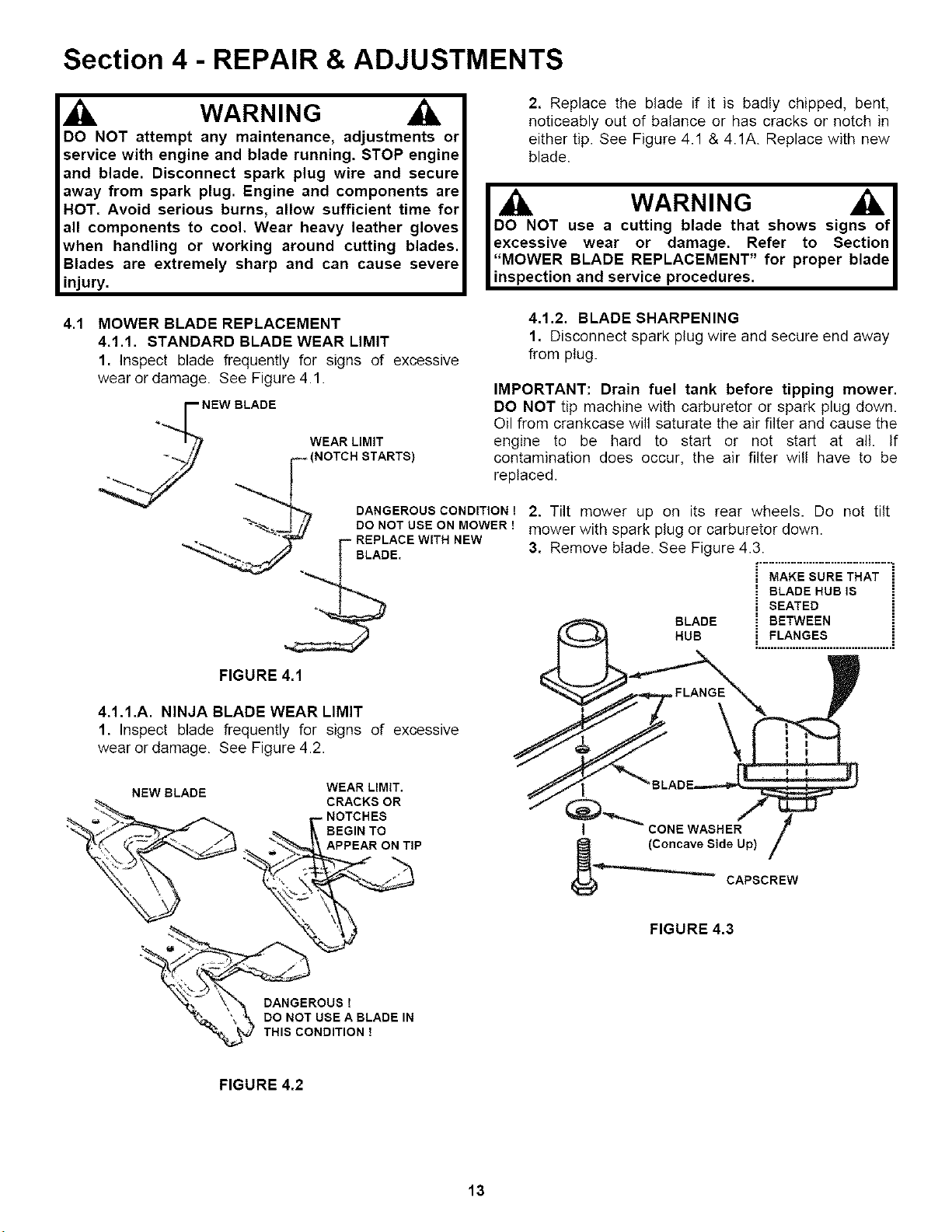
2. Replace the blade if it is badly chipped, bent,
noticeably out of balance or has cracks or notch in
either tip. See Figure 4.1 & 4.1A. Replace with new
blade.
IJ IL WARNING
DO NOT use a cutting blade that shows signs of|
excessive wear or damage. Refer to Section|
"MOWER BLADE REPLACEMENT" for proper blade|
inspection and service procedures. I
4.1
MOWER BLADE REPLACEMENT 4,1,2. BLADE SHARPENING
4,1.1. STANDARD BLADE WEAR LIMIT 1, Disconnect spark plug wire and secure end away
1, Inspect blade frequently for signs of excessive from plug.
wear or damage. See Figure 4.1.
IMPORTANT: Drain fuel tank before tipping mower.
I--NEWBLADE DO NOT tip machine with carburetor or spark plug down.
_....] Oil from crankcase will saturate the air filter and cause the
17_ WEARLIMIT engine to be hard to start or not start at all. If
_2// [_,--(NOTCHSTARTS) contamination does occur, the air filter will have to be
._._j ...._ J replaced.
DANGEROUSCONDITIO!! 2. Tilt mower up on its rear wheels. Do not tilt
"_..__JJ I_EOp_OTUSEONMOWER! mower with spark plug or carburetor down.
"_'_,*'_ _ BLAD= 3. Remove blade. See Figure 4.3.
MAKE SURE THAT
BLADE HUB IS
SEATED
BLADE BETWEEN
HUB FLANGES
FIGURE 4.1
4.1.1.A. NINJA BLADE WEAR LIMIT
1. Inspect blade frequently for signs of excessive
wear or damage. See Figure 4.2.
NEW BLADE
WEAR LIMIT.
CRACKS OR
NOTCHES
BEGIN TO
APPEAR ON TiP
I
_'CONE WASHER
(ConcaveSideUp)
i__ CAPSCREW
FIGURE 4.3
DANGEROUS!
DO NOT USE A BLADEIN
THIS CONDITION!
FIGURE 4.2
13
Section 4 - REPAIR & ADJUSTMENTS
WARNING
DO NOT attempt any maintenance, adjustments or
service with engine and blade running. STOP engine
and blade. Disconnect spark plug wire and secure
away from spark plug. Engine and components are
HOT. Avoid serious burns, allow sufficient time for
all components to cool.
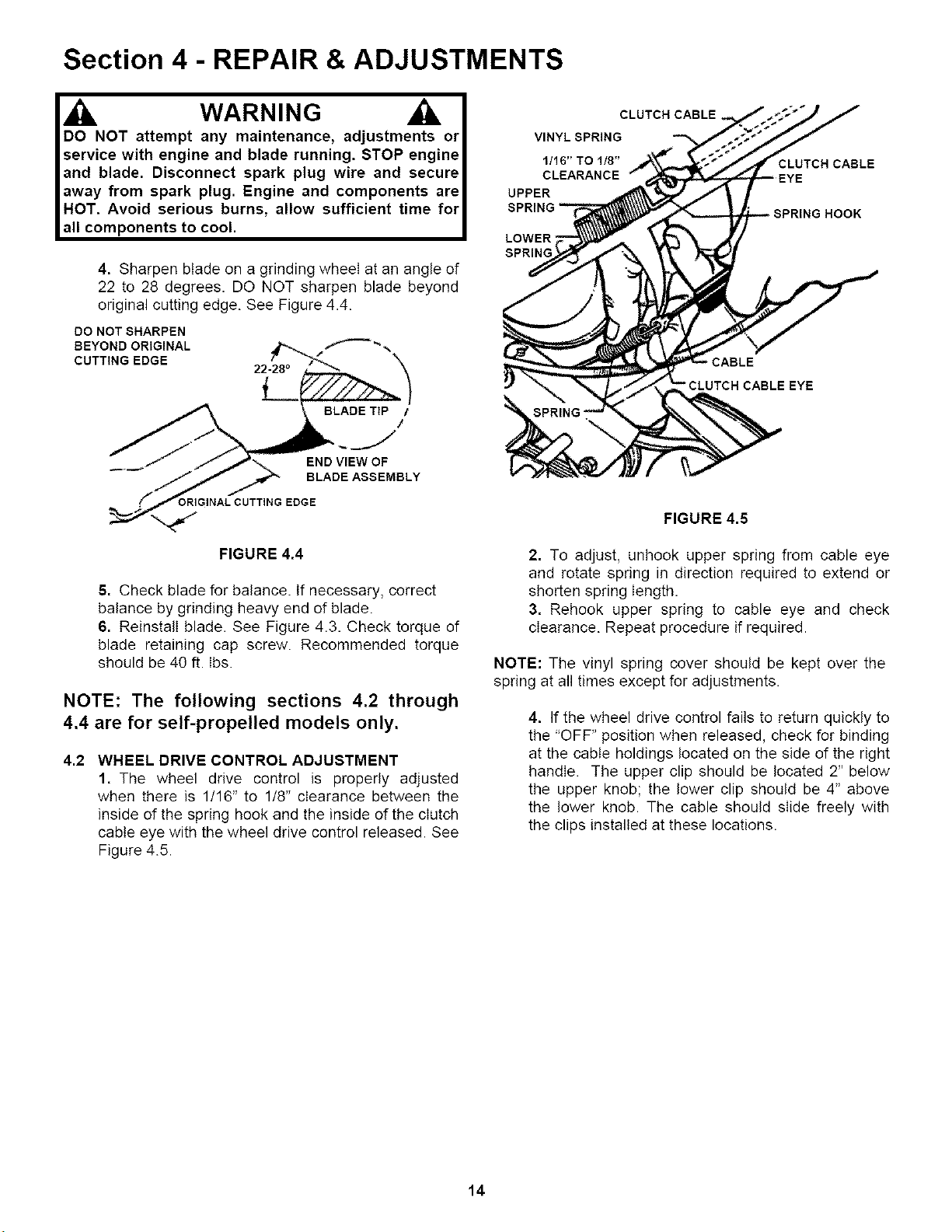
4. Sharpen blade on a grinding wheel at an angle of
22 to 28 degrees. DO NOT sharpen blade beyond
original cutting edge. See Figure 4.4.
DO NOT SHARPEN
BEYOND ORIGINAL
CUTTING EDGE
22-28 °
\
BLADE TIP /
/
CLUTCH CABLE
VINYL SPRING
1/16"TO 1/8"
CLEARANCE
UPPER
LOWER
SPRING
CLUTCH CABLE
HOOK
-CABLE
"CLUTCH CABLE EYE
END VIEW OF
BLADEASSEMBLY
ORIGINAL CUTTING EDGE
FIGURE 4.4
5. Check blade for balance. If necessary, correct
balance by grinding heavy end of blade.
6. Reinstall blade. See Figure 4.3. Check torque of
blade retaining cap screw. Recommended torque
should be 40 ft. Ibs.
NOTE: The following sections 4.2 through
4.4 are for self-propelled models only.
4.2 WHEEL DRIVE CONTROL ADJUSTMENT
1. The wheel drive control is properly adjusted
when there is 1/16" to 1/8" clearance between the
inside of the spring hook and the inside of the clutch
cable eye with the wheel drive control released. See
Figure 4.5.
FIGURE 4.5
2. To adjust, unhook upper spring from cable eye
and rotate spring in direction required to extend or
shorten spring length.
3. Rehook upper spring to cable eye and check
clearance. Repeat procedure if required.
NOTE: The vinyl spring cover should be kept over the
spring at all times except for adjustments.
4. If the wheel drive control fails to return quickly to
the "OFF" position when released, check for binding
at the cable holdings located on the side of the right
handle. The upper clip should be located 2" below
the upper knob; the lower clip should be 4" above
the lower knob. The cable should slide freely with
the clips installed at these locations.
14
Section 4 - REPAIR & ADJUSTMENTS
WARNING
DO NOT attempt any maintenance, adjustments or
service with engine and blade running. STOP engine
and blade. Disconnect spark plug wire and secure
away from spark plug. Engine and components are
HOT. Avoid serious burns, allow sufficient time for
all components to cool.
4.3 DRIVEN AND DRIVE DISC SERVICE
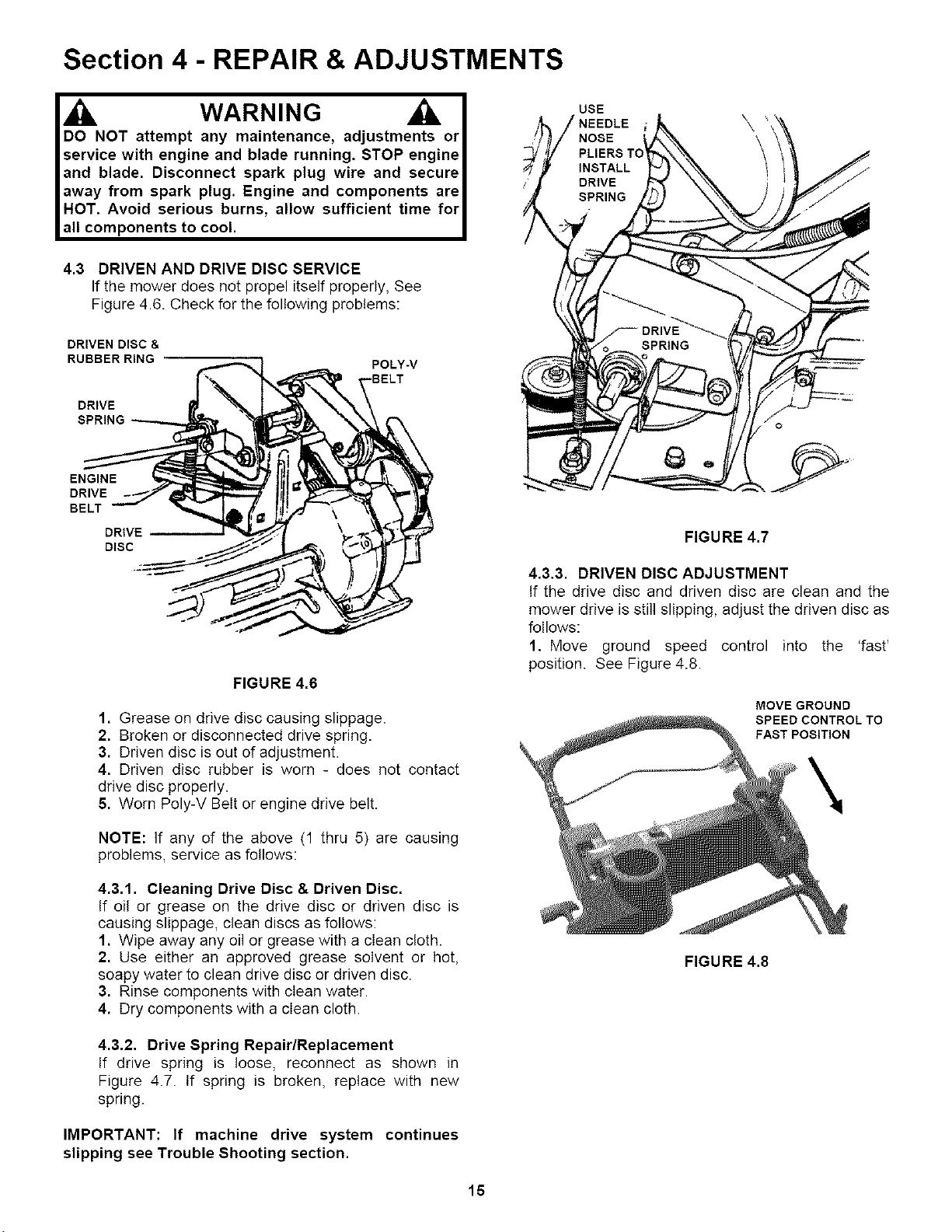
If the mower does not propel itself properly, See
Figure 4.6. Check for the following problems:
DRIVEN DISC &
RUBBER RING
POLY-V
DRIVE
SPRING
ENGINE
DRIVE
BELT
DRIVE
DISC
FIGURE 4.6
1. Grease on drive disc causing slippage.
2. Broken or disconnected drive spring.
3. Driven disc is out of adjustment.
4. Driven disc rubber is worn - does not contact
drive disc properly.
5. Worn Poly-V Belt or engine drive belt.
NOTE: If any of the above (1 thru 5) are causing
problems, service as follows:
4,3,1. Cleaning Drive Disc & Driven Disc,
If oil or grease on the drive disc or driven disc is
causing slippage, clean discs as follows:
1, Wipe away any oil or grease with a clean cloth.
2, Use either an approved grease solvent or hot,
soapy water to clean drive disc or driven disc.
3. Rinse components with clean water.
4. Dry components with a clean cloth.
4,3.2, Drive Spring RepairlReplacement
If drive spring is loose, reconnect as shown in
Figure 4.7. If spring is broken, replace with new
spring.
IMPORTANT: If machine drive system continues
slipping see Trouble Shooting section.
USE
FIGURE 4.7
4.3.3. DRIVEN DISC ADJUSTMENT
If the drive disc and driven disc are clean and the
mower drive is still slipping, adjust the driven disc as
follows:
1, Move ground speed control into the 'fast'
position. See Figure 4.8.
MOVEGROUND
SPEEDCONTROLTO
FAST POSITION
\
FIGURE 4.8
15
Section 4 - REPAIR & ADJUSTMENTS
WARNING
DO NOT attempt any maintenance, adjustments or
service with engine and blade running. STOP engine
and blade. Disconnect spark plug wire and secure
away from spark plug. Engine and components are
HOT. Avoid serious burns, allow sufficient time for
all components to cool.
4.3.3. DRIVEN DISC ADJUSTMENT
(Continued From Previous Page)
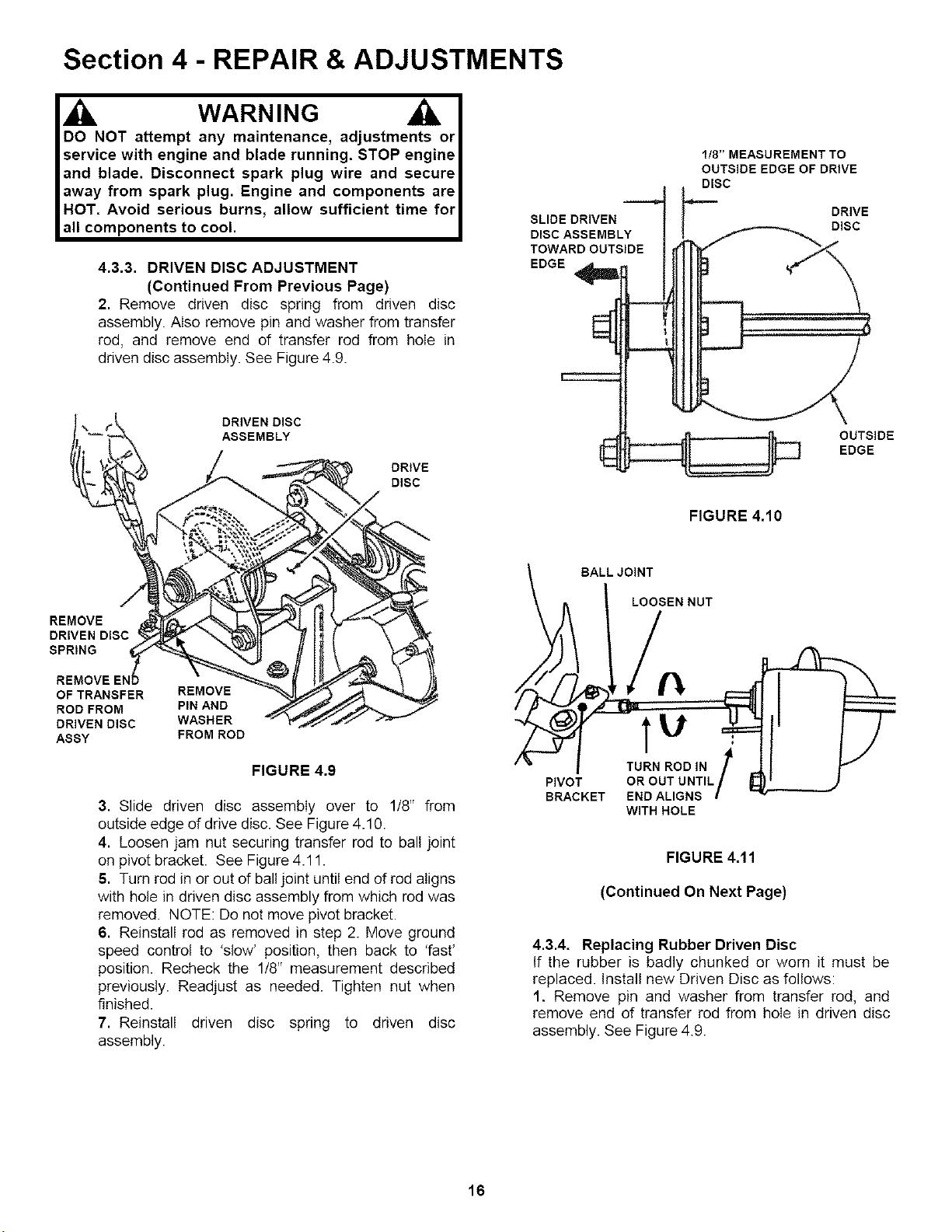
2. Remove driven disc spring from driven disc
assembly. Also remove pin and washer from transfer
rod, and remove end of transfer rod from hole in
driven disc assembly. See Figure 4.9.
SLIDE DRIVEN
DISC ASSEMBLY
TOWARD OUTSIDE
EDGE
1/8" MEASUREMENT TO
OUTSIDE EDGE OF DRIVE
DISC
DRIVE
DISC
DRIVEN DISC
ASSEMBLY
DRIVE
DISC
REMOVE
DRIVEN DISC
SPRING
OFTRANSFER REMOVE
ROD FROM PIN AND
DRIVEN DISC WASHER
ASSY FROM ROD
FIGURE 4.9
3. Slide driven disc assembly over to 1/8" from
outside edge of drive disc. See Figure 4.10.
4. Loosen jam nut securing transfer rod to ball joint
on pivot bracket. See Figure 4.11.
5. Turn rod in or out of ball joint until end of rod aligns
with hole in driven disc assembly from which rod was
removed. NOTE: Do not move pivot bracket.
6. Reinstall rod as removed in step 2. Move ground
speed control to 'slow' position, then back to 'fast'
position. Recheck the 1/8" measurement described
previously. Readjust as needed. Tighten nut when
finished.
7. Reinstall driven disc spring to driven disc
assembly.
OUTSIDE
EDGE
FIGURE 4.10
BALL JOINT
LOOSEN NUT
TU _.
TURN ROD IN
/
PIVOT OR OUT UNTIL
BRACKET END ALIGNS
WITH HOLE
FIGURE 4.11
(Continued On Next Page)
4.3.4. Replacing Rubber Driven Disc
If the rubber is badly chunked or worn it must be
replaced. Install new Driven Disc as follows:
1, Remove pin and washer from transfer red, and
remove end of transfer rod from hole in driven disc
assembly. See Figure 4.9.
16
Section 4 - REPAIR & ADJUSTMENTS
WARNING
DO NOT attempt any maintenance, adjustments or
service with engine and blade running. STOP engine
and blade. Disconnect spark plug wire and secure
away from spark plug. Engine and components are
HOT. Avoid serious burns, allow sufficient time for
all components to cool.
4.3.4. Replacing Rubber Driven Disc
(Continued from previous page)
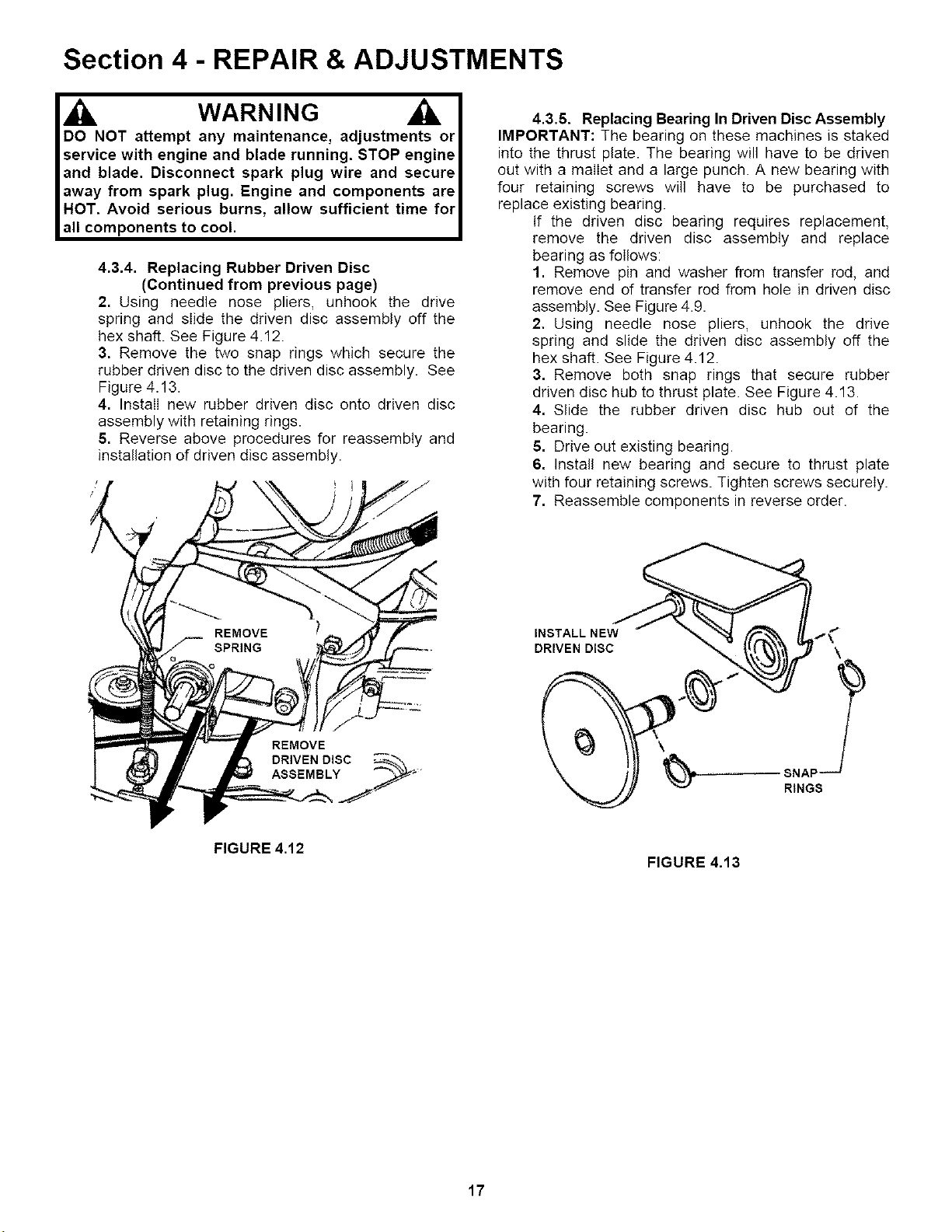
2, Using needle nose pliers, unhook the drive
spring and slide the driven disc assembly off the
hex shaft. See Figure 4.12.
3, Remove the two snap rings which secure the
rubber driven disc to the driven disc assembly. See
Figure 4.13.
4, Install new rubber driven disc onto driven disc
assembly with retaining rings.
5, Reverse above procedures for reassembty and
installation of driven disc assembly.
REMOVE
4.3.5. Replacing Bearing In Driven Disc Assembly
IMPORTANT: The bearing on these machines is staked
into the thrust plate. The bearing will have to be driven
out with a mallet and a large punch. A new bearing with
four retaining screws will have to be purchased to
replace existing bearing.
If the driven disc bearing requires replacement,
remove the driven disc assembly and replace
bearing as follows:
1. Remove pin and washer from transfer rod, and
remove end of transfer rod from hole in driven disc
assembly. See Figure 4.9.
2, Using needle nose pliers, unhook the drive
spring and slide the driven disc assembly off the
hex shaft. See Figure 4.12.
3. Remove both snap rings that secure rubber
driven disc hub to thrust plate. See Figure 4.13.
4. Slide the rubber driven disc hub out of the
bearing.
5. Drive out existing bearing.
6. Install new bearing and secure to thrust plate
with four retaining screws. Tighten screws securely.
7. Reassemble components in reverse order.
INSTALL NEW
DRIVEN DISC
FIGURE 4.12
FIGURE 4.13
17
Section 4 - REPAIR & ADJUSTMENTS
WARNING
DO NOT attempt any maintenance, adjustments or
service with engine and blade running. STOP engine
and blade. Disconnect spark plug wire and secure
away from spark plug. Engine and components are
HOT. Avoid serious burns, allow sufficient time for
all components to cool.
4.3.6. Replacement Of Bearing On Pulley End Of
Hex Shaft
To replace the bearing on the pulley end of the hex
shaft, proceed as follows:
1. Hold the hex shaft with an adjustable wrench
held next to the pulley.
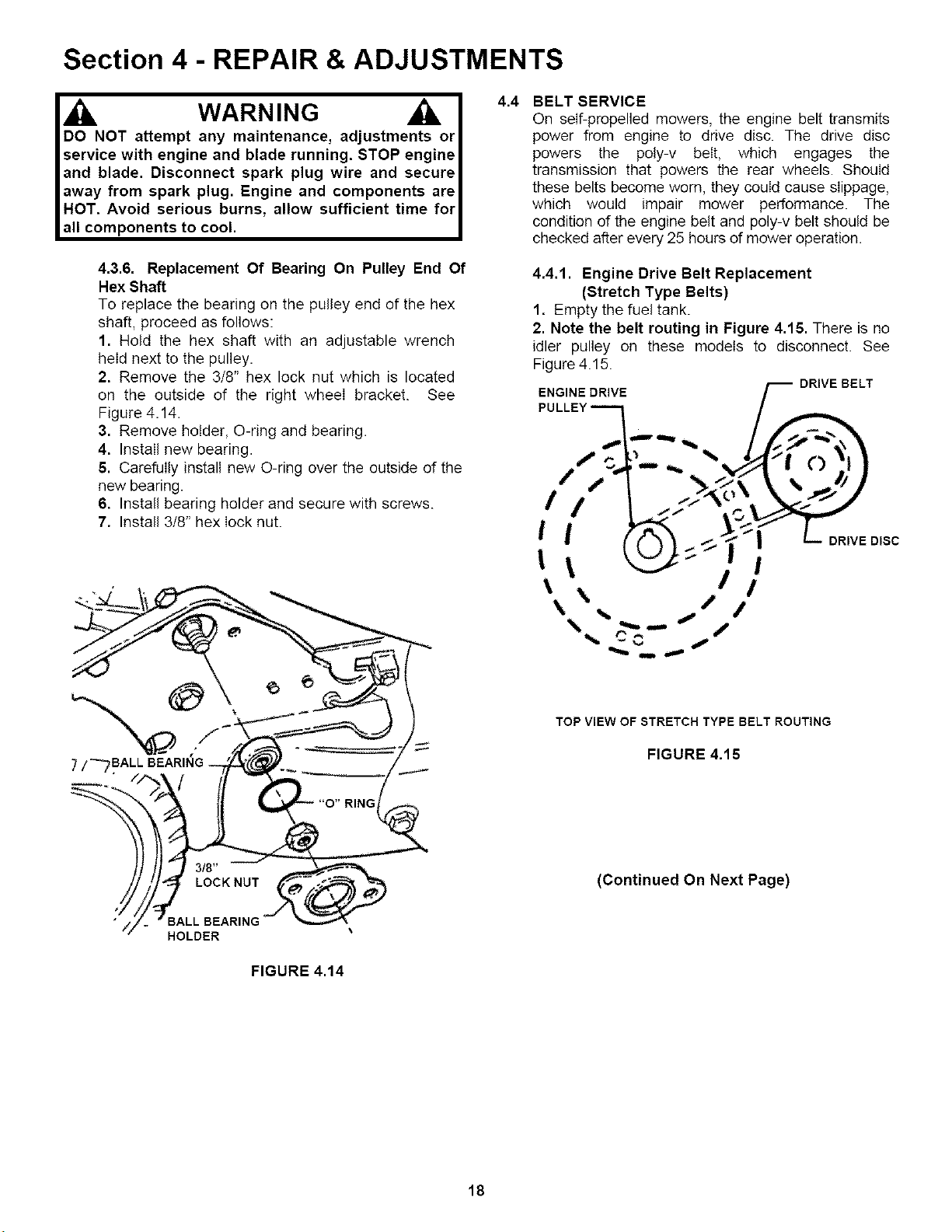
2. Remove the 3/8" hex lock nut which is located
on the outside of the right wheei bracket. See
Figure 4.14.
3. Remove holder, O-ring and bearing.
4. Install new bearing.
6. Carefully install new O-ring over the outside of the
new bearing.
6. Install bearing holder and secure with screws.
7. Install 3/8" hex Iock nut.
4.4 BELT SERVICE
On self-propelled mowers, the engine belt transmits
power from engine to drive disc. The drive disc
powers the poly-v belt, which engages the
transmission that powers the rear wheels. Should
these belts become worn, they could cause slippage,
which would impair mower performance. The
condition of the engine belt and poly-v belt should be
checked after every 25 hours of mower operation.
4.4.1. Engine Drive Belt Replacement
(Stretch Type Belts)
1. Empty the fuel tank.
2. Note the belt routing in Figure 4.16. There is no
idler pulley on these models to disconnect. See
Figure 4.15.
DRIVE BELT
ENGINE DRIVE
DRIVE DISC
7/---'7 BALL
TOPVIEW OF STRETCH TYPE BELT ROUTING
FIGURE 4.15
3/8"
LOCK NUT (Continued On Next Page)
ALLBEARING
HOLDER
FIGURE 4.14
18
Section 4 - REPAIR & ADJUSTMENTS
WARNING
DO NOT attempt any maintenance, adjustments or
service with engine and blade running. STOP engine
and blade. Disconnect spark plug wire and secure
away from spark plug. Engine and components are
HOT. Avoid serious burns, allow sufficient time for
all components to cool.
4.4.1. Engine Drive Belt Replacement
(Stretch Type Belts)
(Continued From Previous Page)
IMPORTANT: Drain fuel tank before tipping mower.
DO NOT tip machine with carburetor or spark plug down.
Oil from crankcase will saturate the air filter and cause the
engine to be hard to start or not start at all. If
contamination does occur, the air filter will have to be
replaced.
3, Remove the driven disc. Refer to Section
"Replacing Rubber Driven Disc" for driven disc
removal procedure.
4, Drain fuel tank before tipping mower. Do not tilt
mower with spark plug or carburetor down. Tilt
mower up on its rear wheels and remove blade and
blade hub. Assistance from another person may be
necessary to hold mower in the tilted position.
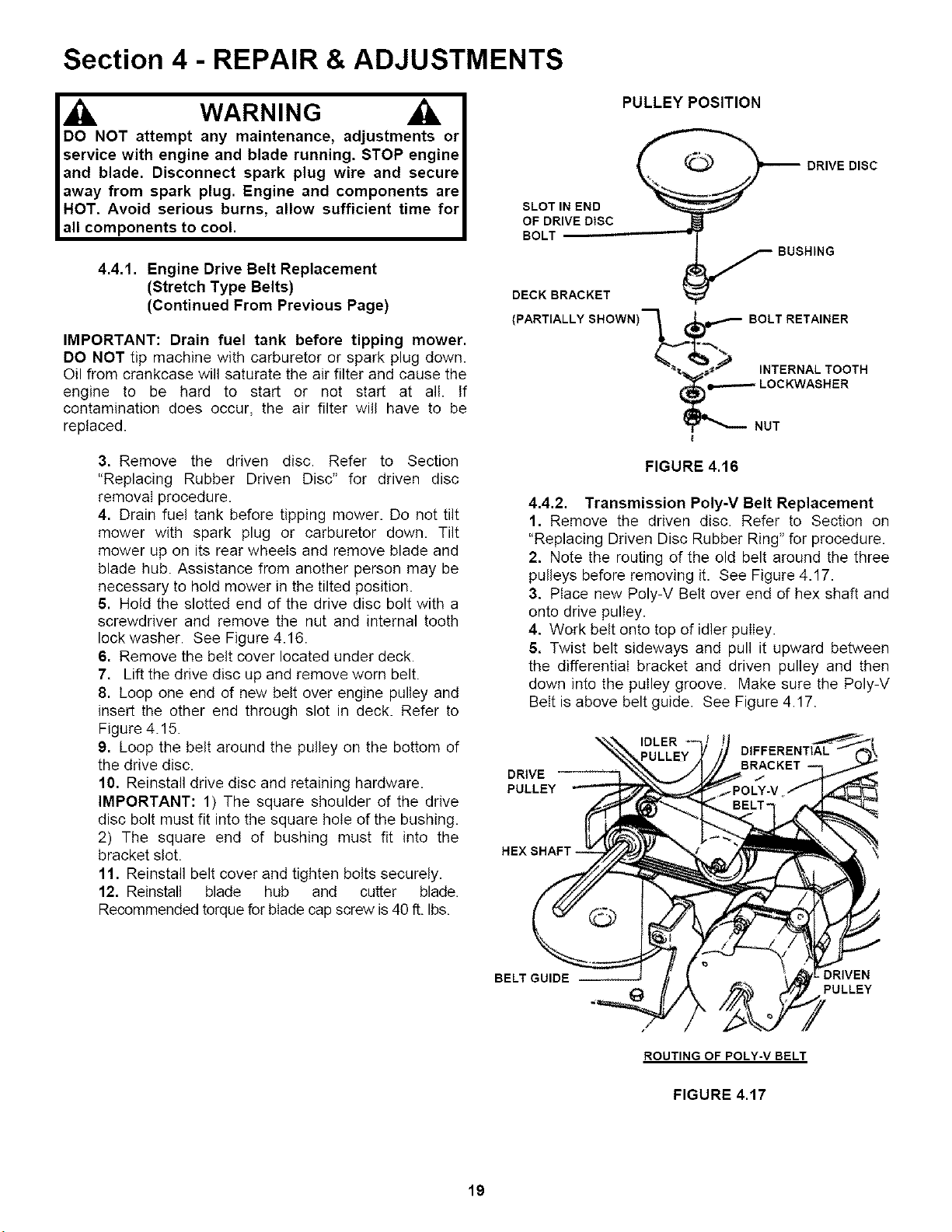
6. Hold the slotted end of the drive disc bolt with a
screwdriver and remove the nut and internal tooth
lock washer. See Figure 4.16.
6, Remove the belt cover located under deck.
7, Lift the drive disc up and remove worn belt.
8. Loop one end of new belt over engine pulley and
insert the other end through slot in deck. Refer to
Figure 4.15.
9, Loop the belt around the pulley on the bottom of
the drive disc.
10. Reinstall drive disc and retaining hardware.
IMPORTANT: 1) The square shoulder of the drive
disc bolt must fit into the square hole of the bushing.
2) The square end of bushing must fit into the
bracket slot,
11. Reinstall belt cover and tighten bolts securely.
12, Reinstall blade hub and cutter blade,
Recommended torque for blade cap screw is 40 ft. Ibs.
PULLEY POSITION
SLOT IN END
OF DRIVE DISC
BOLT
DECK BRACKET
(PARTIALLY SHOWN)
BOLT RETAINER
_ INTERNAL TOOTH
_ e-*,---'-- LOCKWASHER
_"",_ NUT
FIGURE 4.16
4,4,2, Transmission Poly-V Belt Replacement
1, Remove the driven disc. Refer to Section on
"Replacing Driven Disc Rubber Ring" for procedure.
2, Note the routing of the old belt around the three
pulleys before removing it. See Figure 4.17.
3, Place new Poly-V Belt over end of hex shaft and
onto drive pulley.
4, Work belt onto top of idler pulley.
6, Twist belt sideways and pull it upward between
the differential bracket and driven pulley and then
down into the pulley groove. Make sure the Poly-V
Belt is above belt guide. See Figure 4.17.
DRIVE
PULLEY
IDLER
BRACKET
HEXSHAFT-
BELT GUIDE DRIVEN
PULLEY
ROUTING OF POLY-V BELT
FIGURE 4.17
19
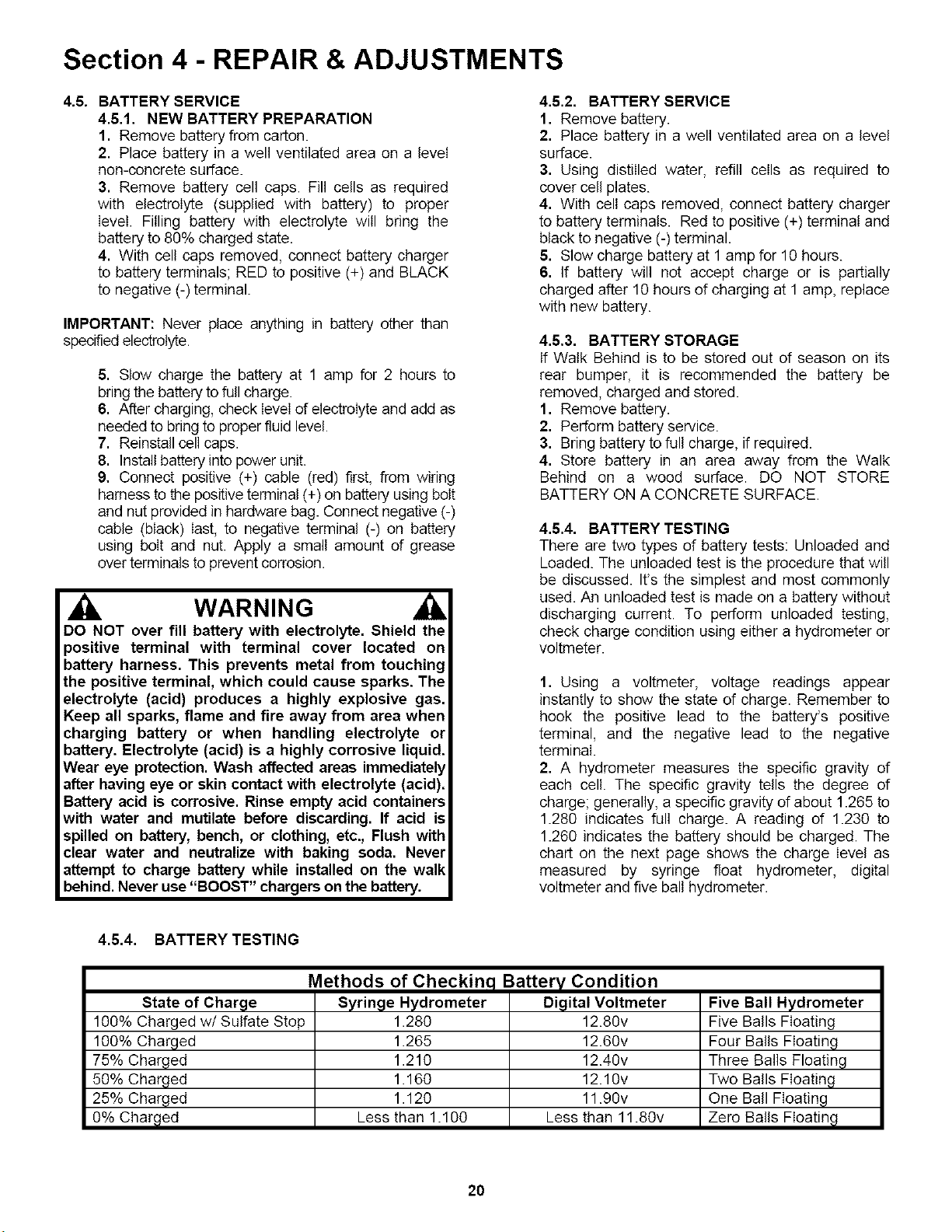
Section 4 - REPAIR & ADJUSTMENTS
4.5. BATTERY SERVICE
4.5.1. NEW BATTERY PREPARATION
1. Remove battery from carton.
2. Place battery in a well ventilated area on a level
non-cencrete surface.
3. Remove battery cell caps. Fill cells as required
with electrolyte (supplied with battery) to proper
level. Filling battery with electrolyte will bring the
battery to 80% charged state.
4. With celt caps removed, connect battery charger
to battery terminals; RED to positive (+) and BLACK
to negative (-)terminal.
IMPORTANT: Never place anything in battery other than
specified electrolyte.
5. Slow charge the battery at 1 amp for 2 hours to
bring the battery to full charge.
6. After charging, check level of electrolyte and add as
needed to bring to proper fluid level.
7. Reinstall cell caps.
8. Install battery into power unit.
9. Connect positive (+) cable (red) first, from wiring
harness to the positive terminal (+) on battery using bolt
and nut provided in hardware bag. Connect negative (-)
cable (black) last, to negative terminal (-) on battery
using bolt and nut. Apply a small amount of grease
over terminals to prevent corrosion.
WARNING
DO NOT over fill battery with electrolyte. Shield the
positive terminal with terminal cover located on
battery harness. This prevents metal from touching
the positive terminal, which could cause sparks. The
electrolyte (acid) produces a highly explosive gas.
Keep all sparks, flame and fire away from area when
charging battery or when handling electrolyte or
battery. Electrolyte (acid) is a highly corrosive liquid.
Wear eye protection. Wash affected areas immediately
after having eye or skin contact with electrolyte (acid).
Battery acid is corrosive. Rinse empty acid containers
with water and mutilate before discarding. If acid is
spilled on battery, bench, or clothing, etc., Flush with
clear water and neutralize with baking soda. Never
attempt to charge battery while installed on the walk
behind. Never use "BOOST" chargers on the battery.
4.5.2, BATTERY SERVICE
1. Remove battery.
2. Place battery in a well ventilated area on a level
surface.
3. Using distilled water, refill cells as required to
cover cell plates.
4. With cell caps removed, connect battery charger
to battery terminals. Red to positive (+) terminal and
black to negative (-) terminal.
5. Slow charge battery at 1 amp for 10 hours.
6. If battery will not accept charge or is partially
charged after 10 hours of charging at 1 amp, replace
with new battery.
4.5,3. BATTERY STORAGE
If Walk Behind is to be stored out of season on its
rear bumper, it is recommended the battery be
removed, charged and stored.
1. Remove battery.
2. Perform battery service.
3. Bring battery to full charge, if required.
4. Store battery in an area away from the Walk
Behind on a wood surface. DO NOT STORE
BATTERY ON A CONCRETE SURFACE.
4.5.4, BATTERY TESTING
There are two types of battery tests: Unloaded and
Loaded. The unloaded test is the procedure that will
be discussed. It's the simplest and most commonly
used. An unloaded test is made on a battery without
discharging current. To perform unloaded testing,
check charge condition using either a hydrometer or
voltmeter.
1. Using a voltmeter, voltage readings appear
instantly to show the state of charge. Remember to
hook the positive lead to the battery's positive
terminal, and the negative lead to the negative
terminal.
2. A hydrometer measures the specific gravity of
each cell. The specific gravity tells the degree of
charge; generally, a specific gravity of about 1.265 to
1.280 indicates full charge. A reading of 1.230 to
1.260 indicates the battery should be charged. The
chart on the next page shows the charge level as
measured by syringe float hydrometer, digital
voltmeter and five ball hydrometer.
4.5.4. BATTERY TESTING
Methods
State of Charge
100% Charged w/Sulfate Stop
100% Charged
75% Charged
50% Charged
25% Charged
0% Charged
of Checkinq
Syringe Hydrometer
1.280
1.265
1.210
1.160
1.120
Less than 1.100
Battery Condition
Digital Voltmeter
12.80v
12.80v
12.40v
12.10v
11.90v
Less than 11.80v
Five Ball Hydrometer
Five Balls Floating
Four Balls Floating
Three Balls Floating
Two Balls Floating
One Ball Floating
Zero Balls Floating
20
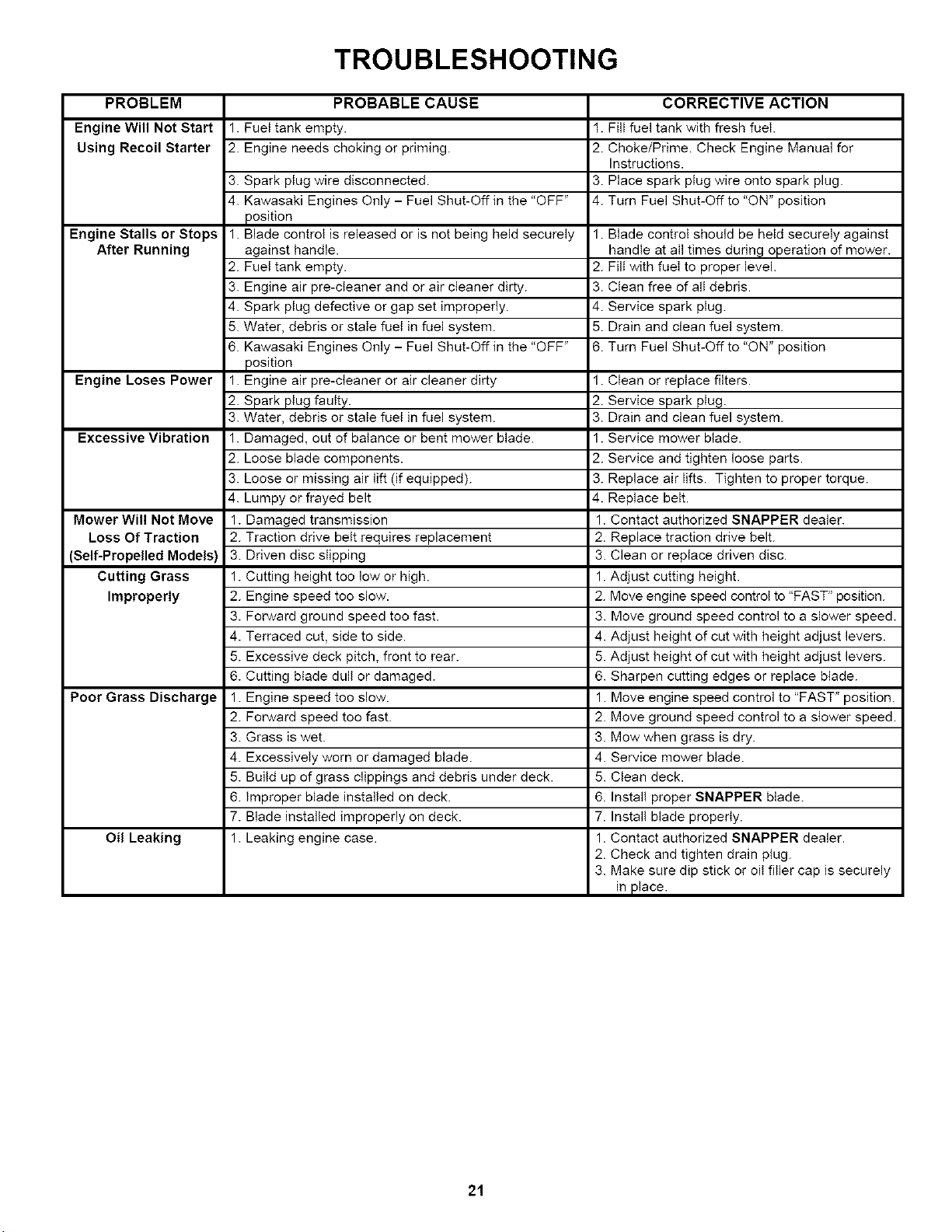
PROBLEM
Engine Will Not Start
Using Recoil Starter
Engine Stalls or Stops
After Running
Engine Loses Power
Excessive Vibration
Mower Will Not Move
Loss Of Traction
(Self-Propelled Models)
Cutting Grass
Improperly
Poor Grass Discharge
Oil Leaking
TROUBLESHOOTING
PROBABLE CAUSE
1. Fuel tank empty.
2. Engine needs choking or priming.
3. Spark plug wire disconnected.
4. Kawasaki Engines Only - Fuel Shut-Off in the "OFF"
position
1. Blade centre{ is released or is not being held securely
against handle.
2. Fuel tank empty.
3. Engine air pre-cteaner and or air cleaner dirty.
4. Spark plug defective or gap set improperly.
5. Water, debris or stale fuel in fuel system.
6. Kawasaki Engines Only - Fuel Shut-Off in the "OFF"
position
1. Engine air pre-cteaner or air cleaner dirty
2. Spark plug fautty.
3. Water, debris or stale fuel in fuel system.
1. Damaged, out of balance or bent mower blade.
2. Loose blade components.
3. Loose or missing air lift(if equipped).
4. Lumpy or frayed belt
1. Damaged transmission
2. Traction drive belt requires replacement
3. Driven disc slipping
1. Cutting height too low or high.
2. Engine speed too slow.
3. Forward ground speed too fast.
4. Terraced cut, side to side.
5. Excessive deck pitch, front to rear.
6. Cutting blade dull or damaged.
1. Engine speed too slow.
2. Forward speed too fast.
3. Grass is wet.
4. Excessively worn or damaged blade.
5. Build up of grass clippings and debris under deck.
6. improper blade installed on deck.
7. Blade installed improperly on deck.
1. Leaking engine case.
CORRECTIVE ACTION
I. Fill fuel tank with flesh fueI.
2. Choke/Prime. Check Engine Manual for
Instructions.
3. Place spark plug wire onto spark plug.
4. Turn Fuel Shut-Off to "ON" position
1. Blade control should be held securely against
handle at all times during operation of mower.
2. Fill with fueI to proper level.
3. Clean flee of all debris.
4. Service spark plug.
5. Drain and clean fuel system.
6. Turn Fuel Shut-Off to "ON" position
1. Clean or replace filters.
2. Service spark plug.
3. Drain and clean fuel system.
1. Service mower blade.
2. Service and tighten loose parts.
3. Replace air lifts. Tighten to proper torque.
4. Replace bek.
1. Contact authorized SNAPPER dealer.
2. Replace traction drive belt.
3. Clean or replace driven disc.
1. Adjust cutting height.
2. Move engine speed controt to "FAST" position.
3. Move ground speed control to a slower speed.
4. Adjust height of cut with height adjust levers.
5. Adjust height of cut with height adjust levers.
6. Sharpen cutting edges or replace blade.
1. Move engine speed control to "FAST" position.
2. Move ground speed control to a slower speed.
3. Mow when grass is dry.
4. Service mower blade.
5. Clean deck.
6. Install proper SNAPPER blade.
7. Install blade properly.
1. Contact authorized SNAPPER dealer.
2. Check and tighten drain plug.
3. Make sure dip stick or oil filler cap issecurely
in place.
21
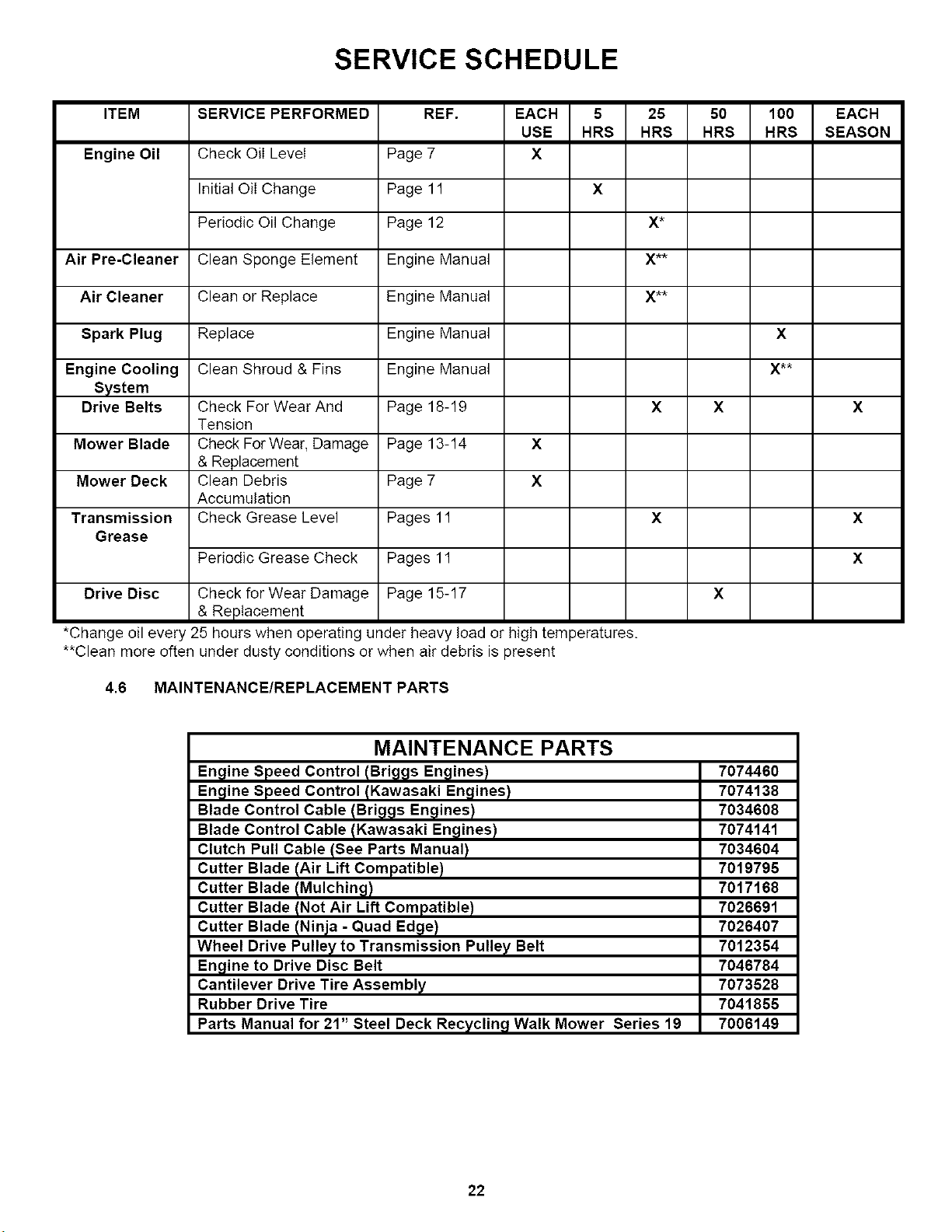
SERVICE SCHEDULE
ITEM
Engine Oil
SERVICE PERFORMED REF.
Check Oil Level Page 7
Initial Oil Change Page 11
Periodic Oil Change Page 12
EACH
USE
X
5 25 50 100 EACH
HRS HRS HRS HRS SEASON
Air Pre-Cleaner Clean Sponge Element Engine Manual
X _*
Air Cleaner Clean or Replace Engine Manual
X _*
Spark Plug Replace Engine Manual
X
Engine Cooling
System
Drive Belts
Mower Blade
Mower Deck
Transmission
Grease
Clean Shroud & Fins Engine Manual
X**
Check For Wear And Page 18-19
Tension
Check ForWear, Damage Page 13-14
& Replacement
Clean Debris Page 7
Accumulation
Check Grease Level Pages 11
X
X
X X
X
Periodic Grease Check Pages 11
Drive Disc Check for Wear Damage Page 15-17
& Replacement
*Change oil every 25 hours when operating under heavy load or high temperatures.
**Clean more often under dusty conditions or when air debris is present
X
4.6 MAINTENANCE/REPLACEMENT PARTS
X
X
X
MAINTENANCE PARTS
Engine Speed Control (Briggs Engines)
En£1ineSpeed Control IKawasaki En£1ines)
Blade Control Cable IBriggs Engines)
Blade Control Cable IKawasaki Engines)
Clutch Pull Cable ISee Parts Manual)
Cutter Blade (Air Lift Compatible)
Cutter Blade (Mulching)
Cutter Blade INot Air Lift Compatible)
Cutter Blade (Ninia - Quad Edge)
Wheel Drive Pulley to Transmission Pulley Belt
En£1ineto Drive Disc Belt
Cantilever Drive Tire Assembly
Rubber Drive Tire
Parts Manual for 21" Steel Deck Recycling Walk Mower Series 19
7074460
7074138
7034608
7074141
7034604
7019795
7017168
7026691
7026407
7012354
7046784
7073528
7041855
7006149
22
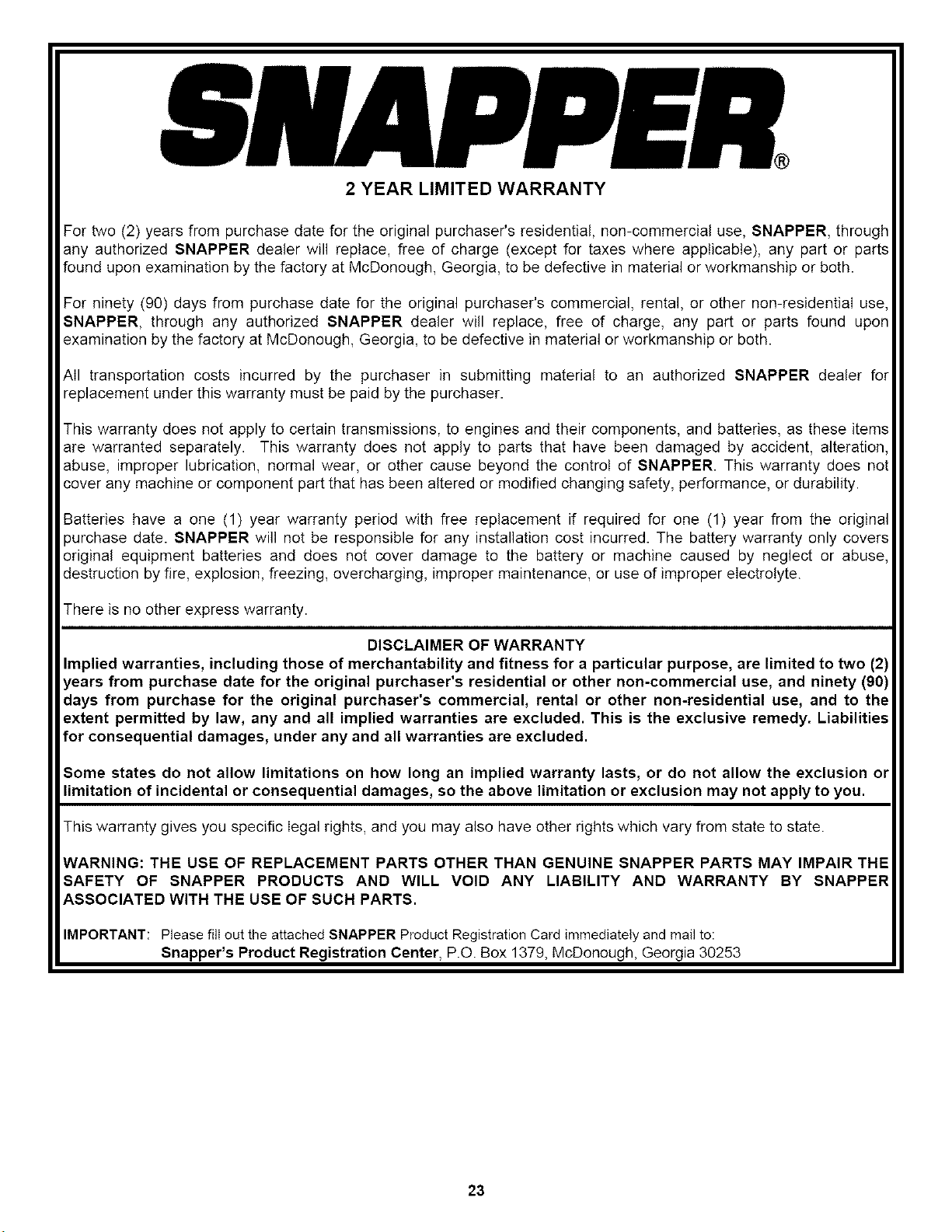
2 YEAR LIMITED WARRANTY
For two (2) years from purchase date for the original purchaser's residential, non-commercial use, SNAPPER, through
any authorized SNAPPER dealer will replace, free of charge (except for taxes where applicable), any part or parts
found upon examination by the factory at McDonough, Georgia, to be defective in material or workmanship or both.
For ninety (90) days from purchase date for the original purchaser's commercial, rental, or other non-residential use,
SNAPPER, through any authorized SNAPPER dealer will replace, free of charge, any part or parts found upon
examination by the factory at McDonough, Georgia, to be defective in material or workmanship or both.
All transportation costs incurred by the purchaser in submitting material to an authorized SNAPPER dealer for
replacement under this warranty must be paid by the purchaser.
This warranty does not apply to certain transmissions, to engines and their components, and batteries, as these items
are warranted separately. This warranty does not apply to parts that have been damaged by accident, alteration,
abuse, improper lubrication, normal wear, or other cause beyond the control of SNAPPER. This warranty does not
cover any machine or component part that has been altered or modified changing safety, performance, or durability.
Batteries have a one (1) year warranty period with free replacement if required for one (1) year from the original
purchase date. SNAPPER will not be responsible for any installation cost incurred. The battery warranty only covers
original equipment batteries and does not cover damage to the battery or machine caused by neglect or abuse,
destruction by fire, explosion, freezing, overcharging, improper maintenance, or use of improper electrolyte.
There is no other express warranty.
DISCLAIMER OF WARRANTY
Implied warranties, including those of merchantability and fitness for a particular purpose, are limited to two (2)
years from purchase date for the original purchaser's residential or other non-commercial use, and ninety (90)
days from purchase for the original purchaser's commercial, rental or other non-residential use, and to the
extent permitted by law, any and all implied warranties are excluded. This is the exclusive remedy. Liabilities
for consequential damages, under any and all warranties are excluded.
Some states do not allow limitations on how long an implied warranty lasts, or do not allow the exclusion or
limitation of incidental or consequential damages, so the above limitation or exclusion may not apply to you.
This warranty gives you specific legal rights, and you may also have other rights which vary from state to state.
WARNING: THE USE OF REPLACEMENT PARTS OTHER THAN GENUINE SNAPPER PARTS MAY IMPAIR THE
SAFETY OF SNAPPER PRODUCTS AND WILL VOID ANY LIABILITY AND WARRANTY BY SNAPPER
ASSOCIATED WITH THE USE OF SUCH PARTS.
IMPORTANT: PleasefiHout the attached SNAPPER Product Registration Card immediately and mail to:
Snapper's Product Registration Center, P.O. Box 1379, McDonough, Georgia 30253
23
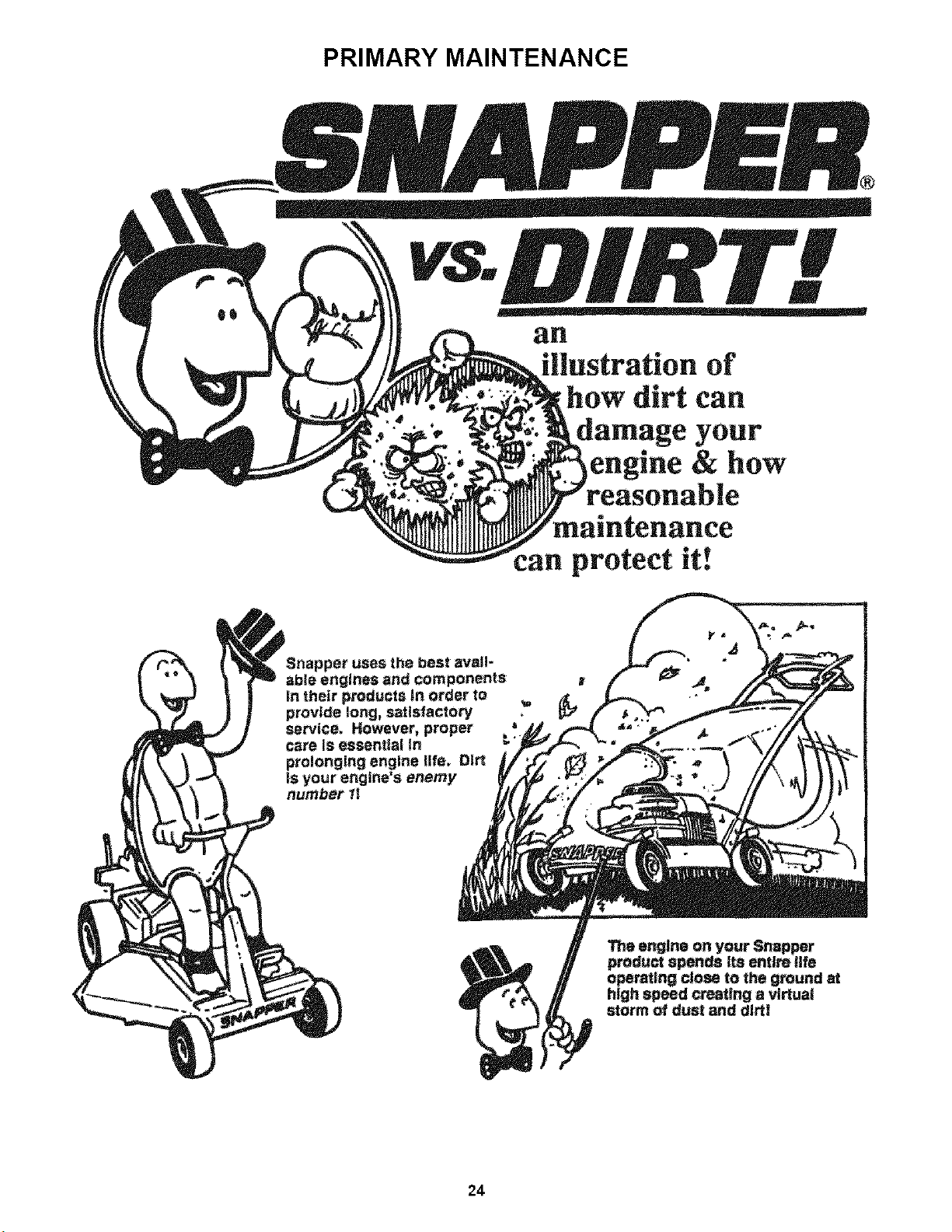
PRIMARY MAINTENANCE
W
an
illustration of
how dirt can
ine & how
naintenance
can protect it!
best avail=
able engines and components
[n their products in order to
provide long, satisfactory
serJice. However, proper
c,_re is essential in
prolonging engine life. Dirt
is your engine's enemy
number 1!
24
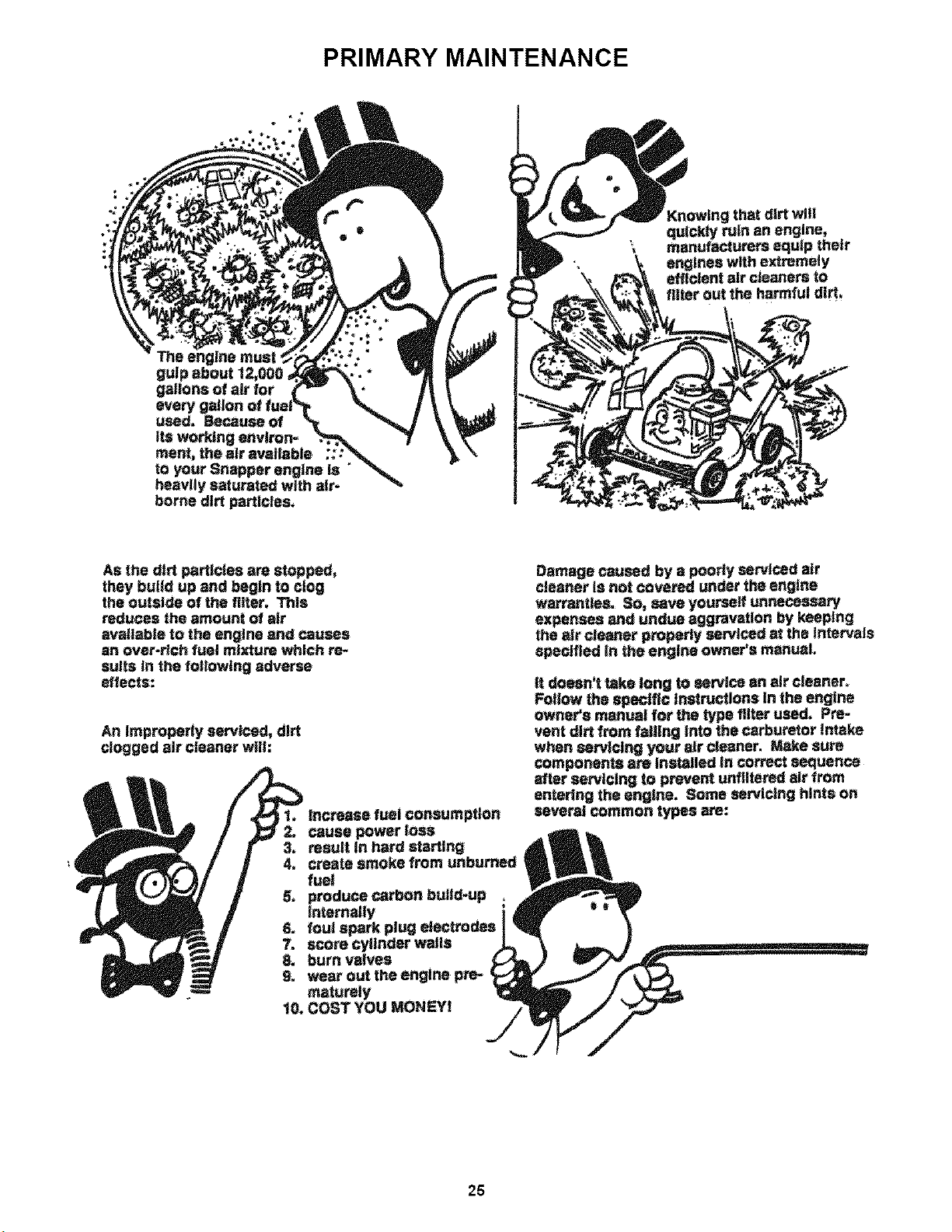
PRIMARY MAINTENANCE
avery
used, Because of
its working environ-
ment, the air available
to your Snapper engine is "
heavily saturated with air-
borne dirt pertlcles"
As the dirt pa_cise are stopped,
they build up and begin to clog
the outside of the _tsr. This
reduces the amount of air
available to the engine and causes
an over-rich fual mixture which re-
suits In the fallowing adverse
effects:
Damage caused by a poorly serv|ced air
cleaner Is not covered under the engine
warranties. So, save youraeif unnecessary
expenses and undue aggrevatten by keeping
the sir cicaner properly serviced at the lntervcis
specified in the engine owner's manual
25
PRIMARY MAINTENANCE
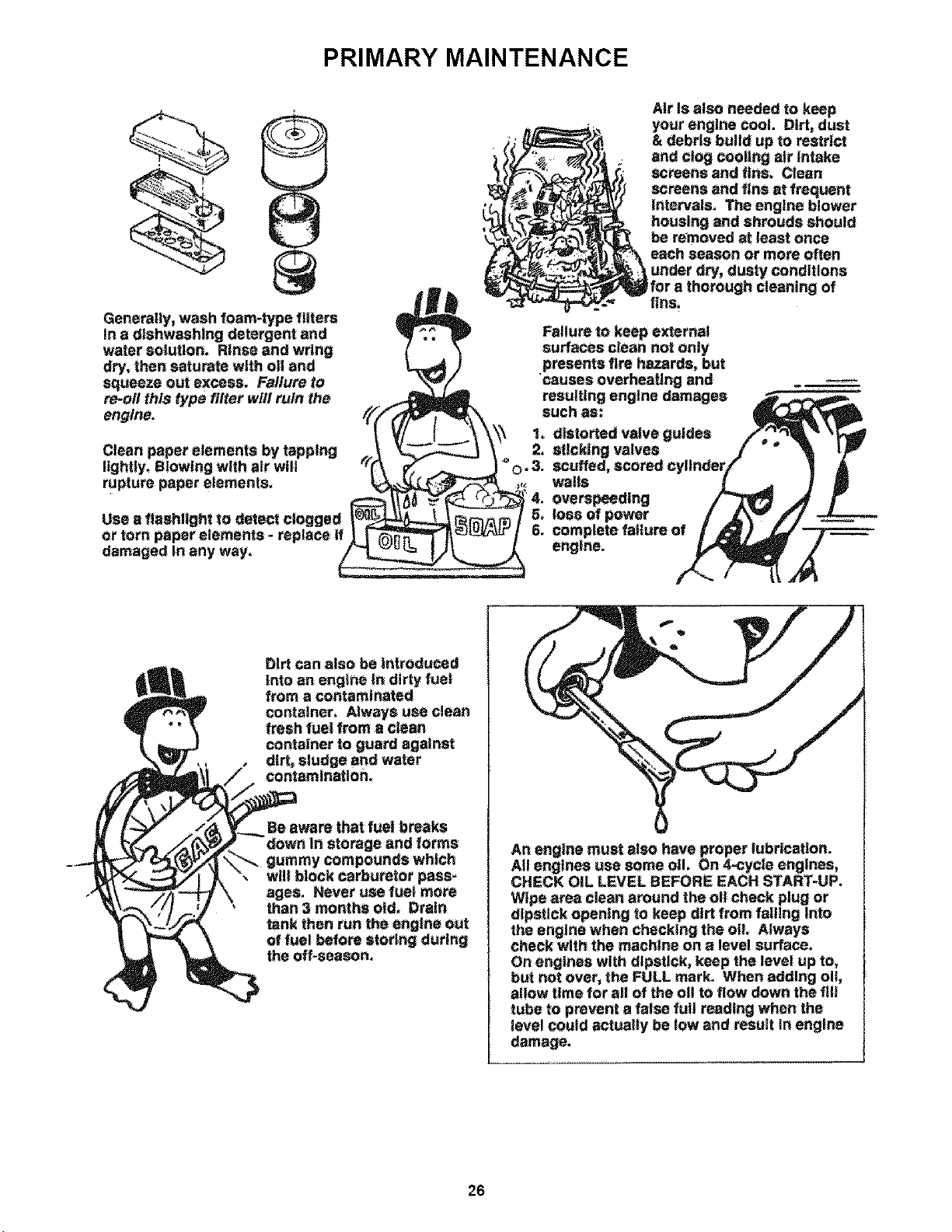
Generalty_ wash foam-type filters
in a dlshwashtng detergent end
water solutlon_ Rinse and wring
dry, then saturate with oil and
squeeze out excess. Failure to
re-oil this type filter will ruin the
engine.
Clean paper elements by tapping
lightly. Blowing with air will
rupture paper elements=
Use s flashlight to detect clogged
or torn paper elements - replace if
damaged In any way.
Air is else needed to keep
your engine cool Dirt, dust
& debris build up to restrict
and clog cooling air intake
sc_--ens and fins, Clean
screens and fins at frequent
intervals, The engine blower
housing and shrouds should
be removed at least once
each season or more Often
Lunder drf_ dusty conditions
tfora thorough cleaning of
fins.
Failure to keep external
surfaces clean not only
presents fire hazards, but
causes overheating and
resuiUng engine damages
such as:
% distorted valve guides
2. sticking valves
_.3. scuffed,
4. waits
overspeedlng
5. toss of power
6. complete falture of
engine,
Dirt can also be introduced
fnto an engine in dirty fuel
from a contaminated
container, Always use clean
fresh fuel from a clean
container to guard against
dirt, sludge and water
contamination.
Be aware that fuel breaks
storage and forms
,compounds which
will block carburetor pass-
ages. Never use fsel more
than 3 months old. Drain
tank then run the engine out
of fuel before storing during
the off-season_
An engine must also have proper lubrication.
All engines use some oil. On 4_cyole engines,
CHECK OIL LEVEL BEFORE EACH START-UP.
Wipe area cleon around the oil check plug or
dipstick opening to keep dirt from falling into
the engine when checking the oil Always
check with the machine on a level surtace_
On engines with dipstick, keep the level up to,
but not over, the FULL mark. When adding o11,
allow time for all of the oil to flow down the fill
tube to prevent a false fult reading when the
level could sctually be low and result In engine
damage.
26
PRIMARY MAINTENANCE
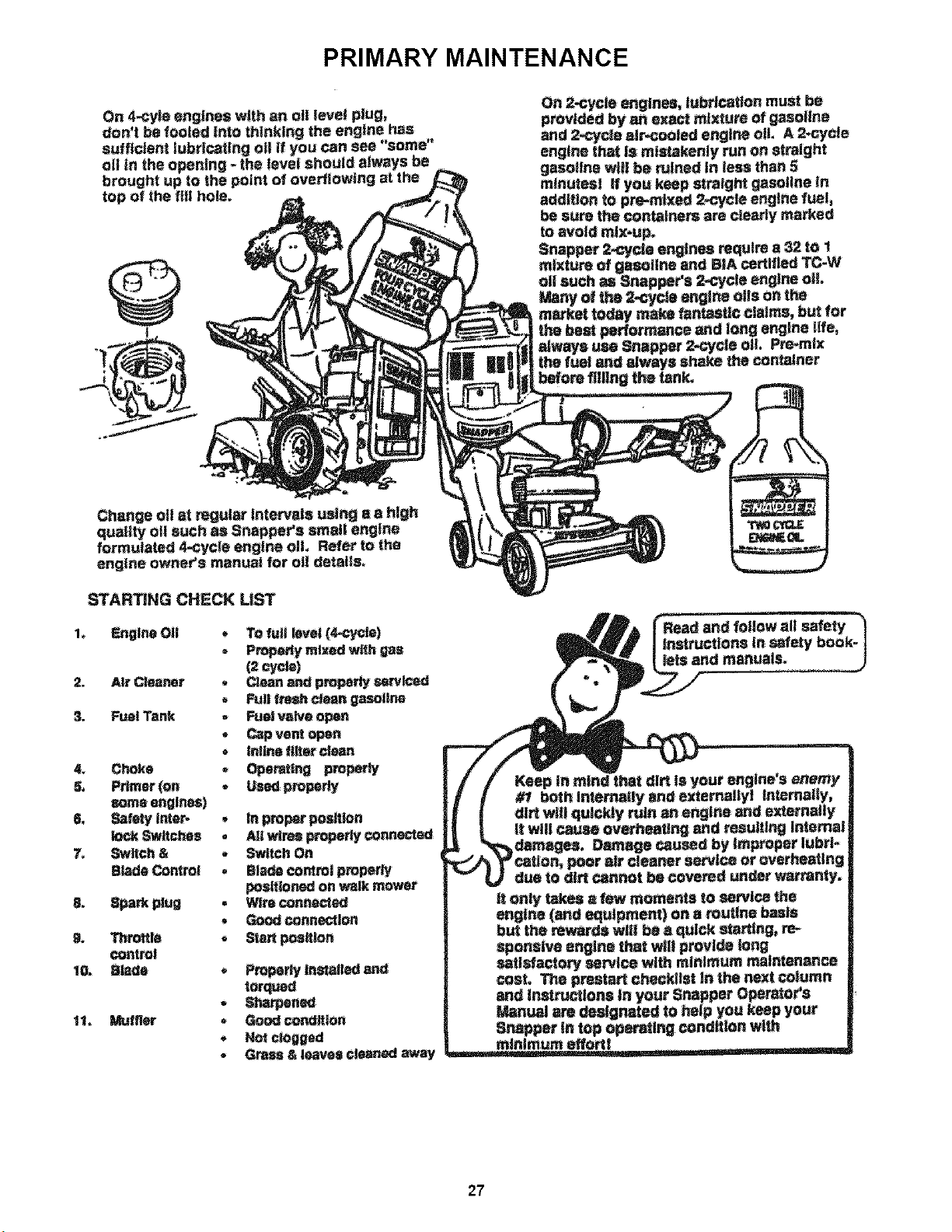
On 4-cyle engines with an oil ieveI plug,
don't be fooled into thinking the engine has
sufficient iubdsatlng oil if you can _ "-some"
oil In the opening - the level should always be
brought up to the point of overflowing at the
top of the till hole.
2.
Change all st regular Inter€ale using a a high
qua}lty ell such as Snapper's small engine
formulated 4-cycle engine OiL Refer to the
engine owner's manual for oil details°
STARTING CHECK LiST
EngineOil
4. Choke
5. Primer (on
some engines)
6, Safety Intsr.
8w_hss
7. SwAch&
BladeControl
S. Spin* ptug
9. T_ro_tls
tonal
1o. Blade
'11, Mumsr
• To full level (4-cycle)
. Pmp#_lymixed _ gas
(2 cycle)
• _ and properly s_rvk_ed
. Full {_lm cle_ gasoline
- Fustvalve open
• Capveto open
Inllnslille#clean
, Operatingprope_y
- Usedproperly
• Inpmpor position
• _ wl_ properly connected
,, SwitchOn
= Bladecorllrolproperly
pos_ionedon walk mower
= V_reconr_ed
• Goodconn_ion
• S_zt position
* PropertyInstalled end
* Sh_pened
, Not clOgged
, Gl_ss & leavesale_n_ away
lets and manuals,
Keep In mind that dirt Is your engine's enemy
#/ both Intemsfly an_ exterr_ityl internal|y,
dirt willquickly ruin an angles and externally
It willcause ov_t_eatlng and resulllng I_tamsf
)damages, Damage caused by Improper lubri-
cation, poor _r cleaner service or overheating
due te dirt cannot be covered under w_rrenty.
It only takes a few moments to servi_ _e
engine (and equipment) on a routine b_als
but the rewards will be a quick starting, re-
eponslve engine that will provide long
satisfactory service with minimum maintenance
cost, The prestart checklist In the next column
and litsfrusflone in your Snapper Operators
Manual are deslgr_atod to help you keep your
Snapper in top operating condition with
27

SNAPPER PRODUCT REGISTRATION FORM
IMPORTANT: KEEP THIS INFORMATION FOR YOUR PERSONAL RECORDS
(Complete the following information on your Snapper purchase)
Model Number
Serial Number
Date of Purchase
Retailer
Retailer's Phone Number
It is very important that you register your purchase with Snapper to ensure
warranty coverage. Please mail your product registration card to:
Snapper at P.O. Box 777, McDonough, Georgia 30253.
Or you may register on line at www.snapper.com.
You can contact us at our web site or if you would like to speak with a Customer
Service Representative. Call us at the Snapper Customer Relations Center. For
faster service please have your Serial Number and Model Number available.
Call the Snapper Customer Relations Center at 1-800-935-2967.
28

NOTES
29

NOTES
30

NOTES
31

Safety Instructions & Operator's Manual for
21" STEEL DECK
RECYCLING
WALK MOWERS
SERIES 19
IMPORTANT
Snapper products are built using engines that meet or exceed all applicable emissions requirements on the
date manufactured. The labels on those engines contain very important emissions information and critical
safety warnings. Read, Understand, and Follow all warnings and instructions in this manual, the engine
manual, and on the machine, engine and attachments. If you have any questions about your Snapper
product, contact your local authorized Snapper dealer or contact Snapper Customer Service at Snapper,
McDonough, GA. 30253. Phone: (1-800-935-2967).
WARNING
BATTERY POSTS, TERMINALS AND RELATED ACCESSORIES CONTAIN LEAD AND LEAD COMPOUNDS,
CHEMICALS KNOWN TO THE STATE OF CALIFORNIA TO CAUSE CANCER AND BIRTH DEFECTS OR
OTHER REPRODUCTIVE HARM. WASH HANDS AFTER HANDLING.
_l_ WARNING
ENGINE EXHAUST, SOME OF ITS CONSTITUENTS, AND CERTAIN VEHICLE COMPONENTS CONTAIN OR
EMIT CHEMICALS KNOWN TO THE STATE OF CALIFORNIA TO CAUSE CANCER OR OTHER
REPRODUCTIVE HARM.
GA, 30253 U_S.A.
COPYRIGHT © 2006
SNAPPER A DIVISION OF SIMPLICITY _,'IFG INC
ALL RIGHTS RESERVED
MANUAL No. 7101093 (I.R. 9/13/2006)
TP 100-5228-1R-WB-N
32