
E
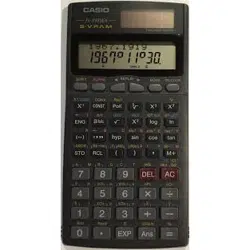
fx-115WA
fx-991WA
User’s Guide
Removing and Replacing
the Calculator’s Cover
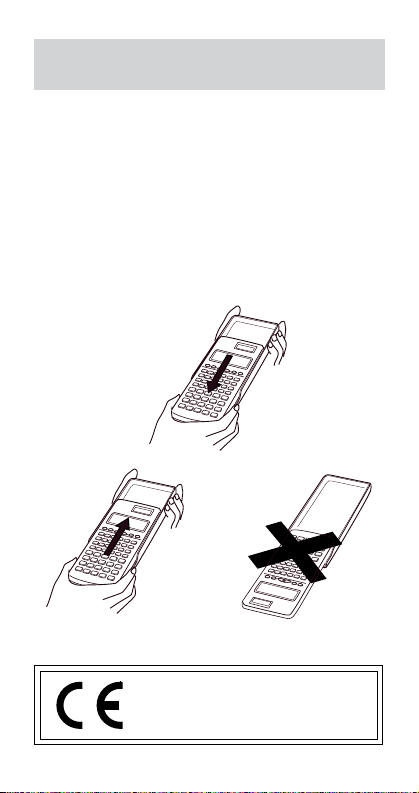
• To Remove the cover
Grasp the top of the cover, and slide the unit out from the
bottom.
• To Replace the cover
Grasp the top of the cover, and slide the unit in from the
bottom.
Always slide the unit into the cover with the unit’s display
end first. Never slide the keyboard end of the unit into the
cover.
CASIO ELECTRONICS CO., LTD.
Unit 6, 1000 North Circular Road,
London NW2 7JD, U.K.

앫1앫
Safety Precautions
Be sure to read the following safety precautions before
using this calculator. Keep this manual handy for later ref-
erence.
Caution
This symbol is used to indicate information that can
result in personal injury or material damage if ignored.
Batteries
• After removing the batteries from the calculator, put
them in a safe place where there is no danger of
them getting into the hands of small children and
accidently swallowed.
• Keep batteries out of the reach of small children. If
accidently swallowed, consult with a physician im-
mediately.
• Never charge batteries, try to take batteries apart, or
allow batteries to become shorted. Never expose bat-
teries to direct heat or dispose of them by incinera-
tion.
• Misuse of batteries can cause them to leak acid that
can cause damage to nearby items and creates the
possibility of fire and personal injury.
•Always make sure that a battery’s positive
k and
negative
l sides are facing correctly when you
load it into the calculator.
•Remove the batteries if you do not plan to use the
calculator for a long time.
•Use only the type of batteries specified for this cal-
culator in this manual.
Disposing of the Calculator
• Never dispose of the calculator by burning it. Doing
so can cause certain components to suddenly burst,
creating the danger of fire and personal injury.

앫2앫
• The displays and illustrations (such as key markings)
shown in this User’s Guide are for illustrative pur-
poses only, and may differ somewhat from the ac-
tual items they represent.
• The contents of this manual are subject to change
without notice.
• In no event shall CASIO Computer Co., Ltd. be li-
able to anyone for special, collateral, incidental, or
consequential damages in connection with or aris-
ing out of the purchase or use of these materials.
Moreover, CASIO Computer Co., Ltd. shall not be
liable for any claim of any kind whatsoever against
the use of these materials by any other party.
Handling Precautions
• Be sure to press the key before using the cal-
culator for the first time.
• Even if the calculator is operating normally, replace
the battery at least once every three years.
Dead battery can leak, causing damage to and malfunc-
tion of the calculator. Never leave the dead battery in the
calculator.
• The battery that comes with this unit discharges
slightly during shipment and storage. Because of
this, it may require replacement sooner than the nor-
mal expected battery life.
• Low battery power can cause memory contents to
become corrupted or lost completely. Always keep
written records of all important data.
• Avoid use and storage in areas subjected to tempera-
ture extremes.
Very low temperatures can cause slow display response,
total failure of the display, and shortening of battery life.
Also avoid leaving the calculator in direct sunlight, near
a window, near a heater or anywhere else it might be-
come exposed to very high temperatures. Heat can
cause discoloration or deformation of the calculator’s
case, and damage to internal circuitry.

앫3앫
• Avoid use and storage in areas subjected to large
amounts of humidity and dust.
Tak e care never to leave the calculator where it might
be splashed by water or exposed to large amounts of
humidity or dust. Such elements can damage internal
circuitry.
• Never drop the calculator or otherwise subject it to
strong impact.
• Never twist or bend the calculator.
Avoid carrying the calculator in the pocket of your trou-
sers or other tight-fitting clothing where it might be sub-
jected to twisting or bending.
• Never try to take the calculator apart.
• Never press the keys of the calculator with a ball-point
pen or other pointed object.
• Use a soft, dry cloth to clean the exterior of the unit.
If the calculator becomes very dirty, wipe it off with a
cloth moistened in a weak solution of water and a mild
neutral household detergent. Wring out all excess mois-
ture before wiping the calculator. Never use thinner, ben-
zine or other volatile agents to clean the calculator. Do-
ing so can remove printed markings and damage the
case.

앫4앫
Contents
Safety Precautions ........................................... 1
Handling Precautions ...................................... 2
Two-line Display ............................................... 5
Key Layout ........................................................ 6
Before Starting Calculations... ...................... 7
kModes .................................................................... 7
kInput Capacity ........................................................ 8
kMaking Corrections During Input ........................... 8
kReplay Function ..................................................... 8
kError Locator .......................................................... 9
kExponential Display Formats ................................. 9
kAnswer Memory ..................................................... 9
Basic Calculations ......................................... 10
Memory Calculations ..................................... 10
kIndependent Memory ........................................... 10
kVariables .............................................................. 10
Fraction Calculations .................................... 11
kFraction Calculations ............................................ 11
kDecimal-to-Fraction Conversion ........................... 11
kFraction-to-Decimal Conversion ........................... 11
Percentage Calculations ............................... 12
Scientific Function Calculations .................. 13
kTr igonometric/Inverse Trigonometric Functions ... 13
kHyperbolic/Inverse Hyperbolic Functions ............ 13
kAngle Unit Conversion ......................................... 14
kCommon and Natural Logarithms/
Antilogarithms ...................................................... 14
kSquare Roots, Cube Roots, Roots, Squares,
Cubes, Reciprocals, Factorials,
Random Numbers and π .......................................... 14
kFIX, SCI, RND ..................................................... 15
kENG Calculations ................................................ 16
kInputting ENG Calculation Symbols ..................... 16
kCoordinate Conversion
(Pol(x, y), Rec (r,
θ
)) ............
17
kPermutation ......................................................... 18
kCombination ......................................................... 18
앫5앫
Statistical Calculations .................................. 18
kStandard Deviation (SD Mode) ............................ 18
kProbability Distribution Calculations ................... 19
kRegression Calculations (REG Mode) ................. 20
Complex Number Calculations
(CMPLX Mode) ................................................ 22
kAbsolute Value/Argument Calculation ................. 23
Metric Conversions (
fx-991WA
) ................... 23
Scientific Constants (
fx-991WA
) .................. 25
Base-n Calculations ....................................... 26
Degrees, Minutes, Seconds Calculations .... 28
Technical Information .................................... 28
kWhen you have a problem...... ............................. 28
kError Messages ................................................... 29
kOrder of Operations ............................................. 30
kStacks .................................................................. 31
kPower Supply ...................................................... 31
kInput Ranges ....................................................... 33
Specifications ................................................. 35
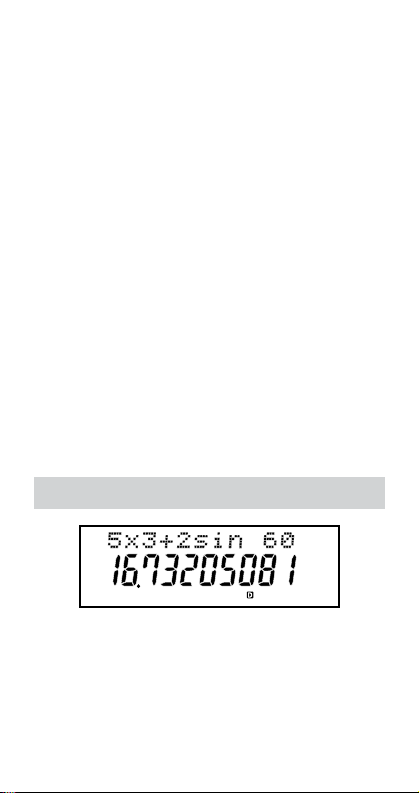
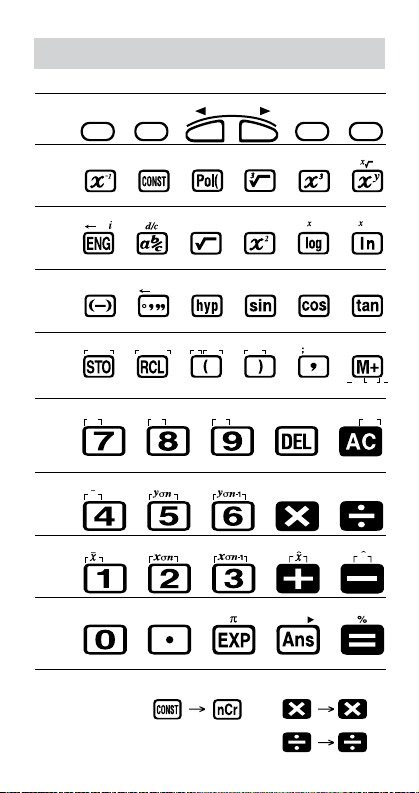
Two-line Display
You can simultaneously check the calculation
formula and its answer.
The first line displays the calculation formula.
The second line displays the answer.
앫6앫
DT CL
M-
M
AM
µ
G
mk
pf
n
BINS
ScI
McI
AB
C
sin
-1
cos
-1
tan
-1
D
XY
EF
DISTR Re<
-
>lm argr Abs
y
y
Rnd Ran#
10
e
SHIFT
ALPHA
MODE
REPLAY
DEC OCTHEX BIN
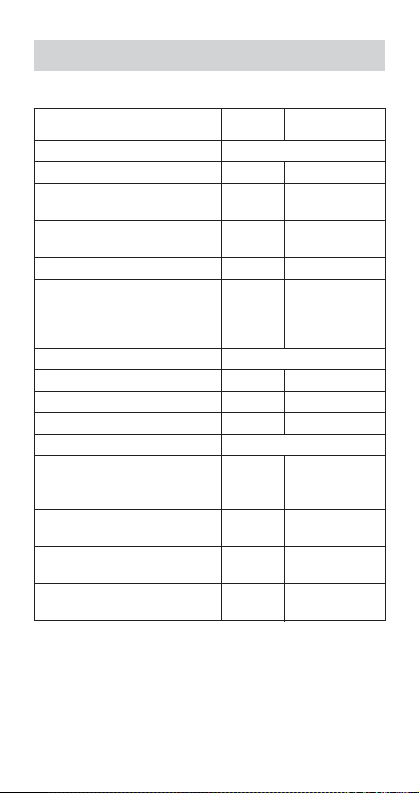
Key Layout
Page
Page
Page
Page
Page
Page
Page
Page
Page
Page
Page
Page
Page
Page
Page
11
8
2
15
15 25 1417 15 14
11
17
28 14 27 14 27
16 11 1514 14 14
10 28 10 1010 13 10 13 10
10 28 1313 13
19 23 23 1020 23 19 10 10 10
10 10 1010 10
1919
20 16 20 1620 16 8 10 18
8
20 16 20 1620 16 18 18
18 16 18 1618 16 20 20
15 1515 14 12
10 9
17 23
LOGIC
24
15 27
x!
T
C
DRG
<
fx-991WA
>
ON/CLEAR
Rec
(
nCr
18
18
fx-115WA:
nPr
nPr
CONV
nPr nCr
CONV
Key Layout
앫7앫
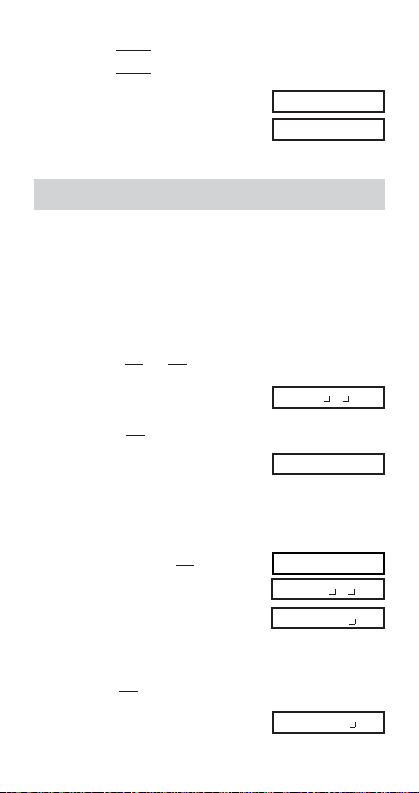
Before Starting Calculations...
k Modes
Application
Mode Mode
Name Indicator
Calculation Modes
Normal calculations COMP –
Complex number
CMPLX CMPLX
calculations
Standard deviation
SD SD
calculations
Regression calculations REG REG
Base-n calculations BASE-N b (binary)
o (octal)
d (decimal)
H (hexadecimal)
Angle Unit Modes
Degrees DEG R
Radians RAD T
Grads GRA B
Display Modes
Exponential notation
NORM1 –
(Canceling FIX and SCI
NORM2 –
specification)
Number of decimal
FIX Fix
place specification
Number of significant
SCI Sci
digit specification
Exponential display range
ENG ENG
specifications
Note!
•Mode indicators appear in the lower part of the display,
except for the Base-
n indicators which appear in the ex-
ponent part of the display.
• The ENG mode cannot be selected while the calculator
is in the CMPLX or BASE-N mode.

앫8앫
•You cannot set the angle unit or the display mode while
the calculator is in the BASE-N mode.
• The COMP, CMPLX, SD, and REG modes can be used
in combination with the angle unit modes.
•Be sure to check the current calculation mode (SD, REG,
COMP, CMPLX) and angle unit mode (DEG, RAD, GRA)
before beginning a calculation.
k Input Capacity
• The memory area used for calculation input can hold 79
“steps.” Whenever you input the 73rd step of any calcu-
lation, the cursor changes from “_” to “k” to let you know
memory is running low. If you still need to input more,
you should divide your calculation into two or more parts.
k Making Corrections During Input
•Use e and r to move the cursor to the location you
want.
•Press
[ to delete the number or function at the current
cursor position.
•Press
A K to change to an insert cursor t. Inputting
something while the insert cursor is on the display in-
serts the input at the insert cursor position.
•Press
e, r, A K, or = returns to the normal cur-
sor from the insert cursor.
k Replay Function
•Pressing r or e recalls the last calculation you per-
formed. You can then make any changes you want in
the calculation and re-execute it.
•Pressing
t does not clear Replay memory, so you can
recall the last calculation even after you press
t.
•Replay memory is cleared whenever you start a new
calculation, change to another mode, or turn off power.

앫9앫
k Error Locator
•Pressing r or e after an error occurs displays the
calculation with the cursor positioned at the location
where the error occurred.
k Exponential Display Formats
This calculator can display up to 10 digits. Larger values
are automatically displayed using exponential notation. In
the case of decimal values, you can select between two
formats that determine at what point exponential notation
is used. Press
F F F F 3 1
(
or
2
)
to select
NORM 1 or NORM 2.
• NORM 1
With NORM 1, exponential notation is automatically used
for integer values with more than 10 digits and decimal
values with more than two decimal places.
• NORM 2
With NORM 2, exponential notation is automatically used
for integer values with more than 10 digits and decimal
values with more than nine decimal places.
•All of the examples in this manual show calculation re-
sults using the NORM 1 format.
k Answer Memory
•Whenever you press = after inputting values or an ex-
pression, the calculated result is automatically stored in
Answer Memory. You can recall Answer Memory con-
tents by pressing
g.
•Answer Memory can store up to 12 digits for the mantissa
and two digits for the exponent.
•Answer Memory contents are not changed if the opera-
tion performed by any of the above key operations re-
sults in an error.

앫10앫
80.
00
1.5
-08
47.
00
90.
00
Basic Calculations
•Use the COMP mode for basic calculations.
• Example 1 : 3(510
–9
)
3
- R 5 e D 9 T =
• Example 2 : 5(97)
5
- R 9 + 7 T =
•You can skip all T operations before =.
Memory Calculations
k Independent Memory
•Values can be input directly into memory, added to
memory, or subtracted from memory. Independent
memory is convenient for calculating cumulative totals.
•Independent memory uses the same memory area as
variable M.
•To clear independent memory (M), input
0 j 3.
• Example:
23 9 32 23
+ 9 j 3
53 6 47
53
, 6 |
) 45 2 90
45
- 2 A {(Total) –11
0 3
k Variables
• There are nine variables (A through F, M, X and Y), which
can be used to store data, constants, results, and other
values.
•Use the following operation to delete data assigned to all
nine variables:
A C = .
•Use the following operation to delete data assigned to a
particular variable:
0 j 1. This operation deletes the
data assigned to variable A.
32.
00
–11.
00
앫11앫
8.4
00
6.9
00
4
5
2
3
2 7 15.
00
• Example: 193.2 23 8.4
193.2 28 6.9
193.2
j 1 \ 23 =
p 1 \ 28 =
Fraction Calculations
k Fraction Calculations
•Use the COMP mode for fraction calculations.
•Values are automatically displayed in decimal format
whenever the total number of digits of a fractional value
(integer numerator denominator separator marks)
exceeds 10.
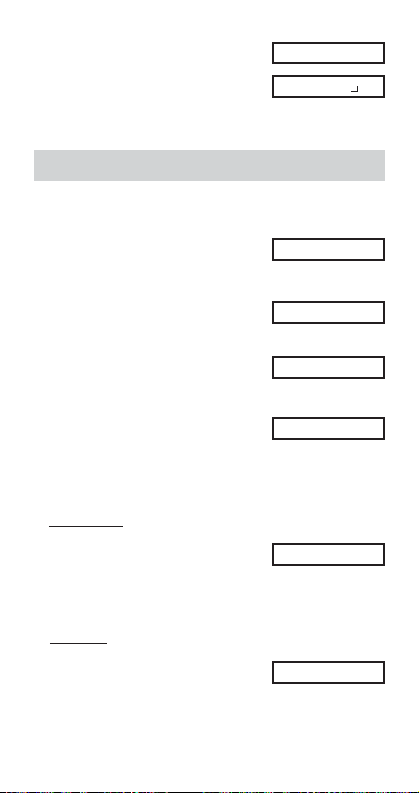
• Example 1 : 1
2
C 3 + 1 C 4 C 5 =
• Example 2 : 1.6
1
C 2 + 1.6 =
•Fraction/decimal calculation results are always decimal.
k Decimal-to-Fraction Conversion
• Example: 2.75 → 2 2.75 =
2.75
C
A B
k Fraction-to-Decimal Conversion
• Example: ↔ 0.5 (Fraction ↔Decimal)
1
C 2 =
2.1
00
1
2
3
4
2 3 4.
00
11 4.
00
1 2.
00
1
2
앫12앫
C
C
Percentage Calculations
•Use the COMP mode for percentage calculations.
• Example 1 : To calculate 12% of 1500
1500
- 12 A v
• Example 2 : To calculate what percentage of 880 is 660
660
\ 880 A v
• Example 3 : To add 15% onto 2500
2500
- 15 A v +
• Example 4 : To discount 3500 by 25%
3500 - 25 A v ,
• Example 5: If 300 grams are added to a test sample
originally weighing 500 grams, what is the percentage
increase in weight?
100 160 (%)
300
+ 500 A v
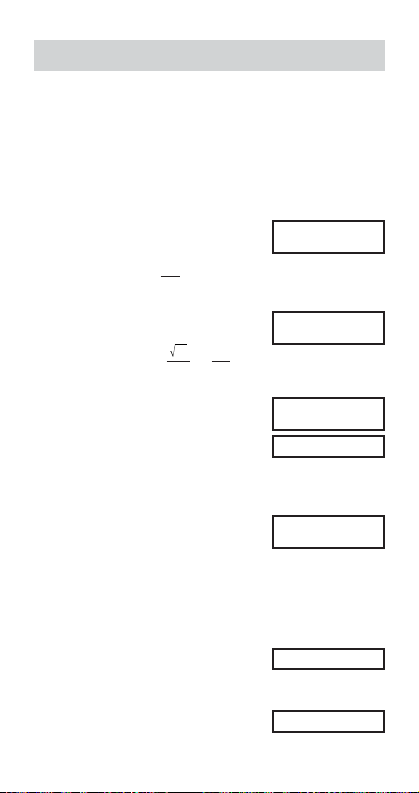
• Example 6: If temperature changes from 40°C to 46°C,
what percentage did it rise?
100 15 (%)
46
, 40 A v
0.5
00
1 2.
00
180.
00
75.
00
2625.
00
160.
00
2875.
00
300 500
500
15.
00
46 40
40
앫13앫
Scientific Function Calculations
•Use the COMP mode for scientific function calculations.
• = 3.14159265359
k Trigonometric/Inverse Trigonometric
Functions
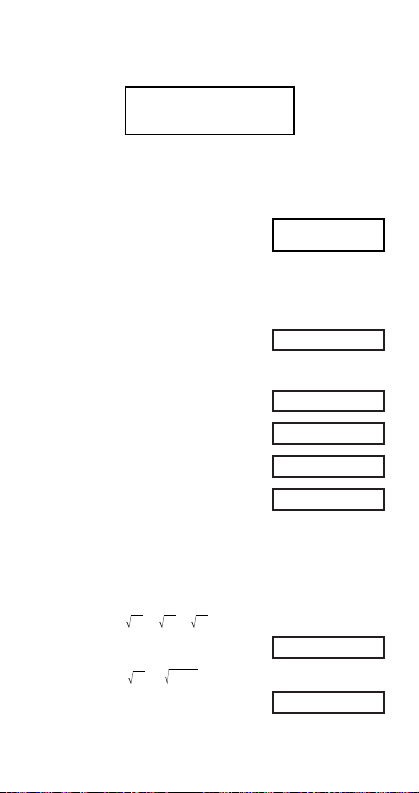
• Example 1 : sin63°5241
q q q 1
→
“
R
”
S 63 I 52 I 41 I =
• Example 2 : cos ( rad)
q q q 2
→
“
T
”
W R A x \ 3 T =
• Example 3 : cos
1
rad
q q q 2
→
“
T
”
W A V R L 2 \ 2 T =
g \ A x =
• Example 4 : tan
1
0.741
q q q 1
→
“
R
”
A g 0.741 =
k Hyperbolic/Inverse Hyperbolic
Functions
• Example 1 : sinh 3.6
M S 3.6 =
• Example 2 : sinh
1
30
M A j 30 =
0.897859012
00
0.5
00
R
T
0.785398163
00
0.25
00
36.53844577
00
T
R
π
3
2
2
π
4
4.094622224
00
18.28545536
00
앫14앫
5.287196909
00
–1.290024053
00
k Angle Unit Conversion
•Press A v to display the following menu.
•Pressing
1, 2, or 3 converts the displayed value to
the corresponding angle unit.
• Example : To convert 4.25 radians to degrees
4.25
A v 2
(
R
)
=
243.5070629
4
.
2
5
r
k Common and Natural Logarithms/
Antilogarithms
• Example 1 : log 1.23 R 1.23 =
• Example 2 : In 90 (log
e
90)
T 90 =
• Example 3 : e
10
A U 10 =
• Example 4 : 10
1.5
A Q 1.5 =
• Example 5 : 2
4
2 w 4 =
k Square Roots, Cube Roots, Roots,
Squares, Cubes, Reciprocals,
Factorials, Random Numbers and π
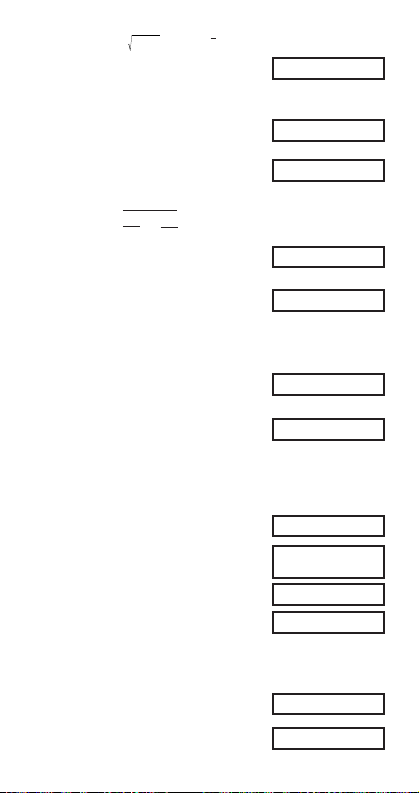
• Example 1: 2 3 5
L 2 + L 3 - L 5 =
• Example 2:
3
5
3
27
D 5 + D D 27 =
1
2
3
D R G
F F F 1
→
“
R
”
0.089905111
00
4.49980967
00
22026.46579
00
31.6227766
00
16.
00
앫15앫
1023.
00
1.988647795
00
12.
00
40320.
00
0.664
00
1728.
00
9.424777961
00
400.
00
28.571
00
400.000
00
28.571
00
28.571
00
1
1
3 4
1
(Specifies three
decimal places.)
(Calculation continues using 10
display digits)
1
7
• Example 3:
7
123 ( = 123 )
7
A H 123 =
• Example 4: 12330
2
123 + 30 K =
• Example 5: 12
3
12 N =
• Example 6:
R
3
a ,
4
a T a =
• Example 7: 8! 8 A f =
• Example 8: To generate a random number between
0.000 and 0.999
A M =
Example (results differ each time)
• Example 9: 3π 3 A x =
k FIX, SCI, RND
• Example 1: 200714400
200
\ 7 - 14 =
F F F F 1 3
200 \ 7 =
- 14 =
Performing the same calculation using the specified
number of decimal places
200
\ 7 =
(Internal rounding) A Q
400.000
00
Fix

앫16앫
399.994
00
3.3
–01
56.088
003
81.25
–03
Sci
- 14 =
•Press F F F F 3 1 to clear FIX specification.
• Example 2: 1 3, displaying result with two significant
digits (SCI 2)
F F F F 2 2 1 \ 3 =
•Press F F F F 3 1 to clear SCI specification.
k ENG Calculations
• Example 1: To convert 56,088 meters to kilometers
56088
= J
• Example 2: To convert 0.08125 grams to milligrams
0.08125
= J
k Inputting ENG Calculation Symbols
• F F F F F 1 enters the ENG mode in which
ENG symbols can be used in calculations.
•To exit the ENG mode, press
F F F F F 2.
• The following are the nine ENG symbols that can be
used in ENG mode calculations.
Key Operation Unit Symbol
A k 10
3
k (kilo)
A M 10
6
M (Mega)
A g 10
9
G (Giga)
A t 10
12
T (Tera)
A m 10
–3
m (milli)
A N 10
–6
µ (micro)
A n 10
–9
n (nano)
A p 10
–12
p (pico)
A f 10
–15
f (femto)
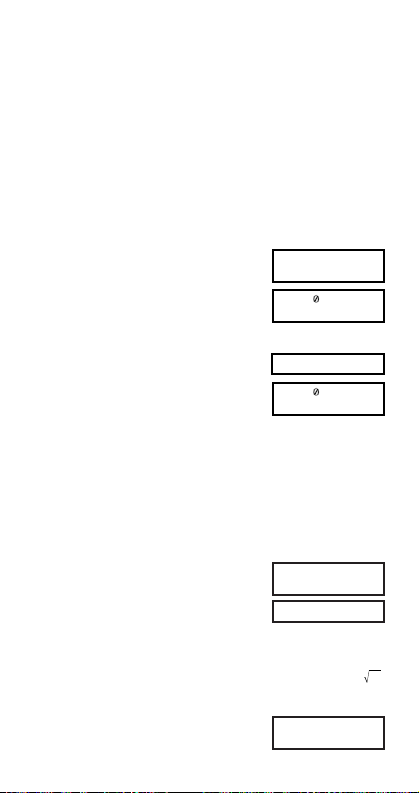
앫17앫
2.
00
1.
00
1.732050808
00
T
R
*For displayed values, the calculator selects the ENG sym-
bol that makes the numeric part of the value fall within
the range of 1 to 1000.
* ENG symbols cannot be used when inputting fractions.
* The ENG mode cannot be used in combination with the
CMPLX, or BASE-N modes.
•Performing any of the key operations in the above table
while you are not in the ENG mode inputs the exponen-
tial value in the “Unit” column (without inputting the ENG
symbol).
• Example: 910 = 0.9 m (milli)
F F F F F 1
0.
ENG
9 \ 10 =
900.
9
1 m
In the ENG mode, even standard (non-ENG)
calculation results are displayed using ENG symbols.
A P
0.9
J
900.
9
1 m
k
Coordinate Conversion (Pol(x, y), Rec (r,
θ
))
•Calculation results are automatically assigned to vari-
ables E and F.
• Example 1: To convert polar coordinates (r2,
60°)
to rectangular coordinates (x, y) (DEG mode)
x
A F 2 P 60 T =
y 0 o
• 0 n, 0 o swaps displayed value with value in
memory.
• Example 2: To convert rectangular coordinates (1,
3)
to polar coordinates (r,
) (RAD mode)
r
f 1 P L 3 T =

앫18앫
1.047197551
00
840.
θ
0 o
• 0 n, 0 o swaps displayed value with value in
memory.
k Permutation
• Example: To determine how many different 4-digit val-
ues can be produced using the numbers 1 through 7
•Numbers cannot be duplicated within the same 4-digit
value (1234 is allowed, but 1123 is not).
7
A m 4 =
k Combination
• Example: To determine how many different 4-member
groups can be organized in a group of 10 individuals
fx-115WA ................ 10
n 4 =
fx-991WA .......... 10 A n 4 =
Statistical Calculations
k Standard Deviation (SD Mode)
•Press F F 1 to enter the SD Mode for statistical
calculations using standard deviation.
•Data input always starts with
A m = to clear statisti-
cal memory.
•Input data is used to calculate values for
n, Σx, Σx
2
, o, σn and σn-1 which you can
recall using the key operations noted
nearby.
210.
0 1 Σx
2
0 2 Σx
0 k n
A M o
A A σn
A N σn-1
앫19앫
• Example: To calculate σn1, σn, o, n, Σx, and Σx
2
for the
following data : 55, 54, 51, 55, 53, 53, 54, 52
Enter SD Mode F F 1
A m = (Memory Clear)
55
S 54 S 51 S 55 S
53 S S 54 S 52 S
(Sample Standard Deviation σn1) A N =
(Population Standard Deviation σn) A A =
(Arithmetic Mean o) A M =
(Number of Data n) 0 k
(Sum of Values Σx) 0 H
(Sum of Squares of Values Σx
2
) 0 G
Data Input Precautions
• S S inputs the same data twice.
•You can also input multiple entries of the same data us-
ing
A G. To input the data 110 ten times, for example,
press 110
A G 10 S.
• The above results can be obtained in any order, and not
necessarily that shown above.
•To delete data you have just input, press
A U.
k Probability Distribution Calculations
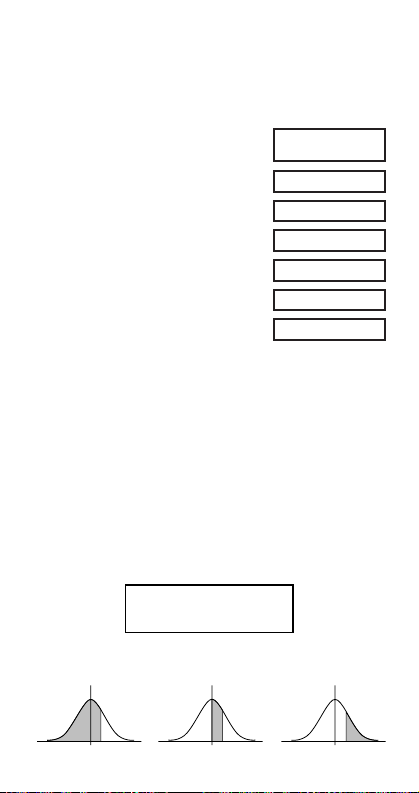
•Press A D to produce the screen shown below.
•Input a value from
1 to 4 to select the probability
distribution calculation you want to perform.
52.
00
SD
1.407885953
00
1.316956719
00
53.375
00
8.
00
22805.
00
427.
00
1
2
3
4
P
(
Q
(
R
(
→
t
P(t)R(t)Q(t)

앫20앫
• Example : Using the x
-
data values input in the example
on page 20, determine the normalized variate (
→
t) for
x = 53 and normal probability distribution P(t).
53
A D 4 (
→
t) =
-
0.284747398
A D 1 (
P(
)
-
0.28 F =
0.38974
k Regression Calculations (REG Mode)
•Press F F 2 to enter the REG mode and then se-
lect one of the following regression types.
1:Linear regression
2: Logarithmic regression
3:Exponential regression
r 1:Power regression
r 2:Inverse regression
r 3:Quadratic regression
•Data input always starts with
A m = to clear statisti-
cal memory.
• The values produced by a regression calculation depend
on the values input, and results can be recalled using
the key operations shown in the table below.
•Linear Regression
The regression formula for linear regression is: y A Bx.
A N
xσ
n-1
A l
p
A d
yσ
n
A c
yσ
n-1
A q Regression coefficient A
A w Regression coefficient B
A e Regression coefficient C
A J Correlation coefficient r
A O m
A b n
0 G Σx
2
0 H Σx
0 k n
0 h Σy
2
0 n Σy
0 o Σxy
0 M Σx
3
0 x Σx
2
y
0 y Σx
4
A M o
A A
xσ
n
앫21앫
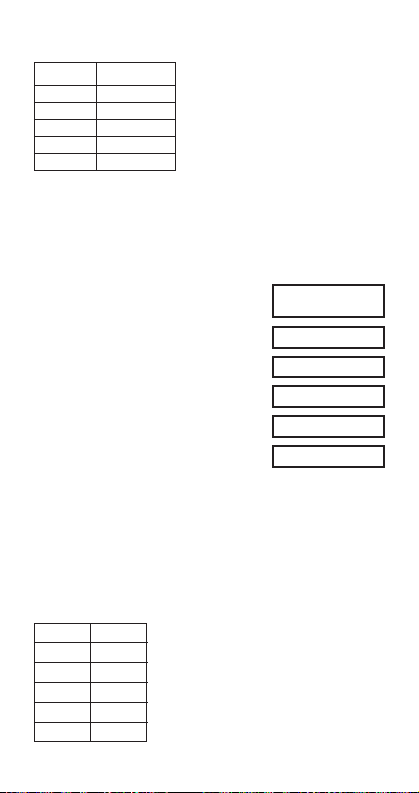
• Example: Atmospheric Pressure vs. Temperature
Perform linear regression to de-
termine the regression formula
terms and correlation coefficient
for the data nearby. Next, use the
regression formula to estimate at-
mospheric pressure at 18°C and
temperature at 1000 hPa.
Enter REG Mode (Linear Regression)
q q 2 1
A m = (Memory Clear)
10
P 1003 S 15 P 1005 S
20 P 1010 S 25 P 1011 S
30 P 1014 S
(Regression Coefficient A) A q =
(Regression Coefficient B) A w =
(Correlation Coefficient r) A J =
(Atmospheric Pressure at 18°C) 18 A b
(Temperature at 1000 hPa) 1000 A O
•Quadratic Regression
• The regression formula for quadratic regression is:
y = A + Bx +Cx
2
.
•Input data using the following key sequence.
<
x-data> P <y-data> S
• Example:
Perform quadratic regression to de-
termine the regression formula terms
and correlation coefficient for the data
nearby. Next, use the regression for-
mula to estimate the values for
ˆy (es-
timated value of
y) for xi = 16 and ˆx
(estimated value of x) for yi = 20.
Te m perature
Atmospheric
Pressure
10°C 1003 hPa
15°C 1005 hPa
20°C 1010 hPa
25°C 1011 hPa
30°C 1014 hPa
x
i
y
i
29 1.6
50 23.5
74 38.0
103 46.4
118 48.0
1007.48
00
4.642857143
00
30.
00
997.4
00
0.56
00
REG
0.982607368
00

앫22앫
Enter REG mode (Quadratic regression)
F F 2 r 3
A m =
29 P 1.6 S 50 P 23.5 S
74 P 38.0 S103 P 46.4 S
118 P 48.0 S
118.
REG
(Regression Coefficient A) A q =
-
35.59856934
(Regression Coefficient B) A w =
1.495939413
(Regression Coefficient C) A e =
-
6.71629667
-
0
3
(ˆy when xi = 16) 16 A b
-
13.38291067
(ˆx
1
when yi = 20) 20 A O
47.14556728
(ˆx
2
when yi = 20) A O
175.5872105
Data Input Precautions
• S S inputs the same data twice.
•You can also input multiple entries of the same data us-
ing
A G. To input the data “20 and 30” five times, for
example, press 20
P 30 A G 5 S.
• The above results can be obtained in any order, and not
necessarily that shown above.
•To delete data you have just input, press
A U.
Complex Number Calculations
(CMPLX Mode)
•Press F 2 to enter the CMPLX Mode for calculations
that include complex numbers.
•You can use variables A, B, C and M only. Variables D,
E, F, X, and Y are used for storage of the imaginary parts
of values and so cannot be used by you.
앫23앫
• Example: (2 + 3i) + (4 + 5i)
Enter CMPLX Mode
F 2
R 4 + 5 i T =
6.
Real number part
A r
8.
i
Imaginary number part
k Absolute Value/Argument Calculation
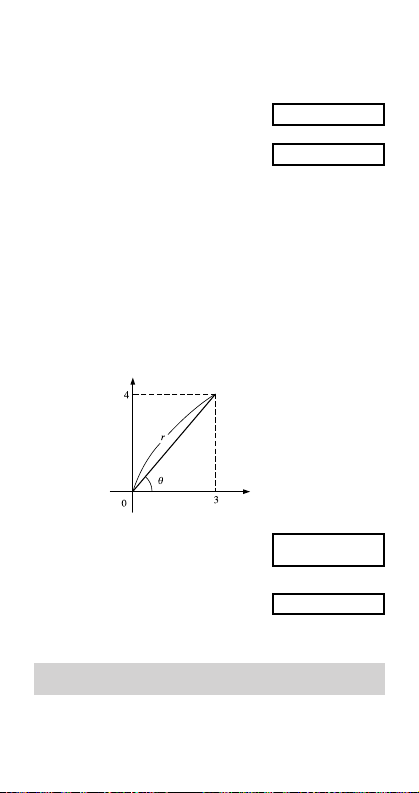
• The procedure described below can be used to deter-
mine the absolute value (Abs) and argument (arg) for a
complex number of the format Z =
a + bi, which is pre-
sumed to exist as coordinates on a Gaussian plane.
• Example: To obtain the absolute value (
r) and argu-
ment (
θ
) for the complex number 3 + 4i, when DEG is
set for the angle unit mode
Imaginary number axis
Real number axis
Determine the absolute value.
A A R 3 + 4 i T =
5.
CMPLX
Determine the argument.
A a R 3 + 4 i T =
53.13010235
Metric Conversions (fx-991WA)
•A total of 20 different conversion pairs are built-in to pro-
vide quick and easy conversion to and from metric units.
R 2 + 3 i T +
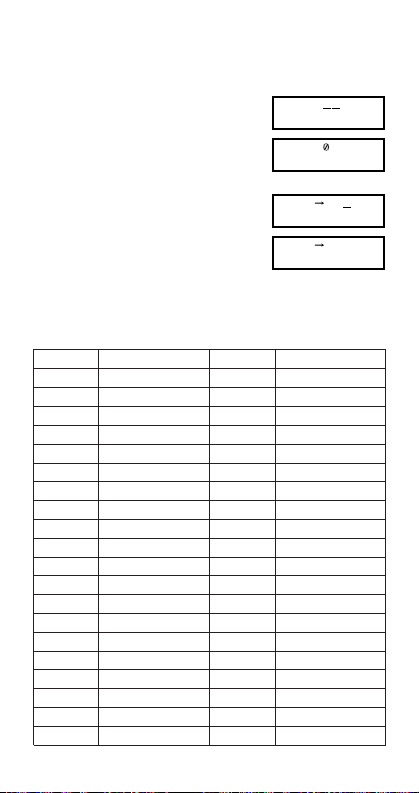
앫24앫
•See the Conversion Pair Table shown below for a com-
plete list of available conversion pairs.
• Example: To convert 31 inches to centimeters
31
A c
CONV
01
CONV
1
01 is the inches-to-centimeters conversion pair number.
0.
31
i
n cm
=
78.74
31
i
n cm
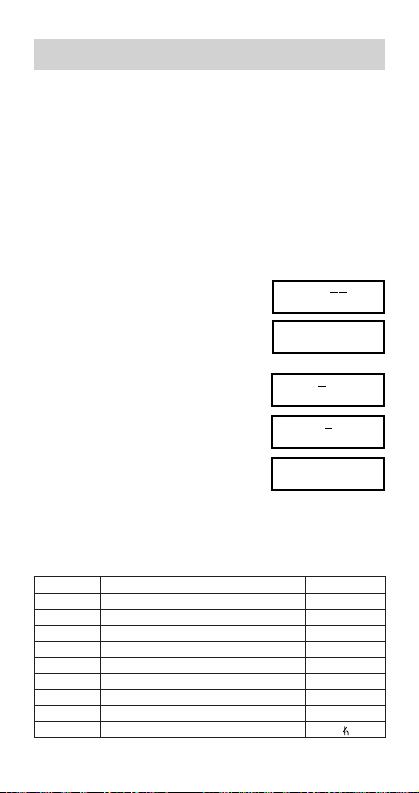
•Conversion Pair Table
Based on ISO Standard (1992) data and CODATA Bulletin
63 (1986) data.
Number Conversion Pair Number Conversion Pair
01 in → cm 21 oz → g
02 cm → in 22 g → oz
03 ft → m23lb → kg
04 m → ft 24 kg → lb
05 yd → m25atm → Pa
06 m → yd 26 Pa → atm
07 mile → km 27 mmHg → Pa
08 km → mile 28 Pa → mmHg
09 n mile → m 29 hp → kW
10 m → n mile 30 kW → hp
11 acre → m
2
31 kgf/cm
2
→ Pa
12 m
2
→ acre 32 Pa → kgf/cm
2
13 gal (US) →
rr
rr
r 33 kgf•m → J
14
rr
rr
r → gal (US) 34 J → kgf•m
15 gal (UK) →
rr
rr
r 35 lbf/in
2
→ kPa
16
rr
rr
r → gal (UK) 36 kPa → lbf/in
2
17 pc → km 37 °F → °C
18 km → pc 38 °C → °F
19 km/h → m/s 39 J → cal
20 m/s → km/h 40 cal → J
앫25앫
Scientific Constants (fx-991WA)
•A total of 40 commonly-used scientific constants, such
as the speed of light in a vacuum and Planck's constant
are built-in for quick and easy lookup whenever you need
them.
•Simply input the number that corresponds to the scien-
tific constant you want to look up and it appears instantly
on the display.
• See the Scientific Constant Table shown below for a com-
plete list of available constants.
• Example: To determine how much total energy a per-
son weighing 65kg has (E = mc
2
)
65
L
CONST
28
CONST28
28 is the “speed of light in vacuum” constant number.
0.
65
Co
K
0.
65
Co
2
=
65
Co
2
5.841908662
18
•Scientific Constant Table
Based on ISO Standard (1992) data and CODATA Bulletin
63 (1986) data.
Number Constant Name Symbol
01 proton mass mp
02 neutron mass mn
03 electron mass me
04 muon mass m
µ
05 Bohr radius a
0
06 Planck's constant
h
07 nuclear magneton
µ
N
08 Bohr magneton
µ
B
09 Planck's constant, rationalized (h-bar)

앫26앫
Number Constant Name Symbol
10 fine-structure constant α
11 classical electron radius re
12 electron Compton wavelength λ
c
13 proton gyromagnetic ratio γ
p
14 proton Compton wavelength λ
cp
15 neutron Compton wavelength λ
cn
16 Rydberg constant R∞
17 atomic mass unit u
18 proton magnetic moment
µ
p
19 electron magnetic moment
µ
e
20 neutron magnetic moment
µ
n
21 muon magnetic moment
µ
µ
22 Faraday constant F
23 elementary charge e
24 Avogadro constant NA
25 Boltzmann constant k
26 molar volume of ideal gas Vm
27 molar gas constant R
28 speed of light in vacuum C
0
29 first radiation constant C
1
30 second radiation constant C
2
31 Stefan-Boltzmann constant σ
32 permittivity of vacuum ε
0
33 permeability of vacuum
µ
0
34 magnetic flux quantum
φ
0
35 standard acceleration of gravity g
36 astronomical unit AU
37 parsec pc
38 Celsius temperature t
39 Newtonian constant of gravitation G
40 standard atmosphere atm
Base-n Calculations
•In addition to decimal values, calculations can be per-
formed using binary, octal and hexadecimal values.
•You can specify the default number system to be ap-
plied to all input and displayed values, and the number
system for individual values you input.

앫27앫
•You cannot use scientific functions in binary, octal, deci-
mal, and hexadecimal calculations. You cannot input val-
ues that include decimal part and an exponent.
• If you input a value that includes a decimal part, the unit
automatically cuts off the decimal part.
•Negative binary, octal, and hexadecimal values are pro-
duced by taking the two's complement.
•You can use the following logical operators between
values in Base-
n calculations: and (logical product), or
(logical sum), xor (exclusive logical sum), xnor (exclu-
sive logical sum negation), Not (negation), and Neg (mi-
nus).
• The following are the allowable ranges for each of the
available number systems.
Binary 1000000000
x 1111111111
0
x 0111111111
Octal 4000000000
x 7777777777
0
x 3777777777
Decimal –2147483648
x 2147483647
Hexadecimal 80000000
x FFFFFFFF
0
x 7FFFFFFF
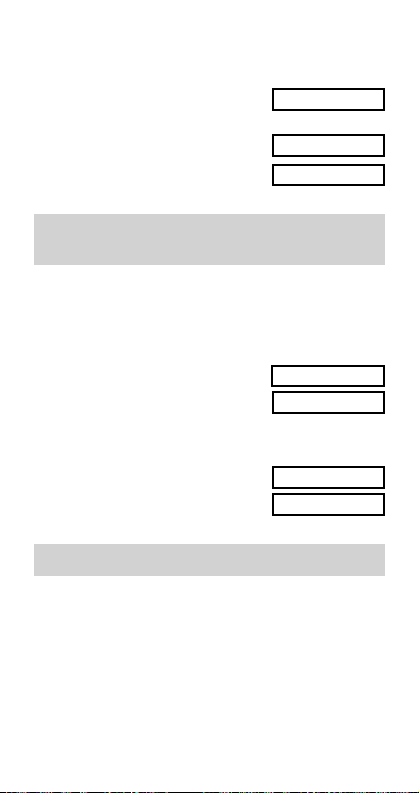
• Example 1: To perform the following calculation and
produce a binary result:
10111
2
+ 11010
2
Binary mode F F 3 b
0.
b
10111
2
+ 11010
2
0.
b
=
110001.
b
• Example 2: To perform the following calculation and
produce an octal result:
7654
8
÷ 12
10
Octal mode F F 3 o
0.
o
l l l 4
(
o
)
7654
8
\
l l l 1
(d)12
10
0.
o
=
516.
o
앫28앫
• Example 3: To perform the following calculation and
produce a hexadecimal result:
120
16
or 1101
2
Hexadecimal mode F F 3 h
0.
H
l l l 3
(b)
1101
2
0.
H
=
12d.
H
Degrees, Minutes, Seconds
Calculations
•You can perform sexagesimal calculations using degrees
(hours), minutes, and seconds, and convert between
sexagesimal and decimal values.
• Example 1: To convert the decimal value 2.258 to a
sexagesimal value
2.258
=
2.258
A O
2°15°28.8
• Example 2: To perform the following calculation:
12°34’56” 3.45
12
I 34 I 56 I - 3.45
0.
=
43°24°31.2
Technical Information
k When you have a problem......
If calculation results are not what you expect or if an error
occurs, perform the following steps.
1.
F 1 (COMP mode)
2.
F F F 1 (DEG mode)
3.
F F F F 3 1 (NORM 1 mode)
4. Check the formula you are working with to confirm it is
correct.
120
16
l 2
(
or
)

앫29앫
5. Enter the correct modes to perform the calculation and
try again.
If the above steps do not correct the problem, press the
key. The calculator performs a self-check operation
and deletes all data stored in memory if any abnormality
is detected. Make sure you always keep written copies of
all important data.
k Error Messages
The calculator is locked up while an error message is on
the display. Press
t to clear the error, or press e or r
to display the calculation and correct the problem. See
“Error Locator” on page 9 for details.
Ma ERROR
•Cause
•Calculation result is outside the allowable calculation
range.
•Attempt to perform a function calculation using a value
that exceeds the allowable input range.
•Attempt to perform an illogical operation (division by
zero, etc.).
•Action
•Check your input values and make sure they are all
within the allowable ranges. Pay special attention to
values in any memory areas you are using.
Stk ERROR
•Cause
•Capacity of the numeric stack or operator stack is ex-
ceeded.
•Action
•Simplify the calculation. The numeric stack has 10
levels and the operator stack has 24 levels.
•Divide your calculation into two or more separate parts.
Syn ERROR
•Cause
•Attempt to perform an illegal mathematical operation.

앫30앫
•Action
•Press
e or r to display the calculation with the
cursor located at the location of the error. Make nec-
essary corrections.
Arg ERROR
•Cause
•Improper use of argument
•Action
•Press
e or r to display the location of the cause of
the error and make required corrections.
k Order of Operations
Calculations are performed in the following order of prec-
edence.
1 Coordinate transformation: Pol (
x, y), Rec (r,
θ
)
2 Type A functions:
With these functions, the value is entered and then the
function key is pressed.
x
2
, x
1
, x!,
° ’ ”
3 Powers and roots:
x
y
,
x
4 a
b
/c
5 Abbreviated multiplication format in front of π, memory
name, or variable name: 2
π, 5A, πA etc.
6 Type B functions:
With these functions, the function key is pressed and
then the value is entered.
,
3
, log, In, e
x
, 10
x
, sin, cos, tan, sin
1
, cos
1
,
tan
1
, sinh, cosh, tanh, sinh
1
, cosh
1
, tanh
1
, ()
7 Abbreviated multiplication format in front of Type B
functions: 2 3, Alog2 etc.
8 Permutation and combination:
nPr, nCr
9 ,
0 ,
*Operations of the same precedence are performed from
right to left.
e
x
In 120 → e
x
{In( 120)}
Other operations are performed from left to right.
*Operations enclosed in parentheses are performed first.
앫31앫
k Stacks
This calculator uses memory areas, called “stacks,” to tem-
porarily store values (numeric stack) and commands (com-
mand stack) according to their precedence during calcu-
lations. The numeric stack has 10 levels and the command
stack has 24 levels. A stack error (Stk ERROR) occurs
whenever you try to perform a calculation that is so com-
plex that the capacity of a stack is exceeded.
k Power Supply
The TWO WAY POWER system actually has two power
supplies: a solar cell and a G13 Type (LR44) button bat-
tery. Normally, calculators equipped with a solar cell alone
can operate only when relatively bright light is present.
The TWO WAY POWER system, however, lets you con-
tinue to use the calculator as long as there is enough light
to read the display.
•Replacing the Battery
Either of the following symptoms indicates battery power
is low, and that the battery should be replaced.
•Display figures are dim and difficult to read in areas
where there is little light available.
•Nothing appears on the display when you press the
key.
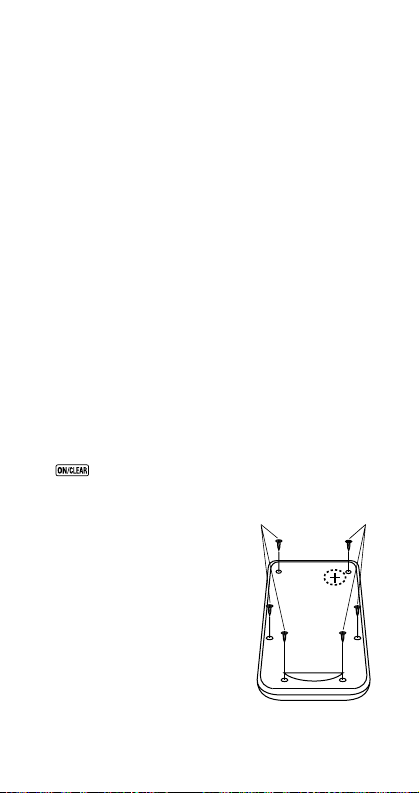
•To replace the battery
1 Remove the six screws that
hold the back cover in place
and then remove the back
cover.
2 Remove the old battery.
3 Wipe off the sides of new bat-
tery with a dry, soft cloth. Load
it into the unit with the posi-
tive
k
side facing up (so you
can see it).
4 Replace the back cover and
secure it in place with the six
screws.
Screw
Screw

앫32앫
5 Press
to turn power on. Be sure not to skip this
step.
•Auto Power Off
Calculator power automatically turns off if you do not per-
form any operation for about six minutes. When this hap-
pens, press
to turn power back on.
앫33앫
k Input Ranges
Internal digits: 12
Accuracy: As a rule, accuracy is ±1 at the 10th digit.
Functions Input Range
sinx DEG 0 x 4.499999999
10
10
RAD 0 x 785398163.3
GRA 0 x 4.499999999
10
10
cosx DEG 0 x 4.500000008
10
10
RAD 0 x 785398164.9
GRA 0 x 5.000000009
10
10
tanx DEG Same as sinx, except when x= (2n-1)90.
RAD Same as sinx, except when x= (2n-1)π/2.
GRA Same as sinx, except when x= (2n-1)100.
sin
–1
x
0 x 1
cos
–1
x
tan
–1
x 0 x 9.999999999
10
99
sinhx
0 x 230.2585092
coshx
sinh
–1
x
0 x 4.999999999
10
99
cosh
–1
x
tanhx
0 x 9.999999999
10
-1
tanh
–1
x
log
x
/ln
x 0 x
10
x
–9.999999999
10
99
x 99.99999999
e
x
–9.999999999
10
99
x 230.2585092
x 0 x 1
10
100
x
2
x 1
10
50
1/x x 1
10
100
;
x G
0
3
x x 1
10
100
x!0 x
69 (
x is an integer)

앫34앫
1
2
n+1
Functions Input Range
nPr
0 n 99, r n (n, r is an integer)
1 {n!/(n–r)!} 9.99999999910
99
nCr 0 n 99, r n (n, r is an integer)
Pol(x, y)
x, y 9.99999999910
49
(x
2
+y
2
) 9.99999999910
99
Rec(r,
)
0 r 9.99999999910
99
θ: Same as sinx, cosx
a, b, c 110
100
°’ ”
0 b, c
x110
100
Decimal ↔ Sexagesimal Conversions
0
0
0
0
0
0
x 999999
0
59
0
x0: –110
100
ylogx100
x
y
x0: y0
x0: yn, (n is an integer)
However: –110
100
ylogx100
y0: x G 0
–110
100
1/x logy100
x
y
y0: x0
y0: x2n1, (n G 0; n is an integer)
However: –110
100
1
/x logy100
a
b
/c
x 110
50
y 110
50
SD n 110
100
(REG) xn, yn, o, p
A, B, r : n G 0
xn–1, yn–1 : n G 0, 1
*Erros are cumulative with such internal continuous cal-
culations as
x
y
,
x
x , x!, and
3
x , so accuracy may be
adversely affected.
1
n
Total of integer, numerator, and denominator
must be 10 digits or less (including division
marks).

앫35앫
Specifications
Power Supply: Solar cell and a single G13 Type button
battery (LR44)
Battery Life: Approximately 3 years (1 hour use per day).
Dimensions: 10(H)76(W)150(D) mm
3
/8⬙ (H)3⬙(W)5
7
/8⬙(D)
Weight: 85
g (3
oz) including battery
Power Consumption: 0.0001W
Operating Temperature: 0°C ~ 40°C (32°F ~ 104°F)

SA9911-A Printed in China
HA310537-1
U.S. Pat. 4,410,956
CASIO COMPUTER CO., LTD.
6-2, Hon-machi 1-chome
Shibuya-ku, Tokyo 151-8543, Japan