
1
I n s t a l l a t i o n a n d O p e r a t i o n M a n u a l
‘Fast- Fri’ Gas Fryer
E l e c t r o n i c a l l y C o n t r o l l e d
228638-27
FN8120GE
FN8226GE
FN8130GE
FNL8120G E
FNL8226G E
FNL8130G E
FNB8120GE
FNB8226GE
FNB8130GE
FNLB8120GE
FNLB8226GE
FNLB8130GE
The reproduction or copying of any part of this manual by any means whatsoever is strictly forbidden unless authorized previously in
writing by the manufacturer.
In line with policy to continually develop and improve its products, Moffat Ltd. reserves the right to change the specifications and
design without prior notice.
© Copyright Moffat Ltd. February 2020.
Moffat Limited
Rolleston 7675
New Zealand
AUSTRALIA
Moffat Pty Limited
Web: www.moffat.com.au
E.Mail: [email protected].au
Main Office:
(tel) +61 (03) 9518 3888
(fax) +61 (03) 9518 3833
Service: (tel): 1800 622 216
Spares: (tel): 1800 337 963
Customer Service: (tel): 1800 335 315
(fax): 1800 350 281
CANADA
Serve Canada
Web: www.servecanada.com
E.Mail: [email protected]
Sales: (tel): 800 551 8795 (Toll Free)
Service: (tel): 800 263 1455 (Toll Free)
NEW ZEALAND
Moffat Limited
Web: www.moffat.co.nz
E.Mail: [email protected].nz
Main Office:
(tel): 0800 663328
UNITED KINGDOM
Blue Seal
Web: www.blue-seal.co.uk
E.Mail: sales@blue-seal.co.uk
Sales: (tel): +44 121 327 5575
(fax): +44 121 327 9711
Spares: (tel): +44 121 322 6640
(fax): +44 121 327 9201
Service: (tel): +44 121 322 6644
(fax): +44 121 327 6257
UNITED STATES
Moffat
Web: www.moffat.com
Sales: (tel): 1-800 551 8795 (Toll Free)
(tel): 336 661 1556
(fax): 336 661 9546
Service: (tel): 866 673 7937 (Toll Free)
REST OF WORLD
Moffat Limited
Web: www.moffat.co.nz
E.Mail: export@moffat.co.nz
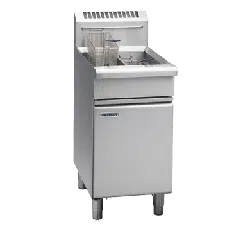
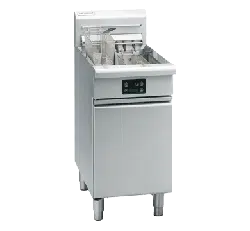
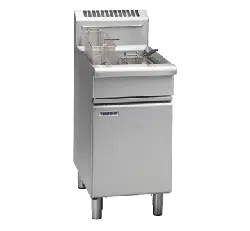
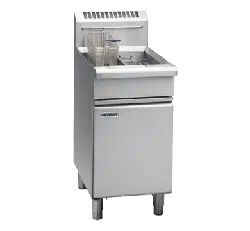
FN(L)(B)8120GE ‘FAST FRI’ GAS FRYER (Single Tank - 20Ltr).
FN(L)(B)8226GE ‘FAST FRI’ GAS FRYER (Twin Tank - 26Ltr).
FN(L)(B)8130GE ‘FAST FRI’ GAS FRYER (Single Tank - 31Ltr).
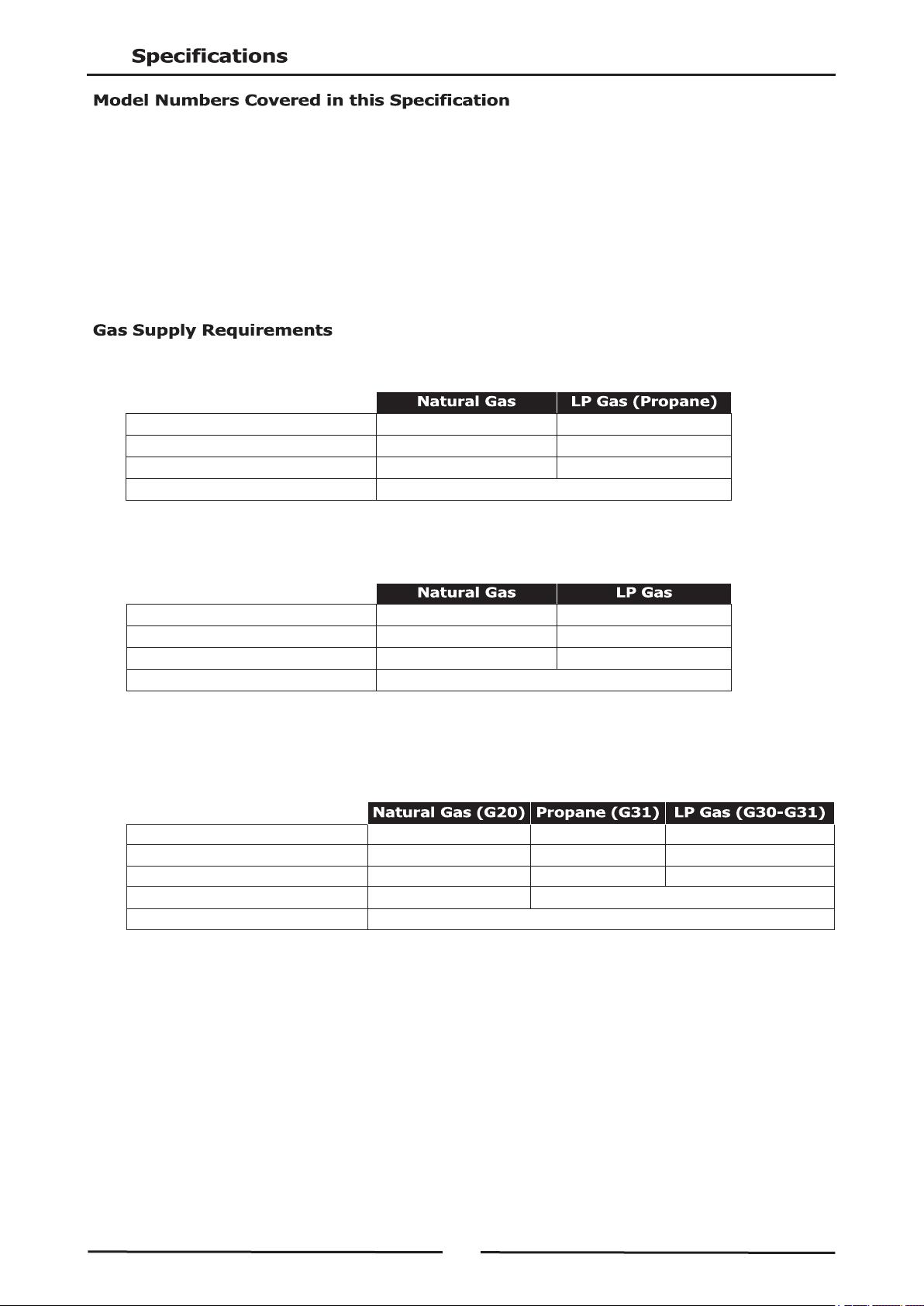
Model Numbers Covered in this Specification.
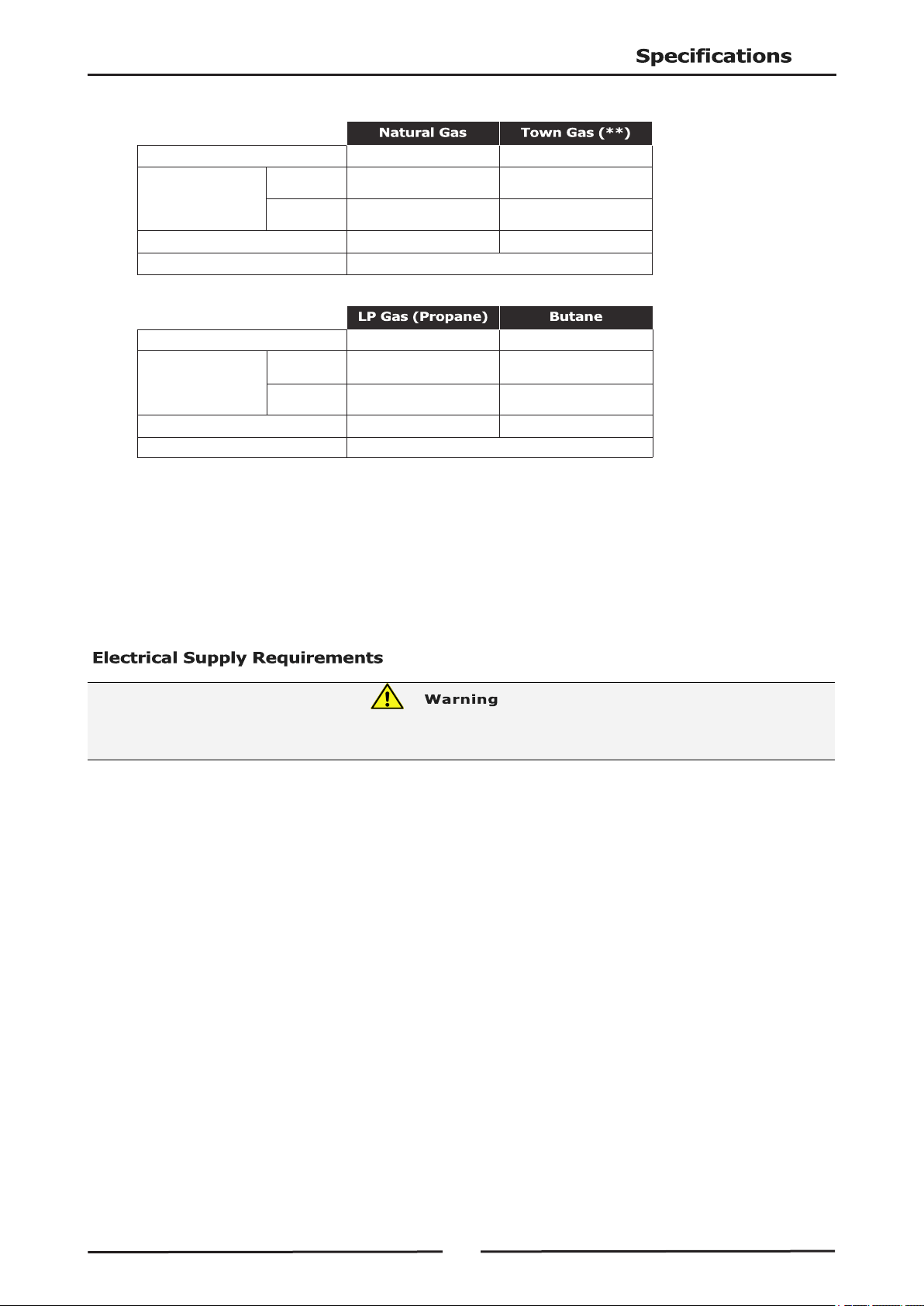
Gas Supply Requirements.
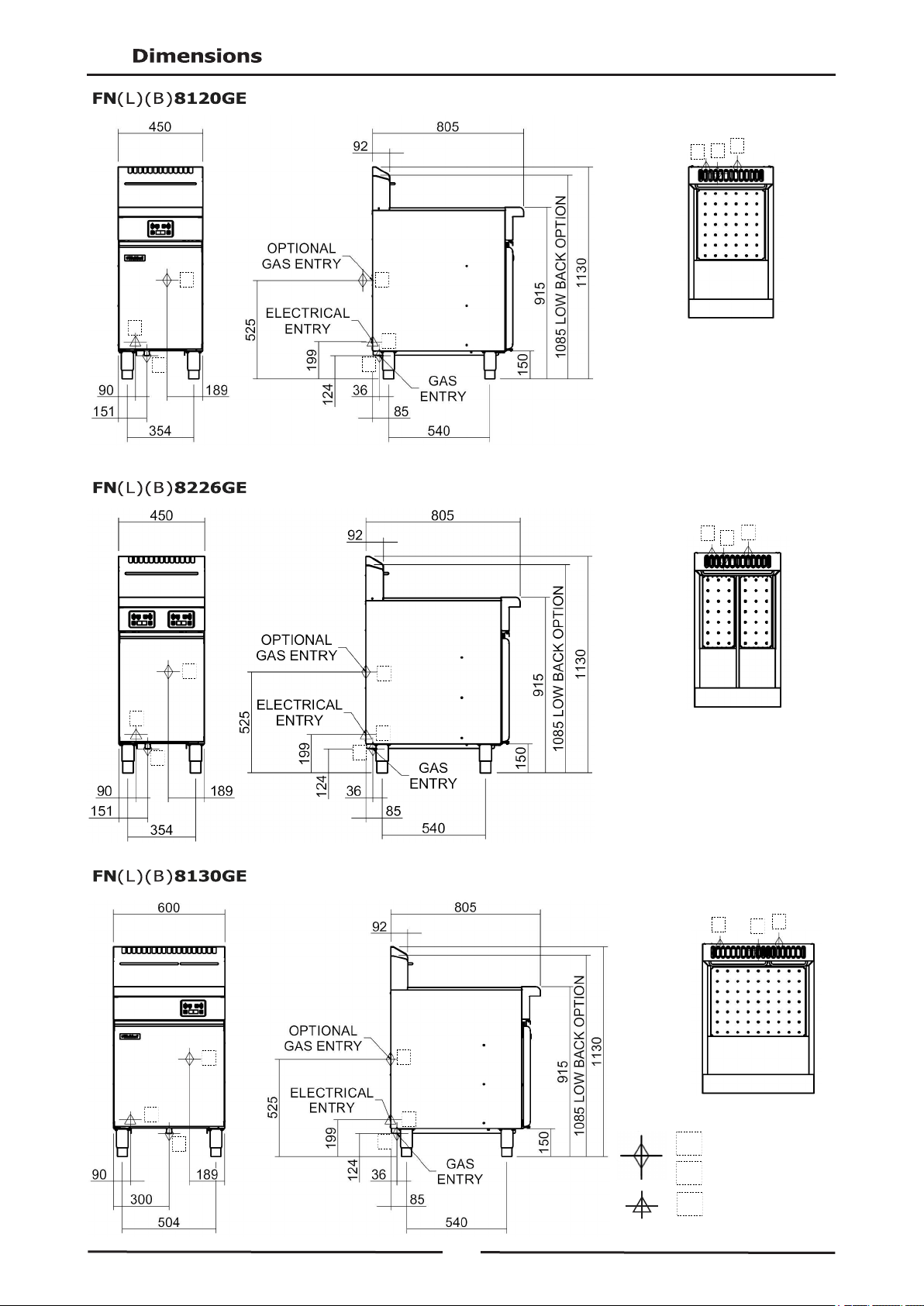
Electrical Supply Requirements.
Installation Requirements.
Unpacking.
Location.
Clearances.
Assembly.
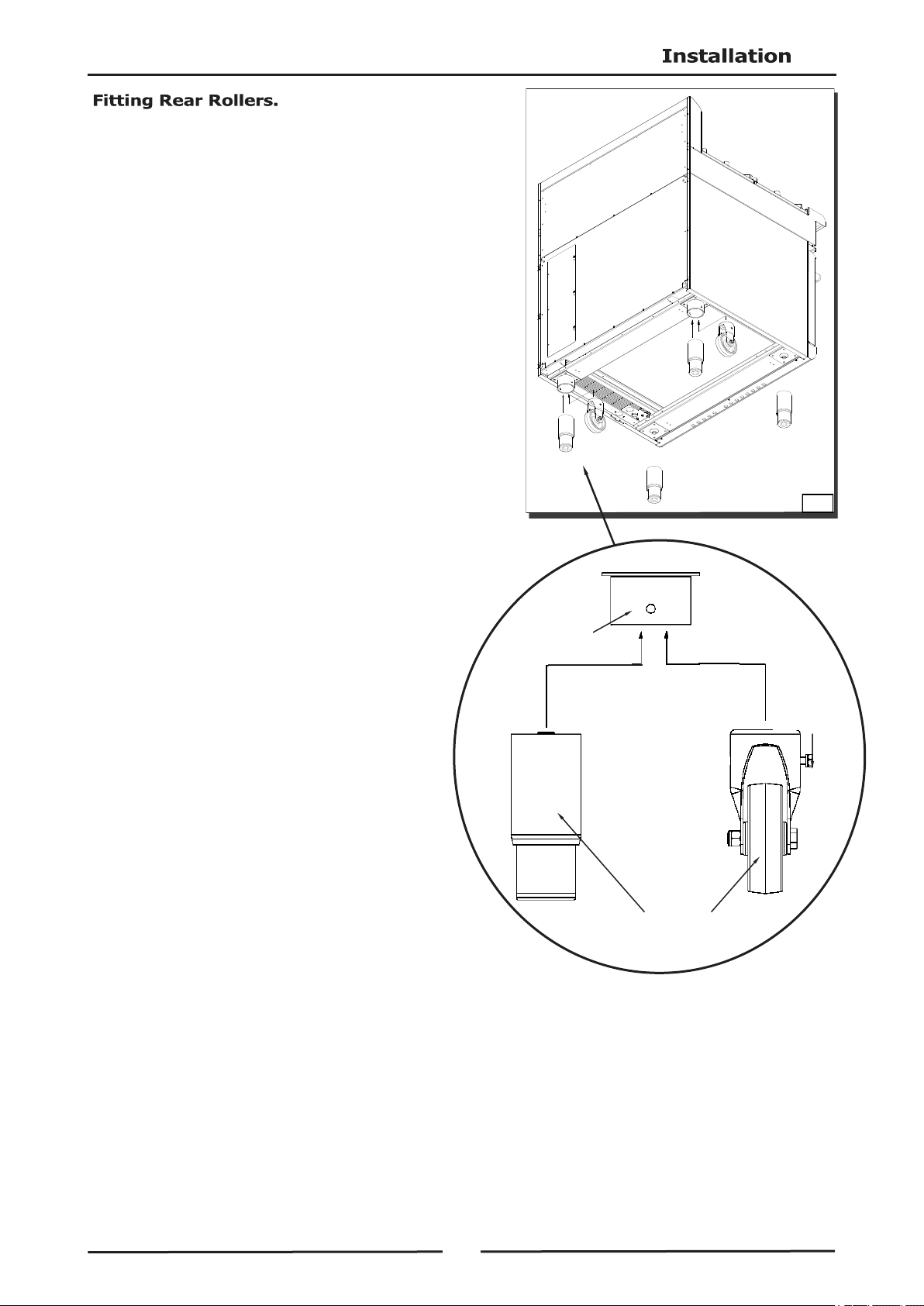
Fitting Rear Rollers.
Electrical Connection.
Gas Connection.
Commissioning.
Operation Guide.
Description of Controls.
Filling the Tank(s).
Controller Basic Programming Mode.
Entering the Controller Basic Settings.
Setting the Parameters
To Exit the Programming Mode
Lighting the Pilot Burners.
Lighting the Main Burners.
Fryer Operation (Flow Chart).
Turning 'OFF' the Fryer.
General.
Draining and Daily Cleaning.
Weekly Cleaning.
Periodic Maintenance.
Guide to Cooking Problems with the Fryer.
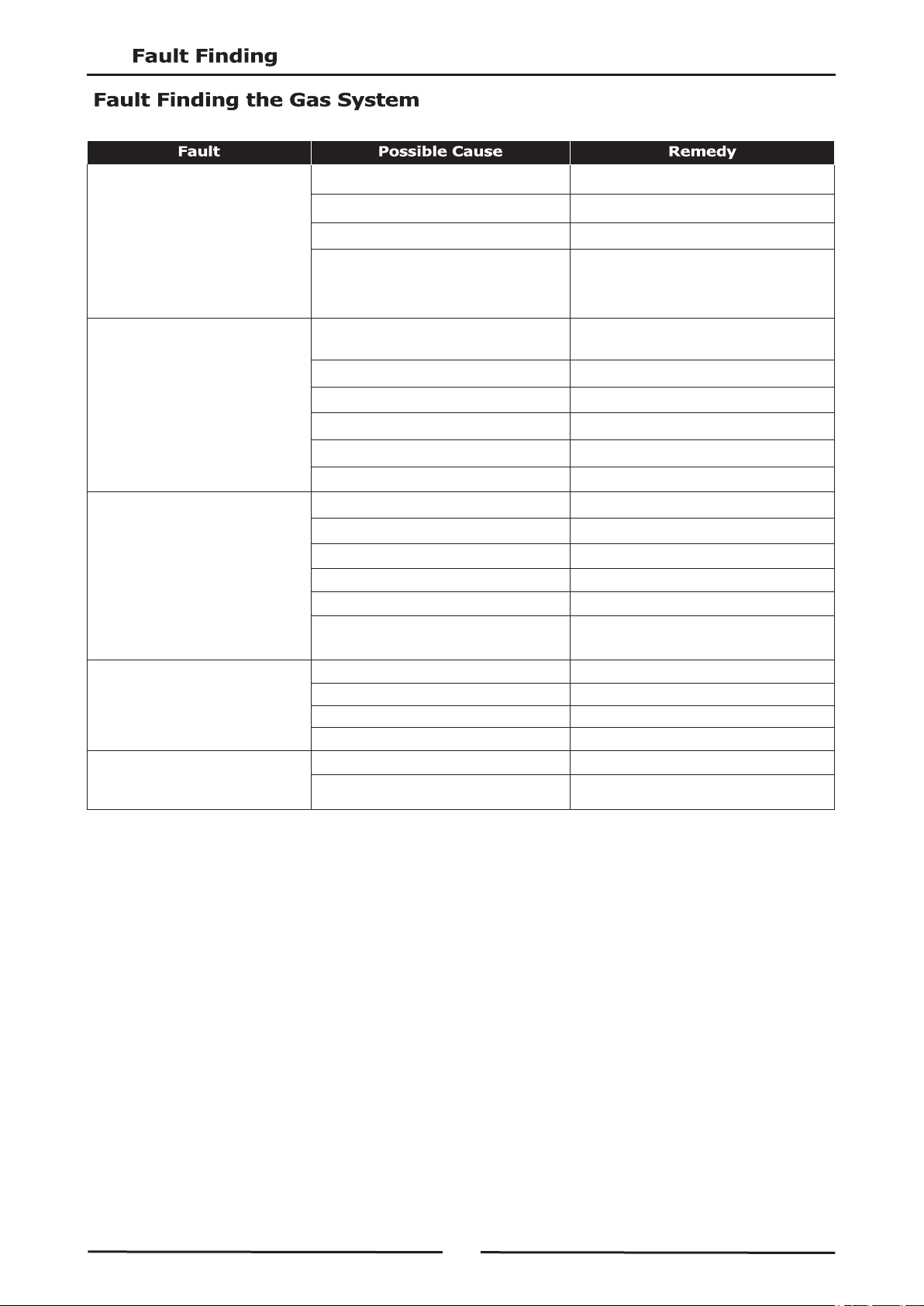
Fault Finding the Gas System.
Timing Mode.
Temperature Offset.
Temperature Display Mode.
Programming the Melt Cycle.
Setting the Temperature Units.
System Programmable Default Settings.
Conversion Procedure.
Gas Specifications.
3
We are confident that you will be delighted with your Waldorf ‘Fast-Fri’ Gas Fryer and it will become a most
valued appliance in your commercial kitchen.
To ensure you receive the utmost benefit from your new Waldorf ‘Fast-Fri’ Gas Fryer, there are two
important things you can do.
Please read the instruction book carefully and follow the directions given. The time taken will be well
spent.
If you are unsure of any aspect of the installation, instructions or performance of your Fryer, contact
your WALDORF dealer promptly. In many cases a phone call could answer your question.
These instructions are only valid if the country code appears on the appliance. If the code does not
appear on the appliance, refer to the supplier of this appliance to obtain the technical instructions for
adapting the appliance to the conditions for use in that country.
GREAT CARE MUST BE TAKEN BY THE OPERATOR TO USE THE EQUIPMENT SAFELY TO GUARD IT AGAINST RISK
OF FIRE.
The appliance must NOT be left on unattended.
It is recommended that a regular inspection is made by a competent service person to ensure
correct and safe operation of your appliance is maintained.
DO NOT store or use gasoline or other flammable vapours or liquids in the vicinity of this or any
other appliance.
do not spray aerosols in the vicinity of this appliance while it is in operation.
IMPROPER INSTALLATION, ADJUSTMENT, ALTERATION, SERVICE OR MAINTENANCE CAN CAUSE PROPERTY
DAMAGE, INJURY OR DEATH. READ THE INSTALLATION, OPERATING AND MAINTENANCE INSTRUCTIONS
THOROUGHLY BEFORE INSTALLING OR SERVICING THIS APPLIANCE.
INSTRUCTIONS TO BE FOLLOWED IN THE EVENT THE USER SMELLS GAS ARE TO BE POSTED IN A PROMINENT
LOCATION. THIS INFORMATION SHALL BE OBTAINED BY CONSULTING THE LOCAL GAS SUPPLIER.
4
FN[1]8120GE ‘FAST FRI’ GAS FRYER (Single Tank - 20Ltr).
FN[1]8226GE ‘FAST FRI’ GAS FRYER (Twin Tank - 26Ltr per Tank).
FN[1]8130GE ‘FAST FRI’ GAS FRYER (Single Tank - 31Ltr).
NOTE:
[1]: - Model Options;
- - Standard.
L - Low Back.
B - Bold Front.
LB - Low Back and Bold Front.
- Australia:
- New Zealand:
- United Kingdom & EU (CE)
Category:
II
2H3P
(20. 37), II
2H3B/P
(20, 28-30),
Flue Type
: A
1.
NOTE:
(
*
) M
easure burner operating pressure at Lower Test Point (Out) on the gas control valve, with
both burners operating at 'High Flame' setting. Refer to ‘Gas Conversion and Specification’
Section for further details.
Input Rating (N.H.G.C.) 90 MJ/hr 90 MJ/hr
Supply Pressure 1.13 - 2.00 kPa 2.75 - 3.00 kPa
Burner Operating Pressure (*) 0.98 kPa 2.50 kPa
Gas Connection ¾” BSP Male
Input Rating (N.H.G.C.) 90 MJ/hr 90 MJ/hr
Supply Pressure 1.13 - 2.00 kPa 2.75 - 3.00 kPa
Burner Operating Pressure (*) 0.98 kPa 2.50 kPa
Gas Connection ¾” BSP Male
Heat Input (nett) 22.5 kW 22.5 kW 24.2 kW
Gas Rate 2.26 m
3
/hr 1.75 kg/hr 1.91 kg/hr
Supply Pressure 20 mbar 37 mbar 28-30 mbar
Burner Operating Pressure (*) 9.8 mbar 25 mbar
Gas Connection
3
/
4
” BSP Male
5
- All Other Markets:
NOTE:
(*) M
easure burner operating pressure at Lower Test Point (Out) on the gas control
valve, with both burners operating at 'High Flame' setting.
(**) TOWN GAS Option is only available with specific ex-factory built Town Gas
models, which can also be converted to any other gas. Standard models can only be
converted between Nat. Gas, LP Gas and Butane, but not Town Gas.
Refer to ‘Gas Conversion and Specifications' section of this manual for further details.
220 -240Vac, 1P+N+E, 50Hz, 0.5A.
Electrical Connection
The power cord comes fitted with:
Australia / NZ models - 10A 3-pin plug.
United Kingdom models - 13A 3-pin fused plug.
THIS APPLIANCE MUST BE EARTHED. IF SUPPLY CORD IS DAMAGED, IT MUST BE REPLACED BY A SUITABLY
QUALIFIED PERSON IN ORDER TO AVOID A HAZARD.
Input Rating (N.H.G.C.) 90 MJ/hr 90 MJ/hr
Supply Pressure
Non-CE
models
1.13 - 2.0 kPa 0.75 - 1.5 kPa
CE
models
25 mbar N/A
Burner Operating Pressure (*) 0.98 kPa (*) 0.5 kPa (*)
Gas Connection ¾” BSP Male
Input Rating (N.H.G.C.) 90 MJ/hr 90 MJ/hr
Supply Pressure
Non-CE
models
2.75 - 3.0 kPa 2.75 - 3.0 kPa
CE
models
37 mbar 37 mbar
Burner Operating Pressure (*) 2.5 kPa (*) 2.5 kPa (*)
Gas Connection ¾” BSP Male
6
3
3
2
1
2
1
3
2
1
3
2
1
3
3
2
1
2
1
3
2
1
3
3
2
1
2
1
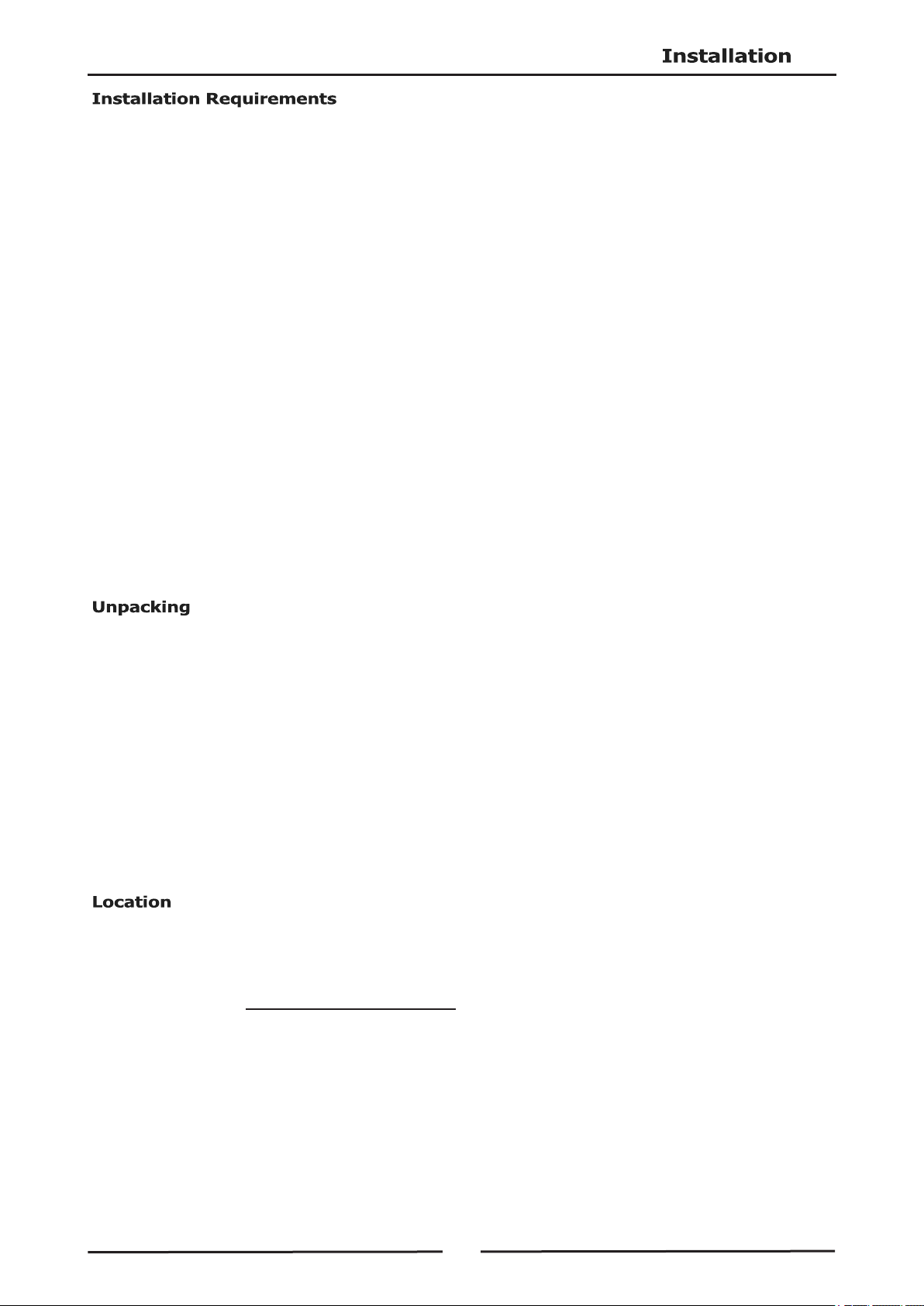
1. Primary Gas Entry Point.
2. Optional Gas Entry Point.
3. Electrical Entry Point.
7
NOTE:
It is most important that this Fryer is installed correctly and that the operation is
correct before use. Installation shall comply with local electrical, gas and health and
safety requirements.
This appliance shall be installed with sufficient ventilation to prevent occurrence of
unacceptable concentrations of health harmful substances in the room, appliance is
installed in.
Waldorf ‘FAST FRI’ gas fryers are designed to provide years of satisfactory service, and correct installation
is essential to achieve the best performance, efficiency and trouble-free operation.
This appliance must be installed in accordance with National installation codes and in addition, in
accordance with relevant National / Local codes covering gas and fire safety.
Australia / New Zealand AS 5601.1 - Gas Installations.
AS / NZS 3000 - Wiring Rules.
United Kingdom: Gas Safety (Installation and Use) Regulations 1998.
BS 7671 - Requirements for Electrical Installations.
Ireland: IS 820 - Non Domestic Gas Installations.
Installations must be carried out by qualified service persons only. Failure to install
equipment to the relevant codes and manufacturer’s specifications shown in this section will
void the warranty.
Components having adjustments protected (e.g. paint sealed) by manufacturer are only to be
adjusted by an authorised service agent. They are not to be adjusted by the installation
person.
Remove all packaging and transit protection from appliance including all protective plastic coating
from door outer panel and exterior stainless steel panels.
Check equipment and parts for damage. Report any damage immediately to carrier and distributor.
Report any deficiencies to distributor who supplied appliance.
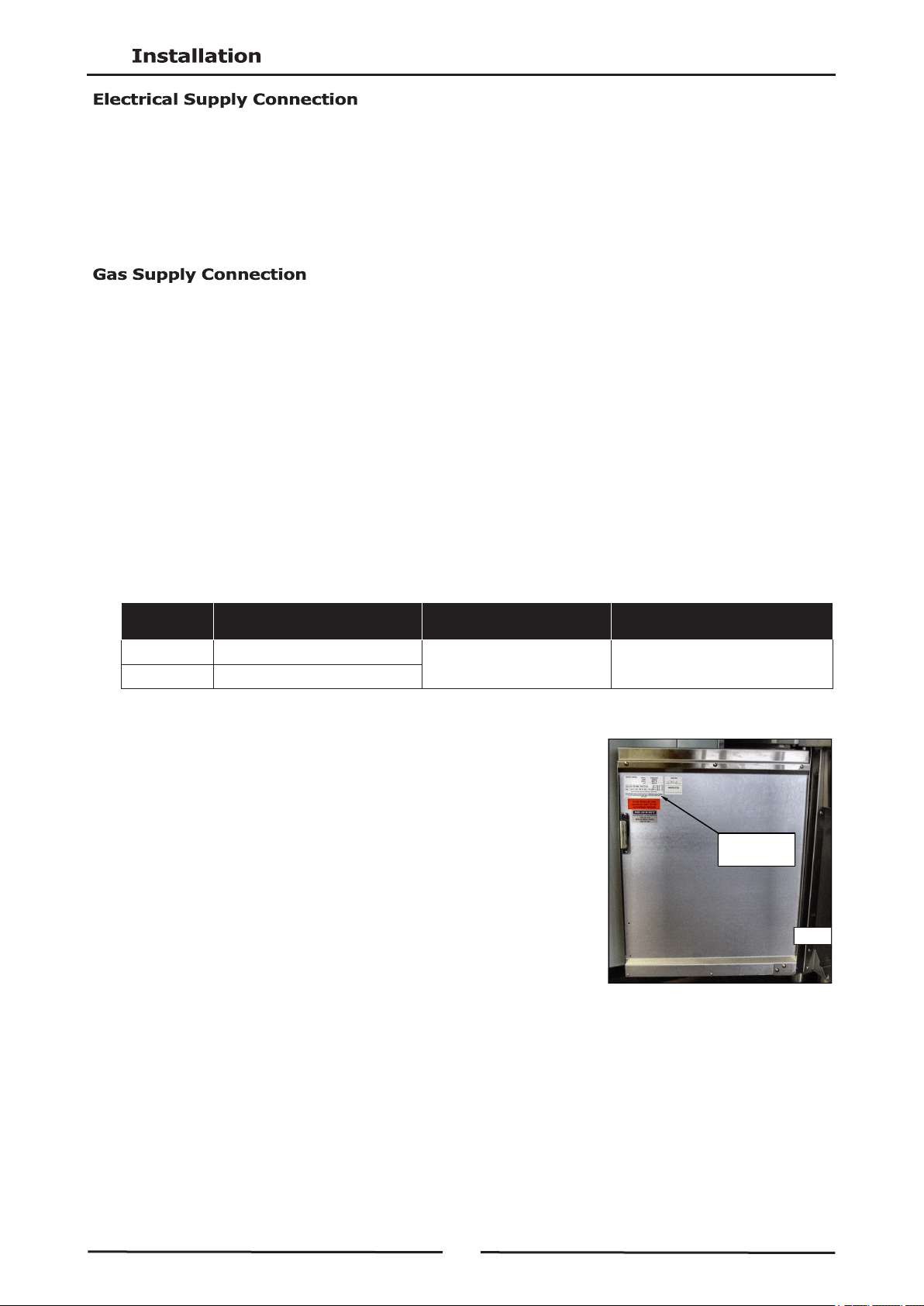
Check available gas supply is correct to as shown on rating plate located on inside of door.
Check the following parts have been supplied with the appliance:-
FN8120GE FN8226GE FN8130GE
Baskets 2 2 3
Basket Grids 1 2 1
Lid 1 1 1
Adjustable Legs 4 4 4
Drain Stick 1 1 1
Rear Rollers 2 2 2 (NZ only, Rollers fitted).
1. This appliance must be installed in a suitably ventilated room to prevent dangerous build up of
combustion products.
2. Installation must allow for a sufficient flow of fresh air for combustion air supply. Combustion air
requirements:
Combustion Air Requirements
All Gas Types 24 m³/hr minimum.
3. Position the appliance in its approximate working position.
4. All air for burner combustion is supplied from beneath appliance. Legs must always be fitted and no
obstructions placed beneath or around base of appliance, as obstructions will cause incorrect
operation and / or failure of appliance.
NOTE: Do not obstruct or block appliance flue. Never directly connect a ventilation system to
appliance flue outlet.
8
NOTE:
Only non-combustible materials can be used in close proximity to this appliance.
To facilitate easy operation, drainage and servicing of appliance, a minimum of
600mm clearance should be maintained at front of appliance.
Any gas burning appliance requires adequate clearance and ventilation for optimum and trouble-free
operation. The following minimum installation clearances are to be adhered to:
This model is delivered completely assembled. Ensure that the legs are securely attached.
NOTE:
This appliance is fitted with adjustable feet to enable it to be positioned securely and
level on uneven floors. This should be carried out on completion of gas connection.
Refer to 'Gas Connection Section'.
The rear leg housings on this appliance can also be fitted with rear rollers to enable
the appliance to be easily moved for positioning and cleaning purposes. If desired,
these rollers are supplied in the packaging, with appliance. See overleaf for fitting
instructions.
Optional Accessories (Refer to Replacement Parts List)
Plinth Kit. For installation details, refer to the instructions supplied with each kit.
Left / Right Hand Side 50mm. 0mm.
Rear 50mm. 0mm.
9
1. Raise the appliance from the floor by approx. 75mm
using suitable lifting equipment (i.e. Palletiser /
Forklift) to allow rear adjustable feet to be removed.
2. Unscrew and remove both rear adjustable feet from
rear leg housings.
3. Fit rear roller to rear leg housing and align screw
hole in side of rear leg housing with threaded hole in
rear roller.
4. Secure the rear roller to the leg support with bolt
supplied and tighten bolt.
5. Fit second roller and tighten securing bolt.
6. Lower appliance back to the floor and adjust front
adjustable feet to level appliance.
Appliance
Base
Adjustable
Foot
Rear
Roller
Rear Leg
Housing
Roller
Locating Bolt
Fig 1
10
NOTE: ALL ELECTRICAL CONNECTION MUST ONLY BE CARRIED OUT BY A QUALIFIED PERSON.
1. Each appliance should be connected to an adequately protected power supply and an isolation
switch mounted adjacent to, but not behind the appliance. This switch must be clearly marked and
readily accessible in case of fire.
2. Check electricity supply is correct as shown on Rating Plate attached to inside of access door.
3. For immediate electrical supply, simply plug the lead into a properly earthed, 3 pin socket.
NOTE: ALL GAS FITTING MUST ONLY BE CARRIED OUT BY AN AUTHORISED PERSON.
This appliance can be configured to have underside or rear entry gas supply.
To convert this appliance, see the Gas Supply Connection Location Conversion section of this manual
for instructions.
Flexible Hose Connection.
If a Gas Hose assembly is used to connect this appliance, hose and all fittings must have a minimum
¾” (Natural Gas) or ½” (LPG) inside bore diameter to ensure gas flow rate capacity required by this
appliance is achieved.
This must be verified by operating pressure testing at maximum gas supply demand condition.
Gas Hose assembly should also be classified for use in commercial kitchen conditions that appliance
will be used in.
Recommended Gas Hose Assembly Specification:
- AS/NZS 1869 Class B or D compliant or equivalent, that meets the following requirements:-
NOTE: ALL GAS FITTING MUST ONLY BE CARRIED OUT BY A
QUALIFIED SERVICE PERSON.
1. It is essential that the gas supply is correct for the appliance being
installed and that adequate supply pressure and volume are
available. Carry out the following checks before installation:-
a. Gas Type appliance has been supplied for is shown on
coloured stickers located above gas entry point and next to
rating plate. Check that this is correct for gas supply
appliance is being installed for. Gas conversion procedure is
shown in this manual.
b. Supply Pressure required for this appliance is shown in
Specifications section of this manual. Check gas
supply to ensure that adequate supply pressure exists.
c. Input Rate of this appliance is also shown on Rating Plate
fitted to inside of access door and in Specifications section
of this manual. Input rate should be checked against
available gas supply line capacity. Particular note should
be taken if appliance is being added to an existing
installation.
NOTE: It is important that adequately sized piping runs directly to connection joint on appliance,
with as few tees and elbows as possible to give maximum supply volume.
Rating Plate
Location
Fig 2
Class
Max Working Pressure
at 23 ± 2ºC
Working Temperature
Range
Resistance to Oil
B
7.0 kPa
- 20ºC to + 125ºC
Oil resistant lining and cover.
D
2.6 MPa
11
2. A suitable joining compound which resists the breakdown action of LPG must be used on every gas
line connection, unless compression fittings are used.
Connection to appliance is
3
/
4
” BSP male.
NOTE: A Manual Isolation Valve must be fitted to individual appliance supply line.
3. Correctly locate appliance into its final operating position and using a spirit level, adjust legs so that
unit is level and at correct height.
4. Connect gas supply to appliance.
5. Check all gas connections for leakages using soapy water or other gas detecting equipment.
6. Check gas supply pressure is as shown in Specifications section, Gas Supply Requirements table.
NOTE: Measure gas supply pressure at Upper Test Point (Supply Pressure) on the gas control
valve.
7. Light Pilot Burners. Refer to Operation section, Lighting Pilot Burners.
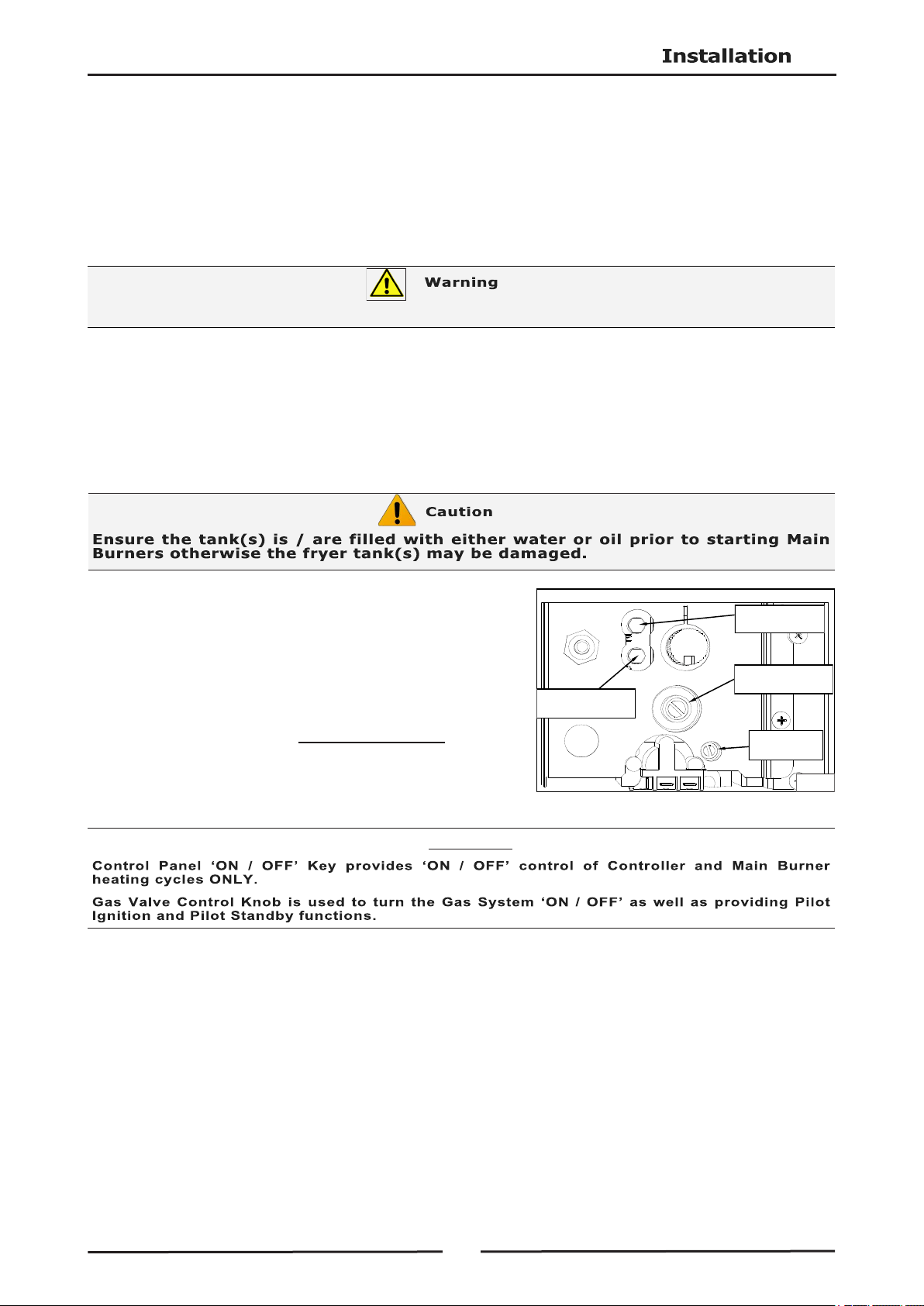
8. Check pilot flame size. Re-adjust if required, using pilot adjusting screw (See Fig 3 below), and as
shown in Gas Conversion and Specifications section, Pilot Burner Flame Adjustment.
9. Light the Main Burners. Refer to Operation section, Lighting Main Burners.
10. Verify Supply Pressure is still correct.
11. Check Main Burner operating pressure (Adjust, using
Operating Pressure Adjusting Screw on Gas
Control Valve, see Fig 3), and as shown in Gas
Conversion and Specifications section, Main
Burner Operating Pressure Adjustment.
NOTE: Insufficient gas supply line capacity, indicated by
operating pressure drop during maximum gas
supply demand, is NOT ACCEPTABLE and may
invalidate the manufacturers warranty for this
appliance.
IMPORTANT:
DO NOT USE A NAKED FLAME TO CHECK FOR GAS LEAKAGES.
Supply Pressure
Test Point
Operating Pressure
Test Point
Pilot Adjusting
Screw
Operating Pressure
Adjusting Screw
Fig 3
12
Carry out the following commissioning checks before handing over the fryer for use, to
ensure that the fryer operates correctly and operator(s) understand correct operating
procedure.
1. Before leaving the new installation;
a. Check the following functions in accordance with operating instructions specified in the Operation
section of this manual.
Light Pilot Burners.
Light Main Burners.
Check Fryer Operation (Refer to Operation section of this manual).
b. The thermostat operation check should be carried out by filling fryer with oil / shortening to the
appropriate oil FILL LEVEL mark shown at the rear of the tank and setting the thermostat to 180°
C. Light pilot burners and turn On main burners in accordance w ith Operation
Instructions in this manual.
c. Once the oil is up to temperature, check the calibration of the thermostat. If a discrepancy is
found, thermostat calibration should be referred to the supplier.
d. Ensure each operator has been instructed in areas of correct lighting, operation and shutdown
procedures for this appliance.
Initial Start-Up
Before using the fryer;
a. For first time use of the new fryer and before using fryer for cooking product, fill the fryer with
oil and operate for about 1 hour at Full Flame setting to remove any fumes or odours which may
be present in the new appliance.
b. Refer to Operation Section of this manual for details on how to operate the fryer.
2. This manual must be kept by the owner for future reference and a record of
Date of Purchase
,
Date of Installation
and
Serial Number of Appliance
recorded and kept with this manual.
(These details can be found on the Rating Plate attached to the rear of the access door.
Refer to 'Installation' section).
NOTE: If it is not possible to get the appliance to operate correctly, shut ‘Off’ gas supply and
contact
the appliance supplier.
13
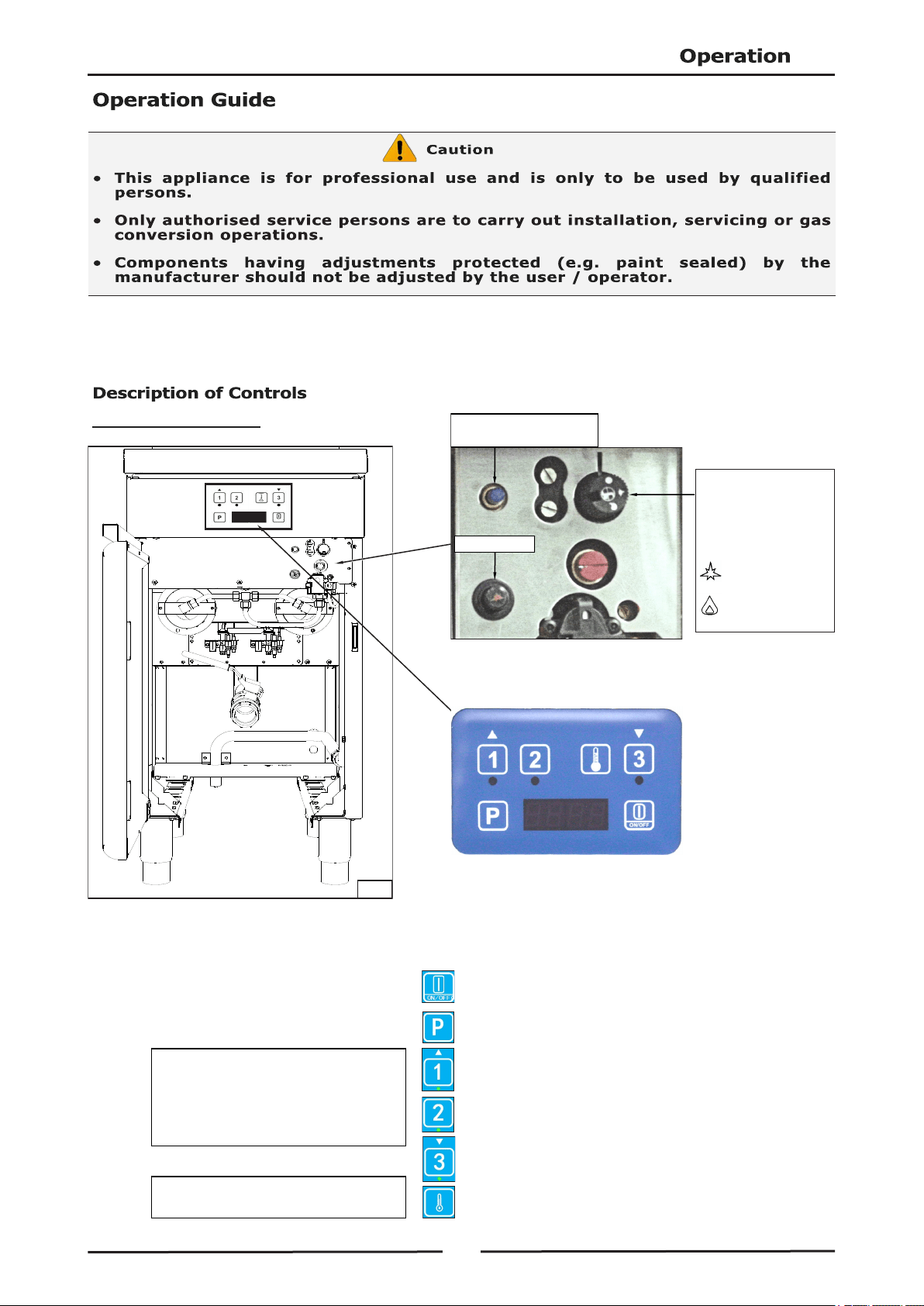
- (FN8120GE llustrated)
O
Fig 4
Piezo Igniter
•
Gas Control Valve
OFF Position
PILOT Burner
HIGH Flame
Flame Failure Button
(Single Tank Models Only)
NOTE: Only one temperature
setting applies to all 3 timers.
The 3 Timer keys on each control
panel can be used to program 3
different cook times for each tank.
6 Touch Control Keys;-
‘ON’ / ’OFF’ Key.
Programme Key (P).
Left Timer - ‘UP’ Key and LED Indicator Light.
Centre Timer - and LED Indicator Light.
Right Timer - ‘DOWN’ Key and LED Indicator Light.
Temperature Key (Thermostat).
14
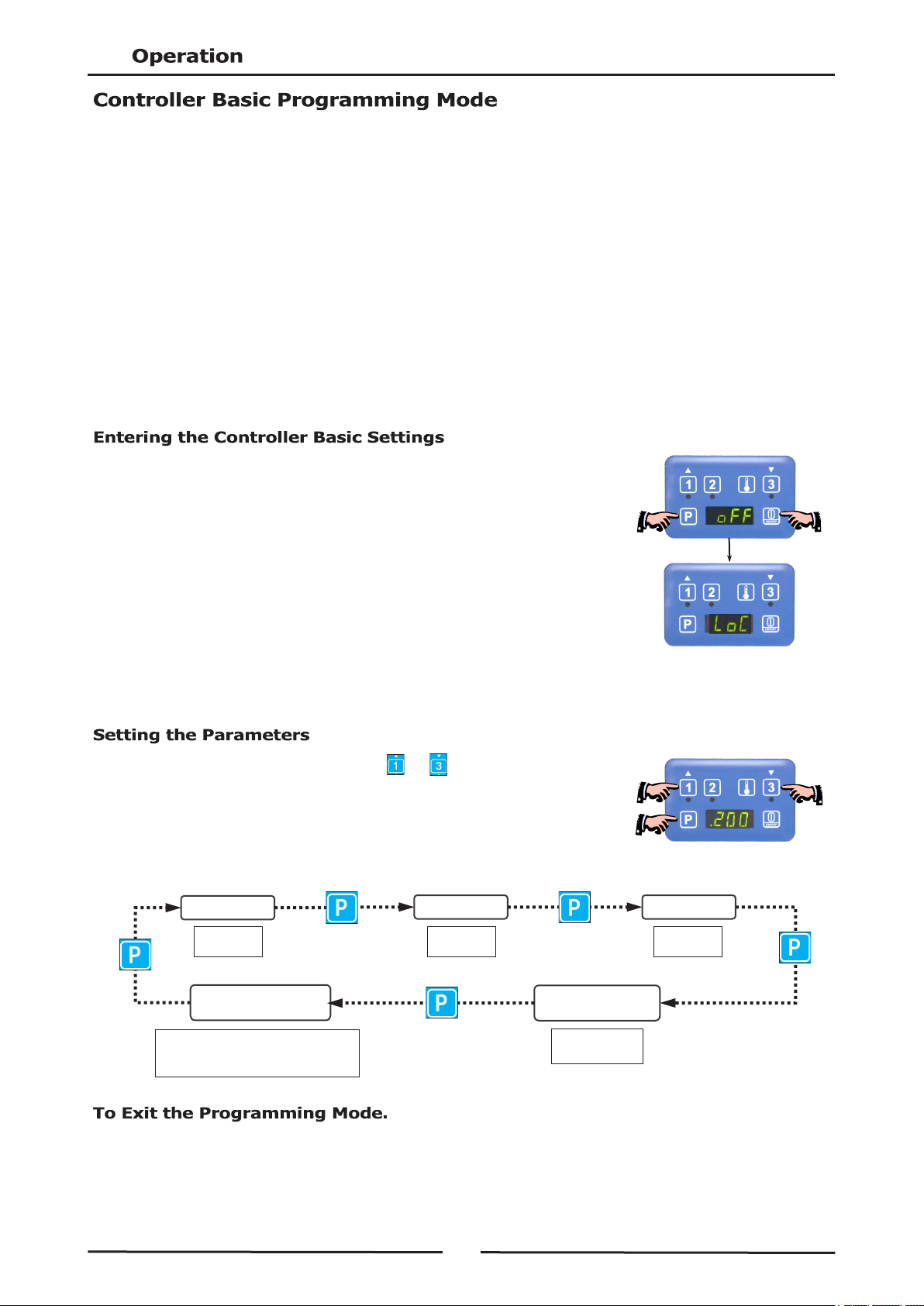
The following Parameters can be changed in Controller Basic Programming Mode:-
Timer 1 - Cook Time Settings.
Timer 2 - Cook Time Settings.
Timer 3 - Cook Time Settings.
Cooking Temperature Setting.
Keypad ‘Lock - Unlock’ (Programming the Password Protection).
NOTE:
Each Timer key on the control panel can be individually programmed with a different
cook time.
The user cannot enter Basic Programming Mode whilst a timer is running. An alarm
will sound indicating the key press, but access to programming mode will be blocked.
1. To enter ‘Programming Mode’, press ‘ON / OFF’ key to turn ‘ON’
the control panel.
2. Press Programme ‘P’ key to access the parameter setting required.
a. If ‘LoC’ is displayed, control panel is locked which will prevent
any accidental change to the operating mode.
b. To access parameters, whilst ‘LoC’ is displayed on screen,
enter the passcode ‘1 1 3 3’.
1. To change the settings, press either or key until the value
required is shown on the display.
2. Press Programme Key ‘P’ to confirm new value and the change will
be accepted. Display will step on to the next parameter.
To exit Programming Mode, press and hold Programme Key ‘P’ for approximately 3 seconds, or do not
press any key for 2 minutes. Display will revert to ‘Idle Mode’.
TIMER 1
COOK TEMPERATURE
SETTING
KEYPAD
‘LOCK’ - ‘UNLOCK’
Min 0.01
Max 99.59
Min 88°C
Max 193°C
If set to ‘LoC’, password is required
to change any of these settings.
Password is 1,1,3,3.
TIMER 3
TIMER 2
Min 0.01
Max 99.59
Min 0.01
Max 99.59
15
NOTE: WALDORF 'FAST-FRI' fryers can be used with both oil and shortening.
1. Before filling the tank, always check that the drain valve(s) behind the door is (are) closed. A locking
slide is provided on these valves and this should always be in the locked position during use.
OIL - Carefully fill fryer tank with oil until the 'FILL-LEVEL' mark is reached.
The FN8120GE fryer will hold 20 litres of oil.
The FN8226GE fryer will hold 13 litres of oil per tank.
The FN8130GE fryer will hold 31 litres of oil.
THE OPERATOR MUST TAKE GREAT CARE TO USE THE FRYER SAFELY, TO GUARD AGAINST RISK OF INJURY AND
FIRE.
DO NOT LEAVE FRYER UN-ATTENDED DURING OPERATION.
DO NOT REPLENISH THE OIL (FRYING MEDIUM) IN THE FRYER WHEN THE FRYER IS HOT.
DO NOT OVER FILL THE OIL (FRYING MEDIUM) IN THE FRYER ABOVE THE TOP LEVEL MARK.
DO NOT ALLOW THE OIL (FRYING MEDIUM) IN THE FRYER TO FALL BELOW THE LOWER LEVEL MARK.
DO NOT ALLOW THE OIL (FRYING MEDIUM) IN THE FRYER TO OVERHEAT.
DO NOT INTRODUCE WET FOOD OR WATER INTO THE HOT OIL (FRYING MEDIUM).
DO NOT USE FLAMMIBLE SOLVENTS AND CLEANING AIDS ON OR IN CLOSE PROXIMITY TO THE FRYER WHILST THE
FRYER IS STILL HOT.
DANGER OF FIRE EXISTS IF THE OIL LEVEL IS BELOW THE MINIMUM 'LO' INDICATED LEVEL
CORRECT LEVEL FOR FRYING MEDIUM
WHEN AT FRYING TEMPERATURE.
INDICATES CORRECT FRYING MEDIUM
LEVEL WHEN COLD.
Fig 5
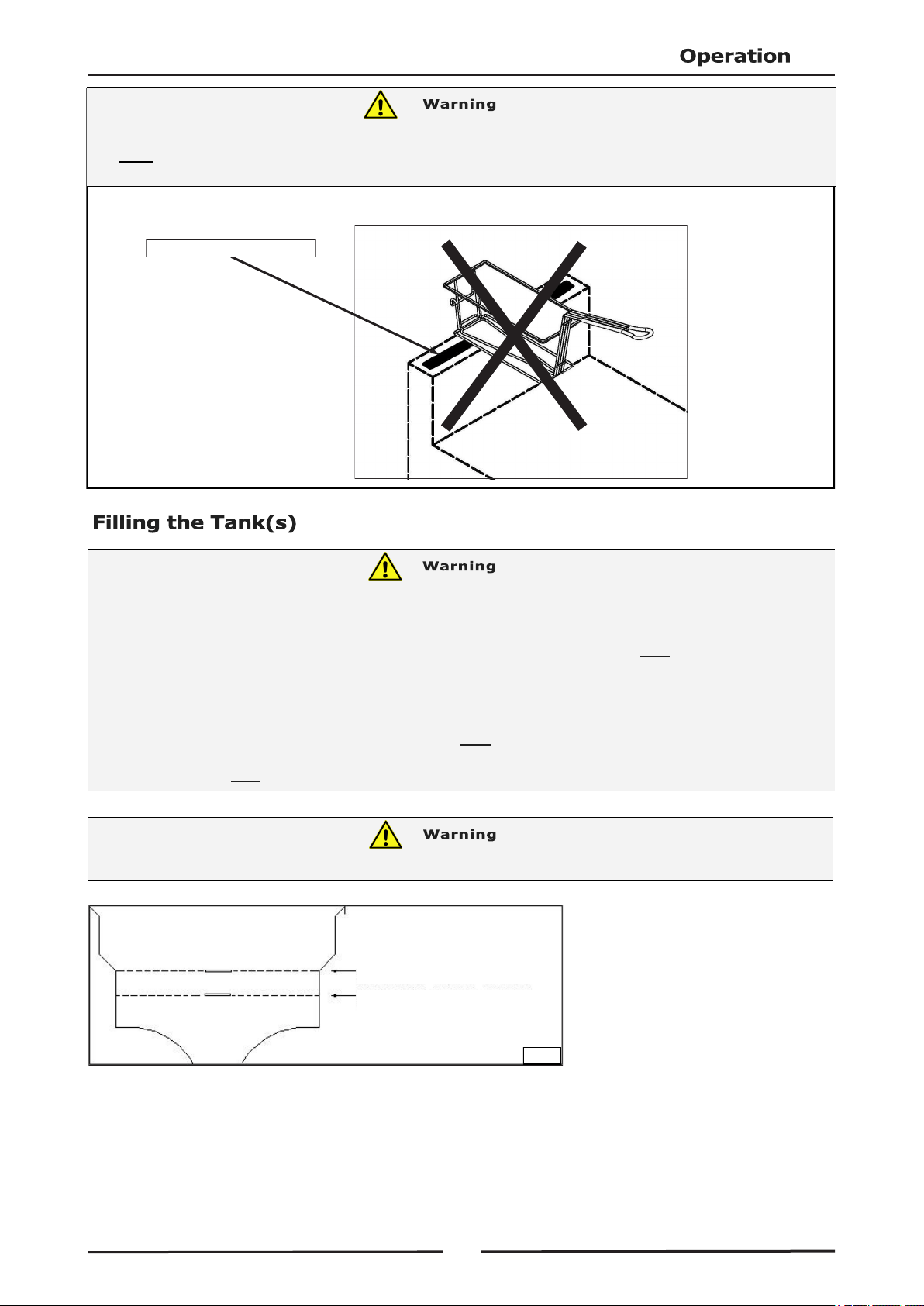
THE FLUE OUTLET AREA IS A HIGH TEMPERATURE HIGHLY FLAMMABLE AREA
DO NOT BANG, SHAKE OR HOLD FRYER BASKETS IN THE FLUE OUTLET AREA - THIS IS A HIGH RISK AREA
FOR FLAMMABLE MATERIAL (e.g. OIL / FAT AND DEBRIS FROM BASKETS COULD IGNITE HERE).
High Temperature Flue Area
16
SHORTENING - Shortening should be cut in pieces and packed down into tank.
The FN8120GE fryer will hold 37lbs shortening.
The FN8226GE fryer will hold 24lbs shortening per tank.
The FN8130GE fryer will hold 46.5lbs shortening.
Turn ‘On’ the fryer. Melt cycle should be set to CY S on the control panel
display. Refer to ‘Controller Advanced Programming Mode’ section to
change. Heating will automatically cycle at a lower temperature to
gently melt the shortening.
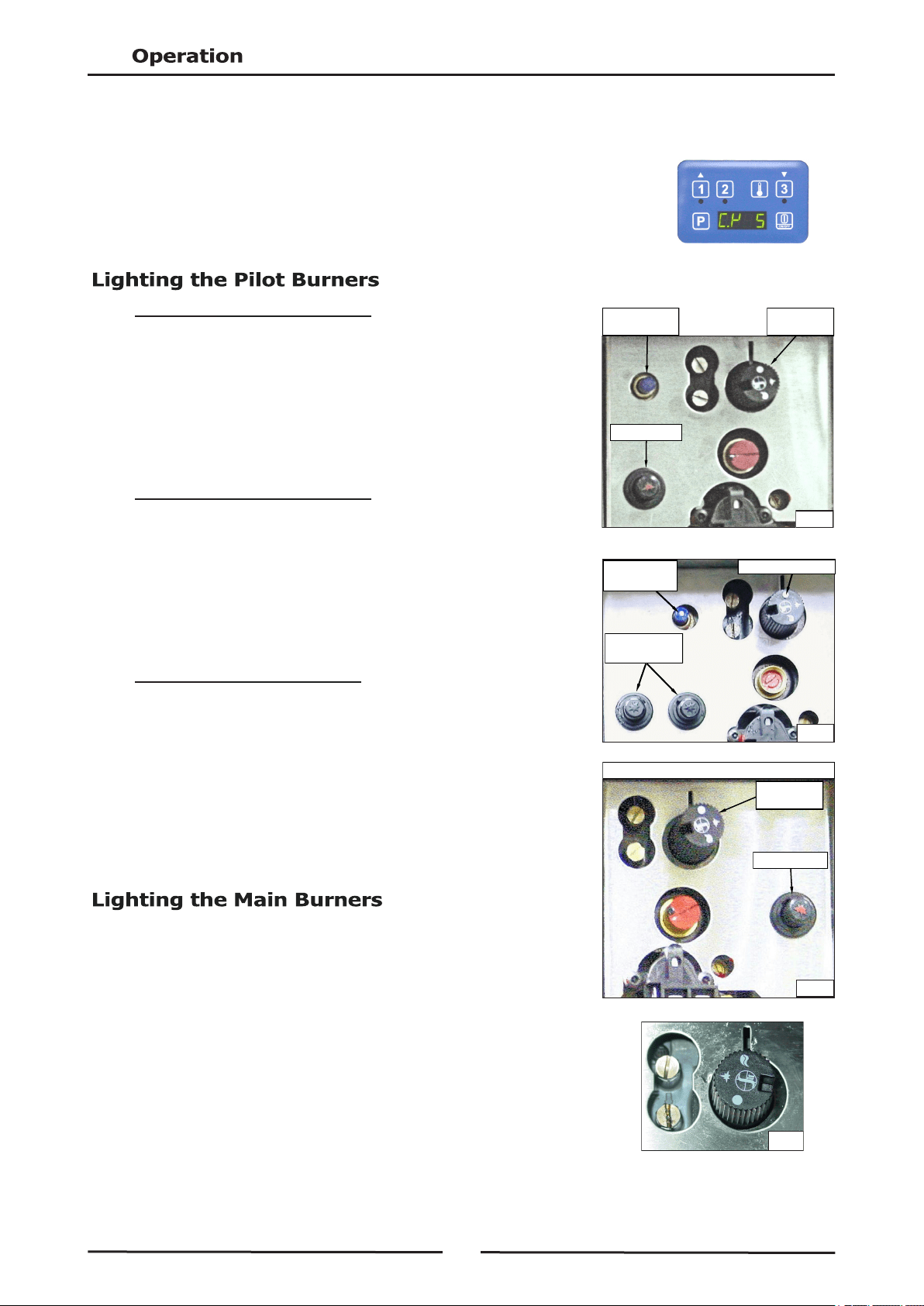
FN8120GE Fryer (Single Tank)
1. Rotate gas control knob to Pilot position and hold knob
depressed.
2. At the same time hold flame failure button depressed.
3. Press piezo igniter until right hand pilot ignites.
4. Hold gas control knob and flame failure button depressed
for approx. 10 to 15 seconds after igniting pilot burner,
then release, both pilot burners should remain alight.
5. If pilot burners do not ignite, repeat Items 1 to 4 above.
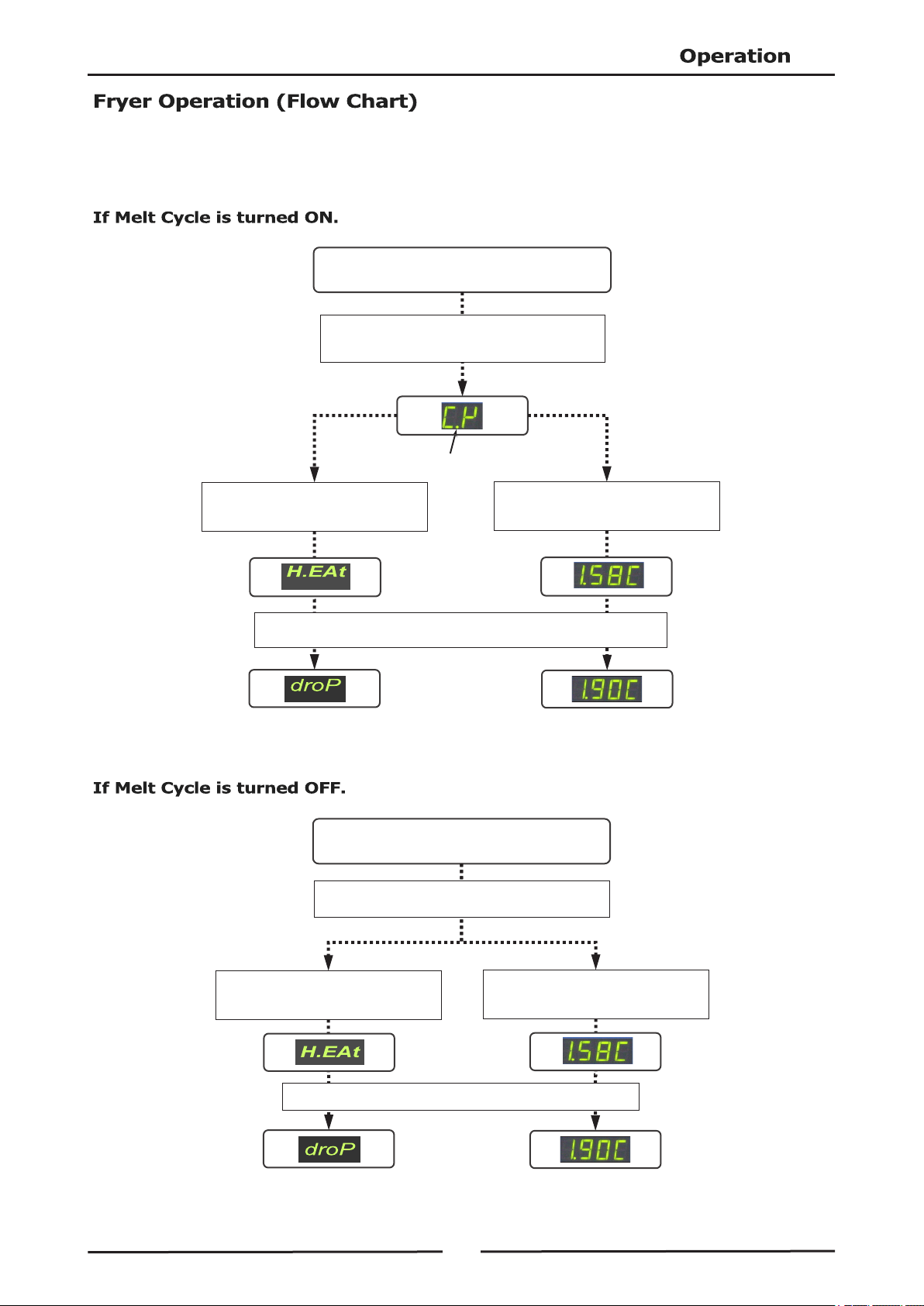
FN8130GE
Fryer (Single Tank)
1. Rotate gas control knob to Pilot position and hold knob
depressed.
2. At the same time hold flame failure button depressed.
3. Press left and right piezo igniters until both pilots ignite.
4. Hold gas control knob and flame failure button depressed
for approx. 10 to 15 seconds after igniting both pilot
burners, both pilot burners should remain alight.
5. If pilot burners do not ignite, repeat Items 1 to 4 above.
FN8226GE
Fryer (Twin Tank)
1. Rotate gas control knob to Pilot position and hold knob
depressed.
2. Press the piezo igniter until pilot ignites.
3. Hold gas control knob depressed for approx. 10 to 15
seconds after igniting pilot burner, pilot burner should
remain alight.
4. If pilot burner does not ignite, repeat Items 1 to 3 above.
5. To ignite the second pilot burner, repeat Items 1 to 3
above.
1. Ensure pilot burners are alight, by opening the front access door
of the appliance and checking that both pilot flames are alight.
2. Depress and rotate gas control knob to Full Flame position.
3. Main burners will ignite automatically off pilot burners, as
controlled by the digital controller.
NOTE: As a safety precaution all WALDORF 'FAST-FRI' Fryers
feature an Over-Heat Control, which will ‘Turn Off’ the fryer
should there be a thermostat failure and the oil temperature
reaches over 220°C.
Flame Failure
Button
Piezo Igniter
Gas Control
Valve
Fig 6
Piezo Igniter
Gas Control
Valve
Fig 8
Only Right Hand Valve Shown
Gas Control Valve
Left & Right
Piezo Igniters
Flame Failure
Valve
Fig 7
Fig 9
17
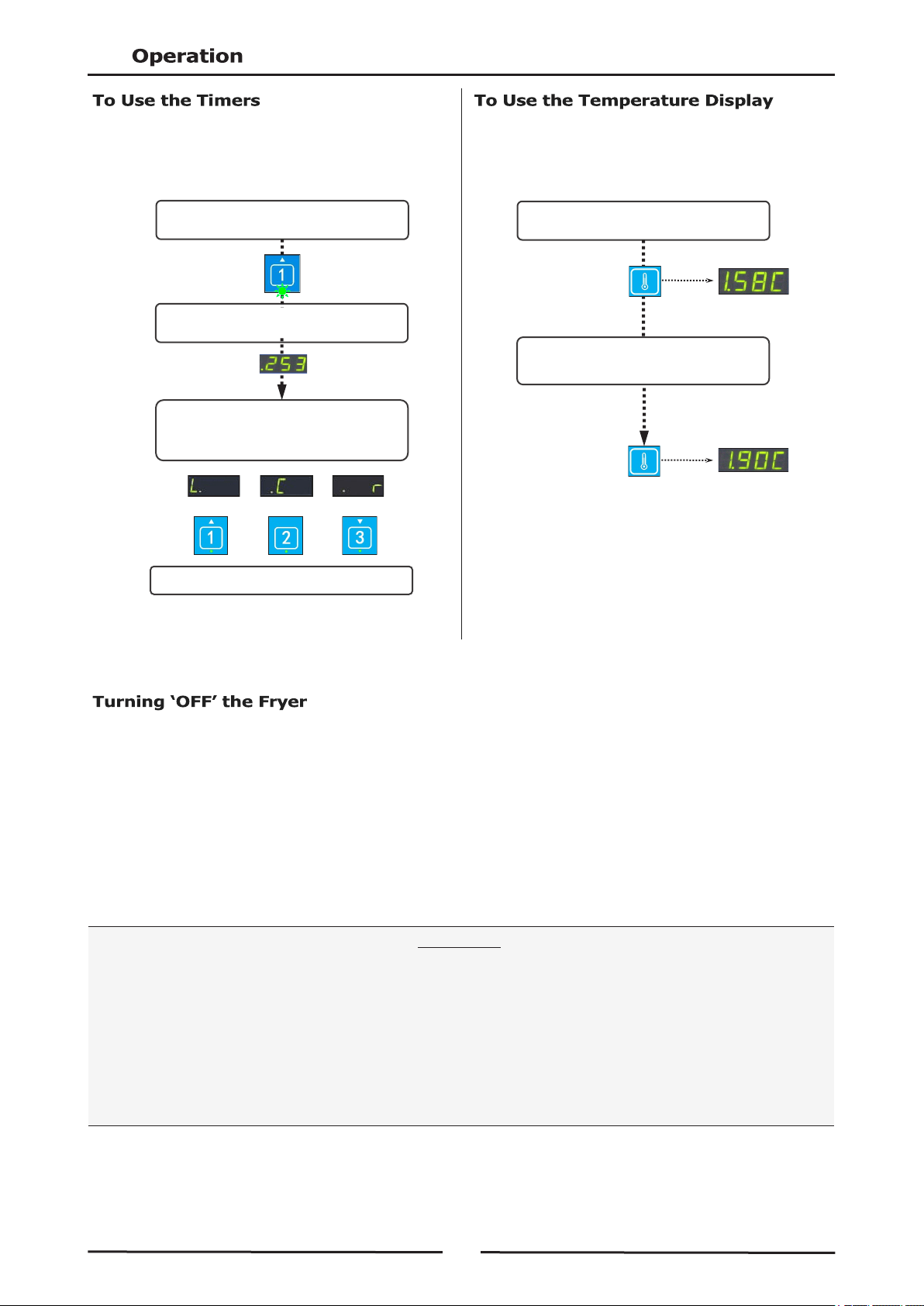
TURN ON FRYER
Press ON / OFF key to turn ‘ON’ Control Panel.
When oil is Up To Temperature, display will show the following.
If ‘t - 1’ selected in Advanced
Program Settings, display will show
Actual Temperature of oil.
Neon Dot Indicates Heating is‘ON’
If Melt cycle is active, display will show the
following. Refer to Controller Advanced
Programming Mode for available settings.
Refer to ‘Controller Basic Programming Mode’ at the start of this section for basic programmable settings
for the controller.
Refer to ‘Controller Advanced Programming Mode’ section for controller advanced programming.
If ‘t - 0’ selected in Advanced
Program Settings, display will show
the following.
TURN ON FRYER
Press ON / OFF key to turn ‘ON’ Control Panel.
When oil is up to temperature, display will show the following.
If ‘t - 1’ selected in Advanced
Program Settings,
Actual Temperature of oil is displayed.
If ‘t - 0’ selected in Advanced
Program Settings, display will show
the following.
Display will show the following. Refer to Controller
Advanced Programming Mode for settings.
Fryer can now be used without using the Timers, if required.
Fryer can now be used without using the Timers, if required.
18
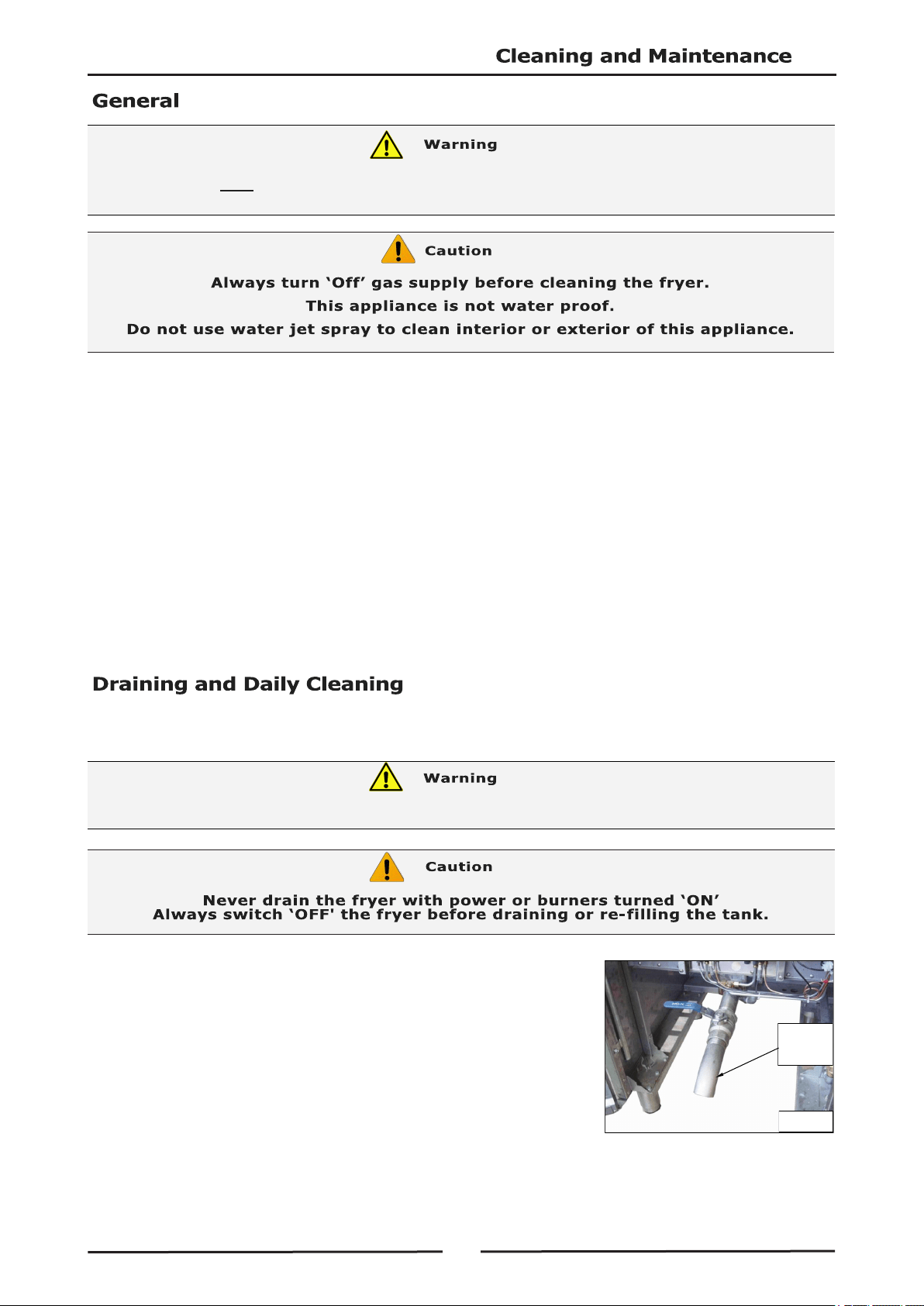
Press Timer 1, 2 or 3 as required.
LED beneath timer will flash continuously.
On completion of frying, beeper will sound
and display will show which timer has
completed frying.
Left Centre or Right
Press Timer Key to cancel Beeper and Timer
Press Temperature Key.
Display shows Actual Temperature.
To ‘Pilot’ Position
a. Depress and rotate gas control valve clockwise to the Pilot position.
b. Main burners will extinguish and Pilot will remain alight.
To ‘Off’ Position
a. Depress and rotate gas control valve fully clockwise to the Off position.
b. The Pilot burners will extinguish.
IMPORTANT:
Should any abnormal operation like;
- ignition problems,
- abnormal burner flame,
- burner control problems,
- partial or full loss of burner flame in normal operation,
If any of the above problems are noticed, the appliance requires IMMEDIATE service by a qualified
service person and should not be used until a service is carried out.
Press Temperature Key again,
within 3 seconds.
Display shows Set Temperature.
Display will count down time to
completion of frying.
NOTE: Refer to ‘Basic Programming Mode’ for
information on how to set the Timer
Pre-Set times.
NOTE: Refer to ‘Basic Programming Mode’ for
information on how to set the Cooking
Temperature.
19
To achieve the best results, cleaning must be regular and thorough and all controls and mechanical
parts checked and adjusted periodically by a qualified service person. If any small faults occur, have
them attended to promptly.
Don't wait until they cause a complete breakdown. It is recommended that the appliance is serviced
every 6 months.
Clean the fryer regularly. A clean fryer looks better, will last longer and will perform better.
NOTE:
DO NOT use abrasive detergents, sharp scrapers, strong solvents or caustic
detergents as they could corrode or damage the fryer.
Ensure that any detergent or cleaning material have been completely removed after
each cleaning.
To keep your fryer clean and operating at peak efficiency, follow the procedures below:-
1. At end of each day or at end of each shift, if frying schedule is heavy, frying medium should be
drained and filtered into a receptacle.
2. Always filter fryer when cool zone under burners is hot and liquid.
A cold fryer heated up won't drain, because frying medium in this
zone will remain hard if using solid fat / oils.
3. Screw drain extension pipe onto end of drain valve (see Fig 10)
and position a suitable container and filter under drain extension
pipe.
DO NOT USE FLAMMABLE SOLVENTS AND CLEANING AIDS ON OR IN CLOSE PROXIMITY TO FRYER WHILST
FRYER IS STILL HOT.
DO NOT ATTEMPT TO MOVE FRYER WHILST FRYER IS FULL OF OIL.
Fig 10
Drain
Extension
Pipe
20
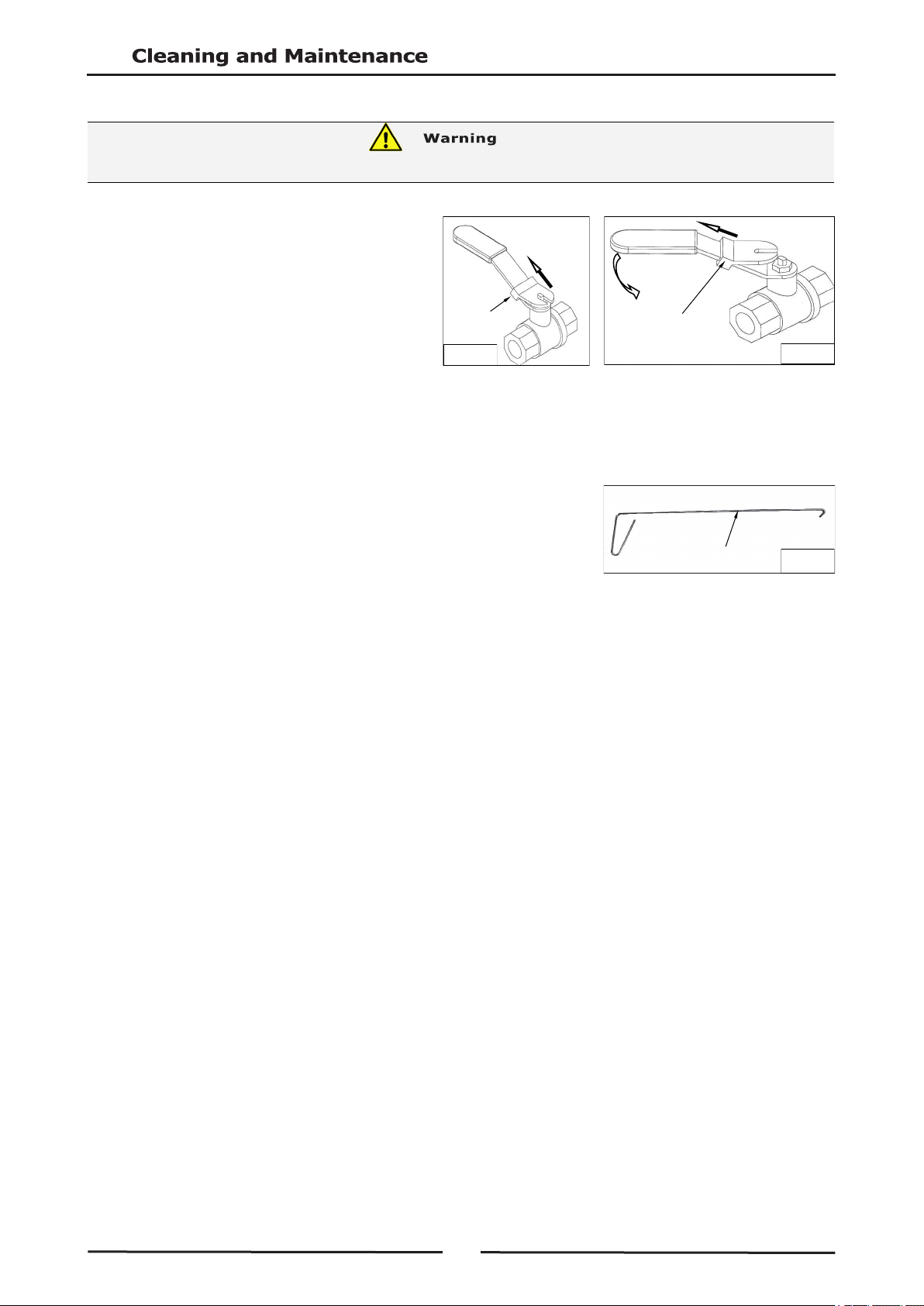
Opening the Drain Valve
a. Lift locking slide on valve handle
(Fig 11) to release valve.
b. While holding locking slide in
withdrawn position, rotate handle
anticlockwise (Fig 12) to open valve.
c. When valve is closed, locking slide will
drop down over locking valve to
prevent accidental opening of valve as
shown in Fig.11.
4. Do not empty total fryer contents into one large container, as this will be dangerous and may be
difficult, when lifted up, to pour hot oil back into tank.
5. Slip a muslin or other suitable filter bag over the end of the drain valve. Crumbs will be caught in
the bag but frying medium will strain freely through into receptacle.
6. Open drain valve slowly to minimise splashing, and take care not to overfill container.
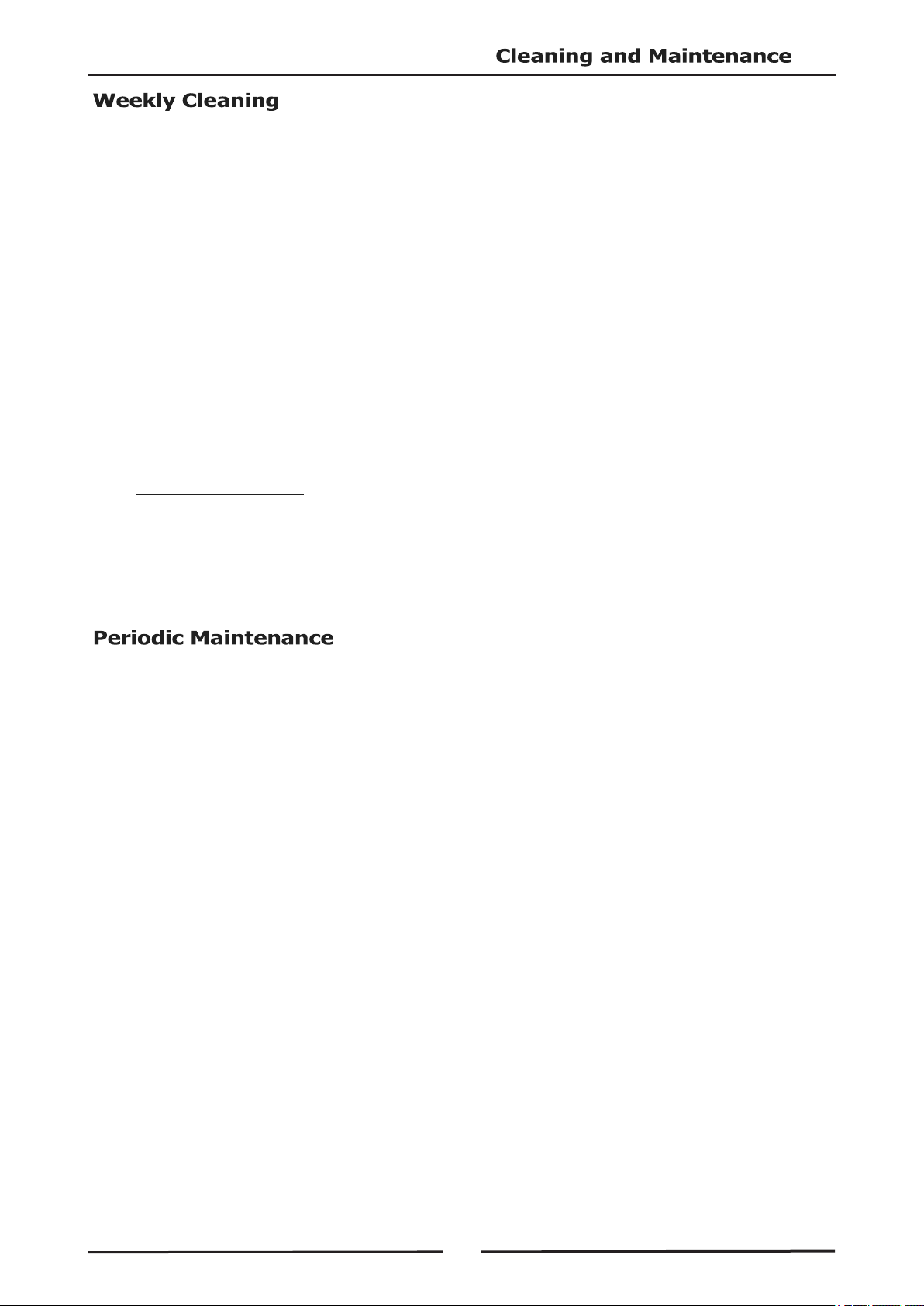
7. If necessary, use the drain stick (see Fig 13) to dislodge any
blockages in the drain.
8. When tank has been drained, use a ladle or small pan with a
handle and dip into hot frying medium from container and pour
around sides and bottom of tank to wash out crumbs and
particles adhering to tank.
9. Continue to dip and pour until all crumbs are washed down and into filter bag.
10. Open drain valve fully and check for any particles or crumb residue lodged in valve. Clean out valve
with a stiff nylon brush. Do not use a wire brush as this can damage valve seating and will
eventually lead to leakage. If obstruction cannot be removed with a brush, use a wooden probe to
dislodge obstruction.
11. Wipe all exterior panels with a cloth dampened with detergent and rinse off any residue with clean
warm water.
12. Clean Control Panel with a damp cloth lightly moistened with a solution of water and a commercial
quality foodservice approved detergent.
13. Once the daily cleaning operation is completed, close drain valve and pour frying medium back into
tank.
HOT OIL WILL BURN - DO NOT RUSH THIS JOB.
Fig 12
Fig 11
Locking Slide
Locking
Slide
Fig 13
Drain Stick
21
NOTE: If fryer usage is very high, we recommend that the weekly cleaning procedure is carried out
more frequently.
1. Proceed to drain and filter the tank as for 'Daily Cleaning'. Do not refill tank with frying medium until
it has been cleaned as shown below.
2. Fill fryer with cold water to normal fill level and add a high quality commercial cleaner that has been
specifically formulated for fryers.
All purpose cleaners are not recommended
.
NOTE: Never use a caustic or lye solution, as this will leave a fat destroying film on the tank.
3. Heat water to approximately 80-90°C.
4. Clean fryer baskets at same time by simply immersing them in the cleaning solution. Allow fryer to
soak for 5-10 minutes or as directed on cleaner instructions. Remove baskets and turn Off main
burners.
5. Scrub baskets and fryer tank with a stiff nylon bristle brush to remove any remaining deposits.
DO
NOT use a wire brush, as this will scratch the sides
.
6. Empty fryer and rinse thoroughly with water. Use a 1 part vinegar to 15 parts water solution to
rinse tank and neutralise any cleaner residue. If this proves unsuitable for cleaner being used, use a
weaker solution of up to 1 part vinegar to 25 parts water.
7. Rinse tank thoroughly with water, drain and dry.
8. Refill tank with new filtered frying medium.
Stainless Steel Surfaces
a. With tank(s) drained, cleaned and dried as shown above, clean exterior surfaces of fryer with hot
water, a mild detergent solution and a soft cloth.
b. Dry all components thoroughly with a dry cloth and polish with a soft dry cloth.
c. To remove any discoloration, use an approved stainless steel cleaner or stainless steel wool.
Always rub in direction of grain.
NOTE: All maintenance operations should only be carried out by a qualified service person.
To achieve the best results, cleaning must be regular and thorough. All controls and mechanical parts
should be checked and adjusted periodically by a qualified service person. If any small faults occur, have
them attended to promptly. Don't wait until they cause a complete breakdown. It is recommended that
the appliance is serviced every 6 months.
22
This section provides an easy reference guide to the more common problems that may occur during the
operation of your equipment. The fault finding guide in this section is intended to help you correct, or at
least accurately diagnose problems with your equipment.
Although this section covers the most common problems reported, you may encounter a problem not
covered in this section. In such instances, please contact your local authorised service agent who will
make every effort to help you identify and resolve the problem. Please note that the service agent will
require the following information:-
Model Code and Serial Number of appliance. (both can be found on Rating Plate
located on appliance).
Frying medium foaming.
Presence of soap or detergent
residue from cleaning tank.
Rinse fryer thoroughly three times with clean
water. Ensure fryer is perfectly dry before
re-filling with frying medium.
Excessive breakdown of frying
medium.
Add fresh frying medium daily to replace
contents every 3-5 days.
Continual frying of food with
excess moisture.
Remove excess moisture from foods to be fried.
Continued overheating of oil. Check thermostat setting. Turn down heat to
around 140°C (Standby) when use is quiet.
Overloading Maintain 1-8 ratio of food to frying medium.
Gumming.
Heating frying medium too rapidly. When charging fryer or starting up, melt frying
medium gradually.
Continued overheating of frying
medium.
Check oil temperature by using a thermometer
or thermocouple.
Frying oil broken down. Check amount of fresh frying medium added to
fryer to be sure 'turnover' is adequate.
Using wrong frying medium. Some frying mediums form gums when used in
a deep fryer. e.g safflower oil.
Greasy foods.
Frying at too low a temperature. Increase temperature and check thermostat
setting.
Inadequate preparation of food. Be sure foods (especially potatoes) are 'cured'
correctly.
Excessive quantities of breading or
batter.
Remove surplus breading or batter.
Placing food in frying medium
direct from freezer.
Allow frozen foods to thaw before frying.
Surplus moisture in and on surface
of food.
Drain and dry foods before frying.
Frying medium in advanced stages
of breakdown.
Discard 'old' frying medium and refill fryer with
new medium.
Use of dripping or other unrefined
oil.
Due to low smoking point, cooking in these oils
at lower temperatures will result in greater oil
absorption by food.
Using wrong kind of cooking oil. Always use a completely refined and deodorised
cooking oil.
23
NOTE: Excessive usage of oil is an indication of high absorption of oil into the food. This is a
function of temperature and character of the goods being fried - NOT due to the type of oil
being used (unless refined oils are being used). Any variation in the apparent life of the oil
is always due to one or more of the causes mentioned above.
Rapid oil breakdown.
Inadequate frying oil turnover. Adjust procedures to fry more food in fryer to
increase turnover.
Oil overheating. Check oil temperature by using a thermometer
or thermocouple.
Contamination. Filter or strain oil daily.
Poor cleaning procedures. Clean fryer each day or at least once a week
and rinse thoroughly. Dry fryer before use.
Presence of copper or brass in the
fryer equipment.
Remove all copper or brass fittings from contact
with oil.
Overloading fryer. Maintain 1-8 ratio of food to frying oil.
Food excessively moist. Drain and dry food before frying.
Overheating oil on ‘Standby’ mode. Turn control to Pilot position during idle
(‘Standby’) periods.
Oil smoking.
Insufficient turnover of oil. Maintain a minimum quantity of oil in fryer for
more rapid turnover or increase quantity of food
fried in fryer.
Replace with fresh oil every 3 to 5 days.
Continual frying with excess moisture
on food.
Drain foods before frying, pat food dry.
Contamination of oil. Filter or strain daily to remove contaminants.
Oil overheating. Check oil temperature by using a thermometer
or thermocouple.
Rapid breakdown of oil. Use a stable frying oil.
Use of unrefined oils. Dripping smokes at lower temperature than
refined and deodorised oils.
Darkening of oil.
Presence of salt on the food. Salt food after frying and away from fryer.
Foods dipped in batter high in egg
yolk.
Reduce egg content of batter, replace part egg
with milk.
Contamination of oil. Filter or strain oil daily to remove contaminants.
Poor cleaning practice. Clean fryer at least once a week or each day in
cases of heavy usage. Ensure fryer is perfectly
dry before use.
Overheating of oil. Check oil temperature by using a thermometer
or thermocouple.
Insufficient oil turnover. Top up daily to replace contents of fryer in 3 to
5 days.
Cooking foods with high sugar levels. Potatoes are usually high in reduced sugars at
the end of a season. When fried, they will
darken quickly and discolour the oil.
24
Pilot Burners will not light.
Gas supply is turned Off. Turn On gas supply.
Gas bottles empty. Replace gas bottles.
Blocked pilot burner. Call for service.
Faulty piezo ignition.
Call for service.
NOTE: Pilot can be manually lit
until repair is carried out.
Pilot Burner lights then goes
out when Gas Control Button
is released.
Gas valve control button not held In
for long enough.
Hold In for at least 10 seconds after
ignition of the pilot.
Blocked / weak pilot. Call for service.
Low gas pressure. Call for service.
Faulty thermocouple. Call for service.
Faulty overtemp. Call for service.
Faulty gas control valve. Call for service.
Pilot Burner goes Out during
operation.
Low / fluctuating gas pressure. Call for service.
Weak pilot. Call for service.
Faulty thermocouple. Call for service.
Faulty overtemp. Call for service.
Faulty gas control valve. Call for service.
Overtemp tripped, pilot is turned Off if
temperature exceeds 220°C.
Call for service.
Main Burners do not light.
Low gas pressure. Call for service.
Blocked pilot. Call for service.
Faulty thermostat. Call for service.
Faulty gas control valve. Call for service.
Main Burners do not burn
correctly. (Burners roar or
flash back to Main Injector).
Faulty burner. Call for service.
Blockage in flue. Call for service.
25
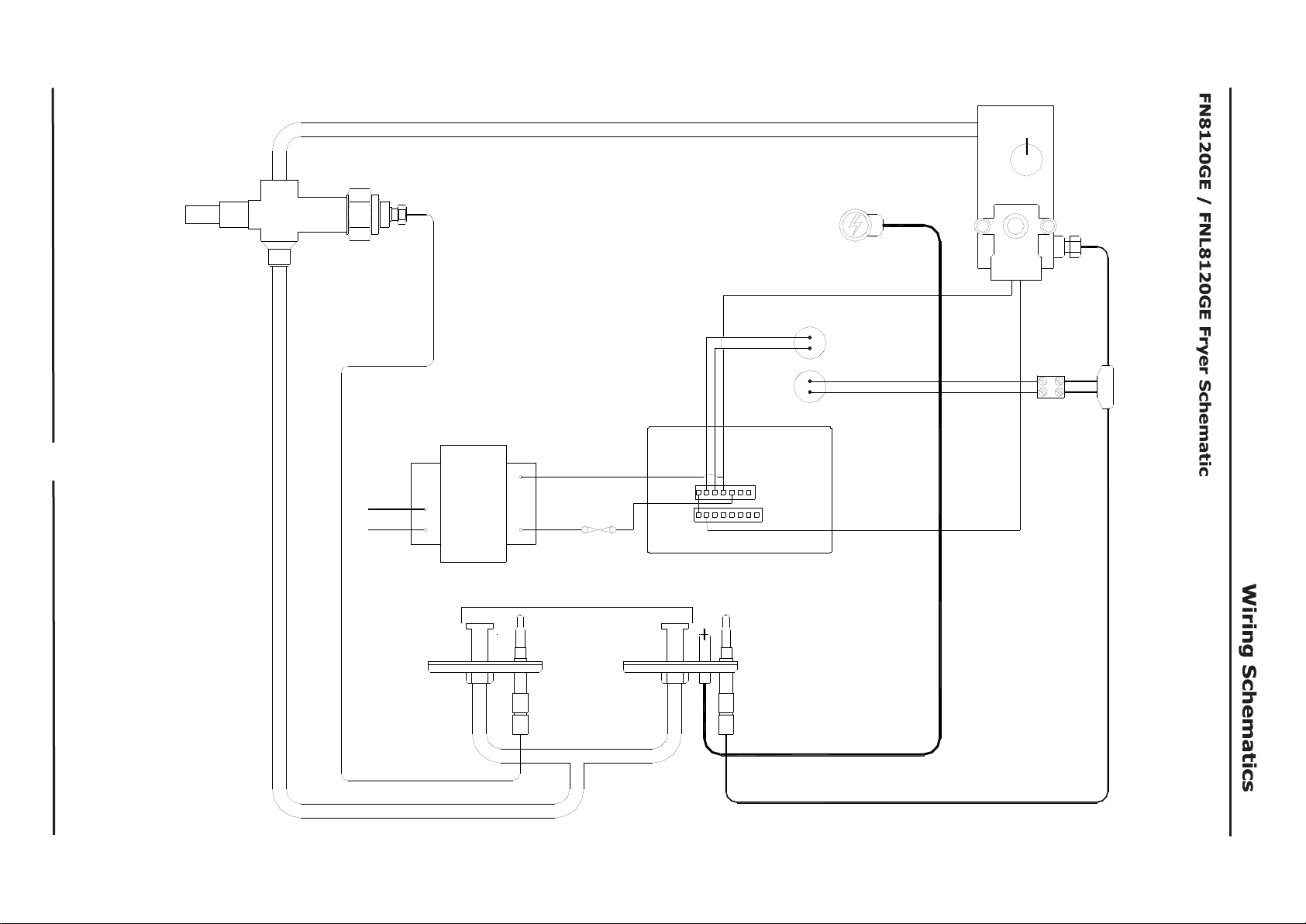
T/C
FLAME FAILURE VALVE
SIT M1/A
MAIN GAS
CONTROL
SIT NOVA 820mV
24V 50Hz
THERMOSTAT
OVER TEMP
IGNITION
L.H. PILOT
T/C
R.H. PILOT
CROSS LIGHTING
TRANSFORMER
24v
P
N
FUSE
2.0 Amp
'FAST' DIGITAL
CONTROLLER
PROBE
26
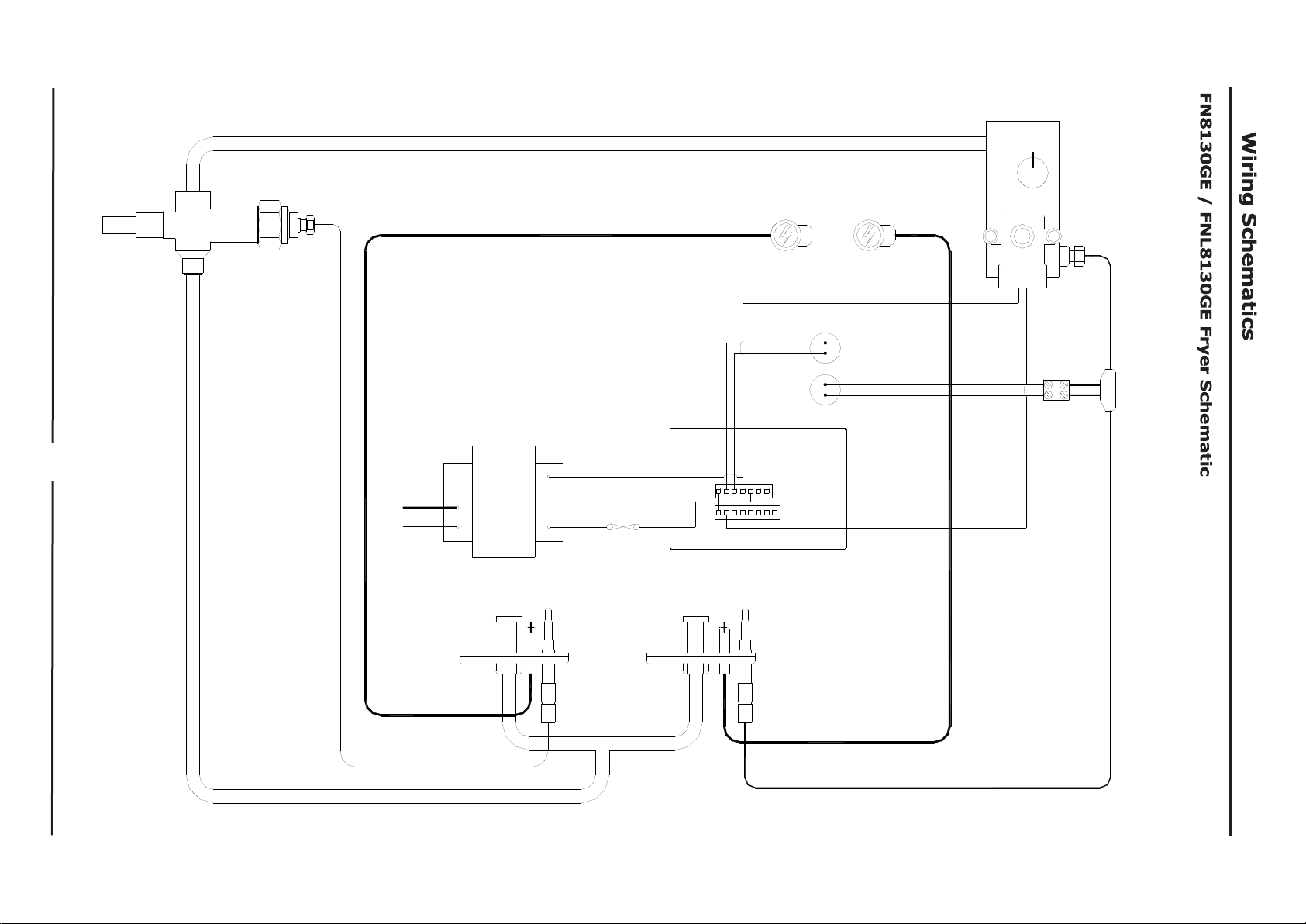
T/C
FLAME FAILURE VALVE
SIT M1/A
MAIN GAS
CONTROL
SIT NOVA 820mV
24V 50Hz
THERMOSTAT
OVER TEMP
IGNITION
L.H. PILOT
T/C
R.H. PILOT
TRANSFORMER
24v
P
N
FUSE
2.0 Amp
'FAST' DIGITAL
CONTROLLER
PROBE
IGNITION
27
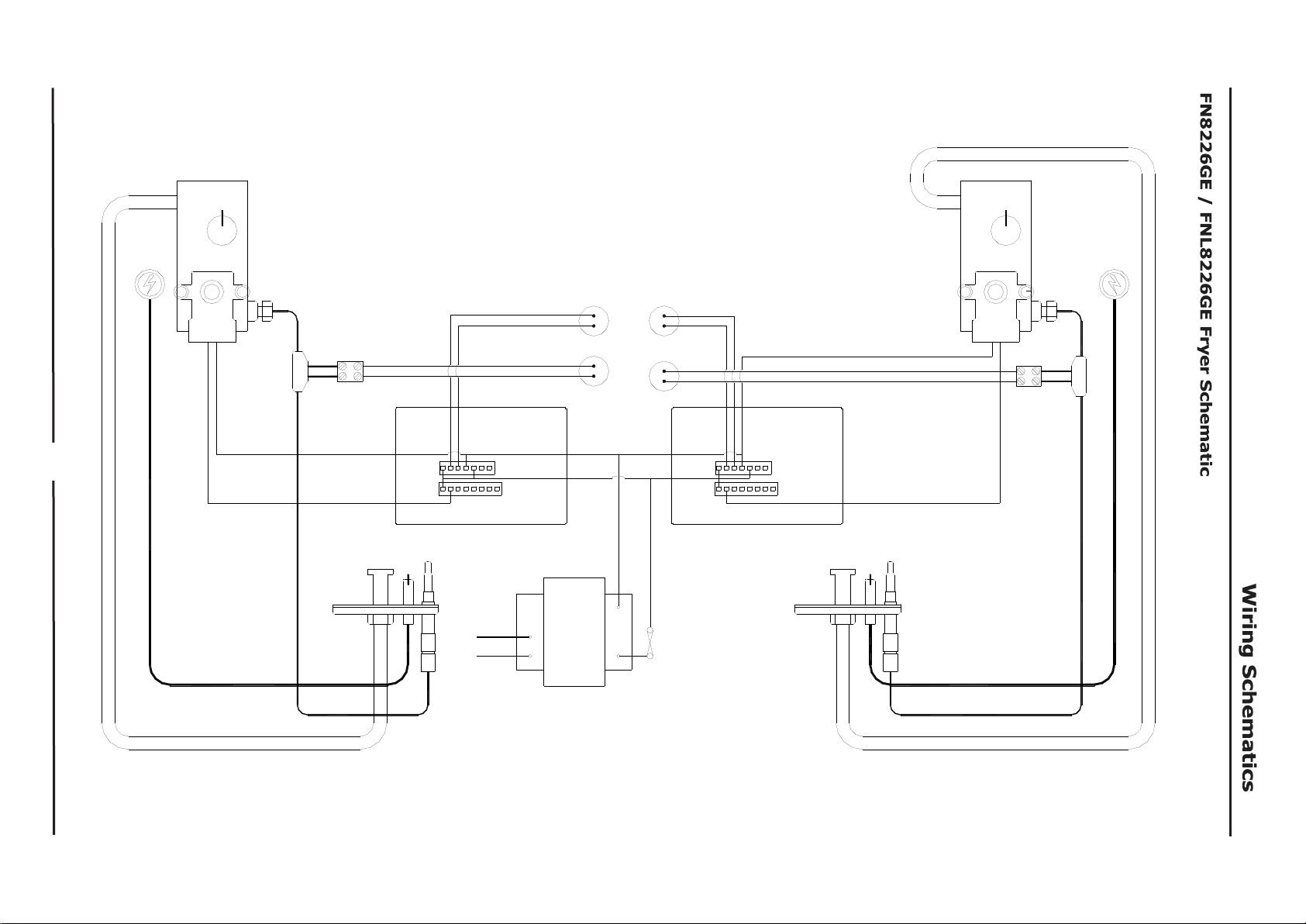
TH
MAIN GAS
CONTROL
SIT NOVA 820mV
24v 50Hz
MAIN GAS
CONTROL
SIT NOVA 820mV
24v 50Hz
PILOT PILOT
T/CTC
IGNITION
OVER TEMPS.
THERMOSTAT
IGNITION
'FAST' DIGITAL
CONTROLLER
'FAST' DIGITAL
CONTROLLER
TRANSFORMER
24v
P
N
FUSE
2.0 Amp
PROBE
28
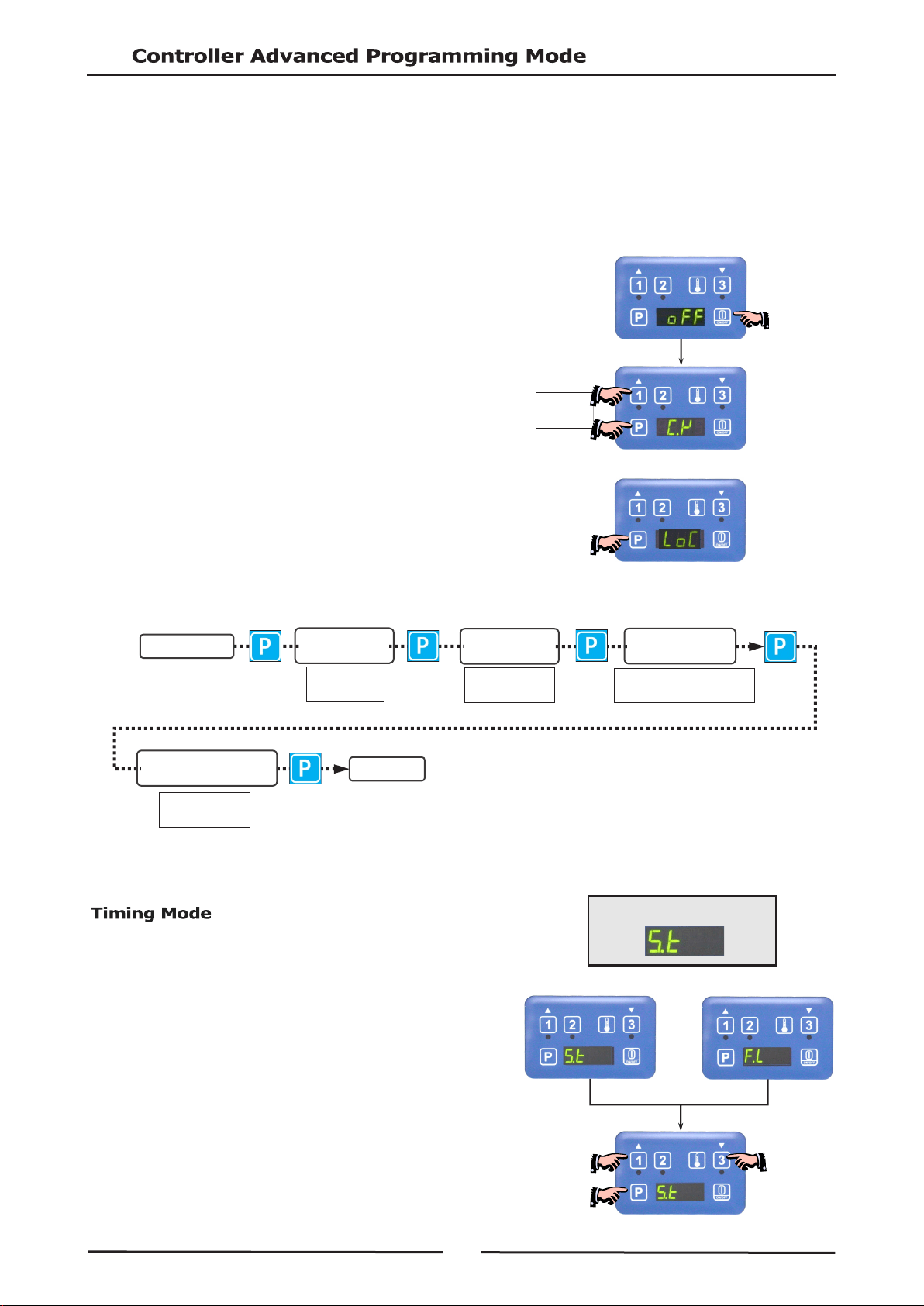
The following Parameters can be accessed and adjusted in the Advanced Programming Mode:-
Timing Mode (Straight or Flexi cook time).
Temperature Offset (Calibration Setting) -14° to +14°.
Temperature Display Mode (Temp display or prompt display).
Programming the Melt Cycle.
Setting the Temperature Units (either °C or °F).
System Programmable Default Settings.
1. Press the ‘ON / OFF’ key to turn ‘ON’ fryer controller.
2. Press Programme Key ‘P’ and ‘Timer 1’ key together to
enter ‘Advanced Programming Mode’.
3. If ‘LoC’ is displayed, passw ord protection is
turned ‘ON’ and control panel is locked. Unlock the
control panel, refer to ‘Controller Basic Programming
Mode’ - ‘Entering the Controller Basic Settings’, and
repeat from Item 2 above.
1. One of the following options will display:-
Straight Cook Time
Straight cook time refers to real time cooking.
Flexible Cook Time
Cook time can be automatically adjusted to
compensate for size of load being cooked.
2. To change ‘Timing Mode’, press either ‘Timer 1’ or
‘Timer 3’ key.
3. Press Program Key ‘P’ to confirm options, the change
will be accepted and display will step on to
‘Temperature Offset’ parameter.
Press
Together
Factory Default Settings
TIMING MODE
TEMPERATURE
OFFSET
TEMPERATURE
DISPLAY MODE
PROGRAMMING
THE MELT CYCLE
SETTING THE
TEMPERATURE UNITS
IDLE MODE
from
-14° to +14°
either
't -1’
or
't -0’
either
‘CY L’, ‘CY.S’ or 'CY o’
either
'°F’ or '°C’.
29
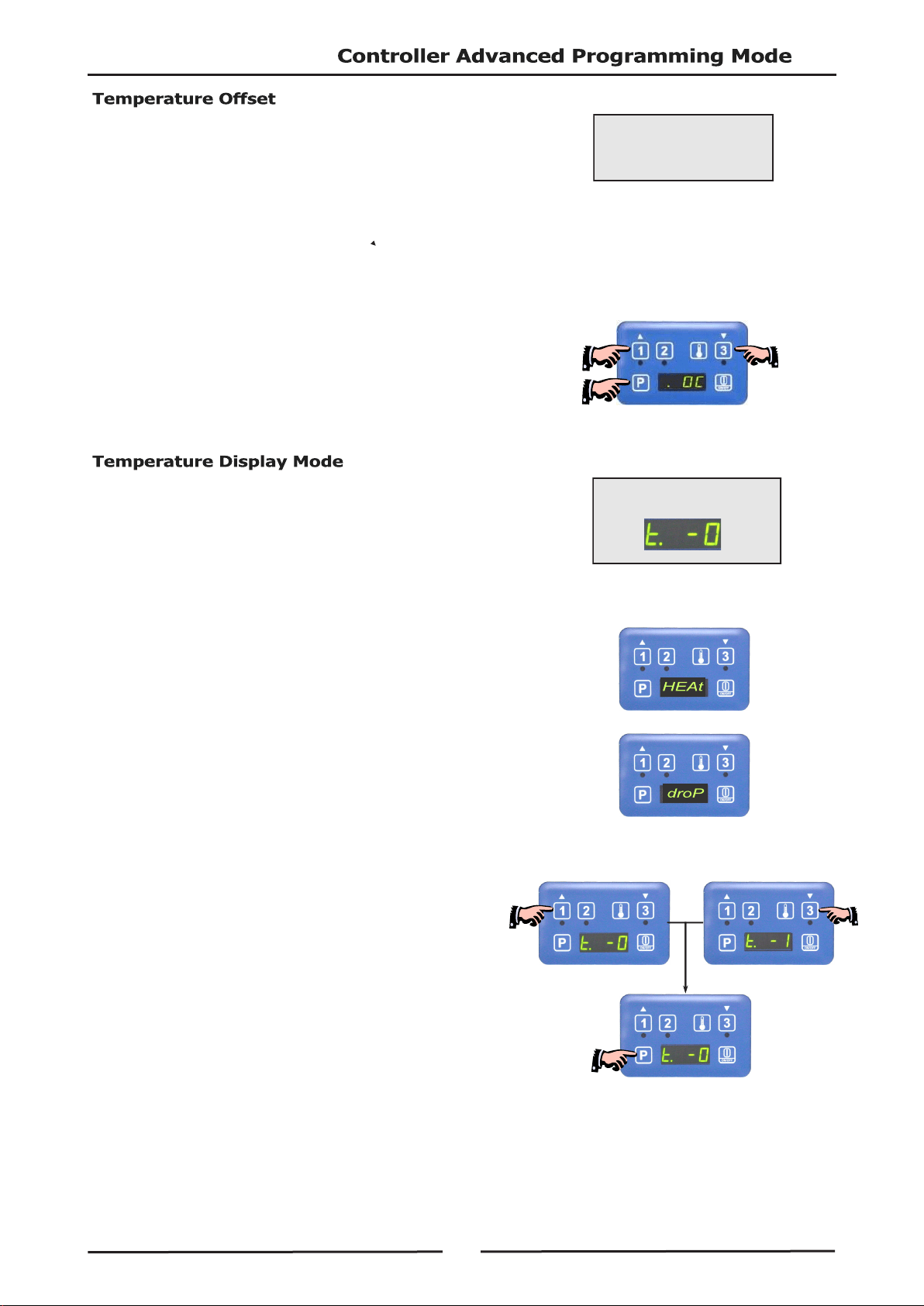
The display temperature can be adjusted by between -14° to +14°.
To Calibrate the Control Temperature
Set control temperature to 170°.
Measure the oil temperature that the control is cycling at.
If oil temperature is
higher
than reading on control panel, enter a
positive
value of the difference
between oil temperature and set temperature (170° + difference).
If oil temperature is
lower
than reading on control panel, enter a
negative
value of the difference
between oil temperature and set temperature (170° - difference).
1. Temperature offset will appear on the screen.
2. To change temperature offset option, press either ‘Timer 1’
or ‘Timer 3’ key to change selection.
3. Press Program Key ‘P’ to confirm the change and the display
will step on to ‘Temperature Display’ parameter.
Temperature display can be set for either of two display modes:-
't - 1’ - Display will show oil temperature as an actual temperature.
’t - 0’ - Display will show one of the following temperature status;
‘HEAt’ - Awaiting for fryer to heat up to set temperature.
‘droP’ - When fryer is within
10° of set temperature to
indicate that fryer is ready for loading.
1. One of the following options will display:-
2. Press either ‘Timer 1’ or ‘Timer 3’ key to select
option required.
3. Press Program Key ‘P’ to accept the change and display will
step on to the ‘Programming the Melt Cycle’ parameter.
Factory Default Settings
Factory Default Settings
O°
30
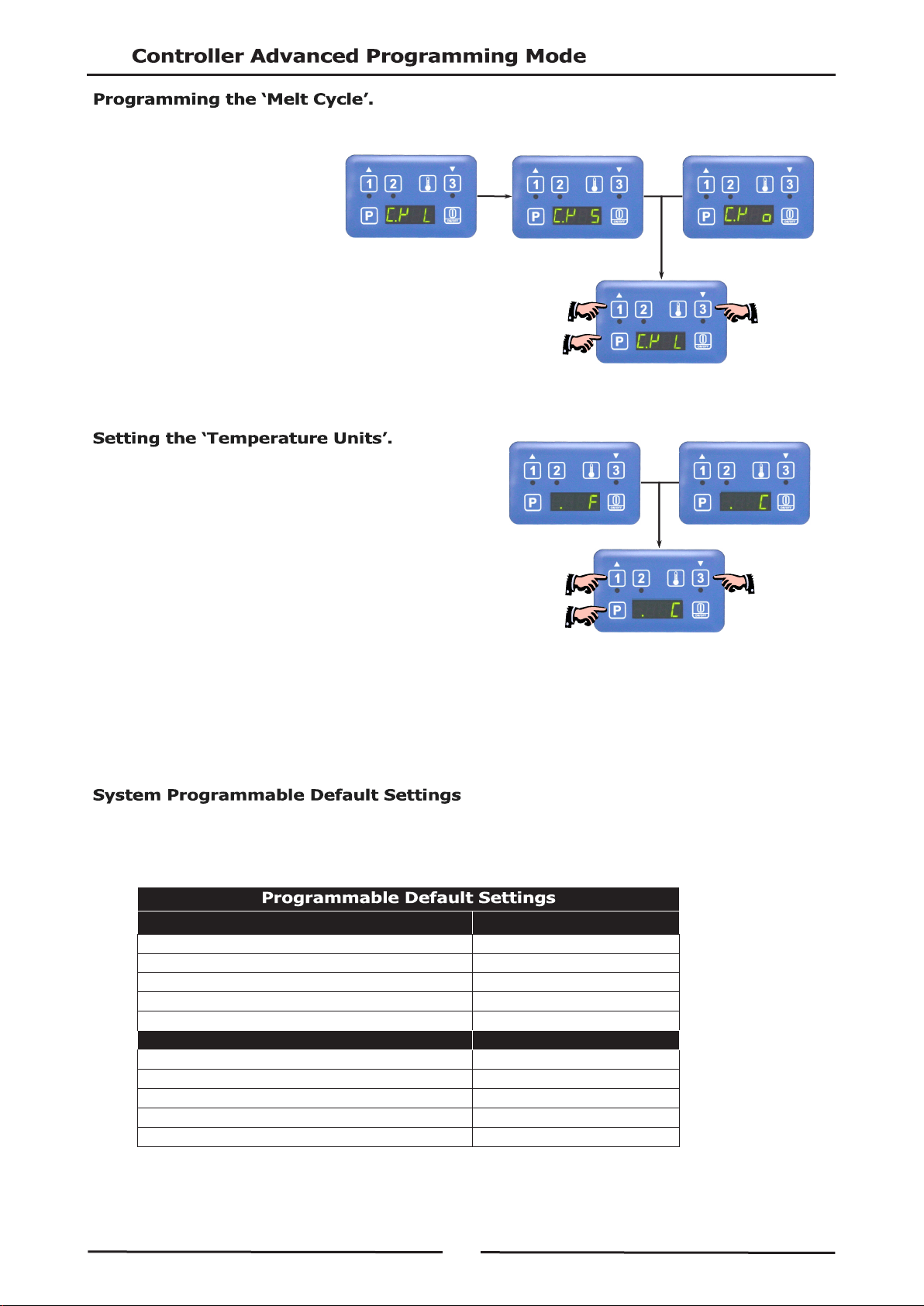
1. One of the following 3 options may be selected:-
‘L’ (Liquid).
‘S’ (Solid).
‘O’ (Override).
2. To change the programmed ‘Melt Cycle’, press either
‘Timer 1’ or ‘Timer 3’ key to scroll through the three
options.
3. Once the desired option is selected, press Program Key
‘P’ to accept the change, display will step on to ‘Setting
the Temperature Units’.
1. User may select from ‘F’ (Fahrenheit) or ‘C’ (Celsius).
2. Press either ‘Timer 1’ or ‘Timer 3’ key to change
selection.
3. Press Programme Key ‘P’, the change will be accepted
and display will revert to ‘Idle Mode’.
NOTE:
Pressing and holding Programme Key ‘P’ for approximately 3 seconds (Or not pressing
any keys for 2 minutes) during Advanced Programming Mode, the appliance will exit
Advanced Programming Mode and return to Idle Mode.
The table below shows a list of the programmable parameters and the default settings for this appliance.
These settings can be edited from the Control Panel when in either ‘Controller Basic Programme Mode’
or ‘Controller Advanced Programming Mode’.
Controller Basic Programming Mode Default Settings
Timer 1 ‘L’ Cook Time 3:00 min.
Timer 2 'Ctr’ Cook Time 3:00 min.
Timer 3 'R’ Cook Time 3:00 min.
Temperature Set Point 177°C (350°F).
Keypad Lock or Unlock Unlock.
Controller Advanced Programming Mode Default Settings
Timing Mode S.t (Straight).
Temperature Offset 0°.
Temperature Display Mode t. -0 = 'HEAt' or 'droP'.
Melt Cycle Mode L (Liquid).
Degrees; °F or °C °C.
31
NOTE:
This conversion should only be carried out by qualified persons. All connections must
be checked for leaks before re-commissioning appliance.
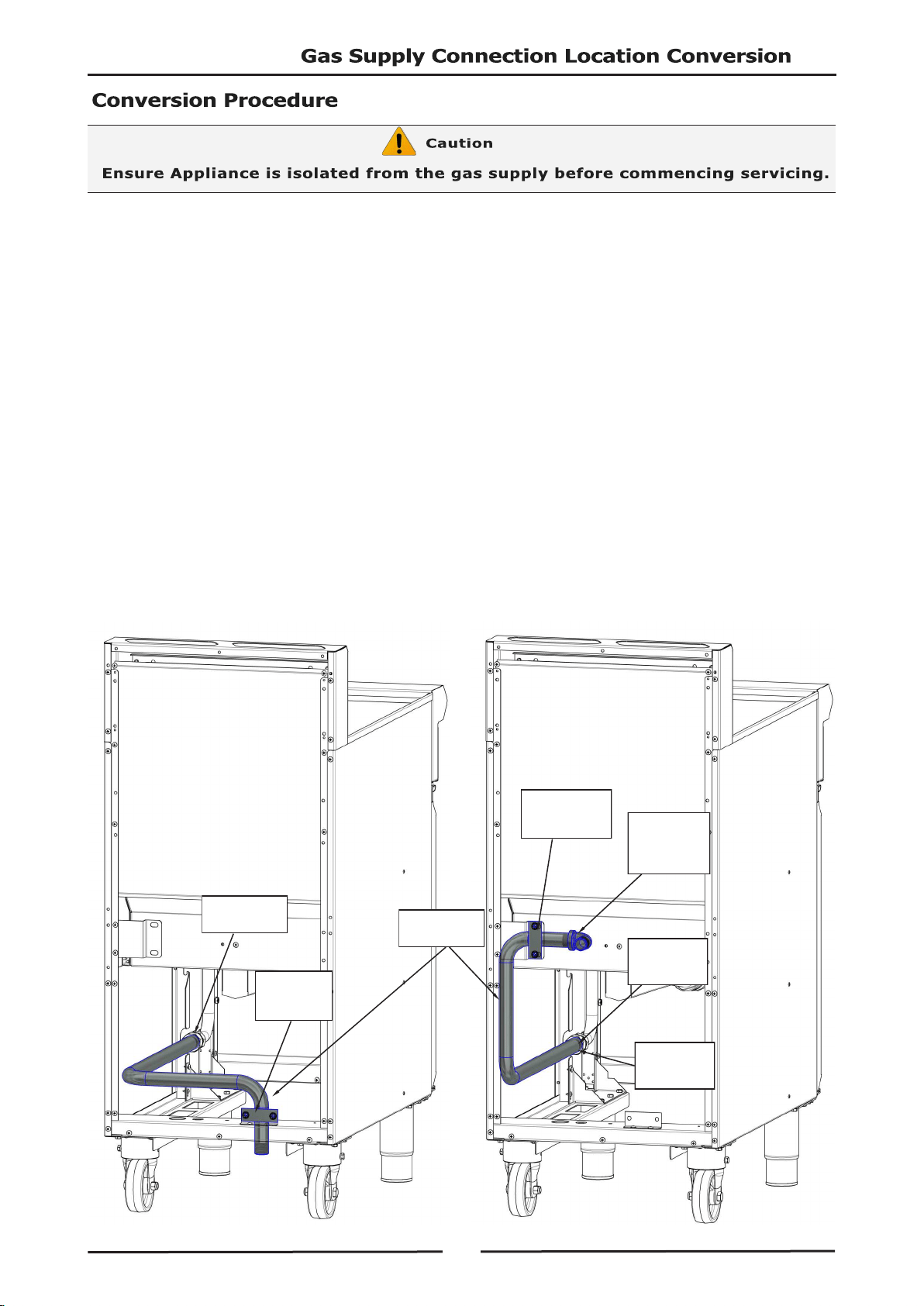
To convert the unit from Underside to Rear entry gas supply, perform the following steps:
1. Remove rear panel,
2. Unscrew universal joint,
3. Remove supply pipe fastening screws from lower mounting bracket,
4. Reposition supply pipe to align with upper mounting bracket,
5. Reconnect supply pipe at universal joint,
6. Fasten supply pipe to upper mounting bracket,
7. Retighten universal joint,
8. Attach the supplied 3/4” Male-Female galvanised elbow at the end of the supply pipe,
9. Replace rear panel.
To convert the unit from Rear to Underside entry gas supply, perform the above steps in reverse.
2. Unscrew
universal joint.
3. Remove
fasteners
from lower
bracket.
6. Fasten supply
pipe to upper
bracket for rear
supply.
8. Attach the
supplied 3/4”
Male-Female
galvanised
elbow.
4. Reposition
supply pipe.
5. Reconnect
supply pipe at
universal
joint.
7. Retighten
universal
joint.
32
NOTE:
These conversions should only be carried out by qualified persons. All connections
must be checked for leaks before re-commissioning the appliance.
Adjustment of components that have adjustments / settings sealed (e.g. paint sealed)
can only be adjusted in accordance with the following instructions and should be
re-sealed before re-commissioning this appliance.
For all relevant information and specifications refer to table at end of this section.
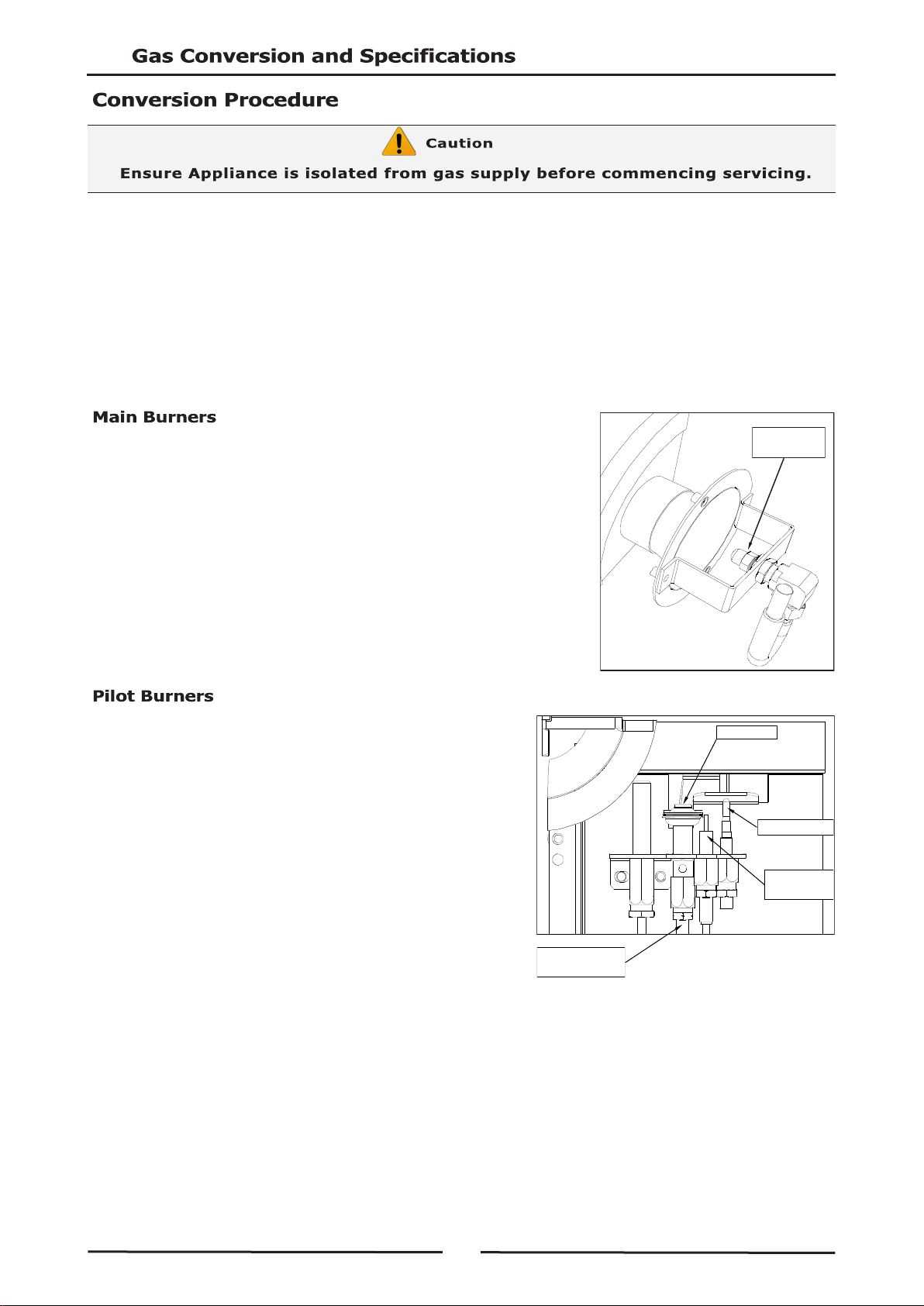
1. Remove main burner injectors and replace with correct
size injectors as shown in Gas Specifications table.
1. Remove the following:-
Gas supply tube to the pilot burner.
NOTE: Remove the piezo igniter electrode from
mounting bracket before unscrewing pilot supply
tube.
2. Remove pilot burner injector and replace with correct
size injector as shown in Gas Specifications Table
at rear of this section.
3. Refit the following:-
Gas supply tube to pilot burner.
Piezo igniter electrode.
Thermocouple
Piezo Igniter
Electrode
Pilot Burner
Main Burner
Injector
Pilot Burner Gas
Supply Tube
33
NOTE: For Twin Tank Fryers only, the units will be fitted with 2 gas control valves. These valves
operate independently of each other. Gas regulator and pilot adjustment will need to be
carried out separately for each gas valve.
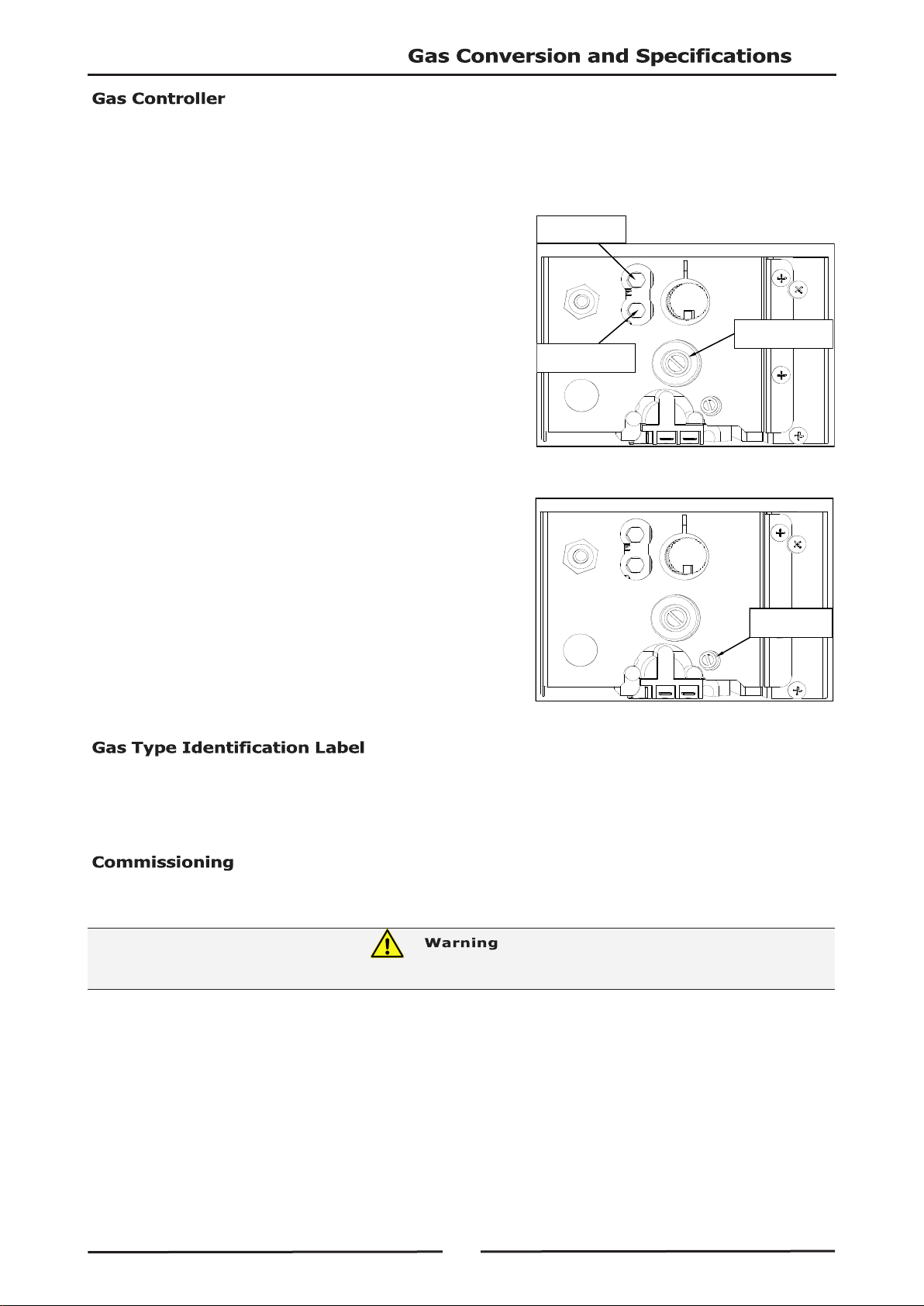
Main Burner Supply Pressure Check
a. Connect a manometer to the upper test point
(Supply Pressure) on the gas control valve.
Main Burner Operating Pressure Adjustment
a. Connect a manometer to the lower test point
(Operating Pressure) on the gas control
valve.
b. Remove slotted cap to reveal Operating
Pressure Adjusting Screw.
c. Light main burners and turn the operating
pressure adjusting screw to obtain correct burner
pressure for type of gas being used. Refer to Gas
Specifications Table at rear of this section.
d. Refit slotted cap to screw adjustment point.
Pilot Burner Flame Adjustment
a. Once main burner operating pressure has been
set, adjust pilot burner supply so that the
impingement of the pilot flame on the
thermocouple is correct and main burner pilot
flame ignites main burners satisfactorily.
b. Adjust pilot flame size by adjusting Pilot Burner
Adjusting Screw. Pilot burner flame should be
approximately 1" long for main burner ignition.
Anti-clockwise rotation of adjustment screw will
increase pilot flame size.
On completion of gas conversion, replace gas type identification label located at:-
- Rear of appliance, above gas connection point.
- Beside rating plate on inside of access door.
Before leaving the converted installation;
1. Check all gas connections for leakages using soapy water or other gas detecting equipment.
2. Carry out a Commissioning check of the appliance as shown in Installation Section of this manual.
3. Ensure any adjustments done to components that have adjustments / settings paint sealed,
components are to be re-sealed.
NOTE: If it is not possible to get appliance to operate correctly, shut ‘Off’ gas supply and contact
supplier of this appliance.
DO NOT USE A NAKED FLAME TO CHECK FOR GAS LEAKAGES.
Supply Pressure
Test Point
Operating Pressure
Test Point
Operating Pressure
Adjusting Screw
Pilot Burner
Adjusting Screw
34
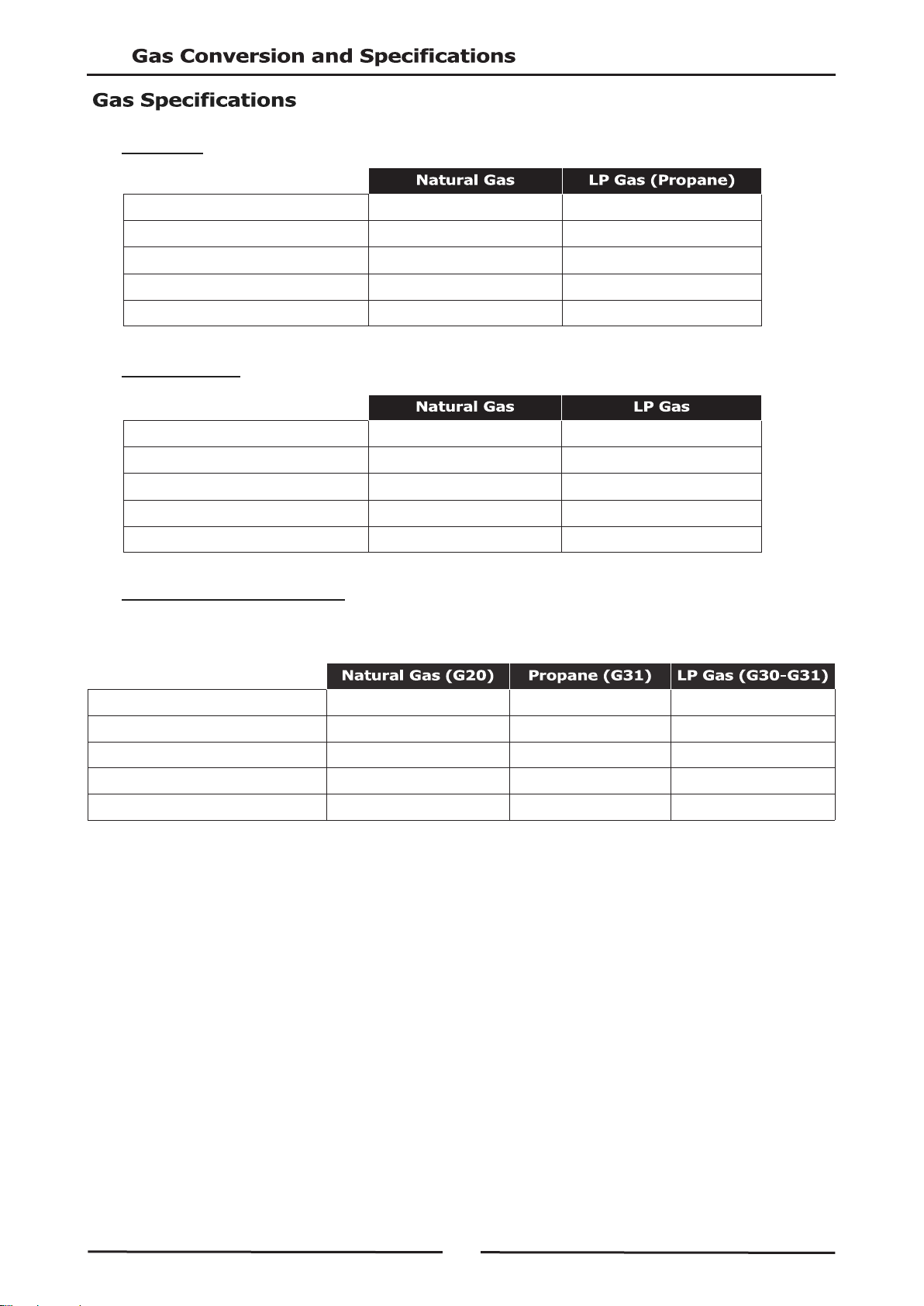
- Australia
- New Zealand:
- United Kingdom & EU (CE):
Category: II
2H3P
(20. 37), II
2H3B/P
.(20, 28-30).
Flue Type: A
1.
NOTE:
* Measure burner operating pressure at Operating Pressure Test Point (Lower - Out) on gas
control valve with both burners operating at 'High Flame' setting. Refer to ‘Gas Conversion
and Specification’ Section for further details.
Main Burner Injectors Ø 3.10mm Ø 1.90mm
Pilot Burner Injectors
0.62 0.35
Pilot Screw Adjustment Full Out (CCW) 1½ turns out (CCW)
Burner Operating Pressure (*) 0.98 kPa 2.50 kPa
Supply Pressure
1.13 - 2.0 kPa 2.75 - 3.0 kPa
Main Burner Injectors Ø 3.10mm Ø 1.80mm
Pilot Burner Injectors
0.62 0.35
Pilot Screw Adjustment Full Out (CCW) 1½ turns out (CCW)
Burner Operating Pressure (*) 0.98 kPa 2.50 kPa
Supply Pressure
1.13 - 2.0 kPa 2.75 - 3.0 kPa
Main Burner Injectors Ø 3.10mm Ø 1.90mm Ø 1.80mm
Pilot Burner Injectors 0.45 0.30 0.30
Pilot Screw Adjustment Full Out (CCW) 1½ turns out (CCW) 1½ turns out (CCW)
Burner Operating Pressure (*) 0.98 kPa 2.50 kPa 2.50 kPa
Supply Pressure
20 mbar 37 mbar 28 - 30 mbar
35
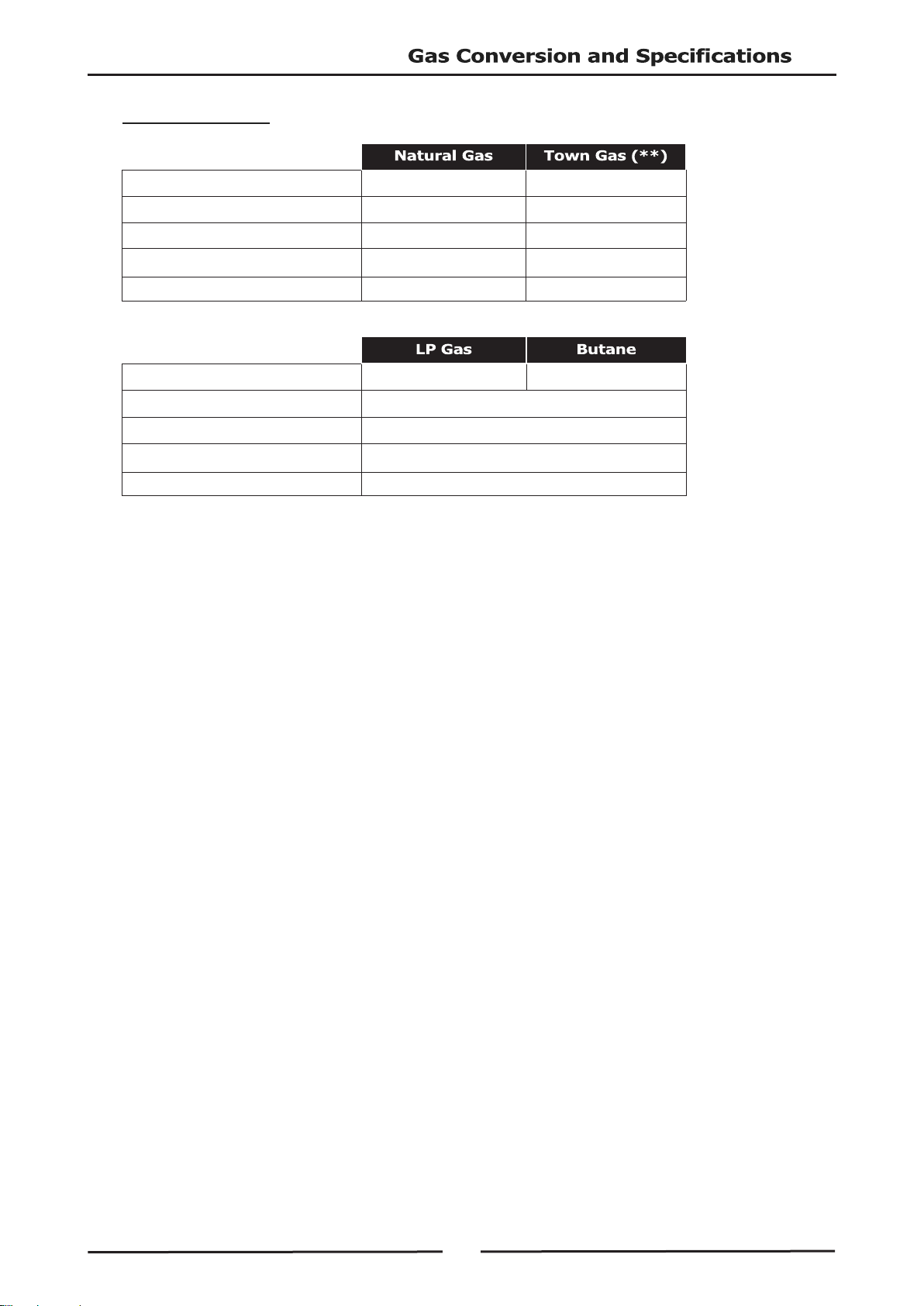
- All Other Markets
NOTE:
(*) Measure burner operating pressure at Operating Pressure Test Point (Lower -
Out) on gas control valve, with both burners operating at ‘High Flame’ setting.
(**) TOWN GAS Option is only available with specific ex-factory built Town Gas
Models, which can also be converted to any other gas. Standard models can only be
converted between Nat. Gas, LP Gas and Butane, but not Town Gas.
Refer to ‘Gas Conversion and Specifications’ in this manual for further details.
Main Burner Injectors
Ø 3.10mm Ø 6.30mm
Pilot Burner Injectors
0.62 0.75
Pilot Screw Adjustment Full Out (CCW) Full Out (CCW)
Burner Operating Pressure (*) 0.98 kPa 0.50 kPa
Supply Pressure 1.13 - 2.0 kPa 0.75 - 1.50 kPa
Main Burner Injectors
Ø 1.80mm Ø 1.70mm
Pilot Burner Injectors
0.35
Pilot Screw Adjustment 1½ turns out (CCW)
Burner Operating Pressure (*) 2.50 kPa
Supply Pressure 2.75 - 3.00 kPa
36
Replacement Parts List
When ordering spare parts, please quote part number and description as listed below. If part required is
not listed below, request part by description and quote model number and serial number which is shown on
rating plate.
Gas System
018094 Interrupted Thermocouple - Main Gas Valve.
227865 Thermocouple - Flame Failure Valve.
032190 Main Burner Injector (LPG) Ø 1.90mm.
032180 Main Burner Injector (LPG) - Ø 1.80mm.
032310 Main Burner Injector (Nat) Ø 3.10mm.
032170 Main Burner Injector (Butane) Ø 1.70mm.
032630 Main Burner Injector (Town Gas) Ø 6.30mm.
018090K Pilot Burner (Includes electrode) (Not UK).
025630K Pilot Burner (Includes electrode) (UK Only).
018091 Pilot Injector (Nat) 0.62.
018092 Pilot Injector (LPG / Butane) 0.35.
026393 Pilot Injector (Town Gas) 0.75.
018971 Pilot Injector (LPG UK) - 0.30.
018972 Pilot Injector (Nat Gas UK) - 0.45.
228617 Gas Control 24V.
229158 Gas Valve Cable / Plug 24V. (FN8120GE / FN8226GE Only).
229159 Gas Valve Cable / Plug 24V. (FN8130GE Only).
019237 Flame Failure Valve. (FN8120GE / FN8130GE Only).
018095 Piezo H.T. Lead.
020119 Piezo Ignitor.
022575 Burner Kit.
242757K Overtemperature Thermostat Kit 2019.
Electrical System
020117 Temperature Probe.
228660 Transformer 24Vac.
020109 Fuse 2 Amp.
229033 Fuse Holder.
228707 Digital Controller.
230101 Controller Overlay (3 basket / timer).
025948 Terminal Block - 6 Way.
025951 Terminal Block - 3 way.
General
018019 Basket.
227856 Door Magnet.
227451 Door Handle. (FN8120GE / FN8226GE).
227460 Door Handle. (FN8130GE).
236795 Drain Valve.
018147 Drain Extension.
018176 Drain Stick.
228576 Basket Tray. (FN8120GE).
228577 Basket Tray. (FN8226GE).
228578 Basket Tray. (FN8130GE).
228419 Lid. (FN8120GE / FN8226GE).
228575 Lid. (FN8130GE).
229674 Rear Roller Assy.
227850 Leg Adjustable (150mm) (Flush Stud).
IMPORTANT:
37
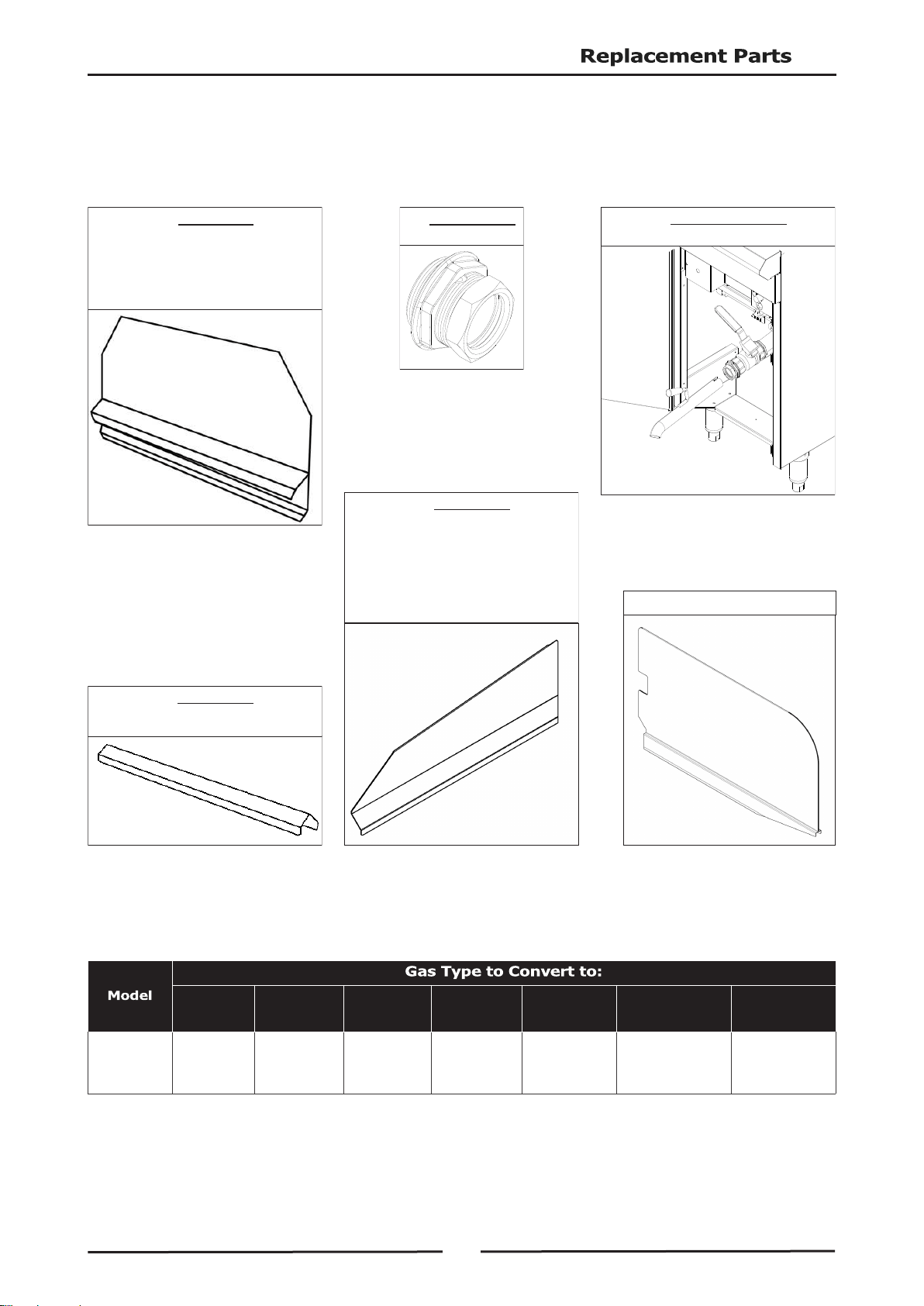
Accessories
228793 450mm (Fryer) Plinth Kit.
228794 600mm (Fryer) Plinth Kit.
Gas Conversion Kits
NOTE: (*) Town Gas Option is only available with specific ex-factory built Town Gas models, which
can also be converted to any other gas. Standard models can only be converted between
Nat. Gas, LP Gas and Butane, but not Town Gas.
Drain Extension Kit
(Part No. 024710).
Joining Strip
Fryer to Fryer.
(Part No. 228600).
Drain Adaptor
(Part No.
Splashguard
Fryer
To Cooktop Open Burners.
To Target Top.
To Cooktop Electric.
LH (Part No. 228898).
RH (Part No. 228899).
Splashguard
Fryer
To Cooktop Griddle.
To Chargrill.
To Griddle.
To Griddle Toaster.
To Cooktop Electric Griddle.
LH (Part No. 228894).
RH (Part No. 228895).
Tank Divider (Part No. 243638).
Nat. Gas
(AU/NZ/
Export)
Nat. Gas
(UK)
LP Gas
(Propane)
(AU)
LP Gas
(NZ, Export)
LP Gas
(Propane)
(UK)
Butane Town Gas
FN8120GE
FN8226GE
FN8130GE
231963 231967 231962 244510 231966 231964 N/A (*)