
SIRONA S
Owner’s Manual - Keep for future use.
Manual del propietario – Guarde para uso futuro.
EnglishEspañol
WARNING: To reduce the risk of death or serious injury,
read this owner’s manual prior to installing and using this child restraint.
ADVERTENCIA : Para reducir el riesgo de muerte o lesiones graves,
lea este manual del propietario antes de instalar y usar este sistema de sujeción infantil.

2
Welcome to the CYBEX family.
Thank you for purchasing the CYBEX SIRONA S. We are proud to bring this German-engineered product to the
United States and Canada. We hope the SIRONA S will make your child’s travel both safer and more pleasant,
as well as make installation and use for you as simple as possible.
The SIRONA S brings a few important safety innovations to the convertible car seat category.
Load Leg
The adjustable Load Leg helps minimize crash forces on your child in a frontal crash. It allows the child
restraint’s safety systems to absorb and transfer crash forces more eectively by directing some of them to the
vehicle floor. The Load Leg can be used both REARFACING and FORWARD-FACING!
CYBEX Rotating Base
The Rotating Base makes it easy to safely load and unload your child. When you are done, you can easily move to
REARFACING or FORWARD-FACING mode and choose a recline position without ever reinstalling the car
seat!
CYBEX Linear Side-Impact Protection (L.S.P.) System
The L.S.P. System allows the forces from a side impact collision to be reduced gradually to help minimize
injuries. An adjustable headrest, deep side wings lined with thick energy absorbing EPP foam, and an
adjustable side-impact device create the CYBEX L.S.P. system. This system has been optimized to protect and
reduce forces on your child in the event of certain side impact crashes.
WELCOME TO CYBEX!

3
English
Statistics show that over 75% of car seats are being used incorrectly! Please read and follow these
instructions carefully to install the SIRONA S correctly, even if the installation and use of this Child Restraint
might seem simple and intuitive.
Before the first use of the SIRONA S Child Restraint, please make sure you have followed all the steps in the
Safety Checklist on page 119.
Following the American Academy of Pediatrics' recommendations for safe transportation of children, we
recommend children remain in a REARFACING car safety seat as long as possible, until they reach the
highest weight or height allowed by their seat. Visit www.aap.org for more information on the Academy's
recommendation.
No car seat can guarantee protection from injury in every situation, but proper use helps reduce the risk of
death or serious injury. If you have any questions or need assistance, please contact CYBEX at
1-877-242-5676.
Also, please remember to register your Child Restraint so we can contact you in the unlikely event of a recall.
Register online at: http://register.cybex-online.com/us/carseats
Keep this Owner’s Manual for future reference by storing it in the compartment on the back of the SIRONA S
Child Restraint. We appreciate your purchase and invite you to visit www.cybex-online.com to see other great
CYBEX products.
WELCOME TO CYBEX!

4
REGISTRATION AND RECALL INFORMATION ..........................................................................................................6
CHILD USAGE GUIDELINES ......................................................................................................................................8
OVERVIEW OF THE SIRONA S CHILD RESTRAINT ..................................................................................................12
WARNINGS ..............................................................................................................................................................16
CHILD RESTRAINT FEATURES ................................................................................................................................34
LOWER ANCHORS AND TETHERS FOR CHILDREN (LATCH) ..........................................................................34
ROTATING BASE .............................................................................................................................................. 38
LINEAR SIDE-IMPACT PROTECTION SYSTEM (L.S.P.) .....................................................................................40
LOAD LEG ........................................................................................................................................................42
OVERHANG INDICATOR .................................................................................................................................. 46
ADJUSTABLE CROTCH STRAP ........................................................................................................................ 47
HEIGHT-ADJUSTABLE HEADREST ..................................................................................................................48
CUP HOLDER ..................................................................................................................................................49
NEWBORN INSERT ..........................................................................................................................................50
NEWBORN HEADPAD INSERT ......................................................................................................................... 50
TETHER STRAP .................................................................................................................................................51
HARNESS COVERS ...........................................................................................................................................51
SENSORSAFE
®
TECHNOLOGY ........................................................................................................................52
READ OWNER'S MANUAL PRIOR TO INSTALLING AND USING THIS CHILD RESTRAINT.
KEEP INSTRUCTIONS FOR FUTURE USE.
TABLE OF CONTENTS
IF THESE INSTRUCTIONS ARE NOT FOLLOWED,
THE SAFETY OF A CHILD MAY BE SEVERELY ENDANGERED.

5
English
READ OWNER'S MANUAL PRIOR TO INSTALLING AND USING THIS CHILD RESTRAINT.
KEEP INSTRUCTIONS FOR FUTURE USE.
TABLE OF CONTENTS
INSTALLING AND REMOVING CHILD RESTRAINT (REAR-FACING AND FORWARD-FACING) ..............................53
INSTALLING CHILD RESTRAINT WITH LATCH .................................................................................................53
REMOVING CHILD RESTRAINT WITH LATCH .................................................................................................. 63
INSTALLING CHILD RESTRAINT WITH LAP/SHOULDER BELT (PREFERRED METHOD) ..................................65
REMOVING CHILD RESTRAINT WITH LAP/SHOULDER BELT .......................................................................... 76
INSTALLING CHILD RESTRAINT WITH LAP BELT ............................................................................................ 78
REMOVING CHILD RESTRAINT WITH LAP BELT .............................................................................................89
SECURING CHILD WITH HARNESS .........................................................................................................................91
CARE AND CLEANING ............................................................................................................................................99
GENERAL INFORMATION ABOUT SENSORSAFE
®
................................................................................................. 111
USING SENSORSAFE
®
.......................................................................................................................................... 115
SAFETY CHECKLIST .............................................................................................................................................. 119
RESOURCES ......................................................................................................................................................... 120
WARRANTY ........................................................................................................................................................... 122
IF THESE INSTRUCTIONS ARE NOT FOLLOWED,
THE SAFETY OF A CHILD MAY BE SEVERELY ENDANGERED.

6
Please complete the registration card that came with your child restraint and mail it in immediately or
register online.
Child restraints could be recalled for safety reasons. You must register this restraint to be reached in a recall.
Send your name, address, e-mail address if available, and the restraint’s model number and manufacturing
date to:
Columbus Trading-Partners USA Inc.
Attn: ParentLink
1801 Commerce Drive
Piqua, Ohio 45356, USA
or call 1-877-242-5676 or register online at
http://register.cybex-online.com/us/carseats
For recall information, call the U.S. Government’s Vehicle Safety Hotline at: 1-888-327-4236
(TTY: 1-800-424-9153), or go to www.NHTSA.gov.
REGISTERING YOUR CHILD RESTRAINT
REGISTRATION AND RECALL INFORMATION
7
English
CERTIFICATION
REGISTRATION AND RECALL INFORMATION
Regulatory Notice: This child restraint system
meets all applicable requirements of Federal Motor
Vehicle Safety Standard (FMVSS) 213.
This restraint is certified for use only in passenger
and multi-purpose passenger motor vehicles,
buses, and trucks equipped with lap/shoulder belt
systems.
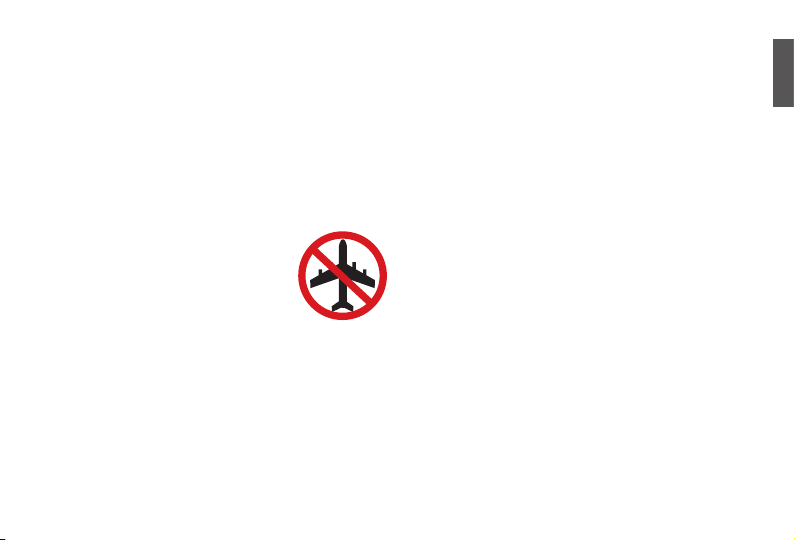
THIS RESTRAINT IS NOT CERTIFIED
FOR AIRCRAFT USE.
8
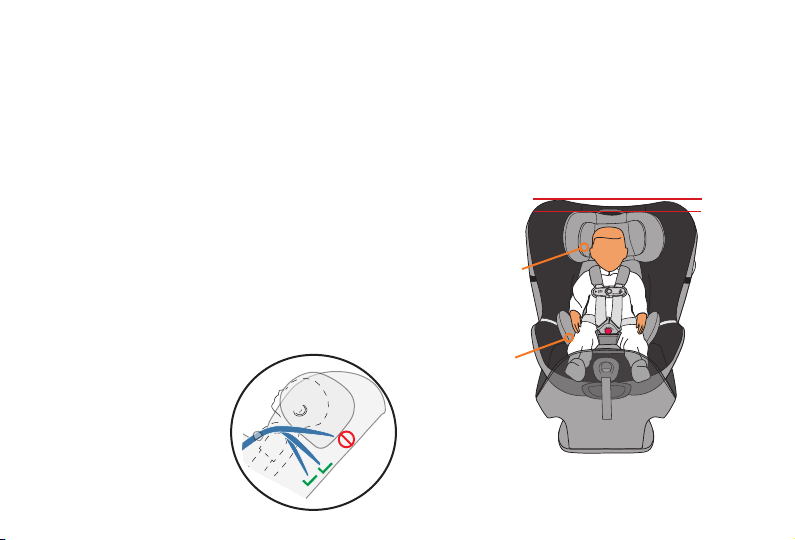
REAR-FACING MODE
REAR-FACING use of this child restraint is ONLY for children who meet ALL of the requirements
shown here. If the child is not within these requirements because they are too small, select a
dierent child seat (such as a rear-facing only infant car seat).
If the child is NOT within these requirements because the child is too large, review the FORWARD-
FACING guidelines to determine if this Child Restraint may be used.
OPTIONAL USE: To ensure a better fit for smaller
infants, the Newborn Insert and/or Newborn
Headpad Insert may be needed (see pg. 50).
CHILD USAGE GUIDELINES
Newborn
Insert
Newborn
Headpad
Insert
Top of Headrest
Top of Shell
REAR-FACING USE:
YOUR CHILD MUST MEET ALL THE REQUIREMENTS
LISTED:
WEIGHT: 1.8 22.6 KG 4 50 LBS
HEIGHT: 43.2 124.5 CM 17 49 IN
CHILD’S HEAD MUST BE 2.5 CM 1 IN OR MORE
BELOW THE TOP OF THE HEADREST OR SHELL,
WHICHEVER IS HIGHER.
• Harness straps must be
adjusted to be AT or JUST
BELOW child’s shoulders.

9
English
F
O
R
W
A
R
D
-
F
A
C
I
N
G
R
E
A
R
-
F
A
C
I
N
G
B
e
a
d
m
u
s
t
b
e
l
o
c
a
t
e
d
w
i
t
h
i
n
a
p
p
r
o
p
r
i
a
t
e
z
o
n
e
.
V
e
h
i
c
l
e
M
U
S
T
b
e
o
n
l
e
v
e
l
g
r
o
u
n
d
.
CY_171_6052_B1019
F
O
R
W
A
R
D
-
F
A
C
I
N
G
R
E
A
R
-
F
A
C
I
N
G
B
e
a
d
m
u
s
t
b
e
l
o
c
a
t
e
d
w
i
t
h
i
n
a
p
p
r
o
p
r
i
a
t
e
z
o
n
e
.
V
e
h
i
c
l
e
M
U
S
T
b
e
o
n
l
e
v
e
l
g
r
o
u
n
d
.
CY_171_6052_B1019
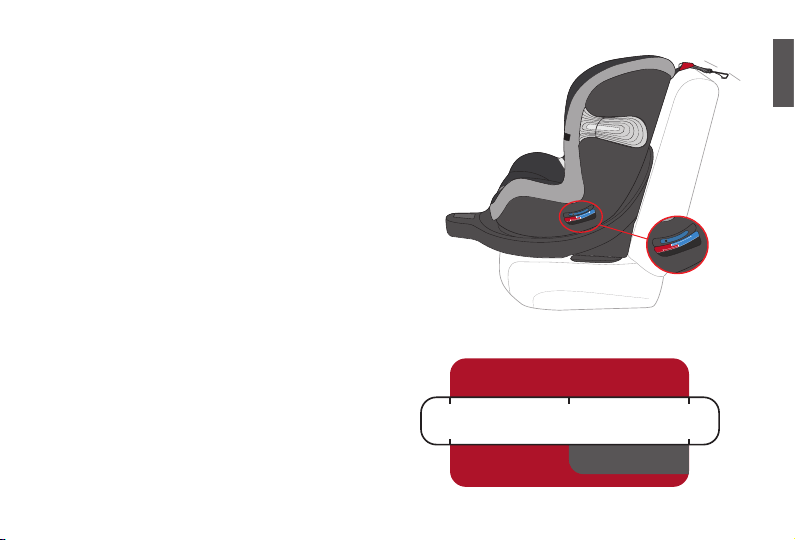
REAR-FACING MODE
When used REAR-FACING, make sure the
Recline Ball is in the BLUE range as shown.
DO NOT use LATCH in REAR-FACING mode if
child weighs more than 13.6 kg (30 lbs).
REAR-FACING
(4 lbs)
1.8 kg
(50 lbs)
22.6 kg
NO LATCH
(30 lbs)
13.6 kg
CHILD USAGE GUIDELINES

10
FORWARD-FACING USE:
YOUR CHILD MUST MEET ALL THE REQUIREMENTS
LISTED:
WEIGHT: 10 29.4 KG 22 65 LBS
HEIGHT: 71.1 124.5 CM 28 49 IN
• Top of ears below the top of the
Headrest.
AGE: at least 1 year old
• Harness straps must be adjusted to be
AT or JUST ABOVE child’s shoulders.
The American Academy of Pediatrics recommends children should ride REARFACING for as long as
possible until they reach maximum height and weight for their seat.
FORWARD-FACING use of this child restraint is ONLY for children who meet ALL of the
requirements shown here. If the child is not within these requirements because they are too large,
select a dierent child seat (such as a booster seat).
If the child is NOT within these requirements because the child is too small, review the REAR
FACING guidelines to determine if this Child Restraint may be used.
FORWARD-FACING MODE
CHILD USAGE GUIDELINES
11
English
FORWARD-FACING MODE
When used FORWARD-FACING, make sure
the Recline Ball is in the RED range as shown.
DO NOT use LATCH in FORWARD-FACING
mode if child weighs more than 15.9 kg (35 lbs).
F
O
R
W
A
R
D
-
F
A
C
I
N
G
R
E
A
R
-
F
A
C
I
N
G
B
e
a
d
m
u
s
t
b
e
l
o
c
a
t
e
d
w
i
t
h
i
n
a
p
p
r
o
p
r
i
a
t
e
z
o
n
e
.
V
e
h
i
c
l
e
M
U
S
T
b
e
o
n
l
e
v
e
l
g
r
o
u
n
d
.
CY_171_6052_B1019
F
O
R
W
A
R
D
-
F
A
C
I
N
G
R
E
A
R
-
F
A
C
I
N
G
B
e
a
d
m
u
s
t
b
e
l
o
c
a
t
e
d
w
i
t
h
i
n
a
p
p
r
o
p
r
i
a
t
e
z
o
n
e
.
V
e
h
i
c
l
e
M
U
S
T
b
e
o
n
l
e
v
e
l
g
r
o
u
n
d
.
CY_171_6052_B1019
CHILD USAGE GUIDELINES
FORWARD-FACING
NO LATCH
(22 lbs)
10 kg
(35 lbs)
15.9 kg
(65 lbs)
29.4 kg

12
A
R
M
P
I
T
L
E
V
E
L
OVERVIEW OF THE SIRONA S CHILD RESTRAINT
FRONT VIEW
Headrest
Newborn Headpad Insert
Seat Cover
Shoulder Pads
SensorSafe Chest Clip
Harness Straps
Harness Buckle
Newborn Insert
Crotch Strap
Buckle Pad
Harness Adjustment Button
Harness Adjustment Strap

13
English
A
R
M
P
I
T
L
E
V
E
L
OVERVIEW OF THE SIRONA S CHILD RESTRAINT
Headrest Height Adjustment Handle
L.S.P. Device (Extended)
Magnetic Buckle Tongue Holders
Level Indicator (see page 15)
Cup Holder
Recline Adjustment Handle
Load Leg (Extended)
Load Leg Adjustment Button
Rotation Lock Indicator
Load Leg Lock Indicator (upper)
Load Leg Lock Indicator (lower)
Overhang Indicator

14
OVERVIEW OF THE SIRONA S CHILD RESTRAINT
l
SIRONA S
Owner‘s Manual - Keep for future use.
To reduce the risk of serious injury or
death, read this owner’s manual prior to
installing and using this child restraint.
Para reducir el riesgo de lesiones graves o
muerte, lea este manual del usuario antes de
instalar y usar el asiento infantil para el automóvil.
Manual del Propietario - Guarde para uso futuro.
WARNING
ADVERTENCIA
ENES
REAR VIEW
Owner's Manual
(Inside
Compartment)
L.S.P. Device (Stored)
Tether Strap (Stored)
Tether Storage Compartment
Belt Path & Belt Tensioner
(see pg. 15)
LATCH Strap
LATCH Strap Release
Loop
LATCH Connector
LATCH Adjuster

15
English
OVERVIEW OF THE SIRONA S CHILD RESTRAINT
SIRONA S
Owner‘s Manual - Keep for future use.
To reduce the risk of serious injury or
death, read this owner’s manual prior to
installing and using this child res traint.
Para reducir el riesgo de lesiones graves o
muerte, lea este manual del usuario an tes de
instalar y usar el asiento infantil p ara el automóvil .
Manual del Propietario - Guarde para u so futuro.
WARNING
ADVERTENCIA
EN
ES
Tether Hook
Tether Adjuster
Tether Strap
TETHER STRAP
(SHOWN UNSTORED)
BELT PATH & BELT TENSIONER
Belt Tensioner
Belt Path
Belt Path Cover
EasyLock (Extended)
LEVEL INDICATOR
F
O
R
W
A
R
D
-
F
A
C
I
N
G
R
E
A
R
-
F
A
C
I
N
G
B
e
a
d
m
u
s
t
b
e
l
o
c
a
t
e
d
w
i
t
h
i
n
a
p
p
r
o
p
r
i
a
t
e
z
o
n
e
.
V
e
h
i
c
l
e
M
U
S
T
b
e
o
n
l
e
v
e
l
g
r
o
u
n
d
.
CY_171_6052_B1019
F
O
R
W
A
R
D
-
F
A
C
I
N
G
R
E
A
R
-
F
A
C
I
N
G
B
e
a
d
m
u
s
t
b
e
l
o
c
a
t
e
d
w
i
t
h
i
n
a
p
p
r
o
p
r
i
a
t
e
z
o
n
e
.
V
e
h
i
c
l
e
M
U
S
T
b
e
o
n
l
e
v
e
l
g
r
o
u
n
d
.
CY_171_6052_B1019

16
AIRBAG WARNING
• DO NOT use this restraint in the front seat of a vehicle equipped with an air bag. Interaction
between a rear facing restraint and air bags may cause death or serious injury. If your vehicle has
an air bag, refer to the vehicle owner’s manual for child restraint installation.
WARNING! DEATH or SERIOUS INJURY can occur
!

17
English
• If the rear seat of your vehicle is equipped with side air bags, refer to the following information
for proper usage.
• Vehicles built prior to the 2002 model year:
DO NOT use this restraint in a vehicle seating position equipped with a side air bag unless
authorized by the vehicle manufacturer.
• Model year 2002 and newer vehicles:
Refer to your vehicle owner’s manual before placing this restraint in a seating position equipped
with a side air bag.
• DO NOT place any objects between the restraint and the side air bag, as an expanding air bag
may cause the items to strike your child.
WARNING! DEATH or SERIOUS INJURY can occur
!
The SensorSafe mobile app (see page 52) can provide information, images, and/or
installation videos.
TIP

18
GENERAL WARNINGS
The primary protection for occupants of a vehicle in a collision is the structure of the vehicle itself.
Correctly used per the instruction and labeling, this child restraint will substantially improve the
chances for survival in most crashes.
• READ this Owner’s Manual carefully before first use and keep it for future reference.
• FOLLOW ALL INSTRUCTIONS on this child restraint and in the written instructions stored in the
compartment on the back of the child restraint.
• NEVER install or use this child restraint until you have read and understand the instructions in
this manual, your vehicle Owner's Manual, and the labels on your child restraint. If there is a
conflict between this manual and the vehicle Owner's Manual, the vehicle Owner’s Manual must
be followed. Failure to follow these instructions can result in death or serious injury to your child
in a crash.
• DO NOT allow others to install or use this child restraint unless they understand how to correctly
install and use it.
• DO NOT use a used child restraint with an unknown history.
• NEVER USECHILD RESTRAINT IF IT HAS DAMAGED, BROKEN OR MISSING PARTS.
WARNING! DEATH or SERIOUS INJURY can occur
!

19
English
WARNING! DEATH or SERIOUS INJURY can occur
!
• ALWAYS REPLACE THE CHILD RESTRAINT AFTER A CRASH OF ANY KIND, EVEN IF IT WAS
UNOCCUPIED. A crash can cause unseen damage to the child restraint that may not be visible.
• NEVER allow someone else to use this child restraint without also passing along this manual to
them.
• ALWAYS check buckles and other parts for hot surfaces before placing your child in the child
restraint. A hot surface could burn your child! Cover an unoccupied child restraint with a blanket
when leaving it in a vehicle exposed to sunlight.
• NEVER leave an empty child restraint unsecured in your vehicle. This restraint must always be
secured, even when not occupied. An unsecured child restraint could injure vehicle occupants in
a sudden stop or crash.
• DO NOT attempt to make repairs to or otherwise modify or tamper with this child restraint.
• This product contains magnets, which may present a swallowing hazard. Seek immediate
medical attention if magnet(s) are swallowed or inhaled. Before use, consult your family
doctor about the compatibility of this product with pacemakers and similar devices.
GENERAL WARNINGS

20
LOCATION WARNINGS
• ACCORDING TO ACCIDENT STATISTICS, children are safer when properly restrained in rear
vehicle seating positions.
• ONLY place this child restraint in a vehicle seating location allowed by the vehicle manufacturer.
To determine allowable seating positions, refer to your vehicle Owner’s Manual for information
about vehicle seat belt systems, air bags, side air bags, front passenger side air bags and child
restraint installations.
• Not every location within a vehicle may be safe for the installation of this child restraint. In fact,
some vehicles have no seating position that is safe for the installation of this child restraint.
Improper placement of this child restraint within a vehicle will increase the risk of death or
serious injury.
• NEVER use this child restraint in a vehicle seating position where it cannot be secured tightly. A
loosely installed child restraint will not protect your child in a crash.
• NEVER LEAVE a vehicle seat back with a folding mechanism unlocked. In the event of a sudden
stop, an unlocked vehicle seat back could prevent this child restraint from protecting your child.
• ONLY use this child restraint on vehicle seats with backs that lock into place.
• NEVER use this child restraint on boats, low speed vehicles (LSV), all-terrain vehicles (ATV), golf
carts, or any other non-certified application.
WARNING! DEATH or SERIOUS INJURY can occur
!

21
English
WARNING! DEATH or SERIOUS INJURY can occur
!
LOCATION WARNINGS
• This child restraint is allowed to touch the vehicle seat in front of it as long as the recline angle of
the child restraint is not aected.
• ALWAYS use a Linear Side-impact Protection (L.S.P.) device on the side of the child restraint
immediately adjacent to a vehicle door or panel (pages 40-41).
• NEVER extend an L.S.P. device toward a passenger or another child restraint.
• ONLY use this child restraint on forward-facing vehicle seats.
• NEVER install this child restraint in vehicle seats that face the rear or side of the vehicle.
• VEHICLE TYPES WHERE THE RESTRAINT SYSTEM CAN NOT BE USED:
This child restraint is NOT to be used in vehicles that do not have vehicle seat belts or lower
anchors (see pages 30-32).

22
REAR-FACING
WARNINGS
• When using this restraint REARFACING, DO NOT loosen the vehicle seat belt to provide more
leg room, as this may keep the child restraint from protecting the child.
• Fold-down armrests could pose a hazard to a REARFACING child in certain types of collisions.
Consult your vehicle owner’s manual before installing any REARFACING child restraint in front
of a fold-down armrest.
• NEVER turn a child restraint FORWARD-FACING with a child who weighs less than 10 kg (22
lbs), is less than 71.1 cm (28 in) tall, or is less than 1 year old. Crash forces may cause death or
serious injury.
• DO NOT use the Tether Strap when the child restraint is in the REARFACING position.
• The Headrest on the vehicle seat that the child faces when sitting in the REARFACING mode
should be placed in the lowest position. The vehicle seat back that the child faces must be fully
padded and free of any hard objects.
• IMPORTANT: Infants may have diculty breathing when in an upright seated position. Make
sure they recline enough for their head to lie back comfortably and safely. Failure to properly
recline the child restraint could increase the child’s risk of death or serious injury.
• SOME CHILDREN WITH SPECIAL NEEDS, such as preemies or those who have tested positive
for positional apnea, may be at increased risk of suering breathing or other diculties in a child
restraint. Please consult a physician to determine what type of child restraint should be used.
• DO NOT USE this child restraint if the top of your child‘s head is less than 2.5 cm (1 in) from the
top of the Headrest or Shell, whichever is higher, when used REARFACING.
WARNING! DEATH or SERIOUS INJURY can occur
!
23
English
WARNING! DEATH or SERIOUS INJURY can occur
!
FORWARD-FACING WARNINGS
• DO NOT USE this Child Restraint FORWARD-FACING if your child is less than 1 year old.
• DO NOT USE this Child Restraint if:
- your child weighs more than 29.4 kg (65 lbs)
- your child is more than 124.5 cm (49 in) tall
- the harness straps cannot be adjusted AT or JUST ABOVE the child's shoulders
- the tops of the child’s ears are above the top of the Headrest.
If any of these conditions exist, YOUR CHILD HAS OUTGROWN THE SEAT.
• If possible, adjust or remove the vehicle Headrest in the seat where the child restraint is to be
installed, so that the back of the child restraint rests against the vehicle seat back.
• The Headrest on the vehicle seat in front of the child should be put in its lowest position. The
vehicle seat back that the child faces must be fully padded and free of any hard objects.
CHILD FIT
WARNINGS
• ALWAYS check the harness buckle to make sure it is securely latched.
• SNUGLY ADJUST the belts provided with this child restraint around your child.
• ALWAYS keep your child properly secured in the harness. A snug strap should not allow any
slack. It lies in a relatively straight line without sagging. It does not press on the child’s flesh or
push the child’s body into an unnatural position.
• NEVER use bulky clothing or blankets that will interfere with properly positioning or tightening
the harness.
WARNING! DEATH or SERIOUS INJURY can occur
!
24
ADDITIONAL WARNINGS
• REGISTER your child restraint with the manufacturer. This is the best way to reach you in the
event of a recall.
• NEVER use this child restraint when it is older than ten (10) years. The date of manufacture can
be found on a label axed to the bottom of the child restraint.
• WHEN NOT IN USE, securely store the LATCH Connectors.
• NEVER use this child restraint if any of the Harness or LATCH straps are cut, frayed, or damaged
in any way.
• NEVER leave child unattended.
• Children have STRANGLED in loose or partially buckled harness straps. Fully restrain the child.
• DO NOT allow children to play with this child restraint.
• DO NOT allow children to play with vehicle seat belts. A child within reach of a seat belt may
become entangled if he or she pulls the seat belt all the way out and wraps the belt around his
or her head, neck, or waist.
WARNING! DEATH or SERIOUS INJURY can occur
!
25
English
WARNING! DEATH or SERIOUS INJURY can occur
!
ADDITIONAL WARNINGS
• NEVER use accessories or parts with this child restraint other than those approved by CYBEX.
Use of accessories or parts from other manufacturers could alter the performance of the child
restraint.
• DO NOT leave loose objects (e.g. groceries, books, bags) in a vehicle. In the event of a sudden
stop, loose objects will keep moving, potentially causing serious injuries.
• NEVER tend to your child’s needs while driving. ALWAYS safely stop your vehicle in order to
tend to your child.
• NEVER take your child out of the child restraint while the vehicle is moving. Unrestrained
occupants are at a greatly increased risk of death or serious injury in a car crash.
• DO NOT place any cups that contain hot liquids in the cup holder.
• DO NOT use the cup holders to store cans or hard cups. Only for use with soft cups (such as
foam or paper).
26
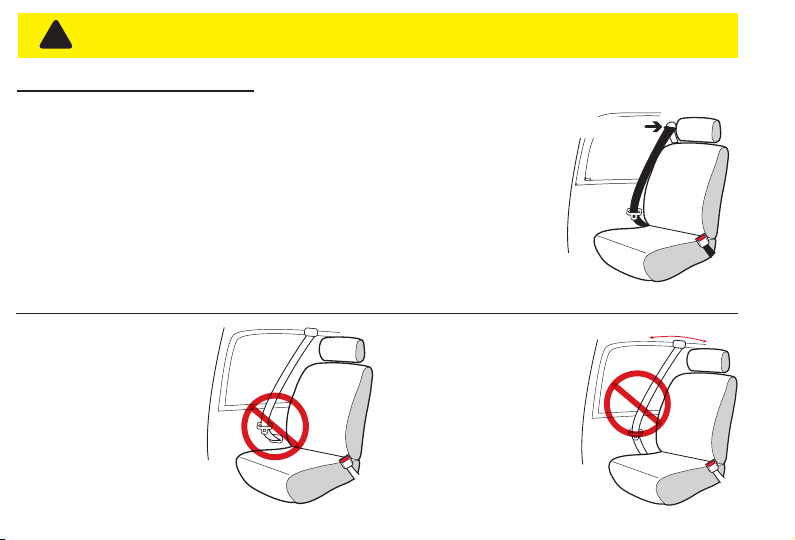
SEAT BELT WARNINGS
• ALWAYS read your vehicle owner's manual to determine what
vehicle belts and retractors are used in your vehicle. The vehicle
belt MUST lock and MUST NOT loosen after the seat belt is
tightened.
• DO NOT use this Child Restraint if it moves more than 2.5 cm
(1 in) side to side or front to back at the Belt Path on the Child
Restraint when pulled with moderate force. Death or serious
injury can occur from poor installation. If you cannot tightly secure
the Child Restraint, try again or move it to another location.
Retractor
• DO NOT use this child
restraint in a vehicle
with seat belts that
automatically move
along the vehicle
frame when the
door is opened.
• DO NOT use this child
restraint in a seating
position with
door-mounted seat
belts.
WARNING! DEATH or SERIOUS INJURY can occur
!

27
English
WARNING! DEATH or SERIOUS INJURY can occur
!
• DO NOT use this child restraint in a vehicle equipped
with lap belts that only lock during a sudden stop or
crash (emergency locking retractor – ELR). You must use
a seating location with a locking seat belt. Check your
vehicle owner’s manual to see if you have lap belts with
ELRs.
SEAT BELT WARNINGS
• DO NOT use on vehicle seats when both portions of the
vehicle belts are positioned forward of the seat crease.

28
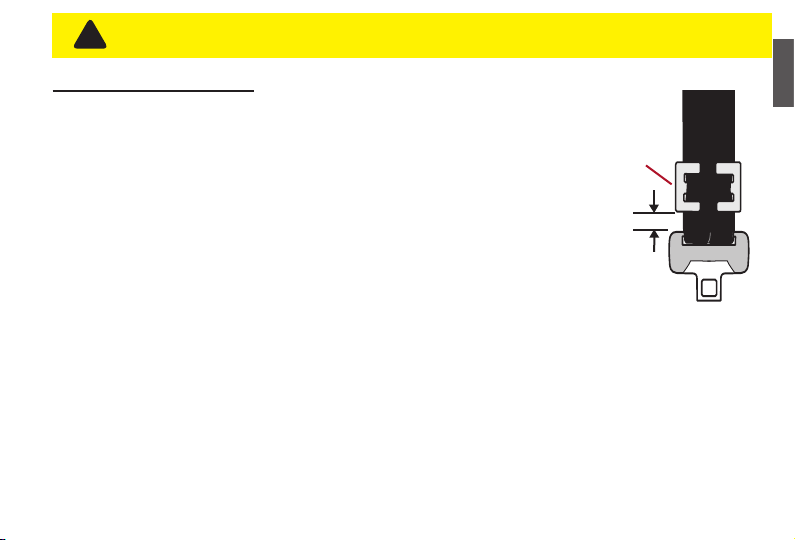
• DO NOT use with lap/shoulder belts with two retractors. If the vehicle
seat belts are not routed and fastened correctly, the child restraint may
not protect the child in a crash.
• DO NOT use with inflatable seat belts.
• Check your vehicle owner’s manual to determine how to lock your
seat belt for child restraint installation. The seat belt must be locked to
properly secure the child restraint.
• DO NOT allow the vehicle seat belt release button to touch the child
restraint. Accidental contact may cause the seat belt to release. If necessary, turn the seat belt
release button away from the child restraint or move the child restraint to a dierent location.
• Failure to adjust the harness or vehicle seat belts snugly around the child may result in the child
striking the vehicle’s interior during a sudden stop or crash. Death or serious injury can occur.
• Child restraint systems should be securely belted to the vehicle, even when they are not
occupied, since in a crash an unsecured child restraint system may injure other occupants.
SEAT BELT WARNINGS
WARNING! DEATH or SERIOUS INJURY can occur
!
29
English
WARNING! DEATH or SERIOUS INJURY can occur
!
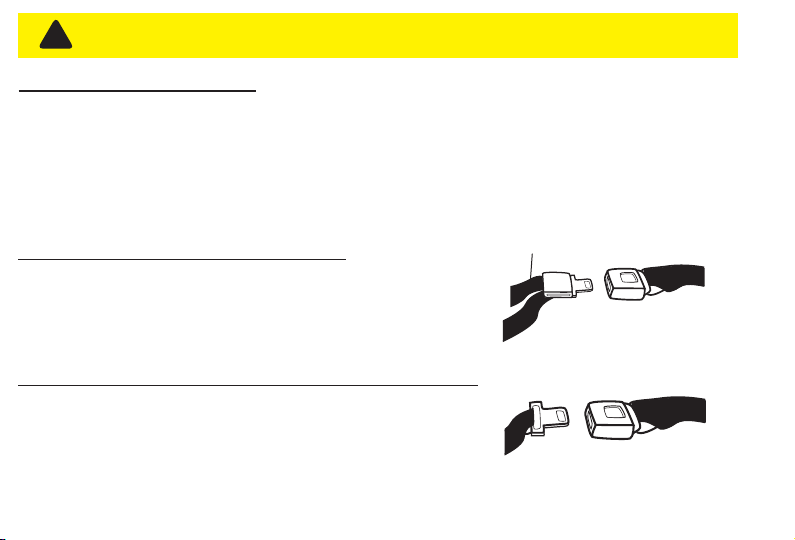
• If your vehicle was built prior to model year 1996, and has a
lap/shoulder belt that is equipped with an emergency locking
retractor (ELR) AND sliding latch plate, you MUST use a Locking Clip.
Check your vehicle owner’s manual to identify which vehicle belt
system is in your vehicle.
• If your vehicle is model year 1996 or newer, it likely has a vehicle
belt system that can be locked when tightened, and
will not require use of a Locking Clip. Consult your vehicle owner’s
manual before installing a locking clip. If your
vehicle requires a Locking Clip, please call CYBEX at
1-877-242-5676 to obtain a Locking Clip and instructions on how to
install and use it. Remove Locking Clip from vehicle seat belt when not used with a child restraint,
or the vehicle seat belt will not properly restrain an adult or child. Death or serious injury can
occur.
LOCKING CLIP USE
Locking
Clip
installed
properly
13 mm
(0.5 in)
30
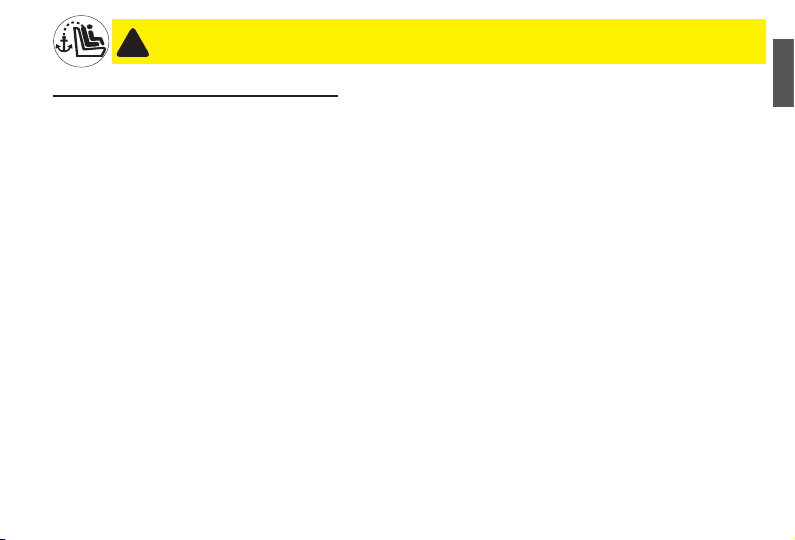
• If you have any of these types of vehicle belt systems listed, these are SAFE to use to install your
child restraint in the vehicle. Review vehicle owner’s manual for specific instructions on child
restraint installation.
LATCH can be used INPLACEOF these vehicle belt types. Refer to the REARFACING and
FORWARD-FACING weight limits on LATCH use on pages 8-11. Refer to your vehicle owner’s
manual for LATCH locations.
Lap Belt with Automatic Locking Retractor (ALR)
• The automatic locking retractor does not allow the lap belt to
get longer once it is buckled. The vehicle belt is tightened by
feeding seat belt webbing into retractor.
• Once buckled, the vehicle belt is tightened by pulling on the
free end of the strap until the belt is tight.
Free End
Lap Belt with Locking Latch Plate
SEAT BELT WARNINGS
WARNING! DEATH or SERIOUS INJURY can occur
!

31
English
WARNING! DEATH or SERIOUS INJURY can occur
!
Lap/Shoulder Belt with Locking Latch Plate
Lap/Shoulder Belt with Sliding Latch Plate with Locking Retractor
• The latch plate slides freely along the lap/shoulder belt.
Vehicle belts with sliding latch plates are typically locked at
the shoulder belt retractor by buckling the belt and pulling
all of the webbing out slowly to switch the retractor.
• Check vehicle owner’s manual for specific instructions. The
vehicle belt is tightened after switching the retractor by
pulling up on shoulder belt and feeding the webbing into
the retractor.
• The lap portion of this belt does not loosen once the belt is
buckled.
• The vehicle belt is tightened by pulling up hard on shoulder
belt and feeding the extra webbing into the retractor.
SEAT BELT WARNINGS

32
• ONLY use LATCH for securing Child Restraint to Vehicle Lower Anchor Bars.
• DO NOT use the lower anchors of the child restraint anchorage (LATCH) system to attach this
child restraint when restraining a child weighing more than 13.6 kg (30 lbs) REAR-FACING OR
15.9 kg (35 lbs) FORWARD-FACING. ONLY USE VEHICLE BELT INSTALLATION.
• In addition to these instructions, read and follow your vehicle Owner’s Manual regarding
installation of the child restraint and LATCH. If there is a discrepancy, follow your vehicle
owner’s manual.
• NEVER attach two LATCH Connectors to one Vehicle Lower Anchor Bar.
• NEVER use the vehicle seat belts when using the lower anchor connector assembly. Using both
together can cause slack in a sudden stop or crash.
• To avoid strangulation, you must store excess LATCH Straps in the vehicle seat crease as
described on page 37.
• ALWAYS be sure that the LATCH Connectors are attached to the Vehicle Lower Anchor Bars by
pulling hard on the connectors. If they are not attached, the LATCH Connector assembly will not
secure your Child Restraint. DEATH OR SERIOUS INJURY CAN OCCUR.
• DO NOT use this Child Restraint if it moves more than 2.5 cm (1 in) side to side or front to back at
the Belt Path on the Child Restraint when pulled with moderate force. Death or serious injury can
occur from poor installation. If you cannot tightly secure the Child Restraint, try again or move it
to another location.
LATCH WARNINGS
WARNING! DEATH or SERIOUS INJURY can occur
!
33
English
• To avoid a strangulation hazard, you MUST store the Tether inside the Tether Storage
Compartment on the back of the Child Restraint when not in use. Attach the Tether Hook to
the Storage Clip when not in use. This will keep an unused Tether or Tether Hook from hitting
someone during a crash.
• The Tether Strap is for FORWARD-FACING use ONLY.
• Refer to your vehicle Owner‘s Manual for the location of the Tether Anchor in your vehicle. Older
vehicles may not come equipped with Tether Anchor hardware. Check with your vehicle dealer.
TETHER STRAP WARNINGS
WARNING! DEATH or SERIOUS INJURY can occur
!
34
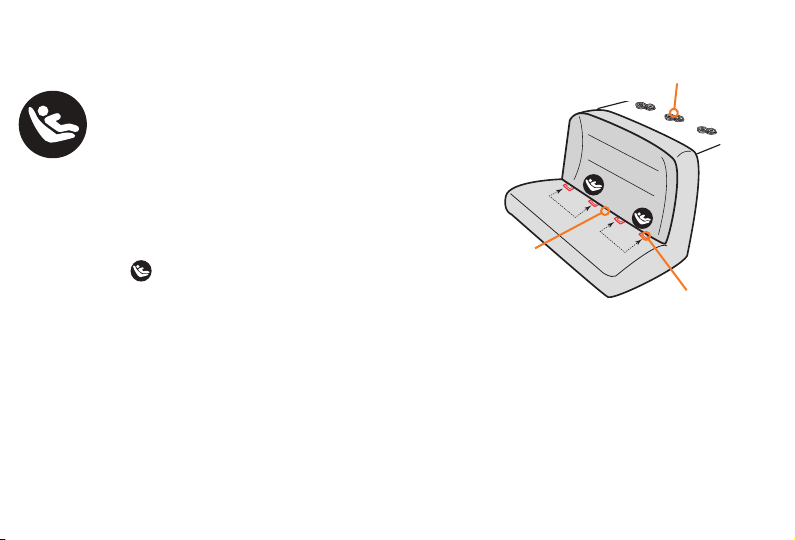
What is LATCH?
LATCH (Lower Anchors and Tethers for CHildren)
refers to a pair of fixed Lower Anchors (or bars) and
a Top Tether Anchor that are built into your vehicle.
LATCH is standard in vehicles manufactured after
September 1, 2002. Refer to your vehicle Owner’s Manual for
anchor positions in your vehicle.
The LATCH anchors are located in the crease between the
vehicle seat back and seat cushion, and if not visible, will typically
be indicated by symbols. Top Tether Anchors are located in
various places behind the rear vehicle seat (see page 51).
LATCH can oer an easier and more consistent installation.
However, this child restraint can be safely installed using either
Lower Anchors or vehicle belts and meets the requirements
of FMVSS 213 with either installation method. Either method is safe for your child when installed
correctly. When using either method, it is best practice to ALWAYS use Top Tether when installing
FORWARD-FACING.
CHILD RESTRAINT FEATURES
LOWER ANCHORS AND TETHERS FOR CHILDREN (LATCH)
Top Tether
Anchors
Lower
Anchors
Vehicle
Seat
Crease
28 cm
(11 in)
28 cm
(11 in)

35
English
Outer Seating Positions
Use the Lower Anchors OR a vehicle seat belt to install the Child Restraint in outboard seating
positions (those on either side of the center position).
NEVER use Lower Anchors together with the vehicle belts to install this Child Restraint. Using both
is not approved and may cause improper performance of the Child Restraint.
Center Seating Positions
If your vehicle does not have Lower Anchors in the center seating position, check your vehicle
Owner’s Manual to see if you are allowed to use the two inner Lower Anchors from the outboard
seating positions to install a Child Restraint.
CYBEX allows this Child Restraint to be installed using the two
inner Lower Anchors from the outboard seating positions if the
distance between them is between 28-51 cm (11-20 in) AND if
your vehicle manufacturer allows it. (If distance is not correct
and/or not allowed by vehicle manufacturer, use the vehicle
belt for installation in the center position.)
When using the inner Lower Anchors make sure there are no
obstructions from a buckle stalk for the installation and that the
LATCH Straps/Connectors do not block vehicle belt buckles.
28-51 cm
(11-20 in)
CHILD RESTRAINT FEATURES
LOWER ANCHORS AND TETHERS FOR CHILDREN (LATCH)

36
CHILD RESTRAINT FEATURES
LOWER ANCHORS AND TETHERS FOR CHILDREN (LATCH)
1
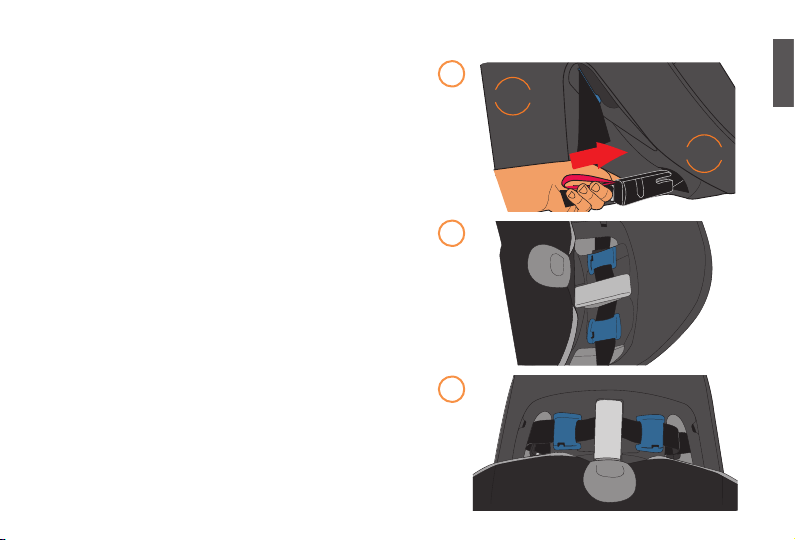
To Remove from Storage:
1. Pull on the LATCH Strap Release Loop
and pull the Connector out of the
storage compartment. Repeat on other
side.
2. Lengthen the strap between the
connectors using the LATCH Strap
Adjuster located next to the connectors.
Push down on the Adjuster button while
lengthening strap.
2
1
2
34
37
English
To Store:
LATCH Connectors MUST be stored when not
in use. Loose Connectors could seriously injure
vehicle occupants in the event of a crash.
1. Fully extend the LATCH Strap. Slide each
Connector back into its storage slot until
an audible CLICK is heard.
2. Make sure Belt Tensioner and EasyLock
are closed.
3. Remove most of the slack from the
LATCH strap by pulling on the LATCH
Adjuster Strap until it lays flat through
the Belt Guides. Do not overtighten or
remove more slack than necessary.
4. Tuck the excess strap into the vehicle
seat crease to get it out of the way.
CHILD RESTRAINT FEATURES
LOWER ANCHORS AND TETHERS FOR CHILDREN (LATCH)
2
3
1
2
34
CLICK!
CLICK!
1

38
CHILD RESTRAINT FEATURES
ROTATING BASE
WARNING!
DEATH or SERIOUS INJURY
can occur
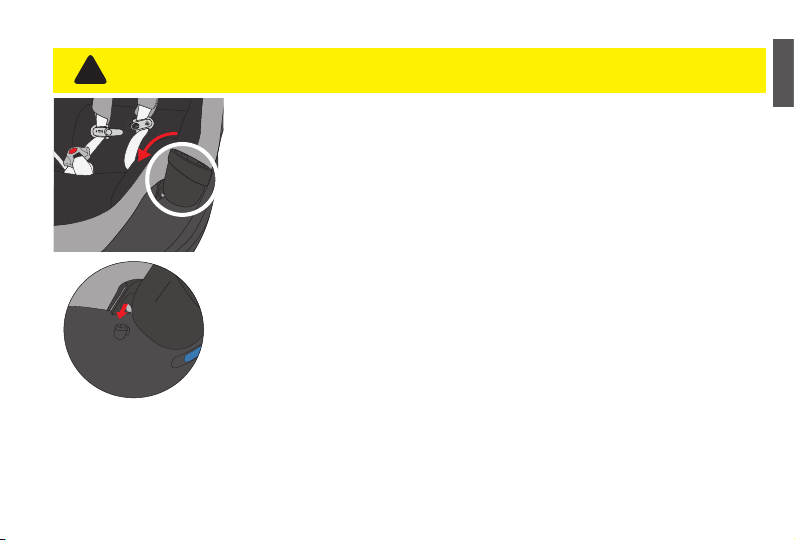
NEVER use this child restraint in a vehicle seating
position where it cannot be secured tightly. A
loosely installed child restraint will not protect your
child in a crash.
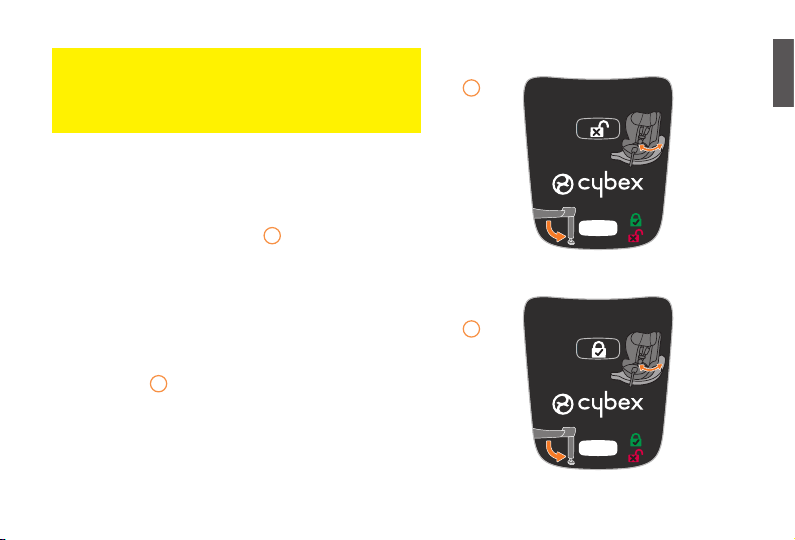
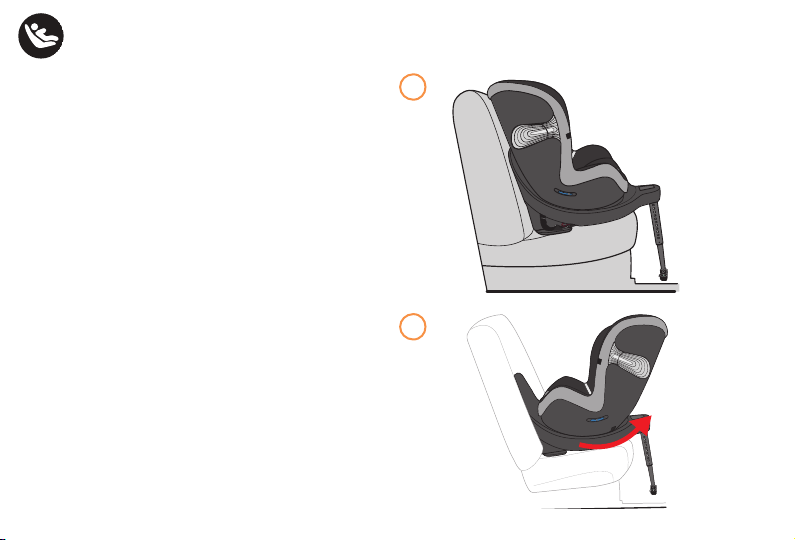
The Sirona S rotates in its base
a
, making it easy
to safely load and unload your child when the
seat is properly installed. To rotate the Restraint,
pull the Recline Handle and move the Restraint
past the most upright position. The Rotation Lock
Indicator will display the word UNLOCK (page 39).
Rotate the seat to your desired loading/unloading
position. When your child is securely harnessed,
rotate back to REAR-FACING or FORWARD-
FACING position
b
based on your child‘s size
(pages 8-11). Then move back into a locked
recline position. The Rotation Lock Indicator will
display the word LOCK (page 39).
a
b
39
English
CHILD RESTRAINT FEATURES
ROTATING BASE
THE ROTATED POSITION IS FOR LOADING AND
UNLOADING YOUR CHILD ONLY!
The Sirona S is not designed to protect your
child in a crash when the Rotation Lock Indicator
displays the UNLOCK symbol.
a
The Sirona S MUST BE LOCKED for proper use
when vehicle is moving.
Make sure the Rotation Lock Indicator displays the
LOCK symbol
b
and the Level Indicator is in the
correct range before driving (see pages 9 and 11).
WARNING!
DEATH or SERIOUS INJURY
can occur
a
b

40
L.S.P.
The Linear Side-Impact Protection System (L.S.P.)
is built into the Sirona S. This system enhances
the safety of your child in the event of certain side
crashes. In order to achieve the best possible
protective eect, extend the L.S.P. towards the car
door closest to the child restraint.
ALWAYS USE the L.S.P. Device when the Child
Restraint is installed in an outer seating position.
ALWAYS USE an L.S.P. Device on the side of the
Child Restraint immediately adjacent to a vehicle
door or panel.
NEVER USE the L.S.P. device when the Child
Restraint is placed in the rear middle seating
position.
NEVER extend an L.S.P. device toward a
passenger or another Child Restraint.
NEVER lift or carry the Child Restraint using the
L.S.P. devices.
CHILD RESTRAINT FEATURES
LINEAR SIDE-IMPACT PROTECTION SYSTEM (L.S.P.)

41
English
PRESS
EXTENDING THE L.S.P.
Press the L.S.P. button
a
on the side of the
Restraint adjacent to the vehicle door. The
L.S.P. will extend out from the Restraint and
be secured in place by the Locking Arm.
RETRACTING THE L.S.P.
Push the Locking Arm in to unlock the
L.S.P.
b
, then push the L.S.P. into the side of
the Restraint to store
c
.
CLICK!
CHILD RESTRAINT FEATURES
LINEAR SIDE-IMPACT PROTECTION SYSTEM (L.S.P.)
PRESS
c
b
a

42
There should NEVER
be any space between
the Load Leg Foot and
the vehicle floor.
The Load Leg should
NEVER push the Base
o the vehicle seat.
CHILD RESTRAINT FEATURES
LOAD LEG
WARNING! DEATH or SERIOUS INJURY can occur
!
The Load Leg is an eective safety feature of the
Sirona S. Using it is strongly recommended.
If ALL INSTALLATION REQUIREMENTS for the
Load Leg CANNOT BE MET, you MUST choose
another seating position or install the Restraint
with the Load Leg stored (folded underneath).
When installing with the Load Leg stored, see page
46 for proper use of the Overhang Indicator.
INSTALL the Restraint in a seating position that will
allow the Load Leg to be extended into a locked
position and have firm contact with the vehicle
floor (see page 44).
Many vehicles have a hump in the floor that could
cause the Load Leg, even in its shortest position,
to push the Base o the vehicle seat. NEVER
INSTALL the Restraint in a seating position where
the Load Leg, even in its shortest position, causes
the Base to be pushed o the vehicle seat.
Load Leg MUST be
LOCKED in position and
have FIRM CONTACT
with vehicle floor.
43
English
CHILD RESTRAINT FEATURES
LOAD LEG
CLICK!
2
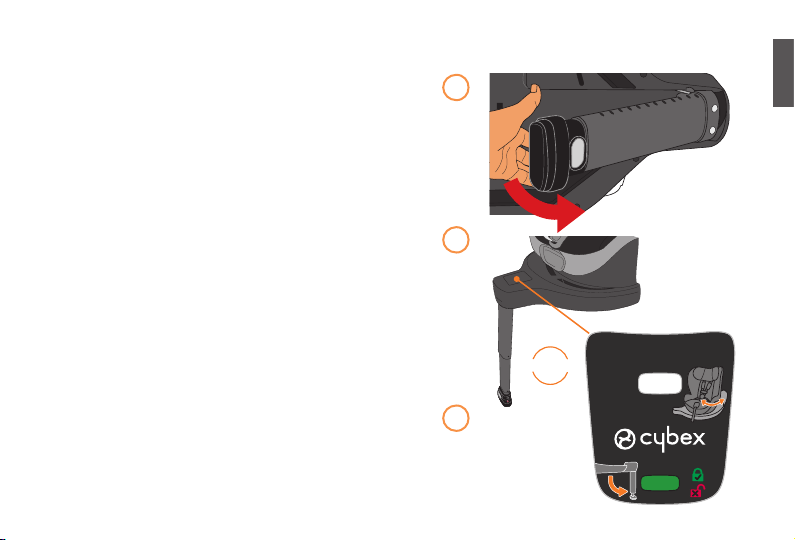
To Install:
1. Turn the base over and pull the Load Leg
out from the Storage Compartment.
2. Pull the Load Leg out until it CLICKS and is
locked into the fully open position.
3. The Load Leg Indicator will turn GREEN
when locked.
3
1
CY_171_6075_A
44
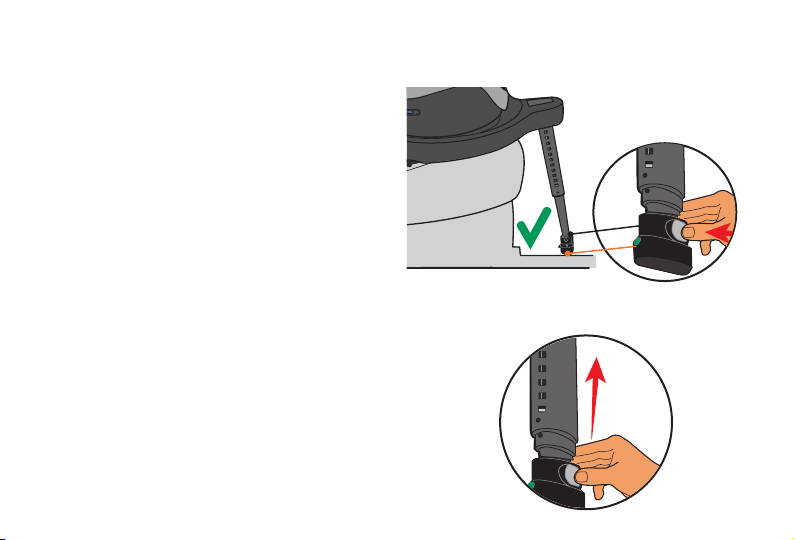
To Extend:
Pull down on the Load Leg to extend the Foot until
it rests on the vehicle floor.
NOTE: If the Load Leg does not reach the floor,
squeeze the Load Leg Adjustment Button on
the foot and pull down to further extend.
As you lower the Load Leg, the Load Leg Lock
Indicator buttons on either side of the foot will
show green as long as the Leg makes firm contact
with the vehicle floor.
Secure the Foot into place using the first hole that
will lock it firmly against the vehicle floor without
lifting the Base up o of the seat.
It may be necessary to lift up slightly on the Base
to allow the Foot to lock into the hole.
To Retract:
Squeeze the Load Leg Adjustment Button and push
up on the foot to retract it.
CHILD RESTRAINT FEATURES
LOAD LEG

45
English
To Store:
1. Turn the Base over and rotate the Load Leg
towards the Storage Compartment.
2. Push the Load Leg in until it CLICKS and
locks into the Storage Compartment.
NOTE: If your child is over 40 pounds and
riding forward-facing in an older vehicle
with a lap belt only and no Tether Anchor,
use the alternate storage position when
storing the Load Leg.
CHILD RESTRAINT FEATURES
LOAD LEG
1
2
CLICK!
Load Leg Storage
Load Leg Alternate Storage

46
CHILD RESTRAINT FEATURES
OVERHANG INDICATOR
When installing the Sirona S with the Load Leg
stored, ensure the seat base is positioned on the
vehicle seat so that the Overhang Indicator does
not extend beyond the edge of the vehicle seat.
If the Overhang Indicator extends beyond the edge
of the vehicle seat, you MUST choose another
seating position.
47
English
L
E
V
E
L
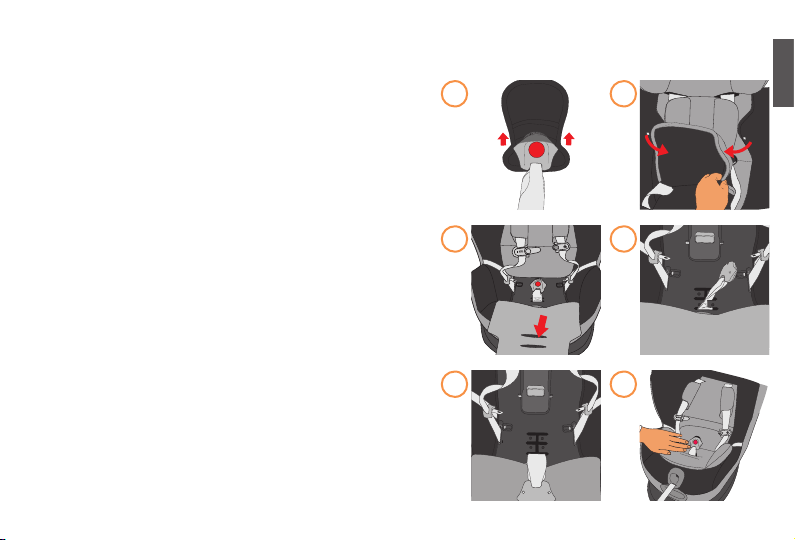
As your child grows, you will need to change the
Crotch Strap position. The Crotch Strap should
ALWAYS be as close to but NEVER underneath
your child's bottom.
1.
Remove Buckle Pad.
2.
Unfasten snaps on seat cover behind
Headrest Pad and lift cover up.
3.
Pull the Seat Cover forward. Slide the
Crotch Strap through the pad opening.
4.
Grasp the bottom of the Crotch Strap and
twist it to align with the lengthwise slot.
5.
Move to slot position closest to but not
underneath your child’s bottom. Twist strap
back into position.
6.
Re-attach the Seat Cover and Buckle Pad.
CHILD RESTRAINT FEATURES
ADJUSTABLE CROTCH STRAP
1
3
2
4
5 6

48
The seat has a Headrest that automatically adjusts the harness height
without the need to re-thread it. To adjust, lift the Headrest Height
Adjustment Handle on the top of the Headrest and move to one of the
12 locked positions.
For REAR-FACING use, adjust Headrest so the harness straps are
AT or JUST BELOW the child's shoulders.
For FORWARD-FACING use, adjust Headrest so the harness straps
are AT or JUST ABOVE the child's shoulders.
NOTE: Regularly check for proper harness height as your child grows.
CHILD RESTRAINT FEATURES
HEIGHT-ADJUSTABLE HEADREST
REAR-FACING
FORWARD-FACING
49
English
A
R
M
P
I
T
L
E
V
E
L
• ONLY use the cup holders that come with your original car seat or have
been specifically designed for it by CYBEX.
• DO NOT use the cup holder to hold hot liquids (e.g. coee), even in
enclosed or lidded containers. Placing hot liquids in the cup holder
could result in spills and burn injuries to you or your child.
• NEVER place sharp or pointed objects in the cup holder. In a crash
these objects could hit you or your child and cause serious injuries.
• ONLY use containers that fit securely all the way to the bottom of
the cup holder. They should not stop halfway down when placing
containers in the cup holder.
• ONLY use containers with a capacity of 355 ml (12 oz.) or less.
• NEVER use any containers which are made of brittle material (e.g.,
glass). This could lead to injuries in the event of a crash.
• NEVER leave open containers in the cup holder during the journey.
There is a risk of spilling (e.g., when braking), which may cause damage
to the electrical components of the vehicle or seat upholstery.
• ALWAYS remove containers before removing the cup holder from the
car seat.
• ALWAYS remove containers from the cup holder before reclining the
car seat. There is a risk of spilling, which may cause damage to the
electrical components of the vehicle or seat upholstery.
Slide the Cup Holder
onto either side of the
Child Restraint where
indicated by the Cup
Holder icon.
1
2
6
5
4
3
8
7
CHILD RESTRAINT FEATURES
CUP HOLDER
WARNING! DEATH or SERIOUS INJURY can occur
!

50
To ensure a better fit for smaller infants, the Newborn Insert may be
needed. ONLY USE the Newborn Insert that comes with your original
car seat or one that has been specifically designed for it by CYBEX.
To Install:
1. Pull Harness Buckle through slot in the bottom of Newborn Insert.
2. Pull both Harness Straps over the side panels of Newborn Insert.
3. Push Newborn Insert firmly into Child Restraint to make sure it is
properly positioned.
4. When positioning the Headrest make sure the bottom of the
Headrest flap is behind the Newborn Insert flap.
CHILD RESTRAINT FEATURES
NEWBORN INSERT
CHILD RESTRAINT FEATURES
NEWBORN HEADPAD INSERT
To ensure a better fit for smaller infants, the Newborn Headpad Insert
may be needed. ONLY USE the Newborn Headpad Insert that comes
with your original car seat or one that has been specifically designed for
it by CYBEX.
To install, tuck the tabs on the rear of the Newborn Headpad Insert into
the slots on the Headrest cover and toward the center of the Headrest.

51
English
A Tether reduces movement of a FORWARD-
FACING Child restraint in a crash and helps
to achieve a tight installation. ALWAYS USE A
TETHER FORWARD-FACING if a Tether Anchor is
available.
Tether anchor locations vary from vehicle to vehicle
and some typical locations are shown here. Refer
to your vehicle Owner's Manual for exact locations,
anchor identification , and requirements.
See pages 59, 73, and 86 for Tether installation
and storage instructions.
CHILD RESTRAINT FEATURES
TETHER STRAP
a
b
c
d
e
a - Vehicle roof
b - Rear shelf
c - Back wall
d - Vehicle floor
e - Vehicle seat back
Install Harness Covers above Chest Clip. Harness Covers are optional
for comfort. Wrap Harness Covers around Harness Straps and fasten the
snaps.
ALWAYS make sure the harness covers DO NOT bunch up when
tightening the harness.
CHILD RESTRAINT FEATURES
HARNESS COVERS
52
This seat works with the SensorSafe mobile app which can be downloaded from:
The App Store
®
or Google Play
™
.*
The SensorSafe mobile app can provide the following information directly to your smartphone:
• Reminder that your child is still in your automobile
• Current temperature of your automobile interior
• Owners Manuals
• Installation Videos
• Customer care contact information
CHILD RESTRAINT FEATURES
SENSORSAFE
®
TECHNOLOGY
SensorSafe
®
Technology
Questions? Comments?:
Visit us at: http://cybex-online.com/us/contact.html
or call CYBEX at: 1-877-242-5676
* Trademarks are the property of their respective owners.
WARNING! DEATH or SERIOUS INJURY can occur
!
NEVER install or use this child restraint until you have read and understand the instructions in this
manual and in your vehicle Owner’s Manual. If there is a conflict between the two, the vehicle
Owner’s Manual must be followed.

53
English
INSTALLING CHILD RESTRAINT WITH LATCH
BEFORE installing Restraint, make sure vehicle is on level ground. Place Restraint on approved
LATCH vehicle seating location.
REAR-FACING: DO NOT install by this method for a child weighing more than 13.6 kg (30 lbs).
ALWAYS store Tether Strap when using REARFACING.
FORWARD-FACING: DO NOT install by this method for a child weighing more than 15.9 kg (35
lbs).
ALWAYS USE A TETHER FORWARD-FACING if a Tether Anchor is available.
1. Remove LATCH Anchors from storage
locations on back side of base. Remove each
Connector by pulling out on Red Strap.
2. Unfold Load Leg from underneath Base.
1
2
1
2
34
54
3.
Position Restraint on rear vehicle seat. If a
hump is present on vehicle floor, see page
42 for important information on limits of
using Load Leg in this seating position.
NOTE: If installing the Restraint with the
Load Leg stored, see Overhang Indicator on
page 46.
4. Rotate Restraint REARFACING and move
past the most upright position to access the
Belt Path (pages 38-39).
INSTALLING CHILD RESTRAINT WITH LATCH
3
4

55
English
INSTALLING CHILD RESTRAINT WITH LATCH
5
6
5. Remove Belt Path Cover from Base.
6. Open Belt Tensioner.
a. Pull EasyLock out and up to extend until
you hear a CLICK.
b. Slide Lock Button and pull up to open Belt
Tensioner in center of Base.
CLICK!
56
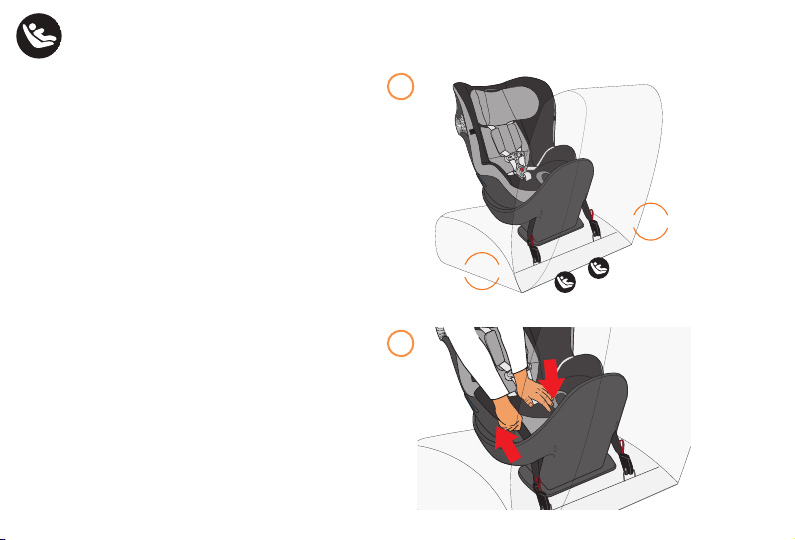
7. Attach LATCH Connectors to vehicle Lower
Anchor Points. Connectors will make an
audible CLICK when attached. Make sure
they are attached by pulling firmly on
connectors. Do not pull on red Release
Strap.
8. Push Base against vehicle seat back.
Tension LATCH Strap by pulling on loop
until snug. Do not overtighten. Belt
Tensioner will tighten system fully.
After tightening LATCH, route excess strap
across belt path.
INSTALLING CHILD RESTRAINT WITH LATCH
1
2
6
5
4
3
8
7
7
8
CLICK!
CLICK!

57
English
9. Close Belt Tensioner and use EasyLock to lock it
into place.
a. Position EasyLock so that notches on arm
rest on the tabs on either side of the Belt
Tensioner.
b. Push down on EasyLock to close Belt
Tensioner until it locks in place.
c. Store the EasyLock.
NOTE: If Belt Tensioner does not lock, try
loosening LATCH strap slightly.
9
INSTALLING CHILD RESTRAINT WITH LATCH
a
b

58
10. Grab Base near Belt Path and pull side to
side and front to back to make sure Base
is installed tightly. Base should not move
more than 2.5 cm (1 in) side to side or
front to back at the Belt Path on the Child
Restraint.
If Base moves too much, open Belt
Tensioner, tension the LATCH Strap a little
more and try again. After this, if Base still
moves too much, you may need to try a
different vehicle seat location or installation
method, or both.
11. Replace Belt Path Cover on Base, making
sure to insert the tabs at the bottom
corners of the cover into the Base before
closing. Belt Path Cover will close with an
audible CLICK.
NOTE: To avoid interference with recline
and rotation, ensure the Belt Path Cover is
properly closed.
10
11
CLICK!
INSTALLING CHILD RESTRAINT WITH LATCH

59
English
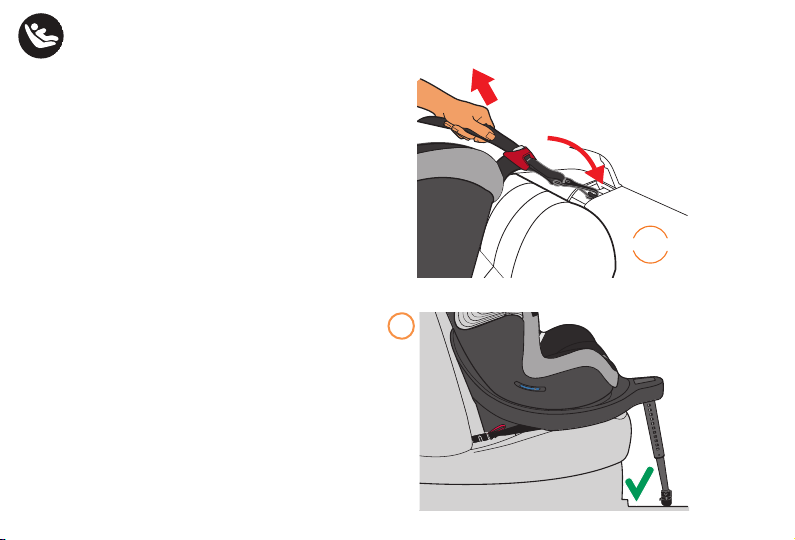
12. Move Restraint to the appropriate REAR-FACING
or FORWARD-FACING position based on the
child’s size (pages 8-11) and lock into position.
NOTE: Before moving the Restraint to the
FORWARD-FACING position, you must first
remove the Tether from the Tether Storage
Compartment on the back of the Restraint.
a. Rotate the Restraint to the FORWARD-
FACING position.
b. Locate the vehicle Tether Anchor and attach
the Tether Hook to the Tether Anchor.
c. Pull the Tether Adjuster Strap to tighten.
12
INSTALLING CHILD RESTRAINT WITH LATCH
60
1
2
3
4
5
6
7
8
ALWAYS USE A TETHER FORWARD-
FACING if a Tether Anchor is available. A
Tether reduces movement of a FORWARD-
FACING child restraint in a crash and helps
to achieve a tight installation. Tether Anchor
locations vary from vehicle to vehicle.
Refer to your vehicle Owner’s Manual for
exact locations, anchor identification, and
requirements. Refer to page 51 for some
common locations.
13. Extend Load Leg (page 44).
13
CLICK!
INSTALLING CHILD RESTRAINT WITH LATCH
61
English
WARNING!
DEATH or SERIOUS INJURY
can occur
14.
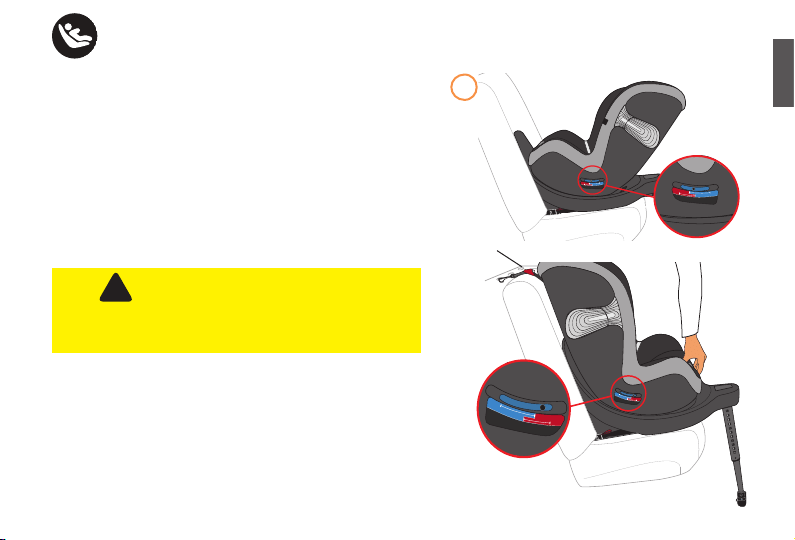
CHECK Recline Angle using Level Indicator.
For REAR-FACING installation, Recline Ball
should be in BLUE ZONE.
For FORWARD-FACING installation, Recline
Ball should be in RED ZONE.
F
O
R
W
A
R
D
-
F
A
C
I
N
G
R
E
A
R
-
F
A
C
I
N
G
B
e
a
d
m
u
s
t
b
e
l
o
c
a
t
e
d
w
i
t
h
i
n
a
p
p
r
o
p
r
i
a
t
e
z
o
n
e
.
V
e
h
i
c
l
e
M
U
S
T
b
e
o
n
l
e
v
e
l
g
r
o
u
n
d
.
CY_171_6052_B1019
F
O
R
W
A
R
D
-
F
A
C
I
N
G
R
E
A
R
-
F
A
C
I
N
G
B
e
a
d
m
u
s
t
b
e
l
o
c
a
t
e
d
w
i
t
h
i
n
a
p
p
r
o
p
r
i
a
t
e
z
o
n
e
.
V
e
h
i
c
l
e
M
U
S
T
b
e
o
n
l
e
v
e
l
g
r
o
u
n
d
.
CY_171_6052_B1019
Failure to properly recline the child restraint could
increase the child’s risk of death or serious injury.
Infants may have difficulty breathing when in an
upright seated position. Make sure they recline
enough for their head to lie back comfortably and
safely.
!
F
O
R
W
A
R
D
-
F
A
C
I
N
G
R
E
A
R
-
F
A
C
I
N
G
B
e
a
d
m
u
s
t
b
e
l
o
c
a
t
e
d
w
i
t
h
i
n
a
p
p
r
o
p
r
i
a
t
e
z
o
n
e
.
V
e
h
i
c
l
e
M
U
S
T
b
e
o
n
l
e
v
e
l
g
r
o
u
n
d
.
F
O
R
W
A
R
D
-
F
A
C
I
N
R
E
A
R
-
F
A
C
I
N
G
B
e
a
d
m
u
s
t
b
e
l
o
c
a
t
e
d
w
i
t
h
i
n
a
p
p
r
o
p
r
i
a
t
e
z
o
n
e
.
V
e
h
i
c
l
e
M
U
S
T
b
e
o
n
l
e
v
e
l
g
r
o
u
n
d
.
Tether Strap
14
INSTALLING CHILD RESTRAINT WITH LATCH

62
NOTE: In some vehicles in the most reclined
position, it may be necessary to place a
rolled towel or small blanket beneath (not
behind) the Child Restraint near the seat
back to provide enough recline so that the
Recline Ball is in the BLUE ZONE for REAR-
FACING use.
NOTE: Only items approved by CYBEX are
allowed under Base.
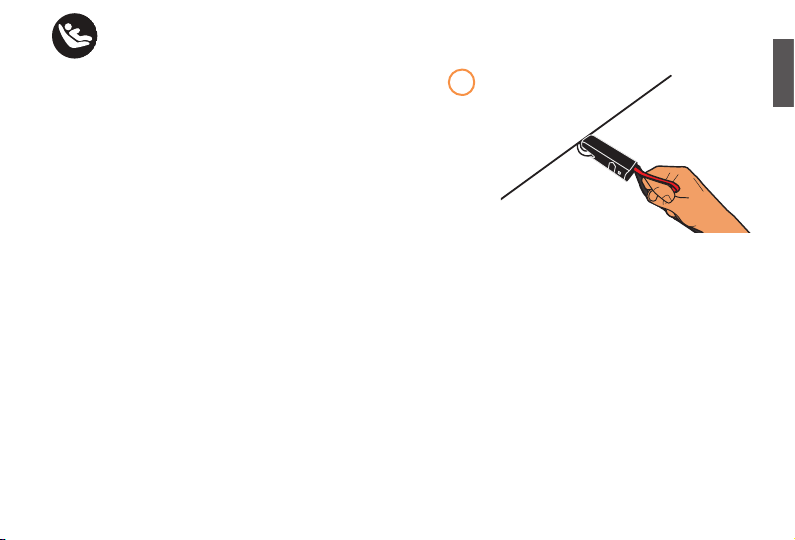
15. Extend L.S.P. toward vehicle door if in an
outboard seating position (page 41).
15
PRESS
F
O
R
W
A
R
D
-
F
A
C
I
N
G
R
E
A
R
-
F
A
C
I
N
G
B
e
a
d
m
u
s
t
b
e
l
o
c
a
t
e
d
w
i
t
h
i
n
a
p
p
r
o
p
r
i
a
t
e
z
o
n
e
.
V
e
h
i
c
l
e
M
U
S
T
b
e
o
n
l
e
v
e
l
g
r
o
u
n
d
.
CY_171_6052_B1019
F
O
R
W
A
R
D
-
F
A
C
I
N
G
R
E
A
R
-
F
A
C
I
N
G
B
e
a
d
m
u
s
t
b
e
l
o
c
a
t
e
d
w
i
t
h
i
n
a
p
p
r
o
p
r
i
a
t
e
z
o
n
e
.
V
e
h
i
c
l
e
M
U
S
T
b
e
o
n
l
e
v
e
l
g
r
o
u
n
d
.
CY_171_6052_B1019
INSTALLING CHILD RESTRAINT WITH LATCH
63
English
REMOVING CHILD RESTRAINT WITH LATCH
1. To remove LATCH Connectors, pull the red
LATCH Release Straps on both sides of the seat
as shown.
If having trouble releasing LATCH Connectors,
open Belt Tensioner and loosen tension on
LATCH Connectors by loosening LATCH Strap
Adjuster.
1

64
REMOVING CHILD RESTRAINT WITH LATCH
Adjuster
Release
Button
1
2
In FORWARD-FACING LATCH installations, the
following steps must also be completed.
1. Remove the Tether.
a. Press Adjuster Release Button.
b. Lengthen the Tether Strap.
c. Unhook the Tether Strap from the Tether
Anchor.
2. Store Tether in Tether Storage
Compartment on back of Restraint.
MAKE SURE Tether Storage Compartment
door is properly closed after storing.

65
English
INSTALLING CHILD RESTRAINT WITH LAP/SHOULDER BELT
(PREFERRED METHOD)
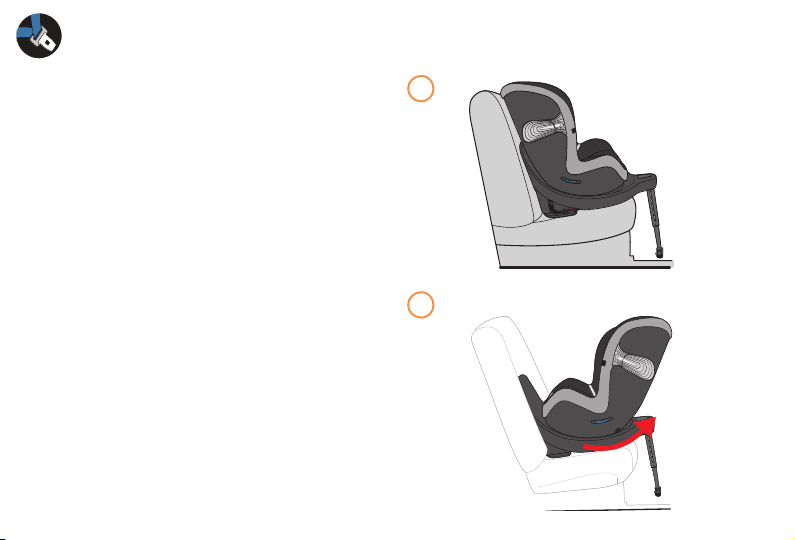
1. Unfold Load Leg from underneath Base.
REAR-FACING:
ALWAYS store Tether Strap when using REARFACING.
FORWARD-FACING:
ALWAYS USE A TETHER FORWARD-FACING if a Tether
Anchor is available.
BEFORE installing Restraint, make sure vehicle is on level ground. Place Restraint on approved
vehicle seating location. MAKE SURE LATCH Connectors are stored (page 37).
1
66
INSTALLING CHILD RESTRAINT WITH LAP/SHOULDER BELT
(PREFERRED METHOD)
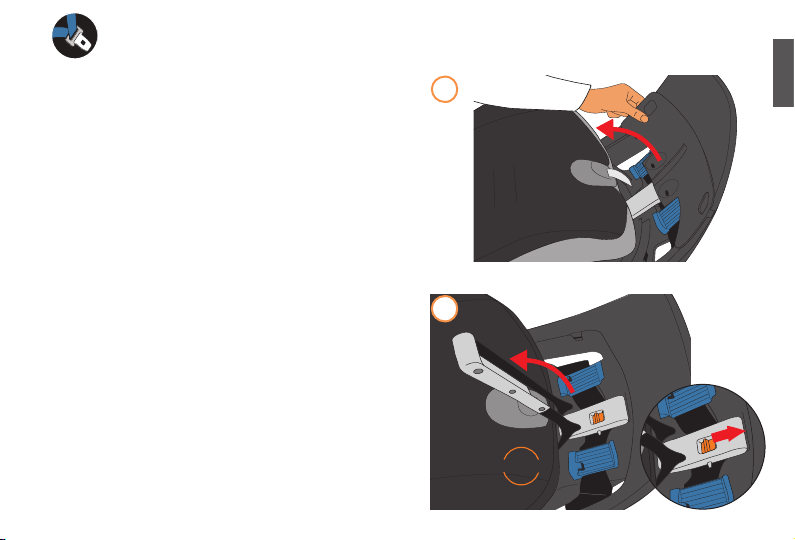
2. Position Restraint on rear vehicle seat. If a
hump is present on vehicle floor, see page
42 for important information on limits of
using Load Leg in this seating position.
NOTE: If installing the Restraint with the
Load Leg stored, see Overhang Indicator
on page 46.
3. Rotate Restraint REARFACING and move
past the most upright position to access the
Belt Path (pages 38-39).
2
3
67
English
INSTALLING CHILD RESTRAINT WITH LAP/SHOULDER BELT
(PREFERRED METHOD)
4. Remove Belt Path Cover from Base.
5. Open Belt Tensioner.
a. Pull EasyLock out and up to extend
until you hear a CLICK.
b. Slide Lock Button and pull up to open
Belt Tensioner in center of Base.
4
5
CLICK!

68
INSTALLING CHILD RESTRAINT WITH LAP/SHOULDER BELT
(PREFERRED METHOD)
6
7
6. Pull out vehicle belt to form single length of
about 60 cm (24 in). Hold Buckle Tongue in
one hand and squeeze lap and shoulder belts
together in other hand.
7. Route vehicle belts up through vehicle belt
path opening on side of Base, through
Belt Guide, under Belt Tensioner, through
opposite Belt Guide, and down through
opposite belt path opening. BUCKLE THE
BELT. Make sure belts are underneath tabs
on belt guide and lie flat without twisting.
NEVER place vehicle belt over Belt
Tensioner, even in a vehicle with longer
buckle stalks. This will prevent proper
operation of the Child Restraint.

69
English
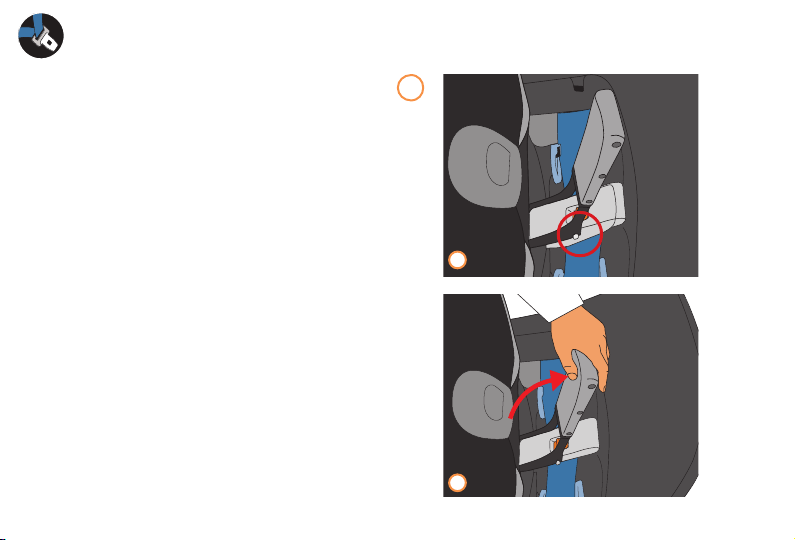
8. On buckle side, first lift up on shoulder belt to
remove slack in lap belt. Then remove slack
from shoulder belt on opposite side.
At this point, only remove slack from vehicle
belts, being careful not to overtighten them.
Belt Tensioner will tighten system fully. If
you have previously installed Restraint using
LATCH, make sure LATCH Strap lies flat on
bottom of the Base. See “To Store” section on
page 37.
Some vehicle lap/shoulder belts have a plastic
button or extra fold of webbing on the belt.
Do not allow these to interfere with belt
routing through Belt Tensioner. If they
interfere:
a. Use LATCH if within the weight limit, or
b. Move the child restraint to a dierent
location.
8
INSTALLING CHILD RESTRAINT WITH LAP/SHOULDER BELT
(PREFERRED METHOD)
70
9
9. Close Belt Tensioner and use EasyLock to
lock it into place.
a. Position EasyLock so that notches on
arm rest on the tabs on either side of
the Belt Tensioner.
b. Push down on EasyLock to close Belt
Tensioner until it locks in place.
c. Store the EasyLock.
NOTE: If Belt Tensioner does not lock, try
loosening lap/shoulder belt strap slightly.
INSTALLING CHILD RESTRAINT WITH LAP/SHOULDER BELT
(PREFERRED METHOD)
a
b

71
English
10
10. Grab Base near belt path and pull side to
side and front to back to make sure Base is
installed tightly. Base should not move more
than
2.5 cm (1 in) side to side or front to back
at the Belt Path on the Child Restraint
.
If Base moves too much, open Belt Tensioner,
tension vehicle belt a little more and try
again. After this, if Base still moves too much,
you may need to try a different vehicle seat
location or installation method, or both.
In most vehicles, you can switch shoulder
belt retractor into locking mode by pulling out
shoulder belt all the way and letting it rewind into
the retractor. Pull on shoulder belt to make sure
it is locking.
NEVER install this Child Restraint using a
non-locking vehicle lap/shoulder belt.
NOTE: R
efer to your vehicle Owner’s Manual
for information.
INSTALLING CHILD RESTRAINT WITH LAP/SHOULDER BELT
(PREFERRED METHOD)

72
INSTALLING CHILD RESTRAINT WITH LAP/SHOULDER BELT
(PREFERRED METHOD)
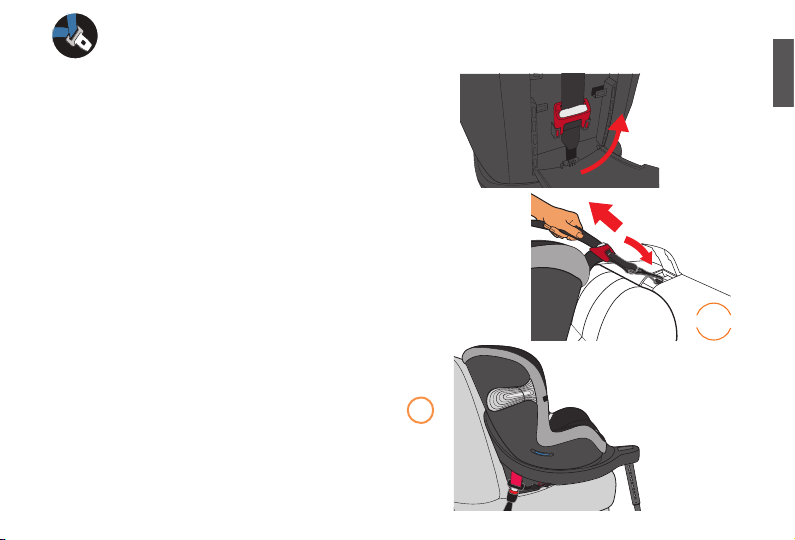
11. Replace Belt Path Cover on Base, making
sure to insert the tabs at the bottom corners
of the cover into the Base before closing.
Belt Path Cover will close with an audible
CLICK.
NOTE: To avoid interference with recline
and rotation, ensure the Belt Path Cover is
properly closed.
12. Move Restraint to the appropriate REAR-
FACING or FORWARD-FACING position
based on the child’s size (pages 8-11) and
lock into position.
11
12
CLICK!
73
English
NOTE: Before moving the Restraint to the
FORWARD-FACING position, you must first
remove the Tether from the Tether Storage
Compartment on the back of the Restraint.
a. Rotate the Restraint to the FORWARD-
FACING position.
b. Locate the vehicle Tether Anchor and attach
the Tether Hook to the Tether Anchor.
c. Pull the Tether Adjuster Strap to tighten.
ALWAYS USE A TETHER FORWARD-FACING
if a Tether Anchor is available. A Tether
reduces movement of a FORWARD-FACING
child restraint in a crash and helps to achieve
a tight installation. Tether Anchor locations
vary from vehicle to vehicle. Refer to your
vehicle owner’s manual for exact locations,
anchor identification, and requirements. Refer
to page 51 for some common locations.
13. Extend Load Leg (page 44).
1
2
3
4
5
6
7
8
CLICK!
INSTALLING CHILD RESTRAINT WITH LAP/SHOULDER BELT
(PREFERRED METHOD)
13

74
14. CHECK Recline Angle using Level Indicator.
For REAR-FACING installation, Recline Ball
should be in BLUE ZONE.
For FORWARD-FACING installation, Recline
Ball should be in RED ZONE.
Failure to properly recline the child restraint could
increase the child’s risk of death or serious injury.
Infants may have difficulty breathing when in an
upright seated position. Make sure they recline
enough for their head to lie back comfortably and
safely.
14
F
O
R
W
A
R
D
-
F
A
C
I
N
G
R
E
A
R
-
F
A
C
I
N
G
B
e
a
d
m
u
s
t
b
e
l
o
c
a
t
e
d
w
i
t
h
i
n
a
p
p
r
o
p
r
i
a
t
e
z
o
n
e
.
V
e
h
i
c
l
e
M
U
S
T
b
e
o
n
l
e
v
e
l
g
r
o
u
n
d
.
CY_171_6052_B1019
F
O
R
W
A
R
D
-
F
A
C
I
N
G
R
E
A
R
-
F
A
C
I
N
G
B
e
a
d
m
u
s
t
b
e
l
o
c
a
t
e
d
w
i
t
h
i
n
a
p
p
r
o
p
r
i
a
t
e
z
o
n
e
.
V
e
h
i
c
l
e
M
U
S
T
b
e
o
n
l
e
v
e
l
g
r
o
u
n
d
.
CY_171_6052_B1019
F
O
R
W
A
R
D
-
F
A
C
I
N
G
R
E
A
R
-
F
A
C
I
N
G
B
e
a
d
m
u
s
t
b
e
l
o
c
a
t
e
d
w
i
t
h
i
n
a
p
p
r
o
p
r
i
a
t
e
z
o
n
e
.
V
e
h
i
c
l
e
M
U
S
T
b
e
o
n
l
e
v
e
l
g
r
o
u
n
d
.
F
O
R
W
A
R
D
-
F
A
C
I
N
R
E
A
R
-
F
A
C
I
N
G
B
e
a
d
m
u
s
t
b
e
l
o
c
a
t
e
d
w
i
t
h
i
n
a
p
p
r
o
p
r
i
a
t
e
z
o
n
e
.
V
e
h
i
c
l
e
M
U
S
T
b
e
o
n
l
e
v
e
l
g
r
o
u
n
d
.
Tether Strap
WARNING!
DEATH or SERIOUS INJURY
can occur
INSTALLING CHILD RESTRAINT WITH LAP/SHOULDER BELT
(PREFERRED METHOD)

75
English
NOTE: In some vehicles in the most
reclined position, it may be necessary
to place a rolled towel or small blanket
beneath (not behind) the Child Restraint
near the seat back to provide enough
recline so that the Recline Ball is in the
BLUE ZONE for REAR-FACING use.
NOTE: Only items approved by CYBEX
are allowed under Base.
15. Extend L.S.P. toward vehicle door if in an
outboard seating position (page 41).
15
F
O
R
W
A
R
D
-
F
A
C
I
N
G
R
E
A
R
-
F
A
C
I
N
G
B
e
a
d
m
u
s
t
b
e
l
o
c
a
t
e
d
w
i
t
h
i
n
a
p
p
r
o
p
r
i
a
t
e
z
o
n
e
.
V
e
h
i
c
l
e
M
U
S
T
b
e
o
n
l
e
v
e
l
g
r
o
u
n
d
.
CY_171_6052_B1019
F
O
R
W
A
R
D
-
F
A
C
I
N
G
R
E
A
R
-
F
A
C
I
N
G
B
e
a
d
m
u
s
t
b
e
l
o
c
a
t
e
d
w
i
t
h
i
n
a
p
p
r
o
p
r
i
a
t
e
z
o
n
e
.
V
e
h
i
c
l
e
M
U
S
T
b
e
o
n
l
e
v
e
l
g
r
o
u
n
d
.
CY_171_6052_B1019
INSTALLING CHILD RESTRAINT WITH LAP/SHOULDER BELT
(PREFERRED METHOD)
PRESS

76
FORWARD-FACING
Child Restraint Removal
1. Remove the Tether.
a. Press Adjuster Release Button.
b. Lengthen the Tether Strap.
c. Unhook the Tether Strap from the Tether
Anchor.
2. Rotate seat REAR-FACING and store Tether
in Tether Storage Compartment on back of
Restraint.
MAKE SURE Tether Storage Compartment
door is properly closed after storing.
3. Continue with Step #1 of REAR-FACING Child
Restraint Removal.
1
REMOVING CHILD RESTRAINT WITH
LAP/SHOULDER BELT
Adjuster Release Button
2

77
English
REAR-FACING Child Restraint Removal
1. Move the restraint past the most upright
position to access the Belt Path (pages
38-39).
2. Unbuckle the seat belt, remove the Belt
Path Cover, and open the Belt Tensioner
to release tension.
REMOVING CHILD RESTRAINT WITH
LAP/SHOULDER BELT
1
2

78
INSTALLING CHILD RESTRAINT
WITH LAP BELT
1. Unfold Load Leg from underneath Base.
REAR-FACING:
ALWAYS store Tether Strap when using REARFACING.
FORWARD-FACING:
ALWAYS USE A TETHER FORWARD-FACING if a Tether
Anchor is available.
BEFORE installing Restraint, make sure vehicle is on level ground. Place Restraint on approved
vehicle seating location. MAKE SURE LATCH Connectors are stored (page 37).
1

79
English
INSTALLING CHILD RESTRAINT
WITH LAP BELT
2. Position Restraint on rear vehicle seat. If a
hump is present on vehicle floor, see page
42 for important information on limits of
using Load Leg in this seating position.
NOTE: If installing the Restraint with the
Load Leg stored, see Overhang Indicator on
page 46.
3. Rotate Restraint REARFACING and move
past the most upright position to access the
Belt Path (pages 38-39).
2
3
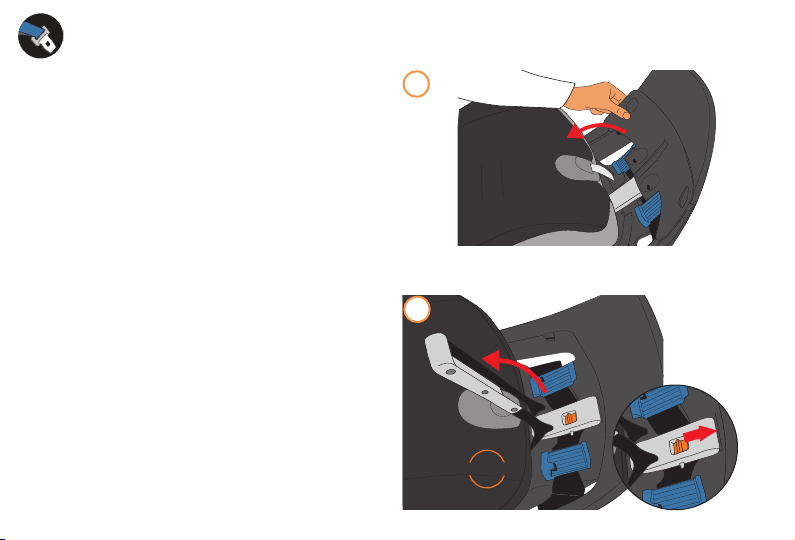
80
INSTALLING CHILD RESTRAINT
WITH LAP BELT
4. Remove Belt Path Cover from Base.
5. Open Belt Tensioner.
a. Pull EasyLock out and up to extend until
you hear a CLICK.
b. Slide Lock Button and pull up to open Belt
Tensioner in center of Base.
4
5
CLICK!

81
English
INSTALLING CHILD RESTRAINT
WITH LAP BELT
6. Route vehicle belt up through vehicle belt
path opening on side of Base, through
Belt Guide, under Belt Tensioner, through
opposite Belt Guide, and down through
opposite belt path opening. BUCKLE THE
BELT. Make sure belts are underneath tabs
on belt guide and lie flat without twisting.
NEVER install this Child Restraint using a
non-locking vehicle lap belt (page 26).
NEVER place vehicle belt over Belt
Tensioner, even in a vehicle with longer
buckle stalks. This will prevent proper
operation of the Child Restraint.
6

82
INSTALLING CHILD RESTRAINT
WITH LAP BELT
7. Pull up on free end of belt to tighten. At
this point, only remove slack from vehicle
belt, being careful not to overtighten it. Belt
Tensioner will tighten system fully.
If you have previously installed Restraint using
LATCH, make sure LATCH Strap lies flat on
bottom of the Base and is not overtightened.
See “To Store” section on page 37.
NOTE: To store excess belt after tightening,
place the free end of belt flat under Base.
NOTE: Only items approved by CYBEX are
allowed under Base.
7

83
English
INSTALLING CHILD RESTRAINT
WITH LAP BELT
8. Close Belt Tensioner and use EasyLock to
lock it into place.
a. Position EasyLock so that notches on
arm rest on the tabs on either side of the
Belt Tensioner.
b. Push down on EasyLock to close Belt
Tensioner until it locks in place.
c. Store the EasyLock.
NOTE: If Belt Tensioner does not lock, there
may be too much tension in the lap belt
or LATCH strap. Check both and loosen as
needed before attempting to re-lock.
8
a
b
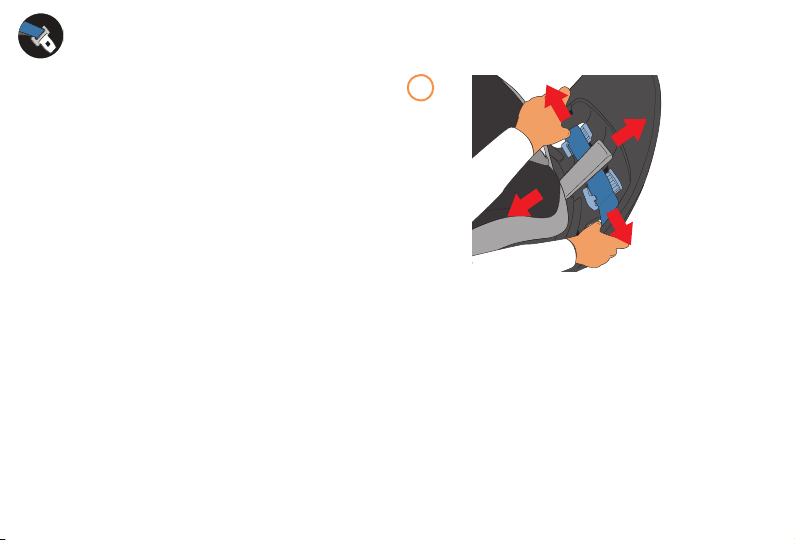
84
9
INSTALLING CHILD RESTRAINT
WITH LAP BELT
9. Grab Base near belt path and pull side to side
and front to back to make sure Base is installed
tightly. Base should not move more than
2.5 cm
(1 in) side to side or front to back at the Belt
Path on the Child Restraint
.
If Base moves too much, open Belt Tensioner,
tension vehicle belt a little more and try again.
After this, if Base still moves too much, you may
need to try a different vehicle seat location or
installation method, or both.

85
English
INSTALLING CHILD RESTRAINT
WITH LAP BELT
10. Replace Belt Path Cover on Base, making
sure to insert the tabs at the bottom corners
of the cover into the Base before closing.
Belt Path Cover will close with an audible
CLICK.
NOTE: To avoid interference with recline
and rotation, ensure the Belt Path Cover is
properly closed.
11. Move Restraint to the appropriate REAR-
FACING or FORWARD-FACING position
based on the child’s size (pages 8-11) and
lock into position.
10
11
CLICK!
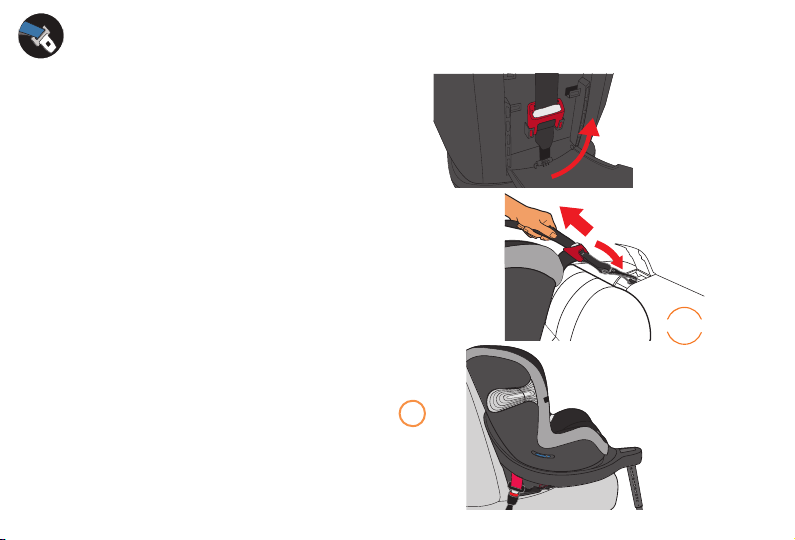
86
INSTALLING CHILD RESTRAINT
WITH LAP BELT
NOTE: Before moving the Restraint to the
FORWARD-FACING position, you must first
remove the Tether from the Tether Storage
Compartment on the back of the Restraint.
a. Rotate the Restraint to the FORWARD-
FACING position.
b. Locate the vehicle Tether Anchor and attach
the Tether Hook to the Tether Anchor.
c. Pull the Tether Adjuster Strap to tighten.
ALWAYS USE A TETHER FORWARD-FACING
if a Tether Anchor is available. A Tether
reduces movement of a FORWARD-FACING
child restraint in a crash and helps to achieve
a tight installation. Tether Anchor locations
vary from vehicle to vehicle. Refer to your
vehicle owner’s manual for exact locations,
anchor identification, and requirements. Refer
to page 51 for some common locations.
12. Extend Load Leg (page 44).
1
2
3
4
5
6
7
8
12
CLICK!

87
English
INSTALLING CHILD RESTRAINT
WITH LAP BELT
13.
CHECK Recline Angle using Level
Indicator.
For REAR-FACING installation, Recline Ball
should be in BLUE ZONE.
For FORWARD-FACING installation,
Recline Ball should be in RED ZONE.
Failure to properly recline the child restraint
could increase the child’s risk of death or
serious injury. Infants may have difficulty
breathing when in an upright seated position.
Make sure they recline enough for their head
to lie back comfortably and safely.
13
F
O
R
W
A
R
D
-
F
A
C
I
N
G
R
E
A
R
-
F
A
C
I
N
G
B
e
a
d
m
u
s
t
b
e
l
o
c
a
t
e
d
w
i
t
h
i
n
a
p
p
r
o
p
r
i
a
t
e
z
o
n
e
.
V
e
h
i
c
l
e
M
U
S
T
b
e
o
n
l
e
v
e
l
g
r
o
u
n
d
.
CY_171_6052_B1019
F
O
R
W
A
R
D
-
F
A
C
I
N
G
R
E
A
R
-
F
A
C
I
N
G
B
e
a
d
m
u
s
t
b
e
l
o
c
a
t
e
d
w
i
t
h
i
n
a
p
p
r
o
p
r
i
a
t
e
z
o
n
e
.
V
e
h
i
c
l
e
M
U
S
T
b
e
o
n
l
e
v
e
l
g
r
o
u
n
d
.
CY_171_6052_B1019
F
O
R
W
A
R
D
-
F
A
C
I
N
G
R
E
A
R
-
F
A
C
I
N
G
B
e
a
d
m
u
s
t
b
e
l
o
c
a
t
e
d
w
i
t
h
i
n
a
p
p
r
o
p
r
i
a
t
e
z
o
n
e
.
V
e
h
i
c
l
e
M
U
S
T
b
e
o
n
l
e
v
e
l
g
r
o
u
n
d
.
F
O
R
W
A
R
D
-
F
A
C
I
N
R
E
A
R
-
F
A
C
I
N
G
B
e
a
d
m
u
s
t
b
e
l
o
c
a
t
e
d
w
i
t
h
i
n
a
p
p
r
o
p
r
i
a
t
e
z
o
n
e
.
V
e
h
i
c
l
e
M
U
S
T
b
e
o
n
l
e
v
e
l
g
r
o
u
n
d
.
Tether Strap
WARNING!
DEATH or SERIOUS INJURY
can occur

88
INSTALLING CHILD RESTRAINT
WITH LAP BELT
NOTE: In some vehicles in the most reclined
position, it may be necessary to place a
rolled towel or small blanket beneath (not
behind) the Child Restraint near the seat
back to provide enough recline so that the
Recline Ball is in the BLUE ZONE for REAR-
FACING use.
NOTE: Only items approved by CYBEX are
allowed under Base.
14. Extend L.S.P. toward vehicle door if in an
outboard seating position (page 41).
14
F
O
R
W
A
R
D
-
F
A
C
I
N
G
R
E
A
R
-
F
A
C
I
N
G
B
e
a
d
m
u
s
t
b
e
l
o
c
a
t
e
d
w
i
t
h
i
n
a
p
p
r
o
p
r
i
a
t
e
z
o
n
e
.
V
e
h
i
c
l
e
M
U
S
T
b
e
o
n
l
e
v
e
l
g
r
o
u
n
d
.
CY_171_6052_B1019
F
O
R
W
A
R
D
-
F
A
C
I
N
G
R
E
A
R
-
F
A
C
I
N
G
B
e
a
d
m
u
s
t
b
e
l
o
c
a
t
e
d
w
i
t
h
i
n
a
p
p
r
o
p
r
i
a
t
e
z
o
n
e
.
V
e
h
i
c
l
e
M
U
S
T
b
e
o
n
l
e
v
e
l
g
r
o
u
n
d
.
CY_171_6052_B1019
PRESS

89
English
REMOVING CHILD RESTRAINT
WITH LAP BELT
FORWARD-FACING
Child Restraint Removal
1. Remove the Tether.
a. Press Adjuster Release Button.
b. Lengthen the Tether Strap.
c. Unhook the Tether Strap from the
Tether Anchor.
2. Rotate seat REAR-FACING and store
Tether in Tether Storage Compartment
on back of Restraint.
MAKE SURE Tether Storage
Compartment door is properly closed
after storing.
3. Continue with Step #1 of REAR-FACING
Child Restraint Removal.
1
Adjuster Release Button
2

90
REMOVING CHILD RESTRAINT
WITH LAP BELT
REAR-FACING Child Restraint Removal
1. Move the restraint past the most upright
position to access the Belt Path (pages 38-39).
2. Unbuckle the seat belt, remove the Belt Path
Cover, and open the Belt Tensioner to release
tension.
1
2

91
English
SECURING CHILD WITH HARNESS
1. Loosen harness by firmly pressing down on
the Harness Adjustment Button while pulling
forward on both Harness Straps at shoulder
level.
2. If Chest Clip is closed:
a. Press red button on Harness Buckle
a
to release Buckle Tongues.
b. Separate Chest Clip
b
and spread
Harness Straps apart.
c. Secure Harness Buckles to seat using
Magnetic Buckle Tongue Holders.
NOTE: To preserve battery life, always store
the SensorSafe Chest Clip in the unclipped
position.
1
2
a b
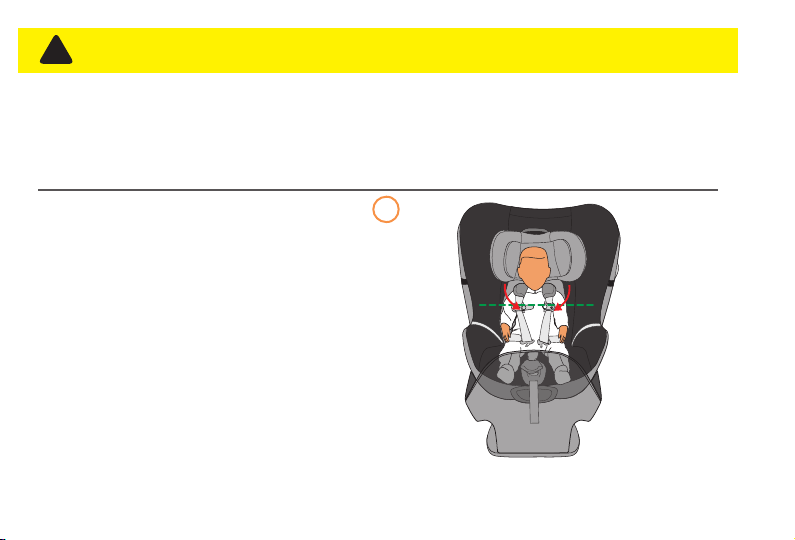
92
3. Place child in Child Restraint with
child's back and bottom flat against the
Restraint. Pull Harness Straps over the
child's shoulders and around the child's
waist. Straps must lie flat, free of twists,
and in the center of the child's shoulders.
NOTE: If Crotch Strap is under the child,
it will need to be adjusted (page 47).
To ensure a better fit with smaller
infants, the Newborn Insert may need
to be used. NEVER place extra padding
under or behind the child. ONLY USE
the Newborn Insert that comes with your
original car seat or one that has been
specifically designed for it by CYBEX.
SECURING CHILD WITH HARNESS
Chest Clip at
Armpit Level
3
WARNING! DEATH or SERIOUS INJURY can occur
!
NEVER secure child in Child Restraint with child dressed in bulky or heavy clothing. Heavy
clothing can prevent Harness from being properly tightened around the child.
NEVER secure child in Child Restraint with child wrapped in a blanket. To keep child warm,
place a blanket over the child AFTER you have properly secured and tightened Harness
around the child.

93
English
4. Adjust the Headrest height so that the
Harness Straps are positioned properly
(page 94).
NOTE: If using the lower Headrest/Harness
positions, make sure to tuck the excess
Headrest Flap up behind the Headrest Pad.
The Headrest Flap is designed with two
fold lines to allow for partial or full storage
behind the Headrest Pad.
SECURING CHILD WITH HARNESS
4

94
SECURING CHILD WITH HARNESS
FORWARD-FACING
Position the Harness
Straps AT or JUST ABOVE
the child's shoulders.
NOTE: Top of Child's ears
MUST be below the top
of the Headrest.
REAR-FACING
Position the Harness Straps
AT or JUST BELOW the
child's shoulders.
NOTE: Child's Head MUST
be 2.5 cm (1 in) or more
below the top of the
Headrest or shell, whichever
is higher.
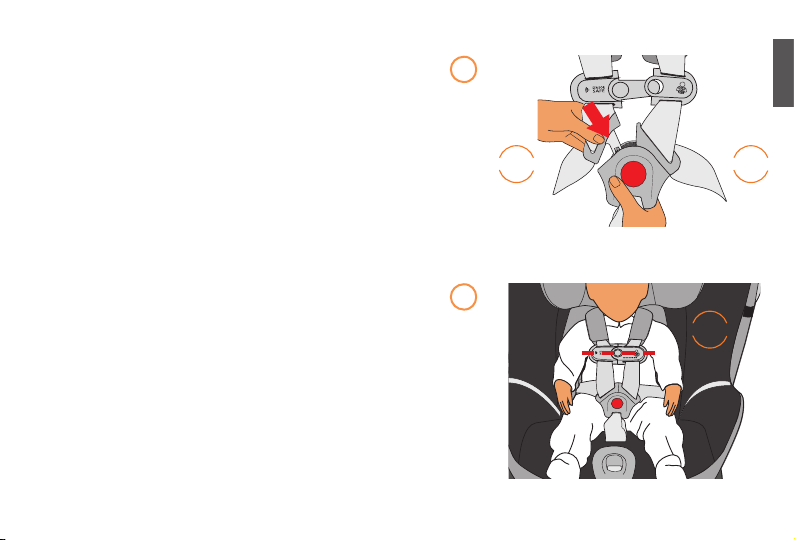
95
English
SECURING CHILD WITH HARNESS
5. Fasten buckle by inserting one tongue at a
time into the Harness Buckle listening for an
audible CLICK. Pull up firmly on both Buckle
Tongues to make sure they are securely
latched.
CHECK that the Buckle functions properly and
is kept free of dirt and debris.
Make sure Harness Straps are not twisted.
6. Fasten Chest Clip by snapping both sides
together. Listen for a CLICK.
5
6
CLICK! CLICK!
CLICK!

96
SECURING CHILD WITH HARNESS
7. Push Chest Clip and shoulder pads down
away from the child's neck and towards the
Harness Buckle.
8. Pull up on both shoulder straps to remove
all slack from the child's hips.
7
8

97
English
SECURING CHILD WITH HARNESS
9. Slowly pull the Adjuster Strap to tighten the
Harness Straps while holding the Chest Clip
so that it does not ride up into child's neck.
If you can pinch the Strap at the child's
shoulders, the Harness is too loose.
To tighten, pull the Harness Adjuster Strap
until Harness is snug on the child. A snug
strap should not allow any slack. It lies in
a relatively straight line without sagging. It
does not press on the child's flesh or push the
child's body into an unnatural position.
10. Position Chest Clip at armpit level as shown.
A
R
M
P
I
T
L
E
V
E
L
10
9

98
SECURING CHILD WITH HARNESS
12
11. To loosen Harness, firmly press down
the Harness Adjustment Button while
pulling forward on both Harness Straps
at shoulder level.
12. To remove child, press center buttons on
Chest Clip and Harness Buckle and pull
them apart.
13. Secure Harness Buckles to seat using
Magnetic Buckle Tongue Holders.
NOTE: To preserve battery life, always
store the SensorSafe Chest Clip in the
unclipped position.
11
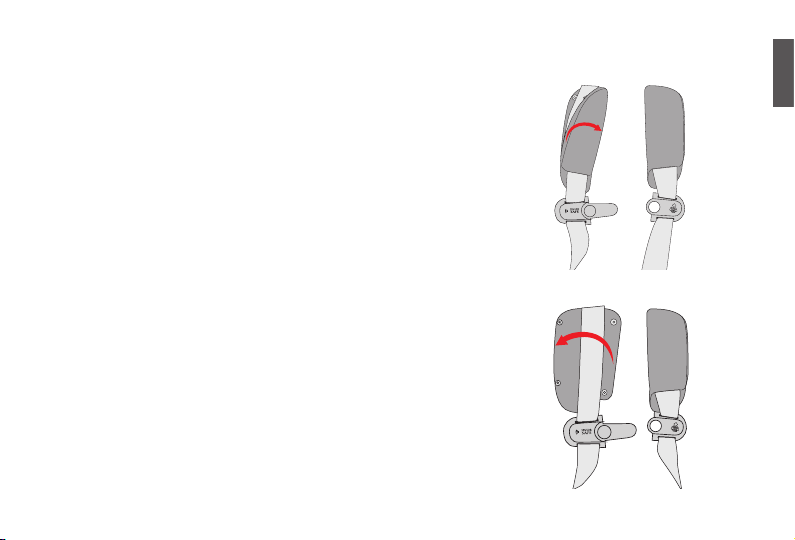
99
English
CARE AND CLEANING
REMOVING THE SHOULDER PADS
Unsnap and remove Shoulder Pads as shown at
right.
REPLACING THE SHOULDER PADS
Re-attach Shoulder Pads by folding the snaps
over the Harness Strap and securing both snaps.
Make sure they are oriented as shown.
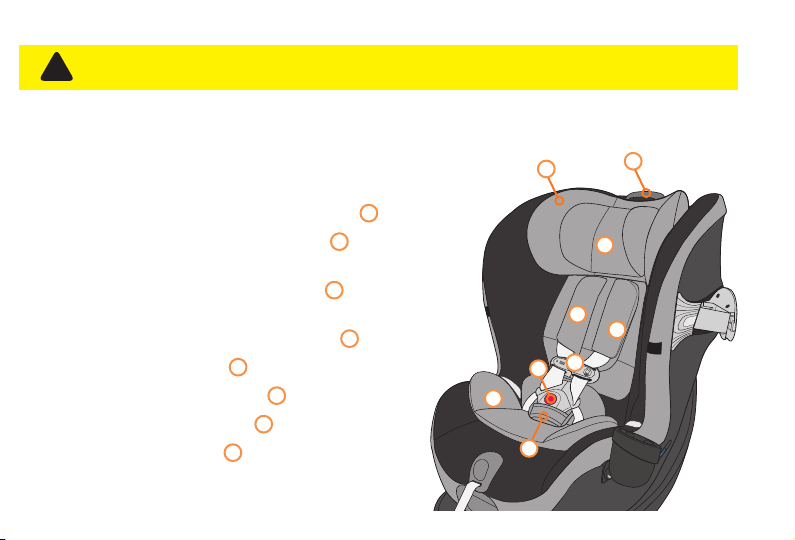
100
• The Child Restraint must NEVER be used without the Seat Cover.
• DO NOT damage, remove or dispose of any EPP foam padding on the Sirona S.
CARE AND CLEANING
REMOVING THE SEAT COVER
1. Adjust the Headrest to its highest position
a
.
2. Unzip the back of the Headrest Cover
b
and
unsnap from the back of the seat.
3. If using the Newborn Headpad Insert
c
,
remove from the Headrest.
4. Unsnap and remove the Shoulder Pads
d
.
5. Unfasten the Chest Clip
e
.
6. Unfasten the Harness Buckle
f
.
7. If using the Newborn Insert
g
, remove it.
8. If using the Buckle Pad
h
, remove it.
WARNING! DEATH or SERIOUS INJURY can occur
!
A
R
M
P
I
T
L
E
V
E
L
b
c
d
d
e
g
h
f
a

101
English
9. Remove the Headrest Cover from the
Headrest.
10. Remove the Seat Cover from the Child
Restraint.
a. Unsnap the two snaps securing the
Back Padding to the Seat Cover and pull
forward.
b. Untuck Seat Cover from around the edges
of the seat and pull the Seat Cover away
from the Child Restraint.
CARE AND CLEANING
9
10
aa
b

102
INSTALLING THE SEAT COVER
1. Install the Seat Cover onto the Child
Restraint.
a. From the top of the seat, tuck the
Seat Cover around the edges of the
Child Restraint.
b. Secure the two snaps on the Back
Padding to the Seat Cover.
2. Install the Headrest Cover to the
Headrest.
CARE AND CLEANING
2
1
bb
a

103
English
3. Zip the back of the Headrest Cover
a
and secure the snap on the Headrest
Cover through the Headrest Height
Adjustment Handle to the back of the
seat.
4. If using the Newborn Headpad Insert
b
,
secure it to the Headrest.
5. Install the Shoulder Pads
c
.
6. Fasten the Chest Clip
d
.
7. If using the Newborn Insert
e
, reinstall it.
8. If using the Buckle Pad
f
, reinstall it.
9. Fasten the Harness Buckle
g
.
CARE AND CLEANING
A
R
M
P
I
T
L
E
V
E
L
a
b
c
c
d
e
f
g
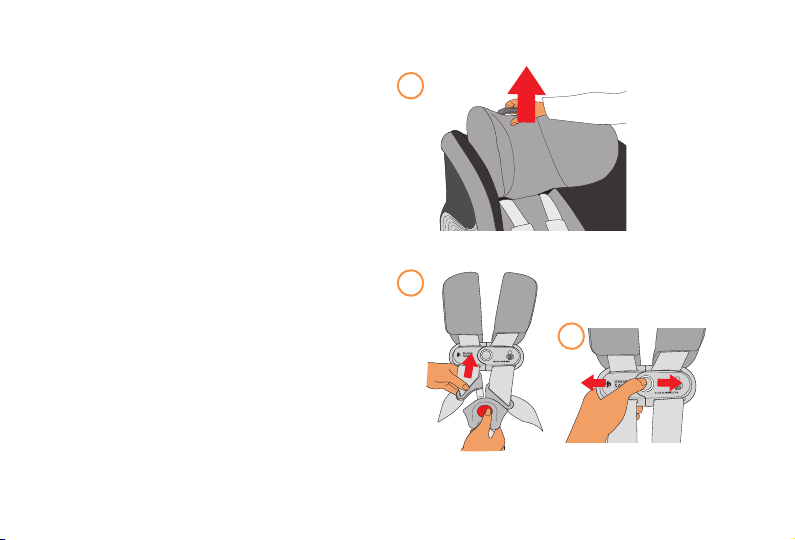
104
CARE AND CLEANING
REMOVING THE HARNESS STRAPS
1. Adjust the Headrest to its highest position.
2. Press red button on Harness Buckle to
release tongues.
3. Separate Chest Clip and spread Harness
Straps apart.
1
2
3

105
English
CARE AND CLEANING
4. Unfasten the two snaps securing the
Headrest Cover to the seat and move the
Harness Straps o to the sides.
NOTE: Secure the harness buckles to the seat
using the Magnetic Buckle Tongue Holders.
5. Unfasten the two snaps securing the Back
Padding to the Seat Cover and pull forward to
expose Seat Pan.
4
5

106
6
ba
CARE AND CLEANING
6. Remove Harness Straps from Seat Pan.
a. Push up on Hip Anchor Retention
Tab
a
and slide Hip Anchor Pin
b
inward.
b. Remove Harness Strap from Hip
Anchor and repeat at other side.
7. Remove Harness Straps from Child
Restraint.
a. Loosen Harness Straps
a
by pulling
forward until Splitter Plate
b
is
visible.
b. Disconnect Harness Straps from
Splitter Plate.
c. Drape Splitter Plate into Seat Pan to
prevent falling into bottom of Child
Restraint.
7
a
a
b

107
English
CARE AND CLEANING
REPLACING THE HARNESS STRAPS
1. Feed the Harness Straps through the
Harness Slots located on the back of the
Child Restraint.
2. Lift up the seat back and ensure that the
Harness Straps feed behind the Harness
Load Bar.
NOTE: The Tether Strap should be in
front of the Harness Load Bar.
1
2
Harness
Load Bar

108
CARE AND CLEANING
3
3. Attach Harness Straps to Splitter Plate.
NOTE: Make sure straps are not twisted
and fully attached to the Splitter Plate as
shown to prevent detachment.
4. Attach Harness Strap to Seat Pan.
a. Attach Harness Strap to hip anchor.
b. Slide hip anchor pin
a
outward to
lock and repeat at other side.
NOTE: Make sure straps are not twisted
and fully attached to the Seat Pan as
shown.
5. Secure the two snaps on the Back
Padding to the Seat Cover.
6. Reinsert the Harness Straps through the
loops connecting the Headrest Cover to
the seat and close the two snaps.
4
a

109
English
Headrest Cover
Buckle Pad
Shoulder Pads
Newborn Insert
CARE AND CLEANING
Seat Cover
SPOT CLEANING
Spot clean Seat Covers, Shoulder Pads,
Buckle Pad, and Newborn Inserts as needed
with a clean cloth using mild detergent and
water.
WASHING INSTRUCTIONS
All seat cover parts can be washed as follows:
• Machine wash separately in COLD water,
delicate cycle, with mild detergent.
• Drip-dry.
TO AVOID SHRINKAGE:
• DO NOT machine wash warm or hot.
• DO NOT TUMBLE DRY.
• DO NOT iron.
• DO NOT use bleach.
Newborn
Headpad Insert

110
CARE AND CLEANING
SENSORSAFE CHEST CLIP
• DO NOT SUBMERGE IN WATER. Wipe
clean with mild detergent and warm water.
HARNESS BUCKLE
Food, drink or other debris may collect
inside the Harness Buckle which can affect
proper function.
• DO NOT SUBMERGE THE BUCKLE STRAP
IN WATER.
• Wipe clean with a damp cloth.
• DO NOT use bleach, detergents or
lubricants.
• When inserting the Buckle Tongues, be
sure you can hear an audible CLICK to
make sure the buckle is working properly.
• DO NOT use the Child Restraint if the
Buckle Tongues DO NOT click into the
buckle. Try cleaning the buckle. If this
does not remedy the problem, please call
Customer Service 1-877-242-5676 before
using the Child Restraint.
HARNESS STRAPS
• NEVER SUBMERGE THE LOWER ANCHOR
STRAPS OR HARNESS STRAPS.
• Sponge clean using warm water and mild
soap.
• Air dry.
• DO NOT iron.
LOWER ANCHOR CONNECTORS
• Sponge clean or thoroughly rinse Lower
Anchor Connectors with warm water.
• Allow to dry thoroughly.
• Test by connecting and disconnecting until
an audible CLICK is heard after attaching
each connector to a lower anchor. If
clicks are not heard, repeat the cleaning
procedure.
PLASTIC PARTS
• Wipe clean with mild detergent and warm
water.

111
English
Secure your child into the child restraint as you would normally. The SensorSafe Receiver Plug
monitors both the Chest Clip Transmitter and the vehicle. When you arrive at your destination and
turn your vehicle o, the SensorSafe system sounds a series of gentle tones reminding you that
your baby is in the vehicle. Install it once and SensorSafe is always ready to alert you.
IMPORTANT USAGE INFORMATION
• The SensorSafe system consists of two components: (1) The Chest Clip Transmitter and (2) The
Receiver Plug. The system will not work unless both of these components are present in the
vehicle with the Receiver installed in the vehicle’s OBDII port (page 115).
• This system works with the SensorSafe Application which can be downloaded from: The App
Store
®
or Google Play
™
.*
* Trademarks are the property of their respective owners.
PLACE AT ARMPIT LEVEL
SENSOR
SAFE
CHEST CLIP TRANSMITTER RECEIVER PLUG
GENERAL INFORMATION ABOUT SENSORSAFE
®
WARNING! DEATH or SERIOUS INJURY can occur
!
This product contains magnets. Before use, consult your family doctor about the compatibility of this
product with pacemakers and similar devices.

112
• The SensorSafe Chest Clip is designed to go into a sleep mode after being clipped for 12 hours.
Although 12-hour vehicle trips without stops are uncommon and not recommended, the Chest Clip
must be opened and closed after 12 hours to reactivate the SensorSafe system.
• The Receiver Plug has ONLY been tested with 2008 or newer vehicles purchased in the U.S. or
Canada. If you would like to use the SensorSafe Chest Clip with a Hybrid or Electric vehicle, you will
need to download the application from the App Store
®
or Google Play
™
.* Additional Receiver Plugs
can be purchased for additional vehicles. If you have questions, please download the SensorSafe
app or contact CYBEX at: 1-877-242-5676 or online at: http://cybex-online.com/us/contact.html.
BATTERY USAGE
• TO PRESERVE BATTERY LIFE, ALWAYS STORE THE SENSORSAFE CHEST CLIP IN THE
UNCLIPPED POSITION.
• The Chest Clip ships with 1-button cell lithium battery installed that can be replaced.
• The SensorSafe is designed to alert you of a low battery. If your Chest Clip battery is getting low,
the SensorSafe Receiver will make a “low battery” alarm and LED will flash 10 times when the
Chest Clip is fastened. This “low battery” alarm will sound dierent from the beeps you typically
hear when activating your SensorSafe system. The SensorSafe Chest Clip uses a Panasonic
™
CR2032 Lithium button cell Battery. Should you have problems with SensorSafe hardware, please
contact CYBEX at: 1-877-242-5676 or online at:
http://cybex-online.com/us/contact.html to order a replacement battery/parts.
GENERAL INFORMATION ABOUT SENSORSAFE
®
* Trademarks are the property of their respective owners.

113
English
SensorSafe
®
Technology
Questions? Comments?:
Visit us at: http://cybex-online.com/us/contact.html or call CYBEX at: 1-877-242-5676
This device meets the requirements of SAE J3005.
FCC CERTIFIED:
Chest Clip Model: SOSR2, FCC ID: 2ABS2-SOSR3
Receiver Plug Model: SS2, FCC ID: 2ABS2-SS2
This device complies with Part 15 of the FCC Rules
.
Operation is subject to the following two
conditions:
1. This device may not cause harmful interference.
2. This device must accept any interference received, including interference that may cause
undesired operation.
GENERAL INFORMATION ABOUT SENSORSAFE
®

114
WARNING! DEATH or SERIOUS INJURY can occur
!
This equipment generates, uses, and can radiate radio frequency energy and, if not installed and
used in accordance with the instructions, may cause harmful interference to radio communications.
However, there is no guarantee that interference will not occur in a particular installation. If
this equipment does cause harmful interference to radio or television reception, which can be
determined by turning the equipment o and on, the user is encouraged to try to correct the
interference by one or more of the following measures:
• Reorient or relocate the receiving antenna.
• Increase the separation between the equipment and receiver.
• Connect the equipment into an outlet on a circuit dierent from that to which the receiver is
connected.
• Consult the dealer or an experienced radio/TV technician for help.
Chest Clip:
RF warning statement: The device has been evaluated to meet general RF exposure requirement.
The device can be used in portable exposure condition without restriction.
GENERAL INFORMATION ABOUT SENSORSAFE
®
Changes or modifications not expressly approved by the party responsible for compliance could
void the user’s authority to operate the equipment.
NOTE: This equipment has been tested and found to comply with the limits for a Class B digital
device, pursuant to Part 15 of the FCC Rules. These limits are designed to provide reasonable
protection against harmful interference in a residential installation.

115
English
a
USING SENSORSAFE
®
Receiver Plug:
FCC Radiation Exposure Statement: This equipment complies with FCC radiation exposure limits
set forth for an uncontrolled environment. This equipment should be installed and operated with
minimum distance 20 cm (7.87 in) between the radiator & your body.
1. INSTALL THE SENSORSAFE RECEIVER.
Locate the 16PIN OBDII port
a
in your vehicle. Refer to your
vehicle Owner’s Manual for location. Plug in the SensorSafe
Receiver. If unable to locate your vehicle manual, the
SensorSafe Application may contain information regarding the
location of the 16PIN OBDII port for your vehicle.
Your SensorSafe Receiver will sound when it first communicates
with the vehicle network. In some vehicles this occurs
immediately after installing the SensorSafe Receiver. In other
vehicles the tone will not be heard until the vehicle has been
started.
This initialization signal only occurs one time after installation.
2. POWER UP THE VEHICLE.
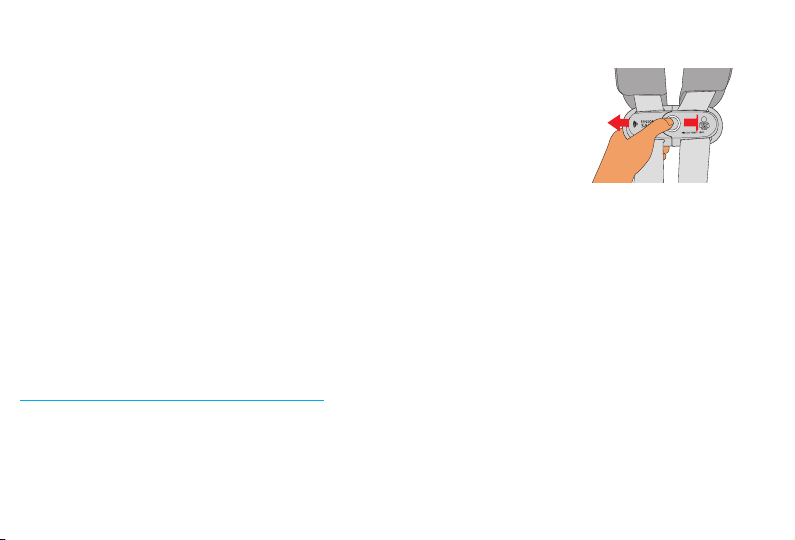
116
USING SENSORSAFE
®
3. CYCLE THE SENSORSAFE CHEST CLIP.
Your SensorSafe Chest Clip is designed to “go to sleep” if left fastened for
more than 12 hours. To reset, or “wake up” the Chest Clip, unfasten then
re-fasten it. When you do this, the blue LED will flash two times.
TO PRESERVE BATTERY LIFE, ALWAYS STORE THE SENSORSAFE CHEST
CLIP IN THE UNCLIPPED POSITION.
4. DRIVE THE VEHICLE.
The SensorSafe Receiver is designed to respond after the vehicle has been driven at 8 km (5
miles) per hour or more.
5. PARK THE VEHICLE AND TURN OFF THE IGNITION.
Within 2 seconds of parking your vehicle and turning o the ignition you will hear the SensorSafe
reminder, alerting you that your baby is in the vehicle. If you don’t hear the reminder tone, test
your SensorSafe by following steps 1-5 again. Contact CYBEX at: 1-877-242-5676 or online at:
http://cybex-online.com/us/contact.html if the reminder tone again fails to sound.
NOTE: SensorSafe Receiver will also alarm if your child unclips the Chest Clip after the vehicle has
been driven at 8 km (5 miles) per hour or more, but only if the vehicle is on.

117
English
REPLACING THE SENSORSAFE CHEST CLIP BATTERY.
USING SENSORSAFE
®
1. Loosen Harness by pressing Harness Release Button on the front of the Child Restraint and
pulling forward on both Harness Straps.
2. Unbuckle Harness by pressing the button on the Crotch Buckle and pulling out both Buckle
Tongues.
3. Open Chest Clip by pressing the Release Button and pulling the Chest Clip apart.
1 3
2
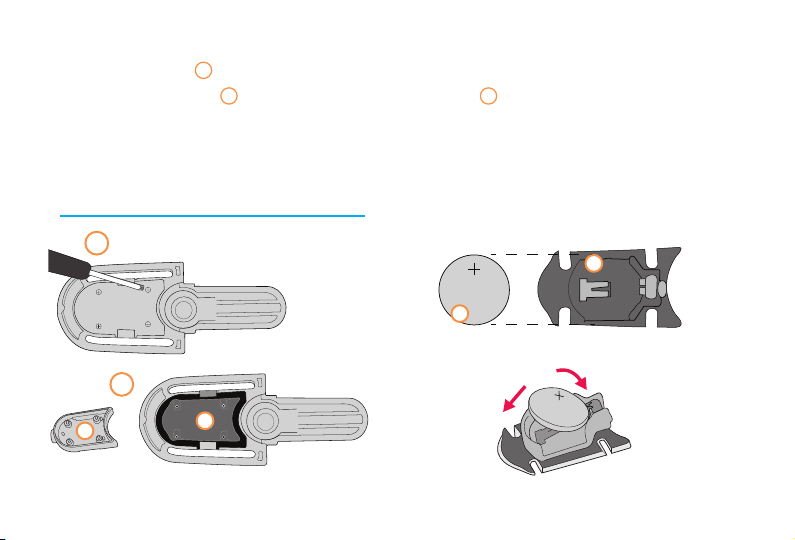
118
4. Turn the male side of the Chest Clip over and loosen screws with a small Phillips screwdriver.
Remove the cover
a
.
5. Remove Circuit Board
b
from Chest Clip. Remove Battery
c
from Circuit Board. Replace
Battery with new Panasonic
™
CR2032 Lithium button cell Battery, as shown.
6. Place the Circuit Board with the new Battery in the Chest Clip. Replace the Cover and tighten
the screws. This completes the battery replacement process.
If you have questions, please contact CYBEX at: 1-877-242-5676 or online at:
http://cybex-online.com/us/contact.html.
CR2032
b
c
USING SENSORSAFE
®
* Trademarks are the property of their respective owners.
CR2032
2
1
4
a
b
5
119
English
Did you read and understand this Owner’s Manual and all labels found on this Child Restraint?
Is the Child Restraint positioned correctly (REARFACING/FORWARD-FACING) for the child's
size?
Is the seat recline angle correct according to the Level Indicator?
Does the Rotation Lock Indicator display the word LOCKED?
Did you check for hot surfaces in sunny weather?
Is the Harness adjusted to the correct position for the size of the child with the Harness AT
or JUST BELOW child's shoulders (REARFACING), or AT or JUST ABOVE child's shoulders
(FORWARD-FACING)?
Is the Harness snug around the child and secured properly with the Chest Clip positioned at
armpit level?
Is the Tether Strap being used when using the seat FORWARD-FACING?
Is the Load Leg resting firmly against the vehicle floor and does the Load Leg Lock Indicator
display the color GREEN?
If the Child Restraint is next to a vehicle door or panel, is the adjacent L.S.P. device extended?
Does your child meet the Child Usage Guidelines for the seat (pages 8-11)?
Is today’s date before the “Do Not Use After” date on the Child Restraint?
If you answered YES to all of these questions, you are good to go. Please DRIVE SAFELY!
SAFETY CHECKLIST

120
IF YOU NEED HELP
Please contact our Customer Care Department, where we have many Child Passenger Safety (CPS)
Technicians on staff, with any questions you may have concerning installation, parts, maintenance,
or warranty information.
When you contact us, please have the Model Number and Manufactured on Date ready so that we
may help you efficiently. This information can be found on the underside of your Child Restraint
Base.
Please contact CYBEX Customer Care at 1-877-242-5676.
E-mail: [email protected]
Web: www.cybex-online.com
RESOURCES

121
English
RESOURCES
Additional information, tips, and installation videos can be found in the SensorSafe mobile app.
75% OF ALL CAR SEATS ARE INSTALLED INCORRECTLY!
Installing your car seat correctly in your vehicle is extremely important for your child’s safety. Make
sure your car seat is installed correctly by using one of the following resources:
www.nhtsa.gov/equipment/car-seats-and-booster-seats
www.safekids.org
To find an available CPS Technician in your area, go to bit.ly/FindATech
Recycling : Once your seat has reached its expiration date, we recommend recycling the seat.
Contact your local community recycling center for the best way to dispose of your seat. We do not
recommend giving or selling the seat to anyone, or simply putting it in the garbage.

122
IMPORTANT: Immediately register your Child Restraint so we can contact you in the unlikely event
of a safety recall. Register online at http://register.cybex-online.com/us/carseats, or mail in the
separate registration card provided.
LIMITED WARRANTY
CYBEX warrants to the original consumer purchaser that this product will be free from defects in
material and workmanship for two (2) years from the date of original purchase (the“Warranty
Period”). During the Warranty Period, CYBEX, at its option, may repair or replace this product if
it is found by the manufacturer to be defective in material or workmanship. CYBEX reserves the
right to discontinue or change parts, fabrics, models, or products, or to substitute this product
with a comparable model or product. To make a claim under this warranty, please contact us at
[email protected], call us at 1–877–242–5676, or write to us at:
CYBEX Warranty
Columbus Trading Partners USA, Inc.
1801 Commerce Drive
Piqua, Ohio 45356
An original receipt is required to validate your warranty, and shipping charges will be the
responsibility of the original consumer purchaser. To expedite the processing of any future warranty
claims and to verify the original date of purchase, please complete and mail the pre-addressed
owner registration card within thirty (30) days of purchase.
WARRANTY

123
English
WARRANTY
WARRANTY LIMITATIONS
This warranty does not cover the effects of normal wear and tear or damages resulting from
negligence, modification, improper installation, accidents, misuse, or abuse of this product. It is
expressly agreed that the obligations of CYBEX and the original consumer purchaser’s remedies
under the limited warranty contained herein are exclusive and are strictly limited to the repair or
replacement of the product.
This limited warranty is conditional upon strict compliance with the provisions of the Owner’s Manual.
In no event will CYBEX or the dealer selling this product be liable to you for any damages, including
incidental or consequential damages, arising out of the use or inability to use this product.
LIMITATION OF WARRANTIES AND STATE/PROVINCIAL LAW RIGHTS
The warranty and remedies as set forth above are exclusive and in lieu of all others, oral or written,
express or implied. To the extent permitted by applicable law, any implied warranties, including
implied warranties of merchantability and fitness for a particular purpose, are hereby disclaimed.
Some states/provinces do not allow limitations as to how long an implied warranty lasts or the
exclusion or limitation of incidental or consequential damages, so the above limitations may not
apply to you.
This warranty gives you specific legal rights, and you may have other rights, which vary from state/
province to state/province. Neither CYBEX nor the dealer selling this product has authorized any
person to create for it any other warranty, obligation, or liability in connection with this product.

124
Bienvenido a la familia CYBEX.
Gracias por adquirir el sistema CYBEX SIRONA S. Nos sentimos orgullosos de traer a los Estados Unidos y Canadá
este producto diseñado en Alemania. Esperamos que el sistema SIRONA S haga que los viajes del niño sean más
seguros y agradables, y que la instalación y el uso sean tan sencillos como sea posible para usted.
El sistema SIRONA S aporta algunas innovaciones importantes de seguridad a la categoría de autoasientos converti-
bles.
Pata de carga
La pata de carga ajustable ayuda a minimizar las fuerzas de choque sobre el niño en un choque delantero. Permite
que el sistema de seguridad del sistema de sujeción infantil absorba y transfiera las fuerzas de choque de manera
más efectiva, dirigiendo algunas de ellas al piso del vehículo. La pata de carga se puede usar con el sistema de
sujeción ORIENTADO HACIA ATRÁS y ORIENTADO HACIA ADELANTE.
Base giratoria CYBEX
La base giratoria permite subir y bajar fácilmente al niño de manera segura. Cuando termine, puede pasar fácilmente
al modo ORIENTADO HACIA ATRÁS u ORIENTADO HACIA ADELANTE y elegir una posición de reclinado
sin tener que volver a instalar el autoasiento.
Sistema de protección lineal contra impactos laterales (L.S.P.) CYBEX
El sistema L.S.P. permite reducir gradualmente las fuerzas de una colisión con impacto lateral para minimizar las
lesiones. Una cabecera ajustable, aletas laterales profundas forradas con espuma EPS gruesa que absorbe energía y
un dispositivo ajustable integran el sistema L.S.P. CYBEX. Este sistema se optimizó para proteger y reducir las fuerzas
que afectan al niño en caso de choques con impacto lateral.
¡BIENVENIDO A CYBEX!

125
Español
¡Las estadísticas muestran que más del 75 % de los autoasientos se usan incorrectamente! Lea y siga
cuidadosamente estas instrucciones para instalar el sistema SIRONA S correctamente, incluso si la instalación y el
uso de este sistema de sujeción infantil pueden parecer sencillos e intuitivos.
Antes de usar el sistema de sujeción SIRONA S por primera vez, asegúrese de seguir todos los pasos de la lista de
verificación de seguridad en la página 241.
Siguiendo las recomendaciones de la Academia Estadounidense de Pediatría para el transporte seguro de niños,
recomendamos que los niños permanezcan en un autoasiento de seguridad ORIENTADO HACIA ATRÁS
tanto tiempo como sea posible, hasta que alcancen el peso o la altura más altos permitidos por el asiento.
Visite www.aap.org para obtener más información sobre la recomendación de la Academia.
Ningún autoasiento puede garantizar la protección contra lesiones en todos los casos, pero el uso adecuado ayuda
a reducir el riesgo de lesiones graves o la muerte. Si tiene preguntas o necesita ayuda, comuníquese con Cybex al
1-877-242-5676.
Además, recuerde registrar su sistema de sujeción infantil para que nos podamos comunicar con usted en el
improbable caso de que se retire el producto del mercado. Registre el producto en línea en:
http://register.cybex-online.com/us/carseats
Guarde este manual del propietario en el compartimiento ubicado en la parte trasera del sistema de sujeción infantil
SIRONA S, para mantenerlo como referencia futura. Apreciamos su compra y lo invitamos a que visite
www.cybex-online.com para ver otros magníficos productos de CYBEX.
¡BIENVENIDO A CYBEX!

126
LEA EL MANUAL DEL PROPIETARIO ANTES DE INSTALAR Y USAR ESTE SISTEMA DE SUJECIÓN INFANTIL.
GUARDE LAS INSTRUCCIONES PARA USO FUTURO.
ÍNDICE
SI NO SE SIGUEN ESTAS INSTRUCCIONES,
LA SEGURIDAD DE UN NIÑO SE PUEDE VER SERIAMENTE AMENAZADA.
REGISTRO E INFORMACIÓN SOBRE RETIRO DE PRODUCTO DEL MERCADO ................................................... 128
PAUTAS DE USO PARA EL NIÑO .......................................................................................................................... 130
DESCRIPCIÓN GENERAL DEL SISTEMA DE SUJECIÓN INFANTIL SIRONA S .......................................................134
ADVERTENCIAS .....................................................................................................................................................138
CARACTERÍSTICAS DEL SISTEMA DE SUJECIÓN INFANTIL ................................................................................ 156
ANCLAJES INFERIORES Y CORREAS DE SUJECIÓN PARA NIÑOS (LATCH) ................................................. 156
BASE GIRATORIA ........................................................................................................................................... 160
SISTEMA DE PROTECCIÓN LINEAL CONTRA IMPACTOS LATERALES (L.S.P.) .............................................. 162
PATA DE CARGA .............................................................................................................................................164
INDICADOR DE VOLADIZO ........................................................................................................................... 168
CORREA AJUSTABLE DE LA ENTREPIERNA ................................................................................................. 169
CABECERA CON ALTURA AJUSTABLE ...........................................................................................................170
PORTAVASOS ..................................................................................................................................................171
INSERTO PARA RECIÉN NACIDO....................................................................................................................172
INSERTO DE COJÍN PARA LA CABEZA PARA RECIÉN NACIDO .....................................................................172
CORREA DE SUJECIÓN ..................................................................................................................................173
CUBIERTAS DEL ARNÉS .................................................................................................................................173
TECNOLOGÍA SENSORSAFE
®
........................................................................................................................ 174

127
Español
LEA EL MANUAL DEL PROPIETARIO ANTES DE INSTALAR Y USAR ESTE SISTEMA DE SUJECIÓN INFANTIL.
GUARDE LAS INSTRUCCIONES PARA USO FUTURO.
ÍNDICE
SI NO SE SIGUEN ESTAS INSTRUCCIONES,
LA SEGURIDAD DE UN NIÑO SE PUEDE VER SERIAMENTE AMENAZADA.
INSTALLING AND REMOVING CHILD RESTRAINT (REAR-FACING AND FORWARD-FACING) .............................175
CÓMO INSTALAR EL SISTEMA DE SUJECIÓN INFANTIL CON EL SISTEMA LATCH ......................................175
CÓMO RETIRAR EL SISTEMA DE SUJECIÓN INFANTIL CON EL
SISTEMA LATCH ............................................................................................................................................ 185
CÓMO INSTALAR EL SISTEMA DE SUJECIÓN INFANTIL
CON EL CINTURÓN PARA REGAZO Y HOMBRO (METODO PREFERIDO) ......................................................187
CÓMO RETIRAR EL SISTEMA DE SUJECIÓN INFANTIL CON
EL CINTURÓN PARA REGAZO Y HOMBRO ................................................................................................... 198
CÓMO INSTALAR EL SISTEMA DE SUJECIÓN INFANTIL CON
EL CINTURÓN PARA REGAZO ...................................................................................................................... 200
CÓMO RETIRAR EL SISTEMA DE SUJECIÓN INFANTIL
CON EL CINTURÓN PARA REGAZO ............................................................................................................... 211
CÓMO AFIANZAR AL NIÑO CON EL ARNÉS .........................................................................................................213
CUIDADO Y LIMPIEZA .......................................................................................................................................... 221
INFORMACIÓN GENERAL ACERCA DE SENSORSAFE
®
.......................................................................................233
CÓMO USAR SENSORSAFE
®
............................................................................................................................... 237
LISTA DE VERIFICACIÓN DE SEGURIDAD .............................................................................................................241
RECURSOS ...........................................................................................................................................................242
GARANTÍA.............................................................................................................................................................244

128
Complete la tarjeta de registro que se incluye con el sistema de sujeción infantil y envíela por correo de
inmediato o registre el producto en línea.
Los sistemas de sujeción infantil se pueden retirar del mercado por razones de seguridad. Debe registrar
este sistema de sujeción para recibir notificaciones en caso de que se retire del mercado. Envíe su nombre,
domicilio, dirección de correo electrónico si está disponible, el número de modelo y la fecha de fabricación
del sistema de sujeción a:
Columbus Trading-Partners USA Inc.
Attn: ParentLink
1801 Commerce Drive
Piqua, Ohio 45356, EUA
o llame al 1-877-242-5676, o registre el producto en línea en:
http://register.cybex-online.com/us/carseats
Para obtener información sobre órdenes de retiro de productos del mercado, llame a la línea directa para el
consumidor del Departamento de Seguridad Vehicular del Gobierno de los Estados Unidos al: 1-888-327-4236
(TTY: 1-800-424-9153), o visite www.NHTSA.gov.
CÓMO REGISTRAR EL SISTEMA DE SUJECIÓN INFANTIL
REGISTRO E INFORMACIÓN SOBRE RETIRO DE PRODUCTO DEL MERCADO
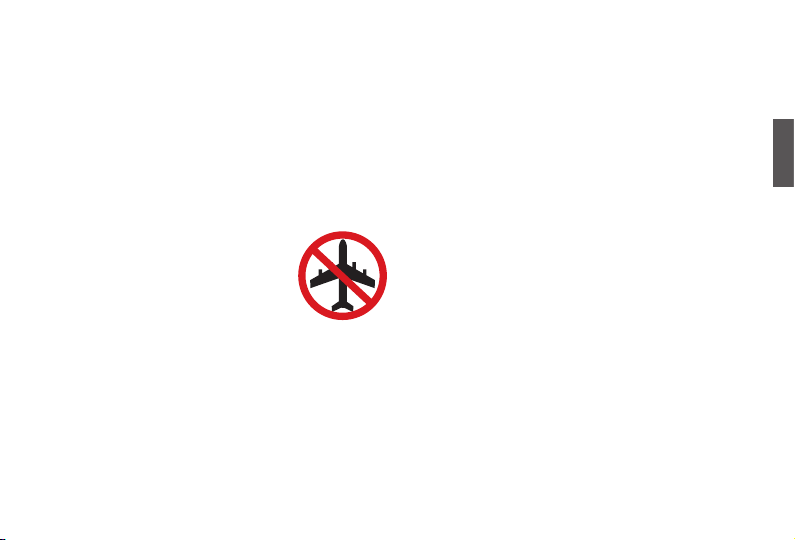
129
Español
CERTIFICACIÓN
REGISTRO E INFORMACIÓN SOBRE RETIRO DE PRODUCTO DEL MERCADO
Aviso normativo: Este sistema de sujeción infantil
cumple con todos los requisitos aplicables del
Estándar Federal de Seguridad 213 para Vehículos
Automotores (FMVSS).
Este sistema de sujeción está certificado para su
uso solo en vehículos motorizados de pasajeros y
de uso múltiple, autobuses y camiones equipados
con sistemas de cinturón para regazo y hombro.
ESTE SISTEMA DE SUJECIÓN
INFANTIL NO ESTÁ CERTIFICADO
PARA USARLO EN AVIONES.
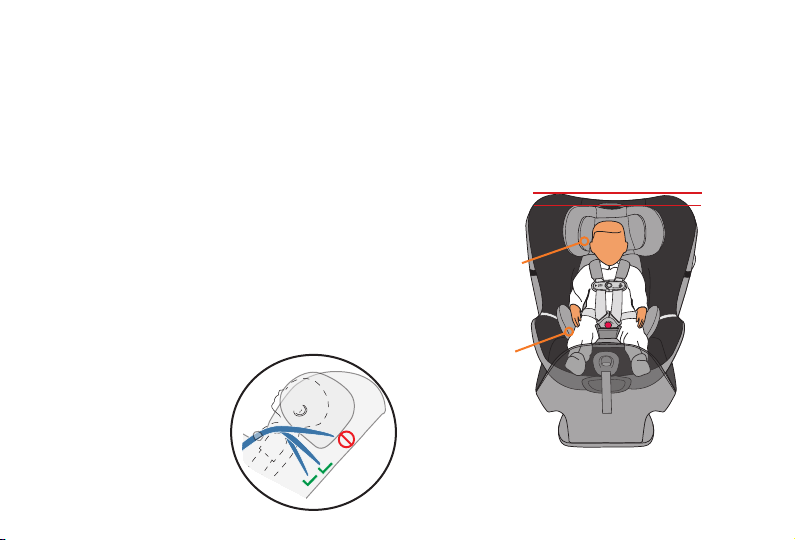
130
MODO ORIENTADO HACIA ATRÁS
El uso ORIENTADO HACIA ATRÁS de este sistema de sujeción infantil es SOLO para niños que
cumplen TODOS los requisitos que se muestran aquí. Si el niño no está dentro de estos requisitos porque es
demasiado pequeño, seleccione un asiento infantil diferente (como un autoasiento para bebés para uso solo
orientado hacia atrás).
Si el niño no cumple estos requisitos debido a que es demasiado grande, consulte las pautas para uso
USO OPCIONAL: Para garantizar un mejor ajuste para
los bebés más pequeños, es posible que necesite el
inserto para recién nacido o el inserto de cojín para la
cabeza para recién nacido (ver p. 172).
PAUTAS DE USO PARA EL NIÑO
Inserto para
recién nacido
Inserto de cojín para
la cabeza para recién
nacido
Parte superior de
la cabecera
Parte superior del armazón
ORIENTADO HACIA ADELANTE para determinar si
puede usar este sistema de sujeción infantil.
USO ORIENTADO HACIA ATRÁS:
EL NIÑO DEBE CUMPLIR TODOS LOS REQUISITOS INDICADOS:
PESO: 1.8 A 22.6 KG 4 A 50 LB
ALTURA: 43.2 A 124.5 CM 17 A 49 IN
LA CABEZA DEL NIÑO DEBE ESTAR POR LO MENOS
2.5 CM 1 IN O MÁS DEBAJO DE LA PARTE SUPERIOR DE LA
CABECERA O ARMAZÓN, LO QUE
SEA MÁS ALTO.
• Las correas del arnés se
deben ajustar de manera
que queden EN o APENAS
DEBAJO de los hombros del
niño.
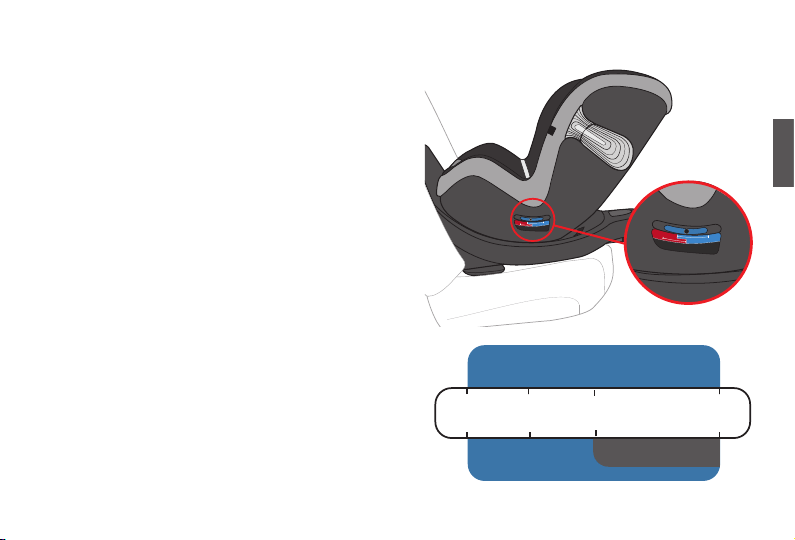
131
Español
F
O
R
W
A
R
D
-
F
A
C
I
N
G
R
E
A
R
-
F
A
C
I
N
G
B
e
a
d
m
u
s
t
b
e
l
o
c
a
t
e
d
w
i
t
h
i
n
a
p
p
r
o
p
r
i
a
t
e
z
o
n
e
.
V
e
h
i
c
l
e
M
U
S
T
b
e
o
n
l
e
v
e
l
g
r
o
u
n
d
.
CY_171_6052_B1019
F
O
R
W
A
R
D
-
F
A
C
I
N
G
R
E
A
R
-
F
A
C
I
N
G
B
e
a
d
m
u
s
t
b
e
l
o
c
a
t
e
d
w
i
t
h
i
n
a
p
p
r
o
p
r
i
a
t
e
z
o
n
e
.
V
e
h
i
c
l
e
M
U
S
T
b
e
o
n
l
e
v
e
l
g
r
o
u
n
d
.
CY_171_6052_B1019
MODO ORIENTADO HACIA ATRÁS
Cuando se usa ORIENTADO HACIA ATRÁS,
asegúrese de que la esfera de reclinado esté en el
rango AZUL, como se muestra.
NO use el sistema LATCH en modo ORIENTADO
HACIA ATRÁS si el niño pesa más de
13.6 kg (30 lb).
ORIENTADO HACIA ATRÁS
(4 lb)
1.8 kg
(50 lb)
22.6 kg
SIN EL SISTEMA LATCH
(30 lb)
13.6 kg
PAUTAS DE USO PARA EL NIÑO

132
USO ORIENTADO HACIA ADELANTE:
EL NIÑO DEBE CUMPLIR TODOS LOS REQUISITOS INDICADOS:
PESO: 10 A 29.4 KG 22 A 65 LB
ALTURA: 71.1 A 124.5 CM 28 A 49 IN
• La parte superior de las orejas está debajo de
la parte superior de la cabecera.
EDAD: por lo menos 1 años de edad
• Las correas del arnés se deben ajustar de
manera que queden
EN o APENAS ARRIBA de los hombros del
niño.
La Academia Estadounidense de Pediatría recomienda que los niños deben viajar ORIENTADOS HACIA
ATRÁS durante el mayor tiempo posible hasta que alcancen la altura y el peso máximo para el asiento.
El uso ORIENTADO HACIA ADELANTE de este sistema de sujeción infantil es SOLO para niños que
cumplen TODOS los requisitos que se muestran aquí. Si el niño no cumple estos requisitos debido a que es
demasiado grande, seleccione un asiento infantil diferente (como un asiento elevador).
Si el niño NO cumple estos requisitos debido a que es demasiado pequeño, consulte las pautas para uso
ORIENTADO HACIA ATRÁS para determinar si puede usar este sistema de sujeción infantil.
MODO ORIENTADO HACIA ADELANTE
PAUTAS DE USO PARA EL NIÑO

133
Español
MODO ORIENTADO HACIA ADELANTE
Cuando se usa ORIENTADO HACIA ADELANTE,
asegúrese de que la esfera de reclinado esté en el
rango ROJO, como se muestra.
NO use el sistema LATCH en modo ORIENTADO
HACIA ADELANTE si el niño pesa más
de 15.9 kg (35 lb).
F
O
R
W
A
R
D
-
F
A
C
I
N
G
R
E
A
R
-
F
A
C
I
N
G
B
e
a
d
m
u
s
t
b
e
l
o
c
a
t
e
d
w
i
t
h
i
n
a
p
p
r
o
p
r
i
a
t
e
z
o
n
e
.
V
e
h
i
c
l
e
M
U
S
T
b
e
o
n
l
e
v
e
l
g
r
o
u
n
d
.
CY_171_6052_B1019
F
O
R
W
A
R
D
-
F
A
C
I
N
G
R
E
A
R
-
F
A
C
I
N
G
B
e
a
d
m
u
s
t
b
e
l
o
c
a
t
e
d
w
i
t
h
i
n
a
p
p
r
o
p
r
i
a
t
e
z
o
n
e
.
V
e
h
i
c
l
e
M
U
S
T
b
e
o
n
l
e
v
e
l
g
r
o
u
n
d
.
CY_171_6052_B1019
PAUTAS DE USO PARA EL NIÑO
ORIENTADO HACIA ADELANTE
SIN EL SISTEMA LATCH
(22 lb)
10 kg
(35 lb)
15.9 kg
(65 lb)
29.4 kg

134
A
R
M
P
I
T
L
E
V
E
L
DESCRIPCIÓN GENERAL DEL SISTEMA DE SUJECIÓN INFANTIL SIRONA S
VISTA DELANTERA
Cabecera
Inserto de cojín para la cabeza
para recién nacido
Cubierta del asiento
Hombreras
Clip para el pecho SensorSafe
Correas del arnés
Hebilla del arnés
Inserto para recién nacido
Correa de la entrepierna
Acojinado de la hebilla
Botón de ajuste del arnés
Correa de ajuste del arnés
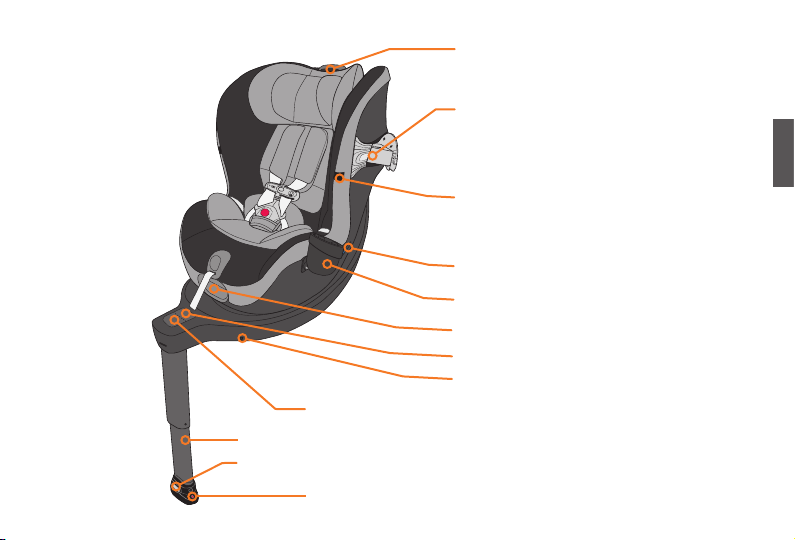
135
Español
A
R
M
P
I
T
L
E
V
E
L
DESCRIPCIÓN GENERAL DEL SISTEMA DE SUJECIÓN INFANTIL SIRONA S
Manija de ajuste de la altura de la
cabecera
Dispositivo
L.S.P.(totalmente extendido)
Soportes magnéticos para lengüeta
de hebilla
Indicador de nivel (ver página 137)
Portavasos
Manija de ajuste del reclinado
Pata de carga (extendida)
Botón de ajuste de la pata de carga
Indicador de bloqueo de giro
Indicador de bloqueo de la pata de carga (superior)
Indicador de bloqueo de la pata de carga (inferior)
Indicador de voladizo

136
DESCRIPCIÓN GENERAL DEL SISTEMA DE SUJECIÓN INFANTIL SIRONA S
l
SIRONA S
Owner‘s Manual - Keep for future use.
To reduce the risk of serious injury or
death, read this owner’s manual prior to
installing and using this child restraint.
Para reducir el riesgo de lesiones graves o
muerte, lea este manual del usuario antes de
instalar y usar el asiento infantil para el automóvil.
Manual del Propietario - Guarde para uso futuro.
WARNING
ADVERTENCIA
ENES
VISTA POSTERIOR
Manual del
propietario
(Compartimiento
interior)
Dispositivo L.S.P. (almacenado)
Correa de sujeción (almacenada)
Compartimiento de almacenamiento
de la correa de sujeción
Trayectoria del cinturón y tensor del
cinturón (ver página 137)
Correa LATCH
Lazo de liberación de la
correa LATCH
Conector LATCH
Ajustador LATCH

137
Español
DESCRIPCIÓN GENERAL DEL SISTEMA DE SUJECIÓN INFANTIL SIRONA S
SIRONA S
Owner‘s Manual - Keep for future use.
To reduce the risk of serious injury or
death, read this owner’s manual prior to
installing and using this child res traint.
Para reducir el riesgo de lesiones graves o
muerte, lea este manual del usuario an tes de
instalar y usar el asiento infantil p ara el automóvil .
Manual del Propietario - Guarde para u so futuro.
WARNING
ADVERTENCIA
EN
ES
Gancho de la
correa de sujeción
Ajustador de la
correa de sujeción
Correa de sujeción
CORREA DE SUJECIÓN
(SE MUESTRA SIN ALMACENAR)
TRAYECTORIA DEL CINTURÓN Y
TENSOR DEL CINTURÓN
Tensor del cinturón
Trayectoria del cinturón
Cubierta de la
trayectoria del cinturón
EasyLock (extendido)
INDICADOR DE NIVEL
F
O
R
W
A
R
D
-
F
A
C
I
N
G
R
E
A
R
-
F
A
C
I
N
G
B
e
a
d
m
u
s
t
b
e
l
o
c
a
t
e
d
w
i
t
h
i
n
a
p
p
r
o
p
r
i
a
t
e
z
o
n
e
.
V
e
h
i
c
l
e
M
U
S
T
b
e
o
n
l
e
v
e
l
g
r
o
u
n
d
.
CY_171_6052_B1019
F
O
R
W
A
R
D
-
F
A
C
I
N
G
R
E
A
R
-
F
A
C
I
N
G
B
e
a
d
m
u
s
t
b
e
l
o
c
a
t
e
d
w
i
t
h
i
n
a
p
p
r
o
p
r
i
a
t
e
z
o
n
e
.
V
e
h
i
c
l
e
M
U
S
T
b
e
o
n
l
e
v
e
l
g
r
o
u
n
d
.
CY_171_6052_B1019

138
ADVERTENCIAS SOBRE LA BOLSA DE AIRE
• NO use este sistema de sujeción en el asiento delantero de un vehículo equipado con bolsa de aire. La interacción
entre un sistema de sujeción orientado hacia atrás y las bolsas de aire puede causar lesiones graves o la muerte.
Si el vehículo tiene una bolsa de aire, consulte el manual del propietario del vehículo para obtener información
sobre la instalación del sistema de sujeción infantil.
¡ADVERTENCIA! Pueden ocurrir LESIONES GRAVES o la MUERTE
!

139
Español
• Si el asiento trasero del vehículo está equipado con bolsas de aire laterales, consulte la información a
continuación para el uso correcto.
• Modelos de vehículos fabricados antes del año 2002:
NO use este sistema de sujeción en el asiento de un vehículo equipado con bolsa de aire lateral, a menos que lo
autorice el fabricante del vehículo.
• Modelo del año 2002 y más recientes:
Consulte el manual del propietario del vehículo antes de colocar este sistema de sujeción en el asiento de un
vehículo equipado con bolsa de aire lateral.
• NO coloque ningún objeto entre el sistema de sujeción y la bolsa de aire lateral ya que, al expandirse, la bolsa de
aire puede ocasionar que los objetos golpeen al niño.
¡ADVERTENCIA! Pueden ocurrir LESIONES GRAVES o la MUERTE
!
La aplicación móvil SensorSafe* (ver página 174) puede proporcionar
información, imágenes o videos de instalación.
SUGERENCIA
140
ADVERTENCIAS GENERALES
La protección principal para los ocupantes de un vehículo en un choque es la propia estructura del vehículo. Si se
usa correctamente de acuerdo con las instrucciones y las etiquetas, este sistema de sujeción infantil aumentará
sustancialmente las posibilidades de supervivencia en la mayoría de los choques.
• LEA con cuidado este manual del propietario antes de usar el producto por primera vez y guárdelo para uso
futuro.
• SIGA TODAS LAS INSTRUCCIONES de este sistema de sujeción infantil y las instrucciones escritas almacenadas
en el compartimiento ubicado en la parte trasera del sistema de sujeción infantil.
• NUNCA instale ni use este sistema de sujeción infantil hasta que lea y comprenda las instrucciones en este
manual, el manual del propietario del vehículo y las etiquetas en el sistema de sujeción infantil. Si la información
de este manual y del manual del propietario del vehículo no concuerda, se debe seguir el manual del propietario
del automóvil. Si no se siguen estas instrucciones, se pueden causar lesiones graves o la muerte al niño en un
choque.
• NO permita que otras personas instalen o usen este sistema de sujeción infantil a menos que comprendan cómo
instalarlo y usarlo correctamente.
• NO use un sistema de sujeción infantil de segunda mano con un historial de uso que no conozca.
• NUNCA USE EL SISTEMA DE SUJECIÓN INFANTIL SI TIENE PARTES DAÑADAS, ROTAS O FALTANTES.
¡ADVERTENCIA! Pueden ocurrir LESIONES GRAVES o la MUERTE
!

141
Español
• REEMPLACE SIEMPRE EL SISTEMA DE SUJECIÓN INFANTIL Y LA BASE DESPUÉS DE UN CHOQUE DE
CUALQUIER TIPO INCLUSO SI ESTABA DESOCUPADO. Un choque puede causar daños no aparentes al sistema
de sujeción infantil que pueden no ser visibles.
• NUNCA permita que otra persona use este sistema de sujeción infantil sin darle también este manual.
• Compruebe SIEMPRE que las hebillas y otras partes no tengan superficies calientes antes de colocar al niño en
el sistema de sujeción infantil. ¡Una superficie caliente podría quemar al niño! Cubra con una manta el sistema de
sujeción infantil desocupado cuando lo deje en un vehículo expuesto a la luz solar.
• NUNCA deje un sistema de sujeción infantil vacío que no esté afianzado en el vehículo. Este sistema de sujeción
debe estar siempre afianzado, incluso cuando no esté ocupado. Un sistema de sujeción infantil que no esté
asegurado puede lesionar a los ocupantes del vehículo en caso de un choque o parada repentina.
• NO intente hacer reparaciones ni modificar o alterar de otro modo este sistema de sujeción infantil.
• Este producto contiene imanes que pueden presentar un peligro de atragantamiento. Busque atención médica
de inmediato si se ingieren o se inhalan los imanes. Antes de usarlo, consulte con el médico familiar acerca de
la compatibilidad de este producto con marcapasos y dispositivos similares.
ADVERTENCIAS GENERALES
¡ADVERTENCIA! Pueden ocurrir LESIONES GRAVES o la MUERTE
!
142
ADVERTENCIAS SOBRE LA UBICACIÓN
• SEGÚN LAS ESTADÍSTICAS DE ACCIDENTES, los niños están más seguros cuando están adecuadamente
sujetos en un asiento trasero del vehículo.
• Coloque este sistema de sujeción infantil SOLO en el asiento que permita el fabricante del vehículo. Para
determinar los asientos que se permiten. consulte el manual del propietario del vehículo para obtener
información sobre los sistemas de cinturón de seguridad del vehículo, las bolsas de aire, las bolsas de aire
laterales y las bolsas de aire delanteras en el lado del pasajero, y la instalación de sistemas de sujeción infantil.
• Es posible que no todas las ubicaciones en el interior de un vehículo sean seguras para la instalación de este
sistema de sujeción infantil. De hecho, algunos vehículos no tienen ninguna posición del asiento que sea segura
para la instalación de este sistema de sujeción infantil. La colocación incorrecta de este sistema de sujeción
infantil dentro de un vehículo aumentará el riesgo de muerte o lesiones graves.
• NUNCA use este sistema de sujeción infantil en un asiento del vehículo donde no se pueda afianzar firmemente.
Un sistema de sujeción infantil que se instale con holgura no protegerá al niño en un choque.
• NUNCA DEJE el respaldo de un asiento del vehículo con el mecanismo de plegado desbloqueado. En caso de
una parada repentina, un respaldo desbloqueado podría impedir que el sistema de sujeción infantil proteja al
niño.
• Use este sistema de sujeción infantil SOLO en asientos de vehículo con respaldos que queden bloqueados en su
lugar.
• NUNCA use este sistema de sujeción infantil en barcos, vehículos de baja velocidad (LSV), vehículos todo terreno
(ATV), carros de golf ni en ninguna otra aplicación no certificada.
¡ADVERTENCIA! Pueden ocurrir LESIONES GRAVES o la MUERTE
!

143
Español
ADVERTENCIAS SOBRE LA UBICACIÓN
• Este sistema de sujeción infantil puede tocar el asiento del vehículo que queda enfrente, siempre y cuando el
ángulo de reclinado del sistema de sujeción infantil no se vea afectado.
• Use SIEMPRE un dispositivo de protección lineal contra impactos laterales (L.S.P.) en la parte lateral del sistema
de sujeción infantil inmediatamente adyacente a una puerta o panel del vehículo (páginas 162-163).
• NUNCA extienda el dispositivo L.S.P. hacia un pasajero u otro sistema de sujeción infantil.
• Use este sistema de sujeción infantil SOLO en asientos de vehículo orientados hacia adelante.
• NUNCA instale este sistema de sujeción infantil en asientos del vehículo orientados hacia la parte trasera o la
parte lateral del vehículo.
• TIPOS DE VEHÍCULOS EN LOS QUE NO SE PUEDE USAR EL SISTEMA DE SUJECIÓN:
Este sistema de sujeción infantil NO se debe usar en vehículos que no tengan cinturones de seguridad del
vehículo o anclajes inferiores (ver páginas 152-154).
¡ADVERTENCIA! Pueden ocurrir LESIONES GRAVES o la MUERTE
!
144
ADVERTENCIAS SOBRE EL USO ORIENTADO HACIA ATRÁS
• Al usar este sistema de sujeción ORIENTADO HACIA ATRÁS, NO afloje el cinturón de seguridad del vehículo
para proporcionar más espacio para las piernas ya que esto evitará que el sistema de sujeción infantil proteja al
niño.
• Los descansabrazos abatibles podrían presentar riesgos para un ORIENTADO HACIA ATRÁS en ciertos tipos de
colisiones. Consulte el manual del propietario del vehículo antes de instalar cualquier sistema de sujeción infantil
ORIENTADO HACIA ATRÁS delante de un descansabrazos abatible.
• NUNCA cambie un sistema de sujeción infantil a la posición ORIENTADA HACIA ADELANTE con un niño que
pese menos de 10 kg (22 lb), mida menos de 71.1 cm (28 in) o tenga menos de 1 año de edad. Las fuerzas de
choque pueden ocasionar lesiones graves o la muerte.
• NO use la correa de sujeción cuando el sistema de sujeción infantil esté en la posición ORIENTADO HACIA
ATRÁS.
• La cabecera del asiento del vehículo que quede frente al niño cuando se sienta ORIENTADO HACIA ATRÁS se
debe colocar en la posición más baja. El respaldo del asiento del vehículo que está enfrente del niño debe estar
totalmente acojinado y no debe tener objetos rígidos.
• IMPORTANTE: Los bebés pueden tener dificultad para respirar cuando están sentados en posición erguida.
Asegúrese de que el bebé se recline lo suficiente para mantener la cabeza descansando hacia atrás
cómodamente y de manera segura. Si no reclina correctamente el sistema de sujeción infantil, se podría
aumentar el riesgo de que el niño sufra lesiones graves o la muerte.
• ALGUNOS NIÑOS CON NECESIDADES ESPECIALES, como los bebés prematuros o con diagnóstico positivo de
apnea posicional, pueden tener un mayor riesgo de sufrir dificultades respiratorias o de otro tipo en un sistema
de sujeción infantil. Consulte a un médico para determinar qué tipo de sistema de sujeción infantil se debe usar.
• NO USE este sistema de sujeción infantil si la parte superior de la cabeza del niño queda a menos de 2.5 cm
(1 in) de la parte superior de la cabecera o armazón, lo que sea más alto, cuando se usa ORIENTADO HACIA
ATRÁS.
¡ADVERTENCIA! Pueden ocurrir LESIONES GRAVES o la MUERTE
!

145
Español
ADVERTENCIAS SOBRE EL USO ORIENTADO HACIA ADELANTE
• NO USE este sistema de sujeción infantil ORIENTADO HACIA ADELANTE si el niño tiene menos de 1 año.
• NO USE este sistema de sujeción infantil si:
- el niño pesa más de 29.4 kg (65 lb).
- el niño mide más de 124.5 cm (49 in).
- las correas del arnés no se pueden ajustar EN o APENAS ARRIBA de los hombros del niño.
- la parte superior de las orejas del niño quedan arriba de la parte superior de la cabecera.
Si existe alguna de estas condiciones, EL NIÑO HA CRECIDO DEMASIADO PARA USAR EL ASIENTO.
• Si es posible, ajuste o retire la cabecera del vehículo en el asiento donde se instalará el sistema de sujeción
infantil, de manera que el respaldo del sistema de sujeción infantil descanse contra el respaldo del asiento del
vehículo.
• La cabecera del asiento del vehículo ubicado delante del niño debe colocarse en la posición más baja. El
respaldo del asiento del vehículo que está enfrente del niño debe estar totalmente acojinado y no debe tener
objetos rígidos.
ADVERTENCIAS SOBRE EL AJUSTE PARA NIÑOS
• Compruebe SIEMPRE la hebilla del arnés para asegurarse de que esté abrochada firmemente.
• AJUSTE CEÑIDAMENTE alrededor del niño los cinturones que se incluyen con este sistema de sujeción infantil.
• Mantenga SIEMPRE al niño correctamente afianzado en el arnés. Una correa ceñida no debe tener holgura.
Queda en una línea relativamente recta sin estar floja. No presiona la piel del niño ni empuja el cuerpo del niño a
una posición poco natural.
• NUNCA use ropa voluminosa ni mantas que interfieran con la colocación o ajuste correcto del arnés.
¡ADVERTENCIA! Pueden ocurrir LESIONES GRAVES o la MUERTE
!
146
ADVERTENCIAS ADICIONALES
• REGISTRE el sistema de sujeción infantil con el fabricante. Esta es la forma más eficaz de comunicarse con usted
en caso de un retiro de productos del mercado.
• NUNCA use este sistema de sujeción infantil si tiene una antigüedad de más de diez (10) años. La fecha de
fabricación se encuentra en una etiqueta adhesiva en la parte inferior del sistema de sujeción infantil.
• CUANDO NO LOS USE, guarde de manera segura los conectores LATCH.
• NUNCA use este sistema de sujeción infantil si alguna de las correas LATCH o del arnés tiene cortes, o si está
deshilachada o dañada de alguna manera.
• NUNCA deje al niño sin supervisión.
• Algunos niños se han ESTRANGULADO con correas del arnés parcialmente abrochadas o sueltas. Sujete al niño
por completo.
• NO permita que los niños jueguen con el sistema de sujeción infantil.
• NO permita que los niños jueguen con los cinturones de seguridad del vehículo. Un niño que pueda alcanzar el
cinturón de seguridad puede enredarse si saca el cinturón de seguridad por completo y lo envuelve alrededor de
su cabeza, cuello o cintura.
¡ADVERTENCIA! Pueden ocurrir LESIONES GRAVES o la MUERTE
!
147
Español
ADVERTENCIAS ADICIONALES
• NUNCA use accesorios o partes con este sistema de sujeción infantil que no tengan la aprobación de CYBEX. El
uso de accesorios o partes de otros fabricantes podría alterar el rendimiento del sistema de sujeción infantil.
• NO deje objetos sueltos (por ejemplo, comestibles, libros, bolsas) en un vehículo. En caso de una parada
repentina, los objetos sueltos seguirán en movimiento y podrían causar lesiones graves.
• NUNCA atienda las necesidades del niño al conducir. Detenga SIEMPRE el vehículo de manera segura para
atender al niño.
• NUNCA retire al niño del sistema de sujeción infantil mientras el vehículo está en movimiento. Los ocupantes que
no estén sujetos corren un riesgo mucho mayor de muerte o lesiones graves en un choque automovilístico.
• NO coloque ningún vaso que contenga líquidos calientes en el portavasos.
• NO use los portavasos para guardar latas o recipientes rígidos. Use solo vasos blandos (por ejemplo, de espuma
o papel).
¡ADVERTENCIA! Pueden ocurrir LESIONES GRAVES o la MUERTE
!

148
ADVERTENCIAS SOBRE LOS CINTURONES DE SEGURIDAD
• Lea SIEMPRE el manual del propietario del vehículo para determinar qué
cinturones y retractores se usan en el vehículo. El cinturón del vehículo DEBE
quedar bloqueado y NO DEBE aflojarse después de apretar el cinturón de
seguridad.
• NO use este sistema de sujeción infantil si se mueve más de 2.5 cm (1 in)
de lado a lado o de atrás hacia adelante en la trayectoria del cinturón en el
sistema de sujeción infantil al jalarlo con fuerza moderada. Pueden ocurrir
lesiones graves o la muerte debido a una instalación defectuosa. Si no
puede afianzar firmemente el sistema de sujeción infantil, intente de nuevo o
muévalo a otro asiento del vehículo.
Retractor
• NO use este sistema
de sujeción infantil en
un vehículo que tenga
cinturones de seguridad
que se mueven
automáticamente a lo
largo de la estructura del
vehículo cuando se abre
la puerta.
• NO use este sistema de
sujeción infantil en un
asiento con cinturones de
seguridad montados en la
puerta.
¡ADVERTENCIA! Pueden ocurrir LESIONES GRAVES o la MUERTE
!
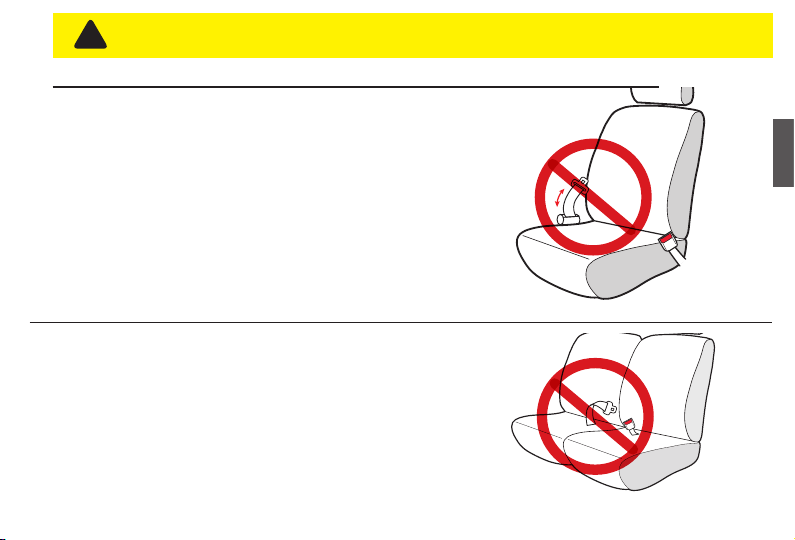
149
Español
• NO use este sistema de sujeción infantil en vehículos equipados con
cinturones para regazo que solo se bloquean al frenar súbitamente
o en un choque (retractores de bloqueo de emergencia - ELR).
Se debe usar un asiento del vehículo que tenga un cinturón de
seguridad con bloqueo. Consulte el manual del propietario del
vehículo para ver si su automóvil tiene cinturones para regazo con
retractores de bloqueo de emergencia.
• NO lo use en los asientos del vehículo cuando ambas partes de los
cinturones del vehículo estén colocadas por delante del pliegue del
asiento.
ADVERTENCIAS SOBRE LOS CINTURONES DE SEGURIDAD
¡ADVERTENCIA! Pueden ocurrir LESIONES GRAVES o la MUERTE
!

150
• NO lo use con cinturones para regazo y hombro con dos retractores. Si los cinturones
de seguridad del vehículo no se colocan y abrochan correctamente, es posible que el
sistema de sujeción infantil no proteja al niño en un choque.
• NO lo use con cinturones de seguridad inflables.
• Consulte el manual del propietario del vehículo para determinar cómo bloquear el
cinturón de seguridad para instalar el sistema de sujeción infantil. El cinturón de
seguridad debe estar bloqueado para afianzar correctamente el sistema de sujeción
infantil.
• NO permita que el botón de liberación del cinturón de seguridad del vehículo toque el
sistema de sujeción infantil. El contacto accidental puede causar que se libere el cinturón
de seguridad. Si es necesario, voltee el botón de liberación del cinturón de seguridad en dirección opuesta al
sistema de sujeción infantil o mueva el sistema de sujeción infantil a otro asiento del vehículo.
• Si no se ajustan ceñidamente el arnés o los cinturones de seguridad del vehículo alrededor del niño, el niño se
podría golpear contra el interior del vehículo al frenar súbitamente o en un choque. Pueden ocurrir lesiones graves
o la muerte.
• Los sistemas de sujeción infantil se deben afianzar bien con el cinturón de seguridad del vehículo, incluso cuando
no estén ocupados, ya que en un choque, un sistema de seguridad que no esté afianzado puede lesionar a otros
ocupantes.
ADVERTENCIAS SOBRE LOS CINTURONES DE SEGURIDAD
¡ADVERTENCIA! Pueden ocurrir LESIONES GRAVES o la MUERTE
!

151
Español
• Si el vehículo es un modelo anterior al año 1996, y tiene un cinturón para
regazo y hombro equipado con un retractor de bloqueo de emergencia (ELR)
Y una placa de sujeción deslizante, DEBE usar el clip de bloqueo. Consulte el
manual del propietario del vehículo para identificar el sistema de cinturón que
tiene el vehículo.
• Si el vehículo es un modelo del año 1996 o posterior, es probable que
cuente con un sistema de cinturón que se puede bloquear al apretarlo y no
requerirá el uso del clip de bloqueo. Consulte el manual del propietario del
vehículo antes de instalar el clip de bloqueo. Si el vehículo requiere un clip
de bloqueo, llame a CYBEX al 1-877-242-5676, para obtener el clip de bloqueo
y las instrucciones sobre cómo instalarlo y usarlo. Retire el clip de bloqueo
del cinturón de seguridad del vehículo cuando no lo use con el sistema de
sujeción infantil; de lo contrario, el cinturón de seguridad del vehículo no
sujetará correctamente a un niño o adulto. Pueden ocurrir lesiones graves o la muerte.
USO DEL CLIP DE BLOQUEO
Clip de
bloqueo
instalado
correctamente
13 mm
(0.5 in)
¡ADVERTENCIA! Pueden ocurrir LESIONES GRAVES o la MUERTE
!

152
• Si tiene alguno de estos tipos de sistemas de cinturón de vehículo enumerados, estos son SEGUROS de usar para
instalar el sistema de sujeción infantil en el vehículo. Consulte el manual del propietario del vehículo para obtener
instrucciones específicas sobre la instalación del sistema de sujeción infantil.
El sistema LATCH se puede usar EN LUGAR DE estos tipos de cinturón de vehículo. Consulte los límites de peso
para uso ORIENTADO HACIA ATRÁS y ORIENTADO HACIA ADELANTE con el sistema LATCH en las páginas
130-133. Consulte el manual del propietario del vehículo para obtener información sobre las ubicaciones del
sistema LATCH.
Cinturón para regazo con retractor de bloqueo automático (ALR)
• El retractor de bloqueo automático no permite que el cinturón para
regazo se alargue una vez abrochado. El cinturón del vehículo se aprieta
introduciendo la correa del cinturón en el retractor.
• Una vez abrochado, el cinturón del vehículo se aprieta jalando el
extremo libre de la correa hasta que el cinturón quede apretado.
Extremo libre
Cinturón para regazo con placa de sujeción de bloqueo
ADVERTENCIAS SOBRE LOS CINTURONES DE SEGURIDAD
¡ADVERTENCIA! Pueden ocurrir LESIONES GRAVES o la MUERTE
!
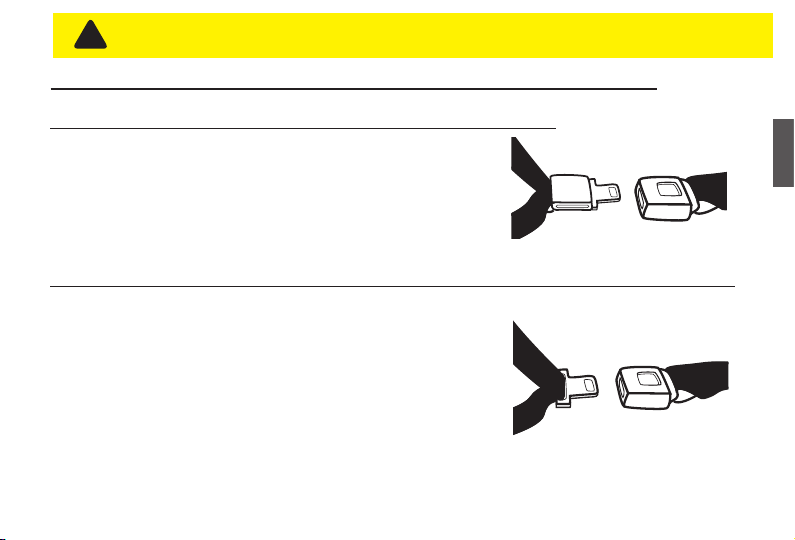
153
Español
Cinturón para regazo y hombro con placa de sujeción de bloqueo
Cinturón para regazo y hombro con placa de sujeción deslizante con retractor de bloqueo
• La placa de sujeción se desliza libremente a lo largo del cinturón
para regazo y hombro. Los cinturones de vehículo con placas de
sujeción deslizantes normalmente se bloquean en el retractor del
cinturón para hombro abrochando el cinturón y jalando toda la correa
lentamente para cambiar el retractor.
• Consulte el manual del propietario del vehículo para obtener
instrucciones específicas. El cinturón del vehículo se aprieta después
de cambiar el retractor jalando hacia arriba el cinturón para el
hombro y colocando la correa adicional en el retractor.
• La parte para el regazo de este cinturón no se afloja una vez que el
cinturón queda abrochado.
• El cinturón del vehículo se aprieta jalando hacia arriba con fuerza el
cinturón para el hombro y colocando la correa adicional en el retractor.
ADVERTENCIAS SOBRE LOS CINTURONES DE SEGURIDAD
¡ADVERTENCIA! Pueden ocurrir LESIONES GRAVES o la MUERTE
!
154
• Use SOLO el sistema LATCH para asegurar el sistema de sujeción infantil a las barras de anclaje inferior del
vehículo.
• NO use los anclajes inferiores del sistema de anclaje del sistema de sujeción infantil (LATCH) para acoplar este
sistema de sujeción infantil al sujetar a un niño que pese más de 13.6 kg (30 lb) ORIENTADO HACIA ATRÁS
O 15.9 kg (35 lb) ORIENTADO HACIA ADELANTE. USE SOLO LA INSTALACIÓN CON EL CINTURÓN DEL
VEHÍCULO.
• Además de estas instrucciones, lea y siga las instrucciones sobre la instalación del sistema de sujeción infantil y
del sistema LATCH que se incluyen en el manual del propietario del vehículo. Si existe una discrepancia, siga las
instrucciones descritas en el manual del propietario del vehículo.
• NUNCA acople dos conectores LATCH a una misma barra de anclaje inferior del vehículo.
• NUNCA use los cinturones de seguridad del vehículo cuando use el ensamble de los conectores de anclaje
inferior. Usar ambos al mismo tiempo puede causar holgura al frenar súbitamente o en una colisión.
• Para evitar el estrangulamiento, debe almacenar las correas LATCH sobrantes en el pliegue del asiento del
vehículo, como se describe en la página 159.
• Asegúrese SIEMPRE de que los conectores LATCH estén acoplados a las barras de anclaje inferior del vehículo
jalando con fuerza los conectores. Si no están acoplados, el ensamble de los conectores LATCH no afianzará el
sistema de sujeción infantil. PUEDEN OCURRIR LESIONES GRAVES O LA MUERTE.
• NO use este sistema de sujeción infantil si se mueve más de 2.5 cm (1 in) de lado a lado o de atrás hacia
adelante en la trayectoria del cinturón en el sistema de sujeción infantil al jalarlo con fuerza moderada. Pueden
ocurrir lesiones graves o la muerte debido a una instalación defectuosa. Si no puede afianzar firmemente el
sistema de sujeción infantil, intente de nuevo o muévalo a otro asiento del vehículo.
ADVERTENCIAS SOBRE EL SISTEMA LATCH
¡ADVERTENCIA! Pueden ocurrir LESIONES GRAVES o la MUERTE
!

155
Español
• Para evitar el peligro de estrangulación, DEBE guardar la correa de sujeción dentro del compartimiento de
almacenamiento de la correa de sujeción ubicado en la parte trasera del sistema de sujeción infantil. Acople el
gancho de la correa de sujeción al clip de almacenamiento cuando no lo use. Esto evitará que el gancho o la
correa de sujeción sin usar golpeen a alguien durante un choque.
• La correa de sujeción es SOLO para uso ORIENTADO HACIA ADELANTE.
• Consulte el manual del propietario del vehículo para ubicar el anclaje de la correa de sujeción en el vehículo.
Es posible que los vehículos de modelos anteriores no estén equipados con anclajes para correa de sujeción.
Consulte con el concesionario de su vehículo.
ADVERTENCIAS DE LA CORREA DE SUJECIÓN
¡ADVERTENCIA! Pueden ocurrir LESIONES GRAVES o la MUERTE
!
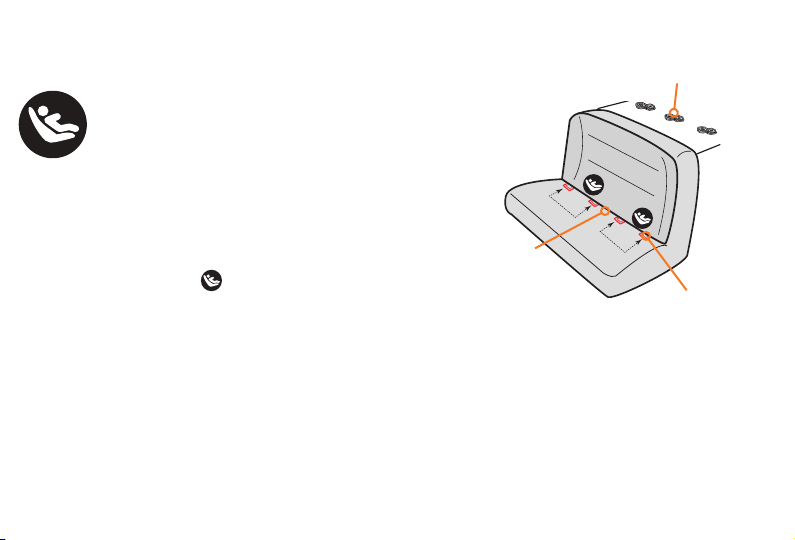
156
¿En qué consiste el sistema LATCH?
LATCH es el acrónimo en inglés de "anclajes inferiores
y correas de sujeción para niños" (Lower Anchors and
Tethers for CHildren) y se refiere a un par de anclajes
(o barras) inferiores fijos y a un anclaje de correa de
sujeción superior integrados en el vehículo. El sistema
LATCH se incluye estándar en vehículos fabricados después del 1 de
septiembre de 2002. Consulte el manual del propietario del vehículo
para obtener información sobre las posiciones de los anclajes en el
vehículo.
Los anclajes LATCH están ubicados en el pliegue entre el respaldo
y el cojín del asiento del vehículo y, si no son visibles, generalmente
están indicados por símbolos . Los anclajes de la correa de
sujeción están ubicados en varios lugares detrás del asiento trasero
del vehículo (ver página 173).
El sistema LATCH generalmente ofrece una instalación más fácil y
consistente. Sin embargo, este sistema de sujeción infantil se puede
instalar de forma segura usando los anclajes inferiores o los cinturones de seguridad del vehículo, y cumple los
requisitos de la FMVSS 213 con cualquiera de los dos métodos de instalación. Cualquiera de los métodos es seguro
para el niño cuando el sistema se instala correctamente. Al usar cualquiera de los dos métodos, la mejor práctica es
usar SIEMPRE la correa de sujeción superior al instalarlo ORIENTADO HACIA ADELANTE.
CARACTERÍSTICAS DEL SISTEMA DE SUJECIÓN INFANTIL
ANCLAJES INFERIORES Y CORREAS DE SUJECIÓN PARA NIÑOS (LATCH)
Anclajes de la correa de
sujeción superior
Anclajes
inferiores
Pliegue del
asiento del vehículo
28 cm
(11 in)
28 cm
(11 in)
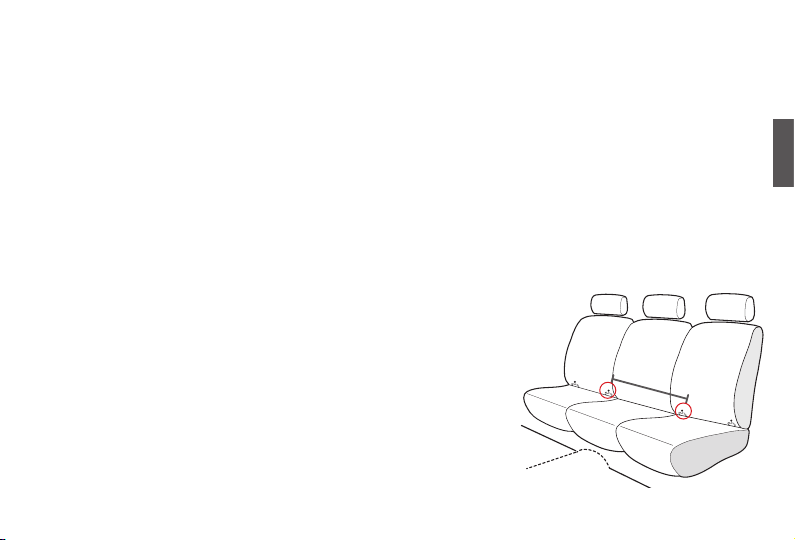
157
Español
Asientos laterales
Use los anclajes inferiores O un cinturón de seguridad del vehículo para instalar el sistema de sujeción infantil en los
asientos exteriores (ubicados a cada lado de la posición central).
NUNCA use los anclajes inferiores junto con los cinturones del vehículo para instalar este sistema de sujeción
infantil. El uso de ambos no está aprobado y puede causar un rendimiento inadecuado del sistema de sujeción
infantil.
Asientos centrales
Si el vehículo no tiene anclajes inferiores en el asiento central, consulte el manual del propietario del vehículo para
ver si puede usar los dos anclajes inferiores internos de los asientos exteriores para instalar un sistema de sujeción
infantil.
CYBEX permite que este sistema de sujeción infantil se instale usando los dos anclajes inferiores internos de los
asientos exteriores si la distancia entre ellos es de entre 28 y 51 cm (11
a 20 in) Y si lo permite el fabricante del vehículo. (Si la distancia no es
correcta o el fabricante del vehículo no lo permite, use el cinturón del
vehículo para instalarlo en la posición central).
Cuando use los anclajes inferiores internos, asegúrese de que ningún
vástago de hebilla obstruya la instalación y de que los conectores o
correas LATCH no bloqueen las hebillas del cinturón del vehículo.
28 a 51 cm
(11 a 20 in)
CARACTERÍSTICAS DEL SISTEMA DE SUJECIÓN INFANTIL
ANCLAJES INFERIORES Y CORREAS DE SUJECIÓN PARA NIÑOS (LATCH)

158
CARACTERÍSTICAS DEL SISTEMA DE SUJECIÓN INFANTIL
ANCLAJES INFERIORES Y CORREAS DE SUJECIÓN PARA NIÑOS (LATCH)
1
Para retirar del almacenamiento:
1. Jale el lazo de liberación de la correa LATCH
y saque el conector del compartimento de
almacenamiento. Repita el procedimiento en el
otro lado.
2. Alargue la correa entre los conectores usando
el ajustador LATCH ubicado junto a los
conectores. Presione hacia abajo el botón
de liberación del ajustador mientras alarga la
correa.
2
1
2
34
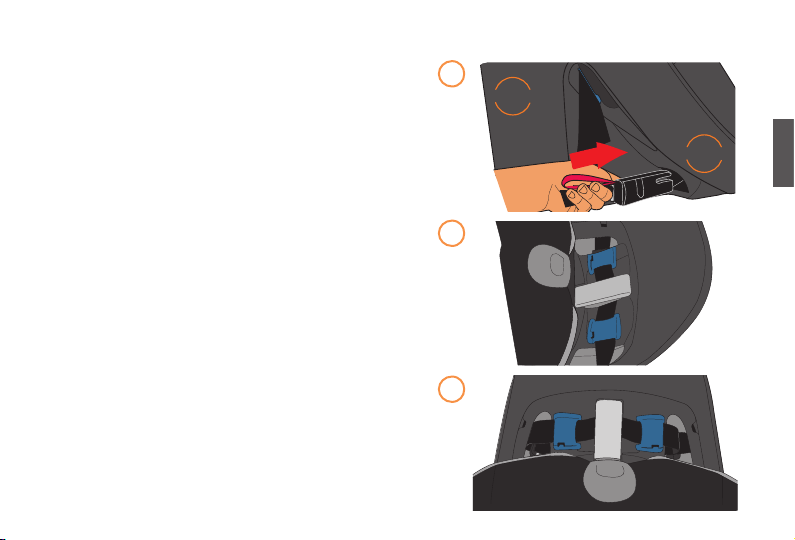
159
Español
Para almacenar:
Los conectores LATCH se DEBEN almacenar cuando
no se usen. Los conectores sueltos pueden lesionar
gravemente a los ocupantes de un vehículo en caso
de un choque.
1. Extienda por completo la correa LATCH.
Deslice cada conectar de nuevo en la ranura de
almacenamiento hasta que escuche un CLIC.
2. Asegúrese de que el tensor del cinturón y el
bloqueo EasyLock estén cerrados.
3. Retire la mayor parte de la holgura de la correa
LATCH jalando la correa del ajustador LATCH
hasta que quede plana a través de las guías del
cinturón. No apriete demasiado ni retire más
holgura de la necesaria.
4. Inserte la correa sobrante en el pliegue del
asiento del vehículo para que no estorbe.
CARACTERÍSTICAS DEL SISTEMA DE SUJECIÓN INFANTIL
ANCLAJES INFERIORES Y CORREAS DE SUJECIÓN PARA NIÑOS (LATCH)
2
3
1
2
34
¡CLIC!
¡CLIC!
1

160
CARACTERÍSTICAS DEL SISTEMA DE SUJECIÓN INFANTIL
BASE GIRATORIA
¡ADVERTENCIA!
Pueden ocurrir
LESIONES GRAVES o la MUERTE
NUNCA use este sistema de sujeción infantil en un asiento
del vehículo donde no se pueda afianzar firmemente. Un
sistema de sujeción infantil que se instale con holgura no
protegerá al niño en un choque.
El sistema de Sirona S gira en su base
a
, lo que permite
subir y bajar fácilmente al niño de manera segura cuando
el asiento está instalado correctamente. Para girar el
sistema de sujeción, jale la manija de reclinado y mueva el
sistema de sujeción hasta pasar la posición más vertical. El
indicador de bloqueo de giro mostrará la palabra UNBLOCK
(desbloquear) (página 161).
Gire el asiento a la posición para subir o bajar al niño que
desee. Cuando el niño esté afianzado con el arnés, gírelo
de nuevo a la posición ORIENTADA HACIA ADELANTE u
ORIENTADA HACIA ATRÁS
b
según el tamaño del niño
(páginas 130-133). Luego, vuelva a colocarlo en la posición
de reclinado bloqueada. El indicador de bloqueo de giro
mostrará la palabra BLOQUEO (página 161).
a
b

161
Español
CARACTERÍSTICAS DEL SISTEMA DE SUJECIÓN INFANTIL
BASE GIRATORIA
¡LA POSICIÓN GIRADA ES SOLO PARA SUBIR Y BAJAR
AL NIÑO!
El sistema Sirona S no está diseñado para proteger al niño
en un choque cuando el Indicador de bloqueo de giro
muestra el símbolo DESBLOQUEAR.
a
El sistema Sirona S DEBE ESTAR BLOQUEADO para un uso
adecuado cuando el vehículo está en movimiento.
Asegúrese de que el indicador de bloqueo de giro muestre
el símbolo BLOQUEO
b
y que el indicador de nivel esté en
el rango correcto antes de conducir (consulte las páginas
131 y 133).
a
b
¡ADVERTENCIA!
Pueden ocurrir
LESIONES GRAVES o la MUERTE

162
L.S.P.
El sistema de protección lineal contra impactos laterales
(L.S.P.) está integrado en el sistema Sirona S. Este sistema
mejora la seguridad del niño en caso de que se produzcan
determinados choques laterales. Para lograr el mejor
efecto de protección posible, extienda el sistema L.S.P.
hacia la puerta del automóvil más cercana al sistema de
sujeción infantil.
USE SIEMPRE el dispositivo L.S.P. cuando el sistema de
sujeción infantil se instale en un asiento lateral.
USE SIEMPRE un dispositivo L.S.P. en el lado del sistema
de sujeción infantil inmediatamente adyacente a una puerta
o panel del vehículo.
NUNCA USE el dispositivo L.S.P. cuando el sistema de
sujeción infantil esté colocado en el asiento trasero central.
NUNCA extienda el dispositivo L.S.P. hacia un pasajero u
otro sistema de sujeción infantil.
NUNCA levante ni transporte el sistema de sujeción infantil
usando los dispositivos L.S.P.
CARACTERÍSTICAS DEL SISTEMA DE SUJECIÓN INFANTIL
SISTEMA DE PROTECCIÓN LINEAL CONTRA IMPACTOS LATERALES (L.S.P.)

163
Español
PRESS
CÓMO EXTENDER EL SISTEMA L.S.P.
Presione el botón L.S.P.
a
en el lado del sistema
de sujeción adyacente a la puerta del vehículo. El
sistema L.S.P. se extenderá fuera del sistema de
sujeción y quedará asegurado en su lugar por el
brazo de bloqueo.
CÓMO RETRAER EL SISTEMA L.S.P.
Empuje el brazo de bloqueo para desbloquear el
sistema L.S.P.
b
, luego presione el sistema L.S.P. al
interior del lado del sistema de sujeción infantil para
almacenarlo
c
.
¡CLIC!
CARACTERÍSTICAS DEL SISTEMA DE SUJECIÓN INFANTIL
SISTEMA DE PROTECCIÓN LINEAL CONTRA IMPACTOS LATERALES (L.S.P.)
PRESS
c
b
a

164
No debe haber NUNCA
espacio entre el soporte
de la pata de carga y el
piso del vehículo.
La pata de carga no debe
empujar NUNCA la base
hacia afuera del asiento
del vehículo.
CARACTERÍSTICAS DEL SISTEMA DE SUJECIÓN INFANTIL
PATA DE CARGA
¡ADVERTENCIA! Pueden ocurrir LESIONES GRAVES o la MUERTE
!
La pata de carga es una característica de seguridad
efectiva del sistema Sirona S. Su uso se recomienda
encarecidamente.
Si NO SE PUEDEN CUMPLIR TODOS LOS REQUISITOS DE
INSTALACIÓN para la pata de carga, DEBE seleccionar
otro asiento o instalar el sistema de sujeción con la pata
de carga almacenada (plegada debajo). Consulte la página
168 para obtener información sobre el uso correcto del
indicador de voladizo.
INSTALE el sistema de sujeción en un asiento que permita
que la pata de carga se extienda a una posición de
bloqueo haciendo contacto firme con el piso del vehículo
(ver página 166).
Muchos vehículos tienen una elevación en el piso que
podría hacer que la pata de carga, incluso en su posición
más corta, empuje la base fuera del asiento del vehículo.
NUNCA INSTALE el sistema de sujeción en un asiento
donde la pata de carga, incluso en su posición más corta,
haga que la base se levante fuera del asiento del
vehículo.
La pata de carga DEBE estar
BLOQUEADA en su posición
y hacer CONTACTO FIRME
con el piso del vehículo.
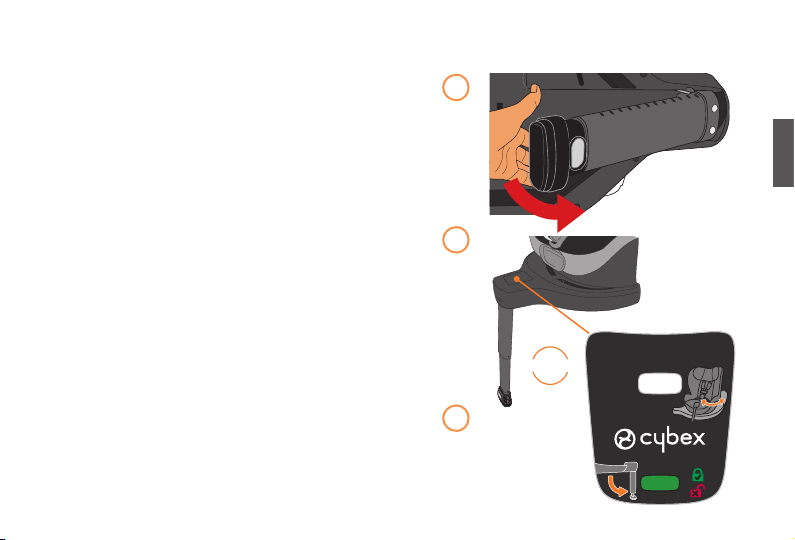
165
Español
CARACTERÍSTICAS DEL SISTEMA DE SUJECIÓN INFANTIL
PATA DE CARGA
¡CLIC!
2
Para instalar:
1. Voltee la base y saque la pata de carga fuera del
compartimento de almacenamiento.
2. Jale la pata de carga hacia arriba hasta que
escuche un CLIC y se bloquee en la posición
totalmente abierta.
3. El indicador de la pata de carga cambiará a color
VERDE cuando esté bloqueado.
3
1
CY_171_6075_A

166
Para extender:
Jale hacia abajo la pata de carga para extender el soporte
hasta que descanse sobre el piso del vehículo.
NOTA: Si la pata de carga no alcanza el piso, presione
el botón de ajuste de la pata de carga en el soporte y
jale hacia abajo para extenderla más.
A medida que baja la pata de carga, los botones del
indicador de bloqueo en cada lado del pie se mostrarán en
verde siempre que la pata haga contacto firme con el piso
del vehículo.
Afiance el soporte en su lugar usando el primer orificio
que lo bloquee firmemente contra el piso del vehículo sin
levantar la base del asiento.
Puede ser necesario levantar ligeramente la base para
permitir que el soporte quede bloqueado en el orificio.
Para retraer:
Presione el botón de ajuste de la pata de carga y empuje
hacia arriba el soporte para retraerlo.
CARACTERÍSTICAS DEL SISTEMA DE SUJECIÓN INFANTIL
PATA DE CARGA

167
Español
Para almacenar:
1. Voltee la base y gire la pata de carga hacia el
compartimento de almacenamiento.
2. Empuje la pata de carga hacia dentro hasta
que escuche un CLIC y se bloquee en el
compartimiento de almacenamiento.
NOTA: Si el niño pesa más de 18 kg (40 lb) y
viaja orientado hacia adelante en un vehículo
más antiguo con solo un cinturón de regazo y sin
anclaje de correa de sujeción, use la posición de
almacenamiento alternativa para la pata de carga.
CARACTERÍSTICAS DEL SISTEMA DE SUJECIÓN INFANTIL
PATA DE CARGA
1
2
¡CLIC!
Almacenamiento de la pata de carga
Almacenamiento alternativo de la pata de carga
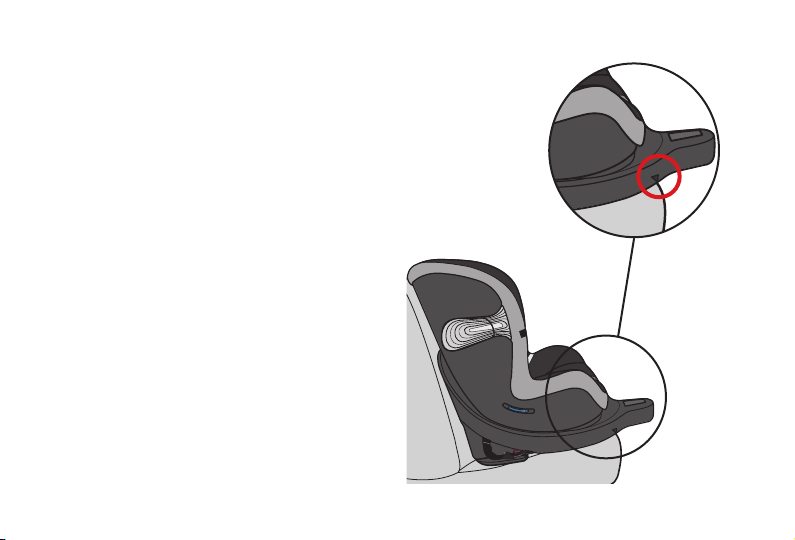
168
CARACTERÍSTICAS DEL SISTEMA DE SUJECIÓN INFANTIL
INDICADOR DE VOLADIZO
Al instalar el sistema Sirona S con la pata de carga
almacenada, asegúrese de que la base del asiento esté
colocada en el asiento del vehículo para que el indicador
de voladizo no se extienda más allá del borde del asiento
del vehículo.
Si el indicador de voladizo se extiende más allá del borde
del asiento del vehículo, DEBE elegir otro asiento.
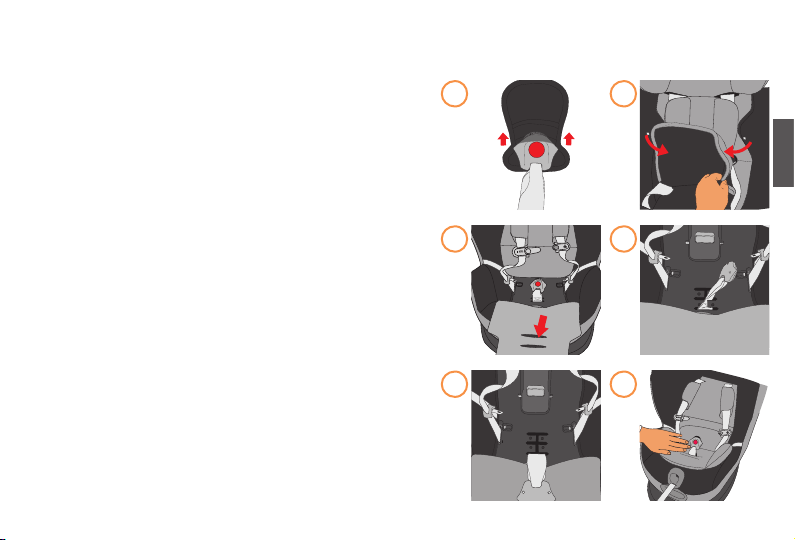
169
Español
L
E
V
E
L
Al crecer el niño, será necesario cambiar la posición de
la correa de la entrepierna. La correa de la entrepierna
debe estar SIEMPRE lo más cerca posible, pero NUNCA
debajo, del trasero del niño.
1.
Retire el acojinado de la hebilla.
2.
Desabroche los broches de la cubierta del asiento
detrás del acojinado de la cabecera y levante la
cubierta.
3.
Jale la cubierta del asiento hacia adelante. Deslice
la correa de la entrepierna por la abertura del
acojinado.
4.
Sostenga la parte inferior de la correa de la
entrepierna y gírela para alinearla con la ranura
longitudinal.
5.
Mueva a la posición de ranura más cercana pero
no debajo del trasero del niño. Vuelva a girar la
correa a su posición original.
6.
Vuelva a acoplar la cubierta del asiento y el
acojinado de la hebilla.
CARACTERÍSTICAS DEL SISTEMA DE SUJECIÓN INFANTIL
CORREA AJUSTABLE DE LA ENTREPIERNA
1
3
2
4
5 6

170
El asiento tiene una cabecera que ajusta automáticamente la altura del arnés sin
necesidad de reinsertar las correas. Para ajustar, levante la manija de ajuste de la
altura de la cabecera ubicada en la parte superior de la cabecera y muévala a una
de las 12 posiciones bloqueadas.
Para uso ORIENTADO HACIA ATRÁS, ajuste la cabecera de manera que las
correas del arnés estén EN o APENAS DEBAJO de los hombros del niño.
Para uso ORIENTADO HACIA ADELANTE, ajuste la cabecera de manera que las
correas del arnés estén EN o APENAS ARRIBA de los hombros del niño.
NOTA: Compruebe con frecuencia que la altura del arnés sea la apropiada según va
creciendo el niño.
CARACTERÍSTICAS DEL SISTEMA DE SUJECIÓN INFANTIL
CABECERA CON ALTURA AJUSTABLE
ORIENTADO
HACIA ATRÁS
ORIENTADO HACIA
ADELANTE

171
Español
A
R
M
P
I
T
L
E
V
E
L
• Use SOLO los portavasos que se incluyen con el autoasiento original o que CYBEX
diseñó específicamente para el autoasiento.
• NO use el portavasos para colocar líquidos calientes (por ejemplo, café), ni siquiera
en recipientes cerrados o con tapa. Colocar líquidos calientes en el portavasos
podría ocasionar derrames y quemaduras a usted o al niño.
• NUNCA coloque objetos afilados o puntiagudos en el portavasos. En un choque,
estos objetos podrían golpearlo a usted o al niño y causar lesiones graves.
• Use SOLO recipientes que se ajusten firmemente hasta el fondo del portavasos. No
se deben detener a medio camino al colocar recipientes en el portavasos.
• Use SOLO recipientes con una capacidad de 355 ml (12 oz) o menos.
• NUNCA use contenedores que estén hechos de materiales frágiles (por ejemplo,
vidrio). Esto podría ocasionar lesiones en caso de un choque.
• NUNCA deje recipientes abiertos en el portavasos durante el viaje. Existe el riesgo
de derrames, por ejemplo, al frenar, lo que puede dañar los componentes eléctricos
del vehículo o la tapicería del asiento.
• Retire SIEMPRE los recipientes antes de retirar el portavasos del autoasiento.
• Retire SIEMPRE los recipientes del portavasos antes de reclinar el autoasiento.
Existe el riesgo de derrames, lo que puede dañar los componentes eléctricos del
vehículo o la tapicería del asiento.
Deslice el portavasos en
cualquiera de los lados del
sistema de sujeción infantil
donde lo indique el icono de
portavasos.
1
2
6
5
4
3
8
7
CARACTERÍSTICAS DEL SISTEMA DE SUJECIÓN INFANTIL
PORTAVASOS
¡ADVERTENCIA! Pueden ocurrir LESIONES GRAVES o la MUERTE
!

172
Para garantizar un mejor ajuste para los bebés más pequeños, es posible que se
necesite el inserto para recién nacido. USE SOLO el inserto para recién nacido que
se incluye con el autoasiento original o que CYBEX diseñó específicamente para el
autoasiento.
Para instalar:
1. Jale la hebilla del arnés a través de la ranura en la parte inferior del inserto para
recién nacido.
2. Jale ambas correas del arnés sobre los paneles laterales del inserto para recién
nacido.
3. Empuje el inserto para recién nacido firmemente en el sistema de sujeción
infantil para asegurarse de que esté colocado correctamente.
4. Al cambiar la posición de la cabecera, asegúrese de que la parte inferior de la
solapa de la cabecera esté detrás de la solapa del inserto para recién nacido.
CARACTERÍSTICAS DEL SISTEMA DE SUJECIÓN INFANTIL
INSERTO PARA RECIÉN NACIDO
CARACTERÍSTICAS DEL SISTEMA DE SUJECIÓN INFANTIL
INSERTO DE COJÍN PARA LA CABEZA PARA RECIÉN NACIDO
Para garantizar un mejor ajuste para los bebés más pequeños, es posible que se
necesite el inserto de cojín para la cabeza para recién nacido. USE SOLO el inserto
de cojín para la cabeza para recién nacido que se incluye con el autoasiento original
o que CYBEX diseñó específicamente para el autoasiento.
Para instalar, inserte las pestañas en la parte trasera del inserto del acojinado para
la cabeza para recién nacido en las ranuras de la cubierta de la cabecera y hacia el
centro de la cabecera.

173
Español
Una correa de sujeción reduce el movimiento de un sistema
de sujeción infantil ORIENTADO HACIA ADELANTE en
un choque y ayuda a lograr una instalación ajustada.
USE SIEMPRE UNA CORREA DE SUJECIÓN para uso
ORIENTADO HACIA ADELANTE si hay disponible un anclaje
para correa de sujeción.
Las ubicaciones del anclaje de la correa de sujeción
varían de un vehículo a otro y algunas ubicaciones típicas
se muestran aquí. Consulte el manual del propietario del
vehículo para obtener información sobre las ubicaciones
exactas, la identificación del anclaje y los requisitos.
Consulte las páginas 181, 195 y 208 para obtener las
instrucciones de instalación y almacenamiento de la correa
de sujeción.
CARACTERÍSTICAS DEL SISTEMA DE SUJECIÓN INFANTIL
CORREA DE SUJECIÓN
a
b
c
d
e
a - Techo del vehículo
b - Repisa trasera
c - Pared trasera
d - Piso del vehículo
e - Respaldo del asiento
del vehículo
Instale las cubiertas del arnés más arriba del clip para el pecho. Las cubiertas del arnés
son opcionales para mayor comodidad. Envuelva las cubiertas del arnés alrededor de
las correas del arnés y abroche los broches.
Asegúrese SIEMPRE de que las cubiertas del arnés NO se amontonen al apretar el
arnés.
CARACTERÍSTICAS DEL SISTEMA DE SUJECIÓN INFANTIL
CUBIERTAS DEL ARNÉS

174
Este asiento funciona con la aplicación móvil SensorSafe, que se puede descargar de:
The App Store
®
o Google Play
™
.*
La aplicación móvil SensorSafe puede proporcionar la siguiente información directamente a su teléfono
inteligente:
• Recordatorio de que el niño aún está en el automóvil
• La temperatura actual en el interior del automóvil
• Manuales del propietario
• Videos de instalación
• Información de contacto para atención al cliente
CARACTERÍSTICAS DEL SISTEMA DE SUJECIÓN INFANTIL
TECNOLOGÍA SENSORSAFE
®
Tecnología SensorSafe®
¿Tiene preguntas? ¿Comentarios?:
Visítenos en: http://cybex-online.com/us/contact.html
o llame a CYBEX al: 1-877-242-5676
* Las marcas comerciales son propiedad de sus respectivos dueños.
NUNCA instale ni use este sistema de sujeción infantil hasta que lea y comprenda las instrucciones en este manual
y en el manual del propietario del vehículo. Si la información de los dos manuales no concuerda, se debe seguir el
manual del propietario del automóvil.
¡ADVERTENCIA! Pueden ocurrir LESIONES GRAVES o la MUERTE
!

175
Español
ANTES de instalar el sistema de sujeción, asegúrese de que el vehículo esté sobre terreno nivelado. Coloque el
sistema de sujeción en un asiento del vehículo aprobado para el sistema LATCH.
ORIENTADO HACIA ATRÁS: NO instale usando este método con niños que pesan más de 13.6 kg (30 lb).
Almacene SIEMPRE la correa de sujeción cuando lo use
ORIENTADO HACIA ATRÁS
.
ORIENTADO HACIA ADELANTE: NO instale usando este método con niños que pesan más de 15.9 kg (35 lb).
USE SIEMPRE UNA CORREA DE SUJECIÓN para uso ORIENTADO HACIA ADELANTE si hay disponible un
anclaje para correa de sujeción.
1. Retire los anclajes LATCH de las ubicaciones de
almacenamiento en la parte trasera de la base. Retire cada
conector jalando para sacar la correa roja.
2. Despliegue la pata de carga desde debajo de la base.
1
2
1
2
34
CÓMO INSTALAR EL SISTEMA DE SUJECIÓN INFANTIL CON EL SISTEMA LATCH
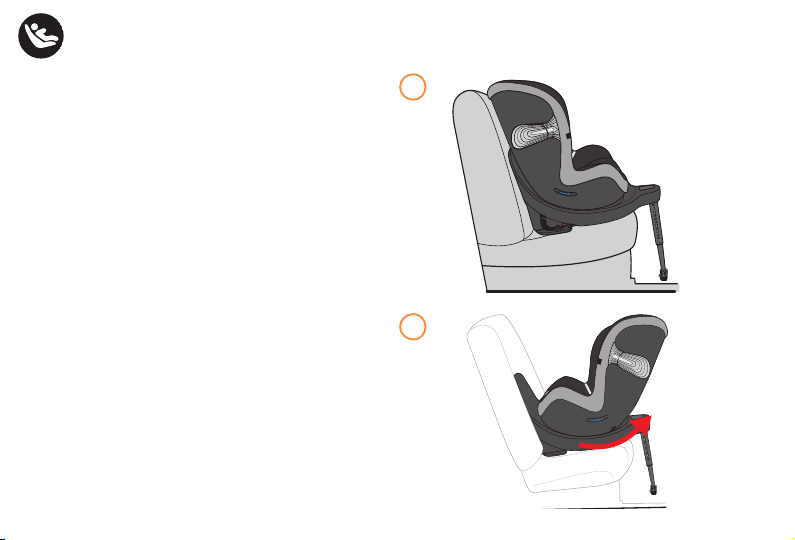
176
3.
Coloque el sistema de sujeción en el asiento
trasero del vehículo. Si hay una elevación en el
piso vehículo, consulte página 164 para obtener
información importante sobre los límites de uso de
la pata de carga en este asiento.
NOTA: Si instala el sistema de sujeción con la pata
de carga almacenada, consulte la sección Indicador
de voladizo en la página 168.
4. Gire el sistema de sujeción a la posición
ORIENTADO HACIA ATRÁS y continúe hasta
pasar la posición más vertical para acceder a la
trayectoria del cinturón (páginas 160-161).
CÓMO INSTALAR EL SISTEMA DE SUJECIÓN INFANTIL CON EL
SISTEMA LATCH
3
4
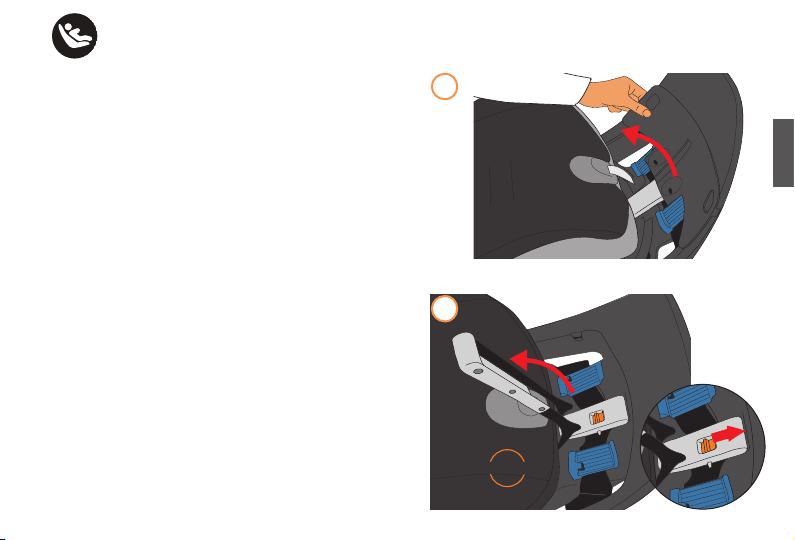
177
Español
5
6
5. Retire la cubierta de la trayectoria del cinturón de la
base.
6. Abra el tensor del cinturón.
a. Jale el bloqueo EasyLock hacia afuera y hacia
arriba para extenderlo hasta que oiga un CLIC.
b. Deslice el botón de bloqueo y jale hacia arriba
para abrir el tensor del cinturón en el centro de
la base.
CÓMO INSTALAR EL SISTEMA DE SUJECIÓN INFANTIL CON EL
SISTEMA LATCH
¡CLIC!

178
7. Acople los conectores LATCH a los puntos de
anclaje inferior del vehículo. Los conectores
harán CLIC al acoplarlos. Asegúrese de que estén
acoplados jalando firmemente los conectores. No
jale la correa de liberación roja.
8. Empuje la base contra el respaldo del asiento
del vehículo. Tense la correa LATCH jalando el
lazo hasta que quede ceñida. No apriete más de
lo necesario. El tensor del cinturón apretará el
sistema por completo.
Después de apretar el sistema LATCH, pase el
exceso de la correa por la trayectoria del cinturón.
1
2
6
5
4
3
8
7
7
8
¡CLIC!
¡CLIC!
CÓMO INSTALAR EL SISTEMA DE SUJECIÓN INFANTIL CON EL
SISTEMA LATCH

179
Español
9. Cierre el tensor del cinturón y use el bloqueo EasyLock
para bloquearlo en su lugar.
a. Coloque el bloqueo EasyLock de manera que las
muescas del brazo descansen sobre las pestañas a
ambos lados del tensor del cinturón.
b. Presione hacia abajo el bloqueo EasyLock para cerrar
el tensor del cinturón hasta que quede bloqueado en
su lugar.
c. Almacene el bloqueo EasyLock.
NOTA: Si el tensor del cinturón no se bloquea, intente
aflojar ligeramente la correa del sistema LATCH.
9
a
b
CÓMO INSTALAR EL SISTEMA DE SUJECIÓN INFANTIL CON EL
SISTEMA LATCH

180
10. Sujete la base cerca de la trayectoria del cinturón
y jale de un lado a otro y de adelante hacia atrás
para asegurarse de que la base esté instalada
correctamente. La base no se debe mover más
de 2.5 cm (1 in) de lado a lado o de atrás hacia
adelante en la trayectoria del cinturón en el
sistema de sujeción infantil.
Si la base se mueve demasiado, abra el tensor del
cinturón, tensione la correa LATCH un poco más
e inténtelo de nuevo. Después de esto, si la base
aún se mueve demasiado, es posible que deba
intentar otro asiento del vehículo, un método de
instalación diferente, o ambas cosas.
11. Reemplace la cubierta de la trayectoria del cinturón
en la base, asegurándose de insertar las pestañas
en las esquinas inferiores de la cubierta en la base
antes de cerrarla. La cubierta de la trayectoria del
cinturón se cerrará con un CLIC audible.
NOTA: Para evitar interferencias con el
reclinado y el giro, asegúrese de que la cubierta
de la trayectoria del cinturón esté cerrada
correctamente.
10
11
¡CLIC!
CÓMO INSTALAR EL SISTEMA DE SUJECIÓN INFANTIL CON EL
SISTEMA LATCH

181
Español
12. Mueva el sistema de sujeción a la posición apropiada
ORIENTADO HACIA ATRÁS u ORIENTADO HACIA
ADELANTE según el tamaño del niño (páginas 130-133) y
bloquéelo en su posición.
NOTA: Antes de mover el sistema de sujeción a la
posición ORIENTADA HACIA ADELANTE, primero debe
guardar la correa de sujeción en el compartimiento de
almacenamiento de la correa de sujeción ubicado la
parte trasera del sistema de sujeción.
a. Gire el sistema de sujeción a la posición ORIENTADA
HACIA ADELANTE.
b. Localice el anclaje de la correa de sujeción del
vehículo y acople el gancho de la correa de sujeción
en el anclaje.
c. Jale la correa del ajustador de la correa de sujeción
para apretarla.
12
CÓMO INSTALAR EL SISTEMA DE SUJECIÓN INFANTIL CON EL
SISTEMA LATCH

182
1
2
3
4
5
6
7
8
USE SIEMPRE UNA CORREA DE SUJECIÓN
para uso ORIENTADO HACIA ADELANTE si hay
disponible un anclaje para correa de sujeción. Una
correa de sujeción reduce el movimiento de un
sistema de sujeción infantil ORIENTADO HACIA
ADELANTE en un choque y ayuda a lograr una
instalación ajustada. La ubicación del anclaje de
la correa de sujeción varía de un vehículo a otro.
Consulte el manual del propietario del vehículo
para obtener información sobre ubicaciones
exactas, identificación de los anclajes y requisitos.
Consulte la página 173 para obtener información
sobre algunas ubicaciones comunes.
13. Extienda la pata de carga (página 166).
13
¡CLIC!
CÓMO INSTALAR EL SISTEMA DE SUJECIÓN INFANTIL CON EL
SISTEMA LATCH
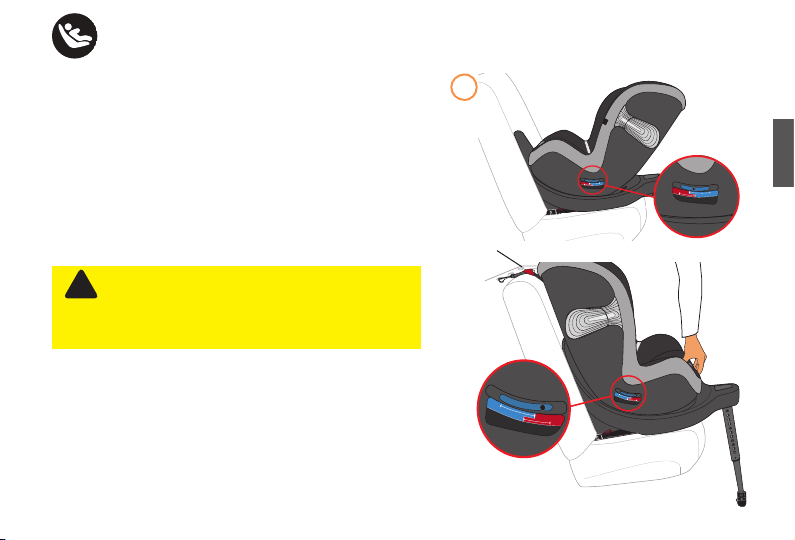
183
Español
¡ADVERTENCIA!
Pueden ocurrir
LESIONES GRAVES o la MUERTE
14. COMPRUEBE el ángulo de reclinado con el indicador
de nivel.
Para instalar el sistema ORIENTADO HACIA ATRÁS,
la esfera de reclinado debe estar en la ZONA AZUL.
Para instalar el sistema ORIENTADO HACIA
ADELANTE, la esfera de reclinado debe estar en la
ZONA ROJA.
F
O
R
W
A
R
D
-
F
A
C
I
N
G
R
E
A
R
-
F
A
C
I
N
G
B
e
a
d
m
u
s
t
b
e
l
o
c
a
t
e
d
w
i
t
h
i
n
a
p
p
r
o
p
r
i
a
t
e
z
o
n
e
.
V
e
h
i
c
l
e
M
U
S
T
b
e
o
n
l
e
v
e
l
g
r
o
u
n
d
.
CY_171_6052_B1019
F
O
R
W
A
R
D
-
F
A
C
I
N
G
R
E
A
R
-
F
A
C
I
N
G
B
e
a
d
m
u
s
t
b
e
l
o
c
a
t
e
d
w
i
t
h
i
n
a
p
p
r
o
p
r
i
a
t
e
z
o
n
e
.
V
e
h
i
c
l
e
M
U
S
T
b
e
o
n
l
e
v
e
l
g
r
o
u
n
d
.
CY_171_6052_B1019
Si no reclina correctamente el sistema de sujeción infantil,
se podría aumentar el riesgo de que el niño sufra lesiones
graves o la muerte. Los bebés pueden tener dificultad
para respirar cuando están sentados en posición erguida.
Asegúrese de que el bebé se recline lo suficiente para
mantener la cabeza descansando hacia atrás cómodamente
y de manera segura.
!
F
O
R
W
A
R
D
-
F
A
C
I
N
G
R
E
A
R
-
F
A
C
I
N
G
B
e
a
d
m
u
s
t
b
e
l
o
c
a
t
e
d
w
i
t
h
i
n
a
p
p
r
o
p
r
i
a
t
e
z
o
n
e
.
V
e
h
i
c
l
e
M
U
S
T
b
e
o
n
l
e
v
e
l
g
r
o
u
n
d
.
F
O
R
W
A
R
D
-
F
A
C
I
N
R
E
A
R
-
F
A
C
I
N
G
B
e
a
d
m
u
s
t
b
e
l
o
c
a
t
e
d
w
i
t
h
i
n
a
p
p
r
o
p
r
i
a
t
e
z
o
n
e
.
V
e
h
i
c
l
e
M
U
S
T
b
e
o
n
l
e
v
e
l
g
r
o
u
n
d
.
Correa de sujeción
14
CÓMO INSTALAR EL SISTEMA DE SUJECIÓN INFANTIL CON EL
SISTEMA LATCH

184
NOTA: En algunos vehículos, para la posición más
reclinada, podría ser necesario colocar una toalla o
cobertor pequeño enrollado debajo (no detrás) del
sistema de sujeción infantil cerca del respaldo del
asiento para proporcionar suficiente reclinado de
manera que la esfera de reclinado esté en la ZONA
AZUL para uso ORIENTADO HACIA ATRÁS.
NOTA: Solo los artículos aprobados por Cybex se
pueden usar debajo de la base.
15. Extienda el sistema L.S.P. hacia la puerta del
vehículo si el sistema de sujeción está en un
asiento exterior (página 163).
15
PRESS
F
O
R
W
A
R
D
-
F
A
C
I
N
G
R
E
A
R
-
F
A
C
I
N
G
B
e
a
d
m
u
s
t
b
e
l
o
c
a
t
e
d
w
i
t
h
i
n
a
p
p
r
o
p
r
i
a
t
e
z
o
n
e
.
V
e
h
i
c
l
e
M
U
S
T
b
e
o
n
l
e
v
e
l
g
r
o
u
n
d
.
CY_171_6052_B1019
F
O
R
W
A
R
D
-
F
A
C
I
N
G
R
E
A
R
-
F
A
C
I
N
G
B
e
a
d
m
u
s
t
b
e
l
o
c
a
t
e
d
w
i
t
h
i
n
a
p
p
r
o
p
r
i
a
t
e
z
o
n
e
.
V
e
h
i
c
l
e
M
U
S
T
b
e
o
n
l
e
v
e
l
g
r
o
u
n
d
.
CY_171_6052_B1019
CÓMO INSTALAR EL SISTEMA DE SUJECIÓN INFANTIL CON EL
SISTEMA LATCH

185
Español
CÓMO RETIRAR EL SISTEMA DE SUJECIÓN INFANTIL CON EL
SISTEMA LATCH
1. Para retirar los conectores LATCH, jale la correa de
liberación LATCH roja en ambos lados del asiento, como
se muestra.
Si tiene problemas para soltar los conectores LATCH,
abra el tensor del cinturón y afloje la tensión en los
conectores LATCH aflojando el ajustador de la correa
LATCH.
1
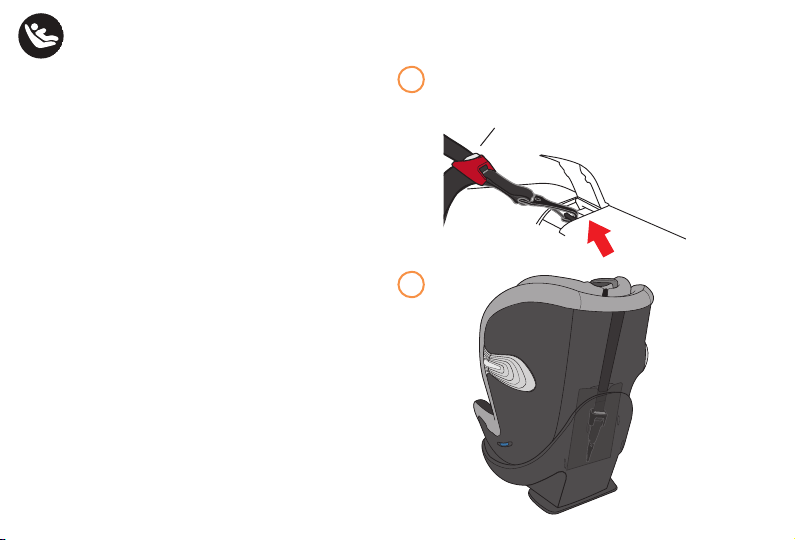
186
CÓMO RETIRAR EL SISTEMA DE SUJECIÓN INFANTIL CON EL SISTEMA
LATCH
Botón de
liberación del
ajustador
1
2
En instalaciones LATCH para uso ORIENTADO HACIA
ADELANTE, también se deben completar los siguientes
pasos.
1. Retire la correa de sujeción.
a. Presione el botón de liberación del ajustador.
b. Alargue la correa de sujeción.
c. Desenganche la correa de sujeción del anclaje
de sujeción.
2. Guarde la correa de sujeción en el compartimento
de almacenamiento de la correa de sujeción en la
parte trasera del sistema de sujeción.
ASEGÚRESE de que la puerta del compartimento
de almacenamiento de la correa de sujeción esté
cerrada correctamente después de guardarla.

187
Español
CÓMO INSTALAR EL SISTEMA DE SUJECIÓN INFANTIL
CON EL CINTURÓN PARA REGAZO Y HOMBRO (METODO PREFERIDO)
1. Despliegue la pata de carga desde debajo de
la base.
ORIENTADO HACIA ATRÁS: Almacene SIEMPRE la correa de sujeción cuando lo use
ORIENTADO HACIA ATRÁS
.
ORIENTADO HACIA ADELANTE: USE SIEMPRE UNA CORREA DE SUJECIÓN para uso
ORIENTADO HACIA ADELANTE si hay disponible un anclaje para correa de sujeción.
ANTES de instalar el sistema de sujeción, asegúrese de que el vehículo esté sobre terreno nivelado. Coloque
el sistema de sujeción infantil en un asiento aprobado del vehículo. ASEGÚRESE de que los conectores
LATCH estén almacenados (página 159).
1
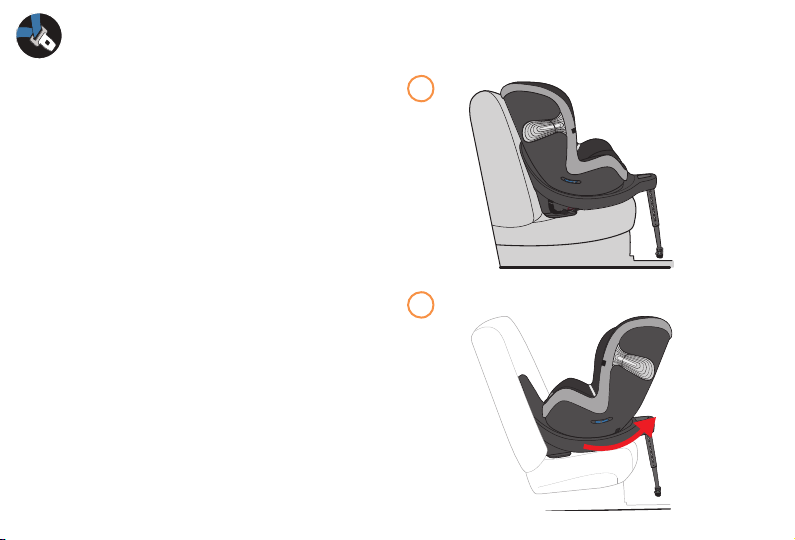
188
CÓMO INSTALAR EL SISTEMA DE SUJECIÓN INFANTIL
CON EL CINTURÓN PARA REGAZO Y HOMBRO (METODO PREFERIDO)
2. Coloque el sistema de sujeción en el asiento
trasero del vehículo. Si hay una elevación en el
piso vehículo, consulte página 164 para obtener
información importante sobre los límites de uso de
la pata de carga en este asiento.
NOTA: Si instala el sistema de sujeción con la
pata de carga almacenada, consulte la sección
Indicador de voladizo en la página 168.
3. Gire el sistema de sujeción a la posición
ORIENTADO HACIA ATRÁS y continúe hasta
pasar la posición más vertical para acceder a la
trayectoria del cinturón (páginas 160-161).
2
3
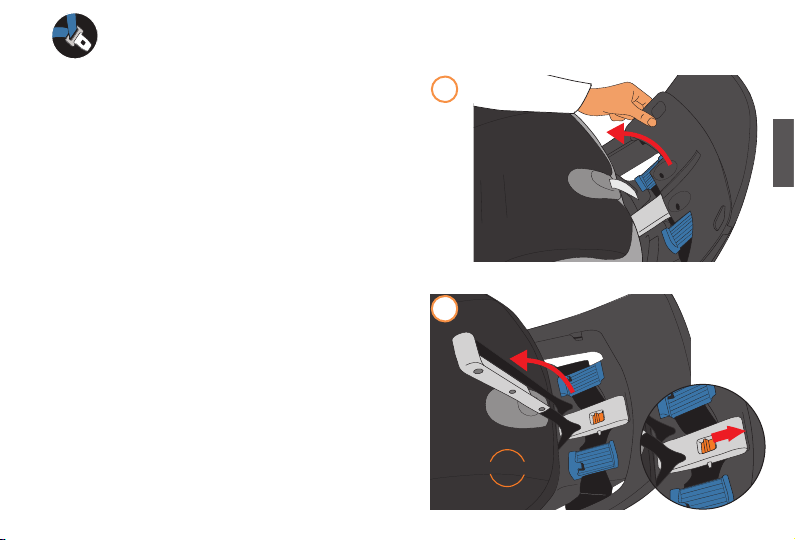
189
Español
CÓMO INSTALAR EL SISTEMA DE SUJECIÓN INFANTIL
CON EL CINTURÓN PARA REGAZO Y HOMBRO (METODO PREFERIDO)
4. Retire la cubierta de la trayectoria del cinturón
de la base.
5. Abra el tensor del cinturón.
a. Jale el bloqueo EasyLock hacia afuera y
hacia arriba para extenderlo hasta que oiga
un CLIC.
b. Deslice el botón de bloqueo y jale hacia
arriba para abrir el tensor del cinturón en el
centro de la base.
4
5
¡CLIC!
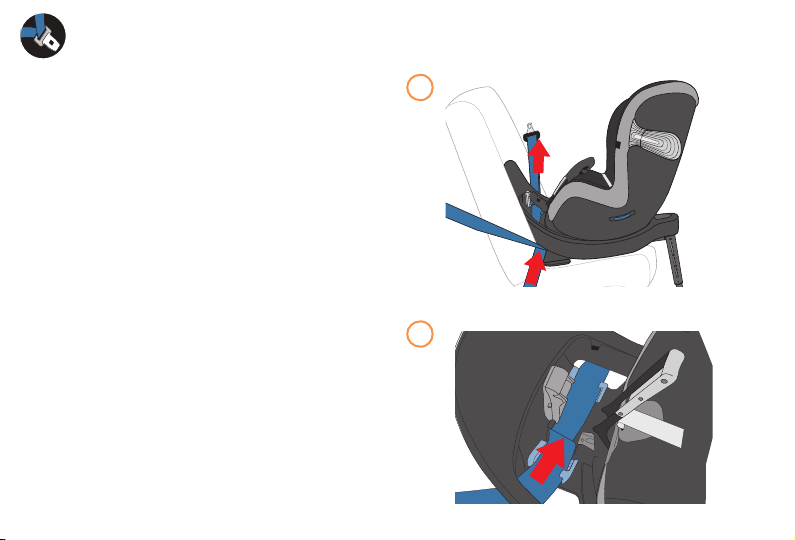
190
6
7
6. Jale el cinturón del vehículo para formar una
sola longitud de aproximadamente 60 cm (24 in).
Sostenga la lengüeta de la hebilla con una mano y
oprima con la otra mano hasta unir los cinturones
para el regazo y el hombro.
7. Pase los cinturones del vehículo hacia arriba a través
de la abertura de la trayectoria del cinturón del
vehículo en un lado de la base, a través de la guía
del cinturón, debajo del tensor del cinturón, a través
de la guía del cinturón opuesta y hacia abajo a través
de la abertura de la trayectoria del cinturón opuesta.
ABROCHE EL CINTURÓN. Asegúrese de que los
cinturones estén debajo de las pestañas de la guía
del cinturón y queden planas y sin torceduras.
NUNCA coloque un cinturón de vehículo sobre
el tensor del cinturón, ni siquiera en un vehículo
con vástagos de hebilla más largos. Esto impedirá
el funcionamiento correcto del sistema de sujeción
infantil.
CÓMO INSTALAR EL SISTEMA DE SUJECIÓN INFANTIL
CON EL CINTURÓN PARA REGAZO Y HOMBRO (METODO PREFERIDO)
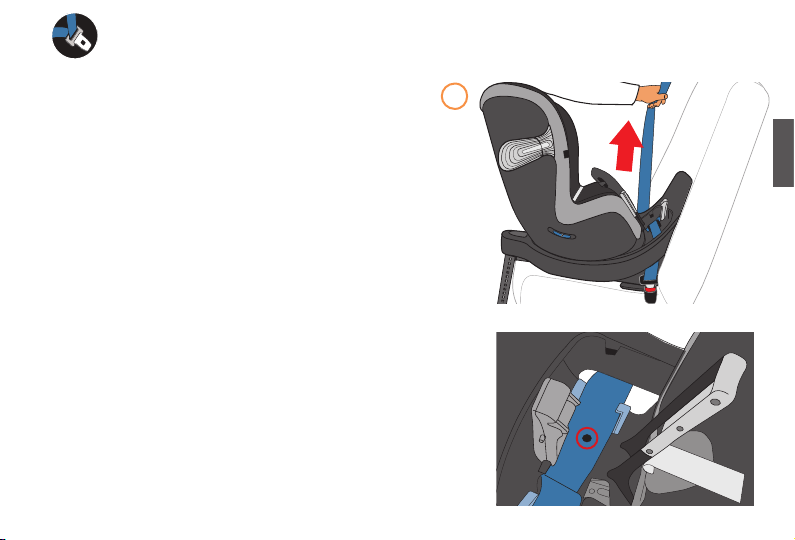
191
Español
8. En el lado de la hebilla, levante primero el cinturón
para el hombro para retirar la holgura en el cinturón
para el regazo. Luego, retire la holgura del cinturón
para el hombro en el otro lado.
En este punto, solo retire la holgura de los cinturones
del vehículo, teniendo cuidado de no apretarlos
demasiado. El tensor del cinturón apretará el
sistema por completo. Si ya instaló el sistema de
sujeción usando el sistema LATCH, asegúrese de
que la correa del sistema LATCH quede plana en la
parte inferior de la base. Consulte la sección "Para
almacenar" en la página 159.
Algunos cinturones de seguridad para regazo y
hombro del vehículo tienen un botón de plástico o
pliegue adicional de correa en el cinturón.
No permita que interfieran con la trayectoria
del cinturón a través del tensor del cinturón. Si
interfieren:
a. Use el sistema LATCH si está dentro del límite de
peso, o
b. Mueva el sistema de sujeción infantil a otro
asiento del vehículo.
8
CÓMO INSTALAR EL SISTEMA DE SUJECIÓN INFANTIL
CON EL CINTURÓN PARA REGAZO Y HOMBRO (METODO PREFERIDO)

192
9
9. Cierre el tensor del cinturón y use el bloqueo
EasyLock para bloquearlo en su lugar.
a. Coloque el bloqueo EasyLock de manera
que las muescas del brazo descansen sobre
las pestañas a ambos lados del tensor del
cinturón.
b. Presione hacia abajo el bloqueo EasyLock
para cerrar el tensor del cinturón hasta que
quede bloqueado en su lugar.
c. Almacene el bloqueo EasyLock.
NOTA: Si el tensor del cinturón no se bloquea,
intente aflojar ligeramente la correa del cinturón
para regazo y hombro.
a
b
CÓMO INSTALAR EL SISTEMA DE SUJECIÓN INFANTIL
CON EL CINTURÓN PARA REGAZO Y HOMBRO (METODO PREFERIDO)

193
Español
10
10. Sujete la base cerca de la trayectoria del cinturón
y jale de un lado a otro y de adelante hacia atrás
para asegurarse de que la base esté instalada
correctamente. La base no se debe mover más de
2.5 cm (1 in) de lado a lado o de atrás hacia adelante
en la trayectoria del cinturón en el sistema de
sujeción infantil.
Si la base se mueve demasiado, abra el tensor del
cinturón, tensione el cinturón del vehículo un poco
más e inténtelo de nuevo. Después de esto, si la
base aún se mueve demasiado, es posible que deba
intentar otro asiento del vehículo, un método de
instalación diferente, o ambas cosas.
En la mayoría de los vehículos, se puede cambiar
el retractor del cinturón para el hombro al modo
de bloqueo jalando hacia afuera por completo el
cinturón para el hombro y dejando que se retraiga
en el retractor. Jale el cinturón para el hombro para
asegurarse de que esté bloqueado.
NUNCA instale este sistema de sujeción infantil
con un cinturón para regazo y hombro del
vehículo sin bloqueo.
NOTA: Consulte el manual del propietario del
vehículo para obtener información.
CÓMO INSTALAR EL SISTEMA DE SUJECIÓN INFANTIL
CON EL CINTURÓN PARA REGAZO Y HOMBRO (METODO PREFERIDO)

194
11. Reemplace la cubierta de la trayectoria del cinturón
en la base, asegurándose de insertar las pestañas
en las esquinas inferiores de la cubierta en la base
antes de cerrarla. La cubierta de la trayectoria del
cinturón se cerrará con un CLIC audible.
NOTA: Para evitar interferencias con el reclinado
y el giro, asegúrese de que la cubierta de la
trayectoria del cinturón esté cerrada correctamente.
12. Mueva el sistema de sujeción a la posición
apropiada ORIENTADO HACIA ATRÁS u
ORIENTADO HACIA ADELANTE según el tamaño
del niño (páginas 130-133) y bloquéelo en su
posición.
11
12
¡CLIC!
CÓMO INSTALAR EL SISTEMA DE SUJECIÓN INFANTIL
CON EL CINTURÓN PARA REGAZO Y HOMBRO (METODO PREFERIDO)

195
Español
NOTA: Antes de mover el sistema de sujeción
a la posición ORIENTADA HACIA ADELANTE,
primero debe guardar la correa de sujeción en el
compartimiento de almacenamiento de la correa
de sujeción ubicado la parte trasera del sistema de
sujeción.
a. Gire el sistema de sujeción a la posición
ORIENTADA HACIA ADELANTE.
b. Localice el anclaje de la correa de sujeción del
vehículo y acople el gancho de la correa de
sujeción en el anclaje.
c. Jale la correa del ajustador de la correa de
sujeción para apretarla.
USE SIEMPRE UNA CORREA DE SUJECIÓN para
uso ORIENTADO HACIA ADELANTE si hay disponible
un anclaje para correa de sujeción. Una correa de
sujeción reduce el movimiento de un sistema de
sujeción infantil ORIENTADO HACIA ADELANTE en un
choque y ayuda a lograr una instalación ajustada. La
ubicación del anclaje de la correa de sujeción varía de
un vehículo a otro. Consulte el manual del propietario
del vehículo para obtener información sobre
ubicaciones exactas, identificación de los anclajes
y requisitos. Consulte la página 173 para obtener
información sobre algunas ubicaciones comunes.
13. Extienda la pata de carga (página 166).
1
2
3
4
5
6
7
8
¡CLIC!
13
CÓMO INSTALAR EL SISTEMA DE SUJECIÓN INFANTIL
CON EL CINTURÓN PARA REGAZO Y HOMBRO (METODO PREFERIDO)
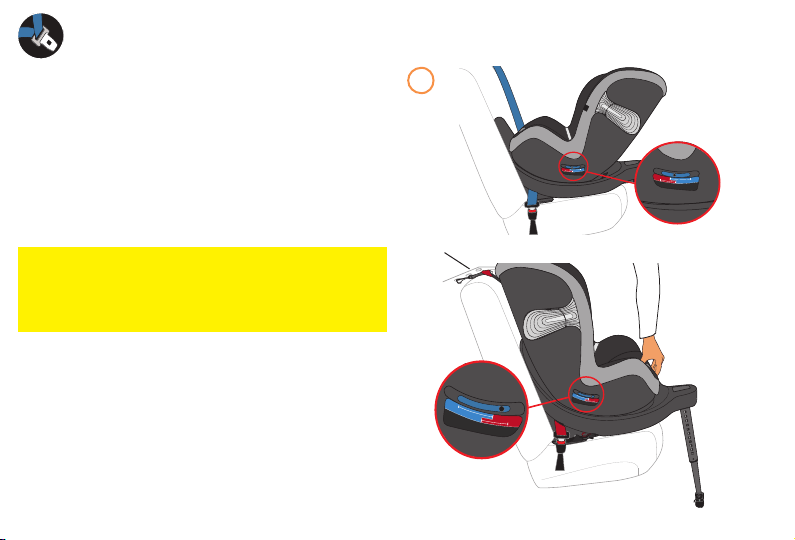
196
14. COMPRUEBE el ángulo de reclinado con el indicador
de nivel.
Para instalar el sistema ORIENTADO HACIA ATRÁS,
la esfera de reclinado debe estar en la ZONA AZUL.
Para instalar el sistema ORIENTADO HACIA
ADELANTE, la esfera de reclinado debe estar en la
ZONA ROJA.
Si no reclina correctamente el sistema de sujeción infantil,
se podría aumentar el riesgo de que el niño sufra lesiones
graves o la muerte. Los bebés pueden tener dificultad
para respirar cuando están sentados en posición erguida.
Asegúrese de que el bebé se recline lo suficiente para
mantener la cabeza descansando hacia atrás cómodamente
y de manera segura.
14
F
O
R
W
A
R
D
-
F
A
C
I
N
G
R
E
A
R
-
F
A
C
I
N
G
B
e
a
d
m
u
s
t
b
e
l
o
c
a
t
e
d
w
i
t
h
i
n
a
p
p
r
o
p
r
i
a
t
e
z
o
n
e
.
V
e
h
i
c
l
e
M
U
S
T
b
e
o
n
l
e
v
e
l
g
r
o
u
n
d
.
CY_171_6052_B1019
F
O
R
W
A
R
D
-
F
A
C
I
N
G
R
E
A
R
-
F
A
C
I
N
G
B
e
a
d
m
u
s
t
b
e
l
o
c
a
t
e
d
w
i
t
h
i
n
a
p
p
r
o
p
r
i
a
t
e
z
o
n
e
.
V
e
h
i
c
l
e
M
U
S
T
b
e
o
n
l
e
v
e
l
g
r
o
u
n
d
.
CY_171_6052_B1019
F
O
R
W
A
R
D
-
F
A
C
I
N
G
R
E
A
R
-
F
A
C
I
N
G
B
e
a
d
m
u
s
t
b
e
l
o
c
a
t
e
d
w
i
t
h
i
n
a
p
p
r
o
p
r
i
a
t
e
z
o
n
e
.
V
e
h
i
c
l
e
M
U
S
T
b
e
o
n
l
e
v
e
l
g
r
o
u
n
d
.
F
O
R
W
A
R
D
-
F
A
C
I
N
R
E
A
R
-
F
A
C
I
N
G
B
e
a
d
m
u
s
t
b
e
l
o
c
a
t
e
d
w
i
t
h
i
n
a
p
p
r
o
p
r
i
a
t
e
z
o
n
e
.
V
e
h
i
c
l
e
M
U
S
T
b
e
o
n
l
e
v
e
l
g
r
o
u
n
d
.
Correa de sujeción
¡ADVERTENCIA!
Pueden ocurrir
LESIONES GRAVES o la MUERTE
CÓMO INSTALAR EL SISTEMA DE SUJECIÓN INFANTIL
CON EL CINTURÓN PARA REGAZO Y HOMBRO (METODO PREFERIDO)
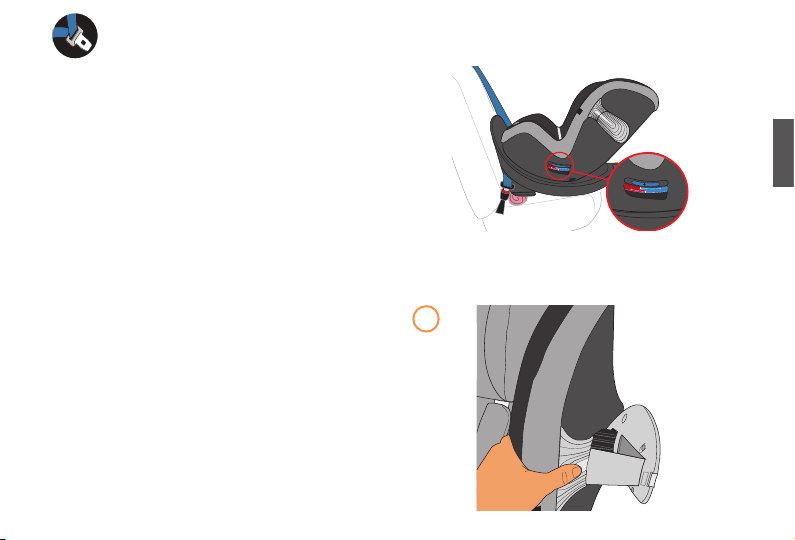
197
Español
NOTA: En algunos vehículos, para la posición
más reclinada, podría ser necesario colocar una
toalla o cobertor pequeño enrollado debajo (no
detrás) del sistema de sujeción infantil cerca
del respaldo del asiento para proporcionar
suficiente reclinado de manera que la esfera
de reclinado esté en la ZONA AZUL para uso
ORIENTADO HACIA ATRÁS.
NOTA: Solo los artículos aprobados por CYBEX
se pueden usar debajo de la base.
15. Extienda el sistema L.S.P. hacia la puerta del
vehículo si el sistema de sujeción está en un
asiento exterior (página 163).
15
F
O
R
W
A
R
D
-
F
A
C
I
N
G
R
E
A
R
-
F
A
C
I
N
G
B
e
a
d
m
u
s
t
b
e
l
o
c
a
t
e
d
w
i
t
h
i
n
a
p
p
r
o
p
r
i
a
t
e
z
o
n
e
.
V
e
h
i
c
l
e
M
U
S
T
b
e
o
n
l
e
v
e
l
g
r
o
u
n
d
.
CY_171_6052_B1019
F
O
R
W
A
R
D
-
F
A
C
I
N
G
R
E
A
R
-
F
A
C
I
N
G
B
e
a
d
m
u
s
t
b
e
l
o
c
a
t
e
d
w
i
t
h
i
n
a
p
p
r
o
p
r
i
a
t
e
z
o
n
e
.
V
e
h
i
c
l
e
M
U
S
T
b
e
o
n
l
e
v
e
l
g
r
o
u
n
d
.
CY_171_6052_B1019
PRESS
CÓMO INSTALAR EL SISTEMA DE SUJECIÓN INFANTIL
CON EL CINTURÓN PARA REGAZO Y HOMBRO (METODO PREFERIDO)

198
Cómo retirar el sistema de sujeción infantil ORIENTADO
HACIA ADELANTE
1. Retire la correa de sujeción.
a. Presione el botón de liberación del ajustador.
b. Alargue la correa de sujeción.
c. Desenganche la correa de sujeción del anclaje de
sujeción.
2. Gire el asiento a la posición ORIENTADO HACIA
ATRÁS y guarde la correa de sujeción en el
compartimento de almacenamiento de la correa de
sujeción en la parte trasera del sistema de sujeción.
ASEGÚRESE de que la puerta del compartimento
de almacenamiento de la correa de sujeción esté
cerrada correctamente después de guardarla.
3. Continúe con el Paso 1 de Cómo retirar el sistema de
sujeción infantil ORIENTADO HACIA ATRÁS.
1
CÓMO RETIRAR EL SISTEMA DE SUJECIÓN INFANTIL CON
EL CINTURÓN PARA REGAZO Y HOMBRO
Botón de liberación del ajustador
2

199
Español
Cómo retirar el sistema de sujeción infantil
ORIENTADO HACIA ATRÁS
1. Gire el sistema de sujeción y continúe hasta
pasar la posición más vertical para acceder a la
trayectoria del cinturón (páginas 160-161).
2. Desabroche el cinturón de seguridad, retire la
cubierta de la trayectoria del cinturón y abra el
tensor del cinturón para liberar la tensión.
CÓMO RETIRAR EL SISTEMA DE SUJECIÓN INFANTIL CON
EL CINTURÓN PARA REGAZO Y HOMBRO
1
2
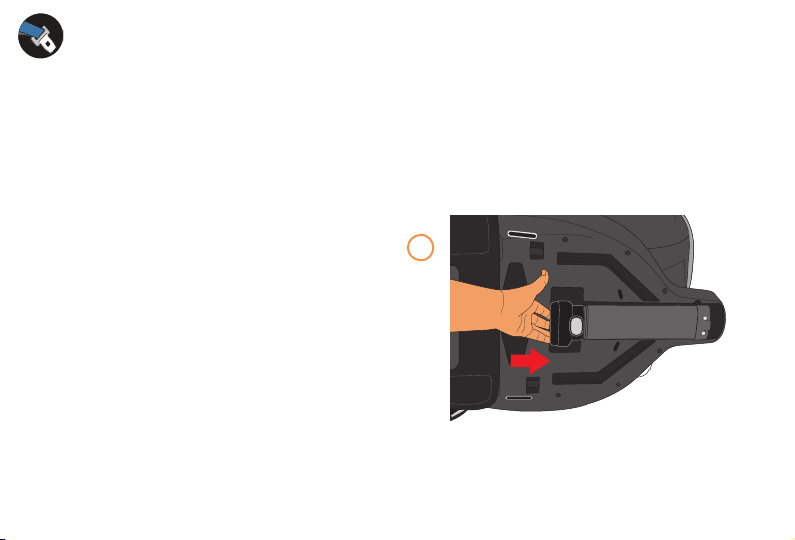
200
CÓMO INSTALAR EL SISTEMA DE SUJECIÓN INFANTIL CON
EL CINTURÓN PARA REGAZO
1. Despliegue la pata de carga desde debajo de la base.
ORIENTADO HACIA ATRÁS: Almacene SIEMPRE la correa de sujeción cuando lo use
ORIENTADO HACIA ATRÁS
.
ORIENTADO HACIA ADELANTE: USE SIEMPRE UNA CORREA DE SUJECIÓN para uso
ORIENTADO HACIA ADELANTE si hay disponible un anclaje para correa de sujeción.
ANTES de instalar el sistema de sujeción, asegúrese de que el vehículo esté sobre terreno nivelado. Coloque el
sistema de sujeción infantil en un asiento aprobado del vehículo. ASEGÚRESE de que los conectores LATCH estén
almacenados (página 159).
1
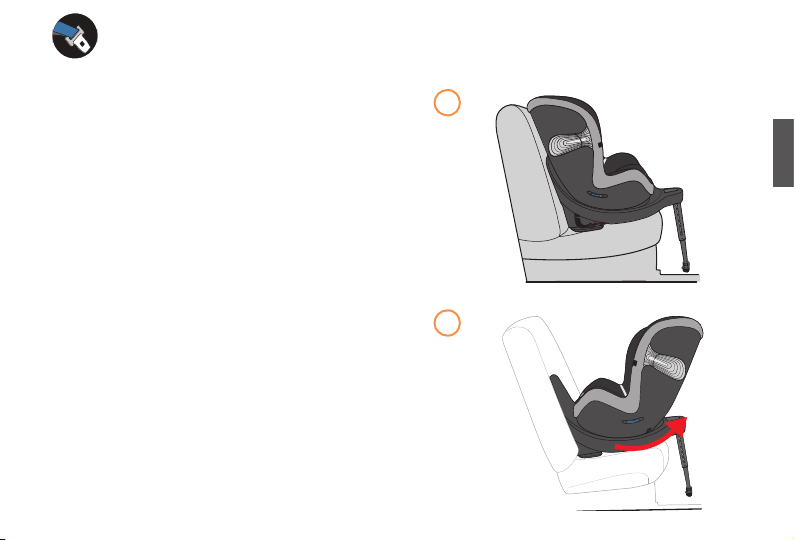
201
Español
CÓMO INSTALAR EL SISTEMA DE SUJECIÓN INFANTIL
CON EL CINTURÓN PARA REGAZO
2. Coloque el sistema de sujeción en el asiento
trasero del vehículo. Si hay una elevación en el
piso vehículo, consulte página 164 para obtener
información importante sobre los límites de uso de
la pata de carga en este asiento.
NOTA: Si instala el sistema de sujeción con la pata
de carga almacenada, consulte la sección Indicador
de voladizo en la página 168.
3. Gire el sistema de sujeción a la posición
ORIENTADO HACIA ATRÁS y continúe hasta
pasar la posición más vertical para acceder a la
trayectoria del cinturón (páginas 160-161).
2
3

202
CÓMO INSTALAR EL SISTEMA DE SUJECIÓN INFANTIL
CON EL CINTURÓN PARA REGAZO
4. Retire la cubierta de la trayectoria del cinturón de la
base.
5. Abra el tensor del cinturón.
a. Jale el bloqueo EasyLock hacia afuera y hacia
arriba para extenderlo hasta que oiga un CLIC.
b. Deslice el botón de bloqueo y jale hacia arriba
para abrir el tensor del cinturón en el centro de
la base.
4
5
¡CLIC!

203
Español
CÓMO INSTALAR EL SISTEMA DE SUJECIÓN INFANTIL
CON EL CINTURÓN PARA REGAZO
6. Pase el cinturón del vehículo hacia arriba a través
de la abertura de la trayectoria del cinturón del
vehículo en un lado de la base, a través de la guía
del cinturón, debajo del tensor del cinturón, a
través de la guía del cinturón opuesta y hacia abajo
a través de la abertura de la trayectoria del cinturón
opuesta. ABROCHE EL CINTURÓN. Asegúrese de
que los cinturones estén debajo de las pestañas
de la guía del cinturón y queden planas y sin
torceduras.
NUNCA instale este sistema de sujeción infantil
usando un cinturón para regazo y hombro del
vehículo sin bloqueo (página 148).
NUNCA coloque un cinturón de vehículo sobre
el tensor del cinturón, ni siquiera en un vehículo
con vástagos de hebilla más largos. Esto impedirá
el funcionamiento correcto del sistema de sujeción
infantil.
6
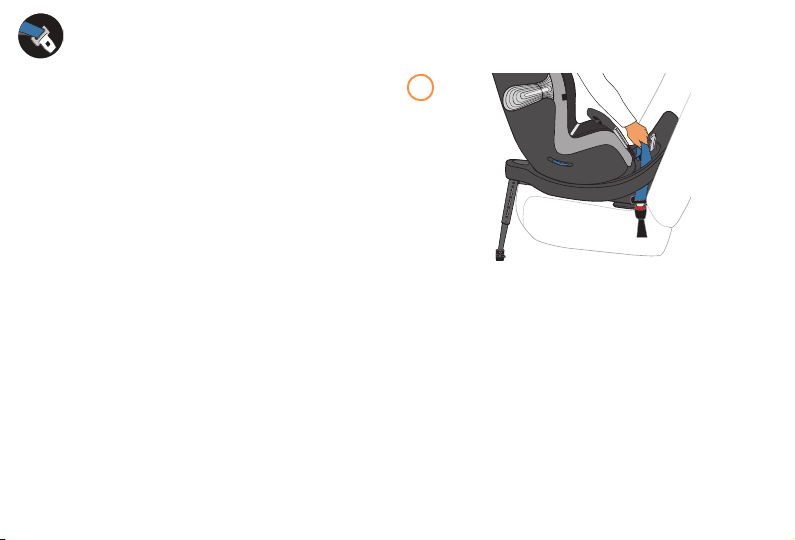
204
CÓMO INSTALAR EL SISTEMA DE SUJECIÓN INFANTIL
CON EL CINTURÓN PARA REGAZO
7. Jale hacia arriba el extremo libre de la correa para
apretarla. En este punto, solo retire la holgura
del cinturón del vehículo, teniendo cuidado de no
apretarlo demasiado. El tensor del cinturón apretará
el sistema por completo.
Si ya instaló el sistema de sujeción usando el sistema
LATCH, asegúrese de que la correa del sistema
LATCH quede plana en la parte inferior de la base y
que no esté demasiado apretada. Consulte la sección
"Para almacenar" en la página 159.
NOTA: Para guardar la correa sobrante después de
apretarla, coloque el extremo libre de la correa plano
debajo de la base.
NOTA: Solo los artículos aprobados por Cybex se
pueden usar debajo de la base.
7

205
Español
CÓMO INSTALAR EL SISTEMA DE SUJECIÓN INFANTIL
CON EL CINTURÓN PARA REGAZO
8. Cierre el tensor del cinturón y use el bloqueo
EasyLock para bloquearlo en su lugar.
a. Coloque el bloqueo EasyLock de manera que
las muescas del brazo descansen sobre las
pestañas a ambos lados del tensor del cinturón.
b. Presione hacia abajo el bloqueo EasyLock para
cerrar el tensor del cinturón hasta que quede
bloqueado en su lugar.
c. Almacene el bloqueo EasyLock.
NOTA: Si el tensor del cinturón no se bloquea, es
posible ha haya mucha tensión en el cinturón para
regazo o la correa del sistema LATCH. Compruebe
ambos y afloje según sea necesario antes de
intentar volver a bloquearlo.
8
a
b

206
9
CÓMO INSTALAR EL SISTEMA DE SUJECIÓN INFANTIL
CON EL CINTURÓN PARA REGAZO
9. Sujete la base cerca de la trayectoria del cinturón
y jale de un lado a otro y de adelante hacia atrás
para asegurarse de que la base esté instalada
correctamente. La base no se debe mover más de
2.5 cm (1 in) de lado a lado o de atrás hacia adelante
en la trayectoria del cinturón en el sistema de
sujeción infantil.
Si la base se mueve demasiado, abra el tensor del
cinturón, tensione el cinturón del vehículo un poco
más e inténtelo de nuevo. Después de esto, si la
base aún se mueve demasiado, es posible que deba
intentar otro asiento del vehículo, un método de
instalación diferente, o ambas cosas.

207
Español
CÓMO INSTALAR EL SISTEMA DE SUJECIÓN INFANTIL
CON EL CINTURÓN PARA REGAZO
10. Reemplace la cubierta de la trayectoria del cinturón
en la base, asegurándose de insertar las pestañas
en las esquinas inferiores de la cubierta en la base
antes de cerrarla. La cubierta de la trayectoria del
cinturón se cerrará con un CLIC audible.
NOTA: Para evitar interferencias con el reclinado
y el giro, asegúrese de que la cubierta de la
trayectoria del cinturón esté cerrada correctamente.
11. Mueva el sistema de sujeción a la posición
apropiada ORIENTADO HACIA ATRÁS u
ORIENTADO HACIA ADELANTE según el tamaño
del niño (páginas 130-133) y bloquéelo en su
posición.
10
11
¡CLIC!

208
CÓMO INSTALAR EL SISTEMA DE SUJECIÓN INFANTIL
CON EL CINTURÓN PARA REGAZO
NOTA: Antes de mover el sistema de sujeción
a la posición ORIENTADA HACIA ADELANTE,
primero debe guardar la correa de sujeción en el
compartimiento de almacenamiento de la correa
de sujeción ubicado la parte trasera del sistema de
sujeción.
a. Gire el sistema de sujeción a la posición
ORIENTADA HACIA ADELANTE.
b. Localice el anclaje de la correa de sujeción del
vehículo y acople el gancho de la correa de
sujeción en el anclaje.
c. Jale la correa del ajustador de la correa de
sujeción para apretarla.
USE SIEMPRE UNA CORREA DE SUJECIÓN
para uso ORIENTADO HACIA ADELANTE si hay
disponible un anclaje para correa de sujeción. Una
correa de sujeción reduce el movimiento de un
sistema de sujeción infantil ORIENTADO HACIA
ADELANTE en un choque y ayuda a lograr una
instalación ajustada. La ubicación del anclaje de
la correa de sujeción varía de un vehículo a otro.
Consulte el manual del propietario del vehículo
para obtener información sobre ubicaciones
exactas, identificación de los anclajes y requisitos.
Consulte la página 173 para obtener información
sobre algunas ubicaciones comunes.
1
2
3
4
5
6
7
8
12
¡CLIC!
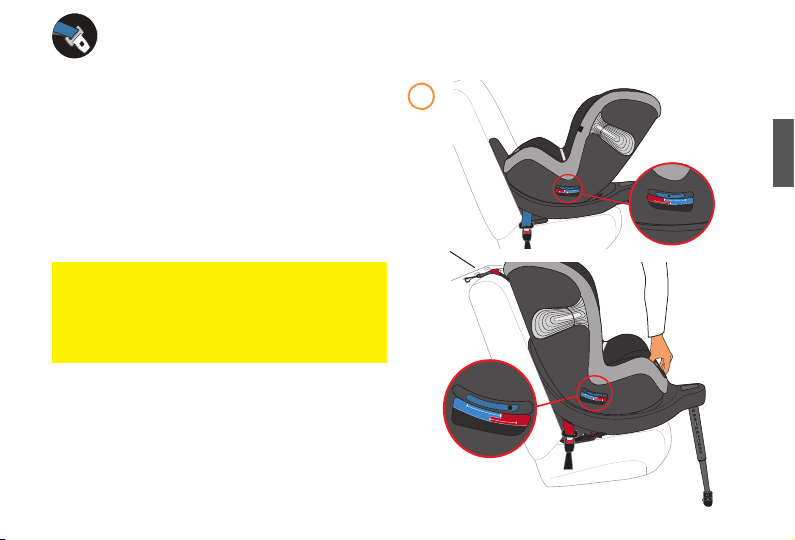
209
Español
CÓMO INSTALAR EL SISTEMA DE SUJECIÓN INFANTIL
CON EL CINTURÓN PARA REGAZO
12. Extienda la pata de carga (página 166).
13. COMPRUEBE el ángulo de reclinado con el
indicador de nivel.
Para instalar el sistema ORIENTADO HACIA
ATRÁS, la esfera de reclinado debe estar en la
ZONA AZUL.
Si no reclina correctamente el sistema de sujeción
infantil, se podría aumentar el riesgo de que el
niño sufra lesiones graves o la muerte. Los bebés
pueden tener dificultad para respirar cuando están
sentados en posición erguida. Asegúrese de que el
bebé se recline lo suficiente para mantener la cabeza
descansando hacia atrás cómodamente y de manera
segura.
13
F
O
R
W
A
R
D
-
F
A
C
I
N
G
R
E
A
R
-
F
A
C
I
N
G
B
e
a
d
m
u
s
t
b
e
l
o
c
a
t
e
d
w
i
t
h
i
n
a
p
p
r
o
p
r
i
a
t
e
z
o
n
e
.
V
e
h
i
c
l
e
M
U
S
T
b
e
o
n
l
e
v
e
l
g
r
o
u
n
d
.
CY_171_6052_B1019
F
O
R
W
A
R
D
-
F
A
C
I
N
G
R
E
A
R
-
F
A
C
I
N
G
B
e
a
d
m
u
s
t
b
e
l
o
c
a
t
e
d
w
i
t
h
i
n
a
p
p
r
o
p
r
i
a
t
e
z
o
n
e
.
V
e
h
i
c
l
e
M
U
S
T
b
e
o
n
l
e
v
e
l
g
r
o
u
n
d
.
CY_171_6052_B1019
F
O
R
W
A
R
D
-
F
A
C
I
N
G
R
E
A
R
-
F
A
C
I
N
G
B
e
a
d
m
u
s
t
b
e
l
o
c
a
t
e
d
w
i
t
h
i
n
a
p
p
r
o
p
r
i
a
t
e
z
o
n
e
.
V
e
h
i
c
l
e
M
U
S
T
b
e
o
n
l
e
v
e
l
g
r
o
u
n
d
.
F
O
R
W
A
R
D
-
F
A
C
I
N
R
E
A
R
-
F
A
C
I
N
G
B
e
a
d
m
u
s
t
b
e
l
o
c
a
t
e
d
w
i
t
h
i
n
a
p
p
r
o
p
r
i
a
t
e
z
o
n
e
.
V
e
h
i
c
l
e
M
U
S
T
b
e
o
n
l
e
v
e
l
g
r
o
u
n
d
.
Correa de sujeción
¡ADVERTENCIA!
Pueden ocurrir
LESIONES GRAVES o la MUERTE
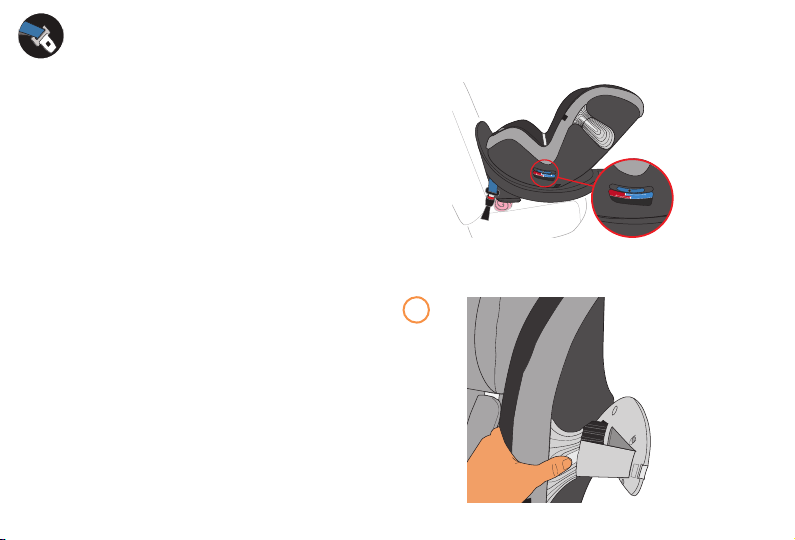
210
CÓMO INSTALAR EL SISTEMA DE SUJECIÓN INFANTIL
CON EL CINTURÓN PARA REGAZO
Para instalar el sistema ORIENTADO HACIA
ADELANTE, la esfera de reclinado debe estar en la
ZONA ROJA.
NOTA: En algunos vehículos, para la posición más
reclinada, podría ser necesario colocar una toalla o
cobertor pequeño enrollado debajo (no detrás) del
sistema de sujeción infantil cerca del respaldo del
asiento para proporcionar suficiente reclinado de
manera que la esfera de reclinado esté en la ZONA
AZUL para uso ORIENTADO HACIA ATRÁS.
NOTA: Solo los artículos aprobados por CYBEX se
pueden usar debajo de la base.
14. Extienda el sistema L.S.P. hacia la puerta del
vehículo si el sistema de sujeción está en un
asiento exterior (página 163).
14
F
O
R
W
A
R
D
-
F
A
C
I
N
G
R
E
A
R
-
F
A
C
I
N
G
B
e
a
d
m
u
s
t
b
e
l
o
c
a
t
e
d
w
i
t
h
i
n
a
p
p
r
o
p
r
i
a
t
e
z
o
n
e
.
V
e
h
i
c
l
e
M
U
S
T
b
e
o
n
l
e
v
e
l
g
r
o
u
n
d
.
CY_171_6052_B1019
F
O
R
W
A
R
D
-
F
A
C
I
N
G
R
E
A
R
-
F
A
C
I
N
G
B
e
a
d
m
u
s
t
b
e
l
o
c
a
t
e
d
w
i
t
h
i
n
a
p
p
r
o
p
r
i
a
t
e
z
o
n
e
.
V
e
h
i
c
l
e
M
U
S
T
b
e
o
n
l
e
v
e
l
g
r
o
u
n
d
.
CY_171_6052_B1019
PRESS

211
Español
CÓMO RETIRAR EL SISTEMA DE SUJECIÓN INFANTIL
CON EL CINTURÓN PARA REGAZO
Cómo retirar el sistema de sujeción infantil
ORIENTADO HACIA ADELANTE
1. Retire la correa de sujeción.
a. Presione el botón de liberación del ajustador.
b. Alargue la correa de sujeción.
c. Desenganche la correa de sujeción del
anclaje de sujeción.
2. Gire el asiento a la posición ORIENTADO HACIA
ATRÁS y guarde la correa de sujeción en el
compartimento de almacenamiento de la correa
de sujeción en la parte trasera del sistema de
sujeción.
ASEGÚRESE de que la puerta del
compartimento de almacenamiento de la correa
de sujeción esté cerrada correctamente después
de guardarla.
3. Continúe con el Paso 1 de Cómo retirar el
sistema de sujeción infantil ORIENTADO HACIA
ATRÁS.
1
Botón de liberación del ajustador
2

212
CÓMO RETIRAR EL SISTEMA DE SUJECIÓN INFANTIL
CON EL CINTURÓN PARA REGAZO
Cómo retirar el sistema de sujeción infantil ORIENTADO
HACIA ATRÁS
1. Gire el sistema de sujeción y continúe hasta pasar la
posición más vertical para acceder a la trayectoria del
cinturón (páginas 160-161).
2. Desabroche el cinturón de seguridad, retire la
cubierta de la trayectoria del cinturón y abra el tensor
del cinturón para liberar la tensión.
1
2

213
Español
CÓMO AFIANZAR AL NIÑO CON EL ARNÉS
1. Afloje el arnés presionando firmemente hacia
abajo el botón de ajuste del arnés mientras jala
hacia adelante ambas correas del arnés al nivel del
hombro.
2. Si el clip para el pecho está cerrado:
a. Presione el botón rojo en la hebilla del arnés
a
para liberar las lengüetas.
b. Separe el clip para el pecho
b
y separe las
correas del arnés.
c. Asegure las hebillas del arnés al asiento usando
los soportes magnéticos para lengüeta de
hebilla.
NOTA: Para conservar la vida útil de la batería,
almacene siempre el clip para el pecho SensorSafe
en la posición desabrochada.
1
2
a b
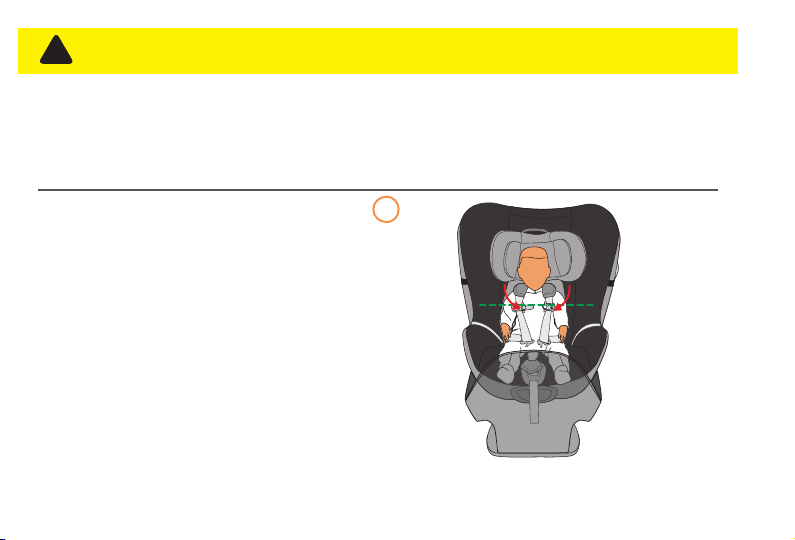
214
3. Coloque al niño en el sistema de sujeción
infantil con la espalda y el trasero bien
apoyados contra el sistema de sujeción.
Coloque las correas del arnés sobre los
hombros del niño y alrededor de la cintura del
niño. Las correas deben quedar planas, sin
torceduras y centradas entre los hombros del
niño.
NOTA: Si la correa de la entrepierna queda
debajo del niño, se deberá ajustar (página 169).
Para garantizar un mejor ajuste para los bebés
más pequeños, es posible que necesite usar
el inserto para recién nacido. NUNCA coloque
acojinado adicional debajo o detrás del niño.
USE SOLO el inserto para recién nacido que se
incluye con el autoasiento original o que CYBEX
diseñó específicamente para el autoasiento.
CÓMO AFIANZAR AL NIÑO CON EL ARNÉS
Clip para el pecho al
nivel de la axila
3
¡ADVERTENCIA! Pueden ocurrir LESIONES GRAVES o la MUERTE
!
NUNCA afiance al niño en el sistema de sujeción infantil con el niño vestido con ropa voluminosa o pesada.
La ropa pesada puede impedir que el arnés quede ceñido correctamente alrededor del niño.
NUNCA afiance al niño en el sistema de sujeción infantil con el niño envuelto en una manta. Para mantener
al niño abrigado, coloque una manta sobre el niño DESPUÉS de que haya afianzado y ceñido el arnés
correctamente alrededor del niño.
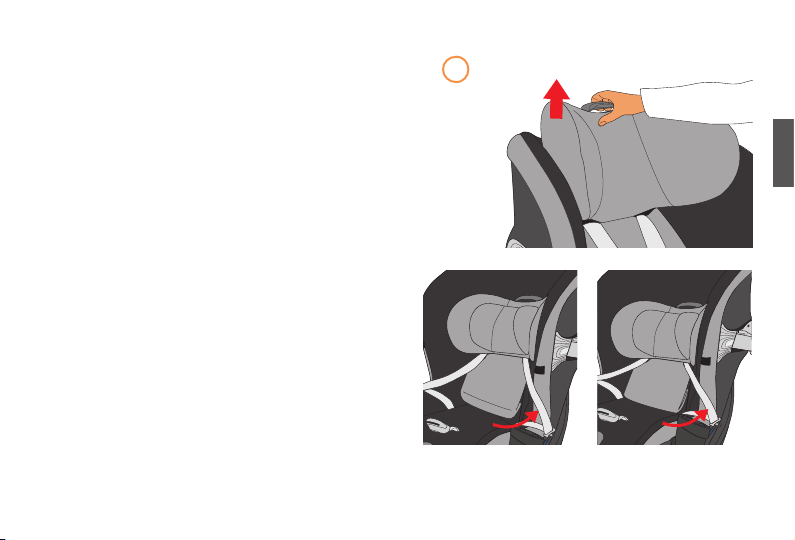
215
Español
4. Ajuste la altura de la cabecera de manera que las
correas del arnés estén colocadas correctamente
(p. 216).
NOTA: Si usa las posiciones más bajas de la
cabecera o el arnés, asegúrese de insertar el
exceso de la solapa de la cabecera detrás del
acojinado de la cabecera. La solapa de la cabecera
está diseñada con dos líneas de plegado para
permitir el almacenamiento parcial o total detrás
del acojinado de la cabecera.
CÓMO AFIANZAR AL NIÑO CON EL ARNÉS
4
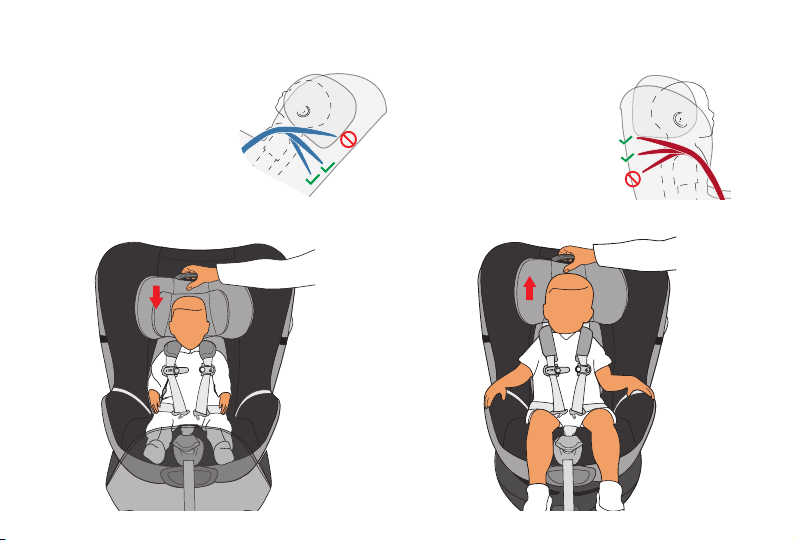
216
CÓMO AFIANZAR AL NIÑO CON EL ARNÉS
ORIENTADO HACIA ADELANTE
Coloque las correas del
arnés EN o APENAS ARRIBA
de los hombros del niño.
NOTA: La parte superior de
las orejas DEBE estar debajo
de la parte superior de la
cabecera.
ORIENTADO HACIA ATRÁS
Coloque las correas del arnés
EN o APENAS DEBAJO de los
hombros del niño.
NOTA: La cabea del niño
DEBE estar por lo menos 2.5
cm (1 in) o más debajo de la
parte superior de la cabecera o
armazón, lo que sea más alto.

217
Español
CÓMO AFIANZAR AL NIÑO CON EL ARNÉS
5. Abroche la hebilla insertando las lengüetas de una
en una en la hebilla del arnés hasta que escuche
un CLIC. Jale hacia arriba firmemente ambas
lengüetas de la hebilla para asegurarse de que estén
abrochadas de forma segura.
COMPRUEBE que la hebilla funcione correctamente y
se mantenga libre de suciedad y residuos.
Asegúrese de que las correas del arnés no estén
torcidas.
6. Abroche el clip para el pecho abrochando juntos
ambos lados. Deberá escuchar un CLIC.
5
6
¡CLIC! ¡CLIC!
¡CLIC!
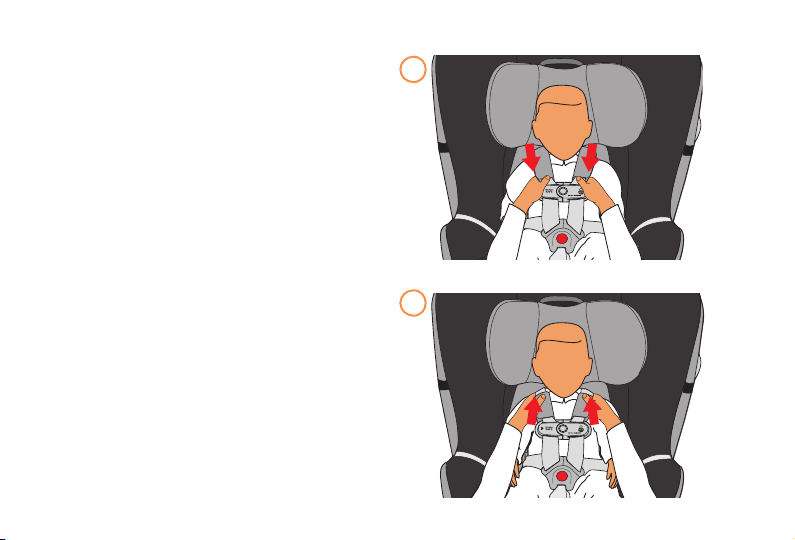
218
CÓMO AFIANZAR AL NIÑO CON EL ARNÉS
7. Empuje el clip para el pecho y las hombreras hacia
abajo, lejos del cuello del niño y en dirección a la
hebilla del arnés.
8. Jale hacia arriba ambas correas para el hombro
para eliminar toda la holgura de las caderas del
niño.
7
8
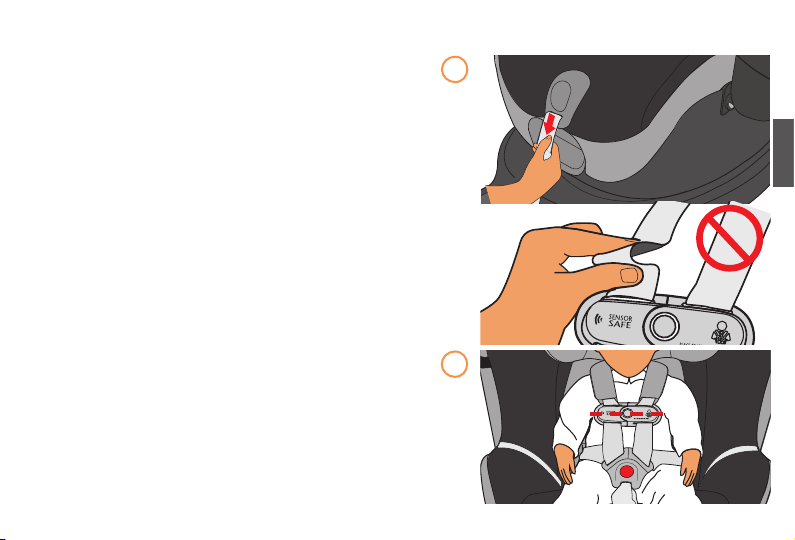
219
Español
CÓMO AFIANZAR AL NIÑO CON EL ARNÉS
9. Jale lentamente la correa del ajustador para apretar
las correas del arnés mientras sostiene el clip para el
pecho de manera que no se suba al cuello del niño.
Si puede pellizcar la correa en los hombros del niño,
el arnés está demasiado flojo.
Para apretarlo, jale la correa del ajustador del arnés
hasta que el arnés quede ceñido al niño. Una correa
ceñida no debe tener holgura. Queda en una línea
relativamente recta sin estar floja. No presiona la piel
del niño ni empuja el cuerpo del niño en una posición
poco natural.
10. Coloque el clip para el pecho al nivel de las axilas,
como se muestra.
A
R
M
P
I
T
L
E
V
E
L
10
9

220
CÓMO AFIANZAR AL NIÑO CON EL ARNÉS
12
11. Para aflojar el arnés, presione firmemente hacia
abajo el botón de ajuste del arnés mientras jala
hacia adelante ambas correas del arnés al nivel
del hombro.
12. Para retirar al niño del asiento, presione los
botones centrales en el clip para el pecho y la
hebilla del arnés, y sepárelos.
13. Asegure las hebillas del arnés al asiento usando
los soportes magnéticos para lengüeta de
hebilla.
NOTA: Para conservar la vida útil de la batería,
almacene siempre el clip para el pecho
SensorSafe en la posición desabrochada.
11

221
Español
CUIDADO Y LIMPIEZA
CÓMO RETIRAR LAS HOMBRERAS
Desabroche y retire las hombreras, como se muestra a la
derecha.
CÓMO REEMPLAZAR LAS HOMBRERAS
Vuelva a colocar las hombreras plegando los broches
sobre la correa del arnés y sujetando ambos broches.
Asegúrese de que estén orientados como se muestra.
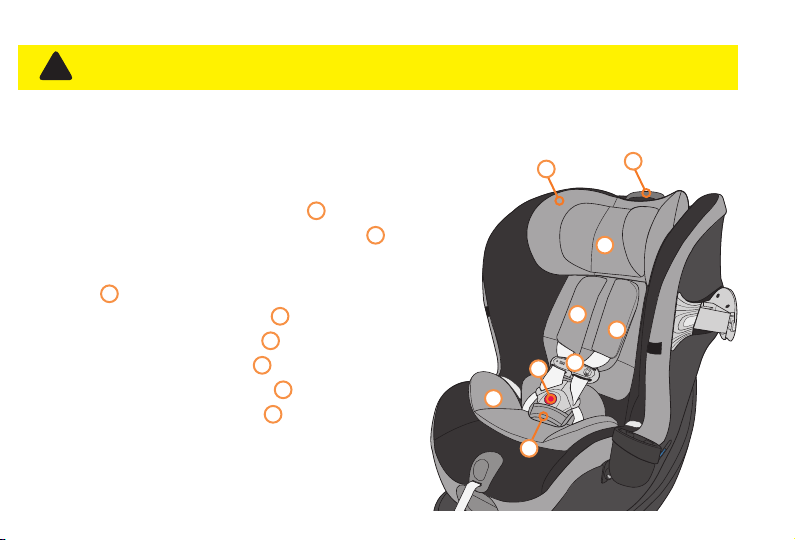
222
• El sistema de sujeción infantil no se debe usar NUNCA sin la cubierta del asiento.
• NO dañe, retire ni deseche ningún acojinado de espuma EPP en el sistema Sirona S.
CUIDADO Y LIMPIEZA
CÓMO RETIRAR LA CUBIERTA DEL ASIENTO
1. Ajuste la cabecera a la posición más alta
a
.
2. Abra la parte trasera de la cubierta de la cabecera
b
y desabróchela desde el respaldo del asiento.
3. Si usa el inserto de cojín para la cabeza para recién
nacido
c
, retírelo de la cabecera.
4. Desabroche y retire las hombreras
d
.
5. Desabroche el clip para el pecho
e
.
6. Desabroche la hebilla del arnés
f
.
7. Si usa el inserto para recién nacido
g
, retírelo.
8. Si usa el acojinado para la hebilla
h
, retírelo.
A
R
M
P
I
T
L
E
V
E
L
b
c
d
d
e
g
h
f
a
¡ADVERTENCIA! Pueden ocurrir LESIONES GRAVES o la MUERTE
!
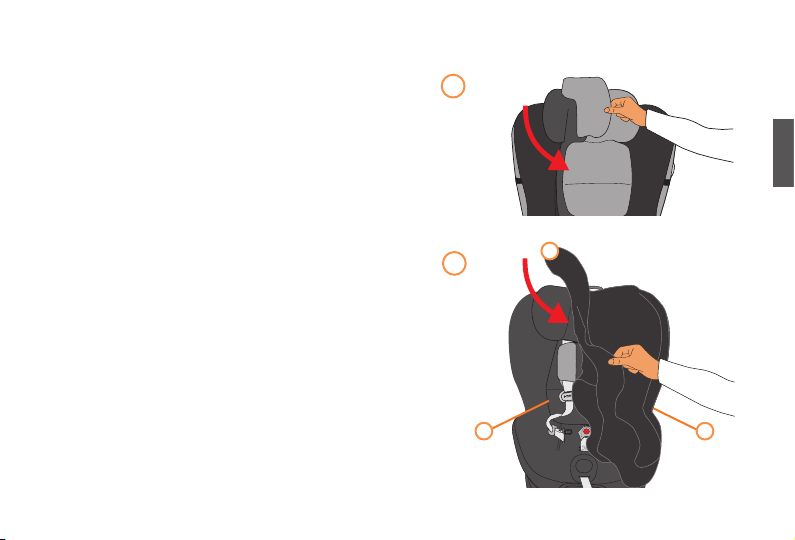
223
Español
9. Retire la cubierta de la cabecera de la cabecera.
10. Retire la cubierta del asiento del sistema de sujeción
infantil.
a. Desabroche los dos broches que sujetan el
acojinado del respaldo a la cubierta del asiento y
jale hacia adelante.
b. Desprenda la cubierta del asiento alrededor de
los bordes del asiento, jale la cubierta de asiento
y retírela del sistema de sujeción infantil.
CUIDADO Y LIMPIEZA
9
10
aa
b
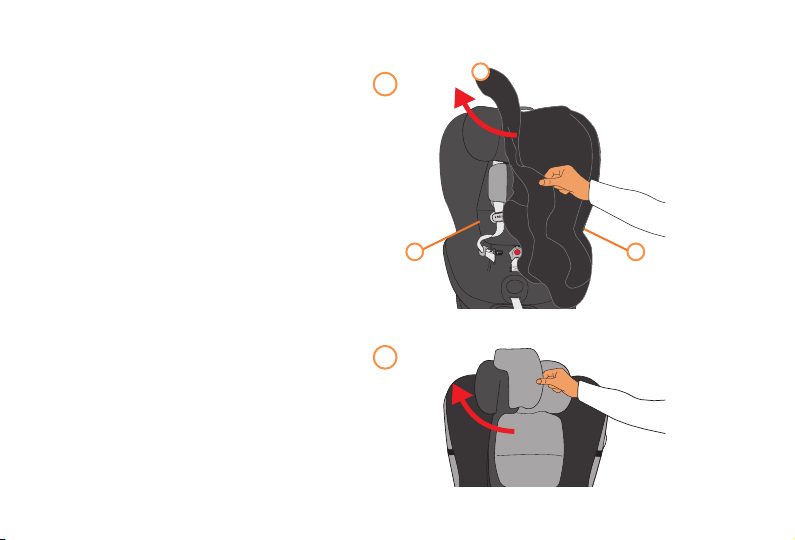
224
INSTALACIÓN DE LA CUBIERTA DEL ASIENTO
1. Instale la cubierta del asiento en el sistema de
sujeción infantil.
a. Desde la parte superior del asiento, coloque
la cubierta del asiento alrededor de los
bordes del sistema de sujeción infantil.
b. Asegure los dos broches del acojinado del
respaldo a la cubierta del asiento.
2. Instale la cubierta de la cabecera en la
cabecera.
CUIDADO Y LIMPIEZA
2
1
bb
a

225
Español
3. Cierre la parte trasera de la cubierta de la
cabecera
a
y asegure el broche en la cubierta
de la cabecera a través de la manija de ajuste
de la altura de la cabecera en la parte trasera
del asiento.
4. Si usa el inserto de cojín para la cabeza para
recién nacido
b
, afiáncelo a la cabecera.
5. Instale las hombreras
c
.
6. Abroche el clip para el pecho
d
.
7. Si usa el inserto para recién nacido
e
, vuelva
a instalarlo.
8. Si usa el acojinado para la hebilla
f
, vuelva a
instalarlo.
9. Abroche la hebilla del arnés
g
.
CUIDADO Y LIMPIEZA
A
R
M
P
I
T
L
E
V
E
L
a
b
c
c
d
e
f
g

226
CUIDADO Y LIMPIEZA
CÓMO RETIRAR LAS CORREAS DEL ARNÉS
1. Ajuste la cabecera a la posición más alta.
2. Presione el botón rojo en la hebilla del arnés para
liberar las lengüetas.
3. Separe el clip para el pecho y separe las correas
del arnés.
1
2
3
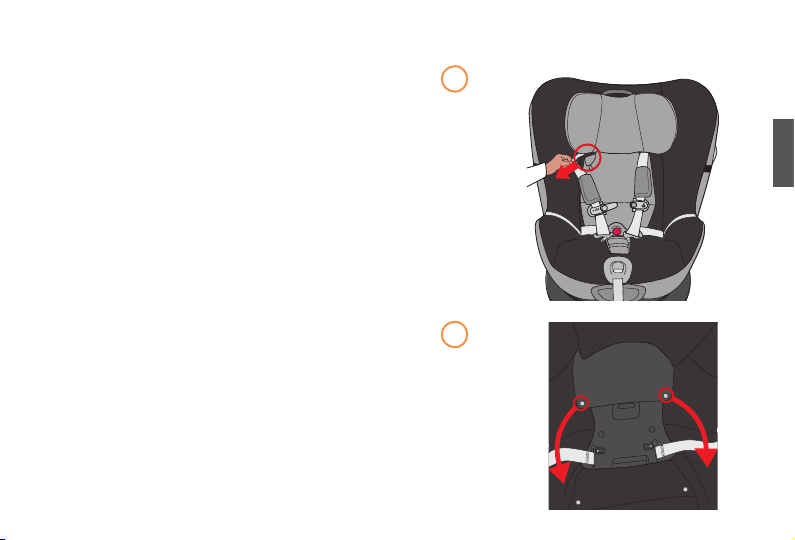
227
Español
CUIDADO Y LIMPIEZA
4. Desabroche los dos broches que sujetan la cubierta
de la cabecera al asiento y mueva las correas del
arnés a los lados.
NOTA: Asegure las hebillas del arnés al asiento
usando los soportes magnéticos para lengüeta de
hebilla.
5. Desabroche los dos broches que sujetan el acojinado
del respaldo a la cubierta del asiento y jale hacia
adelante para mostrar la placa del asiento.
4
5

228
6
ba
CUIDADO Y LIMPIEZA
6. Retire las correas del arnés de la placa del
asiento.
a. Empuje hacia arriba la lengüeta de retención
a
y deslice el pasador del anclaje para la
cadera
b
hacia adentro.
b. Retire la correa del arnés del anclaje para
la cadera y repita el procedimiento en el
otro lado.
7. Retire las correas del arnés del sistema de
sujeción infantil.
a. Afloje las correas del arnés
a
jalando hacia
adelante hasta que la placa de unión
b
sea visible.
b. Desconecte las correas del arnés de la
placa de unión.
c. Coloque la placa de unión en la placa del
asiento para evitar que se caiga al interior
de la parte inferior del sistema de sujeción
infantil.
7
a
a
b

229
Español
CUIDADO Y LIMPIEZA
CÓMO REEMPLAZAR LAS CORREAS DEL ARNÉS
1. Pase las correas del arnés a través de las
ranuras del arnés ubicadas en la parte trasera
del sistema de sujeción infantil.
2. Levante el respaldo del asiento y asegúrese de
que las correas del arnés se introduzcan detrás
de la barra de carga del arnés.
NOTA: La correa de sujeción debe estar
enfrente de la barra de carga del arnés.
1
2
Barra de
carga del
arnés

230
CUIDADO Y LIMPIEZA
3
3. Acople las correas del arnés a la placa de unión.
NOTA: Asegúrese de que las correas no estén
torcidas y estén completamente acopladas a la
placa de unión, como se muestra, para prevenir
que se desprendan.
4. Acople la correa del arnés al anclaje de la placa
del asiento.
a. Acople la correa del arnés al anclaje de la
cadera.
b. Deslice el pasador del anclaje para la cadera
a
hacia afuera para bloquearlo y repita el
procedimiento en el otro lado.
NOTA: Asegúrese de que las correas no estén
torcidas y estén completamente acopladas a la
placa del asiento, como se muestra.
5. Asegure los dos broches del acojinado del
respaldo a la cubierta del asiento.
6. Vuelva a insertar las correas del arnés a través
de los lazos que conectan la cubierta de la
cabecera al asiento y cierre los dos broches.
4
a

231
Español
Cubierta de la cabecera
Acojinado de la hebilla
Hombreras
Inserto para recién
nacido
CUIDADO Y LIMPIEZA
Cubierta del asiento
LIMPIEZA DE MANCHAS
Limpie las manchas de las cubiertas del asiento, las
hombreras, el acojinado de la hebilla y el inserto
para recién nacido con un paño limpio según sea
necesario usando detergente suave y agua.
INSTRUCCIONES DE LAVADO
Todas las partes de la cubierta del asiento se pueden
lavar de la siguiente manera:
• Lave en la lavadora por separado con agua
FRÍA, ciclo para ropa delicada y detergente
suave.
• Deje escurrir para secar.
PARA EVITAR QUE ENCOJAN:
• NO lave en lavadora con agua tibia o caliente.
• NO SEQUE EN SECADORA.
• NO las planche.
• NO use blanqueador.
Inserto de cojín para la
cabeza para recién nacido

232
CUIDADO Y LIMPIEZA
CLIP PARA EL PECHO SENSORSAFE
• NO LO SUMERJA EN EL AGUA. Use un paño para
limpiar con jabón suave y agua tibia.
HEBILLA DEL ARNÉS
Es posible que se acumulen comida, bebidas u otros
desechos dentro de la hebilla del arnés, lo que puede
afectar el funcionamiento correcto.
• NO SUMERJA LA CORREA DE LA HEBILLA EN
AGUA.
• Limpie con un paño húmedo.
• NO use blanqueador, detergentes ni lubricantes.
• Cuando inserte las lengüetas de la hebilla,
asegúrese de que escucha un CLIC, que indica
que la hebilla está funcionando correctamente.
• NO use el sistema de sujeción infantil si las
lengüetas de la hebilla NO hacen clic en la hebilla.
Intente limpiar la hebilla. Si esto no soluciona el
problema, llame a servicio al cliente al 1-877-242-
5676 antes de usar el sistema de sujeción infantil.
CORREAS DEL ARNÉS
• NUNCA SUMERJA LAS CORREAS DEL SISTEMA
DE ANCLAJE INFERIOR O DEL ARNÉS.
• Limpie con esponja usando agua tibia y jabón
suave.
• Deje secar al aire.
• NO las planche.
CONECTORES DE ANCLAJE INFERIOR
• Limpie con esponja o enjuague a fondo los
conectores de anclaje inferior con agua tibia.
• Deje secar por completo.
• Haga una prueba conectando y desconectando
hasta escuchar un CLIC después de acoplar cada
conector al anclaje inferior. Si no se escuchan clics,
repita el procedimiento de limpieza.
PARTES DE PLÁSTICO
• Use un paño para limpiar con jabón suave y agua
tibia.
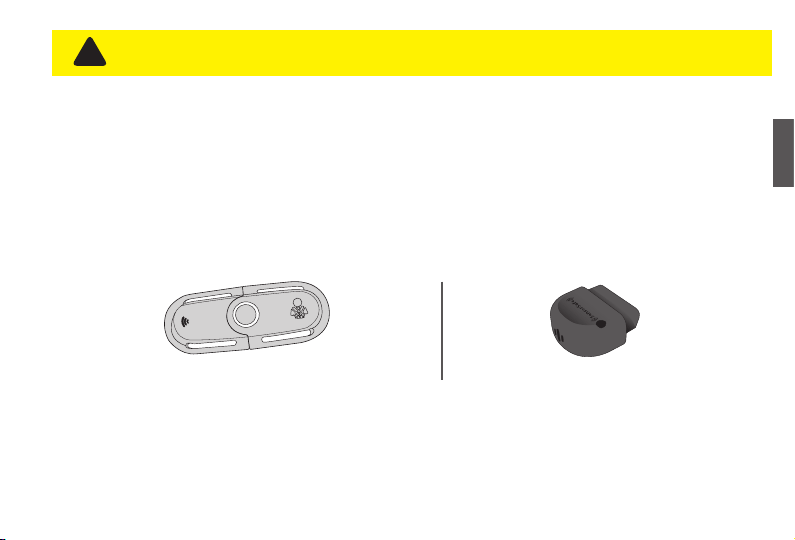
233
Español
Afiance al niño en el sistema de sujeción infantil como lo haría normalmente. El enchufe del receptor SensorSafe
monitorea el transmisor del clip para el pecho y el vehículo. Cuando llegue a su destino y apague su vehículo,
el sistema SensorSafe hace sonar una serie de tonos suaves que le recuerdan que su bebé está en el vehículo.
Instálelo una vez y SensorSafe estará siempre listo para alertarlo.
INFORMACIÓN IMPORTANTE DE USO
• El sistema SensorSafe consiste en dos componentes: (1) El transmisor del clip para el pecho y (2) el enchufe
receptor. El sistema no funcionará a menos que ambos componentes estén presentes en el vehículo con el
receptor instalado en el puerto OBDII del vehículo (página 237).
• Este sistema funciona con la aplicación SensorSafe que se puede descargar de: App Store
®
o Google Play
™
.*
* Las marcas comerciales son propiedad de sus respectivos dueños.
PLACE AT ARMPIT LEVEL
SENSOR
SAFE
TRANSMISOR DEL CLIP PARA EL PECHO ENCHUFE RECEPTOR
INFORMACIÓN GENERAL ACERCA DE SENSORSAFE
®
Este producto contiene imanes. Antes de usarlo, consulte con el médico familiar acerca de la compatibilidad de este
producto con marcapasos y dispositivos similares.
¡ADVERTENCIA! Pueden ocurrir LESIONES GRAVES o la MUERTE
!

234
• El clip para el pecho SensorSafe está diseñado para entrar en modo de suspensión después de estar abrochado
durante 12 horas. Aunque los viajes de 12 horas sin parar en un vehículo son poco comunes y no se recomiendan,
el clip para el pecho debe abrirse y cerrarse después de 12 horas para reactivar el sistema SensorSafe.
• El enchufe receptor se ha probado SOLO con vehículos modelo 2008 o posteriores comprados en EUA o Canadá.
Si desea usar el clip para el pecho SensorSafe con un vehículo híbrido o eléctrico, deberá descargar la aplicación
de App Store
®
o Google Play
™
.* Se pueden comprar enchufes receptores adicionales para vehículos adicionales. Si
tiene preguntas, descargue la aplicación SensorSafe o comuníquese con CYBEX al: 1-877-242-5676 o en línea en:
http://cybex-online.com/us/contact.html.
USO DE LA BATERÍA
• PARA CONSERVAR LA VIDA ÚTIL DE LA BATERÍA, SIEMPRE ALMACENE EL CLIP PARA EL PECHO SENSORSAFE
EN LA POSICIÓN DESABROCHADA.
• El clip para el pecho se envía con una batería de botón de litio instalada, que se puede reemplazar.
• SensorSafe está diseñado para alertarlo si la batería está baja. Si la batería del clip para el pecho se está
agotando, el receptor SensorSafe sonará una alarma de “batería baja” y la luz LED parpadeará 10 veces cuando el
clip para el pecho esté abrochado. Esta alarma de “batería baja” tendrá un sonido diferente de los sonidos agudos
que escucha normalmente al activar el sistema SensorSafe. El clip para el pecho SensorSafe usa una batería de
botón de litio Panasonic
™
CR2032. Si tiene problemas con el producto SensorSafe, comuníquese con CYBEX al:
1-877-242-5676 o en línea en:
http://cybex-online.com/us/contact.html para pedir baterías o partes de repuesto.
INFORMACIÓN GENERAL ACERCA DE SENSORSAFE
®
* Las marcas comerciales son propiedad de sus respectivos dueños.
235
Español
Tecnología SensorSafe®
¿Tiene preguntas? ¿Comentarios?:
Visítenos en: http://cybex-online.com/us/contact.html o llame a CYBEX al: 1-877-242-5676
Este dispositivo cumple los requisitos de SAE J3005.
CERTIFICADO POR LA FCC:
Clip para el pecho modelo: SOSR2, ID de la FCC: 2ABS2-SOSR3
Enchufe receptor modelo: SS2, ID de la FCC: 2ABS2-SS2
Este dispositivo cumple la parte 15 de las reglas de la FCC. Su operación está sujeta a las dos condiciones siguientes:
1. Este dispositivo no puede causar interferencia perjudicial.
2. Este dispositivo debe aceptar cualquier interferencia recibida, incluso interferencias que puedan causar una
operación no deseada.
INFORMACIÓN GENERAL ACERCA DE SENSORSAFE
®
236
Este equipo genera, usa y puede irradiar energía de radiofrecuencia y, si no se instala y usa de acuerdo con las
instrucciones, puede causar interferencia perjudicial en las comunicaciones de radio. No obstante, no hay garantía de que
no se producirá interferencia en una instalación particular. Si este equipo causa interferencia perjudicial en la recepción
de radio o televisión, lo cual puede comprobarse apagando y volviendo a encender el equipo, se sugiere al usuario que
trate de corregir la interferencia aplicando una o más de las siguientes medidas:
• Cambiar la orientación o la ubicación de la antena receptora.
• Aumentar la separación entre el equipo y el receptor.
• Conectar el equipo en un tomacorriente de un circuito diferente al cual está conectado el receptor.
• Solicitar ayuda al distribuidor o a un técnico experimentado en radio y televisión.
Clip para el pecho:
Declaración de advertencia de RF: El dispositivo se evaluó y se determinó que cumple los requisitos generales de exposi-
ción a RF. El dispositivo se puede usar sin restricciones en condiciones de exposición portátil.
INFORMACIÓN GENERAL ACERCA DE SENSORSAFE
®
Los cambios o modificaciones que no haya aprobado expresamente la parte responsable del cumplimiento podrían invali-
dar la autoridad del usuario para operar este equipo.
NOTA: Este equipo se sometió a pruebas y se determinó que cumple con los límites de un dispositivo digital clase B, de
conformidad con la parte 15 de las reglas de la FCC. Estos límites están diseñados para brindar protección razonable contra
interferencias perjudiciales en una instalación residencial.
¡ADVERTENCIA! Pueden ocurrir LESIONES GRAVES o la MUERTE
!

237
Español
a
CÓMO USAR SENSORSAFE
®
Enchufe receptor:
Declaración de exposición a la radiación de la FCC: Este equipo cumple los límites de exposición a la radiación de la FCC
indicados para un ambiente no controlado. Este equipo se debe instalar y operar con una distancia mínima de 20 cm
(7.87 in) entre el radiador y el cuerpo.
1. INSTALE EL RECEPTOR SENSORSAFE.
Localice el puerto 16PIN OBDII
a
en el vehículo. Consulte el manual del
propietario del vehículo para obtener información sobre la ubicación.
Enchufe el receptor SensorSafe. Si no puede localizar el manual del
vehículo, la aplicación SensorSafe puede contener información sobre la
ubicación del puerto 16PIN OBDII para su vehículo.
El receptor SensorSafe emitirá un sonido cuando se comunique con
la red del vehículo por primera vez. En algunos vehículos esto ocurre
inmediatamente después de instalar el receptor SensorSafe. En otros
vehículos el tono no se escuchará hasta que el vehículo arranque.
Esta señal de inicialización solo ocurre una vez después de la instalación.
2. ENCIENDA EL VEHÍCULO.

238
CÓMO USAR SENSORSAFE
®
3. DESABROCHE Y ABROCHE EL CLIP PARA EL PECHO SENSORSAFE.
El clip para el pecho SensorSafe está diseñado para entrar en modo de suspensión si per-
manece abrochado durante más de 12 horas. Para restablecer, o volver a activar el clip para
el pecho, desabróchelo y vuelva a abrocharlo. Cuando haga esto, la luz LED azul parpadeará
dos veces.
PARA CONSERVAR LA VIDA ÚTIL DE LA BATERÍA, SIEMPRE ALMACENE EL CLIP PARA EL
PECHO SENSORSAFE EN LA POSICIÓN DESABROCHADA.
4. CONDUZCA EL VEHÍCULO.
El receptor SensorSafe está diseñado para responder después de que el vehículo se conduzca a una velocidad de
8 km (5 mi) por hora o más.
5. ESTACIONE EL VEHÍCULO Y APAGUE EL ENCENDIDO.
2 segundos después de estacionar el vehículo y apagar el encendido, escuchará el recordatorio SensorSafe, para
avisarle de que su bebé está en el vehículo. (Si no escucha el tono de recordatorio, pruebe SensorSafe siguiendo
de nuevo los pasos 1 a 5. Comuníquese con CYBEX al: 1-877-242-5676 o en línea en:
http://cybex-online.com/us/contact.html si el tono de recordatorio sigue sin activarse.
NOTA: El receptor SensorSafe también activará la alarma si el niño se desabrocha el clip para el pecho después
de que el vehículo se haya conducido a una velocidad de 8 km (5 mi) por hora o más, pero solo si el vehículo está
encendido.
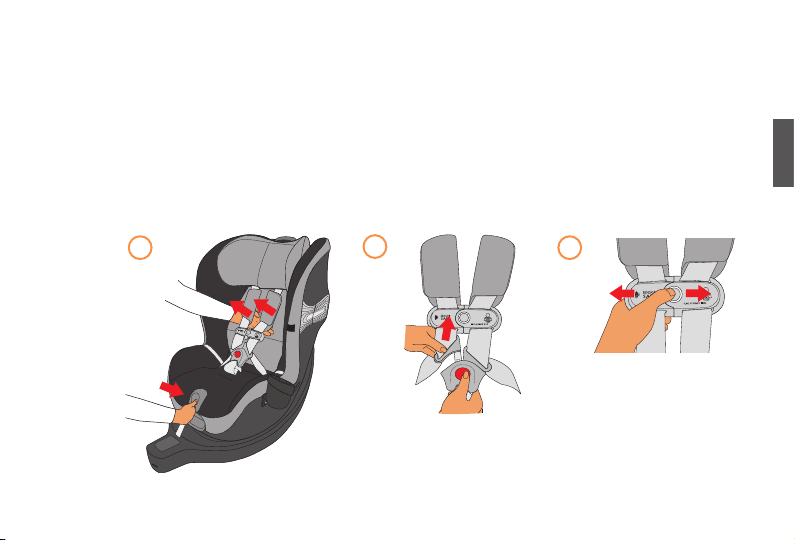
239
Español
CÓMO REEMPLAZAR LA BATERÍA DEL CLIP PARA EL PECHO
CÓMO USAR SENSORSAFE
®
SENSORSAFE.
1. Presione el botón de liberación del arnés en la parte delantera del sistema de sujeción infantil y jale ambas
correas del arnés hacia adelante para aflojarlo.
2. Presione el botón en la hebilla de la entrepierna y jale hacia afuera ambas lengüetas de la hebilla para
desabrochar el arnés.
3. Presione el botón de liberación y jale el clip para el pecho para abrirlo.
1 3
2

240
4. Voltee el lado macho del clip para el pecho y afloje los tornillos con un desarmador Phillips pequeño. Retire la
cubierta
a
.
5. Retire la placa de circuitos
b
del clip para el pecho. Retire la batería
c
de la placa de circuitos. Reemplace
la batería con una batería de botón de litio Panasonic
™
CR2032 nueva, como se muestra.
6. Coloque la placa de circuitos con la nueva batería en el clip para el pecho. Vuelva a colocar la cubierta y
apriete los tornillos. Esto completa el proceso de reemplazo de la batería.
Si tiene preguntas, comuníquese con CYBEX al: 1-877-242-5676 o en línea en:
http://cybex-online.com/us/contact.html.
CR2032
b
c
CÓMO USAR SENSORSAFE
®
* Las marcas comerciales son propiedad de sus respectivos dueños.
CR2032
2
1
4
a
b
5

241
Español
¿Leyó y comprendió este manual del propietario y todas las etiquetas que se encuentran en este sistema de
sujeción infantil?
¿El sistema de sujeción infantil está en la posición correcta (ORIENTADO HACIA ATRÁS u ORIENTADO HACIA
ADELANTE) para el tamaño del niño?
¿Es correcto el ángulo de reclinado del asiento de acuerdo con el indicador de nivel?
¿El indicador de bloqueo de giro muestra la palabra BLOQUEADO?
¿Comprobó que no haya superficies calientes en días soleados?
¿Está el arnés ajustado en la posición correcta para el tamaño del niño con el arnés EN o APENAS DEBAJO
de los hombros del niño (ORIENTADO HACIA ATRÁS) o EN o APENAS ARRIBA de los hombros del niño
(ORIENTADO HACIA ADELANTE)?
¿Está el arnés ceñido alrededor del niño y afianzado correctamente con el clip para el pecho colocado al nivel de
las axilas?
¿Se usa la correa de sujeción cuando se usa el asiento ORIENTADO HACIA ADELANTE?
¿La pata de carga descansa firmemente contra el piso del vehículo y el indicador de bloqueo de la pata de carga
muestra el color VERDE?
Si el sistema de sujeción infantil está junto a una puerta o panel del vehículo, ¿está extendido el dispositivo L.S.P.
adyacente?
¿Cumple el niño las Pautas de uso para el niño del asiento (páginas 130-133)?
¿Es la fecha de hoy anterior a la fecha "Do Not Use After" (No usar después del) que se indica en el sistema de
sujeción infantil?
Si respondió SÍ a todas estas preguntas, está listo para viajar. ¡CONDUZCA CON CUIDADO!
LISTA DE VERIFICACIÓN DE SEGURIDAD

242
SI NECESITA AYUDA
Comuníquese con nuestro Departamento de Atención al Cliente, donde contamos con un amplio equipo de per-
sonal técnico especializado en Seguridad de Pasajeros Infantiles (CPS) para abordar cualquier pregunta que pueda
tener relacionada con la instalación, partes, mantenimiento o información sobre la garantía.
Cuando se comunique con nosotros, tenga a mano el número de modelo del producto y la fecha de fabricación
para que podamos ayudarlo eficazmente. Esta información se puede encontrar en la parte inferior de la base del
sistema de sujeción infantil.
Comuníquese con Atención al cliente de CYBEX al 1-877-242-5676.
Correo electrónico: [email protected]
Sitio web: www.cybex-online.com
RECURSOS

243
Español
RECURSOS
Se puede encontrar información adicional, consejos y videos de instalación en la aplicación móvil SensorSafe.
¡EL 75 % DE LOS AUTOASIENTOS SE INSTALAN INCORRECTAMENTE!
Instalar el autoasiento correctamente en el vehículo es muy importante para la seguridad del niño. Asegúrese de
que el autoasiento se instale correctamente usando uno de los recursos siguientes:
www.nhtsa.gov/equipment/car-seats-and-booster-seats
www.safekids.org
Para encontrar un técnico de CPS disponible en su área, visite bit.ly/FindATech
Reciclaje : Una vez que el asiento llegue a la fecha de vencimiento, se recomienda reciclar el asiento.
Comuníquese con el centro de reciclaje de su comunidad local para obtener información sobre la mejor manera de
desechar el asiento. No se recomienda regalar ni vender el asiento a nadie, ni simplemente colocarlo en la basura.

244
IMPORTANTE: Registre de inmediato el sistema de sujeción infantil para que nos podamos comunicar con usted en
el caso poco probable de que se retire el producto del mercado por razones de seguridad. Regístrelo en línea
en: http://register.cybex-online.com/us/carseats o por correo con la tarjeta de registro que se proporciona por
separado.
GARANTÍA LIMITADA
CYBEX garantiza al comprador consumidor original que este producto estará libre de defectos de material
y mano de obra durante dos (2) años a partir de la fecha de compra original (el "período de garantía").
Durante el periodo de garantía, CYBEX, a su discreción, puede reparar o sustituir el producto si el
fabricante determina que tiene defectos de material o mano de obra. CYBEX se reserva el derecho de
descontinuar o cambiar partes, telas, modelos o productos, o de sustituir este producto con un modelo o
producto comparable. Para presentar una reclamación bajo esta garantía, comuníquese con nosotros en:
[email protected], llame al 1–877–242–5676 o escriba a:
Garantía CYBEX
Columbus Trading Partners USA, Inc.
1801 Commerce Drive
Piqua, Ohio 45356
Se requiere el comprobante original de compra para validar su garantía y los gastos de envío serán responsabilidad
del comprador consumidor original. Para agilizar el procesamiento de cualquier reclamación futura de la garantía
y para verificar la fecha original de compra, llene debidamente y envíe por correo la tarjeta de registro para el
propietario con la dirección preimpresa en un plazo de treinta (30) días a partir de la fecha de compra.
GARANTÍA

245
Español
GARANTÍA
LIMITACIONES DE LA GARANTÍA
Esta garantía no cubre los efectos del uso y desgaste normales o daños resultantes de la negligencia, modificación,
instalación inadecuada, accidentes, mal uso o abuso de este producto. Se acuerda expresamente que las obligaciones
de CYBEX y los remedios del comprador consumidor original en virtud de la garantía limitada contenida en el presente
documento son exclusivos y están estrictamente limitados a la reparación o sustitución del producto.
Esta garantía limitada está condicionada al estricto cumplimiento de lo dispuesto en el Manual del propietario. Bajo
ninguna circunstancia CYBEX o el distribuidor que vende este producto será responsable legalmente ante usted de
ningún daño, incluidos daños incidentales o consecuentes que surjan del uso o incapacidad de usar este producto.
LIMITACIÓN DE GARANTÍAS Y DERECHOS LEGALES ESTATALES O PROVINCIALES
La garantía y los recursos especificados anteriormente son exclusivos y sustituyen a cualquier otro, ya sea oral,
escrito, expreso o implícito. En la medida que la ley vigente lo permita, por medio del presente se excluye cualquier
garantía implícita, incluidas garantías de comerciabilidad o idoneidad para un propósito determinado. Algunos
estados o provincias no permiten limitaciones sobre la duración de una garantía implícita o la exclusión o limitación
de daños incidentales o directos; por lo tanto, es posible que las limitaciones anteriores no se apliquen en su caso.
Esta garantía le otorga derechos legales específicos y usted podría tener también otros derechos que pueden variar
de un estado a otro o de una provincia a otra. Ni CYBEX ni el distribuidor que vende este producto autorizan a ninguna
persona a crear ninguna otra garantía, obligación o responsabilidad legal en conexión con este producto.

CY_171_6048_C1219
CYBEX Industrial Limited
Suite 1222, 12/F | Leighton Centre | 77 Leighton Road | Causeway Bay | Hong Kong
www.cybex-online.com
Distributed in the United States by Columbus Trading Partners USA Inc.
1801 Commerce Drive | Piqua, OH 45356 | USA
Tel: 1–877–242–5676 | e-mail: [email protected] | www.cybex-online.com
© 2019 CYBEX Industrial Limited. All rights reserved. Printed in China. This product and its components are subject to change without notice.
Patents pending.



