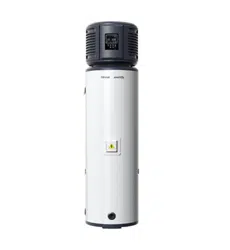
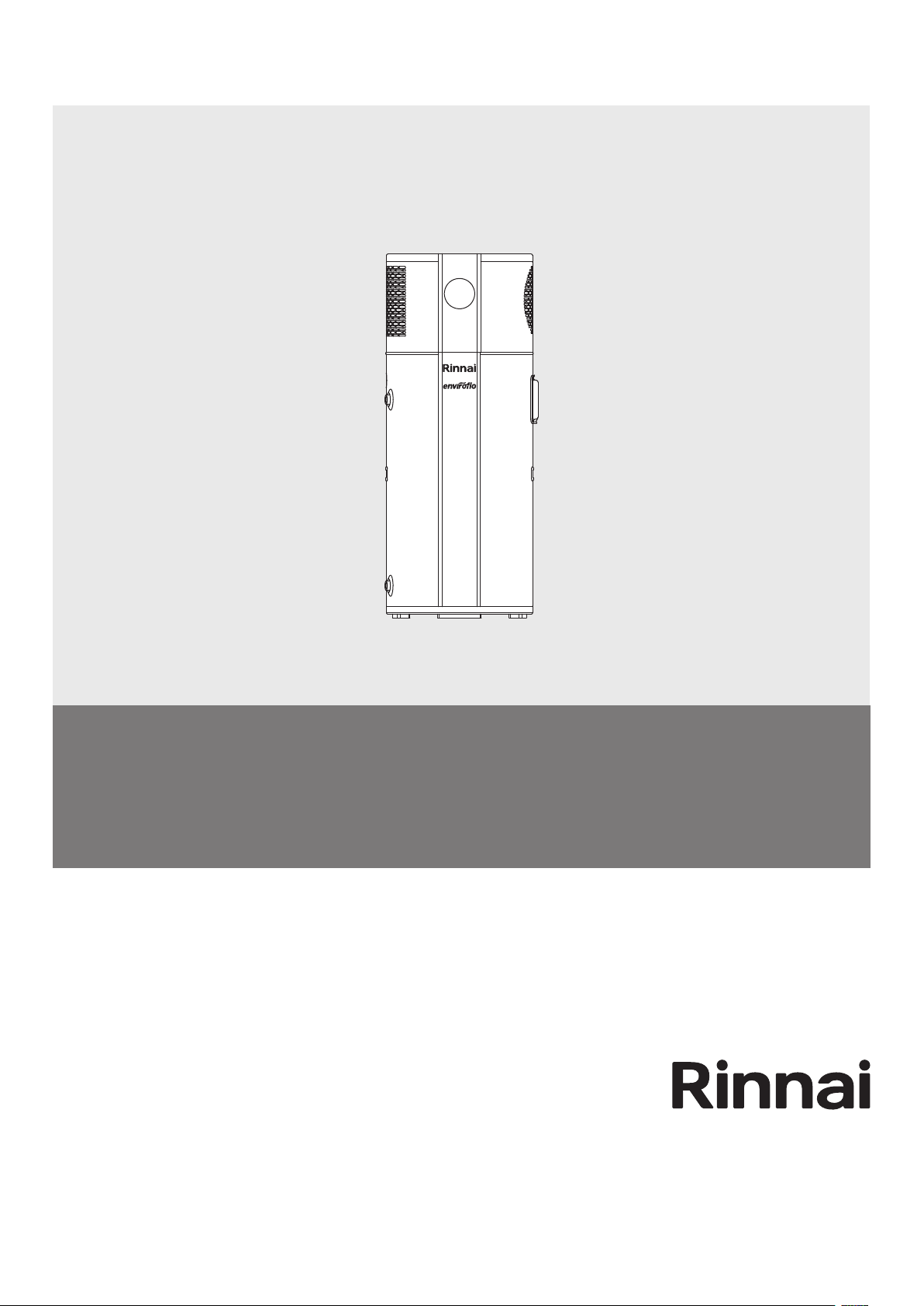
B Series - Heat Pump Hot Water System
Operation & Installation Manual
MODEL
EHPS215VM
Rinnai 2 B Series Heat Pump OIM - Issue 1
This appliance must be installed in accordance with:
• Manufacturer’s Installation Instructions
• Current AS/NZS 3500
• Plumbing Code of Australia (PCA)
• Local Regulations and Municipal Building Codes
including local OH&S requirements
This system must be installed, commissioned, serviced,
maintained and removed ONLY by an Authorised Person.
NOT SUITABLE AS A POOL OR SPA HEATER
For continued safety of this appliance it must be installed and
maintained in accordance with the manufacturer’s instructions.
Standard: AS3498:2020
Licence Number: WMK26792
SAI Global
Standard: AS/NZS 2712:2007
Licence Number: SMK41306
SAI Global

Rinnai 3 B Series Heat Pump OIM - Issue 1
TABLE OF CONTENTS
Warnings and Important Information 4
Safety and Regulatory Information ����������������������������������������������������������������������������������������������������������������� 4
Transport and Storage of Appliance ��������������������������������������������������������������������������������������������������������������� 5
Scald Hazards ��������������������������������������������������������������������������������������������������������������������������������������������������� 6
Operating Principle ������������������������������������������������������������������������������������������������������������������������������������������ 7
System Schematic �������������������������������������������������������������������������������������������������������������������������������������������� 7
Safety Devices �������������������������������������������������������������������������������������������������������������������������������������������������� 8
Excessive Discharge from Safety Devices ���������������������������������������������������������������������������������������������������� 8
Hydrogen Gas ��������������������������������������������������������������������������������������������������������������������������������������������������� 9
Anodes ������������������������������������������������������������������������������������������������������������������������������������������������������������� 9
Turning O the Water Heating System ����������������������������������������������������������������������������������������������������������� 9
Turning On the Water Heating System ����������������������������������������������������������������������������������������������������������� 9
Draining and Filling ������������������������������������������������������������������������������������������������������������������������������������������ 9
Maintenance and Regular Care ����������������������������������������������������������������������������������������������������������������������� 9
Save a Service Call 10
Specications 12
System Specications ����������������������������������������������������������������������������������������������������������������������������������� 12
Dimensions ���������������������������������������������������������������������������������������������������������������������������������������������������� 13
Clearances ������������������������������������������������������������������������������������������������������������������������������������������������������ 14
Installation 15
Regulations and Occupation Health and Safety (OH&S) ���������������������������������������������������������������������������� 15
Location ���������������������������������������������������������������������������������������������������������������������������������������������������������� 15
Water Supply ��������������������������������������������������������������������������������������������������������������������������������������������������� 16
Storage Temperature ������������������������������������������������������������������������������������������������������������������������������������� 16
Hot Water Delivery Temperature ������������������������������������������������������������������������������������������������������������������� 16
Valves and Fittings ����������������������������������������������������������������������������������������������������������������������������������������� 16
Transport and Handling ��������������������������������������������������������������������������������������������������������������������������������� 17
Connect the PTR Valve ���������������������������������������������������������������������������������������������������������������������������������� 18
Plumbing Connections ���������������������������������������������������������������������������������������������������������������������������������� 18
Connect Cold / Hot Water Supply ����������������������������������������������������������������������������������������������������������������� 18
Connect Condensate Drain line �������������������������������������������������������������������������������������������������������������������� 19
Electrical Tests ����������������������������������������������������������������������������������������������������������������������������������������������� 19
Electrical Connections ����������������������������������������������������������������������������������������������������������������������������������� 19
Filling the System ������������������������������������������������������������������������������������������������������������������������������������������� 20
Commissioning and Finishing the Installation �������������������������������������������������������������������������������������������� 20
Wiring Diagram ����������������������������������������������������������������������������������������������������������������������������������������������� 20
Operation of Controller ��������������������������������������������������������������������������������������������������������������������������������� 21
Controller Layout and Keys �������������������������������������������������������������������������������������������������������������������������� 21
Led Icons ��������������������������������������������������������������������������������������������������������������������������������������������������������� 22
Controller Functions and Operation ������������������������������������������������������������������������������������������������������������� 23
Wi-Fi Connection �������������������������������������������������������������������������������������������������������������������������������������������� 26
Contacts 28
Rinnai 4 B Series Heat Pump OIM - Issue 1
SAFETY AND REGULATORY INFORMATION
WARNING
DO NOT operate this system before reading the manufacturers instructions�
This appliance must be installed, commissioned and serviced by an authorised person in
accordance with all applicable local rules and regulations�
Access covers of water heating system components will expose 240V wiring and MUST only be
removed by an authorised person�
This appliance is not intended for use by persons (including children) with reduced physical,
sensory or mental capabilities, or lack of experience and knowledge, unless they have been
given supervision or instruction concerning use of the appliance by a person responsible for
their safety�
For continued safety of this appliance it must be installed, operated and maintained in accordance
with the manufacturer’s instructions�
Children should be supervised to ensure they DO NOT play with the appliance�
The Heat Pump is tted with a power cord & 15 amps plug , It MUST connect to an independent,
fused, AC 240V 50 Hz power supply with an isolating switch installed at the switch board, which
shall eectively isolate all active supply conductors from the circuit and means for disconnection
MUST be incorporated in the xed wiring in accordance with the wiring rules. If the power supply
cord is damaged, it MUST BE replaced by an authorised person in order to avoid a hazard. Take
care not to touch the power connections or plugs with wet hands�
Care should be taken not to touch the pipe work as it may be HOT!
DO NOT place articles on or against this appliance�
DO NOT store chemicals or ammable materials near this appliance.
DO NOT operate with collectors or covers removed from this appliance�
DO NOT activate heat pump unless cylinder is full of water�
NEVER use a ammable spray such as hair spray, paint, etc near this unit as this may cause a
re.
RISK OF FIRE
This appliance uses R290 (propane) refrigerant, which is a ammable gas class 3 according to AS
5149 and MUST be handled by a refrigeration mechanic with appropriate Australian refrigerant
handling licence�
WARNING Risk of re / ammable material. If the refrigerant is leaked, together with an external
ignition source, there is a possibility of ignition�
WARNING
MANDATORY INSPECTION PRIOR TO INSTALLATION
Immediately report any damage or discrepancies to the Supplier of the appliance. This
appliance was inspected and tested at the time of manufacture and packaging, and released for
transportation without known damage� Upon receipt, inspect the exterior for evidence of rough
handling in shipment� Ensure that the appliance is labelled correctly for the gas and electrical
supply, and/or other services it is intended to be connected to.
For safety and warranty purposes, appliances that may be damaged or incorrect must not be
installed or operated under any circumstances. Installation of damaged or incorrect appliances
may contravene local government regulations� Rinnai disclaims any liability or responsibility
whatsoever in relation to the installation or operation of damaged or incorrect appliances�
NOTICE TO VICTORIAN CONSUMERS
This appliance must be installed by a person licensed with the Victorian Building Authority.
Only a licensed person will have insurance protecting their workmanship.
So make sure you use a licensed person to install this appliance and ask for your Compliance Certicate.
For further information contact the Victorian Building Authority on 1300 815 127
WARNINGS AND IMPORTANT INFORMATION
Rinnai 5 B Series Heat Pump OIM - Issue 1
TRANSPORT AND STORAGE OF APPLIANCE
RISK OF FIRE
The refrigerant used in the heat pump (R290 Propane) is a ammable gas.
The appliance(s) shall be stored and transported in an area without ignition sources (for example:
open ames, an operating gas appliance or an operating electric heater)
DO NOT pierce or burn the appliance�
Be aware that refrigerants may not contain an odour�
Compliance with AS/NZS 5149 MUST be observed while storing the appliance�
IMPORTANT
National and state regulations exist for storage, handling and transport of hazardous goods
including ammable gasses. The maximum number of pieces of equipment or the conguration
of the equipment, permitted to be transported or stored together will be determined by the
applicable regulations�
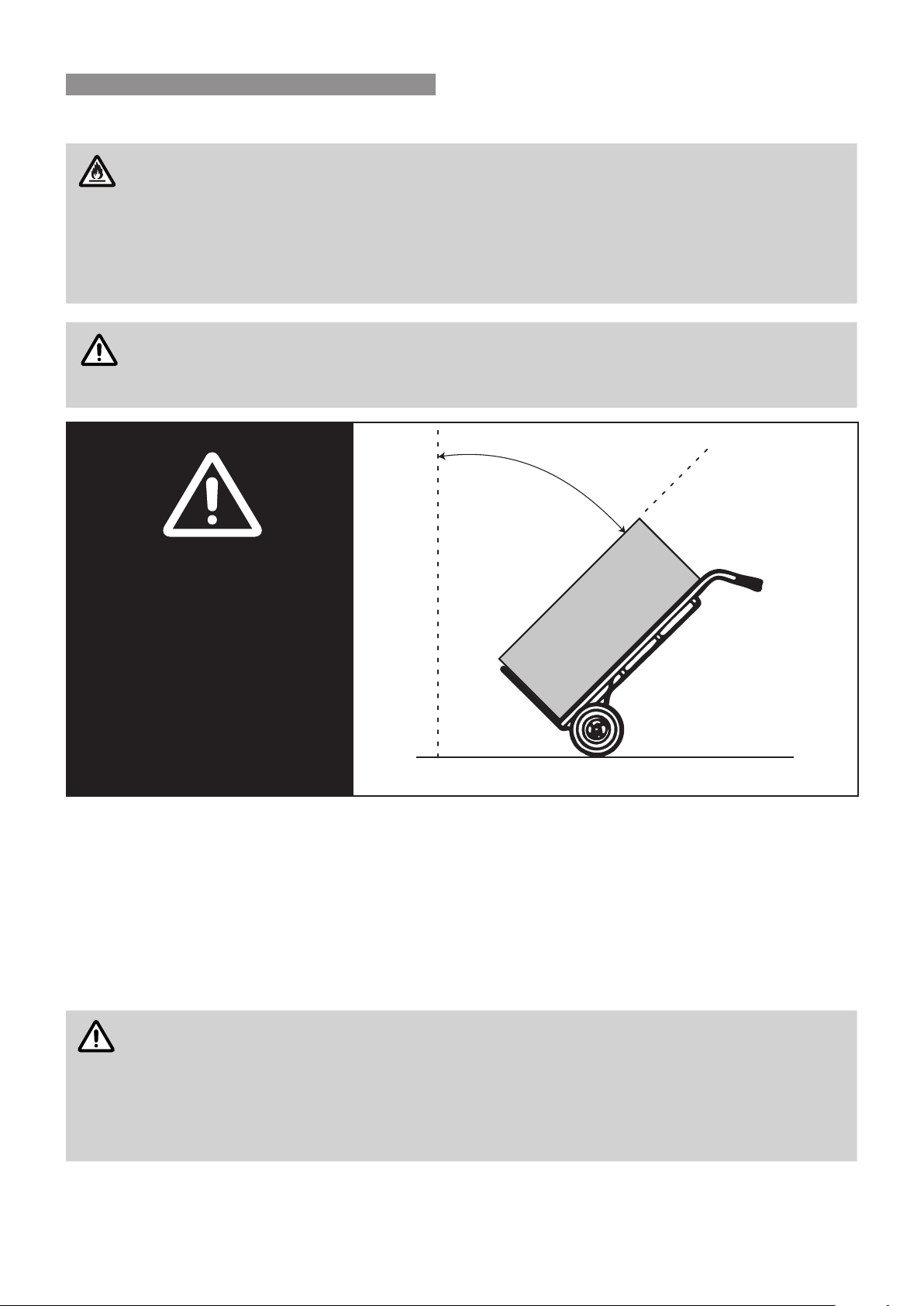
IMPORTANT
IMPORTANT
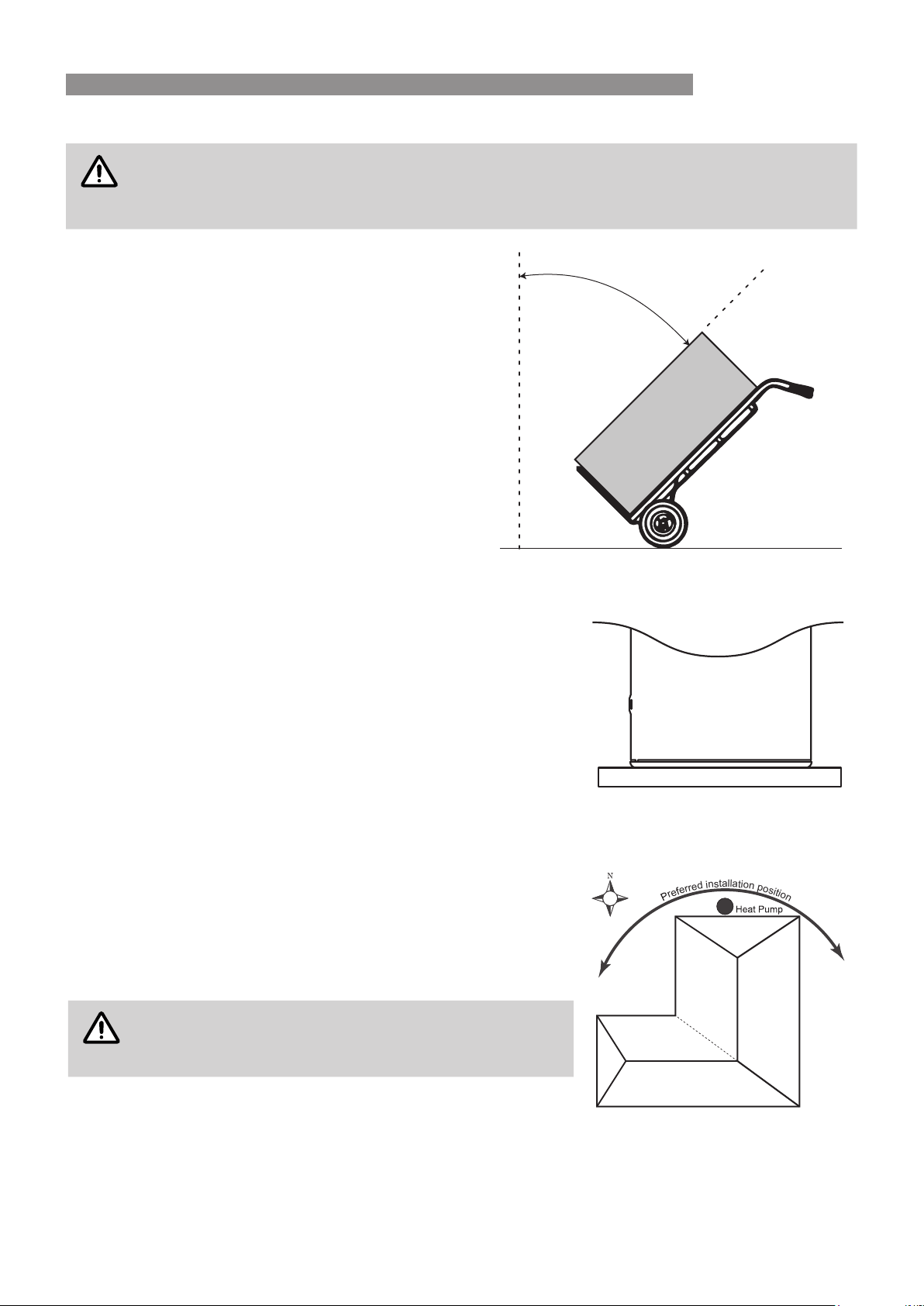
DO NOT TILT
MORE THAN 45°
FROM VERTICAL
45°
The Rinnai Electric Heat Pump must be transported at an angle no greater that 45º from vertical. As the compressor
unit is located at the top of the electric heat pump, should the heat pump be tilted at a greater angle than 45º from
vertical, the lubrication oil within the compressor can run down into the mufers. This will leave the compressor
motor without sufcient lubrication and lead to premature failure of the compressor unit.
As a general good practice it is better to keep the compressor upright as much as possible to avoid any risks.
Returning the Rinnai Electric Heat Pump to a vertical position will allow the oil to properly ow back into the
compressor motor.
Tilting the system beyond 45º from vertical will also place undue strain on compressor motor mounts and associated
piping.
WARNING
Do not use means to accelerate the defrosting process or to clean, other than those recommended
by the manufacturer�
The appliance shall be stored in a room without continuously operating ignition sources� For
example, open ames, an operating gas appliance or an operating electric heater.
Do not pierce or burn�
Be aware that refrigerants may not contain an odour�
WARNINGS AND IMPORTANT INFORMATION
Rinnai 6 B Series Heat Pump OIM - Issue 1
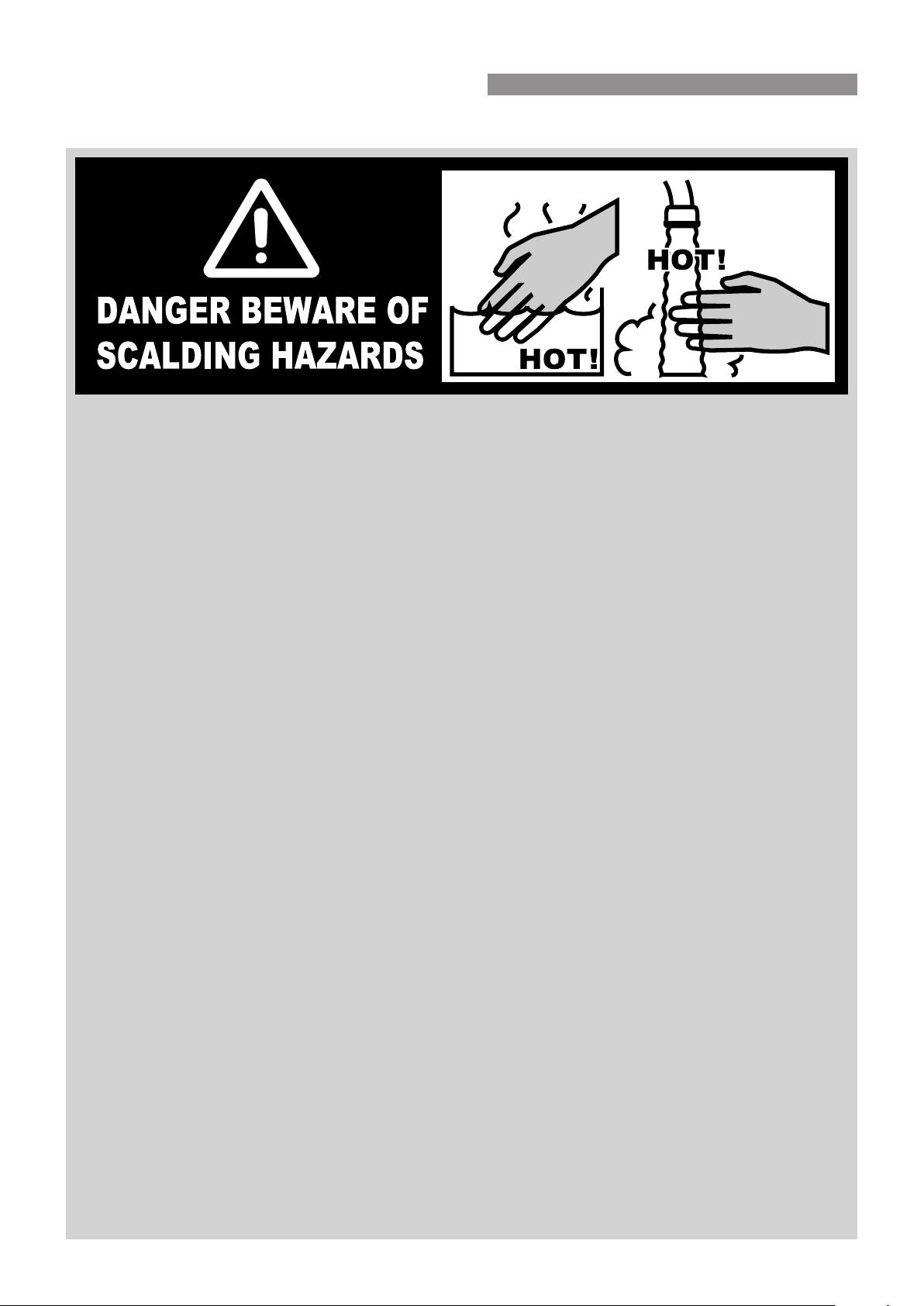
SCALD HAZARDS
HOT WATER CAN CAUSE SCALDS.
CHILDREN, DISABLED, ELDERLY AND THE INFIRM ARE AT THE HIGHEST RISK OF
BEING SCALDED.
FEEL WATER TEMPERATURE BEFORE BATHING OR SHOWERING.
SCALDS FROM HOT WATER TAPS CAN RESULT IN SEVERE INJURIES TO YOUNG
CHILDREN.
SCALDS OCCUR WHEN CHILDREN ARE EXPOSED DIRECTLY TO HOT WATER WHEN
THEY ARE PLACED INTO A BATH WHICH IS TOO HOT.
ALWAYS......
Test the temperature of the water with your elbow before placing your child in the bath, also carefully
feel water before bathing or showering yourself�
Supervise children whenever they are in the bathroom�
Make sure that the hot water tap is turned o tightly.
CONSIDER.....
Installing child proof tap covers or child resistant taps (both approaches will prevent a small hand being
able to turn on the tap)�
Installing tempering valves or thermostatic mixing valves which reduce the hot water temperature
delivered to the taps. Your local plumbing authority may already require that these be tted. Contact
your installer or local plumbing authority if in doubt�
NEVER….
Leave a toddler in the care of another child. They may not understand the need to have the water
temperature set at a safe level�
WARNINGS AND IMPORTANT INFORMATION

Rinnai 7 B Series Heat Pump OIM - Issue 1
OPERATING PRINCIPLE
The operation of an electric heat pump is very similar to a refrigerator, but in reverse. A heat pump operates by
transferring heat from the ambient outside air into the water. Electricity is just used to operate the system, but not
to directly heat the water. Because of this energy consumption is signicantly reduced as compared to an electric
element hot water system. The warmer the climate in which the heat pump is installed, the more efcient the heat
pump system will be at heating water.
The heat pump unit includes highly efcient micro-channel heat exchanger wrapped around the inner cylinder
for thermal conductivity. A temperature sensor in the tank is used to control the heat pump operation to achieve
suitable tank temperature.
During the occasional times when the ambient weather conditions are not suitable for the heat pump to operate,
the electric element will provide heating to ensure a supply of hot water.
SYSTEM SCHEMATIC
EVAPORATOR
FILTER
FILTER
EEV
HIGH PRESSURE
SWITCH
WATER TANK
HEAT EXCHANGER
MICRO-CHANNEL
COMPRESSOR
4 WAY
VALVE
WARNINGS AND IMPORTANT INFORMATION
Rinnai 8 B Series Heat Pump OIM - Issue 1
SAFETY DEVICES
The water heating system is supplied with various safety devices including temperature sensors, overheat sensors
and switches and a Pressure & Temperature Relief (PTR) valve. These devices must not be tampered with or
removed. The water heating system must not be operated unless each of these devices is tted and is in working
order.
WARNING
DO NOT tamper with or remove safety devices�
DO NOT operate the water heater unless all safety devices are tted and in working order.
DO NOT block or seal the PTR Valve and drain pipe�
Pressure & Temperature Relief (PTR) Valve
This valve is located near the top of the water heater and is
essential for safe operation. It is normal for the valve to release
a small quantity of water through the drain line during heating.
However, continuous leakage of water from the valve and its
drain line may indicate a problem with the water heater.
WARNING
NEVER block the outlet of the PTR valve or it’s drain line for any reason� The easing gear MUST
be operated at least every 6 months to remove lime deposits and verify that it is not blocked�
Failure to do this may result in the water heater failing�
If the valve does not discharge water when the easing gear lever is opened, or does not seal again
when the easing gear is closed, attendance by an authorised person MUST be arranged without
delay� The PTR valve is not serviceable�
EXCESSIVE DISCHARGE FROM SAFETY DEVICES
Pressure & Temperature Relief (PTR) Valve
It is normal and desirable that this valve allows a small quantity of water to be discharged during the heating cycle.
If it discharges more than a bucket of water during a 24 hour period or discharges continuously there may be
another problem.
If the valve dribbles continuously, try easing the valve gear for a few seconds as described above. This may
dislodge any foreign matter and alleviate the problem.
If the valve discharges at high ows, especially at night, it may be as a result of the water pressure exceeding the
design pressure of the water heater. Ask your installer to t a Pressure Limiting Valve (PLV).
WARNING
NEVER replace the PTR valve with one which has a higher pressure rating than is specied for
your water heater�
Expansion Control Valve (ECV) - if required
It is normal that this valve allows a small quantity of water to be discharged during the heating cycle. If it discharges
more than a bucket of water during a 24 hour period or discharges continuously there may be another problem.
If the valve leaks continuously, try easing the valve gear for a few seconds. This may dislodge any foreign matter
which may be causing the problem. If this does not x the issue, contact Rinnai.
Operate the easing gear regularly to remove any lime deposits and to verify that it is not blocked.
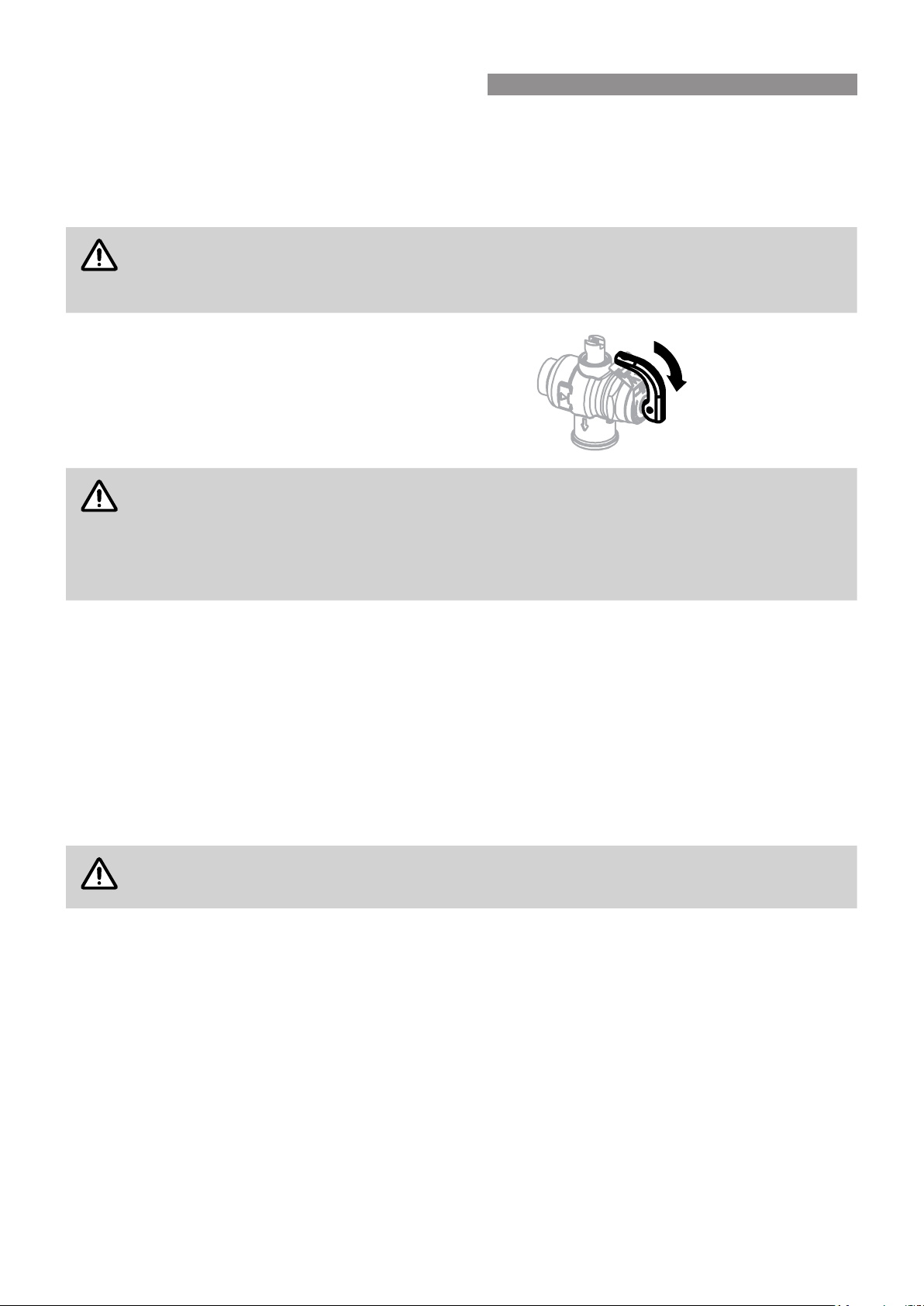
Lift lever un til w ater
flo w s from drain line
(Lo w er lever g en tly!)
WARNINGS AND IMPORTANT INFORMATION

Rinnai 9 B Series Heat Pump OIM - Issue 1
HYDROGEN GAS
If the hot water unit is not used for two weeks or more, a quantity of hydrogen gas, which is highly ammable,
may accumulate in the water heater. To dissipate this safely, it is recommended that a non electrically operated
hot tap be turned on for two minutes at a sink, basin, or bath, but not a dishwasher or other appliance. During
this procedure there must be no smoking, open ame or any electrical appliance operating nearby. If hydrogen is
discharged through the tap, it will probably make a sound like air escaping.
ANODES
The water heater is tted with sacricial anodes to extend it’s life. They will slowly dissipate whilst protecting the
cylinder. The life of the water heater may be extended by arranging for an authorised person to inspect the anodes
and replace them as required. It is recommended that the anodes be inspected at least every 5 years. The factory
tted Rinnai anodes are Magnesium based. These anodes are suited to conditions where the total dissolved solids
(TDS) content in the water supply does not exceed 600 mg/L, (which is the case in most areas). In areas where
the total dissolved solids (TDS) content in the water supply exceeds 600 mg/L Rinnai aluminium based anodes
are required.
TURNING OFF THE WATER HEATING SYSTEM
If you plan to be away for only a few nights, we suggest you leave the water heating system switched on. If it is
necessary to switch off the water heater, do so as outlined below:
DO NOT turn power o to the heat pump unit if snow or frost conditions are expected as components
in the system may be damaged by freezing. If power needs to be turned o or power failure occurs
and freezing conditions are expected, the water needs to be drained from the heat pump unit.
Follow the procedure described below in the section ‘Draining and Filling’�
TURNING ON THE WATER HEATING SYSTEM
Switch on the electric supply to the heat pump unit. Water heating will now occur as required. It may take a number
of hours before hot water is available.
DRAINING AND FILLING
Draining or lling of the complete system normally only occurs during installation or servicing and must be carried
out by an authorised person.
Draining water from the heat pump unit is necessary if the power will be shut off to the unit and snow or frost
conditions are expected. Arrange for an authorised person to carry out this task�
To drain the heat pump:
1. Turn off power to the heat pump
2. Close the cold water mains supply stop cock
3. Open a hot tap to relieve pressure
4. Disconnect the hot outlet near the top of the storage cylinder
5. Disconnect the cold inlet near the bottom of the storage cylinder.
6. The system will now drain completely.
MAINTENANCE AND REGULAR CARE
Operate the easing gear of the PTR and the ECV if tted as described in the section ‘Safety Devices’ on page 8.
The overow tray (supplied by installer) and drain underneath the storage cylinder (if tted) should be periodically
checked to ensure there are no blockages.
WARNING
DO NOT drill, screw or x any ancillary items to the of the tank. This product is tted with a high
eciency heat exchanger attached to the inner cylinder, anything penetrating the outer skin of the
tank may damage the heat exchanger�
WARNING
WARNINGS AND IMPORTANT INFORMATION
Rinnai 10 B Series Heat Pump OIM - Issue 1
Rinnai’s servicing network personnel are fully trained and equipped to give the best service on your Rinnai
appliance. If your appliance needs service, ring one of the service contact numbers on the back of this booklet.
The pressure and temperature relief valve and expansion control valve (if tted) must be replaced by an authorised
person at intervals not exceeding 5 years or more frequently in areas where the water is classied as scaling water.
If the power supply cord to the heat pump unit is damaged, they must be replaced by an authorised person in order
to avoid a hazard.
Use the following guide to avoid the need for an unnecessary service call.
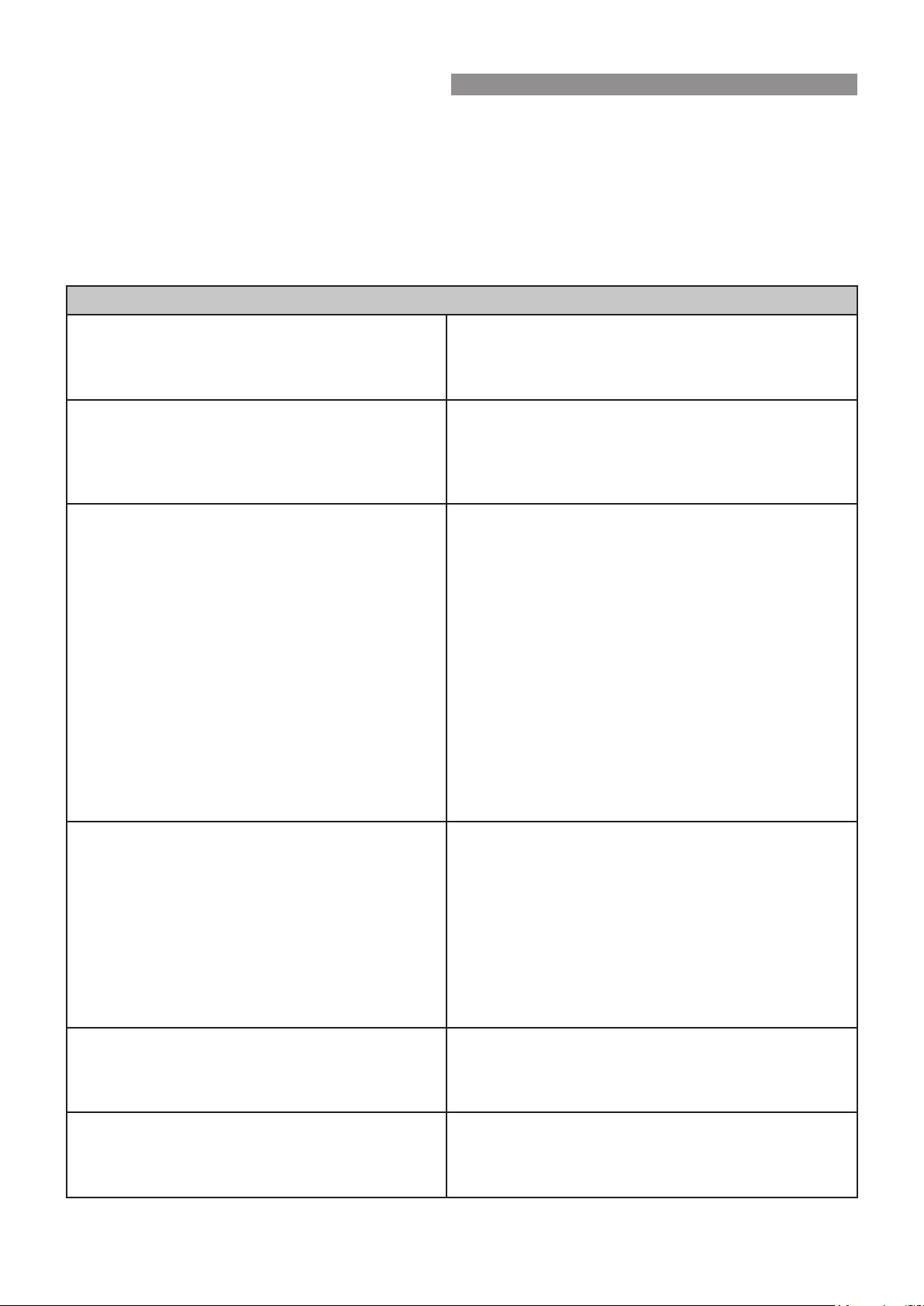
INSUFFICIENT OR NO HOT WATER
Heat Pump Unit Not Powered Check to ensure the electric isolating switch at the
switchboard (usually marked “Hot water” or “Water
heater” is turned on. (note that the compressor will not
start up for 2 minutes after power is turned on).
Excessive hot water consumption Often end users are surprised at the amount of hot water
used, especially when showering. If the amount of hot
water used during the day exceeds the storage capacity
of the cylinder, it is likely there will be insufcient hot
water.
Pressure & Temperature Relief (PTR) Valve
continually discharging water
It is normal and desirable that this valve allows a small
quantity of water to be discharged during the heating
cycle. If it discharges more than a bucket of water during
a 24 hour period or discharges continuously there may
be another problem.
If the valve dribbles continuously, try easing the valve
gear for a few seconds as described in the section
‘Excessive Discharge from Safety Devices’ on page
8. This may dislodge any foreign matter and alleviate
the problem.
If the valve discharges at high ows, especially at night,
it may be as a result of the water pressure exceeding the
design pressure of the water heater. Ask your installer to
t a Pressure Limiting Valve (PLV).
Expansion Control Valve (ECV) continually
discharging water
It is normal and desirable that this valve allows a small
quantity of water to be discharged during the heating
cycle. If it discharges more than a bucket of water during
a 24 hour period or discharges continuously there may
be another problem.
If the valve leaks continuously, try easing the valve gear
for a few seconds as described in the section ‘Excessive
Discharge from Safety Devices’ on page 8. This may
dislodge any foreign matter and alleviate the problem. If
this does not alleviate the problem contact Rinnai.
Ambient conditions too hot To protect the components of the heat pump unit it may
not operate when the ambient temperature is higher than
43°C. The heating element will operate if water heating
is required, but may take longer to heat the water.
Ambient conditions too cold To protect the components of the heat pump unit it may
not operate when the ambient temperature is less than
-7°C. The heating element will operate if water heating
is required.
SAVE A SERVICE CALL
Rinnai 11 B Series Heat Pump OIM - Issue 1
NO WATER FROM THE TAP
Restriction in the hot tap or failure of the cold
water supply to the water heater
Check for water ow at the other taps and that the cold
water isolation valve is fully open.
HIGH ELECTRICITY BILLS
Excessive hot water consumption See entry under the heading ‘Insufcient or no hot water’
High Electricity Taris The electricity tariff will determine the running costs of
the system. It is important the end user is aware of the
applicable tariffs. Contact your electricity supplier to
conrm what these tariffs are.
Higher Element Usage In extremely cold conditions the element may be
operating more than normal.
WATER FLOW FLUCTUATIONS
One or more hot taps opened at the same time More than one or two hot taps in use at the same time
may cause a decrease in the hot water ow from the
taps.
Is there more than one or two hot taps open, or are
appliances such as a dishwasher or washing machine,
in use at the same time?
Ensure only one or two hot taps are on at one time.
WATER HAMMER
Hot and cold water plumbing in the premises Have a plumber check clipping of hot and cold water
pipe work and install a pressure limiting valve and water
hammer arrestor as required.
HEAT PUMP ICES UP
Defrosting function The heat pump has a built in hot bypass defrosting
function which may operate and remove any ice.
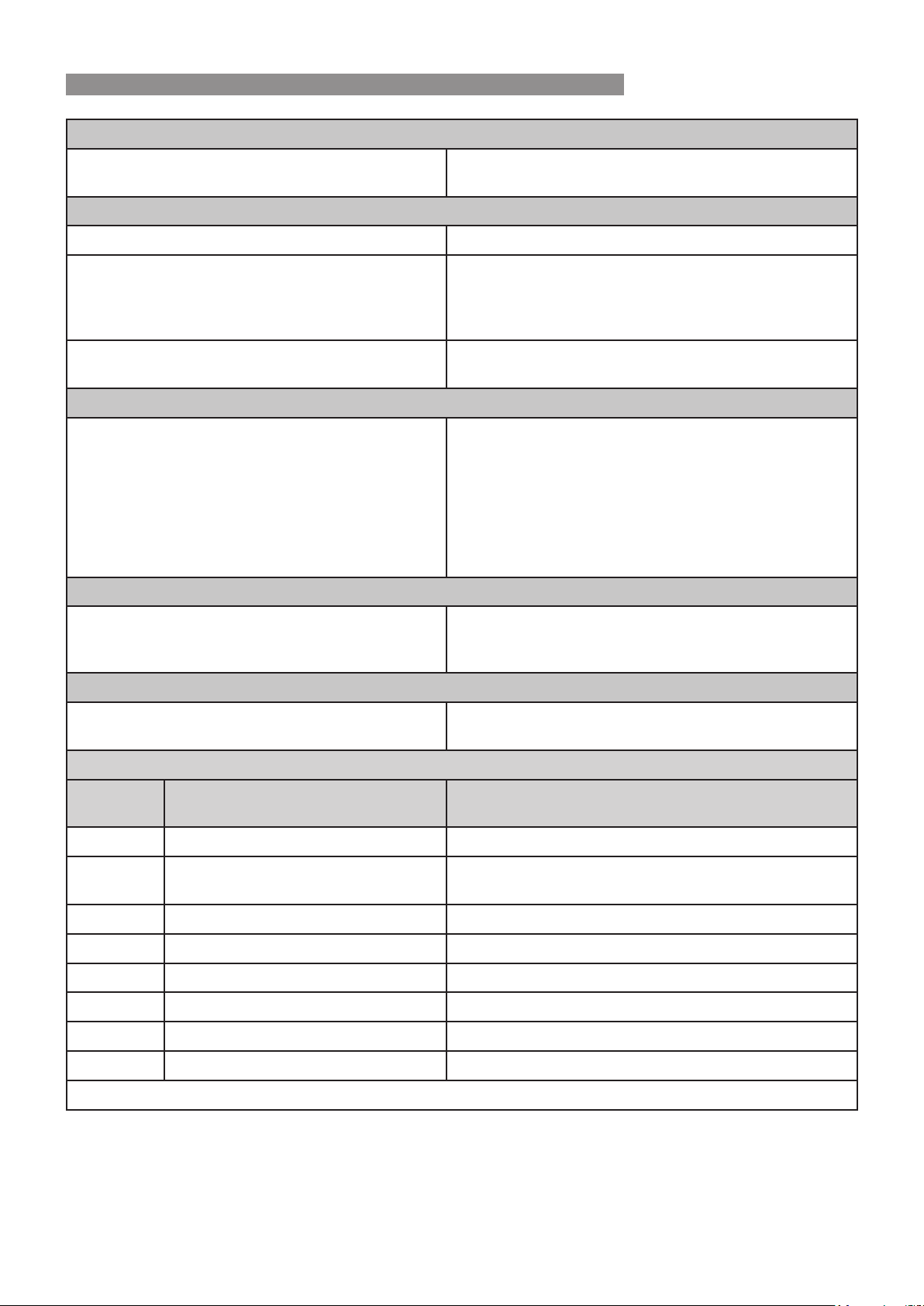
HEAT PUMP ERROR INDICATOR*
Error
code
Error Description Possible Causes
E05 High pressure protection High pressure switch is broken/Connection is loose
E09 Communication fault Signal wire connection loose/There is Strong magnetic
eld/PCB is broken/Signal wire is broken
E12 Exhaust temperature too high Lack of refrigerant/system leak
E14 Tank temperature sensor fault Sensor fault/Connection is loose
E16 Coil temperature sensor fault Sensor fault/Connection is loose
E18 Exhaust temperature sensor fault Sensor fault/Connection is loose
E21 Ambient temperature sensor fault Sensor fault/Connection is loose
E29 Suction temperature sensor fault Sensor fault/Connection is loose
*If an error code is displayed on the control unit please contact Rinnai Customer Care Immediately�
SAVE A SERVICE CALL
Rinnai 12 B Series Heat Pump OIM - Issue 1
SYSTEM SPECIFICATIONS
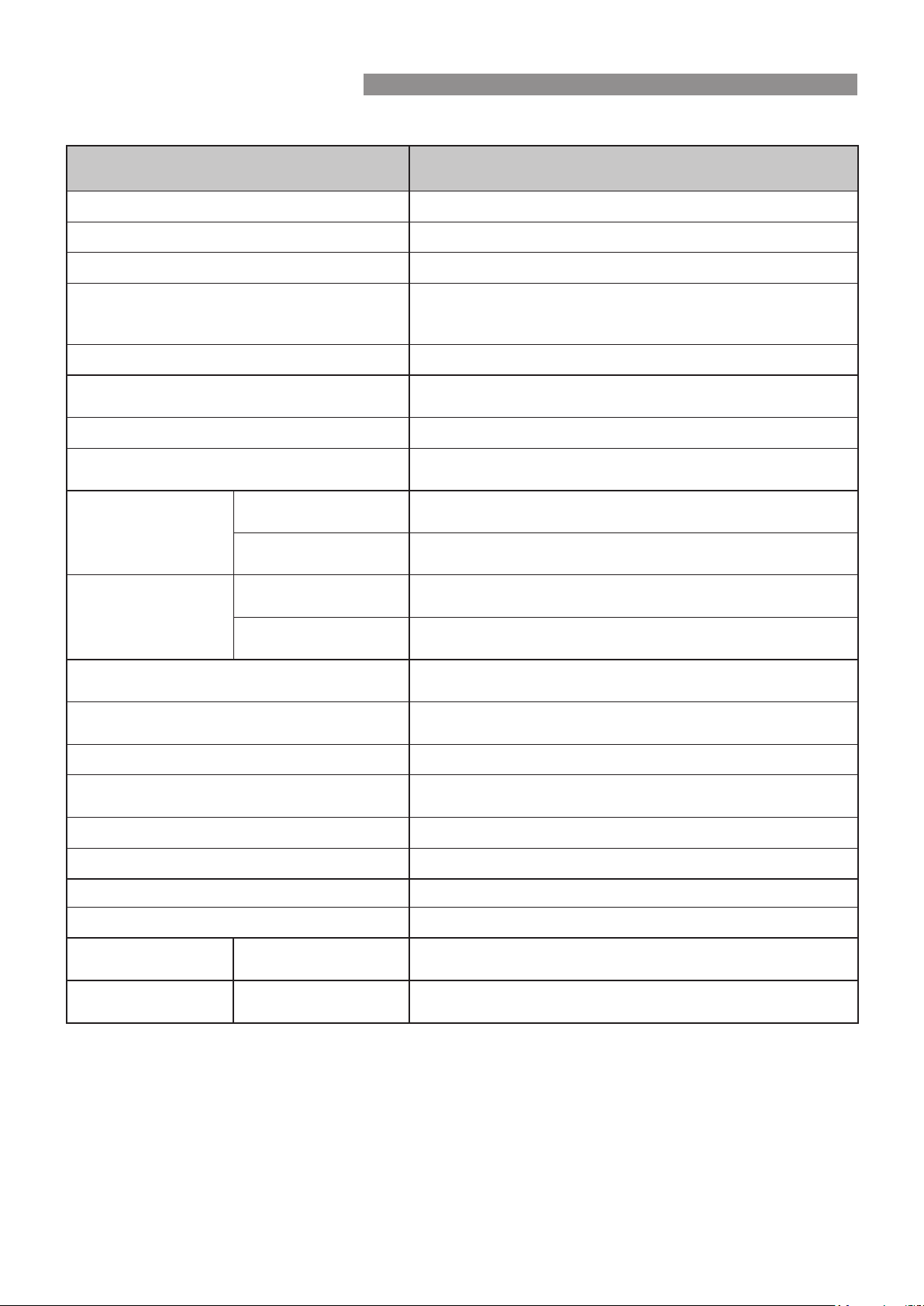
Model
EHPS215VM
Net Weight / Gross Weight 108 kg / 121 kg
Tank Volume 215 L
Sound Level 46 dB(A)
Ambient Temperature Limits
(for heat pump operation - element will
operate beyond these limits)
-7°C to 43°C
Ingress Protection IP24
Storage Cylinder - Hot Outlet and Cold inlet
Connections
ISO 7.1 ¾” RP
Storage Cylinder - PTR Valve Connection ISO 7.1 ¾” RP
Pressure & Temperature Relief (PTR) Valve
(Supplied) Setting / Rating
850 kPa / 46kW
ECV Fitted
Fit PLV if mains
pressure exceeds
680 kPa
Recommended PLV
pressure rating
500 kPa
ECV Not Fitted
Fit PLV if mains
pressure exceeds
800 kPa
Recommended PLV
pressure rating
500 kPa
Rated Input Electric Element
(Factory Wired)
2.1 kW
Maximum Input Refrigeration Module
(Factory Wired)
1.1 kW
Total Maximum Input 2.1 kW
Maximum Energy Output
(Use to size PTR)
4.5 kW
Power Supply 220V-240V AC/50 Hz.
Maximum Current 10 Amps (15 Amp plug tted)
Refrigerant Type / Mass R290 / 380 g
Refrigerant Circuit Maximum Pressure 3000 kPa
Coefcient Of
Performance (COP)
32.6°C Ambient
21.1°C cold water inlet
7.6
Heat Output
32.6°C Ambient
21.1°C cold water inlet
3.6 kW
SPECIFICATIONS
SPECIFICATIONS
Rinnai 13 B Series Heat Pump OIM - Issue 1
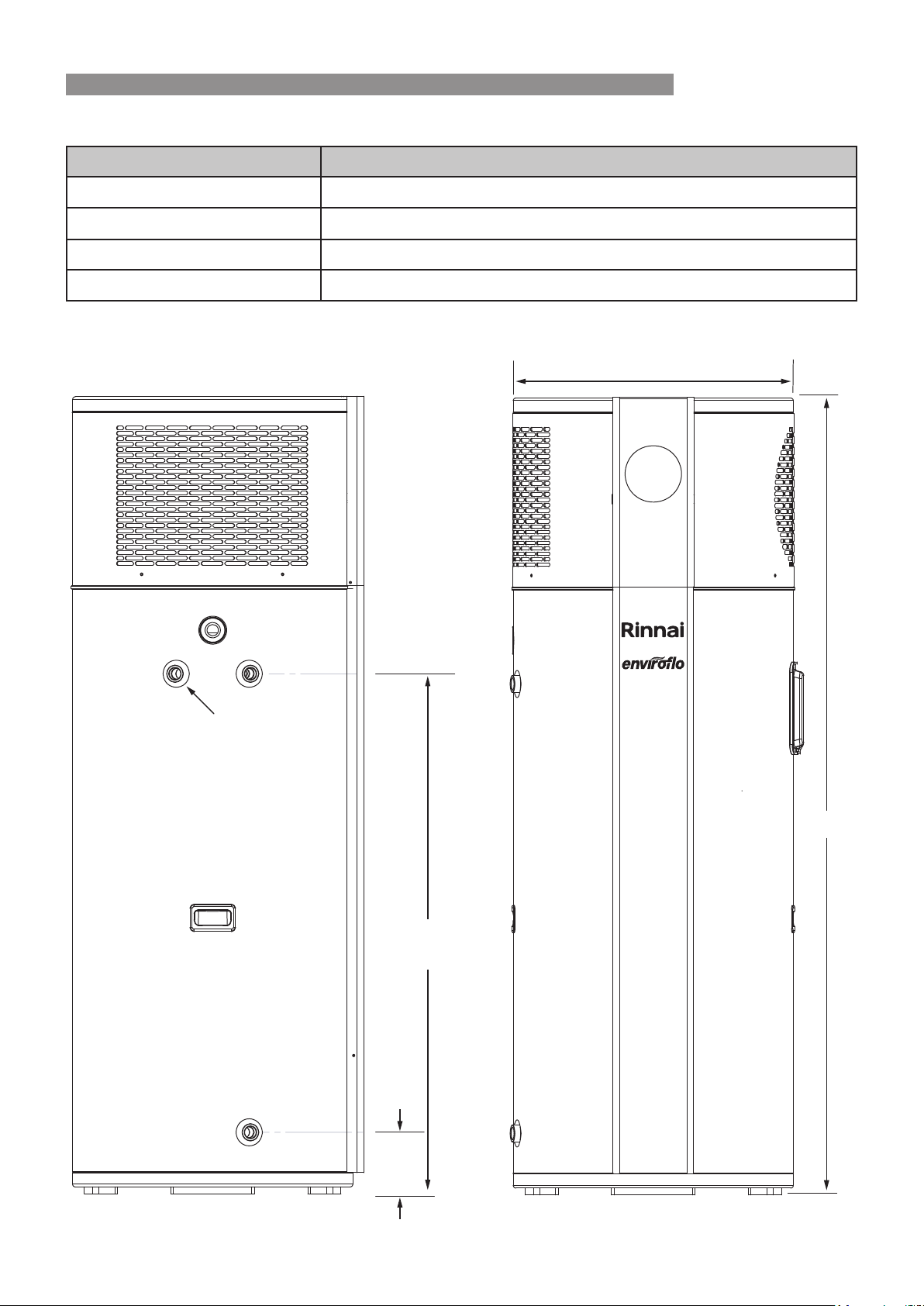
DIMENSIONS
Model
EHPS215VM
Cylinder height 1544 mm
Hot Outlet / PTR height 926 mm
Cold water inlet height 136 mm
Cylinder diameter 620 mm
PTR
Cold
Inlet
Hot Outlet
/ PTR
Cylinder Diameter
Height
SPECIFICATIONS
Rinnai 14 B Series Heat Pump OIM - Issue 1
CLEARANCES
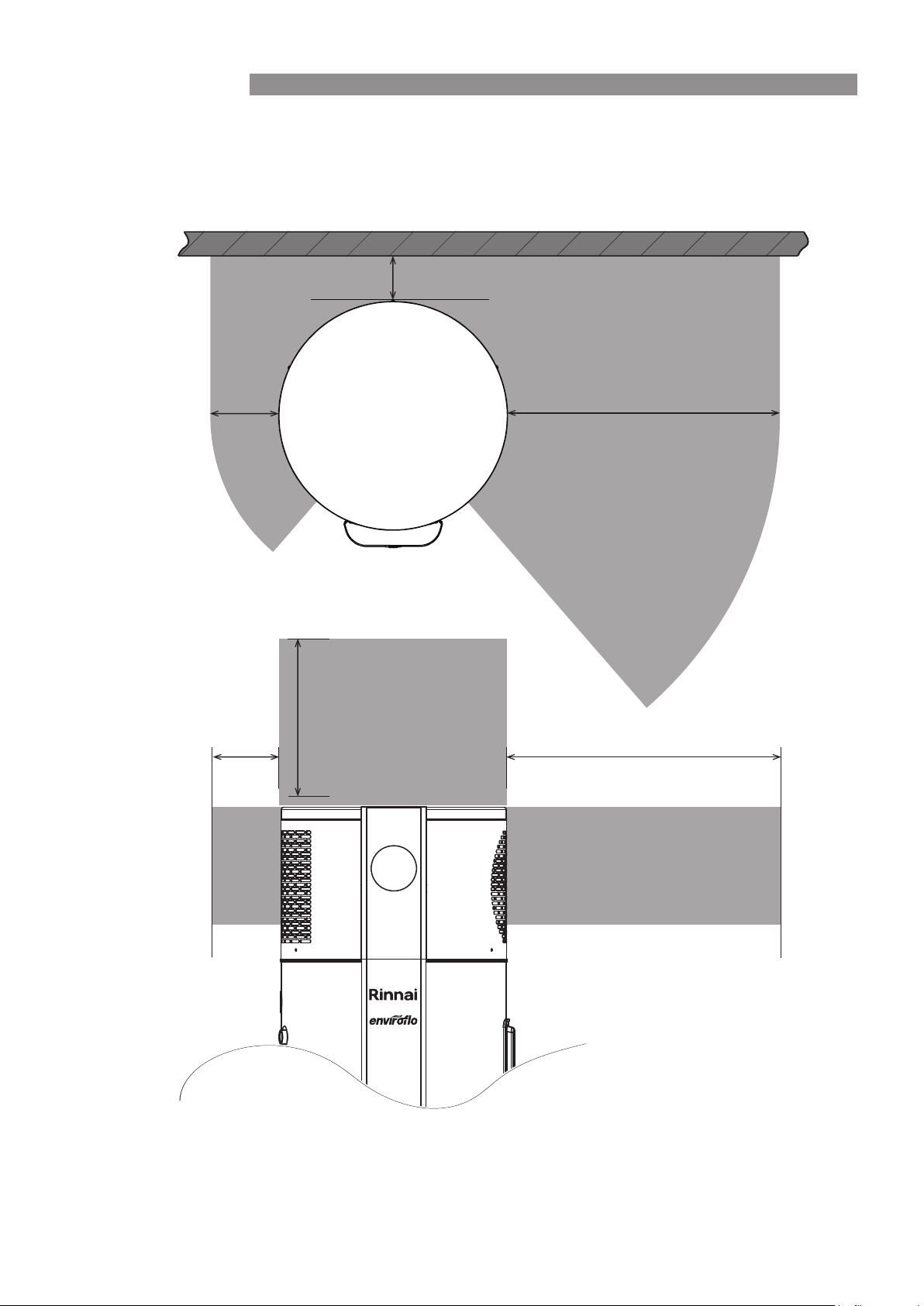
Always allow 500 mm minimum clearance on the fan discharge side and 150 mm minimum clearance on the fan
suction side to allow for sufcient air ow through the fan.
Allow 300 mm minimum vertical clearance for service access.
500 mm
150 mm
100 mm
500 mm
150 mm
300 mm
SPECIFICATIONS

Rinnai 15 B Series Heat Pump OIM - Issue 1
REGULATIONS AND OCCUPATION HEALTH AND SAFETY
(
OH&S
)
WARNING
Installation and commissioning MUST be performed by authorised persons�
The heat pump MUST be installed in accordance with these instructions and all regulatory
requirements which exist in your area including those in relation to manual lifting�
Applicable publications and regulations may include:
•
AS/NZS 3500 National Plumbing and Drainage
•
AS/NZS 3000 Wiring Rules
•
Building Codes of Australia (BCA)
•
Local Occupational Health and Safety (OH&S) regulations
This appliance is not suitable for use as a domestic spa pool or swimming pool heater�
Electric Heat pumps are heavy and bulky items� Australian States and Territories have a Principal
Occupational Health and Safety (OH&S) Act which contains requirements relating to the handling
of large, bulky or awkward items� Persons installing heat pump systems MUST be aware of
their responsibilities and be adequately trained and qualied, in accordance with local OH&S
requirements�
LOCATION
The electric heat pump can be installed externally or internally.
The electric heat pump should be placed as close as practicable to the most frequently used hot water outlet point
or points to minimise the delay time for hot water delivery. This will usually be the kitchen tap. For installations
where the distance between the heat pump and the outlets is considerable, a ow and return system can be used
which minimise the waiting time for hot water delivery.
It is recommended that all components are installed at ground or oor level with consideration for easy service,
repair or replacement access.. The heat pump MUST be installed in a vertically upright position. All components
MUST be accessible without the use of a ladder or scaffold. The unit MUST NOT be installed in roof spaces.
WARNING
Ensure the location complies with the requirements of AS/NZS 60335�2�40 & AS/NZS 5149�
The air inlet and outlet of the heat pump module MUST be away from areas with strong wind and MUST be
provided with sufcient clearances as per those shown in the section ‘Clearances’ on page 14.
The heat pump MUST be connected to an independent AC 240 V, 50 Hz power supply.
Ensure the pressure and temperature pressure relief (PTR) valve and any access covers have sufcient clearances
and are accessible for service and removal. The information on the rating plates MUST also be readable.
The heat pump MUST be installed free-standing on a level and stable base. The cylinder should be mounted on a
concrete base at least 50mm thick or on well-seasoned, evenly spread hardwood slats with a thickness of at least
25mm. Where property damage can occur as a result of water leakage, the storage cylinder MUST be installed
with a safe tray (overow tray) and drain in accordance with AS 3500.4. Ensure the storage cylinder DOES NOT
stand on wet surfaces.
Internal Installation
For internal installations the area MUST meet the following requirements:
•
Minimum room volume of 55m
3
per unit.
•
Good Ventilation (i.e minimum 280 L/s per unit)
•
Away from any ignition sources or corrosive environments.
If the heat pump is installed internally careful consideration should be taken in regards to positioning and limiting
the effect of unit noise and reverberation during operation.
Condensation
As this heat pump is highly efcient, the surrounding air temperature could be cooled by up to 4°C and condensate
formed, the condensate outlet will need to be plumbed to a suitable drain.
INSTALLATION

Rinnai 16 B Series Heat Pump OIM - Issue 1
Drainage
Where property damage can occur as a result of water leakage, the water heater MUST be installed with a safe
tray (overow tray) and drain. Construction, installation and draining of the safe tray MUST comply with local
regulatory requirements and. AS/NZS 3500.4 also requires the use of a safe tray for particular situations.
WATER SUPPLY
This appliance is intended to be permanently connected to the water mains and not to be connected by a hose set.
The maximum water pressure is listed on page 12. An approved pressure limiting valve may be required if the
maximum rated water supply pressure is exceeded.
Water chemistry and impurity limits are detailed in the separate warranty document. Most metropolitan water
supplies fall within these requirements. If you are unsure about water quality and suitability, contact your water
authority.
A water lter MUST be tted on the inlet to the tank to prevent sludge or foreign matter entering the system.
In a scaling water supply, calcium carbonate and possibly other compounds are deposited out of the water onto
any hot metallic surface and form a scale. Scaling water may cause scale deposits to form onto the metallic
surfaces of the PTR valve and may prevent it from operating properly. To prevent this, an expansion control valve
(ECV) MUST be tted on the cold water line after the non-return valve in areas of scaling water. ECVs’ MUST
be tted in South Australia and Western Australia to comply with local regulations.
STORAGE TEMPERATURE
To meet regulatory requirements the thermostat control on the heat pump water heater is factory pre-set to heat all
the water in the tank to 70°C once a week. This cannot be altered.
HOT WATER DELIVERY TEMPERATURE
This appliance may deliver water at high temperature. Refer to the Plumbing Code of Australia (PCA), local
requirements and installation instructions to determine if additional delivery temperature control is required.
The PCA, local regulations and the requirements of AS/NZS 3500.4 MUST be considered regarding the
temperature limitations of hot water supplied to areas used primarily for personal hygiene.
The temperature of water to certain areas is limited to different temperatures according to purpose, for e.g. early
childhood centres, primary and secondary schools and nursing homes or similar facilities for young, aged, sick
or people with disabilities and for all other buildings. To comply with these requirements, a temperature limiting
device, such as a thermostatic mixing or tempering valve, will be required on hot water systems.
VALVES AND FITTINGS
IMPORTANT
A 46 kW capacity, combined Pressure and Temperature Relief (PTR) valve is supplied with the
Heat Pump hot water system. This valve is tted at the top of the storage cylinder. The PTR
valve is a safety device and it is mandatory that it is tted by the installer in all installations..
The following valves & ttings are to be supplied by the installer:
•
A cold water expansion control valve (ECV). An ECV MUST be tted in Western Australia and South Australia
to the cold water supply to the storage cylinder to comply with local regulations. An ECV is recommended in
all other geographical areas where the water supply has a tendency to cause scaling. This will reduce hot
water discharge from the pressure and temperature relief (PTR) valve which minimises wear on this valve.
•
A stop cock, non return valve and line strainer. Combination valves incorporating two or more of these
functions (such as ‘Trio’ valves) are suitable. These are tted to the cold water supply to the storage cylinder
by the installer.
•
Cold water supply and hot water discharge pipework to and from the storage cylinder. This pipework MUST
be insulated as specied in AS/NZS 3500.4
•
An approved pressure limiting valve (supplied with some systems) is required if the maximum rated water
supply pressure on page 12 is exceeded.
•
Tempering valve(s) or thermostatic mixing valve
INSTALLATION
Rinnai 17 B Series Heat Pump OIM - Issue 1
TRANSPORT AND HANDLING
IMPORTANT
When moving the unit, it MUST be close to vertical at all times�
When using a trolley to move the unit, ensure it is not tilted more than 45° from the vertical�
Non compliance will void warranty and severely aect product performance and operation
The Rinnai Electric Heat Pump MUST be transported at
an angle no greater that 45º from vertical.
As the compressor unit is located at the top of the electric
heat pump, should the heat pump be tilted at a greater
angle than 45º from vertical, the lubrication oil within the
compressor can run down into the mufers.
This will leave the compressor motor without sufcient
lubrication and lead to premature failure of the compressor
unit.
As a general good practice it is better to keep the
compressor upright as much as possible. Returning the
Rinnai Electric Heat Pump to a vertical position will allow
the oil to properly ow back into the compressor motor.
Tilting the heat pump beyond 45º from vertical will also
place undue strain on compressor motor mounts and
associated piping.
45°
Never tilt unit more than 45˚ from vertical
POSITIONING THE HEAT PUMP
Arrive at site and conduct a safety audit. Safety audits can also be known
as Work Method Statements (WMS) or Job Site Analysis (JSA).
Park your vehicle as close as allowable to your installation. Unload all
materials in a safe manner.
Position all materials in a convenient position near the work area.
Where the requirements for internal installation can’t be met, the heat
pump MUST be installed outdoors.
The location MUST consider noise impact on living areas. Avoid
positioning near bedrooms or neighbours’ bedrooms. Although the
running noise level is very low it can be expected that the heat pump will
run during the night.
Adequate access MUST be available to the relief valve and anodes.
Safely position the new unit on a level surface in accordance with all
plumbing and building regulations.
A properly drained overow tray MUST be used where property
damage could occur from water spillage. (See AS/NZS 3500.4.2 for
further details.)
NOTE
DO NOT drain on to grass or garden beds�
DO NOT commence a job where the risks cannot be
controlled�
Allow 200m
3
of free space surrounding the unit. This provides clear
ambient airow assisting the product’s performance. Ensure the
clearance requirements specied in the section ‘Dimensions’ on page
13. are complied with. The area MUST also be clear of debris such
as leaves and tree branches.
Install a plinth under the heat pump
where it is subjected to wet conditions
r
e
e
r
r
e
d
i
n
s
t
a
l
l
a
t
i
o
n
p
o
s
i
t
i
o
n
Optimum installation location is on the
warmest side of house.
INSTALLATION
Rinnai 18 B Series Heat Pump OIM - Issue 1
CONNECT THE PTR VALVE
Connect the PTR valve to the uppermost tting of the storage cylinder. See the diagram in the section ‘Dimensions’
on page 13.
The PTR pressure rating MUST be suited for the cylinder and adequate for the thermal loading applied to the
storage cylinder, as specied in the table on page 12. The supplied PTR valve input rating is 46 kW. The PTR
valve rating MUST EXCEED the total input from the heat pump (see the table on page 12). As this is less than
46 kW, the supplied PTR valve is of sufcient capacity.
Use PTFE (Teon) thread tape on the valve, never use hemp or other sealing materials. Ensure the tape does not
protrude past the end of the thread, which could result in it hanging over the end of the thread and blocking the
water passage through the valve.
Connect the supplied PTR valve into the top socket marked “Relief Valve” Leave the valve outlet pointing down.
Tighten the valve using the spanner ats - never use the valve. Discharge according to plumbing regulations. PTR
Valves for the unit are rated at 850 kpa.
The drain line from this valve MUST run in a continuously downward direction with the discharge end left
permanently open to atmosphere.
PLUMBING CONNECTIONS
Refer to the diagram on page 13 for detailed information on position of plumbing.
An approved isolating valve, non return valve, line strainer, and union MUST be tted between the supply main
and the RP ¾ socket in the water heater. All ttings MUST be approved by the relevant installation Authority.
An ECV MUST be tted in Western Australia and South Australia to the cold water supply to the storage cylinder
to comply with local regulations.
An ECV is recommended in all other geographical areas where the water supply has a tendency to cause scaling.
This will reduce hot water discharge from the Pressure and Temperature Relief (PTR) valve which minimises wear
on this valve.
This water heater is designed for direct connection to water supply pressures of no greater than those specied
on page 12. Where the mains pressure can exceed or uctuate beyond this, a pressure limiting (PLV) device
(complying with AS1357) MUST be tted.
CONNECT COLD / HOT WATER SUPPLY
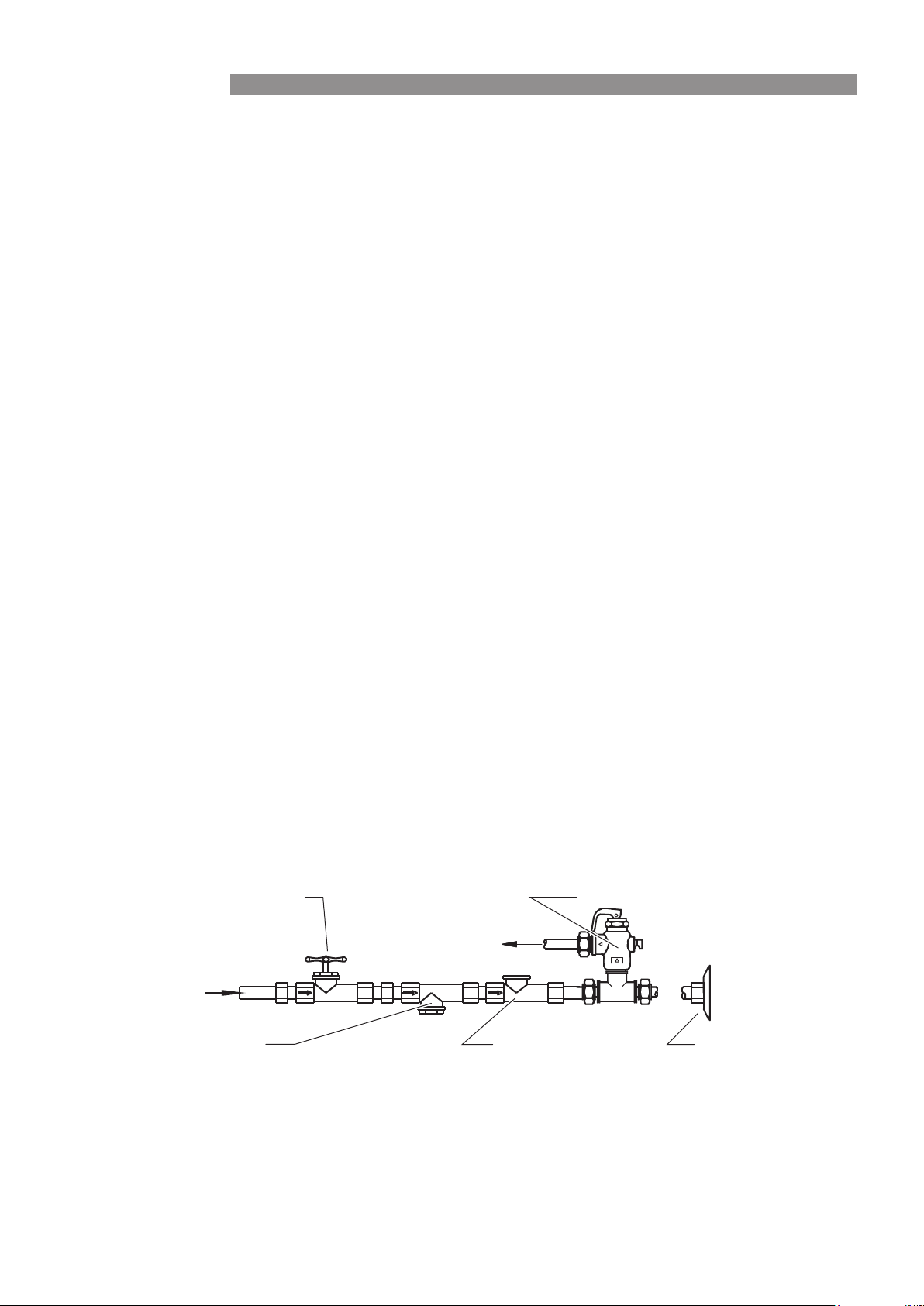
Connect cold water supply, Pressure Limiting Valve (PLV) and or Expansion Control Valve (ECV).
Connect cold water supply to the storage tank (refer to Diagram BELOW).
A stop cock, non return valve and line strainer MUST be tted.
Connect the pipe work supplying hot water to the premises to the hot water outlet on the tank.
A temperature limiting device may be required as detailed in the section the section ‘Hot Water Delivery Temperature’
on page 16
It is recommended that all hot water lines are insulated with high temperature, UV resistant 13mm closed cell
insulation.
D ra in
Union Connection
Non-return ValveLine Strainer
Cold Water Inlet
Isolating Valve (Spindle Vertical)
Cold water expansion
control valve
INSTALLATION
Rinnai 19 B Series Heat Pump OIM - Issue 1
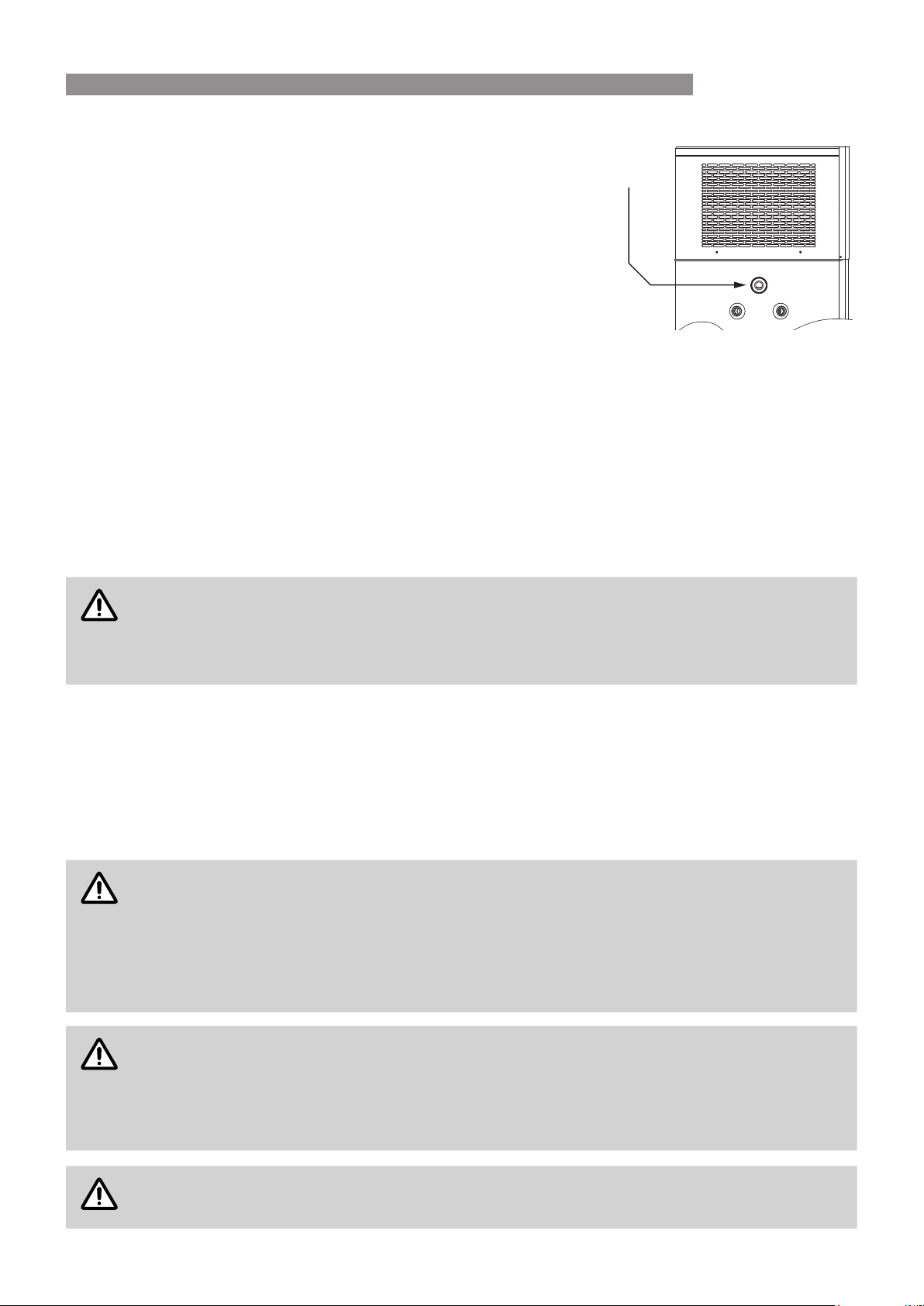
CONNECT CONDENSATE DRAIN LINE
A condensate drain line is required to be tted to carry discharge clear of
the water heater.
The condensate drain line should not be connected to the PTR drain line
but can exit to the same point.
The diagram shows the condensate drain location on the heat pump. Use
the supplied PVC pipe (inner diameter 19mm, UV resistant) and clamp to
connect to the condensate outlet.
Independent 15mm copper pipes MUST be tted to the drain outlets of the
PTR and ECV.
Each pipe MUST be open to atmosphere and run with a continual downward grade in a frost free environment to
a visible discharge point.
Drain lines MUST not exceed 9 meters in length.
Valves or other restrictions MUST NOT be placed in the relief valve drain outlet line.
ELECTRICAL TESTS
DO NOT turn on the power supply to the appliance until it has been lled with water and a satisfactory insulation
(Megger) test has been performed.
Conducting Insulation (Megger) Tests
When conducting an insulation test using a Megger on this appliance, observe the following:
WARNING
This appliance contains electronic components, when performing insulation tests (500 Volts)
this MUST ONLY be conducted the across active terminal to earth and then across the neutral
terminal to earth�
Tests between the active to neutral terminals MUST NOT be performed as this WILL damage
the electronic components�
Insulation test results of between 100 kΩ and 660 kΩ are normal for this appliance.
In accordance with AS/NZS 3000 an insulation test with a result less than 1 MΩ is permitted where the appliance
is approved to a Standard applicable to that class of appliance.
This appliance is categorised and certied as a ‘stationary Class 1 motor operated appliance’ and therefore
satises the requirements of AS/NZS 60335.2.40 for leakage current and electric strength. As such, this appliance
complies with the insulation resistance requirements of AS/NZS 3000.
ELECTRICAL CONNECTIONS
WARNING
The power supply to the heat pump module MUST NOT be activated until the system is lled
with water�
The premises wiring to the heater MUST be capable of withstanding the appliance load� Refer to
specication table for load details.
All electrical connections and wiring MUST be installed, maintained and removed by authorised
persons in accordance with AS/NZS 3000, and all other relevant local regulations and municipal
building codes including OH&S requirements�
IMPORTANT
The Heat Pump is tted with a power cord & 15 Amp plug, it MUST connect to an independent,
fused, AC 240V 50 Hz power supply with an isolating switch installed at the switch board, which
shall eectively isolate all active supply conductors from the circuit and a means for disconnection
MUST be incorporated in the xed wiring in accordance with the wiring rules.
A Residual Current Circuit Breaker is recommended for the power supply to this appliance (this
may be a mandatory requirements in some states or jurisdictions)�
IMPORTANT
Disconnect all power prior to installation and commissioning�
This appliance is designed for single phase 240 Volts, AC mains electrical operation�
Condensate
Drain
INSTALLATION

Rinnai 20 B Series Heat Pump OIM - Issue 1
WIRING DIAGRAM
FILLING THE SYSTEM
Open hot water tap at sink.
Open the stop cock in the cold water main supply line. Allow the system to ll and the air to bleed through the tap.
Turn off the hot tap at the sink when water ows freely without any air bubbles or air bursts. If leaks are detected,
repair any leaks and repeat the lling process to remove any air.
If no leaks are detected water heating can commence.
COMMISSIONING AND FINISHING THE INSTALLATION
IMPORTANT
Please conrm the followings before commissioning:
•
Piping and electrical wiring are all correct
•
Earthing wire is installed properly
•
Pipe insulation is completed
•
Tank is lled
•
Supply Voltage complies with rated voltage
•
Air intake and discharge are not obstructed
Turn on the heat pump unit and wait a few seconds for the system to start. Change operation mode or water
temperature setting if required (it is recommended to retain default setting).
After testing is completed explain to the householder the functions and operation of heat pump water heater
components. Explain to the householder the need to drain the heat pump if freezing conditions are likely and power
is likely to be shut off for an extended time.
Also explain to the householder the importance of carrying out maintenance in accordance with this manual.
Leave the manual with the householder.
WARNING
DO NOT drill, screw or x any ancillary items to the of the tank. This product is tted with a high
eciency heat exchanger attached to the inner cylinder, anything penetrating the outer skin of the
tank may damage the heat exchanger�
INSTALLATION
Rinnai 21 B Series Heat Pump OIM - Issue 1
OPERATION OF CONTROLLER
When the heat pump turns on, the control system initiates and will check the unit’s operating parameters. The
controller will check on all sensors and pressure switches. If conditions are suitable (i.e all reading within the
reasonable range) and there is enough energy available in the surrounding air, the fan and compressor will turn
on. If not enough energy is detected in ambient air then the controller calls for the booster heating element to run.
There will be a delay from the time the heat pump is switched on before the fan and compressor begin operating.
The unit is self regulating so there are no internal adjustments to be made during commissioning. When the unit is
operated for the rst time, it runs through an initial heat up cycle, allow time for the initial heat up cycle. Depending
on the ambient conditions this can take several hours.
If for any reason the unit does not start, the water is cold and the controller unit is not displaying any LED lights, an
electrician should test that power is available to the heat pump.
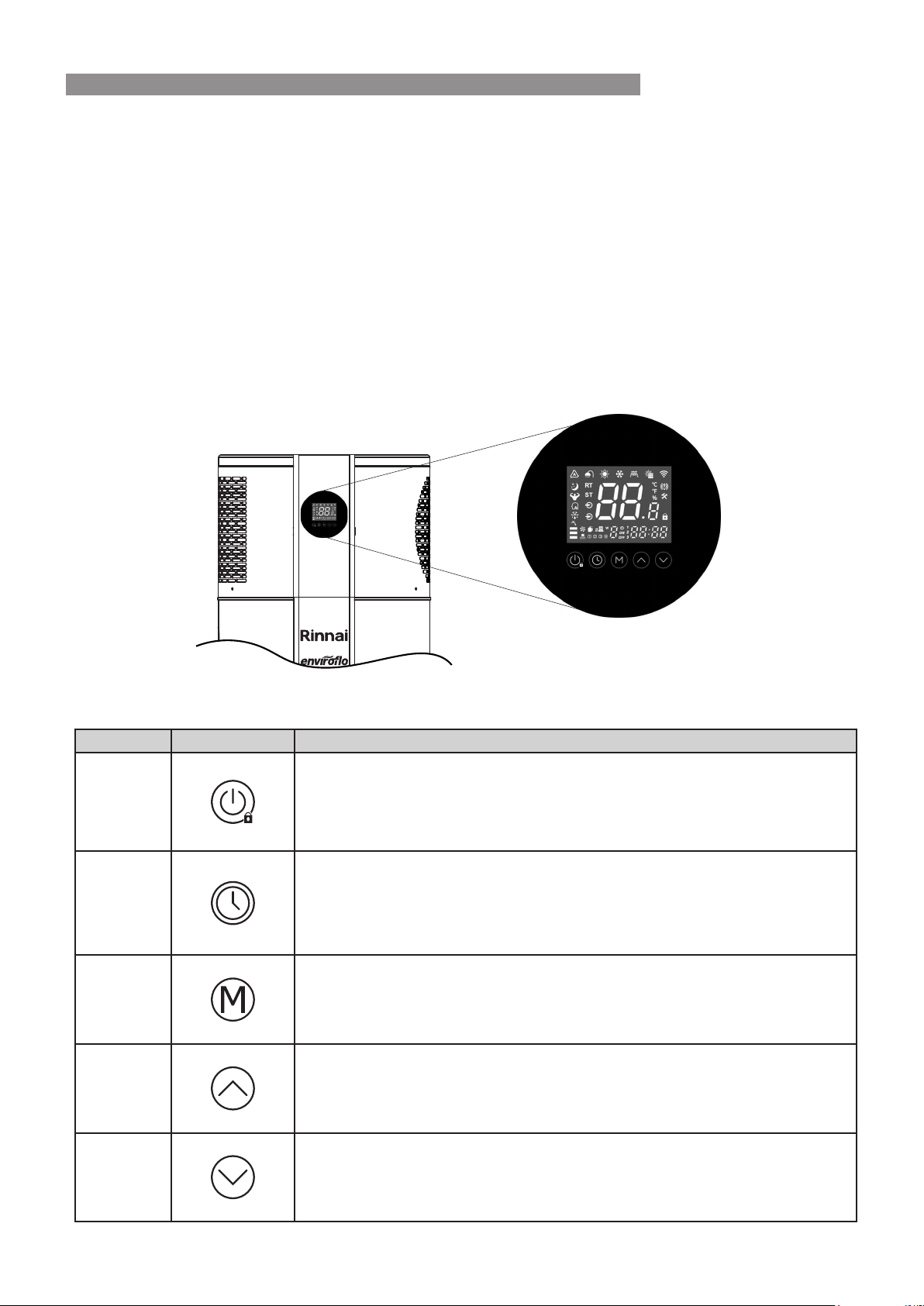
CONTROLLER LAYOUT AND KEYS
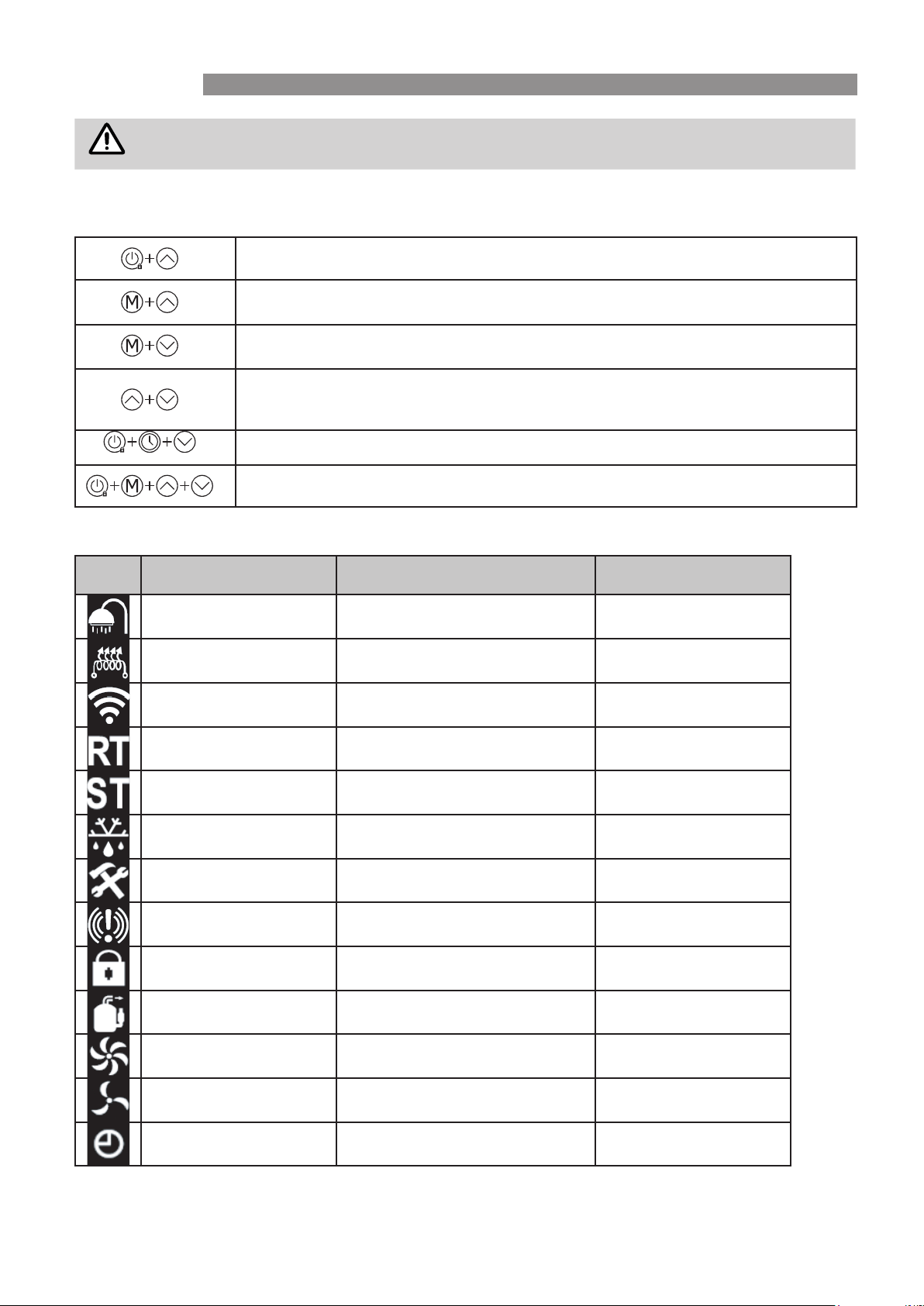
All major functions are controlled by the Control Panel situated on the front of the unit.
The following table describes the primary function of each key on the controller
Key Icon Primary Functions
On/Off
1. On/off key (hold for 1 second)
2. Return key
3. Escape key
4. Unlock key (hold for 5 seconds)
Clock
1. Setting the clock, press the key will enter into clock setting interface, and
then press one time to switch the hour and minute area
2. Setting the timer (press the key and hold for 3s)
3. During timer setting, press the key and hold for 3s, cancel the current
timer setting
Mode
1. Press the key and hold for 5s, enter into parameter setting interface
2. Press the key to change operation mode
3. In parameter query interface, press the key enter into value setting or
save the setting
Up
1. Press the key to change temperature setting value or parameter value or
change hour and minute value
2. Press the key and hold for 3s to query the system status/ parameter
3. Page up
Down
1. Press the key to change temperature setting value or parameter value or
change hour and minute value
2. Press the key and hold for 3s to query the system status/ parameter
3. Page down
OPERATION
Rinnai 22 B Series Heat Pump OIM - Issue 1
IMPORTANT
Ensure the controller unit is not displaying the ERR indicator once unit has been switched on� If
it is refer to the section ‘Save a Service Call’ on page 10
Key Combinations
The keys can also be used in specic combinations to provide additional functions:
Press and hold the two keys for 5s to enter into manual intelligent distribution network
connection model
When heat pump is running in heating mode, press the two keys and hold for 3s to turn
ON/OFF Boost mode (turn ON/OFF heating element)
When heat pump is running, press the two keys and hold for 5s to start/exit defrosting
mode
When power is on the heat pump, press the two keys and hold for 5s, to enter into Venti-
lation mode. To run in high speed, press the two keys for 3s. To run in low speed. Press
the two keys for 3s again. To exit Ventilation mode press and hold the keys for 3s again.
Press the three keys and hold for 5s to turn ON/OFF disinfection mode
Within 5 minutes of powering on and without the heat pump running, press the four keys
and hold for 5s to restore the factory setting
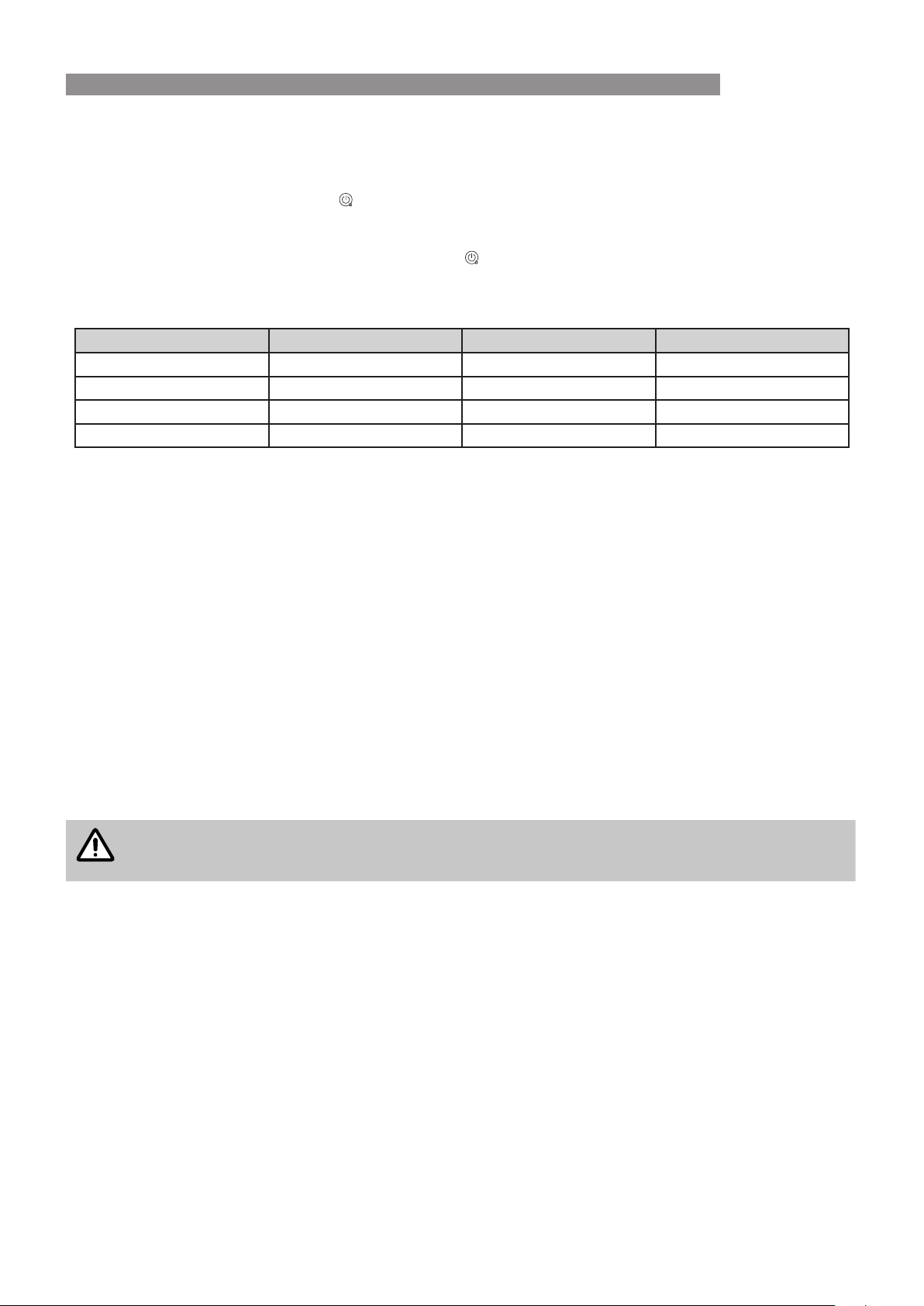
LED ICONS
Symbol Function Meaning when Lit Meaning when Flashing
Heating Mode Heating Mode Active -
Heating Element Heating Element Active 1s: Boost Mode
2s: Disinfection Mode
WiFi WiFi Connected Searching for Network
Real Water Temperature Displays Actual Current Water
Temperature
-
Set Water Temperature Displays Set Water Temperature -
Defrosting Defrosting Active Refrigerant Recovery
Mode Active
Maintenance Reminder Maintenance Required (See “Save
a Service Call” on page 10)
-
Error Warning Error Present -
Screen Locked Screen Lock Active -
Compressor Running Compressor Active -
High Fan Speed High Fan Speed Active -
Low Fan Speed Low Speed Fan Active -
Timer Timer Active (see “Operation Timer
Setting” on page 24)
-
OPERATION
Rinnai 23 B Series Heat Pump OIM - Issue 1
CONTROLLER FUNCTIONS AND OPERATION
1. Lock and unlock:
When the controller is in the normal display mode and there is no button operation for more than 60 seconds it will
will automatically lock. Press the key “ “ for 3 seconds to unlock, it will beep.
2. Turn ON/OFF the heat pump:
When the controller is in the normal display mode, press “ “ button for more than 1 second to switch the controller
to the power ON or OFF mode.
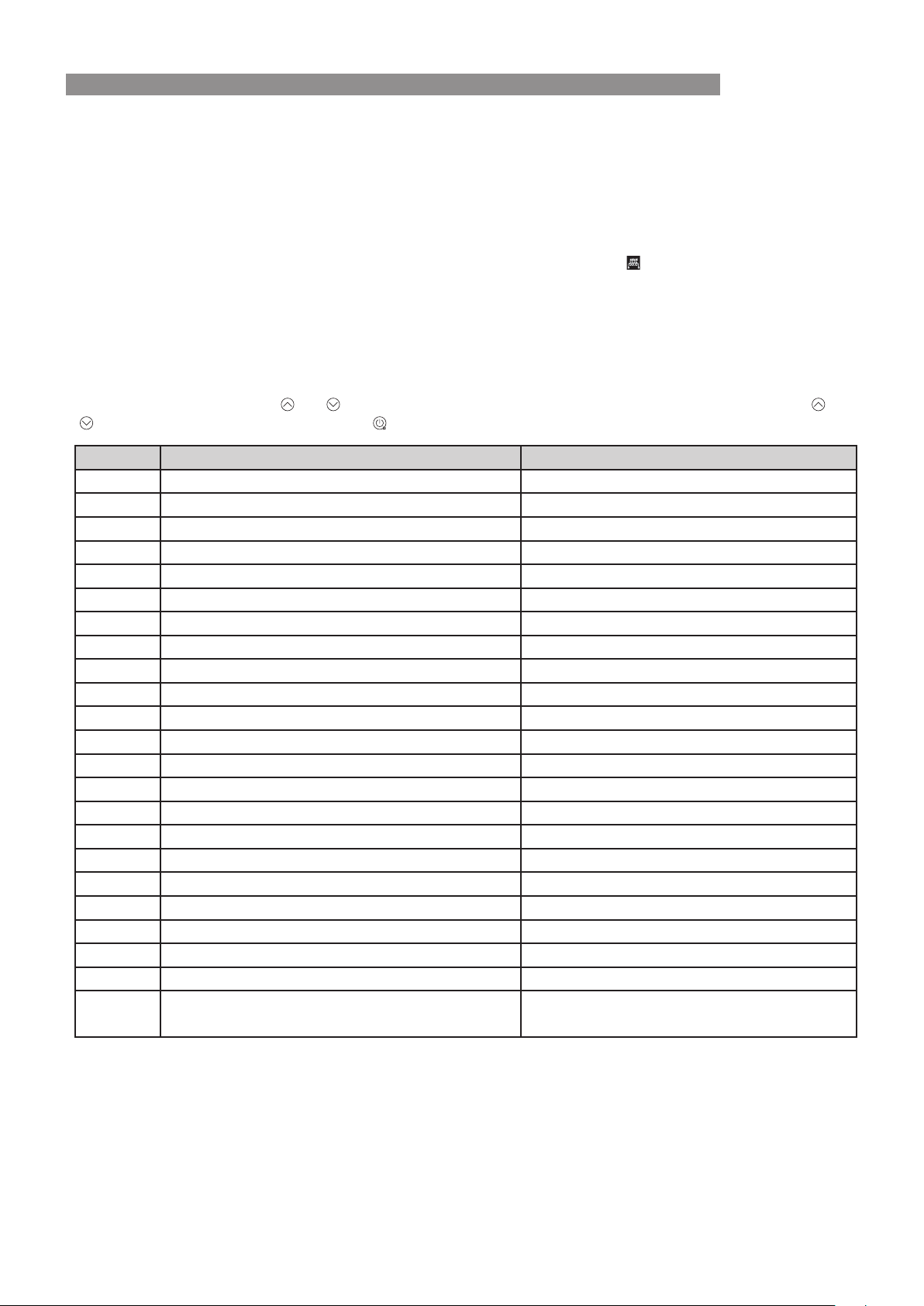
3. Operation Mode selection:
Mode Number Mode Symbol Setting Range
01. Standard Mode STAN 15°C~60°C
02. Economy Mode ECO 15°C~60°C
03. Hybrid Mode HYB 15°C~70°C
04. Electric Mode ELE 15°C~70°C
STAN mode (Standard mode):
In STAN mode, the controller will display “ St:AN “. In this mode only heat pump operates and the default water
temperature setting is 55°C, setting range is 15°C~60°C, restart temperature difference is 5°C.
ECO mode (Economy mode):
In ECO mode, the controller will display “ E:CO “. In this mode only heat pump operates and the default water
temperature setting is 55°C, setting range is 15°C~60°C, restart temperature difference is 10°C.
HYB mode (Hybrid mode):
Under HYB mode, the controller will display “ Hy:b “. In this mode, the heat pump only runs until the water
temperature reaches 60°C, when this temperature is reached, the heat pump stops running. The heating element
will continue heating until the water temperature reaches the setting temperature (if the set value more than 60°C).
In this mode, the default water temperature setting is 65°C, setting range is 15°C~70°C and restart temperature
difference is 10°C (default value).
ELE mode (Heating element mode)
Under ELE mode, the controller will display “ E:LE “. In this mode only the heating element will work to heat
the water. The default water temperature setting is 65°C, with a setting range of 15°C~70°C, and the restart
temperature difference is 10°C.
NOTE
The system default mode is Standard (STAN). When the unit is switched on for the rst time, the
system will operate under STAN mode� Subsequently however, the unit will start in the mode
setting it was in prior to shutdown� To change the mode, refer to the instructions below�
Changing mode:
When the controller is in normal display mode, press “M” key to show the existing operation mode, it will display
constantly for 8 seconds, before it disappears, press “M” again to switch between different operating modes.
The mode name will show at the clock display for 8 seconds each time the “M” key is pressed. When unlocked, the
display will show the clock. Press “M” key once to show the current Operation Mode. .
OPERATION

Rinnai 24 B Series Heat Pump OIM - Issue 1
4. Water temperature setting
Unlock the controller in the main interface then press the “ ” or “ ” button to increase or decrease the water
temperature setting value.
5. Clock setting
In the main interface, click the “ “button to enter the clock setting interface;
During clock setting, when the hour section ashes, press and hold the “ “ button for 3 seconds to enable /
disable the week function. When the week function is displayed it will display the day as Monday: 1, Tuesday: 2...
Sunday: 7 etc.
To set the day of the week, rst ensure the week day function is enabled as per instructions above. Next press the “
“ button and the week day part of the number will ash. Press “ ” or “ ”, to cycle through the days of the week.
If you start the setting process with the week day function disabled, pressing the “ “button, will set the hours rst.
The hour part of the display will ash, press “ ” or “ ”, to cycle the hour value of the clock;
When the hour is set, press the “ “ button again to conrm. The number of minutes will now ash. Press “ ” or
“ ” to set the minutes of the clock.
After the minutes are set, press the “ “ button again to conrm the real-time clock setting and return to the main
interface.
In the real-time clock setting interface, if there is no button operation for 60 seconds, the current clock setting value
will be conrmed and will return to the main interface.
6. Operation Timer Setting
Press and hold the “ “ button for 3 seconds in the main interface to enable or disable the timer working mode.
Then press “ ” or “ ” to chose the timer No. 1, No.2 or No.3.
When the timer No.1 period is selected, the symbol will ash. Press and release “ “ to set the Start Time (ON),
and the hour section will ash. Press “ ” or “ ”, to set the hour. When the hour is set, press the “ “ button again
and the minutes will ash. Press “ ” or “ ” to set the minutes. After the minutes are set, press the “ “ button
again to begin setting the End Time(OFF) and the hour section will ash. Press “ ” or “ ”, to set the hour. When
the hour is set, press the “ “ button again and the minutes will ash, press “ ” or “ ” to set the minutes.
Press the “ “ button again to conrm the setting and then switch to next period (No. 2 or No. 3) timer working set,
the setting method is the same as above.
If the start time of a certain working period is greater than the end time, the end time is considered to be of the
next day.
When the start time and end time of a setting are the same, it will not be set.
When the week function is enabled, the timing work cycle time will be one week, if the week function is disabled,
the cycle time is 24 hours.
7. Forced defrosting:
When the controller is in the normal display mode and the heat pump is ON. Press “M” and “ ” buttons together
for more than 5 seconds to activate or deactivate the “Forced Defrost” function. The symbol “ “ will show when
the “Forced Defrost” is ON.
8. Boost:
When the controller is in the normal display and the heat pump in heating mode, press “M” and “ ” buttons together
for more than 3 seconds to enable or disable the boost mode. When boost mode is enabled, the compressor will
stop running or not switch on and the heating element will turn on. The symbol “ “ will ash for 1 second then stay
on. When the set temperature is reached, the heating element will turn off and the symbol “ “ will ash, means
it is operating in boost mode.
When the heat pump is turned off it will automatically exit boost mode.
9. Disinfection:
Manual Disinfection:
When the controller is in the normal display mode and the heat pump is ON, press “ “,” ” and “ ” buttons
together for more than 5 seconds to sterilise the water tank. The symbol “ “ will ash for 2 seconds then light
OPERATION
Rinnai 25 B Series Heat Pump OIM - Issue 1
up and the water will be heated up to 70°C and thereafter maintained at 65°C~70°C. After 30 minutes it will exit
disinfection. If the water can not reach at 70°C, the heat pump will run in disinfection mode for 2 hours then exit
the disinfection.
If the water temperature setting is ≥ 70°C, then disinfection will not be commenced.
Auto Disinfection:
If the water temperature setting is < 70°C cumulatively over a 7 day period, the heat pump will start Disinfection
automatically. After completion, it will re-clock. During Disinfection, the symbol “
“ will ash for 2 seconds then
light up and the water will be heated up to 70°C and thereafter maintained at 65°C~70°C. After 30 minutes it will
exit disinfection. If the water can not reach at 70°C, the heat pump will run in disinfection mode for 2 hours then
exit the disinfection.
If the water temperature setting is ≥ 70°C, then disinfection will not be commenced.
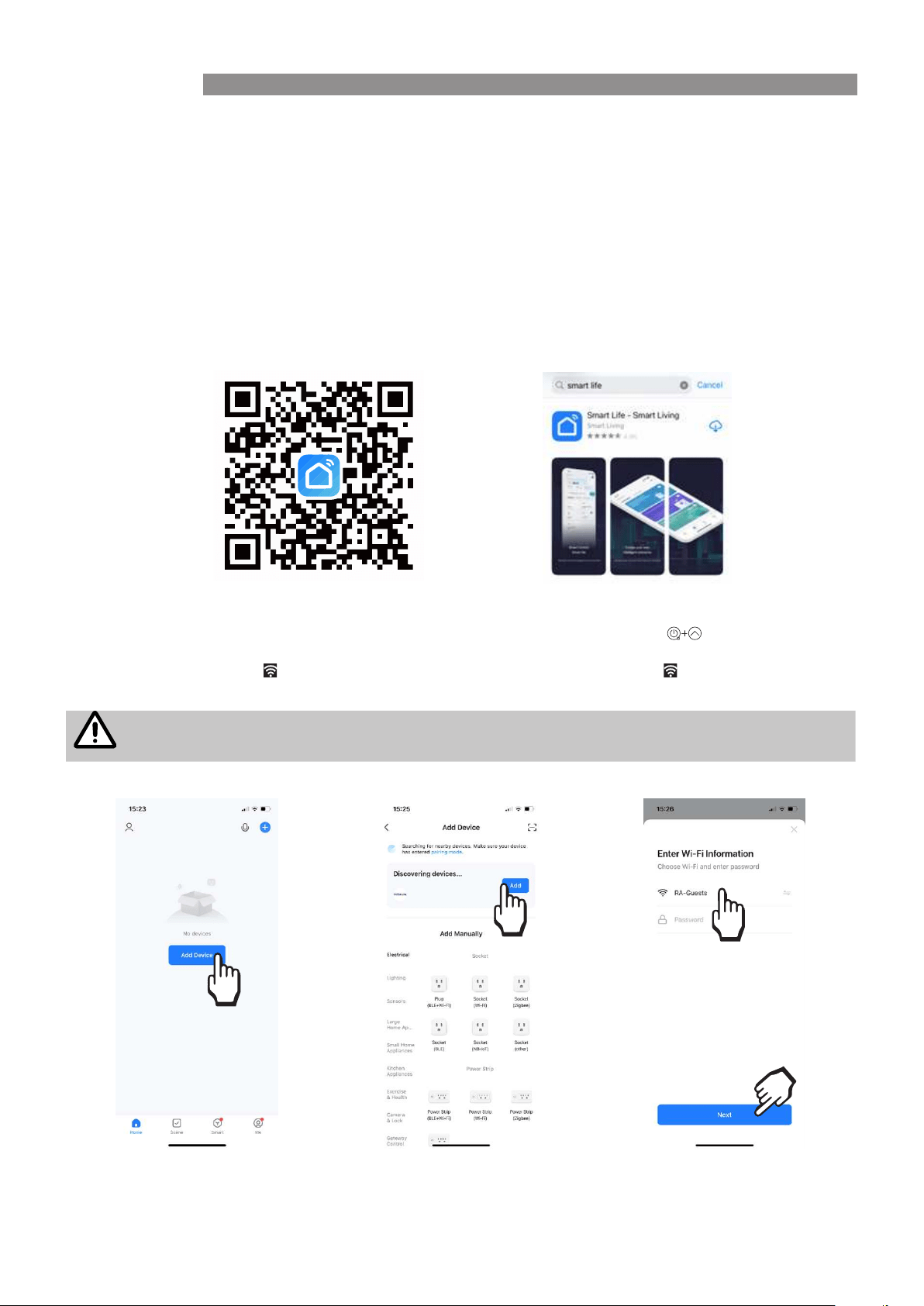
10. Open Parameter Query
With the power on, press the “ ” or “ ” button for 3 seconds, to enter the status query interface. Press the “ ” or
“ ” button to query each status. Press the “ “ button to exit status query interface.
No� Name Note
00 Fluorine Cycle/Water Cycle system 0=Water Cycle; 1=Fluorine Cycle
01 High pressure switch 0=Open; 1=Close
02 Low pressure switch 0=Open; 1=Close
03 Water ow switch 0=Open; 1=Close
04 EEV open Measured value
05 Coil temp. Measured value
06 Ambient temp. Measured value
07 Suction temp. Measured value
08 Exhaust temp. Measured value
09 Water inlet temp.(Water tank) Measured value
10 Water outlet temp. 0=OFF; 1=ON
11 Compressor 0=OFF; 1=ON
12 4 way valve 0=OFF; 1=ON
13 High fan speed 0=OFF; 1=ON
14 Low fan speed 0=OFF; 1=ON
15 Circulation pump 0=OFF; 1=ON
16 Heating element 0=OFF; 1=ON
17 Compressor working time before defrosting Measured value
18 Link switch 0=Open; 1=Close
19 Program code Show the code
20 Dial switch 0=Open; 1=Close
21 Dial switch 0=Open; 1=Close
22 Phase detecting value 0=OK; 3=Lack phase;
4=Phase fault; 5=No connection
OPERATION
Rinnai 26 B Series Heat Pump OIM - Issue 1
WI
-
FI CONNECTION
Please follow below steps to set up and operate Wi-Fi functions.
1. Prepare a Wi-Fi wireless router that can access the Internet, The Wi-Fi frequency band is required to be
2.4 Ghz and it should be placed within 10 meters of the water heater to ensure that a strong Wi-Fi signal is
available.
2. Turn on Wi-Fi and Bluetooth on your device. After the connection is successful, you can turn off Bluetooth
and operation will not be affected.
3. Scan the QR code below or search in the app market to download and install the ‘Smart Life’ App.
•
iOS users – please download from App Store
•
Android users – please download from Google Play
4. After completing the installation, open the App, register an account and log in according to the App prompt.
5. To connect the controller to your network Press and hold the On/Off and the Up (
)keys together for 5s,
to enter into manual network connection mode. When the controller is available for connecting to a Wi-Fi
network, the symbol “ “ will ash. When connected successfully, the symbol “ “ will remain continously
lit up.
NOTE
You will need to repeat step 5 if the icon stops ashing during the connection
6. Connect to the SmartLife App as follows:
1.
2.
i) Search for Device ii) Add Found Device iii) Connect to Wi-Fi
OPERATION
OPERATIONOPERATION
Rinnai 27 B Series Heat Pump OIM - Issue 1
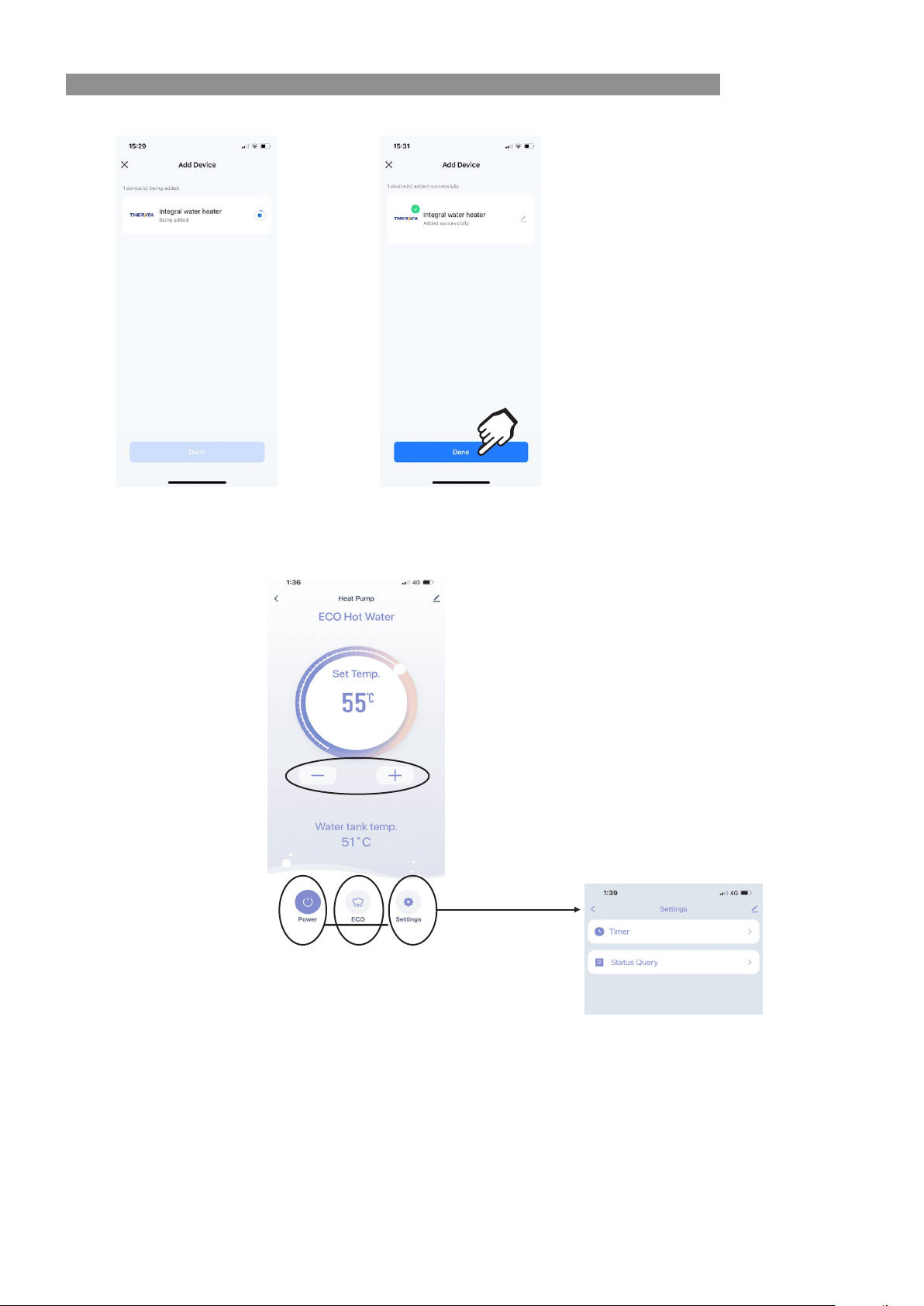
Connect to SmartLife App (cont).
iv) Wait for Connection v) Complete
7. Control the Heat Pump with the App
The main controls for the App are laid out as follows on the App.
Select
Mode
Turn
On/Off
Timer /
Check Operation
Adjust Temp
Setting
OPERATION

S112518 28 B Series Heat Pump OIM - Issue 1 - March 2023
CONTACT
Rinnai Australia Pty Ltd
ABN 74 005 138 769 | AU45204
100 Atlantic Drive, Keysborough, Victoria 3173
P.O. Box 460, Braeside, Victoria 3195
Tel: (03) 9271 6625
Fax: (03) 9271 6622
National Help Line
Tel: 1300 555 545* Fax: 1300 555 655
Monday to Friday, 8.00 am to 5.00 pm EST.
After Hours Hot Water Service Line
Tel: 1800 000 340*
*Cost of a local call may be higher from a mobile phone.
(National calls from public phones in Australia are free.)
For further information visit www.rinnai.com.au
or email [email protected]
Rinnai has a Service and Spare Parts network with
personnel who are fully trained and equipped to give
the best service on your Rinnai appliance. If your
appliance requires service, please call our National
Help Line. Rinnai recommends that this appliance be
serviced every 3 years.
With our policy of continuous improvement, we
reserve the right to change, or discontinue at any time,
specifications or designs without notice.