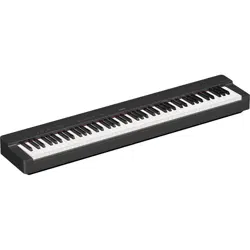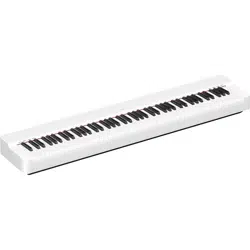


P-225, P-223 Owner’s Manual
2
The model number, serial number, power requirements, etc., may be found on or near the name plate, which is at the
bottom of the unit. You should note this serial number in the space provided below and retain this manual as a
permanent record of your purchase to aid identification in the event of theft.
Model No.
Serial No.
(1003-M06 plate bottom en 01)
P-225, P-223 Owner’s Manual
3
Information for users on collection and disposal of old equipment:
This symbol on the products, packaging, and/or accompanying documents means that used
electrical and electronic products should not be mixed with general household waste.
For proper treatment, recovery and recycling of old products, please take them to applicable
collection points, in accordance with your national legislation.
By disposing of these products correctly, you will help to save valuable resources and prevent any
potential negative effects on human health and the environment which could otherwise arise from
inappropriate waste handling.
For more information about collection and recycling of old products, please contact your local
municipality, your waste disposal service or the point of sale where you purchased the items.
For business users in the European Union:
If you wish to discard electrical and electronic equipment, please contact your dealer or supplier for
further information.
Information on Disposal in other Countries outside the European Union:
This symbol is only valid in the European Union. If you wish to discard these items, please contact
your local authorities or dealer and ask for the correct method of disposal.
(58-M02 WEEE en 01)
P-225, P-223 Owner’s Manual
4
PRECAUTIONS
PLEASE READ CAREFULLY BEFORE PROCEEDING
Especially in the case of children, a guardian should provide guidance on how to
properly use and handle the product before actual use.
Please keep this manual in a safe and handy place for future reference.
WARNING
Always follow the basic precautions listed below to avoid the possibility of serious injury or even death from electrical
shock, short-circuiting, damages, fire or other hazards. These precautions include, but are not limited to, the
following:
• Do not place the power cord near heat sources such as heaters or radiators. Also,
do not excessively bend or otherwise damage the cord, or place heavy objects on
it.
• Do not touch the product or the power plug during an electrical storm.
• Use only the correct voltage specified for the product. The required voltage is
printed on the name plate of the product.
• Use only the supplied or the specified AC adaptor (page 24). Do not use the AC
adaptor for other devices.
• Check the power plug periodically and remove any dirt or dust which may have
accumulated on it.
• Insert the power plug firmly all the way into the AC outlet. Using the product when
it is not plugged in sufficiently can cause dust to accumulate on the plug,
possibly resulting in fire or skin burns.
• When setting up the product, make sure that the AC outlet you are using is easily
accessible. If some trouble or malfunction occurs, immediately turn off the power
switch and disconnect the plug from the outlet. Even when the power switch is
turned off, as long as the power cord is not unplugged from the wall AC outlet, the
product will not be disconnected from the power source.
• Do not connect the product to an electrical outlet using a multi-plug outlet
extender. Doing so can result in lower sound quality, or possibly cause
overheating in the outlet.
• When disconnecting the power plug, always hold the plug itself and not the cord.
Pulling by the cord can damage it and cause electric shocks or a fire.
• If not using the product for long periods of time, be sure to pull the power plug
from the AC outlet.
• This product contains no user-serviceable parts. Do not attempt to disassemble
the internal parts or modify them in any way.
• Do not expose the product to rain, use it near water or in damp or wet conditions,
or place on it any containers (such as vases, bottles or glasses) containing
liquids which might spill into any openings or places where water may drop. A
liquid such as water getting into the product may cause a fire, electric shocks, or
malfunctions.
• Use the AC adaptor indoors only. Do not use in any wet environments.
• Never insert or remove a power plug with wet hands.
• Do not place any burning items or open flames near the product, since they may
cause a fire.
• Radio waves from this product may affect electro-medical devices, such as a heart
pacemaker implant or defibrillator implant.
- Do not use the product near medical devices or inside medical facilities. Radio
waves from this product may affect electro-medical devices.
- Do not use the product within 15 cm (6 in.) of persons with a heart pacemaker
implant or a defibrillator implant.
• If any of the following problems occur, immediately turn off the power switch and
disconnect the power plug from the outlet.
Finally have the device inspected by Yamaha service personnel.
- The power cord or plug becomes frayed or damaged.
- Unusual smells or smoke are emitted.
- Some object, or water has been dropped into the product.
- There is a sudden loss of sound during use of the product.
- Cracks or other visible damage appear on the product.
Power supply
Do not disassemble
Water warning
Fire warning
Wireless unit
If you notice any abnormality
DMI-11 1/2
P-225, P-223 Owner’s Manual
5
CAUTION
Always follow the basic precautions listed below to avoid the possibility of physical injury to you or others, or damage
to the product or other property. These precautions include, but are not limited to, the following:
• Do not place the product in an unstable position or a location with excessive
vibration, where it might accidentally fall over and cause injury.
• Before moving the product, remove all connected cables, to prevent damage to
the cables or injury to anyone who might trip over them.
• Use only the stand specified for the product. When attaching it, use the provided
screws only. Failure to do so could cause damage to the internal components or
result in the product falling over.
• Before connecting the product to other devices, turn off the power for all devices.
Before turning the power on or off for all devices, set all volume levels to
minimum.
• Be sure to set the volumes of all devices at their minimum levels and gradually
raise the volume controls while playing the product to set the desired listening
level.
• Do not insert foreign materials such as metal or paper into any openings or gaps
of the product. Failure to observe this may cause a fire, electric shocks, or
malfunctions.
• Do not rest your weight on, or place heavy objects on the product, and do not use
excessive force on the buttons, switches or connectors.
• Do not use the product or headphones for a long period of time at a high or
uncomfortable volume level, since this can cause permanent hearing loss. If you
experience any hearing loss or ringing in the ears, consult a physician.
• Remove the power plug from the AC outlet before cleaning the unit. Failure to
observe this may cause electric shocks.
Always turn the power off when the product is not in use.
Even when the [ ] (Standby/On) switch is in standby status (power lamp is off), electricity is still flowing to the product at the minimum level.
When you are not using the product for a long time, make sure you unplug the power cord from the wall AC outlet.
NOTICE
To avoid the possibility of malfunction/ damage to the product, damage to data, or damage to other property, follow the notices below.
Handling
• Do not use this product in the vicinity of a TV, radio, stereo equipment, mobile phone, or other electric devices. Otherwise, this product or the other device may generate noise.
• When you use the product along with an app on your smart device, such as a smartphone or tablet, we recommend that you enable “Airplane Mode” on the device to avoid noise
caused by communication. When turning on airplane mode, Bluetooth
®
settings may be turned off. Make sure that the setting is turned on before use.
• Do not expose the product to excessive dust or vibrations, or extreme cold or heat (such as in direct sunlight, near a heater, or in a car during the day) to prevent the possibility
of disfiguration, damage to the internal components or unstable operation. (Verified operating temperature range: 5° – 40°C, or 41° – 104°F.)
• Do not place vinyl, plastic or rubber objects on the product, since this might discolor the product.
• This instrument has a built-in speaker on the back (terminal side). Do not place any object that is affected by magnetism, such as a watch or magnetic card on the instrument,
since that may damage the object.
Maintenance
• When cleaning the product, use a soft and dry (or slightly damp) cloth. Do not use paint thinners, solvents, alcohol, cleaning fluids, or chemical-impregnated wiping cloths.
Saving data
• Some of the data of this product (page 14) are retained when the power is turned off. However, the saved data may be lost due to some failure, an operational mistake, etc.
Location
Connections
Handling
Yamaha cannot be held responsible for damage caused by improper use or modifications to the product, or data that is lost or destroyed.
DMI-11 2/2
P-225, P-223 Owner’s Manual
6
Information
About copyrights
• The copyright of the “content”*1 installed in this product belongs to Yamaha Corporation or its copyright holder. Except as permitted by copyright laws and other relevant laws,
such as copying for personal use, it is prohibited to “reproduce or divert”*2 without the permission of the copyright holder. When using the content, consult with a copyright
expert.
If you create music or perform with the contents through the original use of the product, and then record and distribute them, the permission of Yamaha Corporation is not
required regardless of whether the distribution method is paid or free of charge.
*1: The word “content” includes a computer program, audio data, Accompaniment Style data, MIDI data, waveform data, voice recording data, music score, and score data, etc.
*2: The phrase “reproduce or divert” includes taking out the content itself in this product, or recording and distributing it without changes in a similar manner.
About functions/data bundled with the instrument
• Some of the preset Songs have been edited for length or arrangement, and may not be exactly the same as the original.
About this manual
• The illustrations as shown in this manual are for instructional purposes only.
• Unless indicated otherwise, the illustrations as shown in this manual are based on the P-225 (in English).
• The Bluetooth word mark and logos are registered trademarks owned by Bluetooth SIG, Inc. and any use of such marks by Yamaha Corporation is under license.
• The company names and product names in this manual are the trademarks or registered trademarks of their respective companies.
Tuning
• Unlike an acoustic piano, this instrument does not need to be tuned by an expert (although the pitch can be user-adjusted to match other instruments). This is because the pitch
of digital instruments is always maintained perfectly.
About disposal
• When disposing of this product, please contact the appropriate local authorities.
About Bluetooth
Bluetooth is a technology for wireless communication between devices within an area of about 10 meters (33 ft.) employing the 2.4 GHz frequency band.
Handling Bluetooth communications
• The 2.4 GHz band used by Bluetooth compatible devices is a radio band shared by many types of equipment. While Bluetooth compatible devices use a technology minimizing
the influence of other components using the same radio band, such influence may reduce the speed or distance of communications and in some cases interrupt
communications.
• The speed of signal transfer and the distance at which communication is possible differs according to the distance between the communicating devices, the presence of
obstacles, radio wave conditions and the type of equipment.
• Yamaha does not guarantee all wireless connections between this unit and devices compatible with Bluetooth function.
Bluetooth capability
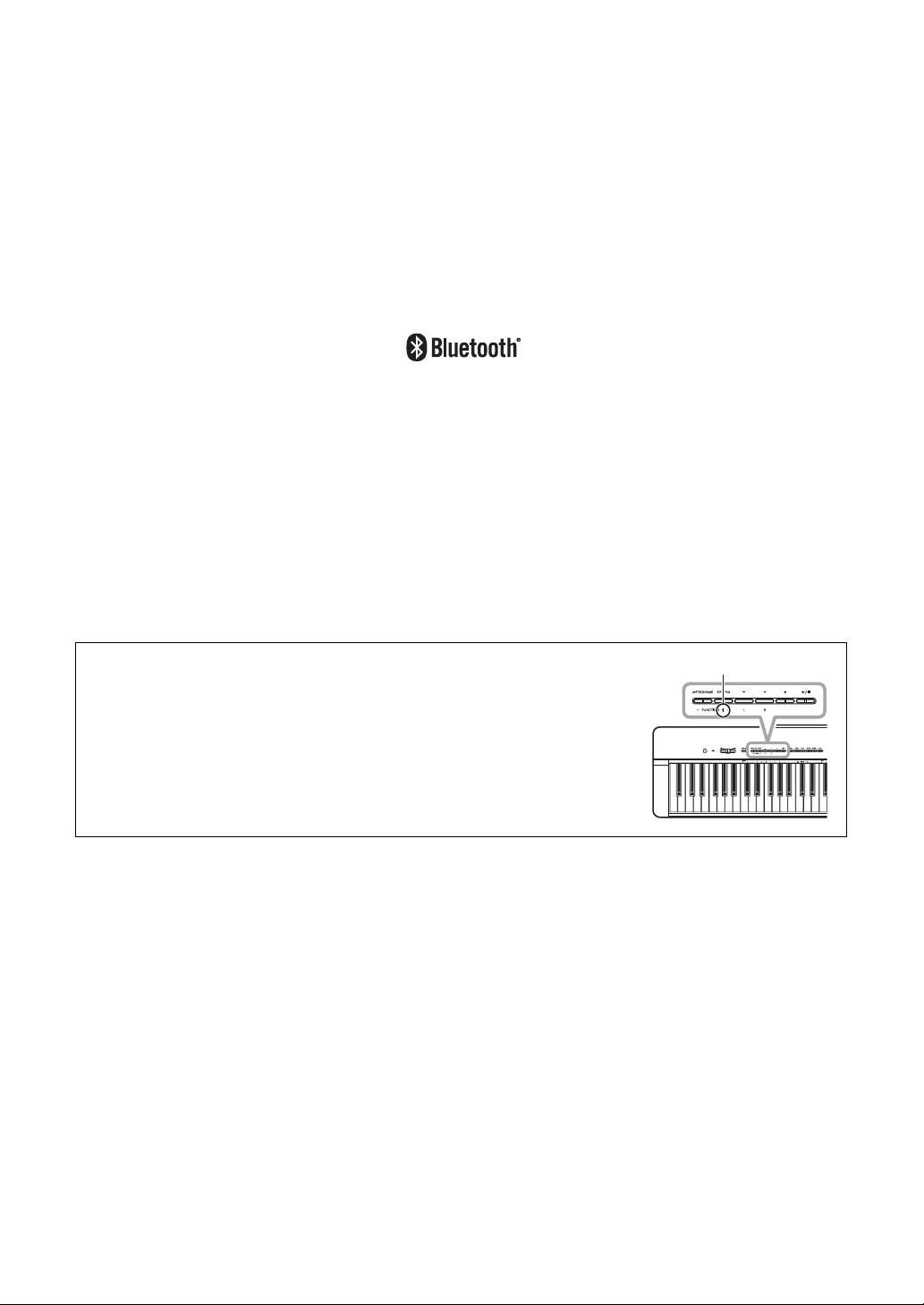
Depending on the country in which you purchased the product, the instrument may not have Bluetooth capability.
If the Bluetooth logo is printed on the control panel, this means that the product is equipped with Bluetooth functionality.
Bluetooth logo
P-225, P-223 Owner’s Manual
7
PRECAUTIONS ..................................................4
About the Manuals ..............................................8
Included Accessories ..........................................9
Features..............................................................9
Panel Controls and Terminals 10
Setting Up 13
Power Requirements ........................................13
Turning the Power On/Off .................................13
Basic Operations 14
Operations by using both buttons and keys ......14
Backup and Initializing ......................................14
Playing with Various Voices 15
Selecting a Voice ..............................................15
Layering Two Voices in Different Voice Groups
(Dual).............................................................15
Playing Duo.......................................................16
Discovering the Voices with the Voice Demo
Songs ............................................................16
Using the Metronome 17
Playing Back Songs 18
Playing back a Song while Muting the Right or
Left Part .........................................................18
Adding Accompaniment to Your
Performance (Rhythm) 19
Useful Performance Settings 20
Sound Settings .................................................20
Changing the Touch Sensitivity ........................ 20
Recording Your Performance 21
Quick Recording ............................................... 21
Deleting the User Song.....................................21
Connecting Other Equipment 22
Using Smart Device Apps.................................22
Listening to Audio via Bluetooth on this Instru-
ment (Bluetooth Audio Function) ................... 22
Troubleshooting 23
Appendix
Specifications 24
Index 25
P-225, P-223 All Functions/Operations 26
Song/Rhythm List 27
Contents
Thank you for purchasing the Yamaha Digital Piano!
This instrument is compact, portable, and allows for authentic piano performance
anywhere. We recommend that you read this manual carefully so that you can fully take
advantage of the advanced and convenient functions of the instrument.
We also recommend that you keep this manual in a safe and handy place for future
reference.
P-225, P-223 Owner’s Manual
8
About the Manuals
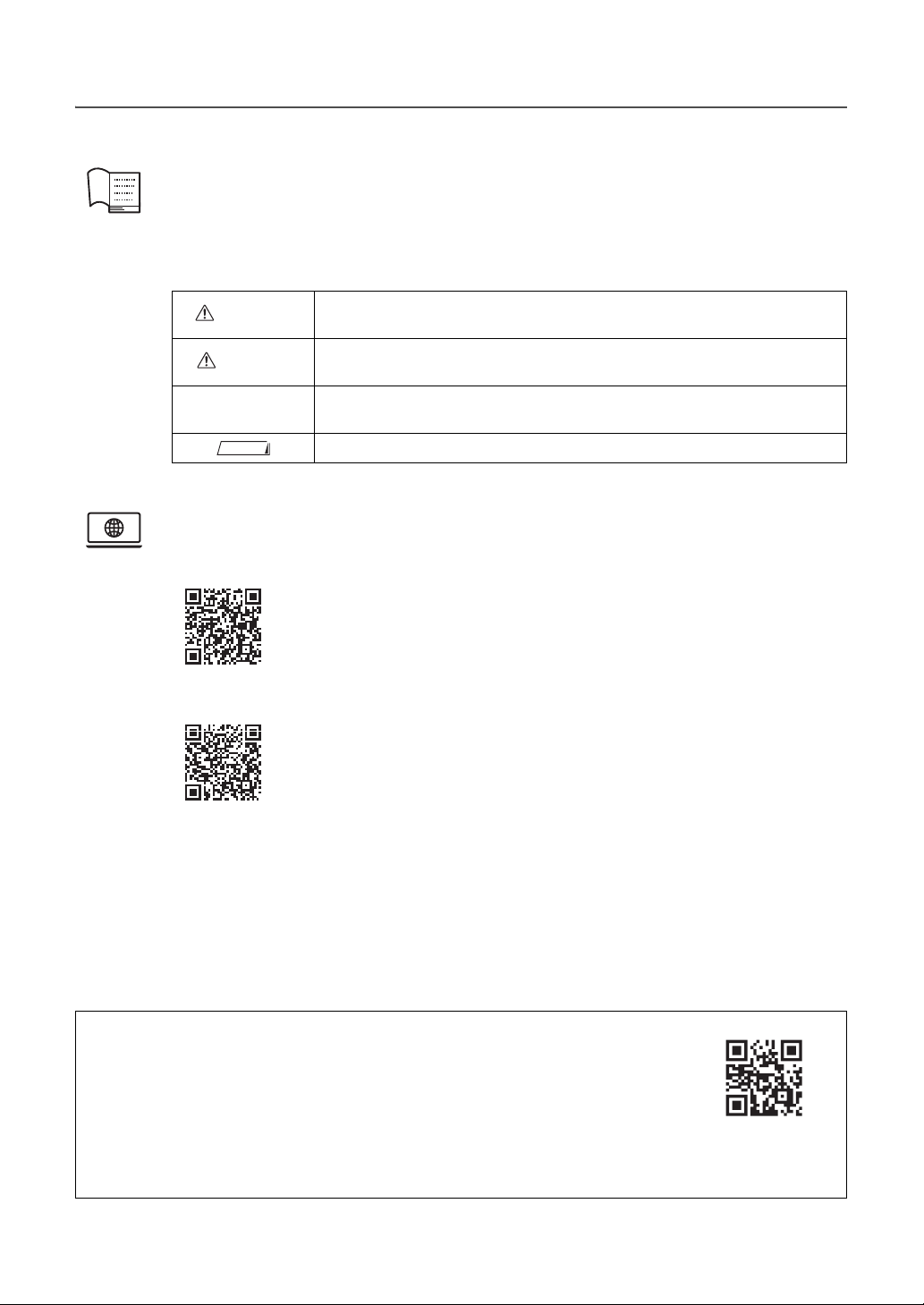
This instrument has the following manuals.
Supplied with the instrument
P-225_P-223 Owner’s Manual
Explains the basic functions of this instrument.
General contents of the notes
Available on the website
Reference Manual
https://manual.yamaha.com/mi/kb-ekb/p-225/rm/
Explains all functions of this instrument including advanced functions.
Read this manual if you need more detailed information of each function or
operation method, including MIDI-related information. For the functions explained
only in the Reference Manual, refer to page 26.
Quick Operation Guide
https://manual.yamaha.com/mi/kb-ekb/p-225/qg/
Shows in chart form the functions assigned to the keyboard.
This can be printed out and placed it on a music rest for use as a quick reference for
important operations.
Smart Pianist User Guide
Explains how to set up and use a smart device with the dedicated Smart Pianist app (page 22) for
controlling this instrument.
Smart Device Connection Manual
Explains how to connect the instrument to smart devices, such as a smartphone, tablet, etc.
Computer-related Operations
Includes instructions on connecting the instrument to a computer, and other operations.
WARNING
Important information to avoid the possibility of serious injury or even death from
electrical shock, short-circuiting, damages, fire or other hazards.
CAUTION
Important information to avoid the possibility of physical injury to you or others, or
damage to the instrument or other property.
NOTICE
Important information to avoid the possibility of malfunction or damage to the product,
damage to data, or damage to other property.
Helpful information and tips.
To obtain these manuals, access the Yamaha website below:
Yamaha Downloads
https://download.yamaha.com/
After selecting your country and clicking on “Manual Library,” enter the model name,
etc. to search for the desired files.
* For a general overview of MIDI and how you can effectively use it, search for “MIDI Basics” (only in English, German,
French and Spanish) on the website above.
NOTE
P-225, P-223 Owner’s Manual
9
Included Accessories
Features
Authentic sounds and naturally expressive keyboard
This instrument features piano sounds created with samples of the Yamaha CFX flagship
concert grand piano and GHC (Graded Hammer Compact) Keyboard which provides a
compact way to get natural acoustic-piano feel. Together they provide true piano
performance and enjoyment.
Compatibility with convenient smart device apps page 22
This instrument is compatible with two highly convenient and powerful apps: Smart Pianist
and Rec 'n' Share. Simply by connecting this instrument to a smart device, you can use these
apps to get even more operational and performance power out of your digital piano.
For details on the apps, refer to page 22.
Bluetooth audio function for wireless audio playback page 22
This lets you play audio from a Bluetooth-equipped smart device via the built-in speakers
—letting you enjoy performing with your favorite songs, or just listening to music on this
instrument instead of an audio device.
Convenient on-stage performance functions page 20
This compact and portable instrument also features the following useful functions for
performing on stage or in live spaces.
• Sound Boost: This function increases the volume and enhances the presence of the
keyboard sound, to help your sound stand out when playing along with
other instruments or in noisy environments.
• Transpose: This lets you easily match the pitch of the keyboard to the range of other
instruments.
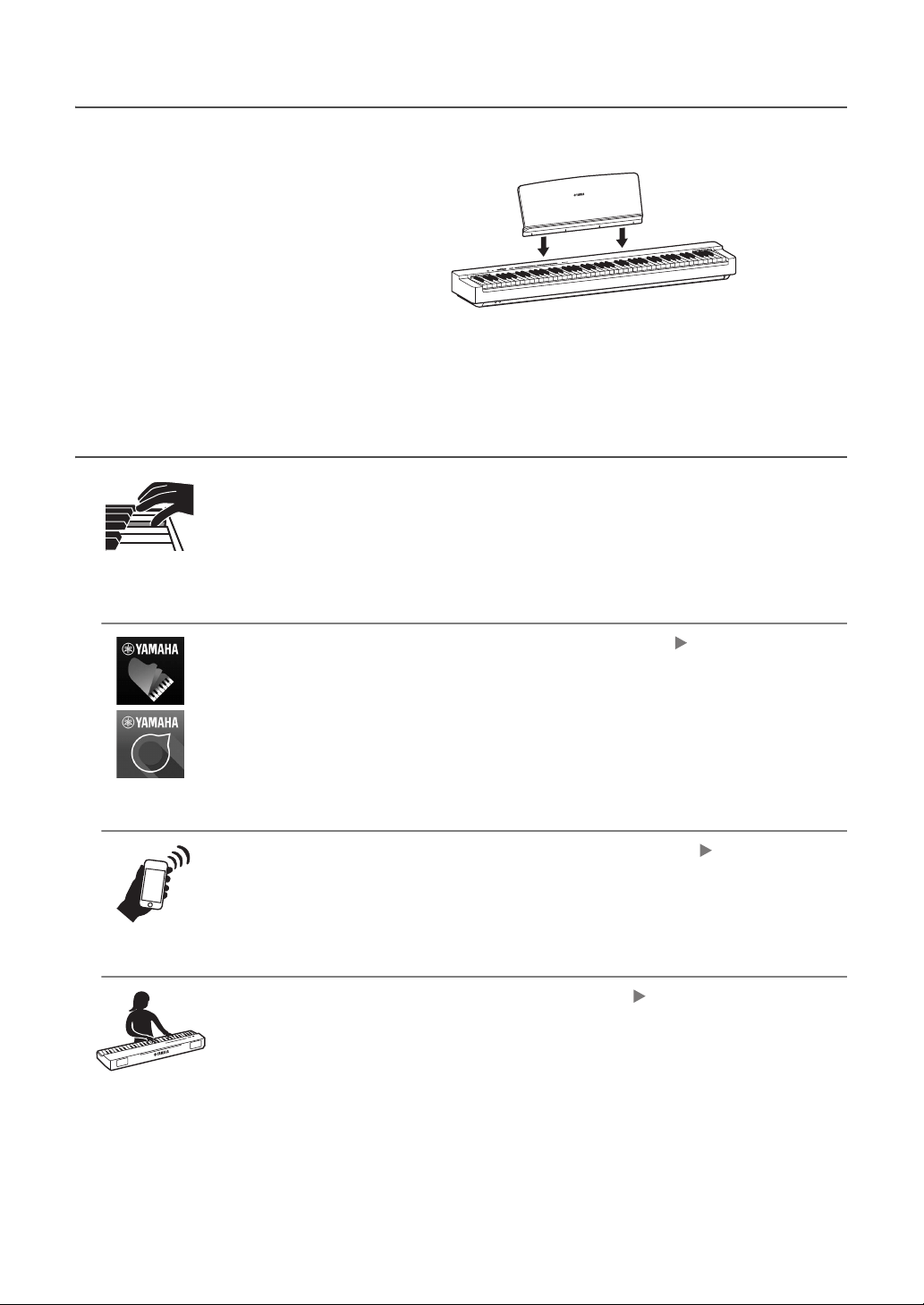
Owner’s Manual(this book) ×1
Footswitch ×1
AC adaptor ×1
*
*
May not be included depending on your particular area. Please check with
your Yamaha dealer.
Online Member Product Registration ×1
Music rest ×1
Insert into the slot.
P-225, P-223 Owner’s Manual
10
Adaptor plug
(3.5 mm =>
6.35 mm)
Stereo mini plug
(3.5 mm)
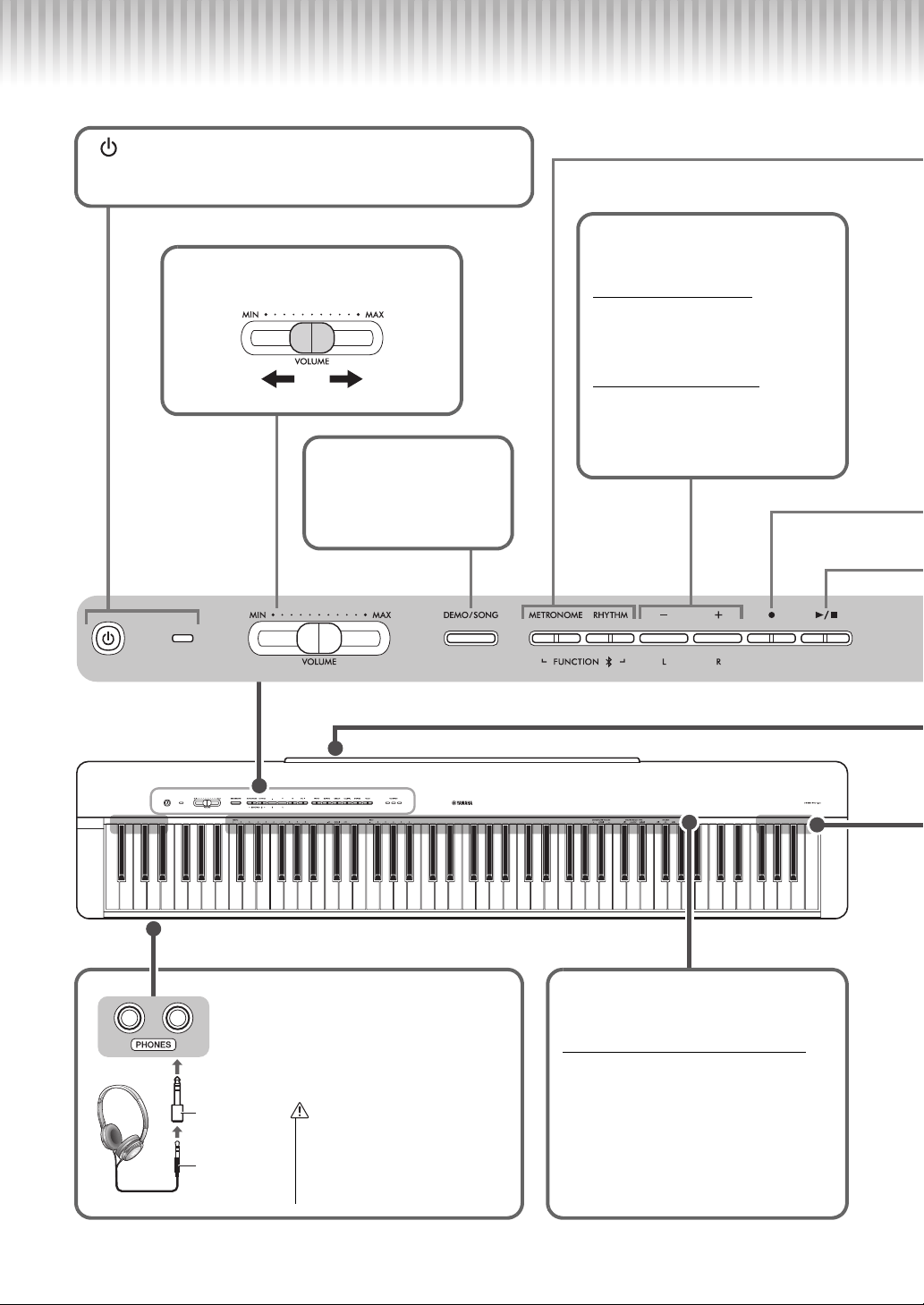
C0 C1 C2 C3 C4 C5 C6 C7
A-1
Panel Controls and Terminals
Indications for key-based
operations (page 14, 17-20)
Operate by using both buttons and keys
These indications show that the corresponding
keys control a certain function, which is
operated by a combination of the panel
buttons.
[PHONES] jacks
For connecting a set of standard
headphones. You can connect two
pairs of headphones. If you are using
only one pair, insert the plug into
either of these jacks.
• Do not use the headphones
for a long period of time at a
high or uncomfortable volume
level, since this can cause
permanent hearing loss.
CAUTION
[ ] (Standby/On) switch, Power lamp (page 13)
For turning the power on or setting to standby.
The lamp on the right side indicates the on/off status of the instrument.
[VOLUME] slider (page 13)
For adjusting the volume of the entire sound.
LouderSofter
[-][+], [L][R] buttons (page 17,
18, and 21)
Using as the [-][+] buttons
For adjusting the tempo (page 17), and
selecting a Song during playback
(page 18).
Using as the [L][R] buttons
For selecting the Song part for playback
(page 18) and recording (page 21).
[DEMO/SONG] button
(page 16, 18)
For playing the Demo Songs
and preset Songs.
Front Panel
* This panel illustration is of
the P-225.
Panel Controls and Terminals
P-225, P-223 Owner’s Manual
11
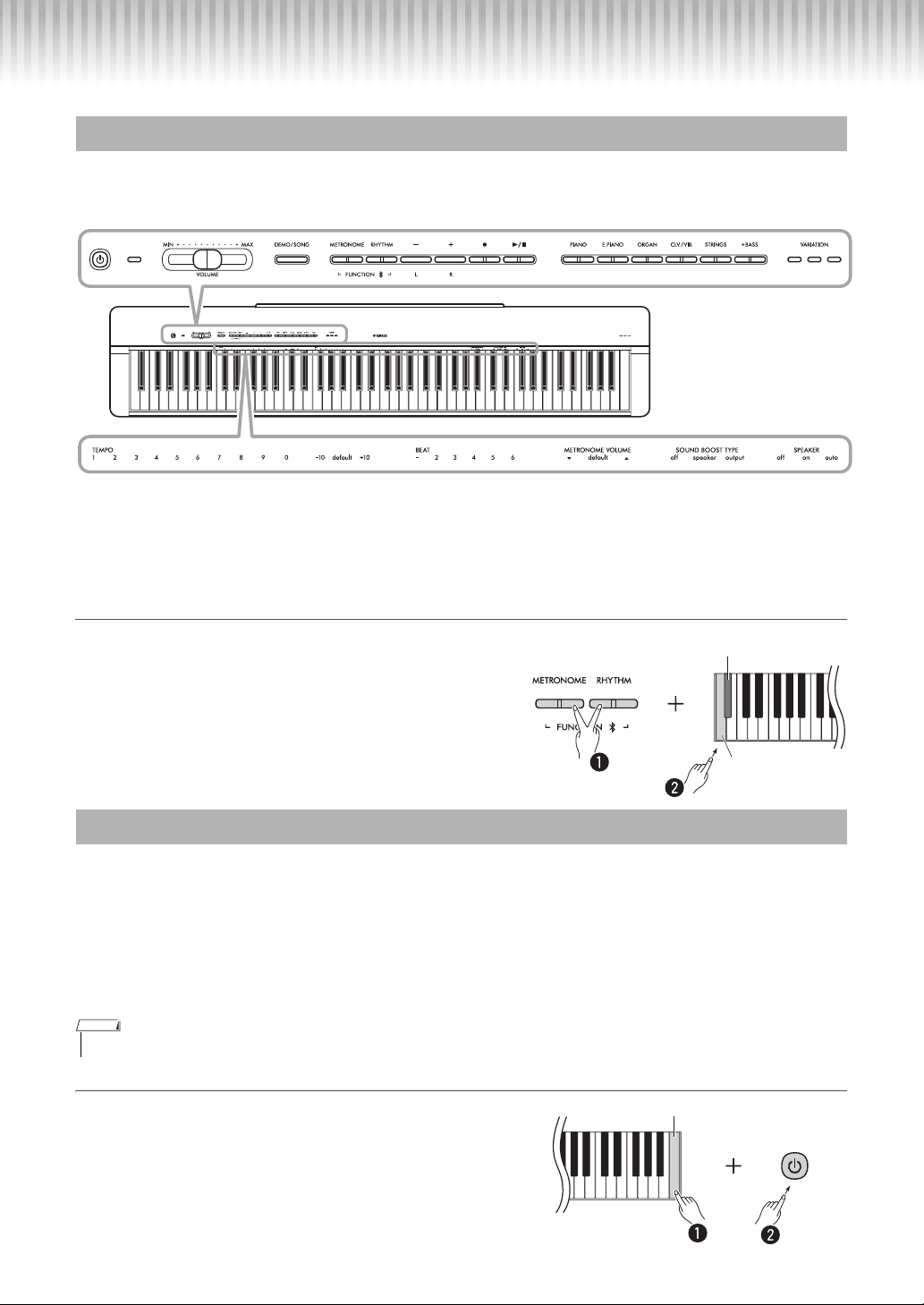
[METRONOME] button (page 17)
For starting or stopping the metronome.
[RHYTHM] button (page 19)
For starting or stopping the rhythm (drums and bass accompaniment).
Using as the [FUNCTION] buttons
While simultaneously holding down the [METRONOME] and [RHYTHM] buttons, pressing the appropriate key lets you make
various settings. Holding down the [METRONOME] and [RHYTHM] buttons for longer than three seconds starts pairing
between this instrument and a Bluetooth-equipped device such as a smartphone (page 22).
* Bluetooth function described above may not be available depending on the country in which you purchased the product (page 6).
What is Rhythm?
This instrument features dynamic Rhythm patterns, consisting of drums and bass accompaniment. Pressing the
[RHYTHM] button starts the percussion part and playing the keyboard with your both hands starts bass
accompaniment (page 19).
[] (Record) button (page 21)
For recording your keyboard
performance.
[>/] (Play/Stop) button
(page 18, 21)
For playing back/stopping the
recorded performance (User Song)
or stopping preset Songs.
Rear Panel
Refer to page 12.
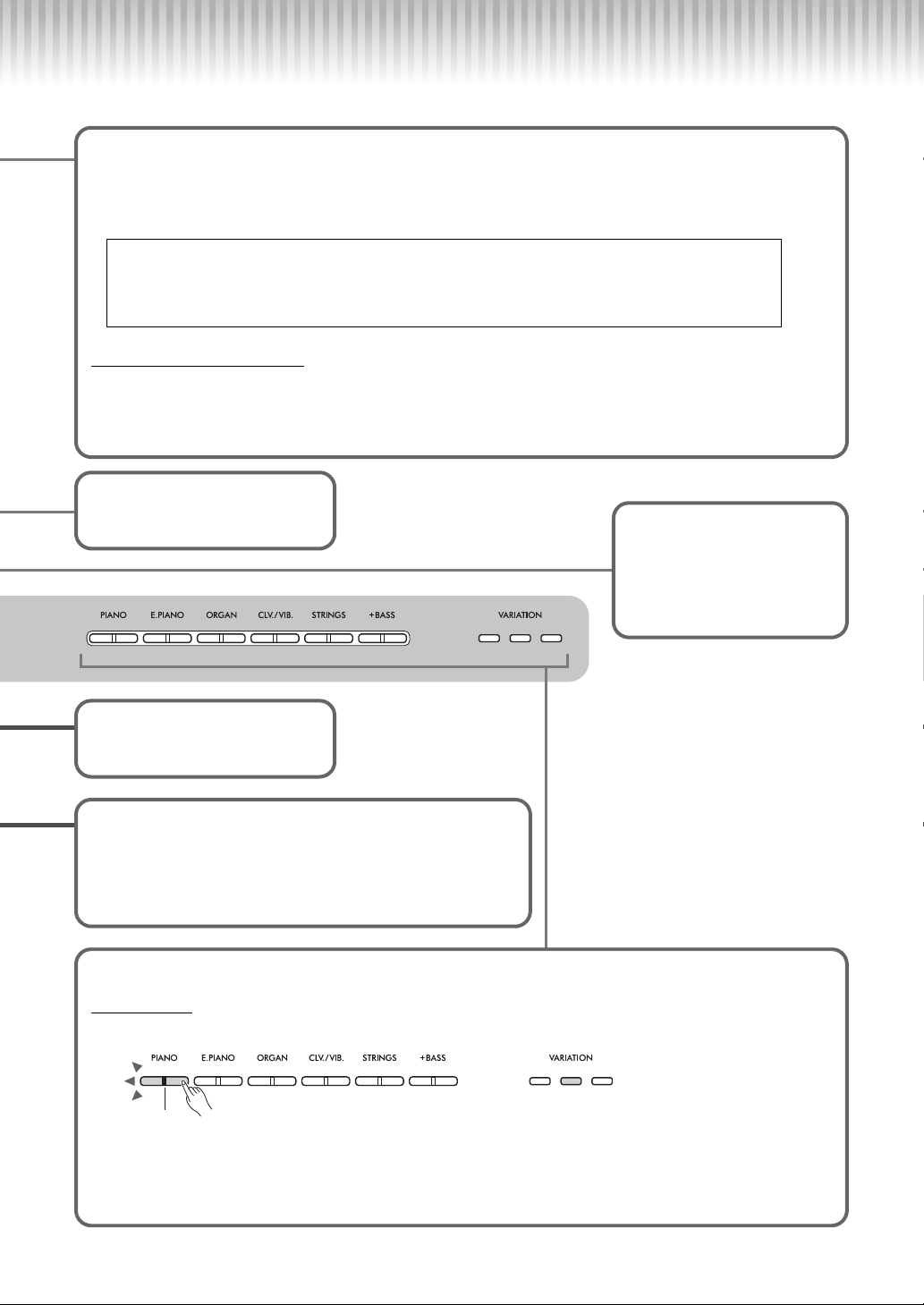
Voice buttons (pages 15 - 16)
Selecting a Voice
Press a desired Voice (group) button.
You can select from among four different Voices with a Voice button. Each press of the same button turns on/off the
[VARIATION] lamp and selects one of four Voices in sequence. For details on the preset Voices, refer to the Voice List on
page 15.
Lights up
* The illustration at left is of
the P-225.
Built-in speakers
(Refer to the Reference manual on the Yamaha website.)
You can set whether the sound of this instrument is always output from
these speakers(on) or not(off), or mute the sound output only when
headphones are connected (auto).
Default Setting: Auto
Panel Controls and Terminals
P-225, P-223 Owner’s Manual
12
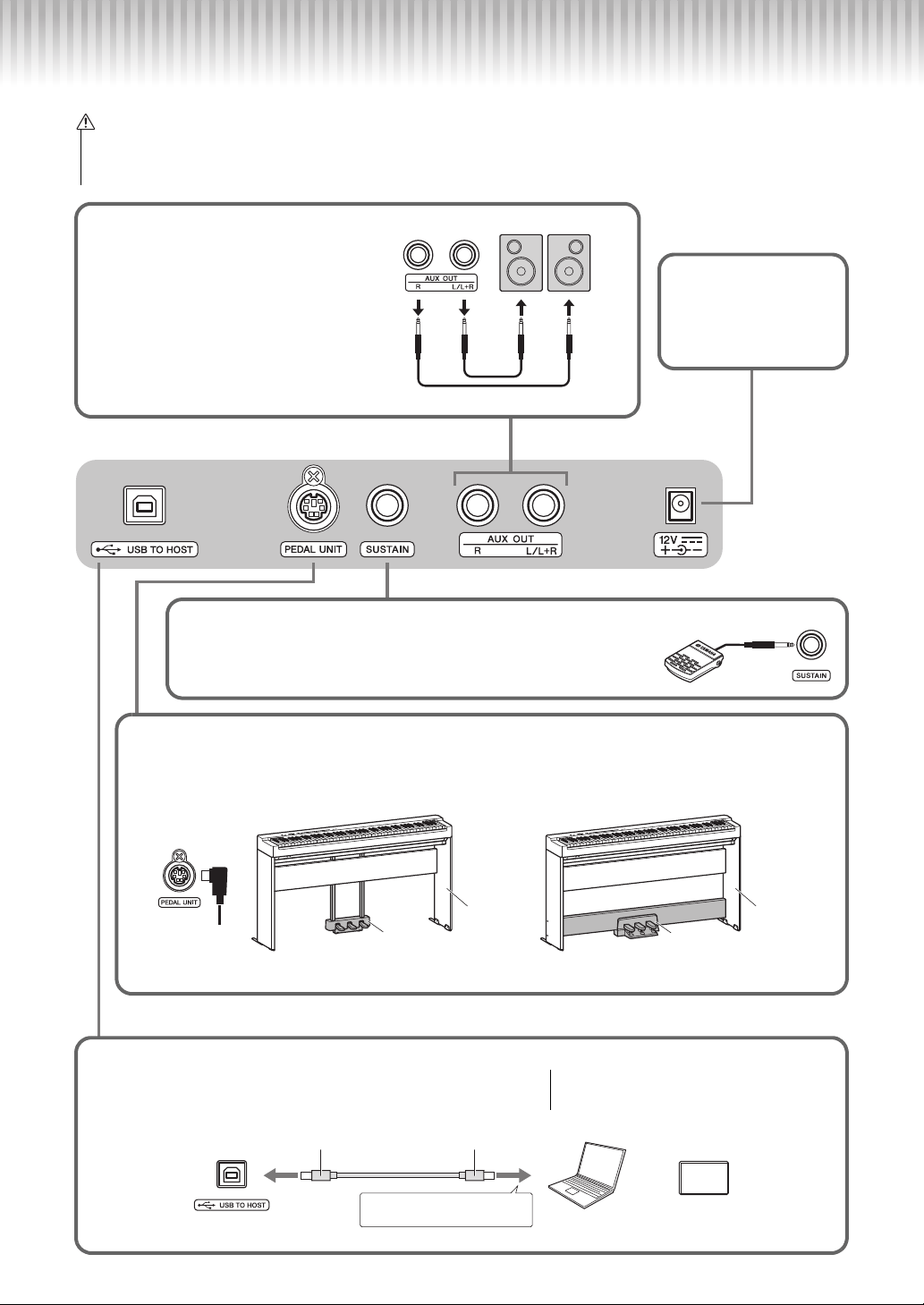
[USB TO HOST] terminal
For connecting to a computer or a smart device (smartphone, tablet, etc.)
using a commercially available USB cable. When connected, you can send
and receive both MIDI and audio data.
• Use an AB type USB cable of less than 3
meters. USB 3.0 cables cannot be used.
NOTICE
Instrument
USB Cable
Type B Type A
(If necessary)
+ USB Conversion adaptor
Computer
Smart Device
or
[PEDAL UNIT] jack
For connecting one of the separately sold pedal units: LP-1 (for P-225) or LP-5A (for P-223). Both of them feature the
Half-pedal function*. For details on the pedals, refer to the Reference Manual on the Yamaha website (see page 8).
* Half-pedal function: Allows you to vary the sustain length depending on how far the pedal is pressed.
L-200
(sold separately)
LP-1
(sold separately)
Make sure to assemble the unit on a separately sold Keyboard Stand (L-200 or L-100).
Insert the connector of
the unit in the same
direction as shown in
the illustration.
L-100
(sold separately)
LP-5A
(sold separately)
P-225 P-223
AUX OUT [R][ L/L+R] jacks
For connecting external audio equipment such as
powered speakers in order to play at higher
volumes.
DC IN jack (page 13)
For connecting the included
or specified AC adaptor
(page 24).
Rear Panel
Powered speaker
AUX IN
Standard
phone
plug (1/4”)
AUX
OUT
Standard
phone plug
(1/4”)
Audio cable
[SUSTAIN] jack
For connecting the included footswitch, or one of the separately sold
accessories: the FC3A foot pedal (features Half-pedal function*) or the FC4A/
FC5 footswitch. These let produce a natural sustain as you play.
• Before connecting the instrument to other electronic components, turn off the power to all the components. Before turning the
power on or off to all components, set all volume levels to minimum (0). Otherwise, electrical shock or damage to the
components may result.
CAUTION
P-225, P-223 Owner’s Manual
13
Setting Up
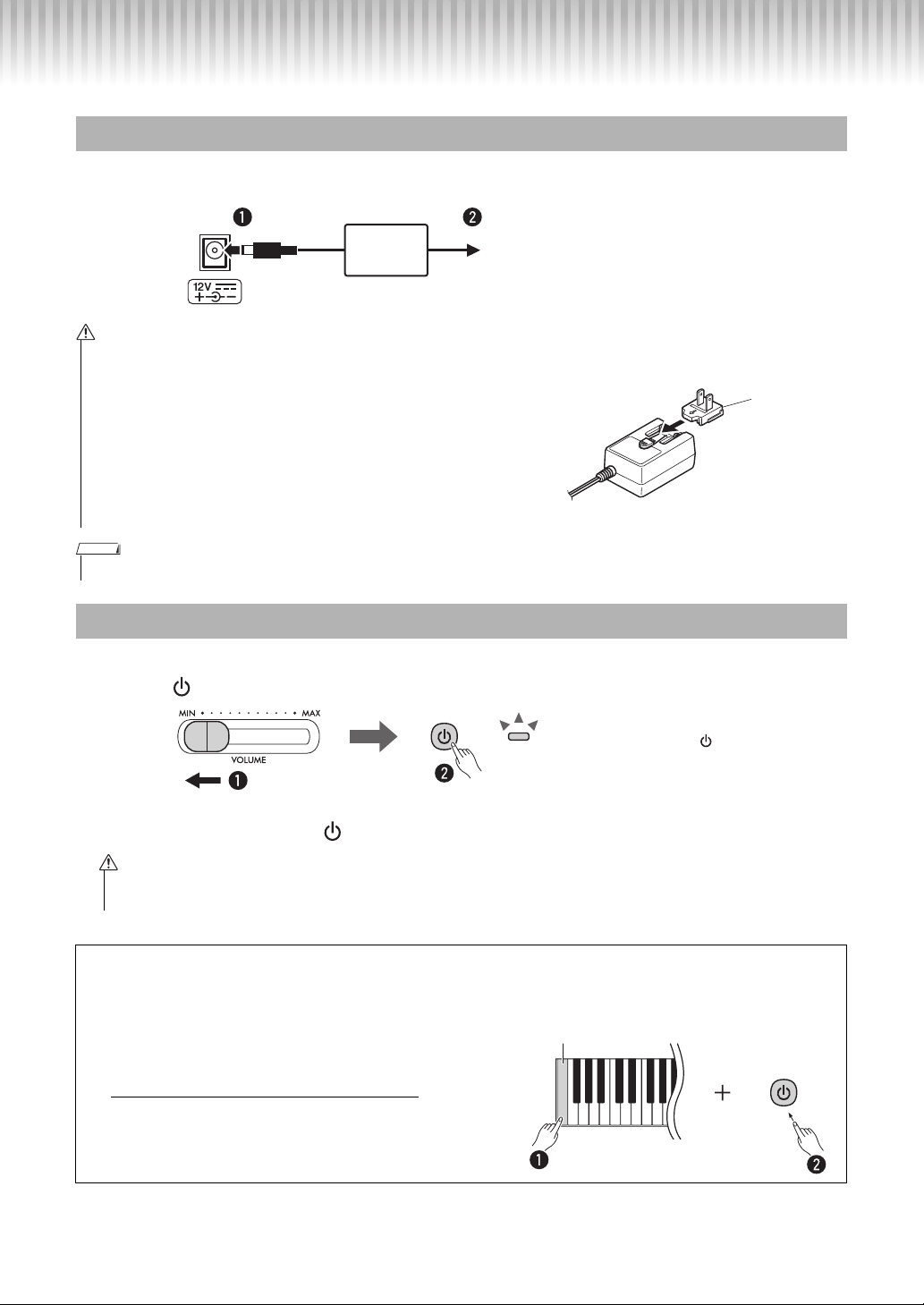
Connect the AC adaptor in the order shown in the illustration.
q Set the volume to the minimum.
w Press the [ ] (Standby/On) switch to turn on the power.
While playing the keyboard, adjust the volume level by using the [VOLUME] slider.
To turn off the power, press the [ ](Standby/On) switch again for a second.
Power Requirements
• Use the included or specified AC adaptor (page 24). Using the wrong AC adaptor can result in damage to the instrument or over-
heating.
• When using the AC adaptor with a removable plug, make sure to keep the
plug attached to the AC adaptor. Using the plug alone can cause electric
shock or fire.
• Never touch the metallic section when attaching the plug. To avoid electric
shock, short circuit or damage, also be careful that there is no dust between
the AC adaptor and plug.
• When setting up the product, make sure that the AC outlet you are using is
easily accessible. If some trouble or malfunction occurs, immediately turn
the power off and disconnect the plug from the outlet.
• Follow the order shown in reverse when disconnecting the AC adaptor.
Turning the Power On/Off
• Even when the power switch is turned off, electricity is still flowing to the product at the minimum level. When you are not
using the product for a long time, make sure to unplug the power cord from the wall AC outlet.
Auto Power Off Function
To prevent unnecessary power consumption, this function automatically turns the power off if no buttons or
keys are operated for approximately 30 minutes.
Default setting: Enable
Disabling Auto Power Off (simple method)
Turn the power on while holding down the lowest key on
the keyboard. The [](Record) lamp flashes three times.
DC IN jack
(page 12)
AC
adaptor
AC outlet
WARNING
Plug
Slide the plug as indicated.
*The shape of the plug differs depending on your area.
NOTE
When the power is supplied to the instrument, the
power lamp on the right of the [ ] switch lights up.
WARNING
Lowest key
While holding down
P-225, P-223 Owner’s Manual
14
Basic Operations
Some functions of this instrument are operated with a combination of buttons and keys. While holding down one
of the buttons, press the appropriate key to turn the function on or off, set the value, etc. (page 17-20).
The “Quick Operation Guide” shows in chart form the functions assigned to the keyboard, and is available on the
Yamaha website (see page 8). This can be printed out and placed it on a music rest for use as a quick reference for
important operations.
To turn on/off the Operation Confirmation Sounds:
Operations using a button and key combination produces
a confirmation sound (“On,” “Off,” click, and tempo
value input). While simultaneously holding down the
[METRONOME] and [RHYTHM] buttons, press the
lowest key or second lowest key to turn the sound on/off.
The following data will automatically be maintained even if you turn off the power.
• User Song
•
Parameter settings:
Metronome/Rhythm Volume, Metronome Beat, Touch Sensitivity, Tuning, Auto Power Off setting, Operation
Confirmation Sounds on/off, Split Point
*
, IAC on/off
*
, IAC Depth
*
, Intro/Ending on/off
*
, AUX OUT
volume settings
*
, Stereophonic Optimizer on/off
*
, Speaker on/off
*
, Wall EQ on/off
*
, Bluetooth on/off
*
* For details on the asterisk-marked parameters above, refer to the Reference Manual on the Yamaha website (see page 8).
To initialize the backup parameters:
While holding down the highest key, turn the power on to
initialize the backup parameters to the factory initial settings.
Operations by using both buttons and keys
Backup and Initializing
• Tempo settings are not backed up.
Each of these indications printed above the keyboard indicates the function assigned to the corresponding key.
Lowest Key (Off)
Second lowest key (On)
Default setting: On
While holding down
NOTE
Highest key
While holding down
P-225, P-223 Owner’s Manual
15
Playing with Various Voices
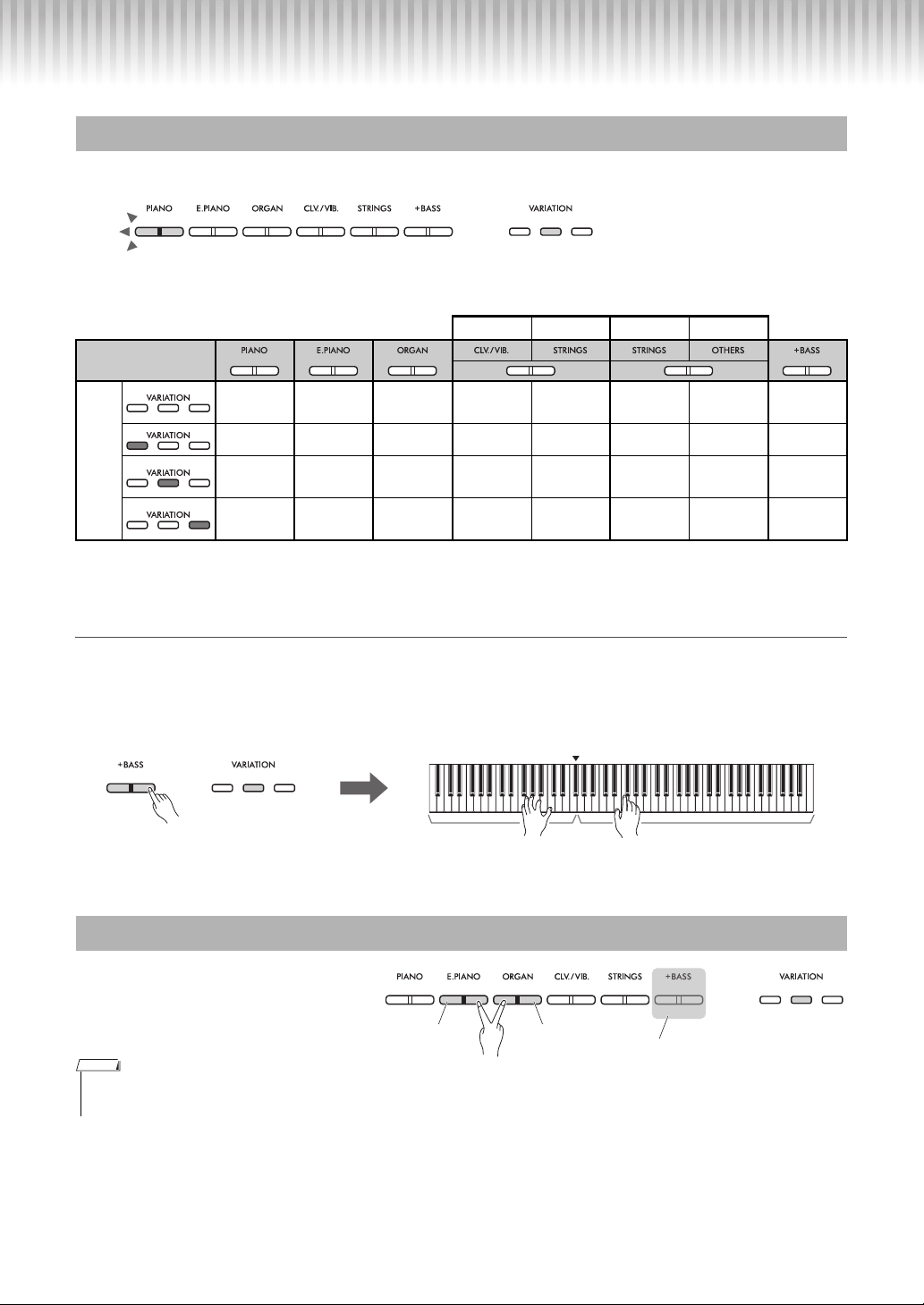
Press one of the desired Voice (group) buttons.
Each press of the same button turns the [VARIATION] lamp on/off and selects one of four Voices in sequence.
For details on the characteristics of each Voice, listen to the Voice Demo Songs (page 18) or refer to the “Voice List (Detailed)”
in the Reference Manual on the Yamaha website (see page 8).
Selecting a Voice with the [+BASS] button (Split)
Pressing the [+BASS] button changes the Voice for the Left section (F#2 key and all keys to the left) to one of the
bass Voices. This enables you to play two difference Voices with your left and right hands (Split function). The
bass Voice changes in sequence each time the [+BASS] button is pressed. Select the Voice for the Right first, and
then for the Left.
To return to the same Voice for Left and Right (exit from Split function), press any Voice button.
First, select two desired Voices from
different Voice groups, and then press
those Voice buttons simultaneously to
enable the Dual function.
To exit from the Dual function, press any Voice button.
Selecting a Voice
Voice List
P-225 P-223 P-225 P-223
Voice Button (Group)
Voice
Name
Grand Piano
Stage
E.Piano
Jazz Organ E.Clavichord Strings Strings
Harpsichord
8’
Acoustic
Bass
Live Grand DX E.Piano Rock Organ Vibraphone Slow Strings Slow Strings Harpsi.8’+4’ Electric Bass
Ballad
Grand
Vintage
E.Piano
Organ
Principal
Harpsichord
8’
Choir Choir Accordion
Bass &
Cymbal
Bright Grand Synth Piano Organ Tutti Harpsi.8’+4’ Synth Pad Synth Pad Guzheng
Fretless
Bass
Layering Two Voices in Different Voice Groups (Dual)
• You cannot layer two Voices from the same Voice group or select two Voices with the same Voice button.
• The Dual function is not available while the Duo function (page 16) is on.
Lights up
In this example, “Ballad Grand” in the
[PIANO] button is selected.
* This illustration is of the P-225.
The [VARIATION] lamps
indicate the status of the
Left Voice.
F#2 (Default setting)
Left section Right section
Left: Voice 1 Right: Voice2
The [VARIATION]
lamps indicate the
status of the
Voice 1.
Bass Voices are
not available.
NOTE
Playing with Various Voices
P-225, P-223 Owner’s Manual
16
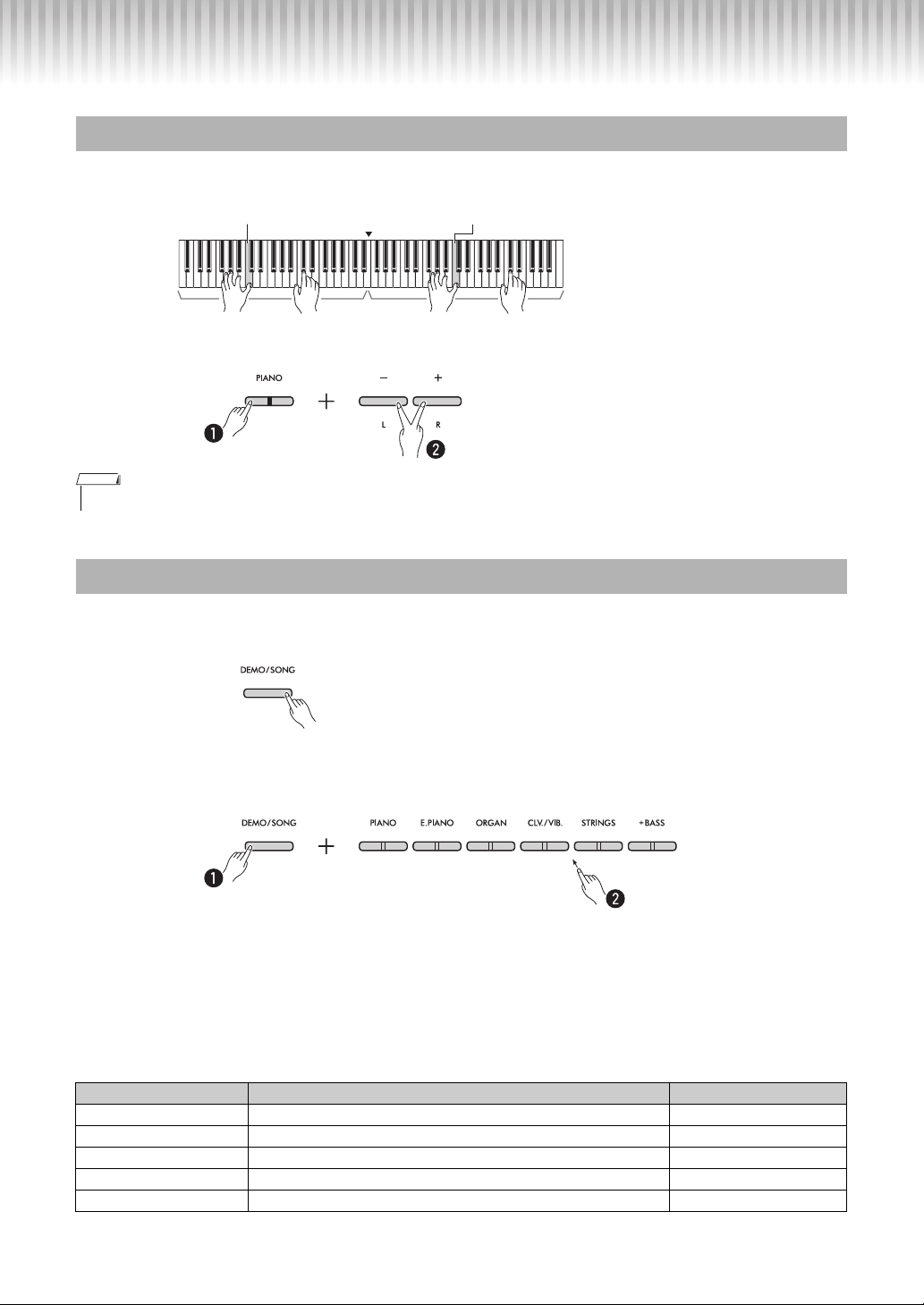
This function allows two different players to play the instrument, one on the left and the other on the right, over
the same octave range.
To turn the Duo function on/off, hold down the [PIANO] button and simultaneously press the [-] and [+] buttons.
Pressing the [DEMO/SONG] button starts playback of all Demo Songs from the Grand Piano Voice (page 15) in
sequence.
To listen to the desired Voice Demo Song, simultaneously hold down the [DEMO/SONG] button and select the
desired Voice (page 15).
Refer to page 18 for changing the Demo Song during playback and page 17 for adjusting the tempo. To stop
playback, press the [DEMO/SONG] or the [
>/] (Play/Stop) button.
Special individual Demo Songs are provided for all of the Voices of the instrument except for Electric Bass, Bass
& Cymbal, and Fretless Bass (page 15). The demonstration pieces listed below are short, rearranged excerpts of
the original compositions. All other Songs are original (©Yamaha Corporation).
Demo Song List
Playing Duo
• The bass Voices are not available.
Discovering the Voices with the Voice Demo Songs
Voice Name Title
Composer
Ballad Grand Intermezzo, 6 Stücke, op.118-2 J. Brahms
Organ Principal Herr Christ, der ein’ge GottesSohn, BWV 601 J.S. Bach
Organ Tutti Triosonate Nr.6, BWV 530 J.S. Bach
Harpsichord 8’ Concerto a cembalo obbligato, 2 violini, viola e continuo No.7, BWV 1058 J.S. Bach
Harpsi.8’+4’ Gigue, Französische Suiten Nr.5, BWV 816 J.S. Bach
Equivalent to C3Equivalent to C3
E3 (Fixed)
Left player Right player
While holding down
NOTE
While holding down
P-225, P-223 Owner’s Manual
17
Using the Metronome
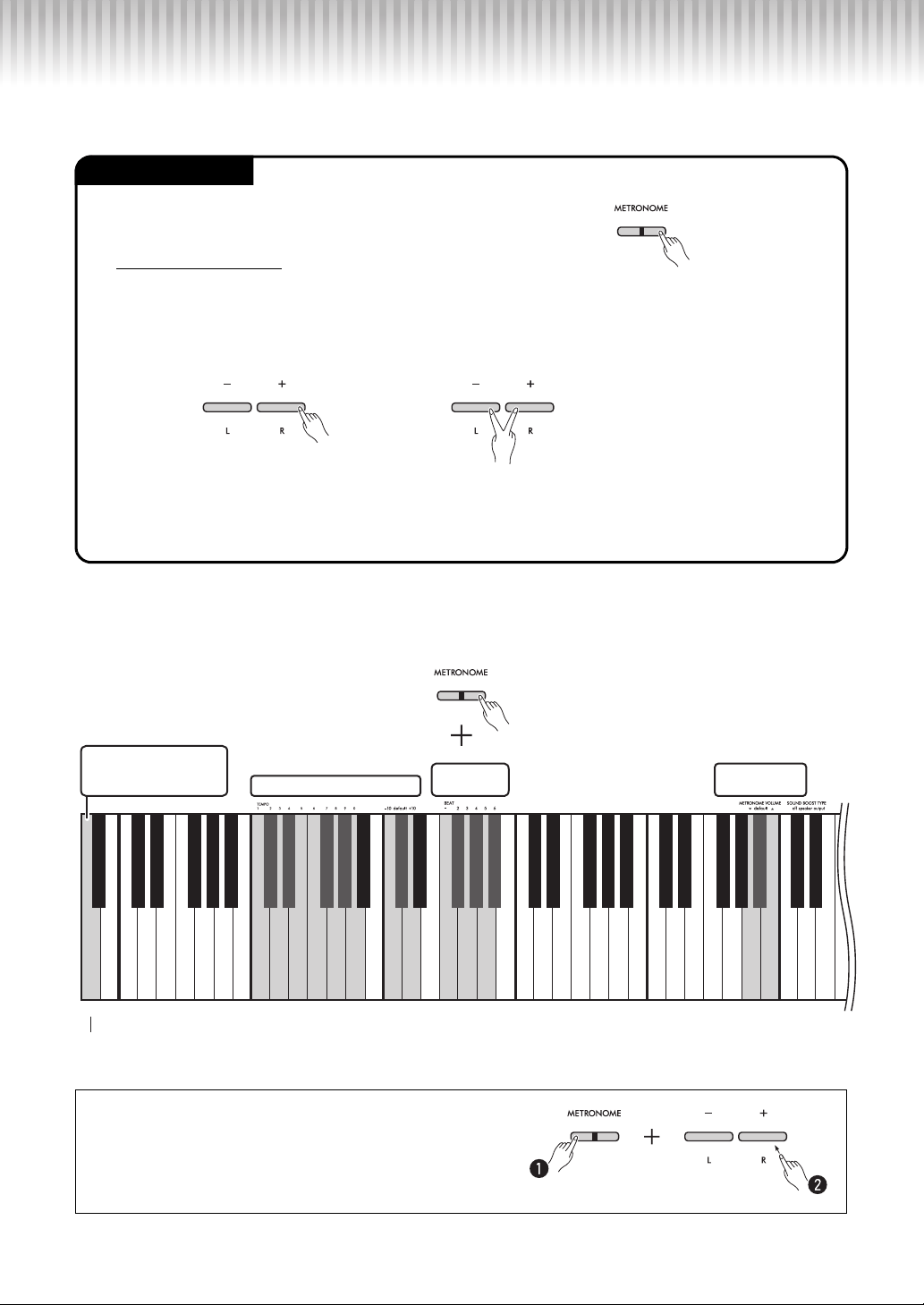
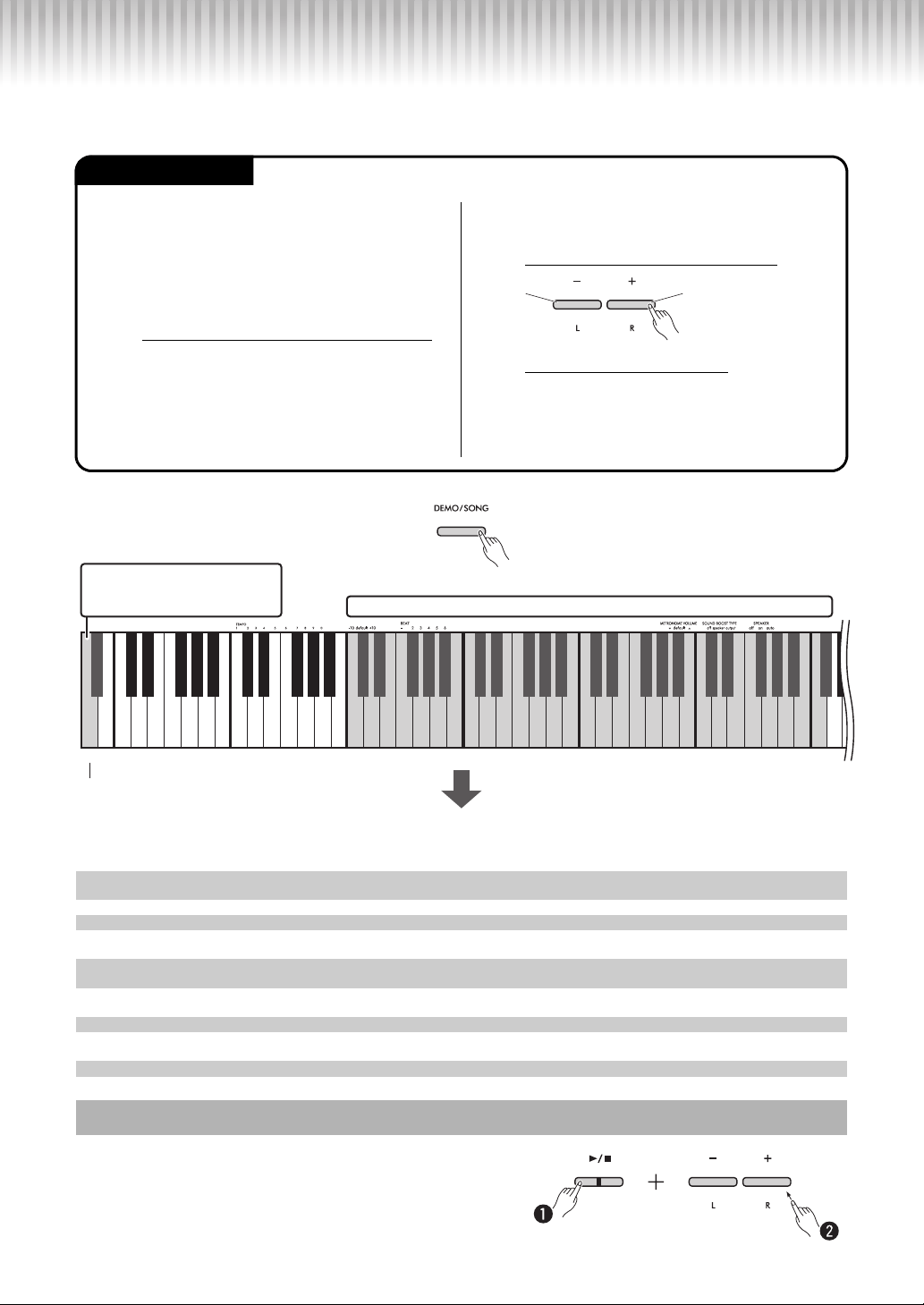
The Metronome is convenient for practicing with an accurate tempo.
While holding down the [METRONOME] button, press the appropriate key to make various settings for the
Metronome. For details on the settings, including the default setting, refer to the Reference Manual on the Yamaha
website (see page 8).
Adjusting the tempo during Song playback
(page 16 and 18)
While holding down the [METRONOME] button, press the
[-] or [+] button.
Basic Operations
Press the [METRONOME] button to start/stop the Metronome.
To adjust the tempo:
Setting range: 5-280 (Default setting: 120)
When the metronome is playing back, press [+] to increase or [-] to decrease.
While holding down the [METRONOME] button, press the lowest key to confirm by voice the current
tempo value (in English).
While holding down the [METRONOME] button, press the appropriate key between C1 and A1 to
specify a three-digit value (see the illustration below). For example to specify “80,” press the relevant G1
(8) and A1 (0) keys in order.
Holding either button continuously
increases or decreases the value.
Pressing the buttons simultaneously
resets to the default setting.
A-1 B-1 C0 D0 E0 F0 G0 A0 B0 C1 D1 E1 F1 G1 A1 B1 C2 D2 E2 F2 G2 A2 B2 C3 D3 E3 F3 G3 A3 B3 C4 D4 E4 F4 G4 A4 B4 C5 D5 E5 F5
2
4
6
2
4
7
9
3
5
1
3
5
6
8
0
While holding down
Lowest key
Voice confirmation of
current Tempo value
(in English)
Metronome Tempo
Metronome
Beat
Metronome
Volu me
10 steps down
10 steps up
No beat
1 step down
1 step up
Default tempo
Default tempo
While holding down
P-225, P-223 Owner’s Manual
18
Playing Back Songs
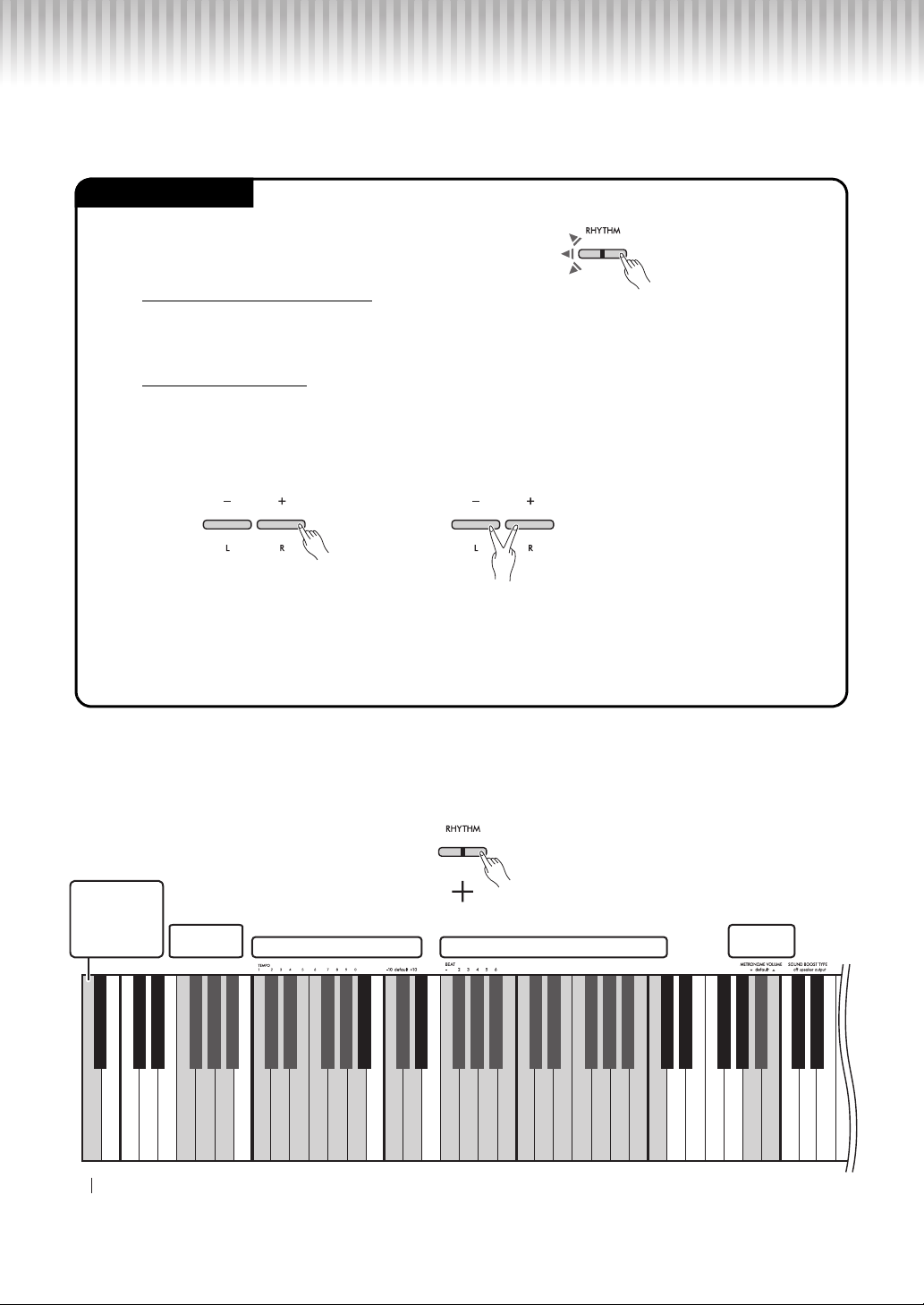
This instrument contains 50 preset piano Songs. Select and play back a Song from the Song List below.
By muting the Right part (R) or the Left part (L) of a Song,
you can practice the muted part while listening to another
part. To mute either part, simultaneously hold down the [
>/
](Play/Stop) button and press the [R] or [L] button that
you want to mute during Song playback.
Playing back a Song while Muting the Right or Left Part
Basic Operations
1. While holding down the [DEMO/SONG]
button, press the key corresponding to the
desired preset Song between (C2-C#6;
see illustration below) to start playback.
The preset Songs will play back in sequence
continuously, starting with the selected Song.
To play back the selected Song repeatedly:
While holding down the [DEMO/SONG] button,
press the key corresponding to the desired Song for a
second or longer. Voice Demo Songs (page 16) or
User Song (page 21) cannot be played back
repeatedly.
2. Press the [DEMO/SONG] or [>/] (Play/
Stop) button to stop playback.
To change the Song during playback:
To adjust the playback tempo:
Refer to page 17.
Previous
Song
Next Song
Selecting another Voice lets
you change Voice Demo
Songs.
14
16
19
21
23
A-1 B-1 C0 D0 E0 F0 G0 A0 B0 C1 D1 E1 F1 G1 A1 B1 C2 D2 E2 F2 G2 A2 B2 C3 D3 E3 F3 G3 A3 B3 C4 D4 E4 F4 G4 A4 B4 C5 D5 E5 F5 G5 A5 B5 C6 D6 E
2
4
7
9
11
3
5
6
8
10
12
26
28
31
33
35
38
40
43
45
47
50
1
15
17
18
20
22
24
13
27
29
30
32
34
36
25
39
41
42
44
46
48
37
49
While holding down
50 Preset Songs (50 Classics) Song number / Song name
1 Canon D dur 11 Salut d’amour op.12 21 Prelude
(Wohltemperierte Klavier I No.1)
31 Etude op.10-3
“Chanson de l’adieu”
41 Humoresque
2 Air On the G String 12 From the New World 22 Menuett G dur BWV Anh.114 32 Etude op.10-12
“Revolutionary”
42 Arietta
3 Jesus, Joy of Man’s Desiring 13 Sicilienne 23 Piano Sonate No.15 K.545 1st mov. 33 Valse op.64-1 “Petit chien” 43 Tango (España)
4 Twinkle, Twinkle, Little Star 14 Clair de lune 24 Turkish March 34 Nocturne op.9-2 44 The Entertainer
5 Piano Sonate op.31-2
“Tempest” 3rd mov.
15 Jupiter (The Planets) 25 Piano Sonate op.13
“Pathétique” 2nd mov.
35 Nocturne KK4a-16/BI 49
[Posth.]
45 Maple Leaf Rag
6Ode to Joy 16 Menuett (Eine kleine
Nachtmusik K.525)
26 Für Elise 36 Träumerei 46 La Fille aux
Cheveux de Lin
7 Wiegenlied op.98-2 17 Menuett G dur 27 Piano Sonate op.27-2
“Mondschein” 1st mov.
37 Barcarolle 47 Arabesque No.1
8 Grande Valse Brillante 18 Marcia alla Turca 28 Impromptu op.90-2 38 La prière d’une Vierge 48 Cakewalk
9 Polonaise op.53 “Héroïque” 19 Piano Concerto No.1
op.11 2nd mov.
29 Frühlingslied op.62-6 39 Liebesträume No.3 49 Je te veux
10 La Campanella 20 The Nutcracker Medley 30 Fantaisie-Impromptu 40 Blumenlied 50 Gymnopédies No.1
Lowest key
Quick play
(For details, refer to the Reference
Manual on the Yamaha website.)
50 Preset Songs (50 Classics) Song number
Off
On (Default)
While holding down
P-225, P-223 Owner’s Manual
19
Adding Accompaniment to Your Performance (Rhythm)
This instrument features a powerful Rhythm function, consisting of drum and bass accompaniment
patterns (page 27), allowing you to play along with your favorite rhythmic backing tracks.
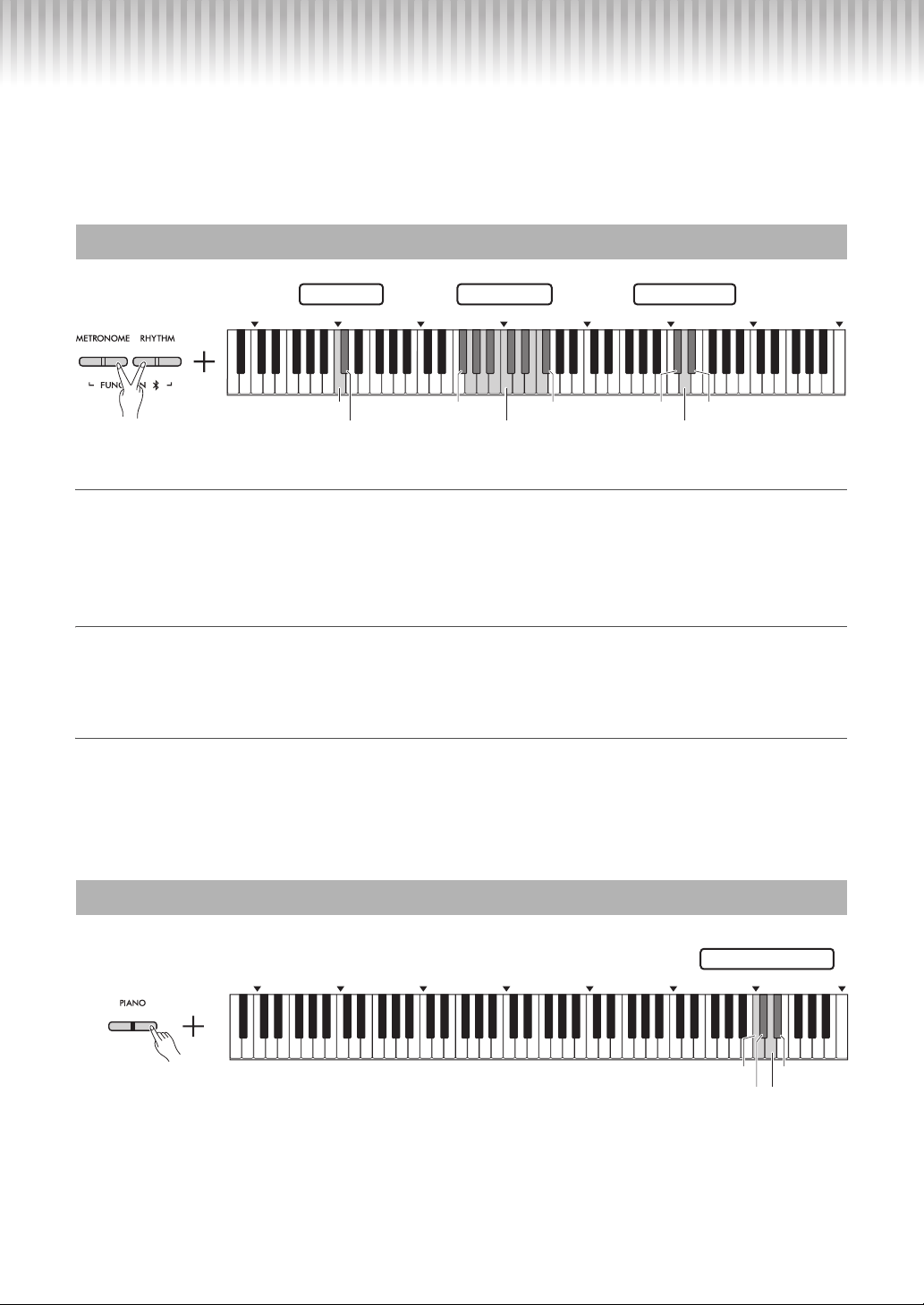
While holding down the [RHYTHM] button, press the appropriate key to make various settings for the Rhythm.
For details on the settings, including the default setting, refer to the Reference Manual on the Yamaha website (see
page 8).
Basic Operations
1. Press the [RHYTHM] button to start Rhythm.
The percussion part starts from the Intro section.
To select a different Rhythm:
While holding down the [RHYTHM] button, press a key between F2 and C4 (see the illustration
below).
To adjust the tempo:
Setting range: 5-280 (Default setting: 120)
When the rhythm is playing back, press [+] to increase or [-] to decrease.
While holding down the [RHYTHM] button, press the lowest key to confirm by voice the current
tempo value (in English).
2. Play the keyboard along with the Rhythm.
The instrument creates accompaniment bass sound according to the notes you play.
3. Press the [RHYTHM] button to stop playback.
Flashes
Holding either button continuously
increases or decreases the value.
Pressing the buttons simultaneously
resets to the default setting.
A-1 B-1 C0 D0 E0 F0 G0 A0 B0 C1 D1 E1 F1 G1 A1 B1 C2 D2 E2 F2 G2 A2 B2 C3 D3 E3 F3 G3 A3 B3 C4 D4 E4 F4 G4 A4 B4 C5 D5 E5 F5
2
4
7
9
1
3
5
6
8
0
While holding down
Lowest key
Rhythm
Volu me
Bass Off
Bass On
RhythmRhythm Tempo
Bass, Intro/
Ending
Voice
confirmation of
current Tempo
value
(in English)
Intro On
Ending On
Default tempo
16Beat
Shuffle2
Gospel
FastJazz
Swing
BossaNova
Salsa
6-8March
Default value
Intro Off
Ending Off
10 steps down
10 steps up
8Beat
Shuffle1
Shuffle3
8BeatBallad
6-8SlowRock
SlowJazz
JazzWaltz
Samba
Rumba
KidsPop
ChristmasSwing
Christmas3-4
1 step down
1 step up
P-225, P-223 Owner’s Manual
20
Useful Performance Settings
This instrument contains a variety of convenient functions useful when performing.
For details on the functions below as well as other functions, refer to the Reference Manual on the
Yamaha website (see page 8).
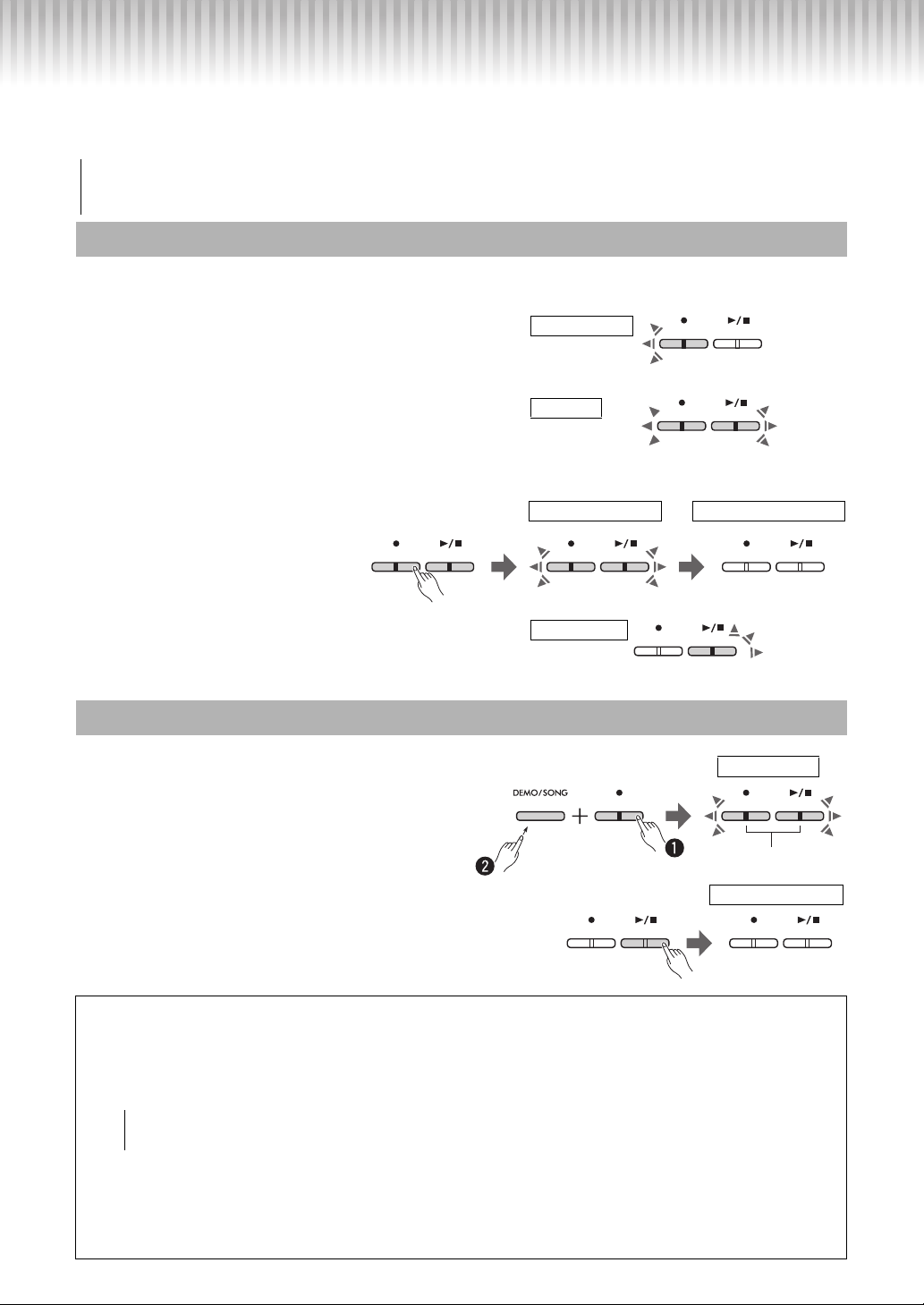
Sound Boost
This function boosts the overall sound. By using this function, when playing along with other instruments or
playing in a noisy environment, you can raise the volume and enhance the presence of your performance. Select
the desired type from Speaker, Output, and Off depending on your performance situation.
Default setting: Off
Transpose
You can shift or transpose the pitch of the entire keyboard up or down in semitone steps. This lets you easily
match the pitch of the keyboard to the range of other instruments. For example, if you enter a transpose setting of
“+5,” playing a C key will produce a F pitch.
Tuning
You can fine tune the pitch of the entire instrument. This can be extremely useful when playing your digital piano
along with other instruments. To set the tuning value not 440.0 or 442.0 Hz, while holding down the
[METRONOME] and [RHYTHM] buttons, press the [-] or [+] buttons.
Default setting: 440.0Hz
When you play with a Voice (excepting organ or harpsichord), you can specify the degree of Touch Sensitivity
(how the sound responds to your playing strength). There are four Touch Sensitivity types to select from: Soft,
Medium, Hard, and Fixed.
Default setting: Medium
Sound Settings
Changing the Touch Sensitivity
C0 C1 C2
C3
C4 C5 C6 C7
While holding down
Tuning Transpose Sound Boost
C1 (440.0 Hz)
C#1 (442.0 Hz)
C#5 (Off)
D5 (Speaker)
D#5 (Output)F#2 (-6)
C3 (0 = Original pitch)
F#3 (+6)
C0 C1 C2
C3
C4 C5 C6 C7
While holding down
Touch Sensitivity
C6 (Soft) D#6 (Fixed)
C#6 (Medium) D6 (Hard)
P-225, P-223 Owner’s Manual
21
Recording Your Performance
You can record your keyboard performance as a User Song.
1
Before recording, make important settings, such as Voice, metronome, and Rhythm.
2
Press the [] (Record) button to enable the
Record Ready mode.
To exit from Record Ready mode, press the [] button again.
3
Play the keyboard or press the [>/] (Play/Stop)
button to start recording.
You can also start recording by pressing the [RHYTHM]
button.
4
Press either the [] or [>/]
button to stop recording.
5
To hear the recorded Song,
press the [
>/] button to start playback.
1
While holding down the [] button, press
the [DEMO/SONG] button.
To exit from this status, press the [] button.
2
Press the [>/] button to delete the data of the
entire Song.
• Note that the Recording operation replaces already recorded data with the newly recorded data, since only one User Song is
available. Before recording, check whether a User Song exists or not by pressing the [
>/] button. If it has already been
recorded, it will be played back.
Quick Recording
Deleting the User Song
Recording Independently to Two Parts
You can record your performance to the Right part (R) and Left part (L) separately.
1. While holding down the [] button, press the [R] or [L] button to enable Record Ready mode.
The [] lamp will flash.
2. Play the keyboard or press the [>/] button to start recording.
3. Press either the [] or [>/] button to stop recording.
4. To hear the recorded Song, press the [>/] button to start playback.
If you want to re-record either part (R or L), return to step 1.
NOTICE
Flashes
Record Ready
Recording
Flashes Flashes
Data is being stored
Flashes Flashes
Data storing completed
Turns off Turns off
Song playback
Flashes
While holding down
Deletion Ready
Flashes in alternation
Turns off Turns off
Deletion completed
• When an already recorded User Song exists, the [>/] lamp also flashes. To prevent overwriting the data accidentally,
play back the Song by part (page 18) to check whether a User Song is recorded on the L or R part.
NOTICE
P-225, P-223 Owner’s Manual
22
Connecting Other Equipment
By connecting this instrument to a smart device, you can use convenient and powerful apps described below to get
even more enjoyable musical use from it.
For details on these apps or compatible smart devices, access
the web pages of the respective apps on the following page:
https://www.yamaha.com/2/apps/
Smart Pianist
Smart Pianist (free download) lets you make various setting intuitively while viewing the screen.
For information on how to connect the instrument to a smart
device and how to use the app, see the Smart Pianist User
Guide.
Smart Pianist User Guide
https://manual.yamaha.com/mi/app/smartpianist/
Rec 'n' Share
Rec 'n' Share allows you to record your performances on this instrument, edit them and even make videos of them,
and then share them with people around the world. To connect the instrument to a smart device, you need a USB
cable (Type A – Type B) and a conversion adaptor that matches the connector of the smart device.
Before using the Bluetooth function, be sure to read “About Bluetooth” on page 6.
You can play the sound of audio data saved in a Bluetooth-equipped device, such as a smartphone or portable
audio player, on this instrument and listen to it through the built-in speakers of the instrument.
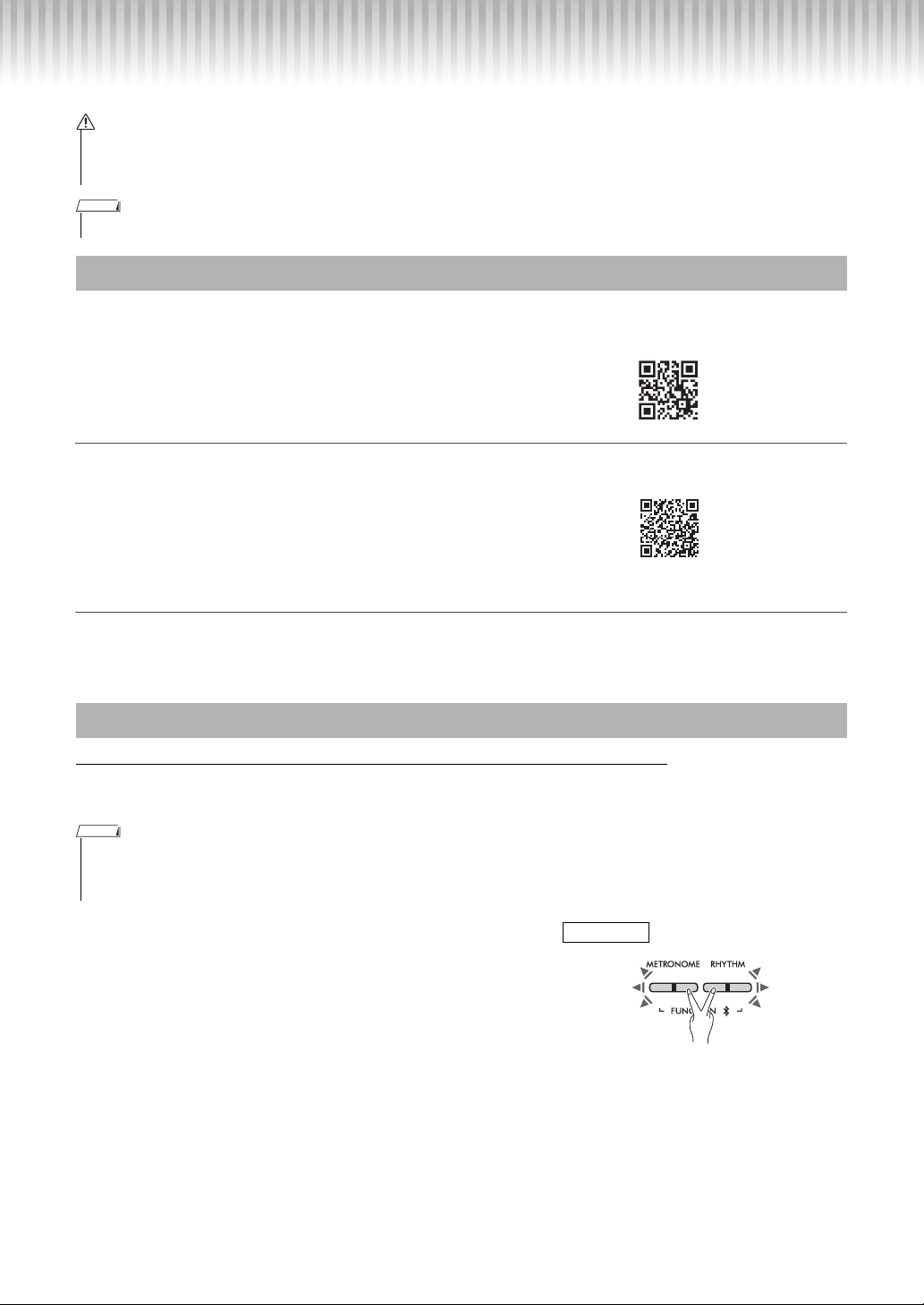
1
Hold down the [METRONOME] and [RHYTHM]
buttons simultaneously for three second or longer
to pair with a Bluetooth-equipped device (Pairing*).
*Pairing: To register this instrument with a Bluetooth-equipped
device and establish mutual recognition for wireless
communication between the two.
To cancel the paring, press any button.
2
On the Bluetooth-equipped device, set the Bluetooth function to on and select the
instrument “P-225 AUDIO” or “P-223 AUDIO” from the connection list.
Make sure to complete this operation while the [METRONOME] and [RHYTHM] buttons are flashing.
3
Play back audio data on the Bluetooth-equipped device to confirm that the built-in
speakers of the instrument can output the audio sound.
• Before connecting the instrument to other electronic components, turn off the power to all the components. Before turning the
power on or off to all components, set all volume levels to minimum (0). Otherwise, electrical shock or damage to the compo-
nents may result.
• For connections to equipment other than the following, refer to page 12.
Using Smart Device Apps
Listening to Audio via Bluetooth on this Instrument (Bluetooth Audio Function)
• This instrument cannot transmit audio data to Bluetooth-equipped devices via Bluetooth.
• Bluetooth headphones or Bluetooth speakers cannot be connected or used with this instrument.
• Smart device apps such as Smart Pianist cannot be used via Bluetooth.
CAUTION
NOTE
NOTE
Pairing
Flashes Flashes
P-225, P-223 Owner’s Manual
23
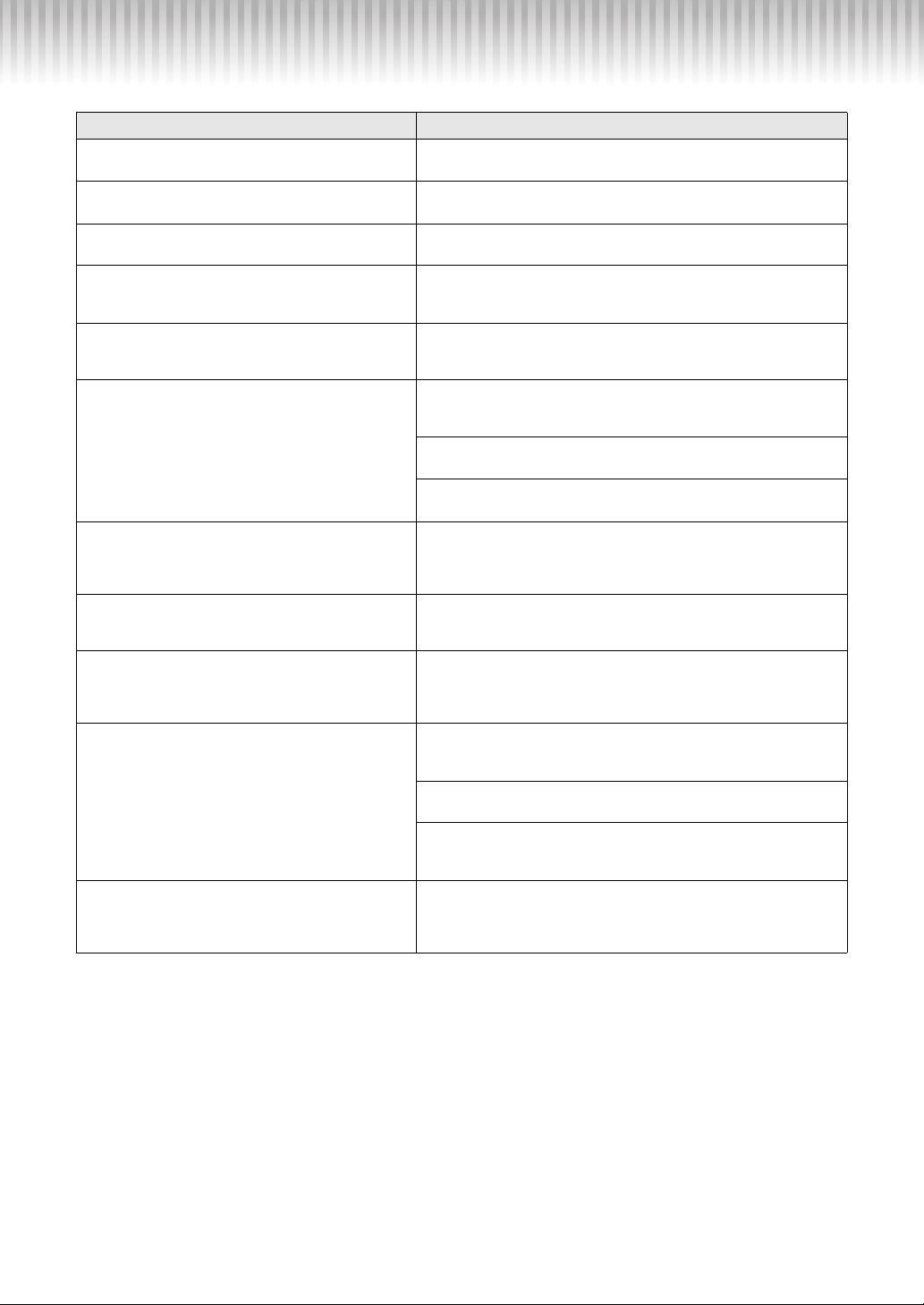
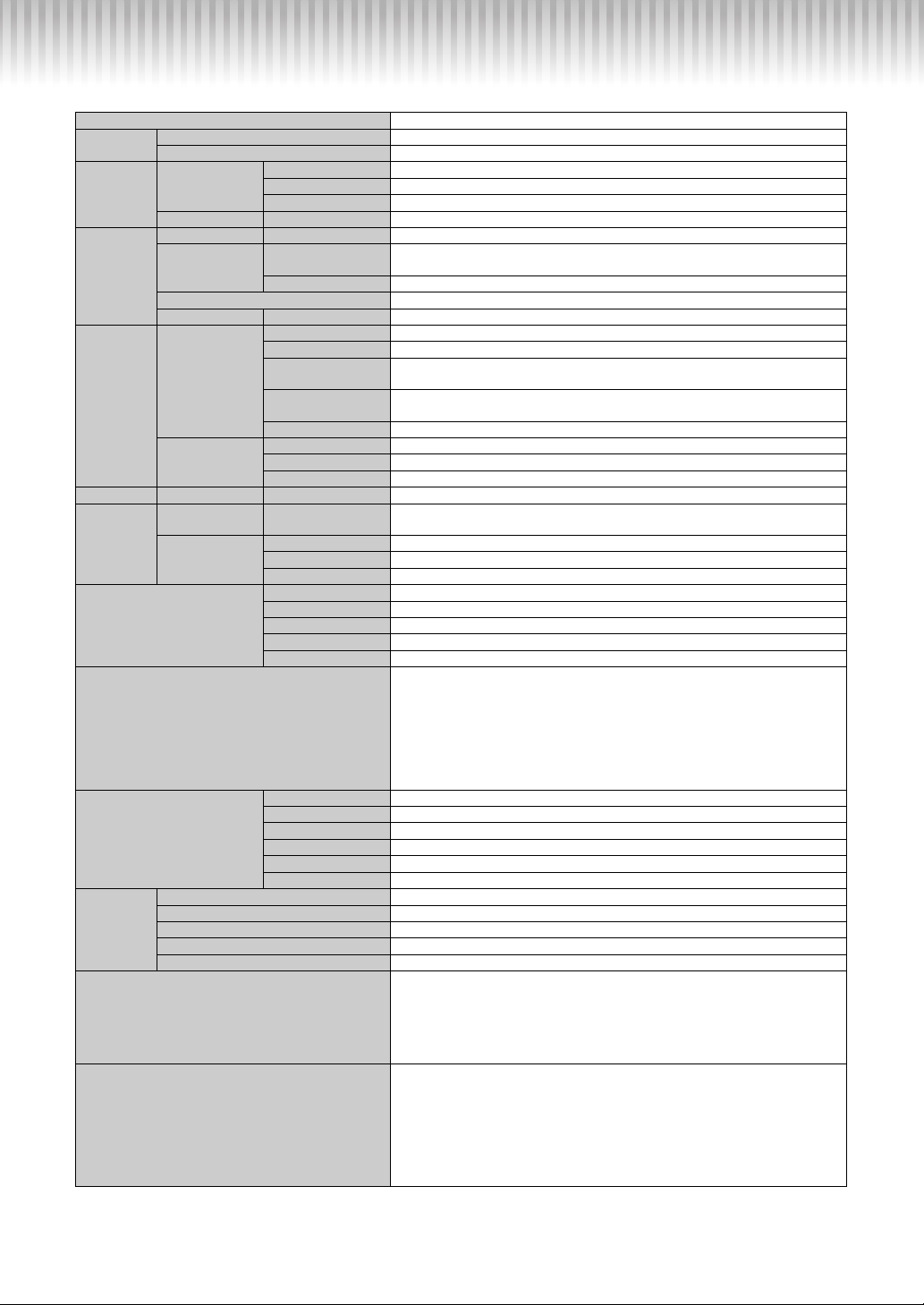
Troubleshooting
Problem Possible Cause and Solution
When the instrument is turned on or off, a popping sound
is temporarily produced.
This is normal and indicates that the instrument is receiving electrical
power.
The instrument does not turn on.
The instrument has not been plugged in properly. Securely connect the AC
adaptor to the DC IN jack on the instrument and to the AC outlet (page 13).
The instrument is automatically turned off even if no
operation is done.
This occurs due to the Auto Power Off function (page 13). If necessary,
disable the Auto Power Off function.
Noise is heard from the speakers or headphones.
The noise may be due to interference caused by the use of a mobile phone
in close proximity to the instrument. Turn off the mobile phone, or use it
further away from the instrument.
Noise is heard from the instrument’s speakers or
headphones when using the instrument with your smart
device, such as smartphone or tablet.
When you use the instrument along with your smart device, we recommend
that you set that device’s “Airplane Mode” to on in order to avoid noise
caused by communication.
The overall volume is low, or no sound is heard.
The instrument’s speakers are turned off. Turn them back on.
For details on this operation, refer to the Reference Manual on the Yamaha
website (see page 8).
Make sure a pair of headphones or conversion adaptor is not connected to
the headphones jack (page 10).
Make sure that Local Control is set to ON. For details, refer to the
Reference Manual on the Yamaha website (see page 8).
Moving the [VOLUME] slider does not change the volume
of the headphones.
Have you set the external speaker volume to “Fixed”?
Change the external speaker volume to “Variable.”
For details on this operation, refer to the Reference Manual on the Yamaha
website (see page 8).
The pedal has no effect.
The pedal cable/plug may not be properly connected. Make sure to
securely insert the pedal plug into the [SUSTAIN] or [PEDAL UNIT] jack
(page 12).
The footswitch (for sustain) seems to produce the opposite
effect. For example, pressing the footswitch cuts off the
sound and releasing it sustains the sounds.
The polarity of the footswitch (page 12) is reversed because the footswitch
was pressed when the power was turned on. Turn off the power and turn it
on again to reset the function. Make sure to not press the footswitch when
turning the power on.
The Bluetooth-equipped device cannot be paired with nor
connected to the instrument.
Check the Bluetooth function of the Bluetooth-equipped device is activated.
To connect the Bluetooth-equipped device and the instrument, the
Bluetooth function of both devices must be turned on.
The Bluetooth-equipped device and the instrument need to be paired to
connect each other via Bluetooth (page 22).
In case there is a nearby device (microwave oven, wireless LAN device,
etc.) that outputs signals in the 2.4 GHz frequency band nearby, move this
instrument away from the device that is emitting radio-frequency signals.
When using a DAW (Digital Audio Workstation) with the
instrument, there is a loud noise or abnormal sound.
Depending on the settings of the computer or the application software, a
loud sound may occur. Set the Audio Loop Back function to off. For details
on this operation, refer to the Reference Manual on the Yamaha website
(see page 8).
Appendix
P-225, P-223 Owner’s Manual
24
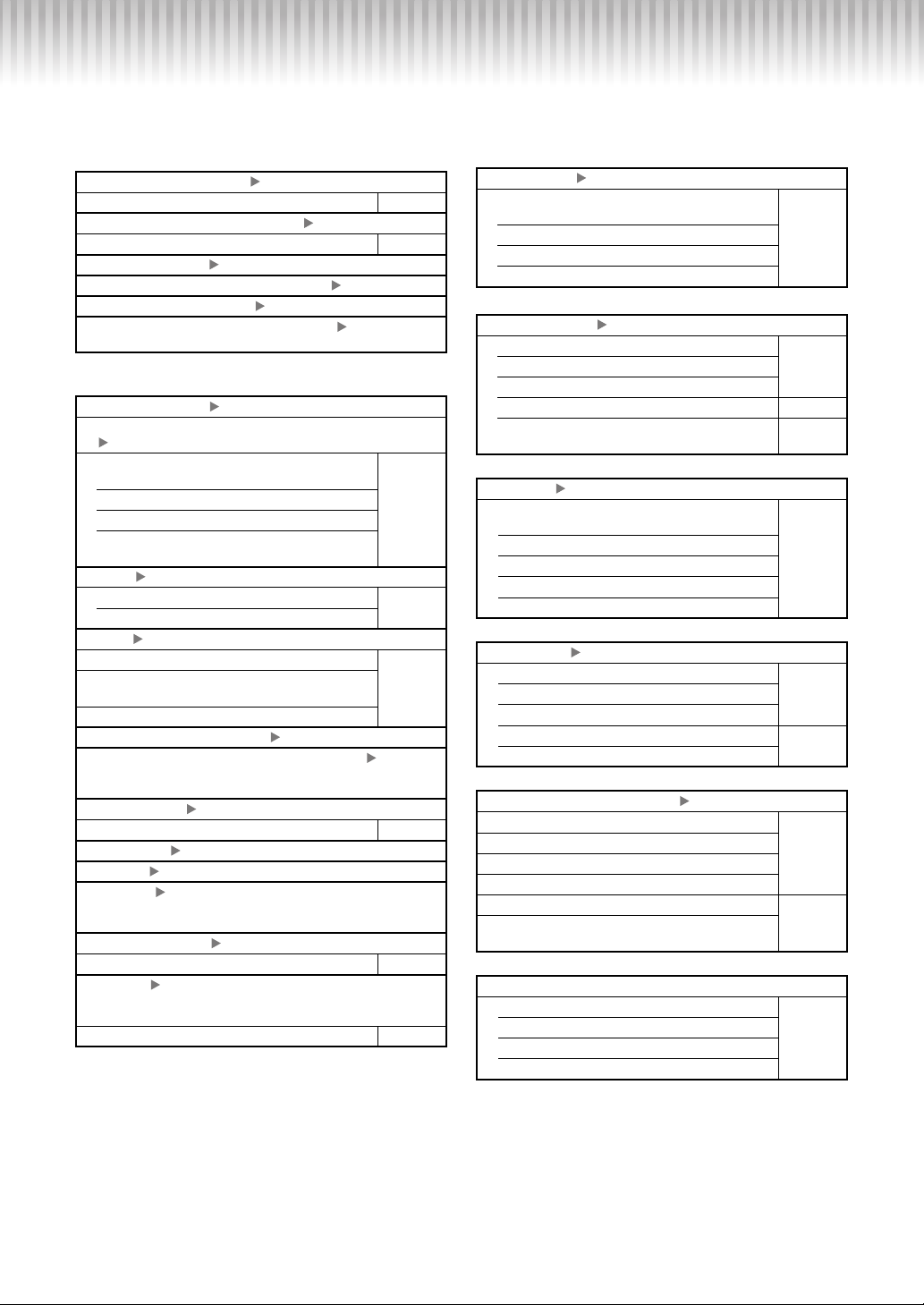
Specifications
* The contents of this manual apply to the latest specifications as of the publishing date. To obtain the latest manual, access the Yamaha
website then download the manual file. Since specifications, equipment or separately sold accessories may not be the same in every
locale, please check with your Yamaha dealer.
Product Name Digital Piano
Size/Weight Dimensions (W × D × H) 1,326 mm × 272 mm × 129 mm (52-3/16” × 10-11/16” × 5-1/16”)
Weight 11.5 kg (25 lb, 6 oz)
Control
Interface
Keyboard Number of Keys 88
Type GHC (Graded Hammer Compact) Keyboard with matte black keytops
Touch Response Hard/Medium/Soft/Fixed
Panel Language English
Voices Tone Generation Piano Sound Yamaha CFX
Piano Effect Virtual Resonance
Modeling (VRM) Lite
Ye s
Key-off Samples Ye s
Polyphony (max.) 192
Preset Number of Voices 24
Effects Types Reverb 4 types
Wall EQ Ye s
Intelligent Acoustic
Control (IAC)
Ye s
Stereophonic
Optimizer
Ye s
Sound Boost 2 types
Functions Dual Ye s
Split Ye s
Duo Ye s
Rhythms Preset Number of Rhythms 20
Song
Recording/
Playback
(MIDI data
only)
Preset Number of Preset
Songs
21 Voice Demo Songs, 50 Classics
Recording Number of Songs 1
Number of Tracks 2
Data Capacity Approx. 100 KB/Song (approx. 11,000 notes)
Overall Controls Metronome Ye s
Tempo Range 5 – 280
Transpose -6 – 0 – +6
Tuning 414.8 – 440.0 – 466.8 Hz (approx. 0.2 Hz increments)
USB audio interface 44.1 kHz, 24 bit, stereo
Bluetooth
(Audio only)
* May not have this functionality depending on the
country in which you purchased the product.
• Bluetooth version: 5.0
• Supported profile: A2DP
• Compatible codec: SBC
• Wireless output: Bluetooth class 2
• Maximum communication distance: Approx. 10 m
• Radio Frequency (Operational Frequency): 2,401-2,481 MHz
• Maximum output power (EIRP): 4 dBm
• Type of modulation: GFSK
Connectivity DC IN 12 V
PHONES Standard stereo phone jack(× 2)
SUSTAIN Ye s
AUX OUT L/L+R, R
PEDAL UNIT Ye s
USB TO HOST Yes (MIDI/Audio)
Sound
System
Amplifiers 7 W × 2
Speakers Oval (12 cm × 8 cm) × 2 + 5 cm × 2
AC Adaptor PA-150 or an equivalent recommended by Yamaha (Output : DC 12 V, 1.5 A)
Power Consumption 9 W (When using PA-150 AC adaptor)
Auto Power Off Ye s
Included Accessories • Owner’s Manual
• Online Member Product Registration
•Music rest
• Footswitch
• AC adaptor PA-150 or an equivalent recommended by Yamaha*
* May not be included depending on your area. Check with your Yamaha dealer.
Separately Sold Accessories
(May not be available depending on your area.)
• Headphones (HPH-50/HPH-100/HPH-150)
• Footswitch (FC4A/FC5)
• Foot pedal (FC3A)
• Pedal unit (P-225:LP-1, P-223:LP-5A)
• Keyboard stand (P-225: L-200, P-223:L-100)
• Keyboard bag (SC-KB851)
• Wireless MIDI adaptor (UD-BT01)
• AC adaptor PA-150 or an equivalent recommended by Yamaha

P-225, P-223 Owner’s Manual
25
Index
Numerics
50 Classics ........................................................ 18, 27
A
AC adaptor ..............................................................13
Accessories ............................................................... 9
Accompaniment ...................................................... 19
Auto Power Off ....................................................... 13
AUX OUT ............................................................... 12
B
Backup .................................................................... 14
Bass ......................................................................... 19
Beat ......................................................................... 17
Bluetooth ......................................................... 6, 9, 22
C
computer ................................................................. 12
Computer-related Operations .................................... 8
D
Delete ...................................................................... 21
Demo Song .............................................................. 16
Demo Song List ...................................................... 16
Dual ......................................................................... 15
Duo .......................................................................... 16
E
Ending ..................................................................... 19
F
Footswitch ............................................................... 12
H
Headphones .............................................................10
I
Initializing ............................................................... 14
Intelligent Acoustic Control (IAC) .......................... 26
Intro ......................................................................... 19
M
Metronome .............................................................. 17
Metronome Volume .................................................17
Music rest .................................................................. 9
O
Operation Confirmation Sounds ............................. 14
P
Part ..........................................................................18
Parts ......................................................................... 21
Pedal Unit ................................................................ 12
Playback (50 Preset Songs) ..................................... 18
Playback (Voice Demo Songs) ............................... 16
Power Requirements ............................................... 13
Q
Quick Operation Guide ............................................. 8
Quick play ............................................................... 18
R
Rec 'n' Share ........................................................... 22
Recording ................................................................ 21
Reference Manual ..................................................... 8
Reverb ..................................................................... 26
Rhythm ............................................................. 19, 27
Rhythm Volume ...................................................... 19
S
smart device ............................................................ 12
Smart Pianist ........................................................... 22
Smart Pianist User Guide ................................... 8, 22
Song .................................................................. 18, 27
Sound Boost ............................................................ 20
Speaker ................................................................... 11
Split ......................................................................... 15
T
Tempo (Metronome) ............................................... 17
Tempo (Rhythm) ..................................................... 19
Touch Sensitivity .................................................... 20
Transpose ................................................................ 20
Troubleshooting ...................................................... 23
Tuning ..................................................................... 20
U
USB TO HOST ....................................................... 12
User Song ............................................................... 21
V
Version .................................................................... 26
Voice Demo Song ................................................... 16
Voice List ................................................................ 15
Voices ...................................................................... 15
volume .................................................................... 13
Volume (Metronome) .............................................. 17
Volume (Rhythm) ................................................... 19
W
Wall EQ .................................................................. 26
P-225, P-223 Owner’s Manual
26
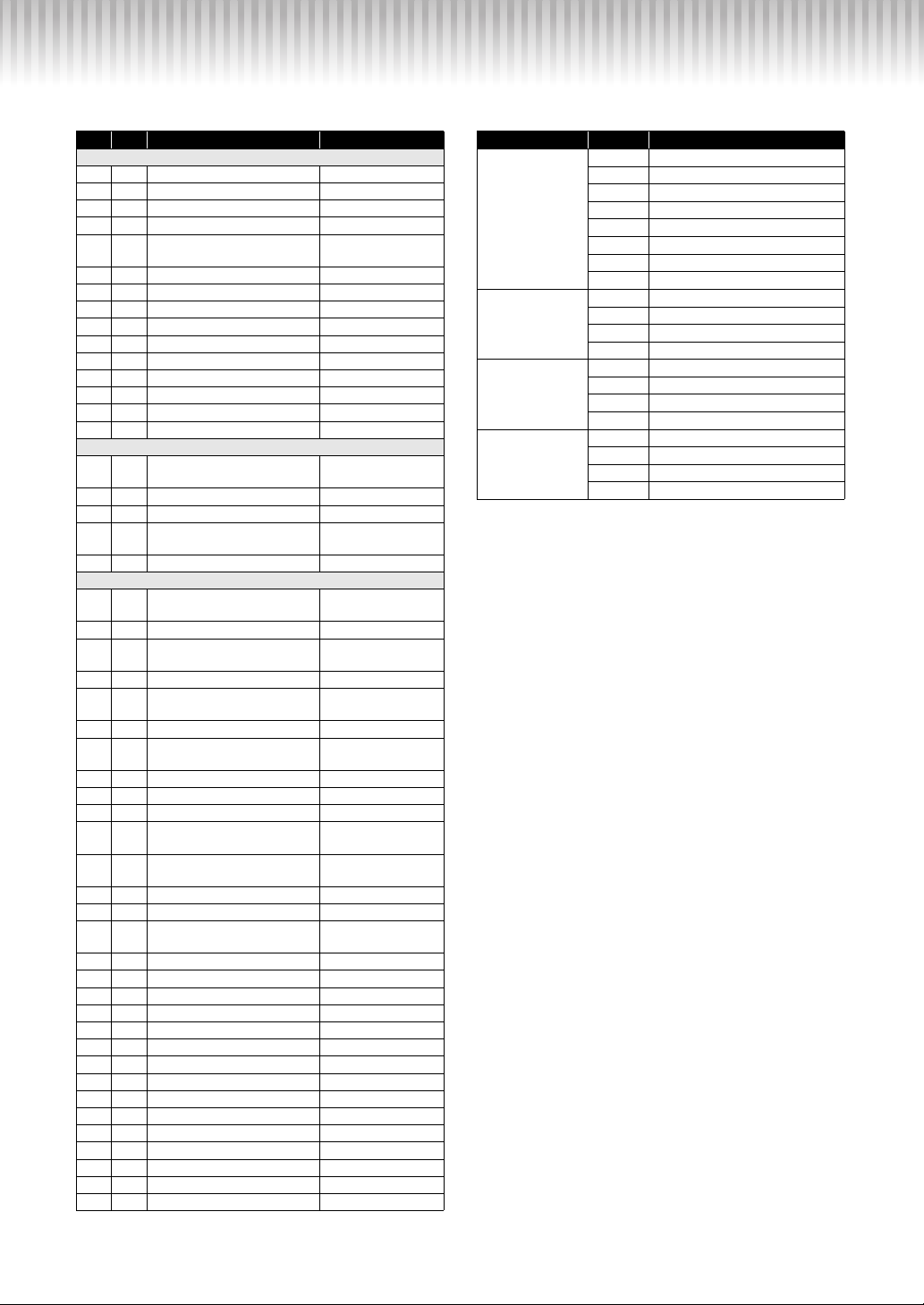
P-225, P-223 All Functions/Operations
RM: Refer to the Reference Manual on the Yamaha website (see page 8).
Functions for Overall Instrument
Functions for Performance
Auto Power Off function Page 13
To disable/enable the Auto Power Off function RM
Intelligent Acoustic Control (IAC) RM
Determines the IAC Depth RM
Built-in speakers Page 11
Operation confirmation sound setting Page 14
Backup and Initialization Page 14
Voice confirmation of firmware version RM
For hearing the firmware version of this instrument in English.
Selecting a Voice Page 15
Selecting a Voice with the [+BASS] button (Split)
Page 15
Changing the Left Voice to any Voice other than
bass
RM
Changing the Split Point
Shifting the Octave for each Voice
Adjusting the volume balance between two
Voices
Dual Page 15
Shifting the Octave for each Voice
RM
Adjusting the balance between two Voices
Duo Page 16
Shifting the Octave for each section
RM
Adjusting the volume balance between two key-
board sections
Sound Output Settings (Duo type)
Voice Demo Song playback Page 16
Virtual Resonance Modeling Lite (VRM Lite) RM
This reproduces the complicated interaction of sound reso-
nances of a real acoustic grand piano.
Sound Boost Page 20
Selecting a Sound Boost type RM
Transpose Page 20
Tuning Page 20
Wall EQ RM
This enables full sound, even if the instrument is placed up
against a wall.
Touch Sensitivity Page 20
Selecting the Touch Sensitivity RM
Reverb RM
This adds reverberation to the sound by simulating the natural
reverberation of a concert hall.
Setting the Reverb Depth RM
Metronome Page 17
Voice confirmation of current Tempo value (in
English)
RM
Tempo setting
Beat (time signature) setting
Volume setting
Song playback Page 18
Playing back a Song repeatedly
Page 18Changing the Song during playback
Adjusting the Tempo
Playing back from the beginning of the Song RM
Playing back a Song while muting Right or Left
Part
Page 18
Rhythm Page 19
Voice confirmation of current Tempo value (in
English)
RM
Bass accompaniment, Intro/Ending on/off
Tempo setting
Rhythms
Volume setting
Recording Page 21
Quick Recording
Page 21Recording independently to two Parts
Deleting the User Song
Deleting a specific Part
RM
Changing the Initial settings of the recorded Song
Connecting other equipment Page 10, 12, 22
Using headphones
RM
Using a sustain pedal/separately sold pedal unit
Connecting external speakers
Connecting to a computer/smart device
Using the Smart Device app
Page 22
Listening to audio via Bluetooth on this instrument
(Bluetooth Audio function)
MIDI related operations
MIDI Transmit/Receive Channel selection
RM
Local Control on/off
Program Change on/off
Control Change on/off
P-225, P-223 Owner’s Manual
27
Song/Rhythm List
50 Preset Songs (50 Classics) Rhythms
No. Key Song Name Composer
Arrangements
1C2Canon D dur J. Pachelbel
2C#2 Air On the G String J. S. Bach
3D2Jesus, Joy of Man’s Desiring J. S. Bach
4D#2 Twinkle, Twinkle, Little Star Traditional
5E2
Piano Sonate op.31-2
“Tempest” 3rd mov.
L. v. Beethoven
6F2Ode to Joy L. v. Beethoven
7F#2 Wiegenlied op.98-2 F. P. Schubert
8G2Grande Valse Brillante F. F. Chopin
9G#2 Polonaise op.53 “Héroïque” F. F. Chopin
10 A2 La Campanella F. Liszt
11 A #2 Salut d’amour op.12 E. Elgar
12 B2 From the New World A. Dvořák
13 C3 Sicilienne G. U. Fauré
14 C#3 Clair de lune C. A. Debussy
15 D3 Jupiter (The Planets) G. Holst
Duets
16 D#3
Menuett (Eine kleine
Nachtmusik K.525)
W. A. Mozart
17 E3 Menuett G dur L. v. Beethoven
18 F3 Marcia alla Turca L. v. Beethoven
19 F#3
Piano Concerto No.1 op.11
2nd mov.
F. F. Chopin
20 G3 The Nutcracker Medley P. I. Tchaikovsky
Original Compositions
21 G#3
Prelude (Wohltemperierte
Klavier I No.1)
J. S. Bach
22 A3 Menuett G dur BWV Anh.114 J. S. Bach
23 A#3
Piano Sonate No.15 K.545
1st mov.
W. A. Mozart
24 B3 Turkish March W. A. Mozart
25 C4
Piano Sonate op.13
“Pathétique” 2nd mov.
L. v. Beethoven
26 C#4 Für Elise L. v. Beethoven
27 D4
Piano Sonate op.27-2
“Mondschein” 1st mov.
L. v. Beethoven
28 D#4 Impromptu op.90-2 F. P. Schubert
29 E4 Frühlingslied op.62-6
J. L. F. Mendelssohn
30 F4 Fantaisie-Impromptu F. F. Chopin
31 F#4
Etude op.10-3 “Chanson de
l’adieu”
F. F. Chopin
32 G4
Etude op.10-12
“Revolutionary”
F. F. Chopin
33 G#4 Valse op.64-1 “Petit chien” F. F. Chopin
34 A4 Nocturne op.9-2 F. F. Chopin
35 A#4
Nocturne KK4a-16/BI 49
[Posth.]
F. F. Chopin
36 B4 Träumerei R. Schumann
37 C5 Barcarolle P. I. Tchaikovsky
38 C#5 La prière d’une Vierge T. Badarzewska
39 D5 Liebesträume No.3 F. Liszt
40 D#5 Blumenlied G. Lange
41 E5 Humoresque A. Dvořák
42 F5 Arietta E. H. Grieg
43 F#5 Tango (España) I. Albéniz
44 G5 The Entertainer S. Joplin
45 G#5 Maple Leaf Rag S. Joplin
46 A5 La Fille aux Cheveux de Lin C. A. Debussy
47 A#2 Arabesque No.1 C. A. Debussy
48 B5 Cakewalk C. A. Debussy
49 C6 Je te veux E. Satie
50 C#6 Gymnopédies No.1 E. Satie
Category Key Name
Pop&Rock
F2 8Beat
F#2 16Beat
G2 Shuffle1
G#2Shuffle2
A2 Shuffle3
A#2 Gospel
B2 8BeatBallad
C3 6-8SlowRock
Jazz
C#3FastJazz
D3 SlowJazz
D#3 Swing
E3 JazzWaltz
Latin
F3 Samba
F#3 BossaNova
G3 Rumba
G#3Salsa
Kids&Holiday
A3 KidsPop
A#3 6-8March
B3 ChristmasSwing
C4 Christmas3-4

P-225, P-223 Owner’s Manual
28
EN SIMPLIFIED EU DECLARATION OF CONFORMITY / SIMPLIFIED UK DECLARATION OF CONFORMITY
Hereby, Yamaha Music Europe GmbH declares that the radio equipment type [P-225, P-223] is in compliance with
Directive 2014/53/EU and the radio equipment regulations of UK. The full texts of the EU declaration of conformity and
the UK declaration of conformity are available at the following internet address:
https://europe.yamaha.com/en/support/compliance/doc.html

P-225, P-223 Owner’s Manual
29
Apache License 2.0
Copyright (c) 2009-2018 Arm Limited. All rights reserved.
SPDX-License-Identifier: Apache-2.0
Licensed under the Apache License, Version 2.0 (the License); you may not use this file except in compliance with the License.
You may obtain a copy of the License at
www.apache.org/licenses/LICENSE-2.0
Unless required by applicable law or agreed to in writing, software distributed under the License is distributed on an AS IS BASIS,
WITHOUT WARRANTIES OR CONDITIONS OF ANY KIND, either express or implied.
See the License for the specific language governing permissions and limitations under the License.
Modified BSD license
COPYRIGHT(c) 2016 STMicroelectronics
Redistribution and use in source and binary forms, with or without modification, are permitted provided that the following conditions
are met:
1. Redistributions of source code must retain the above copyright notice, this list of conditions and the following disclaimer.
2. Redistributions in binary form must reproduce the above copyright notice, this list of conditions and the following dis- claimer in the
documentation and/or other materials provided with the distribution.
3. Neither the name of STMicroelectronics nor the names of its contributors may be used to endorse or promote products derived from
this software without specific prior written permission.
THIS SOFTWARE IS PROVIDED BY THE COPYRIGHT HOLDERS AND CONTRIBUTORS “AS IS” AND ANY EXPRESS OR
IMPLIED WARRANTIES, INCLUDING, BUT NOT LIMITED TO, THE IMPLIED WARRANTIES OF MERCHANTABIL- ITY
AND FITNESS FOR A PARTICULAR PURPOSE ARE DISCLAIMED. IN NO EVENT SHALL THE COPYRIGHT HOLDER OR
CONTRIBUTORS BE LIABLE FOR ANY DIRECT, INDIRECT, INCIDENTAL, SPECIAL, EXEMPLARY, OR
CONSEQUENTIAL DAMAGES (INCLUDING, BUT NOT LIMITED TO, PROCUREMENT OF SUBSTITUTE GOODS OR
SERVICES; LOSS OF USE, DATA, OR PROFITS; OR BUSINESS INTERRUPTION) HOWEVER CAUSED AND ON ANY
THEORY OF LIABILITY, WHETHER IN CONTRACT, STRICT LIABILITY, OR TORT (INCLUDING NEGLIGENCE OR
OTH-ERWISE) ARISING IN ANY WAY OUT OF THE USE OF THIS SOFTWARE, EVEN IF ADVISED OF THE POSSIBILITY
OF SUCH DAMAGE.
P-225, P-223 Owner’s Manual
30

P-225, P-223 Owner’s Manual
31
For details of products, please contact your nearest Yamaha representative or the authorized distributor listed below.
CANADA
Yamaha Canada Music Ltd.
135 Milner Avenue, Toronto, Ontario M1S 3R1,
Canada
Tel: +1-416-298-1311
U.S.A.
Yamaha Corporation of America
6600 Orangethorpe Avenue, Buena Park, CA
90620, U.S.A.
Tel: +1-714-522-9011
MEXICO
Yamaha de México, S.A. de C.V.
Av. Insurgentes Sur 1647 Piso 9, Col. San José
Insurgentes, Delegación Benito Juárez, CDMX,
C.P. 03900, México
Tel: +52-55-5804-0600
BRAZIL
Yamaha Musical do Brasil Ltda.
Praça Professor José Lannes, 40-Cjs 21 e 22,
Brooklin Paulista Novo CEP 04571-100 – São
Paulo – SP, Brazil
Tel: +55-11-3704-1377
ARGENTINA
Yamaha Music Latin America, S.A.,
Sucursal Argentina
Olga Cossettini 1553, Piso 4 Norte,
Madero Este-C1107CEK,
Buenos Aires, Argentina
Tel: +54-11-4119-7000
PANAMA AND OTHER LATIN AMERICAN
REGIONS/CARIBBEAN REGIONS
Yamaha Music Latin America, S.A.
Edificio Torre Davivienda, Piso: 20 Avenida
Balboa, Marbella, Corregimiento de Bella Vista,
Ciudad de Panamá, Rep. de Panamá
Tel: +507-269-5311
THE UNITED KINGDOM/IRELAND
Yamaha Music Europe GmbH (UK)
Sherbourne Drive, Tilbrook, Milton Keynes,
MK7 8BL, U.K.
Tel: +44-1908-366700
GERMANY
Yamaha Music Europe GmbH
Siemensstrasse 22-34, 25462 Rellingen, Germany
Tel: +49-4101-303-0
SWITZERLAND/LIECHTENSTEIN
Yamaha Music Europe GmbH, Branch
Switzerland in Thalwil
Seestrasse 18a, 8800 Thalwil, Switzerland
Tel: +41-44-3878080
AUSTRIA/CROATIA/
CZECH REPUBLIC
/
HUNGARY/ROMANIA/SLOVAKIA/
SLOVENIA
Yamaha Music Europe GmbH, Branch Austria
Schleiergasse 20, 1100 Wien, Austria
Tel: +43-1-60203900
POLAND
Yamaha Music Europe
Sp.z o.o. Oddział w Polsce
ul. Młynarska 48, 01-171 Warszawa, Poland
Tel: +48-22-880-08-88
BULGARIA
Dinacord Bulgaria LTD.
Bul.Iskarsko Schose 7 Targowski Zentar
Ewropa 1528 Sofia, Bulgaria
Tel: +359-2-978-20-25
MALTA
Olimpus Music Ltd.
Valletta Road, Mosta MST9010, Malta
Tel: +356-2133-2093
NETHERLANDS/BELGIUM/
LUXEMBOURG
Yamaha Music Europe, Branch Benelux
Wattbaan 1 3439ML Nieuwegein,
The Netherlands
Tel: +31-347-358040
FRANCE
Yamaha Music Europe
7 rue Ambroise Croizat, Zone d'activités de
Pariest, 77183 Croissy-Beaubourg, France
Tel: +33-1-6461-4000
ITALY
Yamaha Music Europe GmbH, Branch Italy
Via Tinelli N.67/69 20855 Gerno di Lesmo (MB),
Italy
Tel: +39-039-9065-1
SPAIN/PORTUGAL
Yamaha Music Europe GmbH Ibérica,
Sucursal en España
Ctra. de la Coruña km. 17,200, 28231
Las Rozas de Madrid, Spain
Tel: +34-91-639-88-88
GREECE
Philippos Nakas S.A. The Music House
19th klm. Leof. Lavriou 190 02 Peania – Attiki,
Greece
Tel: +30-210-6686260
SWEDEN
Yamaha Music Europe GmbH Germany Filial
Scandinavia
JA Wettergrensgata 1, 400 43 Göteborg, Sweden
Tel: +46-31-89-34-00
DENMARK
Yamaha Music Denmark,
Fillial of Yamaha Music Europe GmbH, Tyskland
Generatorvej 8C, ST. TH., 2860 Søborg, Denmark
Tel: +45-44-92-49-00
FINLAND
F-Musiikki Oy
Antaksentie 4
FI-01510 Vantaa, Finland
Tel: +358 (0)96185111
NORWAY
Yamaha Music Europe GmbH Germany -
Norwegian Branch
c/o Box 30053, 400 43 Göteborg, Sweden
Tel: +47-6716-7800
ICELAND
Hljodfaerahusid Ehf.
Sidumula 20
IS-108 Reykjavik, Iceland
Tel: +354-525-5050
CYPRUS
Nakas Music Cyprus Ltd.
Nikis Ave 2k
1086 Nicosia
Tel: + 357-22-511080
Major Music Center
21 Ali Riza Ave. Ortakoy
P.O.Box 475 Lefkoşa, Cyprus
Tel: (392) 227 9213
RUSSIA
Yamaha Music (Russia) LLC.
Room 37, entrance 7, bld. 7, Kievskaya street,
Moscow, 121059, Russia
Tel: +7-495-626-5005
OTHER EUROPEAN REGIONS
Yamaha Music Europe GmbH
Siemensstrasse 22-34, 25462 Rellingen, Germany
Tel: +49-4101-303-0
Yamaha Music Gulf FZE
JAFZA-16, Office 512, P.O.Box 17328,
Jebel Ali FZE, Dubai, UAE
Tel: +971-4-801-1500
TURKEY
Dore Muzik
Yeni Sülün Sokak No. 10
Levent İstanbul / Turkiye
Tel: +90-212-236-3640
Fax: +90-212-259-5567
ISRAEL
RBX International Co., Ltd.
P.O Box 10245, Petach-Tikva, 49002
Tel: (972) 3-925-6900
OTHER REGIONS
Yamaha Music Gulf FZE
JAFZA-16, Office 512, P.O.Box 17328,
Jebel Ali FZE, Dubai, UAE
Tel: +971-4-801-1500
MAINLAND CHINA
Yamaha Music & Electronics (China) Co., Ltd.
2F, Yunhedasha, 1818 Xinzha-lu, Jingan-qu,
Shanghai, China
Tel: +86-400-051-7700
INDIA
Yamaha Music India Private Limited
P-401, JMD Megapolis, Sector-48, Sohna Road,
Gurugram-122018, Haryana, India
Tel: +91-124-485-3300
INDONESIA
PT Yamaha Musik Indonesia Distributor
Yamaha Music Center Bldg. Jalan Jend. Gatot
Subroto Kav. 4, Jakarta 12930, Indonesia
Tel: +62-21-520-2577
KOREA
Yamaha Music Korea Ltd.
11F, Prudential Tower, 298, Gangnam-daero,
Gangnam-gu, Seoul, 06253, Korea
Tel: +82-2-3467-3300
MALAYSIA
Yamaha Music (Malaysia) Sdn. Bhd.
No.8, Jalan Perbandaran, Kelana Jaya, 47301
Petaling Jaya, Selangor, Malaysia
Tel: +60-3-78030900
SINGAPORE
Yamaha Music (Asia) Private Limited
Block 202 Hougang Street 21, #02-00,
Singapore 530202, Singapore
Tel: +65-6740-9200
TAIWAN
Yamaha Music & Electronics Taiwan Co., Ltd.
2F., No.1, Yuandong Rd., Banqiao Dist.,
New Taipei City 22063, Taiwan
Tel: +886-2-7741-8888
THAILAND
Siam Music Yamaha Co., Ltd.
3, 4, 15, 16th Fl., Siam Motors Building,
891/1 Rama 1 Road, Wangmai,
Pathumwan, Bangkok 10330, Thailand
Tel: +66-2215-2622
VIETNAM
Yamaha Music Vietnam Company Limited
15th Floor, Nam A Bank Tower, 201-203 Cach
Mang Thang Tam St., Ward 4, Dist.3,
Ho Chi Minh City, Vietnam
Tel: +84-28-3818-1122
OTHER ASIAN REGIONS
https://asia.yamaha.com/
AUSTRALIA
Yamaha Music Australia Pty. Ltd.
Level 1, 80 Market Street, South Melbourne,
VIC 3205 Australia
Tel: +61-3-9693-5111
NEW ZEALAND
Music Works LTD
P.O.BOX 6246 Wellesley, Auckland 4680,
New Zealand
Tel: +64-9-634-0099
REGIONS AND TRUST
TERRITORIES IN PACIFIC OCEAN
https://asia.yamaha.com/
NORTH AMERICA
CENTRAL & SOUTH AMERICA
EUROPE
AFRICA
MIDDLE EAST
ASIA
OCEANIA
DMI32
Head Office/Manufacturer: Yamaha Corporation 10-1, Nakazawa-cho, Naka-ku, Hamamatsu, 430-8650, Japan
Importer (European Union): Yamaha Music Europe GmbH Siemensstrasse 22-34, 25462 Rellingen, Germany
Importer (United Kingdom): Yamaha Music Europe GmbH (UK) Sherbourne Drive, Tilbrook, Milton Keynes, MK7 8BL, United Kingdom

© 2023 Yamaha Corporation
Published 04/2023
CRTY-A0
VFJ8580
Yamaha Global Site
https://www.yamaha.com/
Yamaha Downloads
https://download.yamaha.com/