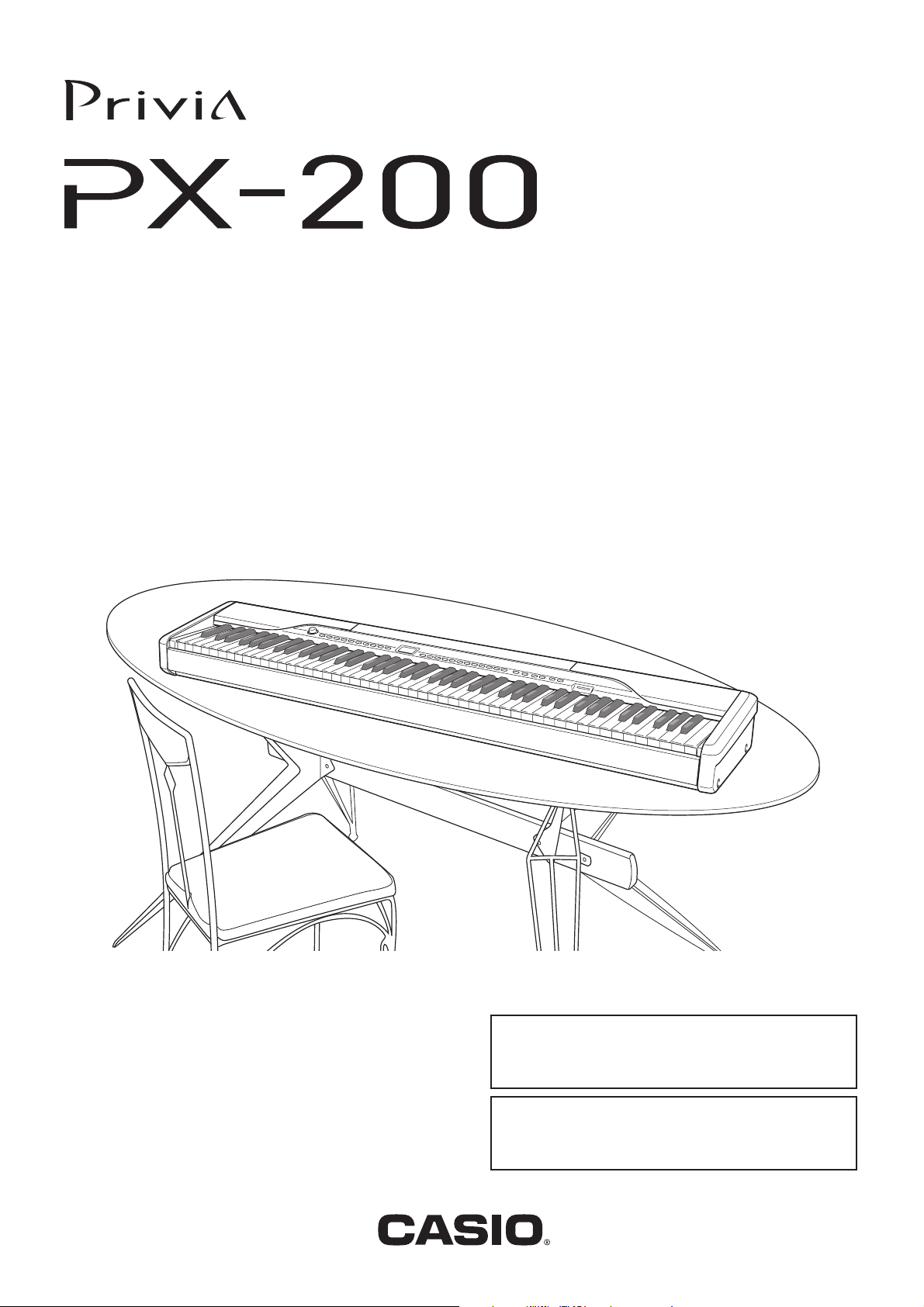
PX200ES1C
ES
USER’S GUIDE
GUÍA DEL USUARIO
Please keep all information for future reference.
Guarde toda información para tener como referencia futura.
Safety Precautions
Before trying to use the piano, be sure to read
the separate “Safety Precautions”.
Precauciones de seguridad
Antes de intentar usar el piano, asegúrese de
leer las “Precauciones de seguridad” separadas.
Impor tant!
Please note the following important information before using this product.
• Before using the AD-12 Adaptor to power the unit, be sure to check the AC Adaptor for any damage first. Carefully check the power cord for
breakage, cuts, exposed wire and other serious damage. Never let children use an AC adaptor that is seriously damaged.
• The product is not intended for children under 3 years.
• Use only CASIO AD-12 adaptor.
• The AC adaptor is not a toy.
• Be sure to disconnect the AC adaptor before cleaning the product.
IMPORTANT SAFETY INSTRUCTIONS
1. Read these instructions.
2. Keep these instructions.
3. Heed all warnings.
4. Follow all instructions.
5. Do not use this apparatus near water.
6. Clean only with dry cloth.
7. Do not block any ventilation openings. Install in accordance with the manufacturer’s instructions.
8. Do not install near any heat sources such as radiators, heat registers, stoves, or other apparatus (including amplifiers) that produce heat.
9. Do not defeat the safety purpose of the polarized or grounding-type plug. A polarized plug has two blades with one wider than the other.
A grounding type plug has two blades and a third grounding prong. The wide blade or the third prong are provided for your safety. If the
provided plug does not fit into your outlet, consult an electrician for replacement of the obsolete outlet.
10. Protect the power cord from being walked on or pinched particularly at plugs, convenience receptacles, and the point where they exit
from the apparatus.
11. Only use attachments/accessories specified by the manufacturer.
12. Use only with the cart, stand, tripod, bracket, or table specified by the manufacturer, or sold with the
apparatus. When a cart is used, use caution when moving the cart/apparatus combination to avoid injury
from tip-over.
13. Unplug this apparatus during lightning storms or when unused for long periods of time.
14. Refer all servicing to qualified service personnel. Servicing is required when the apparatus has been damaged in any way, such as
power-supply cord or plug is damaged, liquid has been spilled or objects have fallen into the apparatus, the apparatus has been
exposed to rain or moisture, does not operate normally, or has been dropped.
The apparatus shall not be exposed to dripping or splashing and that no objects filled with liquids, such as vases, shall be placed on the
apparatus.
The power indicator being unlit does not mean the apparatus is completely disconnected from the MAINS.
When you need to have the apparatus completely disconnected from the MAINS, you must unplug the power cord. For that purpose, locate
the apparatus in a way that secures easy access to the power cord.
Declaration of Conformity
Model Number: PX-200
Trade Name: CASIO COMPUTER CO., LTD.
Responsible party: CASIO, INC.
Address: 570 MT. PLEASANT AVENUE, DOVER, NEW JERSEY 07801
Telephone number: 973-361-5400
This device complies with Part 15 of the FCC Rules, Operation is subject to the following two conditions:
(1) This device may not cause harmful interference, and (2) this device must accept any interference received, including interference that
may cause undesired operation.
NOTICE
This equipment has been tested and found to comply with the limits for a Class B digital device, pursuant to Part 15 of the FCC Rules.
These limits are designed to provide reasonable protection against harmful interference in a residential installation. This equipment
generates, uses and can radiate radio frequency energy and, if not installed and used in accordance with the instructions, may cause
harmful interference to radio communications. However, there is no guarantee that interference will not occur in a particular installation. If
this equipment does cause harmful interference to radio or television reception, which can be determined by turning the equipment off and
on, the user is encouraged to try to correct the interference by one or more of the following measures:
• Reorient or relocate the receiving antenna.
• Increase the separation between the equipment and receiver.
• Connect the equipment into an outlet on a circuit different from that to which the receiver is connected.
• Consult the dealer or an experienced radio/TV technician for help.
FCC WARNING
Changes or modifications not expressly approved by the party responsible for compliance could void the userís authority to operate the
equipment.
CASIO Europe GmbH
Bornbarch 10, 22848 Norderstedt, Germany
This mark applies in EU countries only.
E-1
Contents
General Guide...........................E-2
Installing the Music Stand ..................................E-3
Using the TEMPO/SETTING Button .................. E-4
/NO Button and /YES Button ..................E-4
Power Outlet .............................E-5
Using an AC Adaptor .........................................E-5
Connections..............................E-6
Connecting Headphones.................................... E-6
Connecting a Pedal............................................E-6
Connecting Audio Equipment or an Amplifier ....E-7
Bundled and Optional Accessories .................... E-7
Selecting and Playing a Tone
....E-8
Selecting a Main Tone ....................................... E-8
Selecting a Various tone, GM tone, and
Drum set.............................................................E-9
Adjusting the Brilliance of a Tone.......................E-9
Layering Two Tones.........................................E-10
Splitting the Keyboard between Two Tones.....E-10
Using Effects....................................................E-11
Using the Metronome.......................................E-12
Playing a Rhythm ...................E-13
Selecting a Rhythm.......................................... E-13
Using Auto Accompaniment.............................E-13
Playing Back Built-in Songs
....E-17
Playing Back All of the Built-in Songs ..............E-17
Playing Back a Specific Music Library Song....E-18
Skipping Back through a Song.........................E-18
Skipping Forward through a Song....................E-19
Practicing with a Music Library Song ...............E-19
Recording and Play Back ......E-20
Songs and Tracks ............................................E-20
Recording Your Keyboard Play........................E-21
Playing Back from Digital Piano Memory.........E-22
Deleting Recorded Data...................................E-23
Other Settings.........................E-24
Configuring Settings.........................................E-24
Secondary Parameter Reference.....................E-26
Connecting to a Computer ....E-29
Connecting to the MIDI Terminal .....................E-29
Connecting to the USB Port .............................E-29
USB Mode and MIDI Mode ..............................E-30
Expanding the Selections in the
Music Library....................................................E-31
Using an SD Memory Card ....E-32
Inserting and Removing an
SD Memory Card .............................................E-33
Playing Back a File Stored on an
SD Memory Card .............................................E-34
Transferring Song Data from an
SD Memory Card to Digital Piano Memory ......E-34
Saving Song Data Recorded on the
Digital Piano to an SD Memory Card ...............E-36
Formatting an SD Memory Card ......................E-37
SD Memory Card Errors...................................E-38
Reference ................................E-39
Troubleshooting ...............................................E-39
Product Specifications......................................E-41
Operating Precautions .....................................E-42
Appendix ...................................A-1
Tone List ............................................................A-1
Drum Assignment List ........................................A-2
Rhythm List ........................................................A-3
Song List ............................................................A-3
Fingered Chord Chart ........................................A-4
MIDI Implementation Chart
Company and product names used in this
manual may be registered trademarks of others.
PX200_e.book 1 ページ 2006年10月13日 金曜日 午後12時5分
E-2
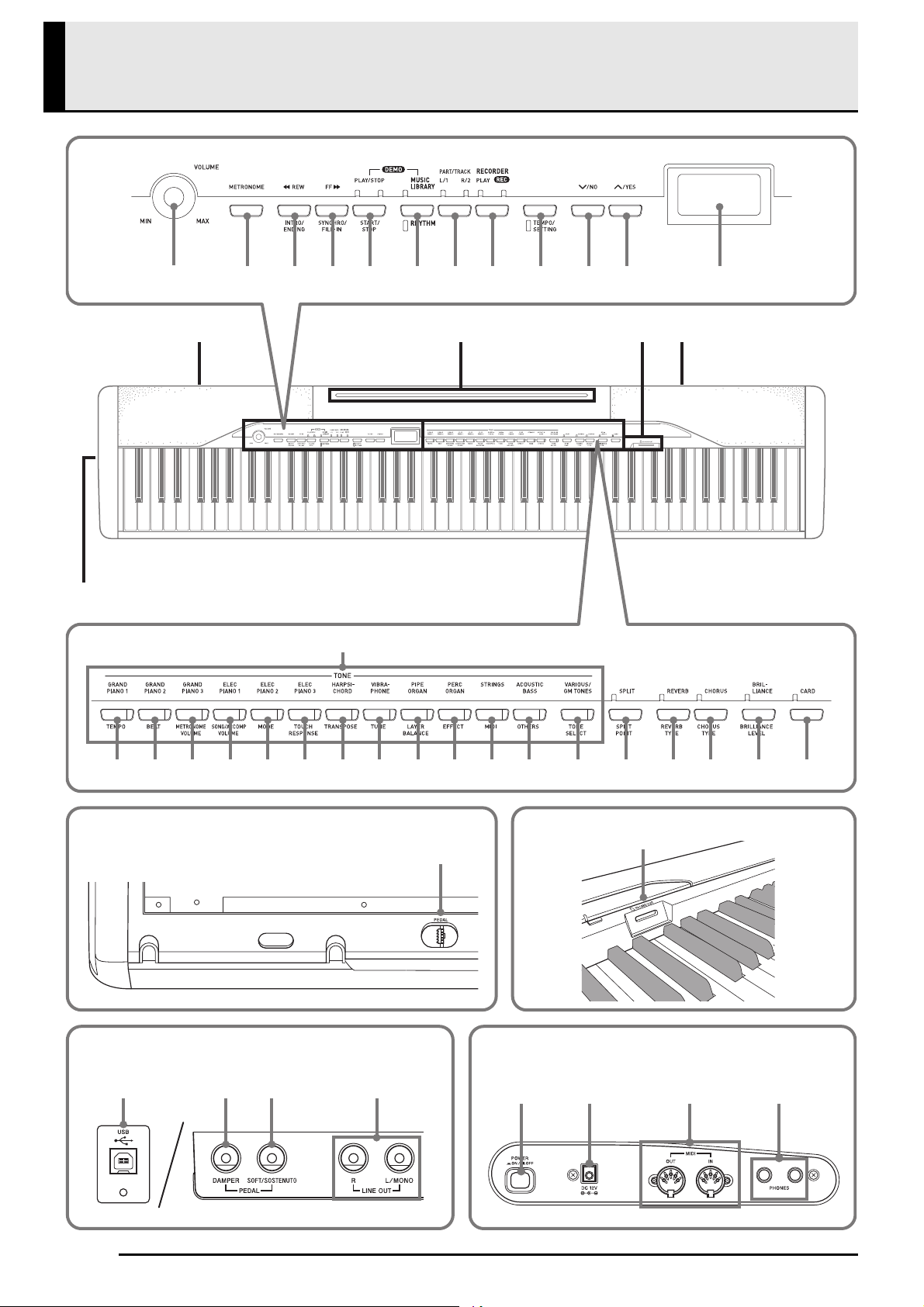
General Guide
∗1
∗4
∗3∗2∗5
ds
bn
dt ek el
123 4 5 6 7 8 9 bk bl bm
bo bp bq br bs bt ck cl cm cn co cp cq cr cs ct dk dl
dp dqdo
dm
dr
dn
*3
Back
*1
Bottom
*2
*4
Left Side
PX200_e.book 2 ページ 2006年10月13日 金曜日 午後12時5分
General Guide
E-3
NOTE
• The names shown here are always indicated in bold when they appear within the text of this manual.
NOTE
• Each chapter of this manual starts with an illustration of the digital
piano’s console, which shows the buttons and other controllers you
need to operate.
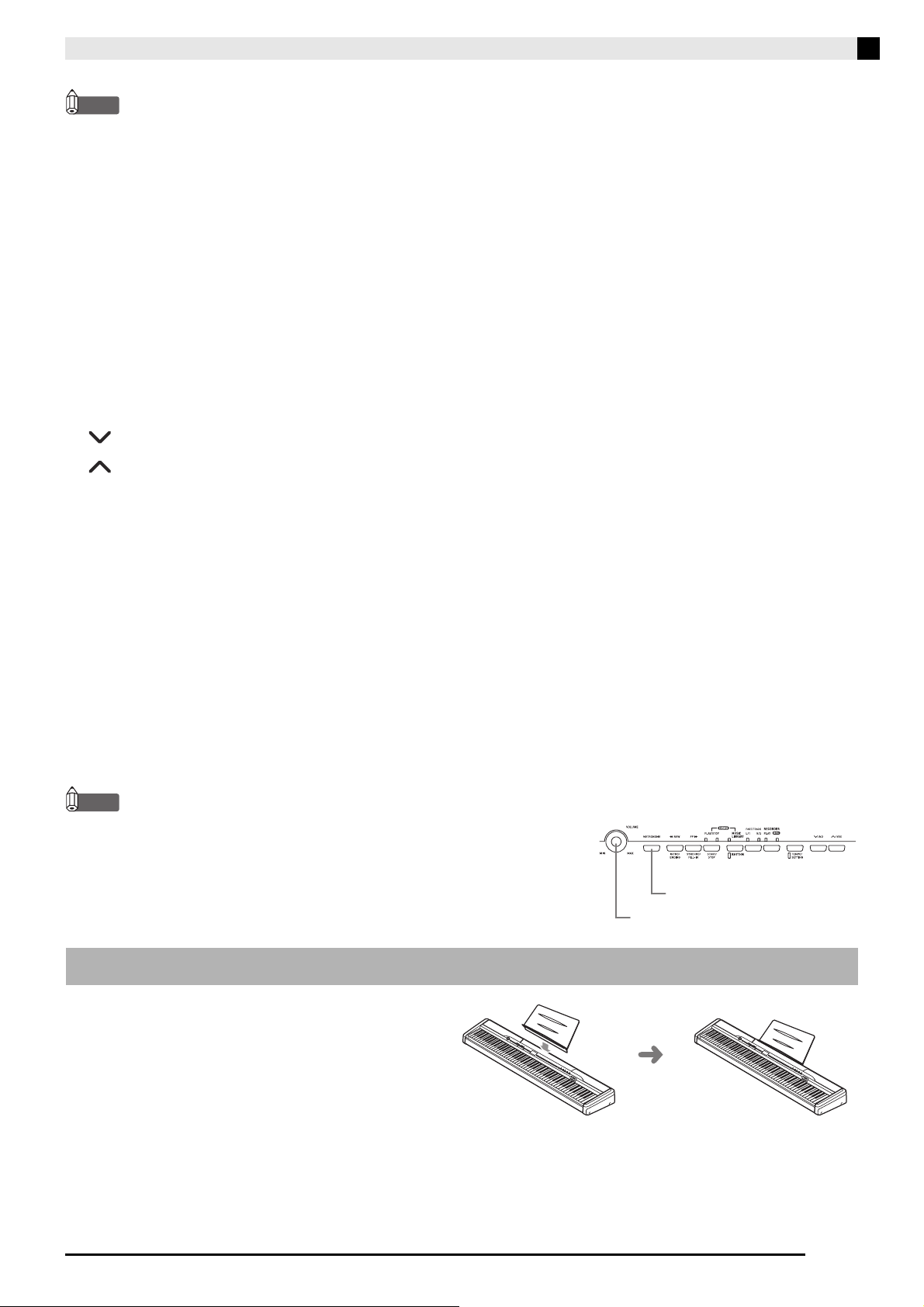
Insert the bottom of the music stand into the
groove on the top of the digital piano’s
console.
1 VOLUME controller
2 METRONOME button
3 WW
WWWW
WWREW, INTRO/ENDING button
4 FFXX
XXXX
XX, SYNCHRO/FILL-IN button
5 PLAY/STOP, START/STOP button
6 MUSIC LIBRARY, RHYTHM button
7 PART/TRACK button
8 RECORDER button
9 TEMPO/SETTING button
bk
/NO button
bl
/YES button
bm Display
bn TONE buttons
bo TEMPO button
bp BEAT button
bq METRONOME VOLUME button
br SONG/ACCOMP VOLUME button
bs MODE button
bt TOUCH RESPONSE button
ck TRANSPOSE button
cl TUNE button
cm LAYER BALANCE button
cn EFFECT button
co MIDI button
cp OTHERS button
cq TONE SELECT button
cr SPLIT, SPLIT POINT button
cs REVERB, REVERB TYPE button
ct CHORUS, CHORUS TYPE button
dk BRILLIANCE, BRILLIANCE LEVEL button
dl CARD button
dm Pedal connector
dn SD memory card slot
do USB port
dp DAMPER PEDAL jack
dq SOFT/SOSTENUTO PEDAL jack
dr LINE OUT R, L/MONO jacks
ds POWER button
dt DC 12V terminal
ek MIDI OUT/IN terminals
el PHONES jack
*5
Installing the Music Stand
METRONOME
VOLUME
PX200_02_e.fm 3 ページ 2006年11月1日 水曜日 午前11時20分
E-4
General Guide
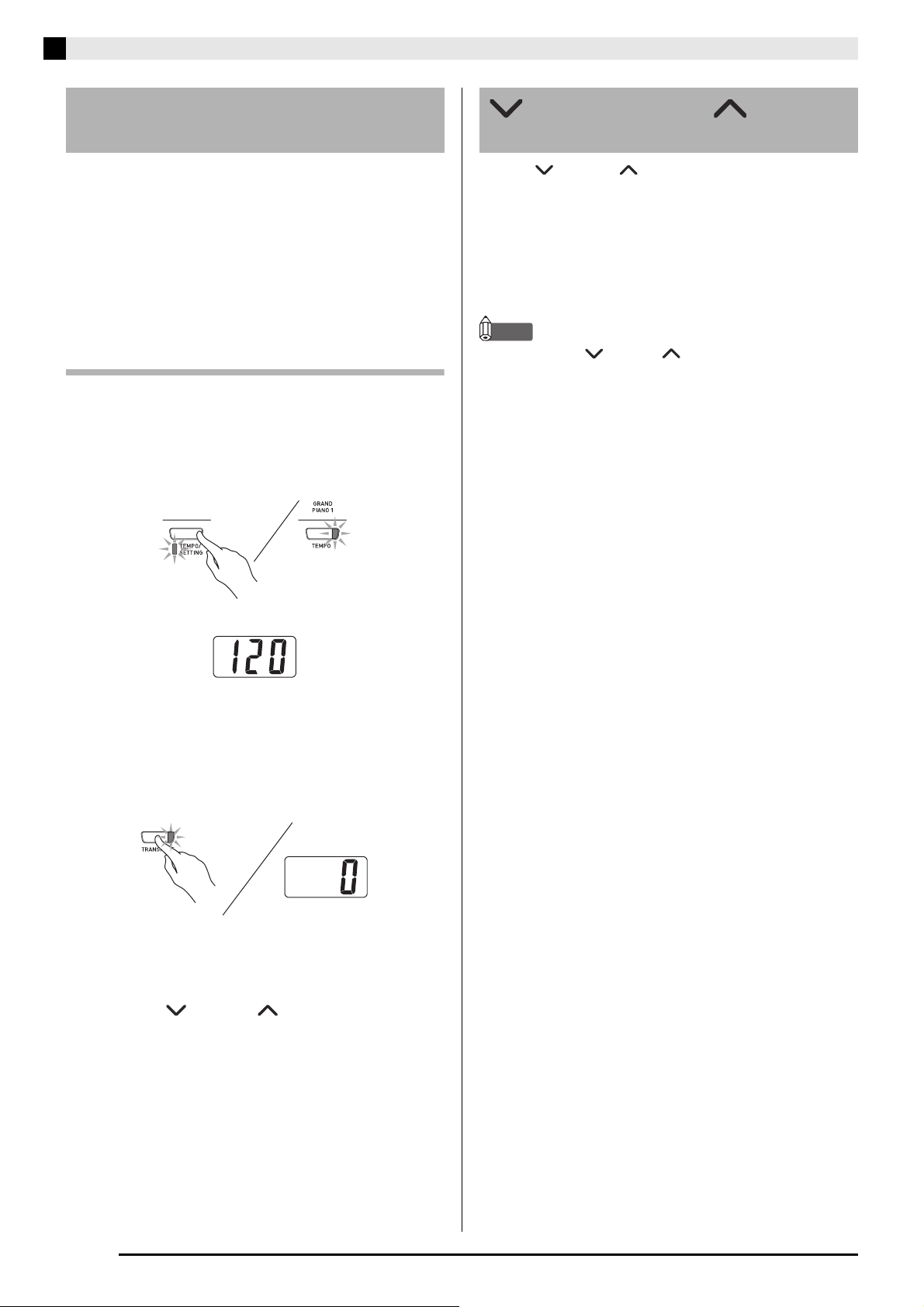
Normally when you press a button, it will change the
setting or perform the operation marked above the
button. Note that there also are secondary parameters
(settings) marked below some buttons that you can
select using the TEMPO/SETTING button.
• For details about the parameters you can configure
using the TEMPO/SETTING button, see
“Secondary Parameter Reference” on page E-26.
To select a secondary button parameter
1.
Press the TEMPO/SETTING button.
• This will cause the lamp below the TEMPO/
SETTING button to flash.
•The GRAND PIANO 1/TEMPO button’s lamp also
will flash.
Example:
2.
Press the button that corresponds to the
parameter you want to select.
• This will cause the button’s lamp to flash.
Example: TRANSPOSE button
• If you want to adjust the tempo, you can skip this
step because the GRAND PIANO 1/TEMPO button’s
lamp will flash already.
3.
Use the /NO and /YES buttons to
change the setting of the selected parameter.
4.
After you are finished, press the TEMPO/
SETTING button again.
• This will cause the TEMPO/SETTING lamp and the
lamp of the selected parameter button to go out.
Use the /NO and /YES buttons to change a
displayed setting.
z
zz
z Holding down either button changes the value at
high speed.
Example: See “Selecting a Various tone, GM tone, and
Drum set” on page E-9.
NOTE
• Pressing the /NO and /YES buttons at the same
time will return the displayed setting to its default.
Using the TEMPO/SETTING
Button
/NO Button and /YES
Button
PX200_02_e.fm 4 ページ 2006年11月1日 水曜日 午前11時20分
E-5
Power Outlet
Your digital piano runs on standard household power.
Be sure to turn off power whenever you are not using
the digital piano.
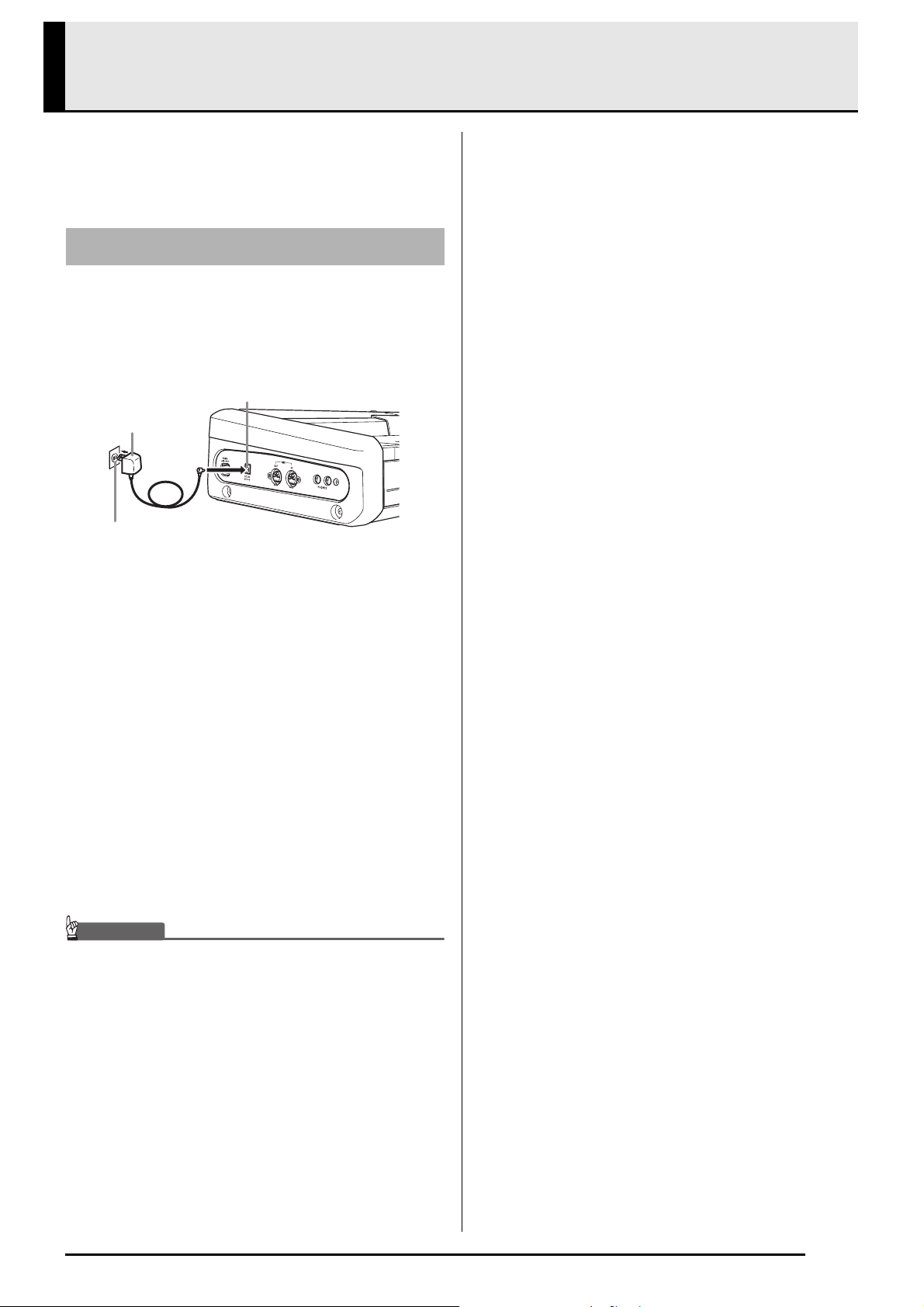
Use only the AC adaptor that is specified for use with
this digital piano.
Specified AC Adaptor: AD-12
Left Side
Note the following important precautions to avoid
damage to the power cord.
During Use
• Never pull on the cord with excessive force.
• Never repeatedly pull on the cord.
• Never twist the cord at the base of the plug or
connector.
• The power cord should not be stretched tight while
it is in use.
During Movement
• Before moving the digital piano, be sure to unplug
the AC adaptor from the power outlet.
During Storage
• Loop and bundle the power cord, but never wind it
around the AC adaptor.
IMPORTANT!
• Make sure the digital piano is turned off before plugging
in or unplugging the AC adaptor.
• The AC adaptor will become warm to the touch after very
long use. This is normal and does not indicate
malfunction.
Using an AC Adaptor
AC adaptor
AD-12
AC adaptor terminal
Household power
PX200_e.book 5 ページ 2006年10月13日 金曜日 午後12時5分
E-6
Connections
IMPORTANT!
• Whenever connecting something to the digital piano, first
use the VOLUME controller to set the volume to a low
level. After connecting, you can adjust the volume to the
level you want.
• Whenever you connect any device to the digital piano, be
sure to read the user documentation that comes with the
device.
Left Side
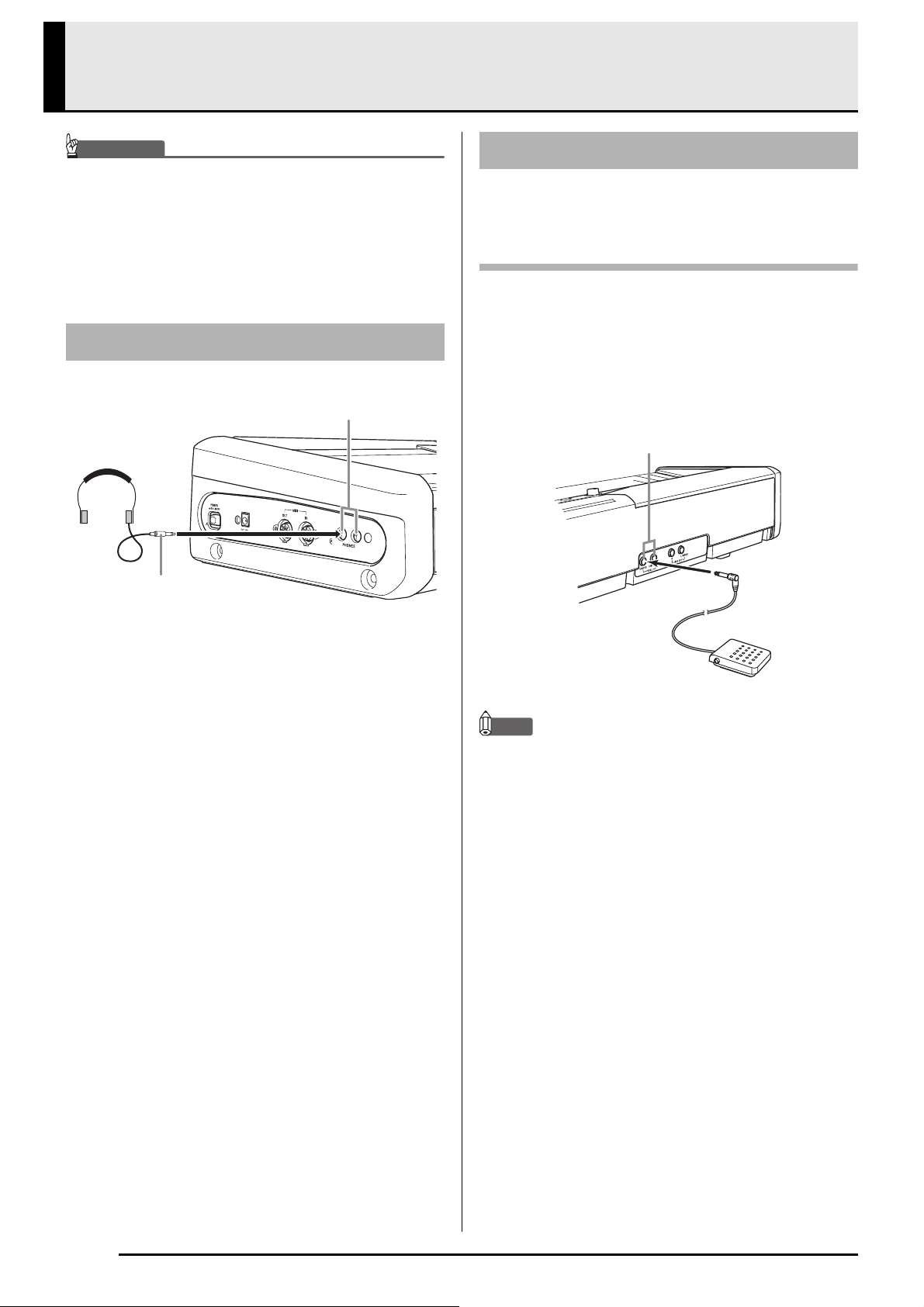
Connect commercially available headphones to the
PHONES jack. Connecting headphones to the
PHONES jack cuts off output to the speakers, which
means you can practice even late at night without
bothering others. To protect your hearing, make sure
that you do not set the volume level too high when
using headphones.
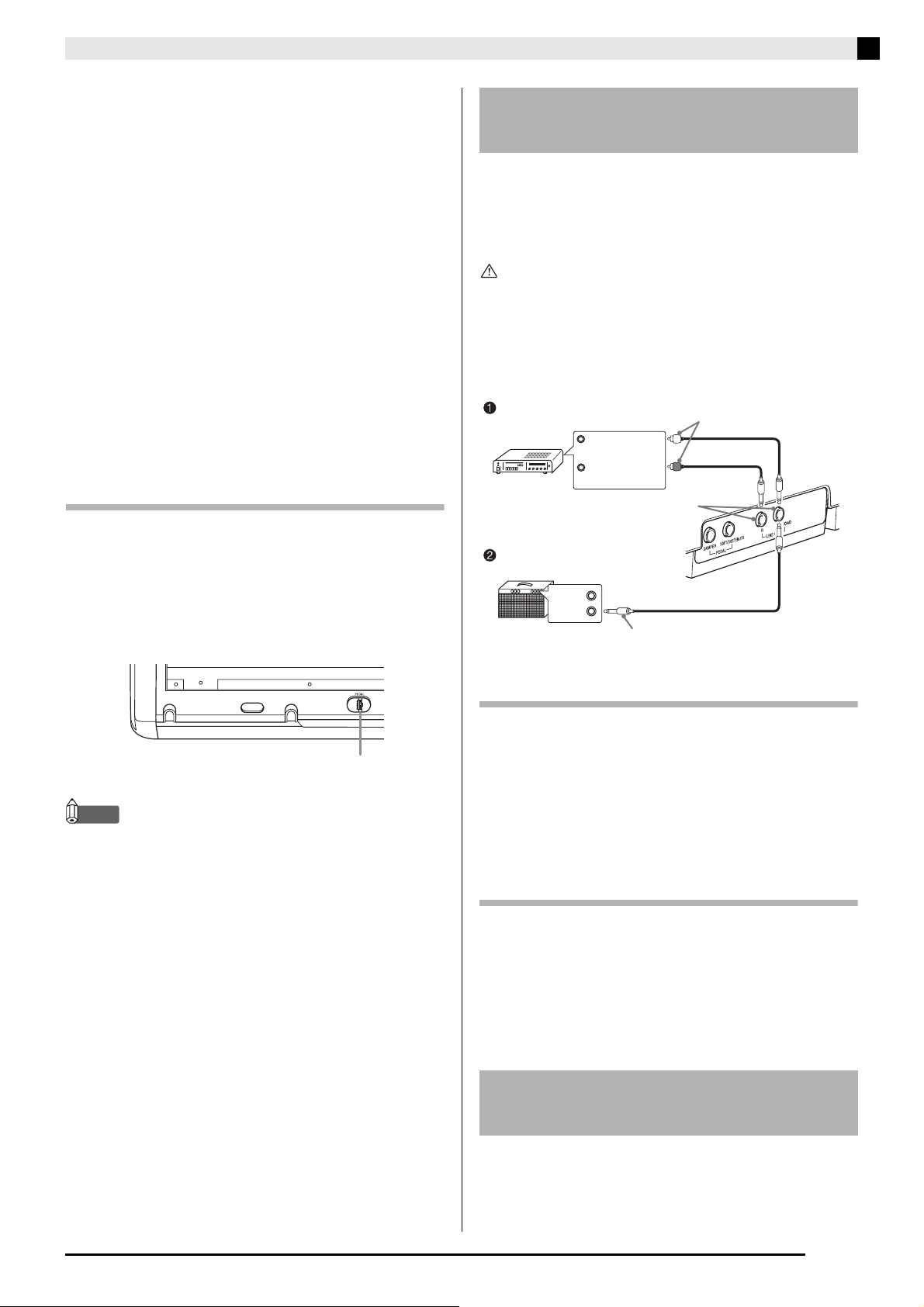
The back of the digital piano has two pedal jacks, one
for a damper pedal and one for a soft/sostenuto pedal.
Connecting to the PEDAL Jack
Depending on the type of operation you want the
pedal (SP-3) to perform, connect the pedal’s cable to the
digital piano’s DAMPER PEDAL jack or SOFT/
SOSTENUTO PEDAL jack. If you want to use both
jacks at the same time, you need to purchase another
optionally available pedal.
Back
NOTE
• You can specify the type of operation that should be
performed by the pedal connected to the SOFT/
SOSTENUTO PEDAL jack. See “Other Settings” on
page E-24 for more information.
Connecting Headphones
PHONES jack
Commercially available
headphones
Mini plug
Connecting a Pedal
PEDAL jacks
SP-3
PX200_02_e.fm 6 ページ 2006年11月1日 水曜日 午前11時21分
Connections
E-7
Pedal Functions
z
zz
z Damper Pedal
Pressing the damper pedal while playing will cause
the notes you play to reverberate for a very long
time.
• When GRAND PIANO 1, GRAND PIANO 2, or
GRAND PIANO 3 is selected as the tone, pressing
this pedal will cause notes to reverberate just like
the damper pedal on an acoustic grand piano.
z
zz
z Soft Pedal
Pressing this pedal suppresses notes played on the
keyboard after the pedal was pressed, and makes
them sound softer.
z
zz
z Sostenuto Pedal
Only the notes that are played while this pedal are
depressed are sustained until the pedal is released.
Pedal Connector
You can connect the optionally available 3-Pedal Unit
(SP-30) to the pedal connector on the bottom of the
digital piano. You can then use the pedals for
expression that is similar to that available on an
acoustic piano.
Bottom
NOTE
• The SP-30 Pedal Unit supports half-pedal operation
(pressing the pedal part way), and you can adjust the
amount of the pedal effect applied when the pedal is
pressed part way. See “Other Settings” on page E-24 for
more information.
• The optionally available CS-66P special stand is required
in order to use the SP-30 Pedal Unit.
You can connect audio equipment or a music amplifier
to the digital piano and then play through external
speakers for more powerful volume and better sound
quality.
CAUTION
• The digital piano automatically adjusts sound output to
optimize for headphone output (when headphones are
connected) or built-in speaker output (when headphones
are not connected). This also will cause a change in the
output quality from the digital piano’s LINE OUT R and
L/MONO jacks.
Connecting Audio Equipment (Figure 1)
R (Right) is the right channel and L/MONO (Left) is the
left channel. Use commercially available connection
cords to connect as shown in Figure 1. Normally, you
should set the input selector of the audio equipment to
the terminal where the digital piano is connected (AUX
IN, etc.) Adjust volume using the digital piano’s
VOLUME controller.
Connecting a Music Amplifier (Figure 2)
R (Right) is the right channel and L/MONO (Left) is the
left channel. Connecting to the L/MONO jack only
outputs a mixture of both channels. Use a
commercially available connection cord to connect as
shown in Figure 2. Adjust volume using the digital
piano’s VOLUME controller.
Use only accessories that are specified for use with this
digital piano.
Use of unauthorized accessories creates the risk of fire,
electric shock, and personal injury.
Pedal connector
Connecting Audio Equipment
or an Amplifier
Bundled and Optional
Accessories
INPUT 1
INPUT 2
Audio amplifier
AUX IN jack, etc.
Guitar amplifier, keyboard
amplifier, etc.
Pin plug
LEFT
(White)
RIGHT
(Red)
Standard jack
Standard plug
PX200_02_e.fm 7 ページ 2006年11月1日 水曜日 午前11時32分
E-8
Selecting and Playing a Tone
Your digital piano has the following types of tones
built in.
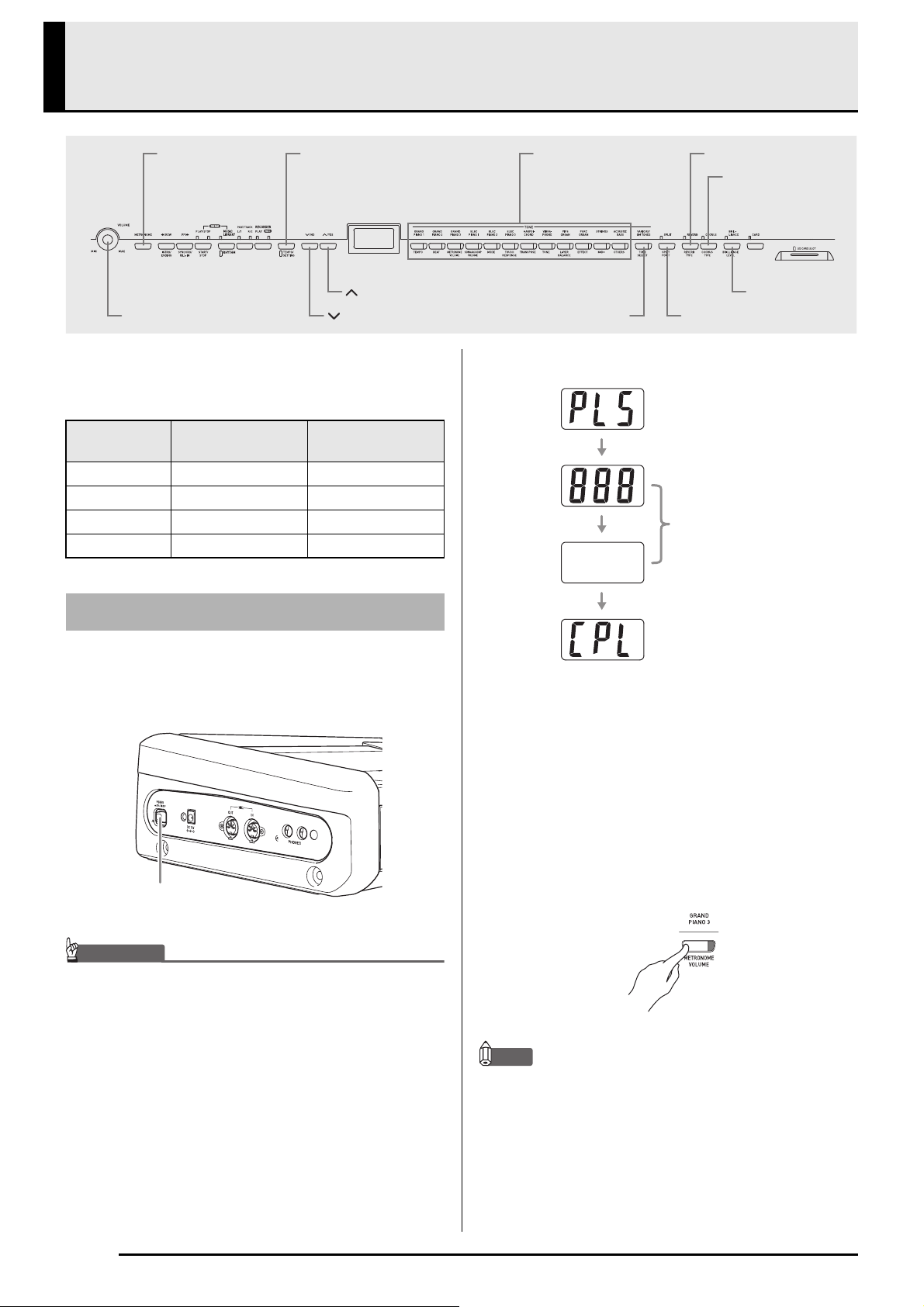
1.
Press the POWER button.
Left Side
IMPORTANT!
• When you turn on the digital piano, it performs a power
up operation in order to prepare its system. The power up
operation takes about 10 seconds, and is indicated by
the following messages appearing on the display.
2.
Use the VOLUME controller to adjust the
volume level.
3.
Press one of the 12 TONE buttons to select
the tone you want.
• The names of the main tones are marked above the
TONE buttons.
• This will cause the lamp of the selected tone’s button
to light.
Example: GRAND PIANO 3
NOTE
• The DSP effect (pages E-25 and E-27) will be applied if
you select a tone with DSP.
• Note that the digital piano’s DSP resources are limited.
Because of this, selecting a tone with DSP can cause notes
that are currently being played to cut off (if they are
being played using a tone with DSP), or it can remove the
DSP effect from an operation (layer, split, demo song)
that was previously assigned a tone with DSP.
VARIOUS/GM TONES
CHORUS
BRILLIANCE
VOLUME /NO SPLIT
TONE
METRONOME TEMPO/SETTING REVERB
/YES
Tone
Numbers
Tone Type Number of Tones
— Main Tones 12
001 to 020 Various 20
021 to 148 GM (General MIDI) 128
149, 150 Drum Sets 2 sets
Selecting a Main Tone
POWER button
(Please wait!)
(Preparing system)
(Complete!)
PX200_02_e.fm 8 ページ 2006年11月1日 水曜日 午前11時34分
Selecting and Playing a Tone
E-9
You can use the following procedure to assign one of
the 20 Various tones, 128 GM tones, or 2 Drum sets to
the VARIOUS/GM TONES button. After that you can
select the assigned tone by pressing the VARIOUS/
GM TONES button.
1.
In the Tone List on page A-1, find the tone
number of the Various tone, GM tone, and
Drum set you want to assign to the
VARIOUS/GM TONES button.
Example: 003 DANCE PIANO
2.
Press the VARIOUS/GM TONES button.
• This will cause the lamp above the button to light.
• To find out the tone that is currently assigned to the
VARIOUS/GM TONES button, hold down the
button. This will cause the number of its tone to
appear on the display. Releasing the button will
return to the song or rhythm number display.
Example: 001 MELLOW PIANO
3.
To change the tone assigned to the
VARIOUS/GM TONES button, hold down the
button as you use the /NO and /YES
buttons to scroll through the tone numbers on
the display. Display the number of the tone
you want to assign to the button.
• Holding down either button changes the value at
high speed.
NOTE
• See “Other Settings” on page E-24 for information about
another method you can use to assign a tone to the
VARIOUS/GM TONES button.
• The tone you assign to the VARIOUS/GM TONES
button is retained until you turn off the digital piano.
• If a drum set is assigned to the VARIOUS/GM TONES
button, keyboard keys sound drum sounds when you
press them while the lamp above the VARIOUS/GM
TONES button is lit. See page A-2 for information about
the drum sounds that are assigned to each of the
keyboard keys.
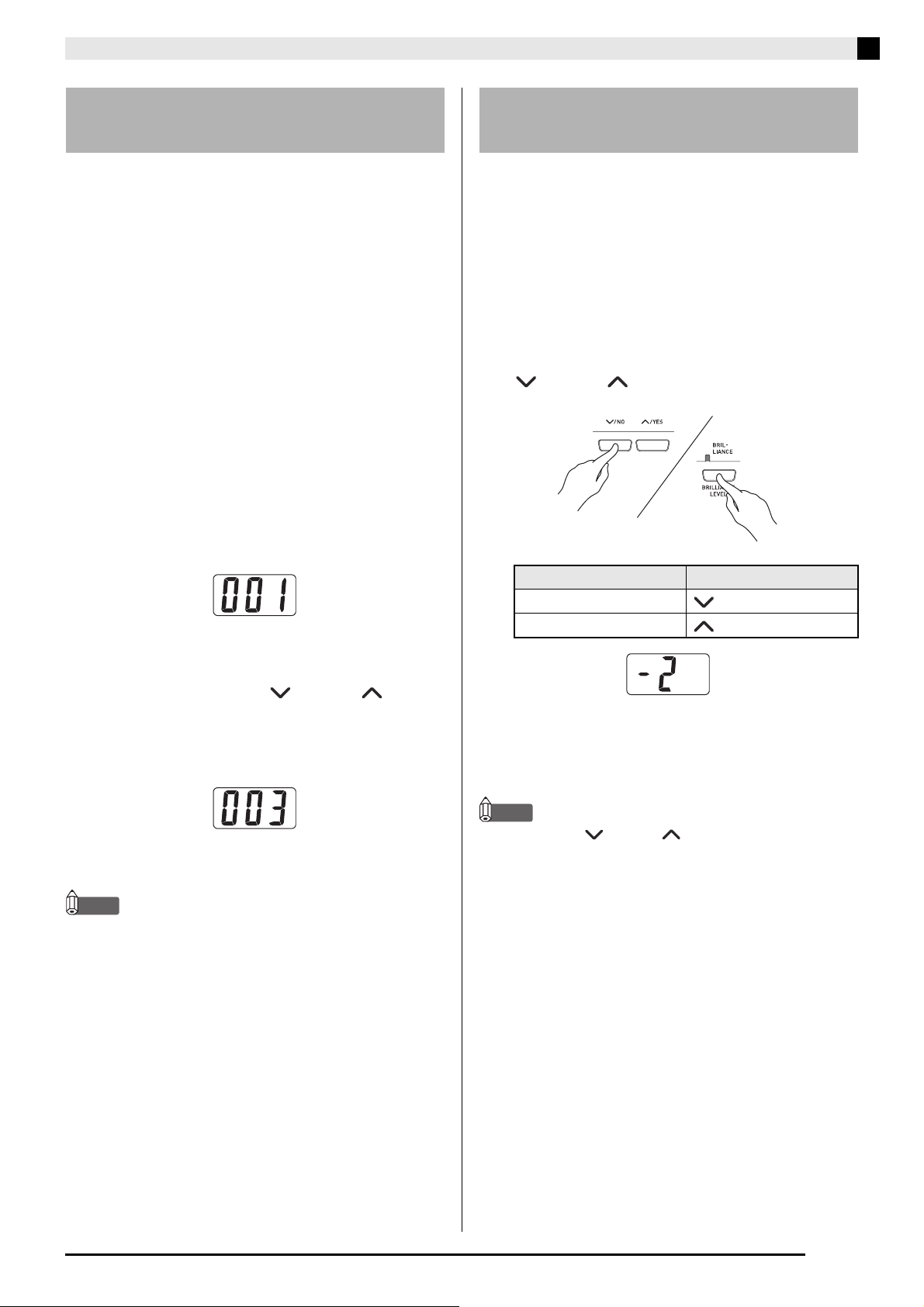
Use the following procedure to adjust the brilliance of a
tone.
1.
Press the BRILLIANCE button.
• This will cause the lamp above the button to light,
indicating that the brilliance effect is being applied.
This also will change the brilliance of the tone in
accordance with the initial setting.
2.
To change the brilliance setting, hold down
the BRILLIANCE button as you press the
/NO and /YES buttons.
3.
To cancel the brilliance effect, press the
BRILLIANCE button again so its lamp goes
out.
NOTE
• Pressing the /NO and /YES buttons at the same
time will return the displayed setting to its default.
• See “Other Settings” on page E-24 for information about
another method you can use to configure brilliance
settings.
Selecting a Various tone, GM
tone, and Drum set
Adjusting the Brilliance of a
Tone
To do this: Press this button:
Make the tone softer
Make the tone sharper
PX200_02_e.fm 9 ページ 2006年11月1日 水曜日 午前11時34分
E-10
Selecting and Playing a Tone
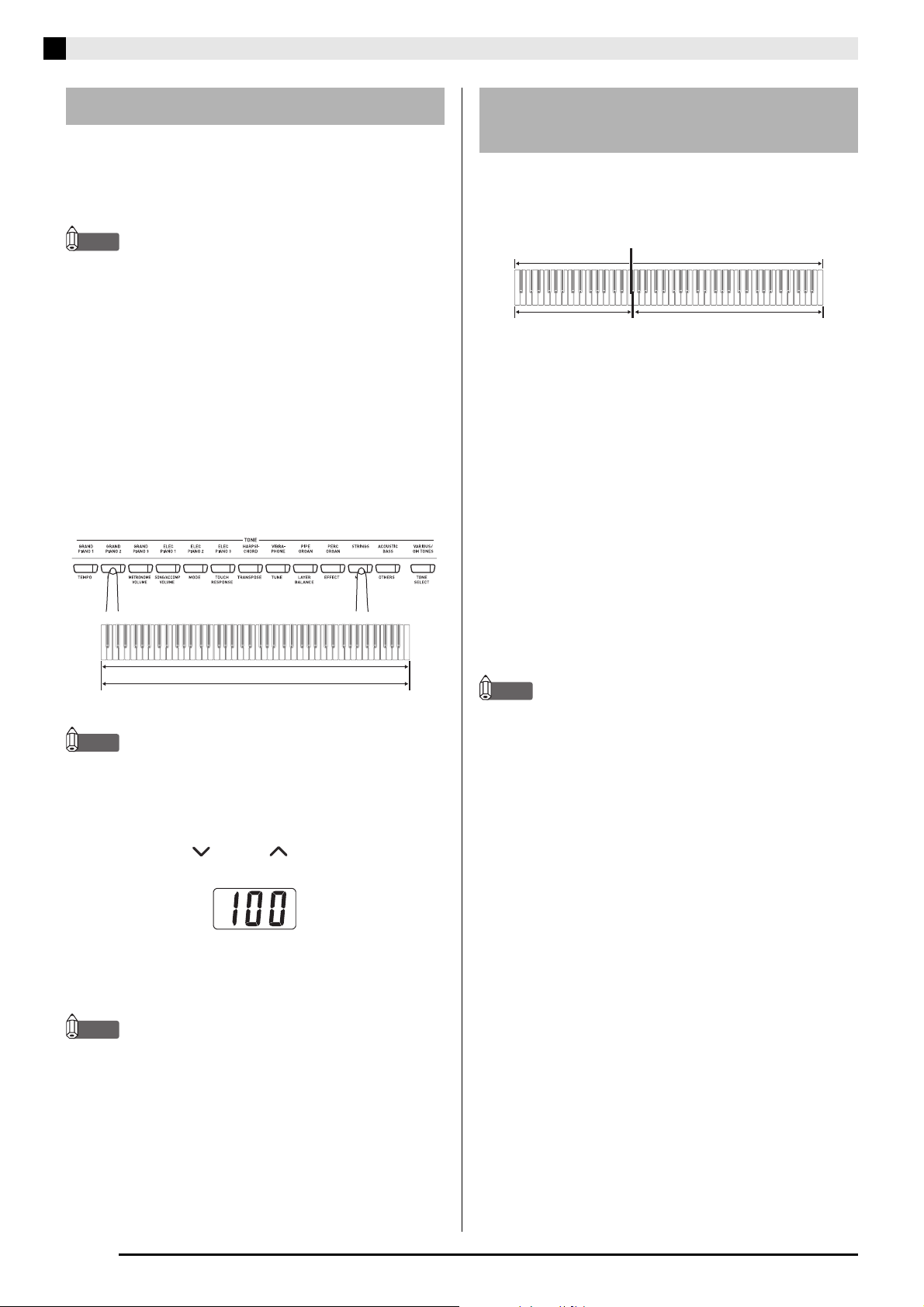
Use the following procedure to layer two tones, so they
sound at the same time. The tone you specify first is
called the “main tone”, while the tone you specify
second is called the “layered tone”.
NOTE
• To use a Various tone or GM tone as the main tone, you
must first assign it to the VARIOUS/GM TONES button
(page E-9).
• You can use a Various tone or GM tone assigned to the
VARIOUS/GM TONES button as either the main tone
or the layered tone. You cannot use Various/GM tones at
the same time for both the main tone and layered tone.
1.
While holding down the TONE button of the
tone that corresponds to the main tone, press
the button that corresponds to the layered
tone.
Example: While holding down the GRAND PIANO 2
button, press the STRINGS button.
NOTE
• If you press the VARIOUS/GM TONES button to assign
its tone as the layered (second) tone, the number of the
currently assigned tone will appear on the display when
you hold down the VARIOUS/GM TONES button.
• While holding down the VARIOUS/GM TONES button,
you can use the /NO and /YES buttons to scroll
through tone numbers and change the tone assignment.
2.
To unlayer the keyboard, press any one of
the TONE buttons.
NOTE
• You can adjust the balance between the main tone and
layered tone. See “Other Settings” on page E-24 for more
information.
You can assign different tones to keys on the left side
(low range) and the right side (high range) of the
keyboard.
1.
Press the TONE button of the tone you want
to select for the high range.
Example: GRAND PIANO 2
2.
Press the SPLIT button.
• This will cause the SPLIT lamp to light.
3.
Press the TONE button of the tone you want
to select for the low range.
Example: STRINGS
4.
After you are finished using the split
keyboard, press the SPLIT button again to
unsplit it.
• This will cause the SPLIT lamp to go out.
NOTE
• You can configure the keyboard so it is layered with two
tones in the high range. To do this, first perform the layer
operation (page E-10). After that, split the keyboard as
described above.
Layering Two Tones
GRAND PIANO 2
STRINGS
Splitting the Keyboard
between Two Tones
STRINGS GRAND PIANO 2
Low range High Range
Split point
PX200_e.book 10 ページ 2006年10月13日 金曜日 午後12時5分
Selecting and Playing a Tone
E-11
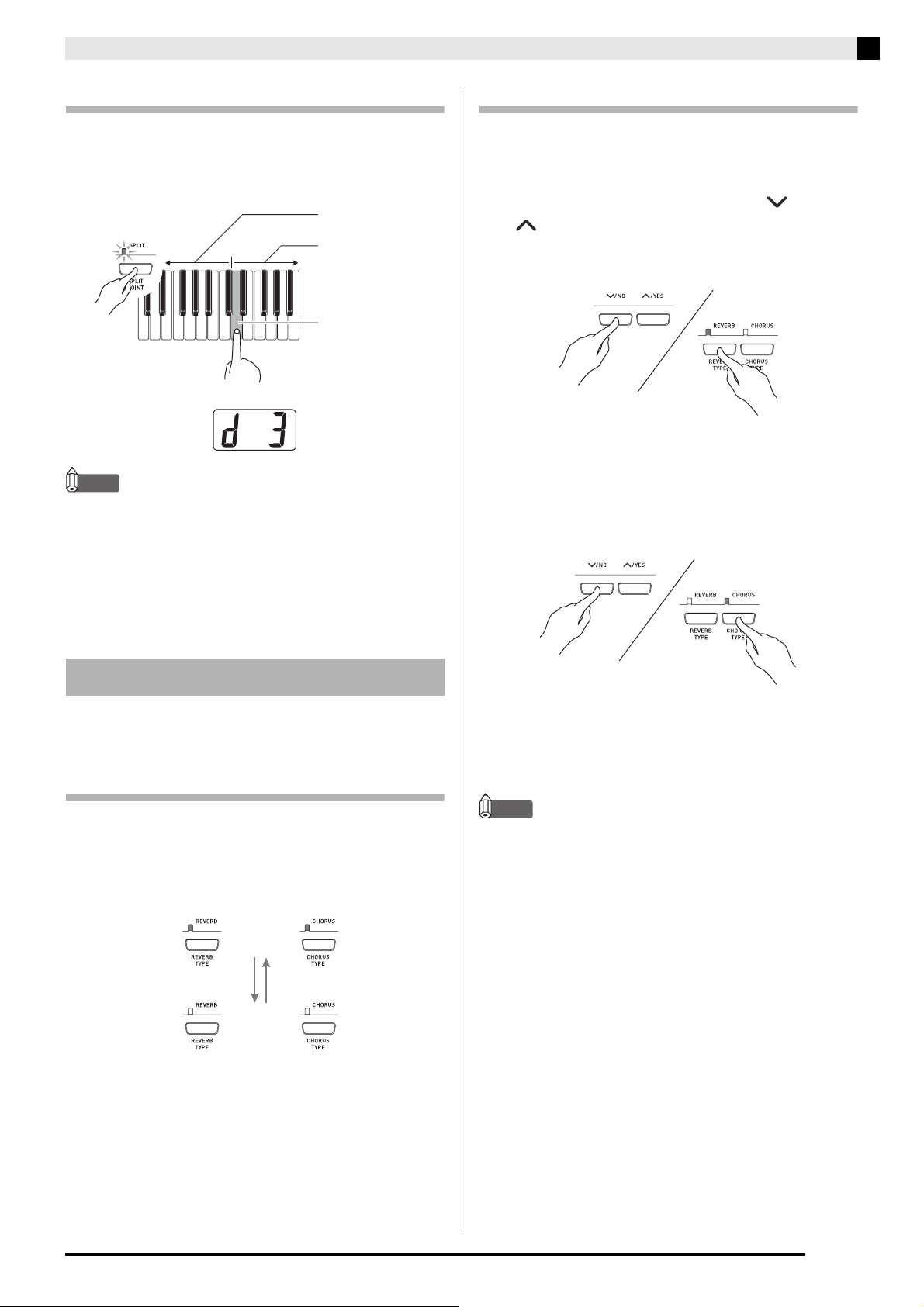
To specify the keyboard split point
1.
While holding down the SPLIT button, press
the keyboard key where you want the left limit
of the high range (right) tone to be.
NOTE
• The split point also is the boundary between the
accompaniment keyboard range (pages E-14 to E-16) and
the melody keyboard range. You can change the location
of the split point, which also changes the sizes of the
keyboards.
• See “Other Settings” on page E-24 for information about
another method you can use to change the split point.
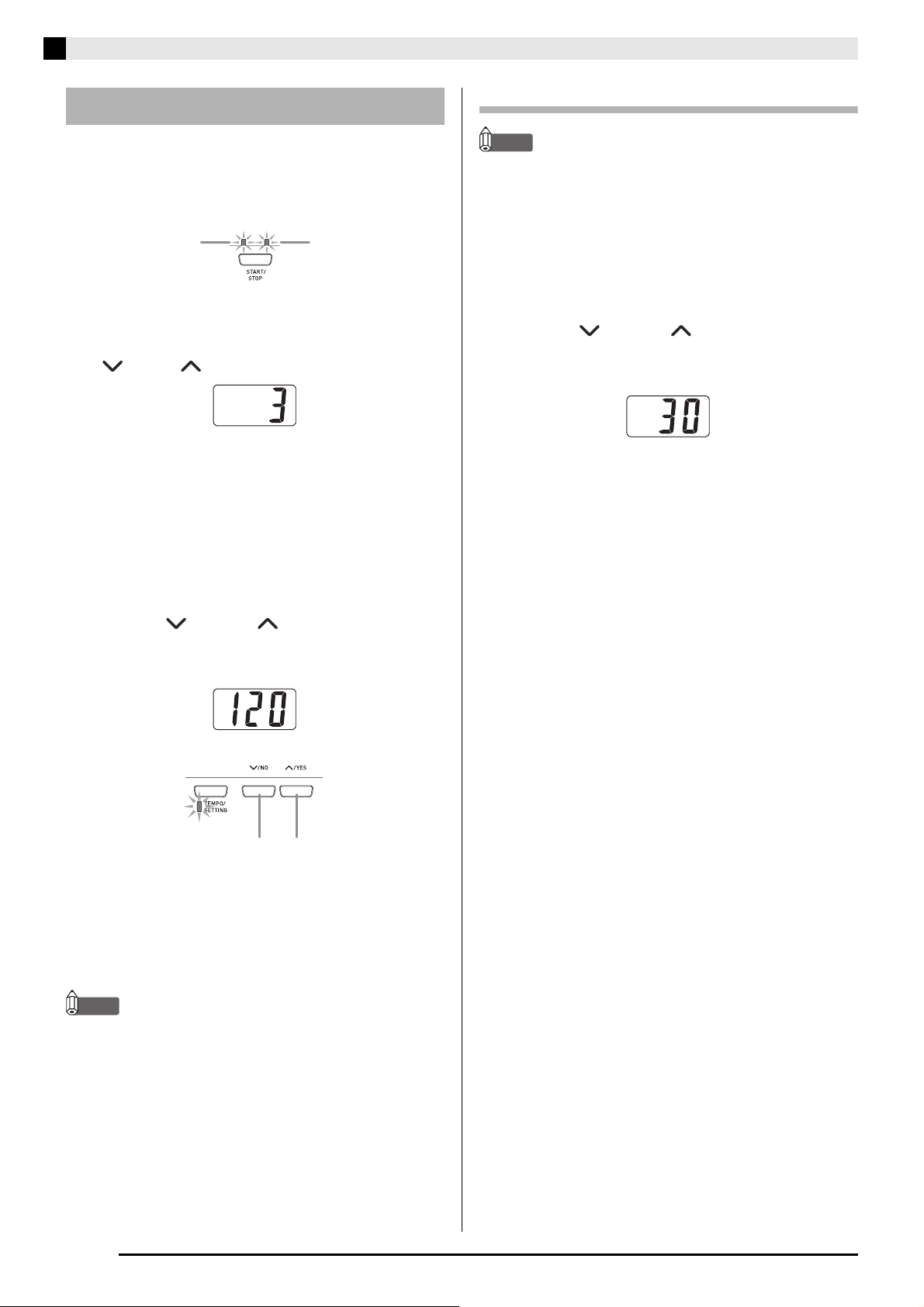
Reverb. . . . . Makes your notes resonate.
Chorus . . . . Adds more breadth to your notes.
To turn effects on and off
1.
Use the REVERB and CHORUS buttons to
turn the effects on and off as shown below.
• The lamps above the buttons show whether the
effects are on or off.
To change the effect type
1.
Turn on REVERB or CHORUS.
2.
While holding down the effect button
(REVERB or CHORUS), use the /NO and
/YES buttons to change the effect type as
described below.
[Reverb]
•Reverb Value
1: Room
2: Small Hall
3: Large Hall
4: Stadium
[Chorus]
•Chorus Value
1: Light Chorus
2: Medium Chorus
3: Deep Chorus
4: Flanger (Whooshing effect)
NOTE
• While the keyboard is layered, the chorus on/off setting
affects the layered tone only. While the keyboard is split,
the chorus on/off setting affects the low range tone only.
Using Effects
High Range
High range leftmost key
Low range
Flashing
Off
Off
Lit
On
PX200_02_e.fm 11 ページ 2006年11月1日 水曜日 午前11時35分
E-12
Selecting and Playing a Tone
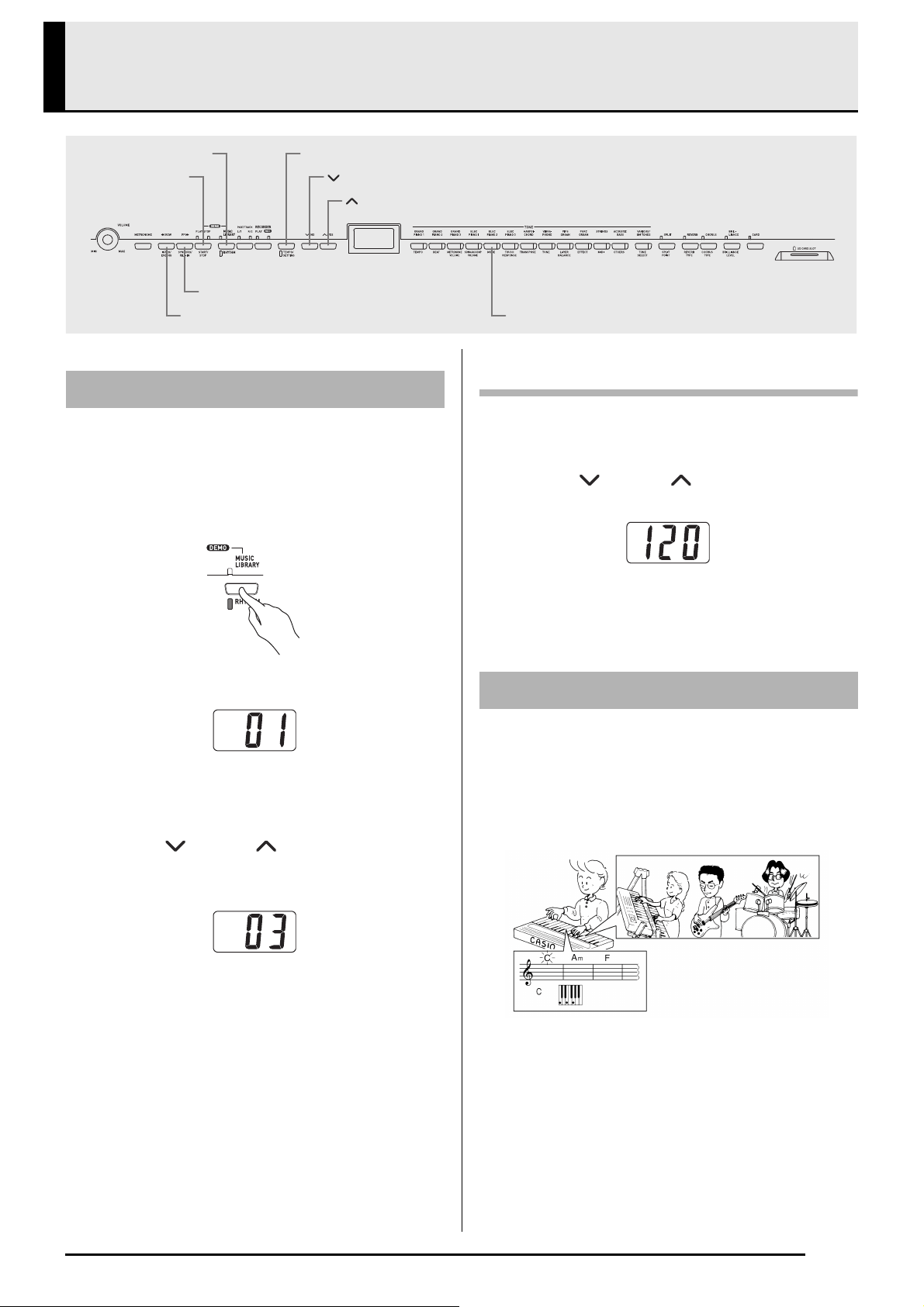
1.
Press the METRONOME button.
• This will start the metronome.
• The two lamps above the START/STOP button will
flash along with the metronome beats.
2.
To change the beat, hold down the
METRONOME button as you press the
/NO or /YES button.
• You can select a beat value in the range of 2 through
6. A chime sounds as the first beat of each measure,
and the remaining beats sound as clicks. Specifying 0
as the setting plays a straight click, without any
chime. This setting lets you practice with a steady
beat.
3.
Press the TEMPO/SETTING button.
• This will cause the button’s lamp to flash.
4.
Use the /NO and /YES buttons to
adjust the tempo in a range of 20 to 255 beats
per minute.
5.
Press the TEMPO/SETTING button again.
• This will cause the lamp above the button to go out.
6.
Press the METRONOME button again to stop
the metronome.
NOTE
• See “Other Settings” on page E-24 for information about
another method you can use to configure the metronome
setting.
To adjust the metronome volume
NOTE
• You can perform the following procedure at any time,
regardless of whether or not the metronome is sounding.
1.
Press the TEMPO/SETTING button.
• This will cause the lamp above the button to flash.
2.
Press the METRONOME VOLUME button.
• This will cause the lamp above the button to flash.
3.
Use the /NO and /YES buttons to
change the metronome volume in the range
of 0 to 42.
4.
Press the TEMPO/SETTING button again.
• This will cause the lamp above the button to go out.
Using the Metronome
Flashes on the
first beat.
Flashes on
subsequent beats.
Slower
Faster
PX200_e.book 12 ページ 2006年10月13日 金曜日 午後12時5分
E-13
Playing a Rhythm
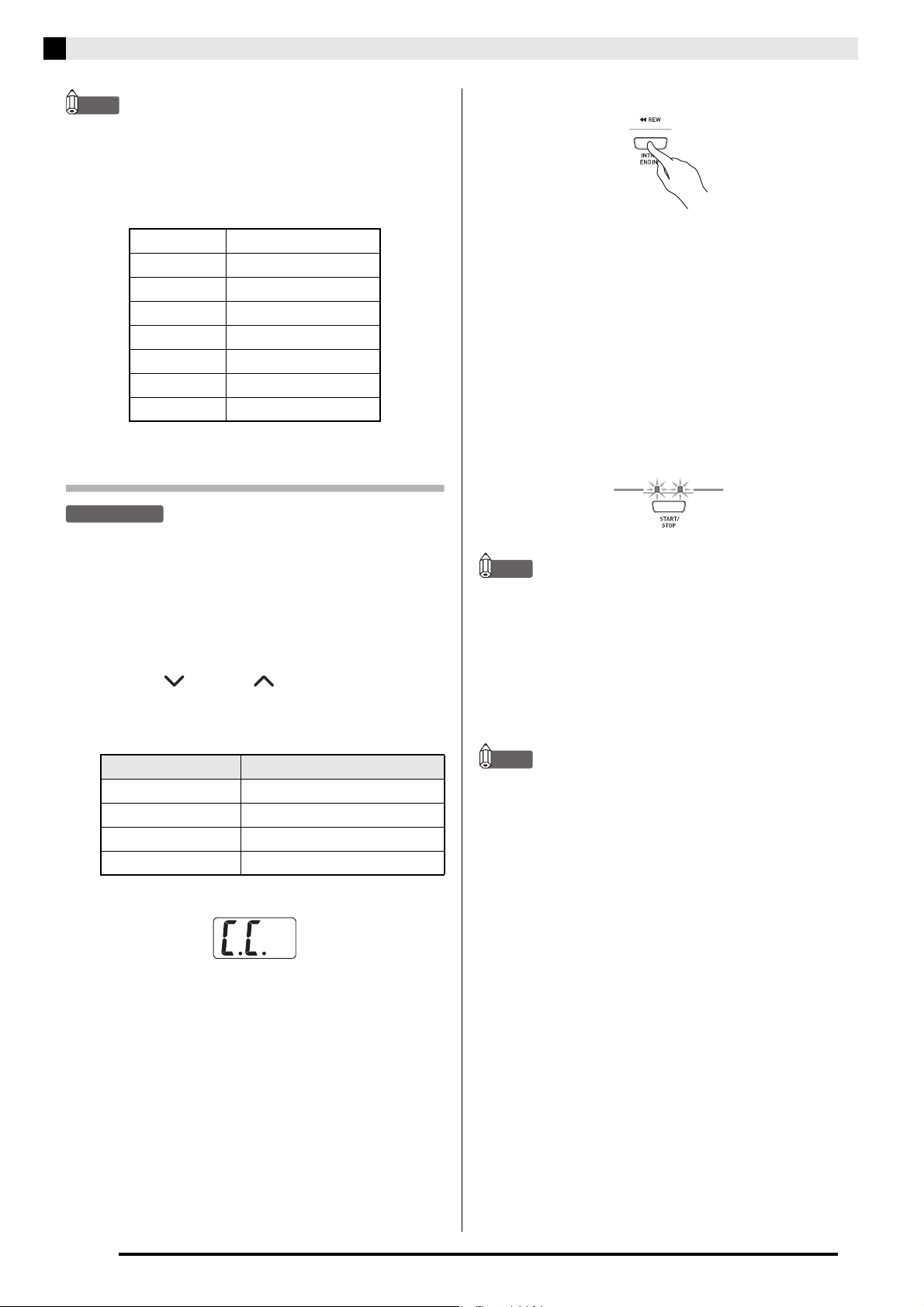
You can select from among 20 built-in rhythms.
1.
Press the RHYTHM button so the lamp below
it is lit.
• Each press of the button toggles between the upper
lamp and lower lamp.
• This will cause the currently selected rhythm number
to appear on the display.
2.
Find the rhythm number of the rhythm you
want to use in the Rhythm List on page A-3.
3.
Use the /NO and /YES buttons to scroll
through the rhythm numbers until the one you
want is displayed.
4.
Press the START/STOP button.
• This will start the rhythm.
5.
Press the START/STOP button again to stop
the rhythm.
To adjust playback tempo
1.
Press the TEMPO/SETTING button.
• This will cause the button’s lamp to flash.
2.
Use the /NO and /YES buttons to
change the tempo in the range of 20 to 255.
3.
Press the TEMPO/SETTING button again.
• This will cause the lamp above the button to go out.
With Auto Accompaniment, the digital piano
automatically plays rhythm, bass, and chord parts in
accordance with chords you select using simplified
keyboard fingerings, or chords you play. Auto
Accompaniment makes it feel like you have your own
private backup group with you all the time.
START/STOP
SYNCHRO/FILL-IN
/NO
INTRO/ENDING MODE
TEMPO/SETTINGRHYTHM
/YES
Selecting a Rhythm
Using Auto Accompaniment
PX200_e.book 13 ページ 2006年10月13日 金曜日 午後12時5分
E-14
Playing a Rhythm
NOTE
• With the rhythms listed below, make sure that CASIO
CHORD, FINGERED, or FULL RANGE CHORD is
selected before you try playing chords. The volume of
percussion instruments is very low, and percussion is
inserted in a way that does not interfere with the overall
mood of the rhythm.
To play with Auto Accompaniment
PREPARATION
• Use the procedures under “Selecting a Rhythm” to select
the rhythm you want to use and adjust the tempo.
1.
Press the TEMPO/SETTING button.
• This will cause the button’s lamp to flash.
2.
Press the MODE button.
3.
Use the /NO and /YES buttons to select
one of the Auto Accompaniment modes
shown below.
• Here we will select the CASIO CHORD mode.
• See “How to Play Chords” on page E-15 for details
about Auto Accompaniment modes and their chord
fingerings.
4.
Press the TEMPO/SETTING button again.
• This will cause the lamp above the button to go out.
5.
Press the SYNCHRO/FILL-IN button.
• This configures the digital piano so rhythm and
chord accompaniment will start automatically when
you press any keys within the accompaniment
keyboard range.
• This will cause the two lamps above the START/
STOP button to flash.
6.
Press the INTRO/ENDING button.
7.
Finger the first chord within the
accompaniment keyboard range.
• Playing a chord will cause the intro pattern for the
selected rhythm to play, followed by the
accompaniment rhythm and chord pattern.
8.
Finger other chords on the keyboard.
• See “How to Play Chords” on page E-15 for
information about how to finger chords within the
different Auto Accompaniment modes.
• The two lamps above the START/STOP button will
flash along with the beat.
NOTE
• You can insert a fill-in pattern while a rhythm pattern is
playing by pressing the SYNCHRO/FILL-IN button. A
fill-in helps to change the mood of the pattern.
9.
To stop accompaniment, press the INTRO/
ENDING button.
• This will play an ending pattern for the selected
rhythm before stopping Auto Accompaniment play.
NOTE
• You can stop accompaniment play without an intro and
ending pattern by pressing the START/STOP button in
place of steps 6 or 9.
• See “Other Settings” on page E-24 for information about
adjusting accompaniment volume.
10 ROCK’N’ROLL
14 ARPEGGIO 1
15 ARPEGGIO 2
16 MARCH 1
17 MARCH 2
18 STRIDE PIANO
19 WALTZ 1
20 WALTZ 2
Display Indicator Meaning
oFF NORMAL
C.C. CASIO CHORD
FnG FINGERED
FUL FULL RANGE CHORD
Flashes on the
first beat.
Flashes on
subsequent beats.
C
PX200_02_e.fm 14 ページ 2007年5月7日 月曜日 午前10時34分
Playing a Rhythm
E-15
How to Play Chords
The way you finger chords depends on the current
Auto Accompaniment mode. If you want to play
without Auto Accompaniment, use the NORMAL
mode.
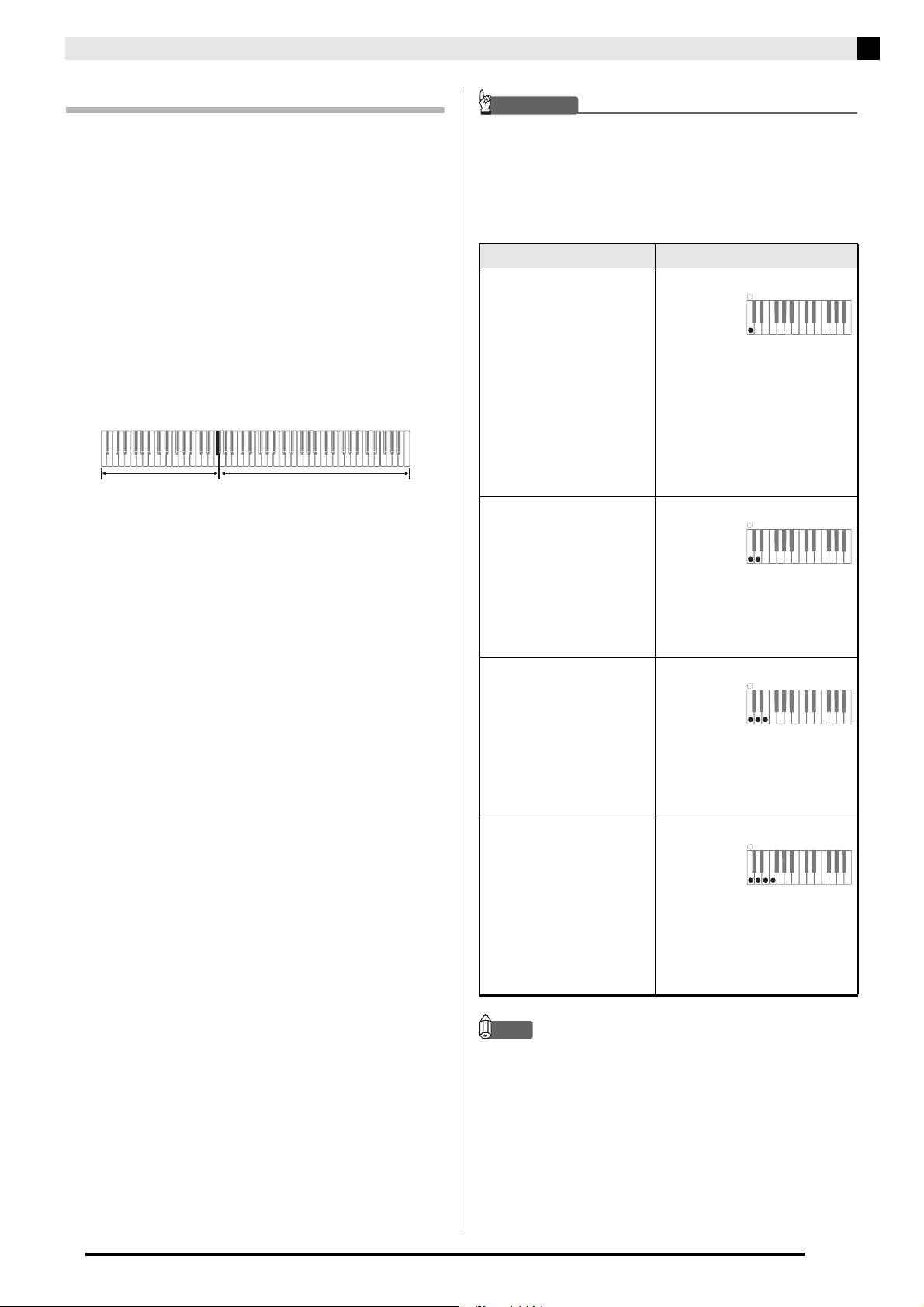
CASIO CHORD
Even if you do not know how to play chords normally,
this mode lets you play four different types of chords
using simplified fingerings in the accompaniment
keyboard range of the keyboard. The following shows
where the accompaniment keyboard range is located,
and explains how to finger chords in the CASIO
CHORD mode.
CASIO CHORD Mode Keyboard
IMPORTANT!
• In the CASIO CHORD mode, the keys in the
accompaniment keyboard range of the keyboard operate
as “chord switches” only. You cannot use the keys in this
keyboard range to play notes.
• You can use the split point to change the size of the
accompaniment keyboard range. See “To specify the
keyboard split point” on page E-11 for more information.
NOTE
• When playing a minor, seventh, or minor seventh chord,
it makes no different whether the additional keys you
press are black or white.
Accompaniment
keyboard range
Melody keyboard range
Chord Types Example:
Major Chords
Pressing a single
accompaniment keyboard
range key in the CASIO
CHORD mode will play
the major chord whose
name is marked above the
key. All of the
accompaniment keyboard
range keys that are
marked with the same
chord name play exactly
the same chord.
C (C Major)
Note J
names
Minor Chords
To play a minor chord,
press the accompaniment
keyboard range key that
corresponds to the major
chord, while also pressing
one other accompaniment
keyboard range key to the
right.
Cm (C Minor)
Seventh Chords
To play a seventh chord,
press the accompaniment
keyboard range key that
corresponds to the major
chord, while also pressing
two other accompaniment
keyboard range keys to
the right.
C7 (C Seventh)
Minor Seventh Chords
To play a minor seventh
chord, press the
accompaniment keyboard
range key that
corresponds to the major
chord, while also pressing
three other
accompaniment keyboard
range keys to the right.
Cm7 (C Minor Seventh)
C
C
DE F
#
b
E
F
#
G
A
b
A
B
B
b
C
C
DE F
E
#
b
C
C
DE F
#
b
E
F
#
G
A
b
A
B
B
b
C
C
DE F
E
#
b
C
C
DE F
#
b
E
F
#
G
A
b
A
B
B
b
C
C
DE F
E
#
b
C
C
DE F
#
b
E
F
#
G
A
b
A
B
B
b
C
C
DE F
E
#
b
C
PX200_02_e.fm 15 ページ 2007年4月24日 火曜日 午前11時50分
E-16
Playing a Rhythm
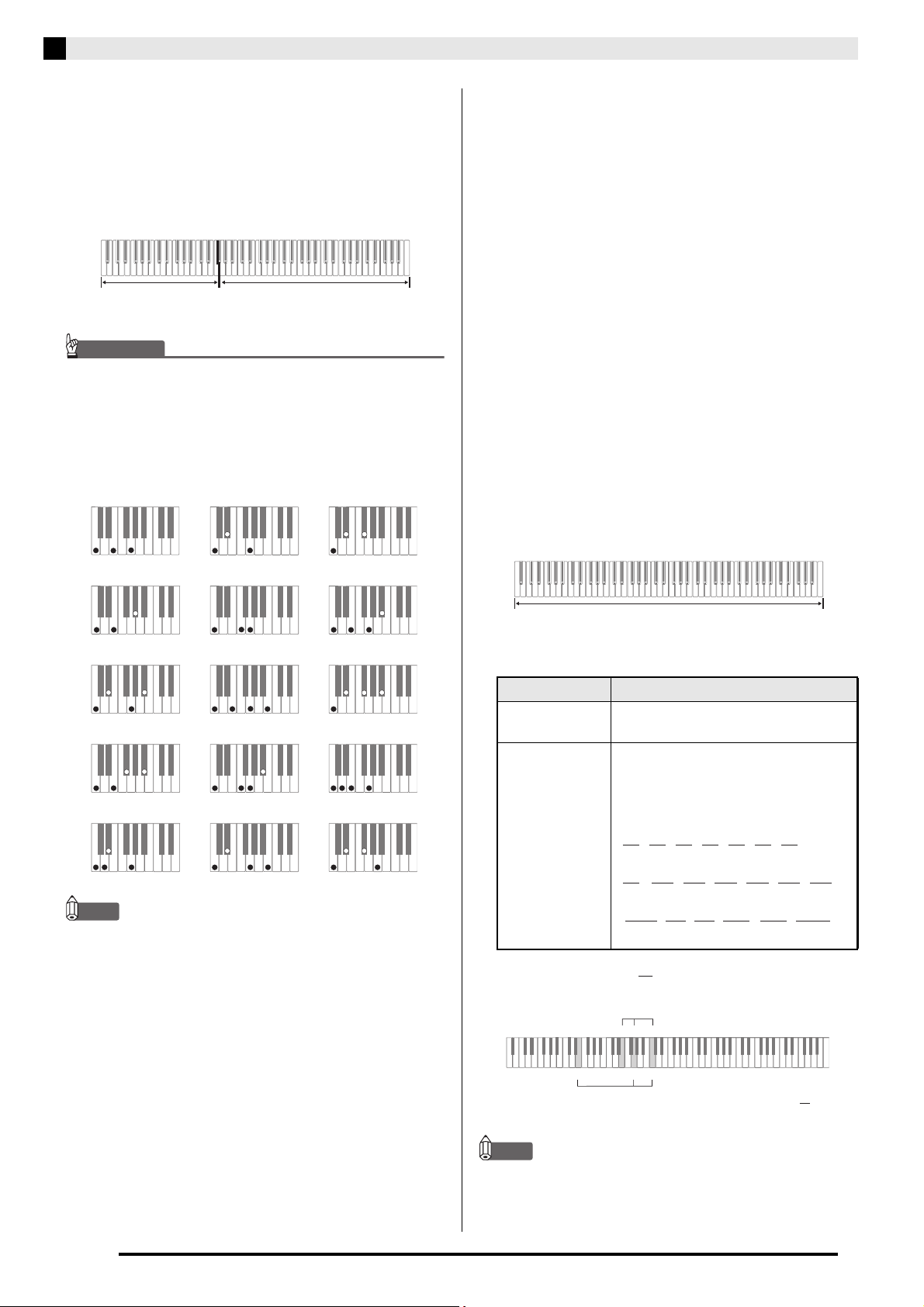
FINGERED
In the FINGERED mode, you play standard chord
fingerings in the accompaniment keyboard range to
play chords. To finger a C chord, for example, you
would press the C-E-G keys.
FINGERED Mode Keyboard
IMPORTANT!
• In the FINGERED mode, the keys in the accompaniment
keyboard range of the keyboard operate as “chord
switches” only. You cannot use the keys in this keyboard
range to play notes.
• You can use the split point to change the size of the
accompaniment keyboard range. See “To specify the
keyboard split point” on page E-11 for more information.
NOTE
• See the “Fingered Chord Chart” on page A-4 for
information about fingering chords with other roots in
the accompaniment keyboard range.
*1 Inverted fingerings (see “Fingered Chord Notes” on
page E-16) are not supported for these chords. The
lowest note fingered is used as the root.
*2 For these chords, the same chord is specified even if
the G fifth is not fingered
Fingered Chord Notes
• Except for the chords whose names have *1 after
them in the above examples, you also can use
inverted fingerings. This means that fingering either
E-G-C or G-C-E will produces a C chord.
• Except for the chords whose names have *2 after
them in the above examples, you need to press all of
the indicated keys in order to finger a chord. Failure
to include even a single note may produce a chord
that is different from the one you want.
FULL RANGE CHORD
The FULL RANGE CHORD mode lets you play a total
of 38 different types of chords (the same chords
available in the FINGERED mode plus 23 more). FULL
RANGE CHORD recognizes the pressing of three or
more keyboard keys anywhere on the keyboard as a
chord fingering. Anything else (pressing one or two
keys, or playing any group of notes that does not form
a chord fingering that is recognized by the keyboard) is
treated as melody notes.
FULL RANGE CHORD Mode Keyboard
z Recognized Chords
Example: C Major or chord
NOTE
• When there are at least six semitones between the lowest
note and the next note to the right, the lowest note is
assumed to be the bass note.
Accompaniment
keyboard range
Melody keyboard range
C Cm Cdim
Caug
*
1
Csus4 C7
*
2
Cm7
*
2
CM7
*
2
Cm7
b
5
C7sus4 Cadd9
Cm add9 CmM7
*
2
Cdim7
*
1
C7
b
5
*
1
Type Chord Types
FINGERED
Mode Chords
15 (See “FINGERED” on page E-16.)
Other Chords
23
For example, the following are chords
that have C as the bass note.
Accompaniment Keyboard/Melody Keyboard
Ddim A
b
7
F
7
Fm
7
Gm
7
A
b
add9
C C C C C C
, , , , ,
C
6
, Cm
6
, C
69
D
b
D E F G A
b
B
b
C C C C C C C
, , , , , , ,
B D
b
m Dm Fm Gm Am B
b
m
C C C C C C C
, , , , , , ,
C
E
E
EG C
GC
2
1
1
. . . . Chord C
2
. . . . Chord
C
E
C
PX200_02_e.fm 16 ページ 2007年4月24日 火曜日 午前11時50分
E-17
Playing Back Built-in Songs
IMPORTANT!
• After you select a built-in song, it can take a number of
seconds for the song data to be loaded. While the data is
being loaded, the song number will flash on the display,
and the keyboard keys and button operations will be
disabled. If you are playing something on the keyboard,
the following operation will cause output to stop.
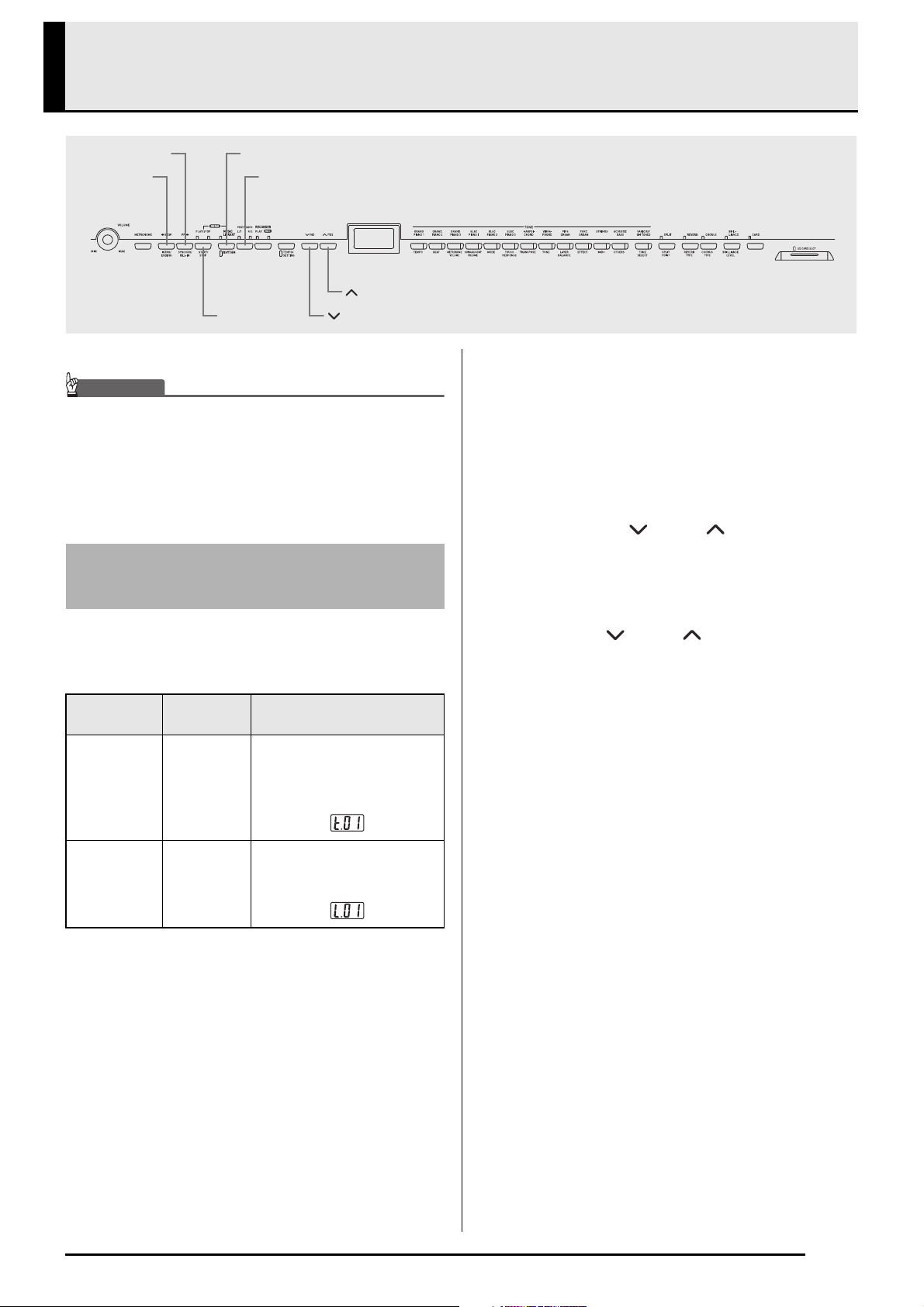
Your digital piano has a total of 72 built-in songs. You
can use the procedure below to play back all of the
songs, one after the other.
1.
While holding down the MUSIC LIBRARY
button, press the PLAY/STOP button.
• This will start playback of the 72 built-in songs in
sequence, from t.01 through L.60.
• You can play along with a song on the keyboard
during all-song playback. The tone assigned to the
keyboard is the one that is preset for the song that is
playing.
• You can use the /NO and /YES buttons to skip
sequentially between songs during all-song playback.
• If you press a TONE button, playback will jump to
the demo song that uses that tone. If you press the
MUSIC LIBRARY button during all-song playback,
playback will jump to Music Library song L.01.
• Pressing the /NO and /YES buttons at the same
time will jump to main tone demo song t.01.
2.
Press the PLAY/STOP button to stop all-song
playback.
PART/TRACK
/NOPLAY/STOP
MUSIC LIBRARY
/YES
REW
FF
Playing Back All of the Built-in
Songs
Type
Number of
Songs
Display Indicator
Main Tone
Demo Song
12
The TONE button of the
main tone being used flashes,
and the demo song number is
on the display.
Music
Library Song
60
The Music Library lamp
flashes and the song number
is displayed.
PX200_e.book 17 ページ 2006年10月13日 金曜日 午後12時5分
E-18
Playing Back Built-in Songs
The Music Library includes both built-in songs (01 to
60), plus up to 10 songs (61 to 70) that have been saved
to digital piano memory from a computer* or SD
memory card (page E-32). You can use the procedure
below to select one of these songs and play it back.
* You can download music data from the Internet and
then transfer it from your computer to digital piano
memory. See “Expanding the Selections in the Music
Library” on page E-31 for more information.
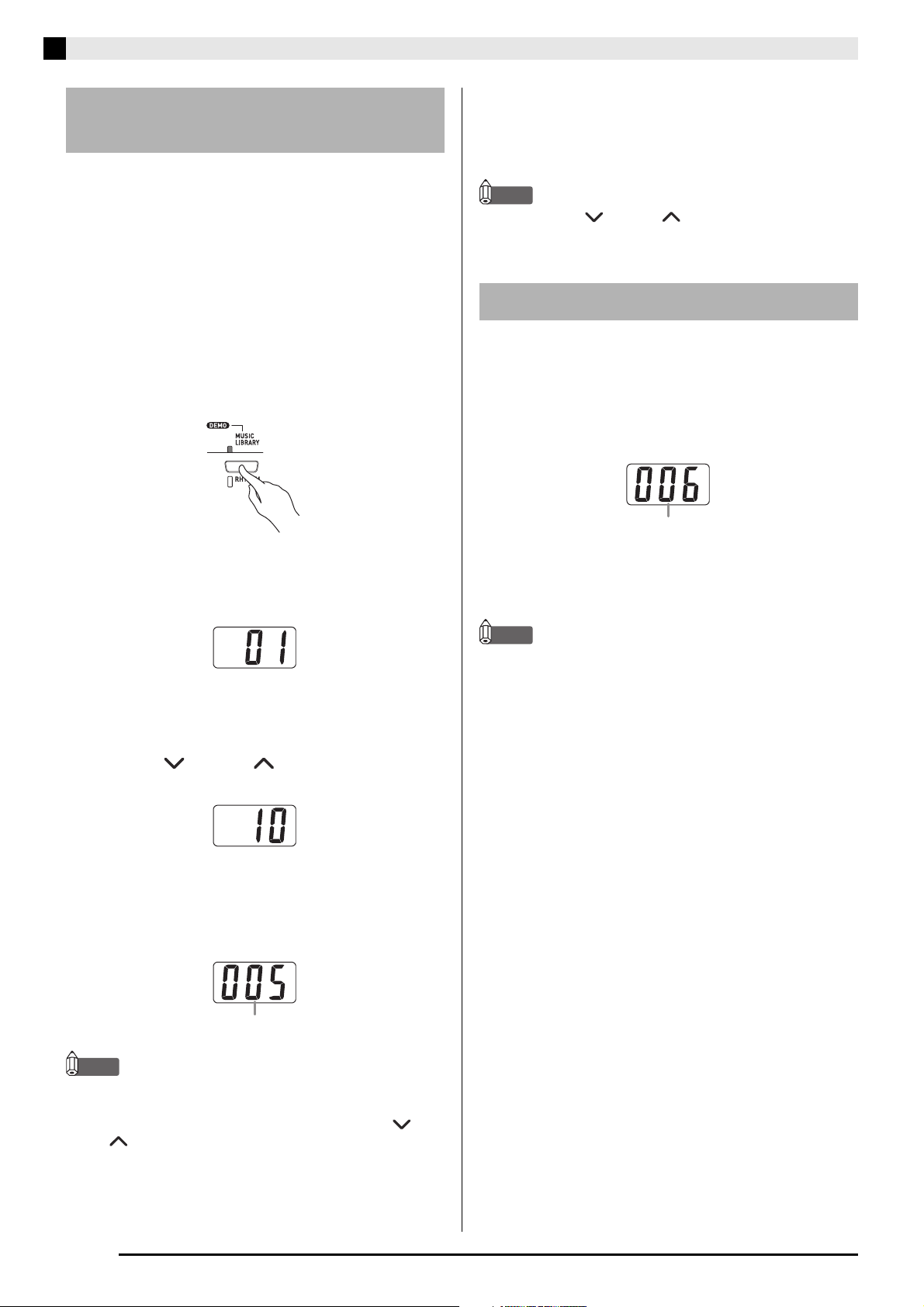
1.
Press the MUSIC LIBRARY button so the
lamp above the button is lit.
• Each press of the button toggles between the upper
lamp and lower lamp.
• This will cause the currently selected song number to
appear on the display.
2.
Find the song number of the song you want to
play in the Song Llist on page A-3.
3.
Use the /NO and /YES buttons to select
a song.
4.
Press the PLAY/STOP button.
• This starts the playback of the song.
• The measure number appears on the display during
playback.
NOTE
• To view the song number during playback, hold down
the MUSIC LIBRARY button.
• While playback is in progress, you can press the /NO
or /YES button to change to another song.
5.
Press the PLAY/STOP button again to stop
playback.
• Playback will stop automatically when the end of the
song is reached.
NOTE
• Pressing the /NO and /YES buttons at the same
time will select Music Library song number 01.
1.
While playback is in progress, hold down the
REW button.
• This skips back through the song measure-by-
measure.
• The measure number appears on the display while
you are skipping back.
2.
When you reach the point you want, release
the REW button to resume playback.
NOTE
• Depending on what is being played when you press the
REW button, the skip back operation may not start right
away when you press it.
Playing Back a Specific Music
Library Song
Measure number
Skipping Back through a Song
Measure number
PX200_e.book 18 ページ 2006年10月13日 金曜日 午後12時5分
Playing Back Built-in Songs
E-19
1.
While playback is in progress, hold down the
FF button.
• This skips forward through the song measure-by-
measure.
• The measure number appears on the display while
you are skipping forward.
2.
When you reach the point you want, release
the FF button to resume playback.
NOTE
• You can change tempo, volume, and pre-count settings
for playback. See “Other Settings” on page E-24 for more
information.
You can turn off the left hand part or right hand part of
a Music Library song and play along on the digital
piano.
NOTE
• The Music Library includes a number of duets. While a
duet is selected, you can turn off the first piano <Primo>
or second piano <Secondo> tone and play along with the
song.
PREPARATION
• Select the Music Library song you want to practice and
adjust the tempo.
• A number of tunes have tempo changes part way
through in order to produce specific musical effects.
1.
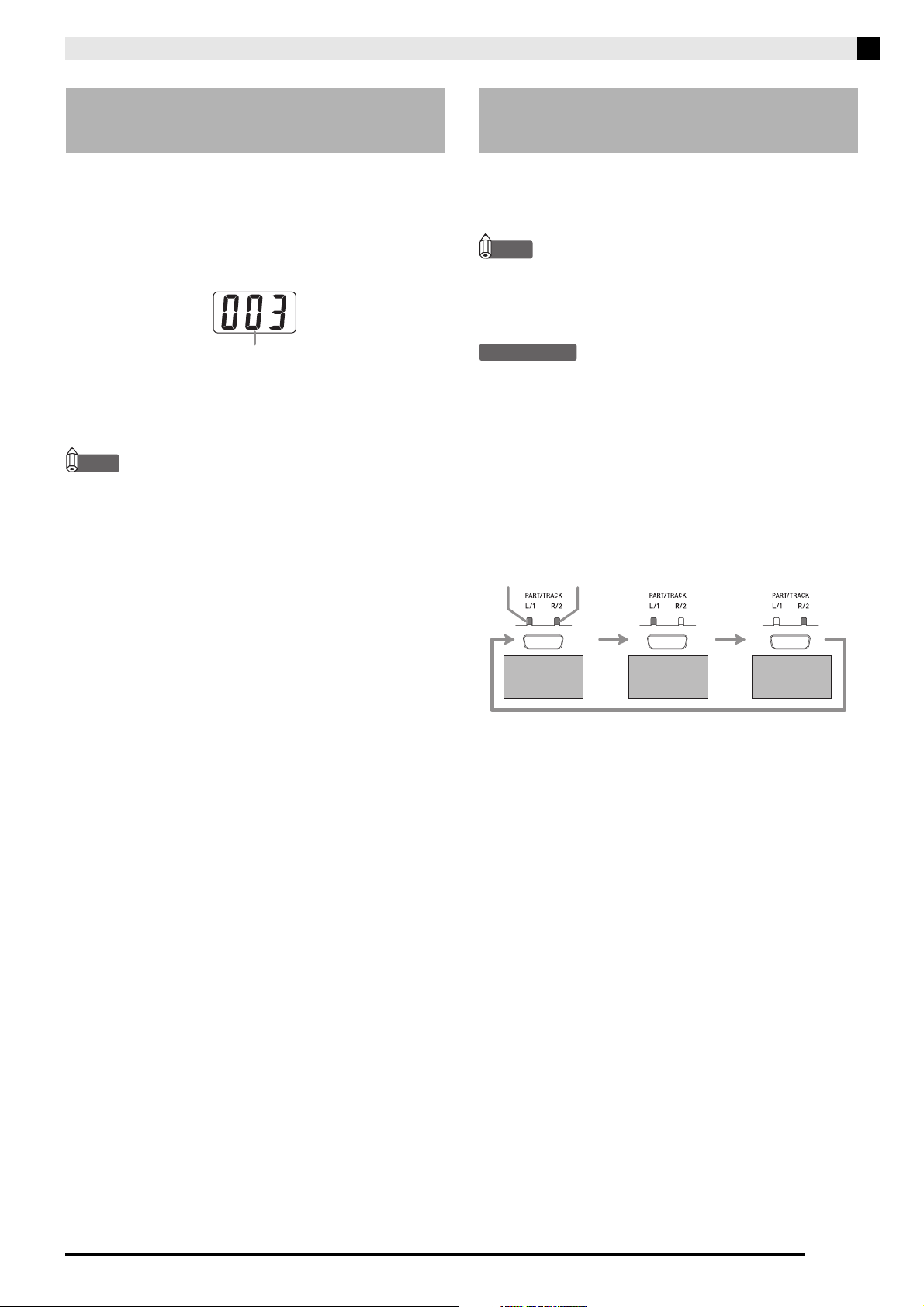
Use the PART/TRACK button to turn off a
part.
• Each press of the PART/TRACK button cycles
through the part settings as shown below. The lamps
above the button show which part is turned off.
2.
Press the PLAY/STOP button.
• This starts playback, without the part you turned off
in step 1.
3.
Play the missing part on the keyboard.
4.
Press the PLAY/STOP button again to stop
playback.
Skipping Forward through a
Song
Measure number
Practicing with a Music
Library Song
Left
hand
Right
hand
Both parts on
Right hand
part off
Left hand
part off
PX200_e.book 19 ページ 2006年10月13日 金曜日 午後12時5分
E-20
Recording and Play Back
You can store the notes you play in digital piano
memory for later playback. You can have up to five
songs in memory at one time.
A track is a container of recorded data, and each song
consists of two tracks: Track 1 and Track 2. You can
record each track separately and then combine them so
they play back together as a single song.
Memory Capacity
• Digital piano memory can hold about 50,000 notes
total, for five songs. Each song can contain up to
about 10,000 notes.
• Recording will stop automatically and the REC lamp
will go out if the number of notes in memory
exceeds the maximum.
Recorded Data
• Keyboard play
• Tone used
• Pedal operations
Track 1 only
• Tempo setting
• Layer and split settings
• Reverb and chorus settings
• Rhythm Patterns
•Chord fingering
• Intro, fill-in, ending operations
Recording Data Storage
• Starting a new recording deletes any data that was
previously recorded in memory.
• Should power fail during recording, all of the data in
the track you are recording will be deleted.
• You can save memory data to external media, if you
want. See “Using an SD Memory Card” on page E-32
for more information.
IMPORTANT!
• CASIO COMPUTER CO., LTD. takes no responsibility
for any damages, lost profits, or claims by third parties
arising from the deletion of recorded data due to
malfunction, repair, or for any other reason.
• After you select a song, it can take a number of seconds
for the song data to be loaded. While the data is being
loaded, the song number will flash on the display, and the
keyboard keys and button operations will be disabled. If
you are playing something on the keyboard, the following
operation will cause output to stop.
Using the RECORDER Button
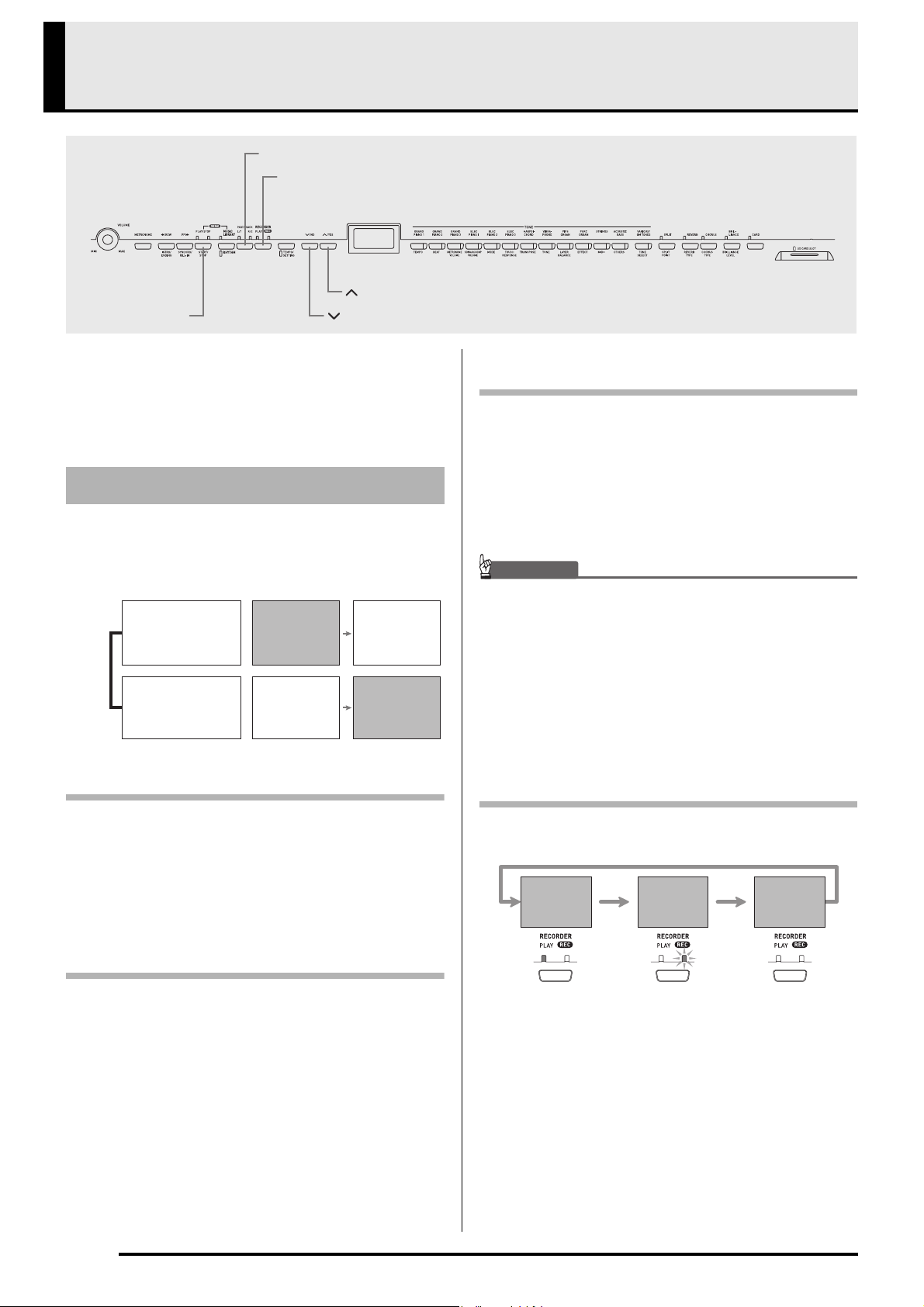
Each press of the RECORDER button cycles through
the recording options in the sequence shown below.
RECORDER
/NOSTART/STOP
PART/TRACK
/YES
Songs and Tracks
Song
Record
Record
While playing
back. . .
Track 2
Melody
Track 1
Auto Accompaniment
(rhythm, bass, chords),
melody
Playback
Standby
Record
Standby
Normal
Lit
Flashing
Off
PX200_02_e.fm 20 ページ 2006年10月26日 木曜日 午前10時38分
Recording and Play Back
E-21
After recording to either of the tracks of a song, you can
record to the other track while listening to playback
what you recorded in the first track.
To record to a specific track of a specific
song
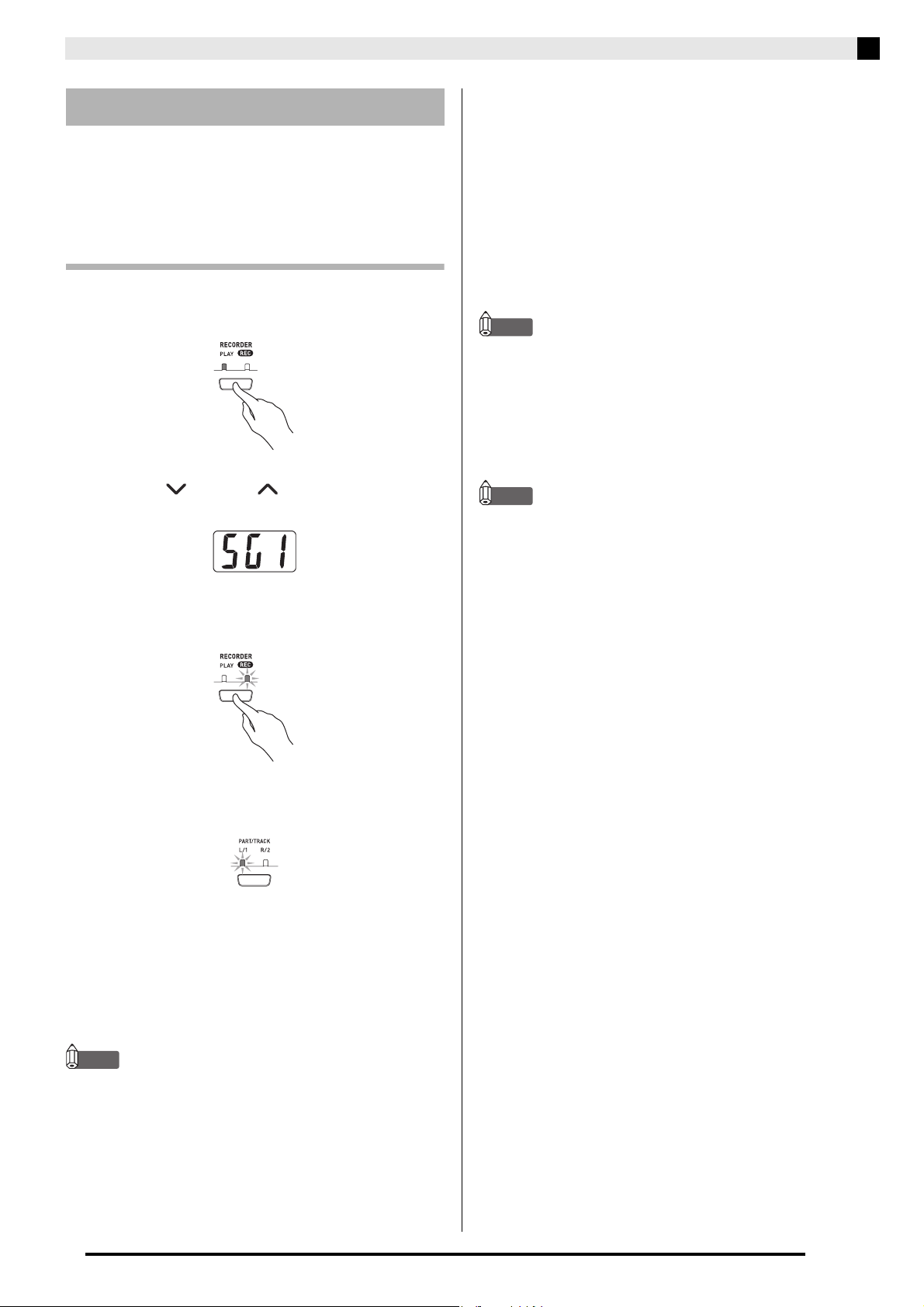
1.
Press the RECORDER button so the PLAY
lamp is lit.
2.
Use the /NO and /YES buttons to
display a song number (1 to 5).
3.
Press the RECORDER button so the REC
lamp is flashing.
• At this time the L/1 lamp will flash to indicate that
the digital piano is standing by for recording to Track
1.
4.
Use the PART/TRACK button to select the
track to which you want to record.
• Make sure that the lamp for the record track is
flashing.
Track 1: L/1 lamp
Track 2: R/2 lamp
NOTE
• If you want to record with rhythm or Auto
Accompaniment, select Track 1 (L/1 lamp flashing).
5.
Select the tone and effects you want to use in
your recording, and set the tempo you want. If
you are recording to Track 1, you also can
select a rhythm and accompaniment mode.
• Tone (page E-8)
• Effect (page E-11)
• Tempo (page E-13)
z Track 1 only
• Rhythm (page E-13)
• Mode (page E-15)
NOTE
• It is a good idea to use a relatively slow tempo when
recording.
• If you want the metronome to sound during recording,
press the METRONOME button.
6.
Start playing something on the keyboard.
• Recording will start automatically.
NOTE
• When recording to Track 1 with rhythm or Auto
Accompaniment: Press the START/STOP button to start
recording. You also can start recording by pressing the
SYNCHRO/FILL-IN button and/or the INTRO/
ENDING button, and then play a chord.
• When recording to Track 1 without rhythm or Auto
Accompaniment: Recording will start as soon as you
play anything on the keyboard.
7.
When you are finished, press the START/
STOP button to stop recording.
• To stop recording with a rhythm/Auto
Accompaniment ending pattern, press the INTRO/
ENDING button.
• This will cause the REC lamp to go out and the PLAY
lamp to light.
• To play back the track you just recorded, press the
START/STOP button again.
8.
After you are finished recording or playing
back, press the RECORDER button so the
PLAY lamp and REC lamp are off.
Recording Your Keyboard Play
C
PX200_02_e.fm 21 ページ 2007年5月7日 月曜日 午後2時52分
E-22
Recording and Play Back
To record to one track of a song while
listening to the playback of the other
track
1.
Press the RECORDER button so the PLAY
lamp is lit.
2.
Use the /NO and /YES buttons to
display a song number (1 to 5).
3.
Press the RECORDER button so the REC
lamp is flashing.
• This will cause the L/1 lamp to flash.
4.
Use the PART/TRACK button to select the
track to which you want to record.
• Make sure that the lamp for the record track is
flashing.
Example: To listen to playback of Track 1 as you record
to Track 2
5.
Select the tone and effects you want to use
for your recording.
6.
Press the START/STOP button or play
something on the keyboard to start
simultaneous playback from Track 1 and
recording to Track 2.
• This will start both playback of the recorded track
and recording to the other track.
7.
When you are finished, press the START/
STOP button again to stop recording.
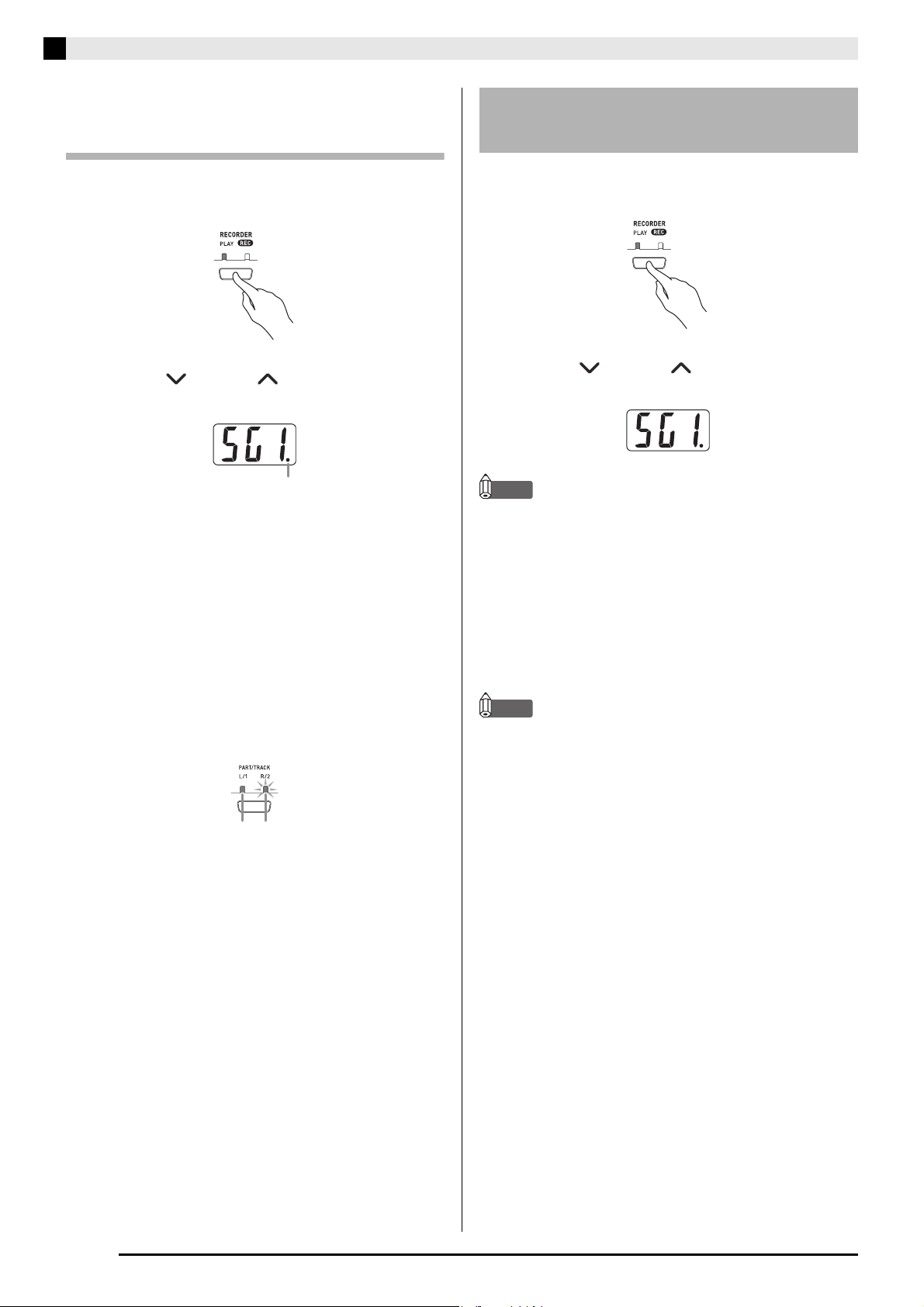
1.
Press the RECORDER button so the PLAY
lamp is lit.
2.
Use the /NO and /YES buttons to
display a song number (1 to 5).
NOTE
• When a song has something recorded in both tracks, you
can turn off one track and play back just the other track,
if you want. Whether a track is on or off is indicated by
the lamps above the PART/TRACK button. Each press of
the PART/TRACK button cycles through the different
possible track on/off settings.
3.
Press the START/STOP button.
• This starts playback of the song and/or track you
selected.
NOTE
• You can change the tempo setting as a track is playing.
• You cannot change the tone setting during playback.
• Press the START/STOP button again to stop playback.
This indicator appears when the track contains recorded
data already.
Lit: Playback standby Flashing: Record standby
Playing Back from Digital
Piano Memory
PX200_e.book 22 ページ 2006年10月13日 金曜日 午後12時5分
Recording and Play Back
E-23
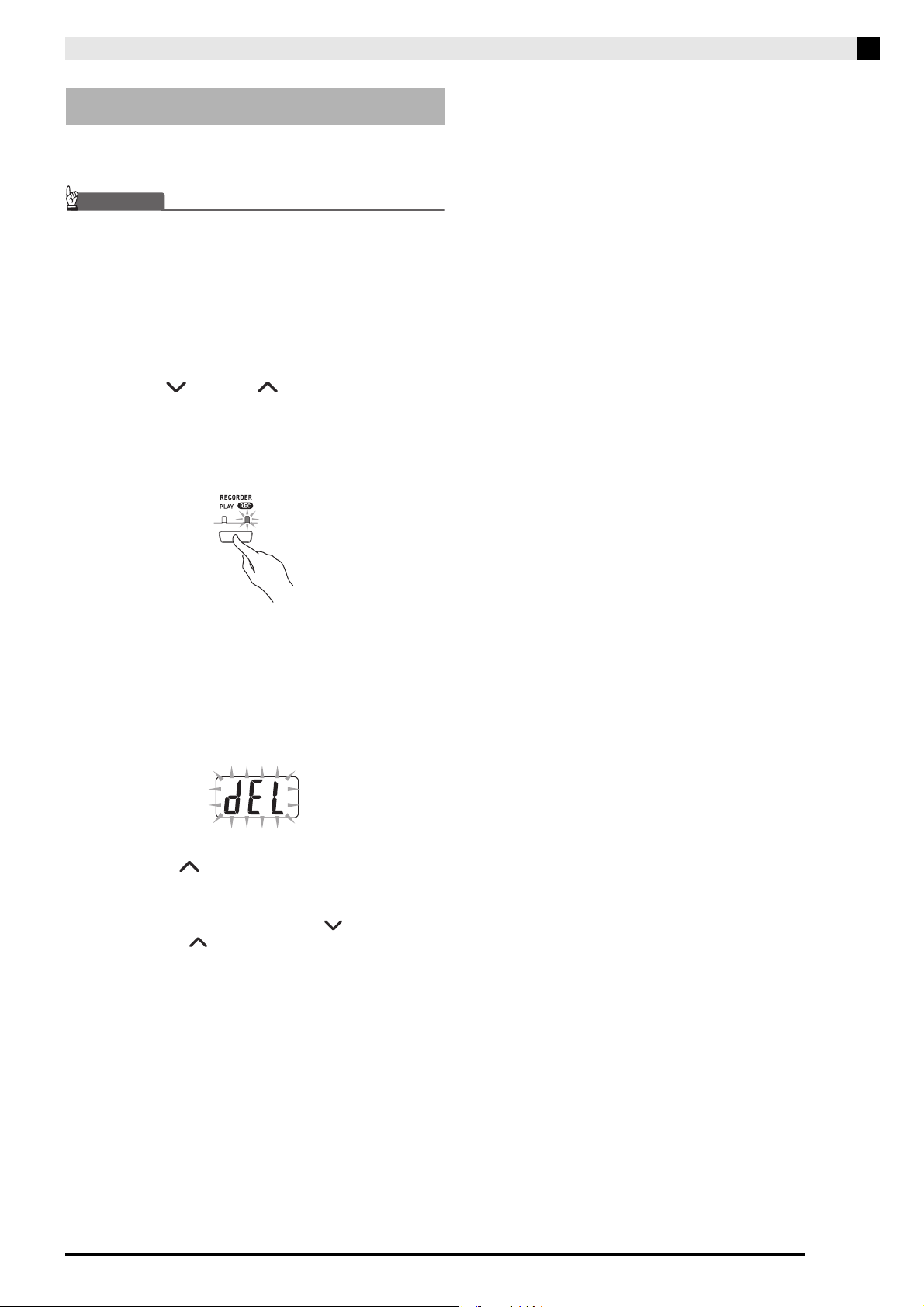
The following procedure deletes a specific track of a
song.
IMPORTANT!
• The procedure below deletes all of the data of the
selected song. Note that the delete operation cannot be
undone. Check to make sure you really do not need the
data in digital piano memory before you perform the
following steps.
1.
Press the RECORDER button so the PLAY
lamp is lit.
2.
Use the /NO and /YES buttons to
display a song number (1 to 5).
3.
Press the RECORDER button so the REC
lamp is flashing.
4.
Use the PART/TRACK button to select the
track you want to delete.
• This will cause the lamp of the selected track to flash.
5.
Hold down the RECORDER button until “dEL”
(dELete) appears on the display.
6.
Press the /YES button.
• This will delete the selected track and enter record
standby.
• To cancel the operation, press the /NO button in
place of the /YES button.
Deleting Recorded Data
PX200_e.book 23 ページ 2006年10月13日 金曜日 午後12時5分
E-24
Other Settings
This section explains how to configure key, touch,
pedal, MIDI, and other settings.
• The basic procedure below is used for configuring
all settings. The only difference is the button that
you press to select a parameter.
• See the “Secondary Parameter Reference” on page E-
26 for details about the settings you can configure
using this procedure.
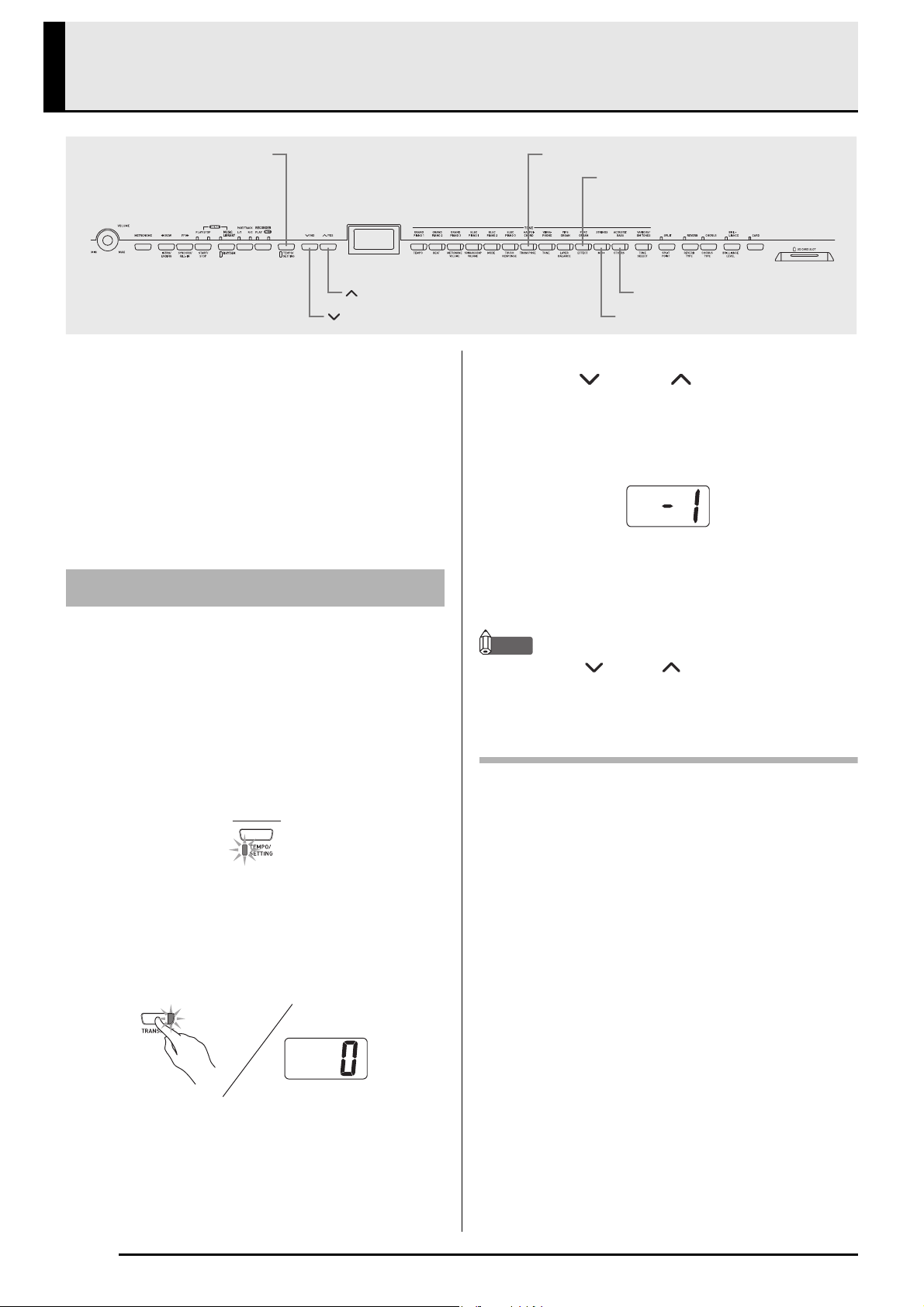
1.
Use the “Secondary Parameter Reference”
on page E-26 to find the parameter whose
setting you want to configure, and note the
applicable parameter button name.
Example: To change key, you would need to use the
TRANSPOSE button.
2.
Press the TEMPO/SETTING button.
• This will cause the button’s lamp to flash.
3.
Press the button you looked up in step 1.
• The button’s lamp will flash and the current setting of
the parameter you are configuring will appear on the
display.
Example: TRANSPOSE button
• If the button has multiple parameters assigned to it,
keep pressing the button until the parameter you
want to configure is displayed. See “Multiple
Parameter Buttons” below for more information.
4.
Use the /NO and /YES buttons to
change the setting of the displayed
parameter.
Example: Lower the transpose setting by one semitone
by changing the displayed value to –1.
5.
Press the TEMPO/SETTING button to
complete the procedure.
• This will cause the button’s lamp to go out.
NOTE
• Pressing the /NO and /YES buttons at the same
time will change the displayed parameter to its default
setting.
Multiple Parameter Buttons
The EFFECT, MIDI, and OTHERS buttons have more
than one parameter assigned to them. Use the
procedures below to select the parameter whose setting
you want to change.
EFFECT
OTHERS
/NO MIDI
TRANSPOSE
TEMPO/SETTING
/YES
Configuring Settings
PX200_e.book 24 ページ 2006年10月13日 金曜日 午後12時5分
Other Settings
E-25
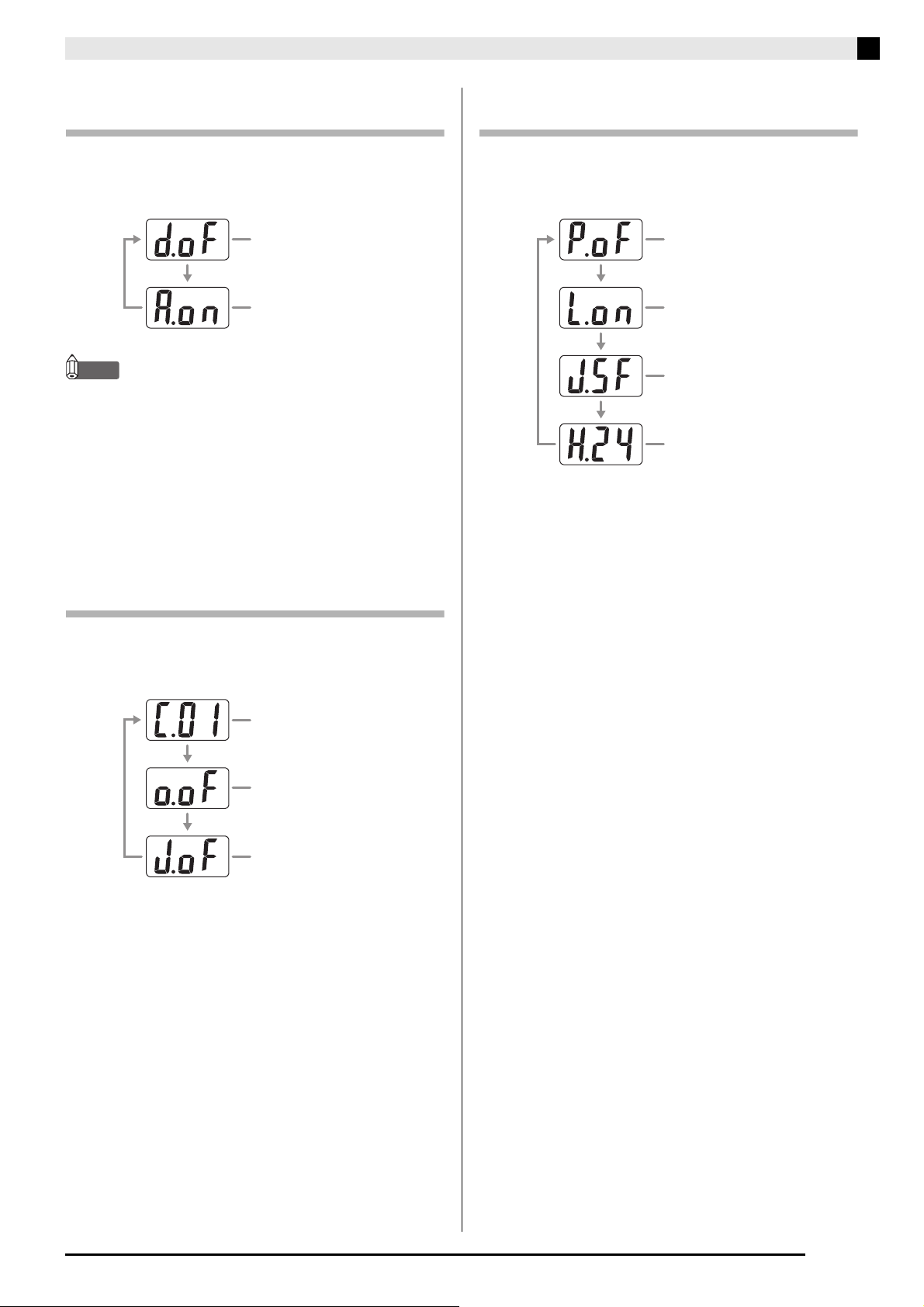
To change the setting of one of the
EFFECT button parameters
Pressing the EFFECT button in step 3 of the
“Configuring settings” procedure will toggle between
the two parameters shown below.
NOTE
• While the keyboard is layered, the DSP on/off setting
affects the layered tone only. While the keyboard is split,
the DSP on/off setting affects the low range tone only.
• Turning on DSP will apply the DSP effect to tones with
DSP only. It will not be applied to any other type of tone.
• Turning on Acoustic Resonance will apply the Acoustic
Resonance effect to tones that support Acoustic
Resonance only. It will not be applied to any other type
of tone.
To change the setting of one of the MIDI
button parameters
Pressing the MIDI button in step 3 of the “Configuring
settings” procedure will cycle between the parameters
shown below.
To change the setting of one of the
OTHERS button parameters
Pressing the OTHERS button in step 3 of the
“Configuring settings” procedure will cycle between
the parameters shown below.
DSP parameter
(“d” stands for “DSP”.)
Acoustic Resonance parameter
(“A” stands for “Acoustic”.)
Send Channel setting
(“C” stands for “Channel”.)
Accomp MIDI Out setting
(“o” stands for “out”.)
MIDI In Chord Judge setting
(“J” stands for “Judge”.)
Local Control setting
(“L” stands for “Local”.)
Soft/Sostenuto pedal jack setting
(“J” stands for “Jack”.)
Pre-count setting
(“P” stands for “Pre-count”.)
Damper pedal adjustment (half-
damper) setting
(“H” stands for “Half”.)
PX200_03_e.fm 25 ページ 2006年11月1日 水曜日 午前11時40分
E-26
Other Settings
■ Keyboard
■ Tones
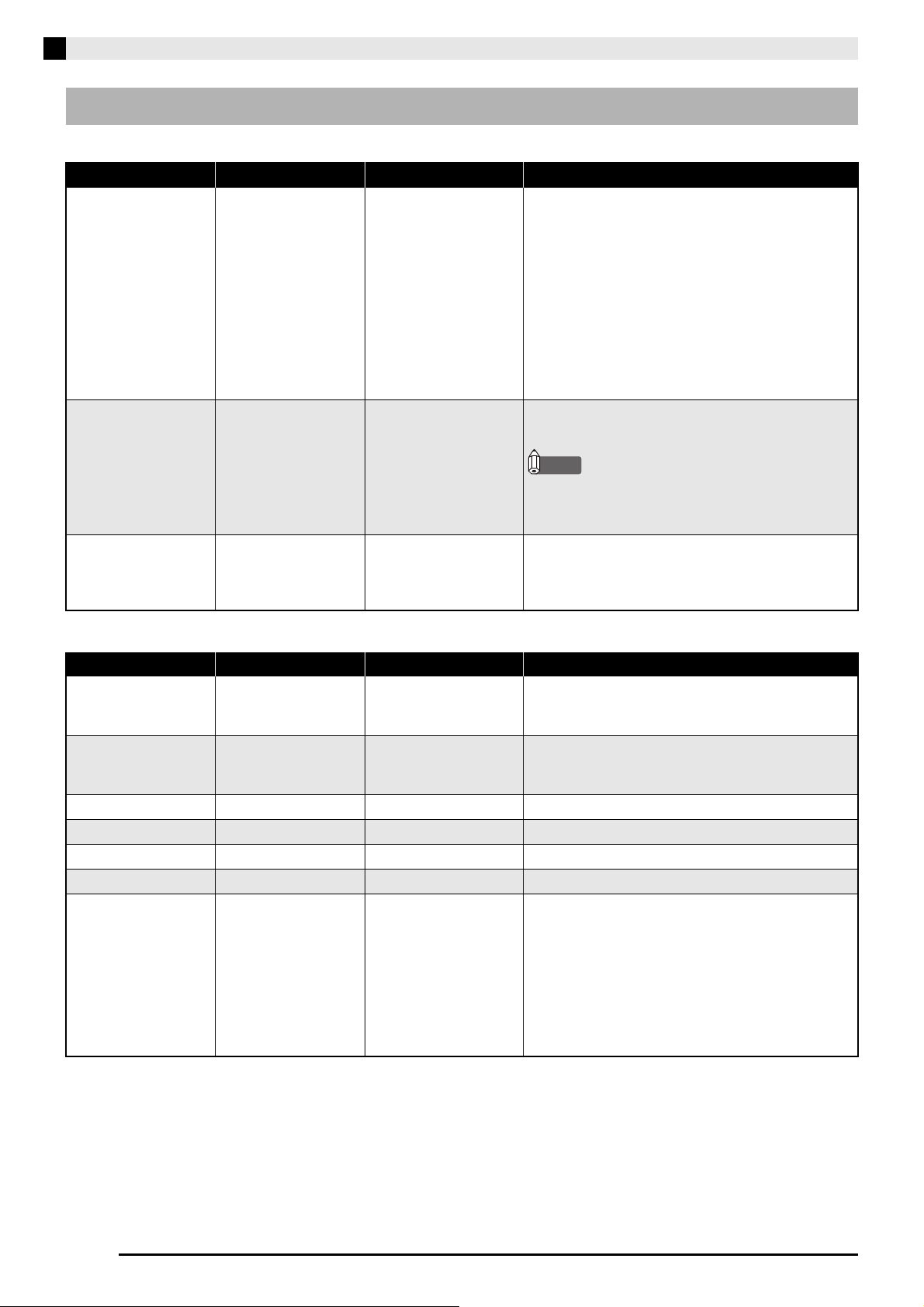
Secondary Parameter Reference
Setting Parameter Name Settings Description
Keyboard touch
response
TOUCH RESPONSE oFF : Off
1:Strong sound is
produced even
when relatively
light pressure is
applied.
2:Normal
3:Normal sound is
produced even
when relatively
strong pressure is
applied.
Specifies the relative touch of the keyboard keys.
Key TRANSPOSE –6 to 0 to 5 Raises or lowers the tuning of the digital piano in
semitone steps.
NOTE
• Using TRANSPOSE to raise the key of the digital
piano can cause notes at the highest range of a
tone to become distorted.
Keyboard tuning TUNE –50 to 0 to 50 Raises or lowers the overall pitch of the digital piano
to match another instrument. The setting range is
plus or minus 50 cents (100 cents = 1 semitone) from
the standard pitch of A4 = 440.0Hz.
Setting Parameter Name Settings Description
VARIOUS/GM
TONES button
assignment
TONE SELECT See “Tone List” on page
A-1.
Assigns one of the digital piano’s Various tone, GM
tone, or Drum set to the VARIOUS/GM TONES
button.
Layered tone volume
balance
LAYER BALANCE –24 to 0 to 24 Specifies the volume balance between layered tones.
A lower value reduces the volume level of the
layered tone.
Split point SPLIT POINT A0 to C8* See page E-10.
Reverb type REVERB TYPE 1 to 4 See page E-11.
Chorus type CHORUS TYPE 1 to 4 See page E-11.
Brilliance level BRILLIANCE LEVEL –3 to –1, 1 to 3 See page E-9.
Acoustic Resonance EFFECT A.oF: Off
A.on: On
GRAND PIANO 1, GRAND PIANO 2, and
GRAND PIANO 3 tones only
When the damper pedal is pressed, acoustic
resonance reproduces the harmonic resonance
similar to that of a grand piano. This parameter turns
acoustic resonance on or off. When configuring the
setting of this parameter, use the procedure under
“To change the setting of one of the EFFECT button
parameters” on page E-25.
PX200_03_e.fm 26 ページ 2006年11月1日 水曜日 午前11時56分
Other Settings
E-27
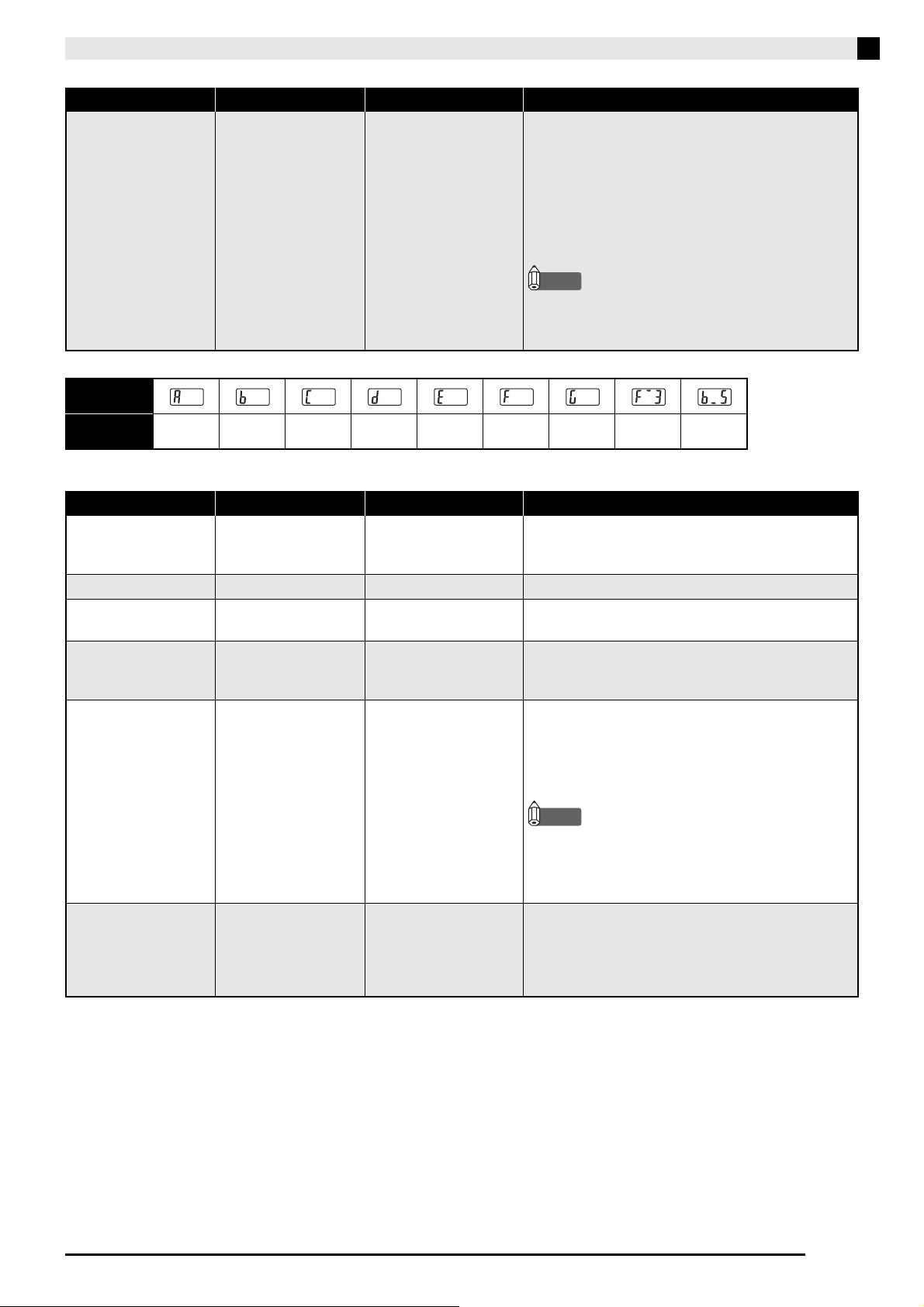
*Display Indicator
■ Song, Rhythm, and Metronome
DSP EFFECT d.oF: Off
d.on: On
Certain Tones Only
DSP applies sophisticated acoustic effects to a tone.
For example, it applies a rotary speaker effect to the
drawbar organ tone. This parameter turns the DSP
effect on or off. When configuring the setting of this
parameter, use the procedure under “To change the
setting of one of the EFFECT button parameters” on
page E-25.
NOTE
• See the tone list on page A-1 for information
about whether or not a tone is a tone with DSP,
and for DSP types.
Display
Settings ABCDEFGF
I
3B
i
5
Setting Parameter Name Settings Description
Tempo TEMPO 20 to 255 Specifies the tempo of Music Library songs, the
metronome, Auto Accompaniment playback,
recording and playback, etc.
Metronome beat BEAT 0, 2 to 6 Turns the metronome on or off.
Metronome volume METRONOME
VOLUME
0 to 42 Specifies the metronome volume.
Song, Auto
Accompaniment
volume
SONG/ACCOMP
VOLUME
0 to 42 Specifies the volume of rhythm and chord
accompaniment and built-in songs, independent of
overall volume control.
Pre-count OTHERS P.oF: Off
P.on: On
Turns the pre-count before playback of a Music
Library song on or off. When configuring the setting
of this parameter, use the procedure under “To
change the setting of one of the OTHERS button
parameters” on page E-25.
NOTE
• When playing a song from the user area or from
an SD memory card, the pre-count may not
sound, even though the pre-count setting is
turned on.
Auto Accompaniment
mode
MODE oFF : NORMAL
C.C. : CASIO CHORD
FnG : FINGERED
FUL : FULL RANGE
CHORD
Specifies the Auto Accompaniment mode.
Setting Parameter Name Settings Description
PX200_03_e.fm 27 ページ 2006年11月1日 水曜日 午前11時56分
E-28
Other Settings
■ Pedals
■ MIDI
Setting Parameter Name Settings Description
Soft/Sostenuto pedal
jack setting
OTHERS J.SF: Soft
J.SS: Sostenuto
A pedal connected to the digital piano’s SOFT/
SOSTENUTO PEDAL jack operates as a soft pedal
when the digital piano is turned on. This parameter
can be used to change the pedal to a sostenuto pedal.
When configuring the setting of this parameter, use
the procedure under “To change the setting of one of
the OTHERS button parameters” on page E-25.
Damper pedal
adjustment (half-
damper)
OTHERS H.00 to H.42
With optional SP-30 only
Adjusts the pedal effect applied when the damper
pedal is half-pressed as a value from 0 (no effect) to
42 (same a full press). When configuring the setting
of this parameter, use the procedure under “To
change the setting of one of the OTHERS button
parameters” on page E-25.
Setting Parameter Name Settings Description
Send channel MIDI C.01 to C.16 Specifies one of the MIDI channels (1 through 16) as
the Send Channel, which is used for sending MIDI
messages to an external device. When configuring
the setting of this parameter, use the procedure
under “To change the setting of one of the MIDI
button parameters” on page E-25.
Accomp MIDI out MIDI o.oF:
Off
o.on: On
Use this parameter to specify whether or not MIDI
messages should be sent in accordance with the
digital piano’s Auto Accompaniment and recording
function playback. When configuring the setting of
this parameter, use the procedure under “To change
the setting of one of the MIDI button parameters” on
page E-25.
MIDI In Chord judge MIDI J.oF: Off
J.on: On
Specifies whether chord judge should be performed
on accompaniment range MIDI Note On messages
received from an external device. When configuring
the setting of this parameter, use the procedure
under “To change the setting of one of the MIDI
button parameters” on page E-25.
Local control OTHERS L.oF: Off
L.on: On
When Local Control is turned on, pressing the
keyboard’s keys plays the notes using the currently
selected built-in tone, and also sends the applicable
MIDI messages out the MIDI OUT port. Turning off
Local Control cuts off the digital piano’s sound
source, so no sound is produced by the digital piano
when keys are pressed. This capability comes in
handy when you want to turn off the digital piano’s
keyboard and play on an external sequencer or other
device.
When configuring the setting of this parameter, use
the procedure under “To change the setting of one of
the OTHERS button parameters” on page E-25.
PX200_03_e.fm 28 ページ 2006年11月1日 水曜日 午前11時56分
E-29
Connecting to a Computer
What is MIDI?
MIDI is a standard for digital signals and connectors
that allows musical instruments, computers, and other
devices, regardless of manufacturer, to exchange data
with each other.
NOTE
• For details about MIDI implementation, visit:
http://world.casio.com/
MIDI Connections
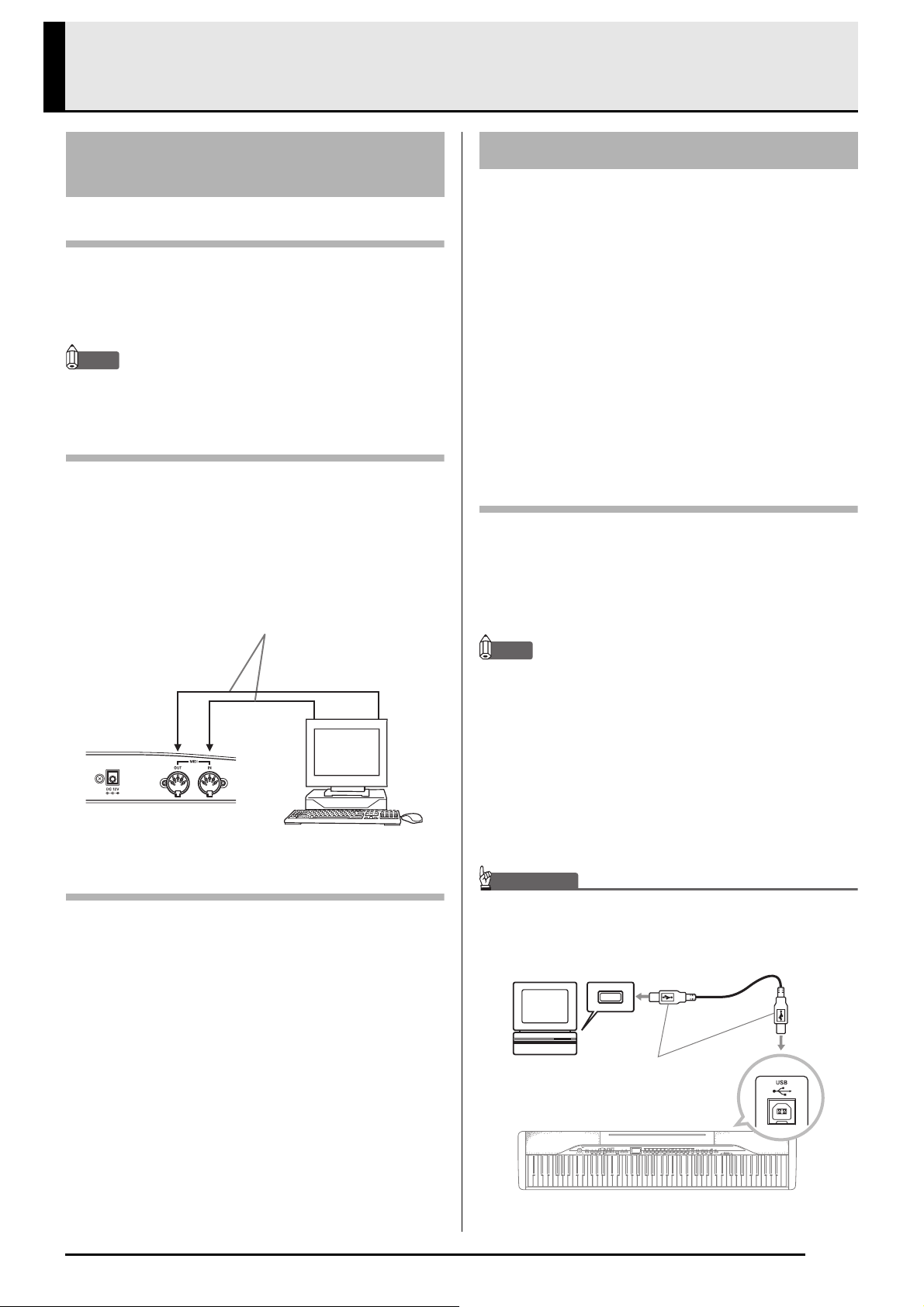
Connecting your computer or other external MIDI
device to the digital piano’s MIDI OUT/IN terminals
makes it possible for them to exchange MIDI messages.
You also can playback notes you play on the digital
piano on the connected device.
Left Side
MIDI Settings
You can use the procedure in “Other Settings” (page
E-24) to configure MIDI settings. See page E-26 for a
description of the settings and information about how
to configure them.
The digital piano’s USB port makes it quick and simple
to connect to a computer.
You can install a USB MIDI driver from the CD-ROM
that comes bundled with the digital piano onto a
computer equipped with a USB port. After that, you
can connect the digital piano to your computer and run
commercially available MIDI software on your
computer to exchange MIDI data with the digital
piano. You also can use the USB connection to transfer
files you downloaded from the CASIO MUSIC SITE
from your computer to the digital piano.
You will need a commercially available USB cable to
connect a computer to the digital piano’s USB port.
To connect to a computer using the USB
port
1.
On the computer to which you plan to
connect, install the USB MIDI driver from the
CD-ROM that comes bundled with the digital
piano.
NOTE
• Before installing the USB MIDI driver, be sure to read the
contents of the “readme.txt” file in the “English” folder
on the bundled CD-ROM.
• For details about how to install the USB MIDI driver, see
the “CASIO USB MIDI Driver User’s Guide”
(manual_e.pdf)
*1
that also is on the bundled CD-ROM.
2.
Use a commercially available USB cable (A-B
type) to connect the digital piano to the
computer.
IMPORTANT!
• Make sure that the digital piano is turned off before
connecting or disconnecting the USB cable to it.
Connecting to the MIDI
Terminal
MIDI Cable
MIDI INMIDI OUT
Connecting to the USB Port
USB connector
Computer
USB port
USB cable
(A-B type)
Digital piano USB port
PX200_e.book 29 ページ 2006年10月13日 金曜日 午後12時5分
E-30
Connecting to a Computer
*1 You need to have Adobe Reader or Acrobat Reader
installed on your computer in order to view the
contents of the “CASIO USB MIDI Driver User’s
Guide” (manual_e.pdf). If your computer does not
have Adobe Reader or Acrobat Reader installed
already, use the procedure below to install it.
To install Adobe Reader (Acrobat Reader
*2
)
1.
Place the CD-ROM that comes with the
digital piano into your computer’s CD-ROM
drive.
2.
On the CD-ROM, navigate to the “Adobe”/
“English” folder and double-click
“ar601enu.exe” (or “ar505enu.exe
*2
”). Follow
the instructions that appear on your computer
screen to install the driver.
*2 Adobe Reader cannot be installed using the
“ar601enu.exe” file on a computer running
Windows 98. If your computer is running
Windows 98, click “ar505enu.exe” to install
Acrobat Reader.
Minimum Computer System Requirements
Supported Operating Systems
Windows
®
XP Professional, Windows
®
XP Home
Edition, Windows
®
2000 Professional, Windows
®
Me,
Windows
®
98SE, Windows
®
98
Driver Minimum Computer System
Requirements
The following are the minimum computer system
requirements for running the USB MIDI driver.
z
zz
z Universal
• IBM AT or compatible computer
• USB port that provides normal operation under
Windows
• CD-ROM drive (for installation)
• At least 2MB of free hard disk space (not including
space required for Acrobat Reader)
z
zz
z Windows XP
• Pentium 300MHz or higher
• 128MB minimum memory
z
zz
z Windows 2000
• Pentium 166MHz or higher
• 64MB minimum memory
z
zz
z Windows Me, Windows 98SE, Windows 98
• Pentium 166MHz or higher
• 32MB minimum memory
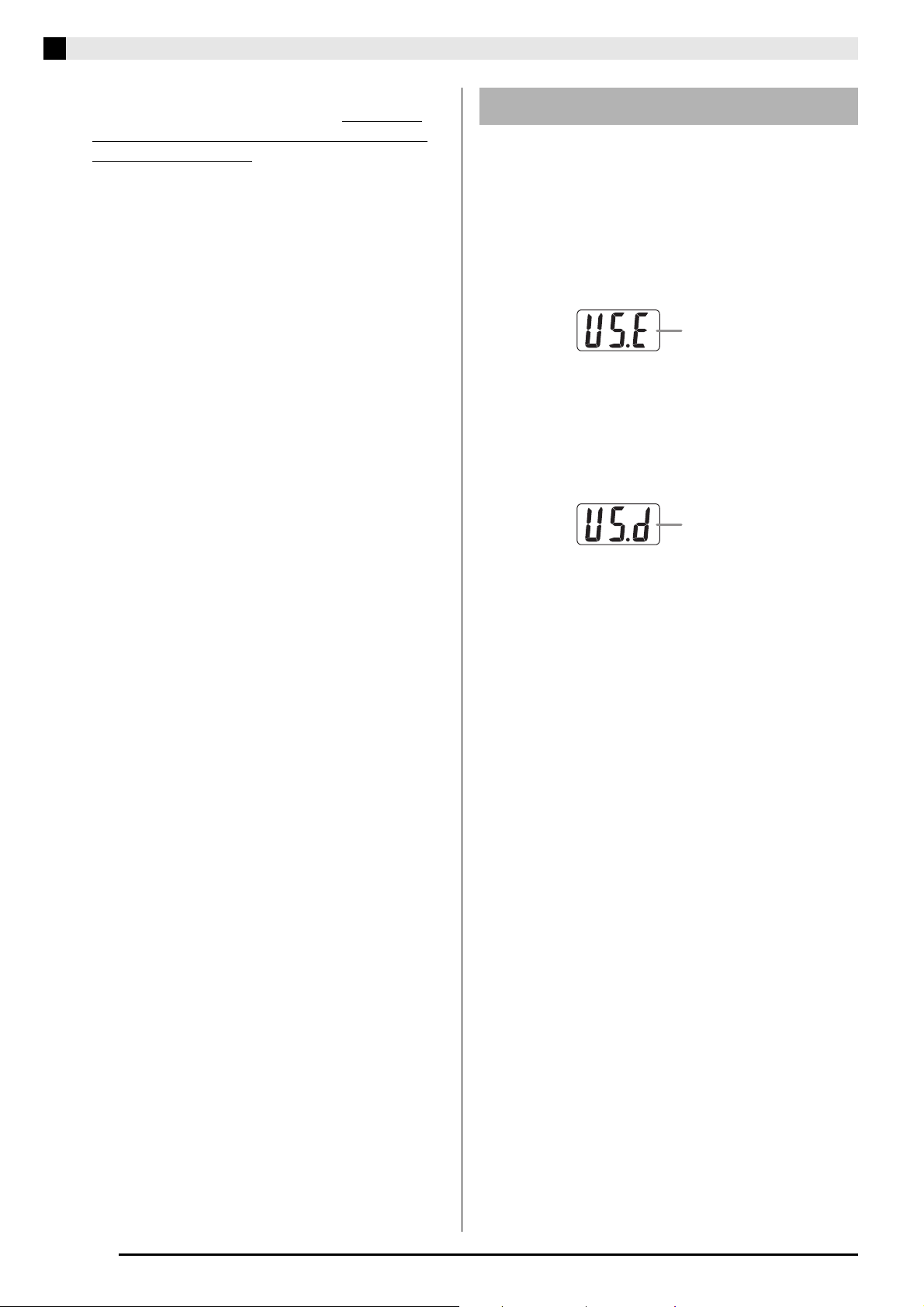
Your digital piano has two data communication
modes: a USB mode and a MIDI mode.
The digital piano will enter the USB mode
automatically whenever a connection is established
between it and the USB driver running on a connected
computer. If there is no computer connected to the USB
port, the digital piano will enter the MIDI mode.
z
zz
z USB Mode
The above indicator appears for about three seconds
after a USB connection is established. For details about
using the MIDI device functions in the USB mode, see
the “CASIO USB MIDI Driver User’s Guide”
(manual_e.pdf) on the bundled CD-ROM.
z
zz
z MIDI Mode
The above indicator appears for about three seconds
after a USB connection terminated. The MIDI mode is
used when sending and receiving data over the digital
piano’s MIDI terminals.
USB Mode and MIDI Mode
USB enabled
USB disabled
PX200_e.book 30 ページ 2006年10月13日 金曜日 午後12時5分
Connecting to a Computer
E-31
You can store up to 10 songs you have downloaded
with your computer as songs 61 through 70 of the
Music Library and practice along with them as they
play, just as you do with the built-in songs.
You also can use the CASIO SMF conversion software
(SMF Converter) to convert SMF data files you have
purchased or created, and transfer them to the digital
piano’s Music Library.
NOTE
• You will not be able to transfer data from a computer to
the digital piano during playback or recording of song
data, during a data save or recall operation, etc. Wait
until the current operation is complete before
transferring data.
To install the SMF conversion software
(SMF Converter)
1.
Place the CD-ROM that comes with the
digital piano into the CD-ROM drive of a
computer that is equipped with a USB port.
2.
Navigate to the CD-ROM and then double-
click the “SMFConv-e.exe” file. Next, follow
the instructions that appear on your computer
screen to install the software.
• Before installing SMF Converter, be sure to read the
contents of the “smfreadme.txt” file. A version of this
file is provided in each language folder on the CD-
ROM.
For information about using SMF Converter, double-
click [index.html] in the [help] folder, which was
created when you installed SMF Converter. You also
can access user documentation from the Windows
[Start] menu by clicking [Programs] – [CASIO] – [SMF
Converter] – [manual].
A browser that supports frames (like Internet Explorer
4 or Netscape Navigator 4.04 or higher) is required to
view the SMF Converter manual.
Minimum Computer System Requirements
z
zz
z Operating System
Windows 98SE
Windows Me
Windows XP Professional
Windows XP Home Edition
z
zz
z Storage
At least 10 MB of available disk space
z
zz
z USB Interface
You also can download the SMF conversion software
from the CASIO Website.
In addition to the software itself, the CASIO MUSIC
SITE also will provide you with information about its
installation and use. You also can find out the latest
news about your digital piano and other CASIO
musical instruments, and much more.
NOTE
• Your digital piano supports SMF Format 0 and Format 1.
Expanding the Selections in
the Music Library
SMF Format Data Files
Ð
CASIO SMF conversion software
Ð
Music Library (Songs 61 to 70)
CASIO MUSIC SITE
http://music.casio.com/
PX200_e.book 31 ページ 2006年10月13日 金曜日 午後12時5分
E-32
Using an SD Memory Card
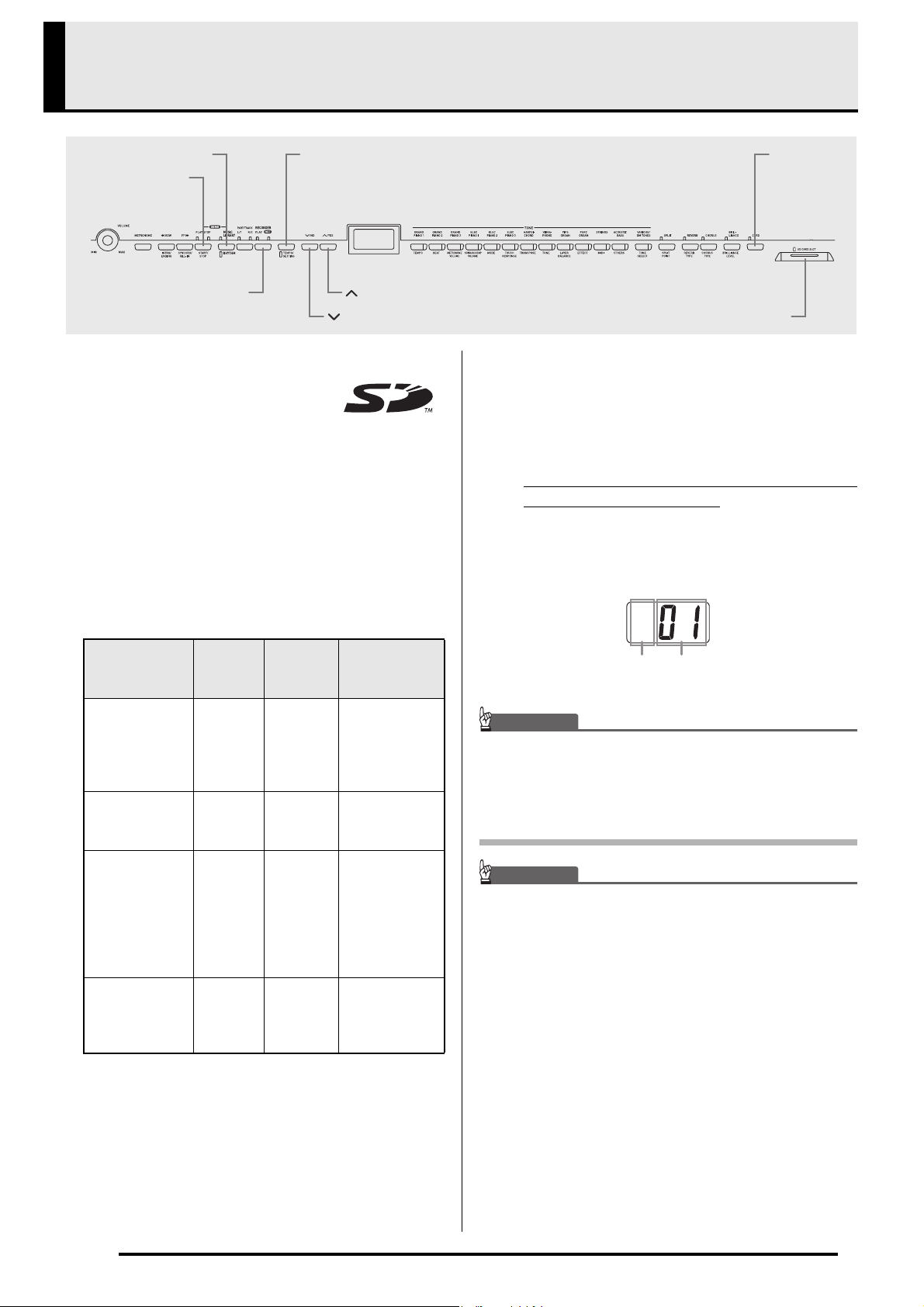
Your digital piano’s SD memory card
slot makes it possible for you to store
song data on a commercially
available SD memory card.
The digital piano also can read SMF song data and
CASIO format song data from an SD memory card.
z Supported SD Memory Cards
The maximum supported SD memory card size is 1 GB.
Use of any SD memory card with greater capacity is
not supported.
z Supported Data File Types and SD Memory Card
Operations
*1 If the first two characters of the filename of song
data is not a two-digit number from 01 to 99, the
corresponding letter (according to data type)
shown in the parentheses will be displayed as
the data type indicator.
*2 Song data recorded with the digital piano can be
saved as SMF Format 0 data.
*3 The digital piano will not be able to correctly
play a file that has more than 17 tracks.
z Data File Display
IMPORTANT!
• Use only SD memory cards. Operation is not guaranteed
when any other type of memory card is used.
SD Memory Card and SD Memory Card
Slot Precautions
IMPORTANT!
• Whenever handling an SD memory card, be sure to
observe the instructions and precautions in the user
documentation that comes with it.
• SD memory cards have a write-protect switch that
protects against accidental deletion of data.
• Avoid using an SD memory card in the following types of
areas. Such conditions can corrupt data stored on the
memory card.
• Areas subjected to high temperature, high humidity,
and corrosive gas
• Areas subjected to strong electrostatic charge and
digital noise
• Never touch the contacts of an SD memory card when
loading it or removing it from the digital piano.
• Never remove the SD memory card from the digital piano
or turn off the digital piano while it is reading data from or
writing data to the memory card. Doing so can corrupt the
data on the memory card and damage the SD memory
card slot.
/NO
CARD
PLAY/STOP
SD CARD SLOT
/YES
TEMPO/SETTING
RECORDER
MUSIC LIBRARY
Data File Type
Display
Indicator
*
1
File Name
Extension
Supported SD
Memory Card
Operations
SMF Data
(Format 0)
U (v) .MID Playback,
transfer to user
area, save to
SD memory
card
*2
SMF Data
(Format 1)
*3
U (v) .MID Playback,
transfer to user
area
Song data
converted to
CASIO format
using CASIO
SMF conversion
software
(CASIO format)
C (d) .CM2 Playback,
transfer to user
area
Song data
recorded on the
digital piano
(CASIO format)
r (q) .CSR Transfer to
recorder area,
save to SD
memory card
Data File Type File Number (01 to 99)
C
PX200_03_e.fm 32 ページ 2007年5月28日 月曜日 午後3時29分
Using an SD Memory Card
E-33
• Never insert anything besides an SD memory card into
the SD memory card slot. Doing so creates the risk of
malfunction.
• Inserting an SD memory card that carries an electrostatic
charge into the SD memory card slot can cause
malfunction of the digital piano. If this happens, turn the
digital piano off and then back on again.
• An SD memory card can become quite warm after very
long use in the SD memory card slot. This is normal and
does not indicate malfunction.
• An SD memory card has a limited service life. After very
long use, you may start to experience problems with
storing data to, or reading or deleting data from the
memory card. When this happens, you need to purchase
a new SD memory card.
Using an SD Memory Card with the Digital
Piano
When using an SD Memory card, first be sure to format
the memory card on the digital piano. For details, see
“Formatting an SD Memory Card” on page E-37.
IMPORTANT!
• Note that the SD memory card must be oriented correctly
when you insert it into the SD memory card slot. Trying to
force the memory card into the slot can damage the card
and the slot.
• Never remove the SD memory card from the card slot or
turn off the digital piano while any data access operation
(save, recall, format) is being performed. Doing so can
corrupt the data on the memory card and damage the SD
memory card slot.
■ To insert an SD memory card
1.
With the SD memory card facing upwards as
shown in the illustration, angle the card
downwards as you insert it into the SD
memory card slot.
• Push the card into the slot until you hear it click into
place.
■ To remove an SD memory card
IMPORTANT!
• Before removing the SD memory card, check to make
sure that the lamp above the CARD button is not lit. If the
lamp is lit or flashing, it means that the card is being
accessed, and that you should not remove it.
1.
Press the memory card into the slot slightly
and then release it.
• This will cause the memory card to disengage and
eject partially.
2.
Pull the memory card out of the slot.
* Note that CASIO COMPUTER CO., LTD. shall not be
held liable for any loss of data stored on an SD memory
card.
Inserting and Removing an SD
Memory Card
Front
PX200_e.book 33 ページ 2006年10月13日 金曜日 午後12時5分
E-34
Using an SD Memory Card
Playback of SMF format data and song data converted
using SMF conversion software to CASIO CM2 format.
IMPORTANT!
• Note the following important precautions whenever
playing back a data file you copied to a memory card with
a computer.
To perform the procedure below, you must have an SD
memory card to which an SMF data file has been copied
from a computer. Insert an SD memory card that has
been formatted on the digital piano into the memory card
slot of your computer, and copy the data file you want to
play back from your computer into the memory card
folder named “MUSICDAT”. Note that you will not be able
to play back the data on the digital piano if it is not
located inside the “MUSICDAT” folder. If you create a
sub-folder inside of the “MUSICDAT” folder, the digital
piano will not be able to load any data file inside the sub-
folder.
• After you select a song data, it can take a number of
seconds for the song data to be loaded. While the data is
being loaded, the song number will flash on the display,
and the keyboard keys and button operations will be
disabled. If you are playing something on the keyboard,
the following operation will cause output to stop.
1.
Press the CARD button.
• The CARD button lamp will light and a file number
will appear on the display.
2.
Use the /NO and /YES buttons to
display the song number of the song you
want to play.
3.
Press the PLAY/STOP button.
4.
Press the PLAY/STOP button again to stop
playback.
5.
After you are finished using the SD memory
card, press the CARD button so its lamp
turns off.
NOTE
• You can change tempo, volume, and pre-count settings
for playback. See “Other Settings” on page E-24 for more
information.
You can use the procedures in this section to transfer
song data from an SD memory card to the digital piano
user area
*1
or recorder area.
*2
*1 Music Library Songs 61 to 70
*2 Memory area where songs recorded on the digital
piano are stored.
z
zz
z Supported Data
User Area . . . . . SMF format data and song data
converted using SMF conversion
software (CASIO CM2 format)
Recorder Area
. . Song data recorded on the digital
piano (CASIO CSR format)
PREPARATION
• Insert the SD memory card that contains the song data
you want to transfer into the digital piano’s SD memory
card slot.
IMPORTANT!
• Never turn off the digital piano or perform any other
operation while data is being recalled from an SD
memory card. Doing so can cause SD memory card data
to be deleted or damaged, making transfer of the data
impossible. It also can cause deletion of data stored in
the user area or recorder area to which you are saving
the data.
Playing Back a File Stored on
an SD Memory Card
CASIO format song
Transferring Song Data from
an SD Memory Card to Digital
Piano Memory
PX200_03_e.fm 34 ページ 2006年10月13日 金曜日 午後6時34分
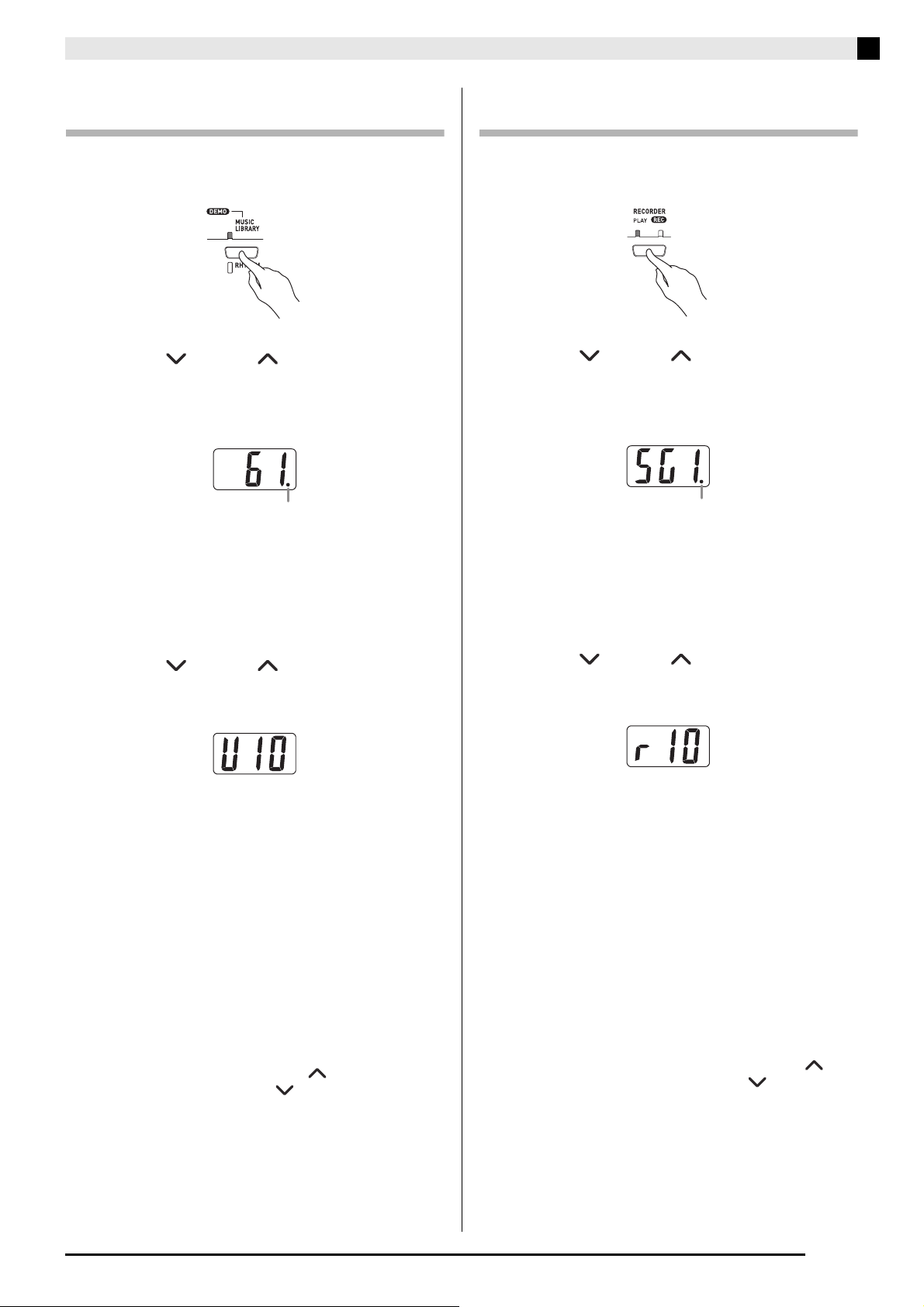
Using an SD Memory Card
E-35
To transfer song data from an SD memory
card to the digital piano user area
1.
Press the MUSIC LIBRARY button so the
lamp above the button is lit.
2.
Use the /NO and /YES buttons to
display the number of the user area song
(Music Library song number 61 through 70) to
which you want to transfer the song data.
3.
Hold down the CARD button until its lamp
starts to flash slowly and “LdU” (Load User
area) appears on the display.
4.
Use the /NO and /YES buttons to
display the file number of the song data you
want to transfer to digital piano memory.
5.
When everything is the way you want, press
the TEMPO/SETTING button to begin data
transfer.
• The message “CPL” (ComPLete) will appear on the
display to let you know when data transfer is
complete. The number of the user area song to which
the data was transferred will be shown on the
display.
z To interrupt an ongoing data transfer operation,
press the CARD button.
z If the user area song number you select contains data
already, pressing the TEMPO/SETTING button in
step 5 will display “rEP” (rEPlace) to confirm that
you want to replace the existing data with the data
you are transferring. Press the /YES button to
overwrite the data or the /NO button to cancel.
To transfer song data from an SD memory
card to the recorder area
1.
Press the RECORDER button so the PLAY
lamp is lit.
2.
Use the /NO and /YES buttons to
display the number of the recorder area song
(1 through 5) to which you want to transfer
the song data.
3.
Hold down the CARD button until its lamp
starts to flash slowly and “Ldr” (Load recorder
area) appears on the display.
4.
Use the /NO and /YES buttons to
display the file number of the song data you
want to transfer to digital piano memory.
5.
When everything is the way you want, press
the TEMPO/SETTING button to begin data
transfer.
• The message “CPL” (ComPLete) will appear on the
display to let you know when data transfer is
complete. The number of the recorder area song to
which the data was transferred will be shown on the
display.
z To interrupt an ongoing data transfer operation,
press the CARD button.
z If the recorder area song number you select contains
data already, pressing the TEMPO/SETTING
button in step 5 will display “rEP” (rEPlace) to
confirm that you want to replace the existing data
with the data you are transferring. Press the /YES
button to overwrite the data or the /NO button to
cancel.
This mark indicates that the currently displayed user area song
number has data stored already.
This mark indicates that the currently displayed song number has
data stored already.
PX200_e.book 35 ページ 2006年10月13日 金曜日 午後12時5分
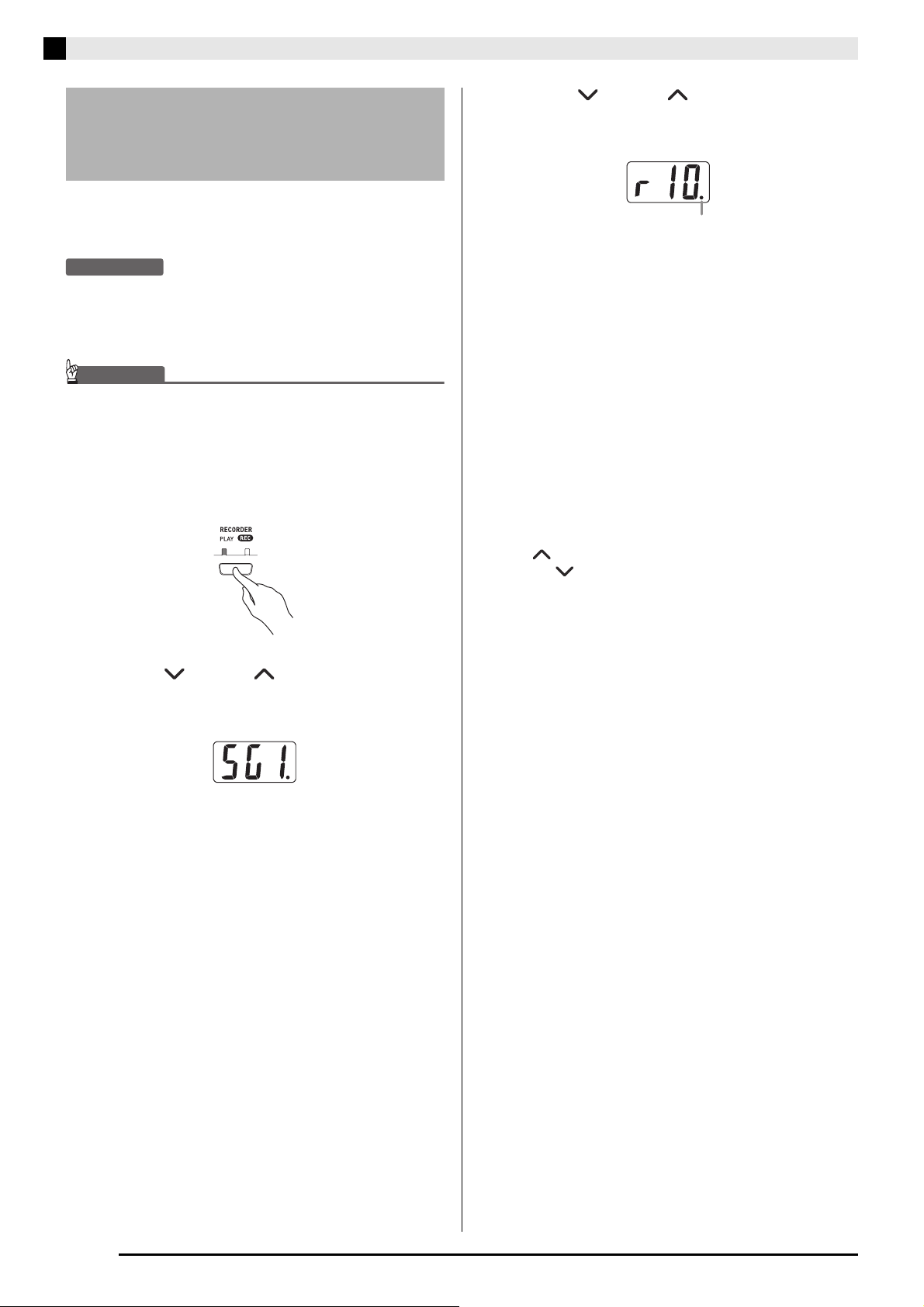
E-36
Using an SD Memory Card
You can save song data that you recorded to the digital
piano’s recorder area to an SD memory card as an SMF
Format 0 file or a CASIO CSR file.
PREPARATION
• Insert an SD memory card that has been formatted on the
digital piano into the digital piano’s SD memory card
slot. Make sure that the write-protect switch of the SD
memory card is not in the write-protect position.
IMPORTANT!
• Never turn off the digital piano or perform any other
operation while data is being saved to an SD memory
card. Doing so can cause SD memory card data to be
deleted and make impossible to store data to the card.
1.
Press the RECORDER button so the PLAY
lamp is lit.
2.
Use the /NO and /YES buttons to select
the song data (song number 1 through 5) you
want to save.
3.
Hold down the CARD button until its lamp
starts to flash slowly and “Ldr” (Load recorder
area) appears on the display.
4.
Press the CARD button again.
• This will cause the CARD button lamp to flash at a
higher speed and “SvC” (Save as CSR file) to appear
on the display. This setting will save song data in
CASIO CSR format.
• If you want to save the song data in SMF Format 0,
press the CARD button again. This will cause “SvS”
(Save as SMF0 file) to appear on the display.
5.
Use the /NO and /YES buttons to select
the file number where you want to save the
song data.
6.
When everything is the way you want, press
the TEMPO/SETTING button to begin saving
data.
• The message “CPL” (ComPLete) will appear on the
display to let you know when the save operation is
complete. After that, the digital piano will return to
playback standby.
z To cancel the save operation, press the CARD
button.
z If the SD memory card already contains a data file
with the same file number, pressing the TEMPO/
SETTING button in step 6 will display “rEP”
(rEPlace) to confirm that you want to replace the
existing file with the file you are saving. Press the
/YES button to overwrite the existing data file or
the /NO button to cancel.
Saving Song Data Recorded
on the Digital Piano to an SD
Memory Card
This mark indicates that the currently displayed file number on the
SD memory card has data stored already.
PX200_e.book 36 ページ 2006年10月13日 金曜日 午後12時5分
Using an SD Memory Card
E-37
Use the procedures in this section to format an SD
memory card.
IMPORTANT!
• Before performing the procedure below, check to make
sure that the SD memory card does not contain any data
you might need.
• The SD memory card format performed by your digital
piano is a “quick format”. If you want to completely delete
all of the data on the card, format it on you computer or
using some other device.
PREPARATION
• Insert the SD memory card you want to format into the
digital piano’s SD memory card slot. Make sure that the
write-protect switch of the SD memory card is not in the
write-protect position.
To format an SD memory card
1.
Press the TEMPO/SETTING button.
• This will cause the button’s lamp to flash.
2.
Press the CARD button.
• This will cause “For” (Format) to flash on the display.
3.
Press the /YES button to start formatting.
• “PLS” (PLeaSe wait) remains on the display while the
formatting operation is performed. Never try to
perform any other operation on the digital piano
while the memory card is being formatted. The
message “CPL” (ComPLete) will appear on the
display to let you know when the format operation is
complete.
z To cancel the format operation, press the /NO
button in place of the /YES button in step 3.
Formatting an SD Memory
Card
PX200_e.book 37 ページ 2006年10月13日 金曜日 午後12時5分
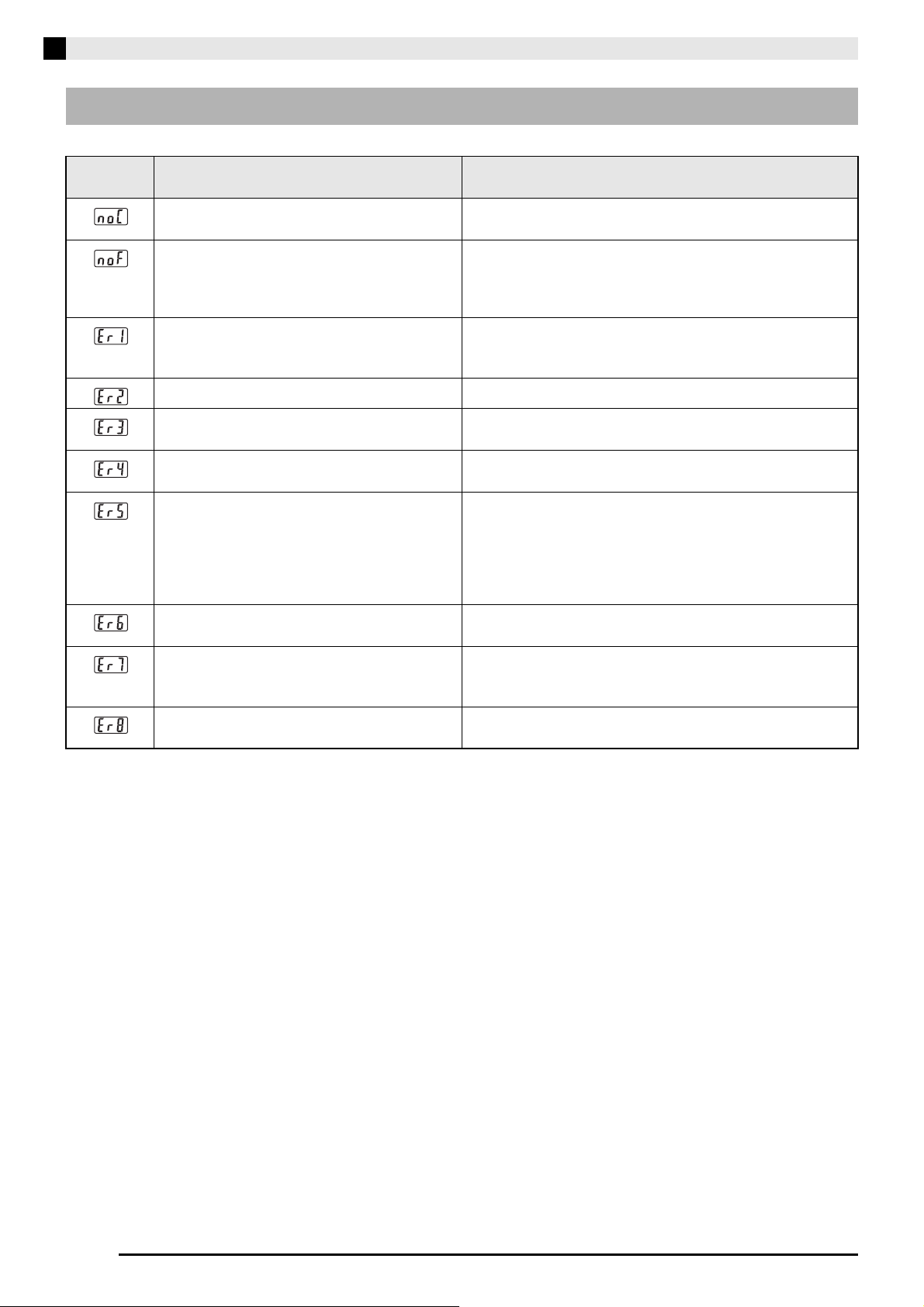
E-38
Using an SD Memory Card
SD Memory Card Errors
Display
Message
Cause Action
No SD memory card loaded in the SD memory
card slot or the card is not loaded correctly.
Correctly insert the SD memory card into the SD memory card
slot. (Page E-33)
You are trying to load data from an SD memory
card that does not contain any data that is
supported by this digital piano.
1. Change to an SD memory card that contains data saved by
or supported by this digital piano.
2. When copying data to an SD memory card from a computer,
copy it to the “MUSICDAT” folder. (Page E-34)
The SD memory card is damaged or the card
was removed while it was being accessed.
1. Use an SD memory card that was formatted on the digital
piano. (Page E-37)
2. Use a different SD memory card.
The SD memory card is full. Use a different SD memory card.
An SD memory card was removed while some
operation was in progress.
Never remove a card from the card slot while a card access
operation is in progress.
Attempt to overwrite the song data file that is
read-only.
Save the file to a different SD memory card or under a different
number.
The data file you are trying to transfer to the
digital piano is too large.
When playing back a file stored on an SD memory card or
loading data to the user area, select a data file that is no larger
than about 318 KB.
When loading song data to the recorder area, you only can
select song data that was recorded on this model of digital
piano.
You are trying to load SMF (Standard MIDI File)
data that is not Format 0 or Format 1.
Use only Format 0 or Format 1 SMF data.
You are trying to store data to an SD memory
card that is write-protected.
1. Use a different SD memory card.
2. If you want to write to the SD memory card, change the
write-protect position to enable writing. (Page E-32)
There is a problem with the SD memory card
data format or the data is corrupted.
Use different data or a different SD memory card.
PX200_e.book 38 ページ 2006年10月13日 金曜日 午後12時5分
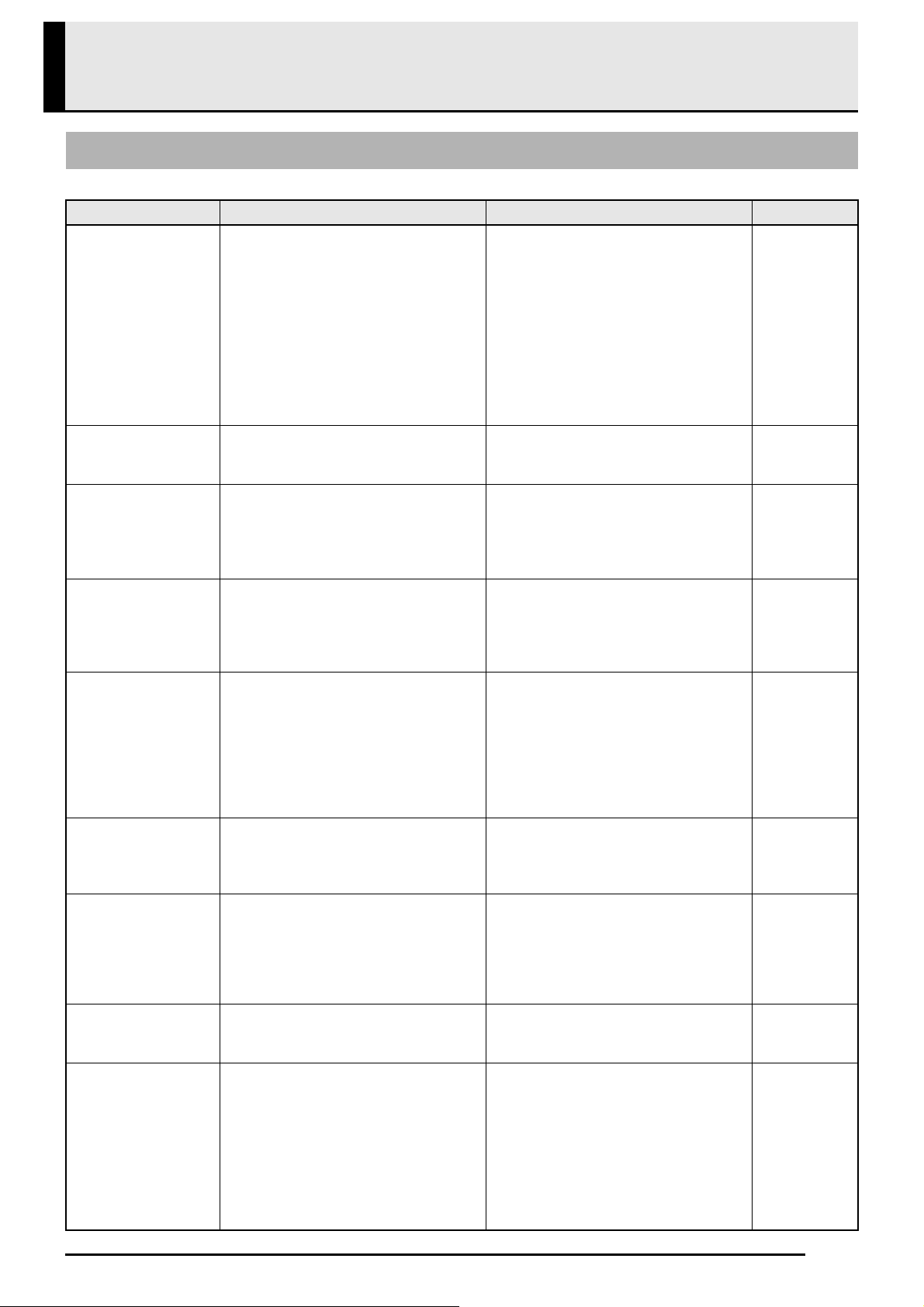
E-39
Reference
Troubleshooting
Problem Cause Action See Page
No sound is
produced when I
press a keyboard key.
1. The VOLUME controller is set to
“MIN”.
2. Headphones are connected to the
digital piano.
3. MIDI Local Control is turned off.
4. Check the current accompaniment
mode setting. Normally, the
accompaniment keyboard range will
not produce any note while CASIO
CHORD or FINGERED is selected as
the Auto Accompaniment mode.
1. Rotate the VOLUME controller more
towards “MAX”.
2. Unplug the headphones from the
digital piano.
3. Turn on the Local Control setting.
4. Change the accompaniment mode to
NORMAL.
) E-8
) E-6
) E-28
) E-14
No rhythm. Accompaniment volume is set to 0. Use the TEMPO/SETTING button and
SONG/ACCOMP VOLUME button to
increase the volume.
) E-27
The pitch of the
digital piano is off.
1. The digital piano’s key setting is
something other than “0”.
2. Digital piano tuning is incorrect.
1. Change the key setting to “0”, or turn
digital piano power off and then back
on again.
2. Adjust digital piano tuning, or turn the
piano off and then back on again.
) E-26
) E-26
No sound is
produced when I try
to play back a built-in
song or a recorded
song.
1. The VOLUME controller is set to
“MIN”.
2. Headphones are connected to the
digital piano.
1. Rotate the VOLUME controller more
towards “MAX”.
2. Unplug the headphones from the
digital piano.
) E-8
) E-6
When I play
something on the
digital piano, my
connected external
MIDI sound source
does not sound.
1. The digital piano’s send channel is
different from the send channel of the
external MIDI sound source.
2. The volume or expression setting of
the external sound source is “0”.
1. Change the send channel settings of
the digital piano and/or the external
MIDI sound source so they are the
same.
2. Adjust the volume and expression
settings of the external sound source.
) E-28
) External
sound
source
user’s guide
No sound is
produced when
playing MIDI data
from a computer.
The USB cable is not connected
correctly.
Check to make sure that the USB cable is
connected correctly.
) E-29
When connected to a
computer over a USB
connection, playing
on the keyboard
produces unnatural
sounds.
The computer’s MIDI THRU function is
turned on.
Turn off MIDI THRU on the computer, or
turn off digital piano Local Control.
) E-28
I can’t record chord
accompaniment data
on my computer.
Accomp MIDI out is turned off. Turn on Accomp MIDI out. ) E-28
I can’t store data to
an SD memory card.
1. The SD memory card is write-
protected.
2. The card is not inserted properly into
the SD memory card slot.
3. There is not enough room available on
the SD memory card.
4. The capacity of the SD memory card is
not supported by the digital piano.
5. The SD memory card is damaged.
1. Change the write-protect position to
enable writing.
2. Insert the card properly.
3. Use a different SD memory card.
4. Use an SD memory card with a
supported capacity.
5. Use a different SD memory card.
) E-32
) E-33
) E-33
) E-32
PX200_e.book 39 ページ 2006年10月13日 金曜日 午後12時5分
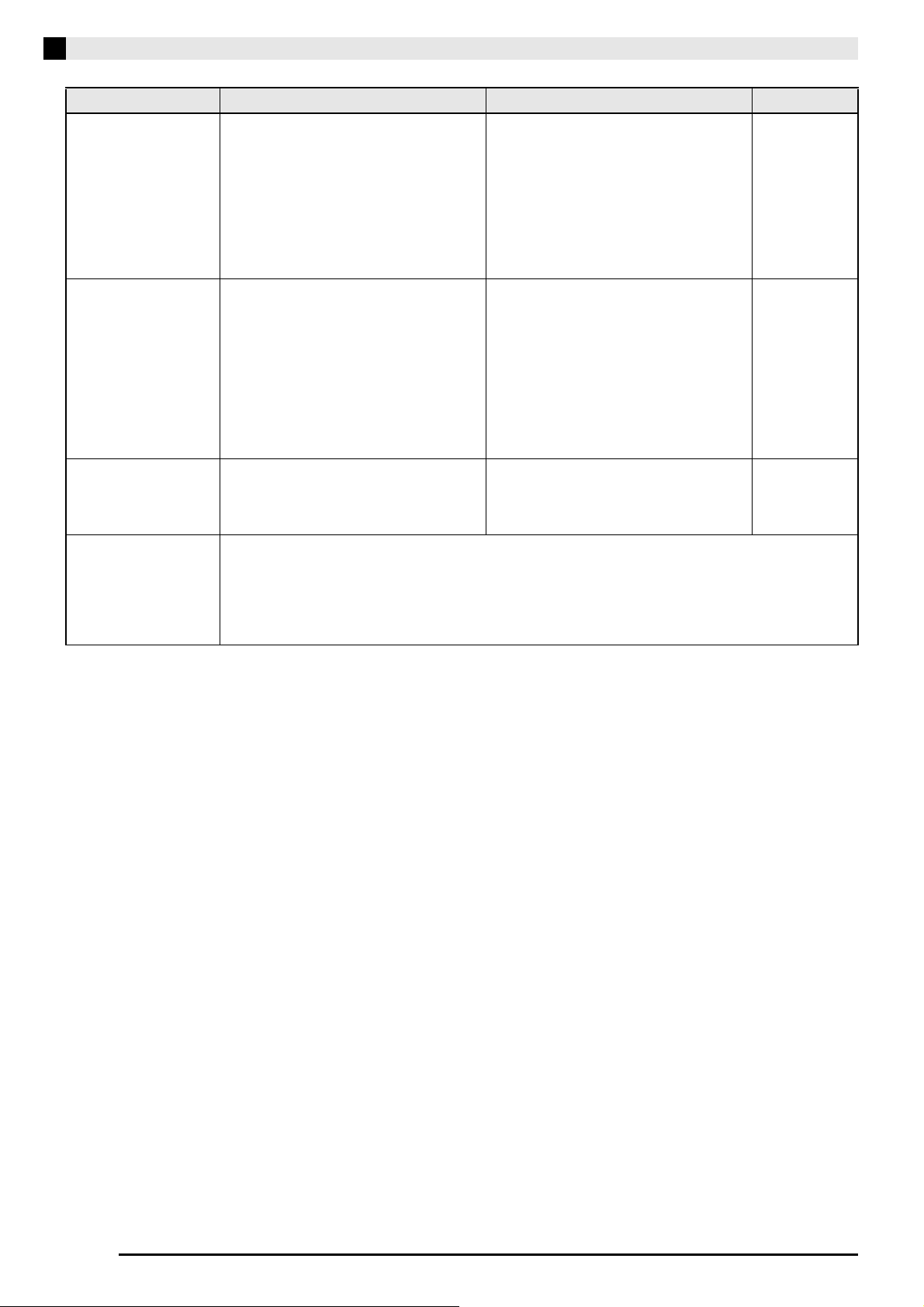
E-40
Reference
I can’t load data from
an SD memory card.
1. The card is not inserted properly into
the SD memory card slot.
2. The capacity of the SD memory card is
not supported by the digital piano.
3. The SD memory card is damaged.
4. When the data was copied to the SD
memory card from a computer, it was
copied to a folder other than
“MUSICDAT”.
1. Insert the card properly.
2. Use an SD memory card with a
supported capacity.
3. Use a different SD memory card.
4. Move the data to the “MUSICDAT”
folder.
) E-33
) E-32
) E-34
Playback stops part
way through while
transferring song
data from my
computer.
Digital noise from the USB cable or power
cord caused data communication your
computer and digital piano to be
interrupted.
Stop song playback, disconnect the USB
cable from the digital piano, and then
reconnect it. Next, try playing back the
song again.
If this does not solve the problem, quit the
MIDI software you are using, disconnect
the USB cable from the digital piano, and
then reconnect it. Next, restart the MIDI
software and then try playing back the
song again.
) E-29
“E-A” appears on the
display immediately
after power is turned
on.
Built-in flash memory is corrupted. Contact your nearest CASIO Service
Center.
—
A tone’s quality and
volume sounds
slightly different
depending where it is
played on the
keyboard.
This is an unavoidable result of the digital sampling process,* and does not indicate malfunction.
* Multiple digital samples are taken for the low range, middle range, and high range of the original
musical instrument. Because of this, there may be a very slight difference in tonal quality and volume
between sample ranges.
Problem Cause Action See Page
PX200_e.book 40 ページ 2006年10月13日 金曜日 午後12時5分
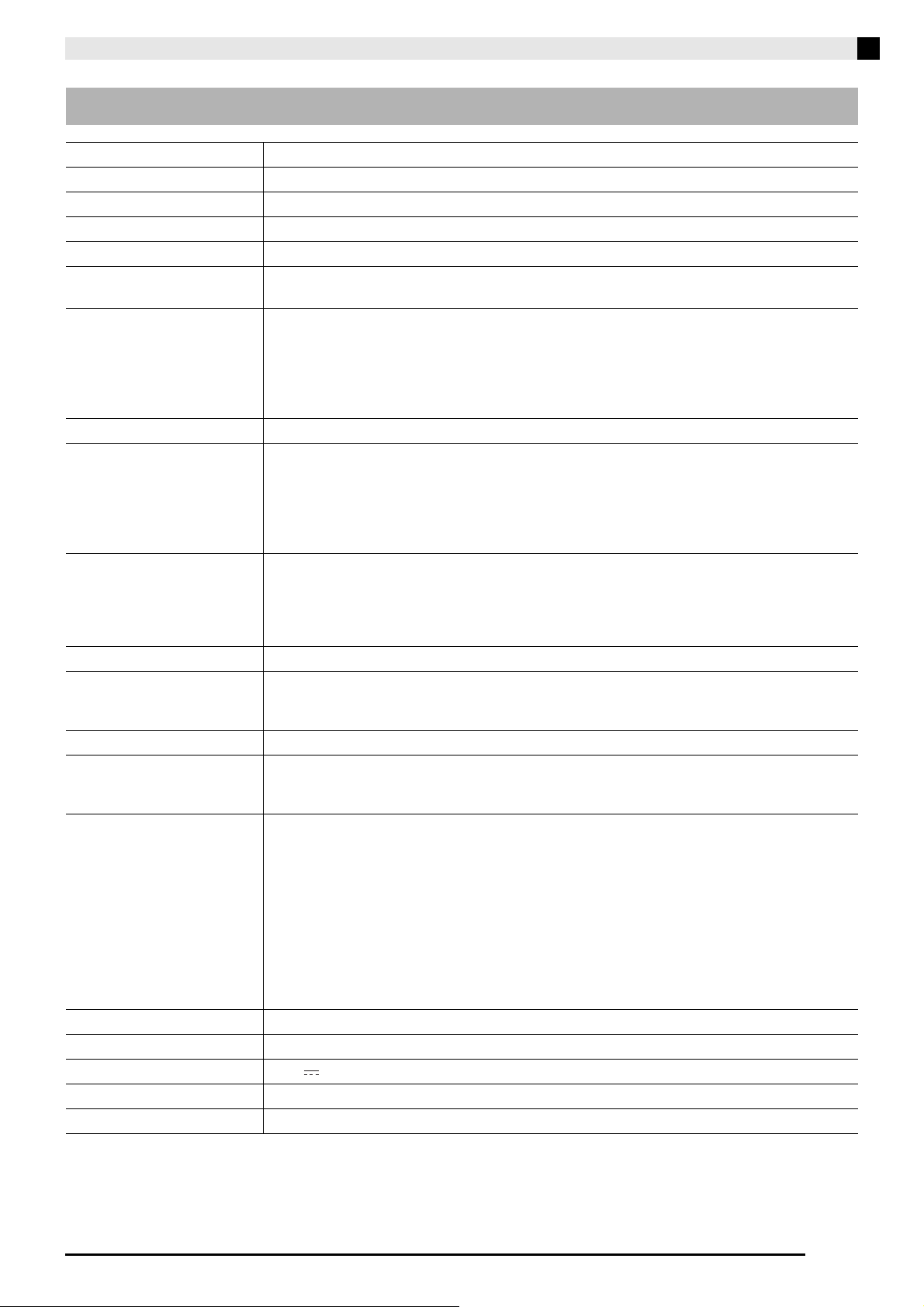
Reference
E-41
• Specifications and designs are subject to change without notice.
Product Specifications
Model PX-200
Keyboard 88-key piano keyboard, with Touch Response
Maximum Polyphony 128 notes
Tones 162 (with Layer and Split)
Effects Reverb (4 types), Chorus (4 types), DSP, Acoustic Resonance, Brilliance (–3 to –1, 1 to 3)
Metronome • Beats: 0, 2, 3, 4, 5, 6
• Tempo Range: 20 to 255
Auto Accompaniment • Number of Rhythms: 20
• Tempo Range: 20 to 255
• Controllers: START/STOP, INTRO/ENDING, SYNCHRO/FILL-IN
• Auto Accompaniment modes: NORMAL, CASIO CHORD, FINGERED, FULL RANGE
CHORD
• Accompaniment Volume Level: Adjustable
Demo Songs 72 (All-song repeat playback)
Music Library • Built-in Songs: 60
User Songs: Up to 10 (3.1 MB total memory capacity; up to approximately 318 KB per song)*
* Based on 1 KB = 1024 bytes, 1 MB = 1024
2
bytes.
• Song volume: Adjustable
• Demo: All-song repeat play
• Part On/Off: L, R
Recorder • Functions: Real-time recording, playback
• Number of Songs: 5
• Number of Tracks: 2
• Capacity: Approximately 50,000 notes total (Up to approximately 10,000 notes per song)
• Recording Media: Built-in flash memory
Pedals Damper, Soft/Sostenuto (switchable)
Other Functions • Touch Select: 3 types, Off
• Transpose: 1 octave (–6 to 0 to 5)
• Tuning: A4 = 440.0 Hz ±50 cents (variable)
MIDI 16-channel multi-timbre receive
SD Memory Card • SD memory card slot
• Supported SD Memory Cards: Up to 1 GB (Larger capacity cards not supported.)
• Functions: SMF playback, file storage, file recall, card format
Inputs/Outputs • PHONES jack: Stereo mini jacks × 2
Output impedance: 170Ω
Output Voltage: 1.1V (RMS) MAX
• Pedal Jacks: Standard jacks × 2
• AC adaptor terminal: 12V DC
• MIDI OUT/IN terminals
• LINE OUT R, L/MONO jacks: Standard jacks × 2
Output impedance: 2.3 Ω
Output Voltage: 1.8V (RMS) MAX
• USB port: Type B
• Pedal connector (for optional SP-30 only)
Speakers (12cm × 6cm oval) × 2 +
φ
5cm × 2 (Output: 8.0W + 8.0W)
Power Requirements AD-12 AC adaptor
Power Consumption 12V 18W
Dimensions 132.2 (W) × 27.8 (D) × 13.4 (H) cm (52
1
/
16
× 10
15
/
16
× 5
1
/
4
inch)
Weight Approximately 12.0kg (26.4 lbs)
PX200_03_e.fm 41 ページ 2006年10月23日 月曜日 午後1時8分
E-42
Reference
Be sure to read and observe the following operating
precautions.
■ Location
Avoid the following locations for this product.
• Areas exposed to direct sunlight and high
humidity
• Areas subjected to temperature extremes
• Near a radio, TV, video deck, or tuner
The above devices will not cause malfunction of
the product, but interference from the product can
cause audio or video interference of a nearby
device.
■ User Maintenance
• Never use benzene, alcohol, thinner, or other
chemical agents to clean the product.
• To clean the product or its keyboard, wipe with a
soft cloth moistened in a weak solution of water
and a mild neutral detergent. Wring all excess
moisture from the cloth before wiping.
■ Included and Optional Accessories
Use only accessories that are specified for use with
this product. Use of unauthorized accessories creates
the risk of fire, electric shock, and personal injury.
■ Weld Lines
Lines may be visible on the exterior of the product.
These are “weld lines” that result from the plastic
molding process. They are not cracks or scratches.
■ Musical Instrument Etiquette
Always be aware of others around you whenever
using this product. Be especially careful when
playing late at night to keep the volume at levels that
do not disturb others. Other steps you can take when
playing late at night are closing the window and
using headphones.
• Any reproduction of the contents of this manual,
either in part or its entirety, is prohibited. Except
for your own, personal use, any other use of the
contents of this manual without the consent of
CASIO is prohibited under copyright laws.
• IN NO EVENT SHALL CASIO BE LIABLE FOR
ANY DAMAGES WHATSOEVER (INCLUDING,
WITHOUT LIMITATION, DAMAGES FOR LOSS
OF PROFITS, BUSINESS INTERRUPTION, LOSS
OF INFORMATION) ARISING OUT OF THE USE
OF OR INABILITY TO USE THIS MANUAL OR
PRODUCT, EVEN IF CASIO HAS BEEN
ADVISED OF THE POSSIBILITY OF SUCH
DAMAGES.
• The contents of this manual are subject to change
without notice.
Operating Precautions
PX200_e.book 42 ページ 2006年10月13日 金曜日 午後12時5分
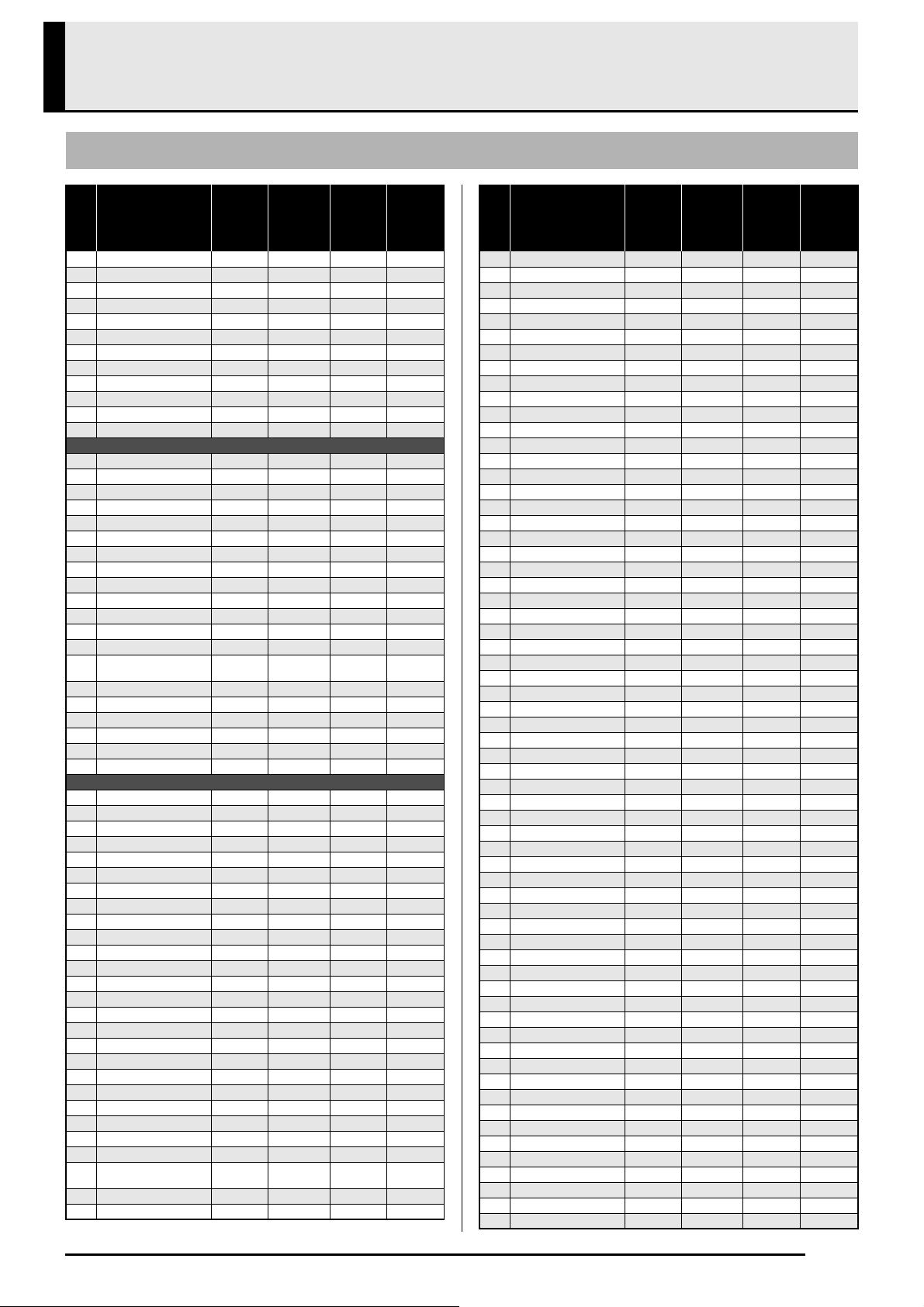
A-1
Appendix/Apéndice
Tone List/Lista de tonos
No./
N
º
Tone Name/
Nombre de tonos
Program
Change/
Cambio de
programa
Bank Select
MSB
/
MSB de
selección
de banco
Maximum
Polyphony
/Polifonía
máxima
DSP
— GRAND PIANO 1 0 48 64 —
— GRAND PIANO 2 0 49 128 —
— GRAND PIANO 3 1 48 64 —
— ELEC PIANO 1 4 48 128 Enhancer
— ELEC PIANO 2 5 49 64 3Band EQ
— ELEC PIANO 3 5 48 128 Enhancer
— HARPSICHORD 6 48 128 3Band EQ
— VIBRAPHONE 11 48 128 Tremolo
— PIPE ORGAN 19 49 128 —
— PERC ORGAN 17 48 64 Rotary
— STRINGS 49 48 128 3Band EQ
— ACOUSTIC BASS 32 48 128 3Band EQ
Various
001 MELLOW PIANO 0 50 64 —
002 ROCK PIANO 1 49 128 —
003 DANCE PIANO 1 50 128 —
004 MODERN PIANO 1 51 64 —
005 PIANO PAD 0 51 64 —
006 HONKY-TONK 3 48 64 —
007 OCTAVE PIANO 3 49 64 —
008 DYNO ELEC.PIANO 4 49 128 Auto Pan
009 POP ELEC.PIANO 4 50 64 Tremolo
010 E.GRAND 80 2 48 128 —
011 CLAVI 7 48 128 Enhancer
012 CHURCH ORGAN 19 48 64 —
013 DRAWBAR ORGAN 16 48 128 Rotary
014 ROCK ORGAN 16 49 128
Drive
Rotary
015 STEEL STR.GUITAR 25 48 128 —
016 SYNTH-STRINGS 50 48 128 3Band EQ
017 CHOIR 52 48 64 —
018 SYNTH-PAD 90 48 64 —
019 FANTASY 88 48 64 —
020 NEW AGE 88 49 64 3Band EQ
GM
021 GM PIANO 1 0 0 128 —
022 GM PIANO 2 1 0 128 —
023 GM PIANO 3 2 0 128 —
024 GM HONKY-TONK 3 0 64 —
025 GM E.PIANO 1 4 0 128 —
026 GM E.PIANO 2 5 0 128 —
027 GM HARPSICHORD 6 0 128 —
028 GM CLAVI 7 0 128 —
029 GM CELESTA 8 0 128 —
030 GM GLOCKENSPIEL 9 0 128 —
031 GM MUSIC BOX 10 0 64 —
032 GM VIBRAPHONE 11 0 128 —
033 GM MARIMBA 12 0 128 —
034 GM XYLOPHONE 13 0 128 —
035 GM TUBULAR BELL 14 0 128 —
036 GM DULCIMER 15 0 64 —
037 GM ORGAN 1 16 0 128 —
038 GM ORGAN 2 17 0 64 —
039 GM ORGAN 3 18 0 64 —
040 GM PIPE ORGAN 19 0 64 —
041 GM REED ORGAN 20 0 128 —
042 GM ACCORDION 21 0 64 —
043 GM HARMONICA 22 0 128 —
044 GM BANDONEON 23 0 64 —
045
GM NYLON
STR.GUITAR
24 0 128 —
046 GM STEEL STR.GUITAR 25 0 128 —
047 GM JAZZ GUITAR 26 0 128 —
048 GM CLEAN GUITAR 27 0 128 —
049 GM MUTE GUITAR 28 0 128 —
050 GM OVERDRIVE GT 29 0 64 —
051 GM DISTORTION GT 30 0 64 —
052 GM GT HARMONICS 31 0 128 —
053 GM ACOUSTIC BASS 32 0 128 —
054 GM FINGERED BASS 33 0 128 —
055 GM PICKED BASS 34 0 128 —
056 GM FRETLESS BASS 35 0 128 —
057 GM SLAP BASS 1 36 0 128 —
058 GM SLAP BASS 2 37 0 128 —
059 GM SYNTH-BASS 1 38 0 64 —
060 GM SYNTH-BASS 2 39 0 128 —
061 GM VIOLIN 40 0 128 —
062 GM VIOLA 41 0 128 —
063 GM CELLO 42 0 128 —
064 GM CONTRABASS 43 0 128 —
065 GM TREMOLO STRINGS 44 0 128 —
066 GM PIZZICATO 45 0 128 —
067 GM HARP 46 0 128 —
068 GM TIMPANI 47 0 128 —
069 GM STRINGS 1 48 0 128 —
070 GM STRINGS 2 49 0 128 —
071 GM SYNTH-STRINGS 1 50 0 128 —
072 GM SYNTH-STRINGS 2 51 0 128 —
073 GM CHOIR AAHS 52 0 128 —
074 GM VOICE DOO 53 0 128 —
075 GM SYNTH-VOICE 54 0 128 —
076 GM ORCHESTRA HIT 55 0 64 —
077 GM TRUMPET 56 0 128 —
078 GM TROMBONE 57 0 128 —
079 GM TUBA 58 0 128 —
080 GM MUTE TRUMPET 59 0 128 —
081 GM FRENCH HORN 60 0 64 —
082 GM BRASS 61 0 128 —
083 GM SYNTH-BRASS 1 62 0 64 —
084 GM SYNTH-BRASS 2 63 0 64 —
085 GM SOPRANO SAX 64 0 128 —
086 GM ALTO SAX 65 0 128 —
087 GM TENOR SAX 66 0 128 —
088 GM BARITONE SAX 67 0 128 —
089 GM OBOE 68 0 128 —
090 GM ENGLISH HORN 69 0 128 —
091 GM BASSOON 70 0 128 —
092 GM CLARINET 71 0 128 —
093 GM PICCOLO 72 0 128 —
094 GM FLUTE 73 0 128 —
095 GM RECORDER 74 0 128 —
096 GM PAN FLUTE 75 0 128 —
097 GM BOTTLE BLOW 76 0 128 —
098 GM SHAKUHACHI 77 0 64 —
099 GM WHISTLE 78 0 128 —
100 GM OCARINA 79 0 128 —
101 GM SQUARE LEAD 80 0 64 —
102 GM SAWTOOTH LEAD 81 0 64 —
103 GM CALLIOPE 82 0 64 —
104 GM CHIFF LEAD 83 0 64 —
105 GM CHARANG 84 0 64 —
106 GM VOICE LEAD 85 0 64 —
107 GM FIFTH LEAD 86 0 64 —
108 GM BASS+LEAD 87 0 64 —
109 GM FANTASY 88 0 64 —
110 GM WARM PAD 89 0 128 —
No./
N
º
Tone Name/
Nombre de tonos
Program
Change/
Cambio de
programa
Bank Select
MSB
/
MSB de
selección
de banco
Maximum
Polyphony
/Polifonía
máxima
DSP
PX200_s.book 1 ページ 2006年10月23日 月曜日 午後3時43分
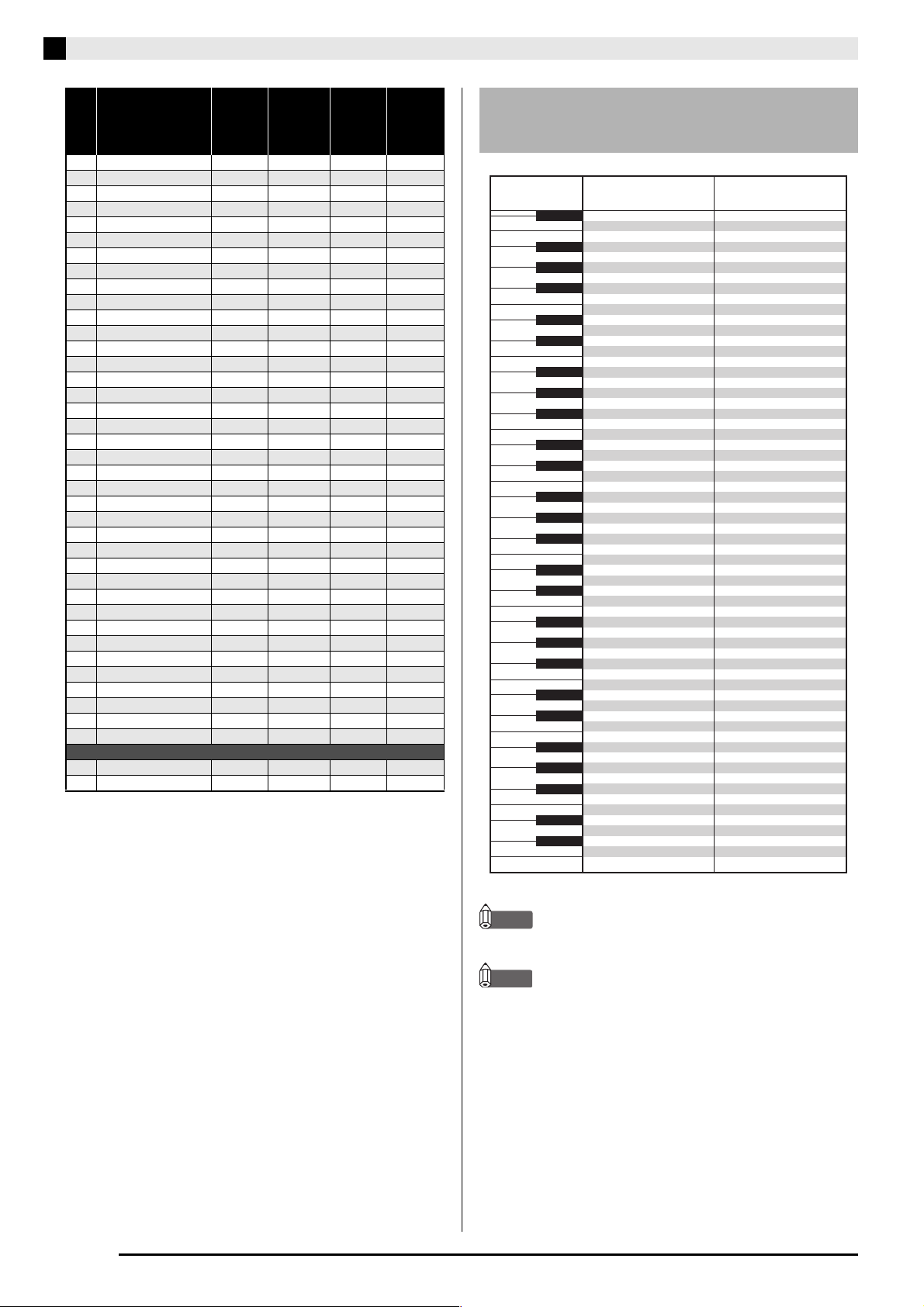
A-2
Appendix/Apéndice
NOTE
• “I” : indicates the same sound as STANDARD SET.
NOTA
• “I” : indica el mismo sonido que STANDARD SET.
111 GM POLYSYNTH 90 0 64 —
112 GM SPACE CHOIR 91 0 64 —
113 GM BOWED GLASS 92 0 64 —
114 GM METAL PAD 93 0 64 —
115 GM HALO PAD 94 0 64 —
116 GM SWEEP PAD 95 0 128 —
117 GM RAIN DROP 96 0 64 —
118 GM SOUND TRACK 97 0 64 —
119 GM CRYSTAL 98 0 64 —
120 GM ATMOSPHERE 99 0 64 —
121 GM BRIGHTNESS 100 0 64 —
122 GM GOBLINS 101 0 64 —
123 GM ECHOES 102 0 128 —
124 GM SF 103 0 64 —
125 GM SITAR 104 0 128 —
126 GM BANJO 105 0 128 —
127 GM SHAMISEN 106 0 128 —
128 GM KOTO 107 0 128 —
129 GM THUMB PIANO 108 0 128 —
130 GM BAGPIPE 109 0 64 —
131 GM FIDDLE 110 0 128 —
132 GM SHANAI 111 0 128 —
133 GM TINKLE BELL 112 0 128 —
134 GM AGOGO 113 0 128 —
135 GM STEEL DRUMS 114 0 64 —
136 GM WOOD BLOCK 115 0 128 —
137 GM TAIKO 116 0 128 —
138 GM MELODIC TOM 117 0 128 —
139 GM SYNTH-DRUM 118 0 128 —
140 GM REVERSE CYMBAL 119 0 128 —
141 GM GT FRET NOISE 120 0 128 —
142 GM BREATH NOISE 121 0 128 —
143 GM SEASHORE 122 0 64 —
144 GM BIRD 123 0 64 —
145 GM TELEPHONE 124 0 128 —
146 GM HELICOPTER 125 0 128 —
147 GM APPLAUSE 126 0 64 —
148 GM GUNSHOT 127 0 128 —
Drum Sets
149 STANDARD SET 0 120 128 —
150 BRUSH SET 40 120 128 —
No./
N
º
Tone Name/
Nombre de tonos
Program
Change/
Cambio de
programa
Bank Select
MSB
/
MSB de
selección
de banco
Maximum
Polyphony
/Polifonía
máxima
DSP
Drum Assignment List/
Lista de sonidos de batería
STANDARD SET
BRUSH SET
E1
F1
G1
A1
B1
C2
D2
E2
F2
G2
A2
B2
C3
D3
E3
F3
G3
A3
B3
C4
D4
E4
F4
G4
A4
B4
C5
D5
E5
F5
G5
A5
B5
C6
D6
E6
F6
28
29
31
33
35
36
38
40
41
43
45
47
48
50
52
53
55
57
59
60
62
64
65
67
69
71
72
74
76
77
79
81
83
84
86
88
89
E
b
1
F
#
1
A
b
1
B
b
1
C
#
2
E
b
2
F
#
2
A
b
2
B
b
2
C
#
3
E
b
3
F
#
3
A
b
3
B
b
3
C
#
4
E
b
4
F
#
4
A
b
4
B
b
4
C
#
5
E
b
5
F
#
5
A
b
5
B
b
5
C
#
6
E
b
6
27
30
32
34
37
39
42
44
46
49
51
54
56
58
61
63
66
68
70
73
75
78
80
82
85
87
HIGH Q
SLAP
SCRATCH PUSH
SCRATCH PULL
STICKS
SQUARE CLICK
METRONOME CLICK
METRONOME BELL
STANDARD 1 KICK 2
STANDARD 1 KICK 1
SIDE STICK
STANDARD 1 SNARE 1
HAND CLAP 1
STANDARD 1 SNARE 2
LOW TOM 2
CLOSED HI-HAT
LOW TOM 1
PEDAL HI-HAT
MID TOM 2
OPEN HI-HAT
MID TOM 1
HIGH TOM 2
CRASH CYMBAL 1
HIGH TOM 1
RIDE CYMBAL 1
CHINESE CYMBAL
RIDE BELL
TAMBOURINE 1
SPLASH CYMBAL
COWBELL
CRASH CYMBAL 2
VIBRA-SLAP
RIDE CYMBAL 2
HIGH BONGO
LOW BONGO
MUTE HIGH CONGA
OPEN HIGH CONGA
LOW CONGA
HIGH TIMBALE
LOW TIMBALE
HIGH AGOGO
LOW AGOGO
CABASA
MARACAS
SHORT HI WHISTLE
LONG LOW WHISTLE
SHORT GUIRO
LONG GUIRO
CLAVES
HIGH WOOD BLOCK
LOW WOOD BLOCK
MUTE CUICA
OPEN CUICA
MUTE TRIANGLE
OPEN TRIANGLE
SHAKER
JINGLE BELL
BELL TREE
CASTANETS
MUTE SURDO
OPEN SURDO
APPLAUSE
APPLAUSE 2
BRUSH KICK 2
BRUSH KICK 1
BRUSH SIDE STICK
BRUSH TAP
BRUSH SLAP
BRUSH SWIRL
BRUSH CRASH CYMBAL 1
BRUSH RIDE CYMBAL 1
BRUSH RIDE BELL
TAMBOURINE 2
BRUSH SPLASH CYMBAL
BRUSH CRASH CYMBAL 2
BRUSH RIDE CYMBAL 2
Key/Note Number
Número de clave/nota
PX200_s.book 2 ページ 2006年10月23日 月曜日 午後3時43分
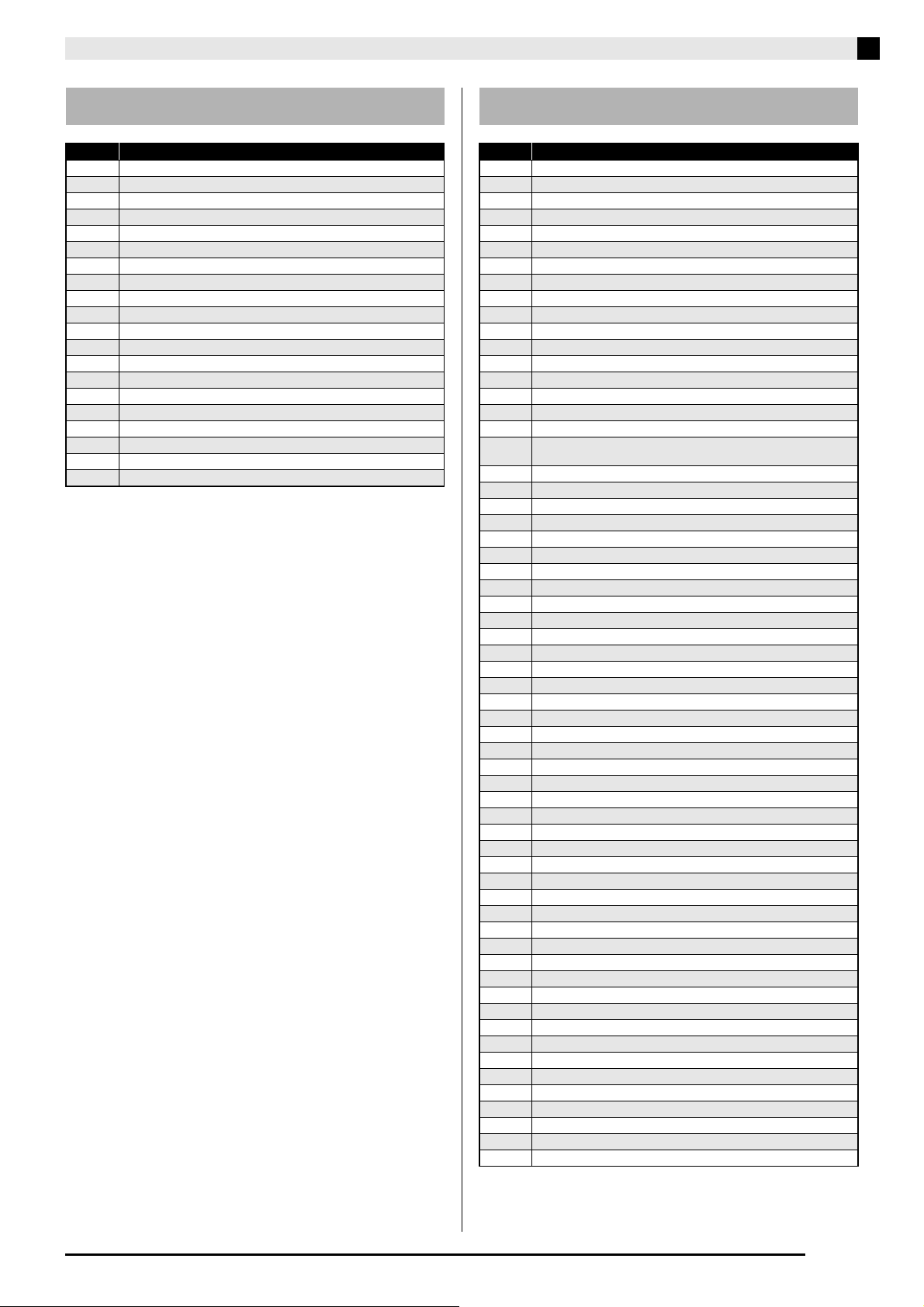
Appendix/Apéndice
A-3
Rhythm List/Lista de ritmos
No./Nº Rhythm Name/Nombre de ritmo
01 8 BEAT
02 PIANO BALLAD 1
03 PIANO BALLAD 2
04 EP BALLAD 1
05 EP BALLAD 2
06 BLUES BALLAD
07 JAZZ COMBO 1
08 JAZZ COMBO 2
09 RAGTIME
10 ROCK’N’ROLL
11 BOOGIE WOOGIE
12 BOSSA NOVA
13 GOSPEL
14 ARPEGGIO 1
15 ARPEGGIO 2
16 MARCH 1
17 MARCH 2
18 STRIDE PIANO
19 WALTZ 1
20 WALTZ 2
Song List/Lista de canciones
No./Nº Song Name/Nombre de canciones
01 Nocturne Op.9-2
02 Fantaisie-Impromptu Op.66
03 Étude Op.10-3 “Chanson de l’adieu”
04 Étude Op.10-5 “Black Keys”
05 Étude Op.10-12 “Revolutionary”
06 Étude Op.25-9 “Butterflies”
07 Prélude Op.28-7
08 Valse Op.64-1 “Petit Chien”
09 Valse Op.64-2
10 Moments Musicaux 3
11 Impromptu Op.90-2
12 Marche Militaire 1 (Duet)
13 Frühlingslied [Lieder Ohne Worte Heft 5]
14 Fröhlicher Landmann [Album für die Jugend]
15 Von fremden Ländern und Menschen [Kinderszenen]
16 Träumerei [Kinderszenen]
17 Tambourin
18
Menuet BWV Anh.114 [Clavierbüchlein der Anna Magdalena
Bach]
19 Inventio 1 BWV 772
20 Inventio 8 BWV 779
21 Inventio 13 BWV 784
22 Praeludium 1 BWV 846 [Das Wohltemperierte Klavier 1]
23 Le Coucou
24 Gavotte
25 Sonatina Op.36-1 1st Mov.
26 Sonatine Op.20-1 1st Mov.
27 Sonate K.545 1st Mov.
28 Sonate K.331 3rd Mov. “Turkish March”
29 Rondo K.485
30 Für Elise
31 Marcia alla Turca
32 Sonate Op.13 “Pathétique” 1st Mov.
33 Sonate Op.13 “Pathétique” 2nd Mov.
34 Sonate Op.13 “Pathétique” 3rd Mov.
35 Sonate Op.27-2 “Moonlight” 1st Mov.
36 Rhapsodie 2
37 Waltz Op.39-15 (Duet)
38 Liebesträume 3
39 Blumenlied
40 La Prière d’une Vierge
41 Csikos Post
42 Humoresque Op.101-7
43 Melodie [Lyrische Stücke Heft 2]
44 Sicilienne Op.78
45 Berceuse [Dolly] (Duet)
46 Arabesque 1
47 La Fille aux Cheveux de Lin [Préludes]
48 Passepied [Suite bergamasque]
49 Gymnopédie 1
50 Je Te Veux
51 Salut d’Amour
52 The Entertainer
53 Maple Leaf Rag
54 L’arabesque [25 Etüden Op.100]
55 La Styrienne [25 Etüden Op.100]
56 Ave Maria [25 Etüden Op.100]
57 Le retour [25 Etüden Op.100]
58 La chevaleresque [25 Etüden Op.100]
59 No.13 [Études de Mécanisme Op.849]
60 No.26 [Études de Mécanisme Op.849]
61-70 User area songs/Canciones del área de usuario
PX200_04_es_Appendix.fm 3 ページ 2006年10月24日 火曜日 午後4時43分
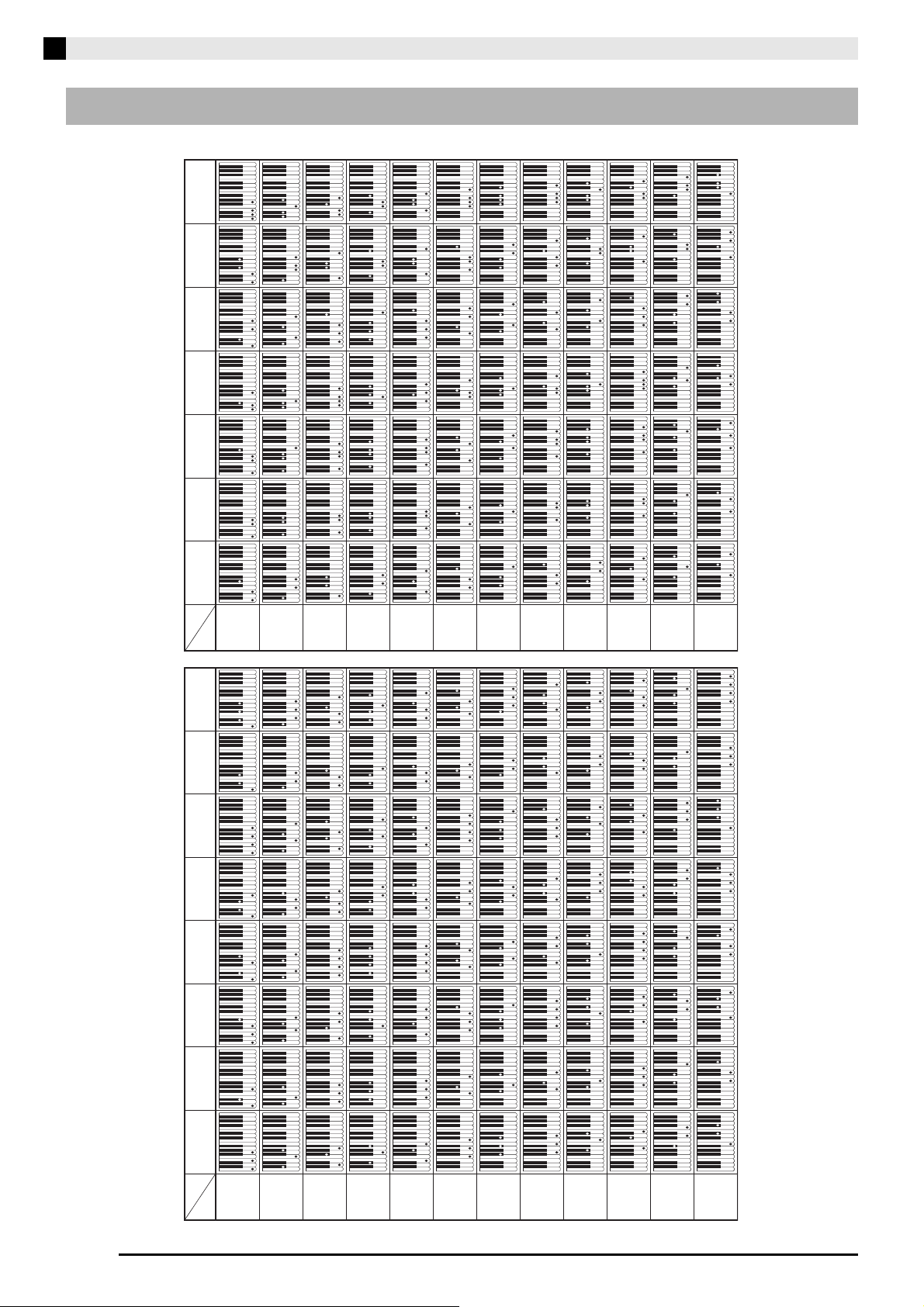
A-4
Appendix/Apéndice
Fingered Chord Chart/Cuadro de acordes digitados (Fingered)
dim
m7
b
5
M7M m 7 m7 dim7
Chord
Type
Root
C
D
E
F
G
A
B
C /(D )
b
#
(D )/E
b
#
F /(G )
b
#
(G )/A
b
#
(A )/B
b
#
aug sus4
C
D
E
F
G
A
B
C /(D )
b
#
(D )/E
b
#
F /(G )
b
#
(G )/A
b
#
(A )/B
b
#
m add97sus4 mM7
7
b
5
add9
Chord
Type
Root
PX200_s.book 4 ページ 2006年10月23日 月曜日 午後3時43分
Function... Transmitted Recognized Remarks
Basic
Channel
1 - 16
1 - 16
1 - 16
1 - 16
Default
Changed
Note
Number
21 - 108 0 - 127
0 - 127
*
1True voice
Program
Change
O
0 - 127
O
0 - 127
:True #
After
Touch
Control
Change
X
X
X
O
Pitch Bender
XO
System Exclusive
OO
Key’s
Ch’s
Velocity
O
9nH v = 1 - 127
X
8nH v = 64
O
9nH v = 1 - 127
X
9nH v = 0.8nH V =
**
Note ON
Note OFF
Mode
Mode 3
X
Mode 3
X
Default
Messages
Altered
System
Common
X
X
X
X
X
X
: Song Pos
: Song Sel
: Tune
Aux
Messages
Remarks
X
X
X
X
X
O
O
X
: Local ON/OFF
: All notes OFF
: Active Sense
: Reset
System
Real Time
O
O
X
X
: Clock
: Commands
0,32
1
6, 38
7
10
11
16
17
18
19
64
66
67
76
77
78
80
81
82
83
91
93
100, 101
120
121
Bank select
Modulation
Data entry
Volume
Pan
Expression
DSP Parameter0
*
2
DSP Parameter1
*
2
DSP Parameter2
*
2
DSP Parameter3
*
2
Damper
Sostenuto
Soft pedal
Vibrato rate
Vibrato depth
Vibrato delay
DSP Parameter4
*
2
DSP Parameter5
*
2
DSP Parameter6
*
2
DSP Parameter7
*
2
Reverb send
Chorus send
RPN LSB, MSB
*
3
All sound off
Reset all controller
Model PX-200 Version : 1.0
Mode 1 : OMNI ON, POLY
Mode 3 : OMNI OFF, POLY
Mode 2 : OMNI ON, MONO
Mode 4 : OMNI OFF, MONO
O : Yes
X : No
O
O
O
O
O
O
O
O
O
O
O
O
O
O
O
O
O
O
O
O
O
O
O
O
O
O
X
O
X
X
X
X
X
X
X
O
O
O
X
X
X
X
X
X
X
X
X
X
X
O
*4, *5
MIDI Implementation Chart
*1: Depends on tone
*1: Depende del tono.
**:no relation
**: sin relación
*2 : For details, see MIDI Implementation at http://world.casio.com/.
*2 : Si desea más información, vea Implementación MIDI en http://world.casio.com/
.
*3 : Pitch Bend Sensitivity, Fine Tune, Coarse Tune, Modulation Depth, Null
*3 : Sensibilidad de inflexión de tono, afinación precisa, afinación poco precisa, profundidad de modulación, nulo
*4 : Universal Real-time Exclusive Messages: Master Volume, Master Balance, Master Fine Tuning, Master Coarse Tuning, Reverb Parameter,
Chorus Parameter, GM System Message
*4 : Mensajes exclusivos de sistemas universales en tiempo real: Volumen maestro, balance maestro, afinación precisa maestra, afinación
poco precisa maestra, parámetro de reverberación, parámetro de coro, mensaje de sistema GM
*5 : This model’s System Exclusive Message
• For details about footnotes 3 through 5, see MIDI Implementation at http://world.casio.com/
.
*5 : Mensaje exclusivo del sistema de este modelo
• Si desea más información sobre los pies de página, vea Implementación MIDI en http://world.casio.com/.
This recycle mark indicates that the packaging conforms to
the environmental protection legislation in Germany.
Esta marca de reciclaje indica que el empaquetado se
ajusta a la legislación de protección ambiental en Alemania.
MA0706-C Printed in China
PX200ES1C
C

