!
WARNING
TO REDUCE THE RISK OF FIRE, ELECTRIC SHOCK, OR INJURY TO PER-
SONS, OBSERVE THE FOLLOWING:
1. Use this unit only in the manner intended by the manufacturer. If you have
questions, contact the manufacturer or your distributor.
2. Before servicing or cleaning unit, switch power off at service panel and lock
the service disconnecting means to prevent power from being switched on
accidentally. When the service disconnecting means cannot be locked, se-
curely fasten a prominent warning device, such as a tag, to the service panel.
3. Installation work and electrical wiring must be done by a qualified person(s)
in accordance with all applicable codes and standards, including fire-rated
construction codes and standards.
4. Sufficient air is needed for proper combustion and exhausting of gases through
the flue (chimney) of fuel burning equipment to prevent backdrafting. Follow
the heating equipment manufacturer’s guidelines and safety standards such
as those published by the National Fire Protection Association (NFPA), and
the American Society for Heating, Refrigeration and Air Conditioning Engi-
neers (ASHRAE), and the local code authorities.
5. When cutting or drilling into wall or ceiling, do not damage electrical wiring
and other hidden utilities.
6. Ducted fans must always be vented to the outdoors.
7. Do not use this unit with an additional speed control device.
8. To reduce the risk of fire, use only steel ductwork.
9. This unit must be grounded.
TO REDUCE THE RISK OF A RANGE TOP GREASE FIRE:
1. Never leave surface units unattended at high settings. Boilovers cause smok-
ing and greasy spillovers that may ignite. Heat oils slowly on low or medium
settings.
2. Always turn hood ON when cooking at high heat or when cooking flaming
foods.
3. Clean ventilating fans frequently. Grease should not be allowed to accumu-
late on fan or filter.
4. Use proper pan size. Always use cookware appropriate for the size of the
surface element.
TO REDUCE THE RISK OF INJURY TO PERSONS IN THE EVENT OF A
RANGE TOP GREASE FIRE, OBSERVE THE FOLLOWING:*
1. SMOTHER FLAMES with a close-fitting lid, cookie sheet, or metal tray, then
turn off the burner. BE CAREFUL TO PREVENT BURNS. If the flames do not
go out immediately, EVACUATE AND CALL THE FIRE DEPARTMENT.
2. NEVER PICK UP A FLAMING PAN - You may be burned.
3. DO NOT USE WATER, including wet dishcloths or towels - violent steam
explosion will result.
4. Use an extinguisher ONLY if:
A. You know you have a Class ABC extinguisher and you already know
how to operate it.
B. The fire is small and contained in the area where it started.
C. The fire department is being called.
D. You can fight the fire with your back to an exit.
* Based on “Kitchen Fire Safety Tips” published by NFPA.
Blower Dimensions
10.866 x 10.746 x 8.424
CAUTION
1. For general ventilating use only. Do not use to exhaust hazardous or explo-
sive materials and vapors.
2. To avoid motor bearing damage and noisy and/or unbalanced impellers, keep
drywall spray, construction dust, etc. off power unit.
3. Your ventilator motor has a thermal overload which will automatically shut off
the motor if it becomes overheated. The motor will restart when it cools down.
If the motor continues to shut off and restart, have the hood serviced.
4. Please read specification label on product for further information and require-
ments.
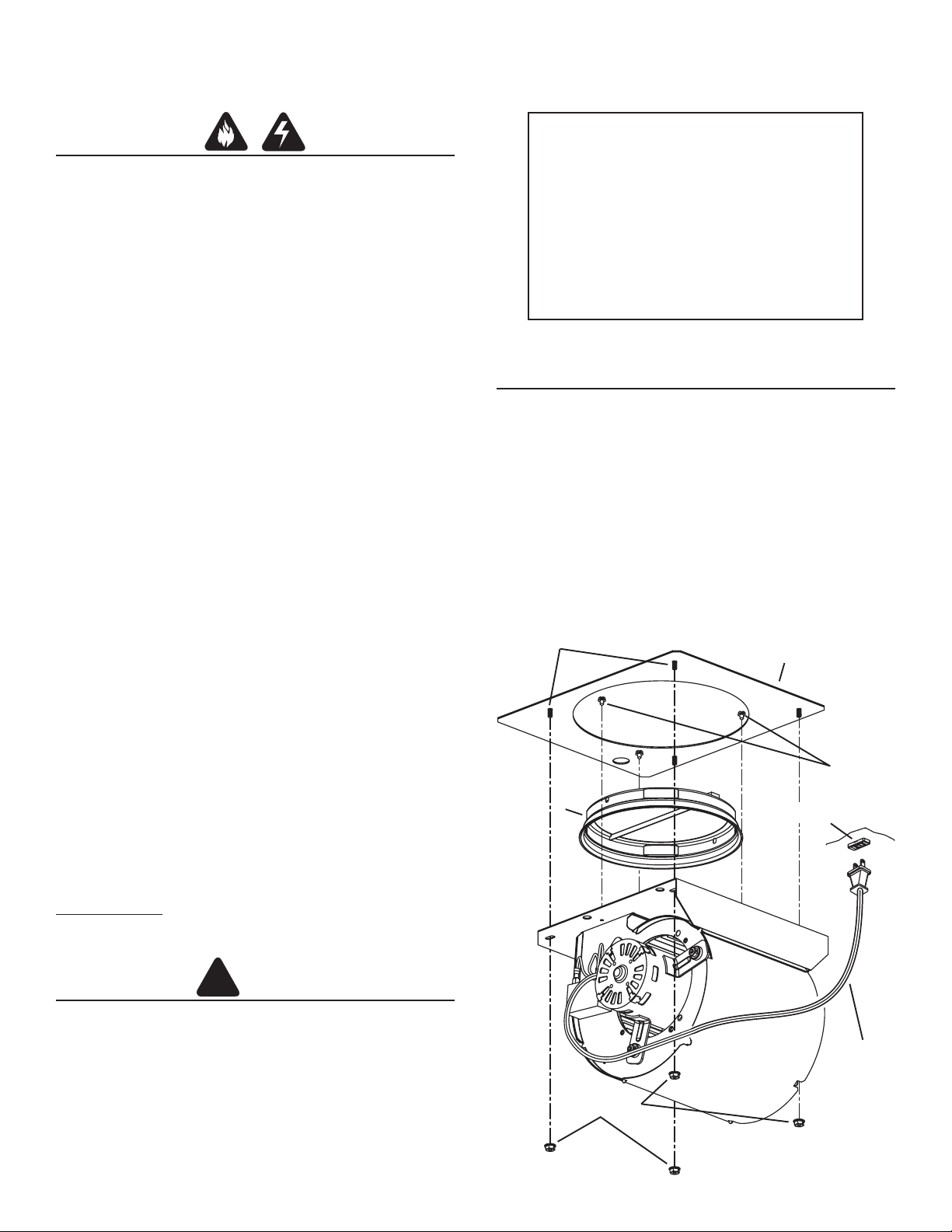
Model DIV440 Ventilator Kit
VENTILATOR KIT
INSTALLATION
1. Attach DAMPER to VENTILATOR, as shown,
using three (3) HEX SCREWS (provided).
Note: Damper flange to be captured by screw
heads.
2. Lift ventilator into position inside the hood.
3. Fasten ventilator to four (4) THREADED
STUDS, using four (4) HEX NUTS (provided).
4. Plug ventilator's POWER CORD into
RECEPTACLE inside the hood.
VENTILATOR
HEX NUTS
THREADED STUDS
TOP OF HOOD
POWER
CORD
99043058D
For Use With Hood Models:
DCWH3042 DBCV4282
DTWS3049 DCWL3342
DTWS3649 DCWN3042
DTWS4249 DSWB3049
DBCV3082 DSWB3649
DICV3632 DICV4232
DBCV3682 DSWB4249
DAMPER
HEX
SCREWS
F20090
RECEPTACLE
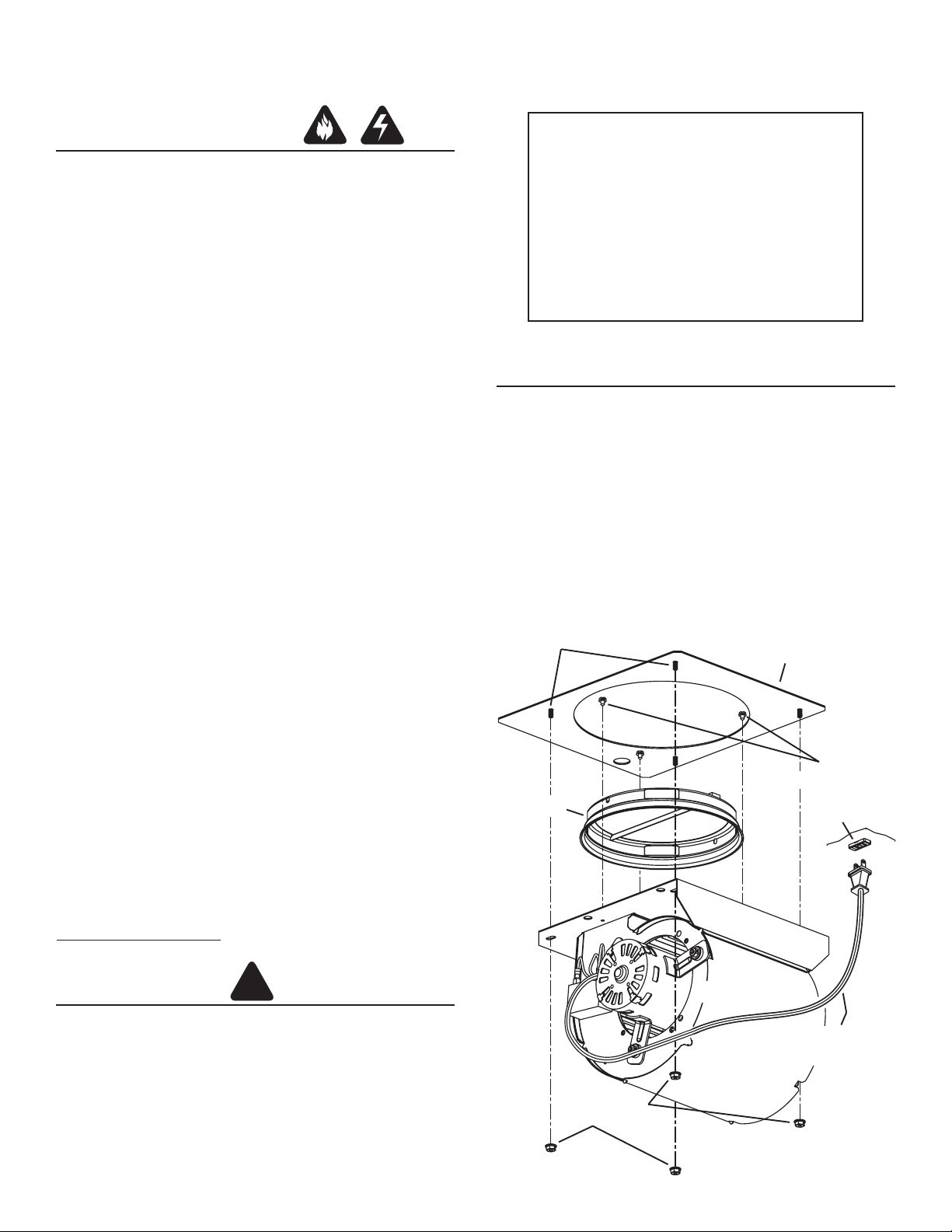
Ensemble de ventilateur modèle DIV440
ENSEMBLE DE VENTILATEUR
INSTALLATION
1. Fixer le CLAPET au VENTILATEUR, tel qu’illustré,
à l’aide des trois (3) VIS HEXAGONALES
(fournies). Remarque : La bride du clapet doit être
emprisonnée par les têtes de vis.
2. Le soulever en position à l’intérieur de la hotte.
3. Fixer le ventilateur aux quatre (4) GOUJONS FI-
LETÉS, à l’aide des quatre (4) ÉCROUS HEXA-
GONAUX (fournis).
4. Brancher le CORDON D’ALIMENTATION du ven-
tilateur dans la PRISE à l’intérieur de la hotte.
GOUJONS FILETÉS
99043058D
À utiliser avec les modèles de hotte:
DCWH3042 DBCV4282
DTWS3049 DCWL3342
DTWS3649 DCWN3042
DTWS4249 DSWB3049
DBCV3082 DSWB3649
DICV3632 DICV4232
DBCV3682 DSWB4249
F20090
!
AVERTISSEMENT
AFIN DE DIMINUER LES RISQUES D’INCENDIE, D’ÉLECTROCUTION OU DE
BLESSURES, SUIVEZ CES DIRECTIVES:
1. Utilisez ce produit en suivant les recommandations du manufacturier. Pour toute ques-
tion, contactez le manufacturier à l’adresse ou au numéro de téléphone indiqués dans
la garantie.
2. Avant de réparer ou de nettoyer cette hotte, coupez le courant au panneau d’alimentation
et verrouillez-en l’accès afin d’éviter que le courant ne soit accidentellement remis en
fonction. S’il vous est impossible de le verrouiller, apposez un indicateur voyant sur le
panneau comme, par exemple, une étiquette de couleur vive.
3. L’installation de la hotte ainsi que le câblage électrique doivent être effectués par une ou
des personnes compétentes selon les normes et les règles en vigueur, incluant celles
qui régissent la prévention des incendies.
4. Une circulation d’air efficace est requise afin d’assurer la combustion et l’évacuation
complète des gaz par le tuyau d’évacuation (cheminée) des équipements à combus-
tion et pour prévenir les retours d’air. Conformez-vous aux normes et mesures de
sécurité pour les manufacturiers d’appareils de chauffage publiées par la “National Fire
Protection Association (NFPA)” et par la “American Society for Heating, Refregiration
and Air Conditioning Engineers (ASHRAE)”, ainsi qu’aux normes en vigueur dans votre
région.
5. Lorsque vous coupez ou percez un mur ou un plafond, prenez garde d’endommager
les fils électriques ou autres installations qui pourraient y être dissimulés.
6. Les installations ventilées doivent toujours être reliées à des conduits rejetant l’air à
l’extérieur.
7. Ne pas utiliser ce ventilateur avec un régulateur de vitesse à transistors.
8. Afin de diminuer les risques d’incendie, n’utilisez que des conduits de ventilation en
métal.
9. Ce ventilateur doit être relié à une mise à la terre.
AFIN DE DIMINUER LES RISQUES D’INCENDIE POUVANT SE DÉCLENCHER SUR
LA SURFACE DE CUISSON:
1. Ne jamais laisser sans surveillance des unités de surface réglées à feu vif. En plus de
générer de la fumée, les débordements de graisse peuvent prendre feu. Chauffer les
huiles lentement à feu doux ou moyen.
2. Toujours mettre en marche la hotte durant la cuisson à feu vif ou la cuisson d’aliments
à flamber.
3. Nettoyer régulièrement les ventilateurs d’aération. On ne doit tolérer aucune accumulation
de graisse sur le ventilateur ou sur le filtre.
4. Utiliser une casserole de grosseur appropriée. Toujours utiliser une batterie de cuisine
proportionnelle à l’élément de surface.
AFIN DE DIMINUER LES RISQUES DE BLESSURES POUVANT SURVENIR
LORSQU’UN FEU SE DÉCLENCHE SUR LA SURFACE DE CUISSON, SUIVEZ CES
DIRECTIVES:
1. ÉTOUFFEZ LES FLAMMES avec un couvercle hermétique, une tôle à biscuits ou un
plateau en métal puis éteignez la cuisinière. PRENEZ GARDE AUX BRÛLURES. Si
vous ne parvenez pas à éteindre immédiatement les flammes, ÉVACUEZ LES LIEUX
ET CONTACTEZ VOTRE POSTE LOCAL DE LUTTE CONTRE LES INCENDIES.
2. NE VOUS EMPAREZ JAMAIS D’UN PLAT QUI S’EST ENFLAMMÉ – Vous risqueriez
de vous brûler.
3. N’UTILISEZ JAMAIS D’EAU, incluant les linges à vaisselles ou serviettes mouillés car
cela peut provoquer une violente explosion de vapeur.
4. Utilisez un extincteur SEULEMENT si:
A. Il s’agit d’un extincteur de classe ABC et que vous savez comment
vous en servir.
B. Il s’agit d’un petit feu qui ne se propage pas ailleurs que sur
la cuisinière.
C. Vous avez appelé votre poste local de lutte contre les incendies.
D. Vous pouvez combattre le feu tout en ayant accès à une sortie.
* Basé sur “Kitchen Fire Safety Tips” édité par NFPA.
ATTENTION
1. N’utilisez cet appareil que pour la ventilation des surfaces de cuisson. Ne l’utilisez
pas pour ventiler des matières ou des vapeurs de nature dangereuse ou explosive.
2. Afin d’éviter d’endommager le mécanisme du moteur et de débalancer et/ou de rendre
bruyant le fonctionnement des hélices, protégez l’appareil des poussières de
placoplâtre et de construction.
3. Le moteur du ventilateur est muni d’un disjoncteur thermique qui coupe
automatiquement l’alimentation du moteur si celui-ci surchauffe. Le moteur
redémarrera une fois refroidi. Si le moteur persiste à s’arrêter et à redémarrer, faire
vérifier la hotte de cuisine.
4. Veuillez lire toutes les étiquettes apposées sur le produit pour obtenir plus d’information
et connaître les spécifications d’installation.
DESSUS DE
LA HOTTE
VIS
HEXAGONALES
CLAPET
PRISE
VENTILATEUR
CORDON
D’ALIMENTATION
ÉCROUS
HEXAGONAUX
Dimensions de ventilateur
27,6 cm (10.866") x 27,3 cm (10.746") x 21,4 cm (8.424")