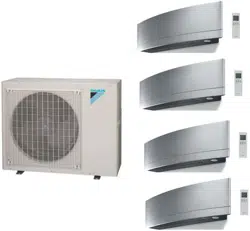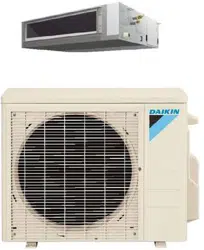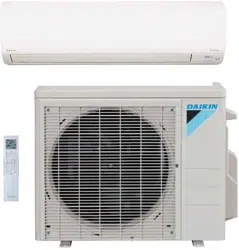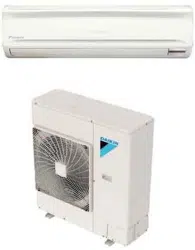
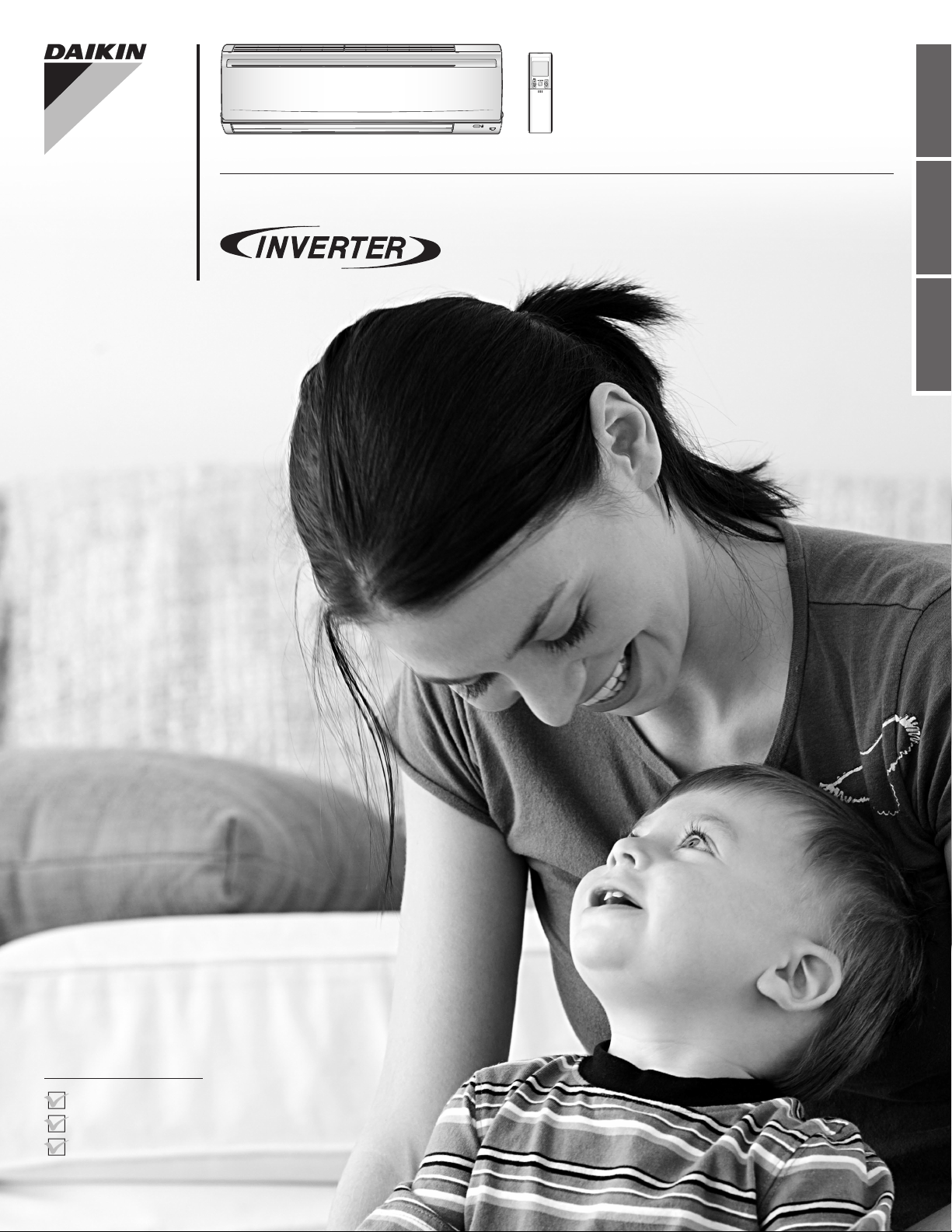
DAIKIN ROOM AIR CONDITIONER
OPERATION MANUAL
MODELS
FTXS15LVJU
FTXS18LVJU
FTXS24LVJU
EnglishFrançaisEspañol
00_CV_3P297290-2C.indd 1 10/29/2015 15:33:59
1
Feature
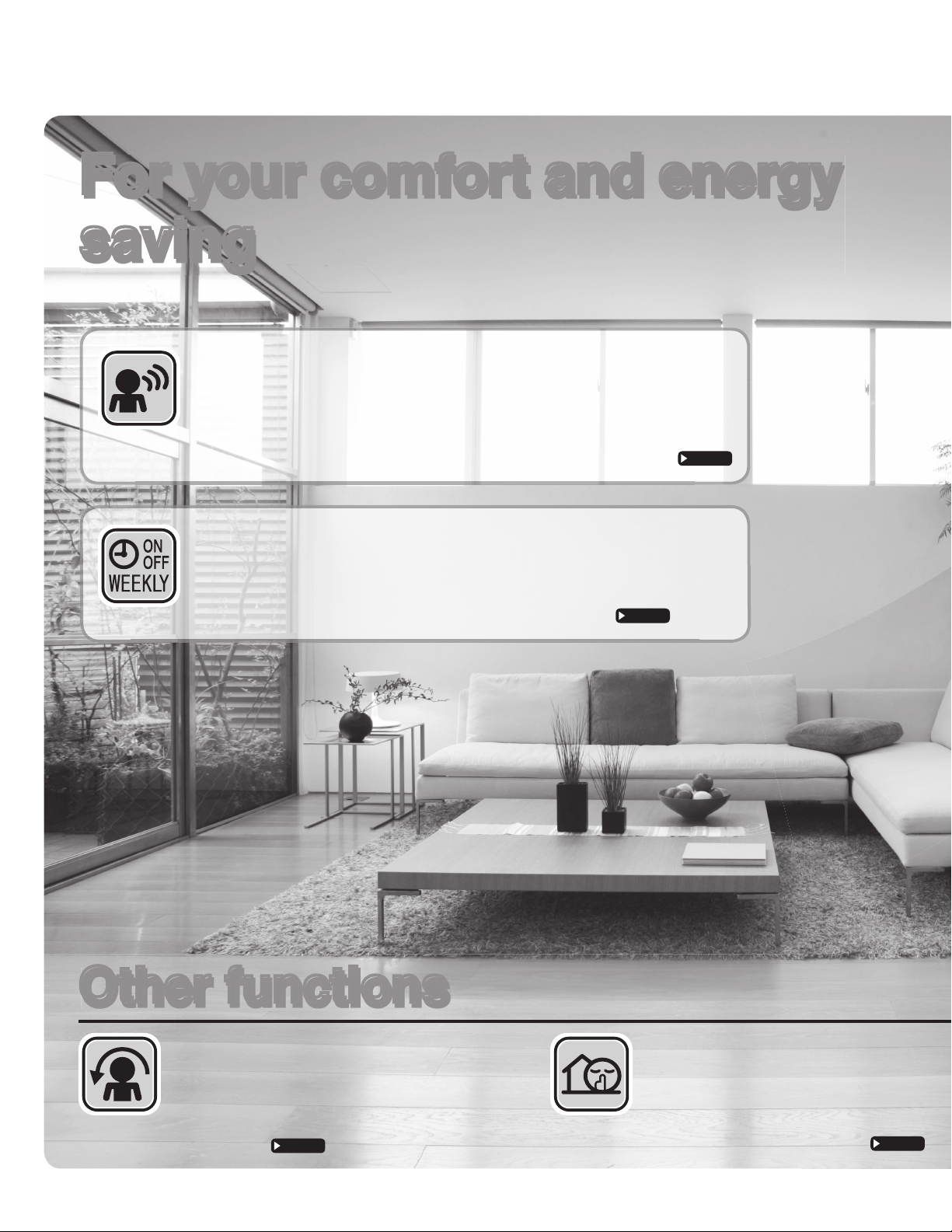
For your comfort and energy
saving
Other functions
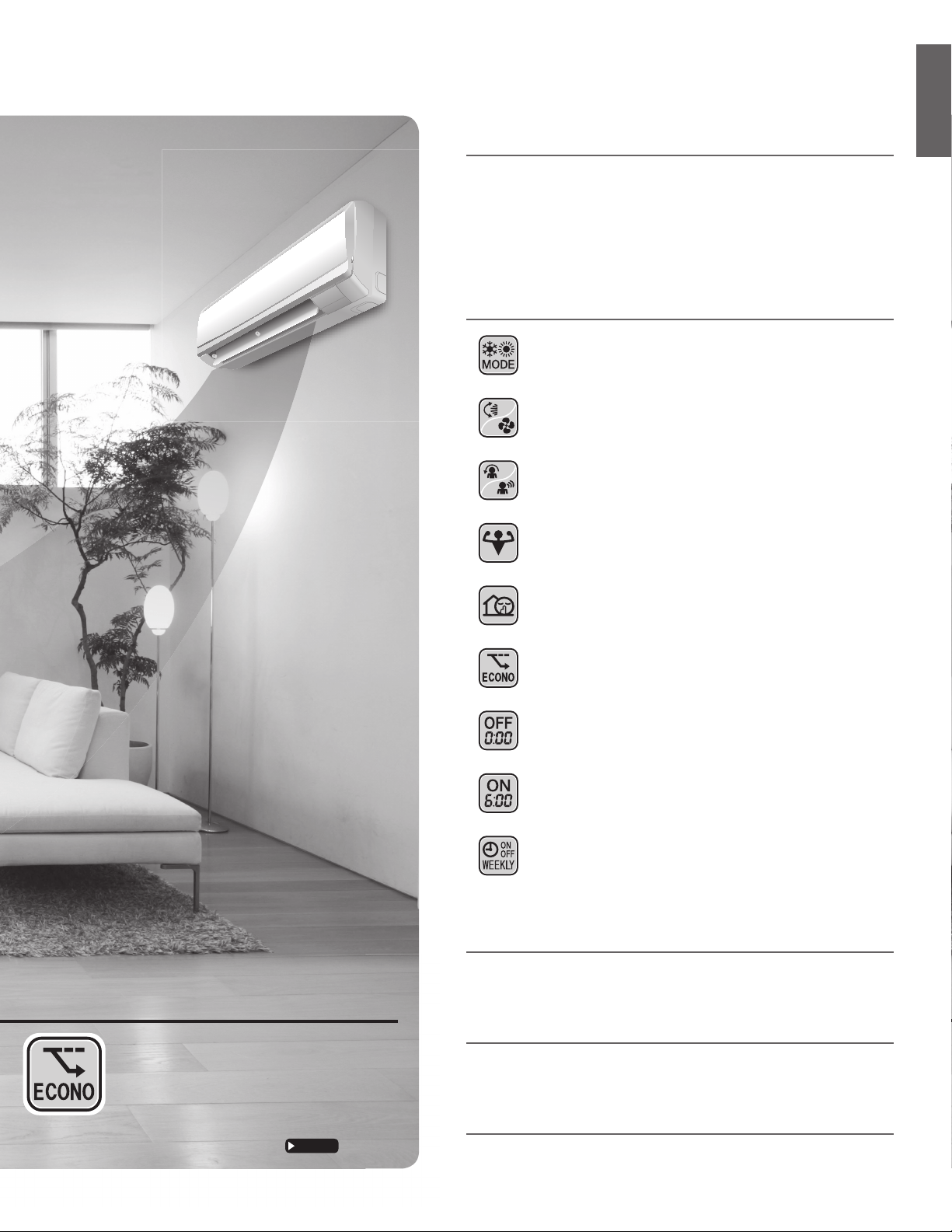
COMFORT AIRFLOW OUTDOOR UNIT QUIET ECONO
The air ow direction will be in upward mode
while in COOL operation, in downward mode
while in HEAT operation. This function will
prevent cold or warm air from directly blowing
on your body.
Page 15
OUTDOOR UNIT QUIET operation
lowers the noise level of the outdoor
unit. This function is useful in
consideration of your neighbors.
Page 18
This function enables ef cient operation
by limiting the maximum power
consumption. It is useful when using the
air conditioner and other electrical
devices simultaneously.
Page 19
INTELLIGENT EYE
The INTELLIGENT EYE sensor detects the human movement in
a room. If no one is room for more than 20minutes, the
operation automatically changes to energy saving operation.
Page 15
WEEKLY TIMER
Up to 4timer settings can be saved for each day of the week
according to your family’s life style. The WEEKLY TIMER allows
you to set on/off time and the desired temperature.
Page 22
01_EN_3P297290-2C.indd 1 12/8/2015 13:30:26
2
English
COMFORT AIRFLOW OUTDOOR UNIT QUIET ECONO
The air ow direction will be in upward mode
while in COOL operation, in downward mode
while in HEAT operation. This function will
prevent cold or warm air from directly blowing
on your body.
Page 15
OUTDOOR UNIT QUIET operation
lowers the noise level of the outdoor
unit. This function is useful in
consideration of your neighbors.
Page 18
This function enables ef cient operation
by limiting the maximum power
consumption. It is useful when using the
air conditioner and other electrical
devices simultaneously.
Page 19
Contents
Read before Operation
Safety Considerations .......................................... 3
Names of Parts .................................................... 5
Preparation before Operation .............................. 9
Operation
AUTO · DRY · COOL · HEAT · FAN
Operation ................................................ 11
Adjusting the Airflow Direction
and Rate ................................................. 13
COMFORT AIRFLOW /
INTELLIGENT EYE Operation ................ 15
POWERFUL Operation ........................... 17
OUTDOOR UNIT QUIET
Operation ................................................ 18
ECONO Operation .................................. 19
OFF TIMER Operation ............................ 20
ON TIMER Operation .............................. 21
WEEKLY TIMER Operation ..................... 22
Multi Connection
Note for Multi System ....................................... 28
Care
Care and Cleaning ............................................ 30
Troubleshooting
Troubleshooting ................................................ 35
01_EN_3P297290-2C.indd 2 12/8/2015 13:30:28
3
Safety Considerations
Read these Safety Considerations for Operations carefully
before operating an air conditioner or heat pump.
Make sure that the unit operates properly during the startup
operation. Instruct the user on how to operate and maintain the
unit.
Inform users that they should store this operation manual with
the installation manual for future reference.
Meanings of DANGER, WARNING, CAUTION, and NOTE
Symbols:
DANGER
...........
Indicates an imminently hazardous
situation which, if not avoided, will
result in death or serious injury.
WARNING
.........
Indicates a potentially hazardous
situation which, if not avoided, could
result in death or serious injury.
CAUTION
..........
Indicates a potentially hazardous
situation which, if not avoided, may
result in minor or moderate injury.
It may also be used to alert against
unsafe practices.
NOTE
................
Indicates situations that may result
in equipment or property-damage
accidents only.
DANGER
• Do not install the unit in an area where ammable materials
are present due to risk of explosion resulting in serious
injury or death.
• Any abnormalities in the operation of the air conditioner or
heat pump, such as smoke or re, could result in severe
injury or death. Turn off the power and contact your dealer
immediately.
•
Refrigerant gas may produce toxic gas if it comes into contact
with re, such as from a fan heater, stove, or cooking device.
Exposure to this gas could cause severe injury or death.
• For refrigerant leakage, consult your dealer.
Refrigerant gas is heavier than air and replaces oxygen.
A massive leak could lead to oxygen depletion, especially
in basements, and an asphyxiation hazard could occur
leading to serious injury or death.
• If equipment utilizing a burner is used in the same room
as the air conditioner or heat pump, there is the danger
of oxygen deciency which could lead to an asphyxiation
hazard resulting in serious injury or death. Be sure to
ventilate the room sufciently to avoid this hazard.
• Safely dispose of the packing materials. Packing materials,
such as nails and other metal or wooden parts, may cause
stabs or other injuries.
• Tear apart and throw away plastic packaging bags so that
children will not play with them. Children playing with plastic
bags face the danger of death by suffocation.
WARNING
• Contact your dealer for repair and maintenance.
Improper repair and maintenance may result in water
leakage, electric shock, and re. Only use accessories
made by Daikin that are specically designed for use with
the equipment and have them installed by a professional.
• Contact your dealer to move and reinstall the air conditioner
or heat pump. Incomplete installation may result in water
leakage, electric shock, and re.
• Never let the indoor unit or the remote controller get wet.
Water can cause an electric shock or a re.
• Never use ammable spray such as hair spray, lacquer, or
paint near the unit. Flammable spray may cause a re.
• When a fuse blows out, never replace it with one of
incorrect ampere ratings or different wires. Always replace
any blown fuse with a fuse of the same specication.
• Never remove the fan guard of the unit. A fan rotating at
high speed without the fan guard is very dangerous.
• Never inspect or service the unit by yourself. Contact a
qualied service person to perform this work.
• Tu r n off all electrical power before doing any maintenance
to avoid the risk of serious electric shock; never sprinkle or
spill water or liquids on the unit.
• Do not touch the switch with wet ngers. Touching a switch
with wet ngers can cause electric shock.
• Do not allow children to play on or around the unit to
prevent injury.
• The heat exchanger ns are sharp enough to cut. To avoid
injury wear gloves or cover the ns while working around
them.
•
Do not put a nger or other objects into the air inlet or air
outlet. The fan is rotating at high speed and will cause injury.
• Check the unit foundation for damage on a continuous
basis, especially if it has been in use for a long time. If left in
a damaged condition the unit may fall and cause injury.
• Placing a ower vase or other containers with water or
other liquids on the unit could cause a shock or re if a spill
occurs.
• Do not touch the air outlet or horizontal blades while the
swing ap is in operation because ngers could get caught
and injured.
• Never touch the internal parts of the controller. Do not
remove the front panel because some parts inside are
dangerous to touch. To check and adjust internal parts,
contact your dealer.
CAUTION
• Do not use the air conditioner or heat pump for any other
purposes other than comfort cooling or heating.
Do not use the unit for cooling precision instruments, food,
plants, animals or works of art.
01_EN_3P297290-2C.indd 3 12/8/2015 13:30:29
4
English
• Do not place items under the indoor unit as they may be
damaged by condensates that may form if the humidity is
above 80% or if the drain outlet gets blocked.
•
Before cleaning, stop the operation of the unit by turning the
power off or by pulling the supply cord out from its receptacle.
Otherwise, an electric shock and injury may result.
• Do not wash the air conditioner or heat pump with
excessive water. An electric shock or re may result.
• Avoid placing the controller in a spot splashed with water.
Water entering the controller may cause an electric shock
or damage the internal electronic parts.
• Do not operate the air conditioner or heat pump when using
a room-fumigation type of insecticide.
Failure to observe this could cause the chemicals to be
deposited in the unit and can endanger the health of those
who are hypersensitive to chemicals.
• Do not turn off the power immediately after stopping
operation. Always wait for at least 5 minutes before turning
off the power. Otherwise, water leakage may occur.
• The appliance is not intended for use by young children or
inrm persons without supervision.
• The remote controller should be kept away from children so
they cannot play with it.
• Consult with the installation contractor for cleaning.
• Incorrect cleaning of the inside of the air conditioner or heat
pump could make the plastics parts break and cause water
leakage or electric shock.
•
Do not touch the air inlet or aluminum n of the air
conditioner or heat pump as they can cut and cause injury.
• Do not place objects in direct proximity of the outdoor unit.
Do not let leaves and other debris accumulate around the
unit. Leaves are a hotbed for small animals which can enter
the unit. Once inside the unit, animals can cause the unit
to malfunction, and cause smoke or re when they make
contact with electrical parts.
NOTE
• Never press the button of the remote controller with a hard,
pointed object. The remote controller may be damaged.
• Never pull or twist the electric wire of the remote controller.
It may cause the unit to malfunction.
• Do not place appliances that produce open ames in
places that are exposed to the airow of the unit or under
the indoor unit. It may cause incomplete combustion or
deformation of the unit due to the heat.
•
Do not expose the controller to direct sunlight. The LCD display
can become discolored and may fail to display the data.
•
Do not wipe the controller operation panel with benzene,
thinner, chemical dust cloth, etc. The panel may get
discolored or the coating can peel off. If it is heavily dirty, soak
a cloth in water-diluted neutral detergent, squeeze it well and
wipe the panel clean. Then wipe it with another dry cloth.
• Dismantling of the unit, disposal of the refrigerant, oil, and
additional parts, should be done in accordance with the
relevant local, state, and national regulations.
• Operate the air conditioner or heat pump in a sufciently
ventilated area and not surrounded by obstacles. Do not
use the air conditioner or heat pump in the following places.
a. Places with a mist of mineral oil, such as cutting oil.
b. Locations such as coastal areas where there is a lot of
salt in the air.
c. Locations such as hot springs where there is a lot of
sulfur in the air.
d. Locations such as factories where the power voltage
varies a lot.
e. In cars, boats, and other vehicles.
f. Locations such as kitchens where oil may splatter or
where there is steam in the air.
g. Locations where equipment produces electromagnetic
waves.
h. Places with an acid or alkaline mist.
i. Places where fallen leaves can accumulate or where
weeds can grow.
• Ta k e snow protection measures. Contact your dealer for the
details of snow protection measures, such as the use of a
snow protection hood.
• Do not attempt to do electrical work or grounding work
unless you are licensed to do so. Consult with your dealer
for electrical work and grounding work.
• Pay attention to operating sound. Be sure to use the
following places:
a. Places that can sufciently withstand the weight of the
air conditioner or heat pump yet can suppress the
operating sound and vibration.
b. Places where warm air from the air outlet of the outdoor
unit or the operating sound of the outdoor unit does not
annoy neighbors.
• Make sure that there are no obstacles close to the outdoor
unit. Obstacles close to the outdoor unit may drop the
performance of the outdoor unit or increase the operating
sound of the outdoor unit.
• Consult your dealer if the air conditioner or heat pump in
operation generates unusual noise.
• Make sure that the drainpipe is installed properly to drain
water. If no water is discharged from the drainpipe while
the air conditioner or heat pump is in the cooling mode,
the drainpipe may be clogged with dust or dirt and water
leakage from the indoor unit may occur. Stop operating the
air conditioner or heat pump and contact your dealer.
01_EN_3P297290-2C.indd 4 12/8/2015 13:30:29
5
Names of Parts
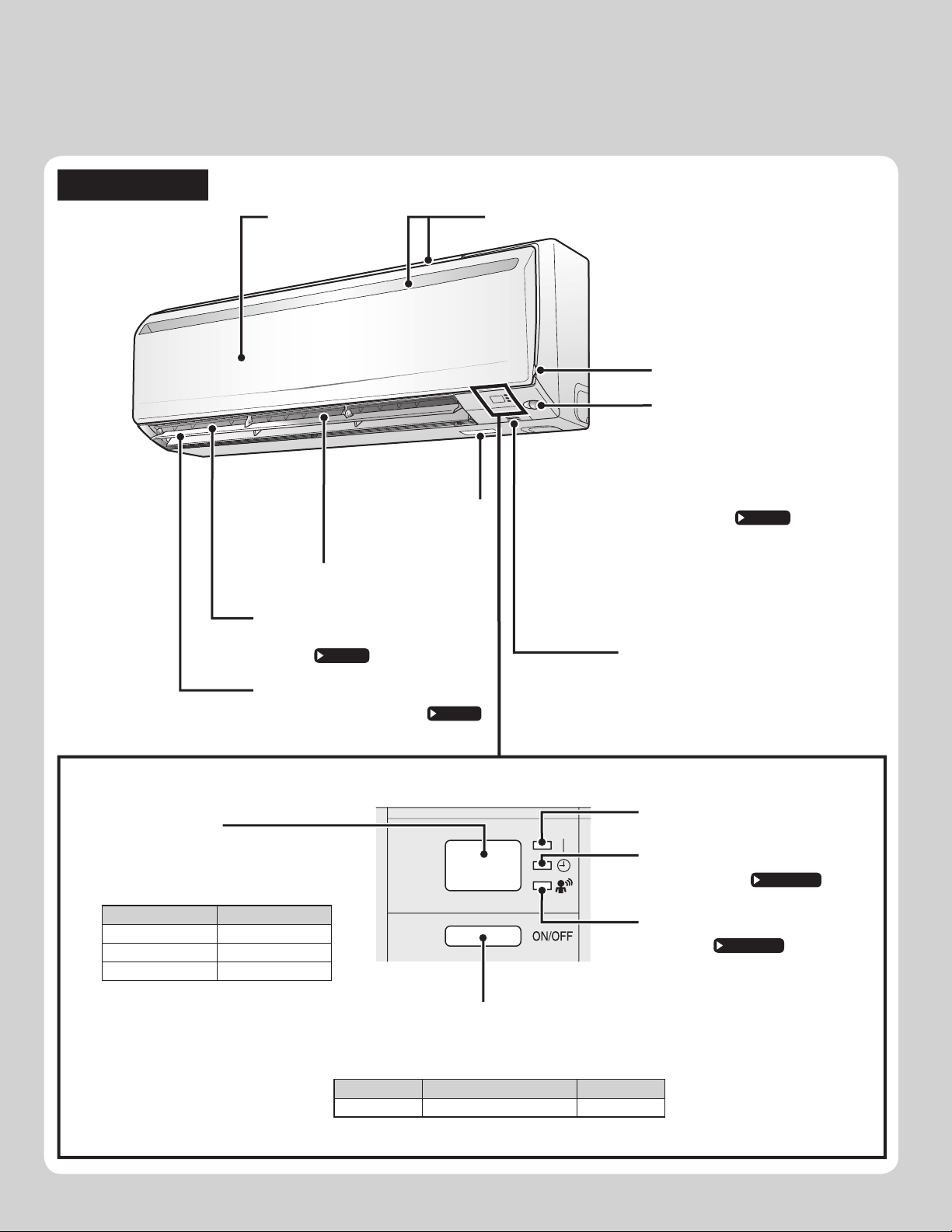
Indoor Unit
Air inletFront panel
Air outlet
Louvers (vertical blades)
• The louvers are inside of the air
outlet.
Page 13
Flaps
(horizontal blades)
Page 13
Signal receiver
• It receives signals from the remote
controller.
• When the unit receives a signal, you
will hear a beep sound.
Case Sound type
Operation start beep-beep
Setting changed beep
Operation stop long beep
Display
Indoor unit ON/OFF switch
• Press this switch once to start operation.
Press once again to stop it.
• The operation mode refer to the following table.
Mode Temperature setting Airow rate
AUTO 77°F (25°C) AUTO
• This switch is useful when the remote controller is missing.
Model name
plate
Panel tab
Room temperature
sensor
• It detects the air temperature
around the unit.
INTELLIGENT EYE
sensor
• It detects the movements of
people and automatically
switches between normal
operation and energy saving
operation.
Page 15
OPERATION lamp (green)
TIMER lamp (yellow)
Page 20,21
INTELLIGENT EYE lamp
(green)
Page 15,16
01_EN_3P297290-2C.indd 5 12/8/2015 13:30:29
6
English
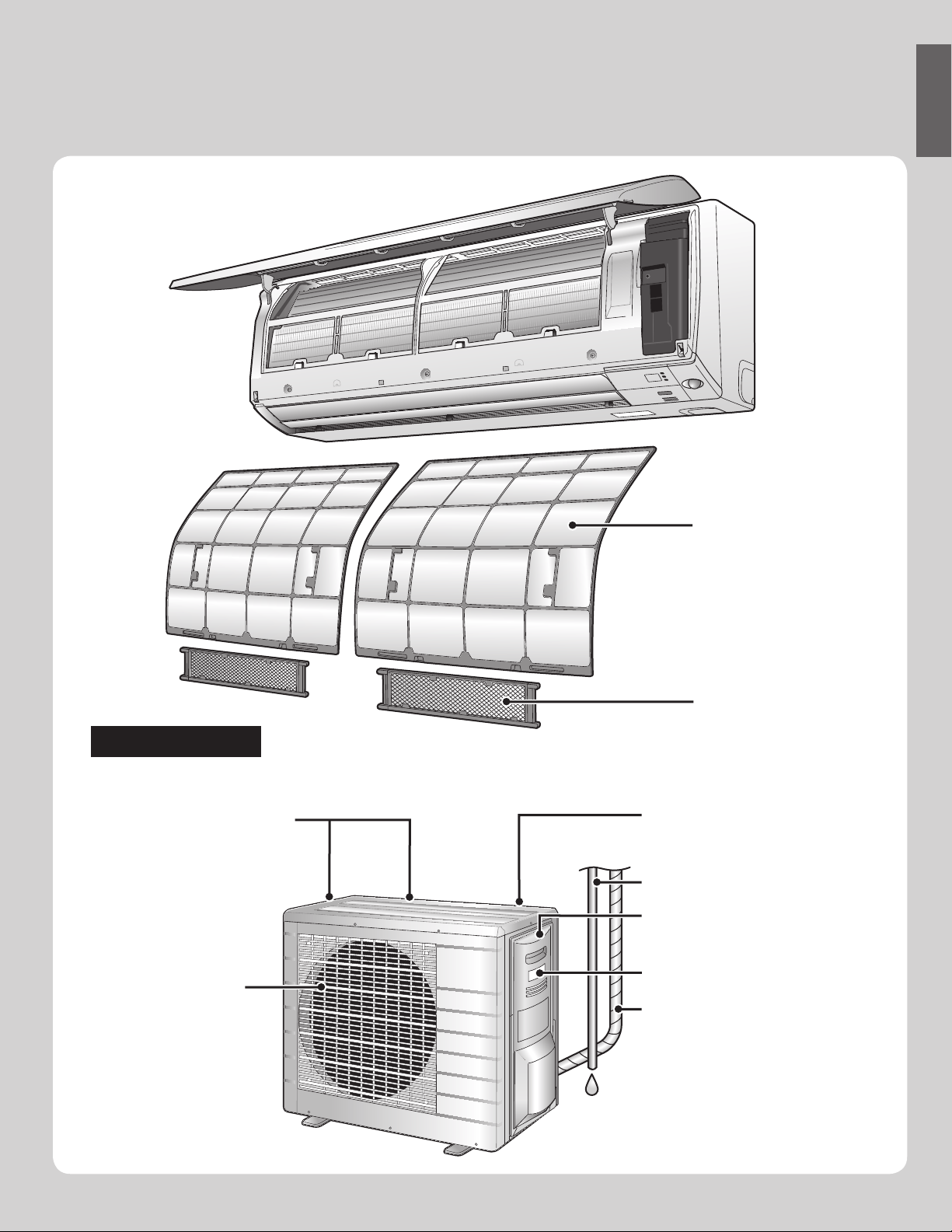
Outdoor Unit
• Appearance of the outdoor unit may differ from some models.
Open the front panel
Refrigerant piping and
inter-unit wiring
Ground terminal
• Inside this cover.
Drain hose
Air inlet
(back and side)
Air outlet
Outdoor temperature
sensor (back)
Model name plate
Air lter
Titanium apatite
photocatalytic
air-purifying lter
01_EN_3P297290-2C.indd 6 12/8/2015 13:30:29
7
Names of Parts
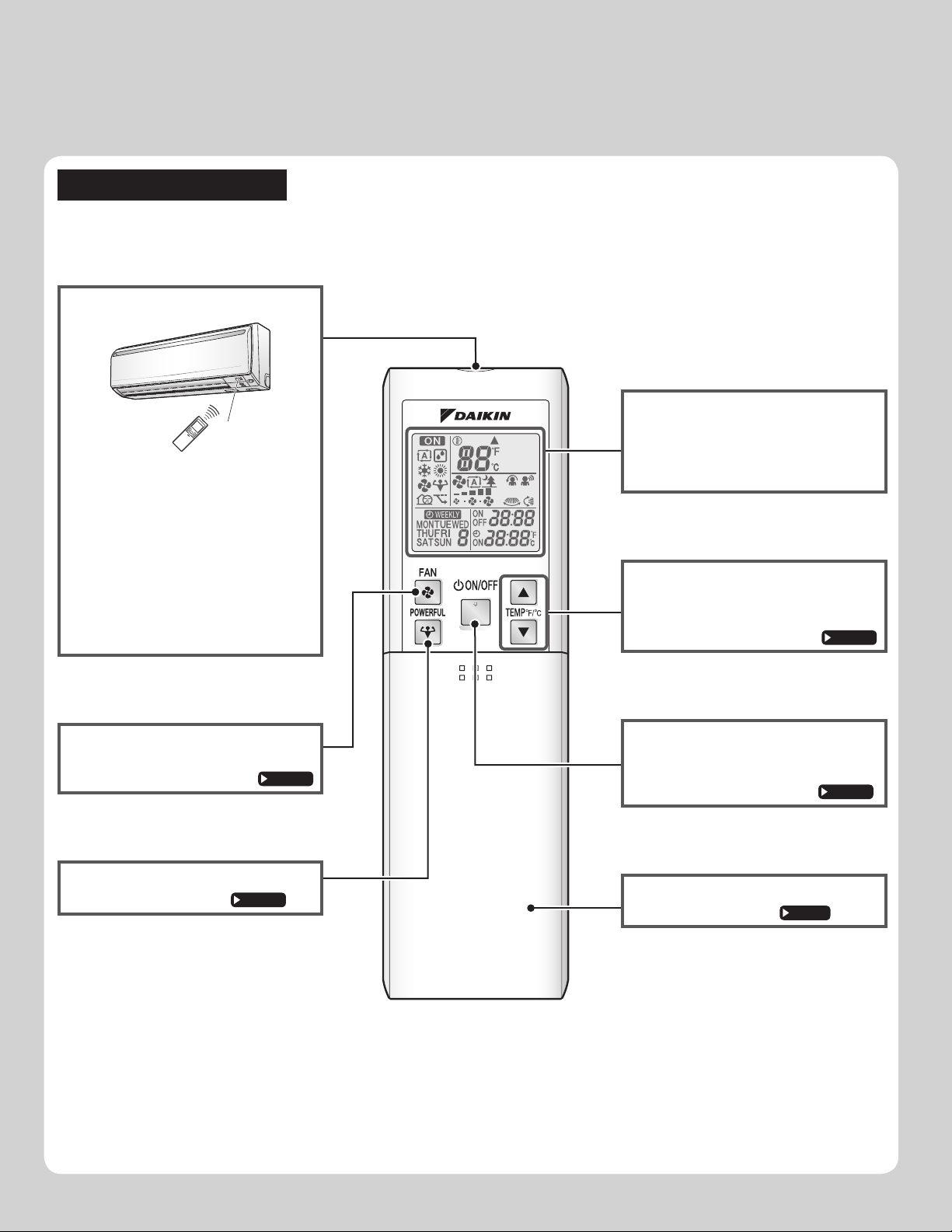
Remote Controller
Signal transmitter
Receiver
• To use the remote controller, aim the
transmitter at the indoor unit. If there
is anything to block signals between
the unit and the remote controller,
such as a curtain, the unit will not
operate.
• Do not drop the remote controller. Do
not get it wet.
• The maximum distance for
communication is approximately 23ft
(7m).
FAN setting button
• Selects the airow rate setting.
Page 14
POWERFUL button
• POWERFUL operation.
Page 17
Display (LCD)
• Displays the current settings.
(In this illustration, each section is
shown with all its displays on for the
purpose of explanation.)
TEMPERATURE
adjustment buttons
• Changes the temperature setting.
Page 12
ON/OFF button
• Press this button once to start
operation.
Press once again to stop it.
Page 11
Front cover
• Open the front cover.
Page 8
<ARC452A21>
01_EN_3P297290-2C.indd 7 12/8/2015 13:30:30
8
English
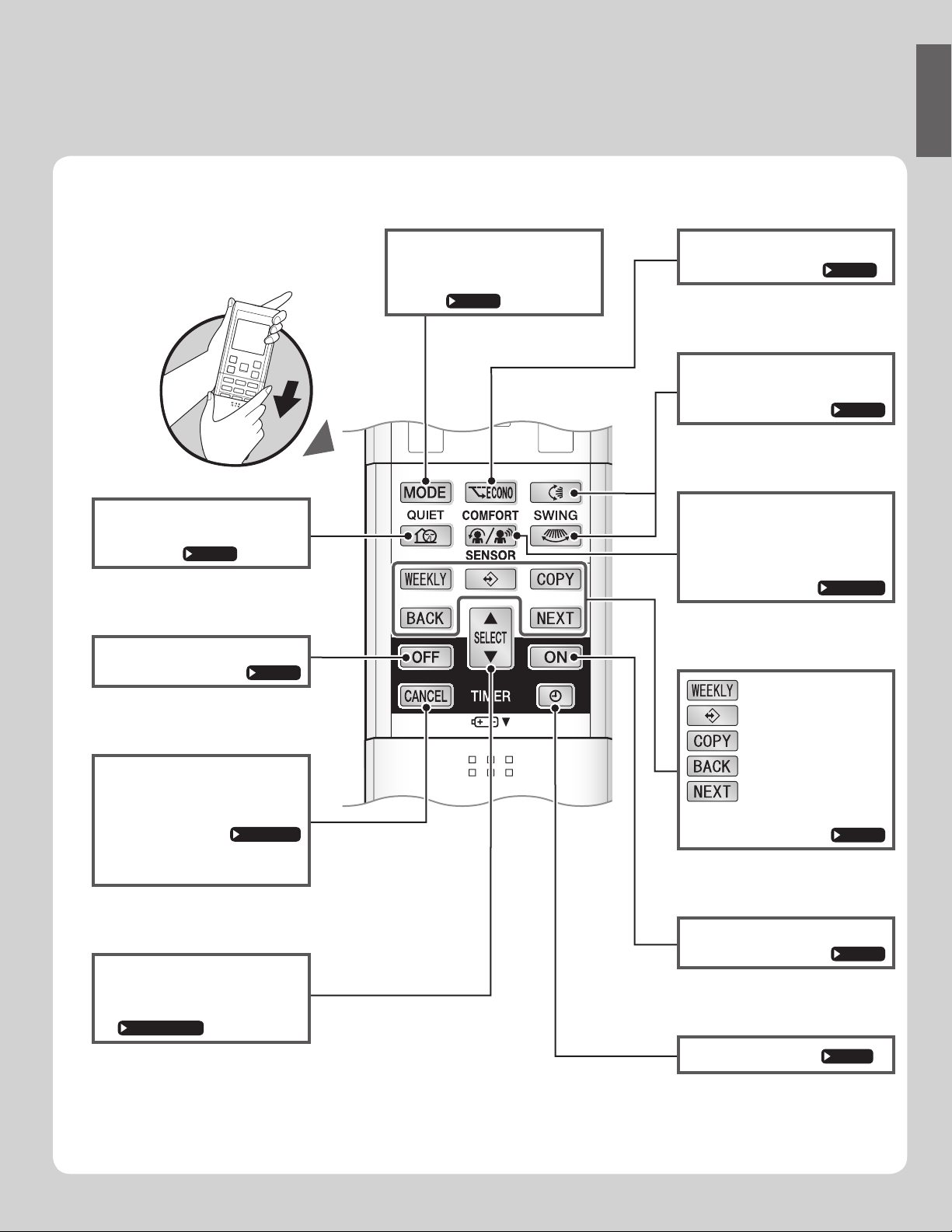
Open the front cover
ECONO button
• ECONO operation.
Page 19
SWING button
•
Adjusting the airow direction.
Page 13
COMFORT/SENSOR
button
•
COMFORT AIRFLOW and
INTELLIGENT EYE operation.
Page 15,16
: WEEKLY button
: PROGRAM button
: COPY button
: BACK button
: NEXT button
• WEEKLY TIMER operation.
Page 22
ON TIMER button
Page 21
CLOCK button
Page 10
QUIET button
• OUTDOOR UNIT QUIET
operation.
Page 18
OFF TIMER button
Page 20
TIMER CANCEL
button
• Cancels the timer setting.
Page 20,21
• It cannot be used for the
WEEKLY TIMER operation.
SELECT button
• Changes the ON/OFF TIMER
and WEEKLY TIMER settings.
Page 20,21,22
MODE selector button
• Selects the operation mode.
(AUTO/DRY/COOL/HEAT/
FAN)
Page 11
01_EN_3P297290-2C.indd 8 12/8/2015 13:30:31
9
Preparation before Operation
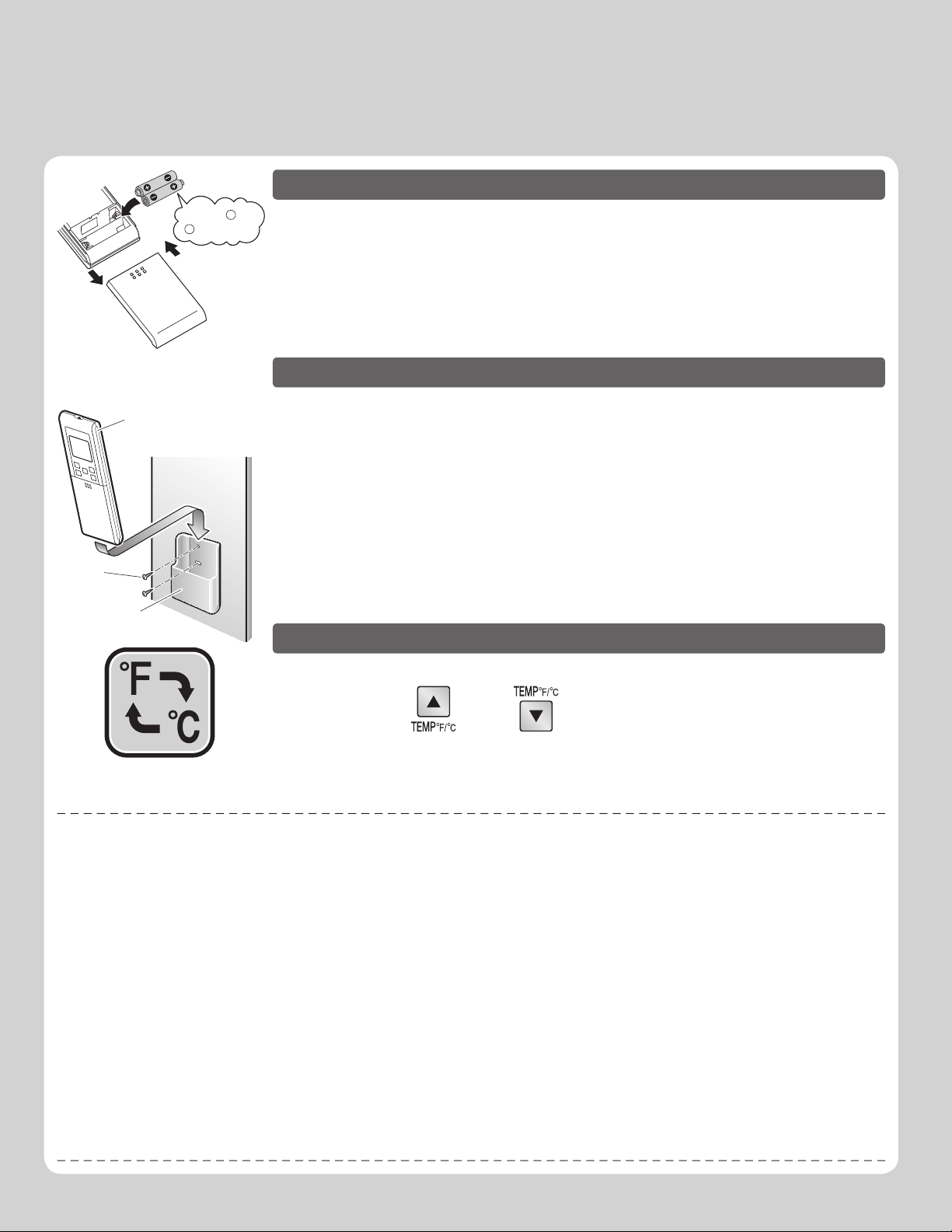
To set the batteries
2
3
1
Position and
correctly!
+
–
1. Slide the front cover to take it off.
2. Set two dry batteries AAA.LR03 (alkaline).
3. Set the front cover as before.
To x the remote controller holder to a wall
Remote
controller holder
Remote controller
Screws
1. Choose a place from where the signals reach
the unit.
2. Fix the holder to a wall, a pillar, etc. with the
screws supplied with the holder.
3. Place the remote controller in the remote
controller holder.
Celsius/Fahrenheit display switch
• The Celsius or Fahrenheit display is selectable with the following buttons.
Press and simultaneously for
5seconds.
• The temperature will be displayed in Fahrenheit if it is presently displayed in Celsius,
and vice versa.
NOTE
Notes on batteries
• When replacing the batteries, use batteries of the same type, and replace both batteries at the same time.
• When the system is not used for a long time, take the batteries out.
• The batteries will last for approximately 1year. If the remote controller display begins to fade and the degradation of reception performance
occurs within a year, however, replace both batteries with new, size AAA.LR03 (alkaline).
• The attached batteries are provided for the initial use of the system.
The usable period of the batteries may be short depending on the manufactured date of the air conditioner.
Notes on remote controller
• Never expose the remote controller to direct sunlight.
• Dust on the signal transmitter or receiver will reduce the sensitivity. Wipe off dust with a soft cloth.
• Signal communication may be disabled if an electronic-starter-type uorescent lamp (such as inverter-type lamps) is in the room. Consult the
shop if that is the case.
• If the remote controller signals happen to operate another appliance, move that appliance somewhere else, or consult the service shop.
Celsius/Fahrenheit display change function of remote controller
• The set temperature may increase when the display is changed to Celsius from Fahrenheit, because a fraction of 0.5°C is rounded up.
•
Example: A set temperature of 65°F (equivalent to 18.5°C) will be converted into 19°C.
When the display is changed to Fahrenheit again, the set temperature will be converted into 66°F (equivalent to 19°C) instead of the
original set temperature (65°F) but a set temperature of 66°F (equivalent to 19°C) will be converted into 19°C with no temperature change.
•
A reception sound will go off for the transmission of set temperature to the indoor unit at the time of setting the Celsius/Fahrenheit display change function.
01_EN_3P297290-2C.indd 9 12/8/2015 13:30:31
10
English
Turn the breaker on
• After the power is turned on, the aps of the indoor unit open and close once to set
the reference position.
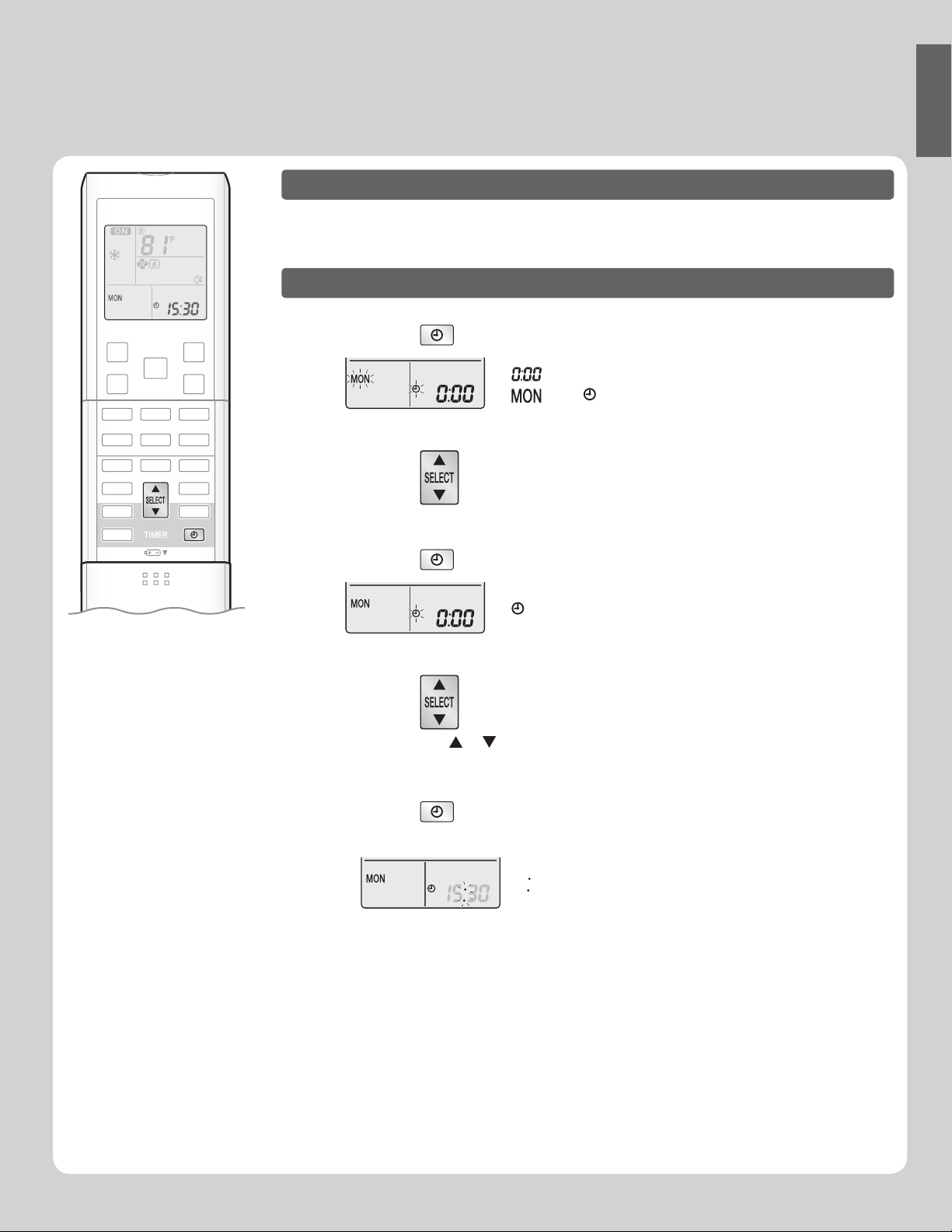
To set the clock
1. Press .
“ ” is displayed.
“
” and “ ” blink.
2. Press to set the current day of the week.
3. Press .
“ ” blinks.
4. Press to set the clock to the present time.
• Holding down or rapidly increases or decreases the time display.
5. Press .
• Point the remote controller at the indoor unit when pressing the buttons.
“ ” blinks.
01_EN_3P297290-2C.indd 10 12/8/2015 13:30:32
11
AUTO · DRY · COOL · HEAT ·
FAN Operation
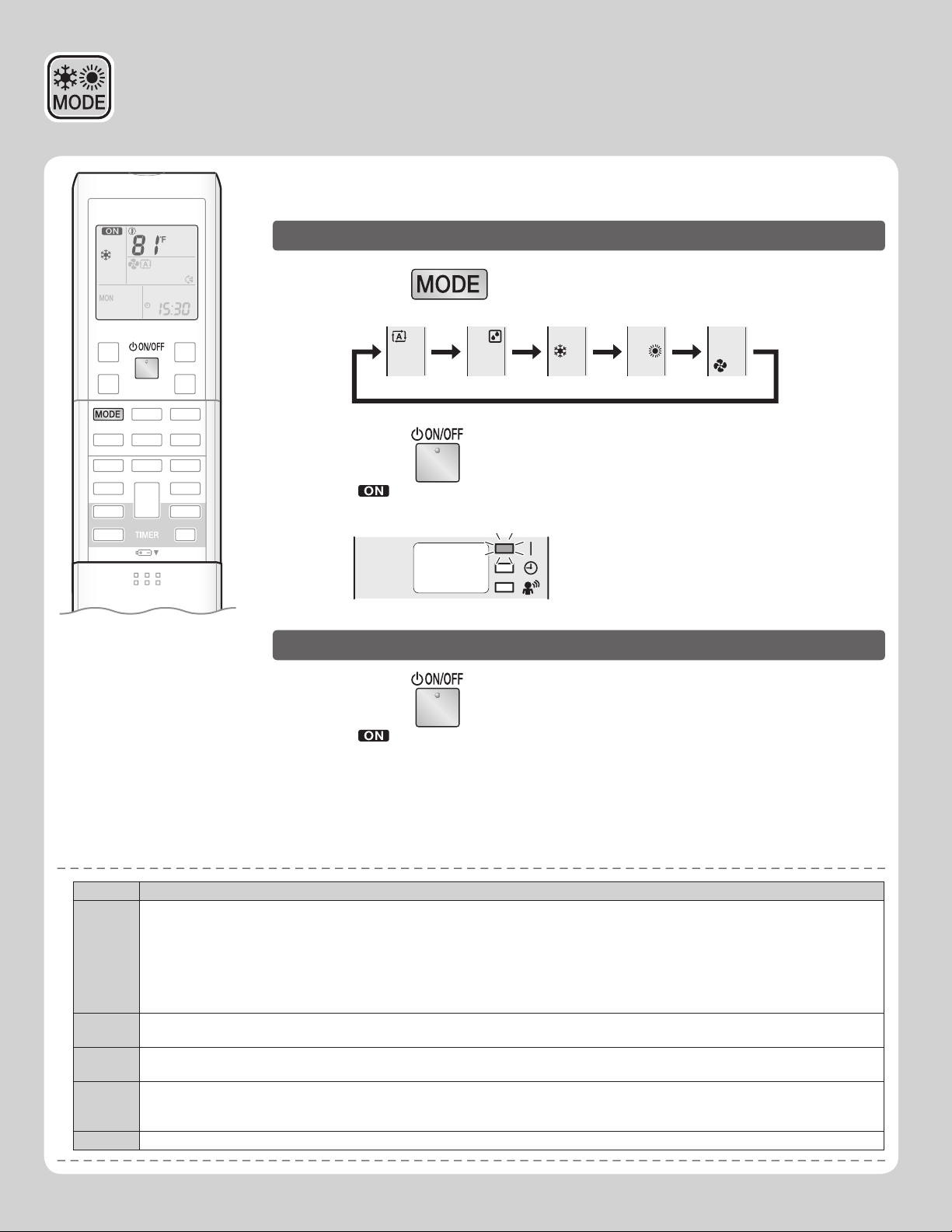
The air conditioner operates with the operation mode of your choice.
From the next time on, the air conditioner will operate with the same operation mode.
To start operation
1. Press and select an operation mode.
• Each pressing of the button advances the mode setting in sequence.
AUTO DRY COOL HEAT FAN
2. Press .
• “ ” is displayed on the LCD.
• The OPERATION lamp lights green.
Display
To stop operation
Press again.
• “ ” is no longer displayed on the LCD.
• The OPERATION lamp goes off.
NOTE
MODE Notes on each operation mode
HEAT
•
Since this air conditioner heats the room by taking heat from outdoor air to indoors, the heating capacity becomes smaller in lower outdoor
temperatures. If the heating effect is insufcient, it is recommended to use another heating appliance in combination with the air conditioner.
• The heat pump system heats the room by circulating hot air around all parts of the room. After the start of HEAT operation, it takes
some time before the room gets warmer.
• In HEAT operation, frost may occur on the outdoor unit and lower the heating capacity. In that case, the system switches into
defrosting operation to take away the frost.
• During defrosting operation, hot air does not ow out of indoor unit.
COOL
• This air conditioner cools the room by releasing the heat in the room outside. Therefore, the cooling performance of the air
conditioner may be degraded if the outdoor temperature is high.
DRY
• The computer chip works to rid the room of humidity while maintaining the temperature as much as possible. It automatically
controls temperature and airow rate, so manual adjustment of these functions is unavailable.
AUTO
• In AUTO operation, the system selects an appropriate operation mode (COOL or HEAT) based on the room and outside
temperatures and starts the operation.
• The system automatically reselects setting at a regular interval to bring the room temperature to user-setting level.
FAN • This mode is valid for fan only.
01_EN_3P297290-2C.indd 11 12/8/2015 13:30:32
12
English
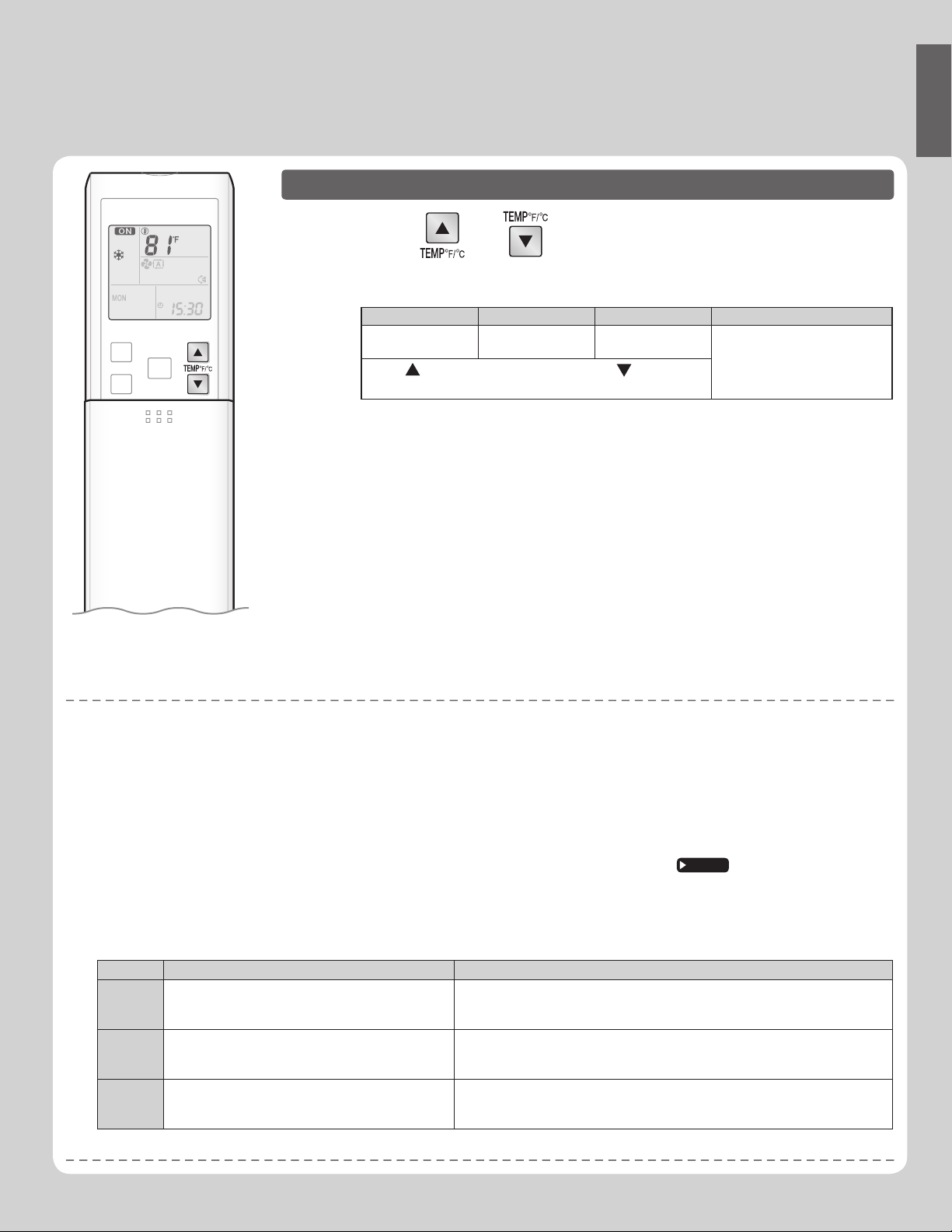
To change the temperature setting
Press or .
• The displayed items on the LCD will change whenever either one of the buttons is
pressed.
COOL operation HEAT operation AUTO operation DRY or FAN operation
64-90°F
(18-32°C)
50-86°F
(10-30°C)
64-86°F
(18-30°C)
The temperature setting
cannot be changed.
Press
to raise the temperature and press to lower the
temperature.
Operating conditions
Recommended temperature setting
• For cooling: 78-82°F (26-28°C)
• For heating: 68-75°F (20-24°C)
Tips for saving energy
• Be careful not to cool (heat) the room too much.
Keeping the temperature setting at a moderate level helps save energy.
• Cover windows with a blind or a curtain.
Blocking sunlight and air from outdoors increases the cooling (heating) effect.
• Clogged air lters cause inefcient operation and waste energy. Clean them once in about every 2weeks.
Page 32
Notes on the operating conditions
• The air conditioner always consumes a small amount of electricity even while it is not operating.
• If you are not going to use the air conditioner for a long period, for example in spring or autumn, turn the breaker off.
• Use the air conditioner in the following conditions.
MODE Operating conditions If operation is continued out of this range
COOL
Outdoor temperature: 50-115°F (10-46°C)
Indoor temperature: 64-90°F (18-32°C)
Indoor humidity: 80% max.
• A safety device may work to stop the operation.
(In multi system, it may work to stop the operation of the outdoor unit only.)
• Condensation may occur on the indoor unit and drip.
HEAT
Outdoor temperature:
[2/3MXL]: –13-75°F (–25-24°C)
[Other models]: 5-75°F (–15-24°C)
Indoor temperature: 50-86°F (10-30°C)
• A safety device may work to stop the operation.
DRY
Outdoor temperature: 50-115°F (10-46°C)
Indoor temperature: 64-90°F (18-32°C)
Indoor humidity: 80% max.
• A safety device may work to stop the operation.
• Condensation may occur on the indoor unit and drip.
• Operation outside this humidity or temperature range may cause a safety device to disable the system.
01_EN_3P297290-2C.indd 12 12/8/2015 13:30:32
13
Adjusting the Airow Direction
and Rate
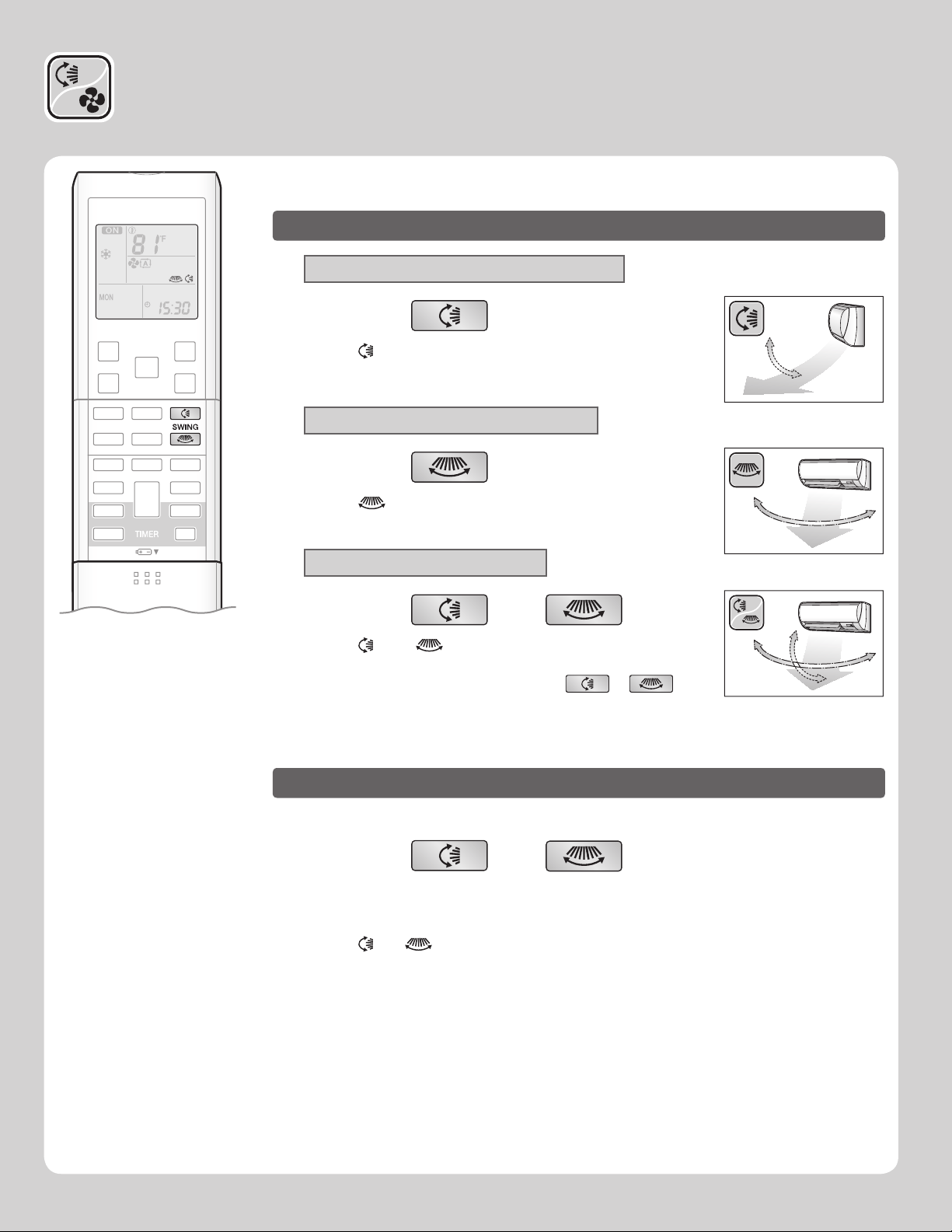
You can adjust the airow direction to increase your comfort.
To start auto swing
Upper and lower airow direction
Press .
• “ ” is displayed on the LCD.
• The aps (horizontal blades) will begin to swing.
Right and left airow direction
Press .
• “ ” is displayed on the LCD.
• The louvers (vertical blades) will begin to swing.
The 3-D airow direction
Press and .
• “ ” and “ ” are displayed on the LCD.
• The aps and louvers move in turn.
• To cancel 3-D airow, press either
or again.
The aps or louvers will stop moving.
To set the aps or louvers at the desired position
• This function is effective while aps or louvers are in auto swing mode.
Press and when the aps or
louvers reach the desired position.
• In the 3-D airow, the aps and louvers move in turn.
• “
” or “ ” disappears from the LCD.
01_EN_3P297290-2C.indd 13 12/8/2015 13:30:33
14
English
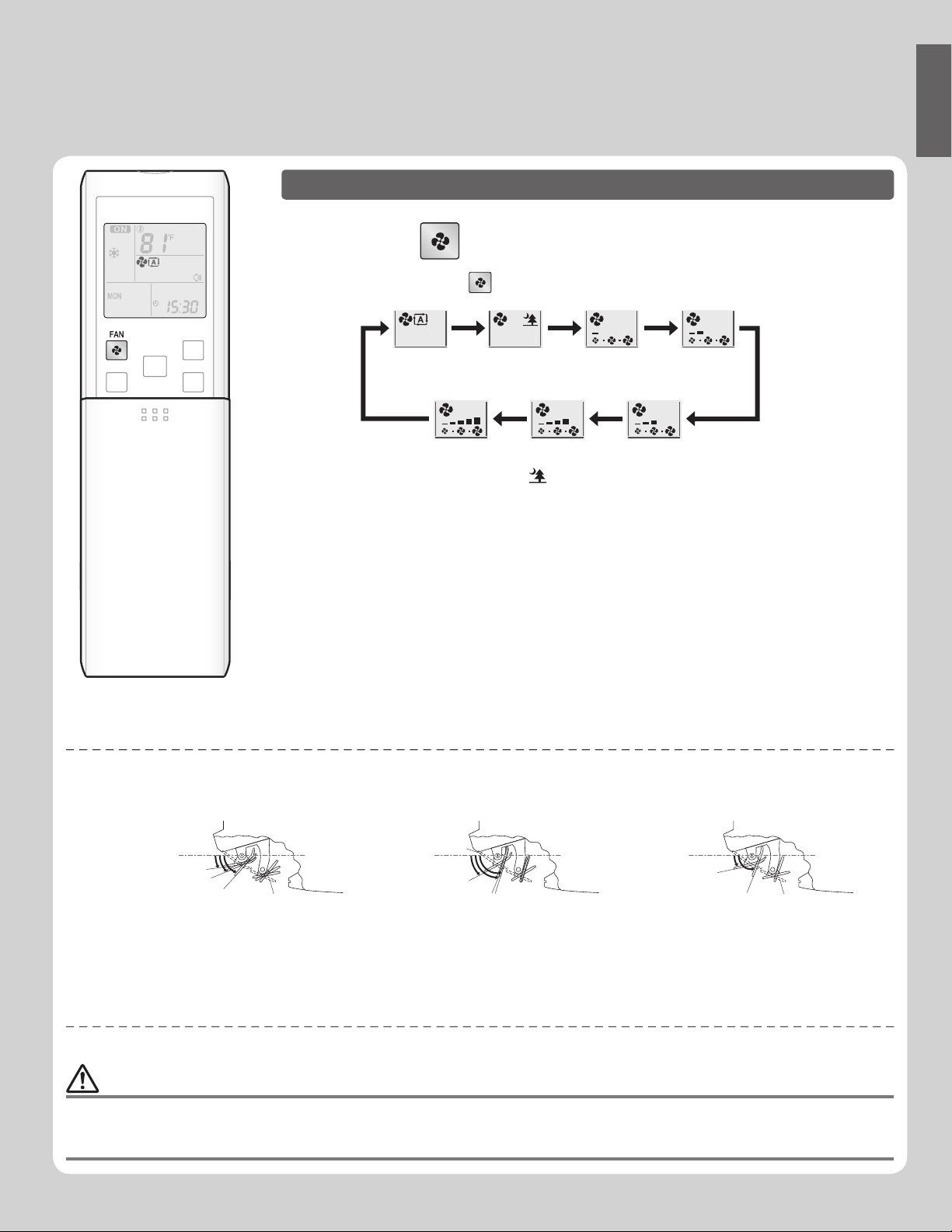
To adjust the airow rate setting
Press .
• Each pressing of advances the airow rate setting in sequence.
Auto Indoor unit quiet Low Middle low
MiddleMiddle highHigh
• When the airow is set to “ ”, indoor unit quiet operation will start and the noise
from the unit will become quieter.
• In indoor unit quiet operation, the airow rate is set to a weak level.
• In DRY operation, the airow rate setting cannot be changed.
NOTE
Notes on the angles of the aps
• The aps swinging range depends on the operation. (See the gure.)
COOL and DRY operation HEAT operation FAN operation
Upper limit
COMFORT AIRFLOW
Lower limit
Stop operation
Stop operation
Upper limit
Lower limit
COMFORT AIRFLOW
Upper limit
Lower limit
Stop operation
10°
15°
50°
30°
70°
75°
15°
70°
Note on 3-D airow
• Using 3-D airow circulates cold air, which tends to collected at the bottom of the room, and hot air, which tends to collect near the ceiling,
throughout the room, preventing areas of cold and hot developing.
Note on airow rate setting
• At smaller airow rates, the cooling (heating) effect is also smaller.
CAUTION
• Always use a remote controller to adjust the angles of the aps and louvers.
− If you attempt to move the aps and louvers forcibly by hand when they are swinging, the mechanism may be damaged.
− Inside the air outlet, a fan is rotating at a high speed.
01_EN_3P297290-2C.indd 14 12/8/2015 13:30:34
15
COMFORT AIRFLOW /
INTELLIGENT EYE Operation
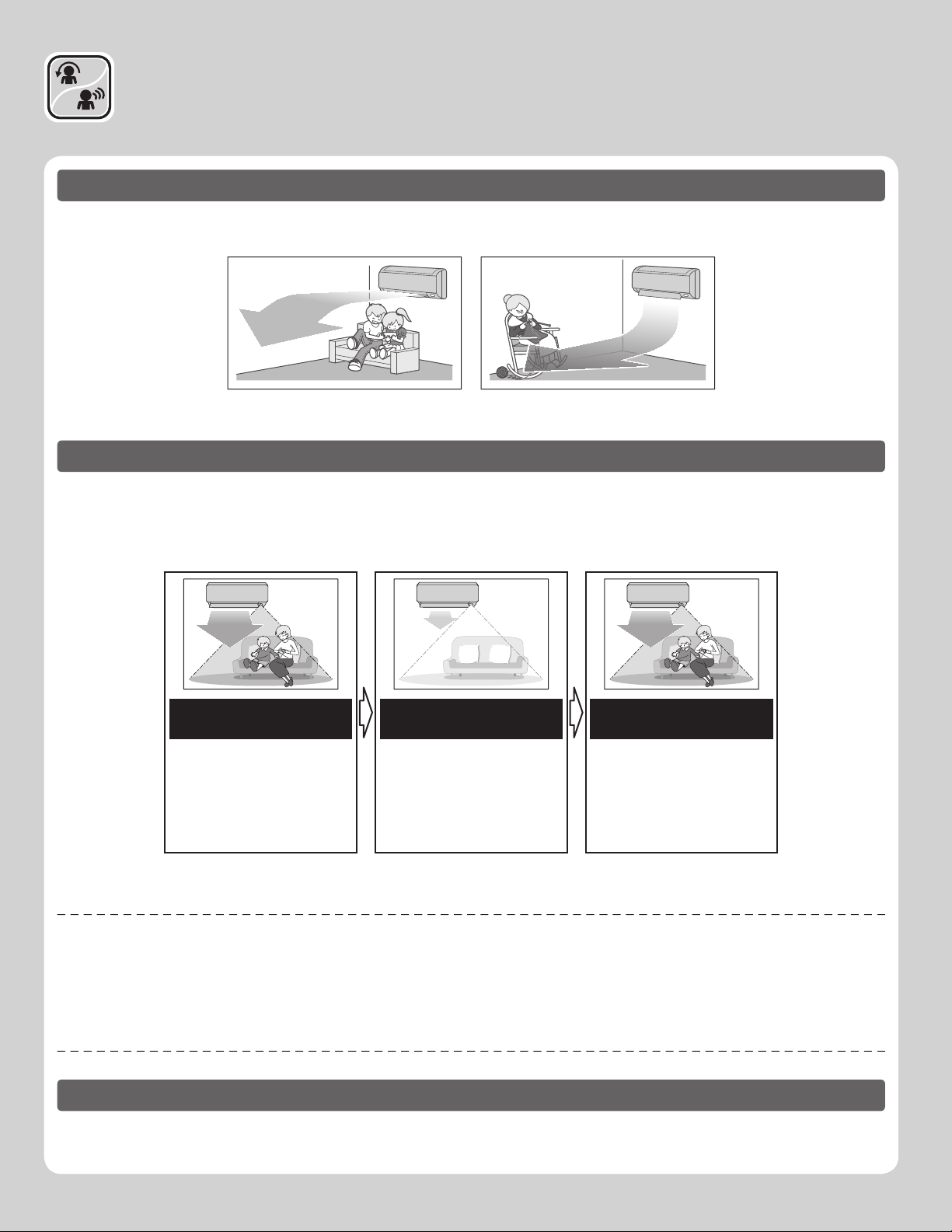
COMFORT AIRFLOW operation
The ow of air will be in the upward direction while in COOL operation and in the downward direction while in
HEAT operation, which will provide a comfortable wind that will not come in direct contact with people.
COOL operation HEAT operation
INTELLIGENT EYE operation
“INTELLIGENT EYE” is the infrared sensor which detects the human movement.
If no one is in the room for more than 20minutes, the operation automatically changes to energy saving
operation.
[Example]
When someone is in
the room
Normal operation
• The air conditioner is in
normal operation while the
sensor is detecting the
movement of people.
When no one is in the
room
20minutes after, start
energy saving
operation.
• The set temperature is
shifted in ±3.6°F (±2°C)
steps.
Someone is back in the
room
Back to normal
operation.
• The air conditioner will
return to normal operation
when the sensor detects the
movement of people again.
INTELLIGENT EYE operation is useful for energy saving
Energy saving operation
• If no presence is detected in the room for 20 minutes, the energy saving operation will start, and the INTELLIGENT EYE lamp goes off.
If human movement is detected again, the INTELLIGENT EYE lamp lights up and energy saving operation terminates.
• This operation changes the temperature –3.6°F (–2°C) in HEAT / +3.6°F (+2°C) in COOL / +3.6°F (+2°C) in DRY operation from set temperature.
When the room temperature exceeds 86°F (30°C), the operation changes the temperature +1.8°F (+1°C) in COOL / +1.8°F (+1°C) in DRY
operation from set temperature.
• This operation decreases the airow rate slightly in FAN mode only.
Combination COMFORT AIRFLOW and INTELLIGENT EYE operation
The air conditioner can go into operation with the COMFORT AIRFLOW and INTELLIGENT EYE functions
combined.
01_EN_3P297290-2C.indd 15 12/8/2015 13:30:34
16
English
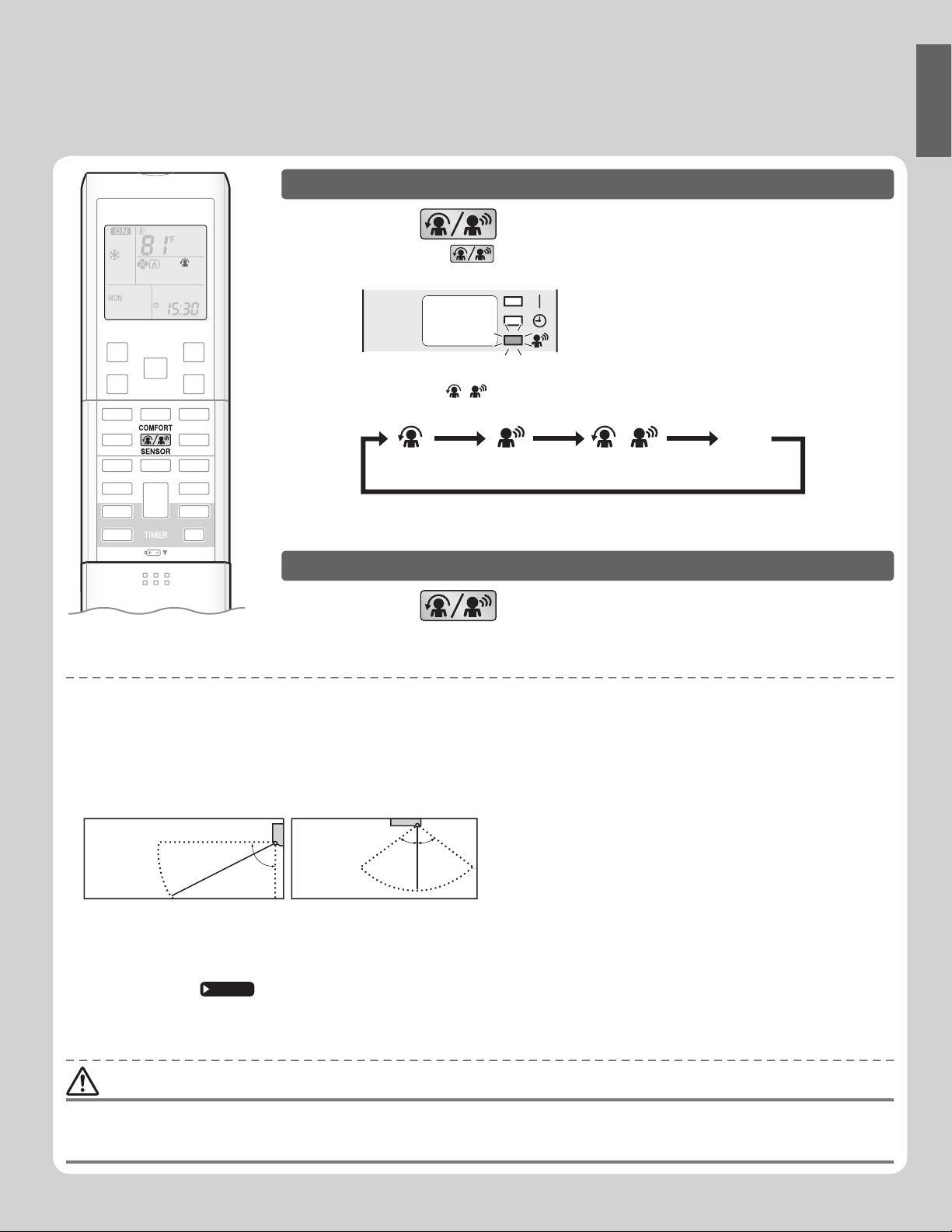
To start operation
Press and select the desired mode.
• Each time the is pressed a different setting option is displayed on the LCD.
• When INTELLIGENT EYE is selected, the INTELLIGENT EYE lamp lights green.
Display
• By selecting “ ” from the following icons, the air conditioner will be in COMFORT
AIRFLOW operation combined with INTELLIGENT EYE operation.
blank
No SettingCOMFORT
AIRFLOW
INTELLIGENT
EYE
Combination
• When the aps (horizontal blades) are swinging, selecting any of the modes above will
cause the aps (horizontal blades) to stop.
To cancel operation
Press and select “blank” on the LCD.
• If the INTELLIGENT EYE operation was being used, the INTELLIGENT EYE lamp goes off.
NOTE
Notes on COMFORT AIRFLOW operation
• The position of the aps will change, preventing air from blowing directly on the occupants of the room.
• POWERFUL operation and COMFORT AIRFLOW operation cannot be used at the same time.
Priority is given to the function of whichever button is pressed last.
• The airow rate will be set to AUTO. If the upper and lower airow direction is selected, the COMFORT AIRFLOW function will be canceled.
Notes on INTELLIGENT EYE operation
• Application range is as follows.
90°
55°
23ft
(7m)
55°
Vertical angle 90°
(Side view)
Horizontal
angle 110°
(Top view)
23ft (7m)
• Sensor may not detect moving objects further than 23ft (7m) away. (Check the application range)
• Sensor detection sensitivity changes according to indoor unit location, the speed of passersby, temperature range, etc.
• The sensor also mistakenly detects pets, sunlight, uttering curtains and light reected off of mirrors as passersby.
• INTELLIGENT EYE operation will not go on during POWERFUL operation.
• NIGHT SET mode
Page 20
will not go on during use of INTELLIGENT EYE operation.
Notes on combination of COMFORT AIRFLOW operation and INTELLIGENT EYE operation
•
The airow rate will be set to AUTO. If the upper and lower airow direction is selected, the COMFORT AIRFLOW operation will be canceled.
Priority is given to the function of whichever button is pressed last.
CAUTION
• Do not place large objects near the sensor.
Also keep heating units or humidiers outside the sensor’s detection area. This sensor can detect undesirable objects.
• Do not hit or violently push the INTELLIGENT EYE sensor. This can lead to damage and malfunction.
01_EN_3P297290-2C.indd 16 12/8/2015 13:30:34
17
POWERFUL Operation
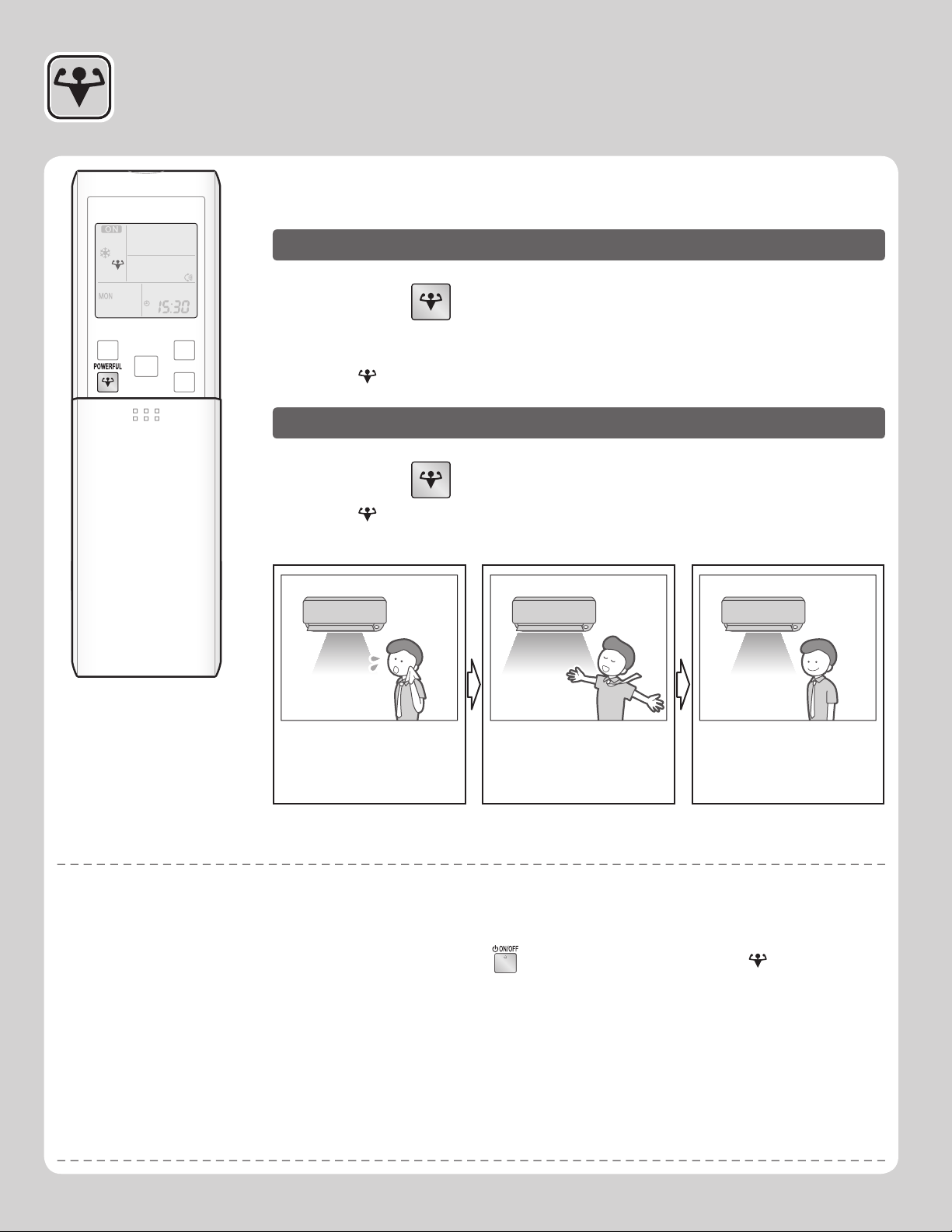
POWERFUL operation quickly maximizes the cooling (heating) effect in any
operation mode. You can get the maximum capacity.
To start POWERFUL operation
Press during operation.
• POWERFUL operation ends in 20minutes. Then the system automatically operates
again with the previous settings which were used before POWERFUL operation.
• “
” is displayed on the LCD.
To cancel POWERFUL operation
Press again.
• “ ” is no longer displayed on the LCD.
[Example]
Normal operation
• When you want to get the
cooling effect quickly, start
the POWERFUL operation.
POWERFUL operation
• POWERFUL operation will
work for 20minutes.
Back to normal
operation
NOTE
Notes on POWERFUL operation
• When using POWERFUL operation, there are some functions which are not available.
• POWERFUL operation cannot be used together with ECONO, COMFORT AIRFLOW or OUTDOOR UNIT QUIET operation.
Priority is given to the function of whichever button is pressed last.
• POWERFUL operation can only be set when the unit is running. Pressing
causes the settings to be canceled, and “ ” is no longer
displayed on the LCD.
• POWERFUL operation will not increase the capacity of the air conditioner if the air conditioner is already in operation with its maximum capacity
demonstrated.
•
In COOL, HEAT and AUTO operation
To maximize the cooling (heating) effect, the capacity of outdoor unit increases and the airow rate becomes xed at the maximum setting.
The temperature and airow settings cannot be changed.
•
In DRY operation
The temperature setting is lowered by 4.5°F (2.5°C) and the airow rate is slightly increased.
•
In FAN operation
The airow rate is xed to the maximum setting.
01_EN_3P297290-2C.indd 17 12/8/2015 13:30:35
18
English
OUTDOOR UNIT QUIET
Operation
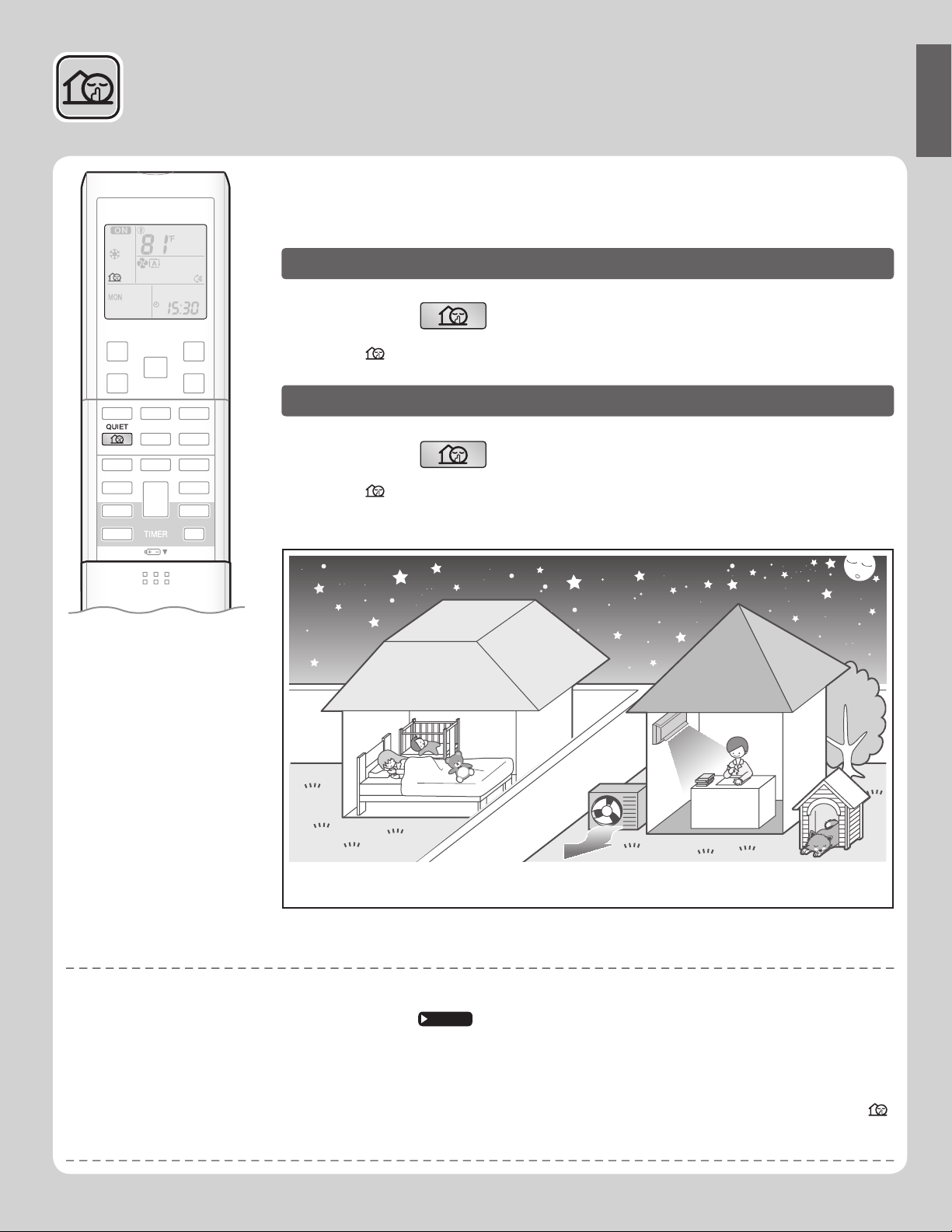
OUTDOOR UNIT QUIET operation lowers the noise level of the outdoor unit by
changing the frequency and fan speed on the outdoor unit. This function is
convenient during the night.
To start OUTDOOR UNIT QUIET operation
Press .
• “ ” is displayed on the LCD.
To cancel OUTDOOR UNIT QUIET operation
Press again.
• “ ” is no longer displayed on the LCD.
[Example] Using the OUTDOOR UNIT QUIET operation during the night.
• The noise level of the outdoor unit will be lower.
This is convenient in consideration of your neighbors.
NOTE
Notes on OUTDOOR UNIT QUIET operation
• If using a multi system, the OUTDOOR UNIT QUIET operation will work only when this function is set on all operated indoor units. However, if
using priority room setting, refer to “Note for multi system”.
Page 28
• This function is available in COOL, HEAT, and AUTO operation.
This is not available in FAN and DRY operation.
• POWERFUL operation and OUTDOOR UNIT QUIET operation cannot be used at the same time.
Priority is given to the function of whichever button is pressed last.
• Even the operation is stopped using the remote controller or the indoor unit ON/OFF switch when using OUTDOOR UNIT QUIET operation, “
”
will remain on the remote controller display.
• OUTDOOR UNIT QUIET operation will drop neither the frequency nor fan speed if they have been already dropped low enough.
01_EN_3P297290-2C.indd 18 12/8/2015 13:30:35
19
ECONO Operation
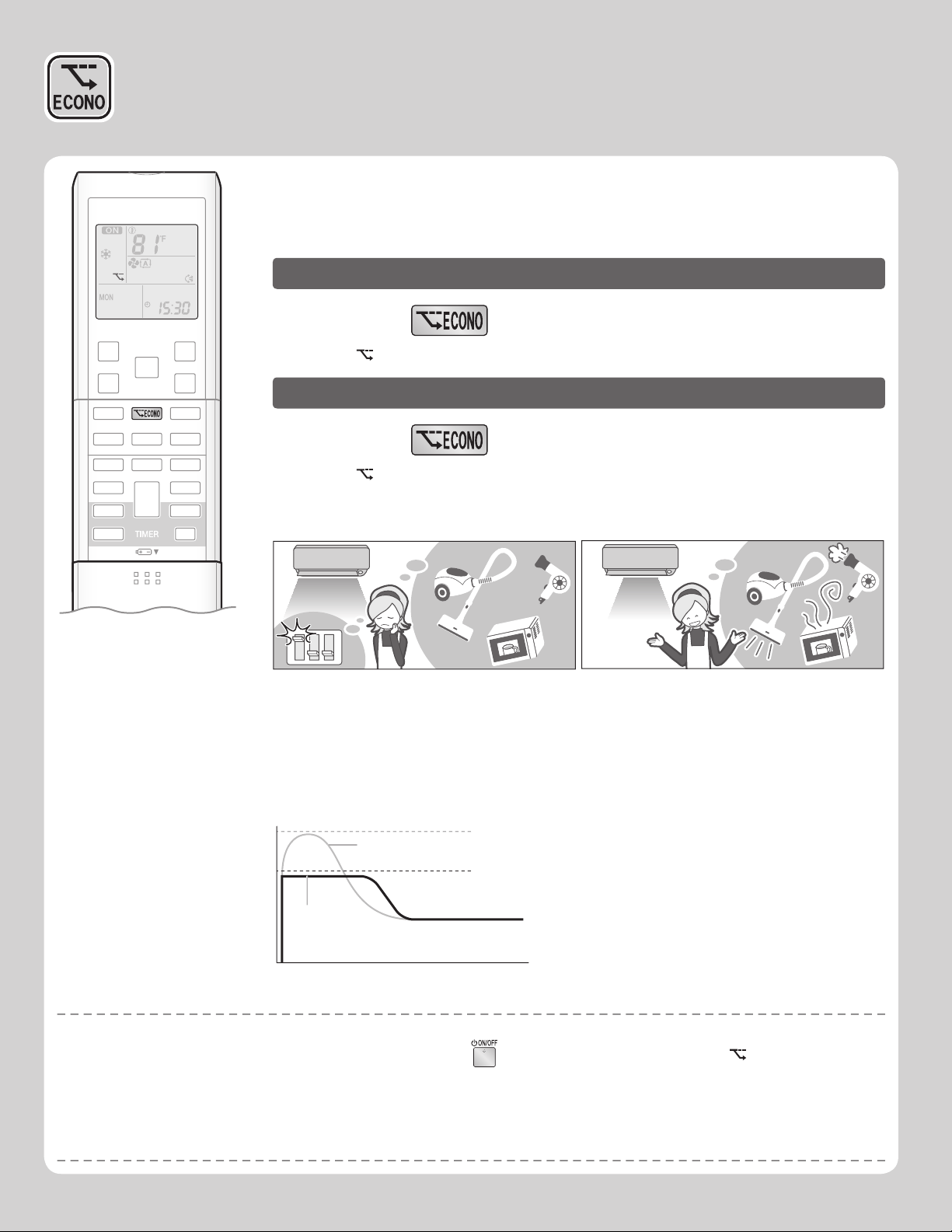
ECONO operation is a function which enables efcient operation by limiting the
maximum power consumption value.
This function is useful for cases in which attention should be paid to ensure a
circuit breaker will not trip when the product runs alongside other appliances.
To start ECONO operation
Press during operation.
• “ ” is displayed on the LCD.
To cancel ECONO operation
Press again.
• “ ” is no longer displayed on the LCD.
[Example]
Normal operation ECONO operation
• In case the air conditioner and other
appliances which require high power
consumption are used at same time, a circuit
breaker may trip if the air conditioner operate
with its maximum capacity.
•
The maximum power consumption of the air
conditioner is limited by using ECONO operation.
The circuit breaker is unlikely to trip even if the
air conditioner and other appliances are used at
same time.
Time
Maximum during
normal operation
Maximum during
ECONO operation
Normal
operation
ECONO
operation
From start up until set temperature is reached
Running current and
power consumption
• This diagram is a representation for illustrative
purposes only.
The maximum running current and power
consumption of the air conditioner in ECONO
operation vary with the connecting outdoor
unit.
NOTE
Notes on ECONO operation
• ECONO operation can only be set when the unit is running. Pressing causes the settings to be canceled, and “ ” is no longer displayed
on the LCD.
• ECONO operation functions in AUTO, COOL, DRY, and HEAT operation.
• POWERFUL and ECONO operation cannot be used at the same time.
Priority is given to the function of whichever button is pressed last.
• If the level of power consumption is already low, ECONO operation will not drop the power consumption.
01_EN_3P297290-2C.indd 19 12/8/2015 13:30:36
20
English
OFF TIMER Operation
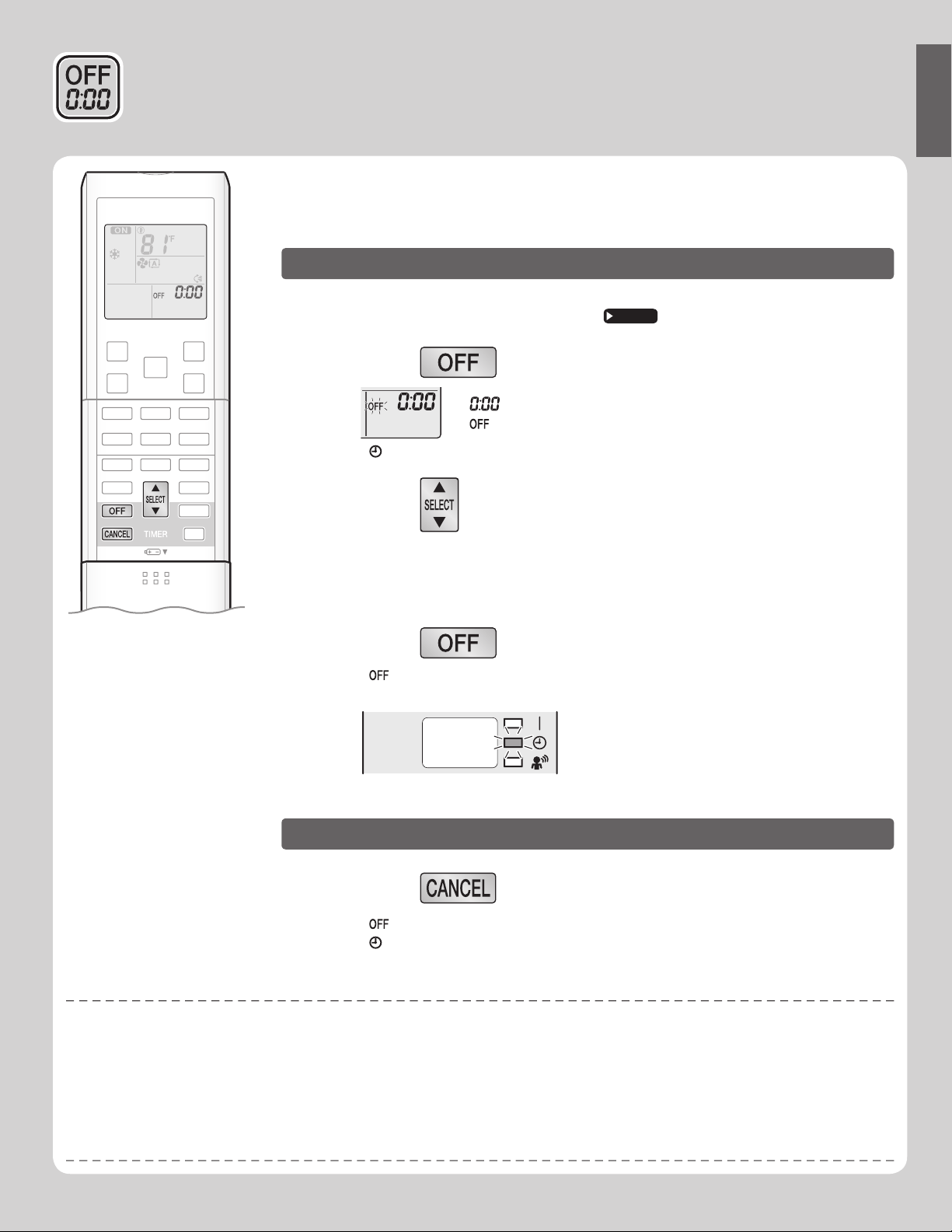
Timer functions are useful for automatically switching the air conditioner on or off
at night or in the morning. You can also use OFF TIMER and ON TIMER in
combination.
To use OFF TIMER operation
• Check that the clock is correct.
If not, set the clock to the present time.
Page 10
1. Press .
“ ” is displayed on the LCD.
“
” blinks.
• “ ” is no longer displayed on the LCD.
2. Press until the time setting reaches the
point you like.
• Each pressing of either button increases or decreases the time setting by 10minutes.
Holding down either button changes the time setting rapidly.
3. Press again.
• “ ” and setting time are displayed on the LCD.
• The TIMER lamp lights yellow.
Display
To cancel OFF TIMER operation
Press .
• “ ” and setting time are no longer displayed on the LCD.
• “
” and day of the week are displayed on the LCD.
• The TIMER lamp goes off.
NOTE
Notes on TIMER operation
• When TIMER is set, the present time is not displayed.
• Once you set ON/OFF TIMER, the time setting is kept in the memory. The memory is canceled when remote controller batteries are replaced.
• When using the ON/OFF TIMER to start/stop operation, the actual operation start/stop time may differ from the time set. (Maximum of about
10 minutes)
NIGHT SET mode
• When the OFF TIMER is set, the air conditioner automatically adjusts the temperature setting (0.9°F (0.5°C) up in COOL, 3.6°F (2.0°C) down in
HEAT) to prevent excessive cooling (heating) for your pleasant sleep.
01_EN_3P297290-2C.indd 20 12/8/2015 13:30:37
21
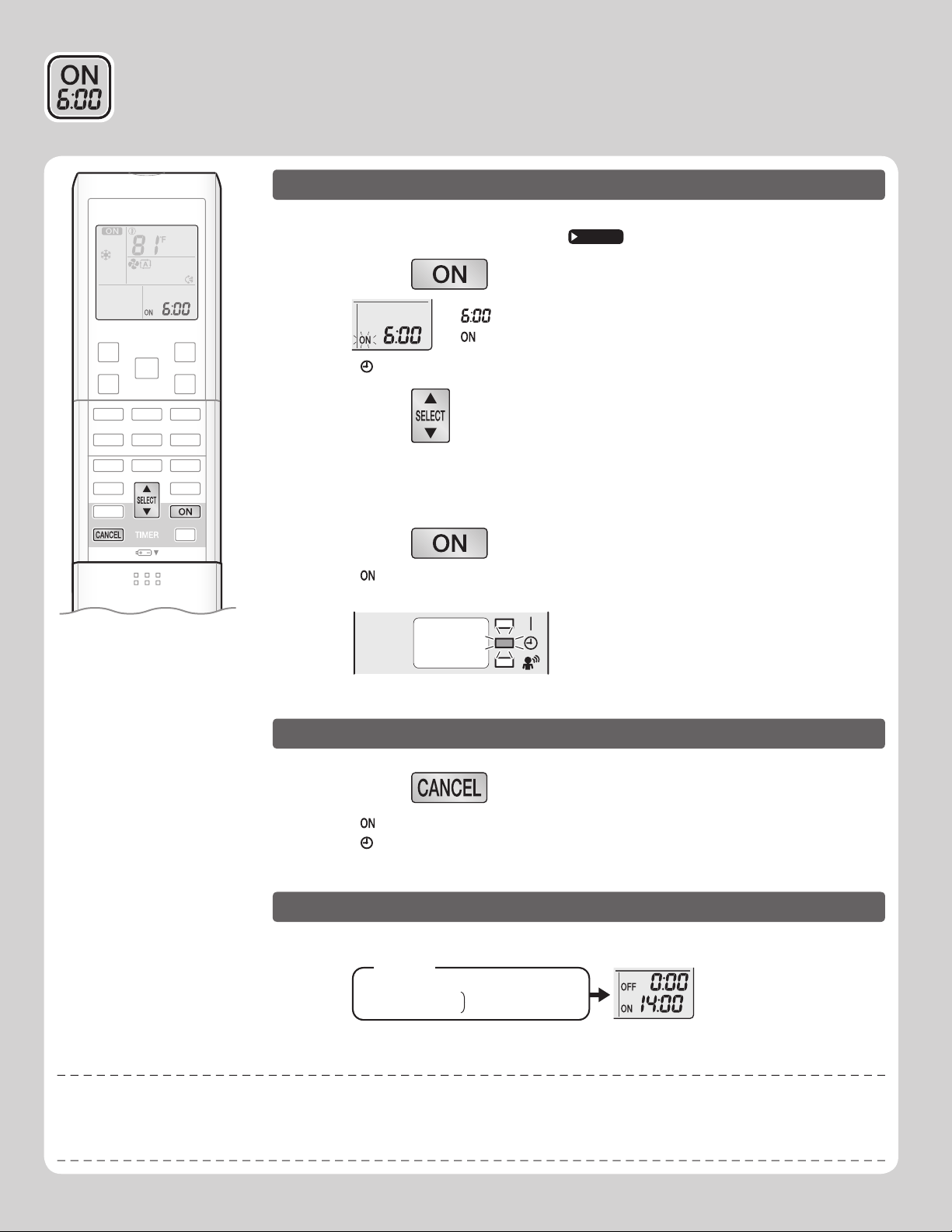
ON TIMER Operation
To use ON TIMER operation
• Check that the clock is correct.
If not, set the clock to the present time.
Page 10
1. Press .
“ ” is displayed on the LCD.
“
” blinks.
• “ ” and day of the week are no longer displayed on the LCD.
2. Press until the time setting reaches the
point you like.
• Each pressing of either button increases or decreases the time setting by 10minutes.
Holding down either button changes the setting rapidly.
3. Press again.
• “ ” and setting time are displayed on the LCD.
• The TIMER lamp lights yellow.
Display
To cancel ON TIMER operation
Press .
• “ ” and setting time are no longer displayed on the LCD.
• “
” and day of the week are displayed on the LCD.
• The TIMER lamp goes off.
To combine ON TIMER and OFF TIMER
• A sample setting for combining the 2timers is shown below.
(Example)
Present time: 23:00 (The unit operating)
OFF TIMER at 0:00
ON TIMER at 14:00
Combined
NOTE
In the following cases, set the timer again.
• After a breaker has turned off.
• After a power failure.
• After replacing batteries in the remote controller.
01_EN_3P297290-2C.indd 21 12/8/2015 13:30:37
22
English
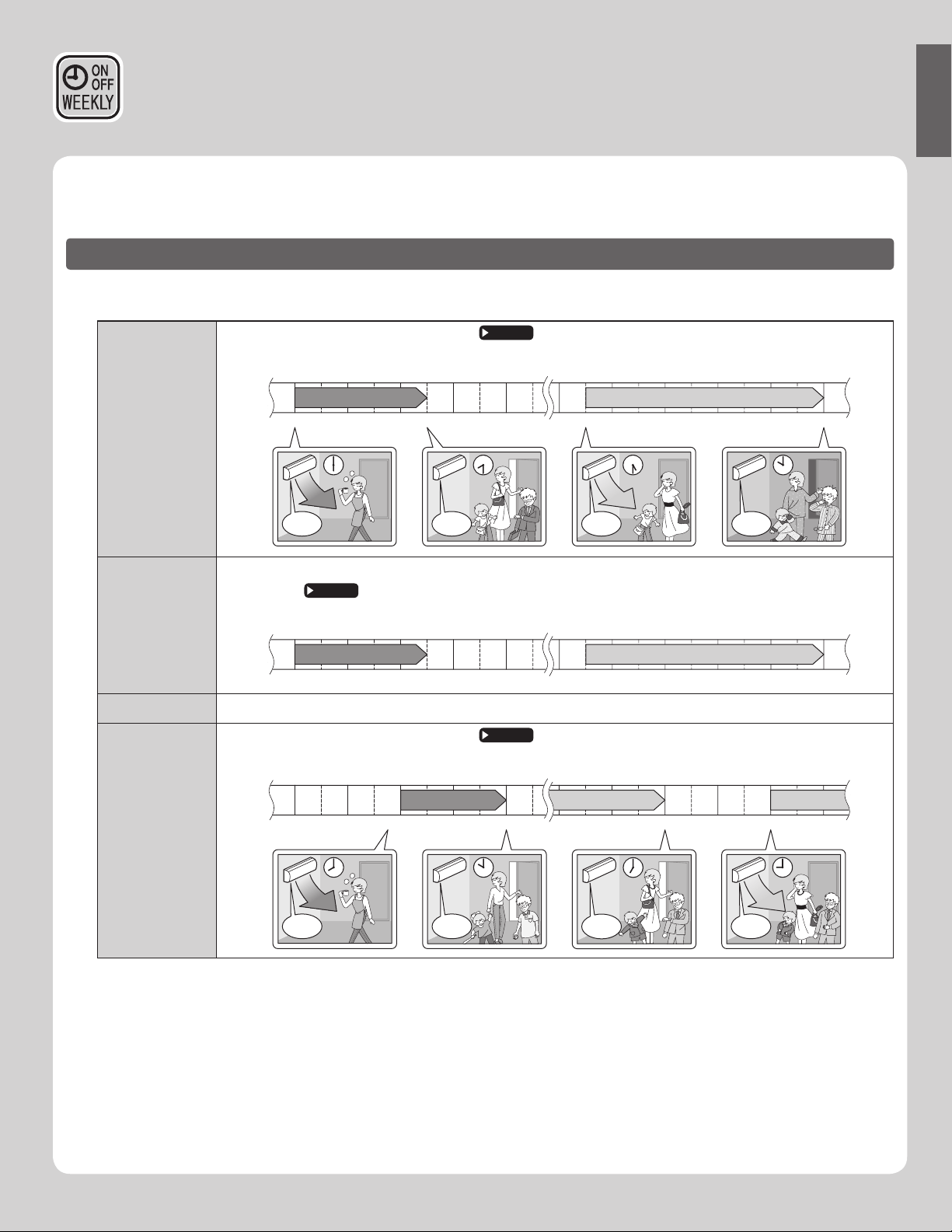
WEEKLY TIMER Operation
Up to 4timer settings can be saved for each day of the week. It is convenient if the WEEKLY TIMER is set
according to the family’s life style.
Using in these cases of WEEKLY TIMER
Example: The same timer settings are made for the week from Monday through Friday while different timer settings are made
for the weekend.
[Monday]
Make timer settings up to programs 1-4.
Page 23
6:00 8:30 17:30 22:00
77°F (25°C) 81°F (27°C)
ON ON OFFOFF
Program 1 Program 2 Program 3 Program 4
ON OFF ON OFF
[Tuesday]
to
[Friday]
Use the copy mode to make settings for Tuesday to Friday, because these settings are the same as those
for Monday.
Page 25
6:00 8:30 17:30 22:00
77°F (25°C) 81°F (27°C)
Program 1 Program 2 Program 3 Program 4
ON OFF ON OFF
[Saturday] No timer settings
[Sunday]
Make timer settings up to programs 1-4.
Page 23
8:00 10:00 19:00 21:00
81°F (27°C)
81°F (27°C)
77°F (25°C)
ON
ON
OFF
OFF
ON OFF OFF ON
Program 1 Program 2 Program 3 Program 4
• Up to 4reservations per day and 28reservations per week can be set in the WEEKLY TIMER. The effective use of the copy
mode ensures ease of making reservations.
• The use of ON-ON-ON-ON settings, for example, makes it possible to schedule operating mode and set temperature changes.
Furthermore, by using OFF-OFF-OFF-OFF settings, only the turn off time of each day can be set. This will turn off the air
conditioner automatically if the user forgets to turn it off.
01_EN_3P297290-2C.indd 22 12/8/2015 13:30:38
23
WEEKLY TIMER Operation
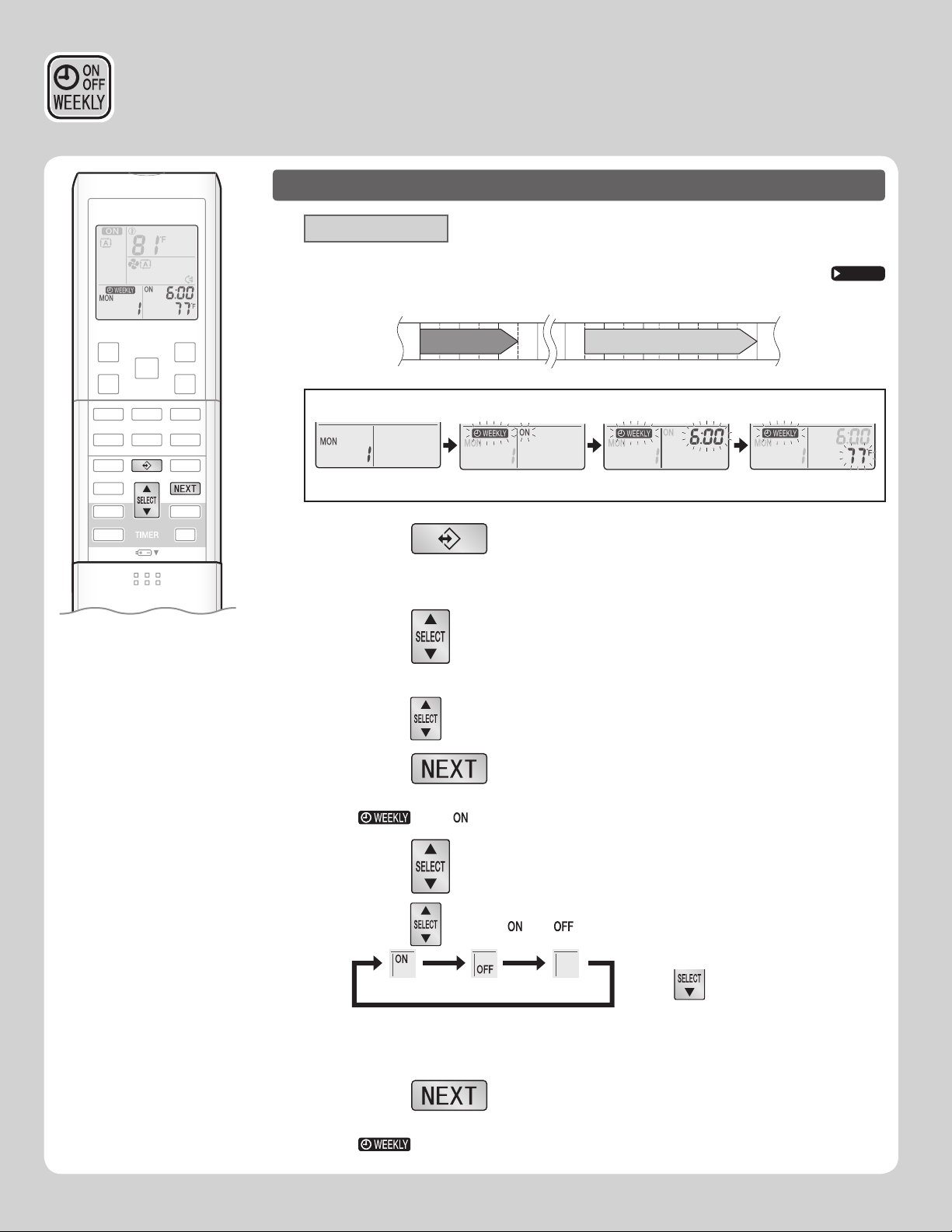
To use WEEKLY TIMER operation
Setting mode
• Make sure the day of the week and time are set. If not, set the day of the week and time.
Page 10
6:00 8:30 17:30 22:00
77°F (25°C)
81°F (27°C)
Program 1 Program 2 Program 3 Program 4
ON OFF ON OFF
[Monday]
Setting Displays
Day and number settings ON/OFF settings Time settings Temperature settings
1. Press .
• The day of the week and the reservation number of the current day will be displayed.
• 1to 4settings can be made per day.
2. Press to select the desired day of the
week and reservation number.
• Pressing changes the reservation number and the day of the week.
3. Press .
• The day of the week and reservation number will be set.
• “
” and “ ” blink.
4. Press to select the desired mode.
• Pressing changes “ ” or “ ” setting in sequence.
ON TIMER OFF TIMER blank
Pressing
puts the sequence in reverse.
• In case the reservation has already been set, selecting “blank” deletes the
reservation.
• Go to STEP
9 if “blank” is selected.
5. Press .
• The ON/OFF TIMER mode will be set.
• “
” and the time blink.
01_EN_3P297290-2C.indd 23 12/8/2015 13:30:39
24
English
NOTE
Notes on WEEKLY TIMER operation
• Do not forget to set the clock on the remote controller rst.
Page 10
• The day of the week, ON/OFF TIMER mode, time and set temperature (only for ON TIMER mode) can be set with WEEKLY TIMER.
Other settings for ON TIMER are based on the settings just before the operation.
• Both WEEKLY TIMER and ON/OFF TIMER operation cannot be used at the same time. The ON/OFF TIMER operation has priority if it is set
while WEEKLY TIMER is still active. The WEEKLY TIMER will go into standby state, and “
” will be no longer displayed on the LCD.
When ON/OFF TIMER is up, the WEEKLY TIMER will automatically become active.
• Only the time and set temperature with the WEEKLY TIMER are sent with the
. Set the WEEKLY TIMER only after setting the operation
mode, the airow rate and the airow direction ahead of time.
• Shutting the breaker off, power failure, and other similar events will render operation of the indoor unit’s internal clock inaccurate. Reset the
clock.
Page 10
• The can be used only for the time and temperature settings. It cannot be used to go back to the reservation number.
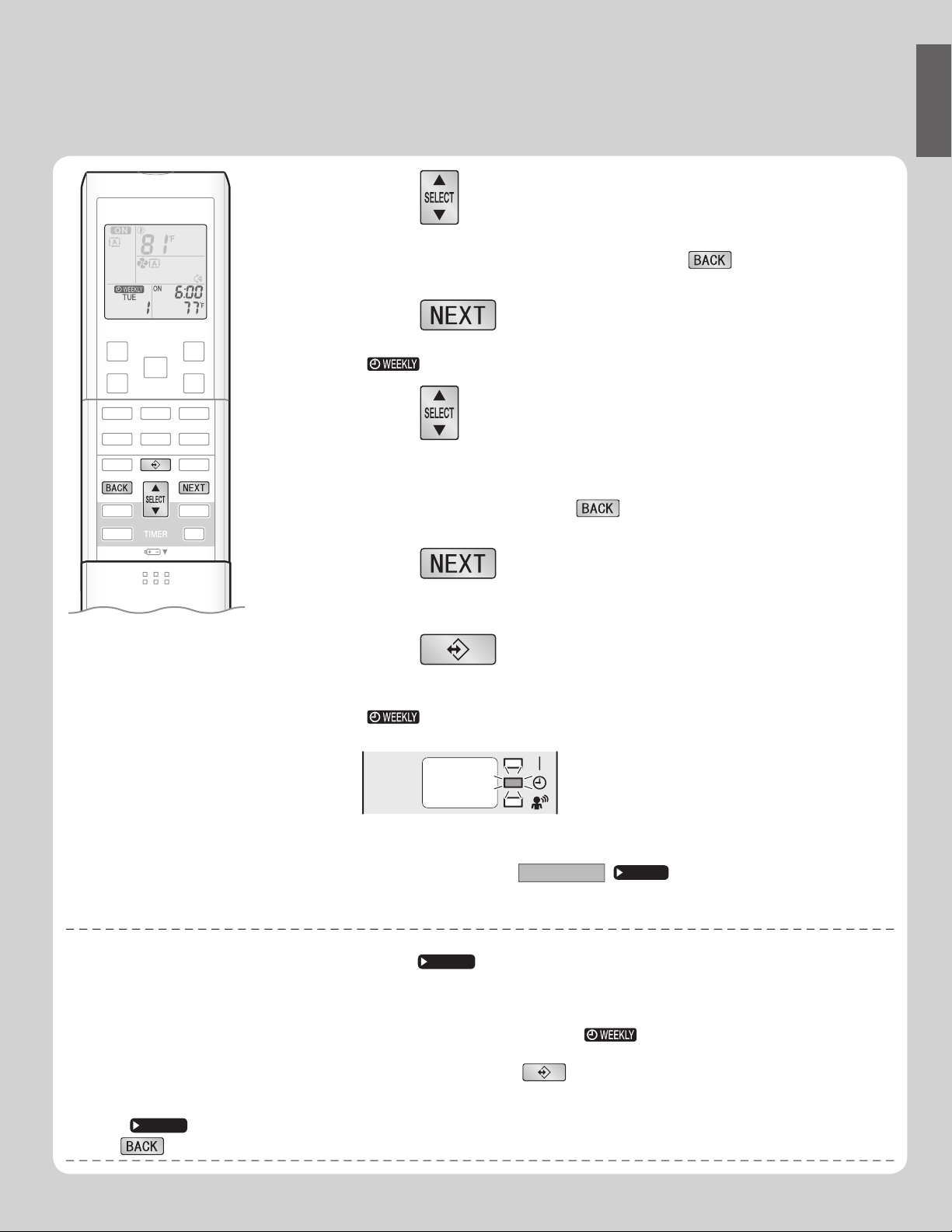
6. Press to select the desired time.
• The time can be set between 0:00 and 23:50 in 10minute intervals.
• To return to the ON/OFF TIMER mode setting, press
.
• Go to STEP
9 when setting the OFF TIMER.
7. Press .
• The time will be set.
• “
” and the temperature blink.
8. Press to select the desired temperature.
• The temperature can be set between 50°F (10°C) and 90°F (32°C).
Cooling: The unit operates at 64°F (18°C) even if it is set at 50°F (10°C) to 63°F (17°C).
Heating: The unit operates at 86°F (30°C) even if it is set at 87°F (31°C) to 90°F (32°C).
• To return to the time setting, press .
• The set temperature is only displayed when the mode setting is on.
9. Press .
• The temperature will be set and go to the next reservation setting.
• To continue further settings, repeat the procedure from STEP
4.
10.
Press to complete the setting.
• Be sure to direct the remote controller toward the indoor unit and check for a receiving
tone and ashing the OPERATION lamp.
• “
” is displayed on the LCD and WEEKLY TIMER operation is activated.
• The TIMER lamp lights yellow.
Display
• A reservation made once can be easily copied and the same settings used for another
day of the week. Refer to
Copy mode
.
Page 25
01_EN_3P297290-2C.indd 24 12/8/2015 13:30:40
25
WEEKLY TIMER Operation
Copy mode
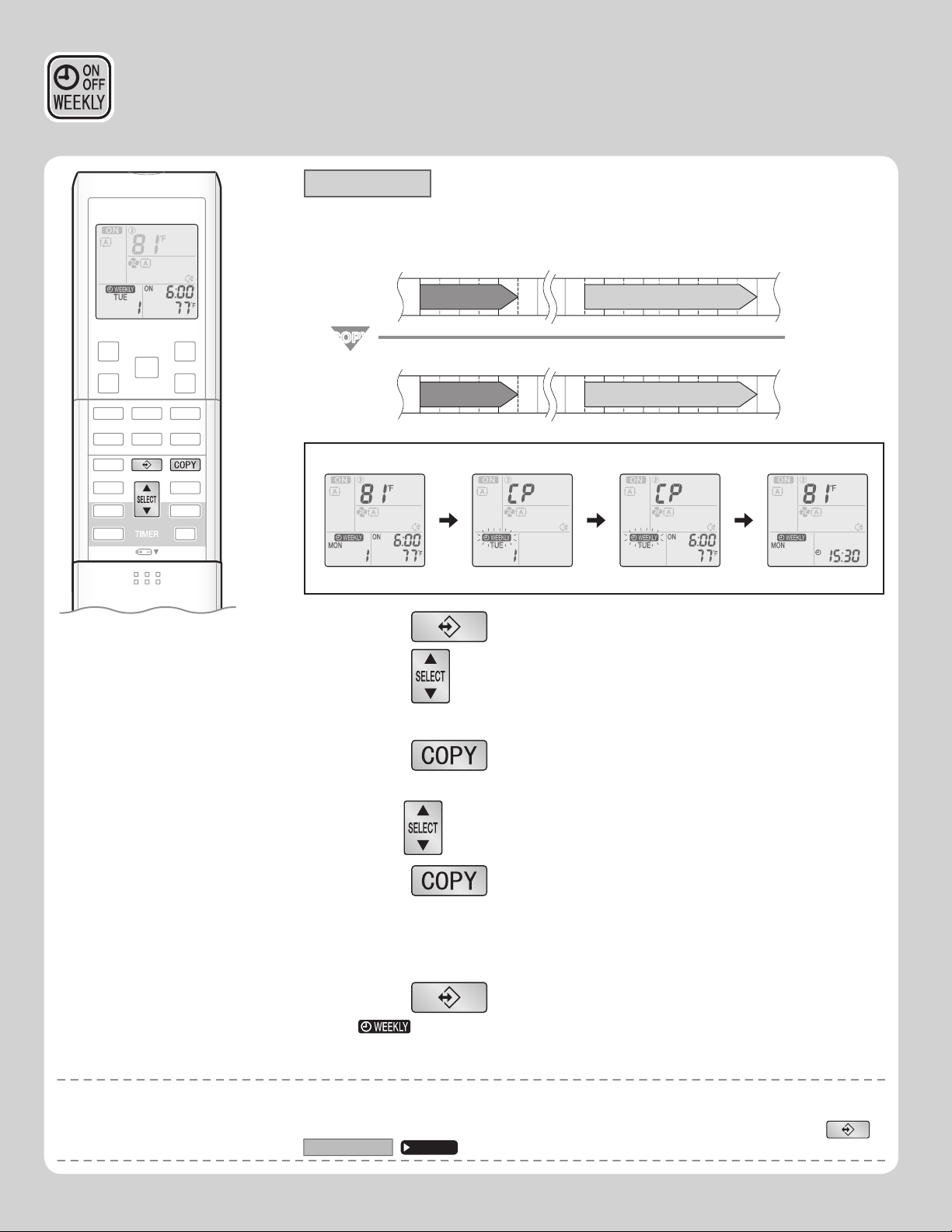
• A reservation made once can be copied to another day of the week. The whole reservation
of the selected day of the week will be copied.
6:00 8:30 17:30 22:00
77°F (25°C)
81°F (27°C)
6:00 8:30 17:30 22:00
77°F (25°C)
81°F (27°C)
COPYCOPY
Program 1 Program 2 Program 3 Program 4
ON OFF ON OFF
[Monday]
Program 1 Program 2 Program 3 Program 4
ON OFF ON OFF
[Tuesday]
to
[Friday]
Setting Displays
Conrmation display Copy display Paste display Normal display
1. Press .
2. Press to conrm the day of the week to be
copied.
3. Press .
• The whole reservation of the selected day of the week will be copied.
4.
Press to select the destination day of the week.
5. Press .
• The reservation will be copied to the selected day of the week. The whole reservation
of the selected day of the week will be copied.
• To continue copying the settings to other days of the week, repeat STEP
4 and
STEP
5.
6. Press to complete the setting.
• “ ” is displayed on the LCD and WEEKLY TIMER operation is activated.
NOTE
Note on COPY MODE
• The entire reservation of the source day of the week is copied in the copy mode.
In the case of making a reservation change for any day of the week individually after copying the content of weekly reservations, press
and change the settings in the steps of
Settingmode
.
Page 23
01_EN_3P297290-2C.indd 25 12/8/2015 13:30:41
26
English
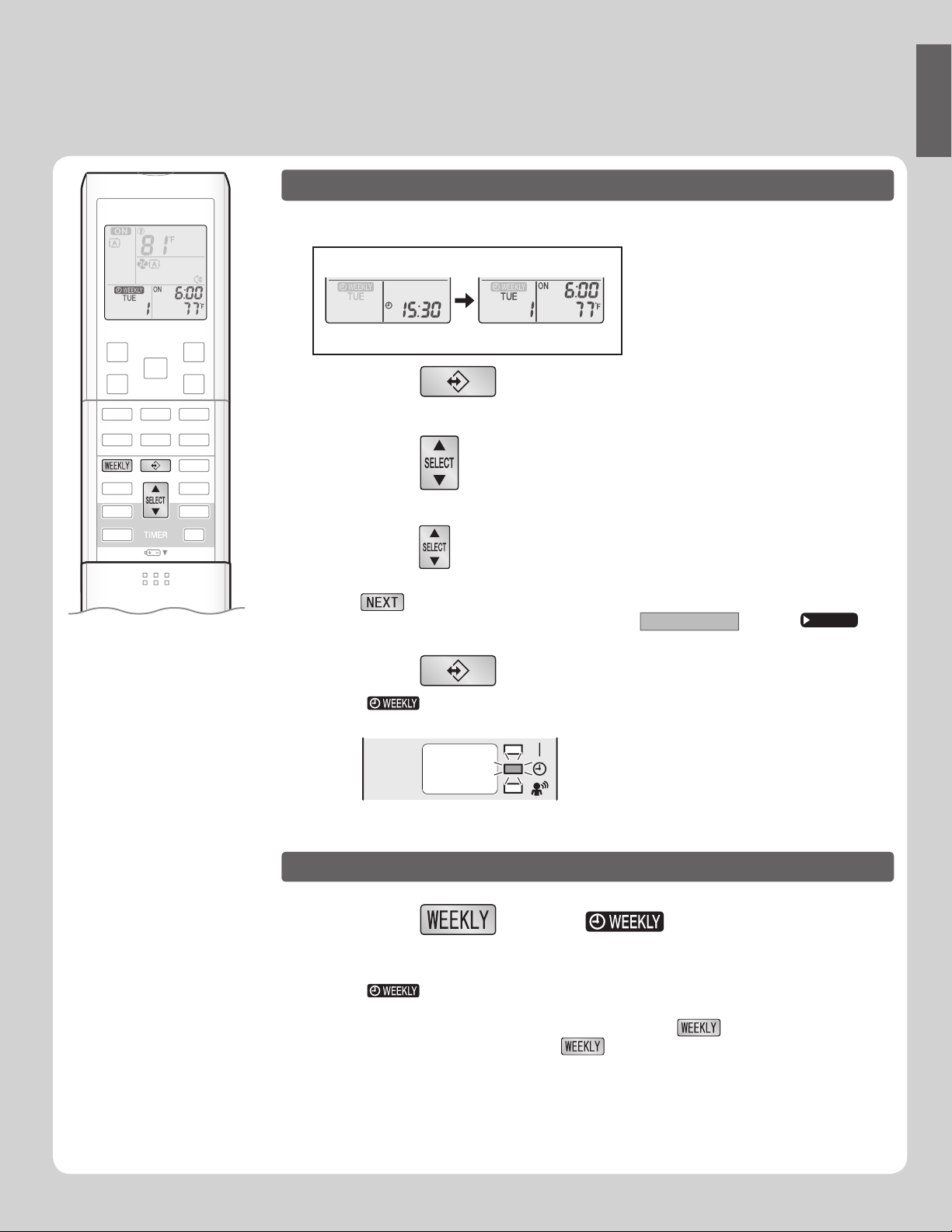
Conrming a reservation
• The reservation can be conrmed.
Setting Displays
Normal display Conrmation display
1. Press .
• The day of the week and the reservation number of current day will be displayed.
2. Press to select the day of the week and
the reservation number to be conrmed.
• Pressing displays the reservation details.
• To change the conrmed reserved settings, select the reservation number and press
.
The mode is switched to setting mode. Go to
Setting mode
STEP 4.
Page 23
3. Press to exit conrming mode.
• “ ” is displayed on the LCD and WEEKLY TIMER operation is activated.
• The TIMER lamp lights yellow.
Display
To deactivate WEEKLY TIMER operation
Press while “ ” is displayed on
the LCD.
• “ ” will be no longer displayed on the LCD.
• The TIMER lamp goes off.
• To reactivate the WEEKLY TIMER operation, press
again.
• If a reservation deactivated with
is activated once again, the last reservation
mode will be used.
01_EN_3P297290-2C.indd 26 12/8/2015 13:30:41
27
WEEKLY TIMER Operation
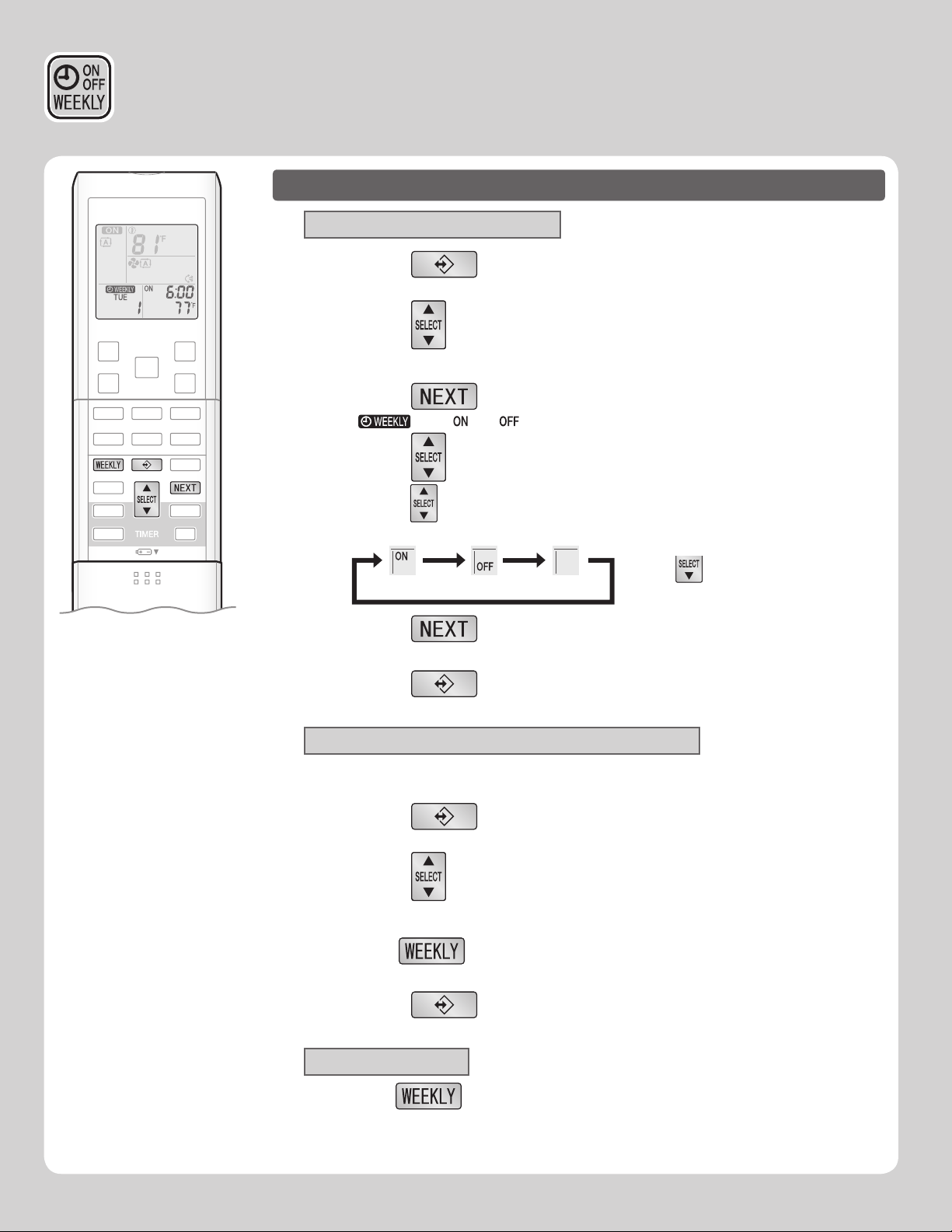
To delete reservations
The individual reservation
1. Press .
• The day of the week and the reservation number will be displayed.
2. Press to select the day of the week and
the reservation number to be deleted.
3. Press .
• “ ” and “ ” or “ ” blink.
4. Press and select “ blank ”.
• Pressing changes ON/OFF TIMER mode.
• The reservation will be no setting with selecting “blank”.
ON TIMER OFF TIMER blank
Pressing puts the sequence in reverse.
5. Press .
• The selected reservation will be deleted.
6. Press .
• If there are still other reservations, WEEKLY TIMER operation will be activated.
The reservations for each day of the week
• This function can be used for deleting reservations for each day of the week.
• It can be used while conrming or setting reservations.
1. Press .
• The day of the week and the reservation number will be displayed.
2. Press to select the day of the week to be
deleted.
3. Hold for 5seconds.
• The reservation of the selected day of the week will be deleted.
4. Press .
• If there are still other reservations, WEEKLY TIMER operation will be activated.
All reservations
Hold for 5seconds while normal display.
•
Be sure to direct the remote controller toward the indoor unit and check for a receiving tone.
• This operation is not effective on the setting display of WEEKLY TIMER.
• All reservations will be deleted.
01_EN_3P297290-2C.indd 27 12/8/2015 13:30:42
28
English
Note for Multi System
NOTE
Notes on operation mode for multi system
• COOL, DRY and FAN operation may be used at the same time.
• AUTO operation automatically selects COOL operation or HEAT operation based on the room temperature.
Therefore, AUTO operation is available when selecting the same operation mode as that of the room with the rst unit to be turned on.
CAUTION
• Normally, the operation mode in the room where the unit is rst run is given priority, but the following situations are exceptions, so please keep this
in mind.
If the operation mode of the rst room is FAN operation, then using HEAT operation in any room after this will give priority to HEAT operation. In
this situation, the air conditioner running in FAN operation will go on standby, and the OPERATION lamp will ash.
With the priority room setting active.
Refer to “Priority room setting” on the next page.
NIGHT QUIET mode (Available only for COOL operation)
NIGHT QUIET mode requires initial programming during installation. Please consult your retailer or dealer for assistance.
NIGHT QUIET mode reduces the operation noise of the outdoor unit during the nighttime hours to prevent annoyance to
neighbors.
• The NIGHT QUIET mode is activated when the temperature drops 10.8°F (6°C) or more below the highest temperature recorded that day.
Therefore, when the temperature difference is less than 7.2°F (4°C), this function will not be activated.
• NIGHT QUIET mode reduces slightly the cooling efciency of the unit.
OUTDOOR UNIT QUIET operation
Refer to “OUTDOOR UNIT QUIET operation”.
Page 18
With the priority room setting present but inactive or not present.
When using the OUTDOOR UNIT QUIET operation feature with the Multi system, set all indoor units to OUTDOOR UNIT
QUIET operation using their remote controllers.
When clearing OUTDOOR UNIT QUIET operation, clear one of the operating indoor units using their remote controller.
However OUTDOOR UNIT QUIET operation display remains on the remote controller for other rooms.
We recommend you release all rooms using their remote controllers.
With the priority room setting active.
Refer to “Priority room setting” on the next page.
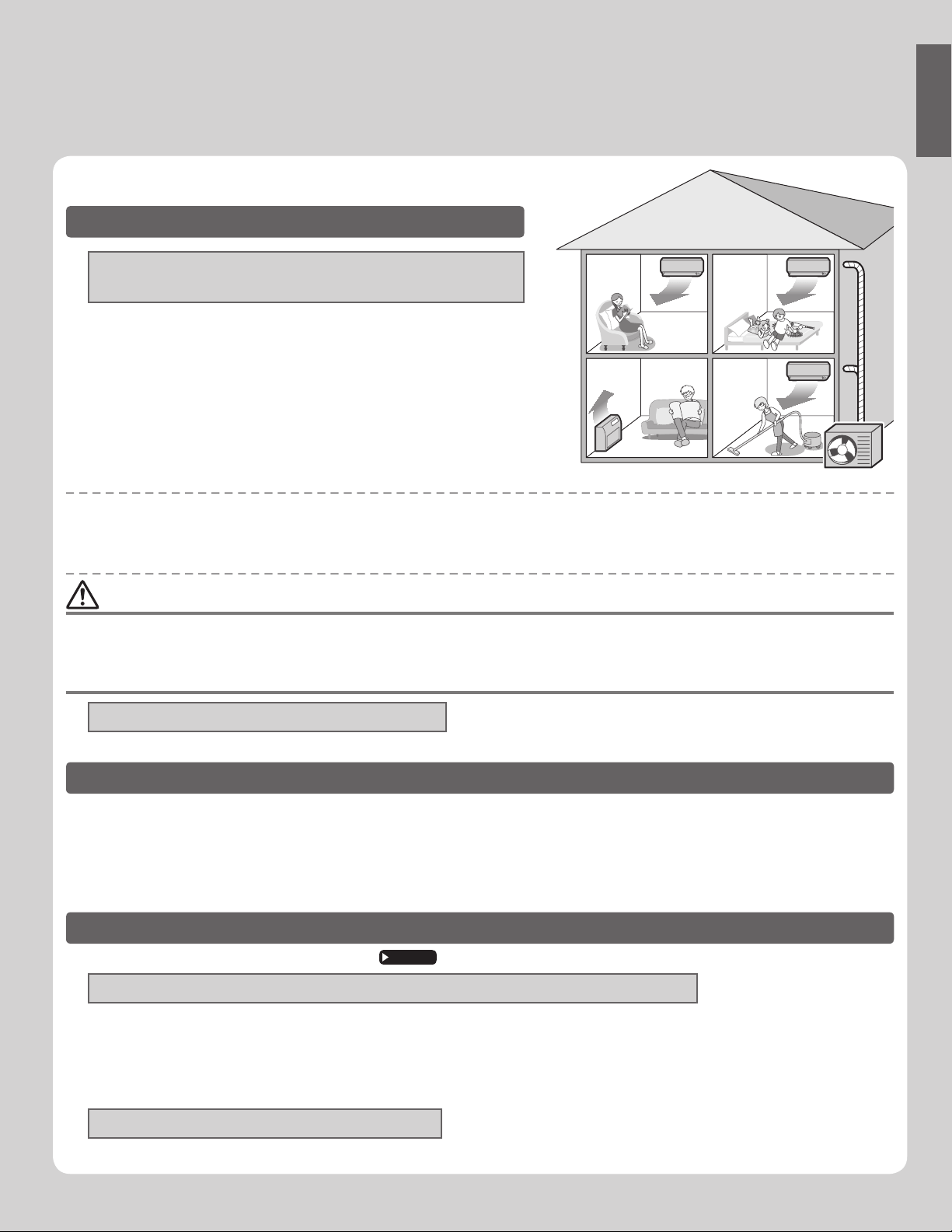
Multi system has one outdoor unit connected to multiple indoor units.
Selecting the operation mode
With the priority room setting present but
inactive or not present.
When more than one indoor unit is operating, priority is given to the
rst unit that was turned on.
In this case, set the units that are turned on later to the same operation
mode as the rst unit.
Otherwise, they will enter the standby state, and the OPERATION
lamp will ash: this does not indicate malfunction.
A room B room
C room D room
Outdoor unit
01_EN_3P297290-2C.indd 28 12/8/2015 13:30:42
29
Note for Multi System
COOL / HEAT mode lock
The COOL / HEAT mode lock requires initial programming during installation. Please consult your authorized dealer for
assistance. The COOL / HEAT mode lock sets the unit forcibly to either COOL or HEAT operation. This function is convenient
when you wish to set all indoor units connected to the multi system to the same operation mode.
Priority room setting
The priority room setting requires initial programming during installation. Please consult your authorized dealer for assistance.
The room designated as the priority room takes priority in the following situations.
Operation mode priority
• As the operation mode of the priority room takes precedence, the user can select a different operation mode from other
rooms.
[Example]
• Room A is the priority room in the examples.
When COOL operation is selected in room A while operating the following modes in room B, C and D:
Operation mode in room B, C and D Status of room B, C and D when the unit in room A is in COOL operation
COOL or DRY or FAN
Current operation mode maintained
HEAT
The unit enters standby mode. Operation resumes when the room A unit stops operating.
AUTO
If the unit is set to COOL operation, it continues. If the unit is set to HEAT operation, it enters standby
mode. Operation resumes when the room A unit stops operating.
Priority when POWERFUL operation is used
[Example]
• Room A is the priority room in the examples.
The indoor units in rooms A, B, C and D are all operating. If the unit in room A enters POWERFUL operation, operation
capacity will be concentrated in room A. In such a case, the cooling (heating) efciency of the units in room B, C and D may
be slightly reduced.
Priority when using OUTDOOR UNIT QUIET operation
[Example]
• Room A is the priority room in the examples.
Just by setting the unit in room A to QUIET operation, the air conditioner starts OUTDOOR UNIT QUIET operation.
You don’t have to set all the operated indoor units to QUIET operation.
01_EN_3P297290-2C.indd 29 12/8/2015 13:30:42
Panel tab
30
English
Care and Cleaning
Quick reference
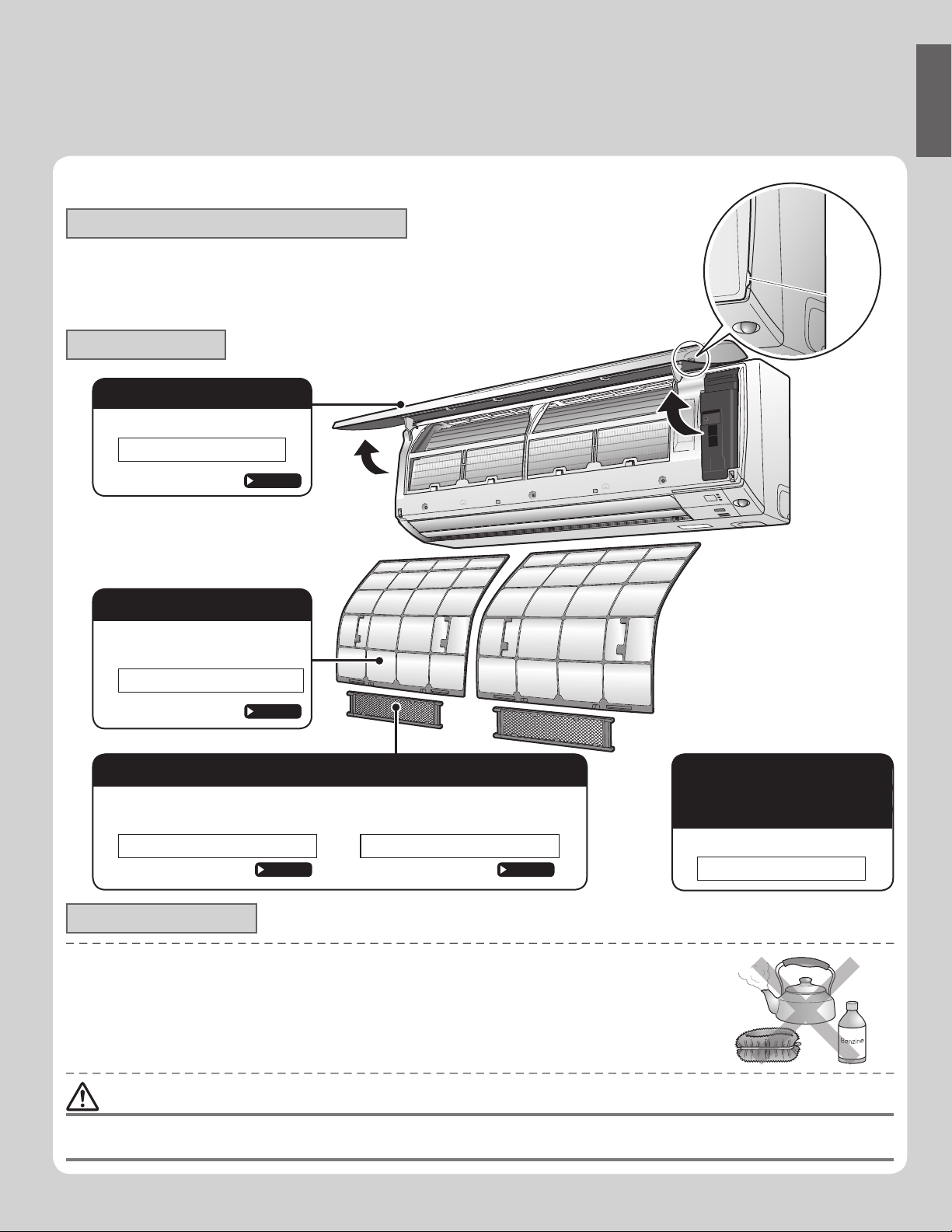
How to open / close the front panel
• Hold the front panel by the panel tabs on the both sides and open it.
• Press the front panel at both sides and the center to close it.
Cleaning parts
Notes on cleaning
For cleaning, do not use the materials as follows.
• Hot water above 104°F (40°C).
• Benzine, gasoline, thinner, other volatile oils.
• Polishing compound.
• Scrubbing brushes, other hard stuff.
CAUTION
• Before cleaning, be sure to stop the operation and turn the breaker off.
• Do not touch the aluminum ns of the indoor unit. If you touch those parts, this may cause an injury.
Air lter
• Vacuum dust or wash the
lter.
Once every 2 weeks
Refer to
Page 32
Titanium apatite photocatalytic air-purifying lter
• Vacuum dust or replace the lter.
[Cleaning] [Replacement]
Once every 6 months Once every 3 years
Refer to
Page 33
Refer to
Page 33
Front panel
• Wipe it with a soft damp cloth.
If bothered by dirt
Refer to
Page 31
Indoor unit,
Outdoor unit and
Remote controller
• Wipe them with a soft cloth.
If bothered by dirt
01_EN_3P297290-2C.indd 30 12/8/2015 13:30:43
31
Care and Cleaning
CAUTION
• When removing or attaching the front panel, stand on a solid, stable base and take care not to fall.
• When removing or attaching the front panel, support the panel securely with hand to prevent it from falling.
• After cleaning, make sure that the front panel is securely xed.
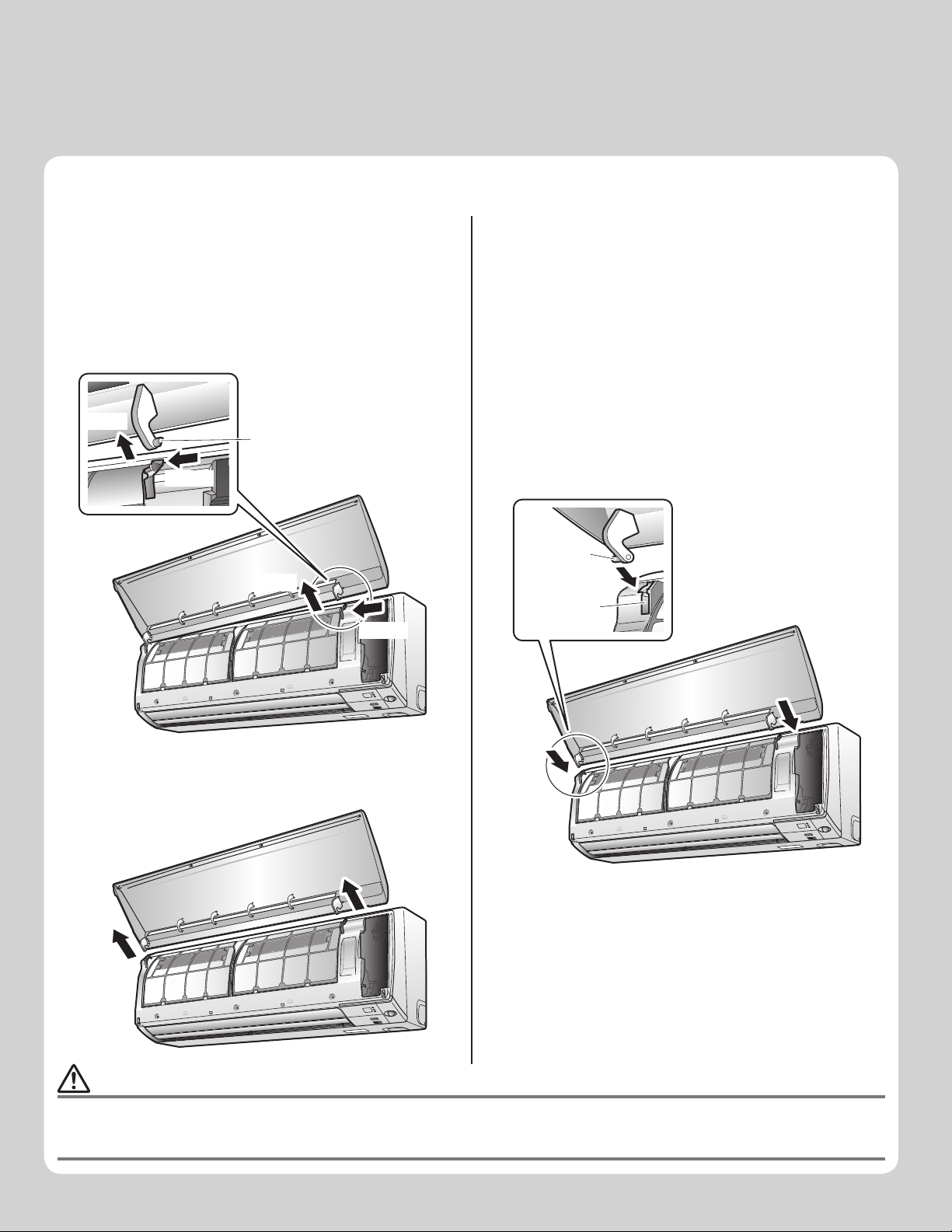
1. Remove the front panel.
• Open the front panel.
• Slide the front panel to either the left or right and
pull it toward you.
This will disconnect the front panel shaft on one
side.
Front panel shaft
1) Slide
2) Pull
1) Slide
2) Pull
• Disconnect the front panel shaft on the other side
in the same manner.
2. Clean the front panel.
• Wipe it with a soft damp cloth.
• Only neutral detergent may be used.
• In case of washing the panel with water, wipe it
with a dry soft cloth, and let it dry in the shade after
washing.
3. Attach the front panel.
• Align the front panel shaft on the left and right of
the front panel with the slots, then push them all
the way in.
Front panel
shaft
Slot
• Close the front panel slowly. (Press the panel at
both sides and the central area.)
Front panel
01_EN_3P297290-2C.indd 31 12/8/2015 13:30:44
32
English
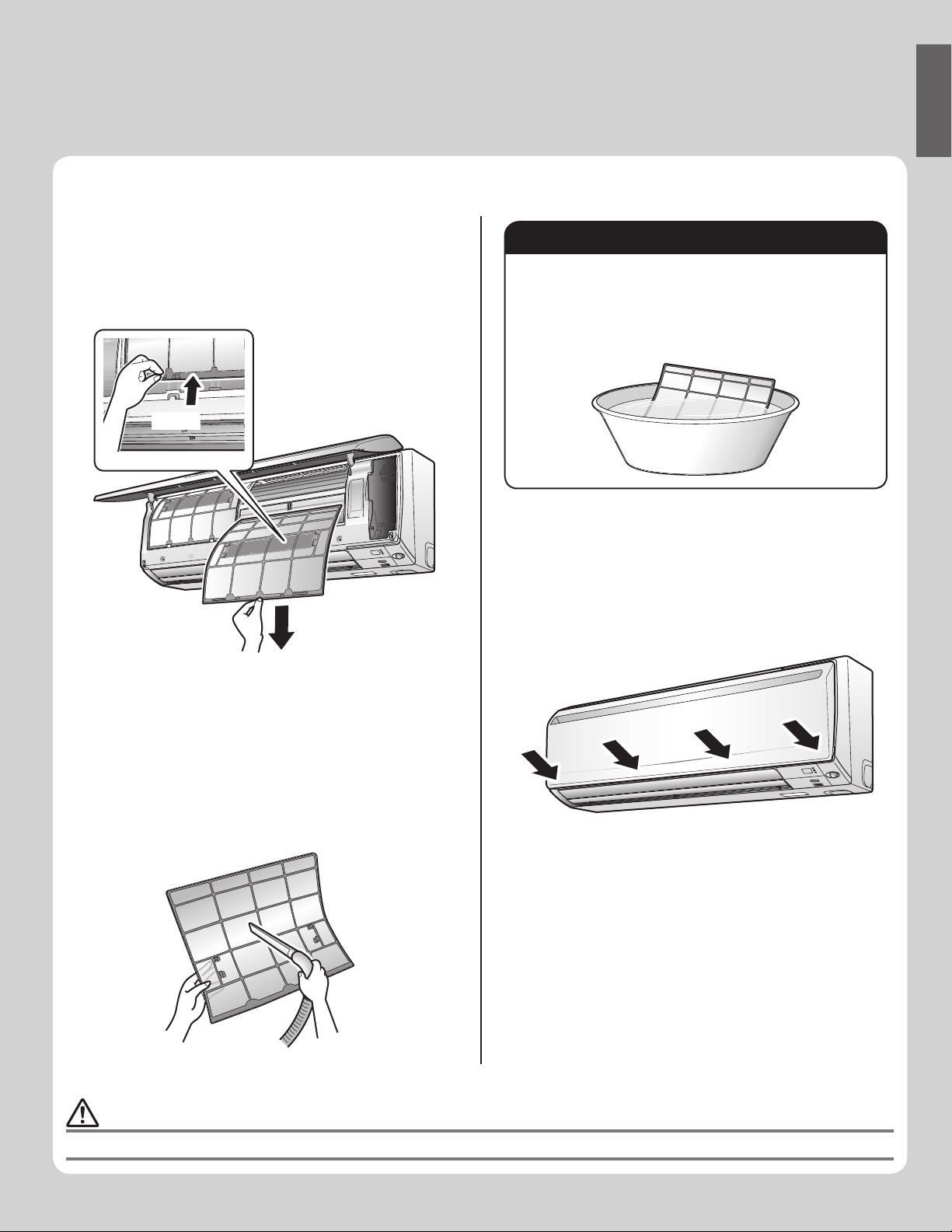
1. Pull out the air lters.
• Open the front panel.
• Push the lter tab at the center of each air lter
slightly upward, then pull it down.
1) Push
2) Pull down
2. Wash the air lters with
water or clean them with
vacuum cleaner.
• It is recommended to clean the air lters every
2weeks.
If the dust does not come off easily
• Wash the air lters with neutral detergent thinned with
lukewarm water, then let them dry in the shade.
• Be sure to remove the titanium apatite photocatalytic
air-purifying lter. Refer to “Titanium apatite
photocatalytic air-purifying lter” on the next page.
3. Set the lters as they were
and close the front panel.
• Press the front panel at both sides and the central
area.
Air lter
CAUTION
• Do not touch the aluminum ns by bare hand at the time of dismounting or mounting the lter.
01_EN_3P297290-2C.indd 32 12/8/2015 13:30:44
33
Care and Cleaning
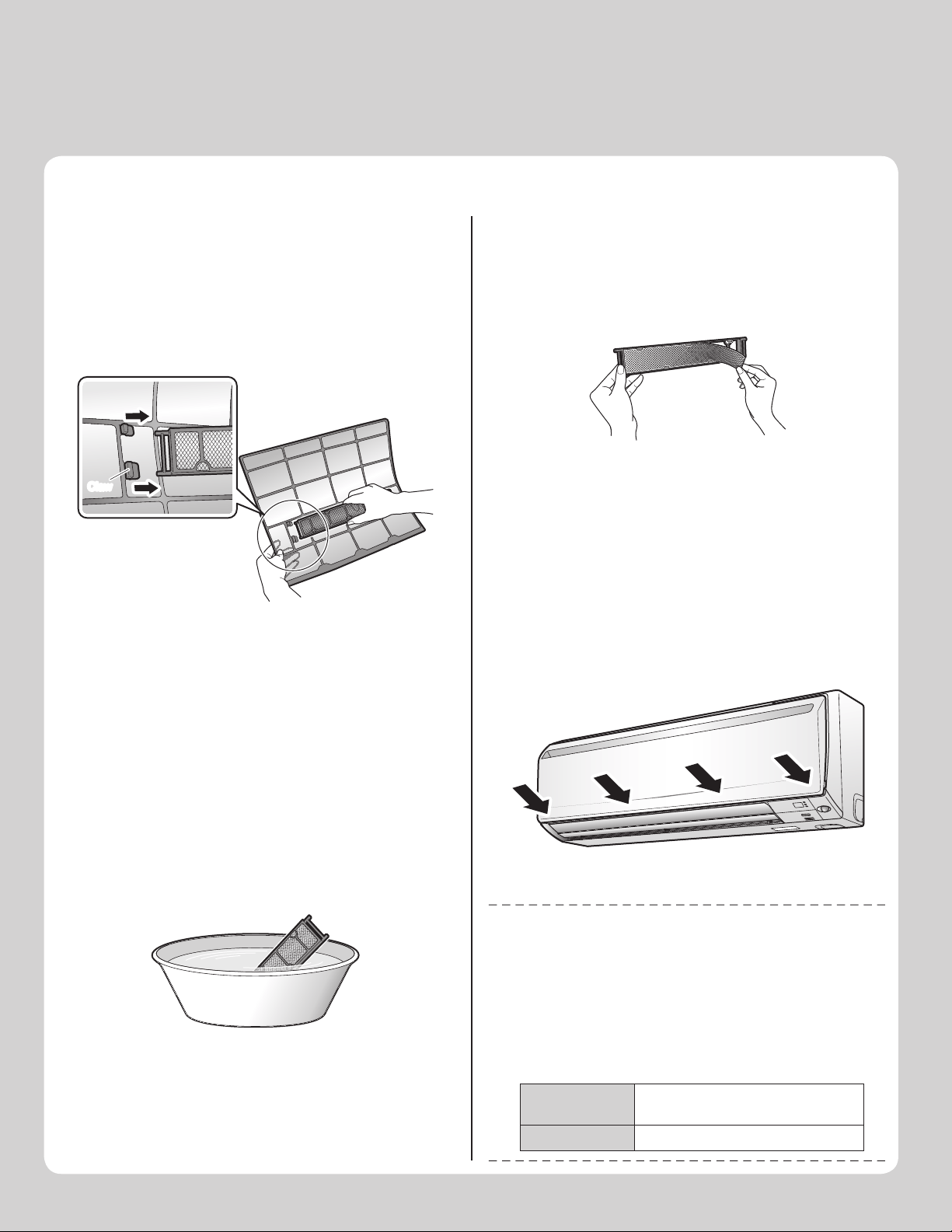
1. Take off the titanium apatite
photocatalytic air-purifying
lter.
• Open the front panel and pull out the air lters.
• Hold the recessed parts of the frame and unhook
the 4claws.
ClawClaw
2.
Clean or replace the titanium
apatite photocatalytic air-
purifying lter.
[Maintenance]
2-1 Vacuum dust, and soak in lukewarm
water or water for about 10 to
15minutes if dirt is heavy.
• Do not remove the lter from frame when washing
with water.
2-2 After washing, shake off remaining
water and dry in the shade.
• Since the material is made out of polyester, do not
wring out the lter when removing water from it.
[Replacement]
Remove the tabs on the lter
frame and replace with a new
lter.
• Do not throw away the lter frame. Reuse the lter
frame when replacing the titanium apatite
photocatalytic air-purifying lter.
• Dispose of the old lter as non- ammable waste.
3. Set the lters as they were
and close the front panel.
• Press the front panel at both sides and the central
area.
NOTE
• Operation with dirty lters:
– cannot deodorize the air,
– cannot clean the air,
– results in poor heating or cooling,
– may cause odor.
• Dispose of old lters as non- ammable waste.
• To order a titanium apatite photocatalytic air-purifying
lter, contact the dealer where you bought the air
conditioner.
Item
Titanium apatite photocatalytic
air-purifying lter (without frame) 1set
Part No. KAF970A46
Titanium apatite photocatalytic air-purifying lter
01_EN_3P297290-2C.indd 33 12/8/2015 13:30:45
34
English
Check the units
Check that the base, stand and other ttings of the outdoor unit are not decayed or corroded.
Check that nothing blocks the air inlets and the outlets of the indoor unit and the outdoor unit.
Check that the drain comes smoothly out of the drain hose during COOL or DRY operation.
• If no drain water is seen, water may be leaking from the indoor unit. Stop operation and consult the service shop if this is the
case.
Before a long idle period
1. Operate the FAN only for several hours on a nice day to dry out
the inside.
• Press and select “ ” operation.
• Press
and start the operation.
2. After operation stops, turn off the circuit breaker for the room air
conditioner.
3. Clean the air lters and set them again.
4. Take out batteries from the remote controller.
• When a multi outdoor unit is connected, make sure the HEAT operation is not being used in other rooms before you use
the FAN operation.
Page 28
We recommend periodical maintenance
• In certain operating conditions, the inside of the air conditioner may get foul after several seasons of use, resulting in poor
performance. It is recommended to have periodical maintenance by a specialist aside from regular cleaning by the user.
• For specialist maintenance, contact the service shop where you purchased the air conditioner.
• The maintenance cost must be borne by the user.
01_EN_3P297290-2C.indd 34 12/8/2015 13:30:45
35
Troubleshooting
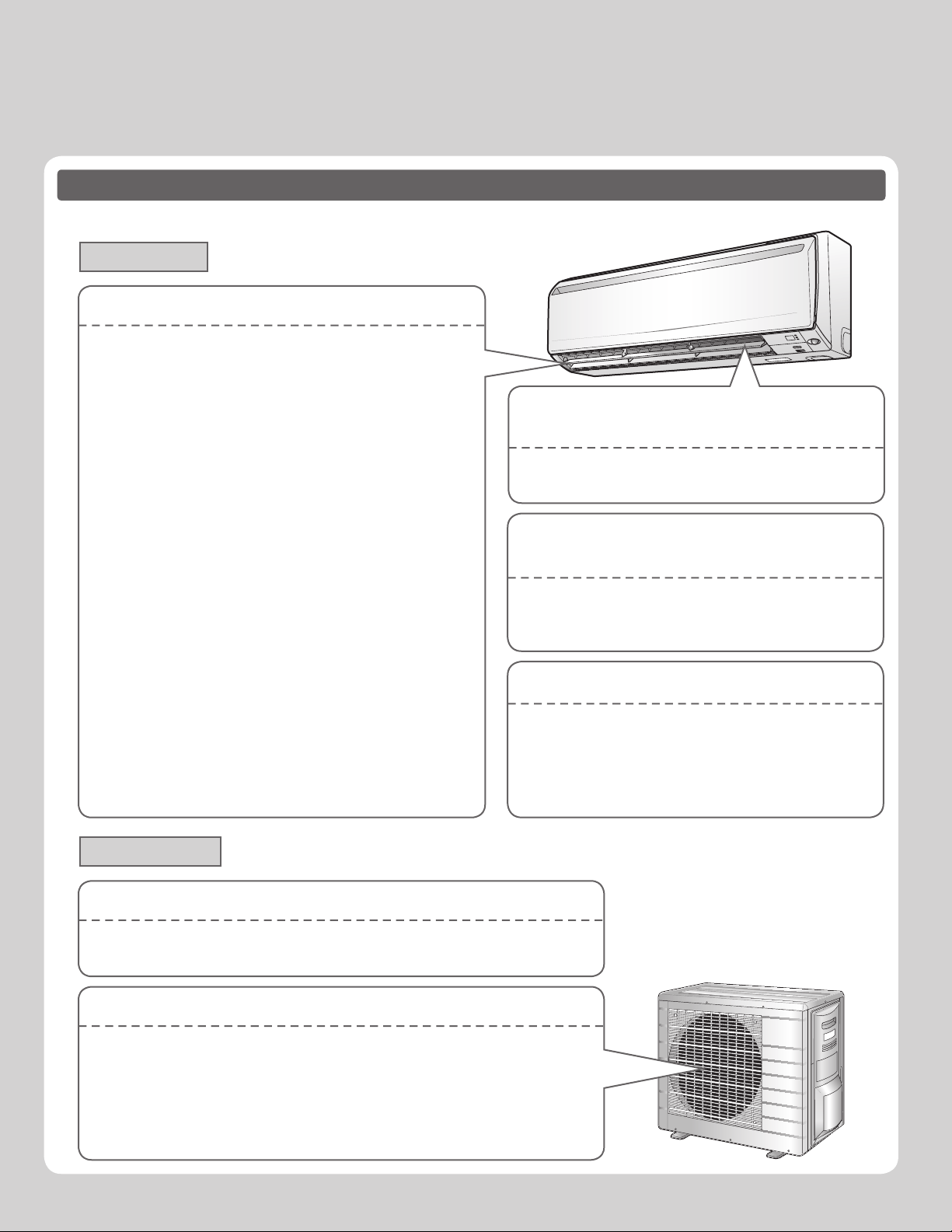
These incidents are not malfunctions.
•
The following incidents do not indicate a malfunctioning air conditioner and have explanations. The air conditioner can continue to operate.
Indoor unit
Outdoor unit
The HEAT operation stops suddenly
and a owing sound is heard.
• The outdoor unit is taking away the frost. The HEAT
operation starts after the frost on the outdoor unit is
removed. You should wait for about 4to 12minutes.
Operation does not start soon.
When “ON/OFF” button was pressed soon
after operation was stopped.
When the mode was reselected.
• This is to protect the air conditioner.
You should wait for about 3minutes.
The aps do not start swinging immediately.
The aps move soon after startup.
• The air conditioner is adjusting the position of the
aps. The aps will start moving soon.
Possible sounds.
Flowing water
• Generated because the refrigerant in the air conditioner is
owing.
• This is a pumping sound of the water in the air conditioner
it is heard when the water is pumped out from the air
conditioner in cooling or drying operation.
• The refrigerant ows in the air conditioner even if the air
conditioner is not working when the indoor units in other
rooms are in operation.
Blowing
• Generated when the ow of the refrigerant in the air
conditioner is switched over.
Ticking
• Generated when the size of the air conditioner slightly
expands or shrinks as a result of temperature changes.
Whistling sound
• Generated when refrigerant ows during defrosting
operation.
Clicking sound during operation or idle time
• Generated when the refrigerant control valves or the
electrical parts operate.
Clopping sound
• Heard from the inside of the air conditioner when the
exhaust fan is activated while the room doors are closed.
Open the window or turn off the exhaust fan.
The outdoor unit emits water or steam.
In HEAT operation
• The frost on the outdoor unit melts into water or steam when the air
conditioner is in defrost operation.
In COOL or DRY operation
• Moisture in the air condenses into water on the cool surface of outdoor unit
piping and drips.
Operating sound is loud.
• When frost forms on the heat exchanger of the outdoor unit, the operating
sound level increases slightly.
01_EN_3P297290-2C.indd 35 12/8/2015 13:30:46
36
English
• Troubleshooting measures are classi ed into the following two types on a remedial basis.
Take an appropriate measure according to the symptom.
Not malfunction
• The following conditions do not indicate a problem with the system.
Check
• Please check again before calling a repair person.
The air conditioner does not operate.
(OPERATION lamp is off.)
• Is a breaker off or a fuse blown?
• Is there a power failure?
• Are batteries set in the remote controller?
• Is the timer setting correct?
Air does not come out.
In HEAT operation
• The air conditioner is warming up. Wait for about 1 to 4
minutes.
• During defrosting operation, hot air does not ow out of
the indoor unit.
When the air conditioner operates immediately
after the circuit breaker is turned on
• The air conditioner is preparing to operate. Wait for about
3 to 20 minutes.
Operation stopped suddenly.
(OPERATION lamp is on.)
• For system protection, the air conditioner may stop
operating on a sudden large voltage uctuation. It
automatically resumes operation in about 3minutes.
Operation stopped suddenly.
(OPERATION lamp ashes.)
• Are the air lters clean?
Clean the air lters.
• Is there anything to block the air inlet or the outlet of the
indoor and the outdoor units?
• Turn the bleaker off and take all obstacles away. Then
turn it on again and try operating the air conditioner with
the remote controller. If the lamp still ashes, call the
service shop where you purchased the air conditioner.
• Are operation modes all the same for indoor units
connected to outdoor units in the multi system?
If not, set all indoor units to the same operation mode
and con rm that the lamps ash.
When the operation mode is in “AUTO”, set all indoor
unit operation modes to “COOL” or “HEAT” for a moment
and check again that the lamps are normal. If the lamps
stop ashing after the above steps, there is no
malfunction.
Page 28
Mist comes out of the indoor unit.
• This happens when the air in the room is cooled into
mist by the cold air ow during COOL operation.
• This is because the air in the room is cooled by the heat
exchanger and becomes mist during defrosting
operation.
01_EN_3P297290-2C.indd 36 12/8/2015 13:30:46
37
Troubleshooting
Cooling (Heating) effect is poor.
• Are the air lters clean?
• Is there anything to block the air inlet or the outlet of the
indoor and the outdoor units?
• Is the temperature setting appropriate?
• Are the windows and doors closed?
• Are the air ow rate and the air ow direction set
appropriately?
Remote controller does not work
properly.
No remote controller signals are displayed.
Remote controller sensitivity is low.
Display is low in contrast or blacked out.
Display runs out of control.
• The batteries are dying and the remote controller is
malfunctioning. Replace all the batteries with new, size
AAA.LR03 (alkaline). For details, refer to “To set the
batteries” of this manual.
Page 9
HEAT operation cannot be selected,
even though the unit is heat pump
model.
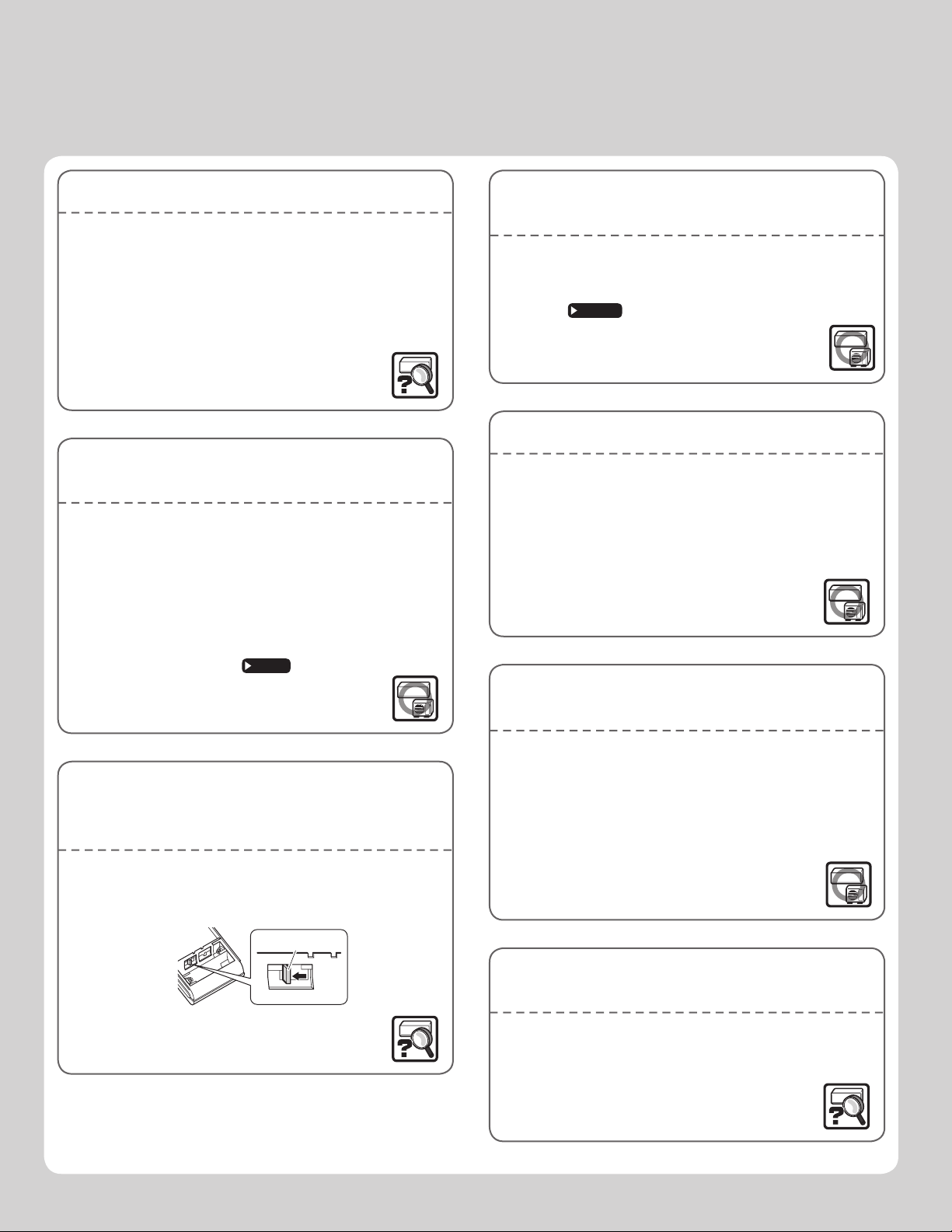
• Slide the DIP switch to the left as shown in the illustration
so that the HEAT operation can be selected with the
“MODE” button.
DIP switch
The ON/OFF TIMER does not
operate according to the settings.
• Check if the ON/OFF TIMER and the WEEKLY TIMER
are set to the same time.
Change or deactivate the settings in the WEEKLY
TIMER.
Page 22
The indoor unit gives out odor.
• This happens when smells of the room, furniture, or
cigarettes are absorbed into the unit and discharged with
the air ow.
(If this happens, have the indoor unit washed by a
technician from the service shop where you purchased
the air conditioner.)
The outdoor fan rotates while the
air conditioner is not in operation.
After operation is stopped
• The outdoor fan continues rotating for another
60seconds for system protection.
While the air conditioner is not in operation
• When the outdoor temperature is very high, the outdoor
fan starts rotating for system protection.
An abnormal functioning happens
during operation.
• The air conditioner may malfunction with lightning or
radio waves. Turn the breaker off, turn it on again and try
operating the air conditioner with the remote controller.
01_EN_3P297290-2C.indd 37 12/8/2015 13:30:46
38
English
Call the service shop immediately
WARNING
When an abnormality (such as a burning smell) occurs, stop operation and turn the breaker off.
• Continued operation in an abnormal condition may result in malfunctioning, electric shocks or re.
• Consult the service shop where you purchased the air conditioner.
Do not attempt to repair or modify the air conditioner by yourself.
• Incorrect work may result in electric shocks or re.
• Consult the service shop where you purchased the air conditioner.
If one of the following symptoms occurs, call the service shop immediately.
• The power cord is abnormally hot or damaged.
• An abnormal sound is heard during operation.
• The safety breaker, a fuse, or the ground leakage breaker
cuts off the operation frequently.
• A switch or a button often fails to work properly.
• There is a burning smell.
• Water leaks from the indoor unit.
Turn the breaker off and call the service shop.
After a power failure
• The air conditioner automatically resumes operation in about 3minutes. Wait for it to restart.
Lightning
• If lightning may strike the neighboring area, stop operation and turn the breaker off for system protection.
Disposal requirements
• Dismantling the unit, and treatment of refrigerant, oil, and other parts, should be done in accordance with the relevant local and
national regulations.
01_EN_3P297290-2C.indd 38 12/8/2015 13:30:46
39
Troubleshooting
Fault diagnosis by remote controller
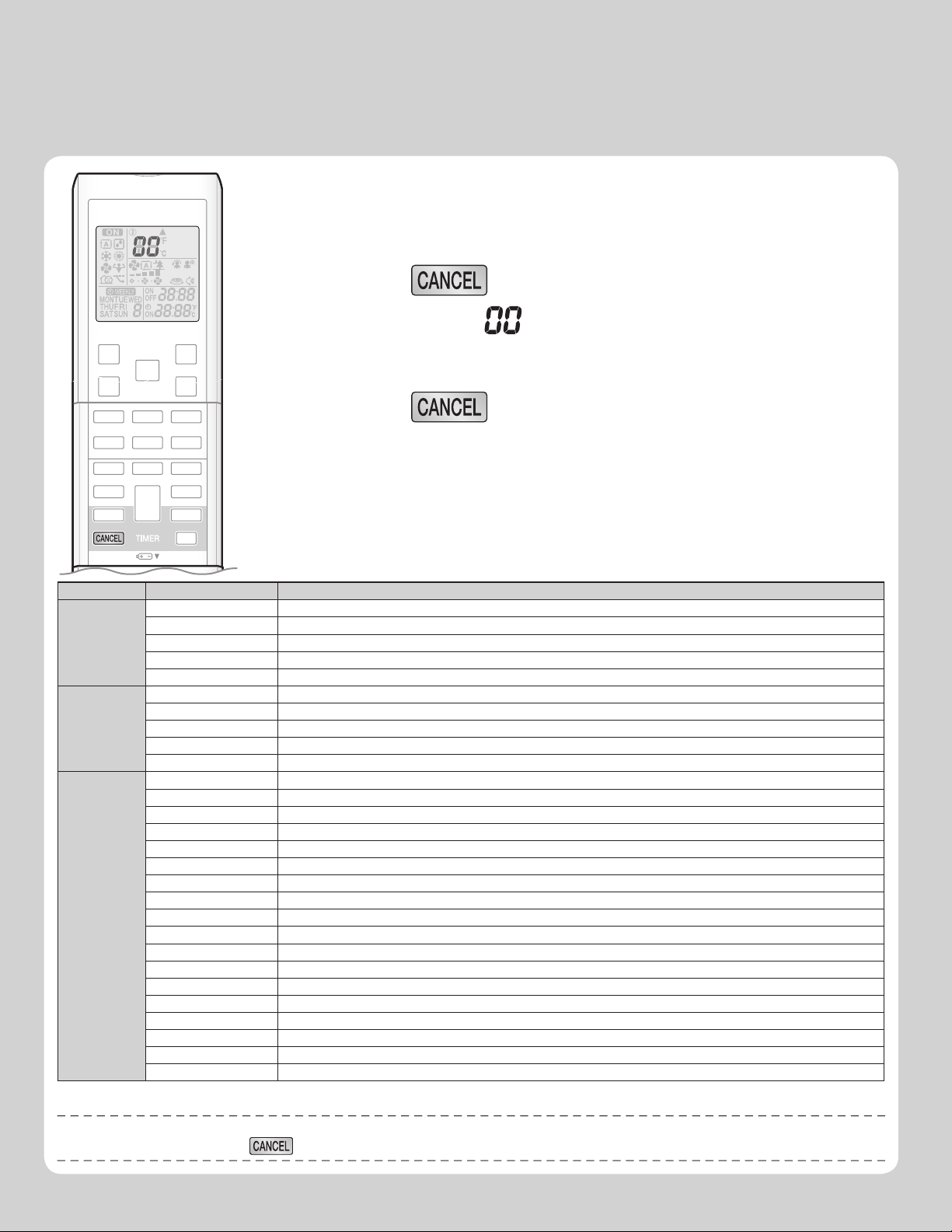
• The remote controller can receive a corresponding error code from the indoor unit.
1. When is held down for about
5seconds, “ ” blinks in the temperature
display section.
2. Press repeatedly until a continuous
beep is produced.
• The code indication changes as displayed in the following table, and noties with a
long beep.
NOTE
• A short beep and two consecutive beeps indicate non-corresponding codes.
• To cancel the code display, hold
for 5seconds. The code display also cancel itself if the button is not pressed for 1minute.
CODE MEANING
SYSTEM
00 NORMAL
UA INDOOR-OUTDOOR UNIT COMBINATION FAULT
U0 REFRIGERANT SHORTAGE
U2 DROP VOLTAGE OR MAIN CIRCUIT OVERVOLTAGE
U4 FAILURE OF TRANSMISSION (BETWEEN INDOOR UNIT AND OUTDOOR UNIT)
INDOOR
UNIT
A1 INDOOR PCB DEFECTIVENESS
A5 HIGH PRESSURE CONTROL OR FREEZE-UP PROTECTOR
A6 FAN MOTOR FAULT
C4 FAULTY HEAT EXCHANGER TEMPERATURE SENSOR
C9 FAULTY SUCTION AIR TEMPERATURE SENSOR
OUTDOOR
UNIT
EA COOLING-HEATING SWITCHING ERROR
E1 CIRCUIT BOARD FAULT
E5 OL STARTED
E6 FAULTY COMPRESSOR START UP
E7 DC FAN MOTOR FAULT
E8 OVERCURRENT INPUT
F3 HIGH TEMPERATURE DISCHARGE PIPE CONTROL
F6 HIGH PRESSURE CONTROL (IN COOLING)
H0 SENSOR FAULT
H6 OPERATION HALT DUE TO FAULTY POSITION DETECTION SENSOR
H8 DC CURRENT SENSOR FAULT
H9 FAULTY SUCTION AIR TEMPERATURE SENSOR
J3 FAULTY DISCHARGE PIPE TEMPERATURE SENSOR
J6 FAULTY HEAT EXCHANGER TEMPERATURE SENSOR
L3 ELECTRICAL PARTS HEAT FAULT
L4 HIGH TEMPERATURE AT INVERTER CIRCUIT HEATSINK
L5 OUTPUT OVERCURRENT
P4 FAULTY INVERTER CIRCUIT HEATSINK TEMPERATURE SENSOR
01_EN_3P297290-2C.indd 39 12/8/2015 13:30:47

40
English
MEMO
01_EN_3P297290-2C.indd 40 12/8/2015 13:30:47

3P297290-2C M11B117A
(1511)
HT
The two-dimensional bar code is
a manufacturing code.
Quick Reference
00_CV_3P297290-2C.indd 2 10/29/2015 15:34:01