NOWlro_z AHO,_ B_"
Use And Care
A Note to You ........................ 2
Dryer Safety ....................... 3-4
Parts and Features ............... S
Operating Your Dryer ........... 6
Before starting your dryer ... 6
Starling your dryer .............. 6
Stopping/restarting
your dryer............................ 6
Selecting the right cycle
and setting .......................... 7
End-of-Cycle signal ........... 11
Using End-of-Cycle signal
and FINISH GUARD °
feature ............................... 11
Using the drying rack ........ 12
Caring for Your Dryer .... 13-16
Laundry Tips ................... 17-20
Troubleshooting ............. 21-22
Requesting Assistance
or Service ............................. 23
Index ..................................... 27
Warranty .............................. 28
1-800-253-1301
Call our Consumer Assistance Center
with questions or comments.
PART NO. 3401083
A Note to You
Thank you for buying a Whirlpool e appliance.
Because your life is getting busier and more complicated, Whirlpool dryers are easy to use,
save time, and help you manage your home better. To ensure that you enjoy years of trouble-
free operation, we developed this Use and Care Guide. It contains valuable information about
how to operate and maintain your dryer properly and safely. Please read it carefully. Also,
please complete and mail in the Ownership Registration Card provided with your appliance.
The card helps us notifyyou about any new information on your appliance.
Please record your model's information.
Whenever you call to request service on
your appliance, you need to know your
complete model number and serial number.
You can find this information on the model
and serial number label in the door well (see
diagram on page 5 for location of label).
Please also record the purchase date of
your appliance and your dealer's name,
address and telephone number.
Model Number
Serial Number
Purchase Date
Dealer Name
Dealer Address
Dealer Phone
Keep this book and the sales slip together in a safe place for
future reference.
I Our Consumer Assistance Centernumber is toll-free 24-hours a day.
1-800-253-1301
Dryer Safety
Your safety is important to us.
This guide contains safety statements under
warning symbols. Please pay special
attenlion to these symbols and follow any
instructionsgiven. Here is a brief explana-
tion of the use of the symbol.
IMPORTANT SAFETY INSTRUCTIONS
-Do not store or use gasoline or other flammable vapors and liquids
in the vicinity of this or any other appliance.
-WHAT TO DO IF YOU SMELL GAS:
• Do not try to light any appliance.
• Do not touch any electrical switch; do not use any phone in your
building.
• Clear the room, building or area of all occupants.
• Immediately call your gas supplier from a neighbor's phone.
Follow the gas supplier's instructions.
• If you cannot reach your gas supplier, call the fire department.
Installation and service must be performed by a qualified installer,
service agency or the gas supplier.
continued on next page
Important Safety Instructions
To reduce the risk of fire, electrical shock, or injury to
persons when using your dryer, follow basic precautions,
including the following:
• Read all instructionsbefore using your
dryer.
• Dryer must be electrically grounded. See
the Installation Instructions.
• Do not machine wash or machine dry
items cleaned, washed, soaked in, or
spotted with wax, paint, gasoline, oil, dry
cleaning solvents or other flammable
fluids. The fumes can create a fire
hazard or explosion. Always hand wash
and line dry items containing these
materials.
• Do not wash or dry items that are soiled
with vegetable or cooking oil. These
items may contain some oil after laun-
dering. Due to the remaining oil, the
fabric may smoke or catch fire by itself.
• Store flammable solvents or fluids away
from your dryer.
• Dry cleaning solvents or fluids should
never be put directly intoyour dryer.
• Do not let dust, lint, paper, rags, chemi-
cals, etc. pile up around or under the
dryer.
• Do not allow lintto buildup inside the
dryer or exhaust system. Cleaning should
be done periodically by a qualified
person.
• Do not allow children to operate, play with
or crawl inside your dryer. Supervise
children when your dryer is used near
children.
• Do not reach intoa dryer ifthe drum
is moving.
• Install and/or store dryer where itwill not
be exposed to the weather.
• Do not tamper with the controls.
• Do not dry rubber, rubber-like or heat-
sensitive materials with heat.
• Unplug the power supply cord or turn off
electrical power before attempting to
service your dryer. Also, shut off gas
valve ifyou have a gas dryer.
• When removing from service or discard-
inga dryer, always remove the door to
prevent accidental entrapment.
• Clean lint screen before or after each
load.
• Use only fabric softeners specifically
labeled as not being harmful to the dryer.
Understanding your responsibilities
• Be sure that your dryer:
-is located in an area where the
temperature is above 45°F (7°C).
-is properly installed in a well-ventilated
room and leveled on a floor that can
support the weight.*
- is connected to the proper outlet and
electrical supply.*
-is properly connected to fuel and
exhaust systems (gas dryers must be
vented outdoors).*
-is not installed against draperies or
curtains, or on carpet.*
-is properly maintained, repaired and has
pads replaced by a qualified person.
- is used only for jobs normally expected of
home clothes dryers.
-is not used by anyone unable to operate
it properly.
• Never operate the dryer if:
- it is not working right (i.e. noisy, too hot).
- it isdamaged.
- parts are missing.
- all panels are not in place.
- the lintscreen is loose, damaged or
missing.
*See the Installation instructionsfor com-
plete information.
- SAVE THESE INSTRUCTIONS -

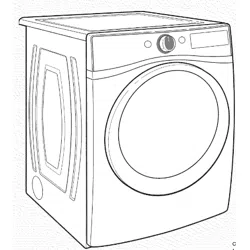
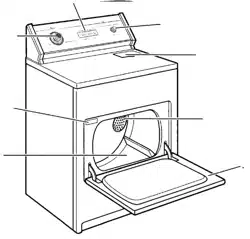
Parts and Features
The parts and features of your dryer are illustrated below. Become familiar with all parts and
features before using your dryer. Page references are included next to some features. Refer
to those pages for more information about the features.
NOTE: The drawings in this book may vary from your dryer model. They are designed to
show the different features of all models covered by this book. Your model may not include all
features.
(pp. 6, 9)
Cycle control Start button
knob (p. 6)
(may include
temperature Consumer Assistance
settings*) Center number
(pp. 6-8) (1-800-253-1301 )
Model and serial .Lint screen
number label (p. 13)
(p.2)
Dryer drum Wide-opening
(p. 14)
Other doors:
Full-width hamper door*
Other features not shown:
End-of-cycle signal selector" (p. 11)
FINISH GUARD = feature selector" (p. 11)
Drying rack* (p. 12)
Lint signal" (p. 13)
Drum light* (p. 14)
Mini-hamper door"
Side-swing door*
*On some models
Operating Your Dryer
The information in this section helps you learn to use your dryer efficiently and safely. Refer
to =LaundryTips" on page 17 for additional informationon sorting, loading and drying most
types of washables.
Before starting your dryer
Before using your dryer, wipe Your dryer may have a Dryer
the dryer drum with a damp Features Guide (usually
cloth to remove dust from stor- located on top of the dryer).
ing and shipping. Remove it and place it with
your Use and Care Guide. The
Features Guide provides you with more infor-
mation about your dryer.
Starting your dryer
1. Load clothes into the dryer
and close the door.
2. Turn the Cycle Control Knob
to the desired cycle. Use the
Energy Preferred Automatic
Setting (*) to dry most loads
(see page 7).
3. Ifyour dryer has a Tempera-
ture Selector, set ittothe de-
sired setting (see page 9).
Some dryer models have
either e rotary knob or
pushbutton Temperature Selector.
4. Press the Start Button.
NOTE: Your dryer stops automatically when a
cycle ends.
Stopping/restarting your dryer
You can stop your dryer anytime during a NOTE: The Cycle Control Knob should point
cycle, to an OFF area when the dryer is not in use.
To stop the dryer, either:
• Open the dryer door.
OR
• Turn the Cycle Control Knob
to OFF.
To restart the dryer:
1. Close the door.
2. Select a new cycle and temperature (if
desired).
3. Press the Start Button.
Selecting the right cycle and setting
The following pages describe the cycles on
your dryer. Refer to the charts on pages g-10
for help in selecting drying cycles.
Drying guidelines
• Always follow care labels directions when
they are available.
• To dry delicate fabrics, rubber, plastic, and
heat-sensitive fabrics, always use the
Fluff Air cycle or dry these items on a line
or rack (see page 10).
• The last few minutes of all cycles are
without heat to make the load easier to
handle.
• To help reduce wrinkling, remove the load
from the dryer as soon as tumbling stops.
This is especially important for permanent
press, knits, and synthetic fabrics.
• Overdrying can cause shrinkage, static
cling, and damage some fabrics.
• Refer to pages 17-20 for information
about:
- sorting clothes for drying
- choosing load sizes
- drying tips
- using dryer fabric softeners
- saving energy
- drying special-care items.
Cycle descriptions
Automatic Cycle(s)
Dry most loads using
the Energy Preferred
Automatic Setting (*).
Your Automatic cycle(s)
shuts off when the
selected dryness is
reached. The Cycle
Control Knob will not
move until the load is almost dry. After the
cool-down, the Knob automatically turnsto an
OFF area and tumbling stops.
• Ifthe load is drier than you like, select a
setting closer to LESS DRY the next time
you dry a similar load.
• Ifthe load is not as dry as you like, com-
plete drying using a Timed cycle. Select a
setting closer to VERY DRY the next time
you dry a similar load.
Some models offer high heat and low heat
Automatic cycles (see page 9).
NOTES:
• Some Automatic cycles use an electronic
DRY-MISER ®control that senses the
amount of moisture in the load.
• Other Automatic cycles use an automatic
DRY-MISER control that senses the
exhaust temperature and determines the
dryness of the load.
Timed Cycle(s)
Use a Timed cycle to
complete drying if soma
items are damp after
Automatic drying. Timed
drying is also useful for:
• Delicate items and
small loads that need
a short drying time.
• Bulky items and large
long drying time.
loads that require a
NOTE: Some models offer high heat and low
heat Timed cycles (see page 9).
7
Fluff Air Cycle
(on some models)
The Fluff Air cycle has
no heat. Use this un-
heated cycle to fluff or
air dry bedding, plastic
tablecloths, foam pil-
lows, sneakers, etc.
See the Warning and
the chart on page 10 for more information
about the FluffAir cycle.
NOTE; If your model does not have the
Fluff Air cycle, line dry heat-sensitive items.
Heavy Dry Cycle
(on some models)
Use Heavy Dry and a
high heat setting to dry
large items or items that
are thicker or heavier
than a regular load
(such as heavy cotton
bath sheets or robes).
Damp Dry Cycle
(on some models)
Use Damp Dry to dry
itemstodamp level orto
dry items that do not re-
quire an entire drying
cycle. Two examples
are heavy cottons, such
as jeans, which you do
not want to become stiff, or cotton clothes
which are easier to press when damp.
TUMBLE PRESS e
Cycle
(on some model8)
The TUMBLE PRESS
cycle removes wrinkles
from clothes that have
been packed in a suit-
case or closet, or from
items not removed from
the dryer at the end of a cycle. As soon as the
dryer stops, fold or put the items on hangers.
FINISH GUARD ®
Feature
(on ®ome models)
When you are unable to
remove a load from the
dryeras soonas itstops,
wrinkles can form. The
FINISH GUARD feature
tumblesthe load without
heat every few minutes upto 45 minutes after
the cycleends. This tumbling rearranges and
fluffs the load to avoid wrinkles.
You do not have to set the Cycle Control
Knob for the FINISH GUARD feature. If you
do not open the dryer door within a few
minutes after the cycle stops, the FINISH
GUARD feature takes over to protect the
load.
A signal sounds every few minutes when
FINISH GUARD is running. De signal and
cycle stop when you open the dryer door.
NOTE: See page 11 ifyour model has a
FINISH GUARD ON/OFF selector.
Rack Dry Fea-
ture
(on some models)
You may wanttodrysome
items without tumbling
(such as wool sweaters,
stuffed toys, or pillows).
Use the drying rack (see
page 12) and the Rack
Dry feature for these items. Be sure to use a
low temperature setting.
During the drying cycle, the drum turns,
but the rack does not move. Drying time
depends on the amount of moisture in the
items.
NOTES:
• Be sure to follow the instructionson page
12 for installingthe drying rack in your
dryer and placing items on the rack.
• Use the chart on page 12 to determine
temperatures and drying times.
• You may use either the Timed cycle or
Ruff Air cycle for rack drying.
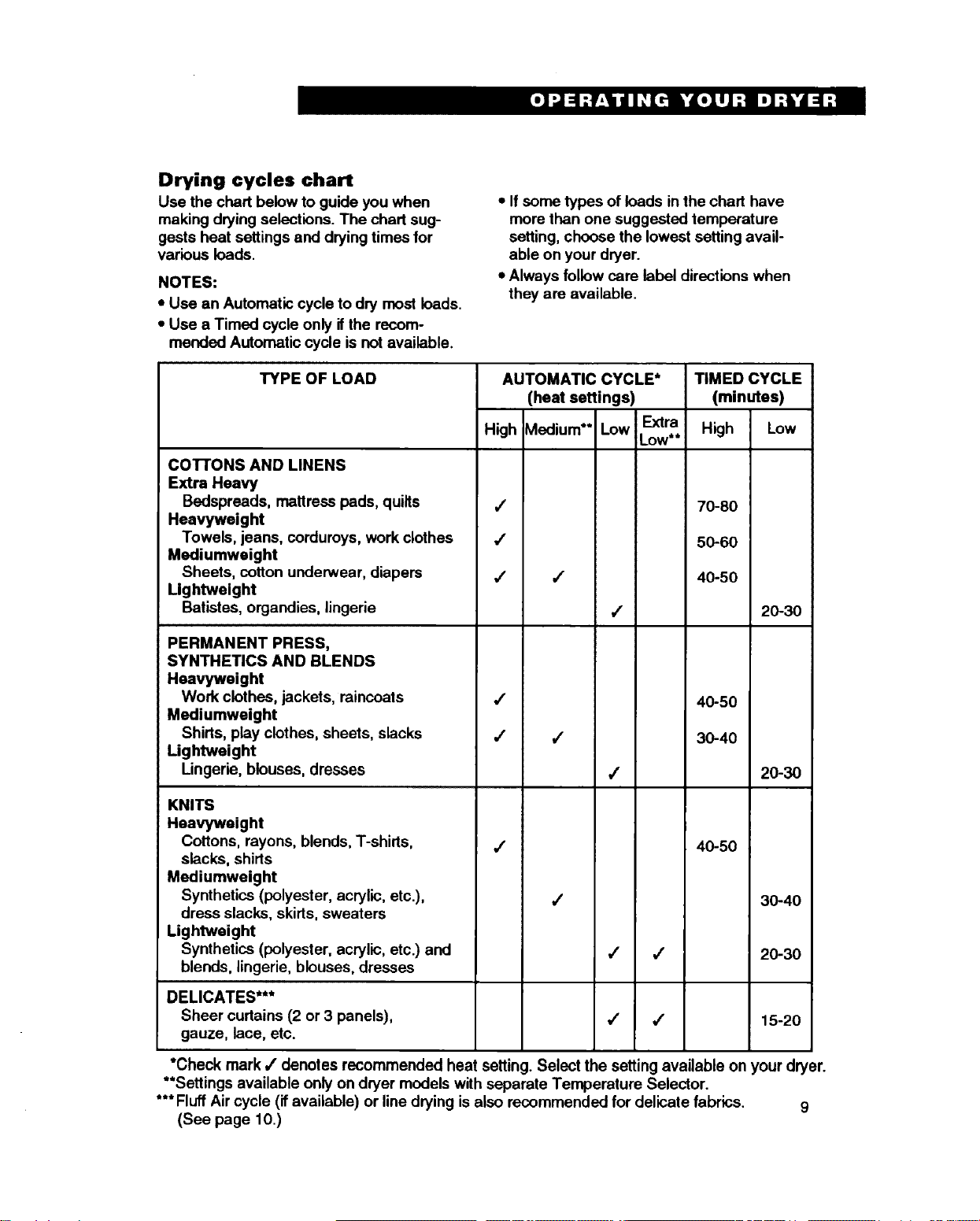
Drying cycles chart
Use the chart below to guide you when
making drying selections. The chart sug-
gests heat settings and drying times for
various loads.
NOTES:
• Use an Automatic cycle to dry most loads.
• Use a Timed cycle only ifthe recom-
mended Automatic cycle is not available.
• If some types of loads in the chart have
more than one suggested temperature
setting, choose the lowest setting avail-
able on your dryer.
• Always follow care label directions when
they are available.
TYPE OF LOAD
co'rrONS AND LINENS
Extra Heavy
Bedspreads, mattress pads, quilts
Heavyweight
Towels, jeans, corduroys, work clothes
Mediumweight
Sheets, cotton underwear, diapers
Lightweight
Batistes, organdies, lingerie
PERMANENT PRESS,
SYNTHETICS AND BLENDS
Heavyweight
Work clothes, jackets, raincoats
Mediumweight
Shirts, play clothes, sheets, slacks
Lightweight
Lingerie, blouses, dresses
KNITS
Heavyweight
Cottons, rayons, blends, T-shirts,
slacks, shirts
Mediumweight
Synthetics (polyester, acrylic, etc.),
dress slacks, skids, sweaters
Lightweight
Synthetics (polyester, acrylic, etc.) and
blends, lingerie, blouses, dresses
DELICATES***
Sheer curtains (2 or 3 panels),
gauze, lace, etc.
AUTOMATIC CYCLE*
(heat settings)
High Medium" Low Extra
Low**
,I
,/
/
,/ /
/
/ /
/ /
/
TIMED CYCLE
(minutes)
High
70-80
50-6O
40-50
40-50
30-40
,/
40-50
Low
20-30
20-30
30-40
20-30
15-20
*Check mark / denotes recommended heat setting. Select the setting available on your dryer.
**Settings available only on dryer models with separate Temperature Selector.
*** FluffAir cycle (ifavailable) or line drying is also recommended for delicate fabrics. 9
(See page 10.)
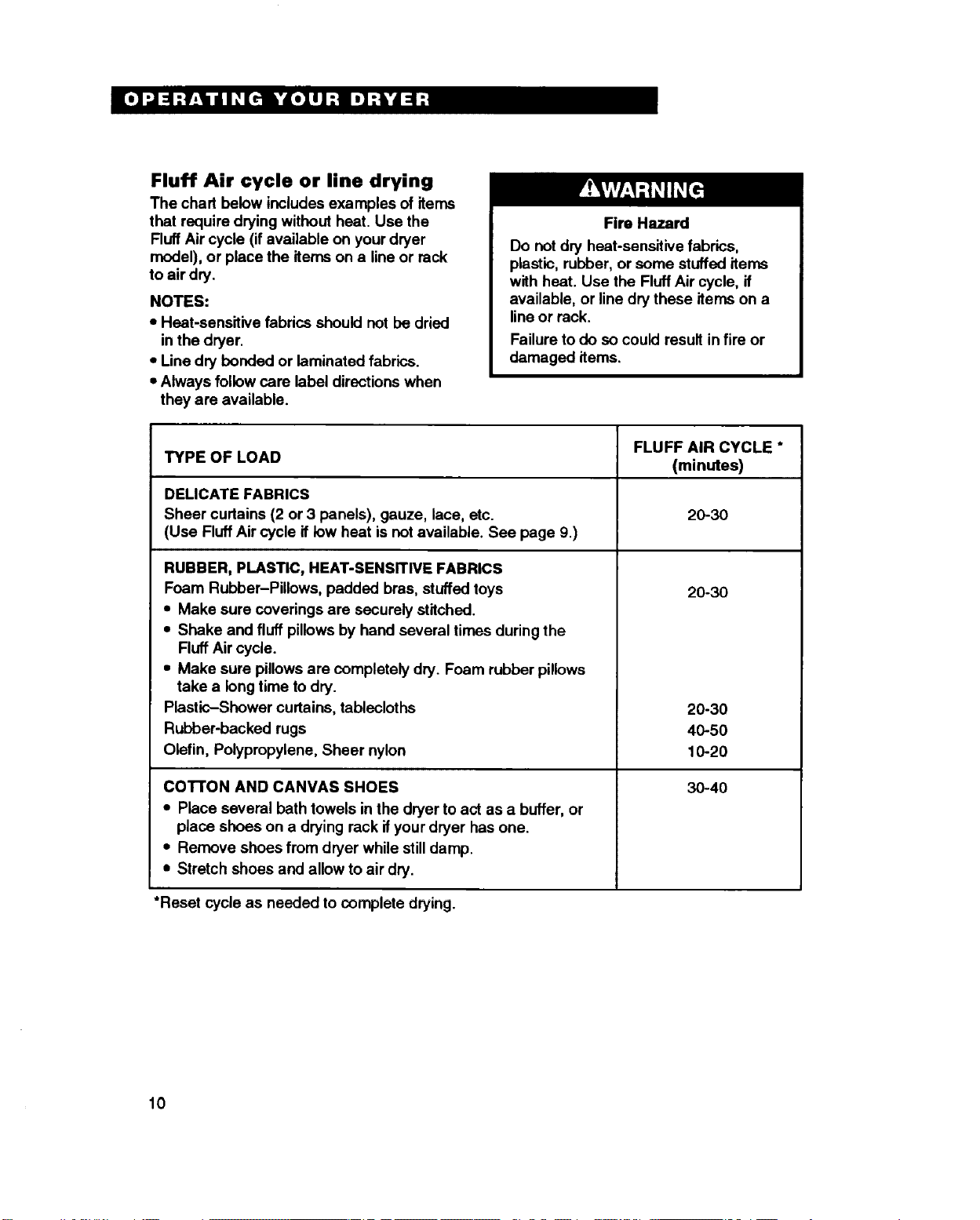
Fluff Air cycle or line drying
The chart below includes examples of items
that require drying without heat. Use the
FluffAir cycle (if available on yourdryer
model), or place the items on a line or rack
to air dry.
NOTES:
• Heat-sensitive fabrics should not be dried
in the dryer.
• Line dry bonded or laminated fabrics.
• Always follow care label directions when
they are available.
Fire Hazard
Do not dry heat-sensitive fabrics,
plastic, rubber, or some stuffed items
with heat. Use the FluffAir cycle, if
available, or line dry these items on a
lineor rack.
Failure to do so could result in fire or
damaged items.
TYPE OF LOAD FLUFF AIR CYCLE "
(minutes)
DELICATE FABRICS
Sheer curtains (2 or 3 panels), gauze, lace, etc. 20-30
(Use FluffAir cycle if low heat is not available. See page 9.)
RUBBER, PLASTIC, HEAT-SENSITIVE FABRICS
Foam Rubber-Pillows, padded bras, stuffed toys
• Make sure coverings are securely stitched.
• Shake and fluff pillowsby hand several times during the
Fluff Air cycle.
• Make sure pillows are completely dry. Foam rubber pillows
take a long time to dry.
Plastic-Shower curtains, tablecloths
Rubber-backed rugs
Olafin, Polypropylene, Sheer nylon
COTI'ON AND CANVAS SHOES
• Place several bath towels in the dryer to act as a buffer, or
place shoes on a drying rack ifyour dryer has one.
• Remove shoes from dryer while stilldamp.
• Stretch shoes and allow to air dry.
20-30
20-30
40-50
10-20
3O-4O
*Reset cycle as needed to complete drying.
10
End-of-Cycle signal
(on some models)
The dryer sounds a signal to
let you know when the cycle is
finished. The signal is helpful
when you are drying perma-
nent press, synthetics, and
other item that should be removed from the
dryer as soon as itstops.
• On some dryers, the end-of-cycle signal is
not adjustable.
• On other dryers, the end-of-cycle signal
can be turned On or Off by a selector. The
end-of-cycle On/Off selector ispart of the
Start Button on some models, and part of
the FINISH GUARD e selector on other
models. The various types of selectors are
described inthe chart below.
Using End-of-Cycle signal and
FINISH GUARD feature
(on some models)
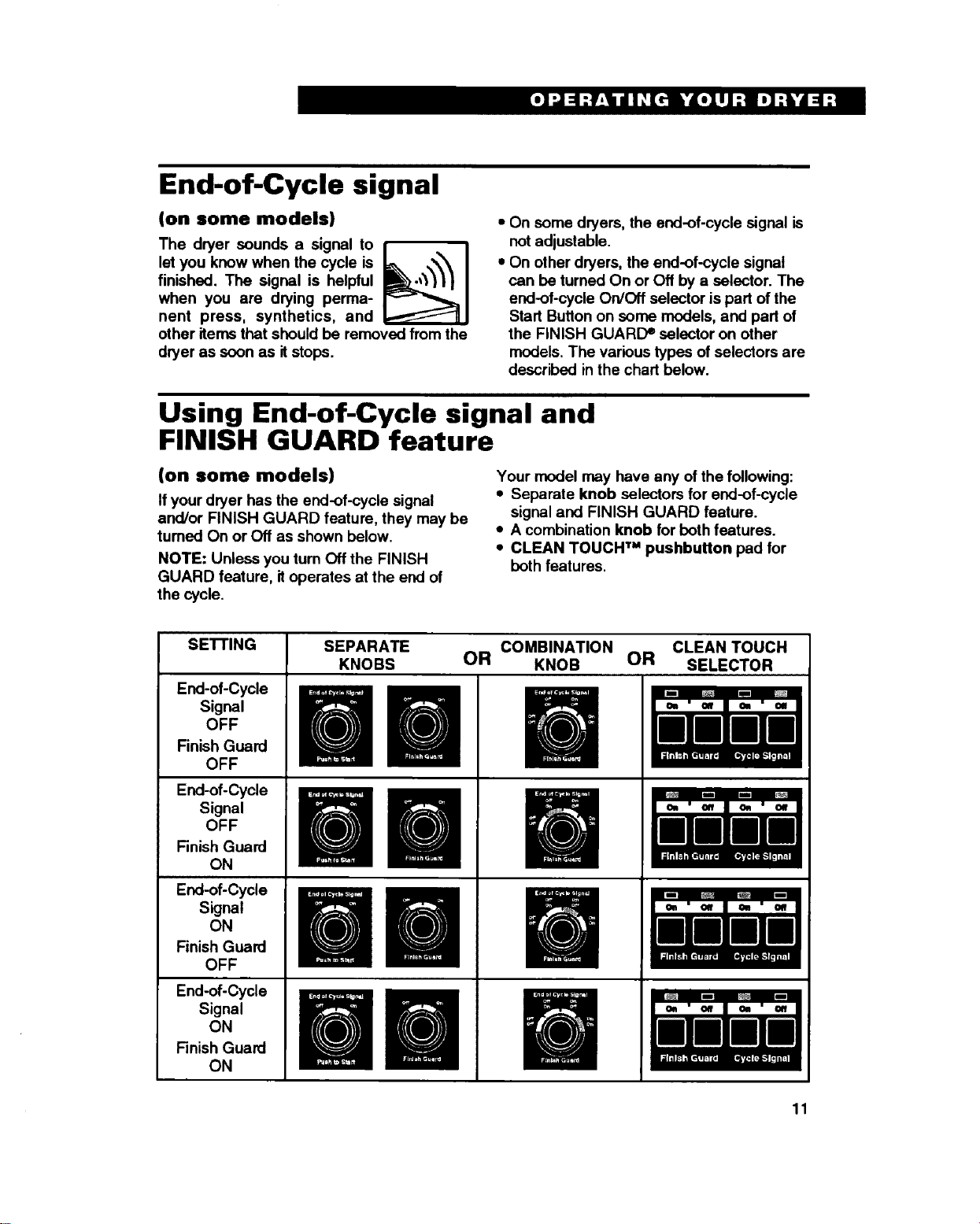
If your dryer has the end-of-cycle signal
and/or FINISH GUARD feature, they may be
tumed On or Off as shown below.
NOTE: Unless you turn Off the FINISH
GUARD feature, it operates at the end of
the cycle.
Your model may have any of the following:
• Separate knob selectors for end-of-cycle
signal and FINISH GUARD feature.
• A combination knob for both features.
• CLEAN TOUCH TM pushbutton pad for
beth features.
SE'n'ING SEPARATE COMBINATION CLEAN TOUCH
KNOBS OR KNOB OR SELECTOR
End-of-Cycle
Signal
OFF
Finish Guard
OFF
End-of-Cycle
Signal
OFF
Finish Guard
ON
End-of-Cycle
Signal
ON
Finish Guard
OFF
End-of-Cycle
Signal
ON
Finish Guard
ON
11

Using the drying rack
(on some models)
The drying reck lets you dry items that you
may not want to tumble. The rack does not
move, but the drum turns.
1. Frt rear legs of the rack into I_
indentations in the back wall
of the dryer.
2. Lower the front so the legs rest on the
dryer opening.
3. Put wet items on top of the
rack. Leave space between
the items so air can reach all
surfaces. _y L.,I,_,
NOTE: Make sure nothing
hangs over the edge of the rack.
4. Close the door.
S. Select the Timed drying cycle (and
temperature if needed) or the Fluff Air
cycle (see pages 7-8).
6. Press the Start Button.
NOTES:
* See the chart below for suggested cycles
and settings for the different types of items
that might best be rack dried.
• The rack must be removed for normal
tumbling.
• Drying time willdepend on how much
moisture the items hold. The following
chart suggests drying times.
RACK DRY CYCLE TEMPERATURE TIME*
(minutes)
Wool sweaters Timed LOW or EX LOW 60
(Block to shape and lay flat on the rack)
Stuffed toys or pillows
(Cotton or polyester fiber filled) Timed LOW or EX LOW 60
Stuffed toys or pillows
(Foam rubber filled) Fluff Air None; cycle is unheated. 90
Sneakers or canvas shoes 30-40
*Reset cycle as needed to complete drying.
12
Caring for Your Dryer
Proper care of your dryer can extend its life. This section explains how to care for your dryer
properly and safely.
Cleaning the lint screen
Every load cleaning
The lintscreen is located under a lidon top
ofthe dryer. Clean it before each load. A
screen blocked by lintcan increase drying
time.
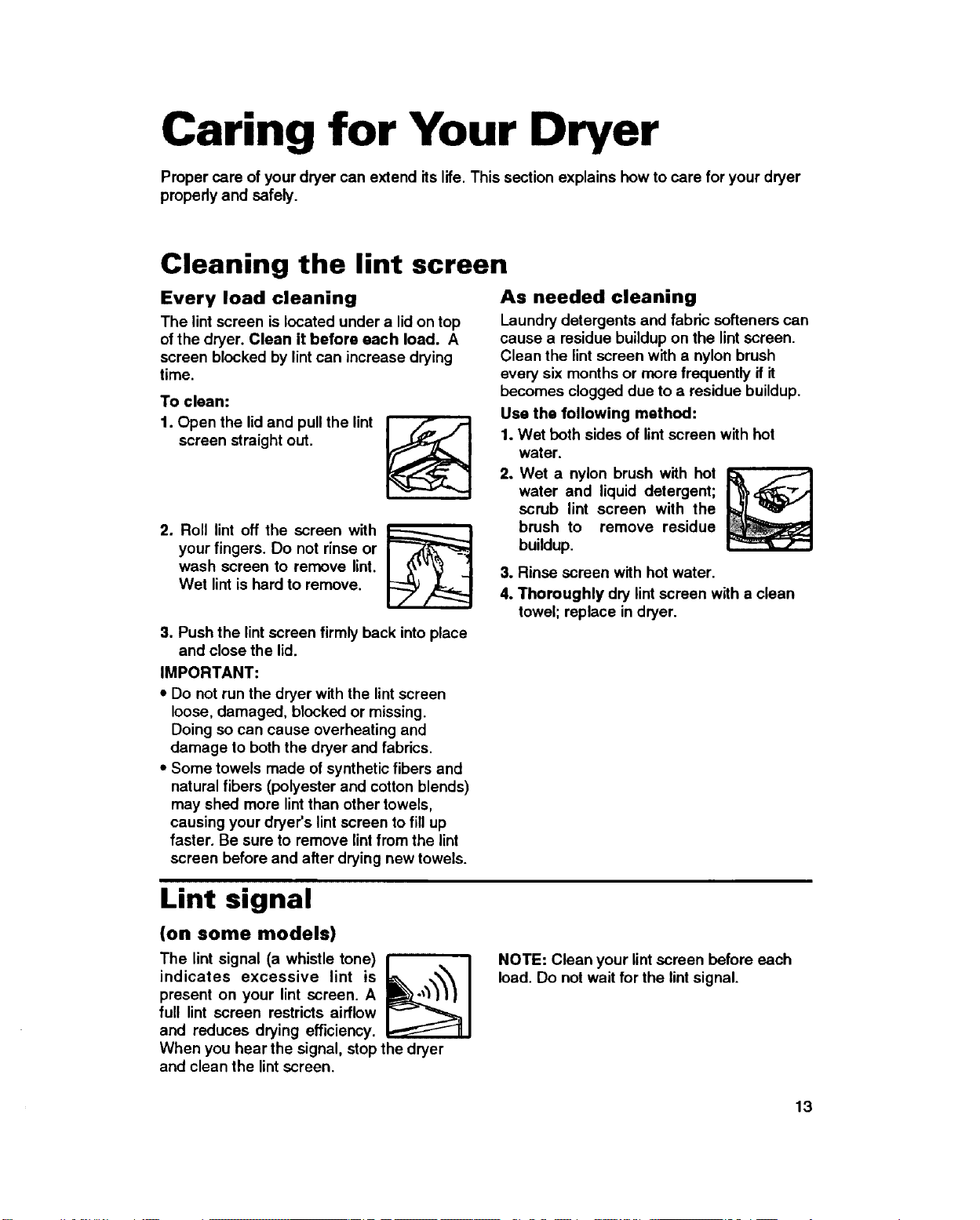
To clean:
1. Open the lidand pull the lint
screen straight out.
2. Roll lint off the screen with
your fingers. Do not rinse or
wash screen to remove lint.
Wet lintis hard to remove.
3. Push the lintscreen firmly back intoplace
and close the lid.
IMPORTANT:
• Do not run the dryer with the lint screen
loose, damaged, blocked or missing.
Doing so can cause overheating and
damage to both the dryer and fabrics.
• Some towels made of synthetic fibers and
natural fibers (polyester and cotton blends)
may shed more lintthan other towels,
causing your dryer's lintscreen to fill up
faster. Be sure to remove lintfrom the lint
screen before and after drying new towels.
As needed cleaning
Laundry detergents and fabric softeners can
cause a residue buildup on the lintscreen.
Clean the lint screen with a nylon brush
every six months or more frequently if it
becomes clogged due to a residue buildup.
Use the following method:
1. Wet both sides of lintscreen with hot
water.
2. Wet a nylon brush with hot I_ .F--"3
water and liquid detergent;
scrub lint screen with the
brush to remove residue
buildup.
3. Rinse screen with hot water.
4. Thoroughly dry lintscreen with a clean
towel; replace in dryer.
Lint signal
(on some models)
The lint signal (a whistle tone)
indicates excessive lint is
present on your lint screen. A
full lint screen restricts airflow
and reduces drying efficiency,
When you hear the signal, stop the dryer
and clean the lintscreen.
NOTE: Clean your lintscreen before each
load. Do not wait for the lintsignal.
13
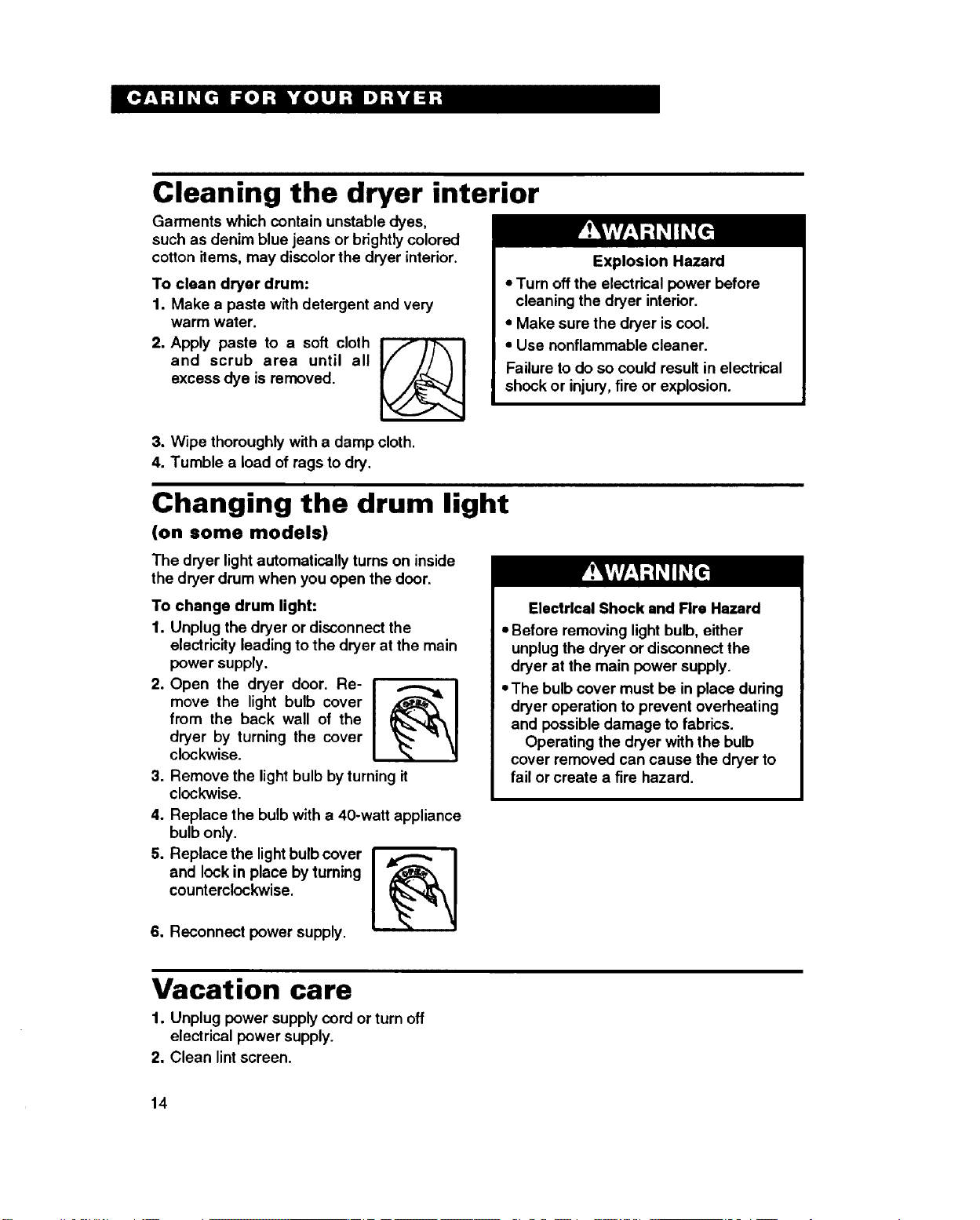
Cleaning the dryer interior
Garments which contain unstable dyes,
such as denim blue jeans or brightly colored
cotton items, may discolor the dryer interior.
To clean dryer drum:
1. Make a paste with detergent and very
warm water.
2. Apply paste to a soft cloth
and scrub area until all
excess dye is removed.
Explosion Hazard
• Turn off the electrical power before
cleaning the dryer interior.
• Make sure the dryer iscool.
• Use nonflammable cleaner.
Failure to do so could result in electrical
shock or injury, fire or explosion.
3. Wipe thoroughly with a damp cloth.
4. Tumble a load of rags to dry.
Changing the drum light
(on some models)
The dryer light automatically turns on inside
the dryer drum when you open the door.
To change drum light:
1. Unplug the dryer or disconnect the
electricity leading to the dryer at the main
power supply.
2. Open the dryer door. Re-
move the light bulb cover
from the back wall of the
dryer by turning the cover
clockwise.
3. Remove the light bulb by turning it
clockwise.
4. Replace the bulb with a 40-watt appliance
bulb only.
5. Replace the lightbulb cover
and lock in place by turning
counterclockwise.
6. Reconnect power supply.
Electrical Shock and Fire Hazard
• Before removing light bulb, either
unplug the dryer or disconnect the
dryer at the main power supply.
• The bulb cover must be in place during
dryer operation to prevent overheating
and possible damage to fabrics.
Operating the dryer with the bulb
cover removed can cause the dryer to
fail or create a fire hazard.
Vacation care
1. Unplug power supply cord or turn off
electrical power supply.
2. Clean lintscreen.
14
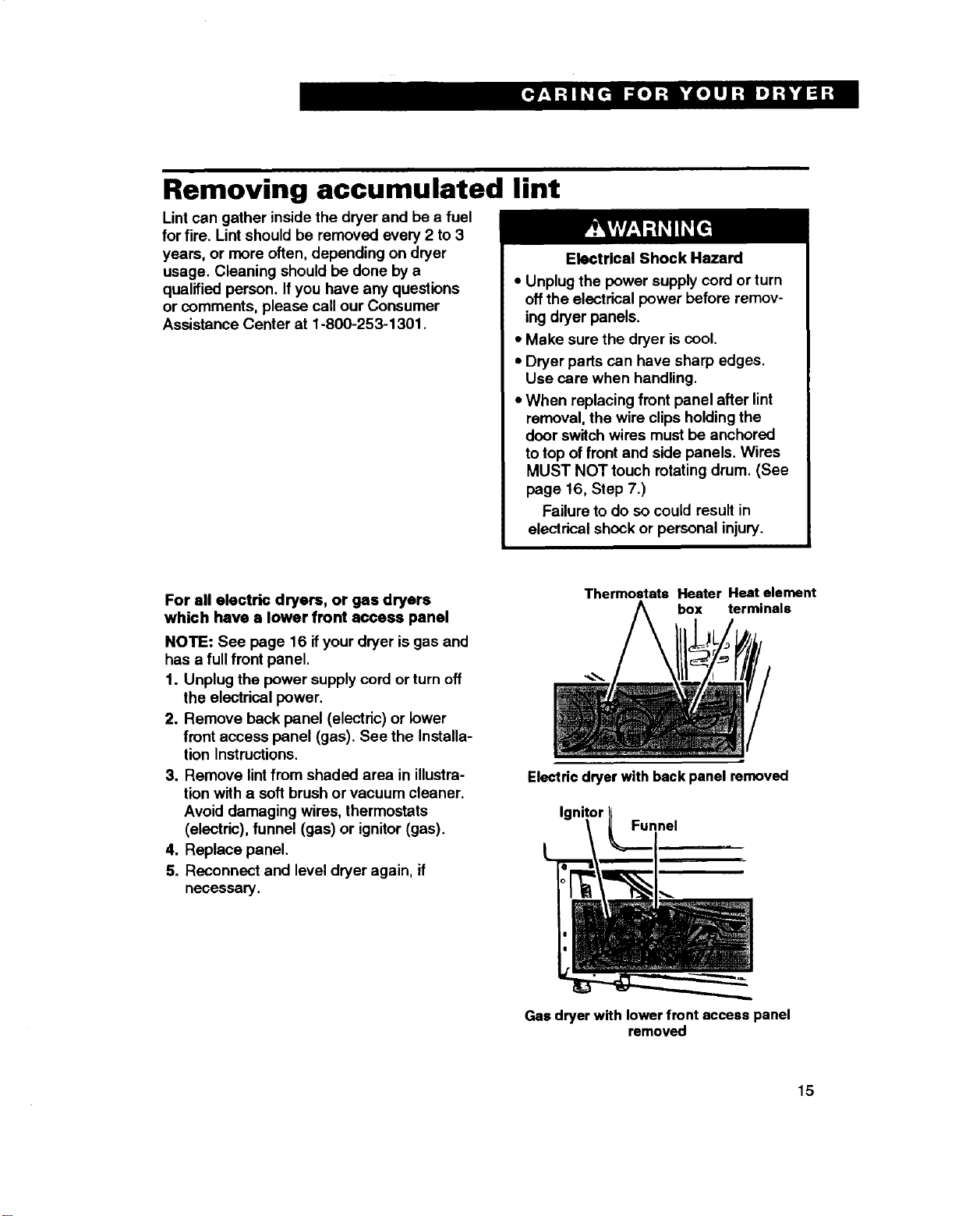
Removing accumulated lint
Lint can gather inside the dryer and be a fuel
for fire. Lint should be removed every 2 to 3
years, or more often, depending on dryer
usage. Cleaning should be done by a
qualified person. Ifyou have any questions
or comments, please call our Consumer
Assistance Center at 1-800-253-1301.
Electrical Shock Hazard
• Unplug the power supply cord or turn
off the electrical power before remov-
ing dryer panels,
• Make sure the dryer iscool.
• Dryer parts can have sharp edges.
Use care when handling.
• When replacing front panel after lint
removal, the wire clips holdingthe
door switch wires must be anchored
to top of front and side panels. Wires
MUST NOT touch rotatingdrum. (See
page 16, Step 7.)
Failure to do so could result in
electrical shock or personal injury.
For all electric dryors, or gas dryers
which have a lower front access panel
NOTE: See page 16 ifyour dryer isgas and
has a full front panel.
1. Unplug the power supply cord or turn off
the electrical power,
2. Remove back panel (electric) or lower
front access panel (gas). See the Installa-
tion Instructions.
3. Remove lintfrom shaded area in illustra-
tion with a soft brush or vacuum cleaner.
Avoid damaging wires, thermostats
(electric), funnel (gas) or ignitor (gas).
4. Replace panel.
5. Reconnect and level dryer again, if
necessary.
Thermostats Heater Heat element
box terminals
i
Electdc dryer with back panel removed
Igni
Funnel
Gas dryer with lower front access panel
removed
15
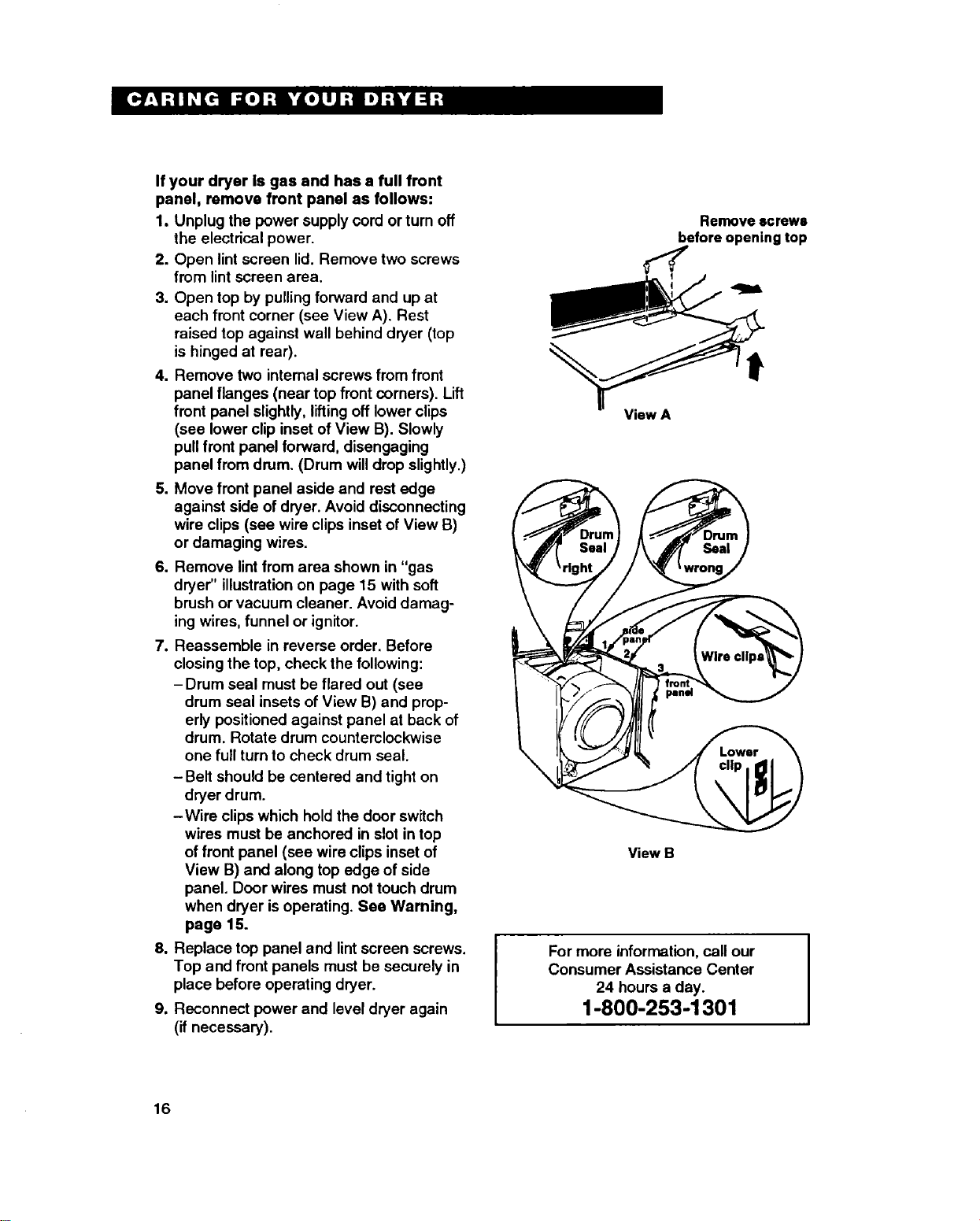
IfyourdryerIsgasandhasafullfront
panel,removefrontpanelasfollows:
1.Unplugthepowersupplycordorturn off
the electrical power.
2. Open lintscreen lid. Remove two screws
from lint screen area.
3. Open top by pullingforward and up at
each front corner (see View A). Rest
raised top against wall behind dryer (top
is hinged at rear).
4. Remove two internal screws from front
panel flanges (near top front corners). Lift
front panel slightly, liftingoff lower clips
(see lower clip inset of View B). Slowly
pull front panel forward, disengaging
panel from drum. (Drum willdrop slightly.)
5. Move front panel aside and rest edge
against side of dryer. Avoid disconnecting
wire clips (see wire clips inset of View B)
or damaging wires.
6. Remove lintfrom area shown in "gas
dryer" illustrationon page 15 with soft
brush or vacuum cleaner. Avoid damag-
ing wires, funnel or ignitor.
7. Reassemble in reverse order. Before
closing the top, check the following:
- Drum seal must be flared out (see
drum seal insets of View B) and prep-
erly positioned against panel at back of
drum. Rotate drum counterclockwise
one full turn to check drum seal.
- Belt should be centered and tight on
dryer drum.
-Wire clips which hold the door switch
wires must be anchored in slot in top
of front panel (see wire clips inset of
View B) and along top edge of side
panel. Door wires must not touch drum
when dryer is operating. See Warning,
page 15.
8. Replace top panel and lint screen screws.
Top and front panels must be securely in
place before operating dryer.
9. Reconnect power and level dryer again
(if necessary).
16
Remove 8crew8
before opening top
View A
View B
For more information, call our
Consumer Assistance Center
24 hours a day.
1-800-253-1301
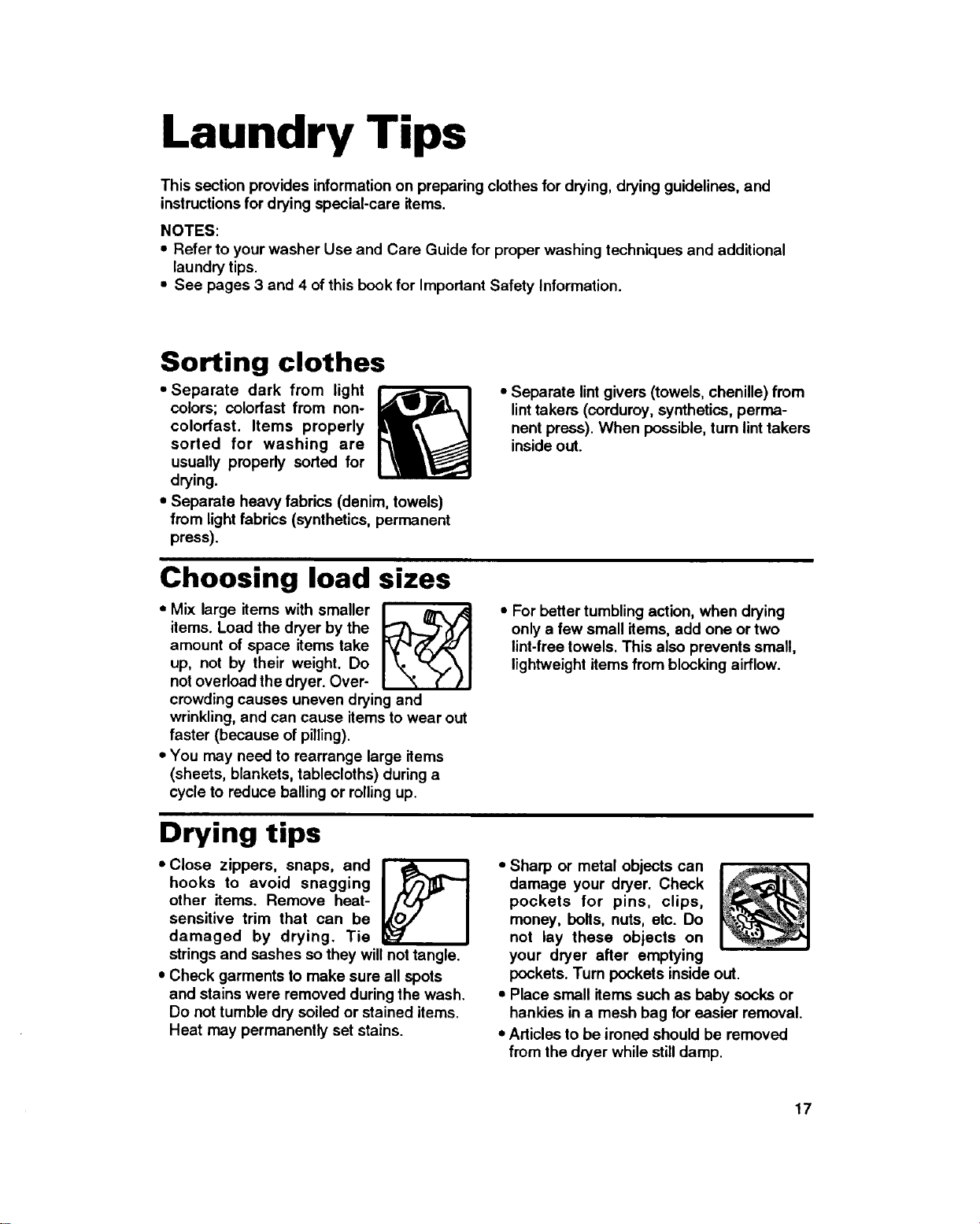
Laundry lr,ps
This section provides information on preparing clothes for drying, drying guidelines, and
instructionsfor drying special-care items.
NOTES:
• Refer to your washer Use and Care Guide for proper washing techniques and additional
laundry tips.
• See pages 3 and 4 of this book for Important Safety Information.
Sorting clothes
• Separate dark from light
colors; colorfast from non-
colorfast. Items properly
sorted for washing are
usually properly sorted for
drying.
• Separate heavy fabrics (denim, towels)
from light fabrics (synthetics, permanent
press).
• Separate lintgivers (towels, chenille) from
linttakers (corduroy, synthetics, perma-
nent press). When possible, turn linttakers
inside out.
Choosing load sizes
• Mix large items with smaller
items. Load the dryer by the
amount of space items take
up, not by their weight. Do
not overload the dryer. Over-
crowding causes uneven drying and
wrinkling, and can cause items to wear out
faster (because of pilling).
• You may need to rearrange large items
(sheets, blankets, tablecloths) during a
cycle to reduce bailing or rollingup.
• For better tumbling action, when drying
only a few small items, add one or two
lint-free towels. This also prevents small,
lightweight items from blocking airflow.
Drying tips
• Close zippers, snaps, and I _ =
hooks to avoid snagging
other items. Remove heat-
sensitive trim that can be
damaged by drying. Tie
strings and sashes so they will not tangle.
• Check garments to make sure all spots
and stains were removed during the wash.
Do not tumble dry soiled or stained items.
Heat may permanenlly set stains.
• Sharp or metal objects can
damage your dryer. Check
pockets for pins, clips,
money, bolls, nuts, etc. Do
not lay these objects on
your dryer after emptying
pockets. Turn pockets inside out.
• Place small items such as baby socks or
hankies in a mesh bag for easier removal.
• Articles to be ironed should be removed
from the dryer while stilldamp.
17
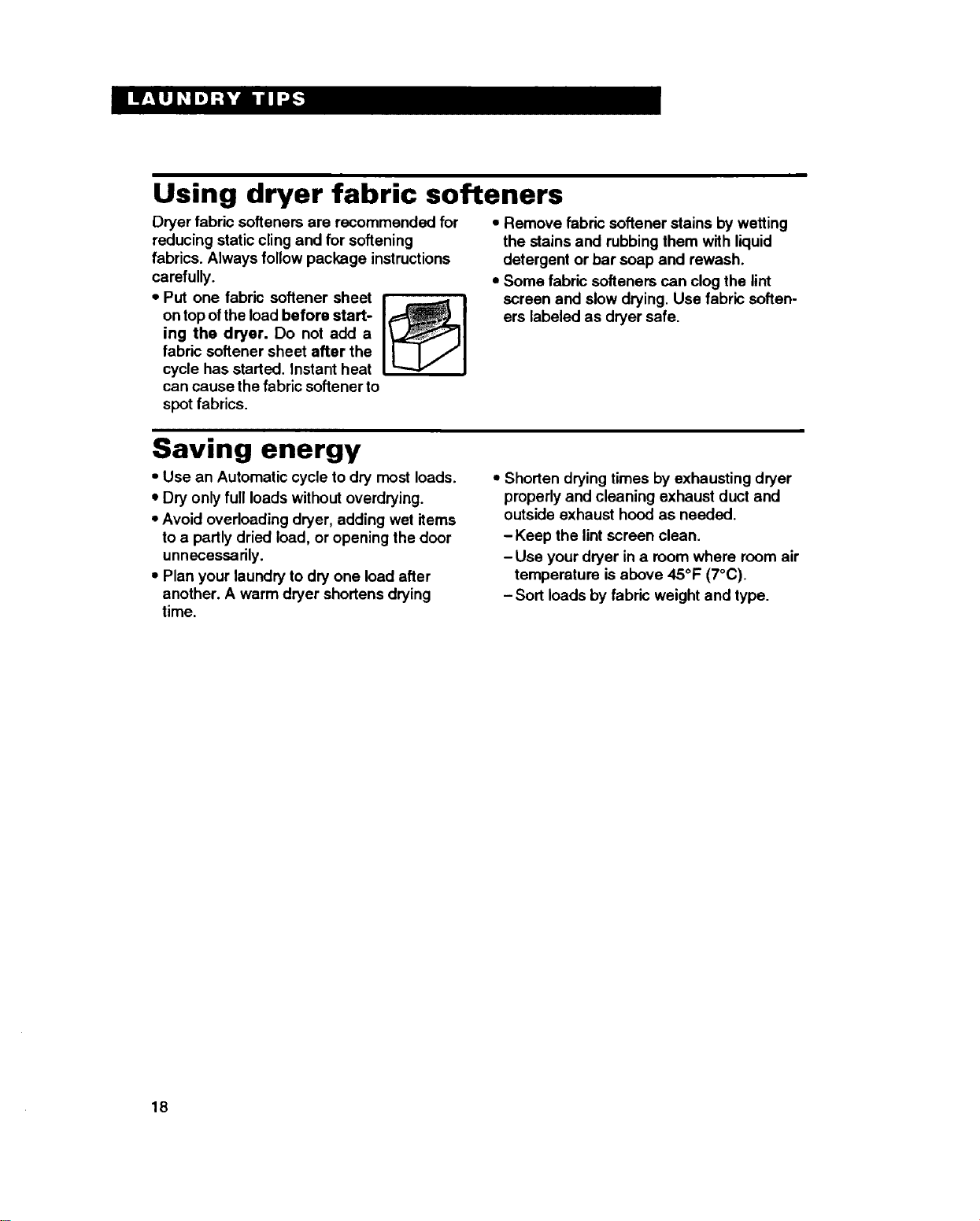
Using dryer fabric softeners
Dryer fabric softeners are recommended for
reducing static cling and for softening
fabrics. Always follow package instructions
carefully.
• Put one fabric softener sheet
on top ofthe load before start-
ing the dryer. Do not add a
fabric softener sheet after the
cycle has started. Instant heat
can cause the fabric softener to
spot fabrics.
• Remove fabric softener stains by wetting
the stains and rubbing them with liquid
detergent or bar soap and rewash.
• Some fabric softeners can clog the lint
screen and slow drying. Use fabric soften-
ers labeled as dryer safe.
Saving energy
• Use an Automatic cycle to dry most loads.
• Dry only full loads without overdrying.
• Avoid overloading dryer, adding wet items
to a partly dried load, or opening the door
unnecessarily.
• Plan your laundry to dry one load after
another. A warm dryer shortens drying
time.
• Shorten drying times by exhausting dryer
properly and cleaning exhaust duct and
outside exhaust hood as needed.
-Keep the lintscreen clean.
- Use your dryer in a room where room air
temperature is above 45°F (7°C).
-Sort loads by fabric weight and type.
18
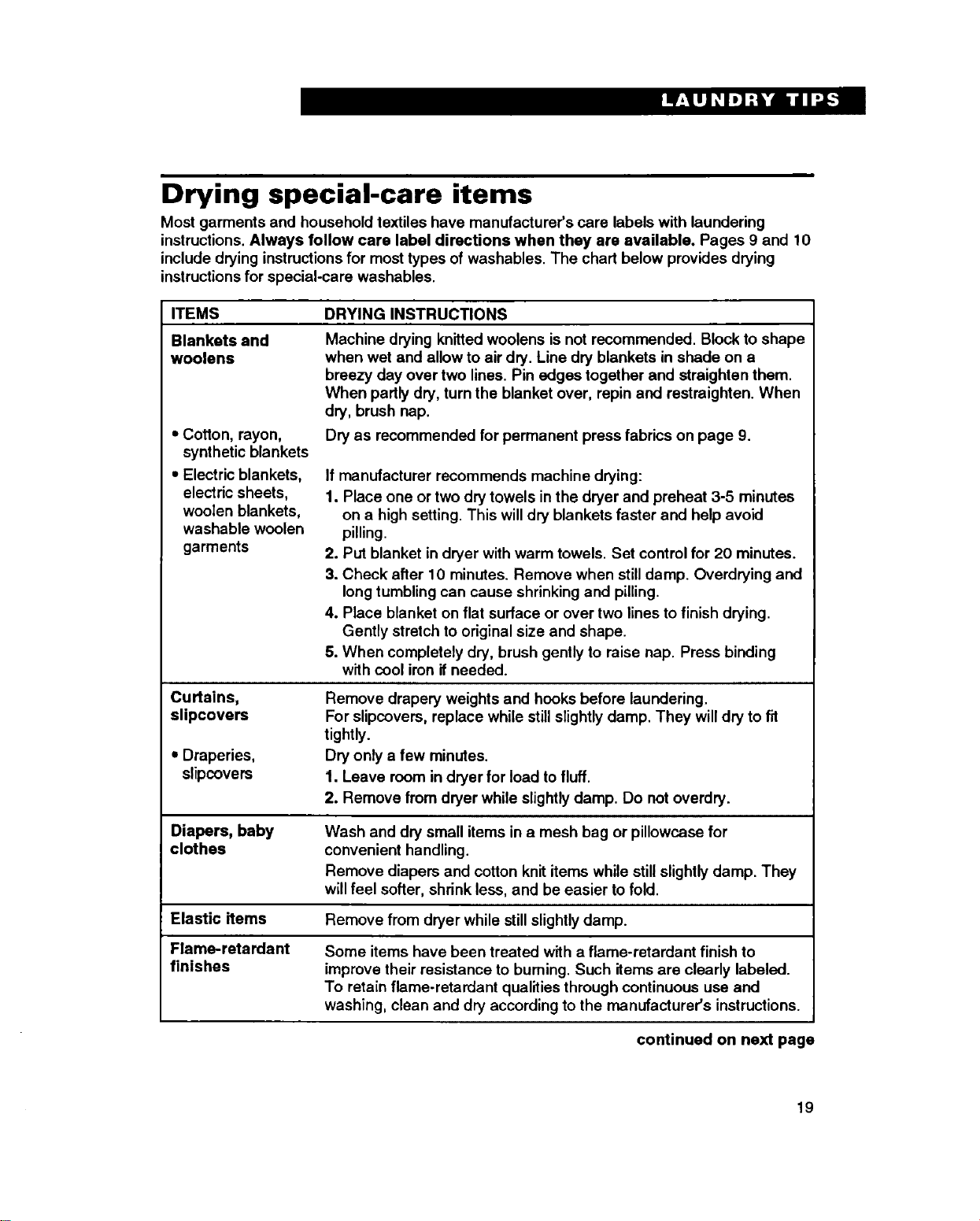
Drying special-care items
Most garments and household textiles have manufacturer's care labels with laundering
instructions. Always follow cars label directions when they are available. Pages 9 and 10
include drying instructionsfor most types of washables. The chart below provides drying
instructionsfor special-care washables.
ITEMS
Blankets and
woolens
• Cotton, rayon,
synthetic blankets
• Electric blankets,
electric sheets,
woolen blankets,
washable woolen
garments
DRYING INSTRUCTIONS
Machine drying knitted woolens is not recommended. Block to shape
when wet and allow to air dry. Line dry blankets in shade on a
breezy day over two lines. Pin edges together and straighten them.
When partly dry, turn the blanket over, repin and restraighten. When
dry, brush nap.
Dry as recommended for permanent press fabrics on page 9.
If manufacturer recommends machine drying:
1. Place one or two dry towels in the dryer and preheat 3-5 minutes
on a high setting. This will dry blankets faster and help avoid
pilling.
2. Put blanket in dryer with warm towels. Set control for 20 minutes.
3. Check after 10 minutes. Remove when stilldamp. Overdrying and
long tumbling can cause shrinking and pilling.
4. Place blanket on flat surface or over two lines to finish drying.
Gently stretch to original size and shape.
5. When completely dry, brush gently to raise nap. Press binding
with cool iron ifneeded.
Curtains,
slipcovers
• Draperies,
slipcovers
Remove drapery weights and hooks before laundering.
For slipcovers, replace while stillslightly damp. They willdry to fit
tightly.
Dry only a few minutes.
1. Leave room in dryer for load to fluff.
2. Remove from dryer while slightlydamp. Do not overdry.
Diapers, baby
clothes
Wash and dry small items in a mesh bag or pillowcase for
convenient handling.
Remove diapers and cotton knit items while stillslightly damp. They
willfeel softer, shrink less, and be easier to fold.
Elastic items Remove from dryer while stillslightlydamp.
Flame-retardant Some items have been treated with a flame-retardant finish to
finishes improve their resistance to burning. Such items are clearly labeled.
To retain flame-retardant qualities through continuous use and
washing, clean and dry according to the manufacturer's instructions.
continued on next page
19
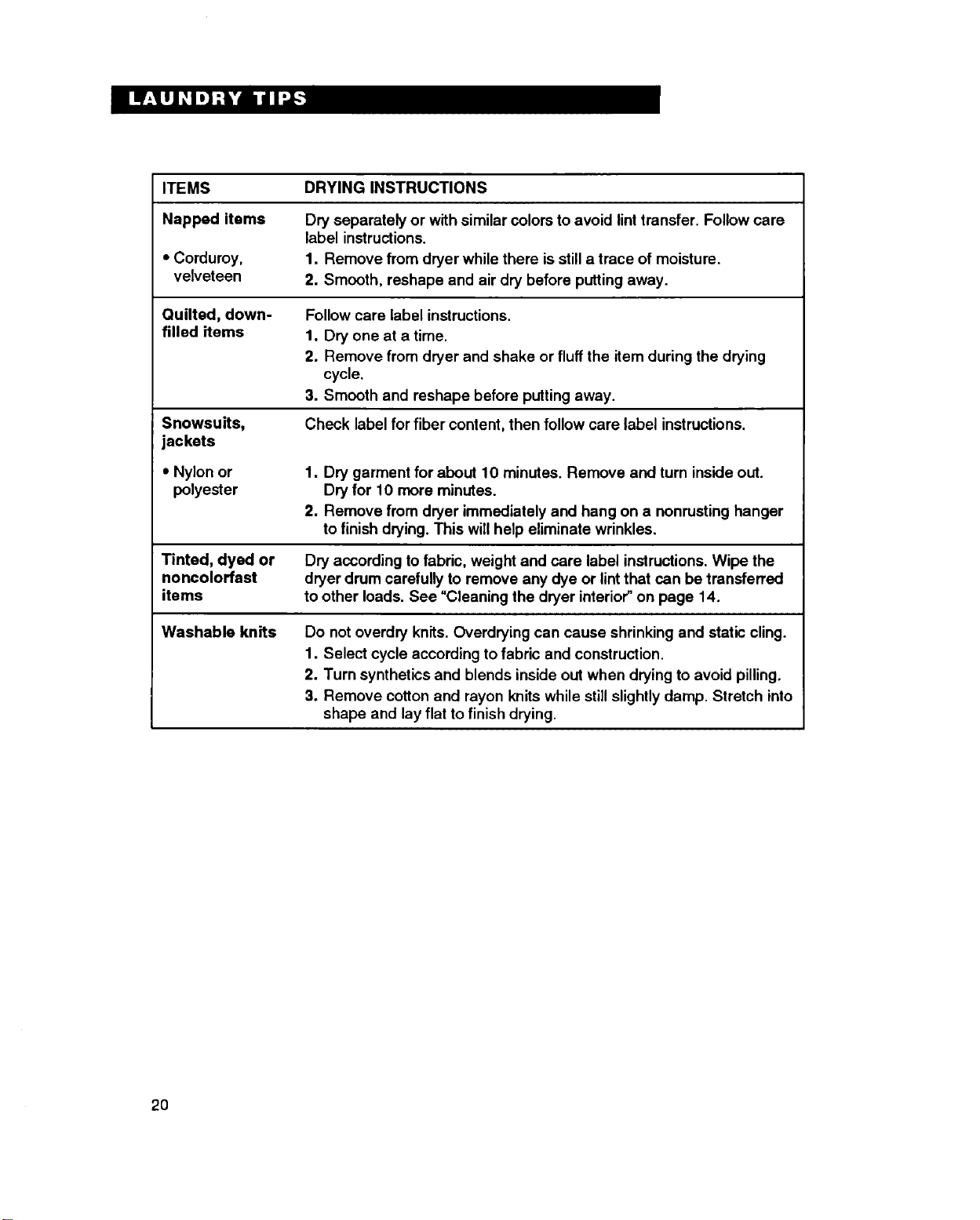
ITEMS DRYINGINSTRUCTIONS
Napped items Dry separately or with similar colors to avoid linttransfer. Follow care
label instructions.
• Corduroy, 1. Remove from dryer while there isstill a trace of moisture.
velveteen 2. Smooth, reshape and air dry before putting away.
Quilted, down- Follow care label instructions.
filled items 1. Dry one at a time.
2. Remove from dryer and shake or fluff the item during the drying
cycle.
3. Smooth and reshape before putting away.
Check label for fiber content, then follow care label instructions.Snowsuits,
jackets
• Nylon or
polyester
Tinted, dyed or
noncolorfast
items
Washable knits
1. Dry garment for about 10 minutes. Remove and turn inside out.
Dry for 10 more minutes.
2. Remove from dryer immediately and hang on a nonrusting hanger
to finish drying. This willhelp eliminate wrinkles.
Dry according to fabric, weight and care label instructions. Wipe the
dryer drum carefully to remove any dye or lintthat can be transferred
to other loads. See =Cleaning the dryer interior"on page 14.
Do not overdry knits. Overdrying can cause shrinking and static cling.
1. Select cycle according to fabric and construction.
2. Turn synthetics and blends inside out when drying to avoid pilling.
3. Remove cotton and rayon knits while stillslightly damp. Stretch inlo
shape and layflat to finish drying.
2O
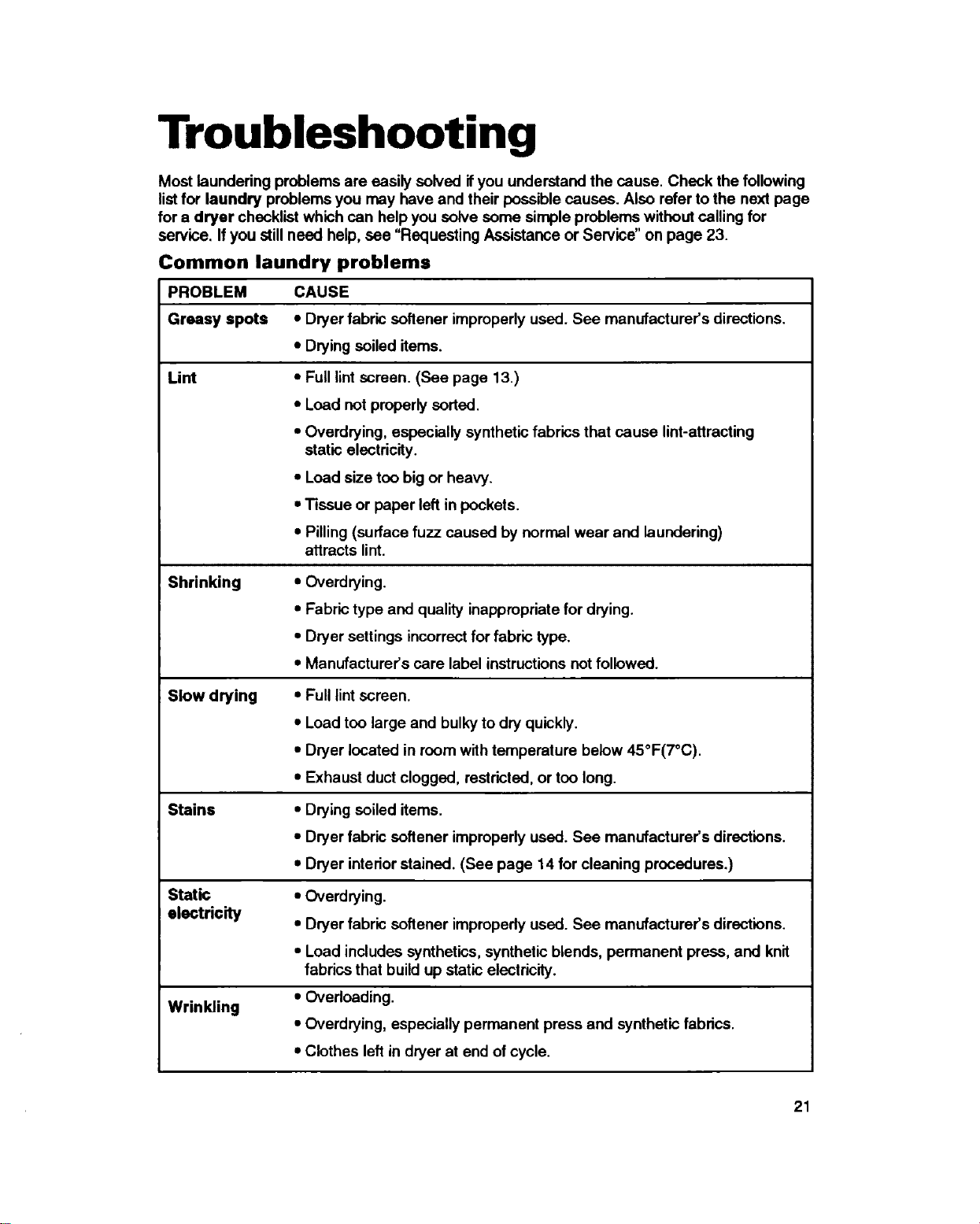
Troubleshooting
Most laundering problems are easily solved ifyou understand the cause. Check the following
list for laundry problems you may have and their possible causes. Also refer to the next page
for a dryer checklist which can help you solve some simple problems without calling for
service. If you stillneed help, see "Requesting Assistance or Service" on page 23.
Common laundry problems
PROBLEM
Greasy spots
Lint
Shrinking
Slow drying
Stains
Static
electricity
Wrinkling
CAUSE
• Dryer fabric softener improperly used. See manufacturer's directions.
• Drying soiled items.
• Full lintscreen. (See page 13.)
• Load not properly sorted.
• Overdrying, especially synthetic fabrics that cause lint-attracting
static electricity.
• Load size too big or heavy.
• Tissue or paper left in pockets.
• Pilling (surface fuzz caused by normal wear and laundering)
attracts lint.
=Overdrying.
• Fabric type and quality inappropriate for drying.
• Dryer settings incorrectfor fabric type.
• Manufacturer's care label instructionsnot followed.
• Full lintscreen.
• Load too large and bulky to dry quickly.
• Dryer located in room with temperature below 45°F(7°C).
• Exhaust duct clogged, restricted, or too long.
• Drying soiled items.
• Dryer fabric softener improperly used. See manufacturer's directions.
• Dryer interior stained. (See page 14 for cleaning procedures.)
• Overdrying.
• Dryer fabric softener improperlyused. See manufacturer's directions.
• Load includes synthetics, synthetic blends, permanent press, and knit
fabrics that build up static electricity.
• Overloading.
• Overdrying, especially permanent press and synthetic fabrics.
• Clothes left in dryer at end of cycle.
21
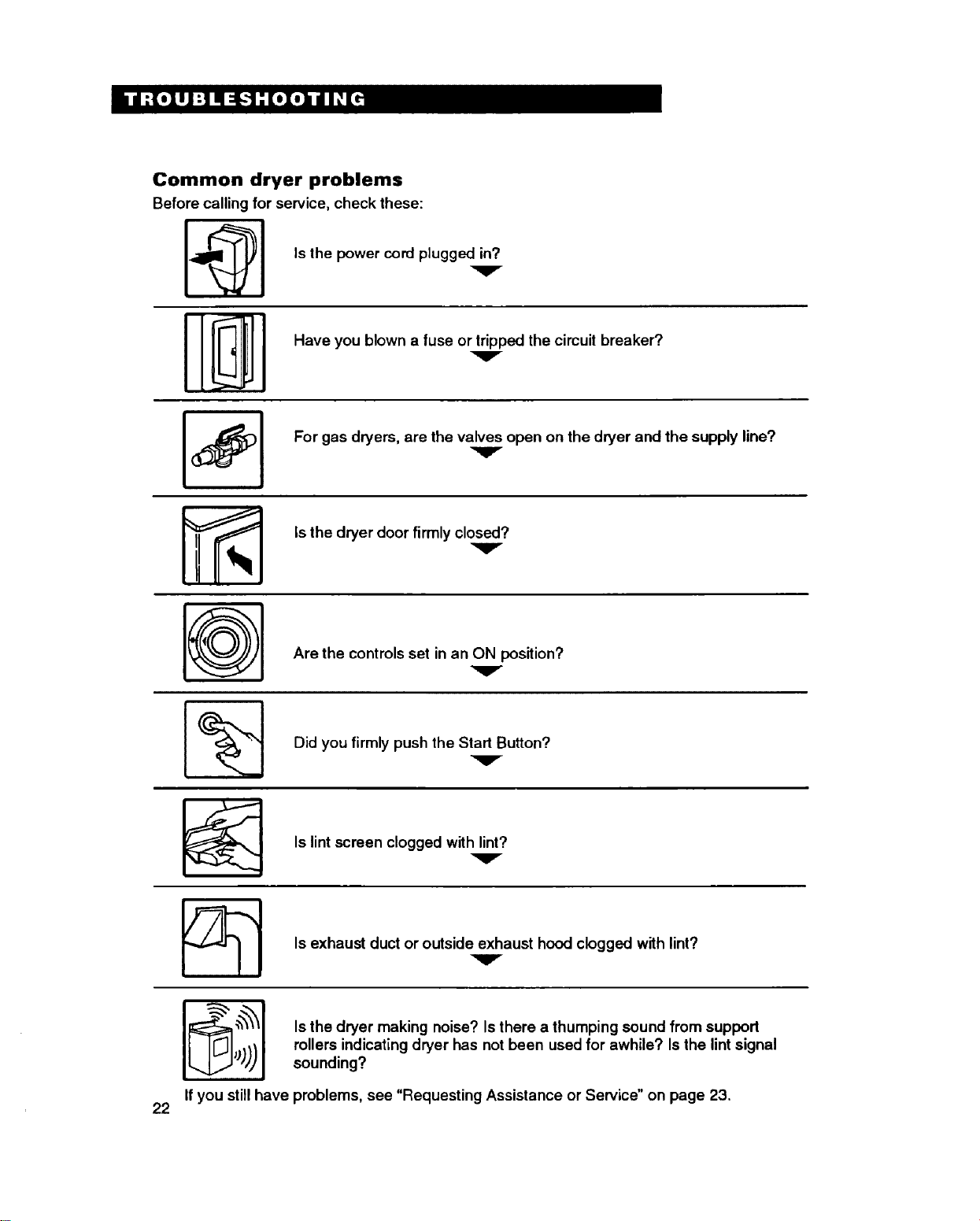
Common dryer problems
Before calling for service, check these:
_l__ Is the power cord plugged in?
Have you blown a fuse or tripped the circuit breaker?
For gas dryers, are the valves open on the dryer and the supply line?
Isthe dryer door firmly closed?
Are the controls set in an ON position?
Did you firmly push the Start Button?
Is lintscreen clogged with lint?
Is exhaust duct or outside exhaust hood clogged with lint?
Is the dryer making noise? Is there a thumping sound from support
rollers indicating dryer has not been used for awhile? Is the lintsignal
sounding?
If you still have problems, see "Requesting Assistance or Service" on page 23.
22
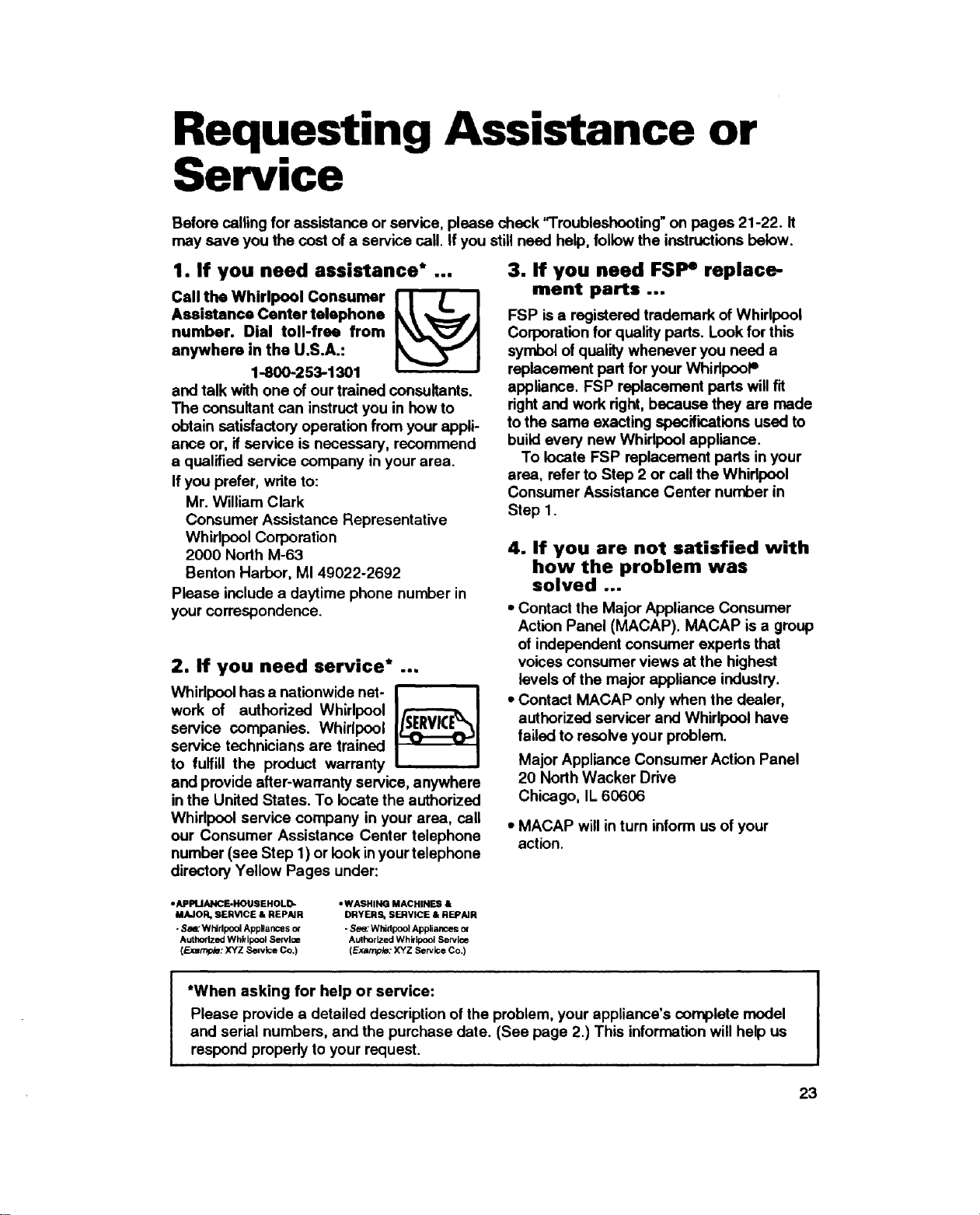
Requesting Assistance or
Service
Before callingfor assistance or service, please check "Troubleshooting"on pages 21-22. It
may save you the cost of a service call. If you stillneed help. follow the instructionsbelow.
1. If you need assistance* ...
Call the Whirlpool Consumer il I I
Assistance Center telephone
number. Dial toll-free from
anywhere in the U,S,A.:
1-800-253-1301
and talk with one of our trained consultants.
The consultant can instructyou in how to
obtain satisfactory operation from your appli-
ance or, if service is necessary, recommend
a qualified service company in your area.
If you prefer, write to:
Mr. William Clark
Consumer Assistance Representative
Whirlpool Corporation
2000 North M-63
Benton Harbor, MI 49022-2692
Please include a daytime phone number in
your correspondence.
2. If you need service • ...
Whirlpool has a nationwide net-
work of authorized Whirlpool
service companies. Whirlpool
service technicians are trained
to fulfill the product warranty
and provide after-warTanty service, anywhere
in the United States. To locate the authorized
Whirlpool service company in your area, call
our Consumer Assistance Center telephone
number (see Step 1) or look in yourtelephone
directory Yellow Pages under:
3. If you need FSP e replace-
merit parts ...
FSP isa registered trademark of Whirlpool
Corporation for quality pads. Look for this
symbol of quality whenever you need a
replacement part for your WhirlpooP
appliance. FSP replacement parts will fit
right and work right, because they are made
to the same exacting specifications used to
build every new Whirlpool appliance.
To locate FSP replacement parts in your
area, refer to Step 2 or call the Whirlpool
Consumer Assistance Center number in
Step 1.
4. If you are not satisfied with
how the problem was
solved ...
• Contact the Major Appliance Consumer
Action Panel (MACAP). MACAP is a group
of independent consumer experts that
voices consumer views at the highest
levels of the major appliance industry.
• Contact MACAP only when the dealer,
authorized servicer and Whirlpool have
failed to resolve your problem.
Major Appliance Consumer Action Panel
20 North Wacker Drive
Chicago, IL 60606
• MACAP will in turn inform us of your
action.
• APPUANCE-HOUSEHOLO-
MAJOR, SERVICE & REPAIR
• Smt."Whirlpool Appliances or
Authorized Whlrlpout Service
(,EzmmpJb:X'YZ Se=vice Co.)
t WASHING MACHINES &
DRYERS, SERVICE & REPAIR
• Se_" Whirlpool Applisr_es of
Aulhorlzed Whir Ipool Service
(E,xamp/e: X'YZ Service Co.)
*When asking for help or service:
Please provide a detailed description of the problem, your appliance's complete model
and serial numbers, and the purchase date. (See page 2.) This information will help us
respond properly to your request.
23
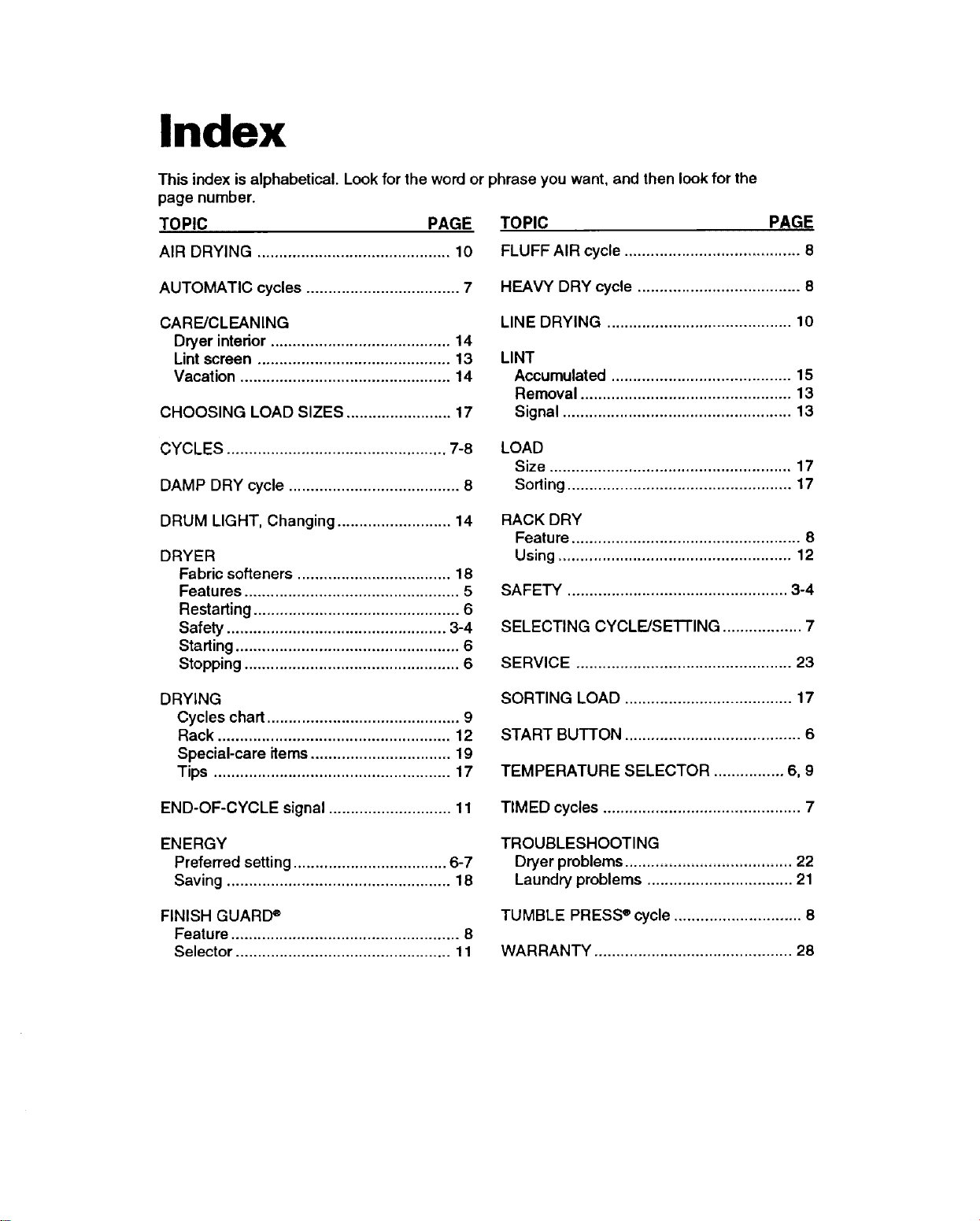
Index
This index isalphabetical. Look for the word or phrase you want, and then lookfor the
page number.
TOPIC PAGE TOPIC PAGE
AIR DRYING ............................................ 10 FLUFF AIR cycle ........................................ 8
AUTOMATIC cycles ................................... 7 HEAVY DRY cycle ..................................... 8
CARE/CLEANING
Dryer interior ......................................... 14
Lint screen ............................................ 13
Vacation ................................................ 14
CHOOSING LOAD SIZES ........................ 17
LINE DRYING .......................................... 10
LINT
Accumulated ......................................... 15
Removal ................................................ 13
Signal .................................................... 13
CYCLES .................................................. 7-8
DAMP DRY cycle ....................................... 8
LOAD
Size ....................................................... 17
Sorting ................................................... 17
DRUM LIGHT, Changing .......................... 14
DRYER
Fabric softeners ................................... 18
Features ................................................. 5
Restarting ............................................... 6
Safety .................................................. 3-4
Starting ................................................... 6
Stopping ................................................. 6
RACK DRY
Feature .................................................... 8
Using ..................................................... 12
SAFETY .................................................. 3-4
SELECTING CYCLE/SETTING .................. 7
SERVICE ................................................. 23
DRYING
Cycles chart ............................................ 9
Rack ..................................................... 12
Special-care items ................................ 19
Tips ...................................................... 17
SORTING LOAD ...................................... 17
START BUTTON ........................................ 6
TEMPERATURE SELECTOR ................ 6, 9
END-OF-CYCLE signal ............................ 11 TIMED cycles ............................................. 7
ENERGY TROUBLESHOOTING
Preferred setting ................................... 6-7 Dryer problems ...................................... 22
Saving ................................................... 18 Laundry problems ................................. 21
FINISH GUARD ° TUMBLE PRESS ®cycle ............................. 8
Feature .................................................... 8
Selector ................................................. 11 WARRANTY ............................................. 28
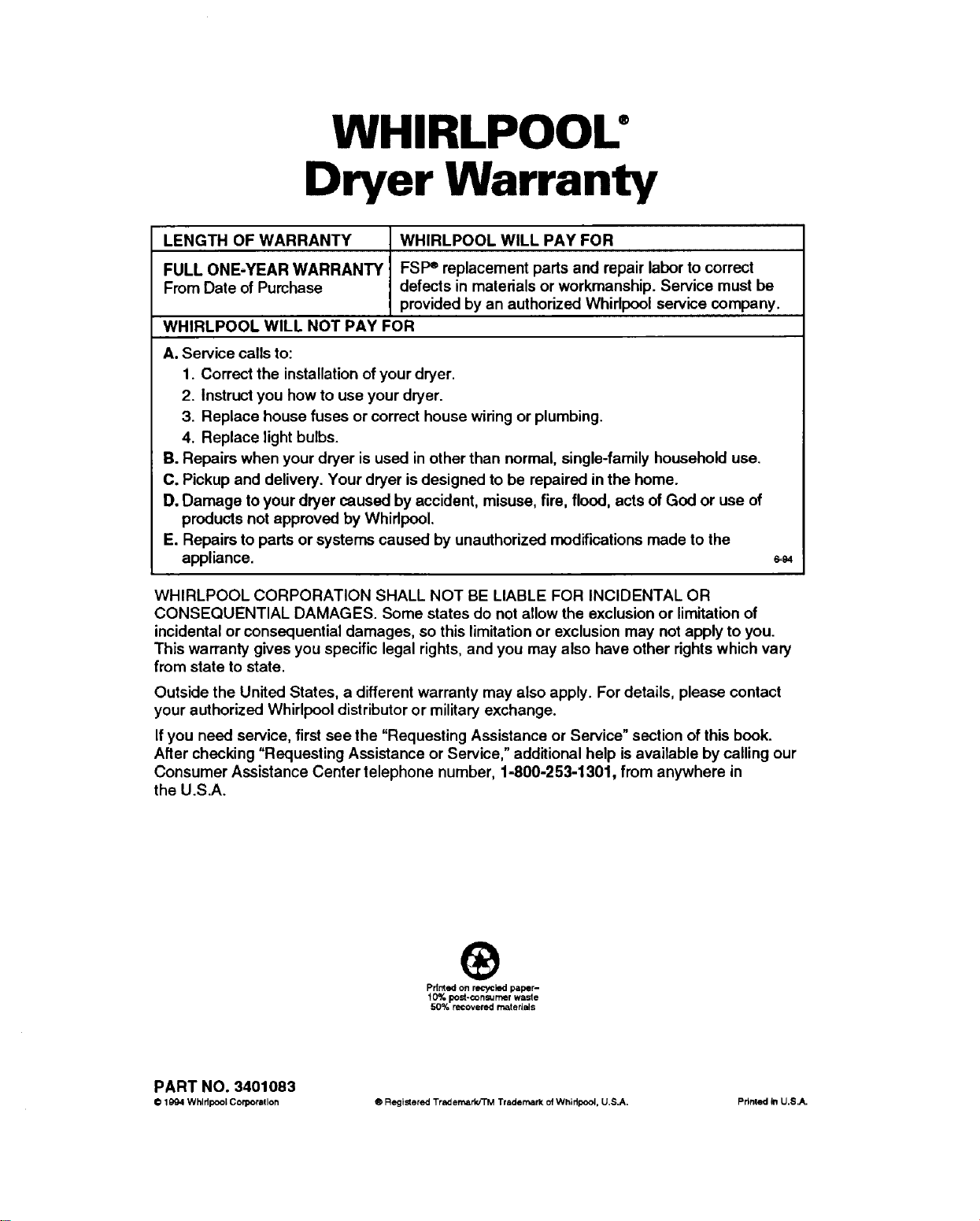
WHIRLPOOl."
Dryer Warranty
LENGTH OF WARRANTY WHIRLPOOL WILL PAY FOR
FULL ONE-YEAR WARRANTY FSPe replacement parts and repair labor to correct
From Date of Purchase defects in materials or workmanship. Service must be
provided by an authorized Whirlpool service company.
WHIRLPOOL WILL NOT PAY FOR
A. Service calls to:
1. Correct the installation of your dryer.
2. Instruct you how to use your dryer.
3. Replace house fuses or correct house wiring or plumbing.
4. Replace light bulbs.
B. Repairs when your dryer is used in other than normal, single-family household use.
C. Pickup and delivery. Your dryer isdesigned to be repaired in the home.
D. Damage to your dryer caused by accident, misuse, fire, flood, acts of God or use of
products not approved by Whirlpool.
E. Repairs to parts or systems caused by unauthorized modifications made to the
appliance.
6-94
WHIRLPOOL CORPORATION SHALL NOT BE LIABLE FOR INCIDENTAL OR
CONSEQUENTIAL DAMAGES. Some states do not allow the exclusion or limitation of
incidental or consequential damages, so this limitation or exclusion may not apply to you.
This warranty gives you specific legal rights, and you may also have other rights which vary
from state to state.
Outside the United States, a different warranty may also apply. For details, please contact
your authorized Whirlpool distributor or military exchange.
If you need service, first see the "Requesting Assistance or Service" section of this book.
After checking "Requesting Assistance or Service," additional help is available by calling our
Consumer Assistance Center telephone number, 1-800-253-1301, from anywhere in
the U.S.A.
Printed on _-ycled paper-
10% post.consumer waste
50% recovered materials
PART NO. 3401083
O 19_4 W hldpool Coq>Otallon ® Registered Trad emark/TM Trademark of Whidpoof, U.S.A. Pdnled In U.S.A.