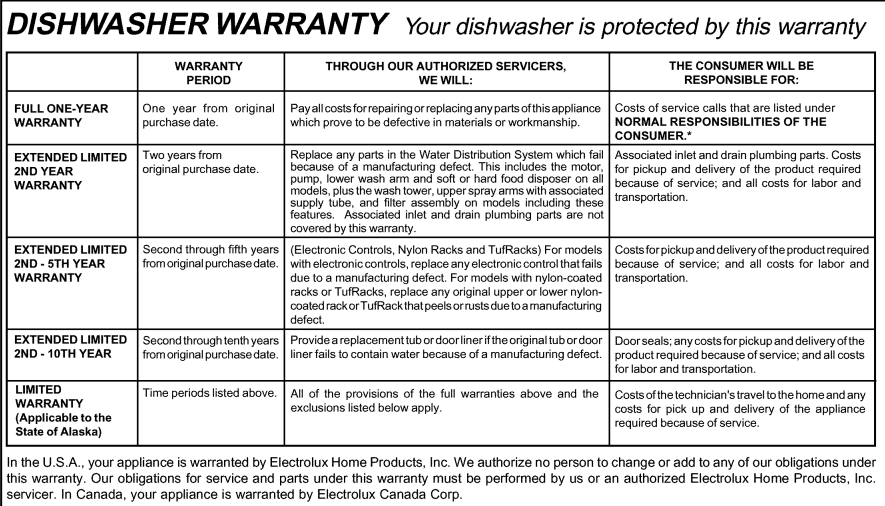
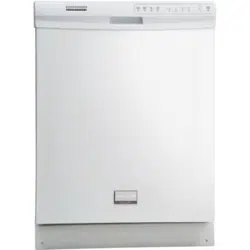
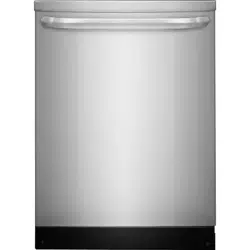
User Manual Frigidaire FDBC24BAS2 dishwasher
Operating Instructions
Getting Started
1. Load dishwasher (See Preparing and Loading Dishes).
2. Add detergent (See Dishwasher Dispenser & Detergents).
3. Add rinse aid, if needed (See Rinse Aid).
4. Turn dial clockwise to select cycle (See Wash Cycle Selections).
5. Select desired energy OPTIONS (See Energy Options).
6. Run hot water faucet nearest dishwasher until water is hot. Turn water off.
7. To start, close door to latch.
Wash Cycle Selections
Note: Not all cycles available on all models.
Pots & Pans
Pots & Pans For pots, pans, casseroles and dinnerware with dried-on or baked-on soils:
- Turn dial to POTS & PANS.
- Select desired OPTIONS
Normal Wash
For regularly soiled dishes and silverware:
- Turn dial to NORMAL WASH.
- Select desired OPTIONS.
Light Wash
For lightly soiled or pre-rinsed dishes and silverware:
- Turn dial to LIGHT WASH.
- Select desired OPTIONS.
Rinse/Hold
For rinsing dishes that will be washed later:
- DO NOT USE detergent.
- Turn dial to RINSE/HOLD.
Plate Warmer
For warming dishes and serving plates before serving hot foods.
- Load clean plates and dishes to be warmed.
- Turn dial to PLATE WARMER.
- Select HOT DRY option.
Energy Options
Hot Dry Option
HOT DRY option provides faster drying since the heating element is on during the drying portion of the cycle.
Cool Dry Option
COOL DRY option saves electricity since the heating element is off during the drying portion of the cycle. To speed drying process, open the door slightly after the cycle is complete. Some water droplets may remain on door and tub and in areas where dishes touch silverware basket and rack. With either option, you may see water vapor coming from vent during drying portion of cycle. The drying option may be changed at any time during the cycle and affects only the drying period
Care and Cleaning
OUTSIDE --Occasionally wipe with a mild nonabrasive detergent and water. Rinse and dry
INSIDE --The inside of the dishwasher, including the filter, is self-cleaning with normal use• If needed, clean around the tub gasket area with a damp cloth.
Overfill Protector--keeps dishwasher from overfilling and is located in the left front corner of the tub.
- Clean occasionally with household cleaner containing vinegar or bleach to dissolve any buildup.
- Overfill Protector should move up and down freely about one inch. If it does not move, lift and clean underneath.
Care of Drain Air Gap
If a drain air gap was installed for your built-in dishwasher, check to make sure it is clean so the dishwasher will drain properly. A drain air gap is usually mounted on countertop and can be inspected by removing the cover. This is not part of your dishwasher and is not covered by warranty.
Winterizing
To disconnect service :
1. Turn off electrical power to the dishwasher at the supply source by removing fuses or tripping circuit breaker
2. Shut off water supply
3. Place a pan under the inlet valve. Disconnect water line from inlet valve and drain into pan
4. Disconnect drain line from pump and drain water into pan
Note : See Installations intrustions for more details
To Restore Service:
1. Reconnect the water, drain, and electrical power supply
2. Turn on water and electrical power supply
3. Fill detergent cup(s) and run dishwasher through a NORMAL cycle
4. Check connections to make sure they do not leak.
Note: See Installations Instructions for more details
Solutions to Common Dishwashing Problems
Before calling for service, review this list. It may save you both time and expense. This list includes common experiences that are not the result of defective workmanship or material in your dishwasher.
Food Soils Left on Dishes
- Choose another cycle for longer washing time.
- Check rack loading section for proper loading-- avoid nesting items.
- Home water pressure may be too low--should be 20 to 120 pounds per square inch (psi).
- Check incoming water temperature. It should be at least 120°F (49°C). (See Factors Affecting Performance.)
- Check water hardness. For extremely hard water, it may be necessary to install a water softener. (See Detergent Chart.)
- Use fresh detergent.
- Check to make sure tower in lower rack is not blocked.
- Make sure items are not blocking the spray arm, preventing it from rotating.
Dishes not Dry
- Select Hot Dry option.
- Make sure the liquid rinse aid dispenser is filled.
- Check container to see if it is time to replace solid rinse aid.
- Increase the amount of rinse aid, if available on your model. (See Rinse Aid).
- Check the incoming water temperature. Be sure it is at least 120°F (49°C).
- Check for proper loading--avoid nesting items.
- Plastic items may need to be towel dried.
- Cups with a concave bottom will collect water.
Dishware Chipped
- Load with care and do not overload. (See Preparing and Loading dishes.)
- Place delicate items in top rack.
- Place glasses securely against pins and not over pins.
- Load items so they are secure and don't jar loose when moving racks in and out. Move racks in and out slowly.
- Make sure tall glasses and stemware will clear top of tub when rack is pushed in.
- Fine antique china and crystal should be handwashed.
Glassware/Flatware Spotted or Cloudy
- Check water hardness. For extremely hard water, it may be necessary to install a water softener. (See Detergent Chart.)
- Water temperature may be low. Avoid extremely low or high temperatures. (See Factors Affecting Performance.)
- Avoid overloading and improper loading. (See Preparing and Loading Dishes.)
- Use fresh detergent. Old detergent is ineffective.
- Check to see that proper amount of detergent is being used. Also, check phosphate level. (See Detergent Dispenser.)
- Home water pressure may be too low--it should be 20 to 120 pounds per square inch psi).
Dishware Stained or Discolored
- Tea and coffee can stain cups. Remove the stains by hand washing in a solution of 1/2cup ml) bleach and one quart (1 L) of warm water. Rinse thoroughly.
- Iron deposits in water can cause a yellow or brown film. A special filter installed in the water supply line will correct this problem. (See Removing Spots and Film.)
- Aluminum utensils can leave gray/black marks when they rub against other items. Load properly.
- Certain high acid foods can cause discoloration of stainless steel and plastics if allowed to sit for a long period. Rinse by hand if not operating dishwasher at once.
- Mixing stainless steel and silver utensils in silverware basket can cause pitting of the stainless steel blades. Avoid mixing stainless steel and silver.
Etching
- Using too much detergent in soft or softened water causes this film that cannot be removed.
- Adjust the amount of detergent based on the water hardness. (Check Detergent Chart.)
- Lower the water temperature.
- Use the Cool Dry option.
Detergent Left in Cups
- Detergent may be old. Discard and use fresh detergent.
- Be sure water action can reach the dispenser.
- Check to see if cycle has been completed.
- Make sure items do not prevent the detergent dispenser from opening.
Dishwasher Leaks
- Use only fresh detergent designed for automatic dishwashers. Measure detergent carefully. Try a different brand.
- Spilled rinse aid can cause foam and lead to overflowing. Wipe up any spills with damp cloth.
- Check to see that dishwasher is level. (See Installation Instructions.)
Normal Sounds You Will Hear
- Normal sounds include water fill, water circulation and motor sounds.
Water in Bottom of Tub
- Water left in bottom of tub after cycle is complete is not normal. If water remains in the bottom of the tub, dishwasher may not be draining properly. (See Dishwasher Does Not Drain Properly.)
Vapor at Vent
- Water vapor escapes from the vent when the dishwasher is operating. This is normal.
Dishwasher Won't Run
- Check to see if circuit breaker is tripped or if a fuse is blown.
- Make sure water supply is turned on.
- Check to see if cycle is set correctly. (See Operating Instructions.)
- Make sure door is closed and latched.
Dishwasher Does Not Drain Properly
- If unit is hooked up to a food waste disposer, make sure the disposer is empty.
- Check to see if the knockout plug has been removed from inside the food waste disposer inlet.
- Check to see if drain hose is kinked.
- Make sure cycle is complete, not in a pause.
Dishwasher Won't Fill
- Is water supply turned on?
- Does overfill protector move up and down freely? (See Overfill Protector section.) Normal water fill covers filter area.
Dishwasher Has an Odor
- Soiled dishes left in dishwasher too long can create an odor. Use Rinse/Hold cycle or rinse by hand.
- There will be a "new" smell when first installed. This is normal.
- Check to see if unit is draining properly. (See Dishwasher Does Not Drain Properly.)
Stains on Tub Interior
• Washing large amounts of dishware with tomato based soil can cause a pink/orange appearance. This will not affect performance and will gradually fade over time. Pre-rinsing or using the Rinse/Hold cycle will reduce the chance of staining. Using Cool Dry option will lessen staining.
Removing Spots and Film
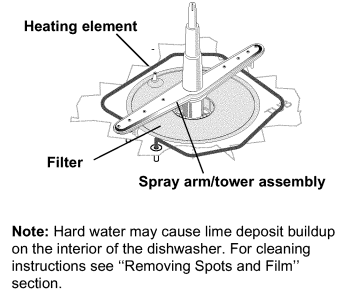
Hard water can cause lime deposit buildup on the interior of the dishwasher. Dishes and glasses may also get spots and film for a number of reasons. (See Glassware/Flatware Spotted or Cloudy section.) To remove buildup, spots and film, clean using the following instructions:
- Load clean dishes and glasses in normal manner. Do not load any metal utensils or silverware.
- Do not add detergent.
- Turn dial to NORMAL WASH. Close and latch door to start.
- Allow dishwasher to run for 40 minutes to reach the main wash portion of cycle.
- Unlatch and open door and pour 2 cups of white vinegar into the bottom of dishwasher.
- Close and latch door and allow the cycle to finish.
WARRANTY INFORMATION