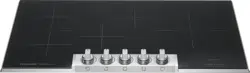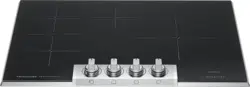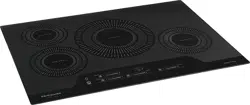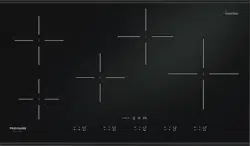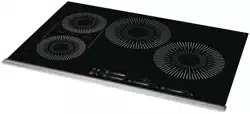

Frigidaire.com USA 1-800-944-9044 Frigidaire.ca Canada 1-800-265-8352
Introduction. . . . . . . . . . . . . . . . . . 2
Important Safety Instructions. . . . . . . . 3
Before Setting Surface Controls . . . . . . 9
Setting Surface Controls. . . . . . . . . . 15
Care and Cleaning . . . . . . . . . . . . . 20
Before You Call . . . . . . . . . . . . . . . 23
Warranty . . . . . . . . . . . . . . . . . . 24
use
&
care
INDUCTION
COOKTOP
2
INTRODUCTION
INTRODUCTION
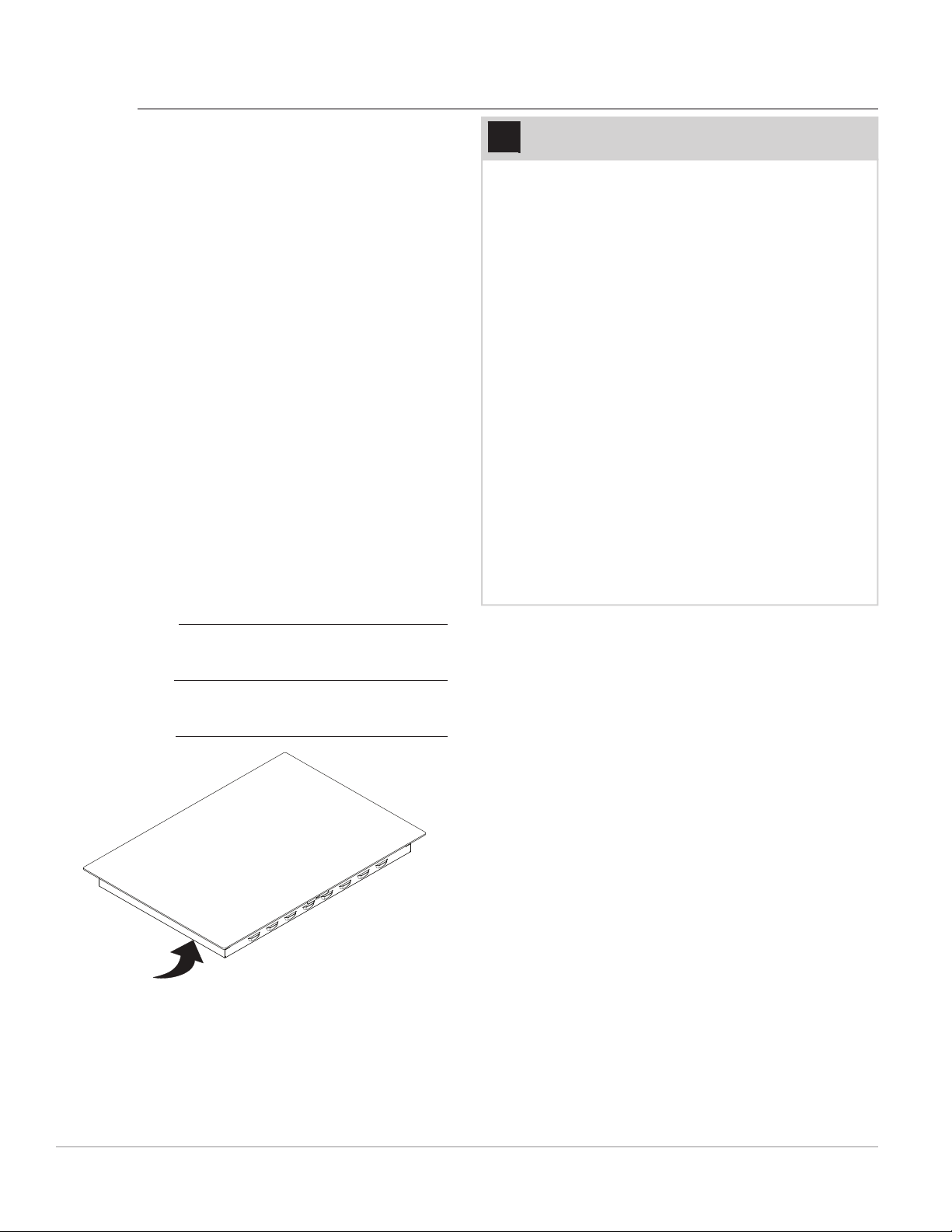
Read all the safety instructions in the front of
your Use & Care Manual.
Remove all packaging materials from your ap-
pliance before cooking.
Confi rm that the electrical power to the appli-
ance is turned on.
Test all cooking zones to make sure they are
working properly (page ref).
Remember to complete your product registra-
tion!
Installation Checklist
9
Welcome to our
family
Thank you for bringing Frigidaire into your home!
We see your purchase as the beginning of a long
relationship together.
This manual is your resource for the use and care
of your product. Please read it before using your
appliance. Keep it handy for quick reference. If
something doesn’t seem right, the troubleshooting
section will help you with common issues.
FAQs, helpful tips and videos, cleaning products, and
kitchen and home accessories are available at www.
frigidaire.com.
We are here for you! Visit our website, chat with an
agent, or call us if you need help. We may be able
to help you avoid a service visit. If you do need
service, we can get that started for you.
Let’s make it o cial! Be sure to register your prod-
uct.
Keep your product info here so it’s easy to fi nd.
Model Number:
Serial Number:
Purchase Date:
Serial Number Location
3
IMPORTANT SAFETY INSTRUCTIONS
DEFINITIONS
This is the safety alert symbol. It is
used to alert of potential personal injury
hazards. Obey all safety messages that
follow this symbol to avoid possible injury
or death.
WARNING
Indicates a potentially hazardous situa-
tion which, if not avoided, may result in
death or serious injury.
CAUTION
Indicates a potentially hazardous situa-
tion which, if not avoided, may result in
minor or moderate injury.
IMPORTANT
Indicates installation, operation or main-
tenance information which is important
but not hazard-related.
Read all instructions before using this ap-
pliance.
This manual contains important safety
symbols and instructions. Please pay at-
tention to these symbols and follow all
instructions given.
Do not attempt to install or operate your
appliance until you have read the safety
precautions in this manual. Safety items
throughout this manual are labeled with a
WARNING or CAUTION statement based
on the risk type.
Warnings and important instructions ap-
pearing in this guide are not meant to
cover all possible conditions and situations
that may occur. Common sense, caution,
and care must be exercised with installing,
maintaining, or operating your appliance.
NOTE
Indicates a short, informal reference –
something written down to assist the
memory or for future reference.
IMPORTANT INSTRUCTIONS FOR UN-
PACKING AND INSTALLATION
IMPORTANT
Read and follow the below instructions
and precautions for unpacking, installing,
and servicing your appliance.
Remove all tape and packaging before us-
ing the appliance. Destroy the carton and
plastic bags after unpacking the appliance.
Never allow children to play with pack-
aging material. Do not remove the wiring
label and other literature attached to the
appliance. Do not remove model/serial
number plate.
Cold temperatures can damage the elec-
tronic control. When using this appliance
for the fi rst time, or when the appliance
has not been used for an extended period
of time, be sure the appliance has been in
temperatures above 32ºF (0ºC) for at least
3 hours before turning on the power to the
appliance.
Never modify or alter the construction of
the appliance by removing the leveling
legs, panels, wire covers, anti-tip brackets/
screws, or any other part of the appliance.
Be sure to have an appropriate foam-type
fi re extinguisher available, visible, and easi-
ly accessible located near the appliance.

4
IMPORTANT SAFETY INSTRUCTIONS
GROUNDING INSTRUCTIONS
WARNING
• Avoid fi re hazard or electrical shock.
Failure to follow this warning may
cause serious injury, fi re, or death.
• Avoid fi re hazard or electrical shock.
Do not use an adapter plug, use an
extension cord, or remove grounding
prong from the power cord. Failure to
follow this warning may cause serious
injury, fi re, or death.
Proper Installation—Be sure your appliance
is properly installed and grounded by a
qualifi ed technician. In the United States,
install in accordance with the National
Fuel Gas Code ANSI Z223.1/NPFA No. 54,
latest edition and National Electrical Code
NFPA No. 70 latest edition, and local elec-
trical code requirements. In Canada, install
in accordance with CAN/CGA B149.1 and
CAN/CGA B149.2 and CSA Standard C22.1,
Canadian Electrical code, Part 1-latest
editions and local electrical code require-
ments. Install only per installation instruc-
tions provided in the literature package for
this appliance.
For personal safety, this appliance must be
properly grounded. For maximum safety,
the power cord must be securely connect-
ed to an electrical outlet or junction box
that is the correct voltage, is correctly
polarized and properly grounded, and pro-
tected by a circuit breaker in accordance
with local codes.
It is the personal responsibility of the
consumer to have the appropriate outlet
or junction box with the correct, proper-
ly grounded wall receptacle installed by
a qualifi ed electrician. It is the responsi-
bility and obligation of the consumer to
contact a qualifi ed installer to assure that
the electrical installation is adequate and
is in conformance with all local codes and
ordinances.
See the installation instructions packaged
with this appliance for complete installa-
tion and grounding instructions.
IMPORTANT INSTRUCTIONS FOR USING
THE APPLIANCE
WARNING
• Storage In or On Appliance—Flamma-
ble materials should not be stored in
an oven or microwave, near surface
burners or elements, or in the stor-
age or warmer drawer (if equipped).
This includes paper, plastic, and cloth
items, such as cookbooks, plastic
ware, and towels, as well as fl ammable
liquids. Do not store explosives, such
as aerosol cans, on or near the appli-
ance.
• Do not leave children alone - Children
should not be left alone or unattend-
ed in the area where appliance is in
use. They should never be allowed to
sit or stand on any part of the appli-
ance, including the storage drawer,
lower broiler drawer, warmer drawer,
or lower double oven.

5
IMPORTANT SAFETY INSTRUCTIONS
WARNING
• Do not store items of interest to chil-
dren in the cabinets above the appli-
ance or on the backguards of ranges.
Children climbing on or near the ap-
pliance to reach items could be seri-
ously injured.
• Do not allow children to climb or play
around the appliance. The weight of
a child on an open oven door may
cause the appliance to tip, resulting
in serious burns or other injury. An
open drawer when hot may cause
burns. Stepping, leaning, or sitting on
the door or drawers of this appliance
can result in serious injuries and also
cause damage to the appliance.
• Never cover any slots, holes or pas-
sages in the oven bottom or cover
and entire rack with materials such
as aluminum foil. Doing so blocks air
fl ow through the oven and may cause
carbon monoxide poisoning. Alumi-
num foil linings may also trap heat,
causing a fi re hazard.
• Do not use oven or warmer drawer (if
equipped) for storage.
• Never use your appliance as a space
heater to heat or warm the room.
Doing so may result in carbon monox-
ide poisoning and overheating of the
appliance.
CAUTION
• Use dry potholders. Moist or damp
potholders on hot surfaces may result
in burns from steam. Do not let pot-
holders touch hot cooking areas. Do
not use towels or other bulky cloths.
• Do not heat unopened food contain-
ers - Build-up of pressure may cause
container to burst and result in injury.
• Wear proper apparel - Loose-fi tting
or hanging garments should never be
worn while using the appliance. Do
not let clothing or other fl ammable
materials contact hot surfaces.
• Do not touch surface burners or ele-
ments, areas near these burners or el-
ements, interior surfaces of the oven,
or the warmer drawer (if equipped).
Surface burners and elements may
be hot even though they appear cool.
Areas near surface burners and ele-
ments may become hot enough to
cause burns. During and after use,
do not touch, or let clothing or oth-
er fl ammable materials touch these
areas until they are cool. These areas
may include the cooktop, surfaces
facing the cooktop, oven vent areas,
oven door, and oven window.
• Do not attempt to operate the ap-
pliance during a power failure. If the
power fails, always turn o the appli-
ance. If the appliance is not turned
o and the power resumes, electric
surface elements may resume opera-
tion when power is restored. Once the
power resumes, reset the clock and
the oven function.
CAUTION
• When heating fat or grease, watch it
closely. Grease may catch fi re if it be-
comes too hot.
• Do not use water or fl our on grease
fi res. Smother fi re or fl ame or use dry
chemical or foam-type extinguisher.
Cover the fi re with a pan lid or use
baking soda.

6
IMPORTANT SAFETY INSTRUCTIONS
Improper cookware may break due to
sudden changes in temperature. Check the
cookware manufacturer’s recommenda-
tions for cooktop use.
Use proper pan size - This appliance is
equipped with one or more surface units
of di erent sizes. Select cookware with fl at
bottoms that match the surface unit size.
Using the proper cookware on the cooking
area will improve e ciency.
Never leave surface elements unattend-
ed. Boil-overs may cause smoking and
greasy spills that may ignite. A pan that
has boiled dry could be damaged and may
damage the cooktop.
When you are fl aming foods under a venti-
lating hood, turn on the fan.
IMPORTANT INSTRUCTIONS FOR USING
YOUR INDUCTION COOKTOP
WARNING
If an oven installed underneath is perform-
ing self-clean, then the surface cooking
unit must be turned o .
CAUTION
Persons with a pacemaker or similar
medical device should exercise caution
using or standing near an induction unit
while it is in operation, as the electro-
magnetic fi eld may a ect the working
of the pacemaker or similar medical
device. It would be advisable to consult
your doctor or the pacemaker or similar
medical device manufacturer about your
particular situation.
Know which knob or key controls each
surface heating area. Place cookware with
food on the cooking area before turning it
on. Turn the cooking area o before re-
moving the cookware.
Cookware handles should be turned in-
ward and not extend over adjacent surface
elements. — To reduce the risk of burns,
ignition of fl ammable materials, and spill-
age due to unintentional contact with the
utensil, the handle of the cookware should
be positioned so that it is turned inward,
and does not extend over other cooking
areas.
Glazed cooking utensils — Only certain
types of cookware are suitable for cook
top service and must be magnetic to work
properly on the induction zones. Check
the manufacturer’s recommendations for
cook top use to ensure that the cookware
is compatible with induction cooking.
IMPORTANT INSTRUCTIONS FOR GLASS
AND CERAMIC COOKTOPS
Do Not Clean or Operate a Broken Cook-
top. If cooktop should break, cleaning
solutions and spillovers may penetrate the
broken cooktop and create a risk of elec-
tric shock. Contact a qualifi ed technician
immediately.
Clean cooktop glass with caution. If a wet
sponge or cloth is used to wipe spills on
a hot cooking area, be careful to avoid a
steam burn. Some cleaners can produce
harmful fumes if applied to a hot surface.
Avoid scratching the cooktop glass with
sharp objects.

7
IMPORTANT SAFETY INSTRUCTIONS
IMPORTANT INSTRUCTIONS FOR CLEAN-
ING YOUR APPLIANCE
CAUTION
Before manually cleaning any part of the
appliance, be sure all controls are turned
o and the appliance is cool. Cleaning a
hot appliance can cause burns.
Clean the appliance regularly to keep all
parts free of grease that could catch fi re.
Do not allow grease to accumulate. Greasy
deposits in the fan could catch fi re.
Always follow the manufacturer’s rec-
ommended directions for use of kitchen
cleaners and aerosols. Be aware that ex-
cess residue from cleaners and aerosols
may ignite causing damage and injury.
Clean venitlating hoods frequently -
Grease should not be allowed to accu-
mulate on hood or fi lter. Follow the man-
ufacturer’s instructions for cleaning vent
hoods.
IMPORTANT INSTRUCTIONS FOR SER-
VICE AND MAINTENANCE
Do not repair or replace any part of the
appliance unless specifi cally recommend-
ed in the manuals. All other servicing
should be done only by a qualifi ed tech-
nician. This reduces the risk of personal
injury and damage to the appliance.
Always contact your dealer, distributor,
service agent, or manufacturer about
problems or conditions you do not under-
stand.
Ask your dealer to recommend a qualifi ed
technician and an authorized repair ser-
vice. Know how to disconnect the power
to the appliance at the circuit breaker or
fuse box in case of an emergency.
Remove the oven door from any unused
oven if it is to be stored or discarded.
Do not touch a hot oven light bulb with
a damp cloth. Doing so could cause the
bulb to break. Handle halogen lights
(if equipped) with paper towels or soft
gloves. Disconnect the appliance or shut
o the power to the appliance before re-
moving and replacing the bulb.
WARNING
California Residents: for cancer and re-
productive harm information, visit
www.P65Warnings.ca.gov

8
IMPORTANT SAFETY INSTRUCTIONS
Important: This appliance has been tested
and found to comply with the limits for a
class B digital device, pursuant to Part 18
of the FCC rules (United States) and ICES-
001 (Canada). These limits are designed
to provide reasonable protection against
harmful interference in a residential instal-
lation. This unit uses and can radiate radio
frequency energy and, if not installed and
used in accordance with the instructions,
may cause harmful interference to radio
communications. However there is no
guarantee that interference will not occur
in a particular installation. If this unit does
cause harmful interference to radio or tele-
vision reception, which can be determined
by turning the unit o and on, the user
is encouraged to try to correct the inter-
ference by one or more of the following
measures:
• Reorient or relocate the receiving an-
tennae.
• Increase distance between unit and
receiver.
• Connect the unit into an outlet or a
circuit di erent from that to which the
receiver is connected.
9
BEFORE SETTING SURFACE CONTROLS
CAUTION
Although induction cooking zones do not pro-
duce heat, they can become hot from contact
with hot cookware. Burns may occur if a cooking
zone or the surrounding area is touched before it
has cooled to a safe temperature.
NOTE
Be sure to read detailed instructions for induction
cooktop cleaning in the “Care and Cleaning” sec-
tion and “Before You Call” checklist section of this
Use and Care Manual.
Sounds
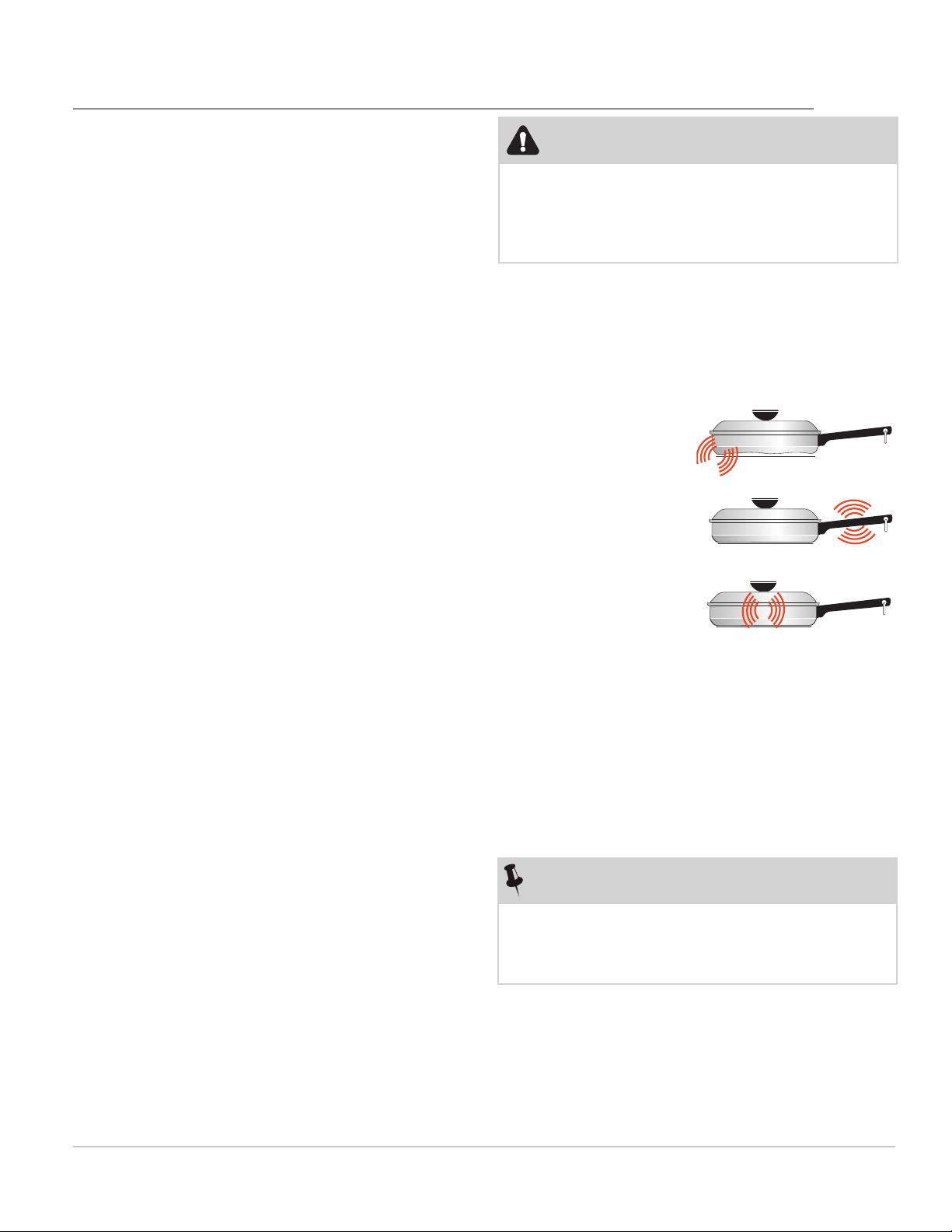
The magnetic fi eld over the induction cooking zone
may cause cookware to vibrate, creating a buzzing
or humming noise. These sounds are not unusual,
especially at high settings.
Cookware that is not
perfectly fl at on the
bottom may vibrate
slightly against the
cooktop.
A loose handle may
vibrate in its socket.
Multi-material cookware
may allow small vibra-
tions in its structure.
Figure 1: Induction sounds
Sounds are less likely to occur with heavier, higher
quality cookware.
An induction cooktop may also produce faint click-
ing sounds from the electronic switches that main-
tain the desired cooking temperature. You may
also hear a fan that cools the electronics inside the
cooktop.
How does induction work?
Most cooking uses radiant heat that must pass
through the cookware to get food hot. Induction is
a process that induces heat with an energy reac-
tion. When each cooking zone is turned on, power
goes to a coil under the cooktop. The powered
coil creates an electromagnetic fi eld. The electro-
magnetic fi eld reacts with compatible materials in
cookware, creating heat in the cookware itself. The
power level controls the heating level, delivering
precise results.
Induction Benefi ts
Because heat starts in the cookware instead of the
cooktop, induction o ers several advantages.
Cleaner cooking: Because induction works by
heating the cookware and not the cooktop, spills
don’t cook or stick to the surface.
Cooler Cooktop: An induction cooktop will be
cooler when you remove cookware than a con-
ventional cooktop would be. The only radiant heat
produced in induction is from the cookware itself,
so the kitchen stays cooler, too.
Fast Heating: Cookware will heat up faster than on
a conventional electric cooktop. Pay close atten-
tion to avoid scorching food when starting to cook.
You may need to use a lower setting for cooking
food than you are used to.
Precise Control: The heat going into the cookware
will change immediately when you change the set-
ting of the cooking zone.
Even Heating: Cookware will typically heat more
evenly on an induction cooktop, so you are less
likely to have hot or cool spots in the cookware.
Energy E ciency: Because induction creates heat
directly in the pan, it uses less electricity than a
conventional cooktop.
Before Using Your Cooktop
Before using your cooktop for the fi rst time, apply
a ceramic cooktop cleaning cream (available in
most hardware, grocery, and department stores)
to the ceramic surface. Clean and bu with a clean
paper towel. Cooktop cleaning creams leave a
protective fi nish on the glass that will make clean-
ing easier when the cooktop is soiled from cooking
and help prevent scratches and abrasions.
10
BEFORE SETTING SURFACE CONTROLS
Using Proper Cookware
The size and type of cookware used will infl uence
the heat setting needed for best cooking results.
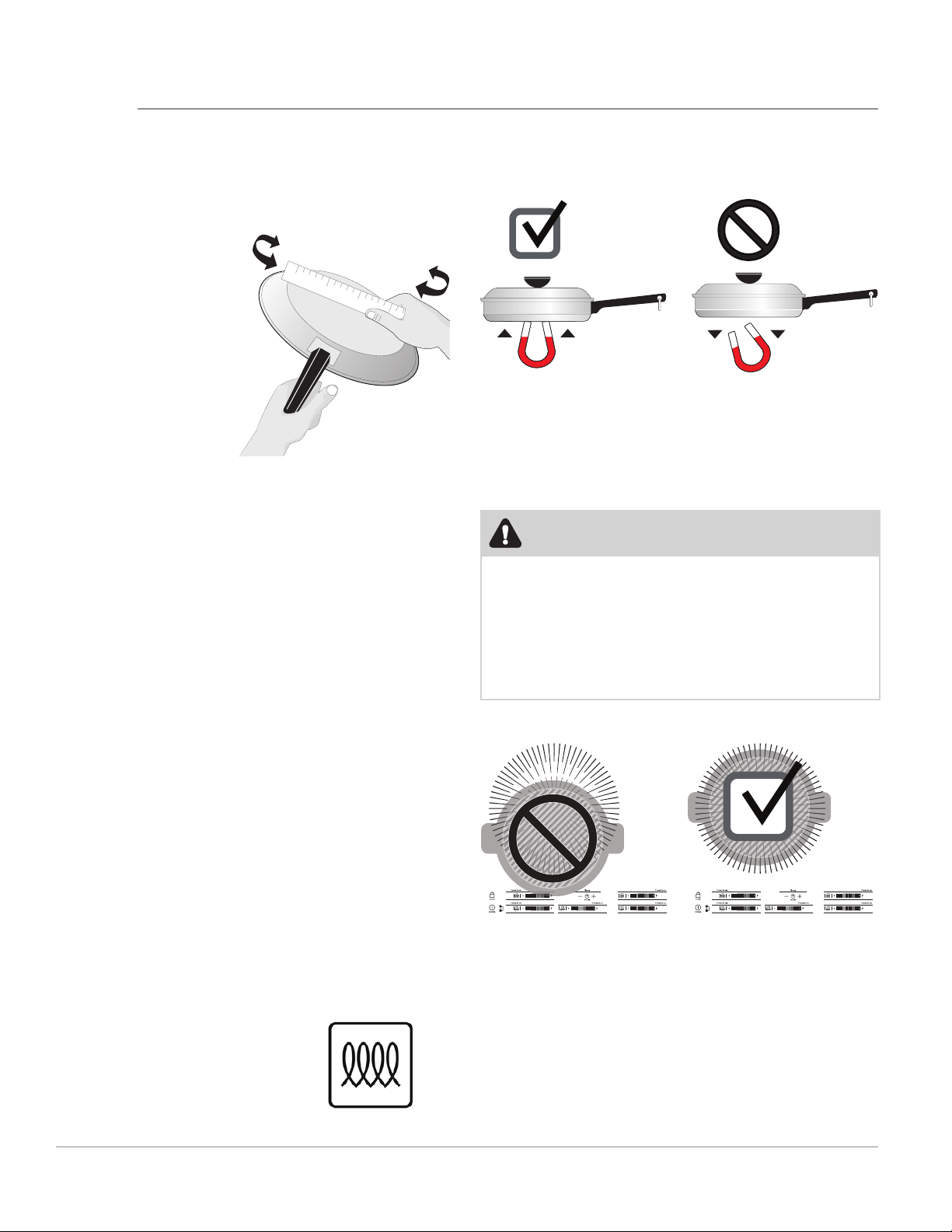
Be sure to follow the recommendations for using
proper cookware as illustrated in Figure 2.
Figure 2: Testing cookware
Check for fl atness by ro-
tating a ruler across the
bottom of the cookware
(see Figure 1). Cookware
should have fl at bot-
toms that make good
contact with the entire
surface of the heating
element (see Figure 2).
Cookware Material Types
Cookware material is especially important when
using an induction cooktop. The cookware must
contain magnetic iron or steel to work on an in-
duction cooktop. Common materials for induction
cookware include the following:
• Stainless Steel - Slow heat conductor. Durable,
easy to clean, and resists staining. Some types
of stainless steel will not work on an induction
cooktop. Use the magnet test (see “Figure 4:
Magnet test”) to check stainless steel cookware.
• Cast Iron - A slow heat conductor that retains
heat very well. Cooks evenly once cooking tem-
perature is reached.
• Porcelain-enamel on metal - Heating charac-
teristics will vary depending on the base ma-
terial. Porcelain-enamel on a compatible metal
will work on an induction cooktop. Use the
magnet test to check porcelain-enamel cook-
ware.
To see if a piece of cookware will work on your
induction cooktop, try to stick a magnet to it. If the
magnet clings fi rmly to the bottom of the cook-
ware, the cookware will work on your induction
cooktop
Cookware sold as induc-
tion-ready will often have a
symbol printed on the bottom
by the manufacturer.
Figure 3: Induction symbol
The Magnet Test
To see if a piece of cookware will work on your
induction cooktop, try to stick a magnet to it (see
Figure 2).
If the magnet clings fi rmly to the bottom of the
cookware, it will work on your induction cooktop.
If the magnet clings weakly or not at all, the cook-
ware will not heat up on your induction cooktop.
Magnet
Sticks
Magnet
Falls
Figure 4: Magnet test
CAUTION
Proper cookware on an operating induction cook-
ing zone will heat up very quickly. If an empty
piece of cookware is left on an operating induc-
tion cooking zone, the rapid change in tempera-
ture may warp or damage the cookware.
Do NOT place hot cookware on the control panel.
The heat may damage the electronic parts.
Figure 5: Keep hot cookware away from controls
11
BEFORE SETTING SURFACE CONTROLS
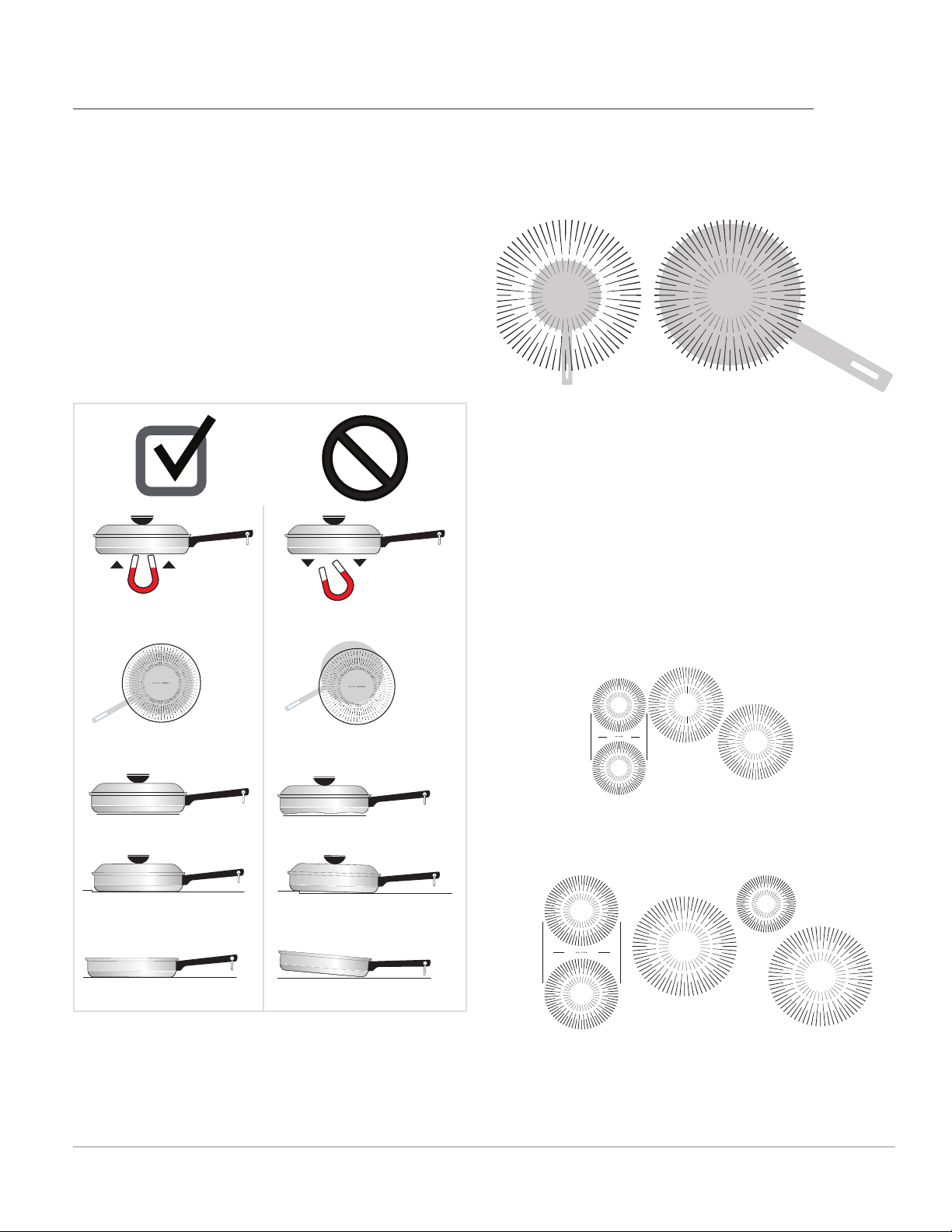
Pan Sensing
Figure 6: Pan sensing conditions
• Cookware centered correctly
on cooking zone.
• Flat pan bottom and straight
sides.
• Pan rests completely and is
level on the cooktop
surface.
• Pan is properly balanced.
• Pan bottom rests on cooktop
edge.
• Cookware not centered on
cooking zone.
• Curved or warped pan bottoms
or sides.
• Heavy handle tilts pan.
• Cookware base material has
good magnetic characteristics.
• Cookware base material is
non-magnetic.
Magnet
Sticks
Magnet
Falls
Figure 6 shows conditions that can prevent pan
detection.
Minimum and Maximum Pan Size
The cooktop graphics are guides to minimum and
maximum pan size for each cooking zone. For best
results, use cookware that matches the size of the
cooking zone.
The inner ring on each cooking zone indicates the
smallest pan size for the zone (Figure 8).
The outer ring on the cooktop graphic indicates the
largest pan size for that zone (Figure 9).
Cookware that is too small for a zone may not acti-
vate the cookware detection sensor. Cookware that
is much larger than a cooking zone will still cook,
but may be slower and uneven. If your cookware is
not a perfect match, it is best to use a zone a little
smaller than the bottom of the cookware.
Figure 7: Min / max pan size
When the cooktop is on, the cooking zones auto-
matically detect when cookware is placed on the
zone. The control for that zone will light up, making
it easy to know which section of the control to use
for that cooking zone.
If you remove a pan from an active cooking zone,
the zone will turn o after 30 seconds.
If the cooktop does not detect cookware in any
zone for 30 seconds, the whole cooktop will turn
o .
Figure 8: Cookzone sizes, 4 zones
Figure 9: Cookzone sizes, 5 zones
5” / 125mm
5” / 125mm
6.5” / 165mm
6.5” / 165mm
6.5” / 165mm
6.5” / 165mm
5” / 125mm
5” / 125mm
4.3” / 110mm

12
BEFORE SETTING SURFACE CONTROLS
Hot Surface Indicator
When a cooking zone is turned o ,
it may remain hot due to contact
with hot cookware. The Hot Sur-
face Indicator (H) will come on and
remain visible until the cooking
zone cools to a safe temperature.
Figure 10: Hot
Surface indica-
tor
Lock or Unlock the Cooktop
The lock function deactivates most of
the controls on the cooktop to keep
cooking zones from being changed by
accident.
To lock the controls while cooking:
1. Set the cooking zones to the desired settings.
2. Press the Lock key.
To unlock the controls, press the Lock key again.
Even with the controls locked, you can turn a cook-
ing zone o by pressing its On/O key.
To set the lock for child safety:
1. Press the Power key to turn the cooktop on.
2. Press the Lock key and hold it for 4 seconds.
The lock icon will turn red.
3. Press the Power key to turn the cooktop o .
When the cooktop is locked for safety, two options
are available to unlock it:
Complete unlock:
1. Press the Power key to turn the cooktop on.
2. Press the Lock key and hold it for 4 seconds.
The lock will deactivate.
3. Press the Power key to turn the cooktop o .
Temporary unlock:
1. Press the Power key to turn the cooktop on.
2. Hold the lock key for 4 seconds.
3. Set the cooking zones.
When the cooking process is fi nished and the
cooktop is turned o , the Lock function will be still
active.
Key-Stuck Function
If a control key is held for more than 10 seconds,
the cooktop will sound an alert of 5 tones. If the
key is still held after the alert sound, the cooktop
will switch o . This function will also activate if the
a zone slider is continually held or adjusted for 10
seconds.
Key-Stuck could be activated by such things as
leaving objects on the cook zone controls, some
spills on the controls, or resting hands on the con-
trols.
LOCK
Figure 11: Lock
key
13
BEFORE SETTING SURFACE CONTROLS
CAUTION
• Although induction cooking zones do not
directly generate heat, they can become hot
from contact with hot cookware. Burns may
occur if a cooking zone or the surrounding
area is touched before it has cooled to a safe
temperature.
• Do not place fl ammable items such as plastic
salt and pepper shakers, spoon holders, or
plastic wrapping on top of the range when it
is in use. Heat radiating from cookware could
cause these items to melt or ignite. Pothold-
ers, towels, or wooden spoons could catch
fi re if placed too close to hot cookware.
• Do not use aluminum foil to line any part of
the cooktop. Improper installation of these
liners may result in risk of electric shock or
fi re. If these items melt on the cooktop, they
will damage the cooktop.
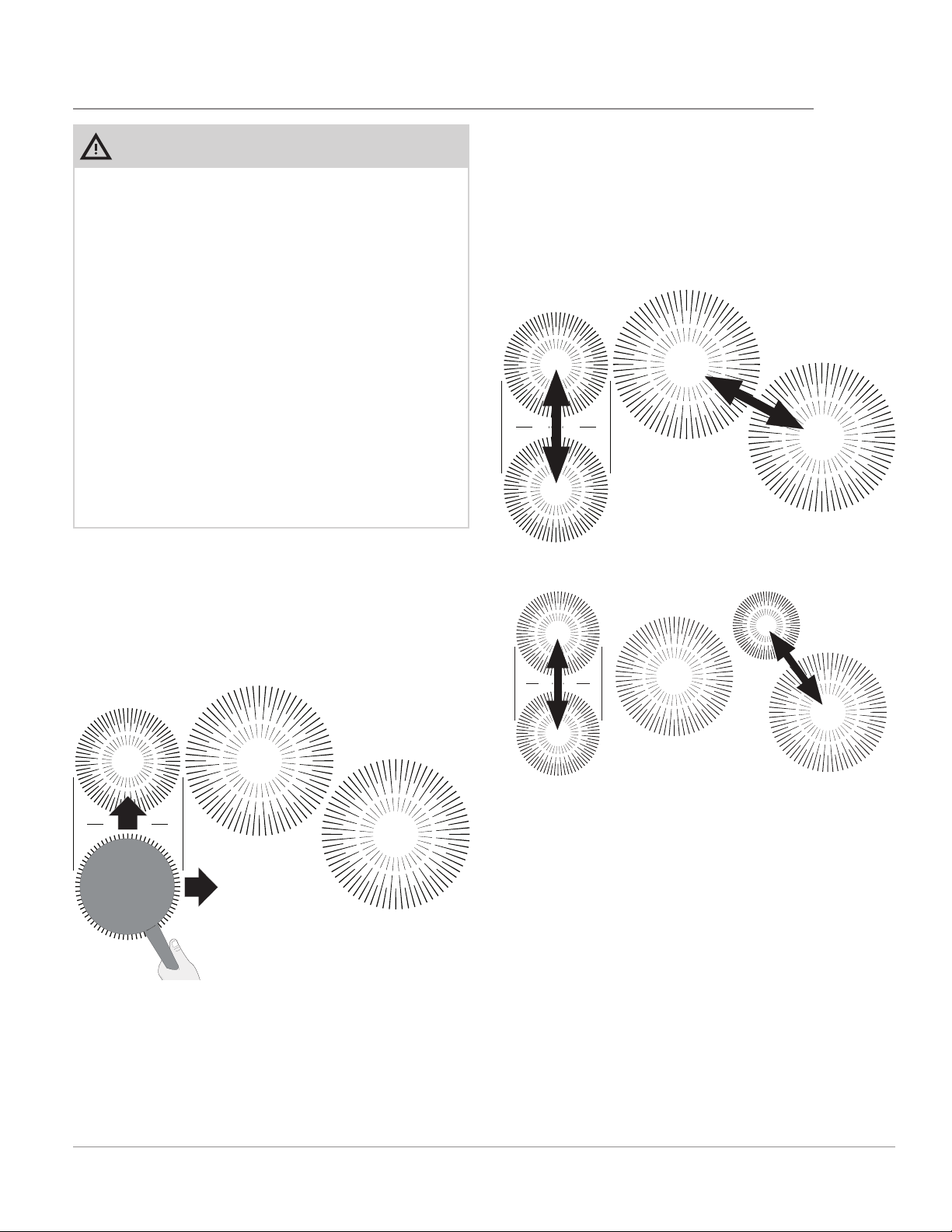
Moving Cookware on a Smooth Cooktop
It’s best to lift cookware before moving it on the
ceramic glass cooktop. Cookware that has a rough
or dirty bottom can mark and scratch the ceramic
glass surface. Always start with clean cookware.
Figure 12: Move cookware carefully on cooktop
Power Management
Your induction cooktop has 2 or 3 generators and
4 or 5 cooking zones, depending on the model. A
generator may power 1 or 2 cooking zones. If you
use more than one cooking zone on high power at
the same time and they are on the same gener-
ator, the cooktop may need to manage power to
the two cooking zones.
Figure 13: Power management, 4 cook zones
Figure 14: Power management, 5 cook zones
To get the best performance from your cooktop,
start cooking on only one cooking zone. After the
fi rst piece of cookware has reached cooking tem-
perature, then start cooking on the second cooking
zone.

14
BEFORE SETTING SURFACE CONTROLS
Home Canning
Be sure to read and observe all the following points
when home canning with your appliance. Check
with the USDA (United States Department of Agri-
culture) Web site and be sure to read all the infor-
mation they have available as well as follow their
recommendations for home canning procedures.
• Use only a completely fl at bottom canner with
no ridges that radiate from the bottom cen-
ter when home canning. Heat is spread more
evenly when the bottom surface is fl at. Use a
straight-edge to check canner bottom.
• Make sure the diameter of the canner does
not exceed 1 inch beyond the surface element
markings or burner.
• It is recommended to use smaller diameter can-
ners on electric coil and ceramic glass cooktops
and to center canners on the burner grates.
• Start with hot tap water to bring water to boil
more quickly.
• Use the highest heat setting when fi rst bringing
the water to a boil. Once boiling is achieved,
reduce heat to lowest possible setting to main-
tain that boil.
• Use tested recipes and follow instructions care-
fully. Check with your local Cooperative Agri-
cultural Extension Service or a manufacturer of
glass jars for the latest canning information.
• It is best to can small amounts and light loads.
Do not leave water bath or pressure canners on
high heat for an extended amount of time.
15
SETTING SURFACE CONTROLS
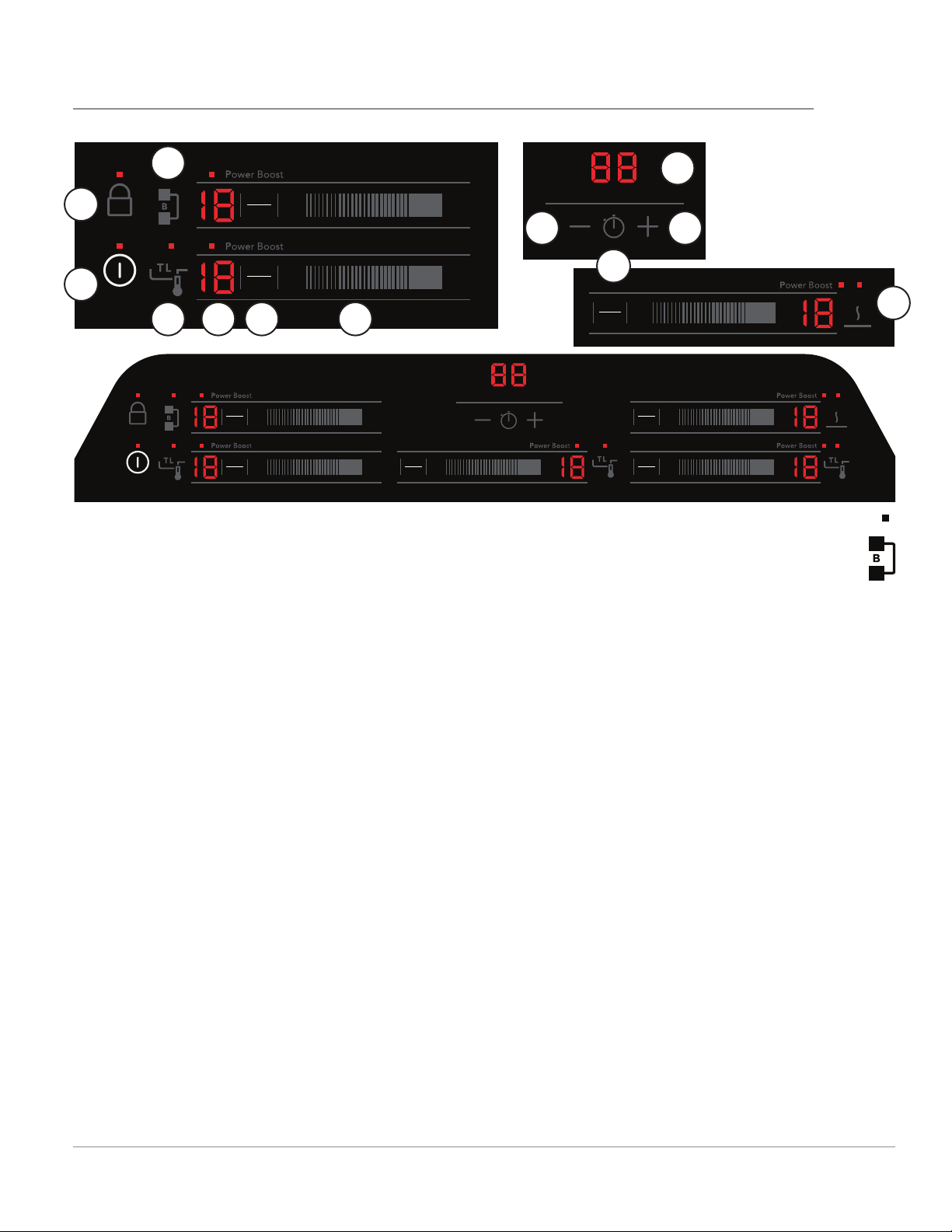
1. Power: Press to turn on or turn o the cooktop.
2. Lock: Lock the cooktop controls to prevent
accidental activation of cooking zones.
3. Cooking Zone Indicator: The LEDs (4 or 5
depending on the model) indicate cook zones.
The one corresponding to the control’s cook
zone turns red.
4. TempLock: Activates TempLock feature. When
pressed, this feature uses a temperature sensor
to monitor heat and adjust the power to main-
tain a consistent temperature during cooking.
See page 17.
5. Cooking Zone On/O : When cookware is on
the cooking zone, press to turn the zone ON/
OFF.
6. Cooking Zone Power Level: Slide a fi nger
across or press a number to set the power level.
Level 1 is low, level 9 is high, and P is the most
powerful setting.
7. Bridge: The Bridge indicator is visible on Zone
1 if both left cooking zones detect cook-
ware. The Bridge function makes the two
left cooking zones work together to heat a
long piece of cookware, like a griddle.
8. Timer Indicator: Shows the time currently
left on the timer.
9. Serve Warm: Activates the Serve Warm feature.
Cooktop Controls
Serve Warm will set all of the cooking zones to
a low power level to keep foods warm.
a. Reduce Time (-): Press to reduce the amount of time
on the timer.
b. Timer On/Off: Press to turn the countdown timer on
or off.
c. Increase Time (+): Press to increase the amount of
time on the timer.
Timer
ON/OFF
LOCK
POWER
ON
OFF
ON
OFF
ON
OFF
ON
OFF
ON
OFF
1P9
1P
9 1P9
1P
9
1P
9
Timer
ON/OFF
LOCK
POWER
ON
OFF
ON
OFF
1P9
1P
9
ON
OFF
1P9
1
2
3
4 5
6
9
8a
8b
8c
7
8
16
SETTING SURFACE CONTROLS
LOCK
POWER
ON
OFF
ON
OFF
1P9
1P
9
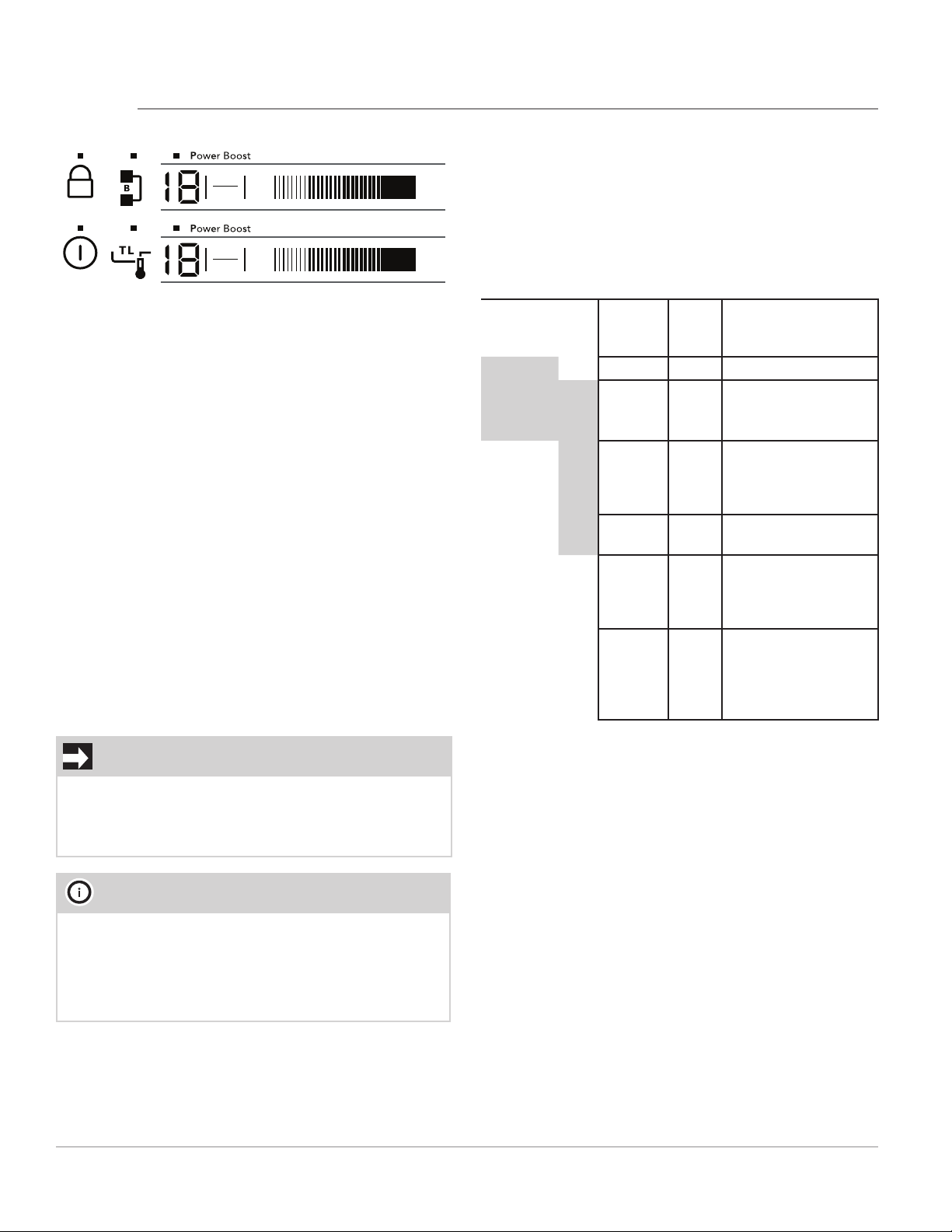
Setting induction cooking zones
To operate an induction cooking zone:
1. Turn the cooktop on by pressing the Power key.
2. Place correctly sized cookware on the cooking
zone. The controls for a zone won’t activate
unless cookware is detected.
3. Press the On/O key for the active cooking
zone. The indicator will turn red.
4. Set the cooking zone to the desired level (refer
to Table 1) by pressing the number of the de-
sired setting or P.
5. When cooking is complete, turn the induction
cooking zone OFF by pressing its On/O key
or the Power key before removing the cook-
ware. If all of the zones are o , the cooktop will
automatically power o in 30 seconds.
At any time, you can change the setting for an ac-
tive cook zone by pressing the number of the new
setting.
IMPORTANT
Do not leave empty cookware on an operating
cooking zone. Cookware will heat very quickly
and may be damaged or warped if left on the
cooking zone empty.
NOTE
A cooking zone will not become active without
proper cookware in position. See “Key-Stuck
Function” on page 12page 11.
If the cooktop does not detect cookware within
30 seconds, it will turn o .
Suggested induction cooking zone settings
Start most cooking operations on a higher setting
and then turn to a lower setting to fi nish cooking.
The suggested settings found in Table 1 below are
based on cooking with medium-weight stainless
steel pans with lids. Settings may vary when using
other types of pans.
Electrolux Induction Recommendations
Temp
Range
Pow-
er
Level
Description
Keep
Warm 145°-
160°F
Low 1 Keep foods warm
Simmer 185 - 200°F
Medium
Low
2-4 Continue cooking,
poach, stew
Medium 5-6 Maintain a slow boil,
thicken sauces and
gravies, steaming,
cooking
Medium
High
7-8 Continue a rapid
boil, fry, or deep fry
High 9 Start most foods,
maintain water at a
boil, pan cooking,
searing
Power
Boil
P Start heating pans
that contain large
amounts of food
or to bring pots of
water to boil
Table 1: Suggested induction cooking zone set-
tings
NOTE:
• The size and type of the cookware used and
the amount and type of food being cooked will
infl uence the setting needed for best cooking
results.
• The Max setting is available after activating a
cooking zone by pressing the MAX key. The
cooktop will remain on Max for up to 10 min-
utes. After 10 minutes, the cooking zone will
automatically change to the high (9) setting.
• The Hot Surface indicator (Hot) will show in
the setting indicator when heat is detected in a
cook zone that has been turned o . The indica-
tor will remain on until the heated surface area
has cooled su ciently.
Figure 15: Induction cooking zone control
17
SETTING SURFACE CONTROLS
TempLock
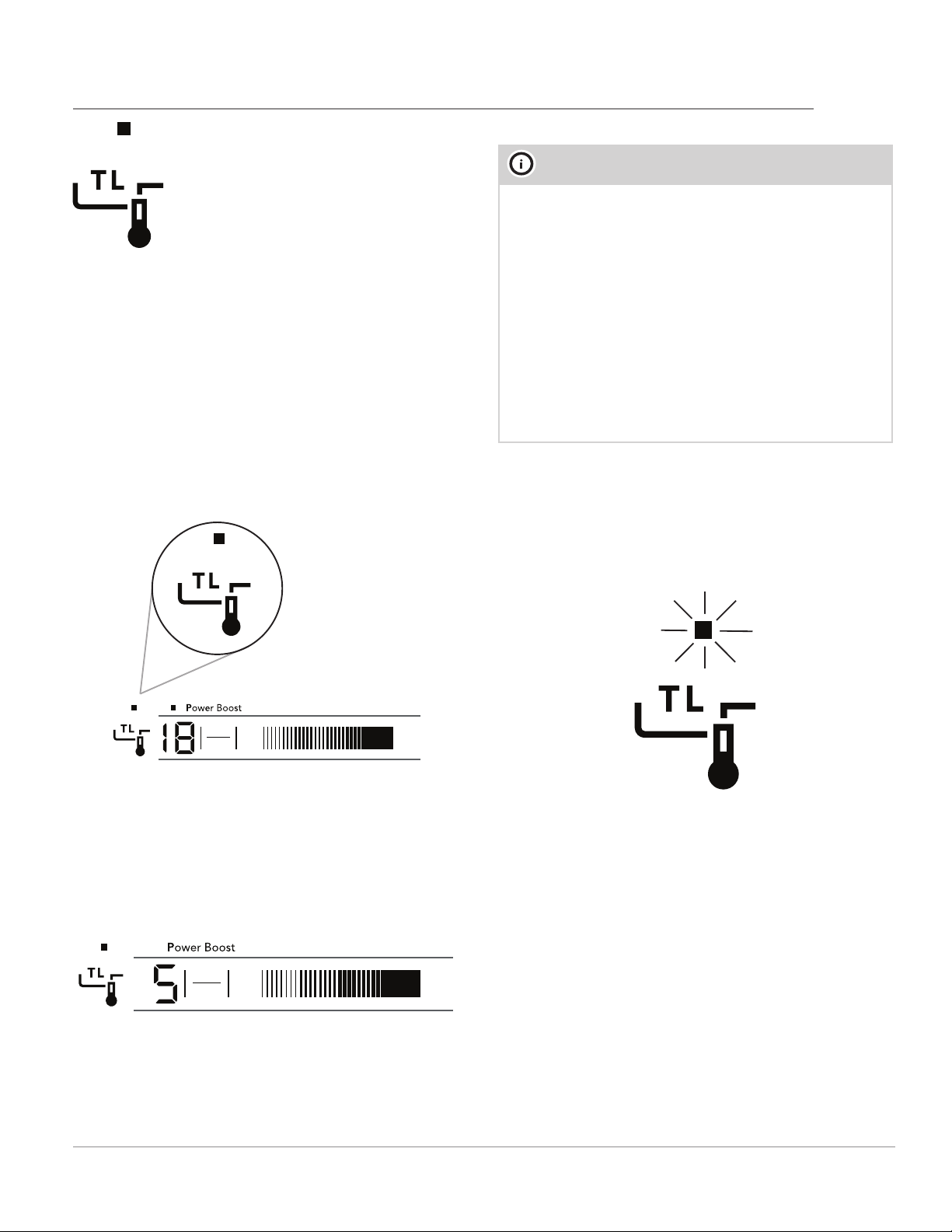
TempLock uses a temperature sensor
to maintain a consistent temperature
when cooking. When cool batter, liq-
uid, or food is added to a hot pan, the
pan cools down a little.
TempLock senses this change and will
use extra power to maintain the desired tempera-
ture setting. The feature also lets you know when
your cookware is preheated, so making pancakes
or sautéing fresh food has better results.
The temperature of your cookware will depend on
the level you select and the material of the cook-
ware you use. Experiment a little to determine
what worksfor you for cooking various dishes. Dif-
ferent pots and pans will hold at di erent tempera-
tures, so you will need to learn how your cookware
works with this feature.
ON
OFF
1P9
Figure 16: TempLock Indicator
TempLock is available for some cooking zones
when they are active.
Press the TempLock Indicator to activate the
TempLock function. The indicator turns red. Press
a number key to select one of the 9 preset cooking
levels.
ON
OFF
1P9
Figure 17: TempLock Set
Preheat Indicators
While the cooking zone is heating, the square
above the TempLock Indicator will fl ash. When
the temperature is reached, the square will stay lit
steadily.
Figure 18: TempLock heating indicator
You can change the TempLock setting at any time
by pressing another number key. The animated
sequence of squares will start again until the new
temperature is reached.
To deactivate the TempLock function, press the
TempLock Indicator.
NOTE
To get an idea of how hot a piece of cookware
will get at a particular setting, try the Magnet
Test (page 10). The more strongly a magnet
clings to the cookware, the hotter that cookware
will get at any particular setting on the cooktop.
To get consistent results, use the same piece of
cookware for particular cooking tasks.
When using small amounts of oil for frying or
sautéing, add the oil after the pan is preheated.
Keep an eye on your cookware during preheat.
Induction is powerful, and letting cookware get
too hot while empty may warp or damage it.
18
SETTING SURFACE CONTROLS
Bridge Function
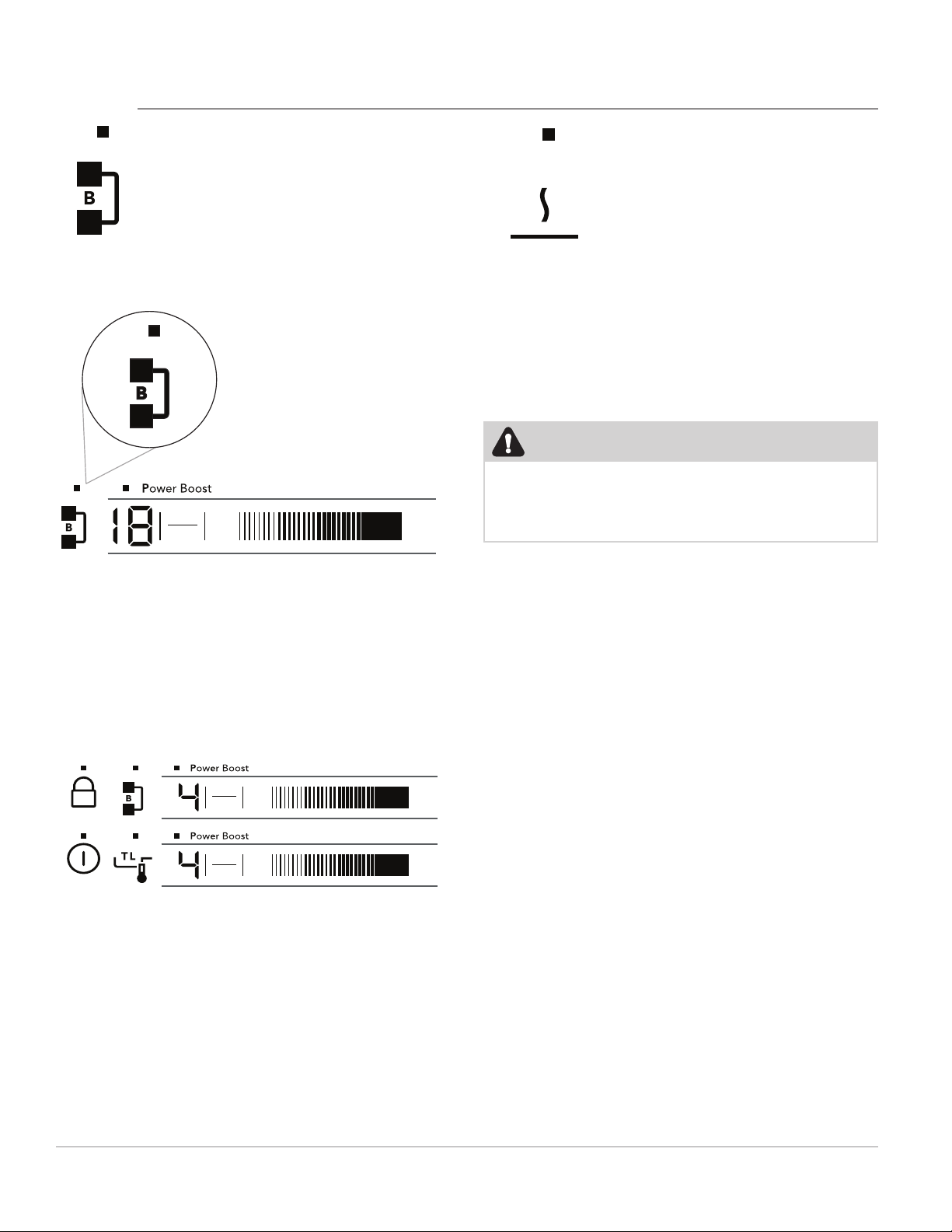
The Bridge function allows you to use an
extra-long piece of cookware such as a
griddle on the left side of your cooktop.
If one of the left cook zones is active
and cookware is detected in both of the
left zones, the bridge function becomes available
and the Bridge Indicator will light up.
ON
OFF
1P9
Figure 19: Bridge Indicator
Touch the Bridge Indicator to activate the bridge
function. The Bridge Indicator will turn red. The
cook zone indicator for the other bridge cook zone
will also turn red, and the cook zone setting for
both of the bridged zones will match. The setting
controls for the front left zone will control both of
the bridged zones as long as the bridge function is
active.
LOCK
POWER
ON
OFF
ON
OFF
1P9
1P
9
Figure 20: Active bridge function
At any time, you can change the setting for the
bridged cook zones by pressing the number of the
new setting on the active control.
To deactivate the bridge function, press the Bridge
Indicator or deactivate one of the bridged cooking
zones by pressing its On/O key.
Serve Warm
Serve Warm allows you to keep
cooked food warm for serving.
When you activate Serve Warm,
all active cooking zones will be set
to a low setting.
To activate Serve Warm, press the Serve Warm In-
dicator. The indicator will turn red, and you will see
the settings change on the active cooking zones.
To deactivate Serve Warm, press the Serve Warm
Indicator again. All of the active cooking zones will
turn o . You can also press the main Power key to
turn the cooktop o .
CAUTION
Serve Warm is not intended to cook food.
Only use Serve Warm with food that is already
cooked. Cover pots with lids to maintain proper
serving temperature.

19
SETTING SURFACE CONTROLS
Setting the Timer (36” Model Only)
The cooktop has a timer function to remind you
when food has been cooking for a specifi ed
amount of time.
Timer
ON/OFF
Figure 21: Cooktop Timer
To set the timer:
1. Press the Timer On/O key (
) to activate
the timer. The countdown timer and the + and
- keys will become visible. The timer will show
00.
2. Press + and - to set the desired number of min-
utes. You can press and hold the + or - key to
change the number of minutes faster.
The timer will start counting down a few seconds
after you have fi nished setting it, when the spec-
ifi ed time has elapsed, the timer will fl ash, and a
tone will sound. Press the +, the -, or the Timer On/
O key (
) to stop the signal.
At any time, you can adjust the remaining time
with the + and - keys.
At any time, you can deactivate the timer by press-
ing the Timer On/O key ( ).
Important: When the timer stops or the tone
sounds, the cooking zones will continue to operate.
The timer does not a ect the cooking zone set-
tings in any way.
20
CARE AND CLEANING
CARE AND CLEANING
Remove spills and any heavy soiling as soon as
possible. Regular cleaning will reduce the di culty
of major cleaning later.
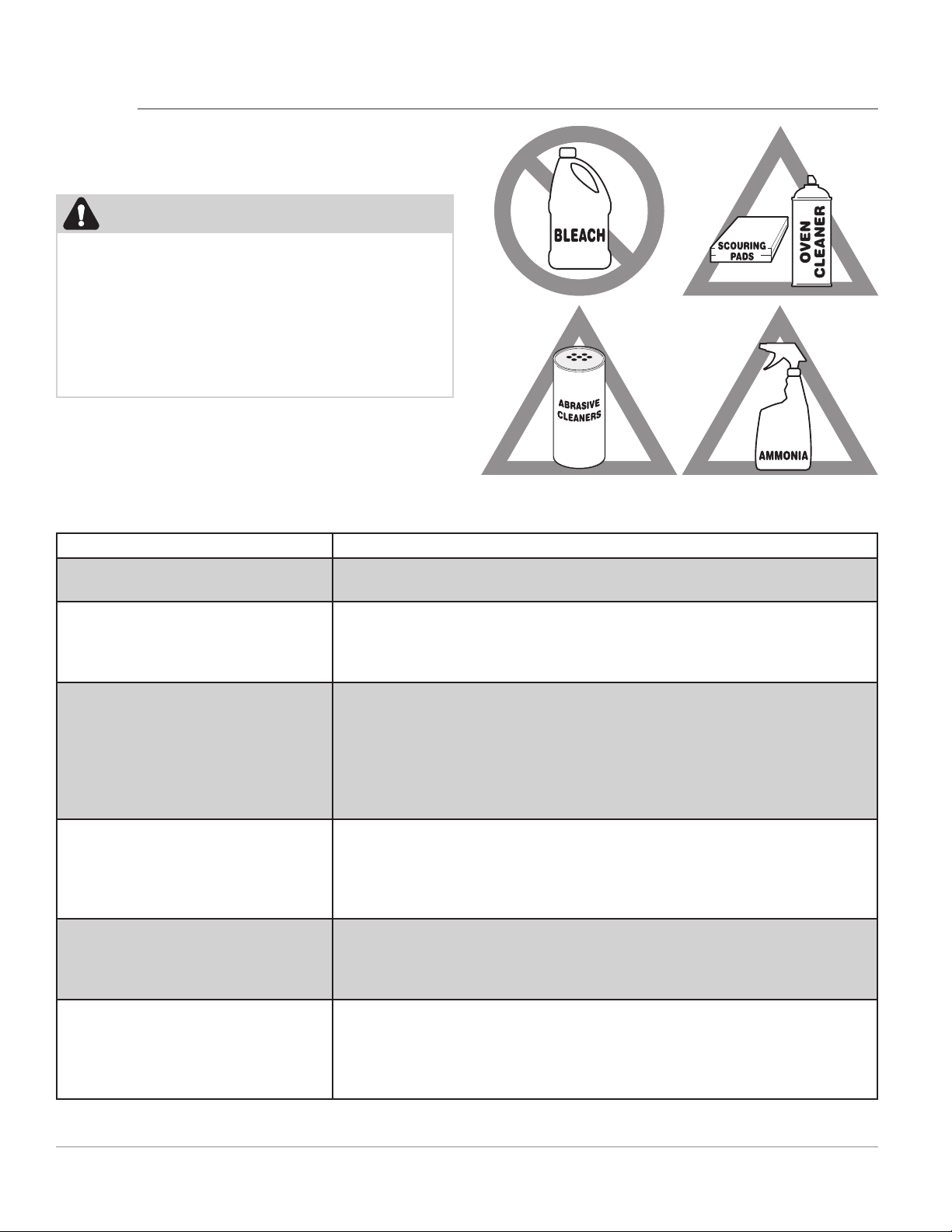
Figure 24: Use cleaners with caution
Surface or Area Cleaning Recommendation
Aluminum and vinyl Using a soft cloth, clean with mild dish detergent and water. Rinse
with clean water, dry and polish with a soft, clean cloth.
Painted and plastic control knobs
Painted body parts
Painted decorative trims
Using a soft cloth, clean with mild dish detergent and water or a
50/50 solution of vinegar and water. Rinse with clean water, dry and
polish with a soft, clean cloth. Glass cleaners may be used, but do
not apply directly to surface; spray onto cloth and wipe.
Control panel Using a soft cloth, clean with mild dish detergent and water or a
50/50 solution of vinegar and water. Do not spray liquids directly on
the oven control and display area. Do not use large amounts of water
on the control panel - excess water on the control area may cause
damage to the appliance. Do not use other liquid cleaners, abrasive
cleaners, scouring pads, or paper towels - they will damage the fi n-
ish.
Control knobs Using a soft cloth, clean with mild dish detergent and water or a
50/50 solution of vinegar and water. To remove control knobs: turn
to the OFF position, grasp fi rmly, and pull o the shaft. To replace
knobs after cleaning, line up the OFF markings and push the knobs
into place.
Stainless Steel Using a soft cloth, clean with mild dish detergent and water or a
50/50 solution of vinegar and water. Rinse with clean water, dry with
a soft clean cloth. Do not use cleaners containing abrasives, chlo-
rides, chlorine, or ammonia.
Smudge Proof™ Stainless Steel
Black Stainless Steel
Using a soft cloth, clean with mild dish detergent and water or a
50/50 solution of vinegar and water. Rinse with clean water, dry with
a soft clean cloth. Do not use appliance cleaner, stainless steel clean-
er, or cleaner containing abrasives, chlorides, chlorine, or ammonia.
These cleaners may damage the fi nish.
CAUTION
Before cleaning any part of the appliance, be sure
all controls are turned o and the appliance is
cool.
If ammonia or appliance cleaners are used, they
must be removed and the appliance must be
thoroughly rinsed before operating. Follow man-
ufacturer’s instructions and provide adequate
ventilation.

21
CARE AND CLEANING
Surface or Area Cleaning Recommendation
Porcelain-enameled broiler pan
and insert
Porcelain door liner
Porcelain body parts
Rinse with clean water and a damp cloth. Scrub gently with a soapy,
non-abrasive scouring pad to remove most spots. Rinse with a 50/50
solution of clean water and ammonia. If necessary, cover di cult
spots with an ammonia-soaked paper towel for 30 to 40 minutes.
Rinse and wipe dry with a clean cloth. Remove all cleaners or future
heating could damage the porcelain. Do not allow food spills with a
high sugar or acid content (milk, tomatoes, sauerkraut, fruit juices or
pie fi lling) to remain on porcelain surfaces. These spills may cause a
dull spot even after cleaning.
Manual clean oven interior The oven interior is porcelain coated and safe to clean using oven
cleaners. Always follow manufacturer's instructions for cleaners. Af-
ter cleaning, remove any oven cleaner or the porcelain may become
damaged during future heating. Do not spray oven cleaner on any
electrical controls or switches. Do not spray or allow oven cleaner to
build up on the oven temperature sensing probe. Do not spray clean-
er on oven door trim, door gasket, plastic drawer glides, handles or
any exterior surfaces of the appliance.
Self-cleaning oven interior Before setting a self-clean cycle, clean soils from the oven frame,
areas outside the oven door gasket, and the small area at the front
center of the oven bottom. See “Self Clean” on page 23.
Oven door Use mild dish detergent and water or a 50/50 solution of vinegar
and water to clean the top, sides, and front of the oven door. Rinse
well. Glass cleaner may be used on the outside glass of the door. Ce-
ramic smoothtop cleaner or polish may be used on the interior door
glass. Do not immerse the door in water. Do not spray or allow water
or cleaners to enter the door vents. Do not use oven cleaners, clean-
ing powders, or any harsh abrasive cleaning materials on the outside
of the oven door.
Do not clean the oven door gasket. The oven door gasket is made of
a woven material which is essential for a good seal. Do not rub, dam-
age, or remove this gasket.
Ceramic cooktop See “Cooktop Cleaning” on page 22.
22
CARE AND CLEANING
Cooktop Maintenance
Consistent and proper cleaning is essential to
maintaining your ceramic glass cooktop.
Prior to using your cooktop for the fi rst time, apply
a ceramic cooktop cleaning cream (available in
most hardware, grocery, and department stores)
to the ceramic surface. Clean and bu with a clean
paper towel. This will make cleaning easier when
soiled from cooking. Cooktop cleaning creams
leave a protective fi nish on the glass to help pre-
vent scratches and abrasions.
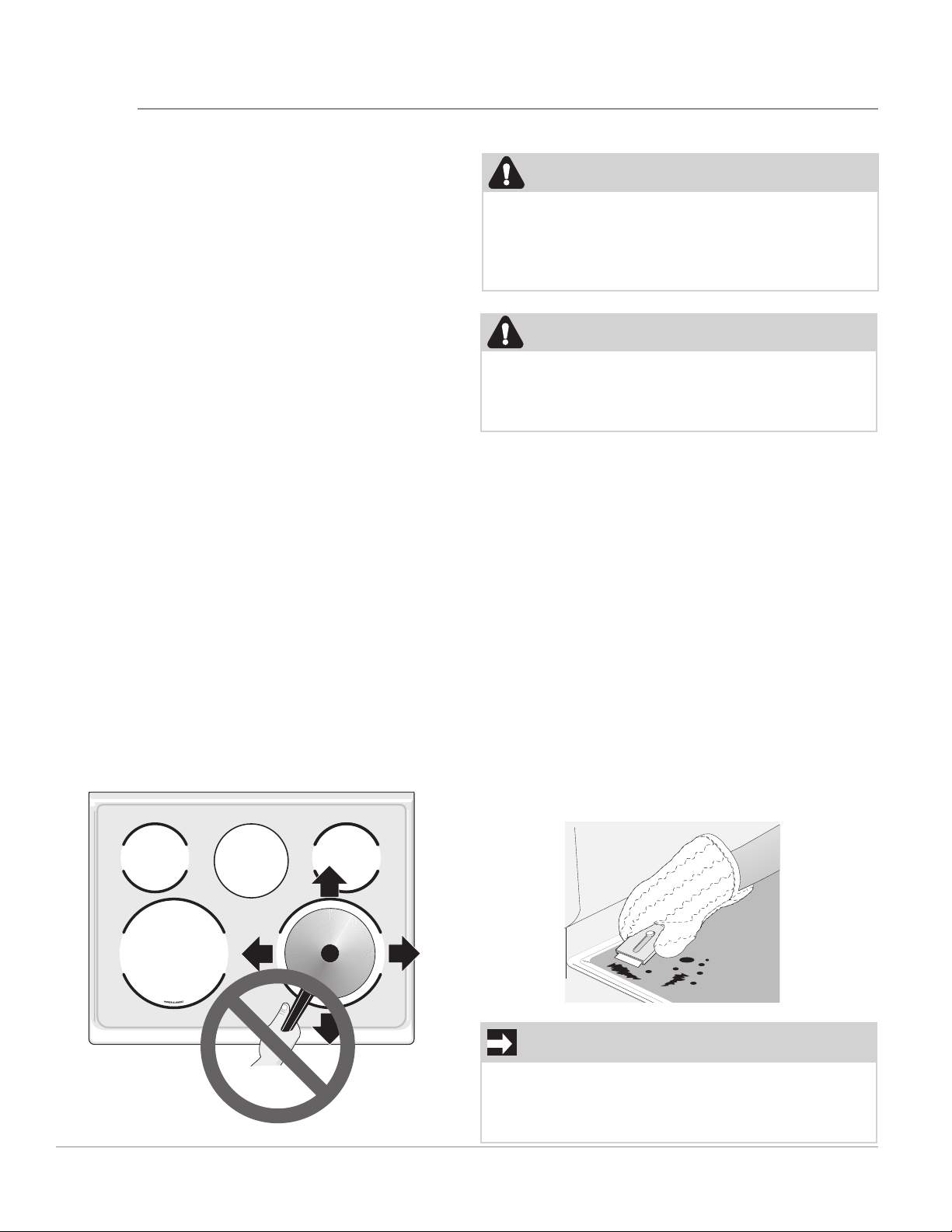
Sliding pans on the cooktop can cause metal mark-
ings on the cooktop surface. These marks should
be removed immediately after the cooktop has
cooled using cooktop cleaning cream. Metal marks
can become permanent if not removed prior to
future use.
Cookware (cast iron, metal, ceramic, or glass) with
rough bottoms can mark or scratch the cooktop
surface.
Do not:
• Slide anything metal or glass across the cook-
top.
• Use cookware with dirt or dirt build up on the
bottom; always use clean cookware.
• Use your cooktop as a cutting board or work
surface in the kitchen.
• Cook foods directly on the cooktop surface
without a pan.
• Drop heavy or hard objects on the ceramic
glass cooktop; they may cause it to crack.
Figure 25: Cooktop care
For light to moderate soil:
For light to moderate soil: Apply a few drops of
cooktop cleaning cream directly to the cooktop.
Use a clean paper towel to clean the entire cook-
top surface. Make sure the cooktop is cleaned
thoroughly, leaving no residue. Do not use the
towel you use to clean the cooktop for any other
purpose.
For heavy, burned on soil:
Apply a few drops of cooktop cleaning cream di-
rectly to the soiled area. Rub the soiled area using
a non-abrasive cleaning tool, applying pressure as
needed. Do not use the pad you use to clean the
cooktop for any other purpose.
If soils remain, carefully scrape soils with a metal
razor blade scraper held at a 30 degree angle to
the surface. Finish cleaning with cooktop cleaning
cream.
30°
Figure 26: Cooktop cleaning
Cooktop Cleaning
IMPORTANT
Damage to the ceramic glass cooktop may occur
if you use an abrasive type cleaning pad. Only
use cleaning products that have been specifi cally
designed for ceramic glass cooktops.
CAUTION
Before cleaning the cooktop, be sure the controls
are turned to OFF and the cooktop is cool. The
glass surface could be hot from contact with hot
cookware, and burns may occur if the glass sur-
face is touched before it has cooled su ciently.
WARNING
Do not use a cooktop cleaner on a hot cooktop.
The fumes can be hazardous to your health, and
can chemically damage the ceramic-glass sur-
face.
23
BEFORE YOU CALL
1-800-265-8352 (Canada)
Frigidaire.ca
1-800-374-4432 (United States)
Frigidaire.com
Let us help you troubleshoot your concern! This section will help you with common issues. If you need us,
visit our website, chat with an agent, or call us. We may be able to help you avoid a service visit. If you do
need service, we can get that started for you!
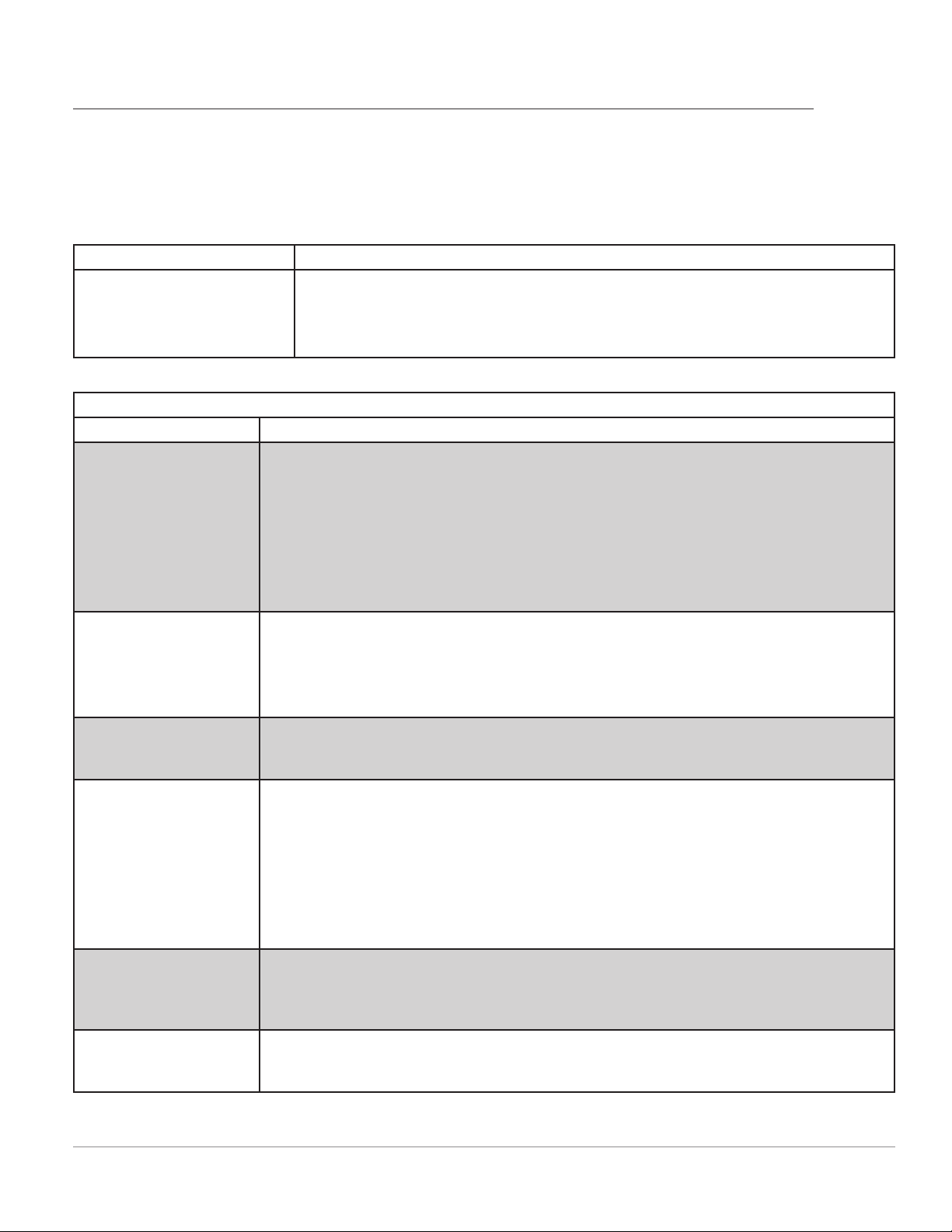
Problem Cause / Solution
Entire appliance does not
operate
Appliance not connected. Make sure power cord is plugged properly into
outlet. Check your fuse box or breaker box to make sure the circuit is active.
Electrical power outage. Check house lights to be sure. Call your local elec-
tric company for service outage information.
Cooktop Problems
Problem Cause / Solution
Cooking zone does
not heat or does not
heat evenly.
Be sure the correct surface control knob is turned on for the element needed.
Be sure to use the correct cookware material type for induction cooking. Use
cookware specifi cally identifi ed by the manufacturer to use for induction cook-
ing. If you’re not sure, use a magnet to test whether the cookware type will work.
If a magnet sticks to the bottom of the cookware, the material type is correct for
induction cooking.
Be sure to read about pan-sensing in the Induction Cooking section and correct
any pan-sensing issues in the checklist provided.
Control for the cook-
ing zone does not
work.
Incorrect cookware used. See “Using Proper Cookware” on page 10.
Cookware is the wrong size or incorrectly positioned in the cooking zone. See
“Pan Sensing” on page 11
More than one control was pressed at a time. Make sure that when you try to
confi gure the control, nothing is touching another control.
Areas of discoloration
with metallic sheen on
cooktop surface.
Mineral deposits from water and food. Remove them using cooktop cleaning
creme applied to the ceramic surface. Bu with a non-abrasive cloth or sponge.
Scratches or abrasions
on cooktop surface.
Coarse particles such as salt or hardened soils between cooktop and utensils
can cause scratches. Be sure the cooktop surface and bottoms of utensils are
clean before use. Small scratches do not a ect cooking and will become less
visible with time.
Cleaning materials not recommended for ceramic-glass cooktop have been
used. Apply cooktop cleaning creme to the ceramic surface. Bu with a
non-abrasive cloth or sponge.
Cookware with a rough bottom was used. Use smooth, fl at-bottomed cookware.
Metal marks on the
cooktop.
Sliding or scraping of metal utensils on cooktop surface. Do not slide metal
utensils on the cooktop surface. Apply cooktop cleaning creme to the ceramic
surface. Bu with a non-abrasive cloth or sponge. For more information, see
“Cooktop Maintenance” on page 22.
Brown streaks or
specks on cooktop
surface.
Boil overs are cooked onto the surface. When cooktop is cool, use a razor blade
scraper to remove soil. For more information see “Cooktop Maintenance” on
page 21.

24
WARRANTY
WARRANTY
Your appliance is covered by a one year limited warranty. For one year from your original date of purchase,
Electrolux will pay all costs for repairing or replacing any parts of this appliance that prove to be defective
in materials or workmanship when such appliance is installed, used and maintained in accordance with the
provided instructions.
Exclusions
This warranty does not cover the following:
1. Products with original serial numbers that have been removed, altered or cannot be readily determined.
2. Product that has been transferred from its original owner to another party or removed outside the USA or
Canada.
3. Rust on the interior or exterior of the unit.
4. Products purchased “as-is” are not covered by this warranty.
5. Food loss due to any refrigerator or freezer failures.
6. Products used in a commercial setting.
7. Service calls which do not involve malfunction or defects in materials or workmanship, or for appliances not
in ordinary household use or used other than in accordance with the provided instructions.
8. Service calls to correct the installation of your appliance or to instruct you how to use your appliance.
9. Expenses for making the appliance accessible for servicing, such as removal of trim, cupboards, shelves, etc.,
which are not a part of the appliance when it is shipped from the factory.
10. Service calls to repair or replace appliance light bulbs, air fi lters, water fi lters, other consumables, or knobs,
handles, or other cosmetic parts.
11. Surcharges including, but not limited to, any after hour, weekend, or holiday service calls, tolls, ferry trip
charges, or mileage expense for service calls to remote areas, including the state of Alaska.
12. Damages to the fi nish of appliance or home incurred during installation, including but not limited to fl oors,
cabinets, walls, etc.
13. Damages caused by: services performed by unauthorized service companies; use of parts other than
genuine Electrolux parts or parts obtained from persons other than authorized service companies; or
external causes such as abuse, misuse, inadequate power supply, accidents, fi res, or acts of God.
DISCLAIMER OF IMPLIED WARRANTIES; LIMITATION OF REMEDIES
CUSTOMER’S SOLE AND EXCLUSIVE REMEDY UNDER THIS LIMITED WARRANTY SHALL BE PRODUCT REPAIR
OR REPLACEMENT AS PROVIDED HEREIN. CLAIMS BASED ON IMPLIED WARRANTIES, INCLUDING WARRANTIES
OF MERCHANTABILITY OR FITNESS FOR A PARTICULAR PURPOSE, ARE LIMITED TO ONE YEAR OR THE
SHORTEST PERIOD ALLOWED BY LAW, BUT NOT LESS THAN ONE YEAR. ELECTROLUX SHALL NOT BE LIABLE
FOR CONSEQUENTIAL OR INCIDENTAL DAMAGES SUCH AS PROPERTY DAMAGE AND INCIDENTAL EXPENSES
RESULTING FROM ANY BREACH OF THIS WRITTEN LIMITED WARRANTY OR ANY IMPLIED WARRANTY. SOME
STATES AND PROVINCES DO NOT ALLOW THE EXCLUSION OR LIMITATION OF INCIDENTAL OR CONSEQUENTIAL
DAMAGES, OR LIMITATIONS ON THE DURATION OF IMPLIED WARRANTIES, SO THESE LIMITATIONS OR EXCLUSIONS
MAY NOT APPLY TO YOU. THIS WRITTEN WARRANTY GIVES YOU SPECIFIC LEGAL RIGHTS. YOU MAY ALSO HAVE
OTHER RIGHTS THAT VARY FROM STATE TO STATE.
If You Need Service
Keep your receipt, delivery slip, or some other appropriate payment record to establish the warranty period
should service be required. If service is performed, it is in your best interest to obtain and keep all receipts.
Service under this warranty must be obtained by contacting Electrolux at the addresses or phone numbers
below.
This warranty only applies in the USA and Canada. In the USA, your appliance is warranted by Electrolux Major
Appliances North America, a division of Electrolux Home Products, Inc. In Canada, your appliance is warranted by
Electrolux Canada Corp. Electrolux authorizes no person to change or add to any obligations under this warranty.
Obligations for service and parts under this warranty must be performed by Electrolux or an authorized service
company. Product features or specifi cations as described or illustrated are subject to change without notice.
USA
1-800-374-4432
Frigidaire
10200 David Taylor Drive
Charlotte, NC 28262
Canada
1.800.265.8352
Electrolux Canada Corp.
5855 Terry Fox Way
Mississauga, Ontario, Canada
L5V 3E4
welcome
home
Frigidaire.com
1-800-374-4432
Frigidaire.ca
1-800-265-8352
owner support
accessories
service
Our home is your home. Visit us if you
need help with any of these things:
registration
(See your registration card
for more information.)
A01704804 A 10/2021