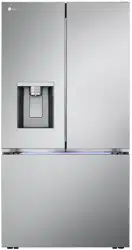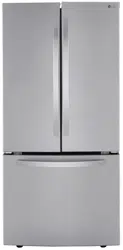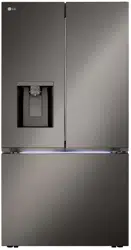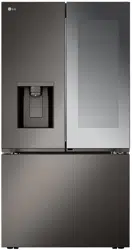
FRENCHDOOR
REFRIGERAIOR
[% AttAH0_IINSff/UCIlONS
Please read this guide
thoroughly before
operating and keep it handy
for reference at all times.
To contact LG Electronics,24 hours a day,
7 days a week:
1-800-243-0000
Or visitus on theWeb at: us.lge.com
Pour contacter LG Electronics,24 heures par
jour, 7 jours par semaine :
1-800-243-0000
Ou visitez notre site Web a radresse :us.lge.com
Para comunicarse con LG Electronics,
24 horas al dia, 7 dias a la semana:
1-800-243-0000
0 visitenos en la Web en: u&Ige.com
fiEFfllc[flAlEUflA
pOfilESFflANCAISES
trIpED'UlllIsAiiON[-i
IP_Sit_UC-iIONSD'll%iAtLi_lION
Veuillez lire ce guide attentivement
avant Ia raise en service de I'appareil
et gardez-le a port¢e de main
pour le consulter en cas de besoin.
REFRIGERADORDE
PUEfllAFRANCES
CU[/_Pf_RA[1USO[
INS[RUCCDNESDEINS-IAIA(]ON
Lea detenidamente estas
instrucciones antes utilizar
et frigorifice y guardelas como
referencia para el futuro.
Models/Modelos/Modeles
LFX25980**,LFX21980**
P/No. MFL37933505
IN|RODUC|ION
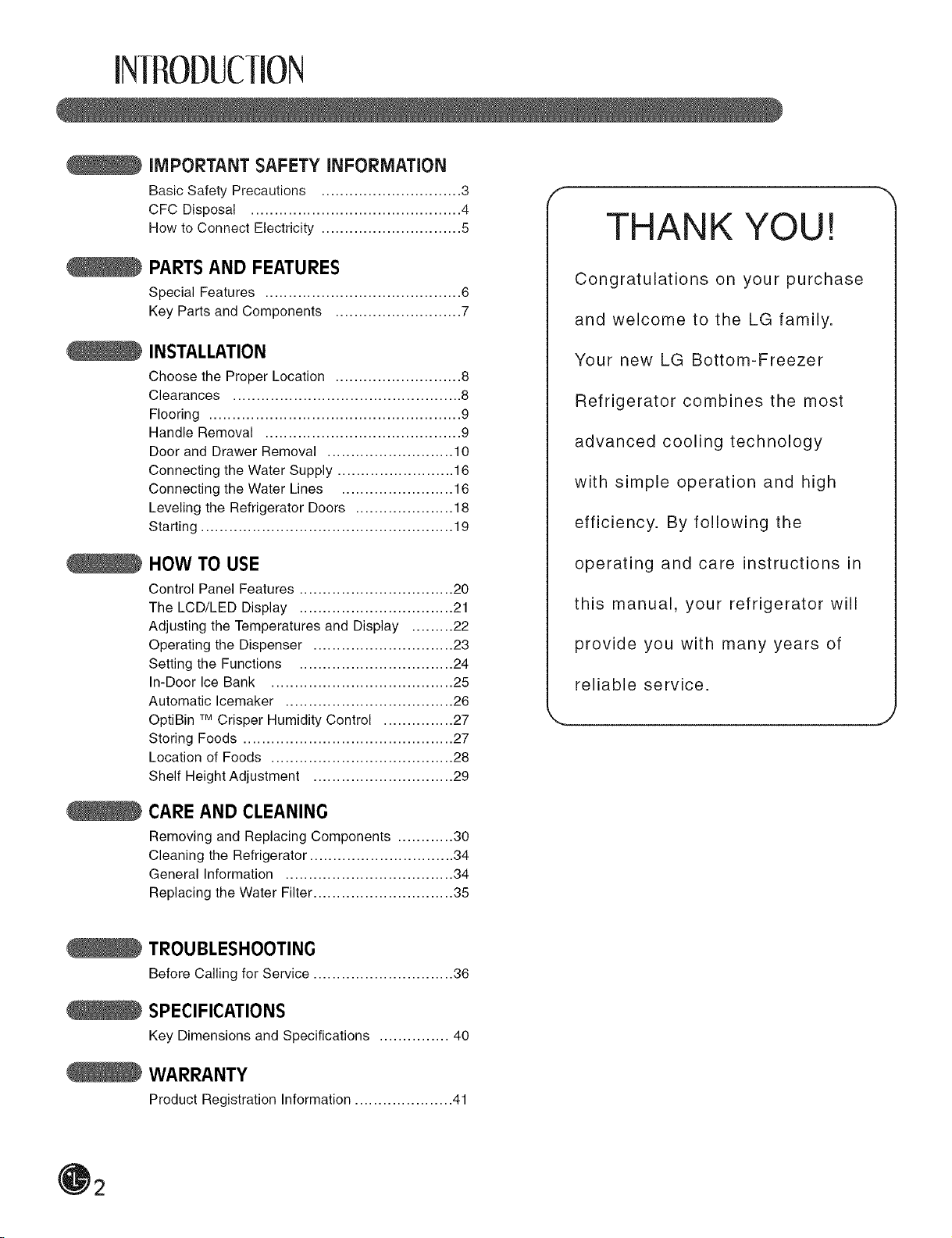
IMPORTANT SAFETY INFORMATION
Basic Safety Precautions .............................. 3
CFC Disposal ............................................. 4
How to Connect Electricity .............................. 5
PARTS AND FEATURES
Special Features .......................................... 6
Key Parts and Components ........................... 7
INSTALLATION
Choose the Proper Location ........................... 8
Clearances ................................................. 8
Flooring ...................................................... 9
Handle Removal .......................................... 9
Door and Drawer Removal ........................... 10
Connecting the Water Supply ......................... 16
Connecting the Water Lines ........................ 16
Leveling the Refrigerator Doors ..................... 18
Starting ...................................................... 19
HOW TO USE
Control Panel Features ................................. 20
The LCD/LED Display ................................. 21
Adjusting the Temperatures and Display ......... 22
Operating the Dispenser .............................. 23
Setting the Functions ................................. 24
In-Door Ice Bank ....................................... 25
Automatic Icemaker .................................... 26
OptiBin TMCrisper Humidity Control ............... 27
Storing Foods ............................................. 27
Location of Foods ....................................... 28
Shelf Height Adjustment .............................. 29
CARE AND CLEANING
Removing and Replacing Components ............ 30
Cleaning the Refrigerator ............................... 34
General Information .................................... 34
Replacing the Water Filter .............................. 35
THANK YOU
Congratulations on your purchase
and welcome to the LG family.
Your new LG Bottom-Freezer
Refrigerator combines the most
advanced cooling technology
with simple operation and high
efficiency. By following the
operating and care instructions in
this manual, your refrigerator will
provide you with many years of
reliable service.
TROUBLESHOOTING
Before Calling for Service .............................. 36
SPECIFICATIONS
Key Dimensions and Specifications ............... 40
WARRANTY
Product Registration Information ..................... 41
iMPORTANTSAFETYiNFORMATiON
BASIC SAFETY PRECAUTIONS
This guide contains many important safety messages. Always read and obey all
safety messages.
_This is the safety alert symbol. It alerts you to safety messages that inform you of hazards that can kill
or hurt you or others or cause damage to the product. All safety messages will be preceded by the safety
alert symbol and the hazard signal word DANGER, WARNING, or CAUTION. These words mean:
ADANGER
AWARNING
You will be killed or seriously injured if you don't follow instructions.
You can be killed or seriously injured if you don't follow instructions.
A UTION indicates an imminently hazardous situation which, if not avoided, may
result inminor or moderate injury, or product damage only.
All safety messages will identify the hazard, tell you how to reduce the chance of injury,and tell you
what can happen if the instructionsare not followed.
,WARNING
To reduce the risk of fire, electric shock, or
injury to persons when using your product,
basic safety precautions should be followed,
including the following.
Read all instructions before using this appliance.
• NEVER unplug your refrigerator by pulling on the
power cord. Always grip the plug firmly and pull it
straight out from the outlet.
• Repair or replace immediately all electric service
cords that have become frayed or otherwise
damaged. Do not use a cord that shows cracks or
abrasion damage along its length or at either the
plug or connector end.
When moving your refrigerator away from the wall,
be careful not to roll over or damage the power
cord.
DO NOT store or use gasoline or other flammable
vapors and liquids in the vicinity of this or any
other appliance.
DO NOT allow children to climb, stand, or hang on
the refrigerator doors or shelves in the refrigerator.
They could damage the refrigerator and seriously
injure themselves.
Keep fingers out of pinch point areas; clearances
between the doors and cabinet are necessarily
small. Be careful closing doors when children are
in the area.
Unplug your refrigerator before cleaning or making
any repairs.
NOTE: Service should be performed by a qualified
technician.
Before replacing a burned-out light bulb, unplug
the refrigerator or turn off power at the circuit
breaker or fuse box in order to avoid contact with
a live wire filament. (A burned-out light bulb may
break when being replaced.)
NOTE: Setting either or both controls to the OFF
position does not remove power to the light circuit.
• This refrigerator must be properly installed in
accordance with the Attention Installer Instructions
that were taped to the front of the refrigerator.
After your refrigerator is in operation, do not touch
the cold surfaces in the freezer compartment
when hands are damp or wet. Skin may adhere to
the extremely cold surfaces.
In refrigerators with automatic icemakers, avoid
contact with the moving parts of the ejector
mechanism or with the heating element that
releases the cubes. DO NOT place fingers or
hands on the automatic icemaking mechanism
while the refrigerator is plugged in.
• Do not modify or extend the power cord length.
It will cause electric shock or fire.
IMPORt&N!SAFETYINFORMAHON
BASIC SAFETY PRECAUTIONS (CONT.)
• DO NOT refreeze frozen foods which have
thawed completely. The United States
Department of Agriculture in Home and Garden
Bulletin No. 69 says:
...You may safely refreeze frozen foods that have
thawed if they still contain ice crystals or if they
are still cold--below 40°F (4°C).
...Thawed ground meats, poultry, or fish that have
any off-odor or off-color should not be refrozen
and should not be eaten. Thawed ice cream
should be discarded. If the odor or color of any
food is poor or questionable, dispose of it. The
food may be dangerous to eat.
Even partial thawing and refreezing reduces the
eating quality of foods, particularly fruits,
vegetables, and prepared foods. The eating
quality of red meats is affected less than that of
many other foods. Use refrozen foods as soon
as possible to save as much of their quality as
you can.
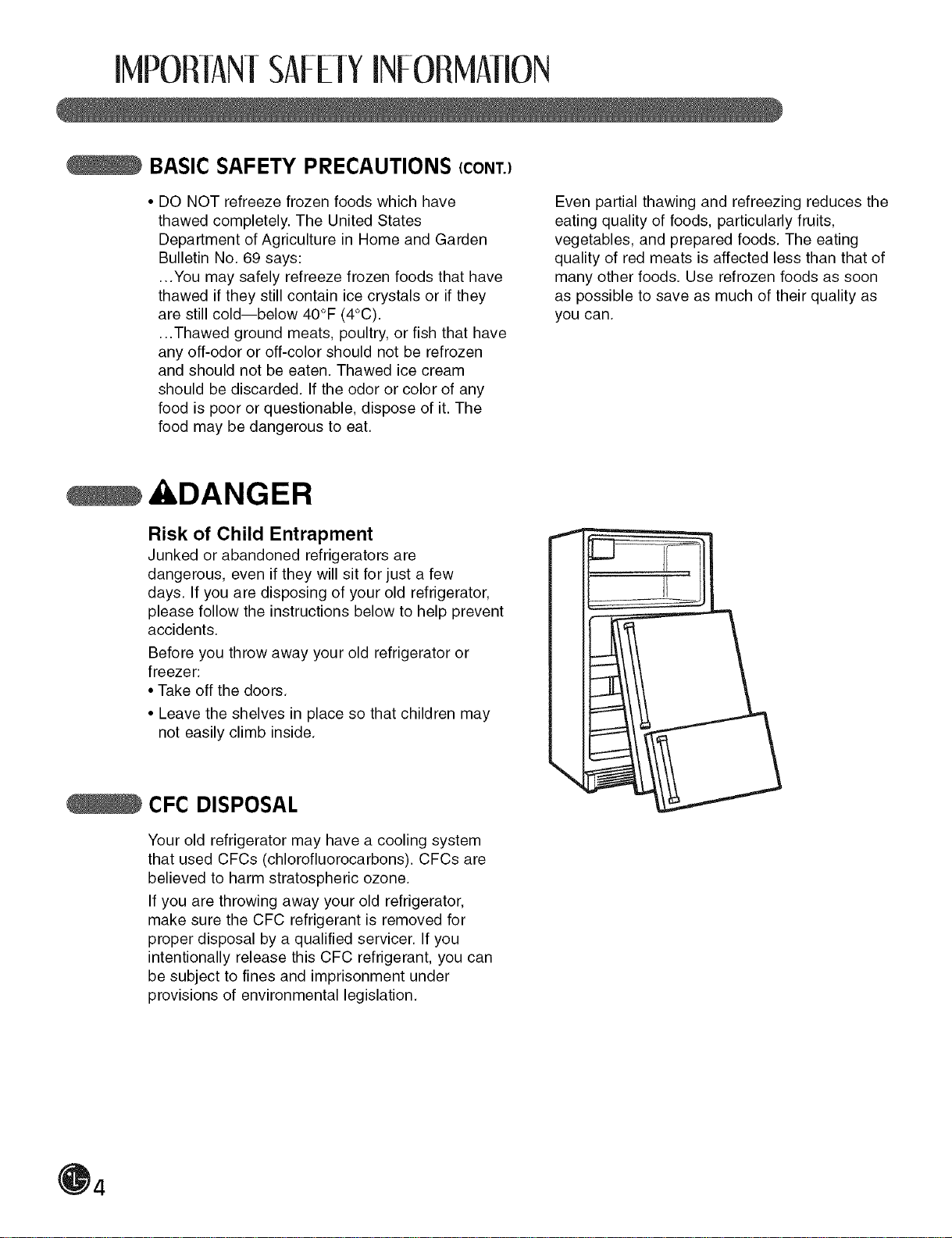
ADANGER
Risk of Child Entrapment
Junked or abandoned refrigerators are
dangerous, even if they will sit for just a few
days. If you are disposing of your old refrigerator,
please follow the instructions below to help prevent
accidents.
Before you throw away your old refrigerator or
freezer:
• Take off the doors.
• Leave the shelves in place so that children may
not easily climb inside.
CFC DISPOSAL
Your old refrigerator may have a cooling system
that used CFCs (chlorofluorocarbons). CFCs are
believed to harm stratospheric ozone.
If you are throwing away your old refrigerator,
make sure the CFC refrigerant is removed for
proper disposal by a qualified servicer. If you
intentionally release this CFC refrigerant, you can
be subject to fines and imprisonment under
provisions of environmental legislation.
\
4
IMPORIANTSAFETYINFORMATION
HOW TO CONNECT ELECTRICITY
IMPORTANT: Please read carefully.
&WARNINIG
Electrical Shock Hazard
For personal safety, this appliance must be
properly grounded. Have the wall outlet and
the circuit checked by a qualified electrician to
make sure the outlet is properly grounded.
f
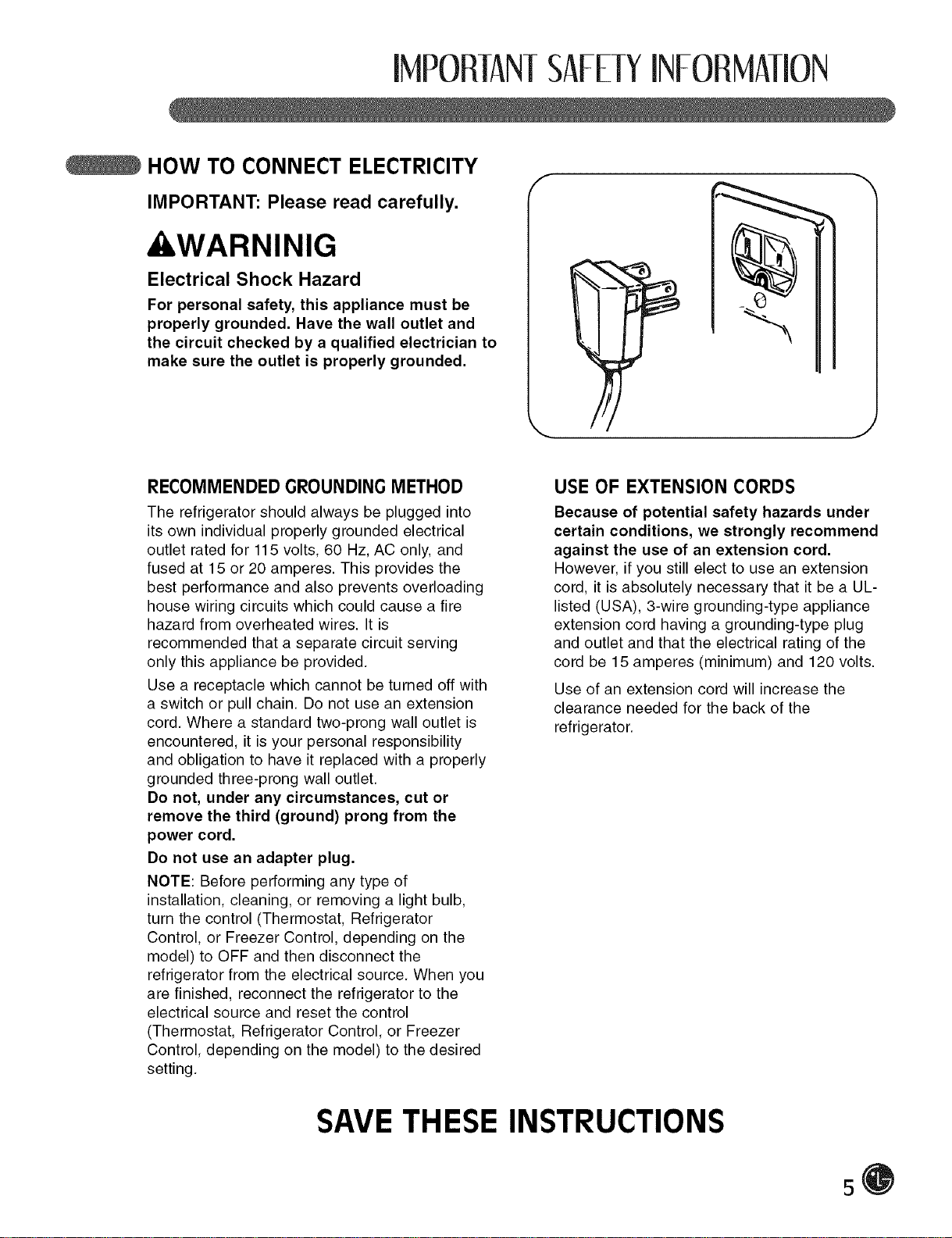
RECOMMENDED GROUNDING METHOD
The refrigerator should always be plugged into
its own individual properly grounded electrical
outlet rated for 115 volts, 60 Hz, AC only, and
fused at 15 or 20 amperes. This provides the
best performance and also prevents overloading
house wiring circuits which could cause a fire
hazard from overheated wires. It is
recommended that a separate circuit serving
only this appliance be provided.
Use a receptacle which cannot be turned off with
a switch or pull chain. Do not use an extension
cord. Where a standard two-prong wall outlet is
encountered, it is your personal responsibility
and obligation to have it replaced with a properly
grounded three-prong wall outlet.
Do not, under any circumstances, cut or
remove the third (ground) prong from the
power cord.
Do not use an adapter plug.
NOTE: Before performing any type of
installation, cleaning, or removing a light bulb,
turn the control (Thermostat, Refrigerator
Control, or Freezer Control, depending on the
model) to OFF and then disconnect the
refrigerator from the electrical source. When you
are finished, reconnect the refrigerator to the
electrical source and reset the control
(Thermostat, Refrigerator Control, or Freezer
Control, depending on the model) to the desired
setting.
USE OF EXTENSION CORDS
Because of potential safety hazards under
certain conditions, we strongly recommend
against the use of an extension cord.
However, if you still elect to use an extension
cord, it is absolutely necessary that it be a UL-
listed (USA), 3-wire grounding-type appliance
extension cord having a grounding-type plug
and outlet and that the electrical rating of the
cord be 15 amperes (minimum) and 120 volts.
Use of an extension cord will increase the
clearance needed for the back of the
refrigerator.
SAVE THESE INSTRUCTIONS
PARTSANDFEATURES
SPECIAL FEATURES
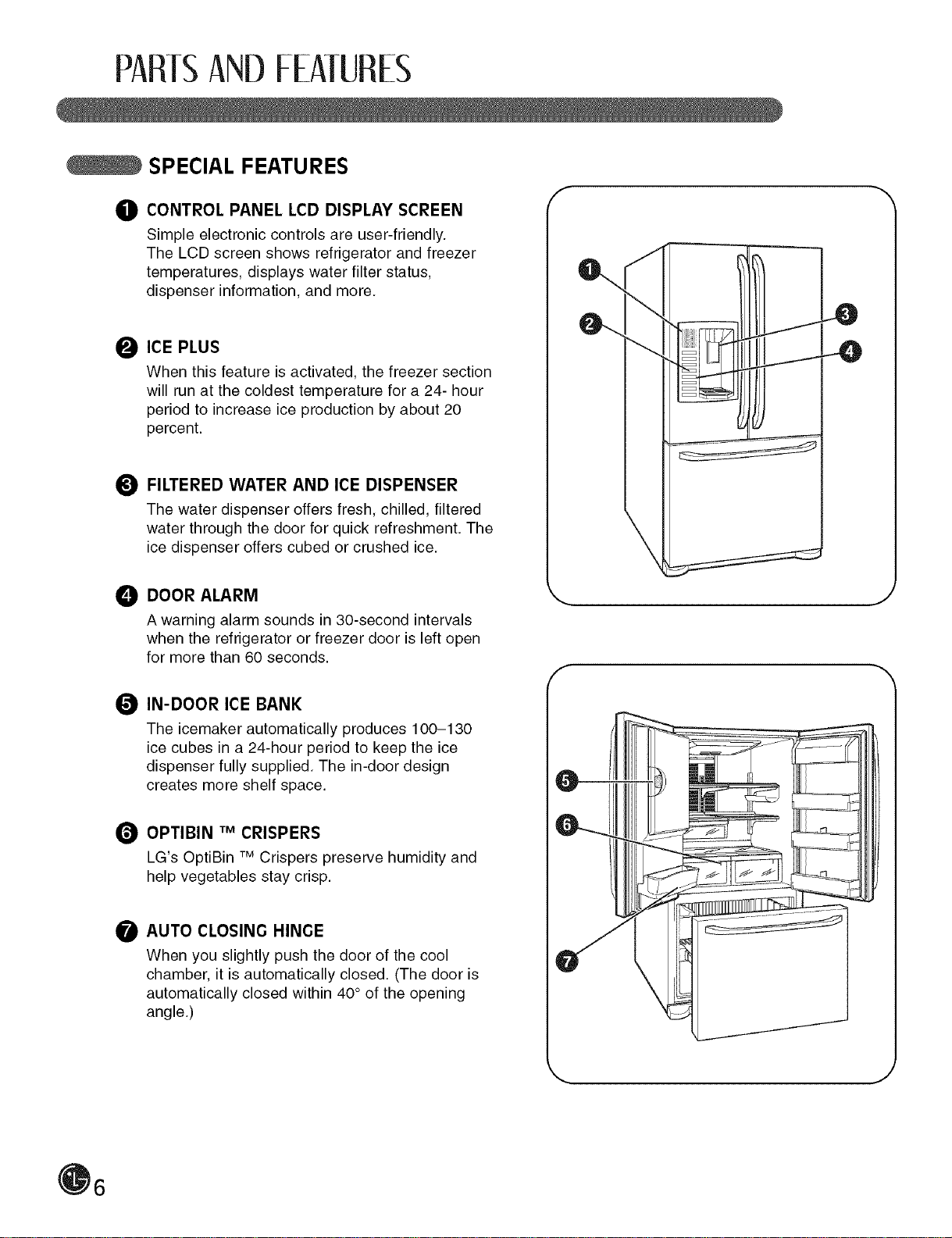
_i_ CONTROL PANEL LCD DISPLAY SCREEN
Simple electronic controls are user-friendly.
The LCD screen shows refrigerator and freezer
temperatures, displays water filter status,
dispenser information, and more.
O ICE PLUS
When this feature is activated, the freezer section
will run at the coldest temperature for a 24- hour
period to increase ice production by about 20
percent.
0
FILTERED WATER AND ICE DISPENSER
The water dispenser offers fresh, chilled, filtered
water through the door for quick refreshment. The
ice dispenser offers cubed or crushed ice.
O DOOR ALARM
A warning alarm sounds in 30-second intervals
when the refrigerator or freezer door is left open
for more than 60 seconds.
O IN-DOOR ICE BANK
The icemaker automatically produces 100-130
ice cubes in a 24-hour period to keep the ice
dispenser fully supplied. The in-door design
creates more shelf space.
J
f
OPTIBIN TmCRISPERS
LG's OptiBin TM Crispers preserve humidity and
help vegetables stay crisp.
O AUTO CLOSING HINGE
When you slightly push the door of the cool
chamber, it is automatically closed. (The door is
automatically closed within 40 ° of the opening
angle.)
PARTSANDFEATURES
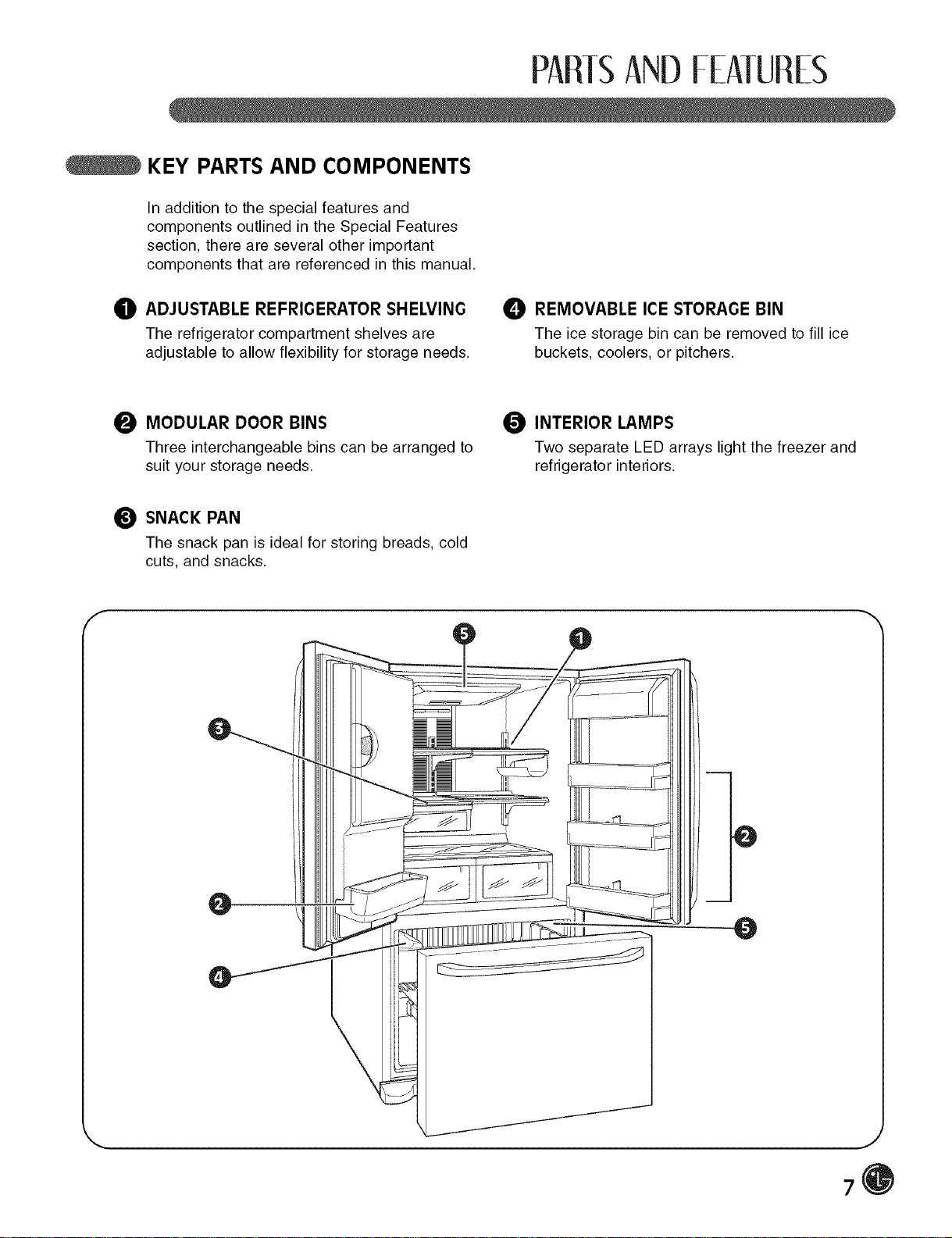
KEY PARTS AND COMPONENTS
In addition to the special features and
components outlined in the Special Features
section, there are several other important
components that are referenced in this manual.
O ADJUSTABLE REFRIGERATOR SHELVING
The refrigerator compartment shelves are
adjustable to allow flexibility for storage needs.
_]_ REMOVABLE ICE STORAGE BIN
The ice storage bin can be removed to fill ice
buckets, coolers, or pitchers.
O MODULAR DOOR BINS O INTERIOR LAMPS
Three interchangeable bins can be arranged to Two separate LED arrays light the freezer and
suit your storage needs, refrigerator interiors.
SNACK PAN
The snack pan is ideal for storing breads, cold
cuts, and snacks.
f
7
INS|AlIA|iON
CHOOSE THE PROPER LOCATION
&WARNING
Excessive Weight Hazard
Two or more people are required when
moving and unpacking the appliance.
• Store and install the refrigerator where it will not
be exposed to temperatures below freezing or
exposed to outdoor weather conditions.
• Install this appliance in an area where the
temperature is between 55°F (13°C) and 110°F
(43°C). If the temperature around the appliance
is too low or too high, cooling ability may be
adversely affected.
• If this refrigerator is installed where the
temperature is above 110°F (43°C), the
freezing capacity is compromised and the cost
of electricity used increases.
• To reduce the risk of electric shock, do not
install the refrigerator in a wet or damp area.
• Select a place where a water supply can be
easily connected for the automatic icemaker
and dispenser.
• Unstable installation may cause vibration and
noise. If the floor is not even, make the
refrigerator level by rotating the height adjusting
screws.
• Properly ground the refrigerator to conform with
all governing codes and ordinances.
&CAUTION
Avoid placing the unit near heat sources,
direct sunlight, or moisture.
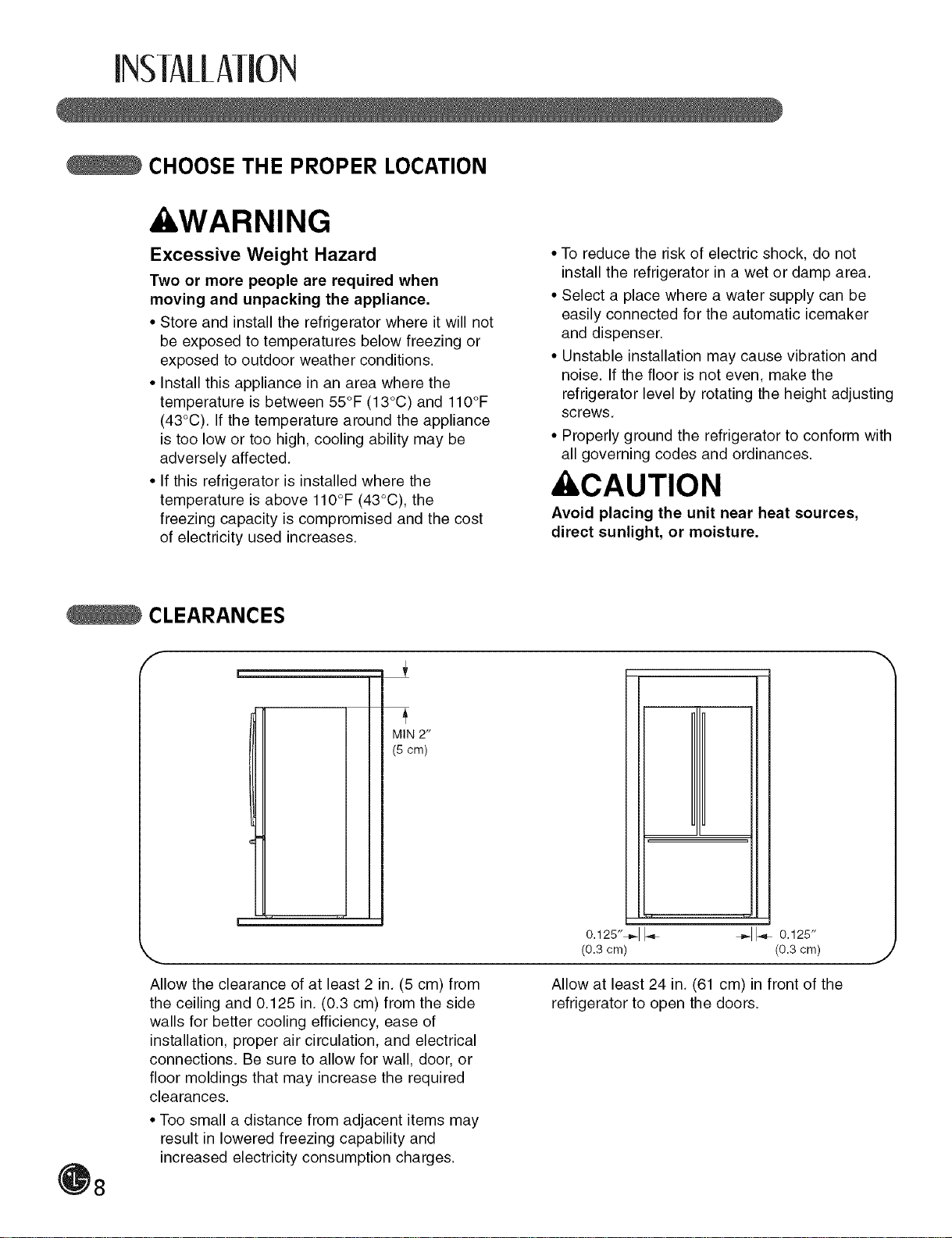
CLEARANCES
f
MIN 2"
(5 cm)
o.125"_..II_ _1_ o.125"
(0.3cm) (0.3cm)
Allow the clearance of at least 2 in. (5 cm) from
the ceiling and 0.125 in. (0.3 cm) from the side
walls for better cooling efficiency, ease of
installation, proper air circulation, and electrical
connections. Be sure to allow for wall, door, or
floor moldings that may increase the required
clearances.
• Too small a distance from adjacent items may
result in lowered freezing capability and
increased electricity consumption charges.
Allow at least 24 in. (61 cm) in front of the
refrigerator to open the doors.
J
INS|AlIA|iON
FLOORING
• To minimize noise and vibration, the refrigerator
MUST be installed on a solidly constructed
floor.
• To avoid vibration, the unit must be level. If
required, adjust the leveling legs to compensate
for unevenness of the floor. The front should be
slightly higher than the rear to aid in door
closing. The leveling legs can be turned easily
by tipping the cabinet slightly. Turn the leveling
legs clockwise to raise the unit or
counterclockwise to lower it.
• Carpeting and soft tile surfaces are not
recommended.
• Never install the refrigerator on a platform or
weakly supported structure.
NOTE: When moving the refrigerator for cleaning
or service, be sure to protect the floor. Always
pull the refrigerator straight out when moving it.
Do not wiggle or walk the refrigerator when trying
to move it; floor damage could occur.
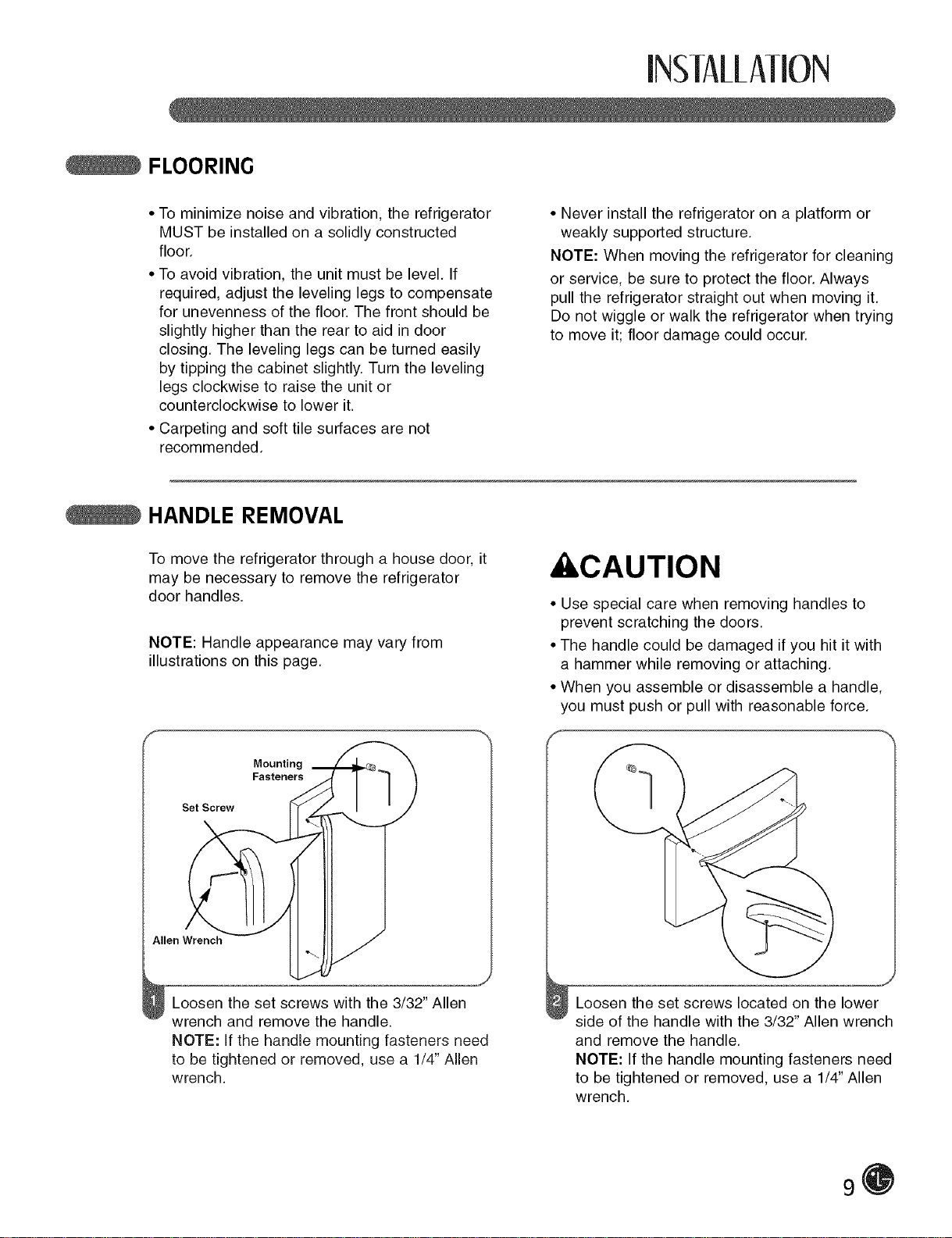
HANDLE REMOVAL
To move the refrigerator through a house door, it
may be necessary to remove the refrigerator
door handles.
NOTE: Handle appearance may vary from
illustrations on this page.
Set Screw
Mounting
Fasteners
Allen Wrench
Loosen the set screws with the 3/32" Allen
wrench and remove the handle.
NOTE: If the handle mounting fasteners need
to be tightened or removed, use a 1/4" Allen
wrench.
&CAUTION
• Use special care when removing handles to
prevent scratching the doors.
• The handle could be damaged if you hit it with
a hammer while removing or attaching.
• When you assemble or disassemble a handle,
you must push or pull with reasonable force.
Loosen the set screws located on the lower
side of the handle with the 3/32" Allen wrench
and remove the handle.
NOTE: If the handle mounting fasteners need
to be tightened or removed, use a 1/4" Allen
wrench.
9
INS|AlIA|iON
HANDLE REMOVAL (CONT.)
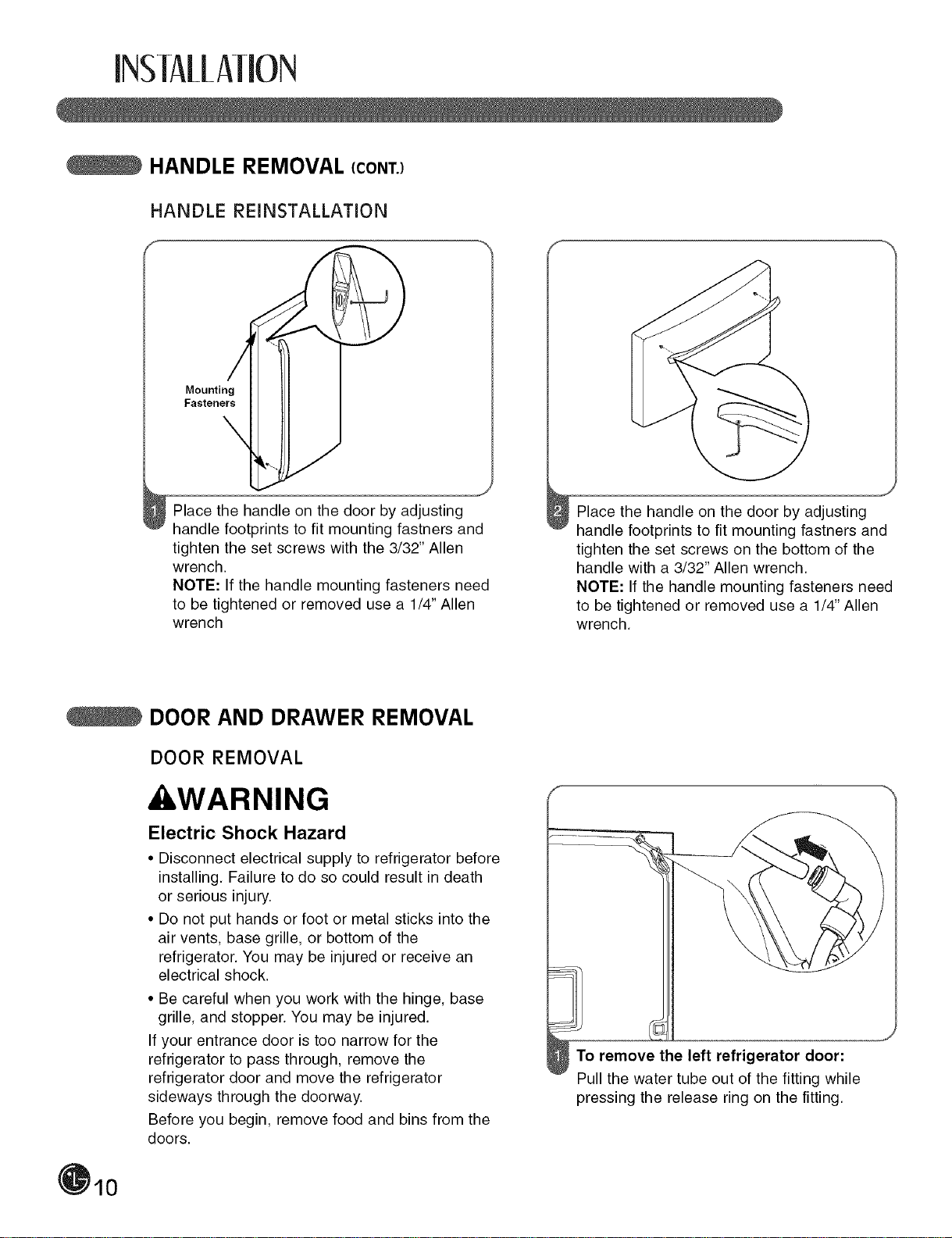
HANDLE REINSTALLATION
f
Mounting
Fasteners
Place the handle on the door by adjusting
handle footprints to fit mounting fastners and
tighten the set screws with the 3/32" Allen
wrench.
NOTE: If the handle mounting fasteners need
to be tightened or removed use a 1/4" Allen
wrench
Place the handle on the door by adjusting
handle footprints to fit mounting fastners and
tighten the set screws on the bottom of the
handle with a 3/32" Allen wrench.
NOTE: If the handle mounting fasteners need
to be tightened or removed use a 1/4" Allen
wrench.
DOOR AND DRAWER REMOVAL
DOOR REMOVAL
kWARNING
Electric Shock Hazard
• Disconnect electrical supply to refrigerator before
installing. Failure to do so could result in death
or serious injury.
• Do not put hands or foot or metal sticks into the
air vents, base grille, or bottom of the
refrigerator. You may be injured or receive an
electrical shock.
• Be careful when you work with the hinge, base
grille, and stopper. You may be injured.
If your entrance door is too narrow for the
refrigerator to pass through, remove the
refrigerator door and move the refrigerator
sideways through the doorway.
Before you begin, remove food and bins from the
doors.
To remove the left refrigerator door:
Pull the water tube out of the fitting while
pressing the release ring on the fitting.
10
INS|AlIA|ION
DOOR AND DRAWER REMOVAL CCONTo)
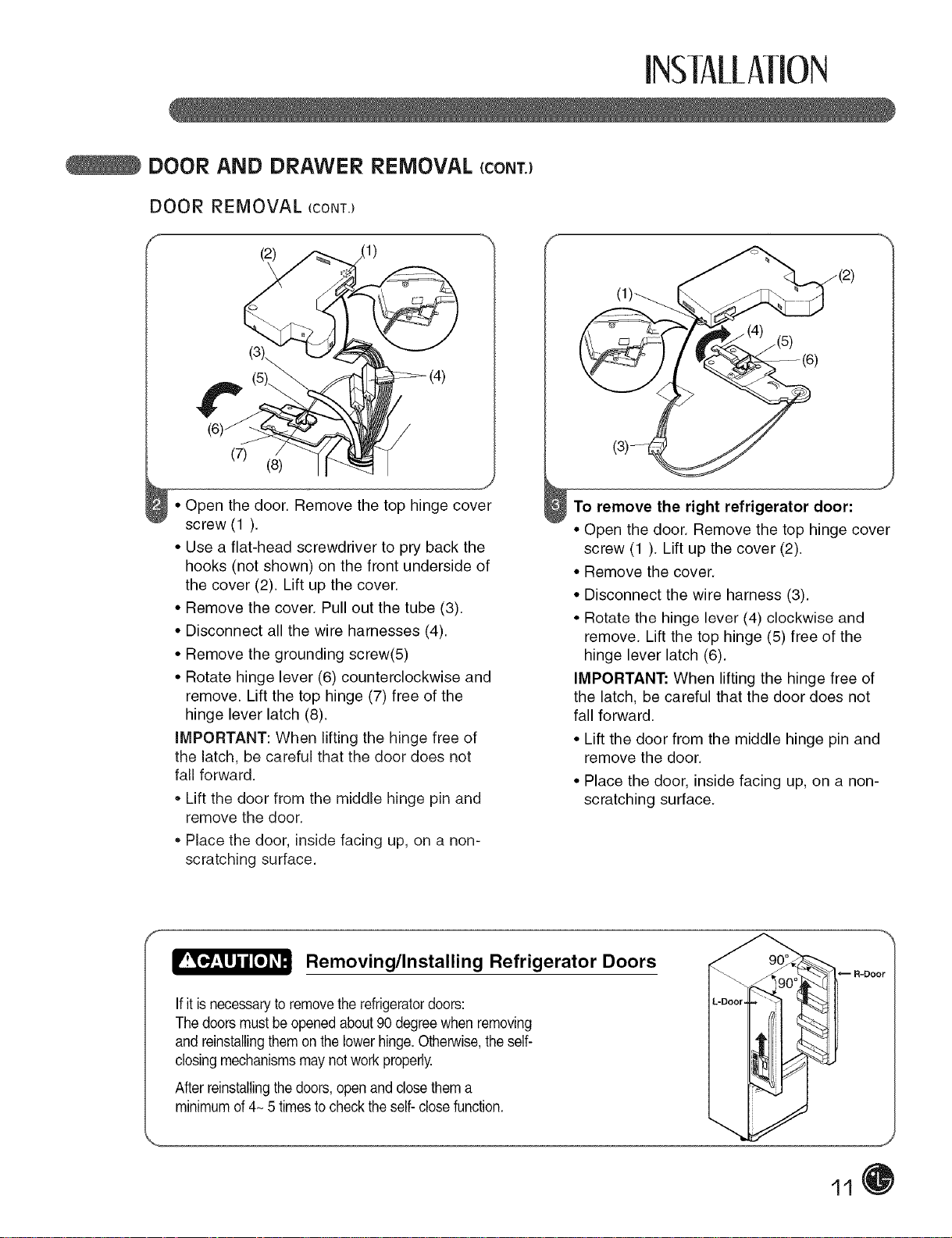
DOOR REMOVAL (CONT.)
(2)
(7)
(8)
.J
Open the door. Remove the top hinge cover
screw (1).
• Use a flat-head screwdriver to pry back the
hooks (not shown) on the front underside of
the cover (2). Lift up the cover.
• Remove the cover. Pull out the tube (3).
• Disconnect all the wire harnesses (4).
• Remove the grounding screw(5)
• Rotate hinge lever (6) counterclockwise and
remove. Lift the top hinge (7) free of the
hinge lever latch (8).
IMPORTANT: When lifting the hinge free of
the latch, be careful that the door does not
fall forward.
Lift the door from the middle hinge pin and
remove the door.
Place the door, inside facing up, on a non-
scratching surface.
To remove the right refrigerator door:
• Open the door. Remove the top hinge cover
screw (1). Lift up the cover (2).
• Remove the cover.
• Disconnect the wire harness (3).
• Rotate the hinge lever (4) clockwise and
remove. Lift the top hinge (5) free of the
hinge lever latch (6).
IMPORTANT: When lifting the hinge free of
the latch, be careful that the door does not
fall forward.
• Lift the door from the middle hinge pin and
remove the door.
• Place the door, inside facing up, on a non-
scratching surface.
Removing/Installing Refrigerator Doors
If it isnecessaryto removethe refrigeratordoors:
Thedoorsmustbe openedabout90 degreewhen removing
and reinstallingthemonthelowerhinge.Otherwise,theself-
closingmechanismsmay notwork properly.
After reinstallingthedoors,open andclosethema
minimumof 4~5 timestochecktheself- closefunction.
R-Door
11
INS|AlIA|ION
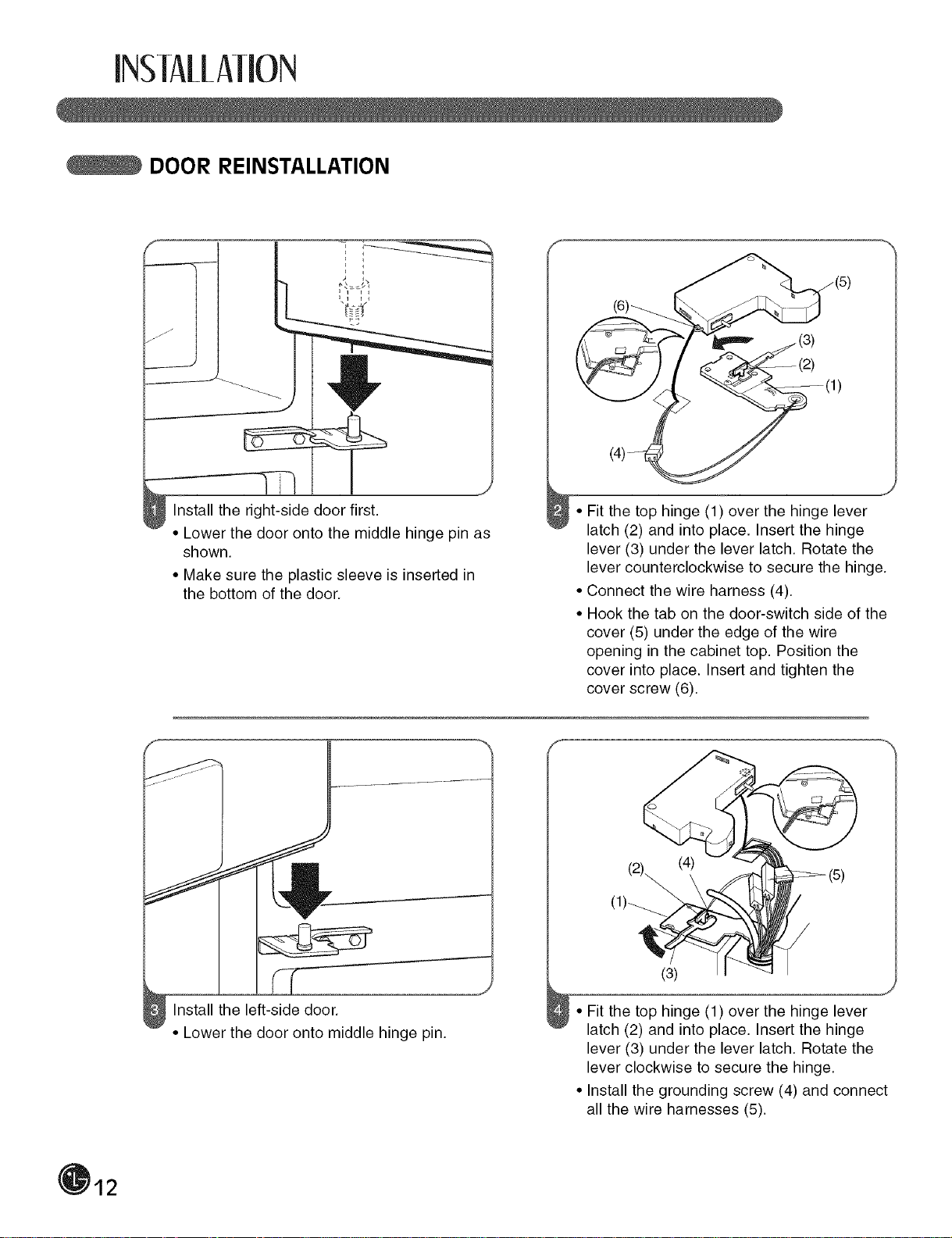
DOOR REINSTALLATION
Install the right-side door first.
• Lower the door onto the middle hinge pin as
shown.
• Make sure the plastic sleeve is inserted in
the bottom of the door.
(3)
(1)
(4)_
Fit the top hinge (1) over the hinge lever
latch (2) and into place, Insert the hinge
lever (3) under the lever latch. Rotate the
lever counterclockwise to secure the hinge.
Connect the wire harness (4).
Hook the tab on the door-switch side of the
cover (5) under the edge of the wire
opening in the cabinet top. Position the
cover into place, Insert and tighten the
cover screw (6).
Install the left-side door.
• Lower the door onto middle hinge pin.
(3)
• Fit the top hinge (1) over the hinge lever
latch (2) and into place. Insert the hinge
lever (3) under the lever latch. Rotate the
lever clockwise to secure the hinge.
• Install the grounding screw (4) and connect
all the wire harnesses (5).
12
INS|AlIA|ION
DOOR REINSTALLATION (CONT.)
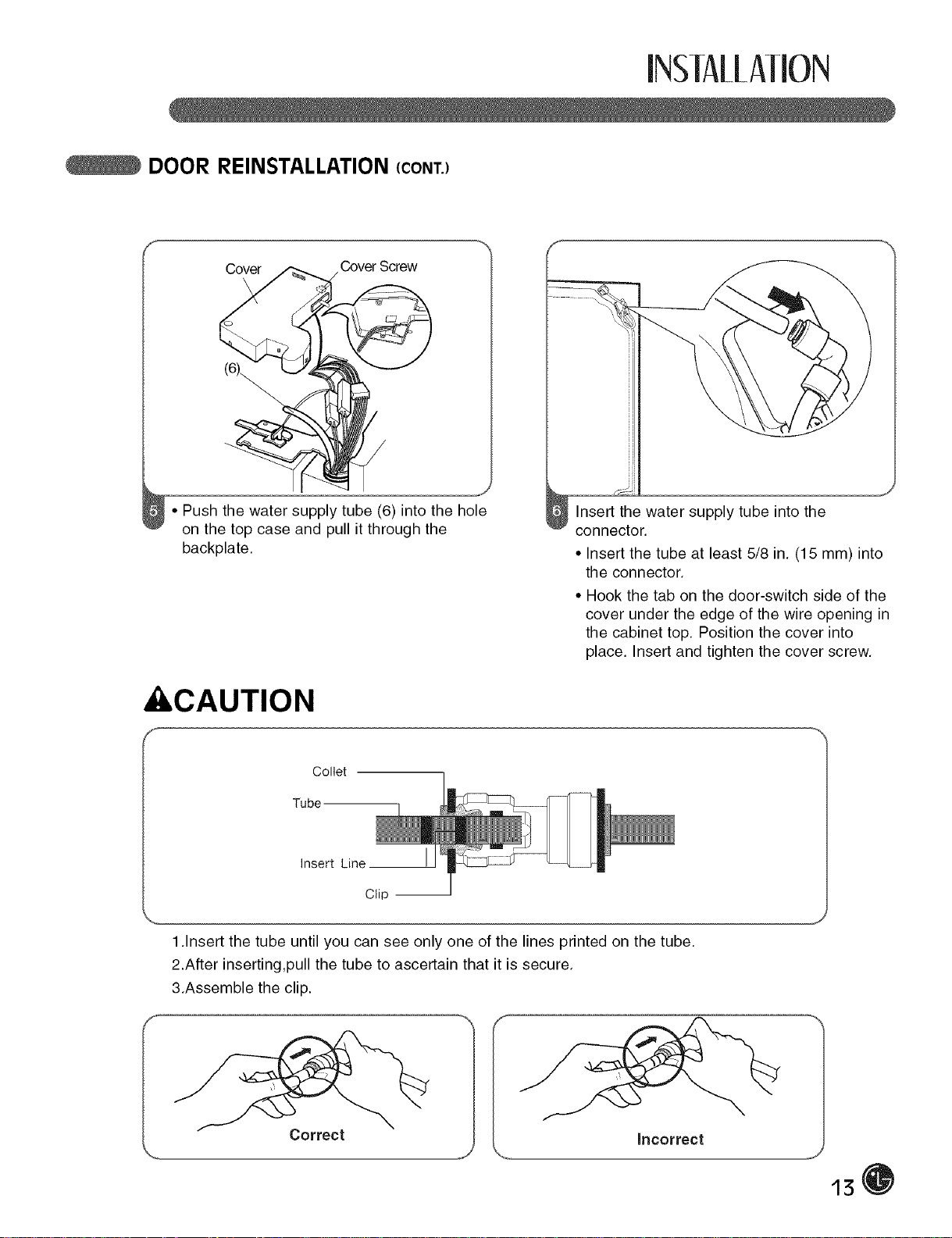
Cover Cover Screw
water supply tube (6) into the hole
on the top case and pull it through the
backplate.
ACAUTION
Insert the water supply tube into the
connector.
• Insert the tube at least 5/8 in. (15 mm) into
the connector.
• Hook the tab on the door-switch side of the
cover under the edge of the wire opening in
the cabinet top. Position the cover into
place. Insert and tighten the cover screw.
Collet
Tube
Insert Line
Clip --
1.Insert the tube until you can see only one of the lines printed on the tube.
2.After inserting,pull the tube to ascertain that it is secure.
3.Assemble the clip.
f _ f
Correct
Incorrect
13
INS|AlIA|iON
DOOR AND DRAWER REMOVAL (CONT.)
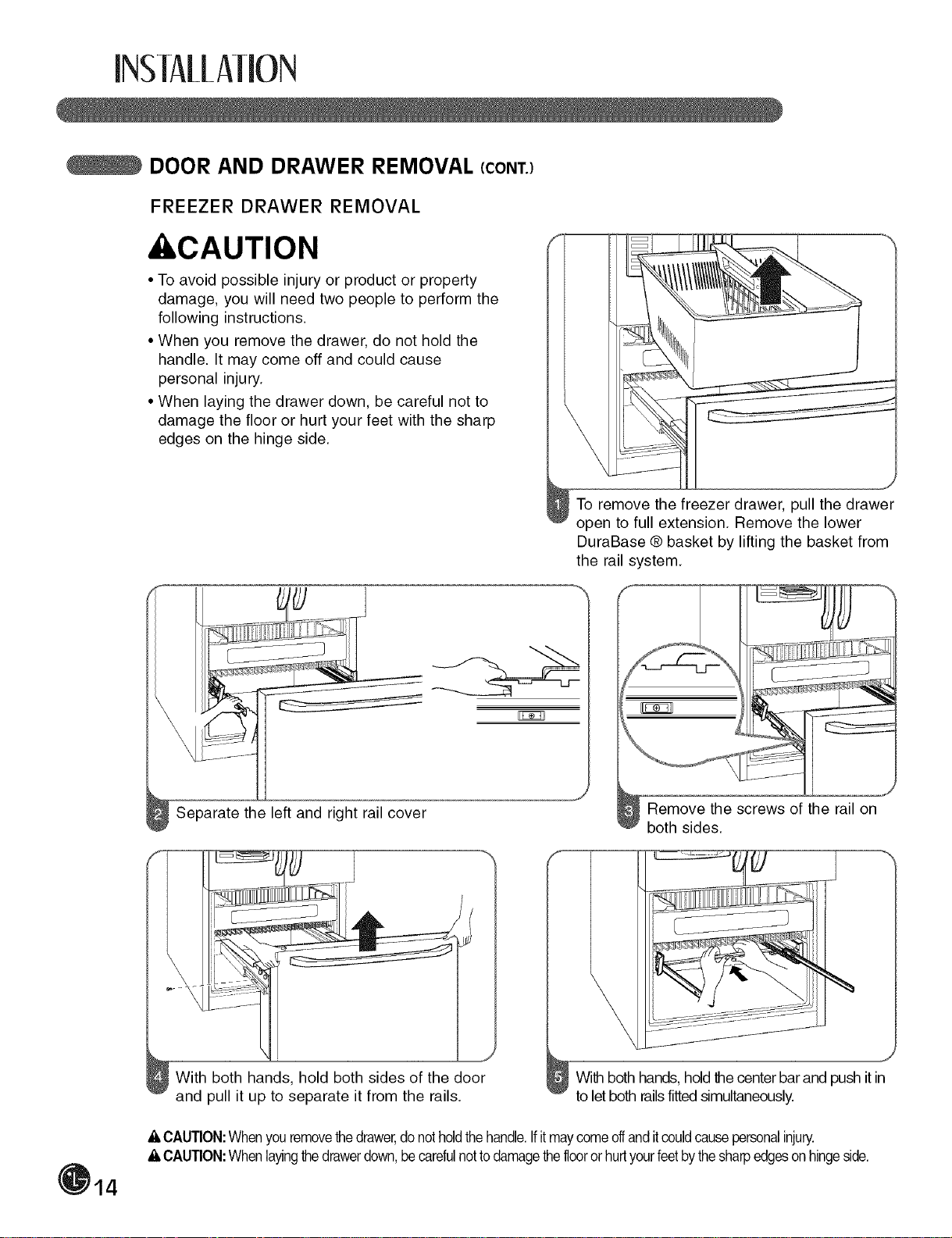
FREEZER DRAWER REMOVAL
ACAUTION
• To avoid possible injury or product or property
damage, you will need two people to perform the
following instructions.
• When you remove the drawer, do not hold the
handle. It may come off and could cause
personal injury.
• When laying the drawer down, be careful not to
damage the floor or hurt your feet with the sharp
edges on the hinge side.
To remove the freezer drawer, pull the drawer
open to full extension. Remove the lower
DuraBase ® basket by lifting the basket from
the rail system.
14
Separate the left and right rail cover
J
both hands, hold both sides of the door
and pull it up to separate it from the rails.
Remove the screws of the rail on
both sides.
J
Wilh both hands, hold lhe center bar and push it in
to let both rails fitted simultaneously.
_i,CAUTION:Whenyouremovethedrawer,donotholdthehandle.Ifitmaycomeoffanditcouldcausepersonalinjury.
& CAUTION:Whenlayingthedrawerdown,becarefulnottodamagetheflooror hurtyourfeetbythesharpedgesonhingeside.
INS|AI_I_A|ION
DOOR AND DRAWER REMOVAL (CONT.)
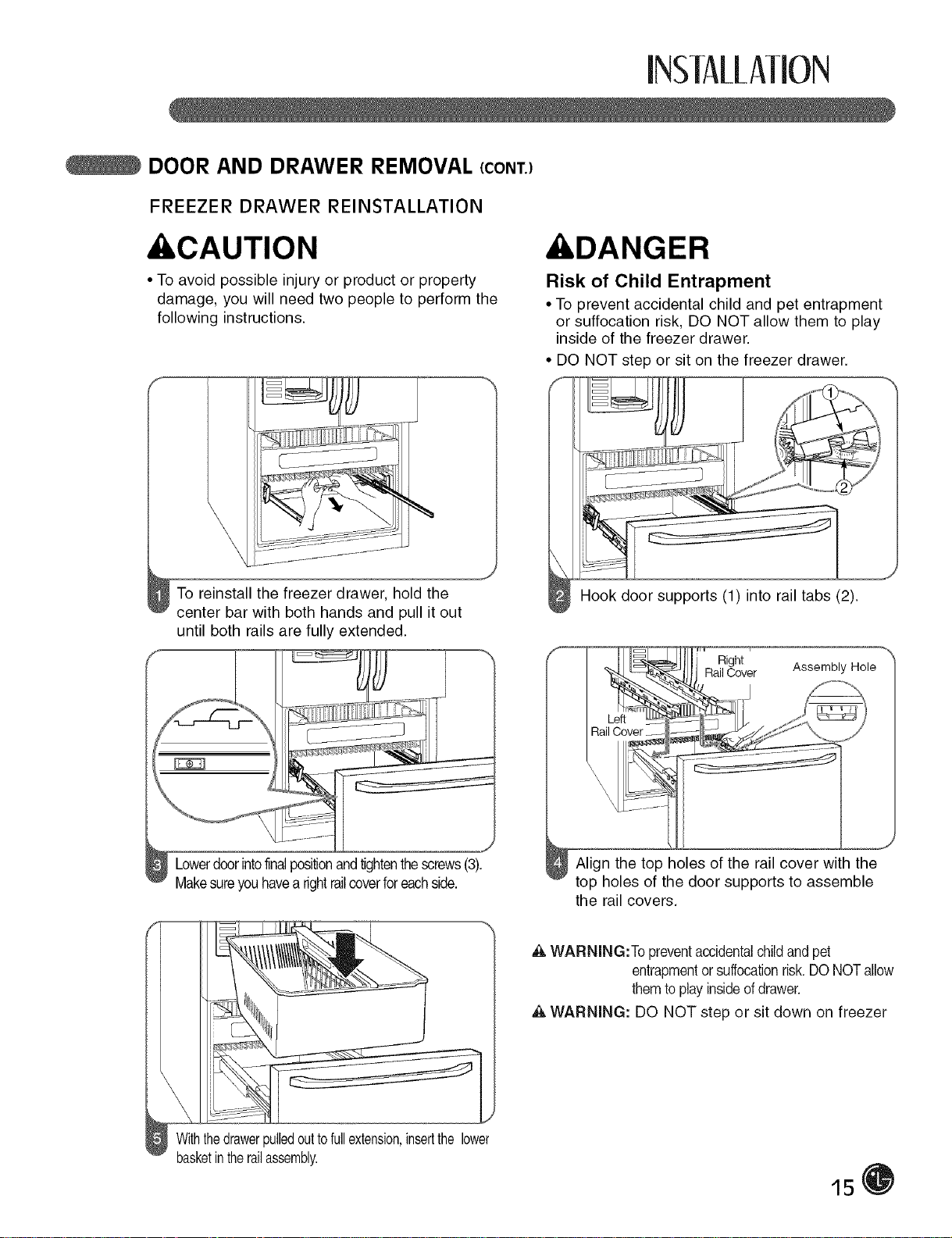
FREEZER DRAWER REINSTALLATION
&CAUTION
• To avoid possible injury or product or property
damage, you will need two people to perform the
following instructions.
F
%
reinstall the freezer drawer, hold the
center bar with both hands and pull it out
until both rails are fully extended.
Lowerdoorintofinalpositionandtightenthescrews(3).
Makesureyouhavea rightrailcoverforeachside.
&DANGER
Risk of Child Entrapment
• To prevent accidental child and pet entrapment
or suffocation risk, DO NOT allow them to play
inside of the freezer drawer.
• DO NOT step or sit on the freezer drawer.
Hook door supports (1) into rail tabs (2).
Right
Rail Cover Assembly Hole
-- I
RailCover J
Align the top holes of the rail cover with the
top holes of the door supports to assemble
the rail covers.
,& WARNING:To preventaccidentalchildand pet
entrapmentor suffocationrisk.DONOTallow
themtoplayinsideofdrawer.
WARNING: DO NOT step or sit down on freezer
Withthedrawerpulledouttofullextension,insertthe lower
basketintherailassembly.
15
INS|AlIA|iON
CONNECTING THE WATER SUPPLY
AWARNING
Connect to safe drinking water supply
only.
• The water pressure must be between 21 and
121 p.s.i. (1.5-8.5 kgf/cm 2)on models without a
water filter and between 43 and 121 p.s.i.
(3-8.5 kgf/cm 2)on models with a water filter.
• If water pressure does not reach 21 psi (1.5
kgf/cm 2) or falls below, it is necessary to
purchase a separate pressure pump for normal
automatic icemaker and water dispensing
operation.
• It is recommended that the total length of the
water feed tube does not exceed 26 ft. (8 m).
• Install the water supply line where it will not be
affected by heat.
IMPORTANT: Read all directions thoroughly
before you begin.
• If operating the refrigerator before installing the
water connection, turn the icemaker to the OFF
position to prevent operation without water.
• All installations must be in accordance with
local plumbing code requirements.
• Use copper tubing and check for leaks.
• Install tubing only in areas where temperatures
will remain above freezing.
• It may take up to 24 hours for the icemaker to
begin producing ice.
TOOLS Required
• Standard screwdriver
• 7/16-in. and 1/2-in. open-end wrenches or two
adjustable wrenches
• 1/4-in. nut driver
• 1/4-in. drill bit
• Hand drill or electric drill (properly grounded)
NOTE: Refrigerator dealers offer a kit with a 1/4-
in. saddle-type shutoff valve, a union, and copper
tubing. Before purchasing, make sure a saddle-
type valve complies with local plumbing codes.
Do not use a piercing-type or 3/16-in. saddle
valve which reduces water flow and clogs
more easily.
NOTE: The Commonwealth of Massachusetts
Plumbing Code 248CMR shall be adhered to.
Saddle valves are illegal and use is not permitted
in Massachusetts. Consult with your licensed
plumber.
Cold Water Supply
• The icemaker water valve contains a flow
washer which is used as a water pressure
regulator,
• The icemaker needs to be connected to a cold
water line with water pressure between 21-121
psi (1.5-8.5 kgf/cm 2) on models without a water
filter and between 43 and 121 p.s.i. (3-8.5
kgf/cm_) on models with a water filter.
CONNECTING THE WATER LINES
IMPORTANT: Before connecting the tubing to
the water line, unplug the refrigerator or
disconnect the power.
• Turn off the main water supply and open the
nearest faucet to relieve pressure in the line.
Opening an outside faucet may help drain
water from the line in the house.
• Find a 1/2-in. vertical COLD water pipe near
the refrigerator.
NOTE: A horizontal pipe will work, but the
following precaution must be taken: drill on the
top of the pipe, not the bottom. This will help
keep water away from the drill and also keep
normal sediment from collecting in the valve.
• To determine the length of copper tubing you
will need, measure from the connection on the
lower left rear of the refrigerator to the water
pipe. Add 7 ft. (2.1 m) to allow for moving the
refrigerator for cleaning. Use 1/4-in. O.D.
(outside diameter) copper tubing. Be sure both
ends of the copper tubing are cut square.
• Using a drill, drill a 1/4-in. hole in the cold water
pipe you have selected.
16
INS|AI_I_A|ION
CONNECTING THE WATER LINES (CONT.)
• Fasten the shutoff valve to the cold water pipe
with the pipe clamp. Be sure the outlet end is
solidly in the 1/4-in. drilled hole in the water
pipe and the washer is under the pipe clamp.
Tighten the packing nut. Tighten the pipe clamp
screws carefully and evenly so the washer
makes a watertight seal. Do not overtighten or
you may crush the copper tubing, especially if
soft (coiled) copper tubing is used. Now you are
ready to connect the copper tubing.
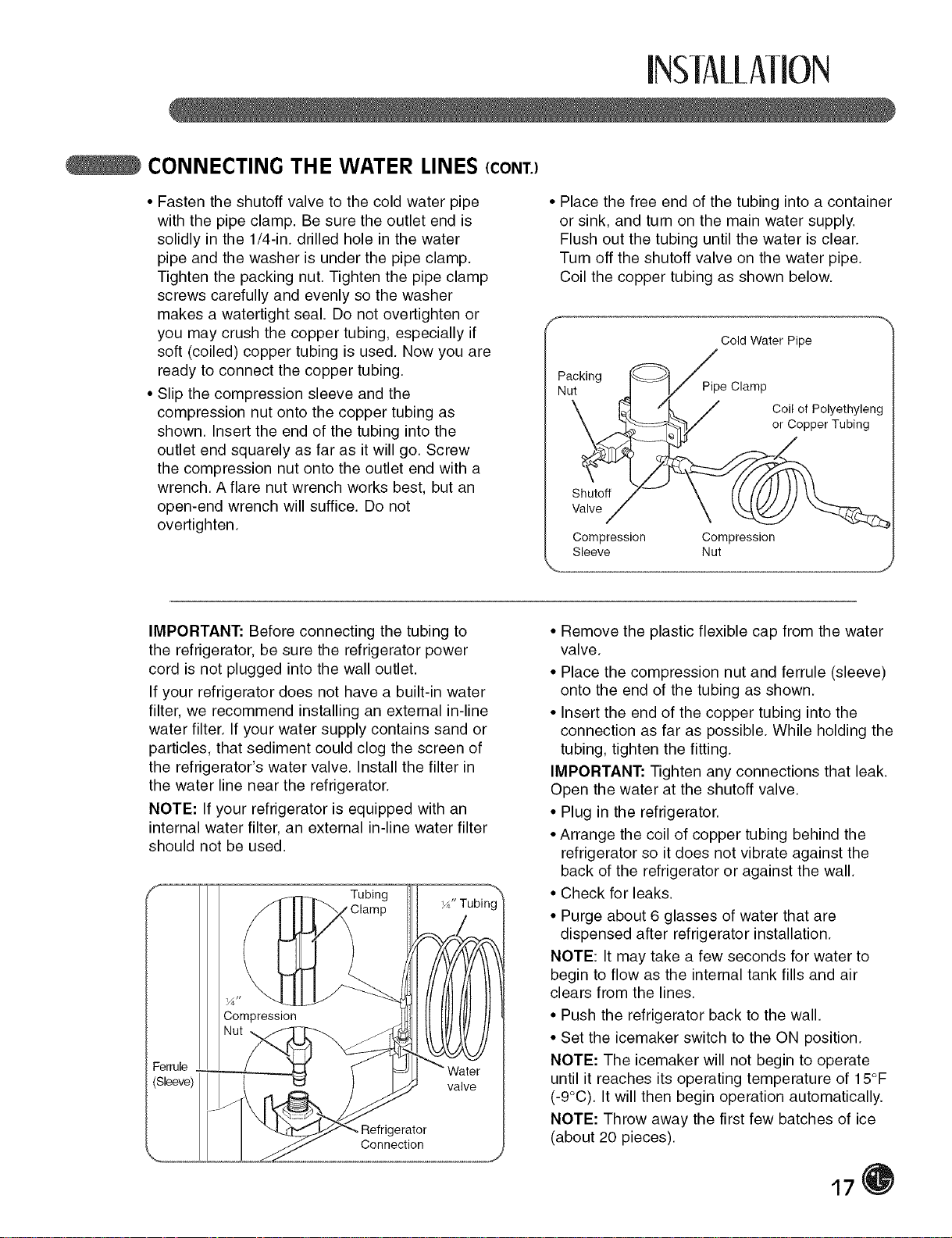
• Slip the compression sleeve and the
compression nut onto the copper tubing as
shown. Insert the end of the tubing into the
outlet end squarely as far as it will go. Screw
the compression nut onto the outlet end with a
wrench. A flare nut wrench works best, but an
open-end wrench will suffice. Do not
overtighten.
• Place the free end of the tubing into a container
or sink, and turn on the main water supply.
Flush out the tubing until the water is clear.
Turn off the shutoff valve on the water pipe.
Coil the copper tubing as shown below.
Cold Water Pipe
Packing
Nut Pipe Clamp
\ Coil of Polyethyleng
or Copper Tubing
IMPORTANT: Before connecting the tubing to
the refrigerator, be sure the refrigerator power
cord is not plugged into the wall outlet.
If your refrigerator does not have a built-in water
filter, we recommend installing an external in-line
water filter. If your water supply contains sand or
particles, that sediment could clog the screen of
the refrigerator's water valve. Install the filter in
the water line near the refrigerator.
NOTE: If your refrigerator is equipped with an
internal water filter, an external in-line water filter
should not be used.
Tubing
/ Clamp
• Remove the plastic flexible cap from the water
valve.
• Place the compression nut and ferrule (sleeve)
onto the end of the tubing as shown.
• Insert the end of the copper tubing into the
connection as far as possible. While holding the
tubing, tighten the fitting.
IMPORTANT: -tighten any connections that leak.
Open the water at the shutoff valve.
• Plug in the refrigerator.
• Arrange the coil of copper tubing behind the
refrigerator so it does not vibrate against the
back of the refrigerator or against the wall.
• Check for leaks.
• Purge about 6 glasses of water that are
dispensed after refrigerator installation.
NOTE: It may take a few seconds for water to
begin to flow as the internal tank fills and air
clears from the lines.
• Push the refrigerator back to the wall.
• Set the icemaker switch to the ON position.
NOTE: The icemaker will not begin to operate
until it reaches its operating temperature of 15°F
(-9°C). It will then begin operation automatically.
NOTE: Throw away the first few batches of ice
(about 20 pieces).
17
INS|AlIA|iON
LEVELING THE REFRIGERATOR DOORS
AWARNING
Electrical Shock Hazard
• Be careful when you work with the hinges, base
grille, and stopper. You may be injured.
• Do not put hands or feet or metal sticks into the
air vents, base grille, or the bottom of the
refrigerator. You may be injured or receive an
electrical shock.
Levelingr
After installing, secure the product with the LEG
not to move left or right.
Your refrigerator has two front leveling legs---one
on the right and one on the left. Adjust the legs to
alter the tilt from front to back or side to side. If
your refrigerator seems unsteady or you want the
doors to close more easily, adjust the refrigerator's
tilt using the following instructions:
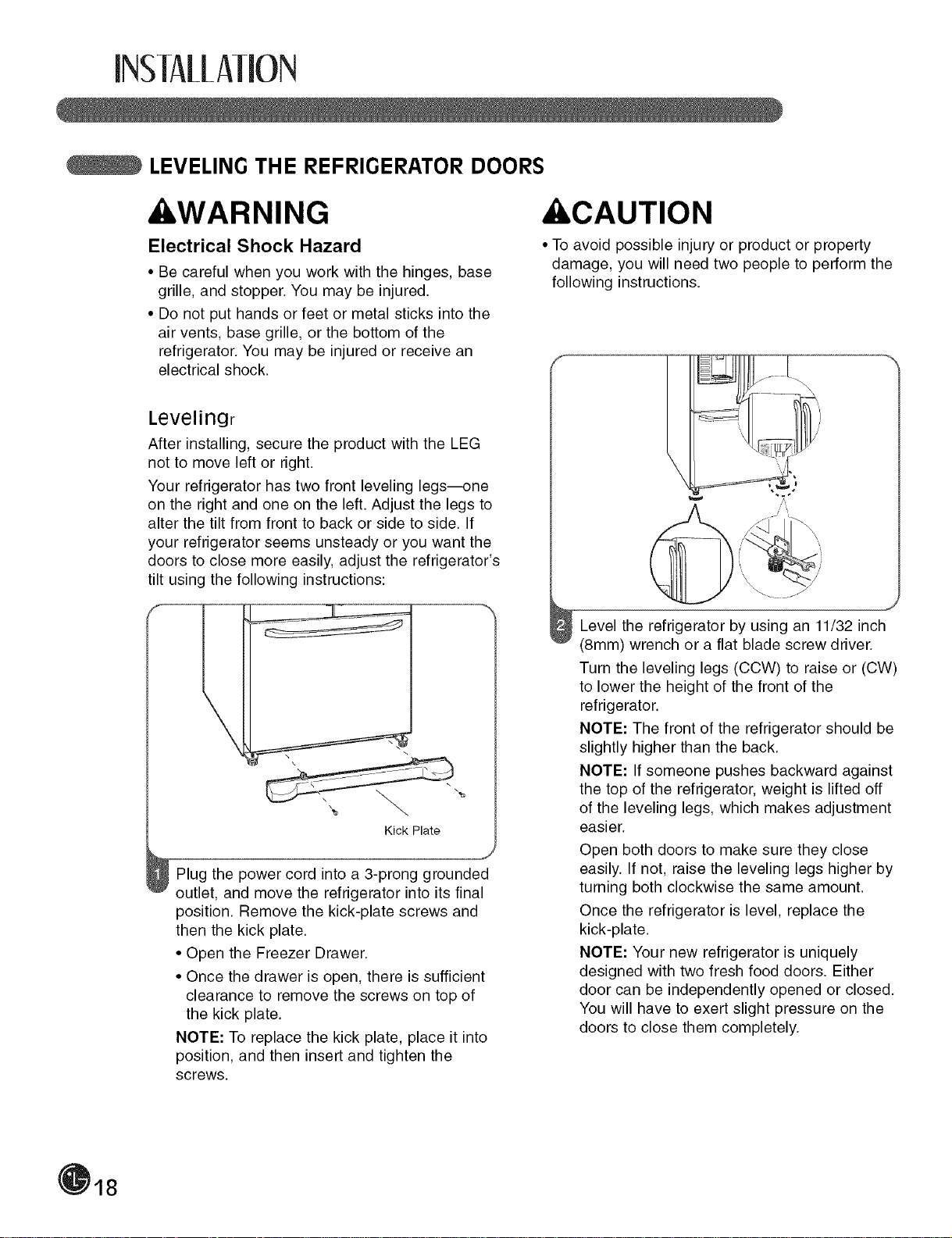
Kick Plate
Plug the power cord into a 3-prong grounded
outlet, and move the refrigerator into its final
position. Remove the kick-plate screws and
then the kick plate.
• Open the Freezer Drawer.
• Once the drawer is open, there is sufficient
clearance to remove the screws on top of
the kick plate.
NOTE: To replace the kick plate, place it into
position, and then insert and tighten the
screws.
&CAUTION
• To avoid possible injury or product or property
damage, you will need two people to perform the
following instructions.
_7_ _
Level the refrigerator by using an 11/32 inch
(8mm) wrench or a flat blade screw driver.
Turn the leveling legs (CCW) to raise or (CW)
to lower the height of the front of the
refrigerator.
NOTE: The front of the refrigerator should be
slightly higher than the back.
NOTE: If someone pushes backward against
the top of the refrigerator, weight is lifted off
of the leveling legs, which makes adjustment
easier.
Open both doors to make sure they close
easily. If not, raise the leveling legs higher by
turning both clockwise the same amount.
Once the refrigerator is level, replace the
kick-plate.
NOTE: Your new refrigerator is uniquely
designed with two fresh food doors. Either
door can be independently opened or closed.
You will have to exert slight pressure on the
doors to close them completely.
18
INS|AI_I_A|ION
LEVELING THE REFRIGERATOR DOORS CCONT.)
DOOR ALIGNMENT
f
J
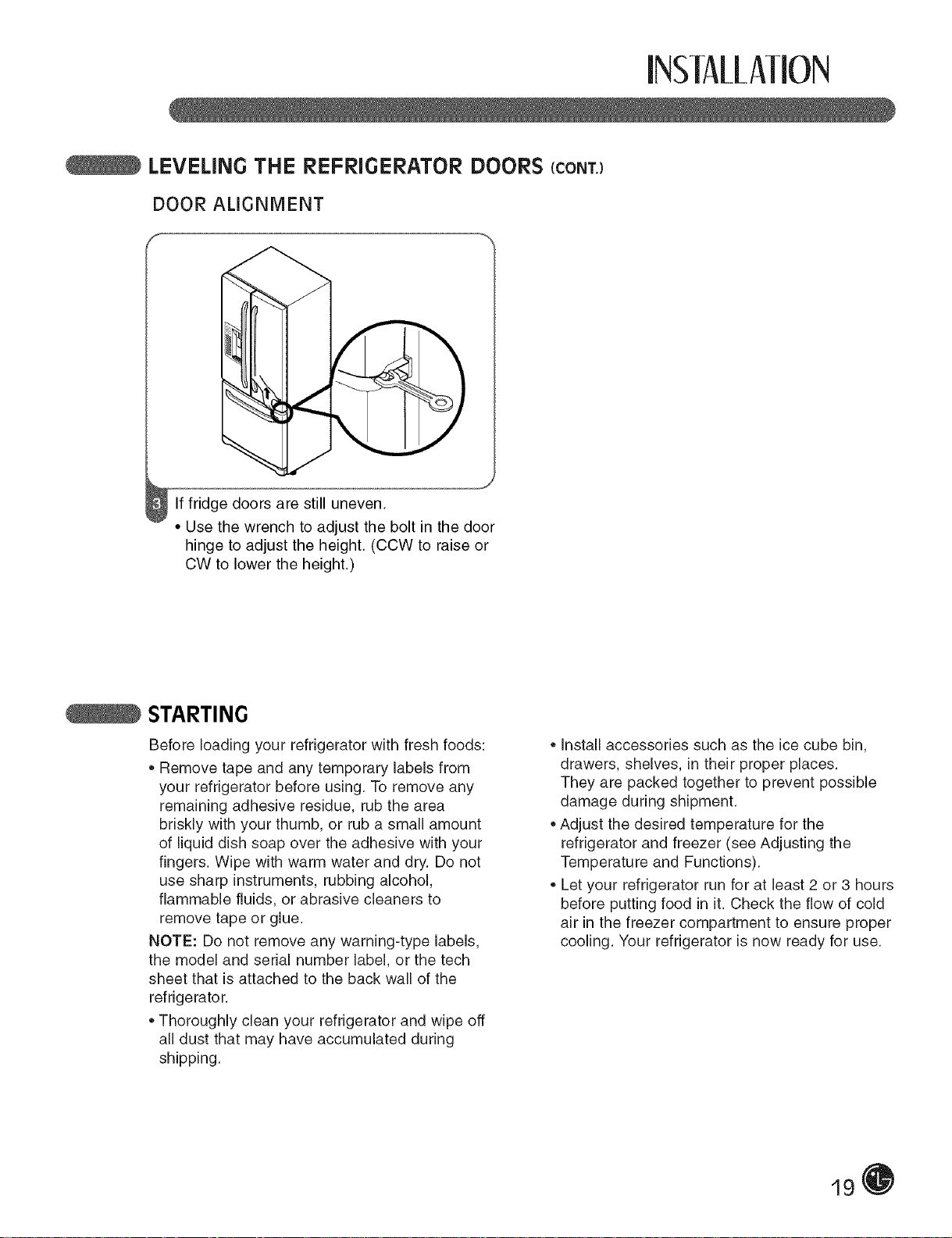
If fridge doors are still uneven.
• Use the wrench to adjust the bolt in the door
hinge to adjust the height. (CCW to raise or
CW to lower the height.)
STARTING
Before loading your refrigerator with fresh foods:
• Remove tape and any temporary labels from
your refrigerator before using. To remove any
remaining adhesive residue, rub the area
briskly with your thumb, or rub a small amount
of liquid dish soap over the adhesive with your
fingers. Wipe with warm water and dry. Do not
use sharp instruments, rubbing alcohol,
flammable fluids, or abrasive cleaners to
remove tape or glue.
NOTE: Do not remove any warning-type labels,
the model and serial number label, or the tech
sheet that is attached to the back wall of the
refrigerator.
• Thoroughly clean your refrigerator and wipe off
all dust that may have accumulated during
shipping.
• Instal[ accessories such as the ice cube bin,
drawers, shelves, in their proper places.
They are packed together to prevent possible
damage during shipment.
• Adjust the desired temperature for the
refrigerator and freezer (see Adjusting the
Temperature and Functions).
• Let your refrigerator run for at least 2 or 3 hours
before putting food in it. Check the flow of cold
air in the freezer compartment to ensure proper
cooling. Your refrigerator is now ready for use.
19
ttOWTOUSE
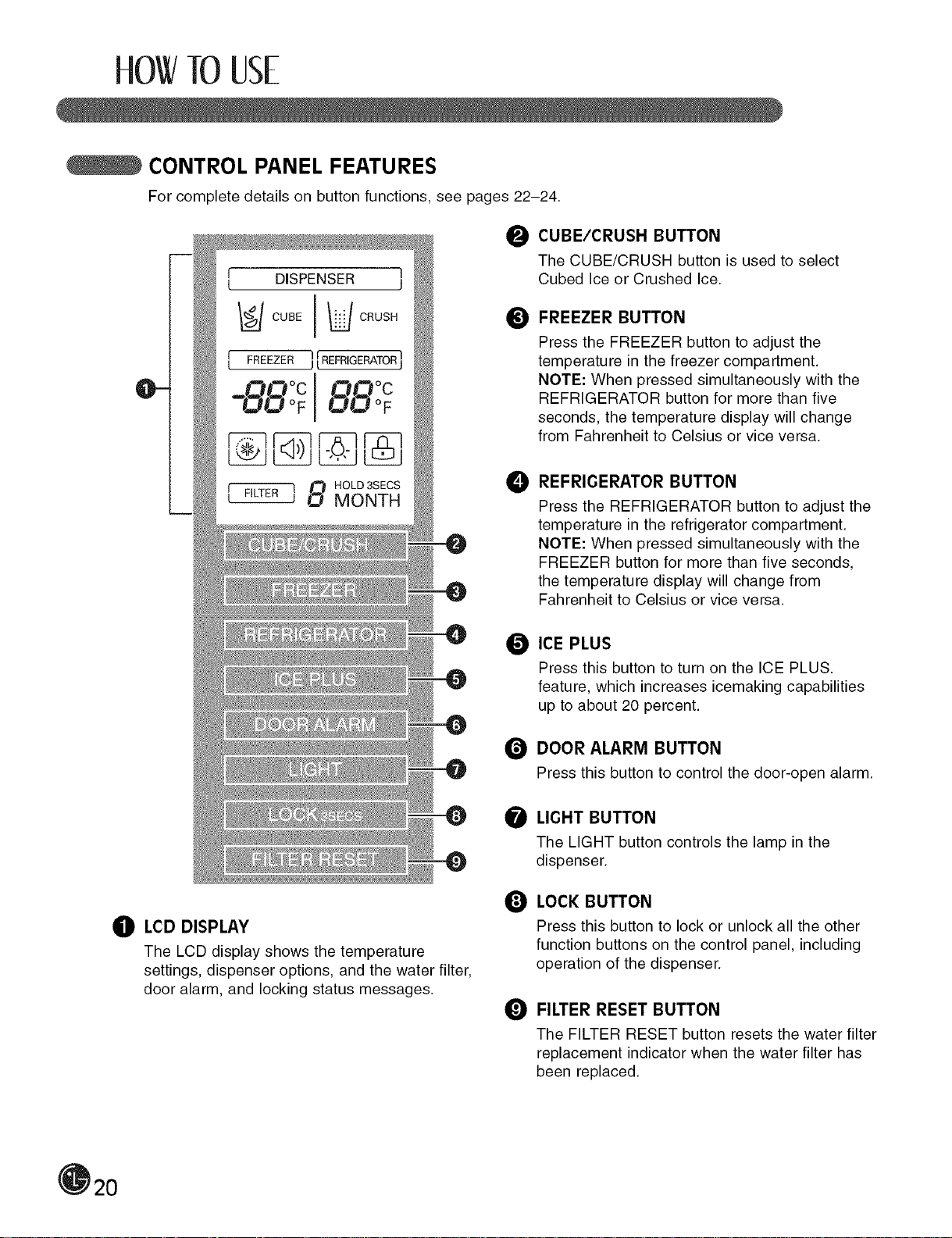
CONTROL PANEL FEATURES
For complete details on button functions, see pages 22-24.
0 CUBE/CRUSH BUTTON
The CUBE/CRUSH button is used to select
Cubed Ice or Crushed Ice.
_) FREEZER BUTTON
Press the FREEZER button to adjust the
temperature in the freezer compartment.
NOTE: When pressed simultaneously with the
REFRIGERATOR button for more than five
seconds, the temperature display will change
from Fahrenheit to Celsius or vice versa.
_) REFRIGERATOR BUTTON
Press the REFRIGERATOR button to adjust the
temperature in the refrigerator compartment.
NOTE: When pressed simultaneously with the
FREEZER button for more than five seconds,
the temperature display will change from
Fahrenheit to Celsius or vice versa.
ICE PLUS
Press this button to turn on the ICE PLUS.
feature, which increases icemaking capabilities
up to about 20 percent.
_) DOOR ALARM BUTTON
Press this button to control the door-open alarm.
_]_ LCD DISPLAY
The LCD display shows the temperature
settings, dispenser options, and the water filter,
door alarm, and locking status messages.
LIGHT BUTTON
The LIGHT button controls the lamp in the
dispenser.
_) LOCK BUTTON
Press this button to lock or unlock all the other
function buttons on the control panel, including
operation of the dispenser.
_) FILTER RESET BUTTON
The FILTER RESET button resets the water filter
replacement indicator when the water filter has
been replaced.
20
HOWlO USE
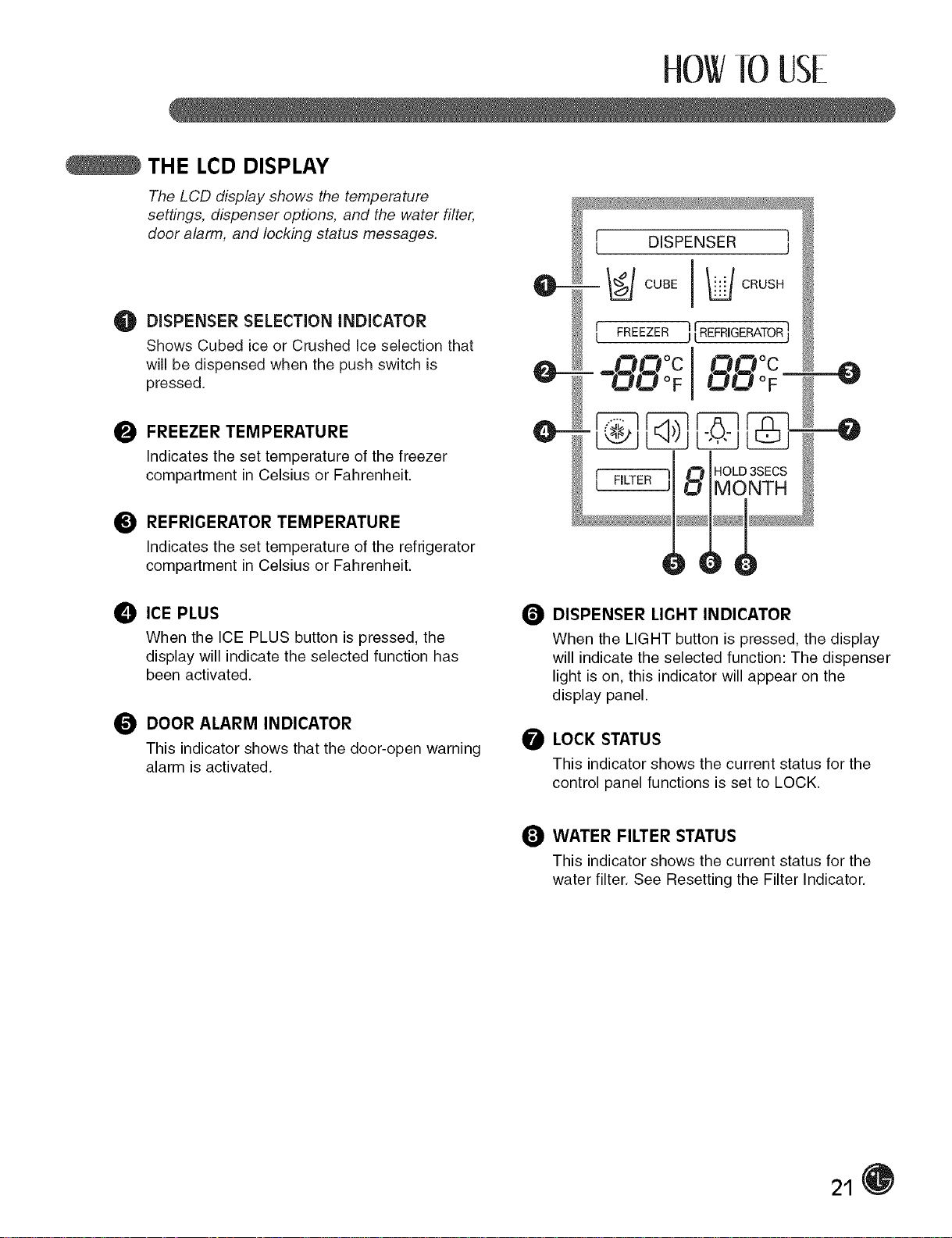
THE LCD DISPLAY
The LCD display shows the temperature
settings, dispenser options, and the water filter,
door alarm, and locking status messages.
0
DISPENSER SELECTION INDICATOR
Shows Cubed ice or Crushed Ice selection that
will be dispensed when the push switch is
pressed.
i_ FREEZER TEMPERATURE
Indicates the set temperature of the freezer
compartment in Celsius or Fahrenheit.
O REFRIGERATOR TEMPERATURE
Indicates the set temperature of the refrigerator
compartment in Celsius or Fahrenheit.
ICE PLUS
When the ICE PLUS button is pressed, the
display will indicate the selected function has
been activated.
i_ DOOR ALARM INDICATOR
This indicator shows that the door-open warning
alarm is activated.
0-
I DISPENSER I
t J
iWo.s
_no ocI OO°c
HOLD 3SECS
{FILTER MONTH
O
DISPENSER LIGHT INDICATOR
When the LIGHT button is pressed, the display
will indicate the selected function: The dispenser
light is on, this indicator will appear on the
display panel.
LOCK STATUS
This indicator shows the current status for the
control panel functions is set to LOCK.
O WATER FILTER STATUS
This indicator shows the current status for the
water filter. See Resetting the Filter Indicator.
21
ttOWTOUSE
ADJUSTING THE TEMPERATURES AND DISPLAY
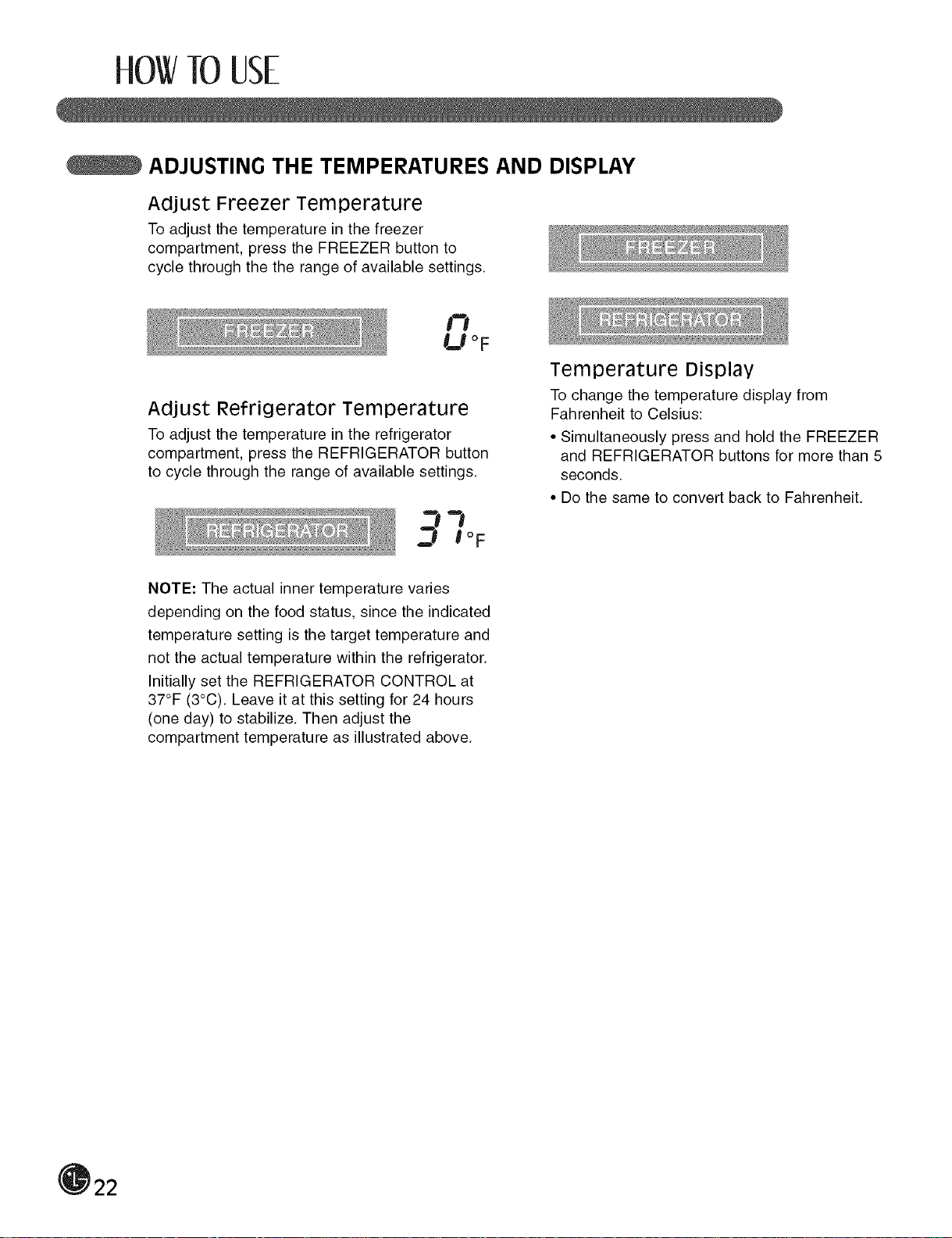
Adjust Freezer Temperature
To adjust the temperature in the freezer
compartment, press the FREEZER button to
cycle through the the range of available settings.
n
U°F
Adjust Refrigerator Temperature
To adjust the temperature in the refrigerator
compartment, press the REFRIGERATOR button
to cycle through the range of available settings.
NOTE: The actual inner temperature varies
depending on the food status, since the indicated
temperature setting is the target temperature and
not the actual temperature within the refrigerator.
Initially set the REFRIGERATOR CONTROL at
37°F (3°C). Leave it at this setting for 24 hours
(one day) to stabilize. Then adjust the
compartment temperature as illustrated above.
Temperature Display
To change the temperature display from
Fahrenheit to Celsius:
• Simultaneously press and hold the FREEZER
and REFRIGERATOR buttons for more than 5
seconds.
• Do the same to convert back to Fahrenheit.
22
HOW1t3USE
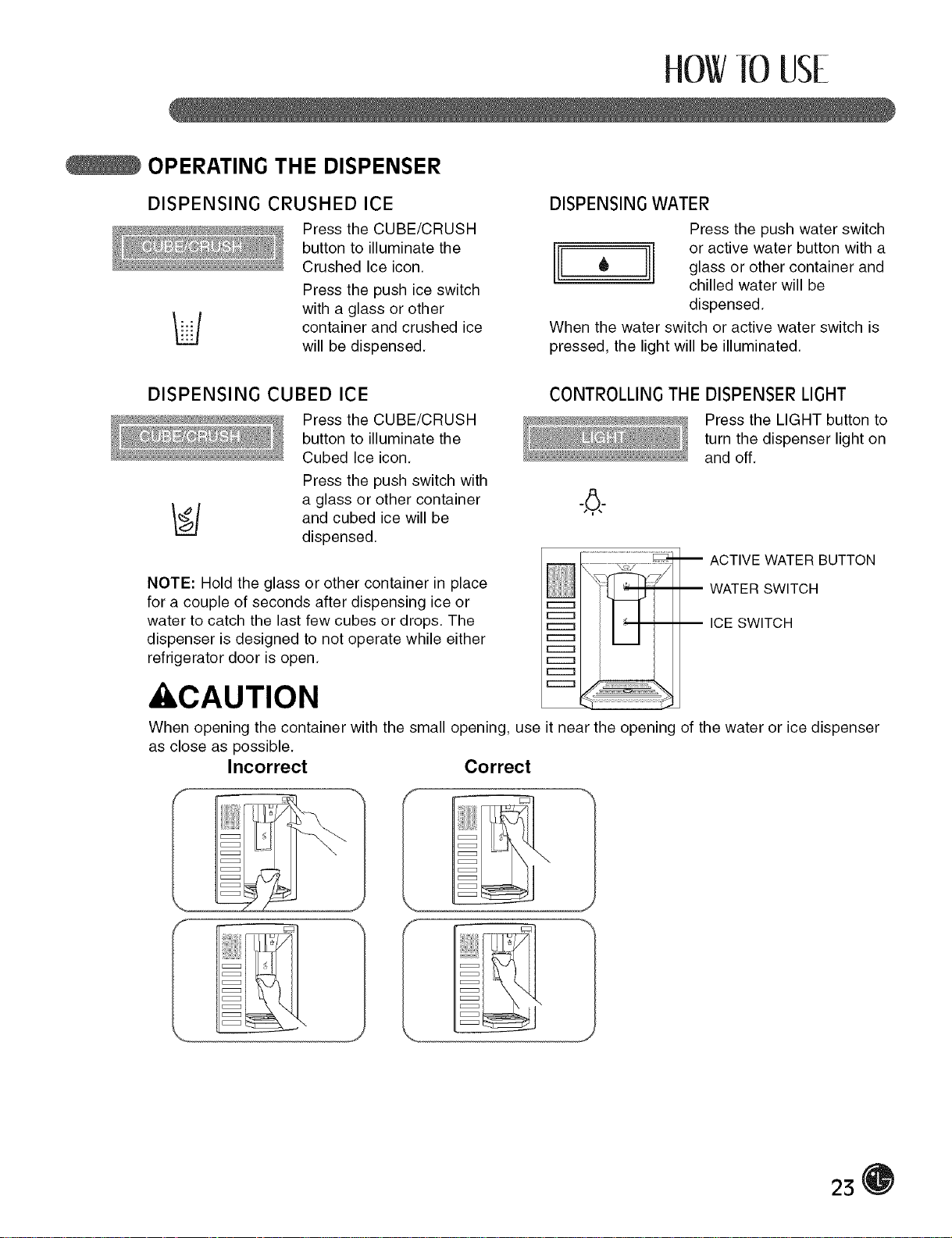
OPERATING THE DISPENSER
DISPENSING CRUSHED ICE
Press the CUBE/CRUSH
button to illuminate the
Crushed Ice icon.
Press the push ice switch
with a glass or other
container and crushed ice
will be dispensed.
DISPENSING WATER
Press the push water switch
1[ or active water button with a
6 glass or other container and
chilled water will be
dispensed.
When the water switch or active water switch is
pressed, the light will be illuminated.
DISPENSING CUBED ICE
Press the CUBE/CRUSH
button to illuminate the
Cubed Ice icon.
Press the push switch with
a glass or other container
_./ and cubed ice will be
dispensed.
NOTE: Hold the glass or other container in place
for a couple of seconds after dispensing ice or
water to catch the last few cubes or drops. The
dispenser is designed to not operate while either
refrigerator door is open.
ACAUTION
CONTROLLING THE DISPENSER LIGHT
Press the LIGHT button to
turn the dispenser light on
and off.
ACTIVE WATER BUTTON
WATER SWITCH
ICE SWITCH
When opening the container with the small opening, use it near the opening of the water or ice dispenser
as close as possible.
Incorrect Correct
iiiiiiiii!i!........
23
ttOWTOUSE
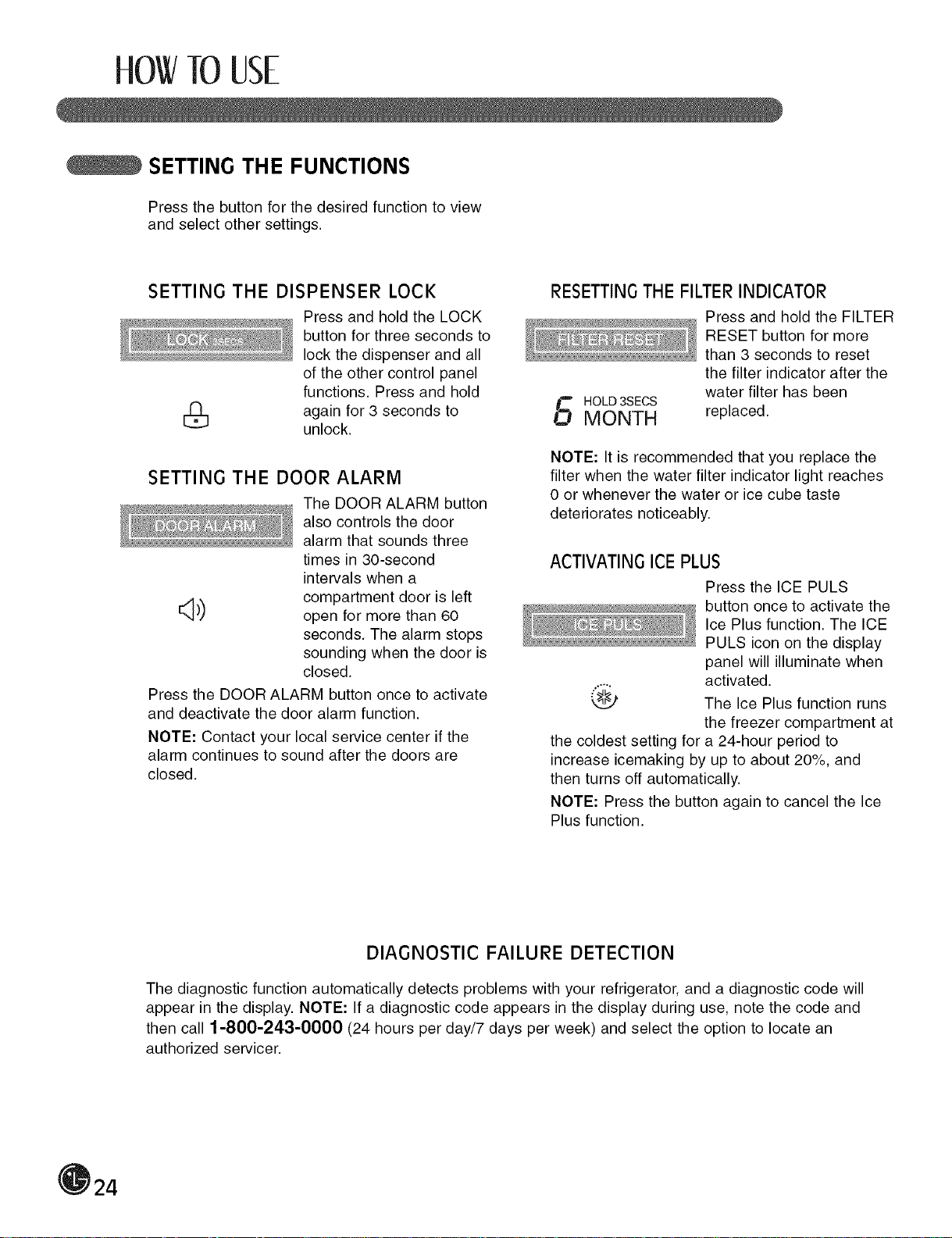
SETTING THE FUNCTIONS
Press the button for the desired function to view
and select other settings.
SETTING THE DISPENSER LOCK
Press and hold the LOCK
button for three seconds to
lock the dispenser and all
of the other control panel
functions. Press and hold
i_ again for 3 seconds to
unlock.
SETTING THE DOOR ALARM
The DOOR ALARM button
also controls the door
alarm that sounds three
times in 30-second
intervals when a
compartment door is left
../1,\
_,J'_) open for more than 60
seconds. The alarm stops
sounding when the door is
closed.
Press the DOOR ALARM button once to activate
and deactivate the door alarm function.
NOTE: Contact your local service center if the
alarm continues to sound after the doors are
closed.
HOLD 3SECS
MONTH
RESETTINGTHE FILTER INDICATOR
Press and hold the FILTER
RESET button for more
than 3 seconds to reset
the filter indicator after the
water filter has been
replaced.
NOTE: It is recommended that you replace the
filter when the water filter indicator light reaches
0 or whenever the water or ice cube taste
deteriorates noticeably.
ACTIVATING ICE PLUS
Press the ICE PULS
button once to activate the
Ice Plus function. The ICE
PULS icon on the display
panel will illuminate when
activated.
_ The Ice Plus function runs
the freezer compartment at
the coldest setting for a 24-hour period to
increase icemaking by up to about 20%, and
then turns off automatically.
NOTE: Press the button again to cancel the Ice
Plus function.
DIAGNOSTIC FAILURE DETECTION
The diagnostic function automatically detects problems with your refrigerator, and a diagnostic code will
appear in the display. NOTE: If a diagnostic code appears in the display during use, note the code and
then call 1-800-243-0000 (24 hours per day/7 days per week) and select the option to locate an
authorized servicer.
24
HOWTOUSE
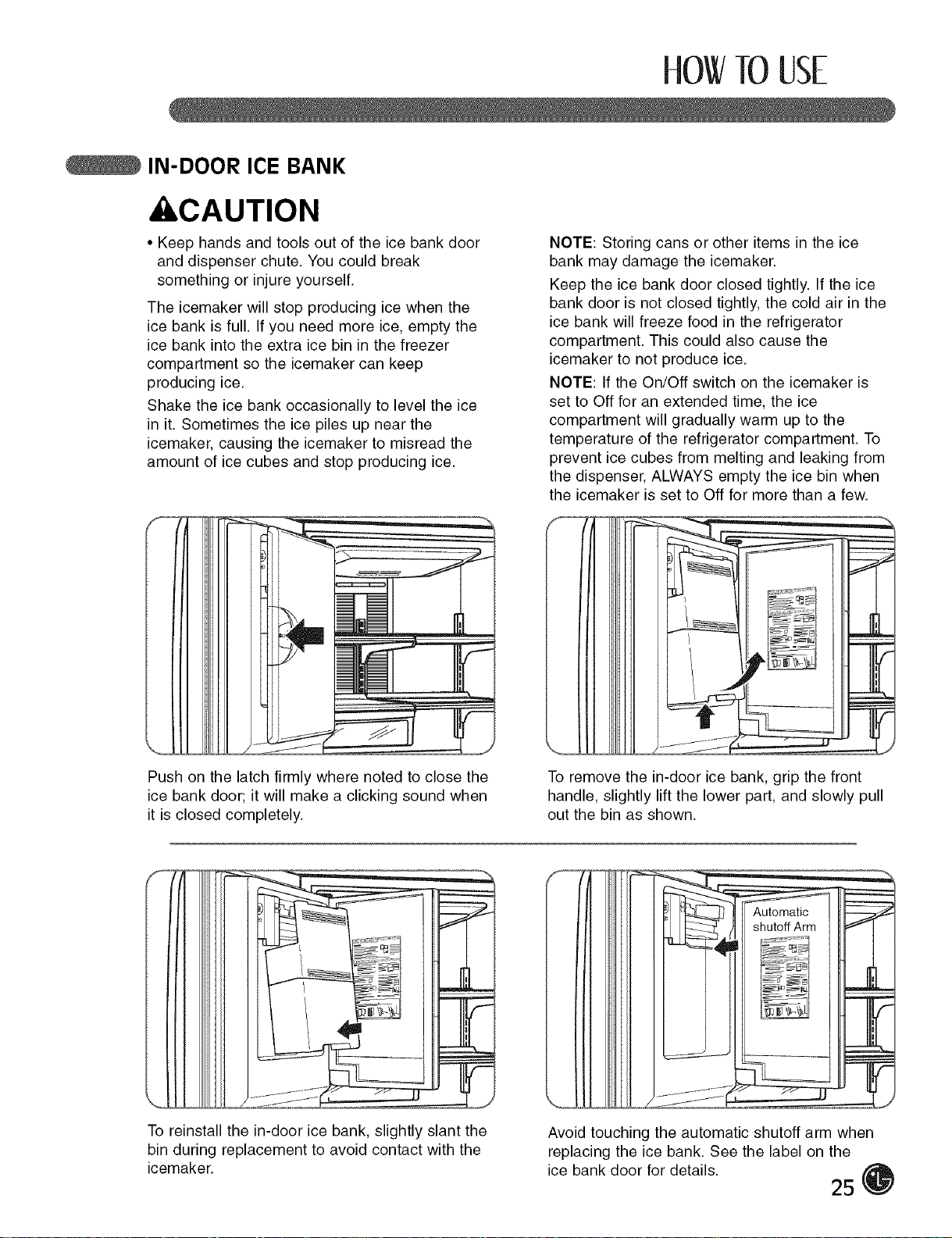
IN=DOOR ICE BANK
ACAUTION
• Keep hands and tools out of the ice bank door
and dispenser chute. You could break
something or injure yourself.
The icemaker will stop producing ice when the
ice bank is full. If you need more ice, empty the
ice bank into the extra ice bin in the freezer
compartment so the icemaker can keep
producing ice.
Shake the ice bank occasionally to level the ice
in it. Sometimes the ice piles up near the
icemaker, causing the icemaker to misread the
amount of ice cubes and stop producing ice.
NOTE: Storing cans or other items in the ice
bank may damage the icemaker.
Keep the ice bank door closed tightly. If the ice
bank door is not closed tightly, the cold air in the
ice bank will freeze food in the refrigerator
compartment. This could also cause the
icemaker to not produce ice.
NOTE: If the On/Off switch on the icemaker is
set to Off for an extended time, the ice
compartment will gradually warm up to the
temperature of the refrigerator compartment. To
prevent ice cubes from melting and leaking from
the dispenser, ALWAYS empty the ice bin when
the icemaker is set to Off for more than a few.
Push on the latch firmly where noted to close the
ice bank door; it will make a clicking sound when
it is closed completely.
To remove the in-door ice bank, grip the front
handle, slightly lift the lower part, and slowly pull
out the bin as shown.
f
i
To reinstall the in-door ice bank, slightly slant the
bin during replacement to avoid contact with the
icemaker.
Avoid touching the automatic shutoff arm when
replacing the ice bank. See the label on the
ice bank door for details.
25
ttOWTOUSE
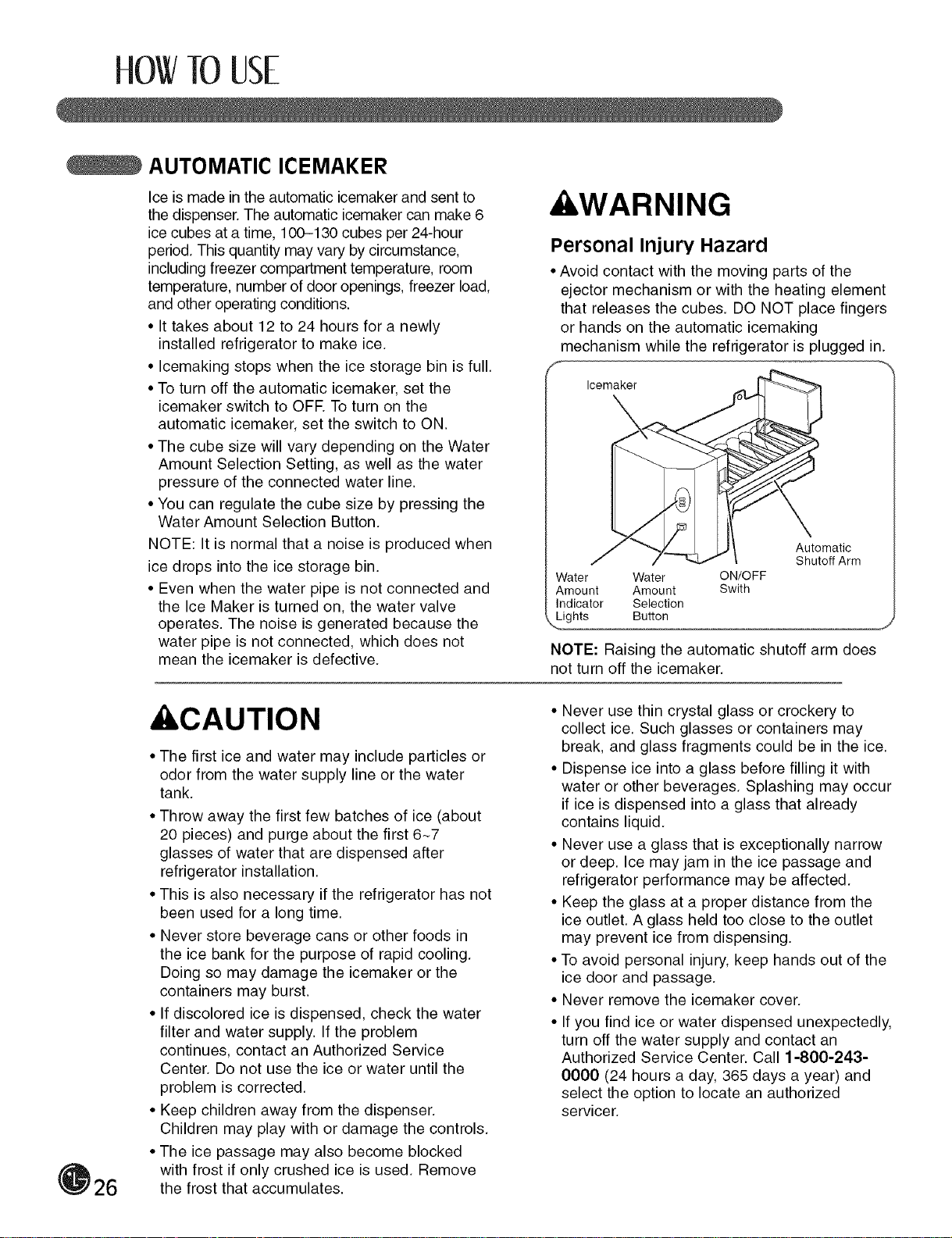
AUTOMIATIC ICEIVlAKER
Ice is made in the automatic icemaker and sent to
the dispenser. The automatic icemaker can make 6
ice cubes at a time, 100-130 cubes per 24-hour
period. This quantity may vary by circumstance,
including freezer compartment temperature, room
temperature, number of door openings, freezer load,
and other operating conditions.
• It takes about 12 to 24 hours for a newly
installed refrigerator to make ice.
• Icemaking stops when the ice storage bin is full.
• To turn off the automatic icemaker, set the
icemaker switch to OFE To turn on the
automatic icemaker, set the switch to ON.
• The cube size will vary depending on the Water
Amount Selection Setting, as well as the water
pressure of the connected water line.
• You can regulate the cube size by pressing the
Water Amount Selection Button.
NOTE: It is normal that a noise is produced when
ice drops into the ice storage bin.
• Even when the water pipe is not connected and
the Ice Maker is turned on, the water valve
operates. The noise is generated because the
water pipe is not connected, which does not
mean the icemaker is defective.
,WARNING
Personal Injury Hazard
• Avoid contact with the moving parts of the
ejector mechanism or with the heating element
that releases the cubes. DO NOT place fingers
or hands on the automatic icemaking
mechanism while the refrigerator is plugged in.
f
Icemaker
Automatic
Shutoff Arm
Water Water ON/OFF
Amount Amount Swith
Indicator Selection
Lights Button
NOTE: Raising the automatic shutoff arm does
not turn off the icemaker.
26
,A,CAUTION
• The first ice and water may include particles or
odor from the water supply line or the water
tank.
• Throw away the first few batches of ice (about
20 pieces) and purge about the first 6-7
glasses of water that are dispensed after
refrigerator installation.
• This is also necessary if the refrigerator has not
been used for a long time.
• Never store beverage cans or other foods in
the ice bank for the purpose of rapid cooling.
Doing so may damage the icemaker or the
containers may burst.
• If discolored ice is dispensed, check the water
filter and water supply. If the problem
continues, contact an Authorized Service
Center. Do not use the ice or water until the
problem is corrected.
• Keep children away from the dispenser.
Children may play with or damage the controls.
• The ice passage may also become blocked
with frost if only crushed ice is used. Remove
the frost that accumulates.
• Never use thin crystal glass or crockery to
collect ice. Such glasses or containers may
break, and glass fragments could be in the ice.
• Dispense ice into a glass before filling it with
water or other beverages. Splashing may occur
if ice is dispensed into a glass that already
contains liquid.
• Never use a glass that is exceptionally narrow
or deep. Ice may jam in the ice passage and
refrigerator performance may be affected.
• Keep the glass at a proper distance from the
ice outlet. A glass held too close to the outlet
may prevent ice from dispensing.
• To avoid personal injury, keep hands out of the
ice door and passage.
• Never remove the icemaker cover.
• If you find ice or water dispensed unexpectedly,
turn off the water supply and contact an
Authorized Service Center. Call 1-800-243-
0000 (24 hours a day, 365 days a year) and
select the option to locate an authorized
servicer.
HOWTOUSE
OPTIBIN TMCRISPER HUMIDITY CONTROL
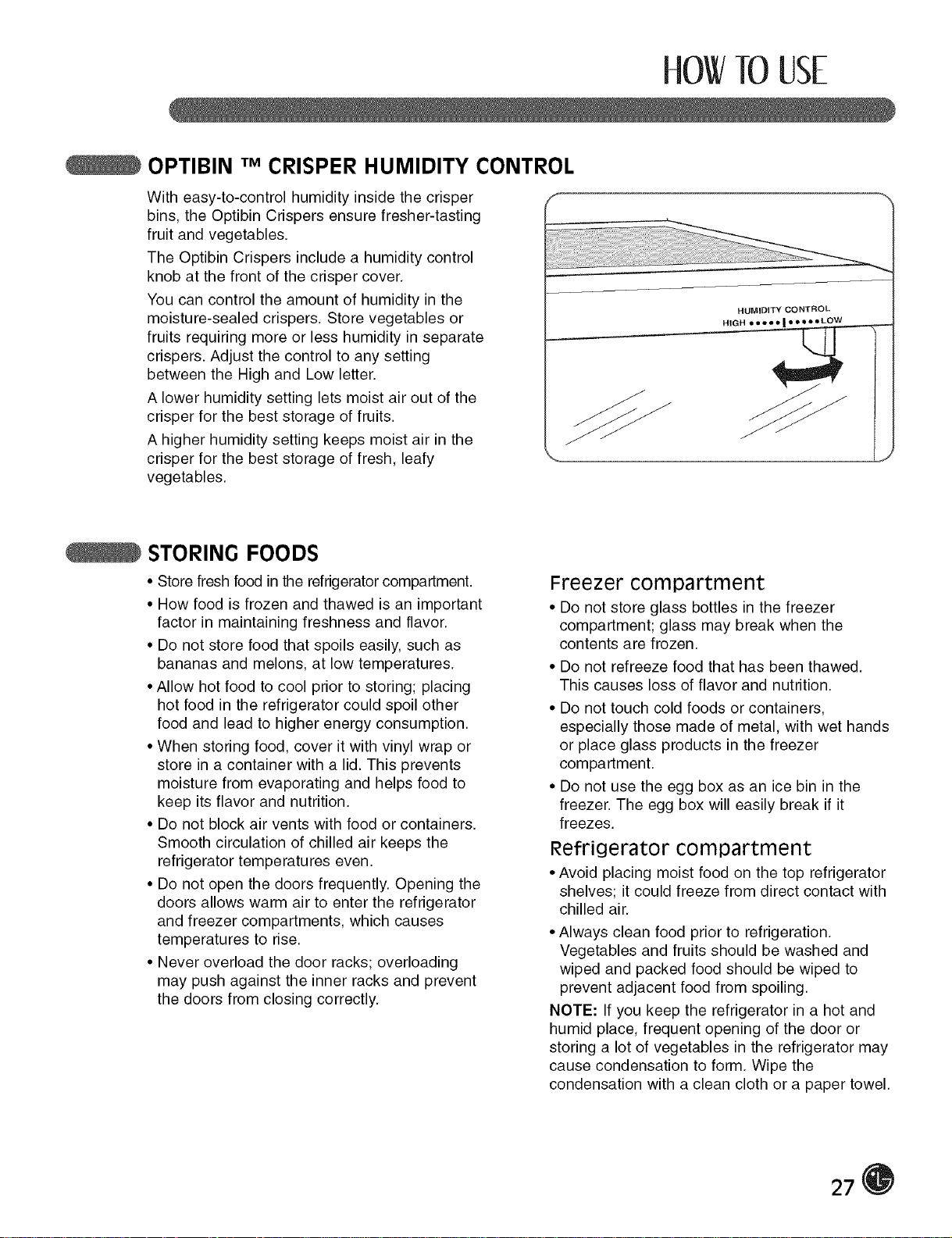
With easy-to-control humidity inside the crisper
bins, the Optibin Crispers ensure fresher-tasting
fruit and vegetables.
The Optibin Crispers include a humidity control
knob at the front of the crisper cover.
You can control the amount of humidity in the
moisture-sealed crispers. Store vegetables or
fruits requiring more or less humidity in separate
crispers. Adjust the control to any setting
between the High and Low letter.
A lower humidity setting lets moist air out of the
crisper for the best storage of fruits.
A higher humidity setting keeps moist air in the
crisper for the best storage of fresh, leafy
vegetables.
HUMIDITY CONTROL
HIGH ,,° o,,o I • oo o'LoW
STORING FOODS
• Store fresh food in the refrigerator compartment.
• How food is frozen and thawed is an important
factor in maintaining freshness and flavor.
• Do not store food that spoils easily, such as
bananas and melons, at low temperatures.
• Allow hot food to cool prior to storing; placing
hot food in the refrigerator could spoil other
food and lead to higher energy consumption.
• When storing food, cover it with vinyl wrap or
store in a container with a lid. This prevents
moisture from evaporating and helps food to
keep its flavor and nutrition.
• Do not block air vents with food or containers.
Smooth circulation of chilled air keeps the
refrigerator temperatures even.
• Do not open the doors frequently. Opening the
doors allows warm air to enter the refrigerator
and freezer compartments, which causes
temperatures to rise.
• Never overload the door racks; overloading
may push against the inner racks and prevent
the doors from closing correctly.
Freezer compartment
• Do not store glass bottles in the freezer
compartment; glass may break when the
contents are frozen,
• Do not refreeze food that has been thawed,
This causes loss of flavor and nutrition.
• Do not touch cold foods or containers,
especially those made of metal, with wet hands
or place glass products in the freezer
compartment.
• Do not use the egg box as an ice bin in the
freezer. The egg box will easily break if it
freezes.
Refrigerator compartment
• Avoid placing moist food on the top refrigerator
shelves; it could freeze from direct contact with
chilled air.
• Always clean food prior to refrigeration.
Vegetables and fruits should be washed and
wiped and packed food should be wiped to
prevent adjacent food from spoiling.
NOTE: If you keep the refrigerator in a hot and
humid place, frequent opening of the door or
storing a lot of vegetables in the refrigerator may
cause condensation to form. Wipe the
condensation with a clean cloth or a paper towel.
27
HOWTOUSE
LOCATION OF FOODS
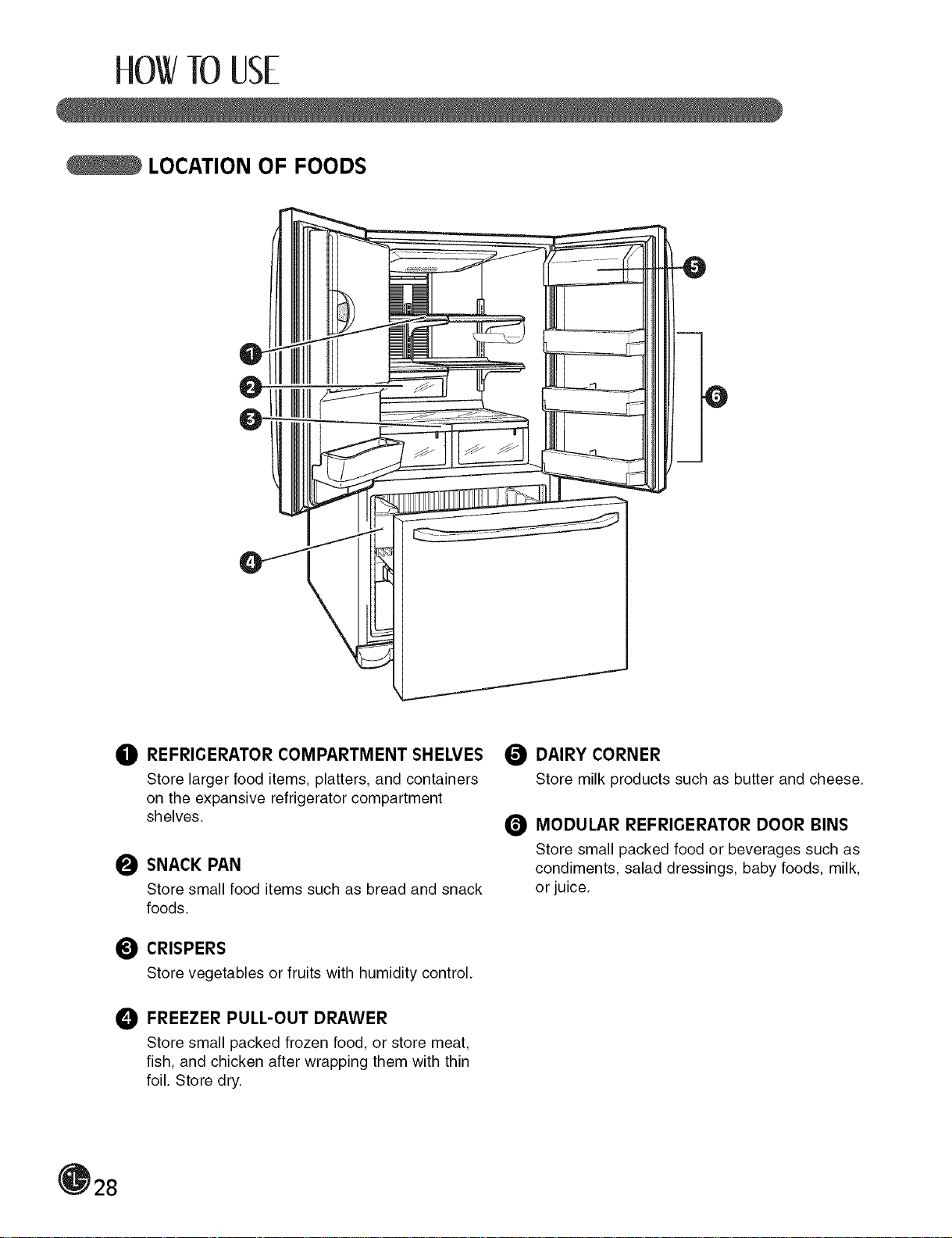
O REFRIGERATOR COMPARTMENT SHELVES
Store larger food items, platters, and containers
on the expansive refrigerator compartment
shelves.
O SNACK PAN
Store small food items such as bread and snack
foods.
O CRISPERS
Store vegetables or fruits with humidity control.
O FREEZER PULL-OUT DRAWER
Store small packed frozen food, or store meat,
fish, and chicken after wrapping them with thin
foil. Store dry.
O DAIRY CORNER
Store milk products such as butter and cheese.
MODULAR REFRIGERATOR DOOR BINS
Store small packed food or beverages such as
condiments, salad dressings, baby foods, milk,
or juice.
28

HOWTOUSE
SHELF HEIGHT ADJUSTMENT
The shelves in your refrigerator are adjustable to
meet your individual storage needs. Your model
may have glass or wire shelves.
Storing similar food items together in your
refrigerator and adjusting the shelves to fit
different heights of items will make finding the
exact item you want easier; it will also reduce the
amount of time the refrigerator door is open,
saving energy.
IMPORTANT: Do not clean glass shelves with
warm water when they are cold. Shelves may
break if exposed to sudden temperature changes
or impact, such as bumping. For your protection,
glass shelves are made with tempered glass,
which will shatter into small pebble-sized pieces.
NOTE: Glass shelves are heavy. Use special
care when removing them to avoid dropping
them.
Adjusting Shelves
Remove shelves from the shipping position and
replace shelves in the position you want.
&CAUTION
Make sure that shelves are level from one side to
the other. Failure to do so may result in the shelf
falling or spilling food.
Remove Shelf Reinstall Shelf
f
Tilt up the front of the shelf. Lift up the
back and pull out the shelf.
-lilt up the front of the shelf and guide the
shelf hooks into the slots at a desired height.
Then lower the front of the shelf so that
the hooks drop into the slots.
29
CAREAND€lEANING
REMOVING AND REPLACING COMPONENTS
NOTE: when reinstalling components, reverse the
order of steps for removal. TOprevent damage,
never use excessive force when removing or
reinstalling components.
kCAUTION
• Personal injury can occur if the door bins are not
firmly assembled.
NOTE: DO NOT adjust a loaded bin.
• DO NOT allow children to play with baskets.
The sharp corners on the baskets could cause
injury.
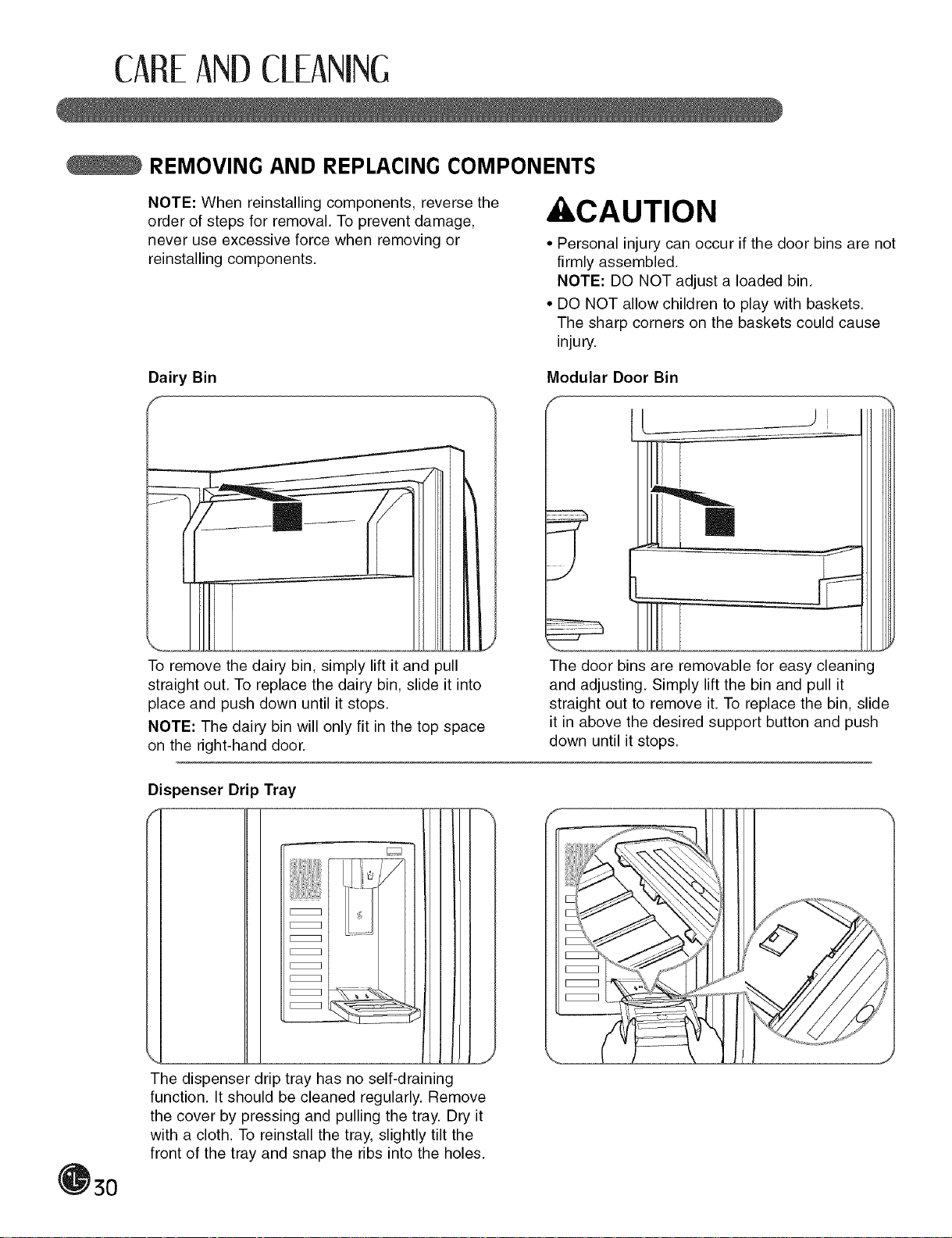
Dairy Bin
To remove the dairy bin, simply lift it and pull
straight out. To replace the dairy bin, slide it into
place and push down until it stops.
NOTE: The dairy bin will only fit in the top space
on the right-hand door.
Modular Door Bin
1 ...............
The door bins are removable for easy cleaning
and adjusting. Simply lift the bin and pull it
straight out to remove it. To replace the bin, slide
it in above the desired support button and push
down until it stops.
3O
Dispenser Drip Tray
The dispenser drip tray has no self-draining
function. It should be cleaned regularly. Remove
the cover by pressing and pulling the tray. Dry it
with a cloth. To reinstall the tray, slightly tilt the
front of the tray and snap the ribs into the holes.
J
CAREANDCLEANING
REMOVING AND REPLACING COMPONENTS (CONT.)
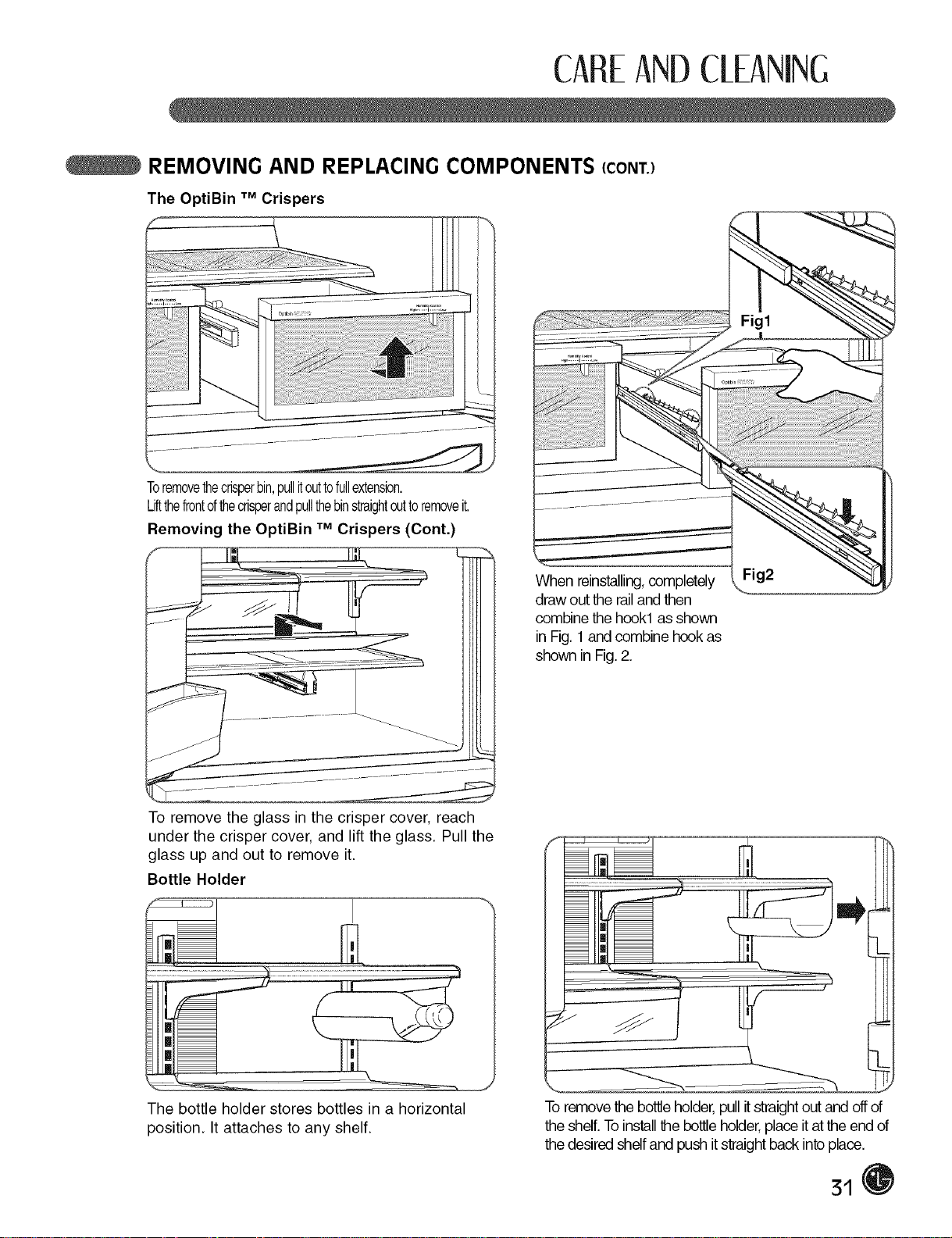
The OptiBin tm Crispers
Toremovethecrisperbin,pullitouttofullextension.
Liftthefrontofthecrisperandpullthebinstraightouttoremoveit.
Removing the OptiBin TM crispers (cont.)
when reinstalling,completely
draw out the railand then
combine thehook1 as shown
in Fig. 1 and combine hook as
shown in Fig.2.
Fig1
Fig2
To remove the glass in the crisper cover, reach
under the crisper cover, and lift the glass. Pull the
glass up and out to remove it.
Bottle Holder
The bottle holder stores bottles in a horizontal
position. It attaches to any shelf.
To remove the botlleholder,pull itstraightoutand off of
the shelf.Toinstallthebottle holder,place itat the end of
the desiredshelf and push itstraightback into place.
31
CAREAND€lEANING
REMOVING AND REPLACING COMPONENTS (CONT.)
&CAUTION
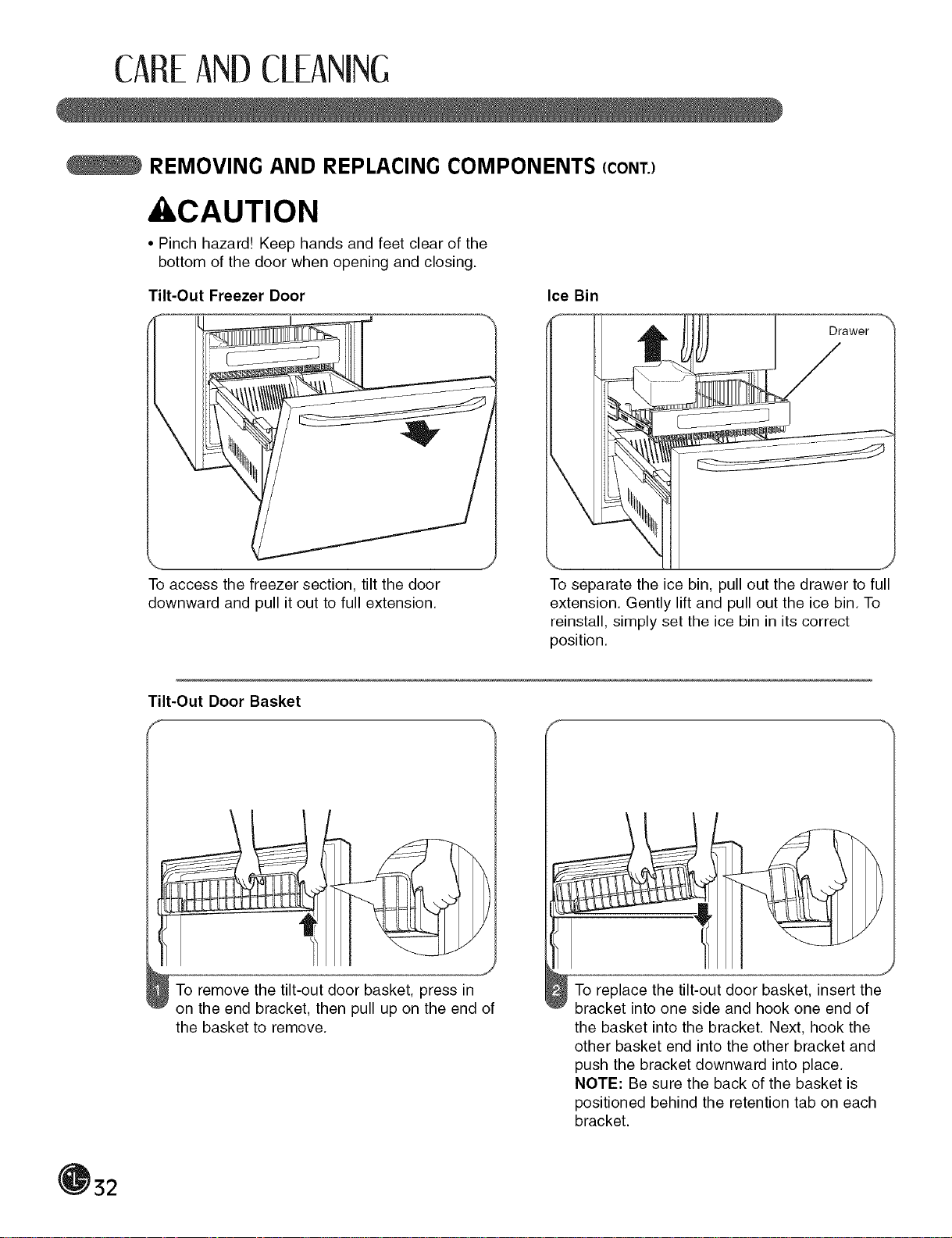
• Pinch hazard! Keep hands and feet clear of the
bottom of the door when opening and closing.
Tilt-Out Freezer Door Ice Bin
Drawer
To access the freezer section, tilt the door
downward and pull it out to full extension.
To separate the ice bin, pull out the drawer to full
extension. Gently lift and pull out the ice bin. To
reinstall, simply set the ice bin in its correct
position.
Tilt-Out Door Basket
f
To remove the tilt-out door basket, press in
on the end bracket, then pull up on the end of
the basket to remove.
To replace the tilt-out door basket, insert the
bracket into one side and hook one end of
the basket into the bracket. Next, hook the
other basket end into the other bracket and
push the bracket downward into place.
NOTE: Be sure the back of the basket is
positioned behind the retention tab on each
bracket.
52
CAREANDCLEANING
REMOVING AND REPLACING COMPONENTS (CONT.)
&WARNING
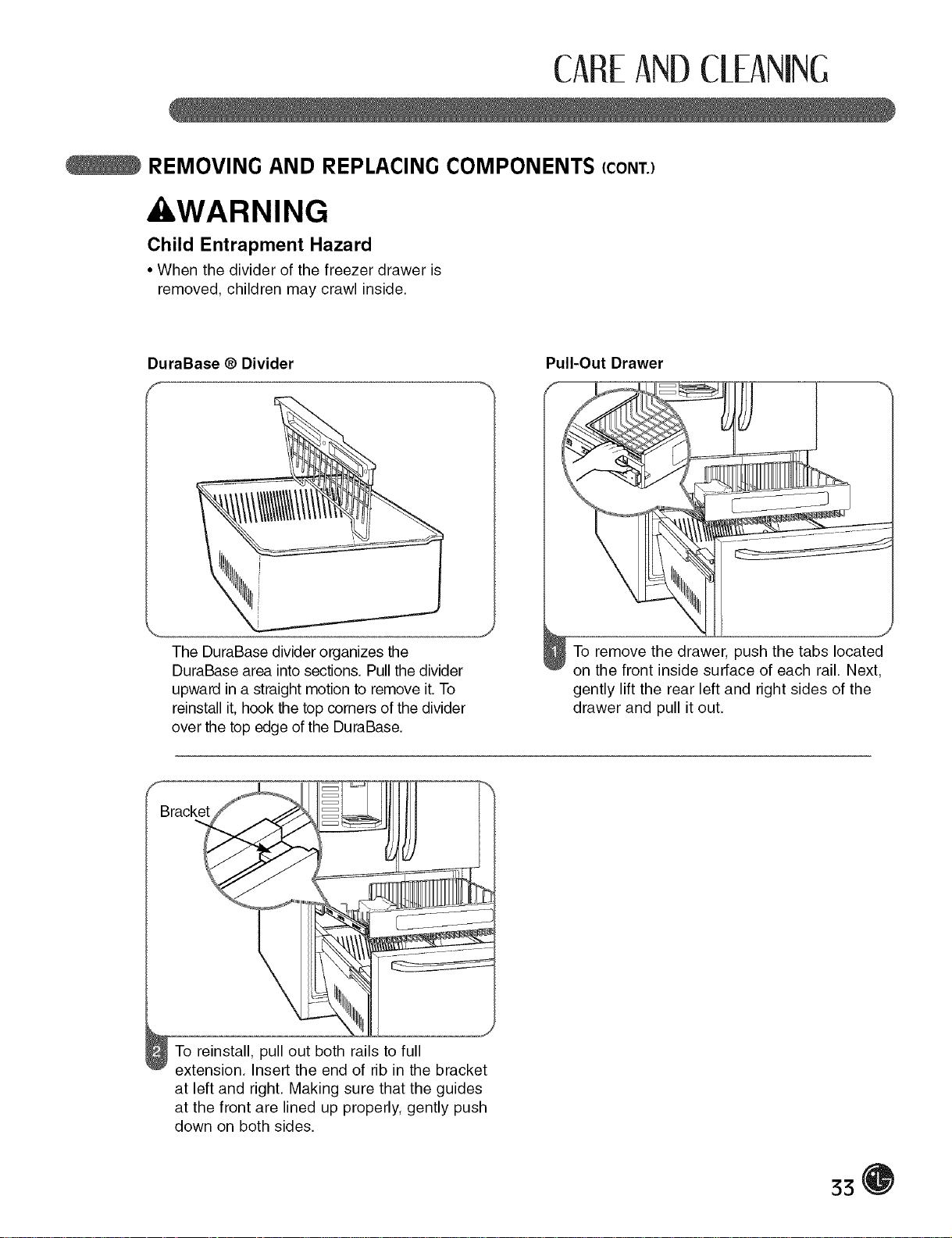
Child Entrapment Hazard
• When the divider of the freezer drawer is
removed, children may crawl inside.
DuraBase ® Divider Pull-Out Drawer
The DuraBase divider organizes the
DuraBase area into sections. Pull the divider
upward in a straight motion to remove it. To
reinstall it, hook the top corners of the divider
over the top edge of the DuraBase.
To remove the drawer, push the tabs located
on the front inside surface of each rail. Next,
gently lift the rear left and right sides of the
drawer and pull it out.
To reinstall, pull out both rails to full
extension, Insert the end of rib in the bracket
at left and right. Making sure that the guides
at the front are lined up properly, gently push
down on both sides.
33
CAREAND€lEANING
CLEANING THE REFRIGERATOR
AWARNING
Explosion Hazard
• Use nonflammable cleaner.
• Failure to do so can result in death,
explosion, or fire.
Both the refrigerator and freezer sections defrost
automatically. However, clean both sections
about once a month to prevent odors. Wipe up
spills immediately.
• Unplug the refrigerator or disconnect the power.
• Remove all removable parts, such as shelves
and crispers.
• Use a clean sponge or soft cloth and a mild
detergent in warm water. Do not use abrasive
or harsh cleaners.
• Hand wash, rinse, and thoroughly dry all
surfaces.
• Plug in the refrigerator or reconnect the power.
NOTE: Window sprays, abrasive cleaners, or
flammable fluids can scratch or damage plastic
covers or panels.
Cleaning the Exterior
For models with a stainless steel exterior, use a
commercially available stainless steel cleaner in
accordance with the manufacturer's instructions.
You may also use a clean sponge or soft cloth
and a mild detergent in warm water. Do not use
abrasive or harsh cleaners. Dry thoroughly with a
soft cloth.
IMPORTANT: Do not use cleaning waxes,
concentrated detergents, or cleaners containing
petroleum on plastic refrigerator parts such as
door liners or gaskets.
Care and Cleaning of the Interior
NOTE: Allow the freezer to warm so the cleaning
cloth will not stick.
To help remove odors, you can wash the inside
of the refrigerator with a mixture of baking soda
and warm water. Mix 2 tbsp baking soda to 1 qt.
of water (26 g soda to 1 L of water). Be sure the
baking soda dissolves completely so it does not
scratch the surfaces of the refrigerator.
IMPORTANT: Do not use a spray nozzle to clean
the interior.
GENERAL INFORMATION
Storage
During average-length vacations, you will
probably find it best to leave the refrigerator in
operation. Place freezable items in the freezer
for longer life.
When you plan to store the refrigerator, remove
all food, disconnect the power cord, clean the
interior thoroughly, and block the doors open to
prevent mold and mildew. Be certain the stored
refrigerator does not present a child entrapment
danger.
Power Failure
Most power failures that are corrected within an
hour or two will not affect your refrigerator
temperatures. However, you should minimize the
number of door openings while the power is off.
Water may drip from the ice bank and ice bin
during a power outage. To prevent this, remove
the ice bank and ice bin, discard all of the ice,
towel dry them, and replace them.
MOving
Unload the refrigerator to move it. (This is
probably not necessary when pulling it out to
clean behind it.) Be sure to let the refrigerator
warm up to room temperature, and dry the inside
before closing the doors to pack it for moving. To
avoid damaging the height-adjusting screws, turn
them all the way intothe base.
34
CAREAND€lEANING
REPLACING THE WATER FILTER
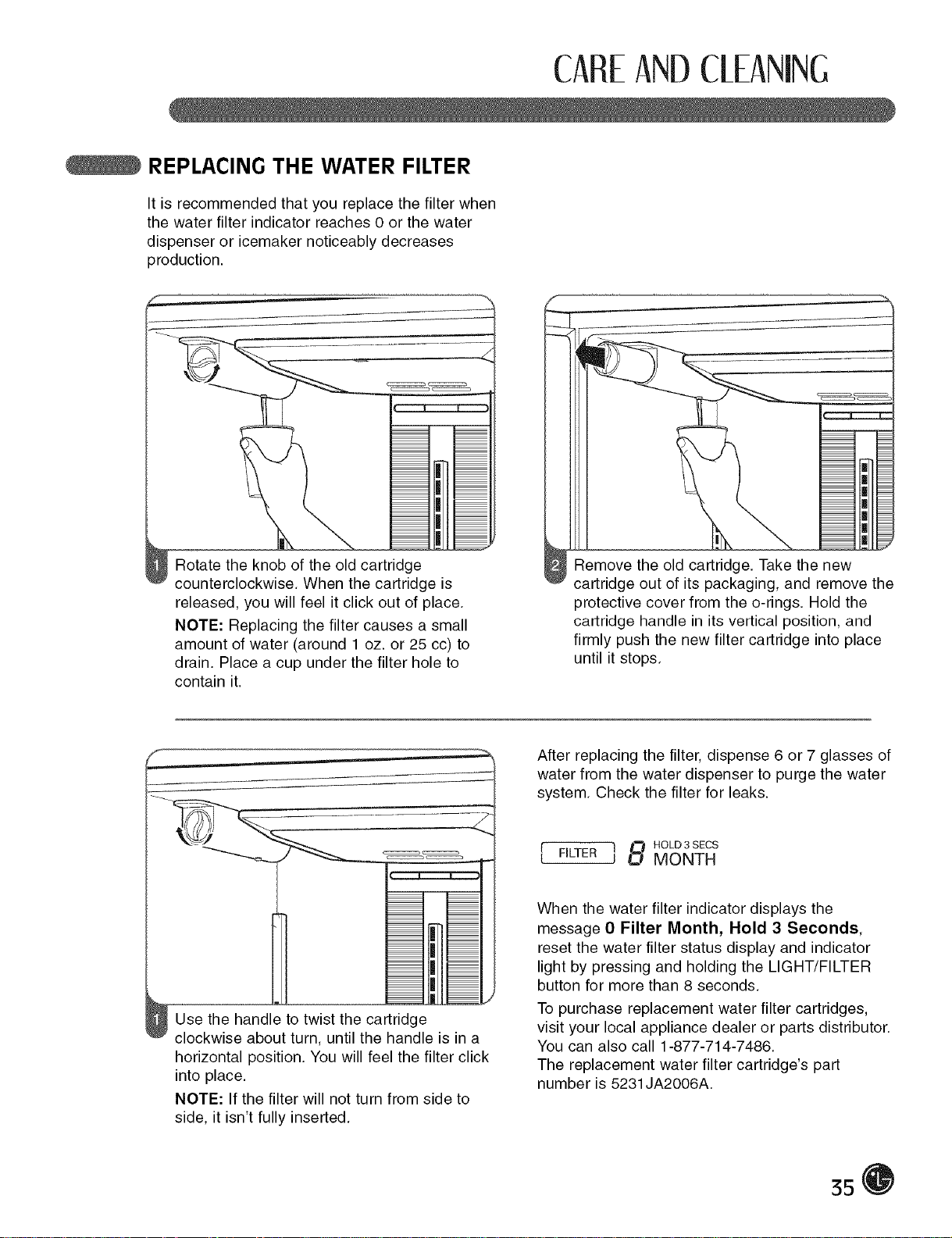
It is recommended that you replace the filter when
the water filter indicator reaches 0 or the water
dispenser or icemaker noticeably decreases
production.
Rotate the knob of the old cartridge
counterclockwise. When the cartridge is
released, you will feel it click out of place.
NOTE: Replacing the filter causes a small
amount of water (around 1 oz. or 25 cc) to
drain. Place a cup under the filter hole to
contain it.
Remove the old cartridge. Take the new
cartridge out of its packaging, and remove the
protective cover from the o-rings. Hold the
cartridge handle in its vertical position, and
firmly push the new filter cartridge into place
until it stops.
J
Use the handle to twist the cartridge
clockwise about turn, until the handle is in a
horizontal position. You will feel the filter click
into place.
NOTE: If the filter will not turn from side to
side, it isn't fully inserted.
After replacing the filter, dispense 6 or 7 glasses of
water from the water dispenser to purge the water
system. Check the filter for leaks.
if FILTER } 8 HOLD3SECSMoNTH
When the water filter indicator displays the
message 0 Filter Month, Hold 3 Seconds,
reset the water filter status display and indicator
light by pressing and holding the LIGHT/FILTER
button for more than 8 seconds.
To purchase replacement water filter cartridges,
visit your local appliance dealer or parts distributor.
You can also call 1-877-714-7486.
The replacement water filter cartridge's part
number is 5231JA2006A.
35
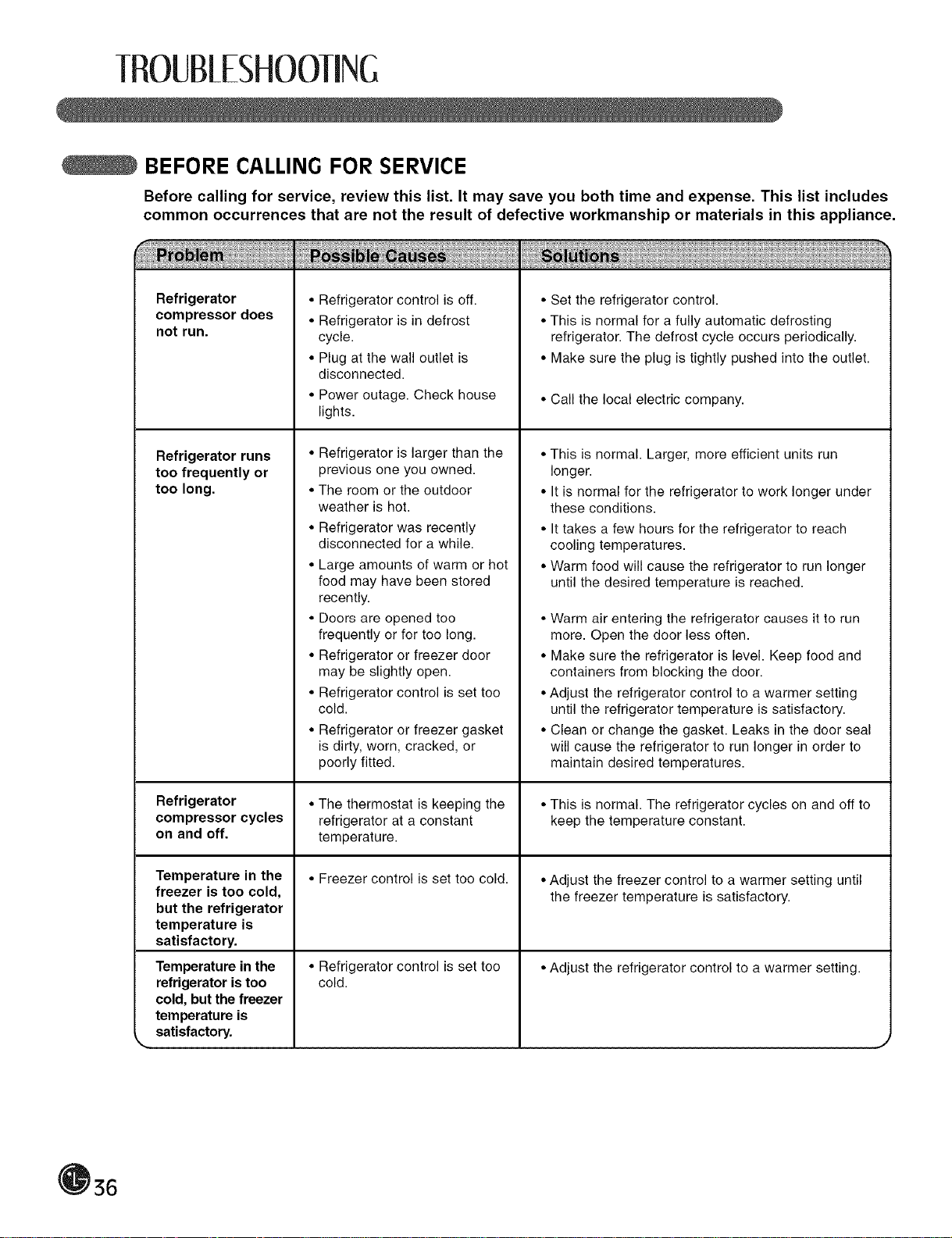
TROUBLESHOOTING
BEFORE CALLING FOR SERVICE
Before calling for service, review this list. It may save you both time and expense. This list includes
common occurrences that are not the result of defective workmanship or materials in this appliance.
Refrigerator
compressor does
not run.
Refrigerator runs
too frequently or
too long.
Refrigerator
compressor cycles
on and off.
Temperature in the
freezer is too cold,
but the refrigerator
temperature is
satisfactory.
Temperature in the
refrigerator istoo
cold, but the freezer
temperature is
satisfactory.
• Refrigerator control is off.
• Refrigerator is in defrost
cycle.
• Plug at the wall outlet is
disconnected.
• Power outage. Check house
lights.
• Refrigerator is larger than the
previous one you owned.
• The room or the outdoor
weather is hot.
• Refrigerator was recently
disconnected for a while.
• Large amounts of warm or hot
food may have been stored
recently.
• Doors are opened too
frequently or for too long.
• Refrigerator or freezer door
may be slightly open.
• Refrigerator control is set too
cold.
• Refrigerator or freezer gasket
is dirty, worn, cracked, or
poorly fitted.
• The thermostat is keeping the
refrigerator at a constant
temperature.
• Freezer control is set too cold.
• Refrigerator control is set too
cold.
• Set the refrigerator control.
• This is normal for a fully automatic defrosting
refrigerator. The defrost cycle occurs periodically.
• Make sure the plug is tightly pushed into the outlet.
• Call the local electric company.
• This is normal. Larger, more efficient units run
longer.
• It is normal for the refrigerator to work longer under
these conditions.
• It takes a few hours for the refrigerator to reach
cooling temperatures.
• Warm food will cause the refrigerator to run longer
until the desired temperature is reached.
• Warm air entering the refrigerator causes it to run
more. Open the door less often.
• Make sure the refrigerator is level. Keep food and
containers from blocking the door.
• Adjust the refrigerator control to a warmer setting
until the refrigerator temperature is satisfactory.
• Clean or change the gasket. Leaks in the door seal
will cause the refrigerator to run longer in order to
maintain desired temperatures.
• This is normal. The refrigerator cycles on and off to
keep the temperature constant.
• Adjust the freezer control to a warmer setting until
the freezer temperature is satisfactory.
• Adjust the refrigerator control to a warmer setting.
.)
36
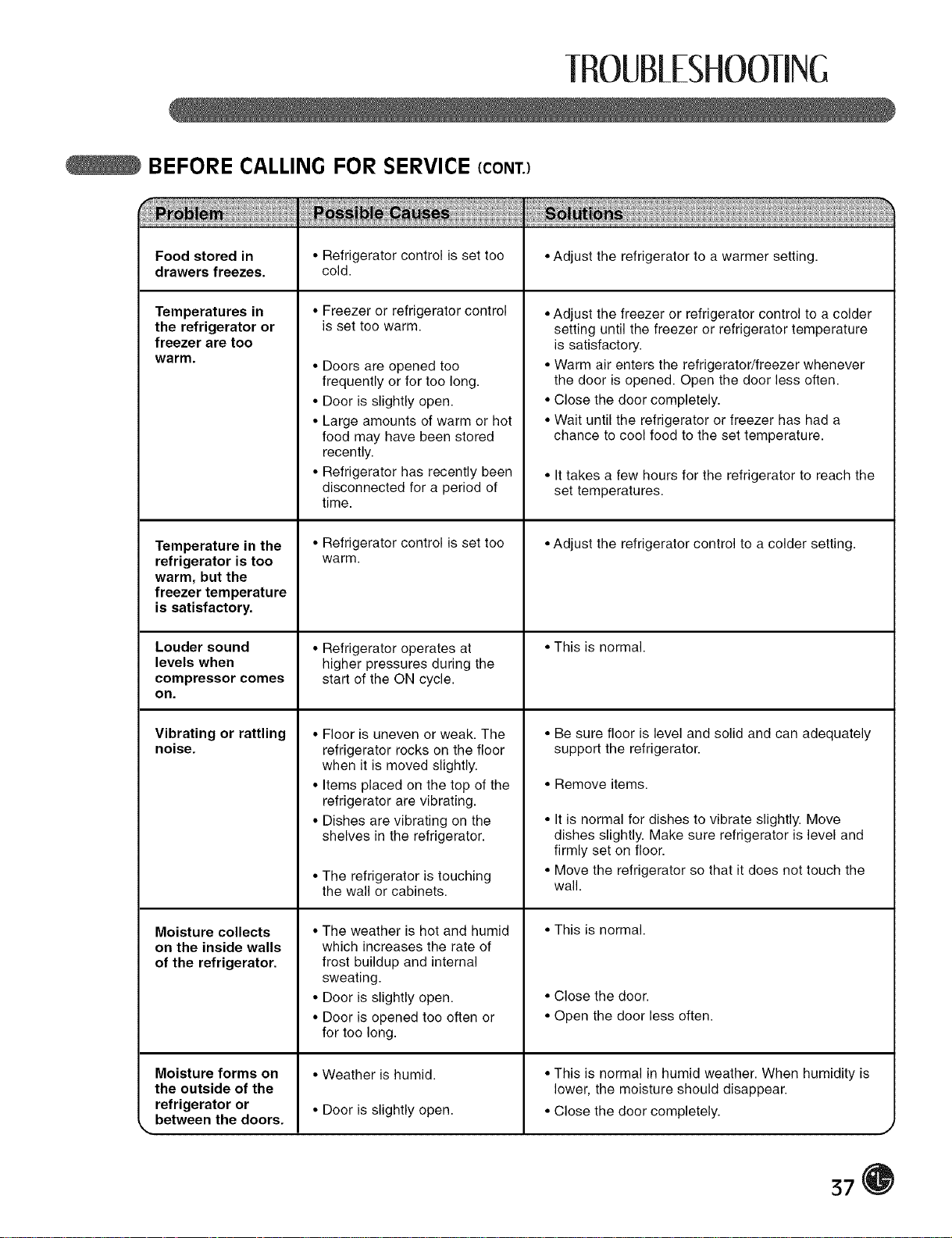
TROUB[ESHOOTING
BEFORE CALLING FOR SERVICE (cONT.)
Food stored in
drawers freezes.
Temperatures in
the refrigerator or
freezer are too
warm.
Temperature in the
refrigerator is too
warm, but the
freezer temperature
is satisfactory.
Louder sound
leVels when
compressor comes
on.
Vibrating or rattling
noise.
Moisture collects
on the inside walls
of the refrigerator.
Moisture forms on
the outside of the
refrigerator or
between the doors.
• Refrigerator control is set too
cold.
• Freezer or refrigerator control
is set too warm.
• Doors are opened too
frequently or for too long.
• Door is slightly open.
• Large amounts of warm or hot
food may have been stored
recently.
• Refrigerator has recently been
disconnected for a period of
time.
• Refrigerator control is set too
warm.
• Refrigerator operates at
higher pressures during the
start of the ON cycle.
• Floor is uneven or weak. The
refrigerator rocks on the floor
when it is moved slightly.
• Items placed on the top of the
refrigerator are vibrating.
• Dishes are vibrating on the
shelves in the refrigerator.
• The refrigerator is touching
the wall or cabinets.
• The weather is hot and humid
which increases the rate of
frost buildup and internal
sweating.
• Door is slightly open.
• Door is opened too often or
for too long.
• Weather is humid.
• Door is slightly open.
• Adjust the refrigerator to a warmer setting.
• Adjust the freezer or refrigerator control to a colder
setting until the freezer or refrigerator temperature
is satisfactory.
• Warm air enters the refrigerator/freezer whenever
the door is opened. Open the door less often.
• Close the door completely.
• Wait until the refrigerator or freezer has had a
chance to cool food to the set temperature.
• It takes a few hours for the refrigerator to reach the
set temperatures.
• Adjust the refrigerator control to a colder setting.
• This is normal.
• Be sure floor is level and solid and can adequately
support the refrigerator.
• Remove items.
• It is normal for dishes to vibrate slightly. Move
dishes slightly. Make sure refrigerator is level and
firmly set on floor.
• Move the refrigerator so that it does not touch the
wall.
• This is normal.
• Close the door.
• Open the door less often.
• This is normal in humid weather. When humidity is
lower, the moisture should disappear.
• Close the door completely.
37
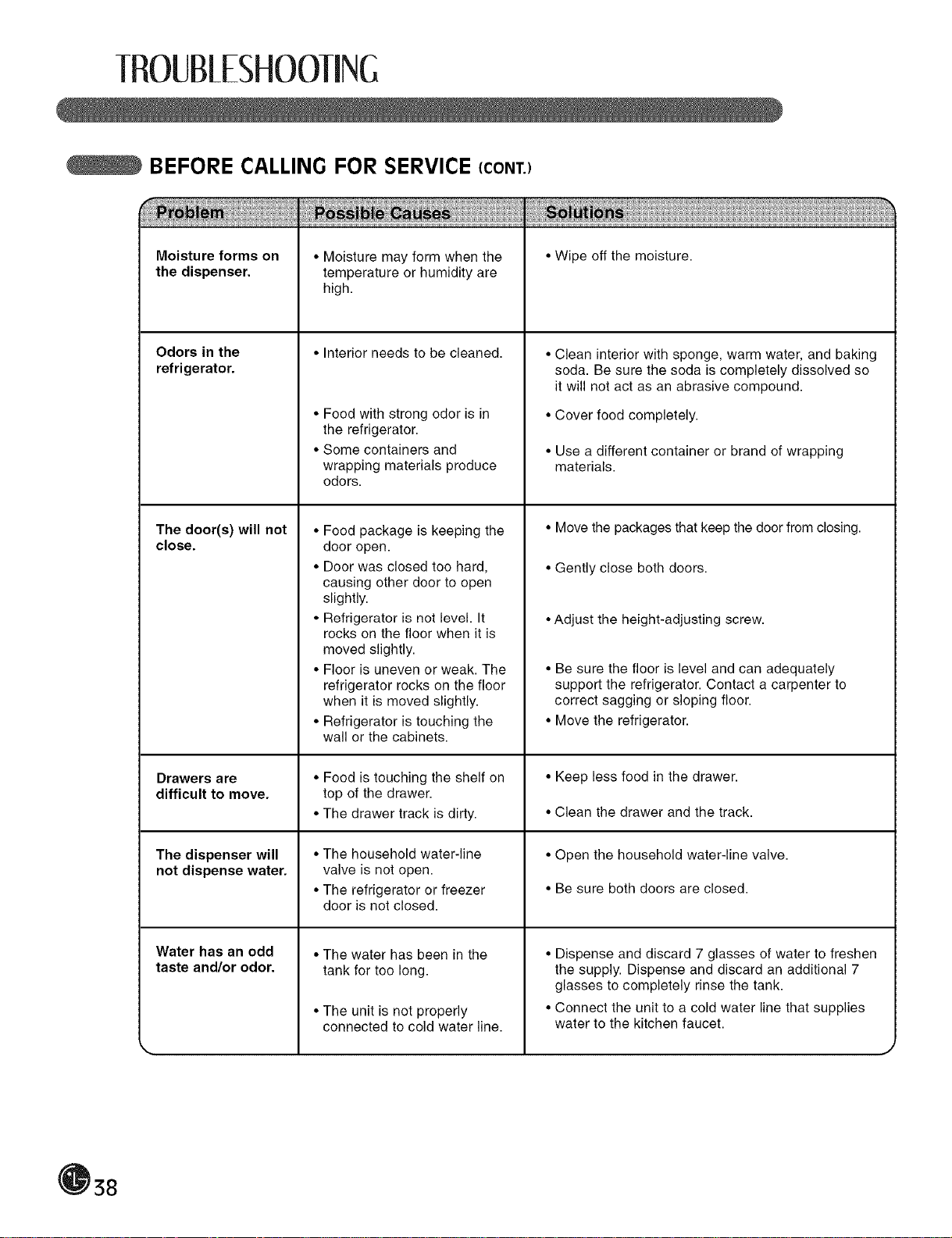
TROUBLESHOOTING
BEFORE CALLING FOR SERVICE (cONT.)
Moisture forms on
the dispenser.
odors in the
refrigerator.
The door(s) will not
close.
Drawers are
difficult to move.
The dispenser will
not dispense water.
Water has an odd
taste and/or odor.
• Moisture may form when the
temperature or humidity are
high.
• Interior needs to be cleaned.
• Food with strong odor is in
the refrigerator.
• Some containers and
wrapping materials produce
odors.
• Food package is keeping the
door open.
• Door was closed too hard,
causing other door to open
slightly.
• Refrigerator is not level. It
rocks on the floor when it is
moved slightly.
• Floor is uneven or weak. The
refrigerator rocks on the floor
when it is moved slightly.
• Refrigerator is touching the
wall or the cabinets.
• Food is touching the shelf on
top of the drawer.
• The drawer track is dirty.
• The household water-line
valve is not open.
• The refrigerator or freezer
door is not closed.
• The water has been in the
tank for too long.
• The unit is not properly
connected to cold water line.
• Wipe off the moisture.
• Clean interior with sponge, warm water, and baking
soda. Be sure the soda is completely dissolved so
it will not act as an abrasive compound.
• Cover food completely.
• Use a different container or brand of wrapping
materials.
• Move the packages that keep the door from closing.
• Gently close both doors.
•Adjust the height-adjusting screw.
• Be sure the floor is level and can adequately
support the refrigerator. Contact a carpenter to
correct sagging or sloping floor.
• Move the refrigerator.
• Keep less food in the drawer.
• Clean the drawer and the track.
•Open the household water-line valve.
•Be sure both doors are closed.
• Dispense and discard 7 glasses of water to freshen
the supply. Dispense and discard an additional 7
glasses to completely rinse the tank.
• Connect the unit to a cold water line that supplies
water to the kitchen faucet.
38
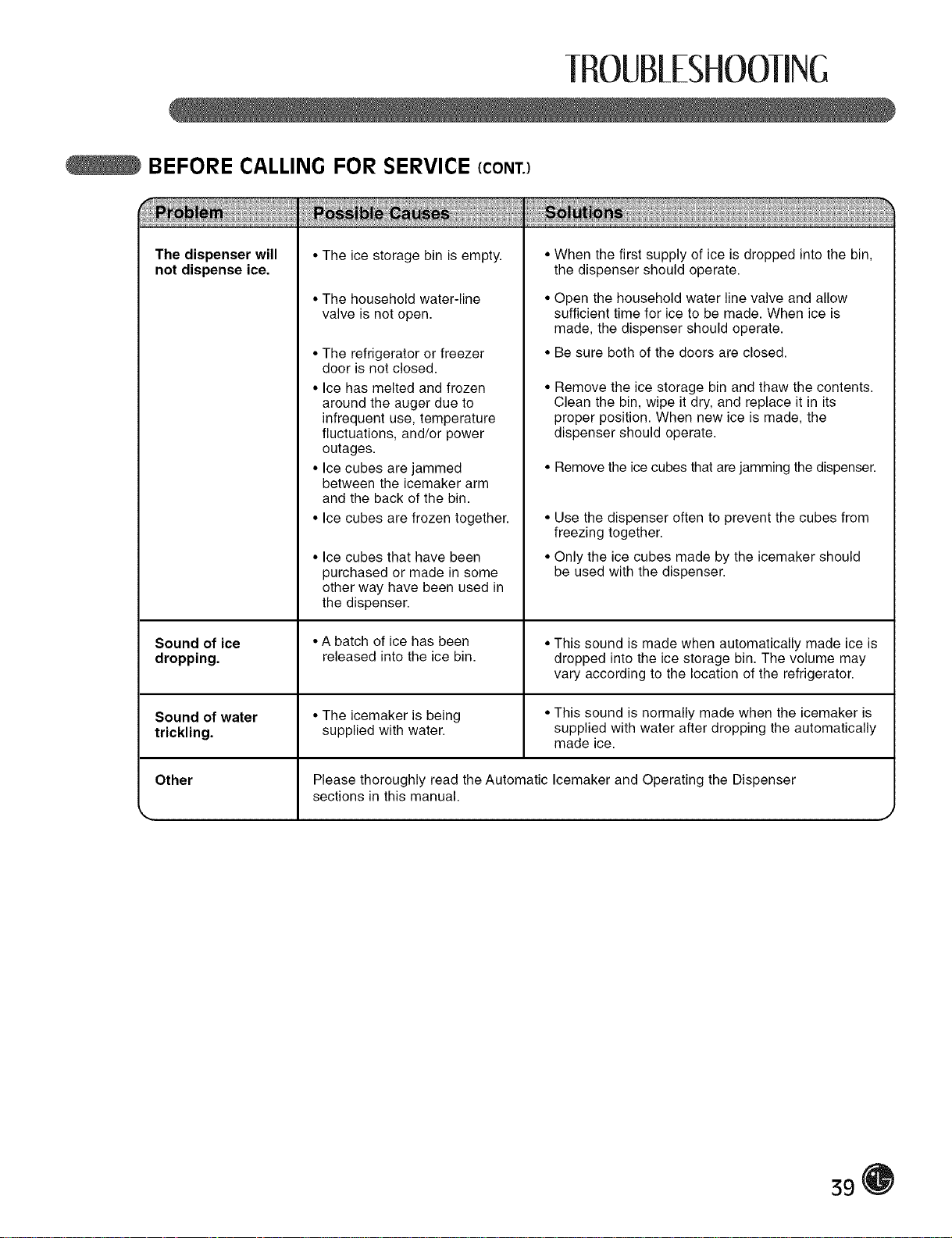
TROUBLESHOOTING
BEFORE CALLING FOR SERVICE (cONT.)
The dispenser will
not dispense ice.
Sound of ice
dropping.
• The ice storage bin is empty.
• The household water-line
valve is not open.
• The refrigerator or freezer
door is not closed.
• Ice has melted and frozen
around the auger due to
infrequent use, temperature
fluctuations, and/or power
outages.
• Ice cubes are jammed
between the icemaker arm
and the back of the bin.
• Ice cubes are frozen together.
• Ice cubes that have been
purchased or made in some
other way have been used in
the dispenser.
• A batch of ice has been
released into the ice bin.
• When the first supply of ice is dropped into the bin,
the dispenser should operate.
• Open the household water line valve and allow
sufficient time for ice to be made. When ice is
made, the dispenser should operate.
Be sure both of the doors are closed.
Remove the ice storage bin and thaw the contents.
Clean the bin, wipe it dry, and replace it in its
proper position. When new ice is made, the
dispenser should operate.
Remove the ice cubes that are jamming the dispenser.
• Use the dispenser often to prevent the cubes from
freezing together.
• Only the ice cubes made by the icemaker should
be used with the dispenser.
• This sound is made when automatically made ice is
dropped into the ice storage bin. The volume may
vary according to the location of the refrigerator.
Sound of water • The icemaker is being • This sound is normally made when the icemaker is
trickling, supplied with water, supplied with water after dropping the automatically
made ice.
Other Please thoroughly read the Automatic Icemaker and Operating the Dispenser
sections in this manual.
J
39
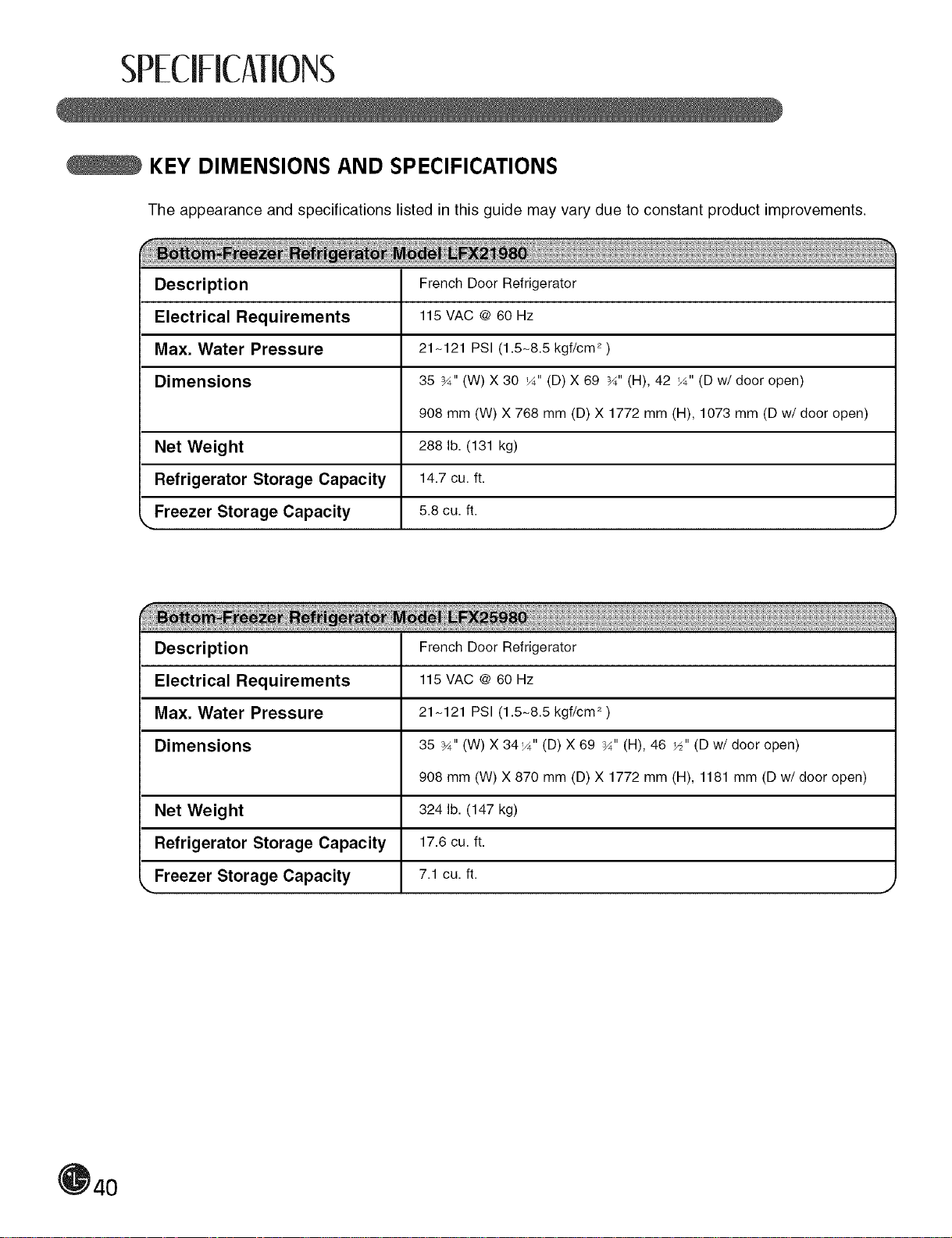
SPECiFICATiONS
KEY DIMENSIONS AND SPECIFICATIONS
The appearance and specifications listed in this guide may vary due to constant product improvements.
Net Weight
Refrigerator Storage Capacity
k.Freezer Storage Capacity
Description French Door Refrigerator
Electrical Requirements 115 VAC @ 60 Hz
Max. Water Pressure 21-121 PSI (1.5-8.5 kgf/cm _)
Dimensions 35 ¾" (w) x 30 ¼" (D) X 69 _" (H), 42 ¼" (D w/door open)
908 mm (W) X 768 mm (D) X 1772 mm (H), 1073 mm (D w/door open)
288 lb. (131 kg)
14.7 cu. ft.
5.8 cu. ft.
Net Weight
Refrigerator Storage Capacity
k. Freezer Storage Capacity
Description French Door Refrigerator
Electrical Requirements 115 VAC @ 60 Hz
Max. Water Pressure 21-121 PSI (1.5-8.5 kgf/cm 2)
Dimensions 35 ¾" (w) x 34¼" (D) X 69 ¾" (H), 46 ½" (D w/door open)
908 mm (W) X 870 mm (D) X 1772 mm (H), 1181 mm (D w/door open)
324 lb. (147 kg)
17.6 cu. ft.
7.1 cu. ft.
40
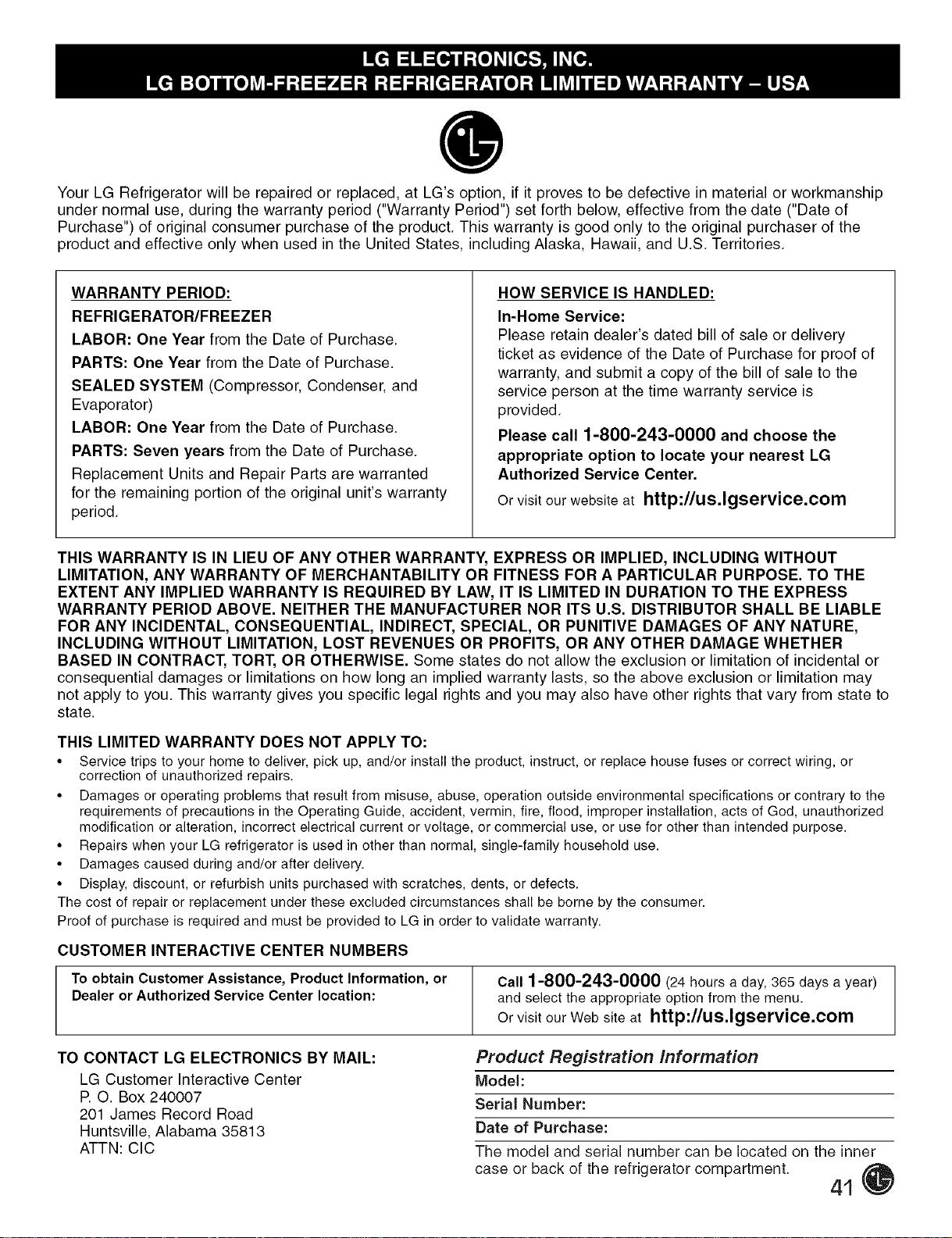
Your LG Refrigerator will be repaired or replaced, at LG's option, if it proves to be defective in material or workmanship
under normal use, during the warranty period ("Warranty Period") set forth below, effective from the date ("Date of
Purchase") of original consumer purchase of the product. This warranty is good only to the original purchaser of the
product and effective only when used in the United States, including Alaska, Hawaii, and U.S. Territories.
WARRANTY PERIOD:
REFRIGERATOR/FREEZER
LABOR: One Year from the Date of Purchase.
PARTS: One Year from the Date of Purchase.
SEALED SYSTEM (Compressor, Condenser, and
Evaporator)
LABOR: One Year from the Date of Purchase.
PARTS: Seven years from the Date of Purchase.
Replacement Units and Repair Parts are warranted
for the remaining portion of the original unit's warranty
period.
HOW SERVICE IS HANDLED:
In-Home Service:
Please retain dealer's dated bill of sale or delivery
ticket as evidence of the Date of Purchase for proof of
warranty, and submit a copy of the bill of sale to the
service person at the time warranty service is
provided.
Please call 1-800-243-0000 and choose the
appropriate option to locate your nearest LG
Authorized Service Center.
Or visit our website at http://us.lgservice.com
THIS WARRANTY IS IN LIEU OF ANY OTHER WARRANTY, EXPRESS OR IMPLIED, INCLUDING WITHOUT
LIMITATION, ANY WARRANTY OF MERCHANTABILITY OR FITNESS FOR A PARTICULAR PURPOSE. TO THE
EXTENT ANY IMPLIED WARRANTY IS REQUIRED BY LAW, IT IS LIMITED IN DURATION TO THE EXPRESS
WARRANTY PERIOD ABOVE. NEITHER THE MANUFACTURER NOR ITS U.S. DISTRIBUTOR SHALL BE LIABLE
FOR ANY INCIDENTAL, CONSEQUENTIAL, INDIRECT, SPECIAL, OR PUNITIVE DAMAGES OF ANY NATURE,
INCLUDING WITHOUT LIMITATION, LOST REVENUES OR PROFITS, OR ANY OTHER DAMAGE WHETHER
BASED IN CONTRACT, TORT, OR OTHERWISE. Some states do not allow the exclusion or limitation of incidental or
consequential damages or limitations on how long an implied warranty lasts, so the above exclusion or limitation may
not apply to you. This warranty gives you specific legal rights and you may also have other rights that vary from state to
state.
THIS LIMITED WARRANTY DOES NOT APPLY TO:
• Service trips to your home to deliver, pick up, and/or install the product, instruct, or replace house fuses or correct wiring, or
correction of unauthorized repairs.
• Damages or operating problems that result from misuse, abuse, operation outside environmental specifications or contrary to the
requirements of precautions in the Operating Guide, accident, vermin, fire, flood, improper installation, acts of God, unauthorized
modification or alteration, incorrect electrical current or voltage, or commercial use, or use for other than intended purpose.
• Repairs when your LG refrigerator is used in other than normal, single-family household use.
• Damages caused during and/or after delivery.
• Display, discount, or refurbish units purchased with scratches, dents, or defects.
The cost of repair or replacement under these excluded circumstances shall be borne by the consumer.
Proof of purchase is required and must be provided to LG in order to validate warranty.
CUSTOMER INTERACTIVE CENTER NUMBERS
To obtain Customer Assistance, Product Information, or
Dealer or Authorized Service Center location:
Call 1-800-243-0000 (24 hours a day, 365 days a year)
and select the appropriate option from the menu.
Or visit our Web site at http://us.lgservice.com
TO CONTACT LG ELECTRONICS BY MAIL:
LG Customer Interactive Center
P. O. Box 240007
201 James Record Road
Huntsville, Alabama 35813
ATTN: CIC
Product Registration information
Model:
Serial Number:
Date of Purchase:
The model and serial number can be located on the inner
case or back of the refrigerator compartment.
41
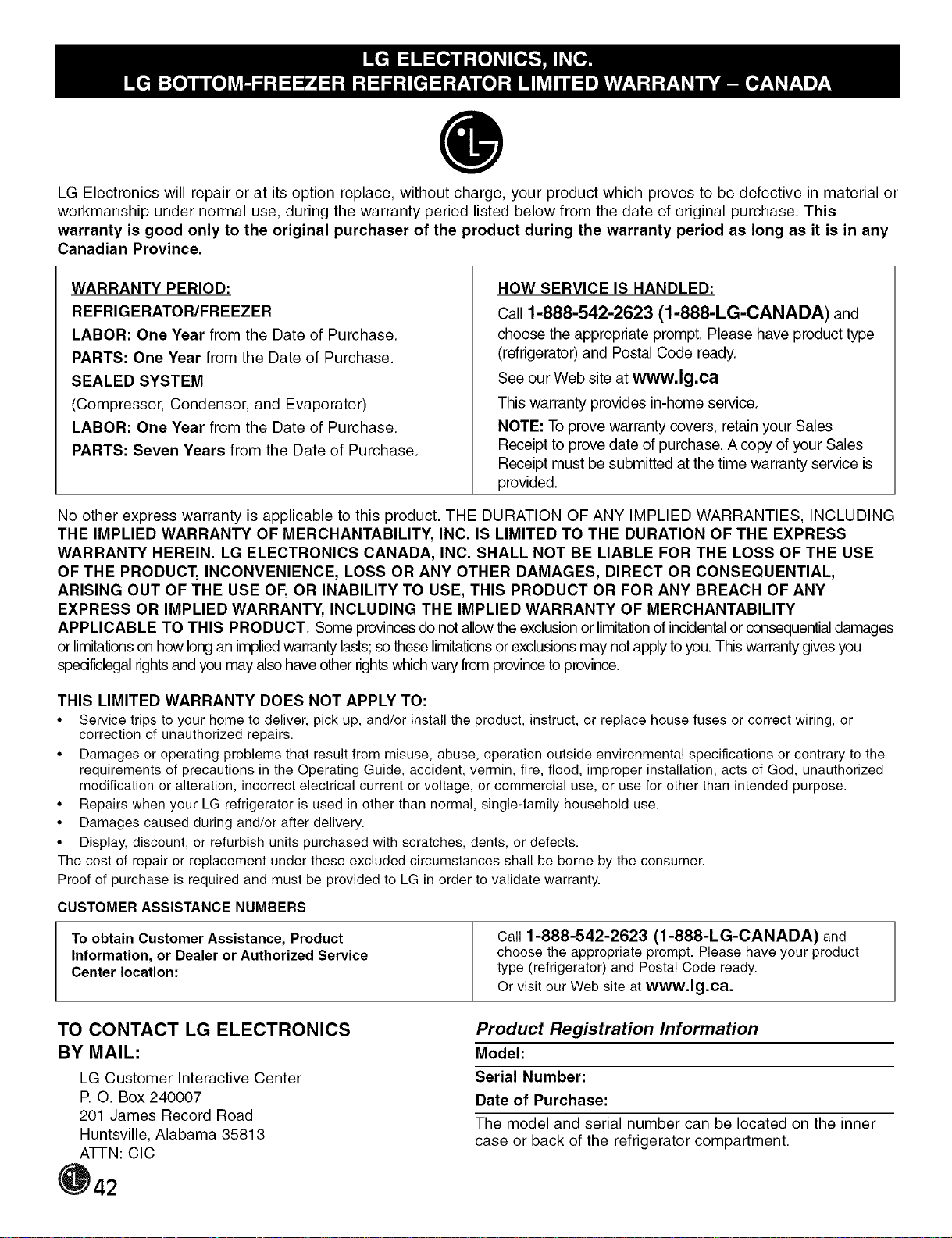
LG Electronics will repair or at its option replace, without charge, your product which proves to be defective in material or
workmanship under normal use, during the warranty period listed below from the date of original purchase. This
warranty is good only to the original purchaser of the product during the warranty period as long as it is in any
Canadian Province.
WARRANTY PERIOD:
REFRIGERATOR/FREEZER
LABOR: One Year from the Date of Purchase.
PARTS: One Year from the Date of Purchase.
SEALED SYSTEM
(Compressor, Condensor, and Evaporator)
LABOR: One Year from the Date of Purchase.
PARTS: Seven Years from the Date of Purchase.
HOW SERVICE IS HANDLED:
Call1-888-542-2623 (1-888-LG-CANADA) and
choose the appropriate prompt. Please have product type
(refrigerator) and Postal Code ready.
See our Web site at www.lg.ca
This warranty provides in-home service.
NOTE: To prove warranty covers, retain your Sales
Receipt to prove date of purchase. A copy of your Sales
Receipt must be submitted at the time warranty service is
provided.
No other express warranty is applicable to this product. THE DURATION OF ANY IMPLIED WARRANTIES, INCLUDING
THE IMPLIED WARRANTY OF MERCHANTABILITY, INC. IS LIMITED TO THE DURATION OF THE EXPRESS
WARRANTY HEREIN. LG ELECTRONICS CANADA, INC. SHALL NOT BE LIABLE FOR THE LOSS OF THE USE
OF THE PRODUCT, INCONVENIENCE, LOSS OR ANY OTHER DAMAGES, DIRECT OR CONSEQUENTIAL,
ARISING OUT OF THE USE OF, OR INABILITY TO USE, THIS PRODUCT OR FOR ANY BREACH OF ANY
EXPRESS OR IMPLIED WARRANTY, INCLUDING THE IMPLIED WARRANTY OF MERCHANTABILITY
APPLICABLE TO THIS PRODUCT. Some provincesdo not allowtheexclusionor limitationof incidentalor consequentialdamages
or limitationson how long an impliedwarranty lasts;sothese limitationsor exclusions may not applyto you. This warrantygives you
specificlegalrights and you may alsohave other rightswhich vary from province to province.
THIS LIMITED WARRANTY DOES NOT APPLY TO:
• Service trips to your home to deliver, pick up, and/or install the product, instruct, or replace house fuses or correct wiring, or
correction of unauthorized repairs
• Damages or operating problems that result from misuse, abuse, operation outside environmental specifications or contrary to the
requirements of precautions in the Operating Guide, accident, vermin, fire, flood, improper installation, acts of God, unauthorized
modification or alteration, incorrect electrical current or voltage, or commercial use, or use for other than intended purpose
• Repairs when your LG refrigerator is used in other than normal, single-family household use
• Damages caused during and/or after delivery
• Display, discount, or refurbish units purchased with scratches, dents, or defects
The cost of repair or replacement under these excluded circumstances shall be borne by the consumer
Proof of purchase is required and must be provided to LG in order to validate warranty
CUSTOMER ASSISTANCE NUMBERS
To obtain Customer Assistance, Product
Information, or Dealer or Authorized Service
Center location:
Call 1-888-542-2623 (1-888-LG-CANADA) and
choose the appropriate prompt. Please have your product
type (refrigerator) and Postal Code ready.
Or visit our Web site atwww.lg.ca.
TO CONTACT LG ELECTRONICS
BY MAIL:
LG Customer Interactive Center
P. O. Box 240007
201 James Record Road
Huntsville, Alabama 35813
ATTN: CIC
Product Registration Information
Model:
Serial Number:
Date of Purchase:
The model and serial number can be located on the inner
case or back of the refrigerator compartment.
42
P/No. MFL37933505