A Crane Co. Company
BARNES
BARNES
®
INSTALLATION MANUAL
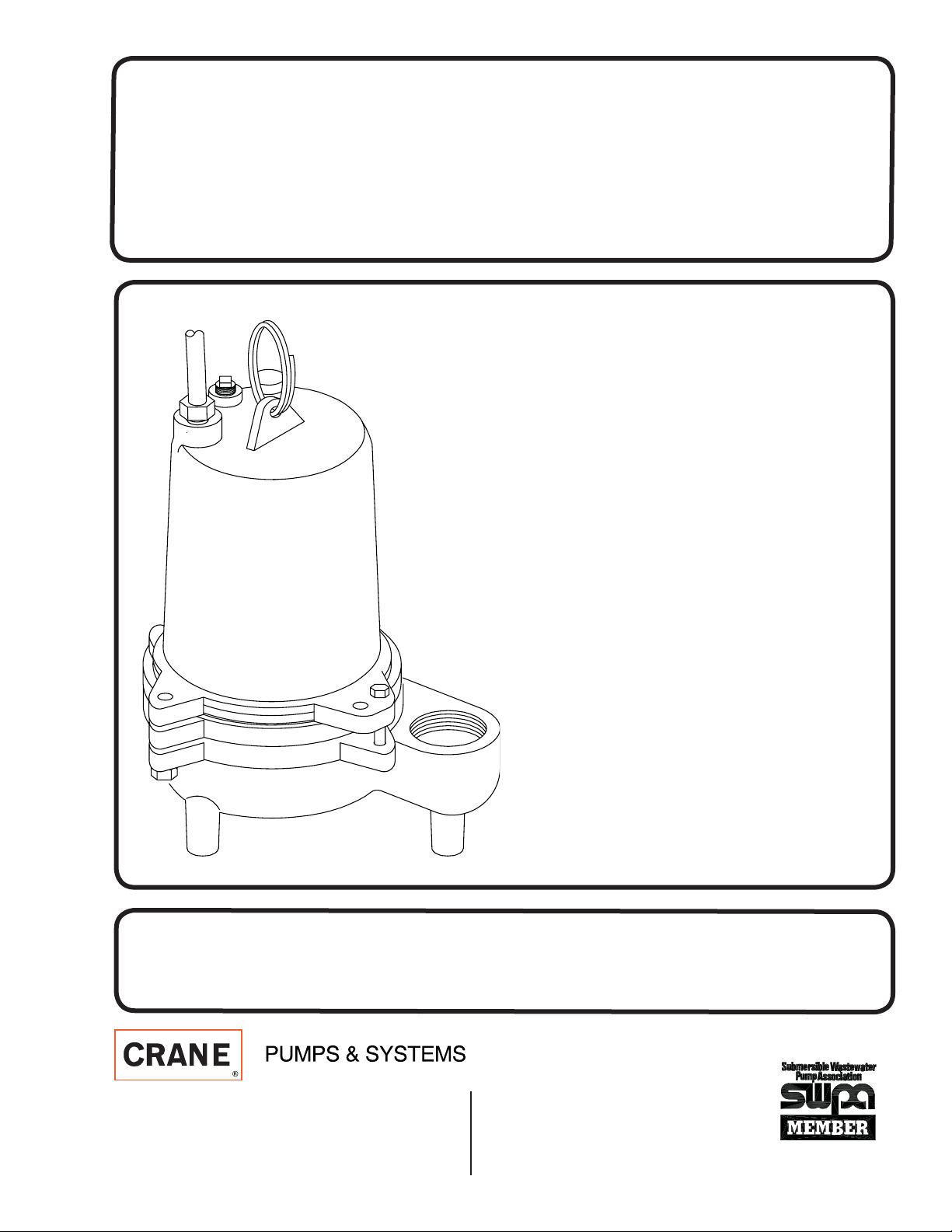
Submersible Fountain Pumps
IMPORTANT! Read all instructions in this manual before operating pump.
As a result of Crane Pumps & Systems, Inc., constant product improvement program,
product changes may occur. As such Crane Pumps & Systems reserves the right to
change product without prior written notifi cation.
420 Third Street 83 West Drive, Bramton
Piqua, Ohio 45356 Ontario, Canada L6T 2J6
Phone: (937) 778-8947 Phone: (905) 457-6223
Fax: (937) 773-7157 Fax: (905) 457-2650
www.cranepumps.com
Form No. 108120-Rev. M
Series: SF411, .4HP
1750 RPM, 60 Hz.
Manual Index

2
Other brand and product names are trademarks or registered trademarks of their respective holders.
® Barnes is a registered trademark of Crane Pumps & Systems, Inc.
2000, 2002, 01/04, 10/05, 4/06, 9/06 Alteration Rights Reserved
TABLE OF CONTENTS
WARNINGS AND SAFETY PRECAUTIONS ............................................................... 3
A. PUMP SPECIFICATIONS ............................................................................................ 4
B. GENERAL INFORMATION
(Receiving, Storage, Service Centers) ......................................................................... 5
C. INSTALLATION INSTRUCTIONS
(Location, Submergence, Discharge) (Fig. 1) .............................................................. 5
(Level Controls, Power Cable) (Fig. 2 & 3) .................................................................. 5 - 6
(Overload Protection, Wire Size) .................................................................................. 6
(Electrical Data) ............................................................................................................ 7
D. START-UP OPERATION
(Check, Voltage, Phase & Rotation, Start-Up Report, Insulation & Pump-Down test) .7
E. PREVENTATIVE MAINTENANCE ...............................................................................7
F. SERVICE AND REPAIR
(Lubrication, Checking Oil, Testing Oil) .......................................................................7
(Replacing Oil, Pressure test, Impeller & Volute, Motor, Bearing & Cable Service)
(Fig. 4, 5, 6, 7, 8) ..........................................................................................................8 - 9
(Shaft Seal Service) (Fig. 7, 9) ..................................................................................... 10
G. REPLACEMENT PARTS ..............................................................................................10
TROUBLE SHOOTING ................................................................................................ 11
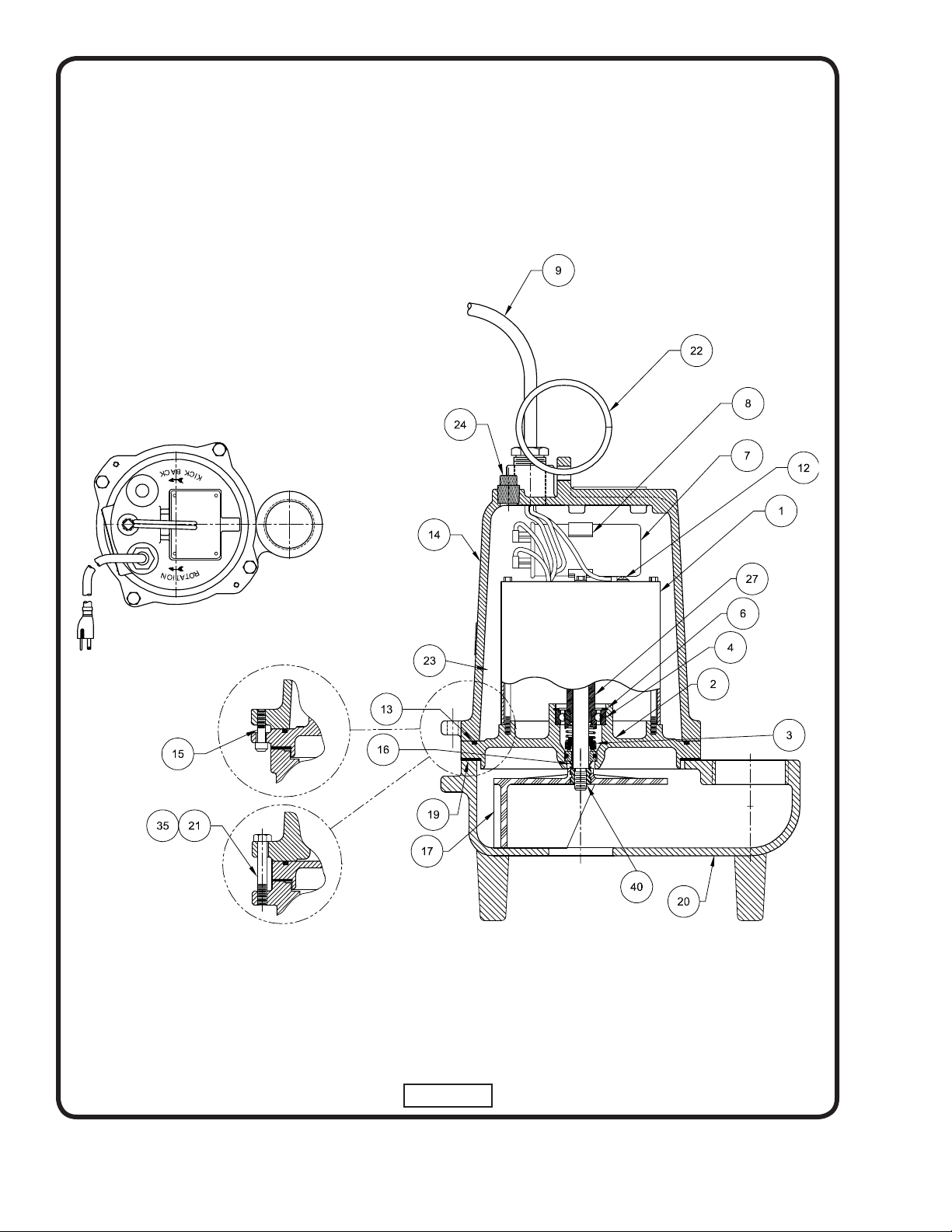
CROSS-SECTION (Fig. 10) ......................................................................................... 12
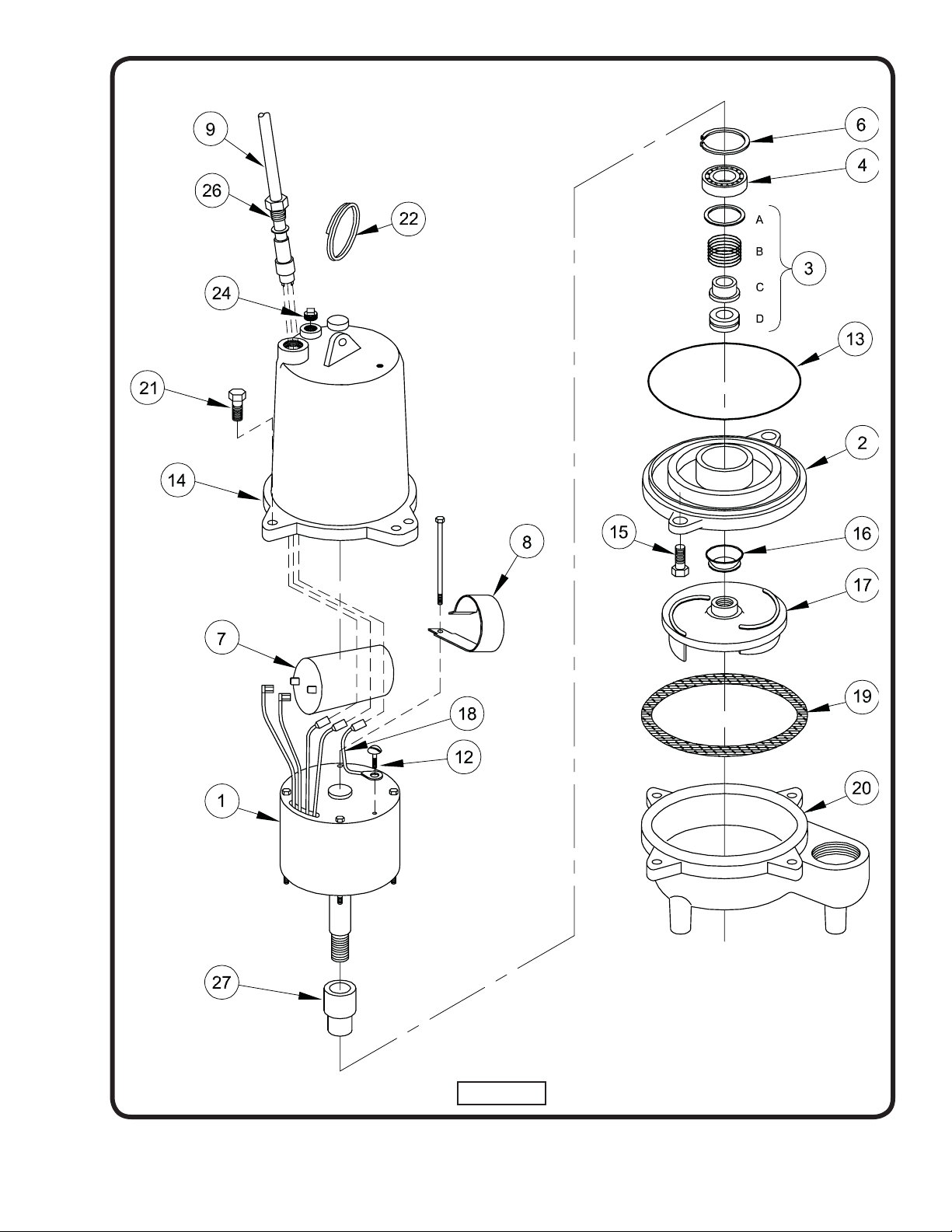
` EXPLODED VIEW (Fig. 11) ......................................................................................... 13
PARTS LIST ................................................................................................................. 14
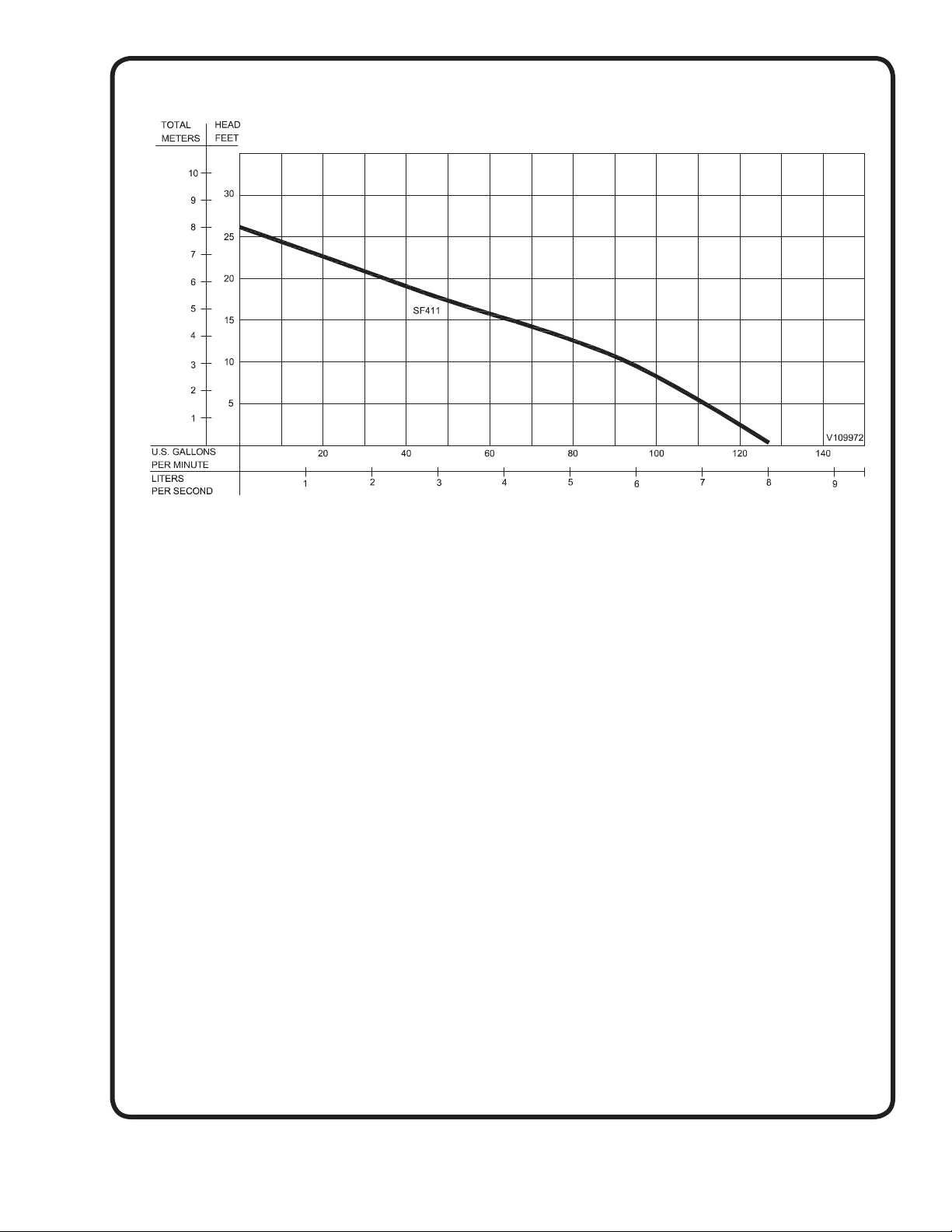
PERFORMANCE CURVE ............................................................................................ 15
RETURN GOODS POLICY .......................................................................................... 16
WARRANTY
START UP REPORT
WARRANTY REGISTRATION
SPECIAL TOOLS and EQUIPMENT:
INSULATION TESTER ( MEGGER )
DIELECTRIC TESTER
SEAL TOOL KIT (see parts list)
PRESSURE GAUGE KIT (see parts list)
3
Please Read This Before Installing Or Operating Pump.
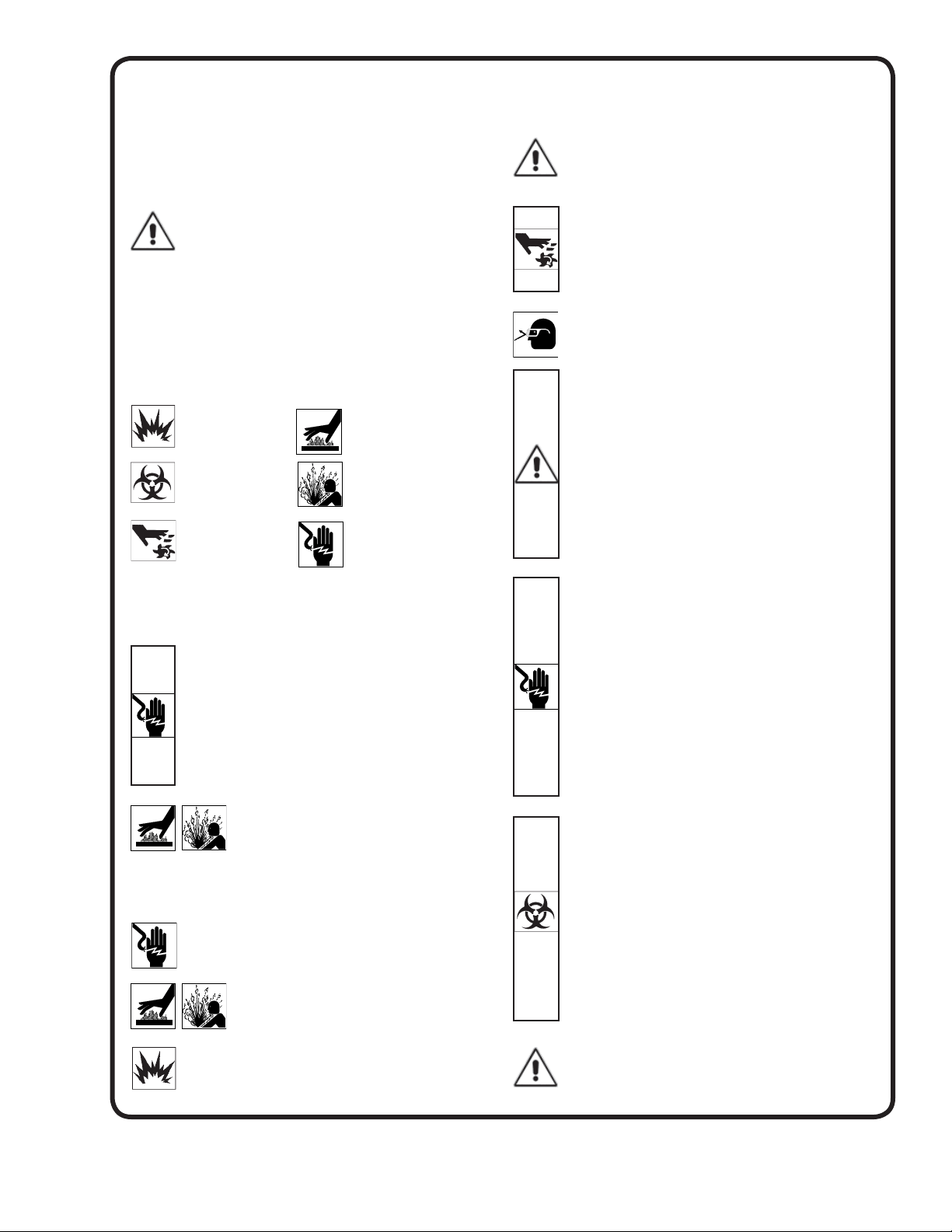
This information is provided for SAFETY and to PREVENT
EQUIPMENT PROBLEMS. To help recognize this information,
observe the following symbols:
IMPORTANT! Warns about hazards that can result
in personal injury orIndicates factors concerned with
assembly, installation, operation, or maintenance which
could result in damage to the machine or equipment if
ignored.
CAUTION! Warns about hazards that can or will cause minor
personal injury or property damage if ignored. Used with symbols
below.
WARNING! Warns about hazards that can or will cause serious
personal injury, death, or major property damage if ignored. Used
with symbols below.
Only qualifi ed personnel should install, operate and repair
pump. Any wiring of pumps should be performed by a qualifi ed
electrician.
WARNING ! To reduce risk of electrical shock, pumps and
control panels must be properly grounded in accordance
with the National Electric Code (NEC) or the Canadian
Electrical Code (CEC) and all applicable state, province,
local codes and ordinances. Improper grounding voids
warranty.
WARNING! To reduce risk of electrical shock, always
disconnect the pump from the power source before
handling or servicing. Lock out power and tag.
WARNING! Operation against a closed
discharge valve will cause premature bearing
and seal failure on any pump, and on end
suction and self priming pump the heat build
may cause the generation of steam with resulting dangerous
pressures. It is recommended that a high case temperature
switch or pressure relief valve be installed on the pump body.
CAUTION ! Never operate a pump with a plug-in type
power cord without a ground fault circuit interrupter.
CAUTION ! Pumps build up heat and pressure
during operation-allow time for pumps to cool
before handling or servicing.
WARNING ! Do not pump hazardous materials
(fl ammable, caustic, etc.) unless the pump is specifi cally
designed and designated to handle them.
CAUTION ! Do not block or restrict discharge hose, as
discharge hose may whip under pressure.
WARNING ! Do not wear loose clothing that may
become entangled in moving parts.
WARNING ! Keep clear of suction and discharge
openings. DO NOT insert fi ngers in pump with power
connected.
Always wear eye protection when working on pumps.
Make sure lifting handles are securely fastened each
time before lifting. DO NOT operate pump without safety
devices in place. Always replace safety devices that
have been removed during service or repair. Secure the
pump in its operating position so it can not tip over, fall
or slide.
DO NOT exceed manufacturers recommendation for
maximum performance, as this could cause the motor
to overheat.
DO NOT remove cord and strain relief. DO NOT connect
conduit to pump.
WARNING ! Cable should be protected at all times to
avoid punctures, cut, bruises and abrasions. Inspect
frequently. Never handle connected power cords with
wet hands.
WARNING ! To reduce risk of electrical shock, all wiring
and junction connections should be made per the NEC
or CEC and applicable state or province and local
codes. Requirements may vary depending on usage
and location.
WARNING! Submersible Pumps are not approved for
use in swimming pools, recreational water installations
decorative fountains or any installation where human
contact with the pumped fl uid is common.
WARNING! Products returned must be cleaned,
sanitized, or decontaminated as necessary prior to
shipment, to insure that employees will not be exposed
to health hazards in handling said material. All Applicable
Laws And Regulations Shall Apply.
Bronze/brass and bronze/brass fi tted pumps may
contain lead levels higher than considered safe for
potable water systems. Lead is known to cause cancer
and birth defects or other reproductive harm. Various
government agencies have determined that leaded
copper alloys should not be used in potable water
applications. For non-leaded copper alloy materials of
construction, please contact factory.
Crane Pumps & Systems, Inc. is not responsible for
losses, injury, or death resulting from a failure to observe
these safety precautions, misuse or abuse of pumps or
equipment.
SAFETY FIRST!
Hazardous fl uids can
cause fi re or explo-
sions, burnes or death
could result.
Extremely hot - Severe
burnes can occur on contact.
Biohazard can cause
serious personal injury.
Hazardous fl uids can Hazard-
ous pressure, eruptions or ex-
plosions could cause personal
injury or property damage.
Rotating machinery
Amputation or severe
laceration can result.
Hazardous voltage can
shock, burn or cause death.
4
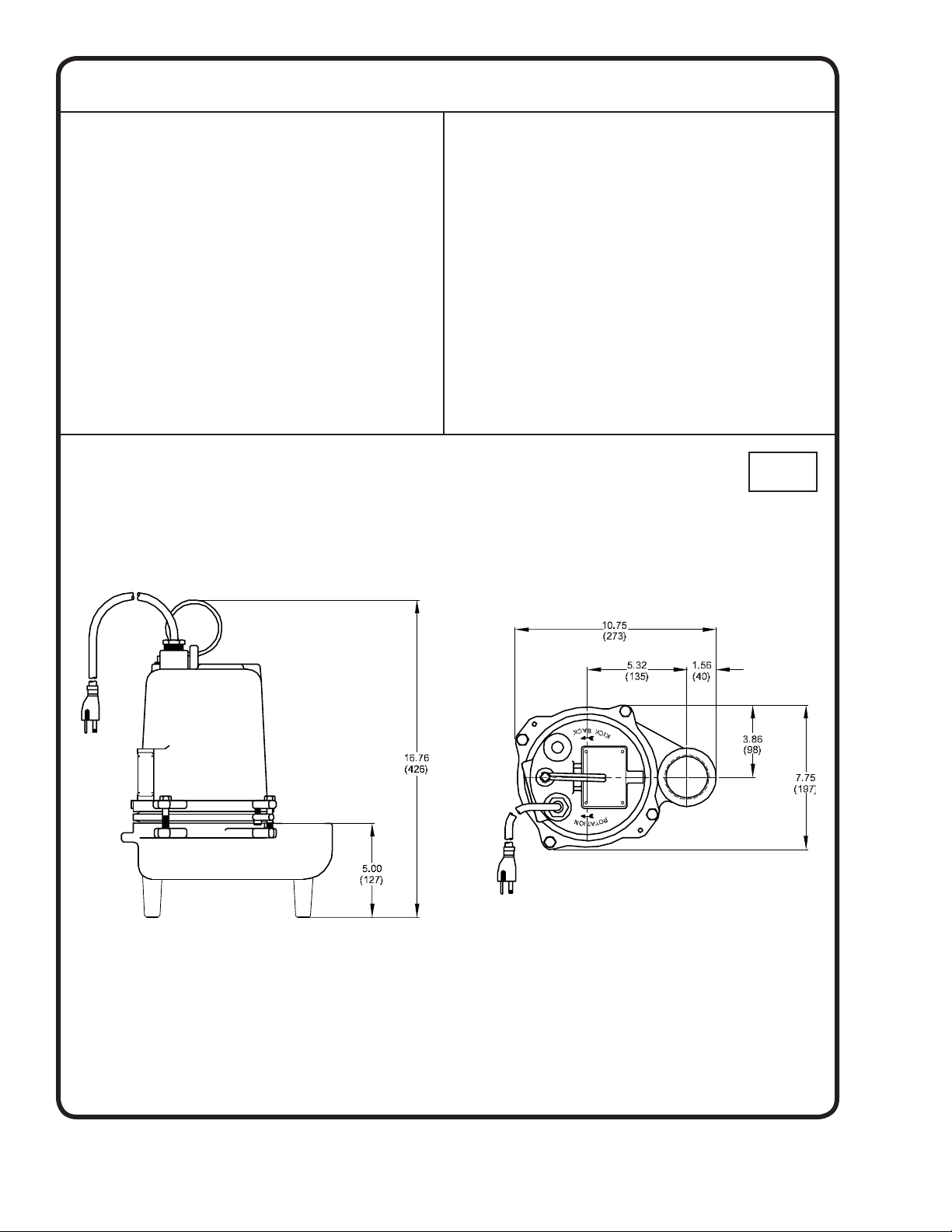
DISCHARGE ....................... 2” NPT, Female, Vertical
LIQUID TEMP ..................... 77°F (25°C) Continuous
MOTOR HOUSING ............. Cast Iron ASTM A-48, Class 30
VOLUTE .............................. Cast Iron ASTM A-48, Class 30
SEAL PLATE ...................... Cast Iron ASTM A-48, Class 30
IMPELLER: Design ............ 2-vane, Open with Pump Out Vanes on
Back Side. Dynamically Balanced,
ISO G6.3
Material ........... Cast Iron ASTM A-48, Class 30
SHAFT ................................. 416 Stainless Steel
O-RINGS ............................. Buna-N
HARDWARE ....................... 300 Series Stainless Steel
PAINT .................................. Air dry enamel
SEAL Design ............. Single Mechanical, Oil Filled reservoir
Secondary Exclusion Seal
Material ........... Carbon/Ceramic/Buna-N
Hardware - 300 series stainless steel
CORD ENTRY ..................... 15 Ft. (5m) Quick disconnect cord
with plug on 115 volt, pressure
gromment for sealing and strain relief.
UPPER BEARING:
Design ............. Single Row, Ball, Oil Lubricated
Load ................ Radial
LOWER BEARING:
Design ............. Single Row, Ball, Oil Lubricated
Load ................ Radial & Thrust
MOTOR: Design ............. NEMA L Torque Curve. Oil Filled
Squirrel Cage Induction
Insulation ........ Class B
SINGLE PHASE .................. Permanent Split Capacitor (PSC)
Includes Thermal Overload
Protection in motor
OPTIONAL EQUIPMENT .... Seal Material, Additional Cord
PUMP SPECIFICATIONS SERIES:
IMPORTANT !
1.) DO NOT USE TO PUMP FLAMMABLE LIQUIDS.
2.) NSTALLATIONS SUCH AS DECORATIVE FOUNTAINS OR WATER FEATURES PROVIDED FOR VISUAL ENJOYMENT MUST BE INSTALLED
IN ACCORDANCE WITH THE NATIONAL ELECTRIC CODE ANSI/NFPA 70 AND/OR THE AUTHORITY HAVING JURISDICTION. THIS PUMP IS
NOT INTENDED FOR USE IN SWIMMING POOLS, RECREATIONAL WATER PARKS, OR INSTALLATIONS IN WHICH HUMAN CONTACT
WITH PUMPED MEDIA IS A COMMON OCCURRENCE.
inches
(mm)
5
SECTION B: GENERAL INFORMATION
B-1) To The Purchaser:
Congratulations! You are the owner of one of the fi nest
pumps on the market today. Barnes® Pumps are products
engineered and manufactured of high quality components.
Over one hundred years of pump building experience
along with a continuing quality assurance program
combine to produce a pump which will stand up to the
toughest applications.
Check local codes and requirements before installation.
Servicing should be performed by knowledgeable pump
service contractors or authorized service stations.
The pump is packaged ready for installation and no
connections or adjustments are necessary except for
attaching discharge piping and plugging in service cord.
B-2) Receiving:
Upon receiving the pump, it should be inspected for
damage or shortages. If damage has occurred, fi le a claim
immediately with the company that delivered the pump.
If the manual is removed from the crating, do not lose or
misplace.
B-3) Storage:
Short Term- Barnes Pumps are manufactured for effi cient
performance following long inoperative periods in storage.
For best results, pumps can be retained in storage, as
factory assembled, in a dry atmosphere with constant
temperatures for up to six (6) months.
Long Term- Any length of time exceeding six (6) months,
but not more than twenty four (24) months. The units
should be stored in a temperature controlled area, a roofed
over walled enclosure that provides protection from the
elements (rain, snow, wind blown dust, etc..), and whose
temperature can be maintained between +40 deg. F and
+120 deg. F. Pump should be stored in its original shipping
container and before initial start up, rotate impeller by hand
to assure seal and impeller rotate freely.
B-4) Service Centers:
For the location of the nearest Barnes Service Center,
check your Barnes representative or Crane Pumps
& Systems, Inc., Service Department in Piqua, Ohio,
telephone (937) 778-8947 or Crane Pumps & Systems
Canada, Inc., Bramton, Ontario, (905) 457-6223.
SECTION C: INSTALLATION
C-1) Location:
These pumping units are self-contained and are
recommended for use in a sump or basin. The sump or
basin shall be vented in accordance with local plumbing
codes. This pump is designed to pump effl uent or
wastewater, nonexplosive and noncorrosive liquids and
shall NOT be installed in locations classifi ed as hazardous
in accordance with the National Electrical Code (NEC),
ANSI/NFPA 70 or Canadian Electric Code (CEC). Never
install the pump in a trench, ditch, or hole with a dirt
bottom; the legs will sink into the dirt and the suction will
become plugged.
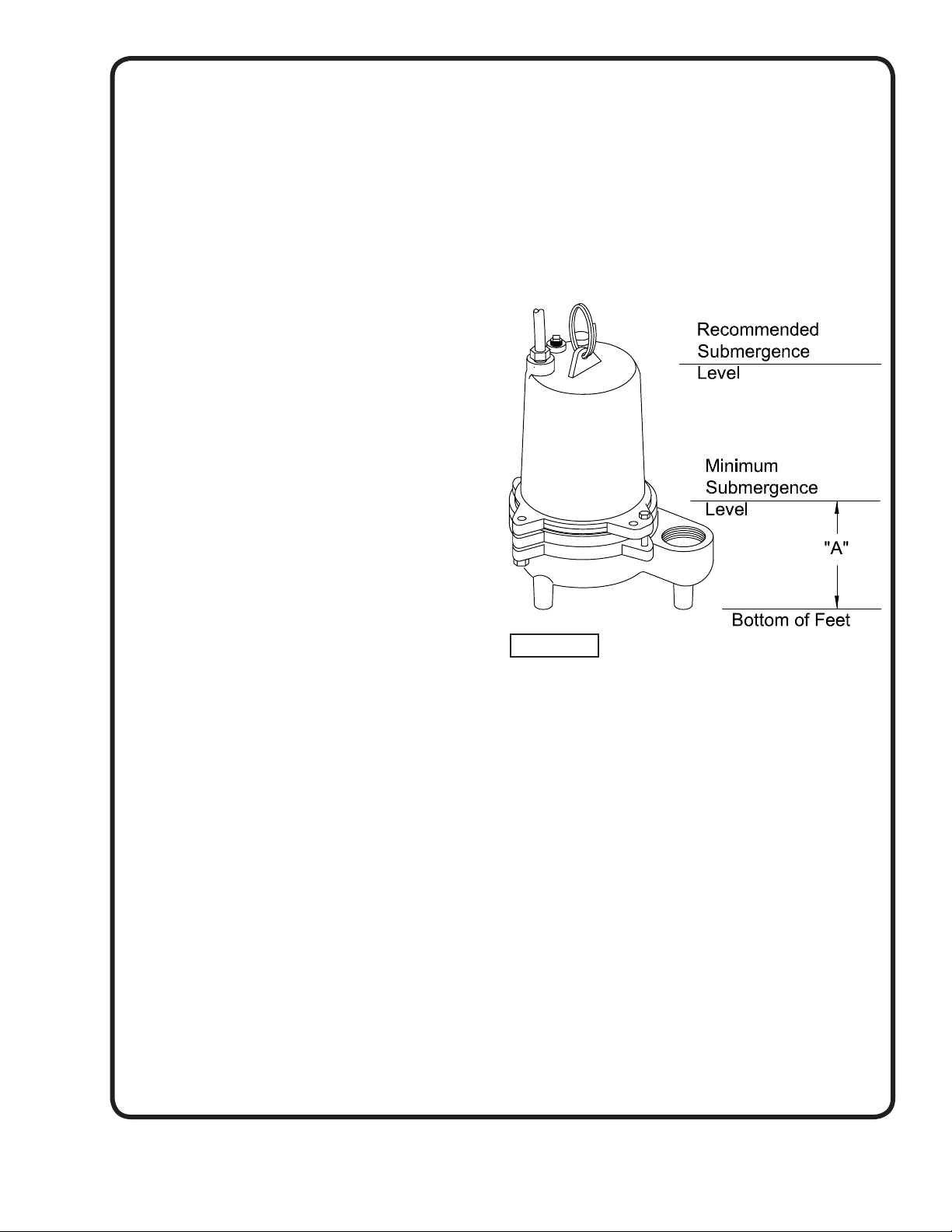
C-1.1) Submergence:
The pump should always be operated in the submerged
condition. The minimum sump liquid level should never
be less than A Dimension, A = 3 inches on BP Series and
A = 6 inches on SE Series above the pump bottom. The
recommended level should not drop below the top of the
motor housing (see Fig. 1).
C-2) Discharge:
Discharge piping should be as short as possible. Both a
check valve and a shut-off valve are recommended for
each pump being used. The check valve is used to prevent
backfl ow into the sump. Excessive backfl ow can cause
fl ooding and/or damage to the pump. The shut-off valve
is used to stop system fl ow during pump or check valve
servicing.
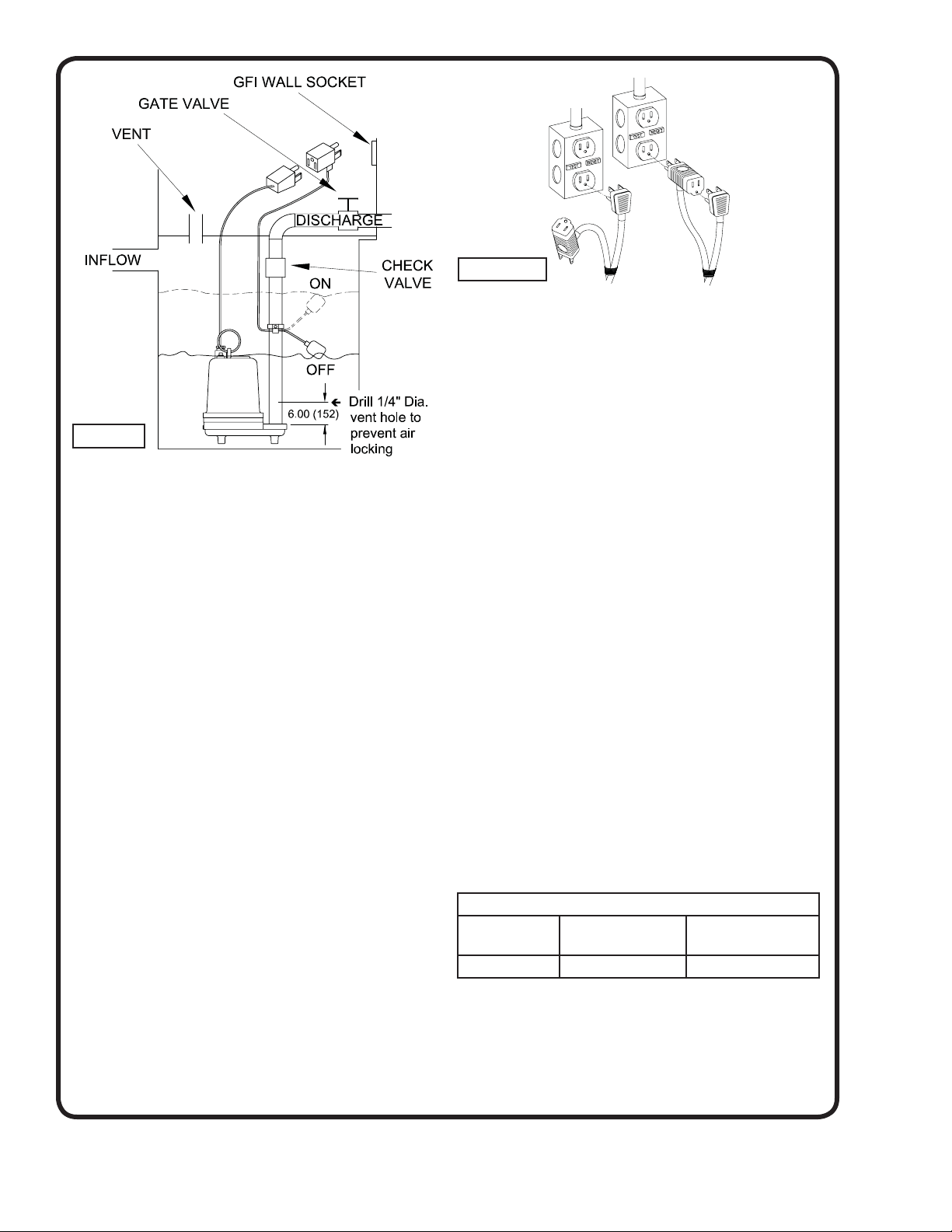
C-3) Liquid Level Controls:
Figure 2 shows a typical installation for any submersible
pump using a level control mounted to the discharge piping
with a piggy-back plug.
FIGURE 1
6
General Comments:
1) Never work in the sump with the power on.
2) Level controls are factory set for a pumping differential
of 9 inches. If that is the cycle desired, simply circle
the discharge pipe with the pipe mounting strap, feed
the end through the worm drive, and tighten with a
screwdriver. Be certain that the level control cannot
hang up or foul in its swing. Also, make certain the
pump impeller is still submerged when the level control
is in the “OFF” mode.
3) If a higher pump differential is needed, grip the cord
near the neck of the fl oat, then using the other hand,
exert a steady force on the lower edge of the cable
clamp. The cable clamp should slide up to the new
pivot point. Attach the level control to the discharge
hose in the manner described above.
4) Plug the level control plug into the GFI receptacle,
then plug the pump into the piggyback plug. One cycle
of operation should be observed, so that any potential
problems can be corrected.
5) It is recommended that the fl oat should be set to
insure that the sump well liquid level never drops
below the top of the motor housing or a minimum level
of 3 inches on BP Series and 6 inches on SE Series
above the pump bottom.
6.) Figure 3 shows a typical connection for pumps with the
wide angle fl oat and piggy-back plug, for manual and
automatic operations.
Automatic - Plug fl oat cord into GFI outlet, then plug pump
cord into fl oat cord.
Manual - Plug pump cord directly into GFI outlet.
C-4) Electrical Connections:
C-4.1) Power Cable:
The cord assembly mounted to the pump must not be
modifi ed in any way except for shortening to a specifi c
application. Any splice between the pump and the control
panel must be made in accordance with the electric codes.
It is recommended that a junction box, if used, be mounted
outside the sump or be of at least NEMA 4 (EEMAC-4)
construction if located within the wet well. Do not use the
power cable to lift pump. NOTE: THE WHITE WIRE IS
NOT A NEUTRAL OR GROUND LEAD, BUT A POWER
CARRYING CONDUCTOR.
C-4.2) Overload Protection:
Single Phase - The type of in-winding overload protector
used is referred to as an inherent overheating protector
and operates on the combined effect of temperature and
current. This means that the overload protector will trip out
and shut the pump off if the windings become too hot, or
the load current passing through them becomes too high.
It will then automatically reset and start the pump up
after the motor cools to a safe temperature. In the event
of an overload, the source of this condition should be
determined and rectifi ed immediately. DO NOT LET THE
PUMP CYCLE OR RUN IF AN OVERLOAD CONDITION
OCCURS !
If current through the temperature sensor exceeds the
values listed, an intermediate control circuit relay must
be used to reduce the current or the sensor will not work
properly.
TEMPERATURE SENSOR ELECTRICAL RATINGS
Volts Continuous
Amperes
Inrush
Amperes
110-120 3.00 30.0
C-4.3) Wire Size:
Consult a qualifi ed electrician for proper wire size. See
table for electrical information.
FIGURE 3
Manual
Automatic
FIGURE 2
7
SECTION: D START-UP OPERATION
D-1) Check Voltage and Phase:
Before operating pump check to make sure that the
voltage and phase information stamped on the pump’s
identifi cation plate matches the available power.
D-2) Check Pump Rotation:
Before putting pump into service for the fi rst time, the
motor rotation must be checked. Improper motor rotation
can result in poor pump performance and can damage
the motor and/or pump. To check the rotation, suspend
the pump freely, momentarily apply power and observe
the “kickback”. “Kickback” should always be in a counter-
clockwise direction as viewed from the top of the pump
(“kickback” is always opposite to impeller rotation).
“Rotation” and “kickback” direction is noted on the pump
motor housing.
D-2.1) Incorrect Rotation for Single-Phase:
In the unlikely event that the rotation is incorrect for a
single-phase pump, contact a Barnes Pumps Service
Center.
D-3) Identifi cation Plate:
Record the numbers off the pump’s identifi cation plate
onto the START-UP REPORT provided at the end of the
manual for future reference.
D-4) Start-Up Report:
Included at the end of this manual are two start-up report
sheets. These sheets are to be completed as applicable.
Return one copy to Barnes Pumps and store the second
in the control panel or with the pump manual if no
control panel is used. It is important to record this data at
initial start-up since it will be useful to compare to when
servicing the pump in the future.
Insulation Test:
Before the pump is put into service, an insulation (megger)
test should be performed on it. The ohm values as well
as the volts and amps should be recorded on the start-up
sheet and stored safely in the control panel or with the
pump manual if no control panel is used.
Pump-Down Test:
After the pump has been properly wired and lowered into
the basin, sump, or lift station, it is advisable to check
the system by fi lling with liquid and allowing the pump
to operate through its pumping cycle. The time needed
to empty the system, or pump-down time, should be
recorded on the start-up sheet.
SECTION E: PREVENTATIVE MAINTENANCE
As the motor is oil fi lled, no lubrication or other
maintenance is required, and generally Barnes pumps will
give very reliable service and can be expected to operate
for years on normal sewage pumping without failure.
However, as with any mechanical piece of equipment a
preventive maintenance program is recommended and
suggested to include the following checks:
1) Inspect motor chamber for oil level and contamination
and repair as required per section F-1.
2) Inspect impeller and body for excessive build-up or
clogging and repair as required per section F-2.
3) Inspect bearing and replace as required per section F-3.
4) Inspect seal for wear or leakage and repair as required
per section F-4.
SECTION F: SERVICE AND REPAIR
NOTE: All item numbers ( ) refer to Figures 10 & 11.
F-1) Lubrication:
Anytime the pump is removed from operation and at least
every twelve (12) months, the cooling oil in the motor
housing (12) must be checked visually for oil level and
contamination.
F-1.1) Checking Oil:
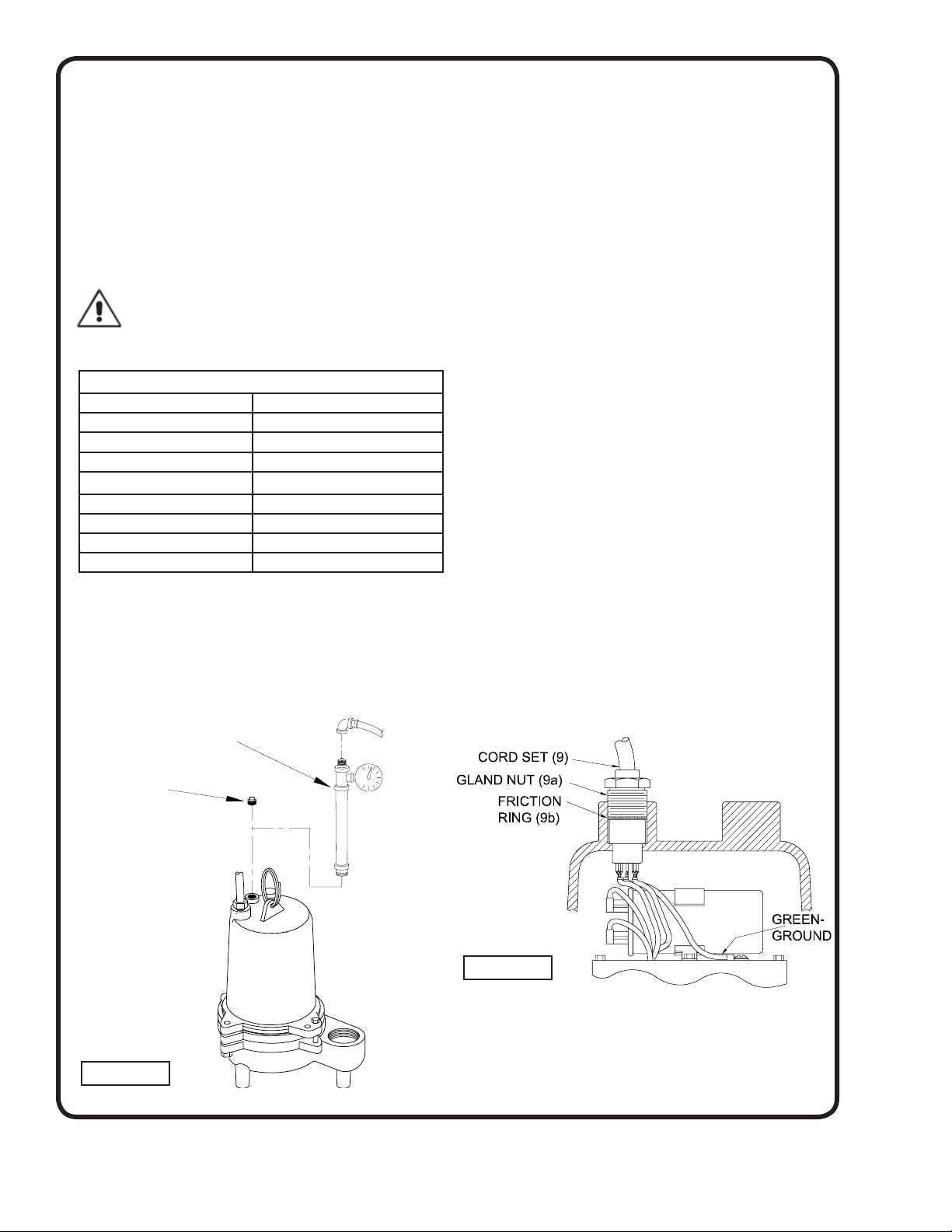
To check oil, set unit upright. Remove pipe plug (24). With
a fl ashlight, visually inspect the oil in the motor housing
(14) to make sure it is clean, clear and that the oil level is
above all internal componentry. If oil appears satisfactory,
replace pipe plug. If oil is low or appears contaminated,
test oil as per section F-1.2
F-1.2) Testing Oil:
1. Place pump on it’s side, remove pipe plug (24) and
drain oil into a clean, dry container.
2. Check oil for contamination using an oil tester with a
range to 30 kilovolts breakdown.
3. If oil is found to be clean and uncontaminated
(measures above 15 KV. breakdown), refi ll the motor
housing as per section F-1.3.
4. If oil is found to be dirty or contaminated (or measures
below 15KV. breakdown), then the pump must be
carefully inspected for leaks at the shaft seal (3),
cord inlet (9), o-ring (13), and pipe plug (24)
before refi lling with oil. To locate the leak, perform a
pressure test as per section F-1.4. After leak is
repaired, refi ll with new oil as per section F-1.3.
MODEL NO HP VOLT/
PH
Hz RPM
(Nom)
NEMA
START
CODE
FULL
LOAD
AMPS
LOCKED
ROTOR
AMPS
CORD
SIZE
CORD
TYPE
CORD
O.D
inch (mm)
WINDING
RESISTANCE
MAIN - START
SF411 0.4 115/1 60 1750 C 12.0 19.0 14/3 SJTOW 0.375 (9.5) 2.14 - 30.5
Winding Resistance ± 5%.
Pump rated for operation at ± 10% voltage at motor.
8
F-1.3 Replacing Oil in Motor Housing:
Drain all oil from motor housing and dispose of properly.
Refi ll with 58 ounces of new cooling oil as per Table 1. An
air space must remain in the top of the motor housing to
compensate for air expansion. Set unit upright and fi ll only
until oil level from top of pipe plug boss is 3” ± 1/4”.
When refi lling with oil after servicing the shaft seal (3), a
pressure test as per section F-1.4 should be done. If shaft
seal was not disturbed during service, then apply pipe
sealant and replace the pipe plug (24).
WARNING ! - DO NOT overfi ll oil. Overfi lling of
motor housing with oil can create excessive
and dangerous hydraulic pressure which
can destroy the pump and create a hazard.
Overfi lling oil voids warranty.
TABLE 1 - COOLING OIL - Dielectric
SUPPLIER GRADE
BP Enerpar SE100
Conoco Pale Paraffi n 22
Mobile D.T.E. Oil Light
G & G Oil Circulating 22
Imperial Oil Voltesso-35
Shell Canada Transformer-10
Texaco Diala-Oil-AX
Woco Premium 100
F-1.4) Pressure Test:
Before checking the pump for leaks around the shaft
seal, square ring, and cord inlet, the oil level should be
full as described in section F1.3. Apply pipe sealant to the
pressure gauge assembly and tighten into fi ll plug hole
(see Figure 4). Pressurize motor housing to 10 P.S.I.
Use a soap solution around the sealed areas and inspect
joints for “air bubbles”. If, after fi ve minutes, the pressure
is still holding constant, and no “bubbles” are observed,
slowly bleed the pressure and remove the gauge
assembly. Replace the pipe plug using a sealant. If the
pressure does not hold, then the leak must be located.
F-2) Impeller and Volute Service:
F-2.1) Disassembly and Inspection:
To clean out body (20), or to replace impeller (17),
disconnect power, remove hex bolts (21), and vertically lift
motor and seal assembly from body (20). Clean out body
if necessary . Clean and examine impeller (17) for pitting
or wear and replace if required. Inspect gasket (19) and
replace if cut or damaged. The impeller (17) is threaded
onto the shaft and to remove, unscrew impeller, holding
shaft with a large screwdriver. Remove exclusion seal (16)
and replace if needed.
F-2.2) Reassembly:
Before installing impeller (17), inspect threads on shaft
and impeller to assure that they are clean. Place exclu-
sion seal on shaft with the thin lip toward the motor (see
section F-4.3). Apply a thread-locking compound to shaft
threads and screw impeller onto shaft and tighten. Rotate
impeller to check for binding. Position gasket (19) on body
and install impeller and motor housing on pump body.
Apply thread locking compound to each cap screw (21),
thread into body, and torque to 11 ft. lbs. Check for free
rotation of impeller.
F-3) Motor, Bearing and Cable Service
F-3.1) Disassembly and Inspection:
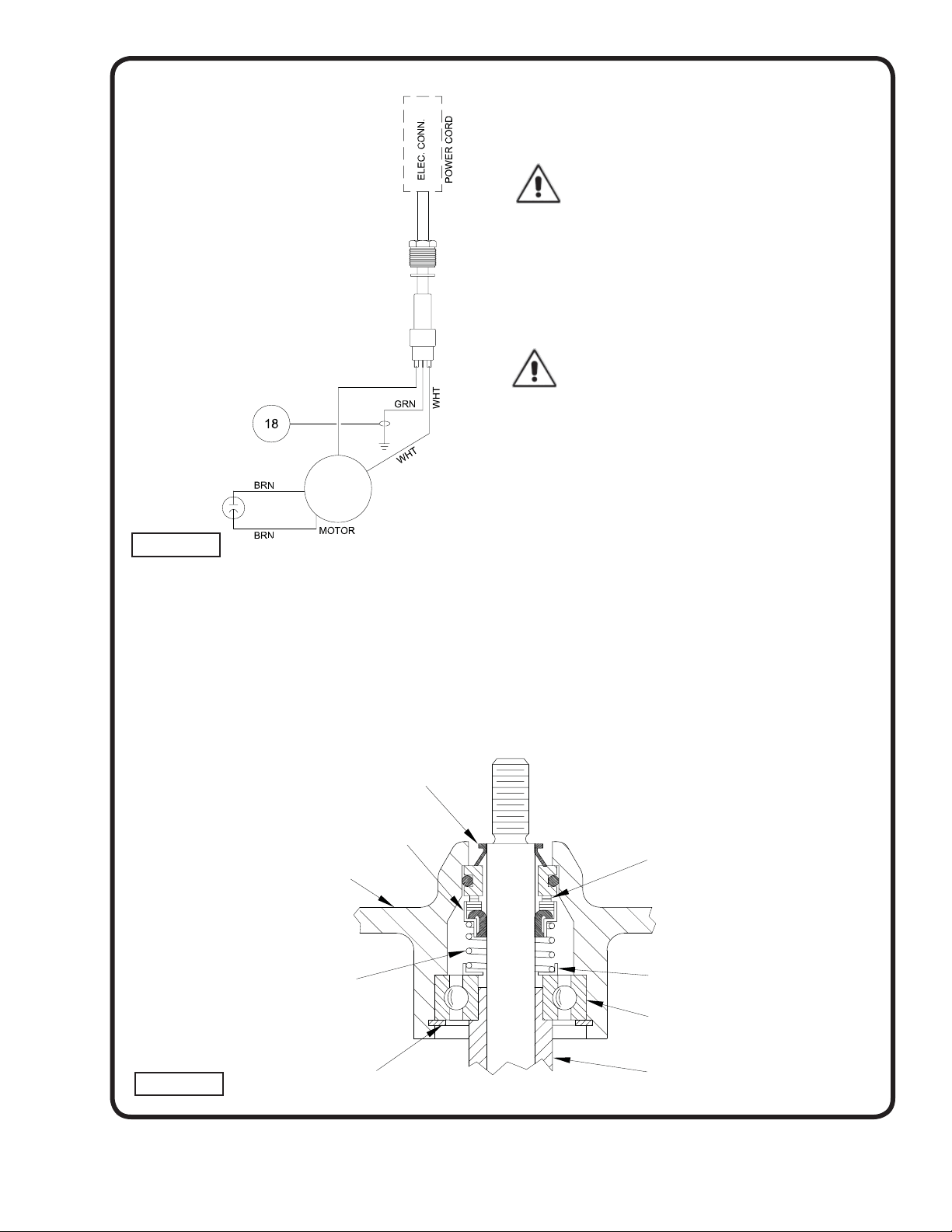
Motor - To examine or replace the motor (1) or bearing
(4), remove body and impeller as per section F-2.1. Drain
oil from motor housing as per section F-1.2. Remove
gland nut (9a) and friction ring (9b) from motor housing
(14). Pull cord through opening and disconnect the motor
wires from the terminals on cable (9), see Figure 5.
Remove socket head screws (15) and lift motor housing
(14) from seal plate (2). Remove o-ring (13) and inspect
for breaks. Loosen motor screws and pull motor (1)
straight up and off seal plate (2). Inspect all parts for signs
of wear and check motor resistance values.
Í 10 PSI
AIR
Pressure Gauge Assembly
(See Parts List)
Remove Pipe
Plug
FIGURE 4
FIGURE 5
9
Check capacitor (7) with an Ohm meter by grounding the
capacitor by placing a screwdriver across both terminals
and then removing the screwdriver. Connect Ohm meter
(set on high scale) to terminals, if needle moves to infi nity
( ∞ ) then drifts back, the capacitor is good. If needle does
not move or moves to infi nity ( ∞ ) and does not drift back,
replace capacitor (7).
Bearings - Disassemble motor as per section F-3.1.
Remove snap ring (6) with snap ring pliers and pull motor
(1) and lower bearing (4) straight off of seal plate (2).
Inspect all parts for signs of wear and replace as needed.
CAUTION! Handle seal parts with extreme
care. do not scratch or mar lapped surfaces.
F-3.2) Replacing Bearing:
When replacing bearing, be careful to not damage the
rotor or shaft threads. Press the old bearing off the
shaft with an arbor press or gear puller. Clean the shaft
thoroughly. Apply adhesive compound to shaft and press
new bearing on, pushing only on the inner race, until it
seats against shoulder of shaft (see fi g.8).
IMPORTANT! - All parts must be clean before
reassembly.
F-3.3) Reassembly:
Make sure shaft seal (3) is clean and in proper position as
per section F-4.2 before reassembling rotor and bearing.
Slide lower bearing and rotor shaft squarely into the seal
plate (2) until bearing seats on the bottom. Insert snap
ring (6) into seal plate with fl at edge against outer race of
bearing. Place motor stator squarely onto seal plate (2)
and tighten motor screws. Install o-ring (13) onto seal plate
(2).
Slip motor wires through opening in motor housing (14)
see Figure 5. Connect motor wires to cord set as per
Figure 6. Place friction ring (9b) and gland nut (9a) into
motor housing (14) and tighten gland nut to 17.5 ft. lbs.
Place motor housing (14) squarely onto seal plate (2).
Tighten socket head screws (15) into motor housing. Refi ll
with cooling oil as per paragraph F-1.3.
Exclusion Seal
Bearing (4)
Seal Plate
Spring (3b)
Retaining Ring (6)
Stationary (3d)
Polished Mating Surface
Rotating Member (3c)
Sleeve (27)
MOTOR END
(Inboard End)
PUMP END
(Outboard End)
FIGURE 8
Retaining Ring (3a)
FIGURE 6
10
F-4) Shaft Seal Service
F-4.1) Dissassembly and Inspection:
Disassemble pump motor as per section F-3.1. Inspect
seal for signs of wear such as uneven wear pattern on the
stationary member or chips and scratches on either sealing
face. Do not interchange seal components. Replace entire
seal if damage occurs.
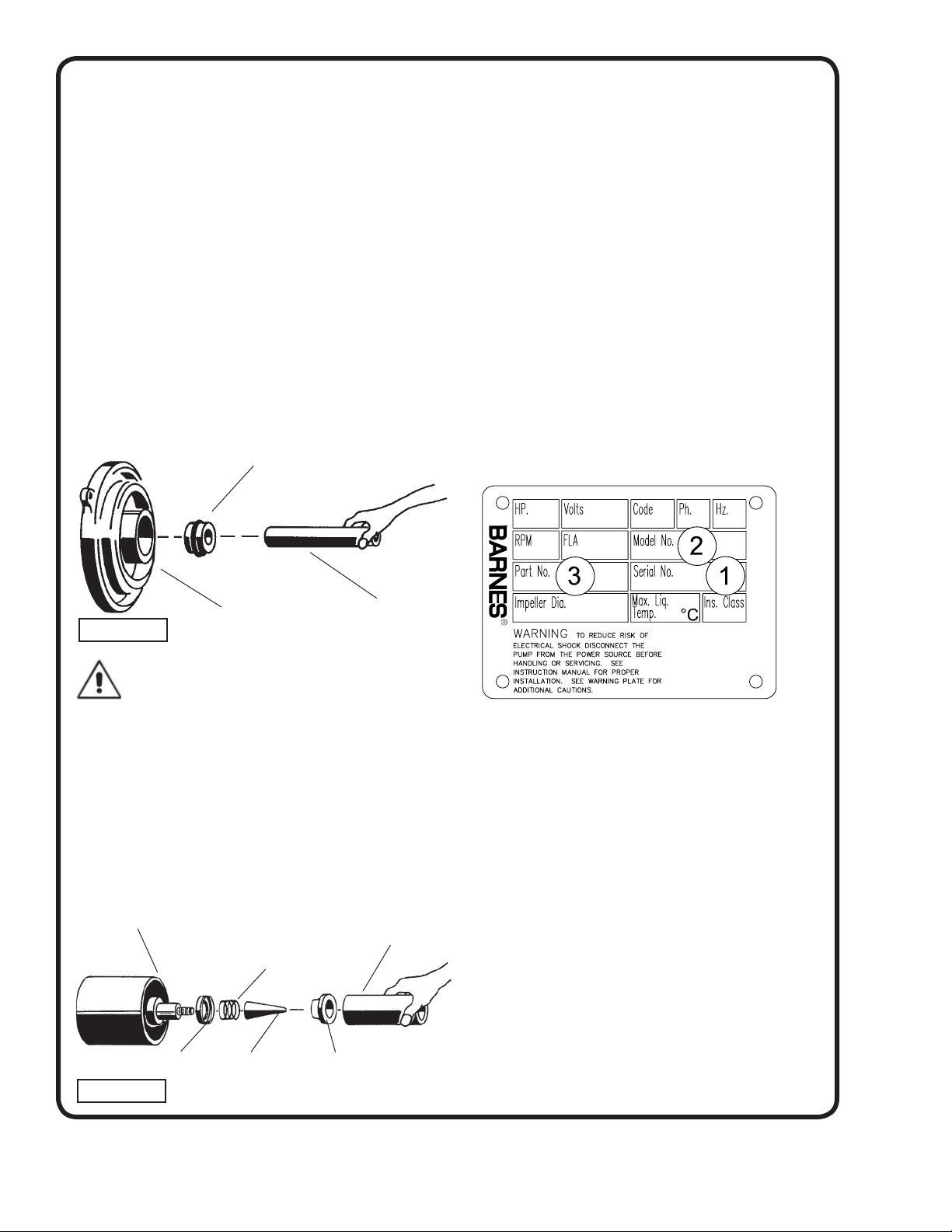
F-4.2) Replacing Shaft Seal (refer to fi g. 7, 8 & 9):
When replacing the shaft seal (3), remove used rotating
member (3c), spring (3b), and spring retainer (3a) from
motor shaft. Press used stationary member (3d) from the
seal plate (2). At reassembly, clean seal cavity thoroughly
and apply a light coat of oil. Lightly oil the rubber ring (DO
NOT use grease) and press the stationary member fi rmly
into the seal plate using a seal pusher (See Parts List- Seal
Tool Kit), nothing but pusher to come in contact with seal
face (see Fig. 7). Insert so that the fi nished surface is up
and the grooved surface is against the seal plate.
Make sure the stationary member is in straight and that the
rubber ring is not out of it’s groove.
DO NOT HAMMER ON THE SEAL PUSHER - IT
WILL DAMAGE THE SEAL FACE.
Place spring retainer and spring onto motor shaft. Lightly
oil shaft (DO NOT use grease) and inner surface of
bellows of rotating member. With fi nished end away from
motor, slide rotating member over bullet and onto shaft
until it engages spring (see Fig. 9). Carefully assemble
shaft to seal plate as per section F-3.3. It is extremely
important to keep seal faces clean during assembly. Dirt
particles lodged between these faces will cause the seal
to leak. When seal plate is assembled to motor, it will
properly align and seat the seal (3) and bearing (4). Follow
complete reassembly instructions as per section F-3.3.
F-4.3) Replacing Exclusion Seal:
The exclusion seal (16), helps to keep debris away from
the shaft seal where it could cause damage. The exclusion
seal should be replaced whenever the shaft seal is
replaced. To replace the exclusion seal, pull the old seal off
the shaft, and slide the new seal on with the thin lip toward
the motor. Be sure not to damage the lip of the seal. Finger
pressure is all that is needed to install the exclusion seal.
SECTION: G REPLACEMENT PARTS
G-1 ORDERING REPLACEMENT PARTS:
When ordering replacement parts, ALWAYS furnish the
following information:
1. Pump serial number and date code. (Paragraph G-4)
2. Pump model number. (Paragraph G-3)
3. Pump part number. (Paragraph G-2)
4. Part description.
5. Item part number.
6. Quantity required.
7. Shipping instructions.
8. Billing Instructions.
G-2 PART NUMBER:
The part number consists of a six (6) digit number, which
appears in the catalog. A one or two letter suffi x may follow
this number to designate the design confi guration. This
number is used for ordering and obtaining information.
G-3 MODEL NUMBER:
This designation consists of numbers and letters which
represent the discharge size, series, horsepower, motor
phase and voltage, speed and pump design. This number is
used for ordering and obtaining information.
G-4 SERIAL NUMBER:
The serial number block will consist of a six digit number,
which is specifi c to each pump and may be preceded by
an alpha character, which indicates the plant location.
This number will also be suffi xed with a four digit number,
which indicates the date the unit was built (Date Code).
EXAMPLE: A012345 0490.
Reference the six digit portion (Serial Number) of this
number when referring to the product.
Seal Pusher
Seal Plate
Stationary Member
(3d) Polished Face Out
FIGURE 7
Rotating Member (3c)
Motor, Sleeve &
Bearing
Bullet
Seal Pusher
Spring
Retaining Ring (3a)
FIGURE 9
11
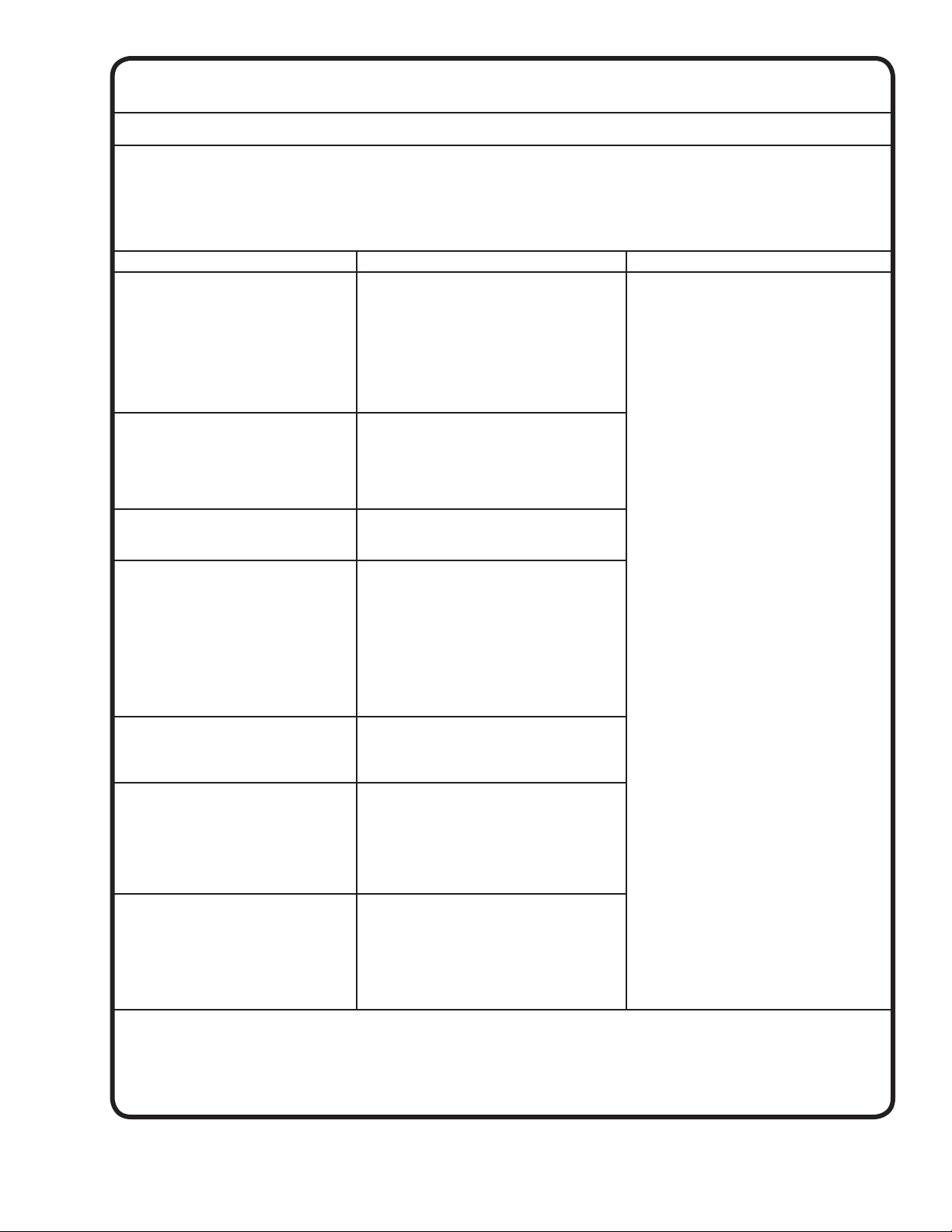
TROUBLE SHOOTING
CAUTION ! Always disconnect the pump from the electrical power source before handling.
If the system fails to operate properly, carefully read instructions and perform maintenance recommendations.
If operating problems persist, the following chart may be of assistance in identifying and correcting them:
MATCH “CAUSE” NUMBER WITH CORRELATING “CORRECTION” NUMBER.
NOTE: Not all problems and corrections will apply to each pump model.
PROBLEM CAUSE CORRECTION
Pump will not run 1. Poor electrical connection, blown fuse,
tripped breaker or other interruption of power,
improper power supply.
2. Motor or switch inoperative (to isolate
cause, go to manual operation of pump).
2a. Float movement restricted.
2b. Switch will not activate pump or is defective.
2c. Defective motor
3. Insuffi cient liquid level.
1. Check all electrical connections for
security. Have electrician measure current
in motor leads, if current is within ±20%
of locked rotor Amps, impeller is probably
locked. If current is 0, overload may be
tripped. Remove power, allow pump to cool,
then recheck current.
2a. Reposition pump or clean basin as
required to provide adequate clearance for
fl oat.
2b. Disconnect level control. Set ohmmeter
for a low range, such as 100 ohms full scale
and connect to level control leads. Actuate
level control manually and check to see that
ohmmeter shows zero ohms for closed switch
and full scale for open switch. (Float Switch).
2c. Check winding insulation (Megger Test)
and winding resistance. If check is outside
of range, dry and recheck. If still defective,
replace per service instructions.
3. Make sure liquid level is at least equal to
suggested turn-on point.
4. Recheck all sizing calculations to
determine proper pump size.
5. Check discharge line for restrictions,
including ice if line passes through or into
cold areas.
6. Remove and examine check valve for
proper installation and freedom of operation.
7. Open valve.
8. Check impeller for freedom of operation,
security and condition. Clean impeller and
inlet of any obstruction.
9. Loosen union slightly to allow trapped air
to escape.Verify that turn-off level of switch
is set so that the suction is always fl ooded.
Clean vent hole.
10. Check rotation. If power supply is three
phase, reverse any two of three power supply
leads to ensure proper impeller rotation..
11. Repair fi xtures as required to eliminate
leakage.
12. Check pump temperature limits & fl uid
temperature.
13. Replace portion of discharge pipe with
fl exible connector.
14. Turn to automatic position.
15. Check for leaks around basin inlet and
outlets.
Pump will not turn off 2a. Float movement restricted.
2b. Switch will not activate pump or is defective.
4. Excessive infl ow or pump not properly sized
for application.
9. Pump may be airlocked
14. H-O-A switch on panel is in “HAND” position
Pump hums but does not run 1. Incorrect voltage
8. Impeller jammed or loose on shaft, worn or
damaged, impeller cavity or inlet plugged.
Pump delivers insuffi cient capacity 1. Incorrect voltage.
4. Excessive infl ow or pump not properly sized
for application.
5. Discharge restricted.
6. Check valve stuck closed or installed backwards.
7. Shut-off valve closed.
8. Impeller jammed or loose on shaft, worn or
damaged, impeller cavity or inlet plugged.
9. Pump may be airlocked.
10. Pump running backwards
Pump cycles too frequently or runs
periodically when fi xtures are not in use
6. Check valve stuck closed or installed
backwards.
11. Fixtures are leaking.
15. Ground water entering basin.
Pump shuts off and turns on indepen-
dent of switch, (trips thermal overload
protector). CAUTION! Pump may start
unexpectedly. Disconnect power supply.
1. Incorrect voltage.
4. Excessive infl ow or pump not properly sized
for application.
8. Impeller jammed, loose on shaft, worn or
damaged, impeller cavity or inlet plugged.
12. Excessive water temperature.
(internal protection only)
Pump operates noisily or vibrates
excessively
2c. Worn bearings, motor shaft bent.
8. Debris in impeller cavity or broken impeller
10. Pump running backwards
13. Piping attachments to buiding structure too
rigid or too loose.
12
FIGURE 10
13
FIGURE 11

14
(*) Included with item 9
(**) Cast Iron Impeller replaces Zytel Impeller 089116, 5/02.
(‡) Units with a Build Code date before 11/01 may use capacitor Part Number 070964 or 035864
PARTS KITS
Overhaul Kit..................... P/N: 085201 (†) 3,4,6,13,16,19,24
Seal Kit............................. P/N: 085202 (◊) 3,13,16,19
PRESSURE GAUGE KIT.. P/N: 085343
PARTS LIST
ITEM QTY PART No. DESCRIPTION
1 1 102260 Motor & Sleeve, SF411
2 1 093063 Seal Plate Cast Iron
3 1 068988 נ Shaft Seal, (Standard) Carbon/Ceramic/Buna-N
068988SB Tungsten/Tungsten/Buna-N
068988SD Silicon/Silicon/Buna-N
068988SF Carbon/Ceramic/Viton
068988SH Tungsten/Tungsten/Viton
068988SK Silicon/Silicon/Viton
068988SM Silicon/Tungsten/Buna-N
068988SN Carbon/Ni-Resist/Buna-N
4 1 017414 † Bearing
6 1 017415 † Retaining Ring
7 1 035864 ‡ Capacitor, SF411 370V 35MFD
070965 Capacitor, SF511 370V 25MFD
8 1 039858 Capacitor Bracket
9 1 099260 Power Cable Assembly, 15ft. (STD)
099260XA 20ft
099260XC 30ft
099260XF 50ft
9a 1 051448 * Gland Nut 1-16 Stainless
9b 2 051449 * Friction Ring
12 1 016660 Self Tapping Screw 8-32 x 3/8 lg Stainless
13 1 019289 נ O-Ring
14 1 093065 Motor Housing
15 2 084948 Socket Hd. Cap Screw 1/4-20 x 1.25” Stainless
16 1 068053 נ Exclusion Seal
17 1 112561 Impeller, SF411 5.44” Dia., Cast Iron**
096722 Impeller, SF511 5.63” Dia., Cast Iron
18 1 099295 Ground Wire Assy
19 1 068984 נ Gasket
20 1 089120 Volute Cast Iron
21 4 1-299-1 Hex Hd Cap Screw , SE411-421 5/16-18 x 2.75” Stainless
22 1 027271 Handle
23 58 oz. 029034 Oil
24 1 015000 † Pipe Plug
25 A/R ----- Loctite #RC609
26 A/R ----- Loctite #242
27 1 ----- Bearing Sleeve PART OF MOTOR ASSEMBLY
15
Testing is performed with water specifi c gravity of 1.0 @ 68˚F (20˚C), other fl uids may vary performance
A Crane Co. Company
420 Third Street 83 West Drive, Brampton
Piqua, Ohio 45356 Ontario, Canada L6T 2J6
Phone: (937) 778-8947 Phone: (905) 457-6223
Fax: (937) 773-7157 Fax: (905) 457-2650
www.cranepumps.com
Limited 24 Month Warranty
Crane Pumps & Systems warrants that products of our manufacture will be free of defects in material and workmanship
under normal use and service for twenty-four (24) months after manufacture date, when installed and maintained
in accordance with our instructions.This warranty gives you specifi c legal rights, and there may also be other rights
which vary from state to state. In the event the product is covered by the Federal Consumer Product Warranties Law
(1) the duration of any implied warranties associated with the product by virtue of said law is limited to the same
duration as stated herein, (2) this warranty is a LIMITED WARRANTY, and (3) no claims of any nature whatsoever
shall be made against us, until the ultimate consumer, his successor, or assigns, notifi es us in writing of the defect,
and delivers the product and/or defective part(s) freight prepaid to our factory or nearest authorized service station.
Some states do not allow limitations on how long an implied warranty lasts, so the above limitation may not apply.
THE SOLE AND EXCLUSIVE REMEDY FOR BREACH OF ANY AND ALL WARRANTIES WITH RESPECT TO ANY
PRODUCT SHALL BE TO REPLACE OR REPAIR AT OUR ELECTION, F.O.B. POINT OF MANUFACTURE OR
AUTHORIZED REPAIR STATION, SUCH PRODUCTS AND/OR PARTS AS PROVEN DEFECTIVE. THERE SHALL BE
NO FURTHER LIABILITY, WHETHER BASED ON WARRANTY, NEGLIGENCE OR OTHERWISE. Unless expressly
stated otherwise, guarantees in the nature of performance specifi cations furnished in addition to the foregoing material
and workmanship warranties on a product manufactured by us, if any, are subject to laboratory tests corrected for
fi eld performance. Any additional guarantees, in the nature of performance specifi cations must be in writing and such
writing must be signed by our authorized representative. Due to inaccuracies in fi eld testing if a confl ict arises between
the results of fi eld testing conducted by or for user, and laboratory tests corrected for fi eld performance, the latter
shall control. RECOMMENDATIONS FOR SPECIAL APPLICATIONS OR THOSE RESULTING FROM SYSTEMS
ANALYSES AND EVALUATIONS WE CONDUCT WILL BE BASED ON OUR BEST AVAILABLE EXPERIENCE AND
PUBLISHED INDUSTRY INFORMATION. SUCH RECOMMENDATIONS DO NOT CONSTITUTE A WARRANTY OF
SATISFACTORY PERFORMANCE AND NO SUCH WARRANTY IS GIVEN.
This warranty shall not apply when damage is caused by (a) improper installation, (b) improper voltage (c) lightning
(d) excessive sand or other abrasive material (e) scale or corrosion build-up due to excessive chemical content. Any
modifi cation of the original equipment will also void the warranty. We will not be responsible for loss, damage or labor
cost due to interruption of service caused by defective parts. Neither will we accept charges incurred by others without
our prior written approval.
This warranty is void if our inspection reveals the product was used in a manner inconsistent with normal industry practice
and\or our specifi c recommendations. The purchaser is responsible for communication of all necessary information
regarding the application and use of the product. UNDER NO CIRCUMSTANCES WILL WE BE RESPONSIBLE FOR
ANY OTHER DIRECT OR CONSEQUENTIAL DAMAGES, INCLUDING BUT NOT LIMITED TO TRAVEL EXPENSES,
RENTED EQUIPMENT, OUTSIDE CONTRACTOR FEES, UNAUTHORIZED REPAIR SHOP EXPENSES, LOST
PROFITS, LOST INCOME, LABOR CHARGES, DELAYS IN PRODUCTION, IDLE PRODUCTION, WHICH DAMAGES
ARE CAUSED BY ANY DEFECTS IN MATERIAL AND\OR WORKMANSHIP AND\OR DAMAGE OR DELAYS IN
SHIPMENT. THIS WARRANTY IS EXPRESSLY IN LIEU OF ANY OTHER EXPRESS OR IMPLIED WARRANTY,
INCLUDING ANY WARRANTY OF MERCHANTABILITY OR FITNESS FOR A PARTICULAR PURPOSE.
No rights extended under this warranty shall be assigned to any other person, whether by operation of law or otherwise,
without our prior written approval.
RETURNED GOODS
RETURN OF MERCHANDISE REQUIRES A “RETURNED GOODS AUTHORIZATION”.
CONTACT YOUR LOCAL CRANE PUMPS & SYSTEMS, INC. DISTRIBUTOR.
Products Returned Must Be Cleaned, Sanitized,
Or Decontaminated As Necessary Prior To Shipment,
To Insure That Employees Will Not Be Exposed To Health
Hazards In Handling Said Material. All Applicable Laws
And Regulations Shall Apply.
IMPORTANT!
WARRANTY REGISTRATION
Your product is covered by the enclosed Warranty.
To complete the Warranty Registration Form go to:
http://www.cranepumps.com/ProductRegistration/
If you have a claim under the provision of the warranty, contact your local
Crane Pumps & Systems, Inc. Distributor.

Notes