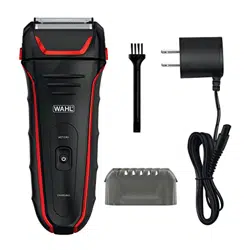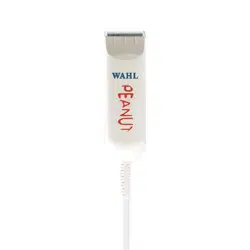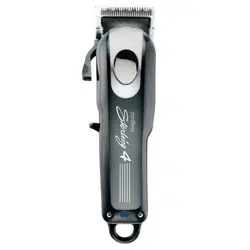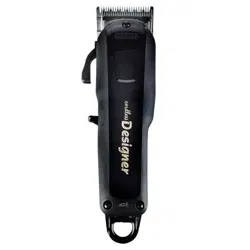
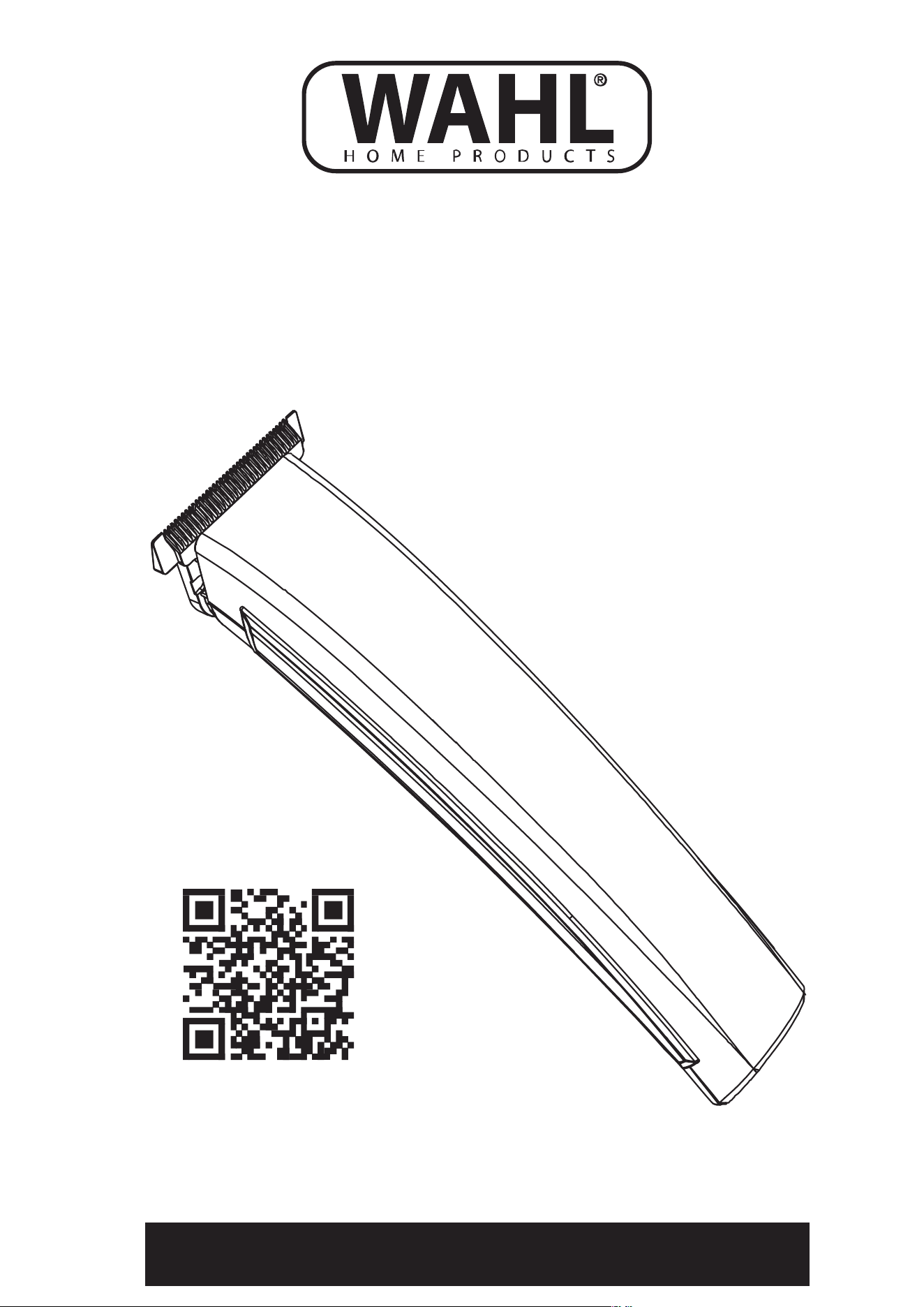
Lithium
Edge Pro
™
Operating Instructions
Instrucciones de Operación
WahlUSA.com
Models 9884L2
Scan for Trimming 101

1 2 3 4 5 6
5-YEAR LIMITED WARRANTY
Valid in U.S.A. Only
If your Wahl product fails to operate satisfactorily within five (5)
years from the date of original purchase or receipt as a gift, Wahl
will, at our option, repair or replace the product and return it to
you FREE OF CHARGE. Do not return this product to store where
purchased. Products needing repair under this warranty should
be returned with postage pre-paid to the following address or call
1-800-767-9245 for assistance:
Wahl Clipper Corp.
Attn: Repair Department
3001 Locust Street
Sterling, Illinois 61081
When mailing, please include a note describing the defect and
the date of original purchase or receipt as a gift. Products out of
warranty will be repaired at our standard repair charges.
This warranty does not cover products damaged by:
1. Modification or repair by anyone other than Wahl Clipper
Corporation or a Wahl authorized service center;
2. Commercial (non-consumer) use or unreasonable use.
This warranty gives you specific legal rights, and you may also
have other rights which vary from state to state. No other written
express warranty is given. No responsibility is assumed for
incidental or consequential damages of any type or for the use
of unauthorized attachments. Some states may not allow the
exclusion or limitation of incidental or consequential damages, so
the limitation may not apply to you. Warranty valid in U.S.A. only.
Outside U.S.A., check with store for Wahl authorized distributor’s
warranty.
© 2023 Wahl Clipper Corporation
art no. 93248-1101 (v.2023.08)
For more information or Product Registration, visit WahlUSA.com

1 2 3 4 5 6
SAVE THESE INSTRUCTIONS
For Household Use Only
RECHARGING & SMART LED
1. This trimmer is conveniently designed for household use. It
should be allowed to charge completely before its first use.
2. Remove the trimmer, USB cable (and/or) power supply unit
(charger) and accessories from the packing material.
3. Connect the charging device (USB or charger) to the trimmer.
4. Plug in the charging device:
Charger: to any convenient electrical outlet at the correct
voltage.
USB: to certified device such as on a computer, receptacle,
lamp, class 2 power supply or automotive adapter.
Warning: Never use an unapproved USB source.
5. When charging the trimmer, the LED will pulse.
6. When charging is completed, the LED will stay ON.
7. When the trimmer is about to run out of energy, the LED will
flash to indicate that you have less than 15% battery capacity
remaining. Once flashing starts, there should be enough charge
remaining to finish trimming before re-charging the trimmer.
8. Once the LED begins flashing to indicate that it needs to be
re-charged, it will remain flashing until the
trimmer is completely re-charged or until
the trimmer runs out of power. Completely
recharged means that enough charge time
has elapsed and the LED stays ON.
9. When trimmer is low in power, it should
be connected to the power supply unit and
plugged into an outlet to assure maximum power is available
when it is next used. This power supply unit is designed to
completely charge the battery without overcharging. Do not use

1 2 3 4 5 6
the trimmer while it is charging.
10. Insert only charging device plug supplied by the manufacturer
into charger receptacle.
Never attempt to remove power supply plug prongs
while the appliance is charging.
TROUBLESHOOTING
• If the LED did not flash before the trimmer stopped running try
resetting the trimmer by charging the trimmer completely until the
LED stays ON.
• Trimming is disabled when charging.
• If the trimmer unexpectedly stopped operating try resetting the
device by plugging the trimmer into the charger.
• If your trimmer does not seem to take a charge, check the
following before returning it for repair:
1. Check outlet to make sure it is working by plugging in another
appliance.
2. Make sure the outlet simply is not connected to a light switch
which turns the power at the outlet off when lights are turned
off.
3. Be sure the trimmer is properly connected to the charging
device, all connections are secure and the trimmer is turned
off.
4. If your electricity is connected to a master power switch, we
suggest the trimmer be disconnected from the charging device
anytime the master switch is off.
5. If trimmer does not run and it is completely charged, turn the
unit “ON - I” and pinch or push the blades manually. (Oil may
have dried out between the blades, so they may be temporarily
stuck together.)

1 2 3 4 5 6
LITHIUM-ION BATTERY
REPLACEMENT, TRIMMER DISPOSAL
AND RECYCLING:
• For battery replacement send the entire, intact trimmer unit to:
Wahl Annex 3001 North Locust, P.O. Box 578, Sterling, IL 61081
• Do not attempt to remove the battery. Lithium-Ion batteries can
explode, catch fire, and/or cause burns if disassembled, damaged,
or exposed to water or high temperatures.
• If you choose not to replace the battery, the entire, intact trimmer
unit must be disposed. Do not attempt to remove the battery for
disposal. Lithium-Ion batteries may be subject to local disposal
regulations. Many locations prohibit disposal in standard waste
receptacles. Check your local laws and regulations.
• For recycling contact a government recycling agency, waste
disposal service, retailer, or visit online recycling sources, such as
www.batteryrecycling.com or www.rbrc.org.
TRAVEL LOCK
This Wahl trimmer comes with an electronic travel lock to avoid
accidental activation while transporting.
Hold power button down for 5 seconds to engage travel lock.
Hold power button down for 5 seconds to disengage travel lock.
NOTE: Plugging in power cord while locked will deactivate the travel
lock.
1 2 3 4 5 6
CARING FOR YOUR TRIMMER
OILING BLADES
For best results, use Wahl Clipper Oil on the blades only when
necessary, or approximately once a month. Motor bearings are
permanently lubricated—do not attempt to oil.
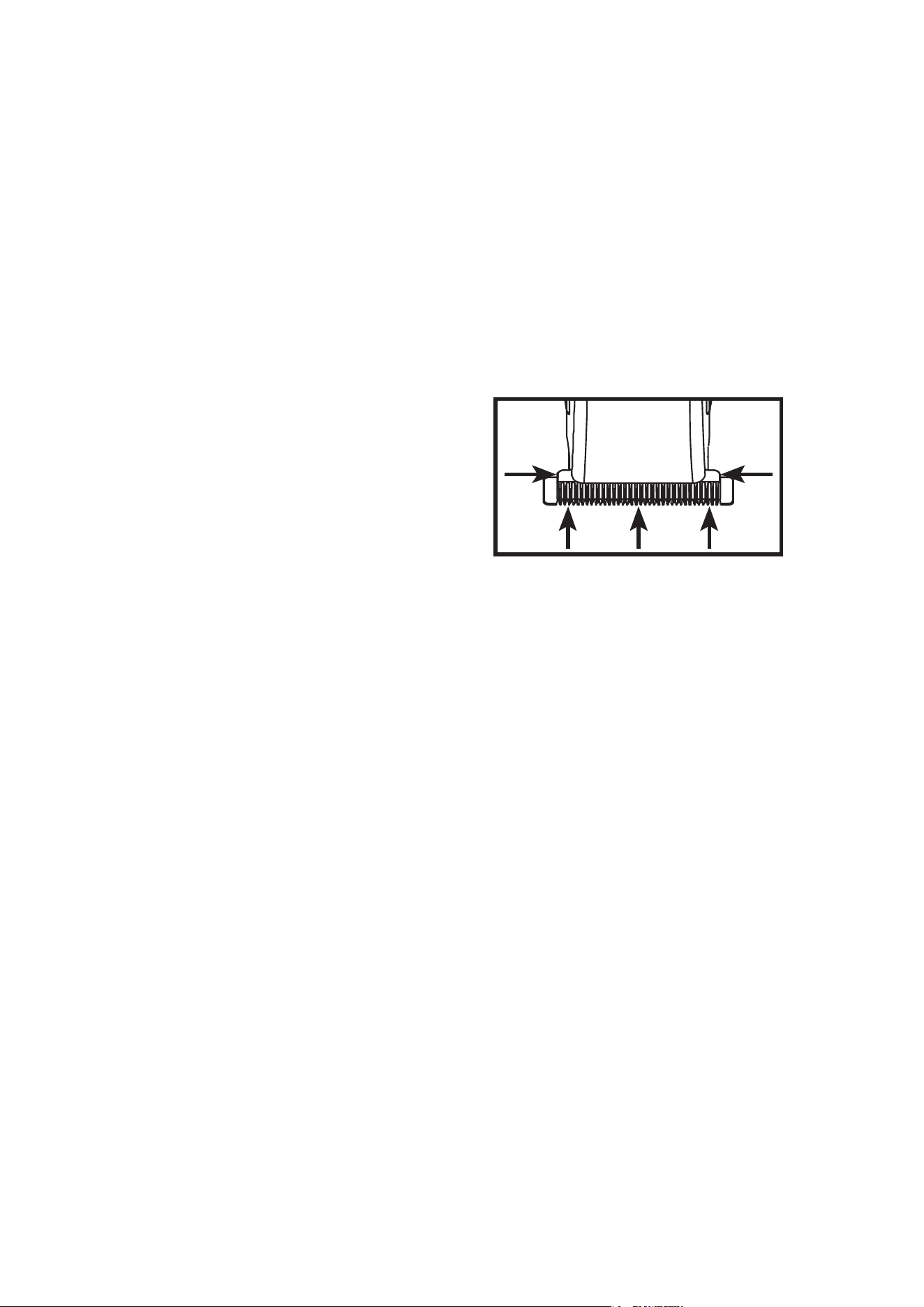
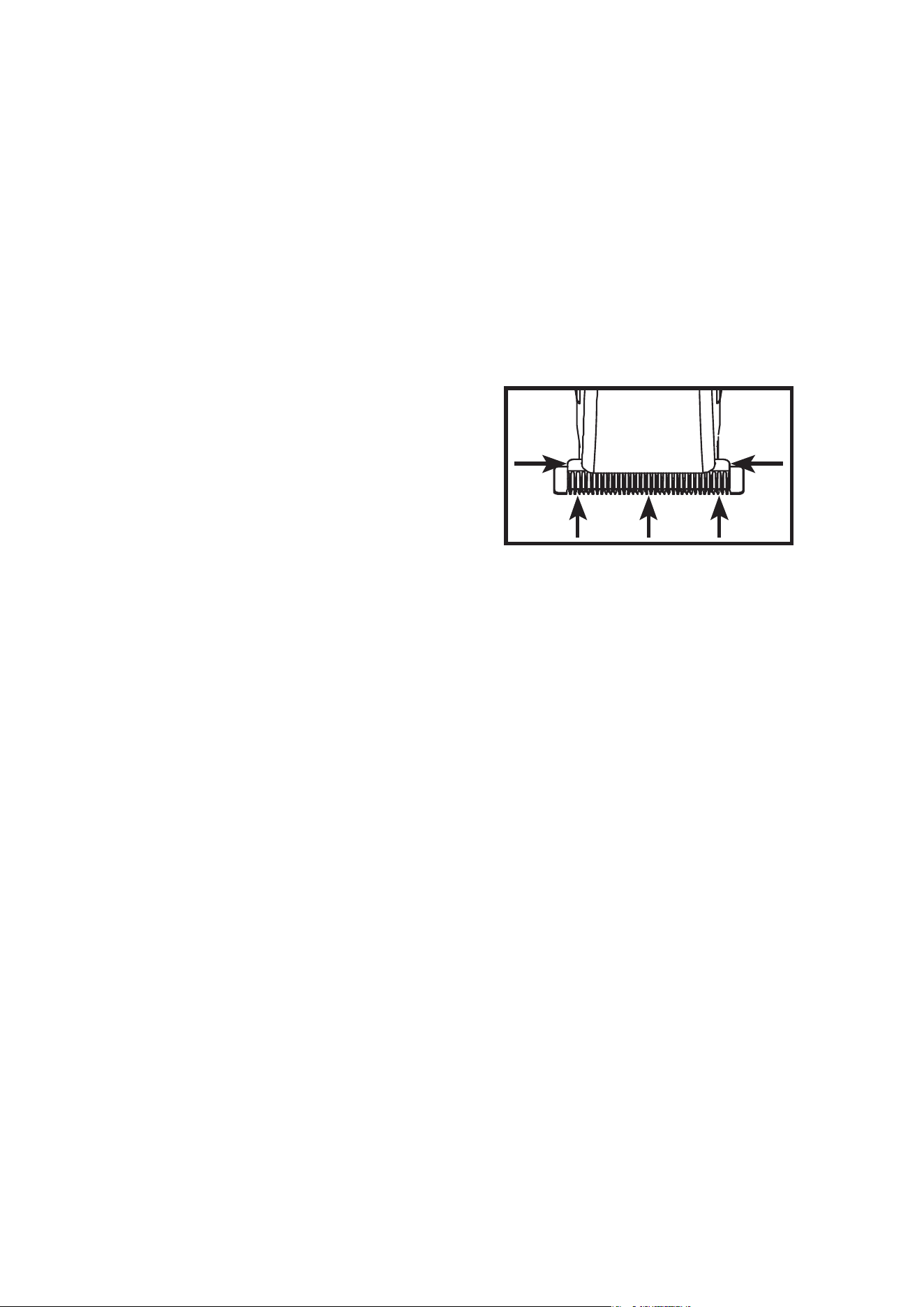
When oiling your trimmer, turn the trimmer “ON - I,” hold the unit
with the blades facing DOWN and squeeze three drops across the
front of the blade and one drop on each side on the heel of the
blade. Wipe off excess oil with soft cloth.
NOTICE—DO NOT OVER OIL!
Excessive oiling or application of
liquids will cause damage if allowed
to seep back into motor.
BLADE CARE
Trimmer blades have precision-hardened, ground and lapped
cutting teeth. Blades should be handled carefully and never bumped
or used to cut dirty or abrasive material. Clean with the included
brush.
Heads should be removed from the trimmer prior to
rinsing in water. After rinsing, allow the heads to air dry
completely before reattaching to the trimmer body. The
trimmer body should always be kept away from water
to maximize the life of the motor, battery, and control
components.
CLEANING/STORAGE
Before storing your trimmer, use the cleaning brush to whisk
any loose hairs from the unit and the blades. Store unit in such a
manner so that blades are protected from damage.
When the trimmer is not in use, the trimmer blade guard
attachment should be in place to protect the blades.
1 2 3 4 5 6
SPECIAL FEATURES:
Your trimmer has been designed with several advanced
features to help you get perfect results every time you
trim. Your trimmer may be used to neatly trim goatees,
beards, mustaches, neckline, sideburns around the ears
and eyebrows, or anywhere you may need grooming.
It also makes a great all-around family trimmer for light
haircuts and touch ups between trips to the barber or to
clean up the shape of the neck.
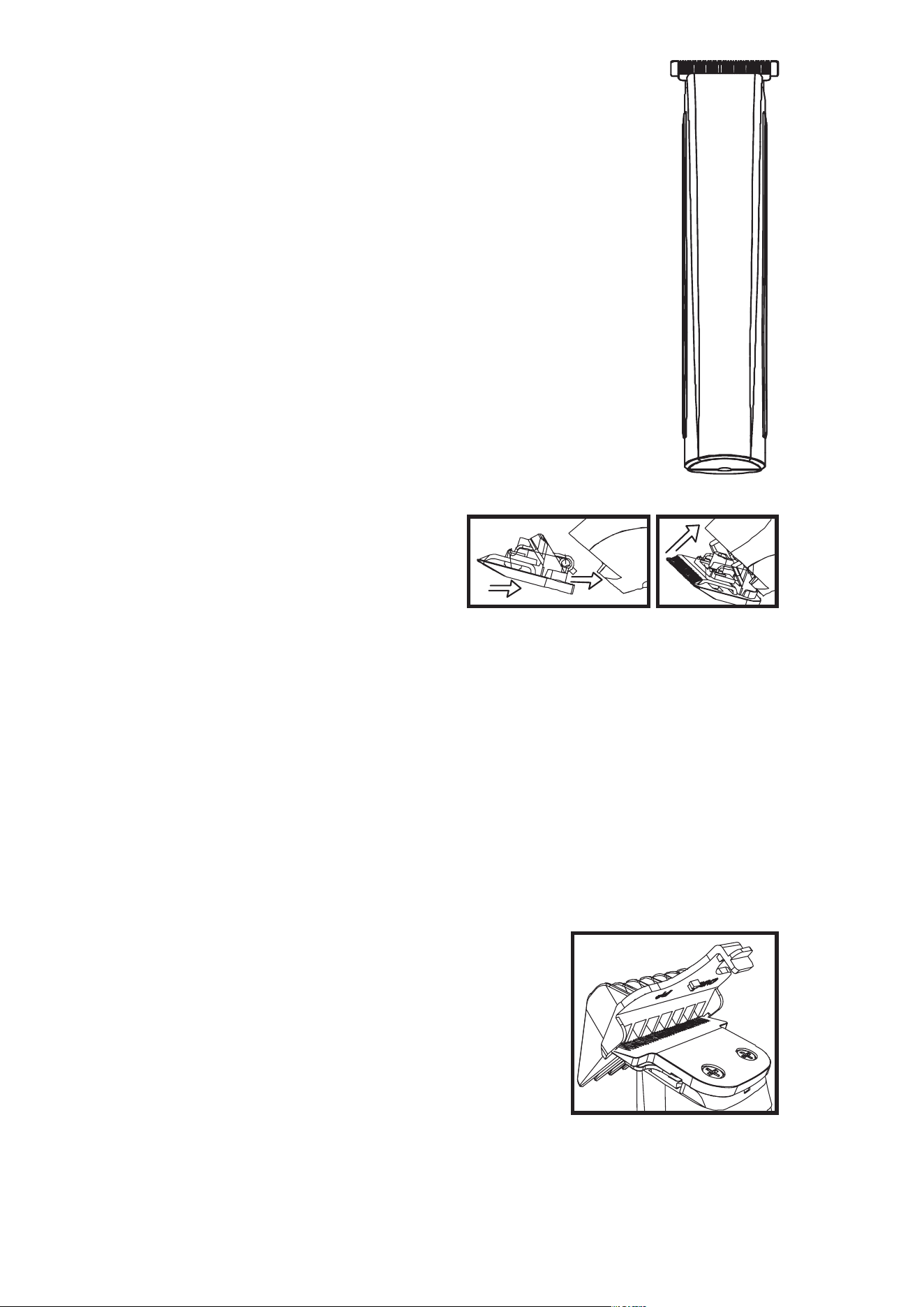
A Detachable Blade System enables you to quickly
change from a standard-width blade for full grooming
to a narrow-width blade for detail trimming around a
mustache, goatee, or anywhere to define the hair line
and clip any stray whiskers.
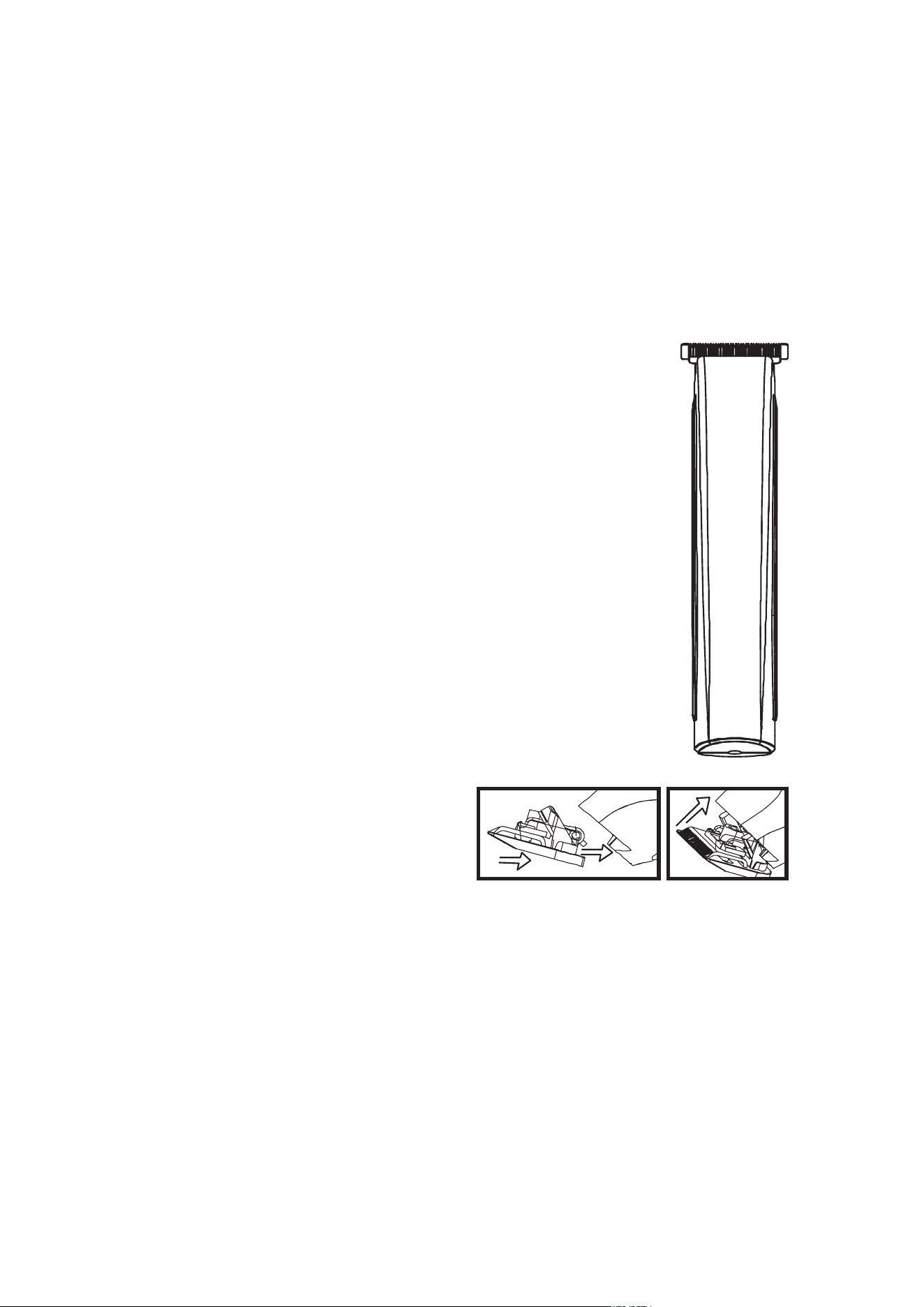
To remove attachment, simply pull
top edge of blade away from body
unit. To attach, align back tab of
attachment head to cavity on the inner edge of trimmer unit and
push down on top of blade.
Should blades become damaged or dull or if you want additional
attachment heads for your trimmer, you may purchase them
from Wahl. See the ACCESSORY SHEET in this kit for ordering
information.
Self-Sharpening Blades are made to maintain their shape and
sharpness for extended periods.
TRIMMING WITH
ATTACHMENT COMBS
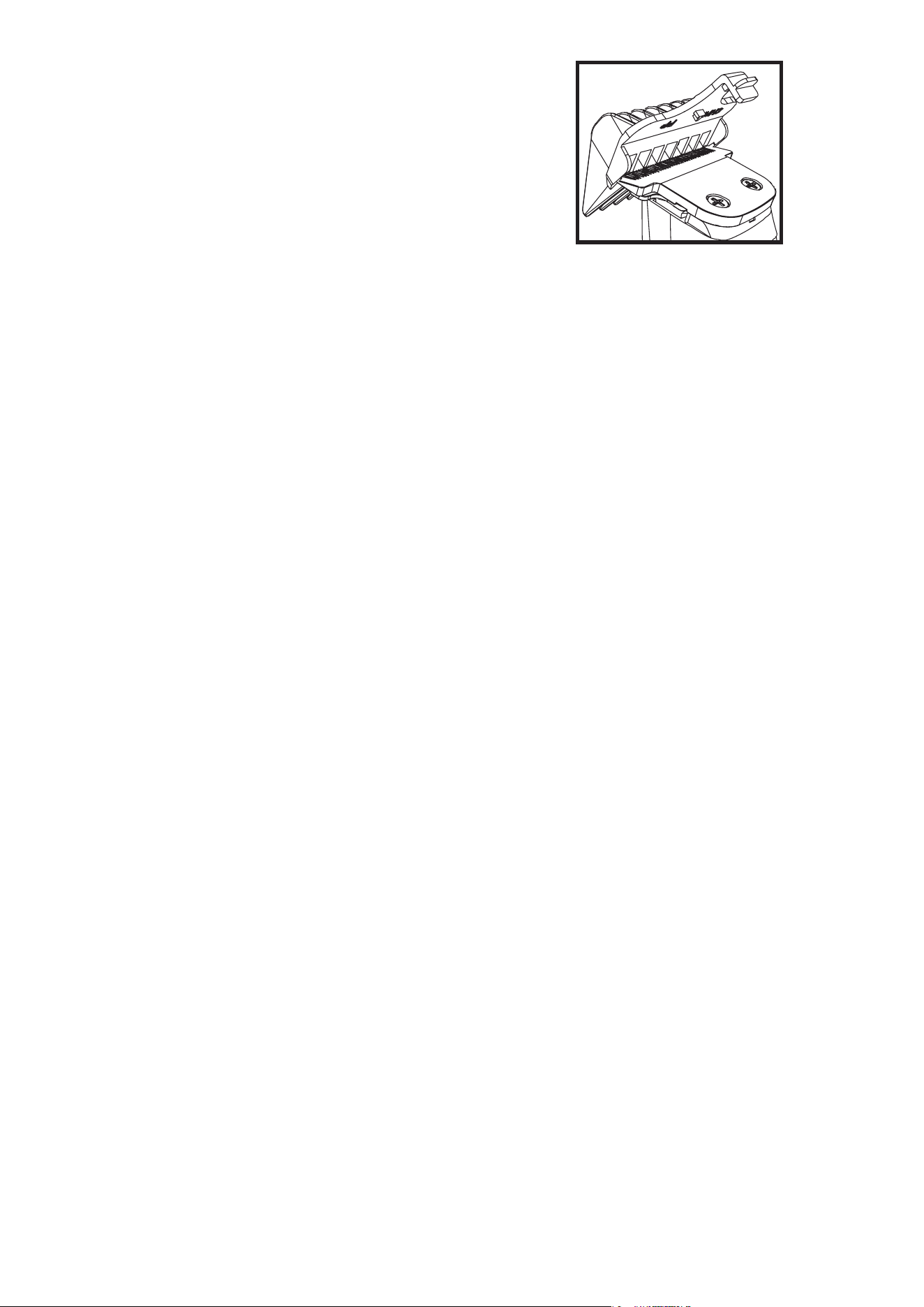
These attachments are ideal for blending,
tapering and defining beards, as well as for
achieving a “close trim” stubble look around
the face. To use the attachments, go with the
hair direction. To achieve closer looks, go against the hair direction.
To attach guide combs, hold comb with the teeth up. Snap guide
comb attachment firmly to the bottom of the trimmer blade.

7
NOW YOU CAN KEEP ON SHAVING
WHILE CLEANING UP INGROWN
WHISKERS
Men with very curly facial hair have a special problem with shaving.
Specifically, ingrown whiskers. Their whiskers curl back toward the
skin — and grow in many different directions.
Electric razors can’t pick them up through their slotted or mesh
heads. And safety razors slice them off at a sharp angle. Either
way, the stubble is left in an ideal condition to cause ingrown hair
problems. Continued shaving over the bumps and irritated skin,
of course, makes the condition worse.
But you don’t have to stop shaving altogether. With this Wahl
trimmer and its specially designed zero overlap T-blade, you can
maintain a neat, shaved appearance while getting help with ingrown
whiskers. Its open-tooth comb action picks up and straightens
curly whiskers for cutting — while its high-speed blades move
across at a flat angle to the whiskers, clipping them off evenly.
SHAVING
Wash Up
1. Make sure your hands and fingernails are scrubbed as clean as
possible before touching your face. Irritated skin is very easily
infected by germs.
2. Wash and dry your face thoroughly to unclog pores and whisker
follicles. Use a rough towel to help remove dead skin and
invigorate the skin. Also, consider using an antiseptic lotion.
Brush Up - Use of Beard Brush
3. Brush your beard thoroughly every day with a good scrubbing
action. This is important because it frees ingrown whiskers and
moves the rest around so they don’t take hold and start growing
in. Use the special beard brush provided or any other small,
stiff-bristle brush that can be sanitized (a toothbrush is fine).
Keep the brush clean.
4. Brush your face as often as possible to start training your beard
to grow in one direction. This goes a long way to ensuring a

8
clean, close shave without skin irritation (you may even want
to stop shaving altogether long enough to establish a brushing
pattern). Most people can expect good results following these
brushing strokes:
• Brush down from each ear, across the cheek and along the
jawbone toward the chin.
• Brush away from the point of the chin on each side, back
along the lines just under the jawbone.
• Brush up from the lower hairline, all around the neck, up to
the lines of the previous stroke.
• Brush from the lower lip down over the chin.
• Brush down from the nose to the upper lip.
5. Shave with Wahl trimmer following the SAME STROKES and
going in the SAME DIRECTION you brushed. Stretch a section
of skin with the fingers of one hand, while holding the shaver
blade head flat against the face with the other hand. Push it
forward with slight pressure in a stroking action across the skin.
You may want to go over the same area several times. Just be
sure you always shave in the same direction each time.
6. Continue this program as long as ingrown hairs and bumps are
a problem. Later, you may wish to switch back to a razor-close
shaving method. But return to use of the Wahl trimmer at the
first sign of the problem coming back. And never stop brushing.
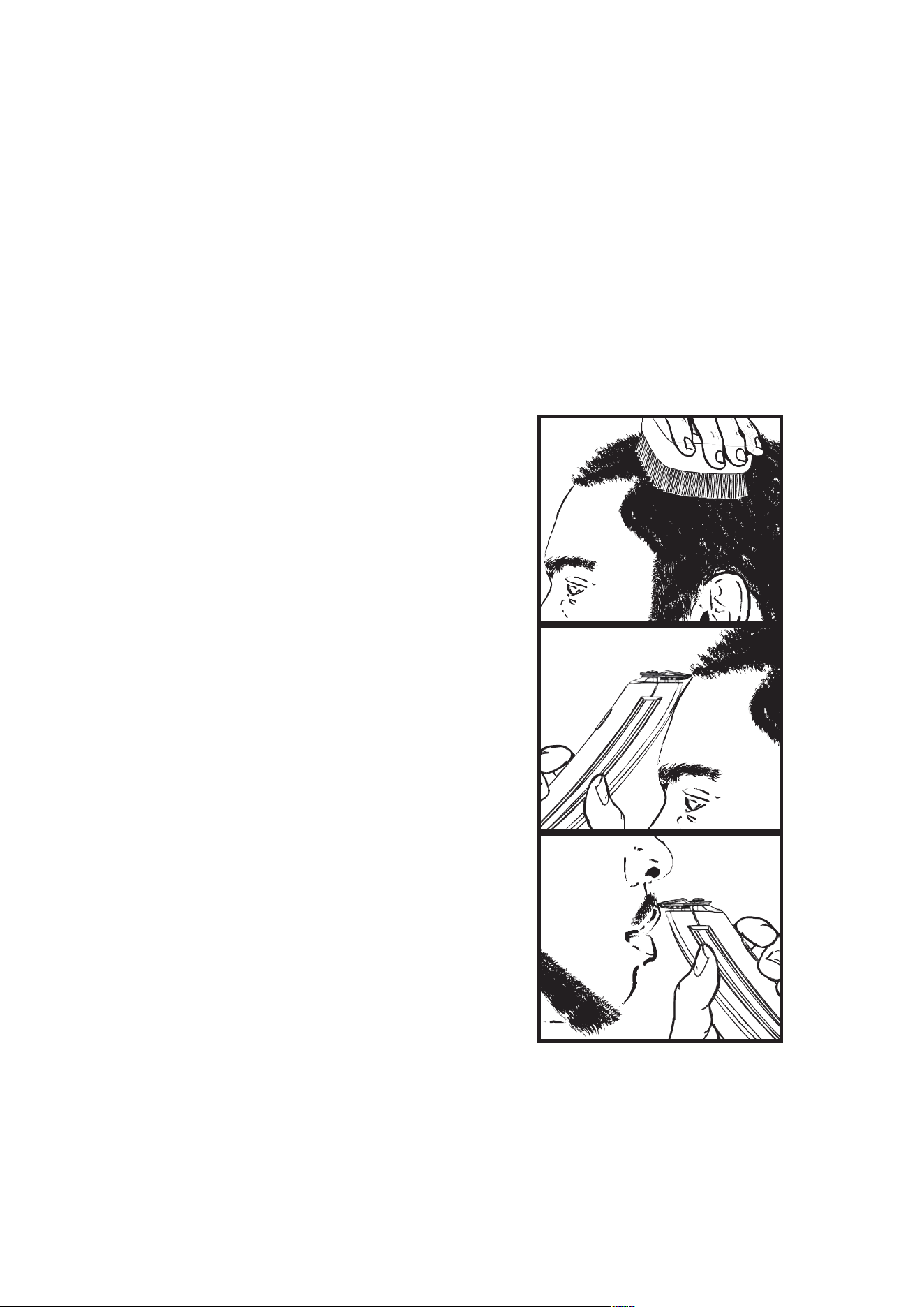
MUSTACHE TRIMMING
1. Comb your mustache. Looking into a well-lit mirror, comb your
mustache in the direction that it grows. This will help reveal
stray hairs and achieve an even, balanced trim.
2. Cut the outline of your mustache. Holding the trimmer in a
vertical position, with the nameplate side facing you, define the
line of your mustache. The extended tips on the blades let you
achieve a clean, well-defined mustache line.
3. Defining. As a finishing step, hold the trimmer with the name-
plate facing you. Using only the bare blades, make a definitive
9 10 11 12 13
line at the bottom of your mustache.
4. Tapering. Hold the trimmer with the nameplate facing away
from you. Again starting with the middle of your mustache,
follow the lip line and taper out the mustache until a gentle
shape is created on the bottom portion of your mustache.
5. Defining. As a finishing step, hold the trimmer with nameplate
facing make a definitive line at the bottom of your mustache.
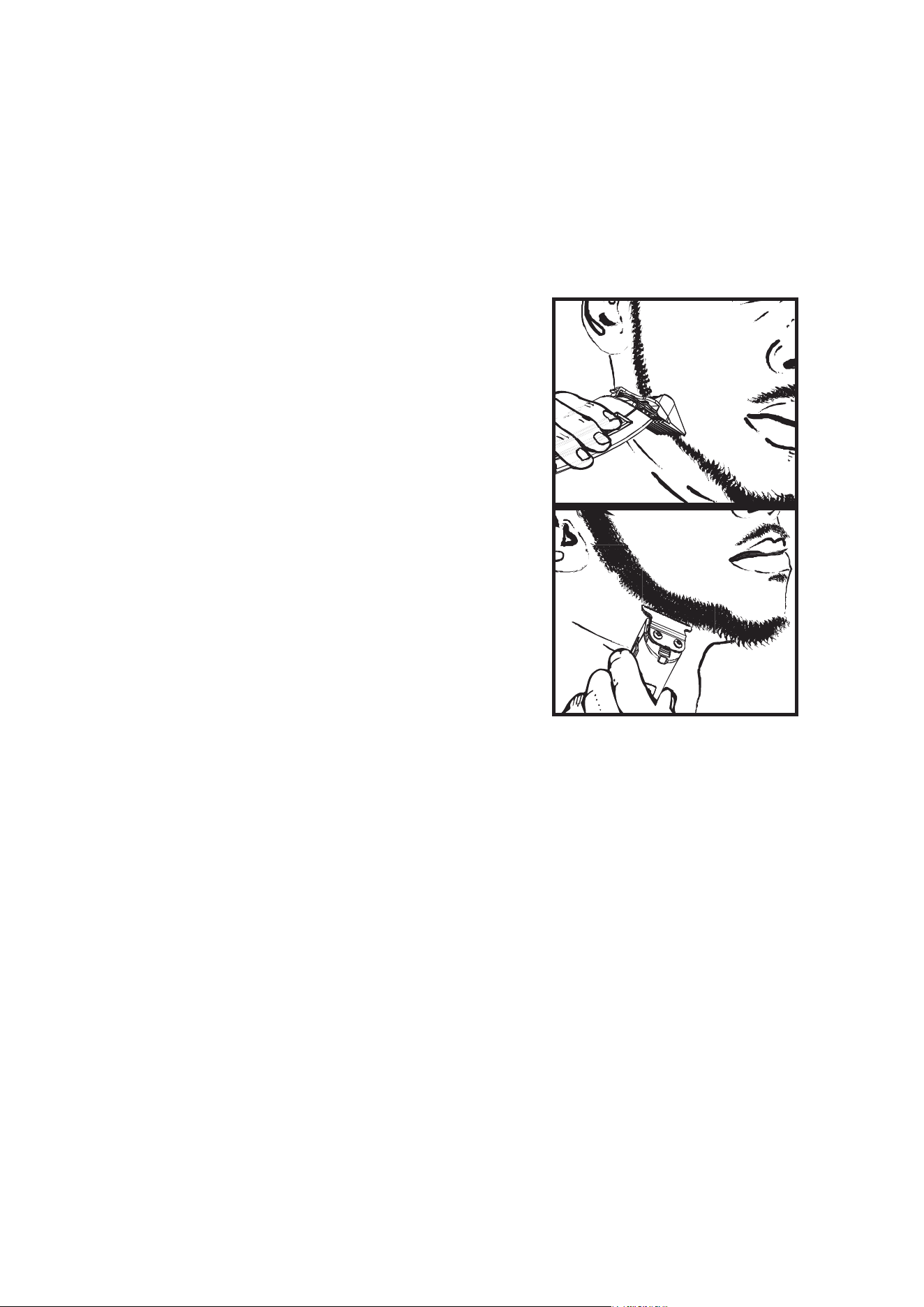
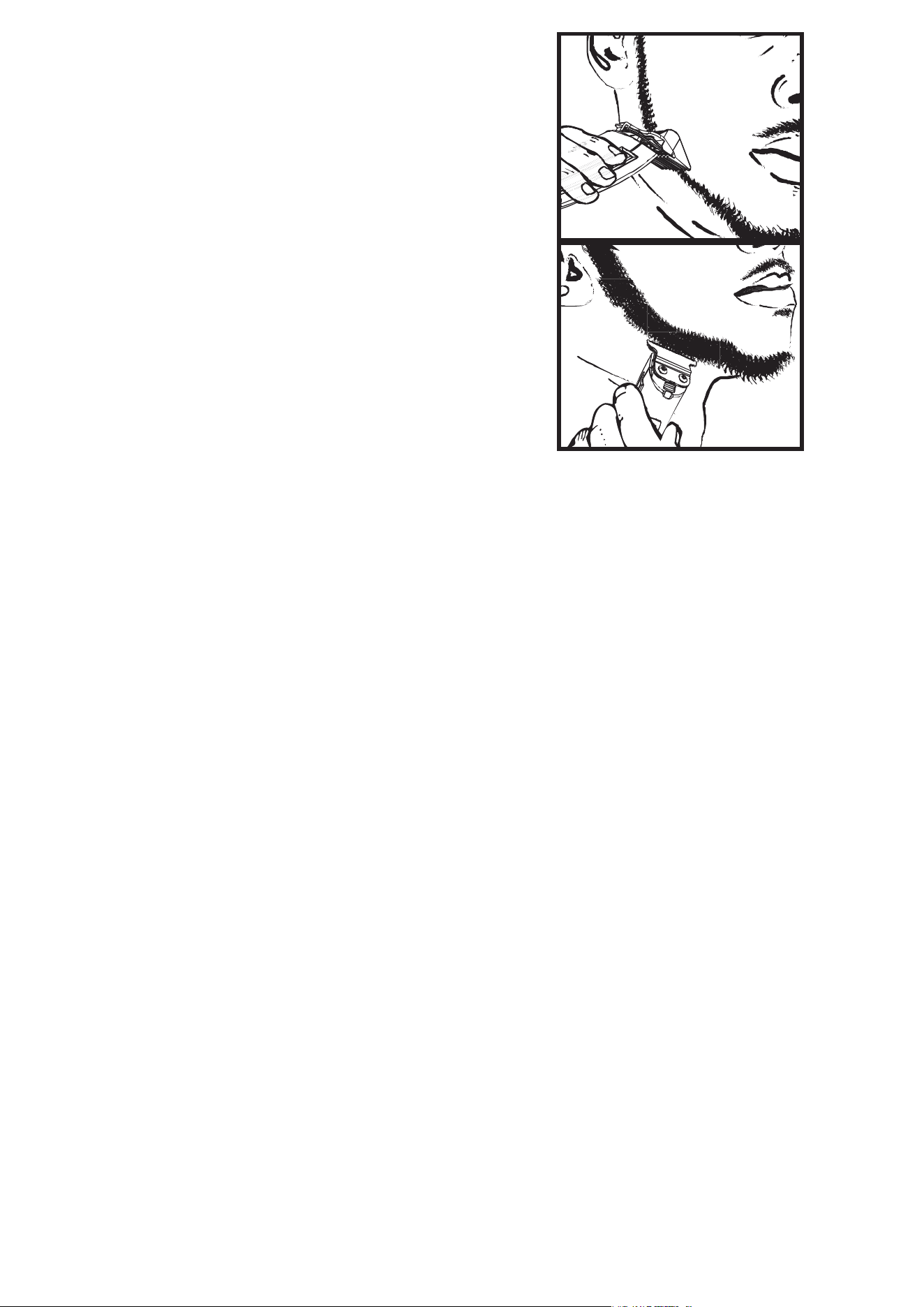
TRIMMING AND
EDGING YOUR BEARD
The following are suggested trimming
steps. You may find different procedures
work better for you.
1. Comb your beard in the direction that
it grows to help reveal stray hairs that
may be longer than the others.
2. Attach the longest trimming guard to
trim and taper your beard. Start at
each sideburn and stroke downward
toward your neck. Trim toward your
chin in smooth, overlapping strokes,
following the lay of your beard. If you trim against the way your
beard naturally lays, the trimmer will cut the hair shorter.
Use progressively shorter trimming guard until you reach the
desired length of beard. You may wish to use the shortest
trimming guard attachment to cut closer near the ear and down
under the chin, changing to a longer trimming guard toward
the front of the face and point of your chin. Always be sure the
trimming guard is locked solidly onto the trimmer before you
start to trim.
3. To cut the outline of your beard, remove the trimming guard.
Starting under your chin and working back toward your jawbone
and ears, cut the outer perimeter of your beard underneath
the jawbone. Continue the line all the way up to the ears and
hairline.

9 10 11 12 13
4. Accentuate your beard line by using the trimmer in a downward
motion. Start at the line you’ve created and, working from the
chin back toward the ears, trim the area right under your beard
line.
5. Define the upper part of your beard using the same technique.
FADE CUT
1. Start at the temple and cut all the way around the head to
establish the ultimate location of the fade line. Always cut
against the grain for the shortest cut. Don’t force the blade
through the hair. Let the trimmer do the work.
2. Next, cut around the head again and up the nape of the neck
to the fade line, brushing away the cut hair as you go. Pull the
scalp taut with the thumb for the closest cut. Turn the trimmer
upside down when necessary to keep cutting against the grain.
Make sure both sides of the head are even.
3. For the top of the head, cut with the grain using the individual
blade guard attachments. The smaller the number of the guard,
the shorter the cut. Comb or brush the hair as you cut for an
even end result.
4. To complete the fade, blend the hair at the fade line by trimming
up and out across the line and against the grain all the way
around the head. Then, repeat all around, turning the trimmer
upside down and cutting downward. The final objective is to
blend the hair so there is no real line, just a perfect fade from
bald to very short hair. You can achieve this by using the #1
blade guard attachment. Continue combing and cutting until you
achieve the desired effect.
5. To create a part, pick a spot off-center. Pull the scalp tight and
with the end of the blade perpendicular to the head, move the
trimmer back and forth to cut a line. Comb through it and cut
again to make sure the cut is precise.

9 10 11 12 13
CUTTING HAIR
The first time you cut the hair, cut only a small amount until you
become accustomed to how long each blade guard leaves the hair.
Always start by placing the largest blade guard on the trimmer, then
use shorter guards if a shorter length is desired.
Remember, between professional haircuts, the hair grows evenly all
over the head and a light trimming at the lower neck and sides may
be all that is needed to bring back that neat, well-groomed look.
For uniform cutting, allow the trimmer to cut its way through the
hair. Do not force it through at a faster rate.
1. Start by combing the hair so it falls into its natural direction.
2. Place the largest blade guard onto your trimmer and start by
trimming the sides from the bottom upwards. Hold the trimmer
lightly against the hair, with teeth of the blade guard pointing up
but flat against the head. Slowly lift the trimmer up and outward
through the hair, cutting only a small amount at a time.
Repeat around sides and back of head.
If you desire shorter hair, either change to a shorter blade guard or
apply more pressure and less lift away from head with the present
attachment.
This entire procedure requires practice, and it is always better to
leave too much hair the first few haircuts.
For the top of the head, you will give a fairly short cut if you use
the 1” blade guard. With the teeth flat against the head, slowly start
trimming from the front to the back. Again, it is better to leave the
hair longer the first few haircuts.
9 10 11 12 13
LINING UP
The term “lining up” can be used in many terms in the barbershop
meaning shape up, edge up, or line up. It is when the hairline is
cleaned free of any hair on the natural hairline on the forehead,
sideburns, or neck line to give a visual of a tight, defined crisp line.
It is usually done with a trimmer or straight razor. The hair outline
defines the haircut. Below you will find Wahl Master Barber, Ben
Phillips’s step-by-step instructions on how to create a crisp, tight
lineup for all hair textures.
*This is a technique for consumers who are lining and detailing
their own facial hair.
1. Cut hair to desired length. Brush
hairline forward using a soft bristle
brush to remove all loose hairs.
2. Make sure trimmer blade is angled
correctly at a 90º angle. The
bottom blade should be facing you,
perpendicular on an horizontal plain.
Touch or tap the edge of the hairline
with the trimmer blade teeth to the
forehead hairline edge to start a guide.
The bottom blade must be facing you.
Tap the hair line from left to right. The
side burns can be blocked to your
desired length.
3. The facial hairline up depends on the
style you are trying to achieve. The
trimmer may be held in multiple
angles when trimming the face, but
the blades must always be facing you.
9 10 11 12 13
SERVICE AND REPAIR
If you have problems with your trimmer, send it prepaid with a note
explaining the problem to:
Wahl Clipper Corporation
Attn: Repair Department
3001 Locust Street
Sterling, IL 61081
Telephone (800) 767-9245
For products purchased outside the United States, contact your distributor.
If for any reason within 60 days of purchase of your Wahl®
trimmer you are not satisfied with your trimmer and would like a
refund, just return your trimmer, together with the sales receipt, to
the retailer from whom you purchased it. Wahl will reimburse all
retailers who accept trimmers within 60 days of purchase. If you
have any questions regarding this money-back guarantee, please
call 1-800-767-9245 in the United States.
60 Day Money Back Guarantee!

1 3
GUARDE ESTAS INSTRUCCIONES
Solamente Para Uso Residencial
INSTRUCCIONES DE RECARGA Y LED
INTELIGENTE
1. Esta recortadora está diseñada convenientemente para uso
casero. Se debe dejar cargar completamente antes del primer
uso.
2. Saque la recortadora, el cable USB, la fuente de alimentación
(cargador) y los accesorios del material de embalaje.
3. Conecte el dispositivo de carga (USB o cargador) en la
recortadora.
4. Conecte el dispositivo de carga:
Cargador: a cualquier tomacorrientes eléctrico del voltaje
correcto.
USB: a un dispositivo certificado, como una computadora,
enchufe, lámpara, suministro de energía de clase 2 o adaptador
para automóvil.
Advertencia: Nunca une una fuente de alimentación USB no
aprobada.
5. Al cargar la recortadora, el LED parpadeará.
6. Cuando la carga esté completa, el LED permanecerá encendido.
7. Cuando la recortadora esté a punto de quedar sin energía, el
diodo electroluminiscente destella, indicando que la pila tiene
menos de 15% de capacidad. Cuando empiece a destellar,
queda carga suficiente para terminar de recortar, antes de volver
a cargar.
8. Cuando el diodo electroluminiscente
empiece a destellar, indicando que hay que
recargarla, sigue destellando hasta que quede
completamente cargada o hasta que se le
acabe la corriente. Completamente recargado

2
1 3
significa que ha transcurrido el tiempo de carga suficiente y que
el LED permanece encendido.
9. Cuando la recortadora se está agotando, conectar la unidad
de alimentación y enchufarse en una toma de corriente para
asegurarse de disponer de una máxima corriente cuando se
use la siguiente vez. Esta unidad de alimentación está diseñado
para cargar continuamente la pila sin sobrecargarla. No utilice la
desbastadora mientras se está cargando.
10. Inserte solo el enchufe del dispositivo de carga suministrado
por el fabricante en el receptáculo del cargador.
Nunca intente quitar las puntas del enchufe de
la fuente de poder mientras el aparato se está
cargando.
LOCALIZACIÓN Y REPARACIÓN
DE FALLAS
• Si el LED no parpadea antes de que la recortadora deje
de funcionar, intente reiniciar la recortadora al cargarla
completamente hasta que el LED permanezca encendido.
• El recortado se desactiva al cargar.
• Si la recortadora deja de funcionar repentinamente, intente
reiniciarla, conectándola al cargador.
• Si su recortadora no parece cargarse, compruebe lo siguiente
antes de enviarla para su reparación.
1. Compruebe la corriente del enchufe, enchufando otro aparato.
2. Asegúrese de que la toma no esté simplemente conectada a
un interruptor de luz que desconecte la corriente cuando se
apaguen las luces.
3. Asegúrese de que la recortadora esté conectada correctamente
al dispositivo de carga, que todas las conexiones estén firmes
y que el interruptor de la recortadora esté apagado.
4. Si la electricidad está conectada a un interruptor general,
sugerimos desconectar la recortadora del dispositivo de carga

1 3
cuando el interruptor general esté apagado.
5. Si la recortadora no funciona y está completamente cargada,
ponga la unidad en la posición de encendido “ON – I” y
pellizque o empuje las hojas manualmente. (Puede haber
aceite seco entre las hojas, por lo que pueden haberse
quedado atascadas temporalmente.)
CAMBIO DE LA PILA DE LITIO ION,
DESECHO DE LA RECORTADORA Y
RECICLAJE:
• Para cambiar la pila, envíele toda la recortadora intacta a: Wahl
Annex 3001 North Locust, P.O. Box 578, Sterling, IL 61081
• No intente sacar la pila. Las pilas de litio ion pueden explotar,
incendiarse o causar quemaduras si se desarman, se dañan o las
exponen al agua o altas temperaturas.
• Si decide no cambiar la pila, debe desechar toda la recortadora.
No intente sacar la pila para desecharla. Las pilas de litio ion
están sujetas a reglamentos de desechos locales. Muchos lugares
prohíben el desecho en recipientes de basura corrientes. Consulte
las leyes y reglamentos locales.
• Para el reciclaje, contacte a la agencia de reciclaje gubernamental,
el servicio de basuras, el comerciante minorista o las fuentes de
reciclaje en línea, tal como www.batteryrecycling.com o
www.rbrc.org.
SEGURO DE VIAJE
Esta recortadora de Wahl incluye un seguro electrónico de viaje que
evita que se encienda accidentalmente mientras se transporta.
Mantenga oprimido el botón de encendido durante 5 segundos
para activar el seguro de viaje.
Mantenga oprimido el botón de encendido durante 5 segundos
para desactivar el seguro de viaje.
NOTA: Enchufar el cable de alimentación mientras esté bloqueada
desactivará el bloqueo de viaje.
4
CUIDADO DE LA RECORTADORA
LUBRICACIÓN DE LAS HOJAS
Para lograr resultados óptimos, use aceite para cortadora de Wahl
en las cuchillas solo cuando sea necesario o aproximadamente
una vez al mes. Los cojinetes del motor están lubricados
permanentemente. No trate de lubricarlos.
Cuando lubrique su recortadora, colóquela en posición de
encendido (“ON – I”), sostenga la unidad con las cuchillas mirando
hacia ABAJO y escurra tres gotas por la parte delantera de las
cuchillas y una en cada lado de la
parte plana de la cuchilla. Limpie el
exceso de aceite con un paño suave.
AVISO: ¡NO LUBRIQUE
EXCESIVAMENTE!
La lubricación o aplicación de líquidos
excesiva causará daños si se deja que se filtre y llegue al motor.
CUIDADO DE LAS HOJAS
Las hojas de la recortadora tienen dientes de corte endurecidos
con precisión, rectificados y pulidos. Las hojas deben manipularse
con cuidado y no golpearse nunca ni usarse para cortar materiales
sucios o abrasivos. Limpiar con el cepillo incluido.
Se debe desmontar los cabezales de la recortadora
antes de enjuagar en agua. Luego de enjuagarlos,
espere hasta que los cabezales se sequen
completamente con el aire antes de volver a colocarlos
en la recortadora. La recortadora no se debe mojar
para maximizar la duración del motor, la batería y el
componente de control.
5
LIMPIEZA/ALMACENAMIENTO
Antes de guardar la recortadora, use el cepillo de limpieza para
retirar los pelos sueltos de la unidad y hojas. Guarde la unidad de
tal manera que las hojas estén protegidas contra los daños.
Cuando no se use la recortadora, el protector de hojas debe estar
colocado para proteger las hojas.
CUALIDADES ESPECIALES:
La recortadora fue hecha con varias cualidades avanzadas para
ayudarle a obtener resultados perfectos cada vez que
recorte. La recortadora también se puede usar para
recortar el margen del cuello, las patillas, alrededor
de las orejas y las cejas. También es una recortadora
ideal para toda la familia, para realizar cortes de cabello
ligeros y retoques entre visitas al barbero o para repasar
la afeitada del cuello.
El Sistema Desmontable de Cuchillas permite el
cambio rápido de una cuchilla de longitud estándar para
acicalado completo, a una cuchilla angosta para recorte
detallado alrededor del bigote o la barba de chivo,
definiendo el margen de la barba y recortando todo pelo
suelto.
Para quitar el accesorio,
simplemente hale el borde superior
de la cuchilla. Para poner, alinear
detrás la lengüeta de la cuchilla con
la cavidad en el borde interno de la recortadora y apriete el superior
de la cuchilla.
Si las hojas se dañan o se desafilan, puedes comprar un nuevo
conjunto de hoja en Wahl. Consulte la HOJA DE ACCESORIOS de
este kit para conocer la información de pedidos.
Las Cuchillas Autoafilantes hechas para conservar su forma y
agudeza durante períodos prolongados.
6
RECORTE CON PEINES
ACCESORIOS
Estos accesorios son ideales para matizar,
disminuir y definir las barbas, y para darle
un “acabado llano” alrededor de la cara.
Para utilizar los accesorios, siga la dirección
de los pelos. Para que el corte sea mayor, siga la dirección opuesta
a los pelos.
Para insertar las peinetas de guía, sostenga la peineta con los
dientes hacia arriba. Inserte firmemente el accesorio del peine de
guía en el fondo de la cuchilla de recorte.
AHORA USTED PUEDE SEGUIR
AFEITANDO MIENTRAS LIMPIA
ENCIMA DE LAS BARBAS DE
INGROWN
Los hombres con el pelo facial muy rizado tienen un problema
especial al afeitar. Específicamente con las barbas del ingrown.
Sus barbas se encrespan hacia la piel - y crecen en diversas
direcciones.
Las afeitadoras eléctricas no pueden tomar a través de sus
cabezales. Y las afeitadoras de seguridad las rebanan apagado a un
ángulo agudo. Cualquier manera, el stubble es la causa principal a
los problemas del pelo del ingrown. El afeitar continuo sobre los
topetones y la piel irritada, por supuesto, marcan la condición peor.
Pero no tienes que parar de afeitar. Con esta recortadora Wahl y su
cuchilla en T sin traslapo especialmente diseñada, puede mantener
una apariencia aseada y afeitada, mientras le ayuda con los pelos
que crecen hacia adentro. Este tipo de diente abierto endereza las
barbas rizadas para que las laminas puedan cortar en el angulo
plano, mientras que sus láminas de alta velocidad van a ir cortando
los pelos de una forma pareja.

7
AFEITADO
Lávese
1. Asegurase de que las manos y las uñas hayan sido cepilladas y
estén tan limpias como sea posible antes de tocarse la cara. Los
microbios infectan la piel irritada con mucha facilidad.
2. Lávese la cara y séquela completamente para despejar los poros
y los folículos. Use una toalla áspera para ayudar a soltar la piel
muerta y seca. Además, piense en usar una loción antiséptica.
Cepíllese – Uso del Cepillo para la Barba
3. Cepíllese la barba completamente todos los días con una buena
acción de fregado. Eso es importante puesto que suelta los
pelos encarnados y mueve el resto para que no penetren ni
se encarnen. Use el cepillo especial para la barba incluido o
cualquier otro cepillo pequeño con cerdas fuertes que se pueda
desinfectar (un cepillo de dientes está bien). Mantenga limpio el
cepillo.
4. Cepíllese la cara con la mayor frecuencia posible para empezar
a entrenar la barba para que crezca en un sentido. Eso sirve
bastante para asegurar una afeitada corta y nítida sin irritación
de la piel (tal vez quiera dejar de afeitarse durante un buen
tiempo para establecer un patrón de cepillado). La mayoría
a la gente puede esperar buenos resultados al seguir estos
recorridos de cepillado:
• Cepíllese desde cada oreja, por toda la mejilla y a lo largo de
la mandíbula hacia el mentón.
• Cepíllese desde la punta del mentón en cada lado, hacia
atrás, a lo largo de las líneas justo por debajo de la
mandíbula.
• Cepíllese hacia arriba desde la parte baja del margen del
cabello, alrededor de todo el cuello, hasta las márgenes del
recorrido anterior.
• Cepíllese desde el labio inferior hacia abajo del mentón.
• Cepíllese hacia abajo de la nariz al labio superior.
5. Aféitese con la recortadora Wahl siguiendo los MISMOS

8
RECORRIDOS y en el MISMO SENTIDO en que se cepilló.
Estire una sección de la piel con los dedos de una mano,
mientras sostiene la cuchilla del cabezal de la afeitadora contra
la cara con la otra mano. Empújela hacia adelante con un poco
de presión en un recorrido a lo largo de la piel. Tal vez deba
recorrer la misma área varias veces. Simplemente cerciórese de
afeitarse en el mismo sentido cada vez.
6. Continúe con este programa siempre y cuando los
pelos encarnados y los sobresaltos sean un problema.
Posteriormente, puede cambiar a un método de afeitado bien
corto estilo cuchilla de afeitar. Pero vuelva a usar la recortadora
Wahl ante el primer indicio de que el problema haya regresado.
Y jamás deje de cepillarse.
RECORTE DEL BIGOTE
1. Peine el bigote. Al mirarse en un espejo bien iluminado, peine
el bigote en el sentido del crecimiento. Eso ayuda a revelar pelos
sueltos y a que el recorte sea más parejo y equilibrado.
2. Corte el trazo del bigote. Sosteniendo la recortadora en
posición vertical con la placa de identificación frente a usted,
defina la línea del bigote. Las puntas extendidas de las cuchillas
permiten que la línea del bigote quede bien definida y nítida.
3. Definición. Como paso de acabado, sostenga la recortadora
con la placa de identificación frente a usted. Al usar solamente
las cuchillas, haga una línea definitiva en la parte inferior del
bigote.
4. Sesgo. Sostenga la recortadora con la placa de identificación en
el lado opuesto al suyo. De nuevo, empezando en la mitad del
bigote, siga el margen del labio y sesgue el bigote hasta crear
una forma suave en la porción inferior del bigote.
5. Definición. Como paso de acabado, sostenga la recortadora con
la placa de identificación hacia usted, haga una línea definitiva
en la parte inferior del bigote.
9
RECORTE Y
DESBASTADO DE LA
BARBA
Los siguientes son pasos de recorte
sugeridas para la recortadora. Tal vez
encuentre distintos procedimientos que
le resulten más útiles.
1. Peine la barba en la dirección del
crecimiento para exponer pelos
sueltos y más largos que los demás.
2. Instale la protección de recorte más
larga para recortar y disminuir la
barba. Recorte hacia la barbilla con
recorridos uniformes y sobrepuestos, siguiendo el crecimiento
de la barba. Si recorta en contra del crecimiento de la barba, la
recortadora corta más corto.
Use una protección de recorte progresivamente más corta,
hasta que alcance la longitud de barba deseada. Es posible que
desee usar el accesorio de protección de recorte más corto para
cortar más cerca en el área de las orejas y bajo el mentón, y
cambiar a una protección de recorte más larga en el área frontal
de la cara y en la punta del mentón. Siempre asegúrese de
que la protección de recorte esté bloqueada firmemente en la
recortadora antes de comenzar a recortar.
3. Para cortar el contorno de la barba, retire la protección de
recorte. Empezando por debajo de la barbilla, recorriendo
hacia atrás, hacia la mandíbula y las orejas, corte el perímetro
externo de la barba, por debajo de la mandíbula. Siga la línea
completamente hasta las orejas y el margen del cabello.
4. Acentúe el margen de la barba al usar la recortadora con un
movimiento descendente. Empiece donde creó la línea y con
movimientos de la barbilla hacia las orejas, recorte el área justo
debajo del margen de la barba.
5. Defina la parte superior de la barba siguiendo la misma técnica.

10
EL CORTE BALD FADE
1. Comience a cortar a la altura de la sién, siguiendo después
todo alrededor de la cabeza, para establecer la linea de sombra.
Corte siempre en la dirección contraria al crecimiento natural
del cabello para conseguir el estilo de cabello más corto. No
fuerce la hoja a través del cabello. Deje que la recortadora haga
el trabajo.
2. Seguidamente, corte alrededor de la cabeza otra vez y desde
la nuca hacia arriba, hasta la linea de sombra, eliminando el
cabello ya cortado, al mismo tiempo. Estire el cuero cabelludo
con sus dedos para conseguir un corte de cabello más cerrado.
Vire la recortadora cuando sea necesario realizar el corte en la
dirección contraria al crecimiento natural del cabello. Asegúrese
de que ambos lados de la cabeza estén iguales.
3. Para la parte superior de la cabeza, corte en el sentido
del cabello con los accesorios de protección de cuchillas
individuales. Mientras más pequeño el número de la protección,
más corto será el corte. Vaya peinando o cepillando al mismo
tiempo que va usted cortando, para conseguir un resultado
proporcionado.
4. Para completar el resultado, mezcle el cabello de la linea de
sombra, cortando las puntas hacia arriba y hacia fuera de la
linea, y en dirección contraria al crecimiento natural del cabello,
todo alrededor de la cabeza. Después, repita el corte otra vez
alrededor de la cabeza, pero dándole la vuelta a la recortadora,
y cortando hacia abajo. Para lograr esto, use el accesorio de
protección de cuchillas n.° 1. Siga combinando y cortando hasta
que logre el efecto deseado. Continue peinando y cortando
hasta conseguir el resultado deseado.
5. Para crear la raya o una división, seleccione una zona fuere del
centro de la cabeza. Estire su cabellera , y con la parte del final
de la hoja, perpendicular a la cabeza, mueva la cortadora de
atrás hacia adelanate, para crear una linea. Peine la zona y corte
otra vez, asegurándose de que el corte es preciso.

11
COMO CORTAR EL CABELLO
La primera vez que corte el cabello, corte solo una cantidad
pequeña hasta que se acostumbre al largo del cabello que deja
cada protección de cuchillas. Para comenzar, siempre coloque la
protección de cuchillas más grande en la recortadora, luego use
protecciones más pequeñas si se desea un cabello más corto.
Acuerdese, entre cortes de cabello hecho por un professional, el
cabello crece de forma pareja, y para volver a tener un aspecto
limpio y aseado puede que lo único que necesite es un recorte
ligero de la nuca y de ambos lados de la cabeza.
Si desea un corte uniforme, deje que la recortadora avance
suavamente por el cabello. No la fuerze a un ritmo más rápido, y
utilice el siguiente método:
1. Peine el cabello de manera que adopte su posición natural.
2. Coloque la protección de cuchillas más grande en la recortadora
y comience recortando los lados de la parte inferior hacia arriba.
Afirme la recortadora suavemente contra el cabello, con los
dientes de la protección de la cuchilla apuntando hacia arriba y
completamente apoyados contra la cabeza. Levante lentamente
la cortadora en movimientos verticaleshacia arriba y hacia
afuera. Asegurese cortar cantidades pequeñas de cabello a la
vez.
Repita la misma operación por ambos lados de la cabeza y por la
parte posterior de la misma.
Si desea un cabello más corto, cambie a una protección de
cuchillas más corta o aplique más presión y levante menos de la
cabeza con el accesorio actual.
Se requiere práctica para aprender este procedimiento. De modo
que, es mejor cortar poco cabello las primeras veces.
Desde la parte superior de la cabeza, dará un corte razonablemente
corto si usa la protección de cuchillas de 3 cm (1”). Utilizando
movimientos horizontales y lentos, empiece de la parte del frente
hasta la parte posterior de la cabeza. Como ya habíamos dicho, es
mejor cortar poco cabello las primeras veces.
12
ALINEACIÓN
La palabra “alineación”, que significa formar, bordear o alinear,
puede usarse en muchos términos de barbería. Se refiere a la línea
del cabello que se deja libre de pelo alguno en la línea natural de la
frente, patillas o la línea del cuello para dar la imagen visual de una
línea nítida y definida. Normalmente se hace con una recortadora
o una hoja de afeitar. El delineado del cabello define el corte de
cabello. A continuación, encontrará las instrucciones paso por paso
de Ben Phillips parar el Maestro Barbero de Wahl sobre cómo crear
una alineación nítida y definida para todas las texturas de cabello.
*Esta es una técnica para los consumidores que están alineando y
detallando su propio pelo facial.
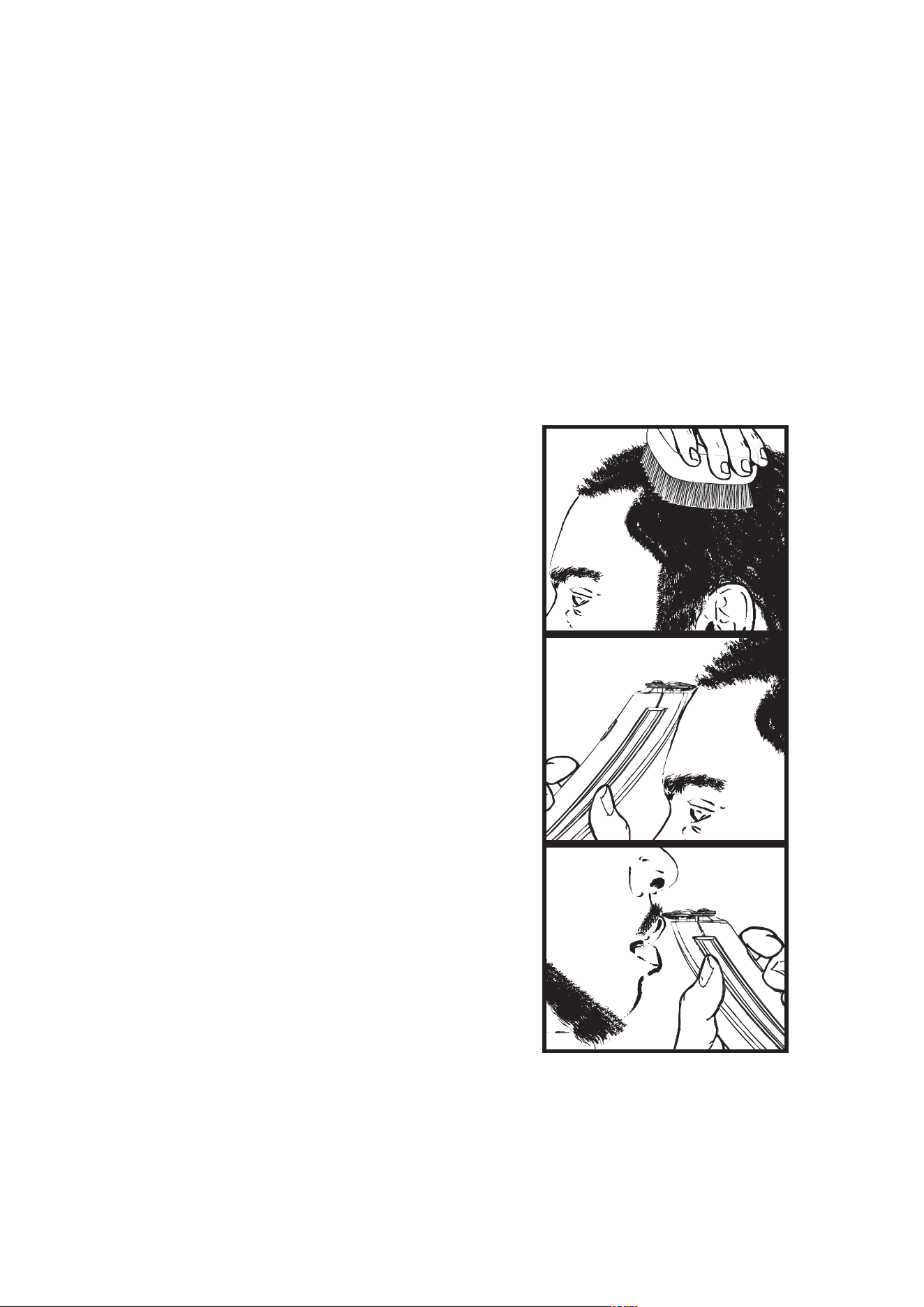
1. Corte el pelo del largo deseado.
Cepille la línea del pelo hacia adelante
usando un cepillo de cerdas suaves
para remover todos los pelos sueltos.
2. Asegúrese de que la cuchilla de la
recortadora esté en un ángulo de 90º.
La cuchilla de abajo debe apuntar
hacia usted, perpendicular a un plano
horizontal. Toque o golpee el borde
de la línea del pelo con los dientes de
la cuchilla de la recortadora hasta el
borde de la línea del pelo de la frente
para establecer una guía. La cuchilla
de abajo debe apuntar hacia usted.
Toque la línea del pelo de izquierda a
derecha. Las patillas se pueden definir
con el largo deseado.
3. La alineación del pelo facial depende
del estilo que busca alcanzar. La
recortadora puede colocarse en
diferentes ángulos cuando rasure la cara pero las cuchillas
siempre deben estar apuntando hacia usted.
13
SERVICIO Y REPARACIÓN
Si tiene problemas con la recortadora, envíela con franqueo
prepagado y una nota explicando el problema a:
Wahl Clipper Corporation
Attn: Repair Department
3001 Locust Street • P.O. Box 578
Sterling, IL 61081
Teléfono (800) 767-9245
Para productos comprados fuera de Estados Unidos, póngase en
contacto con su distribuidor.
Si por cualquier razón entre los 30 días de la compra de su
recortadora de Wahl no esta satisfecho con su compra y desea
una devolución de su dinero, regrese la recortadora junto con su
recibo de compras a la tienda donde lo compro. Wahl reembolsara
a las tiendas quienes acepta las recortadoras entre los 30 días de
su compra. Si tiene preguntas tocantes esta garantía, por favor
llamanos al 1-800-767-9245 en los Estados Unidos.
GARNATÍA 30 DIAS PARA DEVOLUCIÓN DE SU DINERO

14
Para mas informacion o Registracion de Producto
visite WahlUSA.com
GARANTÍA LIMITADA DE 5 AÑOS
Válida en EE. UU. Solamente
Si su producto Wahl no funciona de forma satisfactoria durante
un período de cinco (5) años contados a partir de la fecha
original de compra o de recibirlo como regalo, Wahl reparará
o reemplazará el producto a su criterio y se lo devolverá SIN
CARGO. No devuelva este producto a la tienda donde fue
adquirido. Los productos que necesiten ser reparados conforme
a esta garantía deben enviarse con franqueo pagado a la siguiente
dirección o llame al 1-800-767-9245 para obtener asistencia:
Wahl Clipper Corp.
Attn: Repair Department
3001 Locust Street
Sterling, Illinois 61081
Cuando envíe un correo, incluya una nota que describa el defecto
y la fecha original en que se compró o se recibió como regalo.
Los productos fuera de garantía se repararán aplicando nuestros
cargos de reparación estándar.
Esta garantía no cubre los productos dañados por las siguientes
causas:
1. Modificación o reparación efectuada por otra persona que
no pertenezca a Wahl Clipper Corporation ni a un centro de
servicio autorizado por Wahl;
2. Uso comercial (no de consumidor) o no razonable.
Esta garantía le otorga derechos legales específicos y usted
también puede tener otros derechos que varían en cada estado.
No se otorga ninguna otra garantía explícita por escrito. No
se asume responsabilidad alguna por daños indirectos o
consecuentes de cualquier tipo, ni por el uso de accesorios no
autorizados. Algunos estados pueden prohibir la exclusión o la
limitación de daños indirectos o consecuentes, de modo que esta
limitación puede no aplicarse a su caso. Garantía sólo válida en
EE. UU. Fuera de EE. UU., consulte en la tienda sobre la garantía
del distribuidor autorizado de Wahl.