of better performance
P/N 131543600 (9511)
Product Registration
Thank you for choosing this
washer. This owner's guide will
explain proper operation and care.
Record Your Model and Serial
Numbers
Record below the model and serial
numbers found on the washer serial
plate located at the top, inside of the
door opening. Keep these numbers
for future reference.
Model Number
Serial Number
Date of Purchase
Register Your Product
The self-addressed PRODUCT
REGISTRATION CARD should be
filled in completely, signed and
returned.
Instructional Video
An instructional video has been
included with your washer. It
highlights features unique to this
tumble action washer and will help
you operate your washer correctly.
This video is especially helpful if your
previous washer was a vertical-axis
model.
This Owner's Guide provides general
operating instructions foryour washer.
It also contains information about
features for several other models. Your
washer may not have every feature
included here.
Use the washer only as instructed in
this Owner's Guide and the Operating
Instructions card included with your
washer.
FOR YOUR SAFETY
Do not store or use gasoline or other
flammable vapors or liquids in the
vicinity of this or any other appliance.
Important Safety Instructions
Read all instructions before using this washer.
Toreduce the risk of fire, electrical shock, or injury to persons when
using this washer, comply with the basic warnings listed below.
[] Failureto comply with these warnings could result in serious personal injuries.
Prevent Fire
Do not wash items that have been previously cleaned in, soaked in,
or spotted with gasoline, cleaning solvents, kerosene, cooking oils, waxes, etc. Do
not store these items on or near the washer. Thesesubstances give off vapors that
could ignite or explode.
Do not put oily or greasy rags or clothing on top of the washer.
These substances give off vapors that could ignite the materials.
Do not add gasoline, cleaning solvents, or other flammable or
explosive substances to the wash water. These substances give off vapors that
could ignite or explode.
Under certain conditions, hydrogen gas may be produced in a hot
water system that has not been used for 2 weeks or more. HYDROGEN GAS IS
EXPLOSIVE. If the hot water system has not been used for such a period, before
using the washer, turn on all hot water faucets and let the water flow from each
for several minutes. This will release any accumulated hydrogen gas. Hydrogen
gas is flammable; do not smoke or use an open flame during this time.
[] Failure to comply with these warnings could result in fire, explosion, serious
bodily injury andlor damage to the rubber or plastic parts of the washer.
Protect Children
Do not allow children to playon or in the washer. Close supervision
of children isnecessarywhen the washer is used near children. As children grow.
teach them the proper, safe use of all appliances.
Destroy the carton, plastic bag and other packing materials after
the washer isunpacked. Children might use them for play. Cartons covered with
rugs, bedspreads or plastic sheets can become airtight chambers.
Keep laundry products out of children's reach. To prevent personal
injury, observe all warnings on product labels.
Before the washer isremoved from serviceor discarded, remove the
washer door to prevent accidental entrapment.
[] Failure to comply with thesewarnings could result in serious personal injuries.
©1995 White Consolidated Industries, Inc.
All rights reserved. Printed in U.S.A.
2
Important Safety
Instructions (continued)
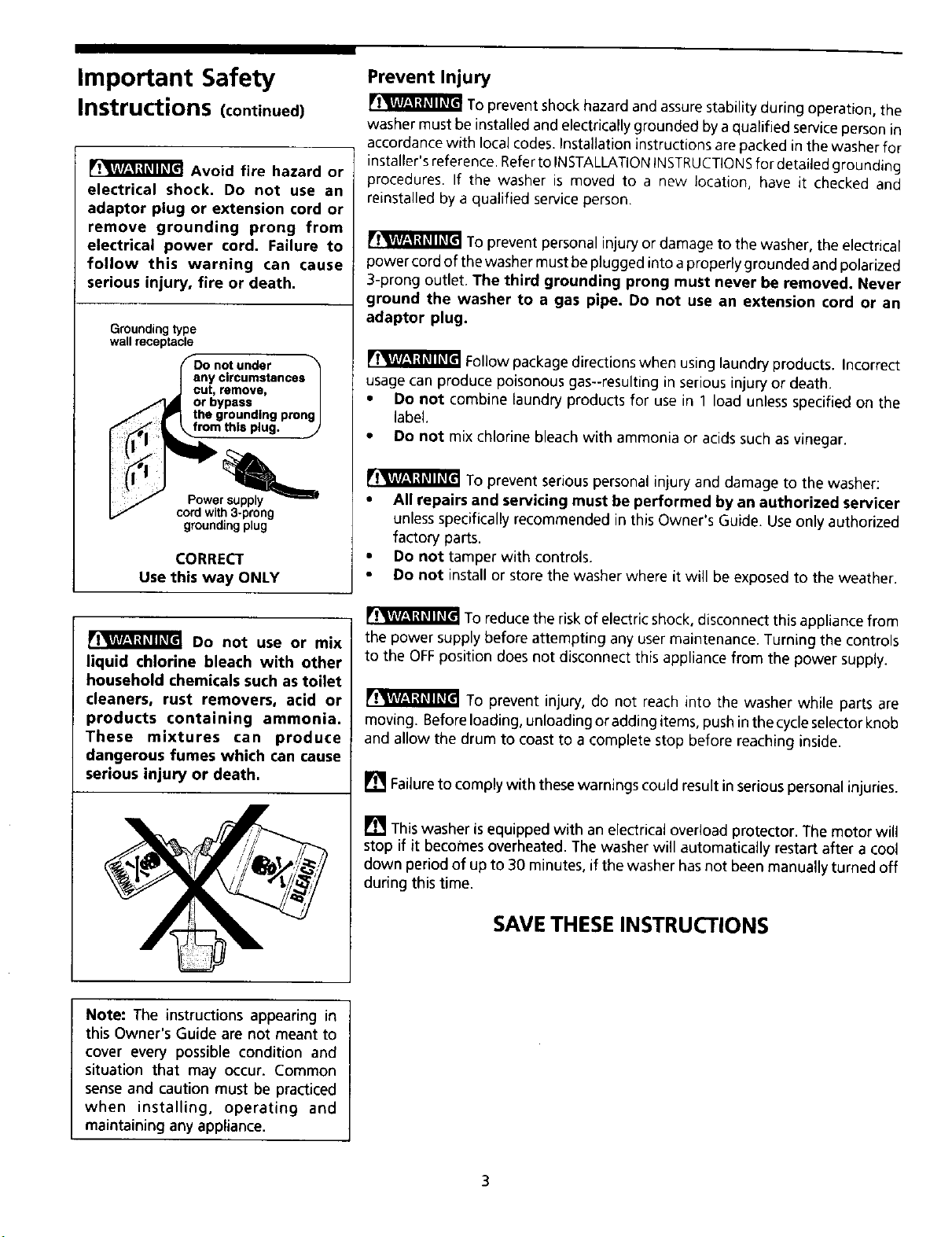
Avoid fire hazard or
electrical shock. Do not use an
adaptor plug or extension cord or
remove grounding prong from
electrical power cord. Failure to
follow this warning can cause
serious injury, fire or death.
Grounding type
wall receptacle
Do not under
any circumstances 1
cut, remove,
_or bypass /
_ the grounding prong I
I__ thisplug" _}
I P°wer _ PPY_II_
V cord with 3-prong
grounding plug
CORRECT
Use this way ONLY
Do not use or mix
liquid chlorine bleach with other
household chemicals such as toilet
cleaners, rust removers, acid or
products containing ammonia.
These mixtures can produce
dangerous fumes which can cause
serious injury or death.
Prevent Injury
TOprevent shock hazard and assurestability during operation, the
washer must be installed and electrically grounded by a qualified serviceperson in
accordance with local codes. Installation instructions are packed in the washer for
installer's reference. Refer to INSTALLATIONINSTRUCTIONSfor detailed grounding
procedures. If the washer is moved to a new location, have it checked and
reinstalled by a qualified service person.
To prevent personal injury or damage to the washer, the electrical
power cord of the washer must be plugged into a properly grounded and polarized
3-prong outlet. The third grounding prong must never be removed, Never
ground the washer to a gas pipe, Do not use an extension cord or an
adaptor plug.
Follow package directionswhen using laundry products. Incorrect
usage can produce poisonous gas--resulting in serious injury or death.
• Do not combine laundry products for use in 1 load unless specified on the
label.
• Do not mix chlorine bleach with ammonia or acids such as vinegar.
To prevent serious personal injury and damage to the washer:
• All repairs and servicing must be performed by an authorized servicer
unless specifically recommended in this Owner's Guide. Use only authorized
factory parts.
• Do not tamper with controls.
• Do not install or store the washer where it will be exposed to the weather.
To reduce the risk of electric shock, disconnect this appliance from
the power supply before attempting any user maintenance. Turning the controls
to the OFFposition does not disconnect this appliance from the power supply.
To prevent injury, do not reach into the washer while parts are
moving. Before loading, unloading or adding items, push in the cycleselector knob
and allow the drum to coast to a complete stop before reaching inside.
[] Failure to comply with these warnings could result in serious personal injuries.
[] This washer isequipped with an electrical overload protector. The motor will
stop if it becomes overheated. The washer will automatically restart after a cool
down period of up to 30 minutes, if the washer has not been manually turned off
during this time.
SAVE THESE INSTRUCTIONS
Note: The instructions appearing in
this Owner's Guide are not meant to
cover every possible condition and
situation that may occur. Common
sense and caution must be practiced
when installing, operating and
maintaining any appliance.
Washing Procedures
_IT_ _ _
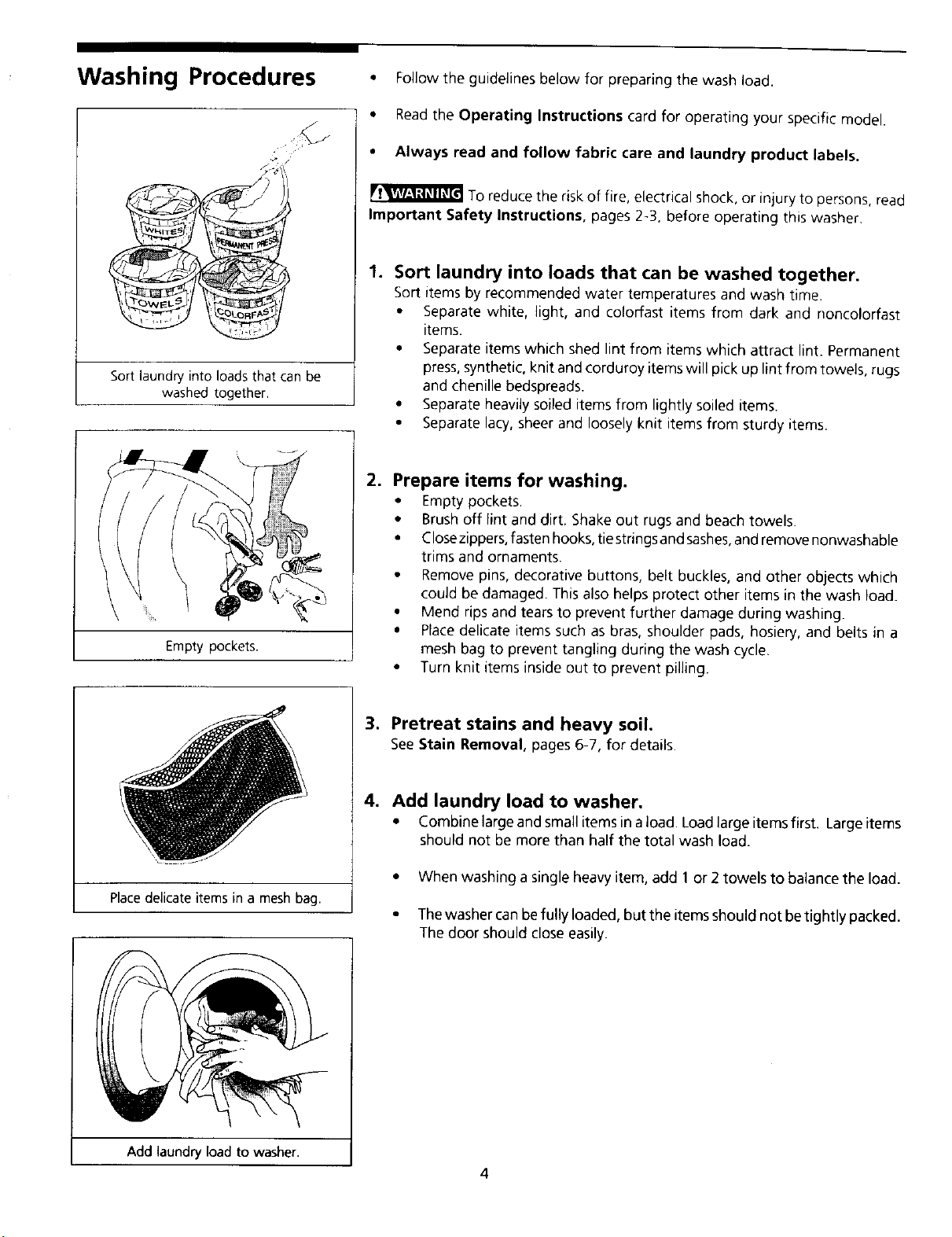
Sort laundry into loads that can be
washed together.
• Follow the guidelines below for preparing the wash load.
• Readthe Operating Instructions card for operating your specific model.
• Always read and follow fabric care and laundry product labels.
To reduce the risk of fire, electrical shock, or injury to persons, read
Important Safety Instructions, pages 2-3, before operating this washer.
1. Sort laundry into loads that can be washed together.
Sort items by recommended water temperatures and wash time.
• Separate white, light, and colorfast items from dark and noncolorfast
items.
• Separate items which shed lint from items which attract lint. Permanent
press,synthetic, knit and corduroy items will pick up lint from towels, rugs
and chenille bedspreads.
• Separate heavily soiled items from lightly soiled items.
• Separate lacy, sheer and loosely knit items from sturdy items.
Empty pockets.
2. Prepare items for washing.
• Empty pockets.
• Brush off lint and dirt. Shake out rugs and beach towels.
• Closezippers,fasten hooks,tie stringsand sashes,and remove nonwashable
trims and ornaments.
• Remove pins, decorative buttons, belt buckles, and other objects which
could be damaged. This also helps protect other items in the wash load.
• Mend rips and tears to prevent further damage during washing.
• Placedelicate items such as bras, shoulder pads, hosiery, and belts in a
mesh bag to prevent tangling during the wash cycle.
• Turn knit items inside out to prevent pilling.
Place delicate items in a mesh bag.
3. Pretreat stains and heavy soil.
See Stain Removal, pages 6-7, for details•
4. Add laundry load to washer.
• Combine large and small items ina load. Loadlargeitemsfirst. Largeitems
should not be more than half the total wash load.
• When washing a single heavy item, add I or 2 towels to balance the load.
• Thewasher canbe fully loaded, but the items should not be tightly packed.
The door should close easily.
Add laundry load to washer.
4
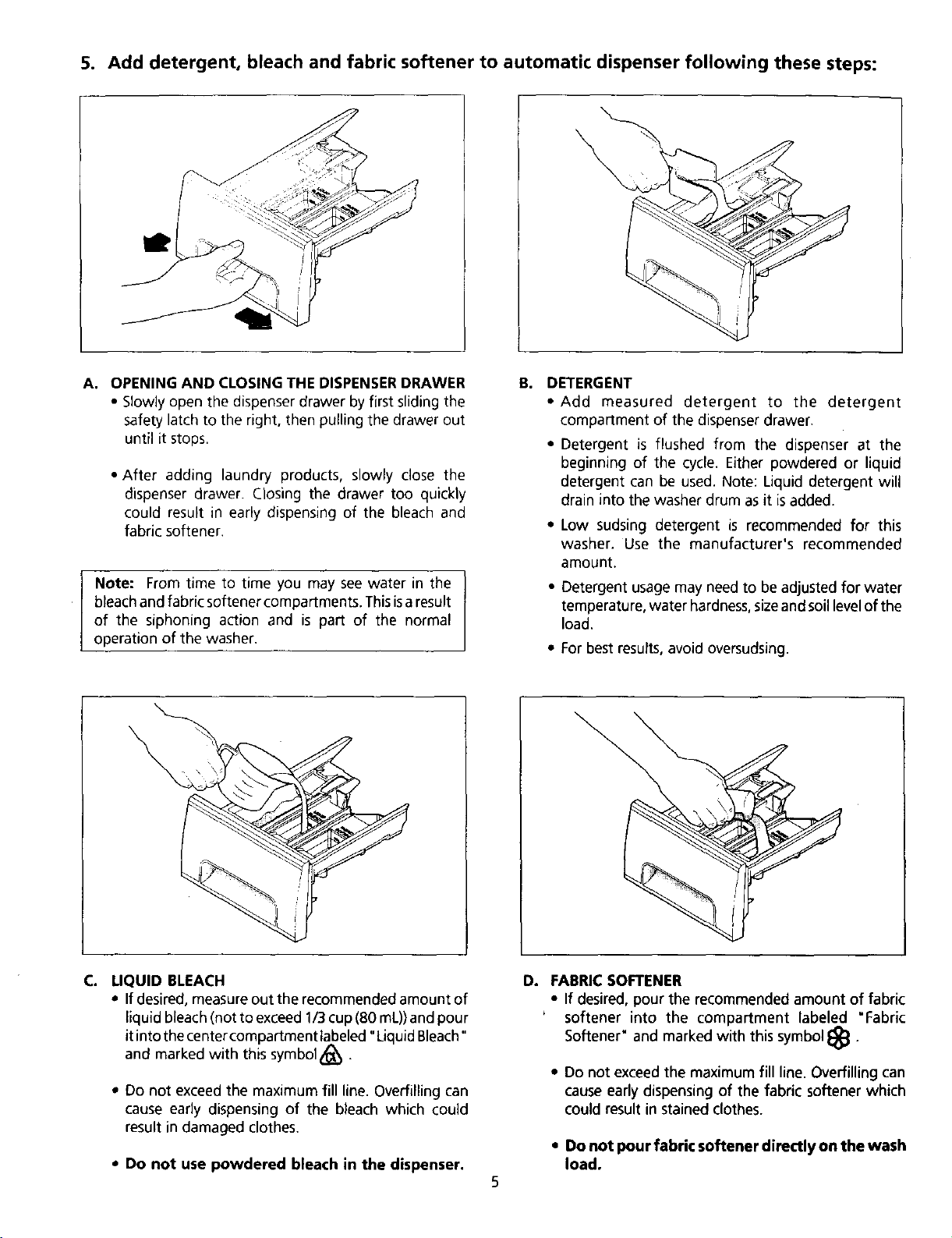
5. Add detergent, bleach and fabric softener to automatic dispenser following these steps:
A. OPENING AND CLOSING THE DISPENSERDRAWER
• Slowly open the dispenser drawer by first sliding the
safety latch to the right, then pulling the drawer out
until it stops.
• After adding laundry products, slowly close the
dispenser drawer. Closing the drawer too quickly
could result in early dispensing of the bleach and
fabric softener.
Note: From time to time you may see water in the
breachand fabric softener compartments. Thisisaresult
of the siphoning action and is part of the normal
operation of the washer.
B. DETERGENT
• Add measured detergent to the detergent
compartment of the dispenser drawer.
Detergent is flushed from the dispenser at the
beginning of the cycle. Either powdered or liquid
detergent can be used. Note: Liquid detergent will
drain into the washer drum asit isadded.
• Low sudsing detergent is recommended for this
washer. Use the manufacturer's recommended
amount.
• Detergent usage may need to be adjusted for water
temperature, water hardness,sizeand soil levelof the
load.
• For best results, avoid oversudsing.
\
C.
LIQUID BLEACH
• Ifdesired, measure out the recommended amount of
liquid bleach (not to exceed 1/3cup(80 mL))and pour
it into the center compartment labeled "Liquid Bleach"
and marked with this symbolS)
• Do not exceed the maximum fill line. Overfilling can
cause early dispensing of the bleach which could
result in damaged clothes.
• Do not use powdered bleach in the dispenser.
D. FABRIC SOFTENER
• If desired, pour the recommended amount of fabric
softener into the compartment labeled "Fabric
Softener" and marked with this symbol_.
• Do not exceed the maximum fill line. Overfilling can
cause early dispensing of the fabric softener which
could result in stained clothes.
• Do not pour fabric softener directly on the wash
load.
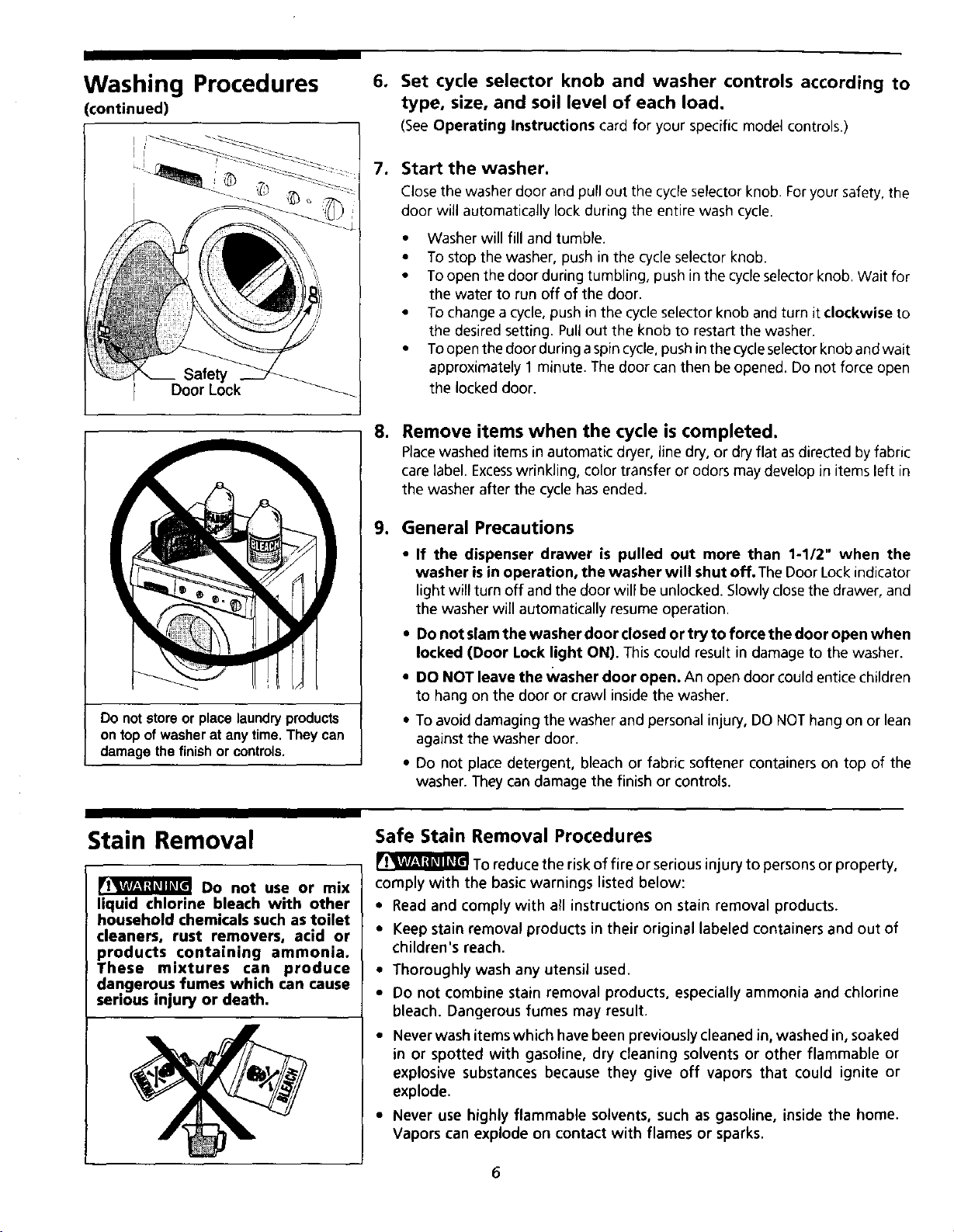
Washing Procedures
(continued)
Safety
Door Lock
Set cycle selector knob and washer controls according to
type, size, and soil level of each load.
(See Operating Instructions card for your specific model controls.)
Start the washer.
Close the washer door and pull out the cycle selector knob. Foryour safety, the
door will automatically lock during the entire wash cycle.
• Washer will fill and tumble.
• To stop the washer, push in the cycle selector knob.
• Toopen the door during tumbling, push in the cycleselector knob. Wait for
the water to run off of the door.
• To change a cycle, push in the cycleselector knob and turn it clockwise to
the desired setting. Pullout the knob to restart the washer.
• Toopen the door during a spin cycle,push in the cycleselector knob and wait
approximately I minute. The door can then be opened. Do not force open
the locked door.
Do not store or place laundry products
on top of washer at any time. They can
damage the finish or controls.
.
Remove items when the cycle is completed.
Placewashed items in automatic dryer, line dry, or dry flat as directed by fabric
care label. Excesswrinkling, color transfer or odors may develop in items left in
the washer after the cycle has ended.
9. General Precautions
• If the dispenser drawer is pulled out more than 1-112" when the
washer isin operation, the washer will shut off. The DoorLock indicator
lightwill turn off and the door will be unlocked.Slowly closethe drawer, and
the washer will automaticallyresumeoperation.
• Do not slam the washer door closed or try to force the door open when
locked (Door Lock light ON). This could result in damage to the washer.
• DO NOT leave the Washer door open. An open door could entice children
to hang on the door or crawl inside the washer.
• To avoid damaging the washer and personal injury, DO NOT hang on or lean
against the washer door.
• Do not place detergent, bleach or fabric softener containers on top of the
washer. They can damage the finish or controls.
Stain Removal
Do not use or mix
liquid chlorine bleach with other
household chemicals such as toilet
cleaners, rust removers, acid or
products containing ammonia.
These mixtures can produce
dangerous fumes which can cause
serious injury or death.
Safe Stain Removal Procedures
To reducethe risk of fire or serious injury to persons or property,
comply with the basic warnings listed below:
• Read and comply with all instructions on stain removal products.
• Keep stain removal products in their original labeled containers and out of
children's reach.
• Thoroughly wash any utensil used.
• Do not combine stain removal products, especially ammonia and chlorine
bleach. Dangerous fumes may result.
Never wash items which have been previously cleaned in, washed in, soaked
in or spotted with gasoline, dry cleaning solvents or other flammable or
explosive substances because they give off vapors that could ignite or
explode.
• Never use highly flammable solvents, such as gasoline, inside the home.
Vapors can explode on contact with flames or sparks.
Follow fabric care label instructions.
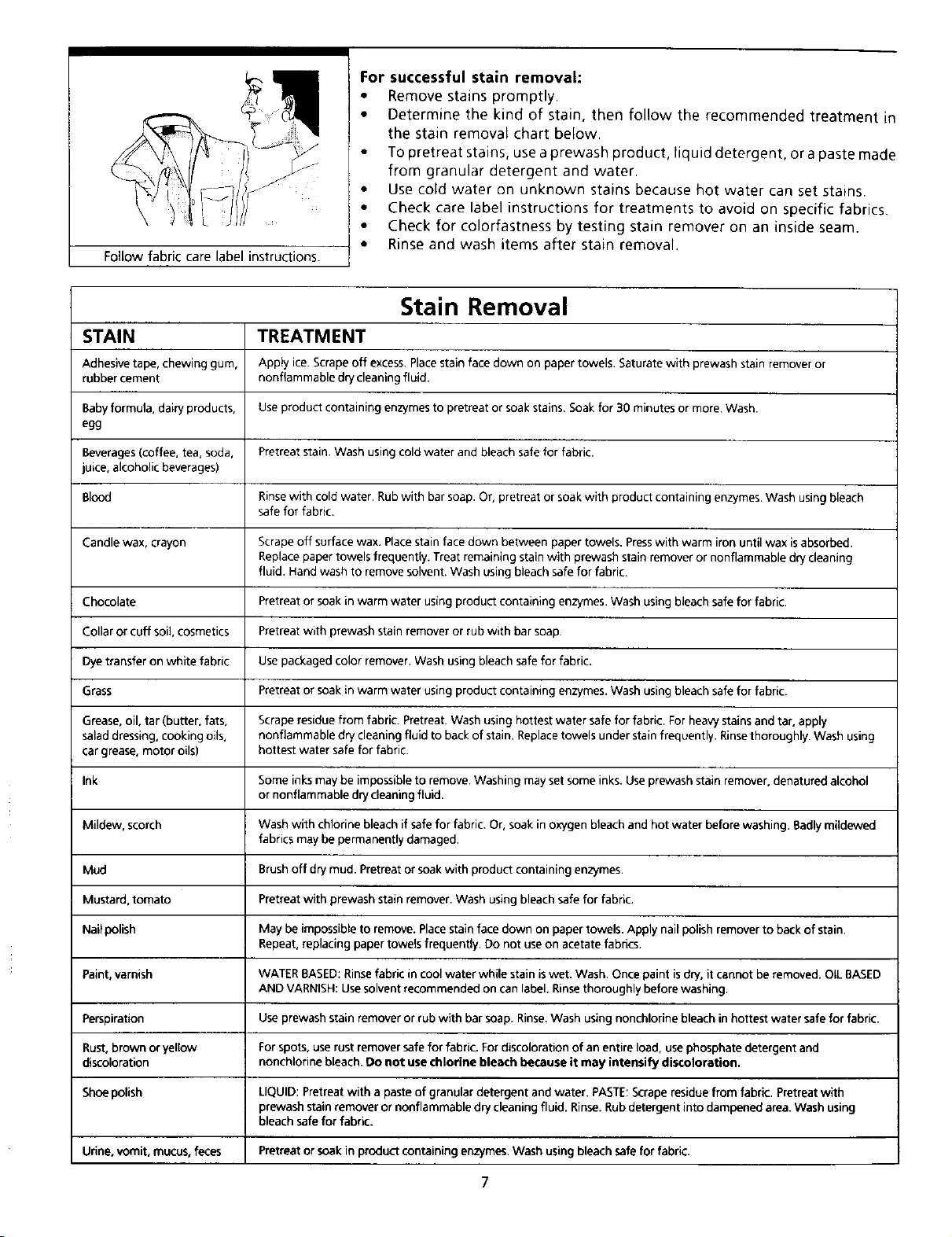
For successful stain removal:
• Remove stains promptly.
• Determine the kind of stain, then follow the recommended treatment in
the stain removal chart below.
• To pretreat stains, use aprewash product, liquid detergent, or a paste made
from granular detergent and water.
• Use cold water on unknown stains because hot water can set stares.
• Check care label instructions for treatments to avoid on specific fabrics.
• Check for colorfastness by testing stain remover on an inside seam.
• Rinse and wash items after stain removal.
Stain Removal
STAIN TREATMENT
Adhesive tape, chewing gum, Appiy ice. Scrape off excess. Placestain face down on paper towels. Saturate with prewash stain remover or
rubber cement nonBammable dry cleaning fluid.
Baby formula, dairy products, Use product containing enzymes to pretreat or soak stains. Soak for 30 minutes or more. Wash.
egg
Beverages (coffee. tea, soda, Pretreat stain. Wash using cold water and bleach safe for fabric.
juice, alcoholic beverages)
Blood Rinsewith cold water. Rubwith bar soap. Or, pretreat or soak with product containing enzymes. Wash using bleach
safe for fabric.
Candle wax, crayon Scrape off surface wax. Place stain face down between paper towels. Presswith warm iron until wax is absorbed.
Replace paper towels frequently. Treat remaining stain with prewash stain remover or nonflammable dry cleaning
fluid. Hand wash to remove solvent. Wash using bleach safe for fabric.
Chocolate Pretreat or soak in warm water using product containing enzymes. Wash using bleach safe for fabric.
Collar or cuff soil, cosmetics Pretreat with prewash stain remover or rub with bar soap.
Dye transfer on white fabric Use packaged color remover. Wash using bleach safe for fabric.
Grass Pretreat or soak in warm water using product containing enzymes. Wash using bleach safe for fabric.
Grease,oil, tar (butter, fats, Scrape residue from fabric. Pretreat. Wash using hottest water safe for fabric. For heavy stains and tar, apply
salad dressing, cooking oils, nonflammable dry cleaning fluid to back of stain. Replacetowels under stain frequently. Rinsethoroughly. Wash using
car grease, motor oils) hottest water safe for fabric.
Ink Some inks may be impossible to remove. Washing may set some inks. Use prewash stain remover, denatured alcohol
or nonflammable dry cleaning fluid.
Mildew, scorch Wash with chlorine bleach if safe for fabric. Or, soak in oxygen bleach and hot water before washing. Badly mildewed
fabrics may be permanently damaged.
Mud Brush off dry mud. Pretreat or soak with product containing enzymes.
Mustard, tomato Pretreat with prewash stain remover. Wash using bleach safe for fabric.
Nail polish May be impossible to remove. Place stain face down on paper towels. Apply nail polish remover to back of stain.
Repeat, replacing paper towels frequently. Do not use on acetate fabrics.
Paint, varnish WATER BASED:Rinse fabric in cool water while stain iswet. Wash. Once paint isdry, it cannot be removed. OIL BASED
AND VARNISH: Use solvent recommended on can label. Rinsethoroughly before washing.
Perspiration Use prewash stain remover or rub with bar soap. Rinse.Wash using nonchlorine bleach in hottest water safe for fabric.
Rust, brown or yellow For spots, use rust remover safe for fabric. For discoloration of an entire load, use phosphate detergent and
discoloration nonchlorine bleach, Do not use chlorine bleach because it may intensify discoloration.
Shoepolish LIQUID: Pretreat with a paste of granular detergent and water. PASTE:Scrape residue from fabric. Pretreat with
prewash stainremover or nonflammable drycleaning fluid. Rinse.Rubdetergent into dampened area. Wash using
bleach safe for fabric.
Urine, vomit, mucus, feces Pretreat or soak in product containing enzymes.Wash usingbleachsafe for fabric.
7
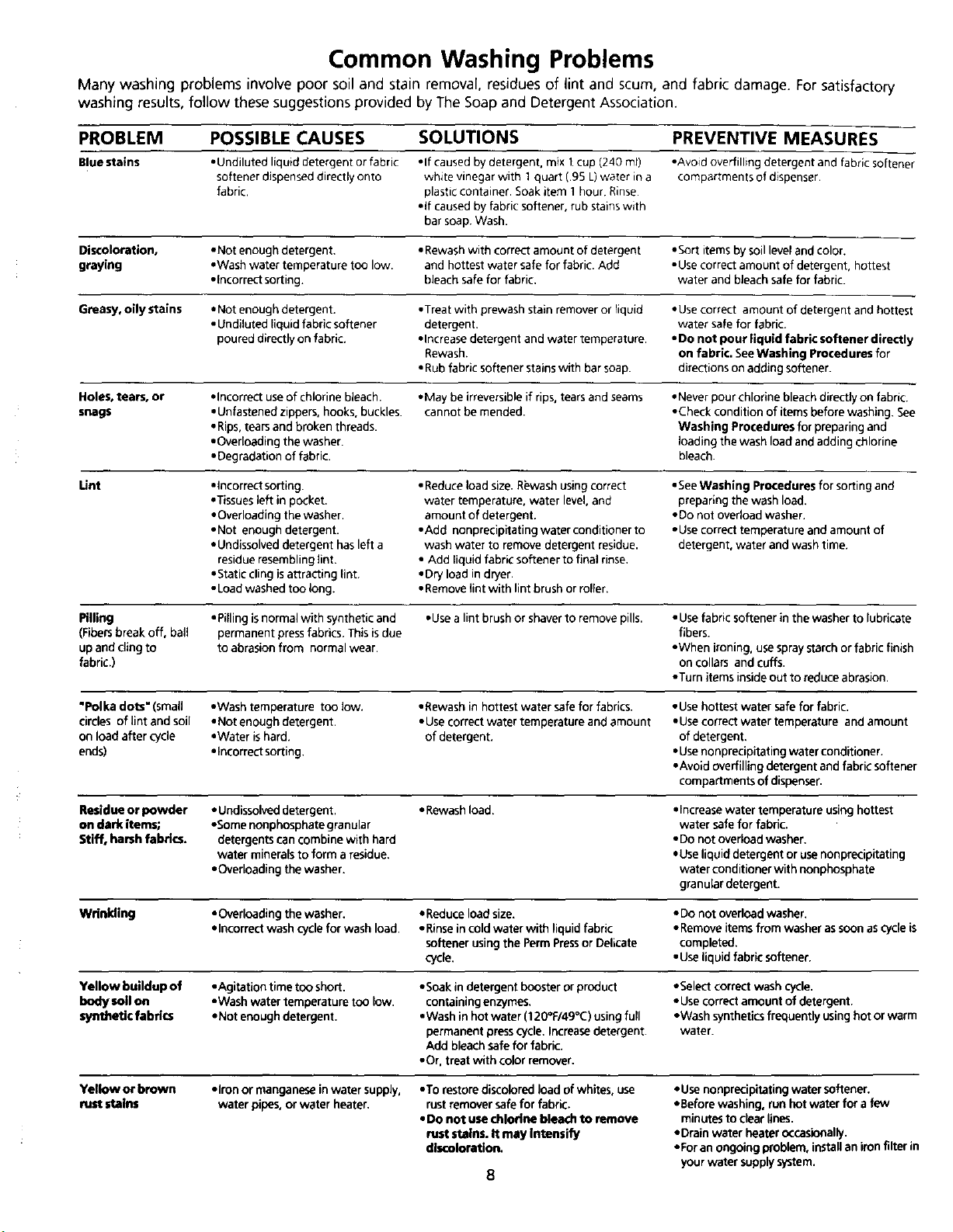
Common Washing Problems
Many washing problems involve poor soil and stain removal, residues of lint and scum, and fabric damage. For satisfactory
washing results, follow these suggestions provided by The Soap and Detergent Association.
PROBLEM POSSIBLE CAUSES SOLUTIONS PREVENTIVE MEASURES
Blue stains •Undiluted liquid detergent or fabric "if caused by detergent, mix 1cup (240 ml) -Avoid overfilling detergent and fabric softener
softener dispensed directly onto white vinegar with 1 quart (.95 L)water in a compartments of dispenser.
fabric, plastic container. Soak item 1 hour Rinse
• if caused by fabric softener, rub stains with
bar soap. Wash.
Discoloration, •Not enough detergent. • Rewash with correct amount of detergent • Sort items by soil level and color.
graying •Wash water temperature too low. and hottest water safe for fabric. Add ° Use correct amount of detergent, hottest
• Incorrect sorting, bleach safe for fabric, water and bleach safe for fabric.
Greasy, oily stains • Not enough detergent. •Treat with prewash stain remover or liquid • Use correct amount of detergent and hottest
• Undiluted liquid fabric softener detergent, water safe for fabric,
poured directly on fabric. .Increase detergent and water temperature. • Do not pour liquid fabric softener directly
Rewash. on fabric. See Washing procedures for
• Rub fabric softener stains with bar soap. directions on adding softener.
Holes, tears, or .Incorrect use of chlorine bleach. • May be irreversibleif rips. tears and seams • Never pour chlorine bleach directly on fabric.
snags • Unfastened zippers, hooks, buckles, cannot be mended. •Check condition of items before washing. See
• Rips,tears and broken threads. Washing Procedures for preparing and
• Overloading the washer, loading the wash load and adding chlorine
• Degradation of fabric, bleach.
Unt •Incorrect sorting. • Reduce load size. Rbwashusing correct • SeeWashing PrOCeduresfor sorting and
• Tissues left in pocket, water temperature, water level, and preparing the wash load.
• Overloading the washer, amount of detergent. •Do not overload washer.
• Not enough detergent. •Add nonprecipitating water conditioner to • Use correct temperature and amount of
• Undissolved detergent has left a wash water to remove detergent residue, detergent, water and wash time.
residue resembling ]int. • Add liquid fabric softener to final rinse.
• Static cling is attracting lint. •Dry load in dryer.
-Load washed too long. ,Remove lint with lint brush or roller.
Pilling
(Fibersbreak off, bali
up and cling to
fabric.)
• Pilling isnormal with synthetic and
permanent pressfabrics. This is due
to abrasion from normal wear.
• Use a lint brush or shaver to remove pills. • Use fabric softener in the washer to lubricate
fibers.
• When ironing, use spray starch or fabricfinish
on collars and cuffs.
• Turn items inside out to reduce abrasion.
"Polka dots" (small
circles of lint and soil
on load after cycle
ends)
Residue or powder
on dark items;
Stiff, harsh fabrics.
Wrinkling
Yellow buildup of
bodysoll on
synthetic fabrics
• Wash temperature too low.
• Not enough detergent.
• Water ishard.
• Incorrect sorting.
• Rewash in hottest water safe for fabrics.
• Use correct water temperature and amount
of detergent.
• Use hottest water safe for fabric.
• Use correct water temperature and amount
of detergent.
• Use nonprecipitating water conditioner.
• Avoid overfilling detergent and fabric softener
compartments of dispenser.
• Undissolved detergent.
• Some nonphosphate granular
detergents can combine with hard
water minerals to form a residue.
• Overloading the washer.
• Rewashload.
• Increase water temperature usinghottest
water safe for fabric.
• Do not overload washer.
• Use liquid detergent or use nonprecipitating
water conditioner with nonphosphate
granular detergent.
• Overloading the washer.
• Incorrect wash cycle for wash load.
• Reduce load size.
• Rinse in cold water with liquid fabric
softener using the Perm Pressor Delicate
cycle.
• Do not overload washer.
• Remove items from washer assoon as cycle is
completed.
• Useliquid fabric softener.
• Agitation time too short.
• Wash water temperature too low.
• Not enough detergent.
• Soak in detergent booster or product
containing enzymes.
• Wash in hot water (120°F/49°C) using full
permanent presscycle. Increase detergent.
Add bleach safe for fabric.
• Or. treat with color remover.
• Select correct wash cycle.
• Usecorrect amount of detergent.
• Wash synthetics frequently using hot or warm
water.
Yellow or brown
ruststains
• Iron or manganese in water supply,
water pipes,or water heater.
• To restorediscolored load of whites, usa
rust remover safe for fabric.
• Do not use chlodne blea(h to remove
rust stains. It may intensify
dlso_loratlon.
8
• Usenonprecipitating water softener.
• Before washing, run hot water for a few
minutes to clear lines.
+Drain water heater occasiooally.
• Foran ongoing problem, installan ironfilter in
your water supplysystem.
Care and Cleaning
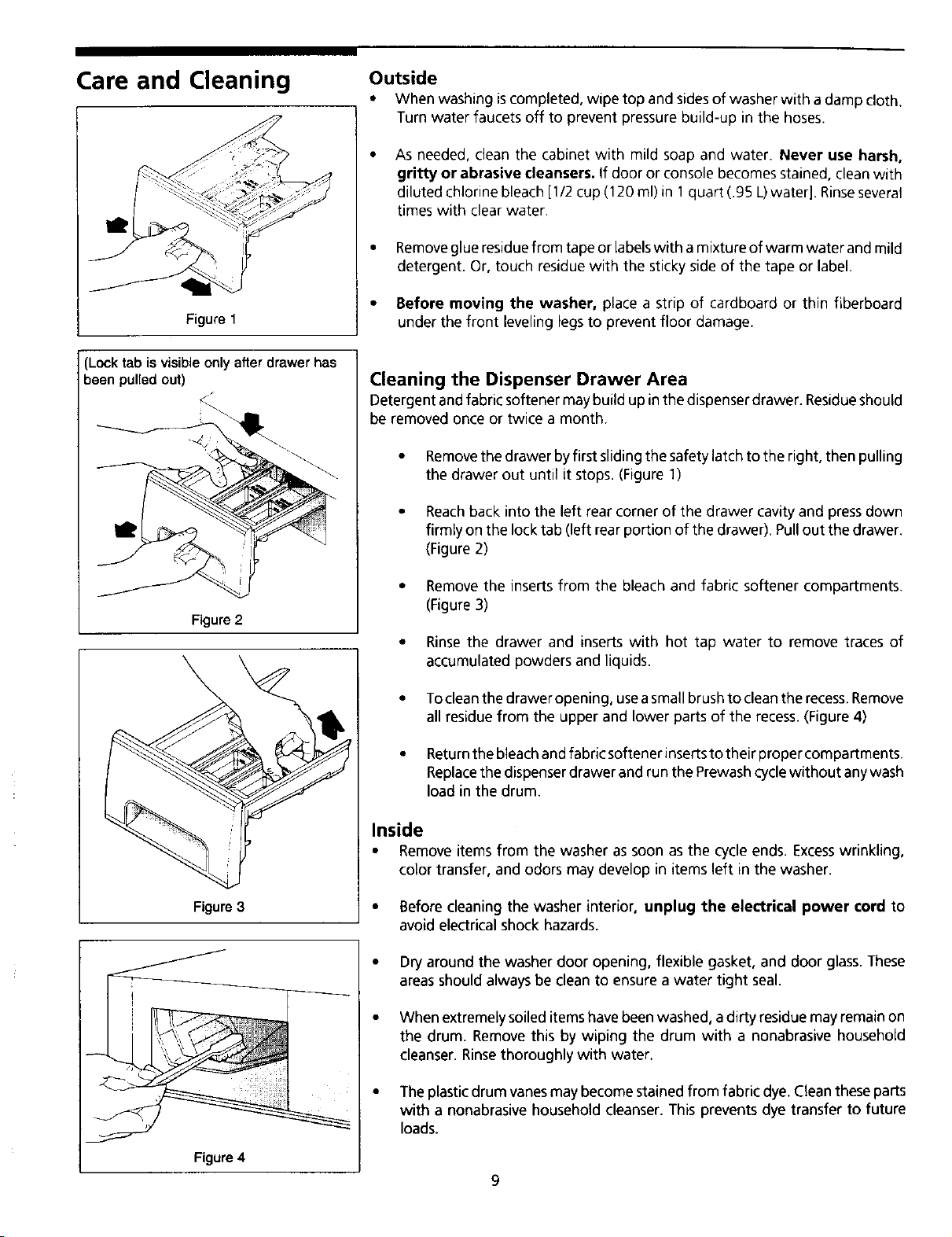
Figure 1
Outside
• When washing iscompleted, wipe top and sidesof washer with a damp cloth.
Turn water faucets off to prevent pressure build-up in the hoses.
As needed, clean the cabinet with mild soap and water. Never use harsh,
gritty or abrasive cleansers. If door or console becomes stained, clean with
diluted chlorine bleach [1/2 cup (120 ml) in 1 quart (.95 L)water]. Rinseseveral
times with clear water.
• Removeglue residuefrom tape or labelswith a mixture of warm water and mild
detergent. Or, touch residue with the sticky side of the tape or label.
• Before moving the washer, place a strip of cardboard or thin fiberboard
under the front leveling legs to prevent floor damage.
(Lock tab isvisibleonly after drawer has
been pulledout)
Figure 2
Figure 3
Cleaning the Dispenser Drawer Area
Detergent and fabric softener may build up in the dispenser drawer. Residueshould
be removed once or twice a month.
• Removethe drawer byfirst sliding the safety latch to the right, then pulling
the drawer out until it stops. (Figure 1)
• Reachback into the left rear corner of the drawer cavity and press down
firmly on the lock tab (left rear portion of the drawer). Pull out the drawer.
(Figure 2)
• Remove the inserts from the bleach and fabric softener compartments.
(Figure 3)
• Rinse the drawer and inserts with hot tap water to remove traces of
accumulated powders and liquids.
• Toclean the drawer opening, usea small brush to cleanthe recess.Remove
all residue from the upper and lower parts of the recess. (Figure 4)
• Return the bleach andfabric softener insertsto their proper compartments.
Replacethe dispenser drawer and run the Prewash cyclewithout anywash
load in the drum.
Inside
• Remove items from the washer as soon as the cycle ends. Excesswrinkling,
color transfer, and odors may develop in items left in the washer.
• Before cleaning the washer interior, unplug the electrical power cord to
avoidelectricalshock hazards.
• Dry around the washer door opening, flexible gasket, and door glass. These
areas should always be clean to ensure a water tight seal.
• When extremely soiled items have been washed, adirty residue may remain on
the drum. Remove this by wiping the drum with a nonabrasive household
cleanser. Rinsethoroughly with water.
• The plasticdrum vanesmay become stained from fabric dye. Clean these parts
with a nonabrasive household cleanser. This prevents dye transfer to future
loads.
Figure4
9
Care and Cleaning
(continued)
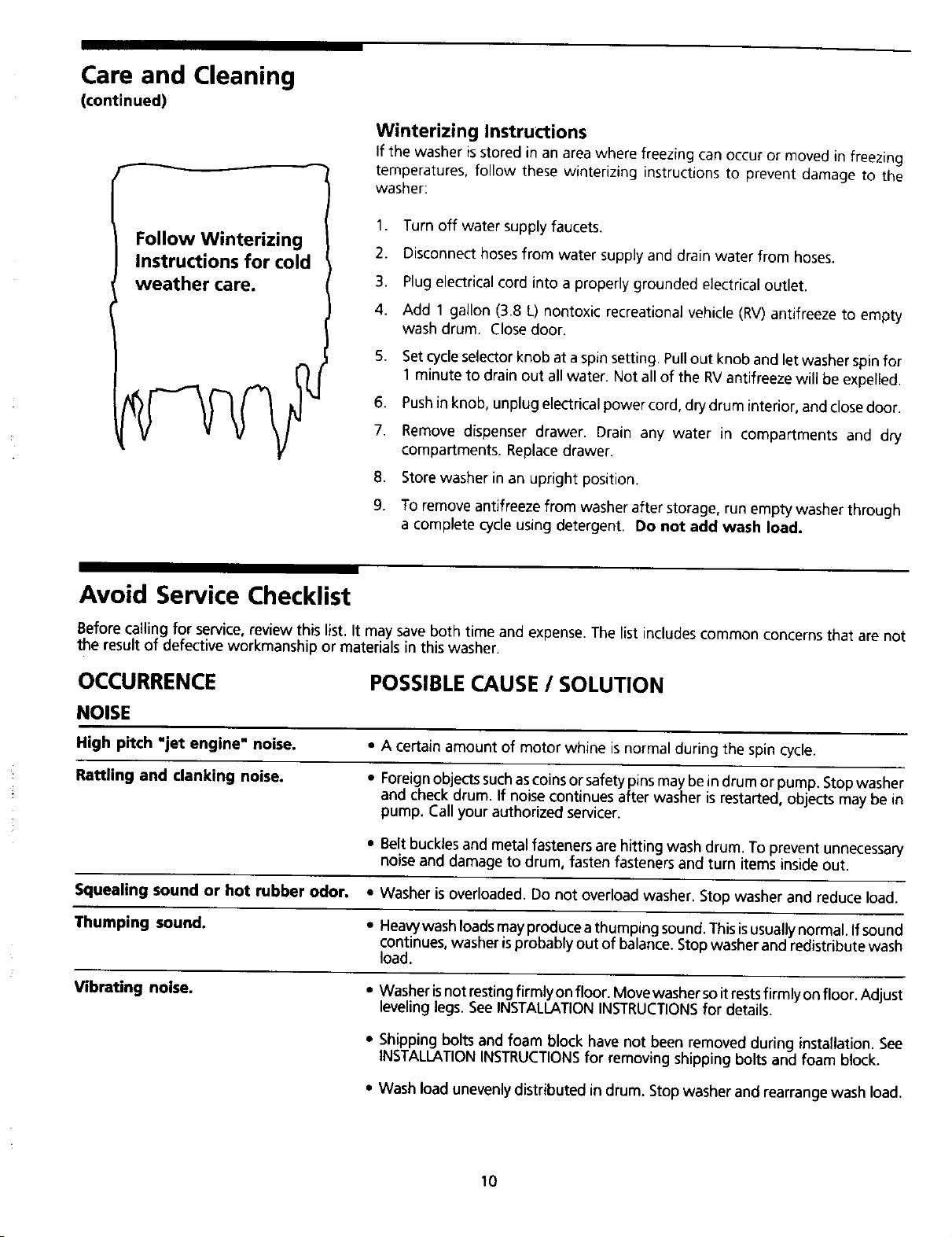
Follow Winterizing
Instructions for cold
weather care.
Winterizing Instructions
If the washer is stored in an area where freezing can occur or moved in freezing
temperatures, follow these winterizing instructions to prevent damage to the
washer:
1. Turn off water supply faucets.
2. Disconnect hoses from water supply and drain water from hoses.
3. Plug electrical cord into a properly grounded electrical outlet.
4. Add 1 gallon (3.8 L) nontoxic recreational vehicle (RV)antifreeze to empty
wash drum. Close door.
5. Set cycleselector knob at a spin setting. Pullout knob and let washer spin for
1 minute to drain out all water. Not all of the RVantifreeze will be expelled.
6. Pushin knob, unplug electrical power cord, dry drum interior,and close door.
7. Remove dispenser drawer. Drain any water in compartments and dry
compartments. Replace drawer.
8. Store washer in an upright position.
9. To remove antifreeze from washer after storage, run empty washer through
a complete cycle using detergent. Do not add wash load.
Avoid Service Checklist
Before calling for service, review this list. It may save both time and expense. The list includes common concerns that are not
the resultof defective workmanship or materials in this washer.
POSSIBLE CAUSE / SOLUTIONOCCURRENCE
NOISE
High pitch "jet engine" noise. • A certain amount of motor whine isnormal during the spin cycle.
Rattling and clanking noise. • Foreignobjects such ascoinsor safety pins maybe indrum or pump. Stop washer
and check drum. If noise continues after washer is restarted, objects may be in
pump. Call your authorized servicer.
• Belt buckles and metal fastenersare hitting wash drum. To prevent unnecessary
noise and damage to drum, fasten fasteners and turn items inside out.
Squealing sound or hot rubber odor, • Washer is overloaded. Do not overload washer. Stop washer and reduce load.
Thumping sound. • Heavywash loadsmay produce a thumping sound. Thisisusually normal. Ifsound
continues, washer isprobably out of balance. Stop washer and redistribute wash
load.
Vibrating noise. • Washerisnotrestingfirmlyonfloor. Movewashersoitrestsfirmlyonfloor.Adjust
levelinglegs. SeeINSTALLATIONINSTRUCTIONSfor details.
• Shipping bolts and foam block have not been removed during installation. See
INSTALLATIONINSTRUCTIONSfor removing shipping bolts and foam block.
• Wash loadunevenly distributed in drum. Stop washer and rearrange wash load.
10
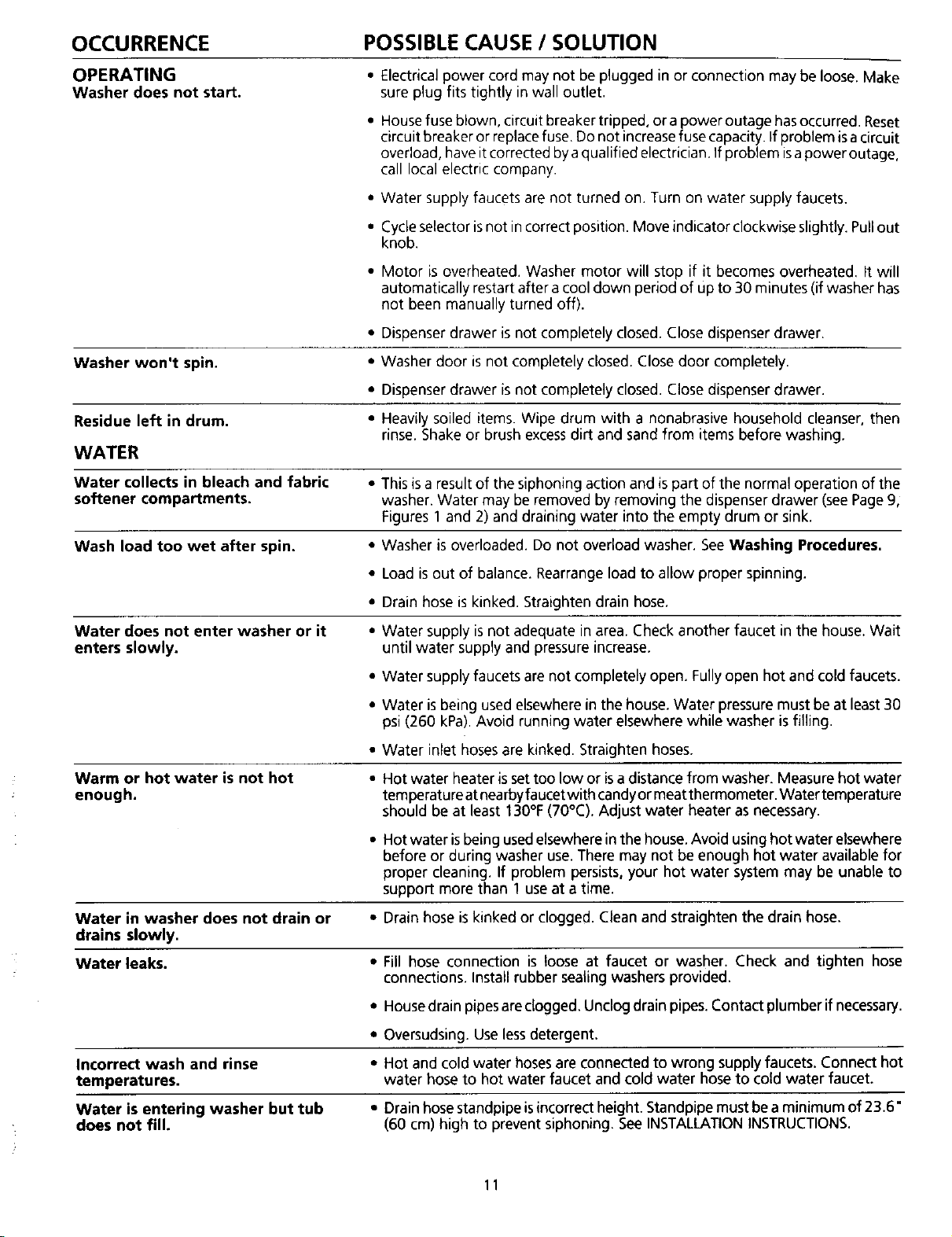
OCCURRENCE POSSIBLE CAUSE / SOLUTION
OPERATING
Washer does not start.
• Electrical power cord may not be plugged in or connection may be loose. Make
sure plug fits tightly in wall outlet.
• Housefuseblown,circuitbreakertripped,ora power outagehasoccurred.Reset
circuitbreakerorreplacefuse.Do notincreasefusecapacity.Ifproblemisacircuit
overJoad,haveitcorrectedbyaqualifiedelectrician.Ifproblemisapoweroutage,
calllocalelectriccompany.
• Water supply faucets are not turned on. Turn on water supply faucets.
• Cycleselector isnot in correct position. Move indicator clockwise slightly. Pullout
knob.
• Motor is overheated. Washer motor will stop if it becomes overheated. It will
automatically restart after a cool down period of Upto 30 minutes (if washer has
not been manually turned off).
• Dispenser drawer is not completely closed. Close dispenser drawer.
Washer won't spin. ,, Washer door is not completely closed. Close door completely.
• Dispenser drawer is not completely closed. Close dispenser drawer.
Residue left in drum. • Heavily soiled items. Wipe drum with a nonabrasive household cleanser, then
rinse. Shake or brush excessdirt and sand from items before washing.
WATER
water collects in bleach and fabric • This is a result of the siphoning action and ispart of the normal operation of the
softener compartments, washer. Water may be removedby removing the dispenser drawer (seePage 9,
Figures 1 and 2) and draining water into the empty drum or sink.
Wash load too wet after spin. • Washer is overloaded. Do not overload washer. SeeWashing Procedures,
• Load is out of balance. Rearrange load to allow proper spinning.
• Drain hose is kinked. Straighten drain hose.
Water does not enter washer or it • Water supply isnot adequate in area. Check another faucet in the house. Wait
enters slowly, until water supply and pressure increase.
• Water supply faucets are not completely open. Fully open hot and cold faucets.
• Water is being usedelsewhere in the house. Water pressure must be at least 30
psi (260 kPa).Avoid running water elsewhere while washer is filling.
• Water inlet hoses are kinked. Straighten hoses.
Warm or hot water is not hot
enough.
• Hot water heater is set too low or isa distance from washer. Measure hot water
temperature at nearbyfaucetwith candyor meatthermometer. Water temperature
should be at least 130°F (70°C). Adjust water heater as necessary.
• Hot water isbeing usedelsewhere in the house. Avoid using hot water elsewhere
before or during washer use. There may not be enough hot water available for
proper cleaning. If problem persists, your hot water system may be unable to
support more than 1 useat a time.
Water in washer does not drain or • Drain hose iskinked or clogged. Clean and straighten the drain hose.
drains slowly.
Water leaks. • Fill hose connection is loose at faucet or washer. Check and tighten hose
connections. Install rubber sealing washers provided.
• Housedrain pipesare dogged. Unclog drain pipes. Contact plumber if necessary.
• Oversudsing. Use lessdetergent.
Incorrect wash and rinse • Hot and cold water hoses are connected to wrong supply faucets. Connect hot
temperatures, water hose to hot water faucet and cold water hose to cold water faucet.
Water is entering washer but tub • Drainhosestandpipe isincorrect height. Standpipemust bea minimum of 23.6"
does not fill. (60 cm) high to prevent siphoning. See INSTALLATIONINSTRUCTIONS.
11
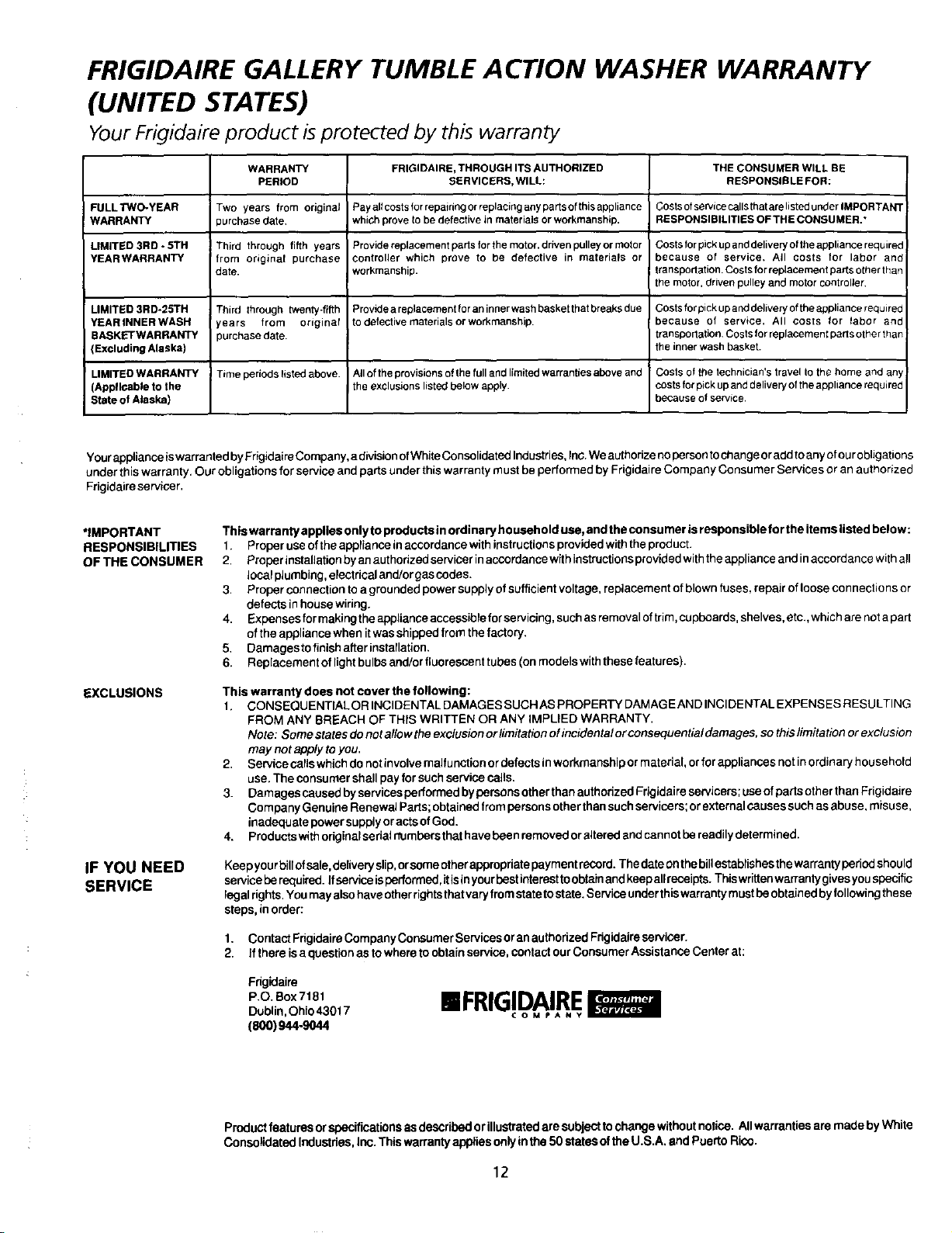
FRIGIDAIRE GALLERY TUMBLE ACTION WASHER WARRANTY
(UNITED STATES)
Your Frigidaire product isprotected by this warranty
WARRANTY FRIGIDAIRE, THROUGH ITS AUTHORIZED THE CONSUMER WILL BE
PERIOD SERVICERS, WILL: RESPONSIBLE FOR:
FULLTWO-YEAR Two years from origina_ Payaltcostsforrepairingorreplacinganypartsofthisappliance CostsofservicecallsthatarelistodunderlMPORTANT
WARRANTY )urchase date which prove to be defective in materials or workmanship. RESPONSIBILITIES OF THE CONSUMER.*
LIMITED3RD-STH Third through fifth years Providereplacementpartsforthemotor, ddvenpulleyormotor Costsforpickupanddeliveryoftheappliancerequired
YEARWARRANTY from original purchase controller which prove to be defective in materials or because of service, AJI costs for labor and
date. workmanship, transportation. Costs for replacement parts other than
the motor, driven pulley and motor controller
LIMITED3RD-25TH Third through twenty-fifth Provtdeareplacementforaninnerwashbasketthatbreaksdue Costsforpickupanddeliveryoftheappliancerequired
YEARINNERWASH tears from original todefective materials or workmanship, because of service. All costs for labor and
BASKETWARRANTY )urchase date. transportation.Costsforreplaeementpansotherthan
(Excluding Alaska) the inner wash basket.
LIMITED WARRANTY Time periods listed above. All of the provisions of the full and limited warranties above and Costs of the technician's travel to the home and an
(Applicable to the the exclusions listed below apply, costs for pick upand delivery of the appliance required
State of Alaska) because of service,
Yourappliance is warranted by Frigidaire Company, adivision ofWhite Consolidated Industries, inc. We authorize noperson tochange oradd toany ofour obligations
under this warranty, Our obligations for service and parts under this warranty must be performed by Fdgidaire Company Consume r Services or an authorized
Frigidaire servicer.
"IMPORTANT
RESPONSIBILITIES
OF THE CONSUMER
EXCLUSIONS
IF YOU NEED
SERVICE
This warranty applies only to products in ordinary household use, and the consumer is responsible for the items listed below:
1. Proper use of the appliance inaccordance with instructionsprovided withthe product.
2. Proper installationbyan authorized servicer inaccordance withinstructionsprovided withthe appliance and inaccordance withall
local pJumbieg,electrical and/or gas codes.
3. Proper connection to agrounded power supply of sufficient voltage, replacement of blown fuses, repair of loose connections or
defects inhouse wiring.
4. Expensas for making the appliance accessible for sarvicing, such asremoval oftrim, cupboards, shelves, etc.,which arenotapart
of the appliance when itwas shipped from the factory.
5. Damegestofinish after instaflation.
6. Replacement of lightbulbsand/or fluorescent tubes (on models withthese features).
This warranty does not cover the following:
1. C_NSE_UENT_AL_R_N__DENTALDAMAGESSUCHASPR_PERTYDAMAGEAND_NC_DENTALEXPENSESRESULT_NG
FROM ANY BREACH OF THIS WRITTEN OR ANY IMPLIED WARRANTY.
Note: Some states donotallow the exclusion orlimitationof incidentalorconsequential damages, so this limitation or exc/usion
may not apply to you.
2. Servicecaliswhichd_n_tinv__v_ma_functi_n_rde_ectsinw_rkmanship_rmateria___rf_rapp_iancesn_tin_rdinaryh_usah_ld
use. The consumer shall payfor such service calls.
3. Dameges causad bysarvices performed by persons other than authorized Frigidairssarvicers; usa of partsother than Frigidaire
Company Genuine Renewal Parts; obtained frompersons other than suchservicers; orexternal causes such as abuse, misuse,
inadequate power supplyor actsof God.
4. Productswifh originalsedal nlJmpersthathave peen removed or altered and cannot be readilydetermined.
Keep your bill ofsale, delivery slip,orsome other appropdate payment record. The date onthe billestablishes thewarranty peded should
service be required. Ifserviceis performed, it is inyour best interest toobtain and keep all receipts.This written warranty gives you specific
legal rights. You may also have other rights that vary from state tostate. Service under this warranty must be obtained by following these
steps, in order:
1, Contact FrigidaireCompany Consumer Services or anauthodzed Frigidaire sarvicer.
2. If there isa question as to where to obtain service, contact our Consumer Assistance Center at:
Frigidaire
P.O.Box7181
Dublin,Ohio43017
(8OO)944-9044
BIFRIGIDAIRE
COMPAN
Product features orspecifications as described or illustrated are subject to change without notice. Allwarranties are made by White
Consolidated Industdos, Inc. This warranty applies only inthe 50 states of the U.S.A. and Puerto Rico.
12
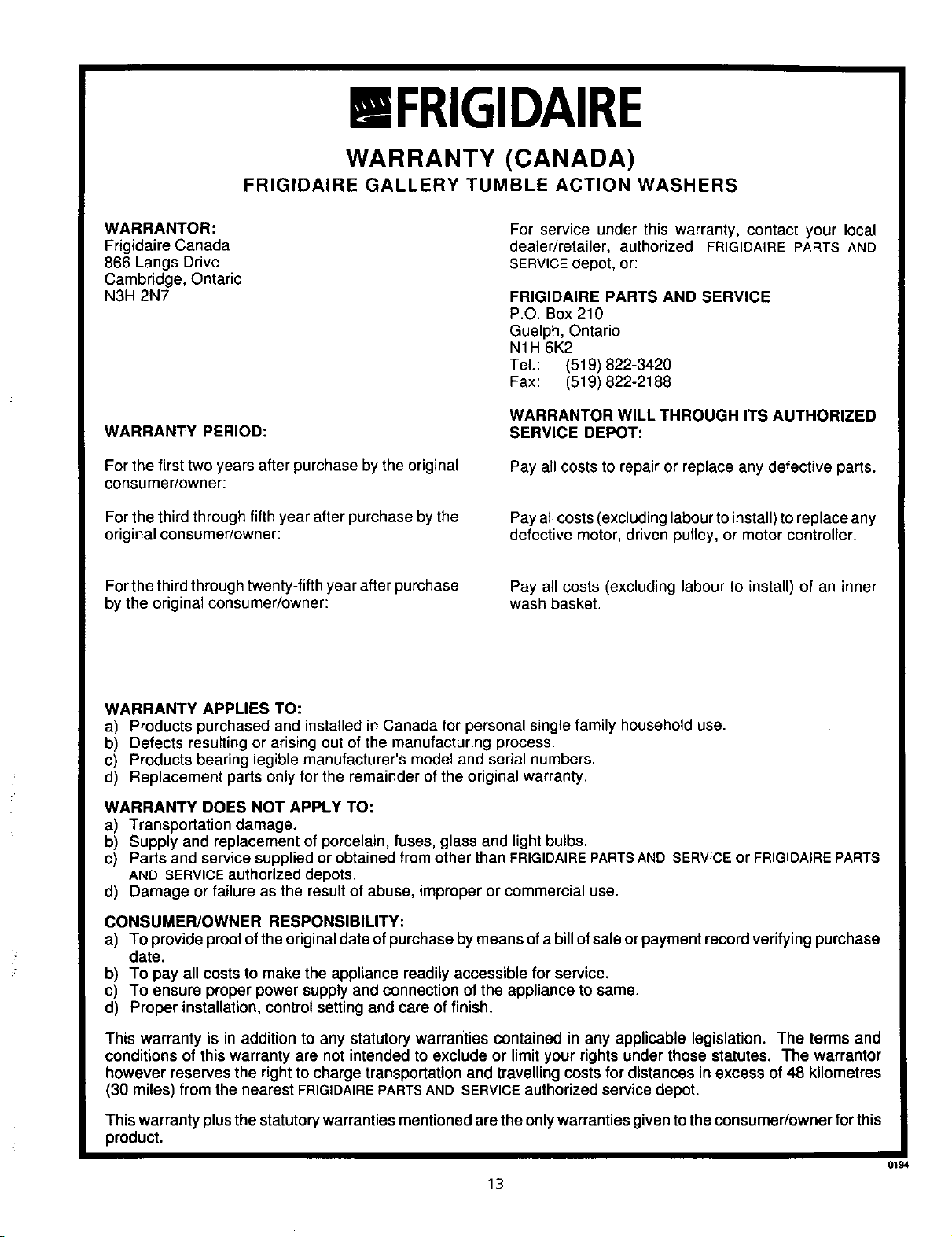
mFRIGIDAIRE
WARRANTY (CANADA)
FRIGIDAIRE GALLERY TUMBLE ACTION WASHERS
WARRANTOR:
Frigidaire Canada
866 Langs Drive
Cambridge, Ontario
N3H 2N7
WARRANTY PERIOD:
For the first two years after purchase by the original
consumer/owner:
For the third through fifth year after purchase by the
original consumer/owner:
For service under this warranty, contact your local
dealer/retailer, authorized FRIGIDAIRE PARTS AND
SERVICE depot, or:
FRIGIDAIRE PARTS AND SERVICE
P.O. Box 210
Guelph, Ontario
N1H 6K2
Tel.: (519) 822-3420
Fax: (519) 822-2188
WARRANTOR WILL THROUGH ITS AUTHORIZED
SERVICE DEPOT:
Pay all costs to repair or replace any defective parts.
Pay all costs (excluding labourto install) to replace any
defective motor, driven pulley, or motor controller.
For the third through twenty-fifth year after purchase
by the original consumer/owner:
Pay all costs (excluding labour to install) of an inner
wash basket.
WARRANTY APPLIES TO:
a) Products purchased and installed in Canada for personal single family household use.
b) Defects resulting or arising out of the manufacturing process.
c) Products bearing legible manufacturer's model and serial numbers.
d) Replacement parts only for the remainder of the original warranty.
WARRANTY DOES NOT APPLY TO:
a) Transportation damage.
b) Supply and replacement of porcelain, fuses, glass and light bulbs.
c) Parts and service supplied or obtained from other than FRIGIDAIREPARTSAND SERVICEor FRIGIDAIREPARTS
AND SERVICE authorized depots.
d) Damage or failure as the result of abuse, improper or commercial use.
CONSUMER/OWNER RESPONSIBILITY:
a) To provide proofofthe original date ofpurchase by means of a billofsale orpayment record verifying purchase
date.
b) To pay all costs to make the appliance readily accessible for service.
c) To ensure proper power supply and connection of the appliance to same.
d) Proper installation, control setting and care of finish.
This warranty is in addition to any statutory warranties contained in any applicable legislation. The terms and
conditions of this warranty are not intended to exclude or limit your rights under those statutes. The warrantor
however reserves the right to charge transportation and travelling costs for distances in excess of 48 kilometres
(30 miles) from the nearest FRIGIDAIREPARTSAND SERVICEauthorized service depot.
This warranty plus the statutorywarranties mentioned are the onlywarranties given tothe consumer/owner for this
product.
0194
13