For additional information, refer to . . .
Control Supplement and Gas
Control Parts
for EG/PEG – Natural gas only
for EGH – Natural or Liqueed Petroleum
(Propane) gas
(tankless heater application optional)
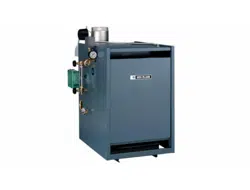
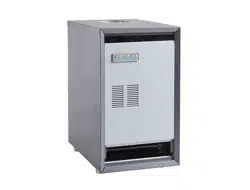
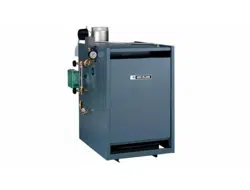
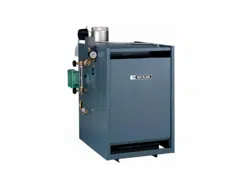
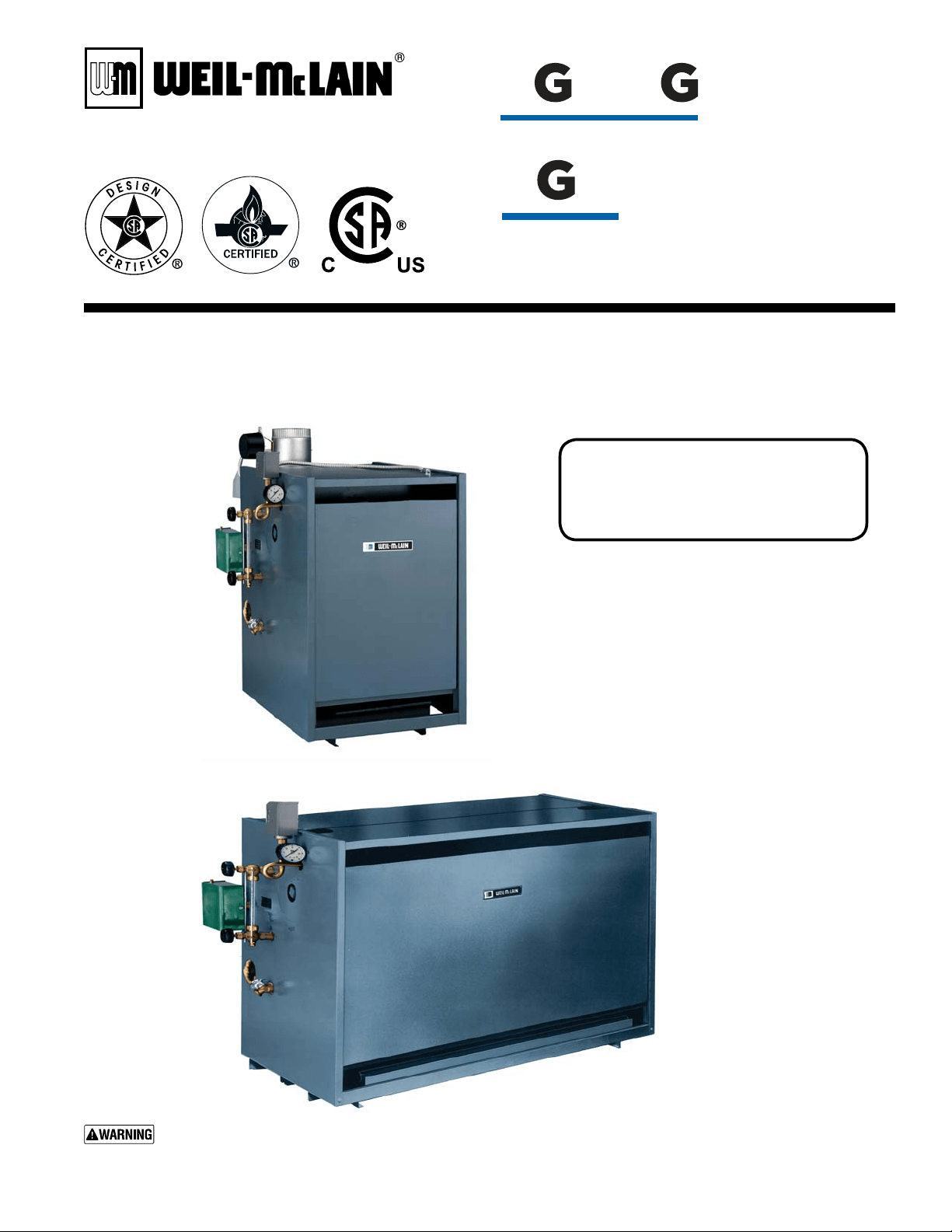
EG
PEG
EGH
• Installation
• Startup
• Maintenance
• Parts
Boiler Manual
This manual must only be used by a qualified heating installer/service technician. Before installing, read
all instructions, including this manual, and any related supplements. Perform steps in the order given.
Failure to comply could result in severe personal injury, death or substantial property damage.
Part No. 550-142-303/1120
Now With Built In
Low Water Cut Off Functionality
EG Water Only
Series 6
Series 5
Gas-Fired Boilers
E
/PE
E
H

Part Number 550-142-303/1120
2
EG
/
PEG sEriEs 6
•
EGH sEriEs 5 Gas-firEd boilErs — boilEr manual
Contents
The following defined terms are used throughout this manual to bring attention to the presence of hazards of various risk levels, or
to important information concerning the life of the product.
Indicates presence of hazards that will cause severe personal injury, death or substantial property damage.
Indicates presence of hazards that can cause severe personal injury, death or substantial property damage.
Indicates presence of hazards that will or can cause minor personal injury or property damage.
Indicates special instructions on installation, operation or maintenance that are important but not related to personal
injury or property damage.
Hazard denitions
Hazard denitions � � � � � � � � � � � � � � � � � � � � � � � � � � � � � � � � � � � � � � � � � 2
Read this page rst � � � � � � � � � � � � � � � � � � � � � � � � � � � � � � � � � � � � � � � � 3
Codes & Checklist � � � � � � � � � � � � � � � � � � � � � � � � � � � � � � � � � � � � � � � � � 4
Prepare boiler location � � � � � � � � � � � � � � � � � � � � � � � � � � � � � � � � � � � � � 5
Prepare the boiler � � � � � � � � � � � � � � � � � � � � � � � � � � � � � � � � � � � � � � � � � 9
Connect piping – water boilers – EG only
� � � � � � � � � � � � � � � � � � � � � �
14
Connect piping – steam boilers � � � � � � � � � � � � � � � � � � � � � � � � � � � � � � 17
Install boiler controls � � � � � � � � � � � � � � � � � � � � � � � � � � � � � � � � � � � � � 20
Connect piping – tankless heater (optional)
� � � � � � � � � � � � � � � � � � �
21
Connect gas supply piping � � � � � � � � � � � � � � � � � � � � � � � � � � � � � � � � � 22
Connect eld wiring to boiler � � � � � � � � � � � � � � � � � � � � � � � � � � � � � � � 23
Start-up � � � � � � � � � � � � � � � � � � � � � � � � � � � � � � � � � � � � � � � � � � � � � � � � � 24
Steam Boiler Water Treatment � � � � � � � � � � � � � � � � � � � � � � � � � � � � � � � 25
Installation and service certicate
�
� � � � � � � � � � � � � � � � � � � � � �
�
� � � 28
Department of Energy – Compliance . . . . . . . . . . . . . . . . . . . . . . . . . . 29
Handling berglass and ceramic ber materials . . . . . . . . . . . . . . . . . 29
Service and maintenance � � � � � � � � � � � � � � � � � � � � � � � � � � � � � � � � � � � 30
Replacement parts — EG/PEG � � � � � � � � � � � � � � � � � � � � � � � � � � � � � � � � 34
Replacement parts — EGH � � � � � � � � � � � � � � � � � � � � � � � � � � � � � � � � � � 36
Dimensional data � � � � � � � � � � � � � � � � � � � � � � � � � � � � � � � � � � � � � � � � � � 38
Ratings � � � � � � � � � � � � � � � � � � � � � � � � � � � � � � � � � � � � � � � � � � � � � � � � � 39
Standard and optional equipment �
�
� � � � � � � � � � � � � � � � � � � � � �
�
� � � 40
Part Number 550-142-303/1120
3
EG
/
PEG sEriEs 6
•
EGH sEriEs 5 Gas-firEd boilErs — boilEr manual
Read this page rst
Failure to adhere to the guidelines below can result in severe personal injury, death or substantial property damage.
When servicing boiler —
To avoid electric shock, disconnect all
electrical supplies to the boiler before
performing maintenance.
To avoid severe burns, allow boiler to cool
before performing maintenance.
This boiler contains ceramic fiber and
fiberglass materials. Refer to the WARN-
ING and instructions on page 29.
Boiler operation —
Do not block flow of combustion or ven-
tilation air to boiler.
Should overheating occur or gas supply
fail to shut off, do not turn off or discon-
nect electrical supply to pump. Instead,
shut off the gas supply at a location ex-
ternal to the appliance.
Combustion air —
DO NOT install combustion air intake
where there is a risk of combustion air
contamination.
Boiler water —
Do not use petroleum-based cleaning
or sealing compounds in boiler system.
Gaskets and seals in the system may be
damaged. This can result in substantial
property damage.
DO NOT use “ homemade cures ” or “
boiler patent medicines”. Serious dam-
age to boiler, personnel and/or property
may result.
Continual fresh make-up water will re-
duce boiler life. Mineral buildup in eat
exchanger reduces heat transfer, overheats
the cast iron, and causes section failure.
Addition of oxygen carried in by make-up
water can cause internal corrosion. Leaks
in boiler or piping must be repaired at
once to prevent make-up water. Use this
boiler ONLY in a closed-loop system.
Do not add cold water to a hot boiler.
Thermal shock can cause sections to crack.
Freeze protection fluids —
• NEVER use automotive or standard
glycol antifreeze. Use only freeze-
protection fluids made for hydronic
systems. Follow all guidelines given
by the antifreeze manufacturer.
Thoroughly clean and flush any
replacement boiler system that has
used glycol before installing the new
boiler.
Frozen Water Damage
Hazard
Residences or buildings that are unat-
tended in severely cold weather, boiler
system components failures, power out-
ages, or other electrical system failures
could result in frozen plumbing and water
damage in a matter of hours. For your
protection, take preventative actions such
as having a security system installed that
operates during power outages, senses low
temperature, and initiates an effective ac-
tion. Consult with your boiler contractor
or a home security agency.
If any part of a boiler, burner or its controls has
been sprayed with or submerged under water,
either partially or fully, DO NOT attempt to op-
erate the boiler until the boiler has been either
replaced or completely repaired, inspected, and
you are sure that the boiler and all components
are in good condition and fully reliable.
Otherwise, by operating this boiler, you will
cause a fire or explosion hazard, and an electrical
shock hazard, leading to serious injury, death, or
substantial property damage. See the instructions
at right.
Saltwater Damage — The exposure of boiler components to
saltwater can have both immediate and long-term effects. While the
immediate effects of saltwater damage are similar to those of fresh-
water (shorting out of electrical components, washing out of critical
lubricants, etc.), the salt and other contaminants left behind can lead
to longer term issues after the water is gone due to the conductive
and corrosive nature of the salt residue. Therefore, Weil-McLain
equipment contaminated with saltwater or polluted water will no
longer be covered under warranty and should be replaced.
Electrical Damage — If any electrical component or wiring
came into contact with water, or was suspected to have come into
contact with water, replace the boiler with a new Weil-McLain boiler.
Installer— Read all instructions, including this
manual and all other information shipped with the
boiler, before installing. Perform steps in the order
given.
User — This manual is for use only by a qualified
heating installer/service technician. Refer to User’s
Information Manual for your reference.
User — Have this boiler serviced/inspected by a
qualified service technician, at least annually.
Failure to comply with the above could result in severe
personal injury, death or substantial property damage.
Improper installation, adjustment, alteration, ser-
vice or maintenance can cause property damage,
personal injury, exposure to hazardous materials,
or loss of life. Installation and service must be
performed by a qualified installer, service agency
or the gas supplier who must read and follow the
supplied instructions before installing, servicing or
removing this boiler. This boiler contains possibly
carcinogenic, to humans.
Write in the Consumer Protection (CP) number in
the space provided on the Installation and Service
Certicate
on page 28, if not already shown.
When calling or writing about the boiler— Please
have the boiler model number from the boiler rating
label and the CP number from the boiler jacket.
Consider piping and installation when determining
boiler location.
Any claims for damage or shortage in shipment
must be filed immediately against the transportation
company by the consignee.
EG and EGH boilers for tankless or storage heater
application are available only on special order as
factory-installed optional equipment. Tankless
heater cannot be added to standard block assem-
bly. Block assembly must be ordered with heater
openings. Standard boilers cannot be adapted for
heater use.

Part Number 550-142-303/1120
4
EG
/
PEG sEriEs 6
•
EGH sEriEs 5 Gas-firEd boilErs — boilEr manual
Installation must follow these codes:
• Local, state, provincial, and national codes, laws, regulations and ordinances.
• National Fuel Gas Code, ANSI Z223.1/NFPA 54 - latest edition.
• National Electrical Code, ANSI/NFPA 70 – latest edition and/or the Canadian Electrical Code
Part I, CSA C22.1, Electrical Code.
• Canadian installations must comply with the Natural Gas and Propane Installation Code, CAN/
CSA B149.1 or B149.2 Installation Codes.
• Where required by the authority having jurisdiction, the installation must conform to the Standard
for Controls and Safety Devices for Automatically Fired Boilers, ANSI/ASME CSD1.
The equipment shall be installed in accordance with those installation regulations in force in the local
area where the installation is to be made. These shall be carefully followed in all cases. Authorities having
jurisdiction shall be consulted before installations are made.
Commonwealth of Massachusetts
When the boiler is installed within the Commonwealth of Massachusetts:
• Thisproductmustbeinstalledbyalicensedplumber.
• Ifantifreezeisused,areducedpressureback-owpreventerdeviceshallbeused.
Certification
Safe operating and other performance criteria were met with the gas manifold and con-
trol assembly provided on boiler when boiler underwent tests specified in ANSI Z21.13
- latest edition.
Before locating the boiler:
❏ Check for nearby connection to:
•Ventingconnections
•Gassupplypiping
•Electricalpower
❏ Check area around boiler. Remove any combustible materials, gasoline and other flammable liquids.
Failure to keep boiler area clear and free of combustible materials, gasoline and other
flammable liquids and vapors can result in severe personal injury, death or substantial
property damage.
❏ Boiler must be installed so that gas control system components are protected from dripping or spray-
ing water or rain during operation or service.
❏ If new boiler will replace existing boiler, check for and correct system problems, such as:
•Systemleakscausingoxygencorrosionorsectioncracksfromhardwaterdeposits.
Glycol — potential fire hazard —
All glycol is flammable when exposed to high temperatures. If glycol is allowed to accumulate in or
around the boiler or any other potential ignition source, a fire can develop. In order to prevent poten-
tial severe personal injury, death or substantial property damage from fire and/or structural damage:
• Neverstoreglycolofanykindneartheboileroranypotentialignitionsource.
• Monitorandinspectthesystemandboilerregularlyforleakage.Repairanyleaksimmediatelyto
prevent possible accumulation of glycol.
Codes & Checklist
Part Number 550-142-303/1120
5
EG
/
PEG sEriEs 6
•
EGH sEriEs 5 Gas-firEd boilErs — boilEr manual
Table 1 EG, PEG & EGH - Service and combustible
materials clearances
Prepare boiler location
Recommended Service clearances
1. Provide minimum clearances for cleaning and servicing
the boiler and for access to controls and components as
listed in the table at right.
2. Provide at least screwdriver clearance to jacket front panel
screws for removal of front panel for inspection and minor
service. If unable to provide at least screwdriver clearance,
install unions and shutoff valves in system so boiler can be
moved for servicing.
Combustible material clearances
General
1. See Table 1 for clearances to boiler and system components.
2. Clearances to Type B vent materials are as specified by the
vent manufacturer.
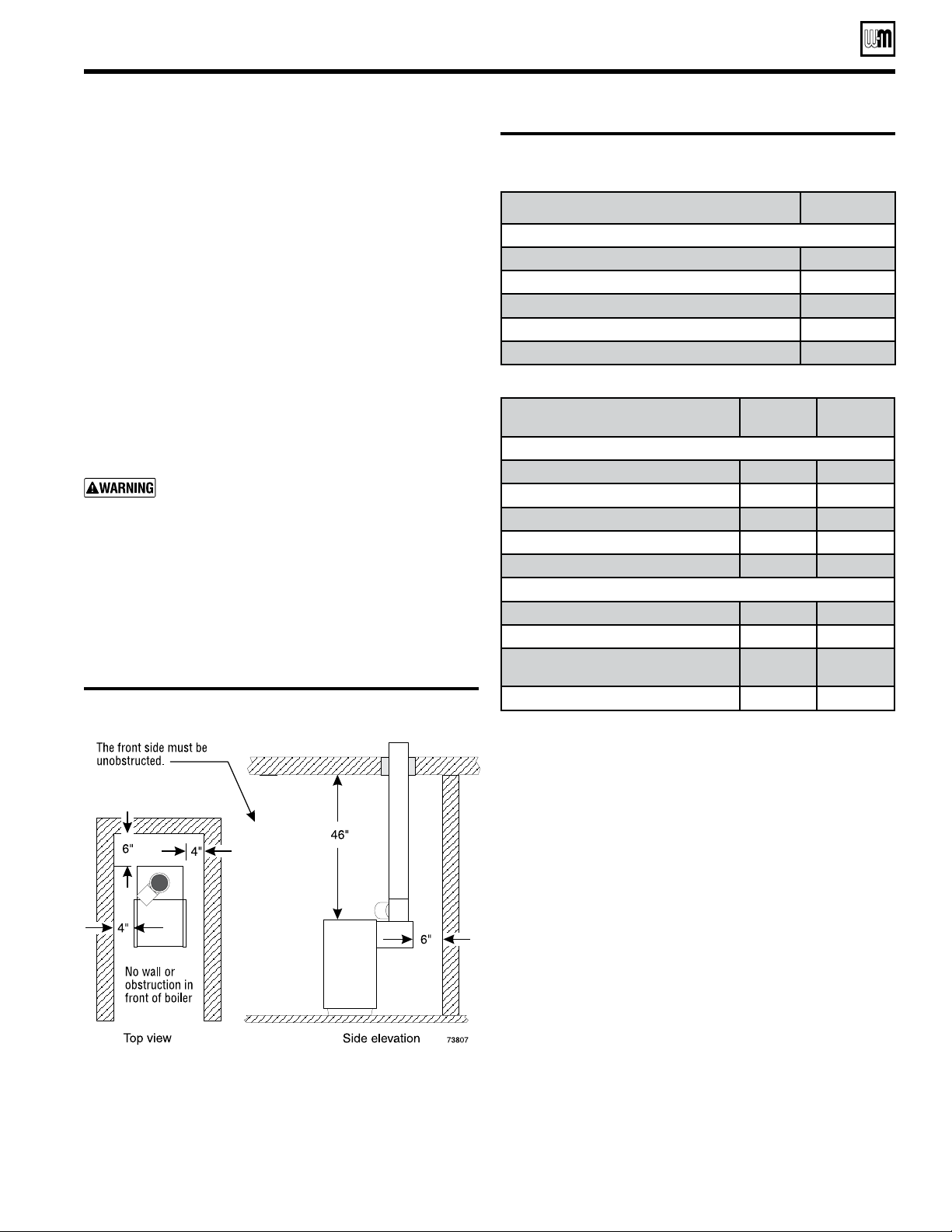
Alcove (not closet) installations only
EG and PEG boilers are not approved for
closet installation.
EG and PEG boilers are approved for alcove
installation, with minimum clearances to
combustible surfaces as shown in Table 1. See
Figure 1. The front side must be completely open
— that is, a three-walled room.
EGH boilers are not approved for alcove or
closet installation.
EG, PEG & EGH - Clearance for service Minimum
Clearance to boiler jacket
Top (for cleaning ue ways) 46”
Front
(for access to controls and components) 18”
Back 6”
Left side (for cleaning and servicing) 24”
Right side 6”
Clearance to combustible materials
Minimum
EG & PEG
Minimum
EGH
Clearance to boiler jacket
Top
46” 46”
Front (provides means of access)
3” 18”
Back
6” 24”
Left side (provides means of access)
4” 24”
Right side
4” 24”
Clearance to piping and vent components
Water and steam pipes
1/2” 1/2”
Vent pipe (other than Type B vent)
6” 6”
Type B vent piping
Per B vent
manufacturer
Per B vent
manufacturer
Vent damper
6” 6”
EGH installations
1. See Table 1 for clearances to boiler and system components.
2. Provide the clearances for service and clearance to combus-
tible materials as listed on this page.
3. Install in a space that is large in comparison to the size of
the boiler (see National Fuel Gas Code for details).
Residential garage installations
Take the following special precautions when installing the boiler in
a residential garage. If the boiler is located in a residential garage,
per ANSI Z223.1/NFPA 54 – latest edition:
• Mount the boiler a minimum of 18 inches above the floor of
the garage to assure the burner and ignition devices will be
no less than 18 inches above the floor.
• Locate or protecttheboilersoitcannot be damaged by a
moving vehicle.
Figure 1 Alcove installation (EG & PEG only)
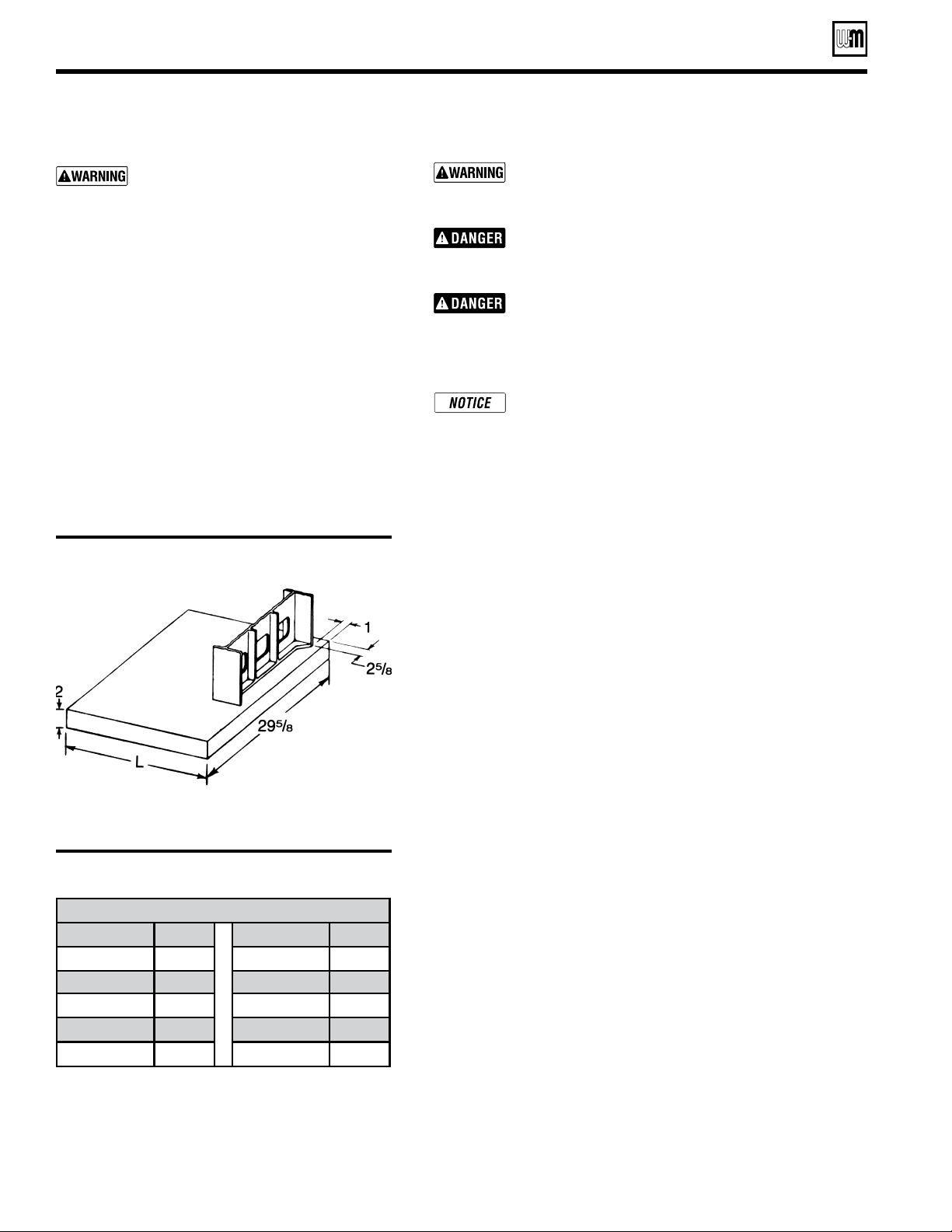
Table 2 Minimum foundation size
Figure 2 Boiler foundation
Part Number 550-142-303/1120
6
EG
/
PEG sEriEs 6
•
EGH sEriEs 5 Gas-firEd boilErs — boilEr manual
Vent System
Failure to follow all instructions can result in flue gas
spillage and carbon monoxide emissions, causing severe
personal injury or death.
Inspect existing chimney before installing boiler. Failure
to clean or replace perforated pipe or tile lining will cause
severe personal injury or death.
Do not alter boiler draft diverter or place any obstruction
or non-certified vent damper in breeching or vent system.
CSA certification will become void. Flue gas spillage and
carbon monoxide emissions will occur causing severe
personal injury or death.
The following requirements apply when you remove
an existing boiler from a vent system shared with other
appliances. If the new boiler will not use the common
vent, you must test (as described below) each remaining
appliance — operating by itself — to verify that the vent
system operates adequately.
When removing boiler from existing common vent system:
At the time of removal of an existing boiler, the following steps shall
be followed with each appliance remaining connected to the common
venting system placed in operation, while the other appliances remaining
connected to the common venting system are not in operation.
a. Seal any unused openings in the common venting system.
b. Visually inspect the venting system for proper size and horizontal
pitch and determine there is no blockage or restriction, leakage, cor-
rosion or other deficiencies which could cause an unsafe condition.
c. Test vent system — Insofar as is practical, close all building doors and
windows and all doors between the space in which the appliances
remaining connected to the common venting system are located and
other spaces of the building. Turn on clothes dryers and any appli-
ance not connected to the common venting system. Turn on any
exhaust fans, such as range hoods and bathroom exhausts, so they
will operate at maximum speed. Do not operate a summer exhaust
fan. Close fireplace dampers.
d. Place in operation the appliance being inspected. Follow the op-
erating instructions. Adjust thermostat so appliance will operate
continuously.
e. Test for spillage at draft diverter relief opening after 5 minutes of
main burner operation. Use the flame of a match or candle.
f. After it has been determined that each appliance remaining con-
nected to the common venting system properly vents when tested
as outlined above, return doors, windows, exhaust fans, fireplace
dampers, and any other gas-burning appliance to their previous
conditions of use.
Any improper operation of the common venting system should be cor-
rected so the installation conforms with the National Fuel Gas Code,
ANSI Z223.1/NFPA 54 – latest edition and/or Natural Gas and Propane
Installation Code, CAN/CGA B149 or B149.2, Installation Codes. When
resizing any portion of the common venting system, the common venting
system should be resized to approach the minimum size as determined
using the appropriate tables in the National Fuel Gas Code, ANSI Z223.1/
NFPA 54 – latest edition and/or Natural Gas and Propane Installation
Code, CAN/CSA B149.1 or B149.2, Installation Codes.
Flooring and foundation
Do not install boiler on combustible
flooring or carpeting even if a concrete or
aerated foundation is used. Fire can result,
causing severe personal injury, death or
substantial property damage.
1. See Figure 2. A level concrete or solid brick pad is
required if:
a. There is a possibility of the floor becoming
flooded.
b. Non-level conditions exist.
2. An aerated boiler foundation is recommended if
any of the following conditions exist:
a. Electrical wiring or telephone cables buried in
the concrete floor of the boiler room.
b. Concrete floor is “green.”
c. There is a history of the floor becoming flooded.
d. Water is channeled under the concrete.
1 Prepare boiler location (continued)
Boiler Foundation Size - Inches
Boiler No. “L” Boiler No. “L”
EG 30-35 19” EGH 85 40 1/4”
EG 40-45 23 1/4” EGH 95 44 1/2”
EG 50-55 27 1/2” EGH 105 48 3/4”
EG 65 31 3/4” EGH 115 53”
EG 75 36” EGH 125 57 1/4”
Part Number 550-142-303/1120
7
EG
/
PEG sEriEs 6
•
EGH sEriEs 5 Gas-firEd boilErs — boilEr manual
Products to avoid
Spray cans containing chloro/uorocarbons
Permanent wave solutions
Chlorinated waxes/cleaners
Chlorine-based swimming pool chemicals
Calcium chloride used for thawing
Sodium chloride used for water softening
Refrigerant leaks
Paint or varnish removers
Hydrochloric acid/muriatic acid
Cements and glues
Antistatic fabric softeners used in clothes dryers
Chlorine-type bleaches, detergents, and cleaning solvents
found in household laundry rooms
Adhesives used to fasten building products and other similar
products
Areas likely to have contaminants
Dry cleaning/laundry areas and establishments
Swimming pools
Metal fabrication plants
Beauty shops
Refrigeration repair shops
Photo processing plants
Auto body shops
Plastic manufacturing plants
Furniture renishing areas and establishments
New building construction
Remodeling areas
Garages with workshops
Buildings under construction (where air is contaminated with
particulates)
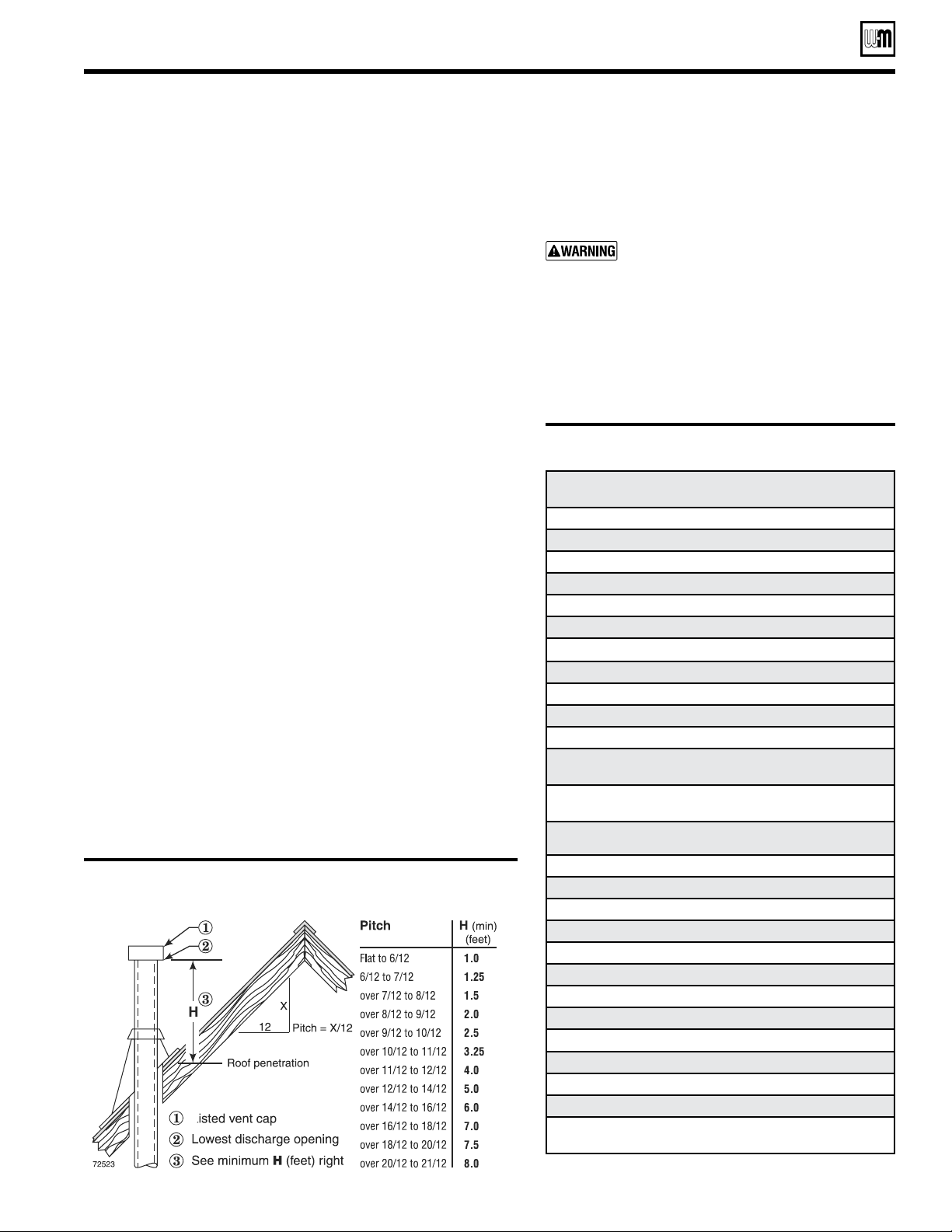
Figure 3 Terminations with Type B vent fitted with listed cap,
provided vent is at least 8 feet from any vertical wall or
similar obstruction
Vent System (continued)
Chimney or vent requirements
1. Venting must be installed according to the National Fuel Gas Code,
ANSI Z223.1/NFPA 54 – latest edition and applicable building codes.
Canadian installations must comply with Natural Gas and Propane
Installation Code, B149.1 or B149.2 Installation Codes.
2. See “Ratings” on page 39 for minimum chimney or vent sizes.
Chimney or vent termination:
• A chimney, or any vent other than a Type B vent with listed vent
cap, must extend at least 3 feet above the highest point where it
passes through a roof of a building, and at least 2 feet higher than
any portion of a building within a horizontal distance of 10 feet.
• TypeBventswithlistedcapsmayterminateasinFigure3ifno
closer than 8 feet from a vertical wall or similar obstruction.
• Otherwise,TypeBventsmustterminateatleast2feetabovethe
roof penetration and at least 2 feet higher than any portion of a
building within 10 feet.
• Ensure proper clearance above grade or snow line. Keep vents/air
intake area clear of accumulating snow.
3. A lined chimney is preferred and must be used when required by
local, state, provincial and national codes, laws, regulations and
ordinances. Vitreous tile linings with joints that prevent retention
of moisture and linings made of noncorrosive materials are best.
Advice for flue connections and chimney linings can be obtained
from local gas utility. Type B double-wall metal vent pipe or single-
wall vent pipe may be used as a liner.
4. Cold masonry chimneys, also known as outside chimneys, typically
have one or more walls exposed to outside air. When any atmospheric
gas-fired boiler with automatic vent damper is vented through this
type of chimney, the potential exists for condensation to occur.
Condensation can damage a masonry chimney. The following are
recommended to prevent possible damage.
a. Line chimney with corrosion-resistant metal liner such as AL29-4C®
single-wall stainless steel or B-vent. Size liner per National Fuel Gas
Code ANSI Z223.1/NFPA 54 – latest edition.
b. Provide drain trap to remove any condensate.
5. Where two or more gas appliances vent into a common chimney or
vent, equivalent area should be at least equal to area of vent outlet
on largest appliance plus 50 percent of vent outlet area of additional
appliances.
Air contamination
1. Please review the following information on potential
combustion air contamination problems.
2. See Table 3 for products and areas which may cause
contaminated combustion air.
To prevent potential of severe personal injury
or death, check for products or areas listed
below before installing boiler. If any of these
contaminants are found:
•Removecontaminantspermanently.
— OR —
•Isolateboilerandprovideoutsidecombus-
tion air. See national, provincial or local
codes for further information.
Prepare boiler location (continued)
Table 3 Contaminants to avoid
Part Number 550-142-303/1120
8
EG
/
PEG sEriEs 6
•
EGH sEriEs 5 Gas-firEd boilErs — boilEr manual
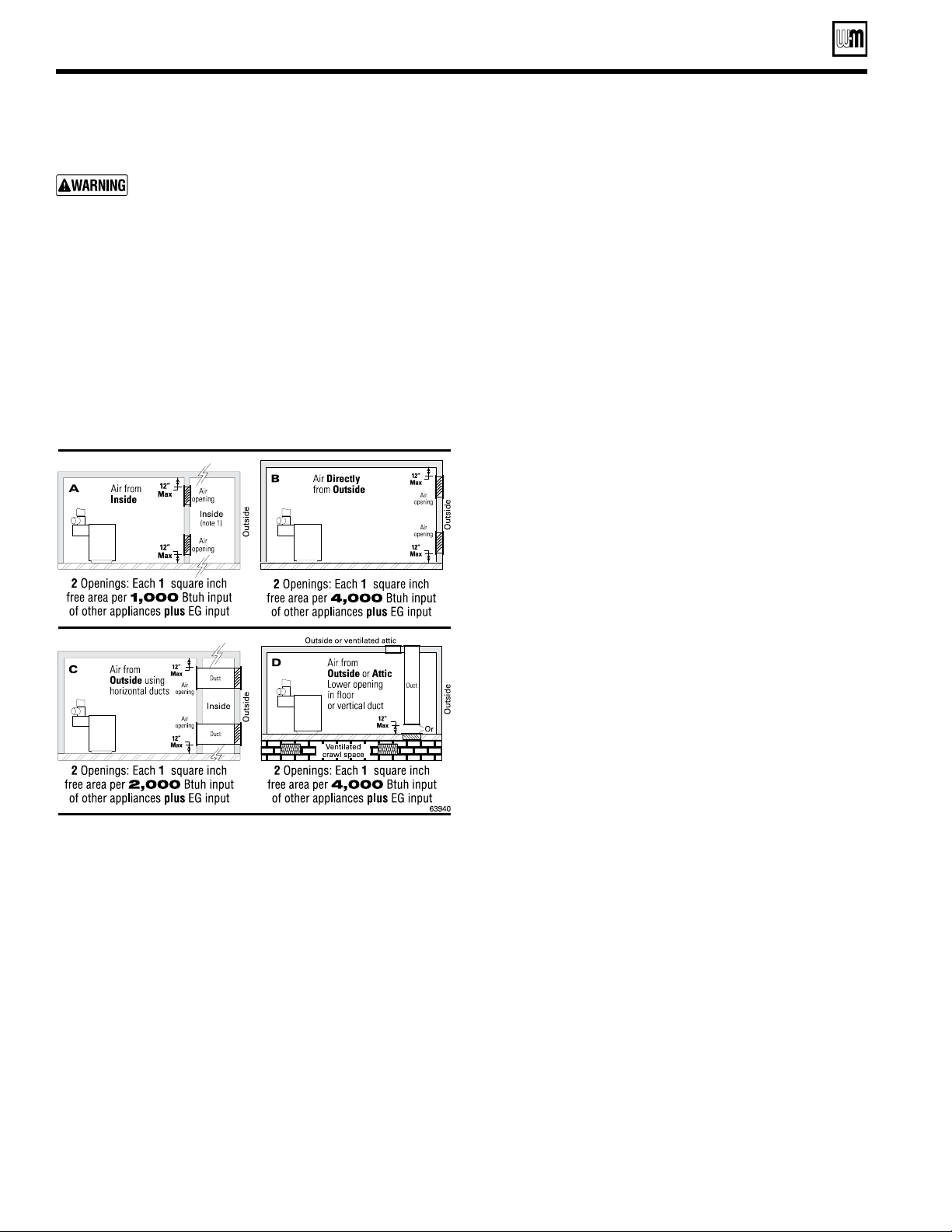
Air openings
Provide adequate combustion and ventilation air
to assure proper combustion and reduce the risk
of severe personal injury, death or substantial prop-
erty damage caused by flue gas spillage and carbon
monoxide emissions.
Combustion air and ventilation openings must comply with
the National Fuel Gas Code, ANSI Z223.1/NFPA 54 – latest edi-
tion, or applicable local building codes. Canadian installations
must comply with Natural Gas and Propane Installation Code,
B149.1 or B149.2 Installation Codes.
Air opening sizes in the following are given in free area (after
correction for louver obstruction).
Option 1 — Provide (2) openings:
Tight construction — Definition:
Tight construction means (per ANSI Z223.1/NFPA 54 – latest
edition):
• Wallsandceilingsexposedtotheoutsideatmospherehavea
continuous water vapor retarder with a rating of 1 perm or
less with openings gasketed AND
• Weather-stripping has been added on openable windows and
doors AND
• Caulkingorsealantsareappliedtoareassuchasjointsaround
windows and door frames, between sole plates and floors, be-
tween wall-ceiling joints, between wall panels, at penetrations
for plumbing, electrical, and gas lines, and in other openings.
Tight construction requirements
If building is of tight construction and air is taken from inside
the building, provide two openings in building outside wall, one
within 12 inches of ceiling, the other within 12 inches of the floor.
Each opening must have a minimum free area of 1 square inch
per 1,000 Btuh of all appliances in the building.
Exception
NO combustion air openings are needed when the boiler (and
other appliances) are installed in a space with a volume NO LESS
than 50 cubic feet per 1,000 Btuh of all installed appliances. Sum
the total input of all appliances in MBH (1,000’s of Btuh) and
multiply this number times 50. Building must not be of Tight
construction (see above).
Example: For total input of 100 MBH (100,000 Btuh), minimum
volume is 50 x 100 = 5,000 cubic feet. At a ceiling height of 8 feet,
space must have at least 5,000 ÷ 8 = 625 square feet (25 feet x 25
feet, for instance).
Exhaust fans and air movers
The appliance space must never be under a negative pressure.
Always provide air openings sized not only to the dimensions
required for the firing rate of all appliances, but also to handle
the air movement rate of the exhaust fans or air movers using air
from the building or space.
Motorized air dampers
If the air openings are fitted with motorized dampers, electrically
interlock the damper to:
• Preventtheboilerfromringifthedamperisnotfullyopen.
• Shuttheboilerdownshouldthedampercloseduringboiler
operation.
To accomplish this interlock, wire an isolated contact (proving the
damper open) in series with the thermostat input to the boiler.
The boiler will not start if this damper is closed, and will shut
down should damper close during operation.
Placement and setup
Place boiler/crate near position
1. Leave boiler in crate and on pallet until installation site is
ready.
2. Move entire crate and pallet next to selected location.
3. Remove crate. Leave boiler on pallet.
4. Unbolt boiler from pallet.
5. Remove boiler from pallet.
Prepare the location (continued)
Option 2 — Provide (1) opening:
A single combustion air opening can be used, provided:
• The
opening must commence within 12 inches of the ceiling.
• Theboilermusthaveclearancesofatleast1inchfromboth
sides and back, and 6 inches from the front.
• Theopeningmustconnectdirectlytotheoutdoorsortoa
space that communicates directly to the outdoors.
• Theaircanbeprovidedthroughadirectopeningorthrough
a horizontal or vertical duct.
• Thefreeareaoftheopeningmustbeatleastequaltothesum
of all vent connectors in the space.
• Thefreeareaoftheopeningmustbeatleast1squareinch
per 3000 Btu/hr input rating of all equipment located in the
space.
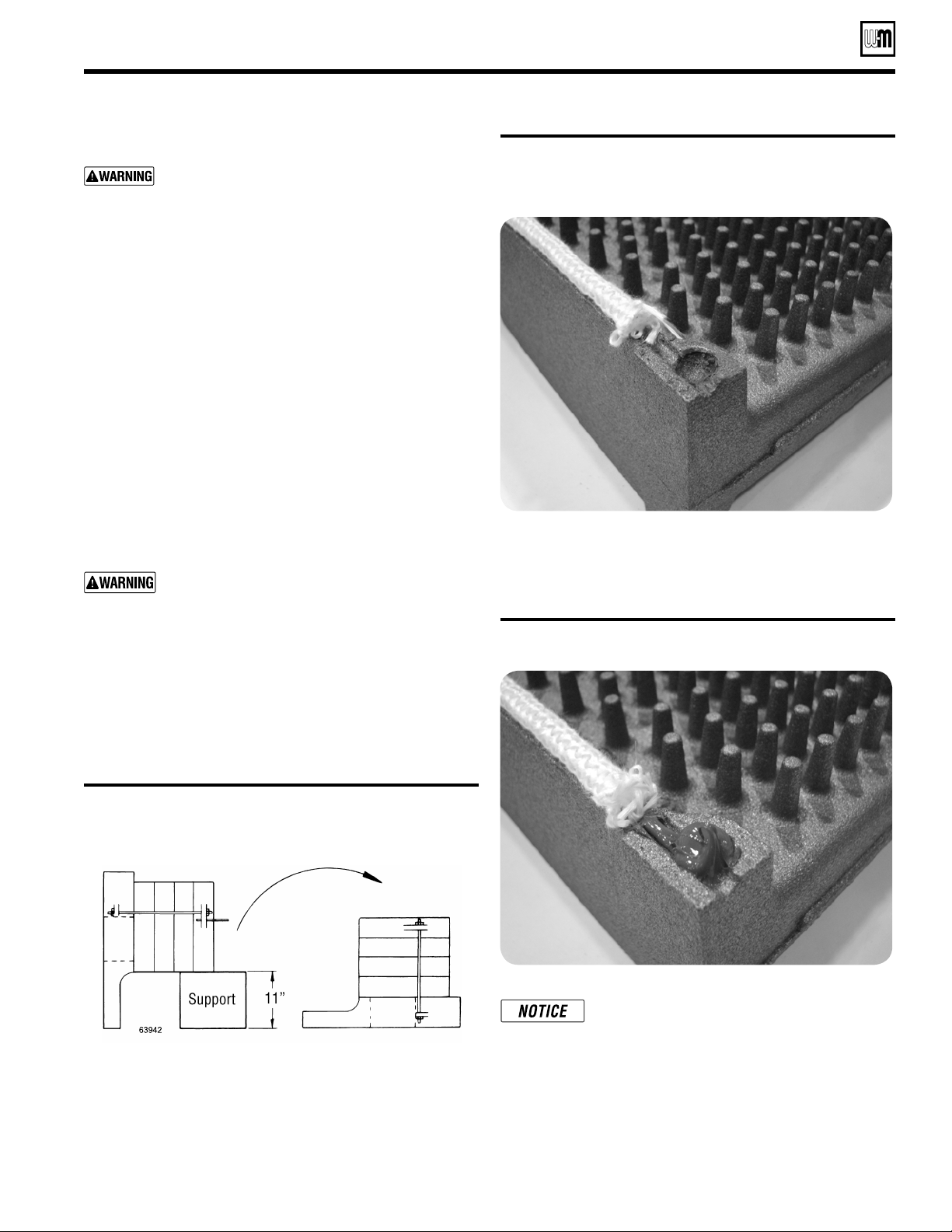
Figure 4 Handling split blocks
Part Number 550-142-303/1120
9
EG
/
PEG sEriEs 6
•
EGH sEriEs 5 Gas-firEd boilErs — boilEr manual
Placing the boiler
Block assembly is extremely heavy. Handle with
caution to avoid personal injury.
EGH boilers only —
When an EGH block assembly is taken apart for handling:
1. Put a support under center of block. Support must be
within ½ inch of block bottom.
2. Detach seal replacement kit from the draw rod. Remove
short center draw rods.
3. Tip half blocks on end as shown in Figure 4. Save elas-
tomer sealing ring between sections.
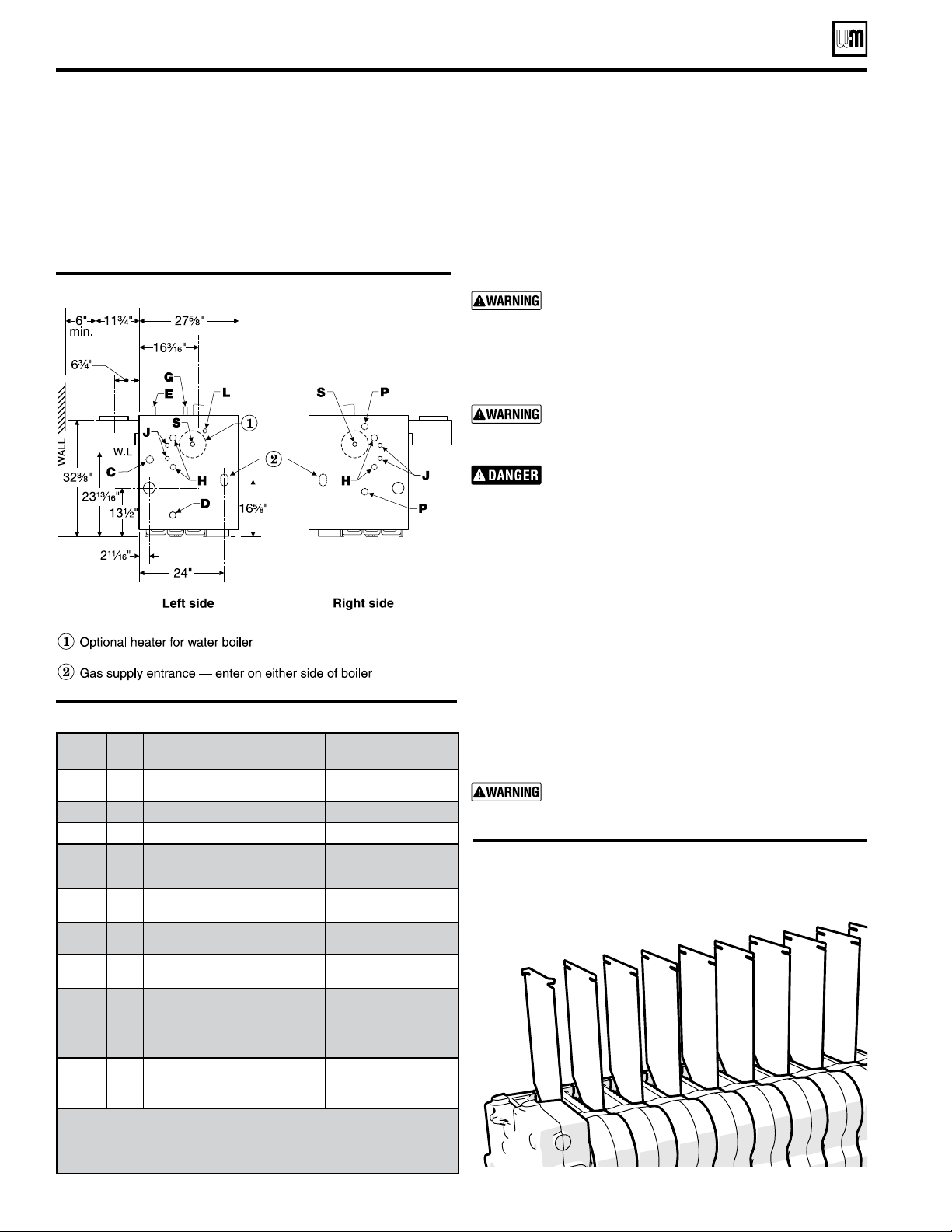
4. Remove the exposed silicone from the socket areas
located in the bottom-front and top-rear corners of the
casting. See Figure 4a. Do not remove the rope seal.
5. After moving half-blocks into desired location,
clean port surfaces with clean, dry rag. Do not use
petroleum-based solvents. Place sealing rings in
recessed ports. Place new silicone in the socket area as
seen in Figure 4b. It is critical to place enough silicone
in this area to reseal the castings.
Do not use petroleum-based cleaning or
sealing compounds in boiler system. Severe
damage to system components can result,
causing substantial property damage.
6. Re-assemble block in reverse order. When drawing sec-
tions together, use 45 ( ± 5 ) ft-lbs torque.
1
Place enough silicone in the socket to
make a seal with the mating surface on the
adjacent casting when assembled.
Prepare the boiler
Figure 4a Corner after exposed silicone has been
removed.
Figure 4b Placing of new silicone in the sockets.
Part Number 550-142-303/1120
10
EG
/
PEG sEriEs 6
•
EGH sEriEs 5 Gas-firEd boilErs — boilEr manual
Hydrostatic pressure test
Pressure test before attaching gas piping or electrical supply.
1. Plug any necessary boiler tappings or openings.
2. Do not use gauge supplied with boiler for pressure testing.
Install gauge with appropriate range.
3. Fill boiler with water. Vent all air. Test steam boilers between
45 - 55 psi. Test water boilers at 1-1/2 times maximum work-
ing pressure.
Do not leave boiler unattended. A cold water fill
could expand and cause excessive pressure, result-
ing in severe personal injury, death or substantial
property damage.
4. Verify gauge pressure is maintained. Check for leaks. Repair
if found.
Leaks must be repaired at once. Failure to do so
can cause boiler damage, resulting in substantial
property damage.
Do not use petroleum-based sealing compounds in
boiler system. Severe damage to boiler will result,
causing substantial property damage.
5. Drain boiler and repair leaks if found.
6. Retest boiler after repairing leaks.
7. Remove plugs from any tappings that will be used for controls
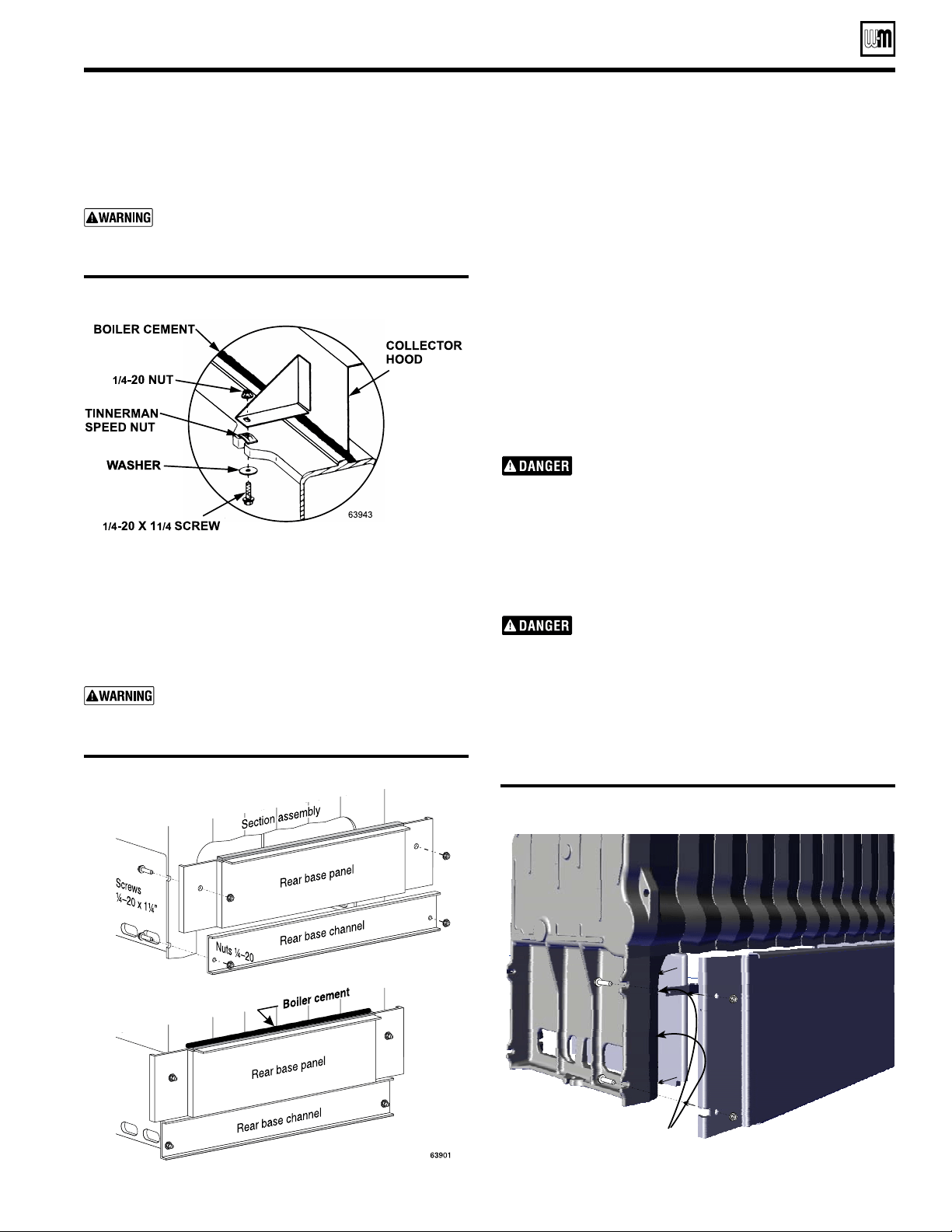
and accessories. Refer to Table 4 and Figure 5.
8. On initial start-up check for leaks in the system piping.
If found, repair at once.
Installation of flue baffles (EG water and
EGH only)
1. Bend the two (2) tabs on the flue baffle approx. 90 degrees in
opposite directions.
2. Slide flue baffles (notch down and to the back) in between
each section.
The installer must install all flue baffles for proper
boiler operation.
Figure 5 Boiler tappings (see Table 4)
Table 4 Control tapping (see Figure 5)
Prepare the boiler (continued)
Tapping
Size
EG, PEG & EGH
Steam Boilers
EG Water Boilers
only
C
¾”
Probe-type low water cutoff
Probe-type LWCO
(when used)
D
¾”
Drain
Drain
E
¾”
Safety valve
Safety relief valve
G
¾”
Plugged
Piping to compression
tank or
auto air vent
H
½”
Gauge glass and /or optional
low water cutoff
Combination pressure
temperature gauge
J
⅜”
Tri cock tappings
Plugged on
(Float type LWCO)
L
½”
Siphon, pressure gauge, high
limit (Probe type LWCO)
Combination pressure
temperature gauge
P
(EGH
Only)
1
Float type low water cut-off, pressure
limit control and pressure gauge;
or low water cut-off and feeder
combination; or low water cut-off and
pump control
––
S
1 ½”
¾”
(note 1)
Skim tapping
––
Limit control
Limit control
Notes:
1. Available on special request only, when tankless heater is specied.
2. Limit control and supply piping must be on the same end of the EGH
boiler.
3. When an internal type water heater is installed, use the tapping in
the heater for an additional operating control.
Figure 6a EG water & EGH - Flue baffles
Installation of optional indirect water
heater
1. For a boiler ordered with internal type indirect water heater,
remove heater opening cover plate (water boilers – round
plate on left side; steam boilers – rectangular plate on front).
2. Install heater(s) as shown on page 21. Do not over tighten
studs and nuts - damage to the gasket can occur.
Bend tabs on each plate to
keep from falling through
ue way.
Part Number 550-142-303/1120
11
EG
/
PEG sEriEs 6
•
EGH sEriEs 5 Gas-firEd boilErs — boilEr manual
Installation of flue collector hood
(Factory installed on PEG boilers)
Set flue collector hood on boiler as shown in Figure 6b. Use boiler
cement furnished to provide gas-tight seal.
Failure to maintain gas-tight seal can cause flue gas
spillage and carbon monoxide emissions, resulting
in severe personal injury or death.
Installation of rear base panels
(Factory installed on PEG boilers)
For EG-30 through 75, see Figure 7a, for EGH-85 through
-125, see Figure 7b. Fasten rear base panel (7 5/16 inch high -
EG/PEG - 2 pieces) and rear base (11 17/32 inch high - EGH
- 1 piece) channel to section assembly. Seal with boiler cement
along top of insulation panels.
Failure to maintain gas-tight seal can cause flue
gas spillage and carbon monoxide emissions,
resulting in severe personal injury or death.
Figure 7a EG/PEG - Rear base panel and base channel
Prepare the boiler (continued)
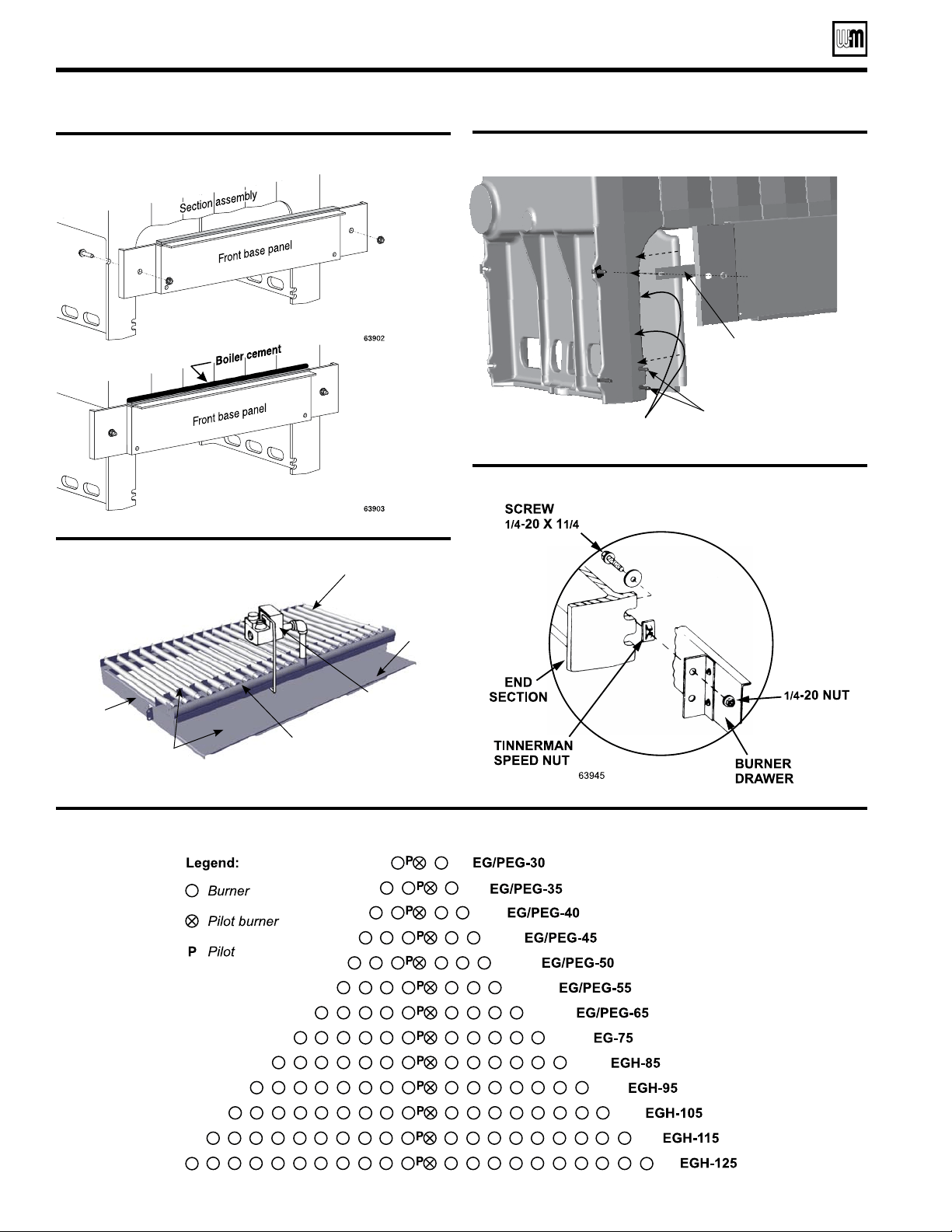
Installation of side refractory -EGH only
1. See Figure 7b & 7d. Hardware for drawer assembly must be
installed (Figure 10, page 12), before sliding refractory in place.
2. Apply silicone to the inside surface of the cast iron end
section leg.
3. Slide refractory (2 pieces left & right side) into place.
4. Install four (4) refractory clips (See Figure 7b & 7d) to hold
refractory in place.
Installation of drawer assembly, front
base panels – EG/EGH
(Factory installed on PEG boilers)
1. See Figure 7c, page 12. Fasten front base panel (6 Z\, inch high)
and rear base channel to section assembly. Seal with boiler
cement along top of insulation panels.
2. The burner drawer assembly consists of the burner drawer,
main burners, gas manifold, pilot burner, etc.
3. Check for proper orifice sizing from Table 5, page 13.
Proper orifices must be used. Failure to do so will
cause severe personal injury, death or substantial
property damage.
4. Place burners in the drawer assembly as shown in Figures 8
and 9, page 12.
5. Slide the drawer assembly under the front base panel and at-
tach to the section assembly as shown in Figure 10, page 12.
6. Level and straighten burners.
Burners must be properly seated in slots in back
burner support with openings facing up. Gas
orifices must inject down center of burner. Failure
to properly seat burners will result in severe personal
injury, death or substantial property damage.
7. EG 30 – EG-75 only: Install rollout thermal fuse element with
wire terminals facing up on front access panel as shown in
Figure 11, page 13. Wire per the appropriate Control Supple-
ment.
Figure 6b Flue collector hood
Figure 7b EGH - Rear base panel & refractory and
refractory clip
Note! Silicone to be applied to inside of leg of cast surface.
Part Number 550-142-303/1120
12
EG
/
PEG sEriEs 6
•
EGH sEriEs 5 Gas-firEd boilErs — boilEr manual
Prepare the boiler (continued)
Figure 10 Burner drawer installation
Figure 9 Burner and pilot burner locations
Figure 8 EGH Burner drawer assembly
Figure 7c EG/EGH - Front base panel
(Factory installed on PEG boilers)
Burner
Combination
Gas Valve
(EGH shown,
See page 35
for EG
Burner & base shield
on EGH Boilers only
Manifold
Drawer
Pilot Burner not shown
See Figure 9 for locations
Flange
to front
of boiler.
Figure 7d EGH - Refractory placement & front base panel
Four (4) refractory clips will
hold refractory.
1/4” Hardware for mounting front
and rear base panels needs to be in
place before refractory (2 pieces left
& right side) are slid into place.
Note! Silicone to be applied to
inside of leg of cast surface.
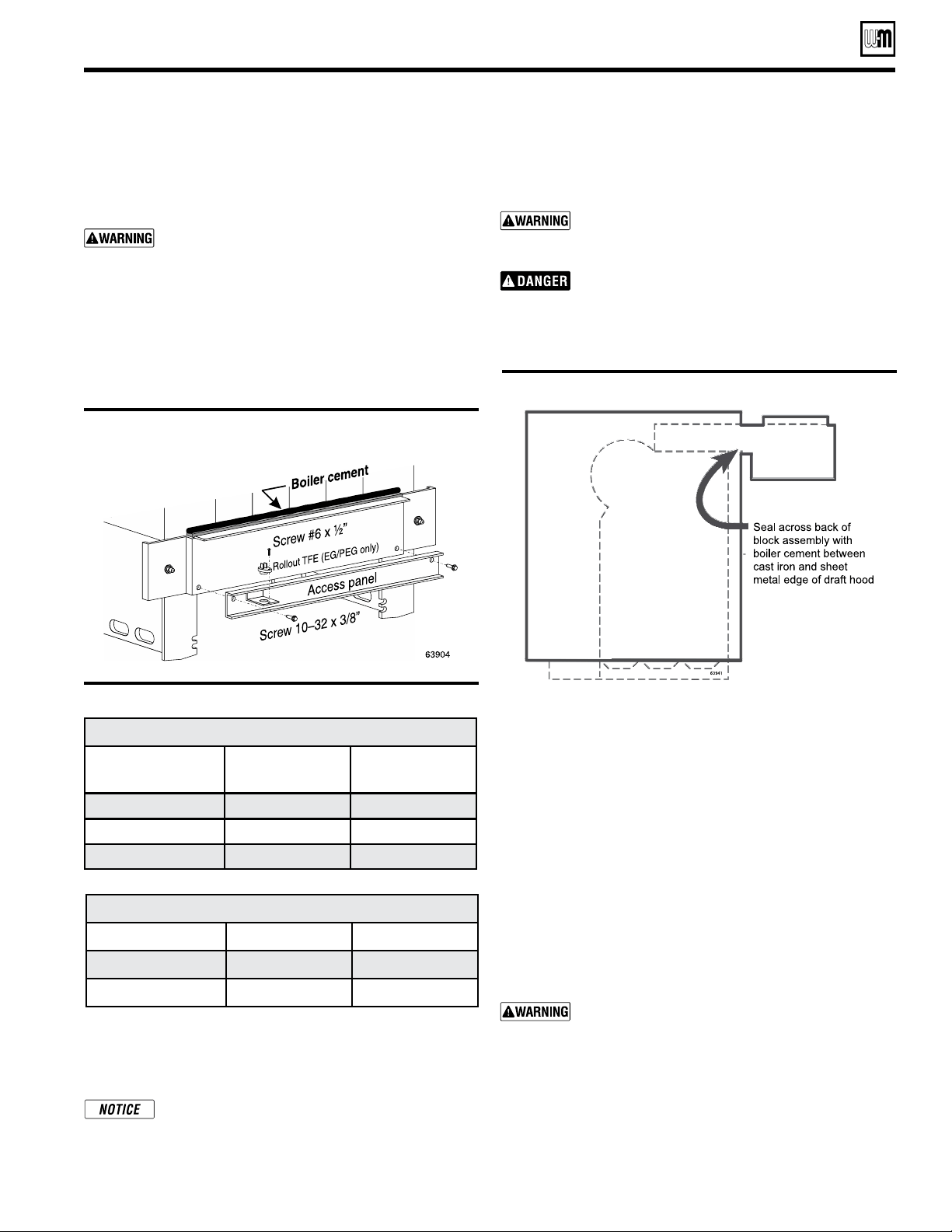
Part Number 550-142-303/1120
13
EG
/
PEG sEriEs 6
•
EGH sEriEs 5 Gas-firEd boilErs — boilEr manual
Figure 11 EG/EGH - Access panel
(Factory installed on PEG boilers)
Spill switch installation
EG 30 – EG 75 and PEG 30 – PEG 65 boilers only, fasten spill
switch to draft hood as shown on page 34, Drawing Ref. Letter “K”.
Connect wires as shown in the appropriate Control Supplement.
Damper installation
If damper will be installed, see Control Supplement for informa-
tion.
Breeching erection
Connect from draft hood or damper outlet to chimney or vent
with same size breeching. Where possible, vertical venting to the
outside from draft hood or damper outlet will offer best perfor-
mance. Where horizontal breeching is used, slope upward at least
1/4 inch per lineal foot toward chimney or vent and support with
hangers to prevent sagging.
A vertical height of 3 feet to 5 feet of breeching before
any elbow or horizontal breeching is recommended
to reduce chances of flue gas spillage at draft hood
on EGH-95 thru -125 boilers (not restricted on any
EG or EGH-85). Long horizontal breechings, exces-
sive numbers of elbows or tees, or other obstructions
which restrict the flow of combustion gases should
be avoided.
Breeching must not be connected to any portion of a mechanical
draft system operating under positive pressure.
Jacket installation (Factory installed on PEG)
1. Remove the proper knockout discs from panels as shown in
Table 4, page 10.
Tankless and storage heater knockouts must be
removed for EG and EGH boilers with optional
tankless heaters prior to jacket installation.
2. Follow Jacket Instructions in jacket carton.
Figure 12 Draft hood
Prepare the boiler (continued)
Table 5 Orifice drill sizes
Draft hood installation
Attach draft hood to flue collector hood using #10 x 1/2” sheet
metal screws provided. Use boiler cement furnished to provide
gas tight seal.
Failure to maintain gas-tight seal can cause flue gas
spillage and carbon monoxide emissions, resulting
in severe personal injury or death.
Do not alter boiler draft hood or place any obstruc-
tion or non-approved damper in the breeching or
vent system. CSA certification will become void.
Flue gas spillage and carbon monoxide emissions
will occur causing severe personal injury or death.
Installation of base shield - EGH only
1. See Figure 8, page 12, slide base shield under burner drawer
assembly.
2. The flanged end of the shield should be located at the front
of the boiler.
The installer must install base shield, flanged
end of shield at front of boiler for proper boiler
operation.
Inspect burners – PEG boilers
1. PEG boiler are factory-assembled, but the burners and base
panels should be inspected to ensure they are in good condi-
tion.
2. Remove the access panel (Figure 11) and inspect the burners
per step 6 on page 11. Replace the access panel.
Orice Drill Sizes
Boiler Model Natural Gas Propane Gas
EG 30-65
2.35mm ------
EG 75
2.30mm ------
EGH 85-125
2.30mm 1.40mm
Orice Drill Sizes EG/PEG Canada Only
Elevation Natural
Propane
0-2,000 ft. 2.45mm ------
2,000-4,500 ft. 2.30mm ------
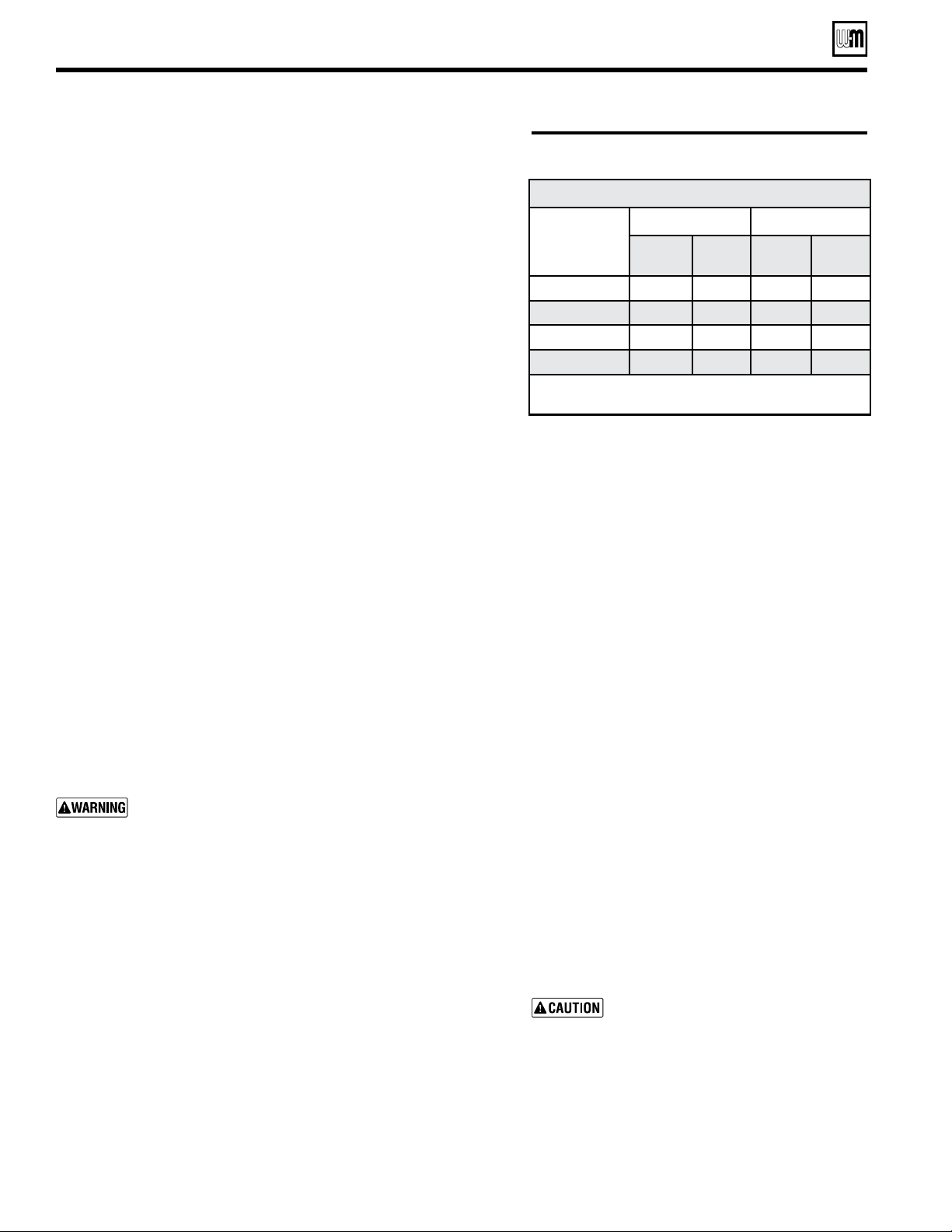
Part Number 550-142-303/1120
14
EG
/
PEG sEriEs 6
•
EGH sEriEs 5 Gas-firEd boilErs — boilEr manual
General
Install the boiler jacket before connecting return piping. (Supply piping
can be connected before or after jacket installation.) Connect controls
after all piping is connected.
If installation is to comply with ASME or Canadian requirements, an ad-
ditional high temperature limit may be needed. Install control in supply
piping between boiler and isolation valve. Set second control to minimum
20 °F above set point of first control. Maximum allowable set point is 240
°F. See page 23 for wiring.
A low water cutoff device is required when boiler is installed above radia-
tion level or by certain state or local codes or insurance companies. The
boiler has a pre-installed water temperature sensor. EG water boilers are
equipped with a water temperature and low water sensor and the control
modules includes functionality for low water monitoring. An additional
external low water cutoff device may be used simultaneously if necessary.
Use backflow check valve in cold water supply if required by local codes.
Isolation valves
Isolation valves are required to enable servicing of the boiler’s temperature
sensor. Install as shown in appropriate piping diagram.
Near-boiler piping
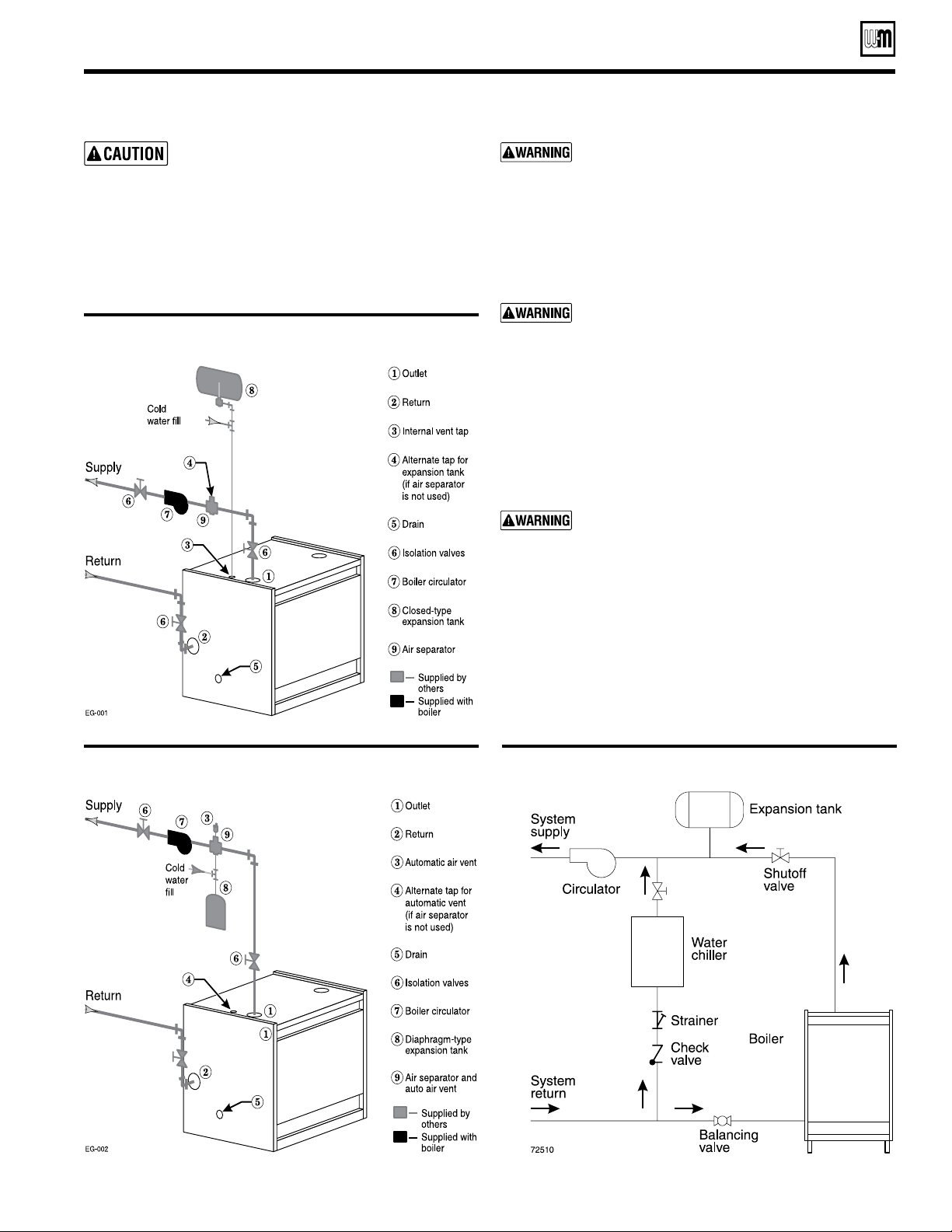
Boiler connections
1. EG — Connect supply and return to left end.
2. Plug all unused connections.
Systems operating at or above 130°F (Return water temperature)
See Table 6 and Figure 14, page 15 (diaphragm-type or bladder-type ex-
pansion tank) or Figure 13 (closed-type expansion tank) on page 15 for
near-boiler piping for systems designed for return water at least 130 °F.
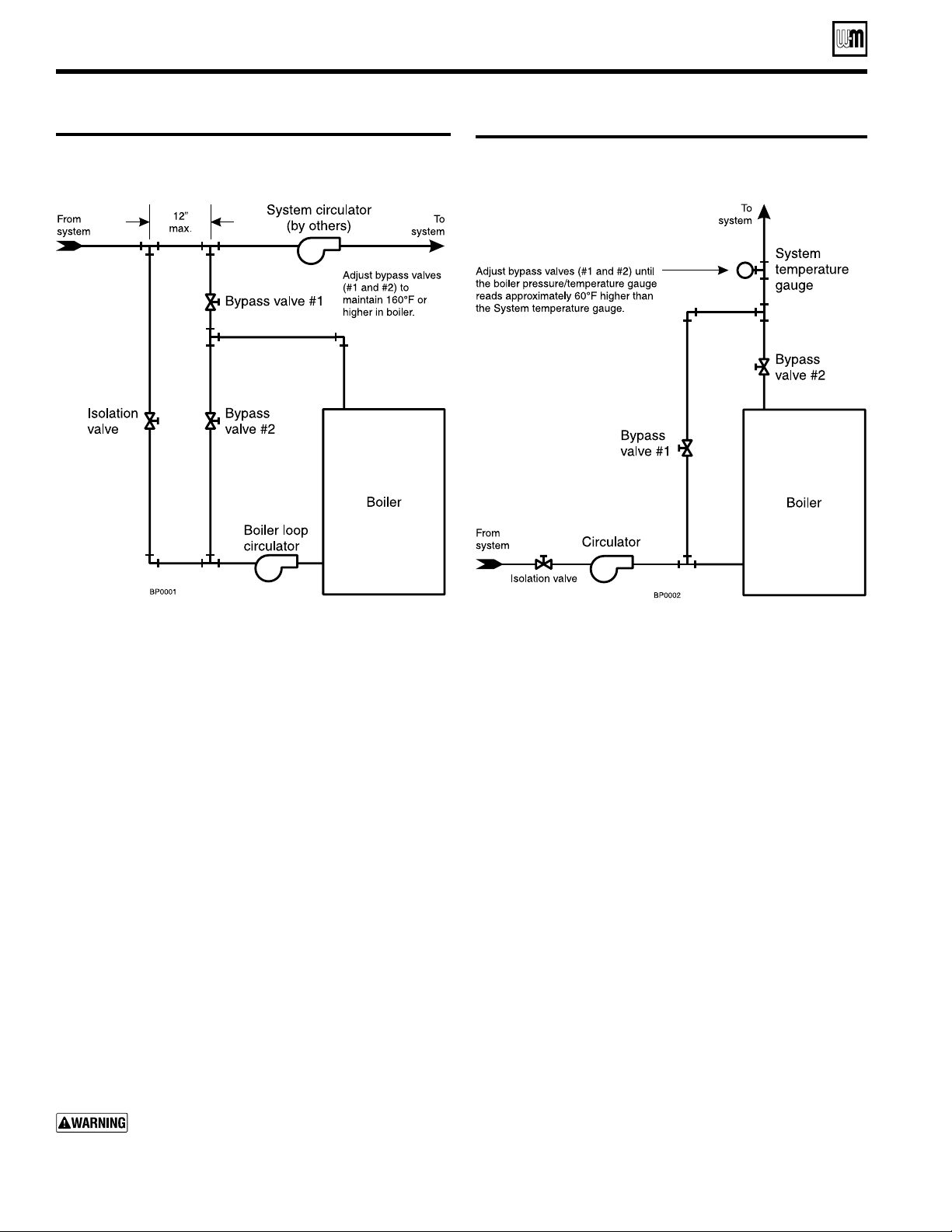
Low-temperature systems
1. See Figures 16 and 17, page 16 for near-boiler piping for low-temper-
ature or high-volume systems.
2. See Figure 15, page 15 for boilers used with refrigeration systems.
Relief valve
Install relief valve vertically in ¾” tapping on side of boiler. See the tag
attached to the relief valve for manufacturer’s instructions.
To avoid water damage or scalding due to valve operation, dis-
charge line must be connected to relief valve outlet and run to a
safe place of disposal. Terminate the discharge line to eliminate
possibility of severe burns should the valve discharge.
• Dischargelinemustbeasshortaspossibleandbethesamesize
as the valve discharge connection throughout its entire length.
• Dischargelinemustpitchdownwardfromthevalveandter-
minate at least 6” above the floor drain where any discharge
will be clearly visible.
• Thedischargelineshallterminateplain,notthreaded,with
a material serviceable for temperatures of 375 °F or greater.
• Donotpipethedischargetoanyplacewherefreezingcould
occur.
• Noshutoffvalveshallbeinstalledbetweenthereliefvalve
and boiler, or in the discharge line. Do not plug or place any
obstruction in the discharge line.
• Failuretocomplywiththeaboveguidelinescouldresultin
failure of the relief valve to operate, resulting in possibility of
severe personal injury, death or substantial property damage.
• Testtheoperationofthevalveafterllingandpressurizing
system by lifting the lever. Make sure the valve discharges
freely. If the valve fails to operate correctly, replace it with a
new relief valve.
Circulator
The circulator is not provided, but wiring is supplied
with boiler to allow you to locate it either in the return
or supply piping, as desired. See page 12 for a typical
installation. Pipe the expansion tank to the suction
side of the circulator whenever possible. Install an air
separator in the supply piping. Connect the expansion
tank to the air separator only if the separator is on the
suction side of the circulator. Always install the system
fill connection at the same point as the expansion tank
connection to the system. Figures 13 and 14, page 15
show typical near-boiler piping connections.
Expansion tank
Diaphragm-type or bladder-type tank — Figure 14,
page 15
1. Ensure expansion tank size will handle boiler and
system water volume and temperature. Tank must
be located in boiler return piping as close to boiler
as possible, before inlet side of circulator. See tank
manufacturer’s instructions for details.
2. Install an automatic air vent as shown.
Closed-type tank — Figure 13, page 15
1. Ensure expansion tank size will handle boiler and
system water volume and temperature. See tank
manufacturer’s instructions for details.
2. Connect tank to ½” NPT tapping located behind
supply outlet, using ½” NPT piping. Pitch any
horizontal piping up towards tank 1 inch per 5 feet
of piping.
Undersized expansion tanks cause system
water to be lost from relief valve and
makeup water to be added through fill
valve. Eventual section failure can result.
Water piping — multiple zone systems
Install system piping using either circulator zoning or
zone valve zoning. Install expansion tank on suction side
of system circulator. Always connect fill line only at the
expansion tank — never at another point in the system.
Table 6 Minimum recommended pipe sizes
Connect piping – water boilers – EG only
Minimum Recommended Pipe Sizes (for 20°F rise)
Boiler
model
Forced-ow systems Gravity-ow systems
Supply
“A”
Return
“B”
Supply
“A”
Return
“B”
EG-30, 35 1” 1” 1 ½” 1 ½”
EG-40, 45, 50 1 ¼” 1 ¼” 2” 2”
EG-55, 65 1 ½” 1 ½” 2 ½” 2 ½”
EG-75 2” 2” 2 ½” 2 ½”
Note: * All supply and return pipe sizes are based upon a 2°
F temperature rise through the boiler.
Part Number 550-142-303/1120
15
EG
/
PEG sEriEs 6
•
EGH sEriEs 5 Gas-firEd boilErs — boilEr manual
Figure 13 Recommended piping – forced hot water boilers
with closed type expansion tanks
Figure 14 Recommended piping – forced hot water boilers
with diaphragm type expansion tanks
Use Figure 13 or Figure 14 only for systems designed
for return water at least 130 °F. For systems with low
return water temperature possible, such as converted
gravity systems and radiant heating systems, install
bypass piping (see page 16) to protect boiler against
condensation. Failure to prevent low return water
temperature to the boiler could cause corrosion of the
boiler sections or burners, resulting in severe personal
injury, death or substantial property damage.
If system includes radiant heating circuits, provide
piping and controls to regulate the temperature sup-
plying the radiant circuits. Failure to comply could
result in substantial property damage.
Water piping — refrigeration systems
Prevent chilled water from entering boiler
Install boiler so that chilled medium is piped in parallel with the
heating boiler. Use appropriate valves to prevent chilled medium
from entering boiler. See Figure 15 for typical installation of
balancing valve and check valve.
Install boiler so that chilled medium is piped in
parallel with heating boiler (Figure 15). Use ap-
propriate valves to prevent chilled medium from
entering boiler. Consult AHRI Installation and
Piping Guides.
If boiler is connected to heating coils located in
air handling units where they can be exposed to
refrigerated air, use flow control valves or other au-
tomatic means to prevent gravity circulation during
cooling cycle. Circulation of cold water through the
boiler could result in damage to the heat exchanger,
causing possible severe personal injury, death or
substantial property damage.
Figure 15 Recommended piping – refrigeration systems
Connect piping – water boilers – EG only (continued)
DO NOT connect directly from 3-wire zone
valves to the T-T terminals on the boiler
.
When using 3-wire zone valves, install an isolation
relay. Connect the zone valve end switch wires to
the isolation relay coil. Connect the isolation relay
contact across the boiler T-T terminals. Failure
to comply can result in damage to boiler com-
ponents or cause unreliable operation, resulting
in severe property damage.
Part Number 550-142-303/1120
16
EG
/
PEG sEriEs 6
•
EGH sEriEs 5 Gas-firEd boilErs — boilEr manual
Figure 16 System bypass piping in boiler loop with separate
system circulator, using primary/secondary
piping.
Figure 17 Boiler bypass piping — use only for high water
content systems —DO NOT use for radiant panel
systems.
Connect piping – water boilers – EG only (continued)
Install all components specified above and adjust valves as described to prevent low temperature in the boiler. Failure to
prevent low water temperature in the boiler could cause corrosion of the boiler sections or burners, resulting in severe
personal injury, death or substantial property damage.
System bypass method
1. Apply bypass piping of Figure 16 to high water content
systems, radiant panel systems or any system that is likely
to operate with low return water temperature for extended
periods.
2. The bypass arrangement shown protects the boiler from dam-
age caused by condensate corrosion due to low return water
temperature and protects low temperature systems from too
high a supply temperature.
3. Adjust the bypass valves as indicated below.
Adjust bypass valves 1 and 2 as follows:
1. Start with valve 2 fully closed, valve 1 fully open.
2. Slowly open valve 2 while closing valve 1. Adjust the valves
until the boiler pressure/temperature gauge reads 160 °F or
higher. As you open the valves, pause long enough to allow
temperatures to level off. It takes a while for the boiler water
temperature to rise as the flow changes.
3. Bypass valve 2 allows hot boiler outlet water to blend with
colder return water, raising the supply temperature to the
boiler. Bypass valve 1 balances the pressure drop through valve
2.
4. The purpose of this piping is to raise the return water temperature
to the boiler enough to prevent condensation of flue gases.
Boiler bypass method
1. Apply bypass piping of Figure 17 to high water content
systems, such as converted gravity systems.
2. The bypass arrangement shown protects the boiler from
damage caused by condensate corrosion due to low return
water temperature. This method does not provide protection
from high temperature water being supplied to the system.
3. DO NOT apply this piping to radiant panel systems.
4. Adjust the bypass valves as indicated below.
Adjust bypass valves 1 and 2 as follows:
1. Start with valve 1 fully closed, valve 2 fully open.
2. Slowly open valve 1 while closing valve 2. Adjust the valves
until the boiler pressure/temperature gauge reads approxi-
mately 60 °F higher than the system temperature gauge. As
you open the valves, pause long enough to allow temperatures
to level off. It takes a while for the boiler water temperature
to rise as the flow changes.
3. Bypass valve 1 controls system flow rate. Bypass valve 2
controls flow through the boiler.
4. The purpose of this piping is to cause a high enough tem-
perature rise in the boiler that the average temperature will
be warm enough to prevent condensation of flue gases.
H
H
A
J
J
J
Water line
Close nipple
Reducing elbow or
elbow with bushing
Condensate return
23 / "
13
16
2"
Boiler
front
Steam to system
73832
EG/PEG
H
H
A
J
J
J
Water line
Close
nipple
Reducing elbow or
elbow with bushing
Condensate
return
23 / "
13
16
2"
Boiler
front
Steam to
system
73832a
Install offset header
to prevent bending
at section tappings
EGH
B
Part Number 550-142-303/1120
17
EG
/
PEG sEriEs 6
•
EGH sEriEs 5 Gas-firEd boilErs — boilEr manual
General
Failure to properly pipe the boiler may result in
improper operation and damage to the boiler or
building.
Steam supply must be on same end as controls.
Return may be from either end.
1. Install the boiler jacket before connecting return piping. (Sup-
ply piping can be connected before or after jacket installation.)
Connect controls after all piping is connected.
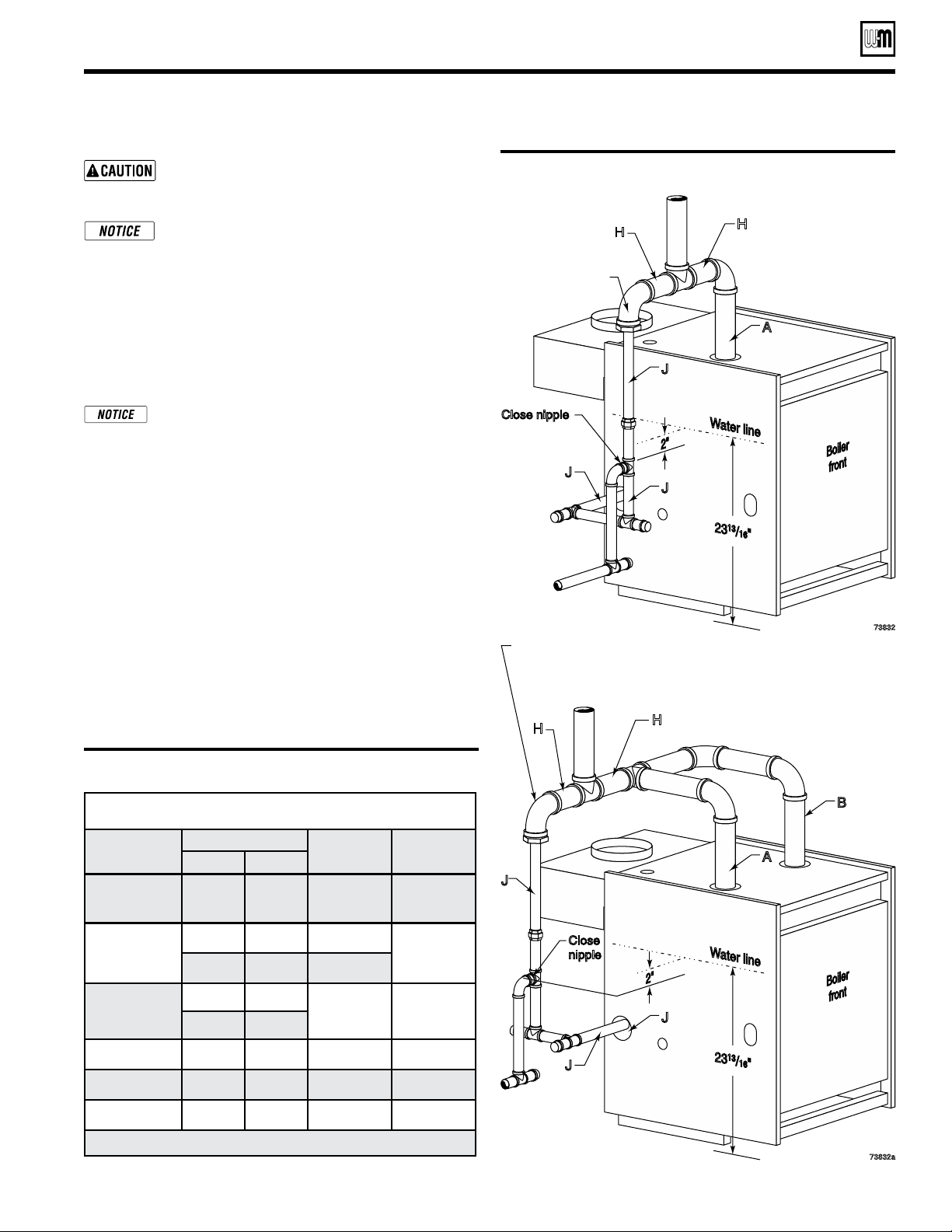
2. See Table 7 for recommended pipe sizing.
3. See Figure 5, page 10, for tapping locations.
4. EGH only - install 3/4” system blow-off (drain) valve in lowest
part of return piping close to boiler.
Condensate return —
• Satisfactory operation of a steam heating system depends
on adequate condensate return to boiler to maintain a
steady water level.
• Avoidaddingrawmakeupwater.
• Where condensatereturnisnotadequate,installlow
water cutoff/pump control, condensate receiver and
condensate boiler feed pump. Refer to Table 7, for sizing.
Connecting to parallel-flow piping
See Figure 18 for parallel-flow steam systems.
Connecting to counterflow piping
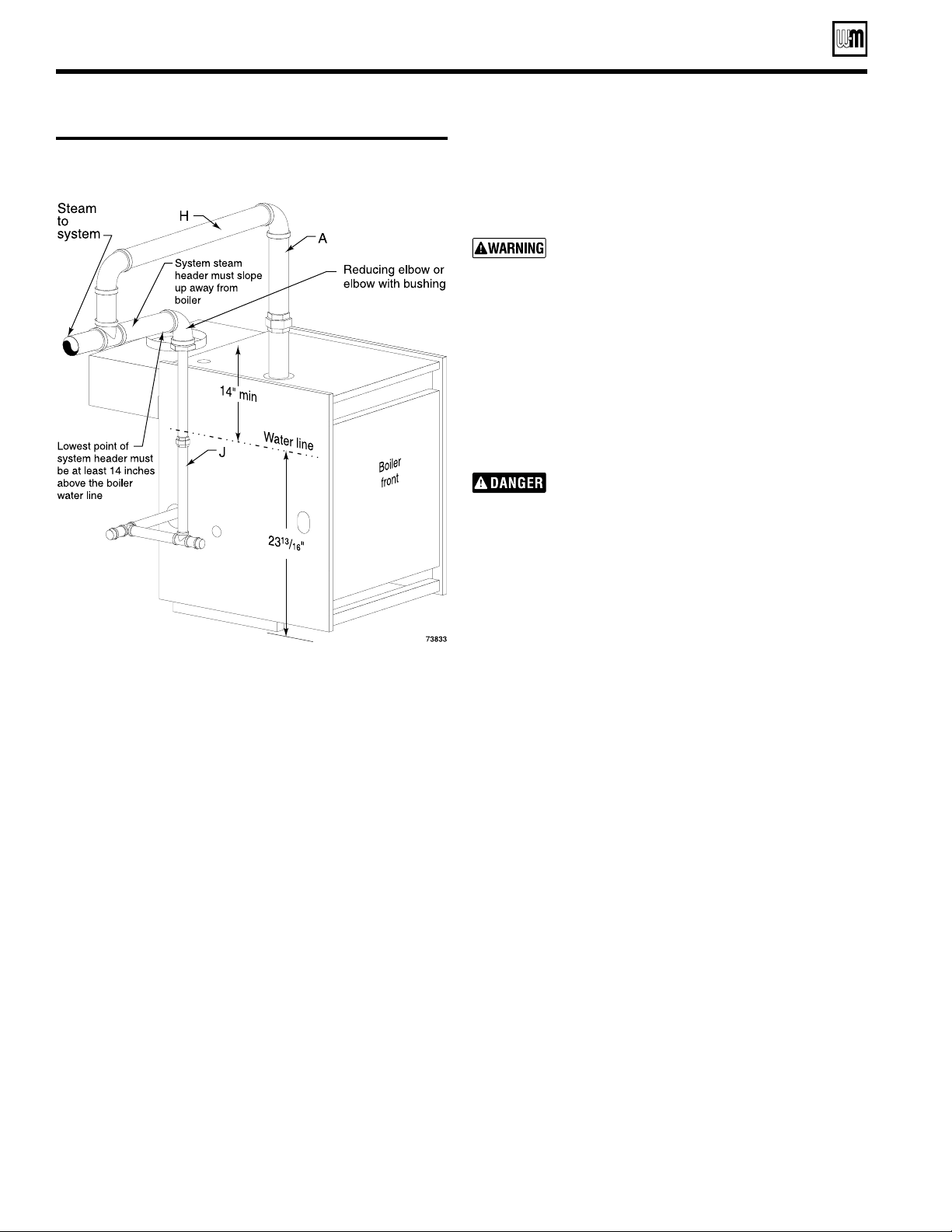
When connecting to a counterflow system, the boiler steam supply
must connect into the top of the counterflow system header, as
shown in Figure 19, page 18.
Figure 18 Recommended piping for parallel-flow systems
Table 7 Recommended steam boiler pipe sizing
Steam Boiler Piping Minimum Recommended Pipe Sizes
Boiler Model
Riser Pipe Size
Header *
H
Equalizer
J
A B
EG-30, 35
PEG-30, 35
2” –– 2” 1 ½”
EG-40, 45, 50
PEG-40, 45, 50
2 ½” –– 2 ½”
1 ½”
2” 2” 2 ½”
EG-55, 65, 75
PEG-55, 65
2” 2”
3” 1 ½”
3” ––
EGH-85, 95
2” 2” 3” 1 ½”
EGH-105
2 ½” 2 ½” 3” 1 ½”
EGH-115, 125
2 ½” 2 ½” 4” 1 ½”
* 24” minimum from waterline to bottom of header.
Connect piping – steam boilers (continued)
Part Number 550-142-303/1120
18
EG
/
PEG sEriEs 6
•
EGH sEriEs 5 Gas-firEd boilErs — boilEr manual
Installing the relief valve
Install relief valve in tapping on top of boiler. See Table 4, page
10, for control tapping locations. See the tag attached to the relief
valve for manufacturer’s instructions.
Follow the steps below to avoid potential severe per-
sonal injury, death or substantial property damage.
• Wheninstallingthereliefvalve,ensurethatallconnec-
tions, including the valve inlet, are clean and free from
any foreign matter.
• Mountthereliefvalveonlyintheverticalposition,directly
connected to the tapping designated in the manual on top
of the boiler.
• Usepipecompoundsparingly,ortape,onexternalthreads
only.
• Donot use apipewrench!Usepropertypeand size
wrench on wrench pads only.
During operation, this valve may discharge large
amounts of steam and/or hot water. Therefore, to
reduce the potential for bodily injury and property
damage, a discharge line MUST be installed that:
• Isconnectedfromtheoutlettoasafepointofdischarge
with no intervening valve.
• Allowscompletedrainageofboththevalveandthedis-
charge line.
• Isindependentlysupportedandsecurelyanchoredsoas
to avoid applied stress as possible.
• Terminatesfreelytoatmospherewhereanydischargewill
be clearly visible and is at no risk of freezing.
• Is,overitsentirelength,ofapipesizeequaltoorgreater
than that of the valve outlet.
Use only schedule 40 metal pipe for discharge. (Do not
use schedule 80, extra strong or double strong pipe or
connections.) DO NOT CAP, PLUG OR OTHERWISE
OBSTRUCTDISCHARGEPIPEOUTLET!Ifdischarge
is piped upward, a condensate drain must be provided in
the elbow below the vertical pipe to prevent condensate
from returning into the valve. Failure to comply with these
instructions will cause a dangerous spray of hot water and
steam that would cause severe personal injury or death.
Figure 19 Connection to counter flow steam piping
Connect piping – steam boilers (continued)
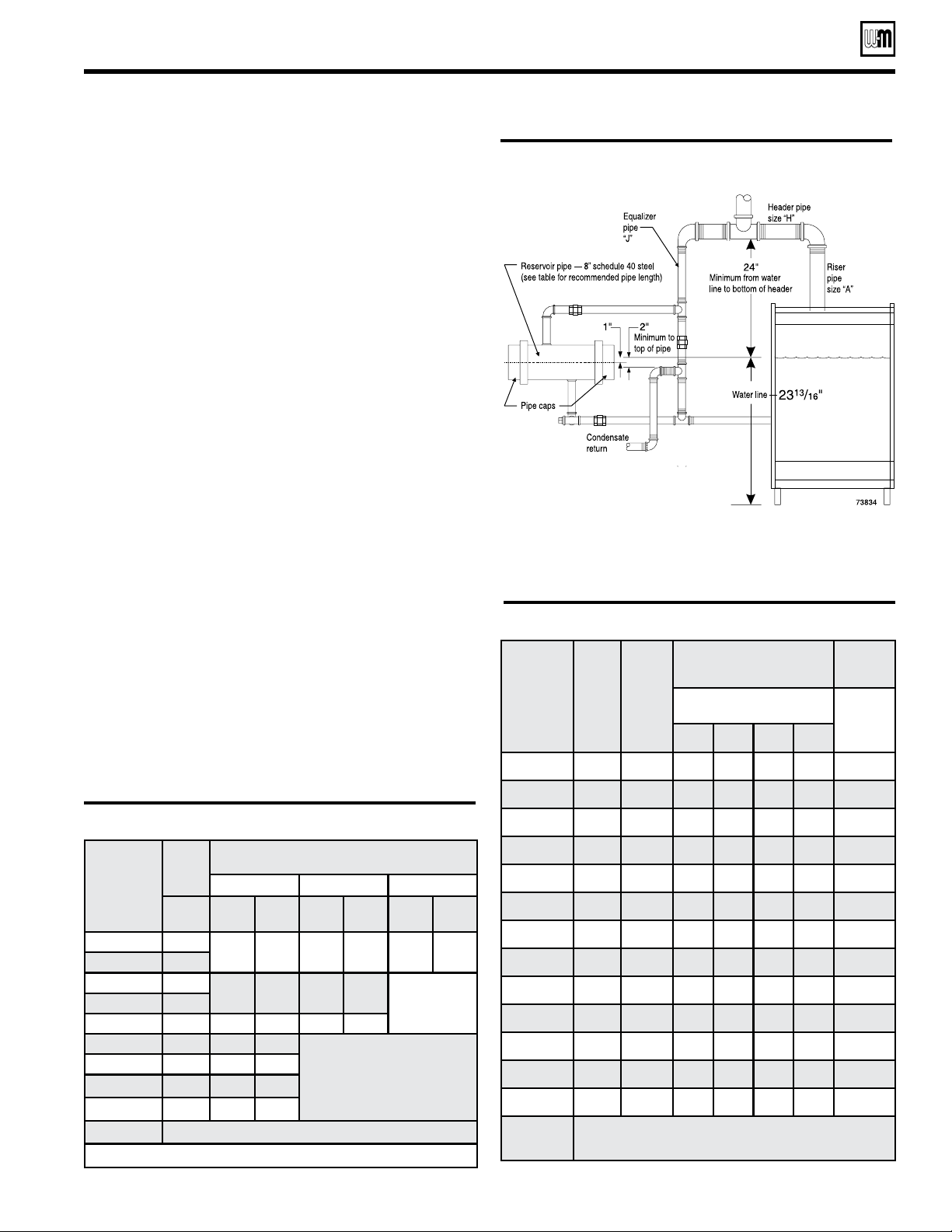
Figure 20 Recommended piping for parallel-flow systems
with optional reservoir pipe
Part Number 550-142-303/1120
19
EG
/
PEG sEriEs 6
•
EGH sEriEs 5 Gas-firEd boilErs — boilEr manual
Connect piping – steam boilers (continued)
Table 9 Boiler feed system sizing
Condensate return
Modern steam boilers are designed to steam for less time than
older, larger boilers. When replacing an older steam boiler the
system condensate return time may be longer than the steaming
time. This could cause the following problems:
1. Boilers fitted with an automatic water feed could overfill.
2. Units fitted with only a low water cutoff would shut down
and cycle while waiting for condensate to return.
Following is a simple method for determining whether or not a
reservoir pipe is required to lengthen steaming time for a resi-
dential installation:
1. Disconnect condensate return line at existing boiler.
2. Heat
boiler and allow to steam for 10 minutes. Turn off boiler.
3. Measure length of time from when boiler started to steam to
when condensate begins to return through condensate line.
4. Measure length of time from when condensate begins to
return to when it stops returning. Divide this time by 2.
5. Add time measured in step 3 to time calculated in step 4. This
sum is the average time required for condensate to return to
the boiler.
6. If this total time is 10 minutes or less, no reservoir pipe is
needed.
If total time for condensate to return to boiler (from step 5) is
more than 10 minutes, a reservoir pipe (or boiler feed system) is
recommended. See Table 8 and Figure 20 for suggested reservoir
pipe size. Install as shown in Figure 20.
For larger systems (as noted in Table 8), use a boiler feed system
with a condensate tank and feed pump. You will have to install a
low water cutoff/pump control on the boiler to operate the pump.
Use Table 9 to size boiler feed systems. See Figure 5, page 10, for
tapping locations. (The use of a combination condensate tank and
float-controlled condensate return pump is not recommended.)
For most residential installations a reservoir pipe may be all that
is necessary to ensure proper operation.
Boiler
model
number
Max.
boiler
gross
output
Time from initial steaming to average condensate return
(boiler steaming capacity based on 970 Btu per pound of steam)
15 minutes 20 minutes 30 minutes
MBH gallons
pipe
length
(feet)
gallons
pipe
length
(feet)
gallons
pipe
length
(feet)
EG/PEG-30
64
¾ ¾ 1 ½ 1 ½ 3 2 ½
EG/PEG-35
85
EG/PEG-40
106
1 ¼ 1 ¼ 2 ½ 2 ¼
Use boiler feed
system
EG/PEG-45
127
EG/PEG-50
148 1 ½ 1 ½ 3 2 ½
EG/PEG-55
169 1 ¾ 1 ¾
Use boiler feed
system
EG/PEG-65
201 2 ¼ 2 ¼
EG-75
237 2 ½ 2 ½
EGH-85
243 2 ½ 2 ½
EGH-95 up Not recommended –– Use boiler feed system if needed
Designed full capacity steaming time of modern boilers is 10 minutes.
Table 8 Reservoir pipe sizing
Boiler
Model
Gross
Output
Pounds
Steam
Per
Hour
Gallons
Conden-
sate
Per
Hour
Minimum Condensate
Receiver Capacity (Gal.)
Recom-
mended
Maximum
Minutes of boiler
operation:
Feed
Pump
Capacity
GPM
*
15 30 45 60
EG/PEG-30
62 7 ½ 2 5 7 10 0.3
EG/PEG-35
82 10 3 7 10 13 0.3
EG/PEG-40
103 12 ½ 4 8 12 17 0.4
EG/PEG-45
124 15 5 10 15 20 0.5
EG/PEG-50
145 17 ½ 6 12 17 23 0.6
EG/PEG-55
166 20 7 13 20 27 0.7
EG/PEG-65
198 25 8 17 25 33 0.8
EG-75
234 29 ½ 10 20 29 39 1.0
EGH-85
253 29 10 19 29 39 1.0
EGH-95
290 33 ½ 11 22 33 45 1.1
EGH-105
325 37 ½ 12 25 37 50 1.3
EGH-115
361 41 ½ 14 28 41 55 1.4
EGH-125
398 46 15 31 45 61 1.5
*
If pump capacity exceeds capacity shown, pump can
be throttled with globe or ball valve.
Part Number 550-142-303/1120
20
EG
/
PEG sEriEs 6
•
EGH sEriEs 5 Gas-firEd boilErs — boilEr manual
Failure to properly install, pipe and wire boiler
controls may result in severe damage to the
boiler, building and personnel.
Water boiler - EG only
1. Install controls as shown on Control Tapping Table and
Figure 5, page 10.
2. Additional low water cut off for water boilers:
a. Install if boiler is located above radiation level.
b. May be required on water boilers by certain state, local or
territorial codes or insurance companies. If a low water
cut-off is used on a water boiler, use a control designed
especially for water installations.
An electrode probe type
may be located in a tee in
the supply line above boiler, also
see Table 4, page 10.
3. If system is to be ASME inspected and approved, an ad-
ditional high temperature limit is needed. Purchase and
install in supply line above boiler.
Steam boiler - EG, PEG & EGH
Water line dimension are measured from bot-
tom of boiler section leg where it rests on the
boiler room floor or boiler foundation.
1. For steam boilers furnished with probe-type low water
cut-offs, install as shown in Figure 21.
2. For steam boilers furnished with float type low water
cut-off, install controls as illustrated in Figure 22.
Install blow down line in bottom of cutoff. See Figure 22
and control manufacturer’s instructions for details.
Pipe blow down line near floor close to floor
drain to eliminate potential of severe burns. Do
not plug, valve or place any obstruction in blow
down line.
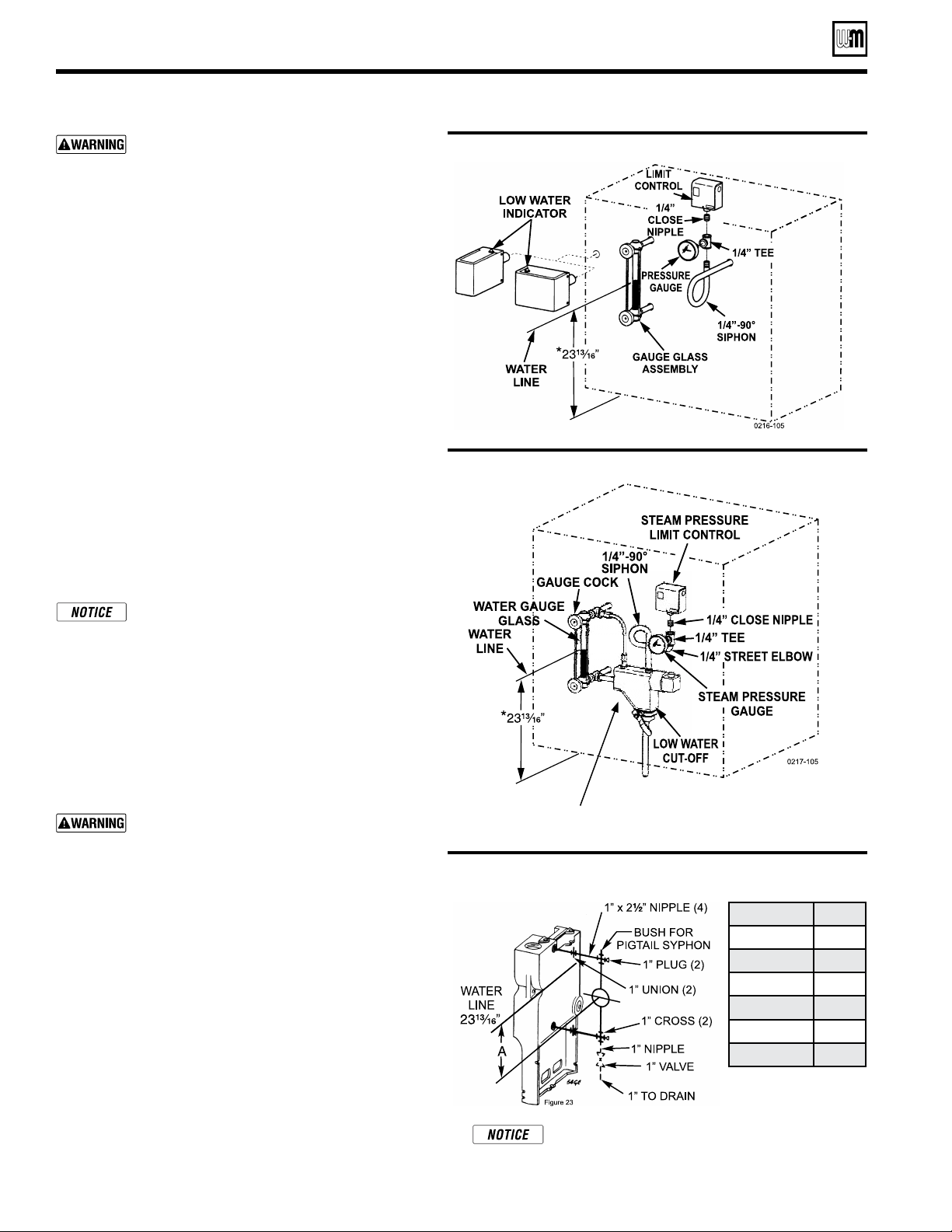
a. Other float-type water-level controls for EGH steam boilers
are shown in Figure 23. (Use 1 inch I.P.S. connections).
b. Water feeders are not recommended for primary control.
A low-water cut-off with pump controller is recommended
with a condensate receiver and feed pump.
3. Install remaining controls as shown in Table 4 and Fig-
ure 5, page 10.
Install boiler controls
Figure 23 EGH only - Piping for optional float-type water level
controllers for steam boilers
LWCO model numbers are manufacturer’s part
numbers that can be found in the Weil-McLain
Trade Price Schedule.
LWCO Dim A.
No. 247-2
7
³/16”
No. 61 2 ⅝”
No. 63 2 ⅝”
No. 51-2 1 ½”
No. 150, 157 2 ¼”
No. 93 2 ⅝”
Primary oat LWCO or secondary manual reset
LWCO with primary probe LWCO
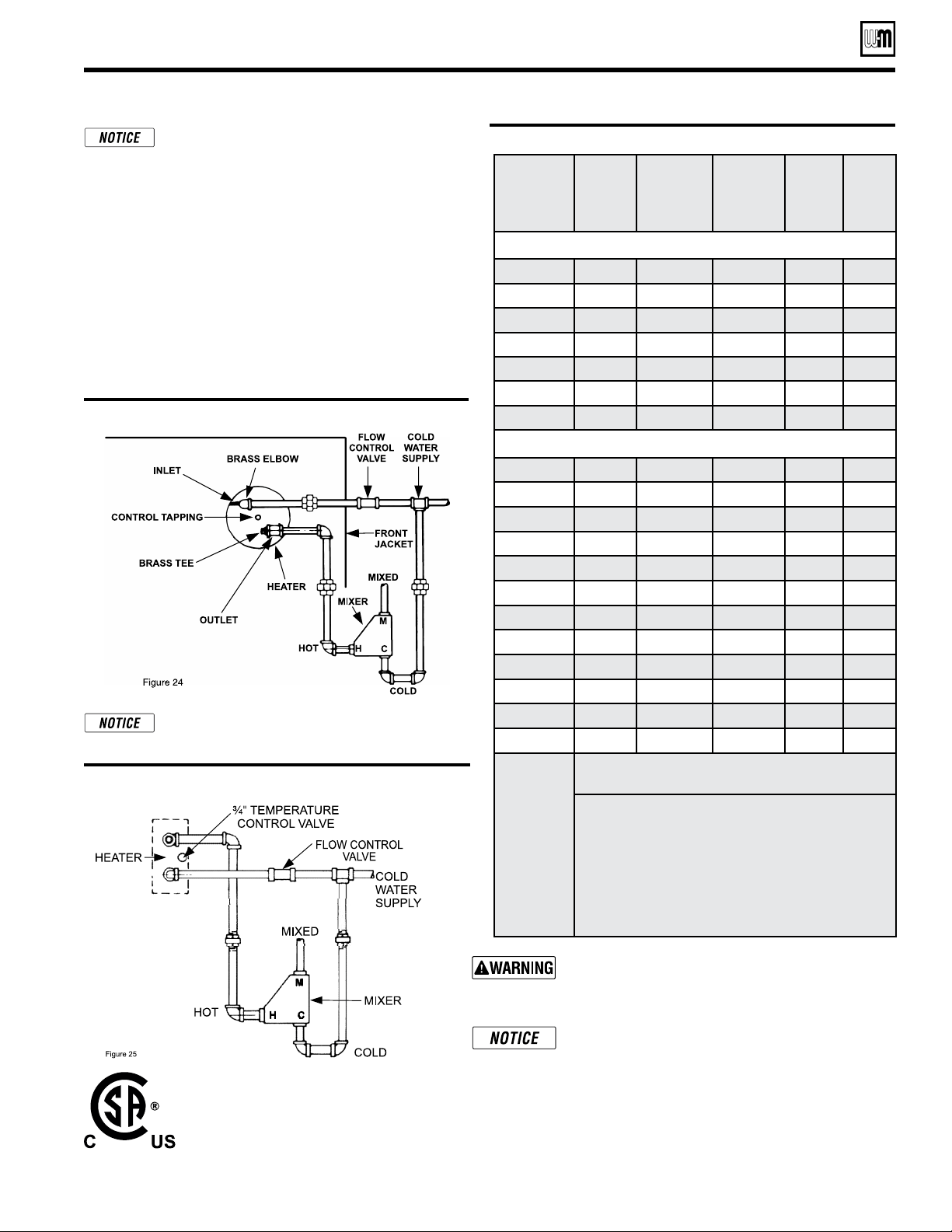
Figure 21 Probe-type low water cut-off - (Left side view)
Figure 22 Float-type low water cut-off - (Left side view)
Part Number 550-142-303/1120
21
EG
/
PEG sEriEs 6
•
EGH sEriEs 5 Gas-firEd boilErs — boilEr manual
EG and EGH boilers for tankless heater applica-
tion are available only on special order as factory-
installed optional equipment. Standard boilers
cannot be adapted for heater use. Install a tankless
heater only in a steam boiler or forced hot water.
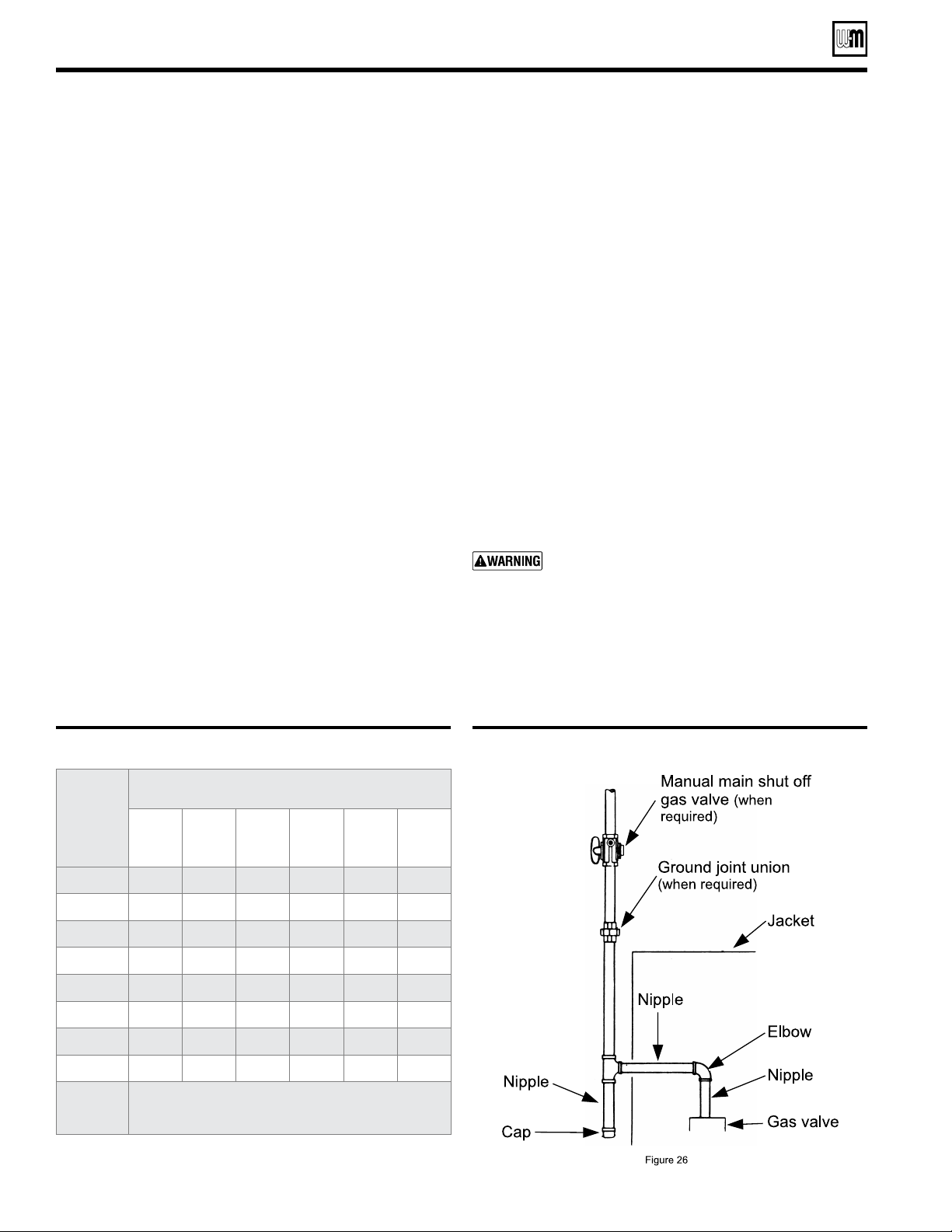
For correct operation, install as shown in Figure 24 (water boilers)
or Figure 25 (steam boilers).
1. Automatic mixing valve must be installed per mixing valve
manufacturer’s instructions.
2. Flow regulating valve must be installed. Size according to
intermittent draw of heater as shown in following table.
3. Operating control with a small differential scale is recom-
mended. Install in temperature control tapping in heater plate.
4. In hard water areas, it is advisable to soften cold domestic supply
water to the tankless heater to prevent lime buildup.
Figure 24 Tankless heater piping EG (water boiler)
Connect piping – tankless heater (optional)
Table 10 Minimum recommended pipe sizes
Piping connections not furnished. Use brass plugs
in tees and crosses to facilitate cleaning in hard
water areas.
Figure 25 Tankless heater piping EG/EGH (steam boiler)
Boiler
Model
Heating
Number
(Note 3)
Intermittent
Draw GPM
100°F Av.
Temp. Rise
(Note 1)
Continuous
Draw GPM
100°F Av.
Temp. Rise
(Note 2)
Inlet and
Outlet
Tappings
Temp.
Control
Tapping
Water
EG-35 E-624 3.00 1.60
½” ¾”
EG-40 E-624 3.00 2.00
½” ¾”
EG-45 E-624 3.25 2.40
½” ¾”
EG-50 E-626 4.00 2.80
½” ¾”
EG-55 E-626 4.25 3.20
½” ¾”
EG-65 E-632 4.50 4.00
½” ¾”
EG-75 E-632 4.50 4.80
½” ¾”
Steam
EG/PEG-35 35-S-29 3.00 1.60
¾” ¾”
EG/PEG-40 35-S-29 3.00 2.00
¾” ¾”
EG/PEG-45 35-S-29 3.25 2.40
¾” ¾”
EG/PEG-50 35-S-29 3.25 2.80
¾” ¾”
EG/PEG-55 35-S-29 3.50 3.20
¾” ¾”
EG/PEG-65 35-S-29 3.75 4.00
¾” ¾”
EG-75 35-S-29 4.00 4.80
¾” ¾”
EGH-85 35-S-29 4.00 5.00
¾” ¾”
EGH-95 35-S-29 4.00 5.00
¾” ¾”
EGH-105 35-S-29 4.00 5.00
¾” ¾”
EGH-115 35-S-29 4.00 5.00
¾” ¾”
EGH-125 35-S-29 4.00 5.00
¾” ¾”
Notes:
Weil-McLain ratings based on 60 PSIG domestic water pressure
at heater.
1. Gallons of water per minute heated from 40°F to 140°F with
200°F boiler water temperature.
2. Continuous draw – no recovery period.
3. These single wall heat exchangers comply with National
Standard Plumbing Code provided that:
• Boiler water (including additives is practically non toxic,
having a toxicity range or class of 1, as listed in Clinical
Toxicology of Commercial Products, and
• Boiler water pressure is limited to max. 30 PSIG by
approved water or steam relief valve.
Studies have indicated that dangerous bacteria can form
in potable water distribution system if certain minimum
water temperatures are not maintained. Contact local
health department for more information.
These single wall heat exchangers comply with National
Standard Plumbing Code provided that:
• Boilerwater(includingadditives)ispracticallynon-
toxic, having a toxicity rating or class of 1, as listed in
Clinical Toxicology of Commercial Products.
• Boilerwaterpressureislimitedtomaximum30psig
by approved water relief valve.
See Automatic mixing valve and Scaud warnings, page 27.
NSF/ANSI 372
Tankless water heaters for EG / EGH
boilers have been tested and certied by
CSA Group (certicate # 2552127).
Part Number 550-142-303/1120
22
EG
/
PEG sEriEs 6
•
EGH sEriEs 5 Gas-firEd boilErs — boilEr manual
Connecting gas supply piping
1. Size gas piping considering:
a. Diameter and length of gas supplying piping.
b. Number of fittings.
c. Maximum gas consumption (including any possible future
expansion).
d. Allowable loss in gas pressure from gas meter outlet to
boiler. For pressure drops, see ANSI Z223.1/NFPA 54 –
latest edition. Canadian installations must comply with
Natural Gas and Propane Installation Code, CAN/CSA
B149.1 or B149.2 Installation Codes.
2. For natural gas:
a. Refer to Table 11 or the National Fuel Gas Code. To obtain
cubic feet per hour, divide the input by 1000.
b. Size for rated boiler input.
c. Inlet gas pressure: 5”
w.c. minimum
13”
w.c. maximum
d. Manifold gas pressure: 3¹⁄₂"
w.c.
e. Install 100% lock-up gas pressure regulator in supply line
if inlet pressure exceeds 13"
w.c., then adjust for 13" w.c.
maximum.
3. For propane gas:
a. Inlet gas pressure: 11”
w.c. minimum
13”
w.c. maximum
b. Manifold gas pressure: 10”
w.c.
c. Gas pressure regulator provided by gas supplier must be
adjusted for maximum pressure of 13”
w.c.
d. Contact gas supplier to size pipes, tanks and regulator.
4. Remove knock-out disc from jacket panel which gas supply
is to be piped.
5. Follow good piping practices.
6. Pipe joint compound (pipe dope) must be resistant to cor-
rosive action of liquefied petroleum gases. Apply sparingly
only to make threads of pipe joints.
7. Install drip leg at inlet of gas connection to boiler. Where local
utility requires, extend drip leg to floor.
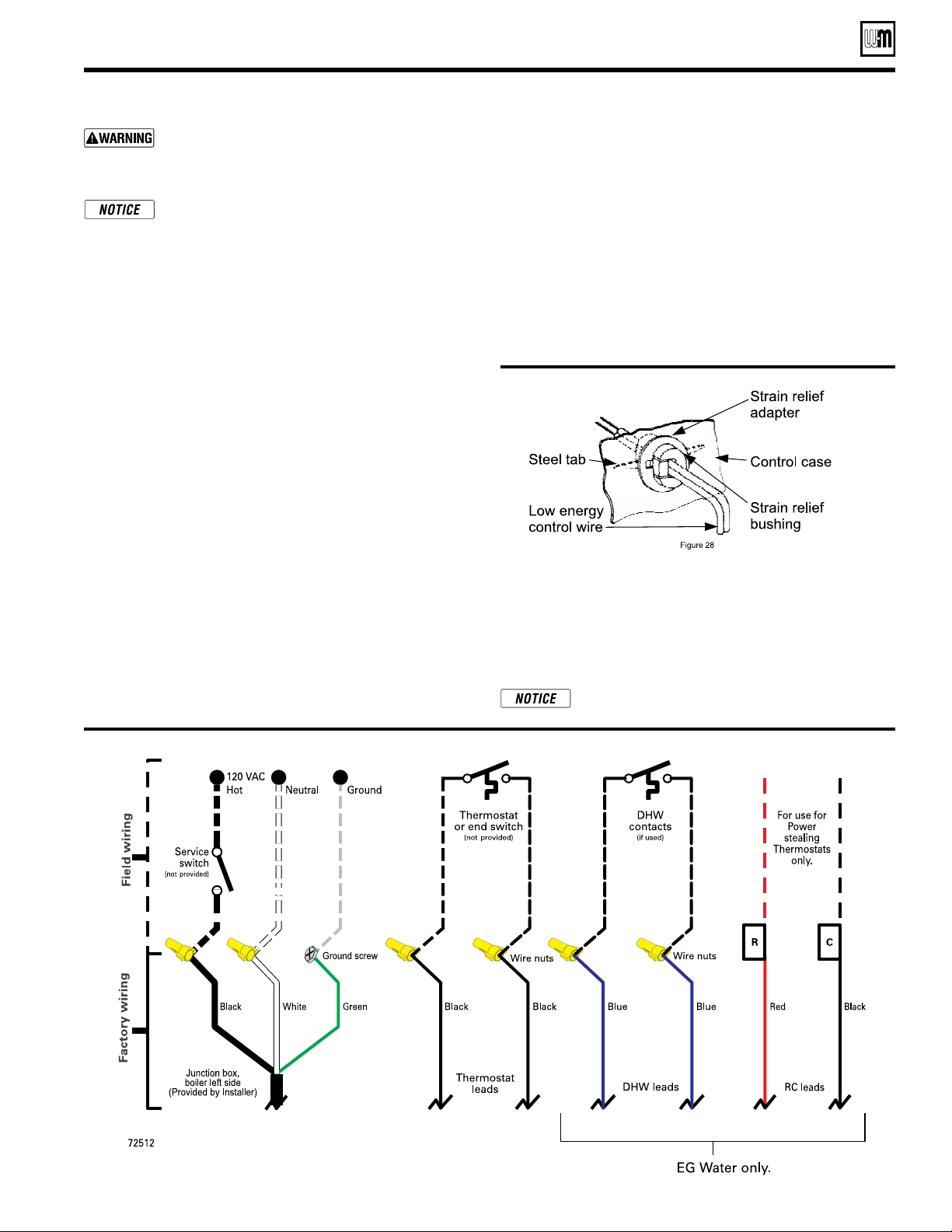
8. Install ground joint union when required for servicing. See
Figure 26.
9. Install manual shut-off valve outside boiler jacket as shown
in Figure 26 when required by local codes.
10. Support piping by hangers, not by boiler or its accessories.
11. In Canada only, the manual main shut off valve (when used)
must be identified by the installer.
12. Purge all air from piping.
13. Before placing boiler in operation, check boiler and its gas
connection for leaks.
Do not check for gas leaks with an open flame – use
bubble test. Failure to do so can cause severe per-
sonal injury, death or substantial property damage.
a. Close manual main shut-off valve during any pressure testing
at less than 13 inches water column.
b. Disconnect boiler and gas valve from gas supply piping during
any pressure test greater than 13 inches water column.
Figure 26 Gas supply piping
Connect gas supply piping
Table 11 Gas pipe capacities
Adjusted
length
of gas
supply
piping in
feet *
Capacity of pipe for pipe sizes in
cubic feet of gas per hour **
½” ¾” 1” 1¼” 1½” 2”
10 132 278 520 1050 1600 3050
20 92 190 350 730 1100 2100
30 73 152 285 590 860 1650
40 63 130 245 500 760 1450
50 56 115 215 440 670 1270
75 45 93 175 360 545 1020
100 38 79 150 305 460 870
150 31 64 120 250 380 710
Notes:
*
Include measured length of gas supply piping and allowance
in feet for number and size of ttings.
**
Specic Gravity - 0.60; Pressure loss - 0.30” w.c.
Part Number 550-142-303/1120
23
EG
/
PEG sEriEs 6
•
EGH sEriEs 5 Gas-firEd boilErs — boilEr manual
For your safety, turn off electrical power supply at ser-
vice entrance panel before making any electrical con-
nections to avoid possible electric shock hazard. Fail-
ure to do so can cause severe personal injury or death.
Refer to the Control Supplement for additional
information, operating instructions and control
wiring diagram.
Wiring must be NEC Class 1 ANSI/NFPA 70 – latest
edition.
If rollout thermal fuse element wire supplied with
boiler must be replaced, type 200 °C wire or equiva-
lent must be used. If other original wiring supplied
with boiler must be replaced, use only type 105 °C
wire or equivalent.
Boiler must be electrically grounded as required
by National Electrical Code ANSI/NFPA 70 – latest
edition.
Electrical installation must comply with:
1. National Electrical Code ANSI/NFPA 70 – latest edition
and any other national, state, provincial or local codes or
regulations.
2. In Canada, CSA C22.1 Canadian Electrical Code Part 1, and
any local codes
Wiring connections
1. Boiler is shipped with controls completely wired, except
spill switch and vent damper. See wiring diagram in Control
Supplement for details.
2. Installer must attach wiring diagram inside jacket door.
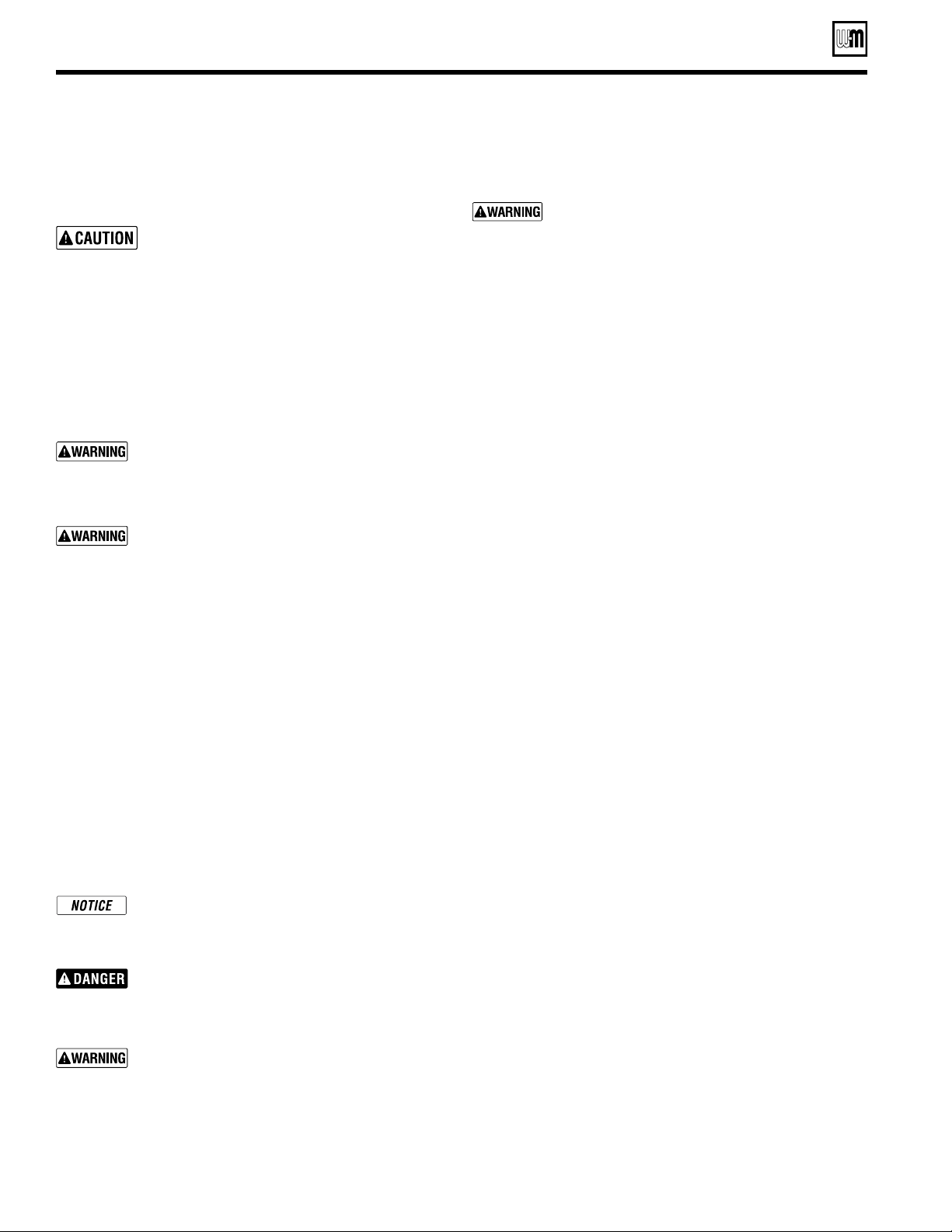
3. See Figure 27 for field wiring. A separate 120VAC electrical
circuit with a fused disconnect switch (15 amp recommended)
should be used for the boiler.
4. A strain relief bushing and adapter must be used at each point
where wiring passes through control case (see Figure 28) to
protect wiring insulation.
5. Multiple zones — Refer to zone valve manufacturer’s literature
for wiring and application. A separate transformer is required
to power zone valves. Zoning with circulators requires a relay
for each circuit.
Room thermostat
1. Connect thermostat as shown on wiring diagram on boiler.
2. Install on inside wall away from influences of drafts, hot or cold
water pipes, lighting fixtures, television, sunrays or fireplaces.
3. If thermostat has a heat anticipator, set heat anticipator in
thermostat to match power requirements of equipment con-
nected to it. Refer to the appropriate Control Supplement for
instructions on the thermostat anticipator setting.
Figure 28 Provide strain reliefs
Connect eld wiring to boiler
Figure 27 Connect field wiring in boiler junction box as shown below. See Control Supplement for more details.
DHW (if used)
Connect the DHW aquastat as shown in wiring below. The
Economy function of the control is not utilized with DHW
input.
R & C Connections (if used)
24VAC leads should be used for power stealing thermostats only !
Other devices requiring 24VAC should have separate
power supply.
Part Number 550-142-303/1120
24
EG
/
PEG sEriEs 6
•
EGH sEriEs 5 Gas-firEd boilErs — boilEr manual
Freeze protection (when used)
Use antifreeze especially made for hydronic systems. Inhibited
propylene glycol is recommended.
Do not use automotive, ethylene glycol or undiluted
antifreeze. Severe personal injury, death or substan-
tial property damage can result.
Local codes may require back-flow preventer or actual disconnect
from city water supply.
Determine quantity according to system water content. Boiler
water content is listed on page 39. Remember to add in expansion
tank water content.
Follow antifreeze manufacturer’s instructions.
Filling water systems
1. Close manual air vents, drain cock, and automatic air vent, if
used.
2. Fill to correct system pressure. Correct pressure will vary with
each application. Residential systems are often designed for
12 PSIG of cold fill pressure.
3. Open automatic air vent one turn, if used.
4. Open manual water feed valve.
a. Starting on lowest floor, open air vents one at a time until
water squirts out. Close vent.
b. Repeat with remaining vents.
5. Close manual water feed valve when correct boiler pressure
is reached.
6. If purge valve is used - located in the return piping above
isolation valve:
a. Connect hose to purge valve.
b. Close isolation valve. Open purge valve.
c. Open hand water feed valve and allow system to purge all
air. If system has more than one circuit, purge each circuit
separately by opening each balancing valve one at a time.
d. Close purge valve and water feed valve cock.
e. Open isolation valve.
f. Fill system to correct pressure.
Filling steam boilers
1. Fill to normal waterline, halfway up gauge glass.
2. Boiler water pH 7.0 to 8.5 is recommended.
3. Follow skimming procedure.
Wiring multiple zones
Refer to zone valve manufacturer’s literature for wiring and ap-
plication. A separate transformer is required to power zone valves.
Zoning with circulators requires a relay for each circulator.
DO NOT connect directly from 3-wire
zone valves to the T-T terminals on the
boiler
. When using 3-wire zone valves, install
an isolation relay. Connect the zone valve
end switch wires to the isolation relay coil.
Connect the isolation relay contact across the
boiler T-T terminals. Failure to comply can
result in damage to boiler components or
cause unreliable operation, resulting in severe
property damage.
Check for gas leaks
Before starting the boiler, and during initial opera-
tion, smell near the floor and around the boiler for
gas odorant or any unusual odor. Do not proceed
with start-up if there is any indication of a gas leak.
Repair any leak at once.
Propane boilers only — Your propane supplier mixes
an odorant with the propane to make its presence
detectable. In some instances, the odorant can fade
and the gas may no longer have an odor.
• Propanegascanaccumulate at oor level.Smell
near the floor for the gas odorant or any unusual
odor. If you suspect a leak, do not attempt to light
the pilot.
• Usecautionwhenattemptingtolightthepropane
pilot. This should be done by a qualified service
technician, particularly if pilot outages are common.
• Periodicallychecktheodorantlevelofyourgas.
• Inspectboilerandsystem at least yearlytomake
sure all gas piping is leak-tight.
• Consultyourpropanesupplierregardinginstalla-
tion of a gas leak detector. There are some products
on the market intended for this purpose. Your sup-
plier may be able to suggest an appropriate device.
Fill the system
Do not fill (except for leakage tests) until the boiler
is ready to be fired.
Determine if water treatment is needed
Do not use petroleum-based cleaning or sealing
compounds in boiler system. Severe damage to
boiler will occur, resulting in substantial property
damage.
Eliminate all system leaks. Continual fresh makeup
water will reduce boiler life. Minerals can build up
in sections, reducing heat transfer, overheating cast
iron, and causing section failure.
Consult local water treatment companies for unusually hard water
areas (above 7 grains hardness) or low pH water conditions (below
7.0). Boiler water pH of 7.0 to 8.5 is recommended.
Start-up

Part Number 550-142-303/1120
25
EG
/
PEG sEriEs 6
•
EGH sEriEs 5 Gas-firEd boilErs — boilEr manual
Start-up (continued)
Steam Heating Installation
Considerations
Closed steam heating systems should not have high amounts
of make-up water. Make-up water only occurs when the system
is leaking or when make-up water is incorrectly administered.
And, even with chemical treatment, make-up water will reduce
boiler life due to corrosion. And chemical treatment may be dif-
ficult to execute if the system make-up volume is unpredictable.
Troubleshoot the system BEFORE considering water treatment.
If the system is using make-up water, then the following may be
likely:
• Leakingreturnlines, underground pipes, faulty steam traps,
faulty air vents
• Automaticwaterfeedisinstalledincorrectlyorincorrectly
adjusted
• Ifthesystemutilizesacondensatereceiver,thefeedermay
be flooding due to long system time lag.
If the piping is NOT leaking, consider installing a boiler feed
system (NOT a condensate return system). The boiler feed
system provides condensate storage and allows the boiler to
directly control water level. This is not the case with gravity
return systems or condensate return systems — these only
provide water to the boiler when the condensate returns from
the system. If the system time lag is longer than boiler can
provide steam, and the boiler is equipped with an automatic
feeder, water will feed to the boiler before the condensate can
return from the system. This will cause overfill and flooding
when the condensate does return. Also, pumping cold make-up
water directly into the boiler collapses the water level, causing
false indications of need for make-up. With a boiler feed system,
the float control on the boiler turns the feed pump on and off as
needed. Make-up water is added at the boiler feed system tank.
And the storage volume of the tank makes it unlikely that make-
up will be needed UNLESS there is a system leak.
Chlorides
Over the last several decades, the level of chlorides in some
ground water and city water supplies have increased due to
use of salt during the removal of snow and ice from roads and
highways, and the increased use of water softeners. Elevated
levels of chlorides (over 200 ppm) in the water of steam boilers
will accelerate water side corrosion and shorten the operating
life of the boiler.
Chlorides and other dissolved solids are present in boiler make-
up water and are not removed from the boiler when the boiler
is producing steam. The level of chlorides and dissolved solids
in the boiler water increase when make-up water is added to the
boiler because of normal maintenance to low water cut-offs and
system leaks. If there are high chloride and dissolved solid levels
in boiler make-up water, boiler water treatment should be con-
sidered.
In general, cast iron steam boilers do not require water treatment
for protection. However, some boiler water treatment chemi-
cals can promote water level instability. Surging and priming in
steam boilers can result even though the boiler was thoroughly
cleaned before the treatment was added.
Systems where treatment should be
considered are:
•Processapplications
•Contaminatedcondensate
•Largemake-upwaterrequirements
•Systemcomponentsrequiringcorrosioninhibitor
•Extremelyhardwater
•Make-upwatersupplywithhigherthan30ppmofchloride
Beware the Foam
Water treatment chemicals should be thoroughly reviewed be-
fore they are introduced into the boiler and heating system. Of
particular concern are foaming agents that will interfere with
the disengagement of the steam at the boiler waterline. For this
reason, foaming agents cannot be tolerated in steam boilers.
Testing & Treatments
To test the boiler water treatment chemicals, prepare a small
amount of the chemical intended for the boiler with water. In a
ventilated area, put this mixture into a pan and bring to a “roll-
ing boil” on the stove. If the mixture foams, it is not suitable
for the boiler.
Recognized treatment compounds used for oxygen scaveng-
ing and corrosion protection should not affect the life of the
elastomer sealing rings. Asking the treatment supplier to test
a sealing ring in the proposed compound can eliminate any
doubt. In any case, a compound containing petroleum should
not be used.
Without Chemical Treatment
• When the chloride level is above 400 ppm, or the total dis-
solved solids (TDS) are above 1000 ppm, drain and refill the
boiler with fresh water and bring the boiler to pressure for
15 minutes per the boiler manual to drive off excess oxygen.
• If chemical treatment is not used and chloride level and
TDS levels are not monitored, drain and refill the boiler
when the chloride level is above 400 ppm, or the total dis-
solved solids (TDS) are above 1000 ppm. After refilling the
boiler, bring the boiler to pressure for 15 minutes per the
boiler manual to drive off excess oxygen.
These steps will help prevent corrosion caused by high conductivity,
but may not prevent under-deposit corrosion.
In general, cast iron steam boilers do not require water treatment
for protection. However, some water conditions may require
the boiler be drained and refilled, or in more aggressive areas,
chemically treated.
Follow the appropriate Boiler Manual, for all steam options.
Steam Boiler Water Treatment
Part Number 550-142-303/1120
26
EG
/
PEG sEriEs 6
•
EGH sEriEs 5 Gas-firEd boilErs — boilEr manual
Operate boiler
Check system and boiler
DO NOT proceed with boiler operation unless
boiler and system have been filled with water and
all instructions and procedures of previous manual
sections have been completed. Failure to do so could
result in severe personal injury, death or substantial
property damage.
Before starting the boiler . . .
• SeeControlSupplementfor“LightingorOperating
Instructions”.
• Verifytheboilerandsystemwaterleveliscorrect
(Steam — no more than ½ of gauge glass or less
than ¼” above bottom of gauge glass).
• Verifythe“Preparation”proceduresontheprevious
pages have been completed.
Start the boiler
1. Steam boilers — Check boiler water level — Should be ap-
proximately ½ way up gauge glass.
2. Remove boiler jacket door and note the gas valve manufacturer
and model number.
3. Follow the Lighting or Operating Instructions in the Control
Supplement, depending on gas valve installed in boiler. Use
only the Operating Instruction which applies to this gas valve.
(The Operating Instruction label on the boiler provides the
same information.)
4. If boiler fails to start, see “If boiler doesn’t start . . . Check for:”
on the next page.
Check system and boiler
Eliminate all system leaks. Continual fresh makeup
water will reduce boiler life. Minerals can build up
in sections, reducing heat transfer, overheating cast
iron, and causing section failure.
If you discover evidence of any gas leak, shut down
the boiler at once. Find the leak source with bubble
test and repair immediately. Do not start boiler
again until corrected. Failure to comply could re-
sult in severe personal injury, death or substantial
property damage.
Do not use petroleum-based cleaning or sealing
compounds in boiler system. Severe damage to
boiler will occur, resulting in substantial property
damage.
1. Check system piping for leaks. If found, shut down boiler and
repair immediately.
2. Inspect vent system thoroughly for signs of deterioration from
corrosion, physical damage or sagging. Verify that masonry
chimney liners are in good condition, with no obstructions,
and there are no openings into the chimney.
3. Check around the boiler for gas leaks following the procedure
of step 13, page 22.
4. Verify operation using procedures below. Perform “Checkout
procedure”, page 28, and fill in the “Installation and Service
Certificate”.
Skim the steam boiler
Clean all newly installed steam boilers to remove
oil and grease. Failure to properly clean can result
in violent fluctuations of water level, water passing
into steam mains or high maintenance costs on
strainers, traps and vents.
Do not use petroleum-based cleaning or sealing
compounds in boiler system. Severe damage to
boiler will occur, resulting in substantial property
damage.
1. Provide 1½” piping from skim tapping to floor drain.
2. Adjust waterline to midpoint of skim tapping. See Figure 5,
page 10.
3. Follow “Lighting or Operating Instructions” in the Control
Supplement to fire boiler to maintain temperature below
steaming rate.
4. Feed in water to maintain water level. Cycle burners to prevent
rise in steam pressure.
5. Continue skimming until discharge is clear. May take several
hours.
6. Drain boiler. While boiler is warm, but not hot, flush all inte-
rior surfaces under full pressure until drain water runs clear.
7. Remove skim piping. Plug tapping.
8. Close drain cock. Fill with fresh water to waterline. Start burn-
ers and steam for 15 minutes to remove dissolved gases. Stop
burners.
9. Check traps and air vents for proper operation.
10. Process may need to be repeated after several weeks of opera-
tion.
Inspect base insulation
The boiler contains ceramic fiber and fiberglass
materials. Use care when handling these materials
per instructions on page 29 of this manual. Failure
to comply could result in severe personal injury.
Check to make sure insulation is secure against all four sides of
the base. If insulation is damaged or displaced, do not operate
boiler. Replace or reposition insulation.
Failure to replace damaged insulation or reposition
insulation can result in a fire hazard, causing se-
vere personal injury, death or substantial property
damage.
Start-up (continued)
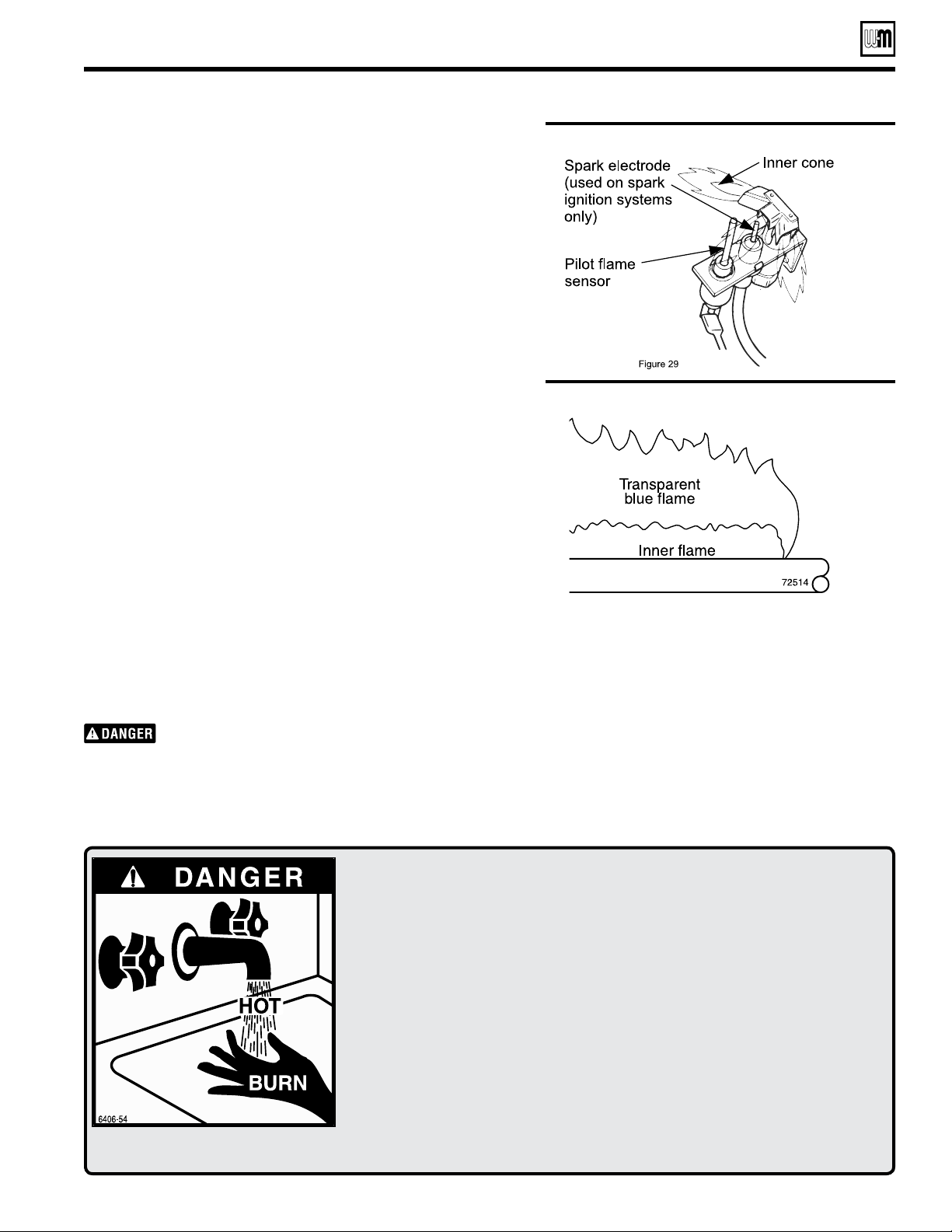
Part Number 550-142-303/1120
27
EG
/
PEG sEriEs 6
•
EGH sEriEs 5 Gas-firEd boilErs — boilEr manual
4. Repeat Steps 2 through 4 several times to verify opera-
tion.
5. Return thermostat to normal setting.
6. Set thermostat heat anticipator setting indicated on
wiring diagram.
Check venting system operation
With boiler firing, hold a candle or match below lower edge
of draft diverter “skirt.” If flame does not blow out, but
burns undisturbed, the vent system is working properly. If
flame blows out or flickers severely, the vent system must
be checked for obstructions or other causes of improper
venting.
If boiler doesn’t start . . . Check for:
1. Loose connections, blown fuse or service switch off?
2. High limit switch set below boiler pressure?
3. Thermostat set below room temperature?
4. Gas not turned on at meter or boiler?
5. Incoming gas pressure less than:
5” w.c. for natural gas? 11” w.c. for propane gas?
6. If none of the above corrects the problem, see “Troubleshooting”
in the Control Supplement.
Verify operation
Check burner flame — Pilot burner
1. Proper pilot flame (see Figure 29):
a. Blue flame.
b. Inner cone engulfing thermocouple.
c. Thermocouple glowing cherry red.
2. Proper pilot flame:
a. Overfired — Large flame lifting or blowing past thermocouple.
b. Underfired — Small flame. Inner cone not engulfing thermocouple.
c. Lack of primary air — Yellow flame tip.
d. Incorrectly heated thermocouple.
Check burner flame — Main burner
1. Proper main burner flame (see Figure 30):
a. Yellow-orange streaks may appear (caused by dust).
2. Improper main burner flame:
a. Overfired — Large flames.
b. Underfired — Small flames.
c. Lack of primary air — Yellow tipping on flames (sooting will occur).
Check vent damper operation
1. Raise room thermostat to call for heat — Vent damper actuator
will slowly open vent damper.
2.
When vent damper is fully open — Pilot will light, then allow
main burners to ignite.
Vent damper must be fully open before main burners light.
If vent damper does not fully open, flue products such as
carbon monoxide will escape into house, causing severe
personal injury or death.
3. Lower thermostat setting — Main burner flames will go out, then
vent damper will close.
Start-up (continued)
Figure 29 Typical pilot burner flame
Figure 30 Typical main burner flame
Hot Water Can Scald!
• ConsumerProductSafetyCommissionandsomestatesrecommenddomestichotwater
temperature of 130°F or less.
• Wheninstallinganautomatic mixing valve, selection and installation must comply with
valve manufacturer’s recommendations and instructions.
• Waterheatedtoatemperaturesuitableforclotheswashing,dishwashingandother
sanitizing needs will scaled and cause injury.
• Children,elderly,inrmorphysicallyhandicappedpersonsaremorelikelytobeinjured
by hot water. Never leave them unattended in or near a bathtub, shower or sink. Never
allow small children to use a hot water faucet or draw their own bath. If anyone using hot
water in the building fits this description, or if state laws or local codes require certain
water temperatures at hot water faucets, take special precautions:
• Installautomatic mixing valve set according to those standards.
• Uselowestpracticaltemperaturesetting.
• Checkwatertemperatureimmediatelyafterrstheatingcycleandafteranyadjustment.
ProtectionMustBeTakenAgainstExcessiveTemperatureandPressure! —
Installation of a Temperature & Pressure (T&P) relief valve is required.

Part Number 550-142-303/1120
28
EG
/
PEG sEriEs 6
•
EGH sEriEs 5 Gas-firEd boilErs — boilEr manual
Check-out procedure
Check-off steps as completed.
❏ System properly filled with water?
❏ Automatic air vent, if used, open one turn (water boilers only)?
❏ Air purged from system (water boilers only)?
❏ Steam boilers properly skimmed?
❏ Air purged from gas piping? Piping checked for leaks?
❏ Are proper orifices installed? Check page 13 for proper size.
Proper orifices must be used. Failure to do so will
cause severe personal injury, death or substantial
property damage.
❏ Follow operating instruction label on boiler for proper start-
up. Also refer to “Operate boiler,” page 26.
❏ Proper burner flame? See “Check burner flame — Main
burner” and “Check burner flame — Pilot burner,” page 27.
❏ Test temperature limit — While burners are operating, turn
Boiler Temp adjustment knob counterclockwise until display
reading is below actual boiler water temperature. Burners
should go off while circulator continues to operate (water
boilers only). Turn Boiler Temp adjustment knob clockwise
until display reading is above boiler water temperature and
ignition sequence should resume.
❏ Test low water cut off (LWCO) – While burner are operating,
press and hold “LWCO TEST” button on control. Burners
should go off while circulator continues to operate and
LWCO light should turn ON. Release “LWCO TEST” button
and ignition sequence should resume.
❏ Test any additional field-installed controls: If boiler has an
additional low water cut off, additional high limit or other
controls, test for operation as outlined by manufacturer.
Burners should be operating and should go off when con-
trols are tested. When controls are restored, burners should
reignite.
❏ EG only - button on spill switch pushed in?
❏ To test ignition system shut-off device:
Connect manometer to outlet side of gas valve. Start
boiler, allowing for normal start-up cycle to occur and
main burners to ignite. With main burners on, manu-
ally shut off gas supply at manual main shutoff gas valve.
Burners should go off. Open manual main shut-off gas valve.
Manometer should confirm there is no gas flow. Pilot will
relight, flame sensing element will sense pilot flame and
main burners reignite.
❏ Set Boiler Temp adjustment knob to system temperature re-
quirements. Adjust balancing valves and controls to provide
design temperature to system. (water boilers)
❏ Limit control set to design temperature or pressure require-
ments of system? Maximum limit set 220°F W and 10 PSI
steam.
❏ For multiple zones, flow adjusted so it is about the same in
each zone (water boilers only)?
❏ Thermostat heat anticipator set properly? Refer to “Room
Thermostat,” page 23 and correct wiring diagram.
❏ Boiler cycled with the thermostat? Raise to highest setting.
Boiler should go through normal start-up cycle. Lower to
lowest setting. Boiler should go off.
❏ Measure gas input (natural gas only):
a. Operate boiler 10 minutes.
b. Turn off other appliances.
c. At the natural gas meter, measure time (in seconds)
required to use one cubic foot of gas.
d. Calculate gas input:
3600 x 1000
number of seconds from step c
=Btuh
e. Btuh calculated should approximate input rating on rating
label.
❏ Check manifold gas pressure by connecting a manometer
to the downstream test tapping on main gas valve.
MANIFOLD GAS PRESSURE
NAT = 3.5" w.c.
LP = 10.0" w.c.
❏ Several operating cycles observed for proper operation? If
damper is provided, see Control Supplement for check- out
procedure.
❏ Room thermostat set to desired temperature?
❏ Installation and Service Certificate on this page completed?
❏ All instructions shipped with this boiler reviewed with owner
or maintenance person, returned to envelope and given to
owner or displayed near boiler?
Start-up (continued)
Installation and service certificate
Boiler model _______________ Series ______ Consumer Protection (CP) number ___________ Date installed ___________
Measured Btuh input ____________________
Installer ________________________ ________________________________ ________________________
(company) (address) (phone)
Installer’s signature: _____________________________________
❏ Installation instructions have been followed.
❏ Check out sequence has been performed.
❏ Above information is certified to be correct.
❏ Information received and left with owner/maintenance person
Part Number 550-142-303/1120
29
EG
/
PEG sEriEs 6
•
EGH sEriEs 5 Gas-firEd boilErs — boilEr manual
Department of Energy – Compliance
EG water boilers only
This boiler is equipped with a control system that automatically adjusts a time delay period to turn on the boil-
er during a call for heat. This is accomplished by circulating available hot water in the system while measuring wa-
ter boiler water temperature changes. The control calculates a suitable delay based on temperature measurements and
turns the boiler on only after it determines that the demand for heat cannot be satisfied with the available hot water,
Due to the wide variety of controls used in boiler installations, this control is also equipped with an adjustment for the calculated time
delay period (ECONOMY ADJUST). In the MIN position, the time delay is zero and the IMPORTANT notice below must be observed:
IMPORTANT
In accordance with Section 325 (f) (3) of the Energy Policy and Conservation Act, this boiler is equipped with a feature that saves
energy by reducing the boiler water temperature as the heating load decreases. This feature is equipped with an override which is
provided primarily to permit the use of an external energy management system that serves the same function.
THIS OVERRIDE MUST NOT BE USED UNLESS AT LEAST ONE OF THE FOLLOWING CONDITIONS IS TRUE:
• An external energy management system is installed that reduces the boiler water temperature as the heating load decreases.
• This boiler is part of a modular or multiple boiler system having a total input of 300,000 BTU/hr or greater.
• This boiler is equipped with a tankless coil.
REMOVAL OF COMBUSTION CHAMBER LINING OR BASE PANELS
Handling berglass and ceramic ber materials
The combustion chamber lining or base insulation panels in this product contains ceramic fiber
materials that have been
identified as carcinogenic, or possibly carcinogenic, to humans
. Ceramic fibers can be converted to cristobalite in very
high temperature applications. The International Agency for Research on Cancer (IARC) has concluded, “Crystalline
silica inhaled in the form of quartz or cristobalite from occupational sources is carcinogenic to humans (Group 1).”:
■ Avoid breathing dust and contact with skin and eyes.
• UseNIOSHcertieddustrespirator(N95).ThistypeofrespiratorisbasedontheOSHArequirementsforcristobalite
at the time this document was written. Other types of respirators may be needed depending on the job site conditions.
Current NIOSH recommendations can be found on the NIOSH web site at http://www.cdc.gov/niosh/homepage.html.
NIOSH approved respirators, manufacturers, and phone numbers are also listed on this web site.
• Wearlong-sleeved,loosettingclothing,gloves,andeyeprotection.
■ Apply enough water to the combustion chamber lining or base insulation to prevent airborne dust.
■ Remove combustion chamber lining or base insulation from the boiler and place it in a plastic bag for disposal.
■ Wash potentially contaminated clothes separately from other clothing. Rinse clothes washer thoroughly.
NIOSH stated First Aid.
■ Eye: Irrigate immediately.
■ Breathing: Fresh air.
REMOVAL OF FIBERGLASS WOOL — OR — INSTALLATION OF FIBERGLASS WOOL,
COMBUSTION CHAMBER LINING OR BASE PANELS:
This product contains fiberglass jacket insulation and ceramic fiber materials in combustion chamber lining or base
panels in gas fired products. Airborne fibers from these materials have been listed by the State of California as a pos-
sible cause of cancer through inhalation.
■ Avoid breathing dust and contact with skin and eyes.
• Use NIOSH certified dust respirator (N95). This type of respirator is based on the OSHA requirements for fiberglass wool
at the time this document was written. Other types of respirators may be needed depending on the job site conditions. Cur-
rent NIOSH recommendations can be found on the NIOSH web site at http://www.cdc.gov/niosh/homepage.html. NIOSH
approved respirators, manufacturers, and phone numbers are also listed on this web site.
• Wearlong-sleeved,loosettingclothing,gloves,andeyeprotection.
■ Operations such as sawing, blowing, tear out, and spraying may generate airborne fiber concentration requiring additional protection.
■ Wash potentially contaminated clothes separately from other clothing. Rinse clothes washer thoroughly.
NIOSH stated First Aid.
■ Eye: Irrigate immediately.
■ Breathing: Fresh air.
Part Number 550-142-303/1120
30
EG
/
PEG sEriEs 6
•
EGH sEriEs 5 Gas-firEd boilErs — boilEr manual
Table 12 Service and maintenance schedules (service technician and owner)
Follow the “Service and maintenance” procedures given throughout this manual, the Control Supplement and in com-
ponent literature shipped with the boiler. See “Read this page first” on page 2. Failure to perform the service and main-
tenance could result in damage to the boiler or system. Failure to follow the directions in this manual and component
literature could result in severe personal injury, death or substantial property damage.
Service and maintenance
Label all wires prior to disconnection when servic-
ing controls. Wiring errors can cause improper and
dangerous operation.
To avoid personal injury, death or property damage,
keep boiler area clear and free from combustible
materials, gasoline and other flammable vapors
and liquids.
Do not block flow of air to boiler. Incomplete
combustion and flue gas spillage can occur.
Do not store sources of hydrocarbons (i.e., bleaches,
cleaners, chemicals, sprays, paint removers, fabric
softeners, etc.) in boiler area. This can contribute
to shortened boiler/vent system life.
Service technician
(see following pages for instructions)
Owner maintenance
(see User’s Information Manual for instructions)
A
nnuAl
stArt
-
up
Inspect:
• Reported problems
• Boiler area
• Air openings
• Flue gas vent system
• Pilot and main burner flames
• Piping
• Boiler heating surfaces
• Burners and base
Service:
• Gauge glass
• Temperature / LWCO sensor
Start-up:
• Perform start-up per manual
• EGH - Check base insulation & fastener clips
Check/test:
• Gas piping
• Boiler waterline
• Limit controls and cutoffs
• Boiler relief valve
Review:
• Review with owner
Daily
• Check boiler area
• Check air openings
• Check boiler pressure/
temperature gauge
Monthly
• Check boiler interior piping
• Check venting system
• Check air vents
• Check boiler relief valve
• Check pilot and main burner flames
Periodically
• Test low water cutoff
End of season
• Shut down procedure
Part Number 550-142-303/1120
31
EG
/
PEG sEriEs 6
•
EGH sEriEs 5 Gas-firEd boilErs — boilEr manual
The boiler should be inspected and started annu-
ally, at the beginning of the heating season, only
by a qualified service technician. In addition, the
maintenance and care of the boiler designated in
Table 12, page 30 and explained on the following
pages must be performed to assure maximum
boiler efficiency and reliability. Failure to service
and maintain the boiler and system could result in
equipment failure.
Electrical shock hazard — Turn off power to the
boiler before any service operation on the boiler
except as noted otherwise in this manual. Failure
to turn off electrical power could result in electrical
shock, causing severe personal injury or death.
The boiler contains ceramic fiber and fiberglass
materials. Use care when handling these materials
per instructions on page 29 of this manual. Failure
to comply could result in severe personal injury.
Inspect . . . . . . . . . .
Reported problems
Inspect any problems reported by owner and correct before
proceeding.
Boiler area
1. Verify that boiler area is free of any combustible materials,
gasoline and other flammable vapors and liquids.
2. Verify that boiler area is free of any of the contaminants listed
on page 7 of this manual. If any of these are present in the
boiler intake air vicinity, they must be removed. If they can-
not be removed, install combustion air piping to the boiler
in accordance with national, provincial or local codes.
Air openings
1. Verify that combustion and ventilation air openings to the
boiler room and/or building are open and unobstructed.
Check operation and wiring of automatic combustion air
dampers, if used.
2. Verify that boiler vent discharge and air intake are clean and
free of obstructions.
Flue gas vent system
1. Visually inspect entire flue gas venting system for blockage,
deterioration or leakage. Repair any joints that show signs of
leakage in accordance with vent manufacturer’s instructions.
2. Verify that masonry chimneys are lined, lining is in good
condition, and there are not openings into the chimney.
Failure to inspect for the above conditions and have
them repaired can result in severe personal injury
or death.
Pilot and main burner flames
Visually inspect pilot burner and main burner flames as directed
on page 27 of this manual.
Piping
Check the boiler interior piping and all system piping for signs
of leaks. Repair any leaks before proceeding.
Do not use petroleum-based cleaning or sealing
compounds in boiler system. Severe damage to
boiler will occur, resulting in substantial property
damage.
Eliminate all system or boiler leaks. Continual
fresh makeup water will reduce boiler life. Minerals
can build up in sections, reducing heat transfer,
overheating cast iron, and causing section failure.
Leaking water may also cause severe property
damage.
Boiler heating surfaces
The boiler contains ceramic fiber and fiberglass
materials. Use care when handling these materials
per instructions on page 29 of this manual. Failure
to comply could result in severe personal injury.
1. Disconnect the vent pipe at the boiler draft diverter and re-
move draft diverter after turning off power to the boiler.
2. Use a bright light to inspect the boiler flue collector and heat-
ing surfaces.
3. If the vent pipe or boiler interior surfaces show evidence of
soot, follow “Cleaning boiler heating surfaces”, page 33. Re-
move the flue collector and clean the boiler if necessary after
closer inspection of boiler heating surfaces.
4. If there is evidence of rusty scale deposits on boiler surfaces,
check the water piping and control system to make sure the
boiler return water temperature is properly maintained (per
this manual).
5. Re
connect vent and draft diverter. Replace all boiler components
before returning to service.
6. Check inside and around boiler for evidence of any leaks from
the boiler. If found, locate source of leaks and repair.
Burners and base
1. After turning off power to the boiler, remove the jacket door
and base access panel.
2. Inspect burners and all other components in the boiler base.
3. If burners must be cleaned, raise rear of each burner to release
from support slot, slide forward and remove. Then brush and
vacuum the burners thoroughly, making sure all ports are free
of debris. Carefully replace all burners, making sure burner
with pilot bracket is replaced in its original position and all
burners are upright (ports up).
4. Inspect the base insulation.
a. Verify that the insulation is intact and secure against all four
sides of the base and attachment clips are still in place.
If insulation is damaged or displaced, do not oper-
ate the boiler. Replace or reposition insulation as
necessary. Failure to replace damaged insulation
can result in a fire hazard, causing severe personal
injury, death or substantial property damage.
Service and maintenance (continued)
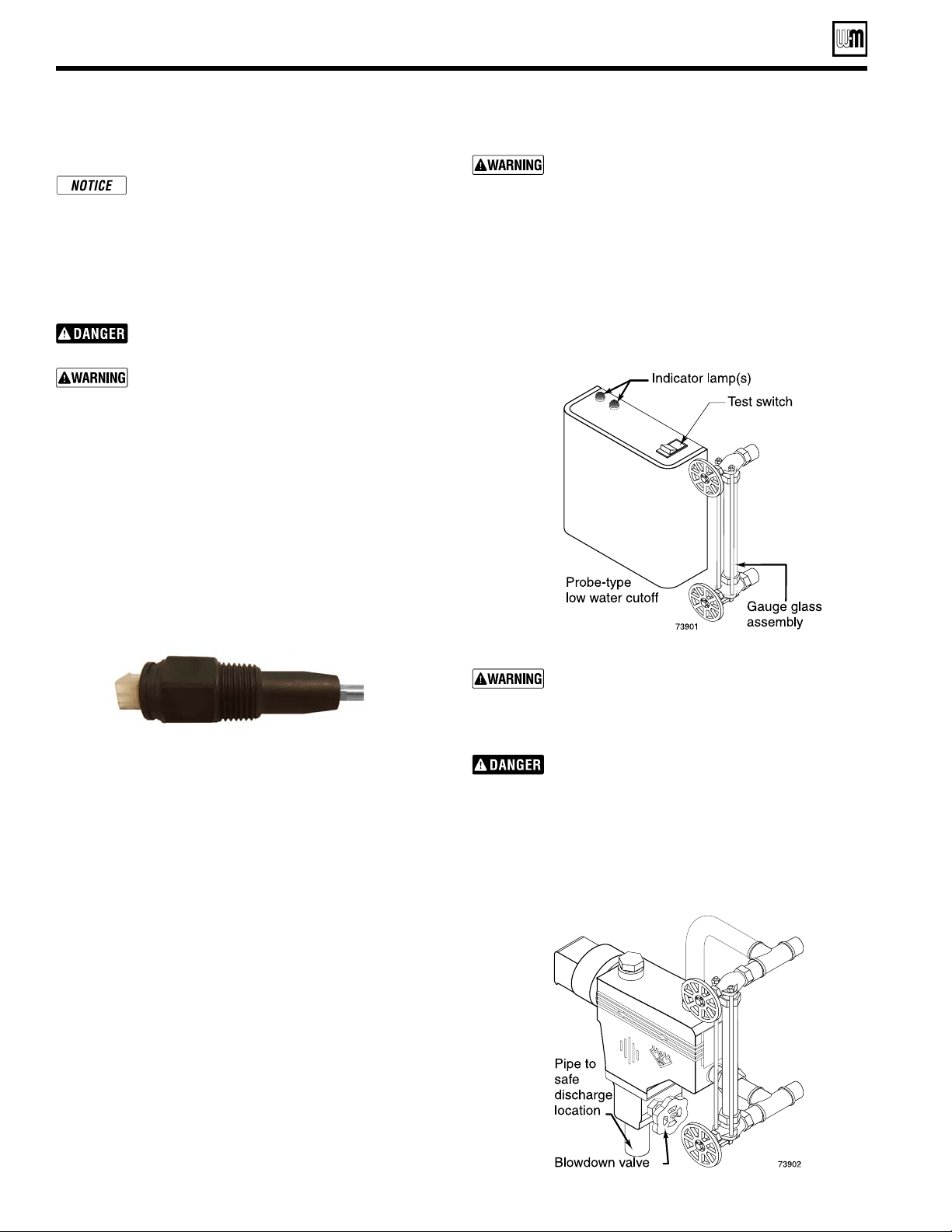
Part Number 550-142-303/1120
32
EG
/
PEG sEriEs 6
•
EGH sEriEs 5 Gas-firEd boilErs — boilEr manual
Service and maintenance (continued)
❏ Service . . . . . . . . . .
Gauge glass (steam boilers)
Normal waterline is halfway up gauge glass. Clean
when needed.
1. Close lower gauge cock.
2. Open pet cock.
3. Open lower gauge cock and allow a small amount of water to
flush out through open pet cock.
4. Close pet cock.
5. Open lower gauge cock.
Boiler pressure must be low to eliminate potential
of severe burns.
If gauge glass breaks, close both gauge cocks. Replace
gauge glass. Do not replace with thin glass tubing.
Failure to comply could cause severe personal injury,
death or substantial property damage.
Temperature / LWCO sensor
The temperature/LWCO sensor may accumulate deposits on the
probe surface. Annual inspection and cleaning of the probe will
improve boiler performance.
Disconnect power, unplug harness from sensor.
a. Drain boiler water to a level below the sensor.
b. Remove sensor from boiler.
c. Wipe any built up contaminates from probe and insulator
surfaces.
d. Reinstall sensor into boiler.
e. Refill boiler to correct waterline.
Probe-type low water cutoff (when used)
Clean probe-type low water cutoff (when used) for
proper operation.
1. Turn off power to boiler and wait 5 minutes.
2. Drain water to bottom of gauge glass.
3. Turn on power.
4. Set thermostat to call for heat. Red neon lamp on lower water
cutoff should light.
5. Wait 5 minutes. Boiler should not fire.
6. Refill boiler to correct waterline. Red lamp should go off.
7. Wait 5 minutes. Boiler should fire.
8. Return thermostat to normal setting.
Float-type low water cutoff (when used)
Clean float-type low water cutoff to clear float
chamber of sediment.
1. Open blow down valve on the bottom control.
2. Drain water into a bucket.
Scald potential. Boiler pressure must be low to avoid
the potential of severe burns from steam.
3. Check float-type low water cutoff for proper operation:
a. Turn operating control to call for heat.
b. Before water gets hot, drain to bottom of gauge glass.
Boiler should shut off after water level lowers a few inches.
c. Refill boiler to correct waterline. Boiler should come back
on.
❏ Start-up . . . . . . . . . .
1. Perform “Start-up” procedures in this manual, pages 24–28, includ-
ing “Verify operation” of burners and vent damper on page 27.
2. C
heck gas piping, per pages 22 and 24, verifying no indica-
tions of leakage and all piping and connections are in good
condition.
3. Read the “Operating Instructions” in the Control Supplement.
4. Start the boiler following the “Operating Instructions.”
❏ Check/test . . . . . . . . . .
Gas piping
1. Sniff near floor and around boiler area for any indication of
a gas leak.
2. Test gas piping using bubble test, per page 22 of this manual,
if there is any indication of a leak.
Boiler waterline
Normal waterline is halfway up gauge glass.
Limit controls
Inspect and test the boiler limit control. Verify operation by turn-
ing control set point below boiler pressure. Boiler should cycle
off. Return dial to original setting.
Part Number 550-142-303/1120
33
EG
/
PEG sEriEs 6
•
EGH sEriEs 5 Gas-firEd boilErs — boilEr manual
❏ Check/test . . . . . . . . . .
Boiler relief valve
After following the warning directions below, if the relief valve
weeps or will not seat properly, replace the relief valve.
Before testing, make certain discharge pipe is proper-
ly connected to valve outlet and arranged to contain
and safely dispose of boiler discharge. Wear gloves
to protect your hands from hot surfaces. Verify that
discharge piping is installed in accordance with this
manual and the instructions on the relief valve tag.
Failure to comply will expose operator and others
to severe personal injury or death.
Safety relief valves should be reinspected AT LEAST
ONCE EVERY THREE YEARS, by a licensed plumb-
ing contractor or authorized inspection agency, to
ensure that the product has not been affected by
corrosive water conditions and to ensure that the
valve and discharge line have not been altered or
tampered with illegally. Certain naturally occurring
conditions may corrode the valve or its compo-
nents over time, rendering the valve inoperative.
Such conditions are not detectable unless the valve
and its components are physically removed and
inspected. This inspection must only be conducted
by a plumbing contractor or authorized inspection
agency — not by the owner. Failure to reinspect the
boiler relief valve as directed could result in unsafe
pressure buildup, which can result in severe personal
injury, death or substantial property damage.
Check the setting of the boiler limit control. The
control should never be set with a pressure above
10 PSIG. Operating at a higher pressure can cause
damage to the boiler relief valve.
The boiler relief valve must be tested at least monthly
during the heating season to verify the valve and
discharge piping flow freely. If corrosion and/or
deposits are noticed within the valve body, testing
must be performed more often. A “try lever test”
must also be performed at the end of any non-
service period. Follow the instructions below for a
“try lever test”:
With the system at operating pressure, lift and hold
the test lever fully open for at least 5 seconds to flush
the valve seat free of sediment and debris. Then
release lever and permit the valve to snap shut.
❏ Review with owner
1. Review the User’s Information Manual with the owner.
2. Emphasize the need to perform the maintenance schedule
specified in the User’s Information Manual (and in this
manual as well).
3. Remind the owner of the need to call in a licensed contractor
should the boiler or system exhibit any unusual behavior.
4. Remind the owner to follow the proper shutdown procedure
and to schedule an annual start-up at the beginning of the
next heating season.
❏ Cleaning boiler heating surfaces
The boiler contains ceramic fiber and fiberglass
materials. Use care when handling these materials
per instructions on page 29 of this manual. Failure
to comply could result in severe personal injury.
1. Follow shut-down procedure
2. Disconnect breeching and remove damper (if used) and draft
hood.
3. Remove upper rear jacket panel. Turn back jacket insulation
to expose collector hood.
4. Remove collector hood. Clean excess boiler cement from col-
lector hood and cast iron sections.
5. Remove burners from base of boiler. Follow “Cleaning main
burners” to thoroughly clean burners. Place newspaper in base
of boiler to collect soot that will fall.
6. With a wire flue brush, clean between the sections.
7. Remove paper and soot. Vacuum or brush base and surround-
ing area.
8. Replace collector hood. Seal with boiler cement.
9. Replace draft hood, damper (if used) and breeching.
10. Replace insulation and jacket panel.
11. Replace main burners.
Cleaning main burners
Vacuum or brush burners to remove dust and lint.
When replacing, burner tubes must be seated in slots
in the back with openings face up. Gas orifices must
inject down center of burner. Failure to properly seat
burners will result in severe personal injury, death
or substantial property damage.
Annual shut-down procedure
1. Follow correct operating instructions on boiler.
2. Do not drain system unless exposure to freezing temperatures
will occur. If antifreeze is used with system, do not drain.
a. Test antifreeze.
3. If complete boiler and piping system must be drained to avoid
freezing, provide method to drain water from both ends of
boiler at or below return tapping level.
Service and maintenance (continued)
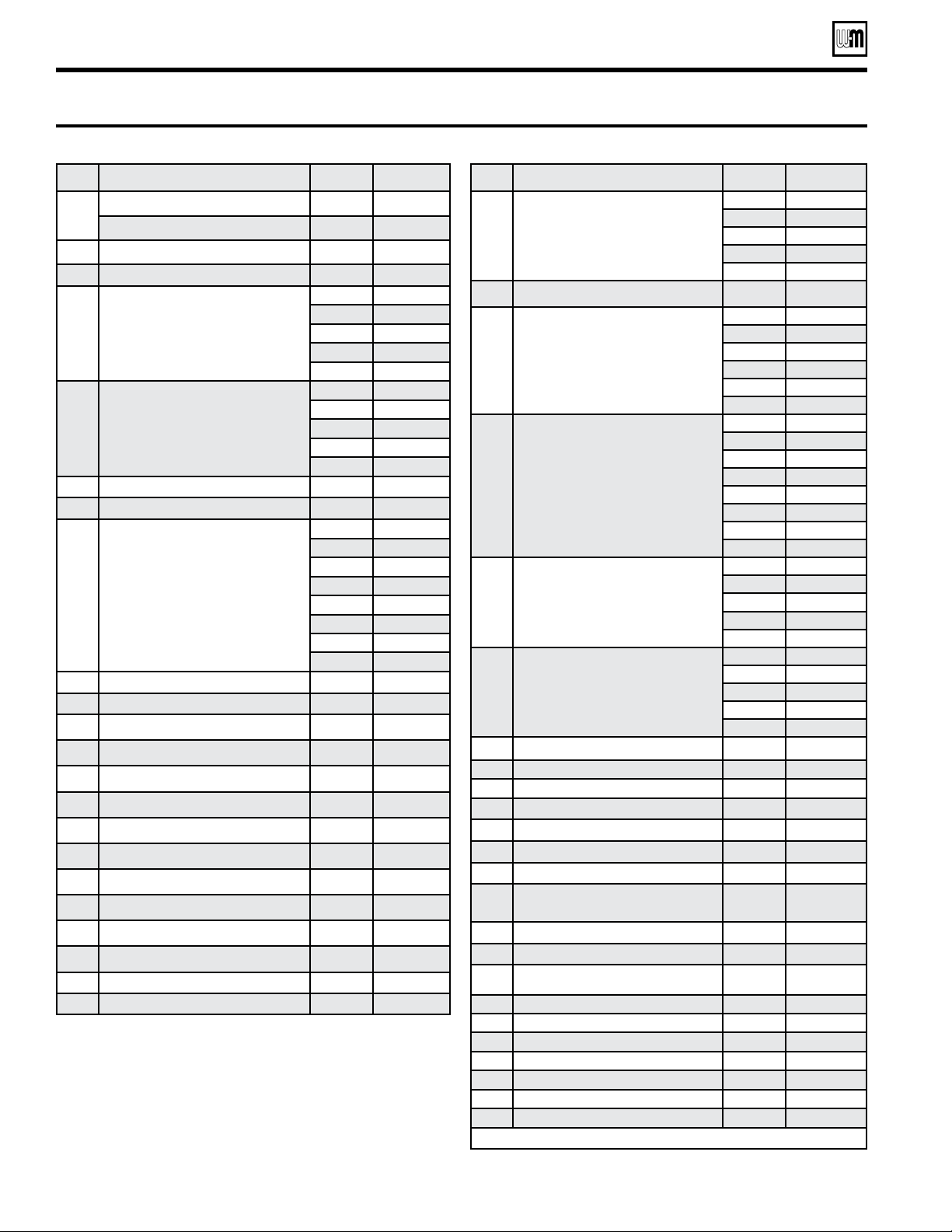
Part Number 550-142-303/1120
34
EG
/
PEG sEriEs 6
•
EGH sEriEs 5 Gas-firEd boilErs — boilEr manual
Replacement parts — EG/PEG
Table 13 EG/PEG replacement parts
Item Description
Boiler
Models
Part Number
H
Front base panel
EG-30, 35 451-800-000
EG-40, 45 451-800-001
EG-50, 55 451-800-002
EG-65 451-800-003
EG-75 451-800-004
H
1
Base insulation kit (includes front and rear base panel
insulation, water glass, and boiler cement)
––
510-811-660
H
2
Base front access panel with ame rollout switch
bracket
EG-30, 35 451-800-040
EG-40, 45 451-800-041
EG-50 451-800-039
EG-55 451-800-042
EG-65 451-800-043
EG-75 451-800-044
H
3
Back burner support
EG-30 451-800-085
EG-34 451-800-086
EG-40 451-800-087
EG-45 451-800-088
EG-50 451-800-089
EG-55 451-800-090
EG-65 451-800-092
EG-75 451-800-094
I
Back base panel
EG-30, 35 451-800-010
EG-40, 45 451-800-011
EG-50, 55 451-800-012
EG-65 451-800-013
EG-75 451-800-014
I
2
Back base channel
EG-30, 35 451-800-020
EG-40, 45 451-800-021
EG-50, 55 451-800-022
EG-65 451-800-023
EG-75 451-800-024
J
Base side rail (2 required)
––
451-800-070
K
Spill switch
––
510-300-013
L
Cover plate for heater opening (rectangular)
––
389-900-103
L
2
Gasket for cover plate (rectangular)
––
590-317-579
L
3
Cover plate for heater opening (round)
––
389-900-101
L
4
Gasket for cover plate (round)
––
590-317-495
M
Flue bafe (1 per joint)
––
460-003-790
Section replacement kit (includes 3” and 6” elasto-
mer seal, 2 pieces of rope, tube of silicone, order 1
per joint between sections) (not shown)
––
381-800-667
3” Diameter bottom elastomer seal (1 per joint) ––
592-800-010
6” Diameter top elastomer seal (1 per joint) ––
592-800-007
Sealer for sections (2 pieces of rope, tube of
silicone per joint between sections) (not shown)
––
591-641-865
½” x 14” Tie rod w/o nut (2 per boiler) (not shown)
EG-30, 35 560-234-470
½” x 18½” Tie rod w/o nut (2 per boiler)(not shown)
EG-40, 45 560-234-475
½” x 22¾” Tie rod w/o nut (2 per boiler)(not shown)
EG-50, 55 560-234-480
½” x 27” Tie rod w/o nut (2 per boiler)(not shown)
EG-65 560-234-485
½” x 31¼” Tie rod w/o nut (2 per boiler)(not shown)
EG-75 560-234-490
½” Nut (2 per tie rod) (not shown)
––
561-928-221
½” Lock washer (1 per tie rod) (not shown)
––
562-248-668
Note 1: Order sufcient quantities to replace all orices within a base.
Item Description
Boiler
Models
Part Number
A
Left hand end section with heater opening
(Pattern No. 1814)
––
311-800-014
Left hand end section without heater opening
(Pattern No. 1813)
––
311-800-007
B
Right hand end section without heater opening
(Pattern No. 18128)
––
311-800-029
C
Intermediate section (Pattern No. 1815)
––
311-800-010
D
Draft hood
EG 30-35 450-021-292
EG 40-45 450-021-258
EG 50-55 450-021-293
EG-65 450-021-261
EG-75 450-021-262
E
Collector hood
EG-30, 35 450-014-733
EG-40, 45 450-014-734
EG-50, 55 450-014-735
EG-65 450-014-736
EG-75 450-014-737
F
Burner, stainless tube, regular
––
512-200-000
F
1
Burner, stainless tube, with pilot bracket
––
512-200-001
G
Manifold
EG-30 591-125-533
EG-35 591-125-538
EG-40 591-125-534
EG-45 591-125-539
EG-50 591-125-535
EG-55 591-125-540
EG-65 591-125-541
EG-75 591-125-542
Main burner orice, natural gas, 2.35mm
EG 30-65 560-528-991
Main burner orice, natural gas, 2.30mm
EG-75 560-528-975
Section assembly complete with heater opening
(not shown)
EG 30-35
321-811-095
Section assembly complete without heater opening
(not shown)
EG-35
321-811-100
Section assembly complete with heater opening
(not shown)
EG 40-45
321-811-110
Section assembly complete without heater opening
(not shown)
EG 40-45
321-811-115
Section assembly complete with heater opening
(not shown)
EG 50-55 321-811-120
Section assembly complete without heater opening
(not shown)
EG-50-55 321-811-125
Section assembly complete with heater opening
(not shown)
EG-65 321-811-130
Section assembly complete without heater opening
(not shown)
EG-65 321-811-135
Section assembly complete with heater opening
(not shown)
EG-75 321-811-140
Section assembly complete without heater opening
(not shown)
EG-75 321-811-145
Retort cement (1 quart) (not shown) ––
591-602-913
Flue brush (not shown) ––
591-706-214
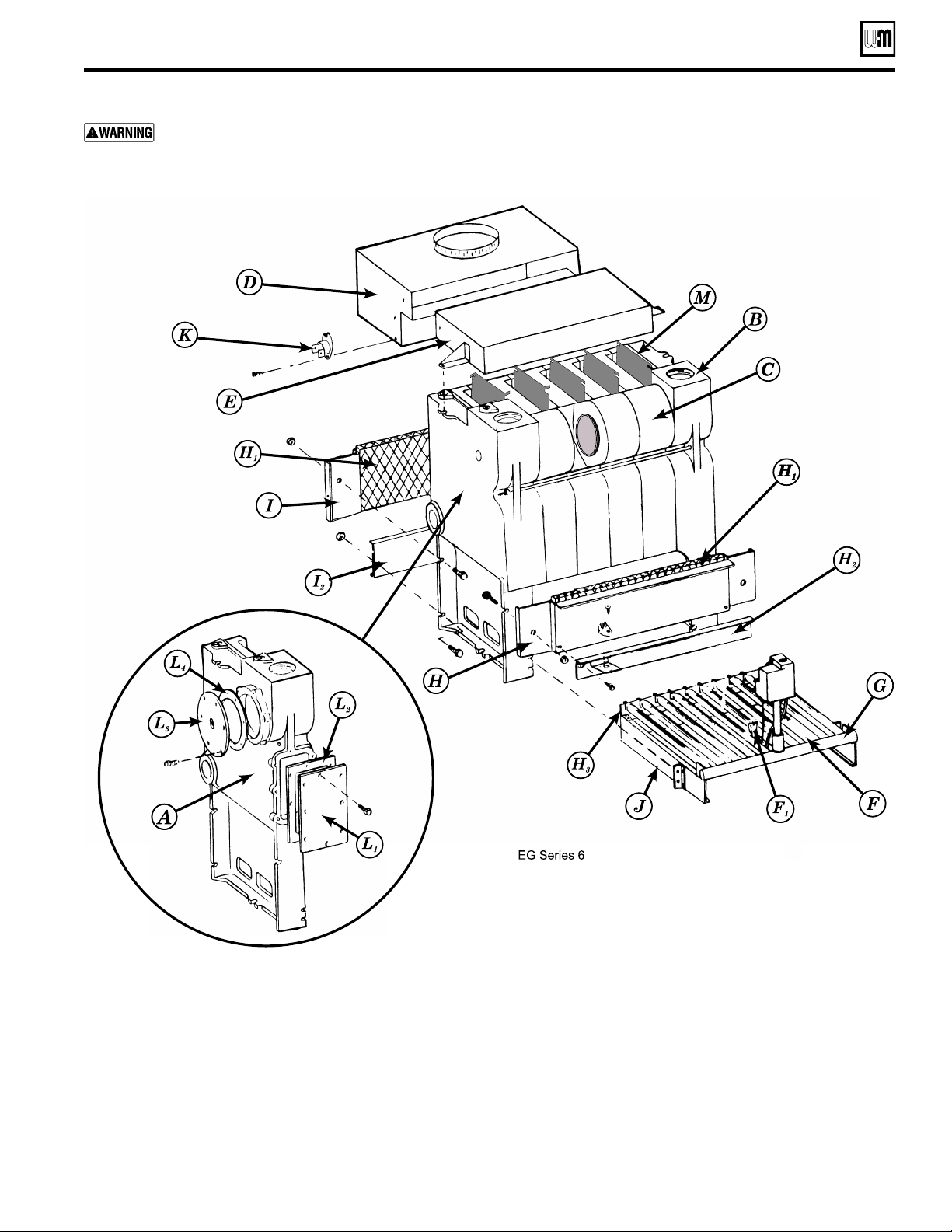
Part Number 550-142-303/1120
35
EG
/
PEG sEriEs 6
•
EGH sEriEs 5 Gas-firEd boilErs — boilEr manual
Replacement parts — EG/PEG (continued)
The boiler contains ceramic fiber and fiberglass materials. Use care when handling these materials per instructions on
page 29
of this manual. Failure to comply could result in severe personal injury.
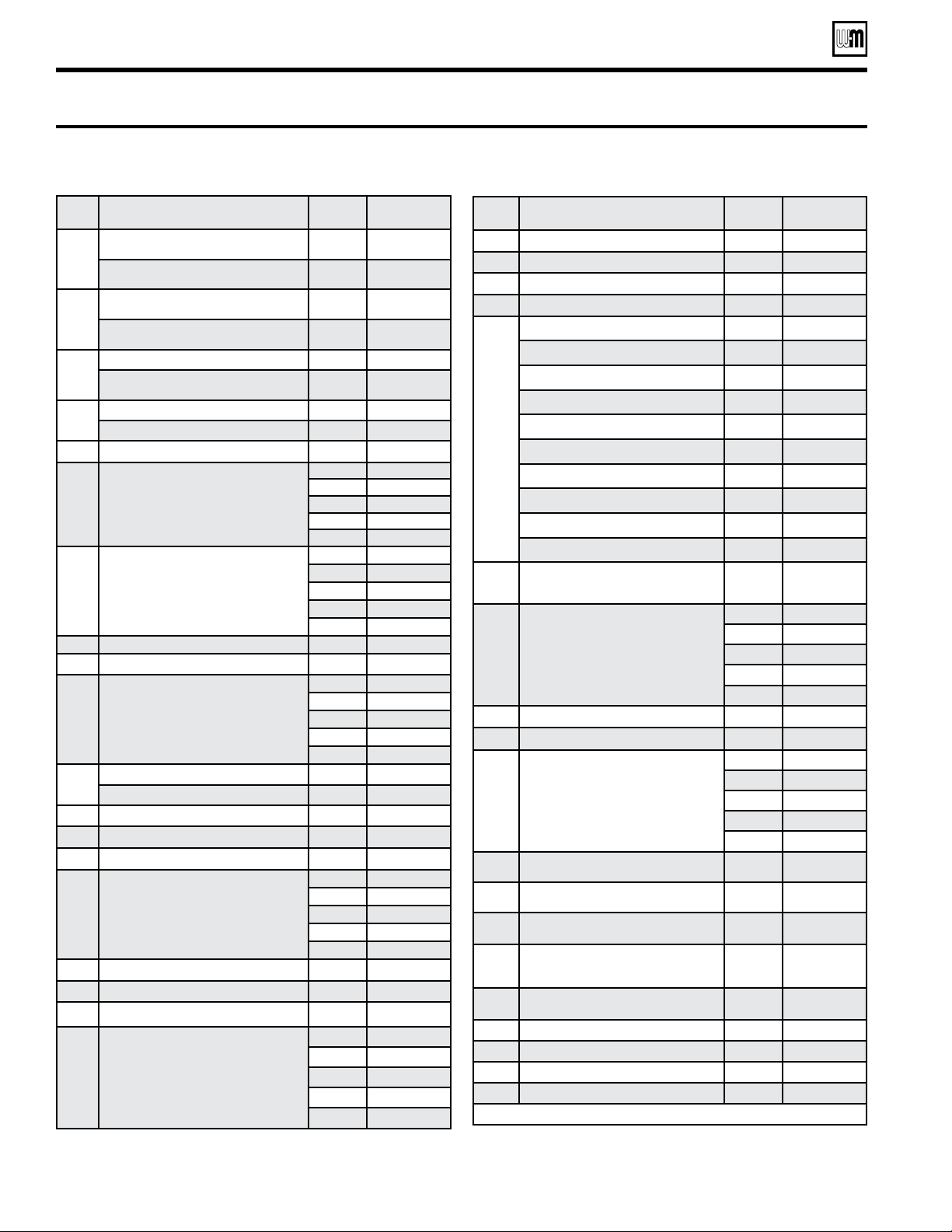
Part Number 550-142-303/1120
36
EG
/
PEG sEriEs 6
•
EGH sEriEs 5 Gas-firEd boilErs — boilEr manual
Replacement parts — EGH
Table 14 EGH replacement parts
Item Description
Boiler
Models
Part Number
A
Left hand end section with heater opening
(Pattern No. 1814)
––
311-800-014
Left hand end section without heater opening
(Pattern No. 1813)
––
311-800-007
B
Right hand end section with heater opening
(Pattern No. 1819)
––
311-800-022
Right hand end section without heater opening
with control tappings (Pattern No. 18118)
––
311-800-032
C
Intermediate section (Pattern No. 1815)
––
311-800-010
Intermediate section with tie rod lugs
(Pattern No. 1817)
––
311-800-026
C
1
3” Diameter bottom elastomer seal (1 per joint)
––
592-800-010
6” Diameter top elastomer seal (1 per joint)
––
592-800-007
D
Flue bafe (1 per joint)
––
460-003-790
E
Draft hood
EGH-85 450-206-240
EGH-95 450-206-241
EGH-105 450-206-242
EGH-115 450-206-243
EGH-125 450-206-244
F
Collector hood
EGH-85 450-014-750
EGH-95 450-014-751
EGH-105 450-014-752
EGH-115 450-014-753
EGH-125 450-014-754
G
Burner, stainless tube, regular
–– 512-200-000
G
1
Burner, stainless tube, with pilot bracket
–– 512-200-001
H
Manifold
EGH-85 591-125-543
EGH-95 591-125-544
EGH-105 591-125-545
EGH-115 591-125-546
EGH-125 591-125-547
not
shown
Main burner orice, natural gas, 2.30mm
––
560-528-975
Main burner orice, propane gas, 1.40mm
––
560-528-972
I
Front base panel (in base panel carton)
––
––
I
1
Front base insulation (in base panel carton)
––
––
I
2
Base front access panel (in base panel carton)
––
––
I, I
1
I
2,
J,
J
1,
&
J
2
Base panel carton
EGH-85 381-700-241
EGH-95 381-700-246
EGH-105 381-700-251
EGH-115 381-700-256
EGH-125 381-700-262
J
Back base panel (in base panel carton)
––
––
J
1
Back base insulation (in base panel carton)
––
––
K
Side rail for burner panel with bracket for burner pan
––
451-800-070
K
1
Back burner support
EGH-85 451-800-095
EGH-95 451-800-096
EGH-105 451-800-097
EGH-115 451-800-098
EGH-125 451-800-099
Item Description
Boiler
Models
Part Number
L
1
Cover plate for heater opening (rectangular)
––
389-900-103
L
2
Gasket for cover plate (rectangular)
––
590-317-579
L
3
Cover plate for heater opening (round)
––
389-900-101
L
4
Gasket for cover plate (round)
––
590-317-495
Section assembly complete with heater opening
(not shown)
EGH-85 321-711-100
Section assembly complete without heater opening
(not shown)
EGH-85 321-711-105
Section assembly complete with heater opening
(not shown)
EGH-95 321-711-110
Section assembly complete without heater opening
(not shown)
EGH-95 321-711-115
Section assembly complete with heater opening
(not shown)
EGH-105 321-711-120
Section assembly complete without heater opening
(not shown)
EGH-105 321-711-125
Section assembly complete with heater opening
(not shown)
EGH-115 321-711-130
Section assembly complete without heater opening
(not shown)
EGH-115 321-711-135
Section assembly complete with heater opening
(not shown)
EGH-125 321-711-140
Section assembly complete without heater opening
(not shown)
EGH-125 321-711-145
Section replacement kit (includes 3” and 6”
elastomer seal, 2 pieces of rope, tube of silicone,
order 1 per joint between sections) (not shown)
––
381-800-667
M
Burner shield (rollout)
EGH-85 451-800-120
EGH-95 451-800-121
EGH-105 451-800-122
EGH-115 451-800-123
EGH-125 451-800-124
N
Refractory Leg-Left and Right
––
591-222-183
P
Refractory clip
–– 421-800-208
Q
Base shield
EGH-85 451-800-136
EGH-95 451-800-137
EGH-105 451-800-138
EGH-115 451-800-139
EGH-125 451-800-140
Sealer for sections (2 pieces of rope, tube of
silicone per joint between sections) (not shown)
––
591-641-865
½” x 7” Tie rod w/o nut (2 per boiler)
(not shown)
––
560-234-465
½” x 17” Tie rod w/o nut (4 – EGH-85)
(not shown) (2 – EGH-95)
––
560-234-472
½” x 21¼” Tie rod w/o nut (2 – EGH-95)
(not shown) (2 – EGH-115)
(4 – EGH-125)
––
560-234-477
½” x 25¼” Tie rod w/o nut (2 – EGH-115)
(not shown) (4 – EGH-125)
––
560-234-482
½” Nut (2 per tie rod) (not shown)
––
561-928-221
½” Lock washer (1 per tie rod) (not shown)
––
562-248-668
Retort cement (1 quart) (not shown)
––
591-602-913
Flue brush (not shown)
––
591-706-214
Note 1: Order sufcient quantities to replace all orices within a base.
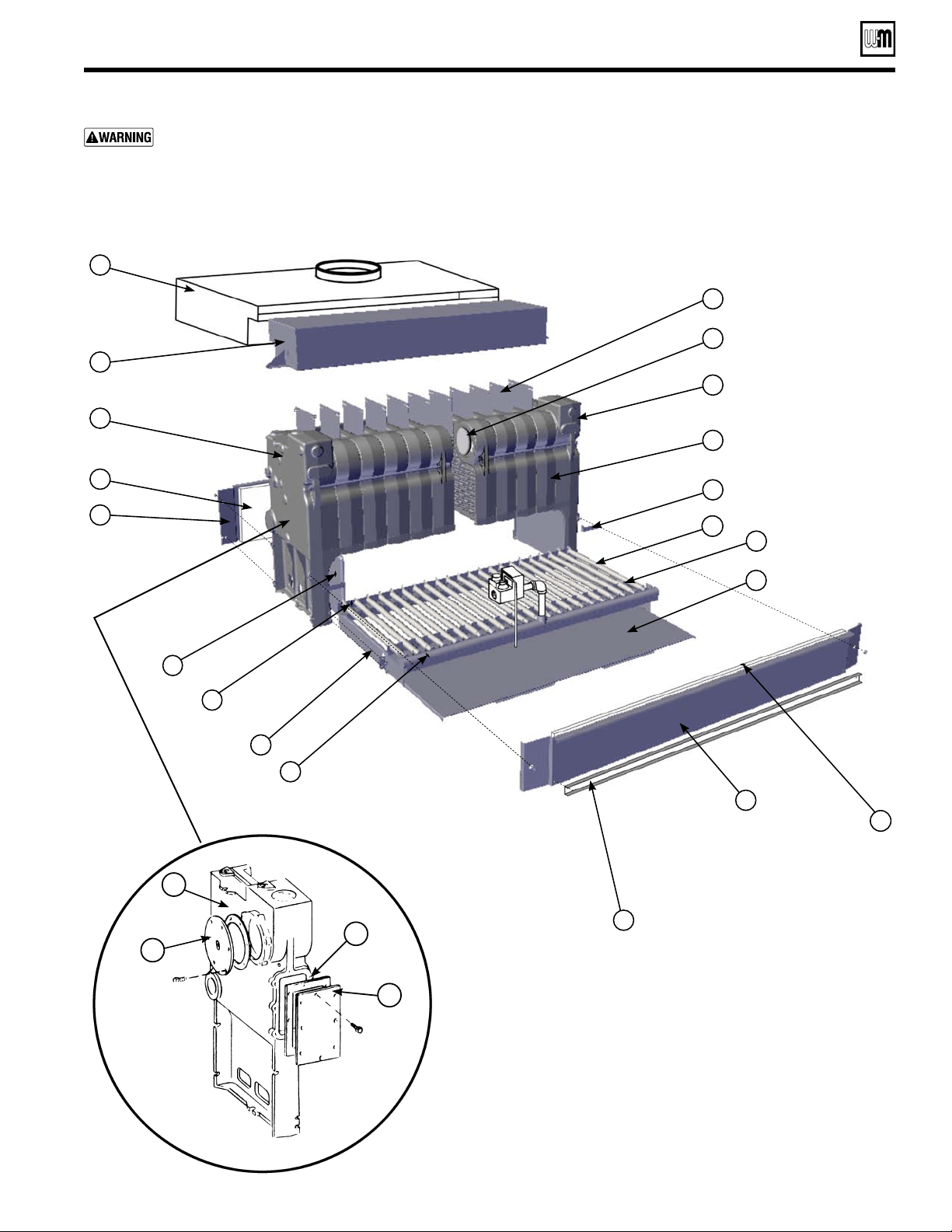
Part Number 550-142-303/1120
37
EG
/
PEG sEriEs 6
•
EGH sEriEs 5 Gas-firEd boilErs — boilEr manual
Replacement parts — EGH (continued)
The boiler contains ceramic fiber and fiberglass materials. Use care when handling these materials per instructions on
page 29
of this manual. Failure to comply could result in severe personal injury.
C
1
F
E
A
J
N
B
C
P
Q
K
K
1
H
D
I
1
I
2
M
J
1
I
G
L
4
L
3
L
2
L
1
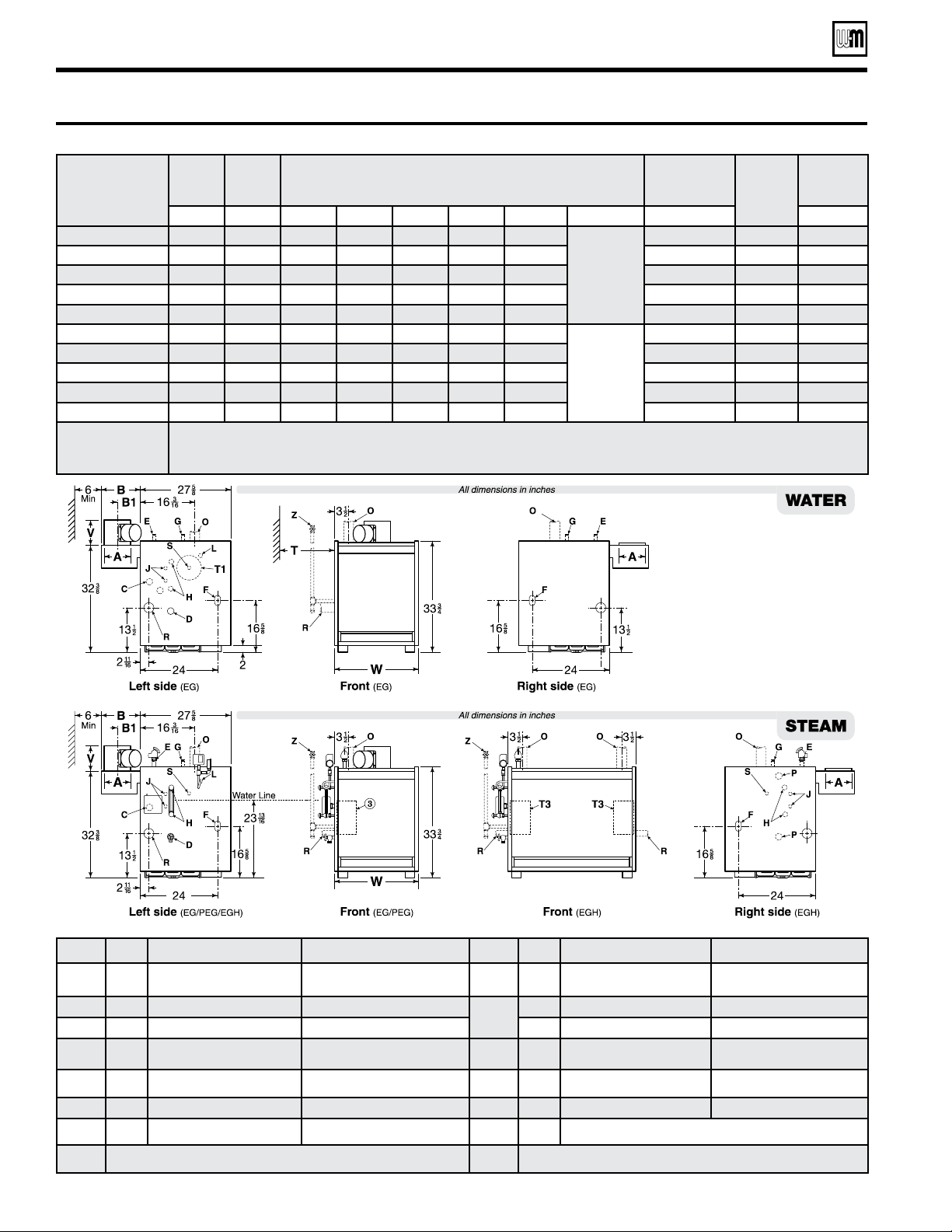
Part Number 550-142-303/1120
38
EG
/
PEG sEriEs 6
•
EGH sEriEs 5 Gas-firEd boilErs — boilEr manual
Dimensional data
Table 15 Dimensional data
Tapping Size Steam Boilers Water Boilers - EG only Tapping Size Steam Boilers Water Boilers - EG only
C ¾” Probe type low water cut-off Probe type LWCO (when used)
P
(EGH Only)
1”
Float type LWCO, pressure limit control
and pressure gauge; or LWCO and feeder
combination; or LWCO and pump control
Float type LWCO; or LWCO and feeder
combination; or LWCO and pump control
D ¾” Drain Drain
S
1 ½” Skim tapping Limit control
E ¾” Safety valve Safety relief valve ¾” –– (note 1) Limit control
G ¾” Plugged Piping to compression tank or auto air vent T1
––
––
Optional tankless heater for
water boilers
H ½” Gauge glass and/or optional LWCO Combination pressure temperature gauge
–– –– –– ––
J ⅜” Tri cock tappings Plugged T3
––
Optional steam boiler tankless heater
––
L ½”
Syphon, pressure gauge, high limit
(probe type LWCO)
Combination pressure temperature gauge Z
––
Manual shut-off gas valve (supplied by installer)
Notes: 1. Available on special request only, when tankless heater is specied. Notes: 2. When a tankless water heater coil is installed, use the tapping in the heater for
an additional operating control.
Model
number
Supply
EG/
EGH
Return
EG/
EGH
Dimensions
(See note 3 for PEG-30 to PEG-55 crate dimensions)
Gas
Connection
“F”
Draft
hood
outlet
size
Approx.
ship wt.
O P W A B B1 V
(note 2) T (note 1) (lbs)
EG & PEG-30 & -35
1 - 3” 1 - 2 ½” 17” 5” 11 ¾” 6 ¾” 6”
Water boiler
tankless coil
removal
clearance:
E-624: 14”
E-626: 18”
E-632: 22”
½” 5” 430
EG & PEG-40 & -45
1 - 3” 1 - 2 ½” 21 ¼” 6” 11 ¾” 6 ¾” 6 ½” ½” 6” 505
EG & PEG-50 & -55
1 - 3” 1 - 2 ½” 25 ½” 7” 11 ¾” 6 ¾” 9” ½” 7” 585
EG & PEG-65
1 - 3” 1 - 2 ½” 29 ¾” 8” 11 ¾” 6 ¾” 9 ½” ¾” 8” 660
EG-75
1 - 3” 1 - 2 ½” 34” 8” 15 ¾” 8 ¾” –– ¾” 8” 735
EGH-85
2 - 3” 2 - 2 ½” 38 ¼” 9” 15 ¾” 8 ¾” ––
N/A
¾” 9” 825
EGH-95
2 - 3” 2 - 2 ½” 42 ½” 10” 15 ¾” 8 ¾” –– ¾” 10” 915
EGH-105
2 - 3” 2 - 2 ½” 46 ¾” 10” 15 ¾” 8 ¾” –– 1” 10” 1005
EGH-115
2 - 3” 2 - 2 ½” 51” 12” 15 ¾” 8 ¾” –– 1” 12” 1095
EGH-125
2 - 3” 2 - 2 ½” 55 ¼” 12” 15 ¾” 8 ¾” –– 1” 12” 1185
Notes:
1. Sizes shown are gas connection sizes, natural or liqueed petroleum (propane) gas. Gas piping from meter to boiler to be sized according to local utility requirements. Gas
line can enter on either the right or left end of the boiler.
2. Damper dimension for EG-30 through EG-75 ONLY. For all EGH boilers the damper is additional equipment.
3. PEG crates are 32” wide x 39” high. Crate lengths are 32” for PEG-30, -35, -40; 37” for PEG-45, -50, and -55; 39” for EG-65.
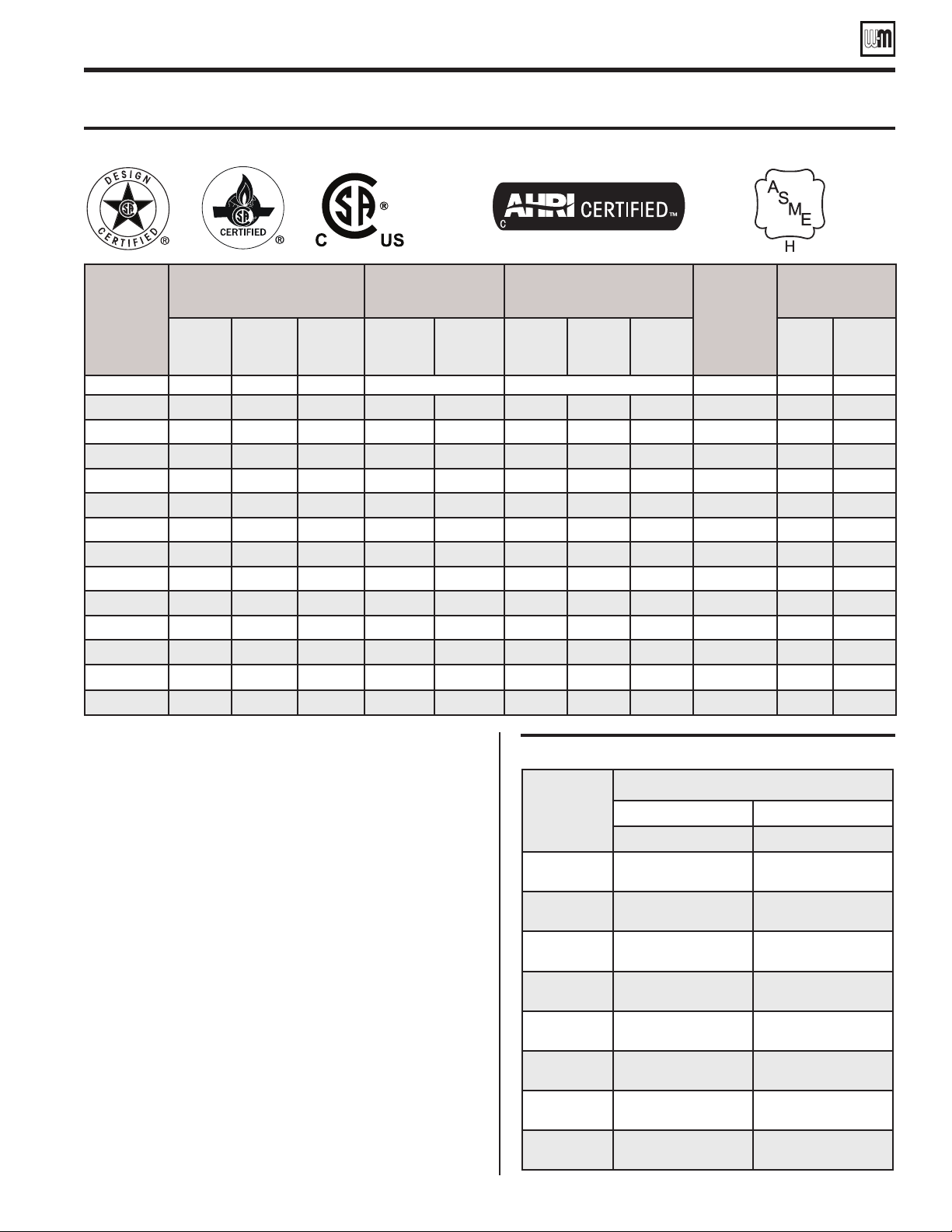
Part Number 550-142-303/1120
39
EG
/
PEG sEriEs 6
•
EGH sEriEs 5 Gas-firEd boilErs — boilEr manual
Notes: (Table 16)
*
Add prefix “P” for package boiler completely assembled and
wired with jacket and controls
(PEG-30-S through PEG-65-S only).
1. EG-30 thru 75: Add suffix “PID” or “PI” for electronic ignition
(30-65 — damper required in U.S.; optional in Canada); add “N” for
natural; add “W” for water; add “S” for steam; add “T” for tankless
heater; add “P” for provisional tankless heater.
EGH-85 & 95: Add suffix “PI” for electronic ignition (damper
available on PI only); add “N” for natural; add “S” for steam; add “T”
for tankless heater (tankless available on EGH-85 thru 125 PI Steam;
EGH-85 and 95 SP Steam only); add “P” for provisional tankless heater.
EGH-105 thru 125: Add suffix “PI” for electronic ignition (damper
available on PI only); add “T” for tankless heater.
2. Based on standard test procedures prescribed by the United States
Department of Energy.
EGH-85 thru EGH-125: Gross output.
3. EGH-105 thru 125 may be installed at altitudes of 2,000-4,500 feet
subject to acceptance by Provincial Inspections Authority based on
field tests of individual installations.
4. Net AHRI ratings are based on net installed radiation of sufficient
quantity for the requirements of the building and nothing need be
added for normal piping and pick-up. Water ratings are based on a
piping and pick-up allowance of 1.15; steam ratings on an allowance
of 1.333. An additional allowance should be made for unusual piping
and pick-up loads. Consult local Weil-McLain representative.
Ratings
Table 16 Ratings
Boiler
Model
Number
AFUE
Water Steam
PIDN PIDN
EG-30
PEG-30
84.0 82.0
EG-35
PEG-35
84.0 82.0
EG-40
PEG-40
84.0 82.0
EG-45
PEG-45
84.0 82.0
EG-50
PEG-50
84.0 82.0
EG-55
PEG-55
84.0 82.0
EG-65
PEG-65
84.0 82.0
EG-75
84.0 82.0
Table 17 AFUE values
Boiler
Model
Number
0–2,000
feet altitude
2,000–4,500
feet altitude
(Canada)
Net AHRI Ratings
Chimney
Size
Boiler Water
Content
(Gallons)
Input
Rating,
(MBH)
Water
Heating
Capacity,
(MBH)
Steam
Heating
Capacity,
(MBH)
Input
(Btuh)
(Output)
(Btuh)
Sq. Ft.
Steam
Steam
(MBH)
Water
(MBH) Water
Steam
(to Waterline)
(Note 1) (Note 2) (Note 3) (Note 4)
*EG-30-
75 64 62 67,500 57,600 196 47 56 5" I.D. x 20' 12.3 8.4
*EG-35-
100 85 82 90,000 76,500 258 62 74 5" I.D. x 20' 12.3 8.4
*EG-40-
125 106 103 112,500 95,400 321 77 92 6" I.D. x 20' 14.8 9.8
*EG-45-
150 127 124 135,000 114,300 388 93 110 6" I.D. x 20' 14.8 9.8
*EG-50-
175 148 145 157,500 133,200 454 109 128 7" I.D. x 20' 17.3 11.2
*EG-55-
200 169 166 180,000 151,200 521 125 147 7" I.D. x 20' 17.3 11.2
*EG-65-
238 201 198 214,000 180,000 621 149 175 8" I.D. x 20' 19.8 12.6
EG-75-
282 237 234 253,000 213,300 733 176 206 8" I.D. x 20' 22.3 14.0
EGH-85-S
315 243 – 283,500 226,800 760 182 – 9" I.D. x 20' – 15.4
EGH-95-S
360 278 – 324,000 259,200 868 209 – 10" I.D. x 20' – 16.8
EGH-105-S
405 312 – 364,500 280,800 977 234 – 10" I.D. x 20' – 18.2
EGH-115-S
450 347 – 405,000 312,300 1,085 260 – 12" I.D. x 20' – 19.6
EGH-125-S
495 382 – 445,500 343,800 1,193 287 – 12" I.D. x 20' – 21.0
Part Number 550-142-303/1120
40
EG
/
PEG sEriEs 6
•
EGH sEriEs 5 Gas-firEd boilErs — boilEr manual
Standard and optional equipment
Standard equipment
• Factory-Assembled Section Block
• Insulated Extended Jacket
• Draft Hood
• Aluminized Steel Burners
• Non-Linting Pilot Burner
• Heater Cover Plates (for boilers with tankless heater openings)
• Control Wire
• Electrical Junction Box
EG/PEG boilers add:
• Combination Gas Valve for 24 volt
• Rollout Thermal Fuse Element
• Spill Switch
• Highest Efficiency Models, PID Intermittent Electronic
Ignition System and Automatic Vent Damper
For EG water boilers
• Ignition Module United Technologies 1135-605
• Temperature / LWCO
sensor
• Built-In Air Eliminator
• 30 PSI Relief Valve
• Combination Pressure Temperature Gauge
• High-Limit Control
• 40 VA Transformer
For EG/PEG steam boilers
• Relief Valve, 15 PSI
• Steam Pressure Gauge
• High-Limit Pressure Control
• Syphon
• Gauge Cocks
• Gauge Glass
• Low-Water Cutoff, Probe Type
• 40 VA Transformer
EG additional equipment
• Tankless Water Heater (EG-35 – 65 PI; EG-75 PI only)
With tankless heater: Combination High Limit, Low Limit,
Circulator Control, and Relay with 40 VA Transformer
• Tankless Steam Heater (EG-35 – 75)
With Tankless Heater: Operating Control and Tankless Heater
35-S-29 for All Units
EGH boilers add:
• Combination Gas Control Valve (includes main gas valve with
redundant seat, PI and PI with damper models; main gas valve
with single seat, 24V models; pressure regulator, gas cock, pilot
filter, pilot adjustment)
• Highest Efficiency Models, PI Intermittent Electronic
Ignition System
• High Efficiency Models, SP Constant Burning, Thermally
Supervised Pilot System, Thermocouple
• 100% Shutoff
• 40 VA Transformer with Receptacle for Circulator Relay
For EGH steam boilers
• Relief Valve, 15 PSI
• Steam Pressure Gauge
• High-Limit Pressure Control
(two limit controls on EGH-85 and 95 SP)
• Syphon
• Gauge Cocks
• Gauge Glass
• Low-Water Cutoff – Probe Type
EGH additional equipment
• Tankless Heaters – PI & SP Steam only
• With Tankless Heater(s):
• Operating Control
• Automatic Vent Damper