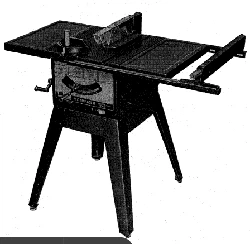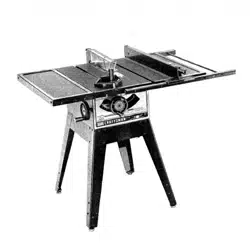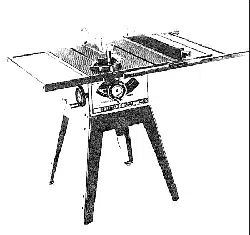
owners
manual
MODEL NO.
113.242700
SAW ONLY
113.242720
SAW WITH LEGS AND
TWO TABLE EXTENSIONS
Serial
Number
Model and serial
number may be found
at the right-hand side
of the base.
You should record both
model and serial number
in a safe place for
future use.
CAUTION:
Read GENERAL
and ADDITIONAL
SAFETY
INSTRUCTIONS
carefully
CRAFTSMAN°
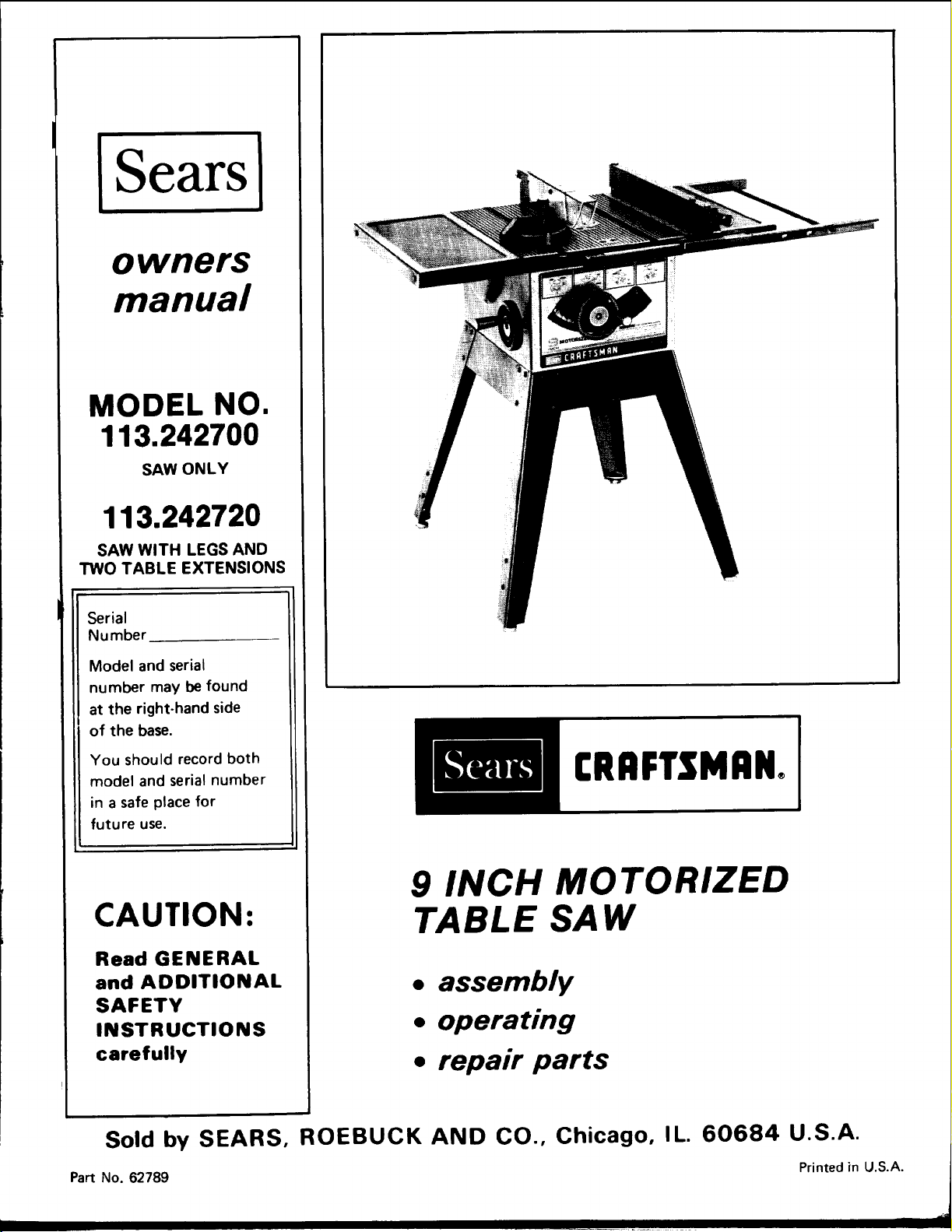
9 INCH MOTORIZED
TABLE SAW
• assembly
• operating
• repair parts
Sold by SEARS, ROEBUCK AND CO., Chicago, IL. 60684 U.S.A.
Part No. 62789 Printed in U.S.A.
FULL ONE YEAR WARRANTY ON CRAFTSMAN TABLE SAWS
If within one year from the date of purchase, this Craftsman Table Saw fails due to a defect in material or
workmanship, Sears will repair it, free of charge.
WARRANTY SERVICE IS AVAILABLE BY SIMPLY CONTACTING THE NEAREST SEARS STORE
OR SERVICE CENTER THROUGHOUT THE UNITED STATES.
This warranty gives you specific legal rights, and you may also have other rights which vary frGm state to
state.
SEARS, ROEBUCK AND CO., Sears Tower, BSC 41-3, Chicago, IL 60684
general safety instructions for power tools
1. KNOW YOUR POWER TOOL
Read and understand the owner's manual and labels
affixed to the tool. Learn its application and
limitations as well as the specific potential hazards
peculiar to this tool.
2. GROUND ALL TOOLS
Thrs tool _s equipped with an approved 3-conductor
cord and a 3-prong grounding type plug to fit the
proper grounding type receptacle. The green conductor
Jn the cord is the grounding w_re. Never connect the
green wire to a live terminal.
3. KEEP GUARDS IN PLACE
_n working order, and in proper adjustment and
alignment.
4. REMOVE ADJUSTING KEYS
AND WRENCHES
Form habit of checking to see that keys and adjusting
wrenches are removed from tool before turning et on.
5. KEEP WORK AREA CLEAN
Cluttered areas and benches invite accidents. Floor
must not be slippery due to wax or sawdust.
6. AVOID DANGEROUS ENVIRONMENT
Don't use power tools in damp or wet IocaU.ons or
expose them to rain. Keep work area well lighted.
Provide adequate surrounding work space.
7. KEEP CHILDREN AWAY
All visitors should be kept a safe distance from work
area
8. MAKE WORKSHOP KID-PROOF
- w_th padlocks, master switches, or by removing
starter keys.
9. DON'T FORCE TOOL
It will do the job better and'safer at the rate for which
_t was designed.
10. USE RIGHT TOOL
Don't force tool or attachment to do a lob _t was not
designed for.
11. WEAR PROPER APPAREL
Do not wear loose clothing, gloves, neckties or jewelry
(rings, wrist watches) to get caught in moving parts.
Nonslip footwear is recommended. Wear protective
hair covering to contain long hair. Roll long sleeves
above the elbow.
12. USE SAFETY GOGGLES (Head Protection)
Wear Safety goggles (must comply with ANSI Z87.1)
at all times. Everyday eyeglasses only have impact
resistant lenses, they are NOT safety glasses. Also, use
face or dust mask if cutting operation is dusty, and ear
13.
14.
15.
16.
17.
18.
19.
protectors (plugs or muffs) during extended periods of
operati on.
SECURE WORK
Use clamps or a vise to hold work when practical. It's
safer than using your hand, frees both hands to operate
tool.
DON'T OVERREACH
Keep proper footing and balance at all times.
MAINTAIN TOOLS WITH CARE
Keep tools sharp and clean for best and safest
performance. Follow" instructions for lubricating and
changing accessories.
DISCONNECT TOOLS
before servicing; when changing accessories such as
blades, bits, cutters, etc.
AVOID ACCIDENTAL STARTING
Make sure switch is in "OFF" position before plugging
in,
USE RECOMMENDED ACCESSORIES
Consult the owner's manual for recommended
accessories. Follow the instructions that accompany
the accessories. The use of improper accessories may
cause hazards,
NEVER STAND ON TOOL
Serious injury could occur if the tool is tipped or if the
cutting tool is accidentally contacted.
Do not store materials above or near the tool such that
it is necessary to stand on the tool to reach them.
20. CHECK DAMAGED PARTS
Before further use of the toot, a guard or other part that
is damaged should be carefully checked to ensure that it
will operate properly and perform its _ntended function.
Check for alignment of moving parts, binding of moving
parts, breakage of parts, mounting, and any other
conditions that may .affect its operation. A guard or
other part that is damaged should be properly repaired
or replaced,
21. DIRECTION OF FEED
Feed work into a blade or cutter against the direction
of rotation of the blade or cutter only.
22. NEVER LEAVE TOOL RUNNING
UNATTENDED
Turn power off. Don't leave tool until it comes to-a
complete stop.
ADDITIONAL SAFETY INSTRUCTIONS FOR TABLE SAWS
WARNING: FOR YOUR OWN SAFETY, DO NOT
OPERATE YOUR SAW UNTIL IT IS COMPLETELY
ASSEMBLED AND INSTALLED ACCORDING TO THE
INSTRUCTIONS... AND UNTIL YOU HAVE READ
AND UNDERSTAND THE FOLLOWING.
1. GENERAL SAFETY INSTRUCTIONS FOR POWER
TOOLS... SEE PAGE 2
2. GETTING TO KNOW YOUR SAW... SEE PAGE 15
3. BASIC SAW OPERATION... SEE PAGE 17
4. ADJUSTMENTS... SEE PAGE 24
5. MAINTENANCE... SEE PAGE 27
6. STABILITY OF SAW
If there is any tendency for the saw to tip over or move
during certain cutting operations such as cutting
extremely large heavy panels or long heavy boards,
the saw should be bolted down.
If you attach any kind of table extensions over 24"
wide to either end of the saw, make sure you either
bolt the saw to the bench or floor as appropriate, or
support the outer end of the extension from the bench
or floor, as appropriate.
7. LOCATION
The saw should be positioned so neither the operator
nor a casual observer is forced to stand in line with the
saw blade.
8. KICKBACKS
A "KICKBACK" occurs during a rip-type operation
when a part or all of the workpiece is thrown back
violently toward the operator.
Keep your face and body to one side of the sawblade,
out of line with a possible "Kickback."
Kickbacks -- and possible injury from them -- can
usually be avoided by:
A. Maintaining the rip fence parallel to the sawblade.
B. Keeping the sawblade sharp. Replacing
antikickback pawls when points become dull.
C. Keeping sawblade guard, spreader, and
antikickback pawls in place and operating
properly. The spreader must be in alignment with
the sawblade and the pawls must stop a kickback
once it has started. Check their action before
ripping.
D. NOT ripping work that istwisted or warped or does
not have a straight edge to guide along the rip
fence.
E. NOT releasing work until you have pushed it all the
way past the sawblade.
F. Using a "PUSH STICK" (See Page 18) for ripping
widths of 2 to 6 in., and an auxiliary fence and push
block for ripping widths narrower than 2 in. (See
"Basic Saw Operation Using The Rip Fence"
section.)
G. NOT confining the cut-off piece when ripping or
crosscutting.
H. When ripping apply the feed force to the section of
the workpiece between the saw blade and the rip
fence.
9. PROTECTION: EYES, HANDS, FACE, EARS, BODY
A. If any part of your saw is malfunctioning, has been
damaged or broken.., such as the motor switch,
or other operating control, a safety device or the
power cord.., cease operating immediately until
the particular part is properly repaired or replaced.
B. Wear safety goggles that comply with ANSI Z87.1,
and a face shield if operation is dusty. Wear ear
plugs or muffs during extended periods of
operation.
C. Small loose pieces of wood or other objects that
contact the rear of the revolving blade can be
D.
E.
F.
thrown back at the operator at excessive speed.
This can usually be avoided by keeping the guard
and spreader in place for all "THRU-SAWlNG"
operations (sawing entirely thru the work-- AND
by removing all loose pieces from the table with a
long stick of wood IMMEDIATELY after they are
cut off.
Use extra caution when the guard assembly is
removed for resawing, dadoing, rabbeting, or
molding -- replace the guard as soon as that
operation is completed.
For rip or rip-type cuts, the following end of a
workpiece to which a push stick or push board is
applied must be square (perpendicular to the
fence) in order that feed pressure applied to the
workpiece by the push stick or block does not
cause the workpiece to come away from the fence,
and possibly cause a kickback.
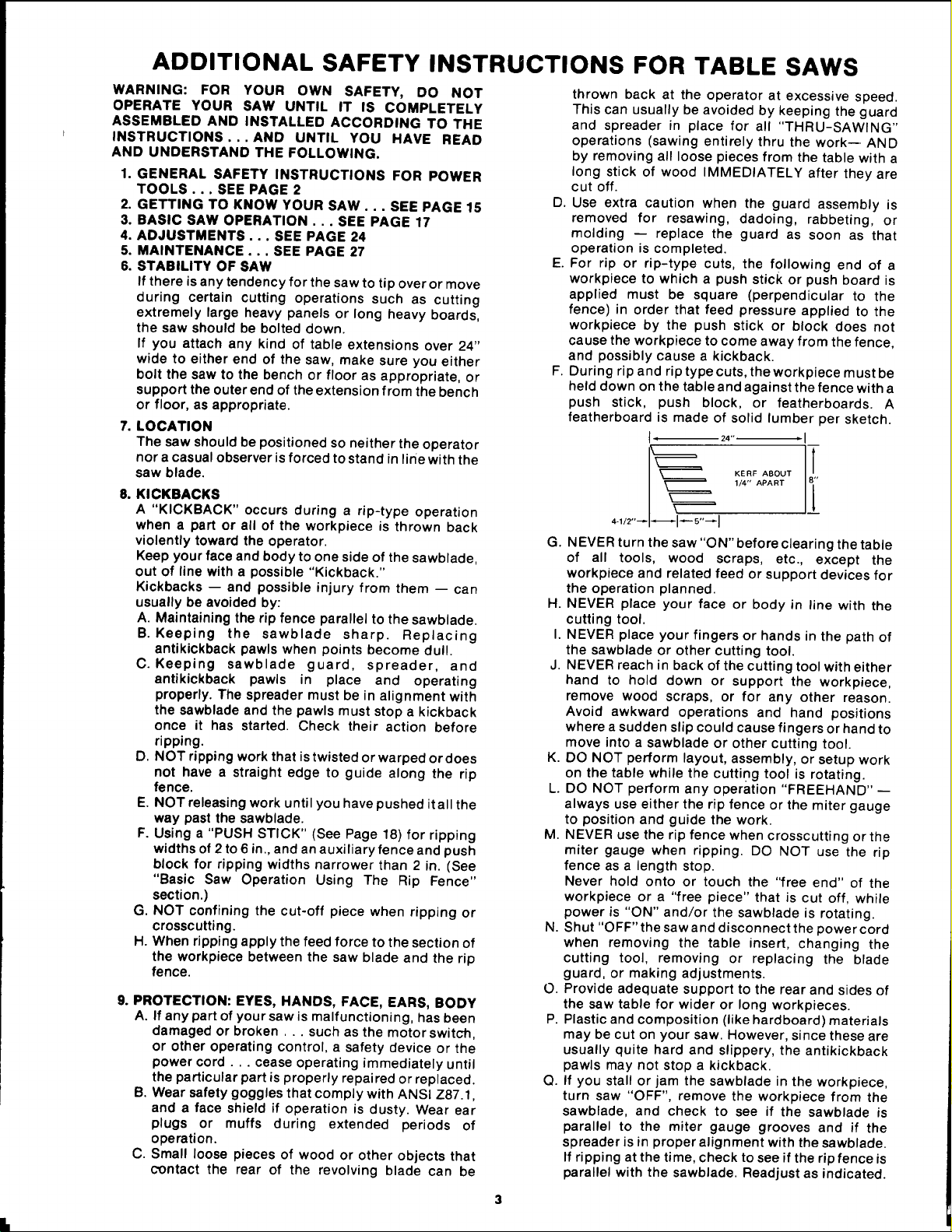
During rip and rip type cuts, the workpiece must be
held down on the table and against the fence with a
push stick, push block, or featherboards. A
featherboard is made of solid lumber per sketch.
1, 2,,, , I
I_1_1 KER_ABOUT
1/4" APART
G. NEVER turn the saw "ON" before clearing the table
of all tools, wood scraps, etc., except the
workpiece and related feed or support devices for
the operation planned.
H. NEVER place your face or body in line with the
cutting tool.
I. NEVER place your fingers or hands in the path of
the sawblade or other cutting tool.
J. NEVER reach in back of the cutting tool with either
hand to hold down or support the workpiece,
remove wood scraps, or for any other reason.
Avoid awkward operations and hand positions
where a sudden slip could cause fingers or hand to
move into a sawblade or other cutting tool.
K. DO NOT perform layout, assembly, or setup work
on the table while the cutting tool is rotating.
L. DO NOT perform any operation "FREEHAND" --
always use either the rip fence or the miter gauge
to position and guide the work.
M. NEVER use the rip fence when crosscutting orthe
miter gauge when ripping. DO NOT use the rip
fence as a length stop.
Never hold onto or touch the "free end" of the
workpiece or a "free piece" that is cut off, while
power is "ON" and/or the sawblade is rotating.
N. Shut "OFF" the saw and disconnect the power cord
when removing the table insert, changing the
cutting tool, removing or replacing the blade
guard, or making adjustments.
O. Provide adequate support to the rear and sides of
the saw table for wider or long workpieces.
P. Plastic and composition (like hardboard) materials
may be cut on your saw. However, since these are
usually quite hard and slippery, the antikickback
pawls may not stop a kickback.
Q. If you stall or jam the sawblade in the workpiece,
turn saw "OFF", remove the workpiece from the
sawblade, and check to see if the sawblade is
parallel to the miter gauge grooves and if the
spreader is in proper alignment with the sawblade.
If ripping at the time, check to see if the rip fence is
parallel with the sawblade. Readjust as indicated.
R.DO NOT remove small pieces of cut-off material
that may become trapped inside the blade guard
while the saw is running. This could endanger your
hands or cause a kickback. Turn saw "OFF" and
wait until blade stops.
S. Use extra care when ripping wood that has a
twisted grain or is twisted or bowed -- it may rock
on the table and/or pinch the sawblade.
10. KNOW YOUR CUTTING TOOLS
A. Dull, gummy, or improperly sharpened or set
cutting tools can cause material to stick, jam, stall
the saw, or kickback at the operator.
Minimize potential injury by proper cutting tool
and machine maintenance.
NEVER ATTEMPT TO FREE A STALLED
SAWBLADE WITHOUT FIRST TURNING THE
SAW OFF.
B. Never use grinding wheels, abrasive cut-off
wheels, friction wheels (metal slitting blades) wire
wheels or buffing wheels.
11. USE ONLY ACCESSORIES DESIGNED FOR THIS
SAW.
12. Crosscutting operations are more conveniently
worked and with greater safety if an auxiliary wood
facing is attached to the miter gauge using the holes
provided. However, the facing must not interfere with
the proper functioning of the sawblade guard.
13. Make sure the top of the arbor or cutting tool rotates
toward you when standing in normal operating
position. Also make sure the cutting tool, arbor collars
and arbor nut are installed properly. Keep the cutting
tool as low as possible for the operation being
performed. Keep all guards in place whenever
possible.
14. Do not use any blade or other cutting tool marked for
an operating speed less than 3450 RPM. Never use a
cutting tool larger in diameter than the diameter for
which the saw was designed. For greatest safety and
efficiency when ripping, use the maximum diameter
blade for which the saw is designed, since under these
conditions the spreader is nearest the blade.
15. Adjust table inserts flush with the table top. NEVER
Operate the saw unless the proper insert is installed.
16. Never feed material into the cutting tool from the rear
of the saw. An accident and serious injury could
result.
17. THINK SAFETY.
Safety is a combination of operator common sense
and alertness at all times when the saw is being used.
18. NOTE AND FOLLOW SAFETY INSTRUCTIONS
THAT APPEAR ON THE FRONT OF YOUR SAW.
DANGER
FOR YOUR OWN SAFETY
READ AND UNDERSTAND OWNER' S MANUAL
BEFORE OPERATING MACHINE:
1. WEAR SAFETY GOGGLES PER ANSI Z87.1 AT ALL
TIMES
2. USE SAW-BLADE GUARD FOR "THRU-SAWING"
3. KEEP HANDS OUT OF PATH OF SAWBLADE
4. USE A "PUSH-STICK" WHEN REQUIRED
5. KNOW HOW TO AVOID "KICKBACKS'"
6. DO NOT PERFORM OPERATIONS "FREEHAND"
7. NEVER REACH AROUND OR OVER SAW BLADE
19. WARNING: DO NOT ALLOW FAMI'LIARITY
(GAINED FROM FREQUENT USE OF YOUR SAW)
TO BECOME COMMONPLACE. -- ALWAYS
REMEMBER THAT A CARELESS FRACTION OF A
SECOND IS SUFFICIENT TO INFLICT SEVERE
INJURY.
20. NOTE: Do not overtighten arbor nut. Use the arbor nut
wrench to just "snug" it.
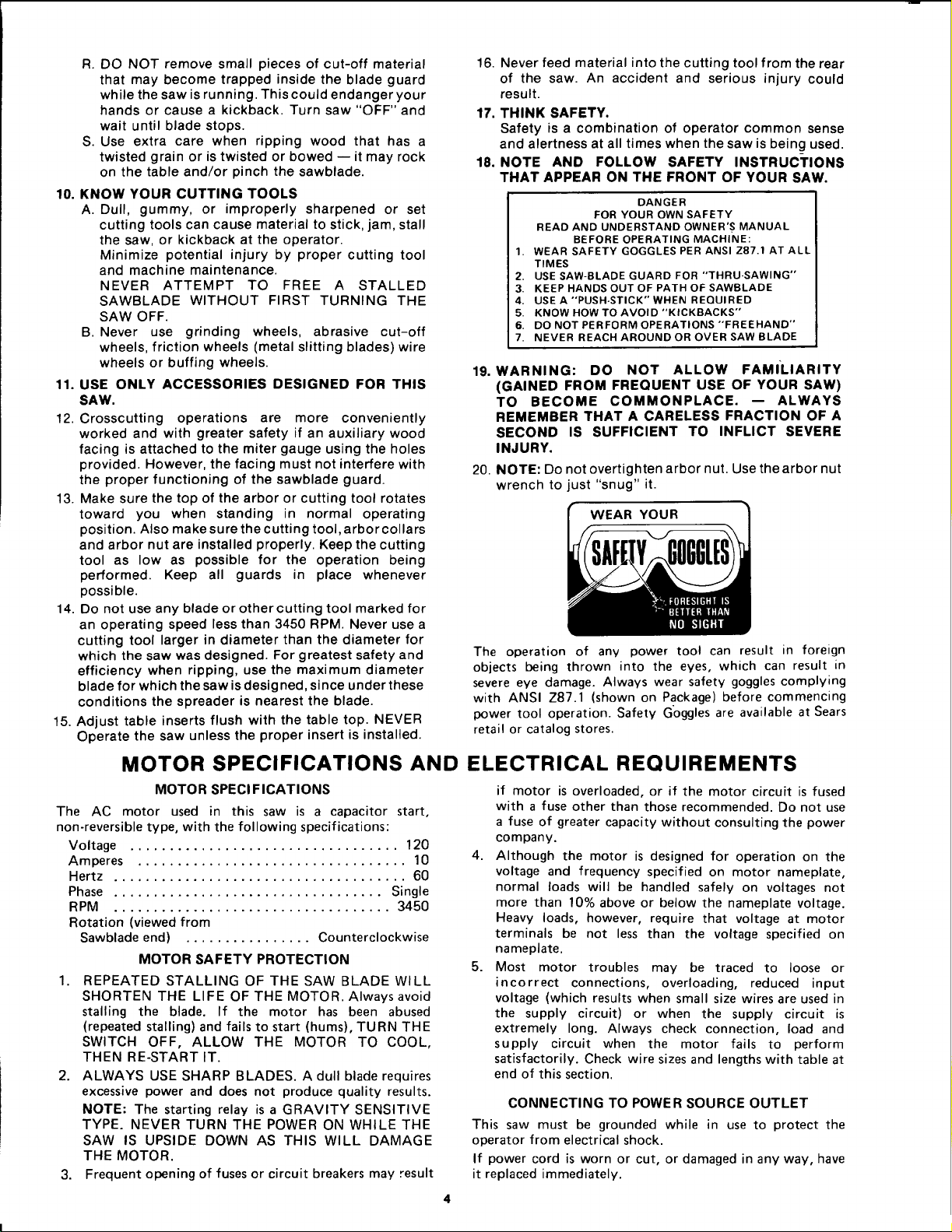
WEAR YOUR
The operation of any power tool can result in foreign
objects being thrown into the eyes, which can result in
severe eve damage. Always wear safety goggles complying
with ANSI Z87.1 (shown on Package) before commencing
power tool operation. Safety G'oggles are available at Sears
retail or catalog stores.
MOTOR SPECIFICATIONS AND ELECTRICAL REQUIREMENTS
MOTOR SPECI FICATIONS
The AC motor used in this saw is a capacitor start,
non-reversible type, with the following specifications:
Voltage .................................. 120
Amperes .................................. 10
Hertz ..................................... 60
Phase .................................. Single
RPM ................................... 3450
Rotation (viewed from
Sawblade end) ................ Counterclockwise
MOTOR SAFETY PROTECTION
1. REPEATED STALLING OF THE SAW BLADE WILL
SHORTEN THE LIFE OF THE MOTOR. Always avoid
stalling the blade. If the motor has been abused
(repeated stalling) and fails to start (hums), TURN THE
SWITCH OFF, ALLOW THE MOTOR TO COOL,
THEN RE-START IT.
2. ALWAYS USE SHARP BLADES. A dull blade requires
excessive power and does not produce quality results.
NOTE: The starting relay is a GRAVITY SENSITIVE
TYPE. NEVER TURN THE POWER ON WHILE THE
SAW IS UPSIDE DOWN AS THIS WILL DAMAGE
THE MOTOR.
3. Frequent opening of fuses or circuit breakers may result
4.
5.
if motor is overloaded, or if the motor circuit is fused
with a fuse other than those recommended. Do not use
a fuse of greater capacity without consulting the power
company.
Although the motor is designed for operation on the
voltage and frequency specified on motor nameplate,
normal loads will be handled safely on voltages not
more than 10% above or below the nameplate voltage.
Heavy loads, however, require that voltage at motor
terminals be not less than the voltage specified on
nameplate.
Most motor troubles may be traced to loose or
incorrect connections, overloading, reduced input
voltage (which results when small size wires are used in
the supply circuit) or when the supply circuit is
extremely long. Always check connection, load and
supply circuit when the motor fails to perform
satisfactorily. Check wire sizes and lengths with table at
end of this section.
CONNECTING TO POWER SOURCE OUTLET
This saw must be grounded while in use to protect the
operator from electrical shock.
If power cord is worn or cut, or damaged in any way, have
it replaced immediately.
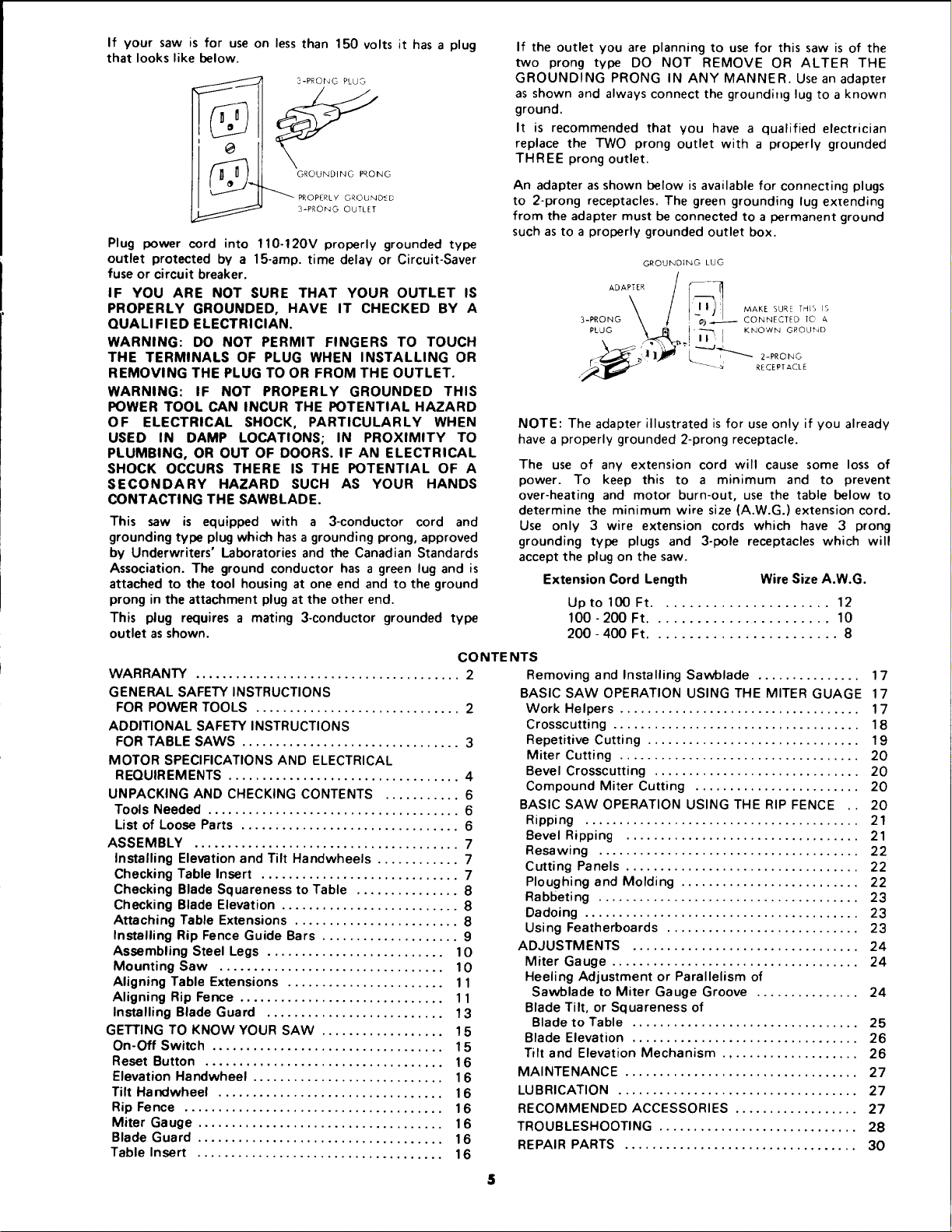
If your saw
that looks like below.
is for use on less than 150 volts it has a plug
3-PRONG PLUG
GROUNDING PRONG
_ PROPERLY GROUND'ED
3-PRONG OUTLET
Plug power cord into 110-120V properly grounded type
outlet protected by a 15-amp. time delay or Circuit-Saver
fuse or circuit breaker.
IF YOU ARE NOT SURE THAT YOUR OUTLET IS
PROPERLY GROUNDED, HAVE IT CHECKED BY A
QUALI FI ED ELECTRICIAN.
WARNING: DO NOT PERMIT FINGERS TO TOUCH
THE TERMINALS OF PLUG WHEN INSTALLING OR
REMOVING THE PLUG TO OR FROM THE OUTLET.
WARNING: IF NOT PROPERLY GROUNDED THIS
POWER TOOL CAN INCUR THE POTENTIAL HAZARD
OF ELECTRICAL SHOCK, PARTICULARLY WHEN
USED IN DAMP LOCATIONS; IN PROXIMITY TO
PLUMBING, OR OUT OF DOORS. IF AN ELECTRICAL
SHOCK OCCURS THERE IS THE POTENTIAL OF A
SECONDARY HAZARD SUCH AS YOUR HANDS
CONTACTING THE SAWBLADE.
This saw is equipped with a 3-conductor cord and
grounding type plug which hasagrounding prong, approved
by Underwriters' Laboratories and the Canadian Standards
Association. The ground conductor has a green lug and is
attached to the tool housing at one end and to the ground
prong in the attachment plug at the other end.
This plug requires a mating 3-conductor grounded type
outlet as shown.
If the outlet you are planning to use for this saw is of the
two prong type DO NOT REMOVE OR ALTER THE
GROUNDING PRONG IN ANY MANNER. Use an adapter
as shown and always connect the grounding lug to a known
ground.
It is recommended that you have a qualified electrician
replace the TWO prong outlet with a properly grounded
THREE prong outlet.
An adapter as shown below is available for connecting plugs
to 2-prong receptacles. The green grounding lug ex_ending
from the adapter must be connected to a permanent ground
such as to a properly grounded outlet box.
GROUNDING LUG
ADAPTER / _ -
/ I1_I MAKESURET_I[S1S
3-PRONG \ _ ! _'_,._---- CONNECTED I'C A
PLUG _[_ I "_ I KNOWN GROLIND
\ ,,_'%-__1 I I I
,_ _- '_ RECEPT _,CLE
NOTE: The adapter illustrated is for use only if you already
have a properly grounded 2-prong receptacle.
The use of any extension cord will cause some loss of
power. To keep this to a minimum and to prevent
over-heating and motor burn-out, use the table below to
determine the minimum wire size (A.W.G.) extension cord.
Use only 3 wire extension cords which have 3 prong
grounding type plugs and 3-pole receptacles which will
accept the plug on the saw.
Extension Cord Length Wire Size A.W.G.
Upto 100 Ft ...................... 12
100 - 200 Ft ....................... 10
200 - 400 Ft ........................ 8
CO NTE NTS
WARRANTY ....................................... 2
GENERAL SAFETY INSTRUCTIONS
FOR POWER TOOLS .............................. 2
ADDITIONAL SAFETY INSTRUCTIONS
FOR TABLE SAWS ................................ 3
MOTOR SPECIFICATIONS AND ELECTRICAL
REQUIREMENTS .................................. 4
UNPACKING AND CHECKING CONTENTS ........... 6
Tools Needed ..................................... 6
List of Loose Parts ................................ 6
ASSEMBLY ....................................... 7
Installing Elevation and Tilt Handwheels ............ 7
Checking Table Insert ............................. 7
Checking Blade Squareness to Table ............... 8
Checking Blade Elevation .......................... 8
Attaching Table Extensions ........................ 8
Installing Rip Fence Guide Bars .................... 9
Assembling Steel Legs .......................... 1O
Mounting Saw ................................. 10
Aligning Table Extensions ....................... 11
Aligning Rip Fence .............................. 11
Installing Blade Guard .......................... 13
GETTING TO KNOW YOUR SAW .................. 15
On-Off Switch .................................. 15
Reset Button ................................... 16
Elevation Handwheel ............................ 16
Tilt Handwheel ................................. 16
Rip Fence ...................................... 16
Miter Gauge .................................... 16
Blade Guard .................................... 16
Table Insert .................................... 16
Removing and Installing Sawblade ............... 17
BASIC SAW OPERATION USING THE MITER GUAGE 17
Work Helpers ................................... 17
Crosscutting .................................... 18
Repetitive Cutting ............................... 19
Miter Cutting ................................... 20
Bevel Crosscutting .............................. 20
Compound Miter Cutting ........................ 20
BASIC SAW OPERATION USING THE RIP FENCE .. 20
Ripping ........................................ 21
Bevel Ripping .................................. 21
Resawing ...................................... 22
Cutting Panels .................................. 22
Ploughing and Molding .......................... 22
Rabbeting ...................................... 23
Dadoing ........................................ 23
Using Featherboards ............................ 23
ADJUSTMENTS ................................. 24
Miter Gauge .................................... 24
Heeling Adjustment or Parallelism of
Sawblade to Miter Gauge Groove ............... 24
Blade Tilt, or Squareness of
Blade to Table ................................. 25
Blade Elevation ................................. 26
Tilt and Elevation Mechanism .................... 26
MAINTENANCE .................................. 27
LUBRICATION ................................... 27
RECOMMENDED ACCESSORIES .................. 27
TROUBLESHOOTING ............................. 28
REPAIR PARTS .................................. 30
r
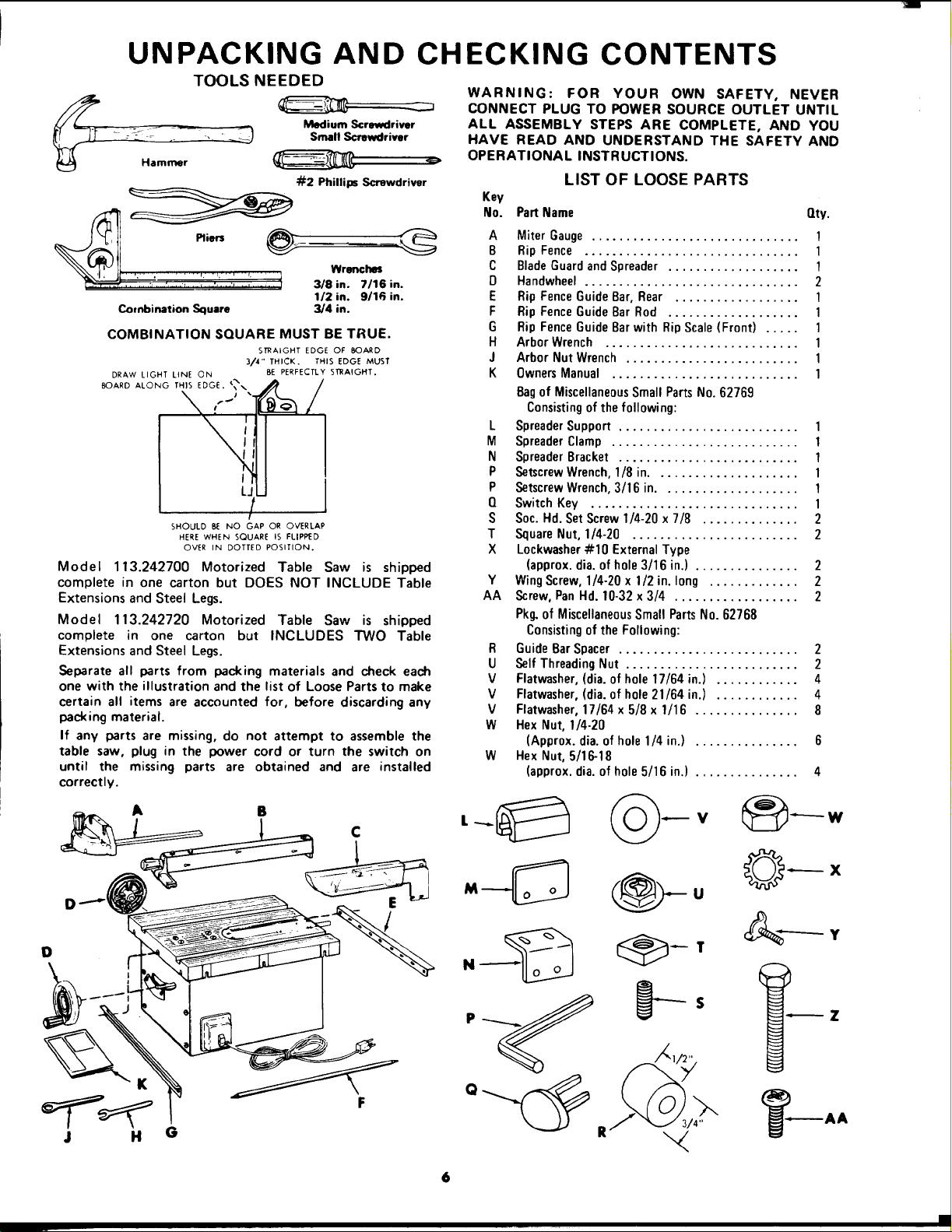
UNPACKING AND CHECKING CONTENTS
TOOLS NEEDED
Medium Screwdriver
Hammer _
#2 Phillips Screwdriver
_, ::::i:;':=======================================3/ei.._/lei..
112in. 9116 in.
Combination Square 3/4 in.
COMBINATION SQUARE MUST BE TRUE.
STRAIGHT EDGE OF BOARD
3/4" THICK. THIS EDGE MUST
DRAW LIGHT LiNE ON BE PERFECTLY SI_AIGHT.
BOARD ALONG THIS EDGE, _'_\
\
SHOULD BE NO GAP OR OVERLAP
HERE WHEN SQUARE IS FLIPPED
OVER IN DOTTED POSITION.
Model 113.242700 Motorized Table Saw is shipped
complete in one carton but DOES NOT INCLUDE Table
Extensions and Steel Legs.
Model 113.242720 Motorized Table Saw is shipped
complete in one carton but INCLUDES TWO Table
Extensions and Steel Legs.
Separate all parts from packing materials and check each
one with the illustration and the list of Loose Parts to make
certain all items are accounted for, before discarding any
packing material.
If any parts are missing, do not attempt to assemble the
table saw, plug in the power cord or turn the switch on
until the missing parts are obtained and are installed
correctly.
C
D
J H G
WARNING: FOR YOUR OWN SAFETY, NEVER
CONNECT PLUG TO POWER SOURCE OUTLET UNTIL
ALL ASSEMBLY STEPS ARE COMPLETE, AND YOU
HAVE READ AND UNDERSTAND THE SAFETY AND
OPERATIONAL INSTRUCTIONS.
Key
No.
LIST OF LOOSE PARTS
Part Name Qty.
A Miter Gauge .............................. 1
B Rip Fence ............................... 1
C Blade Guard and Spreader ................... 1
D Handwheel ............................... 2
E Rip Fence Guide Bar, Rear .................. 1
F Rip Fence Guide Bar Rod ................... 1
G Rip Fence Guide Barwith Rip Scale (Front) ..... 1
H Arbor Wrench ............................ 1
J Arbor Nut Wrench ......................... 1
K Owners Manual ........................... 1
Bag of MiscellaneousSmall Parts No. 62769
Consisting of the following:
L Spreader Support .......................... 1
M Spreader Clamp ........................... 1
N Spreader Bracket .......................... 1
P SetscrewWrench, 1/8 in..................... 1
P Setscrew Wrench, 3/16 in.................... 1
Q Switch Key .............................. 1
S Soc. Hd. Set Screw 1/4-20 x 7/8 .............. 2
T Square Nut, 1/4-20 ........................ 2
X Lockwasher #10 External Type
(approx. dia. of hole 3/16 in.) ............... 2
Y Wing Screw, 1/4-20 x 1/2 in. long ............. 2
AA Screw, Pan Hd. 10-32 x 3/4 .................. 2
Pk_ of MiscellaneousSmall Parts No. 62768
Consisting of the Following:
R Guide Bar Spacer .......................... 2
U Self Threading Nut ......................... 2
V Flatwasher, (dia. of hole 17/64 in.) ............ 4
V Flatwasher, (dia. of hole 21/64 in.) ............ 4
V Flatwasher, 17/64 x 5/8 x 1/16 ............... 8
W Hex Nut, 1/4-20
(Approx. dia. of hole 1/4 in.) ............... 6
W Hex Nut, 5/16-18
(approx. dia. of hole 5/16 in.) ............... 4
R
6
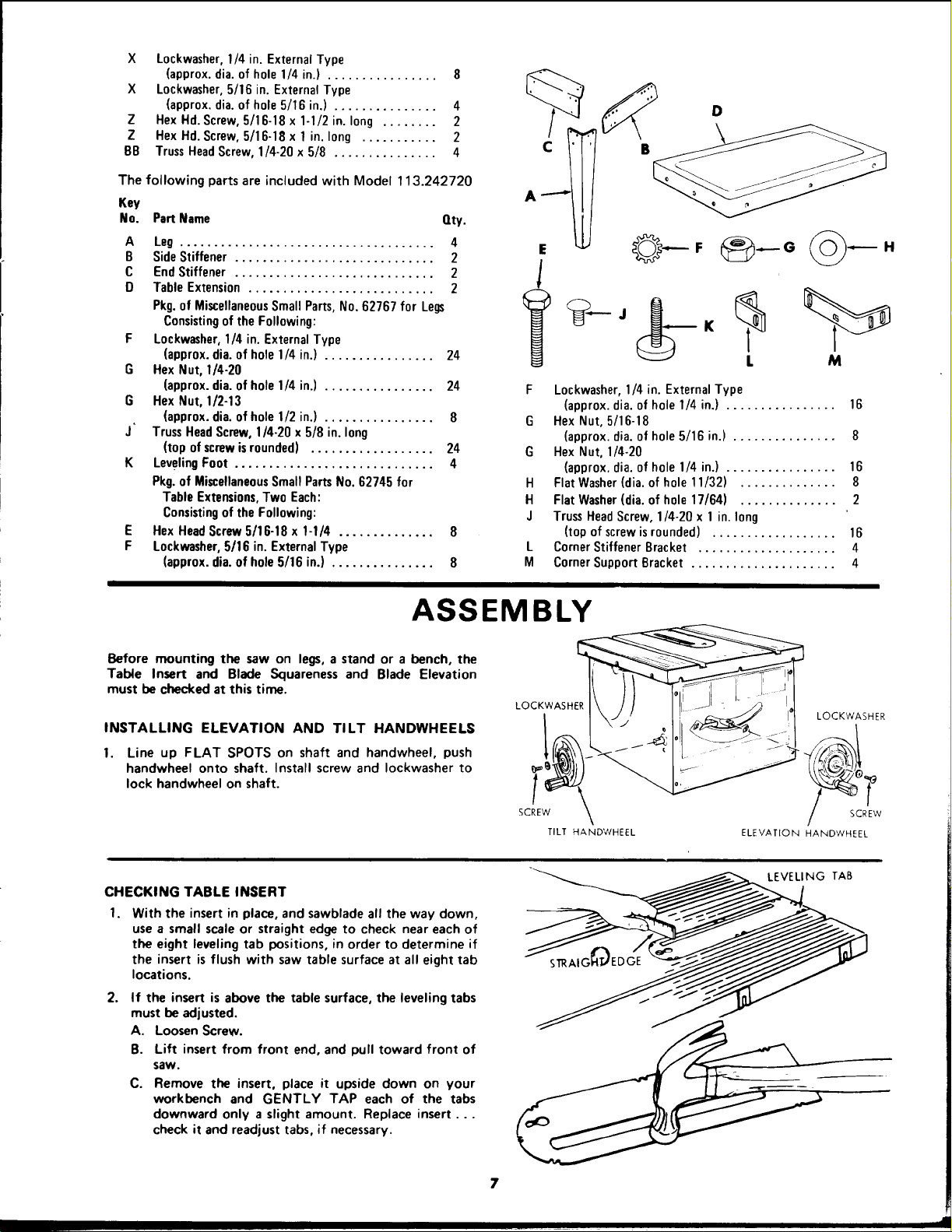
X Lockwasher,1/4 in.ExternalType
(approx.dia.of hole 1/4 in.) ................ 8
X Lockwasher,5/16 in. ExternalType
(approx.dia.ofhole5/16 in.) ............... 4
Z HexHd.Screw,5/16-18 x 1-1/2 in.long ........ 2
Z HexHd.Screw,5/16-18 x 1 in. long ........... 2
BB TrussHeadScrew,1/4-20x 5/8 ............... 4
The following parts are included with Model 113.242720
Key
No. Part Name Qty.
A Leg ..................................... 4
B Side Stiffener ............................. 2
C End Stiffener ............................. 2
D Table Extension ........................... 2
Pkg. of MiscellaneousSmall Parts, No. 62767 for Legs
Consistingof the Following:
F Lockwasher, 1/4 in. External Type
(approx. dia. of hole 1/4 in.) ................ 24
G Hex Nut, 1/4-20
(approx. dia. of hole 1/4 in.) ................ 24
G Hex Nut, 1/2-13
(approx. dia. of hole 1/2 in.) ................ 8
J" Truss Head Screw, 1/4-20 x 5/8 in. long
(top of screw isrounded) .................. 24
K Leveling Foot ............................. 4
Pkg. of MiscellaneousSmall Parts No. 62745 for
Table Extensions, Two Each:
Consisting of the Following:
E Hex Head Screw 5/16-18 x 1-1/4 .............. 8
F Lockwasher, 5/16 in. External Type
(approx. dia. of hole 5/16 in.) ............... 8
¢
A ......-4
E
l
F
G
G
H
H
J
L
M
D
B
H
L M
Lockwasher,1/4 in. ExternalType
(approx.dia.of hole 1/4 in.) ................ 16
Hex Nut, 5/16-18
(approx.dia.of hole5/16 in.) ............... 8
Hex Nut, 1/4-20
(approx.dia.of hole1/4 in.) ................ 16
Flat Washer(dia.of hole 11/32) .............. 8
Flat Washer(dia.of hole 17/64) .............. 2
TrussHeadScrew,1/4-20 x 1in. long
(top ofscrewisrounded) .................. 16
CornerStiffener Bracket .................... 4
CornerSupport Bracket ..................... 4
ASSEMBLY
Before mounting the saw on legs,a stand or a bench, the
Table Insert and Blade Squareness and Blade Elevation
must bechecked at this time.
INSTALLING ELEVATION AND TILT HANDWHEELS
1. Line up FLAT SPOTS on shaft and handwheel, push
handwheel onto shaft. Install screw and Iockwasher to
lock handwheel on shaft.
LOCKWASHER
LOCKWASHER
SCREW SCREW
TILT HANDWHEEL ELEVATION HANDWHEEL
CHECKING TABLE INSERT
I.
With the insert in place, and sawblade all the way down,
use a small scale or straight edge to check near each of
the eight leveling tab positions, in order to determine if
the insert is flush with saw table surface at all eight tab
locations.
2.
If the insert is above the table surface, the leveling tabs
must be adjusted.
A. Loosen Screw.
B. Lift insert from front end, and pull toward front of
saw.
C. Remove the insert, place it upside down on your
workbench and GENTLY TAP each of the tabs
downward only a slight amount. Replace insert...
check it and readjust tabs, if necessary.
- LEVELING TAB
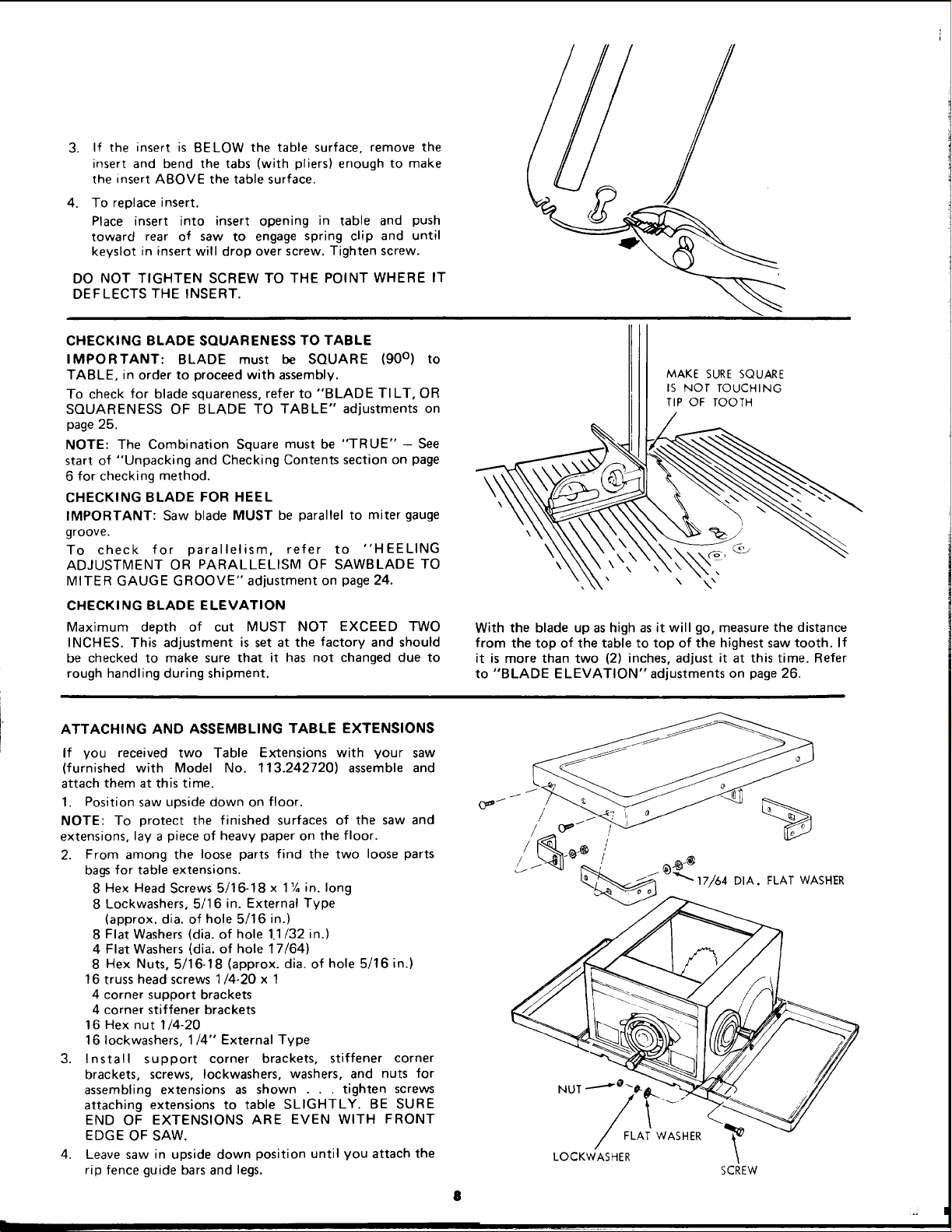
3. If the insert is BELOW the table surface, remove the
insert and bend the tabs (with pliers) enough to make
the insert ABOVE the table surface.
4.
To replace insert.
Place insert into insert opening in table and push
toward rear of saw to engage spring clip and until
keyslot in insert will drop over screw. Tighten screw.
DO NOT TIGHTEN SCREW TO THE POINT WHERE IT
DEFLECTS THE INSERT.
CHECKING BLADE SQUARENESS TO TABLE
IMPORTANT: BLADE must be SQUARE (90° ) to
TABLE, in order to proceed with assembly.
To check for blade squareness, refer to "BLADE TILT, OR
SQUARENESS OF BLADE TO TABLE" adjustments on
page 25.
NOTE: The Combination Square must be "TRUE" - See
start of "Unpacking and Checking Contents section on page
6 for checking method.
CHECKING BLADE FOR HEEL
IMPORTANT: Saw blade MUST be parallel to miter gauge
groove.
To check for parallelism, refer to "HEELING
ADJUSTMENT OR PARALLELISM OF SAWBLADE TO
MITER GAUGE GROOVE" adjustment on page 24.
CHECKING BLADE ELEVATION
Maximum depth of cut MUST NOT EXCEED TWO
INCHES. This adjustment is set at the factory and should
be checked to make sure that it has not changed due to
rough handling during shipment.
\
MAKE SURE SQUARE
IS NOT TOUCHING
TIP OF TOOTH
With the blade up as high as it will go, measure the distance
from the top of the table to top of the highest saw tooth. If
it is more than two (2) inches, adjust it at this time. Refer
to "BLADE ELEVATION'" adjustments on page 26.
ATTACHING AND ASSEMBLING TABLE EXTENSIONS
If you received two Table Extensions with your saw
(furnished with Model No. 113.242720) assemble and
attach them at this time.
1. Position saw upside down on floor.
NOTE: To protect the finished surfaces of the saw and
extensions, lay a piece of heavy paper on the floor.
2. From among the loose parts find the two loose parts
bags for table extensions.
8 Hex Head Screws 5/16-18 x 1¼ in. long
8 Lockwashers, 5/16 in. External Type
(approx. dia. of hole 5/16 in.)
8 Flat Washers (dia. of hole 11/32 in.)
4 Flat Washers (dia. of hole 17/64)
8 Hex Nuts, 5/16-18 (approx. dia. of hole 5/16 in.)
16 truss head screws 1/4-20 x 1
4 corner support brackets
4 corner stiffener brackets
16 Hex nut 1/4-20
16 Iockwashers, 1/4" External Type
3. Install support corner brackets, stiffener corner
brackets, screws, Iockwashers, washers, and nuts for
assembling extensions as shown . . . tighten screws
attaching extensions to table SLIGHTLY. BE SURE
END OF EXTENSIONS ARE EVEN WITH FRONT
EDGE OF SAW.
4. Leave saw in upside down position until you attach the
rip fence guide bars and legs.
LOCKWASHER
SCREW
II
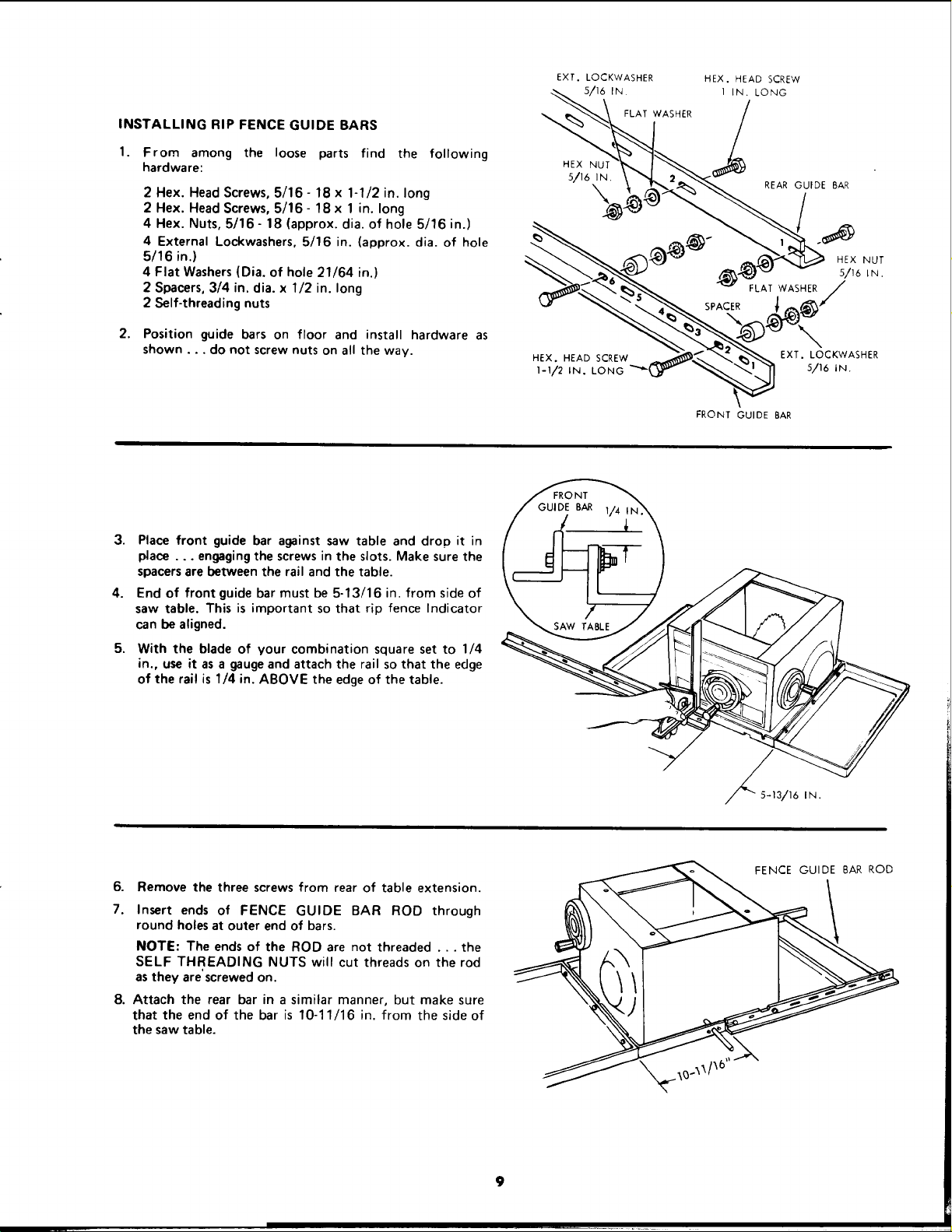
EXT. LOCKWASHER HEX. HEAD SCREW
5/16 IN. I IN. LONG
INSTALLING RIP FENCE GUIDE BARS
1.
From among the loose parts find the following
hardware:
2 Hex. Head Screws, 5/16- 18 x 1-1/2 in. long
2 Hex. Head Screws, 5/16- 18 x 1 in. long
4 Hex. Nuts, 5/16- 18 (approx. dia. of hole 5/16 in.)
4 External Lockwashers, 5/16 in. (approx. dia. of hole
5/16 in.)
4 Flat Washers(Dia. of hole 21/64 in.)
2 Spacers, 3/4 in. dia. x 1/2 in. long
2 Self-threading nuts
2. Position guide bars on floor and install hardware as
shown.., do not screw nuts on all the way.
FLAT WASHER
HEX NUT
5/16 IN,
REAR GUIDE BAR
3. Place front guide bar against saw table and drop it in
place ... engaging the screws in the slots. Make sure the
spacers are between the rail and the table.
4. End of front guide bar must be 5-13/16 in. from side of
saw table. This is important so that rip fence Indicator
can be aligned.
5.
With the blade of your combination square set to 1/4
in., use it as a gauge and attach the rail so that the edge
of the rail is1/4 in. ABOVE the edgeof the table.
6. Remove the three screwsfrom rear of table extension.
7. Insert ends of FENCE GUIDE BAR ROD through
round holesat outer end of bars.
NOTE: The ends of the ROD are not threaded ... the
SELF THREADING NUTS will cut threads on the rod
asthey are'screwed on.
8. Attach the rear bar in a similar manner, but make sure
that the end of the bar is 10-11/16 in. from the side of
the saw table.
FENCE GUIDE BAR ROD
9
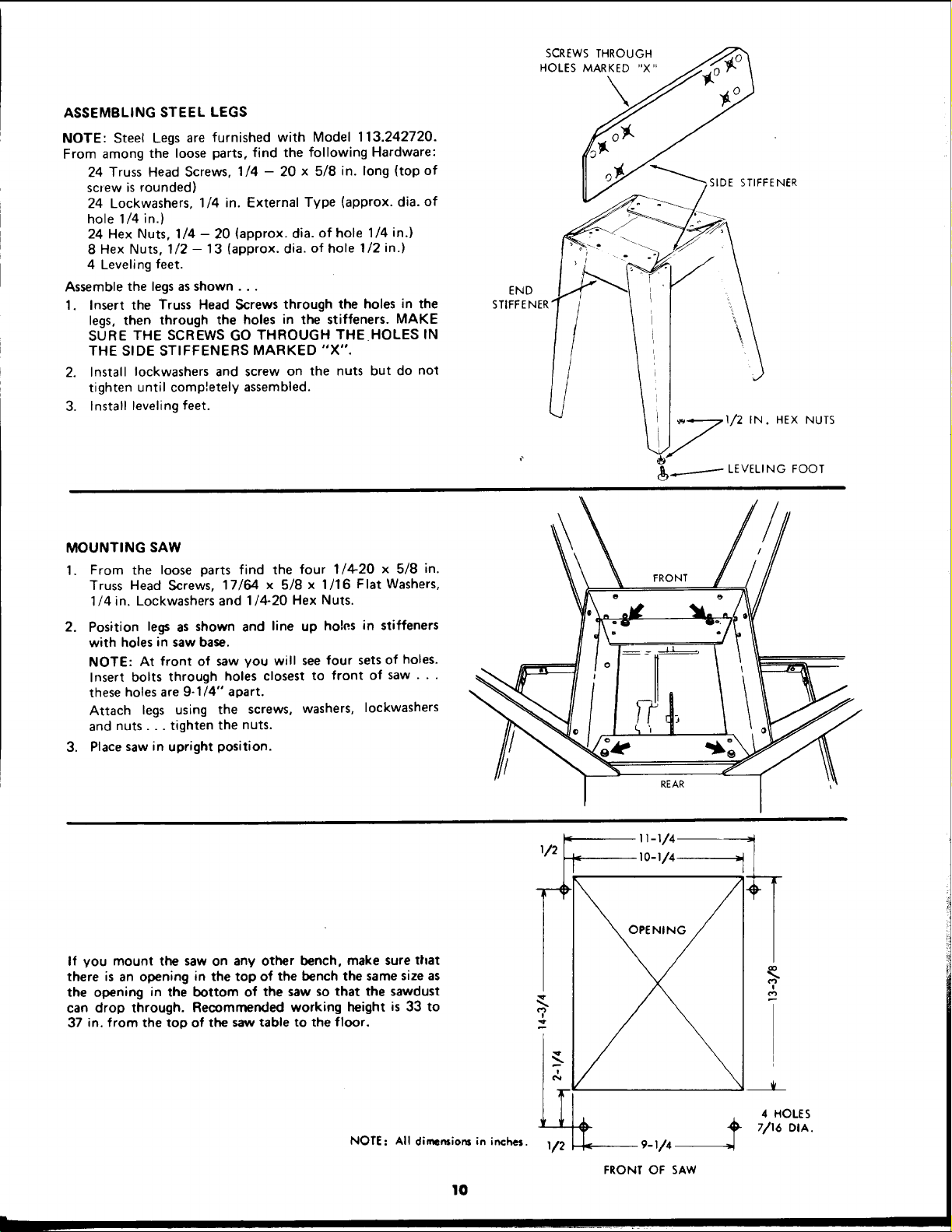
ASSEMBLING STEEL LEGS
NOTE: Steel Legs are furnished with Model 113.242720.
From among the loose parts, find the following Hardware:
24 Truss Head Screws, 1/4 - 20 x 5/8 in. long (top of
screw is rounded)
24 Lockwashers, 1/4 in. External Type (approx. dia. of
hole 1/4 in.)
24 Hex Nuts, 1/4 - 20 (approx. dia. of hole 1/4 in.)
8 Hex Nuts, 1/2 - 13 (approx. dia. of hole 1/2 in.)
4 Leveling feet.
Assemble the legsasshown...
1. Insert the Truss Head Screws through the holes in the
legs, then through the holes in the stiffeners. MAKE
SURE THE SCREWS GO THROUGH THEHOLES IN
THE SIDE STIFFENERS MARKED "X".
2. Install Iockwashers and screw on the nuts but do not
tighten until completely assembled.
3. Install leveling feet.
END
SCREWS THROUGH
HOLES MARKED "X"
STIFFENER
IN. HEX NUTS
_.,_......__.------ LEVELING FOOT
MOUNTING SAW
1. From the loose parts find the four 1/4-20 x 5/8 in.
Truss Head Screws, 17/64 x 5/8 x 1/16 Flat Washers,
1/4 in. Lockwashers and 1/4-20 Hex Nuts.
2. Position legs as shown and line up holes in stiffeners
with holes in saw base.
NOTE: At front of saw you will see four sets of holes.
Insert bolts through holes closest to front of saw . . .
these holes are 9-1/4" apart.
Attach legs using the screws, washers, Iockwashers
and nuts.., tighten the nuts.
3. Place saw in upright position.
FRONT
REAR
If you mount the saw on any other bench, make sure that
there is an opening in the top of the bench the same size as
the opening in the bottom of the saw so that the sawdust
can drop through. Recommended working height is 33 to
37 in. from the top of the saw table to the floor.
OPENING
NOTE: All dimensions in inches.
10
1//2
1/4
FRONT OF SAW
4 HOLES
7//16 DIA.
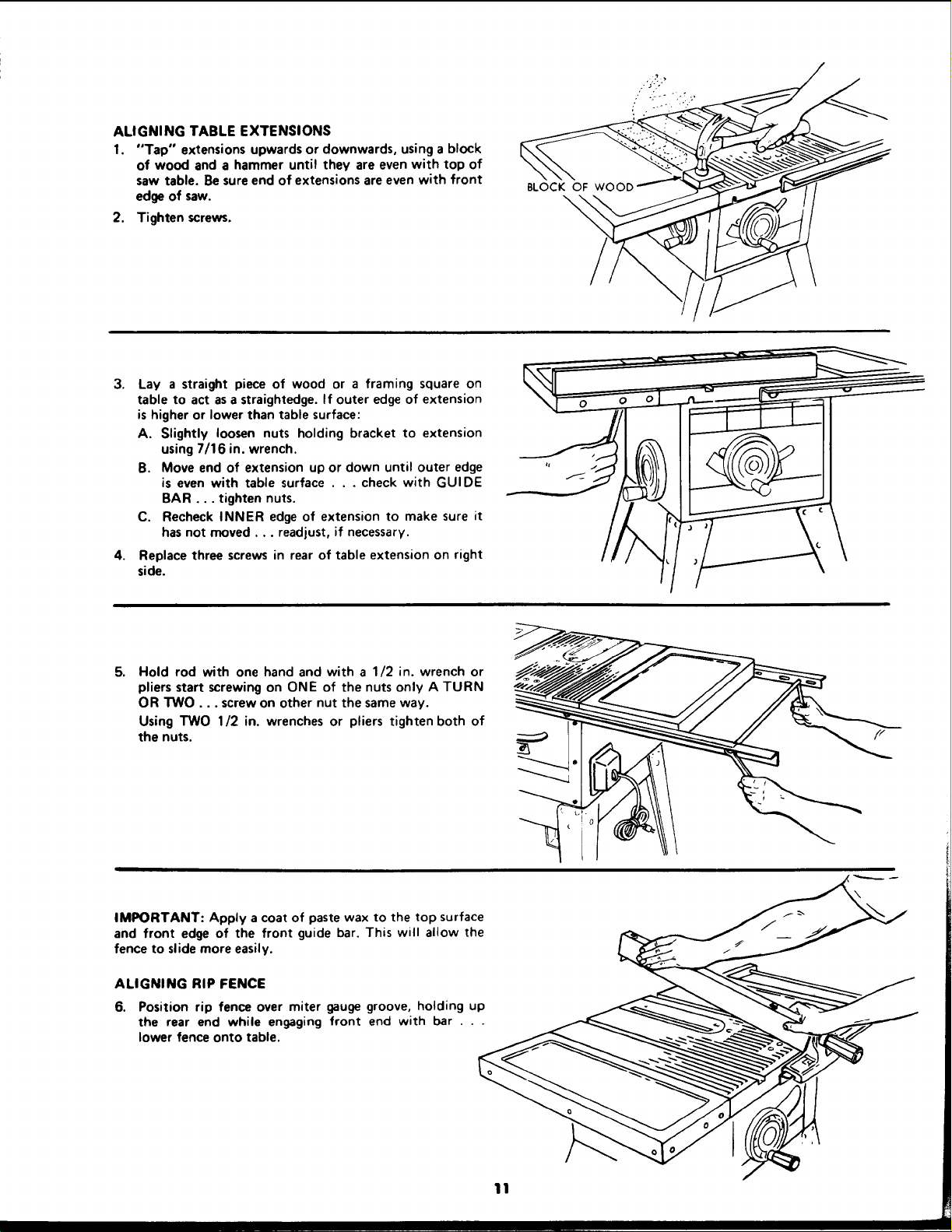
ALIGNINGTABLEEXTENSIONS
1. "Tap" extensions upwards or downwards, using a block
of wood and a hammer until they are even with top of
saw table. Be sureend of extensions are even with front
edge of saw.
2. Tighten screws.
BLOCK OF WOOC
\
3. Lay a straight piece of wood or a framing square on
table to act as a straightedge.Ifouter edge of extension
is higher or lower than table surface:
A. Slightly loosen nuts holding bracket to extension
using 7/16 in. wrench.
B. Move end of extension up or down until outer edge
is even with table surface . . . check with GUIDE
BAR... tighten nuts.
C. Recheck INNER edge of extension to make sure it
has not moved.., readjust, if necessary.
4. Replace three screws in rear of table extension on right
side.
5, Hold rod with one hand and with a 1/2 in. wrench or
pliers start screwing on ONE of the nuts only A TURN
OR TWO... screwon other nut the same way.
Using TWO 1/2 in. wrenches or pliers tighten both of
the nuts.
IMPORTANT: Apply a coat of paste wax to the top surface
and front edge of the front guide bar. This will allow the
fence to slide more easily.
ALIGNING RIP FENCE
6. Position rip fence over miter gauge groove, holding up
the rear end while engaging front end with bar . . .
lower fence onto table.
11
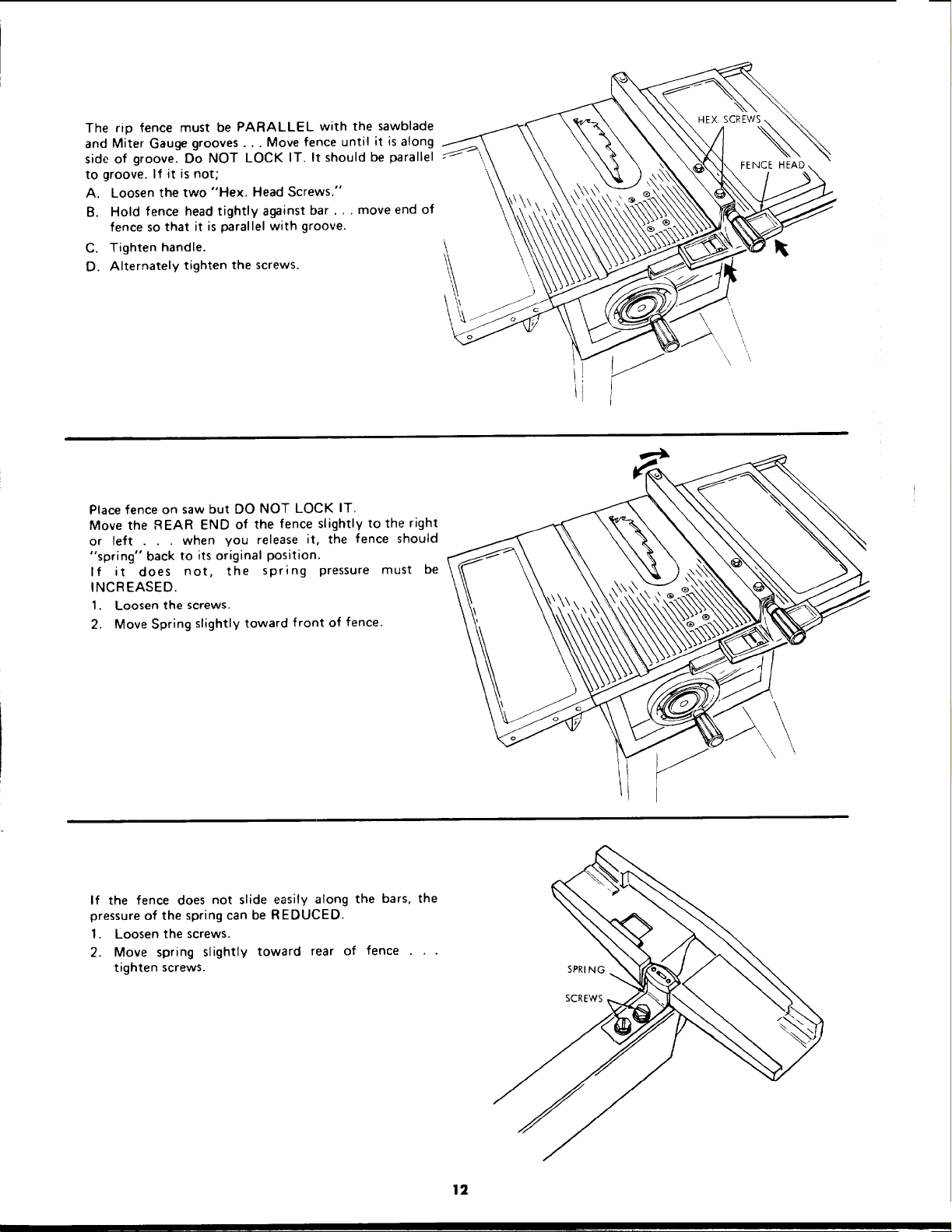
The rip fence must be PARALLEL with the sawblade
and Miter Gauge grooves... Move fence until it is along
side of groove. Do NOT LOCK IT. It should be parallel
to groove. If it is not;
A. Loosen the two "Hex. Head Screws."
B. Hold fence head tightly against bar . . . move end of
fence so that it is parallel with groove.
C. Tighten handle.
D. Alternately tighten the screws.
\,
\
\
Place fence on saw but DO NOT LOCK IT.
Move the REAR END of the fence slightly to the right
or left . . . when you release it, the fence should
"spring" back to its original position.
If it does not, the spring pressure must be
INCREASED.
1. Loosen the screws.
2. Move Spring slightly toward front of fence.
If the fence does not slide easily along the bars, the
pressure of the spring can be REDUCED.
1. Loosen the screws.
2. Move spring slightly toward rear of fence . . .
tighten screws. SPRI NG
SCREWS
12
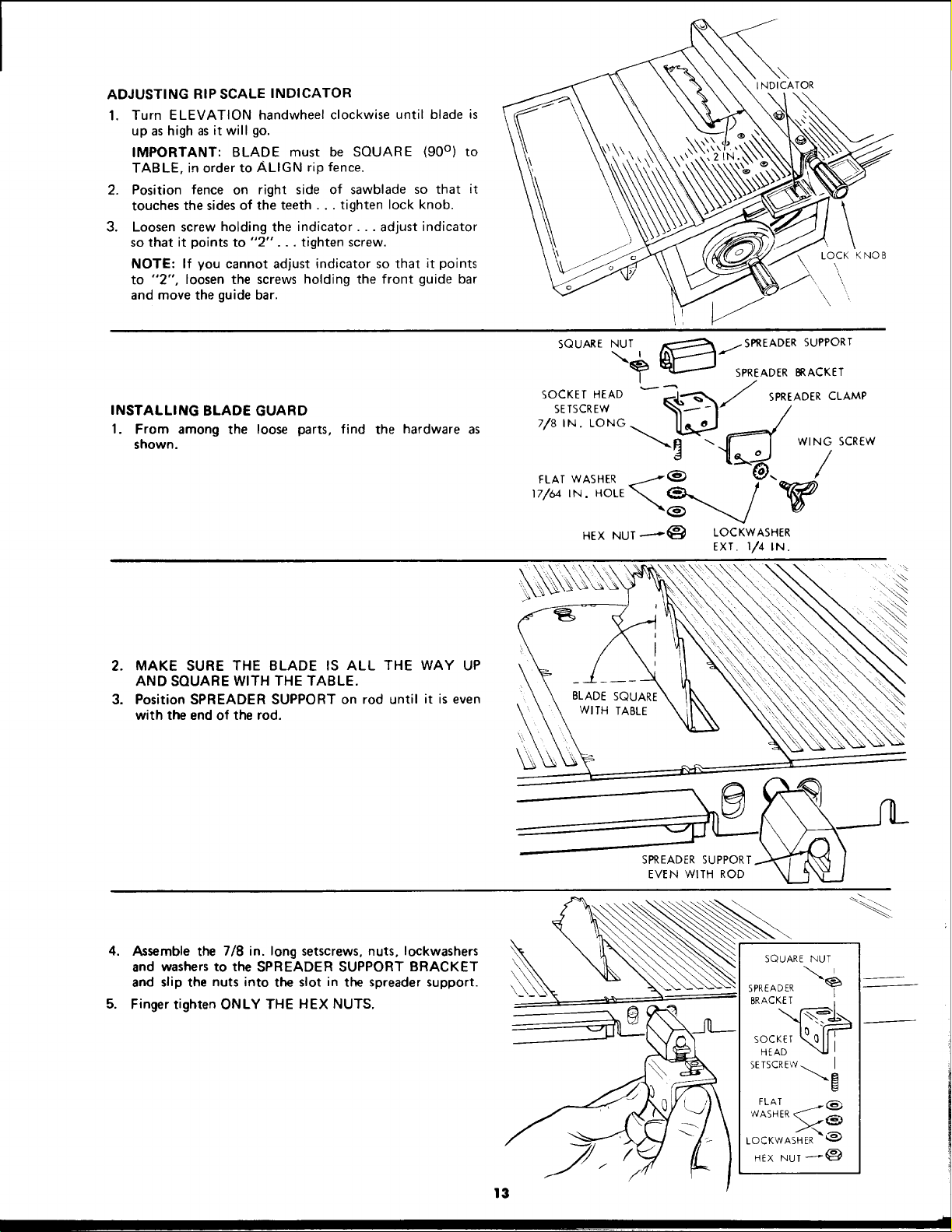
ADJUSTING RIP SCALE INDICATOR
1. Turn ELEVATION handwheel clockwise until blade is
2.
3.
I NDI CATOR
up as high as it will go.
IMPORTANT: BLADE must be SQUARE (90 ° ) to
TABLE, in order to ALIGN rip fence.
Position fence on right side of sawblade so that it
touches the sides of the teeth.., tighten lock knob.
Loosen screw holding the indicator.., adjust indicator
so that it points to "2"... tighten screw.
NOTE: If you cannot adjust indicator so that it points
to "2", loosen the screws holding the front guide bar
and move the guide bar.
INSTALLING BLADE GUARD
1. From among the loose parts, find the hardware as
shown.
LOCK KNOB
\\
\
SQUARE NUT /_:_j_/SPREADER SUPPORT
'_'_'+ _ SPREADERBRACKET
SOCKET HEAD SPREADERCLAMP
SETSCREW
7/8 IN. LONG
" W,NS SCREW
17/64 IN. HOLE
HEX NUT ---'-"_
2. MAKE SURE THE BLADE IS ALL THE WAY UP
AND SQUARE WITH THE TABLE.
3. Position SPREADER SUPPORT on rod until it is even
with the end of the rod.
LOCKWASHER
EXT. 1/4 iN.
4.
Assemble the 7/8 in. long setscrews, nuts, Iockwashers
and washers to the SPREADER SUPPORT BRACKET
and slip the nuts into the slot in the spreader support.
5. Finger tighten ONLY THE HEX NUTS.
13
SQUARE NUT
SPREADER I
BRACKET |
.. _[-_
HEAD ",d.I I
SETSCREW I
FLAT
WASHER _
LOCKWASHER
HEX NUT _(_
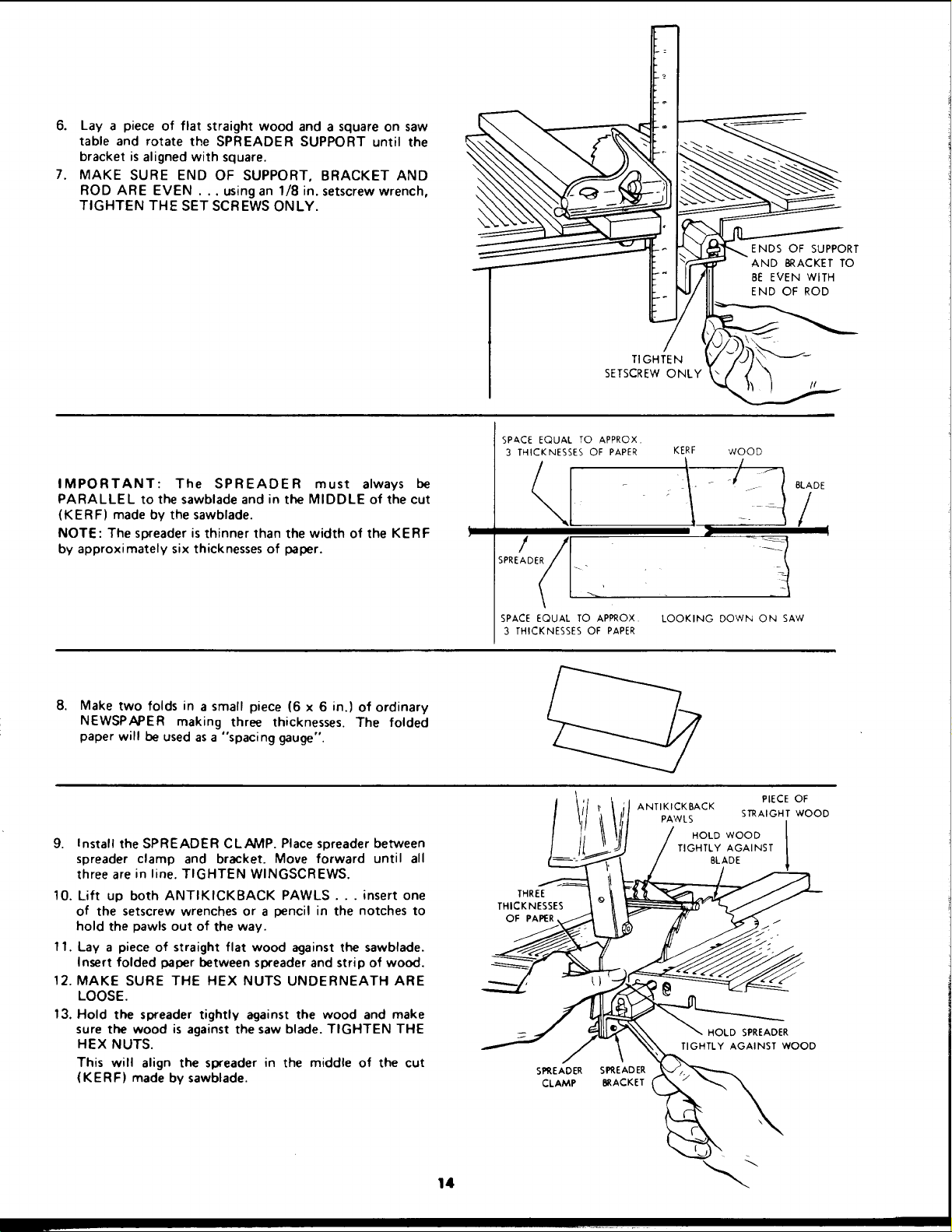
6. Lay a piece of flat straight wood and a square on saw
table and rotate the SPREADER SUPPORT until the
bracket is aligned with square.
7. MAKE SURE END OF SUPPORT, BRACKET AND
ROD ARE EVEN . .. using an 1/8 in. setscrew wrench,
TIGHTEN THE SET SCREWS ONLY.
ENDS OF SUPPORT
AND BRACKET TO
TIGHTEN
SETSCREW ONLY
BE EVEN WITH
END OF ROD
IMPORTANT: The SPREADER must always be
PARALLEL to the sawblade and in the MIDDLE of the cut
(KERF) made by the sawblade.
NOTE: The spreader isthinner than the width of the KERF
by approximately six thicknessesof paper.
SPACE EQUAL TO APPROX.
3 THICKNESSES OF PAPER
KERF WOOD
1 /
o_ BLADE
:I __ (
SPACE EQUAL TO APPROX LOOKING DOWN ON SAW
3 THICKNESSES OF PAPER
8.
Make two folds in a small piece (6 x 6 in.) of ordinary
NEWSPAPER making three thicknesses. The folded
paper will be used as a "spacing gauge".
9. Install the SPREADER CLAMP. Place spreader between
spreader clamp and bracket. Move forward until all
three are in line. TIGHTEN WIN°SCREWS.
10. Lift up both ANTIKICKBACK PAWLS . . . insert one
of the setscrew wrenches or a pencil in the notches to
hold the pawls out of the way.
! 1. Lay a piece of straight flat wood against the sawblade.
Insert folded paper between spreader and strip of wood.
12. MAKE SURE THE HEX NUTS UNDERNEATH ARE
LOOSE.
13. Hold the spreader tightly against the wood and make
sure the wood is against the saw blade. TIGHTEN THE
HEX NUTS.
This will align the spreader in the middle of the cut
(KERF) made by sawblade.
14
, PIECE OF
I I,t, \,,I S A,OHTWO00
_l r ANTIKICKBACK
/ '////\;/ 7 %L°WOO
l l___J ITIGHTL¥AGAINSTI
THICKNESSES _- _ _" _),_
OF PARRvJj4 _X _ _ --
_.j" t_1_.._\\\ \ HOLDSPREAOE_
SI_,EADER SPREADER _W/, "_----_'-.....,_

GETTING TO KNOW YOUR
6 BLAOE GUARD ANTIKICKBACK
MITER GAUGE PAWLS
LOCK KNOB 8 SAW BLADE
MITER GAUGE SPREADER
HEAD
5 MITER GAUGE
\
7 TABLE INSERT
SAW
4
RIP FENCE
HOLES FOR
FACING
3 TILT HANDWHEEL
2 ELEVATION
RIP FENCE
LOCK KNOB
] ON-OFF SWITCH
CAUTION: Before turning switch on, make sure the blade
guard is correctly installed and operating properly.
The On-Off Switch has a locking feature. THIS SHOULD
PREVENT UNAUTHORIZED AND POSSIBLY
HAZARDOUS USE BY CHILDREN AND OTHERS.
A. Insert key into switch.
B. TO turn saw ON ... stand to either side of the
blade never in line with it ... insert finger under
switch lever and pull END of lever out.
After turning switch ON, always allow the blade to
come up to full speed before cutting.
Do not cycle the motor switch on and off rapidly,
as this may cause the sawblade to loosen. In the
event this should ever occur, allow the sawblade to
come to a complete stop and retighten the arbor
nut normally, not excessively. Never leave the saw
while the power is "ON".
C. TO turn saw OFF ... PUSH lever in. Never leave
the saw until the cutting tool has come to a
complete stop.
D. TO lock switch in OFF position.., hold switch IN
with one hand ... REMOVE key with other hand.
WARNING: FOR YOUR OWN SAFETY, LOWER
BLADE OR OTHER CUTTING TOOL BELOW
TABLE SURFACE. (IF BLADE IS TILTED,
RETURN IT TO VERTICAL (90° ) POSITION).
ALWAYS LOCK THE SWITCH "OFF". WHEN
SAW IS NOT IN USE ... REMOVE KEY AND
KEEP IT IN A SAFE PLACE ... ALSO ... IN
THE EVENT OF A POWER FAILURE (ALL OF
YOUR LIGHTS GO OUT) TURN SWITCH OFF
I/
!
ON-OFF SWITCH
PULL
INSERT KEY
\
TURN ON
_ REMOVE KEY
KEY
(YELLOW PLASTIC)
• .. LOCK IT AND REMOVE THE KEY. THIS
WILL PREVENT THE SAW FROM STARTING UP
AGAIN WHEN THE POWER COMES BACK ON.
lS
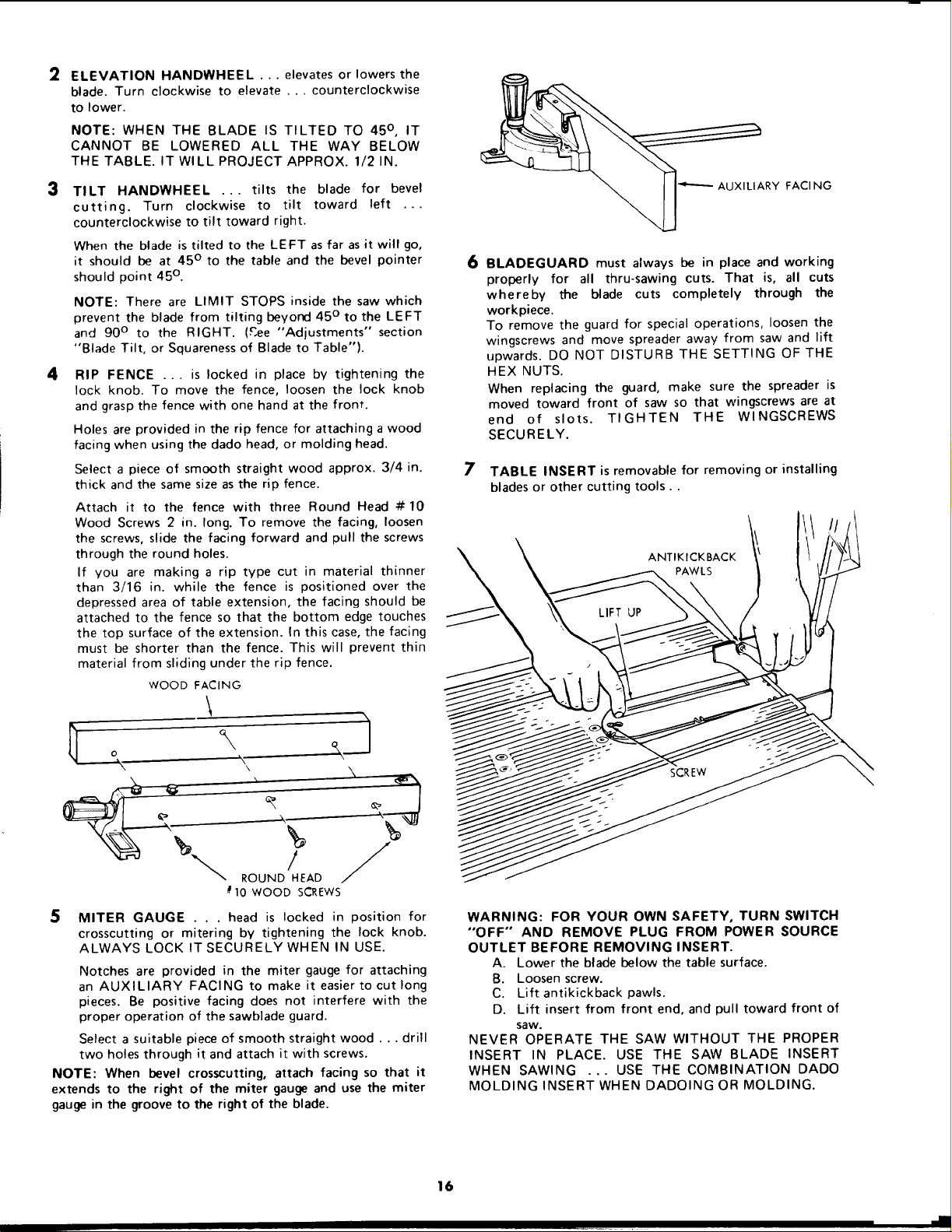
2 ELEVATION HANDWHEEL . . . elevates or lowers the
blade. Turn clockwise to elevate ... counterclockwise
to lower.
NOTE: WHEN THE BLADE IS TILTED TO 45 ° , IT
CANNOT BE LOWERED ALL THE WAY BELOW
THE TABLE. IT WILL PROJECT APPROX. 1/2 IN.
3
4
TILT HANDWHEEL ... tilts the blade for bevel
cutting. Turn clockwise to tilt toward left ...
counterclockwise to tilt toward right.
When the blade is tilted to the LEFT as far as it will go,
it should be at 45 ° to the table and the bevel pointer
should point 45 ° .
NOTE: There are LIMIT STOPS inside the saw which
prevent the blade from tilting beyond 45 ° to the LEFT
and 90 ° to the RIGHT. (.e,ee "Adjustments" section
"Blade Tilt, or Squareness of Blade to Table").
6
RIP FENCE ... is locked in place by tightening the
lock knob. To move the fence, loosen the lock knob
and grasp the fence with one hand at the front.
Holes are provided in the rip fence for attaching a wood
facing when using the dado head, or molding head.
Select a piece of smooth straight wood approx. 3/4 in. 7
thick and the same size as the rip fence.
Attach it to the fence with three Round Head # 10
Wood Screws 2 in. long. To remove the facing, loosen
the screws, slide the facing forward and pull the screws
through the round holes.
If you are making a rip type cut in material thinner
than 3/16 in. while the fence is positioned over the
depressed area of table extension, the facing should be
attached to the fence so that the bottom edge touches
the top surface of the extension. In this case, the facing
must be shorter than the fence. This will prevent thin
material from sliding under the rip fence.
WOOD FACING
ROUND HEAD /
# 10 WOOD SCREWS
__ARY FACI NG
BLADEGUARD must always be in place and working
properly for all thru-sawing cuts. That is, all cuts
whereby the blade cuts completely through the
workpiece.
To remove the guard for special operations, loosen the
wingscrews and move spreader away from saw and lift
upwards. DO NOT DISTURB THE SETTING OF THE
HEX NUTS.
When replacing the guard, make sure the spreader is
moved toward front of saw so that wingscrews are at
end of slots. TIGHTEN THE WINGSCREWS
SECURELY.
TABLE INSERT is removable for removing or installing
blades or other cutting tools..
ANTIKICKBACK
PAWLS
5 MITER GAUGE . . . head is locked in position for
crosscutting or mitering by tightening the lock knob.
ALWAYS LOCK IT SECURELY WHEN IN USE.
Notches are provided in the miter gauge for attaching
an AUXILIARY FACING to make it easier to cut long
pieces. Be positive facing does not interfere with the
proper operation of the sawblade guard.
Select a suitable piece of smooth straight wood . . . drill
two holes through it and attach it with screws.
NOTE: When bevel crosscutting, attach facing so that it
extends to the right of the miter gauge and use the miter
gauge in the groove to the right of the blade.
WARNING: FOR YOUR OWN SAFETY, TURN SWITCH
"OFF" AND REMOVE PLUG FROM POWER SOURCE
OUTLET BEFORE REMOVING INSERT.
A. Lower the blade below the table surface.
B. Loosen screw.
C. Lift antikickback pawls.
D. Lift insert from front end, and pull toward front of
saw.
NEVER OPERATE THE SAW WITHOUT THE PROPER
INSERT IN PLACE. USE THE SAW BLADE INSERT
WHEN SAWING ... USE THE COMBINATION DADO
MOLDING INSERT WHEN DADOING OR MOLDING.
16
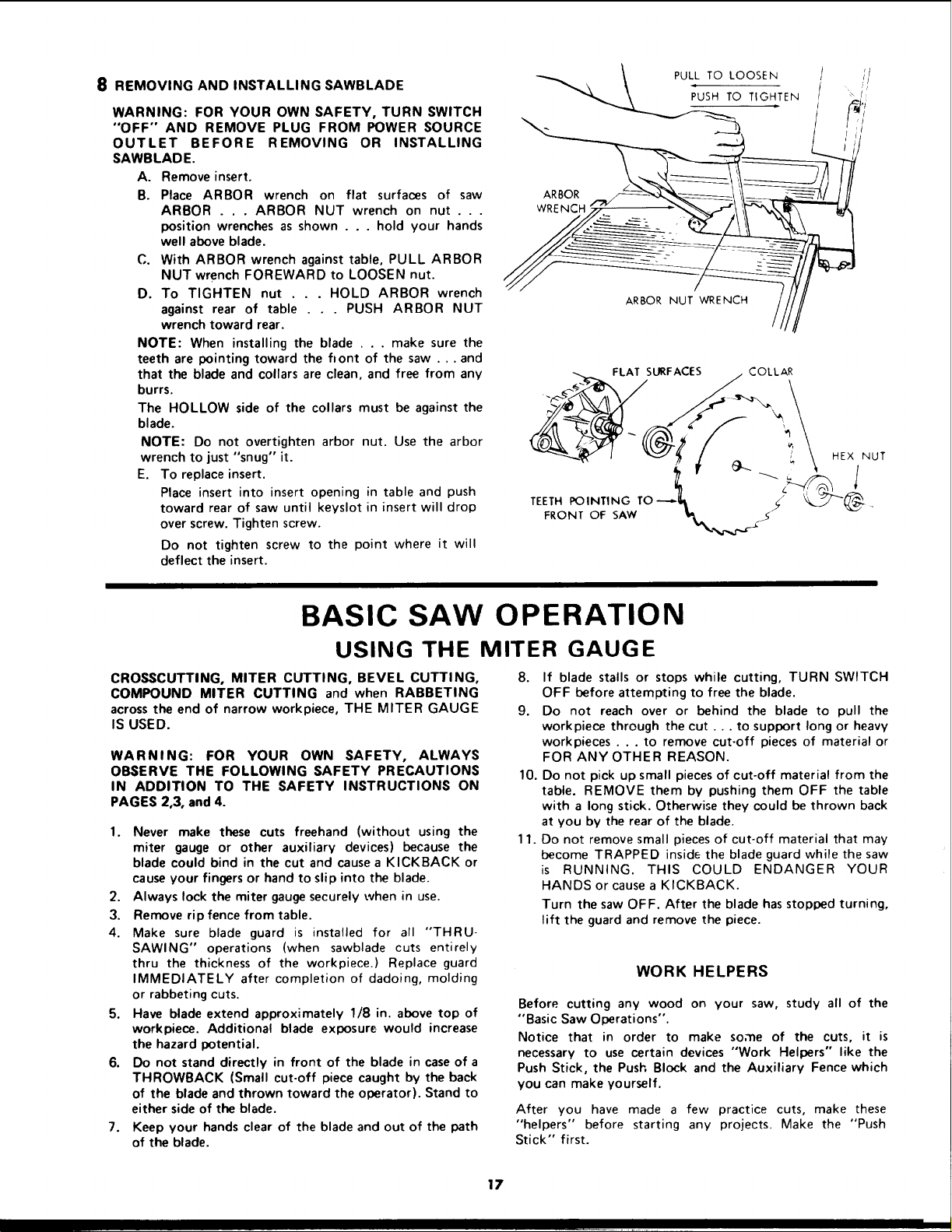
8 REMOVING AND INSTALLING SAWBLADE
WARNING: FOR YOUR OWN SAFETY, TURN SWITCH
"OFF" AND REMOVE PLUG FROM POWER SOURCE
OUTLET BEFORE REMOVING OR INSTALLING
SAWBLADE.
A. Remove insert.
B. Place ARBOR wrench on flat surfaces of saw
ARBOR . . . ARBOR NUT wrench on nut...
position wrenches as shown . . . hold your hands
well above blade.
C. With ARBOR wrench against table, PULL ARBOR
NUT wrench FOREWARD to LOOSEN nut.
D. To TIGHTEN nut . . . HOLD ARBOR wrench
against rear of table . . . PUSH ARBOR NUT
wrench toward rear.
NOTE: When installing the blade . . . make sure the
teeth are pointing toward the flont of the saw ... and
that the blade and collars are clean, and free from any
burrs.
The HOLLOW side of the collars must be against the
blade.
NOTE: Do not overtighten arbor nut. Use the arbor
wrench to just "snug" it.
E. To replace insert.
Place insert into insert opening in table and push
toward rear of saw until keyslot in insert will drop
over screw. Tighten screw.
Do not tighten screw to the point where it will
deflect the insert.
PULL TO LOOSEN i/
PUSH TO TIGHTEN / '_ /'
I
ARBOR
WRENCH
ARBOR NUT WRENCH
FLAT SURFACES . COLLAR
TEETH POINTING TO'-'" _'_
BASIC SAW OPERATION
USING THE MITER GAUGE
CROSSCUTTING, MITER CUTTING, BEVEL CUTTING,
COMPOUND MITER CUTTING and when RABBETING
acrossthe end of narrow workpiece, THE MITER GAUGE
IS USED.
WARNING: FOR YOUR OWN SAFETY, ALWAYS
OBSERVE THE FOLLOWING SAFETY PRECAUTIONS
IN ADDITION TO THE SAFETY INSTRUCTIONS ON
PAGES 2,3, and 4.
1. Never make these cuts freehand (without using the
miter gauge or other auxiliary devices) because the
blade could bind in the cut and cause a KICKBACK or
cause your fingers or hand to slip into the blade.
2. Always lock the miter gauge securely when in use.
3. Remove rip fence from table.
4. Make sure blade guard is installed for all "THRU-
SAWING" operations (when sawblade cuts entirely
thru the thickness of the workpiece.) Replace guard
IMMEDIATELY after completion of dadoing, molding
or rabbeting cuts.
5. Have blade extend approximately 1/8 in. above top of
workpiece. Additional blade exposure would increase
the hazard potential.
6. Do not stand directly in front of the blade in case of a
THROWBACK (Small cut-off piece caught by the back
of the blade and thrown toward the operator). Stand to
either side of the blade.
7. Keep your hands clear of the blade and out of the path
of the blade.
8. If blade stalls or stops while cutting, TURN SWITCH
OFF before attempting to free the blade.
g. Do not reach over or behind the blade to pull the
workpiece through the cut.., to support long or heavy
workpieces . . . to remove cut-off pieces of material or
FOR ANY OTHER REASON.
10. Do not pick up small pieces of cut-off material from the
table. REMOVE them by pushing them OFF the table
with a long stick. Otherwise they could be thrown back
at you by the rear of the blade.
11. Do not remove small pieces of cut-off material that may
become TRAPPED inside the blade guard while the saw
is RUNNING. THIS COULD ENDANGER YOUR
HANDS or cause a KICKBACK.
Turn the saw OFF. After the blade has stopped turning,
lift the guard and remove the piece.
WORK HELPERS
Before cutting any wood on your saw, study all of the
"Basic Saw Operations".
Notice that in order to make some of the cuts, it is
necessary to use certain devices "Work Helpers" like the
Push Stick, the Push Block and the Auxiliary Fence which
you can make yourself.
After you have made a few practice cuts, make these
"helpers" before starting any projects. Make the "Push
Stick" first.
17
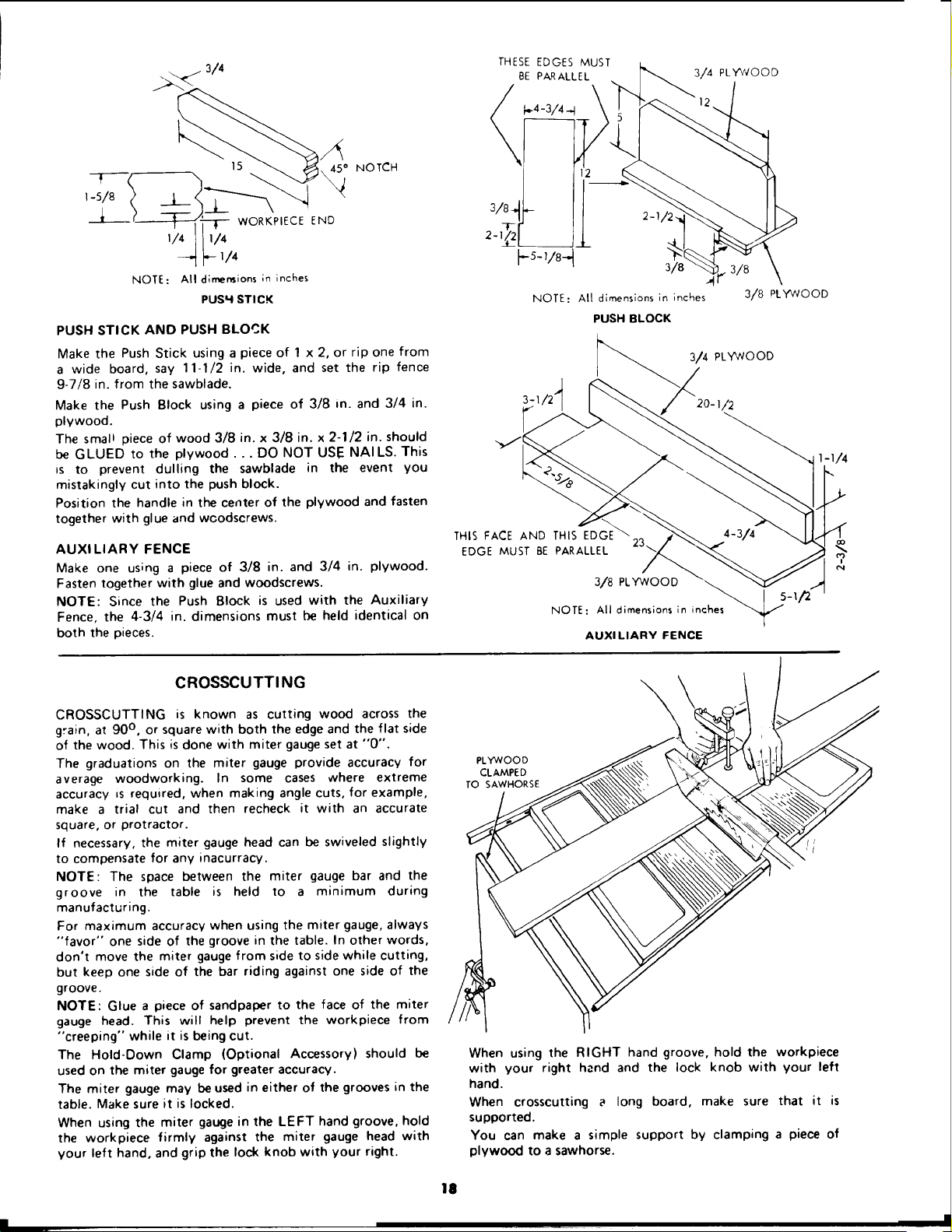
PUSH STICK
PUSH STICK AND PUSH BLOCK
Make the Push Stick using a piece of 1 x 2, or rip one from
a wide board, say 11-1/2 in. wide, and set the rip fence
9-7/8 in. from the sawblade.
Make the Push Block using a piece of 3/8 in. and 3/4 in.
plywood.
The smaP piece of wood 3/8 in. x 3/8 in. x 2-1/2 in. should
be GLUED to the plywood ... DO NOT USE NAILS. This
is to prevent dulling the sawblade in the event you
mistakingly cut into the push block.
Position the handle in the center of the plywood and fasten
together with glue and wcodscrews.
AUXILIARY FENCE
Make one using a piece of 3/8 in. and 3/4 in. plywood.
Fasten together with glue and woodscrews.
NOTE: Since the Push Block is used with the Auxiliary
Fence, the 4-3/4 in. dimensions must be held identical on
both the pieces.
THESE EDGES MUST
BE PARALLEL
F,-4-3,/4 -,.J
PLYWOOD
318
NOTE: All dimensions in inches
PUSH BLOCK
3/8 PLYWOOD
3-I/2"_
3/4 PLYWOOD
2o-i/2
1-1/4
THIS FACE AND THIS EDGE
EDGE MUST BE PARALLEL
3/8 PLYWOOD c_5 _1/,2
NOTE: All dimensions in in
AUXI LIARY FENCE
CROSSCUTTI NG
CROSSCUTTING is known as cutting wood across the
grain, at 90 °, or square with both the edge and the flat side
of the wood. This is clone with miter gauge set at "0".
The graduations on the miter gauge provide accuracy for
average woodworking. In some cases where extreme
accuracy =s required, when making angle cuts, for example,
make a trial cut and then recheck it with an accurate
square, or protractor.
If necessary, the miter gauge head can be swiveled slightly
to compensate for any inacurracy.
NOTE: The space between the miter gauge bar and the
groove in the table is held to a minimum during
manufacturing.
For maximum accuracy when using the miter gauge, always
"favor" one side of the groove in the table. In other words,
don't move the miter gauge from side to side while cutting,
but keep one side of the bar riding against one side of the
groove.
NOTE: Glue a piece of sandpaper to the face of the miter
gauge head. This will help prevent the workpiece from
"creeping" while it is being cut.
The Hold-Down Clamp (Optional Accessory) should be
used on the miter gauge for greater accuracy.
The miter gauge may be used in either of the grooves in the
table. Make sure it is locked.
When using the miter gauge in the LEFT hand groove, hold
the workpiece firmly against the miter gauge head with
your left hand, and grip the lock knob with your right.
PLYWOOD
CLAMPED
TO SAWHORSE
\
When using the RIGHT hand groove, hold the workpiece
with your right hand and the lock knob with your left
hand.
When crosscutting a long board, make sure that it is
supported.
You can make a simple support by clamping a piece of
plywood to a sawhorse.
18
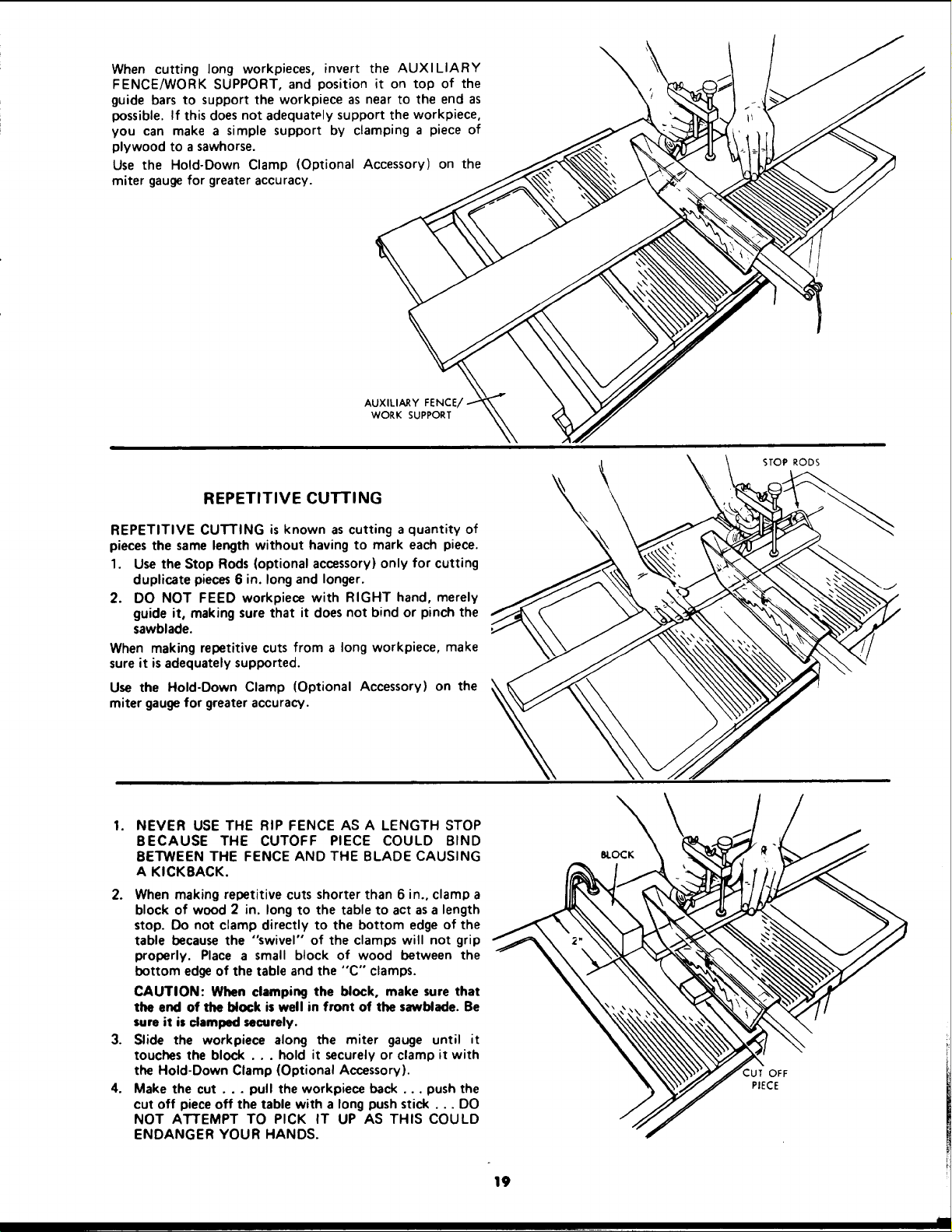
When cutting long workpieces, invert the AUXILIARY
FENCE/WORK SUPPORT, and position it on top of the
guide bars to support the workpiece as near to the end as
possible. If this does not adequatply support the workpiece,
you can make a simple support by clamping a piece of
plywood to a sawhorse.
Use the Hold-Down Clamp (Optional Accessory) on the
miter gaugefor greater accuracy.
\
AUXILIARY FENCE/
WORK SUPPORT
REPETITIVE CUTTING
REPETITIVE CUTTING is known as cutting a quantity of
pieces the same length without having to mark each piece.
1. Use the Stop Rods (optional accessory) only for cutting
duplicate pieces6 in. long and longer.
2. DO NOT FEED workpiece with RIGHT hand, merely
guide it, making sure that it does not bind or pinch the
sawblade.
When making repetitive cuts from a long workpiece, make
sure it isadequately supported.
Use the Hold-Down Clamp (Optional Accessory) on the
miter gaugefor greater accuracy.
STOP RODS
1. NEVER USE THE RIP FENCE AS A LENGTH STOP
BECAUSE THE CUTOFF PIECE COULD BIND
BETWEEN THE FENCE AND THE BLADE CAUSING
A KICKBACK.
2. When making repetitive cuts shorter than 6 in., clamp a
block of wood 2 in. long to the table to act asa length
stop. Do not clamp directly to the bottom edge of the
table because the "swivel" of the clamps will not grip
properly. Place a small block of wood between the
bottom edgeof the table and the "C" clamps.
CAUTION: When clamping the block, make sure that
the end of the block iswell in front of the sawblade. Be
sure it isdamped securely.
3. Slide the workpiece along the miter gauge until it
touches the block . . . hold it securely or clamp it with
the Hold-Down Clamp (Optional Accessory).
4. Make the cut ... pull the workpiece back ... push the
cut off piece off the table with a long push stick... DO
NOT ATTEMPT TO PICK IT UP AS THIS COULD
ENDANGER YOUR HANDS.
:UT OFF
PIECE
19
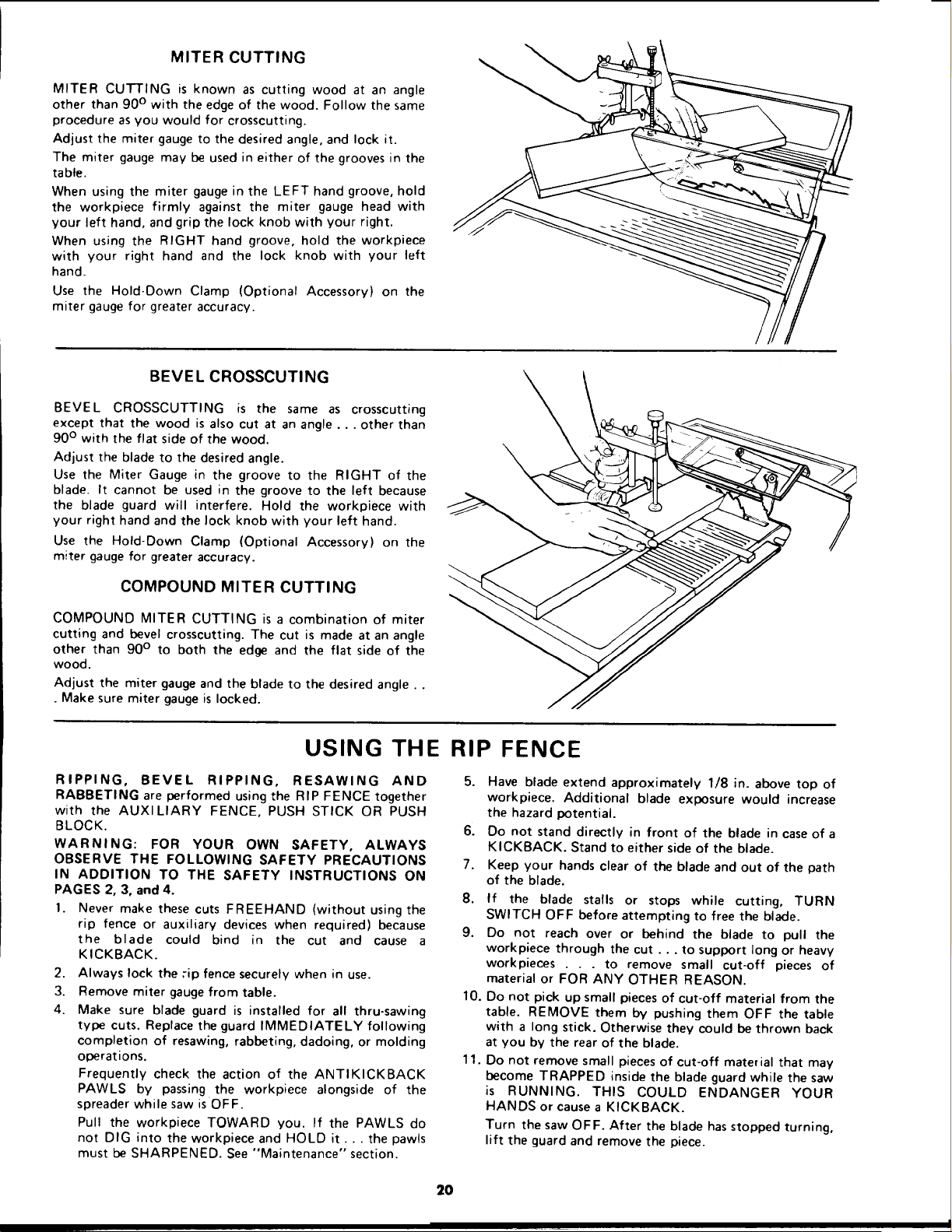
MITERCUTTING
MITER CUTTING is known as cutting wood at an angle
other than 90 ° with the edge of the wood. Follow the same
procedure as you would for crosscutting.
Adjust the miter gauge to the desired angle, and lock it.
The miter gauge may be used in either of the grooves in the
table.
When using the miter gauge in the LEFT hand groove, hold
the workpiece firmly against the miter gauge head with
your left hand, and grip the lock knob with your right.
When using the RIGHT hand groove, hold the workpiece
with your right hand and the lock knob with your left
hand.
Use the Hold-Down Clamp (Optional Accessory) on the
miter gauge for greater accuracy.
\
BEVE L CROSSCUTING
BEVEL CROSSCUTTING is the same as crosscutting
except that the wood is also cut at an angle.., other than
90 ° with the flat side of the wood.
Adjust the blade to the desired angle.
Use the Miter Gauge in the groove to the RIGHT of the
blade. It cannot be used in the groove to the left because
the blade guard will interfere. Hold the workpiece with
your right hand and the lock knob with your left hand.
Use the Hold-Down Clamp (Optional Accessory) on the
miter gauge for greater accuracy.
COMPOUND MITER CUTTING
COMPOUND MITER CUTTING is a combination of miter
cutting and bevel crosscutting. The cut is made at an angle
other than 90 ° to both the edge and the flat side of the
wood.
Adjust the miter gauge and the blade to the desired angle . .
• Make sure miter gauge is locked.
USING THE RIP FENCE
RIPPING, BEVEL RIPPING, RESAWING AND
RABBETING are performed using the RIP FENCE together
with the AUXILIARY FENCE, PUSH STICK OR PUSH
BLOCK.
WARNING: FOR YOUR OWN SAFETY, ALWAYS
OBSERVE THE FOLLOWING SAFETY PRECAUTIONS
IN ADDITION TO THE SAFETY INSTRUCTIONS ON
PAGES 2, 3, and 4.
1. Never make these cuts FREEHAND (without using the
rip fence or auxiliary devices when required) because
the blade could bind in the cut and cause a
KICKBACK.
2. Always lock the ;ip fence securely when in use.
3. Remove miter gauge from table.
4. Make sure blade guard is installed for all thru-sawing
type cuts. Replace the guard IMMEDIATELY following
completion of resawing, rabbeting, dadoing, or molding
operations.
Frequently check the action of the ANTIKICKBACK
PAWLS by passing the workpiece alongside of the
spreader while saw is OFF.
Pull the workpiece TOWARD you. If the PAWLS do
not DIG into the workpiece and HOLD it... the pawls
must be SHARPENED. See "Maintenance" section.
5. Have blade extend approximately 1/8 in. above top of
workpiece. Additional blade exposure would increase
the hazard potential.
6. Do not stand directly in front of the blade in case of a
KICKBACK. Stand to either side of the blade.
7. Keep your hands clear of the blade and out of the path
of the blade.
8. If the blade stalls or stops while cutting, TURN
SWITCH OFF before attempting to free the blade.
9. Do not reach over or behind the blade to pull the
workpiece through the cut ... to support long or heavy
workpieces . . . to remove small cut-off pieces of
material or FOR ANY OTHER REASON.
10. Do not pick up small pieces of cut-off material from the
table. REMOVE them by pushing them OFF the table
with a long stick. Otherwise they could be thrown back
at you by the rear of the blade.
11. Do not remove small pieces of cut-off material that may
become TRAPPED inside the blade guard while the saw
is RUNNING. THIS COULD ENDANGER YOUR
HANDS or cause a KICKBACK•
Turn the saw OFF. After the blade has stopped turning,
lift the guard and remove the piece.
2O
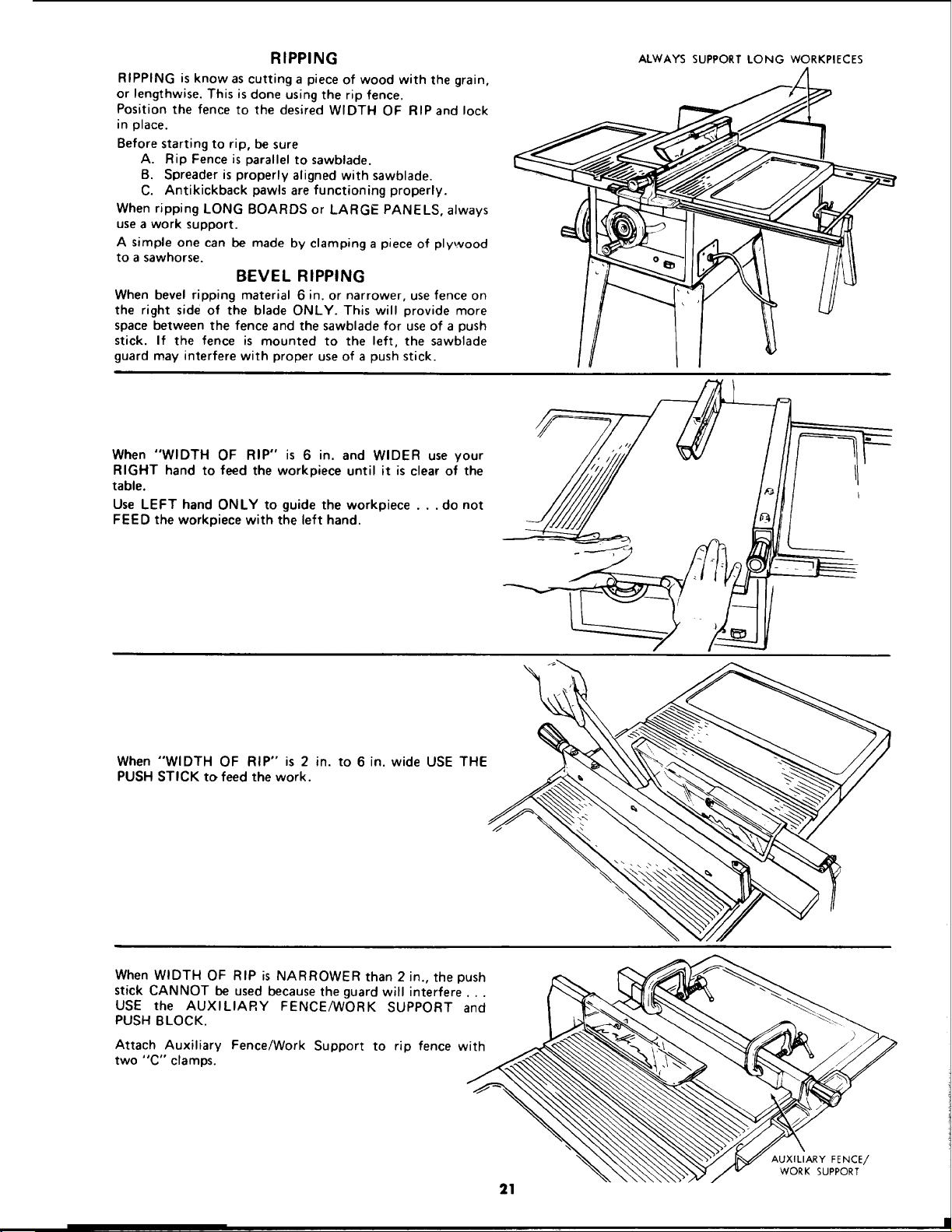
RIPPING
RIPPING is know as cutting a piece of wood with the grain,
or lengthwise. This is done using the rip fence.
Position the fence to the desired WIDTH OF RIP and lock
in place.
Before starting to rip, be sure
A. Rip Fence is parallel to sawblade.
B. Spreader is properly aligned with sawblade.
C. Antikickback pawls are functioning properly.
When ripping LONG BOARDS or LARGE PANELS, always
use a work support.
A simple one can be made by clamping a piece of plywood
to a sawhorse.
BEVEL RIPPING
When bevel ripping material 6 in. or narrower, use fence on
the right side of the blade ONLY. This will provide more
space between the fence and the sawblade for use of a push
stick. If the fence is mounted to the left, the sawblade
guard may interfere with proper use of a push stick.
ALWAYS SUPPORT LONG WORKPIECES
When "WIDTH OF RIP" is 6 in. and WIDER use your
RIGHT hand to feed the workpiece until it is clear of the
table.
Use LEFT hand ONLY to guide the workpiece . . . do not
FEED the workpiece with the left hand.
When "WIDTH OF RIP" is 2 in. to 6 in. wide USE THE
PUSH STICK to feed the work.
When WIDTH OF RIP is NARROWER than 2 in., the push
stick CANNOT be used becausethe guard will interfere...
USE the AUXILIARY FENCE/WORK SUPPORT and
PUSH BLOCK.
Attach Auxiliary Fence/Work Support to rip fence with
two "C" clamps.
21
AUXILIARY FENCE/
WORK SUPPORT
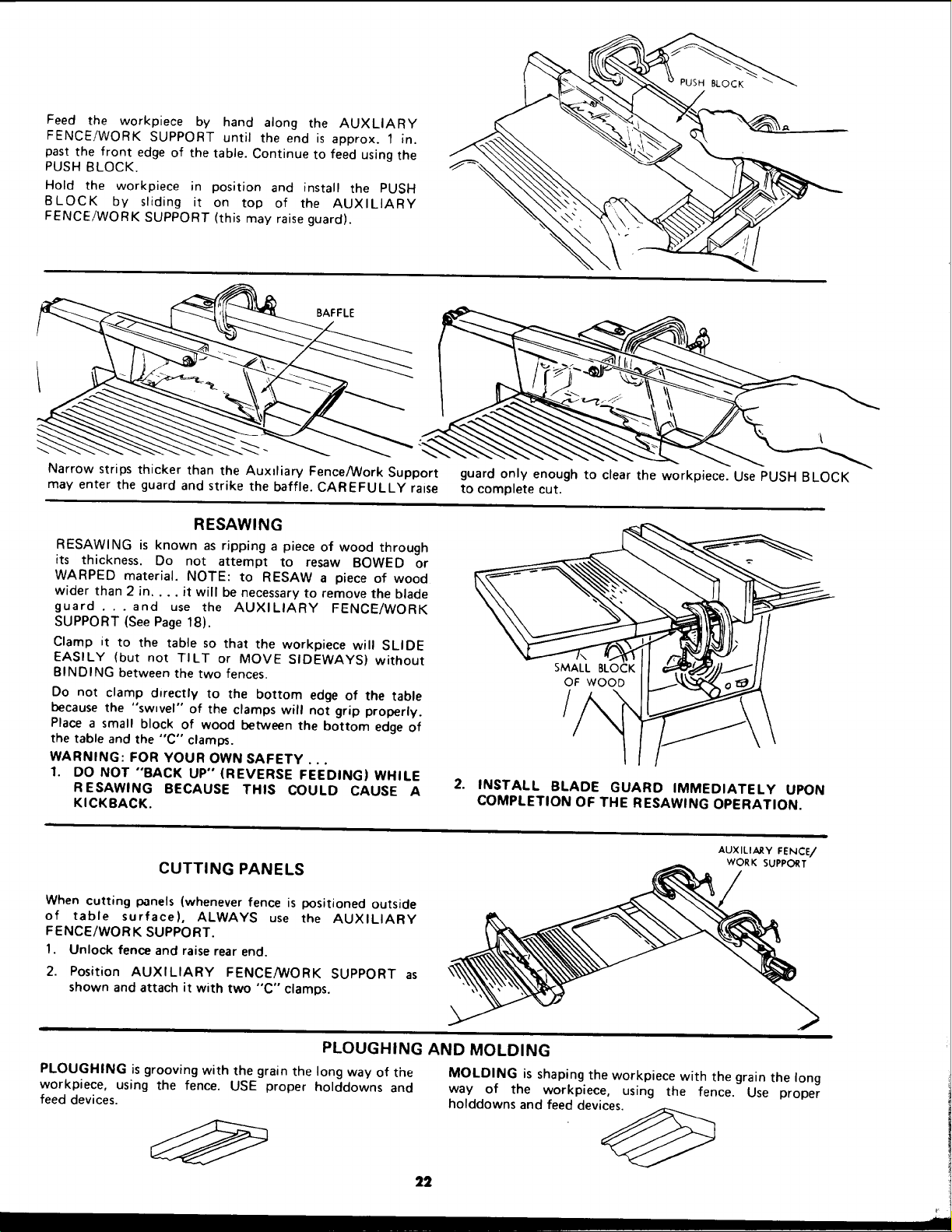
Feed the workpiece by hand along the AUXLIARY
FENCE!WORK SUPPORT until the end is approx. 1 in.
past the front edge of the table. Continue to feed using the
PUSH BLOCK.
Hold the workpiece in position and install the PUSH
BLOCK by sliding it on top of the AUXILIARY
FENCE/WORK SUPPORT (this may raise guard).
BAFFLE
Narrow strips thicker than the Auxiliary FenceANork Support guard only enough to clear the workpiece. Use PUSH BLOCK
may enter the guard and strike the baffle. CAREFULLY raise to complete cut.
RESAWlNG
RESAWING is known as ripping a piece of wood through
its thickness. Do not attempt to resaw BOWED or
WARPED material. NOTE: to RESAW a piece of wood
wider than 2 in .... it will be necessary to remove the blade
guard.., and use the AUXILIARY FENCE/WORK
SUPPORT (See Page 18).
Clamp it to the table so that the workpiece will SLIDE
EASILY (but not TILT or MOVE SIDEWAYS) without
BINDING between the two fences.
Do not clamp d0rectly to the bottom edge of the table
because the "swivel" of the clamps will not grip properly.
Place a small block of wood between the bottom edge of
the table and the "C" clamps.
WARNING: FOR YOUR OWN SAFETY...
1. DO NOT "BACK UP" (REVERSE FEEDING) WHILE
RESAWlNG BECAUSE THIS COULD CAUSE A
KICKBACK.
SMALL BLOCK
OF WOOD
2. INSTALL BLADE GUARD IMMEDIATELY UPON
COMPLETION OF THE RESAWlNG OPERATION.
CUTTING PANELS
When cutting panels (whenever fence is positioned outside
of table surface), ALWAYS use the AUXILIARY
FENCE/WORK SUPPORT.
1. Unlock fence and raise rear end.
2. Position AUXILIARY FENCE/WORK SUPPORT as
shown and attach it with two "C" clamps.
AUXILIARY FENCE/
WORK SUPPORT
PLOUGHING AND MOLDING
PLOUGHING is grooving with the grain the long way of the
workpiece, using the fence. USE proper holddowns and
feed devices.
MOLDING is shaping the workpiece with the grain the long
way of the workpiece, using the fence. Use proper
holddowns and feed devices.
22
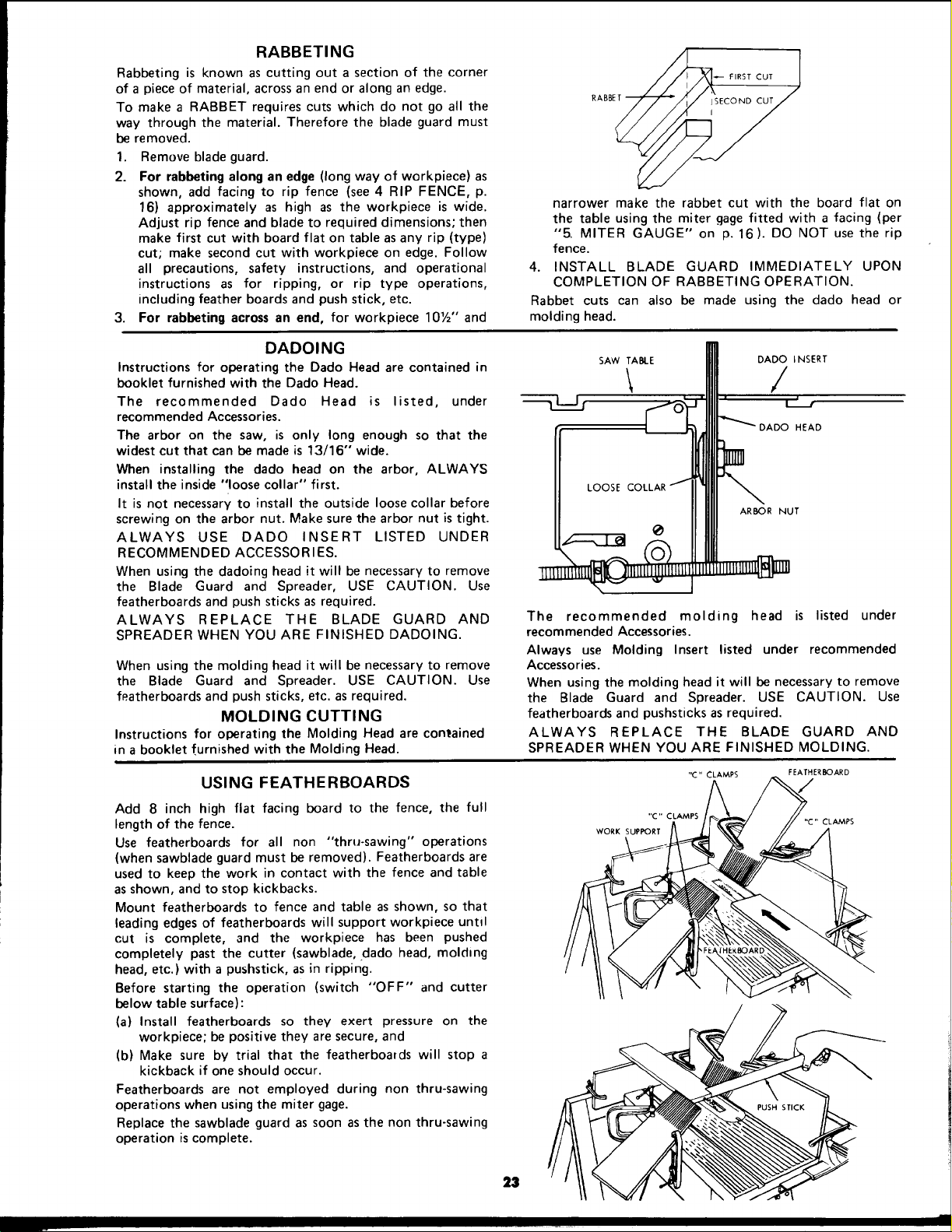
RABBETING
Rabbeting is known as cutting out a section of the corner
of a piece of material, across an end or along an edge.
To make a RABBET requires cuts which do not go all the
way through the material. Therefore the blade guard must
be removed.
1.
2.
3.
RABBET
Remove blade guard.
For rabbeting along an edge (long way of workpiece) as
shown, add facing to rip fence (see 4 RIP FENCE, p.
16) approximately as high as the workpiece is wide.
Adjust rip fence and blade to required dimensions; then
make first cut with board flat on table as any rip (type)
cut; make second cut with workpiece on edge. Follow
all precautions, safety instructions, and operational
instructions as for ripping, or rip type operations,
including feather boards and push stick, etc.
For rabbeting across an end, for workpiece 10V2" and
DADOING
Instructions for operating the Dado Head are contained in
booklet furnished with the Dado Head.
The recommended Dado Head is listed, under
recommended Accessories.
The arbor on the saw, is only long enough so that the
widest cut that can be made is 13/16" wide.
When installing the dado head on the arbor, ALWAYS
install the inside "loose collar" first.
It is not necessary to install the outside loose collar before
screwing on the arbor nut. Make sure the arbor nut is tight.
ALWAYS USE DADO INSERT LISTED UNDER
RECOMMENDED ACCESSORIES.
When using the dadoing head it will be necessary to remove
the Blade Guard and Spreader, USE CAUTION. Use
featherboards and push sticks as required.
ALWAYS REPLACE THE BLADE GUARD AND
SPREADER WHEN YOU ARE FINISHED DADOING.
When using the molding head it will be necessary to remove
the Blade Guard and Spreader. USE CAUTION. Use
featherboards and push sticks, etc. as required.
MOLDING CUTTING
Instructions for operating the Molding Head are contained
in a booklet f.urnished with the Molding Head.
USING FEATHE RBOARDS
Add 8 inch high flat facing board to the fence, the full
length of the fence.
Use featherboards for all non "thru-sawing" operations
(when sawblade guard must be removed). Featherboards are
used to keep the work in contact with the fence and table
as shown, and to stop kickbacks.
Mount featherboards to fence and table as shown, so that
leading edges of featherboards will support workpiece until
cut is complete, and the workpiece has been pushed
completely past the cutter (sawblade,.dado head, molding
head, etc.) with a pushstick, as in ripping.
Before starting the operation (switch "OFF" and cutter
below table surface):
(a) Install featherboards so they exert pressure on the
workpiece; be positive they are secure, and
(b) Make sure by trial that the featherboards will stop a
kickback if one should occur.
Featherboards are not employed during non thru-sawing
operations when using the miter gage.
Replace the sawblade guard as soon as the non thru-sawing
operation is complete.
FIRST CUT
narrower make the rabbet cut with the board flat on
the table using the miter gage fitted with a facing (per
"5. MITER GAUGE" on p. 16). DO NOT use the rip
fence.
4. INSTALL BLADE GUARD IMMEDIATELY UPON
COMPLETION OF RABBETING OPERATION.
Rabbet cuts can also be made using the dado head or
molding head.
SAW TABLE DADO INSERT
\ /
LOOSE
HEAD
ARBOR NUT
The recommended molding head is listed under
recommended Accessories.
Always use Molding Insert listed under recommended
Accessories.
When using the molding head it will be necessary to remove
the Blade Guard and Spreader. USE CAUTION. Use
featherboards and pushsticks as required.
ALWAYS REPLACE THE BLADE GUARD AND
SPREADER WHEN YOU ARE FINISHED MOLDING.
"C" CLAMPS
WORK SUPPORT
"C" CLAMPS FEATHERBOARD
"C" CLAMPS
23
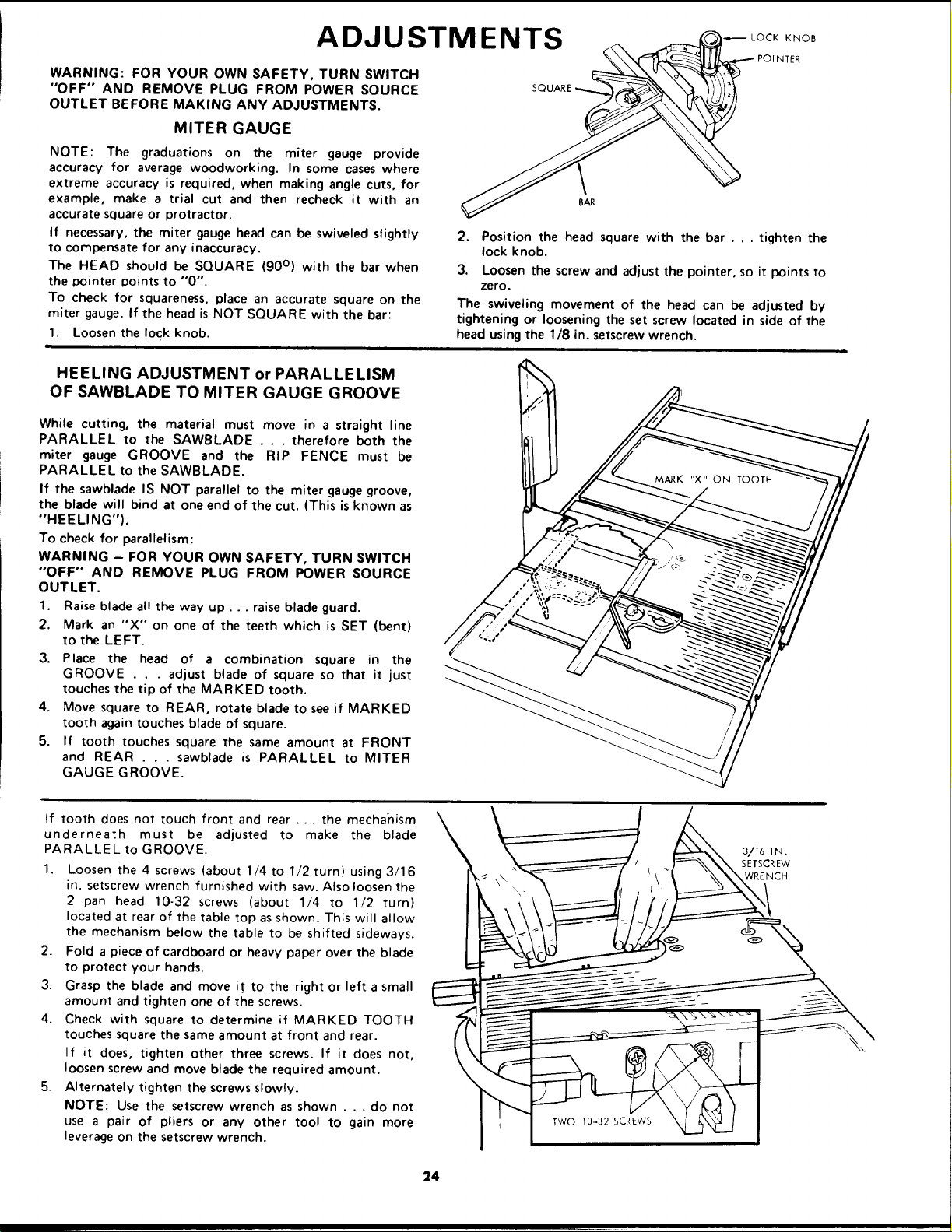
ADJUSTMENTS
WARNING: FOR YOUR OWN SAFETY, TURN SWITCH
"OFF" AND REMOVE PLUG FROM POWER SOURCE
OUTLET BEFORE MAKING ANY ADJUSTMENTS.
MITER GAUGE
NOTE: The graduations on the miter gauge provide
accuracy for average woodworking. In some cases where
extreme accuracy is required, when making angle cuts, for
example, make a trial cut and then recheck it with an
accurate square or protractor.
If necessary, the miter gauge head can be swiveled slightly
to compensate for any inaccuracy.
The HEAD should be SQUARE (90 ° ) with the bar when
the pointer points to "0".
To check for squareness, place an accurate square on the
miter gauge. If the head is NOT SQUARE with the bar:
1. Loosen the lock knob.
i i
SQUARE
LOCK KNOB
BAR
2. Position the head square with the bar . . . tighten the
lock knob.
3. Loosen the screw and adjust the pointer, so it points to
zero.
The swiveling movement of the head can be adjusted by
tightening or loosening the set screw located in side of the
head using the 1/8 in. setscrew wrench.
HEELING ADJUSTMENT or PARALLELISM
OF SAWBLADE TO MITER GAUGE GROOVE
While cutting, the material must move in a straight line
PARALLEL to the SAWBLADE . . . therefore both the
miter gauge GROOVE and the RIP FENCE must be
PARALLEL to the SAWBLADE.
If the sawblade IS NOT parallel to the miter gauge groove,
the blade will bind at one end of the cut. (This is known as
"HEELING").
To check for parallelism:
WARNING - FOR YOUR OWN SAFETY, TURN SWITCH
"OFF" AND REMOVE PLUG FROM POWER SOURCE
OUTLET.
1. Raise blade all the way up... raise blade guard.
2. Mark an "X" on one of the teeth which is SET (bent)
to the LEFT.
3. Place the head of a combination square in the
GROOVE . . . adjust blade of square so that it just
touches the tip of the MARKED tooth.
4. Move square to REAR, rotate blade to see if MARKED
tooth again touches blade of square.
5. If tooth touches square the same amount at FRONT
and REAR . . . sawblade is PARALLEL to MITER
GAUGE GROOVE.
If tooth does not touch front and rear ... the mecha'nism
underneath must be adjusted to make the blade
PARALLEL to GROOVE.
1. Loosen the 4 screws (about 1/4 to I/2 turn) using 3/16
in. setscrew wrench furnished with saw. Also loosen the
2 pan head 10-32 screws (about 1/4 to 1/2 turn)
located at rear of the table top as shown. This will allow
the mechanism below the table to be shifted sideways.
2. Fold a piece of cardboard or heavy paper over the blade
to protect your hands.
3. Grasp the blade and move it to the right or left a small
amount and tighten one of the screws.
4. Check with square to determine if MARKED TOOTH
touches square the same amount at front and rear.
If it does, tighten other three screws. If it does not,
loosen screw and move blade the required amount.
5. Alternately tighten the screws slowly.
NOTE: Use the setscrew wrench as shown . . . do not
use a pair of pliers or any other tool to gain more
leverage on the setscrew wrench.
TWO 10-32 SCREWS
3/16 IN.
SETSCREW
WRENCH
24
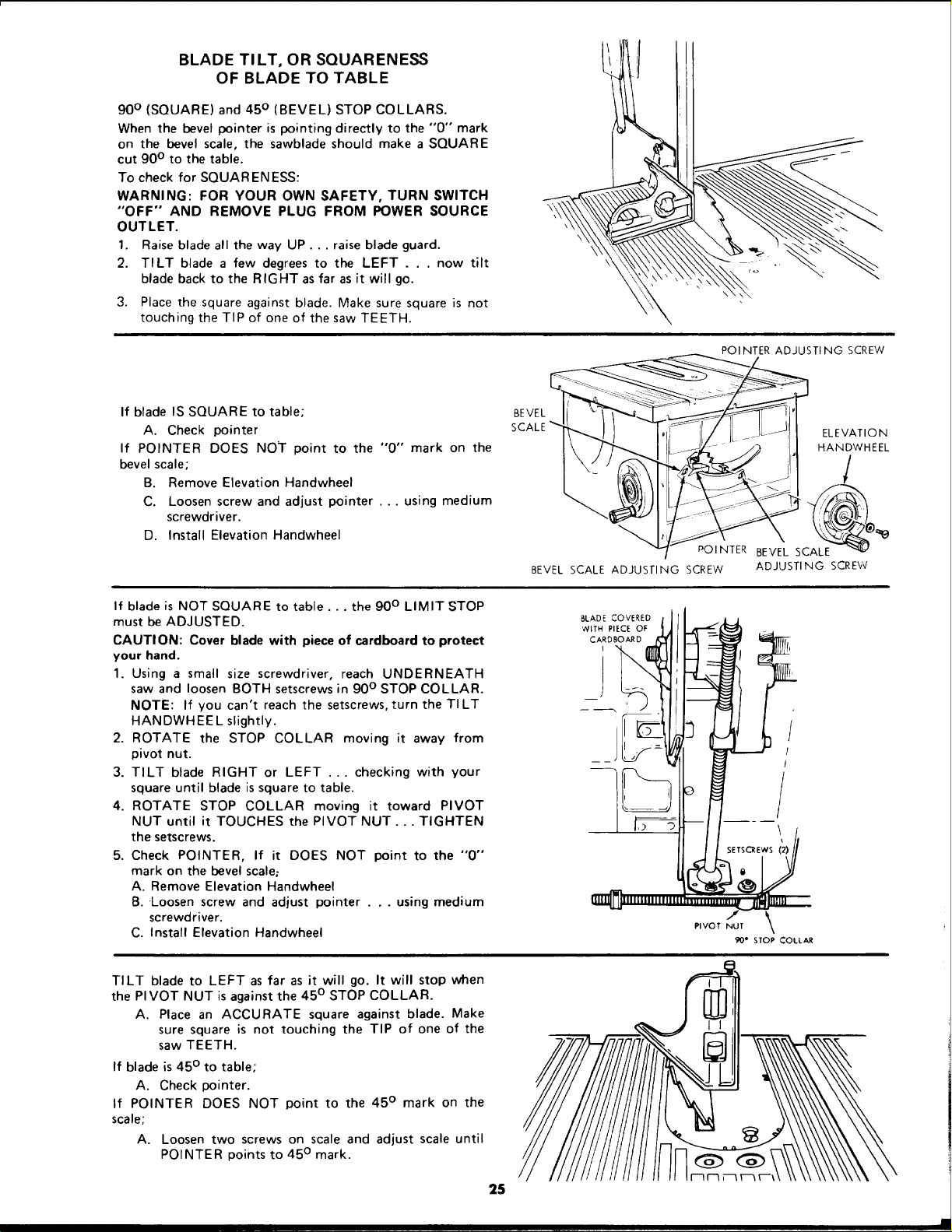
BLADE TILT, OR SQUARENESS
OF BLADE TO TABLE
90 ° (SQUARE) and 45 ° (BEVEL) STOP COLLARS.
When the bevel pointer is pointing directly to the "'0" mark
on the bevel scale, the sawblade should make a SQUARE
cut 90 ° to the table.
To check for SQUARENESS:
WARNING: FOR YOUR OWN SAFETY, TURN SWITCH
"OFF" AND REMOVE PLUG FROM POWER SOURCE
OUTLET.
1. Raise blade all the way UP... raise blade guard.
2. TILT blade a few degrees to the LEFT . . . now tilt
blade back to the RIGHT as far as it will go.
3. Place the square against blade. Make sure square is not
touching the TIP of one of the saw TEETH.
If blade IS SQUARE to table;
A. Check pointer
If POINTER DOES NOT point to the "0" mark on the
bevel scale;
B. Remove Elevation Handwheel
C. Loosen screw and adjust pointer ... using medium
screwdriver.
D. Install Elevation Handwheel
BEVEL__
POINTER ADJUSTING SCREW
ELEVATION
HANDWHEEL
/
POINTER BEVEL SCALE__')_9
BEVELSCALEADJUST,NGSCREW ADJUST,NGSCREW
If blade is NOT SQUARE to table.., the 90 ° LIMIT STOP
must be ADJUSTED.
CAUTION: Cover blade with piece of cardboard to protect
your hand.
1. Using a small size screwdriver, reach UNDERNEATH
saw and loosen BOTH setscrews in 90 ° STOP COLLAR.
NOTE: If you can't reach the setscrews, turn the TILT
HANDWHEE L slightly.
2. ROTATE the STOP COLLAR moving it away from
pivot nut.
3. TILT blade RIGHT or LEFT ... checking with your
square until blade is square to table.
4. ROTATE STOP COLLAR moving it toward PIVOT
NUT until it TOUCHES the PIVOT NUT... TIGHTEN
the setscrews.
5. Check POINTER, If it DOES NOT point to the "0"
mark on the bevel scale;
A. Remove Elevation Handwheel
B. Loosen screw and adjust pointer . . . using medium
screwdriver.
C. Install Elevation Handwheel
BLADE COVERED
WITH PIECE OF
CARDBOARD
/
/
t
/
PIVOT NUT
90 ° STOP COLLAR
TILT blade to LEFT as far as it will go. It will stop when
the PIVOT NUT is against the 45 ° STOP COLLAR.
A. Place an ACCURATE square against blade. Make
sure square is not touching the TIP of one of the
saw TEETH.
If blade is 45 ° to table;
A. Check pointer.
If POINTER DOES NOT point to the 45 ° mark on the
scale;
A. Loosen two screws on scale and adjust scale until
POINTER points to 45 ° mark.
25
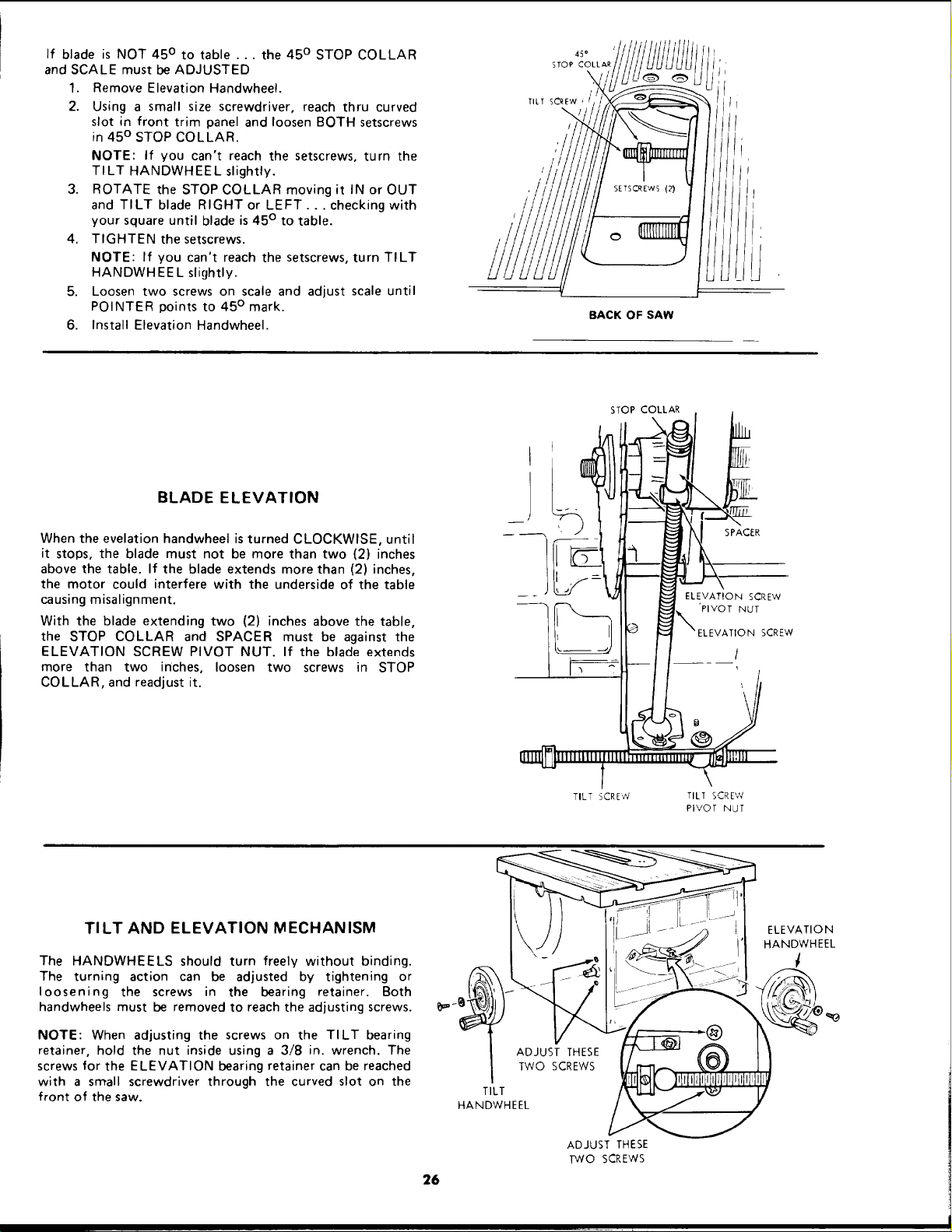
If blade is NOT 45 ° to table ... the 45 ° STOP COLLAR
and SCALE must be ADJUSTED
1. Remove Elevation Handwheel.
2. Using a small size screwdriver, reach thru curved
slot in front trim panel and loosen BOTH setscrews
in 45 ° STOP COLLAR.
NOTE: If you can't reach the setscrews, turn the
TILT HANDWHEEL slightly.
3. ROTATE the STOP COLLAR moving it IN or OUT
and TILT blade RIGHT or LEFT... checking with
your square until blade is 45 ° to table.
4. TIGHTEN the setscrews.
NOTE: If you can't reach the setscrews, turn TILT
HANDWHEEL slightly.
5. Loosen two screws on scale and adjust scale until
POINTER points to 45 ° mark.
6. Install Elevation Handwheel.
45°
STOP COLLAR
\
TILT SCREW '
BACK OF SAW
J
STOP COLLAR
BLADE ELEVATION
When the evelation handwheel is turned CLOCKWISE, until
it stops, the blade must not be more than two (2) inches
above the table. If the blade extends more than (2) inches,
the motor could interfere with the underside of the table
causing misalignment.
With the blade extending two (2) inches above the table,
the STOP COLLAR and SPACER must be against the
ELEVATION SCREW PIVOT NUT. If the blade extends
more than two inches, loosen two screws in STOP
COLLAR, and readjust it.
SPACER
ELEVATION SCREW
"PIVOT NUT
SCREW
TILT SCREvV
TILT SCREW
PIVOT NUT
TILT AND ELEVATION MECHANISM
The HANDWHEELS should turn freely without binding.
The turning action can be adjusted by tightening or
loosening the screws in the bearing retainer. Both
handwheels must be removed to reach the adjusting screws.
NOTE: When adjusting the screws on the TILT bearing
retainer, hold the nut inside using a 3/8 in. wrench. The
screws for the ELEVATION bearing retainer can be reached
with a small screwdriver through the curved slot on the
front of the saw.
ADJUST THESE
TWO SCREWS
TILT
HANDWHEEL
ELEVATION
HANDWHEEL
26
ADJUST THESE
1M/O SCREWS
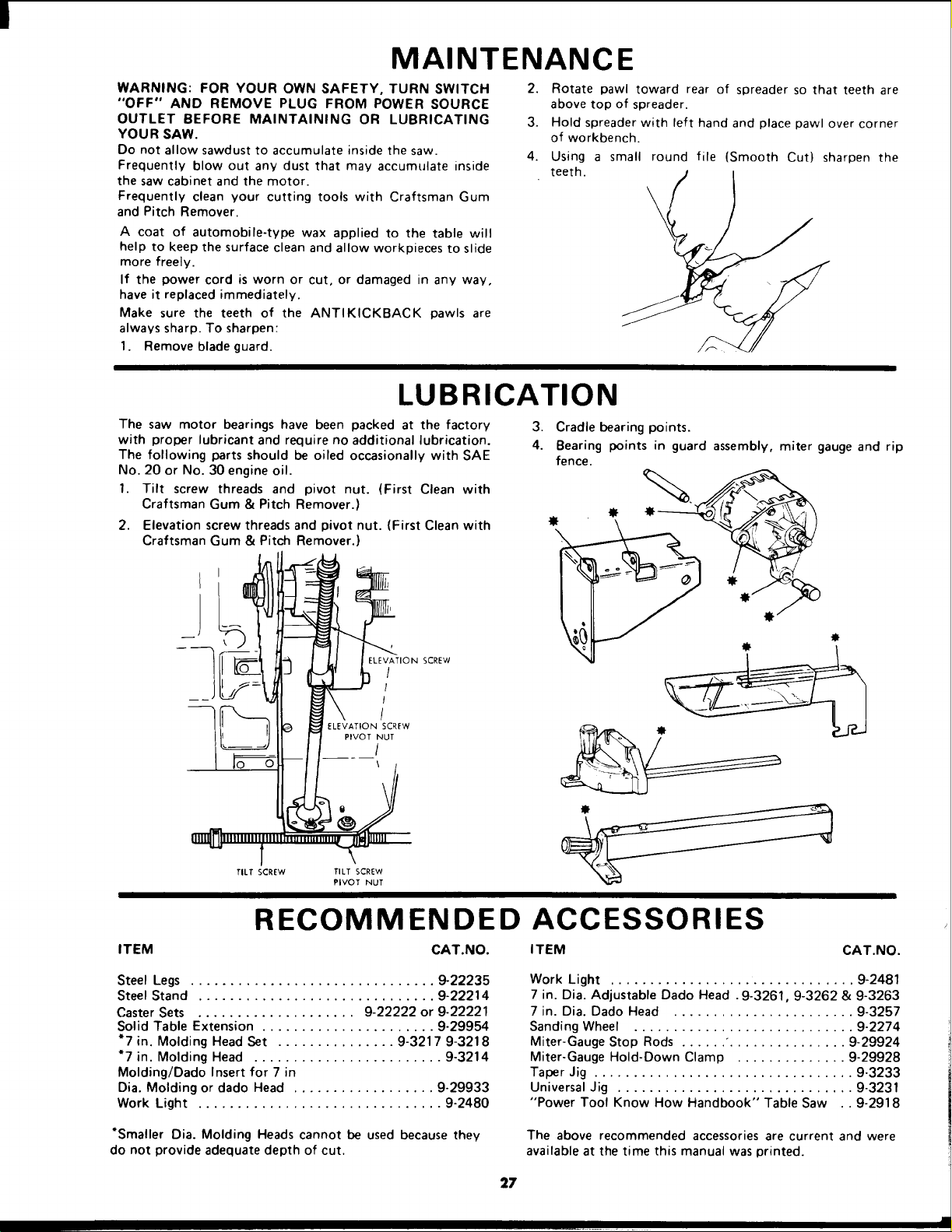
MAINTENANCE
WARNING: FOR YOUR OWN SAFETY, TURN SWITCH
"OFF" AND REMOVE PLUG FROM POWER SOURCE
OUTLET BEFORE MAINTAINING OR LUBRICATING
YOUR SAW.
Do not allow sawdust to accumulate inside the saw.
Frequently blow out any dust that may accumulate inside
the saw cabinet and the motor.
Frequently clean your cutting tools with Craftsman Gum
and Pitch Remover.
A coat of automobile-type wax applied to the table will
help to keep the surface clean and allow workpieces to slide
more freely.
If the power cord is worn or cut, or damaged in any way,
have it replaced immediately.
Make sure the teeth of the ANTIKICKBACK pawls are
always sharp. To sharpen:
1. Remove blade guard.
2. Rotate pawl toward rear of spreader so that teeth are
above top of spreader.
3. Hold spreader with left hand and place pawl over corner
of workbench.
4. Using a small round file (Smooth Cut) sharpen the
teeth.
\
LUBRICATION
The saw motor bearings have been packed at the factory
with proper lubricant and require no additional lubrication.
The following parts should be oiled occasionally with SAE
No. 20 or No. 30 engine oil.
1. Tilt screw threads and pivot nut. (First Clean with
Craftsman Gum & Pitch Remover.)
2. Elevation screw threads and pivot nut. (First Clean with
Craftsman Gum & Pitch Remover.)
ELEVATION SCREW
/
/
I
!
ELEVAT!ON SCREW
PIVOT NUT
/
3. Cradle bearing points.
4. Bearing points in guard assembly, miter gauge and rip
fence.
TILT SCREW TILT SCREW
PIVOT NUT
ITEM
RECOMMENDED ACCESSORIES
CAT.NO. ITEM
CAT.NO.
Steel Legs ............................... 9-22235
Steel Stand .............................. 9-22214
Caster Sets .................... 9-22222 or 9-22221
Solid Table Extension ...................... 9-29954
*7 in. Molding Head Set ............... 9-3217 9-3218
*7 in. Molding Head ........................ 9-3214
Molding/Dado Insert for 7 in
Dia. Molding or dado Head .................. 9-29933
Work Light ............................... 9-2480
*Smaller Dia. Molding Heads cannot be used because they
do not provide adequate depth of cut.
Work Light ............................... 9-2481
7 in. Dia. Adjustable Dado Head . 9-3261, 9-3262 & 9-3263
7 in. Dia. Dado Head ....................... 9-3257
Sanding Wheel ............................ 9-2274
Miter-Gauge Stop Rods ...... "............... 9-29924
Miter-Gauge Hold-Down Clamp .............. 9-29928
Taper Jig ................................. 9-3233
Universal Jig .............................. 9-3231
"Power Tool Know How Handbook" Table Saw . . 9-2918
The above recommended accessories are current and were
available at the time this manual was printed.
27
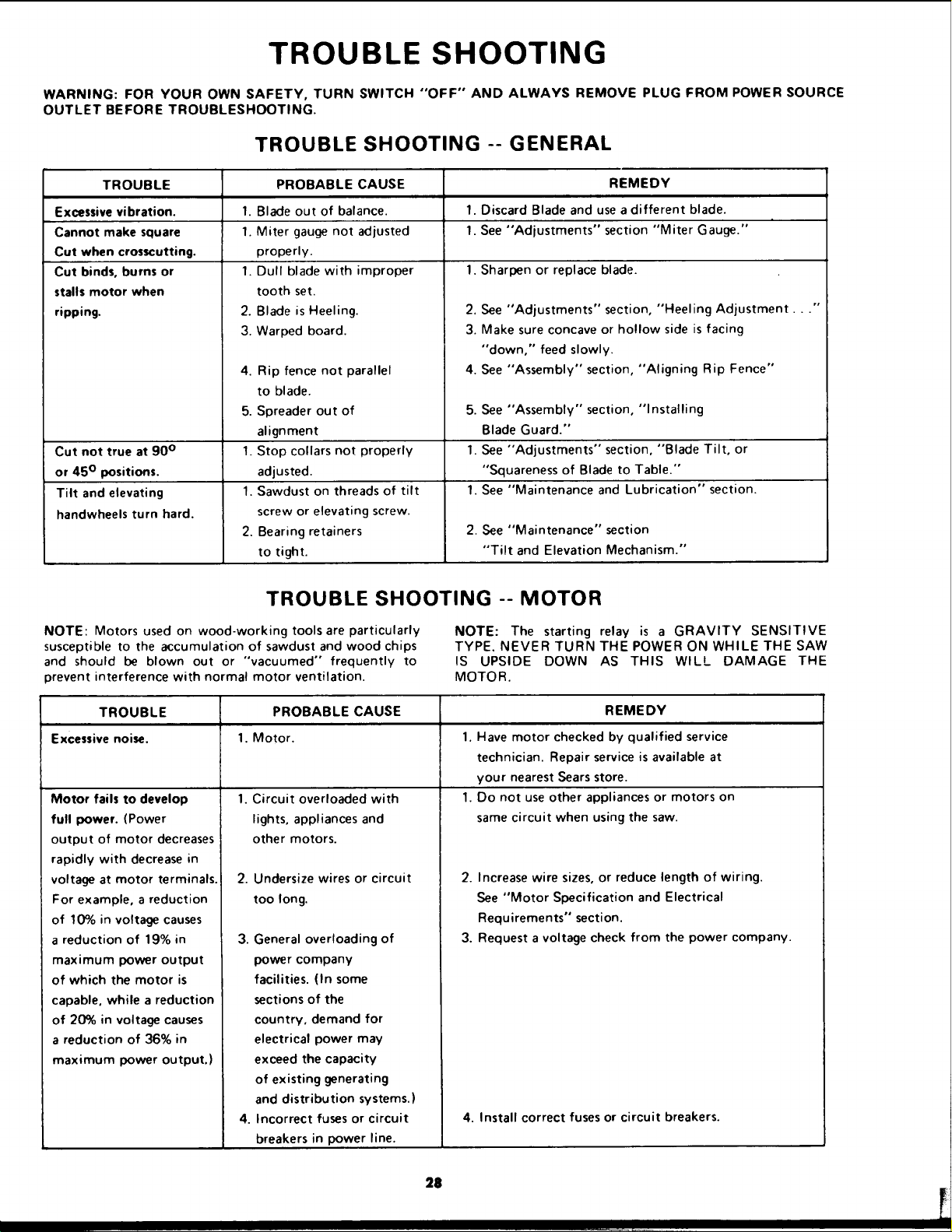
TROUBLE SHOOTING
WARNING: FOR YOUR OWN SAFETY, TURN SWITCH "OFF" AND ALWAYS REMOVE PLUG FROM POWER SOURCE
OUTLET BEFORE TROUBLESHOOTING.
TROUBLE SHOOTING -- GENERAL
TROUBLE
Excessive vibration. 1.
Cannot make square 1.
Cut when crosscutting.
Cut binds, burns or 1.
stalls motor when
ripping. 2.
3.
4.
5.
Cut not true at 90 °
or 45 ° positions.
Tilt and elevating
handwheels turn hard.
PROBABLE CAUSE REMEDY
1. Discard Blade and useadifferent blade.
1. See "Adjustments" section "Miter Gauge."
1. Sharpen or replace blade.
Blade out of balance.
Miter gauge not adjusted
properly.
Dull blade with improper
tooth set.
Blade is Heeling.
Warped board.
1.
1.
2.
Rip fence not parallel
to blade.
Spreader out of
alignment
Stop collars not properly
adjusted.
Sawdust on threads of tilt
screw or elevating screw.
Bearing retainers
to tight.
2,
3.
4.
5.
1.
1.
2.
See "Adjustments" section, "Heeling Adjustment..."
Make sure concave or hollow side is facing
"down," feed slowly.
See "Assembly" section, "Aligning Rip Fence"
See "Assembly" section, "Installing
Blade Guard."
See "Adjustments" section, "Blade Tilt, or
"Squareness of Blade to Table."
See "Maintenance and Lubrication" section.
See "Maintenance" section
"Tilt and Elevation Mechanism."
TROUBLE SHOOTING -- MOTOR
NOTE: Motors used on wood-working tools are particularly
susceptible to the accumulation of sawdust and wood chips
and should be blown out or "vacuumed" frequently to
prevent interference with normal motor ventilation.
NOTE: The starting relay is a GRAVITY SENSITIVE
TYPE. NEVER TURN THE POWER ON WHILE THE SAW
IS UPSIDE DOWN AS THIS WILL DAMAGE THE
MOTOR.
TROUBLE PROBABLE CAUSE REMEDY
Excessive noise. 1. Motor,
1.
Motor fails to develop
full power. (Power
output of motor decreases
rapidly with decrease in
voltage at motor terminals.
For example, a reduction
of 10% in voltage causes
a reduction of 19% in
maximum power output
of which the motor is
capable, while a reduction
of 20% in voltage causes
a reduction of 36% in
maximum power output.)
2.
Circuit overloaded with
lights, appliances and
other motors.
Undersize wires or circuit
too long.
3. General overloading of
power company
facilities. (In some
sections of the
country, demand for
electrical power may
exceed the capacity
of existing generating
and distribution systems.)
4. Incorrect fuses or circuit
breakers in power line.
1. Have motor checked by qualified service
technician. Repair service is available at
your nearest Sears store.
1. Do not use other appliances or motors on
same circuit when using the saw.
2. Increase wire sizes, or reduce length of wiring.
See "Motor Specification and Electrical
Requirements" section.
3. Request a voltage check from the power company.
4. Install correct fuses or circuit breakers.
28
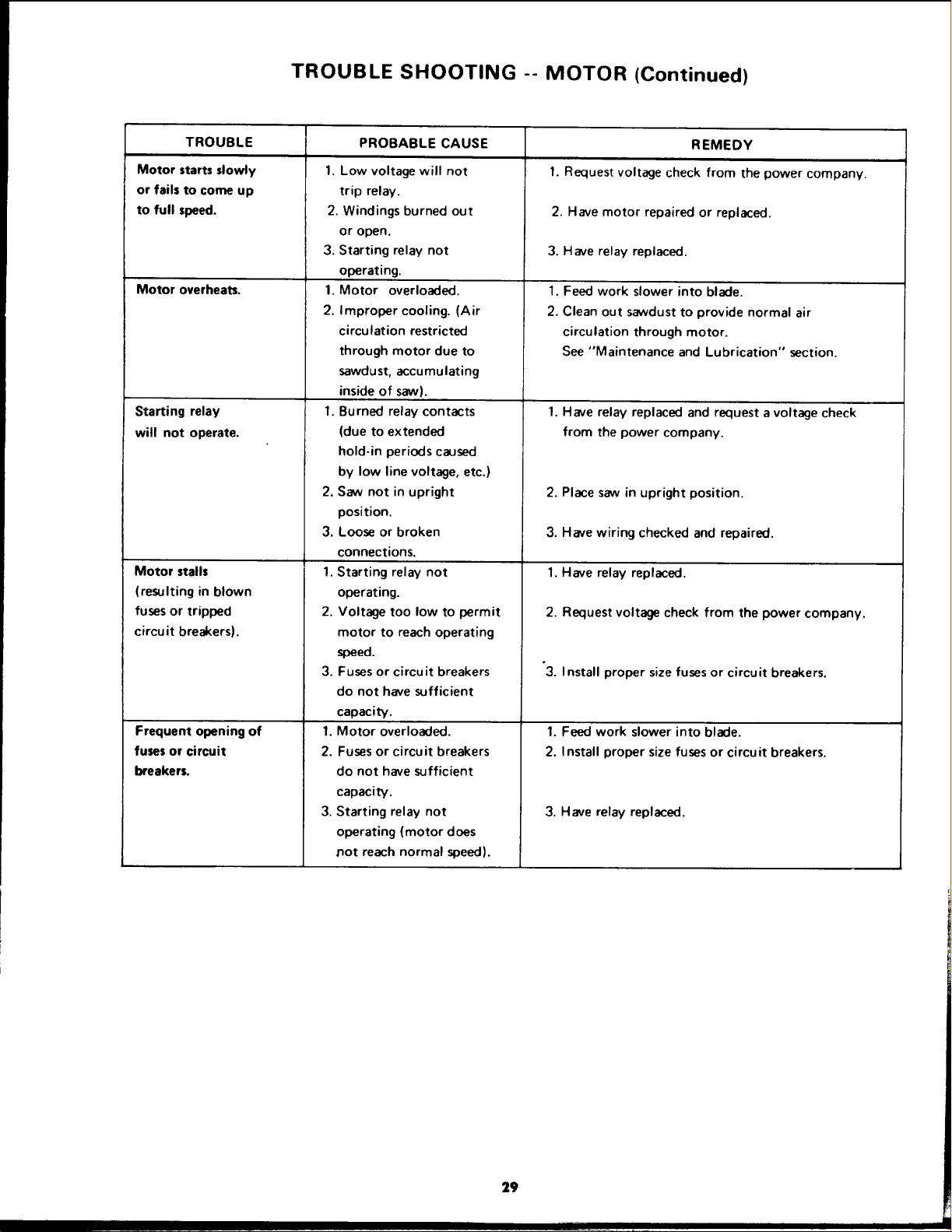
TROUBLE SHOOTING -- MOTOR (Continued)
TROUBLE PROBABLE CAUSE
Motor starts slowly
or fails to come up
to full speed.
Motor overheats.
Starting relay
will not operate.
Motor stalls
(resulting in blown
fuses or tripped
circuit breakers).
Frequent opening of
fuses or circuit
breakers.
1. Low voltage will not
trip relay.
2. Windings burned out
or open.
3. Starting relay not
operating.
1. Motor overloaded.
2. Improper cooling. (Air
circulation restricted
through motor due to
sawdust, accumulating
inside of saw).
1. Burned relay contacts
(due to extended
hold-in periods caused
by low line voltage, etc.)
2. Saw not in upright
position.
3. Loose or broken
connections.
1. Starting relay not
operating.
2, Voltage too low to permit
motor to reach operating
speed.
3. Fuses or circuit breakers
do not have sufficient
capacity.
1. Motor overloaded.
2. Fuses or circuit breakers
do not have sufficient
capacity.
3. Starting relay not
operating (motor does
not reach normal speed).
REMEDY
1. Request voltage check from the power company.
2. Have motor repaired or replaced.
3. Have relay replaced.
1. Feed work slower into blade.
2. Clean out sawdust to provide normal air
circulation through motor.
See "Maintenance and Lubrication" section.
1. Have relay replaced and request a voltage check
from the power company.
2. Place saw in upright position.
3. Have wiring checked and repaired.
1. Have relay replaced.
2. Request voltage check from the power company.
"3. Install proper size fuses or circuit breakers.
1. Feed work slower into blade.
2. Install proper size fuses or circuit breakers.
3. Have relay replaced.
29
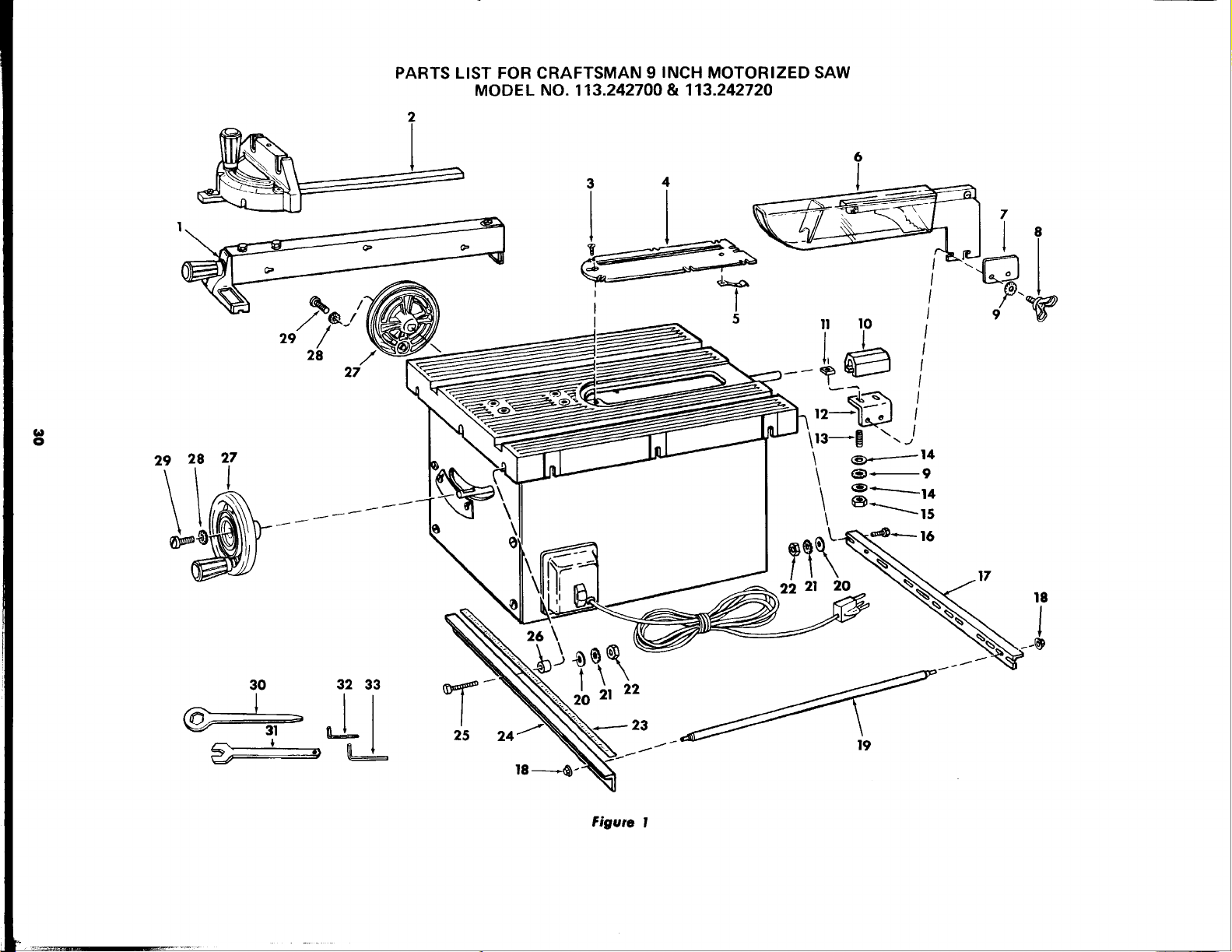
PARTS LIST FOR CRAFTSMAN 9 INCH MOTORIZED SAW
MODEL NO. 113.242700 & 113.242720
w
O
29
29
28
G_
/
27
28 27
3O
31
32 33
22 21 20
17
18
l
Figure 1
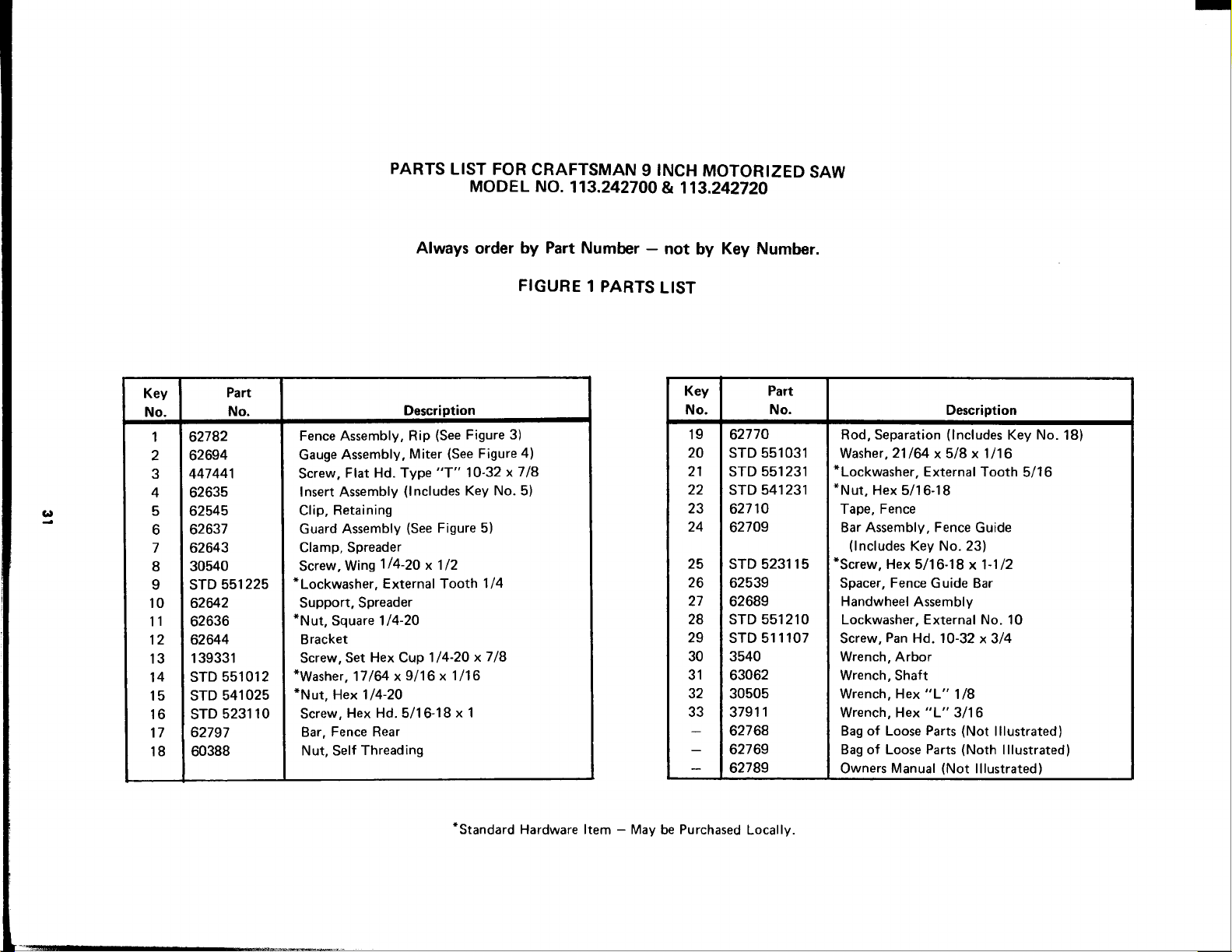
m
PARTS LIST FOR CRAFTSMAN 9 INCH MOTORIZED SAW
MODEL NO. 113.242700 & 113.242720
Always order by Part Number - not by Key Number.
FIGURE 1 PARTS LIST
W
Key Part
No. No. Description
1
2
3
4
5
6
7
8
9
10
11
12
13
14
15
16
17
18
62782
62694
447441
62635
62545
62637
62643
30540
STD 551225
62642
62636
62644
139331
STD 551012
STD 541025
STD 523110
62797
60388
Fence Assembly, Rip (See Figure 3)
Gauge Assembly, Miter (See Figure 4)
Screw, Flat Hd. Type "T" 10-32 x 7/8
Insert Assembly (Includes Key No. 5)
Clip, Retaining
Guard Assembly (See Figure 5)
Clamp, Spreader
Screw, Wing 1/4-20 x 1/2
*Lockwasher, External Tooth 1/4
Support, Spreader
*Nut, Square 1/4-20
Bracket
Screw, Set Hex Cup 1/4-20 x 7/8
*Washer, 17/64 x 9/16 x 1/16
*Nut, Hex 1/4-20
Screw, Hex Hd. 5/16-18 x 1
Bar, Fence Rear
Nut, Self Threading
Key
No.
19
20
21
22
23
24
25
26
27
28
29
30
31
32
33
D
Part
No.
62770
STD 551031
STD 551231
STD 541231
62710
62709
STD 523115
Description
Rod, Separation (Includes Key No. 18)
Washer, 21/64 x 5/8 x 1/16
*Lockwasher, External Tooth 5/16
*Nut, Hex 5/16-18
Tape, Fence
Bar Assembly, Fence Guide
(Includes Key No. 23)
*Screw, Hex 5/16-18 x 1-1/2
62539
62689
STD 551210
STD 511107
3540
63062
30505
37911
62768
62769
62789
Spacer, Fence Guide Bar
Handwheel Assembly
Lockwasher, External No. 10
Screw, Pan Hd. 10-32 x 3/4
Wrench, Arbor
Wrench, Shaft
Wrench, Hex "L" 1/8
Wrench, Hex "L" 3/16
Bag of Loose Parts (Not Illustrated)
Bag of Loose Parts (Noth Illustrated)
Owners Manual (Not Illustrated)
*Standard Hardware Item - May be Purchased Locally.
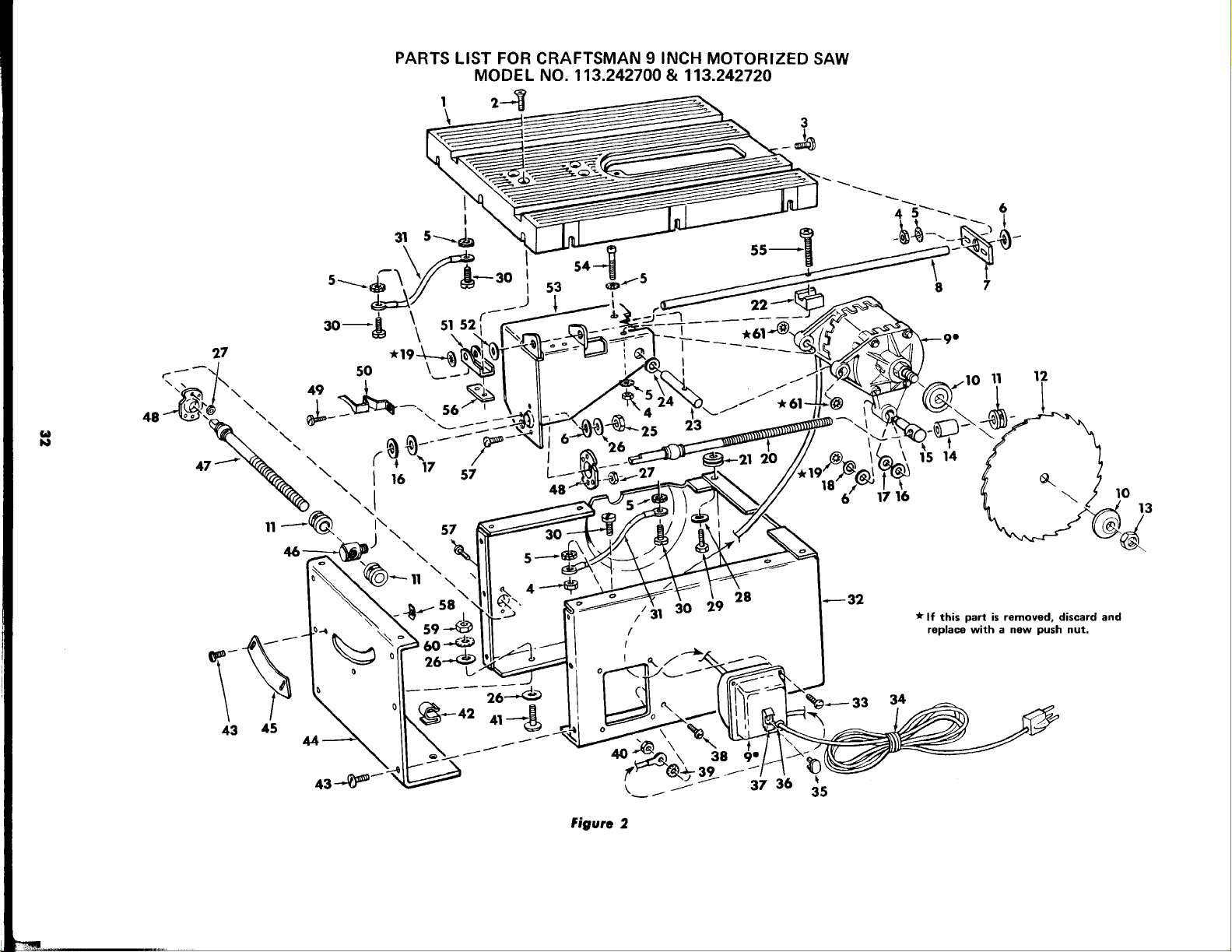
14
k_
48
\
\
43 45
49
PARTS LIST FOR CRAFTSMAN 9 INCH MOTORIZED SAW
MODEL NO. 113.242700 & 113.242720
3! 5
23
J
L/
48
20
17 16
14
/
/
/
I
¢
30 29
26 33 34
_42
40_\\ 38
\ _ 37 36
_-_ 35
6
7
11 12
lO
* If this part is removed, discard and
replace with a new push nut.
Figure 2
13
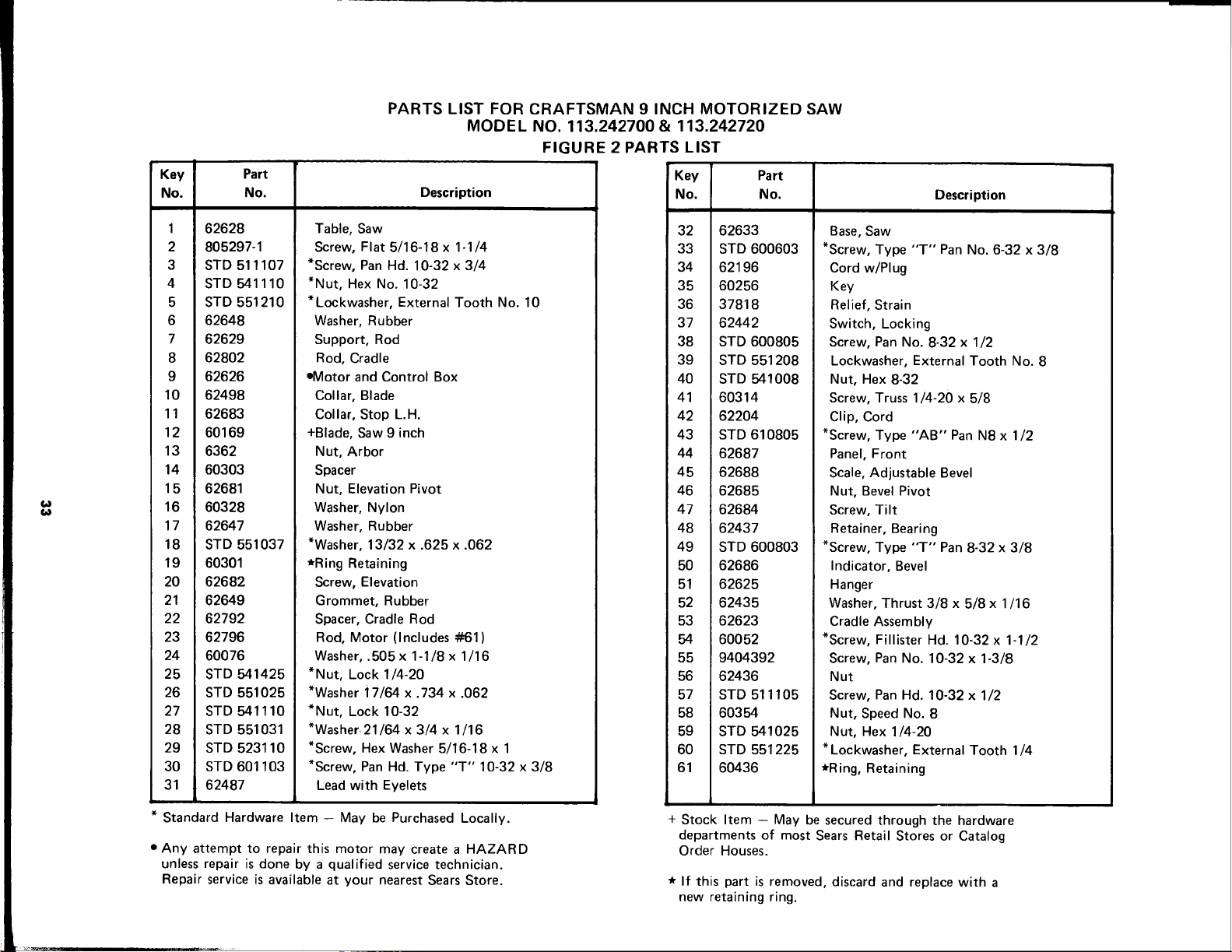
W
PARTS LIST FOR CRAFTSMAN 9 INCH MOTORIZED SAW
MODEL NO. 113.242700 & 113.242720
FIGURE 2 PARTS LIST
Key Part
No. No. Description
1 62628
2 805297-1
3 STD 511107
4 STD541110
5 STD 551210
6 62648
7 62629
8 62802
9 62626
10 62498
11 62683
12 60169
13 6362
14 60303
15 62681
16 60328
17 62647
18 STD 551037
19 60301
20 62682
21 62649
22 62792
23 62796
24 60076
25 STD541425
26 STD 551025
27 STD 541110
28 STD 551031
29 STD 523110
30 STD 601103
31 62487
Table, Saw
Screw, Flat 5/16-18 x 1-1/4
*Screw, Pan Hd. 10-32 x 3/4
*Nut, Hex No. 10-32
*Lockwasher, External Tooth No. 10
Washer, Rubber
Support, Rod
Rod, Cradle
=Motor and Control Box
Collar, Blade
Collar, Stop L.H.
+Blade, Saw 9 inch
Nut, Arbor
Spacer
Nut, Elevation Pivot
Washer, Nylon
Washer, Rubber
*Washer, 13/32 x .625 x .062
*Ring Retaining
Screw, Elevation
Grommet, Rubber
Spacer, Cradle Rod
Rod, Motor (Includes _61)
Washer, .505 x 1-1/8 x 1/16
*Nut, Lock 1/4-20
*Washer 17/64 x .734 x .062
*Nut, Lock 10-32
*Washer.21/64 x 3/4 x 1/16
*Screw, Hex Washer 5/16-18 x 1
*Screw, Pan Hd. Type "T" 10-32 x 3/8
Lead with Eyelets
Key Part
No. No.
32 62633
33 STD 600603
34 62196
35 60256
36 37818
37 62442
38 STD 600805
39 STD 551208
40 STD541008
41 60314
42 62204
43 STD 610805
44 62687
45 62688
46 62685
47 62684
48 62437
49 STD 600803
50 62686
51 62625
52 62435
53 62623
54 60052
55 9404392
56 62436
57 STD 5111O5
58 60354
59 STD541025
60 STD 551225
61 60436
Description
Base, Saw
*Screw, Type "T" Pan No. 6-32 x 3/8
Cord w/Plug
Key
Relief, Strain
Switch, Locking
Screw, Pan No. 8-32 x 1/2
Lockwasher, External Tooth No. 8
Nut, Hex 8-32
Screw, Truss 1/4-20 x 5/8
Clip, Cord
*Screw, Type "AB" Pan N8 x 1/2
Panel, Front
Scale, Adjustable Bevel
Nut, Bevel Pivot
Screw, Tilt
Retainer, Bearing
*Screw, Type "T" Pan 8-32 x 3/8
Indicator, Bevel
Hanger
Washer, Thrust 3/8 x 5/8 x 1/16
Cradle Assembly
*Screw, Fillister Hd. 10-32 x 1-1/2
Screw, Pan No. 10-32 x 1-3/8
Nut
Screw, Pan Hd. 10-32 x 1/2
Nut, Speed No. 8
Nut, Hex 1/4-20
* Lockwasher, External Tooth 1/4
*Ring, Retaining
Standard Hardware Item - May be Purchased Locally.
Any attempt to repair this motor may create a HAZARD
unless repair is done by a qualified service technician.
Repair service is available at your nearest Sears Store.
+ Stock Item - May be secured through the hardware
departments of most Sears Retail Stores or Catalog
Order Houses.
* If this part is removed, discard and replace with a
new retaining ring.
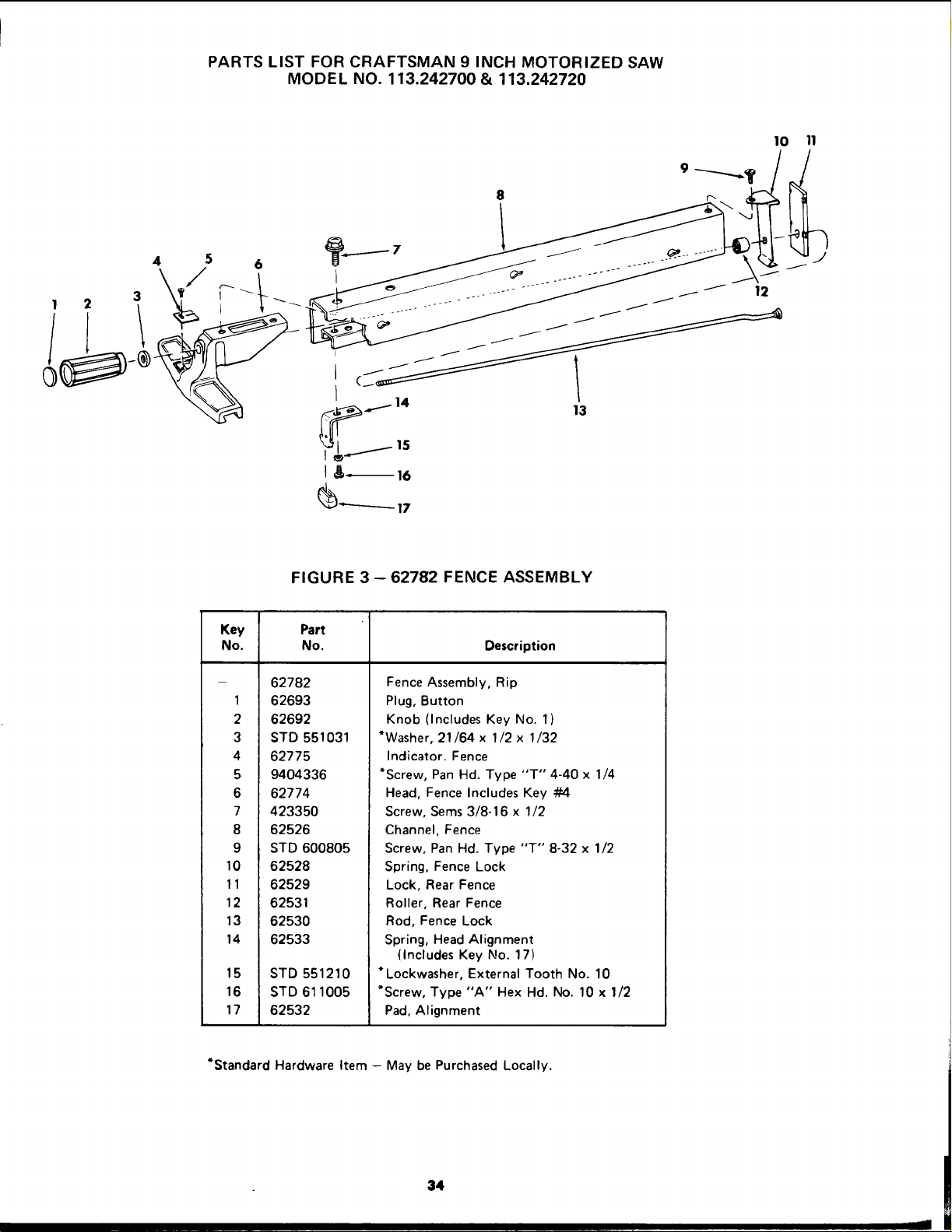
PARTS LIST FOR CRAFTSMAN 9 INCH MOTORIZED SAW
MODEL NO. 113.242700 & 113.242720
FIGURE 3 - 62782 FENCE ASSEMBLY
Key Part
No. No. Description
- 62782
1 62693
2 62692
3 STD 551031
4 62775
5 9404336
6 62774
7 423350
8 62526
9 STD 600805
10 62528
11 62529
12 62531
13 62530
14 62533
15 STD 551210
16 STD 611005
17 62532
Fence Assembly, Rip
Plug, Button
Knob (Includes Key No. 1)
*Washer, 21/64 x 1/2 x 1/32
Indicator. Fence
*Screw, Pan Hd. Type "T" 4-40 x 1/4
Head, Fence Includes Key
Screw, Sems 3/8-16 x 1/2
Channel, Fence
Screw, Pan Hd. Type "T" 8-32 x 1/2
Spring, Fence Lock
Lock, Rear Fence
Roller, Rear Fence
Rod, Fence Lock
Spring, Head Alignment
(Includes Key No. 17)
*Lockwasher, External Tooth No. 10
*Screw, Type "A" Hex Hd. No. 10 x 1/2
Pad, Alignment
*Standard Hardware Item - May be Purchased Locally.
34
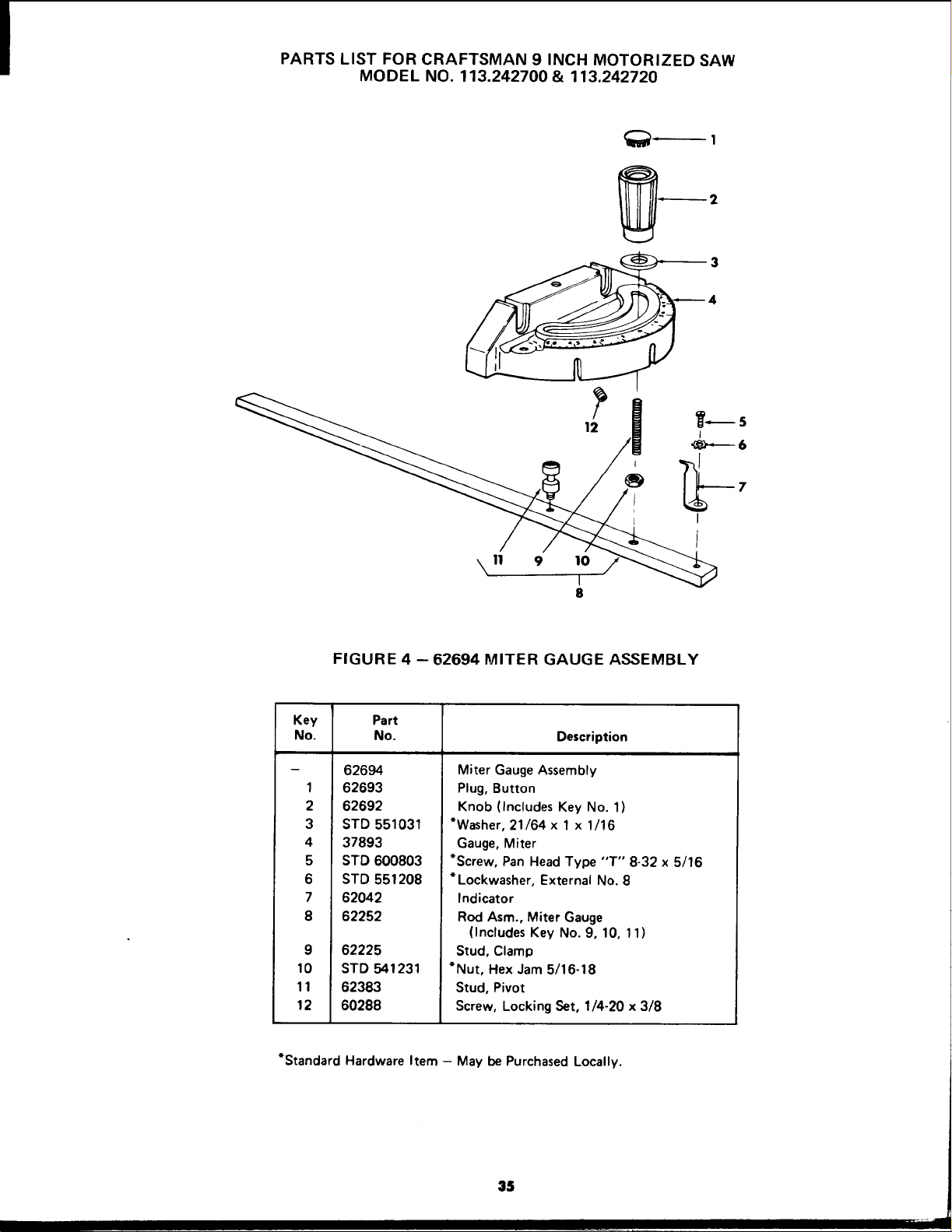
PARTS LIST FOR CRAFTSMAN 9 INCH MOTORIZED SAW
MODEL NO. 113.242700 & 113.242720
\ 11 9 10
I
8
FIGURE 4 -- 62694 MITER GAUGE ASSEMBLY
Key Part
No. No. Description
- 62694
1 62693
2 62692
3 STD 551031
4 37893
5 STD 600803
6 STD 551208
7 62042
8 62252
9 62225
10 STD541231
11 62383
12 60288
Miter Gauge Assembly
Plug, Button
Knob (Includes Key No. 1)
*Washer, 21/64 x 1 x 1/16
Gauge, Miter
*Screw, Pan Head Type "T" 8-32 x 5/16
* Lockwasher, External No. 8
Indicator
Rod Asm., Miter Gauge
(Includes Key No. 9, 10, 11)
Stud, Clamp
*Nut, Hex Jam 5/16-18
Stud, Pivot
Screw, Locking Set, 1/4-20 x 3/8
*Standard Hardware Item - May be Purchased Locally.
3$
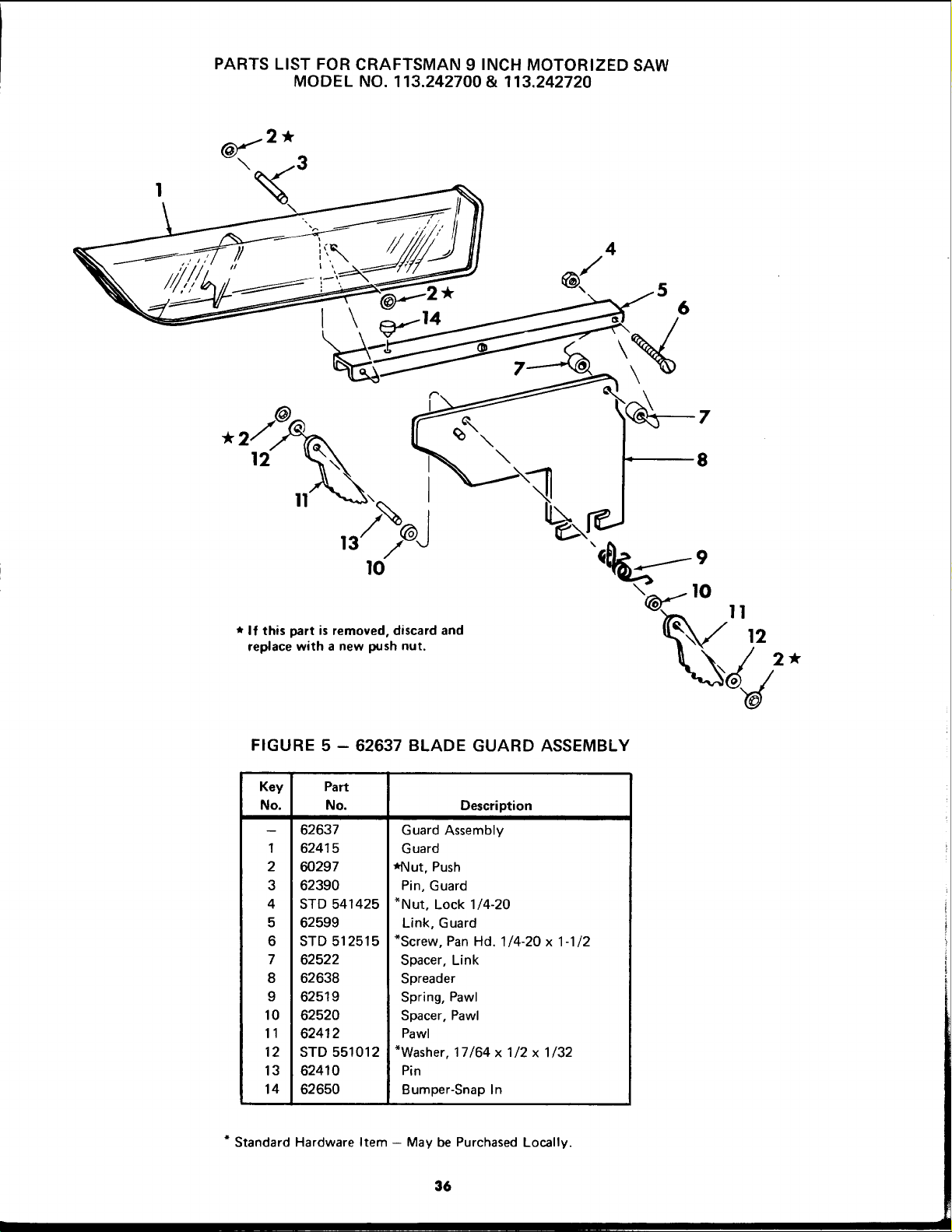
PARTS LIST FOR CRAFTSMAN 9 INCH MOTORIZED SAW
MODEL NO. 113.242700 & 113.242720
12
il
10
" 10
* If this part is removed, discard and
replace with a new push nut.
11
12
2*
FIGURE 5 - 62637 BLADE GUARD ASSEMBLY
Key
No.
m
1
2
3
4
5
6
7
8
9
10
11
12
13
14
Part
No.
62637
62415
60297
62390
STD 541425
62599
STD 512515
62522
62638
62519
62520
62412
STD 551012
62410
62650
Description
Guard Assembly
Guard
*Nut, Push
Pin, Guard
*Nut, Lock 1/4-20
Link, Guard
*Screw, Pan Hd. 1/4-20 x 1-1/2
Spacer, Link
Spreader
Spring, Pawl
Spacer, Pawl
Pawl
*Washer, 17/64 x 1/2 x 1/32
Pin
Bumper-Snap In
* Standard Hardware Item - May be Purchased Locally.
36
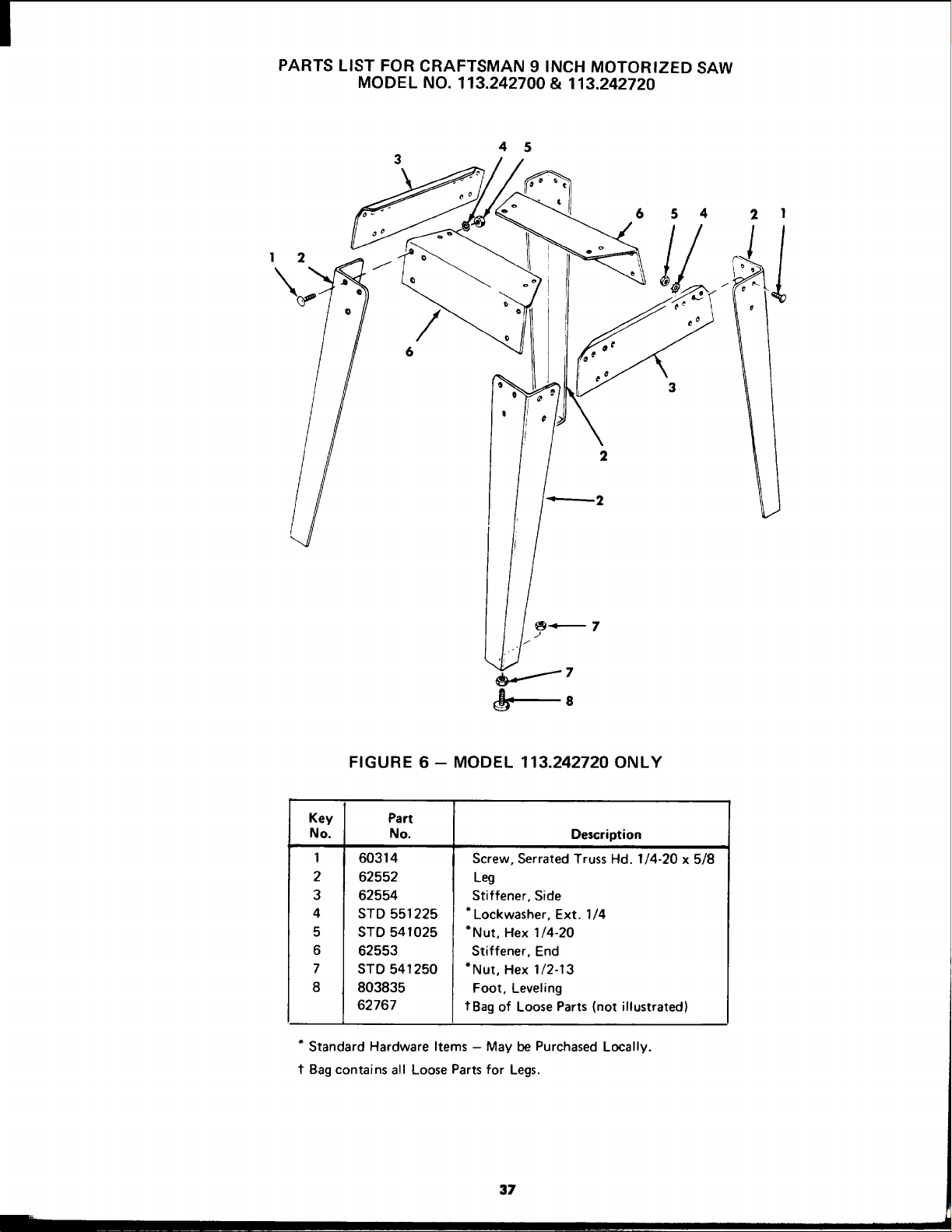
PARTS LIST FOR CRAFTSMAN 9 INCH MOTORIZED SAW
MODEL NO. 113.242700 & 113.242720
3
\
6
4
6 5 4
_- 8
FIGURE 6- MODEL 113.242720 ONLY
Key
No.
1
2
3
4
5
6
7
8
Part
No.
60314
62552
62554
STD 551225
STD 541025
62553
STD 541250
803835
62767
Description
Screw, Serrated Truss Hd. 1/4-20 x 5/8
Leg
Stiffener, Side
* Lockwasher, Ext. 1/4
*Nut, Hex 1/4-20
Stiffener, End
*Nut, Hex 1/2-13
Foot, Leveling
tBag of Loose Parts (not illustrated)
* Standard Hardware Items - May be Purchased Locally.
t Bag contains all Loose Parts for Legs.
37
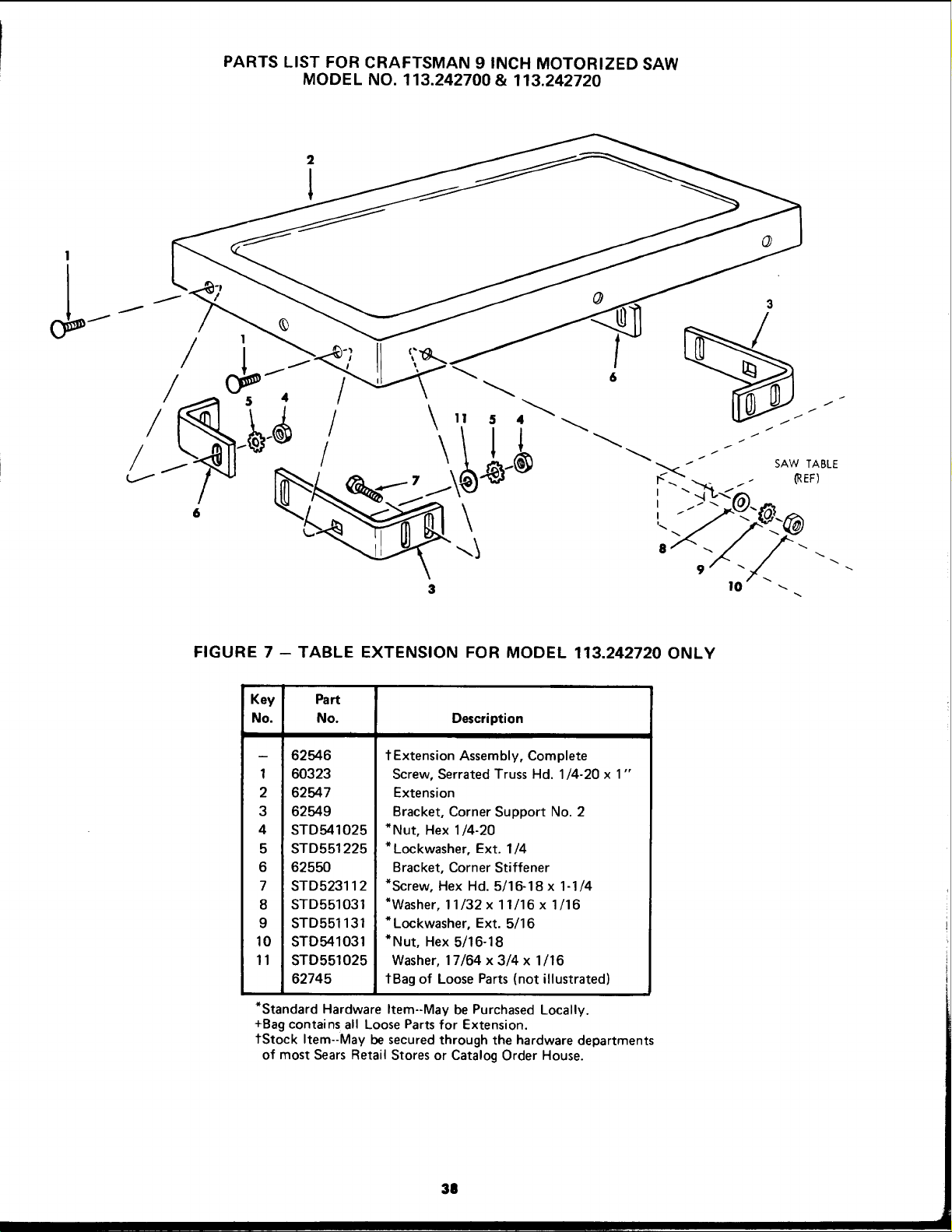
PARTS LIST FOR CRAFTSMAN 9 INCH MOTORIZED SAW
MODEL NO. 113.242700 & 113.242720
2
1
J
/
1
6
11 5 4
/
\
!o
3
/
/
/
SAW TABLE
_,EF)
FIGURE 7 -- TABLE EXTENSION FOR MODEL 113.242720 ONLY
Key
No.
Part
No.
- 62546
1 60323
2 62547
3 62549
4 STD541025
5 STD551225
6 62550
7 STD52311 2
8 STD551031
9 STD551131
10 STD541031
11 STD551025
62745
Description
tExtension Assembly, Complete
Screw, Serrated Truss Hd. 1/4-20 x 1"
Extension
Bracket, Corner Support No. 2
*Nut, Hex 1/4-20
* Lockwasher, Ext. 1/4
Bracket, Corner Stiffener
*Screw, Hex Hd. 5/16-18 x 1-1/4
*Washer, 11/32 x 11/16 x 1/16
* Lockwasher, Ext. 5/16
*Nut, Hex 5/16-18
Washer, 17/64 x 3/4 x 1/16
tBag of Loose Parts (not illustrated)
*Standard Hardware Item--May be Purchased Locally.
+Bag contains all Loose Parts for Extension.
tStock Item-May be secured through the hardware departments
of most Sears Retail Stores or Catalog Order House.
38

NOTES
39
[Sears !
owners
manual
SERVICE
MODEL NO,
113.242700
SAW ONLY
113.242720
SAW WITH LEGS AND
TWO TABLE EXTENSIONS
HOW TO ORDER
REPAIR PARTS
9 INCH MOTORIZED TABLE SAW
Now that you have purchased your 9 inch motorized table saw
should a need ever exist for repair parts or service, simply
contact any Sears Service Center and most Sears, Roebuck and
Co. stores. Be sure to provide all pertinent facts when you call
or visit.
The model number of your 9 inch motorized table saw will be
found on a plate attached to your saw, at the right-hand side of
the base.
WHEN ORDERING REPAIR PARTS, ALWAYS GIVE THE
FOLLOWING INFORMATION:
PART NUMBER
MODEL NUMBER
113.242700
113.242720
PART DESCRIPTION
NAME OF ITEM
9 INCH MOTORIZED TABLE SAW
All parts listed may be ordered from any Sears Service Center
and most Sears stores. If the parts you need are not stocked
locally, your order will be electronically transmitted to a Sears
Repair Parts Distribution Center for handling.
i
Sold by SEARS, ROEBUCK AND CO., Chicago, IL. 60684 U.S.A.
Part No. 62789 Form No. SP4564-3 Printed in U.S.A. 3/82