UseAndCare
A Note ToYou 2
Understanding
Safety
Getting To Know
Your Washer/Dryer
Operating Your
Washer
3
6
7
Operating Your
Dryer
Caring For Your
Washer/Dryer
Laundry Tips
If You Need
Assistance Or
Service
12
16
20
33
Warranty 36
1-800-253-1301
Call us with questions or comments.
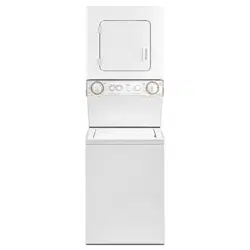
THIN TWIN" AUTOMATIC WASHER/DRYER
A Note To You
Thank you for buying a Whirlpool ® appliance.
You have purchaseda quality, world-classhome appliance.Years ofengineering experience have
gone intoitsmanufacturing.To ensure manyyears oftrouble-free operation,we have developed
this Use and Care Guide. It isfull ofvaluable informationon howto operate and maintainyour
appliance properlyand safely. Please read itcarefully.Also, please complete and mail the Owner-
ship RegistrationCard providedwith yourappliance. Thiswill helpus notifyyou about any new
informationon your appliance.
Your safety is important to us.
This guide contains safety symbolsand statements. Please pay special attentiontothese symbols
and follow any instructionsgiven. Here isa briefexplanation ofthe use of each symbol.
This symbolwill help alert you to such
dangers as personal injury, burns, fire
and electricalshock.
This symbolwillhelp you avoidactions
whichcould cause productdamage
(scratches,dents, etc.) and damage
toyour personalproperty.
Our Consumer Assistance Center number, 1-800-253-1301, is
toll-free 24 hours a day.
ifyou have a questionconcerningyourappliance'soperation, or ifyou need service,first see =If
You Need AssistanceOr Service" on page 33. Ifyou need further help, call us. When calling,you
will need to knowyourappliance's completemodel numberand serial number.You can find this
informationon the model and serial numberlabel (see diagram on page 6). Foryour convenience,
we have includeda handy place below for you to recordthese numbers,the purchase date from
the salesslip and yourdealer's name and telephone number. Keep this bookand the sales slip
together in a safe place for futurereference.
Model Number
Serial Number
Purchase Date
Dealer Name
Dealer Phone
Understanding Safety
For your safety, the information in this manual must
be followed to minimize the risk of fire or explosion
or to prevent property damage, personal injury or
loss of life.
-Do not store or use gasoline or other flammable vapors and liquids
in the vicinity of this or any other appliance.
-WHAT TO DO IF YOU SMELL GAS:
• Do not try to light any appliance.
• Do not touch any electrical switch; do not use any phone in your
building.
• Clear the room, building or area of all occupants.
• Immediately call your gas supplier from a neighbor's phone.
Follow the gas supplier's instructions.
• If you cannot reach your gas supplier, call the fire department.
Installation and service must be performed by a qualified installer,
service agency or the gas supplier.
IMPORTANT SAFETY INSTRUCTIONS
To reduce the risk of fire, electrical shock or injury to persons
when using your washer/dryer, follow basic precautions, including
the following:
• Read all instructionsbefore usingyour
THIN "I'WIN®washer/dryer.
• Do not machinewash or machine dry
itemscleaned, washed, soaked in, or
spottedwith wax, paint, gasoline,oil, dry
cleaningsolvents,or otherflammable
fluids. The fumes can create a fire hazard
or explosion.Always handwash and line
dry itemscontainingthese materials.
• Flammable fluids (dry-cleaningsolvents,
kerosene, gasoline,etc.) shouldnot be
used or stored in or near yourwasher/
dryer. Do not add flammable fluids to your
wash water. These substancesgive off
vapors that can create a fire hazard or
explosion.
• Do not allowchildrento operate, play with,
or crawl on or insideyour washer/dryer.
Supervise childrencloselywhen your
washer/dryer isused near them.
• Beforeyourwasher/dryer isremoved from
service or discarded, remove the lidand
doorto prevent accidentalentrapment.
• After starting a cycle, do not reach intothe
basket unlessthewasher Cycle Control
Knob ispushed in and all motionstops.
• Do not reach intoyourdryer ifthe drumis
moving.
• Do notdry rubber, rubber-like,or heat-
sensitivematerials withheat.
• Do nottamper with the controls.
• Ifyour hotwater has not been used
recently(usually2 weeks or longer),
hydrogengases may buildup inyour
water heater and your hot water pipes.
HYDROGEN GAS IS EXPLOSIVE. To
preventinjuryor damage, beforeusing
yourwasher/dryer, turnon all hotwater
faucets and allowwater torun forseveral
minutes. Thiswill allowgases toescape.
Do not smoke or use any open flame near
yourfaucet while itisopen.
Please ...
• Installand level washer/dryer in a well-
ventilated roomand on a floor that can
supportthe weight.*
• Connect washer/dryer tothe correct
3-prongoutlet, electricalsupply,water
supply,and drain.*
• Groundwasher/dryer properly.*
• Have onlya qualifiedperson install,
repair, or replace parts on washer/dryer.
• Protectwasher/dryerfrom the weather
and keep itwhere the temperature is
above 45°F (7°C).
• Maintain washer/dryer properly.
• Use onlyfabric softenersspecifically
labeled as not being harmfulto the dryer.
• Do not allowlintto buildup insidethe
dryeror exhaust system. Cleaning should
be done periodicallybya qualified
person.
• Clean lintscreen beforeor after each
load.
• Do not letdust, lint, paper, rags, chemi-
cals, etc. pile up aroundor under your
washer/dryer.
*See the Installation Instructions.
-SAVETHESEINSTRUCTIONS-
Understanding your responsibilities
• Unplug the powersupply cordor turnoff
electrical powerbefore attemptingto
serviceyour washer/dryer. Shut offgas
valve ifyou have a gas washer/dryer.
• Do not wash or dry itemsthat are soiled
withvegetable or cookingoil. These items
may contain some oilafter laundering.
Due to the remainingoil, the fabric may
smoke or catchfire by itself.
• Store flammable solventsorfluids away
from your washer/dryer.
• Dry cleaningsolventsor fluidsshould
never be put directlyintoyourwasher/
dryer.
• Store detergent, laundryaids and other
materialsin a cool, dry place where
childrencannot reach them (in a locked
cabinet ifpossible).
• Read and follow instructionson packages
of detergent and laundryaids, especially
warningsand precautions.
• Do not usechlorine bleachand ammonia
or acids (suchas vinegar or rust remover)
in the same wash. Hazardous fumes can
form.
• Unplug power supplycordbefore attempt-
ingto service your washer/dryer.
• Do not machine wash or dry fiberglass
materials. Small particles can stick to the
fabrics in following loads and cause skin
irritation.
• Never operate your washer/dryer if:
-it is notworking right (i.e. noisy, too hot).
-it is damaged.
-parts are missing.
-all panelsare notin place.
-the lintscreen is loose, damaged, or
missing.
• Be sure thatyourwasher/dryer:
-is properlyconnectedto fuel and exhaust
systems(gas dryers mustbe vented
outdoors).*
-is not installedagainstdraperies or
curtains,or on carpet.*
-is usedonly for jobs normallyexpected
ofa home washer/dryer.
-is not used byanyone unable to operate
itproperly.
*See the InstallationInstructions.
-SAVETHESEINSTRUCTIONS-
Getting To Know Your
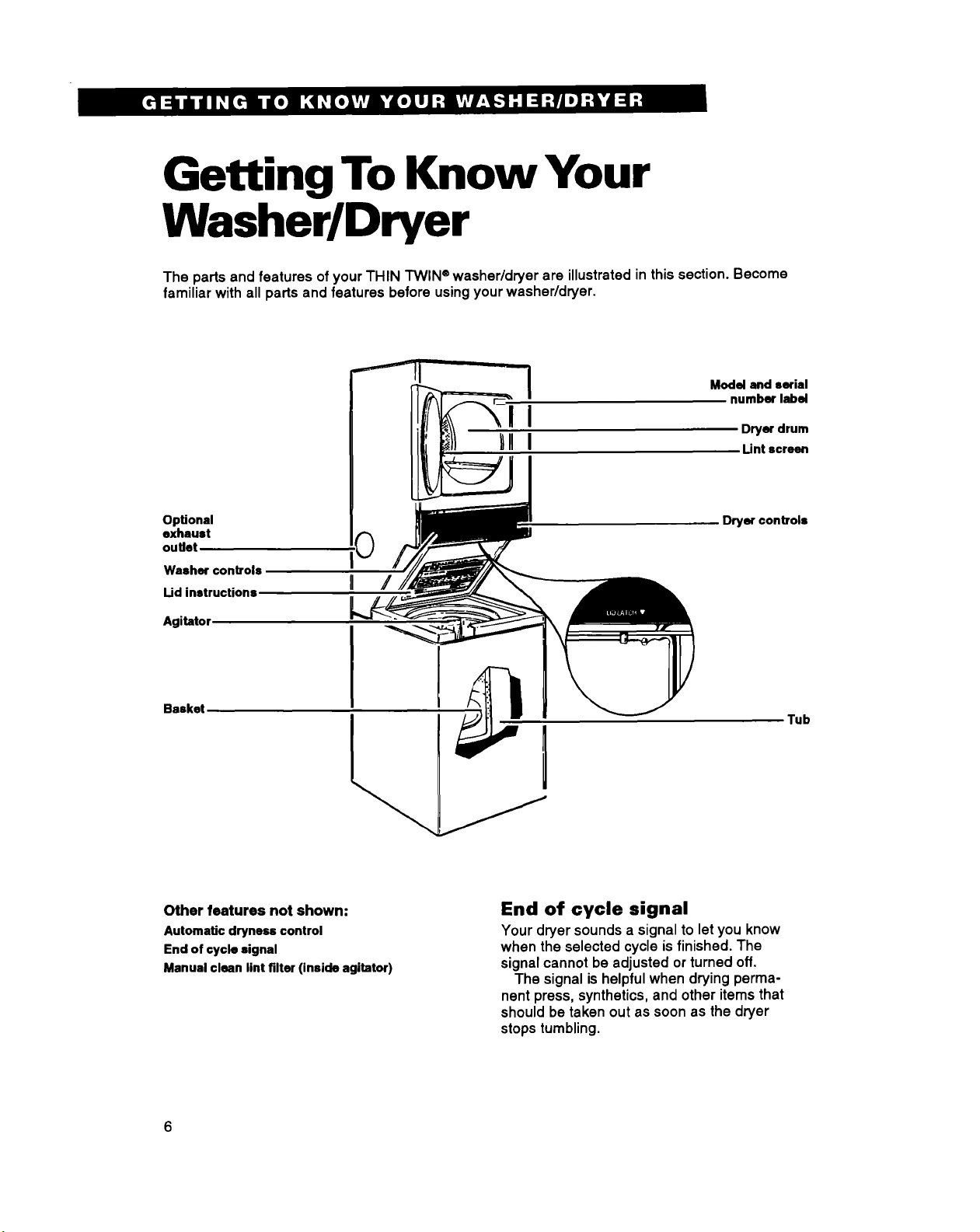
Washer/Dryer
The parts and features of yourTHIN TWIN®washer/dryer are illustratedin this section.Become
familiarwith all parts and features beforeusingyourwasher/dryer.
Optional
exhaust
outlet
Washer conbols
Lid instructions
Agitatol
/
Model and serial
number label
Dryer drum
Lint screen
Dryer controls
Basket
Tub
Other features not shown:
Automatic dryness control
End of cycle signal
Manual clean lint filter (inside agitator)
End of cycle signal
Your dryer soundsa signal to letyou know
when the selected cycle is finished. The
signal cannot be adjusted or turned off.
The signal is helpful when drying perma-
nent press, synthetics, and other items that
should be taken out as soon as the dryer
stops tumbling.
Operating Your Washer
In This Section
Page
Before starting your washer .............................. 7
Starling or stopping your washer ..................... 7
SelecUng a load size .......................................... 7
SeleclJng wash-rinse temperatures .................. 8
Page
SelecUng a cycle and Urne .............................. 8
Using rinse and spin ...................................... 10
Using drain and spin ..................................... 10
What happens in each cycle ......................... 11
Operating yourwasher properlyensuresmaximum washingefficiency.This sectiongivesyou
importantinformationto helpyou toselect a cycle,time, and temperaturefor yourwash load.
Before starting your washer
Add measured detergent. Then place asorted NOTE: Ifyour washer/dryerhas a Consumer
loadin the washer beforestarting.See page 20 Features Guide, remove itand place itin your
for additional=Beforeyou wash or dry" Use and Care Guide.
information.
Starting or stopping your washer
Starting your washer:
1. Select loadsize and water temperatures.
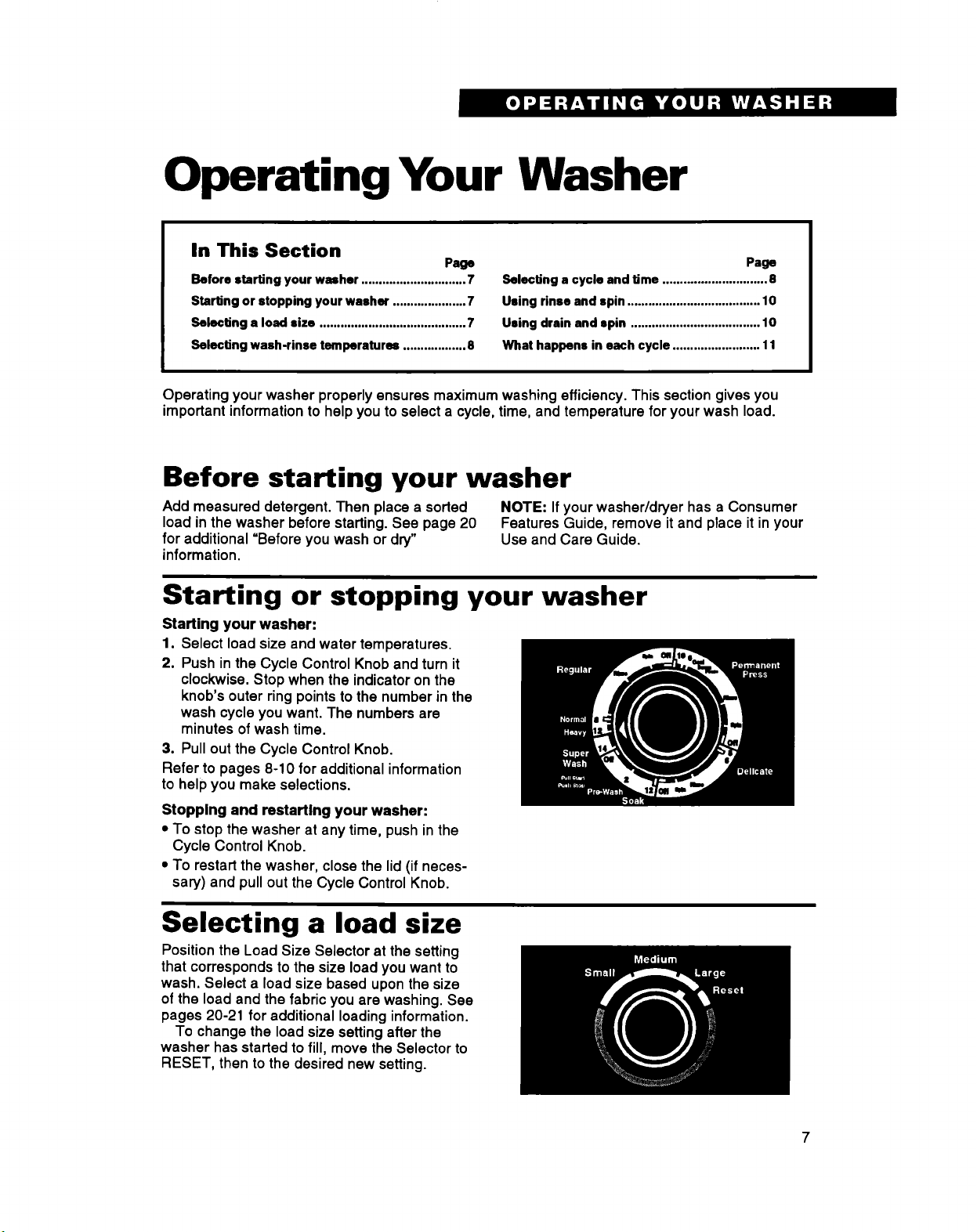
2. Push in the Cycle Control Knob and turnit
clockwise. Stop when the indicatoron the
knob'souter ring pointsto the number in the
wash cycleyou want. The numbers are
minutesof wash time.
3. Pullout the Cycle Control Knob.
Refer to pages 8-10 for additionalinformation
to helpyou make selections.
Stopping and restarting your washer:
• To stopthe washer at anytime, pushin the
Cycle ControlKnob.
• To restartthe washer, close the lid(if neces-
sary) and pull out the Cycle Control Knob.
Selecting a load size
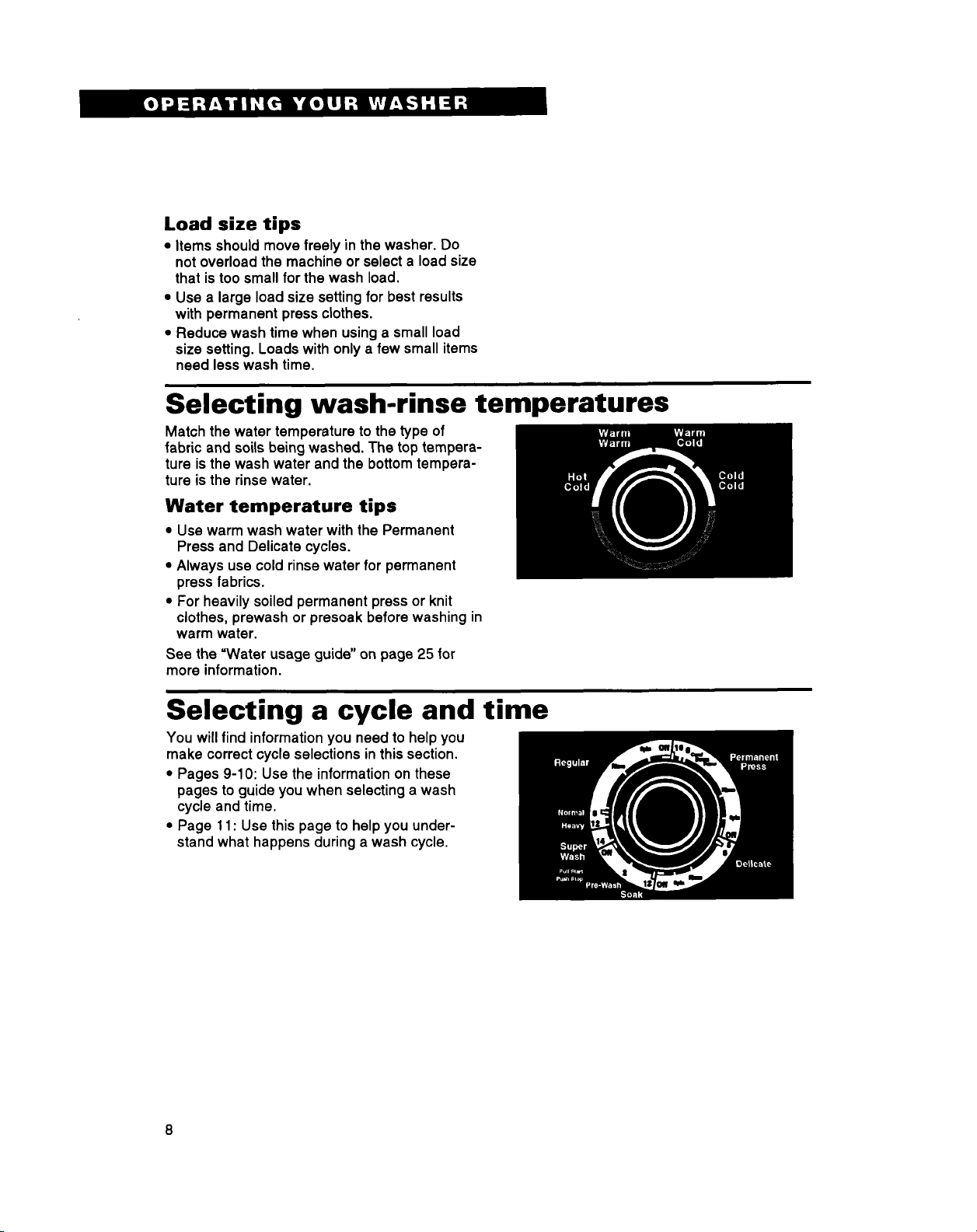
Position the LoadSize Selector at the setting
that correspondsto the size loadyou want to
wash. Select a loadsize based uponthe size
of the load and the fabricyou are washing.See
pages 20-21 for additionalloadinginformation.
To changethe load size settingafter the
washer has started tofill, move theSelector to
RESET, then tothe desired newsetting.
Load size tips
• Itemsshouldmove freely in the washer. Do
notoverload the machineor select a load size
that is toosmall for the wash load.
• Use a large load size settingfor best results
with permanent press clothes.
• Reduce wash time when usinga small load
size setting. Loadswith onlya few small items
need lesswash time.
Selecting wash-rinse temperatures
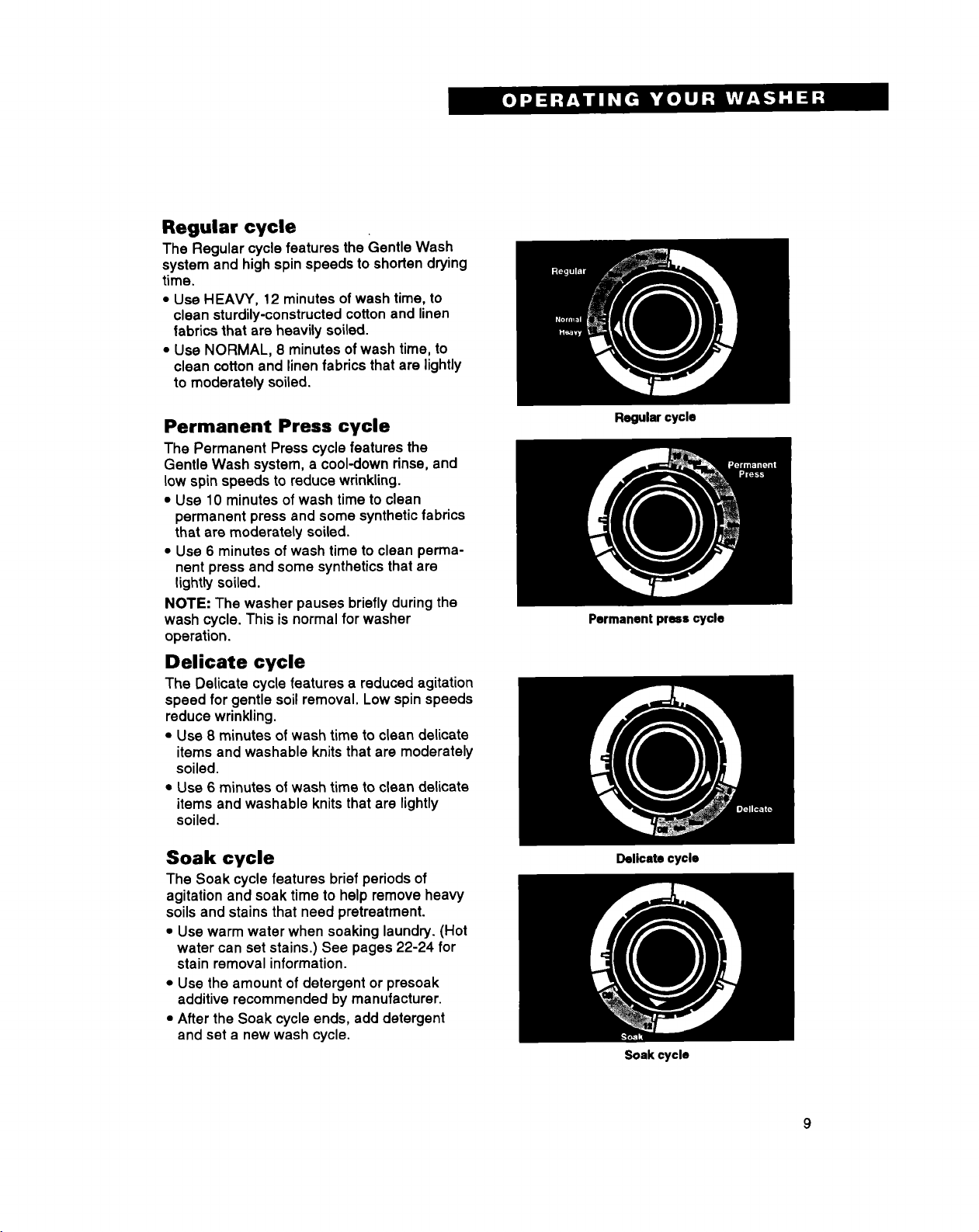
Match the water temperatureto the type of
fabric and soilsbeing washed. The top tempera-
ture isthewash water and the bottomtempera-
ture is the rinsewater.
Water temperature tips
• Usewarm wash water withthe Permanent
Press and Delicate cycles.
• Always use cold rinsewater for permanent
pressfabrics.
• For heavilysoiled permanent pressor knit
clothes, prewash or presoak beforewashing in
warm water.
See the =Water usage guide"on page 25 for
more information.
Selecting a cycle and time
You willfind information you need to help you
make correctcycle selectionsin this section.
• Pages 9-10: Use the information on these
pages to guide you when selecting a wash
cycle and time.
• Page 11: Use this page to help you under-
stand what happens during a wash cycle.
Regular cycle
The Regular cyclefeatures the Gentle Wash
system and highspin speeds toshorten drying
time.
• Use HEAVY, 12 minutesofwash time, to
clean sturdily-constructedcottonand linen
fabrics that are heavilysoiled.
• Use NORMAL, 8 minutesofwash time, to
clean cottonand linenfabrics that are lightly
to moderately soiled.
Permanent Press cycle
The Permanent Press cyclefeatures the
Gentle Wash system, a cool-downrinse, and
low spin speeds to reduce wrinkling.
• Use 10 minutesofwash time toclean
permanent press and some syntheticfabrics
thatare moderately soiled.
• Use 6 minutesofwash time toclean perma-
nent press and somesyntheticsthatare
lightlysoiled.
NOTE; The washer pauses brieflyduringthe
wash cycle. This isnormal for washer
operation.
Delicate cycle
The Delicatecycle features a reduced agitation
speed for gentle soilremoval. Low spinspeeds
reducewrinkling.
• Use 8 minutes ofwash time to clean delicate
itemsand washable knitsthatare moderately
soiled.
• Use 6 minutes of wash time to clean delicate
items and washable knits that are lightly
soiled.
Soak cycle
The Soak cycle features brief periodsof
agitationand soak time to help remove heavy
soilsand stains that need pretreatment.
• Use warm water when soaking laundry.(Hot
water can set stains.)See pages 22-24 for
stain removal information.
• Use the amountof detergent or presoak
additive recommended bymanufacturer.
• After the Soak cycleends, add detergent
and set a new wash cycle.
Regular cycle
Permanent press cycle
Delicate cycle
Soak cycle
9
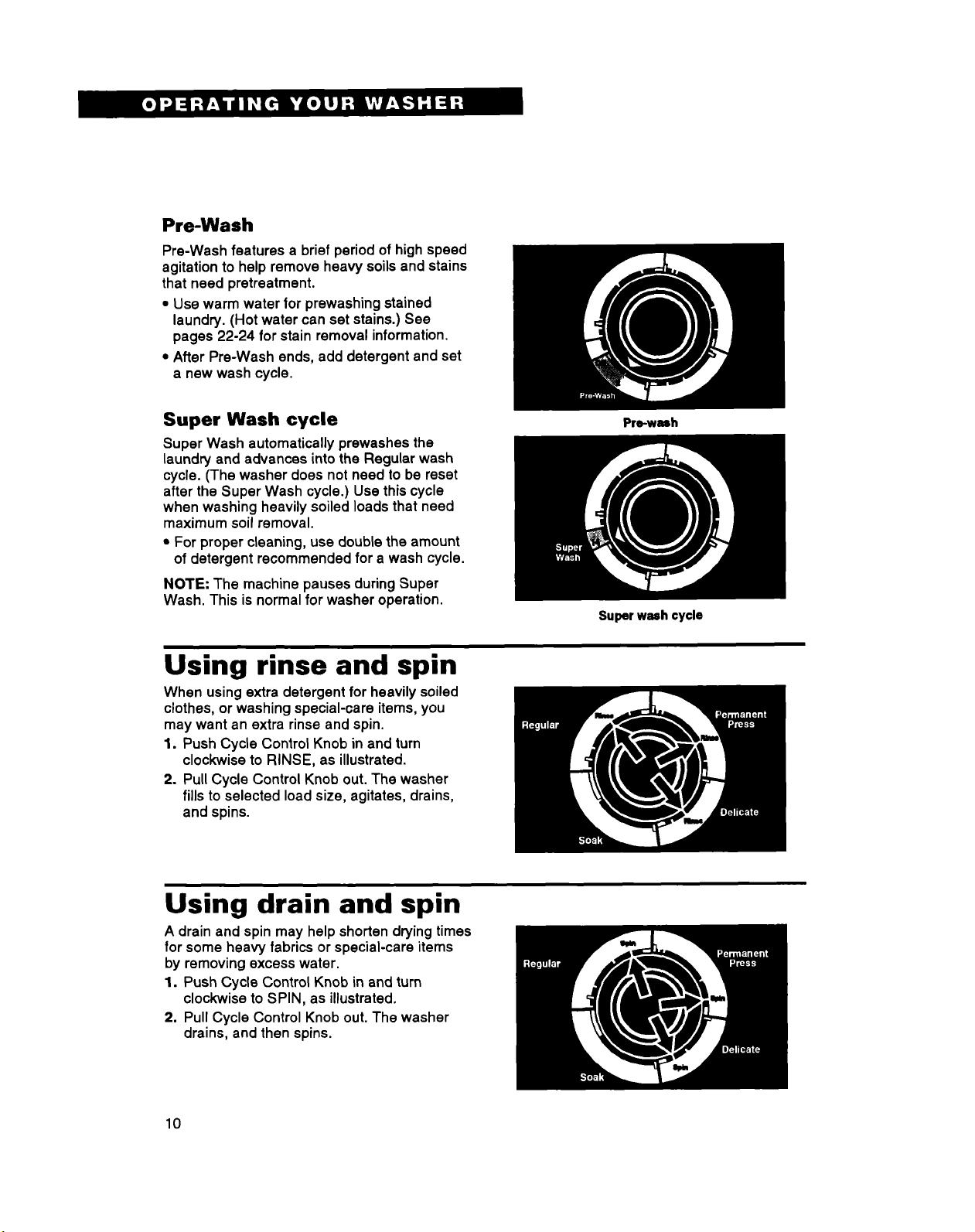
Pre-Wash
Pre-Wash features a briefperiodof highspeed
agitationto help remove heavy soilsand stains
that need pretreatment.
• Use warm water for prewashingstained
laundry. (Hot water can set stains.) See
pages 22-24 for stain removal information.
• After Pre-Wash ends, add detergent and set
a new wash cycle.
Super Wash cycle
Super Wash automaticallyprewashesthe
laundryand advances intothe Regular wash
cycle. (The washer does not need to be reset
after the Super Wash cycle.) Use thiscycle
when washing heavilysoiledloads that need
maximumsoil removal.
• Forproper cleaning, use doublethe amount
of detergent recommendedfor a wash cycle.
NOTE: The machine pauses duringSuper
Wash. This is normalfor washer operation.
Using rinse and spin
When using extra detergent for heavily soiled
clothes,or washing special-care items, you
may want an extra rinseand spin.
1. Push Cycle Control Knobin and turn
clockwiseto RINSE, as illustrated.
2. PullCycle Control Knob out.The washer
fills to selected loadsize, agitates,drains,
and spins.
Using drain and spin
A drain and spin may help shorten drying times
for some heavy fabrics or special-care items
by removing excess water.
1. Push Cycle Control Knob in and turn
clockwise to SPIN, as illustrated.
2. Pull Cycle Control Knob out. The washer
drains, and then spins.
10
Pr_,wuh
Super wash cycle
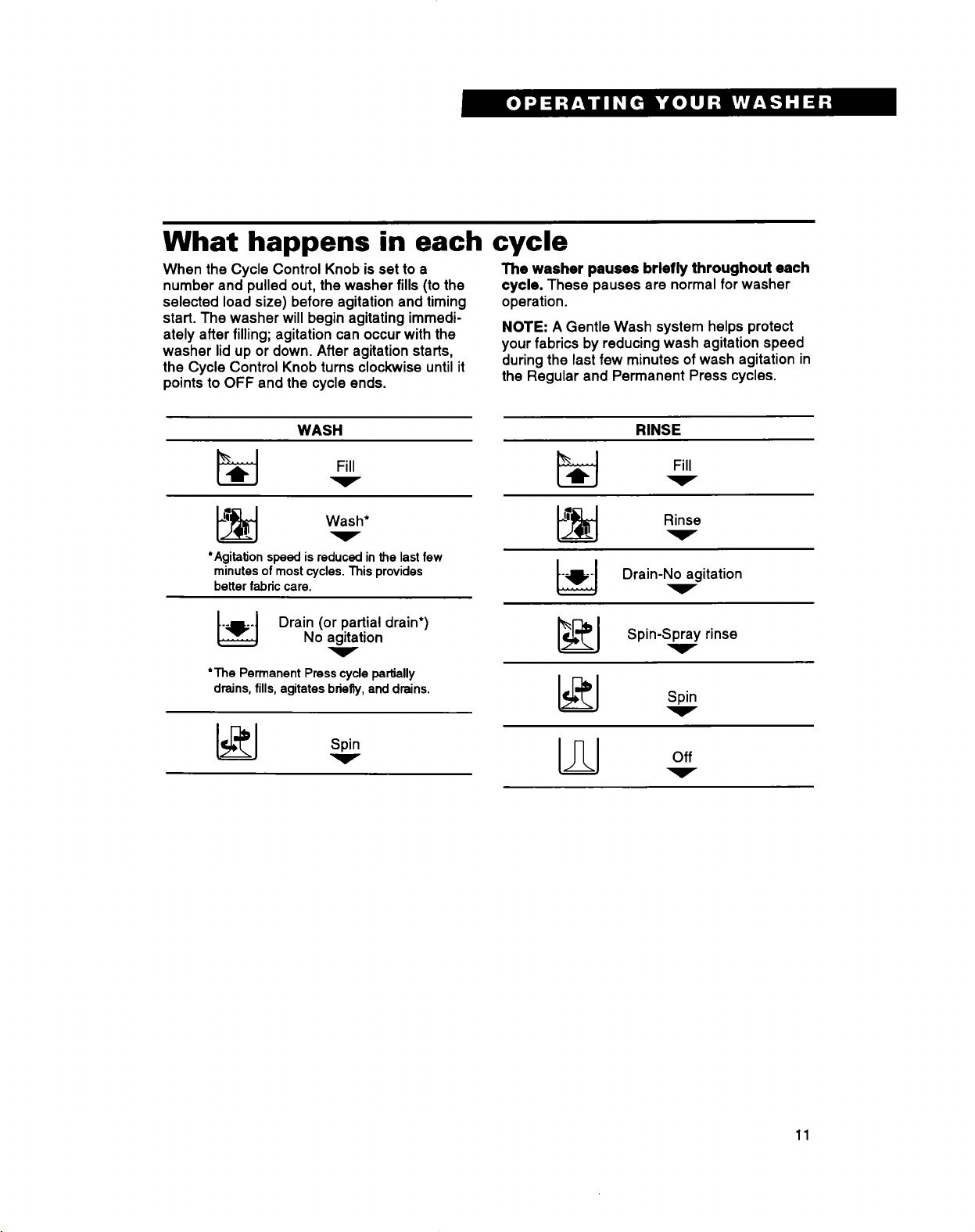
What happens in each cycle
When the Cycle Control Knobis set to a
number and pulledout,the washer fills (tothe
selected load size) before agitationandtiming
start. The washer will beginagitatingimmedi-
ately after filling; agitationcanoccurwith the
washer lidup or down. After agitationstarts,
the Cycle Control Knob turnsclockwiseuntilit
pointsto OFF and the cycleends.
The washer pauses briefly throughout each
cycle. These pauses are normal for washer
operation.
NOTE: AGentle Wash system helps protect
yourfabrics by reducingwash agitationspeed
duringthe last few minutesof wash agitationin
the Regularand Permanent Press cycles.
WASH
Fill
Wash*
°Agital_onspeedisreducedinthelast few
minutesofmostcycles.Thisprovides
betterfabric care.
_j Drain (or partialdrain*)
No agitation
*The Permanent Press cycle partially
drains, fills, agitates briefly, and drains.
_[_ Spin
RINSE
Fill
Rinse
_ Drain-No agitation
_ Spin-Spray rinse
Spin
U Off
11
Operating Your Dryer
In This Section
Page
Before starting your dryer ................................ 12
Star'dng your dryer ............................................ 12
Stopping your dryer .......................................... 12
Page
Resta_ng your dryer ........................................ 12
Understanding your cycles .............................. 13
SelecUng the right cycle and setting ............... 15
The information in this section helps you learn to use yourdryer efficientlyand safely. Refer to
=Laundry Tips"on page 20 for additionalcontrolsetting,sorting,and loadinginformation.
Before starting your dryer
Wipe thedryer drumwith a damp clothbefore Ifyour dryerhas a Consumer Features Guide,
using to remove dustfrom storingand remove it and place itwith your Use and Care
shipping. Guide.
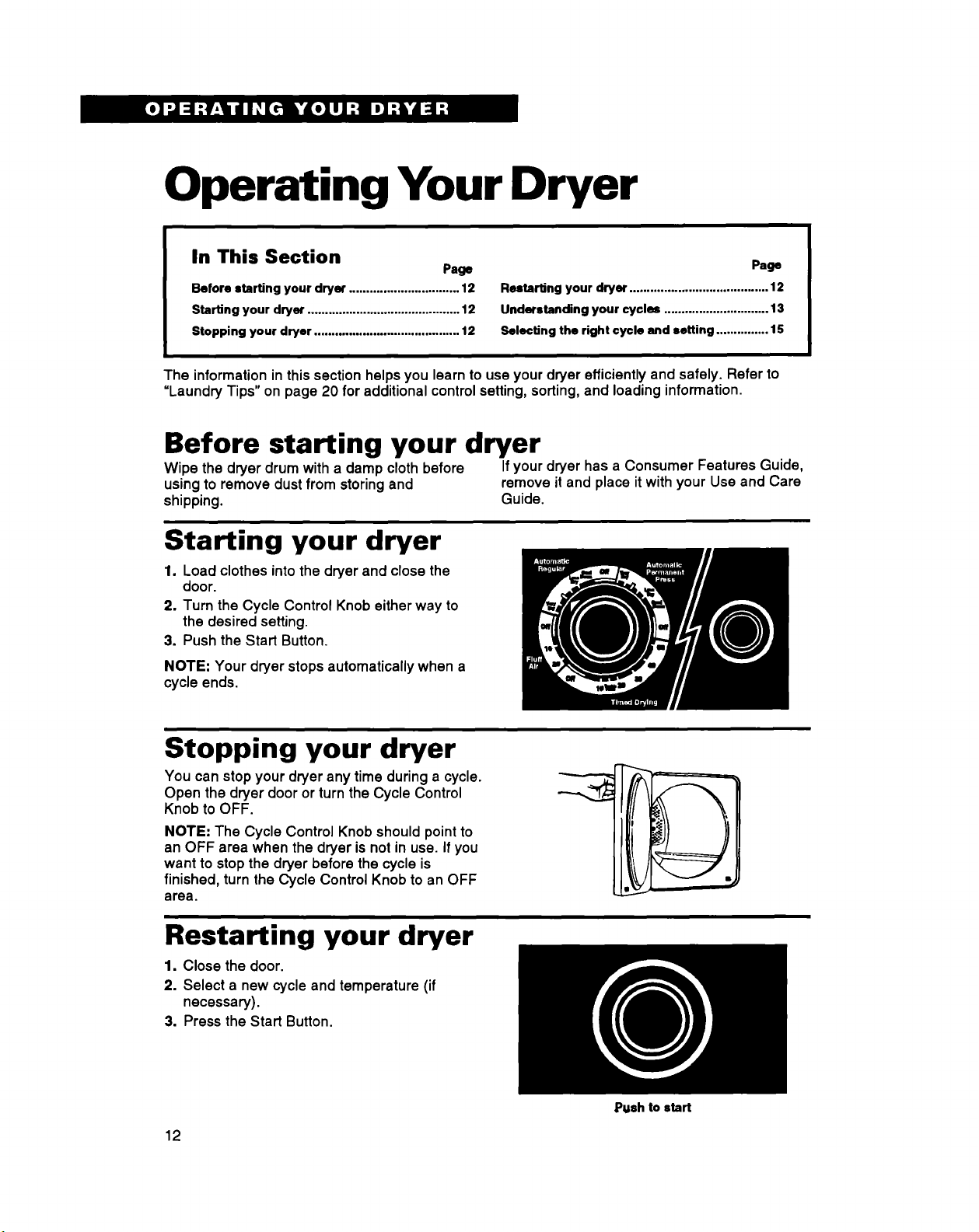
Starting your dryer
1. Loadclothes intothe dryer and close the
door.
2. Turn the Cycle Control Knobeitherway to
the desired setting.
3. Pushthe Start Button.
NOTE: Your dryer stopsautomaticallywhen a
cycle ends.
Stopping your dryer
You can stop your dryer anytime during a cycle.
Open the dryer door or turn the Cycle Control
Knob to OFF.
NOTE: The Cycle Control Knobshould point to
an OFF area when the dryer is notin use. If you
want to stopthe dryer beforethe cycleis
finished, turn the Cycle Control Knobto an OFF
area.
Restarting your dryer
1. Close the door.
2. Select a new cycleand temperature (if
necessary).
3. Pressthe Start Button.
12
Push to start
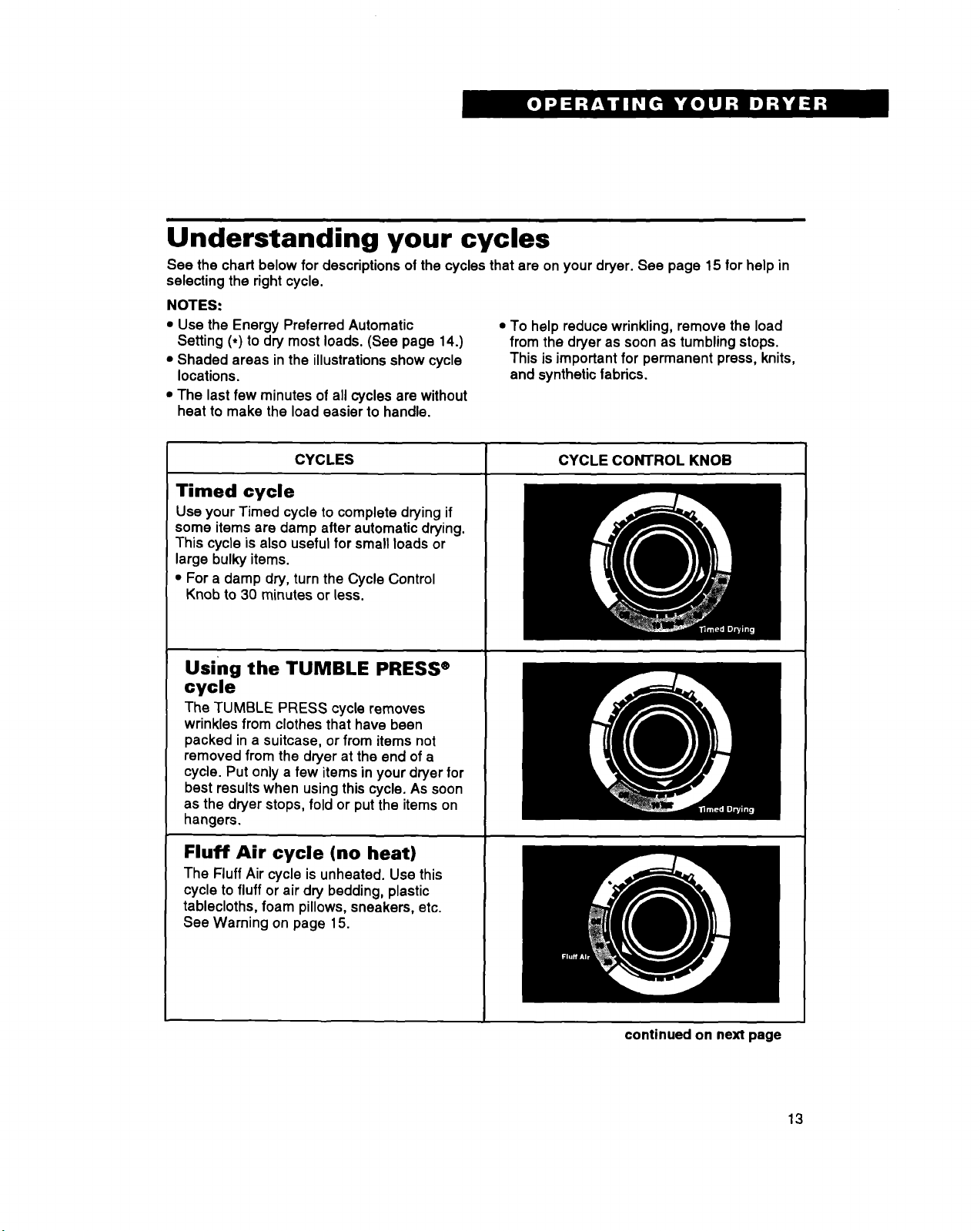
Understanding your cycles
See the chart belowfor descriptionsof the cyclesthatare onyour dryer. See page 15 forhelp in
selectingthe right cycle.
NOTES:
• Use the Energy Preferred Automatic
Setting (,) to dry mostloads. (See page 14.)
• Shaded areas in the illustrationsshow cycle
locations.
• The lastfew minutes of all cyclesare without
heat to make the load easier to handle.
• To help reduce wrinkling,remove the load
fromthe dryer as soon as tumblingstops.
This isimportantfor permanent press,knits,
and syntheticfabrics.
CYCLES CYCLE CONTROL KNOB
Timed cycle
Use your Timed cycleto completedryingif
some itemsare damp after automaticdrying.
This cycle isalso usefulfor smallloads or
large bulkyitems.
• For a damp dry,turn the Cycle Control
Knobto 30 minutesor less.
using the TUMBLE PRESS ®
cycle
The TUMBLE PRESS cycle removes
wrinkles from clothes that have been
packed in a suitcase, or from items not
removed from the dryer at the end of a
cycle. Put only a few items in your dryer for
best results when using this cycle. As soon
as the dryer stops,fold or put the items on
hangers.
Fluff Air cycle (no heat)
The Fluff Air cycle is unheated. Use this
cycle to fluff or air dry bedding, plastic
tablecloths, foam pillows, sneakers, etc.
See Warning on page 15.
continued on next page
13
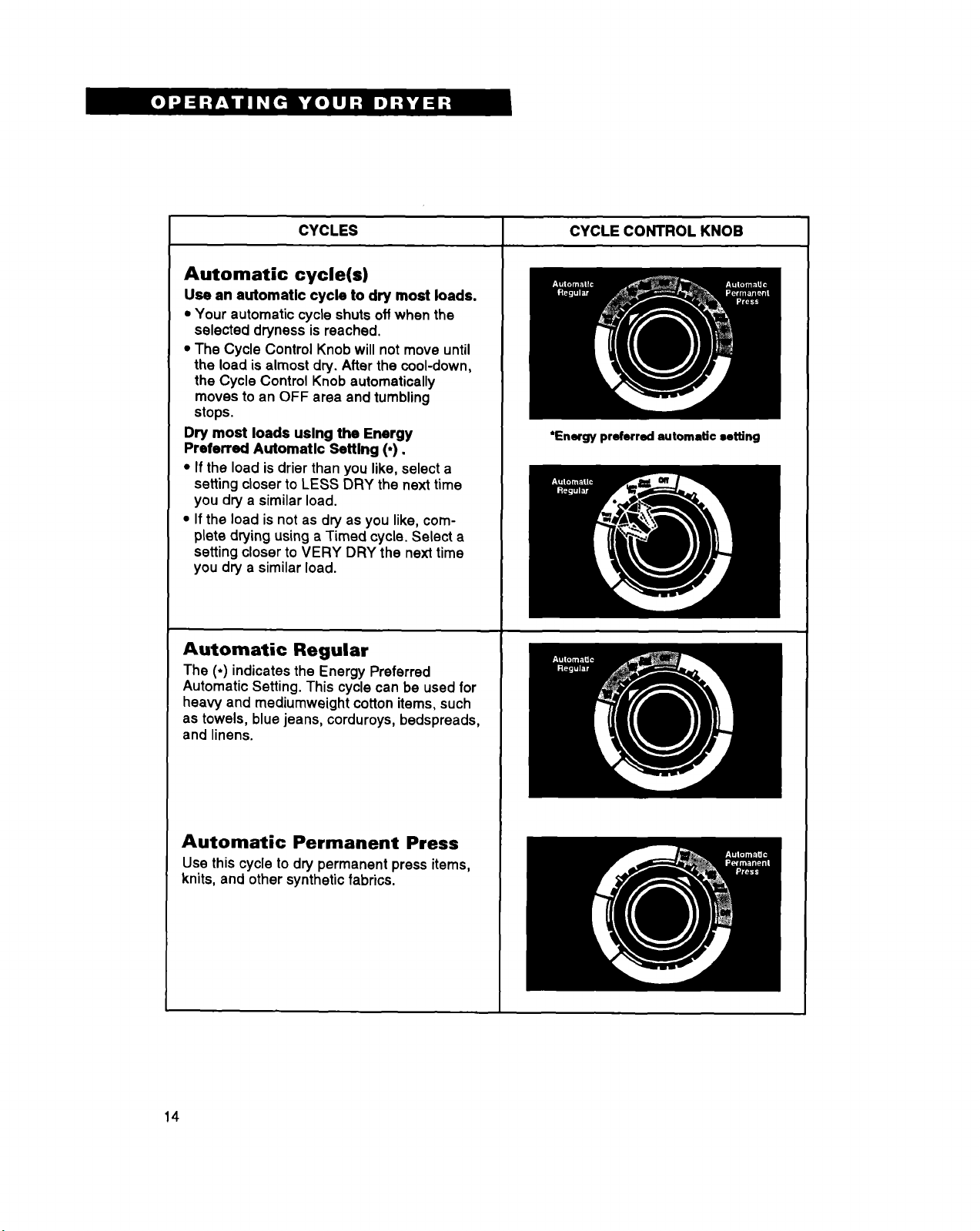
CYCLES CYCLE CONTROL KNOB
Automatic cycle(s)
Use an automaUc cycle to dry most loads.
• Your automaticcycle shutsoftwhen the
selected dryness isreached.
• The Cycle Control Knobwillnot move until
the load isalmost dry. Afterthe cool-down,
the Cycle Control Knobautomatically
moves to an OFF area and tumbling
stops.
Dry most loads using the Energy
Preferred Automatic Setting (*),
• If the load isdrier than you like, selecta
settingcloserto LESS DRY the next time
you dry a similarload.
• Ifthe load isnot as dryas you like, com-
plete dryingusinga Timed cycle. Select a
settingclosertoVERY DRY the nexttime
you dry a similarload.
Automatic Regular
The (*) indicatesthe Energy Preferred
Automatic Setting.This cyclecan be used for
heavy and mediumweight cottonitems, such
as towels, bluejeans, corduroys,bedspreads,
and linens.
Automatic Permanent Press
Use this cycleto dry permanent press items,
knits,and other syntheticfabrics.
*Energy preferred automaUc =etUng
14
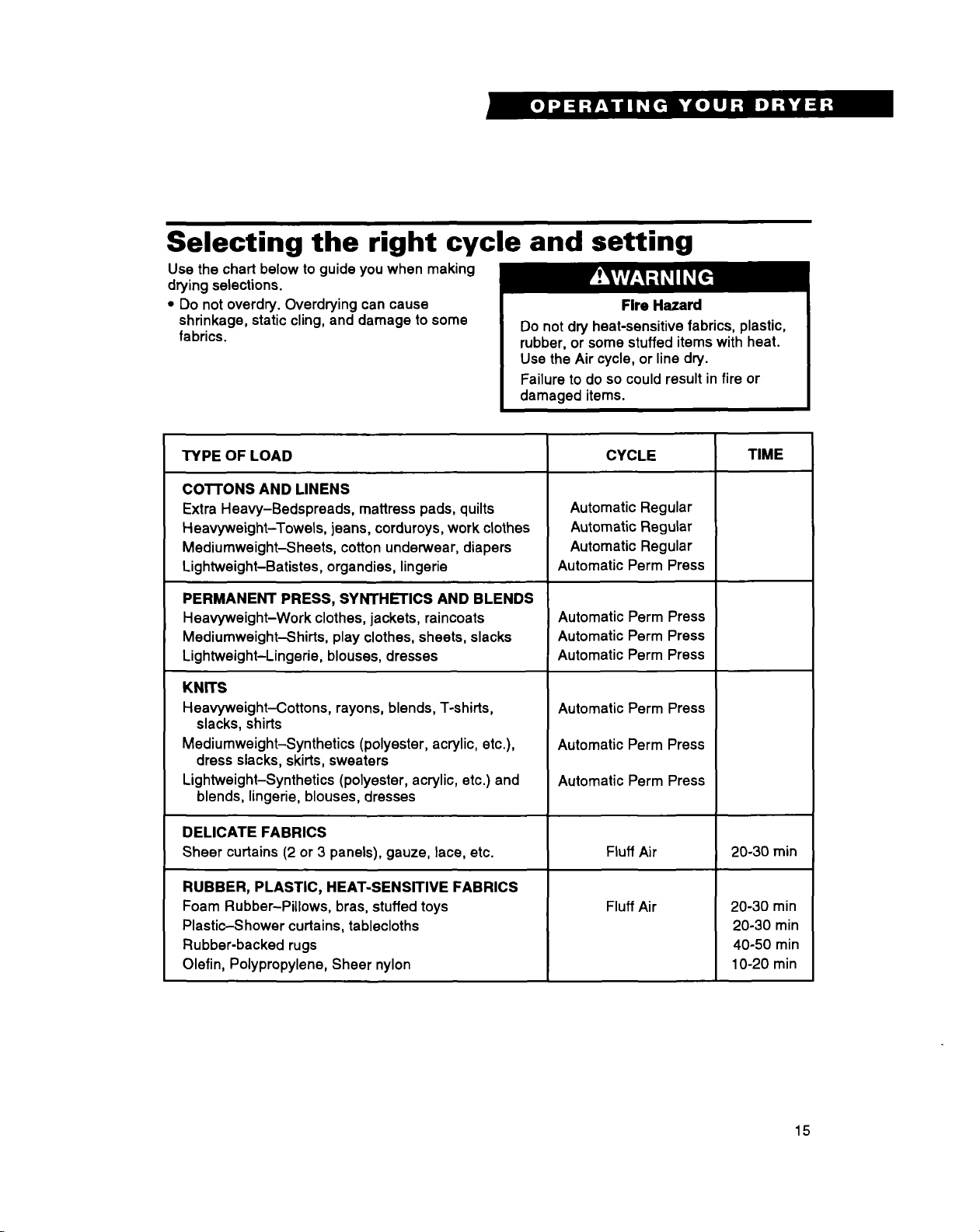
Selecting the right cycle and setting
Use the chart below to guide youwhen making
drying selections.
• Do not overdry.Overdryingcan cause
shrinkage, staticcling,and damage tosome
fabrics.
Fire Hazard
Do not dry heat-sensitivefabrics, plastic,
rubber,or somestuffed items with heat.
Use the Air cycle, or linedry.
Failuretodo so could resultin fire or
damaged items.
TYPE OF LOAD CYCLE TIME
COI-FONS AND LINENS
Extra Heavy-Bedspreads, mattresspads,quilts
Heavyweight-Towels, jeans, corduroys,work clothes
Mediumweight-Sheets, cottonunderwear, diapers
Lightweight-Batistes, organdies,lingerie
PERMANENT PRESS, SYNTHETICS AND BLENDS
Heavyweight-Work clothes,jackets, raincoats
Mediumweight-Shirts, play clothes,sheets, slacks
Lightweight-Lingerie, blouses,dresses
KNITS
Heavyweight-Cottons, rayons,blends,T-shirts,
slacks, shirts
Mediumweight-Synthetics (polyester,acrylic,etc.),
dress slacks, skirts,sweaters
Lightweight-Synthetics (polyester,acrylic,etc.) and
blends, lingerie,blouses,dresses
DELICATE FABRICS
Sheer curtains (2 or 3 panels), gauze, lace, etc.
RUBBER, PLASTIC, HEAT-SENSITIVE FABRICS
Foam Rubber-Pillows, bras,stuffedtoys
Plastic-Shower curtains,tablecloths
Rubber-backed rugs
Olefin, Polypropylene,Sheer nylon
Automatic Regular
Automatic Regular
Automatic Regular
Automatic Perm Press
Automatic Perm Press
Automatic Perm Press
Automatic Perm Press
Automatic Perm Press
Automatic Perm Press
Automatic Perm Press
Fluff Air
Fluff Air
20-30 rain
20-30 min
20-30 min
40-50 min
10-20 min
15
Caring For Your Washer/Dryer
In This Section
Page
Maintenance-every load ................................... 16
Maintenance-as needed ................................... 16
Page
13ps for caring for your washer/dryer .......... 19
Care during periods of non-use ................... 19
Washers and dryers requireregularmaintenance. Followthe suggestionsbelowto maintainyour
washer/dryer properly.
Maintenance-every load
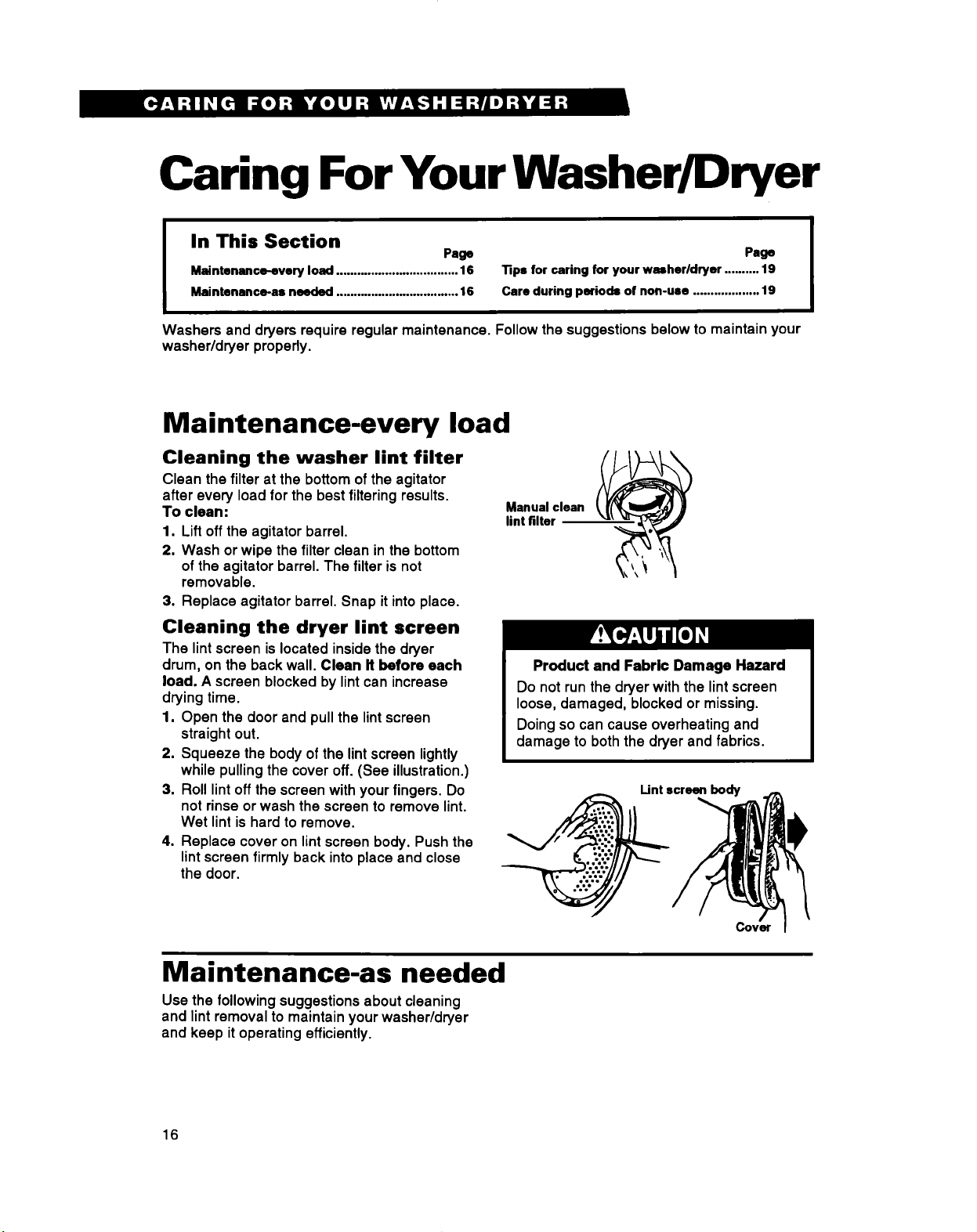
Cleaning the washer lint filter
Clean the filter at the bottomofthe agitator
after every load for the bestfilteringresults.
To clean:
1. Liftoffthe agitator barrel.
2. Wash orwipe the filterclean in the bottom
of the agitator barrel.The filteris not
removable.
3. Replace agitator barrel.Snap it intoplace.
Manual clean
lint filter
Cleaning the dryer lint screen
The lintscreen islocated insidethe dryer
drum, on the backwall. Clean It before each
load. A screen blockedby lintcan increase
dryingtime.
1. Open the door and pullthe lintscreen
straightout.
2. Squeeze the bodyofthe lintscreen lightly
while pullingthe cover off. (See illustration.)
3. Roll lintoffthe screen withyourfingers. Do
not rinse orwash the screen to remove lint.
Wet lintis hardto remove.
4. Replace cover on lintscreen body. Push the
lintscreen firmlyback intoplace and close
the door.
Product and Fabric Damage Hazard
Do not runthe dryerwith the lintscreen
loose, damaged, blocked or missing.
Doingso can cause overheating and
damage to boththe dryerand fabrics.
Lint screen body
Maintenance-as needed
Use the followingsuggestionsaboutcleaning
and lint removal to maintain yourwasher/dryer
and keep it operating efficiently.
16
Cleaning the washer/dryer
interior
Washer:
• Ifthe washer interiorneeds cleaning, put
1/2cup (125 mL) of chlorinebleachand
1 cup (250 mL) of detergent inthe washer.
Runthrough a complete cycleusing hot
water.
Dryer:
Electrical Shock,
Personal Injury and Fire and
Explosion Hazard
• Turn offthe electrical powerbefore
cleaningthe interior.
• Make sure the dryer iscool.
• Use nonflammablecleaner.
Failure to do so could resultin electrical
shockor injury,fire or explosion.
Garments whichcontainunstable dyes, such
as denim blue jeans or brightly coloredcotton
items, may discolorthe dryerinterior.
Ifyou want to remove stains from the dryer
drum, use powdered laundrydetergent.
1. Make a paste with detergent and very warm
water.
2. Apply pasteto a softclothand scrubarea
until all excess dye is removed.
3. Wipe thoroughlywith a damp cloth.
4. Tumble a load ofrags to dry.
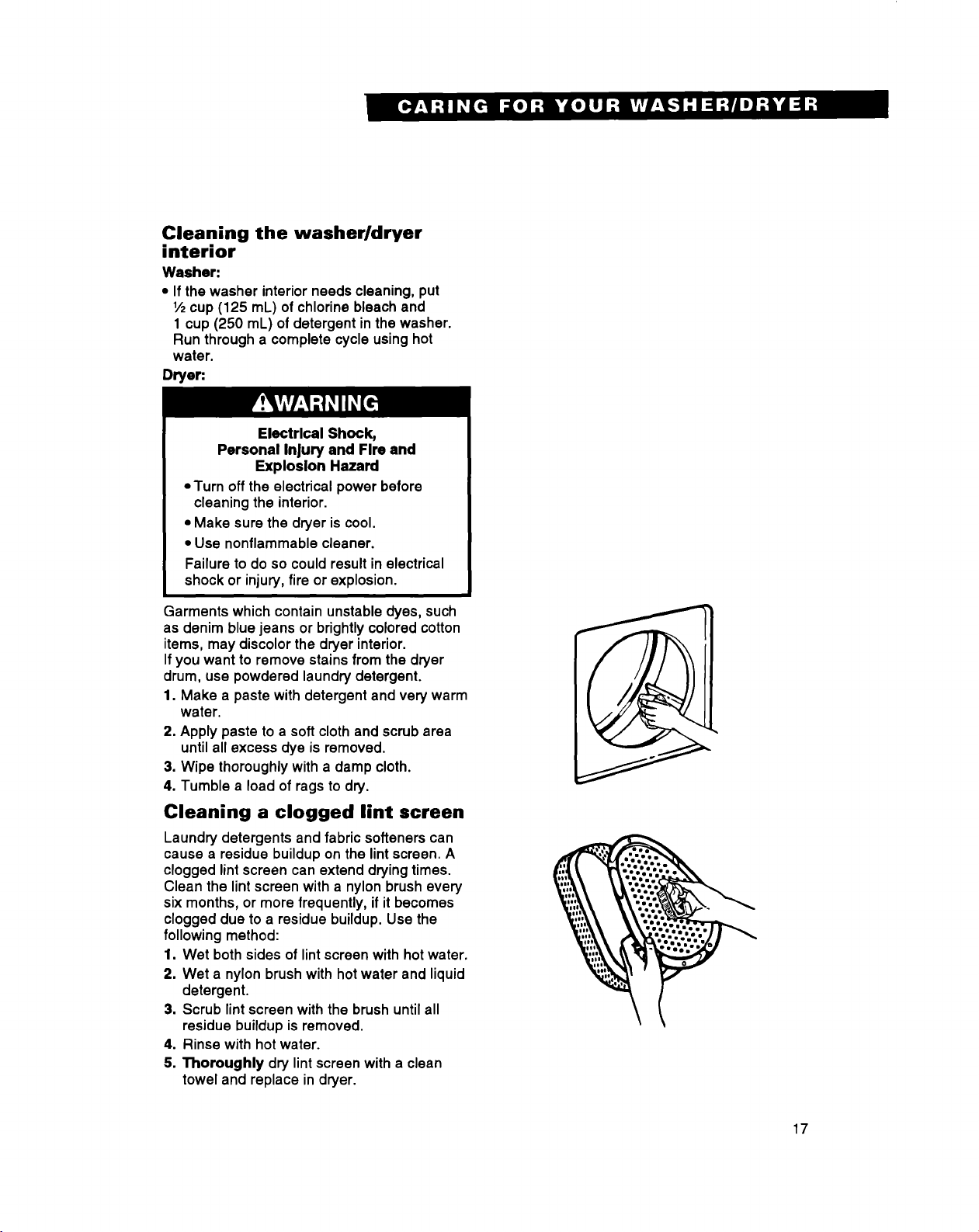
Cleaning a clogged lint screen
Laundrydetergents and fabric softenerscan
cause a residue buildup on the lintscreen. A
clogged lintscreen can extenddryingtimes.
Clean the lintscreen with a nylonbrush every
six months,or more frequently, ifit becomes
clogged due to a residue buildup.Use the
following method:
1. Wet bothsides oflintscreen with hotwater.
2. Wet a nylon brushwith hotwater and liquid
detergent.
3. Scrub lintscreen with the brushuntilall
residue buildupis removed.
4. Rinsewith hotwater.
5. Thoroughly dry lintscreen with a clean
towel and replace in dryer.
17
Removing accumulated lint
from the dryer
Lintcan gatherinside the dryerand be fuelfor
a fire. It is recommendedthat lintbe removed
every 2 to 3 years, or more often,depending
on dryerusage. Cleaning shouldbe doneby a
qualified person.Ifyou have any questions,
please call ourConsumer AssistanceCenter
at 1-800-253-1301.
Electrical Shock, Personal Injury and
Product Damage Hazard
• Unplugthe power supplycordor turn
offthe electricalpower beforeremoving
dryer panels.
• Make sure the dryeris cool.
• Dryer parts can have sharpedges. Use
care when handling.
• More than one person isrequiredto lift,
tilt or move machine because of its
weight and size.
• Truck onlyfrom rear.
Failureto follow the above instructions
could resultin electricalshock,personal
injuryor productdamage.
1. Unplug the power supply cordor turnoffthe
electrical power.
2. Remove back panel. See Installation
Instructions.
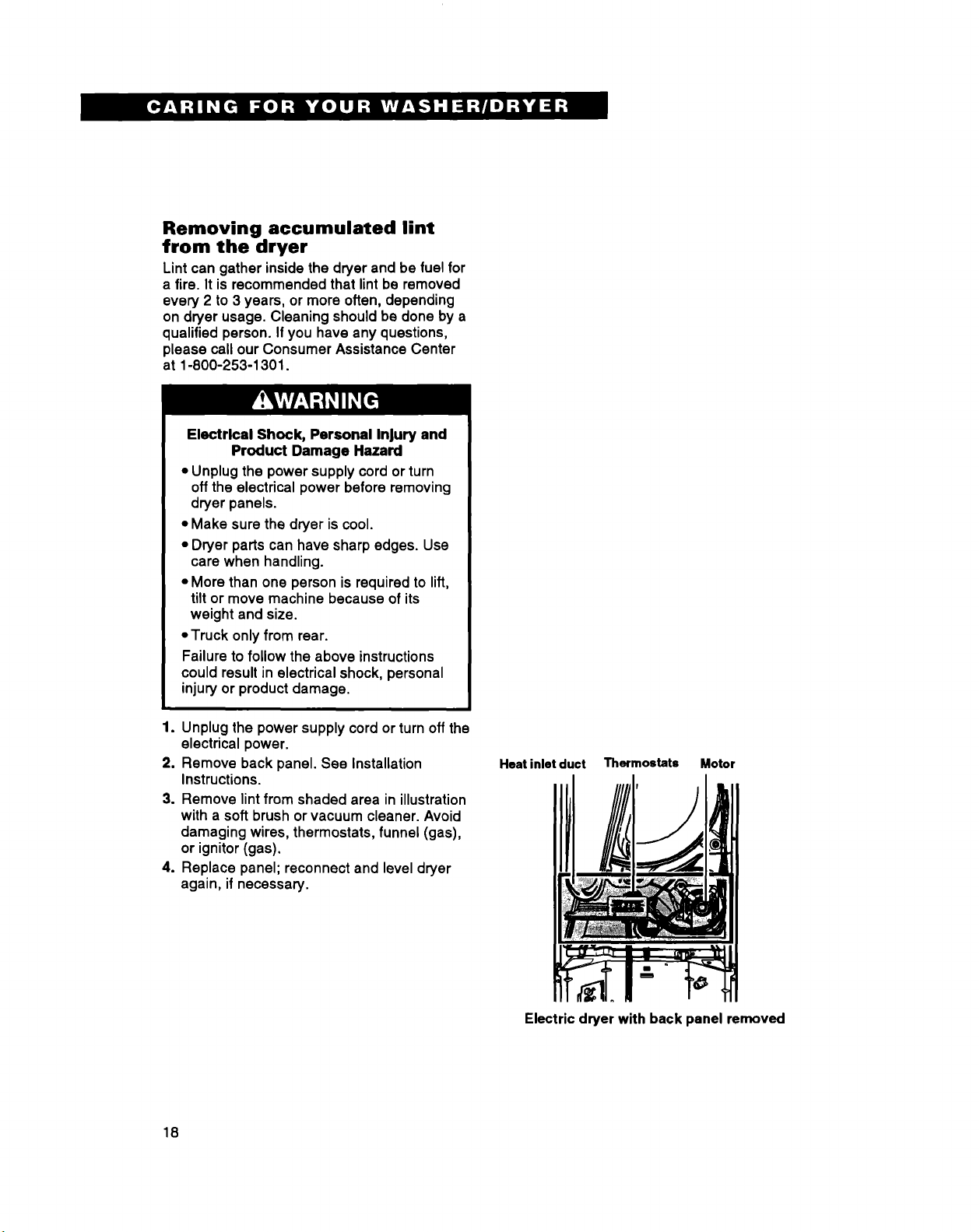
3. Remove lintfrom shaded area in illustration
with a softbrushor vacuum cleaner. Avoid
damagingwires, thermostats,funnel (gas),
or ignitor(gas),
4. Replace panel; reconnectand level dryer
again, if necessary.
Heat inlet duct Thermostats Motor
Electric dryer with back panel removed
18
Tips for caring for your washer/dryer
• Wipe up detergent, bleach and other spills with
a soft, damp cloth or sponge as they occur.
• Remove hard water deposits using only
cleaners labeled as washer safe.
• After tinting or dyeing, put chlorine bleach
and detergent in the washer. Run through a
complete cycle using hot water to remove
excess dye or tint. If staining occurs on
following loads, repeat the process.
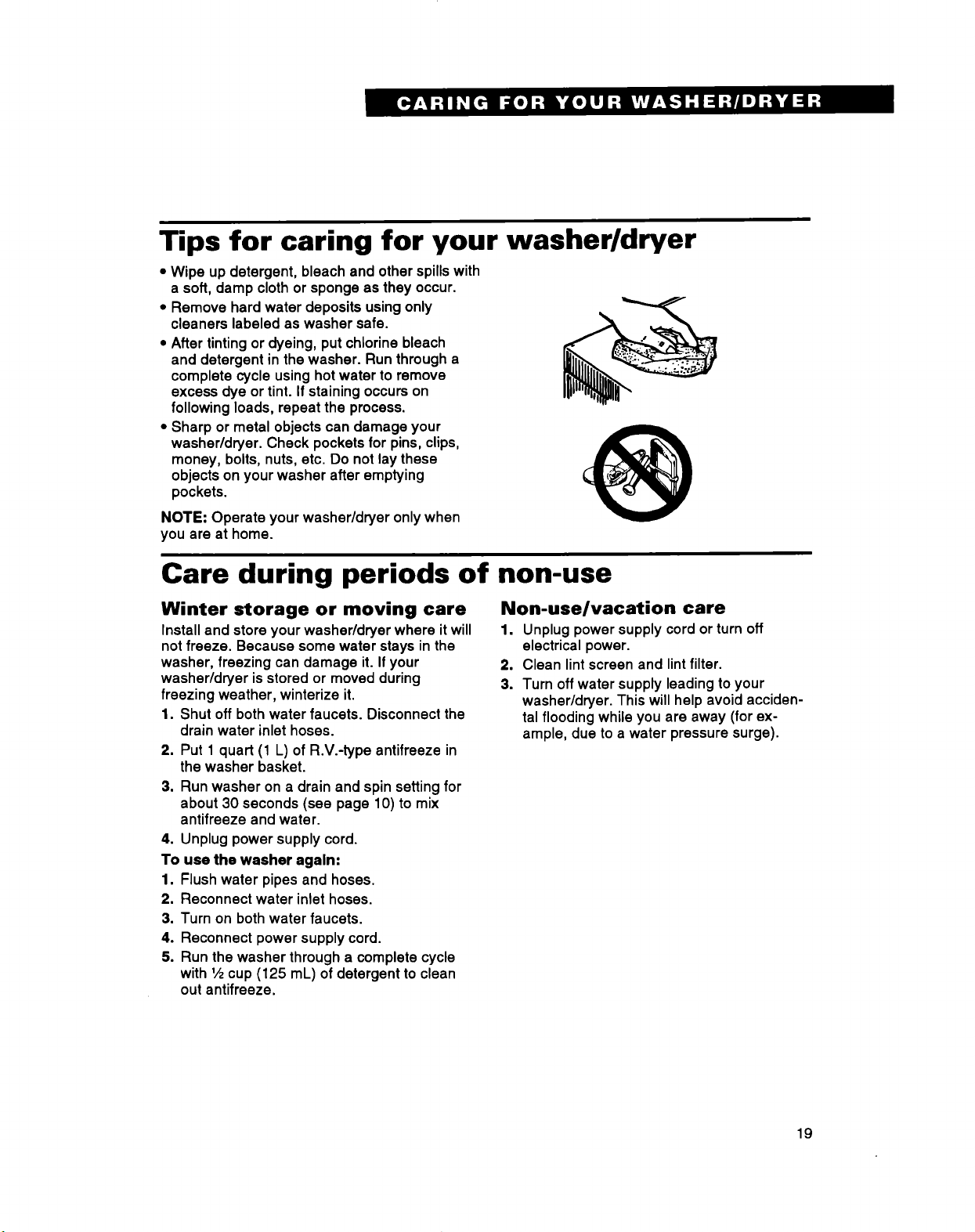
• Sharp or metal objects can damage your
washer/dryer. Check pockets for pins, clips,
money, bolts, nuts, etc. Do not lay these
objects on your washer after emptying
pockets.
NOTE: Operate your washer/dryeronlywhen
you are at home.
Care during periods of non-use
Winter storage or moving care
Install and store your washer/dryer where it will
not freeze. Because some water stays in the
washer, freezing can damage it. If your
washer/dryer is stored or moved during
freezing weather, winterize it.
1. Shut off both water faucets. Disconnect the
drain water inlet hoses.
2. Put 1 quart (1 L) of R.V.-type antifreeze in
the washer basket.
3. Run washer on a drain and spin setting for
about 30 seconds (see page 10) to mix
antifreeze and water.
4. Unplug power supply cord.
To use the washer again:
1. Flush water pipes and hoses.
2. Reconnect water inlet hoses.
3. Turn on both water faucets.
4. Reconnect power supply cord.
5. Run the washer through a complete cycle
with 1/2cup (125 mL) of detergent to clean
out antifreeze.
Non-use/vacation care
1. Unplug power supply cord or turn off
electrical power.
2. Clean lint screen and lint filter.
3. Turn off water supply leading to your
washer/dryer. This will help avoid acciden-
tal flooding while you are away (for ex-
ample, due to a water pressure surge).
19
Laundry Tips
In This Section
Page
Before you wash or dry .................................... 20
Removing steins ............................................... 22
Water usage guide ............................................ 25
Washing special-care item0 ............................ 26
Page
Saving energy ................................................ 27
Drying special-care items ............................. 28
Solving laundering problems ....................... 30
Using laundry aids ......................................... 32
Thissection reviews proper launderingtechniques, givesyou additionallaunderinginformation,
and discusses causes or solutions to common laundering problems.
Before you wash or dry
Before usingyourwasher/dryer,see
pages 3-5 for Important Safety Information.
* Close zippers, snaps and hookstoavoid
L_ nagging otheritems. Remove
pins,bucklesand otherhard
objectsto avoidscratchingthe
washer interiororthe dryer
drum. Remove unwashabletrim
and ornaments,or heat-sensitivetrim that
can be damaged by drying.
• Stained or wet garmentsshouldbe washed
promptlyfor bestresults.
• Check garmentsto make sure all spotsand
stainswere removed duringthewash. See
pages 22-24 for pretreatment and stain
removal information.Ifstainswere not
removed, do not tumbledry. Heat may
permanentlyset stain.Soiled items can also
leave stainson the dryerdrum. These stains
can be pickedup by otheritems inthe load.
• Turn down cuffs and brushaway lintand dirt.
• Turn syntheticsinsideout to avoidpilling.
• Mend tears, loose hems, and seams.
• Sharp or metal objectscan damage your
washer. Check pocketsfor
pins, clips, money,bolts, nuts,
etc. and turn pocketsinside
out. Do notlay these objects
on your washer after
emptying pockets.
• Turn lint takers and dark items inside out to
help prevent lint pickup.
• Tie strings and sashes so they will not
tangle.
• Place small items such as baby socks or
hankies in a mesh bag for easier removal.
• Articles to be ironed should be removed from
the dryer while still damp.
Sorting
• Itemsproperly sortedfor washing are usually
_ properlysortedfor drying.
_,,..! Separate heavilysoiled items
from lightlysoiled ones even if
they would normallybewashed
together. Separate lintgivers
(towels,chenille)from linttakers (corduroy,
synthetics,permanent press). When pos-
sible, turnlinttakers insideout.
• Separate heavyfabrics (denim, towels) from
light fabrics (synthetics,permanent press).
• Separate dark from lightcolors;colorfast
from noncolorfast.
Load sizes
• Drop itemsintowasher loosely.Fillto the top
ofthe basket. Do notpack or
wrap itemsaround agitator.
Items shouldmove easily
throughwash water for best
cleaning and wrinkle-free
results.Watch for rollover.
Itemsshouldsink and reappear later.
• To reduce wrinkling,permanent press and
syntheticknitsshouldhave more roomto
move in thewater than heavy items(towels,
jeans).
• Do not overloadthe washer/dryer. Over-
crowdingcauses poor cleaning, uneven
dryingand wrinkling,and can cause itemsto
wear out faster (because of pilling).
20
• Mix large and small itemsin each load. Load
evenly to maintainwasher
balance. An off-balance load
can make the machinevibrate
duringspin. Loadthe dryerby
the amount ofspace itemstake
up, not bytheirweight.
• Reduce wrinklingof permanent press and
syntheticsby drying smaller loadsand
removingitemsfrom the dryeras soonas
tumblingstops.
• For better tumblingactionwhen drying onlya
few small items, add one or twolint-free
towels.This also preventssmall, lightweight
itemsfrom blockingairflow.
• You may need to rearrange large items
(sheets, blankets,tablecloths)duringa
dryingcycleto reduce bailingor rollingup.
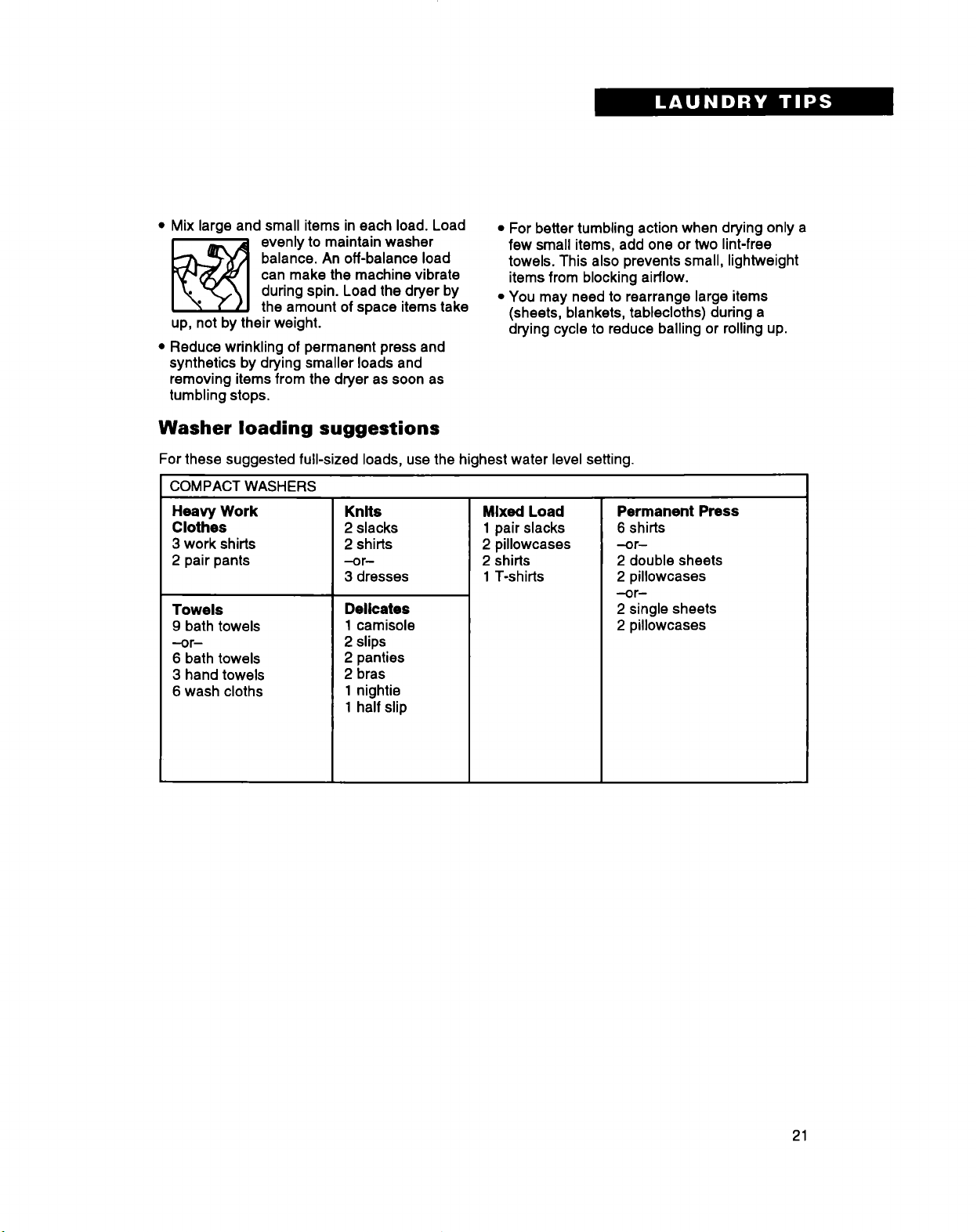
Washer loading suggestions
For these suggested full-sized loads, use the highest water level setting.
COM PACT WASH ERS
Heavy Work
Clothes
3 work shirts
2 pairpants
Towels
9 bath towels
-or-
6 bath towels
3 handtowels
6 wash cloths
Knits
2 slacks
2 shirts
-or-
3 dresses
Dellcates
1 camisole
2 slips
2 panties
2 bras
1 nightie
1 half slip
Mixed Load
1 pair slacks
2 pillowcases
2 shirts
1 T-shirts
Permanent Press
6 shirts
-or-
2 doublesheets
2 pillowcases
--or-
2 singlesheets
2 pillowcases
21
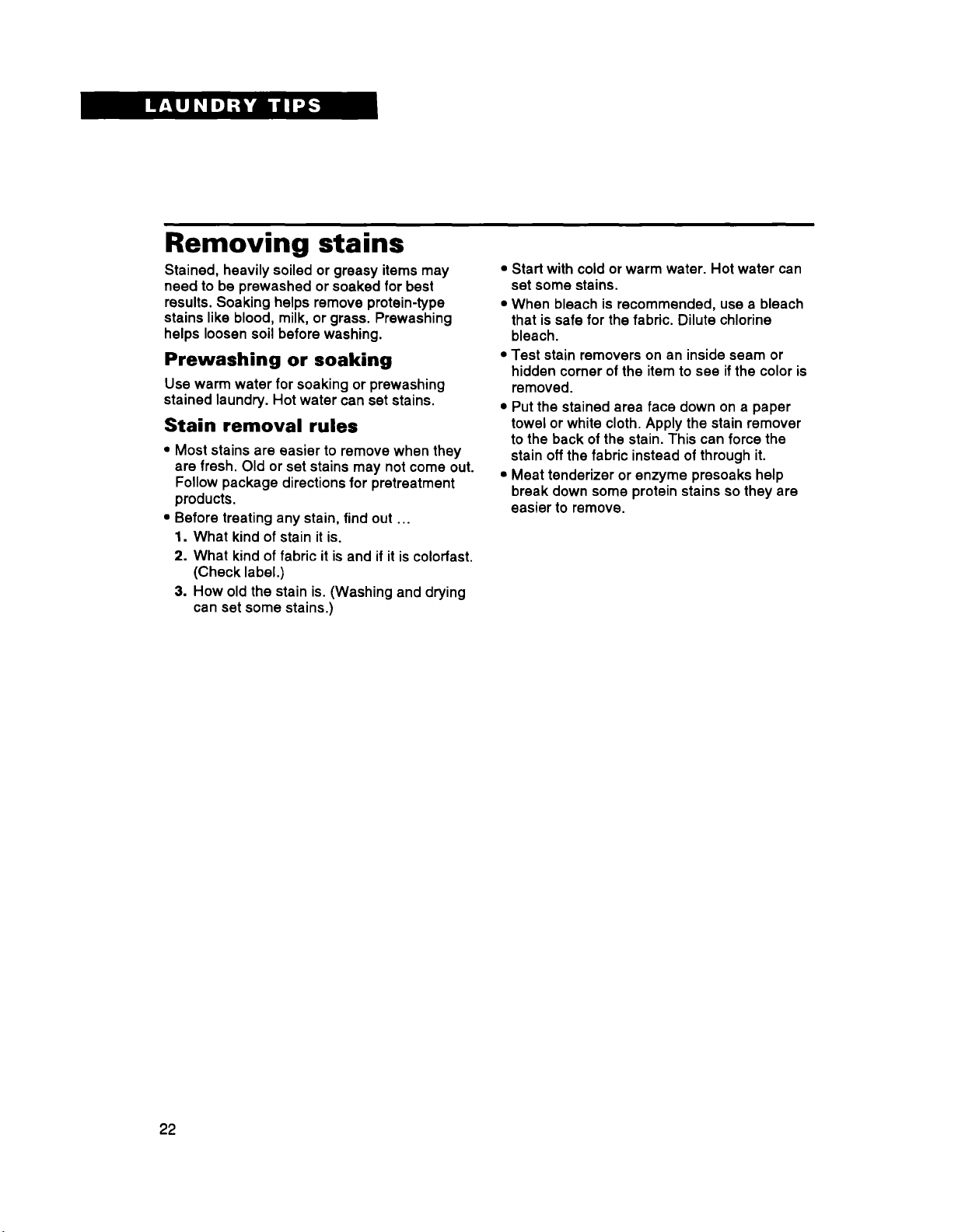
Removing stains
Stained, heavily soiled or greasy items may
need to be prewashed or soaked for best
results. Soaking helps remove protein-type
stains like blood, milk, or grass. Prewashing
helps loosen soil before washing.
Prewashing or soaking
Use warm water for soaking or prewashing
stained laundry. Hot water can set stains.
Stain removal rules
• Most stains are easier to remove when they
are fresh. Old or set stains may not come out.
Follow package directions for pretreatment
products,
• Before treating any stain, find out ...
1. What kind of stain it is.
2. What kind of fabric it is and if it is colorfast.
(Check label.)
3. How old the stain is. (Washing and drying
can set some stains.)
• Start with cold or warm water. Hot water can
set some stains.
• When bleach is recommended, use a bleach
that is safe for the fabric. Dilute chlorine
bleach.
• Test stain removers on an inside seam or
hidden corner of the item to see if the color is
removed.
• Put the stained area face down on a paper
towel or white cloth. Apply the stain remover
to the back of the stain. This can force the
stain off the fabric instead of through it.
• Meat tenderizer or enzyme presoaks help
break down some protein stains so they are
easier to remove.
22
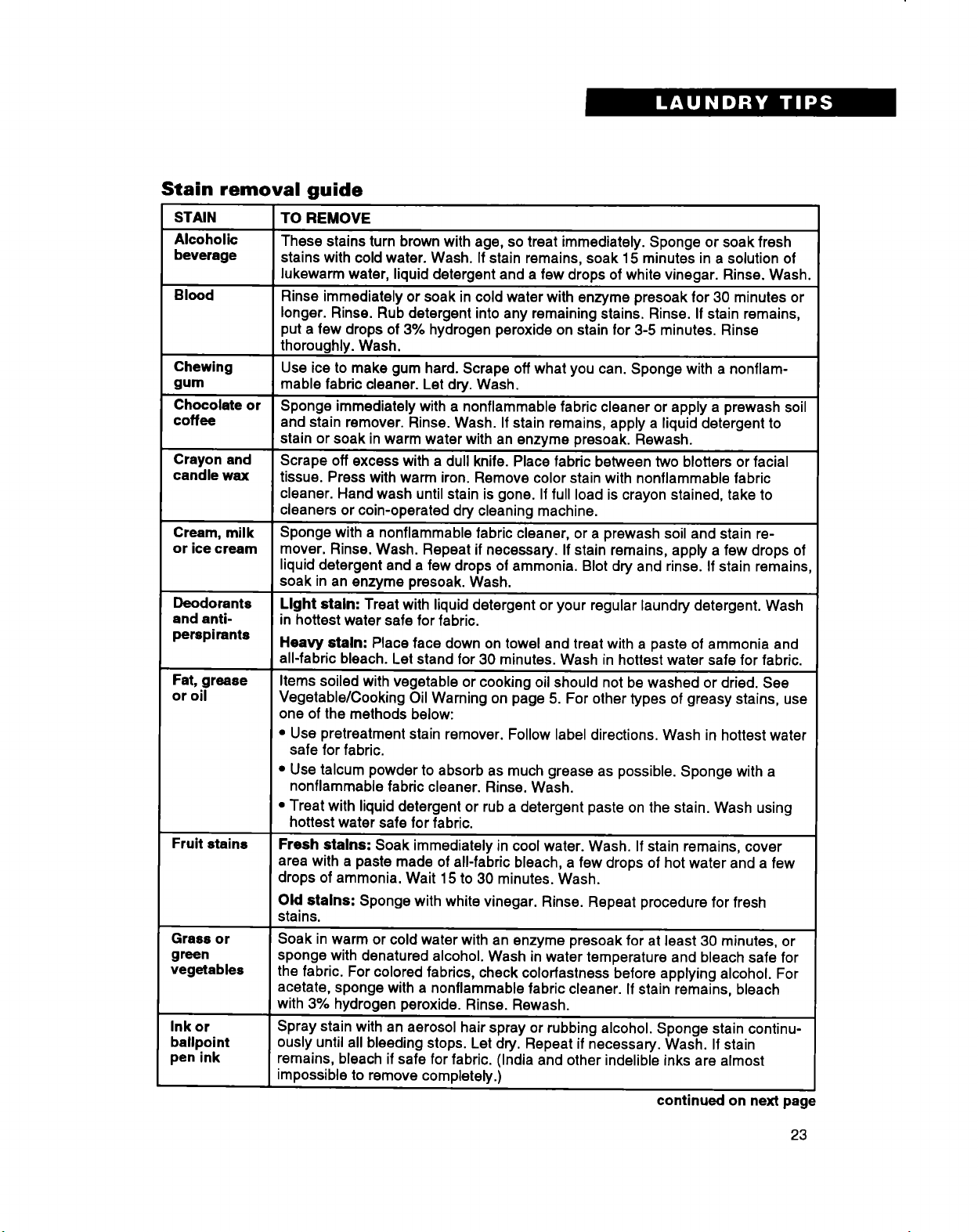
Stain removal guide
STAIN TO REMOVE
Alcoholic These stains turn brown with age, so treat immediately. Sponge or soak fresh
beverage stains with cold water. Wash. If stain remains, soak 15 minutes in a solution of
lukewarm water, liquid detergent and a few drops of white vinegar. Rinse. Wash.
Blood Rinse immediately or soak in cold water with enzyme presoak for 30 minutes or
longer. Rinse. Rub detergent into any remaining stains. Rinse. If stain remains,
put a few drops of 3% hydrogen peroxide on stain for 3-5 minutes. Rinse
thoroughly. Wash.
Chewing Use ice to make gum hard. Scrape off what you can. Sponge with a nonflam-
gum mable fabric cleaner. Let dry. Wash.
Chocolate or Sponge immediately with a nonflammable fabric cleaner or apply a prewash soil
coffee and stain remover. Rinse. Wash. If stain remains, apply a liquid detergent to
stain or soak in warm water with an enzyme presoak. Rewash.
Crayon and Scrape off excess with a dull knife. Place fabric between two blotters or facial
candle wax tissue. Press with warm iron. Remove color stain with nonflammable fabric
cleaner. Hand wash until stain is gone. If full load is crayon stained, take to
cleaners or coin-operated dry cleaning machine.
Cream, milk Sponge with a nonflammable fabric cleaner, or a prewash soil and stain re-
or ice cream mover. Rinse. Wash. Repeat if necessary. If stain remains, apply a few drops of
liquid detergent and a few drops of ammonia. Blot dry and rinse. If stain remains,
soak in an enzyme presoak. Wash.
Deodorants Light stain: Treat with liquid detergent or your regular laundry detergent. Wash
and anti- in hottest water safe for fabric.
perspirants Heavy stain: Place face down on towel and treat with a paste of ammonia and
all-fabric bleach. Let stand for 30 minutes. Wash in hottest water safe for fabric.
Fat, grease
or oil
Fruit stains
Grass or
green
vegetables
Items soiledwith vegetable or cookingoilshouldnot be washed or dried. See
Vegetable/Cooking Oil Warning on page 5. For othertypesof greasy stains, use
one of the methodsbelow:
• Use pretreatment stain remover. Followlabel directions.Wash in hottestwater
safe for fabric.
• Use talcum powder toabsorb as muchgrease as possible.Sponge with a
nonflammablefabric cleaner. Rinse. Wash.
• Treat with liquiddetergentor ruba detergent paste on the stain.Wash using
hottestwatersafe for fabric.
Fresh stains: Soak immediatelyin coolwater. Wash. Ifstain remains, cover
area with a pastemade ofall-fabricbleach, a few drops of hotwater and a few
drops ofammonia. Wait 15 to 30 minutes.Wash.
Old stains: Sponge with whitevinegar. Rinse. Repeat procedurefor fresh
stains.
Inkor
ballpoint
pen ink
continued on next page
Soak inwarm or coldwater with an enzyme presoak for at least 30 minutes, or
spongewith denatured alcohol.Wash in water temperature and bleachsafe for
the fabric. Forcoloredfabrics, checkcolorfastnessbefore applyingalcohol. For
acetate, sponge with a nonflammablefabric cleaner. Ifstain remains, bleach
with 3% hydrogenperoxide. Rinse. Rewash.
Spray stain withan aerosol hairspray or rubbingalcohol. Sponge stain continu-
ouslyuntilall bleedingstops.Let dry. Repeat ifnecessary. Wash. If stain
remains, bleachifsafe for fabric. (India and other indelibleinks are almost
impossible to remove completely.)
23
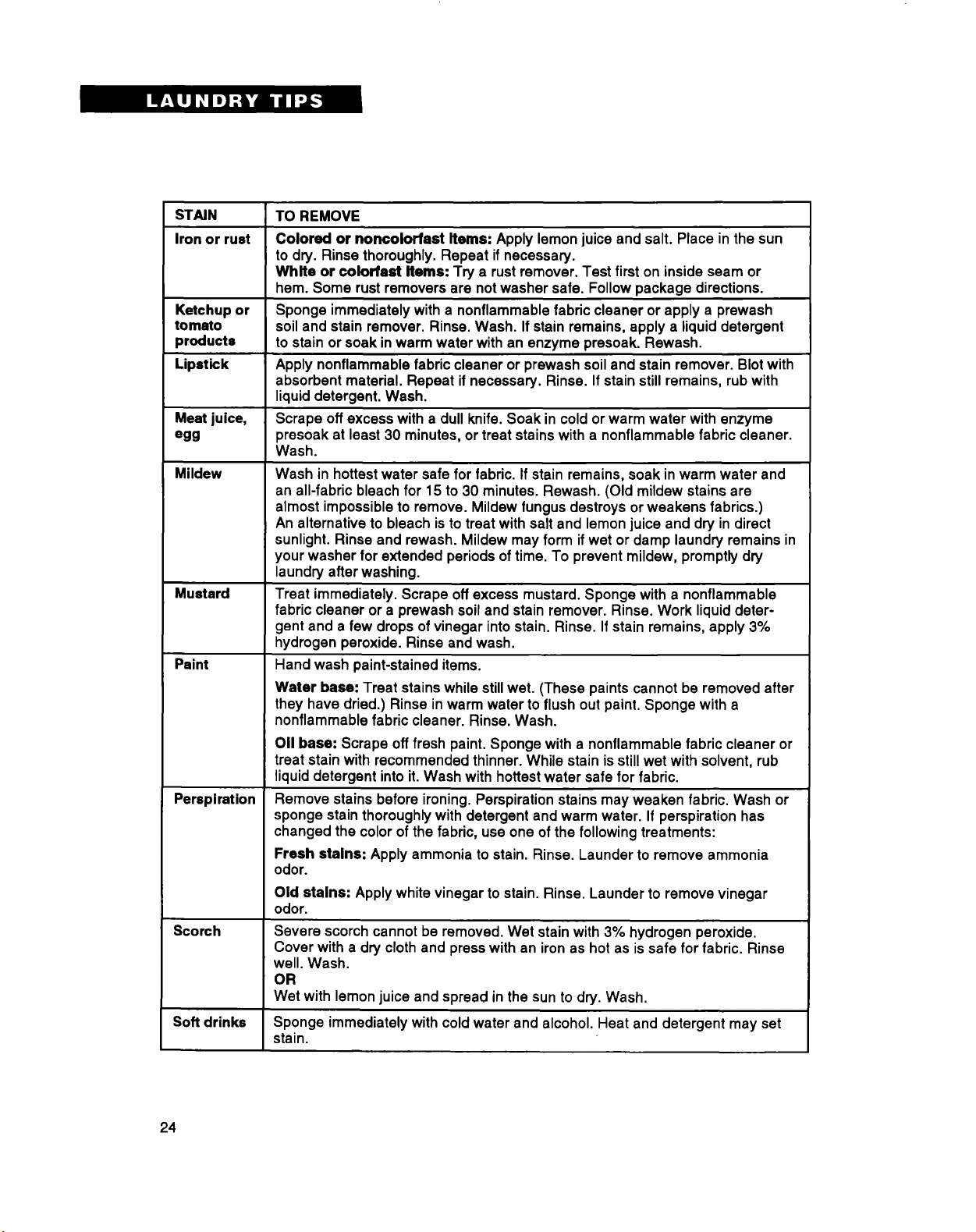
STAIN TOREMOVE
Ironorrust ColoredornoncolorfastItems:Applylemonjuiceandsalt.Placeinthesun
todry.Rinsethoroughly.Repeatifnecessary.
WhIteorcolorfastItems:Tryarustremover.Testfirstoninsideseamor
hem.Somerustremoversarenotwashersafe.Followpackagedirections.
Ketchupor Spongeimmediatelywithanonflammablefabriccleanerorapplyaprewash
tomato soilandstainremover.Rinse.Wash.Ifstainremains,applyaliquiddetergent
products tostainorsoakinwarmwaterwithanenzymepresoak.Rewash.
Lipstick Applynonflammable fabriccleaner or prewashsoiland stain remover. Blotwith
absorbent material. Repeat ifnecessary. Rinse. Ifstainstillremains, rubwith
liquiddetergent. Wash.
Meat juice, Scrape offexcess with a dull knife.Soak in coldor warm water with enzyme
egg presoakat least30 minutes, or treatstains with a nonflammablefabric cleaner.
Wash.
Mildew
Mustard
Paint
Perspiration
Scorch
Wash in hottestwater safe for fabric.If stain remains, soak inwarm water and
an all-fabricbleachfor 15 to 30 minutes.Rewash. (Old mildewstains are
almost impossibleto remove. Mildew fungus destroysorweakens fabrics.)
An alternativeto bleach istotreat withsalt and lemonjuice and dry in direct
sunlight.Rinseand rewash. Mildew may form ifwet or damp laundry remainsin
your washer forextended periods oftime. To prevent mildew, promptly dry
laundryafterwashing.
Treat immediately.Scrape offexcess mustard. Sponge with a nonflammable
fabriccleaner or a prewashsoiland stain remover. Rinse. Work liquiddeter-
gent and a few drops ofvinegar intostain. Rinse. Ifstain remains, apply3%
hydrogenperoxide. Rinse and wash.
Hand wash paint-staineditems.
Water base: Treat stainswhile stillwet. (These paintscannotbe removed after
they have dried.) Rinse inwarm water toflush outpaint. Sponge with a
nonflammablefabric cleaner. Rinse. Wash.
OII base: Scrape offfresh paint. Sponge with a nonflammablefabriccleaner or
treatstain with recommendedthinner.While stain isstillwet with solvent,rub
liquiddetergent intoit.Wash with hottestwater safe for fabric.
Remove stainsbefore ironing.Perspiration stainsmay weaken fabric. Wash or
sponge stain thoroughlywith detergentand warm water. If perspirationhas
changed the colorofthe fabric, useone ofthe following treatments:
Fresh stains: Apply ammoniato stain. Rinse. Launderto remove ammonia
odor.
Old stains: Applywhitevinegar to stain.Rinse. Launderto remove vinegar
odor.
Severe scorchcannotbe removed. Wet stainwith 3% hydrogen peroxide.
Cover with a dry clothand presswith an ironas hot as issafe for fabric. Rinse
well. Wash.
OR
Wet with lemonjuiceand spread in the sun to dry.Wash.
Soft drinks Sponge immediately with cold water and alcohol. Heat and detergent may set
stain.
24
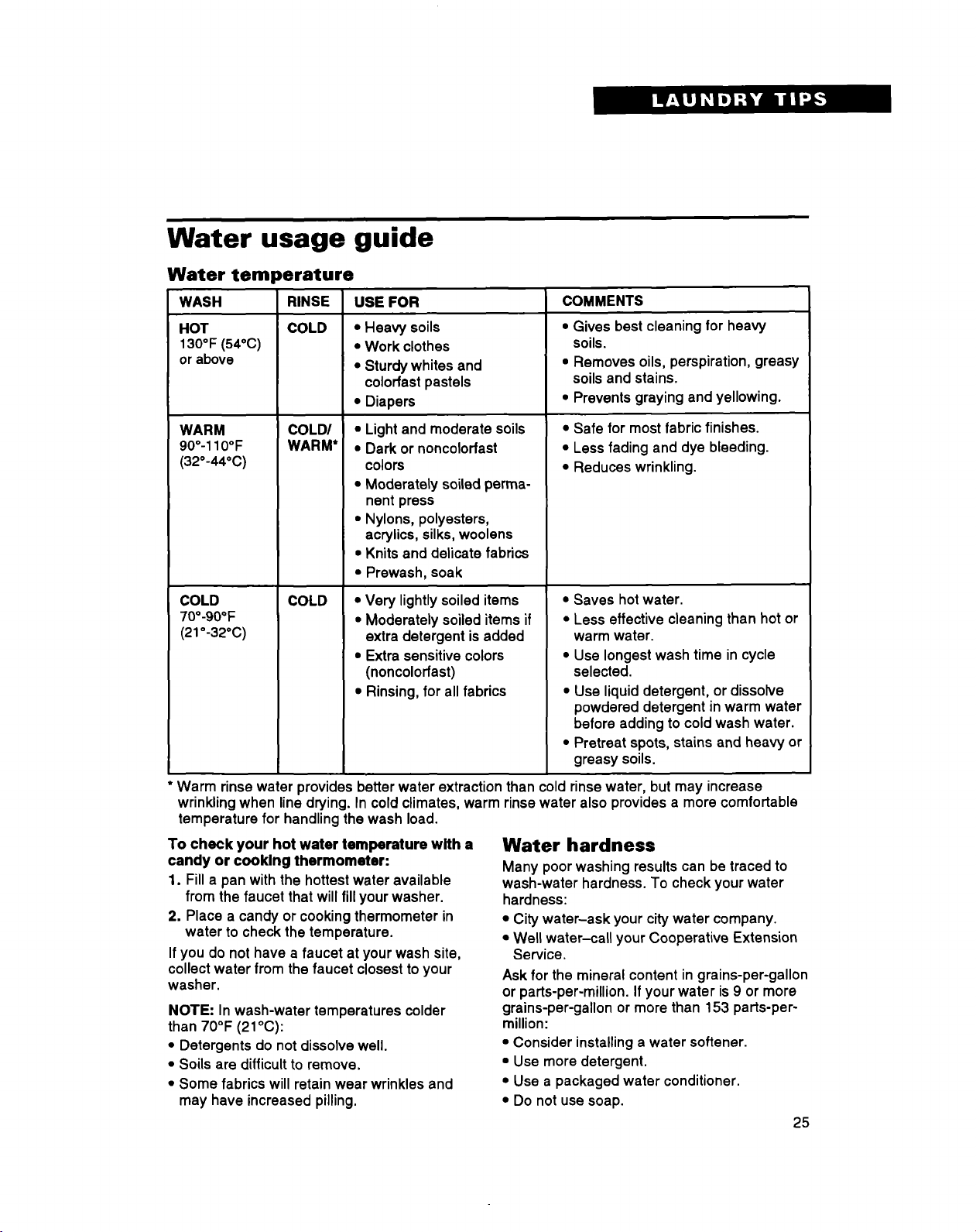
Water usage guide
)erature
RINSE USE FOR COMMENTS
COLD
Water tern
WASH
HOT
130 °F (54°C)
or above
WARM
90°-110°F
(32o-44oc)
COLD
70o.90OF
(21°-32oc)
COLD/
WARM*
COLD
• Heavy soils
• Work clothes
• Sturdywhites and
colorfastpastels
• Diapers
• Lightand moderatesoils
• Dark or noncolorfast
colors
• Moderately soiledperma-
nent press
• Nylons,polyesters,
acrylics,silks,woolens
• Knitsand delicate fabrics
• Prewash,soak
• Very lightly soiled items
• Moderately soileditems if
extra detergent isadded
• Extra sensitivecolors
(noncolorfast)
• Rinsing,for all fabrics
• Gives best cleaningfor heavy
soils.
• Removes oils, perspiration,greasy
soilsand stains.
• Preventsgrayingand yellowing.
• Safe for most fabric finishes.
• Less fading and dye bleeding.
• Reduces wrinkling.
• Saves hot water.
• Less effective cleaning than hot or
warm water.
• Use longest wash time in cycle
selected.
• Use liquid detergent, or dissolve
powdered detergent in warm water
before adding to cold wash water.
• Pretreat spots, stains and heavy or
greasy soils.
Warm rinsewater providesbetterwater extractionthan coldrinsewater, but may increase
wrinklingwhen line drying.In coldclimates,warm rinsewater also providesa more comfortable
temperature for handlingthewash load.
To check your hot water temperature with a
candy or cooking thermometer:
1. Fill a pan with the hottestwater available
from the faucet thatwill fill yourwasher.
2. Place a candy or cookingthermometer in
water tocheck the temperature.
Ifyou do not have a faucet at yourwash site,
collectwater from the faucet closesttoyour
washer.
NOTE: In wash-water temperatures colder
than 70°F (21°C):
• Detergents do not dissolve well.
• Soils are difficult to remove.
• Some fabrics will retain wear wrinkles and
may have increased pilling.
Water hardness
Many poor washing resultscan be traced to
wash-water hardness.To check yourwater
hardness:
• Citywater-ask your citywater company.
• Well water-call your Cooperative Extension
Service.
Ask for the mineral content in grains-per-gallon
or parts-per-million. If your water is 9 or more
grains-per-gallon or more than 153 parts-per-
million:
• Consider installing a water softener.
• Use more detergent.
• Use a packaged water conditioner.
• Do not use soap.
25
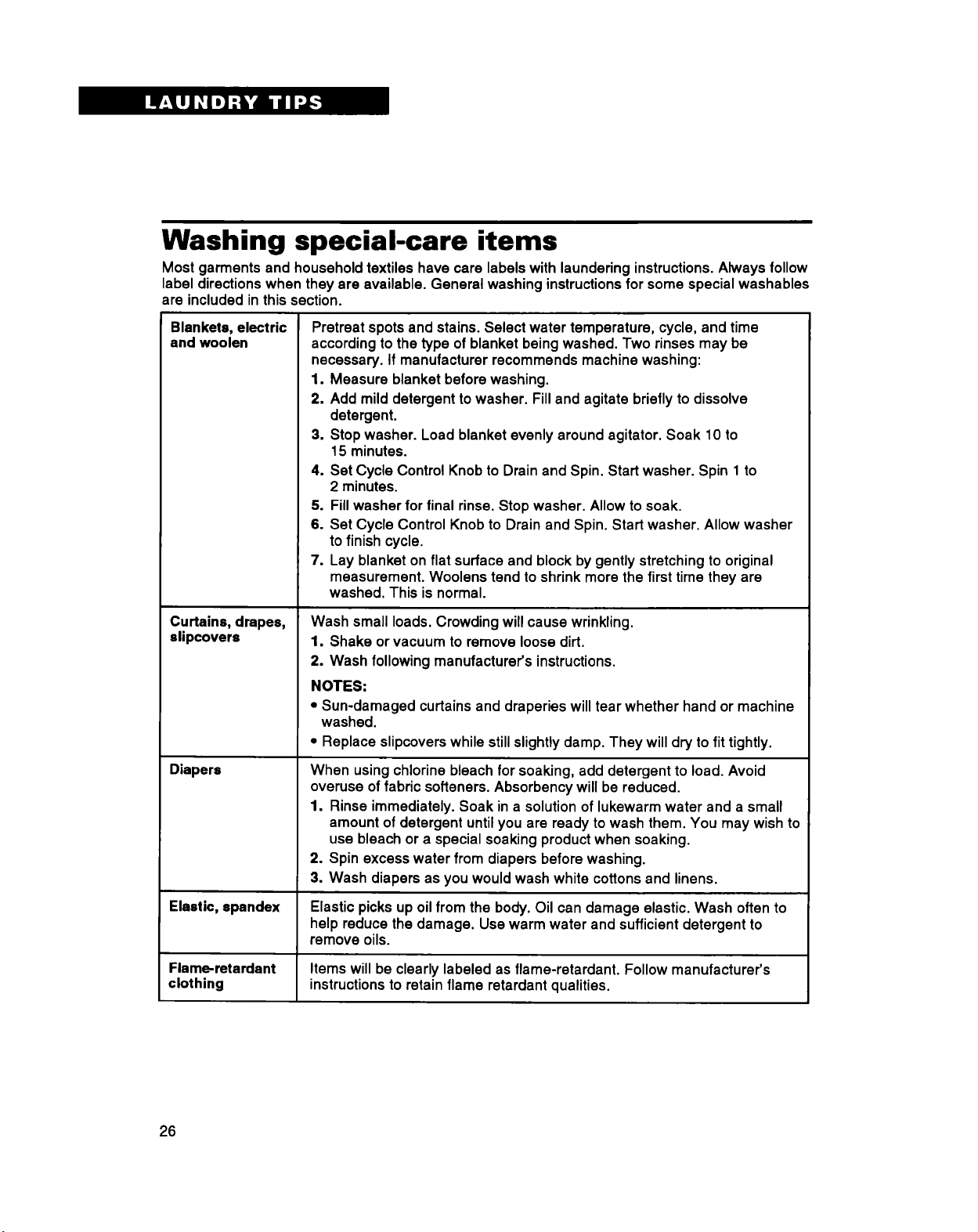
Washing special-care items
Most garments and householdtextileshave care labels with laundering instructions. Always follow
label directionswhen theyare available. General washinginstructionsfor some specialwashables
are includedin thissection.
Blankets, electric
and woolen
Curtains, drapes,
slipcovers
Diapers
Elastic, apandex
Pretreat spotsand stains. Selectwater temperature, cycle, and time
accordingto the typeof blanketbeing washed.Two rinsesmay be
necessary. If manufacturerrecommendsmachinewashing:
1. Measure blanketbeforewashing.
2. Add milddetergent towasher. Filland agitate brieflytodissolve
detergent.
3. Stop washer. Loadblanketevenly around agitator.Soak 10 to
15 minutes.
4. Set Cycle ControlKnobto Drainand Spin. Startwasher.Spin 1to
2 minutes.
5. Fillwasher for finalrinse. Stop washer. Allowto soak.
6. Set Cycle Control Knobto Drain and Spin. Start washer. Allowwasher
to finish cycle.
7. Lay blanketon flat surface and blockby gentlystretchingtooriginal
measurement. Woolens tend to shrinkmore the first timethey are
washed. This is normal.
Wash small loads. Crowding willcause wrinkling.
1. Shake orvacuum toremove loosedirt.
2. Wash followingmanufacturer'sinstructions.
NOTES:
• Sun-damaged curtainsand draperieswill tearwhether handor machine
washed.
• Replace slipcoverswhilestillslightlydamp.They willdry to fit tightly.
When usingchlorinebleach for soaking,add detergent to load. Avoid
overuseof fabric softeners.Absorbencywill be reduced.
1. Rinse immediately.Soak in a solutionof lukewarmwater and a small
amountof detergent untilyou are ready to wash them. You may wish to
use bleachor a specialsoaking productwhen soaking.
2. Spinexcess water from diapers beforewashing.
3. Wash diapersas you wouldwash white cottonsand linens.
Elasticpicks up oilfromthe body.Oil can damage elastic. Wash oftento
helpreduce the damage. Usewarm water and sufficientdetergent to
remove oils.
Flame-retardant Items will beclearly labeled as flame-retardant. Followmanufacturer's
clothing instructionsto retainflame retardantqualities.
26
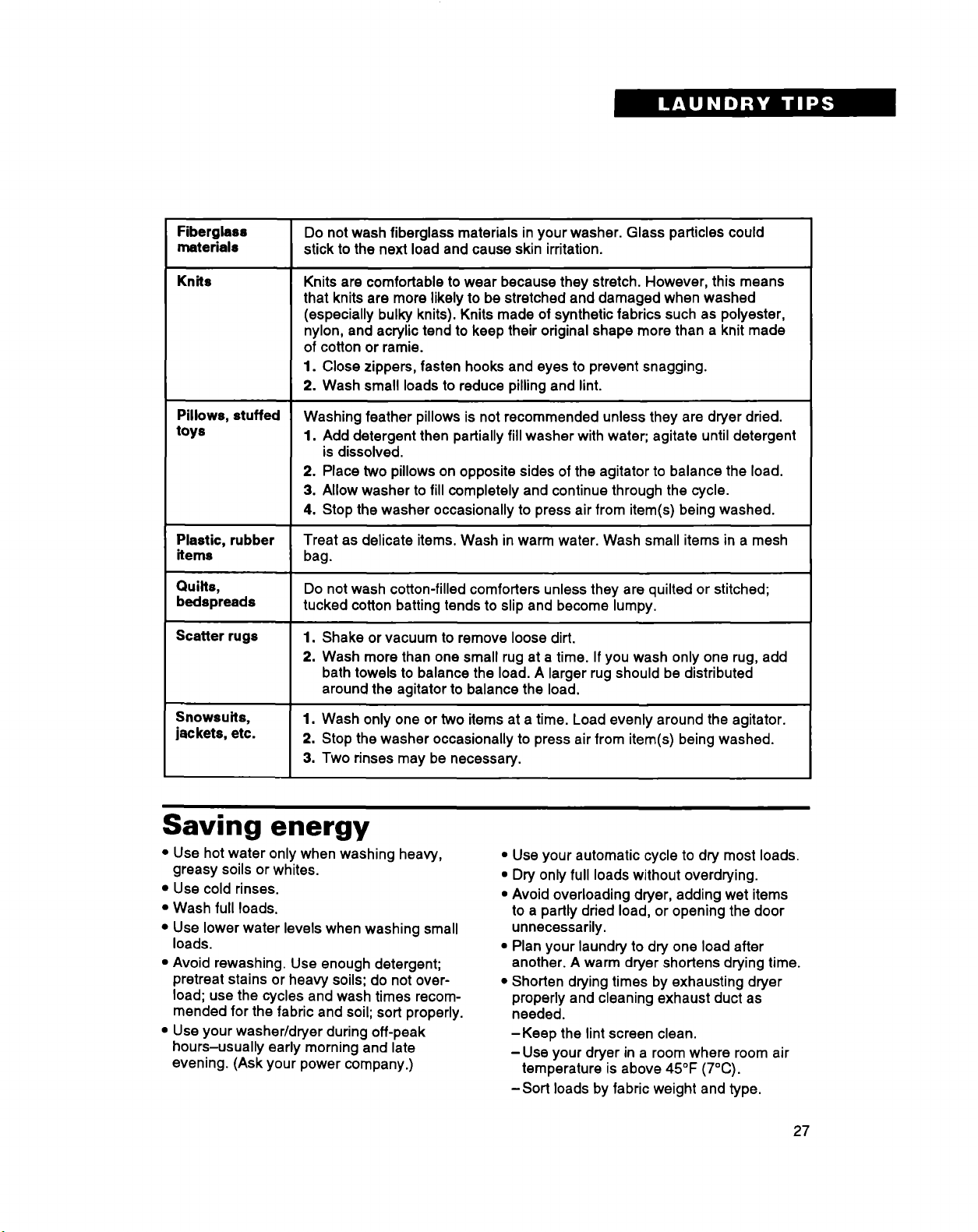
Fiberglass Do not wash fiberglass materials in your washer. Glass particles could
materiels stick to the next load and cause skin irritation.
Knits
Pillows, stuffed
toys
Plastic, rubber
items
Quilts,
bedspreads
Scatter rugs
Snowsuits,
jackets, etc.
Knits are comfortable to wear because they stretch. However, this means
that knits are more likely to be stretched and damaged when washed
(especially bulky knits). Knits made of synthetic fabrics such as polyester,
nylon, and acrylic tend to keep their original shape more than a knit made
of cotton or ramie.
1. Close zippers, fasten hooks and eyes to prevent snagging.
2. Wash small loads to reduce pilling and lint.
Washing feather pillowsisnot recommendedunlessthey are dryerdried.
1. Adddetergent then partiallyfill washer with water;agitate untildetergent
isdissolved.
2. Place two pillowson oppositesides ofthe agitatorto balance the load.
3. Allow washer to fillcompletelyand continuethroughthe cycle.
4. Stopthe washer occasionallyto pressair from item(s)being washed.
Treat as delicate items.Wash in warm water. Wash small items in a mesh
bag.
Do not wash cotton-filled comforters unless they are quilted or stitched;
tucked cotton batting tends to slip and become lumpy.
1. Shake orvacuum to remove loosedirt.
2. Wash more than one small rugat a time. If you wash onlyone rug, add
bath towels to balancethe load. A largerrugshould be distributed
aroundthe agitatorto balance the load.
1. Wash onlyone ortwo itemsat a time. Load evenly around the agitator.
2. Stop the washer occasionallyto press air from item(s) beingwashed.
3. Two rinsesmay be necessary.
Saving energy
• Use hot water onlywhen washing heavy,
greasy soilsor whites.
• Use cold rinses.
• Wash full loads.
• Use lowerwater levelswhen washingsmall
loads.
• Avoid rewashing. Use enoughdetergent;
pretreatstains or heavy soils;do notover-
load;use the cyclesand washtimes recom-
mended forthe fabric and soil;sort properly.
• Use yourwasher/dryer duringoff-peak
hours-usually early morningand late
evening. (Ask yourpower company.)
• Useyour automaticcycleto dry most loads.
• Dry onlyfull loads without overdrying.
• Avoidoverloadingdryer, adding wet items
to a partlydriedload, or openingthe door
unnecessarily.
• Plan your laundryto dry one loadafter
another.A warm dryer shortensdryingtime.
• Shorten dryingtimes by exhaustingdryer
properlyand cleaningexhaust ductas
needed.
-Keep the lintscreen clean.
- Use yourdryer in a roomwhere roomair
temperature isabove 45°F (7°C).
- Sort loadsby fabricweightand type.
27
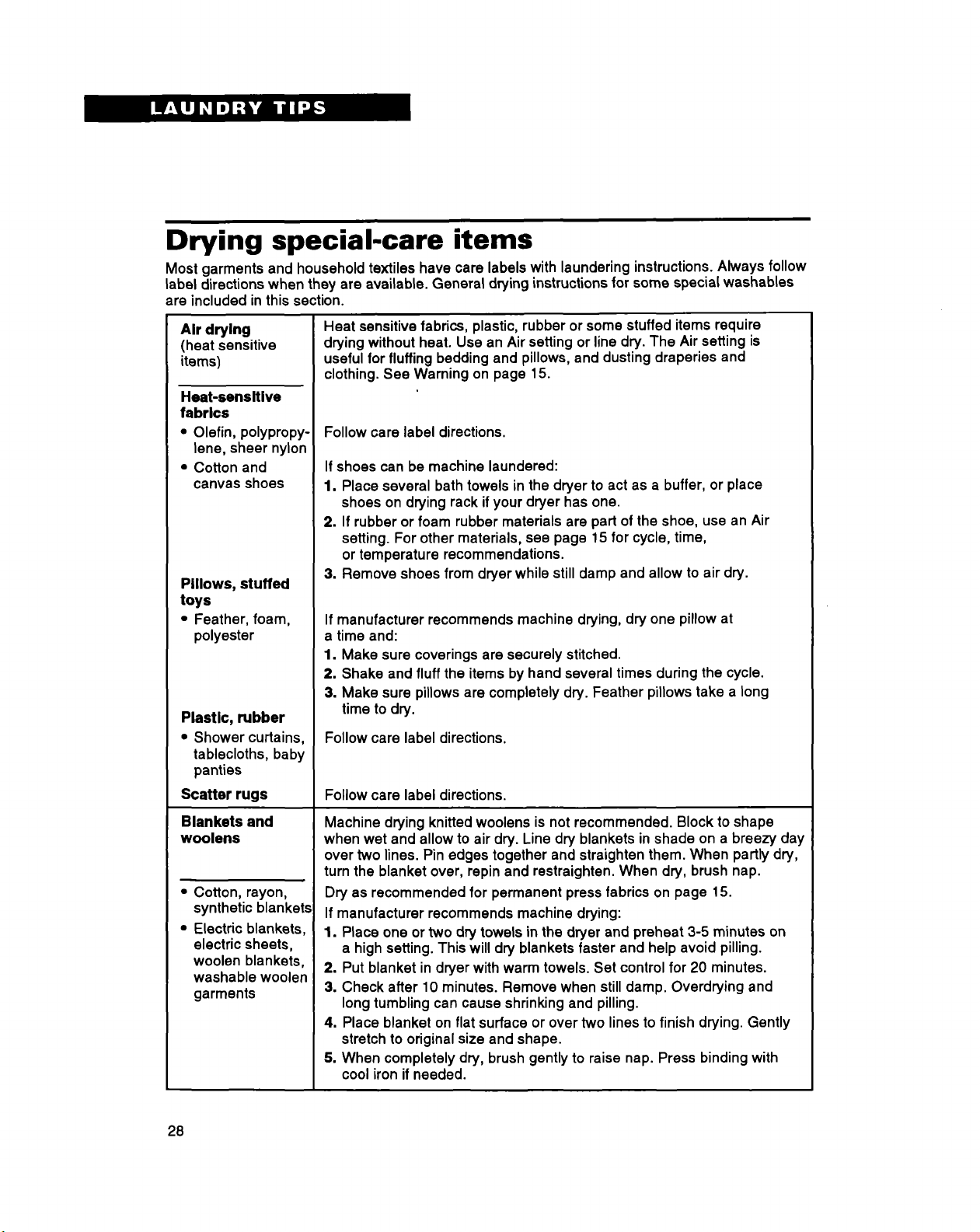
Drying special-care items
Most garments and householdtextileshave care labelswith laundering instructions.Always follow
label directionswhen theyare available.General dryinginstructions for some specialwashables
are includedin thissection.
Air drying
(heat sensitive
items)
Heat sensitivefabrics,plastic,rubberor somestuffed itemsrequire
dryingwithoutheat. Use an Air settingor linedry.The Airsettingis
usefulfor fluffingbedding and pillows,and dustingdraperiesand
clothing.See Warning on page 15.
Heat-senslUve
fabrics
• Olefin, polypropy-
lene, sheer nylon
• Cotton and
canvas shoes
Pillows, stuffed
toys
• Feather, foam,
polyester
Plastic, rubber
• Showercurtains,
tablecloths,baby
panties
Scatter rugs
Blankets and
woolens
• Cotton, rayon,
synthetic blankets
• Electric blankets,
electricsheets,
woolen blankets, 2.
washable woolen
garments 3.
4.
5.
Followcare label directions.
Ifshoes can be machine laundered:
1. Place several bath towels inthe dryer toact as a buffer,or place
shoes on dryingrack ifyourdryerhas one.
2. If rubberor foam rubbermaterialsare part ofthe shoe, use an Air
setting.For othermaterials, see page 15 for cycle,time,
or temperature recommendations.
3. Remove shoes from dryerwhilestilldamp and allowto air dry.
If manufacturer recommends machine drying, dry one pillow at
a time and:
1. Make sure coveringsare securelystitched.
2. Shake and fluffthe items byhand several times duringthe cycle.
3. Make sure pillowsare completelydry. Feather pillowstake a long
timeto dry.
Follow care labeldirections.
Follow care label directions.
Machine drying knitted woolensis not recommended. Block to shape
when wet and allow to air dry. Line dry blankets in shade on a breezy day
over two lines. Pin edges together and straighten them. When partly dry,
turn the blanket over, repin and restraighten. When dry, brush nap.
Dry as recommended for permanent press fabrics on page 15.
If manufacturer recommends machine drying:
1. Place one or two dry towels in the dryerand preheat 3-5 minutes on
a highsetting.Thiswill dry blanketsfaster and helpavoid pilling.
Put blanketin dryerwithwarm towels. Set controlfor 20 minutes.
Check after 10 minutes. Remove when stilldamp. Overdrying and
longtumblingcan causeshrinkingand pilling.
Place blanket on flat surface or overtwo linesto finish drying.Gently
stretch tooriginalsize and shape.
When completelydry, brushgentlyto raise nap. Press bindingwith
cooliron ifneeded.
28
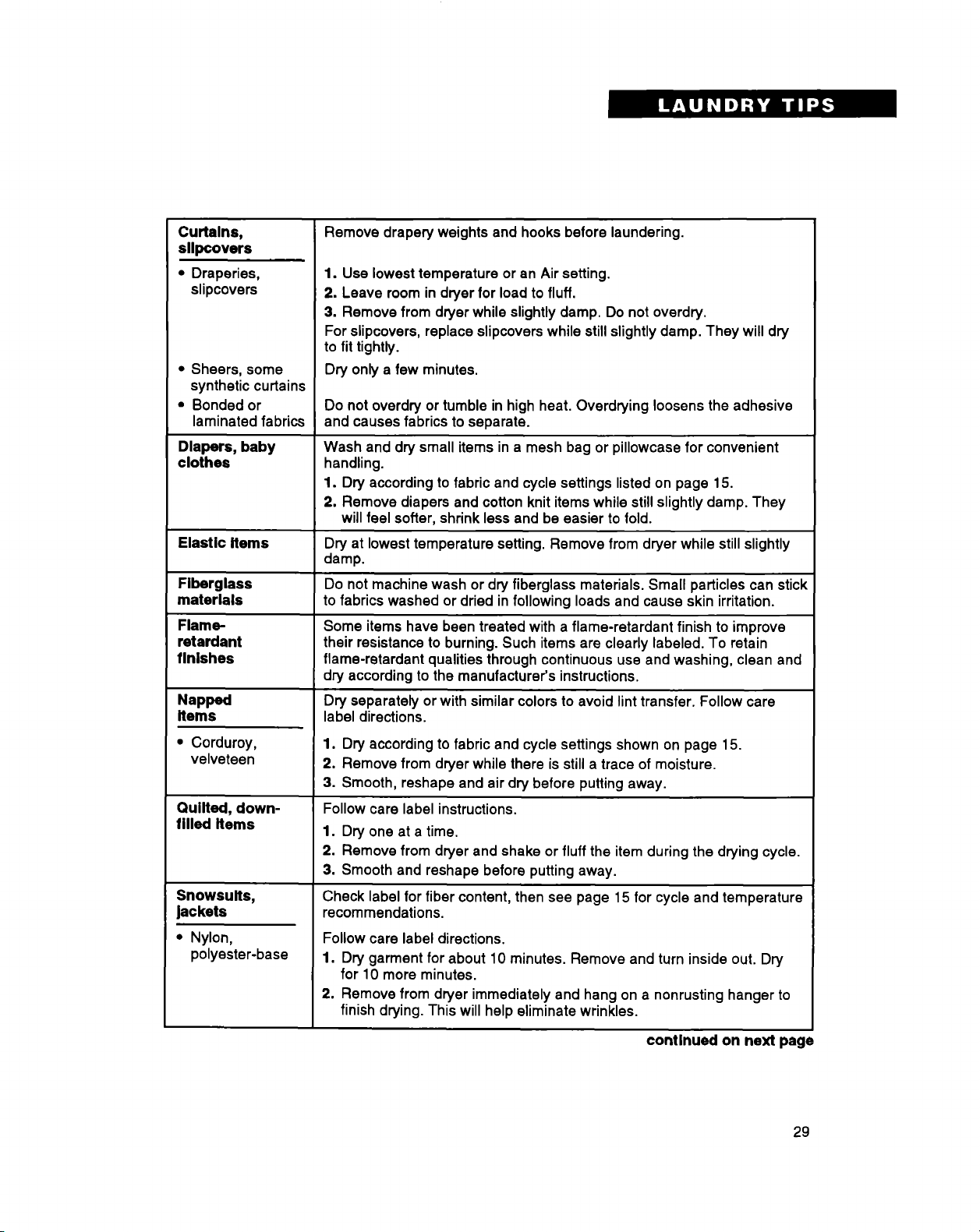
Curtains,
slipcovers
• Draperies,
slipcovers
• Sheers, some
synthetic curtains
• Bonded or
laminated fabrics
Diapers, baby
clothes
Remove draperyweights and hooksbeforelaundering.
1. Use lowesttemperature or an Airsetting.
2. Leave roomin dryerfor loadto fluff.
3. Remove from dryerwhile slightlydamp. Do not overdry.
Forslipcovers,replace slipcoverswhile stillslightlydamp. They willdry
tofit tightly.
Dryonlya few minutes.
Do not overdry ortumble in high heat. Overdrying loosens the adhesive
and causesfabricsto separate.
Wash and dry small itemsin a mesh bag or pillowcasefor convenient
handling.
1. Dry accordingtofabric and cyclesettingslistedon page 15.
2. Remove diapers and cottonknititemswhilestillslightlydamp. They
willfeel softer, shrinklessand be easier to fold.
Elastic Items Dry at lowesttemperaturesetting. Remove from dryerwhilestillslightly
damp.
Fiberglass Do not machine wash or dry fiberglassmaterials. Small particles can stick
materials tofabrics washed or dried infollowing loads and cause skin irritation.
Flame- Some itemshave been treated with a flame-retardant finish toimprove
retardant theirresistanceto burning.Such itemsare clearlylabeled. To retain
finishes flame-retardant qualitiesthroughcontinuoususe and washing, clean and
dry accordingtothe manufacturer'sinstructions.
Napped Dry separately or withsimilarcolors toavoid linttransfer. Followcare
Items label directions.
• Corduroy,
velveteen
Quilted, down-
filledItems
SnowsuIts,
lackets
• Nylon,
polyester-base
1. Dry accordingto fabric and cyclesettingsshown on page 15.
2. Remove from dryerwhile there is stilla trace of moisture.
3. Smooth, reshape and air dry before puttingaway.
Followcare label instructions.
1.Dryone at a time.
2. Remove from dryer and shake or fluff the itemduring the dryingcycle.
3. Smoothand reshape beforeputtingaway.
Check label for fiber content,then see page 15 for cycleand temperature
recommendations.
Followcare labeldirections.
1. Dry garmentfor about 10 minutes. Remove and turninsideout. Dry
for 10 more minutes.
2. Remove from dryerimmediatelyand hang on a nonrustinghanger to
finish drying.Thiswill helpeliminate wrinkles.
continued on next page
29
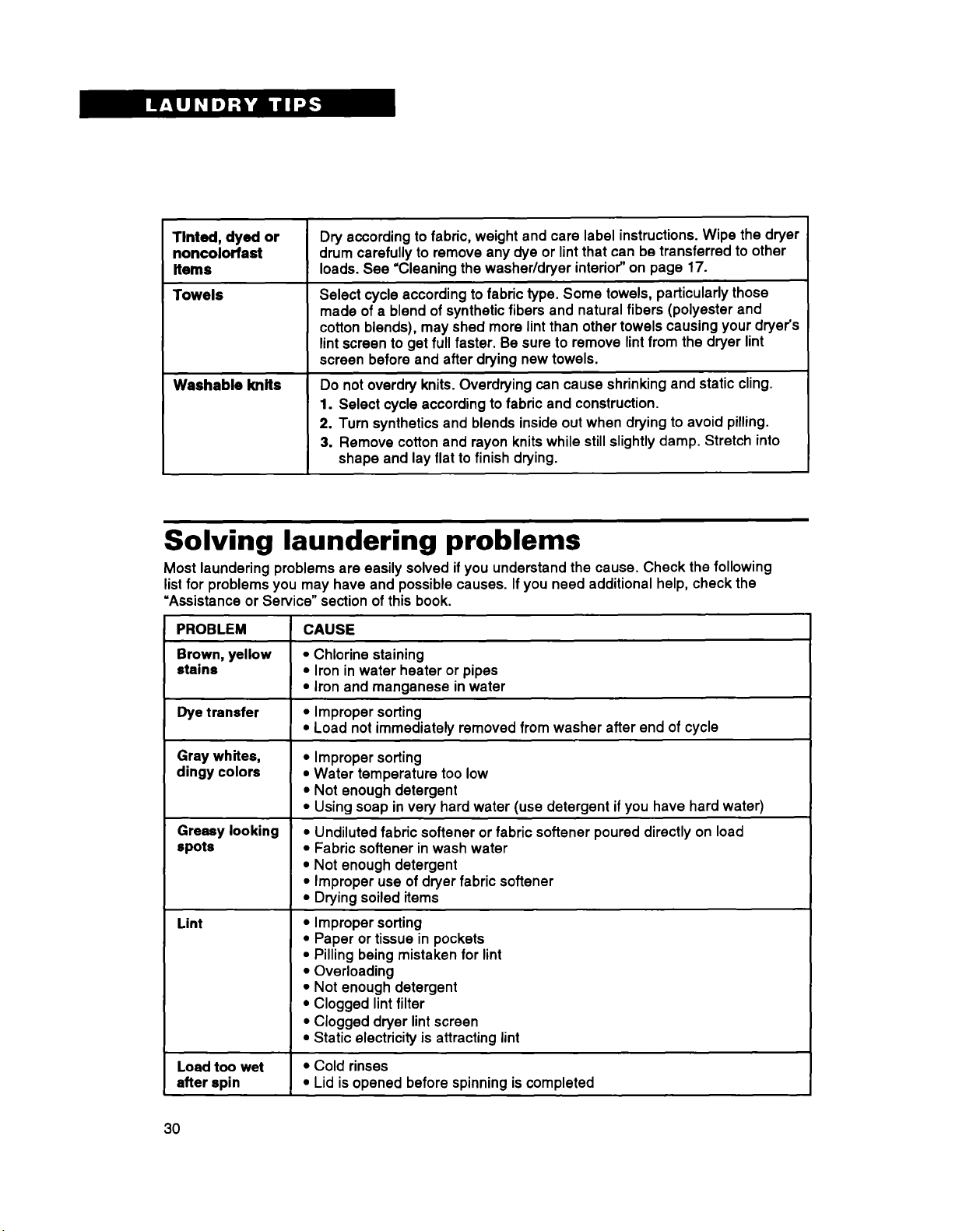
Tinted, dyed or
noncolorfast
itoms
Towels
Washable knits
Dry accordingtofabric, weightand care label instructions.Wipe the dryer
drumcarefullyto remove any dye or lintthat can be transferredtoother
loads. See "Cleaningthe washer/dryer interior"on page 17.
Select cycleaccordingtofabric type. Some towels,particularlythose
made of a blend ofsyntheticfibers and naturalfibers (polyester and
cottonblends),may shed more lintthan othertowelscausing yourdryer's
lintscreento get fullfaster. Be sure to remove lintfrom the dryer lint
screen before and after dryingnew towels.
Do notoverdry knits.Overdrying cancause shrinkingand staticcling.
1. Select cycleaccordingtofabric and construction.
2. Turn syntheticsand blendsinsideout when dryingto avoid pilling.
3. Remove cottonand rayon knitswhile stillslightlydamp. Stretch into
shape and lay flattofinish drying.
Solving laundering problems
Most laundering problems are easilysolved ifyou understandthe cause. Check the following
listfor problemsyou may have and possiblecauses. Ifyou need additionalhelp, check the
=Assistance or Service"sectionof this book.
PROBLEM CAUSE
Brown, yellow • Chlorinestaining
stains • Iron inwater heater or pipes
• Ironand manganese in water
Dyetransfer • Impropersorting
• Load not immediatelyremovedfrom washer afterend ofcycle
Gray whites, • Impropersorting
dingy colors • Water temperature too low
• Not enoughdetergent
• Usingsoap invery hardwater (use detergent ifyou have hard water)
Greasy looking
spots
Lint
• Undilutedfabric softeneror fabric softenerpoureddirectlyon load
• Fabricsoftener inwash water
• Not enoughdetergent
• Improper use ofdryer fabric softener
• Dryingsoiled items
• Improper sorting
• Paper or tissue in pockets
• Pilling being mistaken for lint
• Overloading
• Not enoughdetergent
• Clogged lintfilter
• Clogged dryer lintscreen
• Static electricityis attractinglint
Loadtoo wet • Cold rinses
after spin • Lidisopened beforespinningiscompleted
30
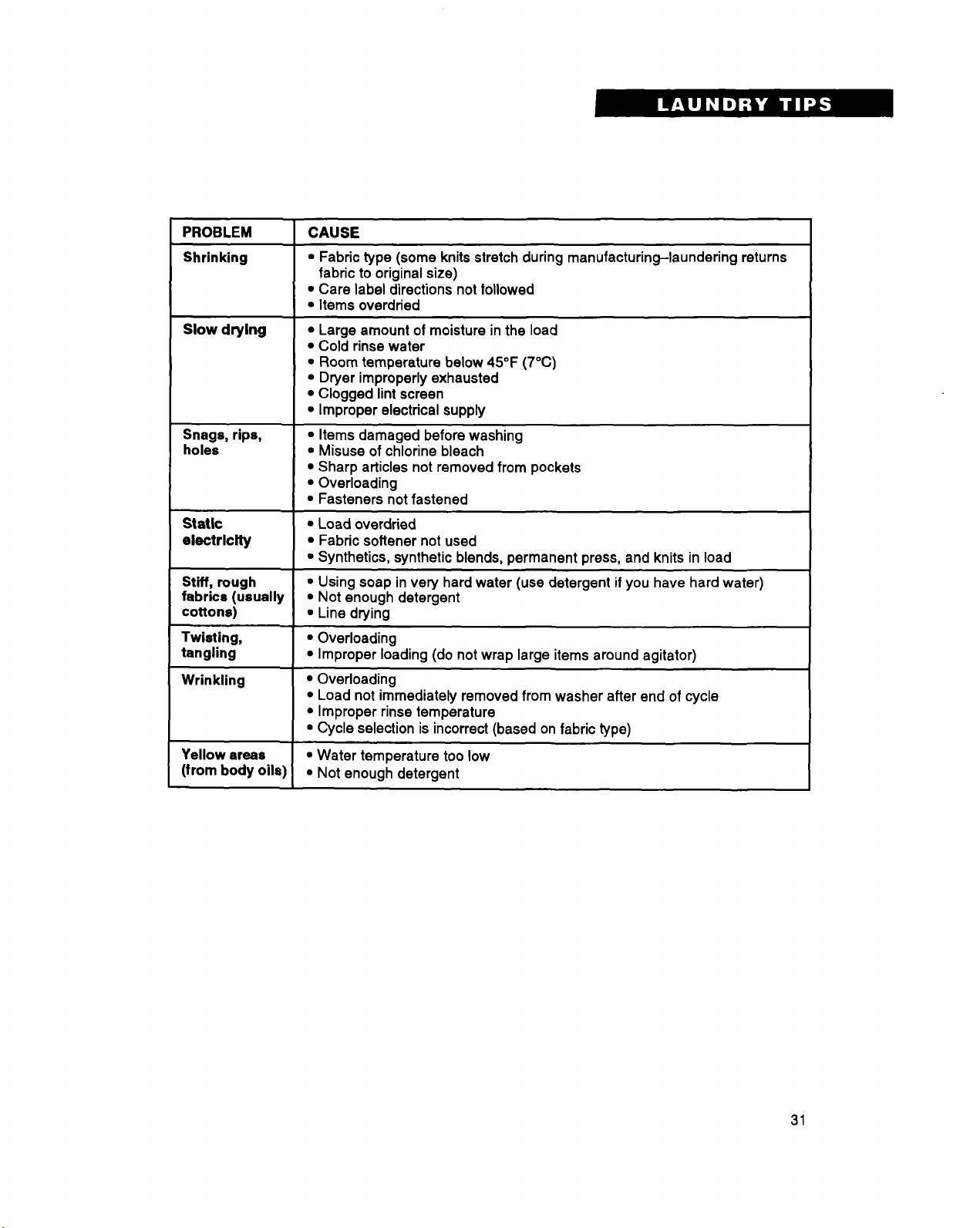
PROBLEM CAUSE
Shrinking • Fabrictype (some knitsstretchduring manufacturing-laundering returns
fabricto originalsize)
• Care labeldirectionsnotfollowed
• Itemsoverdried
Slow drying
Snags, rips,
holes
Static
electrlclty
Stiff, rough
fabrics (usually
cottons)
Twisting,
tangling
• Largeamount ofmoisture inthe load
• Cold rinsewater
• Room temperature below 45°F (7°C)
• Dryer improperlyexhausted
• Clogged lintscreen
• Improperelectricalsupply
• Itemsdamaged beforewashing
• Misuse of chlorinebleach
• Sharp articlesnot removedfrom pockets
• Overloading
• Fasteners notfastened
• Load overdried
• Fabricsoftenernot used
• Synthetics,syntheticblends, permanent press,and knitsin load
• Using soap in very hardwater (use detergent ifyou have hardwater)
• Not enough detergent
• Line drying
• Overloading
• Improperloading (do not wrap large itemsaroundagitator)
Wrinkling • Overloading
• Load not immediatelyremovedfrom washer after end of cycle
• Improper rinsetemperature
• Cycle selectionis incorrect(based on fabrictype)
Yellow areas • Water temperature too low
(from body oils) • Not enoughdetergent
31
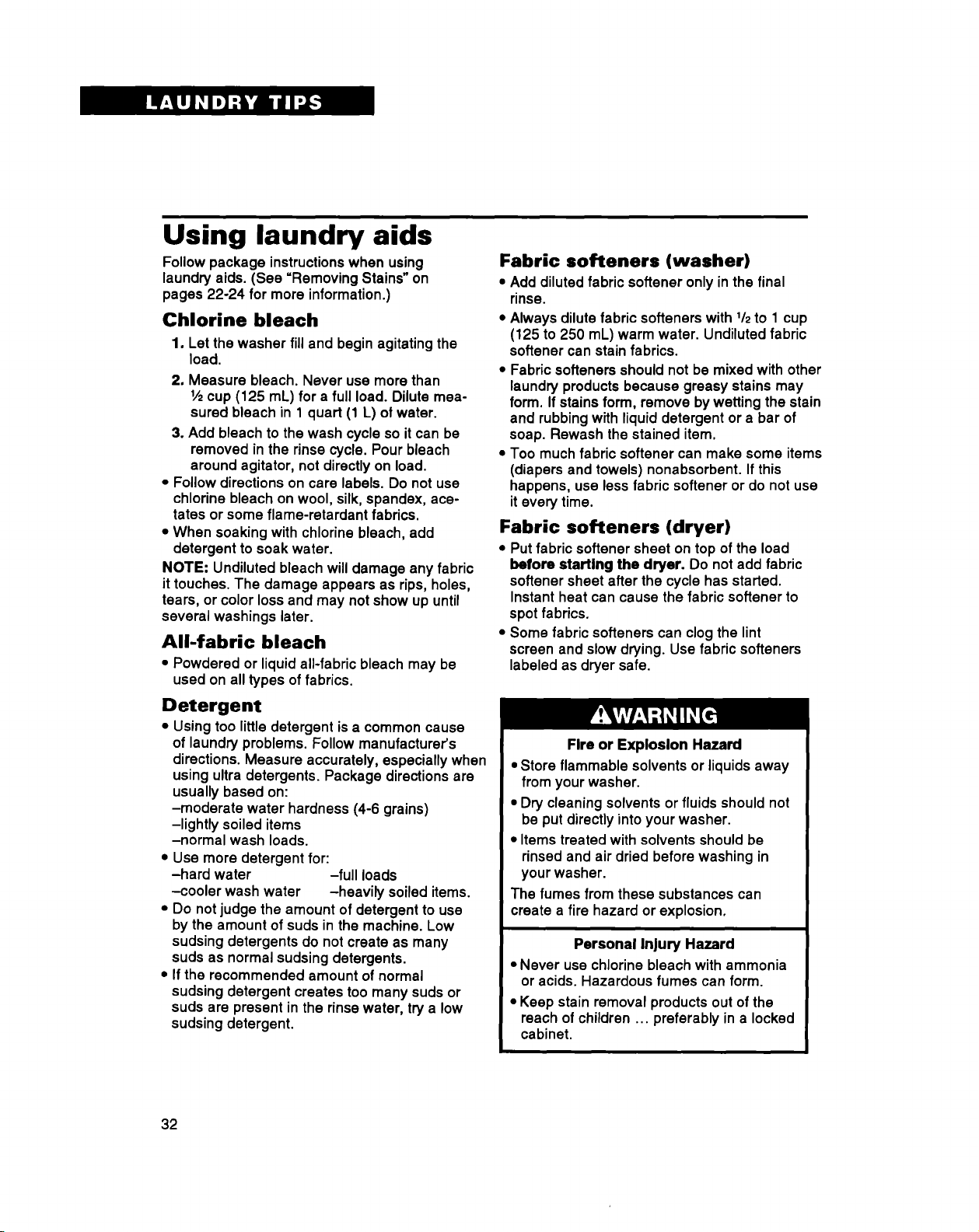
Using laundry aids
Followpackage instructionswhen using
laundry aids. (See =Removing Stains"on
pages 22-24 for more information.)
Chlorine bleach
1. Let thewasher fill and begin agitatingthe
load.
2. Measure bleach. Never use more than
V2cup (125 mL) for a full load. Dilutemea-
sured bleach in 1 quart(1 L) ofwater.
3. Add bleach to thewash cycle soit can be
removed in the rinsecycle. Pourbleach
around agitator,not directlyon load.
• Followdirectionson care labels. Do not use
chlorine bleachon wool, silk,spandex, ace-
tates or some flame-retardant fabrics.
• When soaking with chlorinebleach, add
detergent tosoak water.
NOTE: Undilutedbleachwilldamage any fabric
ittouches. The damage appears as rips,holes,
tears, or colorloss and may not show up until
several washings later.
All-fabric bleach
• Powdered or liquidall-fabricbleach may be
used on all typesof fabrics.
Detergent
• Using too little detergent isa commoncause
of laundryproblems.Followmanufacturer's
directions.Measure accurately,especiallywhen
using ultradetergents. Package directionsare
usuallybased on:
-moderate water hardness (4-6 grains)
-lightly soiled items
-normal wash loads.
• Use more detergent for:
-hard water -full loads
--coolerwash water -heavily soiled items.
• Do notjudge the amount ofdetergent to use
bythe amount ofsuds in the machine. Low
sudsingdetergents do not create as many
suds as normal sudsingdetergents.
• Ifthe recommended amountof normal
sudsingdetergent creates too manysuds or
suds are presentin the rinsewater, trya low
sudsingdetergent.
Fabric softeners (washer)
• Add diluted fabric softener onlyin the final
rinse.
• Always dilutefabricsoftenerswith 112to 1 cup
(125 to 250 mL) warm water. Undilutedfabric
softenercan stain fabrics.
• Fabricsoftenersshouldnot be mixed with other
laundryproductsbecause greasy stains may
form. Ifstains form, remove bywettingthe stain
and rubbingwith liquiddetergent or a bar of
soap. Rewash the staineditem.
• Too muchfabric softenercan make some items
(diapersand towels) nonabsorbent.Ifthis
happens, use lessfabric softener or do not use
iteverytime.
Fabric softeners (dryer)
• Putfabric softenersheet on top of the load
before starting the dryer. Do notadd fabric
softenersheet after the cyclehas started.
Instantheat can cause thefabric softenerto
spot fabrics.
• Some fabric softenerscan clogthe lint
screen and slowdrying. Use fabric softeners
labeled as dryersafe.
Fire or Explosion Hazard
• Store flammablesolventsor liquidsaway
from your washer.
• Dry cleaningsolventsor fluids shouldnot
be put directlyintoyour washer.
• Items treatedwith solventsshouldbe
rinsed and air dried beforewashing in
yourwasher.
The fumes from these substancescan
create a fire hazard or explosion.
Personal Injury Hazard
• Never use chlorinebleachwith ammonia
or acids.Hazardous fumes can form.
• Keep stain removal products out of the
reach ofchildren ... preferably in a locked
cabinet.
32
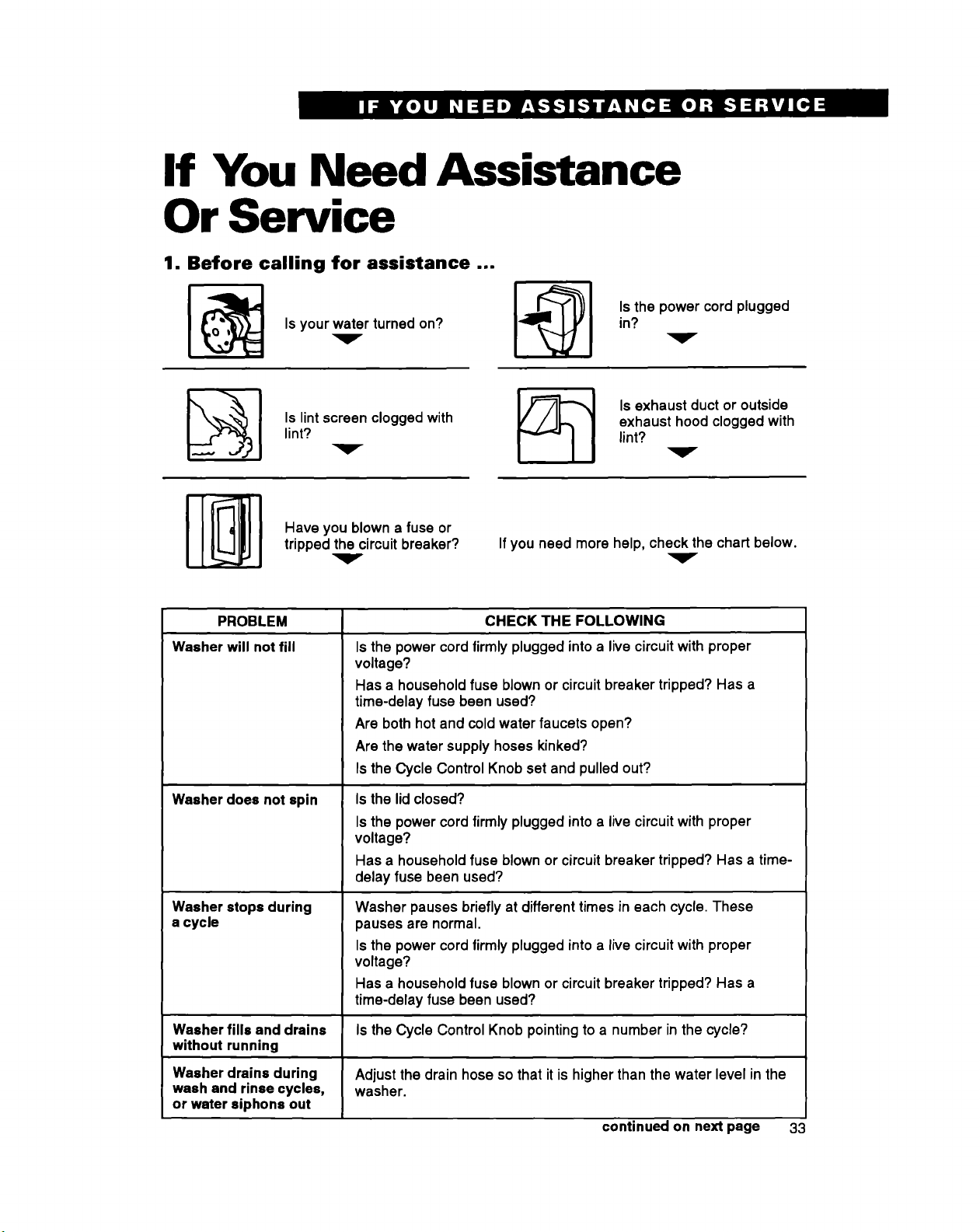
If You Need Assistance
Or Service
1. Before calling for assistance ...
Is your water turned on? I_ll@
Is the power cord plugged
in?
-,qp,-
_1 Is lint screen clogged with
lint?
Is exhaust duct or outside
exhaust hood clogged with
lint?
Have you blown a fuse or
trippedthe circuitbreaker? If you need more help, checkthe chart below.
PROBLEM
Washer will not fill
Washer does not spin
Washer stops during
a cycle
CHECK THE FOLLOWING
Is the power cord firmly plugged into a live circuit with proper
voltage?
Has a household fuse blown or circuit breaker tripped? Has a
time-delay fuse been used?
Are both hot and cold water faucets open?
Are the water supply hoses kinked?
Is the Cycle Control Knob set and pulled out?
Isthe lidclosed?
Is the power cord firmly plugged into a live circuit with proper
voltage?
Has a household fuse blown or circuit breaker tripped? Has a time-
delay fuse been used?
Washer pauses briefly at different times in each cycle. These
pauses are normal.
Is the power cord firmly plugged into a live circuit with proper
voltage?
Has a household fuse blown or circuit breaker tripped? Has a
time-delay fuse been used?
Washer fills and drains Is the Cycle Control Knob pointing to a number in the cycle?
without running
Washer drains during Adjust the drain hose so that it is higher than the water level in the
wash and rinse cycles, washer.
or water siphons out
continued on next page 33
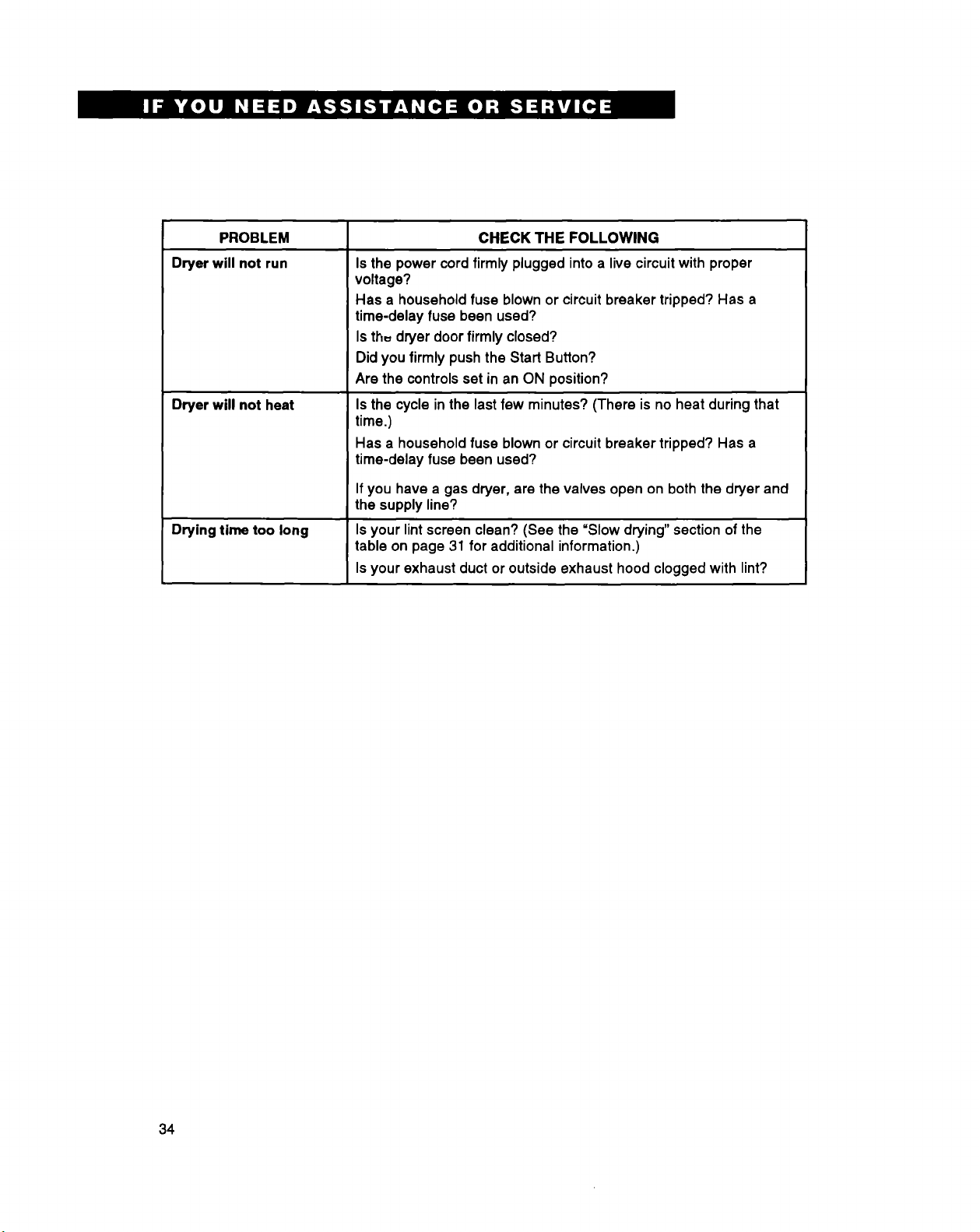
PROBLEM
Dryer will not run
Dryer will not heat
Drying time too long
CHECK THE FOLLOWING
Is the power cord firmly plugged into a live circuit with proper
voltage?
Has a household fuse blown or circuit breaker tripped? Has a
time-delay fuse been used?
Is the dryer door firmly closed?
Did you firmly push the Start Button?
Are the controls set in an ON position?
Is the cycle in the last few minutes? (There is no heat during that
time.)
Has a household fuse blown or circuit breaker tripped? Has a
time-delay fuse been used?
If you have a gas dryer, are the valves open on both the dryer and
thesupply line?
Is your lint screen clean? (See the =Slowdrying" section ofthe
table on page 31 for additionalinformation.)
Isyour exhaust ductor outside exhaust hood cloggedwith lint?
34
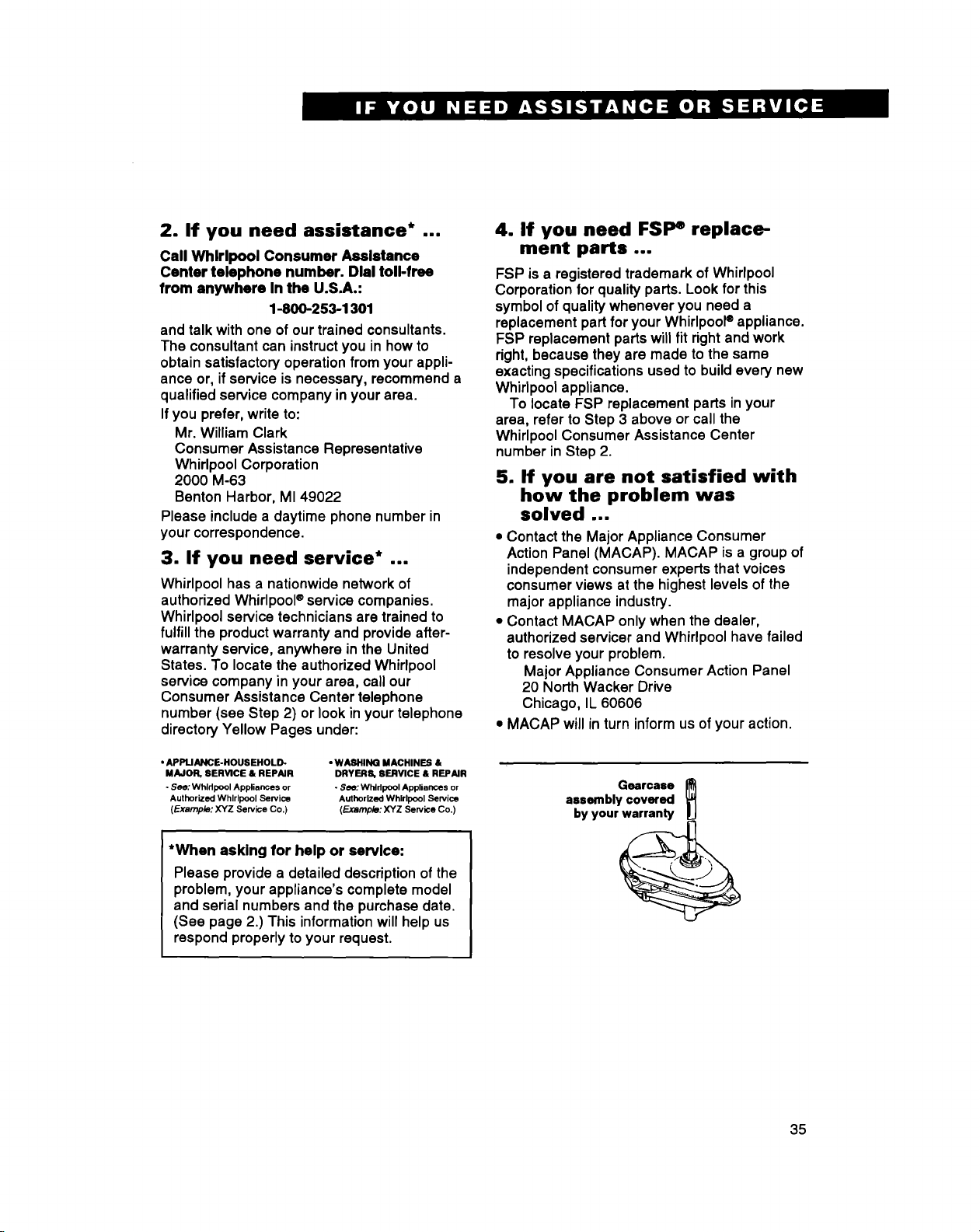
2. If you need assistance* ...
Call Whirlpool Consumer Assistance
Center telephone number. Dial toll-free
from anywhere In the U.S.A.:
1-800-253-1301
and talkwith one of ourtrained consultants.
The consultantcan instructyou in howto
obtainsatisfactoryoperation from your appli-
ance or, ifservice is necessary, recommenda
qualifiedservice company inyourarea.
Ifyou prefer, write to:
Mr. William Clark
Consumer AssistanceRepresentative
WhirlpoolCorporation
2000 M-63
Benton Harbor, MI 49022
Please includea daytime phone number in
yourcorrespondence.
3. If you need service* ...
Whirlpool has a nationwidenetworkof
authorizedWhirlpool®service companies.
Whirlpoolservice techniciansare trained to
fulfill the productwarranty and provideafter-
warranty service,anywhere in the United
States. To locatethe authorizedWhirlpool
service company inyour area, call our
Consumer AssistanceCenter telephone
number (see Step 2) or lookin yourtelephone
directoryYellow Pages under:
• APPLIANCE-HOUSEHOLD-
MAJOR, SERVICE & REPAIR
. See: Whirlpool Appliances or
Authorized Whirlpool Servi_
(Example: XYZ Service Co.)
• WAmtlNG MACHINES &
DRYERS, SERVICE & REPAIR
. See: Whirlpool Appliances or
Authorized Whirlpool ServJol)
(Example: XYZ Service Co.)
*When asking for help or service:
Please provide a detailed description of the
problem,your appliance'scompletemodel
and serial numbersand the purchasedate.
(See page 2.) This informationwillhelp us
respondproperlytoyour request.
4. If you need FSP e replace-
ment parts ...
FSP is a registeredtrademarkof Whirlpool
Corporationfor qualityparts. Lookfor this
symbolofqualitywhenever you need a
replacement part for your Whirlpoole appliance.
FSP replacement partswillfit rightandwork
right,because theyare made to the same
exactingspecificationsused to buildevery new
Whirlpoolappliance.
To locate FSP replacement parts in your
area, refer to Step 3 above or call the
WhirlpoolConsumerAssistanceCenter
number inStep 2.
5. If you are not satisfied with
how the problem was
solved ...
• Contactthe Major Appliance Consumer
Action Panel (MACAP). MACAP is a group of
independentconsumerexperts thatvoices
consumer viewsat the highestlevels of the
majorappliance industry.
• ContactMACAP onlywhen the dealer,
authorizedservicerand Whirlpoolhave failed
toresolveyour problem.
Major Appliance ConsumerAction Panel
20 North Wacker Drive
Chicago, IL 60606
• MACAP willin turn informusofyour action.
Gearcase
assembly covered
by your warranty
35
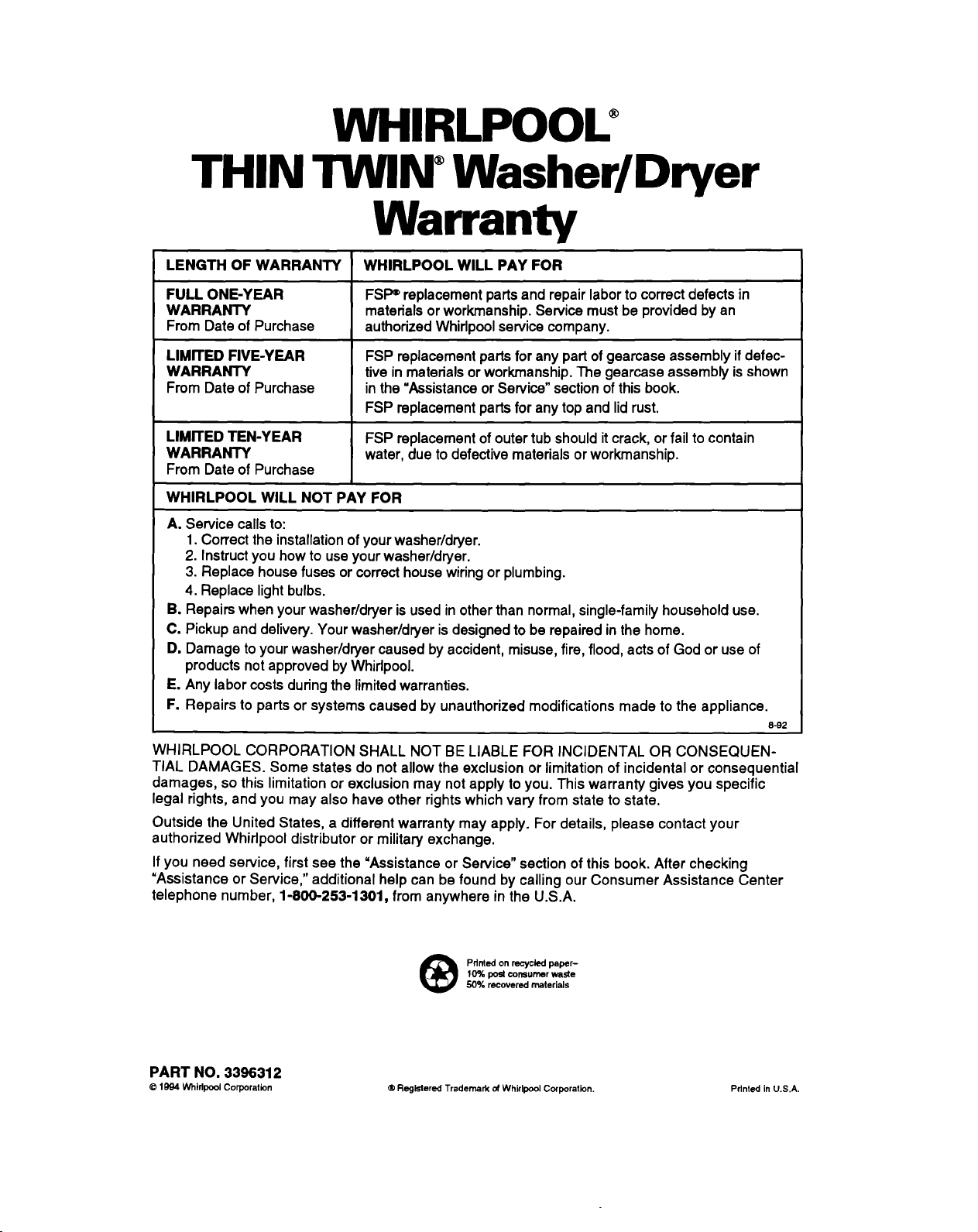
WHIRLPOOU
THIN TWIN *Washer/Dryer
Warranty
LENGTH OF WARRANTY WHIRLPOOL WILL PAY FOR
FULL ONE-YEAR FSI:_ replacement parts and repair labor to correct defects in
WARRANTY materials or workmanship. Service must be provided by an
From Date of Purchase authorized Whirlpool service company.
LIMITED FIVE-YEAR FSP replacement parts for any part of gearcase assembly if defec-
WARRANTY tive in materials or workmanship. The gearcase assembly is shown
From Date of Purchase in the "Assistance or Service" section of this book.
FSP replacement parts for any top and lid rust.
LIMITED TEN-YEAR FSP replacement of outer tub should it crack, or fail to contain
WARRANTY water, due to defective materials or workmanship.
From Date of Purchase
WHIRLPOOL WILL NOT PAY FOR
A. Service calls to:
1. Correct the installation of your washer/dryer.
2. Instruct you how to use your washer/dryer.
3. Replace house fuses or correct house wiring or plumbing.
4. Replace light bulbs.
Repairs when your washer/dryer is used in other than normal, single-family household use.
Pickup and delivery. Your washer/dryer is designed to be repaired in the home.
Damage to your washer/dryer caused by accident, misuse, fire, flood, acts of God or use of
products not approved by Whirlpool.
Any labor costs during the limited warranties.
Repairs to parts or systems caused by unauthorized modifications made to the appliance.
8-82
BI
C.
D,
E,
F.
WHIRLPOOL CORPORATION SHALL NOT BE LIABLE FOR INCIDENTAL OR CONSEQUEN-
TIAL DAMAGES. Some states do not allow the exclusion or limitation of incidental or consequential
damages, so this limitation or exclusion may not apply to you. This warranty gives you specific
legal rights, and you may also have other rights which vary from state to state.
Outside the United States, a different warranty may apply. For details, please contact your
authorized Whirlpool distributor or military exchange.
If you need service, first see the =Assistance or Service" section of this book. After checking
=Assistance or Service," additional help can be found by calling our Consumer Assistance Center
telephone number, 1-800-253-1301, from anywhere in the U.S.A.
_) Pdnted on recycled paper-
10% post consumer waste
;50% recovered materials
PART NO. 3396312
© 1994 Whirlpool Corporation ® Registered Trademark of Whirlpool Corporation. Printed in U.S.A.