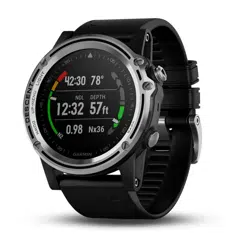
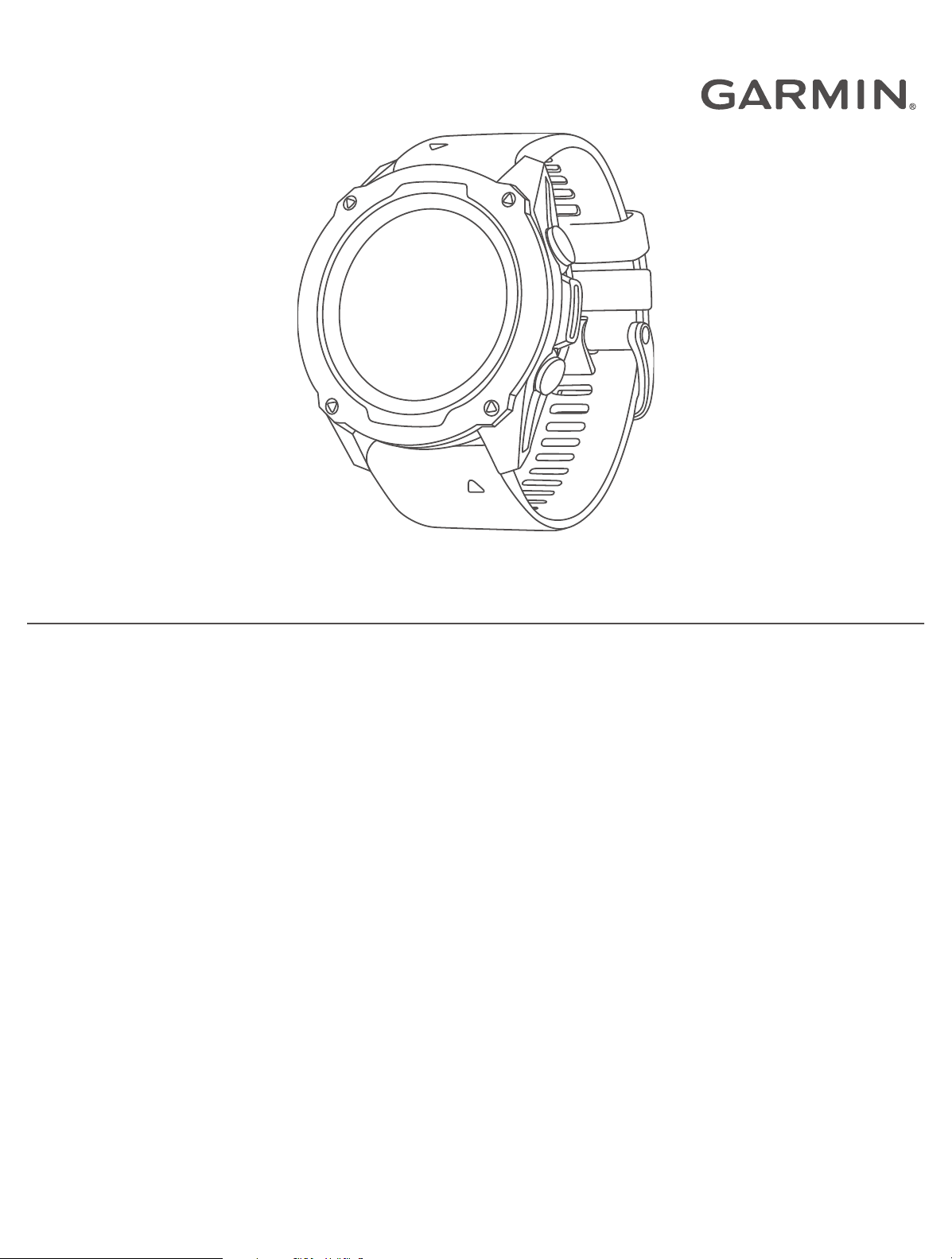
DESCENT
™
G1 SERIES
Owner’s Manual

© 2022 Garmin Ltd. or its subsidiaries
All rights reserved. Under the copyright laws, this manual may not be copied, in whole or in part, without the written consent of Garmin. Garmin reserves the right to change or
improve its products and to make changes in the content of this manual without obligation to notify any person or organization of such changes or improvements. Go to
www.garmin.com for current updates and supplemental information concerning the use of this product.
Garmin
®
, the Garmin logo, ANT+
®
, Approach
®
, Auto Lap
®
, Auto Pause
®
, Edge
®
, inReach
®
, QuickFit
®
, TracBack
®
, VIRB
®
, Virtual Partner
®
, and Xero
®
are trademarks of Garmin Ltd. or its
subsidiaries, registered in the USA and other countries. Descent
™
, Body Battery
™
, Connect IQ
™
, Firstbeat Analytics
™
, Garmin Connect
™
, Garmin AutoShot
™
, Garmin Dive
™
, Garmin
Explore
™
, Garmin Express
™
, Garmin Golf
™
, Garmin Index
™
, Garmin Pay
™
, Health Snapshot
™
, HRM-Dual
™
, HRM-Pro
™
, HRM-Run
™
, HRM-Swim
™
, HRM-Tri
™
, Rally
™
, tempe
™
,
TrueUp
™
, and Vector
™
are trademarks of Garmin Ltd. or its subsidiaries. These trademarks may not be used without the express permission of Garmin.
Android
™
is a trademark of Google LLC. Apple
®
, iPhone
®
, and Mac
®
are trademarks of Apple Inc., registered in the U.S. and other countries. The BLUETOOTH
®
word mark and logos
are owned by the Bluetooth SIG, Inc. and any use of such marks by Garmin is under license. The Cooper Institute
®
, as well as any related trademarks, are the property of The Cooper
Institute. iOS
®
is a registered trademark of Cisco Systems, Inc. used under license by Apple Inc. Surfline
™
, the Surfline word mark, and related logos are trademarks of Surfline
\Wavetrak, Inc. registered in the United States and other countries. Training Stress Score
™
(TSS), Intensity Factor
™
(IF), and Normalized Power
™
(NP) are trademarks of Peaksware,
LLC. Windows
®
is a registered trademark of Microsoft Corporation in the United States and other countries. Zwift
™
is a trademark of Zwift, Inc. Other trademarks and trade names are
those of their respective owners.
This product is ANT+
®
certified. Visit www.thisisant.com/directory for a list of compatible products and apps.

Table of Contents
Introduction......................................1
Getting Started........................................ 1
Device Overview.................................. 2
Using the Watch.................................. 3
Clocks.............................................. 3
Setting an Alarm...................................... 4
Starting the Countdown Timer............... 4
Saving a Quick Timer.......................... 5
Deleting a Timer.................................. 5
Using the Stopwatch............................... 6
Adding Alternate Time Zones.................7
Diving............................................... 7
Dive Warnings..........................................8
Dive Modes.............................................. 9
Using the Pool Dive Mode................... 9
Dive Setup.............................................. 10
Setting Up Your Breathing Gases..... 11
Setting PO2 Thresholds.................... 12
Setting CCR Setpoints....................... 13
No-Fly Time........................................14
Dive Data Screens................................. 14
Single-Gas and Multi-Gas Data
Screens.............................................. 15
CCR Data Screens............................. 17
Gauge Data Screens..........................19
Apnea Data Screens.......................... 20
Apnea Hunt Data Screens.................22
Going Diving.......................................... 24
Navigating with the Dive Compass.. 25
Using the Gauge Dive Stopwatch..... 26
Using the Basic Dive Stopwatch.......27
Switching Gases During a Dive.........27
Switching Between CC and OC Diving
for a Bailout Procedure..................... 28
Performing a Safety Stop..................29
Performing a Decompression Stop..30
Viewing the Surface Interval Glance.... 31
Viewing the Dive Log Glance................ 31
Dive Planning......................................... 32
Calculating NDL Time....................... 32
Creating a Decompression Plan....... 33
Using Decompression Plans............ 33
Altitude Diving....................................... 34
Tips for Wearing the Device with an
Exposure Suit........................................ 34
Dive Alerts..............................................35
Dive Terminology.................................. 37
Activities and Apps.........................37
Starting an Activity................................ 38
Tips for Recording Activities............ 38
Stopping an Activity.............................. 39
Running.................................................. 39
Going for a Track Run....................... 40
Tips for Recording a Track Run.... 40
Going for a Virtual Run...................... 41
Calibrating the Treadmill Distance... 41
Swimming.............................................. 42
Swim Terminology............................ 42
Stroke Types...................................... 43
Tips for Swimming Activities............43
Auto Rest and Manual Rest.............. 44
Training with the Drill Log................. 44
Multisport.............................................. 45
Triathlon Training.............................. 45
Creating a Multisport Activity........... 46
Indoor Activities.................................... 46
Recording a Strength Training
Activity............................................... 47
Recording a HIIT Activity.................. 48
Using an ANT+® Indoor Trainer....... 49
Climbing Sports..................................... 49
Recording an Indoor Climbing
Activity............................................... 50
Recording a Bouldering Activity....... 51
Starting an Expedition...........................52
Recording a Track Point Manually... 52
Viewing Track Points........................ 53
Going Hunting....................................... 53
Going Fishing.........................................54
Skiing..................................................... 54
Viewing Your Ski Runs...................... 55
Recording a Backcountry Skiing
Activity............................................... 55
Golfing................................................... 56
Playing Golf........................................57
Golf Menu.......................................... 58
Viewing Hazards............................... 59
Moving the Flag................................. 60
Changing Holes................................. 60
Table of Contents i

Viewing Measured Shots.................. 61
Manually Measuring a Shot.......... 61
Keeping Score................................... 62
Enabling Statistics Tracking......... 62
Surfing....................................................63
Viewing Tide Information..................... 64
Customizing Activities and Apps......... 65
Adding or Removing a Favorite
Activity............................................... 65
Changing the Order of an Activity in
the Apps List...................................... 66
Customizing the Data Screens......... 66
Adding a Map to an Activity.......... 67
Creating a Custom Activity............... 67
Activities and App Settings...............68
Activity Alerts................................. 70
Enabling Auto Climb...................... 72
Changing the GPS Setting............. 73
Training..........................................73
Workouts............................................... 74
Following a Workout From Garmin
Connect.............................................. 74
Starting a Workout............................ 75
Following a Daily Suggested
Workout..............................................75
Creating an Interval Workout............ 76
Starting an Interval Workout............. 76
About the Training Calendar............. 77
Using Garmin Connect Training
Plans...............................................77
PacePro Training...................................78
Downloading a PacePro Plan from
Garmin Connect.................................78
Starting a PacePro Plan.................... 79
Using Virtual Partner®.......................... 80
Setting a Training Target...................... 81
Racing a Previous Activity.................... 82
History........................................... 82
Using History......................................... 83
Multisport History..............................83
Personal Records.................................. 84
Viewing Your Personal Records....... 84
Restoring a Personal Record............ 85
Clearing Personal Records............... 85
Viewing Data Totals.............................. 86
Using the Odometer.............................. 86
Deleting History..................................... 87
Appearance.................................... 87
Watch Face Settings............................. 87
Customizing the Watch Face............88
Glances.................................................. 89
Viewing the Glance Loop.................. 91
Customizing the Glance Loop.......... 92
Body Battery...................................... 92
Tips for Improved Body Battery
Data................................................ 93
Performance Measurements............93
About VO2 Max. Estimates........... 94
Viewing Your Predicted Race
Times..............................................95
Performance Condition................. 96
Getting Your FTP Estimate........... 97
Lactate Threshold......................... 98
Training Status................................ 100
Training Status Levels.................101
Heat and Altitude Performance
Acclimation.................................. 102
Training Load............................... 103
Recovery Time............................. 105
Pausing and Resuming Your
Training Status............................ 106
Controls............................................... 107
Customizing the Controls Menu.... 109
Music Playback Controls................ 110
Garmin Pay...................................... 110
Setting Up Your Garmin Pay
Wallet........................................... 111
Paying for a Purchase Using Your
Watch........................................... 111
Adding a Card to Your Garmin Pay
Wallet........................................... 112
Changing Your Garmin Pay
Passcode..................................... 113
Sensors and Accessories............. 113
Wrist Heart Rate.................................. 113
Wearing the Watch.......................... 114
Tips for Erratic Heart Rate Data..... 115
Wrist Heart Rate Monitor Settings. 115
Setting an Abnormal Heart Rate
Alert.............................................. 116
Broadcasting Heart Rate Data.... 117
ii Table of Contents

Pulse Oximeter.................................... 117
Getting Pulse Oximeter Readings.. 118
Setting the Pulse Oximeter Mode.. 118
Tips for Erratic Pulse Oximeter
Data.................................................. 119
Compass............................................. 119
Compass Settings........................... 120
Calibrating the Compass
Manually.......................................120
Setting the North Reference....... 121
Altimeter and Barometer.................... 121
Altimeter Settings........................... 122
Calibrating the Barometric
Altimeter...................................... 122
Barometer Settings......................... 123
Calibrating the Barometer...........123
Wireless Sensors................................ 124
Pairing Your Wireless Sensors....... 125
Running Dynamics.......................... 126
Training with Running Dynamics 127
Tips for Missing Running Dynamics
Data.............................................. 127
inReach Remote.............................. 128
Using the inReach Remote..........128
VIRB Remote................................... 129
Controlling a VIRB Action
Camera......................................... 129
Controlling a VIRB Action Camera
During an Activity........................ 130
Xero Laser Location Settings......... 131
Map.............................................. 131
Panning and Zooming the Map..........132
Map Settings....................................... 132
Phone Connectivity Features........ 133
Pairing Your Phone with Your Watch.133
Enabling Bluetooth Notifications... 134
Viewing Notifications.................. 134
Receiving an Incoming Phone
Call................................................135
Replying to a Text Message....... 135
Managing Notifications.............. 136
Turning Off the Bluetooth Phone
Connection...................................... 136
Turning On and Off Phone Connection
Alerts................................................ 136
Phone Apps and Computer
Applications........................................ 137
Garmin Connect.............................. 137
Using the Garmin Connect App.. 138
Using Garmin Connect on Your
Computer..................................... 139
Connect IQ Features....................... 140
Downloading Connect IQ
Features....................................... 141
Downloading Connect IQ Features
Using Your Computer.................. 141
Garmin Dive App..............................142
Garmin Explore™..............................142
Garmin Golf™ App........................... 143
User Profile.................................. 143
Setting Up Your User Profile...............143
Viewing Your Fitness Age...................144
About Heart Rate Zones..................... 144
Fitness Goals................................... 145
Setting Your Heart Rate Zones....... 146
Letting the Watch Set Your Heart Rate
Zones............................................... 147
Heart Rate Zone Calculations........ 147
Setting Your Power Zones.................. 148
Safety and Tracking Features....... 149
Adding Emergency Contacts..............149
Adding Contacts................................. 150
Turning Incident Detection On and
Off........................................................ 150
Requesting Assistance....................... 151
Health and Wellness Settings....... 151
Auto Goal............................................. 152
Using the Move Alert.......................... 152
Intensity Minutes.................................153
Earning Intensity Minutes............... 153
Sleep Tracking.....................................154
Using Automated Sleep Tracking...154
Navigation.................................... 154
Viewing and Editing Your Saved
Locations............................................. 155
Navigating to a Destination................ 155
Navigating to the Starting Point of a
Saved Activity.................................. 156
Table of Contents iii

Navigating to Your Starting Point
During an Activity............................ 157
Navigating with Sight 'N Go............ 158
Marking and Starting Navigation to a
Man Overboard Location................ 158
Stopping Navigation........................... 159
Courses................................................159
Creating and Following a Course on
Your Device...................................... 160
Creating a Course on Garmin
Connect............................................160
Sending a Course to Your
Device...........................................161
Viewing or Editing Course Details.. 161
Projecting a Waypoint.........................162
Navigation Settings.............................162
Customizing Navigation Data
Screens............................................ 163
Heading Settings............................. 163
Setting Navigation Alerts................ 164
Power Manager Settings.............. 164
Customizing the Battery Saver
Feature................................................. 165
Changing the Power Mode................. 165
Customizing Power Modes................ 166
Restoring a Power Mode.................... 166
System Settings........................... 167
Time Settings...................................... 168
Setting Time Alerts......................... 168
Syncing the Time.............................169
Changing the Screen Settings............ 169
Customizing the Hot Keys.................. 170
Changing the Units of Measure......... 170
Syncing Activities and Performance
Measurements.................................... 171
Viewing Device Information............... 171
Viewing E-label Regulatory and
Compliance Information................. 172
Device Information....................... 172
Charging the Watch............................ 173
Solar Charging................................. 173
Tips for Solar Charging............... 174
Specifications......................................175
Battery Life Information.................. 176
Device Care......................................... 177
Cleaning the Watch......................... 177
Changing the QuickFit® Bands.......... 178
Changing the Spring Bar Bands......... 179
Data Management.............................. 180
Deleting Files................................... 181
Troubleshooting........................... 181
Product Updates................................. 182
Getting More Information................... 182
My device is in the wrong language...183
Is my phone compatible with my
watch?................................................. 183
My phone will not connect to the
watch................................................... 184
Can I use my Bluetooth sensor with my
watch?................................................. 184
Restarting Your Watch........................ 185
Resetting All Default Settings............ 185
Diving................................................... 185
Resetting Your Tissue Load........... 186
Resetting the Surface Pressure......186
Tips for Maximizing the Battery Life..187
Acquiring Satellite Signals..................187
Improving GPS Satellite Reception 188
The temperature reading is not
accurate............................................... 188
Activity Tracking................................. 188
My daily step count does not
appear.............................................. 189
My step count does not seem
accurate........................................... 189
The step counts on my device and my
Garmin Connect account don't
match............................................... 190
The floors climbed amount does not
seem accurate................................. 190
Appendix...................................... 190
Data Fields...........................................191
Color Gauges and Running Dynamics
Data......................................................204
Ground Contact Time Balance
Data.................................................. 205
Vertical Oscillation and Vertical Ratio
Data.................................................. 206
VO2 Max. Standard Ratings............... 207
FTP Ratings......................................... 208
iv Table of Contents


Title Introduction - fitness
Identifier GUID-8B9070D6-C0EA-45EE-8F62-1602492BF264
Language EN-US
Description No index entries necessary.
Version 1
Revision 4
Changes This was created because the other introduction topic had a bad conref and Kelly thought the order of
the warnings should change.
Status Released
Last Modified 22/04/2017 23:00:50
Author wiederan
Introduction
WARNING
See the Important Safety and Product Information guide in the product box for product warnings and other
important information.
Always consult your physician before you begin or modify any exercise program.
Title Getting Started (fenix 6)
Identifier GUID-8E59FFB5-8C89-49A0-B2F0-8B0A5921042C
Language EN-US
Description
Version 2
Revision 3
Changes Removed Garmin Pay to make more generic.
Status Released
Last Modified 26/03/2020 14:31:02
Author cozmyer
Getting Started
When using your watch the first time, you should complete these tasks to set it up and get to know the basic
features.
1 Press LIGHT to turn on the watch (Device Overview, page 2).
2 Follow the on-screen instructions to complete the initial setup.
During the initial setup, you can pair your smartphone with your watch to receive notifications, sync your
activities, and more (Pairing Your Phone with Your Watch, page 133).
3 Charge the device (Charging the Watch, page 173).
4 Start an activity (Starting an Activity, page 38).
Introduction 1
Title Device Overview (Descent G1)
Identifier GUID-F473FABC-5D21-4F2C-8328-457333B68C3E
Language EN-US
Description
Version 1
Revision 3
Changes Save as from fenix 6. Different hold functions.
Status Released
Last Modified 29/09/2021 16:27:07
Author cozmyer
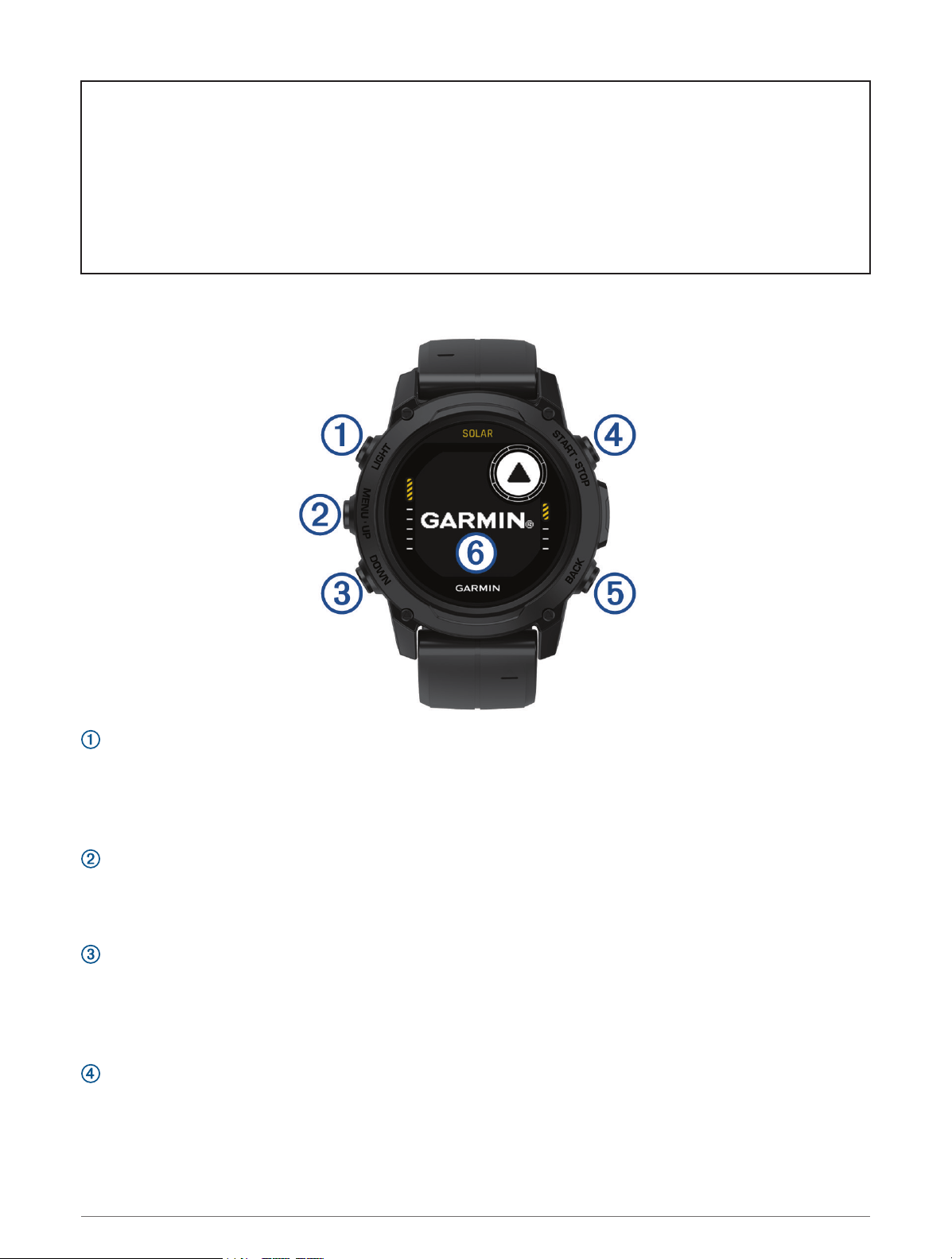
Device Overview
LIGHT
• Press to turn the backlight on and off.
• Press to turn the device on.
• Hold to view the controls menu.
NOTE: While diving, hold functions are disabled.
MENU·UP
• Press to scroll through the glance loop and menus.
• Hold to view the menu.
NOTE: You can enable or disable this button for dive activities (Dive Setup, page 10).
DOWN
• Press to scroll through the glance loop and menus.
• Press to scroll through the data screens during a dive.
• Hold to view the altimeter, barometer, and compass (ABC) screen.
NOTE: While diving, hold functions are disabled.
START·STOP
• Press to view the activity list and start or stop an activity.
• Press to choose an option in a menu.
2 Introduction
• Press to view the menu during a dive.
• Hold to view the clock menu.
NOTE: While diving, hold functions are disabled.
BACK
• Press to return to the previous screen.
• Press to exit a menu during a dive.
• Press to record a lap, rest, or transition during a multisport activity.
• Hold to view the watch face from any screen.
• Hold to return to the primary data screen during a dive.
: Double tap the device to scroll through the data screens during a dive.
Title Using the Watch (fenix)
Identifier GUID-0102B2DF-D808-474D-9F45-57D15C42C640
Language EN-US
Description
Version 4
Revision 4
Changes Added links
Status Released
Last Modified 22/12/2021 14:18:48
Author cozmyer
Using the Watch
• Hold LIGHT to view the controls menu (Controls, page 107).
The controls menu provides quick access to frequently used functions, such as turning on do not disturb
mode, saving a location, and turning the watch off.
• From the watch face, press UP or DOWN to scroll through the glance loop (Glances, page 89).
• From the watch face, press START to start an activity or open an app (Activities and Apps, page 37).
• Hold MENU to customize the watch face (Customizing the Watch Face, page 88), adjust settings (System
Settings, page 167), pair wireless sensors (Pairing Your Wireless Sensors, page 125), and more.
Title Clocks
Identifier GUID-78FE6EF5-ADA1-4B21-9861-40107E30886E
Language EN-US
Description
Version 2
Revision 3
Changes New Clocks menu for MARQ, fenix 6
Status Released
Last Modified 26/02/2019 12:52:39
Author gerson
Clocks
Clocks 3
Title Setting an Alarm (Instinct)
Identifier GUID-830F7BD7-E27E-410E-A69E-96EFD4BED988
Language EN-US
Description
Version 2
Revision 3
Changes Update for change to maximum number of alarms
Status Released
Last Modified 22/07/2019 09:13:54
Author tillmonmartha
Setting an Alarm
You can set multiple alarms. You can set each alarm to sound once or to repeat regularly.
1 From any screen, hold START.
2 Select Alarms.
3 Enter the alarm time.
4 Select Repeat, and select when the alarm should repeat (optional).
5 Select Sound and Vibe, and select a type of notification (optional).
6 Select Backlight > On to turn on the backlight with the alarm (optional).
7 Select Label, and select a description for the alarm (optional).
Title Starting the Countdown Timer
Identifier GUID-CC7A19C6-407F-44A1-803C-C2747FA1361F
Language EN-US
Description
Version 2
Revision 6
Changes Update select to press with hard keys for consistency, update Restart string to Auto Restart, add Save
option.
Status Released
Last Modified 17/06/2020 12:03:13
Author pruekatie
Starting the Countdown Timer
1 From any screen, hold START.
2 Select Timers.
3 Enter the time.
4 If necessary, select an option to edit the timer:
• To automatically restart the timer after it expires, press UP and select Auto Restart > On.
• To select a type of notification, press UP and select Sound and Vibe.
5 Press START to start the timer.
4 Clocks
Title Saving a Quick Timer
Identifier GUID-23C196F9-B970-4582-ABEF-D0BA56476494
Language EN-US
Description
Version 1
Revision 5
Changes
Status Released
Last Modified 17/06/2020 11:46:50
Author pruekatie
Saving a Quick Timer
You can set up to ten separate quick timers.
1 From any screen, hold START.
2 Select Timers.
3 Select an option:
• To save your first quick timer, enter the time, press UP, and select Save.
• To save additional quick timers, select Add Timer, and enter the time.
Title Deleting a Timer
Identifier GUID-1875EF45-2C9A-4E39-A804-5D5938B162B6
Language EN-US
Description
Version 1
Revision 5
Changes Save as from MARQ/fenix 6.
Status Released
Last Modified 17/06/2020 11:22:34
Author pruekatie
Deleting a Timer
1 From any screen, hold START.
2 Select Timers.
3 Select a timer.
4 Press UP.
5 Select Delete.
Clocks 5
Title Using the Stopwatch
Identifier GUID-96244242-0974-4BD5-9DCE-3B1489940F08
Language EN-US
Description
Version 2
Revision 3
Changes Update select to press with hard keys for consistency.
Status Released
Last Modified 17/06/2020 11:25:22
Author pruekatie
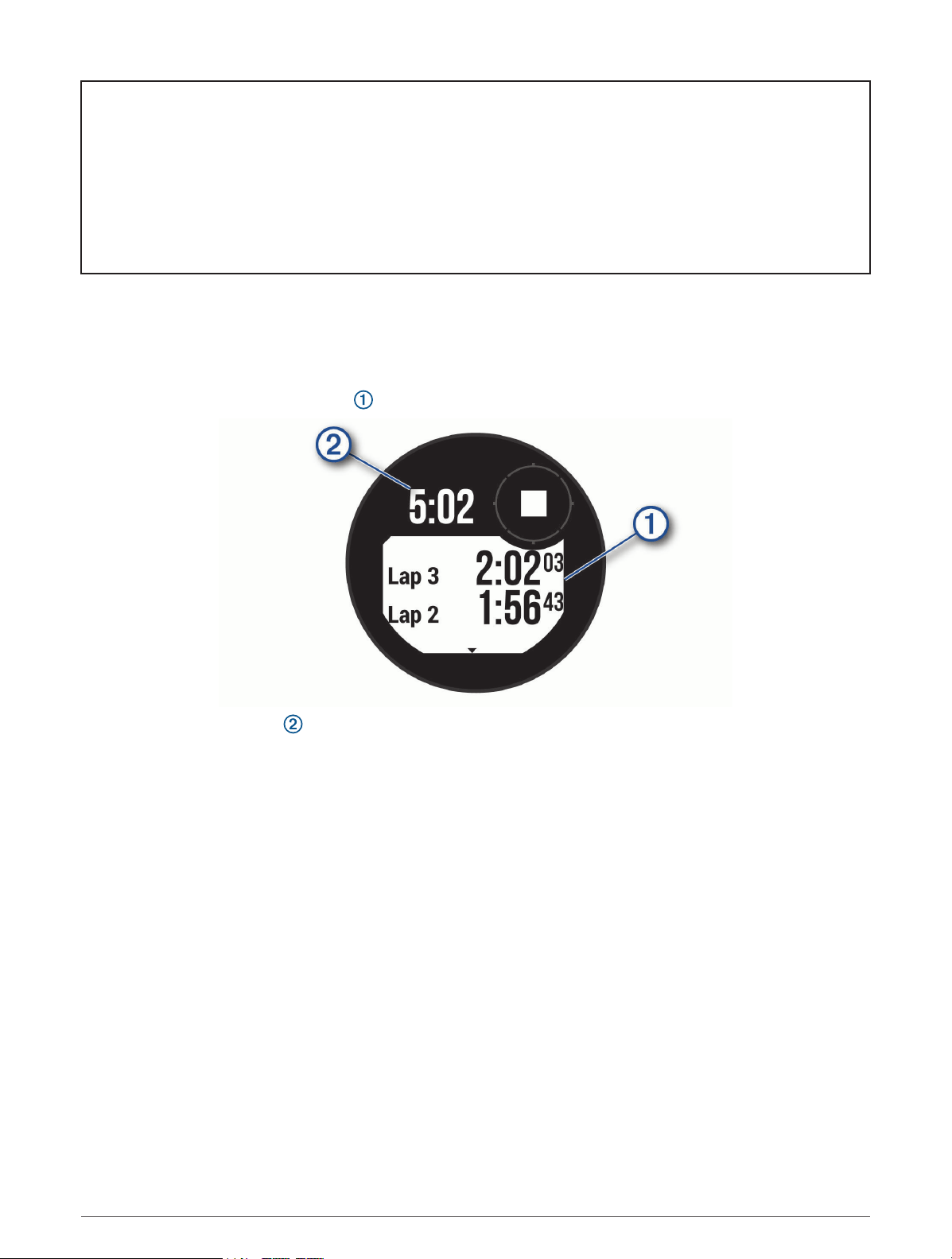
Using the Stopwatch
1 From any screen, hold START.
2 Select Stopwatch.
3 Press START to start the timer.
4 Press BACK to restart the lap timer .
The total stopwatch time continues running.
5 Press START to stop both timers.
6 Press UP, and select an option.
6 Clocks
Title Adding Alternate Time Zones
Identifier GUID-5A15CA9F-3F8A-4EB4-ADF6-DC29AB3373B1
Language EN-US
Description
Version 2
Revision 4
Changes Widget to glance
Status Released
Last Modified 20/01/2022 17:55:59
Author tillmonmartha
Adding Alternate Time Zones
You can display the current time of day in additional time zones on the alternate time zones glance. You can
add up to three alternate time zones.
1 From any screen, hold START.
2 Select Alt. Time Zones.
3 Select Add Zone.
4 Select a time zone.
5 If necessary, rename the time zone.
Title Diving
Identifier GUID-FF7B29B4-4E81-41C3-A42C-D28C88E516CF
Language EN-US
Description
Version 1
Revision 10
Changes
Status Released
Last Modified 21/09/2017 12:01:00
Author cozmyer
Diving
Diving 7
Title ISPI_Warning_Dive
Identifier GUID-F4F90D7B-97DB-456F-8774-936A3A97E6E2
Language EN-US
Description
Version 5
Revision 3
Changes Updated DCS to DCI based on SME feedback.
Status Released
Last Modified 25/04/2022 15:53:41
Author cozmyer
Dive Warnings
WARNING
• The diving features of this device are for use by certified divers only. This device should not be used as a sole
dive computer. Failure to input the appropriate dive-related information into the device can lead to serious
personal injury or death.
• Make sure that you fully understand the use, displays, and limitations of your device. If you have questions
about this manual or the device, always resolve any discrepancies or confusion before diving with the device.
Always remember that you are responsible for your own safety.
• There is always a risk of decompression illness (DCI) for any dive profile even if you follow the dive plan
provided by the dive tables or a diving device. No procedure, diving device, or dive table will eliminate the
possibility of DCI or oxygen toxicity. An individual's physiological make up can vary from day to day. This
device cannot account for these variations. You are strongly advised to remain well within the limits provided
by this device to minimize the risk of DCI. You should consult a physician regarding your fitness before
diving.
• Always use backup instruments, including a depth gauge, submersible pressure gauge, and timer or watch.
You should have access to decompression tables when diving with this device.
• Perform pre-dive safety checks, such as checking proper device function and settings, display function,
battery level, tank pressure, and bubble checks to check hoses for leaks.
• This device should not be shared between multiple users for diving purposes. Diver profiles are user specific,
and using another diver's profile can result in misleading information that could lead to injury or death.
• For safety reasons, you should never dive alone. Dive with a designated buddy. You should also stay with
others for an extended time after a dive, because the potential onset of decompression illness (DCI) may be
delayed or triggered by surface activities.
• This device is not intended for commercial or professional dive activities. It is for recreational purposes only.
Commercial or professional dive activities can expose the user to extreme depths or conditions that increase
the risk of DCI.
• Do not dive with a gas if you have not personally verified its contents and input the analyzed value to the
device. Failure to verify tank contents and input the appropriate gas values to the device will result in
incorrect dive planning information and could result in serious injury or death.
• Diving with more than one gas mixture presents a much greater risk than diving with a single gas mixture.
Mistakes related to the use of multiple gas mixtures may lead to serious injury or death.
• Always ensure a safe ascent. A rapid ascent increases the risk of DCI.
• Disabling the deco lockout feature on the device can result in an increased risk of DCI, which can result in
personal injury or death. Disable this feature at your own risk.
• Violating a required decompression stop may result in serious injury or death. Never ascend above the
displayed decompression stop depth.
• Always perform a safety stop between 3 and 5 meters (9.8 and 16.4 feet) for 3 minutes, even if no
decompression stop is required.
8 Diving
Title Dive Modes
Identifier GUID-B0F7269A-8B02-48F3-AED2-CECB581B361F
Language EN-US
Description
Version 6
Revision 3
Changes Added more context to the dive mode phases.
Status Released
Last Modified 10/02/2022 13:12:13
Author cozmyer
Dive Modes
The Descent G1 device supports six dive modes. Each dive mode has four phases: dive pre-check, surface
display, in-dive, and post-dive. During the pre-dive check, you can confirm the dive settings before you start
diving (Dive Setup, page 10). The surface phase shows the data screens for the dive mode (Dive Data Screens,
page 14). The in-dive phase shows data about the dive in progress, and other watch features, such as GPS, are
disabled (Going Diving, page 24). During the post-dive review, you can view a summary of the completed dive
(Viewing the Dive Log Glance, page 31).
Single-Gas: This mode allows you to dive with a single gas blend. You can set up to 11 additional gases as
backup gases.
Multi-Gas: This mode allows you to configure multiple gas blends and switch gases during your dive. You can
set the oxygen content from 5–100%. This mode supports one bottom gas, and up to 11 additional gases as
decompression or backup gases.
NOTE: Backup gases are not used in no-decompression limit (NDL) and time to surface (TTS)
decompression calculations until you activate them during a dive.
CCR: This mode for closed-circuit rebreather (CCR) diving allows you to configure two partial pressure of
oxygen (PO2) setpoints, closed-circuit (CC) diluent gases, and open-circuit (OC) decompression and backup
gases.
Gauge: This mode allows you to dive with basic bottom timer features.
NOTE: After diving in gauge mode, the device can only be used in gauge or apnea mode for 24 hours.
Apnea: This mode allows you to free dive with apnea-specific dive data. This mode has a higher data refresh
rate.
Apnea Hunt: This mode is similar to the Apnea dive mode, but tuned specifically for spearfishers. This mode
disables start and stop tones.
Title Using the Pool Dive Mode
Identifier GUID-2B16A10D-7213-43E3-8C8B-A57C12AF89B8
Language EN-US
Description
Version 1
Revision 4
Changes
Status Released
Last Modified 31/10/2018 14:57:23
Author cozmyer
Using the Pool Dive Mode
When the device is in pool dive mode, the tissue load and decompression lockout features function normally,
but dives are not saved to the dive log.
1 Hold LIGHT to view the controls menu.
2 Select
.
The pool dive mode turns off automatically at midnight.
Diving 9
Title Dive Setup
Identifier GUID-6EC422C5-43A9-4430-BAAA-90331551BE42
Language EN-US
Description
Version 7
Revision 3
Changes Added more info about custom alerts.
Status Released
Last Modified 25/04/2022 15:58:53
Author cozmyer
Dive Setup
You can customize the dive settings based on your needs. Not all settings are applicable for all dive modes. You
can also edit the settings before you start a dive.
Hold MENU, and select Dive Setup.
Gases: Sets the gas blends used in the gas dive modes (Setting Up Your Breathing Gases, page 11). You can
have up to twelve gases for each gas dive mode.
Conservatism: Sets the level of conservatism for decompression calculations. Higher conservatism provides a
shorter bottom time and a longer ascent time. The Custom option allows you to set a custom gradient factor.
NOTE: Make sure you understand gradient factors before entering a custom level of conservatism.
Water Type: Allows you to select the water type.
PO2: Sets the partial pressure of oxygen (PO2) thresholds, in bar, for decompression, warnings, and critical
alerts (Setting PO2 Thresholds, page 12).
Alerts: Allows you to set custom alerts for depth and time. You can customize the alert sounds, enable pop-up
notifications, and create different alerts for different dive modes.
Apnea Surf. Alert: Allows you to set alerts for apnea surface intervals.
Safety Stop: Allows you to change the safety stop duration.
Last Deco Stop: Allows you to set the depth of the final decompression stop.
End Dive Delay: Allows you to set the length of time before the device ends and saves a dive after surfacing.
CCR Setpoints: Allows you to set high and low PO2 setpoints for closed-circuit rebreather (CCR) dives (Setting
CCR Setpoints, page 13).
Backlight: Allows you to adjust the backlight settings for dive activities. You can enable the backlight
throughout the dive or only when you are at depth.
Heart Rate: Allows you to enable or disable a heart rate monitor for dives. The Stored Strap Data option allows
you to enable a chest heart rate monitor, such as the HRM-Swim
™
or HRM-Tri
™
device, that stores heart rate
data with the dive. You can view chest heart rate monitor data in the Garmin Dive
™
app after you complete the
dive.
Double Tap to Scroll: Allows you to double tap the device to scroll through the dive data screens. If you notice
accidental scrolling, you can use the Sensitivity option to adjust the responsiveness.
UP Key: Allows you to enable or disable the UP button during dive activities to prevent inadvertent button
presses.
Silent Diving: Allows you to disable all tones and vibrations for alerts during dive activities.
No-Fly Time: Allows you to set the no-fly countdown timer mode (No-Fly Time, page 14).
Deco Lockout: Allows you to disable the decompression lockout feature. This feature prevents single-gas, multi-
gas, and CCR dives for 24 hours if you violate a decompression ceiling for more than three minutes.
NOTE: You can still disable the decompression lockout feature after violating a decompression ceiling.
10 Diving
Title Setting Up Your Breathing Gases
Identifier GUID-11057310-4E1D-4116-9BFB-EE5A57442196
Language EN-US
Description
Version 1
Revision 6
Changes Broke this info out of the Dive Setup topic.
Status Released
Last Modified 21/07/2020 16:25:20
Author cozmyer
Setting Up Your Breathing Gases
You can enter up to twelve gases for each gas dive mode. Decompression calculations include your
decompression gases, but do not include your backup gases.
1 Hold MENU.
2 Select Dive Setup > Gases.
3 Select a dive mode.
4 Select the first gas in the list.
For single-gas or multi-gas dive modes, this is the bottom gas. For the closed-circuit rebreather (CCR) dive
mode, this is the diluent gas.
5 Select Oxygen, and enter the oxygen percentage of the gas blend.
6 Select Helium, and enter the helium percentage of the gas blend.
The device calculates the remaining percentage as the nitrogen content.
7 Press BACK.
8 Select an option:
NOTE: Not all options are available for all dive modes.
• Select Add Backup, and enter the oxygen and helium percentage for your backup gas.
• Select Add New, enter the oxygen and helium percentage, and select Mode to set the intended use for the
gas, such as decompression or backup.
NOTE: For the multi-gas dive mode, you can select Set as Travel Gas to set a decompression gas as your
intended gas for descending.
Diving 11
Title Setting PO2 Thresholds
Identifier GUID-26B379F1-DFB8-488C-956F-0FA0E9CDD39B
Language EN-US
Description
Version 1
Revision 9
Changes
Status Released
Last Modified 21/07/2020 16:26:03
Author cozmyer
Setting PO2 Thresholds
You can configure the partial pressure of oxygen (PO2) thresholds, in bars, for decompression, warning, and
critical alerts.
1 Hold MENU.
2 Select Dive Setup > PO2.
3 Select an option:
• Select Deco PO2 to set the threshold that you can reach before you should begin your ascent and switch
to the decompression gas with the highest percentage of oxygen.
NOTE: The device does not switch gases for you automatically. You must select the gas.
• Select PO2 Warning to set the threshold for the highest oxygen concentration level that you are
comfortable reaching.
• Select PO2 Critical to set the threshold for the maximum oxygen concentration level that you should
reach.
4 Enter a value.
If you reach a threshold value during a dive, the device displays an alert message.
12 Diving
Title Setting CCR Setpoints
Identifier GUID-186BE525-8FDC-405E-B3DA-CFDCC9B69939
Language EN-US
Description
Version 2
Revision 4
Changes Added the last step to set depth.
Status Released
Last Modified 27/04/2021 15:01:54
Author cozmyer
Setting CCR Setpoints
You can configure the high and low partial pressure of oxygen (PO2) setpoints for closed-circuit rebreather
(CCR) dives.
1 Hold MENU.
2 Select Dive Setup > CCR Setpoints.
3 Select an option:
• To configure the lower PO2 setpoint, select Low Setpoint.
• To configure the upper PO2 setpoint, select High Setpoint.
4 Select Mode.
5 Select an option:
• To automatically change the setpoint based on your current depth, select Auto.
NOTE: For example, if you descend through the high setpoint depth or ascend through the low setpoint
depth, the PO2 threshold switches to the high or low setpoint, respectively. Automatic setpoint depths
must be at least 6.1 m (20 ft.) apart.
• To manually change setpoints during a dive, select Manual.
NOTE: If you manually change setpoints within 1.8 m (6 ft.) of an automatic switch depth, then automatic
setpoint switching is disabled until you are more than 1.8 m (6 ft.) above or below the automatic switch
depth. This prevents unintended setpoint switching.
6 Select PO2, and enter a value.
7 If necessary, select Depth, and enter a depth value for the automatic setpoint change.
Diving 13
Title No-Fly Time
Identifier GUID-96AE8D7C-9677-47EF-89CF-CEB040B8F497
Language EN-US
Description
Version 3
Revision 6
Changes Major updates to the no-fly timer.
Status Released
Last Modified 10/02/2022 13:09:53
Author cozmyer
No-Fly Time
After a dive, you may need to wait several hours before it is safe to fly on an airplane. To indicate your remaining
no-fly time, appears on the default watch face. You can view more details on the surface interval glance
(Viewing the Surface Interval Glance, page 31).
Hold MENU, and select Dive Setup > No-Fly Time.
No-Fly Time Mode Dive Type No-Fly Time
Standard or 24 Hours Dive duration of 3 minutes or less or depth of 5 m (15 ft.) or less. 0 hours
Standard Non-decompression dive more than 48 hours since the previous dive. 12 hours
Standard Multiple non-decompression dives within 48 hours. 18 hours
Standard Dive with a completed decompression stop. 24 hours
24 Hours Non-gauge dive that did not violate the decompression plan. 24 hours
Standard or 24 Hours Gauge dive or a dive that violated the decompression plan. 48 hours
Title Dive Data Screens
Identifier GUID-B6CFA012-37CE-45E2-AC72-6E78ACB01316
Language EN-US
Description
Version 3
Revision 3
Changes Removed text descriptions and broke out new sub-topics with images of the data screen loops.
Status Released
Last Modified 21/07/2020 16:28:42
Author cozmyer
Dive Data Screens
You can press DOWN or double-tap the device to scroll through the data screens.
In the activity settings, you can reorder the default data screens, add a dive stopwatch, and add custom data
screens (Customizing the Data Screens, page 66). You can customize the data fields on some of the data
screens.
14 Diving
Title Single-Gas and Multi-Gas Data Screens (Descent G1)
Identifier GUID-ABED36DD-AC1A-4517-BB8A-DCE5CFA338A5
Language EN-US
Description
Version 1
Revision 12
Changes Save as from the Mk2 topic.
Status Released
Last Modified 10/02/2022 13:07:05
Author cozmyer
Single-Gas and Multi-Gas Data Screens
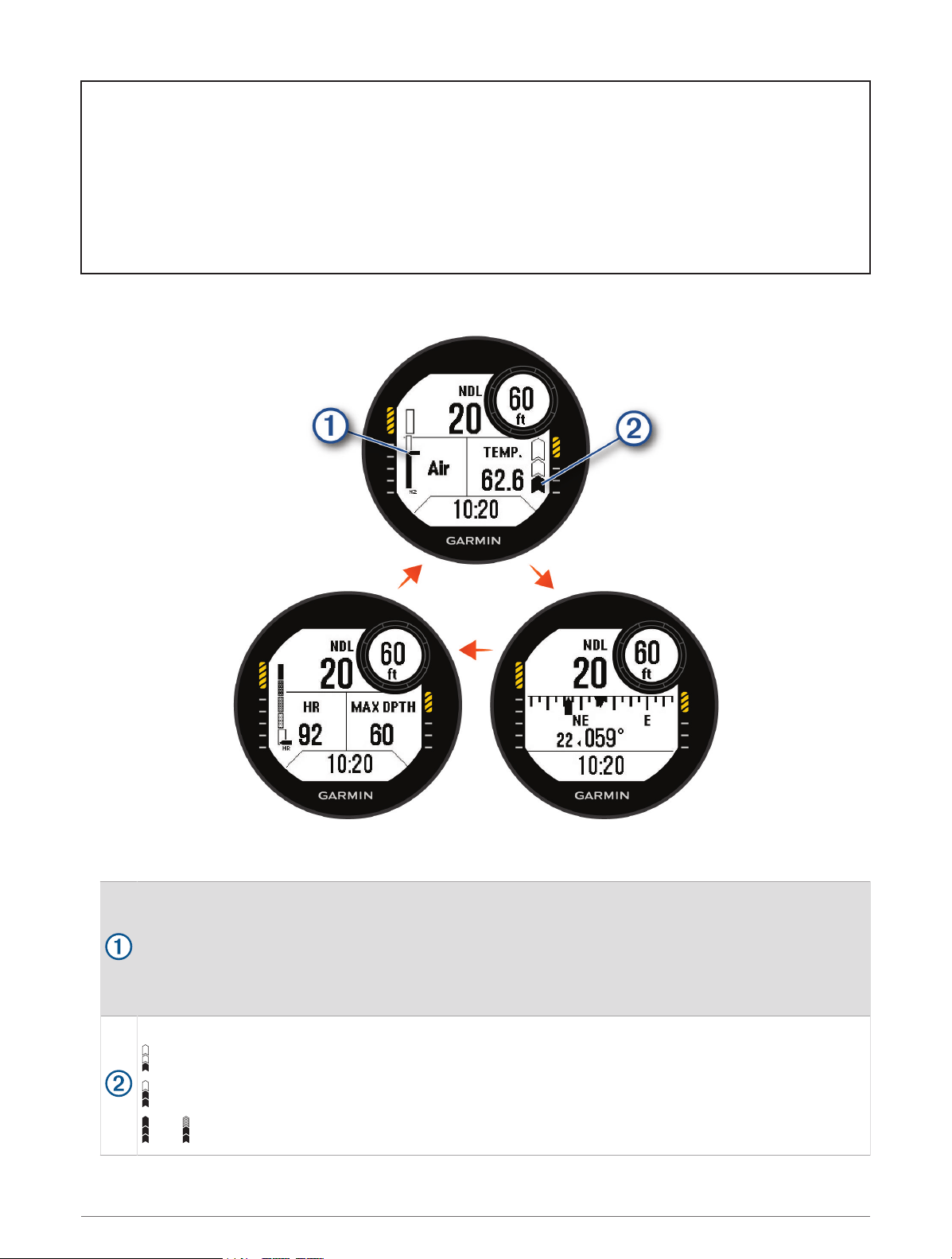
Primary data screen: Displays the main dive data, including your breathing gas, partial pressure of oxygen (PO2)
level, and rate of ascent. You can edit one of the data fields.
Your nitrogen (N2) and helium (He) tissue load level.
Segment 1: 0 to 79% tissue load.
Segment 2: 80 to 99% tissue load.
When you start a safety stop, the safety stop gauge appears (Performing a Safety Stop, page 29).
When your tissue load level reaches or exceeds 100%, the decompression stop gauge appears
(Performing a Decompression Stop, page 30).
Your rate of ascent.
: Good. Ascent is less than 7.9 m (26 ft.) per minute.
: Moderately high. Ascent is between 7.9 and 10.1 m (26 and 33 ft.) per minute.
and alternating: Too high. Ascent is greater than 10.1 m (33 ft.) per minute.
Diving 15
Dive compass: Allows you to view the compass and set a directional heading to aid with underwater navigation
(Navigating with the Dive Compass, page 25).
Customizable data screen: Displays additional dive data and physiological information. You can edit the gauges
and two of the data fields (Customizing the Data Screens, page 66).
16 Diving
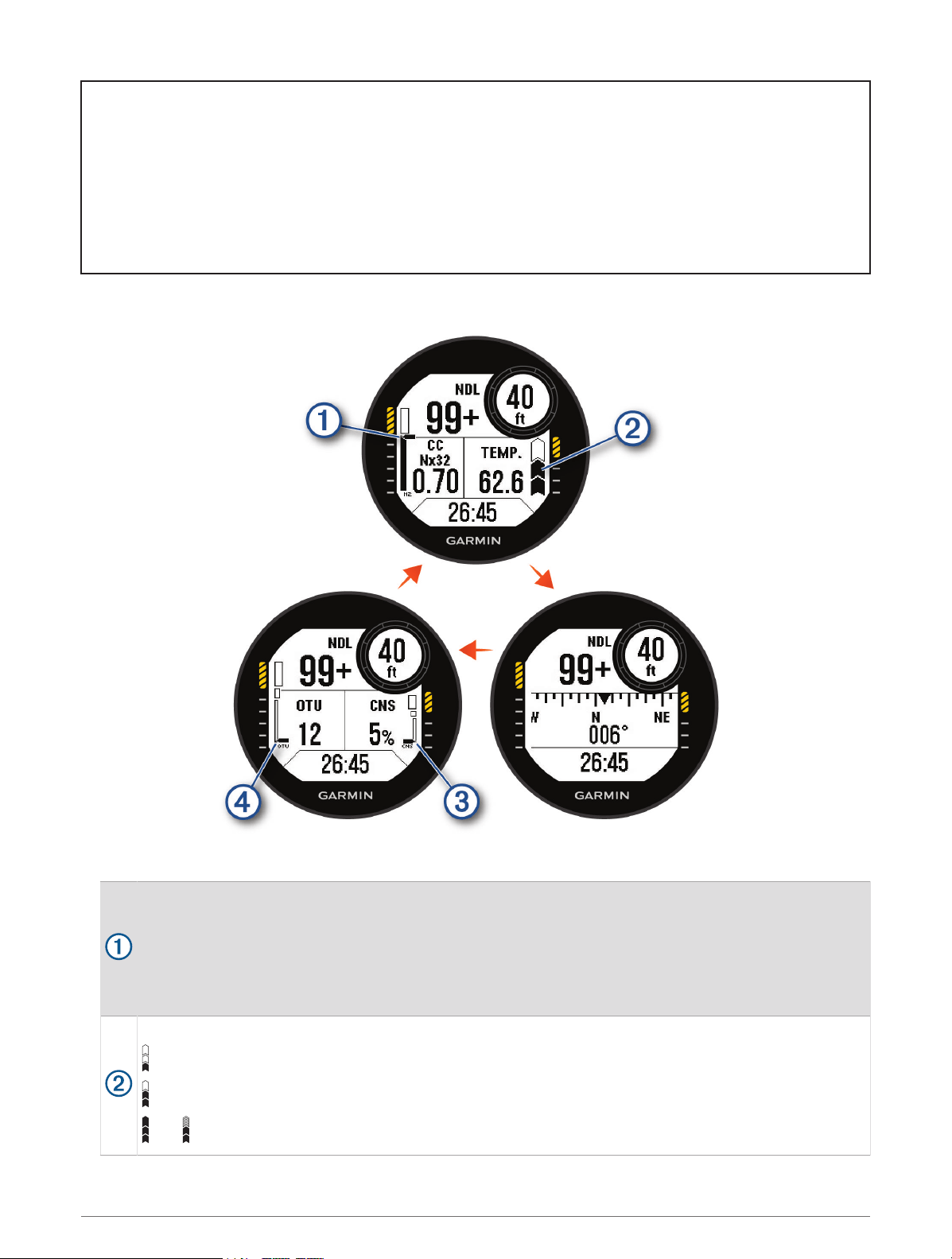
Title CCR Data Screens (Descent G1)
Identifier GUID-B9AB63D0-E9AE-4B99-92C4-0C950E285E09
Language EN-US
Description
Version 1
Revision 12
Changes Save as from Mk2 topic.
Status Released
Last Modified 10/02/2022 13:07:02
Author cozmyer
CCR Data Screens
Primary data screen: Displays the main dive data, including your breathing gas, partial pressure of oxygen (PO2)
level, and rate of ascent. You can edit one of the data fields.
Your nitrogen (N2) and helium (He) tissue load level.
Segment 1: 0 to 79% tissue load.
Segment 2: 80 to 99% tissue load.
When you start a safety stop, the safety stop gauge appears (Performing a Safety Stop, page 29).
When your tissue load level reaches or exceeds 100%, the decompression stop gauge appears
(Performing a Decompression Stop, page 30).
Your rate of ascent.
: Good. Ascent is less than 7.9 m (26 ft.) per minute.
: Moderately high. Ascent is between 7.9 and 10.1 m (26 and 33 ft.) per minute.
and alternating: Too high. Ascent is greater than 10.1 m (33 ft.) per minute.
Diving 17
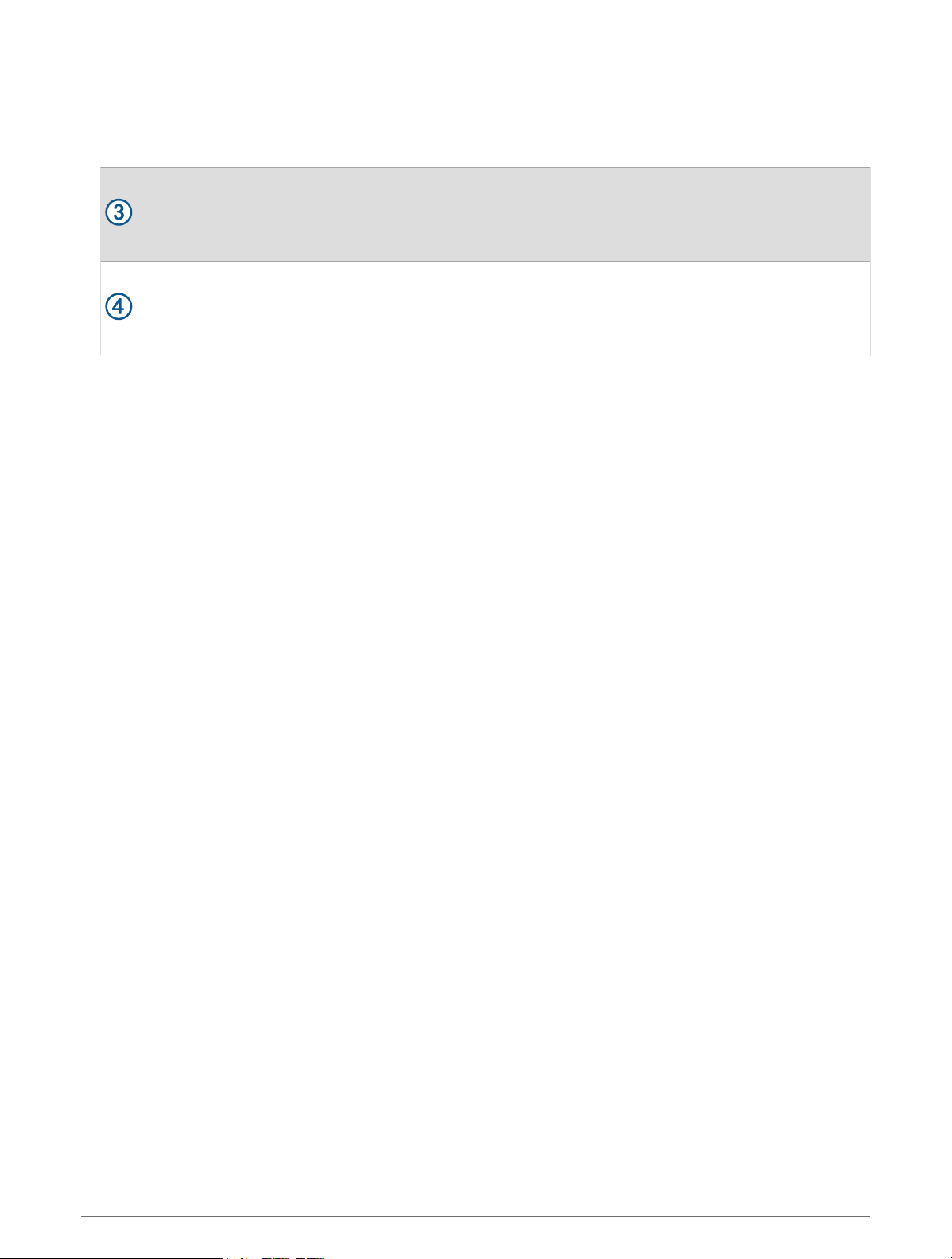
Dive compass: Allows you to view the compass and set a directional heading to aid with underwater navigation
(Navigating with the Dive Compass, page 25).
Customizable data screen: Displays additional dive data and physiological information. You can edit the gauges
and two of the data fields (Customizing the Data Screens, page 66).
Your central nervous system (CNS) oxygen toxicity level.
Segment 1: 0 to 79% CNS oxygen toxicity.
Segment 2: 80 to 99% CNS oxygen toxicity.
Segment 3: 100% or greater CNS oxygen toxicity.
Your current oxygen toxicity units (OTU).
Segment 1: 0 to 249 OTU.
Segment 2: 250 to 299 OTU.
Segment 3: 300 or greater OTU.
18 Diving
Title Gauge Data Screens (Descent G1)
Identifier GUID-7547CCC6-75A7-4D2E-B926-18C79CACE947
Language EN-US
Description
Version 1
Revision 10
Changes Save as from Mk2.
Status Released
Last Modified 10/02/2022 13:07:04
Author cozmyer
Gauge Data Screens
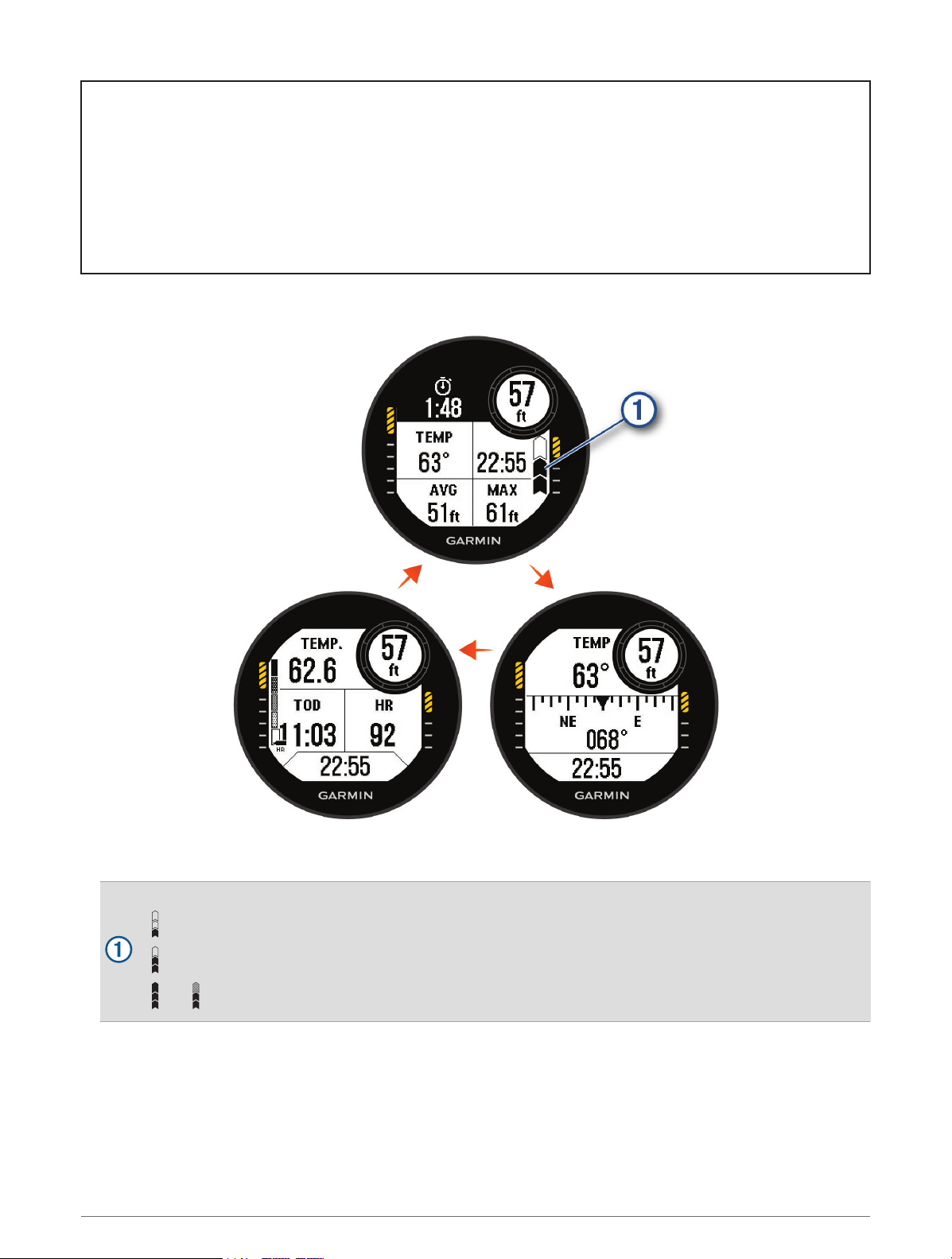
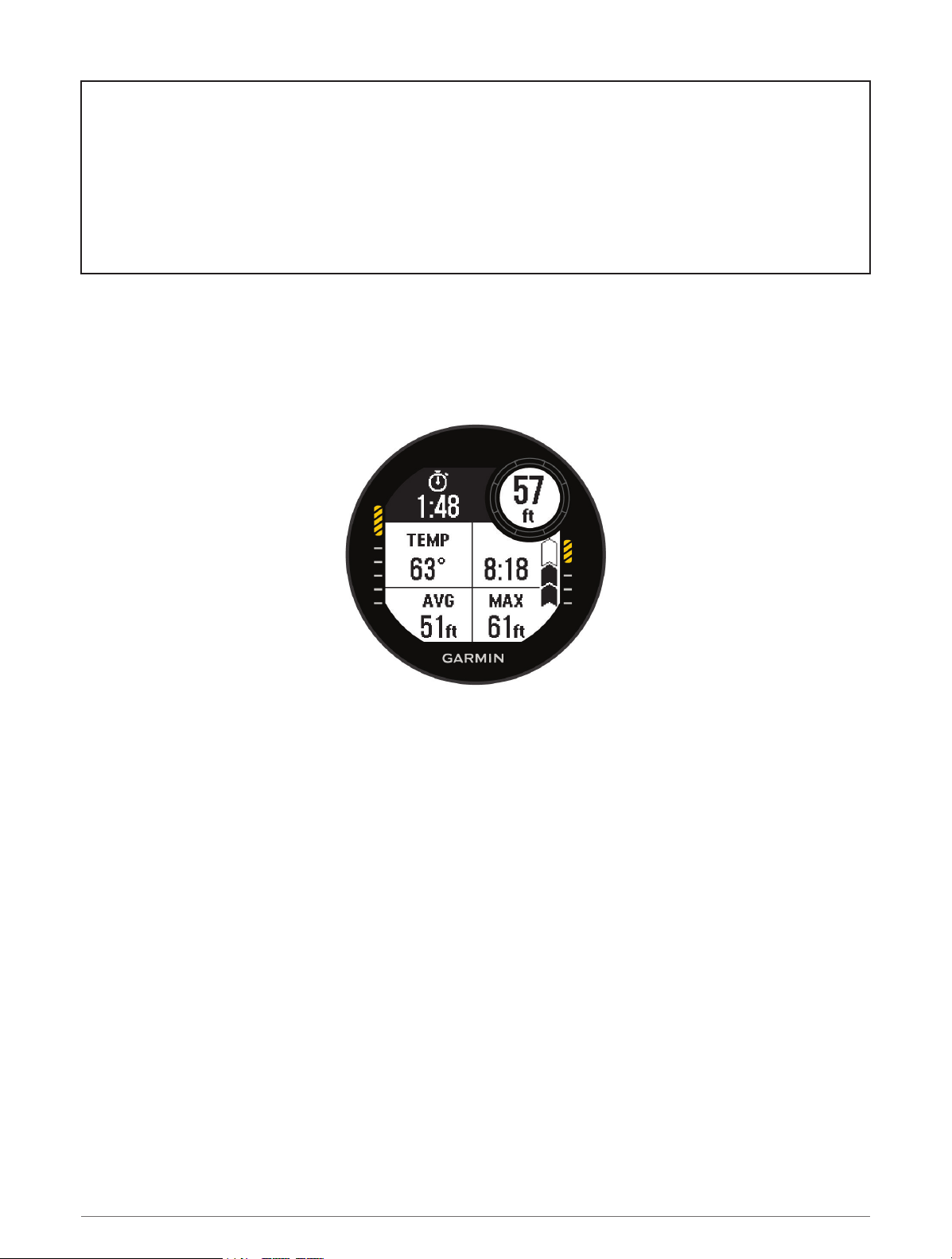
Dive stopwatch: Displays the bottom time stopwatch, average depth, maximum depth, and rate of ascent (Using
the Gauge Dive Stopwatch, page 26).
Your rate of ascent.
: Good. Ascent is less than 7.9 m (26 ft.) per minute.
: Moderately high. Ascent is between 7.9 and 10.1 m (26 and 33 ft.) per minute.
and alternating: Too high. Ascent is greater than 10.1 m (33 ft.) per minute.
Dive compass: Allows you to view the compass and set a directional heading to aid with underwater navigation
(Navigating with the Dive Compass, page 25).
Customizable data screen: Displays additional dive data and physiological information. You can edit the gauges
and three of the data fields (
Customizing the Data Screens, page 66).
Diving 19
Title Apnea Data Screens (Descent G1)
Identifier GUID-5AE08711-5D97-4F87-A10F-7230808F79C7
Language EN-US
Description
Version 1
Revision 9
Changes Save as from Mk2, but splitting into two topics.
Status Released
Last Modified 10/02/2022 13:06:59
Author cozmyer
Apnea Data Screens
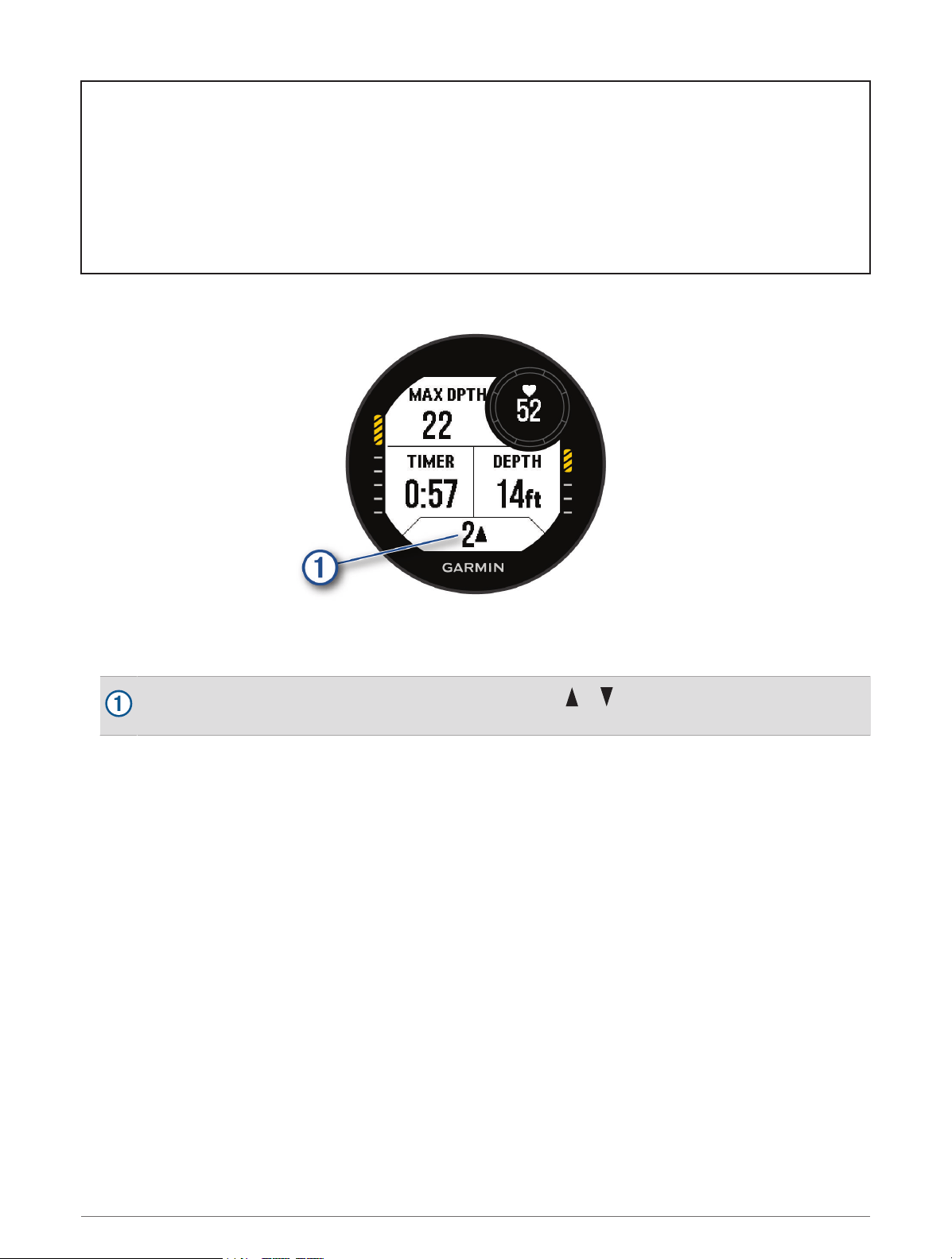
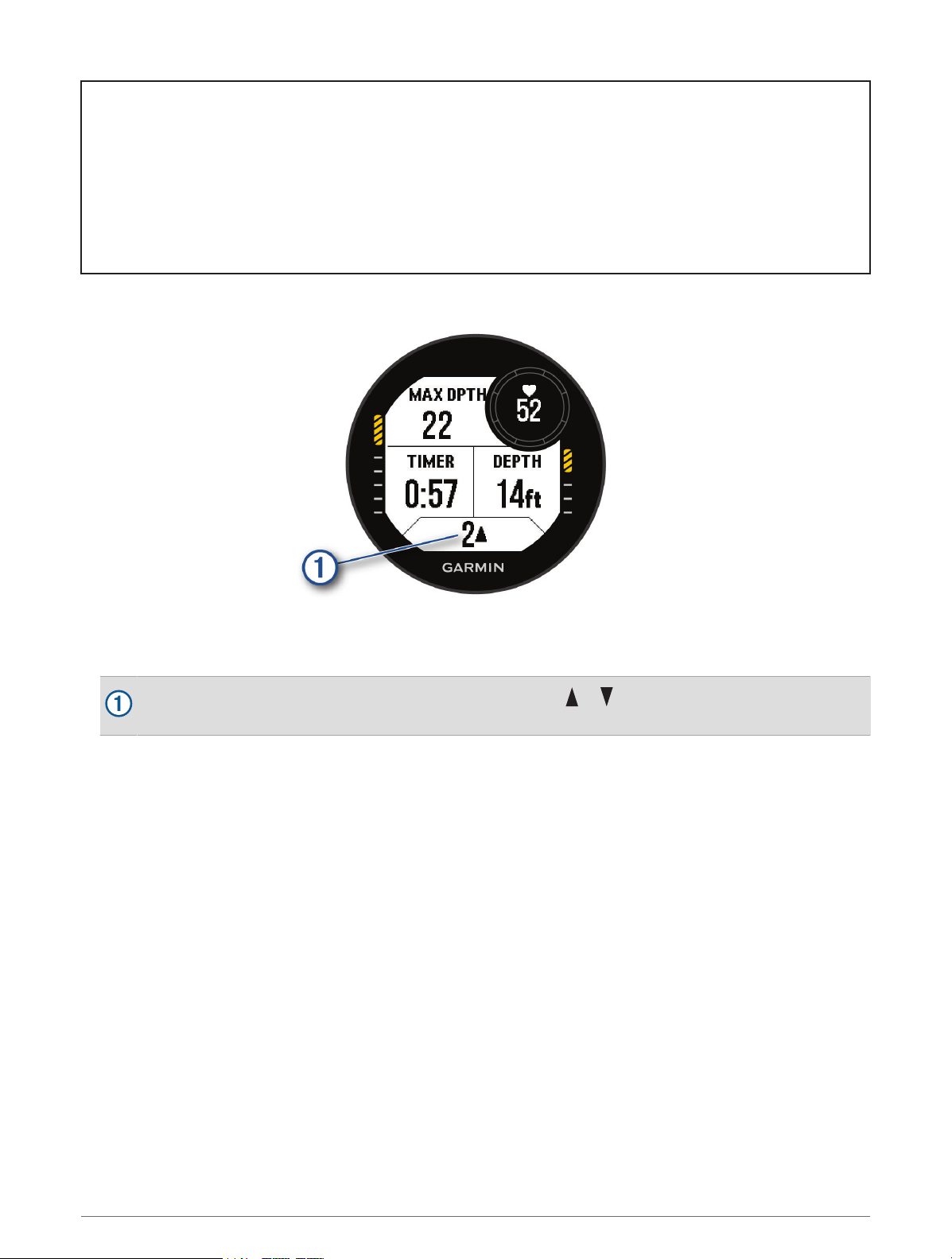
In-dive screen: Displays the information about the current dive, including the elapsed time, current and
maximum depth, heart rate data, and rate of ascent or descent. You can edit three of the data fields
(Customizing the Data Screens, page 66).
Your rate of ascent or descent in meters or feet per second. or appear when you are moving faster
than 0.5 m/s (1.6 ft./s).
20 Diving
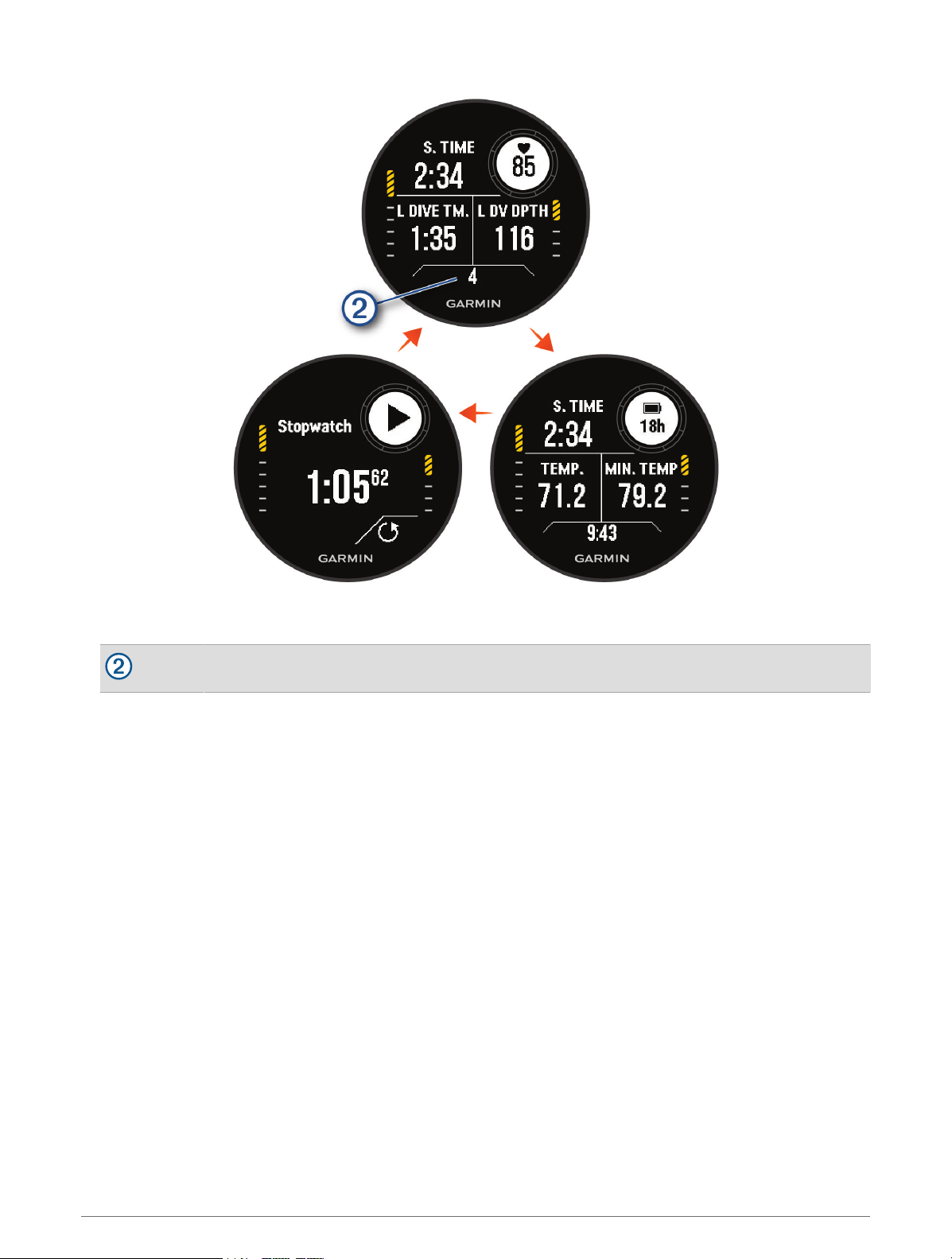
Surface interval screen: Displays the current surface interval time, heart rate, and last dive information. You can
edit the data fields.
The number of completed dives.
Time and temperature screen: Displays the temperature, time of day, and battery level. You can edit the data
fields.
Stopwatch: Displays the surface interval stopwatch (Using the Basic Dive Stopwatch, page 27).
Diving 21
Title Apnea Hunt Data Screens (Descent G1)
Identifier GUID-588D0121-5B64-441D-AE66-2031B6ED7C45
Language EN-US
Description
Version 1
Revision 11
Changes Save as from Descent Mk2. Split apnea and apnea hunt into two topics.
Status Released
Last Modified 10/02/2022 13:07:01
Author cozmyer
Apnea Hunt Data Screens
In-dive screen: Displays the information about the current dive, including the elapsed time, current and
maximum depth, heart rate data, and rate ascent or descent. You can edit three of the data fields
(Customizing the Data Screens, page 66).
Your rate of ascent or descent in meters or feet per second. or appear when you are moving faster
than 0.5 m/s (1.6 ft./s).
22 Diving
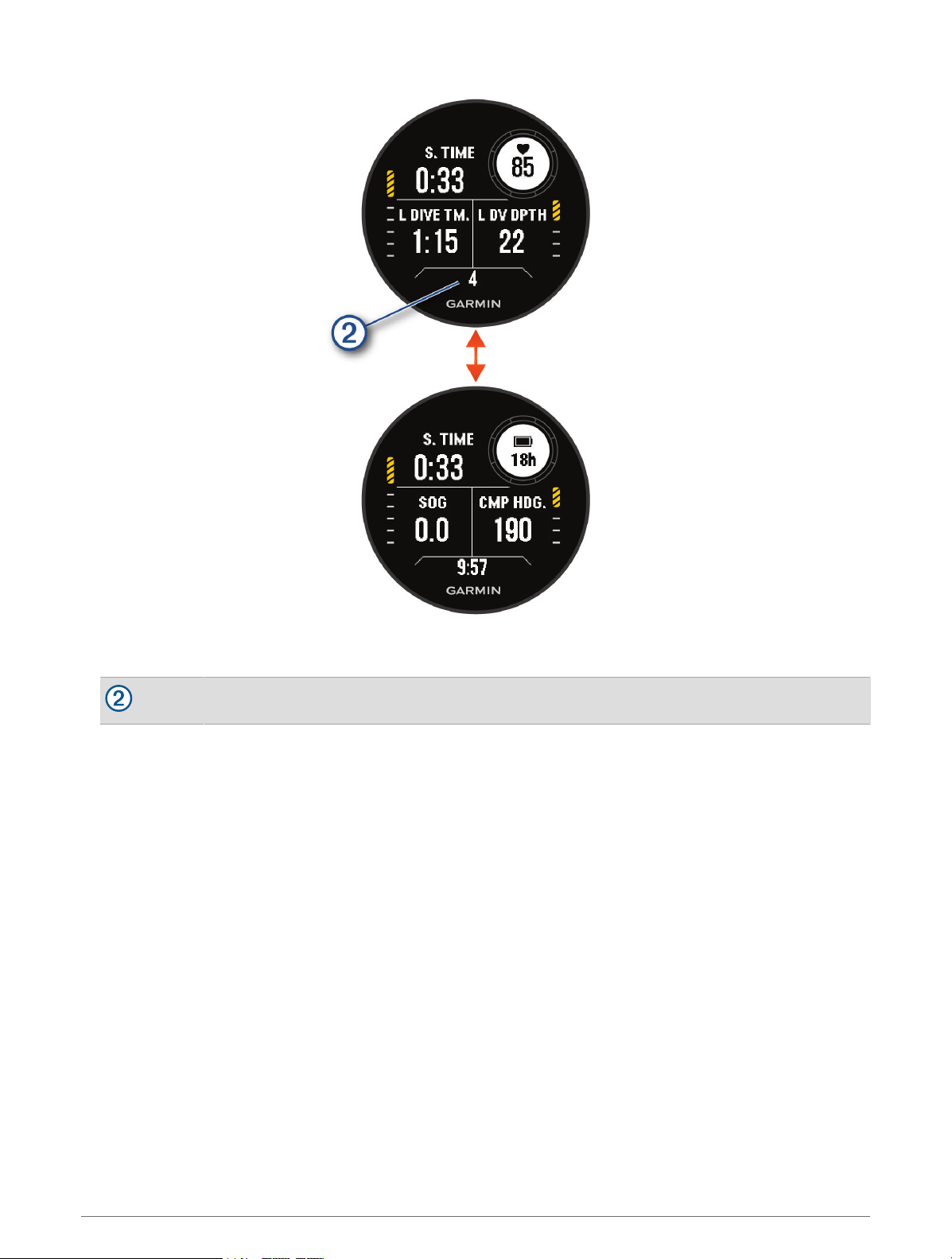
Surface interval screen: Displays the current surface interval time, as well as the elapsed time, maximum depth,
and temperature for your last apnea dive. You can edit the data fields.
The number of completed dives.
Time of day screen: Displays the time of day, speed over ground (SOG), and battery level. You can edit the data
fields.
Diving 23
Title Going Diving
Identifier GUID-F5BB5FFC-1071-4C7B-9968-2B2D985C4574
Language EN-US
Description
Version 7
Revision 7
Changes Changed title and moved task result info into steps.
Status Released
Last Modified 10/02/2022 13:11:47
Author cozmyer
Going Diving
1 From the watch face, press START.
2 Select a dive mode (Dive Modes, page 9).
3 If necessary, press UP to edit the dive settings, such as the gases, water type, and alerts (Dive Setup,
page 10).
4 Wait with your wrist out of the water until the watch acquires GPS signals and the status bar is filled
(optional).
The watch requires GPS signals to save your dive entry location.
5 Press START until the primary dive data screen appears.
6 Descend to start your dive.
The activity timer starts automatically when you reach a depth of 1.2 m (4 ft.).
NOTE: If you start a dive without selecting a dive mode, the watch uses the most recently used dive mode
and settings, and your dive entry location is not saved.
7 Select an option:
• Press DOWN to scroll through the data screens and dive compass.
TIP: You can also double tap the watch to scroll through the screens.
• Press START to view the in-dive menu.
8 When you are ready to end the dive, ascend to the surface.
9 Keep your wrist out of the water so the watch can acquire GPS signals and save your dive exit location
(optional).
10 Select an option:
• For a Single-Gas, Multi-Gas, CCR, or Gauge dive, wait for the End Dive Delay timer to count down.
NOTE: When you ascend to 1 m (3.3 ft.), the End Dive Delay timer begins counting down (Dive Setup,
page 10). You can press START, and select Stop Dive to save the dive before the timer elapses.
• For an Apnea or Apnea Hunt dive, press BACK, and select .
The watch saves the dive activity.
TIP: You can view your diving history in the dive log glance (Viewing the Dive Log Glance, page 31).
24 Diving
Title Navigating with the Dive Compass
Identifier GUID-8B118BD5-91E0-402A-8B57-784C0CF0A8FA
Language EN-US
Description
Version 5
Revision 4
Changes Added conditions for screen color.
Status Released
Last Modified 10/02/2022 13:02:07
Author cozmyer
Navigating with the Dive Compass
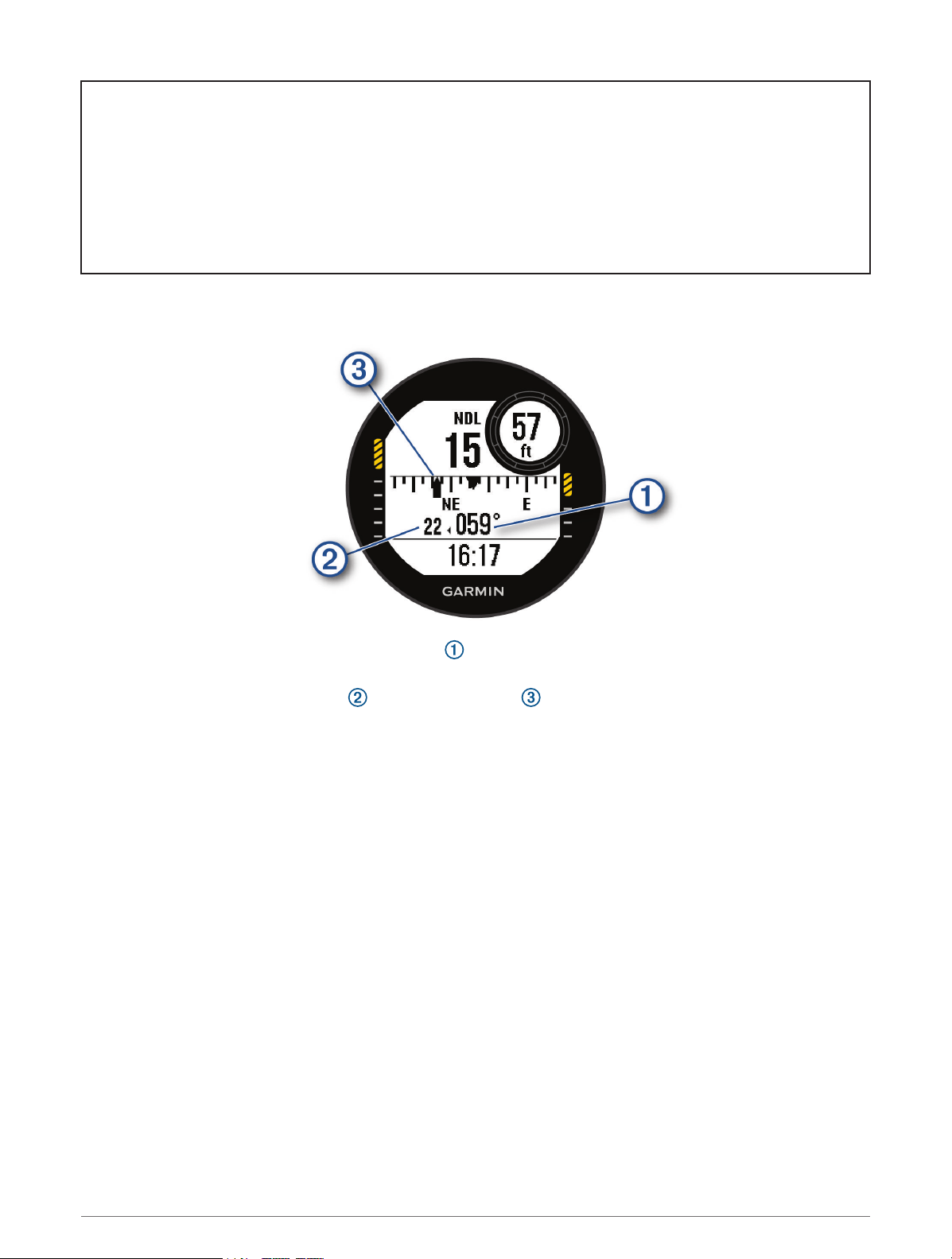
1 During a Single-Gas, Multi-Gas, CCR, or Gauge dive, scroll to the dive compass.
The compass indicates your directional heading .
2 Press START to set the heading.
The compass indicates deviations from the set heading .
3 Press START, and select an option:
• To reset the heading, select Reset Heading.
• To change the heading by 180 degrees, select Set to Recip..
NOTE: The compass indicates the reciprocal heading with a gray mark.
• To set to a 90-degree heading left or right, select Set to 90L or Set to 90R.
• To clear the heading, select Clear Heading.
Diving 25
Title Using the Gauge Dive Stopwatch
Identifier GUID-7DB86CEA-90D0-4B86-B7C2-379362C9362B
Language EN-US
Description
Version 4
Revision 3
Changes Added gauge to the title since there are multiple dive stopwatches now.
Status Released
Last Modified 10/02/2022 13:01:50
Author cozmyer
Using the Gauge Dive Stopwatch
TIP: You can add a simplified stopwatch screen to any of the gas dive modes (Customizing the Data Screens,
page 66).
1 Start a Gauge dive.
2 Scroll to the stopwatch screen.
3 Press START, and select Reset Avg. Depth to set the average depth to your current depth.
4 Press START, and select Start Stopwatch.
5 Select an option:
• To stop using the stopwatch, press START, and select Stop Stopwatch.
• To restart the stopwatch, press START, and select Reset Stopwatch.
26 Diving
Title Using the Basic Dive Stopwatch
Identifier GUID-9F9DD4BE-4689-4250-8161-78DB3917CD43
Language EN-US
Description
Version 2
Revision 4
Changes Added the tip for apnea mode.
Status Released
Last Modified 25/04/2022 16:00:00
Author cozmyer
Using the Basic Dive Stopwatch
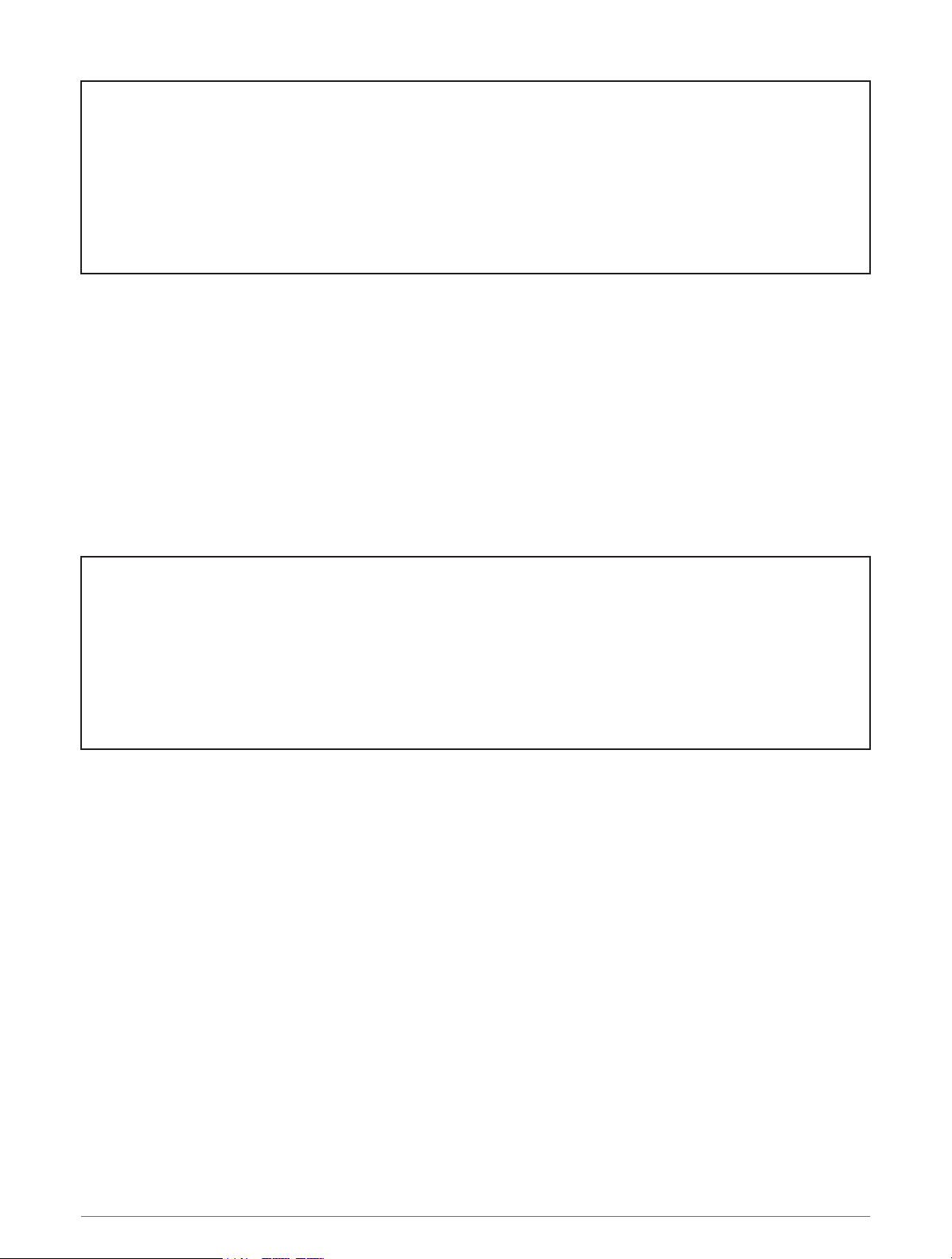
1 Select an option:
• Add the Stopwatch Timer data screen to the Single-Gas, Multi-Gas, CCR, or Gauge dive mode.
• Enable the Stopwatch surface data screen for the Apnea or Apnea Hunt dive mode.
2 During a gas dive or apnea surface interval, scroll to the stopwatch screen.
TIP: During an apnea surface interval, you can press and hold START to open the stopwatch and start the
timer, even if the screen is not enabled.
3 Press START to start the timer.
4 Press STOP to stop the timer.
5 Press BACK to reset the timer.
Title Switching Gases During a Dive
Identifier GUID-3A9B1B51-858F-4C5E-B629-27ECF87CEBE1
Language EN-US
Description
Version 1
Revision 7
Changes
Status Released
Last Modified 21/07/2020 16:33:48
Author cozmyer
Switching Gases During a Dive
1 Start a single-gas, multi-gas, or closed-circuit rebreather (CCR) dive.
2 Select an option:
• Press START, select Gas, and select a backup or decompression gas.
NOTE: If necessary, you can select Add New and enter a new gas.
• Dive until you reach the Deco PO2 threshold (Setting PO2 Thresholds, page 12).
The device prompts you to switch to the gas with the highest percentage of oxygen.
NOTE: The device does not switch gases for you automatically. You must select the gas.
Diving 27
Title Switching Between CC and OC Diving
Identifier GUID-6AE780B7-9BAF-4F81-8DFB-63AA4C6C66C5
Language EN-US
Description
Version 2
Revision 3
Changes Added conditions for color vs. b/w screens.
Status Released
Last Modified 10/02/2022 13:02:39
Author cozmyer
Switching Between CC and OC Diving for a Bailout Procedure
During a closed-circuit rebreather (CCR) dive, you can switch between closed-circuit (CC) and open-circuit (OC)
diving while you perform a bailout procedure.
1 Start a CCR dive.
2 Press START.
3 Select Switch to OC.
The PO2 data field colors on the primary data screen invert, and the device switches the active breathing gas
to your OC decompression gas.
NOTE: If you have not set up an OC decompression gas, the device switches to your diluent gas.
4 If necessary, press START, and select Gas to manually switch to a backup gas.
5 Press START, and select Switch to CC to switch back to CC diving.
28 Diving
Title Performing a Safety Stop
Identifier GUID-D532E9AC-F226-4AD8-AE17-4A90EDF68F0B
Language EN-US
Description
Version 2
Revision 3
Changes Removed inline icon. Not applicable to b/w screen, and not completely necessary with the rest of the
description.
Status Released
Last Modified 10/02/2022 13:03:32
Author cozmyer
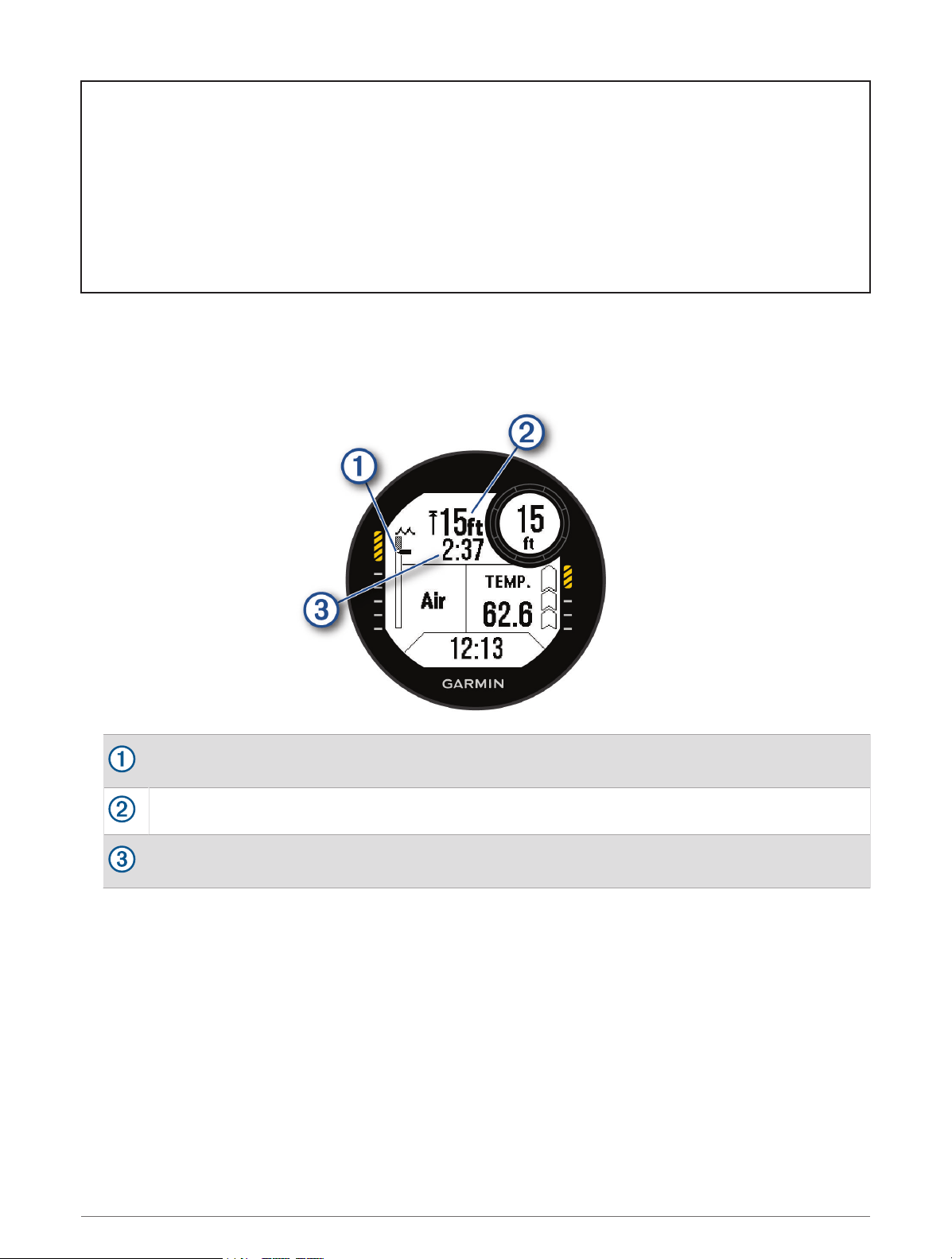
Performing a Safety Stop
You should perform a safety stop during every dive to help reduce the risk of decompression sickness.
1 After a dive of at least 11 m (35 ft.), ascend to 5 m (15 ft.).
Safety stop information appears on the data screens.
Your depth relative to the surface.
As you ascend, your position moves upward toward the safety stop depth.
The safety stop ceiling depth.
The safety stop timer.
When you are within 1 m (5 ft.) of the ceiling depth, the timer starts counting down.
2 Stay within 2 m (8 ft.) of the safety stop ceiling depth until the safety stop timer reaches zero.
NOTE: If you ascend more than 3 m (8 ft.) above the safety stop ceiling depth, the safety stop timer pauses,
and the device alerts you to descend below the ceiling depth. If you descend below 11 m (35 ft.), the safety
stop timer resets.
3 Continue ascending to the surface.
Diving 29
Title Performing a Decompression Stop
Identifier GUID-1EB51E61-61EE-44BB-B17A-5EBE9251DF80
Language EN-US
Description
Version 2
Revision 4
Changes Removed inline icons. Not applicable to b/w screen, and not completely necessary with the rest of the
description.
Status Released
Last Modified 10/02/2022 13:03:20
Author cozmyer
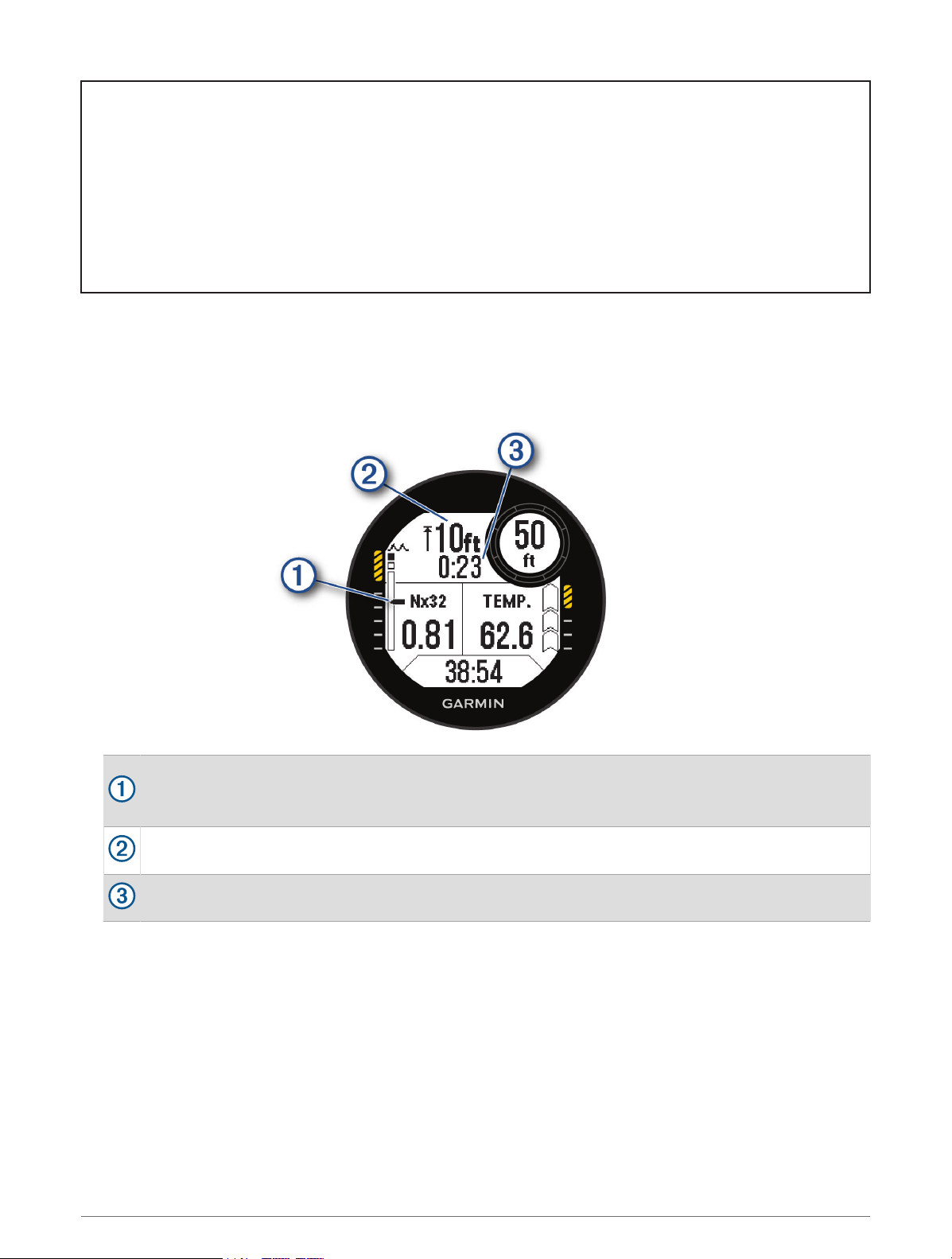
Performing a Decompression Stop
You should always perform all the required decompression stops during a dive to help reduce the risk of
decompression sickness. Missing a decompression stop adds significant risk.
1 When you exceed the no-decompression limit (NDL) time, begin your ascent.
Decompression stop information appears on the data screens.
Your depth relative to the surface.
As you ascend, your position moves upward toward the required decompression stop depth. The
empty segments represent cleared stops. You may clear a stop before ascending to it.
The decompression stop ceiling depth.
The decompression stop timer.
2 Stay within 0.6 m (2 ft.) of the decompression stop ceiling depth until the decompression stop timer reaches
zero.
NOTE: If you ascend more than 0.6 m (2 ft.) above the decompression stop ceiling depth, the decompression
stop timer pauses, and the device alerts you to descend below the ceiling depth. The depth and ceiling depth
flash until you are within the safe margin.
3 Continue ascending to the surface or the next decompression stop.
30 Diving
Title Viewing the Surface Interval Glance
Identifier GUID-5B6754B2-AC50-4686-AD61-8BCC57AE2D55
Language EN-US
Description
Version 6
Revision 4
Changes Updated to add no-fly information to the glance.
Status Released
Last Modified 10/02/2022 13:03:11
Author cozmyer
Viewing the Surface Interval Glance
1 From the watch face, press UP or DOWN to view the surface interval glance.
2 Press START to view your oxygen toxicity units (OTU) and central nervous system (CNS) percentage.
NOTE: The OTU accumulated during a dive expire after 24 hours.
3 Press DOWN to view your tissue load details.
4 Press DOWN to view your no-fly time remaining and the time of day the no-fly period ends.
Title Viewing the Dive Log Glance
Identifier GUID-32B63BF5-5834-441B-985C-2FC344E90080
Language EN-US
Description
Version 6
Revision 4
Changes Updated to glance.
Status Released
Last Modified 29/09/2021 16:24:29
Author cozmyer
Viewing the Dive Log Glance
The glance displays summaries of your recently recorded dives.
1 From the watch face, press UP or DOWN to view the dive log glance.
2 Press START to view your most recent dive.
3 Press DOWN > START to view a different dive (optional).
4 Press START, and select an option:
• To view additional information about the activity, select All Stats.
• To view additional information about one of multiple apnea dives in the activity, select Dives, and select a
dive.
• To save a dive entry or exit location, select Save Location.
• To view a depth graph for the activity, select Depth Profile.
• To view a temperature graph for the activity, select Temperature Plot.
• To view the gases you used, select Gas Switches.
• To remove the activity from your device, select Delete.
Diving 31
Title Dive Planning
Identifier GUID-03287881-01B2-43F4-9443-C53D8C660A72
Language EN-US
Description
Version 1
Revision 7
Changes
Status Released
Last Modified 17/11/2017 16:31:31
Author cozmyer
Dive Planning
You can plan for future dives using your device. The device can calculate no-decompression limit (NDL) times or
create decompression plans. When planning a dive, the device uses your residual tissue load from recent dives
in the calculations.
Title Calculating NDL Time
Identifier GUID-952167E8-F2CE-439B-8D09-63794727A47B
Language EN-US
Description
Version 4
Revision 3
Changes Updated step 6 button press
Status Released
Last Modified 10/02/2022 13:00:00
Author cozmyer
Calculating NDL Time
You can calculate the no-decompression limit (NDL) time or maximum depth for a future dive. These
calculations are not saved or applied to your next dive.
1 Press START.
2 Select Plan Dive > Compute NDL.
3 Select an option:
• To calculate NDL based on your current tissue load, select Diving Now.
• To calculate NDL based on your tissue load at a future time, select Enter Surf. Interval, and enter your
surface interval time.
4 Enter an oxygen percentage.
5 Select an option:
• To calculate the NDL time, select Enter Depth, and enter the planned depth for your dive.
• To calculate the maximum depth, select Enter Time, and enter your planned dive time.
The NDL countdown clock, depth, and maximum operating depth (MOD) appear.
6 Press START.
7 Select an option:
• To exit, select Done.
• To add intervals to your dive, select Add Repeat Dive, and follow the on-screen instructions.
32 Diving
Title Creating a Decompression Plan
Identifier GUID-7187F580-420E-457F-9C59-85F3D5AEB67B
Language EN-US
Description
Version 4
Revision 3
Changes Added last deco stop option.
Status Released
Last Modified 10/02/2022 13:00:19
Author cozmyer
Creating a Decompression Plan
You can create open-circuit decompression plans and save them for future dives.
1 Press START.
2 Select Plan Dive > Deco Plans > Add New.
3 Enter a name for the decompression plan.
4 Select an option:
• To enter the maximum partial pressure of oxygen in bars, select PO2.
NOTE: The device uses the PO2 value for gas switching.
• To enter your level of conservatism for decompression calculations, select Conservatism.
• To enter your gas blends, select Gases.
• To enter the depth of your last decompression stop, select Last Deco Stop.
• To enter the maximum dive depth, select Bottom Depth.
• To enter the time at the bottom depth, select Bottom Time.
5 Select Save.
Title Using Decompression Plans
Identifier GUID-462C7946-DF7F-4FDA-AD48-7C488CEFEDAB
Language EN-US
Description
Version 4
Revision 3
Changes Added options from the editing and deleting tasks
Status Released
Last Modified 10/02/2022 13:00:28
Author cozmyer
Using Decompression Plans
1 Press START.
2 Select Plan Dive > Deco Plans.
3 Select a decompression plan.
4 Select an option:
• To view the decompression plan, select View.
• To use the decompression plan settings for a dive mode, select Apply.
• To change the decompression plan details, select Edit.
• To edit the name of the decompression plan, select Rename.
• To remove the decompression plan, select Delete > .
Diving 33
Title Altitude Diving
Identifier GUID-1F916AD6-A339-4CE9-81F8-87E8E196941C
Language EN-US
Description
Version 1
Revision 6
Changes
Status Released
Last Modified 21/07/2020 16:38:31
Author cozmyer
Altitude Diving
At higher altitudes, the atmospheric pressure is lower, and your body contains a larger amount of nitrogen than
it would at the start of a dive at sea level. The device accounts for altitude changes automatically using the
barometric pressure sensor. The absolute pressure value used by the decompression model is not affected by
the altitude or the gauge pressure displayed on the watch.
Title Tips for Wearing the Device with an Exposure Suit
Identifier GUID-93BB17C1-968F-47EF-82B0-C6F0DC20B2EE
Language EN-US
Description
Version 2
Revision 3
Changes Added turning off WHR, pulled in text from the wearing topic, and added a condition for the metal band.
Status Released
Last Modified 21/07/2020 16:38:53
Author cozmyer
Tips for Wearing the Device with an Exposure Suit
• Use the extra long silicone diving band to wear the device over a thick exposure suit.
• For accurate heart rate measurements, make sure that the device stays in contact with your skin and does
not bump into other wrist-worn devices (Wearing the Watch, page 114).
• If you are wearing the device over an exposure suit, turn off the wrist-based heart rate monitor to increase
battery life (Wrist Heart Rate Monitor Settings, page 115).
34 Diving
Title Dive Alerts
Identifier GUID-80F7A2DF-6152-44DE-991E-F8B94A097A82
Language EN-US
Description
Version 4
Revision 7
Changes Added conditions for color vs. b/w screens.
Status Released
Last Modified 10/02/2022 13:12:27
Author cozmyer
Dive Alerts
Alert Message Cause Watch Action
None You completed the decompression stop.
The decompression stop depth and
time flash for five seconds.
None
Your partial pressure of oxygen (PO2) value
is above the specified warning value.
Your PO2 value flashes.
%1 OTU accumulated. End
your dive now.
Your oxygen toxicity units are above the
safe limit. During a dive, "%1" is replaced
with the number of units accumulated.
The alert appears every two
minutes, up to three times.
250 OTU accumulated.
Your oxygen toxicity units (OTU) are at 250
units, and you are nearing the safe limit of
300 units.
None
Approaching Deco Stop
You are within one stop interval (3 m or
9.8 ft.) of the decompression stop depth.
None
Approaching NDL
You have 10 minutes of no decompression
limit (NDL) time remaining.
The alert appears again when you
have 5 minutes of NDL time
remaining.
Ascending too fast. Slow
your ascent.
You are ascending faster than 9.1 m/min.
(30 ft./min.) for more than 5 seconds.
None
Battery critically low. End
your dive now.
Less than 10% battery power remains.
The alert appears when the watch is
below 10% battery power and on the
dive pre-check screen for your next
dive.
Battery is low. Less than 20% battery power remains.
The alert appears when the watch is
below 20% battery power and on the
dive pre-check screen for your next
dive.
CNS toxicity at %1%. End
your dive now.
Your CNS oxygen toxicity is too high. During
a dive, "%1" is replaced with your current
CNS percentage.
The alert appears every two
minutes, up to three times.
CNS toxicity at 80%.
Your central nervous system (CNS) oxygen
toxicity is at 80% of the safe limit.
The alert appears during a dive and
on the dive pre-check screen for
your next dive.
Decompression Cleared You completed all decompression stops. None
Descend below deco
ceiling.
You are more than 0.6 m (2 ft.) above the
decompression ceiling.
The current depth and stop depth
flash.
Diving 35
Alert Message Cause Watch Action
If you remain above the decompres
sion ceiling for more than three
minutes, the decompression
lockout feature goes into effect.
Descend to complete
safety stop.
You are more than 2 m (8 ft.) above the
safety stop ceiling.
The current depth and stop depth
flash.
Diluent PO2 is low.
Flushing may be
dangerous.
The PO2 of the diluent gas is too low, and
filling the rebreather breathing loop with the
diluent gas may be dangerous.
None
Dive will end in %1
seconds.
The watch will automatically end and save
the dive. During a dive, "%1" is replaced by
the number of seconds.
None
Do not dive. Failed to read
depth sensor.
The watch has invalid or missing depth
sensor data before you start a dive activity.
Do not start a dive. Call Garmin
®
Product Support.
Failed to read depth
sensor. End your dive now.
The watch has invalid or missing depth
sensor data after you have started a dive
activity.
Use a backup dive computer or dive
plan and end your dive. Call Garmin
Product Support.
NDL exceeded. Decom
pression now required.
You have exceeded your NDL time. None
PO2 is high. Ascend or
switch to lower O2 gas.
Your PO2 value is above the specified
critical value.
Your PO2 value flashes.
The alert appears every 30 seconds,
up to three times, until you ascend
to a safe level or switch gases.
PO2 is low. Descend or
switch to higher O2 gas.
Your PO2 value is below 0.18 bar.
Your PO2 value flashes.
The alert appears every 30 seconds,
up to three times, until you descend
to a safe level or switch gases.
Safety Stop Cleared You completed the safety stop. None
Switch to %1 now?
In a multi-gas dive, a gas with a higher
oxygen content is now safe to breathe.
During a dive, "%1" is replaced with the
name of the gas.
You can switch gases now, or wait
to switch gases later in the dive. A
confirmation message for your
choice appears.
Switched to high setpoint.
The watch automatically switched to your
specified CCR high setpoint.
None
Switched to low setpoint.
The watch automatically switched to your
specified CCR low setpoint.
None
This pool dive will not be
saved to the dive log.
The watch is in pool dive mode.
The watch will not save the current
dive to the dive log.
36 Diving
Title Dive Terminology
Identifier GUID-72517952-197C-4C42-8A50-B5CB59ED686F
Language EN-US
Description
Version 2
Revision 3
Changes Clarifying TTS does not factor in safety stops.
Status Released
Last Modified 16/11/2021 13:13:43
Author burzinskititu
Dive Terminology
Central nervous system (CNS): A measure of central nervous system oxygen toxicity caused by exposure to
increased partial pressure of oxygen (PO2) while diving.
Closed-circuit rebreather (CCR): A diving mode used for dives performed with a rebreather that recirculates
exhaled gas and removes carbon dioxide.
Maximum operating depth (MOD): The greatest depth at which a breathing gas can be used before the partial
pressure of oxygen (PO2) exceeds the safe limit.
No decompression limit (NDL): A dive that does not require decompression time while ascending to the
surface.
Oxygen toxicity units (OTU): A measure of pulmonary oxygen toxicity caused by exposure to increased partial
pressure of oxygen (PO2) while diving. One OTU is equivalent to breathing 100% oxygen at 1 ATM for 1
minute.
Partial pressure of oxygen (PO2): The pressure of the oxygen in the breathing gas, based on depth and oxygen
percentage.
Surface interval (SI): The amount of time that has elapsed since the completion of the last dive.
Time to surface (TTS): The estimated amount of time it will take to ascend to the surface, including
decompression stops.
Title Activities and Apps
Identifier GUID-C2484178-A914-441B-8696-54FE20D83FBA
Language EN-US
Description
Version 11
Revision 3
Changes Conditioning line about adding activities and apps for OM only.
Status Released
Last Modified 22/04/2022 15:03:52
Author burzinskititu
Activities and Apps
Your watch can be used for indoor, outdoor, athletic, and fitness activities. When you start an activity, the watch
displays and records sensor data. You can create custom activities or new activities based on default activities
(Creating a Custom Activity, page 67). When you finish your activities, you can save and share them with the
Garmin Connect
™
community.
You can also add Connect IQ
™
activities and apps to your watch using the Connect IQ app (Connect IQ Features,
page 140).
For more information about activity tracking and fitness metric accuracy, go to garmin.com/ataccuracy.
Activities and Apps 37
Title Starting an Activity
Identifier GUID-90B3EF66-C7DC-4BB5-A1A3-C07E1E9E7A57
Language EN-US
Description A generic version of "Going for a Hike" or "Going for a Run." Covers the same information, but applies
more broadly to the varied activities of fenix 2.
Version 11
Revision 4
Changes Device to watch. This topic has a Hebrew spacing issue.
Status Released
Last Modified 19/01/2022 13:40:55
Author tillmonmartha
Starting an Activity
When you start an activity, GPS turns on automatically (if required).
1 From the watch face, press START.
2 Select an option:
• Select an activity from your favorites.
• Select , and select an activity from the extended activity list.
3 If the activity requires GPS signals, go outside to an area with a clear view of the sky, and wait until the watch
is ready.
The watch is ready after it establishes your heart rate, acquires GPS signals (if required), and connects to
your wireless sensors (if required).
4 Press START to start the activity timer.
The watch records activity data only while the activity timer is running.
Title Tips for Recording Activities
Identifier GUID-16DF3142-A509-4D31-A0FC-A3A38E4D8DD1
Language EN-US
Description
Version 4
Revision 8
Changes Added v3.1.1 content and power mode bullet.
Status Released
Last Modified 20/12/2021 11:55:25
Author cozmyer
Tips for Recording Activities
• Charge the watch before starting an activity (Charging the Watch, page 173).
• Press BACK to record laps, start a new set or pose, or advance to the next workout step.
• Press UP or DOWN to view additional data screens.
• Hold MENU, and select Power Mode to use a power mode to extend battery life (Customizing Power Modes,
page 166).
38 Activities and Apps
Title Stopping an Activity (fenix 5)
Identifier GUID-996CC115-E86F-4FA9-8C13-1405A9A7485F
Language EN-US
Description
Version 6
Revision 4
Changes Added a recovery HR option.
Status Released
Last Modified 01/02/2021 10:20:50
Author cozmyer
Stopping an Activity
1 Press STOP.
2 Select an option:
• To resume your activity, select Resume.
• To save the activity and return to watch mode, select Save > Done.
• To suspend your activity and resume it at a later time, select Resume Later.
• To mark a lap, select Lap.
• To navigate back to the starting point of your activity along the path you traveled, select Back to Start >
TracBack.
NOTE: This feature is available only for activities that use GPS.
• To navigate back to the starting point of your activity by the most direct path, select Back to Start >
Straight Line.
NOTE: This feature is available only for activities that use GPS.
• To measure the difference between your heart rate at the end of the activity and your heart rate two
minutes later, select Recovery HR, and wait while the timer counts down.
• To discard the activity and return to watch mode, select Discard > .
NOTE: After stopping the activity, the device saves it automatically after 30 minutes.
Title Running
Identifier GUID-5A5AC2C5-B5AE-4C00-806E-8AD475F6FB0C
Language EN-US
Description Chapter topic. Can contain concept info if appropriate.
Version 1
Revision 4
Changes
Status Released
Last Modified 22/04/2017 22:48:21
Author gerson
Running
Activities and Apps 39
Title Going for a Track Run
Identifier GUID-6F710D25-D03C-4C65-A42D-79475153F77E
Language EN-US
Description
Version 3
Revision 6
Changes terminology updates.
Status Released
Last Modified 13/05/2022 10:38:36
Author wiederan
Going for a Track Run
Before you go for a track run, make sure you are running on a standard-shape, 400 m track.
You can use the track run activity to record your outdoor track data, including distance in meters and lap splits.
1 Stand on the outdoor track.
2 From the watch face, press START.
3 Select Track Run.
4 Wait while the watch locates satellites.
5 If you are running in lane 1, skip to step 11.
6 Press MENU.
7 Select the activity settings.
8 Select Lane Number.
9 Select a lane number.
10 Press BACK twice to return to the activity timer.
11 Press START.
12 Run around the track.
After you run 3 laps, your watch records the track dimensions and calibrates your track distance.
13 After you complete your activity, press STOP, and select Save.
Title Tips for Recording a Track Run
Identifier GUID-A6D6F34A-690F-4EBB-A6A2-260DB4BC4D3E
Language EN-US
Description
Version 3
Revision 3
Changes As per FR55 review, KF and DD recommend at least 3 laps. Joe H would like this to match.
Status Released
Last Modified 11/03/2021 11:09:09
Author wiederan
Tips for Recording a Track Run
• Wait until the GPS status indicator turns green before starting a track run.
• During your first run on an unfamiliar track, run for a minimum of 3 laps to calibrate your track distance.
You should run slightly past your starting point to complete the lap.
• Run each lap in the same lane.
NOTE: The default Auto Lap
®
distance is 1600 m, or 4 laps around the track.
• If you are running in a lane other than lane 1, set the lane number in the activity settings.
40 Activities and Apps
Title Going for a Virtual Run
Identifier GUID-9F45EF2C-D6D5-4583-B4C6-A386743B650A
Language EN-US
Description
Version 2
Revision 4
Changes terminology
Status Released
Last Modified 13/05/2022 10:38:36
Author wiederan
Going for a Virtual Run
You can pair your watch with a compatible third-party app to transmit pace, heart rate, or cadence data.
1 From the watch face, press START.
2 Select Virtual Run.
3 On your tablet, laptop, or phone, open the Zwift
™
app or another virtual training app.
4 Follow the on-screen instructions to start a running activity and pair the devices.
5 Press START to start the activity timer.
6 After you complete your activity, press STOP, and select Save.
Title Calibrating the Treadmill Distance
Identifier GUID-86541696-B60E-44BC-9A46-4349C86A1CD8
Language EN-US
Description
Version 3
Revision 3
Changes terminology
Status Released
Last Modified 13/05/2022 10:38:36
Author wiederan
Calibrating the Treadmill Distance
To record more accurate distances for your treadmill runs, you can calibrate the treadmill distance after you run
at least 1.5 km (1 mi.) on a treadmill. If you use different treadmills, you can manually calibrate the treadmill
distance on each treadmill or after each run.
1 Start a treadmill activity (Starting an Activity, page 38).
2 Run on the treadmill until your watch records at least 1.5 km (1 mi.).
3 After you finish the activity, press STOP to stop the activity timer.
4 Select an option:
• To calibrate the treadmill distance the first time, select Save.
The device prompts you to complete the treadmill calibration.
• To manually calibrate the treadmill distance after the first-time calibration, select Calibrate & Save > .
5 Check the treadmill display for the distance traveled, and enter the distance on your watch.
Activities and Apps 41
Title Swimming
Identifier GUID-AC68D94C-821E-4567-8705-F433CDEA5525
Language EN-US
Description Possibly just a chapter container topic, but concept content can be added if appropriate.
Version 8
Revision 5
Changes Updated chest HR condition. Added WHR info from the Heart Rate While Swimming topic.
Status Released
Last Modified 22/12/2021 13:29:09
Author cozmyer
Swimming
NOTE: The watch has wrist-based heart rate enabled for swim activities.
Title Swim Terminology (Generic with definition list)
Identifier GUID-9481691E-B9E0-4793-BDF7-4F78D8703E2B
Language EN-US
Description Based on GUID-5618C3AF-6021-466D-B3DD-68F0C9630807, but uses a definition list and eliminates
device-specific instructions.
Version 4
Revision 3
Changes Fixed condition.
Status Released
Last Modified 21/06/2019 15:25:26
Author mcdanielm
Swim Terminology
Length: One trip down the pool.
Interval: One or more consecutive lengths. A new interval starts after a rest.
Stroke: A stroke is counted every time your arm wearing the device completes a full cycle.
Swolf: Your swolf score is the sum of the time for one pool length and the number of strokes for that length. For
example, 30 seconds plus 15 strokes equals a swolf score of 45. For open water swimming, swolf is
calculated over 25 meters. Swolf is a measurement of swimming efficiency and, like golf, a lower score is
better.
42 Activities and Apps
Title Stroke Types
Identifier GUID-F743888D-45AC-4D2C-B6F4-D299C84B5BFF
Language EN-US
Description
Version 2
Revision 4
Changes adding conditions for OM
Status Released
Last Modified 21/06/2019 15:25:29
Author wiederan
Stroke Types
Stroke type identification is available only for pool swimming. Your stroke type is identified at the end of a
length. Stroke types appear in your swimming history and in your Garmin Connect account. You can also select
stroke type as a custom data field (Customizing the Data Screens, page 66).
Free Freestyle
Back Backstroke
Breast Breaststroke
Fly Butterfly
Mixed More than one stroke type in an interval
Drill Used with drill logging (Training with the Drill Log, page 44)
Title Tips for Swimming Activities
Identifier GUID-F8057807-FC5A-45D1-BDA7-C62721206E00
Language EN-US
Description
Version 5
Revision 4
Changes terminology, moved distance recording tips here.
Status Released
Last Modified 13/05/2022 10:38:36
Author wiederan
Tips for Swimming Activities
• Press BACK to record an interval during open water swimming.
• Before starting a pool swimming activity, follow the on-screen instructions to select your pool size or enter a
custom size.
The watch measures and records distance by completed pool lengths. The pool size must be correct to
display accurate distance. The next time you start a pool swimming activity, the watch uses this pool size.
You can hold MENU, select the activity settings, and select Pool Size to change the size.
• For accurate results, swim the entire pool length, and use one stroke type for the entire length. Pause the
activity timer when resting.
• Press BACK to record a rest during pool swimming (Auto Rest and Manual Rest, page 44).
The device automatically records swim intervals and lengths for pool swimming.
• To help the device count your lengths, use a strong push off the wall and glide before your first stroke.
• When doing drills, you must either pause the activity timer or use the drill logging feature (
Training with the
Drill Log, page 44).
Activities and Apps 43
Title Auto Rest and Manual Rest (Swimming)
Identifier GUID-70DA63E3-4008-4406-B3E2-E914BE082BFA
Language EN-US
Description
Version 3
Revision 4
Changes Trying to combine these. Swim 2 has not been updated in a long time.
Status Released
Last Modified 13/05/2022 10:38:36
Author wiederan
Auto Rest and Manual Rest
NOTE: Swim data is not recorded during a rest. To view other data screens, you can press UP or DOWN.
The auto rest feature is available only for pool swimming. Your watch automatically detects when you are
resting, and the rest screen appears. If you rest for more than 15 seconds, the watch automatically creates a
rest interval. When you resume swimming, the watch automatically starts a new swim interval. You can turn on
the auto rest feature in the activity options (Activities and App Settings, page 68).
TIP: For best results using the auto rest feature, minimize your arm motions while resting.
During a pool or open water swim activity, you can manually mark a rest interval by pressing BACK.
Title Training with the Drill Log
Identifier GUID-A28AE3E4-89B3-41A1-92D5-DAD392C0D5F5
Language EN-US
Description
Version 2
Revision 2
Changes changing select to press for hard keys
Status Released
Last Modified 06/08/2019 12:13:40
Author gerson
Training with the Drill Log
The drill log feature is available only for pool swimming. You can use the drill log feature to manually record kick
sets, one-arm swimming, or any type of swimming that is not one of the four major strokes.
1 During your pool swim activity, press UP or DOWN to view the drill log screen.
2 Press BACK to start the drill timer.
3 After you complete a drill interval, press BACK.
The drill timer stops, but the activity timer continues to record the entire swim session.
4 Select a distance for the completed drill.
Distance increments are based on the pool size selected for the activity profile.
5 Select an option:
• To start another drill interval, press BACK.
• To start a swim interval, press UP or DOWN to return to the swim training screens.
44 Activities and Apps
Title Multisport
Identifier GUID-05226345-0236-472A-AA19-D6E428604A52
Language EN-US
Description
Version 3
Revision 3
Changes Removed total distance as per Jira 36358
Status Released
Last Modified 08/10/2020 08:27:39
Author wiederan
Multisport
Triathletes, duathletes, and other multisport competitors can take advantage of the multisport activities, such
as Triathlon or Swimrun. During a multisport activity, you can transition between activities and continue to view
your total time. For example, you can switch from biking to running and view your total time for biking and
running throughout the multisport activity.
You can customize a multisport activity, or you can use the default triathlon activity set up for a standard
triathlon.
Title Triathlon Training (MARQ Athlete)
Identifier GUID-62DEE084-A8B3-40A8-9D4F-CC27B0699C3C
Language EN-US
Description
Version 4
Revision 5
Changes pull in transition tip from previous topic
Status Released
Last Modified 13/05/2022 10:38:36
Author wiederan
Triathlon Training
When you participate in a triathlon, you can use the triathlon activity to quickly transition to each sport segment,
to time each segment, and to save the activity.
1 From the watch face, press START.
2 Select Triathlon.
3 Press START to start the activity timer.
4 Press BACK at the beginning and end of each transition.
The transition feature is on by default, and the transition time is recorded separately from the activity time.
The transition feature can be turned on or off in the triathlon activity settings. If transitions are turned off,
press BACK to change sports.
5 After you complete your activity, press STOP, and select Save.
Activities and Apps 45
Title Creating a Multisport Activity
Identifier GUID-89CDBACD-34A6-40E4-BE62-50BE269E9A64
Language EN-US
Description
Version 3
Revision 2
Changes Using step conref for first step (consistency, changing select to press for hard keys)
Status Released
Last Modified 06/08/2019 12:13:40
Author gerson
Creating a Multisport Activity
1 From the watch face, press START.
2 Select Add > Multisport.
3 Select a multisport activity type, or enter a custom name.
Duplicate activity names include a number. For example, Triathlon(2).
4 Select two or more activities.
5 Select an option:
• Select an option to customize specific activity settings. For example, you can select whether to include
transitions.
• Select Done to save and use the multisport activity.
6 Select to add the activity to your list of favorites.
Title Indoor Activities (multisport watch)
Identifier GUID-3A4C7C6C-1FE3-4EB5-B38E-3F744A5C1F00
Language EN-US
Description Concept that describes how indoor activities are different from regular activities.
Version 7
Revision 3
Changes Updates from Joe H to remove cadence
Status Released
Last Modified 13/05/2022 10:38:36
Author wiederan
Indoor Activities
The watch can be used for training indoors, such as running on an indoor track or using a stationary bike or
indoor trainer. GPS is turned off for indoor activities (Activities and App Settings, page 68).
When running or walking with GPS turned off, speed and distance are calculated using the accelerometer in the
watch. The accelerometer is self-calibrating. The accuracy of the speed and distance data improves after a few
outdoor runs or walks using GPS.
TIP: Holding the handrails of the treadmill reduces accuracy.
When cycling with GPS turned off, speed and distance data are not available unless you have an optional sensor
that sends speed and distance data to the watch, such as a speed or cadence sensor.
46 Activities and Apps
Title Recording a Strength Training Activity (fenix 5)
Identifier GUID-573EC4B6-D45B-46E7-BE37-FB542CBB4FC1
Language EN-US
Description
Version 3
Revision 4
Changes Step conref for starting an activity, changing select to press, breaking hard key press and screen
selection into two steps
Status Released
Last Modified 04/12/2019 14:33:21
Author gerson
Recording a Strength Training Activity
You can record sets during a strength training activity. A set is multiple repetitions (reps) of a single move.
1 From the watch face, press START.
2 Select Strength.
The first time you record a strength training activity, you must select which wrist your watch is on.
3 Press START to start the set timer.
4 Start your first set.
The device counts your reps. Your rep count appears when you complete at least four reps.
TIP: The device can only count reps of a single move for each set. When you want to change moves, you
should finish the set and start a new one.
5 Press BACK to finish the set.
The watch displays the total reps for the set. After several seconds, the rest timer appears.
6 If necessary, press DOWN, and edit the number of reps.
TIP: You can also add the weight used for the set.
7 When you are done resting, press BACK to start your next set.
8 Repeat for each strength training set until your activity is complete.
9 After your last set, press START to stop the set timer.
10 Select Save.
Activities and Apps 47
Title Recording a HIIT Activity
Identifier GUID-130DBE4C-91D2-43D1-A6B4-1DEF7958903F
Language EN-US
Description
Version 3
Revision 3
Changes Add "From the watch face" to Step 1.
Status Released
Last Modified 10/02/2022 10:10:29
Author pruekatie
Recording a HIIT Activity
You can use specialized timers to record a high-intensity interval training (HIIT) activity.
1 From the watch face, press START.
2 Select HIIT.
3 Select an option:
• Select Free to record an open, unstructured HIIT activity.
• Select HIIT Timers > AMRAP to record as many rounds as possible during a set time period.
• Select HIIT Timers > EMOM to record a set number of moves every minute on the minute.
• Select HIIT Timers > Tabata to alternate between 20-second intervals of maximum effort with 10 seconds
of rest.
• Select HIIT Timers > Custom to set your move time, rest time, number of moves, and number of rounds.
• Select Workouts to follow a saved workout.
4 If necessary, follow the on-screen instructions.
5 Press START to start your first round.
The watch displays a countdown timer and your current heart rate.
6 If necessary, press BACK to manually move to the next round or rest.
7 After you finish the activity, press STOP to stop the activity timer.
8 Select Save.
48 Activities and Apps
Title Using an ANT+ Indoor Trainer
Identifier GUID-5956B2AD-038A-4998-860B-032081F18F61
Language EN-US
Description
Version 2
Revision 5
Changes Smart trainer, terminology
Status Released
Last Modified 13/05/2022 10:38:36
Author wiederan
Using an ANT+
®
Indoor Trainer
Before you can use a compatible ANT+ indoor trainer, you must pair the trainer with your watch (Pairing Your
Wireless Sensors, page 125).
You can use your watch with an indoor trainer to simulate resistance while following a course, ride, or workout.
While using an indoor trainer, GPS is turned off automatically.
1 From the watch face, press START.
2 Select Bike Indoor.
3 Press MENU.
4 Select Smart Trainer Options.
5 Select an option:
• Select Free Ride to go for a ride.
• Select Follow Course to follow a saved course (Courses, page 159).
• Select Follow Workout to follow a saved workout (Workouts, page 74).
• Select Set Power to set the target power value.
• Select Set Grade to set the simulated grade value.
• Select Set Resistance to set the resistance force applied by the trainer.
6 Press START to start the activity timer.
The trainer increases or decreases resistance based on the elevation information in the course or ride.
Title Climbing Sports
Identifier GUID-6BC50348-E3CA-433D-9505-AACECF018958
Language EN-US
Description
Version 1
Revision 4
Changes
Status Released
Last Modified 19/06/2020 09:22:57
Author cozmyer
Climbing Sports
Activities and Apps 49
Title Recording an Indoor Climbing Activity
Identifier GUID-D67857E8-04FB-44CA-9D58-B77AB8D50F83
Language EN-US
Description
Version 3
Revision 3
Changes LAP button push required to start new route.
Status Released
Last Modified 01/02/2021 10:19:46
Author pruekatie
Recording an Indoor Climbing Activity
You can record routes during an indoor climbing activity. A route is a climbing path along an indoor rock wall.
1 From the watch face, press START.
2 Select Climb Indoor.
3 Select to record route statistics.
4 Select a grading system.
NOTE: The next time you start an indoor climbing activity, the device uses this grading system. You can hold
MENU, select the activity settings, and select Grading System to change the system.
5 Select the difficulty level for the route.
6 Press START.
7 Start your first route.
NOTE: When the route timer is running, the device automatically locks the buttons to prevent accidental
button presses. You can hold any button to unlock the watch.
8 When you finish the route, descend to the ground.
The rest timer starts automatically when you are on the ground.
NOTE: If necessary, you can press BACK to finish the route.
9 Select an option:
• To save a successful route, select Completed.
• To save an unsuccessful route, select Attempted.
• To delete the route, select Discard.
10 Enter the number of falls for the route.
11 When you are done resting, press BACK and begin your next route.
12 Repeat this process for each route until your activity is complete.
13 Press STOP.
14 Select Save.
50 Activities and Apps
Title Recording a Bouldering Activity (fenix 6)
Identifier GUID-584D4C5D-8E09-4EB4-89FA-7FCA1B7F0B7A
Language EN-US
Description
Version 2
Revision 3
Changes Removing step result indicating the rest timer appears. You now have to scroll up a screen to see the
rest timer.
Status Released
Last Modified 17/05/2022 15:03:38
Author burzinskititu
Recording a Bouldering Activity
You can record routes during a bouldering activity. A route is a climbing path along a boulder or small rock
formation.
1 From the watch face, press START.
2 Select Bouldering.
3 Select a grading system.
NOTE: The next time you start a bouldering activity, the watch uses this grading system. You can hold MENU,
select the activity settings, and select Grading System to change the system.
4 Select the difficulty level for the route.
5 Press START to start the route timer.
6 Start your first route.
7 Press BACK to finish the route.
8 Select an option:
• To save a successful route, select Completed.
• To save an unsuccessful route, select Attempted.
• To delete the route, select Discard.
9 When you are done resting, press BACK to start your next route.
10 Repeat this process for each route until your activity is complete.
11 After your last route, press STOP to stop the route timer.
12 Select Save.
Activities and Apps 51
Title Starting an Expedition
Identifier GUID-7B792EB8-0CC4-44E2-87E8-DED033CA8223
Language EN-US
Description
Version 4
Revision 1
Changes No English change. Versioned to fix SK.
Status Released
Last Modified 07/03/2022 11:00:57
Author pullins
Starting an Expedition
You can use the Expedition app to prolong the battery life while recording a multi-day activity.
1 From the watch face, press START.
2 Select Expedition.
3 Press START to start the activity timer.
The device enters low power mode and collects GPS track points once an hour. To maximize battery life, the
device turns off all sensors and accessories, including the connection to your smartphone.
Title Recording a Track Point Manually
Identifier GUID-0DF451A9-2B14-45B6-B753-E7418BC22528
Language EN-US
Description
Version 3
Revision 3
Changes You no longer need to be on the map page.
Status Released
Last Modified 17/05/2022 15:03:45
Author burzinskititu
Recording a Track Point Manually
During an expedition, track points are recorded automatically based on the selected recording interval. You can
manually record a track point at any time.
1 During an expedition, press START.
2 Select Add Point.
52 Activities and Apps
Title Viewing Track Points
Identifier GUID-D4FB5428-4BA4-4CA5-A64C-3E12483BF5E1
Language EN-US
Description
Version 3
Revision 3
Changes You no longer need to be on the map page.
Status Released
Last Modified 17/05/2022 15:03:55
Author burzinskititu
Viewing Track Points
1 During an expedition, press START.
2 Select View Points.
3 Select a track point from the list.
4 Select an option:
• To start navigating to the track point, select Go To.
• To view detailed information about the track point, select Details.
Title Hunting
Identifier GUID-135067A5-7E0B-4467-A79C-D084B20D1DE1
Language EN-US
Description
Version 3
Revision 6
Changes Updated for Tactix 7.
Status Released
Last Modified 16/03/2022 15:07:19
Author burzinskititu
Going Hunting
You can save locations relevant to your hunt and view a map of saved locations. During a hunting activity, the
device uses a GNSS mode that conserves battery life.
1 From the watch face, press START.
2 Select Hunt.
3 From the map, press START, and select Start Hunt.
4 Press START, and select an option:
• To save your current location, select Save Location.
• To view locations saved during this hunt activity, select Hunt Locations.
• To view all previously saved locations, select Saved Locations.
5 After you complete your hunt, press STOP, and select End Hunt.
Activities and Apps 53
Title Going Fishing
Identifier GUID-A6881EE1-DB08-4922-925F-C7526EFAE8A2
Language EN-US
Description
Version 3
Revision 4
Changes Q2MR updates and now added to fenix 7.
Status Released
Last Modified 17/05/2022 15:03:33
Author cozmyer
Going Fishing
1 From the watch face, press START.
2 Select Fish.
3 Press START > Start Fish.
4 Press START, and select an option:
• To add the catch to your fish count and save the location, select Log Catch.
• To save your current location, select Save Location.
• To set an interval timer, end time, or end time reminder for the activity, select Fish Timers.
• To navigate back to the starting point of your activity, select Back to Start, and select an option.
• To view your saved locations, select Saved Locations.
• To navigate to a destination, select Navigation, and select an option.
• To edit the activity settings, select Settings, and select an option (Activities and App Settings, page 68).
5 After you complete your activity, press STOP, and select End Fish.
Title Skiing
Identifier GUID-A0593325-AE5F-41AA-888A-137DAA071967
Language EN-US
Description Chapter topic.
Version 1
Revision 3
Changes
Status Released
Last Modified 22/04/2017 22:48:46
Author gerson
Skiing
54 Activities and Apps
Title Viewing Your Ski Runs
Identifier GUID-A4400F3B-E55E-4CCF-A1E7-BAC62C26DAAF
Language EN-US
Description Describes how to view ski runs from your current skiing activity.
Version 5
Revision 3
Changes terminology: watch, activity timer
Status Released
Last Modified 13/05/2022 10:38:36
Author wiederan
Viewing Your Ski Runs
Your watch records the details of each downhill skiing or snowboarding run using the auto run feature. This
feature is turned on by default for downhill skiing and snowboarding. It automatically records new ski runs
based on your movement. The activity timer pauses when you stop moving downhill and when you are on a
chairlift. The activity timer remains paused during the chairlift ride. You can start moving downhill to restart the
activity timer. You can view run details from the paused screen or while the activity timer is running.
1 Start a skiing or snowboarding activity.
2 Hold MENU.
3 Select View Runs.
4 Press UP and DOWN to view details of your last run, your current run, and your total runs.
The run screens include time, distance traveled, maximum speed, average speed, and total descent.
Title Recording a Backcountry Skiing Activity
Identifier GUID-DA1C794E-E736-486A-B989-139E0554CA2E
Language EN-US
Description
Version 3
Revision 5
Changes Fix stop/save to be consistent with similar activity tasks
Status Released
Last Modified 13/05/2022 10:38:36
Author wiederan
Recording a Backcountry Skiing Activity
The backcountry skiing activity lets you manually switch between climbing and descending tracking modes so
you can accurately track your statistics.
1 From the watch face, press START.
2 Select Backcountry Ski.
3 Select an option:
• If you are starting your activity on a climb, select Climbing.
• If you are starting your activity moving downhill, select Descending.
4 Press START to start the activity timer.
5 Press BACK to switch between climbing and descending tracking modes.
6 After you complete your activity, press STOP, and select Save.
Activities and Apps 55
Title Golfing
Identifier GUID-D0EA2A7E-44C9-48EB-8425-18AAD45D9AFB
Language EN-US
Description Chapter topic.
Version 1
Revision 3
Changes
Status Released
Last Modified 14/04/2021 09:05:21
Author gerson
Golfing
56 Activities and Apps
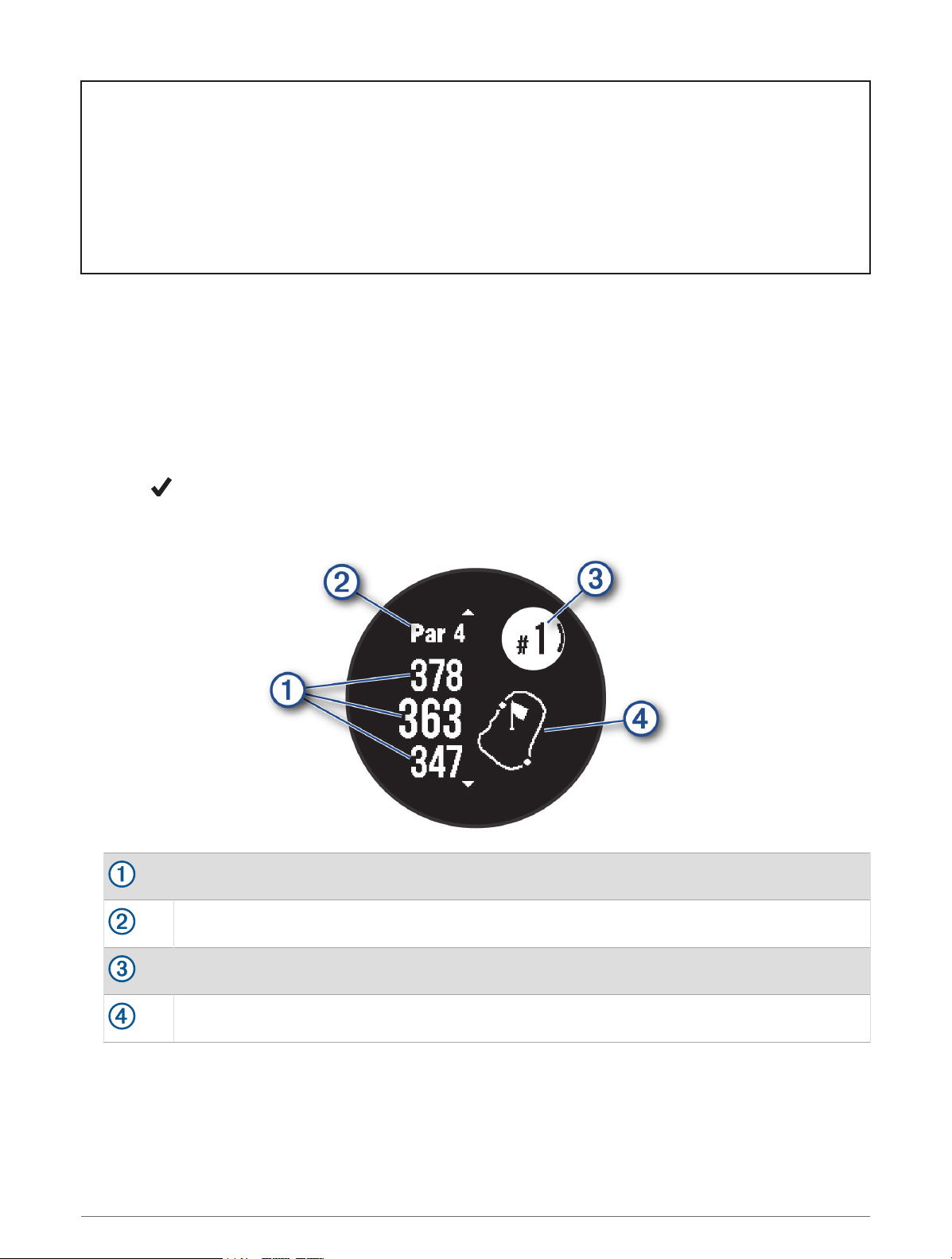
Title Playing Golf (Instinct 2)
Identifier GUID-A604EB07-4D88-4DD8-8597-098AE5198184
Language EN-US
Description
Version 1
Revision 5
Changes Save as from fenix 7
Status Released
Last Modified 20/01/2022 18:04:09
Author tillmonmartha
Playing Golf
Before you play a course for the first time, you must download it from the Garmin Connect app (Garmin Connect,
page 137). Courses downloaded from the Garmin Connect app are updated automatically.
Before you play golf, you should charge the watch (Charging the Watch, page 173).
1 From the watch face, press START.
2 Select Golf.
3 Go outside, and wait while the watch locates satellites.
4 Select a course from the list of available courses.
5 Select to keep score.
6 Select a tee box.
The hole information screen appears.
Distance to the front, middle, and back of the green
Par for the hole
Current hole number
Map of the green
NOTE: Because pin locations change, the watch calculates the distance to the front, middle, and back of the
green, but not the actual pin location.
7 Select an option:
• Press UP or DOWN to view the location and distance to a layup or to the front and back of a hazard.
• Press START to open the golf menu (
Golf Menu, page 58).
Activities and Apps 57
Title Golf Menu (Instinct 2)
Identifier GUID-FBA99345-CF0C-486C-B641-48DC992E0830
Language EN-US
Description
Version 1
Revision 8
Changes Save as from fenix 7
Status Released
Last Modified 20/01/2022 18:04:53
Author tillmonmartha
Golf Menu
During a round, you can press START to open additional features in the golf menu.
End Round: Ends the current round.
Pause Round: Pauses the current round. You can resume the round at any time by starting a Golf activity.
Change Hole: Allows you to manually change the hole.
Move Flag: Allows you to move the pin location to get a more precise distance measurement (Moving the Flag,
page 60).
Measure Shot: Shows the distance of your previous shot recorded with the Garmin AutoShot
™
feature (Viewing
Measured Shots, page 61). You can also manually record a shot (Manually Measuring a Shot, page 61).
Scorecard: Opens the scorecard for the round (Keeping Score, page 62).
Odometer: Shows the recorded time, distance, and steps traveled. The odometer automatically starts and stops
when you start or end a round. You can reset the odometer during a round.
Club Stats: Shows your statistics with each golf club, such as distance and accuracy information. Appears when
you pair Approach
®
CT10 sensors.
Settings: Allows you to customize the golf activity settings (Activities and App Settings, page 68).
58 Activities and Apps
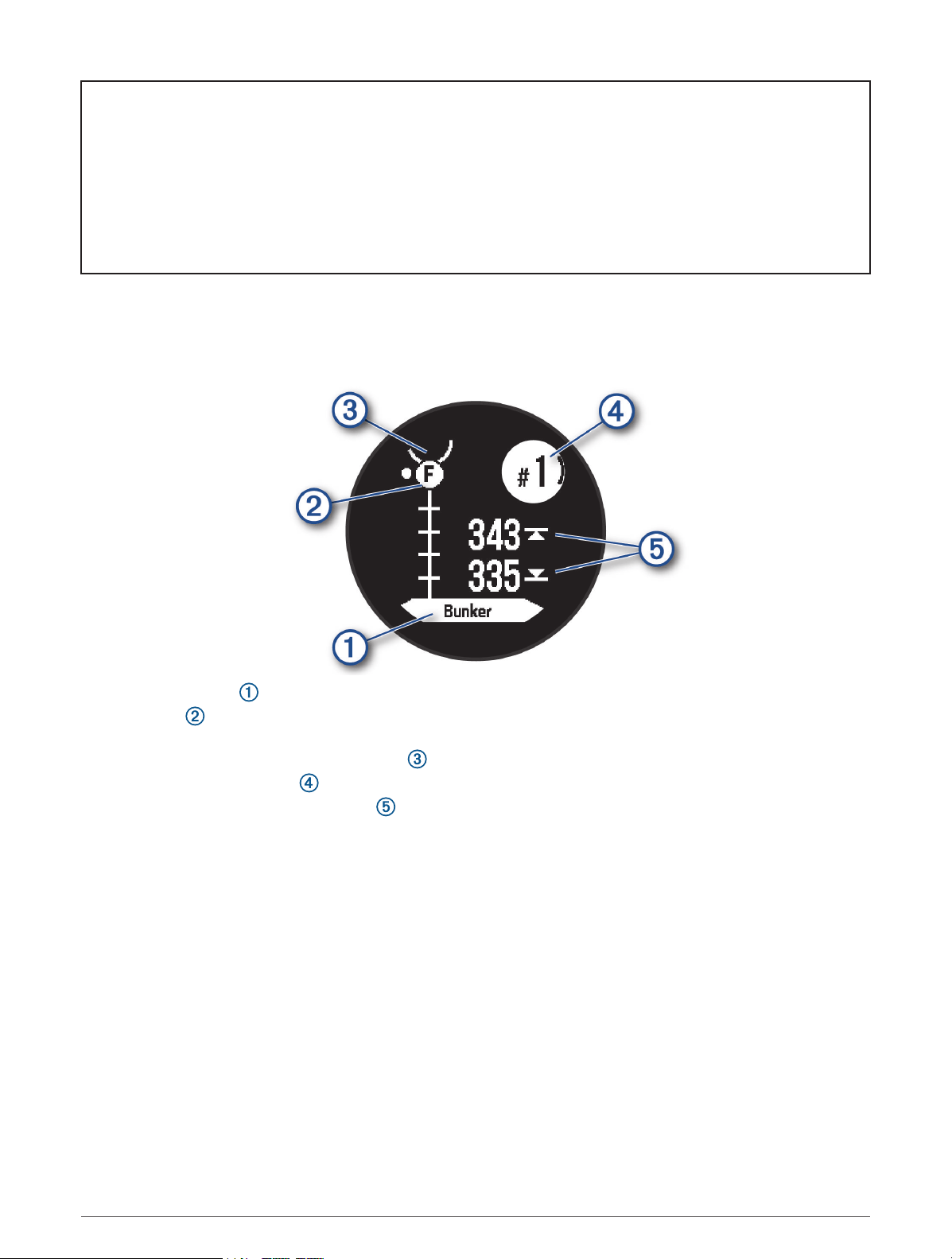
Title Viewing Hazards (Instinct 2)
Identifier GUID-4557FC31-A316-47CA-87DB-C73A079A748D
Language EN-US
Description
Version 1
Revision 5
Changes Save as from fenix 6
Status Released
Last Modified 20/01/2022 18:01:26
Author tillmonmartha
Viewing Hazards
You can view distances to hazards along the fairway for par 4 and 5 holes. Hazards that affect shot selection
are displayed individually or in groups to help you determine the distance to layup or carry.
1 From the hole information screen, press UP or DOWN to view hazard information.
• The hazard type is listed at the bottom of the screen.
• Hazards are indicated by a letter signifying the order of the hazards on the hole, and are shown below
the green in approximate locations relative to the fairway.
• The green is represented as a half circle at the top of the screen.
• The current hole number is listed at the top right of the screen.
• The distances to the front and back of the nearest hazard appear on the screen.
2 Press UP or DOWN to view other hazards for the current hole.
Activities and Apps 59
Title Moving the Flag
Identifier GUID-6F0DED41-AC66-49BD-867C-DE0E857E2E45
Language EN-US
Description
Version 3
Revision 3
Changes Added touch and keyed conditions.
Status Released
Last Modified 22/12/2021 14:18:50
Author cozmyer
Moving the Flag
You can take a closer look at the green and move the pin location.
1 From the hole information screen, press START.
2 Select Move Flag.
3 Press UP or DOWN to move the pin location.
4 Press START.
The distances on the hole information screen are updated to show the new pin location. The pin location is
saved for only the current round.
Title Changing Holes (fenix 6)
Identifier GUID-61AA1C21-0351-4DED-91FE-E7A48C76F299
Language EN-US
Description
Version 1
Revision 3
Changes
Status Released
Last Modified 06/08/2019 12:13:40
Author gerson
Changing Holes
You can change holes manually from the hole view screen.
1 While playing golf, press START.
2 Select Change Hole.
3 Select a hole.
60 Activities and Apps
Title Viewing Measured Shots
Identifier GUID-36C094EA-AFF5-4A82-BBEC-E91C445DCF86
Language EN-US
Description
Version 4
Revision 4
Changes Added "Previous Shots" string.
Status Released
Last Modified 27/04/2020 12:35:54
Author burzinskititu
Viewing Measured Shots
Before the device can automatically detect and measure shots, you must enable scoring.
Your device features automatic shot detection and recording. Each time you take a shot along the fairway, the
device records your shot distance so you can view it later.
TIP: Automatic shot detection works best when you wear the device on your leading wrist and make good
contact with the ball. Putts are not detected.
1 While playing golf, press START.
2 Select Measure Shot.
Your last shot distance appears.
NOTE: The distance automatically resets when you hit the ball again, putt on the green, or move to the next
hole.
3 Press DOWN.
4 Select Previous Shots to view all recorded shot distances.
Title Manually Measuring a Shot (fenix 7)
Identifier GUID-F265290C-F32C-48DF-B0E0-5F5147D930F0
Language EN-US
Description
Version 2
Revision 5
Changes Updated confirmation uicontrol. Added a prereq from S62 and a postreq.
Status Released
Last Modified 22/12/2021 14:20:12
Author cozmyer
Manually Measuring a Shot
You can manually add a shot if the watch doesn't detect it. You must add the shot from the location of the
missed shot.
1 Take a shot and watch where your ball lands.
2 From the hole information screen, press START.
3 Select Measure Shot.
4 Press DOWN.
5 Select Add Shot > .
6 If necessary, enter the club you used for the shot.
7 Walk or drive to your ball.
The next time you take a shot, the watch automatically records your last shot distance. If necessary, you can
manually add another shot.
Activities and Apps 61
Title Keeping Score
Identifier GUID-EF10C0FC-366E-419F-BE6C-E4A16E5C5D8C
Language EN-US
Description
Version 2
Revision 2
Changes Changing select to press for hard keys
Status Released
Last Modified 06/08/2019 12:13:40
Author gerson
Keeping Score
1 From the hole information screen, press START.
2 Select Scorecard.
The scorecard appears when you are on the green.
3 Press UP or DOWN to scroll through the holes.
4 Press START to select a hole.
5 Press UP or DOWN to set the score.
Your total score is updated.
Title Enabling Statistics Tracking
Identifier GUID-B147D250-2F48-4C2E-A366-D5C8F7147F98
Language EN-US
Description
Version 4
Revision 3
Changes Versioned to fix HR.
Status Released
Last Modified 10/02/2022 10:09:19
Author pullins
Enabling Statistics Tracking
The Stat Tracking feature enables detailed statistics tracking while playing golf.
1 From the hole information screen, hold MENU.
2 Select the activity settings.
3 Select Stat Tracking.
62 Activities and Apps
Title Recording Statistics (fenix 6)
Identifier GUID-B7060DB3-2333-4E0E-8798-570390667402
Language EN-US
Description
Version 3
Revision 3
Changes Clarify per FQC JIRA 36628. Roll up on next ECO (not a driver).
Status Released
Last Modified 08/10/2020 08:27:51
Author gerson
Recording Statistics
Before you can record statistics, you must enable statistics tracking (Enabling Statistics Tracking, page 62).
1 From the scorecard, select a hole.
2 Enter the total number of strokes taken, including putts, and press START.
3 Set the number of putts taken, and press START.
NOTE: The number of putts taken is used for statistics tracking only and does not increase your score.
4 If necessary, select an option:
NOTE: If you are on a par 3 hole, fairway information does not appear.
• If your ball hit the fairway, select In Fairway.
• If your ball missed the fairway, select Missed Right or Missed Left.
5 If necessary, enter the number of penalty strokes.
Title Surfing
Identifier GUID-429263C7-B5FD-47C0-8F08-A80795753C53
Language EN-US
Description
Version 3
Revision 4
Changes Fixing varid on step 1.
Status Released
Last Modified 10/02/2022 09:46:12
Author cozmyer
Surfing
You can use the surfing activity to record your surfing sessions. After your session, you can view the number of
waves, longest wave, and maximum speed.
1 From the watch face, press START.
2 Select Surf.
3 Wait on the beach until your watch acquires GPS signals.
4 Press START to start the activity timer.
5 After you complete your activity, press STOP to stop the activity timer.
6 Select Save to review the summary of your surfing session.
Activities and Apps 63
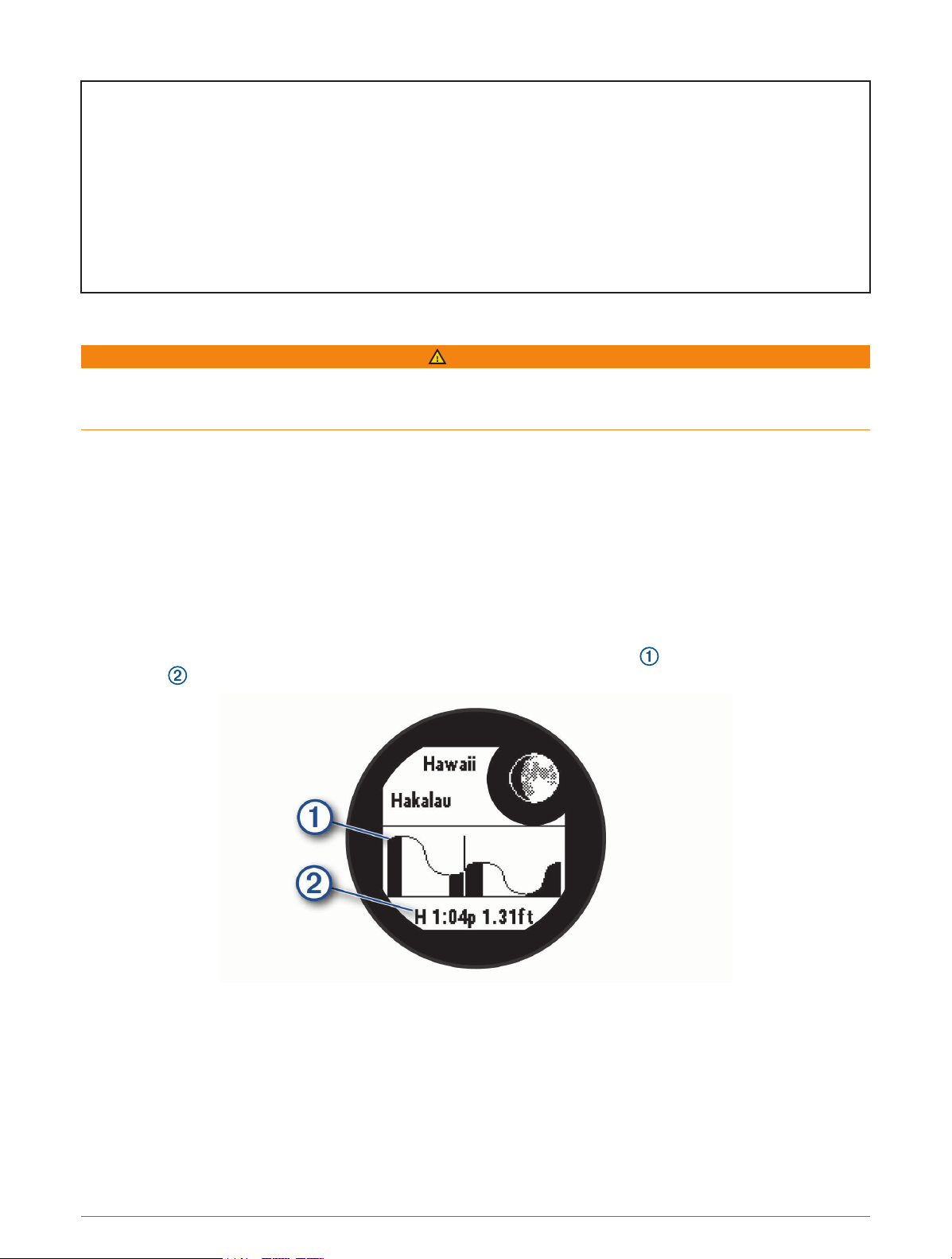
Title Viewing Tide Information (Instinct Solar Surf)
Identifier GUID-3DB3FF64-F943-4D96-8334-C9C7764FE85E
Language EN-US
Description
Version 4
Revision 6
Changes Adding a conditioned note that this is not available for all product types; device to watch; smartphone to
phone
Status Released
Last Modified 24/01/2022 15:19:25
Author tillmonmartha
Viewing Tide Information
WARNING
Tide information is for information purposes only. It is your responsibility to heed all posted water-related
guidance, to remain aware of your surroundings, and to use safe judgment in, on, and around the water at all
times. Failure to heed this warning could result in serious personal injury or death.
When you pair your watch with a compatible phone, you can view information about a tide station, including the
tide height and when the next high and low tides will occur.
1 From the watch face, press START.
2 Select Tides.
3 Select an option:
• To use your current location when you are near a tide station, select Current Location.
• To select a recently used tide station, select Recent.
• To select a saved location, select Saved.
• To enter coordinates for a location, select Coordinates.
A 24-hour tide chart appears for the current date with the current tide height and information about the
next tide .
4 Press DOWN to see tide information for upcoming days.
64 Activities and Apps
Title Customizing Activities and Apps
Identifier GUID-25FA2988-33F2-4FC9-92FA-E457CBDB9E72
Language EN-US
Description
Version 1
Revision 4
Changes
Status Released
Last Modified 22/12/2021 13:46:13
Author cozmyer
Customizing Activities and Apps
You can customize the activities and apps list, data screens, data fields, and other settings.
Title Adding or Removing a Favorite Activity
Identifier GUID-B1501DD1-3616-4171-8814-07340761F494
Language EN-US
Description
Version 3
Revision 7
Changes Added favorite activity condition. No black/white background differences.
Status Released
Last Modified 22/12/2021 13:41:03
Author cozmyer
Adding or Removing a Favorite Activity
The list of your favorite activities appears when you press START from the watch face, and it provides quick
access to the activities you use most frequently. You can add or remove favorite activities at any time.
1 Hold MENU.
2 Select Activities & Apps.
Your favorite activities appear at the top of the list.
3 Select an option:
• To add a favorite activity, select the activity, and select Set as Favorite.
• To remove a favorite activity, select the activity, and select Remove from Favorites.
Activities and Apps 65
Title Changing the Order of an App in the List
Identifier GUID-2B7CD712-3EAA-4A09-B289-CA9BB278DEBD
Language EN-US
Description
Version 3
Revision 2
Changes Changing to press for hard keys
Status Released
Last Modified 06/08/2019 12:13:40
Author gerson
Changing the Order of an Activity in the Apps List
1 Hold MENU.
2 Select Activities & Apps.
3 Select an activity.
4 Select Reorder.
5 Press UP or DOWN to adjust the position of the activity in the apps list.
Title Customizing the Data Screens (Outdoor watch)
Identifier GUID-638CD68D-11B0-4D9C-B8B7-E28D15EC4566
Language EN-US
Description
Version 9
Revision 3
Changes Added options for diving, conditioned.
Status Released
Last Modified 08/10/2020 08:25:53
Author cozmyer
Customizing the Data Screens
You can show, hide, and change the layout and content of data screens for each activity.
1 Hold MENU.
2 Select Activities & Apps.
3 Select the activity to customize.
4 Select the activity settings.
5 Select Data Screens.
6 Select a data screen to customize.
7 Select an option:
• Select Layout to adjust the number of data fields on the data screen.
• Select a field to change the data that appears in the field.
• Select Left Gauge or Right Gauge to add graphical dive gauges.
• Select Reorder to change the location of the data screen in the loop.
• Select Remove to remove the data screen from the loop.
NOTE: Not all options are available for dive activities.
8 If necessary, select Add New to add a data screen to the loop.
You can add a custom data screen, or select one of the predefined data screens.
66 Activities and Apps
Title Adding a Map to an Activity (outdoor watch)
Identifier GUID-A877CC78-A0E1-4836-84E2-6A7366C8F705
Language EN-US
Description
Version 5
Revision 5
Changes Removed Settings menu. MARQ/fenix 6 going forward. Use previous version to support older products.
Status Released
Last Modified 26/02/2019 12:52:39
Author gerson
Adding a Map to an Activity
You can add the map to the data screens loop for an activity.
1 Hold MENU.
2 Select Activities & Apps.
3 Select the activity to customize.
4 Select the activity settings.
5 Select Data Screens > Add New > Map.
Title Creating a Custom Activity
Identifier GUID-7B574BD8-05BB-410D-9A2A-7646D0B037B6
Language EN-US
Description
Version 3
Revision 2
Changes Using step conref for first step (changing select to press for hard keys)
Status Released
Last Modified 06/08/2019 12:13:40
Author gerson
Creating a Custom Activity
1 From the watch face, press START.
2 Select Add.
3 Select an option:
• Select Copy Activity to create your custom activity starting from one of your saved activities.
• Select Other to create a new custom activity.
4 If necessary, select an activity type.
5 Select a name or enter a custom name.
Duplicate activity names include a number, for example: Bike(2).
6 Select an option:
• Select an option to customize specific activity settings. For example, you can customize the data screens
or auto features.
• Select Done to save and use the custom activity.
7 Select to add the activity to your list of favorites.
Activities and Apps 67
Title Activities and App Settings
Identifier GUID-4EE5B773-E8A3-4C61-8D64-432B575963D8
Language EN-US
Description
Version 5
Revision 4
Changes Added Lane Number for track run, and added Auto Position to Auto Lap.
Status Released
Last Modified 17/05/2022 15:06:11
Author cozmyer
Activities and App Settings
These settings allow you to customize each preloaded activity app based on your needs. For example, you can
customize data pages and enable alerts and training features. Not all settings are available for all activity types.
Hold MENU, select Activities & Apps, select an activity, and select the activity settings.
3D Distance: Calculates your distance traveled using your elevation change and your horizontal movement over
ground.
3D Speed: Calculates your speed using your elevation change and your horizontal movement over ground.
Add Activity: Allows you to customize a multisport activity.
Alerts: Sets the training or navigation alerts for the activity.
Auto Climb: Enables the watch to detect elevation changes automatically using the built-in altimeter (Enabling
Auto Climb, page 72).
Auto Lap: Sets the options for the Auto Lap feature to automatically mark laps. The Auto Distance option marks
laps at a specific distance. The Auto Position option marks laps at a location where you previously pressed
BACK. When you complete a lap, a customizable lap alert message appears. This feature is helpful for
comparing your performance over different parts of an activity.
Auto Pause: Sets the options for the Auto Pause
®
feature to stop recording data when you stop moving or when
you drop below a specified speed. This feature is helpful if your activity includes stop lights or other places
where you must stop.
Auto Rest: Enables the watch to automatically detect when you are resting during a pool swim and create a rest
interval (Auto Rest and Manual Rest, page 44).
Auto Run: Enables the watch to detect ski or windsurf runs automatically using the built-in accelerometer. For
the windsurf activity, you can set speed and distance thresholds for automatically starting a run.
Auto Scroll: Sets the watch to scroll through all of the activity data screens automatically while the activity timer
is running.
Background Color: Sets the background color of each activity to black or white.
Big Numbers: Changes the size of the numbers on the golf hole information screen.
Broadcast Heart Rate: Enables automatic heart rate data broadcasting when you start the activity (Broadcasting
Heart Rate Data, page 117).
Countdown Start: Enables a countdown timer for pool swimming intervals.
Data Screens: Enables you to customize data screens and add new data screens for the activity (Customizing
the Data Screens, page 66).
Golf Distance: Sets the unit of measure used while playing golf.
GPS: Sets the mode for the GPS antenna. Using the GPS + GLONASS or GPS + GALILEO options provides
increased performance in challenging environments and faster position acquisition. Using the GPS and
another satellite together can reduce battery life more than using the GPS option only. Using the UltraTrac
option records track points and sensor data less frequently (Changing the GPS Setting, page 73).
Grading System: Sets the grading system for rating the route difficulty for a rock climbing activity.
Lane Number: Sets your lane number for track running.
Lap Key: Enables or disables the BACK button for recording a lap, set, or rest during the activity.
Lock Device: Locks the buttons during a multisport activity to prevent inadvertent button presses.
68 Activities and Apps
Metronome: Plays tones or vibrates at a steady rhythm to help you improve your performance by training at a
faster, slower, or more consistent cadence. You can set the beats per minute (bpm) of the cadence you want
to maintain, beat frequency, and sound settings.
Penalties: Enables penalty stroke tracking while playing golf (Recording Statistics, page 63).
Pool Size: Sets the pool length for pool swimming.
Power Averaging: Controls whether the watch includes zero values for power data that occur when you are not
pedaling.
Power Mode: Sets the default power mode for the activity.
Power Save Timeout: Sets the power-save timeout length for how long your watch stays in training mode, for
example, when you are waiting for a race to start. The Normal option sets the watch to enter low-power
watch mode after 5 minutes of inactivity. The Extended option sets the watch to enter low-power watch
mode after 25 minutes of inactivity. The extended mode can result in shorter battery life between charges.
Record Activity: Enables activity FIT file recording for golf activities. FIT files record fitness information that is
tailored for Garmin Connect.
Recording Interval: Sets the frequency for recording track points during an expedition. By default, GPS track
points are recorded once an hour, and they are not recorded after sunset. Recording track points less
frequently maximizes battery life.
Record After Sunset: Sets the watch to record track points after sunset during an expedition.
Record VO2 Max.: Enables VO2 max. recording for trail run activities.
Rename: Sets the activity name.
Repeat: Enables the Repeat option for multisport activities. For example, you can use this option for activities
that include multiple transitions, such as a swimrun.
Restore Defaults: Allows you to reset the activity settings.
Route Stats: Enables route statistics tracking for indoor climbing activities.
Scoring: Enables or disables scorekeeping automatically when you start a round of golf.
SpeedPro: Enables advanced speed metrics for windsurf activity runs.
Stat Tracking: Enables statistics tracking while playing golf (Recording Statistics, page 63).
Stroke Detect.: Enables stroke detection for pool swimming.
Transitions: Enables transitions for multisport activities.
Activities and Apps 69
Title Activity Alerts (outdoor watch)
Identifier GUID-E9B4413D-28EB-4054-8622-5CCD3F4571D2
Language EN-US
Description
Version 11
Revision 5
Changes Updated title
Status Released
Last Modified 22/12/2021 14:13:37
Author cozmyer
Activity Alerts
You can set alerts for each activity, which can help you to train toward specific goals, to increase your
awareness of your environment, and to navigate to your destination. Some alerts are available only for specific
activities. There are three types of alerts: event alerts, range alerts, and recurring alerts.
Event alert: An event alert notifies you once. The event is a specific value. For example, you can set the watch to
alert you when you burn a specified number of calories.
Range alert: A range alert notifies you each time the watch is above or below a specified range of values. For
example, you can set the watch to alert you when your heart rate is below 60 beats per minute (bpm) and
over 210 bpm.
Recurring alert: A recurring alert notifies you each time the watch records a specified value or interval. For
example, you can set the watch to alert you every 30 minutes.
Alert Name Alert Type Description
Cadence Range You can set minimum and maximum cadence values.
Calories Event, recurring You can set the number of calories.
Custom Event, recurring
You can select an existing message or create a custom message and select an
alert type.
Distance Recurring You can set a distance interval.
Elevation Range You can set minimum and maximum elevation values.
Heart Rate Range
You can set minimum and maximum heart rate values or select zone changes.
See About Heart Rate Zones, page 144 and Heart Rate Zone Calculations,
page 147.
Pace Range You can set minimum and maximum pace values.
Pacing Recurring You can set a target swim pace.
Power Range You can set the high or low power level.
Proximity Event You can set a radius from a saved location.
Run/Walk Recurring You can set timed walking breaks at regular intervals.
Speed Range You can set minimum and maximum speed values.
Stroke Rate Range You can set high or low strokes per minute.
Time Event, recurring You can set a time interval.
Track Timer Recurring You can set a track time interval in seconds.
70 Activities and Apps
Title Setting an Alert (outdoor watch)
Identifier GUID-D68697C7-D321-4B42-8A52-5C9D257B58CE
Language EN-US
Description
Version 6
Revision 1
Changes No English change. Versioned to fix PT-BR.
Status Released
Last Modified 20/05/2021 13:43:40
Author pullins
Setting an Alert
1 Hold MENU.
2 Select Activities & Apps.
3 Select an activity.
NOTE: This feature is not available for all activities.
4 Select the activity settings.
5 Select Alerts.
6 Select an option:
• Select Add New to add a new alert for the activity.
• Select the alert name to edit an existing alert.
7 If necessary, select the type of alert.
8 Select a zone, enter the minimum and maximum values, or enter a custom value for the alert.
9 If necessary, turn on the alert.
For event and recurring alerts, a message appears each time you reach the alert value. For range alerts, a
message appears each time you exceed or drop below the specified range (minimum and maximum values).
Activities and Apps 71
Title Enabling Auto Climb
Identifier GUID-E93B3A01-9EA5-40AD-B2E3-F70B1FACE4B6
Language EN-US
Description
Version 4
Revision 3
Changes Removed Settings menu. MARQ/fenix 6 going forward. Use previous version to support older products.
Status Released
Last Modified 26/02/2019 12:52:39
Author gerson
Enabling Auto Climb
You can use the auto climb feature to detect elevation changes automatically. You can use it during activities
such as climbing, hiking, running, or biking.
1 Hold MENU.
2 Select Activities & Apps.
3 Select an activity.
NOTE: This feature is not available for all activities.
4 Select the activity settings.
5 Select Auto Climb > Status.
6 Select Always or When Not Navigating.
7 Select an option:
• Select Run Screen to identify which data screen appears while running.
• Select Climb Screen to identify which data screen appears while climbing.
• Select Invert Colors to reverse the display colors when changing modes.
• Select Vertical Speed to set the rate of ascent over time.
• Select Mode Switch to set how quickly the device changes modes.
NOTE: The Current Screen option allows you to automatically switch to the last screen you were viewing
before the auto climb transition occurred.
72 Activities and Apps
Title Changing the GPS Setting
Identifier GUID-31C5EBD6-A5E6-46FA-9EDE-43DBA4872546
Language EN-US
Description
Version 4
Revision 4
Changes Pulled in UltraTrac info from that concept.
Status Released
Last Modified 20/01/2022 17:57:22
Author cozmyer
Changing the GPS Setting
For more information about GPS, go to garmin.com/aboutGPS.
1 Hold MENU.
2 Select Activities & Apps.
3 Select an activity.
NOTE: This feature is not available for all activities.
4 Select the activity settings.
5 Select GPS.
6 Select an option:
• Select Off to disable GPS for the activity.
• Select Normal (GPS Only) to enable the GPS satellite system.
• Select GPS + GLONASS (Russian satellite system) for more accurate position information in situations
with poor sky visibility.
NOTE: Using GPS and another satellite system together can reduce battery life more quickly than using
GPS only.
• Select GPS + GALILEO (European Union satellite system) for more accurate position information in
situations with poor sky visibility.
• Select UltraTrac to record track points and sensor data less frequently.
NOTE: Enabling the UltraTrac feature increases battery life but decreases the quality of recorded
activities. You should use the UltraTrac feature for activities that demand longer battery life and for which
frequent sensor data updates are less important.
Title Training
Identifier GUID-D3B0DF91-9FBF-4A20-9381-C286B002BBBA
Language EN-US
Description
Version 1
Revision 2
Changes
Status Released
Last Modified 22/04/2017 23:05:05
Author wiederan
Training
Training 73
Title Workouts (Forerunners)
Identifier GUID-54A017B7-95D1-4C96-A39F-AEA91B7ACE29
Language EN-US
Description
Version 5
Revision 3
Changes Updated terminology, no preloaded workouts.
Status Released
Last Modified 13/05/2022 10:38:36
Author wiederan
Workouts
You can create custom workouts that include goals for each workout step and for varied distances, times, and
calories. During your activity, you can view workout-specific data screens that contain workout step information,
such as the workout step distance or average step pace.
You can create and find more workouts using Garmin Connect, or select a training plan that has built-in
workouts and transfer them to your watch.
You can schedule workouts using Garmin Connect. You can plan workouts in advance and store them on your
watch.
Title Following a Workout From Garmin Connect
Identifier GUID-D6E80F0C-F319-47D1-AF95-0884F3386635
Language EN-US
Description
Version 9
Revision 2
Changes Fixing hyperlink bug for GCM variable.
Status Released
Last Modified 21/04/2020 16:14:30
Author mcdanielm
Following a Workout From Garmin Connect
Before you can download a workout from Garmin Connect, you must have a Garmin Connect account (Garmin
Connect, page 137).
1 Select an option:
• Open the Garmin Connect app.
• Go to connect.garmin.com.
2 Select Training > Workouts.
3 Find a workout, or create and save a new workout.
4 Select or Send to Device.
5 Follow the on-screen instructions.
74 Training
Title Starting a Workout (Outdoor Watch)
Identifier GUID-3AA7B50B-EBE5-4A29-A15A-316849BA9BDB
Language EN-US
Description
Version 6
Revision 2
Changes Adding step conrefs back in for consistency. Add activity timer to your conref to resolve SDL queries
Status Released
Last Modified 05/09/2019 10:15:43
Author gerson
Starting a Workout
Before you can start a workout, you must download a workout from your Garmin Connect account.
1 From the watch face, press START.
2 Select an activity.
3 Hold MENU.
4 Select Training > Workouts.
5 Select a workout.
NOTE: Only workouts that are compatible with the selected activity appear in the list.
6 Select Do Workout.
7 Press START to start the activity timer.
After you begin a workout, the device displays each step of the workout, step notes (optional), the target
(optional), and the current workout data.
Title Following a Daily Suggested Workout
Identifier GUID-1F857C7A-31A2-46AF-A639-2C3F5ECC3AF1
Language EN-US
Description
Version 3
Revision 4
Changes device to watch
Status Released
Last Modified 13/05/2022 10:38:36
Author wiederan
Following a Daily Suggested Workout
Before the watch can suggest a daily workout, you must have a training status and VO2 max. estimate (Training
Status, page 100).
1 From the watch face, press START.
2 Select Run or Bike.
The daily suggested workout appears.
3 Select START, and select an option:
• To do the workout, select Do Workout.
• To discard the workout, select Dismiss.
• To preview the workout steps, select Steps.
• To update the workout target setting, select Target Type.
• To turn off future workout notifications, select Disable Prompt.
The suggested workout updates automatically to changes in training habits, recovery time, and VO2 max.
Training 75
Title Customizing an Interval Workout
Identifier GUID-20F63B41-1586-4BD0-84B4-1F4A61EA2F84
Language EN-US
Description
Version 3
Revision 3
Changes Using step conref for step 1. changing to press for hard keys. The SK has a spacing issue.
Status Released
Last Modified 11/03/2021 11:09:09
Author gerson
Creating an Interval Workout
1 From the watch face, press START.
2 Select an activity.
3 Hold MENU.
4 Select Training > Intervals > Edit > Interval > Type.
5 Select Distance, Time, or Open.
TIP: You can create an open-ended interval by selecting the Open option.
6 If necessary, select Duration, enter a distance or time interval value for the workout, and select .
7 Press BACK.
8 Select Rest > Type.
9 Select Distance, Time, or Open.
10 If necessary, enter a distance or time value for the rest interval, and select .
11 Press BACK.
12 Select one or more options:
• To set the number of repetitions, select Repeat.
• To add an open-ended warm up to your workout, select Warm Up > On.
• To add an open-ended cool down to your workout, select Cool Down > On.
Title Starting an Interval Workout
Identifier GUID-FD25EFA9-3928-4B36-B47F-632993594B6F
Language EN-US
Description
Version 4
Revision 2
Changes Using step conrefs for steps 1 and 5. Update your step ph lib to use "activity timer"
Status Released
Last Modified 11/03/2021 11:12:04
Author gerson
Starting an Interval Workout
1 From the watch face, press START.
2 Select an activity.
3 Hold MENU.
4 Select Training > Intervals > Do Workout.
5 Press START to start the activity timer.
6 When your interval workout has a warm up, press BACK to begin the first interval.
7 Follow the on-screen instructions.
After you complete all of the intervals, a message appears.
76 Training
Title About the Training Calendar
Identifier GUID-F5EB9C7C-A74E-4A26-BFB5-1E6DA4399067
Language EN-US
Description
Version 3
Revision 5
Changes Changed widget to glance
Status Released
Last Modified 22/12/2021 14:13:42
Author cozmyer
About the Training Calendar
The training calendar on your watch is an extension of the training calendar or schedule you set up in your
Garmin Connect account. After you have added a few workouts to the Garmin Connect calendar, you can send
them to your device. All scheduled workouts sent to the device appear in the calendar glance. When you select a
day in the calendar, you can view or do the workout. The scheduled workout stays on your watch whether you
complete it or skip it. When you send scheduled workouts from Garmin Connect, they overwrite the existing
training calendar.
Title Using Garmin Connect Training Plans - Modern
Identifier GUID-A2FB338B-0E75-4149-A5EE-BA66064D2ABF
Language EN-US
Description
Version 8
Revision 5
Changes device to watch; smartphone to phone
Status Released
Last Modified 20/12/2021 11:55:57
Author tillmonmartha
Using Garmin Connect Training Plans
Before you can download and use a training plan, you must have a Garmin Connect account (Garmin Connect,
page 137), and you must pair the Descent watch with a compatible phone.
1 From the Garmin Connect app, select or .
2 Select Training > Training Plans.
3 Select and schedule a training plan.
4 Follow the on-screen instructions.
5 Review the training plan in your calendar.
Training 77
Title PacePro Training
Identifier GUID-27B26831-3708-46EA-BF15-18039D28EC3A
Language EN-US
Description
Version 2
Revision 3
Changes SME edit: "maximize" to "optimize" per Joe H.
Status Released
Last Modified 01/09/2020 10:04:01
Author mcdanielm
PacePro Training
Many runners like to wear a pace band during a race to help achieve their race goal. The PacePro feature allows
you to create a custom pace band based on distance and pace or distance and time. You can also create a pace
band for a known course to optimize your pace effort based on elevation changes.
You can create a PacePro plan using the Garmin Connect app. You can preview the splits and elevation plot
before you run the course.
Title Downloading a PacePro Plan from Garmin Connect
Identifier GUID-E6084D17-E9F6-4B85-B132-DB592BADAFB7
Language EN-US
Description
Version 2
Revision 3
Changes Updated GC varid.
Status Released
Last Modified 22/12/2021 13:43:12
Author cozmyer
Downloading a PacePro Plan from Garmin Connect
Before you can download a PacePro plan from Garmin Connect, you must have a Garmin Connect account
(Garmin Connect, page 137).
1 Select an option:
• Open the Garmin Connect app, and select or .
• Go to connect.garmin.com.
2 Select Training > PacePro Pacing Strategies.
3 Follow the on-screen instructions to create and save a PacePro plan.
4 Select or Send to Device.
78 Training
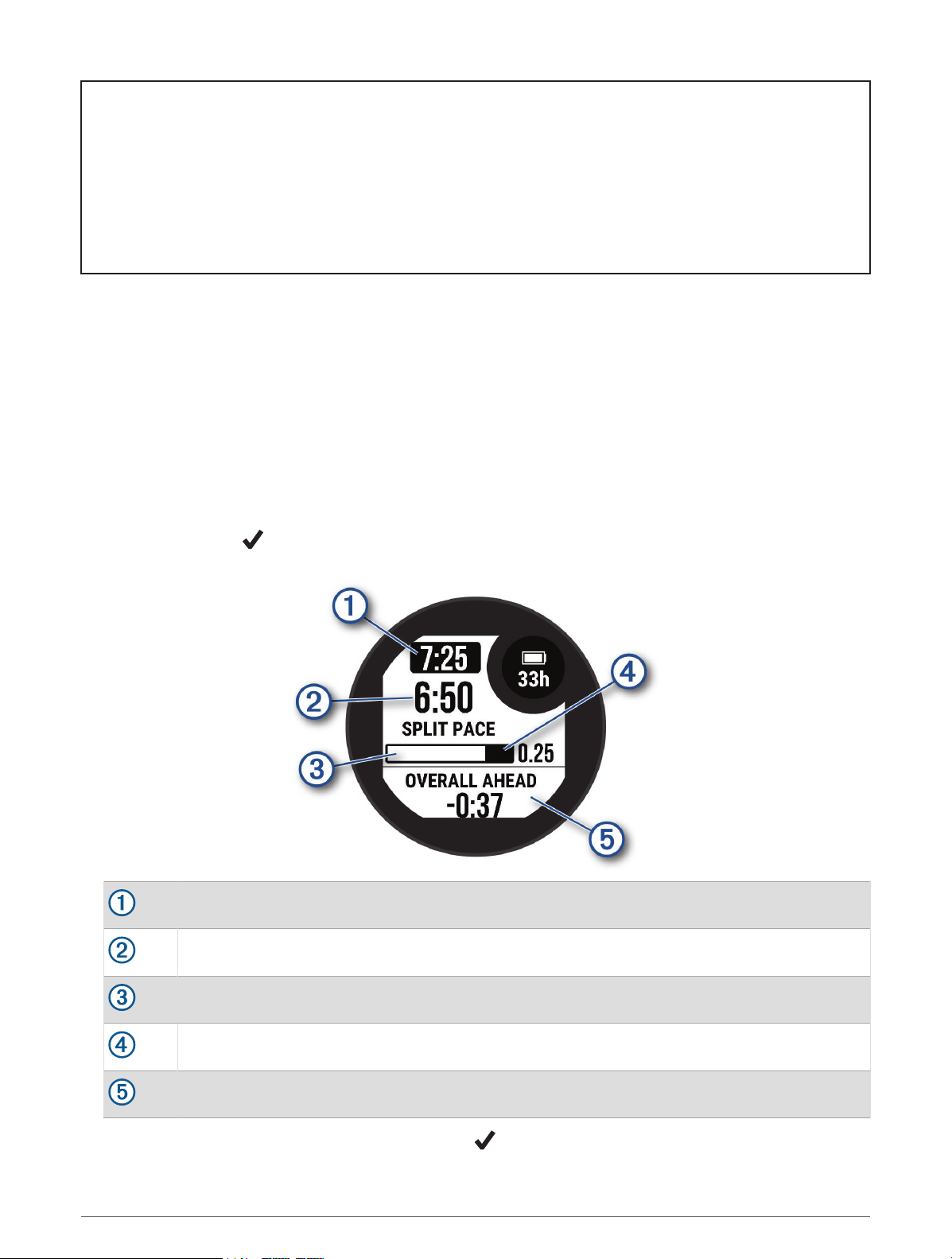
Title Starting a PacePro Plan
Identifier GUID-47D0D0FB-F4E5-4217-B223-861518049BBA
Language EN-US
Description
Version 6
Revision 3
Changes terminology
Status Released
Last Modified 13/05/2022 10:38:36
Author wiederan
Starting a PacePro Plan
Before you can start a PacePro plan, you must download a plan from your Garmin Connect account.
1 From the watch face, press START.
2 Select an outdoor running activity.
3 Hold MENU.
4 Select Training > PacePro Plans.
5 Select a plan.
6 Press START.
TIP: You can preview the splits, elevation plot, and the map before you accept the PacePro plan.
7 Select Accept Plan to start the plan.
8 If necessary, select to enable course navigation.
9 Press START to start the activity timer.
Target split pace
Current split pace
Completion progress for the split
Distance remaining in the split
Overall time ahead of or behind your target time
TIP: You can hold MENU, and select Stop PacePro > to stop the PacePro plan. The activity timer
continues running.
Training 79
Title Using Virtual Partner (Outdoor Watch)
Identifier GUID-80AA39BE-7DDD-4CEE-B7DA-7F679286EA1A
Language EN-US
Description Based on Forerunner 620 topic, updated for fenix 2 UI.
Version 8
Revision 3
Changes Add Settings menu with condition.
Status Released
Last Modified 17/06/2020 09:32:22
Author pruekatie
Using Virtual Partner
®
Your Virtual Partner is a training tool designed to help you meet your goals. You can set a pace for the Virtual
Partner and race against it.
NOTE: This feature is not available for all activities.
1 Hold MENU.
2 Select Activities & Apps.
3 Select an activity.
4 Select the activity settings.
5 Select Data Screens > Add New > Virtual Partner.
6 Enter a pace or speed value.
7 Press UP or DOWN to change the location of the Virtual Partner screen (optional).
8 Start your activity (Starting an Activity, page 38).
9 Press UP or DOWN to scroll to the Virtual Partner screen and see who is leading.
80 Training
Title Setting a Training Target
Identifier GUID-C3DF6A79-08C1-419E-9027-9245A6CA8628
Language EN-US
Description
Version 6
Revision 4
Changes Added cancelling as a tip and removed it as a nested task below this one.
Status Released
Last Modified 22/12/2021 13:43:11
Author cozmyer
Setting a Training Target
The training target feature works with the Virtual Partner feature so you can train toward a set distance,
distance and time, distance and pace, or distance and speed goal. During your training activity, the watch gives
you real-time feedback about how close you are to achieving your training target.
1 From the watch face, press START.
2 Select an activity.
3 Hold MENU.
4 Select Training > Set a Target.
5 Select an option:
• Select Distance Only to select a preset distance or enter a custom distance.
• Select Distance and Time to select a distance and time target.
• Select Distance and Pace or Distance and Speed to select a distance and pace or speed target.
The training target screen appears and displays your estimated finish time. The estimated finish time is
based on your current performance and the time remaining.
6 Press START to start the activity timer.
TIP: You can hold MENU, and select Cancel Target > to cancel the training target.
Training 81
Title Racing a Previous Activity
Identifier GUID-30FAA18A-31DF-4CFB-9A1B-F52075FB5438
Language EN-US
Description
Version 4
Revision 2
Changes Using step conrefs for consistency. Update your step ph lib to use "activity timer"
Status Released
Last Modified 06/08/2019 12:13:40
Author gerson
Racing a Previous Activity
You can race a previously recorded or downloaded activity. This feature works with the Virtual Partner feature
so you can see how far ahead or behind you are during the activity.
NOTE: This feature is not available for all activities.
1 From the watch face, press START.
2 Select an activity.
3 Hold MENU.
4 Select Training > Race an Activity.
5 Select an option:
• Select From History to select a previously recorded activity from your device.
• Select Downloaded to select an activity you downloaded from your Garmin Connect account.
6 Select the activity.
The Virtual Partner screen appears indicating your estimated finish time.
7 Press START to start the activity timer.
8 After you complete your activity, press STOP, and select Save.
Title History
Identifier GUID-E549F49A-3FB6-4FDB-8CB6-3622B1DCAE78
Language EN-US
Description
Version 2
Revision 3
Changes Removed ANT+ to increase reuse potential.
Status Released
Last Modified 13/11/2017 13:01:55
Author semrau
History
History includes time, distance, calories, average pace or speed, lap data, and optional sensor information.
NOTE: When the device memory is full, your oldest data is overwritten.
82 History
Title Using History (Outdoor)
Identifier GUID-1CBCC4BA-CC63-41EE-A8CB-9463CC4660ED
Language EN-US
Description Base on GUID-271B1E41-1F86-4E91-BE6C-D975F8DB3EE9, and update for fenix 2 UI.
Version 12
Revision 4
Changes Added aviation condition for activities history. TB: Removed xref to Viewing Your Time in Each Heart
Rate Zone, as it was removed from the chapter map.
Status Released
Last Modified 17/05/2022 15:03:53
Author cozmyer
Using History
History contains previous activities you have saved on your watch.
1 From the watch face, hold MENU.
2 Select History > Activities.
3 Select an activity.
4 Press START.
5 Select an option:
• To view additional information about the activity, select All Stats.
• To view the impact of the activity on your aerobic and anaerobic fitness, select Training Effect (About
Training Effect, page 104).
• To view your time in each heart rate zone, select Heart Rate.
• To select a lap and view additional information about each lap, select Laps.
• To select a ski or snowboard run and view additional information about each run, select Runs.
• To select an exercise set and view additional information about each set, select Sets.
• To view the activity on a map, select Map.
• To view an elevation plot for the activity, select Elevation Plot.
• To delete the selected activity, select Delete.
Title Multisport History
Identifier GUID-7F75FCAD-D929-4AB1-A5F6-8556FAF4569D
Language EN-US
Description
Version 1
Revision 4
Changes
Status Released
Last Modified 22/04/2017 20:56:39
Author wiederan
Multisport History
Your device stores the overall multisport summary of the activity, including overall distance, time, calories, and
optional accessory data. Your device also separates the activity data for each sport segment and transition so
you can compare similar training activities and track how quickly you move through the transitions. Transition
history includes distance, time, average speed, and calories.
History 83
Title Personal Records (multi)
Identifier GUID-51F2755C-0909-4C39-9540-B9F4F1D3E156
Language EN-US
Description
Version 2.1.1
Revision 3
Changes Use for devices with no swim; updated condition to power meter.
Status Released
Last Modified 12/04/2019 09:32:48
Author mcdanielm
Personal Records
When you complete an activity, the device displays any new personal records you achieved during that activity.
Personal records include your fastest time over several typical race distances and longest run or ride.
NOTE: For cycling, personal records also include most ascent and best power (power meter required).
Title Viewing Your Personal Records
Identifier GUID-6FA88D99-2430-4C76-BD01-575596D73EC8
Language EN-US
Description
Version 2
Revision 3
Changes Fixing first step for consistency.
Status Released
Last Modified 26/02/2019 12:52:39
Author mcdanielm
Viewing Your Personal Records
1 From the watch face, hold MENU.
2 Select History > Records.
3 Select a sport.
4 Select a record.
5 Select View Record.
84 History
Title Restoring a Personal Record
Identifier GUID-857D5DEF-B88C-4B97-ADBB-0700C72F2D76
Language EN-US
Description
Version 2
Revision 3
Changes Fixing first step for consistency.
Status Released
Last Modified 26/02/2019 12:52:39
Author mcdanielm
Restoring a Personal Record
You can set each personal record back to the one previously recorded.
1 From the watch face, hold MENU.
2 Select History > Records.
3 Select a sport.
4 Select a record to restore.
5 Select Previous > .
NOTE: This does not delete any saved activities.
Title Clearing Personal Records
Identifier GUID-FFCF2C10-6DB3-419E-B228-7B8AC430505C
Language EN-US
Description
Version 3
Revision 4
Changes Combined clearing one record with clearing all records.
Status Released
Last Modified 20/12/2021 11:43:56
Author cozmyer
Clearing Personal Records
1 From the watch face, hold MENU.
2 Select History > Records.
3 Select a sport.
4 Select an option:
• To delete one record, select a record, and select Clear Record > .
• To delete all records for the sport, select Clear All Records > .
NOTE: This does not delete any saved activities.
History 85
Title Viewing Data Totals
Identifier GUID-4A58F0CF-6E14-494B-80FB-7443426C827A
Language EN-US
Description
Version 6
Revision 5
Changes Step 3 is necessary. Terminology changes.
Status Released
Last Modified 22/12/2021 13:27:44
Author cozmyer
Viewing Data Totals
You can view the accumulated distance and time data saved to your watch.
1 From the watch face, hold MENU.
2 Select History > Totals.
3 Select an activity.
4 Select an option to view weekly or monthly totals.
Title Using the Odometer (fenix6)
Identifier GUID-7D1F164F-415F-4E6A-BD9C-D64974380EC7
Language EN-US
Description
Version 5
Revision 3
Changes Update select to press with hard keys for consistency.
Status Released
Last Modified 17/06/2020 12:04:25
Author pruekatie
Using the Odometer
The odometer automatically records the total distance traveled, elevation gained, and time in activities.
1 From the watch face, hold MENU.
2 Select History > Totals > Odometer.
3 Press UP or DOWN to view odometer totals.
86 History
Title Deleting History
Identifier GUID-0423E64D-C9CE-458F-8C0A-20B2353F6E78
Language EN-US
Description
Version 4
Revision 5
Changes Fixed first step for consistency.
Status Released
Last Modified 26/02/2019 12:52:39
Author mcdanielm
Deleting History
1 From the watch face, hold MENU.
2 Select History > Options.
3 Select an option:
• Select Delete All Activities to delete all activities from the history.
• Select Reset Totals to reset all distance and time totals.
NOTE: This does not delete any saved activities.
Title Appearance
Identifier GUID-9B690310-0734-43F7-816F-218B3A179C3C
Language EN-US
Description
Version 1
Revision 5
Changes
Status Released
Last Modified 22/12/2021 13:20:43
Author cozmyer
Appearance
You can customize the appearance of the watch face and the quick access features in the glance loop and
controls menu.
Title Watch Face Settings (outdoor watch)
Identifier GUID-A4EA51C3-D0B2-48E3-807A-768C6F07D7BA
Language EN-US
Description
Version 1
Revision 5
Changes
Status Released
Last Modified 22/04/2017 22:50:00
Author semrau
Watch Face Settings
You can customize the appearance of the watch face by selecting the layout, colors, and additional data. You
can also download custom watch faces from the Connect IQ store.
Appearance 87
Title Customizing the Watch Face (Instinct)
Identifier GUID-7CD73B1B-5800-45EF-86C1-B619FFE40AC5
Language EN-US
Description
Version 2
Revision 3
Changes Update select to press with hard keys for consistency.
Status Released
Last Modified 17/06/2020 11:22:12
Author pruekatie
Customizing the Watch Face
You can customize the watch face information and appearance.
1 From the watch face, hold MENU.
2 Select Watch Face.
3 Press UP or DOWN to preview the watch face options.
4 Press START.
5 Select an option:
• To activate the watch face, select Apply.
• To customize the data that appears on the watch face, select Customize, press UP or DOWN to preview
the options, and press START.
88 Appearance
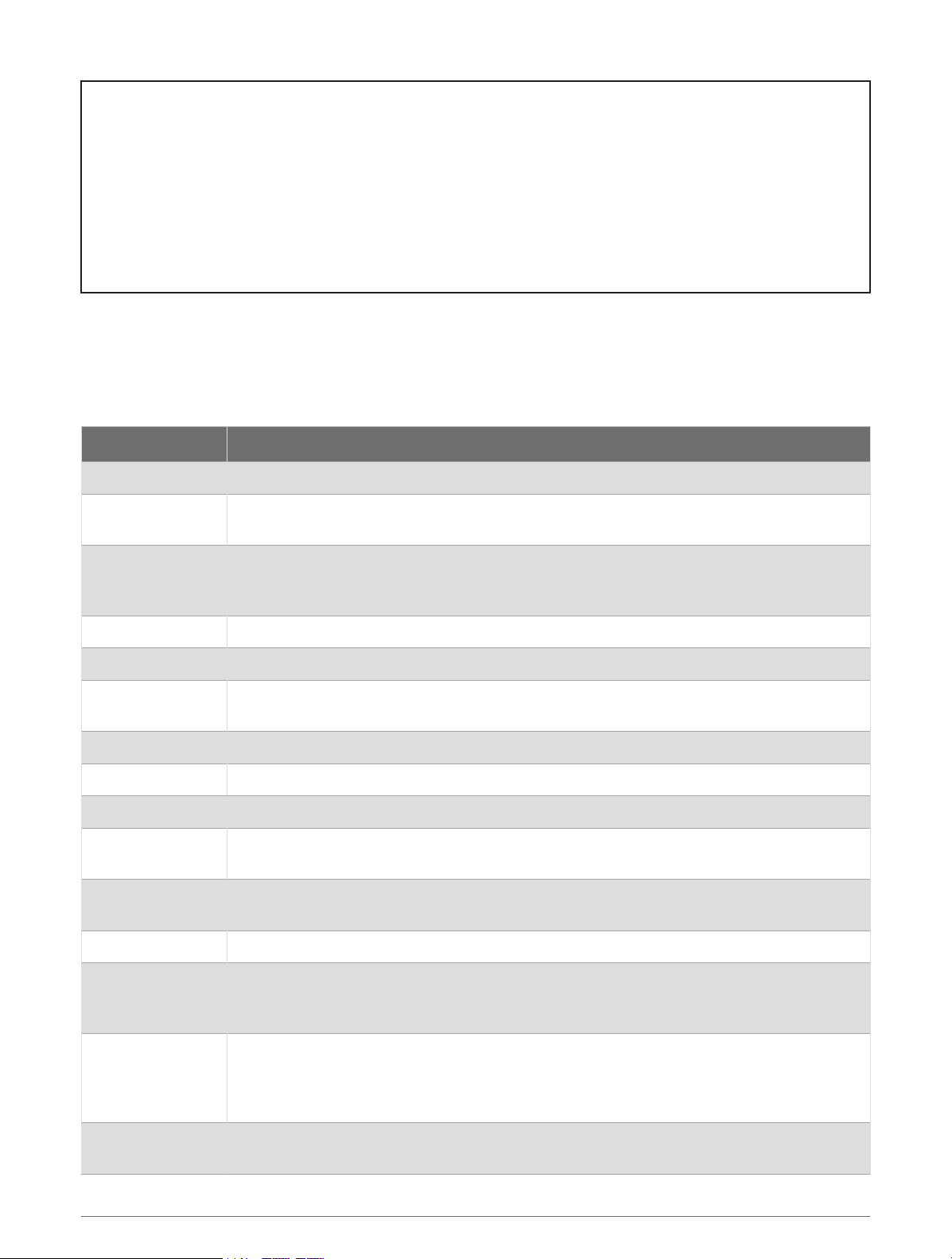
Title Glances (watch widgets)
Identifier GUID-97EA1540-A780-480F-BA4D-9A9E147FB225
Language EN-US
Description
Version 28
Revision 8
Changes KP: Aviation glance updates for D2 Series. METAR/Aviation Weather glances conditioned on METAR +
NEXRAD/No NEXRAD conditions. KC: Added optional solar note.
Status Released
Last Modified 22/02/2022 13:22:03
Author pruekatie
Glances
Your watch comes preloaded with glances that provide quick information (Viewing the Glance Loop, page 91).
Some glances require a Bluetooth
®
connection to a compatible phone.
Some glances are not visible by default. You can add them to the glance loop manually (Customizing the Glance
Loop, page 92).
Name Description
ABC Displays combined altimeter, barometer, and compass information.
Alternate time
zones
Displays the current time of day in additional time zones (Adding Alternate Time Zones,
page 7).
Altitude acclima
tion
At altitudes above 800 m (2625 ft.), displays graphs showing altitude-corrected values for
your average pulse oximeter reading, respiration rate, and resting heart rate for the last
seven days.
Altimeter Displays the approximate elevation based on pressure changes.
Barometer Displays the environmental pressure data based on elevation.
Body Battery
™
With all day wear, displays your current Body Battery level and a graph of your level for the
last several hours (Body Battery, page 92).
Calendar Displays upcoming meetings from your phone calendar.
Calories Displays your calorie information for the current day.
Compass Displays an electronic compass.
Dive log
Displays brief summaries of your recently recorded dives (Viewing the Dive Log Glance,
page 31).
Dog tracking
Displays your dog's location information when you have a compatible dog tracking device
paired with your Descent watch.
Floors climbed Tracks your floors climbed and progress toward your goal.
Garmin coach
Displays scheduled workouts when you select a Garmin coach adaptive training plan in
your Garmin Connect account. The plan adjusts to your current level of fitness, coaching
and schedule preferences, and race date.
Health Snapshot
™
Starts a Health Snapshot activity on your watch that records several key health metrics
while you hold still for two minutes. It provides a glimpse of your overall cardiovascular
status. The watch records metrics such as your average heart rate, stress level, and respi
ration rate. You can view summaries of your saved Health Snapshot activities.
Heart rate
Displays your current heart rate in beats per minute (bpm) and a graph of your average
resting heart rate (RHR).
Appearance 89
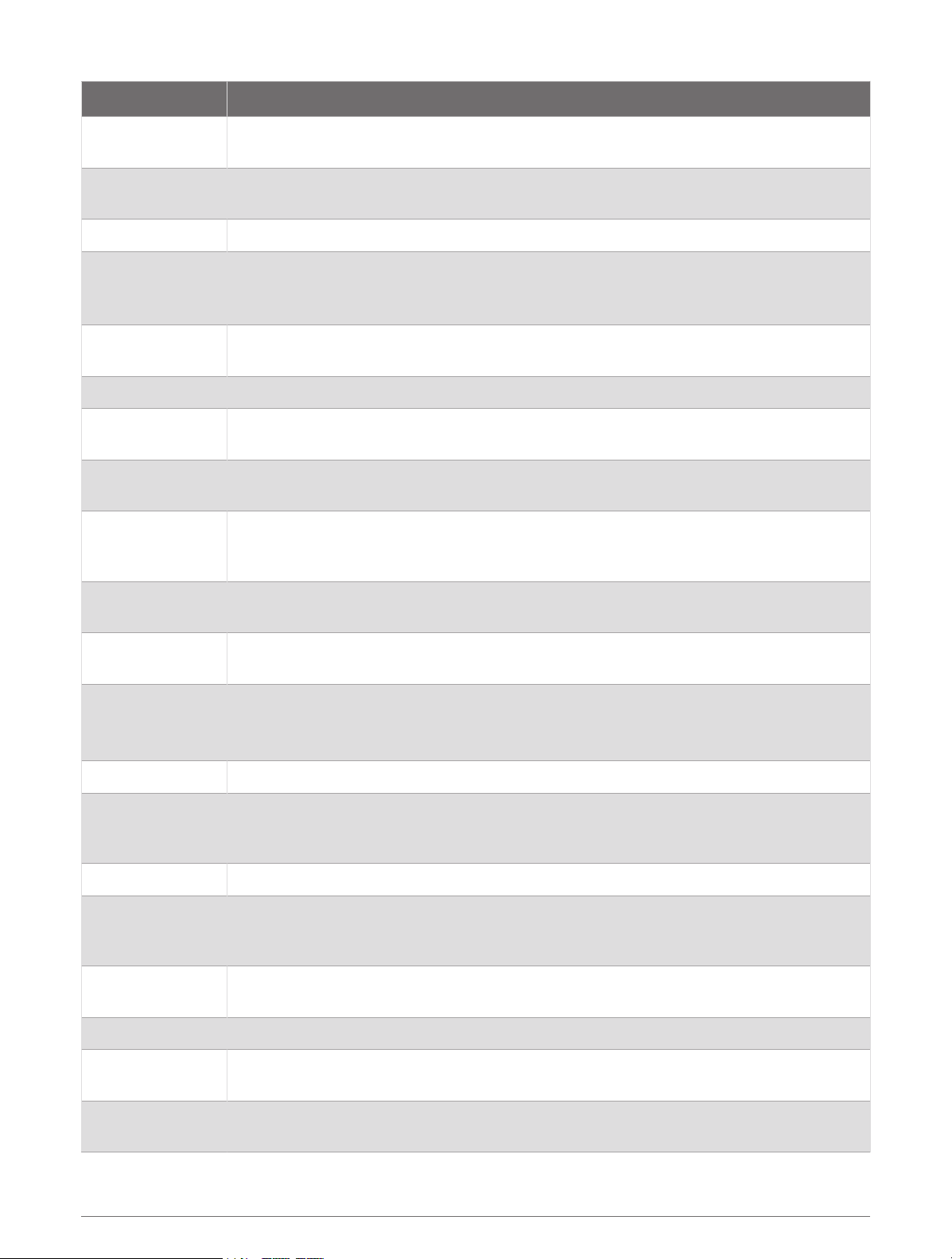
Name Description
Intensity minutes
Tracks your time spent participating in moderate to vigorous activities, your weekly
intensity minutes goal, and progress toward your goal.
inReach
®
controls
Allows you to send messages on your paired inReach device (Using the inReach Remote,
page 128).
Last sport Displays a brief summary of your last recorded activity.
Last ride
Last run
Last swim
Displays a brief summary of your last recorded activity and history of the specified sport.
Moon phase
Displays the moonrise and moonset times, along with the moon phase, based on your
GPS position.
Music controls Provides music player controls for your phone.
Notifications
Alerts you to incoming calls, texts, social network updates, and more, based on your
phone notification settings (Enabling Bluetooth Notifications, page 134).
Performance
Displays performance measurements that help you track and understand your training
activities and race performances (Performance Measurements, page 93).
Pulse oximeter
Allows you to take a manual pulse oximeter reading (Getting Pulse Oximeter Readings,
page 118). If you are too active for the watch to determine your pulse oximeter reading,
the measurements are not recorded.
Respiration
Your current respiration rate in breaths per minute and seven-day average. You can do a
breathing activity to help you relax.
Sleep
Displays total sleep time, a sleep score, and sleep stage information for the previous
night.
Solar intensity
Displays a graph of the intensity of solar input for the last 6 hours, and the average for the
previous week.
NOTE: This feature is not available for all product models.
Steps Tracks your daily step count, step goal, and data for previous days.
Stress
Displays your current stress level and a graph of your stress level. You can do a breathing
activity to help you relax. If you are too active for the watch to determine your stress level,
stress measurements are not recorded.
Sunrise and sunset Displays sunrise, sunset, and civil twilight times.
Surface interval
Displays your surface interval time, oxygen toxicity units (OTU), central nervous system
(CNS) oxygen toxicity percentage, and tissue load after a dive (Viewing the Surface
Interval Glance, page 31).
Surfline
™
Uses your current location to display current wave conditions, such as tide and wave
height and surf rating, for the nearest surf spots.
Temperature Displays temperature data from the internal temperature sensor.
Training status
Displays your current training status and training load, which shows you how your training
affects your fitness level and performance (Training Status, page 100).
VIRB
®
controls
Provides camera controls when you have a VIRB device paired with your Descent watch
(
VIRB Remote, page 129).
90 Appearance
Name Description
Weather Displays the current temperature and weather forecast.
Xero
®
device
Displays laser location information when you have a compatible Xero device paired with
your Descent watch (Xero Laser Location Settings, page 131).
Title Viewing the Glance Loop (fenix 7)
Identifier GUID-EC6FD9D1-76D1-4EA1-BABF-0800945E0230
Language EN-US
Description
Version 8
Revision 3
Changes Updated device to watch and smartphone to phone.
Status Released
Last Modified 22/12/2021 12:49:58
Author cozmyer
Viewing the Glance Loop
Glances provide quick access to health data, activity information, built-in sensors, and more. When you pair your
watch, you can view data from your phone, such as notifications, weather, and calendar events.
1 Press UP or DOWN.
The watch scrolls through the glance loop and displays summary data for each glance.
2 Press START to view more information.
3 Select an option:
• Press DOWN to view details about a glance.
• Press START to view additional options and functions for a glance.
Appearance 91
Title Customizing the Glance Loop (fenix 7)
Identifier GUID-61C825F5-5D80-413F-BA3F-CD8C51BB63F2
Language EN-US
Description
Version 9
Revision 5
Changes Updated the menu path and switched to glances.
Status Released
Last Modified 22/12/2021 14:28:16
Author cozmyer
Customizing the Glance Loop
You can change the order of the glances in the loop, remove glances, and add new glances.
1 Hold MENU.
2 Select Appearance > Glances.
3 Select an option:
• Select a glance, and press UP or DOWN to change the location of the glance in the loop.
• Select a glance, and select to remove the glance from the loop.
• Select Add, and select a glance to add it to the loop.
Title Body Battery
Identifier GUID-87E1392B-2C55-40B7-A1FF-3AB9252DA0A0
Language EN-US
Description
Version 3
Revision 3
Changes Device to watch
Status Released
Last Modified 20/12/2021 11:42:42
Author tillmonmartha
Body Battery
Your watch analyzes your heart rate variability, stress level, sleep quality, and activity data to determine your
overall Body Battery level. Like a gas gauge on a car, it indicates your amount of available reserve energy. The
Body Battery level range is from 0 to 100, where 0 to 25 is low reserve energy, 26 to 50 is medium reserve
energy, 51 to 75 is high reserve energy, and 76 to 100 is very high reserve energy.
You can sync your watch with your Garmin Connect account to view your most up-to-date Body Battery level,
long-term trends, and additional details (Tips for Improved Body Battery Data, page 93).
92 Appearance
Title Tips for Improved Body Battery Data
Identifier GUID-77DAE539-D617-45E9-A471-F21C4432245D
Language EN-US
Description
Version 3
Revision 3
Changes Device to watch
Status Released
Last Modified 20/12/2021 11:55:24
Author tillmonmartha
Tips for Improved Body Battery Data
• For more accurate results, wear the watch while sleeping.
• Good sleep charges your Body Battery.
• Strenuous activity and high stress can cause your Body Battery to drain more quickly.
• Food intake, as well as stimulants like caffeine, has no impact on your Body Battery.
Title Performance Measurements
Identifier GUID-F5BF67CE-C94E-4842-AE96-A7A05C85B732
Language EN-US
Description
Version 9
Revision 6
Changes Changed remaining stamina to current stamina.
Status Released
Last Modified 13/05/2022 10:38:36
Author cozmyer
Performance Measurements
These performance measurements are estimates that can help you track and understand your training activities
and race performances. The measurements require a few activities using wrist-based heart rate or a compatible
chest heart rate monitor. Cycling performance measurements require a heart rate monitor and a power meter.
These estimates are provided and supported by Firstbeat Analytics
™
. For more information, go to garmin.com
/performance-data/running.
NOTE: The estimates may seem inaccurate at first. The watch requires you to complete a few activities to learn
about your performance.
VO2 max.: VO2 max. is the maximum volume of oxygen (in milliliters) you can consume per minute per kilogram
of body weight at your maximum performance (About VO2 Max. Estimates, page 94).
Predicted race times: Your watch uses the VO2 max. estimate and your training history to provide a target race
time based on your current state of fitness (Viewing Your Predicted Race Times, page 95).
Performance condition: Your performance condition is a real-time assessment after 6 to 20 minutes of activity.
It can be added as a data field so you can view your performance condition during the rest of your activity. It
compares your real-time condition to your average fitness level (Performance Condition, page 96).
Functional threshold power (FTP): The watch uses your user profile information from the initial setup to
estimate your FTP. For a more accurate rating, you can conduct a guided test (Getting Your FTP Estimate,
page 97).
Lactate threshold: Lactate threshold requires a chest heart rate monitor. Lactate threshold is the point where
your muscles start to rapidly fatigue. Your watch measures your lactate threshold level using heart rate data
and pace (Lactate Threshold, page 98).
Appearance 93
Title About VO2 Max. Estimates (vivosmart 3)
Identifier GUID-5C6CB6AA-3603-4708-89FB-C819F065A5B0
Language EN-US
Description
Version 6
Revision 4
Changes Added conditioned power meter statement
Status Released
Last Modified 20/01/2022 17:55:19
Author tillmonmartha
About VO2 Max. Estimates
VO2 max. is the maximum volume of oxygen (in milliliters) you can consume per minute per kilogram of body
weight at your maximum performance. In simple terms, VO2 max. is an indication of cardiovascular strength
and should increase as your level of fitness improves. The Descent G1 watch requires wrist-based heart rate or
a compatible chest heart rate monitor to display your VO2 max. estimate. The watch has separate VO2 max.
estimates for running and cycling. You must run either outside with GPS or ride with a compatible power meter
at a moderate level of intensity for several minutes to get an accurate VO2 max. estimate.
On the watch, your VO2 max. estimate appears as a number and description. On your Garmin Connect account,
you can view additional details about your VO2 max. estimate.
VO2 max. data is provided by Firstbeat Analytics. VO2 max. analysis is provided with permission from The
Cooper Institute
®
. For more information, see the appendix (VO2 Max. Standard Ratings, page 207), and go to
www.CooperInstitute.org.
Title Getting Your VO2 Max. Estimate (running)
Identifier GUID-015C6746-435D-48E0-8ED8-CA2C81684E38
Language EN-US
Description
Version 8
Revision 5
Changes Terminology, plus remove TIP as per Kerri F.
Status Released
Last Modified 13/05/2022 10:38:36
Author wiederan
Getting Your VO2 Max. Estimate for Running
This feature requires wrist-based heart rate or a compatible chest heart rate monitor. If you are using a chest
heart rate monitor, you must put it on and pair it with your watch (Pairing Your Wireless Sensors, page 125).
For the most accurate estimate, complete the user profile setup (Setting Up Your User Profile, page 143), and set
your maximum heart rate (Setting Your Heart Rate Zones, page 146). The estimate may seem inaccurate at first.
The watch requires a few runs to learn about your running performance. You can disable VO2 max. recording for
ultra run and trail run activities if you do not want those run types to affect your VO2 max. estimate (Activities
and App Settings, page 68).
1 Start a running activity.
2 Run for at least 10 minutes outdoors.
3 After your run, select Save.
4 Press UP or DOWN to scroll through the performance measurements.
94 Appearance
Title Getting Your VO2 Max. Estimate for Cycling
Identifier GUID-E17003DB-1F26-483E-A8B4-BBF04B4E3A9B
Language EN-US
Description
Version 8
Revision 3
Changes Terminology changes, delete TIP as per Kerri F.
Status Released
Last Modified 13/05/2022 10:38:36
Author wiederan
Getting Your VO2 Max. Estimate for Cycling
This feature requires a power meter and wrist-based heart rate or a compatible chest heart rate monitor. The
power meter must be paired with your watch (Pairing Your Wireless Sensors, page 125). If you are using a chest
heart rate monitor, you must put it on and pair it with your watch.
For the most accurate estimate, complete the user profile setup (Setting Up Your User Profile, page 143) and set
your maximum heart rate (Setting Your Heart Rate Zones, page 146). The estimate may seem inaccurate at first.
The watch requires a few rides to learn about your cycling performance.
1 Start a cycling activity.
2 Ride at a steady, high intensity for at least 20 minutes.
3 After your ride, select Save.
4 Press UP or DOWN to scroll through the performance measurements.
Title Viewing Your Predicted Race Times
Identifier GUID-31B2458A-859A-4A34-AB83-224E4A29387A
Language EN-US
Description
Version 7
Revision 8
Changes Updated steps for viewing details. Updated device to watch
Status Released
Last Modified 22/12/2021 13:47:11
Author cozmyer
Viewing Your Predicted Race Times
For the most accurate estimate, complete the user profile setup (Setting Up Your User Profile, page 143), and set
your maximum heart rate (Setting Your Heart Rate Zones, page 146).
Your watch uses the VO2 max. estimate (About VO2 Max. Estimates, page 94) and your training history to
provide a target race time. The watch analyzes several weeks of your training data to refine the race time
estimates.
TIP: If you have more than one Garmin device, you can enable the Physio TrueUp
™
feature, which allows your
watch to sync activities, history, and data from other devices (Syncing Activities and Performance
Measurements, page 171).
1 From the watch face, press UP or DOWN to view the performance glance.
2 Press START to view glance details.
3 Press UP or DOWN to view a predicted race time.
4 Press START to view predictions for other distances.
NOTE: The predictions may seem inaccurate at first. The watch requires a few runs to learn about your
running performance.
Appearance 95
Title Performance Condition
Identifier GUID-901ACCFC-FB0D-414E-B80C-54970AF4E357
Language EN-US
Description
Version 4
Revision 1
Changes No English change. Versioned to fix IT.
Status Released
Last Modified 07/08/2020 09:37:33
Author pullins
Performance Condition
As you complete your activity, such as running or cycling, the performance condition feature analyzes your pace,
heart rate, and heart rate variability to make a real-time assessment of your ability to perform compared to your
average fitness level. It is approximately your real-time percentage deviation from your baseline VO2 max.
estimate.
Performance condition values range from -20 to +20. After the first 6 to 20 minutes of your activity, the device
displays your performance condition score. For example, a score of +5 means that you are rested, fresh, and
capable of a good run or ride. You can add performance condition as a data field to one of your training screens
to monitor your ability throughout the activity. Performance condition can also be an indicator of fatigue level,
especially at the end of a long training run or ride.
NOTE: The device requires a few runs or rides with a heart rate monitor to get an accurate VO2 max. estimate
and learn about your running or riding ability (About VO2 Max. Estimates, page 94).
Title Viewing Your Performance Condition
Identifier GUID-73903771-7910-4AC4-AC70-0E1974538934
Language EN-US
Description
Version 4
Revision 3
Changes wording change from Joe Heikes
Status Released
Last Modified 22/04/2017 22:49:55
Author wiederan
Viewing Your Performance Condition
This feature requires wrist-based heart rate or a compatible chest heart rate monitor.
1 Add Perform. Cond. to a data screen (Customizing the Data Screens, page 66).
2 Go for a run or ride.
After 6 to 20 minutes, your performance condition appears.
3 Scroll to the data screen to view your performance condition throughout the run or ride.
96 Appearance
Title Getting Your FTP Estimate (Instinct)
Identifier GUID-4250B4E0-62F7-41B5-99FE-70070C110B47
Language EN-US
Description
Version 1
Revision 5
Changes save as from fenix 7
Status Released
Last Modified 20/01/2022 18:05:35
Author tillmonmartha
Getting Your FTP Estimate
Before you can get your functional threshold power (FTP) estimate, you must pair a chest heart rate monitor
and power meter with your watch (Pairing Your Wireless Sensors, page 125), and you must get your VO2 max.
estimate (Getting Your VO2 Max. Estimate for Cycling, page 95).
The watch uses your user profile information from the initial setup and your VO2 max. estimate to estimate your
FTP. The watch automatically detects your FTP during rides at a steady, high intensity with heart rate and
power.
1 Press UP or DOWN to view the performance glance.
2 Press START to view the glance details.
3 Press UP or DOWN to view your FTP estimate.
Your FTP estimate appears as a value measured in watts per kilogram, your power output in watts, and a
position on the gauge.
For more information, see the appendix (FTP Ratings, page 208).
NOTE: When a performance notification alerts you to a new FTP, you can select Accept to save the new FTP,
or Decline to keep your current FTP.
Appearance 97
Title Conducting an FTP Test
Identifier GUID-C8DAC4B1-3159-4E8C-ADD9-6FA012EBA697
Language EN-US
Description
Version 3
Revision 7
Changes Updates from Joe H and Kerri
Status Released
Last Modified 22/04/2017 22:46:07
Author wiederan
Conducting an FTP Test
Before you can conduct a test to determine your functional threshold power (FTP), you must pair a chest heart
rate monitor and a power meter with your device (Pairing Your Wireless Sensors, page 125), and you must get
your VO2 max. estimate (Getting Your VO2 Max. Estimate for Cycling, page 95).
NOTE: The FTP test is a challenging workout that takes about 30 minutes to complete. Choose a practical and
mostly flat route that allows you to ride at a steadily increasing effort, similar to a time trial.
1 From the watch face, select START.
2 Select a cycling activity.
3 Hold MENU.
4 Select Training > FTP Guided Test.
5 Follow the on-screen instructions.
After you begin your ride, the device displays each step duration, the target, and current power data. A
message appears when the test is complete.
6 After you complete the guided test, complete the cool down, stop the timer, and save the activity.
Your FTP appears as a value measured in watts per kilogram, your power output in watts, and a position on
the color gauge.
7 Select an option:
• Select Accept to save the new FTP.
• Select Decline to keep your current FTP.
Title Lactate Threshold
Identifier GUID-3ED97FFE-025E-47EA-9C70-DD86156617BD
Language EN-US
Description
Version 3
Revision 1
Changes No English change. Versioned to fix ES.
Status Released
Last Modified 28/03/2022 11:11:38
Author pullins
Lactate Threshold
Lactate threshold is the exercise intensity at which lactate (lactic acid) starts to accumulate in the bloodstream.
In running, it is the estimated level of effort or pace. When a runner exceeds the threshold, fatigue starts to
increase at an accelerating rate. For experienced runners, the threshold occurs at approximately 90% of their
maximum heart rate and between 10k and half-marathon race pace. For average runners, the lactate threshold
often occurs well below 90% of maximum heart rate. Knowing your lactate threshold can help you determine
how hard to train or when to push yourself during a race.
If you already know your lactate threshold heart rate value, you can enter it in your user profile settings (
Setting
Your Heart Rate Zones, page 146). You can turn on the Auto Detection feature to automatically record your
lactate threshold during an activity.
98 Appearance
Title Performing a Guided Test to Determine Your Lactate Threshold
Identifier GUID-1B0C9B93-01CD-4A0C-A30F-B815C0347159
Language EN-US
Description
Version 5
Revision 3
Changes Per FR645 FRM96 feedback - V02 estimate from previous run is no longer necessary.
Status Released
Last Modified 02/01/2018 11:13:10
Author semrau
Performing a Guided Test to Determine Your Lactate Threshold
This feature requires a Garmin chest heart rate monitor. Before you can perform the guided test, you must put
on a heart rate monitor and pair it with your device (Pairing Your Wireless Sensors, page 125).
The device uses your user profile information from the initial setup and your VO2 max. estimate to estimate
your lactate threshold. The device will automatically detect your lactate threshold during runs at a steady, high
intensity with heart rate.
TIP: The device requires a few runs with a chest heart rate monitor to get an accurate maximum heart rate value
and VO2 max. estimate. If you are having trouble getting a lactate threshold estimate, try manually lowering
your maximum heart rate value.
1 From the watch face, select START.
2 Select an outdoor running activity.
GPS is required to complete the test.
3 Hold MENU.
4 Select Training > Lactate Threshold Guided Test.
5 Start the timer, and follow the on-screen instructions.
After you begin your run, the device displays each step duration, the target, and current heart rate data. A
message appears when the test is complete.
6 After you complete the guided test, stop the timer and save the activity.
If this is your first lactate threshold estimate, the device prompts you to update your heart rate zones based
on your lactate threshold heart rate. For each additional lactate threshold estimate, the device prompts you
to accept or decline the estimate.
Appearance 99
Title Training Status
Identifier GUID-44C7BB4B-EFF7-4A42-AC03-8A6AABB94807
Language EN-US
Description
Version 4
Revision 6
Changes Added links to nested topics.
Status Released
Last Modified 13/05/2022 10:38:36
Author cozmyer
Training Status
These measurements are estimates that can help you track and understand your training activities. The
measurements require a few activities using wrist-based heart rate or a compatible chest heart rate monitor.
Cycling performance measurements require a heart rate monitor and a power meter.
These estimates are provided and supported by Firstbeat Analytics. For more information, go to garmin.com
/performance-data/running.
NOTE: The estimates may seem inaccurate at first. The watch requires you to complete a few activities to learn
about your performance.
Training status: Training status shows you how your training affects your fitness and performance. Your
training status is based on changes to your training load and VO2 max. over an extended time period.
VO2 max.: VO2 max. is the maximum volume of oxygen (in milliliters) you can consume per minute per kilogram
of body weight at your maximum performance (About VO2 Max. Estimates, page 94). Your watch displays
heat and altitude corrected VO2 max. values when you are acclimating to high heat environments or high
altitude (Heat and Altitude Performance Acclimation, page 102).
Training load: Training load is the sum of your excess post-exercise oxygen consumption (EPOC) over the last 7
days. EPOC is an estimate of how much energy it takes for your body to recover after exercise (Training Load,
page 103).
Training load focus: Your watch analyzes and distributes your training load into different categories based on
the intensity and structure of each activity recorded. Training load focus includes the total load accumulated
per category, and the focus of the training. Your watch displays your load distribution over the last 4 weeks
(Training Load Focus, page 103).
Recovery time: The recovery time displays how much time remains before you are fully recovered and ready for
the next hard workout (Recovery Time, page 105).
100 Appearance
Title Training Status Levels
Identifier GUID-6F81BF5B-B49A-4506-95E2-0F4A04D8B319
Language EN-US
Description
Version 3
Revision 4
Changes 2019 watches (MARQ, fenix 6, Forerunner 945) separate the training status and performance stats
widgets into 2. Retitled this topic since it's only about training status. It should be used as a sub-topic
under the new high-level description Training Status topic
Status Released
Last Modified 13/05/2022 10:38:36
Author gerson
Training Status Levels
Training status shows you how your training affects your fitness level and performance. Your training status is
based on changes to your training load and VO2 max. over an extended time period. You can use your training
status to help plan future training and continue improving your fitness level.
Peaking: Peaking means that you are in ideal race condition. Your recently reduced training load is allowing your
body to recover and fully compensate for earlier training. You should plan ahead, since this peak state can
only be maintained for a short time.
Productive: Your current training load is moving your fitness level and performance in the right direction. You
should plan recovery periods into your training to maintain your fitness level.
Maintaining: Your current training load is enough to maintain your fitness level. To see improvement, try adding
more variety to your workouts or increasing your training volume.
Recovery: Your lighter training load is allowing your body to recover, which is essential during extended periods
of hard training. You can return to a higher training load when you feel ready.
Unproductive: Your training load is at a good level, but your fitness is decreasing. Your body may be struggling
to recover, so you should pay attention to your overall health including stress, nutrition, and rest.
Detraining: Detraining occurs when you are training much less than usual for a week or more, and it is affecting
your fitness level. You can try increasing your training load to see improvement.
Overreaching: Your training load is very high and counterproductive. Your body needs a rest. You should give
yourself time to recover by adding lighter training to your schedule.
No Status: The device needs one or two weeks of training history, including activities with VO2 max. results
from running or cycling, to determine your training status.
Appearance 101
Title Tips for Getting Your Training Status
Identifier GUID-CF3B3A75-7707-49EC-9177-ABC1B772A787
Language EN-US
Description
Version 4
Revision 4
Changes Add xref to turning off VO2 max recording.
Status Released
Last Modified 13/05/2022 10:38:36
Author pruekatie
Tips for Getting Your Training Status
The training status feature depends on updated assessments of your fitness level, including at least two VO2
max. measurements per week. Your VO2 max. estimate is updated after outdoor runs or rides with power during
which your heart rate reached at least 70% of your maximum heart rate for several minutes. Indoor run activities
do not generate a VO2 max. estimate in order to preserve the accuracy of your fitness level trend. You can
disable VO2 max. recording for ultra run and trail run activities if you do not want those run types to affect your
VO2 max. estimate (Activities and App Settings, page 68).
To get the most out of the training status feature, you can try these tips.
• At least two times per week, run or ride outdoors with a power meter, and reach a heart rate higher than 70%
of your maximum heart rate for at least 10 minutes.
After using the device for one week, your training status should be available.
• Record all of your fitness activities on this device, or enable the Physio TrueUp feature, allowing your device
to learn about your performance (Syncing Activities and Performance Measurements, page 171).
Title Heat and Altitude Performance Acclimation
Identifier GUID-70386BCC-5682-4C5C-9A87-C32AF9B6473B
Language EN-US
Description
Version 3
Revision 4
Changes Added conditions for glances.
Status Released
Last Modified 22/12/2021 13:18:30
Author cozmyer
Heat and Altitude Performance Acclimation
Environmental factors such as high temperature and altitude impact your training and performance. For
example, high altitude training can have a positive impact on your fitness, but you may notice a temporary VO2
max. decline while exposed to high altitudes. Your Descent G1 watch provides acclimation notifications and
corrections to your VO2 max. estimate and training status when the temperature is above 22ºC (72ºF) and when
the altitude is above 800 m (2625 ft.). You can keep track of your heat and altitude acclimation in the training
status glance.
NOTE: The heat acclimation feature is available only for GPS activities and requires weather data from your
connected phone.
102 Appearance
Title Acute Load
Identifier GUID-AEDB0872-C5A1-4378-86D5-2239734B59E8
Language EN-US
Description
Version 3
Revision 2
Changes Defined EPOC acronym.
Status Released
Last Modified 13/05/2022 10:38:36
Author cozmyer
Training Load
Training load is a measurement of your training volume over the last seven days. It is the sum of your excess
post-exercise oxygen consumption (EPOC) measurements for the last seven days. The gauge indicates whether
your current load is low, high, or within the optimal range to maintain or improve your fitness level. The optimal
range is determined based on your individual fitness level and training history. The range adjusts as your
training time and intensity increase or decrease.
Title Training Load Focus
Identifier GUID-C3205D96-DAB6-4C93-A225-5B8D7B5A5621
Language EN-US
Description
Version 3
Revision 3
Changes Fix to make feature name consistent from JoeH.
Status Released
Last Modified 24/04/2019 08:26:15
Author wiederan
Training Load Focus
In order to maximize performance and fitness gains, training should be distributed across three categories: low
aerobic, high aerobic, and anaerobic. Training load focus shows you how much of your training is currently in
each category and provides training targets. Training load focus requires at least 7 days of training to determine
if your training load is low, optimal, or high. After 4 weeks of training history, your training load estimate will
have more detailed target information to help you balance your training activities.
Below targets: Your training load is lower than optimal in all intensity categories. Try increasing the duration or
frequency of your workouts.
Low aerobic shortage: Try adding more low aerobic activities to provide recovery and balance for your higher
intensity activities.
High aerobic shortage: Try adding more high aerobic activities to help improve your lactate threshold and VO2
max. over time.
Anaerobic shortage: Try adding a few more intense, anaerobic activities to improve your speed and anaerobic
capacity over time.
Balanced: Your training load is balanced and provides all-around fitness benefits as you continue training.
Low aerobic focus: Your training load is mostly low aerobic activity. This provides a solid foundation and
prepares you for adding more intense workouts.
High aerobic focus: Your training load is mostly high aerobic activity. These activities help to improve lactate
threshold, VO2 max., and endurance.
Anaerobic focus: Your training load is mostly intense activity. This leads to rapid fitness gains, but should be
balanced with low aerobic activities.
Above targets: Your training load is higher than optimal, and you should consider scaling back the duration and
frequency of your workouts.
Appearance 103
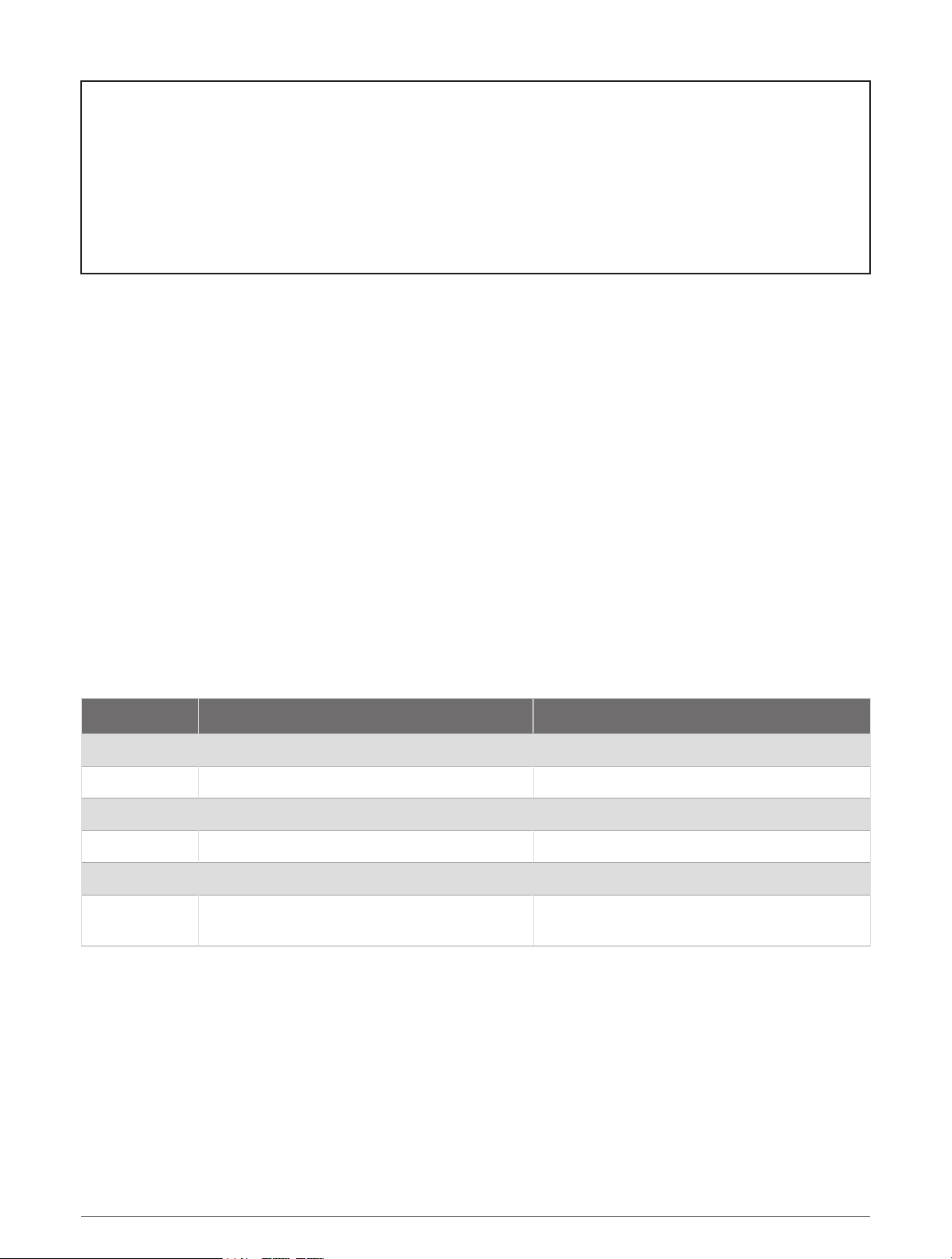
Title About Training Effect
Identifier GUID-7275629E-743A-4658-A284-C84F42A66AE5
Language EN-US
Description
Version 8
Revision 3
Changes Change balance to focus, as per JoeH.
Status Released
Last Modified 24/04/2019 08:26:15
Author wiederan
About Training Effect
Training Effect measures the impact of an activity on your aerobic and anaerobic fitness. Training Effect
accumulates during the activity. As the activity progresses, the Training Effect value increases. Training Effect
is determined by your user profile information and training history, and heart rate, duration, and intensity of your
activity. There are seven different Training Effect labels to describe the primary benefit of your activity. Each
label is color coded and corresponds to your training load focus (Training Load Focus, page 103). Each
feedback phrase, for example, "Highly Impacting VO2 Max." has a corresponding description in your Garmin
Connect activity details.
Aerobic Training Effect uses your heart rate to measure how the accumulated intensity of an exercise affects
your aerobic fitness and indicates if the workout had a maintaining or improving effect on your fitness level.
Your excess post-exercise oxygen consumption (EPOC) accumulated during exercise is mapped to a range of
values that account for your fitness level and training habits. Steady workouts at moderate effort or workouts
involving longer intervals (>180 sec) have a positive impact on your aerobic metabolism and result in an
improved aerobic Training Effect.
Anaerobic Training Effect uses heart rate and speed (or power) to determine how a workout affects your ability
to perform at very high intensity. You receive a value based on the anaerobic contribution to EPOC and the type
of activity. Repeated high-intensity intervals of 10 to 120 seconds have a highly beneficial impact on your
anaerobic capability and result in an improved anaerobic Training Effect.
You can add Aerobic TE and Anaerobic TE as data fields to one of your training screens to monitor your
numbers throughout the activity.
Training Effect Aerobic Benefit Anaerobic Benefit
From 0.0 to 0.9 No benefit. No benefit.
From 1.0 to 1.9 Minor benefit. Minor benefit.
From 2.0 to 2.9 Maintains your aerobic fitness. Maintains your anaerobic fitness.
From 3.0 to 3.9 Impacts your aerobic fitness. Impacts your anaerobic fitness.
From 4.0 to 4.9 Highly impacts your aerobic fitness. Highly impacts your anaerobic fitness.
5.0
Overreaching and potentially harmful without
enough recovery time.
Overreaching and potentially harmful without
enough recovery time.
Training Effect technology is provided and supported by Firstbeat Technologies Ltd. For more information, go to
firstbeat.com.
104 Appearance
Title Recovery Time
Identifier GUID-DAC27D10-886A-4EA8-8339-674479E9574A
Language EN-US
Description
Version 9
Revision 4
Changes Update for advanced recovery time--added last sentence.
Status Released
Last Modified 01/09/2020 10:04:01
Author mcdanielm
Recovery Time
You can use your Garmin device with wrist-based heart rate or a compatible chest heart rate monitor to display
how much time remains before you are fully recovered and ready for the next hard workout.
NOTE: The recovery time recommendation uses your VO2 max. estimate and may seem inaccurate at first. The
device requires you to complete a few activities to learn about your performance.
The recovery time appears immediately following an activity. The time counts down until it is optimal for you to
attempt another hard workout. The device updates your recovery time throughout the day based on changes in
sleep, stress, relaxation, and physical activity.
Title Recovery Heart Rate
Identifier GUID-4A13852E-C46C-47A7-B552-F6CF50E526EE
Language EN-US
Description
Version 5
Revision 3
Changes SME edit from Joe H. - remove last sentence of tip about saving/discarding.
Status Released
Last Modified 01/09/2020 10:04:01
Author mcdanielm
Recovery Heart Rate
If you are training with wrist-based heart rate or a compatible chest heart rate monitor, you can check your
recovery heart rate value after each activity. Recovery heart rate is the difference between your exercising heart
rate and your heart rate two minutes after the exercise has stopped. For example, after a typical training run, you
stop the timer. Your heart rate is 140 bpm. After two minutes of no activity or cool down, your heart rate is 90
bpm. Your recovery heart rate is 50 bpm (140 minus 90). Some studies have linked recovery heart rate to
cardiac health. Higher numbers generally indicate healthier hearts.
TIP: For best results, you should stop moving for two minutes while the device calculates your recovery heart
rate value.
Appearance 105
Title Pausing and Resuming Your Training Status
Identifier GUID-79A4D3A0-BD44-4BE3-9A06-98F90268A483
Language EN-US
Description
Version 2
Revision 1
Changes No English change. Versioned to fix PL.
Status Released
Last Modified 08/04/2022 14:47:29
Author pullins
Pausing and Resuming Your Training Status
If you are injured or sick, you can pause your training status. You can continue to record fitness activities, but
your training status, training load focus, recovery feedback, and workout recommendations are temporarily
disabled.
You can resume your training status when you are ready to start training again. For best results, you need at
least two VO2 max. measurements each week (About VO2 Max. Estimates, page 94).
1 When you want to pause your training status, select an option:
• From the training status glance, hold MENU, and select Options > Pause Training Status.
• From your Garmin Connect settings, select Performance Stats > Training Status > > Pause Training
Status.
2 Sync your watch with your Garmin Connect account.
3 When you want to resume your training status, select an option:
• From the training status glance, hold MENU, and select Options > Resume Training Status.
• From your Garmin Connect settings, select Performance Stats > Training Status > > Resume Training
Status.
4 Sync your watch with your Garmin Connect account.
106 Appearance
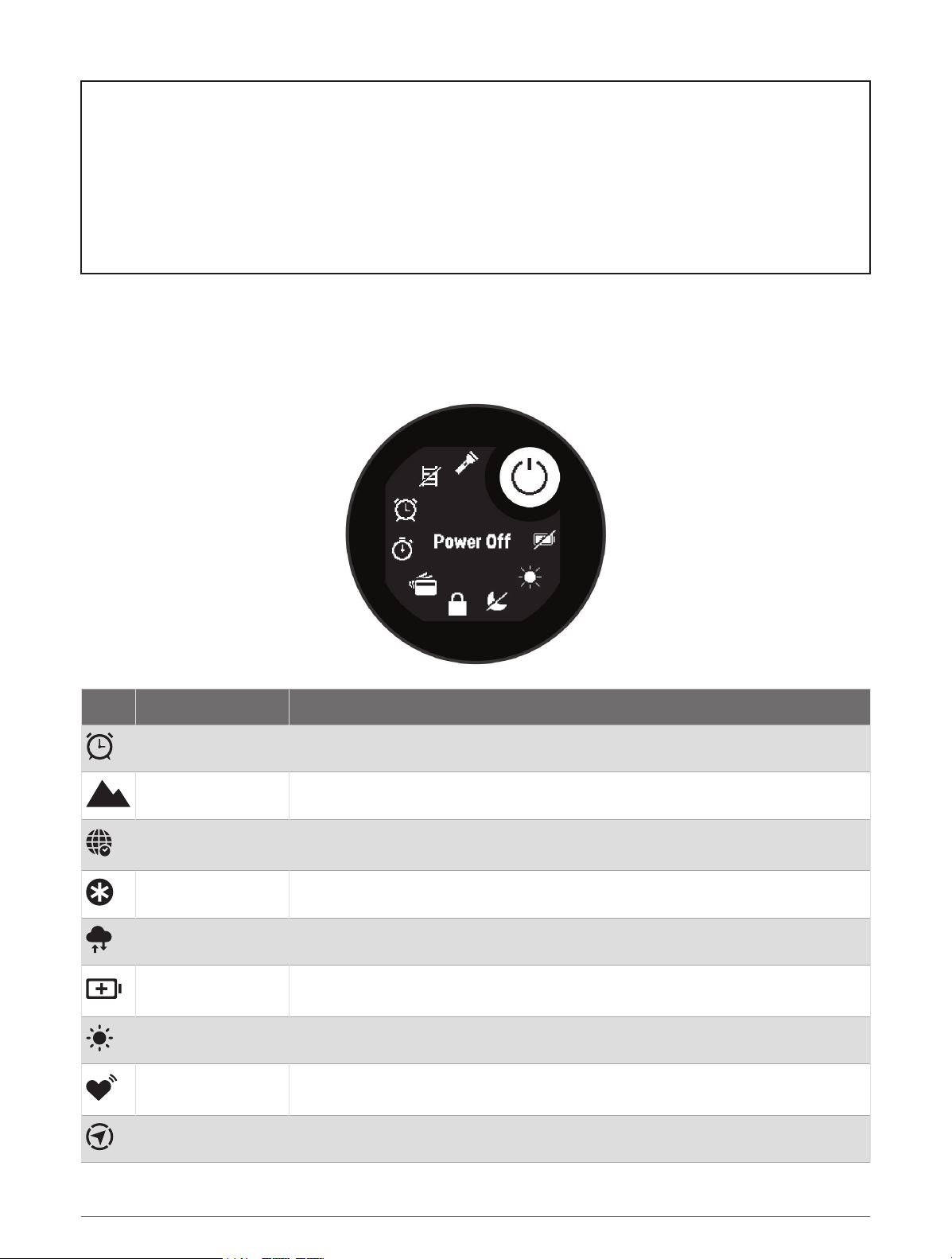
Title Controls
Identifier GUID-700E76C4-F7E2-4984-8199-D59D6A31DFB9
Language EN-US
Description
Version 2
Revision 4
Changes Adding conditioned note to night vision and stealth mode controls
Status Released
Last Modified 22/02/2022 13:11:33
Author tillmonmartha
Controls
The controls menu lets you quickly access watch features and options. You can add, reorder, and remove the
options in the controls menu (Customizing the Controls Menu, page 109).
From any screen, hold LIGHT.
Icon Name Description
Alarm Clock Select to add or edit an alarm (Setting an Alarm, page 4).
Altimeter Select to open the altimeter screen.
Alt. Time Zones
Select to view the current time of day in additional time zones (Adding Alternate
Time Zones, page 7).
Assistance Select to send an assistance request (Requesting Assistance, page 151).
Barometer Select to open the barometer screen.
Battery Saver
Select to enable or disable the battery saver feature (Customizing the Battery
Saver Feature, page 165).
Brightness Select to adjust the screen brightness (Changing the Screen Settings, page 169).
Broadcast Heart
Rate
Select to turn on heart rate broadcasting to a paired device (Broadcasting Heart
Rate Data, page 117
).
Compass Select to open the compass screen.
Appearance 107
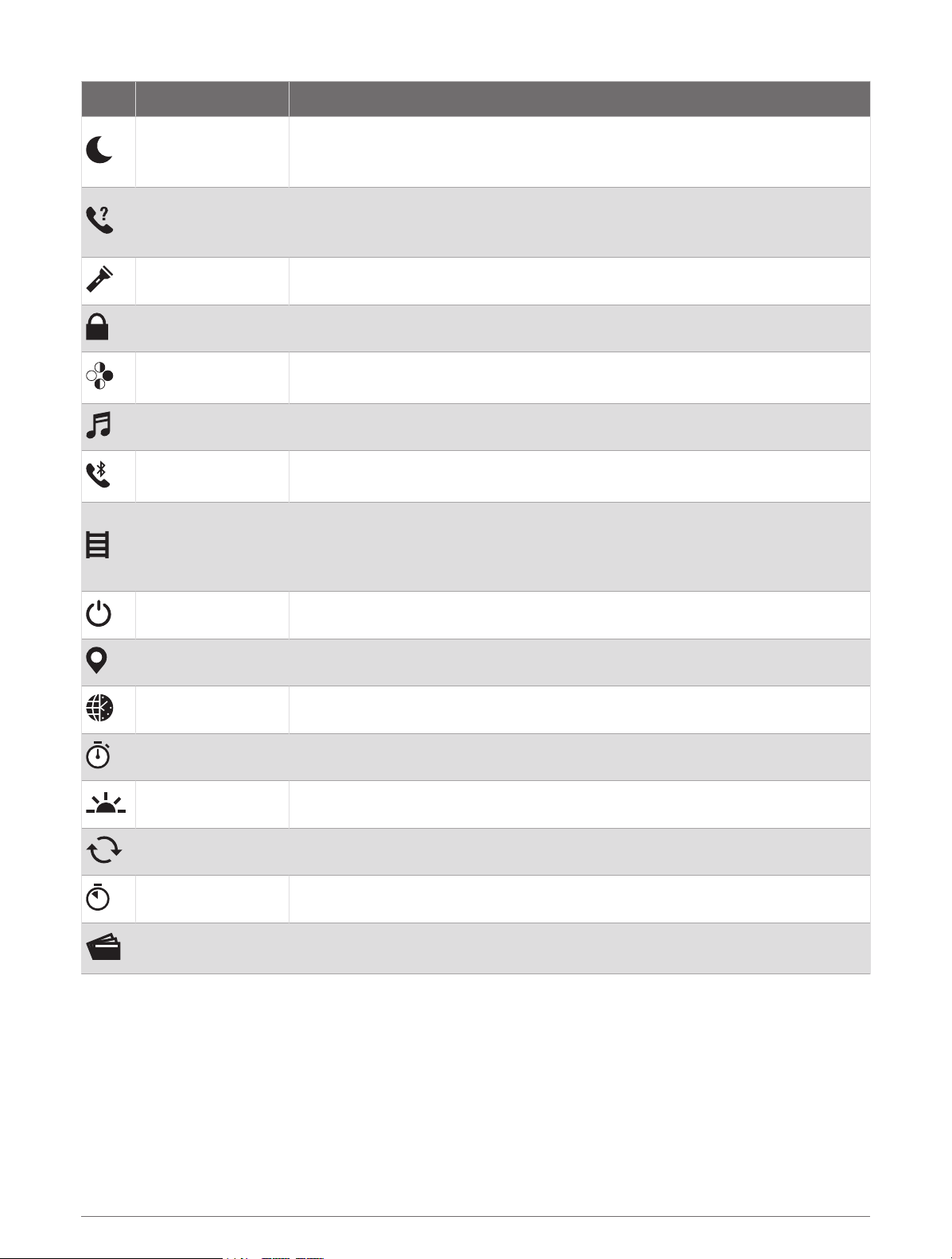
Icon Name Description
Do Not Disturb
Select to enable or disable do not disturb mode to dim the screen and disable
alerts and notifications. For example, you can use this mode while watching a
movie.
Find My Phone
Select to play an audible alert on your paired phone, if it is within Bluetooth
range. The Bluetooth signal strength appears on the Descent watch screen, and
it increases as you move closer to your phone.
Flashlight Select to turn on the screen to use your watch as a flashlight.
Lock Keys Select to lock the buttons to prevent inadvertent presses.
Moon Phase
Select to view moonrise and moonset times, along with the moon phase, based
on your GPS position.
Music Controls Select to control music playback on your phone.
Phone
Select to enable or disable Bluetooth technology and your connection to your
paired phone.
Pool Mode
Select to enable or disable the pool mode for diving. When the watch is in pool
dive mode, the tissue load and decompression lockout features function
normally, but dives are not saved to the dive log. The pool dive mode turns off
automatically at midnight.
Power Off Select to turn off the watch.
Save Location Select to save your current location to navigate back to it later.
Set Time with GPS Select to sync your watch with the time on your phone or using satellites.
Stopwatch Select to start the stopwatch (Using the Stopwatch, page 6).
Sunrise & Sunset Select to view sunrise, sunset, and twilight times.
Sync Select to sync your watch with your paired phone.
Timers Select to set a countdown timer (Starting the Countdown Timer, page 4).
Wallet
Select to open your Garmin Pay
™
wallet and pay for purchases with your watch
(Garmin Pay, page 110).
108 Appearance
Title Customizing the Controls Menu
Identifier GUID-3A355D29-6245-4C45-A727-4CE60B3F9313
Language EN-US
Description
Version 4
Revision 3
Changes Adding Appearance to menu path
Status Released
Last Modified 20/01/2022 18:07:12
Author tillmonmartha
Customizing the Controls Menu
You can add, remove, and change the order of the shortcut menu options in the controls menu (Controls,
page 107).
1 Hold MENU.
2 Select Appearance > Controls.
3 Select a shortcut to customize.
4 Select an option:
• Select Reorder to change the location of the shortcut in the controls menu.
• Select Remove to remove the shortcut from the controls menu.
5 If necessary, select Add New to add an additional shortcut to the controls menu.
Appearance 109
Title Music Playback Controls
Identifier GUID-8D7F288E-0E62-4DE7-801C-E11948644A96
Language EN-US
Description
Version 5
Revision 8
Changes Updated functions and added keyed/touch conditions. Had to rename music_controls varid to avoid
duplicate with the glance name.
Status Released
Last Modified 20/12/2021 11:51:45
Author cozmyer
Music Playback Controls
NOTE: Music playback controls may look different, depending on the selected music source.
Select to view more music playback controls.
Select to browse the audio files and playlists for the selected source.
Select to adjust the volume.
Select to play and pause the current audio file.
Select to skip to the next audio file in the playlist.
Hold to fast forward through the current audio file.
Select to restart the current audio file.
Select twice to skip to the previous audio file in the playlist.
Hold to rewind through the current audio file.
Select to change the repeat mode.
Select to change the shuffle mode.
Title Garmin Pay
Identifier GUID-109340CD-8504-4FA8-9E70-83A071C6CC86
Language EN-US
Description Chapter-level concept describing the Garmin Pay feature and system.
Version 3
Revision 4
Changes Adding a conditioned statement for shared manual with optional Garmin Pay; used "No Garmin Pay" for
an optional Garmin Pay feature
Status Released
Last Modified 24/01/2022 15:15:05
Author tillmonmartha
Garmin Pay
The Garmin Pay feature allows you to use your watch to pay for purchases in participating locations using credit
or debit cards from a participating financial institution.
NOTE: This feature is not available for all product models.
110 Appearance
Title Setting Up Your Garmin Pay Wallet
Identifier GUID-6A02E808-A5DA-47AE-B69E-6E4D90C334A6
Language EN-US
Description
Version 9
Revision 5
Changes terminology updates only
Status Released
Last Modified 11/02/2022 06:51:29
Author wiederan
Setting Up Your Garmin Pay Wallet
You can add one or more participating credit or debit cards to your Garmin Pay wallet. Go to garmin.com
/garminpay/banks to find participating financial institutions.
1 From the Garmin Connect app, select or .
2 Select Garmin Pay > Get Started.
3 Follow the on-screen instructions.
Title Paying for a Purchase Using Your Watch
Identifier GUID-BD8A6737-FFF6-4958-AA18-19CAF2A963B1
Language EN-US
Description
Version 6
Revision 1
Changes No English change. Versioned to fix the HE.
Status Released
Last Modified 29/03/2022 13:45:47
Author pullins
Paying for a Purchase Using Your Watch
Before you can use your watch to pay for purchases, you must set up at least one payment card.
You can use your watch to pay for purchases in a participating location.
1 Hold LIGHT.
2 Select .
3 Enter your four-digit passcode.
NOTE: If you enter your passcode incorrectly three times, your wallet locks, and you must reset your
passcode in the Garmin Connect app.
Your most recently used payment card appears.
4 If you have added multiple cards to your Garmin Pay wallet, select DOWN to change to another card
(optional).
5 Within 60 seconds, hold your watch near the payment reader, with the watch facing the reader.
The watch vibrates and displays a check mark when it is finished communicating with the reader.
6 If necessary, follow the instructions on the card reader to complete the transaction.
TIP: After you successfully enter your passcode, you can make payments without a passcode for 24 hours while
you continue to wear your watch. If you remove the watch from your wrist or disable heart rate monitoring, you
must enter the passcode again before making a payment.
Appearance 111
Title Adding a Card to Your Garmin Pay Wallet
Identifier GUID-E330B2F3-4E25-4589-8A47-9695FC4A35A3
Language EN-US
Description
Version 4
Revision 1
Changes No English change versioned to fix TR.
Status Released
Last Modified 30/04/2021 07:48:49
Author pullins
Adding a Card to Your Garmin Pay Wallet
You can add up to 10 credit or debit cards to your Garmin Pay wallet.
1 From the Garmin Connect app, select or .
2 Select Garmin Pay > > Add Card.
3 Follow the on-screen instructions.
After the card is added, you can select the card on your watch when you make a payment.
Title Managing Your Garmin Pay Cards
Identifier GUID-85CC8ED7-7705-4D5F-9E2C-1CB37228D481
Language EN-US
Description
Version 7
Revision 3
Changes device to watch
Status Released
Last Modified 20/12/2021 11:51:06
Author tillmonmartha
Managing Your Garmin Pay Cards
You can temporarily suspend or delete a card.
NOTE: In some countries, participating financial institutions may restrict the Garmin Pay features.
1 From the Garmin Connect app, select or .
2 Select Garmin Pay.
3 Select a card.
4 Select an option:
• To temporarily suspend or unsuspend the card, select Suspend Card.
The card must be active to make purchases using your Descent G1 watch.
• To delete the card, select .
112 Appearance
Title Changing Your Garmin Passcode
Identifier GUID-F41320A5-AFF0-4B3B-9D8F-F981ADF722CF
Language EN-US
Description
Version 4
Revision 3
Changes Updating device to watch
Status Released
Last Modified 20/12/2021 11:43:53
Author tillmonmartha
Changing Your Garmin Pay Passcode
You must know your current passcode to change it. If you forget your passcode, you must reset the Garmin Pay
feature for your Descent G1 watch, create a new passcode, and reenter your card information.
1 From the Descent G1 device page in the Garmin Connect app, select Garmin Pay > Change Passcode.
2 Follow the on-screen instructions.
The next time you pay using your Descent G1 watch, you must enter the new passcode.
Title Sensors and Accessories
Identifier GUID-E45B1643-2762-4D5B-9D3A-C2862AE18FF2
Language EN-US
Description
Version 1
Revision 4
Changes
Status Released
Last Modified 22/12/2021 13:34:42
Author cozmyer
Sensors and Accessories
The Descent G1 watch has several internal sensors, and you can pair additional wireless sensors for your
activities.
Title Wrist Heart Rate
Identifier GUID-C9AFFA77-2E39-4079-8E55-58280EF8FE00
Language EN-US
Description
Version 1
Revision 5
Changes Save as from Heart Rate Features.
Status Released
Last Modified 22/12/2021 13:48:03
Author cozmyer
Wrist Heart Rate
Your watch has a wrist-based heart rate monitor, and you can view your heart rate data on the heart rate glance
(Viewing the Glance Loop, page 91).
The watch is also compatible with chest heart rate monitors. If both wrist-based heart rate and chest heart rate
data are available when you start an activity, your watch uses the chest heart rate data.
Sensors and Accessories 113
Title Wearing the Watch (WHRM)
Identifier GUID-F2E7E0A9-FB44-4297-BF4D-D0C31C400C45
Language EN-US
Description
Version 11
Revision 4
Changes Adding skin irritation caution per request from Legal.
Status Released
Last Modified 16/12/2021 12:54:21
Author burzinskititu
Wearing the Watch
CAUTION
Some users may experience skin irritation after prolonged use of the watch, especially if the user has sensitive
skin or allergies. If you notice any skin irritation, remove the watch and give your skin time to heal. To help
prevent skin irritation, ensure the watch is clean and dry, and do not overtighten the watch on your wrist. For
more information, go to garmin.com/fitandcare.
• Wear the watch above your wrist bone.
NOTE: The watch should be snug but comfortable. For more accurate heart rate readings, the watch should
not shift while running or exercising. For pulse oximeter readings, you should remain motionless.
NOTE: While diving, the watch should stay in contact with your skin, and it should not bump into other wrist-
worn devices.
NOTE: The optical sensor is located on the back of the watch.
• See Tips for Erratic Heart Rate Data, page 115 for more information about wrist-based heart rate.
• See Tips for Erratic Pulse Oximeter Data, page 119 for more information about the pulse oximeter sensor.
• For more information about accuracy, go to garmin.com/ataccuracy.
• For more information about watch wear and care, go to garmin.com/fitandcare.
114 Sensors and Accessories
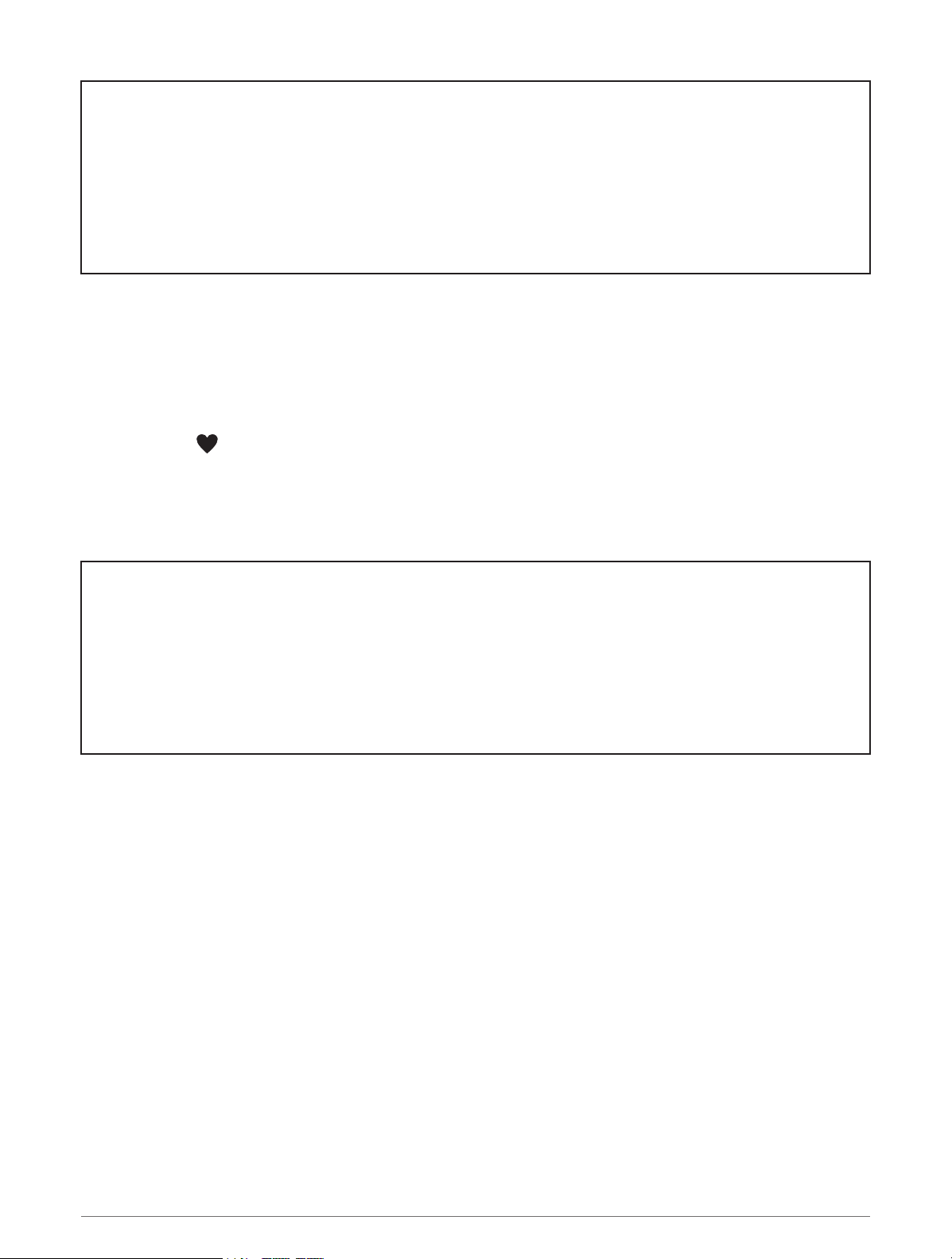
Title Tips for Erratic Heart Rate Data (WHRM)
Identifier GUID-08BC6CE7-EB8F-4392-9B7D-714B54D19499
Language EN-US
Description
Version 4
Revision 3
Changes Device to watch
Status Released
Last Modified 20/12/2021 11:55:20
Author tillmonmartha
Tips for Erratic Heart Rate Data
If the heart rate data is erratic or does not appear, you can try these tips.
• Clean and dry your arm before putting on the watch.
• Avoid wearing sunscreen, lotion, and insect repellent under the watch.
• Avoid scratching the heart rate sensor on the back of the watch.
• Wear the watch above your wrist bone. The watch should be snug but comfortable.
• Wait until the icon is solid before starting your activity.
• Warm up for 5 to 10 minutes and get a heart rate reading before starting your activity.
NOTE: In cold environments, warm up indoors.
• Rinse the watch with fresh water after each workout.
Title Wrist Heart Rate Monitor Settings
Identifier GUID-AB9A0CB2-FA4B-4AD0-894B-B4B6808642A7
Language EN-US
Description
Version 1
Revision 6
Changes
Status Released
Last Modified 22/12/2021 13:48:04
Author cozmyer
Wrist Heart Rate Monitor Settings
Hold MENU, and select Sensors & Accessories > Wrist Heart Rate.
Status: Enables or disables the wrist heart rate monitor. The default value is Auto, which automatically uses the
wrist heart rate monitor unless you pair an external heart rate monitor.
NOTE: Disabling the wrist heart rate monitor also disables the wrist-based pulse oximeter sensor. You can
perform a manual reading from the pulse oximeter glance.
While Swimming: Enables or disables the wrist heart rate monitor during swimming activities.
Abnormal Heart Rate Alerts: Allows you to set the watch to alert you when your heart rate exceeds or drops
below a target value (Setting an Abnormal Heart Rate Alert, page 116).
Broadcast Heart Rate: Allows you to begin broadcasting your heart rate data to a paired device (Broadcasting
Heart Rate Data, page 117).
Sensors and Accessories 115
Title Setting an Abnormal Heart Rate Alert
Identifier GUID-F00E423A-165E-4557-91EE-DC2EDF737E79
Language EN-US
Description
Version 1
Revision 4
Changes Save as from Forerunner topic. Switch from using the widget to the sensors settings.
Status Released
Last Modified 22/12/2021 13:34:43
Author cozmyer
Setting an Abnormal Heart Rate Alert
CAUTION
This feature only alerts you when your heart rate exceeds or drops below a certain number of beats per minute,
as selected by the user, after a period of inactivity. This feature does not notify you of any potential heart
condition and is not intended to treat or diagnose any medical condition or disease. Always defer to your health
care provider for any heart-related issues.
You can set the heart rate threshold value.
1 Hold MENU.
2 Select Sensors & Accessories > Wrist Heart Rate > Abnormal Heart Rate Alerts.
3 Select High Alert or Low Alert.
4 Set the heart rate threshold value.
Each time your heart rate exceeds or drops below the threshold value, a message appears and the watch
vibrates.
116 Sensors and Accessories
Title Broadcasting HR Data to Garmin Devices
Identifier GUID-D8D363C2-0690-48D4-95E2-A3557E7D53C2
Language EN-US
Description
Version 10
Revision 8
Changes Made the first step a choice list. Added link to activty settings. Removed specifics to Garmin devices
since you can broadcast over BT.
Status Released
Last Modified 22/12/2021 14:25:16
Author cozmyer
Broadcasting Heart Rate Data
You can broadcast your heart rate data from your watch and view it on paired devices. Broadcasting heart rate
data decreases battery life.
TIP: You can customize the activity settings to broadcast your heart rate data automatically when you begin an
activity (Activities and App Settings, page 68). For example, you can broadcast your heart rate data to an Edge
®
device while cycling.
NOTE: Broadcasting heart rate data is not available for dive activities.
1 Select an option:
• Hold MENU, and select Sensors & Accessories > Wrist Heart Rate > Broadcast Heart Rate.
• Hold LIGHT to open the controls menu, and select .
NOTE: You can add options to the controls menu (Customizing the Controls Menu, page 109).
2 Press START.
The watch starts broadcasting your heart rate data.
3 Pair your watch with your compatible device.
NOTE: The pairing instructions differ for each Garmin compatible device. See your owner's manual.
4 Press STOP to stop broadcasting your heart rate data.
Title Pulse Oximeter
Identifier GUID-2EE28BB8-91F1-4BCE-AE13-6CAEF50AD5C4
Language EN-US
Description
Version 3
Revision 3
Changes Updating device to watch
Status Released
Last Modified 20/12/2021 11:52:52
Author tillmonmartha
Pulse Oximeter
The Descent watch has a wrist-based pulse oximeter to gauge the saturation of oxygen in your blood. Knowing
your oxygen saturation can be valuable in understanding your overall health and help you determine how your
body is adapting to altitude. Your watch gauges your blood oxygen level by shining light into the skin and
checking how much light is absorbed. This is referred to as SpO
2
.
On the watch, your pulse oximeter readings appear as an SpO
2
percentage. On your Garmin Connect account,
you can view additional details about your pulse oximeter readings, including trends over multiple days (Setting
the Pulse Oximeter Mode, page 118). For more information on pulse oximeter accuracy, go to garmin.com
/ataccuracy
.
Sensors and Accessories 117
Title Getting Pulse Oximeter Readings
Identifier GUID-1589E4DE-1170-4568-892E-661E3E892616
Language EN-US
Description
Version 2
Revision 3
Changes widget to glance; device to watch
Status Released
Last Modified 20/01/2022 18:05:57
Author tillmonmartha
Getting Pulse Oximeter Readings
You can manually begin a pulse oximeter reading by viewing the pulse oximeter glance. The glance displays
your most recent blood oxygen saturation percentage.
1 While you are sitting or inactive, press UP or DOWN to view the pulse oximeter glance.
2 Wait until the watch begins the pulse oximeter reading.
3 Remain motionless for up to 30 seconds.
NOTE: If you are too active for the watch to get a pulse oximeter reading, a message appears instead of a
percentage. You can check again after several minutes of inactivity. For best results, hold the arm wearing
the watch at heart level while the watch reads your blood oxygen saturation.
Title Setting the Pulse Oximeter Mode
Identifier GUID-131DFB7F-0BD1-4AE2-BCBA-98B36A3F96C4
Language EN-US
Description
Version 2
Revision 1
Changes No English change. Versioned to fix SK.
Status Released
Last Modified 07/03/2022 11:28:14
Author pullins
Setting the Pulse Oximeter Mode
1 Hold MENU.
2 Select Sensors & Accessories > Pulse Oximeter > Pulse Ox Mode.
3 Select an option:
• To turn off automatic measurements, select Manual Check.
• To turn on continuous measurements while you sleep, select During Sleep.
NOTE: Unusual sleep positions can cause abnormally low sleep-time SpO2 readings.
• To turn on measurements while you are inactive during the day, select All Day.
NOTE: Turning on All Day mode decreases battery life.
118 Sensors and Accessories
Title Tips for Erratic Pulse Oximeter Data
Identifier GUID-B7A60F69-6ADF-4B11-A42B-A9922E466AEE
Language EN-US
Description
Version 4
Revision 4
Changes Updating device to watch. Made nylon band text more generic becuase many watches can't use UltraFit
bands
Status Released
Last Modified 20/12/2021 11:55:22
Author tillmonmartha
Tips for Erratic Pulse Oximeter Data
If the pulse oximeter data is erratic or does not appear, you can try these tips.
• Remain motionless while the watch reads your blood oxygen saturation.
• Wear the watch above your wrist bone. The watch should be snug but comfortable.
• Hold the arm wearing the watch at heart level while the watch reads your blood oxygen saturation.
• Use a silicone or nylon band.
• Clean and dry your arm before putting on the watch.
• Avoid wearing sunscreen, lotion, and insect repellent under the watch.
• Avoid scratching the optical sensor on the back of the watch.
• Rinse the watch with fresh water after each workout.
Title Compass (outdoor watch)
Identifier GUID-48B9779E-BB7B-42AA-B8E0-1EB93814603D
Language EN-US
Description
Version 8
Revision 4
Changes Added condition to last sentence.
Status Released
Last Modified 13/05/2022 10:38:36
Author mcdanielm
Compass
The watch has a 3-axis compass with automatic calibration. The compass features and appearance change
depending on your activity, whether GPS is enabled, and whether you are navigating to a destination. You can
change the compass settings manually (Compass Settings, page 120).
Sensors and Accessories 119
Title Compass Settings (Outdoor watch)
Identifier GUID-6D64DCD4-8FA6-44D9-A863-B7A634CE0821
Language EN-US
Description
Version 6
Revision 4
Changes Removed Settings menu. MARQ/fenix 6 going forward. Use previous version to support older products.
Status Released
Last Modified 26/02/2019 12:52:39
Author gerson
Compass Settings
Hold MENU, and select Sensors & Accessories > Compass.
Calibrate: Allows you to manually calibrate the compass sensor (Calibrating the Compass Manually, page 120).
Display: Sets the directional heading on the compass to letters, degrees, or milliradians.
North Ref.: Sets the north reference of the compass (Setting the North Reference, page 121).
Mode: Sets the compass to use electronic-sensor data only (On), a combination of GPS and electronic-sensor
data when moving (Auto), or GPS data only (Off).
Title Calibrating the Compass (Outdoor watch)
Identifier GUID-4C4297B5-1632-4CC8-98B9-67C6682A3745
Language EN-US
Description
Version 8
Revision 4
Changes Updated device to watch. Added settings condition
Status Released
Last Modified 22/12/2021 13:21:25
Author cozmyer
Calibrating the Compass Manually
NOTICE
Calibrate the electronic compass outdoors. To improve heading accuracy, do not stand near objects that
influence magnetic fields, such as vehicles, buildings, and overhead power lines.
Your watch was already calibrated at the factory, and the watch uses automatic calibration by default. If you
experience irregular compass behavior, for example, after moving long distances or after extreme temperature
changes, you can manually calibrate the compass.
1 Hold MENU.
2 Select Sensors & Accessories > Compass > Calibrate > Start.
3 Follow the on-screen instructions.
TIP: Move your wrist in a small figure eight motion until a message appears.
120 Sensors and Accessories
Title Setting the North Reference
Identifier GUID-AAF67F7E-C05F-43EF-9E6E-894E4545416F
Language EN-US
Description
Version 6
Revision 3
Changes Adding Mag. Variation string to the path.
Status Released
Last Modified 17/05/2022 15:03:47
Author burzinskititu
Setting the North Reference
You can set the directional reference used in calculating heading information.
1 Hold MENU.
2 Select Sensors & Accessories > Compass > North Ref..
3 Select an option:
• To set geographic north as the heading reference, select True.
• To set the magnetic declination for your location automatically, select Magnetic.
• To set grid north (000º) as the heading reference, select Grid.
• To set the magnetic variation value manually, select User > Mag. Variation, enter the magnetic variation,
and select Done.
Title Altimeter and Barometer
Identifier GUID-0FFD6812-6604-4D97-BC0F-56194CB12EB5
Language EN-US
Description
Version 8
Revision 4
Changes No quick settings access from the altimeter glance on D2 Mach 1.
Status Released
Last Modified 22/02/2022 12:12:43
Author pruekatie
Altimeter and Barometer
The watch contains an internal altimeter and barometer. The watch collects elevation and pressure data
continuously, even in low-power mode. The altimeter displays your approximate elevation based on pressure
changes. The barometer displays environmental pressure data based on the fixed elevation where the altimeter
was most recently calibrated (Altimeter Settings, page 122).
Sensors and Accessories 121
Title Altimeter Settings (Outdoor Watch)
Identifier GUID-2DF9C415-2A35-48CE-B20B-013DAA3358A5
Language EN-US
Description
Version 9
Revision 5
Changes More aviation options. Conditioned.
Status Released
Last Modified 22/02/2022 13:08:51
Author pruekatie
Altimeter Settings
Hold MENU, and select Sensors & Accessories > Altimeter.
Calibrate: Allows you to manually calibrate the altimeter sensor.
Auto Cal.: Allows the altimeter to self-calibrate each time you use satellite systems.
Sensor Mode: Sets the mode for the sensor. The Auto option uses both the altimeter and barometer according
to your movement. You can use the Altimeter Only option when your activity involves changes in altitude, or
the Barometer Only option when your activity does not involve changes in altitude.
Elevation: Sets the units of measure for elevation.
Title Calibrating the Barometric Altimeter (Outdoor watch)
Identifier GUID-BC734846-01A7-4F33-86D4-DFBDBC06CDB4
Language EN-US
Description
Version 11
Revision 4
Changes Have to select Enter Manually to calibrate manually now.
Status Released
Last Modified 22/02/2022 13:10:48
Author burzinskititu
Calibrating the Barometric Altimeter
Your watch was already calibrated at the factory, and the watch uses automatic calibration at your GPS starting
point by default. You can manually calibrate the barometric altimeter if you know the correct elevation.
1 Hold MENU.
2 Select Sensors & Accessories > Altimeter.
3 Select an option:
• To calibrate automatically from your GPS starting point, select Auto Cal., and select an option.
• To enter the current elevation manually, select Calibrate > Enter Manually.
• To enter the current elevation from the digital elevation model, select Calibrate > Use DEM.
NOTE: Some devices require a phone connection to use DEM for calibration.
• To enter the current elevation from your GPS starting point, select Calibrate > Use GPS.
122 Sensors and Accessories
Title Barometer Settings
Identifier GUID-CDC9DDEE-C576-4E1D-B007-BC737686793A
Language EN-US
Description
Version 8
Revision 4
Changes Different way to access settings for D2 Mach 1. Adding, with a condition.
Status Released
Last Modified 22/02/2022 13:10:24
Author pruekatie
Barometer Settings
Hold MENU, and select Sensors & Accessories > Barometer.
Calibrate: Allows you to manually calibrate the barometer sensor.
Plot: Sets the time scale for the chart in the barometer glance.
Storm Alert: Sets the rate of barometric pressure change that triggers a storm alert.
Sensor Mode: Sets the mode for the sensor. The Auto option uses both the altimeter and barometer according
to your movement. You can use the Altimeter Only option when your activity involves changes in altitude, or
the Barometer Only option when your activity does not involve changes in altitude.
Pressure: Sets how the watch displays pressure data.
Title Calibrating the Barometer
Identifier GUID-53F2E412-E939-4B29-B5B3-3F3CCAA0ECAB
Language EN-US
Description
Version 7
Revision 5
Changes Need to select Enter Manually to calibrate manually now.
Status Released
Last Modified 22/02/2022 13:10:41
Author burzinskititu
Calibrating the Barometer
Your watch was already calibrated at the factory, and the watch uses automatic calibration at your GPS starting
point by default. You can manually calibrate the barometer if you know the correct elevation or the correct sea
level pressure.
1 Hold MENU.
2 Select Sensors & Accessories > Barometer > Calibrate.
3 Select an option:
• To enter the current elevation and sea level pressure (optional), select Enter Manually.
• To calibrate automatically from the digital elevation model, select Use DEM.
NOTE: Some watches require a phone connection to use DEM for calibration.
• To calibrate automatically from your GPS starting point, select Use GPS.
Sensors and Accessories 123
Title Wireless Sensors
Identifier GUID-1E3CECCF-0343-431C-95F0-5716E0341C75
Language EN-US
Description
Version 4
Revision 17
Changes Added a conditioned table for all sensor types. Remove small sensor concept topics below this one.
Status Released
Last Modified 13/05/2022 10:38:36
Author cozmyer
Wireless Sensors
Your watch can be paired and used with wireless ANT+ or Bluetooth sensors (Pairing Your Wireless Sensors,
page 125). After the devices are paired, you can customize the optional data fields (Customizing the Data
Screens, page 66). If your watch was packaged with a sensor, they are already paired.
For information about specific Garmin sensor compatibility, purchasing, or to view the owner's manual, go to
buy.garmin.com for that sensor.
Sensor Type Description
Club Sensors
You can use Approach CT10 golf club sensors to automatically track your golf shots,
including location, distance, and club type.
DogTrack Allows you to receive data from a compatible handheld dog tracking device.
Extended
Display
You can use the Extended Display mode to display data screens from your Descent watch on
a compatible Edge device during a ride or triathlon.
External Heart
Rate
You can use an external heart rate monitor, such as the HRM-Pro
™
or HRM-Dual
™
, and view
heart rate data during your activities.
Foot Pod
You can use a foot pod to record pace and distance instead of using GPS when you are
training indoors or when your GPS signal is weak.
inReach
The inReach remote function allows you to control your inReach device using your Descent
watch (Using the inReach Remote, page 128).
Lights You can use Varia
™
smart bike lights to improve situational awareness.
Power
You can use a power meter, such as Rally
™
and Vector
™
, to view your power data on your
watch. You can adjust your power zones to match your goals and abilities (Setting Your
Power Zones, page 148), or use range alerts to be notified when you reach a specified power
zone (Setting an Alert, page 71).
Radar
You can use a Varia rearview bike radar to improve situational awareness and send alerts
about approaching vehicles.
RD Pod
You can use a Running Dynamics Pod to record running dynamics data and view it on your
watch (Running Dynamics, page 126).
Smart Trainer
You can use your watch with an indoor bike smart trainer to simulate resistance while
following a course, ride, or workout.
Speed/Cadence
You can attach speed or cadence sensors to your bike and view the data during your ride. If
necessary, you can manually enter your wheel circumference (Wheel Size and Circumference,
page 209).
Tempe
You can attach the tempe
™
temperature sensor to a secure strap or loop where it is exposed
to ambient air, so it provides a consistent source of accurate temperature data.
124 Sensors and Accessories
Sensor Type Description
VIRB
The VIRB remote function allows you to control your VIRB action camera using your watch
(VIRB Remote, page 129).
XERO Laser
Locations
You can view and share laser location information from a Xero device (Xero Laser Location
Settings, page 131).
Title Pairing Your Wireless Sensors
Identifier GUID-0AA57B88-BA13-4983-ADAC-7EA7DABC735D
Language EN-US
Description
Version 4
Revision 6
Changes Adding a sentence about optional data fields. Reducing the number of sensors concept topics in the
map.
Status Released
Last Modified 22/12/2021 13:43:14
Author cozmyer
Pairing Your Wireless Sensors
The first time you connect a wireless sensor to your watch using ANT+ or Bluetooth technology, you must pair
the watch and sensor. If the sensor has both ANT+ and Bluetooth technology, Garmin recommends that you
pair using ANT+ technology. After they are paired, the watch connects to the sensor automatically when you
start an activity and the sensor is active and within range.
1 If you are pairing a heart rate monitor, put on the heart rate monitor.
The heart rate monitor does not send or receive data until you put it on.
2 Bring the watch within 3 m (10 ft.) of the sensor.
NOTE: Stay 10 m (33 ft.) away from other wireless sensors while pairing.
3 Hold MENU.
4 Select Sensors & Accessories > Add New.
5 Select an option:
• Select Search All.
• Select your sensor type.
After the sensor is paired with your watch, the sensor status changes from Searching to Connected. Sensor
data appears in the data screen loop or a custom data field. You can customize the optional data fields
(Customizing the Data Screens, page 66).
Sensors and Accessories 125
Title Running Dynamics
Identifier GUID-62A09512-518A-424A-8491-FE2B80CD2091
Language EN-US
Description
Version 11
Revision 3
Changes Updating bundled accessory condition to include HRM-Pro.
Status Released
Last Modified 11/09/2020 13:54:04
Author burzinskititu
Running Dynamics
You can use your compatible Descent device paired with the HRM-Pro accessory or other running dynamics
accessory to provide real-time feedback about your running form.
The running dynamics accessory has an accelerometer that measures torso movement in order to calculate six
running metrics.
Cadence: Cadence is the number of steps per minute. It displays the total steps (right and left combined).
Vertical oscillation: Vertical oscillation is your bounce while running. It displays the vertical motion of your
torso, measured in centimeters.
Ground contact time: Ground contact time is the amount of time in each step that you spend on the ground
while running. It is measured in milliseconds.
NOTE: Ground contact time and balance are not available while walking.
Ground contact time balance: Ground contact time balance displays the left/right balance of your ground
contact time while running. It displays a percentage. For example, 53.2 with an arrow pointing left or right.
Stride length: Stride length is the length of your stride from one footfall to the next. It is measured in meters.
Vertical ratio: Vertical ratio is the ratio of vertical oscillation to stride length. It displays a percentage. A lower
number typically indicates better running form.
126 Sensors and Accessories
Title Training with Running Dynamics (outdoor watch)
Identifier GUID-B748FD83-268D-4777-9414-AEC70FC6DA30
Language EN-US
Description Checked in from Forerunner. Replace Forerunner name with ph_product_series variable. Update strings
and paths based on the UX documents.
Version 7
Revision 4
Changes Removed Settings menu. MARQ/fenix 6 going forward. Use previous version to support older products.
Since none of the outdoor watches are bundled with HRM straps any more, removed info about bundled
devices.
Status Released
Last Modified 26/02/2019 12:52:39
Author gerson
Training with Running Dynamics
Before you can view running dynamics, you must put on a running dynamics accessory, such as the HRM-Pro
accessory, and pair it with your device (Pairing Your Wireless Sensors, page 125).
1 Hold MENU.
2 Select Activities & Apps.
3 Select an activity.
4 Select the activity settings.
5 Select Data Screens > Add New.
6 Select a running dynamics data screen.
NOTE: The running dynamics screens are not available for all activities.
7 Go for a run (Starting an Activity, page 38).
8 Select UP or DOWN to open a running dynamics screen to view your metrics.
Title Tips for Missing Running Dynamics Data
Identifier GUID-F58662CB-A1F2-4B68-8256-A731A372F4B2
Language EN-US
Description
Version 9
Revision 3
Changes terminology
Status Released
Last Modified 13/05/2022 10:38:36
Author wiederan
Tips for Missing Running Dynamics Data
If running dynamics data does not appear, you can try these tips.
• Make sure you have a running dynamics accessory, such as the HRM-Pro accessory.
Accessories with running dynamics have on the front of the module.
• Pair the running dynamics accessory with your watch again, according to the instructions.
• If you are using the HRM-Pro accessory, pair it with your watch using ANT+ technology, rather than Bluetooth
technology.
• If the running dynamics data display shows only zeros, make sure the accessory is worn right-side up.
NOTE: Ground contact time and balance appears only while running. It is not calculated while walking.
Sensors and Accessories 127
Title inReach Remote (Generic)
Identifier GUID-29D4446B-0685-4E70-8CFC-18F2E7014935
Language EN-US
Description
Version 2
Revision 3
Changes Added "compatible." Older devices without ANT+ can't be used with the remote function.
Status Released
Last Modified 01/10/2019 15:19:23
Author cozmyer
inReach Remote
The inReach remote function allows you to control your inReach device using your Descent device. Go to
buy.garmin.com to purchase a compatible inReach device.
Title Using the inReach Remote
Identifier GUID-43AD8C5A-49D3-4CFD-8698-B76EB4827C14
Language EN-US
Description
Version 3
Revision 3
Changes Changed widget to glance.
Status Released
Last Modified 22/12/2021 13:37:25
Author cozmyer
Using the inReach Remote
Before you can use the inReach remote function, you must add the inReach glance to the glance loop
(Customizing the Glance Loop, page 92).
1 Turn on the inReach device.
2 On your Descent watch, press UP or DOWN from the watch face to view the inReach glance.
3 Press START to search for your inReach device.
4 Press START to pair your inReach device.
5 Press START, and select an option:
• To send an SOS message, select Initiate SOS.
NOTE: You should only use the SOS function in a real emergency situation.
• To send a text message, select Messages > New Message, select the message contacts, and enter the
message text or select a quick text option.
• To send a preset message, select Send Preset, and select a message from the list.
• To view the timer and distance traveled during an activity, select Tracking.
128 Sensors and Accessories
Title VIRB Remote (Generic)
Identifier GUID-9145B9DA-70E7-42BE-A2E5-67228DEC6BC4
Language EN-US
Description Concept that describes the VIRB Remote feature generically so that it works for all markets.
Version 4
Revision 3
Changes Removed the second sentence. There are no longer any VIRB models for sale on the website.
Status Released
Last Modified 27/04/2021 12:45:32
Author cozmyer
VIRB Remote
The VIRB remote function allows you to control your VIRB action camera using your device.
Title Controlling a VIRB Action Camera
Identifier GUID-16BCA98D-D9AF-496C-B003-F21DED75D4E3
Language EN-US
Description
Version 6
Revision 3
Changes Changed widget to glance
Status Released
Last Modified 22/12/2021 13:25:21
Author cozmyer
Controlling a VIRB Action Camera
Before you can use the VIRB remote function, you must enable the remote setting on your VIRB camera. See the
VIRB Series Owner's Manual for more information.
1 Turn on your VIRB camera.
2 Pair your VIRB camera with your Descent watch (Pairing Your Wireless Sensors, page 125).
The VIRB glance is automatically added to the glance loop.
3 Press UP or DOWN from the watch face to view the VIRB glance.
4 If necessary, wait while your watch connects to your camera.
5 Select an option:
• To record video, select Start Recording.
The video counter appears on the Descent screen.
• To take a photo while recording video, press DOWN.
• To stop recording video, press STOP.
• To take a photo, select Take Photo.
• To take multiple photos in burst mode, select Take Burst.
• To send the camera to sleep mode, select Sleep Camera.
• To wake the camera from sleep mode, select Wake Camera.
• To change video and photo settings, select Settings.
Sensors and Accessories 129
Title Controlling a VIRB Action Camera During an Activity
Identifier GUID-8F112A68-B0C3-4C1D-BD7D-93647AEB1658
Language EN-US
Description
Version 5
Revision 3
Changes SW reduced visibility to non-mainstream accessories by moving them out of the widget loop. Widget is
added automatically after pairing through Sensor menu.
Status Released
Last Modified 05/09/2019 10:15:43
Author gerson
Controlling a VIRB Action Camera During an Activity
Before you can use the VIRB remote function, you must enable the remote setting on your VIRB camera. See the
VIRB Series Owner's Manual for more information.
1 Turn on your VIRB camera.
2 Pair your VIRB camera with your Descent watch (Pairing Your Wireless Sensors, page 125).
When the camera is paired, a VIRB data screen is automatically added to activities.
NOTE: The VIRB data screen is not available for dive activities.
3 During an activity, press UP or DOWN to view the VIRB data screen.
4 If necessary, wait while your watch connects to your camera.
5 Hold MENU.
6 Select VIRB.
7 Select an option:
• To control the camera using the activity timer, select Settings > Recording Mode > Timer Start/Stop.
NOTE: Video recording automatically starts and stops when you start and stop an activity.
• To control the camera using the menu options, select Settings > Recording Mode > Manual.
• To manually record video, select Start Recording.
The video counter appears on the Descent screen.
• To take a photo while recording video, press DOWN.
• To manually stop recording video, press STOP.
• To take multiple photos in burst mode, select Take Burst.
• To send the camera to sleep mode, select Sleep Camera.
• To wake the camera from sleep mode, select Wake Camera.
130 Sensors and Accessories
Title XERO Laser Location Settings
Identifier GUID-D44E8F72-8661-4D13-9872-0EA0CDAF5879
Language EN-US
Description
Version 2
Revision 4
Changes Renamed the topic to match the device strings. Updated settings and setting names.
Status Released
Last Modified 17/10/2019 10:11:25
Author mall
Xero Laser Location Settings
Before you can customize laser location settings, you must pair a compatible Xero device (Pairing Your Wireless
Sensors, page 125).
Hold MENU, and select Sensors & Accessories > XERO Laser Locations > Laser Locations.
During Activity: Enables the display of laser location information from a compatible, paired Xero device during
an activity.
Share Mode: Allows you to share laser location information publicly or broadcast it privately.
Title Map
Identifier GUID-A707BDE8-58D7-4758-88B2-4153582173C5
Language EN-US
Description
Version 2
Revision 6
Changes Update to remove "track log" and "waypoint" terminology, which we are moving away from. Also added
variables.
Status Released
Last Modified 22/04/2017 23:01:09
Author gerson
Map
represents your location on the map. Location names and symbols appear on the map. When you are
navigating to a destination, your route is marked with a line on the map.
• Map navigation (Panning and Zooming the Map, page 132)
• Map settings (Map Settings, page 132)
Map 131
Title Panning and Zooming the Map (fenix 3)
Identifier GUID-C404537E-A4F1-419D-84FB-995BAF3C9591
Language EN-US
Description
Version 6
Revision 3
Changes Changing to press for hard keys
Status Released
Last Modified 06/08/2019 12:13:40
Author gerson
Panning and Zooming the Map
1 While navigating, press UP or DOWN to view the map.
2 Hold MENU.
3 Select Pan/Zoom.
4 Select an option:
• To toggle between panning up and down, panning left and right, or zooming, press START.
• To pan or zoom the map, press UP and DOWN.
• To quit, press BACK.
Title Map Settings (fenix)
Identifier GUID-60C3B7A5-51ED-4E4D-A2DC-8578234EF279
Language EN-US
Description
Version 9
Revision 9
Changes Added and updated list for fenix 7.
Status Released
Last Modified 22/12/2021 14:25:18
Author cozmyer
Map Settings
You can customize how the map appears in the map app and data screens.
NOTE: If necessary, you can customize the map settings for specific activities instead of using the system
settings.
Hold MENU, and select Map.
Orientation: Sets the orientation of the map. The North Up option shows north at the top of the screen. The
Track Up option shows your current direction of travel at the top of the screen.
User Locations: Shows or hides saved locations on the map.
Auto Zoom: Automatically selects the zoom level for optimal use of your map. When disabled, you must zoom
in or out manually.
132 Map
Title Phone Connectivity Features
Identifier GUID-6078F0D7-ECF8-45AF-8D3A-A3825C6AB474
Language EN-US
Description
Version 1
Revision 9
Changes Replacement for the connected features topic.
Status Released
Last Modified 22/12/2021 14:22:05
Author cozmyer
Phone Connectivity Features
Phone connectivity features are available for your Descent watch when you pair it using the Garmin Connect app
(Pairing Your Phone with Your Watch, page 133).
• App features from the Garmin Connect app, the Connect IQ app, and more (Phone Apps and Computer
Applications, page 137)
• Glances (Glances, page 89)
• Controls menu features (Controls, page 107)
• Safety and tracking features (Safety and Tracking Features, page 149)
• Phone interactions, such as notifications (Enabling Bluetooth Notifications, page 134)
Title Pairing Your Phone with Your Watch
Identifier GUID-4C14822E-F472-4C3A-B33C-BB50407ADDE5
Language EN-US
Description
Version 5
Revision 5
Changes Pulled in dive app content, device to watch, smartphone to phone, and added a condition to the Settings
menu.
Status Released
Last Modified 10/02/2022 09:04:39
Author cozmyer
Pairing Your Phone with Your Watch
To use the connected features of the Descent watch, it must be paired directly through the Garmin Dive app,
instead of from the Bluetooth settings on your phone.
1 From the app store on your phone, install and open the Garmin Dive app.
2 Bring your phone within 10 m (33 ft.) of your watch.
3 Select an option to enable pairing mode on your watch:
• During the initial setup, select when you are prompted to pair with your smartphone.
• If you previously skipped the pairing process, hold MENU, and select Pair Phone.
4 Select an option to add your watch to your account:
• If this is the first time you are pairing a device with the Garmin Dive app, follow the on-screen instructions.
• If you already paired another device with the Garmin Dive app, select Add > Devices, and follow the on-
screen instructions.
Phone Connectivity Features 133
Title Enabling Bluetooth Notifications
Identifier GUID-599D739A-21A7-4EF2-98F4-29258D407B47
Language EN-US
Description
Version 6
Revision 3
Changes Update per latest SW.
Status Released
Last Modified 10/02/2022 10:08:36
Author burzinskititu
Enabling Bluetooth Notifications
Before you can enable notifications, you must pair the watch with a compatible phone (Pairing Your Phone with
Your Watch, page 133).
1 Hold MENU.
2 Select Phone > Smart Notifications > Status > On.
3 Select General Use or During Activity.
4 Select a notification type.
5 Select status, tone, and vibration preferences.
6 Press BACK.
7 Select privacy and timeout preferences.
8 Press BACK.
9 Select Signature to add a signature to your text message replies.
Title Viewing Notifications (Watch - keys)
Identifier GUID-92E5BB40-5CF0-4784-B418-B6AD1912148C
Language EN-US
Description
Version 7
Revision 3
Changes Changed widget to glance.
Status Released
Last Modified 22/12/2021 13:17:13
Author cozmyer
Viewing Notifications
1 From the watch face, press UP or DOWN to view the notifications glance.
2 Press START.
3 Select a notification.
4 Press START for more options.
5 Press BACK to return to the previous screen.
134 Phone Connectivity Features
Title Receiving an Incoming Phone Call
Identifier GUID-7947BE61-B96A-4F07-9E52-6C4D25775E9A
Language EN-US
Description
Version 4
Revision 3
Changes Clarifying text reply feature.
Status Released
Last Modified 10/02/2022 10:09:48
Author burzinskititu
Receiving an Incoming Phone Call
When you receive a phone call on your connected phone, the Descent watch displays the name or phone
number of the caller.
• To accept the call, select Accept.
NOTE: To talk to the caller, you must use your connected phone.
• To decline the call, select Decline.
• To decline the call and immediately send a text message reply, select Reply, and select a message from the
list.
NOTE: To send a text message reply, you must be connected to a compatible Android
™
phone using
Bluetooth technology.
Title Replying to a Text Message (keyed)
Identifier GUID-73EB3305-E1BD-4AD8-B6AA-EFCDA3156CCB
Language EN-US
Description
Version 5
Revision 3
Changes Adding "compatible" qualifier to Android per request from Legal.
Status Released
Last Modified 10/02/2022 10:09:57
Author burzinskititu
Replying to a Text Message
NOTE: This feature is available only for compatible Android phones.
When you receive a text message notification on your watch, you can send a quick reply by selecting from a list
of messages. You can customize messages in the Garmin Connect app.
NOTE: This feature sends text messages using your phone. Regular text message limits and charges from your
carrier and phone plan may apply. Contact your mobile carrier for more information about text message charges
or limits.
1 From the watch face, press UP or DOWN to view the notifications glance.
2 Press START, and select a text message notification.
3 Press START.
4 Select Reply.
5 Select a message from the list.
Your phone sends the selected message as an SMS text message.
Phone Connectivity Features 135
Title Managing Notifications
Identifier GUID-5A95D297-7177-4745-ADAF-AC4855E0B7FA
Language EN-US
Description
Version 10
Revision 3
Changes Smartphone to phone; device to watch
Status Released
Last Modified 20/12/2021 11:51:05
Author tillmonmartha
Managing Notifications
You can use your compatible phone to manage notifications that appear on your Descent G1 watch.
Select an option:
• If you are using an iPhone
®
, go to the iOS
®
notifications settings to select the items to show on the watch.
• If you are using an Android phone, from the Garmin Connect app, select Settings > Notifications.
Title Turning Off the Bluetooth Phone Connection
Identifier GUID-139CD52F-B25F-4002-B13D-ACF7FEA70A04
Language EN-US
Description
Version 5
Revision 3
Changes Changing smartphone and mobile device to phone
Status Released
Last Modified 20/12/2021 11:55:29
Author tillmonmartha
Turning Off the Bluetooth Phone Connection
You can turn off the Bluetooth phone connection from the controls menu.
NOTE: You can add options to the controls menu (Customizing the Controls Menu, page 109).
1 Hold LIGHT to view the controls menu.
2 Select to turn off the Bluetooth phone connection on your Descent watch.
Refer to the owner's manual for your phone to turn off Bluetooth technology on your phone.
Title Turning On and Off Phone Connection Alerts
Identifier GUID-DAA3BA98-303C-4A1B-A0B0-A7E064BBED58
Language EN-US
Description
Version 5
Revision 5
Changes Changed smartphone to phone and updated menu path.
Status Released
Last Modified 22/12/2021 14:29:08
Author cozmyer
Turning On and Off Phone Connection Alerts
You can set the Descent G1 watch to alert you when your paired phone connects and disconnects using
Bluetooth technology.
NOTE: Phone connection alerts are turned off by default.
1 Hold MENU.
2 Select Phone > Alerts.
136 Phone Connectivity Features
Title Phone Apps and Computer Applications
Identifier GUID-E83D3904-B170-456A-8787-CE74DEF0CB3F
Language EN-US
Description
Version 1
Revision 9
Changes Top level topic for compatible apps and applications.
Status Released
Last Modified 22/12/2021 13:40:26
Author cozmyer
Phone Apps and Computer Applications
You can connect your watch to multiple Garmin phone apps and computer applications using the same Garmin
account.
Title Garmin Connect (Fitness OM)
Identifier GUID-5C0E79E4-C381-4B87-A6A0-B8FE049AB597
Language EN-US
Description
Version 10
Revision 6
Changes Added vanity URL to buy page. Removed Connect IQ since it's a separate app and covered in separate
topics now.
Status Released
Last Modified 22/12/2021 14:26:48
Author cozmyer
Garmin Connect
You can connect with your friends on Garmin Connect. Garmin Connect gives you the tools to track, analyze,
share, and encourage each other. Record the events of your active lifestyle including runs, walks, rides, swims,
hikes, triathlons, and more. To sign up for a free account, you can download the app from the app store on your
phone (garmin.com/connectapp), or go to connect.garmin.com.
Store your activities: After you complete and save an activity with your watch, you can upload that activity to
your Garmin Connect account and keep it as long as you want.
Analyze your data: You can view more detailed information about your activity, including time, distance,
elevation, heart rate, calories burned, cadence, running dynamics, an overhead map view, pace and speed
charts, and customizable reports.
NOTE: Some data requires an optional accessory such as a heart rate monitor.
Phone Connectivity Features 137
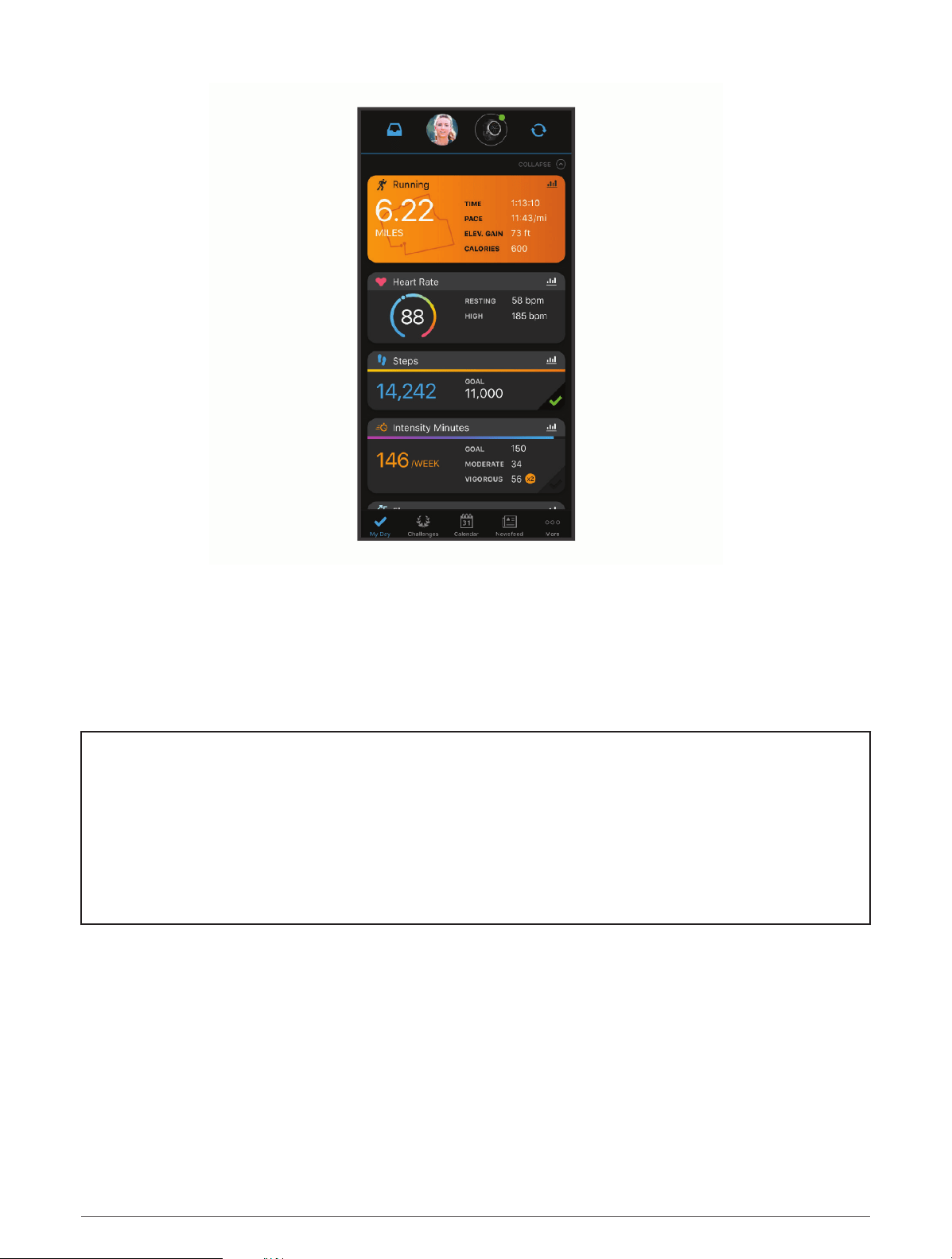
Plan your training: You can choose a fitness goal and load one of the day-by-day training plans.
Track your progress: You can track your daily steps, join a friendly competition with your connections, and meet
your goals.
Share your activities: You can connect with friends to follow each other's activities or post links to your
activities on your favorite social networking sites.
Manage your settings: You can customize your watch and user settings on your Garmin Connect account.
Title Using the Garmin Connect App
Identifier GUID-48DF00C6-3060-458D-BE16-DFF562661CCD
Language EN-US
Description
Version 5
Revision 6
Changes device to watch; smartphone to phone
Status Released
Last Modified 20/12/2021 11:56:00
Author tillmonmartha
Using the Garmin Connect App
After you pair your watch with your phone (Pairing Your Phone with Your Watch, page 133), you can use the
Garmin Connect app to upload all of your activity data to your Garmin Connect account.
1 Verify the Garmin Connect app is running on your phone.
2 Bring your watch within 10 m (30 ft.) of your phone.
Your watch automatically syncs your data with the Garmin Connect app and your Garmin Connect account.
138 Phone Connectivity Features
Title Updating the Software Using the Garmin Connect App
Identifier GUID-770A7E92-0AD0-444C-833E-148B8E1ED224
Language EN-US
Description
Version 3
Revision 3
Changes device to watch; smartphone to phone
Status Released
Last Modified 20/12/2021 11:55:49
Author tillmonmartha
Updating the Sofware Using the Garmin Connect App
Before you can update your watch software using the Garmin Connect app, you must have a Garmin Connect
account, and you must pair the watch with a compatible phone (Pairing Your Phone with Your Watch, page 133).
Sync your watch with the Garmin Connect app (Using the Garmin Connect App, page 138).
When new software is available, the Garmin Connect app automatically sends the update to your watch. The
update is applied when you are not actively using the watch. When the update is complete, your watch
restarts.
Title Using Garmin Connect on Your Computer
Identifier GUID-9A740EA8-1467-4033-891D-1B98F08876D9
Language EN-US
Description
Version 5
Revision 4
Changes device to watch
Status Released
Last Modified 20/12/2021 11:55:56
Author tillmonmartha
Using Garmin Connect on Your Computer
The Garmin Express
™
application connects your watch to your Garmin Connect account using a computer. You
can use the Garmin Express application to upload your activity data to your Garmin Connect account and to
send data, such as workouts or training plans, from the Garmin Connect website to your watch. You can also
install software updates and manage your Connect IQ apps.
1 Connect the watch to your computer using the USB cable.
2 Go to garmin.com/express.
3 Download and install the Garmin Express application.
4 Open the Garmin Express application, and select Add Device.
5 Follow the on-screen instructions.
Phone Connectivity Features 139
Title Updating the Software Using Garmin Express
Identifier GUID-90F380F9-11E0-41F0-91D9-0A429FFED312
Language EN-US
Description
Version 3
Revision 3
Changes device to watch
Status Released
Last Modified 20/12/2021 11:55:34
Author tillmonmartha
Updating the Sofware Using Garmin Express
Before you can update your watch software, you must download and install the Garmin Express application and
add your watch (Using Garmin Connect on Your Computer, page 139).
1 Connect the watch to your computer using the USB cable.
When new software is available, the Garmin Express application sends it to your watch.
2 After the Garmin Express application finishes sending the update, disconnect the watch from your computer.
Your watch installs the update.
Title Connect IQ Features
Identifier GUID-C3289B5E-1A70-4BB2-A7F0-9B16CF60D75D
Language EN-US
Description
Version 12
Revision 4
Changes Added more music conditions.
Status Released
Last Modified 13/05/2022 10:38:36
Author mcdanielm
Connect IQ Features
You can add Connect IQ features to your watch from Garmin and other providers using the Connect IQ app
(garmin.com/connectiqapp). You can customize your watch with watch faces, device apps, and data fields.
NOTE: For your safety, Connect IQ features are not available while diving. This ensures that all dive capabilities
function as designed.
Watch Faces: Allow you to customize the appearance of the clock.
Device Apps: Add interactive features to your watch, such as glances and new outdoor and fitness activity
types.
Data Fields: Allow you to download new data fields that present sensor, activity, and history data in new ways.
You can add Connect IQ data fields to built-in features and pages.
140 Phone Connectivity Features
Title Downloading Connect IQ Features
Identifier GUID-7F4154D6-D3DB-46D4-B2C8-6AA97589D6AE
Language EN-US
Description
Version 8
Revision 4
Changes Changing smartphone to phone and device to watch
Status Released
Last Modified 20/12/2021 11:48:52
Author tillmonmartha
Downloading Connect IQ Features
Before you can download features from the Connect IQ app, you must pair your Descent G1 watch with your
phone (Pairing Your Phone with Your Watch, page 133).
1 From the app store on your phone, install and open the Connect IQ app.
2 If necessary, select your watch.
3 Select a Connect IQ feature.
4 Follow the on-screen instructions.
Title Downloading Connect IQ Features Using Your Computer
Identifier GUID-18B744AE-FBE0-4022-9A43-D8A89D7DAFAB
Language EN-US
Description
Version 4
Revision 3
Changes Device to watch.
Status Released
Last Modified 20/12/2021 11:48:53
Author pruekatie
Downloading Connect IQ Features Using Your Computer
1 Connect the watch to your computer using a USB cable.
2 Go to apps.garmin.com, and sign in.
3 Select a Connect IQ feature, and download it.
4 Follow the on-screen instructions.
Phone Connectivity Features 141
Title Garmin Dive App
Identifier GUID-317F0E90-9031-46E3-83B6-2658B3AE3DA9
Language EN-US
Description
Version 2
Revision 3
Changes Added vanity URL requested by Product Support.
Status Released
Last Modified 10/02/2022 08:23:11
Author cozmyer
Garmin Dive App
The Garmin Dive app allows you to upload your dive logs from your compatible Garmin device. You can add
more detailed information about your dives, including environmental conditions, photos, notes, and dive
buddies. You can use the map to browse for new dive locations, and view the location details and photos shared
by other users.
The Garmin Dive app syncs your data with your Garmin Connect account. You can download the Garmin Dive
app from the app store on your phone (garmin.com/diveapp).
Title Garmin Explore
Identifier GUID-870D246F-E11E-4E62-A970-62EB9147A1DD
Language EN-US
Description
Version 3
Revision 3
Changes Added vanity URL to buy page.
Status Released
Last Modified 22/12/2021 14:26:47
Author cozmyer
Garmin Explore
™
The Garmin Explore website and mobile app allow you to plan trips and use cloud storage for your waypoints,
routes, and tracks. They offer advanced planning both online and offline, allowing you to share and sync data
with your compatible Garmin device. You can use the mobile app to download maps for offline access, and then
navigate anywhere without using your cellular service.
You can download the Garmin Explore app from the app store on your phone (
garmin.com/exploreapp), or you
can go to explore.garmin.com.
142 Phone Connectivity Features
Title Garmin Golf App
Identifier GUID-894FA7A1-7028-4C5C-9F86-A5D546364E3E
Language EN-US
Description
Version 8
Revision 3
Changes Added vanity URL to buy page.
Status Released
Last Modified 22/12/2021 14:26:23
Author cozmyer
Garmin Golf
™
App
The Garmin Golf app allows you to upload scorecards from your compatible Garmin device to view detailed
statistics and shot analyses. Golfers can compete with each other at different courses using the Garmin Golf
app. More than 42,000 courses have leaderboards that anyone can join. You can set up a tournament event and
invite players to compete.
The Garmin Golf app syncs your data with your Garmin Connect account. You can download the Garmin Golf
app from the app store on your phone (garmin.com/golfapp).
Title User Profile
Identifier GUID-FE4FD072-689B-4361-89D4-498F34EA4361
Language EN-US
Description
Version 1
Revision 5
Changes
Status Released
Last Modified 22/12/2021 13:37:22
Author cozmyer
User Profile
You can update your user profile on your watch or on the Garmin Connect app.
Title Setting Up Your User Profile
Identifier GUID-E821D062-929F-4D8C-BB89-DC077D082F8F
Language EN-US
Description
Version 4
Revision 3
Changes Removed Settings menu. Applies to 2019 watches going forward: MARQ/fenix 6/Forerunner 945. Use
previous versions for older products. Also removed Fitness menu, since that is no longer implemented
on the D2 line.
Status Released
Last Modified 22/12/2021 13:34:48
Author gerson
Setting Up Your User Profile
You can update your gender, birth year, height, weight, heart rate zone, and power zone settings. The device
uses this information to calculate accurate training data.
1 Hold MENU.
2 Select User Profile.
3 Select an option.
User Profile 143
Title Viewing Your Fitness Age
Identifier GUID-A52C695F-A924-4421-B2F9-49C8BDEF65AE
Language EN-US
Description
Version 3
Revision 2
Changes condition on the settings menu
Status Released
Last Modified 13/05/2022 10:38:36
Author wiederan
Viewing Your Fitness Age
Your fitness age gives you an idea of how your fitness compares with a person of the same gender. Your watch
uses information, such as your age, body mass index (BMI), resting heart rate data, and vigorous activity history
to provide a fitness age. If you have a Garmin Index
™
scale, your watch uses the body fat percentage metric
instead of BMI to determine your fitness age. Exercise and lifestyle changes can impact your fitness age.
NOTE: For the most accurate fitness age, complete the user profile setup (Setting Up Your User Profile,
page 143).
1 Hold MENU.
2 Select User Profile > Fitness Age.
Title Heart Rate Zones
Identifier GUID-EF4F4C51-1E48-46D6-9A81-7D4BC2124CC0
Language EN-US
Description
Version 1
Revision 4
Changes
Status Released
Last Modified 22/04/2017 23:00:15
Author wiederan
About Heart Rate Zones
Many athletes use heart rate zones to measure and increase their cardiovascular strength and improve their
level of fitness. A heart rate zone is a set range of heartbeats per minute. The five commonly accepted heart
rate zones are numbered from 1 to 5 according to increasing intensity. Generally, heart rate zones are
calculated based on percentages of your maximum heart rate.
144 User Profile
Title Fitness Goals
Identifier GUID-712C9267-F751-4E95-9D3B-C955EE14C845
Language EN-US
Description
Version 3
Revision 3
Changes Joe H. requested that we delete the injury bullet.
Status Released
Last Modified 13/09/2017 07:57:46
Author wiederan
Fitness Goals
Knowing your heart rate zones can help you measure and improve your fitness by understanding and applying
these principles.
• Your heart rate is a good measure of exercise intensity.
• Training in certain heart rate zones can help you improve cardiovascular capacity and strength.
If you know your maximum heart rate, you can use the table (Heart Rate Zone Calculations, page 147) to
determine the best heart rate zone for your fitness objectives.
If you do not know your maximum heart rate, use one of the calculators available on the Internet. Some gyms
and health centers can provide a test that measures maximum heart rate. The default maximum heart rate is
220 minus your age.
User Profile 145
Title Setting Your Heart Rate Zones
Identifier GUID-30C91919-943C-44E9-8048-901AC0881AEA
Language EN-US
Description
Version 7
Revision 3
Changes Add Sport Heart Rate changed to Sport Heart Rate
Status Released
Last Modified 24/02/2022 15:16:45
Author wiederan
Setting Your Heart Rate Zones
The watch uses your user profile information from the initial setup to determine your default heart rate zones.
You can set separate heart rate zones for sport profiles, such as running, cycling, and swimming. For the most
accurate calorie data during your activity, set your maximum heart rate. You can also set each heart rate zone
and enter your resting heart rate manually. You can manually adjust your zones on the watch or using your
Garmin Connect account.
1 Hold MENU.
2 Select User Profile > Heart Rate.
3 Select Max. HR > Max. HR, and enter your maximum heart rate.
You can use the Auto Detection feature to automatically record your maximum heart rate during an activity.
4 Select LTHR > LTHR, and enter your lactate threshold heart rate.
You can perform a guided test to estimate your lactate threshold (Lactate Threshold, page 98). You can use
the Auto Detection feature to automatically record your lactate threshold during an activity.
5 Select Resting HR > Set Custom, and enter your resting heart rate.
You can use the average resting heart rate measured by your watch, or you can set a custom resting heart
rate.
6 Select Zones > Based On.
7 Select an option:
• Select BPM to view and edit the zones in beats per minute.
• Select %Max. HR to view and edit the zones as a percentage of your maximum heart rate.
• Select %HRR to view and edit the zones as a percentage of your heart rate reserve (maximum heart rate
minus resting heart rate).
• Select %LTHR to view and edit the zones as a percentage of your lactate threshold heart rate.
8 Select a zone, and enter a value for each zone.
9 Select Sport Heart Rate, and select a sport profile to add separate heart rate zones (optional).
10 Repeat the steps to add sport heart rate zones (optional).
146 User Profile
Title Letting the Device Set Your Heart Rate Zones
Identifier GUID-55B1885E-E112-45F8-B317-CEAA63244858
Language EN-US
Description
Version 3
Revision 4
Changes terminology
Status Released
Last Modified 13/05/2022 10:38:36
Author wiederan
Letting the Watch Set Your Heart Rate Zones
The default settings allow the watch to detect your maximum heart rate and set your heart rate zones as a
percentage of your maximum heart rate.
• Verify that your user profile settings are accurate (Setting Up Your User Profile, page 143).
• Run often with the wrist or chest heart rate monitor.
• Try a few heart rate training plans, available from your Garmin Connect account.
• View your heart rate trends and time in zones using your Garmin Connect account.
Title Heart Rate Zone Calculations
Identifier GUID-A8716C0B-B267-4C42-B45F-B9C7928BCA19
Language EN-US
Description
Version 1
Revision 3
Changes
Status Released
Last Modified 22/04/2017 23:00:15
Author wiederan
Heart Rate Zone Calculations
Zone
% of Maximum Heart
Rate
Perceived Exertion Benefits
1 50–60% Relaxed, easy pace, rhythmic breathing
Beginning-level aerobic training,
reduces stress
2 60–70%
Comfortable pace, slightly deeper
breathing, conversation possible
Basic cardiovascular training, good
recovery pace
3 70–80%
Moderate pace, more difficult to hold
conversation
Improved aerobic capacity, optimal
cardiovascular training
4 80–90%
Fast pace and a bit uncomfortable,
breathing forceful
Improved anaerobic capacity and
threshold, improved speed
5 90–100%
Sprinting pace, unsustainable for long
period of time, labored breathing
Anaerobic and muscular endurance,
increased power
User Profile 147
Title Setting Your Power Zones
Identifier GUID-28DE6904-5F2F-47B9-AD8C-BCF3F5FE445E
Language EN-US
Description
Version 7
Revision 5
Changes Added Auto Detect FTP
Status Released
Last Modified 22/12/2021 13:34:50
Author cozmyer
Setting Your Power Zones
The power zones use default values based on gender, weight, and average ability, and may not match your
personal abilities. If you know your functional threshold power (FTP) value, you can enter it and allow the
software to calculate your power zones automatically. You can manually adjust your zones on the device or
using your Garmin Connect account.
1 Hold MENU.
2 Select User Profile > Power Zones.
3 Select an activity.
4 Select Based On.
5 Select an option:
• Select Watts to view and edit the zones in watts.
• Select % FTP to view and edit the zones as a percentage of your functional threshold power.
6 Select Auto Detect FTP to automatically detect your FTP during an activity.
7 Select FTP, and enter your FTP value.
8 Select a zone, and enter a value for each zone.
9 If necessary, select Minimum, and enter a minimum power value.
148 User Profile
Title Safety and Tracking Features
Identifier GUID-64F677A5-03E0-453F-BFE3-E1B93D6FA3FC
Language EN-US
Description
Version 14
Revision 4
Changes One more sentence from legal in the notice.
Status Released
Last Modified 13/05/2022 10:38:36
Author wiederan
Safety and Tracking Features
CAUTION
The safety and tracking features are supplemental features and should not be relied on as a primary method to
obtain emergency assistance. The Garmin Connect app does not contact emergency services on your behalf.
NOTICE
To use the safety and tracking features, the Descent G1 watch must be connected to the Garmin Connect app
using Bluetooth technology. Your paired phone must be equipped with a data plan and be in an area of network
coverage where data is available. You can enter emergency contacts in your Garmin Connect account.
For more information about safety and tracking features, go to garmin.com/safety.
Assistance: Allows you to send a message with your name, LiveTrack link, and GPS location (if available) to
your emergency contacts.
Incident detection: When the Descent G1 watch detects an incident during certain outdoor activities, the watch
sends an automated message, LiveTrack link, and GPS location (if available) to your emergency contacts.
LiveTrack: Allows friends and family to follow your races and training activities in real time. You can invite
followers using email or social media, allowing them to view your live data on a web page.
Live Event Sharing: Allows you to send messages to friends and family during an event, providing real-time
updates.
NOTE: This feature is available only if your watch is connected to a compatible Android phone.
Title Adding Emergency Contacts (LTE)
Identifier GUID-C7C9A20F-0B71-4481-910A-AF4826940476
Language EN-US
Description
Version 5
Revision 4
Changes Adding conditioned statement for emergency calling contact
Status Released
Last Modified 20/12/2021 11:40:38
Author tillmonmartha
Adding Emergency Contacts
Emergency contact phone numbers are used for the safety and tracking features.
1 From the Garmin Connect app, select or .
2 Select Safety & Tracking > Safety Features > Emergency Contacts > Add Emergency Contacts.
3 Follow the on-screen instructions.
Safety and Tracking Features 149
Title Adding Contacts
Identifier GUID-3517F21B-EB3F-4937-9FA8-57CBE29068F1
Language EN-US
Description
Version 1
Revision 3
Changes Check in as from vivoactive 3. Conditions don't work for fenix 6 (music skus support contacts). Don't
want to break vivo.
Status Released
Last Modified 06/08/2019 12:13:40
Author gerson
Adding Contacts
You can add up to 50 contacts to the Garmin Connect app. Contact emails can be used with the LiveTrack
feature. Three of these contacts can be used as emergency contacts (Adding Emergency Contacts, page 149).
1 From the Garmin Connect app, select or .
2 Select Contacts.
3 Follow the on-screen instructions.
After you add contacts, you must sync your data to apply the changes to your Descent G1 device (Using the
Garmin Connect App, page 138).
Title Turning Incident Detection On and Off
Identifier GUID-8F7F297D-23C5-4256-8939-16A4D04408C1
Language EN-US
Description
Version 6
Revision 4
Changes Pulling in prereq from Fitness topic per request from Legal.
Status Released
Last Modified 10/02/2022 09:46:40
Author burzinskititu
Turning Incident Detection On and Off
NOTE: Your paired phone must be equipped with a data plan and be in an area of network coverage where data
is available.
Before you can enable incident detection on your watch, you must set up emergency contacts in the Garmin
Connect app (Adding Emergency Contacts, page 149). Your emergency contacts must be able to receive emails
or text messages (standard text messaging rates may apply).
1 From the watch face, hold MENU.
2 Select Safety > Incident Detection.
3 Select a GPS activity.
NOTE: Incident detection is available only for certain outdoor activities.
When an incident is detected by your Descent G1 watch and your phone is connected, the Garmin Connect app
can send an automated text message and email with your name and GPS location to your emergency contacts.
You have 15 seconds to cancel the message.
150 Safety and Tracking Features
Title Requesting Assistance (Fenix 7)
Identifier GUID-3F352E42-0309-4233-87F1-368A35240CE5
Language EN-US
Description
Version 1
Revision 3
Changes Save as from Fitness version.
Status Released
Last Modified 10/02/2022 09:46:58
Author burzinskititu
Requesting Assistance
NOTE: Your paired phone must be equipped with a data plan and be in an area of network coverage where data
is available.
Before you can request assistance, you must set up emergency contacts (Adding Emergency Contacts,
page 149). Your emergency contacts must be able to receive emails or text messages (standard text
messaging rates may apply).
1 Hold LIGHT.
2 When you feel three vibrations, release the button to activate the assistance feature.
The countdown screen appears.
TIP: You can select Cancel before the countdown is complete to cancel the message.
Title Health and Wellness Settings
Identifier GUID-201AB421-E901-4CCF-977B-2EAEBEB801A2
Language EN-US
Description
Version 2
Revision 3
Changes Update Move IQ conref.
Status Released
Last Modified 10/02/2022 08:23:34
Author pruekatie
Health and Wellness Settings
Hold MENU, and select Health & Wellness.
Heart Rate: Allows you to customize the wrist heart rate monitor settings (Wrist Heart Rate Monitor Settings,
page 115).
Pulse Ox Mode: Allows you to select a pulse oximeter mode (Setting the Pulse Oximeter Mode, page 118).
Move Alert: Enables or disables the Move Alert feature (Using the Move Alert, page 152).
Goal Alerts: Allows you to turn on and off goal alerts, or turn them off only during activities. Goal alerts appear
for your daily steps goal, daily floors climbed goal, and weekly intensity minutes goal.
Move IQ: Allows you to turn on and off Garmin Move IQ
™
events. When your movements match familiar exercise
patterns, the Garmin Move IQ feature automatically detects the event and displays it in your timeline. The
Garmin Move IQ events show activity type and duration, but they do not appear in your activities list or
newsfeed. For more detail and accuracy, you can record a timed activity on your device.
Health and Wellness Settings 151
Title Auto Goal (no image)
Identifier GUID-C7024C85-159B-498B-9434-F0E1B3EE55FA
Language EN-US
Description
Version 2
Revision 3
Changes Removed device specific info.
Status Released
Last Modified 03/01/2020 16:20:11
Author cozmyer
Auto Goal
Your device creates a daily step goal automatically, based on your previous activity levels. As you move during
the day, the device shows your progress toward your daily goal.
If you choose not to use the auto goal feature, you can set a personalized step goal on your Garmin Connect
account.
Title Using the Move Alert (no color)
Identifier GUID-1ED91618-3587-4DDB-A54B-ACEAC8CA3FA8
Language EN-US
Description
Version 2
Revision 5
Changes Updated to work with black and white screens, and updated context to match newer topics.
Status Released
Last Modified 14/09/2018 09:50:25
Author cozmyer
Using the Move Alert
Sitting for prolonged periods of time can trigger undesirable metabolic state changes. The move alert reminds
you to keep moving. After one hour of inactivity, Move! and the move bar appear. Additional segments appear
after every 15 minutes of inactivity. The device also beeps or vibrates if audible tones are turned on (System
Settings, page 167).
Go for a short walk (at least a couple of minutes) to reset the move alert.
152 Health and Wellness Settings
Title Intensity Minutes
Identifier GUID-63522E07-AD5E-4D2D-B680-3129A2300238
Language EN-US
Description
Version 6
Revision 3
Changes Device to watch
Status Released
Last Modified 20/12/2021 11:50:24
Author tillmonmartha
Intensity Minutes
To improve your health, organizations such as the World Health Organization recommend at least 150 minutes
per week of moderate intensity activity, such as brisk walking, or 75 minutes per week of vigorous intensity
activity, such as running.
The watch monitors your activity intensity and tracks your time spent participating in moderate to vigorous
intensity activities (heart rate data is required to quantify vigorous intensity). The watch adds the amount of
moderate activity minutes with the amount of vigorous activity minutes. Your total vigorous intensity minutes
are doubled when added.
Title Earning Intensity Minutes
Identifier GUID-02D2D4E7-4CEE-44C7-831C-2E5F58613B60
Language EN-US
Description
Version 4
Revision 3
Changes Device to watch
Status Released
Last Modified 20/12/2021 11:49:28
Author tillmonmartha
Earning Intensity Minutes
Your Descent G1 watch calculates intensity minutes by comparing your heart rate data to your average resting
heart rate. If heart rate is turned off, the watch calculates moderate intensity minutes by analyzing your steps
per minute.
• Start a timed activity for the most accurate calculation of intensity minutes.
• Wear your watch all day and night for the most accurate resting heart rate.
Health and Wellness Settings 153
Title Sleep Tracking
Identifier GUID-70D41BFB-2BB2-4933-BF95-47FF63140112
Language EN-US
Description
Version 11
Revision 4
Changes Updating device to watch
Status Released
Last Modified 20/12/2021 11:53:38
Author tillmonmartha
Sleep Tracking
While you are sleeping, the watch automatically detects your sleep and monitors your movement during your
normal sleep hours. You can set your normal sleep hours in the user settings on your Garmin Connect account.
Sleep statistics include total hours of sleep, sleep stages, sleep movement, and sleep score. You can view your
sleep statistics on your Garmin Connect account.
NOTE: Naps are not added to your sleep statistics. You can use do not disturb mode to turn off notifications
and alerts, with the exception of alarms (Controls, page 107).
Title Using Automated Sleep Tracking
Identifier GUID-7C8ABA67-C0B0-498D-8D87-142A8A1196D6
Language EN-US
Description
Version 3
Revision 3
Changes Added result for last night sleep info on the watch widget. Generic for touch screen watches too.
Status Released
Last Modified 11/03/2021 11:09:09
Author wiederan
Using Automated Sleep Tracking
1 Wear your device while sleeping.
2 Upload your sleep tracking data to the Garmin Connect site (Using the Garmin Connect App, page 138).
You can view your sleep statistics on your Garmin Connect account.
You can view sleep information from the previous night on your Descent G1 device (Glances, page 89).
Title Navigation
Identifier GUID-D69B4122-8872-4120-9442-8A53F3498ED2
Language EN-US
Description
Version 1
Revision 5
Changes
Status Released
Last Modified 14/03/2019 10:40:11
Author petersenj
Navigation
154 Navigation
Title Viewing and Editing Your Saved Locations
Identifier GUID-EEE85A13-3075-4075-ABDE-297B6158B1F2
Language EN-US
Description
Version 4
Revision 3
Changes Added viewing to the task and swapped the context for a note and xref.
Status Released
Last Modified 22/12/2021 13:37:27
Author cozmyer
Viewing and Editing Your Saved Locations
TIP: You can save a location from the controls menu (Controls, page 107).
1 From the watch face, press START.
2 Select Navigate > Saved Locations.
3 Select a saved location.
4 Select an option to view or edit the location details.
Title Navigating to a Destination (fenix 5)
Identifier GUID-048A8325-1592-4E95-82AC-9FD82EF40CE5
Language EN-US
Description
Version 3
Revision 1
Changes No English change. Versioned to fix TR.
Status Released
Last Modified 04/04/2022 10:11:59
Author pullins
Navigating to a Destination
You can use your device to navigate to a destination or follow a course.
1 From the watch face, press START.
2 Select an activity.
3 Hold MENU.
4 Select Navigation.
5 Select a category.
6 Respond to the on-screen prompts to choose a destination.
7 Select Go To.
Navigation information appears.
8 Press START to begin navigation.
Navigation 155
Title Navigating to the Starting Point of a Saved Activity
Identifier GUID-E58FF310-D7E3-4515-B0CC-5EFCEEFF6CCE
Language EN-US
Description
Version 3
Revision 5
Changes For consistency, moving from Navigate app to Navigation menu in activities. Different routing options
available based on supported maps. Check conditions. Consistent with companion topic navigating
during an activity
Status Released
Last Modified 06/08/2019 12:13:40
Author gerson
Navigating to the Starting Point of a Saved Activity
You can navigate back to the starting point of a saved activity in a straight line or along the path you traveled.
This feature is available only for activities that use GPS.
1 From the watch face, press START.
2 Select an activity.
3 Hold MENU.
4 Select Navigation > Activities.
5 Select an activity.
6 Select Back to Start, and select an option:
• To navigate back to the starting point of your activity along the path you traveled, select TracBack.
• To navigate back to the starting point of your activity in a straight line, select Straight Line.
A line appears on the map from your current location to the starting point of the last saved activity.
NOTE: You can start the timer to prevent the device from timing out to watch mode.
7 Press DOWN to view the compass (optional).
The arrow points toward your starting point.
156 Navigation
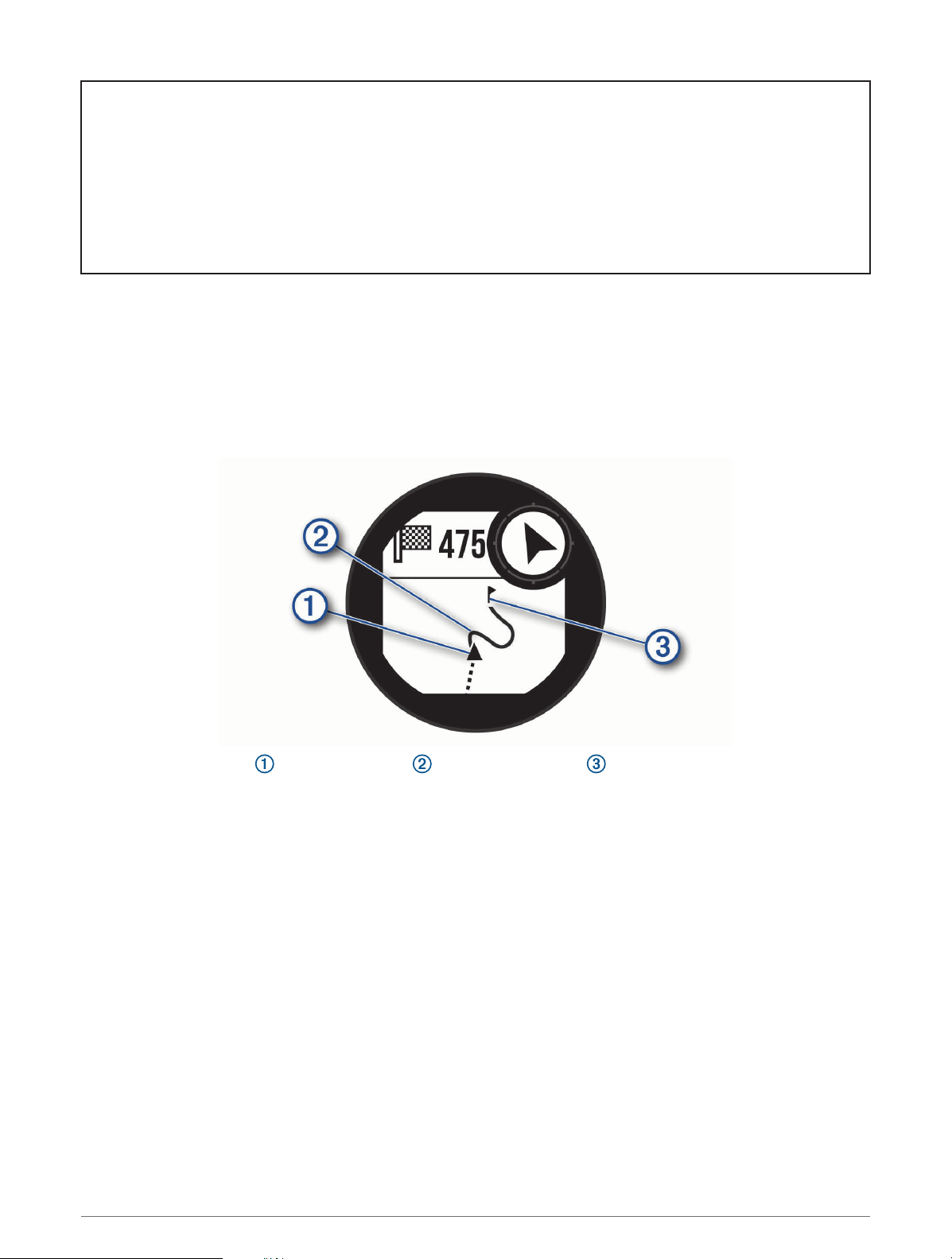
Title Navigating To Your Starting Point During an Activity
Identifier GUID-CF774818-0C30-4992-962C-DDA9EA00E8C6
Language EN-US
Description
Version 10
Revision 1
Changes No English change. Versioned to fix NO.
Status Released
Last Modified 17/07/2020 10:34:09
Author pullins
Navigating to Your Starting Point During an Activity
You can navigate back to the starting point of your current activity in a straight line or along the path you
traveled. This feature is available only for activities that use GPS.
1 During an activity, press STOP.
2 Select Back to Start, and select an option:
• To navigate back to the starting point of your activity along the path you traveled, select TracBack.
• To navigate back to the starting point of your activity in a straight line, select Straight Line.
Your current location , the track to follow , and your destination appear on the map.
Navigation 157
Title Navigating with Sight 'N Go (Outdoor watch)
Identifier GUID-473708B3-200C-4ADF-BC13-2F1DC729B434
Language EN-US
Description
Version 7
Revision 3
Changes Changing to navigation in activities instead of Navigate app (consistency). Changing select to press for
hard keys, using step conref for first step
Status Released
Last Modified 06/08/2019 12:13:40
Author gerson
Navigating with Sight 'N Go
You can point the device at an object in the distance, such as a water tower, lock in the direction, and then
navigate to the object.
1 From the watch face, press START.
2 Select an activity.
3 Hold MENU.
4 Select Navigation > Sight 'N Go.
5 Point the top of the watch at an object, and press START.
Navigation information appears.
6 Press START to begin navigation.
Title Marking and Starting Navigation to a Man Overboard Location
Identifier GUID-32658210-B155-444C-A880-B6B7993DBDA5
Language EN-US
Description
Version 6
Revision 4
Changes For consistency, moving from Navigate app to Navigation menu in activities.
Status Released
Last Modified 06/08/2019 12:13:40
Author gerson
Marking and Starting Navigation to a Man Overboard Location
You can save a man overboard (MOB) location, and automatically start navigation back to it.
TIP: You can customize the hold function of the keys to access the MOB function (Customizing the Hot Keys,
page 170).
1 From the watch face, press START.
2 Select an activity.
3 Hold MENU.
4 Select Navigation > Last MOB.
Navigation information appears.
158 Navigation
Title Stopping Navigation
Identifier GUID-99BA3132-3F83-4811-B66E-14ACDDF75F3F
Language EN-US
Description
Version 1
Revision 3
Changes
Status Released
Last Modified 22/04/2017 22:49:00
Author gerson
Stopping Navigation
1 During an activity, hold MENU.
2 Select Stop Navigation.
Title Courses (920xt)
Identifier GUID-5046014D-7ECC-4D01-9ED3-41E44055F579
Language EN-US
Description
Version 1
Revision 4
Changes not the same as Edge, must load courses from web.
Status Released
Last Modified 22/04/2017 20:56:04
Author wiederan
Courses
You can send a course from your Garmin Connect account to your device. After it is saved to your device, you
can navigate the course on your device.
You can follow a saved course simply because it is a good route. For example, you can save and follow a bike
friendly commute to work.
You can also follow a saved course, trying to match or exceed previously set performance goals. For example, if
the original course was completed in 30 minutes, you can race against a Virtual Partner trying to complete the
course in under 30 minutes.
Navigation 159
Title Creating and Following a Course on Your Device
Identifier GUID-674C66B5-0784-4441-B456-E0313B5902D9
Language EN-US
Description
Version 3
Revision 5
Changes Versioned for fenix 6. Navigation available in all outdoor activities, Aligning changes from branches
Status Released
Last Modified 06/08/2019 12:13:40
Author gerson
Creating and Following a Course on Your Device
1 From the watch face, press START.
2 Select an activity.
3 Hold MENU.
4 Select Navigation > Courses > Create New.
5 Enter a name for the course, and select .
6 Select Add Location.
7 Select an option.
8 If necessary, repeat steps 6 and 7.
9 Select Done > Do Course.
Navigation information appears.
10 Press START to begin navigation.
Title Creating a Course on Garmin Connect
Identifier GUID-9155855B-E55D-4DF8-91C9-C90F0B7C033C
Language EN-US
Description
Version 2
Revision 3
Changes Update Garmin Connect variable.
Status Released
Last Modified 17/06/2020 11:20:27
Author pruekatie
Creating a Course on Garmin Connect
Before you can create a course on the Garmin Connect app, you must have a Garmin Connect account (Garmin
Connect, page 137).
1 From the Garmin Connect app, select or .
2 Select Training > Courses > Create Course.
3 Select a course type.
4 Follow the on-screen instructions.
5 Select Done.
NOTE: You can send this course to your device (Sending a Course to Your Device, page 161).
160 Navigation
Title Sending a Course to Your Device
Identifier GUID-5613803C-5BEB-4EC8-A267-1AF59665F9A3
Language EN-US
Description
Version 1
Revision 4
Changes Save-as from custom workout topic on FR245, updated for courses.
Status Released
Last Modified 24/05/2019 09:09:10
Author mcdanielm
Sending a Course to Your Device
You can send a course you created using the Garmin Connect app to your device (Creating a Course on Garmin
Connect, page 160).
1 From the Garmin Connect app, select or .
2 Select Training > Courses.
3 Select a course.
4 Select > Send to Device.
5 Select your compatible device.
6 Follow the on-screen instructions.
Title Viewing or Editing Course Details
Identifier GUID-63B647CE-1409-4BE9-8A8B-33EFEFCBF255
Language EN-US
Description
Version 3
Revision 3
Changes Updated to include edits from v2 and v2.1.1.
Status Released
Last Modified 01/02/2021 10:21:28
Author cozmyer
Viewing or Editing Course Details
You can view or edit course details before you navigate a course.
1 From the watch face, press START.
2 Select an activity.
3 Hold MENU.
4 Select Navigation > Courses.
5 Press START to select a course.
6 Select an option:
• To begin navigation, select Do Course.
• To create a custom pace band, select PacePro.
• To view the course on the map and pan or zoom the map, select Map.
• To begin the course in reverse, select Do Course in Reverse.
• To view an elevation plot of the course, select Elevation Plot.
• To change the course name, select Name.
• To edit the course path, select Edit.
• To delete the course, select Delete.
Navigation 161
Title Projecting a Waypoint (Outdoor watch)
Identifier GUID-9F043B95-2D8C-472D-9B76-4BE54DB55264
Language EN-US
Description
Version 5
Revision 3
Changes Reducing steps to add a note to add app instead of making it a step. Changing select to press
Status Released
Last Modified 06/08/2019 12:13:40
Author gerson
Projecting a Waypoint
You can create a new location by projecting the distance and bearing from your current location to a new
location.
NOTE: You may need to add the Project Wpt. app to the activities and apps list.
1 From the watch face, press START.
2 Select Project Wpt..
3 Press UP or DOWN to set the heading.
4 Press START.
5 Press DOWN to select a unit of measure.
6 Press UP to enter the distance.
7 Press START to save.
The projected waypoint is saved with a default name.
Title Navigation Settings (outdoor watch)
Identifier GUID-A302AFEE-C535-4C80-9DDD-95B717620C5B
Language EN-US
Description
Version 1
Revision 3
Changes
Status Released
Last Modified 22/04/2017 22:48:01
Author semrau
Navigation Settings
You can customize the map features and appearance when navigating to a destination.
162 Navigation
Title Customizing Navigation Data Screens
Identifier GUID-D16AC8E8-8748-4EF7-AAB7-F4EDE3EB9C40
Language EN-US
Description
Version 8
Revision 3
Changes Added detailed map conditons so Instinct can use the latest version.
Status Released
Last Modified 17/05/2022 15:03:28
Author cozmyer
Customizing Navigation Data Screens
1 Hold MENU.
2 Select Navigation > Data Screens.
3 Select an option:
• Select Map > Status to turn on or off the map.
• Select Map > Data Field to turn on or off a data field that shows routing information on the map.
• Select Elevation Plot to turn on or off the elevation plot.
• Select a screen to add, remove, or customize.
Title Heading Settings
Identifier GUID-A8C5E65D-05C4-4F30-8693-501190635284
Language EN-US
Description
Version 3
Revision 3
Changes Updated for fenix 6 Sport (no settings menu)
Status Released
Last Modified 06/08/2019 12:13:40
Author gerson
Heading Settings
You can set the behavior of the pointer that appears when navigating.
Hold MENU, and select Navigation > Type.
Bearing: Points in the direction of your destination.
Course: Shows your relationship to the course line leading to the destination.
Navigation 163
Title Setting Navigation Alerts
Identifier GUID-D63C6C77-7AC0-4C5F-AA53-44A8C6B1EB9D
Language EN-US
Description
Version 6
Revision 1
Changes No English change. Versioned to fix SK
Status Released
Last Modified 07/03/2022 11:34:44
Author pullins
Setting Navigation Alerts
You can set alerts to help you navigate to your destination.
1 Hold MENU.
2 Select Navigation > Alerts.
3 Select an option:
• To set an alert for a specified distance from your final destination, select Final Distance.
• To set an alert for the estimated time remaining until you reach your final destination, select Final ETE.
• To set an alert when you stray from the course, select Off Course.
4 If necessary, select Status to turn on the alert.
5 If necessary, enter a distance or time value, and select .
Title Power Manager Settings
Identifier GUID-14692BCE-5A1D-4ABC-A91E-C293DE95FB1F
Language EN-US
Description
Version 2
Revision 4
Changes Added a condition to the settings menu.
Status Released
Last Modified 10/02/2022 08:23:57
Author cozmyer
Power Manager Settings
Hold MENU, and select Power Manager.
Battery Saver: Allows you to customize system settings to extend battery life in watch mode (Customizing the
Battery Saver Feature, page 165).
Power Modes: Allows you to customize system settings, activity settings, and GPS settings to extend battery
life during an activity (Customizing Power Modes, page 166).
164 Power Manager Settings
Title Customizing the Battery Saver Feature
Identifier GUID-6A33BE86-1A19-480A-BC44-01EAAFDA869A
Language EN-US
Description
Version 5.1.2
Revision 4
Changes Added pulse ox back in (see draft comment).
Status Released
Last Modified 10/02/2022 10:06:59
Author cozmyer
Customizing the Battery Saver Feature
The battery saver feature allows you to quickly adjust system settings to extend battery life in watch mode.
You can turn on the battery saver feature from the controls menu (Controls, page 107).
1 Hold MENU.
2 Select Power Manager > Battery Saver.
3 Select Status to turn on the battery saver feature.
4 Select Edit, and select an option:
• Select Watch Face to enable a low-power watch face that updates once per minute.
• Select Phone to disconnect your paired phone.
• Select Wrist Heart Rate to turn off the wrist heart rate monitor.
• Select Pulse Oximeter to turn off the pulse oximeter sensor.
• Select Backlight to disable the automatic backlight.
The watch displays the hours of battery life gained with each setting change.
5 Select During Sleep to enable the battery saver feature during your normal sleep hours.
TIP: You can set your normal sleep hours in the user settings on your Garmin Connect account.
6 Select Low Battery Alert to receive an alert when the battery is low.
Title Changing the Power Mode
Identifier GUID-001EE972-B951-413A-BE10-D5EC8D464133
Language EN-US
Description
Version 2
Revision 3
Changes Changed from hours gained to hours available.
Status Released
Last Modified 22/12/2021 13:17:15
Author cozmyer
Changing the Power Mode
You can change the power mode to extend battery life during an activity.
1 During an activity, hold MENU.
2 Select Power Mode.
3 Select an option.
The watch displays the hours of battery life available with the selected power mode.
Power Manager Settings 165
Title Customizing Power Modes
Identifier GUID-A98507AE-C8FE-4CE7-A441-417DEAC99C65
Language EN-US
Description
Version 2
Revision 7
Changes Add Settings menu with condition.
Status Released
Last Modified 17/06/2020 11:21:04
Author pruekatie
Customizing Power Modes
Your device comes preloaded with several power modes, allowing you to quickly adjust system settings, activity
settings, and GPS settings to extend battery life during an activity. You can customize existing power modes
and create new custom power modes.
1 Hold MENU.
2 Select Power Manager > Power Modes.
3 Select an option:
• Select a power mode to customize.
• Select Add to create a custom power mode.
4 If necessary, enter a custom name.
5 Select an option to customize specific power mode settings.
For example, you can change the GPS setting or disconnect your paired phone.
The watch displays the hours of battery life gained with each setting change.
6 If necessary, select Done to save and use the custom power mode.
Title Restoring a Power Mode
Identifier GUID-5D6E617F-CF30-40E9-9646-CD6BBC993E91
Language EN-US
Description
Version 2
Revision 7
Changes Add Settings menu with condition.
Status Released
Last Modified 17/06/2020 11:46:50
Author pruekatie
Restoring a Power Mode
You can reset a preloaded power mode to the factory default settings.
1 Hold MENU.
2 Select Power Manager > Power Modes.
3 Select a preloaded power mode.
4 Select Restore > .
166 Power Manager Settings
Title System Settings (outdoor watch)
Identifier GUID-1500E73F-F386-49AF-A542-25D4B1655A08
Language EN-US
Description
Version 19
Revision 3
Changes Added the No Sleep Mode condition to do not disturb setting.
Status Released
Last Modified 17/05/2022 15:03:51
Author cozmyer
System Settings
Hold MENU, and select System.
Language: Sets the language displayed on the watch.
Time: Adjusts the time settings (Time Settings, page 168).
Backlight: Adjusts the screen settings (Changing the Screen Settings, page 169).
Sound and Vibe: Sets the watch sounds, such as button tones, alerts, and vibrations.
Do Not Disturb: Allows you to enable the Do Not Disturb mode. Use the During Sleep option to turn on do not
disturb mode automatically during your normal sleep hours. You can set your normal sleep hours on your
Garmin Connect account.
Hot Keys: Allows you to assign shortcuts to buttons (Customizing the Hot Keys, page 170).
Auto Lock: Allows you to lock the buttons automatically to prevent accidental button presses. Use the During
Activity option to lock the buttons during a timed activity. Use the General Use option to lock the buttons
when you are not recording a timed activity.
Format: Sets general format preferences, such as the units of measure, pace and speed shown during activities,
the start of the week, and geographical position format and datum options (Changing the Units of Measure,
page 170).
Physio TrueUp: Enables syncing of activities and performance measurements from your other Garmin devices
(Syncing Activities and Performance Measurements, page 171).
Perf. Condition: Enables the performance condition feature during an activity (Performance Condition, page 96).
Data Recording: Sets how the watch records activity data. The Smart recording option (default) allows for
longer activity recordings. The Every Second recording option provides more detailed activity recordings, but
may not record entire activities that last for longer periods of time.
USB Mode: Sets the watch to use mass storage mode or Garmin mode when connected to a computer.
Reset: Allows you to reset user data and settings (Resetting All Default Settings, page 185).
Software Update: Allows you to install software updates downloaded using Garmin Express. Use the Auto
Update option to enable your watch to download the latest software update from the Garmin Connect app on
your paired phone.
About: Displays device, software, license, and regulatory information.
System Settings 167
Title Time Settings (Outdoor watch)
Identifier GUID-6895B03A-4D1B-47CC-B0AB-9330A8A031E1
Language EN-US
Description
Version 6
Revision 5
Changes Removed Settings menu. MARQ/fenix 6 going forward. Use previous version to support older products.
Status Released
Last Modified 06/08/2019 12:13:40
Author gerson
Time Settings
Hold MENU, and select System > Time.
Time Format: Sets the device to show time in a 12-hour, 24-hour, or military format.
Set Time: Sets the time zone for the device. The Auto option sets the time zone automatically based on your
GPS position.
Time: Allows you to adjust the time if it is set to the Manual option.
Alerts: Allows you to set hourly alerts, as well as sunrise and sunset alerts that sound a specific number of
minutes or hours before the actual sunrise or sunset occurs (Setting Time Alerts, page 168).
Sync with GPS: Allows you to manually sync the time with GPS when you change time zones, and to update for
daylight saving time (Syncing the Time, page 169).
Title Setting Time Alerts
Identifier GUID-E3FEFEA4-EDF3-4257-8D38-DF3C15AEEB8F
Language EN-US
Description
Version 8
Revision 1
Changes No English change. Versioned to fix SV
Status Released
Last Modified 08/04/2022 15:19:42
Author pullins
Setting Time Alerts
1 Hold MENU.
2 Select System > Time > Alerts.
3 Select an option:
• To set an alert to sound a specific number of minutes or hours before the actual sunset occurs, select Til
Sunset > Status > On, select Time, and enter the time.
• To set an alert to sound a specific number of minutes or hours before the actual sunrise occurs, select Til
Sunrise > Status > On, select Time, and enter the time.
• To set an alert to sound every hour, select Hourly > On.
168 System Settings
Title Syncing the Time with GPS
Identifier GUID-D491A0BC-103D-4609-966E-93029A9A8FCE
Language EN-US
Description
Version 3
Revision 3
Changes Time can now sync with GPS or with paired phone
Status Released
Last Modified 06/08/2019 12:13:40
Author gerson
Syncing the Time
Each time you turn on the device and acquire satellites or open the Garmin Connect app on your paired phone,
the device automatically detects your time zones and the current time of day. You can also manually sync the
time when you change time zones, and to update for daylight saving time.
1 Hold MENU.
2 Select System > Time > Sync with GPS.
3 Wait while the device connects to your paired phone or locates satellites (Acquiring Satellite Signals,
page 187).
TIP: You can press DOWN to switch the source.
Title Changing the Screen Settings
Identifier GUID-C9A5E731-8826-4AD0-8087-F6E2EAC625D6
Language EN-US
Description
Version 7
Revision 7
Changes Adding Keys, Keys & Touch with conditions
Status Released
Last Modified 13/05/2022 10:38:36
Author wiederan
Changing the Screen Settings
1 Hold MENU.
2 Select System > Backlight.
3 Select an option:
• Select In-Dive.
• Select During Activity.
• Select General Use.
• Select During Sleep.
4 Select an option:
• Select Mode to turn on the screen at depth or throughout your dive.
• Select Brightness to set the brightness level of the screen.
• Select Keys to turn on the screen for button presses.
• Select Alerts to turn on the screen for alerts.
• Select Gesture to turn on the screen by raising and turning your arm to look at your wrist.
• Select Timeout to set the length of time before the screen turns off.
System Settings 169
Title Customizing the Hot Keys (fenix 6)
Identifier GUID-9122383D-6612-460E-BFD0-D2A43BAA979C
Language EN-US
Description
Version 5
Revision 3
Changes Updated to button. A little awkward since the feature is called hot key.
Status Released
Last Modified 22/12/2021 13:28:36
Author cozmyer
Customizing the Hot Keys
You can customize the hold function of individual buttons and combinations of buttons.
1 Hold MENU.
2 Select System > Hot Keys.
3 Select a button or combination of buttons to customize.
4 Select a function.
Title Changing the Units of Measure
Identifier GUID-4E76487B-6F62-415D-9419-C7E4292F5BC6
Language EN-US
Description
Version 4
Revision 3
Changes Update context to be less specific because they keep adding more options: depth, pressure, swim totals,
vert. speed.
Status Released
Last Modified 13/05/2022 10:38:36
Author wiederan
Changing the Units of Measure
You can customize units of measure for distance, pace and speed, elevation, and more.
1 Hold MENU.
2 Select System > Format > Units.
3 Select a measurement type.
4 Select a unit of measure.
170 System Settings
Title Syncing Activities and Performance Measurements
Identifier GUID-2D2EA72B-5952-4D5D-ACDB-CE628C3D3331
Language EN-US
Description
Version 3
Revision 6
Changes Moved to System settings.
Status Released
Last Modified 22/12/2021 13:27:40
Author cozmyer
Syncing Activities and Performance Measurements
You can sync activities and performance measurements from other Garmin devices to your Descent G1 watch
using your Garmin Connect account. This allows your watch to more accurately reflect your training status and
fitness. For example, you can record a ride with an Edge device, and view your activity details and overall
training load on your Descent G1 watch.
1 Hold MENU.
2 Select System > Physio TrueUp.
When you sync your watch with your phone, recent activities and performance measurements from your other
Garmin devices appear on your Descent G1 watch.
Title Viewing Device Information - e-label
Identifier GUID-E131EDC8-BB20-4F2B-AF7B-E6EC45B107E0
Language EN-US
Description
Version 7
Revision 4
Changes Removed Settings menu. MARQ/fenix 6 going forward. Use previous version to support older products.
Moved back under System menu.
Status Released
Last Modified 26/02/2019 12:52:39
Author gerson
Viewing Device Information
You can view device information, such as the unit ID, software version, regulatory information, and license
agreement.
1 Hold MENU.
2 Select System > About.
System Settings 171
Title Viewing Regulatory and Compliance Information
Identifier GUID-E9341B2A-C519-47C1-849F-8CC7876C4E6D
Language EN-US
Description
Version 4
Revision 4
Changes Removed Settings menu. MARQ/fenix 6 going forward. Use previous version to support older products.
Back under system menu.
Status Released
Last Modified 26/02/2019 12:52:39
Author gerson
Viewing E-label Regulatory and Compliance Information
The label for this device is provided electronically. The e-label may provide regulatory information, such as
identification numbers provided by the FCC or regional compliance markings, as well as applicable product and
licensing information.
1 Hold MENU.
2 From the system menu, select About.
Title Device Information
Identifier GUID-95E6980D-690A-495F-9303-4F2F7E59ED9E
Language EN-US
Description Title and warning only. No index entries.
Version 2
Revision 3
Changes Removed "Delta" from topic title.
Status Released
Last Modified 22/04/2017 22:13:20
Author jhenson
Device Information
172 Device Information
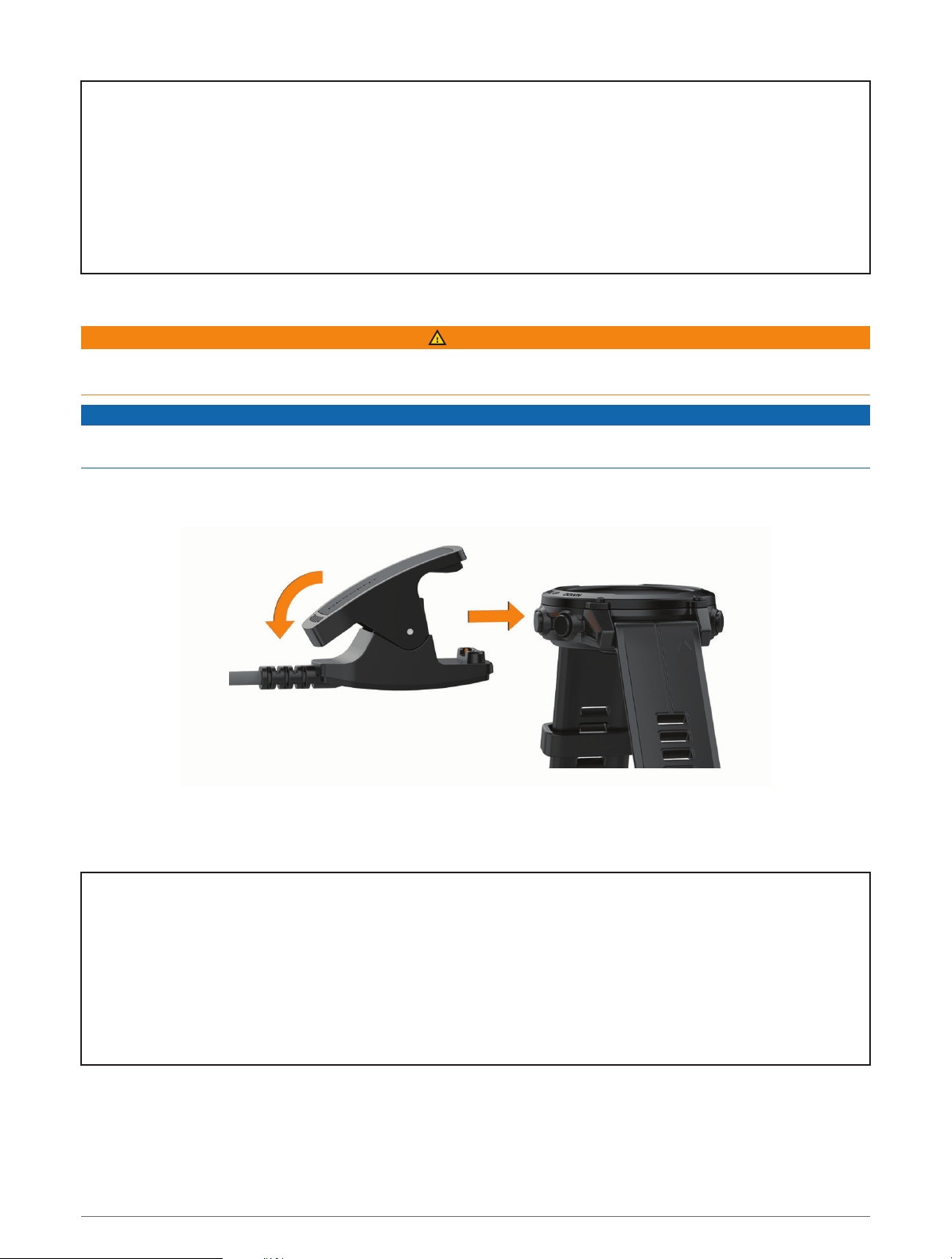
Title Charging the Watch (pinch-style clip no glyphs)
Identifier GUID-C617A48D-E819-4A5D-9975-2D14FD470656
Language EN-US
Description
Version 2
Revision 3
Changes Changing device to watch and added a final step result.
Status Released
Last Modified 10/02/2022 08:25:17
Author cozmyer
Charging the Watch
WARNING
This device contains a lithium-ion battery. See the Important Safety and Product Information guide in the product
box for product warnings and other important information.
NOTICE
To prevent corrosion, thoroughly clean and dry the contacts and the surrounding area before charging or
connecting to a computer. Refer to the cleaning instructions (Device Care, page 177).
1 Pinch the sides of the charging clip.
2 Align the clip with the contacts on the back of the watch, and release the clip.
3 Plug the USB cable into a USB charging port.
The watch displays the current battery charge level.
Title Solar Charging
Identifier GUID-675E0F57-BB83-453D-8C2E-AF8922754FD2
Language EN-US
Description
Version 3
Revision 6
Changes Adding conditioned note specifying feature does not apply to all models.
Status Released
Last Modified 10/02/2022 10:11:44
Author burzinskititu
Solar Charging
NOTE: This feature is not available on all models.
The solar charging capability of the watch allows you to charge your watch while you use it.
Device Information 173
Title Tips for Solar Charging
Identifier GUID-E72F3619-D372-44BE-BEBC-348065CEAC07
Language EN-US
Description
Version 5
Revision 3
Changes Removing reference to fluorescent light per SME feedback.
Status Released
Last Modified 16/12/2021 12:54:17
Author burzinskititu
Tips for Solar Charging
To maximize the battery life of your watch, follow these tips.
• When you are wearing the watch, avoid covering the face with your sleeve.
• When you are not wearing the watch, point the face toward sunlight.
NOTE: The watch protects itself from overheating and stops charging automatically if the internal
temperature exceeds the solar charging temperature threshold (Specifications, page 175).
NOTE: The watch does not solar charge when connected to an external power source or when the battery is
full.
174 Device Information
Title Specifications - Descent G1 (OM)
Identifier GUID-D9B7CD1D-51A4-4010-920A-FFD98489A3CF
Language EN-US
Description
Version 1
Revision 5
Changes Save as from Mk2
Status Released
Last Modified 24/01/2022 15:20:18
Author cozmyer
Specifications
Battery type Rechargeable, built-in lithium-ion battery
Water rating
10 ATM
1
Dive (EN 13319)
2
Decompression model Bühlmann ZHL-16C
Depth sensor
Accurate from 0 m to 100 m (0 ft. to 328 ft.) complying with EN 13319
Resolution (m): 0.1 m until 99.9 m, 1 m at 100 m
Resolution (ft.): 1 ft.
Inspection interval Inspect parts before each use for damage. Replace parts as needed.
3
Operating and storage temperature
range
From -20º to 60ºC (from -4º to 140ºF)
Underwater operating temperature
range
From 0º to 40ºC (from 32º to 104ºF)
USB charging temperature range From 0º to 45ºC (from 32º to 113ºF)
Solar charging temperature range From 0º to 60ºC (from 32º to 140ºF)
Wireless frequencies
2.4 GHz @ 0 dBm maximum
13.56 MHz @ -30 dBm maximum
1
The device withstands pressure equivalent to a depth of 100 m. For more information, go to
www.garmin.com/waterrating.
2
Designed to comply with CSN EN 13319.
3
Aside from normal wear and tear, performance is not affected by aging.
Device Information 175
Title Battery Information (Descent G1)
Identifier GUID-AA042E93-E12A-456C-85B7-6E58EEDD6DCD
Language EN-US
Description
Version 4
Revision 4
Changes Updated updated battery specs.
Status Released
Last Modified 04/03/2022 15:17:31
Author cozmyer
Battery Life Information
The actual battery life depends on the features enabled on your watch, such as activity tracking, wrist-based
heart rate, phone notifications, GPS, internal sensors, and connected sensors (Tips for Maximizing the Battery
Life, page 187).
Mode Descent G1 Battery Life Descent G1 Solar Battery Life
Smartwatch mode with activity tracking and
24/7 wrist-based heart rate monitoring
Up to 21 days Up to 21 days/124 days with solar
1
GPS mode Up to 26 hours Up to 26 hours/39 hours with solar
2
Max. battery GPS mode Up to 56 hours Up to 56 hours/205 hours with solar
2
Expedition GPS mode Up to 27 days Up to 27 days/unlimited with solar
1
Battery saver watch mode Up to 48 days Up to 48 days/unlimited with solar
1
Dive mode Up to 25 hours Up to 25 hours
1
All-day wear with 3 hr./day outside in 50,000 lux conditions.
2
With use in 50,000 lux conditions.
176 Device Information
Title Device Care - fenix
Identifier GUID-756F63A5-750B-488D-809A-644D889E047A
Language EN-US
Description
Version 5
Revision 4
Changes Added notices for Descent, conditioned.
Status Released
Last Modified 17/11/2017 16:17:26
Author cozmyer
Device Care
NOTICE
Do not use a sharp object to clean the device.
Avoid chemical cleaners, solvents, and insect repellents that can damage plastic components and finishes.
Thoroughly rinse the device with fresh water after exposure to chlorine, salt water, sunscreen, cosmetics,
alcohol, or other harsh chemicals. Prolonged exposure to these substances can damage the case.
Do not wash the device under high pressure, because jets of water or air may cause damage to the depth
sensor or barometer.
Avoid extreme shock and harsh treatment, because it can degrade the life of the product.
Do not store the device where prolonged exposure to extreme temperatures can occur, because it can cause
permanent damage.
Discontinue use if the device is damaged or if it is stored at a temperature outside the specified storage
temperature range.
Title Cleaning the Watch
Identifier GUID-36E172FA-C2ED-4EBC-A57D-7C0963ABA3C6
Language EN-US
Description
Version 6
Revision 5
Changes Adding skin irritation caution
Status Released
Last Modified 20/12/2021 11:43:55
Author tillmonmartha
Cleaning the Watch
CAUTION
Some users may experience skin irritation after prolonged use of the watch, especially if the user has sensitive
skin or allergies. If you notice any skin irritation, remove the watch and give your skin time to heal. To help
prevent skin irritation, ensure the watch is clean and dry, and do not overtighten the watch on your wrist.
NOTICE
Even small amounts of sweat or moisture can cause corrosion of the electrical contacts when connected to a
charger. Corrosion can prevent charging and data transfer.
1 Wipe the watch using a cloth dampened with a mild detergent solution.
2 Wipe it dry.
After cleaning, allow the watch to dry completely.
TIP: For more information, go to
garmin.com/fitandcare.
Device Information 177
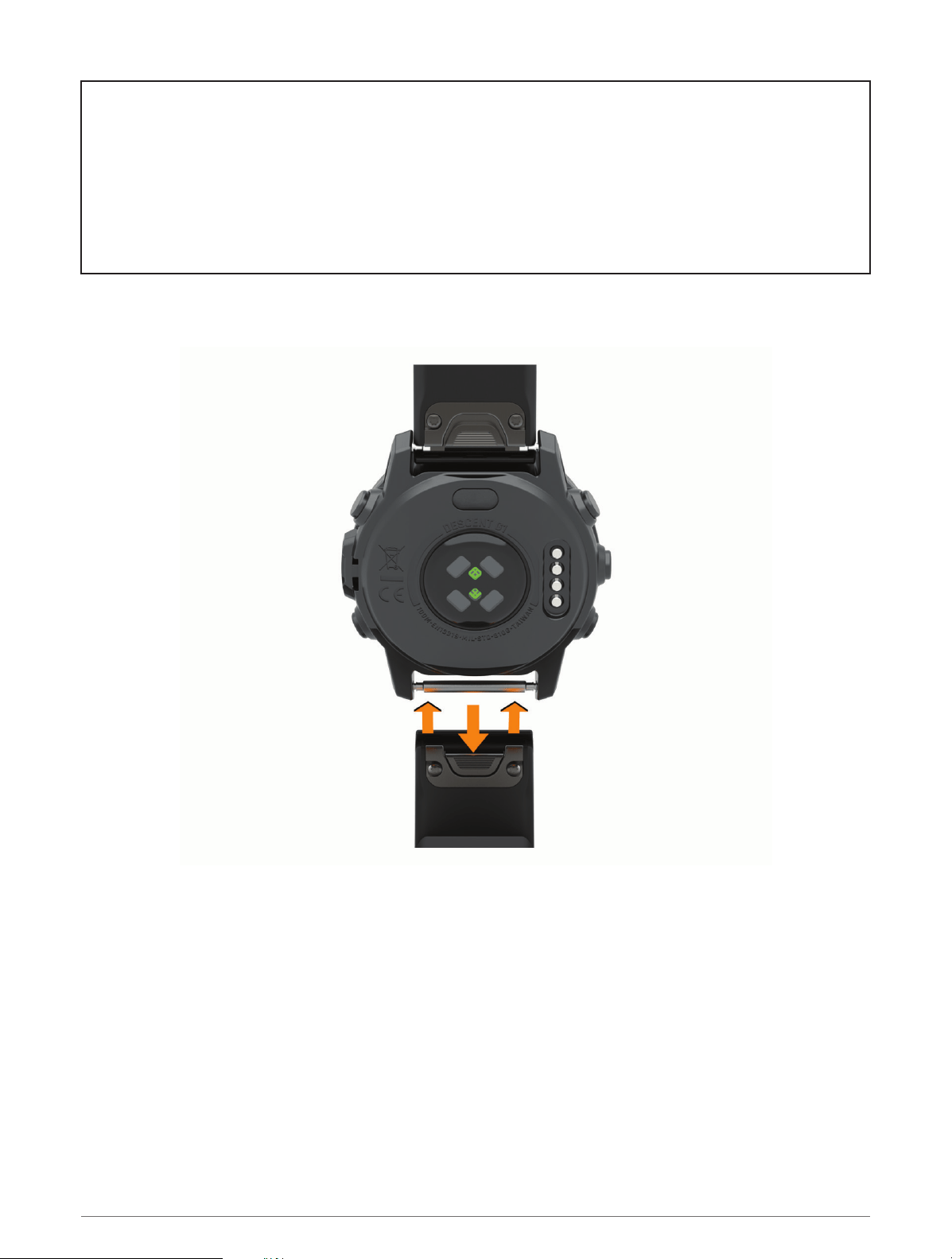
Title Changing the QuickFit Bands (OM)
Identifier GUID-FDFEAE9D-7E96-4AC8-801A-AA216768B592
Language EN-US
Description
Version 1
Revision 7
Changes
Status Released
Last Modified 22/04/2017 22:46:02
Author gerson
Changing the QuickFit
®
Bands
1 Slide the latch on the QuickFit band, and remove the band from the watch.
2 Align the new band with the watch.
3 Press the band into place.
NOTE: Make sure the band is secure. The latch should close over the watch pin.
4 Repeat steps 1 through 3 to change the other band.
178 Device Information
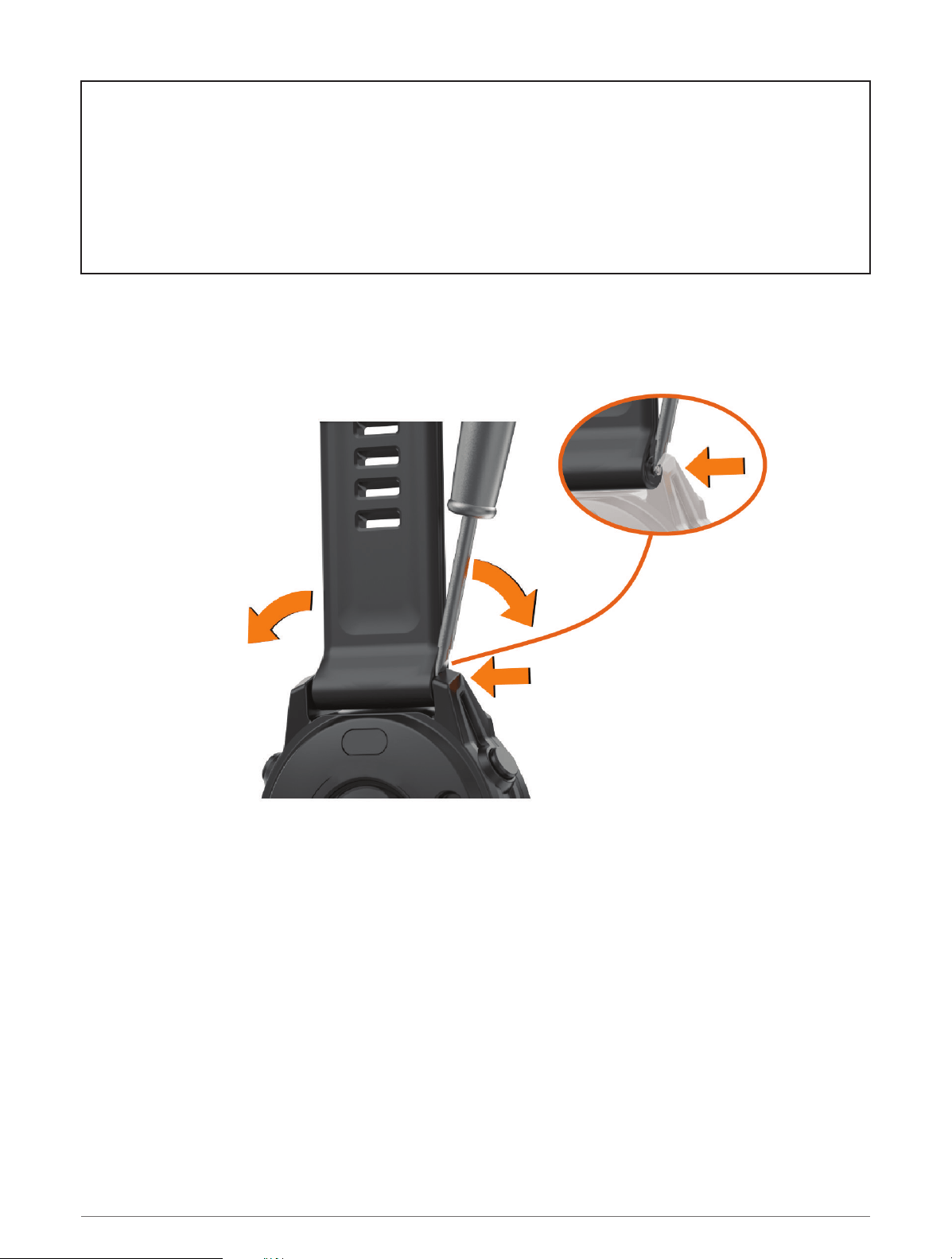
Title Changing the Spring Bar Bands
Identifier GUID-2E224202-DE25-4855-9F47-743ABCE87392
Language EN-US
Description
Version 2
Revision 4
Changes Updated variables and some terminology so this will also work for the G1.
Status Released
Last Modified 10/02/2022 13:04:33
Author cozmyer
Changing the Spring Bar Bands
You can replace the bands with new Descent G1 bands or compatible QuickFit 22 bands.
1 Use the pin tool to push in the watch pin.
2 Remove the band from the watch.
3 Select an option:
• To install Descent G1 bands, align one side of the new band with the holes on the watch, push in the
exposed watch pin, and press the band into place.
NOTE: Make sure the band is secure. The watch pin should align with the holes on the watch.
• To install QuickFit 22 bands, remove the watch pin from the Descent G1 band, replace the watch pin on
the watch, and press the new band into place.
Device Information 179
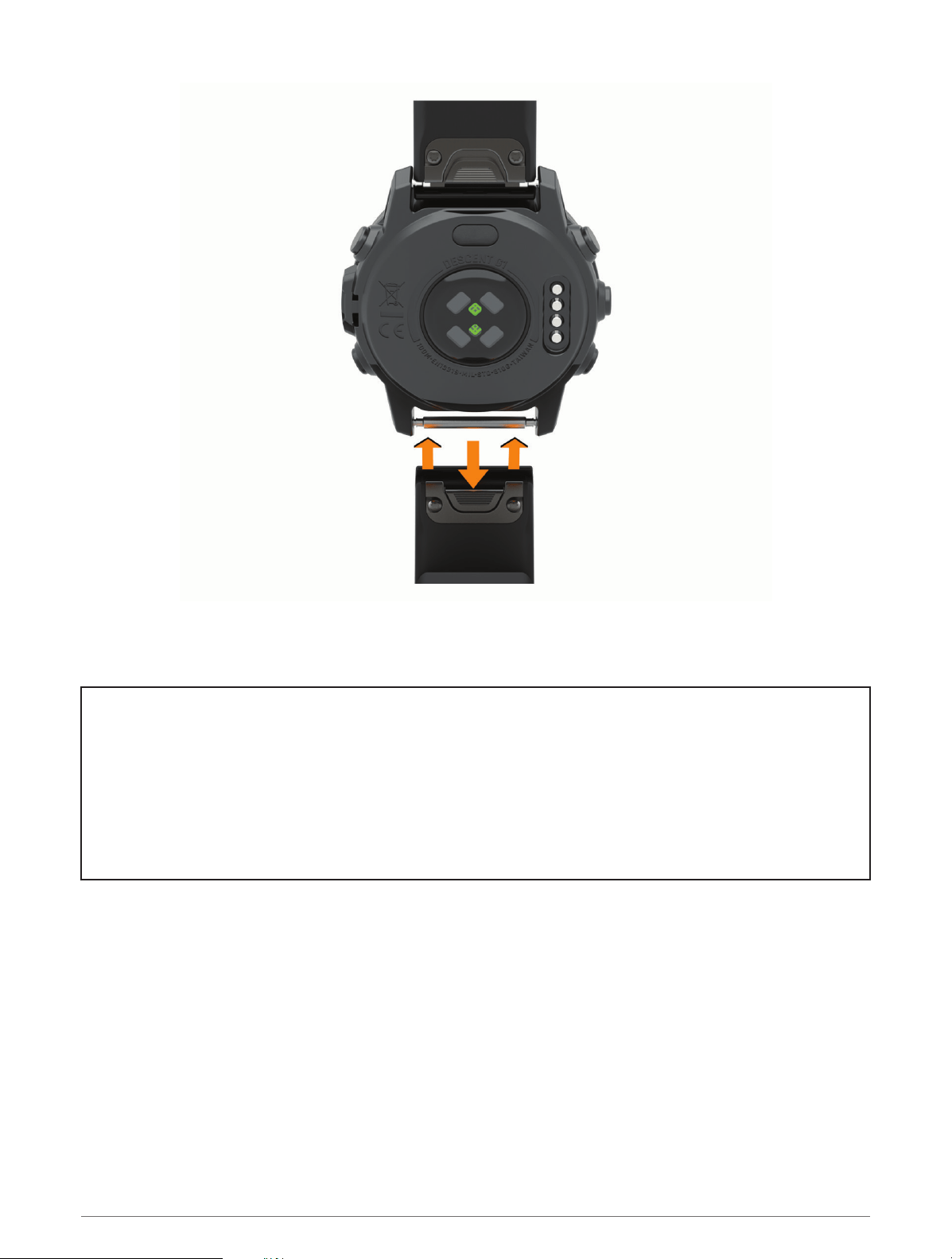
NOTE: Make sure the band is secure. The latch should close over the watch pin.
4 Repeat the steps to change the other band.
Title Data Management
Identifier GUID-C28FB1E8-EE56-4BC2-9417-B89FF53612A7
Language EN-US
Description
Version 1
Revision 4
Changes
Status Released
Last Modified 22/04/2017 22:58:25
Author wiederan
Data Management
NOTE: The device is not compatible with Windows
®
95, 98, Me, Windows NT
®
, and Mac
®
OS 10.3 and earlier.
180 Device Information
Title Deleting Files
Identifier GUID-BBF41890-FB0B-4B45-AE18-E83442B68BA8
Language EN-US
Description
Version 4
Revision 4
Changes Adding conditions for MTP mode and mass storage mode. Mac OS provides limited support for MTP. In
response to FQC JIRA 24385.
Status Released
Last Modified 14/09/2018 09:44:23
Author gerson
Deleting Files
NOTICE
If you do not know the purpose of a file, do not delete it. Your device memory contains important system files
that should not be deleted.
1 Open the Garmin drive or volume.
2 If necessary, open a folder or volume.
3 Select a file.
4 Press the Delete key on your keyboard.
NOTE: If you are using an Apple
®
computer, you must empty the Trash folder to completely remove the files.
Title Troubleshooting
Identifier GUID-3DAE3305-3896-4A74-911B-6D30C789AE72
Language EN-US
Description
Version 1
Revision 2
Changes
Status Released
Last Modified 22/04/2017 23:05:12
Author wiederan
Troubleshooting
Troubleshooting 181
Title Product Updates (formerly Support and Updates)
Identifier GUID-3CCB0850-544E-4983-8D61-3CEB91253BCA
Language EN-US
Description
Version 16
Revision 3
Changes Fixing Wi-Fi conditions.
Status Released
Last Modified 10/02/2022 10:11:26
Author cozmyer
Product Updates
Your device automatically checks for updates when connected to Bluetooth. You can manually check for
updates from the system settings (System Settings, page 167). On your computer, install Garmin Express
(www.garmin.com/express). On your phone, install the Garmin Connect app.
This provides easy access to these services for Garmin devices:
• Software updates
• Course updates
• Data uploads to Garmin Connect
• Product registration
Title Getting More Information - Outdoor
Identifier GUID-C6C22969-9F2D-4BDC-B867-EF9F6EA9E45A
Language EN-US
Description
Version 7
Revision 3
Changes Added context to the 3rd bullet per Legal.
Status Released
Last Modified 25/09/2019 09:43:25
Author mall
Getting More Information
You can find more information about this product on the Garmin website.
• Go to support.garmin.com for additional manuals, articles, and software updates.
• Go to buy.garmin.com, or contact your Garmin dealer for information about optional accessories and
replacement parts.
• Go to www.garmin.com/ataccuracy for information about feature accuracy.
This is not a medical device.
182 Troubleshooting
Title My device is in the wrong language (OM)
Identifier GUID-BF6258B4-ECA4-472F-8AC1-C09AE1D8E75F
Language EN-US
Description
Version 5
Revision 3
Changes Added step 6 for the Apply uicontrol. Relates to managing language files.
Status Released
Last Modified 22/09/2020 15:23:37
Author cozmyer
My device is in the wrong language
You can change the device language selection if you have accidently selected the wrong language on the
device.
1 Hold MENU.
2 Scroll down to the last item in the list, and press START.
3 Press START.
4 Select your language.
5 Press START.
Title Is my smartphone compatible with my device?
Identifier GUID-63A0F2AB-282A-4EB7-80D2-5FF1B6283BB2
Language EN-US
Description
Version 4
Revision 7
Changes device to watch; smartphone to phone
Status Released
Last Modified 20/12/2021 11:50:25
Author tillmonmartha
Is my phone compatible with my watch?
The Descent G1 watch is compatible with phones using Bluetooth technology.
Go to garmin.com/ble for Bluetooth compatibility information.
Troubleshooting 183
Title My phone will not connect to the device
Identifier GUID-4442F808-670B-4EF3-AC60-32666F173DFD
Language EN-US
Description
Version 7
Revision 4
Changes device to watch
Status Released
Last Modified 20/12/2021 11:51:52
Author tillmonmartha
My phone will not connect to the watch
If your phone will not connect to the watch, you can try these tips.
• Turn off your phone and your watch, and turn them back on again.
• Enable Bluetooth technology on your phone.
• Update the Garmin Dive app to the latest version.
• Remove your watch from the Garmin Dive app and the Bluetooth settings on your phone to retry the pairing
process.
• If you bought a new phone, remove your watch from the Garmin Dive app on the phone you intend to stop
using.
• Bring your phone within 10 m (33 ft.) of the watch.
• On your phone, open the Garmin Dive app, select or , and select Garmin Devices > Add Device to enter
pairing mode.
• From the watch face, hold MENU, and select Phone > Pair Phone.
Title Can I use my Bluetooth sensor with my watch?
Identifier GUID-980C5644-98EF-45D4-AAB2-899072CE4010
Language EN-US
Description
Version 4
Revision 3
Changes terminology
Status Released
Last Modified 13/05/2022 10:38:36
Author wiederan
Can I use my Bluetooth sensor with my watch?
The watch is compatible with some Bluetooth sensors. The first time you connect a sensor to your Garmin
watch, you must pair the watch and sensor. After they are paired, the watch connects to the sensor
automatically when you start an activity and the sensor is active and within range.
1 Hold MENU.
2 Select Sensors & Accessories > Add New.
3 Select an option:
• Select Search All.
• Select your sensor type.
You can customize the optional data fields (Customizing the Data Screens, page 66).
184 Troubleshooting
Title Restarting Your Watch (fenix)
Identifier GUID-626CD309-6FCC-4960-81DE-382682FFEC60
Language EN-US
Description
Version 7
Revision 4
Changes Device to watch
Status Released
Last Modified 20/01/2022 18:03:35
Author pruekatie
Restarting Your Watch
1 Hold LIGHT until the watch turns off.
2 Hold LIGHT to turn on the watch.
Title Resetting All Default Settings
Identifier GUID-5D096D08-394E-4718-B1FF-81ECBBD00CE0
Language EN-US
Description
Version 8
Revision 3
Changes Added settings menu condition and updated prereq to match other Fitness/Outdoor topics.
Status Released
Last Modified 17/05/2022 15:06:16
Author cozmyer
Resetting All Default Settings
Before you reset all default settings, you should sync the watch with the Garmin Connect app to upload your
activity data.
You can reset all of the watch settings to the factory default values.
1 Hold MENU.
2 Select System > Reset.
3 Select an option:
• To reset all of the watch settings to the factory default values, including user profile data, but save activity
history and downloaded apps and files, select Reset Default Settings.
• To reset all of the watch settings to the factory default values and delete all user-entered information and
activity history, select Delete Data and Reset Settings.
NOTE: If you have set up a Garmin Pay wallet, this option deletes the wallet from your watch.
Title Diving
Identifier GUID-FF7B29B4-4E81-41C3-A42C-D28C88E516CF
Language EN-US
Description
Version 1
Revision 10
Changes
Status Released
Last Modified 21/09/2017 12:01:00
Author cozmyer
Diving
Troubleshooting 185
Title Resetting Your Tissue Load
Identifier GUID-192A9298-5D5B-46FF-A2FF-28A020ABCB71
Language EN-US
Description
Version 3
Revision 1
Changes No English Change. Versioned to fix NL
Status Released
Last Modified 20/05/2021 13:20:40
Author pullins
Resetting Your Tissue Load
You can reset your current tissue load saved on the device. You should reset your tissue load only if you do not
plan to use the device again in the future. This can be useful for dive shops that provide devices for rent.
1 Hold MENU.
2 Select System > Reset > Reset Tissues.
Title Resetting the Surface Pressure
Identifier GUID-3E0D2A6C-08BF-43F5-850D-BED17404D9D8
Language EN-US
Description
Version 2
Revision 3
Changes Removing confirmation step and making the logo step more generic to make this work for more
products.
Status Released
Last Modified 10/02/2022 13:08:08
Author cozmyer
Resetting the Surface Pressure
The device automatically determines the surface pressure using the barometric altimeter. Large pressure
changes, such as during a flight, can cause the device to automatically start a dive activity. You can reset the
surface pressure if the device automatically starts a dive activity incorrectly.
1 Hold LIGHT until the device turns off.
2 Hold LIGHT to turn on the device.
3 When the product logo appears, hold MENU until you are prompted to reset the surface pressure.
186 Troubleshooting
Title Tips for Maximizing the Battery Life (Outdoor watch)
Identifier GUID-7A30002F-B50A-4F1C-84CA-0EADBF4A9759
Language EN-US
Description
Version 9
Revision 11
Changes Trying to write around backlight. No activity tracking setting now.Tweaked some links and variables.
Status Released
Last Modified 22/12/2021 14:23:51
Author cozmyer
Tips for Maximizing the Battery Life
To extend the life of the battery, you can try these tips.
• Change the power mode during an activity (Changing the Power Mode, page 165).
• Turn on the battery saver feature from the controls menu (Controls, page 107).
• Reduce the screen timeout (Changing the Screen Settings, page 169).
• Reduce the screen brightness (Changing the Screen Settings, page 169).
• Use UltraTrac satellite mode for your activity.
• Turn off Bluetooth technology when you are not using connected features (Controls, page 107).
• When pausing your activity for a longer period of time, use the Resume Later option (Stopping an Activity,
page 39).
• Use a watch face that is not updated every second.
For example, use a watch face without a second hand (Customizing the Watch Face, page 88).
• Limit the phone notifications the watch displays (Managing Notifications, page 136).
• Stop broadcasting heart rate data to paired devices (Broadcasting Heart Rate Data, page 117).
• Turn off wrist-based heart rate monitoring (Wrist Heart Rate Monitor Settings, page 115).
NOTE: Wrist-based heart rate monitoring is used to calculate vigorous intensity minutes and calories burned.
• Turn on manual pulse oximeter readings (Setting the Pulse Oximeter Mode, page 118).
Title Acquiring Satellite Signals
Identifier GUID-475E6349-9762-452A-B5B0-43AD12F8F68A
Language EN-US
Description
Version 3
Revision 4
Changes Adding in xref to "What is GPS" page on garmin.com
Status Released
Last Modified 06/03/2018 08:46:04
Author mcdanielm
Acquiring Satellite Signals
The device may need a clear view of the sky to acquire satellite signals. The time and date are set automatically
based on the GPS position.
TIP: For more information about GPS, go to garmin.com/aboutGPS.
1 Go outdoors to an open area.
The front of the device should be oriented toward the sky.
2 Wait while the device locates satellites.
It may take 30–60 seconds to locate satellite signals.
Troubleshooting 187
Title Improving GPS Satellite Reception
Identifier GUID-8F933BDD-AE3F-447F-9A06-64C4A3257DA5
Language EN-US
Description
Version 6
Revision 3
Changes device to watch;smartphone to phone
Status Released
Last Modified 20/12/2021 11:50:19
Author tillmonmartha
Improving GPS Satellite Reception
• Frequently sync the watch to your Garmin account:
◦ Connect your watch to a computer using the USB cable and the Garmin Express application.
◦ Sync your watch to the Garmin Dive app using your Bluetooth enabled phone.
While connected to your Garmin account, the watch downloads several days of satellite data, allowing it to
quickly locate satellite signals.
• Take your watch outside to an open area away from tall buildings and trees.
• Remain stationary for a few minutes.
Title The temperature reading is not accurate
Identifier GUID-6E06604B-869D-4F27-9BD0-4916C177E215
Language EN-US
Description Troubleshooting topic
Version 1
Revision 4
Changes
Status Released
Last Modified 22/04/2017 22:49:06
Author petersenj
The temperature reading is not accurate
Your body temperature affects the temperature reading for the internal temperature sensor. To get the most
accurate temperature reading, you should remove the watch from your wrist and wait 20 to 30 minutes.
You can also use an optional tempe external temperature sensor to view accurate ambient temperature
readings while wearing the watch.
Title Activity Tracking (disclaimer)
Identifier GUID-E9C886FD-5FFC-46A4-ACAD-1874786C44AF
Language EN-US
Description
Version 1
Revision 4
Changes Activity tracking accuracy disclaimer requested by legal. Used in place of title only topic.
Status Released
Last Modified 22/04/2017 21:02:46
Author gerson
Activity Tracking
For more information about activity tracking accuracy, go to
garmin.com/ataccuracy.
188 Troubleshooting
Title My daily step count does not appear
Identifier GUID-7353AAAB-13AA-4BCB-9105-9214FF8E08D7
Language EN-US
Description
Version 1
Revision 6
Changes
Status Released
Last Modified 22/04/2017 23:01:25
Author gerson
My daily step count does not appear
The daily step count is reset every night at midnight.
If dashes appear instead of your step count, allow the device to acquire satellite signals and set the time
automatically.
Title My step count does not seem accurate
Identifier GUID-CDDD370D-57F3-4D56-9405-9E508FA82E0E
Language EN-US
Description
Version 2
Revision 3
Changes device to watch
Status Released
Last Modified 20/12/2021 11:51:53
Author tillmonmartha
My step count does not seem accurate
If your step count does not seem accurate, you can try these tips.
• Wear the watch on your non-dominant wrist.
• Carry the watch in your pocket when pushing a stroller or lawn mower.
• Carry the watch in your pocket when actively using your hands or arms only.
NOTE: The watch may interpret some repetitive motions, such as washing dishes, folding laundry, or clapping
your hands, as steps.
Troubleshooting 189
Title The step counts on my device and Garmin Connect don't match
Identifier GUID-80BD4008-0352-4305-B5B4-1DD5D83FD2C2
Language EN-US
Description
Version 3
Revision 3
Changes Clarified GC on computer is Garmin Express per FQC-JIRA
Status Released
Last Modified 06/08/2021 11:20:39
Author mcdanielm
The step counts on my device and my Garmin Connect account don't match
The step count on your Garmin Connect account updates when you sync your device.
1 Select an option:
• Sync your step count with the Garmin Express application (Using Garmin Connect on Your Computer,
page 139).
• Sync your step count with the Garmin Connect app (Using the Garmin Connect App, page 138).
2 Wait while the device syncs your data.
Syncing can take several minutes.
NOTE: Refreshing the Garmin Connect app or the Garmin Express application does not sync your data or
update your step count.
Title The floors climbed amount does not seem accurate
Identifier GUID-C6DD81FF-7367-484F-B117-0878495C4237
Language EN-US
Description
Version 5
Revision 3
Changes device to watch
Status Released
Last Modified 20/12/2021 11:54:26
Author tillmonmartha
The floors climbed amount does not seem accurate
Your watch uses an internal barometer to measure elevation changes as you climb floors. A floor climbed is
equal to 3 m (10 ft.).
• Avoid holding handrails or skipping steps while climbing stairs.
• In windy environments, cover the watch with your sleeve or jacket as strong gusts can cause erratic readings.
Title Appendix (title only Shared)
Identifier GUID-E1A8D420-7F46-470B-B85D-0429910CA109
Language EN-US
Description
Version 2
Revision 1
Changes No English change. Version to fix RO.
Status Released
Last Modified 24/10/2019 13:56:00
Author pullins
Appendix
190 Appendix
Title Data Fields (Instinct 2)
Identifier GUID-E3445921-AD71-413B-8FB9-449337028A55
Language EN-US
Description
Version 3
Revision 3
Changes Added Active Calories, Respiration Rate
Status Released
Last Modified 17/05/2022 15:06:13
Author cozmyer
Data Fields
NOTE: Not all data fields are available for all activity types. Some data fields require ANT+ or Bluetooth
accessories to display data. Some data fields appear in more than one category on the watch.
TIP: You can also customize the data fields from the watch settings in the Garmin Connect app.
Cadence Fields
Name Description
Avg. Cadence Cycling. The average cadence for the current activity.
Avg. Cadence Running. The average cadence for the current activity.
Cadence
Cycling. The number of revolutions of the crank arm. Your device must be connected to a
cadence accessory for this data to appear.
Cadence Running. The steps per minute (right and left).
Lap Cadence Cycling. The average cadence for the current lap.
Lap Cadence Running. The average cadence for the current lap.
Last Lap Cad. Cycling. The average cadence for the last completed lap.
Last Lap Cad. Running. The average cadence for the last completed lap.
Compass Fields
Name Description
Compass Hdg. The direction you are moving based on the compass.
GPS Heading The direction you are moving based on GPS.
Heading The direction you are moving.
Appendix 191
Distance Fields
Name Description
Distance The distance traveled for the current track or activity.
Int. Distance The distance traveled for the current interval.
Lap Distance The distance traveled for the current lap.
Last Lap Dist. The distance traveled for the last completed lap.
Last Move Distance The distance traveled for the last completed move.
Move Distance The distance traveled for the current move.
Nautical Dist The distance traveled in nautical meters or nautical feet.
Diving Fields
Name Description
CNS Your current central nervous system oxygen toxicity percentage.
Current Gas PO2
The partial pressure of oxygen (PO2) of the diluent gas during a closed-circuit
rebreather (CCR) dive.
Maximum Depth The maximum depth descended during a dive.
N2/He Load Your current nitrogen and helium tissue load level.
OTU Your current oxygen toxicity units.
Time to Surface The amount of time required to safely ascend to the surface.
Surface Gradient Factor The expected gradient factor if the diver were to instantaneously surface.
192 Appendix
Elevation Fields
Name Description
Avg. Ascent The average vertical distance of ascent since the last reset.
Avg. Descent The average vertical distance of descent since the last reset.
Elevation The altitude of your current location above or below sea level.
Glide Ratio The ratio of horizontal distance traveled to the change in vertical distance.
GPS Elevation The altitude of your current location using GPS.
Grade
The calculation of rise (elevation) over run (distance). For example, if for every 3 m (10 ft.)
you climb you travel 60 m (200 ft.), the grade is 5%.
Lap Ascent The vertical distance of ascent for the current lap.
Lap Descent The vertical distance of descent for the current lap.
Last Lap Ascent The vertical distance of ascent for the last completed lap.
Last Lap Descent The vertical distance of descent for the last completed lap.
Last Move Ascent The vertical distance of ascent for the last completed move.
Last Move Descent The vertical distance of descent for the last completed move.
Max. Ascent The maximum rate of ascent in feet per minute or meters per minute since the last reset.
Max. Descent The maximum rate of descent in meters per minute or feet per minute since the last reset.
Max. Elevation The highest elevation reached since the last reset.
Min. Elevation The lowest elevation reached since the last reset.
Move Ascent The vertical distance of ascent for the current move.
Move Descent The vertical distance of descent for the current move.
Total Ascent The total elevation distance ascended since the last reset.
Total Descent The total elevation distance descended since the last reset.
Appendix 193
Heart Rate Fields
Name Description
%HRR
The percentage of heart rate reserve (maximum heart rate minus resting heart
rate).
Aerobic TE The impact of the current activity on your aerobic fitness level.
Anaerobic TE The impact of the current activity on your anaerobic fitness level.
Avg. %HRR
The average percentage of heart rate reserve (maximum heart rate minus resting
heart rate) for the current activity.
Average HR The average heart rate for the current activity.
Avg HR %Max. The average percentage of maximum heart rate for the current activity.
Heart Rate
Your heart rate in beats per minute (bpm). Your device must have wrist-based
heart rate or be connected to a compatible heart rate monitor.
HR %Max. The percentage of maximum heart rate.
HR Zone
The current range of your heart rate (1 to 5). The default zones are based on your
user profile and maximum heart rate (220 minus your age).
Int. Avg. %HRR
The average percentage of heart rate reserve (maximum heart rate minus resting
heart rate) for the current swim interval.
Int. Avg. %Max. The average percentage of maximum heart rate for the current swim interval.
Int. Avg. HR The average heart rate for the current swim interval.
Int. Max. %HRR
The maximum percentage of heart rate reserve (maximum heart rate minus
resting heart rate) for the current swim interval.
Int. Max. %Max. The maximum percentage of maximum heart rate for the current swim interval.
Int. Max. HR The maximum heart rate for the current swim interval.
Lap %HRR
The average percentage of heart rate reserve (maximum heart rate minus resting
heart rate) for the current lap.
Lap HR The average heart rate for the current lap.
Lap HR %Max. The average percentage of maximum heart rate for the current lap.
Last Lap %HRR
The average percentage of heart rate reserve (maximum heart rate minus resting
heart rate) for the last completed lap.
Last Lap HR The average heart rate for the last completed lap.
L. Lap HR %Max. The average percentage of maximum heart rate for the last completed lap.
Last Move %HRR
The average percentage of heart rate reserve (maximum heart rate minus resting
heart rate) for the last move.
Last Move Heart Rate The average heart rate for the last completed move.
Last Move Heart Rate
%Max.
The average percentage of maximum heart rate for the last move.
Max. HR The maximum heart rate for the current activity.
194 Appendix
Name Description
Move % Heart Rate
Reserve
The average percentage of heart rate reserve (maximum heart rate minus resting
heart rate) for the current move.
Move Heart Rate The average heart rate in the current move.
Move Heart Rate %Max. The average percentage of maximum heart rate for the current move.
Time in Zone The time elapsed in each heart rate zone.
Lengths Fields
Name Description
Interval Lengths The number of pool lengths completed during the current interval.
Lengths The number of pool lengths completed during the current activity.
Navigation Fields
Name Description
Bearing
The direction from your current location to a destination. You must be navigating for this
data to appear.
Course
The direction from your starting location to a destination. Course can be viewed as a
planned or set route. You must be navigating for this data to appear.
Dest. Wpt
The last point on the route to the destination. You must be navigating for this data to
appear.
Dist. Remaining
The remaining distance to the final destination. You must be navigating for this data to
appear.
Distance To Next
The remaining distance to the next waypoint on the route. You must be navigating for this
data to appear.
Estimated Total
Distance
The estimated distance from the start to the final destination. You must be navigating for
this data to appear.
ETA
The estimated time of day when you will reach the final destination (adjusted to the local
time of the destination). You must be navigating for this data to appear.
ETA at Next
The estimated time of day when you will reach the next waypoint on the route (adjusted to
the local time of the waypoint). You must be navigating for this data to appear.
ETE
The estimated time remaining until you reach the final destination. You must be navi
gating for this data to appear.
Glide Ratio Dest.
The glide ratio required to descend from your current position to the destination elevation.
You must be navigating for this data to appear.
Next Waypoint The next point on the route. You must be navigating for this data to appear.
Off Course
The distance to the left or right by which you have strayed from the original path of travel.
You must be navigating for this data to appear.
Time to Next
The estimated time remaining before you reach the next waypoint in the route. You must
be navigating for this data to appear.
Appendix 195
Name Description
VMG
The speed at which you are closing on a destination along a route. You must be navi
gating for this data to appear.
V Dist to Dest
The elevation distance between your current position and the final destination. You must
be navigating for this data to appear.
Vert Spd to Tgt
The rate of ascent or descent to a predetermined altitude. You must be navigating for this
data to appear.
Other Fields
Name Description
Active Calories The calories burned during the activity.
Ambient Press. The uncalibrated environmental pressure.
Baro. Pressure The current calibrated environmental pressure.
Battery Level The watch battery level.
Calories The calories burned throughout the day.
Floors Climbed The total number of floors climbed up for the day.
Floors Descended The total number of floors climbed down for the day.
Floors per Minute The number of floors climbed up per minute.
Grit
The measurement of difficulty for the current activity based on elevation, gradient, and
rapid changes in direction.
Lap Flow The overall flow score for the current lap.
Lap Grit The overall grit score for the current lap.
Laps The number of laps completed for the current activity.
Load
The training load for the current activity. Training load is the amount of excess post-
exercise oxygen consumption (EPOC), which indicates the strenuousness of your workout.
Max. Stress Your maximum stress level for the current activity.
Moves The number of moves completed for the current activity.
Perform. Cond. The performance condition score is a real-time assessment of your ability to perform.
Reps During a strength training activity, the number of repetitions in a workout set.
Respiration Rate Your respiration rate in breaths per minute (brpm).
Runs The number of runs for the activity.
Set Timer During a strength training activity, the amount of time spent in the current workout set.
Stress Your current stress level.
Sunrise The time of sunrise based on your GPS position.
Sunset The time of sunset based on your GPS position.
Time of Day
The time of day based on your current location and time settings (format, time zone,
daylight saving time).
196 Appendix
Pace Fields
Name Description
500m Pace The current rowing pace per 500 meters.
Avg. 500m Pace The average rowing pace per 500 meters for the current activity.
Average Pace The average pace for the current activity.
Int. Pace The average pace for the current interval.
Lap 500m Pace The average rowing pace per 500 meters for the current lap.
Lap Pace The average pace for the current lap.
LL 500m Pace The average rowing pace per 500 meters for the last lap.
Last Lap Pace The average pace for the last completed lap.
Last Len. Pace The average pace for your last completed pool length.
Last Move Pace The average pace for the last completed move.
Move Pace The average pace for the current move.
Pace The current pace.
PacePro Fields
Name Description
Next Split Distance Running. The total distance of the next split.
Next Split Target Pace Running. The target pace for the next split.
Overall Ahead/Behind Running. The overall time ahead or behind of the target pace.
Split Distance Running. The total distance of the current split.
Split Distance Remaining Running. The remaining distance of the current split.
Split Pace Running. The pace for the current split.
Split Target Pace Running. The target pace for the current split.
Appendix 197
Power Fields
Name Description
% FTP The current power output as a percentage of functional threshold power.
3s Avg. Balance The 3-second moving average of the left/right power balance.
3s Avg. Power The 3-second moving average of power output.
10s Avg Balance The 10-second moving average of the left/right power balance.
10s Avg. Power The 10-second moving average of power output.
30s Avg Balance The 30-second moving average of the left/right power balance.
30s Avg. Power The 30-second moving average of power output.
Avg. Balance The average left/right power balance for the current activity.
Avg. L. PP The average power phase angle for the left leg for the current activity.
Average Power The average power output for the current activity.
Avg. R. PP The average power phase angle for the right leg for the current activity.
Avg. L. PPP The average power phase peak angle for the left leg for the current activity.
Avg. PCO The average platform center offset for the current activity.
Avg. R. PPP The average power phase peak angle for the right leg for the current activity.
Balance The current left/right power balance.
Intensity Factor The Intensity Factor
™
for the current activity.
Lap Balance The average left/right power balance for the current lap.
Lap L. PPP The average power phase peak angle for the left leg for the current lap.
Lap L. PP The average power phase angle for the left leg for the current lap.
Lap NP The average Normalized Power
™
for the current lap.
Lap PCO The average platform center offset for the current lap.
Lap Power The average power output for the current lap.
Lap R. PPP The average power phase peak angle for the right leg for the current lap.
Lap R. PP The average power phase angle for the right leg for the current lap.
Last Lap NP The average Normalized Power for the last completed lap.
Last Lap Power The average power output for the last completed lap.
Left PPP
The current power phase peak angle for the left leg. Power phase peak is the angle range
over which the rider produces the peak portion of the driving force.
Left PP
The current power phase angle for the left leg. Power phase is the pedal stroke region where
positive power is produced.
Max. Lap Power The top power output for the current lap.
Max Power The top power output for the current activity.
198 Appendix
Name Description
NP The Normalized Power for the current activity.
Pedal Smooth.
The measurement of how evenly a rider is applying force to the pedals throughout each
pedal stroke.
PCO
The platform center offset. Platform center offset is the location on the pedal platform
where force is applied.
Power Cycling. The current power output in watts.
Power to Weight The current power measured in watts per kilogram.
Power Zone The current range of power output (1 to 7) based on your FTP or custom settings.
Right PPP
The current power phase peak angle for the right leg. Power phase peak is the angle range
over which the rider produces the peak portion of the driving force.
Right PP
The current power phase angle for the right leg. Power phase is the pedal stroke region
where positive power is produced.
Time in Zone The time elapsed in each power zone.
Time Seat. The time spent seated while pedaling for the current activity.
Time Seat. Lap The time spent seated while pedaling for the current lap.
Time Stand. The time spent standing while pedaling for the current activity.
Time Stand. Lap The time spent standing while pedaling for the current lap.
TSS The Training Stress Score
™
for the current activity.
Torque Eff. The measurement of how efficiently a rider is pedaling.
Work The accumulated work performed (power output) in kilojoules.
Rest Fields
Name Description
Repeat On The timer for the last interval plus the current rest (pool swimming).
Rest Timer The timer for the current rest (pool swimming).
Appendix 199
Run Dynamics
Name Description
Avg. GCT Bal. The average ground contact time balance for the current session.
Avg GCT The average amount of ground contact time for the current activity.
Avg. Stride Len. The average stride length for the current session.
Avg. Vert. Osc. The average amount of vertical oscillation for the current activity.
Avg. Vert. Ratio The average ratio of vertical oscillation to stride length for the current session.
GCT Balance The left/right balance of ground contact time while running.
GCT
The amount of time in each step that you spend on the ground while running, measured in
milliseconds. Ground contact time is not calculated while walking.
Lap GCT Bal. The average ground contact time balance for the current lap.
Lap GCT The average amount of ground contact time for the current lap.
Lap Stride Len. The average stride length for the current lap.
Lap Vert. Osc. The average amount of vertical oscillation for the current lap.
Lap Vert. Ratio The average ratio of vertical oscillation to stride length for the current lap.
Stride Length The length of your stride from one footfall to the next, measured in meters.
Vertical Osc.
The amount of bounce while you are running. The vertical motion of your torso, measured in
centimeters for each step.
Vertical Ratio The ratio of vertical oscillation to stride length.
200 Appendix
Speed Fields
Name Description
Avg. Moving Speed The average speed when moving for the current activity.
Avg. Overall Speed The average speed for the current activity, including both moving and stopped speeds.
Avg. Speed The average speed for the current activity.
Avg. Nautical SOG
The average speed of travel in knots for the current activity, regardless of the course
steered and temporary variations in heading.
Nautical Avg. Speed The average speed in knots for the current activity.
Lap SOG
The average speed of travel for the current lap, regardless of the course steered and
temporary variations in heading.
Lap Speed The average speed for the current lap.
Last Lap SOG
The average speed of travel for the last completed lap, regardless of the course steered
and temporary variations in heading.
Last Lap Speed The average speed for the last completed lap.
Last Move Speed The average speed for the last completed move.
Maximum SOG
The maximum speed of travel for the current activity, regardless of the course steered
and temporary variations in heading.
Maximum Speed The top speed for the current activity.
Max. Nautical SOG
The maximum speed of travel in knots for the current activity, regardless of the course
steered and temporary variations in heading.
Max. Nautical Speed The maximum speed in knots for the current activity.
Move Speed The average speed for the current move.
Nautical SOG
The actual speed of travel in knots, regardless of the course steered and temporary
variations in heading.
Nautical Speed The current speed in knots.
Run SOG
The speed of travel for the current run, regardless of the course steered and temporary
variations in heading.
Speed The current rate of travel.
SOG
The actual speed of travel, regardless of the course steered and temporary variations in
heading.
Vert. Spd. The rate of ascent or descent over time.
Appendix 201
Stroke Fields
Name Description
Avg Dist Per Stk Swimming. The average distance traveled per stroke during the current activity.
Avg Dist Per Stk Paddle sports. The average distance traveled per stroke during the current activity.
Avg. Strk Rate Paddle sports. The average number of strokes per minute (spm) during the current activity.
Avg. Strk Rate Swimming. The average number of strokes per minute (spm) during the current activity.
Avg. Strk/Len The average number of strokes per pool length during the current activity.
Dist. Per Stroke Paddle sports. The distance traveled per stroke.
Int Strk Rate The average number of strokes per minute (spm) during the current interval.
Int Strk/Len The average number of strokes per pool length during the current interval.
Int Strk Type The current stroke type for the interval.
Lap Dist Per Stk Swimming. The average distance traveled per stroke during the current lap.
Lap Dist Per Stk Paddle sports. The average distance traveled per stroke during the current lap.
Lap Strk Rate Swimming. The average number of strokes per minute (spm) during the current lap.
Lap Strk Rate Paddle sports. The average number of strokes per minute (spm) during the current lap.
Lap Strokes Swimming. The total number of strokes for the current lap.
Lap Strokes Paddle sports. The total number of strokes for the current lap.
L Lap Dist P Stk Swimming. The average distance traveled per stroke during the last completed lap.
L Lap Dist P Stk Paddle sports. The average distance traveled per stroke during the last completed lap.
L. Lap Stk. Rate Swimming. The average number of strokes per minute (spm) during the last completed lap.
L. Lap Stk. Rate
Paddle sports. The average number of strokes per minute (spm) during the last completed
lap.
L. Lap Strokes Swimming. The total number of strokes for the last completed lap.
L. Lap Strokes Paddle sports. The total number of strokes for the last completed lap.
L. Len. Stk. Rate The average number strokes per minute (spm) during the last completed pool length.
L. Len. Strokes The total number of strokes for the last completed pool length.
L. Len. Stk. Type The stroke type used during the last completed pool length.
Stroke Rate Swimming. The number of strokes per minute (spm).
Stroke Rate Paddle sports. The number of strokes per minute (spm).
Strokes Swimming. The total number of strokes for the current activity.
Strokes Paddle sports. The total number of strokes for the current activity.
202 Appendix
Swolf Fields
Name Description
Average Swolf
The average swolf score for the current activity. Your swolf score is the sum of the time for
one length plus the number of strokes for that length (Swim Terminology, page 42). In open
water swimming, 25 meters is used to calculate your swolf score.
Int. Swolf The average swolf score for the current interval.
Lap Swolf The swolf score for the current lap.
L. Lap Swolf The swolf score for the last completed lap.
Last Len. Swolf The swolf score for the last completed pool length.
Temperature Fields
Name Description
24-Hour Max.
The maximum temperature recorded in the last 24 hours from a compatible temperature
sensor.
24-Hour Min.
The minimum temperature recorded in the last 24 hours from a compatible temperature
sensor.
Temperature
The temperature of the air. Your body temperature affects the temperature sensor. You can pair
a tempe sensor with your device to provide a consistent source of accurate temperature data.
Timer Fields
Name Description
Avg. Lap Time The average lap time for the current activity.
Average Move Time The average move time for the current activity.
Elapsed Time
The total time recorded. For example, if you start the activity timer and run for 10
minutes, then stop the timer for 5 minutes, then start the timer and run for 20 minutes,
your elapsed time is 35 minutes.
Interval Time The stopwatch time for the current interval.
Lap Time The stopwatch time for the current lap.
Last Lap Time The stopwatch time for the last completed lap.
Last Move Time The stopwatch time for the last completed move.
Move Time The stopwatch time for the current move.
Moving Time The total time moving for the current activity.
Multisport Time The total time for all sports in a multisport activity, including transitions.
Overall Ahead/Behind Running. The overall time ahead of or behind the target pace.
Stopped Time The total time stopped for the current activity.
Swim Time The swimming time for the current activity, not including rest time.
Timer The current time of the countdown timer.
Appendix 203
Title Color Gauges and Running Dynamics Data (with pod)
Identifier GUID-EE9E7F6F-49BE-4452-82E6-B40371D0AEC1
Language EN-US
Description
Version 4
Revision 4
Changes Conditioned statement for black and white screen
Status Released
Last Modified 20/01/2022 18:00:17
Author tillmonmartha
Color Gauges and Running Dynamics Data
In the Garmin Connect activity, the running dynamics data displays as colored graphs. The color zones are
based on percentiles and show you how your running dynamics data compare to those of other runners.
Garmin has researched many runners of all different levels. The data values in the red or orange zones are
typical for less experienced or slower runners. The data values in the green, blue, or purple zones are typical for
more experienced or faster runners. More experienced runners tend to exhibit shorter ground contact times,
lower vertical oscillation, lower vertical ratio, and higher cadence than less experienced runners. However, taller
runners typically have slightly slower cadences, longer strides, and slightly higher vertical oscillation. Vertical
ratio is your vertical oscillation divided by stride length. It is not correlated with height.
Go to garmin.com/runningdynamics for more information on running dynamics. For additional theories and
interpretations of running dynamics data, you can search reputable running publications and websites.
Color Zone Percentile in Zone Cadence Range Ground Contact Time Range
Purple
>95 >183 spm <218 ms
Blue
70–95 174–183 spm 218–248 ms
Green
30–69 164–173 spm 249–277 ms
Orange
5–29 153–163 spm 278–308 ms
Red
<5 <153 spm >308 ms
204 Appendix
Title Ground Contact Time Balance Data
Identifier GUID-B917540E-186D-4546-943F-4CD694B11BDC
Language EN-US
Description
Version 3
Revision 4
Changes Conditioned statement for black and white screen
Status Released
Last Modified 20/01/2022 18:02:07
Author tillmonmartha
Ground Contact Time Balance Data
NOTE: In the Garmin Connect activity, the running dynamics data displays as colored graphs.
Ground contact time balance measures your running symmetry and appears as a percentage of your total
ground contact time. For example, 51.3% with an arrow pointing left indicates the runner is spending more time
on the ground when on the left foot. If your data screen displays both numbers, for example 48–52, 48% is the
left foot and 52% is the right foot.
Color Zone
Red Orange Green Orange Red
Symmetry Poor Fair Good Fair Poor
Percent of Other Runners 5% 25% 40% 25% 5%
Ground Contact Time Balance >52.2% L 50.8–52.2% L 50.7% L–50.7% R 50.8–52.2% R >52.2% R
While developing and testing running dynamics, the Garmin team found correlations between injuries and
greater imbalances with certain runners. For many runners, ground contact time balance tends to deviate
further from 50–50 when running up or down hills. Most running coaches agree that a symmetrical running
form is good. Elite runners tend to have quick and balanced strides.
You can watch the gauge or data field during your run or view the summary on your Garmin Connect account
after your run. As with the other running dynamics data, ground contact time balance is a quantitative
measurement to help you learn about your running form.
Appendix 205
Title Vertical Oscillation and Vertical Ratio Data
Identifier GUID-E2728EFE-C7BC-418E-A31D-D44FD12D1A4C
Language EN-US
Description
Version 5
Revision 3
Changes Conditioned statement for black and white screen
Status Released
Last Modified 20/01/2022 18:01:51
Author tillmonmartha
Vertical Oscillation and Vertical Ratio Data
NOTE: In the Garmin Connect activity, the running dynamics data displays as colored graphs.
The data ranges for vertical oscillation and vertical ratio are slightly different depending on the sensor and
whether it is positioned at the chest (HRM-Pro, HRM-Run
™
, or HRM-Tri accessories) or at the waist (Running
Dynamics Pod accessory).
Color Zone
Percentile in
Zone
Vertical Oscillation
Range at Chest
Vertical Oscillation
Range at Waist
Vertical Ratio at
Chest
Vertical Ratio at
Waist
Purple
>95 <6.4 cm <6.8 cm <6.1% <6.5%
Blue
70–95 6.4–8.1 cm 6.8–8.9 cm 6.1–7.4% 6.5–8.3%
Green
30–69 8.2–9.7 cm 9.0–10.9 cm 7.5–8.6% 8.4–10.0%
Orange
5–29 9.8–11.5 cm 11.0–13.0 cm 8.7–10.1% 10.1–11.9%
Red
<5 >11.5 cm >13.0 cm >10.1% >11.9%
206 Appendix
Title VO2 Max. Standard Ratings
Identifier GUID-1FBCCD9E-19E1-4E4C-BD60-1793B5B97EB3
Language EN-US
Description
Version 1
Revision 8
Changes
Status Released
Last Modified 22/04/2017 23:06:07
Author wiederan
VO2 Max. Standard Ratings
These tables include standardized classifications for VO2 max. estimates by age and gender.
Males Percentile 20–29 30–39 40–49 50–59 60–69 70–79
Superior 95 55.4 54 52.5 48.9 45.7 42.1
Excellent 80 51.1 48.3 46.4 43.4 39.5 36.7
Good 60 45.4 44 42.4 39.2 35.5 32.3
Fair 40 41.7 40.5 38.5 35.6 32.3 29.4
Poor 0–40 <41.7 <40.5 <38.5 <35.6 <32.3 <29.4
Females Percentile 20–29 30–39 40–49 50–59 60–69 70–79
Superior 95 49.6 47.4 45.3 41.1 37.8 36.7
Excellent 80 43.9 42.4 39.7 36.7 33 30.9
Good 60 39.5 37.8 36.3 33 30 28.1
Fair 40 36.1 34.4 33 30.1 27.5 25.9
Poor 0–40 <36.1 <34.4 <33 <30.1 <27.5 <25.9
Data reprinted with permission from The Cooper Institute. For more information, go to www.CooperInstitute.org.
Appendix 207
Title FTP Ratings
Identifier GUID-1F58FA8E-09FF-4E51-B9B4-C4B83ED1D6CE
Language EN-US
Description
Version 1
Revision 12
Changes
Status Released
Last Modified 22/04/2017 20:23:56
Author gerson
FTP Ratings
These tables include classifications for functional threshold power (FTP) estimates by gender.
Males Watts per Kilogram (W/kg)
Superior 5.05 and greater
Excellent From 3.93 to 5.04
Good From 2.79 to 3.92
Fair From 2.23 to 2.78
Untrained Less than 2.23
Females Watts per Kilogram (W/kg)
Superior 4.30 and greater
Excellent From 3.33 to 4.29
Good From 2.36 to 3.32
Fair From 1.90 to 2.35
Untrained Less than 1.90
FTP ratings are based on research by Hunter Allen and Andrew Coggan, PhD, Training and Racing with a Power
Meter (Boulder, CO: VeloPress, 2010).
208 Appendix
Title Wheel Size and Circumference
Identifier GUID-DB0BC20A-DADF-41EB-A61C-14BEC158B43C
Language EN-US
Description
Version 3
Revision 5
Changes Fixed 700x30C value. Updated intro sentence and table (removed child sizes, added more standard
sizes). More comparable with competitor tables.
Status Released
Last Modified 10/04/2018 10:33:33
Author cozmyer
Wheel Size and Circumference
Your speed sensor automatically detects your wheel size. If necessary, you can manually enter your wheel
circumference in the speed sensor settings.
The tire size is marked on both sides of the tire. This is not a comprehensive list. You can also measure the
circumference of your wheel or use one of the calculators available on the internet.
Tire Size Wheel Circumference (mm)
20 × 1.75 1515
20 × 1-3/8 1615
22 × 1-3/8 1770
22 × 1-1/2 1785
24 × 1 1753
24 × 3/4 Tubular 1785
24 × 1-1/8 1795
24 × 1.75 1890
24 × 1-1/4 1905
24 × 2.00 1925
24 × 2.125 1965
26 × 7/8 1920
26 × 1-1.0 1913
26 × 1 1952
26 × 1.25 1953
26 × 1-1/8 1970
26 × 1.40 2005
26 × 1.50 2010
26 × 1.75 2023
26 × 1.95 2050
26 × 2.00 2055
26 × 1-3/8 2068
Appendix 209
Tire Size Wheel Circumference (mm)
26 × 2.10 2068
26 × 2.125 2070
26 × 2.35 2083
26 × 1-1/2 2100
26 × 3.00 2170
27 × 1 2145
27 × 1-1/8 2155
27 × 1-1/4 2161
27 × 1-3/8 2169
29 x 2.1 2288
29 x 2.2 2298
29 x 2.3 2326
650 x 20C 1938
650 x 23C 1944
650 × 35A 2090
650 × 38B 2105
650 × 38A 2125
700 × 18C 2070
700 × 19C 2080
700 × 20C 2086
700 × 23C 2096
700 × 25C 2105
700C Tubular 2130
700 × 28C 2136
700 × 30C 2146
700 × 32C 2155
700 × 35C 2168
700 × 38C 2180
700 × 40C 2200
700 × 44C 2235
700 × 45C 2242
700 × 47C 2268
210 Appendix
Title Symbol Definitions
Identifier GUID-18FC4FDE-9DC7-4375-8311-C322ADEA03B2
Language EN-US
Description Required for IEC 60950 device certifications. No index entries. Include conditions in pub for each symbol
that appears on your device or included accessories.
Version 4
Revision 3
Changes WCAG.
Status Released
Last Modified 11/09/2019 10:29:42
Author burzinskititu
Symbol Definitions
These symbols may appear on the device or accessory labels.
WEEE disposal and recycling symbol. The WEEE symbol is attached to the product in compliance with the
EU directive 2012/19/EU on Waste Electrical and Electronic Equipment (WEEE). It is intended to deter the
improper disposal of this product and to promote reuse and recycling.
Appendix 211
support.garmin.com
GUID-2A58ED2A-14A3-4161-ADB5-259E1781AF1B v3May 2022