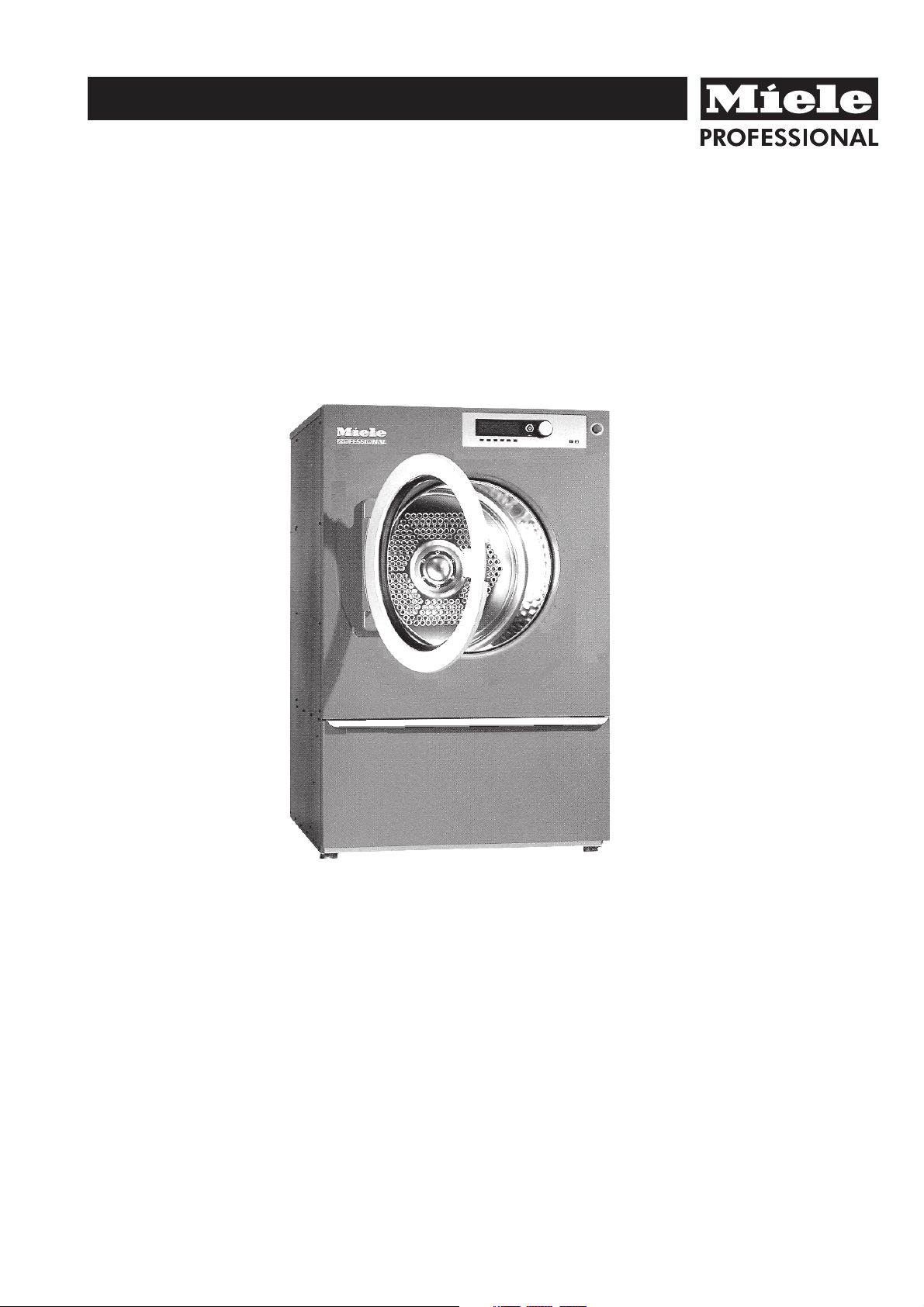
Operating and Installation Instructions
PT 8257
PT 8337
PT 8407
PT 8507
To prevent accidents and machine damage
read these instructions before installing or use.
M.-Nr. 07 713 522
en, fr - US, CA

2

IMPORTANT SAFETY INSTRUCTIONS . . . . . . . . . . . . . . . . . . . . . . . . . . . . . . . . . . . . . . . . . . . . . . . . . . . . . . . . . . 4
Description of the appliance . . . . . . . . . . . . . . . . . . . . . . . . . . . . . . . . . . . . . . . . . . . . . . . . . . . . . . . . . . . . . . . . . . 6
Operating panel .............................................................................7
Drying. . . . . . . . . . . . . . . . . . . . . . . . . . . . . . . . . . . . . . . . . . . . . . . . . . . . . . . . . . . . . . . . . . . . . . . . . . . . . . . . . . . . . 9
Before first use ..............................................................................9
Preparing the laundry .........................................................................9
1. Turn on the dryer .........................................................................10
2. Load the laundry..........................................................................10
3. Select a program .........................................................................11
4. Select [ "Blockplus" (if desired) ............................................................11
5. Adjust the program (if desired)...............................................................12
6. Select Delay Start (if desired) ................................................................13
7. Start a program...........................................................................14
8. End of program...........................................................................14
Extra features . . . . . . . . . . . . . . . . . . . . . . . . . . . . . . . . . . . . . . . . . . . . . . . . . . . . . . . . . . . . . . . . . . . . . . . . . . . . . 15
Add or remove laundry during a program ........................................................15
Skip or repeat program sequences .............................................................15
Program stop ..............................................................................16
Canceling a program ........................................................................16
K Information ...............................................................................16
Estates ...................................................................................18
Program guide. . . . . . . . . . . . . . . . . . . . . . . . . . . . . . . . . . . . . . . . . . . . . . . . . . . . . . . . . . . . . . . . . . . . . . . . . . . . . 21
Basic programs ............................................................................21
Comforters ................................................................................23
Cleaning Contractors ........................................................................23
Fire Department ............................................................................24
Professional cleaners ........................................................................24
Chip card use / Coin mechanism . . . . . . . . . . . . . . . . . . . . . . . . . . . . . . . . . . . . . . . . . . . . . . . . . . . . . . . . . . . . . 26
Drying using the coin mechanism C 4060 / C 4065 / C 4070 .........................................26
Cleaning and Care . . . . . . . . . . . . . . . . . . . . . . . . . . . . . . . . . . . . . . . . . . . . . . . . . . . . . . . . . . . . . . . . . . . . . . . . . 27
Cleaning the lint filter ........................................................................27
Dryer .....................................................................................27
Frequently asked questions . . . . . . . . . . . . . . . . . . . . . . . . . . . . . . . . . . . . . . . . . . . . . . . . . . . . . . . . . . . . . . . . .28
Fault messages.............................................................................28
After sales service . . . . . . . . . . . . . . . . . . . . . . . . . . . . . . . . . . . . . . . . . . . . . . . . . . . . . . . . . . . . . . . . . . . . . . . . . 30
IMPORTANT SAFETY INSTRUCTIONS . . . . . . . . . . . . . . . . . . . . . . . . . . . . . . . . . . . . . . . . . . . . . . . . . . . . . . . . . 32
Leveling the dryer ...........................................................................34
Installation on an elevated base ................................................................34
Coin mechanism ............................................................................35
Communication module XKM RS232 ............................................................35
Electrical connection ........................................................................36
Air intake / Venting ..........................................................................36
Hot water connection ........................................................................36
Steam connection ...........................................................................36
Technical Data. . . . . . . . . . . . . . . . . . . . . . . . . . . . . . . . . . . . . . . . . . . . . . . . . . . . . . . . . . . . . . . .
. . . . . . . . . . . . . 37
Guide to the data plate symbols . . . . . . . . . . . . . . . . . . . . . . . . . . . . . . . . . . . . . . . . . . . . . . . . . . . . . . . . . . . . . . 38
Help to protect the environment . . . . . . . . . . . . . . . . . . . . . . . . . . . . . . . . . . . . . . . . . . . . . . . . . . . . . . . . . . . . . . 39
Quick Guide. . . . . . . . . . . . . . . . . . . . . . . . . . . . . . . . . . . . . . . . . . . . . . . . . . . . . . . . . . . . . . . . . . . . . . . . . . . . . . . 41
Contents
3
Explanation of safety instructions and
warnings on the dryer
Read the operating instructions.
Read all the instructions, e.g. the
installation instructions.
Caution, hot surfaces.
Caution, voltage up to 1000 V
Grounding
,READ AND SAVE THESE INSTRUCTIONS
Keep these operating instructions in a safe place and
pass them on to any future user.
Read all instructions before installation or use of the
dryer to prevent injury and machine damage.
This dryer is only intended for industrial or institutional
use and should not be used by anyone who is not
specially trained to operate it. This also applies to
industrial applications performed in residential
environments.
This machine conforms to current safety requirements.
However, inappropriate installation and use can lead to
personal injury and property damage. Read the
operating and installation instructions carefully before
using this machine.
Installation, repair and maintenance work should be
performed by a Miele authorized service technician.
Work by unqualified persons could be dangerous
Improper use of the appliance can lead to personal
injury and material damage.
All personnel working with this machine must be fully
trained in all aspects of its use and safety.
Proper use of the dryer
~
The dryer is only intended for drying fabrics that were
washed with water as a cleaning agent. Check fabric care
labels to verify that the articles can be machine dried.
~
To prevent fire, do not dry the following (with the
exception of the textiles permitted in the special programs):
–
Articles containing foam rubber, rubber or rubber-like
materials.
–
Articles that have been treated with flammable cleaning
agents.
–
Articles that have been contaminated with hair spray,
nail polish remover, etc.
–
Articles that may be greasy, oily or that may contain
other residues, e.g. kitchen or salon laundry.
–
Mops, floor cloths, etc. if they contain substances such
as wax or chemical cleaning agents.
–
Damaged padded or filled fabrics such as jackets or
cushions.
–
Articles that are not sufficiently clean and are soiled with
grease or oil. Wash very dirty articles (e.g. work clothing)
with a special detergent. For information in this regard,
consult a cleaning agent retailer.
With sensitive fabrics there may be a danger of them
spontaneously combusting if dried too long. Immediately
remove the laundry at the end of the drying program and
after a power failure.
Keep a fire extinguisher near the dryer.
~
The laundry must not be removed from the dryer until
the cooling down phase has been completed.
If hot laundry items are stacked or packed they could
spontaneously combust.
~
Empty all pockets so that no flammable items such as
lighters, matches, candles and cosmetics end up in the
dryer.
~
If the dryer is operated in a publicly accessible area, the
operator must ensure the safe use of the appliance.
IMPORTANT SAFETY INSTRUCTIONS
4

Safety
,
The dryer is only intended for drying fabrics that
were washed with water as a cleaning agent.
~
Operate the dryer only if an exhaust air duct is
connected and the room is adequately ventilated.
~
Persons who lack physical, sensory or mental abilities,
or experience with the appliance should not use it without
supervision or instruction by a responsible person.
~
Do not let children play in, on or near the dryer. Do not
let them play with the controls or operate the unit.
~
Always close the door after loading or unloading the
dryer, to prevent:
–
children from climbing into the dryer, or hiding small
items in the dryer.
–
small animals from climbing into the dryer.
~
Do not operate the appliance if the control panel, wires
or cables are damaged.
~
Do not damage, remove, or bypass any of the safety
features and controls of the dryer.
~
Do not operate the dryer when housing parts have been
removed and the moving or electrical parts are exposed
and accessible.
~
High temperatures occur at the window and frame of
the drum door. The laundry is extremely hot if it is removed
too soon. Burn hazard!
~
Do not touch the steam components (depending on
model). Scalding hazard!
~
Always make sure the drum is stationary before
reaching in to remove laundry. Never put your hand into a
drum that is still moving.
~
Take care not to pinch or cut your fingers on the hinges
of the drum door or lint flap. Use the handles.
~
The area necessary to open the drum door completely
must not be obstructed by doors or other structures.
~
Do not use the dryer without the built-in lint filter in
place. Fire hazard!
If the lint filter is damaged it must be replaced immediately.
~
Never use or store gasoline, petroleum-based
substances or other easily flammable substances near the
machine. Fire and explosion hazard!
~
A build-up of lint will block the airflow, heating and
ventilation, which will impair the efficiency of the dryer. Be
sure to clean the lint filter before or after each load.
~
Do not use a power washer to clean the dryer.
~
Remove the door to the drying compartment before the
appliance is removed for service or discarded.
~
Disinfection and cleaning agents often contain chlorine
compounds. If these agents dry on stainless steel it will
cause it to rust. To protect the dryer use only chlorine-free
disinfection and cleaning agents for laundering and
disinfecting, and for cleaning the stainless steel surfaces. If
in doubt about a cleaning agent, contact the manufacturer.
If an agent containing chlorine is spilled, wash it off with
water and dry with a soft cloth.
Electrical safety
~
Be certain this appliance is properly installed and
grounded by an authorized technician. For electrical safety
this machine must be grounded z. It is imperative that this
basic safety requirement be tested by a qualified
electrician. Consult a qualified electrician if in doubt.
~
Before installation or service, disconnect the power
supply to the work area.
~
Repairs to electrical and gas appliances should only be
carried out by a Miele Service Technician in accordance
with local and national safety regulations. Unauthorized
repairs could cause injury or machine damage.
~
Use only genuine Miele parts. Use of non-Miele parts
may impair performance and void any guarantees.
~
Do not repair or replace any part of the appliance or
attempt any servicing unless specifically recommended in
these operating instructions. Contact Miele’s Technical
Service Department for assistance.
~
Do not operate the dryer in a room where cleaning
machines operate with solvents containing CFC. Vapors
from combustion turn into hydrochloric acid which
damages laundry and dryer. When operated in a separate
room, there must be no air exchange possible. Make sure
the dryer is supplied with clean fresh air only.
~
The air intake opening is located on the back of the
dryer. Never block this opening. Therefore, do not cover
the dryer top with any blankets or sheets.
~
The dryer needs timely and professional maintenance to
prevent performance loss, malfunctions and the risk of fire.
SAVE THESE
INSTRUCTIONS
IMPORTANT SAFETY INSTRUCTIONS
5
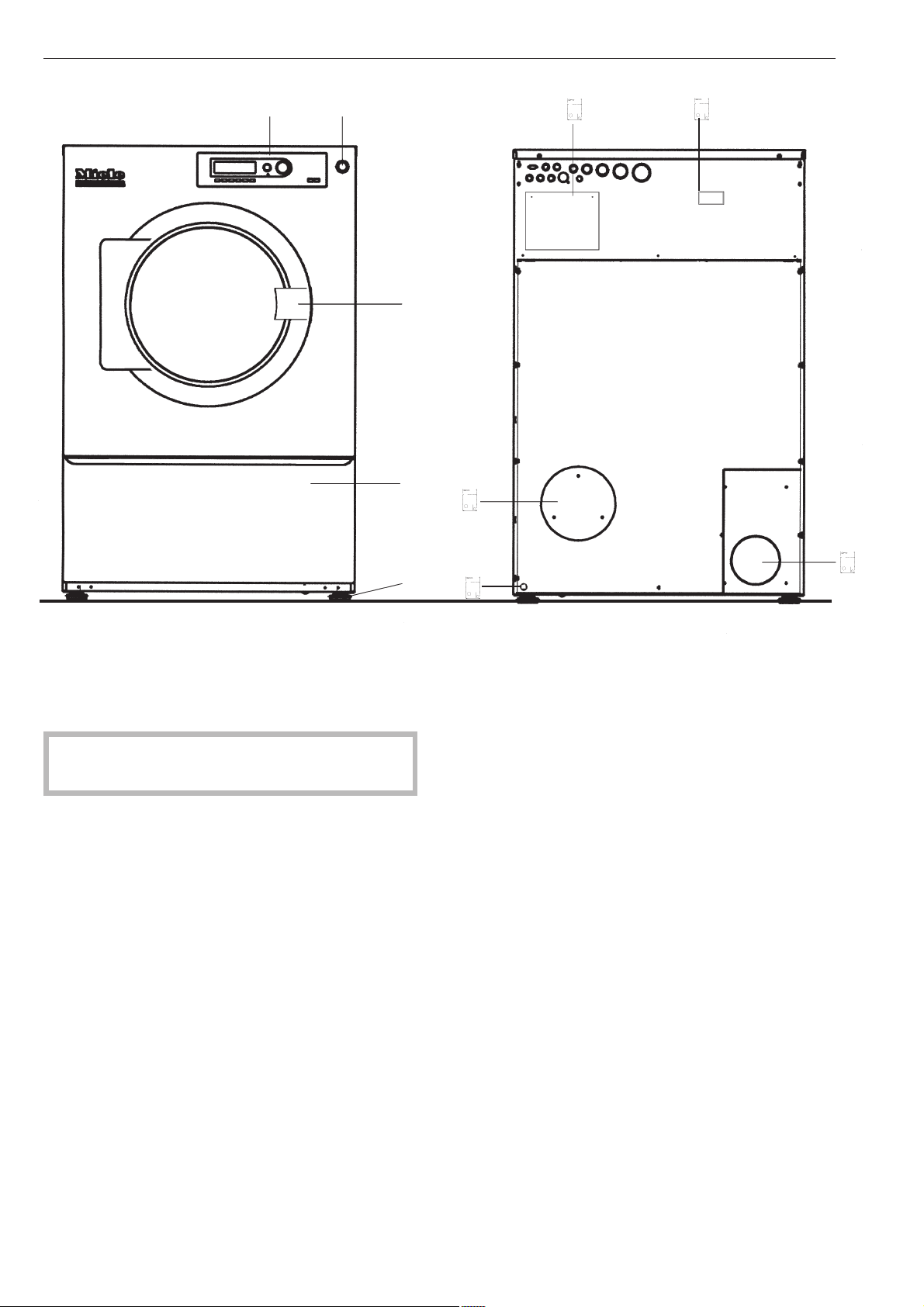
a Emergency Stop button
Use only in case of an emergency.
After elimination of the problem, unlock the switch by
turning the dial to the right.
Do not use the Emergency Stop button to turn off
the dryer during normal operation!
b Control panel
c Drum door
Pull the door handle to open the drum door.
d Lint filter flap
Pull the handle to open the lint filter flap.
e Four height adjustable feet
f Electrical connection
g Air intake opening
h Exhaust air collar
i Potential equalizer
j Communication module slot
Description of the appliance
6
f
g
h
j
i
ab
c
d
e
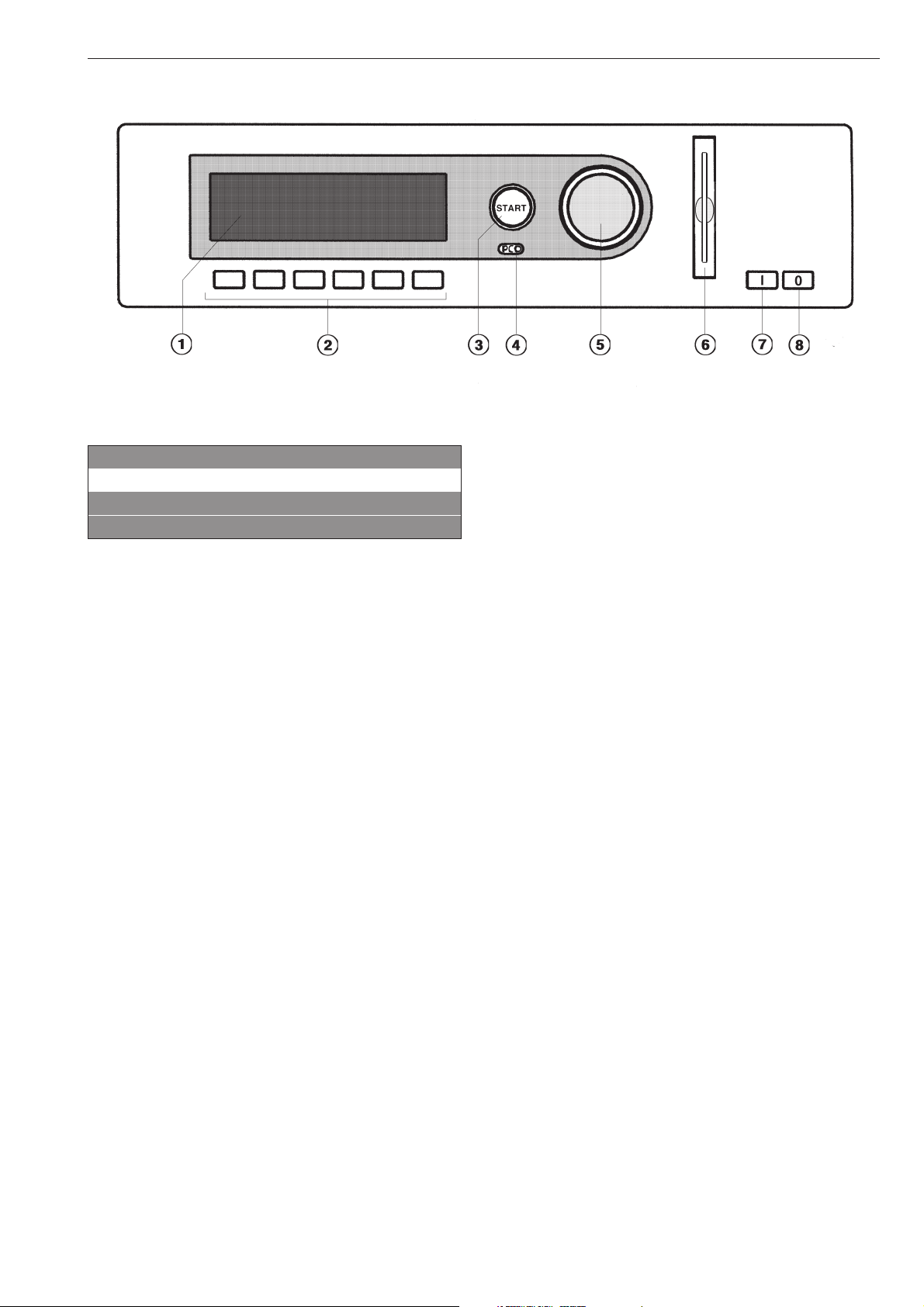
Operating panel
a Display*
1 White Cottons 0%
2 Cottons 0%
3 Cottons Hot Wash 0%
FC A
After turning on, the "Welcome" display will appear for
a short time followed by the program list. The most
recently used program is highlighted.
b Function keys
The keys have different functions depending on the
appliance status. The functions are shown in the
display above the buttons.
c Start button
The light ring flashes if a selected program can be
started or a selection can be made.
Once a program has started the Start button can be
pressed to show the original display.
* Contents in the display will vary with program
offering.
d Optical PC interface
For data transfer between the machine’s controls and
a PC.
e Jog shuttle
Turn the jog shuttle for display selections and input
fields.
Press the jog shuttle to confirm display selections or
changes.
f Card reader
If the machine has been programmed for card
operation, you can only use those programs stored
on the card to dry laundry.
g I On button
h 0 Off button
Description of the appliance
7
Control keys
f Stop / End
Press to stop a selected program or end an already
stopped program.
[ Block plus
The respective program block (e.g. pre-drying) will
be added to the program.
FC Functions
Press this key to temporarily select another language
and/or access the Supervisor level.
mDelay start
Press this key to select a start time in the display.
K Information
To show program information
ü Skip
Cycles of a program in progress can be skipped or
repeated.
A Back to the previous display
e/- Next or previous line
S Save
See the Programming Manual
$ Program locked
If a program has a "locked" status it cannot be
stopped or ended with the Off-button after one
minute.
% Program unlocked
\ Operating data
Data transfer
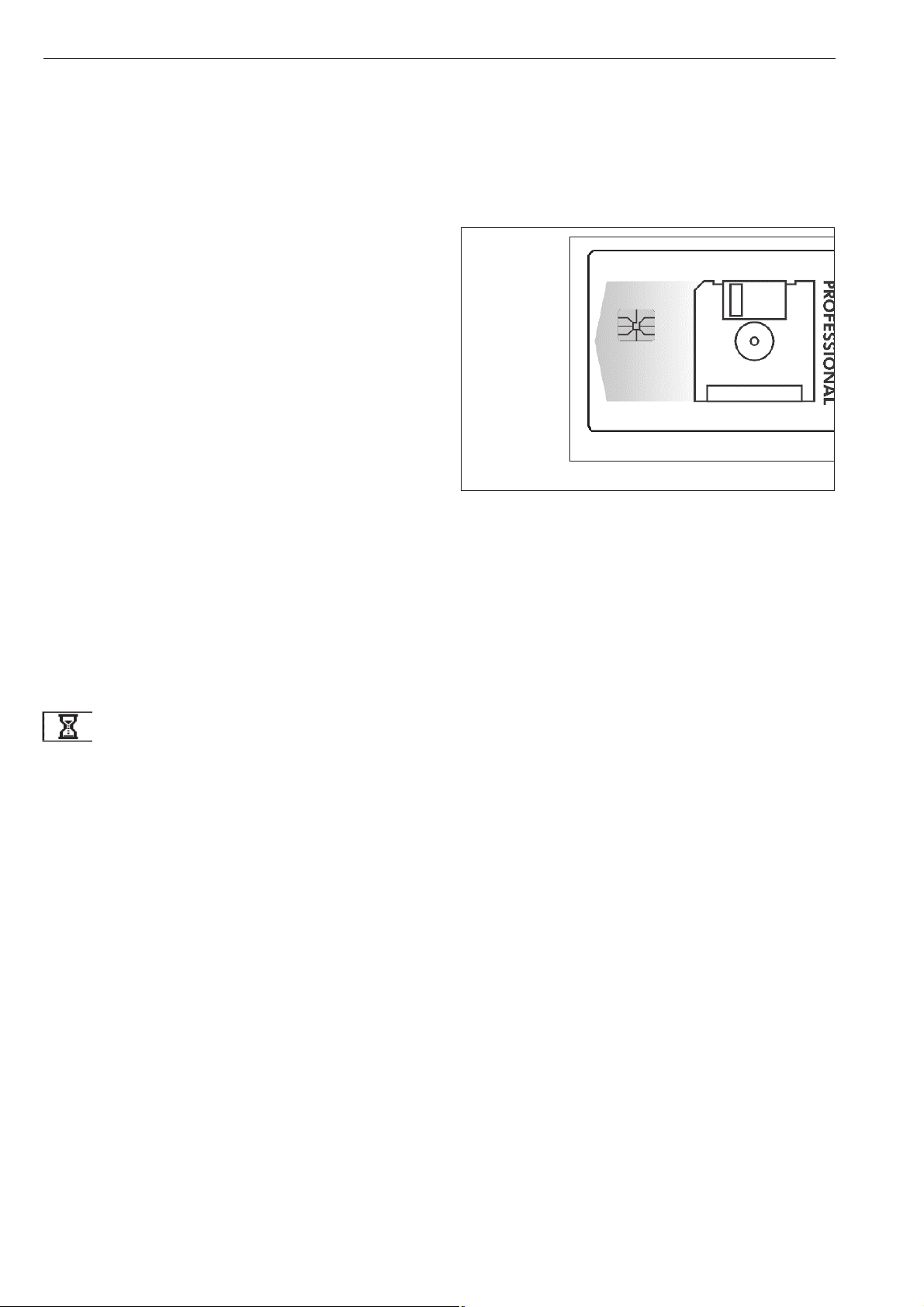
Operator card
No programs are saved on this card. To transfer the
data from the control to the card and vice versa see
the Programming Manual.
30 programs with 6 blocks each can be saved on the
card.
The back of the card can be labeled.
Insert the card, arrow first.
Description of the appliance
8

Before first use
^
Wipe the interior of the drum with a soft dry cloth
Preparing the laundry
,
Not all fabrics are suitable for drying in a
tumble dryer. Check the manufacturer’s
instructions on the fabric care label.
q = Dry at normal temperature
r = Dry at low temperature
s = Do not tumble dry
^
Sort the laundry by fabric type and color. This will
ensure even drying results and will prevent
damage to fabrics.
,
To prevent fire, do not dry the following
(with the exception of the textiles permitted in the
special programs):
Articles containing foam rubber, rubber or
rubber-like materials.
Articles that have been treated with flammable
cleaning agents.
Articles that have been contaminated with hair
spray, nail polish remover, etc.
Articles that may be greasy, oily or saturated with
other residues, e.g. kitchen or salon laundry.
Mops, floor cloths, etc. if they contain substances
such as wax or chemical cleaning agents.
Damaged padded or filled fabrics, like jackets or
cushions.
Articles that are not sufficiently clean and are
soiled with grease or oil. Wash very dirty articles
(e.g. work clothing) with a special detergent.
Important drying information:
–
Articles made from pure wool and wool mixtures
may become matted. Dry these with the Woolens
program only.
–
Pure linen may become rough with tumble drying.
Consult the manufacturer’s instructions before
drying.
–
Items with metal buckles, hooks, snaps, zippers,
etc. should be put into the dryer in a cloth bag
(e.g. pillow case) to protect the drum from
scratches and dents.
–
Articles with closed metal zippers may cause a
short at the sensor electrodes on the drum ribs, so
that the drying process ends too late or does not
end at all. These items should be dried with the
zippers open.
–
Loop knit materials tend to shrink. Over-drying
increases this effect. Do not use the highest dry
program for such fabrics.
–
Starched laundry can be tumble dried. Select a
program with a suitable residual moisture for
ironing by hand or machine.
Sort the laundry according to the level of dryness
required. It is not necessary to sort according to
size.
– Pillow cases and duvet covers should be buttoned
to prevent smaller items from getting caught inside
them.
– For cost efficiency, only dry full loads. Overloading
provides poor drying results and has an adverse
effect on fabrics.
–
If the washing machine's last rinse cycle is with
warm water, a shorter drying time will be required
due to the lower residual moisture and the residual
heat in the laundry.
Drying
9

1. Turn on the dryer
^
Open the gas or steam valve (on site).
^
Turn on the power main (on site).
^
Press the l "On" button to turn the dryer on.
The Welcome screen shows.
M
PROFESSIONAL
PT 8xx7
Welcome
The program list is displayed. The program last
started is highlighted.
1 White Cottons 0%
2 Cottons 0%
3 Colors 0%
FC A
2. Load the laundry
^ Open the drum door.
^ Load the laundry loosely into the drum.
Check that there are no foreign objects in the
drum, e.g. wash dosage containers, coins, etc.
^ Close the drum door.
To prevent fabric damage, check that laundry will
not be caught in the closed door.
Maximum laundry weight
PT 8257 PT 8337 PT 8407 PT 8507
Drum volume
66 gal
(250 l)
86 gal
(325 l)
106 gal
(400 l)
132 gal
(500 l)
Cottons
22-29 lb
(10-13 kg)
29-35 lb
(13-16 kg)
35-44 lb
(16-20 kg)
44-55 lb
(20-25 kg)
Wrinkle-free
11 lb
(5 kg)
14.5 lb
(6.6 kg)
17.6 lb
(8 kg)
22 lb
(10 kg)
Woolens
9lb
(4 kg)
11.5 lb
(5.2 kg)
14 lb
(6.4 kg)
17.5 lb
(8 kg)
Delicates/Synthetics
4.5 lb
(2 kg)
6lb
(2.6 kg)
7lb
(3.2 kg)
9lb
(4 kg)
Hot/Cool air
22-29 lb
(10-13 kg)
29-35 lb
(13-16 kg)
35-44 lb
(16-20 kg)
44-55 lb
(20-25 kg)
Proofing, Outerwear
11-14.5 lb
(5-6.6 kg)
13-20 lb
(6-9 kg)
17.5-24 lb
(8-11 kg)
22-29 lb
(10-13 kg)
See "Adjust the program - Laundry weight" for more
information.
Drying
10

3. Select a program
The dryer uses an electronic sensor system which
monitors the residual moisture in the laundry and a
timer for extra safety.
Once the required level of dryness has been reached
the laundry is cooled and the drying program will
end.
1 White Cottons 0%
2 Cottons 0%
3 Colors 0%
FC A
^
Select a program by turning the jog shuttle (e.g.
Program 2 Hot Wash / Cottons dry).
See the "Program Guide" for more information on
the standard programs.
4. Select [ "Blockplus" (if desired)
(Not available for standard programs)
^
Confirm the selected program by pressing the jog
shuttle.
22 Hot Wash / Cottons dry 22.0 / 22.0 lb
15 % Drying 176 °F
Cool down e
[ m A
^
Press the [ "Blockplus" button to select a
program block, e.g. pre-drying if desired.
22 Hot Wash / Cottons dry 22.0 / 22.0 lb
24 % Pre-drying
0 % Drying e
[ m A
The field [ is highlighted.
The function can be deselected by pressing the
button again.
If you do not need to make any other changes to the
program:
^ Press the "START" button and the drying program
will begin.
Drying
11

5. Adjust the program (if desired)
To change program settings before starting the
program:
^
Confirm the selected program by pressing the jog
shuttle.
2 Cottons 22.0 / 22.0 lb
0 % Drying 176°F
Cool down e
m A
The maximum laundry weight is shown on the right
side in the display.
Laundry weight
The laundry weight can be manually selected.
2 Cottons 22.0 22 lb
0 % Drying 176°F
Cool down e
m A
^ Turn the jog shuttle until "Laundry weight" is
highlighted and press to confirm the selection. Turn
the jog shuttle to the desired laundry weight and
press to confirm the selection.
Temperature
In 1 °F or °C steps from 86 °F / 30 °C to max. 203 °F /
95 °C.
^ Turn the jog shuttle to "Temperature" and press to
confirm the selection.
2 Cottons 22.0 lb
0 % Drying 176°F
Cool down e
m A
^
Turn the jog shuttle to the desired temperature and
press it to confirm the selection.
Residual moisture
In 1 % steps from -4 to 40 %.
^
Turn the jog shuttle to "Residual moisture" (0 %)
and press to confirm the selection.
2 Cottons 22.0 lb
0% Drying 176°F
Cool down
m A
^
Turn the jog shuttle to the desired percentage and
press it to confirm the selection.
^
Press the "Start" button to begin the program.
The program sequence is shown in the display after
the start of the program.
2 Cottons
0 % Drying >40 %{
Cool down Finish at 12:35
mKf
In the second display line, "Drying" in the display
above, the actual residual moisture is shown (>40%)
and if the heating { is active. The third line shows the
following program block.
The "Finish at 12:35" on the right side shows the end
time of the program.
The "Finish at" display has a self learn function.
Several program cycles are necessary for an exact
display.
Drying
12

6. Select Delay Start (if desired)
Use the m "Delay start" button to start a program at a
later time.
Setting the delay start
^
Select a program.
^
Press m "Delay Start".
2 Cottons 22.0 lb
Start time: 2 :10 pm Start date: 2.13.2006
After setting the delay start press Start.
m A
The display shows the current time of day and date.
The hour entry field is highlighted.
^
Turn the jog shuttle to the "Hours" entry field. Press
the jog shuttle to select the hour. Turn the jog
shuttle to the desired hour and press it to confirm
the selection.
^
Turn the jog shuttle to the "Minutes" entry field.
Press the jog shuttle to select the minutes. Turn the
jog shuttle to the desired minutes and press it to
confirm the selection.
^ Turn the jog shuttle to the "Start date" entry field.
Press the jog shuttle to select the start date. Turn
the jog shuttle to the desired date and press it to
confirm the selection.
^ Press the "Start" button.
The program will start at the selected time.
2 Cottons 22.0 lb
0 % Drying
2:07pm -2.13.2006 Start: 2:10pm-2.13.2006
m A
The display shows the current time of day, date and
the start time.
^
If the door is opened before the delay start time
has elapsed, press the "Start" button again.
Canceling the Delay Start
^
Press the m "Delay Start" or A "Back" button to
cancel the delay start function.
Drying
13

7. Start a program
^
Press the "Start" button to begin the program..
8. End of program
2 Cottons
Program end
Anti-crease Finish at 12:35
m FC Kf
The program end is shown in the display and the
buzzer sounds.
^
Open the drum door.
^
Remove the laundry.
If the laundry is not removed from the machine at the
end of the program an anti-crease cycle will
automatically start. The drum turns in intervals to
minimize creasing in the laundry.
,
The laundry must not be removed from the
dryer before the drying program has finished. The
cooling down phase must be completed.
If hot laundry items are stacked or packed they
could spontaneously combust.
^ Check the lint filter and clean if necessary.
Close lint filter flap, trip hazard.
2 Cottons
Program end
Caution: Lint filter is clogged
A
A reminder will appear in the display when the filter
needs to be cleaned.
^
Clean the lint filter immediately after the program
ends.
^
Close the drum door.
^
Press the 0 "Off" button to turn off the machine.
^
Turn off power at the power mains (on site).
^
Close the on site gas or steam valve.
Drying
14

Add or remove laundry during a program
The drum door can be opened during a program to
add or remove laundry.
^
Open the door.
,
Make sure the drum is stationary before
removing laundry. Never put your hand into a
drum that is still moving.
2 Cottons
Program stop
Door is open. Close the door.
FC f
^
Add or remove a laundry item.
^
Close the door.
The fan may come on as a safety measure if the
temperature in the drum is too high.
^
Press the "Start" button.
The program continues.
Skip or repeat program sequences
Sequences of a program in progress can be skipped
or repeated.
^
Press the f "End" button to stop the program.
2 Cottons
Program stop
Press Start.
ü f
^
Press the ü "Skip/Repeat" button.
The display shows the current program segment. See
"Program structure" in the Programming Manual.
Skip/Repeat -> 2 Cottons
Program stop
Area 1: Drying e
S A
Area 1: Drying
Block 1: Pre-drying
-
S A
^ Turn the jog shuttle to "Area" and press it to confirm
the selection.
Area: Select 1 Drying or 2 Cooling and confirm.
^ Turn the jog shuttle to "Block" and press it to
confirm the selection.
Block: Select Drying 1-10 or Cooling 1-10 and
confirm.
^
Press the S "Save" and "Start" button to skip the
program cycles.
^
To go back without skipping program cycles:
Press the A "Back" to go back to the program
stop.
Extra features
15

Program stop
^
Press the f "End" button to stop the program.
2 Cottons
Program stop
Press Start.
ü f
^
Press the "Start" button to continue the program.
Canceling a program
To cancel a program, press the f "End" button twice.
K Information
^
Press the K "Information" button during the program
to see program information.
Examples:
2 Cottons
Delay start: 10.7.2003
Start time: 9:47 e
m K f
Time after Start:0h23min
Time left:0h11min
Program end time: 10:21 pm e
Area 1: Drying
Block 1: Pre-drying
Actual exhaust air temp.: 138 °F e
Reference supply air temperature : 302 °F
Peak load: No
Anti-crease: 3s./87s./60min e
2 Cottons
Recirculation/vent flap: Recirculation -
Block end signal: Yes
A
^ Press the A "Back" button to get back to the
program sequence.
Extra features
16

Language
The display language can be temporarily changed
with the flag symbol.
1 White Cottons 0%
2 Cottons 0%
3 Colors 20%
FC A
^
Press the FC function button.
Settings Back <-
Main menu Language
Programming level
FC A
^
Press the jog shuttle to select "Language".
Settings svenska
Language english (USA)
Back <-
FC A
^ Turn the jog shuttle to select the desired language
and press to confirm the selection.
When the selection is confirmed the display switches
to the selected language.
The language is set back to its original setting:
– if no activity was carried out for 5 minutes.
– 5 minutes after the program has ended.
–
when the door is opened.
Extra features
17
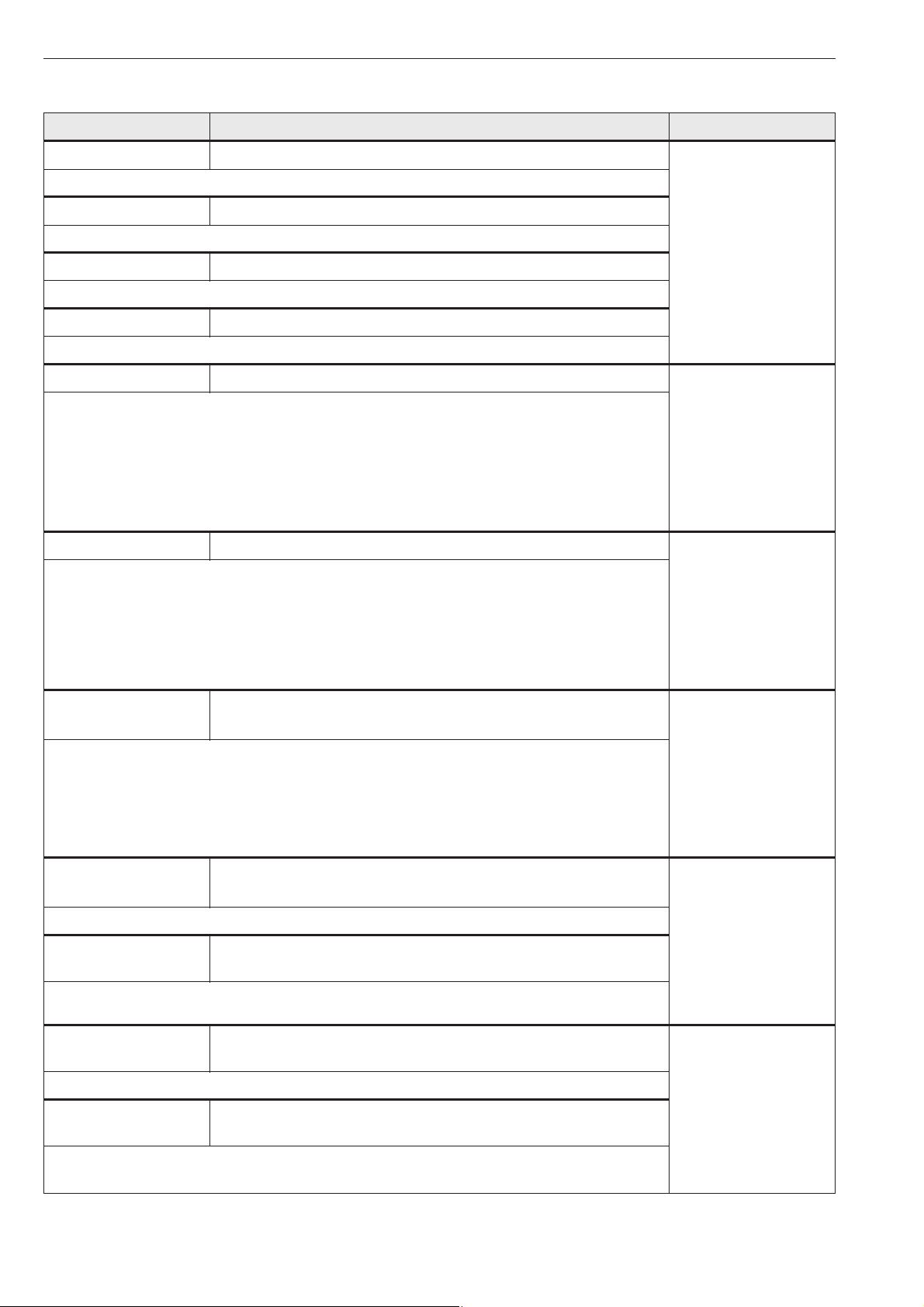
Estates
Program Fabric Type max. load
White Cottons White items made of cottons, linens PT 8257 22-29 lb
(10-13 kg)
PT 8337 29-35 lb
(13-16 kg)
PT 8407 35-44 lb
(16-20 kg)
PT 8507 44-55 lb
(20-25 kg)
165 °F
Cottons White or colored items made of cottons, linens or mixed fabrics
165 °F
Colors Colored items made of cottons, linens or mixed fabrics
165 °F
Darks Dark items made of cottons, linens or mixed fabrics
165 °F
Minimum iron Items made of synthetic fabrics, mixed fabrics PT 8257 11 lb
(5.0 kg)
PT 8337 14.5 lb
(6.6 kg)
PT 8407 17.5 lb
(8.0 kg)
PT 8507 22 lb
(10 kg)
140 °F
Delicates Items made of synthetic fabrics, mixed fabrics PT 8257 4.4 lb
(2 kg)
PT 8337 6 lb
(2.6 kg)
PT 8407 7 lb
(3.2 kg)
PT 8507 9 lb
(4 kg)
104 °F, Dry to 20% residual moisture
600+TC Sheets Hot Bed linens high thread count sheet
made of cottons, mixed fabrics
PT 8257 22-29 lb
(10-13 kg)
PT 8337 29-35 lb
(13-16 kg)
PT 8407 35-44 lb
(16-20 kg)
PT 8507 44-55 lb
(20-25 kg)
140 °F
600+TC Sheets
Warm
Bed linens high thread count sheet
made of cottons, mixed fabrics
PT 8257 11 lb
(5.0 kg)
PT 8337 14.5 lb
(6.6 kg)
PT 8407 17.5 lb
(8.0 kg)
PT 8507 22 lb
(10 kg)
140 °F
Silk and Rayon
Bed Linens
Bed linens made of silk, rayon, satin
140 °F
Down Comforters &
Pillows
Down comforters, duvet covers made of down PT 8257 22 lb
(10 kg)
PT 8337 29 lb
(13 kg)
PT 8407 35.5 lb
(16 kg)
PT 8507 44 lb
(20 kg)
165 °F, see load size in "Covers" section
Washable
Bedspreads
Blankets, covers made of synthetic fabrics
165 °F, see load size in "Covers" section
Extra features
18
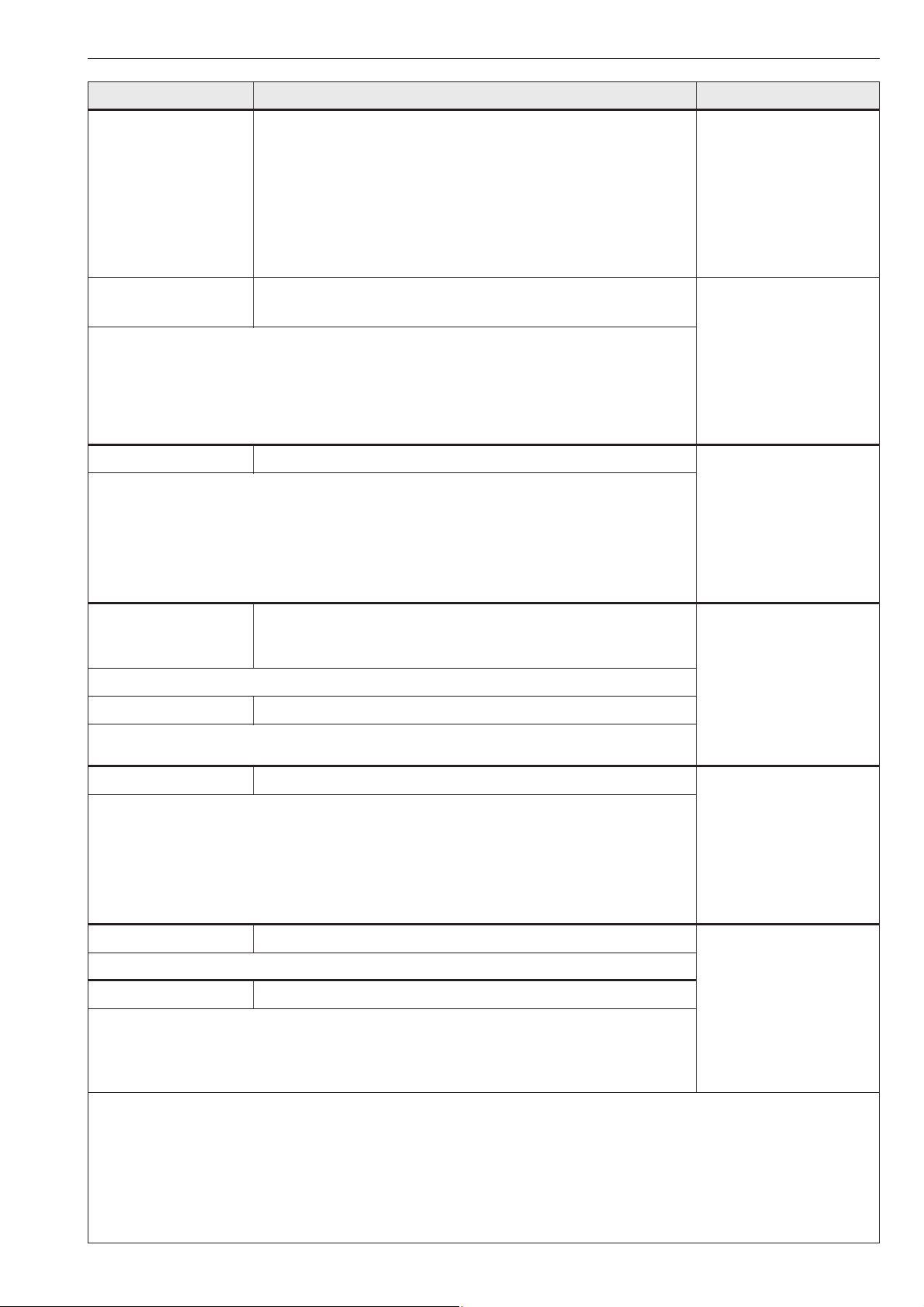
Program Fabric Type max. load
Linen Tablecloths
165 °F
Tablecloths, napkins made of cottons, linens PT 8257 22-29 lb
(10-13 kg)
PT 8337 29-35 lb
(13-16 kg)
PT 8407 35-44 lb
(16-20 kg)
PT 8507 44-55 lb
(20-25 kg)
Mixed Fiber
Tablecloths
Tablecloths, napkins
made of synthetic fabrics, mixed fabrics
PT 8257 11 lb
(5.0 kg)
PT 8337 14.5 lb
(6.6 kg)
PT 8407 17.5 lb
(8.0 kg)
PT 8507 22 lb
(10 kg)
140 °F
Outerwear Coats and jackets made of mixed fabrics PT 8257 11-14.5 lb
(5-6,6 kg)
PT 8337 14.5-20 lb
(6,6-9 kg)
PT 8407 17.5-24.5 lb
(8-11 kg)
PT 8507 22-29 lb
(10-13 kg)
140 °F
Silks handcare Blouses, dresses, pants, skirts, coats, evening gowns,
wedding gown, faux furs made of silk, rayon, satin, acetate,
viscose
PT 8257 8.8 lb
(4 kg)
PT 8337 11.5 lb
(5.2 lb)
PT 8407 14 lb
(6.5 kg)
PT 8507 17.5 lb
(8 kg)
140 °F
Woolens handcare Woolens and mixed woolens
165 °F
Proofing Drying of waterproofed outdoor items PT 8257 11-14.5 lb
(5-6,6 kg)
PT 8337 14.5-20 lb
(6,6-9 kg)
PT 8407 17.5-24.5 lb
(8-11 kg)
PT 8507 22-29 lb
(10-13 kg)
140 °F
Hot air Drying small loads or finish drying single items PT 8257 22-29 lb
(10-13 kg)
PT 8337 29-35 lb
(13-16 kg)
PT 8407 35-44 lb
(16-20 kg)
PT 8507 44-55 lb
(20-25 kg)
165 °F
Cool air Airing/Fluffing items
Extra features
19
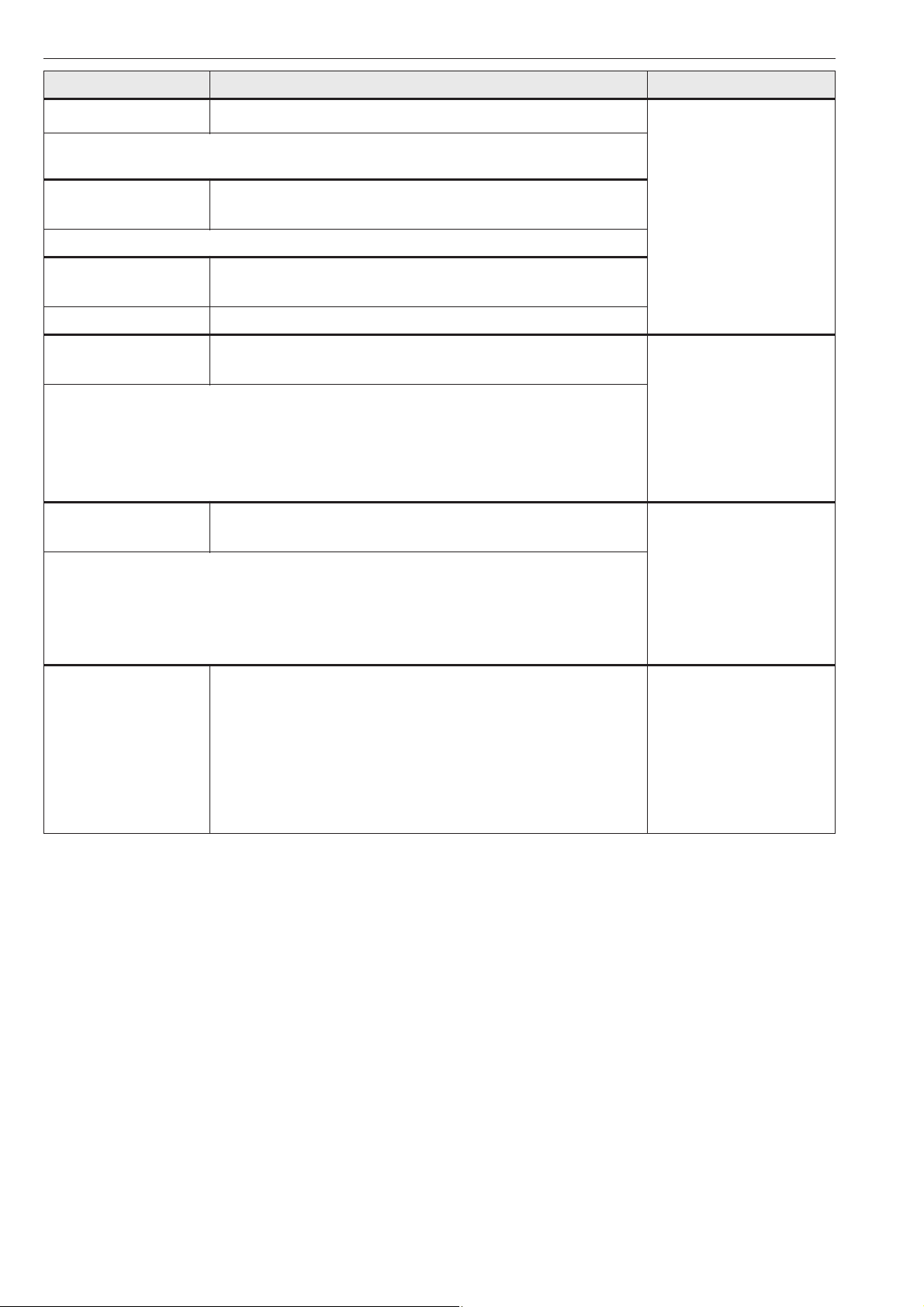
Program Fabric Type max. load
Smoothing
Cotton and linen fabrics
PT 8257 11 lb
(5.0 kg)
PT 8337 14.5 lb
(6.6 kg)
PT 8407 17.5 lb
(8.0 kg)
PT 8507 22 lb
(10 kg)
165 °F, Reduces wrinkles after the being washed. Remove items immediately after
program end and allow to air dry.
Denim
(Machine iron) 165 °F
Items made of denim
Shirts
(Machine iron) 165 °F
Shirts and blouses
Towelling
165 °F
Multi-layer fabrics and towels.
Towels, wash cloths, bath robes, etc.
PT 8257 22-29 lb
(10-13 kg)
PT 8337 29-35 lb
(13-16 kg)
PT 8407 35-44 lb
(16-20 kg)
PT 8507 44-55 lb
(20-25 kg)
Reactivate
140 °F
Outdoor clothing suitable for drying in a tumble dryer.
The fibers are straightened, improving water-repellency.
PT 8257 11-14.5 lb
(5-6,6 kg)
PT 8337 14.5-20 lb
(6,6-9 kg)
PT 8407 17.5-24.5 lb
(8-11 kg)
PT 8507 22-29 lb
(10-13 kg)
Automatic
140 °F
Mixed loads of fabrics for the Cottons and Wrinkle-free
programs.
PT 8257 11 lb
(5.0 kg)
PT 8337 14.5 lb
(6.6 kg)
PT 8407 17.5 lb
(8.0 kg)
PT 8507 22 lb
(10 kg)
Temperatures given refer to extracted air temperature.
Extra features
20
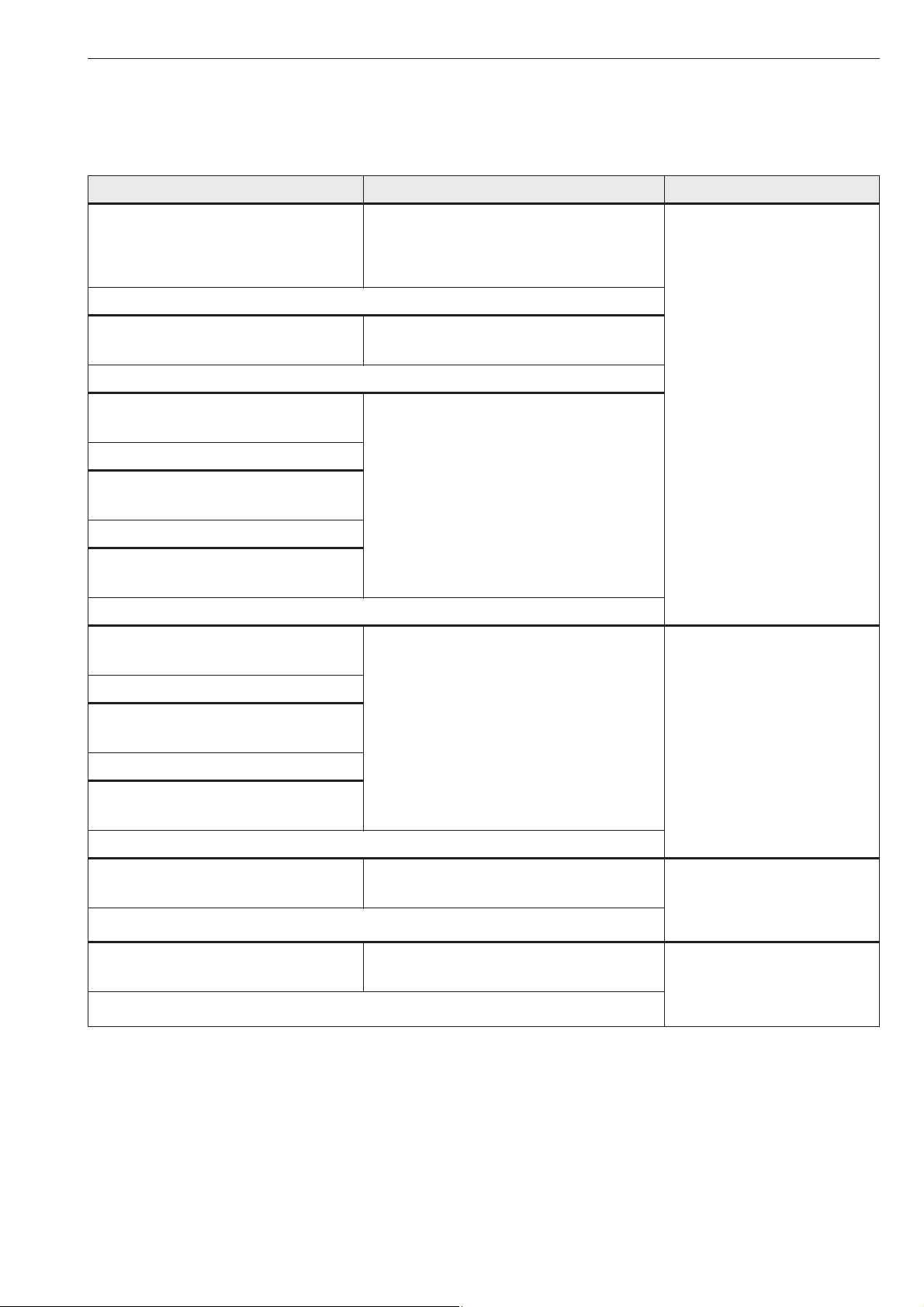
The following programs are available upon request. Please contact Miele for more
information.
Basic programs
Program Fabric Type max. load
1 Hot Wash / Cottons extra dry 0%
(Normal+) 165 °F
Multilayered or very thick fabrics made of
cotton and linen which do not completely
dry when using the "Hot wash / Cottons
dry" program.
PT 8257 22-29 lb (10-13 kg)
PT 8337 29-35 lb (13-16 kg)
PT 8407 35-44 lb (16-20 kg)
PT 8507 44-55 lb (20-25 kg)
2 Hot Wash / Cottons - dry 0%
(Normal) 165 °F
Single and multilayered cotton and linen
laundry
3 Hot Wash / Cottons - damp 20 %
(Machine iron) 165 °F
Cotton and linen fabrics which are to be
machine ironed
4 Hot Wash / Cottons - damp 25%
(Machine iron) 165 °F
5 Hot Wash / Cottons - damp 40 %
(Machine iron) 165 °F
6 Wrinkle Free - dry 0 %
(Normal) 140 °F
Synthetic, cotton or mixed fabrics
PT 8257 11 lb (5.0 kg)
PT 8337 14.5 lb (6.6 kg)
PT 8407 17.5 lb (8.0 kg)
PT 8507 22 lb (10 kg)
7 Wrinkle Free moist 10 %
(Machine iron) 140 °F
8 Wrinkle Free moist 20 %
(Machine iron) 140 °F
9 Woolens 5 min.
165 °F
To fluff pre-dried woolens PT 8257 9 lb (4 kg)
PT 8337 11.5 lb (5.2 lb)
PT 8407 14 lb (6.4 kg)
PT 8507 17.5 lb (8 kg)
10 Delicates 20 %
104 °F
Sensitive items made of synthetic, cotton
or mixed fabrics
PT 8257 4.5 lb (2 kg)
PT 8337 6 lb (2.6 kg)
PT 8407 7 lb (3.2 kg)
PT 8507 9 lb (4 kg)
Program guide
21

Program Fabric Type max. load
11 Timed drying - cool air 15 min. To air fluff items PT 8257 22-29 lb
(10-13 kg)
PT 8337 29-35 lb
(13-16 kg)
PT 8407 35-44 lb
(16-20 kg)
PT 8507 44-55 lb
(20-25 kg)
12 Timed drying - warm air 20 min.
165 °F
Drying small loads or finish drying single items
13 Waterproofing
(Normal) 140 °F
For drying fabrics that can be machine-dried,
e.g. micro fibers, ski and outdoor clothing, thin
dense cottons (poplin), table cloths.
PT 8257 11-14.5 lb
(5-6,6 kg)
PT 8337 14.5-20 lb
(6,6-9 kg)
PT 8407 17.5-24.5 lb
(8-11 kg)
PT 8507 22-29 lb
(10-13 kg)
This program includes an additional step for water-proofing. Water-proofed items must
only be treated with a water repellent that is "Suitable for membrane textiles". These
products are fluoride compound based. Fire hazard! Do not dry fabrics which were
treated with agents containing paraffin!
14 Outerwear
140 °F
Outdoor clothing suitable for drying in a tumble
dryer.
Program guide
22

Comforters
Program Fabric Type max. load
Down Comforters Feather or down comforters and pillows PT 8257 1 cover or 2 pillows
22 lb (10 kg)
PT 8337 3 pillows or
1 pillow + 1 cover
28.7 lb (13 kg)
PT 8407 4 pillows or
2 pillows + 1 cover or
2 covers
35.3 lb (16 kg)
PT 8507 5 pillows or
3 pillows + 1 cover or
2 covers
44 lb (20 kg)
These values are approximate and
may vary depending on size and
thickness of the items.
165 °F, Drying to 0% residual moisture, Additional drying, Cooling
Synthetic Comforters Synthetic covers and pillows
165 °F, Drying to 0% residual moisture, Additional drying, Cooling
Wool Comforters Natural fiber covers and blankets
165 °F, Drying 3 minutes, Cooling
Natural fiber covers should not be completely dried in the dryer or it will
felt. A brief drying is recommended.
Cleaning Contractors
,
Laundry that has not been adequately cleaned and contains residues (wax or chemicals) is a fire hazard!
Wash particularly dirty laundry thoroughly: Use sufficient detergent and wash at a high temperature. If in doubt,
wash these items several times.
Program Fabric Type max. load
Mops Cotton mops PT 8257 22 lb (10 kg)
PT 8337 29 lb (13 kg)
PT 8407 35.5 lb (16 kg)
PT 8507 44 lb (20 kg)
165 °F, Drying to 0% residual moisture, Cooling
Microfiber mops Micro fiber mops
140 °F, Drying to 0% residual moisture, Cooling
Cleaning cloths Micro fiber cloths, dust cloths PT 8257 12.5 lb (5.6 kg)
PT 8337 15.5 lb (7 kg)
PT 8407 19 lb (8.6 kg)
PT 8507 24.3 lb (11 kg)
140 °F, Drying to 0% residual moisture, Cooling
Program guide
23

Fire Department
Program Fabric Type max. load
Face masks Protective mask with head harness max. Fasteners / Masks
PT 8257 4 8
PT 8337 4 12
PT 8407 4 16
PT 8507 4 12
122 °F, Dry 45 min., Cooling.
Protective masks may only be dried is they are locked with special
mounting plates (optional accessory) in the drum.
Protective clothing Fire department uniforms e.g. Nomex
®
,
jackets, pants
PT 8257 approx.1-2Uniforms
(1 Jacket + 2 Pants or 2 Jackets)
PT 8337 approx. 2 Uniforms
(or 3 Jackets)
PT 8407 approx. 3 Uniforms
PT 8507 approx.3-4Uniforms
PT 8257 11-14.5 lb (5-6.6 kg)
PT 8337 14.5-20 lb (6.6-9 kg)
PT 8407 17.5-22 lb (8-10 kg)
PT 8507 22-29 lb (10-13 kg)
165 °F, Drying to 0% residual moisture, Additional drying, Cooling
For optimum drying results turn the garments inside out.
Fire gear waterproofing Items treated with a proofing agent
165 °F, Drying to 0% residual moisture, Additional drying, Cooling
Water-proofed items must only be treated with a water repellant that is
"Suitable for membrane textiles". These products are fluoride compound
based.
Fire hazard! Do not dry fabrics which were treated with agents containing
paraffin!
Professional cleaners
Program Fabric Type max. load
WetCare Sensitive Non-washable items PT 8257 approx. 9-11 lb (4-5 kg)
PT 8337 approx. 11-14.5 lb (5-6.6 kg)
PT 8407 approx. 14.5-17.6 lb (6.6-8 kg)
PT 8507approx. 17.5-22 lb (8-10 kg)
122 °F, Fluffing 3 minutes, Cooling
WetCare Silk Non-washable items which crease easily PT 8257 approx. 9-11 lb (4-5 kg)
PT 8337 approx. 11-14.5 lb (5-6.6 kg)
PT 8407 approx. 14.5-17.5 lb (6.6-8 kg)
PT 8507 approx. 17.5-22 lb (8-10 kg)
140 °F, Drying to 15% residual moisture, Cooling
WetCare Intensive Washable items PT 8257 approx. 11-14.5 lb (5-6.6 kg)
PT 8337 approx. 14.5-20 lb (6.6-9 lb)
PT 8407 approx. 17.5-24.5 lb (8-11 kg)
PT 8507 approx. 22-29 lb (10-13 kg)
165 °F, Drying to 0% residual moisture, Cooling
24
Program guide

Equestrian
,
To protect the drum from damage, metal buckles, hooks and eyes must be covered.
Program Fabric Type max. load
Horse blankets Horse blankets, saddle cloths, tendon boots, bandages, cloth
halter
PT 8257 22 lb (10 kg)
PT 8337 29 lb (13 kg)
PT 8407 35.5 lb (16 kg)
PT 8507 44 lb (20 kg)
140 °F, Drying to 0% residual moisture, Additional drying, Cooling
Wool horse blankets Horse blankets with a high wool content
165 °F, Drying 5 min., Cooling
Type
Load size
Saddle
cloths
Summer
blankets
Winter
blankets
PT 8257 7 2 1
PT 8337 9 2 - 3 1 - 2
PT 8407 11 2 - 3 1 - 2
PT 8507 12 3 2
Program guide
25
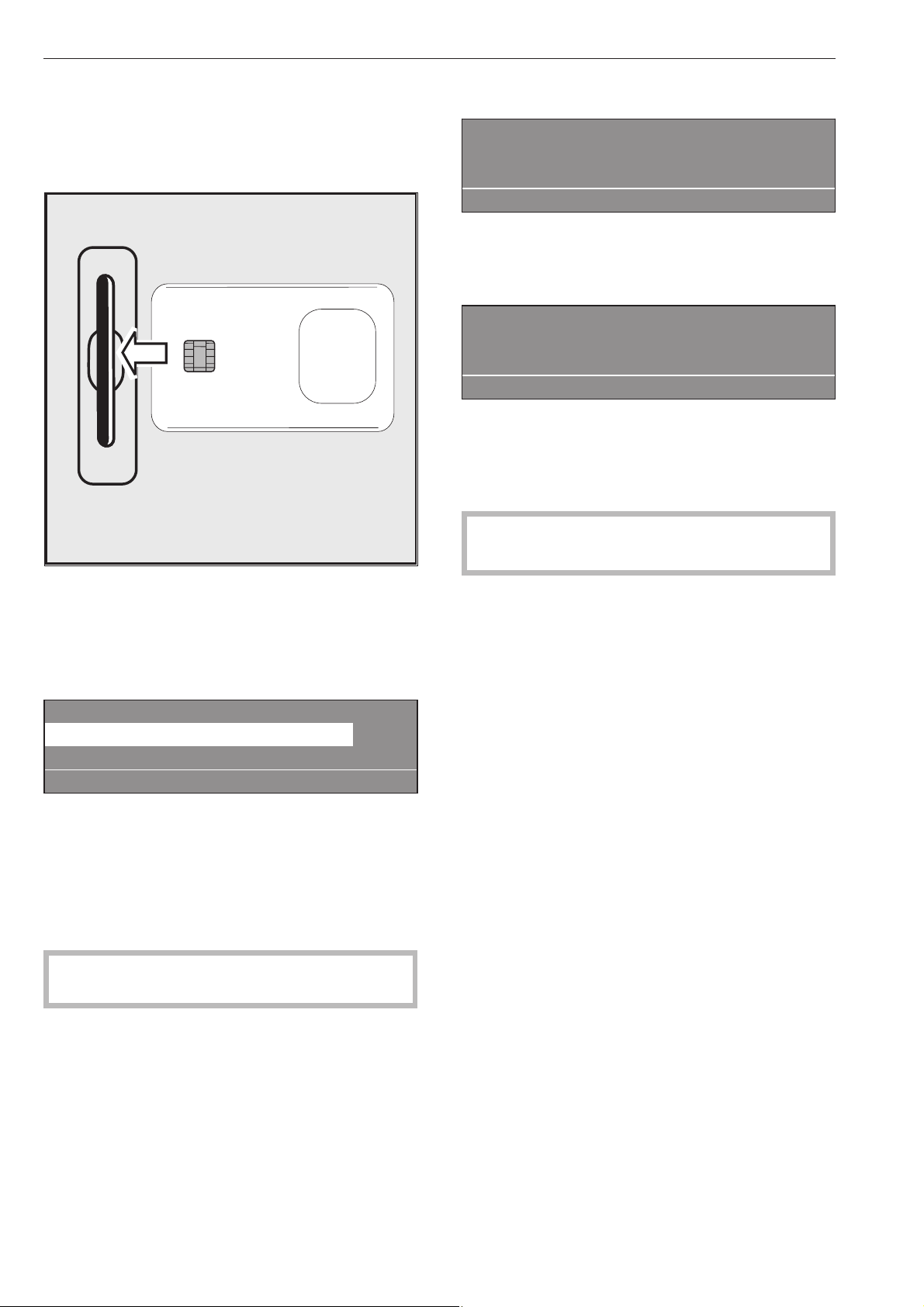
If the machine is programmed for card operation,
only the drying programs on the card can be used.
Cards containing a program are programmed for a
machine type. Empty cards can be programmed for
any machine type.
^ Press l "On" to turn the dryer on.
The Welcome screen appears.
^ Insert the card, arrow first.
The display shows the list of programs on the card.
Card operation
17 Drying Protect. Clothing 113 °F
18 Wrinkle-free 140 °F
FC A
^
Turn the jog shuttle to select a program. Press it to
confirm the selection.
^
Press the "Start" button.
^
Remove the card from the card reader. When the
program is finished it will be erased from the
machines memory.
,
Do not insert any other items into the card
reader.
If the card was inserted the wrong way
§
Card fault
Reinsert card correctly in card reader.
Continue: Press Start.
ü f
^
Insert the card properly into the card reader.
If the card is not suitable for this type of machine
Card operation
Card programs are only applicable
for machine type PT 7251.
A
^
Insert a card suitable for this machine type.
Drying using the coin mechanism C 4060 /
C 4065 / C 4070
Follow the instructions strictly or the money / token
will be lost.
1. Load the laundry and close the drum door.
2. Press the l "On" button.
3. Select a program.
4. Insert money or tokens.
5. Press the "Start" button.
Chip card use / Coin mechanism
26
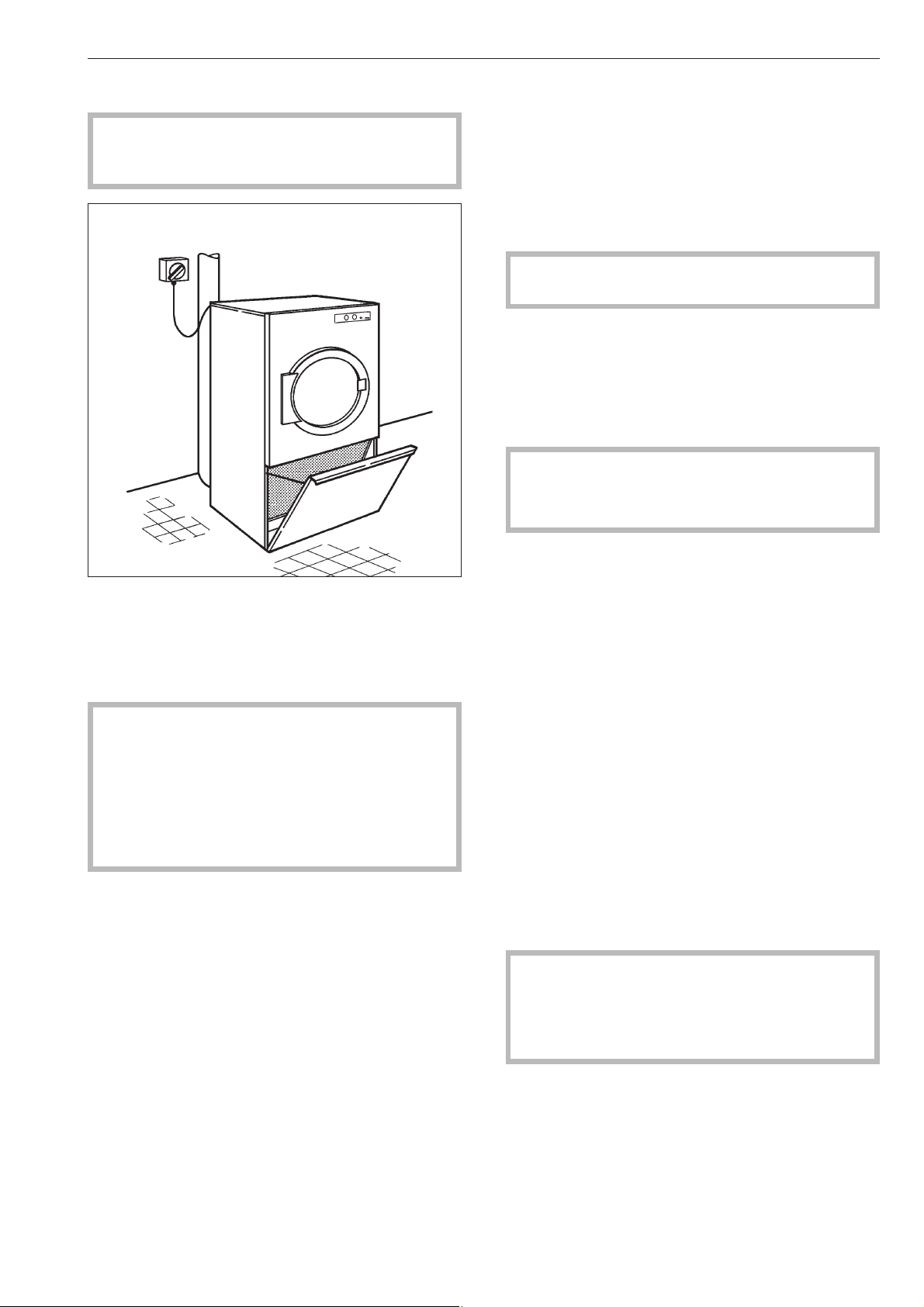
Cleaning the lint filter
,
Clean the lint filter at least once a day and
when the "Clean lint filter" display shows. A
clogged filter is a fire hazard!
^ Open the lint filter flap.
^ Do not remove the lint filter.
^ Wipe the lint off the filter with your hand (do not use
any sharp objects). Scoop out the lint and be
careful not to damage the filter.
,
Do not use the machine without the built-in
filter in place.
This is a fire hazard.
If the lint filter is damaged it must be replaced
immediately.
A build-up of lint could block the airflow, heating
and ventilation, and may impair the efficiency of
the machine.
Dryer
Before cleaning or servicing, disconnect the dryer
from the power supply by shutting off the power main
or tripping the circuit breaker.
With gas-heated dryers, the manual gas shut-off
valve and the shut-off device at the gas meter must
be closed; with steam-heated dryers the steam
shut-off valve must be closed.
,
Do not use a high pressure cleaner or water jet
to clean the machine.
^
Use a mild solution of warm water and liquid dish
soap applied with a soft cloth to clean the housing,
the control panel and the plastic parts, then dry
with a soft cloth.
^
After drying starched laundry, clean the drum with
a soft, moist cloth.
Never use abrasive cleaners, scouring pads, steel
wool or caustic cleaners. They will damage the
surface.
Check the gasket and lock of the drum door and the
lint filter flap.
The air intake opening is located on the back of the
dryer. Never block this opening. Do not cover the
dryer top with any blankets or cloths.
Keep the area surrounding the dryer, especially
around the air intake opening, clear of lint to ensure
clean air intake. Lint will settle in the dryer and cause
malfunctions.
Check and clean once a year
–
Heat coils and heat duct (for electric heated
dryers), burner and the burner compartment (for
gas heated dryers),
–
The complete dryer interior
–
The impeller of the exhaust vent
–
The vent duct and air outlet to the outside
^
Clean any lint away with a vacuum.
,
The machine needs timely and professional
maintenance to prevent operation power loss,
malfunctions and danger of fire.
Contact Miele’s Technical Service Department for
maintenance work.
Cleaning and Care
27

Fault messages
,
Repairs to electrical, gas or steam appliances
should only be carried out by a Miele authorized
technician in accordance with local and national
safety regulations. Unauthorized repairs could
cause injury or machine damage. The
manufacturer cannot be held responsible for
unauthorized work.
After turning the machine on at the mains or if the
program list was selected the control carries out a
system analysis. All modules and their sensors, data
from the operating system, drying programs and
languages are checked.
If an error occurred in a program or language, they
are marked with § and can not be selected (here "3
Cottons Hot Wash 0%" and "English").
1 White Cottons 0%
2 Cottons 0%
3 Colors 0% §
f
Settings Back <-
Language Deutsch
English §
FC A
If an error occurs in an already selected language the
following will show:
§
Data fault
Limited function.
Language defect.
f
Faults that occur before or after the start of a program
will flash in the display.
If the following error messages cannot be fixed with
five restarts, a general message will show:
§
System fault
Contact Technical Service
if restart w/o success.
f
If the display remains off, the dryer has no power.
^
Check the plug, the main switch and the fuses
on-site.
§
Fan fault
Program stop. Press Start.
Motor temperature too high.
f
^
Allow motor to cool.
§
Machine fault
Contact Technical Service
if restart does not work.
f
^
Contact Technical Service.
m
Drive motor fault
Program stopped. Press Start. Motor
overheated due to overloading.
f
^
Allow motor to cool.
Frequently asked questions
28

y
Power failure
Program stop.
Press Start.
f
^
Press "START" to continue the program.
§
Heating system fault
Program stop. Press Start.
Program runs with cold water.
f
^
Press "Start" to continue the program without
heating. Contact Technical Service.
§
Heating system fault
Contact Technical Service.
if restart w/o success.
f
^ Contact Technical Service.
§
Pressure sensor fault
Contact Technical Service
if restart w/o success.
f
^
Contact Technical Service, if restart is not
successful.
§
Gas system fault
Contact Technical Service
if restart w/o success.
f
If the error occurs immediately after the program
start:
^
Open the gas valve and press "Start".
If the error occurs in the middle of a program run, the
gas pressure may have decreased due to use of
additional gas appliances.
^
Press the "Start" button.
^
Contact the Technical Service Department, if
restart is not successful.
§
Card fault
Reinsert card correctly in card
reader.
A
^
Insert the card properly into the card reader.
Frequently asked questions
29
^
In the event of a fault which you cannot correct
yourself, please contact Technical Service.
^
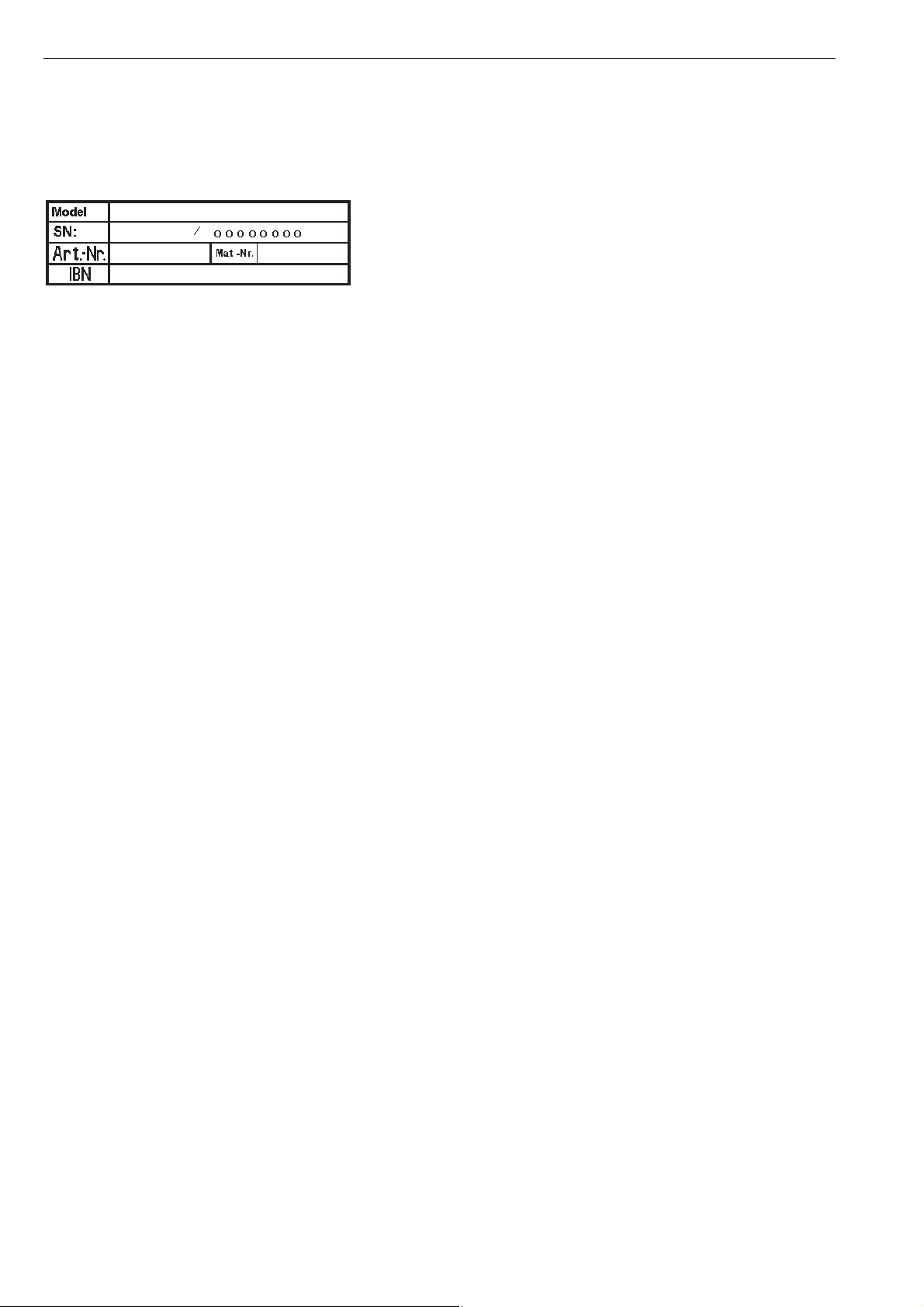
When contacting Technical Service please quote
the model, serial number (SN) and part number
(M.-Nr.) of the machine.
They can be found on the data plate located at the
top of the door opening (when drum door is open) or
on the back of the machine at the top.
^
When contacting Technical Service report the fault
in the display.
Only use original Miele spare parts when performing
maintenance or repairs on this machine. When
ordering please quote the model, serial number (SN)
and part number (M.-Nr.) of the machine.
After sales service
30

Installation instructions

, WARNING - Risk of Fire
~
Any installation, service or repair work is to be done by
a Miele Service Technician. Any work done by an
unauthorized person could be dangerous.
~
Installation must conform with all local and national
codes and regulations.
~
Before installation, disconnect the dryer from the
electrical supply by shutting off the power, unplugging the
power cord or tripping the circuit breaker. Do not restore
power until installation is complete.
~
Be certain your appliance is properly installed and
grounded by a qualified technician.
~
For electrical safety this appliance must be grounded
z in accordance with local codes. It is imperative that this
basic safety requirement be met. If there is any doubt, have
the electrical system of the house checked by a qualified
electrician.
~
Do not damage, remove or bypass the safety
components, fixtures and control elements of this machine.
~
CAUTION: Label all wires prior to disconnection when
servicing controls. Wiring errors can cause improper
operation.
~
Ensure that there is adequate ventilation for operation in
the room where it is installed.
~
Do not operate the dryer in a room where cleaning
machines operate with solvents containing CFC. Vapors
turn into salt acid which may damage the laundry and
machine. When operated in adjoining rooms, there should
be no air exchange possible.
~
The exhaust must not be led into a chimney used by
another gas, coal or oil heated appliance. It must not be
connected to any gas vent, chimney, wall, ceiling, or
concealed space of a building. It should be directed by the
shortest route into the open air or into a suitable venting
duct. The duct must be designed and installed to
accommodate the high air throughput (as few bends and
as short a duct as possible and well shaped, leakproof
joints).
~
CAUTION: An unvented dryer produces combustible
lint. Exhaust outdoors!
~
No filters or louvers should be built into the exhaust
duct.
~
The connection between the exhaust ducting and the
dryer must be airtight.
~
Protect exhausts ducted into the open air against the
weather by a 90° downward angle.
~
To facilitate cleaning of the duct, cleaning flaps or
covers should be fitted on the bends wherever possible.
~
With upward sloping exhaust ducting a condensate
drain must be made at the lowest point.
~
Use only genuine Miele spare parts to replace faulty
components.
~
The minimum dimensions and distance required from
the wall, as shown in the installation diagram, must be
observed to allow service to be performed and the data
plate to be viewed.
~
Do not install the dryer where it is exposed to water
and/or the weather.
~
Install the dryer with adequate clearances for servicing
and proper operation.
~
See the "Installation - Exhaust, Air intake, Ventilation
cross sections and Steam" manual for more information.
SAVE THESE
INSTRUCTIONS
IMPORTANT SAFETY INSTRUCTIONS
32
The dryer must be installed and tested by Miele's
Technical Service Department or an authorized
dealer.
This appliance must be installed in accordance with
the applicable regulations and may only be used in a
room with adequate ventilation.
Read the instructions prior to installation and use of
this appliance.
Do not install the dryer in rooms where the
temperature may drop below freezing.
,
The dryer must not be transported without the
shipping pallet.
At the installation location, lift the dryer from the
shipping pallet using appropriate lifting equipment.
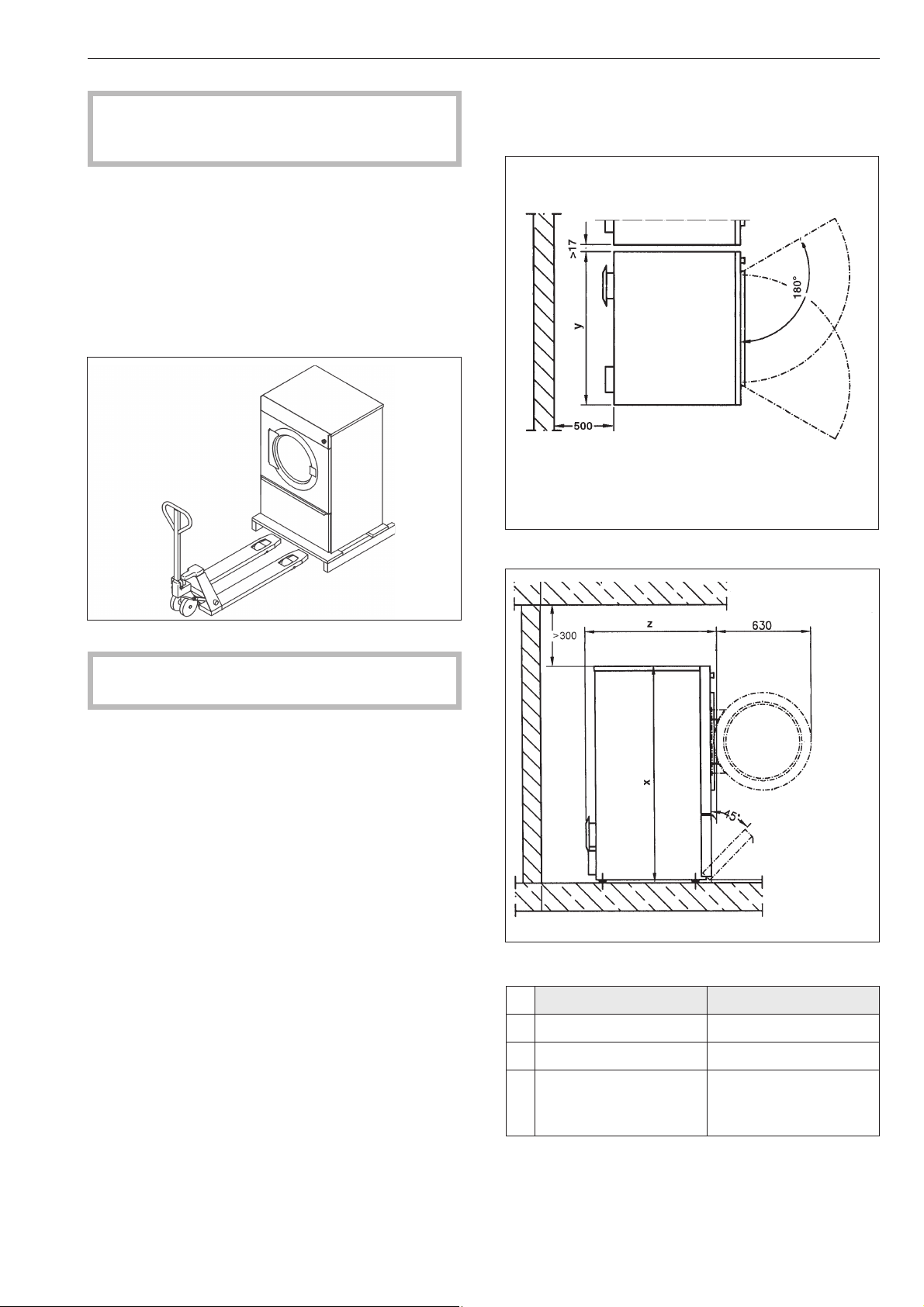
To allow easy access for maintenance and servicing,
the minimum dimensions and distance to the wall
must be observed.
PT 825X / 833X / 840X PT 850X
x 55 1/8" (1400 mm) 64 9/16" (1640 mm)
y 35 11/16" (906 mm) 47 ½" (1206 mm)
z 33" (836 mm) /
40 1/8" (1019 mm) /
45 3/16" (1148 mm)
39 7/16" (1002 mm) /
53 7/8" (1368 mm)
IMPORTANT SAFETY INSTRUCTIONS
33
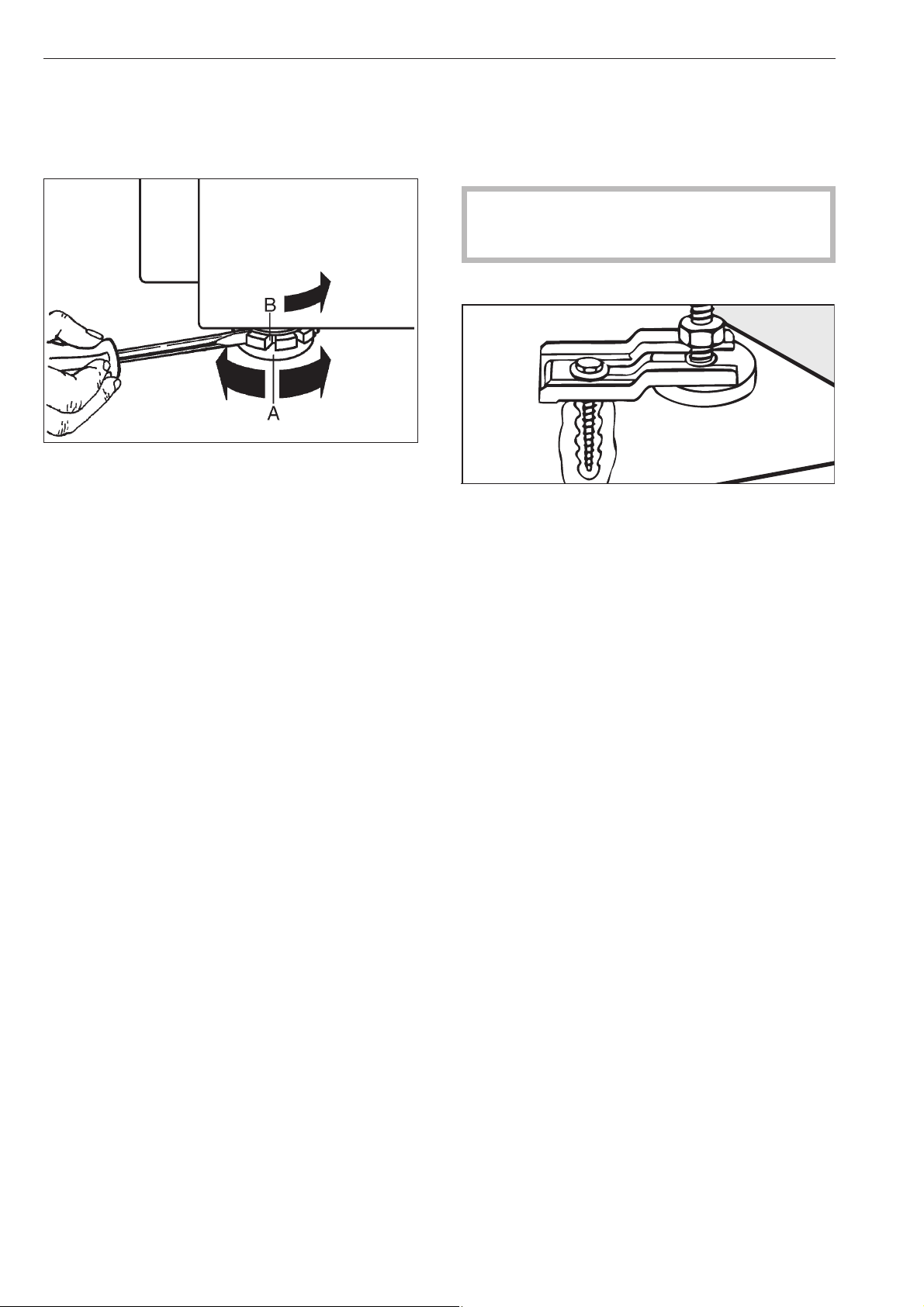
Leveling the dryer
The dryer does not need to be installed on a base.
However, adjustments must be made to compensate
for any unevenness in the floor.
The dryer must be level for proper operation.
^
Level the dryer by turning the feet clockwise or
counterclockwise (A) as necessary.
^
Once leveled, the discs (B) must be screwed tight
to the dryer’s base plate.
Installation on an elevated base
The dryer can be installed on an elevated concrete
base.
,
If installing the dryer on an existing concrete
base, it must be secured with retaining clips.
Otherwise, the dryer may fall off the base.
^
Secure the front feet of the dryer with the retaining
clips provided.
IMPORTANT SAFETY INSTRUCTIONS
34

Reducing the noise level
The dryer is fitted with an exhaust fan which causes a
certain amount of noise.
To minimize the noise level, a muffler (available from
Miele) can be installed at the exhaust connection
(see installation instructions).
Coin mechanism
The dryer can be equipped with a coin mechanism*.
An adapter* is required.
The necessary reprogramming of the dryer must be
performed by a Miele Service Technician.
Empty the coin box on a daily basis. This prevents
the coins and tokens from accumulating and causing
a malfunction.
* available to order from Miele
Communication module XKM RS232
(where available)
The optional communication module makes it
possible to connect the dryer to a PC (personal
computer) via a serial interface.
The outlet for the module is located on the back of the
dryer.
This requires a special Editor Program which is
available from the Miele Professional Department.
IMPORTANT SAFETY INSTRUCTIONS
35

Electrical connection
The electrical connections must be carried out by a
certified electrician in accordance with all the national
regulations.
Observe the enclosed wiring diagram.
Before installation, make sure that the voltage and
frequency listed on the data plate correspond with
the site’s electrical supply.
If the appliance is hard wired, a multiple-pole
separator must be installed. Separators with a
contact gap of more than 1/8" (3 mm) are valid as
separators. All components have to bear CSA or UL
approval.
The plug connection or the separator must be
accessible at all times.
You must be able to lock the separator or monitor it at
all times in case the appliance has to be
disconnected from the power supply.
When the dryer has been connected, check the
rotation direction of the fan. It must turn clockwise. If it
turns counter clockwise, two phases must be
exchanged at the terminal box.
Potential equalization
A potential equalization must be provided if the leak
current is >10 mA.
Air intake / Venting
Only operate the dryer if it is connected to proper
venting ductwork, and there is sufficient air
ventilation.
See the enclosed installation instructions.
Hot water connection
The hot water connection must be carried out by a
certified installer.
Please observe the enclosed installation instructions,
as they are important for the hot water connection.
If required, a lock valve can be installed on site.
Steam connection
The steam connection must be carried out by a
certified installer.
Observe the enclosed installation instructions.
The steam valve and the condensate trap are
available from Miele.
IMPORTANT SAFETY INSTRUCTIONS
36

PT 825x PT833x PT 840X PT 850X
Height 55 1/8" (1400 mm) 55 1/8" (1400 mm) 55 1/8" (1400 mm) 64 9/16" (1640 mm)
Width 35 11/16" (906 mm) 35 11/16" (906 mm) 35 11/16" (906 mm) 47 ½" (1206 mm)
Depth 33" (836 mm) 40 1/8" (1019 mm) 45 3/16" (1148 mm) 39 7/16" (1002 mm)
Depth with
door open
57 11/16" (1466 mm) 65" (1649 mm) 70" (1778 mm) 70" (1778 mm)
Weight 326 / 330 lb
(148 / 149.5 kg)
297 / 369 lb
(134.5 / 167.5 kg)
420 / 416 / 475 lb
(190.5 / 188.5 / 215.5 kg)
525 / 526 / 584 lb
(238 / 238.5 / 265 kg)
Drum volume 66 gal (250 l) 86 gal (325 l) 106 gal (400 l) 132 gal (500 l)
Max. dry
laundry weight
28.7 lb (13 kg) 35.3 lb (16 kg) 44.1 lb (20 kg) 55.1 lb (25 kg)
Voltage (volts) see data plate
Rated load (watts) see data plate
Current (amps) see data plate
Certificates see data plate
Max. installed
floor load
368 / 371 lb
(1636 / 1651 N)
417 / 424 lb
(1857 / 1886 N)
480 / 482 / 541 lb
(2136 / 2143 / 2408 N)
608 / 609 / 667 lb
(2703 / 2708 / 2968 N)
Noise level in dB (A) < 70 < 70 < 70 < 70
Technical Data
37
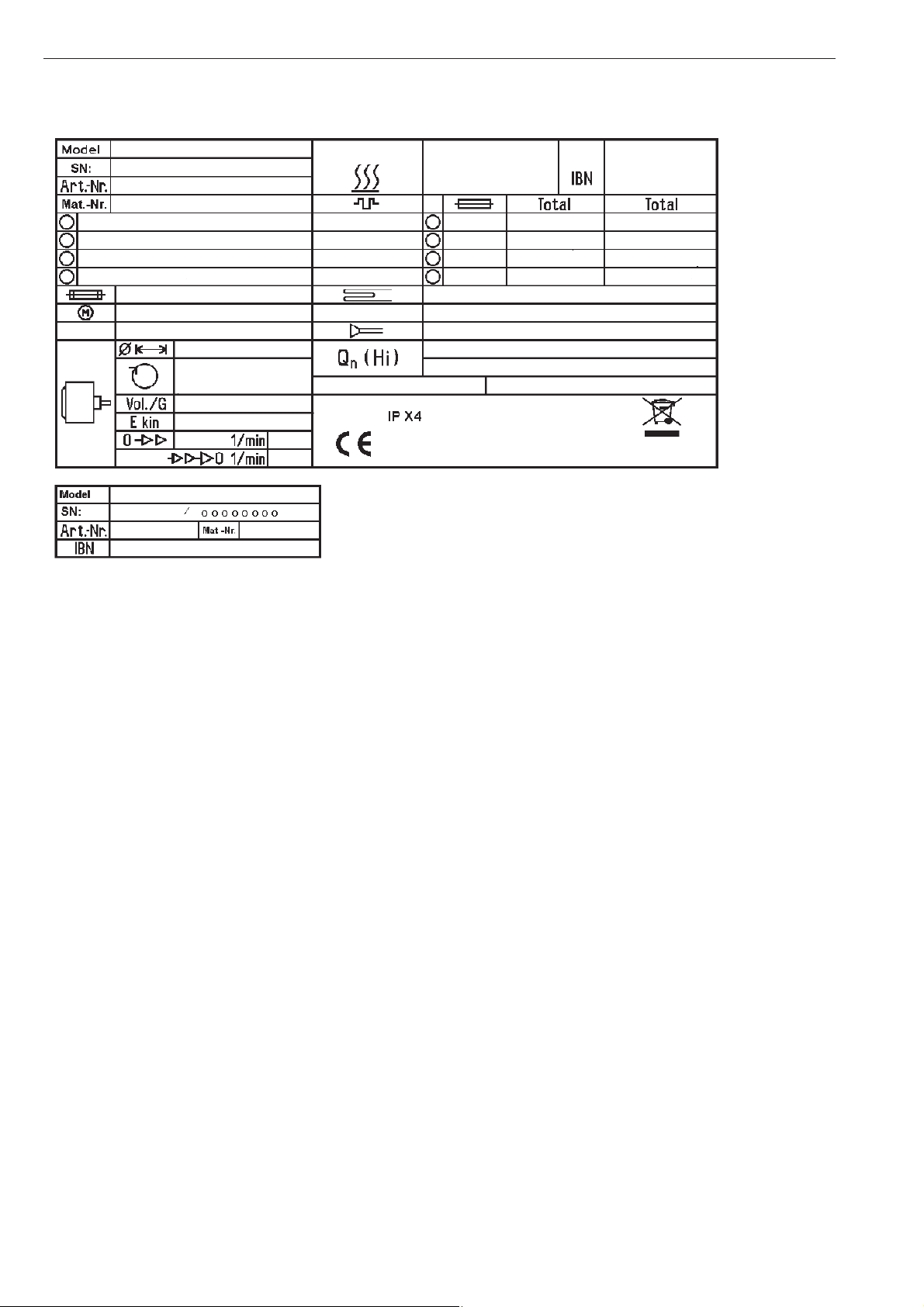
1 Model
2 Serial number
3 Item number
4 Material number
5 Voltage / Frequency
6 Control breaker
7 Motor
8 Drum data
9 Drum diameter / Drum depth
10 Spin speed
11 Drum volume / Dry laundry weight
12 Kinetic energy
13 Acceleration time
14 Deceleration time
15 Heating
16 Name / Year of manufacture
17 Commissioning date
18 Electrical heating
19 Breaker at the building's electrical service panel
20 Steam heat indirect
21 Steam heat direct
22 Gas heating
23 Certificates
Guide to the data plate symbols
38
a
bopq
c
drs
e
ft
g
u
i
hj v
k
lw
m
n

Disposal of the packing materials
The cardboard box and packing materials protect the
appliance during shipping. They are environmentally
friendly for disposal and can be recycled.
To prevent suffocation of children ensure that any
plastic wrapping, bags, etc. are disposed of safely
and kept out of the reach of children.
Please recycle.
Disposal of an old appliance
Old appliances may contain materials that can be
recycled. Please contact your local recycling
authority about the possibility of recycling these
materials.
Ensure that the appliance presents no danger to
children while being stored for disposal. Before
discarding an old appliance, unplug it from the outlet,
cut off its power cord and remove any doors to
prevent hazards.
Help to protect the environment
39

40

1.Sort the laundry
Not all fabrics are suitable for drying in a tumble dryer. Pay attention to the manufacturer’s
instructions on the wash care label.
q = Dry at normal temperature
r = Dry at low temperature
s = Do not tumble dry
^
Sort the laundry by fabric and color
2.Turn on the dryer and load the laundry
^
Press the l "On" button to turn the dryer on.
^
Open the drum door and load the laundry loosely into the drum.
3.Turn the jog shuttle to select a program
Programs may vary depending on the offerings of your machine.
1 White Cottons 0% 14 Outerwear 0%
2 Cottons 0% 15 Hand wash Silks 16%
3 Colors 0 % 16 Hand wash Woolens
4 Darks 0% 17 Waterproofing 0%
5 Wrinkle Free 0% 18 Hot air 20 Min.
6 Delicates 20% 19 Cool air 15 Min.
7 600+TC Sheets Hot 0% 20 Smoothing
8 600+TC Sheets Warm 0% 21 Denim / Jeans 2%
9 Silk and Rayon Bed Linens 16% 22 Dress Shirts 2%
10 Down Comforters & Pillows 0% 23 Towels 0%
11 Washable Bedspreads 0% 24 Outerwear Plus 0%
12 Linen Tablecloths 25% 25 Automatic 0%
13 Mixed Fiber Tablecloths 25%
4.Press the "Start" button to start the program
5. The program end is indicated in the display and the buzzer sounds.
5.The buzzer sounds when the program is finished
^
Open the drum door and remove the laundry.
6.After drying
^
Close the drum door.
^
If necessary, clean the lint filter.
Quick Guide
41
2 Cottons
Program end
Anti-crease Finished 12:35
m FC A

42

43

Alteration rights reserved / 5014
M.-Nr. 07 713 522 / 02
9 Independence Way
Princeton, NJ 08540
Phone:
Fax:
www.mieleusa.com
U.S.A.
Miele, Inc.
National Headquarters
Please have the model and serial number
of your appliance available before
contacting Technical Service.
Canada
Importer
Miele Limited
Headquarters and Miele Centre
800-843-7231
609-419-9898
609-419-4298
Technical Service & Support
Nationwide
Phone:
Fax:
T
161 Four Valley Drive
Vaughan, ON L4K 4V8
www.miele.ca
800-999-1360
888-586-8056
Customer Care Centre
Phone:
800-565-6435
905-532-2272
Germany
Manufacturer
Miele & Cie. KG
Carl-Miele-Straße 29
33332 Gütersloh
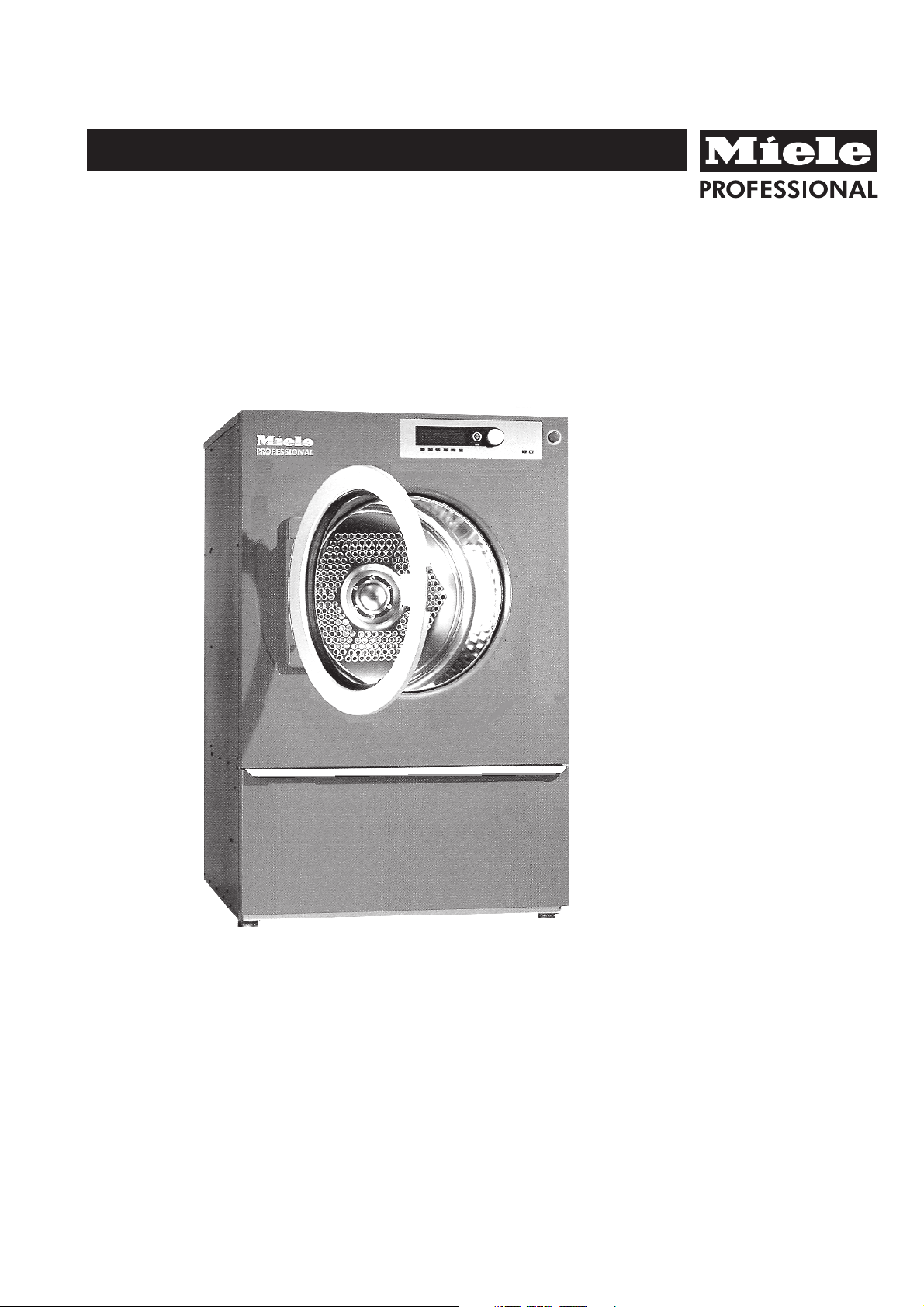
Operating instructions
Dryers
PT 8257
PT 8337
PT 8407
PT 8507
PT 8807
To avoid the risk of accidents or damage to the machine it is
essential to read these instructions before installing,
commissioning and using it for the first time.
M.-Nr. 07 713 522
en-CA

2

Warning and Safety instructions. . . . . . . . . . . . . . . . . . . . . . . . . . . . . . . . . . . . . . . . . . . . . . . . . . . . . . . . . . . . . . . 4
Caring for the environment . . . . . . . . . . . . . . . . . . . . . . . . . . . . . . . . . . . . . . . . . . . . . . . . . . . . . . . . . . . . . . . . . . . 6
Guide to the machine . . . . . . . . . . . . . . . . . . . . . . . . . . . . . . . . . . . . . . . . . . . . . . . . . . . . . . . . . . . . . . . . . . . . . . . . 7
Control elements. . . . . . . . . . . . . . . . . . . . . . . . . . . . . . . . . . . . . . . . . . . . . . . . . . . . . . . . . . . . . . . . . . . . . . . . . . . . . 8
Drying. . . . . . . . . . . . . . . . . . . . . . . . . . . . . . . . . . . . . . . . . . . . . . . . . . . . . . . . . . . . . . . . . . . . . . . . . . . . . . . . . . . . 10
Sort the laundry. . . . . . . . . . . . . . . . . . . . . . . . . . . . . . . . . . . . . . . . . . . . . . . . . . . . . . . . . . . . . . . . . . . . . . . . . . . . . 10
Before using for the first time . . . . . . . . . . . . . . . . . . . . . . . . . . . . . . . . . . . . . . . . . . . . . . . . . . . . . . . . . . . . . . . . . . 11
Switch the machine on and load the drum . . . . . . . . . . . . . . . . . . . . . . . . . . . . . . . . . . . . . . . . . . . . . . . . . . . . . . . . 11
Select a program . . . . . . . . . . . . . . . . . . . . . . . . . . . . . . . . . . . . . . . . . . . . . . . . . . . . . . . . . . . . . . . . . . . . . . . . . . . 12
Card operation / coin mechanism . . . . . . . . . . . . . . . . . . . . . . . . . . . . . . . . . . . . . . . . . . . . . . . . . . . . . . . . . . . . . 15
Card access operation . . . . . . . . . . . . . . . . . . . . . . . . . . . . . . . . . . . . . . . . . . . . . . . . . . . . . . . . . . . . . . . . . . . . . . . 15
Drying using coin mechanism C 4060 / C 4065 / C 4070. . . . . . . . . . . . . . . . . . . . . . . . . . . . . . . . . . . . . . . . . 15
Additional options . . . . . . . . . . . . . . . . . . . . . . . . . . . . . . . . . . . . . . . . . . . . . . . . . . . . . . . . . . . . . . . . . . . . . . . . . 16
Start date and time . . . . . . . . . . . . . . . . . . . . . . . . . . . . . . . . . . . . . . . . . . . . . . . . . . . . . . . . . . . . . . . . . . . . . . . . . . 16
Program stop . . . . . . . . . . . . . . . . . . . . . . . . . . . . . . . . . . . . . . . . . . . . . . . . . . . . . . . . . . . . . . . . . . . . . . . . . . . . . . 17
Program cancellation . . . . . . . . . . . . . . . . . . . . . . . . . . . . . . . . . . . . . . . . . . . . . . . . . . . . . . . . . . . . . . . . . . . . . . . . 17
Changing order of program structure. . . . . . . . . . . . . . . . . . . . . . . . . . . . . . . . . . . . . . . . . . . . . . . . . . . . . . . . . . . . 17
Program information . . . . . . . . . . . . . . . . . . . . . . . . . . . . . . . . . . . . . . . . . . . . . . . . . . . . . . . . . . . . . . . . . . . . . . . . . 17
Program overview. . . . . . . . . . . . . . . . . . . . . . . . . . . . . . . . . . . . . . . . . . . . . . . . . . . . . . . . . . . . . . . . . . . . . . . . . . 18
Standard programs. . . . . . . . . . . . . . . . . . . . . . . . . . . . . . . . . . . . . . . . . . . . . . . . . . . . . . . . . . . . . . . . . . . . . . . . . . 18
Duvets. . . . . . . . . . . . . . . . . . . . . . . . . . . . . . . . . . . . . . . . . . . . . . . . . . . . . . . . . . . . . . . . . . . . . . . . . . . . . . . . . . . . 20
Mops (Buildings maintenance). . . . . . . . . . . . . . . . . . . . . . . . . . . . . . . . . . . . . . . . . . . . . . . . . . . . . . . . . . . . . . . . .20
Fire service . . . . . . . . . . . . . . . . . . . . . . . . . . . . . . . . . . . . . . . . . . . . . . . . . . . . . . . . . . . . . . . . . . . . . . . . . . . . . . . . 21
Professional cleaners . . . . . . . . . . . . . . . . . . . . . . . . . . . . . . . . . . . . . . . . . . . . . . . . . . . . . . . . . . . . . . . . . . . . . . . . 21
Optional modules . . . . . . . . . . . . . . . . . . . . . . . . . . . . . . . . . . . . . . . . . . . . . . . . . . . . . . . . . . . . . . . . . . . . . . . . . . 23
Operating data . . . . . . . . . . . . . . . . . . . . . . . . . . . . . . . . . . . . . . . . . . . . . . . . . . . . . . . . . . . . . . . . . . . . . . . . . . . . . 23
Peak load cut-out . . . . . . . . . . . . . . . . . . . . . . . . . . . . . . . . . . . . . . . . . . . . . . . . . . . . . . . . . . . . . . . . . . . . . . . . . . . 24
Problem solving guide . . . . . . . . . . . . . . . . . . . . . . . . . . . . . . . . . . . . . . . . . . . . . . . . . . . . . . . . . . . . . . . . . . . . . . 25
Error messages. . . . . . . . . . . . . . . . . . . . . . . . . . . . . . . . . . . . . . . . . . . . . . . . . . . . . . . . . . . . . . . . . . . . . . . . . . . . . 25
After sales service . . . . . . . . . . . . . . . . . . . . . . . . . . . . . . . . . . . . . . . . . . . . . . . . . . . . . . . . . . . . . . . . . . . . . . . . . . 26
Cleaning and care . . . . . . . . . . . . . . . . . . . . . . . . . . . . . . . . . . . . . . . . . . . . . . . . . . . . . . . . . . . . . . . . . . . . . . . . . . 27
Fluff filter . . . . . . . . . . . . . . . . . . . . . . . . . . . . . . . . . . . . . . . . . . . . . . . . . . . . . . . . . . . . . . . . . . . . . . . . . . . . . . . . . . 27
Installation and connection . . . . . . . . . . . . . . . . . . . . . . . . . . . . . . . . . . . . . . . . . . . . . . . . . . . . . . . . . . . . . . . . . . 28
Levelling the machine. . . . . . . . . . . . . . . . . . . . . . . . . . . . . . . . . . . . . . . . . . . . . . . . . . . . . . . . . . . . . . . . . . . . . . . . 29
Installation on a raised plinth . . . . . . . . . . . . . . . . . . . . . . . . . . . . . . . . . . . . . . . . . . . . . . . . . . . . . . . . . . . . . . . . . . 29
Coin mechanism . . . . . . . . . . . . . . . . . . . . . . . . . . . . . . . . . . . . . . . . . . . . . . . . . . . . . . . . . . . . . . . . . . . . . . . . . . . . 29
Communication module XKM RS232 . . . . . . . . . . . . . . . . . . . . . . . . . . . . . . . . . . . . . . . . . . . . . . . . . . . . . . . . . . . . 29
Electrical connection . . . . . . . . . . . . . . . . . . . . . . . . . . . . . . . . . . . . . . . . . . . . . . . . . . . . . . . . . . . . . . . . . . . . . . . . 30
Air inlet and exhaust connection . . . . . . . . . . . . . . . . . . . . . . . . . . . . . . . . . . . . . . . . . . . . . . . . . . . . . . . . . . . . . . . 30
Steam connection . . . . . . . . . . . . . . . . . . . . . . . . . . . . . . . . . . . . . . . . . . . . . . . . . . . . . . . . . . . . . . . . . . . . . . . . . . . 30
Technical data . . . . . . . . . . . . . . . . . . . . . . . . . . . . . . . . . . . . . . . . . . . . . . . . . . . . . . . . . . . . . . . . . . . . . . . . . . . . . 31
Explanation of symbols on the data plate . . . . . . . . . . . . . . . . . . . . . . . . . . . . . . . . . . . . . . . . . . . . . . . . . . . . . . 32
Abbreviated operating instructions PT 8257 / 8337 / 8407 / 8507 / 8807. . . . . . . . . . . . . . . . . . . . . . . . . . . . . . 33
Contens
3
Explanation of the Warning and Safety
symbols on the machine
It is essential to read these operating
instructions.
Please refer to specific instructions, e.g.
Installation instructions
Caution, hot surfaces.
Caution, voltage up to 1000 volts.
Earthing
To avoid the risk of accidents and damage to the
machine read the operating instructions carefully
before using it for the first time. They contain im-
portant information about the installation, safety,
use and maintenance of the machine. Keep them
in a safe place and ensure that new users are fa-
miliar with the content. Pass them on to any future
owner of the machine.
Correct application
~
This dryer must only be used for drying articles
which were washed in water and which have a care
label stating that the article is suitable for machine
drying.
~
To prevent the risk of fire, the following must
not be dried in this tumble dryer (with the exception
of those fabrics which can be dried in the Special
Programs specifically designed for them):
–
fabrics which contain a large proportion of rubber,
foam rubber or rubber-like materials.
–
items which have been treated with inflammable
cleaning agents.
–
items which have been splashed with hair lacquer,
hair spray, nail varnish remover or similar substan
-
ces.
–
items which have been soiled with oils or residues
containing grease (kitchen oils, cosmetics etc.).
–
items soiled with wax or other chemicals (e.g.
mops and floor cloths).
–
items with damaged padding or fillings (e.g. pil
-
lows, jackets).
–
items soiled with grease or oil which have not been
properly cleaned beforehand. Use heavy-duty de
-
tergents where necessary to clean heavily soiled
garments, e.g. workwear. If necessary consult the
detergent manufacturer for advice.
With sensitive fabrics there may be a danger of them
self igniting if dried for too long. They should be re
-
moved as soon as the program has finished or if the
-
re is a power cut.
Keep a fire extinguisher near the machine at all times.
~
Do not unload laundry from the drum until the
cooling down phase has been completed.
Hot laundry can self ignite and cause a fire when fol
-
ded or put away.
~
Check that all pockets of workwear etc are empty
to avoid the danger of inflammable objects, e.g. ciga
-
rette lighters, matches, candles or cosmetics being
placed in the dryer.
~
If the dryer is installed in a public area the owner
must ensure that it can be operated safely.
~
This dryer must not be used outside.
Technical and electrical safety
~
This machine must only be installed and commis-
sioned by a Miele technician.
~
The electrical safety of this machine can only be
guaranteed if connected to a correctly installed ear-
thing system on site. It is most important that this ba-
sic safety requirement is present and tested regularly,
and where there is any doubt, the on-site electrical
wiring should be inspected by a qualified electrician.
The manufacturer cannot be held liable for the conse-
quences of an inadequate earthing system (e.g. elec-
tric shock).
~
The machine is only completely isolated from the
electricity supply either when it is switched off at the
isolator switch or the mains fuse has been withdrawn.
~
Repairs to electrical heated appliances should
only be carried out by a suitably qualified and com
-
petent person in accordance with local and national
safety regulations. Repairs and other work by unqua
-
lified persons could be dangerous. The manufacturer
cannot be held liable for unauthorised work.
~
Faulty components must only be replaced by ge
-
nuine Miele original spare parts. Only when these
parts are fitted can the safety standards of the machi
-
ne be guaranteed.
~
This machine must not be operated in the same
room as dry cleaning machines which use solvents
containing chlorofluorocarbons (CFCs). Escaping va
-
pours break down during combustion into hydrochlo
-
ric acid which can have a detrimental effect on both
the laundry and the machine. Even when such machi
-
nes are installed in separate rooms, care should be
taken to ensure that no exchange of air can take pla
-
ce.
Warning and Safety instructions
4

~
The dryer must have a constant supply of fresh air.
Vapours containing chlorine, fluorine or other solvents
must not be able to reach the dryer.
~
The ventilation inlet to the dryer is located at the
back of the machine. It must not be blocked or hinde
-
red in any way. Do not cover the machine lid with
cloths or similar items.
~
Benzine, petrol, paraffin or any easily flammable
substance must not be stored or used near the tum
-
ble dryer. Fire and explosion risk.
~
To ensure the correct performance of the machine
and to prevent the risk of faults and fire, it is important
to check the machine and carry out maintenance on
a regular basis.
Use
~
This tumble dryer must only be used when it is
connected to a suitable ducting system. The installati
-
on site must be adequately ventilated.
~
This tumble dryer is not intended for use by pe
-
ople with reduced physical, sensory or mental capa
-
bilities, or lack of experience or knowledge, unless
they are supervised whilst using it or have been
shown how to use it by a by a person responsible for
their safety.
~
Keep children away from the tumble dryer at all ti-
mes. It is not a toy! To avoid the risk of injury do not
allow them to play on or near it or to play with the
controls. Supervise children whilst you are using it.
~
Always close the drum door and the fluff filter
compartment after use to avoid:
–
the risk of children hiding things in the dryer
–
the risk of children and small animals climbing into
the drum and endangering their lives.
~
Do not use a machine with damaged controls or
cables. These must be repaired before it is used
again.
~
Do not damage, remove or bypass the safety fea
-
tures, fixtures and control elements of this machine.
~
Any removable outer panels must be back in pla
-
ce, and all moving or electrical parts shielded before
the machine is switched on.
~
Whilst the dryer is in use the porthole glass and
drum door frame can become very hot. Laundry will
also be very hot if you remove it early.
~
To prevent the risk of injury or scalding compo
-
nents carrying steam must not be touched.
~
Always make sure that the drum is stationary befo
-
re reaching into the machine to remove laundry. Re
-
aching into a moving drum is extremely dangerous.
~
Take care near the drum door hinges and the fluff
filter compartment flap. Danger of injury. Ensure that
you always use the handles.
~
The drum door must be able to be opened to its
fullest extent. This area must not be restricted by
doors or structural features.
~
Do not use the machine without the built-in fluff fil
-
ter in place. Fire risk.
A damaged fluff filter must be replaced before the
machine is used again.
Otherwise fluff and lint will cause a blockage in the
airways, the heating and the vent ducting, and the
correct functioning of the machine cannot be assu
-
red.
~
Cleaning and disinfecting agents often contain
chlorine-based substances. Do not let such agents
come into contact with the stainless steel surfaces, as
the chlorine can have a corrosive effect and cause
rust. Use chlorine-free agents for washing and disin
-
fecting and also for cleaning stainless steel surfaces
to protect them from corrosion. If in doubt, confirm
with the manufacturer that their product is suitable. If
any agent containing chlorine comes into contact with
the stainless steel surfaces, wipe it away immediately
with clean water. Then dry with a soft cloth.
~
Do not use a pressure washer or hose to clean the
machine.
Using accessories
~
Accessory parts may only be fitted when expres-
sly approved by Miele. Using spare parts or accesso-
ries from other manufacturers will invalidate the gua-
rantee, and Miele cannot accept liability.
Disposing of your old machine
~
Before disposing of an old machine, first make the
door lock unusable. This way you will prevent chil
-
dren from accidentally locking themselves in and en
-
dangering their lives.
Keep these instructions in a safe and
accessible place.
Warning and Safety instructions
5
Disposal of the packing material
The transport and protective packing has been selec
-
ted from materials which are environmentally friendly
for disposal.
Rather than just throwing these materials away, plea
-
se ensure they are recycled.
,
Ensure that any plastic wrappings, bags, etc
are disposed of safely and kept out of the reach of
babies and young children. Danger of suffocation.
Disposing of your old machine
Electrical and electronic machines often contain ma
-
terials which, if handled or disposed of incorrectly
could be potentially hazardous to human health and
to the environment. They are, however, essential for
the correct functioning of your machine. Please do
not therefore dispose of it with your household waste.
Please dispose of it at your local community waste
collection / recycling centre. Ensure that it presents
no danger to children while being stored for disposal.
See the "Warning and Safety" section of this booklet
for further details.
Tips on saving energy
Make sure that your laundry is thoroughly spun befo
-
re drying. This saves time and energy.
Rinsing the laundry using hot water in the final rinse
helps to reduce the residual moisture level, and the
residual heat in the laundry will help keep processing
time down, thus saving energy.
Sort textiles according to:
- fabric and weave,
- drying level required,
- residual moisture levels.
For greater economy dry a full load. Underloading is
uneconomical. Overloading will impair the drying re
-
sult and the laundry finish.
Ensure that the room is well ventilated.
Caring for the environment
6
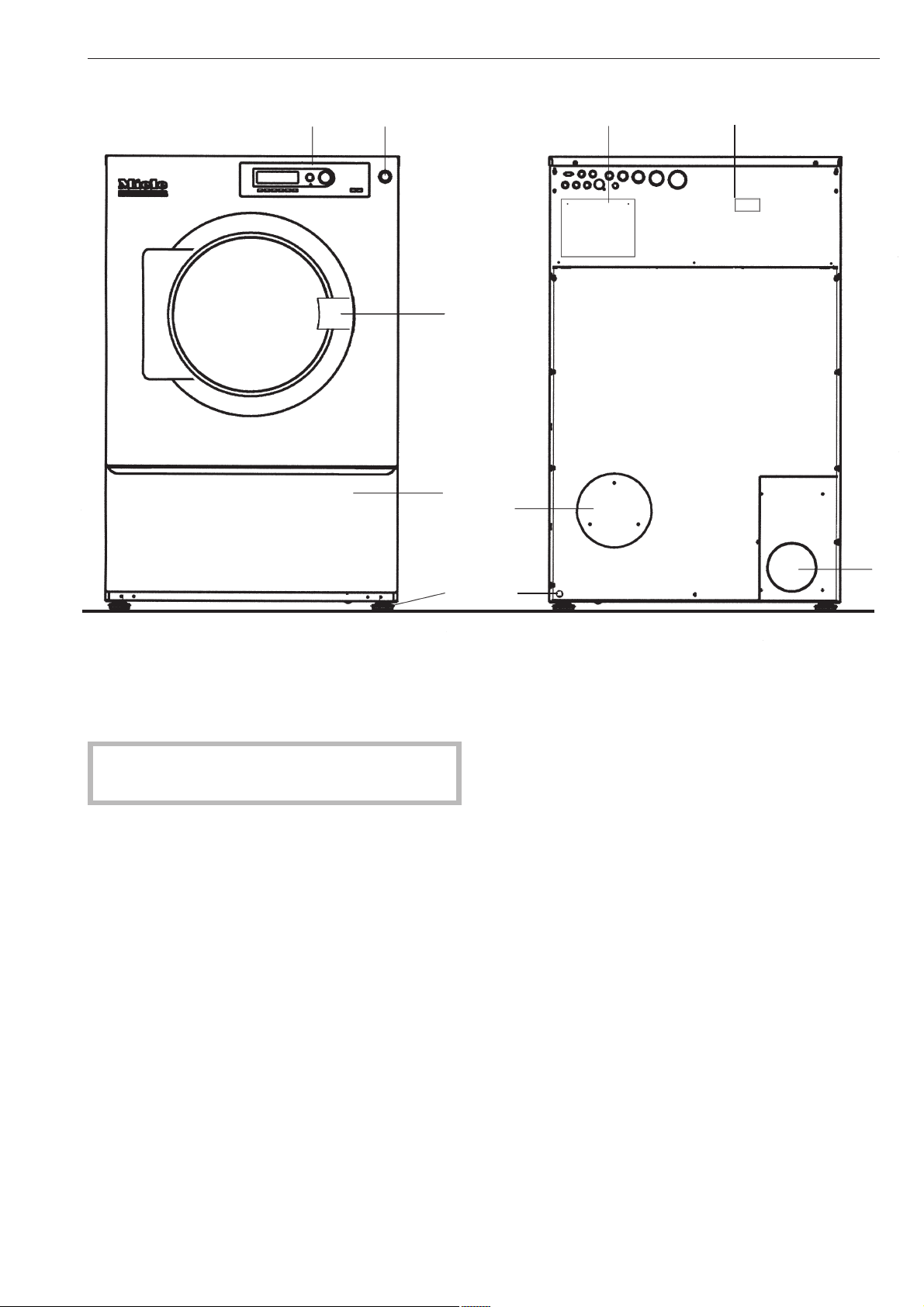
a Emergency stop switch
Only for use in an emergency.
Once the danger is no longer present, turn the groo-
ved disc clockwise to disengage the switch.
Do not use the Emergency stop switch to turn off
the dryer in normal use.
b Control panel
c Drum door
Pull the door handle to open the drum door.
d Access to fluff filter
Pull the handle to open the fluff filter compartment.
e 4 adjustable screw feet
f Electrical connection
g Air intake
h Exhaust connection
i Equipotential bonding
j Communication slot
Guide to the machine
7
f
g
h
j
i
ab
c
d
e
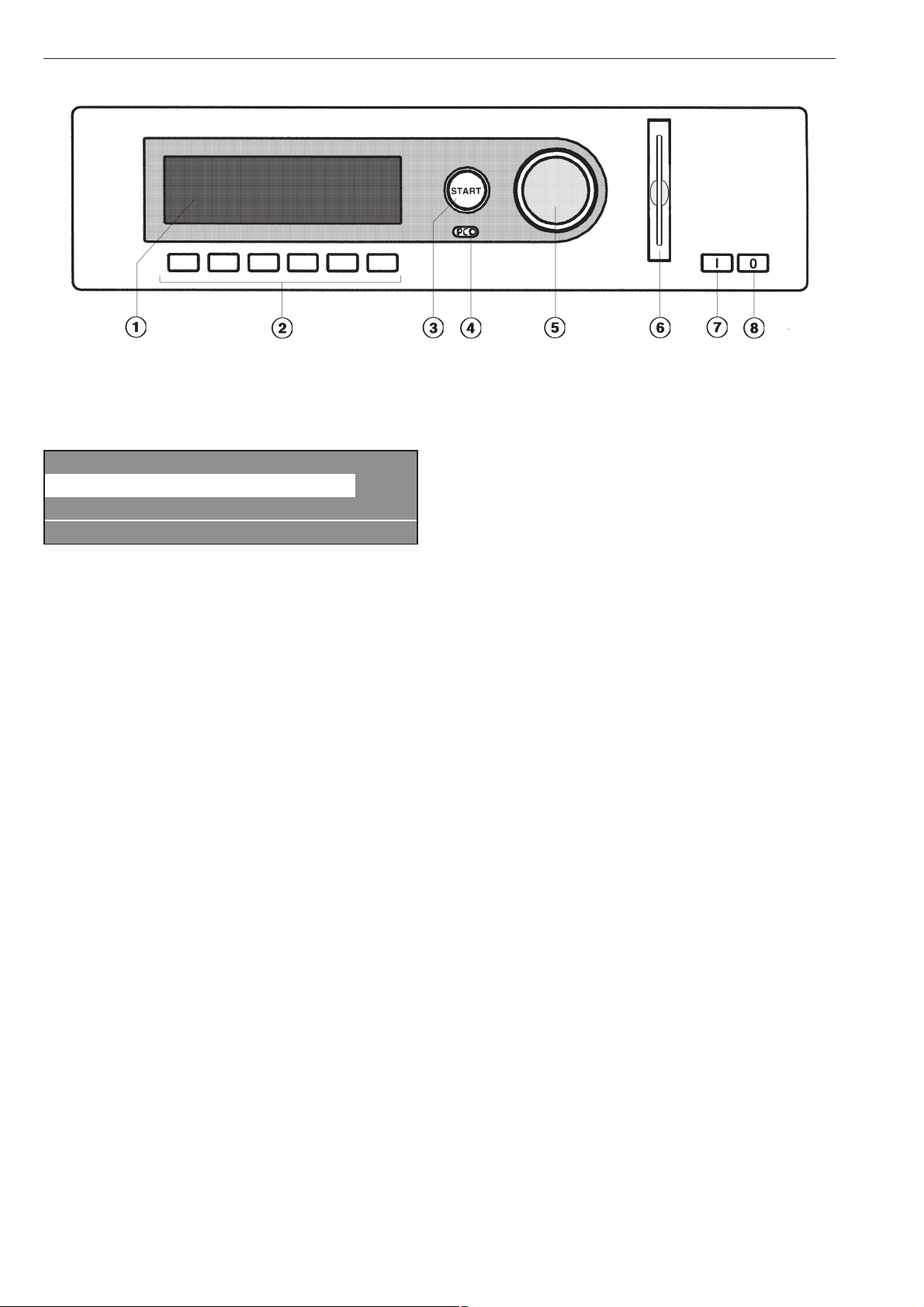
Control elements
a Display
1 Cottons extra dry 0%
2 Cottons dry 0%
3 Cottons damp 20%
FC A
After switching on, the "Welcome" display will appear
for a short time followed by the program list. The most
recently used program is highlighted.
b Function buttons
The six buttons underneath the display are the functi-
on buttons. These buttons have specific functions de-
pending on the status of the machine.
These functions will be listed in the display above the
buttons and will be highlighted once selected.
If the machine is reprogrammed to "Direct button allo
-
cation" the first 6 programs listed in the display can
be selected directly via these buttons.
c Start button
The lightring will flash when a selected program can
be started. Pressing the Start button will start the pro
-
gram. After a program has started, pressing this but
-
ton will show the display as it was before the start of
the program.
d PC / Optical interface
This interface is used for transferring data to the con
-
trol unit from a PC and vice versa.
e Rotary selector
Turning the selector brings up options and menus in
the display.
Pressing the selector confirms your selection.
f Chip card reader (optional)
If the machine has been programmed for card opera-
tion, you can only use those programs stored on the
card to dry laundry.
Insert the card in the direction of the arrow (on the
card).
g I Mains on switch
Switches the machine on.
h 0 Mains off switch
Switches the machine off.
8
Guide to the machine
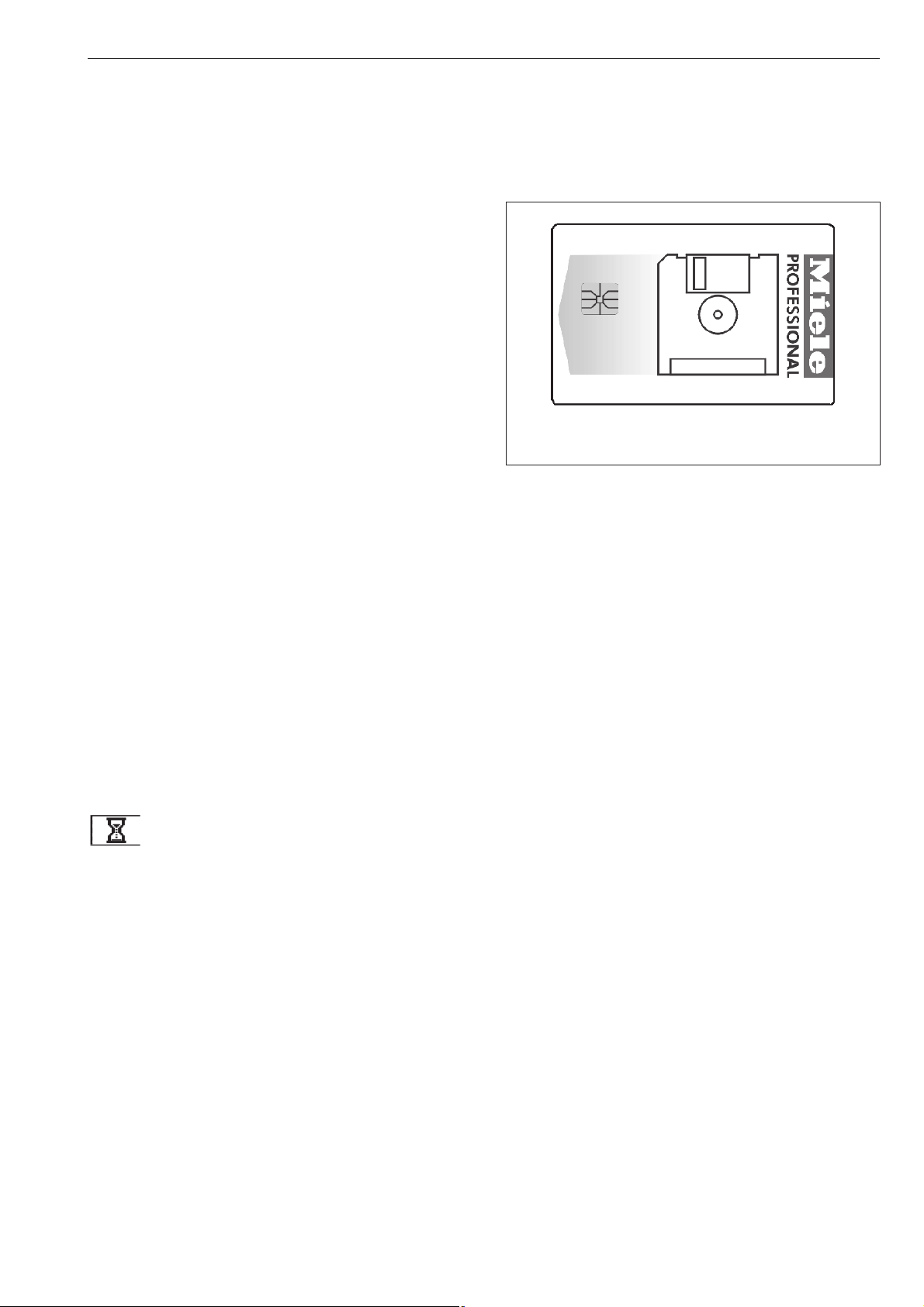
Function buttons
fStop/End
The function button on the right-hand side is used to
stop a program after it has started. Pressing it again
finishes the program.
[ Block plus
The relevant program block (e.g. Pre-dry) is added to
the program.
FC Settings
Press this button to switch to another
language temporarily.
m Start time
Pressing this button before the start of a program dis
-
plays the message that a start time can be selected.
K Information
Press this button to call up program
information in the display.
ü Change order of program structure
The order of the program in progress can be chang
-
ed or program blocks can be repeated.
A Back
Takes you back to the previous display.
e/- Indicates that there is more
information on next or previous line.
S Save
See the programming instruction booklet.
$ Programme locked
Once a locked program has been started, the End
button can only be used to stop and cancel it during
the first minute.
% Programme unlocked
\ Operating data
Data transfer
Chip card operation
The chip card is supplied without any programs.
See the programming instruction booklet for informati
-
on on transferring data from the control unit to the
chip card and vice versa.
The chip card can store a maximum of 30 programs,
each with 6 blocks.
The back of the chip card can be labelled.
9
Guide to the machine

Sort the laundry
Not all textiles are suitable for machine drying. Ple
-
ase read the instructions given on the garment
care label.
The meaning of the care symbols:
q = Dry at normal temperature
r = Dry at low temperature
s = Do not tumble dry
Sort the laundry according to fibre type and weave to
ensure even drying and to prevent the risk of damage
to textiles.
,
To prevent the risk of fire, the following
must not be dried in this tumble dryer (with the
exception of those fabrics which can be dried in
the Special Programmes specifically designed for
them):
- fabrics which contain a large proportion of rub
-
ber, foam rubber or rubber-like materials.
- items which have been treated with inflammable
cleaning agents.
- items which have been splashed with hair lac-
quer, hair spray, nail varnish remover or similar
substances.
- items which have been soiled with oils or residu-
es containing grease (kitchen oils, cosmetics etc.).
- items soiled with wax or other chemicals (e.g.
mops and floor cloths).
- items with damaged padding or fillings (e.g. pil-
lows, jackets).
- items soiled with grease or oil which have not
been properly cleaned beforehand. Use hea
-
vy-duty detergents where necessary to clean hea
-
vily soiled garments, e.g. workwear. If necessary
consult the detergent manufacturer for advice.
The following textiles should not be machine
dried:
Woollens and wool blends as these tend to matt and
shrink. Pre-finish drying these using in the "Woollens"
program.
Pure linen tends to roughen if tumble dried. Please
follow instructions given on the care label.
Important:
Textiles with large metal accessories such as buc
-
kles, hooks and zip tags should be placed in a laun
-
dry bag or a pillow case before drying. This is to pro
-
tect the drum from scratches and dents during dry
-
ing.
Garments with closed metal zips can cause the sen
-
sor electrodes in the drum ribs to be bridged.
This can cause the drying process to go on for too
long, or to not finish at all. Open zips before drying.
Loopknit and woven textiles (e.g. T-shirts and under
-
wear) have a tendency to shrink depending on their
quality. This is made worse by over-drying. Do not
use the "Cottons extra dry" for these textiles.
Starched laundry can be machine dried. Select the
most appropriate program for ironing by hand or
machine.
Sort the laundry according to the level of dryness re-
quired. It is not necessary to sort according to size.
Duvet covers and pillow cases should be closed to
prevent smaller items rolling up inside them.
For greater economy dry a full load. Underloading is
uneconomical. Overloading will impair the drying re-
sult and the laundry finish.
Rinsing the laundry using hot water in the final rinse
helps to reduce the residual moisture level, and the
residual heat in the laundry will help keep processing
time down, thus saving energy.
Drying
10
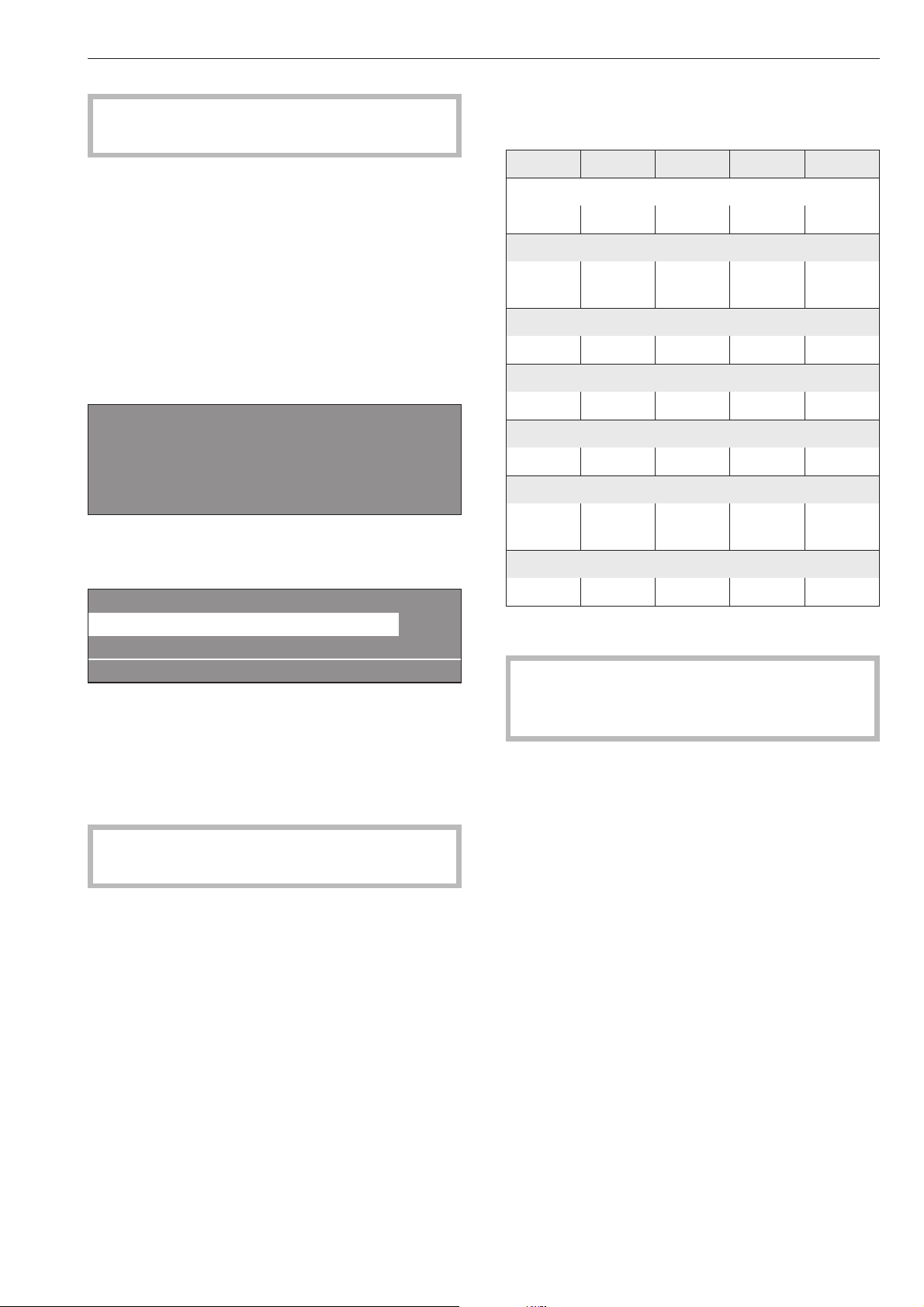
The machine must be commissioned by a Miele
technician before it is used for the first time.
Before using for the first time
Before loading the dryer with laundry you should wipe
the internal drum surface with a soft, dry cloth.
Switch the machine on and load the drum
^
Open all faucets for steam as applicable.
^
Switch on the on-site mains switch.
^
Press the I "On" button in.
The Welcome screen will appear..
M
PROFESSIONAL
PT 8xx7
Welcome
This is followed by the program list (with the most re
-
cently used program highlighted).
1 Cottons extra dry 0%
2 Cottons dry 0%
3 Cottons damp 20%
FC A
Select a program using the rotary selector.
^ Open the drum door.
^
Load the drum.
The pre-sorted laundry should be loaded loosely in
the drum.
Make sure any dispensing aids such as detergent
balls have been removed from the laundry.
Max. load (dry weight of laundry)
PT 8257 PT 8337 PT 8407 PT 8507 PT 8807
Drum volume in litres
250 325 400 500 800
1, 2, 3, 4, 5 Cottons
10-13 kg 13*-16
kg
16*-20
kg
20*-25
kg
32*-40
kg
6, 7, 8 Minimum iron
5kg 6.6kg 8kg 10kg 16kg
9 Woollens
4 kg 5.2 kg 6.4 kg 8 kg 12.8 kg
10 Delicates / Synthetics
2 kg 2.6 kg 3.2 kg 4 kg 6.4 kg
11, 12 Timed drying programs
10-13 kg 13*-16
kg
16*-20
kg
20*-25
kg
32*-40
kg
13, 14 Proofing, Outerwear
5-6.6 kg 6.6-9 kg 8-11 kg 10-13 kg 16-20 kg
* Hot water machines
To prevent the risk of damaging laundry make
sure it cannot be trapped when the door is closed.
^
Close the drum door.
Drying
11

Select a program
This machine is equipped with an electronic sensor
system that continually monitors the moisture level of
the laundry.
As soon as the required dryness is reached the laun
-
dry is cooled down. At the end of this cooling down
phase the drying program is automatically finished.
Standard programs:
–
For drying cotton and linen textiles
1 Cottons extra dry 0 %
2 Cottons dry 0 %
3 Cottons damp 20 %
4 Cottons damp 25%
5 Cottons damp 40 %
–
For drying synthetic and mixed fibre textiles
6 Minimum iron dry 0 %
7 Minimum iron damp 10 %
8 Minimum iron damp 20 %
9 Woollens 5 min.
10 Delicates 20 %
– For airing textiles
11Timed drying cold air 15 min.
– For drying small loads of laundry or for finis-
hing drying individual items
12Timed drying hot air 20 min.
1 Cottons extra dry 0%
2 Cottons dry 0%
3 Cottons damp 20%
FC A
^
Turn the rotary dial to select a program (e.g. Pro
-
gram 2 Cottons dry).
Select the additional option [ "Blockplus" if re
-
quired
(this is not available on standard programs)
^
Confirm the selection of the program by pressing
the rotary selector.
The following (example) will appear in the display:
22 Cottons dry 10.0 / 13.0 kg
0 % Drying 70°C
Cooling down e
[ m A
^
If wished you can now select a program block, e.g.
Pre-drying by pressing the [ "Blockplus" functi
-
on button.
When the [ "Blockplus" function button is pressed,
the following will appear in the display:
2 2 Cottons dry 10.0 / 13.0 kg
24 % Pre-drying
0 % Drying e
[ m A
The [ field is highlighted.
Press the function button again to deselect the functi-
on.
If you do not wish to make any further alterations to
the program:
^ Press the "Start" button. The program will start.
If you wish to make alterations before the start of
the program, e.g. to the load size, temperature or
residual moisture:
^
Confirm the selection of the program by pressing
the rotary selector.
The following (example) will appear in the display:
2 Cottons dry 10.0 / 13.0 kg
0 % Drying 70°C
Cooling down e
m A
The max. load will be shown at the far right of the dis
-
play.
Drying
12

Load weight
You can enter the weight of the load manually before
the start of the program.
2 Cottons dry 10,0 13.0 kg
0 % Drying 70°C
Cooling down e
m A
^
Turn the rotary dial to highlight the load. Press the
dial to confirm your selection. Turn the dial to alter
the weight and confirm your selection by pressing
it.
Temperature in 1 °C increments from cold, 30 to
max. 80 °C .
^
Turn the rotary dial to select the "Temperature" field
(70 °C for drying) and press it to confirm your se
-
lection.
2 Cottons dry 13.0 kg
0 % Drying 70°C
Cooling down e
m A
^ Turn the rotary dial to alter the temperature value
and then press it to confirm your selection.
Residual moisture in 1 % increments from -4 to 40 %.
^ Turn the rotary dial to select the "Residual moisture"
field (0 %) and press it to confirm your selection.
2 Cottons dry 13.0 kg
0% Drying 70°C
Cooling down
m A
^
Turn the rotary dial to alter the residual moisture le
-
vel and then press it to confirm your selection.
^
Press the Start button and the program selected
will commence.
Once a program has started the program sequence
will appear in the display.
2 Cottons dry
0 % Drying >40 %{
Cooling down Ready at 12:35
mKf
In the 2nd line of the display, drying in this example,
the actual residual moisture level (>40%) and the
symbol for { Electric switched on will also be shown.
The 3rd line displays the following program block.
The time that the program will finish (12:35) is shown
on the right hand side of the display.
The program end display has a self-learning function
and will not show an accurate reading until the pro
-
gram has been run several times.
At the end of a program
2 Cottons dry
Programme finished
Anti-crease Ready at 12:35
m FC Kf
The program end time is displayed, the buzzer
sounds and the anti-crease phase commences. The
drum will rotate at intervals to keep the laundry from
creasing.
This is useful if laundry is not going to be unloaded as
soon as the program finishes.
^
Open the drum door.
^
Unload the drum.
Make sure nothing is left behind in the drum. If
items are left in the dryer, they could be damaged
by overdrying when the dryer is next used.
,
Do not unload laundry from the drum until after
the cooling down phase has been completed.
Hot laundry can self-ignite and cause a fire when
folded or put away.
^ Check the fluff / lint filter and clean if necessary.
2 Cottons dry
Programme finished
Check lint filter
A
A reminder will appear in the display when the filter
need to be cleaned. The filter should be cleaned as
soon as the program finishes.
Drying
13

If no more laundry is to be processed:
^
Close the drum door
^
Press the 0 "Off" button to switch the machine off.
^
Switch off the on-site mains switch.
^
Close all faucets for steam as applicable.
Adding or removing items
The drum door can be opened during a drying pro
-
gram to remove or add items if necessary.
,
Always make sure that the drum is stationary
before reaching into the machine to remove laun
-
dry. Reaching into a moving drum is extremely
dangerous!
2 Cottons dry
Programme stop
Door open. Please close the door.
FC f
To continue the drying program:
^ Close the drum door
The fan will switch itself on automatically if the tempe-
rature in the drum is too high.
^ Press the "Start" button and the program selected
will continue.
Drying
14
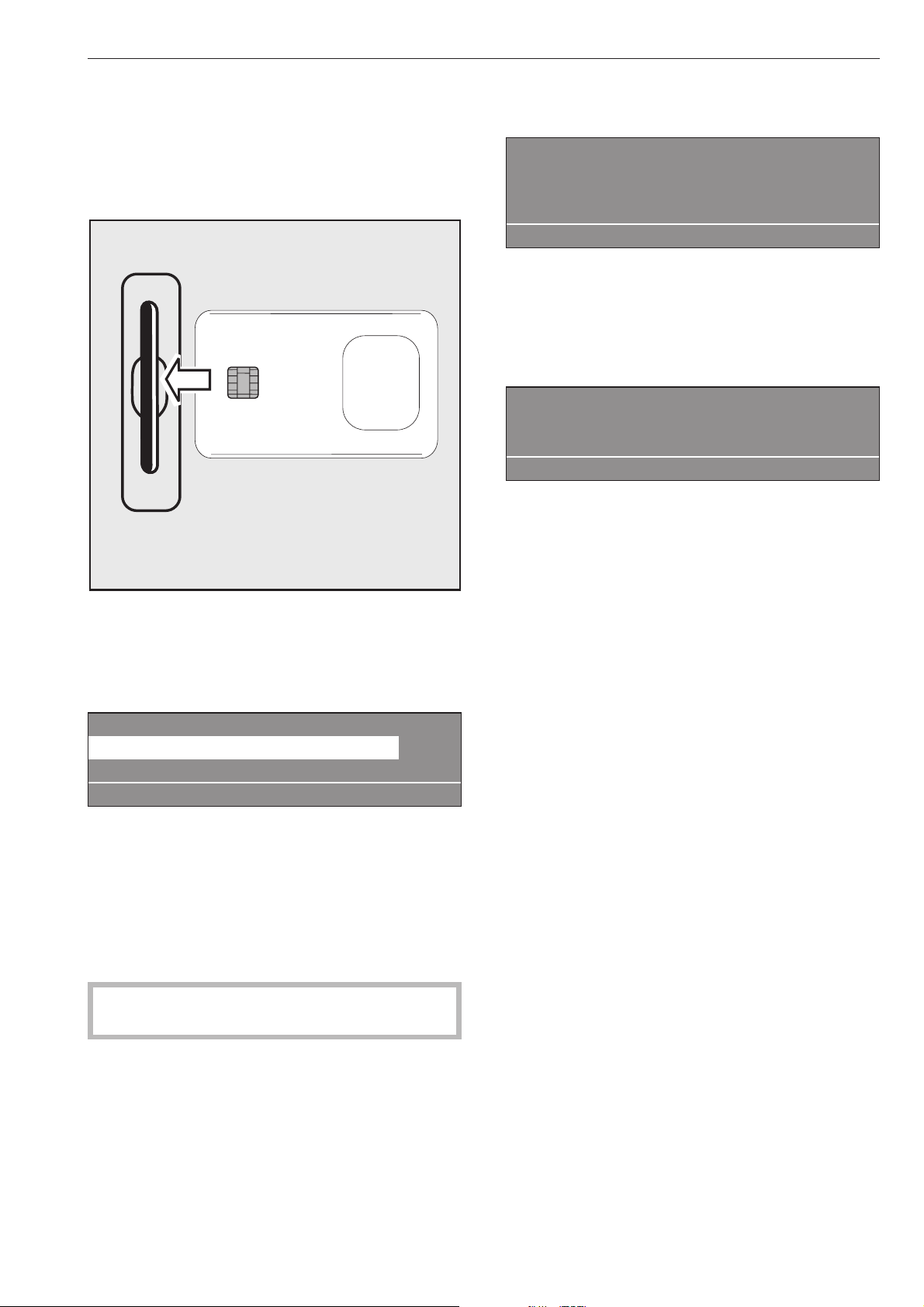
Cards on which a program has been saved can only
be used on the machine type for which they have
been written.
Unwritten cards can be used universally.
^
Press the "On" I button to switch the
machine on.
The Welcome screen will appear.
^ Insert the card in the reader.
The programs listed on the card will
appear in the display.
Card operation
17 Protective clothing 45 °C
18 Minimum iron 60 °C
FC A
^
Use the rotary selector to highlight the program you
want to use. Press the rotary dial to select the pro
-
gram you have highlighted.
^
Press the Start button. The program will start.
After pressing the "Start" button you can remove the
card from the reader. The program is deleted from
the machine's memory once it has finished.
,
Never insert any other card or object into the
card reader!
If the card is inserted the wrong way round the follo
-
wing message will appear in the display:
§
Card fault
Card incorrectly inserted in card reader.
üA
^
Insert the card the right way round in the card rea
-
der.
If the card is not the right one for the machine it is
being used in, the following message will appear in
the display:
Card operation
Programmes on the card are only suitable
for machine type PT 8507
A
^
Insert the correct card for the machine in the card
reader.
Card access operation
Programs requiring special procedures are written
onto a card which is then used to run the program.
"Card access" has be activated via the supervisor le-
vel in the machine.
The machine will then only run programs by using a
card (on which one program has been saved). Pro-
grams in the machine's control unit cannot then be
accessed.
Drying using coin mechanism C 4060 /
C 4065 / C 4070
If the machine is not operated in the following order
you will lose your money or tokens!
A Load the drum and close the door.
B Press the I "On" button.
C Select a program
D Insert coins or tokens.
E Press the "Start" button.
Card operation / coin mechanism
15

Language selection
The language shown in the display can be changed
briefly before starting a program if you wish. To do so
use the button underneath the flag symbol.
1 Cottons extra dry 0%
2 Cottons dry 0%
3 Cottons damp 20%
FC A
If you press the FC button the following will appear
in the display:
Settings Back <-
Main menu Language
Supervisor level
FC A
^
Press the rotary dial to confirm your selection of the
"Language" menu.
Settings deutsch
Language F english (GB)
español
FC A
^ Turn the rotary dial to highlight the language you
want and then press the dial to confirm your selec-
tion.
The FC function button can be pressed to change
to a different language temporarily. By highlighting
the language the display will immediately change to
show the language selected. If the program is not
started, or no other buttons or controls are activated
in the next 5 minutes the language will revert back to
the default setting.
The language will revert back to the default setting 5
minutes after the end of a program with the door
open.
Start date and time
If you want a program to start at a later time use the
m button for "Start date and time".
To set a date and time
After selecting your program, the following (example)
will appear in the display:
2 Cottons dry 13.0 kg
0 % Drying 70°C
Cooling down e
m A
^
Press the m "Start date and time" button.
The following (example) will appear in the display:
2 Cottons dry 13.0 kg
Start time: 16 : 10 Start date: 2.4.2003
After selection press the start button.
m A
The current time and date will then appear. The input
field for hours will be highlighted.
^
Press the rotary dial to change the hour.
Turn the rotary dial to alter the hour and then press
it to confirm your selection.
^
Then turn the rotary dial to select the "Minutes" field
and press it to confirm your selection.
Turn the dial to alter the minutes and then press it
to confirm your selection.
^
Then turn the rotary dial to select the "Start date"
field and press it to confirm your selection.
Turn the dial to alter the date and then press it to
confirm your selection.
^
Do the same for the month and the year.
After setting the required start date and time:
^ Press the Start button and the program selected
will commence at the time specified.
The display will now contain the following information:
2 Cottons dry 13.0 kg
0 % Drying
16:15 -2.4.2009 Start 6:00-3.4.2009
m A
The current time and date as well as the start time will
be displayed.
^
If the door is opened again you will have to press
the Start button again.
To cancel the start time and date function
Press the m "Start date and time" button again or
press A"Back", and any changes will be rejected.
Additional options
16

Program stop
To halt the program press the f button.
The program remains stationary.
2 Cottons dry
Programme stop
Press the start button.
ü f
To continue the program press the "Start" button.
Program cancellation
To cancel a program press the f "Stop/End" button
twice in succession.
Changing order of program structure
The structure of programs that are in progress can be
adjusted or program blocks can be repeated.
^
Press the f button and the program will stop.
2 Cottons dry
Programme stop
Press the start button.
ü f
^ After pressing the ü button the current area or
block will appear in the display.
See also "program structure" in the Programming
Manual.
Reorganise -> 2 Cottons dry
Programme stop
Area 1: Drying e
S A
Area 1: Drying
Block 1: Pre-drying
-
S A
^
Turn the rotary dial to select the area, and then
press it to confirm your selection.
Select Area: 1 Drying, or 2 Cooling down and con
-
firm your selection.
^
Turn the rotary dial to select the block and then
press it to confirm your selection.
Select Block: Drying 1-10, or Cooling down 1-10
and confirm your selection.
^
Press the S "Save" button and then press "Start" to
reorganise the program order or press the A
"Back" button to go back to programme stop and
not change the program order.
Program information
Pressing the K "Information" button will call up further
information about the program e.g.:
2 Cottons dry
Start date and time: 10.7.2009
Start time: 9:47 e
m K f
Time after start: 0h 23 min
Time left: 0h 11min
Progr.-End: 10: 21 h e
Area: 1 Drying
Block: 1 Pre-drying
Actual exhaust air temp. 59 °C e
Rqrd. exhaust air temp. 74 °C
Peak load: No
Anti-crease: 3 s./87s./60 min e
2 Cottons dry
Exhaust / Recirculation: Recirculation -
Block end signal Yes
A
^
Press the A "Back" button to return to the pro
-
gram sequence display.
Additional options
17
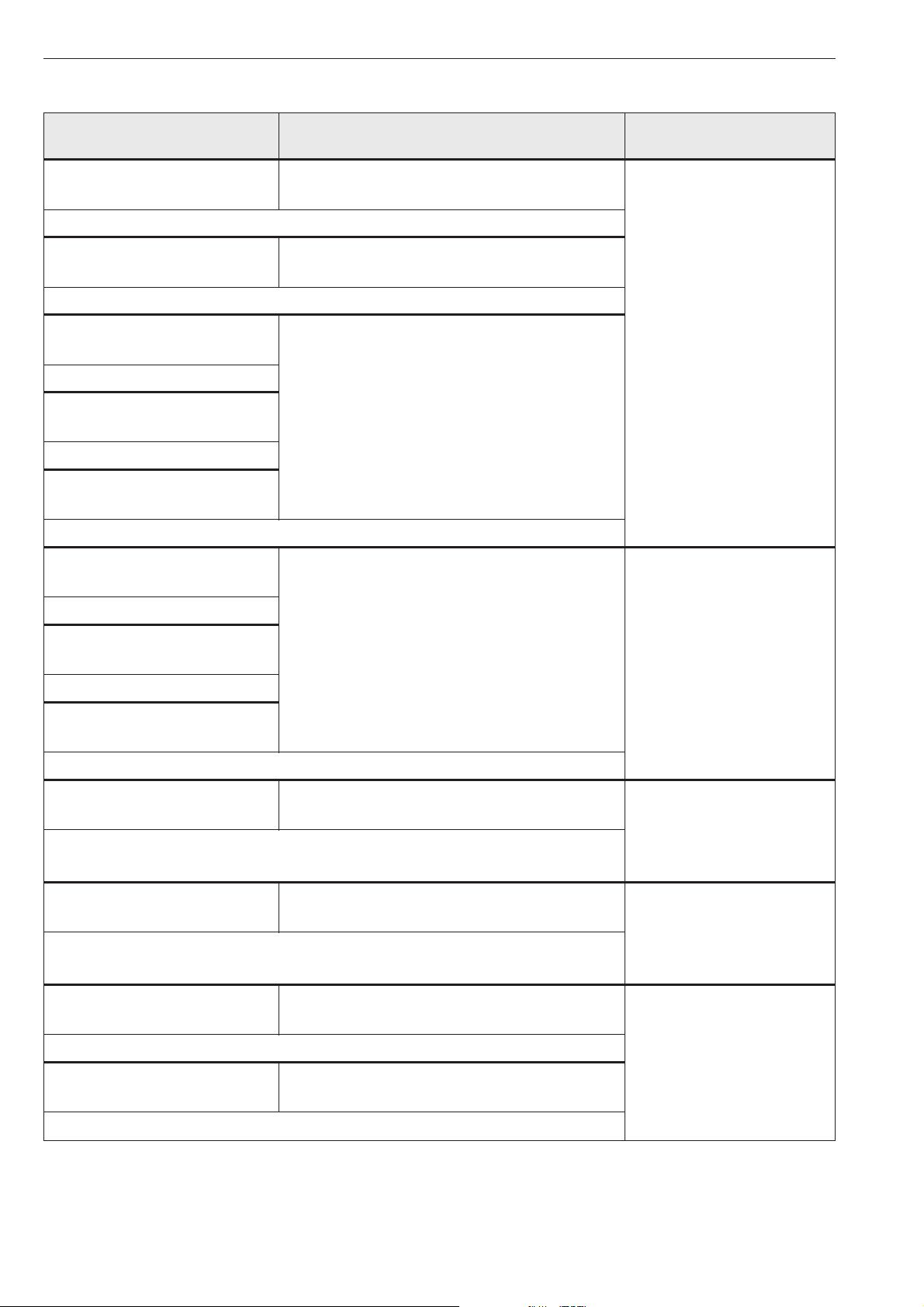
Standard programs
Program Fabric type max. load capacity (kg, dry
weight)
1 Cottons extra dry 0 %
(Normal+) 74°C
Multi-layered and bulky cotton and linen textiles
which do not get dry in the Cottons dry program.
PT 8257 10-13 (22-29 lb)
PT 8337 13-16 (29-35 lb)
PT 8407 16-20 (35-44 lb)
PT 8507 20-25 (44-55 lb)
PT 8807 32-40 (70-88 lb)
2 Cottons dry 0 %
(Normal) 74°C
Single and multi-layered cotton and linen texti
-
les.
3 Cottons damp 20 %
(Machine iron) 74°C
Cotton and linen textiles which are to be machi
-
ne ironed.
4 Cottons damp 25%
(Machine iron) 74°C
5 Cottons damp 40 %
(Machine iron) 74°C
6 Minimum iron dry 0 %
(Normal) 60°C
Synthetic, cotton and mixed fibre textiles which
are to be machine ironed.
PT 8257 5.0 kg (11 lb)
PT 8337 6.6 kg (14.5 lb)
PT 8407 8.0 kg (17.5 lb)
PT 8507 10 kg (22 lb)
PT 8807 16 kg (35 lb)
7 Minimum iron damp 10 %
(Machine iron) 60°C
8 Minimum iron damp 20 %
(Machine iron) 60°C
9 Woollens
(5 min.) 74°C
For fluffing up woollen garments. This program
does not dry woollens.
PT 8257 4 (9 lb)
PT 8337 5.2 (11.5 lb)
PT 8407 6.4 (14 lb)
PT 8507 8 (17.5 lb)
PT 8807 12.8 (28 lb)
10 Delicates 20 %
40°C
Delicate cotton, synthetic and mixed fibre fa
-
brics.
PT 8257 2 (4 lb)
PT 8337 2.6 (6 lb)
PT 8407 3.2 (7 lb)
PT 8507 4 (9 lb)
PT 8807 6.4 (14 lb)
11 Timed drying cool air
(15 min.)
Items which need airing only.
PT 8257 10-13 (22-29 lb)
PT 8337 13-16 (29-35 lb)
PT 8407 16-20 (35-44 lb)
PT 8507 20-25 (44-55 lb)
PT 8807 32-40 (70-88 lb)
12 Timed drying hot air
(20 min.) 74°C
For drying small loads of laundry or for finishing
drying individual items.
Program overview
18

Program Fabric type max. load capacity (kg, dry
weight)
13 Proofing
(Normal) 60°C
For drying microfibre fabrics, skiwear, fine,
closeweave cotton garments (poplin) or ta
-
blecloths which are suitable for drying in a
tumble dryer and have been treated to pro
-
vide a water and dirt resistant finish.
PT 8257 5 - 6.6 (11-14.5 lb)
PT 8337 6.6 - 9 (14.5-20 lb)
PT 8407 8 - 11(17.5-25 lb)
PT 8507 10 - 13 (22-29 lb)
PT 8807 16 - 20 (35-44 lb)
This program includes a proofing fixing phase.
Only use proofing agents containing fluorochemical compounds which are
stated by the manufacturer as being "suitable for use on membrane textiles".
Fire hazard. Do not dry items which have been treated with proofing agents
containing paraffin.
14 Outerwear
60°C
Outerwear which is suitable for drying in a
tumble dryer.
Temperatures given refer to extracted air temperature.
Program overview
19
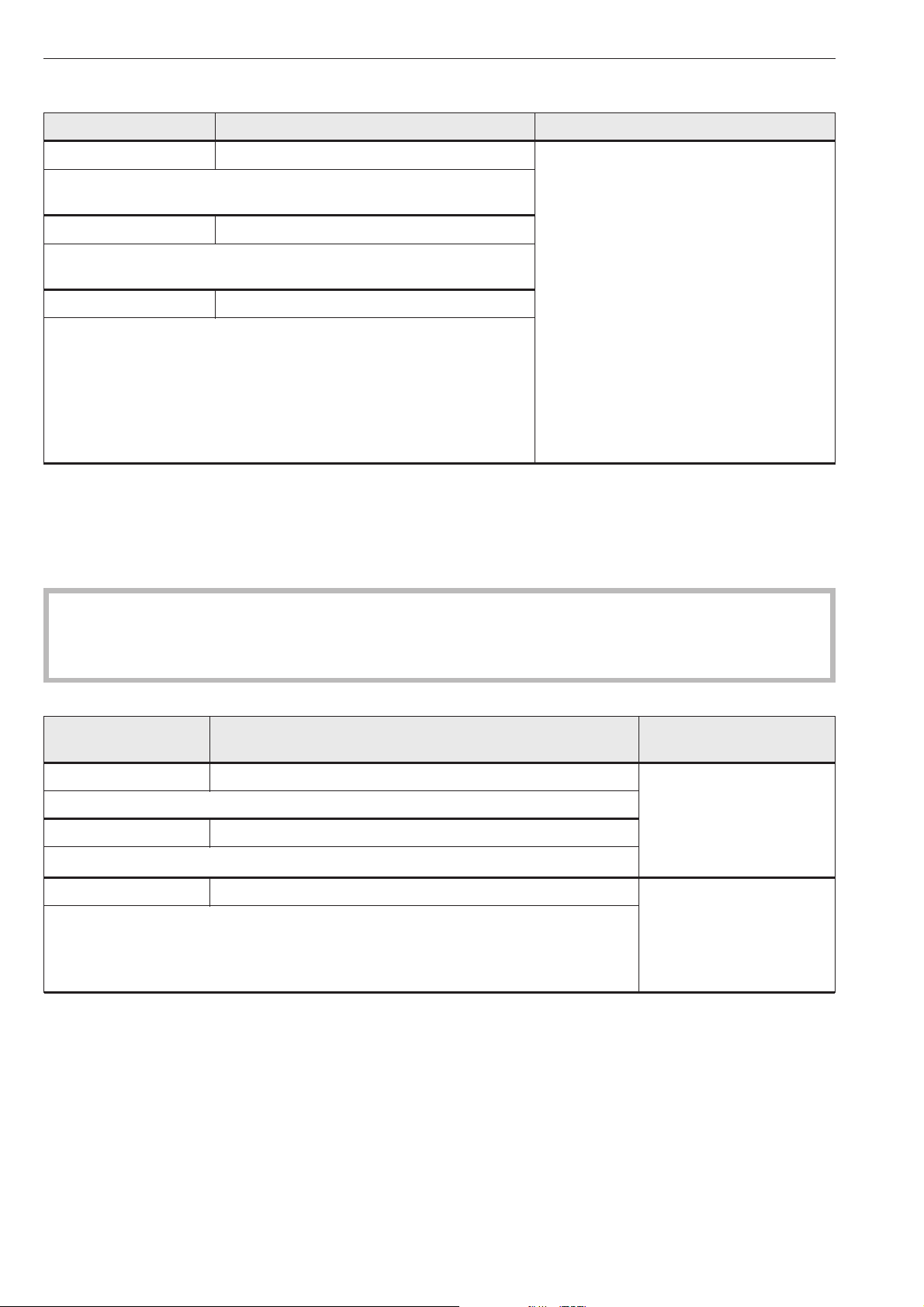
Duvets
Programme Fabric type max. load capacity (kg, dry weight)
Down duvets Feather and down filled duvets and pillows. PT 8257 1 single duvet or 2 pillows
(10/22 lb)
PT 8337 3 pillows or (13/29lb)
1 pillow + 1 single duvet
PT 8407 4 pillows or (16/35lb)
2 pillows + 1 single duvet or
2 single duvets
PT 8507 5 pillows or (20/44lb)
3 pillows + 1 single duvet or
2 single duvets
PT 8807 8 pillows or (32/70lb)
3 pillows + 3 single duvet or
4 single duvets
The loads quoted are estimates and will
vary depending on the size and volume
of the duvets.
74°C, Dries to 0 % residual moisture, Tumble phase, Cooling down
phase
Synthetic duvets Synthetic duvets and pillows.
74°C, Dries to 0 % residual moisture, Tumble phase, Cooling down
phase
Natural fibre blankets Natural fibre quilts and blankets.
74°C, 3 min. drying phase, Cooling down phase.
Natural fibre blankets and quilts must not be dried completely in a
tumble dryer, as this could cause the fibres to matt. These should
only be partially dried in a tumble dryer.
Mops (Buildings maintenance)
,
Items that have not been washed thoroughly and may still contain residual wax or chemicals are a fire ha-
zard.
Wash heavily soiled items very thoroughly before drying them, ensuring that you use sufficient detergent and
select a high temperature. If in doubt, wash the items several times.
Program Fabric type max. load capacity (kg,
dry weight)
Mops Cotton mops PT 8257 10 (22 lb)
PT 8337 13 (29 lb)
PT 8407 16 (35 lb)
PT 8507 20 (44 lb)
PT 8807 32 (70 lb)
74°C, Dries to 0 % residual moisture, Cooling down phase.
Microfibre mops Microfibre mops
60°C, Dries to 0 % residual moisture, Cooling down phase.
Cleaning cloths Microfibre cloths, dusters PT 8257 5.6 (12.5 lb)
PT 8337 7 (15.5 lb)
PT 8407 8.6 (19 lb)
PT 8507 11 (24 lb)
PT 8807 17.5 (39 lb)
60°C, Dries to 0 % residual moisture, Cooling down phase.
Temperatures given refer to extracted air temperature.
Program overview
20
Fire service
Program Fabric type max. load capacity (kg, dry weight)
Face masks Face masks with
head straps
max. no. holders / masks
PT 8257 4 8
PT 8337 4 12
PT 8407 4 16
PT 8507 4 12
PT 8807 4 16
50°C, 45 min. drying phase, Cooling down phase.
Breathing masks may only be dried if special holders (available as an op
-
tional accessory) are fitted in the drum.
Protective clothing Protective clothing (e.g. as used by the fire bri
-
gade), overalls, jackets, trousers
PT 8257 approx.1-2suits
(1 jacket + 2 trousers or 2 jackets)
PT 8337 approx. 2 suits (or 3 jackets)
PT 8407 approx. 3 suits
PT 8507 approx.3-4suits
PT 8807 approx. 6 suits
PT 8257 5 - 6.6 kg (11-14.5lb)
PT 8337 6.6-9kg(14.5-20lb)
PT 8407 8 - 10 kg (17.5-22lb)
PT 8507 10 - 13 kg (22-29lb)
PT 8807 16 - 20 kg (35-44lb)
74°C, Dries to 0% residual moisture, Tumble phase, Cooling down pha
-
se
For best results, dry items inside out.
Reproof protect. clo
-
thing
For all textiles that have been treated with a
proofing agent
74°C, Dries to 0 % residual moisture, Tumble phase, Cooling down pha
-
se
Only use proofing agents containing fluorochemical compounds which
are stated by the manufacturer as being "suitable for use on membrane
textiles".
Fire hazard. Do not dry items which have been treated with proofing
agents containing paraffin.
Professional cleaners
Program Fabric type max. load capacity (kg, dry weight)
WetCare sensitive For non washable garments PT 8257 approx.4-5(9-11lb)
PT 8337 approx. 5 - 6.6 (11-14.5lb)
PT 8407 approx. 6.6 - 8 (14.5-17.5lb)
PT 8507 approx.8-10(17.5-22lb)
PT 8807 approx. 16 - 21 (35-46lb)
50°C, 3 min. drying phase, Cooling down phase.
WetCare silks For non washable garments which crease easily PT 8257 approx.4-5(9-11lb)
PT 8337 approx. 5 - 6.6 (11-14.5lb)
PT 8407 approx. 6.6 - 8 (14.5-17.5lb)
PT 8507 approx.8-10(17.5-22lb)
PT 8807 approx. 13 - 16 (29-35lb)
60°C, Dries to 15 % residual moisture, Cooling down phase.
WetCare intensive Washable garments PT 8257 approx. 5 - 6.6 (11-14.5lb)
PT 8337 approx. 6.6 - 9 (14.5-20lb)
PT 8407 approx.8-11(17.5-24lb)
PT 8507 approx. 10 - 13 (22-29lb)
PT 8807 approx. 16 - 21 (35-46lb)
74°C, Dries to 0 % residual moisture, Cooling down phase.
Temperatures given refer to extracted air temperature.
Program overview
21
Equestrian
,
Metal buckles and fasteners etc. should be removed to protect the items being dried and the drum. If it is
not possible to remove them, then cover them with protective bags.
Program Fabric type max. load capacity (kg,
dry weight)
Horse blankets Horse blankets, saddle-cloths, gaiters, boots, bandages, tex
-
tile halters PT 8257 10 (22 lb)
PT 8337 13 (29 lb)
PT 8407 16 (35 lb)
PT 8507 20 (44 lb)
PT 8807 32 (70 lb)
60°C, Dries to 0 % residual moisture, Tumble phase, Cooling down phase
Woollen horse
blankets
Horse blankets with high percentage of wool
74°C, 5 min. drying phase, Cooling down phase.
Temperatures given refer to extracted air temperature.
Dryer
Load (individual items)
Saddle cloths/
Numnahs
Summer
blankets
Winter
blankets
PT 8257 7 2 1
PT 8337 9 2 - 3 1 - 2
PT 8407 11 2 - 3 1 - 2
PT 8507 12 3 2
PT 8807 18 4 - 5 3
Program overview
22

Operating data
By pressing the \ "Operating data" button, the mo
-
dule can be used to read or delete operating data eit
-
her before the start of a program, or after it has finis
-
hed.
1 Cottons extra dry 0%
2 Cottons dry 0%
3 Cottons damp 20%
\FCA
After pressing the \ button the following will appear
in the display:
Operating data module
Total data
Programme data e
\ A
Selection choice:
– Total data
In this option all program data is collated and sum-
marized.
– Program data
Program data contains all the data called up during a
program.
– Delete data
- Module (delete total data including program data)
- Total data (only delete total data)
- Program data (only delete program data)
Pressing the button again deselects the \ "Opera
-
ting data" option.
If there is no more memory available in the operating
data module a message will appear after pressing
the "Start" button to say that the operating data will be
overwritten.
If you press the A "Back" button or do not press the
"Start" button within 30 seconds, the display will revert
to the way it was before starting the program.
Total data
Operating data module
Total data
Programme data e
\ A
After selecting Total data, the following (example) will
appear in the display:
Operating data module ~ Total data
Total time power on: 200,987 h
Operating hours: 123456 h e
\ A
Other options:
Total time power on: 200,987 h
Operating hours: 123,456 h
Duration heating active: 123,456 h
Duration drive motor active: 93,456 h
Programme starts: 23,456
Programme stops: 567
Programme cancellations: 67
Amount of laundry: 1,234,567 kg
Energy: 12,345,678 kWh
Program data
Operating data module
Programme data
Delete data e
\ A
After selecting Programme data the following (exam-
ple) will appear in the display:
Operating data module~ Programme data
1 Cottons extra dry 0 %
2 Cottons dry 0 % e
\ A
Select the program you want from the list and press
the rotary dial to call up a list of all program starts in
-
cluding date and start time for that program (Cottons
extra dry in the example).
Programme data ~ 1 Cottons extra dry
Date: 21.05.2009 Start time: 11:30
Date: 21.05.2009 Start time: 12:30 e
\ A
Select the required program start from the list for pro
-
gram 1 Cottons extra dry and confirm your choice by
pressing the rotary dial.
Programme data ~ 1 Cottons extra dry
Date: 21.05.2009 Start time: 11:30
Name: Smith e
\ A
Optional modules
23

Other options:
Town: Abingdon
Serial number: 12345678
Machine type: PT 8337
Load size: 13 kg
+ Button: Activated
Programme start: 11:30
Programme finished: 12:05
Total operating time:0h35min
Electrical energy: 12.5 kWh
Gas energy: 0 kWh
Steam energy: 0 kWh
Programme change: 2
(after making your selection and
pressing the rotary dial only the last 3 stops and starts will
be displayed.)
Programme fault: None (only the last 3 faults are saved.)
Area 1: Drying
Block1: Pre-drying
Process type: Residual moisture
Value: 15 %
Actual residual moisture: 15 %
Duration: 6 min
Max. exhaust temperature: 72 °C
Max. air intake temperature: 122 °C
Area1: Drying
Block2: Drying
Process type: Residual moisture
Value: 0 %
Actual residual moisture: 0 %
Duration: 6 min
Max. exhaust temperature: 78 °C
Max. air intake temperature: 138 °C
Area2: Cooling down
Block: Cooling down
Process type: Cooling down
Value: 50 %
Actual temperature: 50 °C
Duration: 3 min
Max. exhaust temperature: 52 °C
Max. air intake temperature: 95 °C
Residual moisture: -3 %
Delete data
Operating data module
Programme data
Delete data e
[ A
After selecting Delete data the following message will
appear in the display:
Operating data module~ Delete data
Module: 21.02.2009
Total data: 12.07.2009 e
[ A
The module menu option can be used to delete the
total data and program data from the operating data
memory.
The total data option can only be used to delete the
total data from the operating data. The program data
option can only be used to delete program data from
the operating data.
After making your selection and pressing the rotary
dial you will be prompted to enter your password.
Password:____
ABCDEFGHIJKLMNOPQRSTUVWXYZ
0123456789
KSA
After keying in your password or inserting your super
-
visor level key card in the reader the following securi
-
ty prompt will appear in the display:
Delete operating data?
S A
After pressing the S button the data will be deleted!
Peak load cut-out
If the peak-load cut out function is activated the hea-
ting will switch itself off and any program running will
be stopped. The following message will appear in the
display:
1 Cottons extra dry
Prog. stopped. Peak load cut-out.
Programme will continue.
ü f
Once the peak load has finished, the program will
continue automatically as before.
If the door is opened during the peak load cut-out the
program will have to be started again.
Optional modules
24

Error messages
,
Repairs to electrical or steam operated machi
-
nes may only be carried out by a suitably qualified
person in accordance with national and local safe
-
ty regulations. Repairs and other work by unquali
-
fied persons could be dangerous. The manufactu
-
rer cannot be held liable for unauthorised work.
Whenever the machine is switched on or the program
list is called up the controls carry out an analysis of
the system. All modules and sensors, data from the
operating system, drying programs and languages
are tested.
If a fault is detected in a program or a language the
following symbol will appear in the display §. The
program or language affected cannot be selected.
1 Cottons extra dry 0%
2 Cottons dry 0%
3 Cottons damp 20% §
f
Settings Back <-
Language Deutsch
English §
FC A
If a fault is found in a language that has already been
selected the following message will appear:
§
Data fault
Function restricted
Language defect
f
A message will flash in the display if there is a pro
-
blem either before starting a program or once it has
started:
If any of the following messages still appear after five
re-starts of the machine the following general fault
message will appear:
§
System fault
Call the Service Department
if restart does not work.
f
The display remains dark.
There is no power to the machine.
^ Check the mains switch and the on-site fuses.
§
Fan fault
Programme stopped. Press the start
button. Motor overheating.
f
^
Allow the motor to cool down.
§
Machine fault
Call the Service Department
if restart does not work.
f
^
Call the Service Department.
m
Drive motor fault
Programme stopped. Press Start.
Motor overheated due to overloading.
f
^
Allow the motor to cool down.
Problem solving guide
25
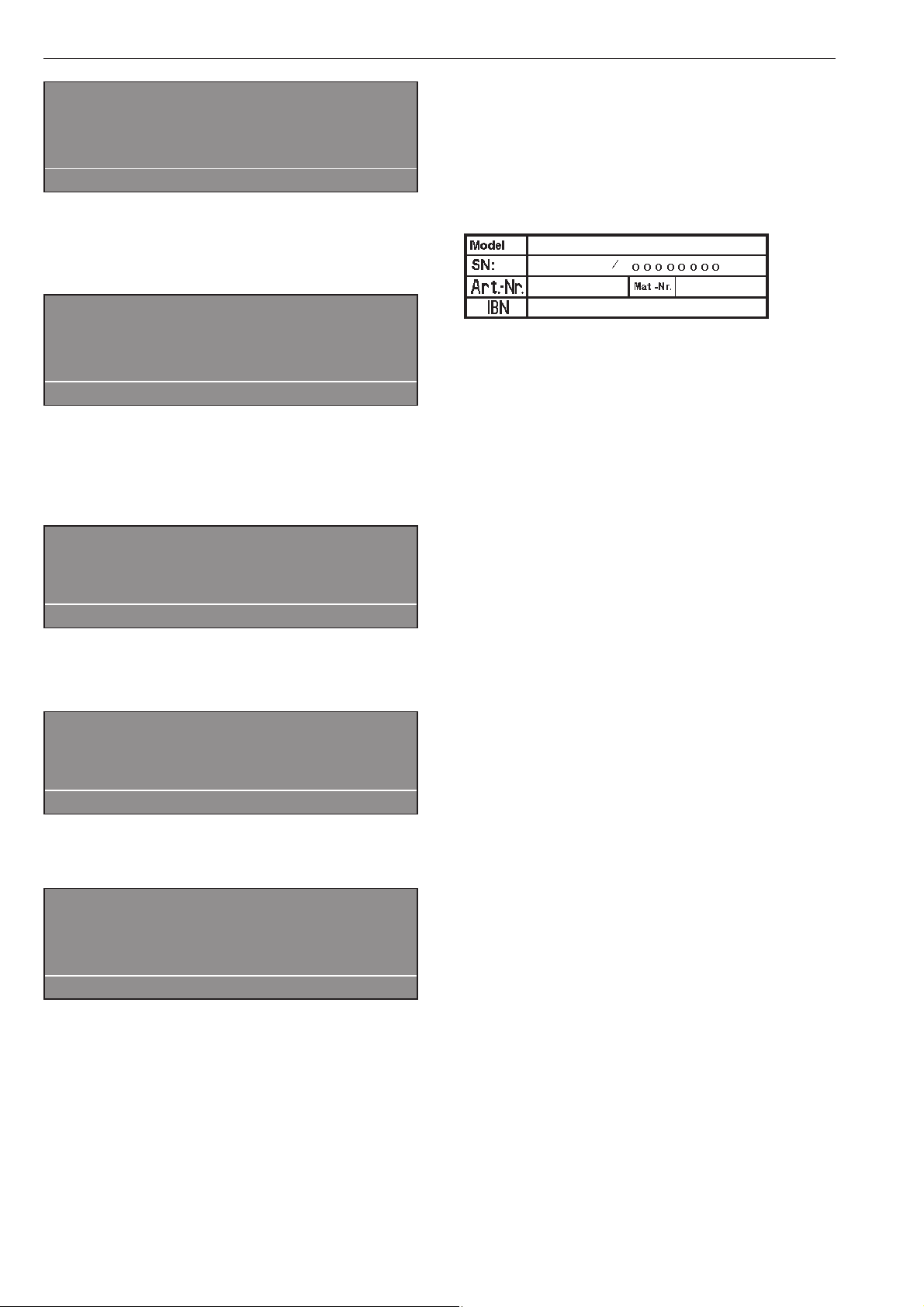
y
Power cut
Programme stop
Press the start button.
f
^
The program can be continued by pressing the
"Start" button.
§
Heating system fault
Programme stopped. Press the start button.
Programme will run without heating
f
^
To continue the program without heating press the
h "Start" button.
Call the Service Department.
§
Heating system fault
Call the Service Department
if restart does not work.
f
^ Call the Service Department.
§
Pressure monitor fault
Call the Service Department
if restart does not work
f
^
If the program still will not start please call the Ser
-
vice Department.
§
Card fault
Card incorrectly inserted in card reader.
A
^
Insert the card the right way round in the card rea
-
der.
After sales service
In the event of any faults please contact the Service
Department.
When contacting the Service Department, please
quote the Model, Serial number (SN) and Material
number (M.Nr) of your machine. These are shown on
the data plate.
This is visible above the door aperture or at the back
of the machine.
Please let the Service Department know any error
message that has appeared in the display.
Should you require spare parts ensure that you only
use genuine original Miele Spare Parts (and re
-
member to let the Spare Parts
Department know the model, serial number and ma
-
terial number of your machine).
Problem solving guide
26
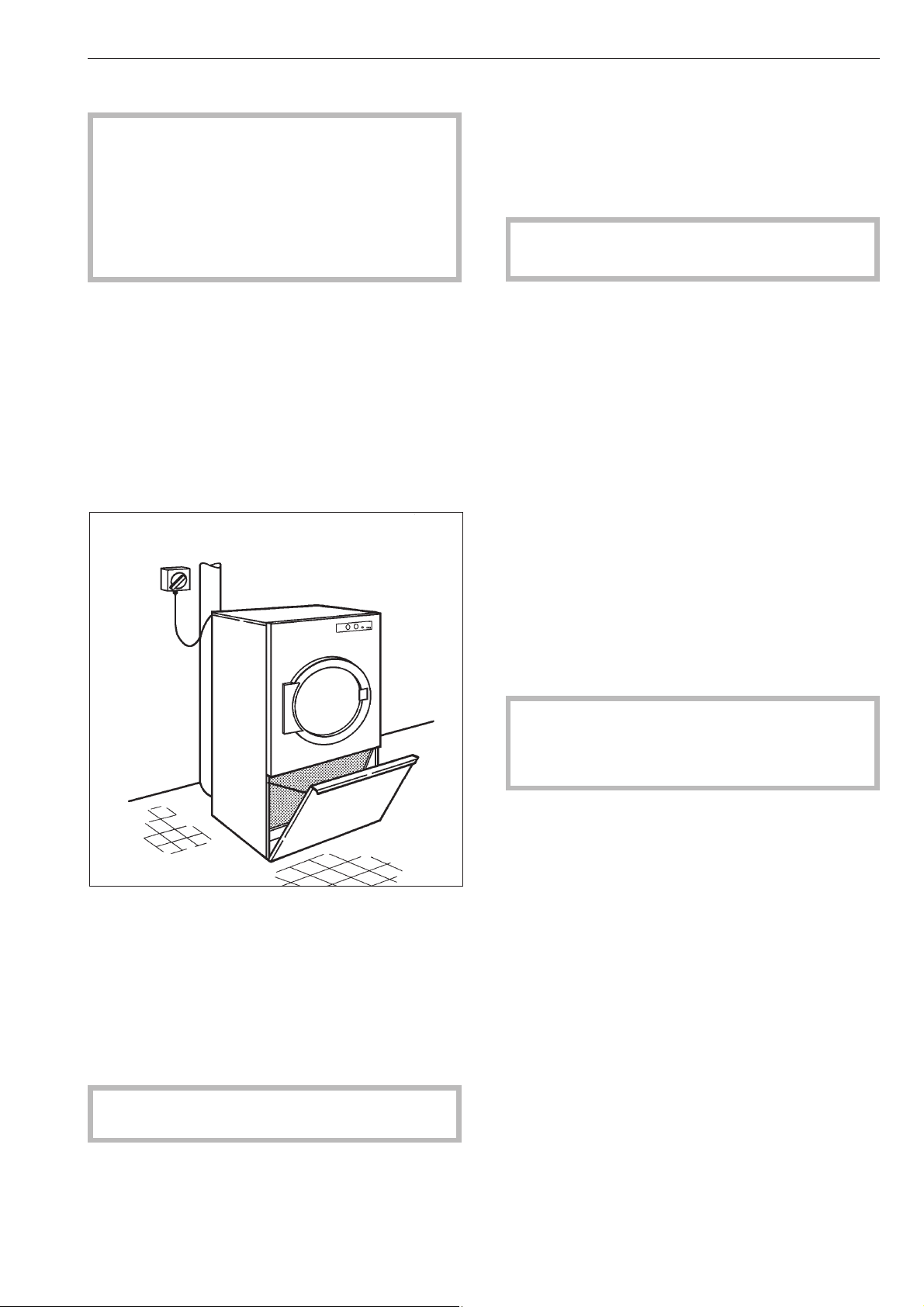
Fluff filter
,
Do not use the machine without the fluff filter in
place. Fire risk.
A damaged fluff filter must be replaced before the
machine is used again.
Otherwise fluff and lint will cause a blockage in the
airways, the heating and the vent ducting, and the
correct functioning of the machine cannot be as
-
sured.
The fluff filter collects any fluff and lint from the laun
-
dry. It should be cleaned at least once a day and
whenever a reminder to clean it appears in the dis
-
play.
If there is a large amount of fluff and lint, the filter will
need frequent cleaning.
The fluff filter must not be removed. When cleaning it,
do so with care and make sure it does not get dama
-
ged.
^
Open the fluff compartment flap.
^
Wipe the fluff off the filter by hand. Never use poin
-
ted or sharp edged objects to do this.
Tumble dryer
Before any cleaning or maintenance switch the dryer
off at the on-site mains switch.
With steam heated dryers the steam supply cut-off
valve must be closed.
,
Do not use a pressure washer or hose to clean
the machine.
^
The housing, control panel and any plastic compo
-
nents should be cleaned using a suitable mild cle
-
aning agent, applied with a soft damp cloth. Rub
dry with a soft cloth after cleaning.
^
If starched laundry has been dried, the drum
should be wiped out with a damp cloth afterwards.
Do not clean the machine with abrasive cleaning
agents.
After cleaning, check the seals for any damage and
make sure the door and fluff compartment flap shut
correctly.
The ventilation inlet to the dryer is located at the
back of the machine. It must not be blocked or hinde
-
red in any way. Do not cover the machine lid with
cloths or similar items.
The area surrounding the machine, in particular
around the air inlet, must be kept free of dust and fluff
at all times. If taken into the dryer, they can cause
faults with the machine.
The following should be checked and cleaned once
a year by a Miele service technician:
– The heaters and heater shaft on electric-heated
dryers.
– The entire interior of the dryer
– The fins on the exhaust fan
,
To ensure the correct performance of the
machine and to prevent the risk of faults and fire, it
is important to check the machine and carry out
maintenance on a regular basis.
Cleaning and care
27
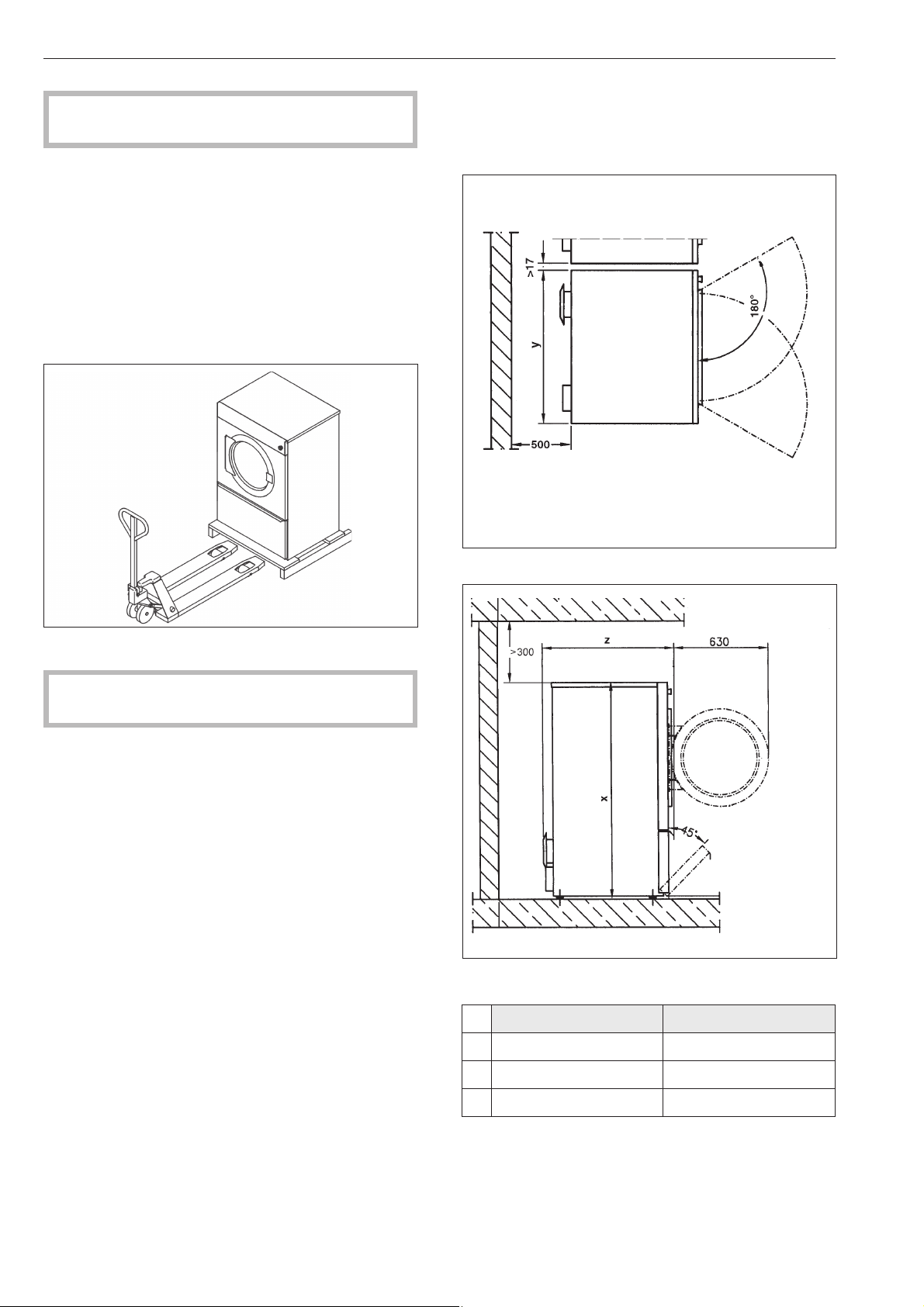
Read the instructions supplied before installing
and using it for the first time.
This machine must be installed and commissioned in
strict accordance with local and national safety and
building regulations by a suitably qualified engineer.
The tumble dryer must only be operated in a room
with sufficient ventilation.
Do not install the tumble dryer in a room where there
is a risk of frost occurring.
,
The machine must not be transported without
its transport pallet in position.
Once the dryer reaches its final location, use a suit-
able lifting mechanism to lift the dryer off its transport
pallet.
To ensure suitable access for future maintenance and
service work, please ensure that the minimum distan
-
ces between the dryer and the wall specified on the
installation diagram are strictly observed.
PT 825X / 833X / 840X PT 850X / 880X
x 1400 mm 1640 mm
y 906 mm 1206 mm
z 852 / 1035 / 1164 mm 1018 / 1384 mm
Installation and connection
28
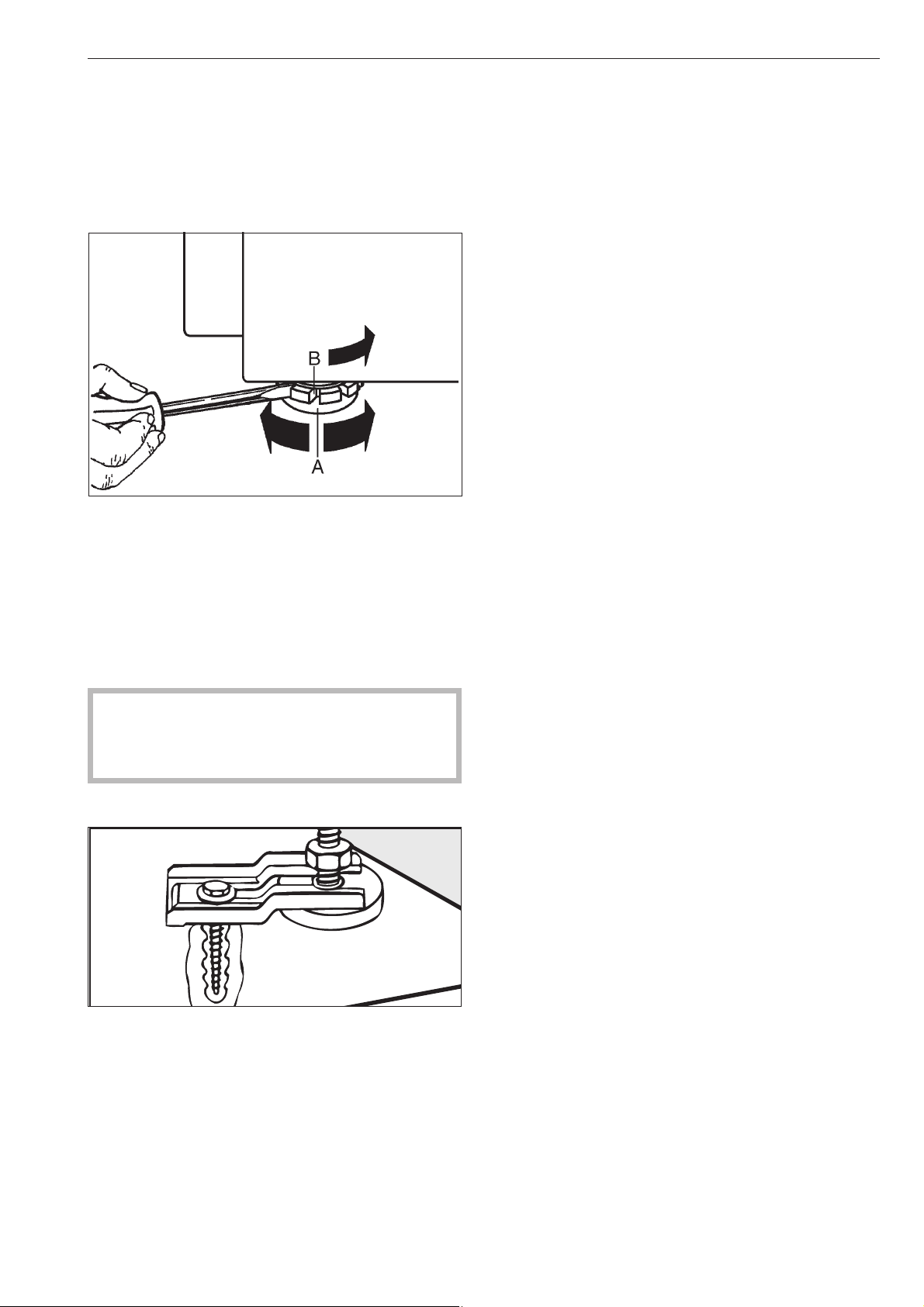
Levelling the machine
The dryer does not require a base. However, make
sure that any uneven areas of the floor are made le
-
vel.
The dryer must be perfectly level to ensure that it
functions correctly.
The screw feet A can be adjusted to align it.
After aligning correctly you will need to use a screw
-
driver to secure discs B to the floor plate.
Installation on a raised plinth
The dryer can be installed on a raised concrete
plinth.
,
If the machine is installed on an on-site base, it
must be secured using the fixing brackets sup-
plied. Otherwise there is the danger of the machi
-
ne moving and falling off the base.
^
Secure the front feet of the dryer with the clamps
supplied.
Reducing the noise level
The dryer is fitted with an exhaust fan which can be
heard during operation.
If this noise disturbs you it is possible to fit a silencer
(available from Miele as an optional accessory) into
the dryer's exhaust duct (see "Installation instructi
-
ons).
Coin mechanism
The dryer can be fitted with a coin mechanism.*
A suitable adapter* is required for this. The machine
has to be reprogrammed by a Miele service technici
-
an.
Empty the coin box every day. This prevents too
many coins or tokens collecting in the coin box,
which could lead to the machine breaking down.
* available from the Miele Spare Parts Department.
Communication module XKM RS232
The dryer can fitted with a communication module
which enables it to be linked to a PC via a serial inter
-
face.
The slot for the communication module is located on
the rear of the machine.
An editor program is available from Miele.
29
Installation and connection

Electrical connection
The electrical connection must only be carried out
by a suitably qualified electrician in accordance
with local and national safety regulations.
The machine must only be connected to the voltage
and frequency shown on the data plate.
If the appliance is hard wired, a multiple-pole separa
-
tor must be installed. Separators with a contact gap
of more than 1/8" (3 mm) are valid as separators.
These include circuit breakers, fuses and relays.
The plug connection or the separator must be acces
-
sible at all times.
Connection should be made in accordance with the
wiring diagram and the installation diagram to a suit
-
able isolator, with an on-off switch which is easily ac
-
cessible for servicing. The wiring and installation dia
-
grams are important for the correct electrical functio
-
ning of the machine.
When the dryer has been connected, check the rota
-
tion direction of the fan. It must turn clockwise. If it
turns counter clockwise, two phases must be ex-
changed at the terminal box.
If the machine is disconnected from the electricity
supply ensure adequate measures are taken to ensu-
re that it cannot be reconnected to the electricity sup-
ply until all work has been carried out.
Potential equalization
A potential equalization must be provided if the leak
current exceeds 10 mA.
See the enclosed wiring and installation diagrams.
Air inlet and exhaust connection
This tumble dryer must only be used when it is con
-
nected to a suitable ducting system. The installation
site must be adequately ventilated.
See the installation instructions supplied.
Steam connection
Steam connection must only be carried out by an aut
-
horised installer.
See the installation instructions supplied.
A steam valve and condensate trap are available to
order from the Miele Spare Parts Department.
,
After setting up and connecting the dryer, en
-
sure that all outer casing parts are correctly fitted
back into position.
Installation and connection
30

PT 825X EL PT 833X EL/D PT 840X EL/D PT 850X EL/D PT 880X EL/D
Height in mm 1400 1400 1400 1640 1640
Width in mm 906 906 906 1206 1206
Depth in mm 852 1035 1164 1018 1384
Depth with door open in
mm
1456 1639 1768 1622 1988
Weight in kg 148/149.5 164.5/167.5/201 190.5/188.5/215.5 238/238.5/265 286/280/318
Drum volume in l 250 325 400 500 800
Max. capacity in kg
(dry laundry)
13 (29lb) 16 (35lb) 20 (44lb) 25 (55lb) 40 (88lb)
Voltage See data plate
Connected load See data plate
Fuse rating See data plate
Test certificates awar
-
ded
See data plate
Max. load bearing
in operation in N
1636/1651 1857/1886/2250 2136/2143/2408 2703/2708/2968 3394/3335/3708
Product safety standard IEC 335-1, IEC 335-2-11
Emission sound
pressure level in
dB (A), EN ISO 11204
<70
Sound power level in
dB (A), EN ISO 9614-2
<80
Technical data
31
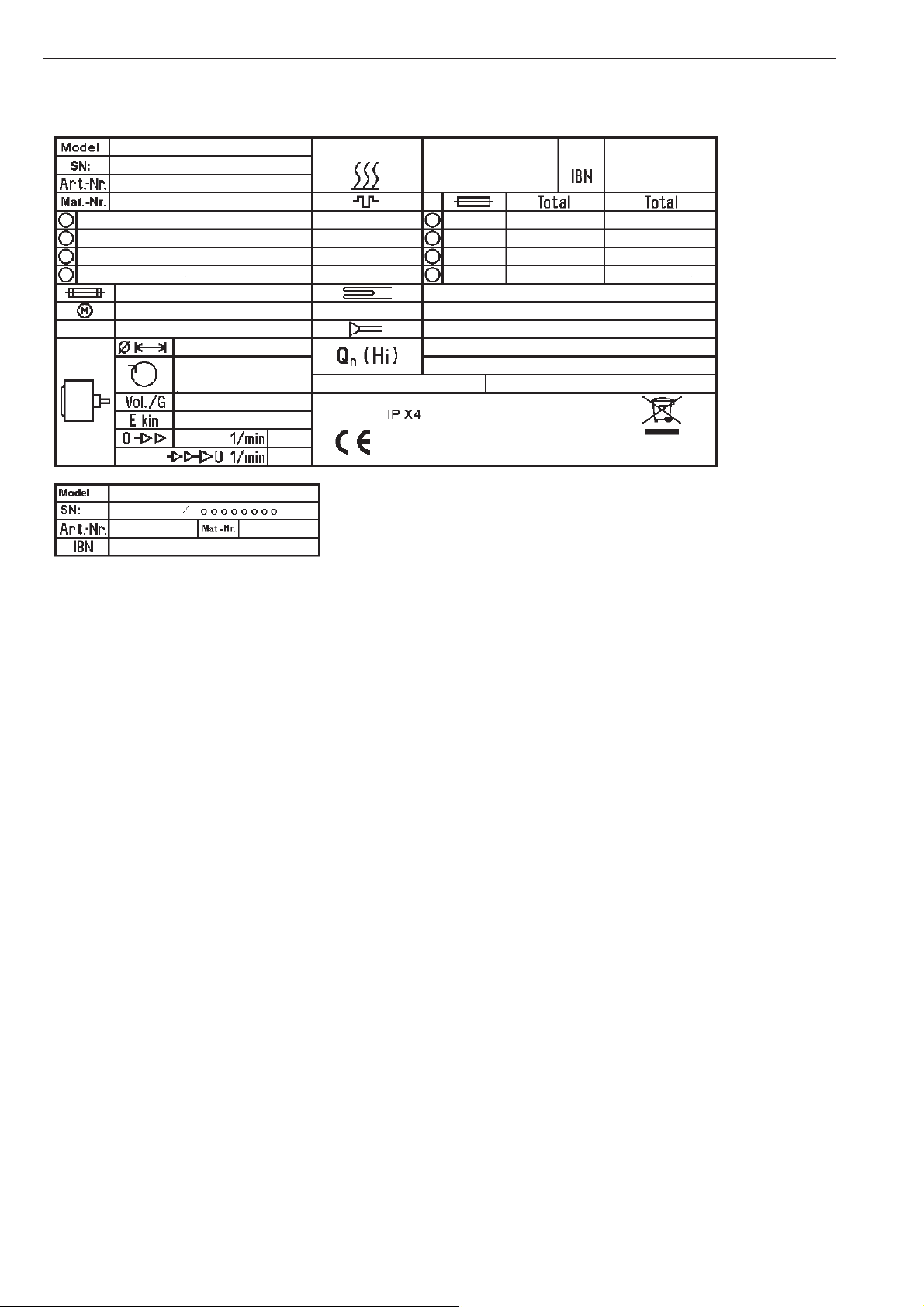
1 Machine type
2 Serial number
3 Article number
4 Material number
5 Voltage/Frequency
6 Control fuse
7 Drive motor
8 Drum data
9 Drum diameter/Drum depth
10 Spin speed
11 Drum volume/Laundry dry weight
12 Kinetic energy
13 Run-up time
14 Braking time
15 Heating
16 Indentification/Year of manufacture
17 Commissioning date
18 Electric heating
19 Fuse rating (on-site)
20 Indirect steam heating
21 Direct steam heating
22 Gas heating
23 Area for test certification labels
Explanation of symbols on the data plate
32
a
b opq
c
drs
e
ft
g
u
i
hj v
k
lw
m
n

1.Sort the laundry
Not all textiles are suitable for machine drying. Please read the instructions given on the gar
-
ment care label.
q = Dry at normal temperature
r = Dry at low temperature
s = Do not tumble dry
^
Sort the laundry according to fibre type and weave
2.Switch the machine on and load the drum
^
Press the "On" button I in
^
Open the drum door and load the laundry
3.Select a program using the rotary selector
Standard programs: 1 Cottons extra dry 0 %
2 Cottons dry 0 %
3 Cottons damp 20 %
4 Cottons damp 25 %
5 Cottons damp 40 %
6 Minimum iron dry 0 %
7 Minimum iron damp 10 %
8 Minimum iron damp 20 %
9 Woollens 5 min.
10 Delicates 20%
11 Timed drying cold air 15 min.
12 Timed drying hot air 20 min.
13 Proofing
14 Outerwear
4.Press the start button and the program selected will commence
5.A buzzer will sound at the end of the program
^
Open the drum door and unload the laundry
6.If no more laundry is to be processed:
^
Close the drum door
^
Then switch the dryer off using the 0 "Off" switch
^
Check the fluff / lint filter and clean if necessary.
Abbreviated operating instructions PT 8257 / 8337 / 8407 / 8507 / 8807
33
2 Cottons dry
Programme finished
Anti-crease Ready at 12:35
m FC Kf

34

35

Alteration rights reserved/2014
M.-Nr.
07 713 522 / 02
,PSRUWHU
0LHOH/LPLWHG
3URIHVVLRQDO'LYLVLRQ
&OUR6ALLEY$RIVE
6AUGHAN/.,+6
0HONE
&AX
WWWMIELEPROFESSIONALCA
PROFESSIONAL MIELECA
0LHOH3URIHVVLRQDO7HFKQLFDO6HUYLFH
0HONE
&AX
SERVICEPROFESSIONAL MIELECA
*HUPDQ\
0DQXIDFWXUHU
-IELE#IE+'
#ARL-IELE3TRAE
'àTERSLOH
&DQDGD
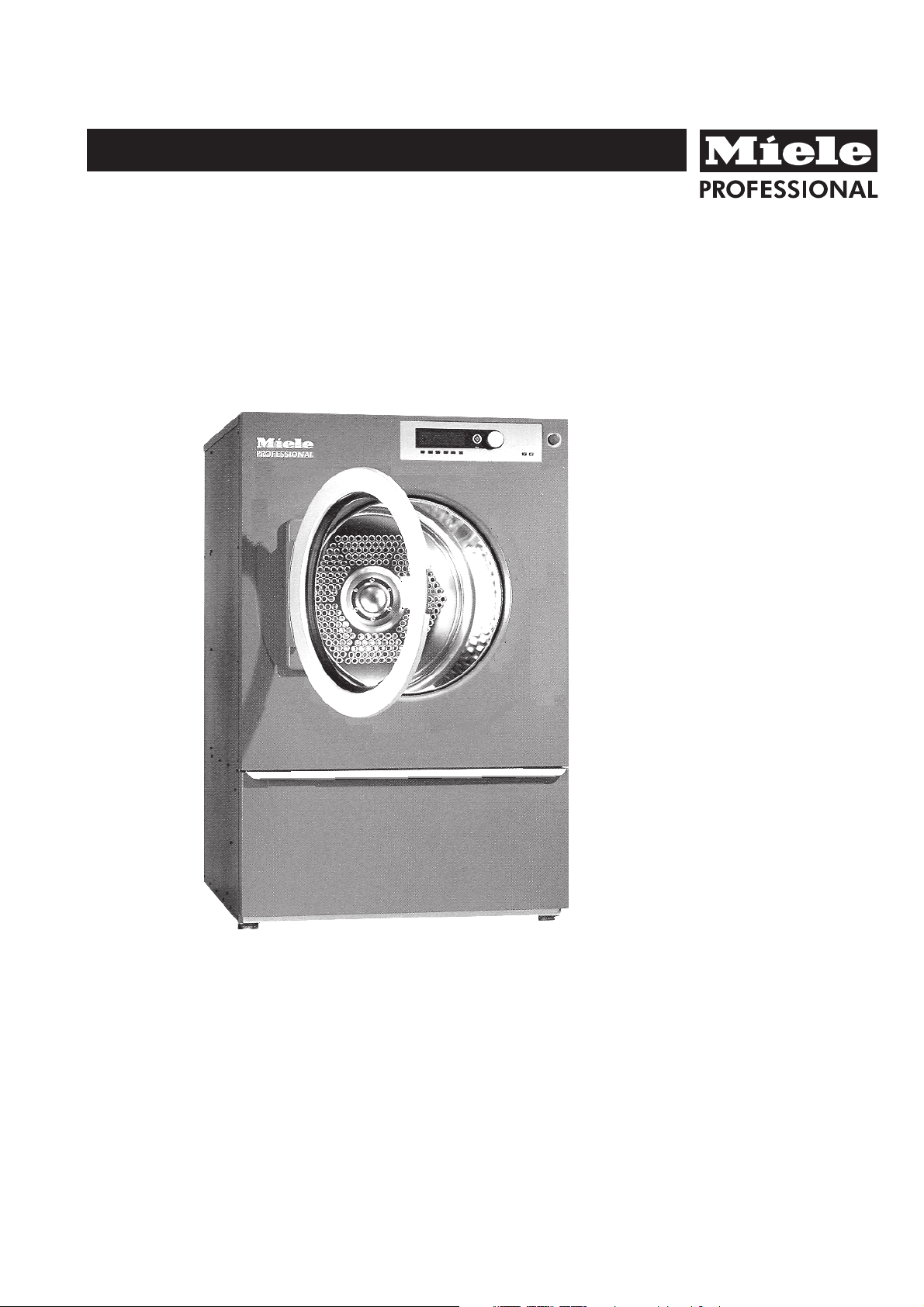
Instructions d'utilisation et d'installation
Sécheuse
PT 8257
PT 8337
PT 8407
PT 8507
PT 8807
Afin de prévenir les accidents
et d'éviter d'endommager l'appareil,
veuillez lire attentivement les instructions
avant de l'installer et de l'utiliser.
M.-Nr. 07 713 522
fr-CA

2

INSTRUCTIONS IMPORTANTES SUR LA SÉCURITÉ . . . . . . . . . . . . . . . . . . . . . . . . . . . . . . . . . . . . . . . . . . . . . . 4
Aidez-nous à protéger l'environnement . . . . . . . . . . . . . . . . . . . . . . . . . . . . . . . . . . . . . . . . . . . . . . . . . . . . . . . . . 7
Description de l'appareil . . . . . . . . . . . . . . . . . . . . . . . . . . . . . . . . . . . . . . . . . . . . . . . . . . . . . . . . . . . . . . . . . . . . . 8
Panneau de commande . . . . . . . . . . . . . . . . . . . . . . . . . . . . . . . . . . . . . . . . . . . . . . . . . . . . . . . . . . . . . . . . . . . . . . . 9
Séchage . . . . . . . . . . . . . . . . . . . . . . . . . . . . . . . . . . . . . . . . . . . . . . . . . . . . . . . . . . . . . . . . . . . . . . . . . . . . . . . . . . 11
Avant la première utilisation . . . . . . . . . . . . . . . . . . . . . . . . . . . . . . . . . . . . . . . . . . . . . . . . . . . . . . . . . . . . . . . . . . . 11
Préparation des articles . . . . . . . . . . . . . . . . . . . . . . . . . . . . . . . . . . . . . . . . . . . . . . . . . . . . . . . . . . . . . . . . . . . . . . 11
1. Mettre la sécheuse sous tension . . . . . . . . . . . . . . . . . . . . . . . . . . . . . . . . . . . . . . . . . . . . . . . . . . . . . . . . . . . . . 12
2. Mettre les articles dans le tambour . . . . . . . . . . . . . . . . . . . . . . . . . . . . . . . . . . . . . . . . . . . . . . . . . . . . . . . . . . . 12
3. Sélectionner un programme . . . . . . . . . . . . . . . . . . . . . . . . . . . . . . . . . . . . . . . . . . . . . . . . . . . . . . . . . . . . . . . . .13
4. Sélectionnez l'option [ "Cycle supplémentaire" ( facultatif). . . . . . . . . . . . . . . . . . . . . . . . . . . . . . . . . . . . . . . 13
5. Régler le programme (facultatif). . . . . . . . . . . . . . . . . . . . . . . . . . . . . . . . . . . . . . . . . . . . . . . . . . . . . . . . . . . . . . 13
6. Utiliser l'option Début différé (facultatif) . . . . . . . . . . . . . . . . . . . . . . . . . . . . . . . . . . . . . . . . . . . . . . . . . . . . . . . . 14
7. Lancer un programme . . . . . . . . . . . . . . . . . . . . . . . . . . . . . . . . . . . . . . . . . . . . . . . . . . . . . . . . . . . . . . . . . . . . . 15
8. Fin d'un programme . . . . . . . . . . . . . . . . . . . . . . . . . . . . . . . . . . . . . . . . . . . . . . . . . . . . . . . . . . . . . . . . . . . . . . . 15
Fonctionnement avec carte à puce/jetons . . . . . . . . . . . . . . . . . . . . . . . . . . . . . . . . . . . . . . . . . . . . . . . . . . . . . . 16
Appareil doté d'un dispositif à carte/jetons C 4060/C 4065/C 4070 . . . . . . . . . . . . . . . . . . . . . . . . . . . . . . . . . . . . 16
Options supplémentaires. . . . . . . . . . . . . . . . . . . . . . . . . . . . . . . . . . . . . . . . . . . . . . . . . . . . . . . . . . . . . . . . . . . . 17
Ajouter ou retirer des articles pendant un programme . . . . . . . . . . . . . . . . . . . . . . . . . . . . . . . . . . . . . . . . . . . . . . 17
Sauter ou exécuter de nouveau certaines étapes du programme. . . . . . . . . . . . . . . . . . . . . . . . . . . . . . . . . . . . . . 17
Arrêt d'un programme . . . . . . . . . . . . . . . . . . . . . . . . . . . . . . . . . . . . . . . . . . . . . . . . . . . . . . . . . . . . . . . . . . . . . . . 18
Annulation d'un programme . . . . . . . . . . . . . . . . . . . . . . . . . . . . . . . . . . . . . . . . . . . . . . . . . . . . . . . . . . . . . . . . . . . 18
K Information . . . . . . . . . . . . . . . . . . . . . . . . . . . . . . . . . . . . . . . . . . . . . . . . . . . . . . . . . . . . . . . . . . . . . . . . . . . . . . . 18
Guide des programmes . . . . . . . . . . . . . . . . . . . . . . . . . . . . . . . . . . . . . . . . . . . . . . . . . . . . . . . . . . . . . . . . . . . . . 19
Programmes de base . . . . . . . . . . . . . . . . . . . . . . . . . . . . . . . . . . . . . . . . . . . . . . . . . . . . . . . . . . . . . . . . . . . . . . . . 19
Couettes . . . . . . . . . . . . . . . . . . . . . . . . . . . . . . . . . . . . . . . . . . . . . . . . . . . . . . . . . . . . . . . . . . . . . . . . . . . . . . . . . . 21
Fauberts . . . . . . . . . . . . . . . . . . . . . . . . . . . . . . . . . . . . . . . . . . . . . . . . . . . . . . . . . . . . . . . . . . . . . . . . . . . . . . . . . . 21
Pompiers. . . . . . . . . . . . . . . . . . . . . . . . . . . . . . . . . . . . . . . . . . . . . . . . . . . . . . . . . . . . . . . . . . . . . . . . . . . . . . . . . . 22
Pressings . . . . . . . . . . . . . . . . . . . . . . . . . . . . . . . . . . . . . . . . . . . . . . . . . . . . . . . . . . . . . . . . . . . . . . . . . . . . . . . . . 22
Questions fréquemment posées . . . . . . . . . . . . . . . . . . . . . . . . . . . . . . . . . . . . . . . . . . . . . . . . . . . . . . . . . . . . . . 24
Messages d'erreur . . . . . . . . . . . . . . . . . . . . . . . . . . . . . . . . . . . . . . . . . . . . . . . . . . . . . . . . . . . . . . . . . . . . . . . . . . 24
Service après-vente . . . . . . . . . . . . . . . . . . . . . . . . . . . . . . . . . . . . . . . . . . . . . . . . . . . . . . . . . . . . . . . . . . . . . . . . . 25
Nettoyage et entretien . . . . . . . . . . . . . . . . . . . . . . . . . . . . . . . . . . . . . . . . . . . . . . . . . . . . . . . . . . . . . . . . . . . . . . 26
Nettoyage du filtre à charpie . . . . . . . . . . . . . . . . . . . . . . . . . . . . . . . . . . . . . . . . . . . . . . . . . . . . . . . . . . . . . . . . . . 26
Sécheuse . . . . . . . . . . . . . . . . . . . . . . . . . . . . . . . . . . . . . . . . . . . . . . . . . . . . . . . . . . . . . . . . . . . . . . . . . . . . . . . . . 26
INSTRUCTIONS IMPORTANTES SUR LA SÉCURITÉ . . . . . . . . . . . . . . . . . . . . . . . . . . . . . . . . . . . . . . . . . . . . . 27
Mise à niveau de la sécheuse . . . . . . . . . . . . . . . . . . . . . . . . . . . . . . . . . . . . . . . . . . . . . . . . . . . . . . . . . . . . . . . . .29
Installation sur une base surélevée . . . . . . . . . . . . . . . . . . . . . . . . . . . . . . . . . . . . . . . . . . . . . . . . . . . . . . . . . . . . . 29
Appareil payant . . . . . . . . . . . . . . . . . . . . . . . . . . . . . . . . . . . . . . . . . . . . . . . . . . . . . . . . . . . . . . . . . . . . . . . . . . . . 29
Module de communication XKM RS232 . . . . . . . . . . . . . . . . . . . . . . . . . . . . . . . . . . . . . . . . . . . . . . . . . . . . . . . . . . 29
Branchement électrique . . . . . . . . . . . . . . . . . . . . . . . . . . . . . . . . . . . . . . . . . . . . . . . . . . . . . . . . . . . . . . . . . . . . . . 30
Entrée d'air/Ventilation . . . . . . . . . . . . . . . . . . . . . . . . . . . . . . . . . . . . . . . . . . . . . . . . . . . . . . . . . . . . . . . . . . . . . . . 30
Raccordement vapeur . . . . . . . . . . . . . . . . . . . . . . . . . . . . . . . . . . . . . . . . . . . . . . . . . . . . . . . . . . . . . . . . . . . . . . . 30
Données techniques. . . . . . . . . . . . . . . . . . . . . . . . . . . . . . . . . . . . . . . . . . . . . . . . . . . . . . . . . . . . . . . . . . . . . . . . 31
Guide des symboles de la plaque signalétique . . . . . . . . . . . . . . . . . . . . . . . . . . . . . . . . . . . . . . . . . . . . . . . . . . 32
Guide de consultation rapide . . . . . . . . . . . . . . . . . . . . . . . . . . . . . . . . . . . . . . . . . . . . . . . . . . . . . . . . . . . . . . . . 33
Table des matières
3
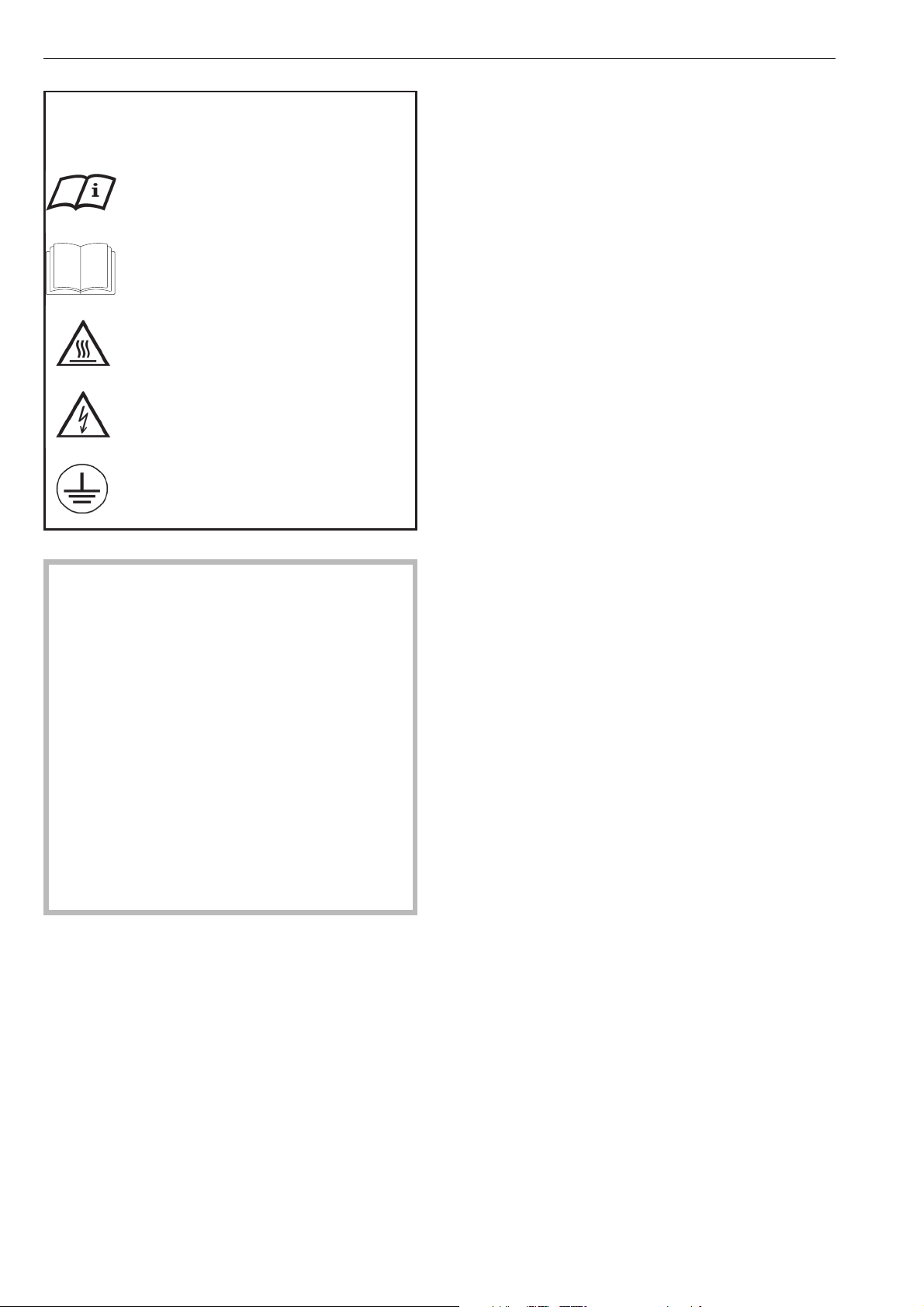
Explication des instructions et mises en
garde figurant sur la sécheuse.
Lisez les instructions d'utilisation
Lisez toutes les instructions, p. ex. les
instructions d'installation
Attention : surfaces chaudes
Attention : tension supérieure à 1 000 V
Mise à la terre
,
VEUILLEZ LIRE ET CONSERVER CES
INSTRUCTIONS
Conservez cette brochure en lieu sûr afin de
pouvoir la consulter au besoin et remettez-la au
prochain utilisateur.
Afin d'éviter de vous blesser ou d'endommager
la sécheuse, veuillez lire toutes les instructions
avant de l'installer ou de l'utiliser.
Les travaux d'installation, de réparation et d'en
-
tretien doivent être effectués par un technicien
autorisé de Miele. Il peut être dangereux de
confier ces travaux à des personnes non quali
-
fiées.
L'utilisation inappropriée de cet appareil peut causer
des blessures et des dommages matériels.
Tous les membres de votre personnel qui sont sus
-
ceptibles d'utiliser cet appareil doivent recevoir une
formation complète sur tous les aspects relatifs à son
utilisation et à la sécurité.
Utilisation appropriée de la sécheuse
~
L'appareil est conçu uniquement pour sécher les
tissus qui ont été lavés avec de l'eau. Vérifiez les éti
-
quettes d'entretien des tissus afin de vous assurer
que les articles peuvent être séchés à la machine.
~
Pour prévenir les incendies, ne séchez pas les
articles suivant dans la machine (sauf dans le cas
de tissus visés par les programmes spéciaux) :
–
Les articles contenant du caoutchouc mousse, du
caoutchouc ou des matières caoutchouteuses.
–
Les articles qui ont été traités au moyen d'agents
nettoyants inflammables.
–
Les articles qui ont été souillés par du fixatif, du
dissolvant de vernis à ongles, etc.
–
Les articles susceptibles d'être graisseux ou hui
-
leux, ou de contenir d'autres résidus, p. ex. les arti
-
cles utilisés en cuisine ou en salon de coiffure.
–
Les balais à franges, les chiffons pour plancher,
etc. lorsqu'ils contiennent des substances telles
que de la cire ou des agents nettoyantts chimi
-
ques.
– Les articles matelassés ou rembourrés, comme les
coussins ou les blousons, qui sont endommagés.
– Les articles qui n'ont pas été suffisamment net-
toyés et qui présentent des tâches de graisse ou
d'huile. Nettoyez les articles particulièrement sales
(p. ex. les vêtements de travail) avec un détergent
spécial. Adressez-vous à un détaillant spécialisé
en produits nettoyants pour obtenir de plus amples
renseignements à ce sujet.
En cas de temps de séchage trop long, certains tis-
sus délicats peuvent parfois s'enflammer spontané
-
ment. Lorsque le programme de séchage est termi
-
né, ou si une panne de courant se produit, sortez im
-
médiatement les articles de la sécheuse. Gardez un
extincteur à proximité de la sécheuse.
~
Les articles ne doivent pas être retirés de la sé
-
cheuse avant la fin de la phase de refroidissement.
Des articles qui n'ont pas refroidi avant d'être empilés
ou emballés risquent de s'enflammer spontanément.
~
Veillez à vider toutes les poches des articles afin
d'éviter que des objets inflammables tels que des bri
-
quets, des allumettes, des bougies ou des produits
cosmétiques ne se retrouvent dans la sécheuse.
~
Si la sécheuse est utilisée dans un endroit acces
-
sible au public, le propriétaire de l'appareil est tenu
de s'assurer que l'utilisation de l'appareil est sécuri
-
taire.
INSTRUCTIONS IMPORTANTES SUR LA SÉCURITÉ
4

Sécurité
,
L'appareil est conçu uniquement pour sécher
les tissus qui ont été lavés avec de l'eau.
~
N'utilisez la sécheuse que si celle-ci est raccordée
à un conduit d'évacuation de l'air, et si la pièce dans
laquelle elle est installée est suffisamment ventilée.
~
Les personnes qui ne possèdent pas les capaci
-
tés physiques, l'expérience ou les connaissances re
-
quises pour utiliser cet appareil doivent être supervi
-
sées ou formées par une personne responsable.
~
Ne laissez pas les enfants jouer près de la sé
-
cheuse ni monter dedans ou dessus. Ne laissez pas
les enfants jouer avec les commandes de l'appareil
ou utiliser celui-ci.
~
Refermez toujours la porte de la sécheuse après y
avoir placé ou en avoir sorti des articles, et ce, afin
d'éviter :
–
que des enfants puissent grimper dans la sé
-
cheuse ou y cacher de petits objets;
–
que des petits animaux puissent grimper dans la
sécheuse.
~
N'utilisez pas l'appareil si le panneau de com-
mande, les fils électriques ou les câbles sont endom-
magés.
~
Veiller à ne pas endommager, retirer ou passer
outre les composants de sécurité ou les éléments de
contrôle de la sécheuse.
~
N'utilisez pas la sécheuse lorsque des parties de
la structure de l'appareil ont été retirées ou lorsque
les pièces mobiles ou électriques sont dénudées et
accessibles.
~
Les températures sont très élevées au niveau du
hublot et du cadre de la porte du tambour. Les arti
-
cles sont très chauds lorsqu'il sont retirés trop tôt de
la sécheuse. Risque de brûlure!
~
Ne touchez pas les éléments produisant de la va
-
peur (suivant les modèles d'appareil). Vous pourriez
vous ébouillanter!
~
Vérifiez toujours que le tambour est immobile
avant d'en sortir les articles. Ne mettez jamais les
mains dans un tambour en mouvement.
~
Prenez garde aux charnières de la porte du tam
-
bour et au clapet du filtre à charpie; vous pourriez
vous pincer ou vous couper. Utilisez les poignées.
~
L'espace nécessaire à l'ouverture de la porte du
tambour ne doit pas être encombré par des portes ou
par d'autres éléments.
~
N'utilisez pas la sécheuse si le filtre à charpie inté
-
gré n'est pas en place. Risque d'incendie!
Si le filtre à charpie est endommagé, il doit être rem
-
placé immédiatement.
~
N'utilisez et n'entreposez jamais d'essence, de
substances à base de pétrole, ou d'autres substan
-
ces facilement inflammables à proximité de l'appareil.
Risques d'incendie et d'explosion!
~
Une accumulation de charpie pourrait obstruer le
système de circulation de l'air et les systèmes de
chauffage et de ventilation, et nuire ainsi à l'efficacité
de la sécheuse. Veillez à nettoyer le filtre à charpie
avant ou après chaque séchage.
~
N'utilisez pas de laveuse à pression pour nettoyer
la sécheuse.
~
Avant de faire réparer l'appareil ou de le mettre au
rebut, enlevez la porte du compartiment de séchage.
~
Les agents nettoyants ou désinfectants contien
-
nent souvent des composés chlorés. Si ces produits
sèchent sur des éléments en acier inoxydable,
ceux-ci risquent de rouiller. Afin de protéger la sé
-
cheuse, utilisez uniquement des agents nettoyants et
désinfectants sans chlore pour le lavage ménager et
la désinfection, ainsi que pour le nettoyage des surfa
-
ces en acier inoxydable. Au moindre doute concer
-
nant un agent nettoyant, communiquez avec le fabri
-
cant. Si un produit contenant du chlore est renversé,
rincez avec de l'eau puis essuyez avec un chiffon
doux.
INSTRUCTIONS IMPORTANTES SUR LA SÉCURITÉ
5

Sécurité électrique
~
Assurez-vous que l'appareil a été correctement
installé et mis à la terre par un technicien autorisé.
Pour des raisons de sécurité électrique, cet appareil
doit être mis à la terre z. Cette exigence élémentaire
en matière de sécurité doit impérativement être vé
-
rifiée par un électricien qualifié. En cas de doute,
consultez un électricien qualifié.
~
Avant d’installer ou de réparer l’appareil, coupez
l’alimentation électrique.
~
Les réparations d'appareils électriques et au gaz
doivent être effectuées uniquement par un technicien
autorisé Miele, conformément au normes de sécurité
nationales et locales. Les réparations effectuées par
des personnes non qualifiées pourraient causer des
blessures ou endommager l’appareil.
~
Utilisez uniquement des pièces d'origine de Miele.
L'utilisation de pièces d'un autre fabricant pourrait
nuire au rendement de l'appareil et entraîner l'annula
-
tion des garanties.
~
Ne réparez ou ne remplacez aucune pièce de la
sécheuse et n'entreprenez aucune réparation à
moins qu'il n'en soit indiqué autrement dans les pré
-
sentes instructions. Communiquez avec le service
technique de Miele pour obtenir de l'aide.
~
N'utilisez pas la sécheuse dans la même pièce
que des machines de nettoyage fonctionnant avec
des solvants qui contiennent des CFC. Les vapeurs
dégagées par la combustion de ces solvants se
transforment en acide chlorhydrique, une substance
qui cause des dommages aux articles et à l'appareil.
Si des machines utilisant ce type de solvants sont uti-
lisées dans une autre pièce, assurez-vous qu'il n'y a
aucun échange d'air avec cette pièce. Veillez à ce
que la sécheuse soit alimentée qu'avec de l'air
propre et frais.
~
L'entrée d'air est située à l'arrière de la sécheuse.
Veillez à ne jamais obstruer cette ouverture. Par
conséquent, ne recouvrez pas le dessus de la sé
-
cheuse avec des couvertures ou des draps.
~
L'entretien de la sécheuse doit être assuré en
temps opportun par un professionnel, afin de préve
-
nir les baisses de rendement, les dysfonctionnements
et les risques d'incendie.
CONSERVEZ CES
INSTRUCTIONS
INSTRUCTIONS IMPORTANTES SUR LA SÉCURITÉ
6

Élimination des produits d'emballage
La boîte de carton et les produits d'emballage protè
-
gent l'appareil durant le transport. Ces matériaux ont
été conçus en vue d'une élimination écologique et ils
peuvent être recyclés.
Pour prévenir tout risque de suffocation chez les en
-
fants, débarrassez-vous des emballages, sacs et au
-
tres produits en plastique en toute sécurité et gar
-
dez-les hors de la portée des enfants.
Veuillez recycler ces articles.
Mise au rebut d'un ancien appareil
Les anciens appareils peuvent contenir des maté
-
riaux recyclables. Veuillez communiquer avec le
centre de recyclage de votre localité pour savoir
comment les recycler.
Assurez-vous que votre appareil ne présente aucun
danger pour les enfants jusqu'à ce qu'il soit mis au
rebut. Avant de mettre au rebut votre ancien appareil,
débranchez-le, coupez le cordon d'alimentation élec
-
trique et retirez la porte par mesure de sécurité.
Aidez-nous à protéger l'environnement
7
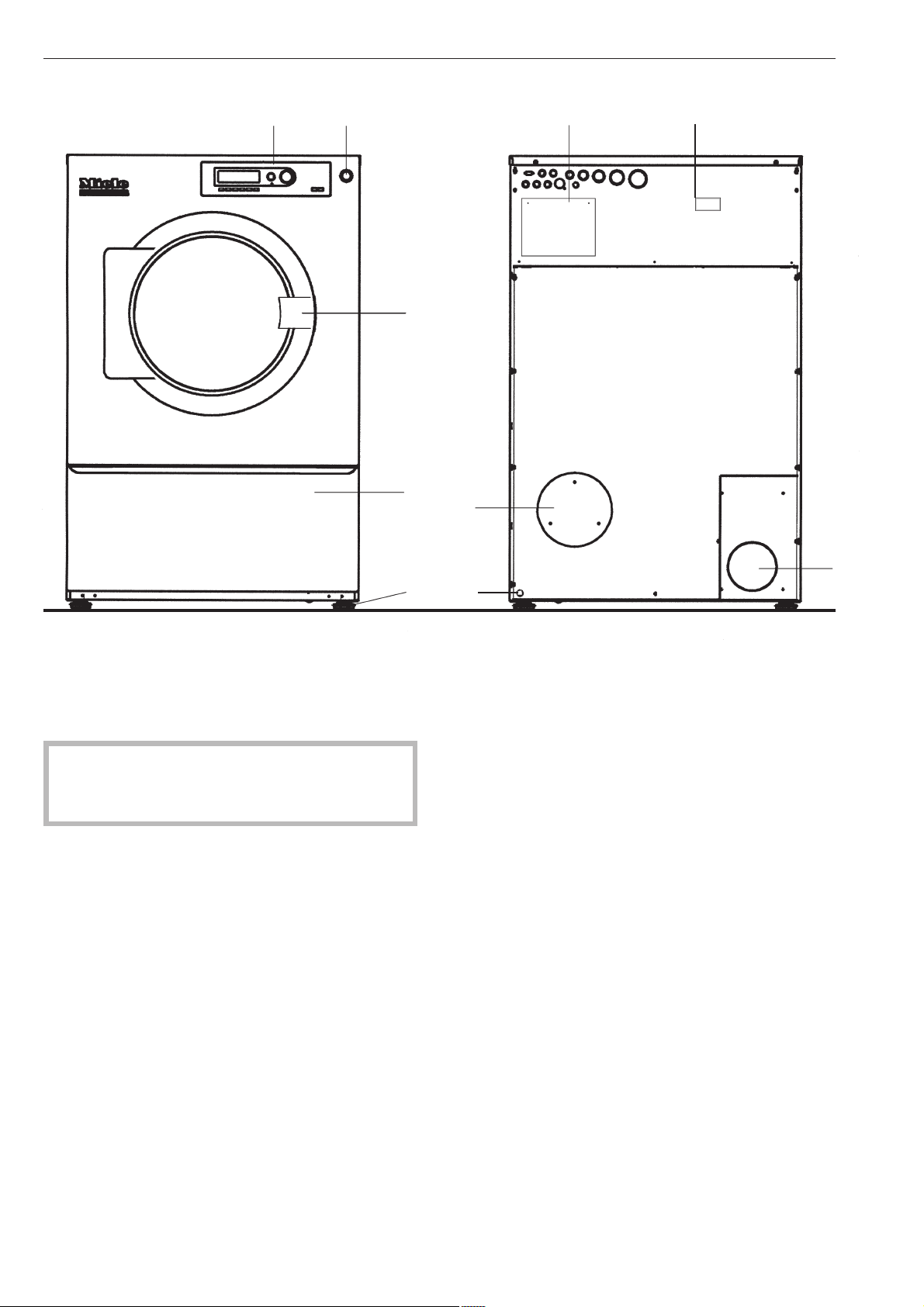
a Touche d'arrêt d'urgence
N'utilisez cette touche qu'en cas d'urgence.
Une fois le problème résolu, débloquez l'interrupteur
en tournant le bouton vers la droite.
N'utilisez jamais la touche d'arrêt d'urgence pour
éteindre la sécheuse lorsque celle-ci fonctionne
normalement.
b Panneau de commande
c Porte du tambour
Tirez sur la poignée pour ouvrir la porte du tambour.
d Clapet du filtre à charpie
Tirez sur la poignée pour ouvrir le clapet du filtre à
charpie.
e Quatre pieds à hauteur réglable
f Branchement électrique
g Entrée d'air
h Collier d'évacuation de l'air
i Régulateur de tension automatique
j Port du module de communication
Description de l'appareil
8
f
g
h
j
i
ab
c
d
e

Panneau de commande
a Affichage*
1 Blanc/Couleurs intensif 0 %
2 Blanc/Couleurs normal + 0 %
3 Blanc/Couleurs normal 20 %
FC A
Lorsque l'appareil est mis sous tension, l'écran d'ac-
cueil apparaît brièvement, puis la liste des program-
mes s'affiche. Le dernier programme utilisé est mis
en évidence.
b Touches de fonctions
Les fonctions des touches diffèrent selon l'état de
l'appareil. Les fonctions sont affichées à l'écran,
au-dessus des touches.
c Touche de mise en marche
Le cercle lumineux clignote pour vous indiquer que
vous pouvez lancer un programme sélectionné ou
choisir un programme.
Une fois qu'un programme est lancé, vous pouvez
appuyer sur la touche de mise en marche pour reve
-
nir à l'écran d'origine.
*L'affichage varie selon les programmes disponibles.
d Interface optique PC
Permet de transférer des données entre les comman
-
des de l'appareil et un ordinateur personnel.
e Bouton rotatif
Tournez le bouton rotatif pour sélectionner les élé
-
ments d'affichage et les zones de saisie.
Appuyez sur le bouton rotatif pour confirmer le choix
de l'élément sélectionné ou pour valider des change-
ments.
f Lecteur de carte
Si l'appareil a été programmé pour fonctionner avec
une carte, seuls les programmes enregistrés sur la
carte pourront être utilisés pour le séchage des arti-
cles.
g I Interrupteur Marche
h 0 Interrupteur Arrêt
Description de l'appareil
9
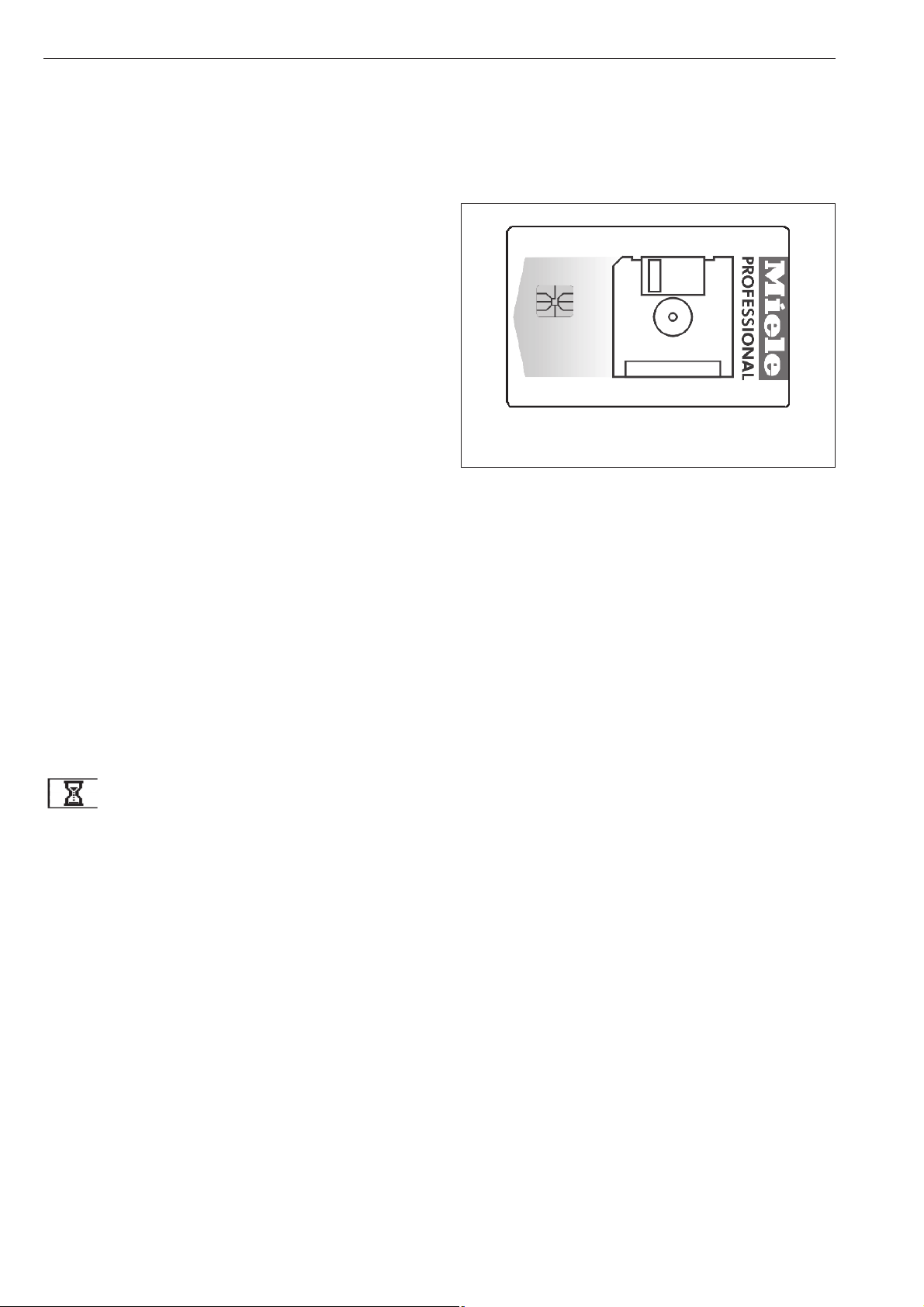
Touches de commande
f Arrêt/Fin
Appuyez sur cette touche pour arrêter un programme
sélectionné ou mettre fin à un programme déjà arrêté.
[ Cycle supplémentaire
Le cycle de programme choisi (p. ex. séchage préa
-
lable) sera ajouté au programme sélectionné.
FC Fonctions
Appuyez sur cette touche pour choisir temporaire
-
ment une autre langue d'affichage ou accéder au ni
-
veau Superviseur.
m Début différé
Appuyez sur cette touche pour choisir l'heure de dé
-
but du programme à l'écran.
K Information
Pour afficher l'information relative au programme.
ü Passer
Il est possible de sauter les cycles d'un programme
ou de les exécuter de nouveau.
A Retour à l'écran précédent
e/- Ligne suivante ou ligne précédente
S Enregistrer
Consultez le Manuel de programmation
$ Programme verrouillé
S'il est indiqué qu'un programme est "verrouillé" cela
signifie qu'une minute après le démarrage du pro-
gramme vous ne pouvez plus l'interrompre ou y
mettre fin à l'aide de la touche Arrêt.
% Programme déverrouillé
\ Données de fonctionnement
Transfert de données
Carte d'utilisateur
Aucun programme n'est enregistré sur cette carte.
Pour transférer des données des commandes de
l'appareil à la carte, et inversement, consultez le Ma
-
nuel de programmation.
Il est possible d'enregistrer jusqu'à 30 programmes
de 6 cycles sur la carte.
Le dos de la carte peut être étiqueté.
Insérez la carte dans le sens de la flèche.
Description de l'appareil
10

Avant la première utilisation
^
Essuyez l'intérieur du tambour à l'aide d'un chiffon
doux et sec.
Préparation des articles
,
Certains tissus ne peuvent pas être séchés
dans une sécheuse à culbutage. Vérifiez les
instructions du fabricant figurant sur les étiquettes
d'entretien des articles.
q = Séchage à température normale
r = Séchage à basse température
s = Ne pas sécher à la machine
^
Triez les articles selon le type et la couleur des tis
-
sus. Cela permettra d'assurer un séchage uniforme
et d'éviter d'endommager les tissus.
,
Pour prévenir les incendies, ne séchez pas
les articles suivant dans la machine (sauf dans
le cas de tissus visés par les programmes
spéciaux) :
Les articles contenant du caoutchouc mousse, du
caoutchouc ou des matières caoutchouteuses.
Les articles qui ont été traités au moyen d'agents
nettoyants inflammables.
Les articles qui ont été souillés par du fixatif, du
dissolvant de vernis à ongles, etc.
Les articles susceptibles d'être graisseux ou
huileux, ou d'être saturés d'autres résidus, p. ex.
les articles utilisés en cuisine ou en salon de
coiffure.
Les balais à franges, les chiffons pour plancher,
etc. lorsqu'ils contiennent des substances telles
que de la cire ou des agents nettoyants
chimiques.
Les articles matelassés ou rembourrés, comme les
coussins ou les blousons, qui sont endommagés.
Les articles qui n'ont pas été suffisamment
nettoyés et qui présentent des tâches de graisse
ou d'huile. Nettoyez les articles particulièrement
sales (p. ex. les vêtements de travail) avec un
détergent spécial.
Renseignements importants concernant le sé
-
chage :
–
Les articles en pure laine ou en laine mélangée
peuvent feutrer. Pour le séchage de ces articles,
utilisez uniquement le programme Laine
–
Les articles en pur lin peuvent devenir rugueux
lorsqu'il sont séchés à la machine. Consultez les
instructions du fabricant avant de procéder au sé
-
chage de ces articles.
–
Les articles avec des boucles métalliques, des
crochets, des boutons-pression, des fermetures
éclair etc. doivent être placés dans un sac de tissu
(p. ex. une taie d'oreiller) avant d'être placés dans
la sécheuse, afin d'éviter de rayer ou de cabosser
le tambour.
–
Les articles dont les fermetures éclair métalliques
sont fermées peuvent causer un court-circuit au ni
-
veau des électrodes des capteurs situées sur les
arêtes du tambour, et le processus de séchage
risque alors de finir trop tard ou de ne pas s'arrê
-
ter. Les fermetures éclair de ces articles doivent
donc être ouvertes avant le séchage.
– Les tissus à mailles ont tendance à rétrécir. Un
processus de séchage trop puissant accentue cet
effet. N'utilisez pas les programmes de séchage
les plus puissants pour le séchage de ces tissus.
– Les tissus empesés peuvent être séchés à la ma-
chine. Choisissez un programme avec un taux
d'humidité résiduelle convenant au repassage à la
main ou en machine.
Triez les articles en fonction du niveau de séchage
nécessaire. Il n'est pas nécessaire de trier les arti-
cles par taille.
–
Les taies d'oreiller et les housses de couettes doi
-
vent être fermées pour éviter que des articles plus
petits ne s'y glissent.
–
Pour des raisons de rendement, remplissez com
-
plètement la sécheuse. Une sécheuse surchargée
ne donne pas des résultats de séchage satisfai
-
sants et abîme les tissus.
–
Si le dernier cycle de rinçage dans la laveuse a été
réalisé à l'eau chaude, les articles nécessiteront un
temps de séchage inférieur, en raison du taux
d'humidité résiduelle inférieur et de la chaleur rési
-
duelle qu'ils contiendront.
Séchage
11
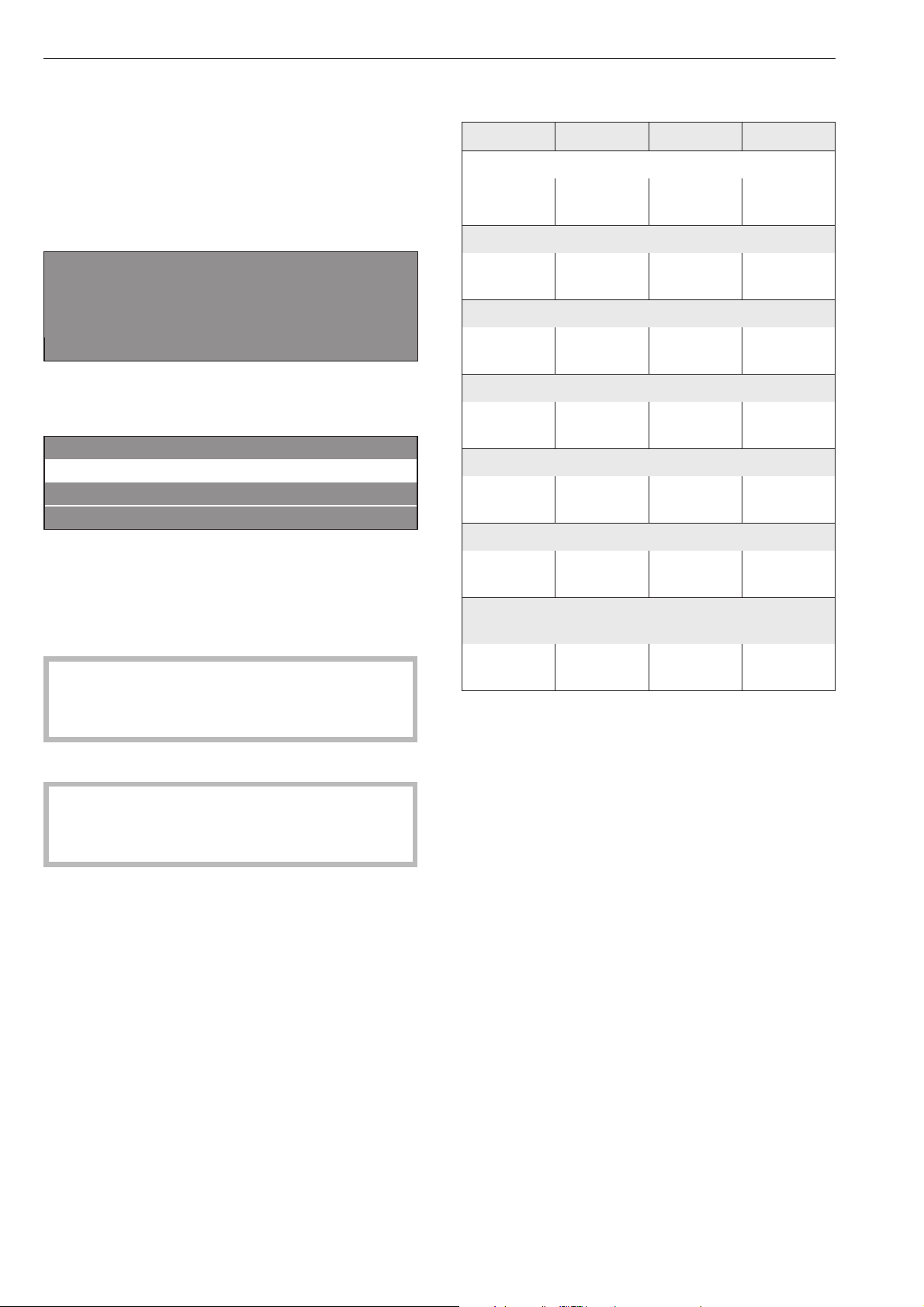
1. Mettre la sécheuse sous tension
^
Ouvrez la valve à gaz ou à vapeur (sur place).
^
Activez l'alimentation principale (sur place).
^
Appuyez sur la touche l "Marche" pour mettre la sé
-
cheuse en marche.
L'écran d'accueil apparaît.
M
PROFESSIONAL
PT 8xx7
Bienvenue
La liste des programmes s'affiche. Le dernier pro
-
gramme lancé est mis en évidence.
1 Blanc/Couleurs intensif 0 %
2 Blanc/Couleurs normal + 0 %
3 Blanc/Couleurs normal 20 %
FC A
2. Mettre les articles dans le tambour
^ Ouvrez la porte de l'appareil.
^ Mettez les articles dans le tambour sans les com-
pacter.
Vérifiez qu'aucun corps étranger ne se trouve
dans le tambour, p. ex. des récipients de dosage
de détergent ou de la monnaie.
^
Fermez la porte de l'appareil.
Pour éviter d'endommager les tissus, assu
-
rez-vous que les articles ne resteront pas coincés
dans la porte.
Poids maximal des articles
PT 8257 PT 8337 PT 8407 PT 8507
Volume du tambour
66 gal
(250 l)
86 gal
(325 l)
106 gal
(400 l)
132 gal
(500 l)
1, 2, 3, 4, 5 Coton
22-29 lb
(10-13 kg)
29-35 lb
(13-16 kg)
35-44 lb
(16-20 kg)
44-55 lb
(20-25 kg)
6, 7, 8 Tissus synthétiques
11 lb
(5 kg)
14,5 lb
(6,6 kg)
17,5 lb
(8 kg)
22 lb
(10 kg)
9 Laine
9lb
(4 kg)
11,5 lb
(5,2 kg)
14 lb
(6,4 kg)
17,5 lb
(8 kg)
10 Délicats/Synthétiques
4,4 lb
(2 kg)
5,7 lb
(2,6 kg)
7lb
(3,2 kg)
9lb
(4 kg)
11, 12 Programmes à minuterie
22-29 lb
(10-13 kg)
29-35 lb
(13-16 kg)
35-44 lb
(16-20 kg)
44-55 lb
(20-25 kg)
13, 14 Articles imperméables,
vêtements d'extérieur
11-14,5 lb
(5-6,6 kg)
13,2-20 lb
(6-9 kg)
17,5-24,3 lb
(8-11 kg)
22-28,7 lb
(10-13 kg)
Pour en savoir plus, consultez la section "Réglage du
programme – Poids des articles"
Séchage
12

3. Sélectionner un programme
La sécheuse est équipée d'un système de capteur
électronique qui permet de contrôler l'humidité rési
-
duelle des articles, ainsi que d'une minuterie, pour
plus de sécurité.
Une fois que le niveau de séchage souhaité est at
-
teint, les articles sont refroidis et le programme de sé
-
chage est alors terminé.
1 Blanc/Couleurs intensif 0 %
2 Blanc/Couleurs normal + 0 %
3 Blanc/Couleurs normal 20 %
FC A
Choisissez un programme en tournat le bouton rotatif
(p. ex. Programme 2 Blanc/Couleurs normal +).
Pour obtenir plus de précisions sur les program
-
mes de bases, consultez le "Guide des program
-
mes".
4. Sélectionnez l'option [ "Cycle
supplémentaire" ( facultatif)
(Option non disponible pour les programmes de
base)
^ Appuyez sur le bouton rotatif pour valider le pro-
gramme sélectionné.
22 Blanc/Couleurs normal + 22,0/22,0 lb
15 % Séchage 176 °F
Refroidissement e
[ m A
^
Appuyez sur la touche [ "Cycle supplémen
-
taire" si vous souhaitez sélectionner un cycle de
programme, p. ex. séchage préalable.
22 Blanc/Couleurs normal + 22,0/22,0 lb
24 % Séchage préalable
0% Séchage e
[ m A
Le symbole [ est mis en évidence.
Vous pouvez désélectionner cette fonction en ap
-
puyant de nouveau sur la touche.
Si vous ne souhaitez pas apporter d'autre modifica
-
tions au programme :
^
Appuyez sur la touche "MARCHE". Le programme
de séchage débute.
5. Régler le programme (facultatif)
Pour modifier les réglages d'un programme avant de
le lancer :
^
Appuyez sur le bouton rotatif pour valider le pro
-
gramme sélectionné.
2 Blanc/Couleurs normal + 22,0/22,0 lb
0% Séchage 176°F
Refroidissement e
m A
Le poids maximal autorisé des articles s'affiche sur le
côté droit de l'écran.
Poids des articles
Le poids des articles peut être réglé manuellement.
2 Blanc/Couleurs normal + 22,0 22 lb
0% Séchage 176°F
Refroidissement e
m A
^ Tournez le bouton rotatif jusqu'à ce que l'élément
de menu "Poids des articles" soit mis en évidence,
et appuyez sur le bouton pour valider ce choix.
Tournez le bouton rotatif pour choisir le poids des
articles désiré, et appuyez sur le bouton pour
confirmer votre choix.
Température
Vous pouvez régler la température de séchage par
paliers de 1 ºF ou 1 ºC, de 86 ºF/30 ºC à 203 ºF/95 ºC
maximum.
^
Sélectionnez "Température" à l'aide du bouton rota
-
tif et appuyez sur le bouton pour valider ce choix.
2 Blanc/Couleurs normal + 22,0 lb
0% Séchage 176°F
Refroidissement e
m A
^
Tournez le bouton rotatif pour choisir la tempéra
-
ture désirée, et appuyez sur le bouton pour confir
-
mer votre choix.
Séchage
13

Humidité résiduelle
Vous pouvez régler le taux d'humidité résiduelle par
paliers de 1 %, de –4%à10%.
^
Sélectionnez "Humidité résiduelle" (0 %) à l'aide du
bouton rotatif et appuyez sur le bouton pour valider
ce choix.
2 Blanc/Couleurs normal + 22,0 lb
0% Séchage 176°F
Refroidissement
m A
^
Tournez le bouton rotatif pour choisir la taux d'hu
-
midité résiduelle désiré, et appuyez sur le bouton
pour confirmer votre choix.
^
Appuyez sur la touche "Marche" pour lancer le pro
-
gramme.
Les étapes du déroulement du programme s'affichent
à l'écran une fois que le programme est lancé.
2 Blanc/Couleurs normal +
0% Séchage >40 %{
Refroidissement Fin à 12:15
mKf
Le taux actuel d'humidité résiduelle (>40%) et {
chauffage électrique en marche sont affiché a côte
de "Séchage", à la deuxième ligne de l'écran. La troi-
sième ligne indique le cycle de programme suivant.
La mention "Fin à 12:35" qui apparaît sur le côté droit
de l'écran indique l'heure de fin du programme.
L'élément d'affichage "Fin à" s'ajuste automatique
-
ment. Plusieurs cycles de programme doivent être
terminés pour que l'heure de fin affichée soit exacte.
6. Utiliser l'option Début différé (facultatif)
Utilisez m la touche "Début différé" pour retarder le
lancement d'un programme.
Réglage de l'heure du début différé
^
Sélectionnez un programme.
^
Appuyez sur la touche m "Début différé".
2 Blanc/Couleurs normal + 22,0 lb
Hdébut: 2 :10 Date début: 13.2.2006
Actionnez la touche Marche aprèslasélection.
m A
L'heure et la date actuelles s'affichent à l'écran. La
zone de saisie de l'heure est mise en évidence.
^
Tournez le bouton rotatif pour sélectionner la zone
de saisie "Heure". Appuyez sur le bouton rotatif
pour choisir l'heure. Sélectionnez l'heure de début
souhaitée à l'aide du bouton rotatif, et appuyez sur
le bouton pour confirmer votre choix.
^
Tournez le bouton rotatif pour sélectionner la zone
de saisie "Minutes". Appuyez sur le bouton rotatif
pour choisir les minutes. Sélectionnez les minutes
de début souhaitées à l'aide du bouton rotatif, et
appuyez sur le bouton pour confirmer votre choix.
^ Tournez le bouton rotatif pour sélectionner la zone
de saisie "Date de début". Appuyez sur le bouton
rotatif pour choisir la date de début. Tournez le
bouton rotatif pour choisir la date de début sou-
haitée, et appuyez sur le bouton pour confirmer
votre choix.
^
Appuyez sur la touche "Marche".
Le programme débutera à l'heure choisie.
2 Blanc/Couleurs normal + 22,0 lb
0% Séchage
14:07 -13.2.2006 Début: 14:10-13.2.2006
m A
L'heure et la date actuelles apparaissent à l'écran,
ainsi que l'heure de début du programme.
^
Si la porte de la sécheuse est ouverte avant l'heure
programmée de début différé, appuyez de nou
-
veau sur la touche "Marche".
Annuler le début différé
^
Appuyez sur la touche m "Début différé" ou sur la
touche A "Retour" pour annuler la fonction début
différé..
Séchage
14

7. Lancer un programme
^
Appuyez sur la touche "Marche" pour lancer le pro
-
gramme.
8. Fin d'un programme
2 Blanc/Couleurs normal +
Fin du programme
Infroissable Fin à 12:15
m FC Kf
Lorsque le programme est terminé, un message s'af
-
fiche à l'écran et la sonnerie retentit.
^
Ouvrez la porte de l'appareil.
^
Retirez les articles.
Si les articles ne sont pas retirés de l'appareil à la fin
du prgramme, un cycle «infroissable» se met auto
-
matiquement en marche. Le tambour tourne à inter
-
valles réguliers de sorte que la formation de plis est
réduite.
,
Les articles ne doivent pas être retirés de la
sécheuse avant la fin du programme de séchage.
La phase de refroiddissement doit être terminée.
Des articles qui n'ont pas refroidi avant d'être empilés
ou emballés risquent de s'enflammer spontanément.
^ Vérifiez le filtre à charpie et nettoyez-le au besoin.
Fermez le clapet du filtre à charpie, sur lequel vous
risquez sinon de trébucher.
2 Blanc/Couleurs normal +
Fin de programme
CONTROLER LE FILTRE
A
Un message s'affiche à l'écran lorsqu'un nettoyage
du filtre à charpie est nécessaire.
^
Nettoyez le filtre à charpie dès la fin du program
-
me.
^
Fermez la porte de l'appareil.
^
Appuyez sur la touche 0 "Arrêt" pour éteindre l'ap
-
pareil.
^
Coupez l'alimentation électrique (sur place).
^
Fermez la valve à gaz ou à vapeur (sur place).
Séchage
15
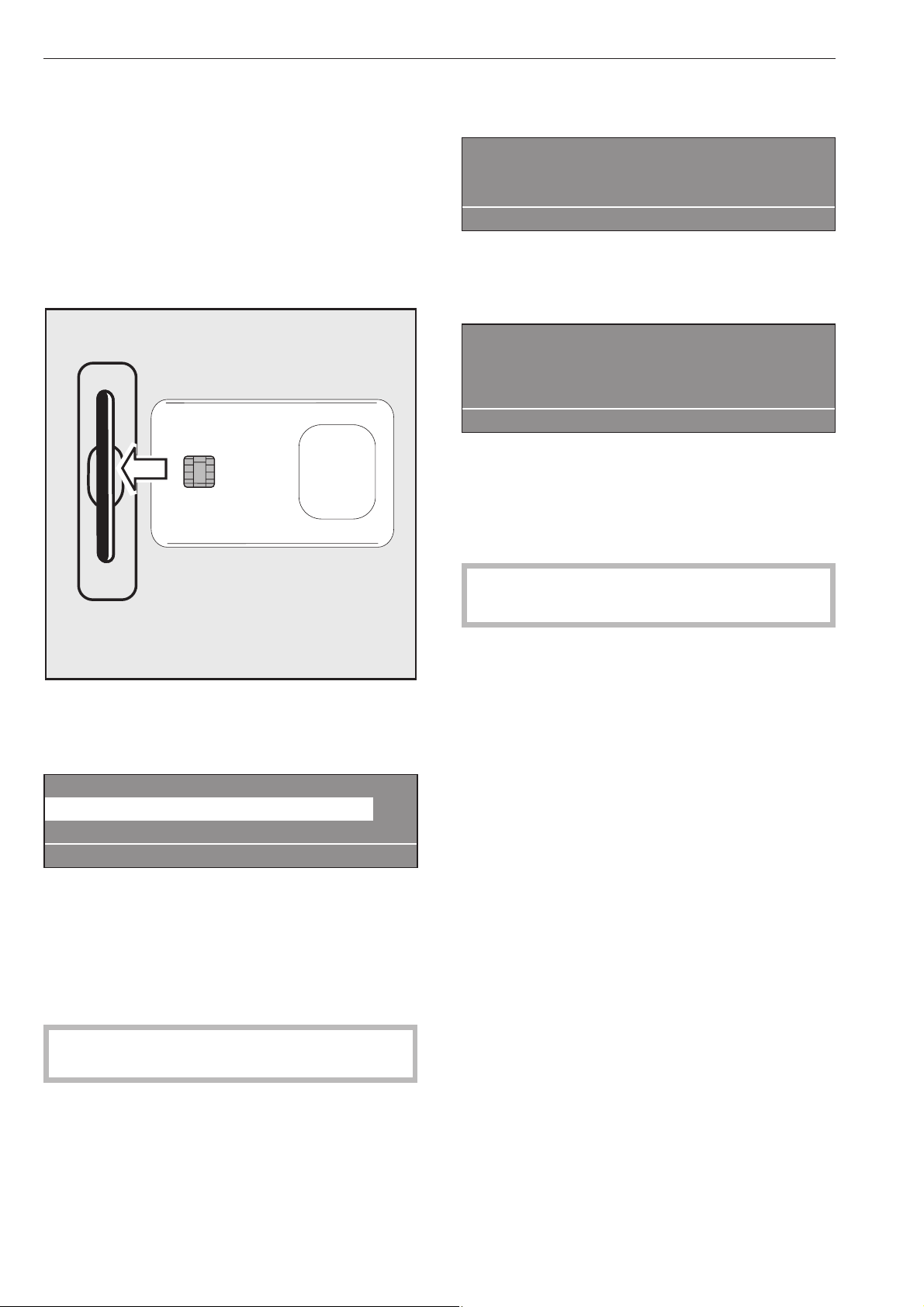
Si l'appareil est programmé pour fonctionner avec
une carte, seuls les programmes de séchage enre
-
gistrés sur la carte pourront être utilisés.
Les cartes sur lesquelles un programme est enregis
-
tré sont programmées pour fonctionner avec un cer
-
tain type d'appareil. Les cartes vierges peuvent fonc
-
tionner dans tous les appareils.
^
Appuyez sur la touche l "Marche" pour mettre la sé
-
cheuse en marche.
L'écran d'accueil apparaît.
^ Insérez la carte dans le sens de la flèche.
Une liste des programmes enregistrés sur la carte
s'affiche à l'écran.
Fonctionnement avec carte
17 Séchage vêtements de protection 113 °F
18 Tissus synthétiques 140 °F
FC A
^
Tournez le bouton rotatif pour sélectionner un pro
-
gramme. Appuyez sur ce bouton pour confirmer
votre choix.
^
Appuyez sur la touche "Marche".
^
Retirez la carte du lecteur. Une fois le programme
terminé, il est effacé de la mémoire de l'appareil.
,
N'insérez rien d'autre que la carte dans le lec
-
teur.
Si la carte n'a pas été correctement insérée dans
le lecteur
§
Défaut carte
Carte mal insérée dans lecteur.
Continuer: touche Marche
ü f
^
Insérez la carte correctement dans le lecteur.
Si la carte n'est pas adaptée à ce type d'appareil
Fonctionnement avec carte
Les programmes enregistrés sur la carte
fonctionnent uniquement
sur un appareil de type PT 7251
A
^
Insérez une carte convenant au type d'appareil
que vous utilisez.
Appareil doté d'un dispositif à
carte/jetons C 4060/C 4065/C 4070
Suivez attentivement les instructions pour éviter de
perdre la monnaie ou les jetons insérés.
1.Remplissez la sécheuse, puis fermez la porte
du tambour.
2. Appuyez sur la touche l "Marche".
3.Sélectionnez un programme.
4. Insérez les pièces de monnaie ou les jetons.
5. Appuyez sur la touche "Marche".
Fonctionnement avec carte à puce/jetons
16

Ajouter ou retirer des articles pendant un
programme
Il est possible d'ouvrir la porte du tambour en cours
de programme pour ajouter ou retirer des articles.
^
Ouvrez la porte.
,
Attendez que le tambour soit immobile avant
d'en sortir les articles. Ne mettez jamais les mains
dans un tambour en mouvement.
2 Blanc/Couleurs normal +
Arrêt programme
Porte ouverte. Fermer la porte
FC f
^
Ajoutez ou retirez des articles.
^
Fermez la porte de l'appareil.
Il est possible que le ventilateur se mette en marche
par mesure de sécurité si la température du tambour
est trop élevée.
^
Appuyez sur la touche "Marche".
Le programme se poursuit.
Sauter ou exécuter de nouveau certaines
étapes du programme
Il est possible de sauter les étapes d'un programme
ou de les exécuter de nouveau.
^
Appuyez sur la touche f "Fin" pour arrêter le pro
-
gramme.
2 Blanc/Couleurs normal +
Arrêt programme
ü f
^
Appuyez sur la touche ü "Passer/Répéter"
L'étape en cours s'affiche à l'écran. Consultez la sec
-
tion "Structure de programme" du Manuel de pro
-
grammation.
Passer/Répéter -> 2 Blanc/Couleurs normal +
Arrêt programme
Phase1:Séchage e
S A
Phase1:Séchage
Cycle1:Séchage préalable
-
S A
^ Sélectionnez "Phase" à l'aide du bouton rotatif, et
appuyez sur le bouton pour valider ce choix.
Phase : Choisissez 1 Séchage ou 2 Refroidisse-
ment et confirmez votre choix.
^
Sélectionnez "Cycle" à l'aide du bouton rotatif, et
appuyez sur le bouton pour valider ce choix.
Cycle : Choisissez Séchage 1-10 ou Refroidisse
-
ment 1-10 et confirmez votre choix.
^
Appuyez sur la touche S "Enregistrer" et sur la
touche "Marche" pour sauter les cycles du pro
-
gramme.
^
Pour revenir en arrière sans sauter les cycles du
programme :
Appuyez sur la toucheA "Retour" pour revenir à
l'étape à laquelle le programme a été arrêté.
Options supplémentaires
17

Arrêt d'un programme
^
Appuyez sur la touche f "Fin" pour arrêter le pro
-
gramme.
2 Blanc/Couleurs normal +
Arrêt programme
Presser touche Marche.
ü f
^
Appuyez sur la touche "Marche" pour poursuivre le
programme.
Annulation d'un programme
Pour annuler un programme, appuyez deux fois sur la
touche f "Fin".
K Information
^
Pour obtenir des renseignements sur un program
-
me en cours d'exécution, appuyez sur la touche K
"Information".
Exemples :
2 Blanc/Couleurs normal +
Début différé: 7.10.2003
Heure début: 9:47 e
m K f
Durée écoulée:0h23min
Temps restant:0h11min
Heure fin programme: 22:21 e
Phase1:Séchage
Cycle1:Séchage préalable
Temp. air act. évacué: 138 °F e
Temp. de référence de l'air fourni : 302 °F
Charge maximale : Non
Infroissable : 3s./87s./60min e
2 Blanc/Couleurs normal +
Recirculation/clapet ventilation : Recirculation -
Signal fin cycle : Oui
A
^
Appuyez sur la touche A "Retour" pour revenir à
l'étape de déroulement du programme.
Langue
La langue d'affichage peut être modifiée temporaire
-
ment à l'aide du drapeau.
1 Blanc/Couleurs intensif 0 %
2 Blanc/Couleurs normal + 0 %
3 Blanc/Couleurs normal 20 %
FC A
^
Appuyez sur la touche FC.
Réglages retour <-
Menu principal Langue
Niveau de programmation
FC A
^
Sélectionnez "Langue" à l'aide du bouton rotatif.
Réglages svenska
Langue english (US)
retour <-
FC A
^ Sélectionnez la langue d'affichage désirée à l'aide
du bouton rotatif, et appuyez sur le bouton pour
confirmer votre choix.
Une fois votre choix confirmé, les indications à l'écran
s'affichent dans la langue sélectionnée.
Les indications à l'écran s'afficheront de nouveau
dans la langue initialement programmée :
–
si aucune action n'a été exercée pendant 5 minu
-
tes;
–
5 minutes après la fin du programme;
–
en cas d'ouverture de la porte.
Options supplémentaires
18
Programmes de base
Programme Type de tissu charge max.
1 Blanc/Couleurs intensif 0%
(Normal+) 74°C
Tissus multicouches ou très épais, en co
-
ton et en lin, qui ne sont pas complète
-
ments secs à l'issue du programme
"Blanc/Couleurs normal +".
PT 8257 22-29 lb (10-13 kg)
PT 8337 29-35 lb (13-16 kg)
PT 8407 35-44 lb (16-20 kg)
PT 8507 44-55 lb (20-25 kg)
2 Blanc/Couleurs normal + 0%
(Normal) 74°C
Articles fait d'une seule couche et articles
multicouches, en coton et en lin.
3 Blanc/Couleurs normal 20 %
(Repassage machine) 74°C
Tissus en coton et en lin qui doivent être
repassés à la machine.
4 Blanc/Couleurs normal 25 %
(Repassage machine) 74°C
5 Blanc/Couleurs normal 40 %
(Repassage machine) 74°C
6 Non repassable normal+0%
(Normal) 60°C
Fibres synthétiques, coton ou tissus mé-
langés.
PT 8257 11 lb (5,0 kg)
PT 8337 14,5 lb (6,6 kg)
PT 8407 17,5 lb (8,0 kg)
PT 8507 22 lb (10 kg)
7 Non repassable normal 10 %
(Repassage machine) 60°C
8 Non repassable normal 20 %
(Repassage machine) 60°C
9 Laine 5 min.
74°C
Programme permettant de duveter les ar
-
ticles en laine ayant fait l'objet d'un sé
-
chage préalable.
PT 8257 9 lb (4 kg)
PT 8337 11,5 lb (5,2 kg)
PT 8407 14 lb (6,4 kg)
PT 8507 17,5 lb (8 kg)
10 Fin 20 %
40°C
Articles délicats en fibres synthétiques,
coton, ou tissus mélangés.
PT 8257 4,5 lb (2 kg)
PT 8337 6 lb (2,6 kg)
PT 8407 7 lb (3,2 kg)
PT 8507 9 lb (4 kg)
Guide des programmes
19
Programme Type de tissu charge max.
11 Minuterie froid 15 min. Pour le duvetage des articles. PT 8257 22-29 lb
(10-13 kg)
PT 8337 29-35 lb
(13-16 kg)
PT 8407 35-44 lb
(16-20 kg)
PT 8507 44-55 lb
(20-25 kg)
12 Minuterie chaud 20 min.
74°C
Pour le séchage d'articles de petite taille, ou le sé
-
chage complémentaire d'un article.
13 Imprégnation
(Normal) 60°C
Pour les tissus qui peuvent être séchés à la ma
-
chine
p. ex. les articles en microfibres, les vêtements de
ski et d'extérieur, les articles en coton dense et fin
(la popeline), les nappes.
PT 8257 11-14,5 lb
(5-6,6 kg)
PT 8337 14,5-20 lb
(6,6-9 kg)
PT 8407 17,5-24,5 lb
(8-11 kg)
PT 8507 22-29 lb
(10-13 kg)
Ce programme comporte une étape supplémentaire pour le traitement des articles im
-
perméables. Les articles imperméables doivent uniquement être traités au moyen d'un
produit hydrofuge "pour tissus à membrane". Ces produits sont à base de fluorures.
Risque d'incendie. Ne séchez pas de tissus qui ont été traités au moyen de produits
contenant de la paraffine.
14 Outdoor
60°C
Vêtements d'extérieur séchables dans une sé
-
cheuse à culbutage.
La température se réfère à l'température d'évacuation.
Guide des programmes
20
Couettes
Programme Type de tissu charge max.
Couettes plumes Couettes et oreillers en plumes ou en duvet PT 8257 1 couette ou 2 oreillers
22 lb (10 kg)
PT 8337 3 oreillers ou
1oreiller + 1 couette
29 lb (13 kg)
PT 8407 4 oreillers ou
2 oreillers + 1 couette ou
2 couettes
35,5lb (16 kg)
PT 8507 5 oreillers ou
3 oreillers + 1 couette ou
2 couettes
44 lb (20 kg)
Il s'agit de valeurs approximatives,
susceptibles de varier en fonction de
la taille et de l'épaisseur des articles.
74°C, 0 % d'humidité résiduelle après séchage, séchage supplémen
-
taire, refroidissement
Couettes synth. Couettes et oreillers synthétiques
74°C, 0 % d'humidité résiduelle après séchage, séchage supplémen
-
taire, refroidissement
Couettes fibre natu
-
relle
Couettes et couvertures en fibres naturelles
74°C, 3 minutes de séchage, refroidissement
Les couettes en fibres naturelles ne doivent pas être complètement sé
-
chées à la sécheuse, sinon elles feutrent. Un temps de séchage court est
conseillé.
Fauberts
,
Les articles qui n'ont pas été correctement nettoyés et qui contiennent des résidus (de cire ou de produits
chimiques) peuvent provoquer des incendies. Assurez-vous de nettoyer complètement les articles particulière-
ment sales : utilisez pour cela une quantité de détergent suffisante et choisissez un nettoyage à haute tempé-
rature. En cas de doute, nettoyez ces articles plusieurs fois.
Programme Type de tissu charge max.
Fauberts Balais à franges en coton PT 8257 22 lb (10 kg)
PT 8337 29 lb (13 kg)
PT 8407 35,5 lb (16 kg)
PT 8507 44 lb (20 kg)
74°C, 0 % d'humidité résiduelle après séchage, refroidissement
Fauberts microfibres Balais à franges en microfibres
60°C, 0 % d'humidité résiduelle après séchage, refroidissement
Lavettes Chiffons en microfibres, chiffons à poussière PT 8257 12,5 lb (5,6 kg)
PT 8337 15,5 lb (7 kg)
PT 8407 19 lb (8,6 kg)
PT 8507 24,5 lb (11 kg)
60°C, 0 % d'humidité résiduelle après séchage, refroidissement
La température se réfère à l'température d'évacuation.
Guide des programmes
21
Pompiers
Programme Type de tissu charge max.
Masques Masque de protection avec serre-tête Quantité max. d'attaches/de masques
PT 8257 4 8
PT 8337 4 12
PT 8407 4 16
PT 8507 4 12
50°C, 45 minutes de séchage, refroidissement
Les masques de protection ne doivent être séchés dans la sécheuse
que s'ils sont fixés au tambour à l'aide de plaques de montage spéciales
(accessoires offerts en option).
Tenue de protection Uniformes des pompiers, p. ex. vêtements en
Nomex
®
,
blousons, pantalons
PT 8257 de1à2uniformes (1 blou
-
son + 2 pantalons ou 2 blousons)
PT 8337 environ 2 uniformes (ou 3
blousons)
PT 8407environ 3 uniformes
PT 8507 de3à4uniformes
PT 8257 11-14,5 lb (5-6,6 kg)
PT 8337 14,5-20 lb (6,6-9 kg)
PT 8407 17,5-22 lb (8-10 kg)
PT 8507 22-29 lb (10-13 kg)
74°C, 0 % d'humidité résiduelle après séchage, séchage supplémen
-
taire, refroidissement
Imprégn. tenue
protec.
Articles traités avec un agent imperméabilisant
74°C, 0 % d'humidité résiduelle après séchage, séchage supplémen
-
taire, refroidissement
Les articles imperméables doivent uniquement être traités au moyen d'un
produit hydrofuge "pour tissus à membrane". Ces produits sont à base
de fluorures.
Risque d'incendie. Ne séchez pas de tissus qui ont été traités au moyen
de produits contenant de la paraffine.
Pressings
Programme Type de tissu charge max.
Aquanett délicat Articles non lavables PT 8257 9-11 lb (4-5 kg)
PT 8337 11-14,5 lb (5-6,6 kg)
PT 8407 14,5-17,5 lb (6,6-8 kg)
PT 8507 17,5-22 lb (8-10 kg)
50°C, 3 minutes de duvetage, refroidissement
Aquanett soie Articles non lavables qui se froissent facilement PT 8257 9-11 lb (4-5 kg)
PT 8337 11-14,5 lb (5-6,6 kg)
PT 8407 14,5-17,5 lb (6,6-8 kg)
PT 8507 17,5-22 lb (8-10 kg)
60°C, 15 % d'humidité résiduelle après séchage, refroidissement
Aquanett intensif Articles lavables PT 8257 11-14,5 lb (5-6,6 kg)
PT 8337 14,5-20 lb (6,6-9 kg)
PT 8407 17,5-24,5 lb (8-11 kg)
PT 8507 22-29 lb (10-13 kg)
74°C, 0 % d'humidité résiduelle après séchage, refroidissement
La température se réfère à l'température d'évacuation.
Guide des programmes
22
Centres équestres
,
Pour éviter d'endommager le tambour de la sécheuse, les boucles métalliques, les crochets et les œille
-
tons doivent être enveloppés.
Programme Type de tissu charge max.
Couvertures cheval Couvertures de chevaux, tapis de selle, guêtres de tendon,
bandages, licous
PT 8257 22 lb (10 kg)
PT 8337 29 lb (13 kg)
PT 8407 35,5 lb (16 kg)
PT 8507 44 lb (20 kg)
60°C, 0 % d'humidité résiduelle après séchage, séchage supplémentaire, refroidisse
-
ment
Couvertures cheval
laine
Couvertures de chevaux essentiellement constituées de laine
74°C, 5 minutes de séchage, refroidissement
La température se réfère à l'température d'évacuation.
Modèle
Charge
Tapis de
selle
Couvertures
d'été
Couvertures
d'hiver
PT 8257 7 2 1
PT 8337 9 2-3 1-2
PT 8407 11 2-3 1-2
PT 8507 12 3 2
Guide des programmes
23

Messages d'erreur
,
Les réparations d'appareils électriques, au
gaz ou à vapeur doivent être effectuées unique
-
ment par un technicien autorisé Miele, conformé
-
ment au normes de sécurité nationales et locales.
Les réparations effectuées par des personnes non
qualifiées pourraient causer des blessures ou en
-
dommager l’appareil. Le fabricant ne peut être
tenu responsable des travaux effectués par des
personnes non qualifiées.
Lors du raccord de l'appareil à l'alimentation secteur,
ou si la liste des programmes a été sélectionnée, l'or
-
gane de commande de l'appareil effectue une ana
-
lyse du sytème. Tous les modules et leurs capteurs,
ainsi que les données du système d'exploitation, les
programmes de séchage et les langues d'affichage
font l'objet d'une vérification.
Si une erreur s'est produite quant à un programme ou
une langue d'affichage, ces éléments sont accompa
-
gnés du symbole § et ne peuvent pas être sélec
-
tionnés (dans l'exemple ci-dessous les éléments dé
-
féctueux sont "3 Blanc/Couleurs normal 20 %" et
"English").
1 Blanc/Couleurs intensif 0 %
2 Blanc/Couleurs normal + 0 %
3 Blanc/Couleurs normal 20 % §
f
Réglages retour <-
Langue Deutsch
English §
FC A
Si une erreur se produit quant à une langue d'affi
-
chage déjà sélectionnée, le message suivant s'af
-
fiche :
§
Erreur données
Fonction restreinte.
Erreur langue.
f
Si des erreurs se produisent avant ou après le début
d'un programme, celui-ci clignote à l'écran.
Si les erreurs n'ont toujours pas été résolues après la
cinqième réinitialisation du programme, un message
général s'affiche :
§
Défaut système
Communiquer avec le Service technique
en cas d'échec de la réinitialisation.
f
Si l'écran reste éteint, cela peut signifier que la sé
-
cheuse n'est pas alimentée en électricité.
^ Vérifiez la fiche, l'interrupteur principal et les fusi-
bles sur place.
§
Défaut ventilation
Arrêt programme Presser touche Marche.
Température moteur trop élevée.
f
^
Laissez refroidir le moteur.
§
Défaut appareil
Communiquer avec le Service Technique
si l'appareil ne redémarre pas.
f
^
Communiquez avec le Service technique.
§
Défaut moteur d'entraînement
Arrêt programme. Presser touche Start.
Surchauffe moteur liée à surcharge.
f
^
Laissez refroidir le moteur.
Questions fréquemment posées
24
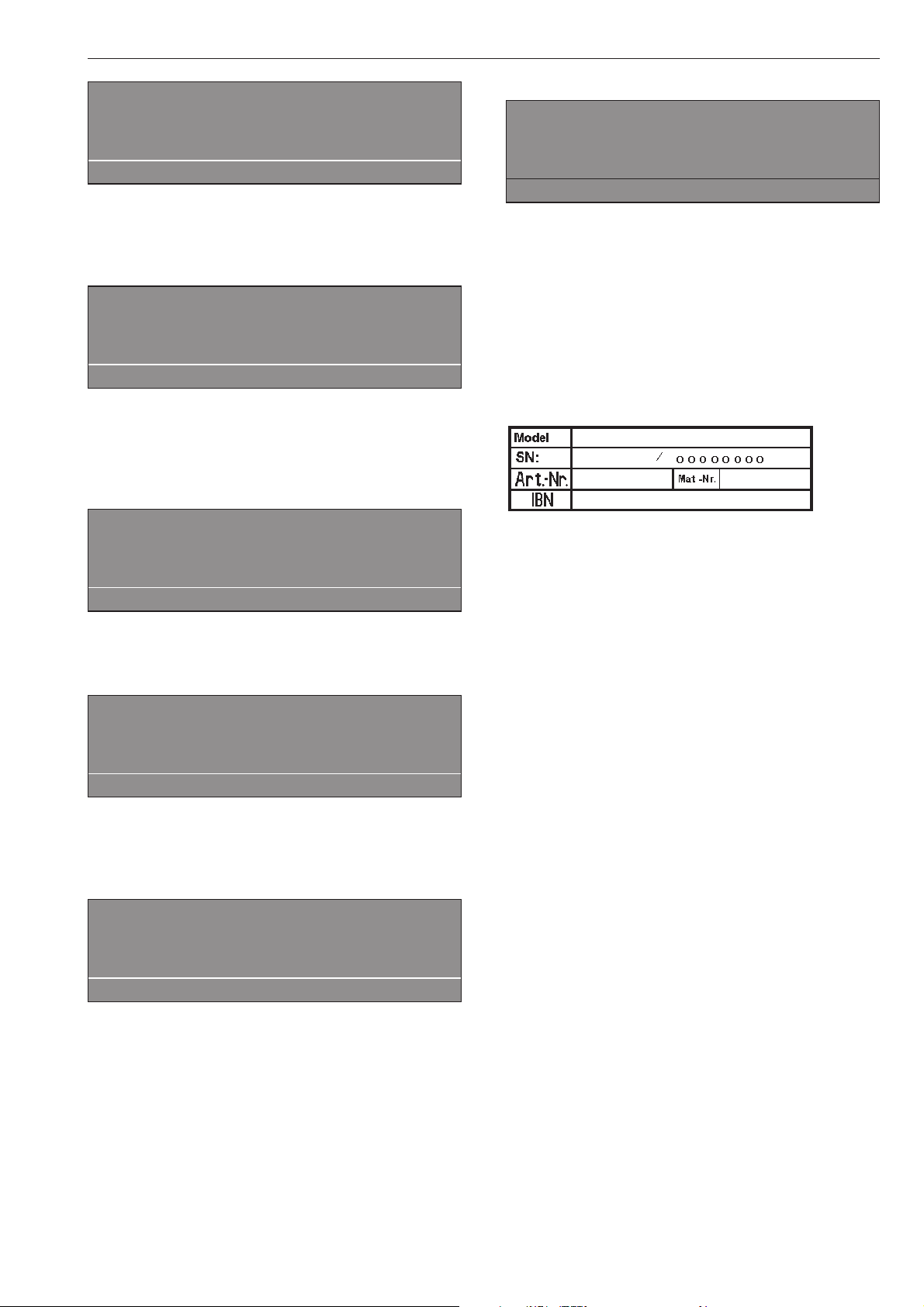
y
PANNE ALIMENTATION
Arrêt programme.
Presser touche Marche.
f
^
Appuyez sur "MARCHE" pour poursuivre le pro
-
gramme.
§
Défaut système chauffage
Arrêt programme Presser touche Marche.
Poursuite prog. sans chauffage.
f
^
Appuyez sur "MARCHE" pour poursuivre le pro
-
gramme sans chauffage.
Communiquez avec le Service technique.
§
Défaut système chauffage
Communiquer avec le Service technique
en cas d'échec de la réinitialisation.
f
^ Communiquez avec le Service technique.
§
Défaut capteur pression
Communiquer avec le Service technique
en cas d'échec de la réinitialisation.
f
^
Communiquez avec le Service Technique si la réi
-
nitialisation échoue.
§
Défaut système gaz
Communiquer avec le Service technique
en cas d'échec de la réinitialisation.
f
Si l'erreur survient immédiatement après le début du
programme :
^
Ouvrez la valve à gaz et appuyez sur "Marche".
Si l'erreur survient au cours du déroulement du pro
-
gramme, cela peut signifier que la pression du gaz a
chuté en raison de l'utilisation d'autres appareils à
gaz.
^
Appuyez sur la touche "Marche".
^
Communiquez avec le Service technique si le pro
-
gramme ne redémarre pas.
§
Défaut carte
Insérer la carte correctement
dans le lecteur.
A
^
Insérez la carte correctement dans le lecteur.
Service après-vente
^
Si vous n'êtes pas en mesure de résoudre certains
problèmes, veuillez communiquer avec le Service
technique.
^
Lorsque vous communiquez avec le Service tech
-
nique, veuillez préciser le modèle, le numéro de
série et la référence de votre appareil.
Ces renseignements figurent sur la plaque signalé
-
tique située au-dessus de l'ouverture de la porte (vi-
sible lorsque la porte du tambour est ouverte) ou à
l'arrière de l'appareil, près du dessus.
^ Lorsque vous communiquez avec le Service tech-
nique, veuillez préciser quel est le message d'er-
reur affiché à l'écran.
N'utilisez que des pièces de rechange d'origine de
Miele pour l'entretien et la réparation de cet appareil.
Lorsque vous passez commande de ces pièces, indi-
quez le numéro de série et la référence de votre ap-
pareil.
Questions fréquemment posées
25
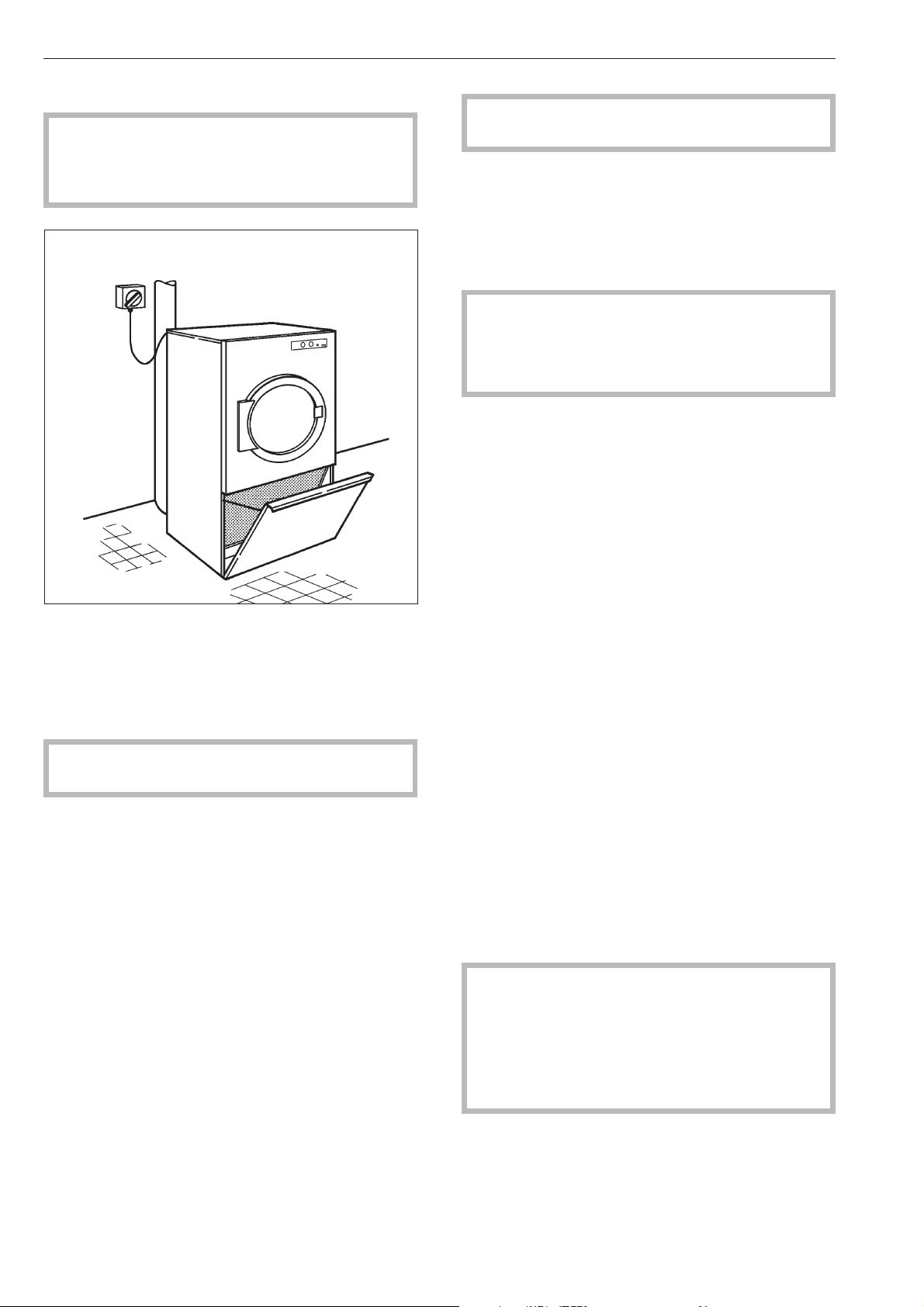
Nettoyage du filtre à charpie
,
Nettoyez le filtre à charpie au moins une fois
par jour, et chaque fois que le message "Nettoyer
filtre à charpie" s'affiche à l'écran. Un filtre obstrué
représente un risque d'incendie.
^ Ouvrez le clapet du filtre à charpie.
^ Ne retirez pas le filtre à charpie.
^ Enlevez la charpie du filtre à la main (n'utilisez ja-
mais d'objets pointus). Récupérez la charpie en
veillant à ne pas endommager le filtre.
,
N'utilisez pas la sécheuse si le filtre à charpie
intégré n'est pas en place.
Cela pourrait provoquer un incendie.
Si le filtre à charpie est endommagé, il doit être rem
-
placé immédiatement.
Une accumulation de charpie pourrait obstruer le
système de circulation de l'air et les systèmes de
chauffage et de ventilation, et nuire ainsi à l'efficacité
de l'appareil.
Sécheuse
Avant de nettoyer ou de réparer la sécheuse, débran
-
chez-la de l'alimentation électrique en coupant l'ali
-
mentation générale ou en basculant le disjoncteur.
Dans le cas des sécheuses fonctionnant avec un sys
-
tème de chauffage au gaz, le robinet manuel d'arrêt
du gaz et le dispositif d'arrêt du compteur de gaz
doivent être fermés. De même, sur les sécheuses
fonctionnant avec un système de chauffage à la va
-
peur, le robinet d'arrêt de la vapeur doit être fermé.
,
N'utiliser pas de nettoyeur à haute pression ni
de jet d'eau pour nettoyer l'appareil.
^
Utilisez de l'eau tiède savonneuse et une éponge
douce pour nettoyer la structure de l'appareil, le
panneau de commande et les éléments en plas
-
tique, puis essuyez à l'aide d'un chiffon doux.
^
Après le séchage d'articles empesés, nettoyez le
tambour à l'aide d'un chiffon doux et humide.
N'utilisez jamais de nettoyants abrasifs, de tam
-
pons à récurer, de laine d'acier ou de nettoyants
corrosifs. Ces produits endommageraient la sur
-
face de l'appareil.
Vérifiez le joint d'étanchéité statique et le verrou de la
porte du tambour, ainsi que le clapet du filtre à
charpie.
L'entrée d'air est située à l'arrière de la sécheuse.
Veillez à ne jamais obstruer cette ouverture. Ne re
-
couvrez pas le dessus de la sécheuse avec des cou
-
vertures ou des chiffons.
Faites en sorte que l'espace autour de la sécheuse,
et notamment l'espace entourant l'entrée d'air, ne soit
pas encombré par une accumulation de charpie, afin
d'assurer l'approvisionnement en air propre. La
charpie risque de s'accumuler dans la sécheuse et
de provoquer des dysfonctionnements.
À vérifier et à nettoyer une fois par an
– Les bobines thermiques et conduits de chauffage
(pour les sécheuses fonctionnant avec un système
de chauffage électrique); le brûleur et le comparti
-
ment du brûleur (pour les sécheuse fonctionnant
avec un système de chauffage au gaz).
–
L'intérieur de sécheuse, dans son intégralité.
–
La roue du dispositif de ventilation par extraction.
–
Le conduit d'évacuation et la sortie d'air vers l'exté
-
rieur.
^
Nettoyez toute trace de charpie à l'aide d'un aspi
-
rateur.
,
L'entretien de la sécheuse doit être assuré en
temps opportun par un professionnel, afin de pré
-
venir les baisses de la puissance de fonctionne
-
ment, les dysfonctionnements et les risques d'in
-
cendie.
Communiquez avec le Service technique de Miele
pour la réalisation des travaux d'entretien.
Nettoyage et entretien
26

, AVERTISSEMENT – Risque d'incendie
~
Tous les travaux d'installation, d'entretien et de ré
-
paration doivent être effectués par un technicien au
-
torisé Miele. Il peut être dangereux de confier ces tra
-
vaux à des personnes non qualifiées.
~
L'installation doit être réalisée conformément aux
codes et aux règlements locaux et nationaux.
~
Avant l'installation, débranchez la sécheuse de
l'alimentation électrique : coupez le courant, débran
-
chez le cordon électrique ou basculez le disjoncteur.
Ne rebranchez pas la sécheuse tant que l'installation
n'est pas terminée.
~
Faites en sorte que votre appareil soit correcte
-
ment installé et mis à la terre par un technicien quali
-
fié.
~
Pour des raisons de sécurité électrique, cet appa
-
reil doit être mis à la terrez conformément aux co
-
des locaux. Il est essentiel de respecter cette exi
-
gence élémentaire en matière de sécurité. En cas de
doute, faites vérifier l'installation électrique par un
électricien qualifié.
~
Veillez à ne pas endommager, retirer ou passer
outre les composants de sécurité ou les accessoires
et les éléments de contrôle de la sécheuse.
~
ATTENTION : N'oubliez pas d'étiqueter tous les fils
électriques avant de débrancher l'appareil lors des
contrôles d'entretien. Les erreurs de câblage peuvent
entraîner une utilisation inadéquate de l'appareil.
~
Assurez-vous que la pièce dans laquelle l'appareil
est installé est équipée d'une ventilation adéquate.
~
N'utilisez pas la sécheuse dans la même pièce
que des machines de nettoyage fonctionnant avec
des solvants qui contiennent des CFC. Les vapeurs
des ces solvants se transforment en sel acide qui
risque d'endommager les articles et la sécheuse. Si
des machines utilisant ce type de solvants sont utili
-
sées dans des pièces attenantes, assurez-vous qu'il
n'y a aucun échange d'air avec ces pièces.
~
Le conduit d'évacuation de la sécheuse ne doit
pas passer par un conduit servant également pour
l'évacuation d'appareils chauffés au gaz, au charbon
ou à l'huile. Le conduit d'évacuation de la sécheuse
ne doit pas être connecté à une évacuation de gaz, à
une cheminée, à un mur, à un plafond ou à un vide
de construction. Le système d'évacuation doit suivre
la voie la plus courte vers l'extérieur, ou passer par
un conduit d'évacuation approprié. Ce conduit doit
être conçu et installé pour permettre un débit d'air
élevé (le conduit doit être le plus court possible avec
le moins de coudes possibles, et avoir des joints
étanches et bien formés).
~
ATTENTION : Une sécheuse non ventilée produit
de la charpie combustible. Évacuez l'air de la sé
-
cheuse à l'extérieur!
~
N'installez pas de filtres ou de grilles d'aération
dans le conduit d'évacuation.
~
Le raccord entre le conduit d'échappement et la
sécheuse doit être hermétique.
~
Protégez les conduits d'évacuation exposés aux
intempéries en formant un angle descendant de 90 º.
~
Pour faciliter le nettoyage d'un conduit, les coudes
de ce conduit doivent, dans la mesure du possible,
être équipés de volets ou de couvercles permettant
le nettoyage.
~
Dans le cas de conduits d'échappement ascen
-
dants, un système de purge de la condensation doit
être installé au point le plus bas du conduit.
~
Utilisez uniquement des pièces de rechange d'ori
-
gine Miele pour remplacer les pièces défectueuses.
~
Respectez les dimensions minimales et la dis
-
tance requise par rapport au mur, conformément aux
indications du diagramme d'installation, afin que les
travaux d'entretien puissent être effectués et que la
plaque signalétique soit visible.
~
N'installez pas la sécheuse dans un endroit expo-
sé à l'eau ou aux intempéries.
~
Installez la sécheuse de manière à laisser un es-
pace libre suffisant pour permettre d'entretenir et de
faire fonctionner l'appareil correctement.
~
Pour obtenir de plus amples renseignements,
consultez la section "Installation – Évacuation, entrée
d'air, espaces de ventilation et vapeur" du manuel
d'utilisation.
CONSERVEZ CES INSTRUCTIONS.
INSTRUCTIONS IMPORTANTES SUR LA SÉCURITÉ
27
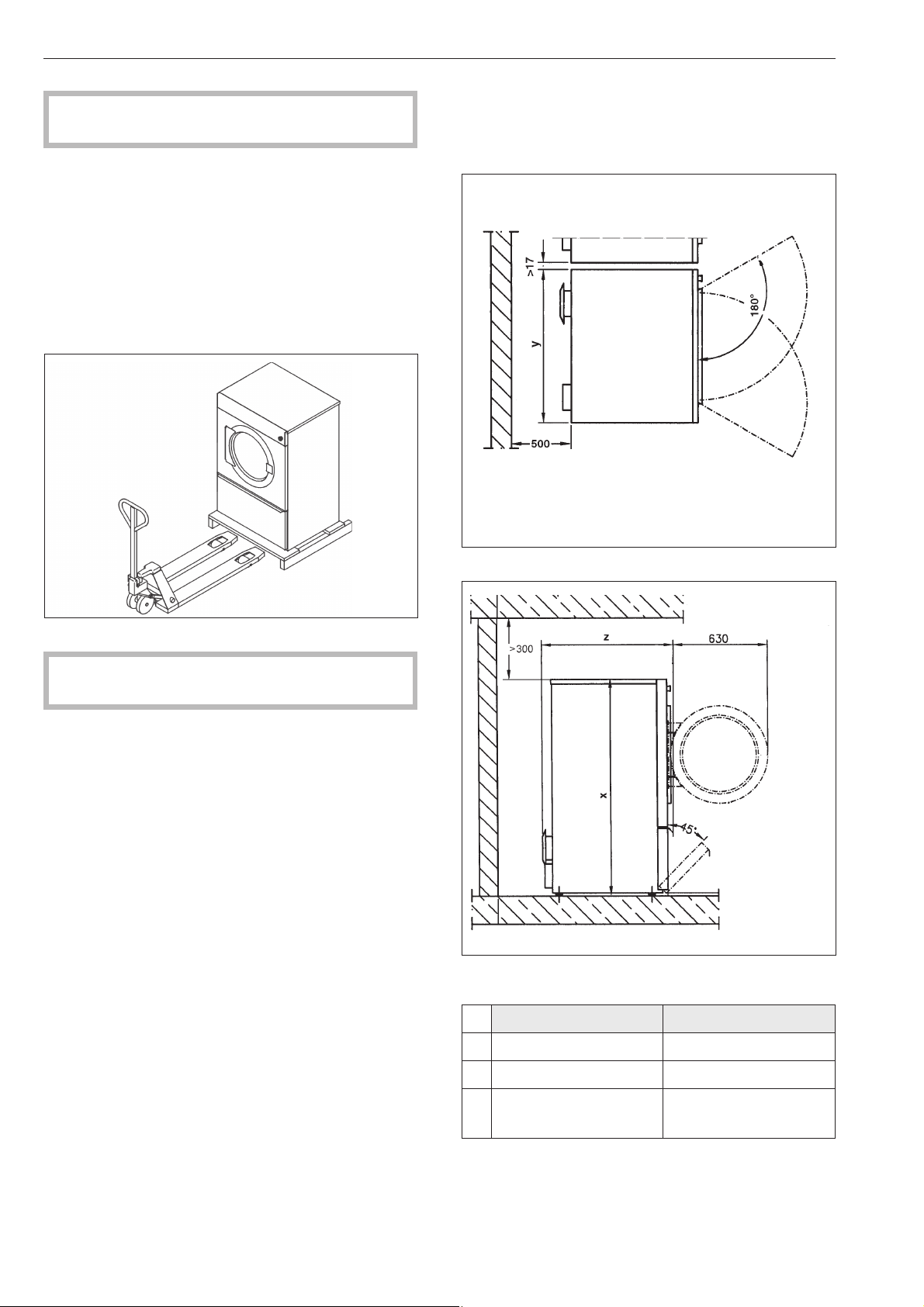
La sécheuse doit être installée et testée par un
technicien Miele ou par un détaillant autorisé.
Cet appareil doit être installé conformément aux nor
-
mes en vigueur, et doit être utilisé uniquement dans
une pièce dotée d'un système de ventilation adéquat.
Veuillez lire attentivement les instructions avant d'in
-
staller et d'utiliser cet appareil.
N'installez pas cette sécheuse dans une pièce où la
température de congélation peut être atteinte.
,
La sécheuse doit toujours être transportée sur
sa palette d'expédition.
Pour installer la sécheuse à son emplacement final,
soulevez-la de sa palette d'expédition en utilisant un
équipement de levage approprié.
Pour faciliter l'accès à l'appareil lors de la réalisation
de travaux de maintenance et d'entretien, veuillez
respecter les dimensions minimales et la distance re
-
quise par rapport au mur.
PT 825X/833X/840X PT 850X
x 55
1
/
8
po (1 400 mm) 64
9
/
16
po (1 640 mm)
y 35
11
/
16
po (906 mm) 47 ½ po (1 206 mm)
z 33/40
1
/
8
/45
3
/
16
po
(836/ 1 019/ 1 148 mm)
39
7
/
16
po (1 002 mm)
INSTRUCTIONS IMPORTANTES SUR LA SÉCURITÉ
28
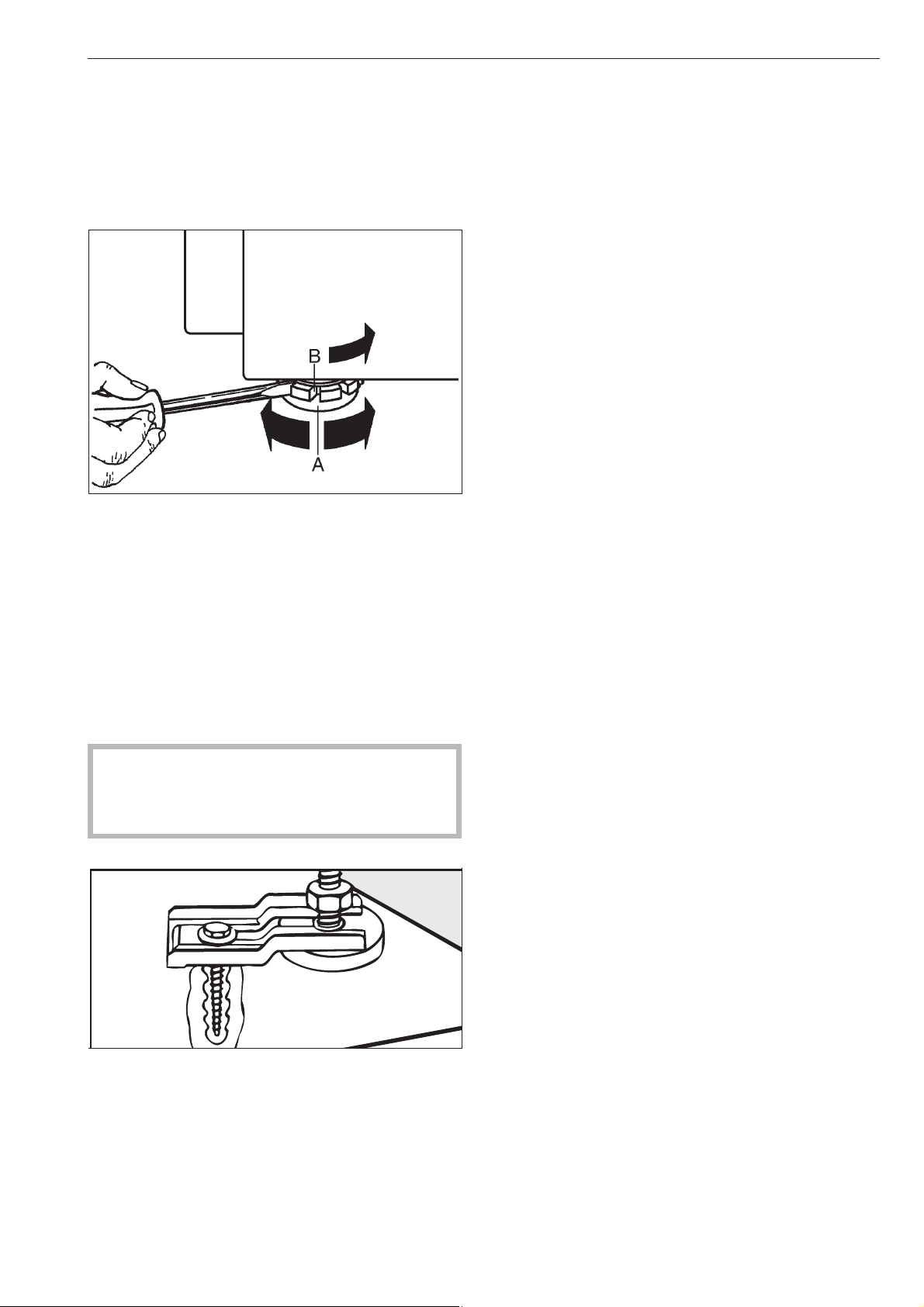
Mise à niveau de la sécheuse
Il n'est pas nécessaire d'installer la sécheuse sur une
base. Il faut cependant procéder à certains ajuste
-
ments pour compenser toute inégalité du plancher.
La sécheuse doit être de niveau pour pouvoir fonc
-
tionner correctement.
^
Mettez la sécheuse de niveau en tournant les pieds
dans le sens des aiguilles d'une montre ou dans le
sens inverse (A), selon les besoins.
^ Une fois la sécheuse de niveau, les disques de ni-
vellement (B) doivent être solidement vissés à la
plaque de base de la sécheuse.
Installation sur une base surélevée
La sécheuse peut être installée sur une base de bé-
ton surélevée.
,
Si vous installez la sécheuse sur une base de
béton existante, elle doit être fixée à cette base
par des attaches de retenue. Si vous ne la fixez
pas, la laveuse pourrait tomber de son socle.
^
Fixez les pieds avant de la sécheuse à l'aide des
attaches de retenue fournies.
Réduction du niveau de bruit
La sécheuse est équipée d'un ventilateur qui est une
source de bruit.
Afin de réduire le niveau de bruit, il est possible d'in
-
staller un atténuateur accoustique (que vous pouvez
vous procurez auprès de Miele) au niveau du raccord
d'évacuation (consultez les instructions d'installation).
Appareil payant
La sécheuse peut être équipée d'un dispositif à je
-
tons*.
Cela nécessite un adaptateur*.
Cette installation nécessite une reprogrammation de
la sécheuse, intervention qui doit être effectuée par
un technicien autorisé Miele.
Videz quotidiennement la caisse à jetons. Cela vous
permettra d'éviter que les pièces et les jetons ne
s'accumulent et qu'ils entraînent des problèmes de
fonctionnement.
*disponibles sur commande auprès de Miele
Module de communication XKM RS232
(le cas échéant)
Le module de communication optionnel permet de re-
lier la sécheuse à un ordinateur personnel au moyen
d'une interface sérielle.
La sortie permettant de raccorder ce module est
située à l'arrière de la sécheuse.
L'installation de ce module nécessite un programme
d'édition spécial, que vous pouvez vous procurer au-
près du service professionnel de Miele.
INSTRUCTIONS IMPORTANTES SUR LA SÉCURITÉ
29

Branchement électrique
Les branchements électriques doivent être effectués
par un électricien qualifié et être conformes à toutes
les normes nationales.
Veuillez consulter le schéma de câblage ci-joint.
Avant d'installer l'appareil, assurez-vous que la ten
-
sion et la fréquence indiquées sur la plaque signalé
-
tique correspondent à celles du système d'alimenta
-
tion électrique du site d'installation.
Si l'appareil est câblé, il est nécessaire d'installer un
séparateur à pôles multiples. Les séparateurs à pôles
multiples d'un écartement des contacts d'au moins
1
/
8
po (3 mm) sont valables. Toutes les composantes
doivent être homologuées CSA ou UL.
La fiche de connexion ou le séparateur doivent être
accessibles en tout temps.
Vous devez être en mesure de verrouiller le dispositif
séparateur ou de le contrôler dans les cas où l'appa
-
reil doit être débranché de l'alimentation électrique.
Une fois la sécheuse branchée, vérifiez le sens de ro
-
tation du ventilateur. Ce dernier doit tourner dans le
sens des aiguilles d'une montre. S'il tourne dans le
sens inverse, inversez deux phases dans la boîte de
jonction.
Régulation de tension automatique
Une régulation de la tension automatique est néces-
saire lorsque le courant de fuite est supérieur à 10
mA.
Entrée d'air/Ventilation
Ne faites fonctionner la sécheuse que lorsqu'elle est
raccordée à une conduite de ventilation adaptée et
que la ventilation est suffisante.
Veuillez consulter les instructions d'installation ci-join
-
tes.
Raccordement vapeur
Seul un installateur qualifié peut procéder au raccor
-
dement vapeur.
Veuillez prendre connaissance des instructions d'in
-
stallation ci-jointes.
Vous pouvez vous procurer la valve de production de
vapeur ainsi que le purgeur de condensat auprès de
Miele.
INSTRUCTIONS IMPORTANTES SUR LA SÉCURITÉ
30

PT 825x PT833x PT 840X PT 850X
Hauteur 55 1/8 po
(1 400 mm)
55 1/8 po
(1 400 mm)
55 1/8 po
(1 400 mm)
64 9/16 po
(1 640 mm)
Largeur 35 11/16 po
(906 mm)
35 11/16 po
(906 mm)
35 11/16 po
(906 mm)
47½po
(1 206 mm)
Profondeur 33 po
(836 mm)
40 1/8 po
(1 019 mm)
45 3/16 po
(1148 mm)
39 7/16 po
(1002 mm)
Profondeur de l'ap
-
pareil lorsque la
porte est ouverte
57 11/16 po
(1 466 mm)
65 po
(1 649 mm)
70 po
(1778 mm)
70 po
(1778 mm)
Poids 326/330 lb
(148/149,5 kg)
297/369 lb
(134,5/167,5 kg)
420/416/475 lb
(190,5/188,5/215,5 kg)
525/526/584 lb
(238/238,5/265 kg)
Volume du tambour 66 gal (250 l) 86 gal (325 l) 106 gal (400 l) 132 gal (500 l)
Poids maximal des
articles secs
28,7 lb (13 kg) 35,3 lb (16 kg) 44,1 lb (20 kg) 55,1 lb (25 kg)
Tension (en volts) voir la plaque signalétique
Charge nominale
(en watts)
voir la plaque signalétique
Courant (ampères) voir la plaque signalétique
Certificats voir la plaque signalétique
Charge de
plancher maximale
368/371 lb
(1 636/1 651 N)
417/424 lb
(1 857/1 886 N)
480/482/541 lb
(2 136/2 143/2 408 N)
608/609/667 lb
(2 703/2 708/2 968 N)
Niveau de bruit en
dB (A)
<70 <70 <70 <70
Données techniques
31
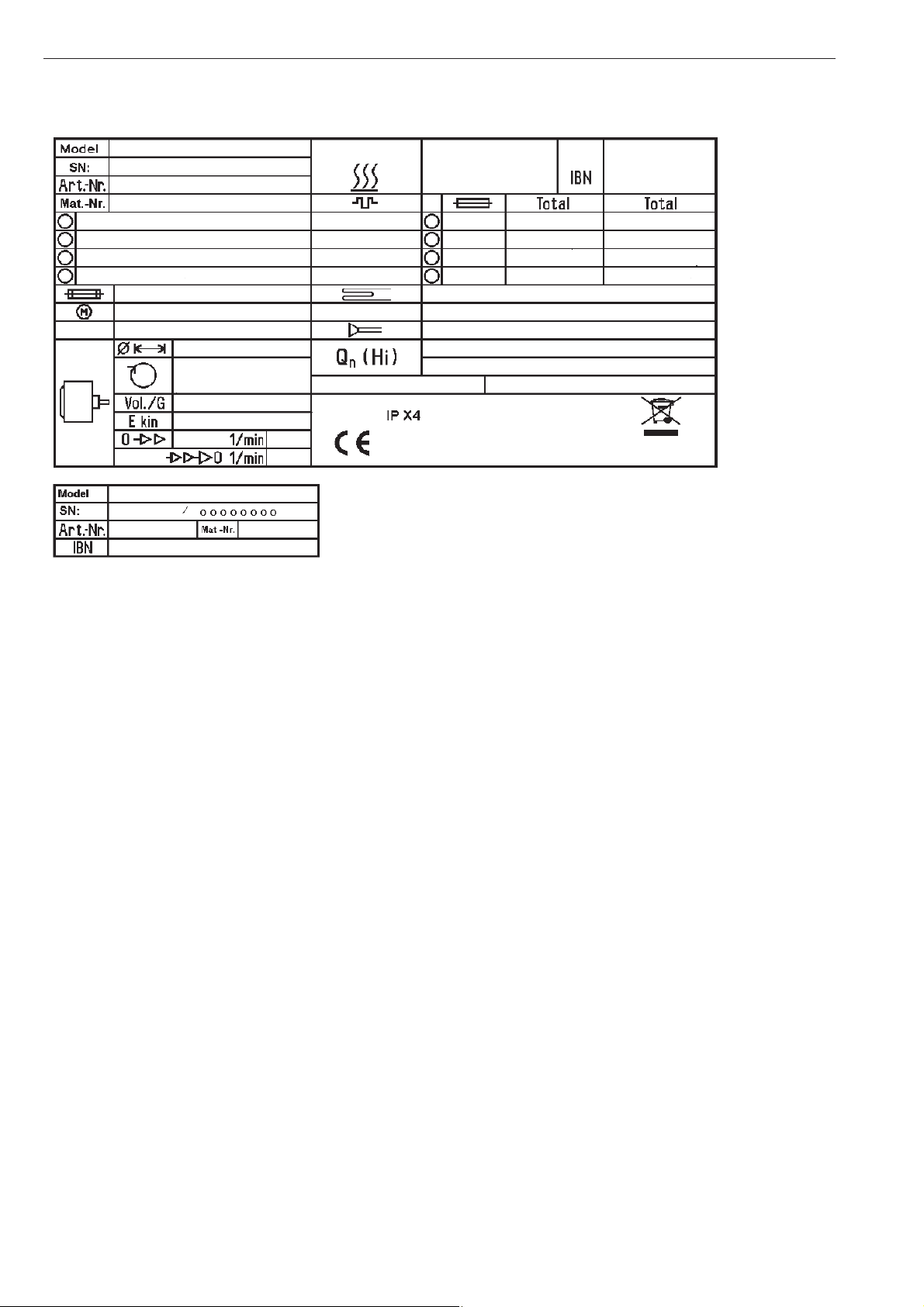
1 Modèle
2 Numéro de série
3 Numéro d'article
4 Numéro de produit
5 Tension/Fréquence
6 Disjoncteur de commande
7 Moteur
8 Données sur le tambour
9 Diamètre du tambour/Profondeur du tambour
10 Vitesse d'essorage
11 Volume du tambour/Poids des articles secs
12 Énergie cinétique
13 Temps d'accélération
14 Temps de décélération
15 Chauffage
16 Nom/Année de fabrication
17 Date de mise en service
18 Chauffage électrique
19 Disjoncteur du panneau de commande
du bâtiment
20 Chauffage à vapeur indirecte
21 Chauffage à vapeur directe
22 Chauffage à gaz
23 Certifications
Guide des symboles de la plaque signalétique
32
a
bopq
c
drs
e
ft
g
u
i
hj v
k
lw
m
n

1.Triez les articles
Certains tissus ne peuvent pas être séchés dans une sécheuse à culbutage. Suivez les ins
-
tructions du fabricant figurant sur les étiquettes d'entretien des articles.
q = Séchage à température normale
r = Séchage à basse température
s = Ne pas sécher à la machine
^
Triez les articles selon le tissu et la couleur.
2.Mettez la sécheuse sous tension et placez les articles dans le tambour
^
Appuyez sur la touche l "Marche" pour mettre la sécheuse en marche.
^
Ouvrez la porte de la sécheuse et mettez les articles dans le tambour sans les compacter.
3.Tournez le bouton rotatif pour sélectionner un programme.
Les programmes peuvent varier selon les options disponibles sur votre appareil.
1
Blanc/Couleurs intensif 0%
2
Blanc/Couleurs normal + 0%
3
Blanc/Couleurs normal 20%
4
Blanc/Couleurs normal 25 %
5
Blanc/Couleurs normal 40 %
6
Non repassable normal + 0%
7
Non repassable normal 10 %
8
Non repassable normal 20 %
9
Laine 5 min.
10
Fin 20 %
11
Minuterie froid 15 min.
12
Minuterie chaud 20 Min.
13
Imprégnation
14 Outdoor
4.Appuyez sur la touche "Marche" pour lancer le programme.
5.Lorsque le programme est terminé, un message s'affiche à l'écran
et la sonnerie retentit.
5.La sonnerie retentit pour indiquer que le programme est terminé.
^
Ouvrez la porte du tambour et
retirez les articles.
6.Après le séchage
^
Fermez la porte de l'appareil.
^
Nettoyez le filtre à charpie si nécessaire.
Guide de consultation rapide
33
2 Blanc/Couleurs normal +
Fin du programme
Infroissable Fin à 12:15
m FC Kf

34

35

Sous réserve de modifications/1014
M.-Nr.
07 713 522 / 02
,PSRUWHU
0LHOH/LPLWHG
3URIHVVLRQDO'LYLVLRQ
&OUR6ALLEY$RIVE
6AUGHAN/.,+6
0HONE
&AX
WWWMIELEPROFESSIONALCA
PROFESSIONAL MIELECA
0LHOH3URIHVVLRQDO7HFKQLFDO6HUYLFH
0HONE
&AX
SERVICEPROFESSIONAL MIELECA
*HUPDQ\
0DQXIDFWXUHU
-IELE#IE+'
#ARL-IELE3TRAE
'àTERSLOH
&DQDGD