Owner'sManual
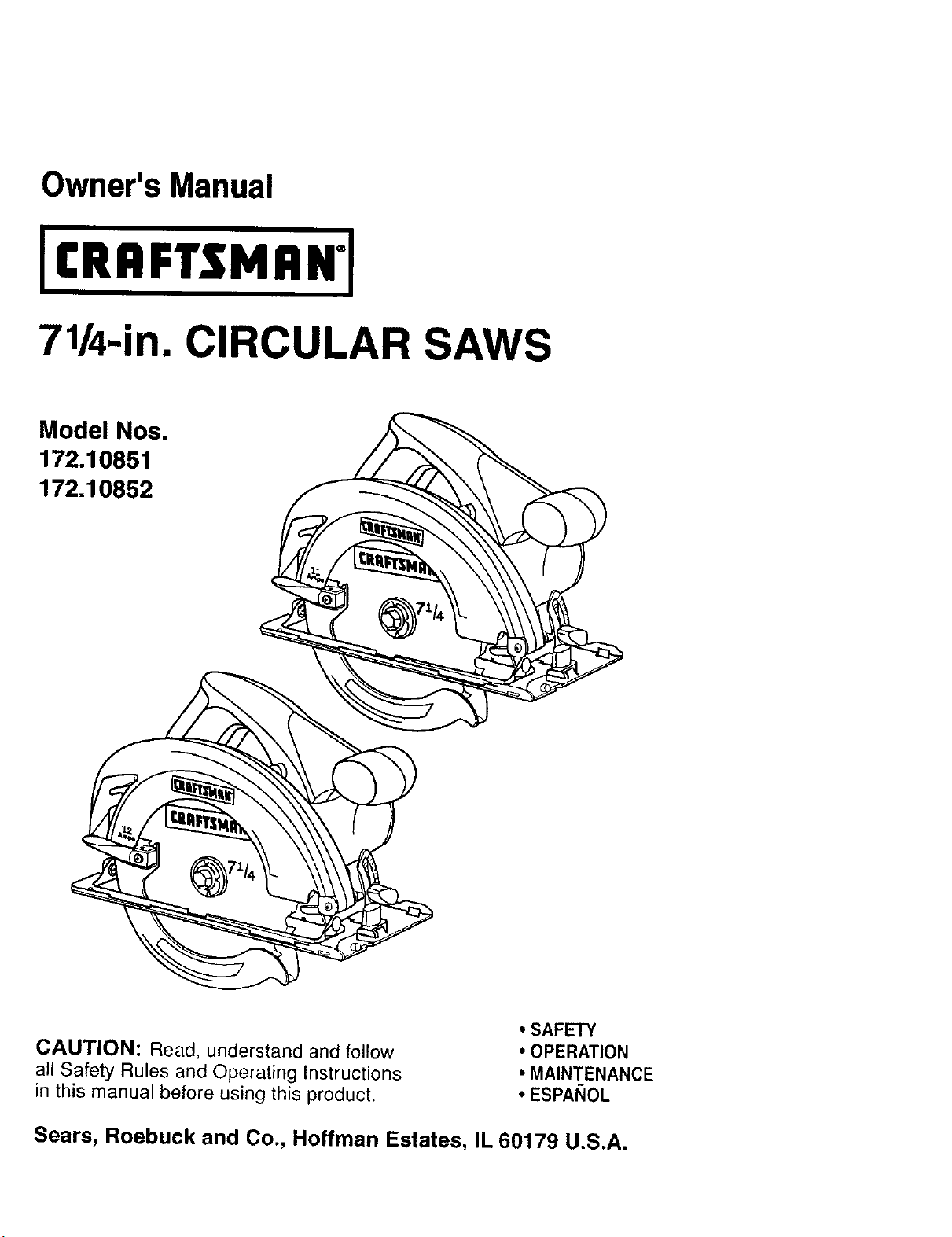
71/4-in.CIRCULAR SAWS
Model Nos.
172.10851
172.10852
CAUTION: Read, understand and follow
all Safety Rules and Operating Instructions
in this manual before using this product.
• SAFETY
• OPERATION
• MAINTENANCE
• ESPANOL
Sears, Roebuck and Co., Hoffman Estates, IL 60179 U.S.A.
Warranty .................................................... Page 2
Safety Instructions ..................................... Pages 3-10
Safety Symbols ......................................... Page 10
Description ................................................ Page 11
Assembly ................................................... Pages 12-13
Operation ................................................... Pages 14-22
Maintenance .............................................. Pages 23-24
Accessories ............................................... Page 24
Service Numbers ....................................... Page 26
FULL ONEYEAR WARRANTY ON CRAFTSMAN
CIRCULAR SAW
If 1his CRAFTSMAN Circular Saw fails to give complete
satisfaction within one year from the date of purchase,
RETURN ITTOTHE NEAREST SEARS STORE INTHE
UNITED STATES, and Sears will replace it, free of charge.
If this CRAFTSMAN Circular Saw is used for commercial or rental
purposes, this warranty applies for only 90 days from the date
of purchase.
This warranty gives you specific legal rights, and you may also have
other rights which vary from state to state.
Sears, Roebuck and Co., Dept. 817 WA, Hoffman Estates, IL 60179
SAVETHESE INSTRUCTIONS!
READ ALL INSTRUCTIONS!
2
/_, WARNING: BE SURE to read and understand all instructions.
Failure to follow all instructions listed below may result in electric
shock, fire and/or serious personal injury.
WORK AREA SAFETY
1. ALWAYS keep your work area clean and well lit. Cluttered benches and
dark areas invite accidents.
2. DO NOT operate power tools in explosive atmospheres, such as in
tne presence of flammable liquids, gases, or dust. Power tools create
sparks which may ignite the dust or fumes.
3. ALWAYS keep bystanders, children, and visitors away while
operating a power tool. Distractions can cause you to lose control.
I
ELECTRICAL SAFETY
1. Double insulated tools are equipped with a polarized plug (one blade
is wider than the other.)This plug will fit in a polarized outlet only one
way. If the plug does not fit fully in the outlet, reverse the plug. If it
still does not fit, contact a qualified electrician to install a polarized
outlet. Do not change the plug in any way.
2. Double insulation [] eliminates the need for the three-wire grounded power
cord and grounded power supply system. Applicable only to Class II
(double insulated) tools.
3. Before plugging in the tool, BE SURE that the outlet voltage supplied is
within the voltage marked on the tool's data plate. DO NOT use "AC only"
rated tools with a DC power supply.
4. ALWAYS avoid body contact with grounded surfaces, such as pipes,
radiators, ranges and refrigerators. There is an increased risk of electric
shock if your body is grounded.
5. If operating the power tool in damp locations is unavoidable, ALWAYS
use a Ground Fault Circuit Interrupter to supply power to your tool.
ALWAYS wear electrician's rubber gloves and footwear In
damp conditions.
6. DO NOT expose power tools to rain or wet conditions. Water entering
a power tool will increase the risk of electric shock.
7. DO NOT abuse the cord. NEVER use the cord to carry the tools or pull
the plug from the outlet. Keep cord away from heat, od, sharp edges
or moving parts. Replace damaged cords immediately.
Damaged cords increase the risk of electric shock.
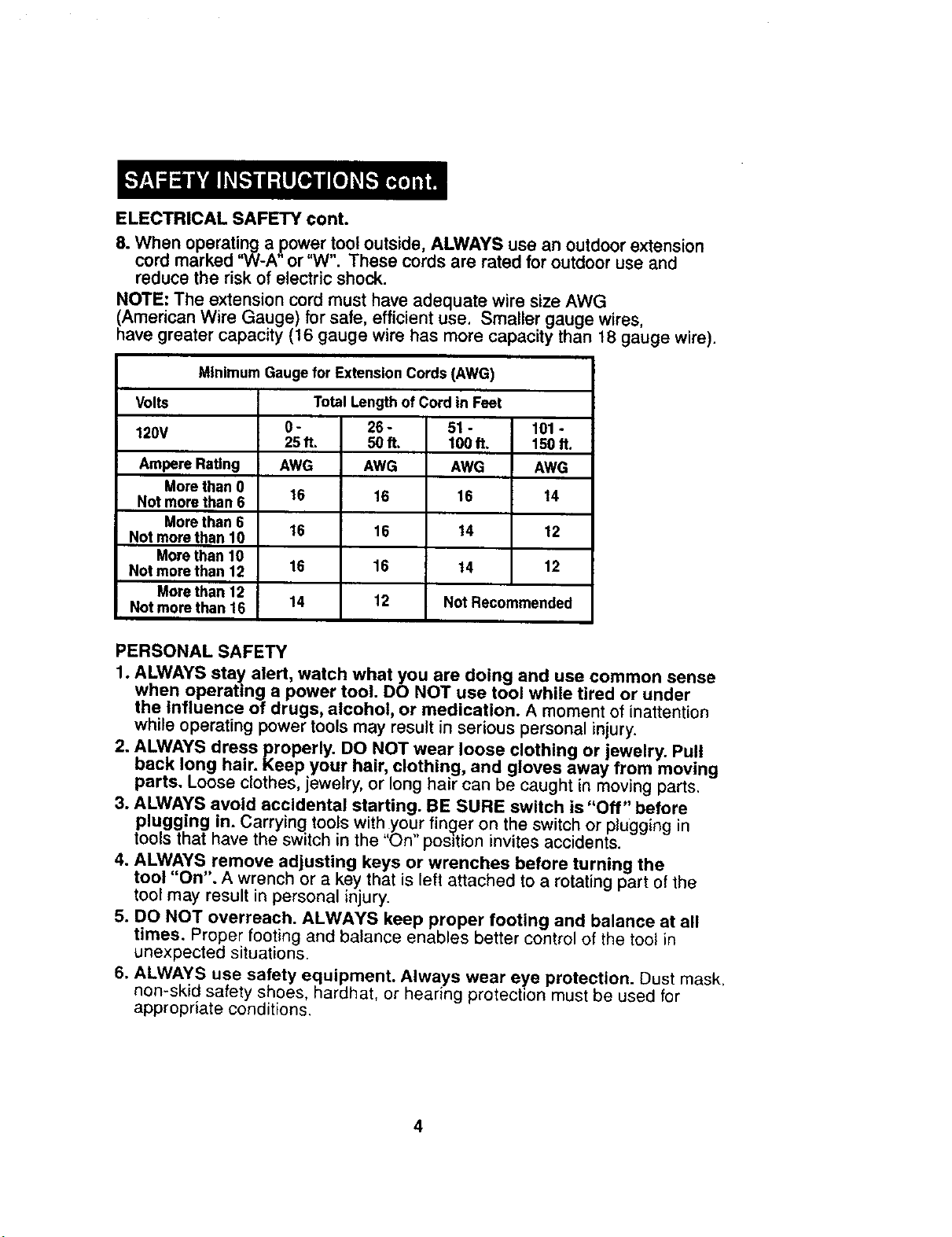
ELECTRICAL SAFETY cont.
8. When operating a power tool outside, ALWAYS use an outdoor extension
cord marked "W-A"or "W". These cords are rated for outdoor use and
reduce the risk of electric shock.
NOTE: The extension cord must have adequate wire size AWG
(American Wire Gauge) for safe, efficient use. Smaller gauge wires
have greater capacity (16 gauge w re has more capacity than ! 8 gauge wire).
MinimumGauge forExtensionCords(AWG)
Volts
120V
Ampere Rating
More than 0
Not morethan 6
More than 6
Not more than 10
More than 10
Not more than 12
Morethan 12
Not more than 16
Total Length of Cord in Feet
.
25ft.
AWG
16
16
16
14
26- 51 -
50ft. 10Off,
AWG AWG
16 16
16 14
16 14
101-
150 _.
AWG
14
12
12
12 Not Recommended
PERSONAL SAFETY
1. ALWAYS stay alert, watch what you are doing and use common sense
when operating a power tool. DO NOT use tool while tired or under
the influence of drugs, alcohol, or medication. A moment of inattention
while operating power tools may result in serious personal injury.
2. ALWAYS dress properly. DO NOT wear loose clothing or jewelry. Pull
back long hair. Keep your hair, clothing, and gloves away from moving
parts. Loose clothes, jewelry, or long hair can be caught in moving parts.
3. ALWAYS avoid accidental starting. BE SURE switch is "Off" before
plugging in. Carrying tools with your fin_er on the switch or plugging in
tools that have the switch in the "On" position invites accidents.
4. ALWAYS remove adjusting keys or wrenches before turning the
tool "On". A wrench or a key that is left attached to a rotating part of the
tool may result in personal injury.
5. DO NOT overreach. ALWAYS keep proper footing and balance at all
times. Proper footing and balance enables better control of the tool in
unexpected situations.
6. ALWAYS use safety equipment. Always wear eye protection. Dust mask.
non-skid safety shoes, hardhat, or hearing protechon must be used for
appropriate conditions.
4
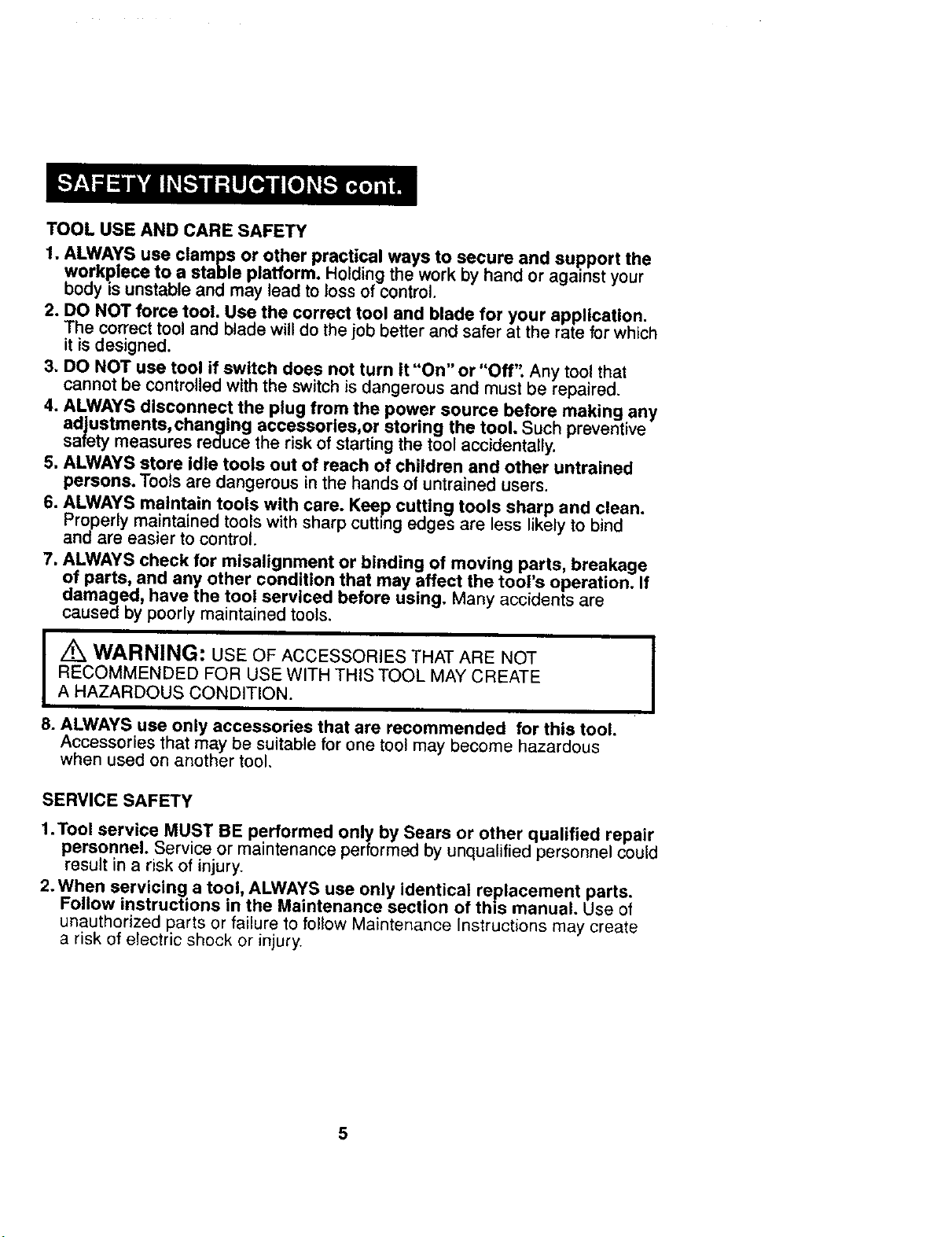
TOOLUSEANDCARESAFETY
1.ALWAYSuse clamps or other practical ways to secure and support the
workplece to a stable platform. Holdingtheworkbyhandoragainstyour
body is unstable and may lead to loss of control.
2. DO NOT force tool. Use the correct tool and blade for your application.
The correct tool and blade will do the job better and safer at the rate for which
itis designed.
3. DO NOT use tool if switch does not turn It "On" or "Off". Any tool that
cannot be controlled with the switch is dangerous and must be repaired.
4. ALWAYS disconnect the plug from the power source before making any
adjustments, changing accessories,or storing the tool. Such preventive
safety measures reduce the risk of starting the tool accidentally.
5. ALWAYS store idle tools out of reach of children and other untrained
persons. Tools are dangerous in the hands of untrained users.
6. ALWAYS maintain tools with care. Keep cutting tools sharp and clean.
Properly maintained tools with sharp cutting edges are less likely to bind
and are easier to control.
7. ALWAYS check for misalignment or binding of moving parts, breakage
of parts, and any other condition that may affect the tool's operation. If
damaged, have the tool serviced before using, Many accidents are
caused by poorly maintained tools.
/iN WARNING: USE OF ACCESSORIES THAT ARE NOT I
RECOMMENDED FOR USE WITH THIS TOOL MAY CREATE
I
A HAZARDOUS CONDITION.
8. ALWAYS use only accessories that are recommended for this tool.
Accessories that may be suitable for one tool may become hazardous
when used on another tool,
SERVICE SAFETY
1. Tool service MUST BE performed only by Sears or other qualified repair
personnel, Service or maintenance performed by unqualified personnel could
result in a risk of injury.
2. When servicing a tool, ALWAYS use only identical replacement parts.
Follow instructions in the Maintenance section of this manual. Use of
unauthorized parts or failure to follow Maintenance Instructions may create
a risk of electric shock or injury.
5
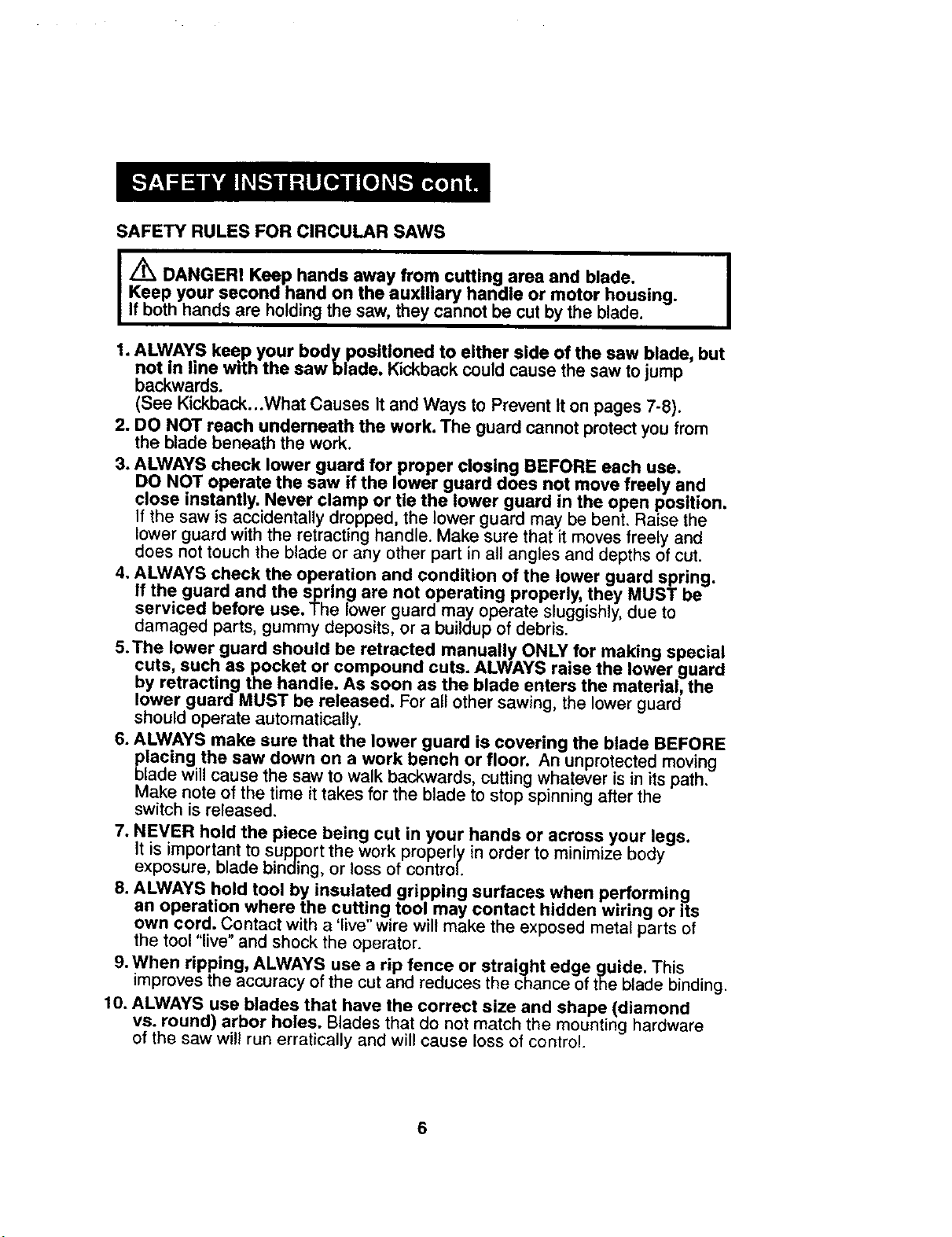
SAFETYRULESFORCIRCULARSAWS
I Z_ DANGER! Keep hands away from cutting area and blade. I
I
Keep your second hand on the auxihary handle or motor housing.
I
If both hands are holding the saw, they cannot be cut by the blade.
1. ALWAYS keep your body positioned to either side of the saw blade, but
not in line with the saw blade. Kickback could cause the saw to jump
backwards.
(See Kickback...What Causes It and Ways to Prevent It on pages 7-8).
2. DO NOT reach underneath the work. The guard cannot protect you from
the blade beneath the work.
3. ALWAYS check lower guard for proper closing BEFORE each use.
DO NOT operate the saw if the lower guard does not move freely and
close instantly. Never clamp or tie the lower guard in the open position.
_fthe saw is accidentally dropped, the _ower guard may be bent. Raise the
lower guard with the retracting handle. Make sure that it moves freely and
does not touch the blade or any other part in all angles and depths of cut.
4, ALWAYS check the operation and condition of the lower guard spring.
If the guard and the spring are not operating properly, they MUST be
serviced before use. The lower guard may operate sluggishly, due to
damaged parts, gummy deposits, or a buildup of debris.
5.The lower guard should be retracted manually ONLY for making special
cuts, such as pocket or compound cuts. ALWAYS raise the lower guard
by retracting the handle. As soon as the blade enters the material, the
lower guard MUST be released. For all other sawing, the lower guard
should operate automatically.
6. ALWAYS make sure that the lower guard is covering the blade BEFORE
_lacing the saw down on a work bench or floor. An unprotected moving
Lade will cause the saw to walk backwards, cutting whatever is in its path,
Make note of the time it takes for the blade to stop spinning after the
switch is released.
7. NEVER hold the piece being cut in your hands or across your legs.
It is important to support the work properly in order to minimize body
exposure, blade binding, or loss of control
8. ALWAYS hold tool by insulated gripping surfaces when performin,g
an operation where the cutt!ng tool may contact hidden wiring or its
own cord. Contact with a 'live' wire will make the exposed metal parts of
the tool "live" and shock the operator.
9. When ripping, ALWAYS use a rip fence or straight edge guide, This
improves the accuracy of the cut and reduces the chance of the blade binding,
10. ALWAYS use blades that have the correct size and shape (diamond
vs. round) arbor holes. Blades that do not match the mounting hardware
of the saw will run erratically and will cause loss of control.
6
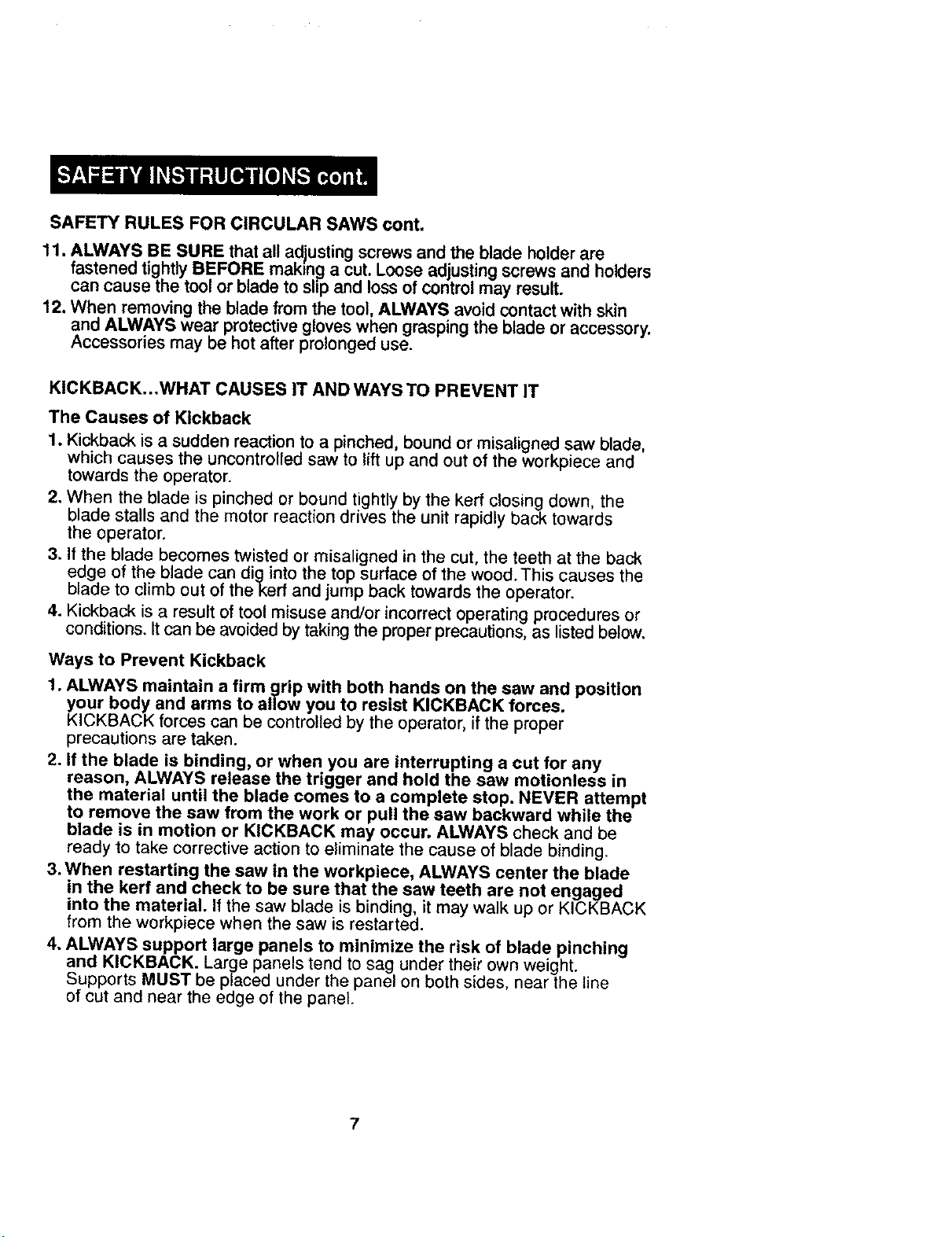
SAFETY RULES FOR CIRCULAR SAWS cont.
11. ALWAYS BE SURE that all a.diustingscrews and the blade holder are
fastened tightly BEFORE making a cut. Loose adjusting screws and holders
can cause the tool or blade to slip and loss of control may result.
12. When removing the blade from the tool,ALWAYS avoid contact with skin
and ALWAYS wear protective gloves when grasping the blade oraccessory.
Accessories may be hot after prolonged use.
KICKBACK..,WHAT CAUSES IT AND WAYS TO PREVENT IT
The Causes of Kickback
1. Kickback is a sudden reaction to a pinched, bound or misaligned saw blade,
which causes the uncontrolled saw to lift up and out of the workpiece and
towards the operator.
2. When the blade is pinched or bound tightly by the kerf closing down, the
blade stalls and the motor reaction drives the unit rapidly back towards
the operator.
3. If the blade becomes twisted or misaligned in the cut, the teeth at the back
edge of the blade can diginto the top surface of the wood. This causes the
blade to climb out of thekerf and jump back towards the operator.
4. Kickback is a result of tool misuse and/or incorrect operating procedures or
conditions. It can be avoided by taking the proper precautions, as listed below.
Ways to Prevent Kickback
1. ALWAYS maintain a firm grip with both hands on the saw and position
_OcUrbody and arms to allow you to resist KICKBACK forces.
KBACK forces can be controlled by the operator, if the proper
precautions are taken.
2. If the blade is binding, or when you are interrupting a cut for any
reason, ALWAYS release the trigger and hold the saw motionless in
the material until the blade comes to a complete stop. NEVER attempt
to remove the saw from the work or pull the saw backward while the
blade is in motion or KICKBACK may occur. ALWAYS check and be
ready to take corrective action to eliminate the cause of blade binding,
3. When restarting the saw in the workpiece, ALWAYS center the blade
in the kerr and check to be sure that the saw teeth are not engaged
into the material. It the saw blade is binding, it may walk up or KICKBACK
from the workpiece when the saw is restarted.
4. ALWAYS support large panels to minimize the risk of blade pinching
and KICKBACK. Large panels tend to sag under their own weight.
Supports MUST be placed under the panel on both sides, near the line
of cut and near the edge of the panel.
7
Waysto Prevent Kickback cont.
5.DONOTuse adull or damaged blade.Unsharpenedorimproperlyset
blades produce narrow kerf which causes excessive friction, blade
bindingand KICKBACK.
6. ALWAYS be sure that the blade depth and adjusting locking levers are
tight and secure BEFORE making a cut. If blade adjustment shiftswhile
cutting,it may cause binding and KICKBACK.
7. ALWAYS use extra caution when making a "Pocket Cut" into existing
walls or other blind areas. The protruding blade may cut objects that
can cause KICKBACK.
8. ALWAYS have saw blade at full speed before contacting workpiece.
ALWAYS hold tool by insulated gripping surfaces when performing an
operation where the cutting tool may contact hidden wiring or its own
cord. Contact with a 'live" wire will make the exposed metal parts of the tool
"live" and shock the operator.
ADDITIONAL RULES FOR SAFE OPERATION
Z_ WARNING: BE SURE to read and understand all instructions.
Failure to follow all instructions listed below may result in electric shock,
fire and/or serious personal injury.
1. Know your power tool. Read operator's manual carefully. Learn the
applications and limitations, as well as the specific potential hazards
related to this tool. Following this rule will reduce the risk of electric shock,
fire or serious injury.
2. ALWAYS wear safety glasses or eye shields when using this saw,
Everyday eyeglasses have only impact-resistant lenses; they are
NOT safety glasses. Following this rule will reduce the risk of serious
personal injury.
3. ALWAYS protect your lungs. Wear a face mask or dust mask if the
operation is dusty. Following this rule will reduce the risk of serious
personal injury.
4. ALWAYS protect your hearing.Wear hearing protection during
extended periods of operation. Following this rule will reduce the risk
of serious personal injury.
5. ALWAYS inspect the tool cords periodically and it damaged have them
repaired at your nearest Sears Service Center or other Authorized
Service Facility. ALWAYS be aware of the cord location.
Following this rule will reduce the risk of electric shock or fire.
I
8
ADDITIONAL RULES FOR SAFE OPERATION cont.
6. ALWAYS check for damaged parts. Before further use of the tool, a
guard or other part that is damaged should be carefully checked to
determme if it will operate properly and pe.rform its intended function.
Check for mlsalignment or binding of moving parts, breakage of parts,
and any other condition that may affect the tool's operation. A _uard or
other part that is damaged, should be properly repalred or repliced at
a Sears Service Center. Followingthis rule will reduce the risk of
electric shock, fire or serious injury.
7. DO NOT abuse the cord. NEVER use the cord to carry the tool or pull
the plug from the outlet. Keep cord away from heat, oil, sharp edges
or moving parts. Replace damaged cords immediately. Damaged cords
increase the risk of electric shock, Following this rule will reduce the risk of
electric shock or fire.
8. ALWAYS make sure that your extension cord is in good condition.
When using an extension cord be sure to use one that is heavy
enough to carry the current that your tool will draw. A wire gauge
size (A.W.G.) of at least 16 ts recommended for an extension 100 feet
or less m length. Using an extensmn cord that is over 100 feet in
length is not recommended. If in doubt, use the next heavier gauge
Smaller gauge wires, have greater capacity (16 gauge w,re has more
capacity than 18 gauge wire). An undersized cord will cause a drop in
line voltage, resulting in loss of power and overheating.
9. ALWAYS inspect and remove all nails from lumber before sawing.
Following this rule will reduce the risk of serious personal injury.
10. DO NOT use the tool while tired or under the influence of drugs,
alcohol or any medication. Following this rule will reduce the risk of
electric shock, fire or serious personal injury.
11. SAVE THESE INSTRUCTIONS. Refer to them frequently and use them
to Instruct others who may use this tool. If someone borrows this tool,
make sure they have these instructions also.
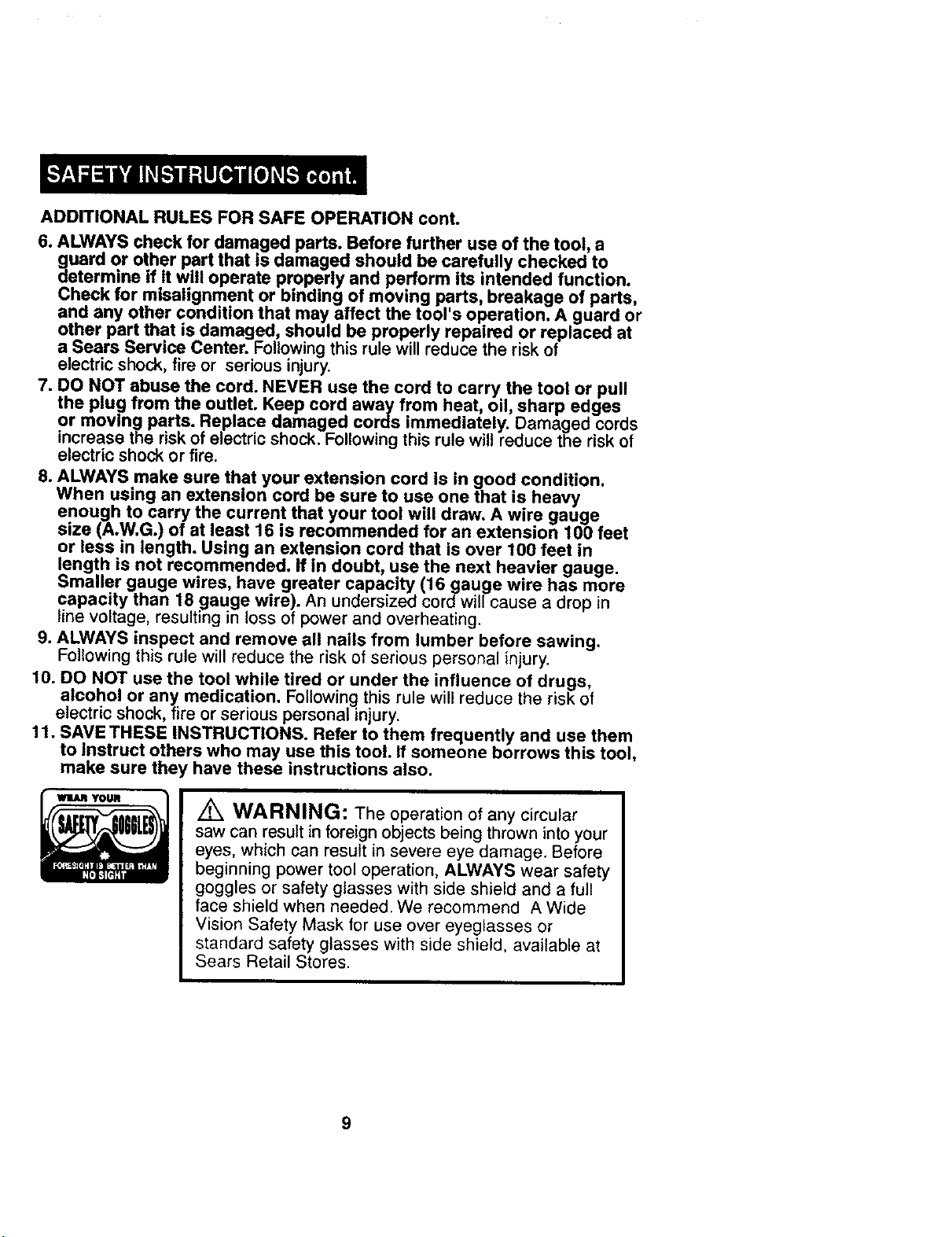
/_ WARNING: The operation of any circular
saw can result in foreign objects being thrown into your
eyes, which can result in severe eye damage. Before
beginning power tool operation, ALWAYS wear safety
goggles or safety glasses with side shield and a full
face shield when needed. We recommend A Wide
Vision Safety Mask for use over eyeglasses or
standard safety glasses with side shield, available at
Sears Retail Stores.
9
ADDITIONAL RULES FOR SAFE OPERATIONcont.
/_ WARNING: Some dust particles created by power sanding,
sawing, grinding, drilling and other construction jobs contains
chemicals known to cause cancer, birth defects or other reproductive
harm. Some examples of these chemicals are:
• Lead from lead-based paints.
Crystalline silica from bricks and cement and other masonry products.
• Arsenic and chromium from chemacally-treatedlumber.
Your risk from these exposures varies, depending upon how often you do
this type of work.To reduce your exposure to these chemicals:
• Work in a well-ventilated area.
- Work with approved safety equipment, such as those dust
masks that are specially designed to filter out microscopic particles.
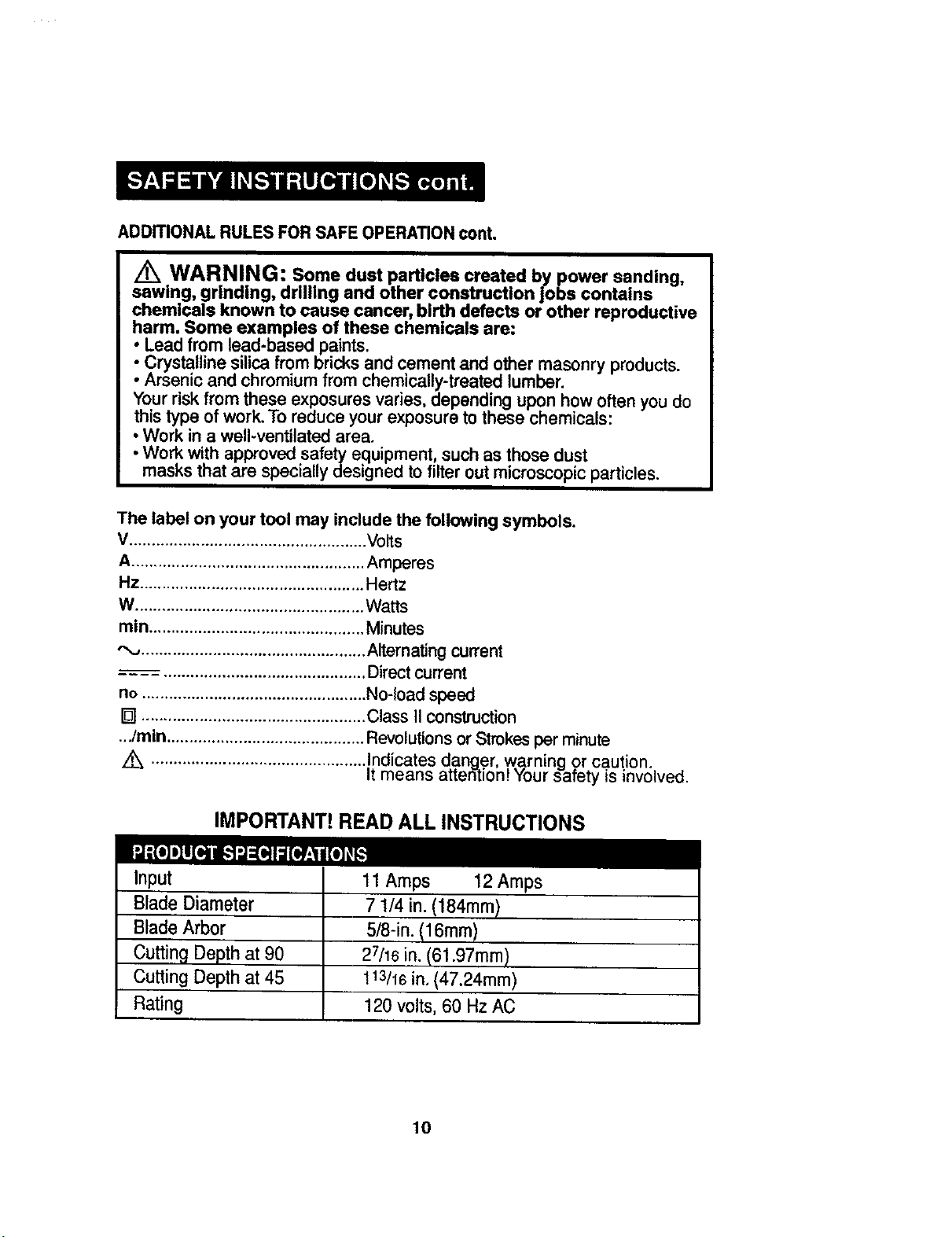
The label on your tool may include the following symbols.
V..................................................... Volts
A.................................................... Amperes
Hz.................................................. Hertz
W................................................... Watts
rain ................................................ Minutes
•_, .................................................. Alternating current
____- ............................................. Direct current
no .................................................. No-load speed
[] .................................................. Class II construction
.../mln ............................................ Revolutions orStrokes per minute
Z_ ................................................ Indicates danger warning or caution.
t means attention! Your safety s invored.
IMPORTANT! READ ALL INSTRUCTIONS
Input
Blade Diameter
BladeArbor
Cutting Depth at g0
Cutting Depth at 45
Rating
11Amps 12Amps
7 1/4 in. (184mm)
5/8-in. (16ram)
27/16 in. 61.97mm)
113/lsin, (47.24mm)
120volts, 60 Hz AC
10
Before attempting to use any tool, be sure to familiarize with all the
operating features and safety instructions.
I WARNING: DO NOT let familiarity with your saw make you
careless. Remember that a careless fract on of a second is sufficient
to cause severe injury.
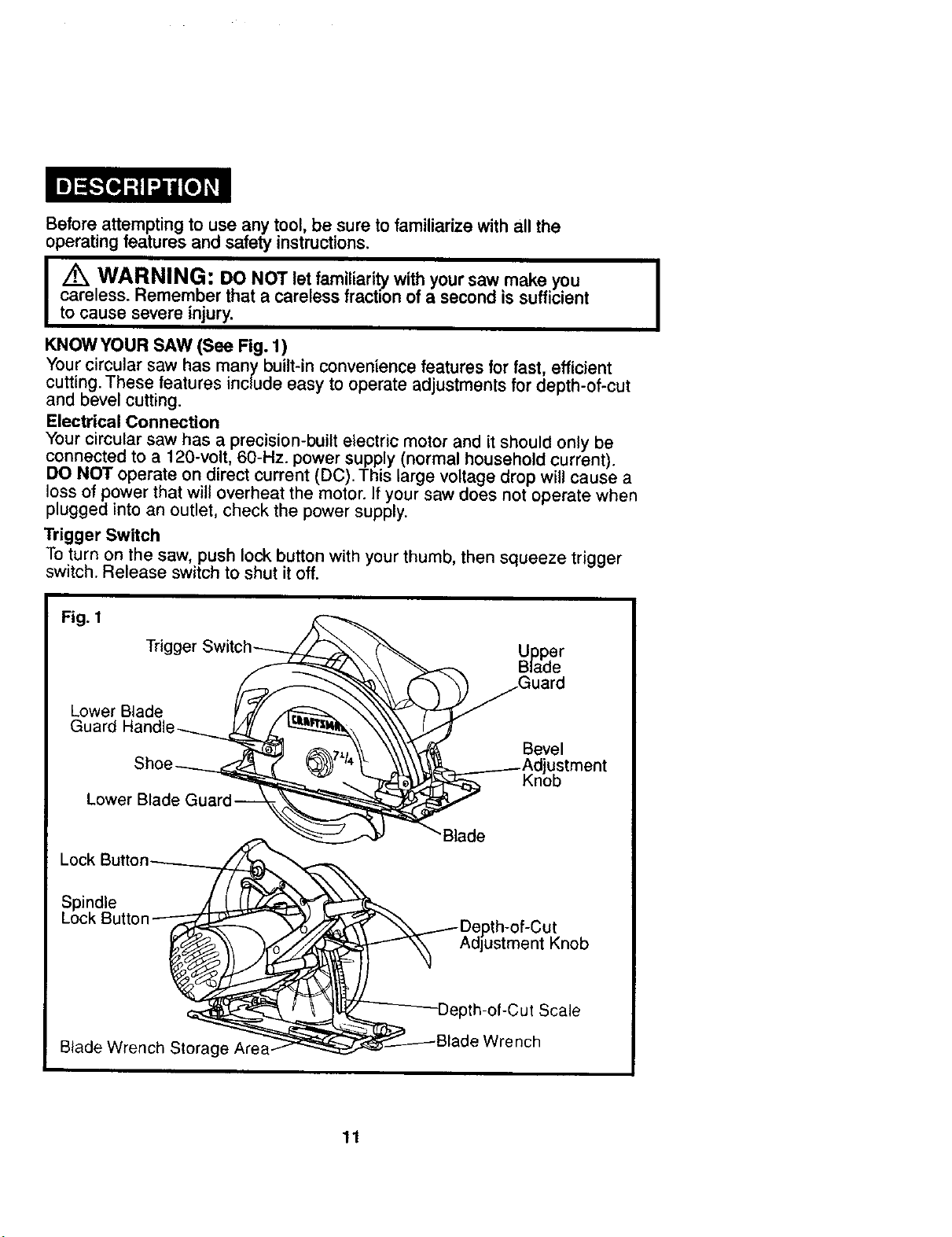
KNOWYOUR SAW (See Fig. 1)
Your circular saw has many built-in convenience features for fast efficient
cutting. These features include easy to operate adjustments for depth-of-cut
and bevel cutting.
Electrical Connection
Your circular saw has a precision-built electric motor and it should only be
connected to a 120-volt, 60-Hz. power supply (normal household current).
DO NOT operate on direct current (DC). This large voltage drop will cause a
loss of power that will overheat the motor. Ifyour saw does not operate when
plugged into an outlet, check the power supply.
Trigger Switch
To turn on the saw, push lock button with your thumb, then squeeze trigger
switch. Release switch to shut it off.
I
Lock
)indle
ustment Knob
Blade Wrench Storagq
._pth-of-Cut Scale
_nch
11
UNPACKING
Your circular saw has been shipped completely assembled except for the blade
which is packed unassembled. Inspect the saw carefully to make sure that no
breakage or damage has occurred during shipping. If any parts are damaged or
missing, return the saw to your nearest Sears Store to have it replaced.
I _WARNING: If any parts are missing, DO NOT operate this saw until the
missing _arts are replaced. Failure to do so could result in possible serious
personal injury.
MOUNTING THE BLADE TO SAW
Carefully remove the blade from its packing and thoroughly inspect it to be
sure that it is not cracked or damaged.
I Z_WARNING: Your saw should NEVER be connected to the power I
source whenyou are assembling parts making adjustments installing or
removing blades, cleaning or when itis not in use. Disconnecting the saw
will prevent accidental starting, which could cause serious personal injury.
Z_WARNING: A 7 1/4-in. blade is the maximum blade capacity for your
saw. NEVER use a blade that is too thick to allow the outer blade washer to
engage with the flat side of the spindle. Larger blades will come nto contact
with the blade guards, and thicker blades will prevent the blade screw from
securing the blade on the spindle. Either of these situations could result in
serious personal injury.
Your saw has a spindle lock button for locking the spindle on your saw in a
stationary position. Push and hold the spindle lock button when mounting,
changing or removing the blade.
1. Remove blade wrench from shoe.
2, Place saw on its side on a flat surface.
3. Use blade wrench to loosen blade screw by turning it in a counterclockwise
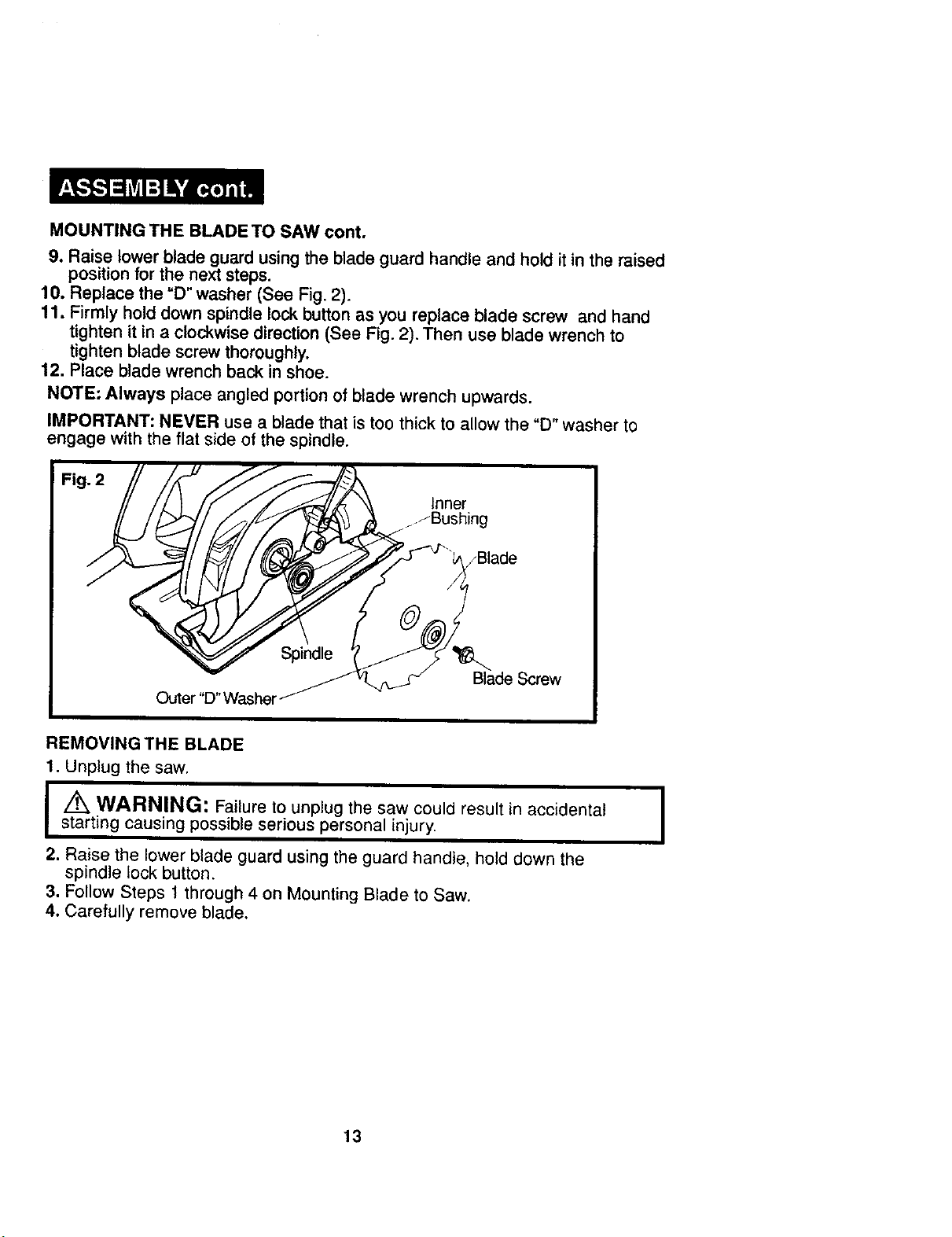
direction. Completely remove blade screw (See Fig. 2).
4. Remove outer "D" washer (See Fig, 2).
5. The part remaining is the inner bushing (See Fig. 2), It does not need to
be removed.
6. Wipe a drop of oil onto the inner bushing and outer "D" washer where they
will touch blade.
7. Place the saw blade inside the lower blade guard, onto the spindle and
against the inner bushing (See Fig. 2).
NOTE: The teeth of the blade should point upward at the front of the saw
as shown in Fig. 2.
8. Place saw on the edge of a flat surface so the blade is not in
contact with anything.
12
MOUNTING THE BLADETO SAW cont.
9. Raise lower blade guard using the blade guard handle and hold it in the raised
position for the next steps.
10. Replace the "D" washer (See Fig. 2).
11. Firmly hold down spindle lock button as you replace blade screw and hand
tighten it in a clockwise direction (See Fig. 2). Then use blade wrench to
tighten blade screw thoroughly.
12. Place blade wrench back in shoe.
NOTE: Always place angled portion of blade wrench upwards.
IMPORTANT: NEVER use a blade that is too thick to allow the "D" washer to
engage with the flat side of the spindle.
REMOVING THE BLADE
1. Unplug the saw.
I /K WARNING: Failure to unplug the saw could result in accidental
starting causing possible serious personal injury.
2. Raise the lower blade guard using the guard handle, hold down the
spindle lock button.
3. Follow Steps 1 through 4 on Mounting Blade to Saw.
4. Carefully remove blade.
13
SAW BLADES
All saw blades need to be kept clean, sharp and properly set in
order to cut efficiently. Using a dull blade places a heavy load on the saw
and increases the danger of kickback. Keep extra blades on hand, so sharp
blades are always available. Gum and wood pitch hardened on the blade
slows the saw down. Use gum and pitch remover, hot water or kerosene to
remove them. DO NOT use gasoline.
BLADE GUARD SYSTEM
The lower blade guard, attached to your circular saw, is there for your
protection and safety. It should NEVER be altered for any reason. If it
becomes damaged or begins to return slowly or sluggishly, DO NOT
operate your saw until the damage has been repaired or replaced. ALWAYS
leave the guard tn its correct operating posdion when using the saw.
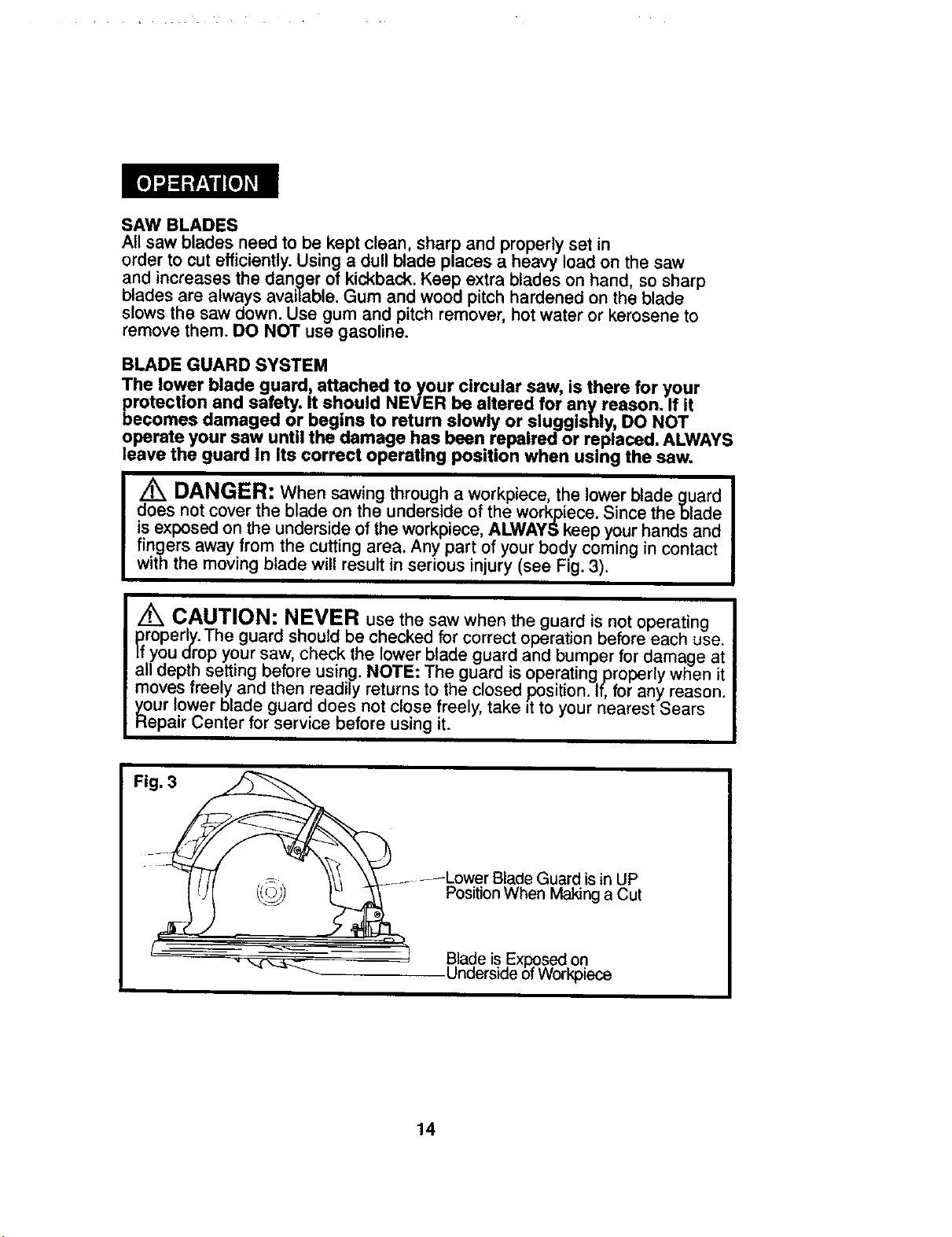
DANGER: When sawing through a workpiece, the lower blade guard
does not cover the blade on the underside of the workpiece. Since the blade
is exposed on the underside of the workpiece, ALWAYSkeep your hands and
fingers away from the cutting area. Any part of your body coming in contact
with the moving blade will result in serious injury (see Fig. 3).
Z_ CAUTION: NEVER use the saw when the guard is not operating
properly. The guard should be checked for correct operation before each use.
If you drop your saw check the lower blade guard and bumper for damage at
all depth setting before using. NOTE: The guard is operatingproperly when it
moves freely and then readily returns to the closed position. If, for any reason.
your lower blade guard does not close freely, take _tto your nearest Sears
Repair Center for service before using it.
Fig. 3
is in UP
PositionWhen Making a Cut
Blade is Exposed on
underside of Workpiece
14
KICKBACK
Kickback occurs when the blade stalls rapidly and the saw is driven
back towards you. Blade stalling is caused by any action which pinches
the blade in the wood,
IMPORTANT:The best guard against kickback is to avoid
dangerous practices.
I _ DANGER: ALWAYS release trigger switch immediately ifthe blade
binds or the saw stalls.Kickback could cause you to lose control of the saw.
Loss of control can lead to serious injury.
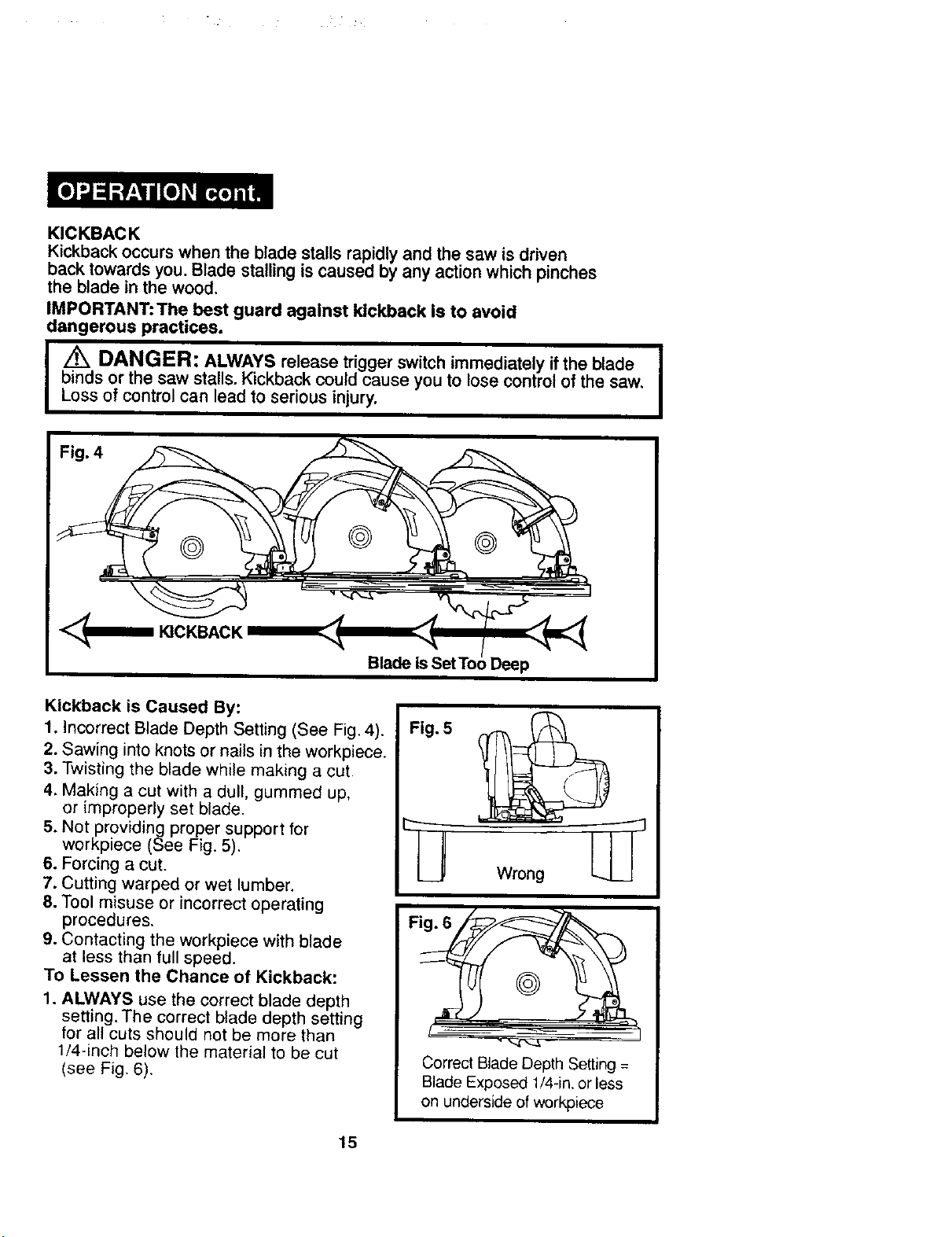
Fig. 4
KICKBACK
Blade is Set Too Deep
Kickback is Caused By:
1, Incorrect Blade Depth Setting (See Fig. 4).
2. Sawing into knots or nails in the workpiece.
3. Twisting the blade while making a cut
4. Making a cut with a dull, gummed up,
or improperly set blade.
5. Not providing proper support for
workpiece (See Fig. 5).
6. Forcing a cut.
7. Cutting warped or wet lumber.
8. Tool misuse or incorrect operating
procedures.
9. Contacting the workpiece with blade
at less than full speed.
To Lessen the Chance of Kickback:
1. ALWAYS use the correct blade depth
setting. The correct blade depth setting
for all cuts should not be more than
1/4-inch below the material to be cut
(see Fig, 6).
" "-.P,-4
Correct Blade Depth Setting =
Blade Exposed 1/4-in. or less
on underside of workpiece
I
15
To Lessen the Chance of Kickback: cont.
2. ALWAYS inspect the workpiece for knots or nails BEFORE beginning to
out. NEVER saw into a knot or nail.
3. Make straight cuts. ALWAYS use a strai_]htedge guide when rip cutting,
This will help prevent twisting the blade =nthe cut.
4. ALWAYS use clean, sharp and
properly set blades. NEVER
make cuts with dull blades.
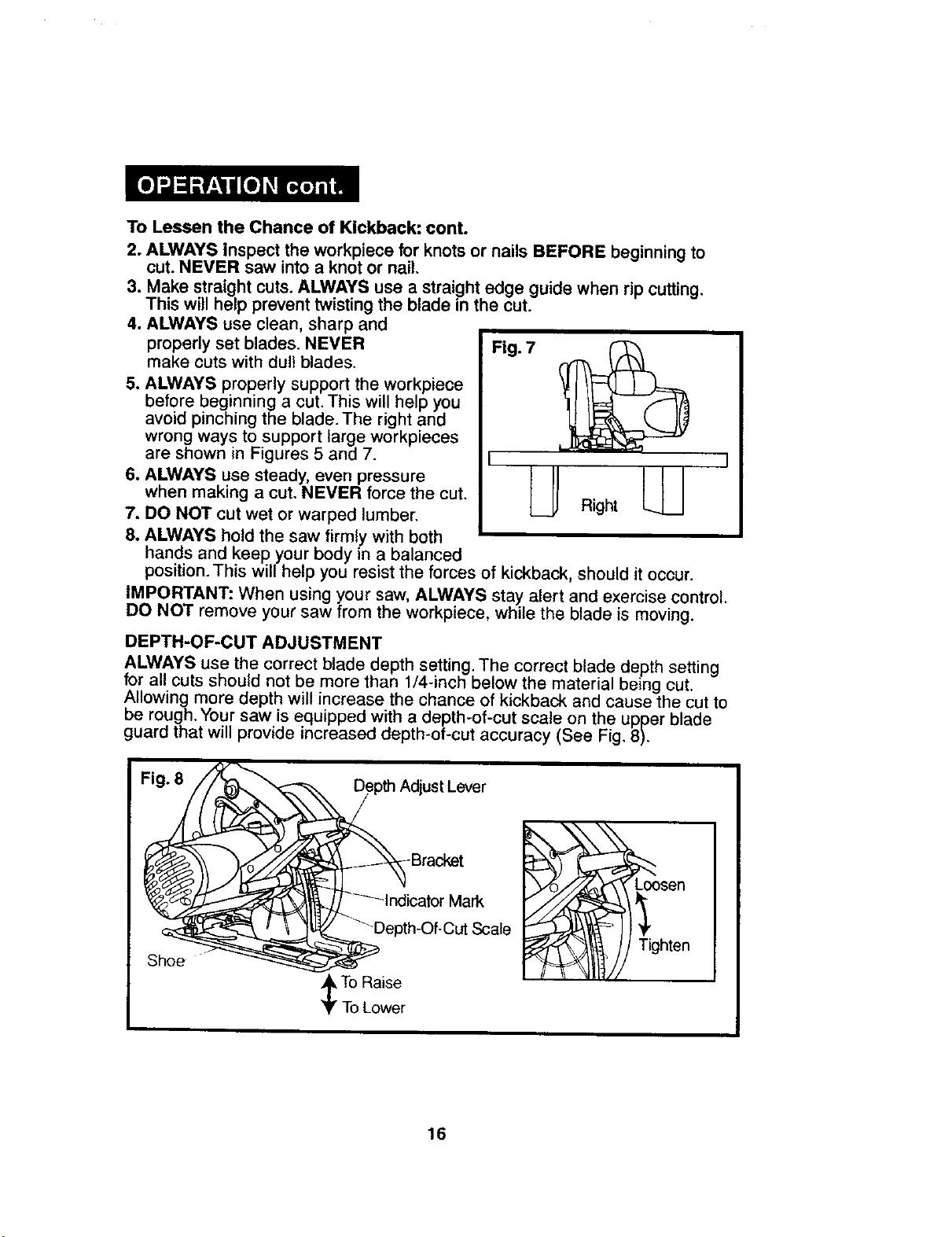
5. ALWAYS properly support the workpiece
before beginning a cut. This will help you
avoid pinching the blade. The right and
wrong ways to support large workpieces
are shown in Figures 5 and 7.
6. ALWAYS use steady, even pressure
when making a cut. NEVER force the cut.
7. DO NOT cut wet or warped lumber.
Fig. 7
I I
8. ALWAYS hold the saw firmly with both
hands and keep your body in a balanced
position.This will help you resist the forces of kickback, should it occur.
IMPORTANT: When using your saw, ALWAYS stay alert and exercise control.
DO NOT remove your saw from the workpiece, while the blade is moving.
DEPTH-OF-CUT ADJUSTMENT
ALWAYS use the correct blade depth setting. The correct blade depth setting
for all cuts should not be more than 1/4-inch below the material being cut,
Allowing more depth will increase the chance of kickback and cause the cut to
be rough. Your saw is equipped with a depth-of-cut scale on the upper blade
guard that will provide increased depth-of-cut accuracy (See Fig. 8).
16
TOADJUSTBLADE DEPTH
1.Unplugthe saw.
I WARNING: Failure to unplug the saw could result in accidental Istarting causing possible serious personal injury.
I
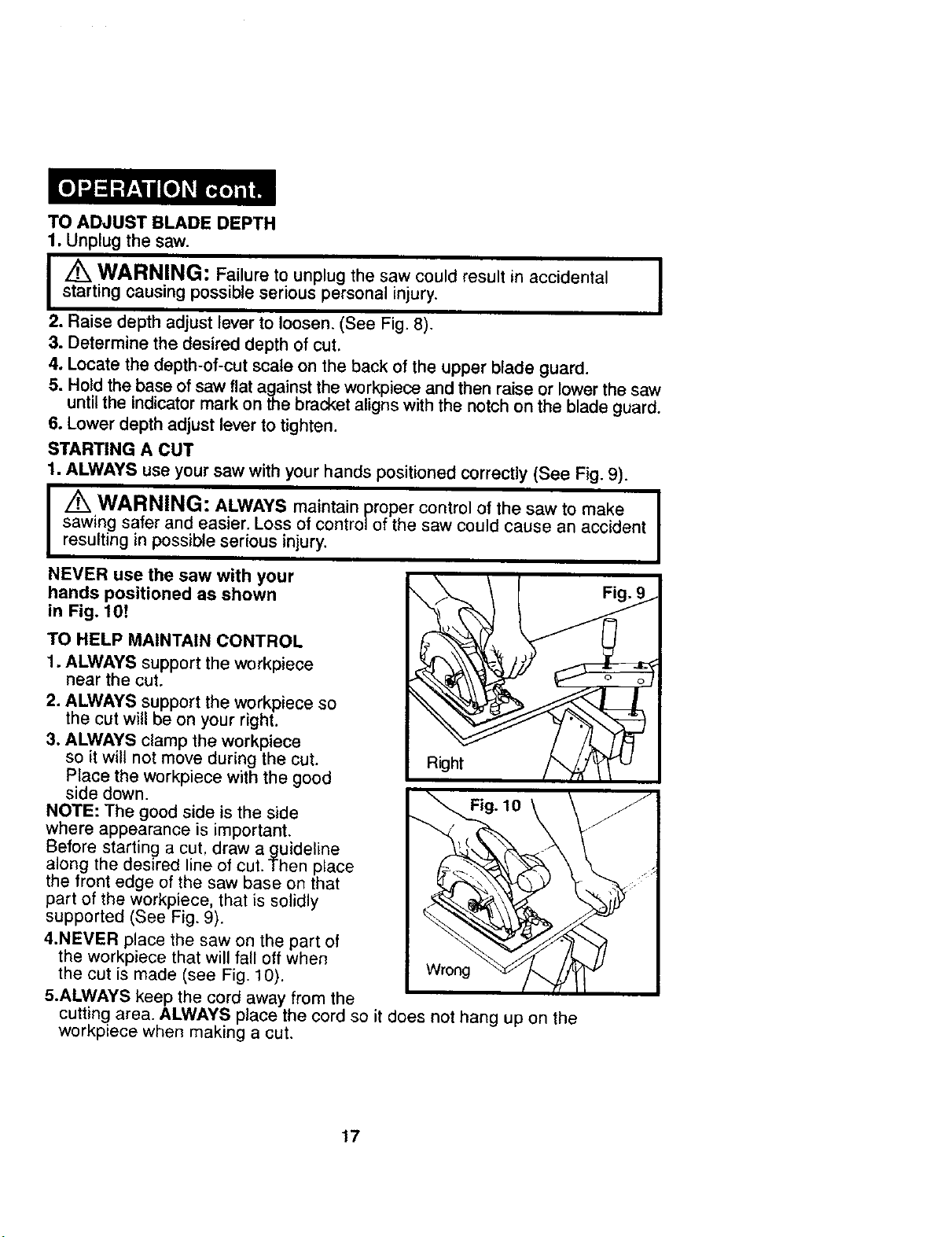
2. Raise depth adjust lever to loosen, (See Fig. 8).
3. Determine the desired depth of cut.
4. Locate the depth-of-cut scale on the back of the upper blade guard.
5. Ho{d the base of saw flat against the workpiece and then raise or lower the saw
until the indicator mark on the bracket aligns with the notch on the blade guard.
6. Lower depth adjust lever to tighten.
STARTING A CUT
1. ALWAYS use your saw with your hands positioned correctly (See Fig. 9).
I /_ WARNING: ALWAYS maintain proper control of the saw to make I
sawing safer and easier. Loss of contro/of the saw could cause an accident
resulting in possible serious injury.
NEVER use the saw with your
hands positioned as shown
in Fig. 10!
TO HELP MAINTAIN CONTROL
1. ALWAYS support the workpiece
near the cut.
2. ALWAYS support the workpiece so
the cut will be on your right.
3. ALWAYS clamp the workpiece
so it will not move during the cut.
Place the workpiece with the good
side down.
NOTE: The good side is the side
where appearance is important.
Before starting a cut, draw a guideline
along the desired line of cut. Then place
the front edge of the saw base on that
part of the workpiece, that is solidly
supported (See Fig. 9).
4.NEVER place the saw on the part of
the workpiece that will fall off when
the cut is made (see Fig. 10). Wrong
5.ALWAYS keep the cord away from the
cutting area. ALWAYS place the cord so it does not hang up on the
workpiece when making a cut.
17
TO HELP MAINTAIN CONTROL cont.
DANGER: If the cord hangs up onthe workpiece during a cut, release I
the trigger switchimmediately. Unplug the saw and move the cord to prevent
I
it from hanging up again.
Z_ DANGER: Using the saw with a damaged cord could result in serious
injury or death. If the cord has been damaged, have it replaced before using |
the saw again. I
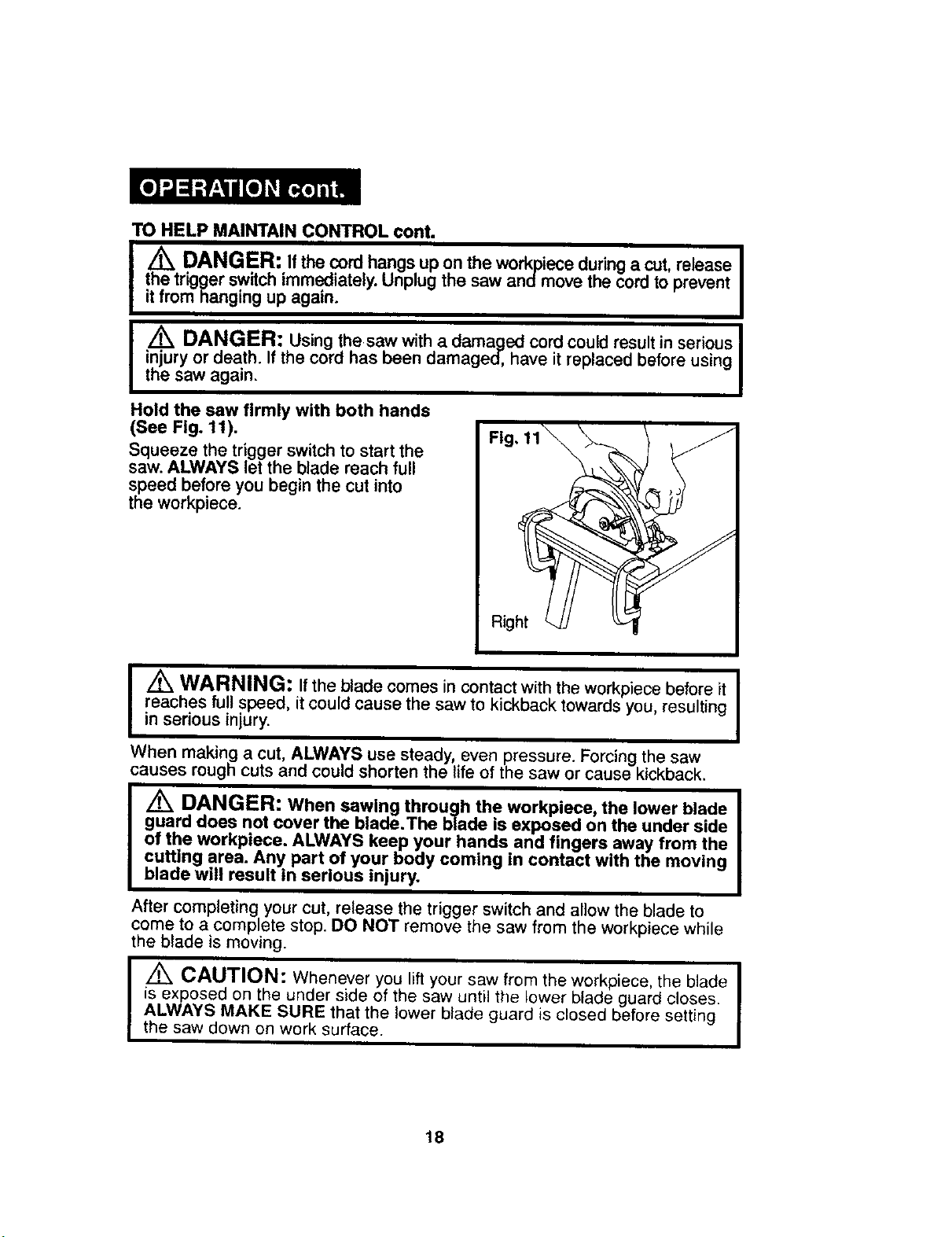
Hold the saw firmly with both hands
(See Fig. 11).
Squeeze the trigger switch to start the
saw. ALWAYS let the blade reach full
speed before you begin the cut into
the workpiece.
Z_ WARNING: Ifthe blade comes in contact with the workpiece before it
reaches full speed, itcould cause the saw to kickback towards you, resulting
in serious injury.
When making a cut, ALWAYS use steady, even pressure. Forcingthe saw
causes rough cuts and could shorten the life of the saw orcause kickback.
Z_ DANGER: When sawing through the workpiece, the lower blade
guard does not cover the blade.The blade is exposed on the under side
of the workptece. ALWAYS keep your hands and fingers away from the
cutting area. Any part of your body coming in contact with the moving
blade will result in serious injury.
After completing your cut, release the trigger switch and allow the blade to
come to a complete stop. DO NOT remove the saw from the workpiece while
the blade is moving.
I
Z_ CAUTION: Whenever you lift your saw from the workpiece, the blade I
is exposed on the under side of the saw until the lower blade guard closes.
I
ALWAYS MAKE SURE that the lower blade guard is closed before setting
the saw down on work surface.
18
MAKING CROSS CUTS OR RIP CUTS
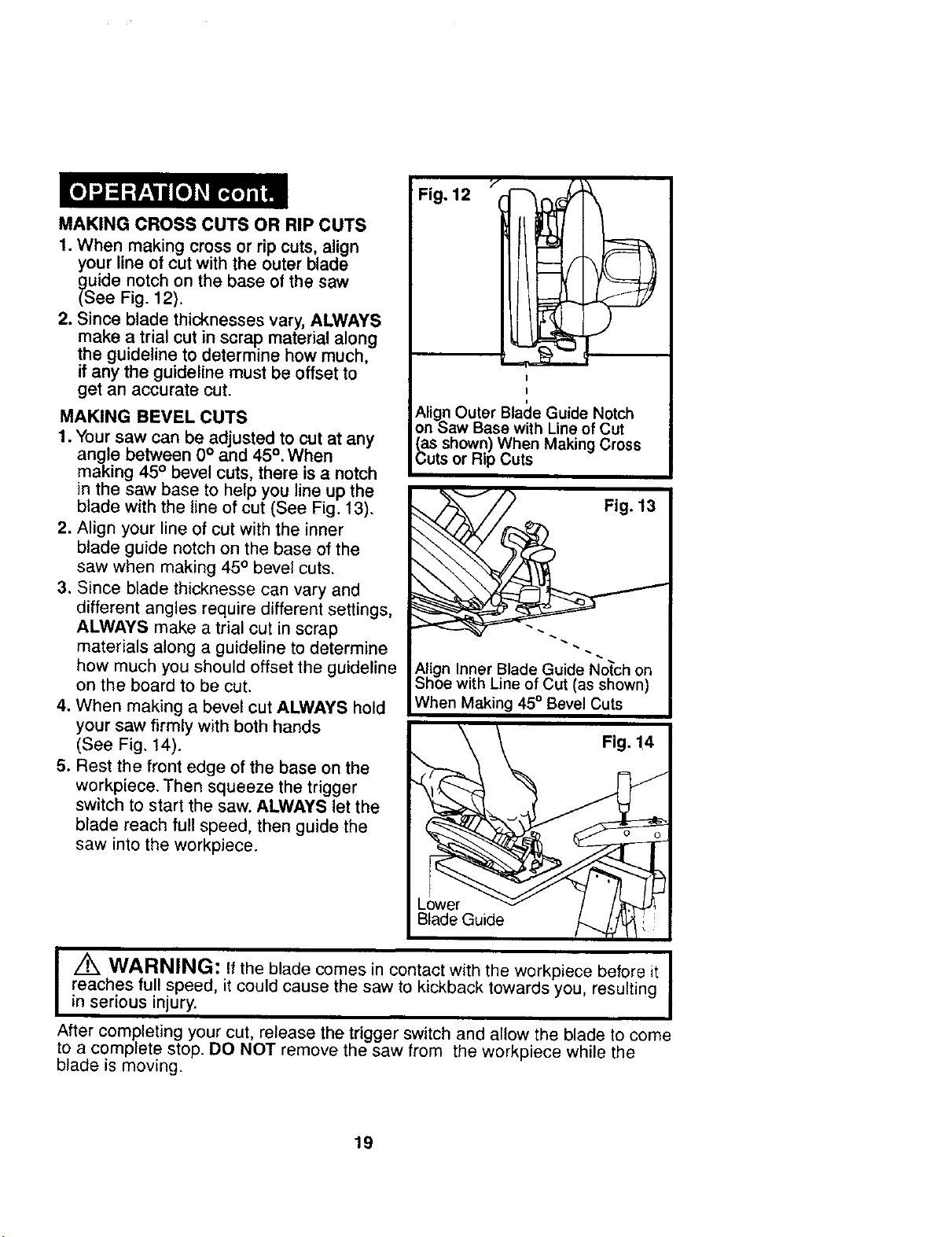
1. When making cross or rip cuts, align
your line of cut with the outer blade
_]suide notch on the base of the saw
ee Fig. 12).
2. Since blade thicknesses vary, ALWAYS
make a trial cut in scrap material along
the guideline to determine how much,
if any the guideline must be offset to
get an accurate cut.
MAKING BEVEL CUTS
1. Your saw can be adjusted to cut at any
angle between 0 ° and 45 °. When
making 45 ° bevel cuts, there is a notch
in the saw base to help you line up the
blade with the line of cut (See Fig. 13).
2. Align your line of cut with the inner
blade guide notch on the base of the
saw when making 45 ° bevel cuts.
3. Since blade thicknesse can vary and
different angles require different settings,
ALWAYS make a trial cut in scrap
materials along a guideline to determine
how much you should offset the guideline
on the board to be cut.
4. When making a bevel cut ALWAYS hold
your saw firmly with both hands
(See Fig. 14).
5. Rest the front edge of the base on the
workpiece. Then squeeze the trigger
switch to start the saw. ALWAYS let the
blade reach full speed, then guide the
saw into the workpiece.
Fig. 13
Align Inner Blade GuideN_o_ch on
Shoe with Line of Cut (as shown)
When Making 45° Bevel Cuts
I WARNING: If the blade comes in contact with the workpiece before it I
reaches full speed, it could cause the saw to kickback towards you, resu t ng
I
in serious injury.
After completing your cut, release the trigger switch and allow the blade to come
to a complete stop. DO NOT remove the saw from the workpiece while the
blade is moving.
19
TO ADJUSTTHE BEVEL SETTING
1. Unplug the saw.
I/t_ WARNING: Failure to unplug the saw could result in accidental
starting causing possible serious personal injury.
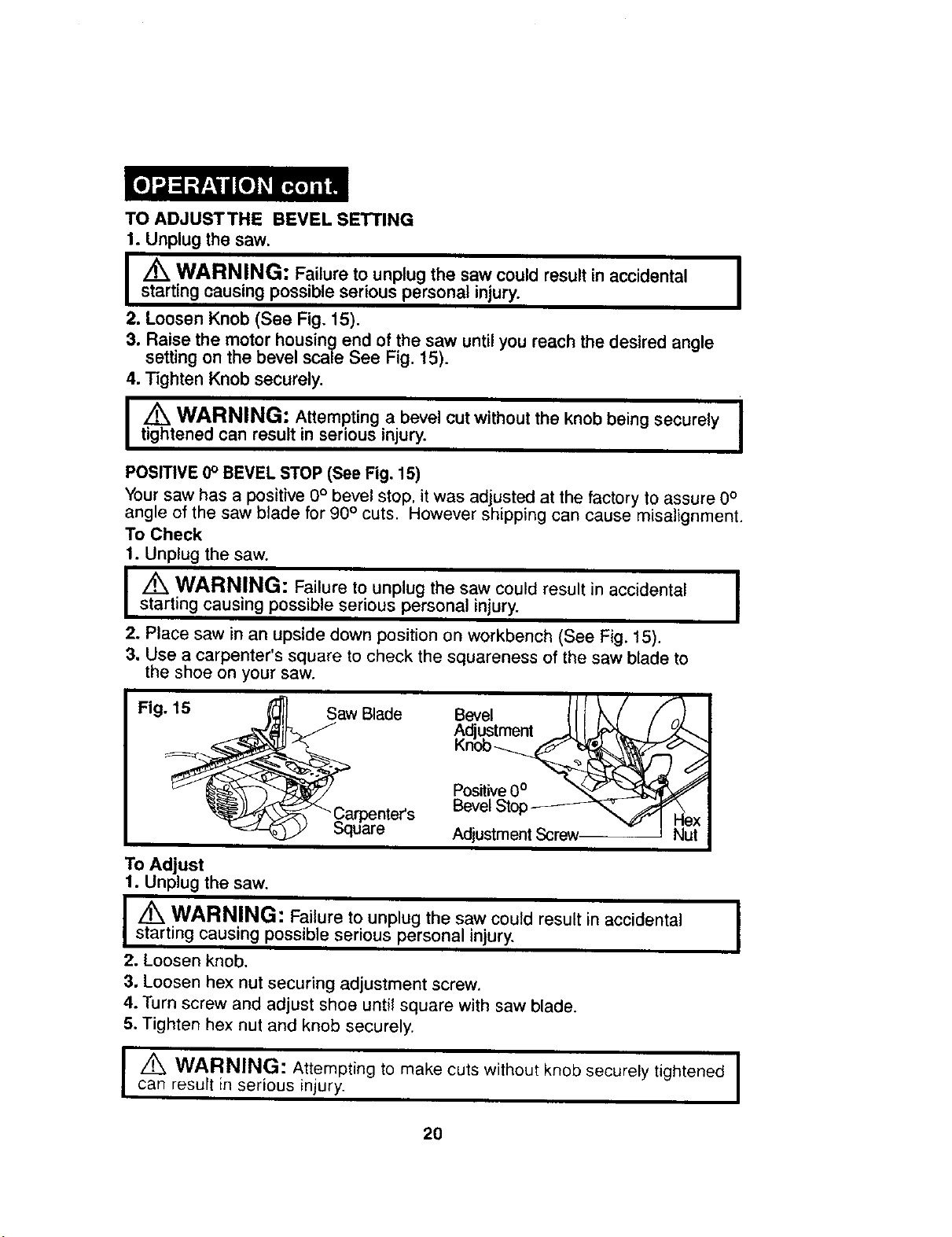
2. Loosen Knob (See Fig. 15).
3. Raise the motor housing end of the saw untilyou reach the desired angle
setting on the bevel scale See Fig. 15).
4. Tighten Knob securely.
I Z_ WARNING: Attempting a bevel cut without the knob being securely
tightened can result in serious injury.
I
POSITIVE 0° BEVEL STOP (See Fig. 15)
Your saw has a positive 0° bevel stop, itwas adjusted at the factory to assure 0°
angle of the saw blade for 90° cuts. However shipping can cause misalignment.
To Check
1. Unplug the saw.
I Z_ WARNING: Failure to unplug the saw could result in accidental
I
starting causing possible serious personal injury. I
2. Place saw in an upside down position on workbench (See Fig. 15).
3. Use a carpenter's square to check the squareness of the saw blade to
the shoe on your saw.
Fig. 15 _aw Blade
_rpenter's
_ Square
,Adjustment ..,-_ L,_
I_.nOD_ .
Positive0°
BevelStop_ _._
Adjustment Screw-
Hex
Nut
To Adjust
1. Unplug the saw,
A'_ WARNING: Failure to unplug the saw could result in accidental
starting causing possible serious personal injury,
2. Loosen knob.
3. Loosen hex nut securing adjustment screw,
4. Turn screw and adjust shoe until square with saw blade.
5. Tighten hex nut and knob securely.
I
Z_ WARNING: Attempting to make cuts without knob securely tightened I
can result in serious injury.
I
2O
TO MAKE POCKET CUTS
I Z_ WARNING: ALWAYS adjust bevel setting to zero before making a I
pocket cut. Attempting a pocket cut at any other setting can result in a loss
I
of control ofthe saw, possibly causing serious injury.
1. Adjust the bevel setting to zero, set the blade to the correct blade depth setting
and swing the lower blade guard up, us ng the lower blade guard handle.
I Z_ WARNING: ALWAYS raise the lower blade guard with the handle I
to avoid serious injury.
I
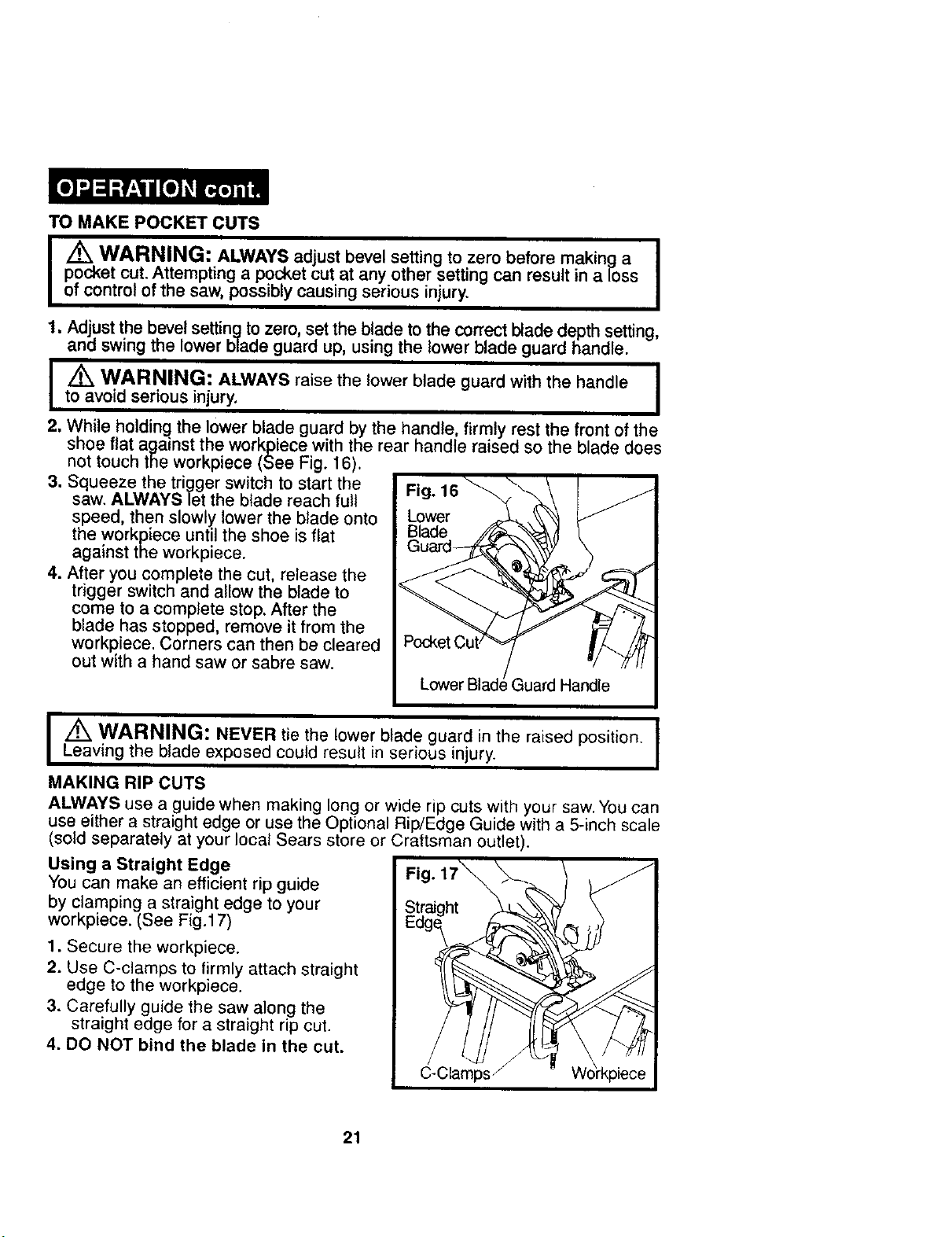
2. While holding the lower blade guard by the handle firmly rest the front of the
shoe flat against the workpiece with the rear handle raised so the blade does
not touch the workpiece (See Fig. 16).
3. Squeeze the trigger switch to start the
saw. ALWAYS let the blade reach full
speed, then slowly lower the blade onto
the workpiece until the shoe is flat
against the workpiece.
4. After you complete the cut, release the
trigger switch and allow the blade to
come to a complete stop. After the
blade has stopped, remove it from the
workpiece. Corners can then be cleared
out with a hand saw or sabre saw.
I Z_ WARNING: NEVER tie the lower blade guard in the raised position.
Leaving the blade exposed could result in serious injury.
I
MAKING RIP CUTS
ALWAYS use a guide when making long or wide rip cuts with your saw. You can
use either a straight edge or use the Optional Rip/Edge Guide with a 5oinch scale
(sold separately at your local Sears store or Craftsman outlet).
Using a Straight Edge
You can make an efficient rip guide
by clamping a straight edge to your
workpiece. (See Fig.17)
1. Secure the workpiece.
2. Use C-clamps to firmly attach straight
edge to the workpiece.
3, Carefully guide the saw along the
straight edge for a straight rip cut.
4. DO NOT bind the blade in the cut.
21
MAKINGRIPCUTScont,
UsingThe Rip/Edge Guide (sold separately)
ToAttach the Rip/Edge Guide
1.Unplugthesaw,
WARNING: NEVER Failure to unplug the saw could result in
accidental starting causing possible serious personal injury.
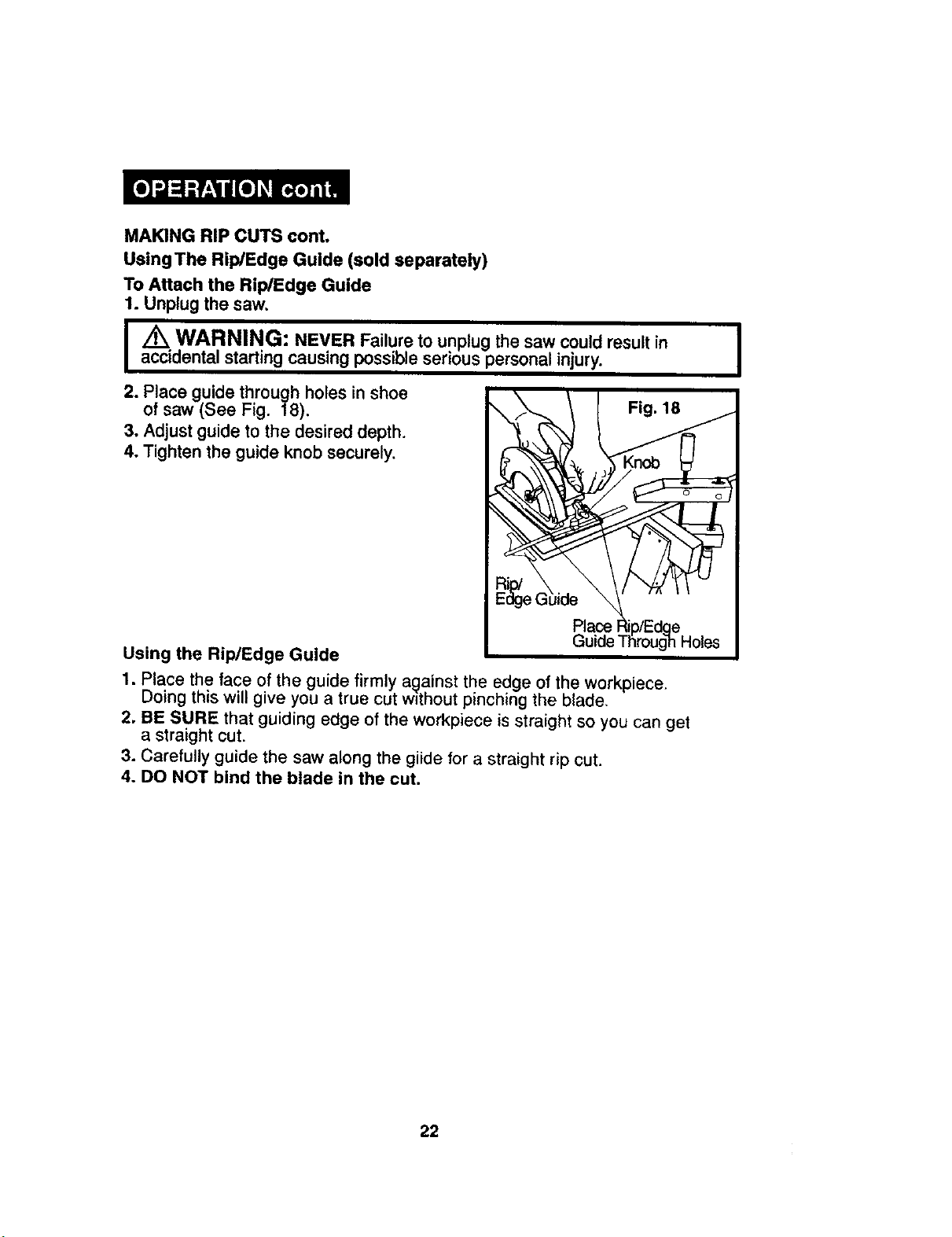
2. Place guide through holes in shoe
of saw (See Fig. 18).
3, Adjust guide to the desired depth.
4, Tighten the guide knob securely.
I
Using the Rip/Edge Guide
1, Place the face of the guide firmly a_ainst the edge of the workpiece.
Doing this will give you a true cut without pinching the blade,
2. BE SURE that guiding edge of the workpiece is straight so you can get
a straight cut.
3. Carefully guide the saw along the glide for a straight rip cut.
4. DO NOT bind the blade in the cut.
22
GENERAL
Z_ WARNING: To avoid accidents, ALWAYS disconnect the tool from
the power source BEFORE cleaning or performing any maintenance.
All parts represent an important part of the double insulation system and
should be serviced only at a Sears Service Center.
Avoid using solvents when cleaning plastic parts. Most plastics are
susceptible to damage from various types of commercial solvents and
may be damaged by their use. Use clean cloths to remove dirt,
carbon dust, etc+
/_ WARNING: DO NOT at any time let brake fluids, gasoline
petroleum-based products, penetrating oils etc. to come in contact
with plastic parts.They contain chemicals that can damage, weaken
or destroy plastic.
It is a known fact that electric tools are subject to accelerated wear and
possible premature failure when they are used to work on fiber glass
boats and sports cars, wallboard, spacklingcompounds or plaster.The
chips and grindings from these materials are highly abrasive to electrical
tool parts, such as bearings, brushes, commutators, etc. Consequently,
itis not recommended that this tool be used for extended work on any
fiber glass material, wallboard, spackling compound, or plaster.
During any use on these materials, itis extremely important that the tool
iscleaned frequently by blowing with an air jet.
LUBRICATION
All of the bearings in this tool are lubricated with a sufficient amount of
high-grade lubricant for the life o! the tool under normal operating conditions.
Therefore, no further lubrication is required.
I /_, WARNING: ALWAYS wear safety goggles or safety glasses with I
or side shields when using this tool or blowing dust. If operation is dusty,
also wear a dust mask.
DOUBLE INSULATION
Double insulation is a concept in safety in electric power tools, which
eliminates the need for the standard 3-wire grounded power cord. All
exposed metal parts are isolated from the internal motor components with
protecting insulation. Double insulated tools do not need to be grounded.
IMPORTANT
The servicing of a tool with double insulation requires extreme care and
knowledge of the system and should be performed only by a qualified service
technician. For service, we recommend that you return the tool to your nearest
Sears Service Center for repair. ALWAYS use identical replacement
parts when servicing.
23
EXTENSION CORDS
The use of any extension cord willcause some loss of power.To keep the loss
at a minimum and to prevent overheating, use an extension cord that is heavy
enough to carry the current that the tool will draw.
A wire gauge (AWG) of at least 16 is recommended for an extension cord
100 feet or less in length. When working outdoors ALWAYS use an extension
cord that is suitable for outdoor use.The cord's jacket will be marked WA.
J _ CAUTION: Keep extension cords away from the cutting area,
and position the cord so it will not get caught on lumber, tools, etc.
during the cutting operation.
I _ WARNING: Check extension cords before each use. If damaged,
replace it immediately. NEVER use a tool with a damaged cord because
touchin_ the damaged area could cause electrical shock, resulting in
senous/njury.
Extension cords that are suitable for use with your saw are available at
your nearest Sears Store.
ACCESSORIES
The following recommended accessories are currently
available at your local Sears Store.
7 1/4-1n. 40-Tooth General-Purpose Cut-Off Blade
7 1/4-in. 35-Tooth Master Combination Blade
7 1/4-1no 200-Tooth Plywood Blade
7 1/4-ino 18-Tooth Carbide Blade
7 1/4-in. 18-Tooth Mach II Silver Series Carbide Blade
7 1/4-in. 24-Tooth Mach II Silver Series Carbide Blade
7 1/4-in. 24-Tooth Combination Carbide Blade
Rip Guide
I
I
I Z_ WARNING: The use of attachments or accessories that are
not recommended might be dangerous and could result in serious injury.
24

NOTES
25

i_iiiiiii!iiii!!
i_ iiii
iiiii_i!i!ili
!ili!!!iii!iil
:+:,:,:+::
Your Home
For repair in your home of all major brand appliances,
lawn and garden equipment, or heating and cooling systems,
no matter who made it, no matter who sold it!
For the replacement parts, accessories and
owner's manuals that you need to do-it-yourself.
For Sears professional installation of home appliances
and items like garage door openers and water heaters.
1-800-4-MY-HOME ® Anytime,dayor night
(1-800-469-4663) (U.S.A. and Canada)
www.sears,com www.sears.ca
Our Home
For repair of carry-in products like vacuums, lawn equipment,
and electronics, call or go on-line for the nearest
Sears Parts and Repair Center.
1-800-488-1222 Anytime,dayornight(U.S.A.on_y)
www, sears,com
To purchase a protectionagreement (U.S.A.) or maintenance
agreement (Canada) on a product serviced by Sears:
1-800-827-6655 (u.s./_) 1-800-361-6665 {Canada)
_ii/iiiiiiiiiiiiil
;,:_::::.
!i!iiii!!i
Para pedir servicio de reparaciSn
a domicilio, y para ordenar piezas:
: 1.888.SU.HOGARS_
(1"888-784-6427)
_ Se_s,Roebuckar_Co.
Au Canada pour serw_'e en fran£ais:
1-800-LE-FOYEW _c
(1-800-533-6937)
www.sears.ca
.....
$_Registered Trademark / TM Trademark ,'su Service Mark o| Sears, Roebuck and Co.
_ Marca Registrada / r_ Marca de F. b_ica / s_ Marca de Servicio de Sea_s, Roebuck and Co
_ Marque de commerce ; t_ Marque d_pos_e de Sears, Roebuck and Co.
26

