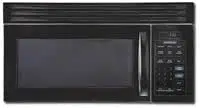
GoldStar
we bsite :http ://www. LG Eservice.com
e-mail :http:flwww.LG Eservice.com/techsu p.html
MICROWAVEOVEN
OWNER'S MANUAL & COOKING GUIDE
PLEASE READ THIS OWNER'S MANUAL
THOROUGHLY BEFORE OPERATING.
MV-1310W
MV-1310B

Thank you for purchasing a GoldStar microwave oven
Please record the model number and serial
number of this unit for future reference. We also
suggest you record the details of your contact
with GoldStar (LG Electronics U.S.A., Inc.)
concerning this unit.
Model No:
Serial No:
Dealer:
DealerPhoneNo:
Stapleyourreceipthereto proveyour
retailpurchase.
CustomerRelations
LGElectronicsU.S.A.,Inc.
ServiceDivisionBldg.#3
201 JamesRecordRd.
Huntsville,AL35824-0126
PRECAUTIONS TO AVOID POSSIBLE
EXPOSURE TO EXCESSIVE
MICROWAVE ENERGY...
(a) Do not attempt to operate this oven with
the door open since open-door operation
can result in harmful exposure to
microwave energy. It is important not to
defeat or tamper with the safety
interlocks.
(b) Do not place any object between the
oven front face and the door or allow soil
or cleaner residue to accumulate on
sealing surfaces.
(c) Do not operate the oven if it is damaged.
It is particularly important that the oven
door closes properly and that there is no
damage to the:
(1) Door (bent),
(2) Hinges and latches (broken or
loosened),
(3) Door seals and sealing surfaces.
(d) The oven should not be adjusted or
repaired by anyone except properly
qualified service personnel.
-2-
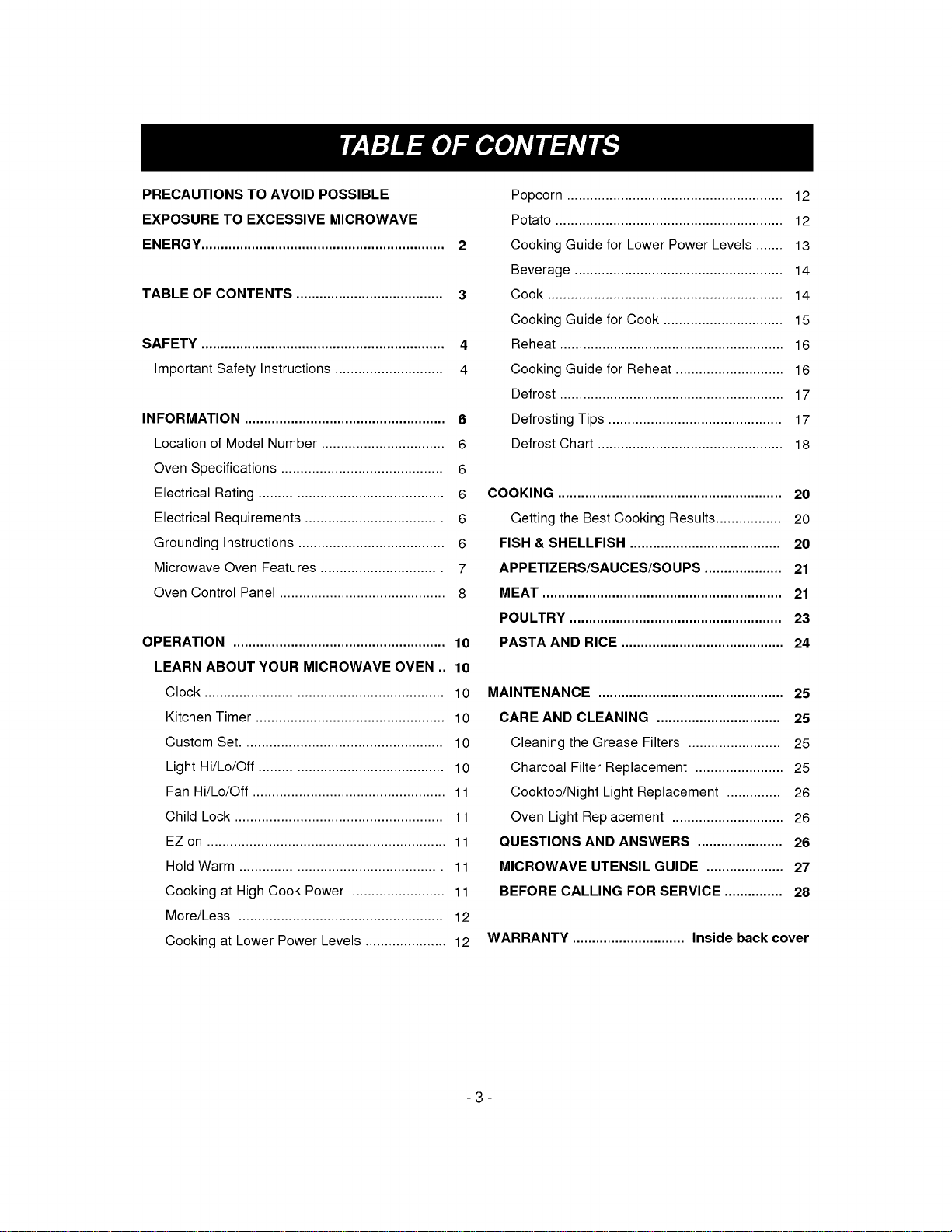
PRECAUTIONS TO AVOID POSSIBLE
EXPOSURE TO EXCESSIVE MICROWAVE
ENERGY ...............................................................
TABLE OF CONTENTS ...................................... 3
SAFETY ............................................................... 4
Important Safety Instructions ............................ 4
INFORMATION .................................................... 6
Location of Model Number ................................ 6
Oven Specifications .......................................... 6
Electrical Rating ................................................ 6
Electrical Requirements .................................... 6
Grounding Instructions ...................................... 6
Microwave Oven Features ................................ 7
Oven Control Panel ........................................... 8
OPERATION ....................................................... 10
LEARN ABOUT YOUR MICROWAVE OVEN .. 10
Clock .............................................................. 10
Kitchen Timer ................................................. 10
Custom Set .................................................... 10
Light Hi/Lo/Off ................................................ 10
Fan Hi/Lo/Off .................................................. 11
Child Lock ...................................................... 11
EZon .............................................................. 11
Hold Warm ..................................................... 11
Cooking at High Cook Power ........................ 11
More/Less ..................................................... 12
Cooking at Lower Power Levels ..................... 12
Popcorn ........................................................ 12
Potato ........................................................... 12
Cooking Guide for Lower Power Levels ....... 13
Beverage ...................................................... 14
Cook ............................................................. 14
Cooking Guide for Cook ............................... 15
Reheat .......................................................... 16
Cooking Guide for Reheat ............................ 16
Defrost .......................................................... 17
Defrosting Tips ............................................. 17
Defrost Chart ................................................ 18
COOKING .......................................................... 20
Getting the Best Cooking Results ................. 20
FISH & SHELLFISH ....................................... 20
APPETIZERS/SAUCES/SOUPS .................... 21
MEAT .............................................................. 21
POULTRY ....................................................... 23
PASTA AND RICE .......................................... 24
MAINTENANCE ................................................ 25
CARE AND CLEANING ................................ 25
Cleaning the Grease Filters ........................ 25
Charcoal Filter Replacement ....................... 25
Cooktop/Night Light Replacement .............. 26
Oven Light Replacement ............................. 26
QUESTIONS AND ANSWERS ...................... 26
MICROWAVE UTENSIL GUIDE .................... 27
BEFORE CALLING FOR SERVICE ............... 28
WARRANTY ............................. Inside back cover
-3-
IMPORTANT SAFETY INSTRUCTIONS
The safety instructions below will tell you how to use your oven and avoid harm to yourself or
damage to your oven.
WARNING-To reduce the risk of burns, electric
shock, fire, injury to persons, or exposure to
excessive microwave energy.
• Read all the instructions before using your oven.
• Suitable for use above both gas and electric cooking
equipment 36 inches wide or less.
• Do not use this oven for commercial purposes. It
is made for household use only.
• Do not allow children to use this oven without
close supervision.
• Read and follow the specific PRECAUTIONS TO
AVOID POSSIBLE EXPOSURE TO
EXCESSIVE MICROWAVE ENERGY found
on page 2.
• When cleaning the door and the surfaces that
touch the door, use only mild, non-abrasive
soaps or detergents and a sponge or soft cloth.
• If your oven is dropped or damaged, have it
thoroughly checked by a qualified service technician
before using it again.
• Do not use corrosive chemicals or vapors, such as
sulfide and chloride, in this appliance. This type of
oven is specifically designed to heat, cook, or dry
food. It is not designed for industrial or laboratory
use.
• Do not use or store this appliance outdoors. Do not
use this product near water -for example, near a
kitchen sink, in a wet basement, or near a swimming
pool, and the like.
• Do not use the cavity for storage purposes. Do not
leave paper products, cooking utensils, or food in
the cavity when not in use.
• Clean the ventilating hood frequently. Do not
allow grease to accumulate on the hood or the
filters.
To avoid a fire hazard:
- Do not severely overcook food. Severely
overcooked foods can start a fire in the oven.
Watch the oven carefully, especially if you have
paper, plastic, or other combustibles in the oven.
- Do not store combustible items (bread,
cookies, etc.) in the oven, because if lightning
strikes the power lines it may cause the oven to
turn on.
- Do not use wire twist-ties in the oven. Be sure
to inspect purchased items for wire twist-ties and
remove them before placing the item in the oven.
• If a fire should start:
- Keep the oven door closed.
- Turn the oven off.
- Disconnect the power cord or shut off the
power at the fuse or circuit breaker panel.
• Use care when cleaning the vent hood filters.
Corrosive cleaning agents such as lye-based oven
cleaners, may damage the filters.
• Do not tamper with the built-in safety switches
on the oven door. The oven has several built-in
safety switches to make sure the power is off when
the door is open.
• When flaming foods under the hood, turn the fan on.
• To avoid electric shock:
- This appliance must be grounded. Connect it
only to a properly grounded outlet. See the
electrical GROUNDING INSTRUCTIONS
on page 6.
- Do not operate this appliance if it has a
damaged cord or plug, if it is not working
properly or if it has been damaged or dropped.
- Do not immerse the electrical cord or plug in
water.
- Keep the cord away from heated surfaces.
-4-
• To avoid improperly cooking some foods.
- Do not heat any types of baby bottles or baby
food. Uneven heating may occur and possibly
cause personal injury.
- Do not heat small-necked containers, such as
syrup bottles.
- Do not deep-fat fry in your microwave oven.
- Do not attempt home canning in your
microwave oven.
- Do not heat the following items in the
microwave oven: whole eggs in the shell, water
with oil or fat, sealed containers, or closed glass
jars. These items may explode.
• Do not let cord hang over edge of table or counter.
• Preserve the oven floor:
- Do not heat the oven floor excessively.
- Do not allow the gray film on special microwave-
cooking packages to touch the oven floor. Put the
package on a microwavable dish.
- Do not cook anything directly on the oven floor or
turntable. Use a microwavable dish.
- Keep a browning dish at least 3/16 inch above floor.
Carefully read and follow the instructions for the
browning dish. If you use a browning dish
incorrectly, you could damage the oven floor.
• Do not cover or block any openings in the oven.
• Use your oven only for the operations described in
this manual.
• Do not run the oven empty, without food in it.
• Install or locate this appliance only in accordance
with the provided installation instructions.
• This appliance should be serviced only by qualified
service personnel. Contact the nearest authorized
service facility for examination, repair, or adjustment.
SAVE THESE INSTRUCTIONS
FEDERAL COMMUNICATIONS COMMISSION RADIO FREQUENCY
INTERFERENCE STATEMENT ( U.S.A. ONLY)
WARNING:
This equipment generates and uses ISM frequency
energy and if not installed and used properly, that is
in strict accordance with the manufacturer's
instructions, may cause interference to radio and
television reception. It has been type tested and
found to comply with limits for ISM Equipment
pursuant to part 18 of FCC Rules, which are
designed to provide reasonable protection against
such interference in a residential installation,
However, there is no guarantee that interference will
not occur in a particular installation. If this equipment
does cause interference to radio or television
reception, which can be determined by turning the
equipment off and on, the user is encouraged to try
to correct the interference by one or more of the
following:
• Reorient the receiving antenna of the radio or
television.
• Relocate the Microwave Oven with respect to the
receiver.
• Move the microwave oven away from the receiver.
• Plug the microwave oven into a different outlet so
that the microwave oven and the receiver are on
different branch circuits.
The manufacturer is not responsible for any radio or
TV interference caused by unauthorized
modification to this microwave oven. It is the
responsibility of the user to correct such interference.
-5-
Please read this owner's manual. It will tell you how
to use all the fine features of this microwave oven.
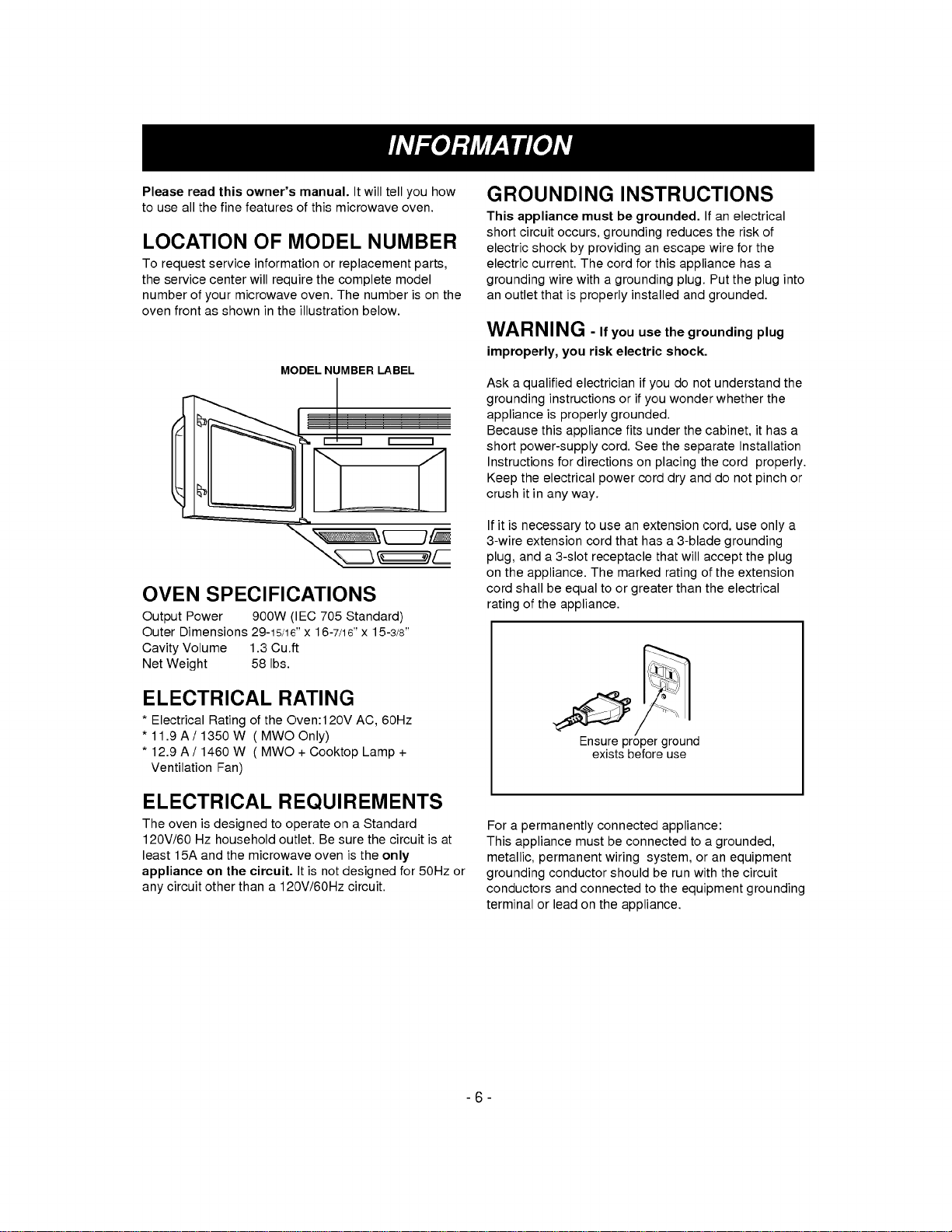
LOCATION OF MODEL NUMBER
To request service information or replacement parts,
the service center will require the complete model
number of your microwave oven. The number is on the
oven front as shown in the illustration below.
MODEL NUMBER LABEL
OVEN SPECIFICATIONS
Output Power 900W (IEC 705 Standard)
Outer Dimensions 29-15;16" x 16-7/16" x 15-3/8"
Cavity Volume 1.3 Cu.ft
Net Weight 58 Ibs.
ELECTRICAL RATING
* Electrical Rating of the Oven:120V AC, 60Hz
* 11.9 A/1350 W ( MWO Only)
* 12.9 A/1460 W ( MWO + Cooktop Lamp +
Ventilation Fan)
ELECTRICAL REQUIREMENTS
The oven is designed to operate on a Standard
120V/60 Hz household outlet. Be sure the circuit is at
least 15A and the microwave oven is the only
appliance on the circuit. It is not designed for 50Hz or
any circuit other than a 120V/60Hz circuit.
GROUNDING INSTRUCTIONS
This appliance must be grounded. If an electrical
short circuit occurs, grounding reduces the risk of
electric shock by providing an escape wire for the
electric current. The cord for this appliance has a
grounding wire with a grounding plug. Put the plug into
an outlet that is properly installed and grounded.
WARNING- Ir you use the grounding plug
improperly, you risk electric shock.
Ask a qualified electrician if you do not understand the
grounding instructions or if you wonder whether the
appliance is properly grounded.
Because this appliance fits under the cabinet, it has a
short power-supply cord. See the separate Installation
Instructions for directions on placing the cord properly.
Keep the electrical power cord dry and do not pinch or
crush it in any way.
If it is necessary to use an extension cord, use only a
3-wire extension cord that has a 3-blade grounding
plug, and a 3-slot receptacle that will accept the plug
on the appliance. The marked rating of the extension
cord shall be equal to or greater than the electrical
rating of the appliance.
Ensure proper ground
exists before use
For a permanently connected appliance:
This appliance must be connected to a grounded,
metallic, permanent wiring system, or an equipment
grounding conductor should be run with the circuit
conductors and connected to the equipment grounding
terminal or lead on the appliance.
-6-
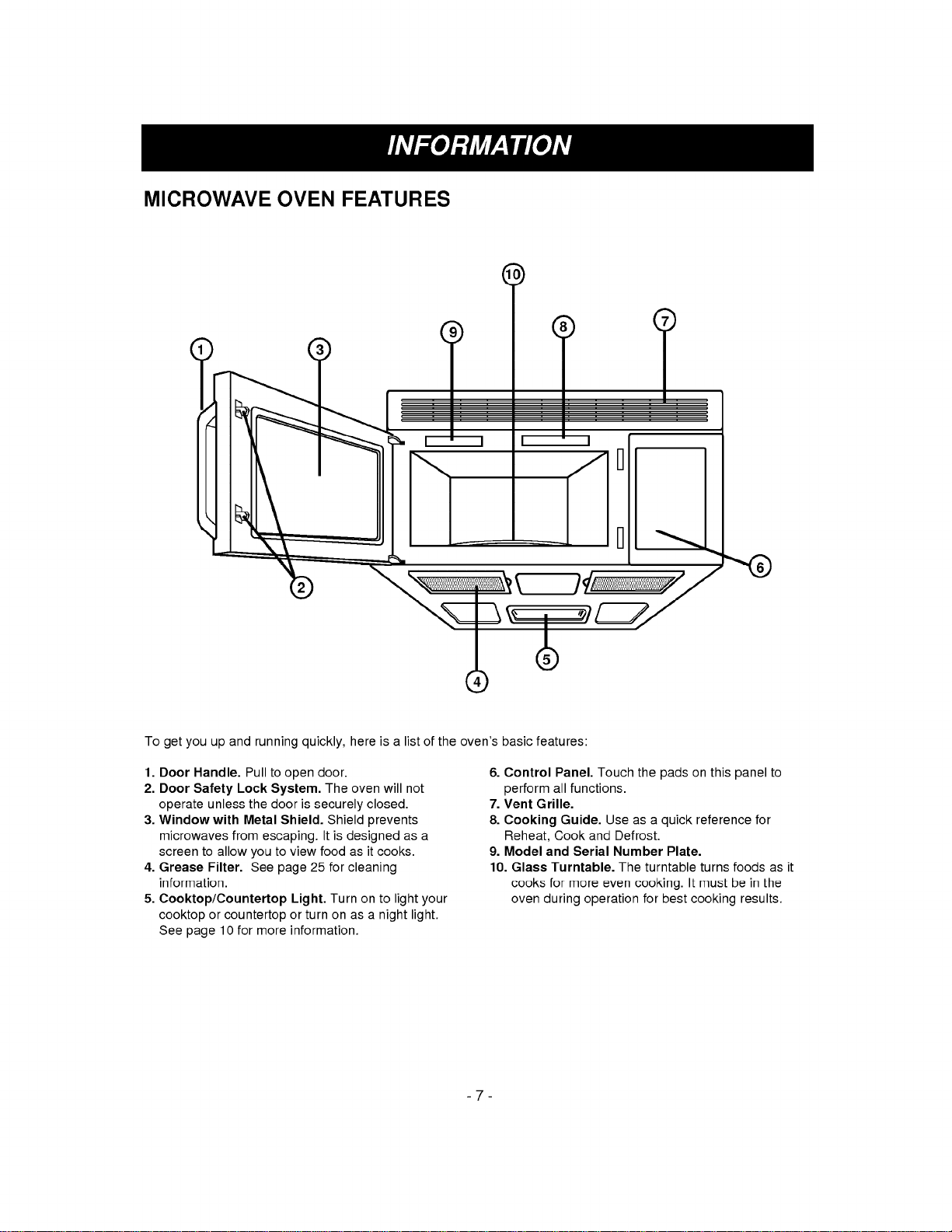
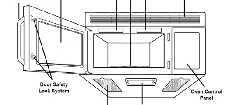
MICROWAVE OVEN FEATURES
()
To get you up and running quickly, here is a list of the oven's basic features:
1. Door Handle. Pull to open door.
2. Door Safety Lock System. The oven will not
operate unless the door is securely closed.
3. Window with Metal Shield. Shield prevents
microwaves from escaping. It is designed as a
screen to allow you to view food as it cooks.
4. Grease Filter. See page 25 for cleaning
information.
5. Cooktop/Countertop Light. Turn on to light your
cooktop or countertop or turn on as a night light.
See page 10 for more information.
6. Control Panel. Touch the pads on this panel to
perform all functions.
7. Vent Grille.
8. Cooking Guide. Use as a quick reference for
Reheat, Cook and Defrost.
9. Model and Serial Number Plate.
10. Glass Turntable. The turntable turns foods as it
cooks for more even cooking. I[ must be in the
oven during operation for best cooking results.
-7-
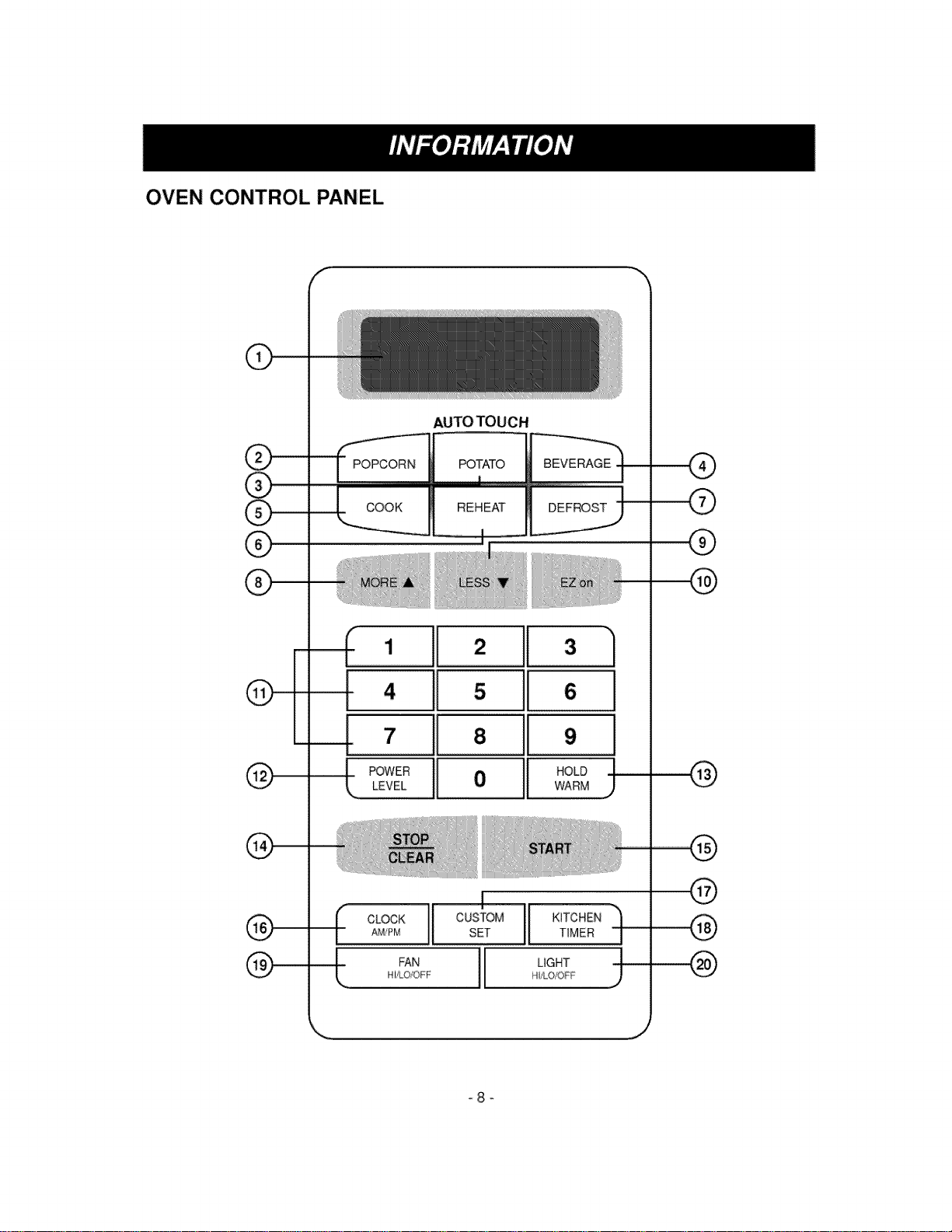
OVEN CONTROL PANEL
POTATO
A,II_ Ii_"
;roll,,,o
L LEVEL 0 WA==
J
®
®
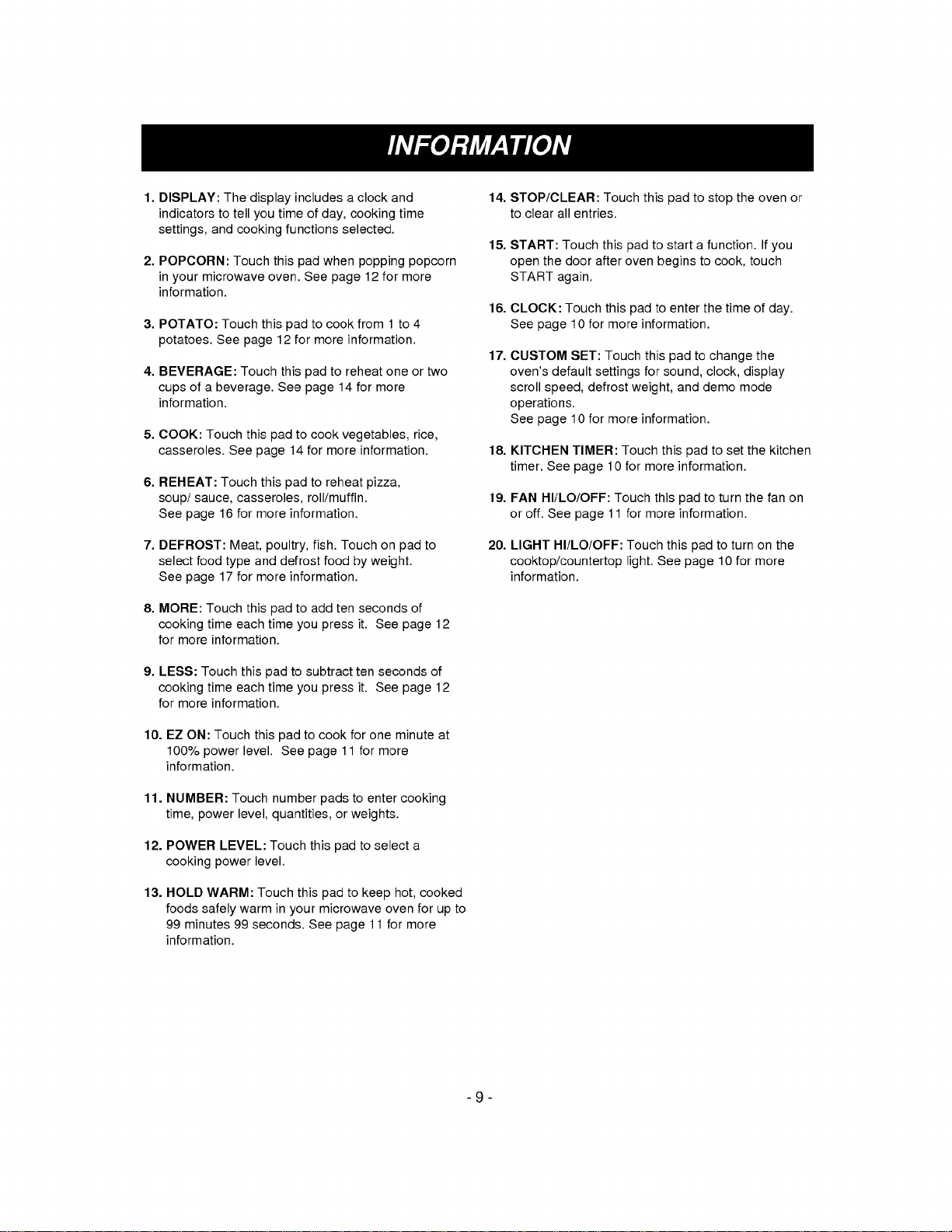
1. DISPLAY: The display includes a clock and
indicators to tell you time of day, cooking time
settings, and cooking functions selected.
2. POPCORN: Touch this pad when popping popcorn
in your microwave oven. See page 12 for more
information.
3. POTATO: Touch this pad to cook from 1 to 4
potatoes. See page 12 for more information.
4. BEVERAGE: Touch this pad to reheat one or two
cups of a beverage. See page 14 for more
information.
5. COOK: Touch this pad to cook vegetables, rice,
casseroles. See page 14 for more information.
6. REHEAT: Touch this pad to reheat pizza,
soup/sauce, casseroles, roll/muffin.
See page 16 for more information.
7. DEFROST: Meat, poultry, fish. Touch on pad to
select food type and defrost food by weight.
See page 17 for more information.
8. MORE: Touch this pad to add ten seconds of
cooking time each time you press it. See page 12
for more information.
9. LESS: Touch this pad to subtract ten seconds of
cooking time each time you press it. See page 12
for more information.
10. EZ ON: Touch this pad to cook for one minute at
100% power level. See page 11 for more
information.
11. NUMBER: Touch number pads to enter cooking
time, power level, quantities, or weights.
12. POWER LEVEL: Touch this pad to select a
cooking power level.
13. HOLD WARM: Touch this pad to keep hot, cooked
foods safely warm in your microwave oven for up to
99 minutes 99 seconds. See page 11 for more
information.
14. STOP/CLEAR: Touch this pad to stop the oven or
to clear all entries.
15. START: Touch this pad to start a function. If you
open the door after oven begins to cook, touch
START again.
16. CLOCK: Touch this pad to enter the time of day.
See page 10 for more information.
17. CUSTOM SET: Touch this pad to change the
oven's default settings for sound, clock, display
scroll speed, defrost weight, and demo mode
operations.
See page 10 for more information.
18. KITCHEN TIMER: Touch this pad to set the kitchen
timer. See page 10 for more information.
19. FAN HI/LO/OFF: Touch this pad to turn the fan on
or off. See page 11 for more information.
20. LIGHT HI!LO/OFF: Touch this pad to turn on the
cooktop/countertop light. See page 10 for more
information.
-9-
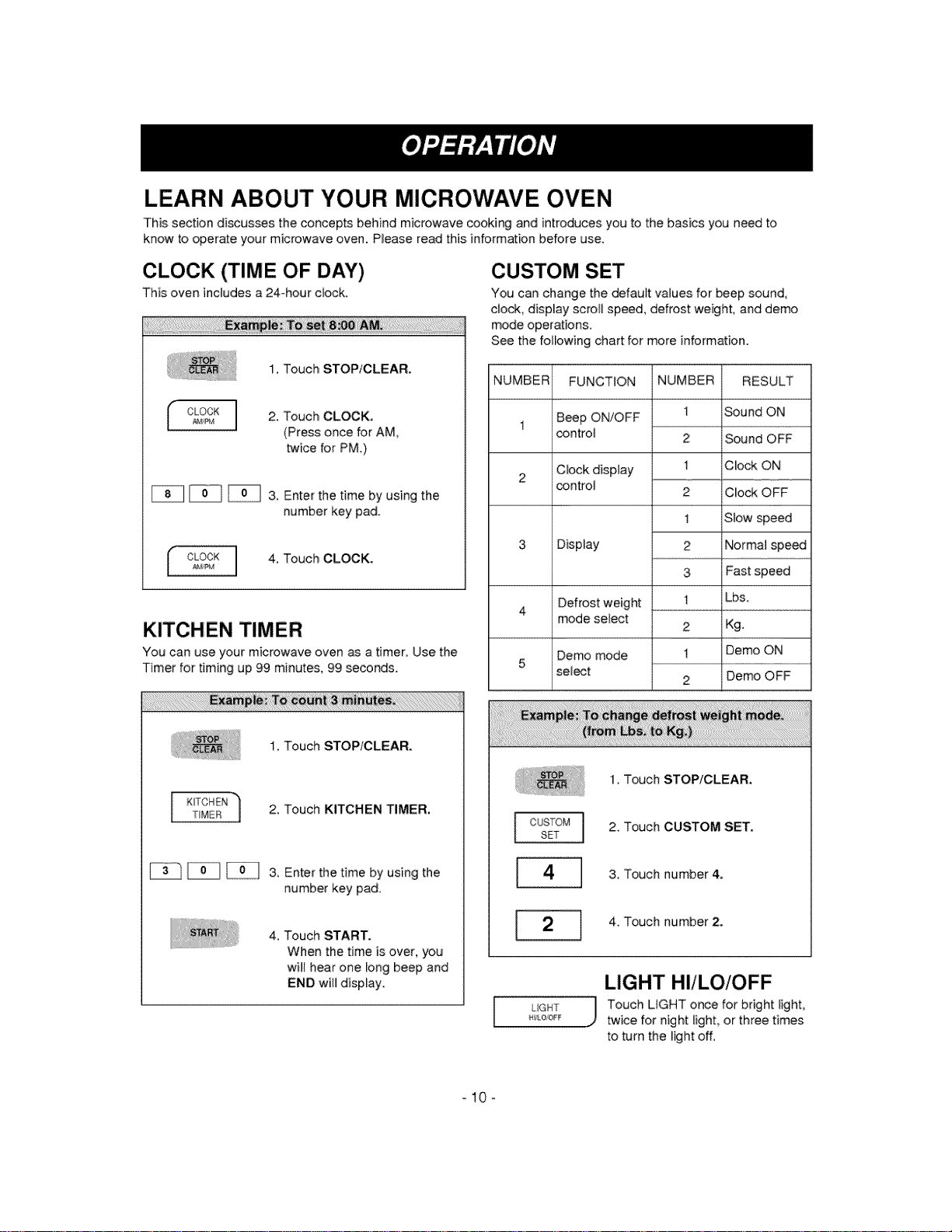
LEARN ABOUT YOUR MICROWAVE OVEN
This section discusses the concepts behind microwave cooking and introduces you to the basics you need to
know to operate your microwave oven. Please read this information before use.
CLOCK (TIME OF DAY)
This oven includes a 24-hour crock.
_i_i_:!!!i!_!i_!ii_i_i_iiii_i_i_!i_i_i!_ii_ii_ii_i_!_ii_ii_i!ii_!!i!i!i!i!!!!!_!_iii_i_i_i_i_ _:!_!!_i_i!!i!i_i!!i_!i_!!!!i!!_ii_ii_i_!i!i_!ii!i_!ii_i_!!i_!_!_iii!_i_!!_i_i!_!_!!_!i!i_!ii
1. Touch STOP/CLEAR.
_ CLOCK I 2. Touch CLOCK.
(Press once for AM,
twice for PM.)
[8_ _ _ 3, Enter the time by using the
number key pad.
4. Touch CLOCK.
KITCHEN TIMER
You can use your microwave oven as a timer. Use the
Timer for timing up 99 minutes, 99 seconds.
CUSTOM SET
You can change the default vaNues for beep sound,
dock, display scroll speed, defrost weight, and demo
mode operations,
See the following chart for more information.
NUMBER FUNCTION
Beep ON/OFF
control
Clock display
control
Display
NUMBER
1
2
1
2
1
2
3
RESULT
Sound ON
Sound OFF
Clock ON
Clock OFF
Sfow speed
Normal speed
Fast speed
1. Touch STOP/CLEAR.
KITCHEN ]
T_MER
2. Touch KITCHEN TIMER,
[_ _ 3, Enter the time by using the
number key pad.
4. Touch START.
When the time is over, you
will hear one long beep and
END will display.
1. Touch STOP/CLEAR.
CUSTOM ]
SET
2. Touch CUSTOM SET,
3. Touch number 4.
4, Touch number 2.
LIGHT HI/LO/OFF
Touch LIGHT once for bright light,
twice for night light, or three times
to turn the light off.
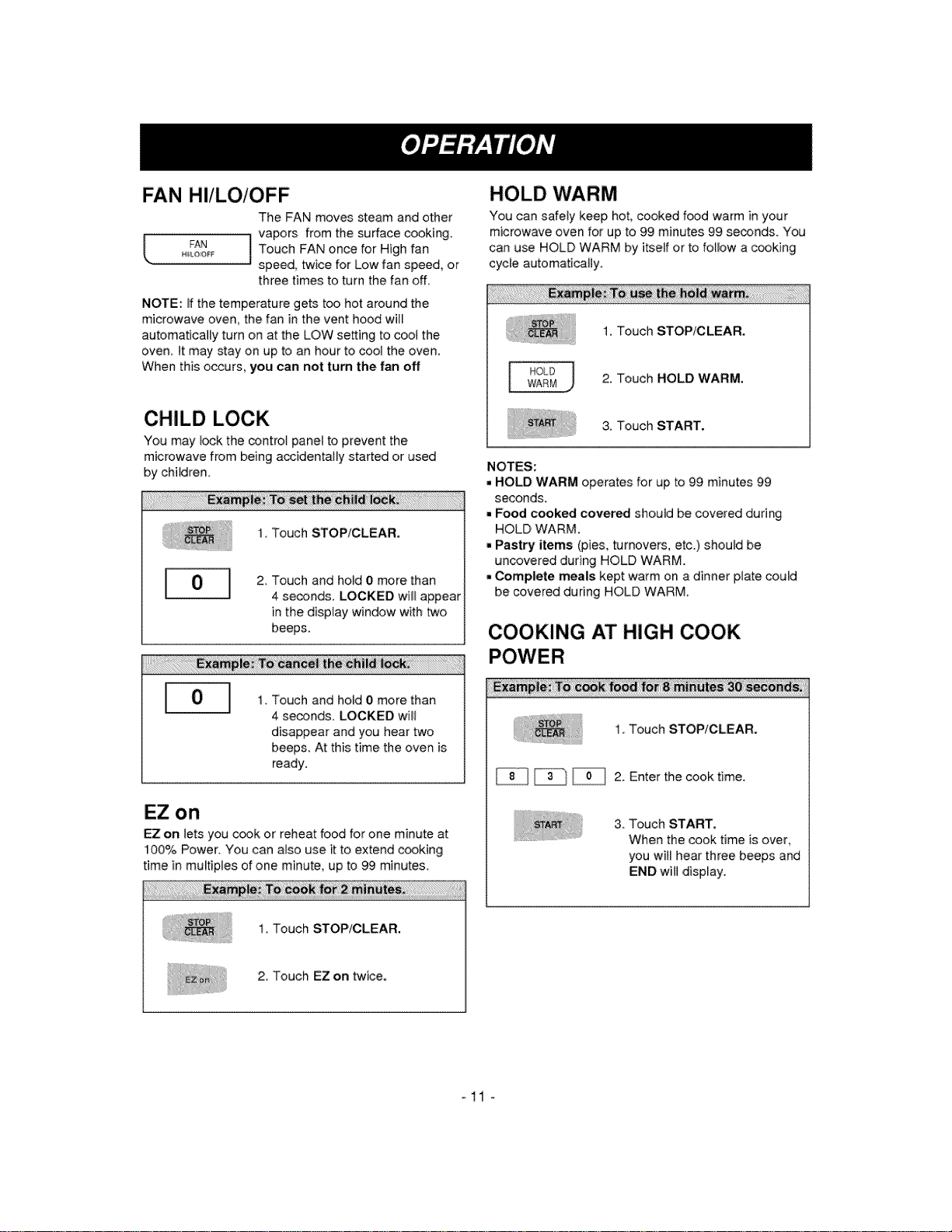
FAN HI/LO/OFF
The FAN moves steam and other
vapors from the surface cooking.
Touch FAN once for High fan
speed, twice for Low fan speed, or
three times to turn the fan off.
NOTE: If the temperature gets too hot around the
microwave oven, the fan in the vent hood will
automatically turn on at the LOW setting to cool the
oven tt may stay on up to an hour to cool the oven,
When this occurs, you can not turn the fan off
CHILD LOCK
You may lock the control panel to prevent the
microwave from being accidentally started or used
by children
1. Touch STOP/CLEAR.
2. Touch and hold 0 more than
4 seconds. LOCKED will appear
in the display window with two
beeps.
HOLD WARM
You can safely keep hot, cooked food warm in your
microwave oven for up to 99 minutes 99 seconds. You
can use HOLD WARM by itself or to follow a _king
cycle automatically.
i !!iiiiii!i!i;!i !i !! ii!ii: ii i!ii!iiiii!i!i! iiiiii!i!i!i!iiiii iii ii i i: j/
1, Touch STOP/CLEAR.
2. Touch HOLD WARM.
& Touch START,
NOTES:
n HOLD WARM operates for up to 99 minutes 99
seconds.
• Food cooked covered should be covered during
HOLD WARM.
u Pastry items (pies, _movers, etc.) should be
uncovered during HOLD WARM.
Complete meals kept warm on a dinner plate could
be covered during HOLD WARM,
COOKING AT HIGH COOK
0
1. Touch and hold 0 more than
4 seconds, LOCKED will
disappear and you hear two
beeps. At this time the oven is
ready.
EZ on
EZ on lets you cook or reheat food for one minute at
100% Power. You can also use it to extend cooking
time in multiples of one minute_ up to 99 minutes.
i, Touch STOP/CLEAR,
i, Touch STOP/CLEAR.
_ _ 2. Enter the cook time.
3 Touch START.
When the cook time is over,
you will hear three beeps and
END will display.
2. Touch EZ on twice°
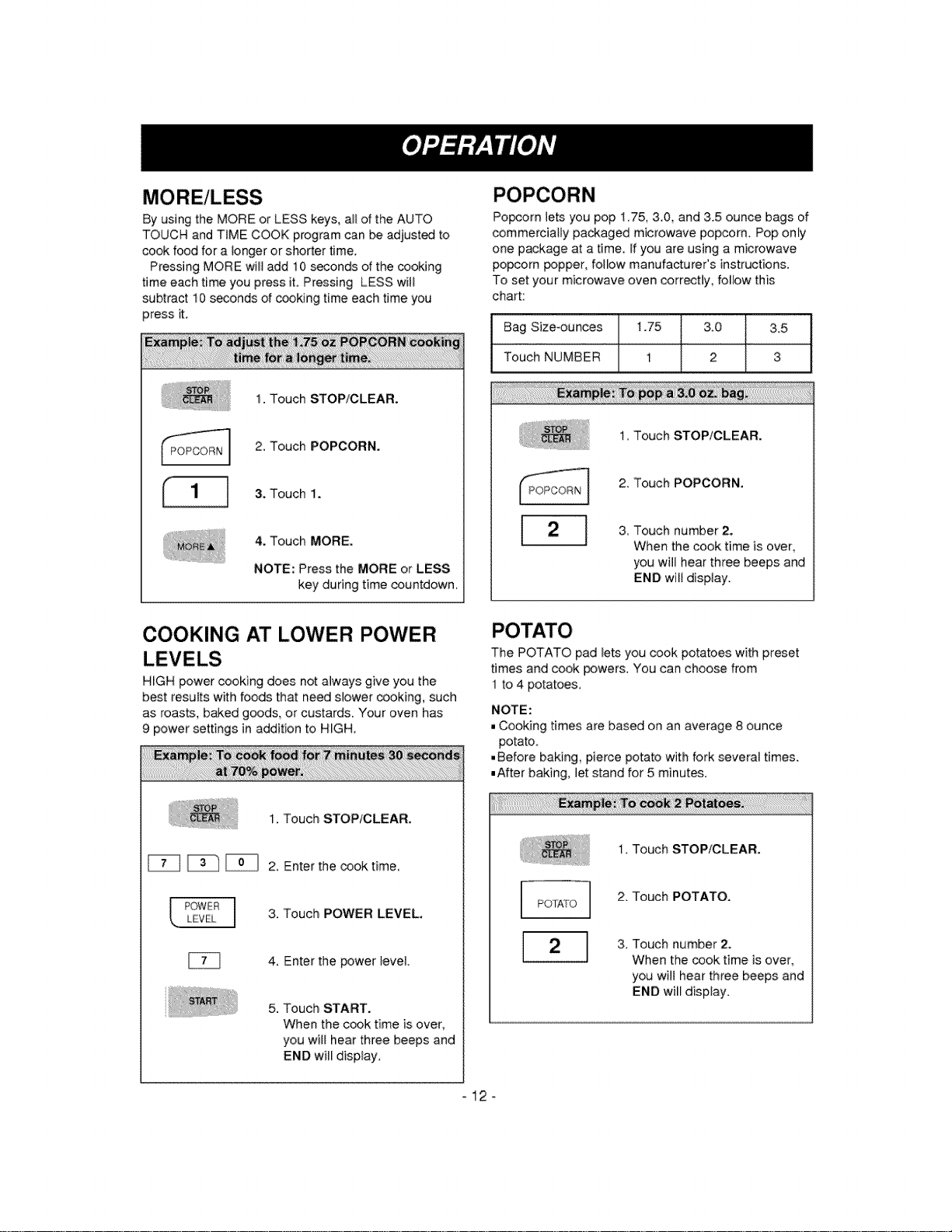
ByusingtheMOREorLESSkeys,alloftheAUTO
TOUCHandT_MECOOKprogramcanbeadjustedto
cookfoodforabngerorshortertime.
PressingMOREwiltadd10secondsofthecooking
timeeachtimeyoupressit.PressingLESSwill
subtractI0secondsofcookingtimeeachtimeyou
pressit.
1.TouchSTOP/CLEAR.
2, Touch POPCORN.
3. Touch I.
4. Touch MORE.
NOTE: Press the MORE or LESS
key during time countdown.
Po_om lets you pop 1.75, 3.0, and 3.5 ounce bags of
commercia![y packaged microwave popcorn Pop only
one package at atime. Ifyou are using a microwave
popcorn popper_ follow manufacturer's instructions,
To set your microwave oven correctly, follow this
chart:
Bag Size_ounces 1.75 &0 3,5
Touch NUMBER 1 2 3
1, Touch STOP/CLEAR.
2. Touch POPCORN.
3. Touch number 2.
When the cook time is over,
you will hear three beeps and
END wi[I display.
COOKING AT LOWER POWER
HIGH power cooking does not always give you the
best results with foods that need slower cooking, such
as roasts, baked goods, or custards. Your oven has
9 power settings in addition to HIGH,
1. Touch STOP/CLEAR,
[_ _] _ 2, Enter the cook time,
POWER I
t_ 3. Touch POWER LEVEL.
4, Enter the power level
5. Touch START,
When the cook time is over,
you will hear three beeps and
END will display,
The POTATO pad lets you cook potatoes with preset
times and cook powers. You can choose from
1 to 4 potatoes
NOTE:
Cooking times are based on an average 8 ounce
potato
• Before baking, pierce potato with fork several times.
°After baking, let stand for 5 minutes.
1, Touch STOP/CLEAR.
POTATO
2. Touch POTATO.
3, Touch number 2.
When the cook time is over,
you wilt hear three beeps and
END will display.
-12-
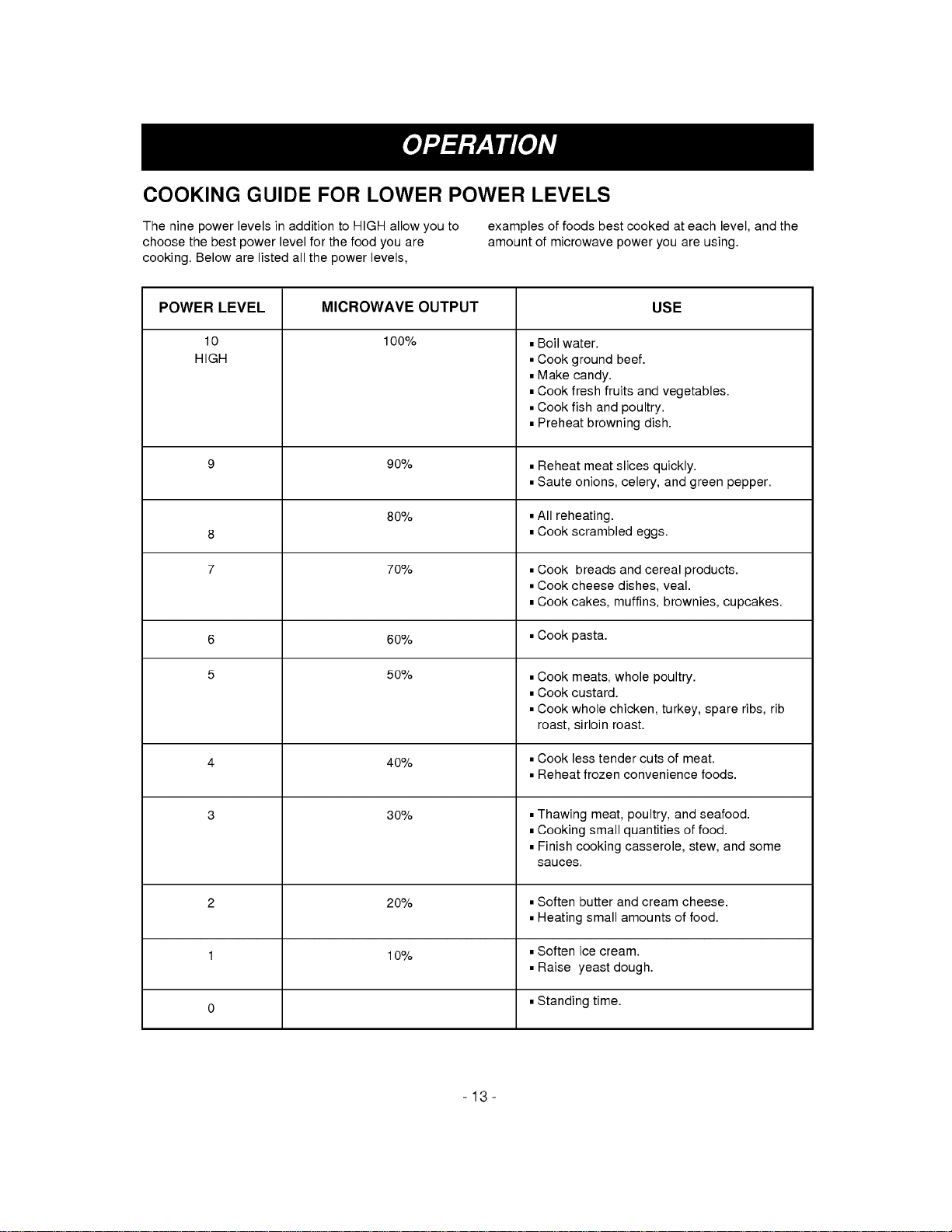
COOKING GUIDE FOR LOWER POWER LEVELS
The nine power levels in addition to HIGH allow you to
choose the best power level for the food you are
cooking. Below are listed all the power levels,
examples of foods best cooked at each level, and the
amount of microwave power you are using.
POWER LEVEL
10
HIGH
MICROWAVE OUTPUT USE
100%
• Boil water.
• Cook ground beef.
• Make candy.
• Cook fresh fruits and vegetables.
• Cook fish and poultry.
• Preheat browning dish.
9 90% • Reheat meat slices quickly.
• Saute onions, celery, and green pepper.
80% • All reheating.
8 • Cook scrambled eggs.
7 70% • Cook breads and cereal products.
• Cook cheese dishes, veal.
• Cook cakes, muffins, brownies, cupcakes.
6 60% • Cook pasta.
5 50%
• Cook meats, whole poultry.
• Cook custard.
• Cook whole chicken,, turkey, spare ribs, rib
roast, sirloin roast.
4 40% • Cook less tender cuts of meat.
• Reheat frozen convenience foods.
3 30%
• Thawing meat, poultry, and seafood.
• Cooking small quantities of food.
• Finish cooking casserole, stew, and some
sauces.
2 20% • Soften butter and cream cheese.
• Heating small amounts of food.
1 10% • Soften ice cream.
• Raise yeast dough.
0 • Standing time.
-13-
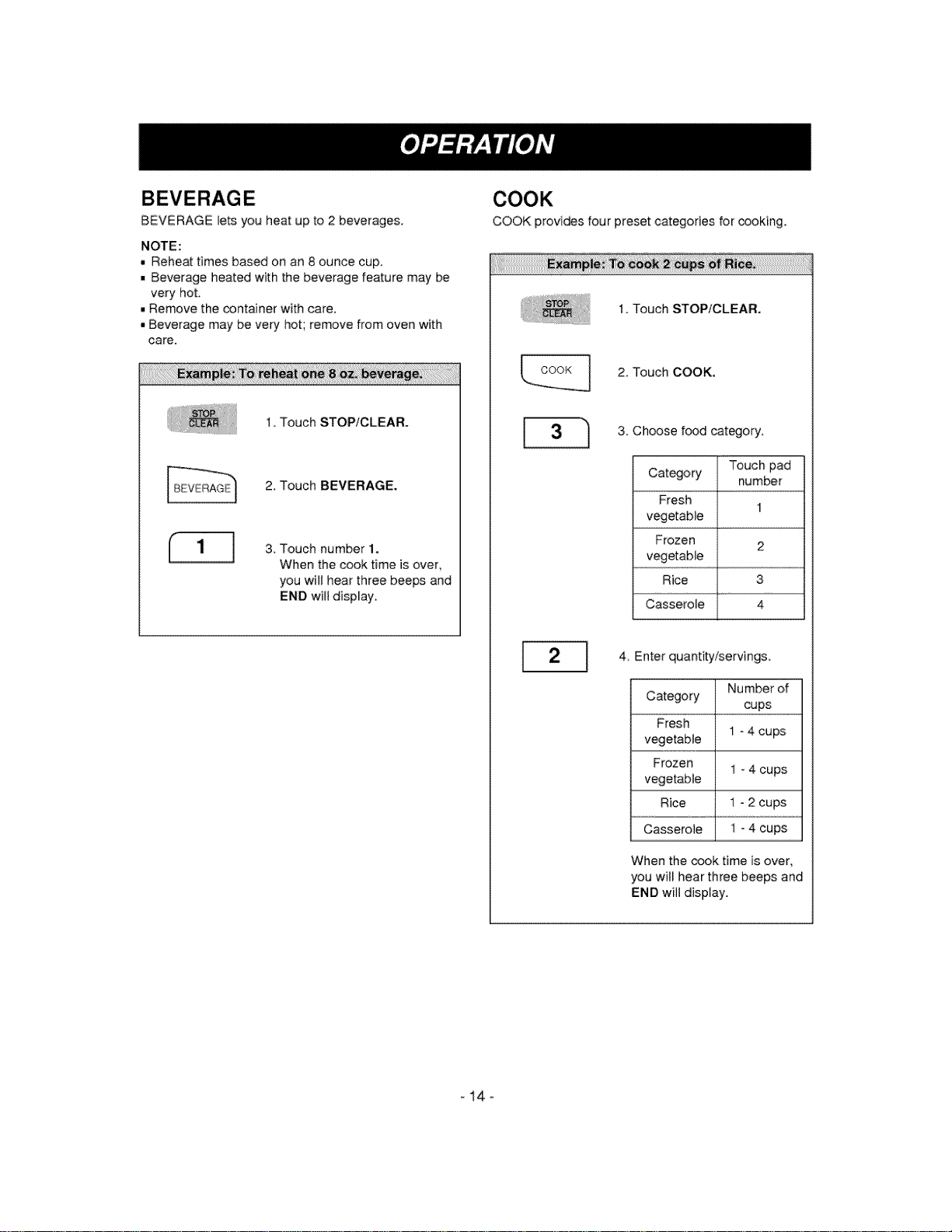
BEVERAGE lets you heat up to 2 beverages.
NOTE:
• Reheat times based on an 8 ounce cup,
• Beverage heated with the beverage feature may be
very hot.
• Remove the container with care,
• Beverage may be very hot; remove from oven with
care.
1, Touch STOP/CLEAR,
2 Touch BEVERAGE.
3, Touch number 1.
When the cook time is over,
you will hear three beeps and
END will display.
COOK provides four preset categories for _oking.
1. Touch STOP/CLEAR.
2. Touch COOK,
3_Choose food cat_ory,
Touch pad
Category number
Fresh
1
vegetable
Frozen 2
vegetable
Rice 3
Casserole 4
4 Enter quantityiservings_
Number of
Category
cups
Fresh
vegetable 1 _4 cups
Frozen i - 4 cups
vegetable
Rice I - 2 cups
Casserole 1 _4 cups
When the _ok time is over,
you will hear three beeps and
END wiii display.
-14_
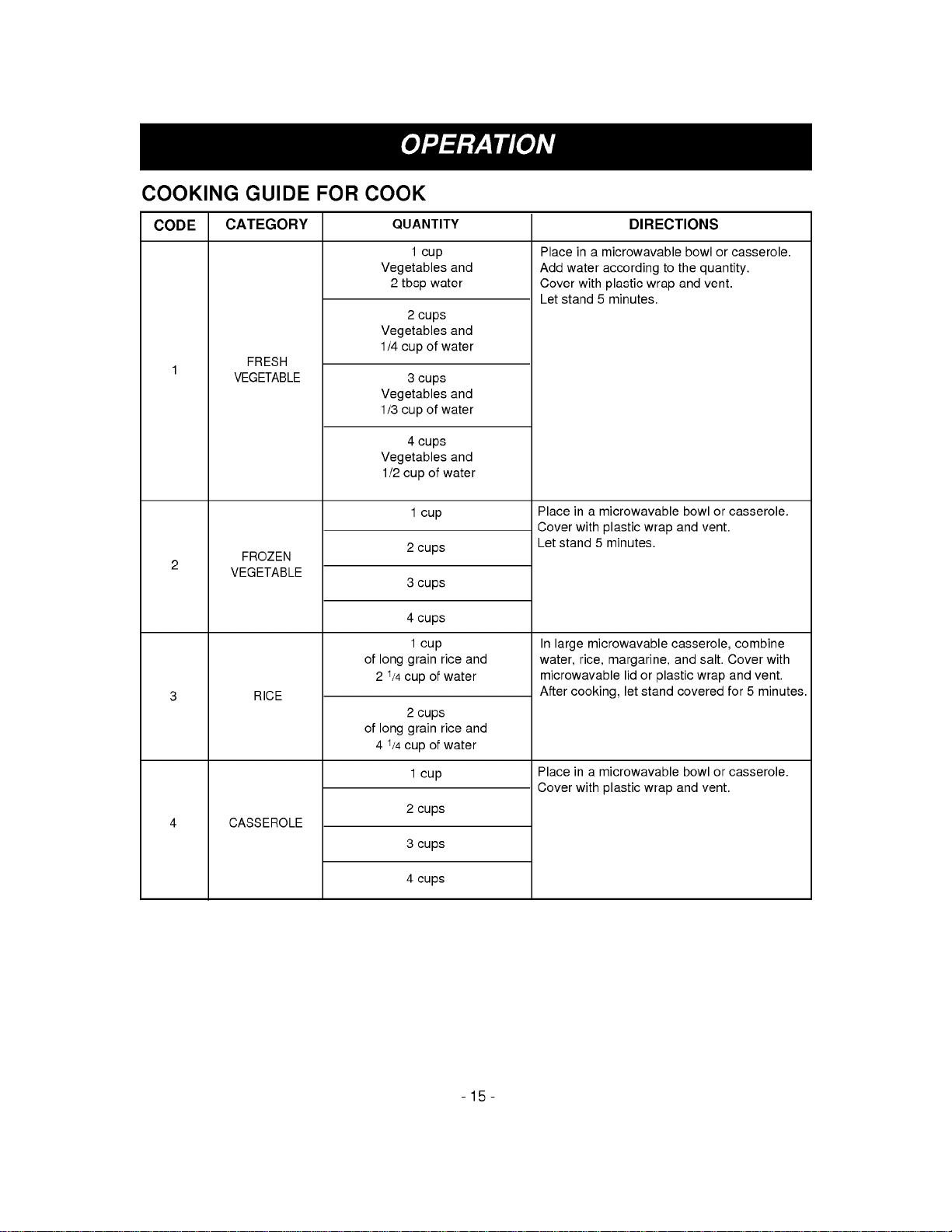
COOKING GUIDE FOR COOK
CODE CATEGORY QUANTITY DIRECTIONS
FRESH
VEGETABLE
FROZEN
VEGETABLE
RICE
CASSEROLE
1 cup
Vegetables and
2 tbsp water
2 cups
Vegetables and
1/4 cup of water
3 cups
Vegetables and
1/3 cup of water
4 cups
Vegetables and
1/2 cup of water
1 cup
2 cups
3 cups
4 cups
1 cup
of long grain rice and
2 1/4 cup of water
2 cups
of long grain rice and
4 1/4cup of water
1 cup
2 cups
3 cups
4 cups
Place in a microwavable bowl or casserole.
Add water according to the quantity.
Cover with plastic wrap and vent.
Let stand 5 minutes.
Place in a microwavable bowl or casserole.
Cover with plastic wrap and vent.
Let stand 5 minutes.
In large microwavable casserole, combine
water, rice, margarine, and salt. Cover with
microwavable lid or plastic wrap and vent.
After cooking, let stand covered for 5 minutes.
Place in a microwavable bowl or casserole.
Cover with plastic wrap and vent.
-15-
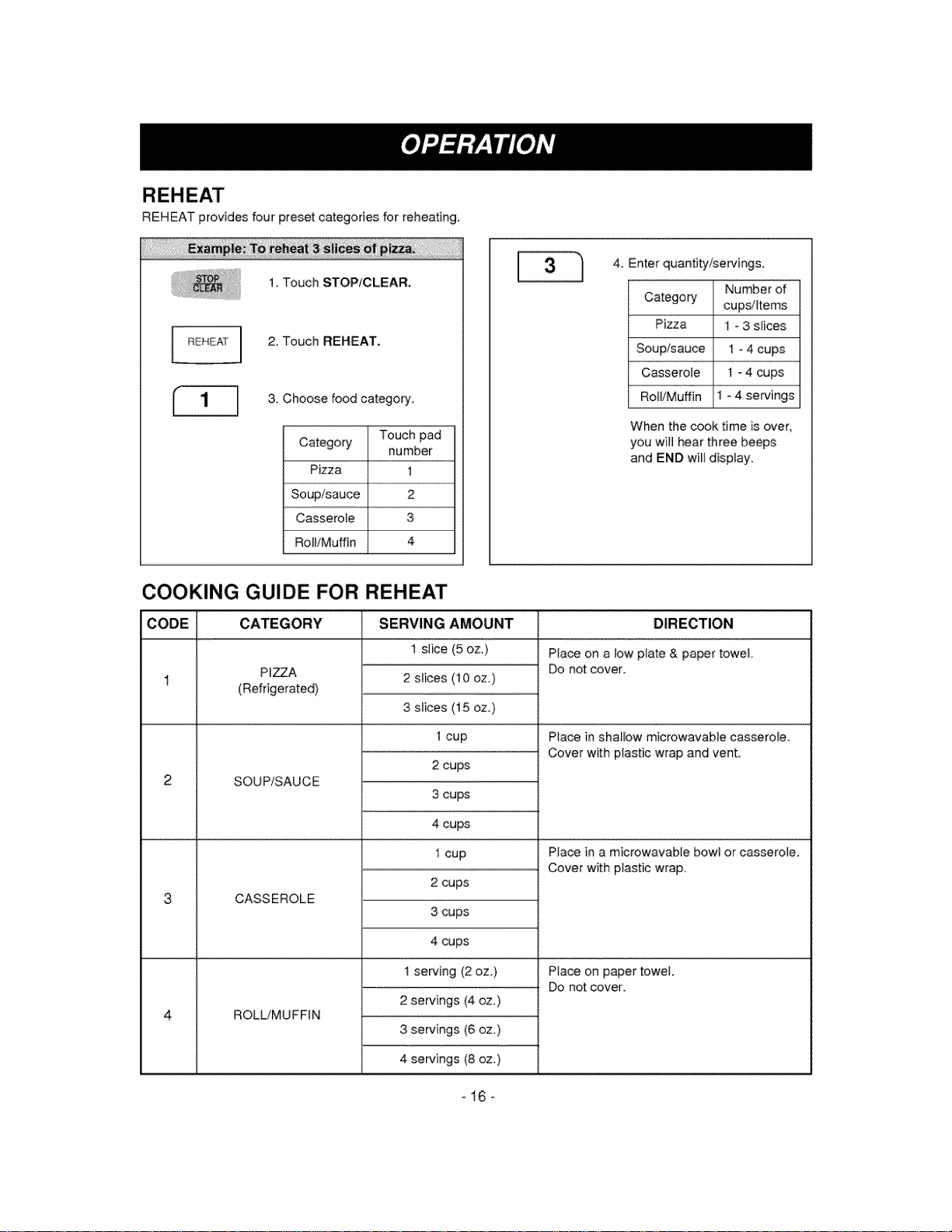
REHEAT provides four preset categories for reheating.
REHEAT
1 TOuCh STOP/CLEAR.
2. Touch REHEAT.
& Choose food category.
Category
Pizza
Soup/sauce
Casserole
Roll/Muffin
Touch pad
number
1
2
3
4
4. Enter quantity/servings.
Number of
Category cupWItems
Pizza 1 - 3 slices
Soup/sauce 1 - 4 cups
Casserole 1 - 4 cups
Roll/Muffin I - 4 servings
When the cook time is over,
you will hear three beeps
and END wilt display.
COOKING GUIDE FOR REHEAT
CODE CATEGORY SERVING AMOUNT DIRECTION
1 slice (5 oz.) Place on a tow plate & paper towel
PIZZA Do not cover,
1 2 slices (10 oz_)
(Refrigerated)
3 slices (i5 oz.)
1 cup Place in shallow microwavable casserole.
......... Cover with plastic wrap and vent.
2 cups
2 SOUP/SAUCE
3 cups
4 cups
1 cup Place in a microwavable bow] or casserole.
Cover with plastic wrap.
2 cups
3 CASSEROLE
3 cups
4 cups
4
ROLL/MUFFIN
1 serving (2 oz.) Place on paper towel
Do not cover,
2 servings (4 oz,)
3 servings (6 oz.)
4 servings (8 oz.)
-16-
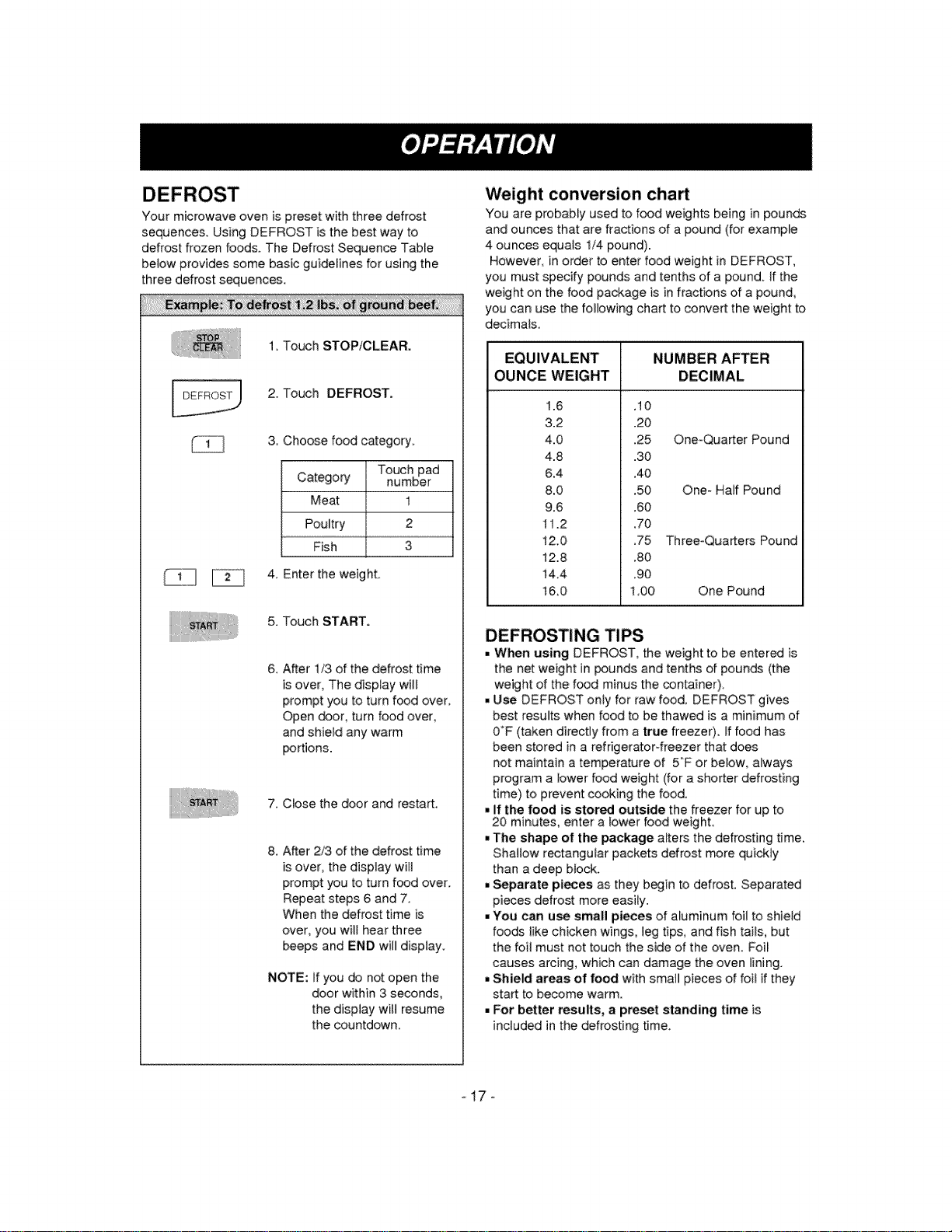
Your microwave oven is preset with three defrost
sequences, Using DEFROST is the best way to
defrost frozen foods. The Defrost Sequence Table
below provides some basic guidelines for using the
three defrost sequences.
i i iillii,,iiiiii_ ,ii,
1. Touch STOP/CLEAR.
2. Touch DEFROST.
3. Choose food category.
Touch pad
Category number
Meat 1
Poultry 2
Fish 3
4. Enter the weight
5. Touch START.
6. After 1/3 of the defrost time
is over, The display will
prompt you to turn food over,
Open _or, turn food over,
and shield any warm
portions.
7. Close the door and restart.
8. After 2/3 of the defrost time
is over the display will
prompt you to turn food over.
Repeat steps 6 and 7.
When the defrost time is
over_ you wilt hear three
beeps and END will display.
NOTE: If you do not open the
door within 3 seconds,
the display witl resume
the countdown.
Weight conversion cha_
You are probably used to food weights being in pounds
and ounces that are fractions of a pound (for example
4 ounces equals 1/4 pound).
However, in order to enter food weight in DEFROST,
you must specify pounds and tenths of a pound, if the
weight on the food package is in fractions of a pound,
you can use the following chart to convert the weight to
decimals_
EQUIVALENT NUMBER AFTER
OUNCE WEIGHT DECIMAL
1.6
3.2
4.0
4.8
6.4
8.0
9.6
11.2
12.0
12.8
14_4
t6,0
.10
.20
.25 One-Quarter Pound
.30
.40
.50 One- Half Pound
.60
,70
,75 Three-Quarters Pound
,80
.go
1,00 One Pound
DEFROSTING, TIPS
= When using DEFROST, the weight to be entered is
the net weight in pounds and tenths of pounds (the
weight of the food minus the container)
, Use DEFROST onty for raw food, DEFROST gives
best results when food to be thawed is a minimum of
O"F (taken directly from a true freezer), If food has
been stored in a refrigerator-freezer that does
not maintain a temperature of 5°F or below, always
program a lower food weight (for a shorter defrosting
time) to prevent cooking the food.
• If the food is stored outside the freezer for up to
20 minutes, enter a lower food weight.
• The shape of the package alters the defrosting time.
Shallow r_tangular packets defrost more quickly
than a deep block,
• _patate pi_es as they begin to defrost. Separated
pieces defrost more easily.
• You can use small pieces of aluminum foil to shield
foods like chicken wings, leg tips, and fish tails, but
the foil must not touch the side of the oven. Foil
causes arcing, which can damage the oven lining.
• Shield areas of food with small pieces of foil if they
start to become warm.
• For better results, a preset standing time is
included in the defrosting time.
-17-
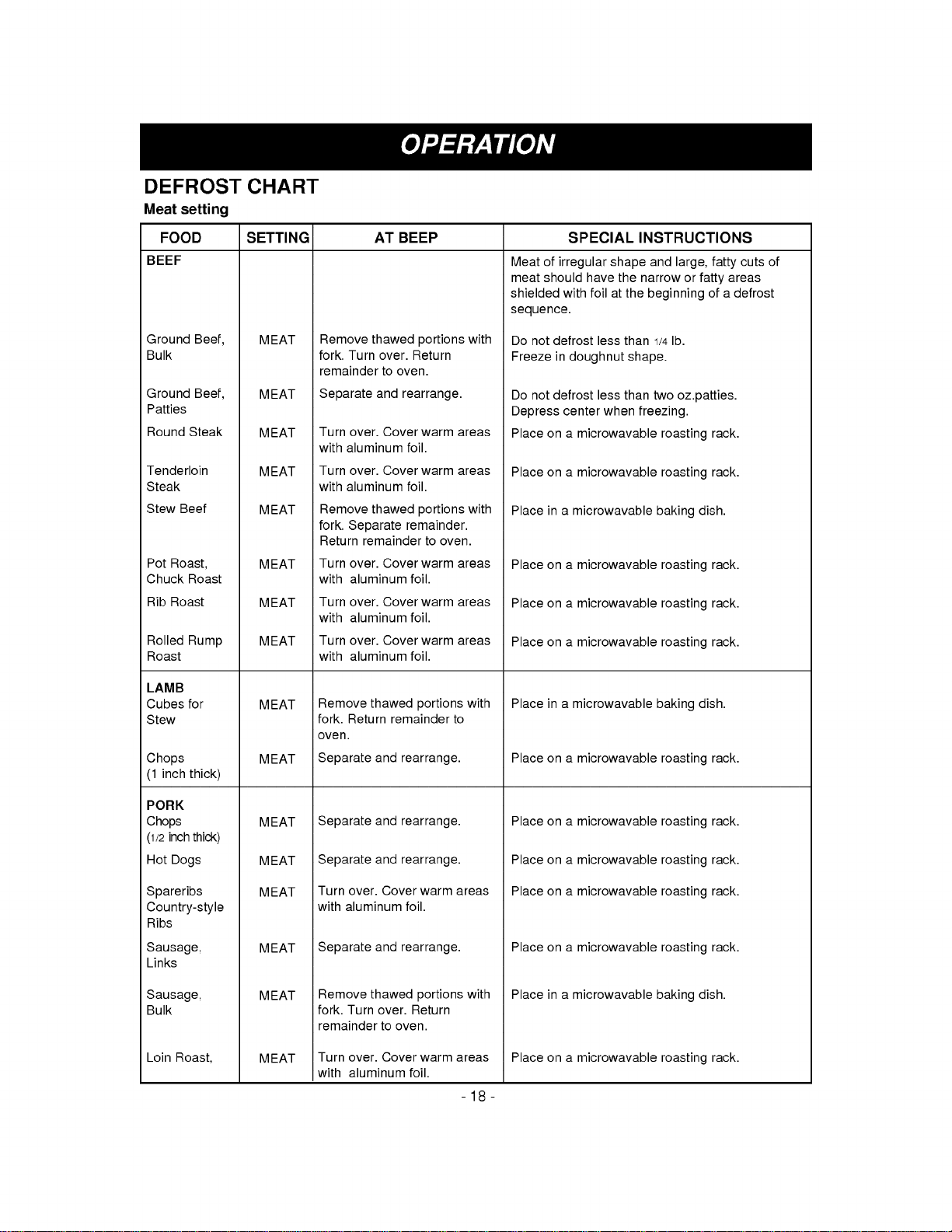
DEFROST CHART
Meat setting
FOOD SETTING AT BEEP SPECIAL INSTRUCTIONS
BEEF
Ground Beef,
Bulk
Ground Beef,
Patties
Round Steak
Tenderloin
Steak
Stew Beef
Pot Roast,
Chuck Roast
Rib Roast
Rolled Rump
Roast
LAMB
Cubes for
Stew
Chops
(1 inch thick)
PORK
Chops
(1/2 inch thick)
Hot Dogs
Spareribs
Country-style
Ribs
Sausage,
Links
Sausage,
Bulk
Loin Roast,
MEAT
MEAT
MEAT
MEAT
MEAT
MEAT
MEAT
MEAT
MEAT
MEAT
MEAT
MEAT
MEAT
MEAT
MEAT
MEAT
Remove thawed portions with
fork. Turn over. Return
remainder to oven.
Separate and rearrange.
Turn over. Cover warm areas
with aluminum foil.
Turn over. Cover warm areas
with aluminum foil.
Remove thawed portions with
fork. Separate remainder.
Return remainder to oven.
Turn over. Cover warm areas
with aluminum foil.
Turn over. Cover warm areas
with aluminum foil.
Turn over. Cover warm areas
with aluminum foil.
Remove thawed portions with
fork. Return remainder to
oven.
Separate and rearrange.
Separate and rearrange.
Separate and rearrange.
Turn over. Cover warm areas
with aluminum foil.
Separate and rearrange.
Remove thawed portions with
fork. Turn over. Return
remainder to oven.
Turn over. Cover warm areas
with aluminum foil.
Meat of irregular shape and large, fatty cuts of
meat should have the narrow or fatty areas
shielded with foil at the beginning of a defrost
sequence.
Do not defrost less than 1/4 lb.
Freeze in doughnut shape.
Do not defrost less than two oz.patties.
Depress center when freezing.
Place on a microwavable roasting rack.
Place on a microwavable roasting rack.
Place in a microwavable baking dish.
Place on a microwavable roasting rack.
Place on a microwavable roasting rack.
Place on a microwavable roasting rack.
Place in a microwavable baking dish.
Place on a microwavable roasting rack.
Place on a microwavable roasting rack.
Place on a microwavable roasting rack.
Place on a microwavable roasting rack.
Place on a microwavable roasting rack.
Place in a microwavable baking dish.
Place on a microwavable roasting rack.
-18-
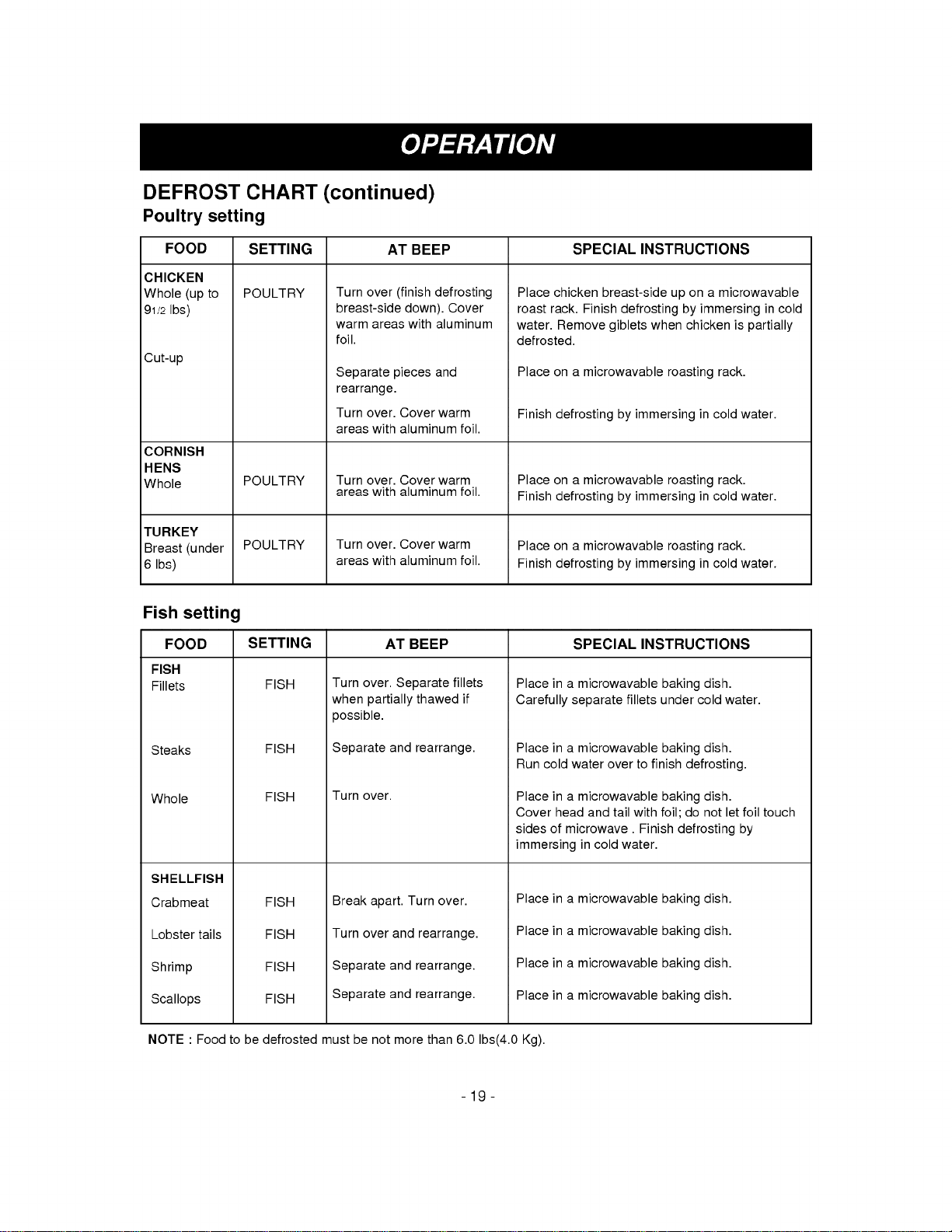
DEFROST CHART (continued)
Poultry setting
FOOD
CHICKEN
Whole (up to
91/2 Ibs)
Cut-up
SETTING AT BEEP SPECIAL INSTRUCTIONS
POULTRY
Turn over (finish defrosting
breast-side down). Cover
warm areas with aluminum
foil.
Separate pieces and
rearrange.
Turn over. Cover warm
areas with aluminum foil.
Place chicken breast-side up on a microwavable
roast rack. Finish defrosting by immersing in cold
water. Remove giblets when chicken is partially
defrosted.
Place on a microwavable roasting rack.
Finish defrosting by immersing in cold water.
CORNISH
HENS
Whole POULTRY Turn over. Cover warm Place on a microwavable roasting rack.
areas with aluminum foil. Finish defrosting by immersing in cold water.
TURKEY
Breast (under POULTRY Turn over. Cover warm Place on a microwavable roasting rack.
6 Ibs) areas with aluminum foil. Finish defrosting by immersing in cold water.
AT BEEP
Fish setting
FOOD SETTING
FISH
Fillets FISH
Steaks FISH
Whole
SHELLFISH
Crabmeat FISH
Lobster tails FISH
Shrimp FISH
Scallops FISH
Turn over. Separate fillets
when partially thawed if
possible.
Separate and rearrange.
FISH Turn over.
Break apart. Turn over.
Turn over and rearrange.
Separate and rearrange.
Separate and rearrange.
SPECIAL INSTRUCTIONS
Place in a microwavable baking dish.
Carefully separate fillets under cold water.
Place in a microwavable baking dish.
Run cold water over to finish defrosting.
Place in a microwavable baking dish.
Cover head and tail with foil; do not let foil touch
sides of microwave. Finish defrosting by
immersing in cold water.
Place in a microwavable baking dish.
Place in a microwavable baking dish.
Place in a microwavable baking dish.
Place in a microwavable baking dish.
NOTE : Food to be defrosted must be not more than 6.0 Ibs(4.0 Kg).
-19-

GETTING THE BEST COOKING
RESULTS
To get the best results from your microwave oven, read
and follow the guidelines below.
• Storage Temperature: Foods taken from the freezer
or refrigerator take longer to cook than the same
foods at room temperature. The time for recipes in
this book is based on the normal storage temperature
of the food.
• Size: Small pieces of food cook faster than large
ones, pieces similar in size and shape cook more
evenly. For even cooking, reduce the power when
cooking large pieces of food.
• Natural Moisture: Very moist foods cook more
evenly because microwave energy is attracted to
water molecules.
• Stir foods such as casseroles and vegetables from
the outside to the center to distribute the heat evenly
and speed cooking. Constant stirring is not necessary.
• Turn over foods like pork chops, baking potatoes,
roasts, or whole cauliflower halfway through the
cooking time to expose all sides equally to microwave
energy.
• Place delicate areas of foods, such as asparagus tips,
toward the center of the dish.
• Arrange unevenly shaped foods, such as chicken
pieces or salmon steaks, with the thicker, meatier
parts toward the outside of the dish.
• Shield, with Small pieces of aluminum foil, parts of
food that may cook quickly, such as wing tips and leg
ends of poultry.
• Let It Stand: After you remove the food from the
microwave, cover food with foil or casserole lid and
let it stand to finish cooking in the center and avoid
overcooking the outer edges. The length of standing
time depends on the density and surface area of the
food.
• Wrapping in waxed paper or paper towel:
Sandwiches and many other foods containing
prebaked bread should be wrapped prior to
microwaving to prevent drying out.
Fish & Shellfish
Cooking Fish and Shellfish: General Directions
• Prepare the fish for cooking.
- Completely defrost the fish or shellfish.
- Arrange unevenly shaped pieces with thicker parts
toward the outside of the dish. Arrange shellfish in
a single layer for even cooking.
- The type of cover you use depends on how you
cook. Poached fish needs a microwavable lid or
vented plastic wrap.
- Baked fish, coated fish, or fish in sauce needs to be
covered lightly with waxed paper to keep the
coating crisp and sauce from getting watery.
- Always set the shortest cooking time. Fish is done
when it turns opaque and the thickest part begins to
flake. Shellfish is done when the shell turns from
pink to red and the flesh is opaque and firm.
• The Fish and Shellfish Cooking Table below provides
specific directions with Power Level and Cooking
Time settings for most types of fish and shellfish.
Fish And Shellfish Cooking Table
FISH POWER COOKING DIRECTIONS
LEVEL TIME
Fish fillets HI 415 minutes
Fish steaks HI 5-6 minutes
Whole fish 7 5-6 minutes
Scallops
Shrimp, shelled
HI
HI
4-5 minutes
4-5 minutes
Arrange fish in a single layer with thickest portion toward
outside edge of 11/2quart microwavable baking dish.
Brush with melted butter and season, if desired. Cook
covered with vented plastic wrap. Let stand covered
2 minutes. If you are cooking more than 1 lb. of fish, turn
the fish halfway through cooking.
Arrange in a single layer. Prepare as directed above,
except stir instead of turning the shellfish.
- 20 -
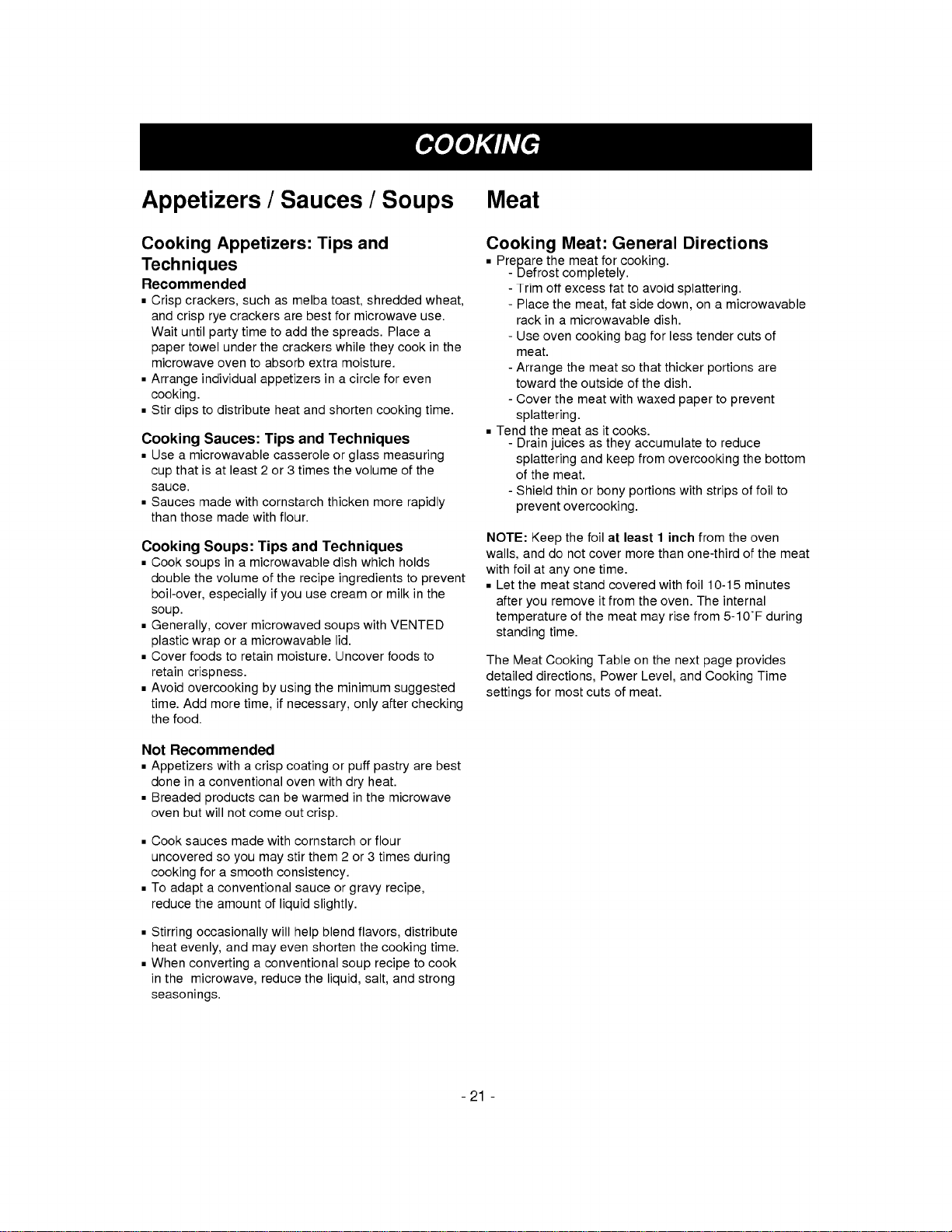
Appetizers / Sauces / Soups
Cooking Appetizers: Tips and
Techniques
Recommended
• Crisp crackers, such as melba toast, shredded wheat,
and crisp rye crackers are best for microwave use.
Wait until party time to add the spreads. Place a
paper towel under the crackers while they cook in the
microwave oven to absorb extra moisture.
• Arrange individual appetizers in a circle for even
cooking.
• Stir dips to distribute heat and shorten cooking time.
Cooking Sauces: Tips and Techniques
• Use a microwavable casserole or glass measuring
cup that is at least 2 or 3 times the volume of the
sauce.
• Sauces made with cornstarch thicken more rapidly
than those made with flour.
Cooking Soups: Tips and Techniques
• Cook soups in a microwavable dish which holds
double the volume of the recipe ingredients to prevent
boil-over, especially if you use cream or milk in the
soup.
• Generally, cover microwaved soups with VENTED
plastic wrap or a microwavable lid.
• Cover foods to retain moisture. Uncover foods to
retain crispness.
• Avoid overcooking by using the minimum suggested
time. Add more time, if necessary, only after checking
the food.
Not Recommended
• Appetizers with a crisp coating or puff pastry are best
done in a conventional oven with dry heat.
• Breaded products can be warmed in the microwave
oven but will not come out crisp.
• Cook sauces made with cornstarch or flour
uncovered so you may stir them 2 or 3 times during
cooking for a smooth consistency.
• To adapt a conventional sauce or gravy recipe,
reduce the amount of liquid slightly.
• Stirring occasionally will help blend flavors, distribute
heat evenly, and may even shorten the cooking time.
• When converting a conventional soup recipe to cook
in the microwave, reduce the liquid, salt, and strong
seasonings.
Meat
Cooking Meat: General Directions
• Prepare the meat for cooking.
- Defrost completely.
- Trim off excess fat to avoid splattering.
- Place the meat, fat side down, on a microwavable
rack in a microwavable dish.
- Use oven cooking bag for less tender cuts of
meat.
- Arrange the meat so that thicker portions are
toward the outside of the dish.
- Cover the meat with waxed paper to prevent
splattering.
• Tend the meat as it cooks.
- Drain juices as they accumulate to reduce
splattering and keep from overcooking the bottom
of the meat.
- Shield thin or bony portions with strips of foil to
prevent overcooking.
NOTE: Keep the foil at least 1 inch from the oven
walls, and do not cover more than one-third of the meat
with foil at any one time.
• Let the meat stand covered with foil 10-15 minutes
after you remove it from the oven. The internal
temperature of the meat may rise from 5-10°F during
standing time.
The Meat Cooking Table on the next page provides
detailed directions, Power Level, and Cooking Time
settings for most cuts of meat.
-21 -
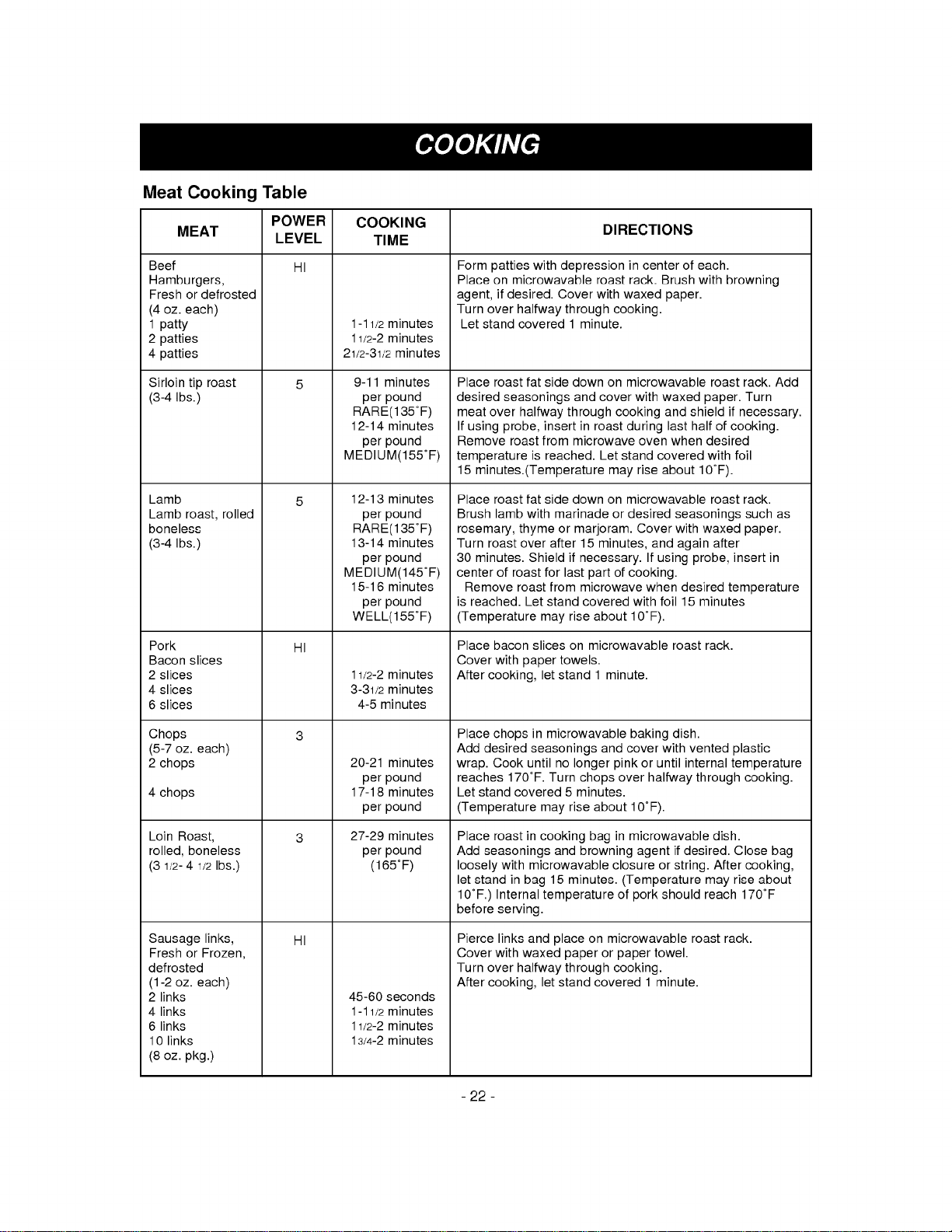
Meat Cooking Table
POWER COOKING DIRECTIONS
MEAT LEVEL TIME
HI
Beef
Hamburgers,
Fresh or defrosted
(4 oz. each)
1 patty
2 patties
4 patties
Sirloin tip roast
(3-4 Ibs.)
Lamb
Lamb roast, rolled
boneless
(3-4 Ibs.)
Pork
Bacon slices
2 slices
4 slices
6 slices
Chops
(5-7 oz. each)
2 chops
4 chops
Loin Roast,
rolled, boneless
(3 1;2- 4 1/2Ibs.)
Sausage links,
Fresh or Frozen,
defrosted
(1-2 oz. each)
2 links
4 links
6 links
10 links
(8 oz. pkg.)
HI
HI
1-11/2 minutes
11/2-2 minutes
21/2-31/2 minutes
9-11 minutes
per pound
RARE(135°F)
12-14 minutes
per pound
MEDIUM(155°F)
12-13 minutes
per pound
RARE(135°F)
13-14 minutes
per pound
MEDIUM(145°F)
15-16 minutes
per pound
WELL(155°F)
11/2-2 minutes
3-31/2 minutes
4-5 minutes
20-21 minutes
perpound
17-18 minutes
perpound
27-29 minutes
per pound
(165°F)
45-60 seconds
1-11/2 minutes
11/2-2 minutes
13/4-2 minutes
Form patties with depression in center of each.
Place on microwavable roast rack. Brush with browning
agent, if desired. Cover with waxed paper.
Turn over halfway through cooking.
Let stand covered 1 minute.
Place roast fat side down on microwavable roast rack. Add
desired seasonings and cover with waxed paper. Turn
meat over halfway through cooking and shield if necessary.
If using probe, insert in roast during last half of cooking.
Remove roast from microwave oven when desired
temperature is reached. Let stand covered with foil
15 minutes.(Temperature may rise about 10°F).
Place roast fat side down on microwavable roast rack.
Brush lamb with marinade or desired seasonings such as
rosemary, thyme or marjoram. Cover with waxed paper.
Turn roast over after 15 minutes, and again after
30 minutes. Shield if necessary. If using probe, insert in
center of roast for last part of cooking.
Remove roast from microwave when desired temperature
is reached. Let stand covered with foil 15 minutes
(Temperature may rise about 10°F).
Place bacon slices on microwavable roast rack.
Cover with paper towels.
After cooking, let stand 1 minute.
Place chops in microwavable baking dish.
Add desired seasonings and cover with vented plastic
wrap. Cook until no longer pink or until internal temperature
reaches 170°F. Turn chops over halfway through cooking.
Let stand covered 5 minutes.
(Temperature may rise about 10°F).
Place roast in cooking bag in microwavable dish.
Add seasonings and browning agent if desired. Close bag
loosely with microwavable closure or string. After cooking,
let stand in bag 15 minutes. (Temperature may rise about
10°F.) Internal temperature of pork should reach 170°F
before serving.
Pierce links and place on microwavable roast rack.
Cover with waxed paper or paper towel.
Turn over halfway through cooking.
After cooking, let stand covered 1 minute.
- 22 -
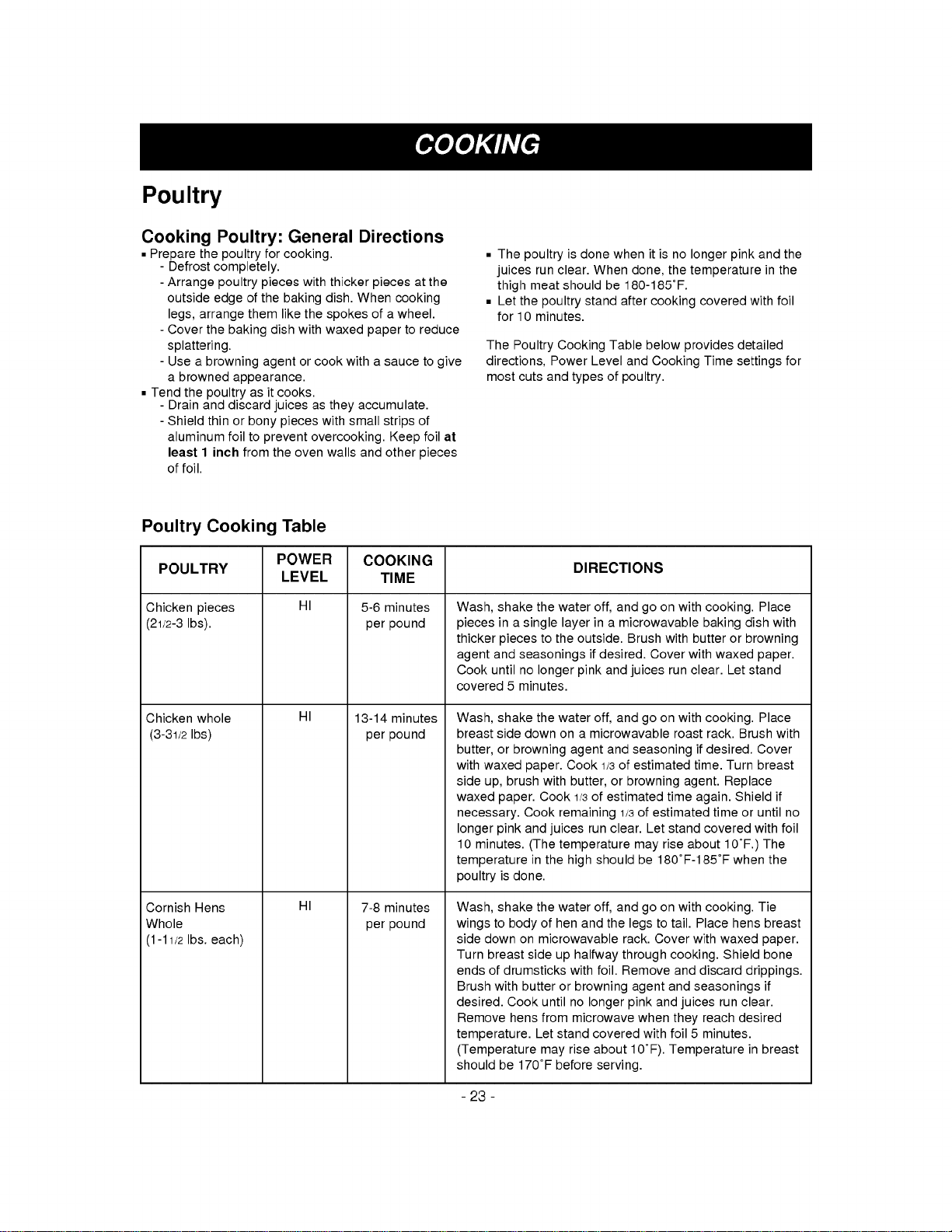
Poultry
Cooking Poultry: General Directions
• Prepare the poultry for cooking.
- Defrost completely.
- Arrange poultry pieces with thicker pieces at the
outside edge of the baking dish. When cooking
legs, arrange them like the spokes of a wheel.
- Cover the baking dish with waxed paper to reduce
splattering.
- Use a browning agent or cook with a sauce to give
a browned appearance.
• Tend the poultry as it cooks.
- Drain and discard juices as they accumulate.
- Shield thin or bony pieces with small strips of
aluminum foil to prevent overcooking. Keep foil at
least 1 inch from the oven walls and other pieces
of foil.
• The poultry is done when it is no longer pink and the
juices run clear. When done, the temperature in the
thigh meat should be 180-185°F.
• Let the poultry stand after cooking covered with foil
for 10 minutes.
The Poultry Cooking Table below provides detailed
directions, Power Level and Cooking Time settings for
most cuts and types of poultry.
Poultry Cooking Table
POWER COOKING
POULTRY DIRECTIONS
LEVEL TIME
HI
Chicken pieces
(21/2-3 Ibs).
Chicken whole
(3-31/2Ibs)
Cornish Hens
Whole
(1-11/2 Ibs. each)
HI
HI
5-6 minutes
per pound
13-14 minutes
per pound
7-8 minutes
per pound
Wash, shake the water off, and go on with cooking. Place
pieces in a single layer in a microwavable baking dish with
thicker pieces to the outside. Brush with butter or browning
agent and seasonings if desired. Cover with waxed paper.
Cook until no longer pink and juices run clear. Let stand
covered 5 minutes.
Wash, shake the water off, and go on with cooking. Place
breast side down on a microwavable roast rack. Brush with
butter, or browning agent and seasoning if desired, Cover
with waxed paper. Cook 1/3of estimated time. Turn breast
side up, brush with butter, or browning agent. Replace
waxed paper. Cook 1/3 of estimated time again. Shield if
necessary. Cook remaining 1/3of estimated time or until no
longer pink and juices run clear. Let stand covered with foil
10 minutes. (The temperature may rise about 10°F.) The
temperature in the high should be 180°F-185°F when the
poultry is done.
Wash, shake the water off, and go on with cooking. Tie
wings to body of hen and the legs to tail. Place hens breast
side down on microwavable rack. Cover with waxed paper.
Turn breast side up halfway through cooking. Shield bone
ends of drumsticks with foil. Remove and discard drippings.
Brush with butter or browning agent and seasonings if
desired. Cook until no longer pink and juices run clear.
Remove hens from microwave when they reach desired
temperature. Let stand covered with foil 5 minutes.
(Temperature may rise about 10°F). Temperature in breast
should be 170°F before serving.
- 23 -
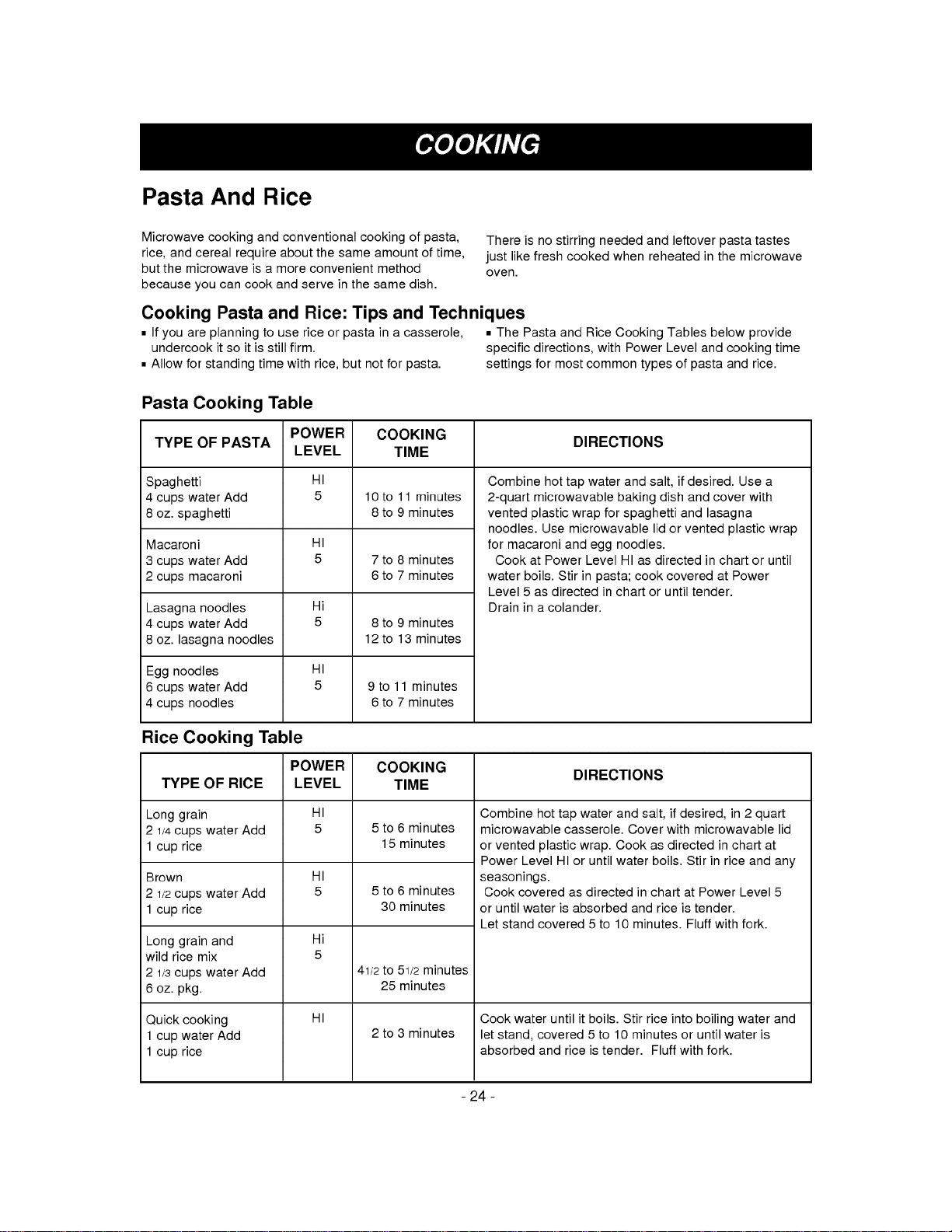
Pasta And Rice
Microwave cooking and conventional cooking of pasta,
rice, and cereal require about the same amount of time,
but the microwave is a more convenient method
because you can cook and serve in the same dish.
There is no stirring needed and leftover pasta tastes
just like fresh cooked when reheated in the microwave
oven.
Cooking Pasta and Rice: Tips and Techniques
• If you are planning to use rice or pasta in a casserole, • The Pasta and Rice Cooking Tables below provide
undercook it so it is still firm. specific directions, with Power Level and cooking time
• Allow for standing time with rice, but not for pasta, settings for most common types of pasta and rice.
Pasta Cooking Table
TYPE OF PASTA POWER COOKING DIRECTIONS
LEVEL TIME
HI
5
Spaghetti
4 cups water Add
8oz. spaghetti
Macaroni
3 cups water Add
2 cups macaroni
Lasagna noodles
4 cups water Add
8 oz. lasagna noodles
Egg noodles
6 cups water Add
4 cups noodles
HI
5
Hi
5
HI
5
10 to 11 minutes
8 to 9 minutes
7 to 8 minutes
6 to 7 minutes
8 to 9 minutes
12 to 13 minutes
9 to 11 minutes
6 to 7 minutes
Combine hot tap water and salt, if desired. Use a
2-quart microwavable baking dish and cover with
vented plastic wrap for spaghetti and lasagna
noodles. Use microwavable lid or vented plastic wrap
for macaroni and egg noodles.
Cook at Power Level HI as directed in chart or until
water boils. Stir in pasta; cook covered at Power
Level 5 as directed in chart or until tender.
Drain in a colander.
Rice Cooking Table
POWER COOKING
DIRECTIONS
TYPE OF RICE LEVEL TIME
Long grain
2 1/4 cups water Add
1 cup rice
Brown
2 1/2 cups water Add
1 cup rice
Long grain and
wild rice mix
2 1/3cups water Add
6oz. pkg.
Quick cooki ng
1 cup water Add
1 cup rice
HI
5
HI
5
Hi
5
HI
5 to 6 minutes
15 minutes
5 to 6 minutes
30 minutes
41/2 to 51/2 minutes
25 minutes
2 to 3 minutes
Combine hot tap water and salt, if desired, in 2 quart
microwavable casserole. Cover with microwavable lid
or vented plastic wrap. Cook as directed in chart at
Power Level HI or until water boils. Stir in rice and any
seasonings.
Cook covered as directed in chart at Power Level 5
or until water is absorbed and rice is tender.
Let stand covered 5 to 10 minutes. Fluff with fork.
Cook water until it boils. Stir rice into boiling water and
let stand, covered 5 to 10 minutes or until water is
absorbed and rice is tender. Fluff with fork.
- 24 -
CARE AND CLEANING
For best performance and safety, keep the oven clean
inside and outside. Take special care to keep the inner
door panel and the oven front frame free of food or
grease buildoup.
Never use rough powder or pads. Wipe the
microwave oven inside and out including the hood
bottom cover, with a soft cloth and a warm (not hot)
mild detergent solution. Then rinse and wipe dry.
Use a chrome cleaner and polish on chrome, metal,
and aluminum surfaces. Wipe spatters immediately
with a wet paper towel especially after cooking
chicken or bacon. Clean your oven weekly or more
often, if needed.
CLEANING THE GREASE FILTERS
The grease filters should be removed and cleaned
often, at least once a month.
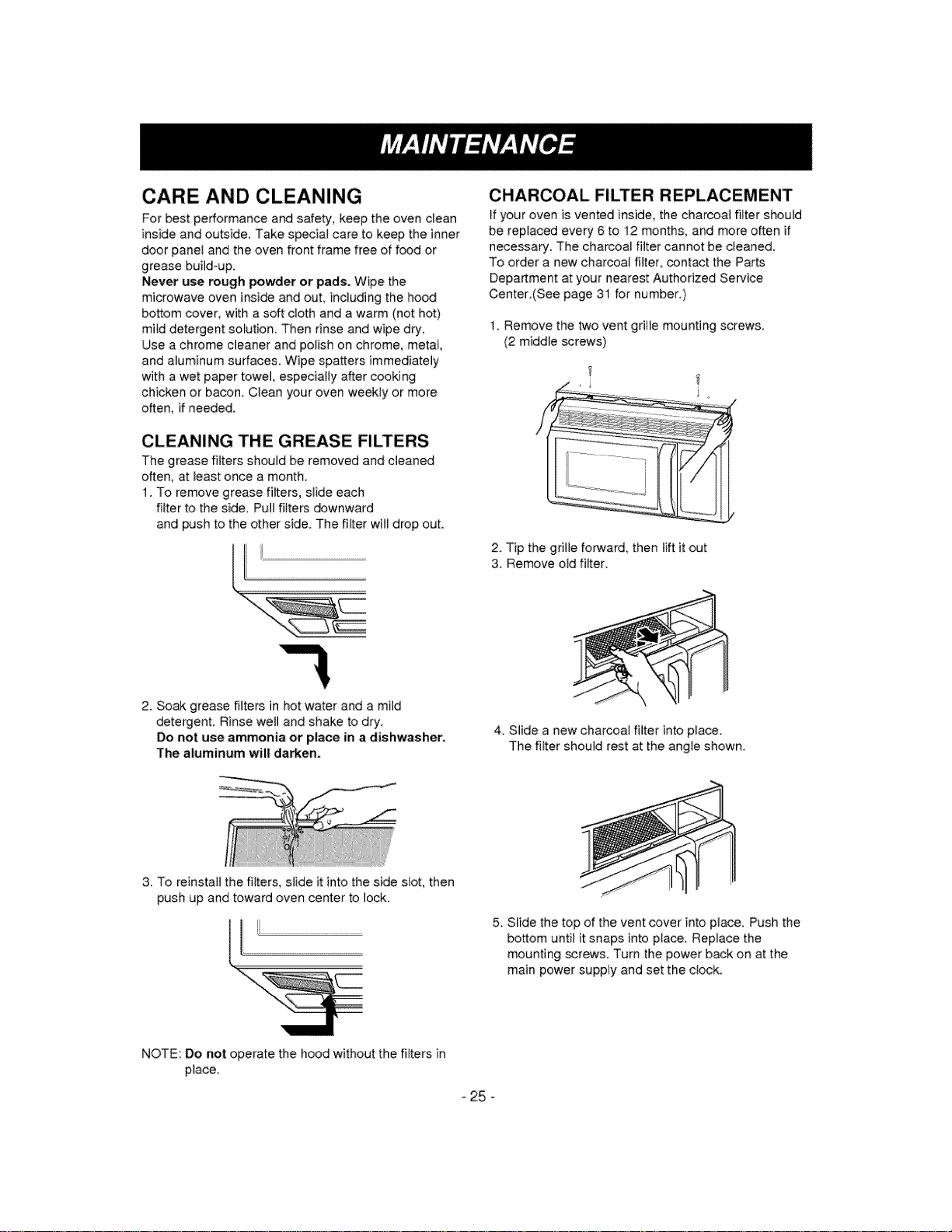
1. To remove grease filters, slide each
filter to the side, Pu]t filters downward
and push to the other side The filter will drop out.
CHARCOAL FILTER REPLACEMENT
If your oven is vented inside, the charcoal filter should
be replaced every 6 to 12 months, and more often if
necessary. The charcoal filter cannot be cleaned.
To order a new charcoal fi]ter, contact the Par_
Department at your nearest Authorized Service
Center.(See page 31 for number.)
I. Remove the two vent grille mounting screws,
(2 middle screws)
2. Tip the grille forward, then lift it out
3 Remove old filter
2. So_ grease filters in hot water and a mild
detergent, Rinse well and shake to dry
Do not use ammonia or place in a dishwasher.
The aluminum will darken.
4. Slide a new charcoal filter into place.
The filt:er should rest at the angle shown
3. To reinstall the fitters, slide it into the side slot, then
push up and toward oven center to lock,
5, Slide the top of the vent cover into place, Push the
bottom until it snaps into place. Replace the
mounting screws. Turn the power back on at the
main power supply and set the clock.
NOTE: Do not operate the hood without the filters in
place.
-25 -
COOKTOP/NIGHT LIGHT
REPLACEMENT
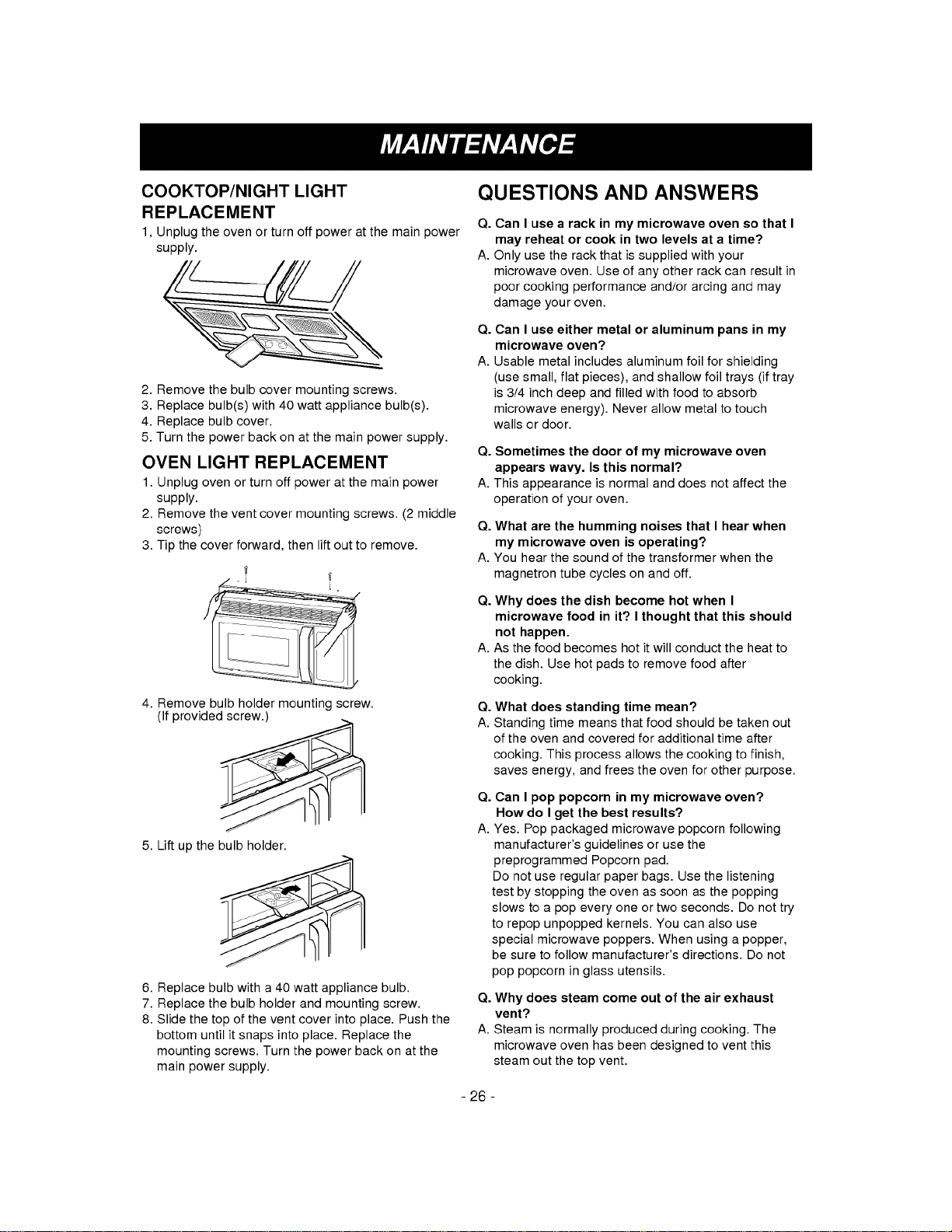
1, Unplug the oven or turn off power at the main power
supply.
2. Remove the bulb cover mounting screws.
3. Replace bulb(s) with 40 watt appliance bulb(s).
4. Replace bulb cover.
5. Turn the power back on at the main power supply.
OVEN LIGHT REPLACEMENT
1. Unplug oven or turn off power at the main power
supply.
2. Remove the vent cover mounting screws. (2 middle
screws)
3. Tip the cover forward, then lift out to remove.
4. Remove bulb holder mounting screw.
(If provided screw.)
5. [_lit up the bulb holder.
6. Replace bulb with a 40 watt appliance bulb.
7. Replace the bulb holder and mounting screw.
8. Slide the top of the vent cover into place. Push the
bottom until it snaps into place. Replace the
mounting screws. Turn the power back on at the
main power supply.
QUESTIONS AND ANSWERS
Q. Can I use a rack in my microwave oven so that I
may reheat or cook in two levels at a time?
A. Only use the rack that is supplied with your
microwave oven. Use of any other rack can result in
poor cooking performance and/or arcing and may
damage your oven.
Q. Can I use either metal or aluminum pans in my
microwave oven?
A. Usable metal includes aluminum foil for shielding
(use small, flat pieces), and shallow foil trays (if tray
is 3/4 inch deep and filled with food to absorb
microwave energy). Never allow metal to touch
walls or door.
Q. Sometimes the door of my microwave oven
appears wavy. Isthis normal?
A. This appearance is normal and does not affect the
operation of your oven.
Q. What are the humming noises that I hear when
my microwave oven is operating?
A. You hear the sound of the transformer when the
magnetron tube cycles on and off.
Q. Why does the dish become hot when I
microwave food in it? I thought that this should
not happen.
A. As the food becomes hot it will conduct the heat to
the dish. Use hot pads to remove food after
cooking.
Q. What does standing time mean?
A. Standing time means that food should be taken out
of the oven and covered for additional time after
cooking. This process allows the cooking to finish,
saves energy, and frees the oven for other purpose.
Q. Can I pop popcorn in my microwave oven?
How do I get the best results?
A. Yes. Pop packaged microwave popcorn following
manufacturer's guidelines or use the
preprogrammed Popcorn pad.
Do not use regular paper bags. Use the listening
test by stopping the oven as soon as the popping
slows to a pop every one or two seconds. Do not try
to repop unpopped kernels. You can also use
special microwave poppers. When using a popper,
be sure to follow manufacturer's directions. Do not
pop popcorn in glass utensils.
Q. Why does steam come out of the air exhaust
vent?
A. Steam is normally produced during cooking. The
microwave oven has been designed to vent this
steam out the top vent.
- 26 -
MICROWAVE UTENSIL GUIDE
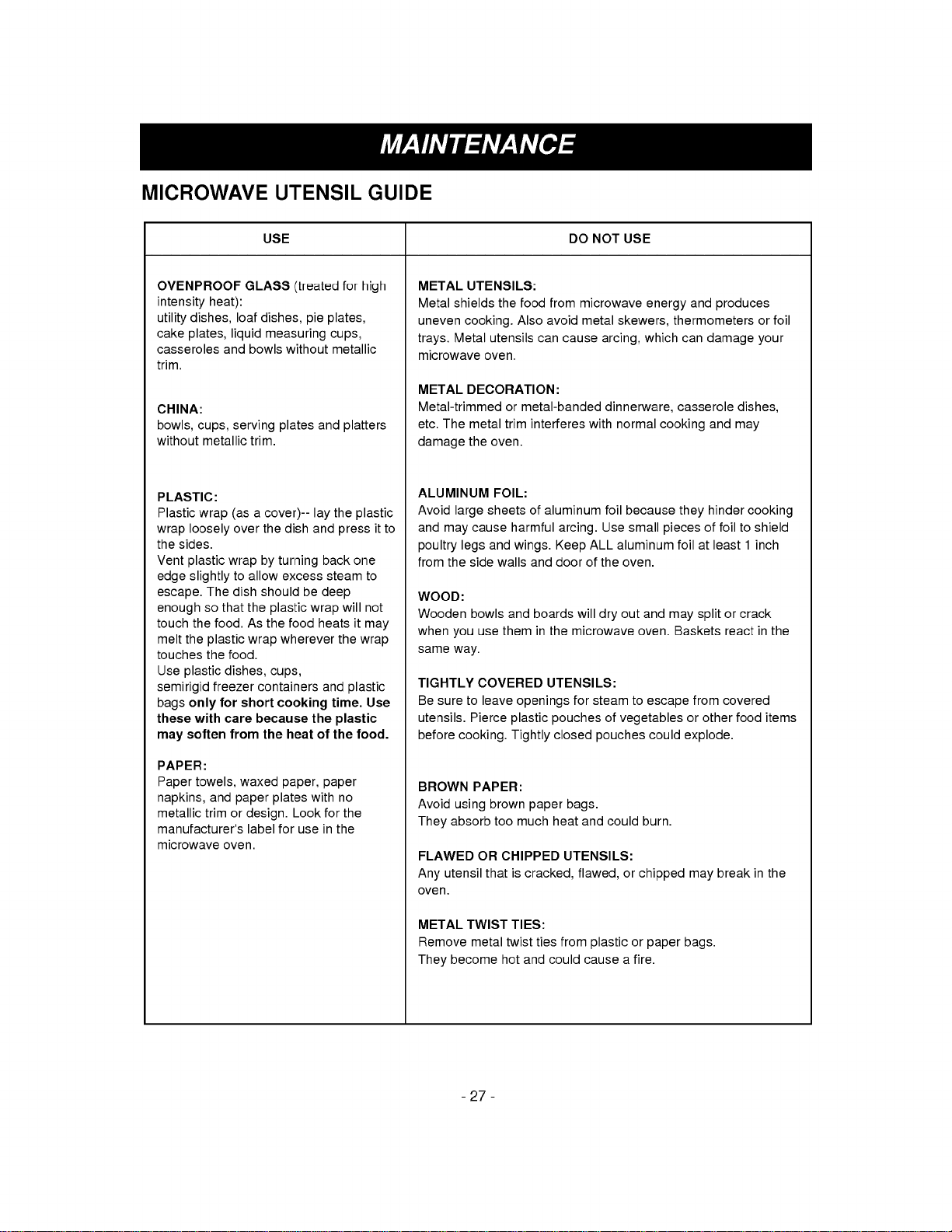
USE DO NOT USE
OVENPROOF GLASS (treated for high
intensity heat):
utility dishes, loaf dishes, pie plates,
cake plates, liquid measuring cups,
casseroles and bowls without metallic
trim.
CHINA:
bowls, cups, serving plates and platters
without metallic trim.
PLASTIC:
Plastic wrap (as a cover)-- lay the plastic
wrap loosely over the dish and press it to
the sides.
Vent plastic wrap by turning back one
edge slightly to allow excess steam to
escape. The dish should be deep
enough so that the plastic wrap will not
touch the food. As the food heats it may
melt the plastic wrap wherever the wrap
touches the food.
Use plastic dishes, cups,
semirigid freezer containers and plastic
bags only for short cooking time. Use
these with care because the plastic
may soften from the heat of the food.
PAPER:
Paper towels, waxed paper, paper
napkins, and paper plates with no
metallic trim or design. Look for the
manufacturer's label for use in the
microwave oven.
METAL UTENSILS:
Metal shields the food from microwave energy and produces
uneven cooking. Also avoid metal skewers, thermometers or foil
trays. Metal utensils can cause arcing, which can damage your
microwave oven.
METAL DECORATION:
Metal-trimmed or metal-banded dinnerware, casserole dishes,
etc. The metal trim interferes with normal cooking and may
damage the oven.
ALUMINUM FOIL:
Avoid large sheets of aluminum foil because they hinder cooking
and may cause harmful arcing. Use small pieces of foil to shield
poultry legs and wings. Keep ALL aluminum foil at least 1 inch
from the side walls and door of the oven.
WOOD:
Wooden bowls and boards will dry out and may split or crack
when you use them in the microwave oven. Baskets react in the
same way.
TIGHTLY COVERED UTENSILS:
Be sure to leave openings for steam to escape from covered
utensils. Pierce plastic pouches of vegetables or other food items
before cooking. Tightly closed pouches could explode.
BROWN PAPER:
Avoid using brown paper bags.
They absorb too much heat and could burn.
FLAWED OR CHIPPED UTENSILS:
Any utensil that is cracked, flawed, or chipped may break in the
oven.
METAL TWIST TIES:
Remove metal twist ties from plastic or paper bags.
They become hot and could cause a fire.
- 27 -
BEFORE CALLING FOR SERVICE
Check the following list to be sure a service call is
really necessary. A quick reference of this manual as
well as reviewing additional information on items to
check may prevent an unneeded service call.
If nothing on the oven operates:
• check for a blown circuit fuse or a tripped main
circuit breaker.
• check if oven is properly connected to electric circuit
in house.
• check that controls are set properly.
If the oven interior light does not works:
• the light bulb is loose or defective.
If oven will not cook:
• check that control panel was programmed correctly.
• check that door is firmly closed.
• check that Start Pad was touched.
• check that probe was inserted correctly
into receptacle.
• check that timer wasn't started instead of a cook
function.
If oven takes longer than normal to cook or cooks
too rapidly:
• be sure the Power Level is programmed properly.
If the time of day clock does not always keep
correct time:
• check that the power cord is fully inserted into the
outlet receptacle.
• be sure the oven is the only appliance on the
electrical circuit.
If food cooks unevenly:
• be sure food is evenly shaped.
• be sure food is completely defrosted before cooking.
• check placement of aluminum foil strips used to
prevent overcooking.
If food is undercooked:
• check recipe to be sure all directions (amount, time, &
power levels) were correctly followed.
• be sure microwave oven is on a separate circuit.
• be sure food is completely defrosted before cooking.
If food is overcooked:
• check recipe to be sure all directions (amount, power
level, time, size of dish) were followed.
If arcing (sparks) occur:
• be sure microwavable dishes were used.
• be sure wire twist ties weren't used.
• be sure oven wasn't operated when empty.
• make sure metal rack (if used) is properly installed on 4
supports.
If the Display shows a time counting down but the
oven is not cooking:
• check that door is firmly closed.
• check that timer wasn't started instead of a cooking
function.
- 28 -
Use this space to record calls to our customer service department, recipes that
work well for you, etc.
29

- 30 -
LG Electronics U.S.A., Inc. will repair or at its option replace, without charge, your product which
proves to be defective in material or workmanship under normal use, during the warranty period
listed below from the date of original purchase. This warranty is good only to the original
purchaser of the product during the warranty period as long as it is in the U.S. including
Alaska, Hawaii, and U.S. Territories.
LABOR PARTS
1 Year 1 Year
Magnetron
8 Years
WARRANTY PERIOD
HOW SERVICE IS HANDLED
Call 1-800-243-0000, push option #1,24 hrs. a day, 7 days per
week. Please have your product type (Monitor, TV, VCR, MW©)
and ZIP code ready.
Over 1 Cubic foot, In-Home Service.
1 Cubic Foot and Under, Carry-in Service.
No other express warranty is applicable to this product. THE DURATION OF ANY IMPLIED
WARRANTIES, INCLUDING THE IMPLIED WARRANTY OF MERCHANTABILITY, IS
LIMITED TO THE DURATION OF THE EXPRESS WARRANTY HEREIN. LG ELECTRONICS
U.S.A., INC. SHALL NOT BE LIABLE FOR THE LOSS OF THE USE OF THE PRODUCT,
INCONVENIENCE, LOSS OR ANY OTHER DAMAGES, DIRECT OR CONSEQUENTIAL,
ARISING OUT OF THE USE OF, OR INABILITY TO USE, THIS PRODUCT OR FOR ANY
BREACH OF ANY EXPRESS OR IMPLIED WARRANTY, INCLUDING THE IMPLIED
WARRANTY OF MERCHANTABILITY APPLICABLE TO THIS PRODUCT.
Some states do not allow the exclusion or limitation of incidental or consequential damages or
limitations on how long an implied warranty lasts; so these limitations or exclusions may not
apply to you. This warranty gives you specific legal rights and you may also have other rights
which vary from state to state.
THE ABOVE WARRANTY DOES NOT APPLY:
* To damages or problems which result from delivery or improper installation.
* To damages or problems which result from misuse, abuse, accident, alteration, or incorrect
electrical current or voltage.
* To service calls, which do not involve defective workmanship or material, such as cleaning and
explaining the operation of the unit.
Therefore, these costs are paid by the consumer.
CUSTOMER ASSISTANCE NUMBERS:
To Prove Warranty Coverage: -_
To Obtain Product, Customer, or
Service Assistance:
To Obtain Nearest Authorized ->
Service Center:
Retain your Sales Receipt to prove date of purchase.
A copy of your Sales Receipt must be submitted at the
time warranty service is provided.
Call 1-800-243-0000 (Mon.-Fri. 7a.m.-7p.m. CST)
Push appropriate menu code.
Call 1-800-243-0000, push option #1,24 hrs. a day,
7 days per week.
Please have your product type
(Monitor, TV, VCR, MWO) and ZIP code ready.
-31 -
LG Electronics Inc.
P/No. 3828W5A0708 Printed in Korea