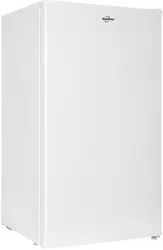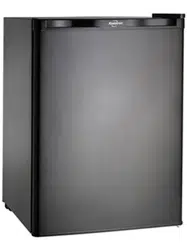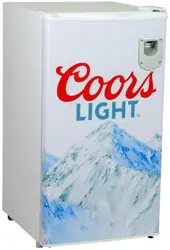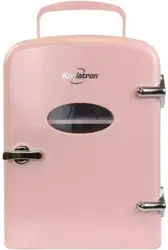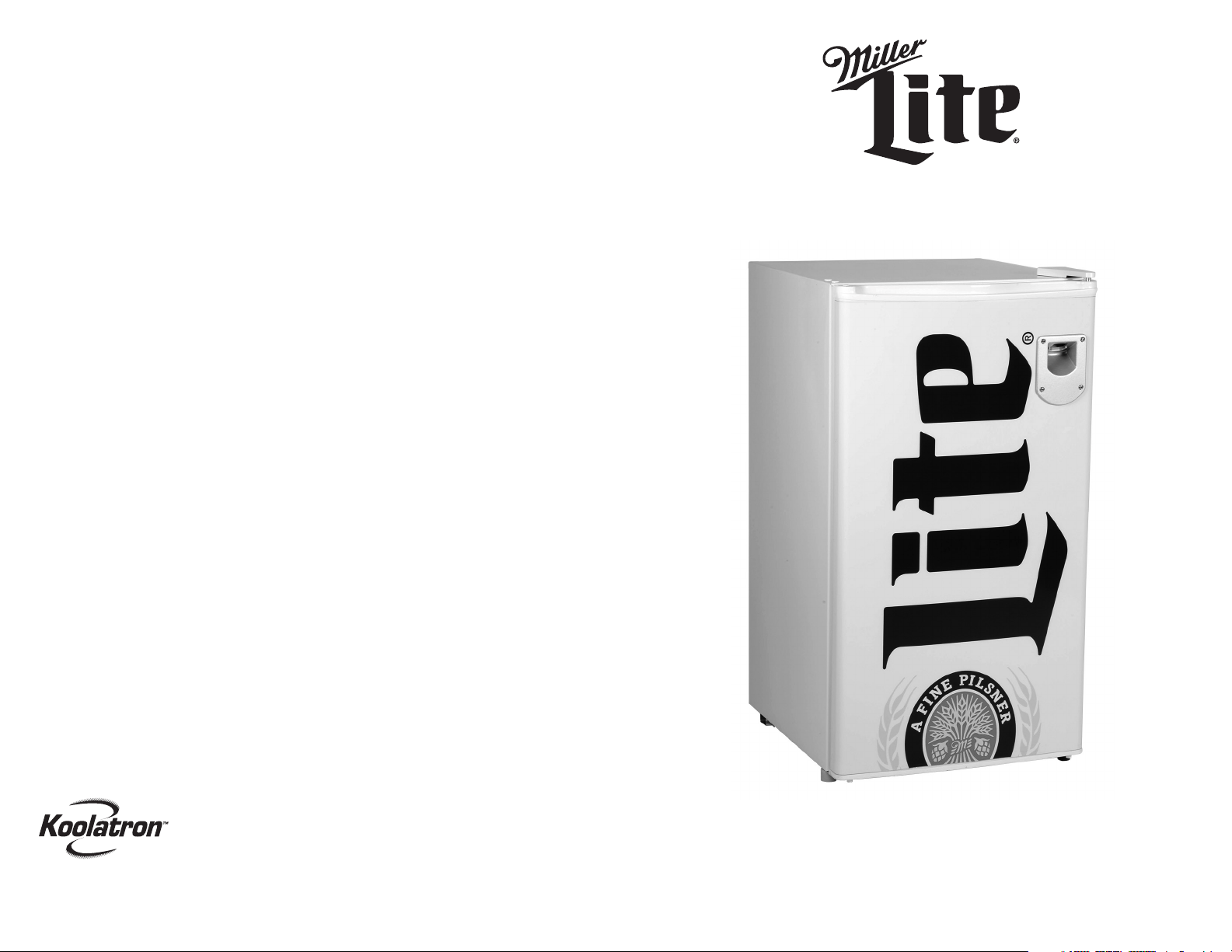
H1S220
OFFICIAL LICENSED PRODUCT
This item is intended for adults of legal drinking age
©2019 Miller Brewing Company. All rights reserved.
Produced under license by Koolatron.
User Manual
Warranty
This product is warranted to the retail customer for 90 days from date of retail purchase,
against defects in material and workmanship.
WHAT IS COVERED
• Replacement parts and labour.
• Transportation charges to customer for the repaired product.
WHAT IS NOT COVERED
• Damage caused by abuse, accident, misuse, or neglect.
• Transportation of the unit or component from the customer to Koolatron.
IMPLIED WARRANTIES
Any implied warranties, including the implied warranty of merchantability are also limited
to the duration of 90 days from the date of retail purchase.
WARRANTY AND SERVICE PROCEDURE
Keep the original, dated, sales receipt with this manual. If you have a problem with your unit,
or require replacement parts, please telephone the following numbers for assistance:
North America 1-800-265-8456
A Koolatron Master Service Centre must perform all warranty work. Service after warranty may be
obtained at a Master Service Centre or at an authorized service dealer. Purchase Receipt is required to
establish warranty eligibility.
Master Service Centres locations:
U.S.A. - 4330 Commerce Dr., Batavia, NY 14020-4102
Canada - 139 Copernicus Blvd., Brantford, ON N3P1N4
A Koolatron Master Service Centre must perform all warranty work.
www.koolatron.com
©2019 Koolatron, Inc. All rights reserved.
All specification are subject to change without notice.
04/2019 - v2
Bar Fridge - 90L / 3.2 cu.ft.
ML90

2
SPECIFICATIONS IMPORTANT SAFETY INSTRUCTIONS (cont.)
3
Power Requirements: AC 115V 60Hz 60W
Capacity: 91L / 3.2 cu.ft.
Setting (7): -2°C (28°F) at 25°C (77°F) ambient air temp.
Setting (1): 10°C (50°F) at 25°C (77°F) ambient air temp.
Weight: 22 kg (48.5 lbs)
IMPORTANT SAFETY INSTRUCTIONS
WARNING
When using electrical appliances, basic safety precautions should always be followed to reduce the
risk of fire, electric shock and personal injury: READ ALL INSTRUCTIONS BEFORE USING THE
PRODUCT.
NOTE - If the refrigerator/freezer has been placed in a horizontal or tilted position for any period of
time, wait 24 hours before plugging the unit in.
1. Use this appliance only for its intended purpose as described in this use and care guide.
2. This refrigerator must be properly installed in accordance with the installation instructions before
it is used. See grounding instructions in the INSTALLATION section.
3. Never unplug your refrigerator by pulling on the power cord. Always grasp the plug firmly and
pull straight out from the outlet.
4. Do not operate any appliance with a damaged cord or plug. Return appliance to the nearest
authorized service facility for examination, repair or adjustment.
5. Unplug your refrigerator before cleaning or before making any repairs. NOTE - If for any reason
this product requires service, we strongly recommend that a certified technician performs the
service. Component parts shall be replaced with like components and servicing shall be done by
factory authorized service personell, so as to minimize the risk of possible ignition due to incorrect
parts or improper service.
6. Do not use any electrical device or any sharp instrument in defrosting your refrigerator.
7. DANGER – Risk of child entrapment. Before you throw away your old refrigerator or freezer, take
off the doors and leave the shelves in place to that children may not easily climb inside.
8. After your refrigerator is in operation, do not touch the cold surfaces in the freezer compartment,
particularly when hands are damp or wet. Skin may adhere to these extremely cold surfaces.
9. Do not refreeze foods that have been thawed completely. The United States Department of
Agriculture in Home and Garden Bulletin No. 69 reads: “…You may safely refreeze frozen foods that
have thawed if they still contain ice crystals or if they are still cold-below 40°F.
“…Thawed ground meats, poultry, or fish that have any off-odor or off-color should not be refrozen
and should not be eaten. Thawed ice cream should be discarded. If the odor or color of any food is
poor or questionable, discard it. The food may be dangerous to eat … Even partial thawing and
re-freezing reduce the eating quality of foods, particularly fruits, vegetables, and prepared foods. The
eating quality of red meats is affected less than that of many other foods. Use refrozen foods as
soon as possible, to save as much of its eating quality as you can.”
10. This refrigerator should not be recessed or built-in in an enclosed cabinet. It is designed for
freestanding installation only.
11. Do not operate your refrigerator in the presence of explosive fumes.
REFRIGERANT GAS WARNINGS
DANGER - RISK OF FIRE OR EXPLOSION. FLAMMABLE REFRIGERANT USED.
- DO NOT use mechanical devices to defrost refrigerator.
- DO NOT puncture refrigerant tubing.
- Consult repair manual/owner’s guide before attempting to service this product. All safety precautions
must be followed.
- Dispose of property in accordance with federal or local regulations.
GROUNDING INSTRUCTIONS
ELECTRICAL REQUIREMENTS
The electrical requirements are a 115V 60 Hz, AC only, 15A. It is recommended that a separate circuit
serving only the product be provided. The product is equipped with a 3-wire cord having a 3-prong
grounding plug. It must be plugged into a wall receptacle that is properly installed and grounded.
This appliance must be grounded. In the event of an electrical short circuit, grounding reduces risk of
electric shock by providing an escape wire for the electric current. The cord provided with this
appliance is equipped with a grounding wire and a grounding plug. The plug must be plugged into an
outlet that is properly installed and grounded.
Avoid the use of three prong adapters or cutting off the third grounding prong in order to accommo-
date a two prong outlet. This is a dangerous practice since it provides no effective grounding for the
refrigerator and may result in shock hazard.
WARNING - Improper use of the grounding plug can result in a risk of electric shock.
Consult a qualified electrician or serviceman if:
1) The grounding instructions are not completely understood.
2) You are unsure that the appliance is properly grounded.
3) You have any questions about the grounding or electrical instructions.
POWER SUPPLY CORD
1. Avoid the use of an extension cord because of potential safety hazards under certain conditions.
Have a qualified electrician or serviceman to install an outlet near the appliance.
2. If it is absolutely necessary to use longer cord sets or an extension cord, extreme care must be
exercised.
a) Use only a grounding type 3-wire extension cord that has a 3-blade grounding plug and a 3-slot
receptacle that will accept the plug on the appliance.
b) The marked electrical rating of the cord set or extension cord must equal to or greater than the
electrical rating of the appliance. The longer cord should be arranged so that it will not drape over the
counter top or table top where it can be pulled on by children or tripped over unintentionally.
NOTE - Neither Koolatron nor the dealer can accept any liability for damage to the product or personal
injury resulting from failure to observe the electrical connection procedures.
4 5
INSTALLATION INSTALLATION (cont.)
1. Unpack your refrigerator by removing all packaging materials like carton, base, foams, adhesive
tape, etc.
2. Remove all accessories, internal packaging material used to hold shelves, ice tray, etc. in place.
3. Clean the remains of all adhesive tap used and remove all printed material supplied.
4. Install the refrigerator in a convenient location away from extreme heat and cold. Allow sufficient
clearance between the refrigerator and side wall so the door(s) will open without obstruction.
Refrigerator is not designed for recessed installation.
5. The floor on which the refrigerator should be placed must be flat, hard, solid, and even. The
refrigerator should not be placed on any soft material such as foam, plastic, etc.
6. To level your refrigerator, use the two leveling legs located on the bottom front of your refrigerator.
Adjust by turning the legs counter clockwise to raise or clockwise to lower your refrigerator. The
door will close easier if the leveling legs are extended.
7. The following are recommended minimum clearances around the refrigerator for proper air
circulation:
- Sides: 3/4” (19mm)
- Top: 2” (50mm)
- Back: 2” (50mm)
Proper air circulation will help your refrigerator work at maximum efficiency.
NOTE - The appliance must be correctly connected to the power supply.
CAUTION - Care should be taken during the handling moving and use of the freezer to avoid damaging
the refrigerant tubing or increasing the risk of a leak
WARNING - It is important to keep the power cord away from the compressor at the back of the refriger-
ator
as during operation, the compressor can reach a high temperature and could cause serious
damage to the power cord.
PROTECTION FROM HEAT AND MOISTURE
• Do not install your refrigerator in any location where heavy moisture is present or if the location is
not properly insulated. This refrigerator is not designed to operate in temperature setting below 55°F.
• Location for the refrigerator should be on a hard surface and away from direct sunlight and heat
source, e.g., radiators, baseboard heaters, cooking appliances, etc.
DOOR ALIGNMENT
1. Remove the top hinge cover.
2. Loosen the top hinge screws using a Phillips head screwdriver.
3. Adjust the door or put a spacer in between and then tighten the screws.
STARTING YOUR NEW REFRIGERATOR
After cleaning your refrigerator thoroughly. Wipe the outside with a soft
dry cloth, the interior with aclean moist cloth.
1. Insert the power supply cord into the socket.
2. Turn the thermostat dial to an initial setting of “7” for 15-20 minutes.
NOTE - As the door gets pressed in during shipping, the gasket may have to be reset. This is done to
prevent the cool refrigerated air from escaping. If there is a gap between the door gasket and the
cabinet, set the gasket by gently pulling it out of the seal gap.
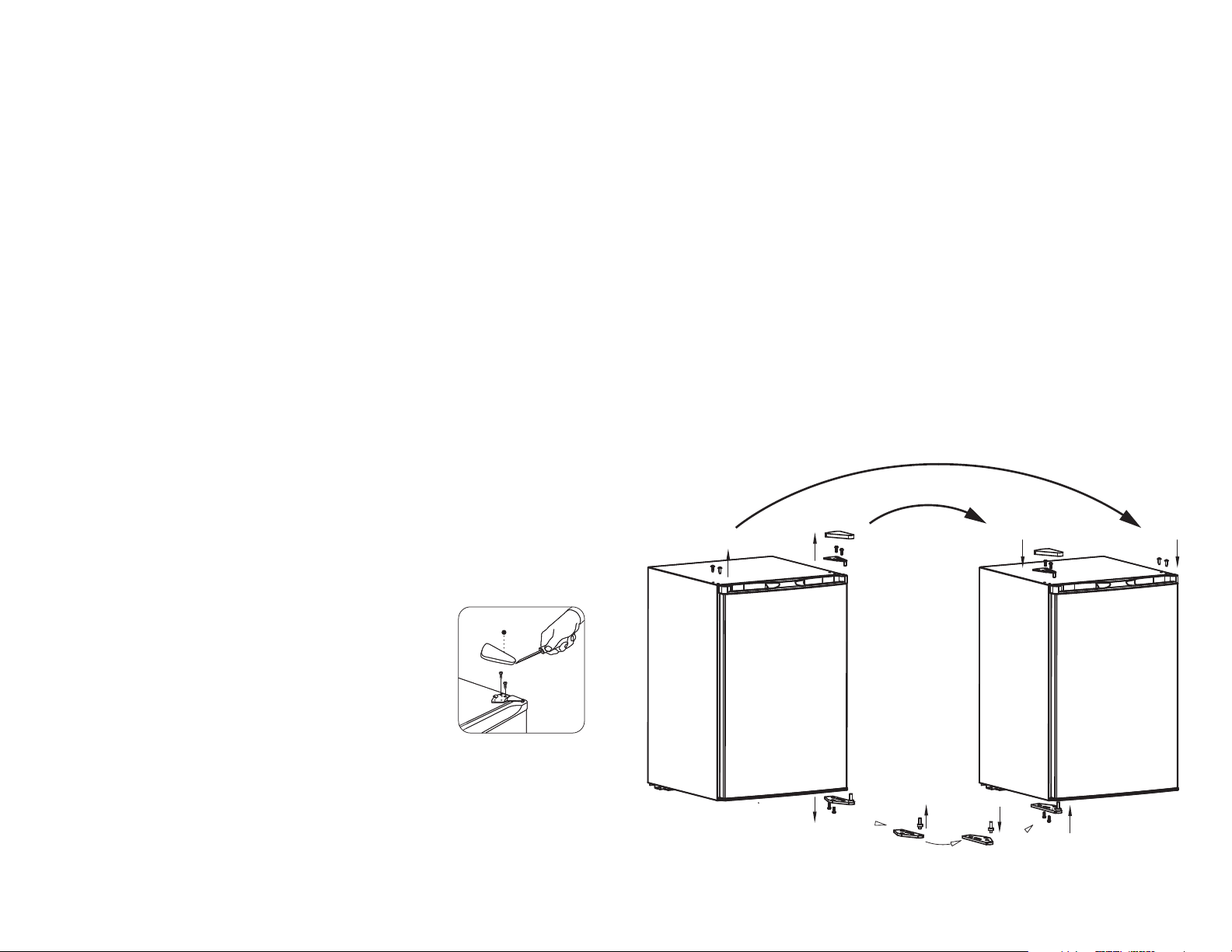
REVERSING THE DOOR HINGE
1. Remove the top hinge cover.
2. Using Phillips Head Screwdriver, loosen and remove the screws holding the top hinge in place.
3. Remove top hinge and carefully lift off the door.
4. Remove the screw hole plugs from the opposite side and insert the plugs in the screw hole
openings of the just removed screws.
5. Remove any loose items in the refrigerator and carefully turn refrigerator on its back and place in a
secure area.
6. Loosen the screws holding the lower hinge bracket to the refrigerator and remove screws and
bracket.
7. Remove the screws from the other side and insert in the previously removed screw holes.
8. Remove door pin by turning counter clockwise and reinsert to the underside of the bracket and
tighten.
9. Align bracket and insert (2) remaining screws into the holes provided .
10. Align hole in the door with the door pin and washer and gently push down until firm.
11. Align upper hinge bracket with screw holes insert screws and partially secure, check that door and
cabinet are properly aligned and then secure tightly.
12. Replace hinge cap.
6 7
PARTS & FEATURES
OPERATING INSTRUCTIONS
NOTE - If the refrigerator has been placed in a horizontal or tilted position for any period of time wait
24 hours before plugging the unit in.
• The settings of the temperature control are "0, 1, 2, 3, 4, 5, 6, 7." Adjust the temperature control to
the setting that best suits your needs. The setting of "4" should be appropriate for home or office use.
• Turning the temperature to “0” position will shut off the cooling cycle, but does not turn off the
electrical power to the unit.
NOTE
- Wait 3-5 minutes before restarting if you unplug the refrigerator. The unit may fail to operate
properly if restarted too quickly.
- If the ambient temperature is too high, the refrigerator may not reach the desired target temperature.
- Large amounts of foods will lower the cooling efficiency of the appliance.
- Do not place the foods on the air outlet and leave spaces for airflow.
- If you choose to change the thermostat setting, adjust thermostat control one increment at a time.
Allow several hours for temperature to stabilize between adjustments.
REFRIGERATOR INTERIOR SHELF
1. Carefully tilt the shelf up and slide forward until the shelf has been completely removed.
2. Slide the shelf back to replace.
CARE AND CLEANING
CLEANING AND MAINTAINING
The refrigerator should be cleaned and maintained once a month. Before doing so, YOU MUST
UNPLUG THE REFRIGERATOR.
• Prepare a cleaning solution of 3-4 tablespoons of baking soda mixed with warm water. Use sponge
or soft cloth, dampened with the cleaning solution to wipe down your refrigerator.
• Rinse with clean warm water and dry with a soft cloth,
• Do not use harsh chemicals, abrasives, ammonia, chlorine bleach, concentrated detergents, solvents
or metal scouring pads. Some of these chemicals may dissolve, damage and/or discolor your
refrigerator.
DOOR GASKET
Clean door gaskets every three months according to general instructions. Gasket must be kept clean
and pliable to assure a proper seal.
- Petroleum jelly applied lightly on the hinge sides of gaskets will keep the gasket pliable and ensure a
good seal.
CAUTION - To avoid personal injury or product damage always read and follow manufacturer’s instruc-
tions and warnings before using any cleaning products.
WARNING - Always unplug your refrigerator before cleaning to avoid electric shock. Ignoring this
warning may result in death or injury.
VACATIONS
• Short vacations: Leave the appliance operating during vacations of less than 3 - 4 weeks.
• Long vacations: If the appliance will not be used for over one month, remove all items and unplug
the power cord. Clean and dry the interior thoroughly. To prevent odor and mold growth, leave the
door open slightly: blocking it open if necessary.
MOVING YOUR FRIDGE
1. Remove all contents and store properly.
2. Securely tape down all loose items inside your appliance.
3. Turn the leveling screws up to the base to avoid damage.
4. Tape the door shut.
5. Be sure the unit stays in the upright position during transportation. Protect the outside with a
blanket or similar item.
POWER INTERRUPTION
In case of a power interruption/outage, unplug the power cord from the wall outlet. Replug the power
cord to the wall outlet once the power has been restored. For long period of power outage, inspect
and discard the spoiled or thawed foods from the refrigerator and freezer compartments. Clean the
refrigerator thoroughly before using again.
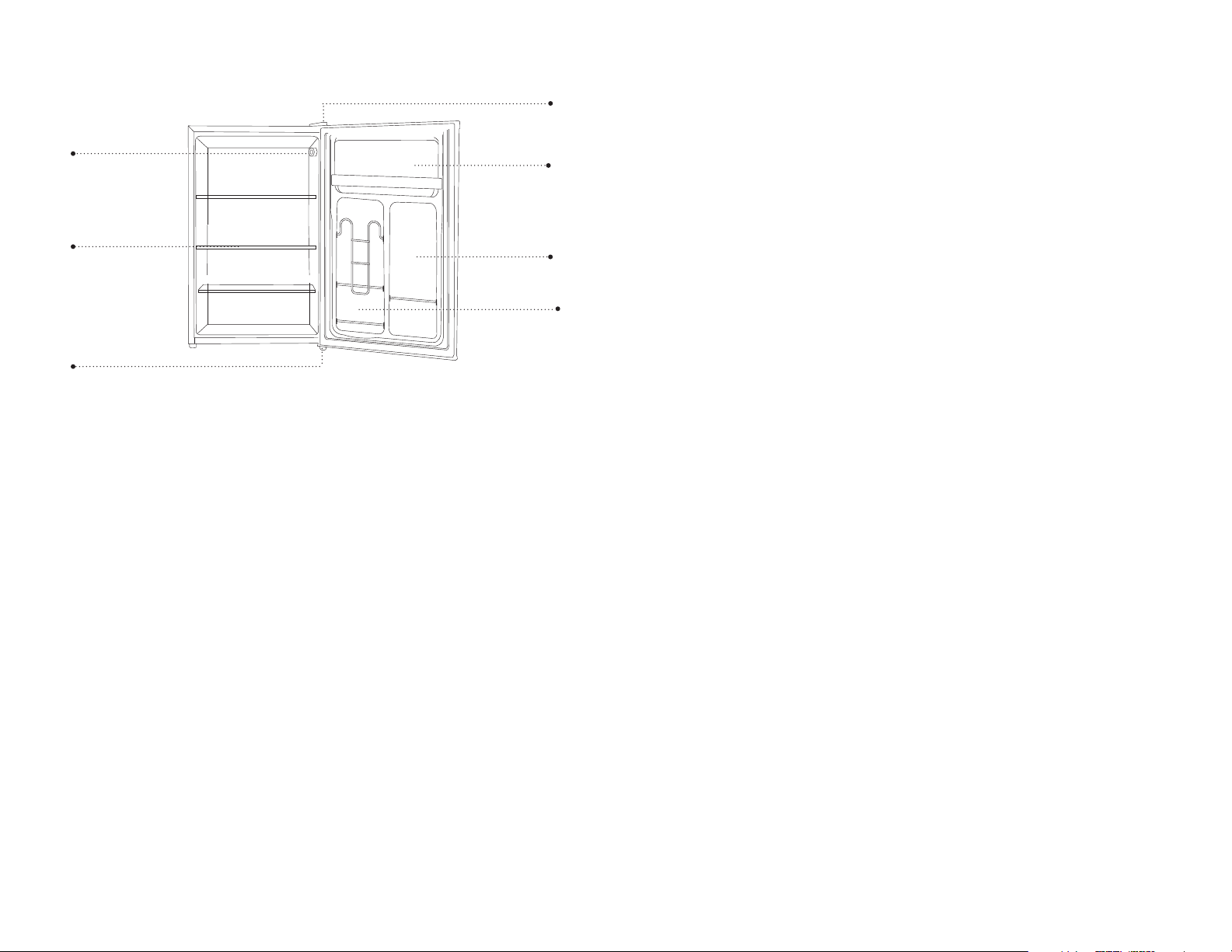
Temperature Control
Glass Shelves
Adjustable Leveling Legs
Hinge Cover
Door Shelf
Tall Bottle Storage
Can Dispenser

8 9
CARE AND CLEANING (cont.) TROUBLESHOOTING GUIDE
You can solve many common appliance problems easily, saving you the cost of a possible service call.
Try the suggestions below to see if you can solve the problem before calling the servicer.
ENERGY SAVING TIPS
• The refrigerator should be located in the coolest area of the room, away from heat-producing
appliances or heating ducts, and out of direct sunlight.
• Let hot foods cool to room temperature before placing in the refrigerator. Overloading the
refrigerator forces the compressor to run longer and thus increase energy consumption. Foods that
refrigerate too slowly may lose quality or spoil.
• Be sure to wrap foods properly, and wipe containers dry before placing in the refrigerator.
• The shelves should not be lined with aluminium foil, wax paper, or paper towels. This will interfere
with cold air circulation, making the refrigerator less efficient.
• Organize food to reduce door openings and extended searches. Remove as many items as needed at
one time, and close the door as soon as possible.
PROBLEM POSSIBLE CAUSE & REMEDY
Refrigerator does not work
The food is too cold
The food is too warm
Popping or cracking sounds
Refrigerator door does not
shut properly
Refrigerator has an odor
A. Refrigerator is not switched on. Turn on the temperature
control dial. It may be in the OFF, “0” position
B. Unit is not plugged in or plug is loose.
- Plug in the refrigerator.
C. Fuse has blown or is defective.
- Check fuse, replace if necessary.
D. Wall power socket is defective.
- To be corrected by a qualified
electrician.
Temperature is not properly adjusted. Set the temperature
control dial to a warmer setting.
A. Temperature is not properly adjusted. Set the temperature
control dial to a cooler setting
B. Door was open for an extended period. Open the door only
as long as necessary. Check door gasket for proper seal.
C. A large quantity of warm food was placed in the refrigerator
within the last 24 hours. Set the temperature control dial to a
colder setting temporarily.
D. The refrigerator is near a heat source. Please look in the
“Protection From Heat and Moisture” section.
When compressor comes on. This is a normal sound of
coolant flowing through condenser coils.
Refrigerator door does not The refrigerator door is not
properly aligned. Re-align the shut properly refrigerator door.
Refer to the “Door Alignment” section.
Ensure nothing is blocking the door.
A. Foods not properly sealed. Remove any contaminated foods.
B. Interior needs cleaning. Please refer to “Cleaning and Care”
section