1
1
ENGLISH
DEUTSCH
FRANÇAIS
DZMV270E
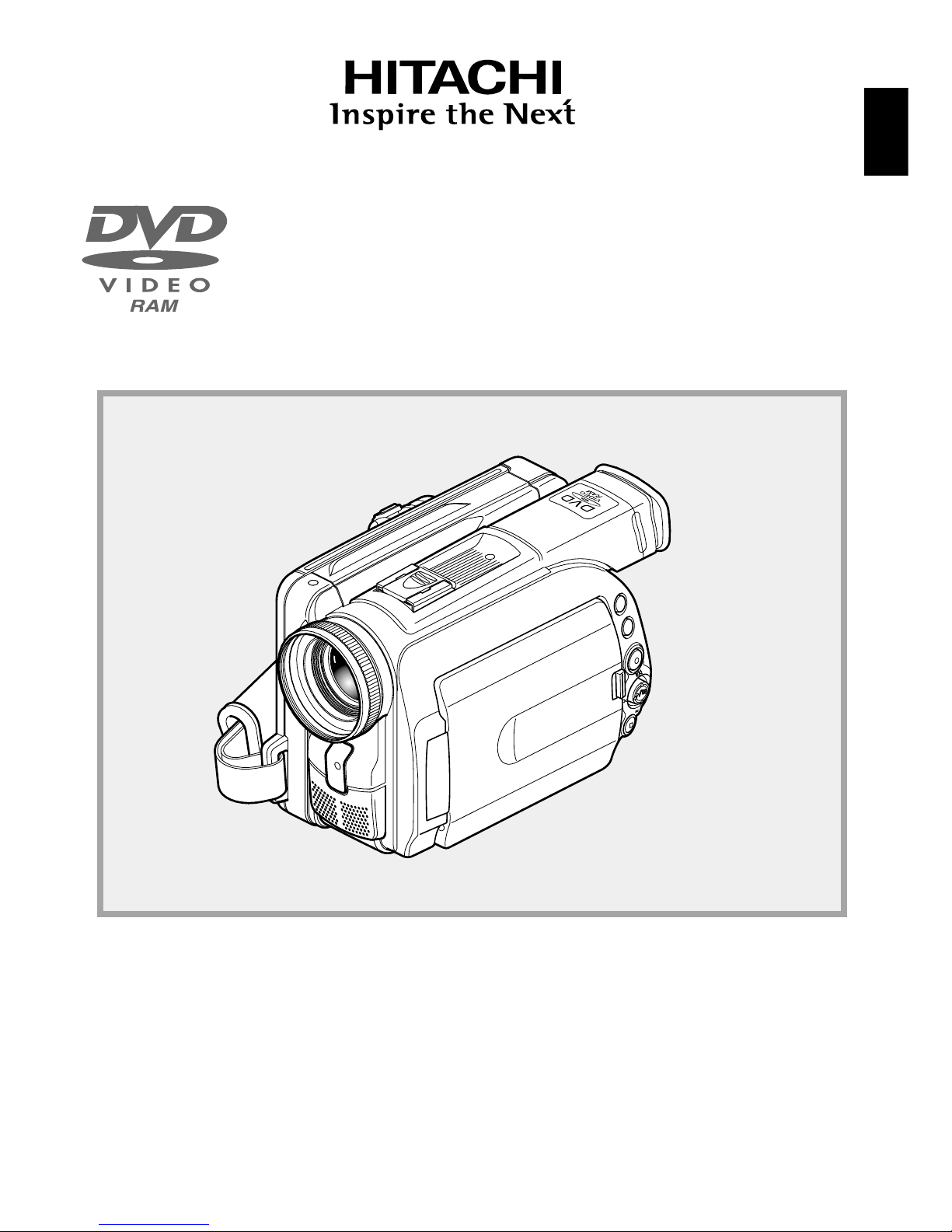
Instruction manual
To obtain the best performance and ensure years of trouble-free use, please read this instruction manual
Hitachi, Ltd. Tokyo, Japan
International Sales Division
THE HITACHI ATAGO BUILDING,
No. 15 -12 Nishi Shinbashi, 2 - Chome,
Minato - ku,Tokyo 105-8430, Japan.
Tel: 03 35022111
Printed in Japan OF-Y(HE)QR34403 ©Hitachi, Ltd. 2002
DZ-MV270E Instruction Manual
HITACHI EUROPE S.A.
364, Kifissias Ave. & 1, Delfon Str.
152 33 Chalandri
Athens
GREECE
Tel: 1-6837200
Fax: 1-6835694
Email:
HITACHI EUROPE S.A.
Gran Via Carlos III, 101 - 1
08028 Barcelona
SPAIN
Tel: 93 409 2550
Fax: 93 491 3513
Email:
HITACHI EUROPE AB
Box 77
S-164 94 KISTA
SWEDEN
Tel: 08 562 711 00
Fax: 08 562 711 11
Email:
HITACHI EUROPE LTD.
Norwegian Branch Office
Strandveien 18
1366 Dysaker
NORWAY
Tel: 02205 9060
Fax: 02205 9061
Email
HITACHI EUROPE LTD.
Dukes Meadow
Millboard Road
Bourne End
Buckinghamshire
SL8 5XF
UNITED KINGDOM
Tel: 01628 643000
Fax: 01628 643400
Email:
consumer-ser[email protected]
HITACHI EUROPE GmbH
Munich Office
Dornacher Strasse 3
D-85622 Feldkirchen bei München
GERMANY
Tel: +49 -89-991 80-0
Fax: +49 - 89 - 991 80 -224
Hotline: +49 - 180 - 551 25 51 (12ct/min.)
Email:
HSE-DUS.Ser[email protected]
HITACHI EUROPE SRL
Via T. Gulli n.39
20147 MILAN
ITALY
Tel: 02 487861
Fax: 02 48786381
Servizio Clienti
Tel. 02 38073415
Email:
customerser[email protected]
HITACHI EUROPE S.A.S
Lyon Office
B.P. 45, 69671 Bron Cedex
FRANCE
Tel: 04 72 14 29 70
Fax: 04 72 14 29 99
Email:
france[email protected]
ITEM N.V./S.A. (INTERNATIONAL TRADE FOR
ELECTRONIC MATERIAL & MEDIA N.V./S.A)
UCO Tower – Bellevue, 17
B – 9050 GENT
BELGIUM (for BENELUX)
Tel: 09 230 48 01
Fax: 09 230 96 80
Email:
www.hitachi-consumer-eu.com
completely.
Downloaded from www.ManualsFile.com manuals search engine
2
2
ENGLISH
Identifications of caution marks
This symbol warns the user that
uninsulated voltage within the unit
may have sufficient magnitude to cause
electric shock. Therefore, it is danger-
ous to make any kind of contact with
any inside part of this unit.
This symbol alerts the user that impor-
tant literature concerning the operation
and maintenance of this unit has been
included. Therefore, it should be read
carefully to avoid any problems.
WARNING: To prevent risk of lnjury or
domage to your DVD video camera/
recorder and the AC adapter, use only
the speclfled batterles and AC adapter.
Batterles; DZ-BP14(R) and DZ-BP28,(The
DZ-BP14(R) is supplied with this DVD
video camera/recorder)
AC adapter; DZ-ACE1
Important Information
For Your Safety
The power switch turns the DVD video camera/recorder on and off, leaving the date/time feature
unaffected. If the camera/recorder is to be left unattended for a long period of time, turn it off .
WARNING : TO PREVENT FIRE OR SHOCK HAZARD, DO NOT
EXPOSE THIS UNIT TO RAIN OR MOISTURE.
WARNING : TO PREVENT FIRE OR SHOCK HAZARD, USE THE
RECOMMENDED ACCESSORIES ONLY.
The DVD video camera/recorder and AC adapter
have the following caution marks.
CAUTION
RISK OF ELECTRIC SHOCK
DO NOT OPEN
CLASS 1
LASERPRODUCT
CAUTION
This product contains a laser diode of
higher class than 1. To ensure continued
safety, do not remove any covers or at-
tempt to gain access to the inside of the
product. Refer all servicing to qualified per-
sonnel.
CAUTION: TO REDUCE THE RISK OF
ELECTRIC SHOCK, DO NOT OPEN.
NO USER-SERVICEABLE PARTS INSIDE.
REFER SERVICING TO QUALIFIED SERVICE
PERSONNEL.
WARNING: Many television programs and films
are copyrighted. In certain circumstances, copy-
right law may apply to private in-home videotaping
of copyrighted materials.
This Class B digital apparatus complies with
Canadian ICES-003.
The liquid crystal display (LCD) panel is
made by highly precise technology. More
than 99.99% of its picture elements (pixels)
are effective, but some (less than 0.01%) may
appear as colored bright dots. This does not
indicate a fault as the LCD panel stretches
the limits of current technology.
Downloaded from www.ManualsFile.com manuals search engine

3
ENGLISH
Warning: This device complies with Part 15 of the FCC Rules. Operation is subject to the following
two conditions: (1) This device may not cause harmful interference, and (2) this device must accept
any interference received, including interference that may cause undesired operation.
Note: This equipment has been tested and found to comply with the limits for a Class B digital
device, pursuant to Part 15 of the FCC Rules. These limits are designed to provide reasonable
protection against harmful interference in a residential installation. This equipment generates, uses,
and can radiate radio frequency energy and, if not installed and used in accordance with the in-
structions, may cause harmful interference to radio communications. However, there is no guaran-
tee that interference will not occur in a particular installation. If this equipment does cause harmful
interference to radio or television reception, which can be determined by turning the equipment off
and on, the user is encouraged to try to correct by one or more of the following measures:
• Reorient or relocate the receiving antenna.
• Increase the separation between the equipment and receiver.
• Connect the equipment into an outlet on a circuit different from that to which the receiver is
connected.
• Consult the dealer or an experienced radio/TV technician for help.
Caution to the user: Changes or modifications not expressly approved by the manufacturer void
the user’s authority to operate the equipment.
Microsoft, MS, MS-DOS, Windows and Windows NT are registered trademarks of Microsoft
Corporation.
Manufactured under license from Dolby Laboratories.
“Dolby” and double-D symbol are trademarks of Dolby Laboratories.
Other company names and product names listed are trademarks or brand names belonging to each
company.
Downloaded from www.ManualsFile.com manuals search engine
4
ENGLISH
IMPORTANT SAFEGUARDS
In addition to the careful attention devoted to quality standards in the manufacture of your video product, safety is a major factor in the
design of every instrument. But, safety is your responsibility too.
This page lists important information that will help to assure your enjoyment and proper use of DVD video camera/recorder and accessory
equipment. Please read it carefully before operating your video product and keep it in a handy place for future reference.
INSTALLATION
1
Read and Follow Instructions — All the safety and op-
erating instructions should be read before the video product is
operated. Follow all operating and use instructions.
2
Retain Instructions — The safety and operating instruc-
tions should be retained for future reference.
3
Heed Warnings — Comply with all warnings on the video
product and in the operating instructions.
4
Polarized Plug — This video product is equipped with a
polarized alternating-current line plug (a plug having one blade
wider than the other). This plug will fit into the power outlet
only one way. This is safety feature. If you are unable to
insert the plug fully into the outlet, try reversing the plug. If
the plug should still fail to fit, contact your electrician to re-
place your obsolete outlet. To prevent electric shock do not
use this polarized plug with an extension cord, receptacle or
other outlet unless the blades can be fully inserted without
blade exposure. If you need an extension, use a polarized
cord.
5
Power Sources — This video product should be operated
only from the type of power source indicated on the marking
label. If you are not sure of the type of power supply to your
home, consult your video dealer or local power company. For
video products intended to operate from battery power, or other
sources, refer to the operating instructions.
6
Overloading — Do not overload wall outlets and extension
cords as this can result in a risk of fire or electric shock. Over-
loaded AC outlets and extension cords are dangerous, and so
are frayed power cables, damaged or cracked wire insulation
and broken plugs. They may result in a shock or fire hazard.
Periodically examine the cord and have it replaced by your
service technician if appearance indicates damage or deterio-
rated insulation.
7
Power-Cord Protection — Power-supply cords should be
routed so that they are not likely to be walked on or pinched
by items placed upon or against them, paying particular atten-
tion to cords at plugs, convenience receptacles, and the point
where they exit from the appliance.
8
Ventilation — Slots and openings in the cabinet are pro-
vided for ventilation to ensure reliable operation of the video
product and to protect it from overheating. These openings
must not be blocked or covered. The openings should never
be blocked by placing the video product on a bed, sofa, rug, or
other similar surface. This video product should never be
placed near or over a radiator or heat register. This video prod-
uct should not be placed in a built-in installation such as a book-
case or rack unless proper ventilation is provided or the video
product manufacturer’s instructions have been followed.
9
Attachments — Do not use attachments unless recom-
mended by the video product manufacturer as they may cause
hazards.
Caution: Maintain electrical safety. Powerline operated equipment
or accessories connected to this unit should bear the UL listing
mark or CSA certification mark on the accessory itself and should
not have been modified so as to defeat the safety features. This
will help avoid any potential hazard from electric shock or fire. If in
doubt, contact qualified service personnel.
10
Water and Moisture — Do not use this video product
near water — for example, near a bath tub, wash bowl, kitchen
sink, or laundry tub, in a wet basement, or near a swimming
pool, and the like.
11
Accessories — Do not place this video product on an un-
stable cart, stand, tripod, bracket, or table. The video product
may fall, causing serious injury to a child or adult, and serious
damage to the appliance. Use only with a cart, stand, tripod,
bracket, or table recommended by the manufacturer, or sold
with the video product. Any mounting of the product should
follow the manufacturer’s instructions, and should use a mount-
ing accessory recommended by the manufacturer.
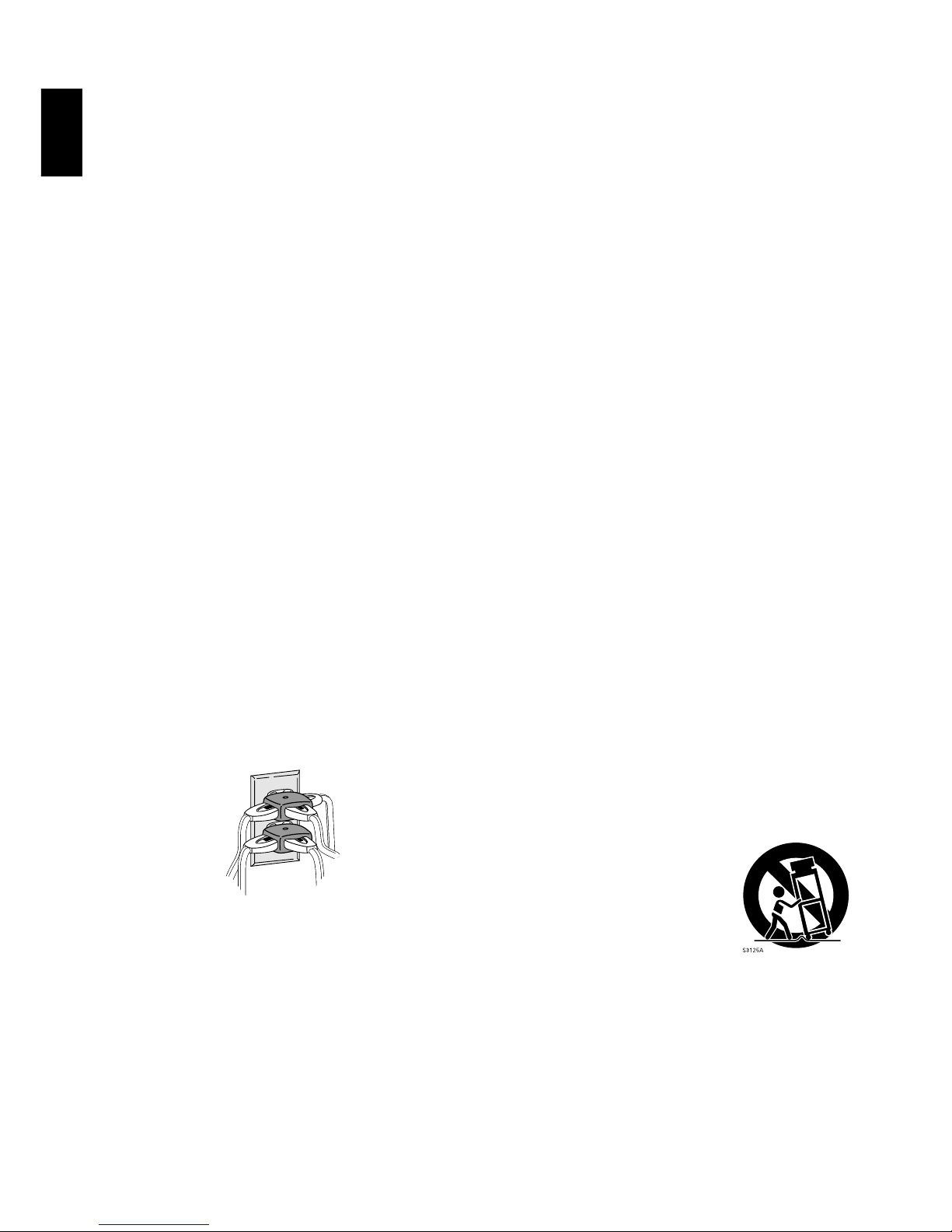
12
An appliance and cart combination
should be moved with care. Quick
stops, excessive force, and uneven sur-
faces may cause the appliance and cart
combination to overturn.
Downloaded from www.ManualsFile.com manuals search engine

5
ENGLISH
13
Power Lines — An outside antenna system should not be
located in the vicinity of overhead power lines or other electric
light or power circuits, or where it can fall into such power
lines or circuits. When installing an outside antenna system,
extreme care should be taken to keep from touching or ap-
proaching such power lines or circuits as contact with them
might be fatal. Installing an outdoor antenna can be hazard-
ous and should be left to a professional antenna installer.
USE
14
Cleaning — Unplug this video product from the wall outlet
before cleaning. Do not use liquid cleaners or aerosol clean-
ers. Use a damp cloth for cleaning.
15
Object and Liquid Entry — Never push objects of any
kind into this video product through openings as they may
touch dangerous voltage points or short-out parts that could
result in a fire or electric shock. Never spill liquid of any kind
on the video product.
16
Lightning — For added protection for this video product
during a lightning storm, or when it is left unattended and un-
used for long periods of time, unplug it from the wall outlet
and disconnect the antenna or cable-system. This will pre-
vent damage to the video product due to lightning and power-
line surges.
SERVICE
17
Servicing — Do not attempt to service this video product
yourself as opening or removing covers may expose you to
dangerous voltage or other hazards. Refer all servicing to quali-
fied service personnel.
18
Conditions Requiring Service — Unplug this video prod-
uct from the wall outlet and refer servicing to qualified service
personnel under the following conditions.
a. When the power-supply cord or plug is damaged.
b. If liquid has been spilled, or objects have fallen into the
video product.
c. If the video product has been exposed to rain or water.
d. If the video product does not operate normally by follow-
ing the operating instructions. Adjust only those controls
that are covered by the operating instructions. Improper
adjustment of other controls may result in damage and
will often require extensive work by a qualified technician
to restore the video product to its normal operation.
e. If the video product has been dropped or the cabinet has
been damaged.
f. When the video product exhibits a distinct change in per-
formance — this indicates a need for service.
19
Replacement Parts — When replacement parts are re-
quired, have the service technician verify that the replacements
he uses have the same safety characteristics as the original
parts. Use of replacements specified by the video product
manufacturer can prevent fire, electric shock or other hazards.
20
Safety Check — Upon completion of any service or repairs
to this video product, ask the service technician to perform
safety checks recommended by the manufacturer to deter-
mine that the video product is in safe operating condition.
21
Heat — The product should be situated away from heat
sources such as radiators, heat registers, stoves, or other prod-
ucts (including amplifiers) that produce heat.
Downloaded from www.ManualsFile.com manuals search engine

6
ENGLISH
ИHФOPMAЦИЯ
O CEPTИФИКAЦИИ ПPOДУКЦИИ
Блоки питaния <<HITACHI>> модeли VM-ACE5E cepтифициpовaны оpгaном по cepтификaции
элeктpообоpyдовaния <MEHTECT> Meндeлeeвcкого ЦCMC
(Peгиcтpиpовaнный номep в Гоcpeecтpe – POCC RU.0001.11ME28)
CETEBOЙ AДAПTEP – ЗAPЯДHOE УCTPOЙCTBO
MOДEЛИ DZ-ACE1И
cepтифициpовaн оpгaном по cepтификaции элeктpообоpyдовaния
<<MEHTECT>> Meндeлeeвcкого ЦCMC
(Peгиcтpaционный номep в Гоcpeecтpe – POCC RU.001.11ME28)
INFORMATION ON PRODUCT CERTIFICATION
AC ADAPTER
MODEL DZ-ACE1
certified by “MENTEST” of Mendeleevsky CSMS
(Registration number in State Register – POCC RU.0001.11ME28)
Cepтификaт cоотвeтcтвия №:
Cepтификaт cоотвeтcтвия выдaн:
Cepтификaт cоотвeтcтвия дeйcтвитeлeн до:
Mодeль DZ-ACE1 cоотвeтcтвyeт тpeбовaниям
ноpмaтивныx докyмeнтов:
Cpок cлyжбы
Certificate of conformify No,:
Certificate of conformity lssued:
Certificate of conformity vaild till:
Model DZ-ACE1 complies with requirements of
normative documents:
Life cycle
POCC JP.ME28.B13985
The 21
st
of January 2002
The 18
th
of January 2005
GOST 12.2.006-87
GOST R 51318.14.1-99
7 (seven) years
Downloaded from www.ManualsFile.com manuals search engine

7
ENGLISH
Read This First
To guide you, we’ve included following six chapters.
• The section on “Setups” explains how to set up
the DVD video camera/recorder, battery pack,
and set the date/time.
• The section on “Basic Techniques” explains the
basic operation of this DVD video camera/re-
corder – recording of movies and still images and
playback of recorded images.
• The section on “Advanced Techniques” explains
settings on this DVD video camera/recorder for
more advanced usage.
• The section on “Using Disc Navigation” explains
editing with Disc Navigation: Refer to this sec-
tion when finalizing DVD-R disc and initializ-
ing DVD-RAM disc.
• The section on “Connecting to Other Devices”
explains how to connect to TV, another AV de-
vice and PC, and how to operate after connec-
tions.
•“Subsidiary Information” includes an introduc-
tion to products sold separately, proper clean-
ing, and troubleshooting.
We want this manual to be as helpful as possible,
so it includes two easy ways to find the informa-
tion you need:
• A quick index for the information you use most
often (this page).
• A detailed table of contents directing you to spe-
cific information quickly (page 8~9).
Get to know your DVD video camera/recorder
by using this manual, and get to know Hitachi. We
appreciate your business.
Quick Index
Charging Battery
...........................................
31
Recording Movie
..........................................
42
Immediately Checking Recorded Scene
...
44
Functions Available with Disc Navigation
....
68
Connecting to a TV and Viewing
................
91
Connecting to Your PC
.................................
95
With this DVD video camera/recorder you can view the picture being recorded or the playback
picture whether on the LCD monitor or in the viewfinder. Opening or closing the LCD monitor
switches the picture to appear on the LCD monitor or in the viewfinder. The following text de-
scribes the operation assuming that the viewfinder is used as a major monitor device.
Downloaded from www.ManualsFile.com manuals search engine

8
ENGLISH
Table of Contents
Important Information................................2
For Your Safety ............................................2
IMPORTANT SAFEGUARDS ......................4
Read This First..............................................7
About This Manual ................................... 1 0
Checking Provided Accessories......... 1 1
Names of Parts ......................................... 1 2
Viewing Demonstration.......................... 1 6
Features of DVD video camera/re-
corder........................................................... 1 7
Versatile Functions Available ..................... 17
Recording on Disc ..................................... 18
Recording Movie and Still .......................... 18
Immediate Reviewing of Recorded
Image......................................................... 18
Editing in Various Ways on DVD video
camera/recorder Alone .............................. 18
Using with Various Devices ....................... 18
Cautions When Using .................................... 19
Cautions When Storing ................................. 22
Suggestions and Restrictions ....................... 22
Discs ................................................................ 23
Removing and Replacing Disc from/in
Cartridge or Caddy ..................................... 24
Disc Storage Capacity................................ 26
Setups
Setting Up the DVD video camera/
recorder........................................................... 27
Holding DVD video camera/recorder ......... 27
Attaching Shoulder Strap ........................... 27
Attaching Lens Cap ................................... 28
Attaching Ferrite Cores.............................. 28
Inserting Batteries into Remote Control .... 29
Setting Up the Battery ................................... 30
Attaching Battery to DVD video camera/
recorder ..................................................... 30
Removing Battery ...................................... 30
Charging Battery ........................................ 31
Battery Remaining Level Indicator............. 33
Using DVD video camera/recorder with AC
Adapter ........................................................... 34
Setting Date and Time ................................... 35
Changing Display Format of Date
and Time .................................................... 36
Inserting and Ejecting Disc ............................ 37
Inserting Disc............................................. 37
Removing Disc .......................................... 39
Basic Techniques
Basic Handling of DVD video camera/
recorder........................................................... 40
Turning DVD Video Camera/
Recorder On .............................................. 40
Opening LCD Monitor ............................... 40
LCD Screen Brightness Adjustment.......... 41
Closing LCD Monitor ................................. 41
Viewing Subject through Viewfinder ......... 41
Recording Movie ............................................ 42
Using External Microphone ....................... 42
Recording Stills .............................................. 43
Playing Back ................................................... 44
Immediately Checking Recorded Scene.... 44
Skip Playback ............................................. 44
Search Playback......................................... 45
Frame Advance/Frame Back/
Slow Playback............................................ 45
Searching for Point You Wish to View by
Specifying It (Go To)................................... 46
Zooming.......................................................... 47
Focusing When Recording Movie ............. 48
Macro Recording ....................................... 48
Manually Focusing Subject during Movie
Recording........................................................ 49
Adjusting Exposure Manually ....................... 50
On-Screen Information .................................. 51
Information Display During Recording ....... 51
Information Display During Playback ......... 53
Advanced Techniques
Setting Up Camera Functions ....................... 54
Selecting Shooting Mode to Match the
Subject (Switching Program AE Mode) ..... 54
White Balance (Auto/Hold) ........................ 55
Using the Electronic Image Stabilizer
(EIS) ........................................................... 56
Switching Digital Zoom Off ....................... 57
Switching to 16:9 Mode ............................ 58
Setting Up Record Functions ........................ 59
Switching Movie Quality Mode ................. 59
Input Selection........................................... 60
Changing Method for Recording Stills ....... 61
Self-Timer................................................... 62
Switching On-Screen Display Output On or
Off ............................................................. 63
Initial Settings................................................. 64
Switching Operating Sound On or Off....... 64
Setting or Releasing Power Save .............. 64
Turning Record LED On or Off................... 65
Changing Display Language ...................... 65
Initializing All Settings to Defaults................ 66
Downloaded from www.ManualsFile.com manuals search engine

9
ENGLISH
Disc Navigation
Before Using Disc Navigation ....................... 67
Structure of Data Recorded On This DVD
Video Camera/Recorder............................. 67
Using Disc Navigation ................................... 68
Functions Available with
Disc Navigation .......................................... 68
Starting Disc Navigation and Interpreting
Navigation Screen...................................... 70
Playing Back Scenes.................................. 71
Selecting Random Scenes......................... 71
Selecting Consecutive Scenes Together ... 71
Understanding Flow of Disc Navigation
Menu ............................................................... 72
Program .......................................................... 73
Switching to Thumbnail Display of Specific
Date (Selecting Program)........................... 73
Playing Back Program ................................ 73
Changing Title of Program ......................... 74
Play List ........................................................... 75
Creating New Play List .............................. 75
Switching Play List (Switching to Display of
Each Play List) ........................................... 76
Playing Back A Play List............................. 76
Adding Scenes to Play List ........................ 77
Deleting Scenes from Play List ................. 78
Editing Play List (Adding Scenes Using
Menu) ........................................................ 78
Editing Play List (Deleting Scenes Using
Menu) ........................................................ 79
Editing Play List (Selecting Scenes Using
Menu) ........................................................ 79
Changing Title of Play List.......................... 80
Deleting Play List ....................................... 80
Scene............................................................... 81
Deleting Scenes ........................................ 81
Adding Special Effects (Fade) .................... 82
Combining Multiple Scenes....................... 84
Dividing Movies ......................................... 84
Arranging Order of Scenes (Move) ............ 85
Playing Back by Skipping Scenes (Skip) .... 86
Selecting Scenes Using Menu Screen ...... 86
Displaying Information Using Menu
Screen ....................................................... 87
Disc Management .......................................... 88
Verifying Remaining Free Space on Disc
(Capacity) ................................................... 88
Initializing DVD-RAM Disc ......................... 88
Updating Control Information .................... 89
Finalizing Disc ............................................ 90
Playing Back Scenes Repeatedly (Repeat
Play) ........................................................... 90
Connecting to Other Devices
Viewing on TV Screen.................................... 91
Connecting to a TV .................................... 91
Viewing on TV Screen................................ 92
Recording Image from Other AV Devices .... 93
Connecting to Other AV Device................. 93
Recording Image from Other Camcorder or
AV Device .................................................. 94
Cautions when connecting DVD video
camera/recorder to PC ................................... 95
Capturing Data for PC .................................... 96
Using DZ-WINPC3(W) PC kit ..................... 96
Using Disc on PC ....................................... 98
Subsidiary Information
Cleaning .......................................................... 99
If dust adheres to viewfinder lens ............. 99
Trouble Messages ........................................ 100
Troubleshooting ........................................... 105
System Reset ................................................ 110
Major Specifications .................................... 111
Introduction to Optional Accessories ......... 112
Camera Accessories ................................ 112
Power Supplies........................................ 112
Miscellaneous.......................................... 112
Index.............................................................. 113
Downloaded from www.ManualsFile.com manuals search engine
10
ENGLISH
About This Manual
● Photographs in this manual:
Photographs taken using digital still camera are used for explanation of images that appear in the view-
finder or on the LCD screen in this manual. Understand that they look different from those you will
actually view in the viewfinder or on the LCD screen.
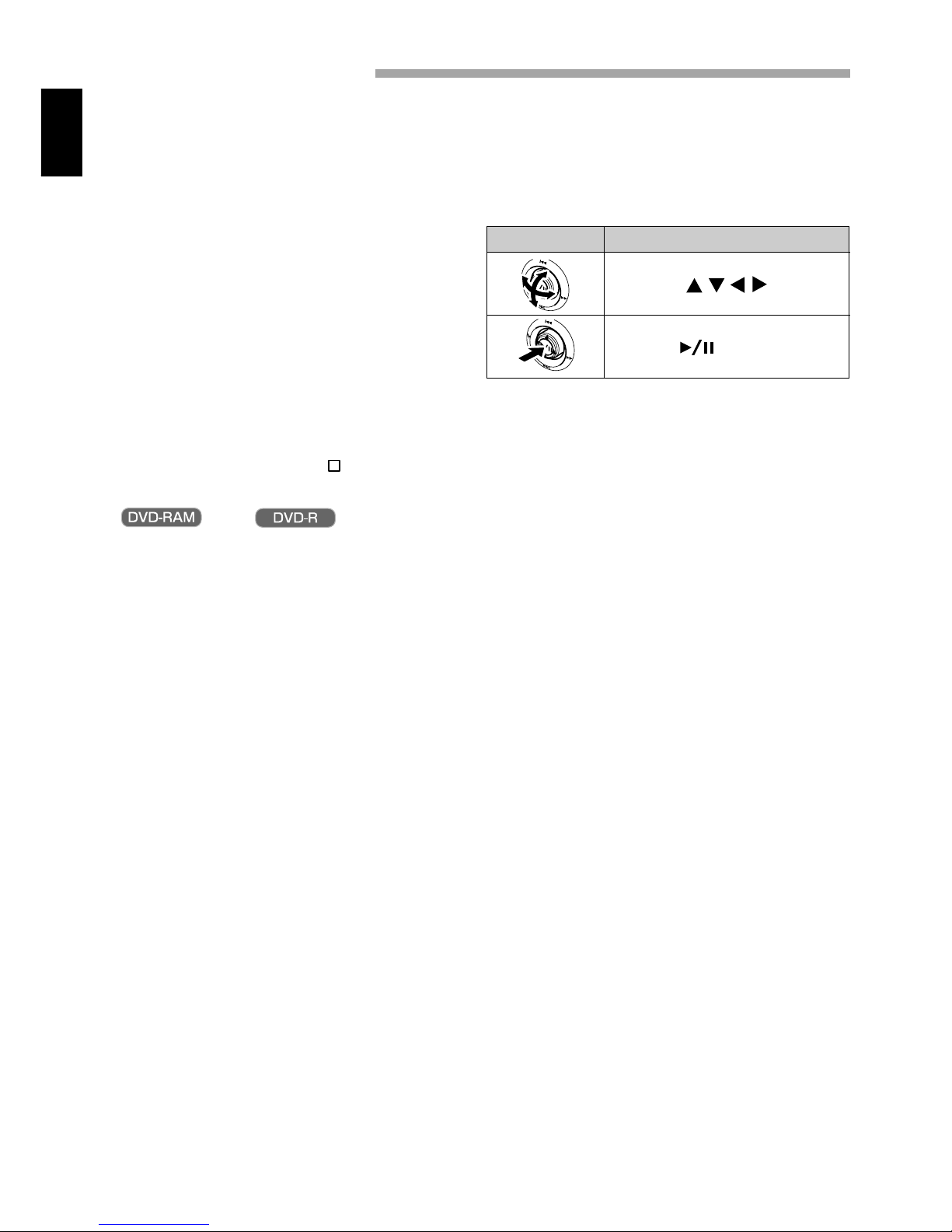
● About joystick:
You can tilt it up, down, to left or right, or press its
center: The way you move it will determine the
results. Normally, move the joystick up, down to
left or right to select a menu item or scene, and then
press the center to enter the selection.
● Notation of cancel button:
Press the stop/cancel button to stop your operation midway, or return the menu screen to the preceding
one. The expression “press the button” will be used in this text.
● and marks beside headings:
This DVD video camera/recorder has some functions available only with DVD-RAM disc, or operation
only necessary for DVD-R disc. Refer to these marks and identify the functions and operation to match
the disc you use.
Operation Notation in this manual
button
Downloaded from www.ManualsFile.com manuals search engine
11
ENGLISH
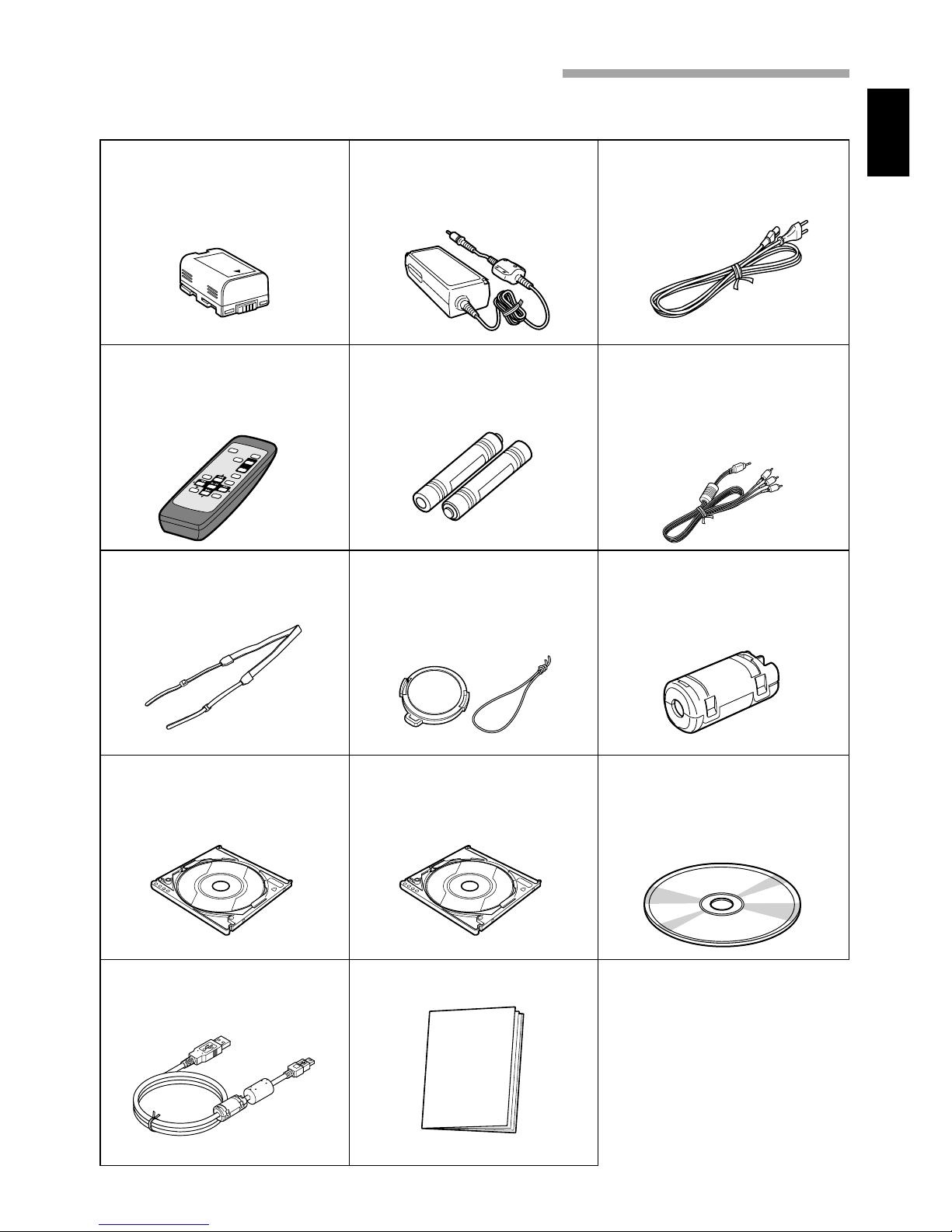
Checking Provided Accessories
Make sure that you have all the following accessories in package:
Battery (model DZ-BP14(R)):
Portable power supply for this DVD
video camera/recorder. Charge it
before use.
Ac adapter (model DZ-ACE1):
Connect this device to the DVD
video camera/recorder to power it
from AC outlet.
Shoulder strap:
Attach to the DVD video camera/
recorder to hang it from shoulder.
Infrared remote control
(model DZ-RM2W):
Use to control the DVD video
camera/recorder from a distance.
2 “AA” batteries:
To power the remote control.
AV input/output cable:
Used when viewing the picture
played back on the DVD video
camera/recorder on TV screen or
input or output video from/to
another video device.
Power cable:
Connect between household AC
outlet and AC adapter.
Lens cap and lens cap string:
Attach the lens cap when not
recording, to protect the lens.
2 Ferrite cores:
Attach these to the S-VIDEO cable,
and the external microphone cable
if you are using one.
8 cm DVD-R disc: 8 cm DVD-RAM disc (Sample): USB device driver CD-ROM:
You will need this CD-ROM when
using the optional DZ-WINPC3(W)
PC kit with the DVD video
camera/recorder.
Instruction manual for CD-ROM:PC connection cable:
Downloaded from www.ManualsFile.com manuals search engine
12
ENGLISH
Names of Parts
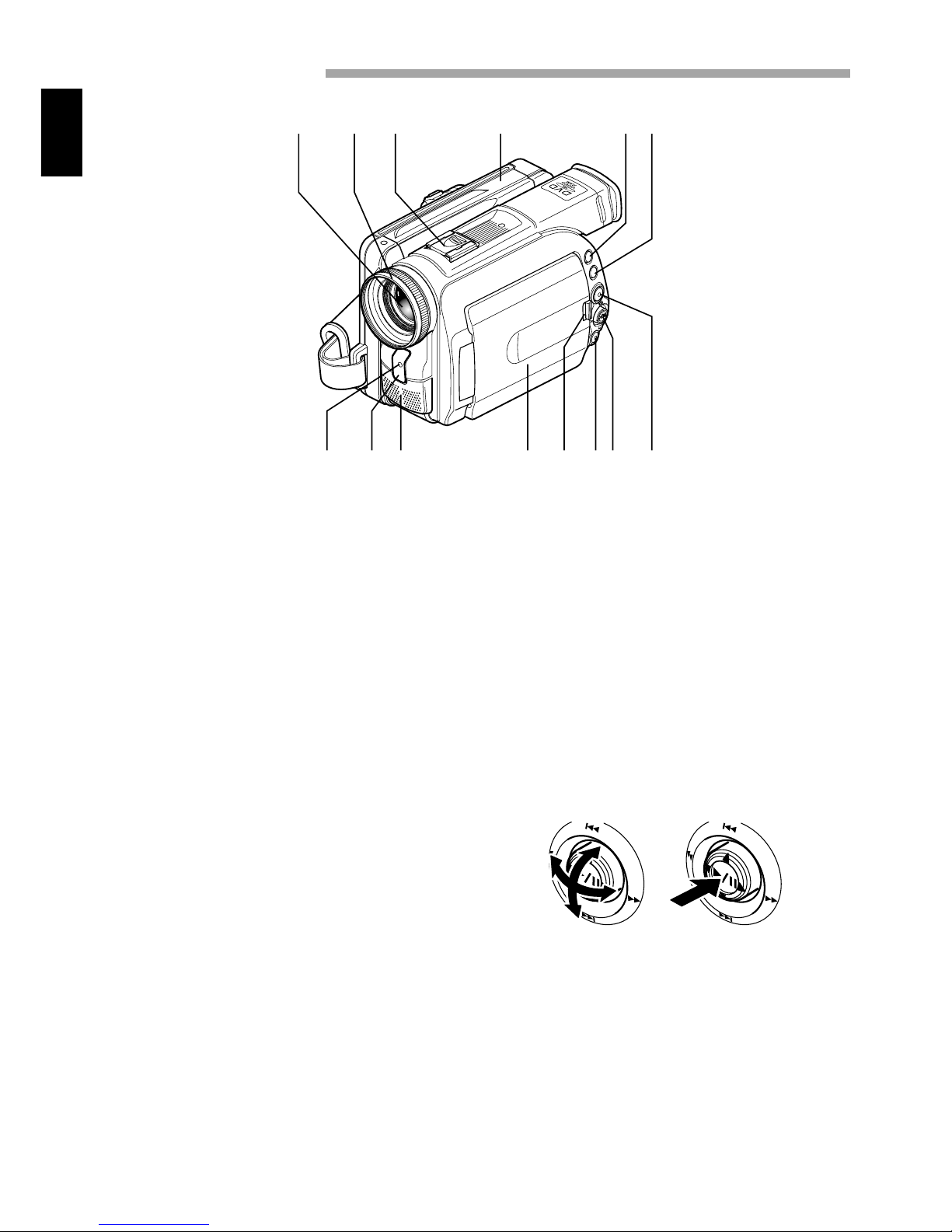
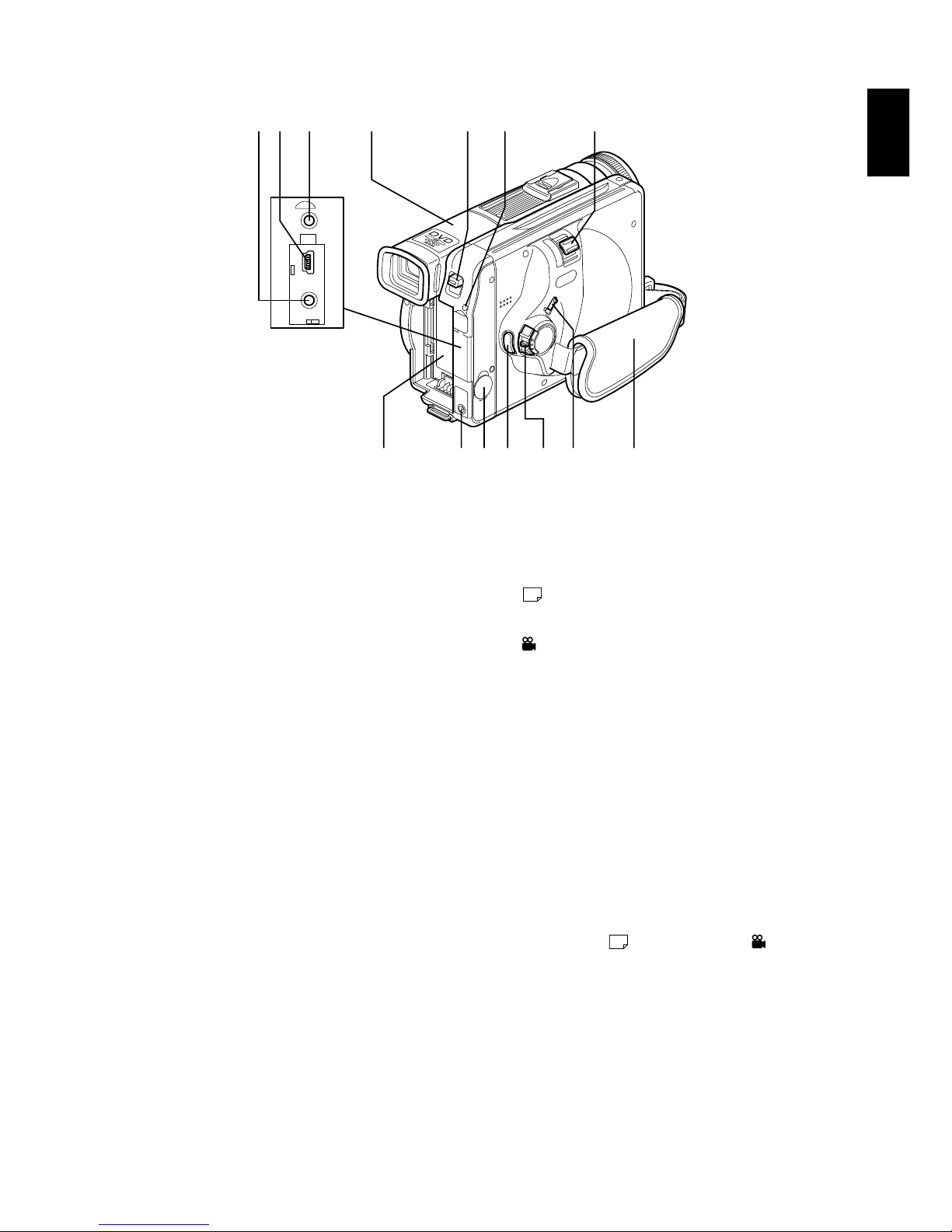
1 Optical 12x zoom lens (p. 47)
2 Lens hood (p. 48)
3 Accessory shoe (p. 40, 43)
Slide the cover to remove it, and
then attach the optional video flash,
etc., here. (See the instruction
manual of device to be attached for
details.)
4 Disc guide (p. 37)
5 SELECT button (p. 71)
6 MENU button (p. 35, 72)
Press this button to display the
menu for setting camera functions
and Disc Navigation.
The camera menu will appear even
if disc is not loaded.
7 Recording indicator (p. 65)
The red indicator will light during
recording.
8 Infrared receiver (p. 29)
When the remote control is used to
operate the DVD video camera/
recorder, this receiver will receive
the infrared signal.
9 Stereo microphone (p. 42)
! 3.5" type liquid crystal display
(inside) (p. 40)
" OPEN button (p. 40)
Press this button and hold it while
opening the liquid crystal display
(LCD).
# Stop/cancel button (p. 16, 44)
To end playback or set menu.
$ Joystick (p. 10)
Move the joystick to select a scene
or menu item, and play back
scenes.
% DISC NAVIGATION button (p. 70)
123 4 56
789 !"#$%
Downloaded from www.ManualsFile.com manuals search engine
13
ENGLISH
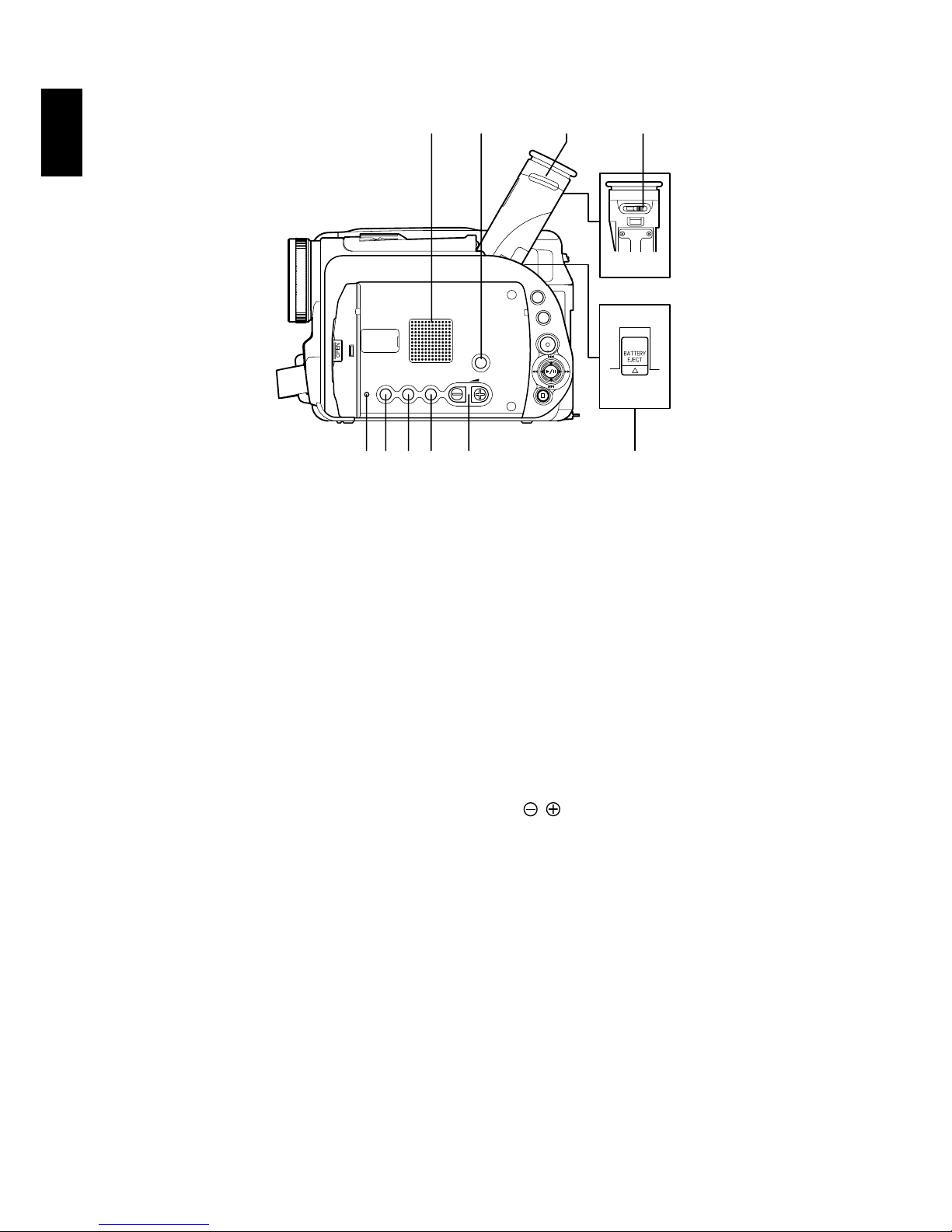
&*AV input/output jack (p. 91)
(*PC connection terminal (TO PC)
(p. 95)
)*External microphone jack (p. 42)
~ Viewfinder (p. 41)
+ DISC EJECT button (p. 37)
Press down this button to open the
disc guide.
, CHARGE/ACCESS indicator
(p. 21, 31)
Will blink or light during charging,
or while the DVD video camera/
recorder is operating.
- Zoom lever (p. 47)
Push the lever to the T side for tel-
ephoto, or to the W side for wide-
angle.
.
Battery attachment platform (p. 30)
/ DC cord connection terminal
(DC IN 8.4V) (p. 31)
: S-VIDEO input/output jack (p. 91)
; Record button (REC) (p. 42)
< Power switch (p. 42, 43)
PHOTO : To record still
images
VIDEO : To record a movie
POWER OFF: To turn off the DVD
video camera/re-
corder
Press the red button at the center of
power switch and turn it only when
turning power on: It is not necessary
to press the button when setting the
switch to “POWER OFF”.
The power switch cannot be
changed over during recording.
For playback, set the power switch
to either “
PHOTO” or “ VIDEO”.
= LOCK switch (p. 42)
To lock the recording mode, so that
the VIDEO mode is not switched
to the PHOTO mode by mistake.
> Hand strap (p. 27)
&( ) ~ + -
=./:;
,
<>
*Inside the cover
TO PC
A
/
V
Downloaded from www.ManualsFile.com manuals search engine
14
ENGLISH
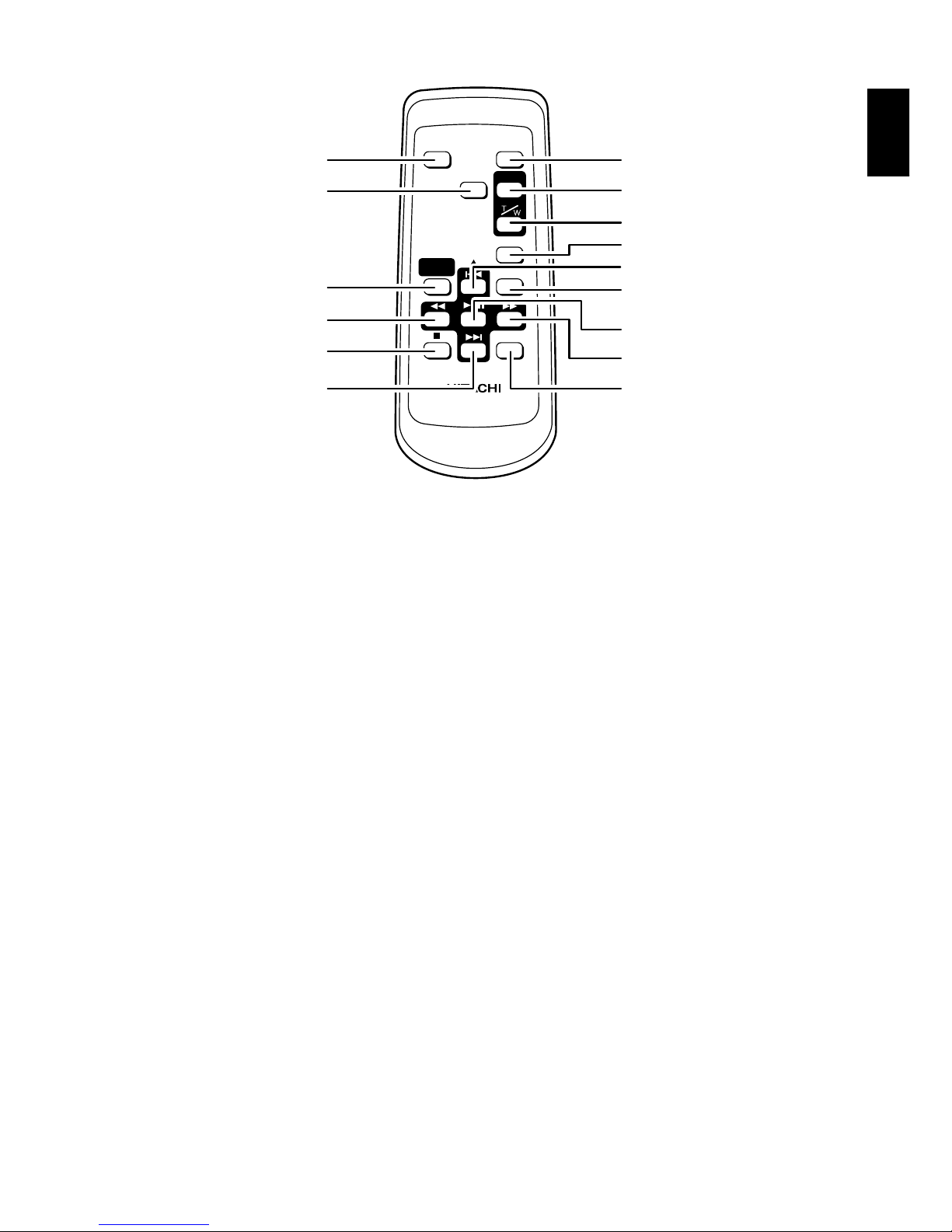
? Speaker (p. 44)
The sound accompanying a movie
being played back will be heard
from here.
@ Screen display button (DISPLAY)
(p. 52)
Press this button to display the de-
tails of image being played back or
camera setting status, or switch the
display off.
[ Eyecup (p. 41, 97)
\ Diopter control (p. 41)
To adjust the focus of image ap-
pearing in the viewfinder.
] RESET button (p. 110)
To reset all settings to defaults.
^ LCD BRIGHT button (p. 41)
Press this button to start LCD
screen brightness adjustment.
_ EXPOSURE button (p. 50)
Press this button to adjust the ex-
posure.
{ FOCUS button (p. 49)
To switch between manual focus
and auto-focus.
| Volume control buttons (VOL)/
buttons (p. 41, 44)
To adjust the volume of sound from
speaker, etc.
} BATTERY EJECT button (p. 30)
To release the battery.
?@ \
{]^_
SELECT
MENU
DISC
NAVIGATION
DISPLAY
VOL.
RESET
LCD
BRIGHT
EXPOSURE FOCUS
}
[
|
Downloaded from www.ManualsFile.com manuals search engine
15
ENGLISH
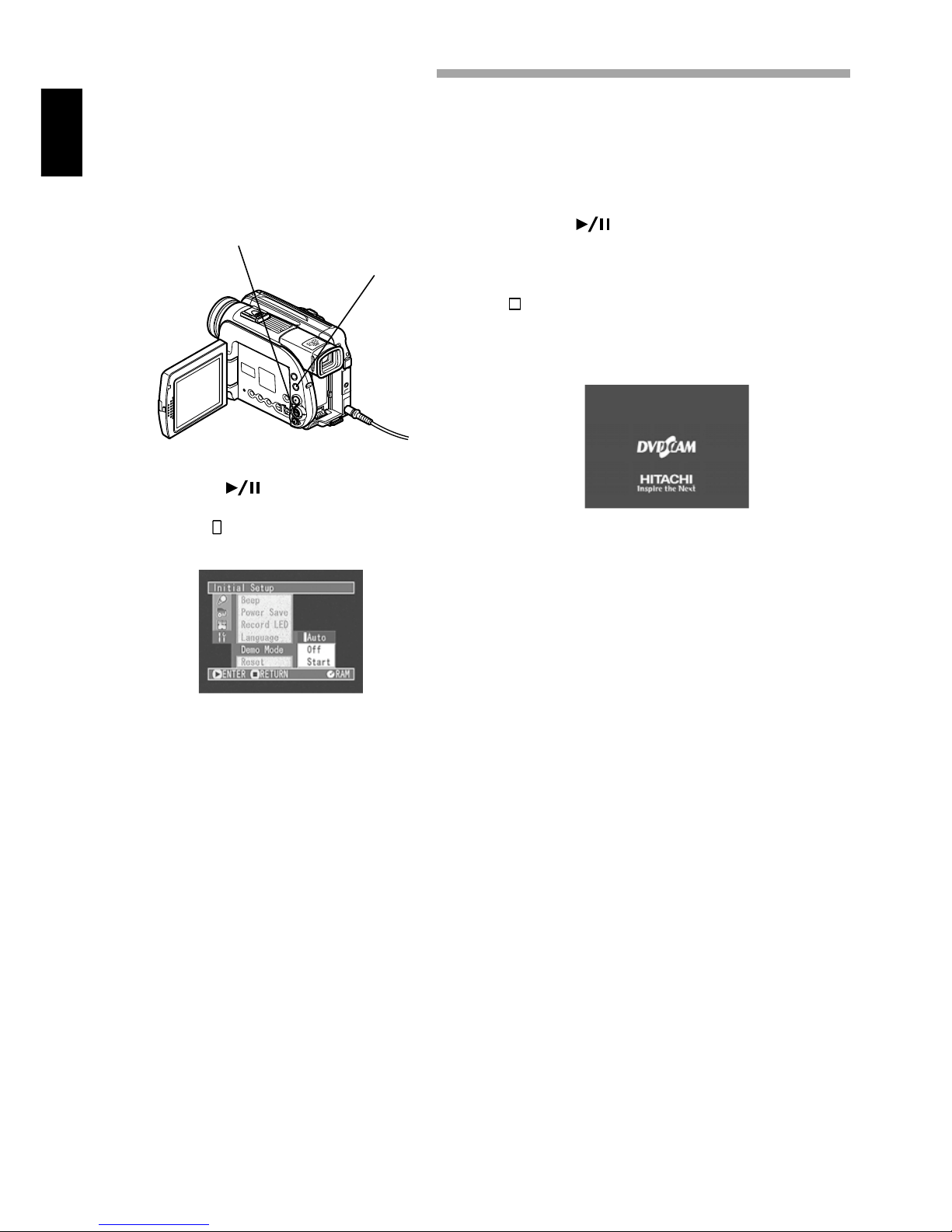
V DISPLAY button (p. 52)
0 DIG. ZOOM button (p. 57)
1 DISC NAVIGATION button (p. 70)
2 REVERSE SEARCH button (p. 45)
3 STOP button (p. 16, 44)
4 FORWARD SKIP button (p. 44)
5 REC button (p. 42)
6 ZOOM T button (p. 47)
7 ZOOM W button (p. 47)
8 SELECT button (p. 71)
9 REVERSE SKIP button (p. 44)
! MENU button (p. 54, 72)
" PLAY/PAUSE button (p. 44)
# FORWARD SEARCH button (p. 45)
$ DELETE button (p. 78)
* The buttons on remote control will
function the same as those on DVD
video camera/recorder.
0
1
2
8
9
"
!
V
4
5
6
7
$
DISPLAY REC
SELECT
MENU
DELETE
DIGITAL
ZOOM
ZOOM
DISC
NAVIGATION
DZ-RM2W
3
#
Downloaded from www.ManualsFile.com manuals search engine
16
ENGLISH
Viewing Demonstration
This DVD video camera/recorder has versatile functions, including special effects.
Before using the DVD video camera/recorder, view the demonstration to see what it can do.
Referring to step 2 on page 31, connect the DVD video camera/recorder, AC adapter and power
cable to power the DVD video camera/recorder from AC outlet.
1
Press the MENU button.
2
Choose “Initial Setup”, “Demo Mode”, and
then press the button.
The options will appear on the right of “Demo
Mode”: The mark will be attached to the
currently selected option.
3
Use the joystick to choose “Start”, and then
press the button.
The demonstration will start: View it in the
viewfinder or on the LCD screen.
To stop the demonstration midway, press the
button.
The demo mode will end when the DVD video
camera/recorder is turned off or the DISC
EJECT button is pressed down.
Note: If you choose “Auto” in step 3, the demon-
stration will automatically start approximately three
minutes after the DVD video camera/recorder is
turned on.
Note: If a disc is loaded in the DVD video cam-
era/recorder, the demonstration will not start even
if “Auto” has been set.
Note: When connecting the power cable to the
DVD video camera/recorder, the pin of power
cable cannot be completely inserted into the DC
IN 8.4V jack, but this does not indicate a malfunc-
tion. Do not insert the power cable with undue
force: Doing so could result in malfunction.
Note: The demonstration function will not work
when the DVD video camera/recorder is con-
nected to PC.
Note: While the demonstration is being given, the
recording indicator will blink.
Joystick
MENU
button
Downloaded from www.ManualsFile.com manuals search engine
17
ENGLISH
Features of DVD video camera/recorder
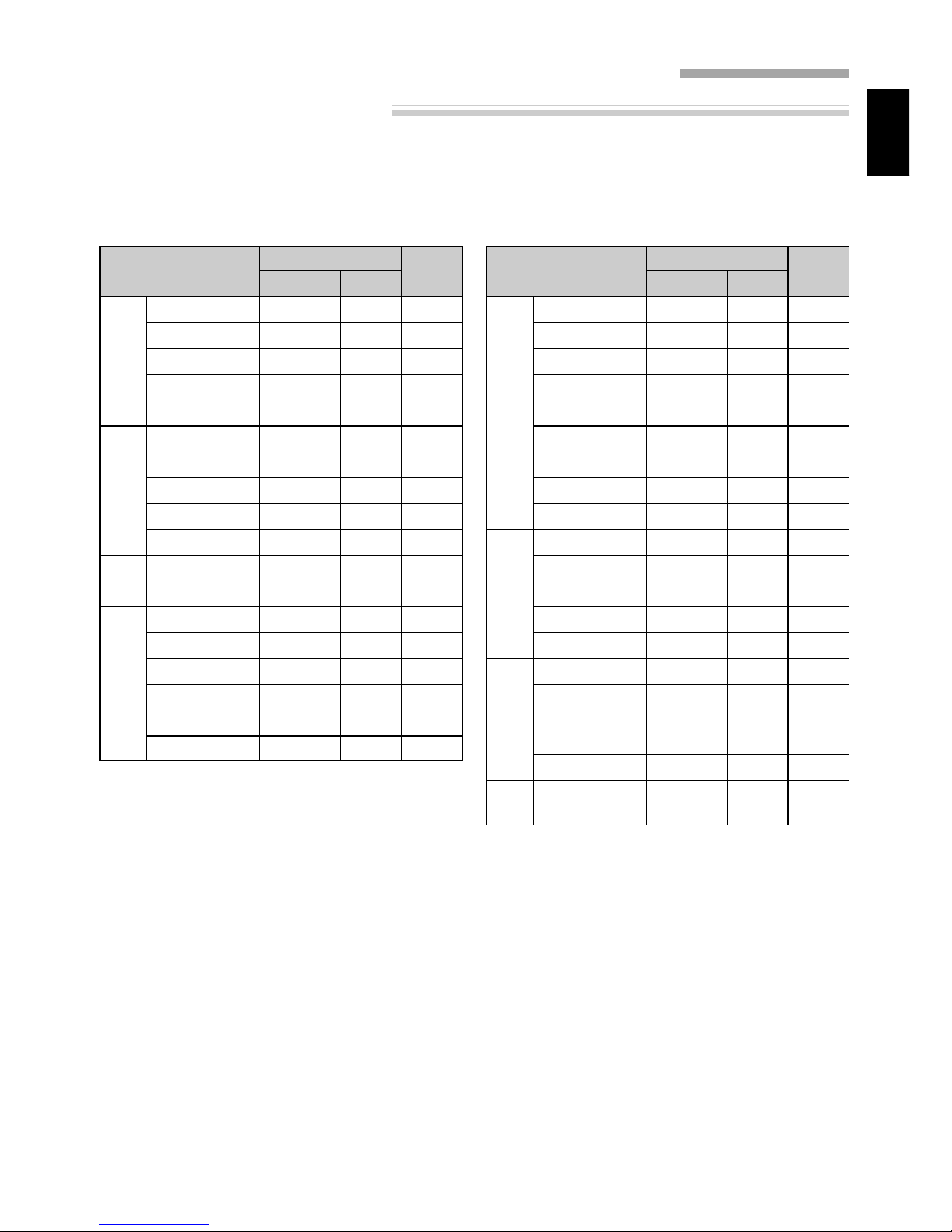
This DVD video camera/recorder has numerous useful functions. However, the functions that can be
used will vary depending on whether DVD-RAM or DVD-R disc is used.
Use the functions, following the table below:
Camera Functions:
Function
Program AE
White Bal.
EIS
Dig.Zoom
16:9
VIDEO Mode
Input Source
Photo Input
Self Timer
OSD Output
Date Mode
Date Set
Beep
Power Save
Record LED
Language
Demo Mode
Reset
Disc used
Reference
page
DVD-RAM
\
\
\
\
\
\
\
\
\
\
\
\
\
\
\
\
\
\
DVD-R
\
\
\
\
\
\*
\
X
X
\
\
\
\
\
\
\
\
\
Camera Functions
Setup
Record Functions
Setup
Date
Setup
Initial Setup
Disc Navigation Functions:
Function
Switch
Play
Create
Edit
Title
Delete
Switch
Play
Title
Delete
Edit
Skip
Select
Detail
Capacity
Format Disc
Update
Control Info.
Finalize Disc
Repeat Play
Disc used
DVD-RAM
\
\
\
\
\
\
\
\
\
\
\
\
\
\
\
\
\
X
\
DVD-R
X
X
X
X
X
X
\
\
X
X
X
X
\
\
\
X
X
\
\
Play List
Program
Scene
Disc
Others
\: Available; X: Unavailable
(* Except for XTRA mode)
Reference
page
Versatile Functions Available
54
55
56
57
58
59
60
61
62
63
36
35
64
64
65
65
16
110
76
76
75
78
80
80
73
73
74
81
82
86
86
87
88
88
89
90
90
Downloaded from www.ManualsFile.com manuals search engine

18
ENGLISH
Recording on Disc
You can use both 8 cm DVD-RAM and DVD-R discs
on this DVD video camera/recorder for recording.
The recorded video and audio will be stored on an
8 cm DVD-RAM disc or 8 cm DVD-R disc.
Using disc allows you to record without
overwriting previous recordings, and also to store
your valuable recordings for as long as need be
while retaining clarity.
With disc you can immediately access recording
and playback, in contrast to videotape, which must
be fast-forwarded or rewound.
In addition, simply loading a DVD-RAM disc into a
PC equipped with DVD-RAM drive and DVD video
recording software compatible with 8 cm DVD-RAM
allows you to easily view the recorded disc.
You can finalize a recorded DVD-R disc on this
DVD video camera/recorder so that you can play
it back on a DVD player or DVD recorder that is
compatible with 8 cm DVD-R disc (however, the
finalized DVD-R disc may not be usable on some
DVD players).
Recording Movie and Still
The DVD video camera/recorder can record mov-
ies of events and sports, in the same way as with
conventional camcorders.
It can also record stills on a DVD-RAM disc, as with
a digital still camera. With CCD of 1,160,000 pixels,
high-quality movies and stills (on DVD-RAM disc
only) can be recorded. In both recordings of movie
and still (on DVD-RAM disc only), zooming up to
240 times is possible using the 12 power optical
zoom multiplied by the 20 power digital zoom.
Movies and stills can be recorded on the same disc,
by simply switching the recording mode (power
switch). However, if you use a DVD-R disc, a still
image cannot be recorded. (If the DVD video cam-
era/recorder is connected to PC, the DVD video
camera/recorder can capture still images, such as
JPEG data.)
Immediate Reviewing of Recorded Image
You can check the movie or still recorded in the
viewfinder or on the LCD screen.
Editing in Various Ways on DVD video camera/recorder Alone
This DVD video camera/recorder is provided with
a useful editing/playback tool. Disc Navigation
allows you to easily attach a title or special video
effect to the recorded movie or still. With Disc Navi-
gation, you can arrange the playback order and edit
multiple images to play them back continuously.
You can create an entire movie on this DVD video
camera/recorder alone, without inputting video to
a PC for editing.
Using with Various Devices
Connect this DVD video camera/recorder to your
TV and you can enjoy the playback picture with
your family and friends on the large TV screen; or
connect it to a video printer (generally available)
to print the recorded image. You can also transfer
recorded movies and stills (for DVD-RAM disc
only) to PC, using the optional PC kit (DZ-
WINPC3(W)).
Downloaded from www.ManualsFile.com manuals search engine

19
ENGLISH
Handle the liquid crystal display (LCD) with
care:
• The LCD is a very delicate display device: Do
not press its surface with any force, hit it, or
puncture it with a sharp object.
• If you push the LCD surface, unevenness in the
display may occur. If unevenness does not dis-
appear soon, turn the DVD video camera/re-
corder off, wait for a while, and then turn it on
again.
• Do not place the DVD video camera/recorder
with the open LCD screen down.
• Close the LCD monitor when not using the DVD
video camera/recorder.
• Do not hold by the LCD monitor as this could
cause a malfunction.
• Open the LCD monitor by 90° before changing
its direction. If you attempt to invert its direc-
tion before opening it completely, it could cause
a malfunction.
• Do not disassemble the LCD monitor as this
might cause a malfunction.
• When opening the LCD monitor, be careful that
no water droplets adhere to the monitor screen
and that no water or dust enters the DVD video
camera/recorder as it could cause a malfunction.
Liquid Crystal Display and viewfinder:
• The LCD screen and viewfinder will be slightly
dimmer than usual when the DVD video cam-
era/recorder is at low temperature, as in cold
areas, or immediately after power is turned on.
The normal brightness will be restored when the
temperature inside the DVD video camera/re-
corder rises.
Hold the DVD video camera/recorder
correctly:
• Do not hold the viewfinder or LCD monitor
when lifting the DVD video camera/recorder:
The viewfinder or LCD monitor may become
detached and the DVD video camera/recorder
could fall.
Also, do not grasp the top of DVD video cam-
era/recorder when lifting it: It could easily be
dropped.
Cautions When Using
Do not subject the DVD video camera/
recorder to impact:
• This DVD video camera/recorder is a precision
machine: Take great care that you do not strike
it against a hard object or allow it to fall.
• Do not use the DVD video camera/recorder on
a tripod in a place where it is subject to severe
vibrations or impact.
No sand or dust!
• Fine sand or dust entering the DVD video cam-
era/recorder or AC adapter could cause it to
malfunction.
No water or oil!
• Water or oil entering the DVD video camera/
recorder or AC adapter could cause a short-cir-
cuit or other malfunctions.
Heat on surface of product:
• The surface of the DVD video camera/recorder
will be slightly warm, but this does not indicate
a fault. Be careful when touching the bottom of
the DVD video camera/recorder, since it will be
hot.
Be careful of ambient temperature:
• Using the DVD video camera/recorder in a place
where the temperature is over 40 °C or under
0 °C will not allow it to make normal record-
ing/playback.
• When using the DVD video camera/recorder
connected to PC, operate it at room temperature.
If you use the DVD video camera/recorder
where the temperature is high for an extended
period of time, it will overheat and may not op-
erate normally.
• Do not leave the DVD video camera/recorder
in a closed vehicle where the temperature is very
high for a long time: This could cause malfunc-
tions.
Do not point directly at the sun:
• If direct sunlight strikes the lens or viewfinder,
the DVD video camera/recorder could malfunc-
tion or burn in CCD or viewfinder.
• Do not leave the DVD video camera/recorder
with the LCD screen exposed to direct sunlight:
This could cause malfunctions.
Downloaded from www.ManualsFile.com manuals search engine

20
ENGLISH
Be careful of moisture condensation:
• When you move the DVD video camera/re-
corder between places where the difference in
temperatures is great, such as entering a lodge
from a ski slope, or going out of a cooled room
or vehicle, condensation (vapor in air warmed
or cooled to water droplets) could occur on the
lens and/or inside the DVD video camera/re-
corder. If condensation occurs, do not open the
cover of disc insertion block if possible. If con-
densation occurs on the lens, wipe it off with a
soft, dry cloth. Even if the external surface of
the DVD video camera/recorder has dried, con-
densation may remain inside. Turn the DVD
video camera/recorder off and leave it in a dry
place for at least 1-2 hours before using it again.
Do not use the DVD video camera/
recorder for a long uninterrupted period of
time:
• This DVD video camera/recorder is designed
and produced for home-use recording and play-
back. Do not use it for an extended time con-
tinuously, e.g., as a surveillance camera/moni-
tor.
• If you use the DVD video camera/recorder for
a long uninterrupted period of time, the tem-
perature of DVD video camera/recorder may
exceed the limit and the recording/playback
operation could be slowed down. If this occurs,
turn it off and wait for a while before using it
again.
Be careful when removing the disc:
• When the DVD video camera/recorder is used
for a long period of time, the temperature of disc
will be high: Wait for a few moments before re-
moving the disc after the DVD video camera/
recorder is turned off.
Do not use the DVD video camera/
recorder near TV or radio:
• This could cause noise to appear on the TV
screen, or interference could enter radio broad-
casts.
Do not use the DVD video camera/
recorder near strong radio waves or
magnetism:
• If the DVD video camera/recorder is used near
strong radio waves or magnetism, such as near
radio wave tower or electric appliances contain-
ing motors, noise could enter video and audio
that are being recorded. During playback of nor-
mally recorded video and audio, noise could also
enter the picture and sound. At worst the DVD
video camera/recorder could malfunction.
Do not expose the DVD video camera/
recorder to soot or steam:
• Heavy soot or steam could damage the DVD
video camera/recorder case or cause malfunc-
tions.
Do not use the DVD video camera/
recorder near corrosive gas:
• Using it in a place where there is dense exhaust
gas generated by gasoline and diesel engines,
or corrosive gas such as hydrogen sulfide, could
corrode the battery connecting terminals, which
could result in loss of power.
Do not use the DVD video camera/
recorder near ultrasonic humidifier:
• With some water in humidifier, calcium and oth-
ers dissolved in water could scatter in the air,
and white particles could adhere to the optical
head of the DVD video camera/recorder, which
could cause it to operate abnormally.
Do not expose the DVD video camera/
recorder to insecticide:
• Insecticide entering the DVD video camera/re-
corder could dirty the optical head, and the DVD
video camera/recorder may not operate nor-
mally. Turn the DVD video camera/recorder off
and cover it with vinyl sheet, etc. before using
insecticide.
Downloaded from www.ManualsFile.com manuals search engine
21
ENGLISH
Do not wipe the DVD video camera/
recorder case with benzene or thinner:
• The coating of case could peel off or the case
could deteriorate.
• When using chemical cleaning cloth, follow the
instructions.
Also read the instructions attached with
optional accessories:
• For optional accessories, follow the cautions and
instruction manuals attached.
Use the AC adapter only in a
well-ventilated, open space:
• Do not use the AC adapter in a narrow space
where flow of air is blocked, or where it is very
near any object or inside any object: Ignoring
this will increase heat inside the AC adapter
which could cause fire, burns, electric shock or
fault.
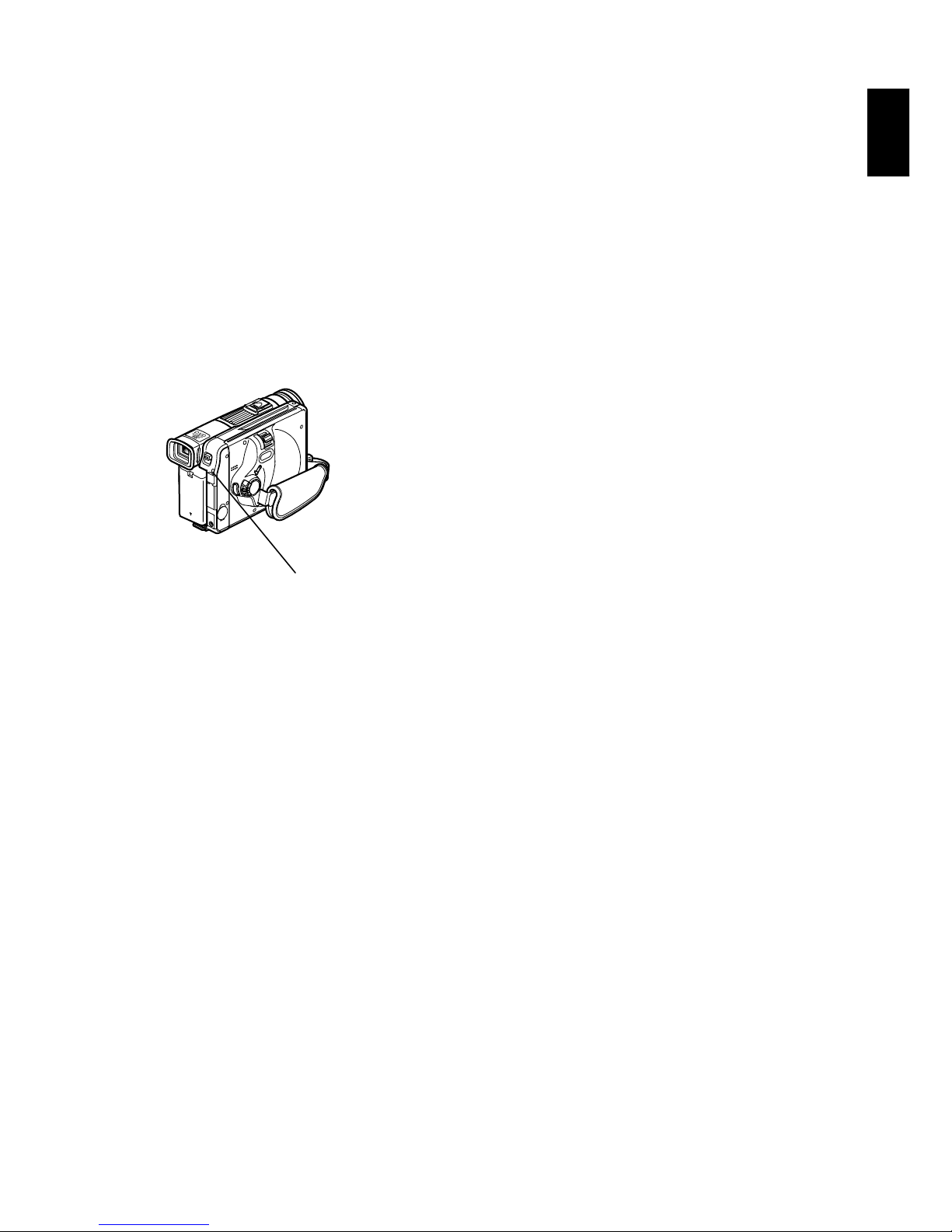
CHARGE/ACCESS indicator
Do not turn the DVD video camera/
recorder off while the CHARGE/ACCESS
indicator is blinking:
• The CHARGE/ACCESS indicator is blinking to
show that data is being written to disc, or being
read from it. Do not do any of the following so
as not to damage the data:
• Disconnect AC adapter.
• Plug or unplug PC connection cable.
• Remove disc.
• Subject disc to severe vibrations or impact.
If the DVD video camera/recorder is turned off
while the CHARGE/ACCESS indicator is blink-
ing, turn it on again with the disc cartridge or
caddy loaded in it: Repair of the disc will be ex-
ecuted.
Note: The CHARGE/ACCESS indicator will blink in
red while the disc is being accessed, and it will
blink or light in red during charging.
Downloaded from www.ManualsFile.com manuals search engine

22
ENGLISH
Cautions When Storing
Do not leave the DVD video camera/
recorder in a place where the tempera-
ture is very high for a long period of time:
• The temperature inside a closed vehicle or trunk
becomes very high in the hot season. If you leave
the DVD video camera/recorder in such a place,
it could malfunction or the case could be dam-
aged. Also, do not expose the DVD video cam-
era/recorder to direct sunlight or place near a
heater.
Do not store the DVD video camera/
recorder in a place where the humidity is
high or in a dusty place:
• Dust entering the DVD video camera/recorder
could cause malfunctions. If the humidity is
high, the lens could become moldy, and the DVD
video camera/recorder could be unusable. It is
recommended that you put the DVD video cam-
era/recorder with desiccant in a box when stor-
ing it in a closet, etc.
Do not store the DVD video camera/
recorder in a place subject to strong
magnetism or intense vibrations:
• This could cause malfunctions.
Detach the battery from DVD video
camera/recorder and store it in a cool
place:
• Leaving the battery attached or storing it at high
temperature could shorten its life.
Suggestions and Restrictions
Make a trial recording:
• Be sure to make a trial recording before an ac-
tual take to make sure that recording is normal.
Data that was not stored normally because of a
defect in the DVD video camera/recorder can-
not be restored.
• It is recommended that you use DVD-RAM disc
for trial recording, since a recording stored on it
can be deleted.
The recorded contents cannot be com-
pensated for:
• Hitachi will not compensate for any damages
caused when a recording is not made normally
or the recorded contents cannot be played back
because of a defect in the DVD video camera/
recorder or disc. Also, Hitachi will not be respon-
sible for your recorded video and audio.
Copyright:
• The data recorded on the disc in your DVD video
camera/recorder through other digital/analog
media or devices are protected by the copyright
act and cannot be used without permission of
the owner of copyright, except for personal en-
joyment. Note that, even for personal enjoyment,
recording is prohibited for some demonstra-
tions, performances and exhibitions.
Downloaded from www.ManualsFile.com manuals search engine
23
ENGLISH
Discs
● Finalizing DVD-R Disc
Before using the 8 cm DVD-R disc recorded on this
DVD video camera/recorder on a DVD player or
DVD recorder that is compatible with 8 cm DVD-
R disc, the disc must be finalized on this DVD video
camera/recorder. For the finalizing procedure of 8
cm DVD-R disc, refer to “Finalizing Disc” (p. 90).
● When using DVD-R disc
If you finalize a recorded DVD-R disc, you can play
it back on devices that are compatible with 8 cm
DVD-R disc, or (on) computers* with DVD-ROM
drive, DVD-R drive or DVD-RAM drive.
• Although most DVD-R discs recorded on this
DVD video camera/recorder are compatible for
playback on other DVD players, playback of all
DVD-R discs cannot be guaranteed.
Depending on the DVD player, DVD-R disc, or re-
cording conditions, playback may not be possible.
In such cases, use this DVD video camera/recorder
to play back the DVD-R disc.
* To play back the finalized DVD-R disc on PC,
you will need DVD playback software. The DVD
playback software “Power DVD XP” is supplied
with the optional DZ-WINPC3(W).
● Handling Disc
If you use a DVD-RAM disc or DVD-R disc to which
dirt or dust adheres, recognition of the disc may not
be possible when it is inserted into this DVD video
camera/recorder. Also, the DVD video camera/re-
corder may stop during recording or playback, or
noise/disturbance of image may occur during play-
back.
The same phenomenon may appear if condensation
occurs because of abrupt change in temperature.
• If an error message appears on the LCD screen
while this DVD video camera/recorder is being
used, turn off the DVD video camera/recorder
once, and then turn it on again (P.101).
• If an error message appears when the DVD
video camera/recorder is being used in an en-
vironment where the temperature is high or it is
used continuously, turn off the DVD video cam-
era/recorder, and after a while turn it on again.
• If an error message appears when the DVD
video camera/recorder is being used in an en-
vironment where the temperature is low, leave
it powered for several minutes, turn it off, and
then on again.
• When the disc is used for an extended period of
time, the temperature will increase because of
the heat inside the DVD video camera/recorder:
Be careful when removing the disc.
• Normally, do not remove the disc from the car-
tridge or caddy, and do not open the shutter of
cartridge or caddy.
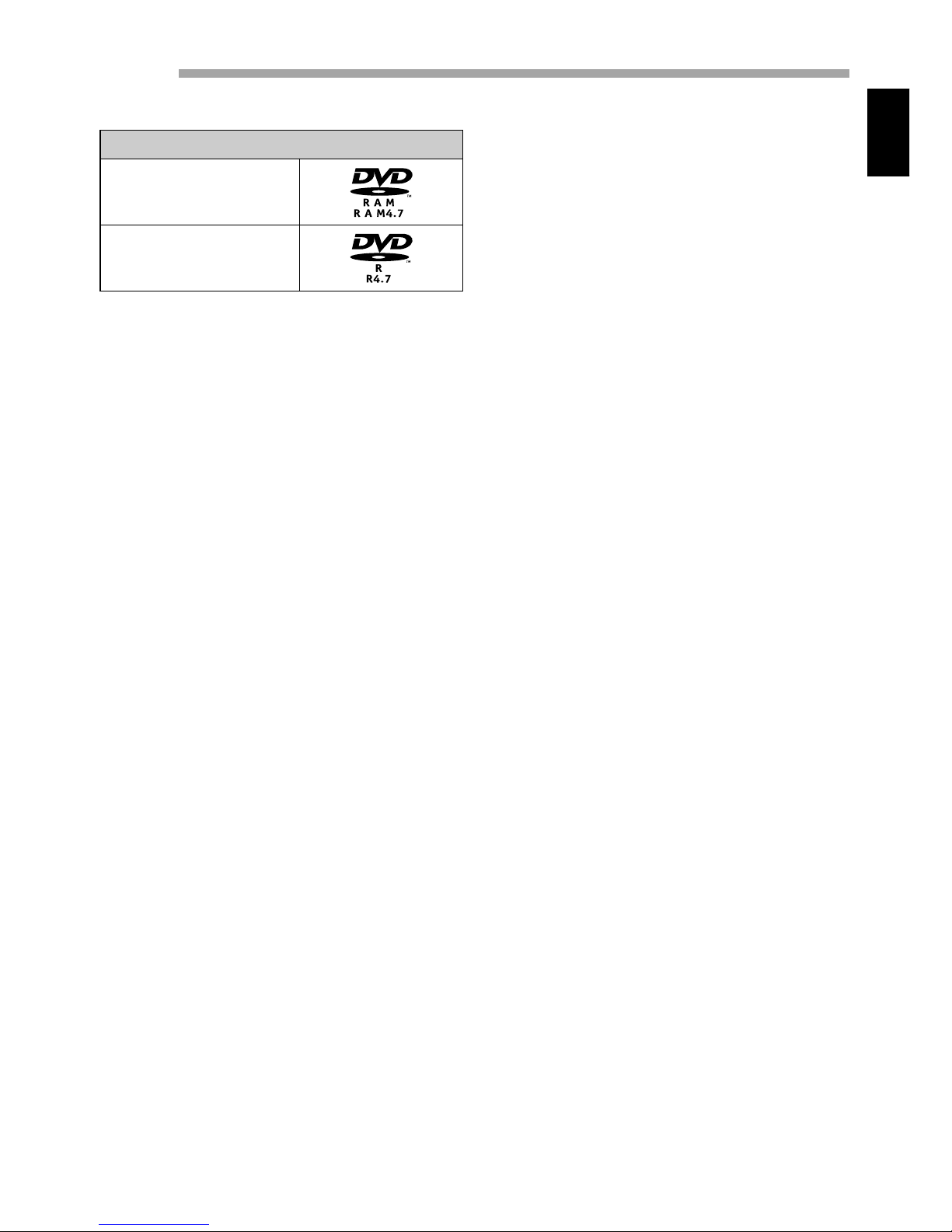
● Available Discs
Usable discs and logos
DVD-RAM Ver. 2.1
(8 cm)
DVD-R [for General
Ver. 2.0 (8 cm)]
This DVD video camera/recorder can use 8 cm
DVD-RAM discs and 8 cm DVD-R discs for
camcorder use.
An uncovered disc cannot be used on this DVD
video camera/recorder: It must be left in a cartridge
or caddy for 8 cm disc.
Note: It is recommended that you use Hitachi
Maxell discs because their compatibility with this
DVD video camera/recorder has been confirmed.
Using a disc other than that made by Hitachi
Maxell may not allow the DVD video camera/re-
corder to deliver optimum performance.
● Information on DVD-R disc
For optimum recording on DVD-R disc, the DVD
video camera/recorder writes control data to the
disc in order to make adjustment when it is inserted
and ejected accompanying recording.
However, repeating this adjustment many times
may cause the disc to become unrecordable: Do not
insert or eject the disc accompanying recording
more than 50 times.
Examples of discs that cannot be used on
this DVD video camera/recorder:
Discs other than those with diameter of 8 cm, DVD-
RAM (2.6 G) Ver. 1.0, DVD-R (3.9 G) Ver. 1.0, DVD-
R (4.7 G) for Authoring Ver. 2.0, DVD-RW,
DVD+RW, DVD+R, DVD-Video, DVD-ROM, CD-
R, CD-RW, CD, CD-ROM, MO, MD, iD, LD, floppy
disk, etc.
● Initializing (formatting) DVD-RAM
Discs
This DVD video camera/recorder can use DVD-
RAM discs for AV formatted in accordance with
the UDF 2.01 file system : No recording can be made
on an unformatted disc.
See “Initializing DVD-RAM Disc” on page 88 for
the initializing procedure.
Downloaded from www.ManualsFile.com manuals search engine
24
ENGLISH
•Be sure not to touch disc surfaces.
•Be careful not to drop the disc removed from
cartridge or caddy.
•Be sure not to bend the disc.
•Do not leave the disc outside the cartridge or
caddy.
•Do not subject the disc to heat.
•Do not write on disc with a ball-point pen or pen-
cil. (With one-side recordable disc, writing on the
label surface is possible with a pen that does not
scratch the surface. No writing of any kind is pos-
sible on both-side recordable disc.)
•Be sure not to wipe disc surfaces with thinner,
water or anti-static agent.
Use dry, soft cloth to lightly wipe off dust or dirt
that adheres to the disc. Never use solvents to
clean the disc.
Note: If the disc is removed from cartridge or
caddy and the data stored by this DVD video
camera/recorder is rewritten on devices other
than this DVD video camera/recorder, recording
or playback may not be normal, or Disc Naviga-
tion may not operate normally, when the disc re-
placed in cartridge or caddy is used on this DVD
video camera/recorder again.
Note: The cartridge or caddy protects the sur-
faces of disc on which high-density recording is
possible. Once removed from cartridge or caddy,
the disc can be replaced in the cartridge or caddy
and used with this DVD video camera/recorder,
but be sure to observe the following:
•Before replacing the disc in cartridge or caddy,
make sure that disc surfaces are not scratched,
and that no dirt or fingerprint adheres to them.
•Do not record, edit or delete on the disc when
scratches, dirt or fingerprints cannot be removed
even if disc surface is cleaned.
•When replacing the DVD-RAM disc in cartridge,
insert it until a click is heard.
• Be careful not to allow condensation.
• To store disc cartridge or caddy, insert in plastic
case provided.
Do not place the disc cartridge or caddy in the fol-
lowing places:
• Where exposed to direct sunlight for a long
time.
• Where the humidity is high, or in dusty place.
• Where exposed to heat from heater, etc.
• Where there may be condensation.
● About Stored Data
If you handle or use the disc incorrectly, the re-
corded data may be lost. Hitachi cannot be respon-
sible for damages from loss of recorded data.
Removing and Replacing Disc from/in Cartridge or Caddy
The DVD-RAM disc used with this DVD video camera/recorder can be removed from the cartridge or
caddy and used with DVD-RAM drives, DVD players and DVD recorders that are compatible with 8 cm
DVD-RAM discs. The finalized DVD-R disc can also be removed from the cartridge or caddy and used
with DVD players and DVD recorders that are compatible for 8 cm DVD-R discs. Refer to the disc in-
struction sheet for details on how to remove disc from cartridge or caddy.
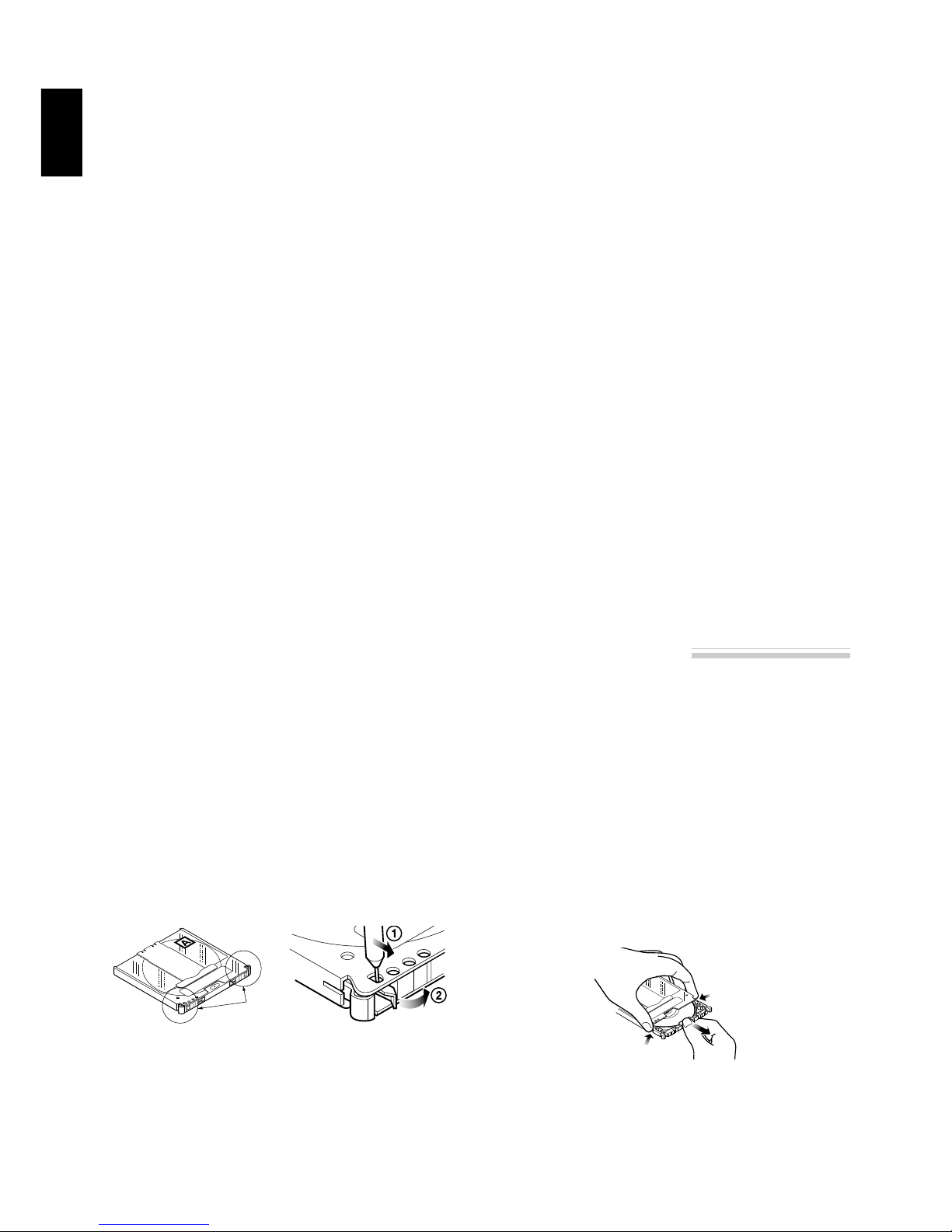
Perform the following to remove the disc:
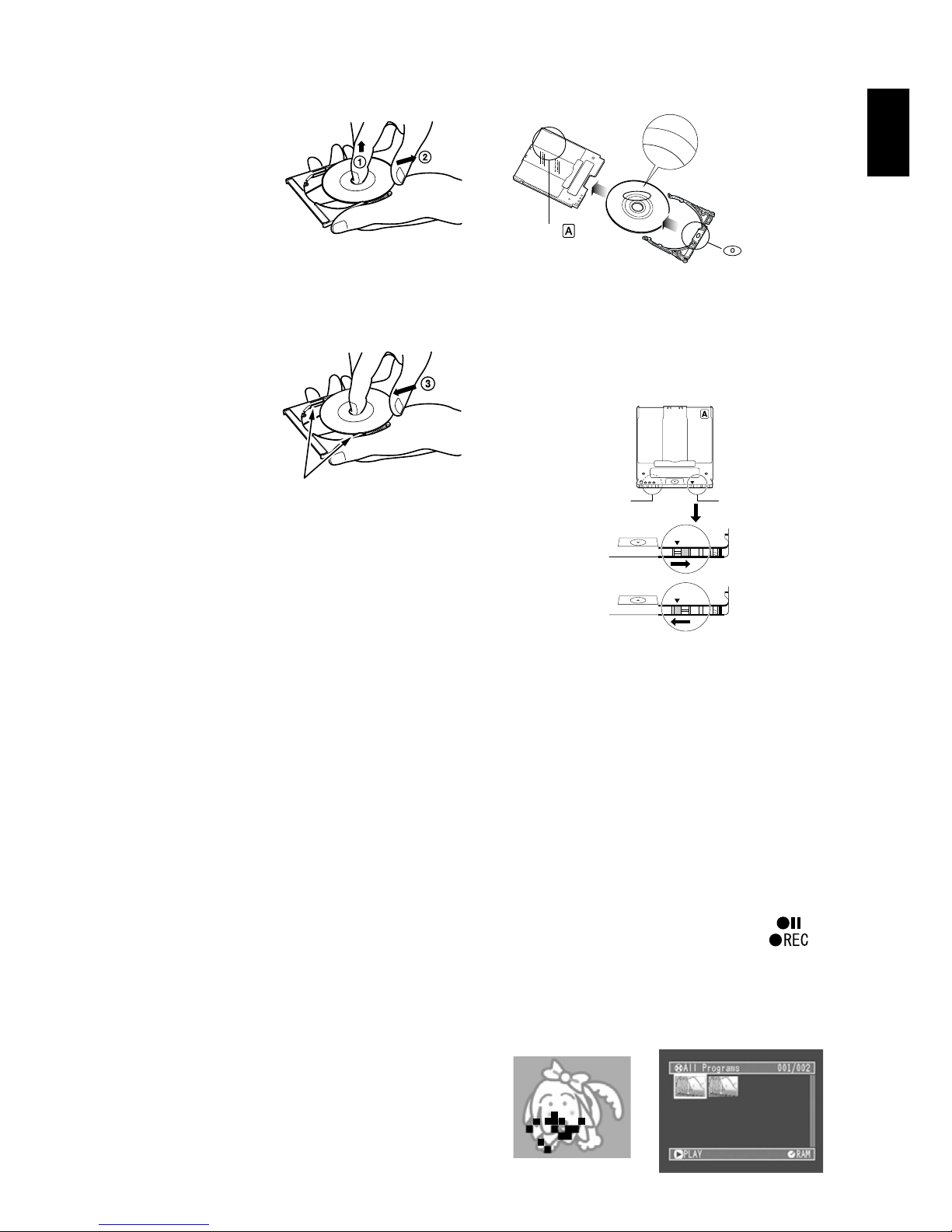
1
Release the lock pins of cartridge. The two lock pins
are at the bottom left corners of sides A and B.
Use a fine tipped pen to slide the lock pin in the
direction of arrow 1, and then turn it in the di-
rection of arrow 2 to release it.
● With disc packed in cartridge
Removing the disc
Lock pins
2
While pushing the release levers from both sides
inward, hold the center of disc tray and pull it
out to the front.
Note: Most generally available 8 cm discs can be
removed from cartridges or caddies if they are for
video cameras; However, before removing disc
from cartridge or caddy, read the instruction sheet
provided with the disc or consult the disc maker.
Take care with the following when handling the
removed disc:
Downloaded from www.ManualsFile.com manuals search engine
25
ENGLISH
Replacing the disc in cartridge
1
Insert the disc into cartridge.
2
Fit in the disc tray until a click is heard.
Write-protect tabs
The cartridge has write-protect tabs to prevent
overwriting on recorded data. Make sure that the
write-protect tab is set to the side where recording
is possible.
mark facing up
Indication of side
S
I
D
E
A
Recording not possible
Tab for side B
Tab for side A
Recording possible
PROTECT A
PROTECT A
PROTECT A
● With disc packed in caddy
Removing the disc
1
Insert your finger
into the hole in the
center of disc and
lightly lift it up (in
the direction of ar-
row 1).
2
Hold the disc at its edge and center hole, and
remove it in the direction of arrow 2.
Replacing the disc in caddy
1
Hold the disc at its
edge and center hole
with the recording
surface down.
2
Insert the disc under
the claws at the disc
hold portion from
the direction of ar-
row 3.
Gently push the disc
in until it is com-
pletely stored.
claws
Note: When recording special events, be sure to
use a new disc which has never been removed
from cartridge or caddy.
Note: Writing similar to recording is performed
even with simple editing or deletion. Make sure that
editing or deletion has been securely performed
with the disc removed from cartridge or caddy.
Note: If there are dust, scratches or dirt on the
surface of disc, block noise may appear in image
or sound may be interrupted. Take great care
when handling discs so that no dirt or fingerprints
adheres to them.
Note: This DVD video camera/recorder has a
function that allows recording, avoiding portions
of the disc with dust, scratches or dirt [The DVD
video camera/recorder sets to pause (
) status
and automatically restarts recording (
)]. This
will interrupt recording for several seconds to sev-
eral minutes, and multiple thumbnails will be cre-
ated (see p. 67) in one recording as shown in the
figure. In this case, the recordable time will de-
crease.
Downloaded from www.ManualsFile.com manuals search engine
26
ENGLISH
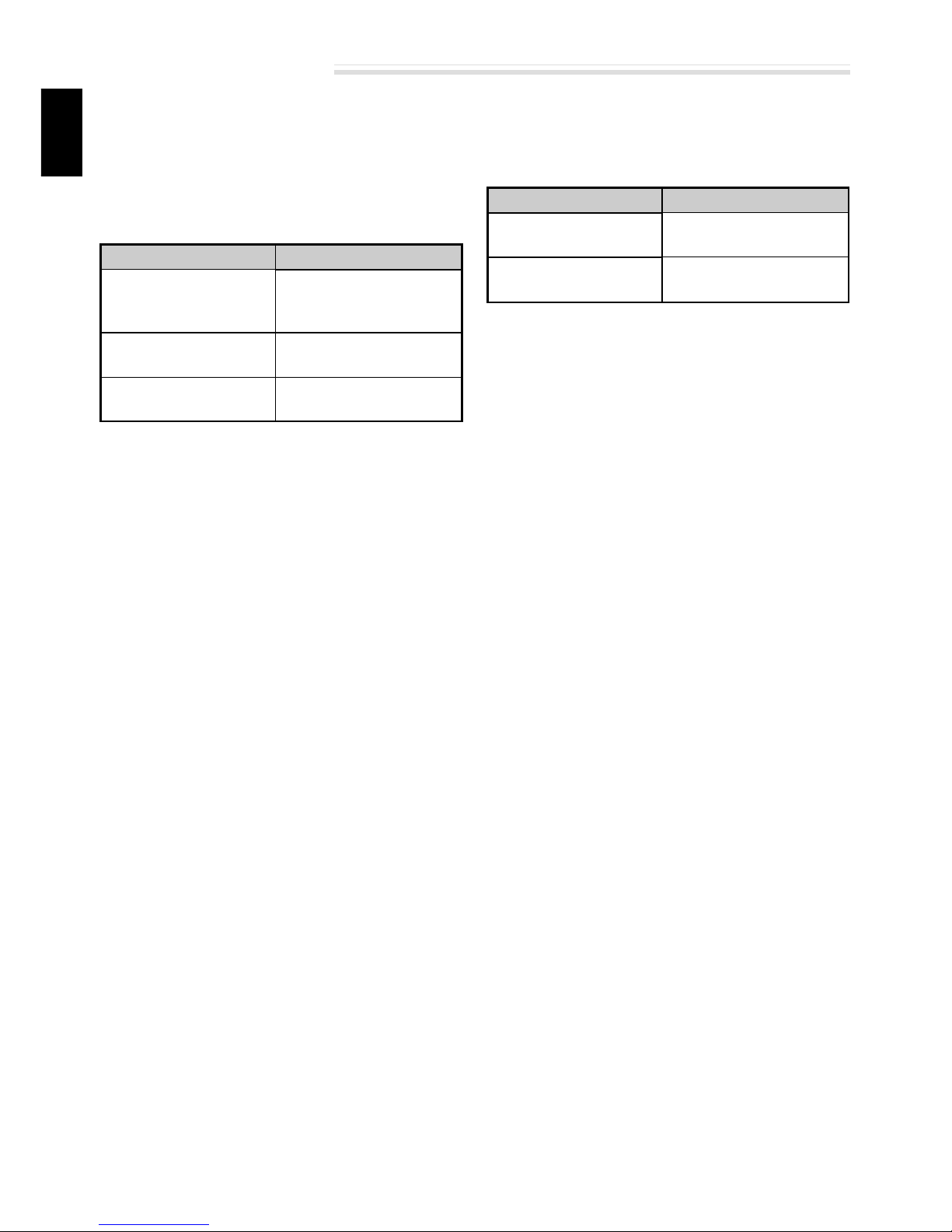
● DVD-RAM disc storage capacity
Recordable time of movies on
DVD-RAM disc
*
When recording only movies (containing video and
audio)
*
The total recordable time is half on each side
of disc.
*
1
VBR stands for Variable Bit Rate.
Number of recordable stills on
DVD-RAM disc
Up to 999 stills per side (when recording only stills)
If the disc still has free space after recording 999
stills, movie can be recorded.
● Recordable time on DVD-R disc
Disc Storage Capacity
The movies and stills that can be recorded on an 8 cm disc used in this DVD video camera/recorder are
as follows: Prepare discs according to the scheduled recording time and conditions.
Movie quality mode
FINE (MPEG2,
approx. 6 Mbps)
STD (MPEG2,
approx. 3 Mbps)
Recordable time
approx. 30 minutes/side
approx. 60 minutes/side
• When using DVD-R disc, no still image can be
recorded on this DVD video camera/recorder.
• When using DVD-R disc, the recording quality
mode first used for recording on that disc is a
fixed mode: It cannot be changed on that disc.
Movie quality mode
XTRA (VBR*
1
)
FINE (MPEG2,
approx. 6 Mbps)
STD (MPEG2,
approx. 3 Mbps)
Recordable time
approx. 36-120
minutes(varies depend-
ing on the subject)
approx. 60 zminutes
approx. 120 minutes
Downloaded from www.ManualsFile.com manuals search engine
27
ENGLISH
Setting Up the DVD video camera/recorder
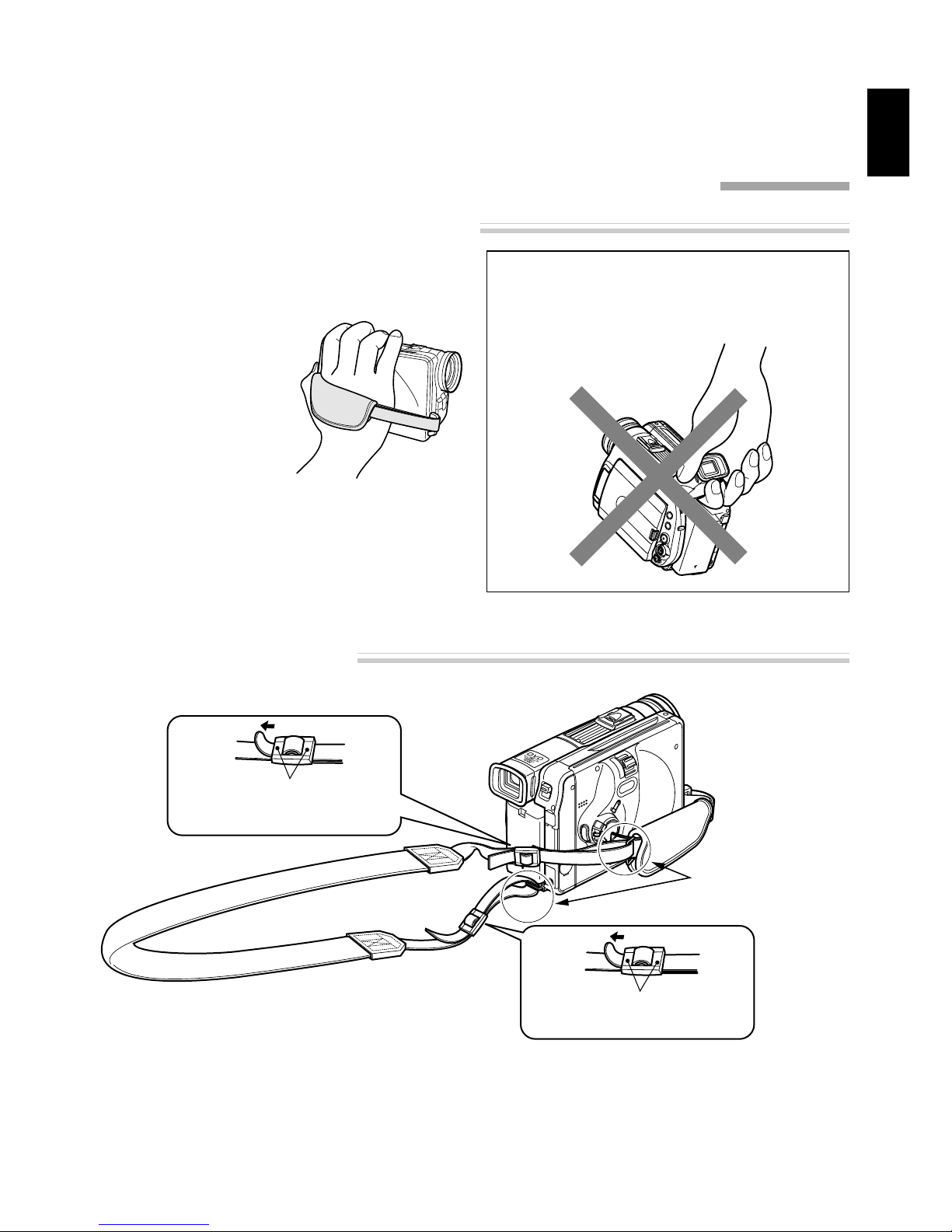
Holding DVD video camera/recorder
Insert your right hand from the bottom of DVD
video camera/recorder up to the base of your
thumb.
Put your hand in a po-
sition where you can
easily operate the REC
button and the Zoom
lever.
Adjust the length of
hand strap so that the
DVD video camera/re-
corder is stable when
you press the REC but-
ton with your thumb.
Note: Do not adjust the hand strap while holding
the DVD video camera/recorder: Doing this could
cause the DVD video camera/recorder to fall and
be damaged.
Caution: Do not lift the DVD video camera/re-
corder by holding the viewfinder or LCD moni-
tor: If the viewfinder or LCD monitor comes off,
the DVD video camera/recorder will fall.
Setups
This section explains preparations for recording - setting up the DVD video camera/recorder and
battery pack.
Pass the shoulder strap
through the shoulder
strap attachments.
Be sure to pass through
the 2 slots.
Be sure to pass through
the 2 slots.
Attaching Shoulder Strap
Downloaded from www.ManualsFile.com manuals search engine
28
ENGLISH
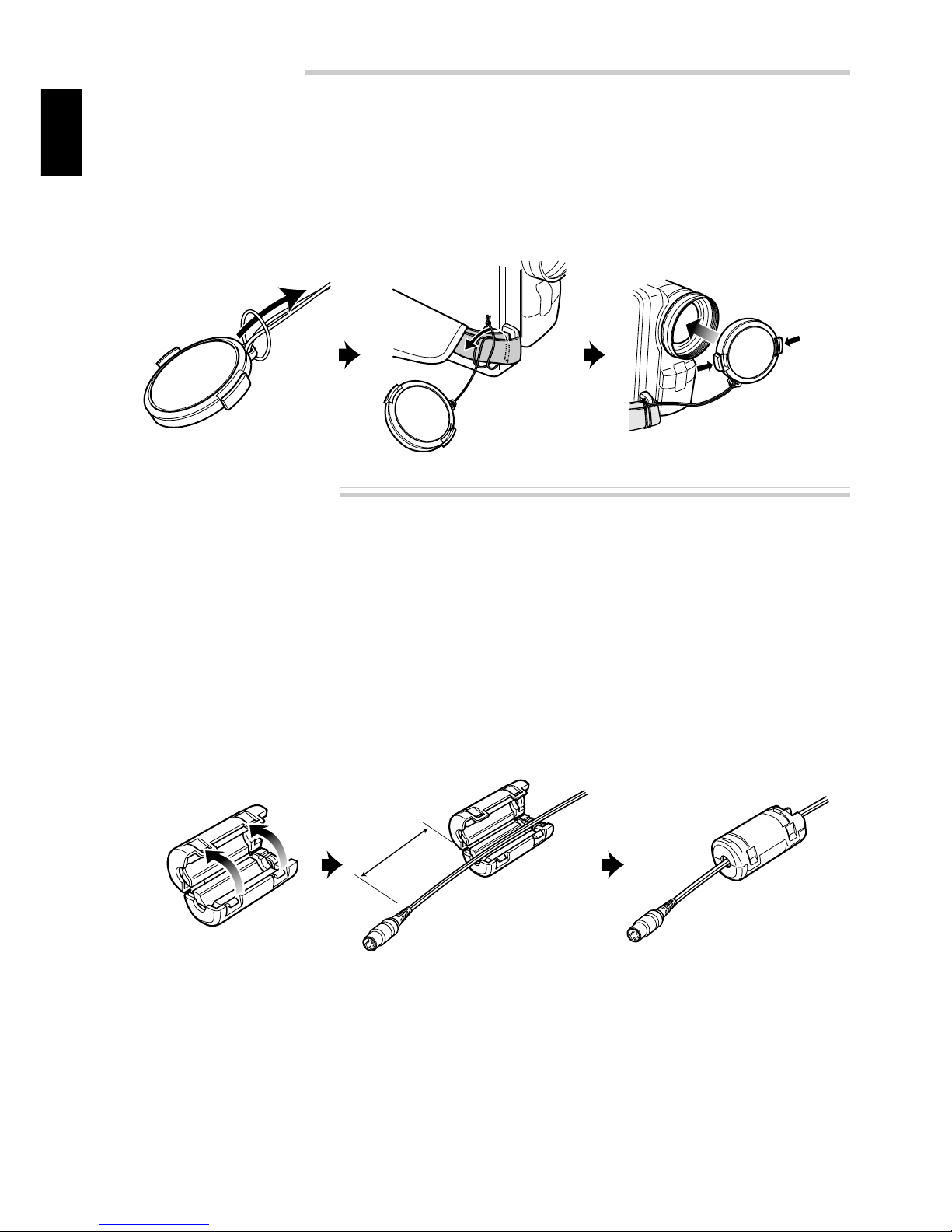
Although the cores are not attached in the illustrations of the cables in text, be sure to attach the
ferrite core (provided) to the S-VIDEO cable using the following procedure (the ferrite core was at-
tached to the AV output cable at the factory):
(Ferrite cores reduce radio interference with your radio and TV.)
1
Open the cover of ferrite core.
2
Attach the core to the S-VIDEO cable at a posi-
tion approximately 5 cm from its end.
3
Close the cover of core, taking care that it does
not catch the S-VIDEO cable.
Note: If you use an external microphone when
recording, attach the ferrite core (provided) to the
cable at a position approximately 5 cm from its
end: Wind the microphone cable round the core
once in the same way as for the S-VIDEO cable.
Using external microphone in modes other than
camera recording is not recommended.
Pass the provided string through the hole in the lens cap and attach it to the hand strap of DVD video
camera/recorder.
1
Use the string to attach the cap to the DVD video
camera/recorder.
2
Push the both sides of cap inward and attach it
over the lens.
Note: Always keep the lens cap on when not us-
ing the DVD video camera/recorder, to protect
the lens.
Note: When recording, attach the lens cap to the
hand strap by hooking the tab inside the cap onto
strap for comfortable shooting.
Attaching Lens Cap
Attaching Ferrite Cores
5 cm
Downloaded from www.ManualsFile.com manuals search engine
29
ENGLISH
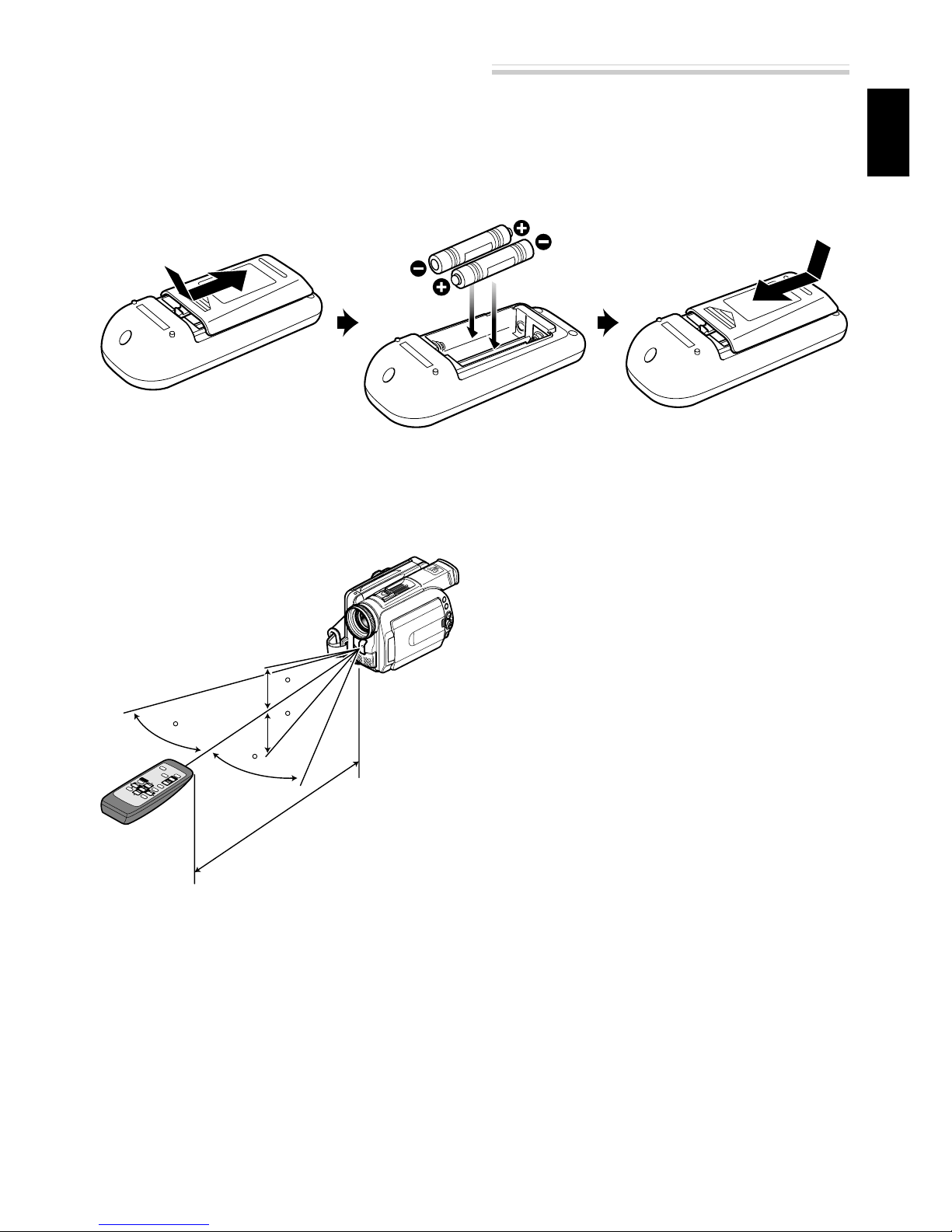
Insert two AA (LR06) batteries (provided) into the remote control to power it.
1
Open the battery compartment lid on the back
of remote control and insert the batteries.
2
Close the lid.
Note: If the batteries are discharged, pressing any
button on remote control cannot operate the DVD
video camera/recorder: Replace the batteries.
Inserting Batteries into Remote Control
Note: When using the remote control, make sure
that the infrared receiver on DVD video camera/
recorder is not exposed to direct sunlight or any
intense light. If the infrared receiver is subject to
light stronger than the infrared light from remote
control, the DVD video camera/recorder cannot
be operated by remote control.
Note: If there is an obstacle between the remote
control and infrared receiver on DVD video cam-
era/recorder, remote control may not be possible.
Note: The DVD video camera/recorder uses the
“VCR2” remote control code of Hitachi VCRs. If
you use a Hitachi VCR, etc. with remote control
code set to “VCR2”, a VCR placed near the DVD
video camera/recorder will also be operated by
the remote control: To prevent this, change the
remote control code of the VCR.
● Using Remote Control
Point the remote control to the infrared receiver on
the DVD video camera/recorder. The remote con-
trollable distance is up to 5 m.
Approx. 5 m
10
10
15
15
Downloaded from www.ManualsFile.com manuals search engine
30
ENGLISH
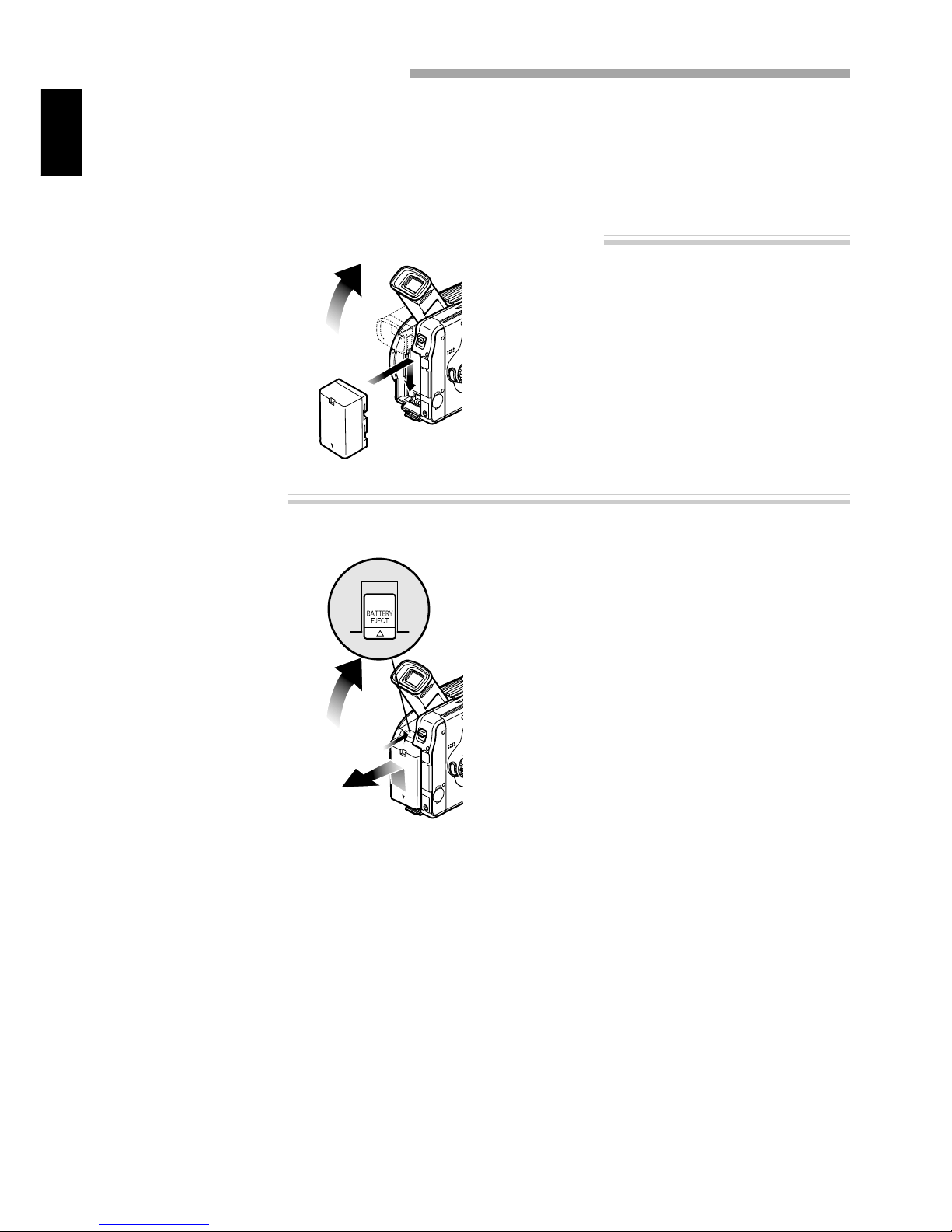
Attaching Battery to DVD video camera/recorder
1
Raise the view-
finder.
2
Align the top of bat-
tery with the top
surface of battery at-
tachment platform
of DVD video cam-
era/recorder.
3
While fitting the battery onto the DVD video
camera/recorder, slide it downward until a click
is heard.
Note: Make sure that the battery is securely at-
tached: Incomplete attachment could cause the
battery to fall, resulting in damage.
Setting Up the Battery
The DZ-BP14(R) battery pack provided with this DVD video camera/recorder has not been charged at
purchase time: Charge it before using the DVD video camera/recorder.
Note: Be sure to use the specified battery DZ-BP14(R)/DZ-BP16 (sold separately) or DZ-BP28 (sold sepa-
rately) for the DVD video camera/recorder: Using other batteries could cause the DVD video camera/
recorder to malfunction, or result in fire.
After using the DVD video camera/recorder, remove the battery from it.
1
Set the power switch
to “POWER OFF” to
turn the DVD video
camera/recorder
off.
2
Raise the view-
finder.
3
While holding the BATTERY EJECT button
above the battery attachment platform, sllide the
battery upward to remove it.
Note: For safety, be sure to turn the DVD video
camera/recorder off before attaching or remov-
ing the battery.
Note: If the battery remains attached, minute
level current will flow even if the DVD video cam-
era/recorder is off, and the battery will discharge.
Removing Battery
Downloaded from www.ManualsFile.com manuals search engine
31
ENGLISH
Charging Battery
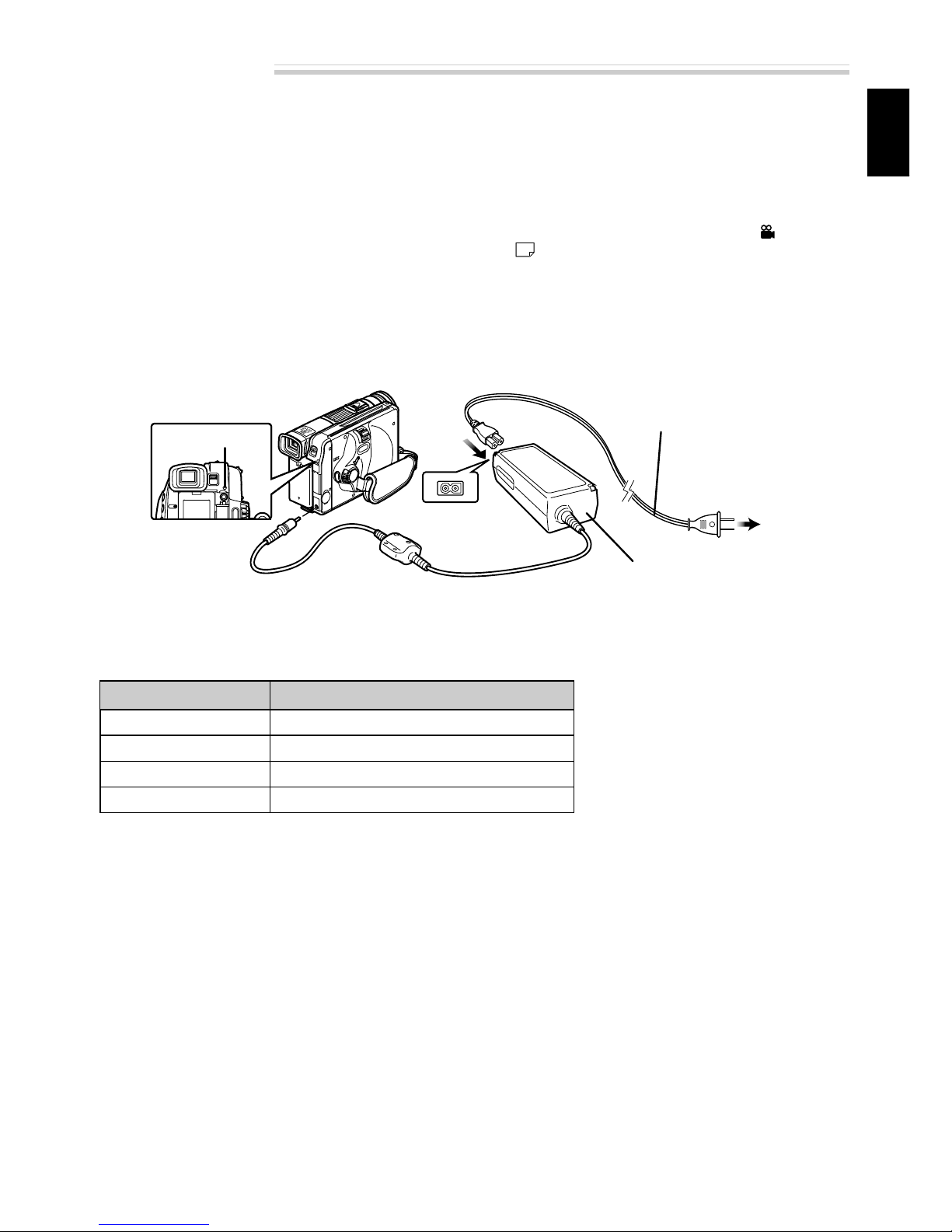
Use the provided AC adapter to charge the battery.
1
Attach the battery pack to the DVD video cam-
era/recorder.
2
Connect the AC adapter between the DC IN 8.4V
jack on DVD video camera/recorder and an AC
outlet.
The CHARGE/ACCESS indicator will blink in
green and charging will start.
AC adapter
CHARGE/ACCESS
indicator
Power cable
● Battery pack charged status
You can realize the charged status of battery by checking the CHARGE/ACCESS indicator:
Charged status CHARGE/ACCESS indicator
0-50% Blinks once per 1-2 seconds
51-75% Blinks twice per 1-2 seconds
76% or more Blinks three times per 1-2 seconds
Fully charged Remains lit
Note: Charge the battery in the temperature
range of 10 °C - 30 °C.
Note: Make sure that the battery is securely in-
stalled: Incomplete attachment could cause the
battery to fall and be damaged.
Note: If the power switch is set to “
VIDEO” or
“
PHOTO”, charging will not be performed.
Note: When connecting the power cable to the
DVD video camera/recorder, the pin of power
cable cannot be completely inserted into the DC
IN 8.4V jack, but this does not indicate a malfunc-
tion. Do not insert the power cable with undue
force: Doing so could result in malfunction.
Downloaded from www.ManualsFile.com manuals search engine
32
ENGLISH
● Continuously recordable time on
DVD video camera/recorder with
fully charged battery
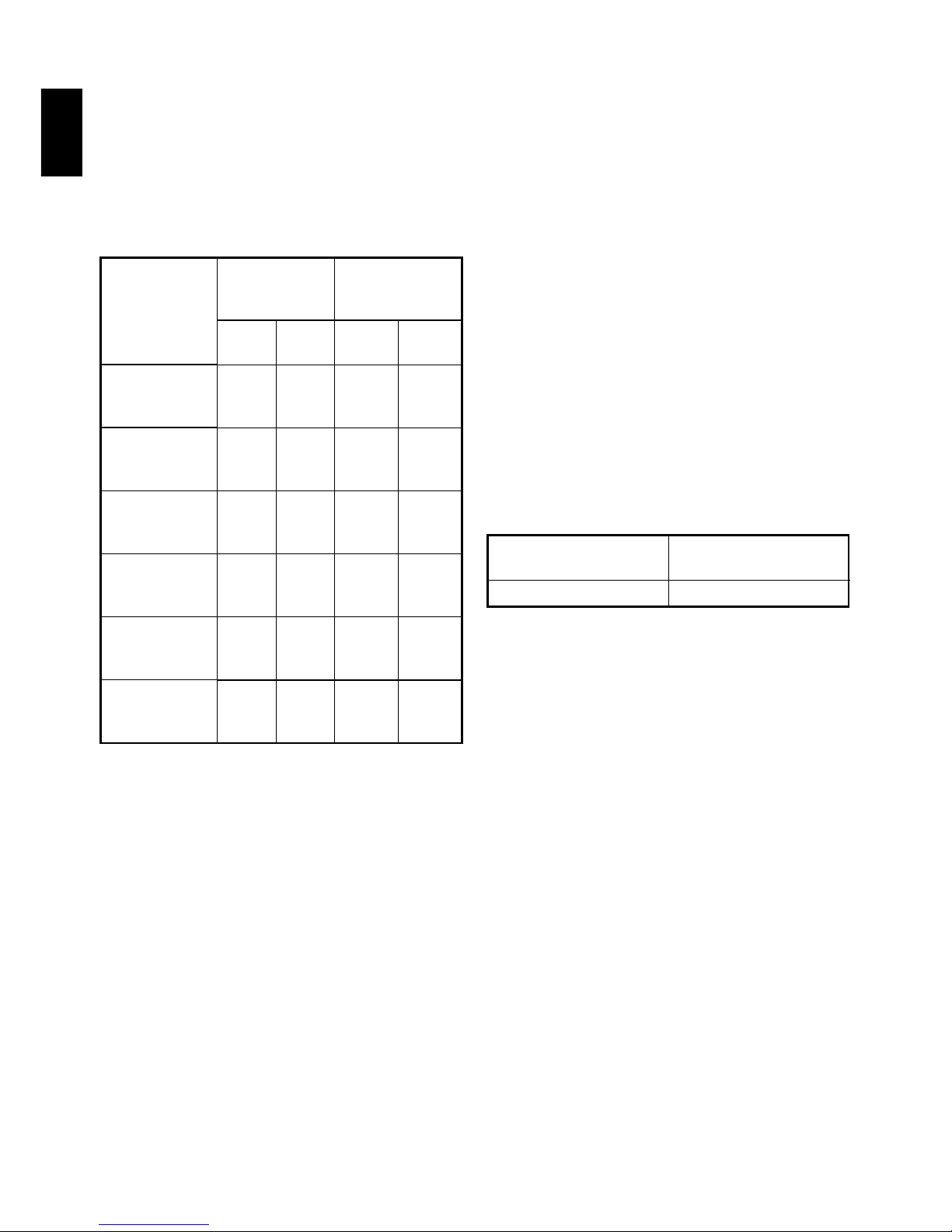
The reference for DVD video camera/recorder re-
cordable time with fully charged battery is between
40 and 60 minutes [with model DZ-BP14(R)/DZ-
BP16 (sold separately)] or between 70 and 100 min-
utes (with model DZ-BP28 (sold separately)):
Battery
When using
viewfinder
(in XTRA mode*)
When using
LCD monitor
(in XTRA mode*)
When using
viewfinder
(in FINE mode)
When using
LCD monitor
(in FINE mode)
When using
viewfinder
(in STD mode)
When using
LCD monitor
(in STD mode)
DZ-BP14(R)/
DZ-BP16(Sold
separately)
DZ-BP28
(Sold separately)
Without any extraordinary operation, such
as zooming:
The continuously DVD video camera/recorder re-
cordable time in the above table shows the time
available when the DVD video camera/recorder is
in the recording mode without using any other
function after recording is started. In actual record-
ing, the battery will discharge 2-3 times faster than
this reference, since the REC button and zoom are
being operated, and playback is performed. As-
sume that the recordable time with a fully charged
battery is between 40 and 60 minutes [with model
DZ-BP14(R)/DZ-BP16 (sold separately)] or be-
tween 70 and 100 minutes (with model DZ-BP28
(sold separately)), and prepare the type and
number of batteries to allow for the time you are
planning to record on the DVD video camera/re-
corder.
Note that the battery discharges faster in cold
places.
● The time taken for charging the
battery is as follows (at 25 °C)
DZ-BP14(R)/DZ-BP16
(sold separately)
170 min
DZ-BP28
(sold separately)
270 min
Note: During and after charging, the battery will
be warm, but this does not indicate a fault.
Note: If the following phenomena appear, the
battery may be dead: Replace it.
– Charging does not start within 10 seconds (the
CHARGE/ACCESS indicator does not light)
– The battery cannot be charged up to 75% if
more than 9 hours has elapsed after charging
started.
– The battery cannot be fully charged if more
than 5 hours has elapsed after it was charged
to 75%.
Note: Charge the battery at ambient tempera-
ture 10°C to 30°C: Charging at temperatures other
than this range could damage the battery.
(approx.)
* The time in XTRA mode is only for reference: It
varies depending on recording contents.
DVD-
RAM
115 min
95 min
115 min
95 min
125 min
110 min
DVD-R
—
—
110 min
90 min
120 min
105 min
DVD-
RAM
185 min
160 min
185 min
160 min
210 min
180 min
DVD-R
—
—
180 min
155 min
205 min
175 min
Downloaded from www.ManualsFile.com manuals search engine
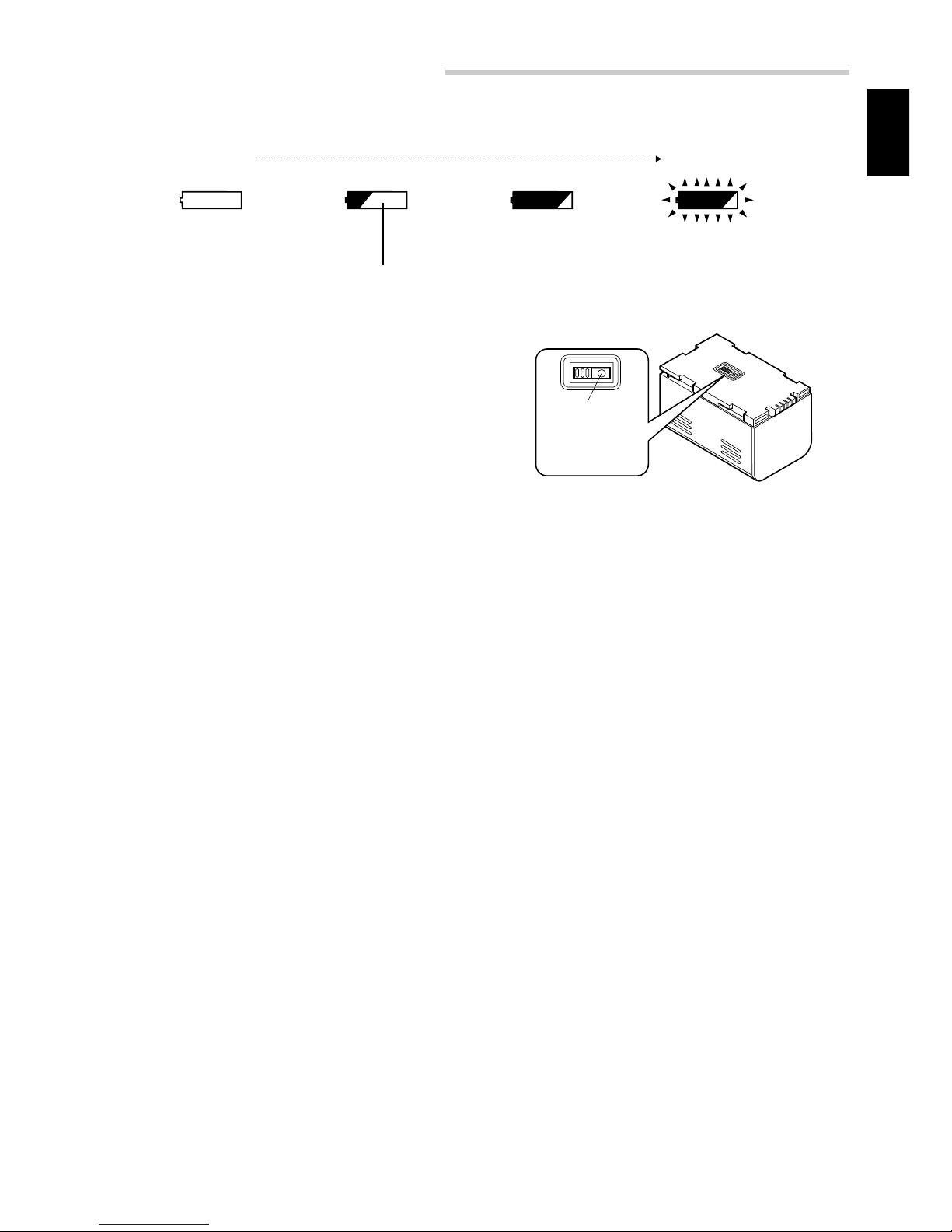
33
ENGLISH
Battery Remaining Level Indicator
When the battery is used to power the DVD video camera/recorder, the battery remaining level appears
in the viewfinder or on the LCD screen as follows:
Fully charged Nearly empty
(Blinks)
White portion shows
remaining level
Note: Be sure to use the specified battery (DZ-
BP14(R)/DZ-BP16 (sold separately) or DZ-BP28 (sold
separately)). Using other batteries could cause
faulty DVD video camera/recorder operation, or
possibly a fire.
Note: If a charged battery is stored, it will discharge
on its own; therefore, it is recommended that you
charge the battery shortly before using the DVD
video camera/recorder, such as on the day before
you plan to use it. You do not need to completely
discharge the battery before charging it.
Note: When you are not using the DVD video cam-
era/recorder, remove the battery and store it in a
dark, cool place. If you store it in a place where the
temperature is high, the battery life will be short-
ened. Especially be sure not to store the battery in
an environment (in a closed vehicle) over 60 °C:
Neglecting this could damage the battery.
Handling the dead battery
• Do not dispose of the dead battery: Let
a rechargeable battery recycling coop-
erative store take charge of it.
Using charge marker
• For a charged battery, slide the charge
marker knob at rear so that the charge
marker (●) is visible: Uncharged bat-
teries can thus be easily identified.
Charge
marker
Note: It is recommended that you fully charge the
battery once a year, attach it to the DVD video
camera/recorder and use it up; then remove the
battery and store it in a cool place again.
Note: The battery can be repeatedly charged
and used, but will eventually be dead: The bat-
tery life varies greatly depending on the ambient
environment and how often the DVD video cam-
era/recorder is used. If the usable time of DVD
video camera/recorder with a fully charged bat-
tery is noticeably short, the battery is probably
dead: Purchase a new battery.
Downloaded from www.ManualsFile.com manuals search engine
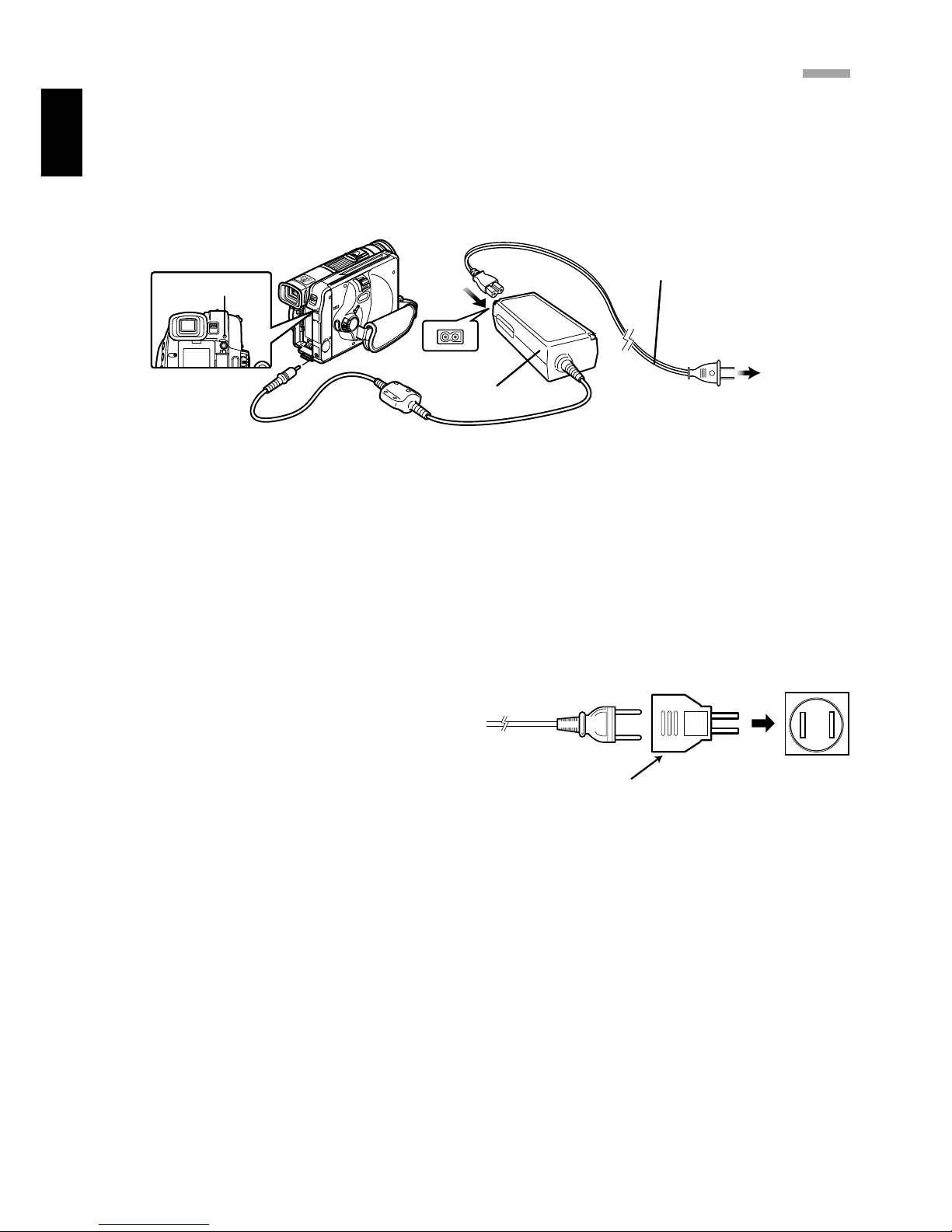
34
ENGLISH
Using DVD video camera/recorder with AC Adapter
It is recommended that you use the AC adapter to power the DVD video camera/recorder from
household AC outlet when you perform settings on it, play back or edit images, or use it indoors. And
be sure to use the AC adapter to power the DVD video camera/recorder when finalizing a disc.
Note: Be sure to use the specified AC adapter to power the DVD video camera/recorder. Using other AC
adapters could cause electric shock or result in fire.
Note: The AC adapter can be used around the
world. An AC plug adapter is required in some for-
eign countries. If you need one purchase it from
your Hitachi distributor.
Note: If the CHARGE/ACCESS indicator does not
light when the AC adapter is plugged into AC
outlet, unplug it from the AC outlet, wait a few mo-
ments, and then plug it into the AC outlet again. If
the CHARGE/ACCESS indicator still does not light,
the AC adapter may be faulty. Unplug it from the
AC outlet and consult your dealer.
1
Set the power switch to “POWER OFF” to turn
the DVD video camera/recorder off.
2
Connect the AC adapter between the DC IN 8.4V
jack on DVD video camera/recorder and an AC
outlet.
CHARGE/ACCESS
indicator
AC adapter
Power cable
AC Plug Adapter(not supplied)
AC 100-120
V
Downloaded from www.ManualsFile.com manuals search engine
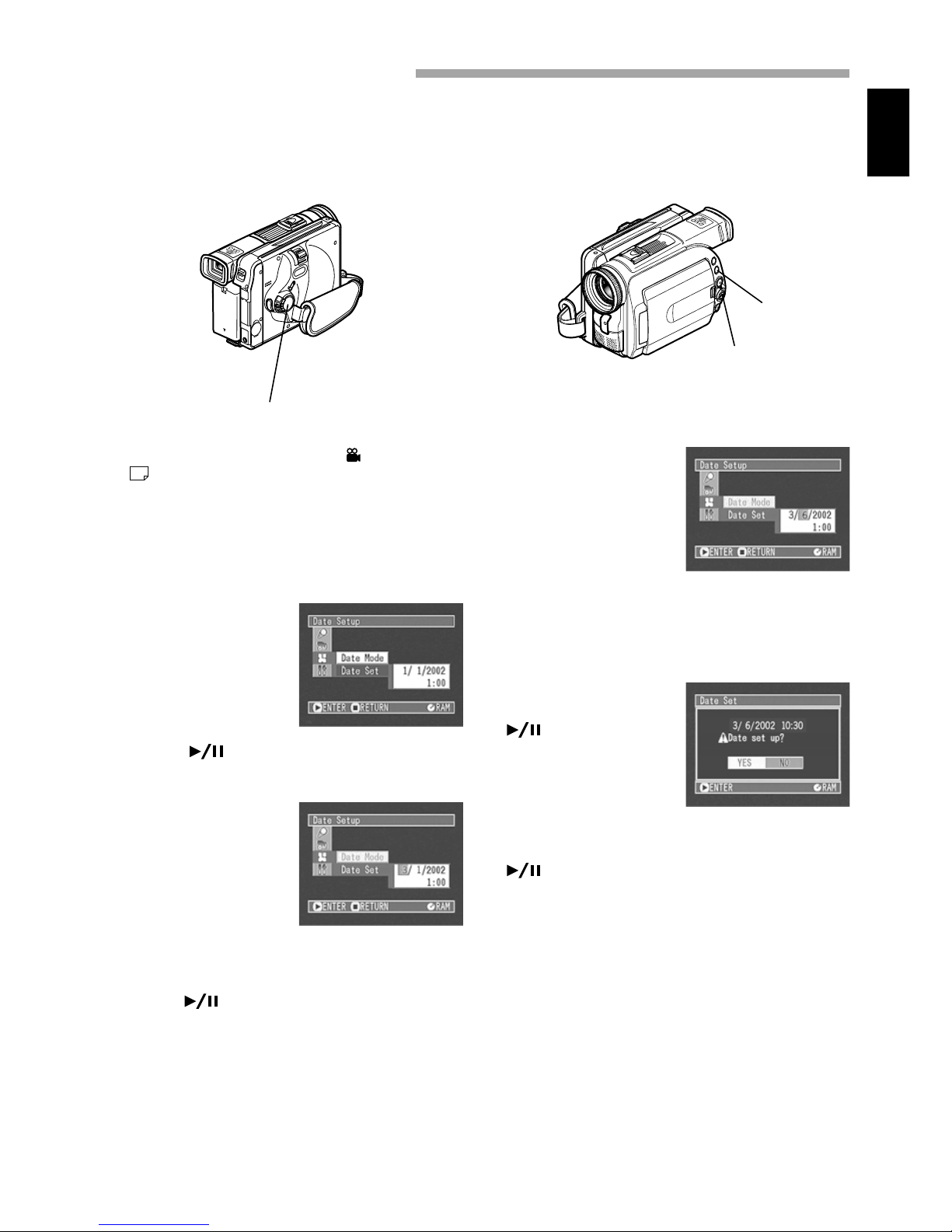
35
ENGLISH
Setting Date and Time
Set the current date and time correctly so that the date and time you make a recording can be
recorded correctly.
Setting the correct date and time will allow you to store the correct information on recording.
(The following procedure can also be used to correct the date and time you have already set.)
MENU
button
Joystick
1
Set the power switch to “ VIDEO” or
“ PHOTO” to turn the DVD video camera/
recorder on.
2
Press the MENU button.
The menu screen will appear.
3
Use the joystick to
choose “Date Setup”
and then “Date Set”.
4
Press the button.
The figure for the day will be selected.
[The digit that is high-
lighted first depends on
the date display format
(set up in Date Mode):
The digit on the left end
of the date display will
be first highlighted.]
Note: After setting the figure for the day, tilt the
joystick to right to select the digit to be set. If you
press the
button after selecting the figure for
the day, the screen for verifying the set date will
appear instead of screen for setting month, year
or time.
5
Tilt the joystick to left or
right to select the digit
you want to set in se-
quence.
Tilt the joystick up or
down to select the
number for current
date/time, and then re-
peat step 5 to set the cur-
rent date and time.
6
After setting the current
date and time, press the
button.
The screen for verifying
the set date will appear.
7
If the displayed date and time are correct, use
the joystick to choose “YES”, and then press the
button.
The date and time will be set, and the DVD video
camera/recorder will enter the recording pause
status.
Choosing “NO” will restore the menu screen.
Note: This DVD video camera/recorder incorpo-
rates a rechargeable battery to store the date and
time in memory. If this built-in battery is exhausted,
the date and time will be reset. To prevent this,
connect the AC adapter to DVD video camera/
recorder, and leave them for at least 24 hours with
the DVD video camera/recorder turned off: The
built-in battery will be charged.
Power switch
Downloaded from www.ManualsFile.com manuals search engine
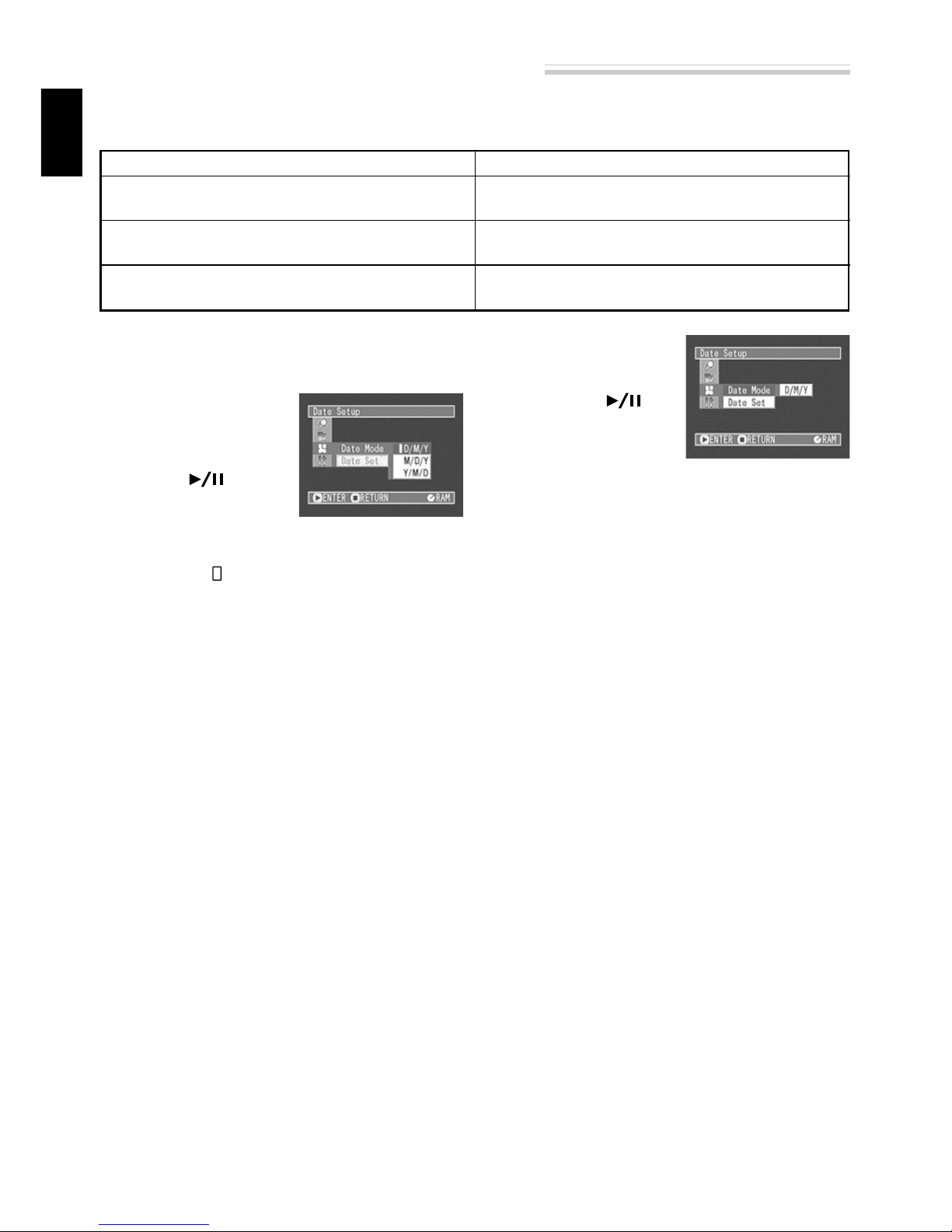
36
ENGLISH
You can select one of three date display formats: day/month/year, month/day/year or year/month/
day. Associated with the selected date display, the time display format will also change as follows:
1
Press the MENU button.
The menu screen will appear.
2
Use the joystick to
choose “Date Mode”
on the “Date Setup”
menu screen, and then
press the button.
The options will appear on the right of “Date
Mode”: The mark will be attached to the cur-
rently selected option.
3
Use the joystick to se-
lect the desired date
display format, and
then press the but-
ton.
The menu screen for setting date will be restored,
and the “Date Mode” has been changed as you
designated.
4
Press the MENU button to switch off the menu
screen.
Note: If the date display format has been
changed, the display format during playback as
well as during recording will also be changed (see
p. 53).
Changing Display Format of Date and Time
Example of display
17:30
25/5/2002
5:30PM
5/25/2002
PM5:30
2002/5/25
Display format
D/M/Y
M/D/Y
Y/M/D
Downloaded from www.ManualsFile.com manuals search engine
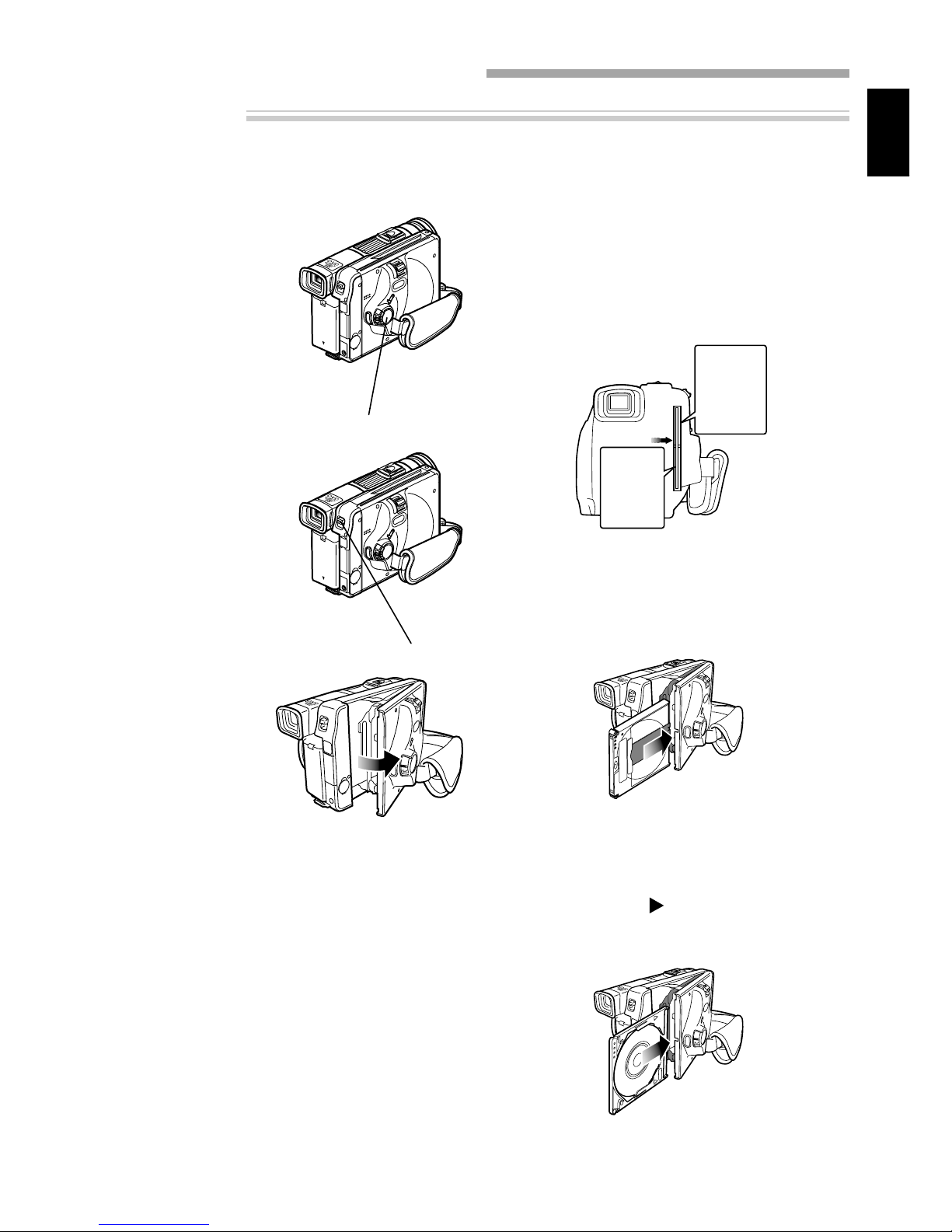
37
ENGLISH
Inserting and Ejecting Disc
1
Make sure that the
DVD video camera/
recorder is turned off.
Set the power switch to
“POWER OFF”.
2
Press down the DISC
EJECT button.
The cover of disc
insertion block (hand
strap) will slightly
open.
3
Gently open the
cover by hand
until it stops.
4
Insert the disc, in cartridge or caddy, into the
disc guide.
Set a both-side recordable disc into the disc guide
so that the label of side on which you want to
record faces the hand strap.
Inserting Disc
With this DVD video camera/recorder the recorded video and audio are stored on DVD-RAM* or DVD-R disc.
* When using an uninitialized DVD-RAM disc, it must be formatted (see p. 88).
How to set both-side recordable disc
•The actual recording surface of side [A] is op-
posite to that on which “SIDE A” is marked. If
you view the image recorded on side [A] on
another device, set the disc in it with indica-
tion “SIDE A” facing up.
•The cartridge has a fixed orientation when it
is inserted into the DVD video camera/re-
corder: Insert it correctly referring to the illus-
tration shown below.
To record on side [B], turn the cartridge over.
How to set one-side recordable disc
•Set the disc with the label side up in the caddy,
and then insert the caddy correctly referring
to the illustration shown below.
The caddy has a mark: Insert it with this
mark forward.
Power switch
DISC EJECT button
A
Actual
recording
surface
Laser
Side A
indica-
tion of
disc
Downloaded from www.ManualsFile.com manuals search engine
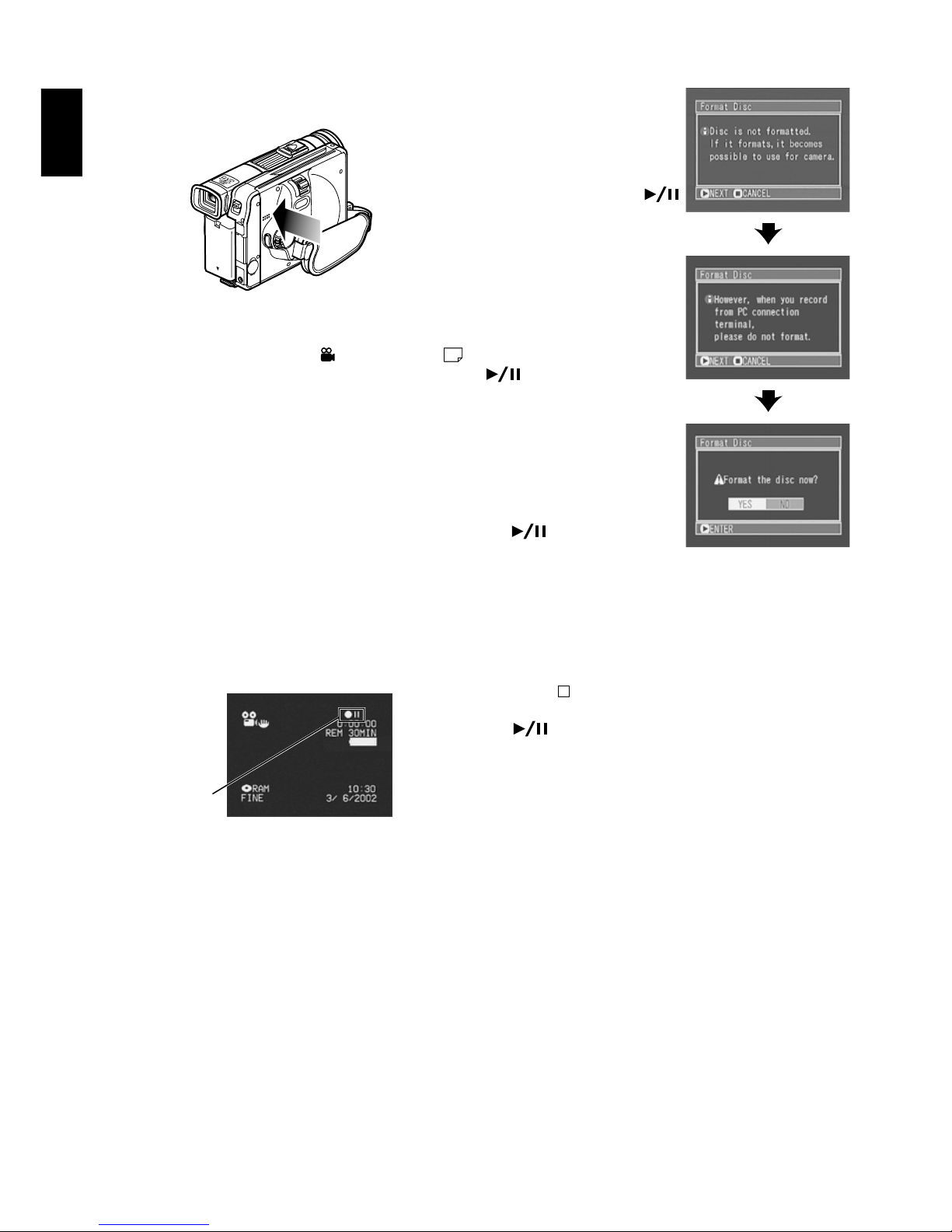
38
ENGLISH
5
Gently push the section indicated “PUSH/
CLOSE” on the cover of disc insertion block
(hand strap), to close the cover.
6
Turn the DVD video camera/recorder on.
Set the power switch to “ VIDEO” or “
PHOTO”: An image will appear in the view-
finder and disc recognition will start.
Note: If the disc is forcibly inserted from the wrong
direction, the DVD video camera/recorder, or car-
tridge or caddy could be damaged.
Note: When using a one-sided recordable disc,
insert it with the recording surface facing the in-
side of DVD video camera/recorder.
● When using DVD-RAM disc
The subject image will appear in the viewfinder or
on LCD screen, and the DVD video camera/re-
corder will start to recognize the disc. Subsequently,
the DVD video camera/recorder will enter the re-
cording pause status.
● When using DVD-R disc
Recognition of the disc will
start.
When you use a brand-new
disc, the messages on the
right will appear in se-
quence by pressing the
button between messages.
When recording on
this DVD video cam-
era/recorder:
When message “Format the
disc now?” appears, choose
“YES” and then press the
button. The disc will
be automatically formatted
for use on this DVD video
camera/recorder.
After formatting, message
“DVD-R disc, Video mode
cannot be changed” will
appear (see page 26): Press
the button to erase the
message.
Once formatted, a DVD-R disc can no longer be
changed to a disc for PC, even if it has not been
recorded on this DVD video camera/recorder.
When recording data from PC:
While the above messages are being displayed,
press the button, or when message “Format the
disc now?” appears, choose “NO” and then press
the button.
However, if data from PC has not yet been recorded,
the disc can be made usable on this DVD video cam-
era/recorder. When inserting the disc into this DVD
video camera/recorder, the same message will ap-
pear: If you wish to use it on this DVD video cam-
era/recorder, choose “YES”.
Note: It will take more time than usual after the
disc is inserted before recording can begin in the
following cases:
– When the cover of disc insertion block is open
– When the date changes (first recording of a day)
– When the temperature has changed greatly
from the previous recording status
– When a disc with scratches, dirt or fingerprints is
inserted
Note: If the following discs are inserted, the Disc
Navigation screen will appear or some message
will be displayed:
– Disc with little remaining free space
– Write-protected disc
– Finalized DVD-R disc
– Disc recorded on another device
– Unknown type of disc
Record-
ing
pause
(In case of movie)
Downloaded from www.ManualsFile.com manuals search engine
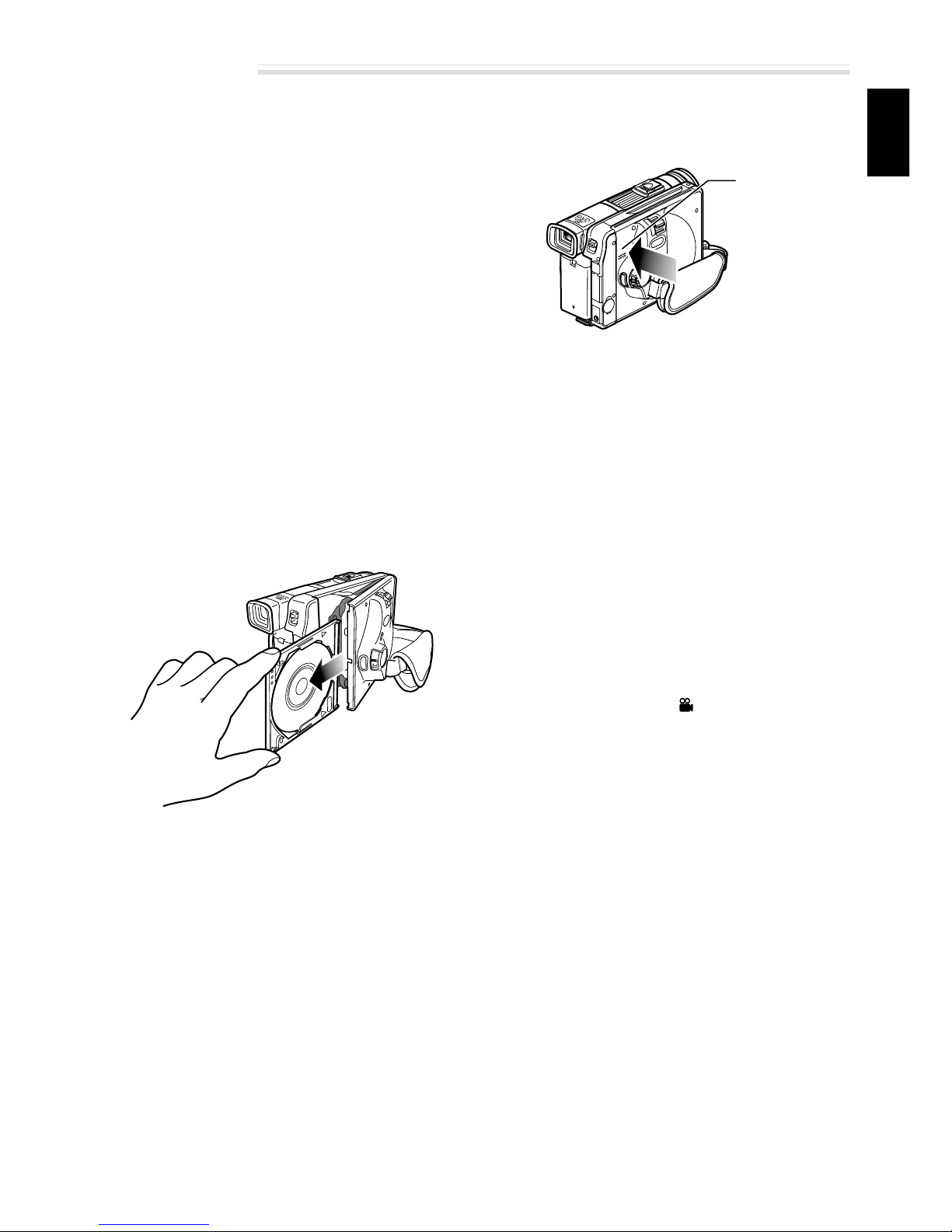
39
ENGLISH
1
Set the power switch to “POWER OFF” to turn
the DVD video camera/recorder off.
A click will be heard, which means that the disc
is unlocked and can be removed.
2
Push down the DISC EJECT button.
The cover of disc insertion block (hand strap)
will open slightly.
3
Gently open the cover until it stops.
When the cover is fully open, the disc will
slightly come out from the disc guide, and stop.
Note: Do not remove the disc with the battery
attachment platform of DVD video camera/re-
corder facing down: Disc could fall out.
4
Remove the disc.
Hold the disc by its sides as shown in the illus-
tration and gently pull it out.
Note: Be careful when removing the disc, since
the temperature at the shutter will be very high.
5
Gently push the section indicated “PUSH/
CLOSE” on the cover of disc insertion block
(hand strap), to close the cover.
Note: Even after the DVD video camera/recorder
is turned on, the disc can be removed unless it is in
recording status. Press down the DISC EJECT but-
ton and hold it for at least 2 seconds: A click will
be heard and the disc will be unlocked. Push down
the DISC EJECT button once again to remove the
disc. (The DISC EJECT indicator on the LCD screen
will change from white to pink at this time.) It is
recommended that you turn the DVD video cam-
era/recorder off before inserting or ejecting disc
to prevent misoperation.
Note: Do not insert anything other than the 8 cm
DVD-RAM disc or DVD-R disc into the disc insertion
block: Doing so could cause malfunctions.
Note: Set the power switch to “POWER OFF” to
turn the DVD video camera/recorder off. Do not
remove the battery to turn the camera/recorder
off: If you do so, the disc cannot be removed. If
the disc cannot be removed, use the AC adapter,
etc. to power the DVD video camera/recorder.
Set the power switch to “
VIDEO”, then “POWER
OFF” to make sure by the sound that the disc is
unlocked, and then remove the disc.
Note: If you push down the DISC EJECT button,
the disc will not come out until it completely stops
rotating. After the lock release sound is heard, wait
for a few moments and then push down the DISC
EJECT button again.
Removing Disc
PUSH
CLOSE
Downloaded from www.ManualsFile.com manuals search engine
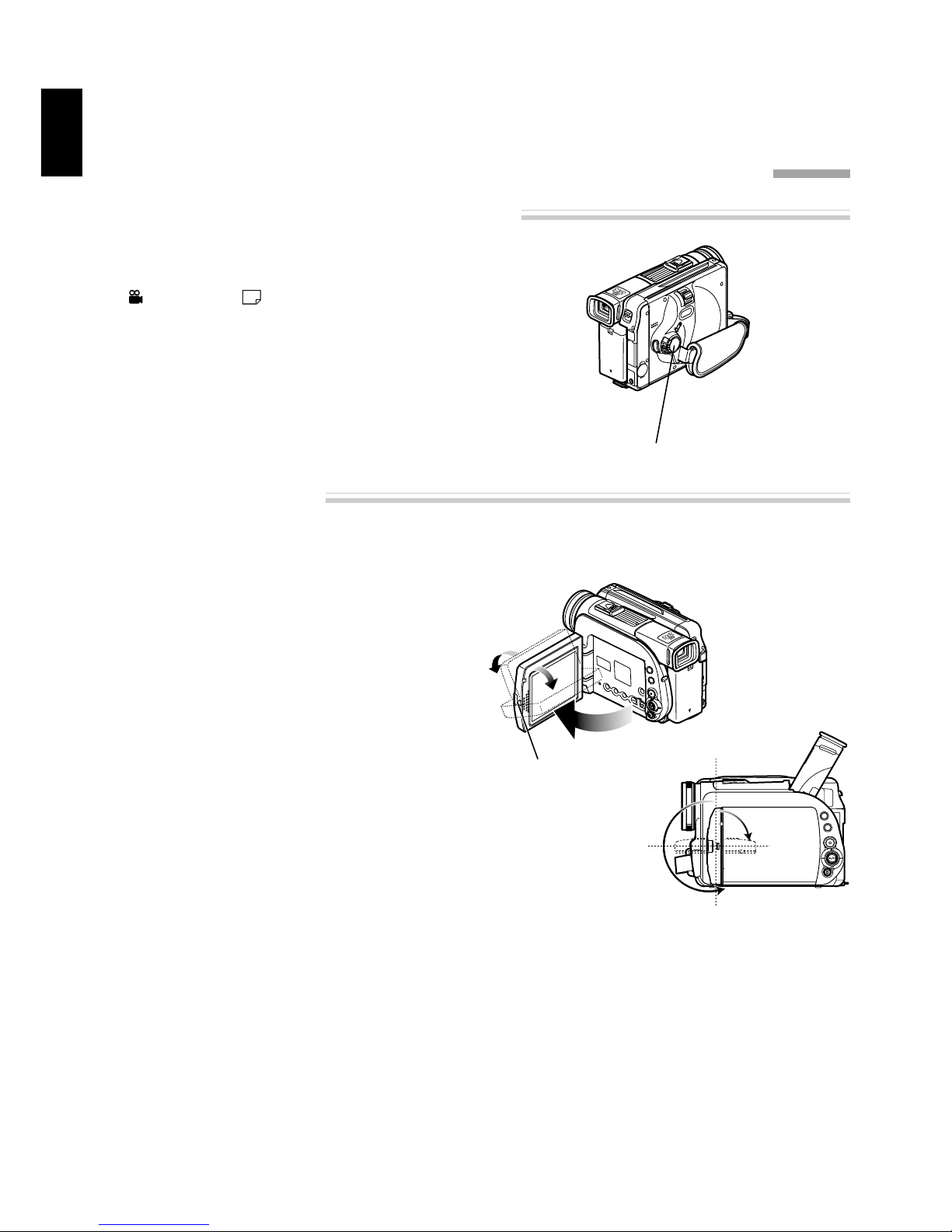
40
ENGLISH
Opening LCD Monitor
If you open the LCD monitor, you can monitor subject image on the LCD screen. If the monitor is open,
the viewfinder will be off.
Press the OPEN button to open the LCD monitor.
The LCD monitor can be opened up to approxi-
mately 90°.
If the LCD monitor is open 90°, it can be tilted
with screen down as much as 90°, and can also
be tilted with screen up and turned up to 180° so
the screen faces in the same direction as the lens.
Tilt the LCD monitor to adjust its vertical angle
so that you can see the screen easily.
Note: Be sure to open the LCD monitor approxi-
mately 90° before changing its vertical angle.
Note: Do not record for a prolonged time with the
LCD monitor turned approximately 180 ° in close
contact with the DVD video camera/recorder
body: Doing this could cause the DVD video cam-
era/recorder and LCD monitor to become hot.
Turning DVD Video Camera/Recorder On
While holding down the red button at the center
of power switch, turn the switch to set it to
“ VIDEO” or “ PHOTO”.
Note: When power is turned on, the self-diagnosis
function of DVD video camera/recorder may work,
and some message may appear. If any message
appears, refer to “Trouble Messages” (p. 100).
Basic Techniques
This section explains about recording of movies and still images, and also basic settings on DVD video
camera/recorder.
Basic Handling of DVD video camera/recorder
90°
180°
OPEN button
Power switch
90°
Downloaded from www.ManualsFile.com manuals search engine
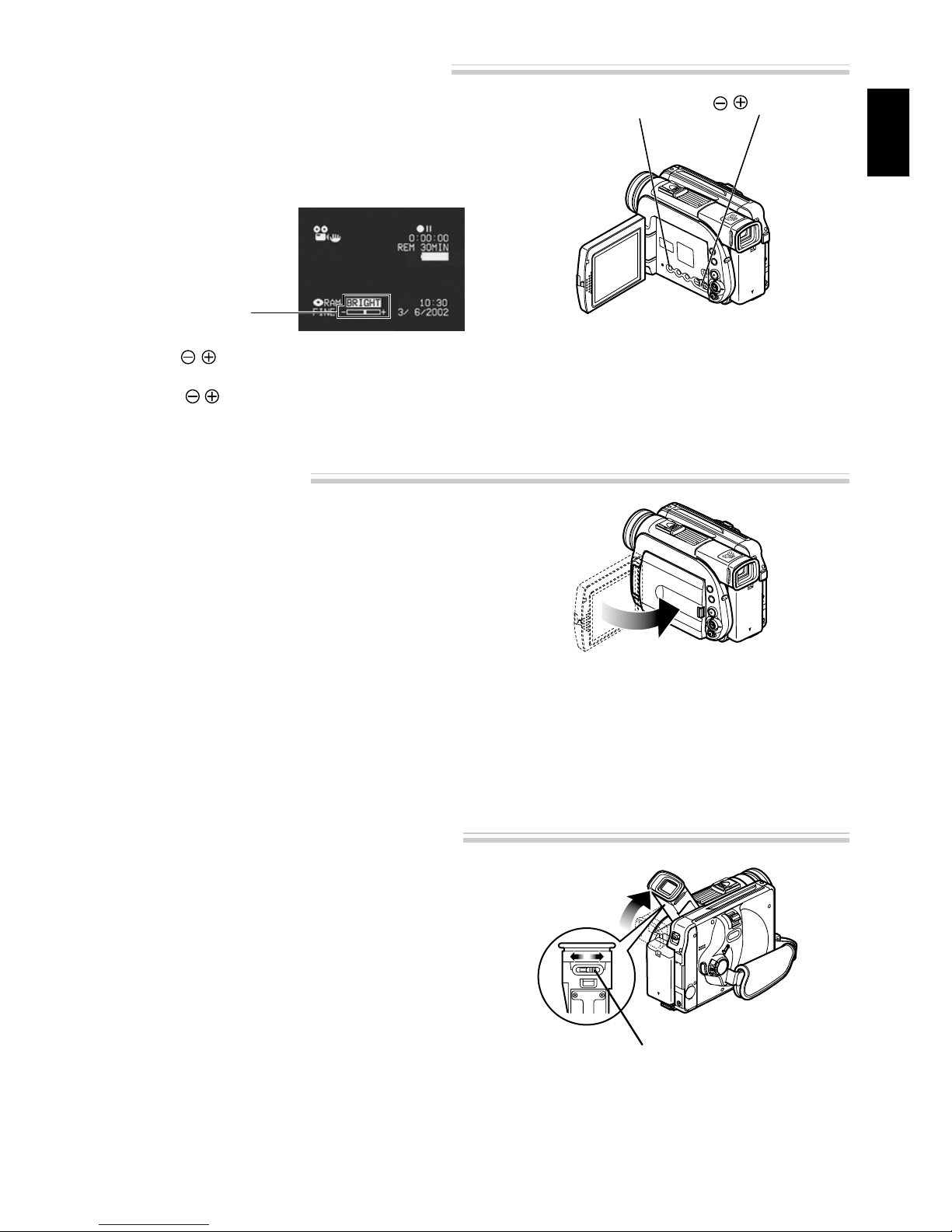
41
ENGLISH
1
Press the LCD BRIGHT button.
The “BRIGHT” indicator will light on the screen.
(The indicator will go out in approximately 5
seconds.)
2
Use the button to adjust the brightness.
Pressing will change the brightness of LCD
screen and also move the position of “BRIGHT”
bar scale.
LCD Screen Brightness Adjustment
Closing LCD Monitor
B
efore closing the LCD monitor, be sure to reset it
at right angles to the DVD video camera/recorder.
Replace the LCD monitor on the DVD video
camera/recorder with the LCD screen facing
inward until a click is heard.
Note: Be sure to return the LCD monitor at right
angles to the DVD video camera/recorder before
closing it or replacing it on the DVD video cam-
era/recorder with its screen facing outside. If the
LCD monitor is tilted, it cannot be closed to the
DVD video camera/recorder.
Note: If the LCD monitor is not securely locked to
the DVD video camera/recorder, no image will
appear in the viewfinder.
Viewing Subject through Viewfinder
Adjust the angle of viewfinder as you like, and
fit your eye to the eyecup.
If the image is blurred, you can adjust the focus.
Adjust the diopter control under the eyecup so
that the subject image can be seen clearly.
Note: If the LCD monitor is open, the viewfinder
will be off.
BRIGHT indicator
button
LCD BRIGHT button
Diopter control
Downloaded from www.ManualsFile.com manuals search engine
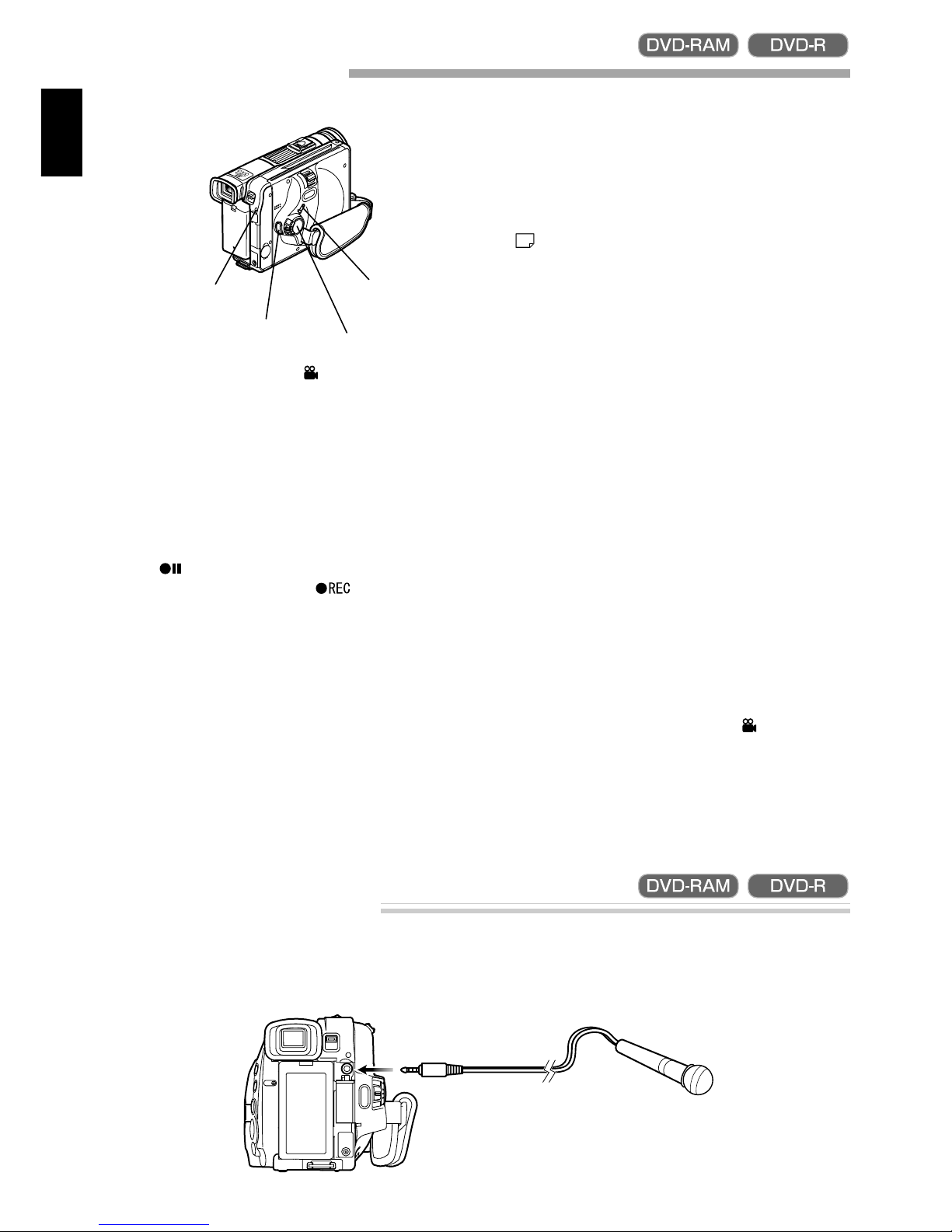
42
ENGLISH
Recording Movie
1
Set the power switch to “ VIDEO”.
Once the DVD video camera/recorder starts to
recognize the disc, the CHARGE/ACCESS in-
dicator will light.
When recognition is finished, the CHARGE/
ACCESS indicator will go out.
2
Press the REC button.
The “ ” mark in the viewfinder or on the LCD
screen will change to the “ ” mark, and re-
cording will start.
During recording, the recording indicator on the
front of DVD video camera/recorder will light.
Pressing REC again during recording will set the
DVD video camera/recorder to the recording
pause status.
3
When recording is finished, set the power switch
to “POWER OFF” to turn the DVD video cam-
era/recorder off.
Note: When recording in a dark place, it is rec-
ommended that you use the optional video light
(model DZ-LD9). Refer to the instruction manual of
video light for details.
Note: Press down the LOCK switch above the
power switch to lock movie recording: The power
switch will lock and thereafter will not move to
“
PHOTO” by mistake.
Note: Sound is recorded from the stereo micro-
phone on the front of DVD video camera/recorder:
Take care that this microphone is not blocked.
Note: You can press the REC button immediately
after recording is finished, but no further recording
will be made while “DISC ACCESS” is being displayed.
Recording will restart after the message disappears.
Note: If a very bright subject is recorded, stripe-like
lights may appear above and below the subject.
Note: Take care that power is not interrupted
while the CHARGE/ACCESS indicator is blinking.
Note: The minimum recordable time of movie is
approximately 3 seconds.
Note: See page 65 for setting of Record LED (re-
cording indicator) On/Off.
Note: For various functions available during record-
ing, see “Setting Up Camera Functions” on page 54.
Note: Hitachi cannot be responsible for video
and audio that cannot be recorded or edited be-
cause of any defect.
Note: The power switch can be changed over
even during recording, but the operation will not
be changed.
●
Power save and discharge of battery
If, when “Power Save: On” is specified, the DVD video
camera/recorder is left in the recording pause status for
approximately 5 minutes, it will automatically turn off.
To restart recording, set the power switch to
“POWER OFF”, and then set it to “ VIDEO”.
To set or release power save, see “Setting or Re-
leasing Power Save” on page 64.
It is recommended that you specify “Power Save: On”,
since even during recording pause battery power is
consumed at the same level as during recording. Es-
pecially when power save has been released, turn the
DVD video camera/recorder off when not in use.
Using External Microphone
Connect external microphone (generally available) to the external microphone jack of this DVD video
camera/recorder. Clearer sound can be recorded. Turn on the switch on microphone and start recording.
For details on microphone, see “Major Specifications” on page 111.
To external
microphone jack
CHARGE/ACCESS
indicator
Power switch
LOCK switch
REC button
Insert a recordable DVD-RAM or DVD-R disc into this DVD video camera/recorder.
Downloaded from www.ManualsFile.com manuals search engine
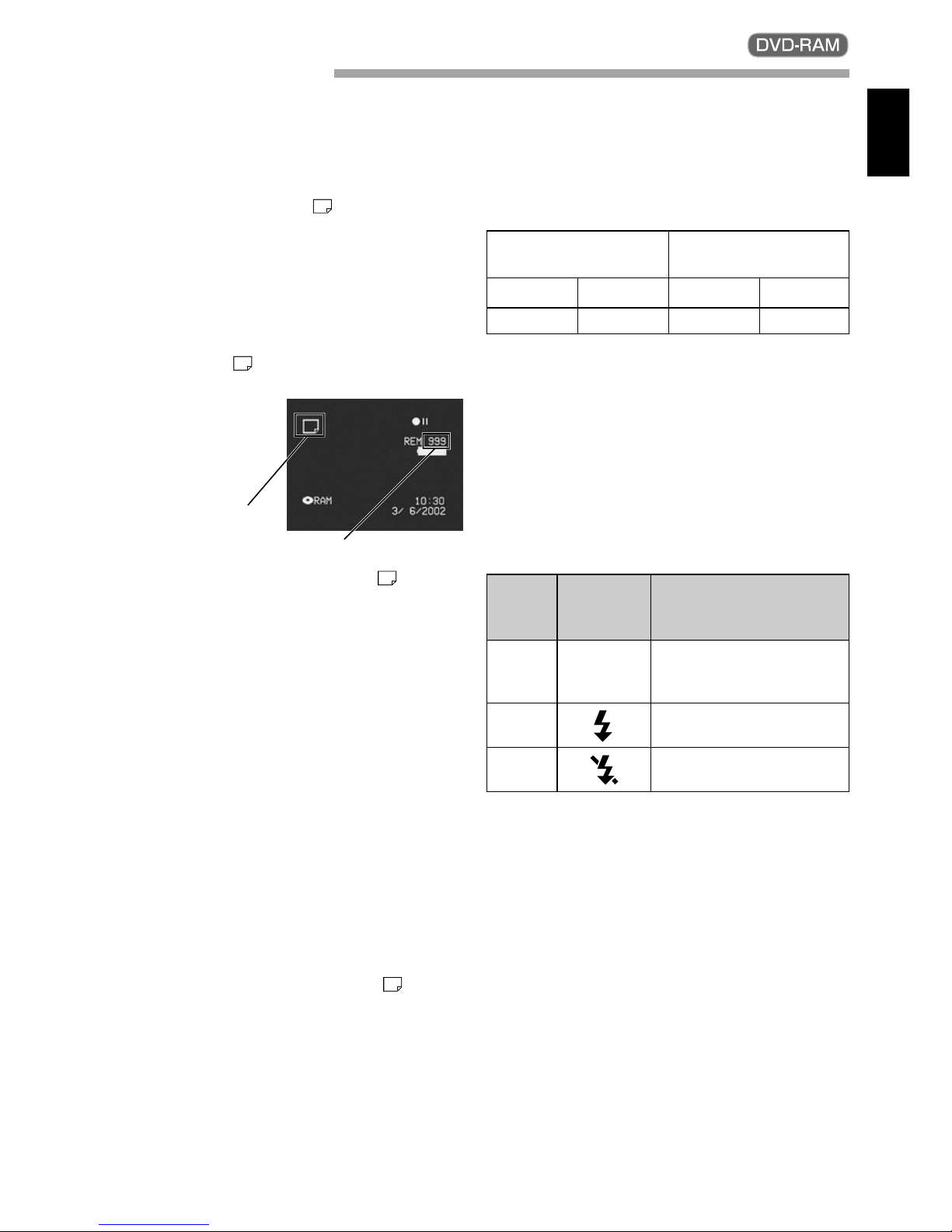
43
ENGLISH
1
Set the power switch to “ PHOTO” to turn
the DVD video camera/recorder on.
Once the DVD video camera/recorder starts to
recognize the disc, the CHARGE/ACCESS in-
dicator will light.
When recognition is finished, the CHARGE/
ACCESS indicator will go out.
Make sure that appears on the screen (view-
finder or LCD).
Note: If the power switch is set to “ PHOTO”,
the LOCK switch cannot be moved. Do not try to
force it: Doing so could cause a fault.
2
Check the subject on the screen (viewfinder or
LCD).
3
Press the REC button.
The DVD video camera/recorder automatically
focuses on the subject at the center of screen
(when auto focus is selected).
The screen will be black, and then the recorded
still will be displayed.
When message "DISC ACCESS" disappears, re-
cording of still will be complete.
4
Set the power switch to “POWER OFF” to turn
the DVD video camera/recorder off.
Note: When the power switch is set to “ PHOTO”,
flickering may occur in image on the LCD screen.
● Image quality
The quality of still recording cannot be switched.
● Setting Video Flash (sold sepa-
rately)
When recording still images in a dark place, or
when the subject is lit from rear, it is recommended
that you use the optional Video Flash (model DZ-
FLH3). Refer to the instruction manual of Video
Flash for details.
Recording Stills
This DVD video camera/recorder can record two types of still image on disc - a still to be viewed on TV
(MPEG image of 704×576 pixels) and a still to be used on PC (JPEG image of 1280 × 960 pixels).
Note: Recording of still images is possible only on DVD-RAM disc.
Note: Dark subjects may not be in clear focus even
if the Video Flash is used. It is recommended that
you light a subject when recording in a dark place.
Note: The DVD video camera/recorder automati-
cally sets the shutter speed between 1/800 and 1/
30 second (between 1/800 and 1/10 second if Pro-
gram AE has been set to Low Light) depending on
the subject brightness.
Note: During recording of stills, the electronic im-
age stabilizer will not function.
Still recording mode
Number of recordable stills
Setting
of Video
Flash
Auto
On
Off
On-screen
information
(No
display)
Manner for
emitting light
Automatically emits
light in dark place or in
a place lit from rear.
Always emits light re-
gardless of brightness
No light emission
JPEG
1,280 × 960
Still image
MPEG
704 × 576
(pixels)
JPEG
640 × 480
External input
still image
MPEG
704 × 576
Downloaded from www.ManualsFile.com manuals search engine
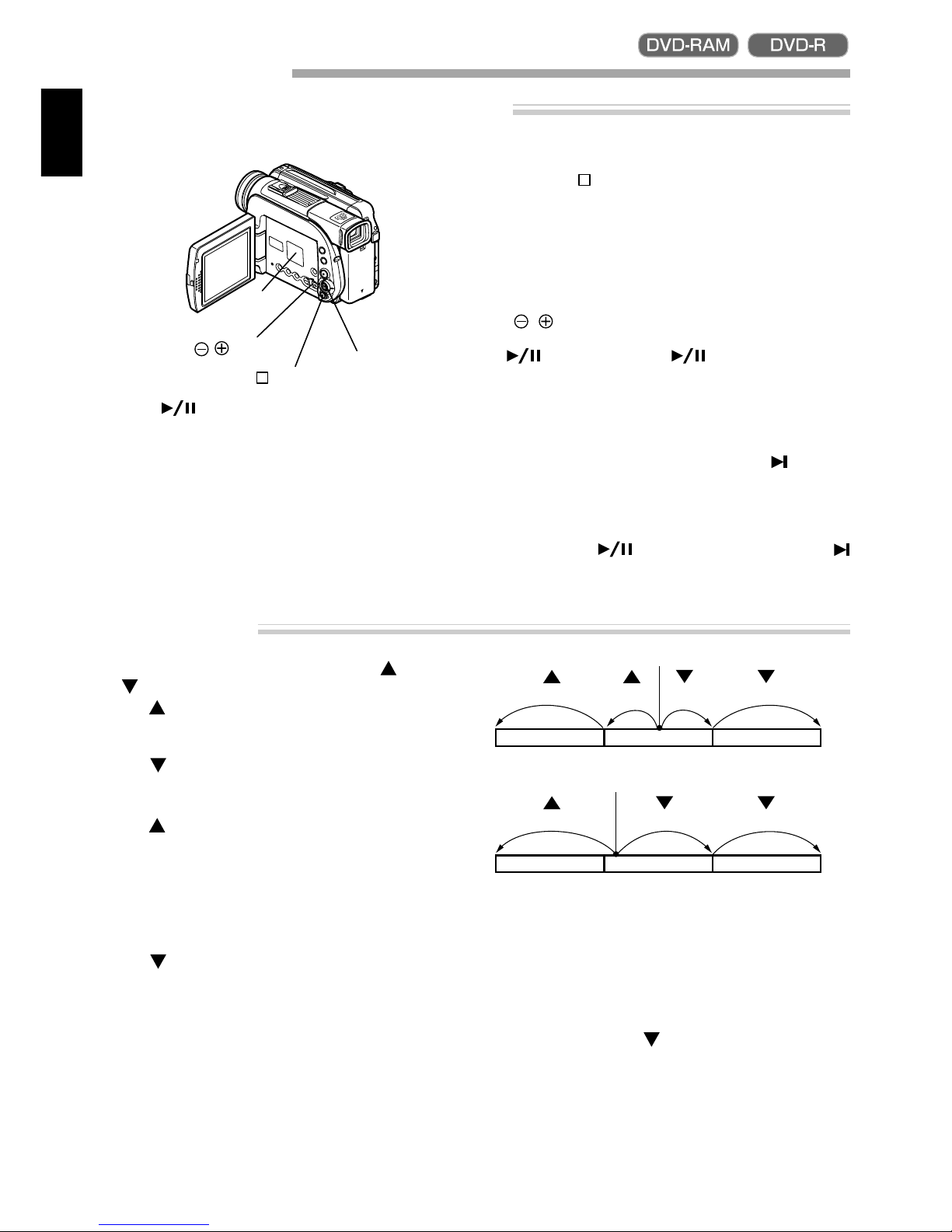
44
ENGLISH
Playing Back
Immediately Checking Recorded Scene
You can check your recording immediately on the spot.
1
Press button in the recording pause status.
The DVD video camera/recorder will enter the
playback mode, and playback will start from the
first image of the scene you have recorded last.
When playback is finished, the DVD video cam-
era/recorder will enter the pause status at the
last image on disc.
2
Press the button.
Playback will stop, and recording pause status
will be restored.
Note: When the LCD monitor is opened, playback
sound will be heard from the speaker. Adjust the
sound volume using the volume control buttons
(
, ).
Note: To temporarily stop playback, press the
button. Press the button again to re-
start playback.
Note: Even if you stop playback midway and im-
mediately start recording again, the new image
will always be recorded after previously recorded
images (these images will not be overwritten).
Note: When playback is finished, the
mark will
appear at the last image. If the DVD video cam-
era/recorder is left without being operated, it will
return to the recording pause status after approxi-
mately 5 minutes.
Note: If the
button is pressed while the
mark is being displayed, playback will start from
the first scene recorded on disc.
Skip Playback
During playback, tilt the joystick up or down
to locate the start of desired scene.
Tilt once :To return to the first image of
the scene being played back,
and start playback.
Tilt once :To skip to the first image of the
scene following the one being
played back, and start playback.
Tilt and hold:To continuously locate the be-
ginnings of scenes, starting
from the scene preceding the
scene being played back. When
the desired image appears, re-
lease the joystick: Playback will
start from that point.
Tilt and hold:To continuously locate the be-
ginnings of scenes, starting
from the scene following the
scene being played back. When
the desired image appears, re-
lease the joystick: Playback will
start from that point.
Note: If you perform skip playback during play-
back pause, the DVD video camera/recorder will
enter the playback pause status at the beginning
of the located scene.
Note: Tilting down
in the last scene on disc will
set the DVD video camera/recorder to the play-
back pause status at the last image.
Note: If the temperature inside the DVD video
camera/recorder is high, it may not operate nor-
mally. In such a case, turn the DVD video cam-
era/recorder off, wait for a while, and then turn it
on again.
Tilt up twice Tilt up once Tilt down once Tilt down twice
Portion being played back
Scene 1 Scene 2 Scene 3
Scene 1 Scene 2 Scene 3
Portion being played back
Tilt up once Tilt down once Tilt down twice
Tilting up the joystick at a portion several
seconds from the start of scene being played back
will return to the start of the scene preceding that
being played back.
buttons
Joystick
button
Speaker
Downloaded from www.ManualsFile.com manuals search engine

45
ENGLISH
Search Playback
During playback, tilt the joystick to left or right
and hold it: Search playback of scenes will
start.
: Scenes will be visually scanned forward
: Scenes will be visually scanned backward
Release the joystick when you find the desired
image: Normal playback will start from that
point.
Note: When you skip or search scenes from play-
back or playback pause, the screen will be dark
briefly.
Note: If the temperature inside the DVD video
camera/recorder is high, it may not operate nor-
mally. In such a case, turn the DVD video cam-
era/recorder off, wait for a while, and then turn it
on again.
Frame Advance/Frame Back/Slow Playback
During playback pause, tilt the joystick to left
or right : Frame advance, frame back or slow
playback will start.
Tilt once :Picture will advance one frame.
Tilt once :
Picture will go back half a second.
Tilt and hold:Forward slow playback
Tilt and hold:Reverse slow playback
Note: In forward slow, a rapidly moving subject
image may be distorted.
Note: In reverse slow, the image will be rougher.
Note: No sound will be heard during search play-
back or slow playback.
Downloaded from www.ManualsFile.com manuals search engine
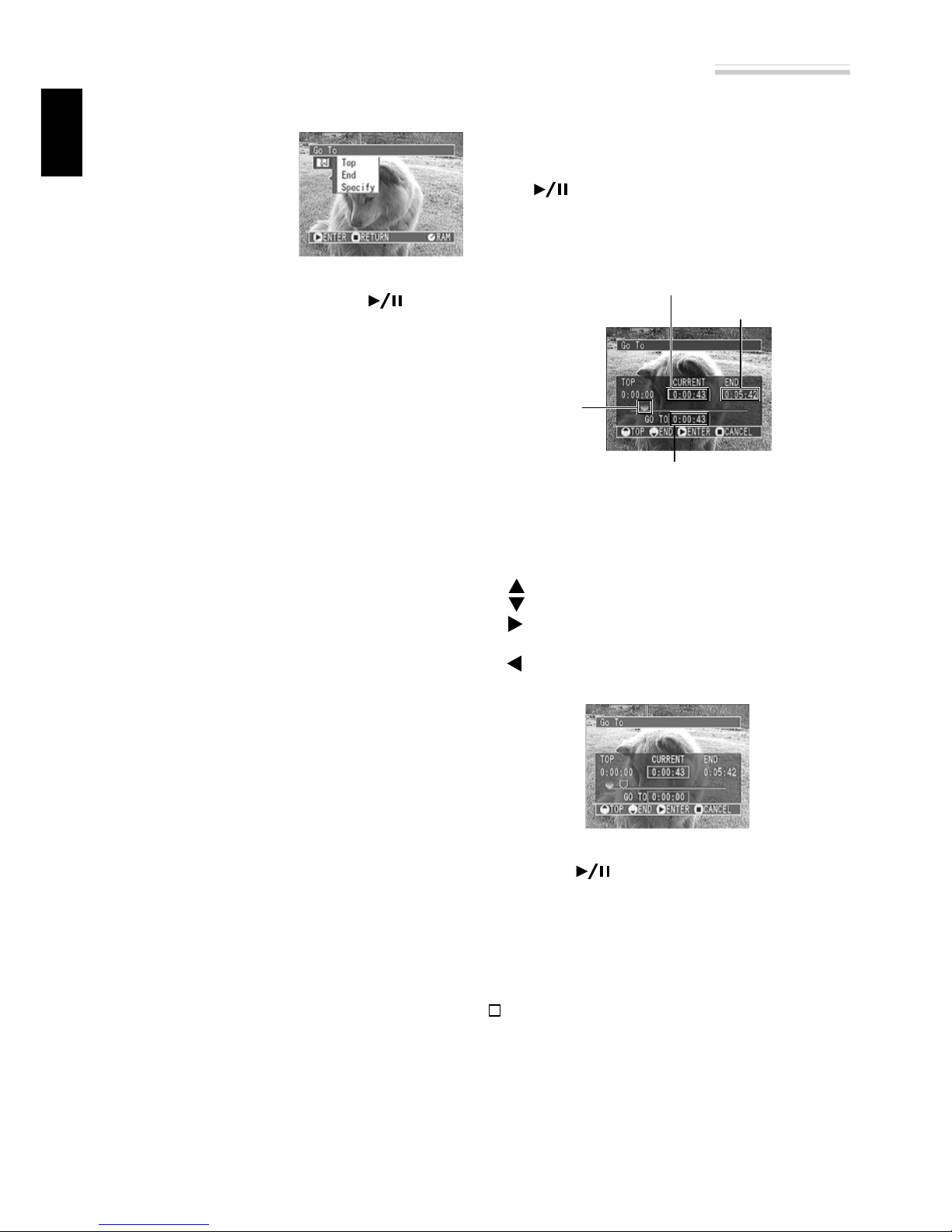
46
ENGLISH
Searching for Point You Wish to View by Specifying It (Go To)
1
Press the MENU button
during playback or
playback pause.
The “Go To” menu
screen will appear.
2
Use the joystick to choose the option (point you
want to go to), and then press the button.
Top : To go to the start of first scene on disc
(scene 1), and enter playback pause.
End : To go to the end of last scene on disc,
and enter playback pause.
Specify : To go to a specified point and enter
playback pause. See the following for
details.
You can specify any point that you want to view in order to search for it.
2
Use the joystick to select the desired time of cho-
sen point.
: To select the start of first scene on disc.
: To select the end of last scene on disc.
: To move the cursor toward the end of
last scene on disc in one-minute units.
: To move the cursor toward the start of
first scene on disc in units of a minute.
3
Press the button to enter the selection.
The DVD video camera/recorder will go to the
specified point and enter the playback pause
status.
To cancel the “Go To” procedure midway, press the
button before going to the specified point.
Note: The cursor may not move at same-pitch in-
tervals.
Total recording time of
all selected scenes *
Cursor position
Cursor
Position of currently
played back image
(When the start of scene is selected)
● Specifying the point to view
1
Choose “Specify” in step 2 above, and then press
the button.
The screen for specifying the point to go to will
appear.
*If no particular scene is selected, the total time of
all scenes recorded on disc will appear.
Downloaded from www.ManualsFile.com manuals search engine
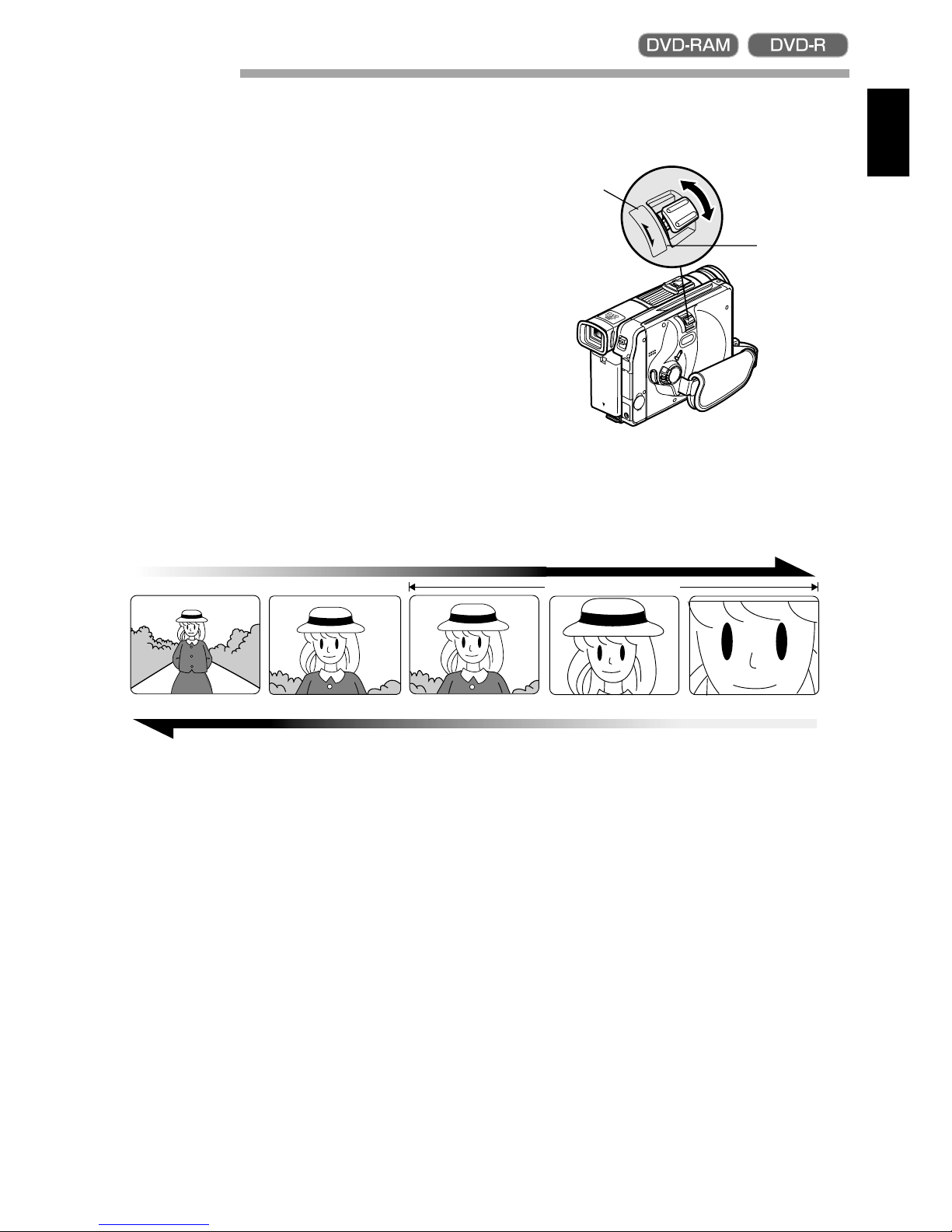
47
ENGLISH
This DVD video camera/recorder can optically zoom in on subject up to 12 powers, digitally multiplied
by 20 powers for movie recording and 4 powers for still recording.
Move the zoom lever down to “T” control side,
and the subject image will gradually become
telescopic: Move the zoom lever up to “W” con-
trol side, and the image will widen.
If Dig. Zoom 48x or 240x is specified, moving
the zoom lever down to “T” control side will
engage the digital zoom midway (see page 57).
Note: The setting of digital zoom 240x is effective
only during movie recording. If you specify 240x in
the still recording mode, the digital zoom will au-
tomatically be set to 48x.
Note: When a subject is zoomed, it may be mo-
mentarily out of focus.
Note: When digital zoom is engaged, the image
quality will be rougher.
Note: If the zoom ratio is frequently changed at
short intervals, the recorded image will be unclear.
* For movie only
Zoom Up
Digital zoom range
Zoom back
1 x 12 x 13 x 48 x 240 x
*
Recording in
wide area
Recording
enlarged
image
W
T
Zooming
Downloaded from www.ManualsFile.com manuals search engine
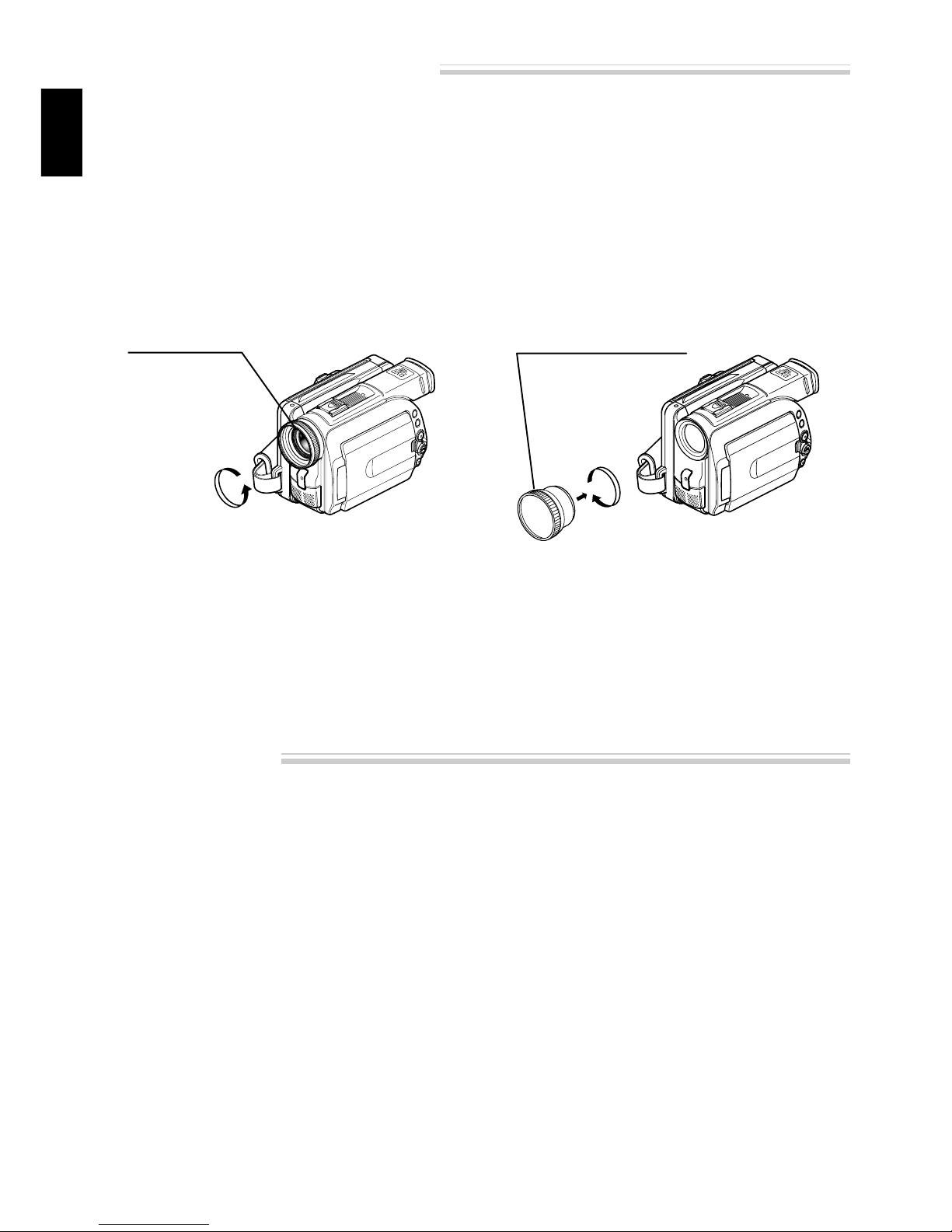
48
ENGLISH
Focusing When Recording Movie
This DVD video camera/recorder automatically focuses a subject at the center of screen (auto-focus).
When the DVD video camera/recorder is turned on, auto-focus will always be set.
Focusing range
You can switch the display mode of on-screen information:
• On T (tele) side: approximately 1 m from lens surface to infinity
• On W (wide) side: approximately 1 cm from lens surface to infinity
● How to install conversion lens (optional)
The installation screw diameter of this lens is 37 mm.
1
Remove the lens hood from the DVD video cam-
era/recorder.
2
Remove the lens cap from the conversion lens
and screw it all the way into the filter screw of
the DVD video camera/recorder.
Lens hood Conversion lens
Note: Be careful not to lose the lens hood.
Note: If the optional tele-conversion lens (DZ-TL1) is attached over the lens, the range where a subject is
focused at T end (telephoto side) will be from approximately 5 m to infinite.
Note: If the optional tele-conversion lens (DZ-TL1) is attached over the lens, the four corners of screen will
be darker (vignetting) on W (wide-angle) side when a subject is zoomed in.
Macro Recording
Use the macro function when recording a small object from close-up position: You can shoot the subject
as close as approximately 1 cm from the lens surface, magnifying the image to fill the screen.
A
im the DVD video camera/recorder at the sub-
ject, and press down the zoom lever to “W” con-
trol side.
Note: Zoom can be used, but the subject may
not be focused, depending on the distance to the
subject.
Note: The amount of light tends to be insufficient
during macro recording: If the subject image is too
dark, use additional lighting.
(To remove)
(To attach)
Downloaded from www.ManualsFile.com manuals search engine
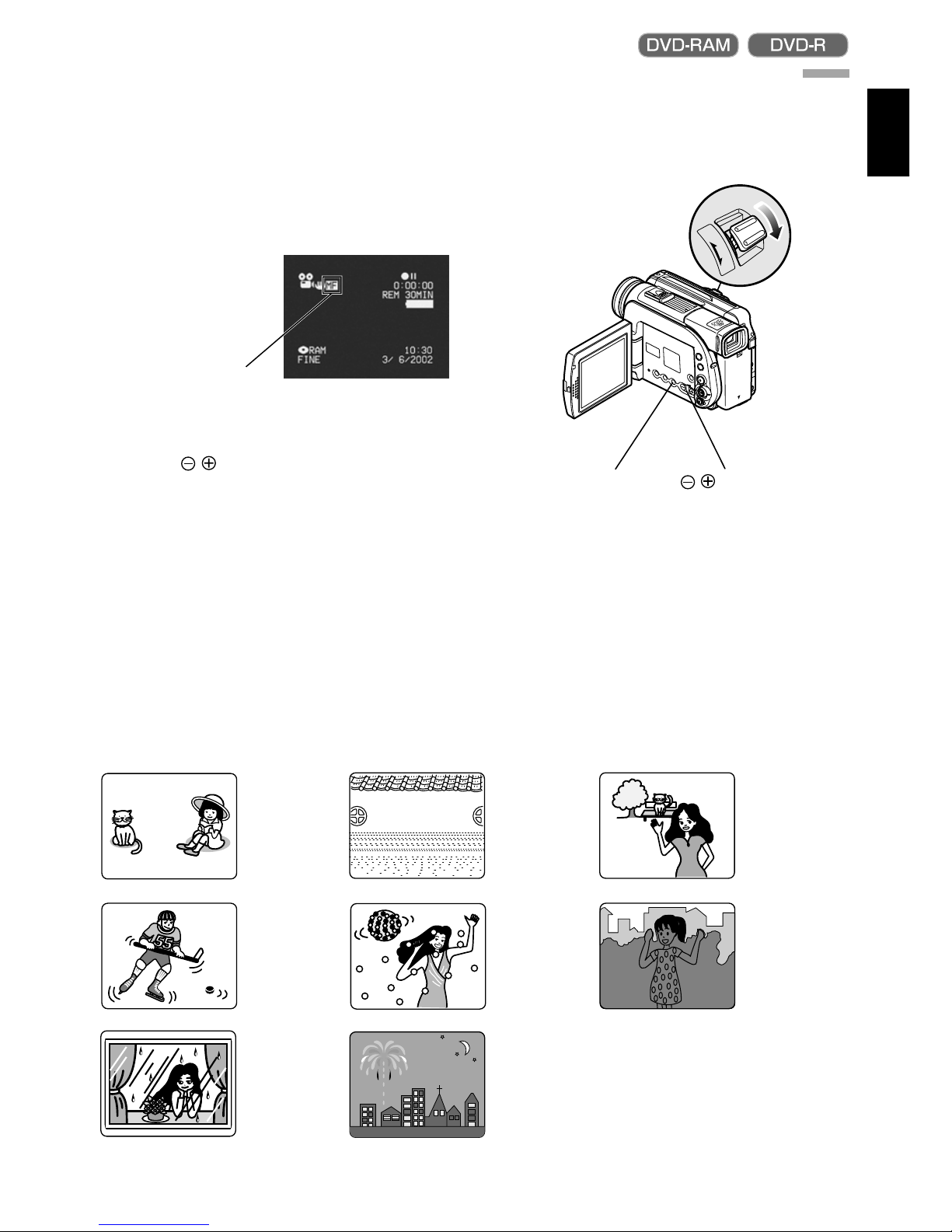
49
ENGLISH
The DVD video camera/recorder measures the distance to a subject viewed at the center of screen and
automatically focuses on it. If you want to record by adding special effects or focusing on a subject image
off the center of screen, adjust the focus manually.
1
Press the FOCUS button in the recording pause
status.
“MF” will appear on the screen.
2
Press the zoom lever down to “T” control side
to zoom in on subject.
3
Use the buttons to adjust the focus, while
viewing the image in the viewfinder or on the
LCD screen.
Note: Pressing FOCUS will alternate between
manual focus and auto focus. With auto focus, no
indication will appear on the screen.
Note: Be sure to zoom up to your subject only
when manually focusing on it. If you bring the sub-
ject into focus at the wide-angle position, focus
will be incorrect when you zoom up to the sub-
ject.
Note: Manual focus is released when the DVD
video camera/recorder is turned off. When you
turn the DVD video camera/recorder on next time,
auto focus will be restored.
FOCUS button
buttons
W
T
Manually Focusing Subject during Movie Recording
Objects not
in the
center of
screen
Objects that
are far and
near at the
same time
Objects lit by
neon sign,
spotlight, etc.
which glares
or emits
strong light
Object
behind
glass with
water
droplets, dirt
on it
Objects with
little
variation in
brightness,
such as
white wall
Objects
moving
rapidly
Dark objects
Manually focus the following objects, which may not be automatically focused (see p. 48):
Night view
Manual Focus icon
Downloaded from www.ManualsFile.com manuals search engine
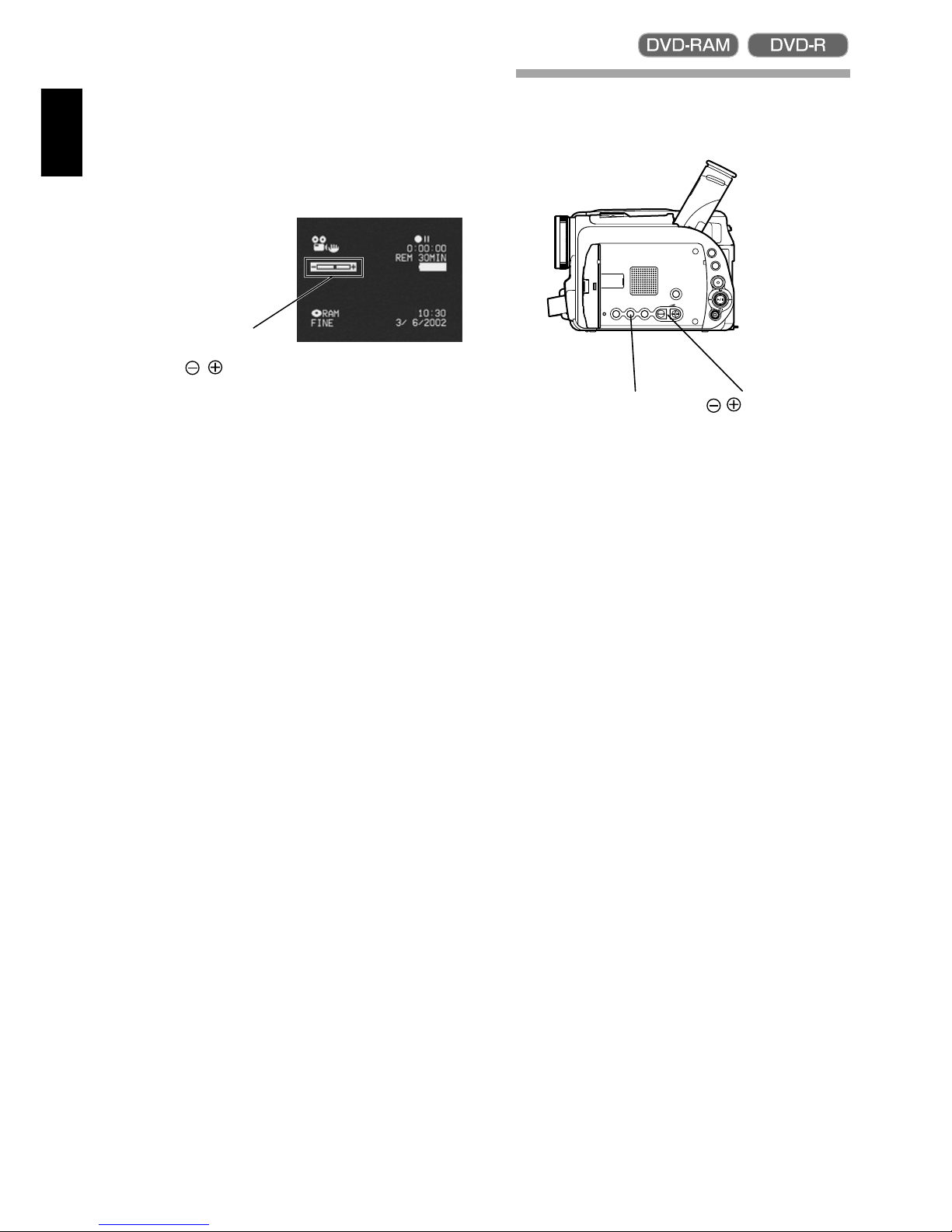
50
ENGLISH
This DVD video camera/recorder measures the subject brightness and automatically adjusts the exposure.
You can also adjust the exposure manually when the subject is lit from rear or for special effects recording.
1
Press the EXPOSURE button in the recording
pause status.
The exposure indicator
will appear on the
screen.
2
Use the buttons to adjust the exposure,
while viewing the image in the viewfinder or
on the LCD screen.
3
Press the REC button to start recording.
Note: Pressing EXPOSURE will alternate between
manual adjustment and auto exposure. With auto
exposure, no indication will appear on the screen.
Note: The exposure setting will return to Auto
when the DVD video camera/recorder is turned
off.
Adjusting Exposure Manually
Exposure indicator
EXPOSURE button
buttons
Downloaded from www.ManualsFile.com manuals search engine
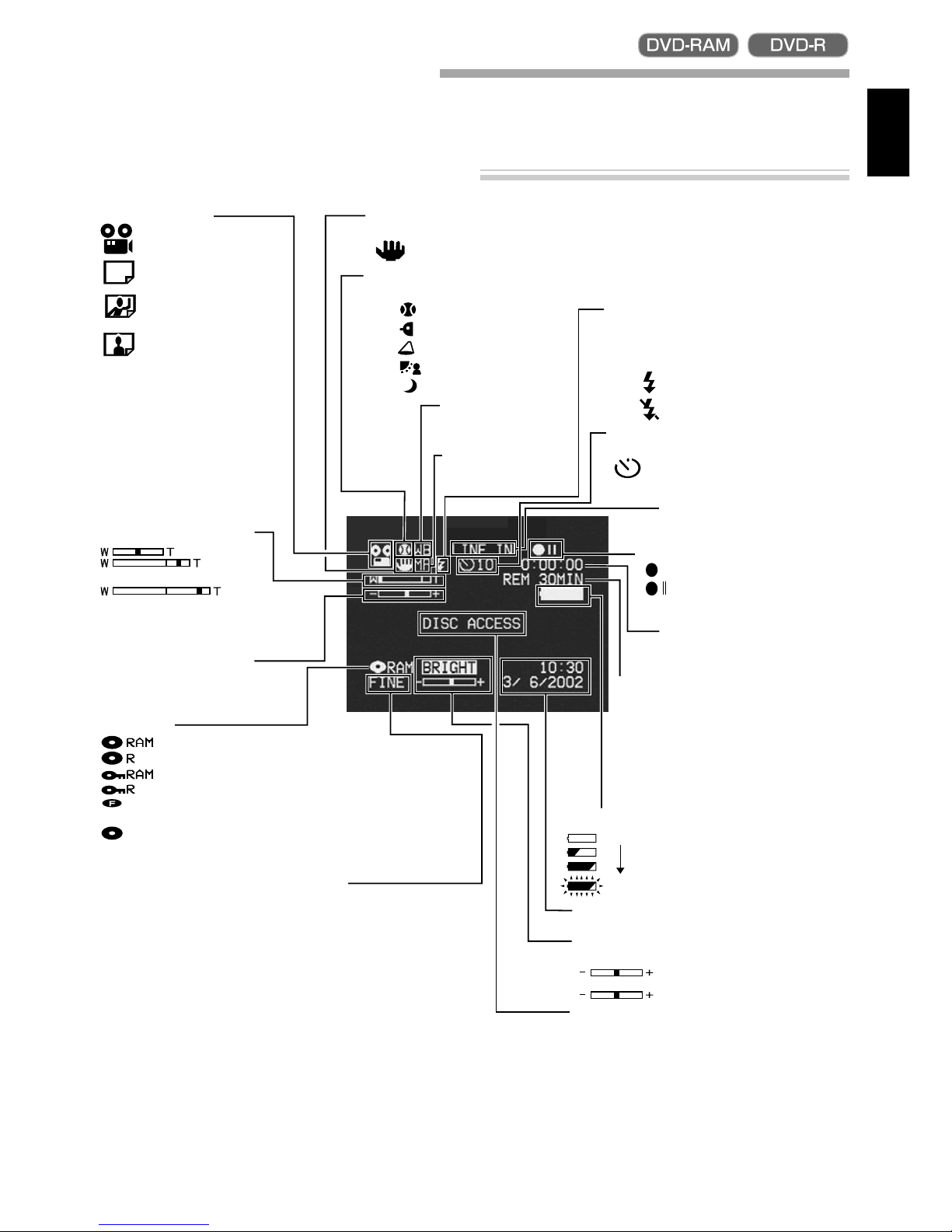
51
ENGLISH
Various types of information will appear in the viewfinder or on the LCD screen during recording and
playback.
On-Screen Information
Information Display During Recording
Remaining speace on disc*
REM XX MIN :Remaining record-
able minutes during
movie recording
REM XX** :Number of remain-
ing recordable still
images during still
recording
* No remaining time will be displayed with a write-protected disc or finalized DVD-R disc.
** The displayed number of recordable stills is for reference: The decreasing number may not be correct, depend-
ing on recording condition (not displayed with a DVD-R disc).
*** When no disc is in the DVD video camera/recorder, or disc has not yet been initialized, write-protected disc or
disc with no remaining space has been inserted.
**** Will not appear when a disc that cannot be used in this DVD video camera/recorder is inserted.
Electronic image stabilizer (EIS) (only in movie recording mode)
No display : EIS OFF
: EIS ON
Self-timer (only in still recording mode)
No display :Self-timer OFF
:Self-timer ON (count is
from 10 seconds)
External flash [when Video Flash
(sold separately) is attached] (only in
still recording mode)
No display :Emits light automatically
:Always emits light
:No light emission
Disc type
:DVD-RAM
:DVD-R
:DVD-RAM (write-protected)
:DVD-R (write-protected)
:DVD-R disc already finalized on this DVD
video camera/recorder
:DVD-R disc finalized on a device other than
this DVD video camera/recorder
No display****
Warning message
Brightness of LCD screen/Volume
:Brightness of LCD screen
:Volume
Current date/time
Movie recording time
(only in movie recording
mode)
White balance
No display : Auto
WB : Hold
BRIGHT
VOLUME
Remaining battery level
(full charge)
(low remaining charge)
Program AE (only in movie recording mode)
No display :Auto
:Sports
:Portrait
:Spotlight
:Sand & Snow
:Low Light
Exposure correction
When operating zoom
(When digital zoom is 48×)
(When digital zoom is 240×)
(only in movie recording mode)
External input
LINE IN :AV input
S LINE IN :S-VIDEO input
Recording mode
: Movie
: Still (with DVD-
RAM disc only)
: External input still
(field) (with DVD-
RAM disc only)
: External input still
(frame) (with DVD-
RAM disc only)
Movie recording mode
XTRA : Highest quality (only when using
DVD-RAM disc)
FINE :High quality
STD :Standard
Manual focus
No display:Autofocus
MF :Manual focus
Operating status
REC : During recording
:
During recording pause
No display***
Downloaded from www.ManualsFile.com manuals search engine
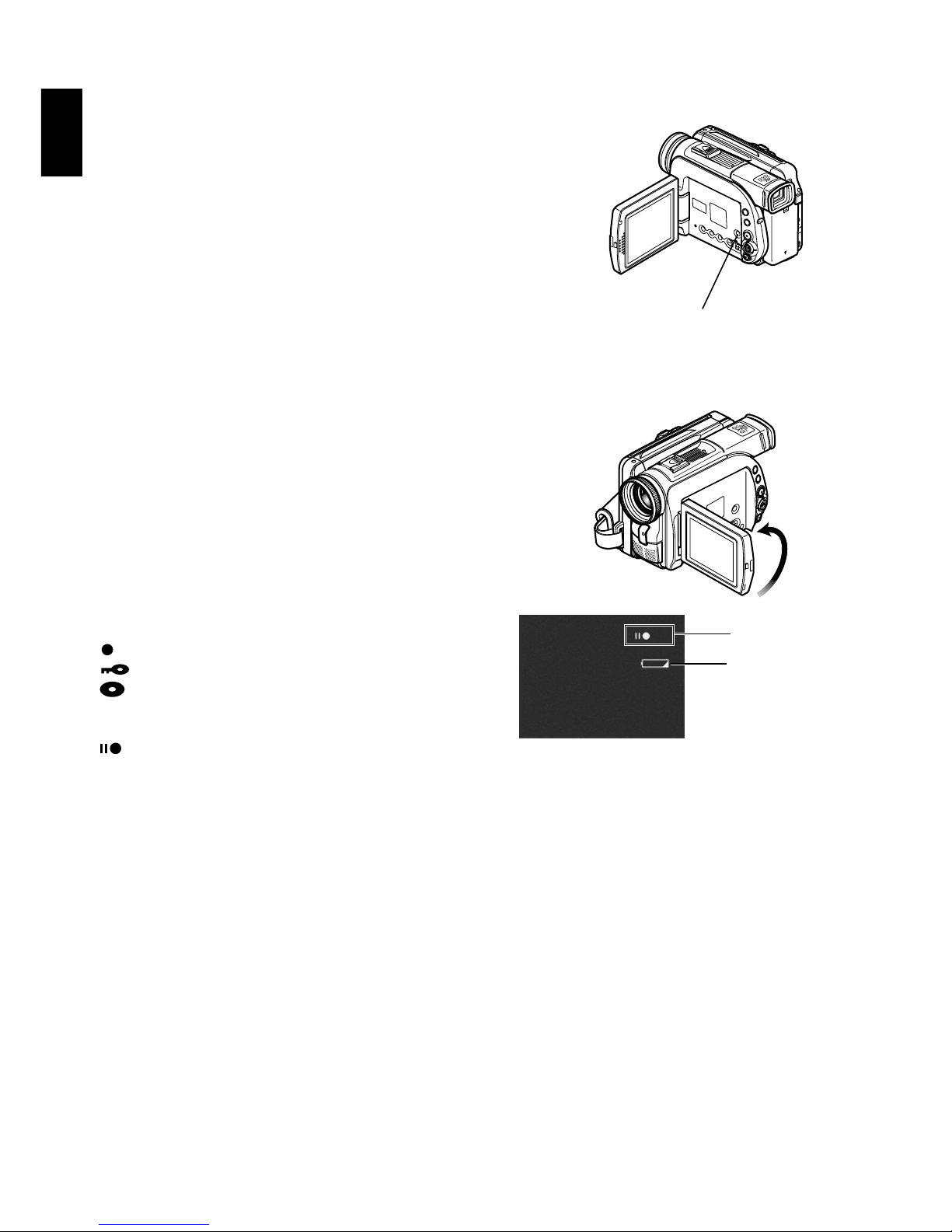
52
ENGLISH
● Switching the information display mode
You can switch the display mode of on-screen information:
Press the DISPLAY button.
• Full display mode: All types of information will appear.
• Minimum display mode: Only the recording mode, status
display and warning will appear.
The full and minimum display modes will alternate.
Note: The DVD video camera/recorder does not record the
recording date/time as a part of image. However, this informa-
tion when recording will be recorded with image as data which
can be checked on Disc Navigation screen during playback.
(See “Information display during playback” on page 53.)
● Display when recording an image of yourself
When recording with the LCD screen facing the same
direction as the lens, only the operating status and bat-
tery remaining level will appear, and the battery remain-
ing level will appear only when the battery has almost
no remaining charge.
The following operating status indicator will blink to
give warning message to user. The message can be
checked when returning the LCD monitor 180° to the
original status from the status in which the LCD screen
was facing the same direction as the lens.
:The disc has almost no free space.
:Write-protected disc is loaded.
:You are attempting to record a still on
DVD-R disc.
No display :Disc that cannot be used has been loaded.
:The disc is full, or you are attempting to
record a copy-guarded image.
Note: If the LCD screen is set facing the same direc-
tion as the lens, the LCD screen will display a mirror im-
age (left and right reversed).
Note: If the LCD screen is set facing the same direc-
tion as the lens, you can also view subject image in the
viewfinder.
DISPLAY button
Operating status/
warning message
Battery
remaining
level
Downloaded from www.ManualsFile.com manuals search engine
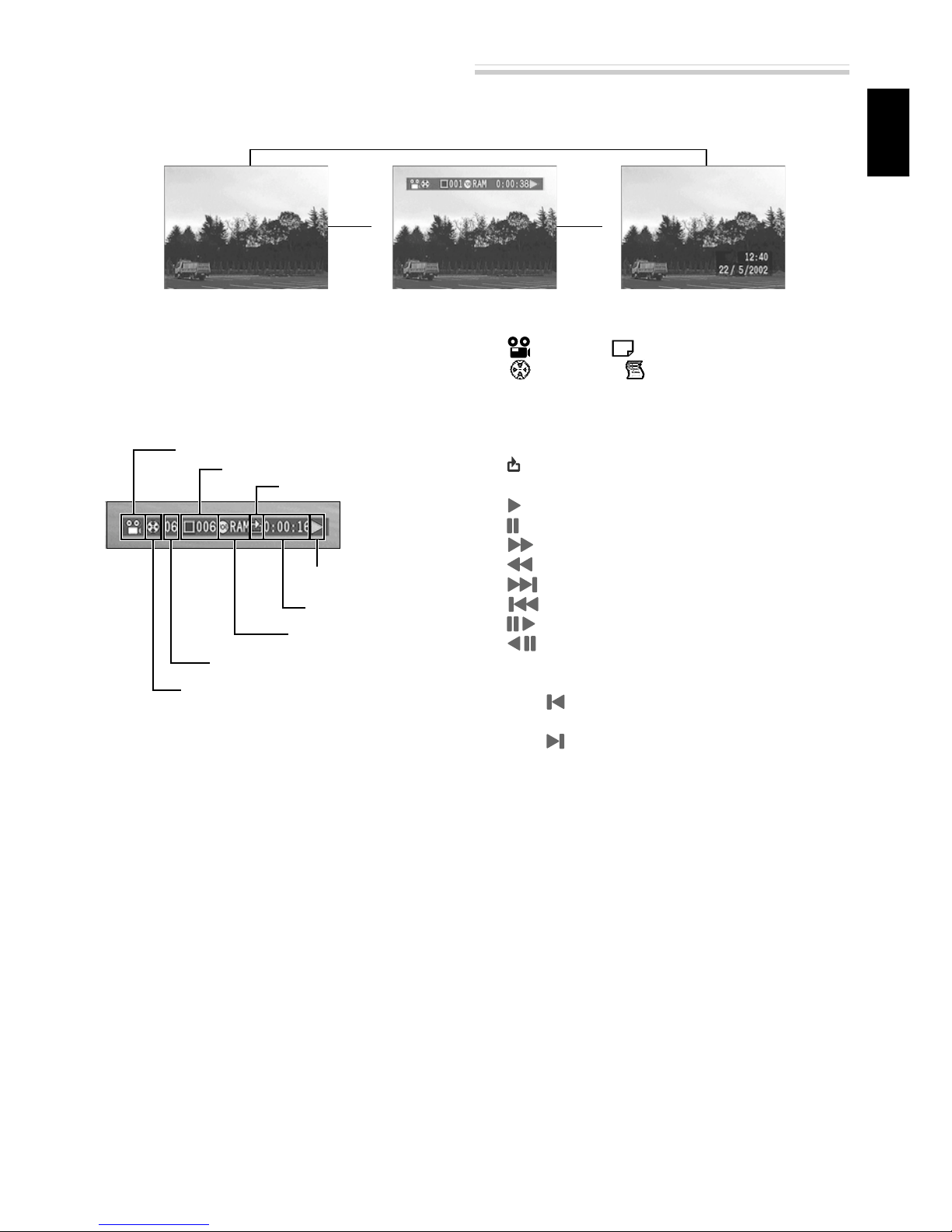
53
ENGLISH
Information Display During Playback
Various types of information on recording will be superimposed on playback image you are viewing in
the viewfinder or on the LCD screen.
● Switching the information display
mode
Press the DISPLAY button: You can switch the dis-
play mode of on-screen information.
Playback information
display
Recording date/time
↓
→ →
No display
*
1
VIDEO or PHOTO
*
2
Program or Play List
*
3
Number of program or play list being played
back (not displayed when all programs are be-
ing played back)
*
4
Refer to “Disc type” on page 51.
*
5
: Will appear when “Repeat play :On” is
specified
*
6
: Standard playback
: Playback pause
: Forward search playback
: Reverse search playback
: Forward skip playback
: Reverse skip playback
: Forward frame advance
: Reverse frame back
Refer to “Playback” beginning on page 44 for
how to operate.
The “ ” mark will appear on the first image on
disc.
The “ ” mark will appear on the last image on
disc.
• Playback information display: Shows the status
of DVD video camera/recorder during playback.
• Recording date/time display: Shows the date/
time when recording was started.
• No display: No information will appear. How-
ever, when the mode of playback operation is
switched, the symbol will appear for approx. 3
seconds.
Recording mode*
1
Scene No.
Repeat play*
5
Playback operation*
6
Counter
Disc type*
4
Program or Play List *
2
Program No. or Play List No. *
3
Downloaded from www.ManualsFile.com manuals search engine
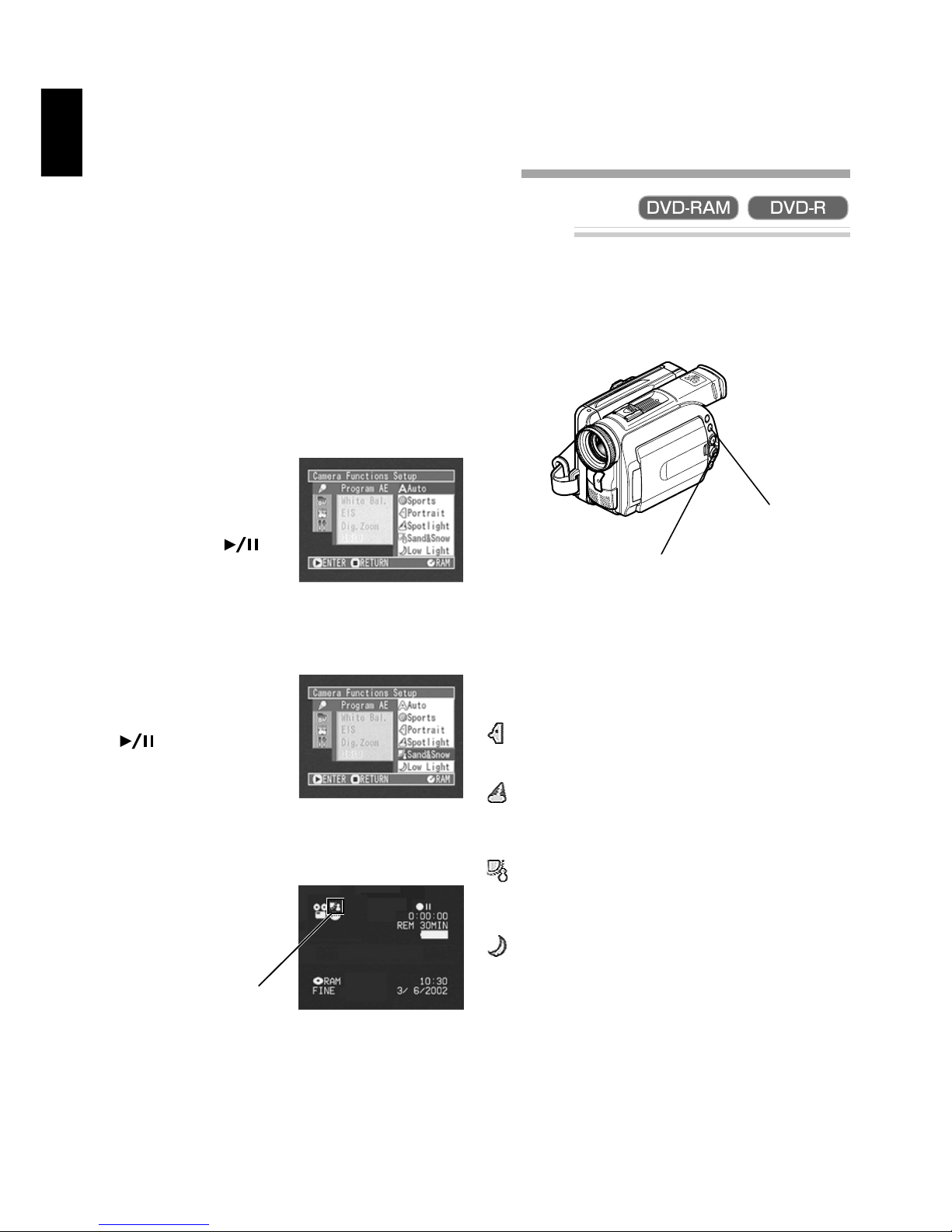
54
ENGLISH
1
Press the MENU button in the recording pause
status.
The menu screen will appear.
2
Use the joystick to
choose “Program AE”
on the “Camera Func-
tions Setup” screen, and
then press the but-
ton.
The options will appear
on the right of “Program
AE”.
3
Use the joystick to
choose the desired op-
tion, and then press the
button: The se-
lected option will be set.
You can check the selected AE mode by the on-
screen information display. However, nothing
will appear in the Auto mode.
4
Press the MENU button.
The menu screen will disappear.
Note: The shooting mode set as above will be
stored in memory even if the DVD video camera/
recorder is turned off.
Selecting Shooting Mode to Match the Subject
(Switching Program AE Mode)
This DVD video camera/recorder automatically sets the shutter speed and aperture according to the
subject brightness for optimum recording: You can also specify one of six modes depending on the sub-
ject conditions, recording environment or purpose of filming.
Auto : The camera/recorder automatically
judges the subject and surrounding environ-
ment for optimum recording.
Sports : Reduces blurring when recording
rapidly moving subjects such as in golf or
tennis.
Portrait : Makes a subject, such as a
person or a creature, stand out from a
blurred background.
Spotlight : Prevents overexposure of
subject portrait face, etc. when strong light
strikes the subject, as in a wedding or on
stage.
Sand & Snow : Prevents underexposure of
subject portrait face, etc. in a place where
reflection of light is intense, such as at the
seaside in midsummer or on a ski slope.
Low Light : Allows user to record in a dark
place even with decreased lighting: How-
ever, an after-image will appear with a
moving subject.
However, note that the Low Light mode
cannot be used when the recording quality
mode is STD.
MENU button
Joystick
Selected AE mode
Setting Up Camera Functions
Advanced Techniques
This section explains about various settings to further extend the usefulness of this DVD video camera/
recorder.
Downloaded from www.ManualsFile.com manuals search engine
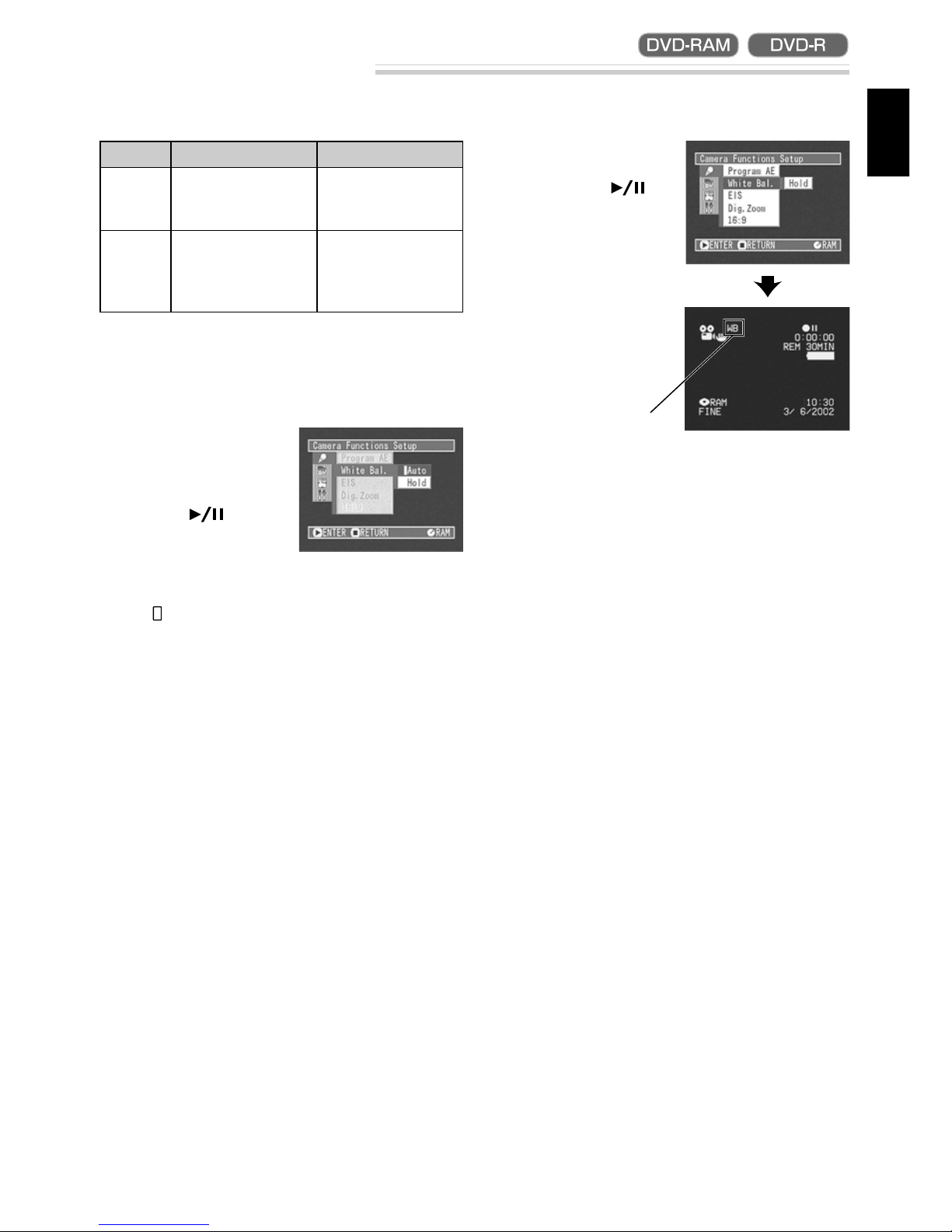
55
ENGLISH
White Balance (Auto/Hold)
With this DVD video camera/recorder you can switch the white balance between Auto and Hold.
1
Press the MENU button in the recording pause
status.
The menu screen will appear.
2
Use the joystick to
choose “White Bal.” on
the “Camera Functions
Setup” screen, and then
press the button.
Options will be displayed on the right of “White
Bal.”.
The mark will be attached to the currently se-
lected option.
3
Use the joystick to select
“Auto” or “Hold”, and
then press the but-
ton.
If White Balance is set to
“Hold”, “WB” will ap-
pear on the screen.
4
Press the MENU button.
The menu scree will disappear.
The white balance setting will always be “Auto”
when the DVD video camera/recorder is turned
off.
Mode
Auto
Hold
Details of setting
White balance is
always adjusted
automatically.
White balance
at the time
when “Hold” is
selected is held.
On-screen display
no display
WB
White balance mode
Downloaded from www.ManualsFile.com manuals search engine
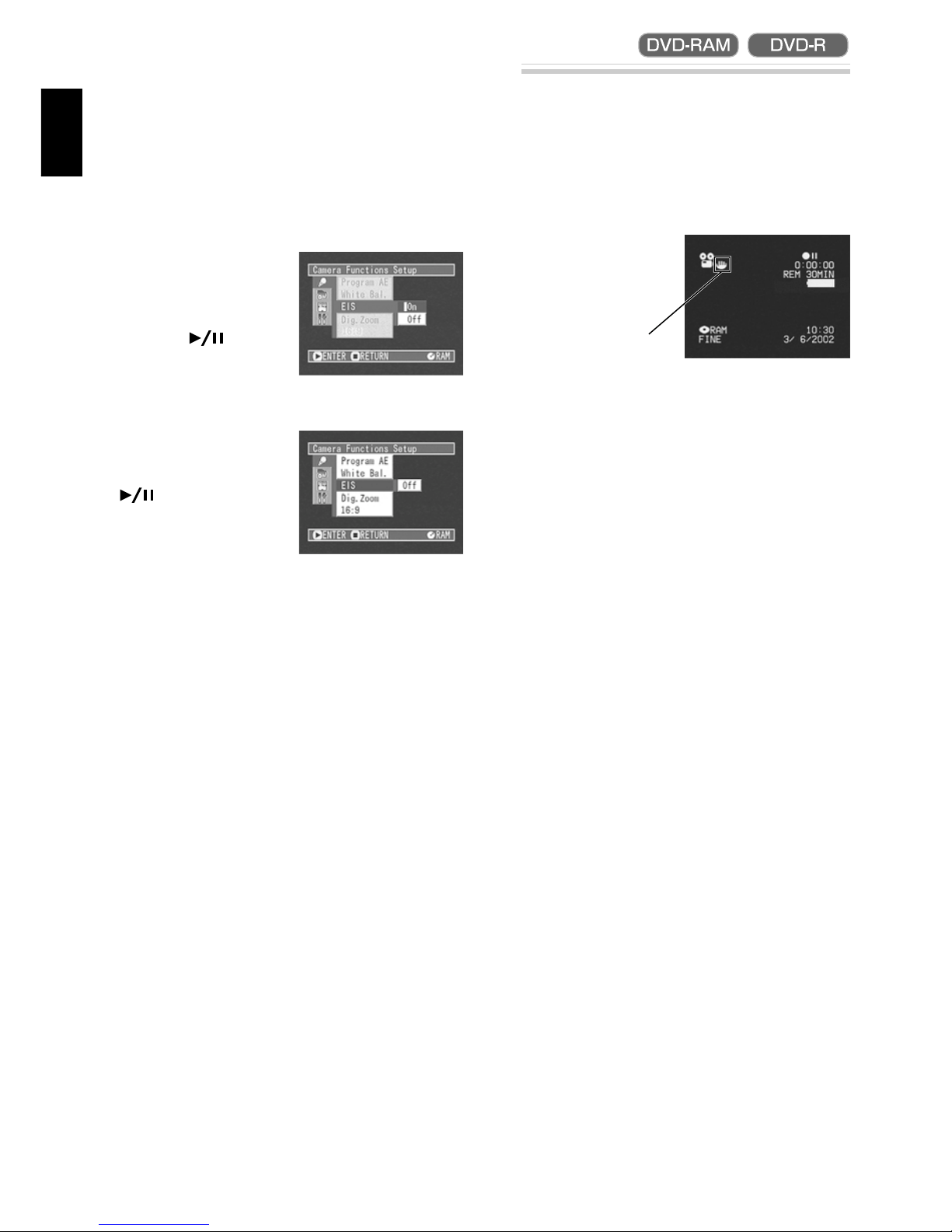
56
ENGLISH
● Checking EIS On or Off
You can check EIS On or Off by the on-screen in-
formation display.
After recording with EIS set to “Off”, it is recom-
mended that you return the setting to “On” and
then turn the DVD video camera/recorder off, un-
less you normally record with “Off” setting.
This function is effective only during movie record-
ing: It will not work during still recording.
Note: The EIS setting will not change if the DVD
video camera/recorder is turned off.
Note: Although you can switch EIS between on
and off during still recording, the setting will be ef-
fective only during movie recording.
Note: It is recommended that you specify “EIS
Off” when using the DVD video camera/recorder
on a desk or tripod.
Note: When “EIS On” is specified, there will be a
slight difference between the actual movement
and the movement on screen.
Note: Gross camera shake may not be entirely
corrected even if “EIS On” is specified.
Note: EIS may not operate correctly when the
conversion lens (optional) is used.
1
Press the MENU button in the recording pause
status.
The menu screen will appear.
2
Use the joystick to
choose “EIS” on the
“Camera Functions
Setup” screen, and then
press the button.
The options will appear
on the right of “EIS”.
3
Use the joystick to
choose the desired op-
tion, and then press the
button: The se-
lected option will be set.
4
Press the MENU button.
The menu screen will disappear.
Using the Electronic Image Stabilizer (EIS)
This DVD video camera/recorder is equipped with an electronic image stabilizer function: When you
use zoom to record a magnified subject image, it will correct fuzziness in the recorded image.
EIS
Downloaded from www.ManualsFile.com manuals search engine
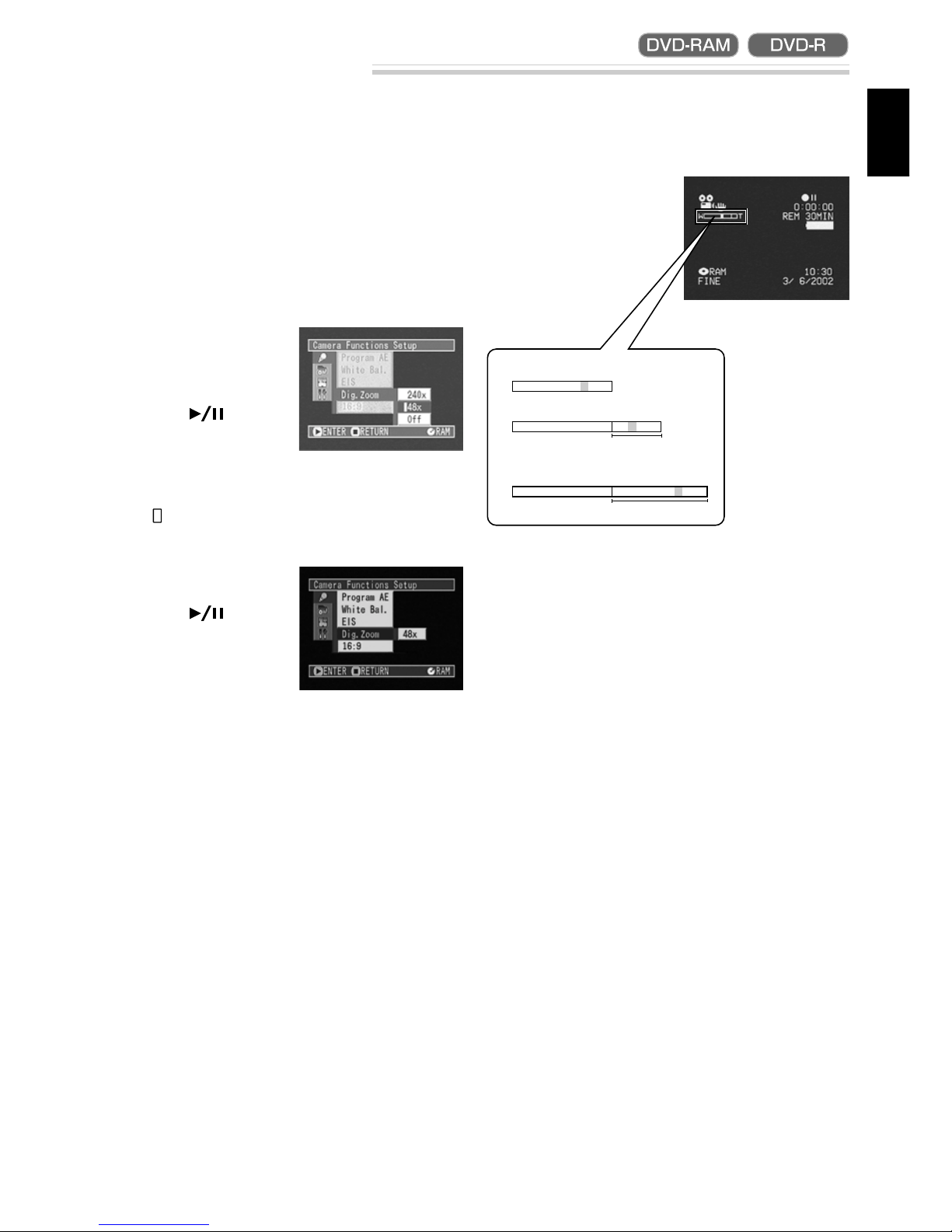
57
ENGLISH
Switching Digital Zoom Off
When the zoom lever is moved down to “T” control side with Dig. Zoom 48x or 240x specified, digital
zoom will automatically kick in when optical 12x zoom range is exceeded. You can set the digital zoom
to 48x or 240x for movie recording, or 48x for still recording.
1
Press the MENU button in the recording pause
status.
The menu screen will appear.
Note: Pressing MENU during recording will not dis-
play the menu screen.
2
Use the joystick to
choose “Dig. Zoom” on
the “Camera Functions
Setup” screen, and then
press the button.
Options will be displayed on the right of “Dig.
Zoom”.
The mark will be attached to the currently se-
lected option.
3
Use the joystick to
choose “Off”, and then
press the button.
4
Press the MENU button.
The menu screen will disappear.
Dig. Zoom “240x”, “48x” or “Off” setting will
be stored in memory even if the DVD video cam-
era/recorder is turned off.
Note: The subject image will be slightly rougher
in the digital zoom range.
Note: You can check whether Dig. Zoom is “240x”,
“48x” or “Off” by pressing the DISPLAY button and
reviewing the on-screen information.
Note: You can also use the DIGITAL ZOOM but-
ton on remote control to switch the digital zoom
setting: Pressing the button in the movie recording
mode will switch the setting between “Off”, “48x”
and “240x”: Pressing the button in still recording
mode will switch between “Off” and “48x”.
TW
W
W
T
T
When Dig. Zoom is “Off”
Digital zoom range
When Dig. Zoom is “On” (240x)
(only in movie recording mode)
When Dig. Zoom is “On” (48x)
Digital zoom range
Downloaded from www.ManualsFile.com manuals search engine
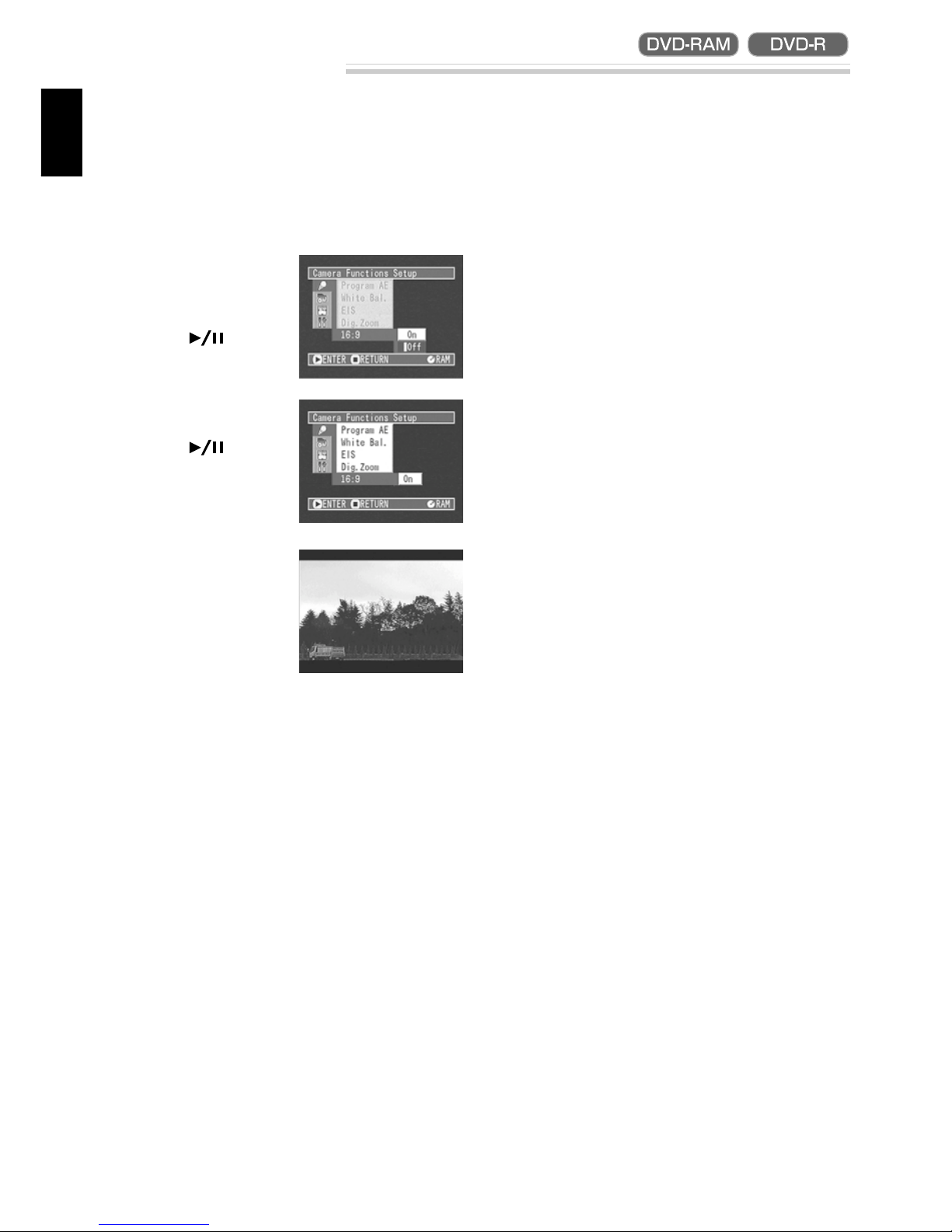
58
ENGLISH
Note: The black bands that appear across the
top and bottom of screen will not be recorded. If
you record in the 16:9 mode and play back on a
TV other than wide-screen TV, the portions masked
by the black bands will also be displayed. Use the
black bands as a guide for recording when play-
ing back on a wide-screen TV.
1
Press the MENU button in the recording pause
status.
The menu screen will appear.
2
Use the joystick to
choose “16:9” on the
“Camera Functions
Setup” screen, and then
press the button.
3
Use the joystick to
choose “On”, and then
press the button.
4
Press the MENU button..
The menu screen
will disappear.
Black bands will
appear across the top
and bottom of screen.
Switching to 16:9 Mode
If you intend to play back recorded images on a wide-screen TV, it is recommended that you switch the
screen size to 16:9 mode.
Downloaded from www.ManualsFile.com manuals search engine
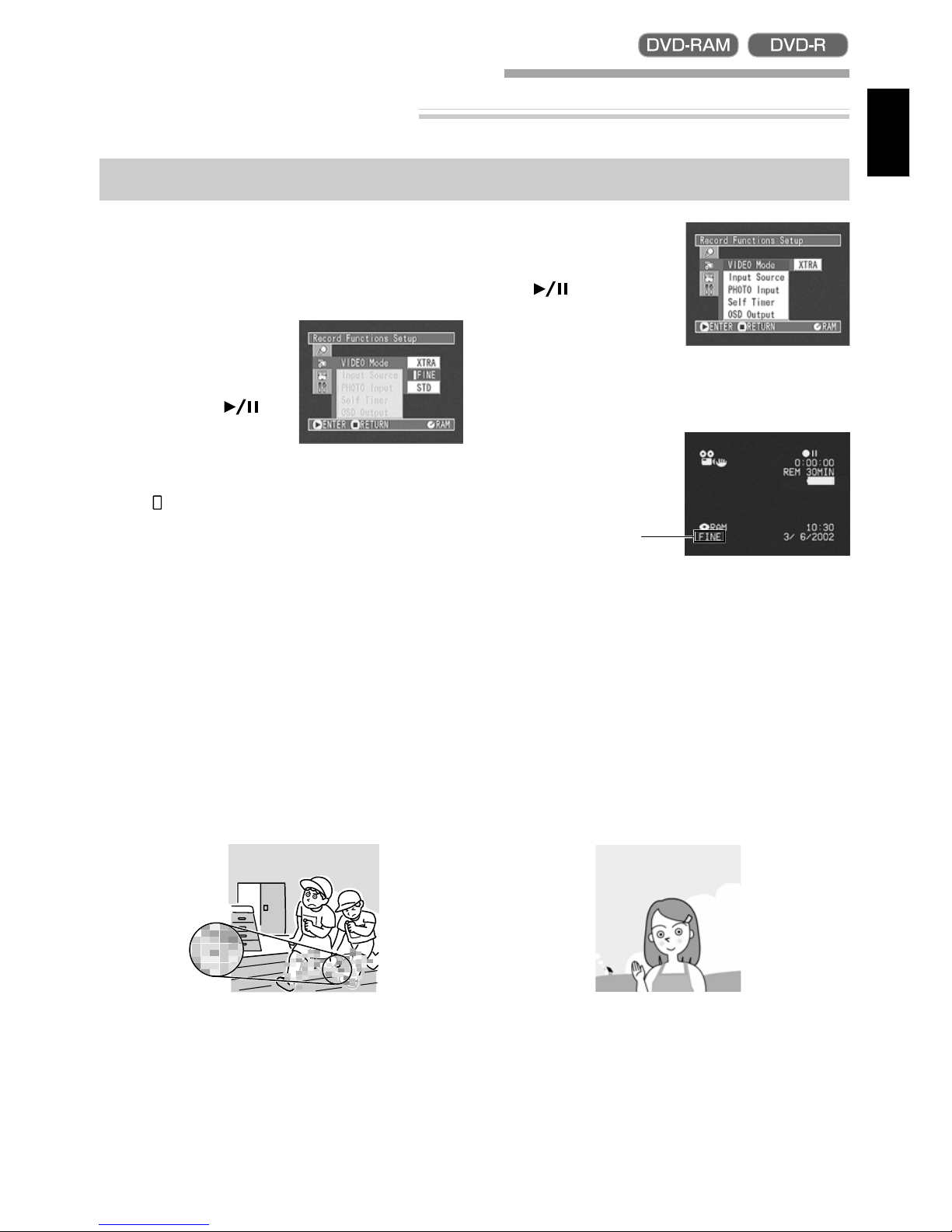
59
ENGLISH
Switching Movie Quality Mode
Choose the movie quality from “XTRA” (only with DVD-RAM disc), “FINE” and “STD”.
However, it is recommended that you record critical subjects in the “XTRA” or “FINE” mode when you
are using a DVD-RAM disc, or in the “FINE” mode with a DVD-R disc.
1
Press the MENU button in the recording pause
status.
The menu screen will appear.
2
Use the joystick to
choose “VIDEO Mode”
on the “Record Func-
tions Setup” screen, and
then press the but-
ton.
Options will be displayed on the right of
“VIDEO Mode”.
The mark will be attached to the currently se-
lected option.
3
Use the joystick to select
the desired quality
mode, and then press
the button.
4
Press the MENU button.
The menu screen will disappear.
Note: The “VIDEO Mode” setting will not change
even after the DVD video camera/recorder is
turned off. However, if “XTRA” has been set with
DVD-RAM disc, “FINE” will be set when the disc is
changed.
Setting Up Record Functions
Block-like noise may appear in recorded image, or the outline of subject image is distored under the
recording conditions listed below: Pan the DVD video camera/recorder as slowly as possible. (Block
noise is likely to appear in the “STD” mode):
•If there is a complicated pattern in background
•If the DVD video camera/recorder is panned or tilted greatly or rapidly
•If subject is moving rapidly even when the DVD video camera/recorder is not moving (as in following
figure on left)
(Image when block-like noise occurs)
(Image without block-like noise)
Movie quality mode
Downloaded from www.ManualsFile.com manuals search engine
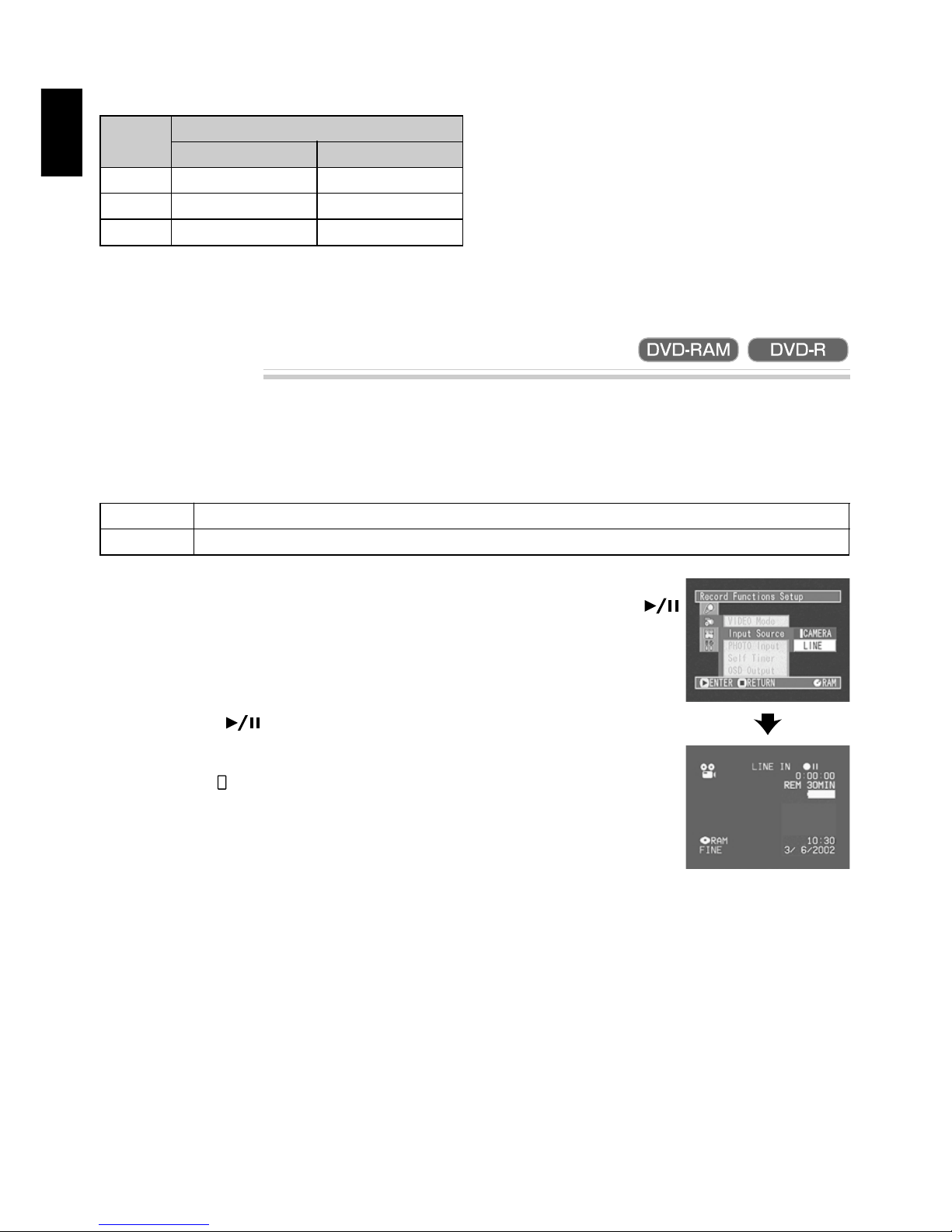
60
ENGLISH
● Recordable times in each movie
quality mode (on one side of disc)
Quality
mode
XTRA*
FINE
STD
Disc used
DVD-RAM
approx. 18~60 min
approx. 30 min
approx. 60 min
DVD-R
—
approx. 30 min
approx. 60 min
Note: When using DVD-R disc, you cannot switch
the movie quality mode during recording on the
disc: The DVD video camera/recorder will be au-
tomatically set to the quality mode first used with
the disc for recording.
Note: The setting of movie quality mode is effec-
tive only during movie recording: Switching the
mode will not work during still recording.
The recordable times are only for reference.
* The recordable times will vary depending on
recording contents.
Input Selection
If you wish to input an image from another device to this DVD video camera/recorder, you must first
switch the setting on the DVD video camera/recorder.
Refer to the explanation starting from page 93 on how to connect the DVD video camera/recorder to
other devices or record images input from them.
CAMERA
LINE
Usually select this option.
To view image from another device on this DVD video camera/recorder
1
Press the MENU button in the recording pause
status.
The menu screen will appear.
2
Use the joystick to choose “Input Source” on the
“Record Functions Setup” menu screen, and
then press the button.
The options will appear on the right of “Input
Source”: The mark will be attached to the cur-
rently selected option.
3
Select the desired option
and then press the
button: The selected op-
tion will be set.
4
Press the MENU button.
The menu screen will
disappear.
Note: The “Input Source” setting will return to
“CAMERA” whenever the DVD video camera/re-
corder is turned off.
Downloaded from www.ManualsFile.com manuals search engine
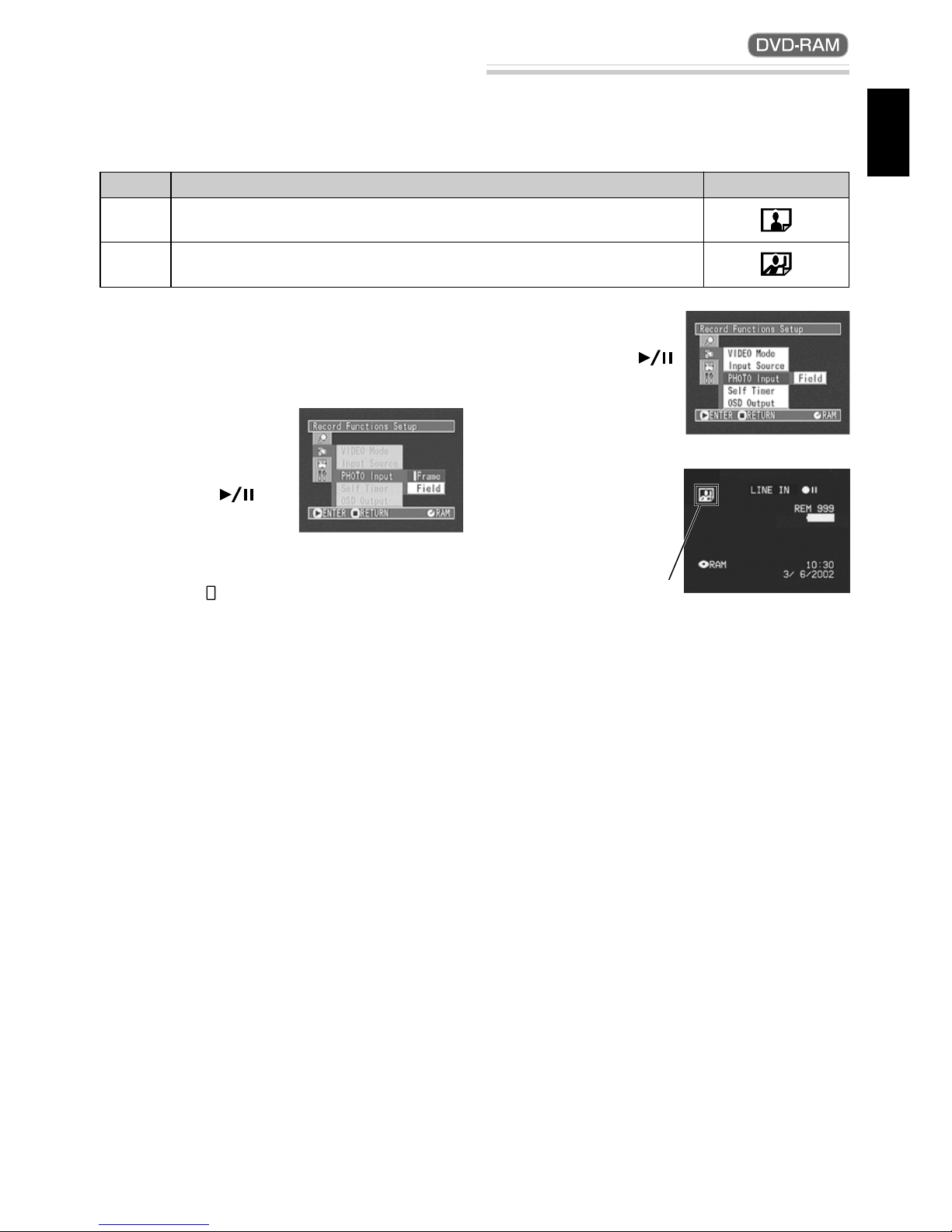
61
ENGLISH
Changing Method for Recording Stills
You can record stills of externally input images on a DVD-RAM disc in the Frame or Field mode. The
DVD video camera/recorder can record an external image with little movement by specifying "Frame",
but "Field" is recommended for recording image with movement.
1
Press the MENU button in the recording pause
status.
The menu screen will appear.
2
Use the joystick to
choose “PHOTO Input”
on the “Record Func-
tions Setup” screen, and
then press the but-
ton.
The options will appear
on the right of “PHOTO
Input”: The mark will
be attached to the cur-
rently selected option.
Mode
Frame
Field
Details of setting
Does not suit recording of frequently moving video subjects, de-
spite high image quality. Frame suits recording of less moving video.
Suitable for recording of frequently moving video subjects.
On-screen display
3
Use the joystick to se-
lect the desired option,
and then press the
button.
The selected option will
be set.
You can check the still
recording format of ex-
ternal input image by
reviewing the on-
screen information.
4
Press the MENU button.
The menu screen will disappear.
Still external input mode
Downloaded from www.ManualsFile.com manuals search engine
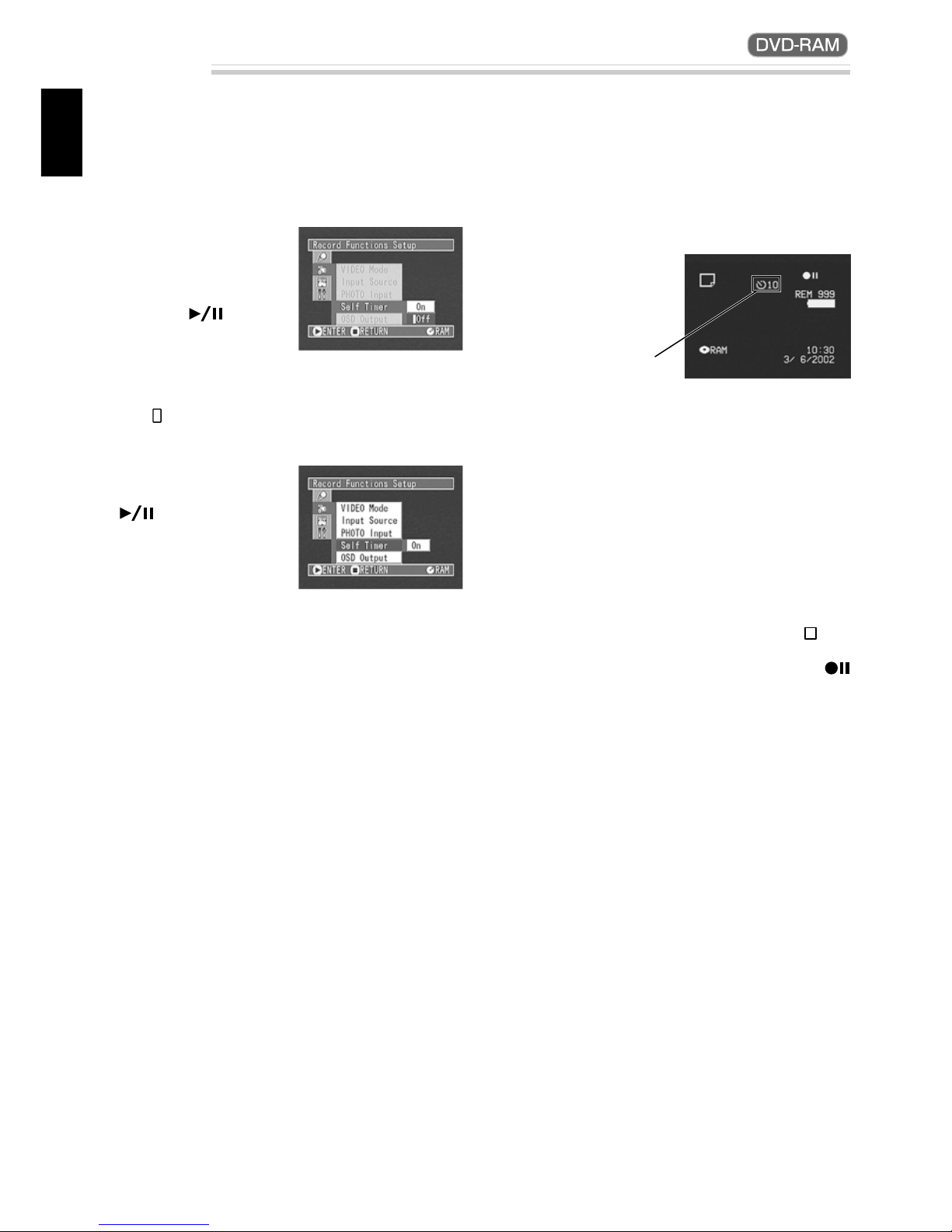
62
ENGLISH
Self-Timer
You can record stills of yourself alone or with your family, friends, etc., using the self-timer function, as
with ordinary cameras. A still will be recorded approximately 10 seconds after the REC button is pressed.
1
Press the MENU button.
The menu screen will appear.
2
Use the joystick to
choose “Self Timer” on
the “Record Functions
Setup” screen, and then
press the button.
Options will be displayed on the right to “Self
Timer”.
The mark will be attached to the currently se-
lected option.
3
Use the joystick to select
“On”, and then press the
button.
4
Press the MENU button.
The menu screen will disappear.
You can also check that self-timer has been set
by reviewing the on-screen information.
5
Press the REC button.
The recording indicator at the front of DVD
video camera/recorder will blink.
The self-timer indicator will start to count down,
and recording will commence approximately 10
seconds later.
Note: To release the self-timer mode, choose
“Off” on the menu screen or turn DVD video cam-
era/recorder off.
Note: To suspend self-timer, press the REC button
again before recording starts, or press the
but-
ton.
Note: When the REC button is pressed, the
mark on LCD screen will be pink. It will also change
in the same way when recording with the LCD
screen facing the same direction as the lens.
Self-timer recording
Downloaded from www.ManualsFile.com manuals search engine
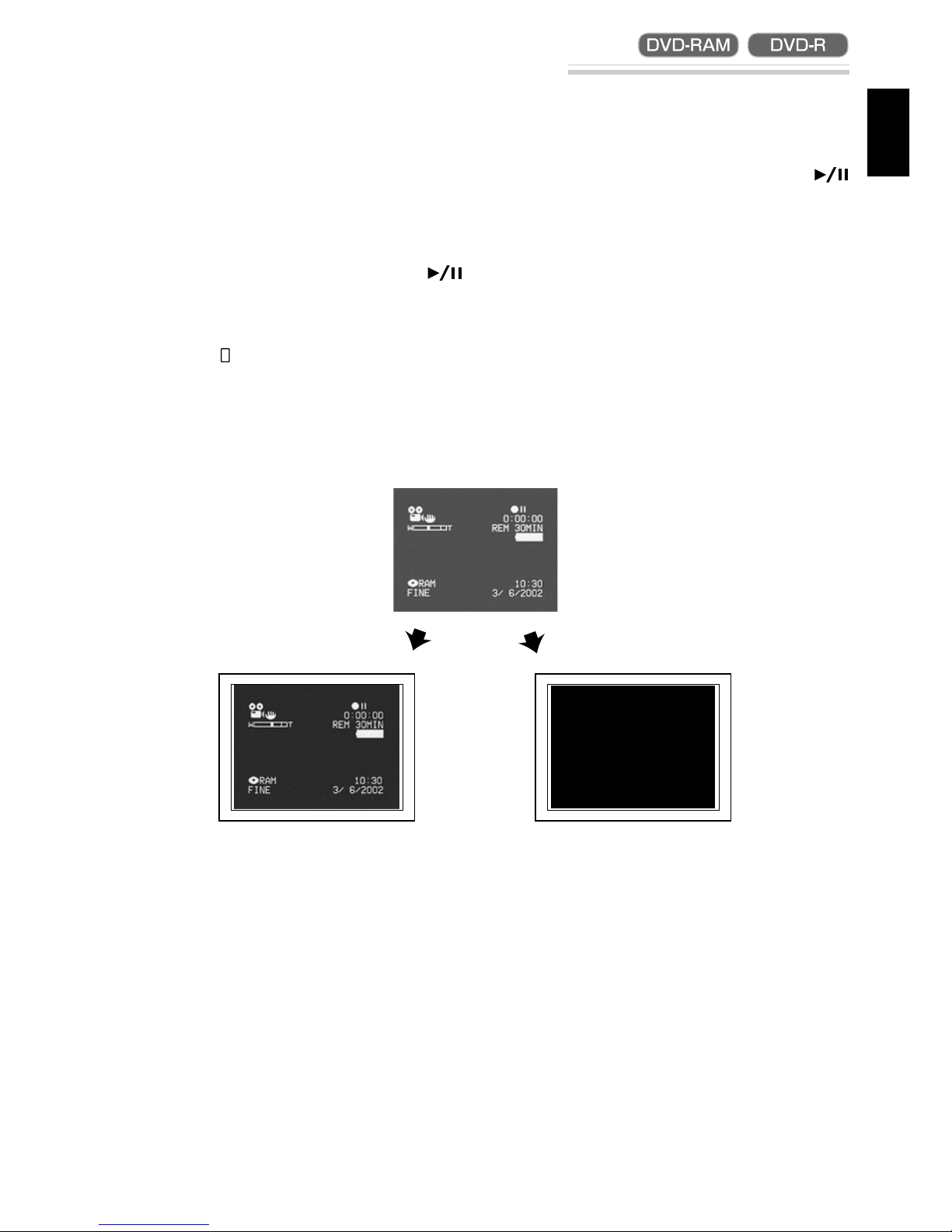
63
ENGLISH
Switching On-Screen Display Output On or Off
If you connect this DVD video camera/recorder to a TV and operate it while watching the TV screen,
you can switch off the on-screen information (displayed in the viewfinder or on the LCD monitor) from
the TV screen. (See “Viewing on TV Screen” on page 92.)
1
Press the MENU button.
The menu screen will appear.
2
Choose “OSD Output” on the “Record Functions
Setup” menu screen, and then press the
button.
The options will appear on the right of “OSD
Output”: The mark will be attached to the cur-
rently selected option.
LCD screen or viewfinder
“On” setting “Off” setting
TV screen
TV screen
3
Choose the desired option and press the
button.
4
Press the MENU button.
The menu screen will disappear.
The “OSD Output” setting will not change even
if the DVD video camera/recorder is turned off.
Note: Even if “Off” is chosen, the on-screen infor-
mation will appear during playback. See page 52
for playback on-screen information display.
Note: Even after the on-screen information is re-
moved from the TV screen, it will still appear in the
viewfinder or on the LCD screen.
Downloaded from www.ManualsFile.com manuals search engine

64
ENGLISH
This DVD video camera/recorder is equipped with power save function. Specify “Power Save: On”: If
the DVD video camera/recorder is left in the recording pause status without being operated for 5 min-
utes, it will automatically turn off to prevent the battery from discharging needlessly.
1
Press the MENU button.
The menu screen will appear.
2
Use the joystick to
choose “Power Save”
on the “Initial Setup”
menu screen, and then
press the button.
The options will appear on the right of “Power
Save”: The mark will be attached to the cur-
rently selected option.
3
Use the joystick to
choose “On” or “Off”,
and then press the
button.
4
Press the MENU button.
The menu screen will disappear.
Note: The power save setting information does
not appear in the on-screen display, and this set-
ting will not change when the DVD video cam-
era/recorder is turned off.
Note: If you want to use up the battery when you
have no intention of using the DVD video cam-
era/recorder for a long time, specify “Power Save:
Off”.
Note: To turn the DVD video camera/recorder on
again from automatic off activated by the power
save function, set the power switch to “POWER
OFF”, and then set it to “
VIDEO” or “ PHOTO”.
This DVD video camera/recorder will emit sound when the power switch is changed over, the REC button
is pressed, or other operations are engaged. If you do not need operating sound, you can switch it off.
1
Press the MENU button.
The menu screen will appear.
2
Use the joystick to
choose “Beep” on the
“Initial Setup” menu
screen, and then press
the button.
The options will appear on the right of “Beep”:
The mark will be attached to the currently se-
lected option.
3
Use the joystick to
choose “On” or “Off”,
and then press the
button.
4
Press the MENU button.
The menu screen will disappear.
Note: The “Beep” setting will not change even if
the DVD video camera/recorder is turned off.
Switching Operating Sound On or Off
Initial Settings
Setting or Releasing Power Save
Downloaded from www.ManualsFile.com manuals search engine
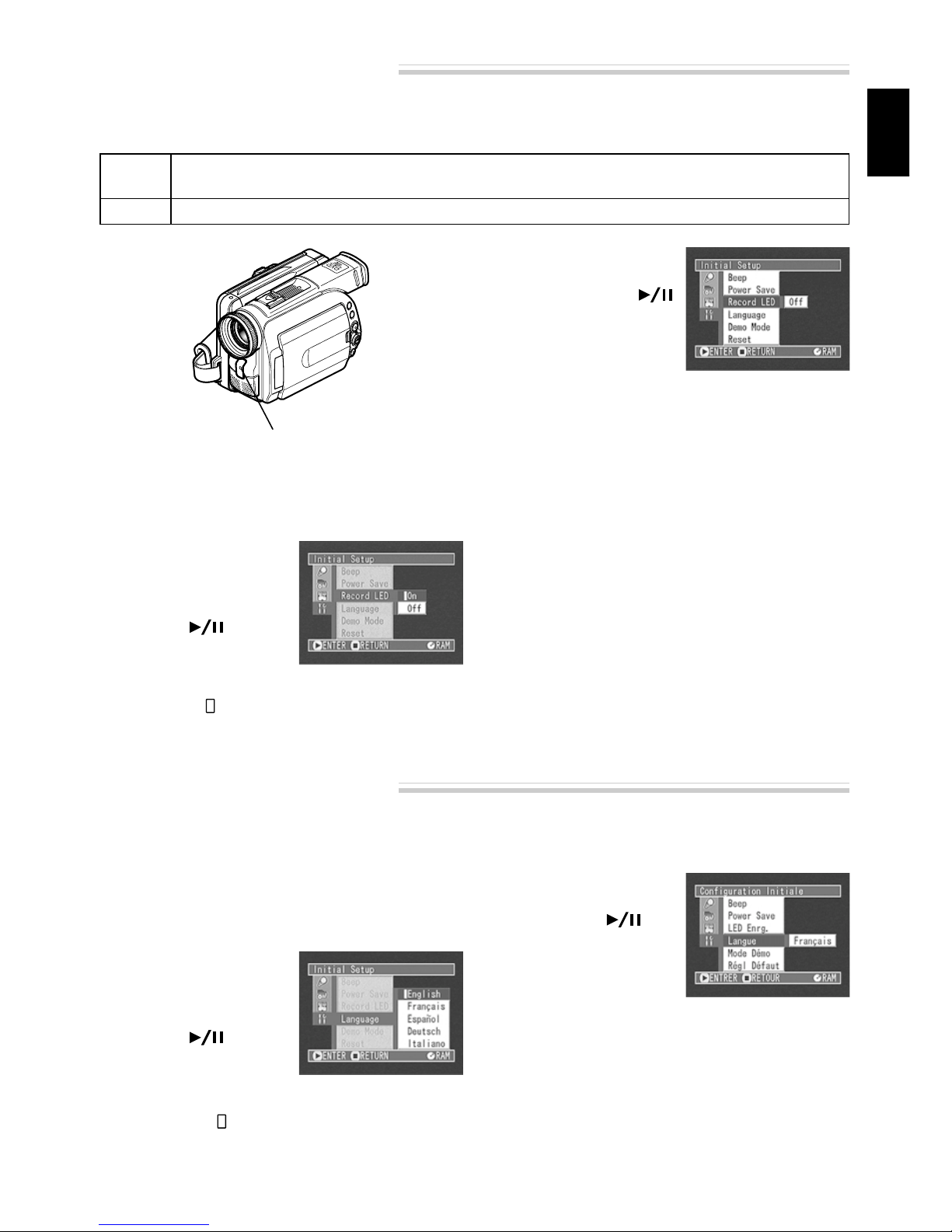
65
ENGLISH
You can switch off the recording indicator on the front of DVD video camera/recorder even during
recording.
1
Press the MENU button.
The menu screen will appear.
2
Use the joystick to
choose “Record LED”
on the “Initial Setup”
menu screen, and then
press the button.
The options will appear
on the right of “Record
LED”: The mark will
be attached to the cur-
rently selected option.
3
Use the joystick to
choose “On” or “Off”,
and then press the
button: The selected
option will be set.
4
Press the MENU button.
The menu screen will disappear.
The Record LED setting will not appear on the on-
screen information display, and will not change even
if the DVD video camera/recorder is turned off.
Note: Specify “Record LED: Off” when recording
subject behind a glass or water tank that will re-
flect the recording indicator light.
Note: When using the self-timer function, the re-
cording indicator will blink when the REC button is
pressed regardless of whether Record LED is On or
Off.
Recording indicator
Turning Record LED On or Off
On
Off
The recording indicator will light red to show that the DVD video camera/recorder is
recording.
The recording indicator will not light even during recording.
You can change the language used to display the menu and information.
The following shows that English is changed to French.
1
Press the MENU button.
The menu screen will appear.
2
Use the joystick to
choose “Language” on
the “Initial Setup”
menu screen, and then
press the button.
The options will appear on the right of “Lan-
guage”: The mark will be attached to “Eng-
lish”.
3
Use the joystick to
choose “Français”, and
then press the but-
ton: The display lan-
guage will be changed
to French.
4
Press the MENU button.
The menu screen will disappear.
The language setting will not change even if the
DVD video camera/recorder is turned off.
Changing Display Language
Downloaded from www.ManualsFile.com manuals search engine
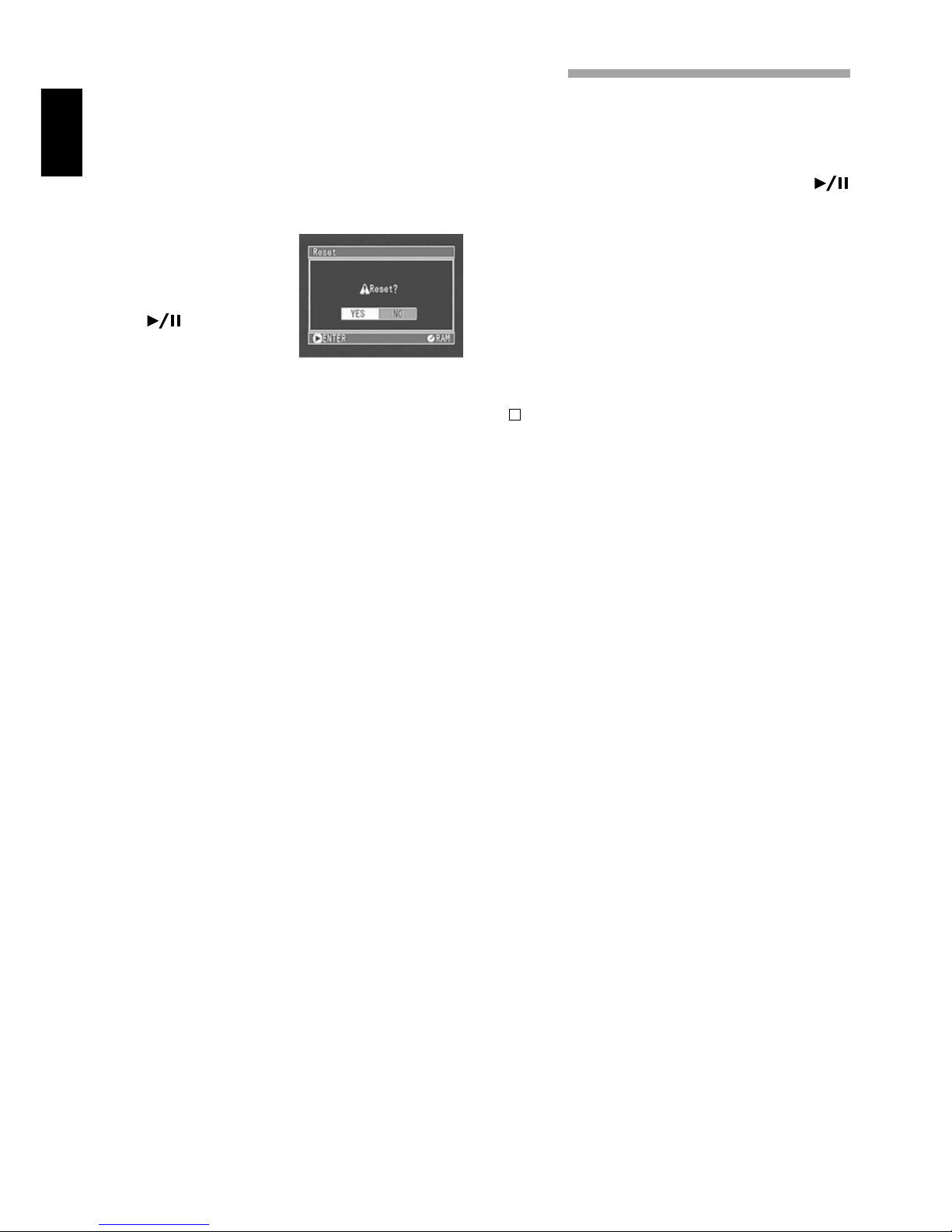
66
ENGLISH
Initializing All Settings to Defaults
You can restore all camera menu settings to defaults (initial settings at the factory). (The date and
time will not be reset.)
1
Press the MENU button.
The menu screen will appear.
2
Use the joystick to
choose “Reset” on the
“Initial Setup” menu
screen, and then press
the button.
The “Reset” verification screen will appear.
3
If you are sure that you wish to reset, use the
joystick to choose “YES”, and then press the
button.
All the setting items have now been reset to de-
faults.
4
Press the MENU button.
The menu screen will disappear.
Note: To cancel resetting midway, choose “NO”
on the screen for verification in step 2 or press the
button.
Downloaded from www.ManualsFile.com manuals search engine
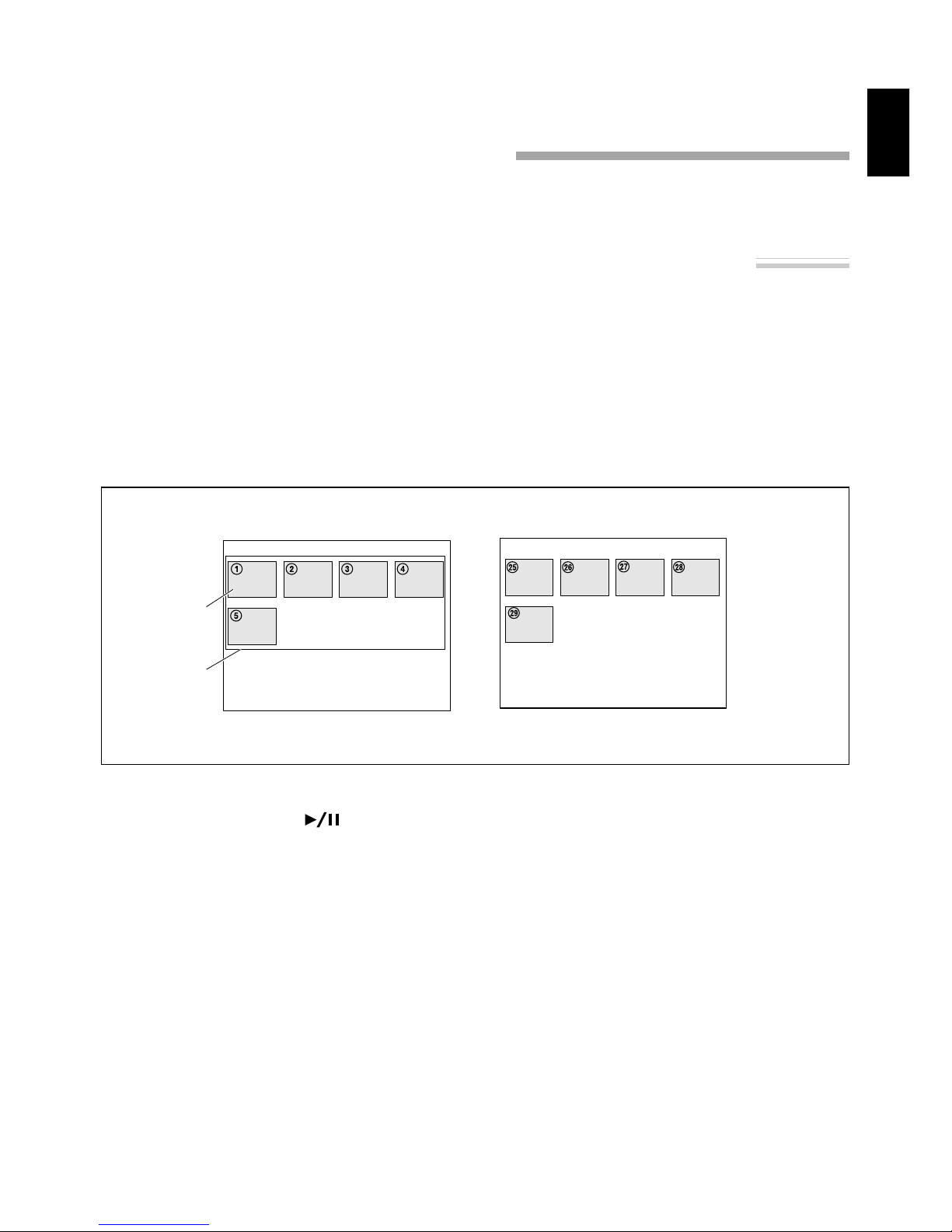
67
ENGLISH
Before Using Disc Navigation
Disc Navigation is a tool for editing scenes recorded on this DVD video camera/recorder.
Here is an explanation on “scene” and “program”, so that you will be able to make most use of Disc
Navigation function.
Structure of Data Recorded On This DVD Video Camera/Recorder
Video recorded using this DVD video camera/recorder will be stored on disc in units of scene, in the
order of recording.
•Movie: One scene refers to images recorded between each press of the REC button until recording is
temporarily stopped by pressing REC again.
•Still: One scene refers to a still recorded by pressing REC button.
The recorded scenes are collected as "programs" on each recording date.
Scenes of one program are lined up in the order of
recording. Usually, when the button is pressed
immediately after recording, the last scene of the
last program on disc (scene ? of program No. 10
in the above diagram) will be played back.
To view previously recorded scenes (scenes 1->
in the above diagram), you can use the skip and
search playback functions to find any desired scene.
By using the Disc Navigation function, you can
easily find any desired scene, since you can specify
a program or a scene.
You can also fade the image recorded on the DVD
video camera/recorder, and rearrange the order of
scenes.
Note: Thumbnails (first images of recorded
scenes) are displayed from the top left of screen,
and up to 12 thumbnails can appear on one
screen. If there are 13 scenes or more recorded,
tilt down the joystick and hold it to display 13th
and any later scenes as thumbnails.
All programs
Program No. 1
Recorded on 3rd May, 2002
Program No. 10
Recorded on 27th May, 2002
9:00
16:30
11:30
14:00
16:00
10:30
21:30
14:45 16:30 18:00
•••
Disc Navigation
This section explains about how to edit recorded images using the Disc Navigation function.
Note: “Scene No.” is not inherent to that scene,
but is a serial number of thumbnails being dis-
played. Therefore, the Scene No. when all pro-
grams are displayed may be different from that
for the same scene when a specific program is
displayed.
Note: Disc Navigation thumbnail screen, skip and
title attached to each scene, and special effects
(fade) are original functions of this DVD video cam-
era/recorder. They will not operate on devices
other than this DVD video camera/recorder.
Note: Even though thumbnails may not appear,
depending on the recording conditions,playback
of the images may be possible.
* Times on each scene show when recordings were started.
* Numbers 1–? show the order in which recordings were made.
Scene
Thumbnails
Downloaded from www.ManualsFile.com manuals search engine
68
ENGLISH
Functions Available with Disc Navigation
Disc Navigation allows you to do the following:
Using Disc Navigation
● Selecting scene(s) (Select)
You can select a scene from all programs or a spe-
cific program and start playback from that scene.
You can also select adjacent multiple scenes and
play back only the selected scenes.
● Switching/playing back program
(Switch/Play)
You can select one program to be viewed from all
programs and play it back.
● Changing title
You can change titles of programs and play lists.
● Editing scene(s)
You can delete unnecessary scenes, skip scenes you
do not want to play back, or arrange the order of
scenes for playback.
You can also divide a scene on play list or arrange
scenes on play list.
● Displaying information on scenes
(Detail)
You can get the information on movie quality mode,
recording time, etc. of a scene or adjacent multiple
scenes.
● Displaying remaining free space
on disc (Capacity)
You can display how much free space the disc be-
ing driven has.
●
Settings on disc ( )
You can check the remaining free space of disc be-
ing used, and initialize an unformatted disc.
You can also update the control information of disc.
When a DVD-R disc is loaded, only the remaining
free space on disc can be checked.
● Finalizing disc
If you wish to view a DVD-R disc that was recorded
with this DVD video camera/recorder on other de-
vices that are compatible with 8 cm DVD-R disc,
the recorded DVD-R disc must be finalized.
● Repeat playback
If “Repeat Play: On” is specified, all programs, or
any selected program or scene, will be repeatedly
played back.
Downloaded from www.ManualsFile.com manuals search engine
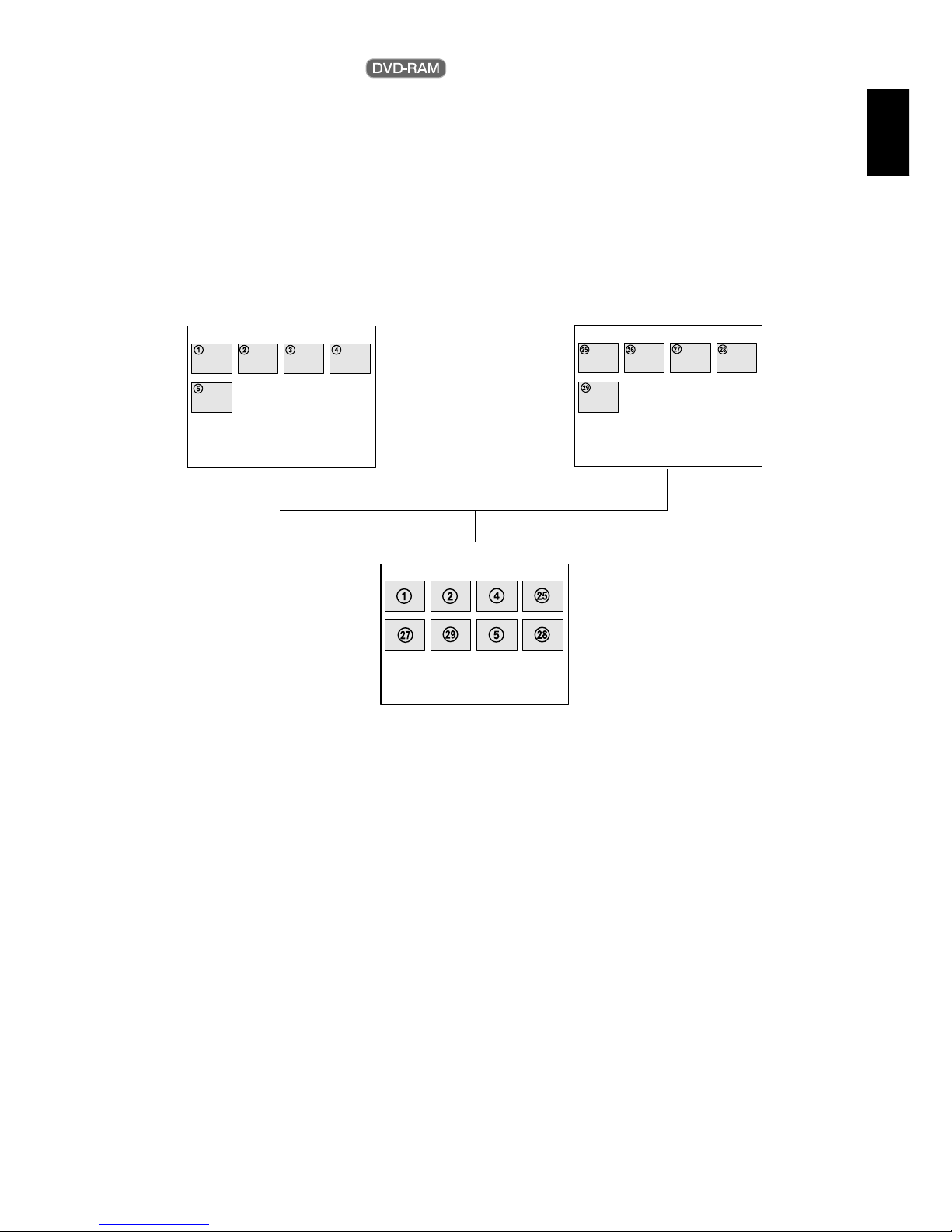
69
ENGLISH
● Create and Edit Play List
You can display all programs or a specific program, select scenes, and create up to 99 original stories (up
to 999 scenes in 99 play lists).
Program various scenes in a play list to create your own original movie (play list, p. 75).
Only the data will be stored in play list. If you create, edit or delete a play list, the original scenes will not
be erased from the disc.
Since scenes are not duplicated, the disc capacity will not decrease.
Example: To select scenes from program No. 1
and program No. 10 and create a play list
Program No. 1
(recorded on 3rd May, 2002)
Program No. 10
(recorded on 27th May, 2002)
Play list created
9:00
16:30
11:30 14:00 16:00 10:30
21:30
14:45 16:30 18:00
↓
Downloaded from www.ManualsFile.com manuals search engine
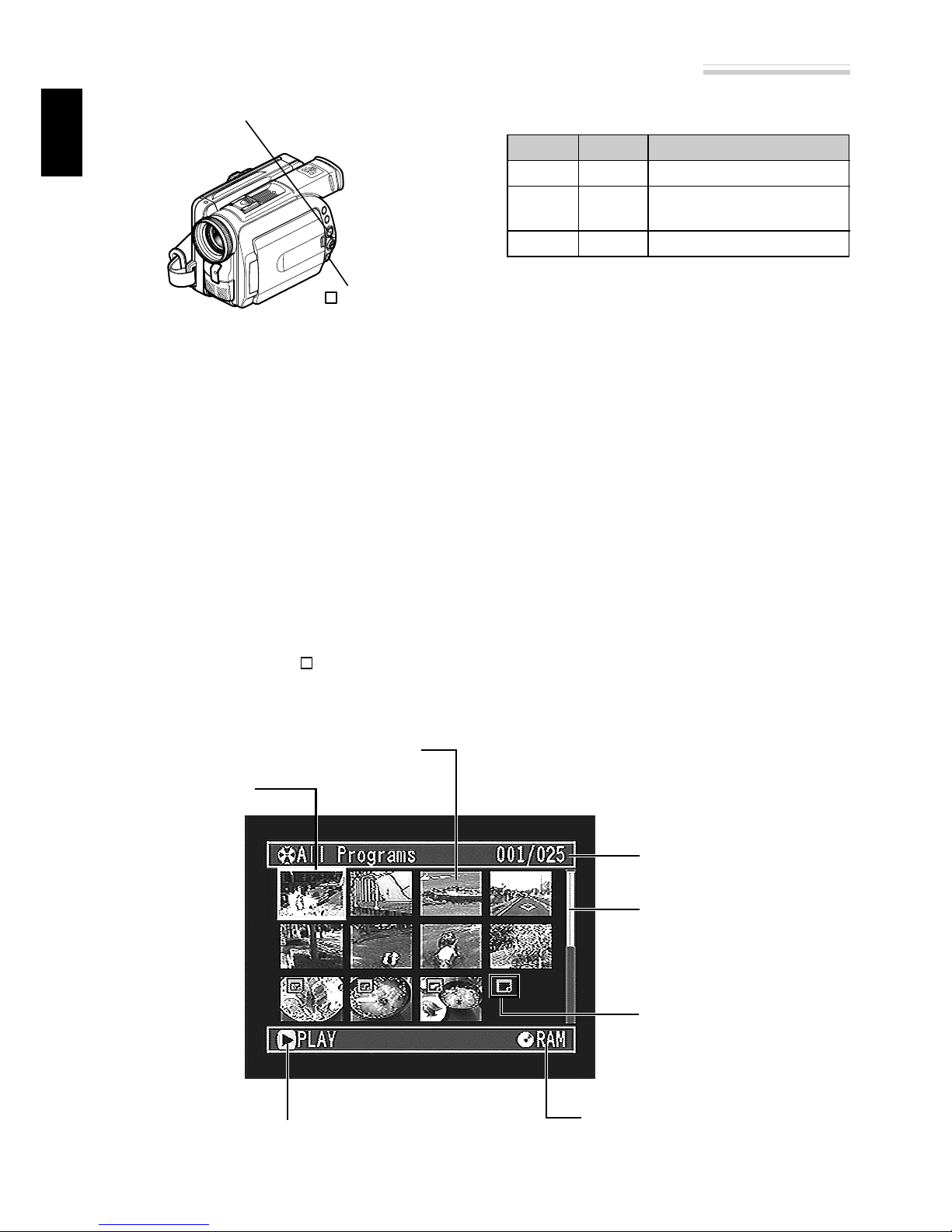
70
ENGLISH
Starting Disc Navigation and Interpreting Navigation Screen
Note: Do not proceed with a following step while
the disc is being recognized or the CHARGE/AC-
CESS indicator is blinking.
1
Press the DISC NAVIGATION button.
The thumbnails for all programs will appear.
Note: The DISC NAVIGATION button will not work
without a disc inserted.
2
Press the DISC NAVIGATION button.
Disc Navigation will be terminated and the DVD
video camera/recorder will enter the recording
pause status.
You can also press the button to end Disc
Navigation.
Cursor
Yellow
Blue
Red
Status of scenes
Current cursor position
Range of scenes being
selected
Scenes already selected
Bar graph
Blue
Blue
Red
DISC NAVIGATION
button
button
Cursor
Thumbnail
Selected scene number/
Number of all scenes
Bar graph
(current page
position **)
Disc type icon
Operating guide* and recording date/
time of scene being selected
Still image icon
* The operating guide will vary depending on the current status of DVD video camera/recorder.
** When there are two or more thumbnail display pages.
You can know the status of scenes from the colors
of cursor and bar graph:
Tilt the joystick to right when the yellow cursor
is in the scene at the bottom right corner of
thumbnail display screen, or tilt down the joy-
stick when the yellow cursor is in any scene on
the bottom row: The following 12 thumbnails
(following page) will appear.
Note that when the following pages cannot be
displayed, you are on the last page.
Tilt the joystick to left when the yellow cursor is
in the scene at the top left corner, or tilt up the
joystick when the yellow cursor is in any scene
on the top row: The preceding 12 thumbnails
(preceding page) will appear.
Note that when the previous pages cannot be
displayed, you are on the first page.
Note: Tilting up or down the joystick and holding
it will continuously change the page in units of 12
thumbnails.
Note: Each time Disc Navigation is started with a
DVD-R disc inserted, message “Creating Thumb-
nail ...” will appear. After the message appears,
the thumbnail display screen will appear.
Note: If the following discs are inserted, the Disc
Navigation screen will appear or some message
will be displayed:
– Write-protected disc
– Finalized DVD-R disc
Downloaded from www.ManualsFile.com manuals search engine
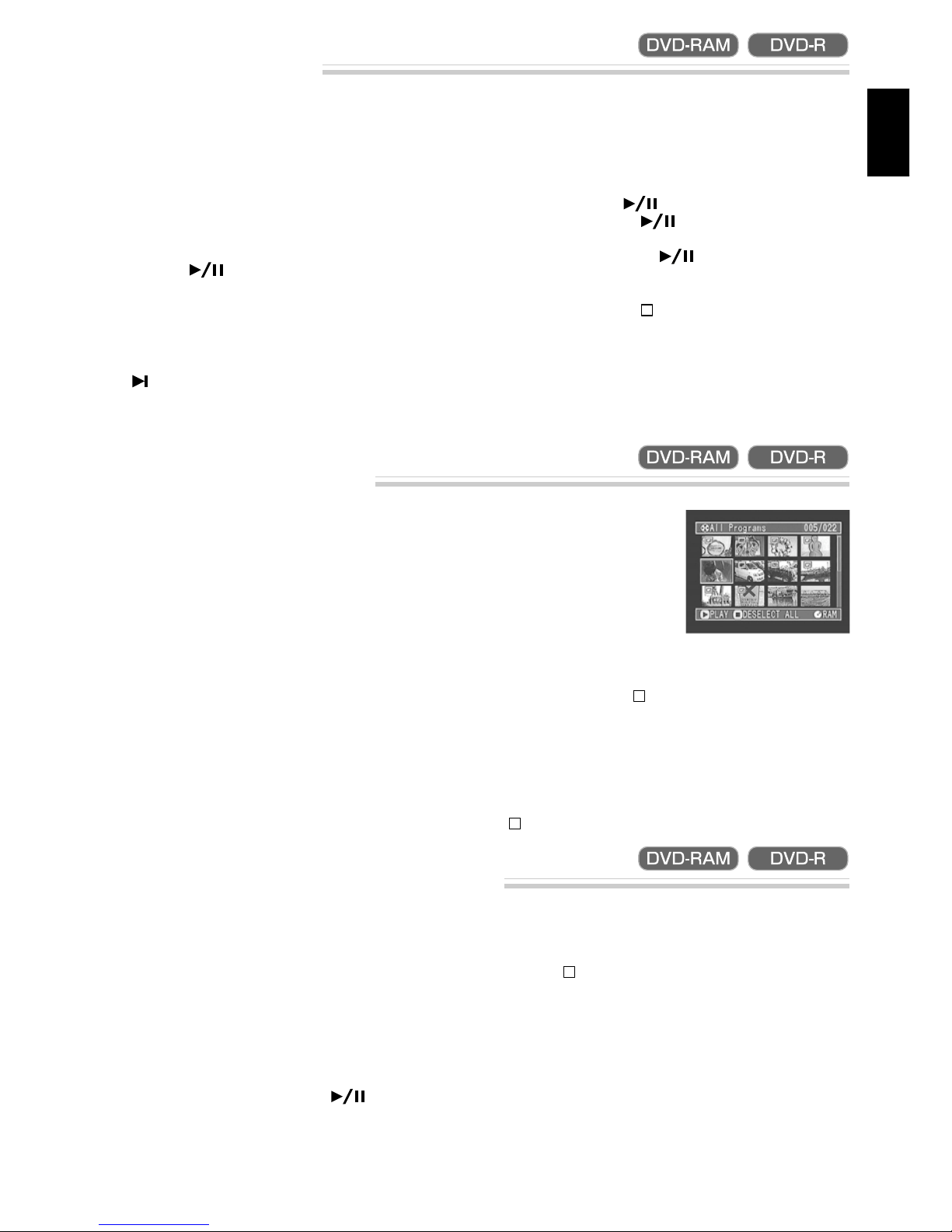
71
ENGLISH
Playing Back Scenes
1
Press the DISC NAVIGATION button.
The thumnails for all programs will appear.
2
Use the joystick to select a scene.
The selected scene will be framed. This is called
a “cursor”.
3
Press the button.
Playback will start from the selected scene, and
continue to the last scene on disc.
● When playback finishes:
The mark will appear in the last image on disc,
and after approx. 5 minutes the thumbnail screen
will be restored.
● Playback of still images (with
DVD-RAM disc only):
Still images will be displayed for approx. 3 seconds.
Note: Press the button to temporarily stop
playback. Pressing
again will start from that
point.
Note: If you press the
button after playback
of the last scene on disc finishes, playback will start
again from the first image of first scene on disc.
Note: Pressing the
button will always restore the
thumbnail screen.
Note: You can select scenes randomly and play
them back. See below for how to select scenes.
Selecting Consecutive Scenes Together
1
Use the joystick to select the first scene.
2
Hold down the SELECT button for at least one
second.
The selected scene will be double-framed in yel-
low and blue.
3
Use the joystick to select the last scene in the range
you want, and then press the button.
The scenes in the specified range will be framed
in red, and then selected.
Note: You can also select scenes in reverse from
the last scene in the range.
Note: To release multiple selection, press the SE-
LECT or
button after step 3.
Selecting Random Scenes
1
Use the joystick to select a scene.
2
Press the SELECT button once.
The selected scene will be framed in red.
Repeat steps 1 and 2 to
randomly select multi-
ple scenes.
To cancel a selected
scene, select the scene to
be canceled, and then
press the SELECT but-
ton.
To cancel all selected
scenes, press the but-
ton.
Note: Although scenes can be randomly se-
lected, playback will always start from the lowest
scene number.
Note: To release all the selected scenes, press the
button.
Downloaded from www.ManualsFile.com manuals search engine
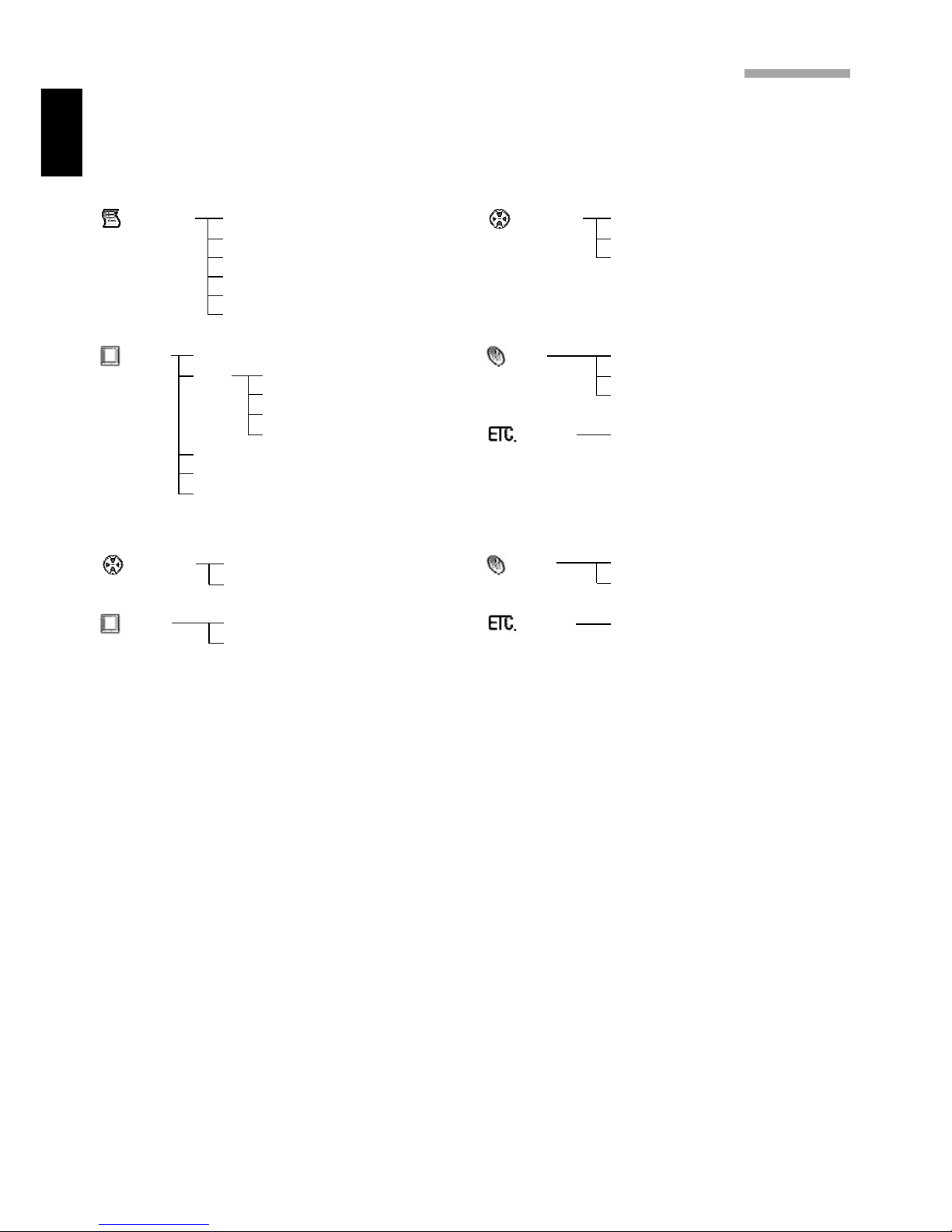
72
ENGLISH
Press the DISC NAVIGATION button and then the MENU button: The menu screens for Disc Navigation
and Disc management will appear.
For details on each menu item, see pages explaining each separate function.
Understanding Flow of Disc Navigation Menu
<When using DVD-RAM disc>
<When using DVD-R disc>
Play List Switch (p. 76)
Play (p. 76)
Create (p. 75)
Edit (p. 78)
Title (p. 80)
Delete (p. 80)
Scene Delete (p. 81)
Edit Fade (p. 82)
Combine (p. 84)
Divide (p. 84)
Move (p. 85)
Skip (p. 86)
Select (p. 86)
Detail (p. 87)
Program Switch (p. 73)
Play (p. 73)
Scene Select (p. 86)
Detail (p. 87)
Program Switch (p. 73)
Play (p. 73)
Title (p. 74)
Disc Capacity (p. 88)
Format Disc (p. 88)
Update Control Info. (p. 89)
Others Repeat Play (p. 90)
Disc * Capacity (p. 88)
Finalize Disc (p. 90)
Others Repeat Play (p. 90)
* Will not appear when a finalized disc is loaded.
Downloaded from www.ManualsFile.com manuals search engine
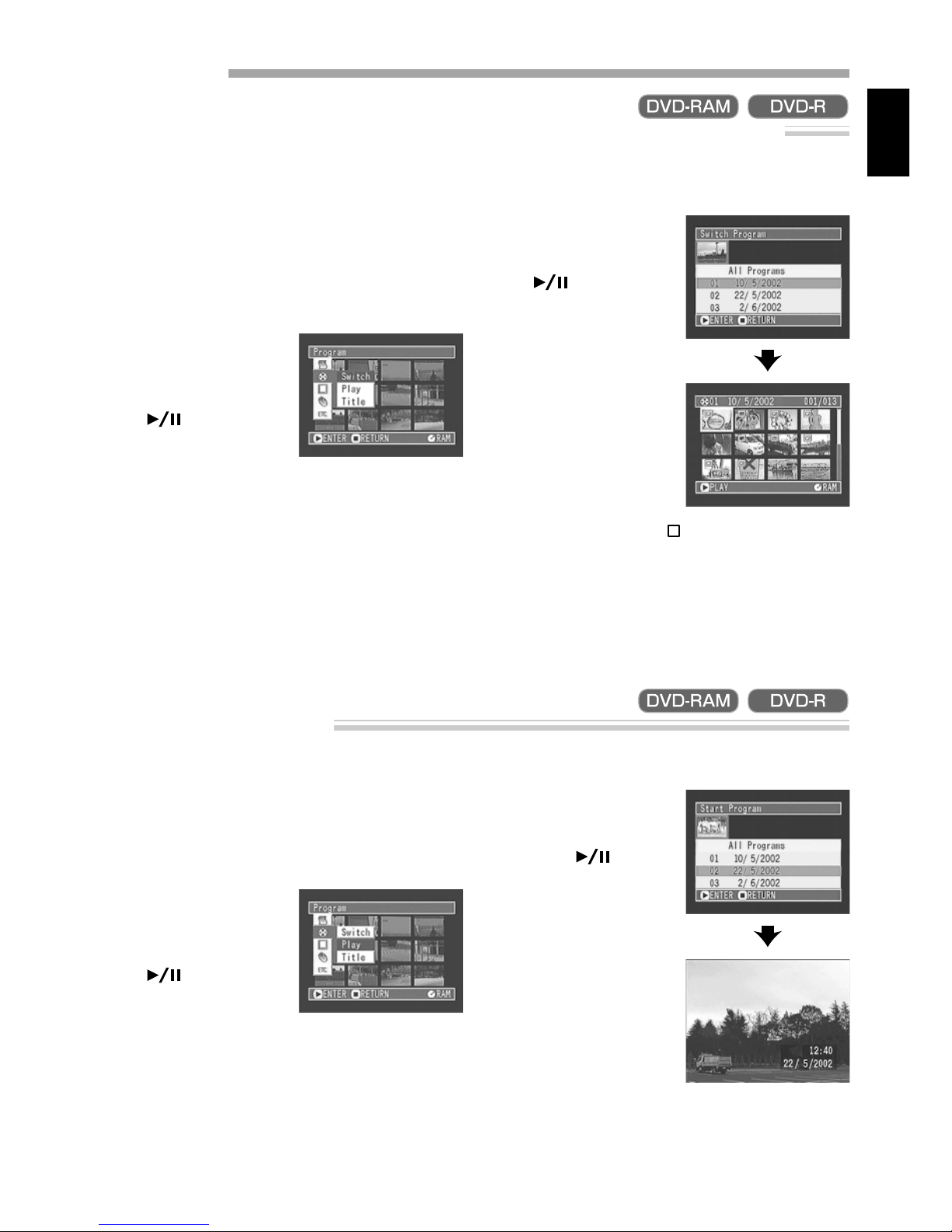
73
ENGLISH
Playing Back Program
1
Press the DISC NAVIGATION button and then
the MENU button.
The Disc Navigation menu screen will appear.
2
Use the joystick to
choose “Play” on the
“Program” menu
screen, and then press
the button.
3
Use the joystick to select
the program to be
played back, and then
press the button.
Playback will start from
the first scene of the se-
lected program.
You can play back only the selected program.
Switching to Thumbnail Display of Specific Date (Selecting Program)
1
Press the DISC NAVIGATION button.
2
Press the MENU button.
The Disc Navigation menu screen will appear.
3
Use the joystick to
choose “Switch” on the
“Program” menu
screen, and then press
the button.
4
Use the joystick to select
the program to be dis-
played, and then press
the button.
The Disc Navigation
screen will be restored,
and the thumbnails of
the selected program
will appear.
Note: If you press the button to stop program
selection midway, the original screen (thumbnail
select screen) will be restored.
Note: The dates displayed on the program select
screen will be in the Date Mode used when the
first scenes of programs were recorded, and the
date displays D/M/Y, M/D/Y and Y/M/D may be
mixed.
Since the scenes recorded on this video camera/recorder are collected as “programs” for each recording
date, selecting a program will allow you to display only the scenes on a specific date.
Program
Downloaded from www.ManualsFile.com manuals search engine
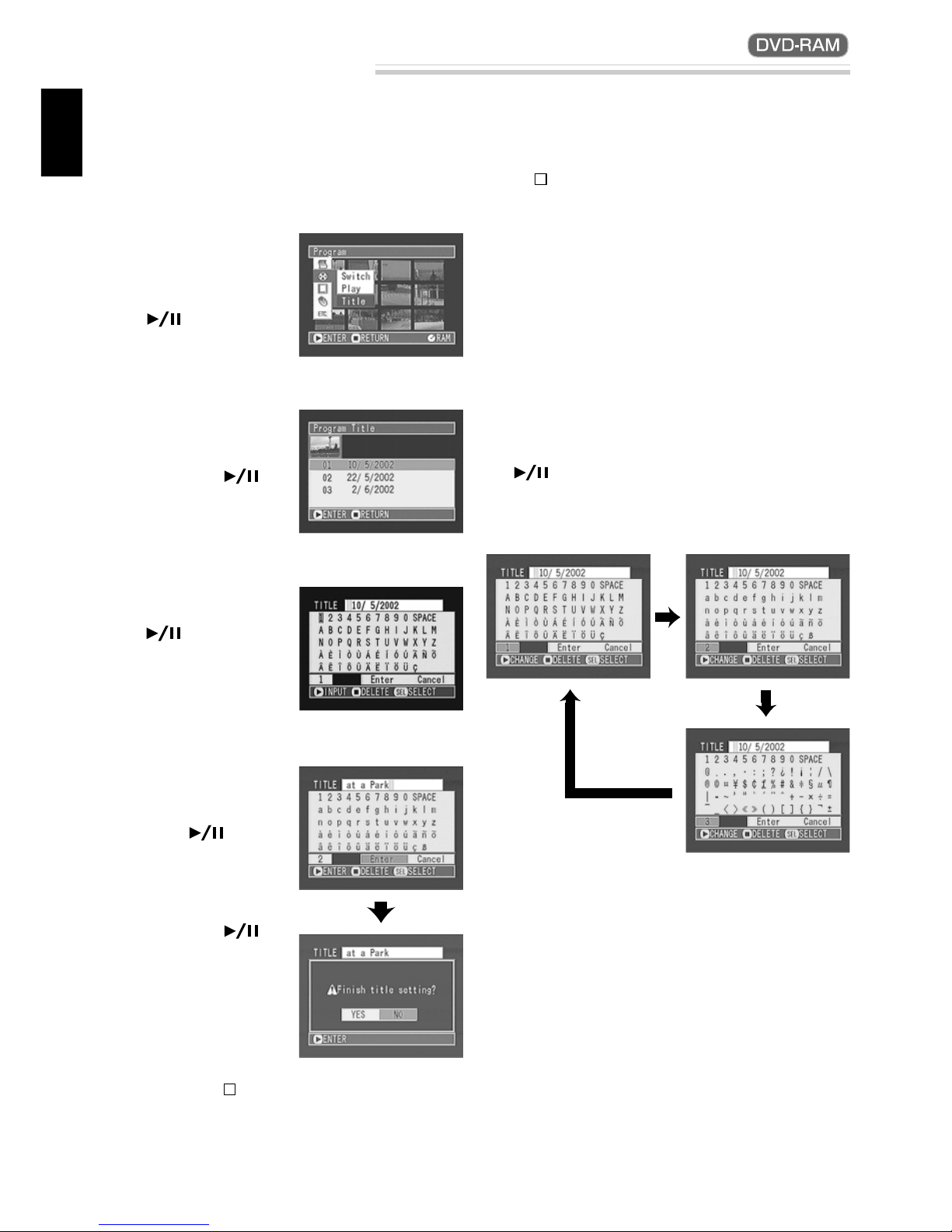
74
ENGLISH
Changing Title of Program
1
Press the DISC NAVIGATION button and then
the MENU button.
The Disc Navigation menu screen will appear.
2
Use the joystick to
choose “Title” on the
“Program” menu
screen, and then press
the button.
The “Program Title”
screen will appear.
3
Use the joystick to select
the program whose title
you want to change, and
then press the but-
ton.
The screen for entering
a title will appear.
4
Use the joystick to select
a letter and then press
the button: The se-
lected letter will be en-
tered.
Repeat this procedure to create a title.
5
After entering the title,
use the joystick to
choose “Enter” and then
press the button.
The screen for verifying
the entered title will ap-
pear: Choose “YES” and
then press the but-
ton.
After the following mes-
sage appears, the thumb-
nail display screen of the
program whose title was
set will be restored.
Choosing “NO” or
pressing the button
will restore the screen
for inputting a title.
The recording date/time has initially been attached to any program: You can change the recording date/
time to any desired title.
Note: If you wish to delete the letter for title, press
the
button once: The input letter will be deleted.
Holding down the stop button will delete all letters
in the TITLE column. You can also use the DELETE
button on remote control to delete any input let-
ters.
Note: To cancel the setting of title, choose “NO”
on the screen for verifying the entered title: The
screen for verifying cancellation of title setting will
appear. To cancel title setting, choose “YES”.
● Characters available for entering
title
You can select characters from the “capital letter”,
“small letter” and “symbol” input modes.
With step 4, select the input mode and then press
the button, or press the DISPLAY button on
the DVD video camera/recorder.
Input mode
Downloaded from www.ManualsFile.com manuals search engine
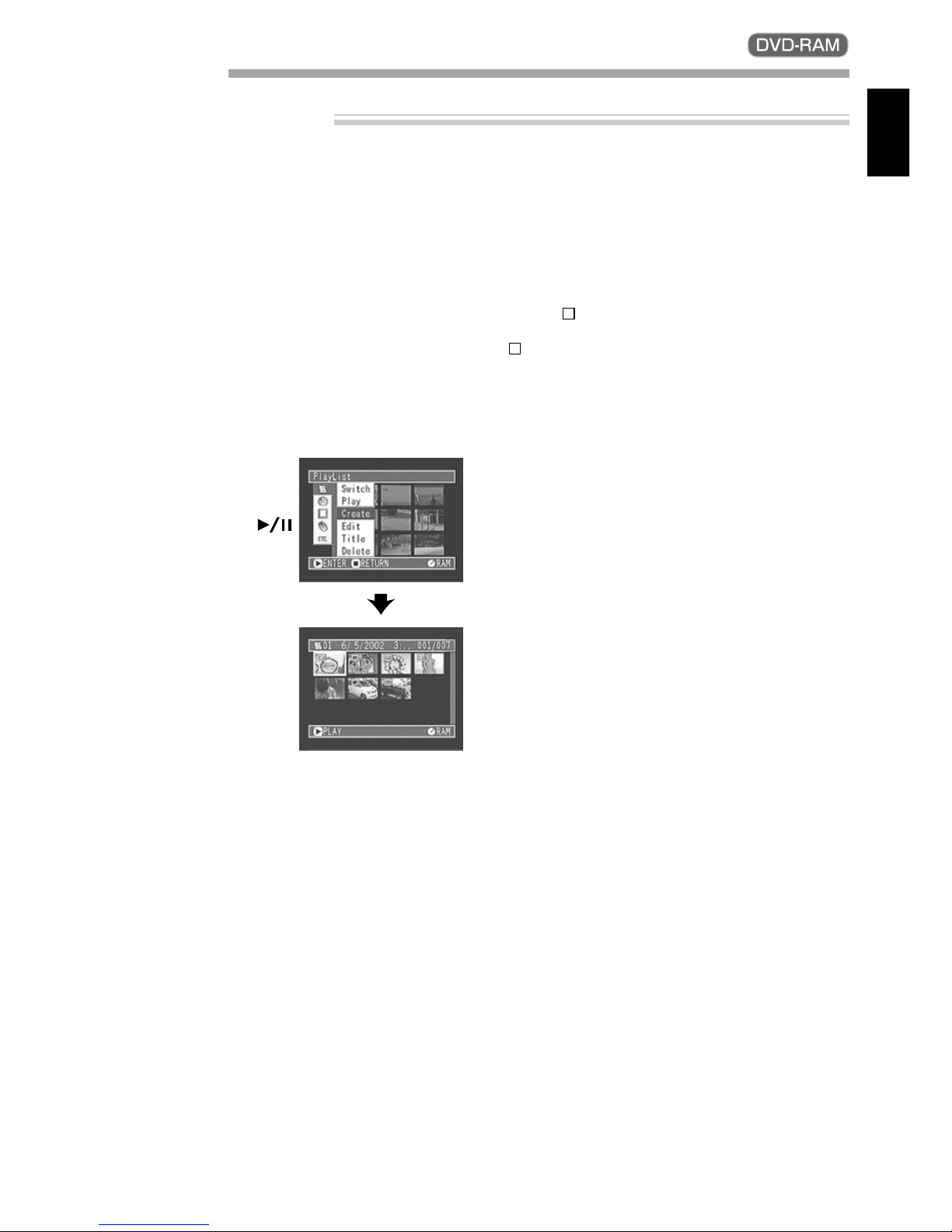
75
ENGLISH
Note: If the scene added to play list had skip or
fade setting, that information will also be added
to the play list.
Note: The time when the play list was created will
appear in the title bar.
Note: If you have selected multiple scenes, you
can stop the creation of play list midway by press-
ing the
button. In this case, the play list will be
created with the scenes up to the point where the
button was pressed.
Note: If free space available on disc is insufficient,
creation of new play list may not be possible: De-
lete unnecessary scenes.
Creating New Play List
1
Use the joystick to select a scene to be pro-
grammed in a play list.
When selecting multiple scenes, refer to “Select-
ing Consecutive Scenes Together” or “Selecting
Random Scenes” on page 71.
With the created play list, you can also add
scenes recorded on another day or unnecessary
scenes afterwards.
2
Press the MENU button.
The Disc Navigation menu screen will appear.
3
Use the joystick to
choose “Create” on the
“Play List” menu screen,
and then press the
button.
The “Create Play List”
screen will appear.
A new play list includ-
ing the selected scenes
will be created, and a
thumbnail of the created
play list will appear.
Use play list to edit recorded scenes.
Play List
Downloaded from www.ManualsFile.com manuals search engine
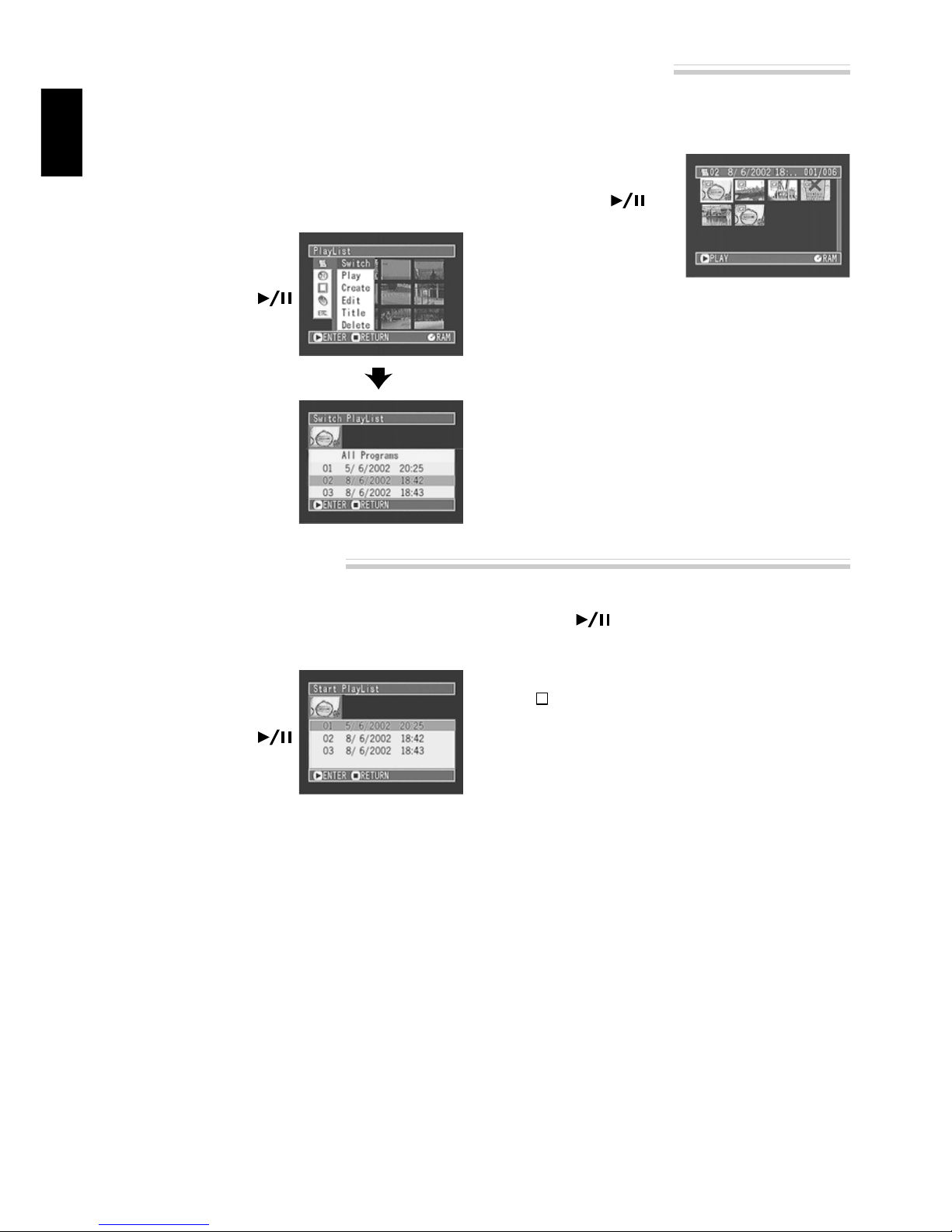
76
ENGLISH
Switching Play List (Switching to Display of Each Play List)
If multiple play lists are stored on disc, you can switch the thumbnail display for each play list or switch
to the thumbnail display of all programs.
1
Press the MENU button.
The Disc Navigation menu screen will appear.
2
Use the joystick to
choose “Switch” on the
“Play List” menu screen,
and then press the
button.
The “Switch Play List”
screen will appear.
3
Select the play list you
wish to display, and
then press the but-
ton.
The thumbnail screen of
the selected play list will
appear.
Note: To display the thumbnails of all programs
(all recorded scenes), choose “All Programs” on
the “Switch Program” screen.
Playing Back A Play List
1
Press the MENU button.
The Disc Navigation menu screen will appear.
2
Use the joystick to
choose “Play” on the
“Play List” menu screen,
and then press the
button: The “Start Play
List” screen will appear.
3
Use the joystick to select the play list, and then
press the button.
The selected play list will be played back from
the first scene. To cancel playback midway, press
the button: The thumbnail screen of the play
list being played back will appear.
Note: If “Repeat Play On” is specified, the play
list will be repeatedly played back (see page 90).
Downloaded from www.ManualsFile.com manuals search engine
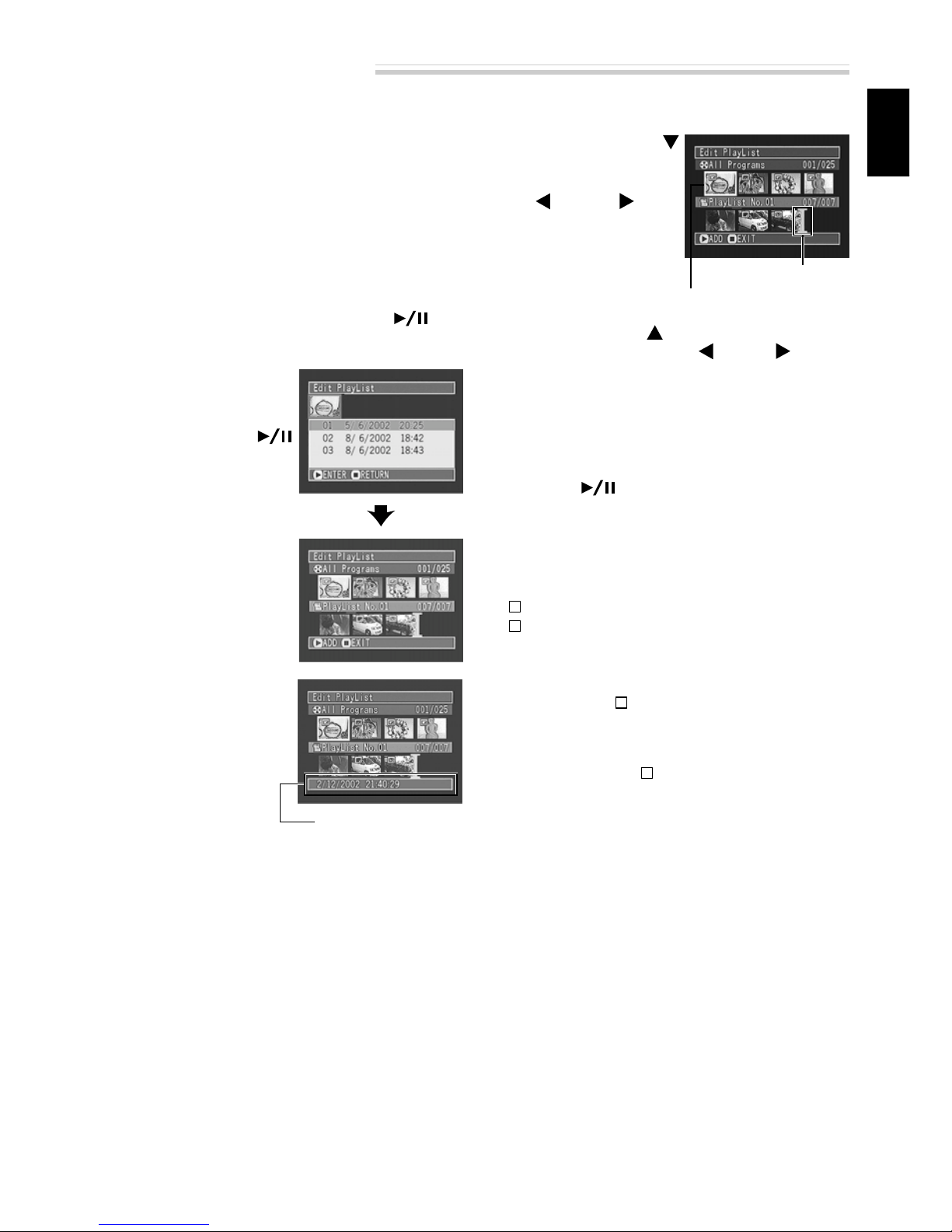
77
ENGLISH
Adding Scenes to Play List
1
Display the thumbnails of scenes to be added to
the play list, and then press the MENU button.
See “Switching to Thumbnail Display of Specific
Data (Selecting Program)” on page 73 for how
to display the thumbnails.
The Disc Navigation menu screen will appear.
2
Use the joystick to choose “Edit” on the “Play
List” menu screen, and then press the but-
ton: The “Edit Play List” screen will appear.
3
Use the joystick to select
the play list to which
you wish to add scenes,
and then press the
button.
The thumbnails of the
program that was dis-
played in step 1 will ap-
pear in the upper row,
and the thumbnails of
selected play list will ap-
pear in the lower row.
Note: If the DISPLAY
button is pressed
when the thumbnails
are displayed, the re-
cording date/time of
the selected scene
will appear across
the bottom of
screen. Press DISPLAY
to restore the previ-
ous screen.
You can later add scenes to the created play list.
4
Tilt the joystick down
to move the cursor to the
lower row, and tilt it to
left or right to se-
lect the point where the
scene is to be inserted.
5
Tilt the joystick up to move the cursor to the
upper row, and tilt it to left or right to point
the cursor to the scene to be added.
To select multiple scenes, refer to “Selecting Con-
secutive Scenes ” or “Selecting Random Scenes”
on page 69.
6
Press the button to copy the scene: The
screen showing that the scene is being copied
will appear.
While multiple scenes are being copied, copy-
ing can be cancelled at any time by pressing the
button: The scenes up to the point where the
button was pressed will be added.
After adding scenes is completed, the edited
play list of thumbnails will appear.
Note: Pressing in steps 3-5 will display the screen
for verifying an exit from “Edit Play List”. Choose
“YES” to exit the edition of play list. Choosing “NO”
will restore the “Edit Play List” screen.
Note: Pressing the
button on the screen for veri-
fication will restore the thumbnail display screen.
Note: If you press the MENU button in step 5, the
menu screen for editing play list will appear. You
can also use this menu to add scenes. (See page
78.)
Recording date/time
Scene to be copied
Insertion position
Downloaded from www.ManualsFile.com manuals search engine
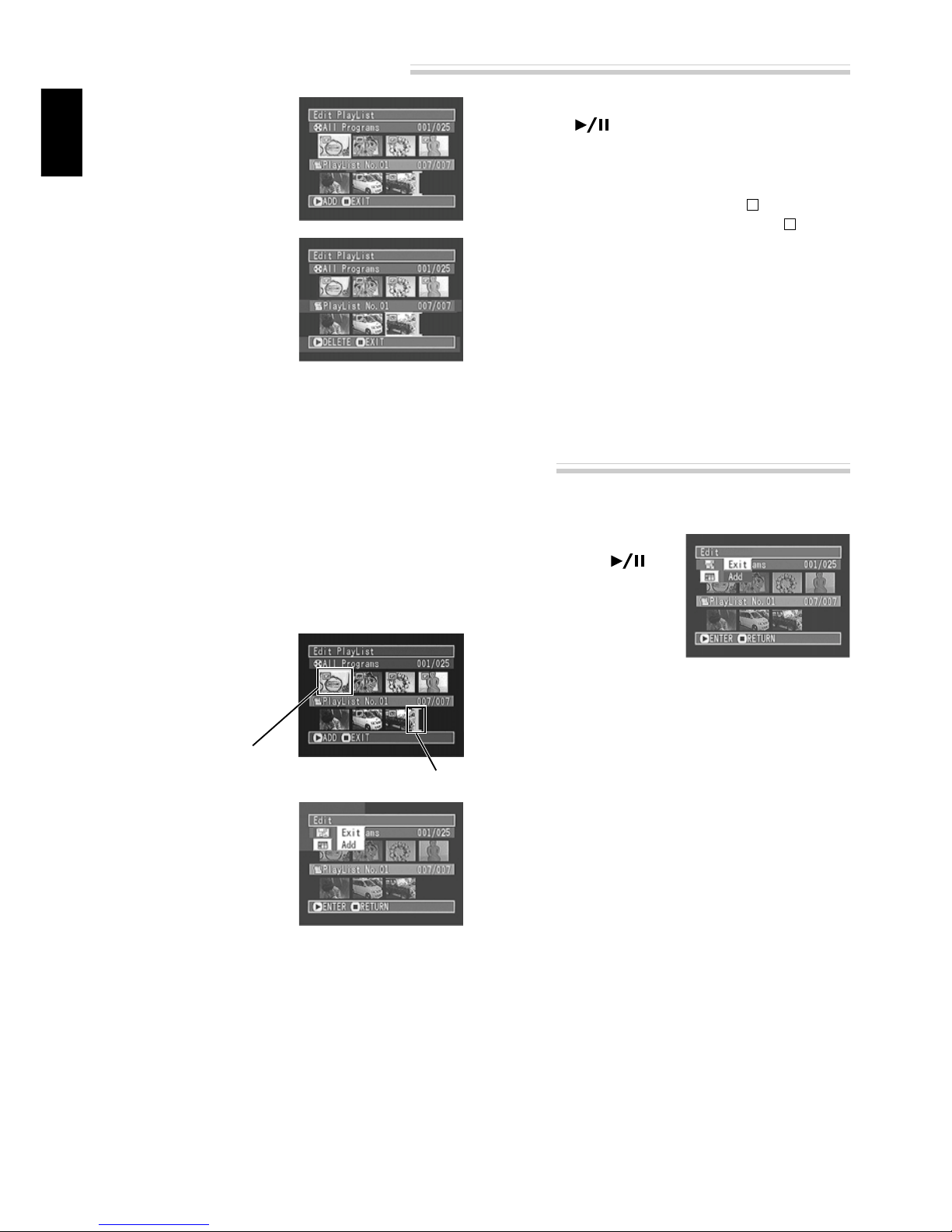
78
ENGLISH
Editing Play List (Adding Scenes Using Menu)
You can use the menu screen to add scenes to a created play list.
1
Display the “Edit Play List” menu screen of the
play list to be edited.
Perform steps 1-3 on page 77.
2
Select the scenes to be
added from the upper
row.
3
Press the MENU button.
The menu screen for ed-
iting play list will ap-
pear.
4
Choose “Add”, and
then press the but-
ton.
The selected scenes will
be added to the end of
play list to be edited.
Note: The selected scenes will be added in the
insertion position.
Scene to be added
Deleting Scenes from Play List
1
Display the “Edit Play
List” menu screen of the
play list to be edited.
Perform steps 1 – 3 on
page 77.
2
From the play list in
lower row, point the cur-
sor to the scene you
want to delete.
To select multiple scenes,
refer to “Selecting Con-
secutive scenes Together”
or “Selecting Random
Scenes” on page 71.
3
If you are sure that you wish to delete the scene,
press the button: The screen being deleted
will appear.
When multiple scenes are being deleted, you can
stop deletion midway: Press the button.
The scenes up to the point where the button
was pressed will be deleted.
Note: Place the cursor on scene to be deleted,
and then press the DELETE button on remote con-
trol: You can also delete the scene.
Insertion position
Downloaded from www.ManualsFile.com manuals search engine
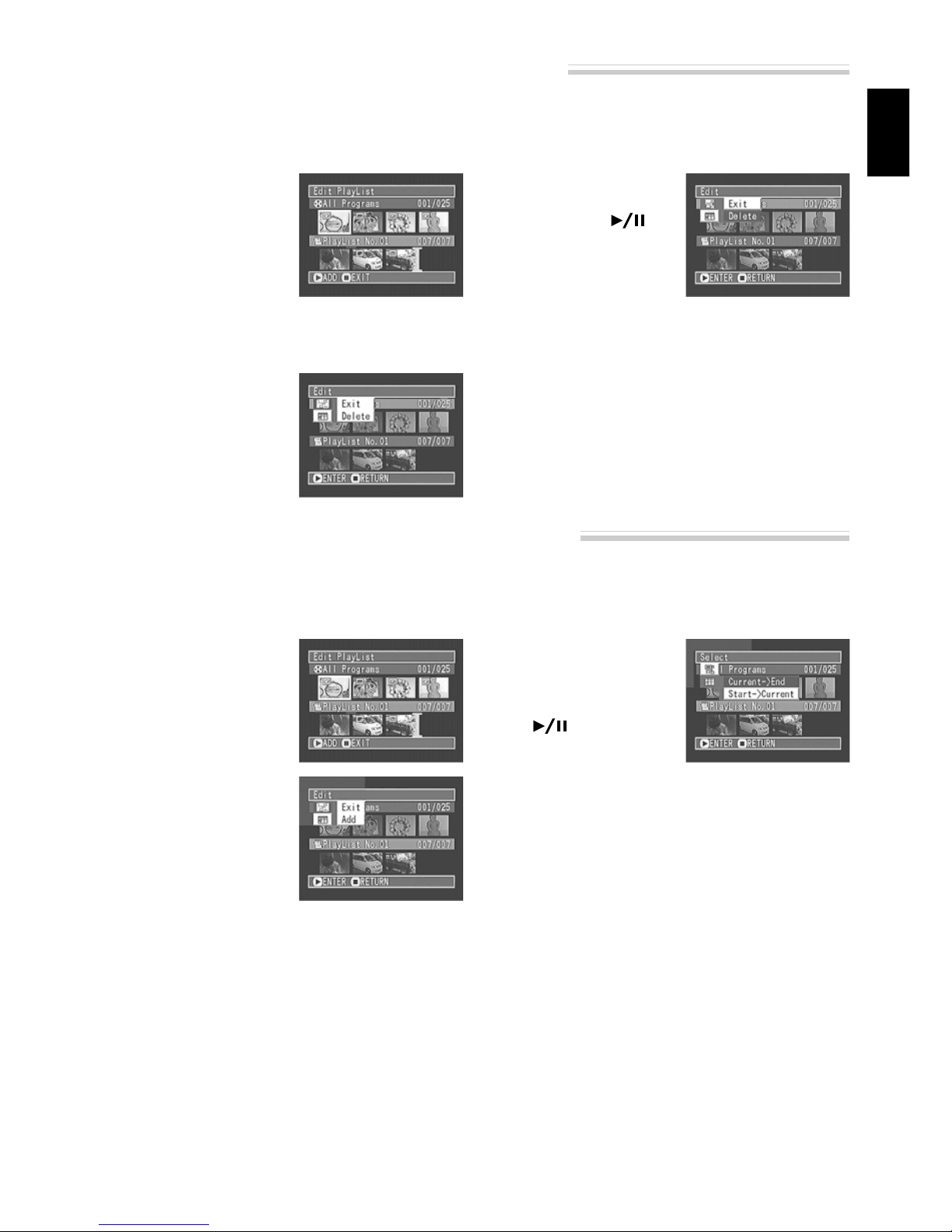
79
ENGLISH
Editing Play List (Deleting Scenes Using Menu)
If, by mistake, you insert undesired scenes to the play list to be edited in “Editing Play List (Adding
Scenes using Menu)” on page 78, or if there are unnecessary scenes in the play list to be edited, you can
delete the scenes without exiting the screen for editing play list.
1
Display the “Edit Play
List” menu screen of the
play list to be edited.
Perform steps 1-3 on
page 77.
2
Move the cursor to the play list to be edited in
lower row, and select the scene(s) to be deleted.
3
Press the MENU button.
The menu screen for ed-
iting play list will ap-
pear.
4
Choose “Delete” on the
“Edit” menu screen, and
then press the but-
ton.
The selected scene(s)
will be deleted.
Note: If all scenes on play list are deleted, the play
list itself will also be deleted.
Editing Play List (Selecting Scenes Using Menu)
You can specify the range of scenes when adding or deleting consecutive multiple scenes to/from play
list. This “Select” menu item is useful when selecting consecutive multiple scenes in items for adding or
deleting scenes using menu on page 78.
1
Display the “Edit Play
List” menu screen of the
play list to be edited.
Perform steps 1-3 on
page 77.
2
Specify the first scene of
those you wish to select,
and then press the
MENU button.
The menu screen for ed-
iting play list will ap-
pear.
3
Choose “Current→End”
or “Start→Current” on
the “Select” menu
screen, and then press
the button.
Downloaded from www.ManualsFile.com manuals search engine
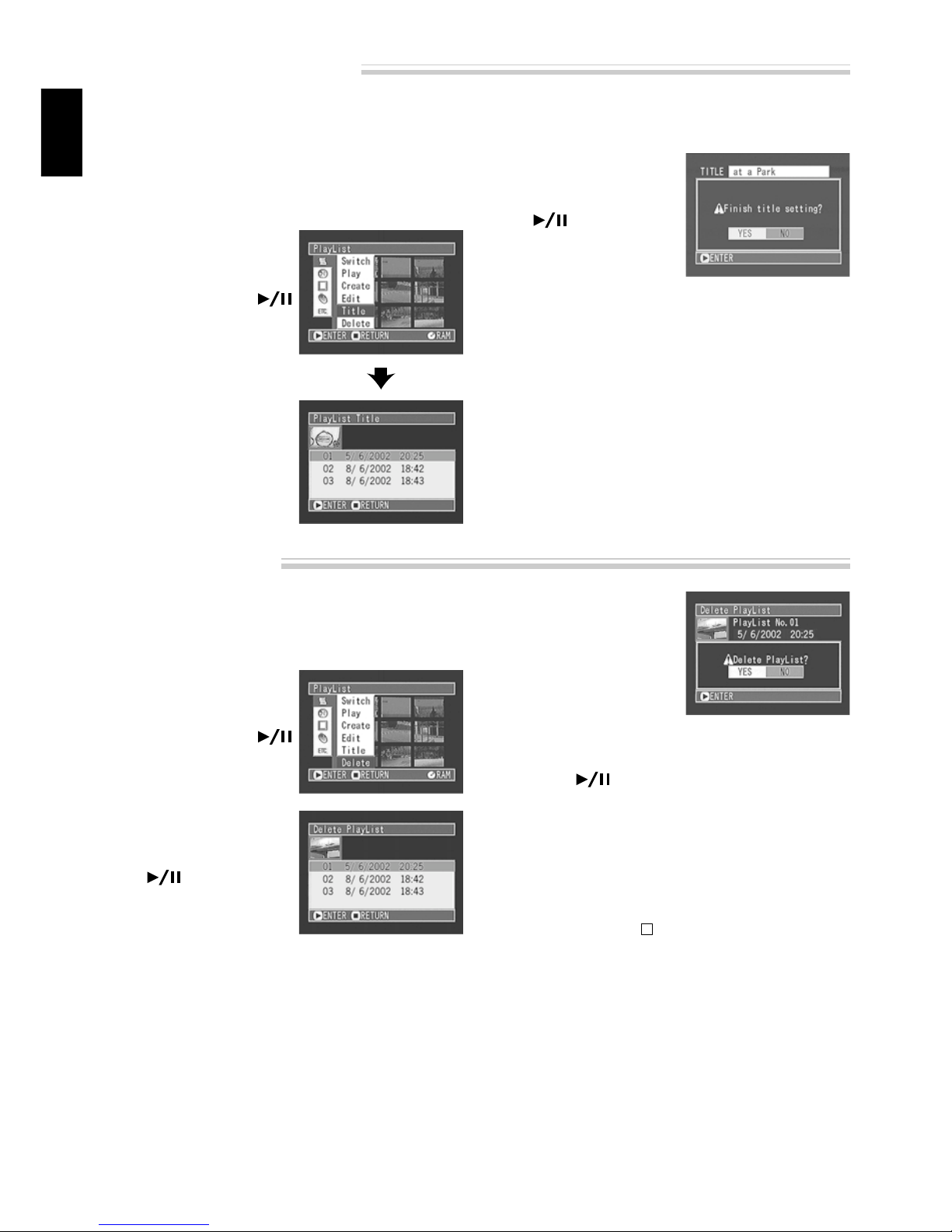
80
ENGLISH
Deleting Play List
1
Press the MENU button.
The Disc Navigation menu screen will appear.
2
Use the joystick to
choose “Delete” on the
“Play List” menu screen,
and then press the
button: The “Delete Play
List” screen will appear.
3
Use the joystick to select
the play list you wish to
delete, and then press
the button.
The screen for verifying
deletion of play list will
appear.
4
If you are sure that you wish to delete the play
list, use the joystick to choose “YES”, and then
press the button.
The selected play list will be deleted, and the
original screen will be restored.
Note: If you choose “NO” on the screen for veri-
fying deletion of play list, deletion will be canceled,
and the original screen will be restored.
Note: Pressing the
button on the screen for veri-
fication will restore the thumbnail display screen.
Note: Even if you delete a play list, the original
scenes stored on disc will not be deleted.
Changing Title of Play List
The play lists have serial numbers in the order you have created them. At any time you can change the
title of play list, which was the recording date/time set on this DVD video camera/recorder.
1
Press the MENU button.
The Disc Navigation menu screen will appear.
2
Use the joystick to
choose “Title” on the
“Play List” menu screen,
and then press the
button.
The “PlayList Title”
screen will appear.
See “Changing Title of
Program” on page 74 for
how to enter a title.
3
After entering the title,
use the joystick to choose
“Enter”, and then press
the button.
The screen for verifying
registration of title will
appear.
Note: The registered title can be changed at any
time using the same procedure.
Downloaded from www.ManualsFile.com manuals search engine
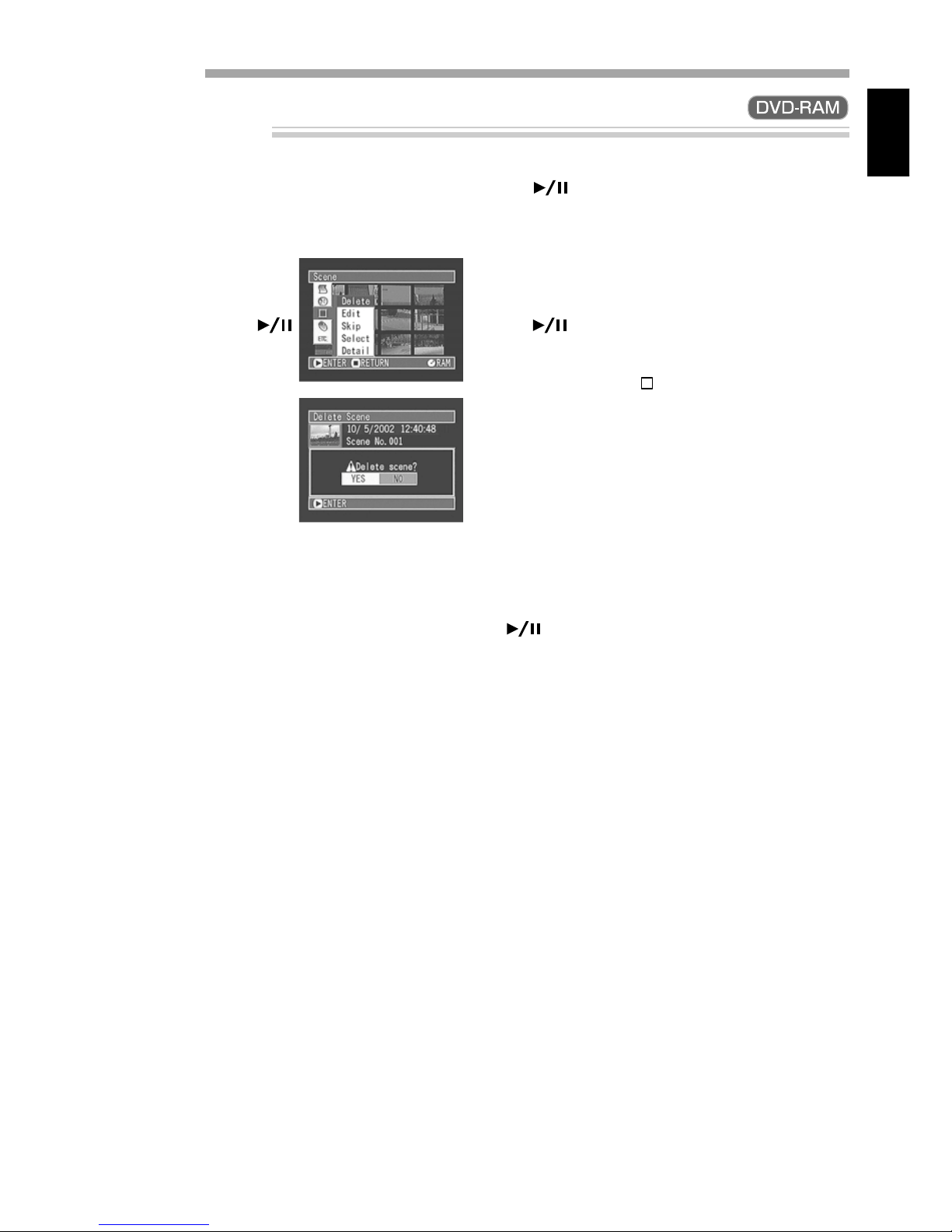
81
ENGLISH
Deleting Scenes
3
Use the joystick to choose “YES”, and then press
the button.
The message “Deleting...” → “Finished” will ap-
pear and the selected scene will be deleted, af-
ter which the thumbnail display screen will be
restored.
To cancel deletion, choose “NO”, and then press
the button while the screen for verification
is being displayed.
Note: Pressing the button on the screen for veri-
fication will restore the thumbnail display screen.
Note: If you wish to delete multiple scenes, select
them referring to “Selecting Consecutive Scenes
Together” or “Selecting Random Scenes” on page
71.
Note: If you delete all data on disc, initializing the
disc will be recommended (see p. 88).
Note: If even one play list has been created, mes-
sage “Same scenes on PlayList will be deleted. De-
lete scenes?” will appear before deleting scene(s).
This message will appear even if the scene(s) to
be deleted is not used in the corresponding play
list. In this case, choose “YES” and then press the
button to delete the scene(s).
Note: If the time of deleted scenes (stills) is quite
short, the remaining free space of disc may not
increase in the time remaining indicator.
1
Use the joystick to select the scene to be deleted,
and then press the MENU button.
The Disc Navigation menu screen will appear.
2
Use the joystick to
choose “Delete” on the
“Scene” menu screen,
and then press the
button.
The screen for verifying
deletion will appear.
Scene
Downloaded from www.ManualsFile.com manuals search engine

82
ENGLISH
Adding Special Effects (Fade)
When switching scenes, you can add fading to the beginning and/or end of scene.
There are three types of special effects:
B/W: Fades in from Black and White screen to color screen, Fades out from color
screen to Black and White screen
Wipe: Fades in from black screen to vertical direction of screen, Fades out from vertical
direction of screen to black screen
White: Fades in from white screen, fades out to white screen
Fade Out
Fade In
Fade Out
Fade In
Fade Out
Fade In
Downloaded from www.ManualsFile.com manuals search engine
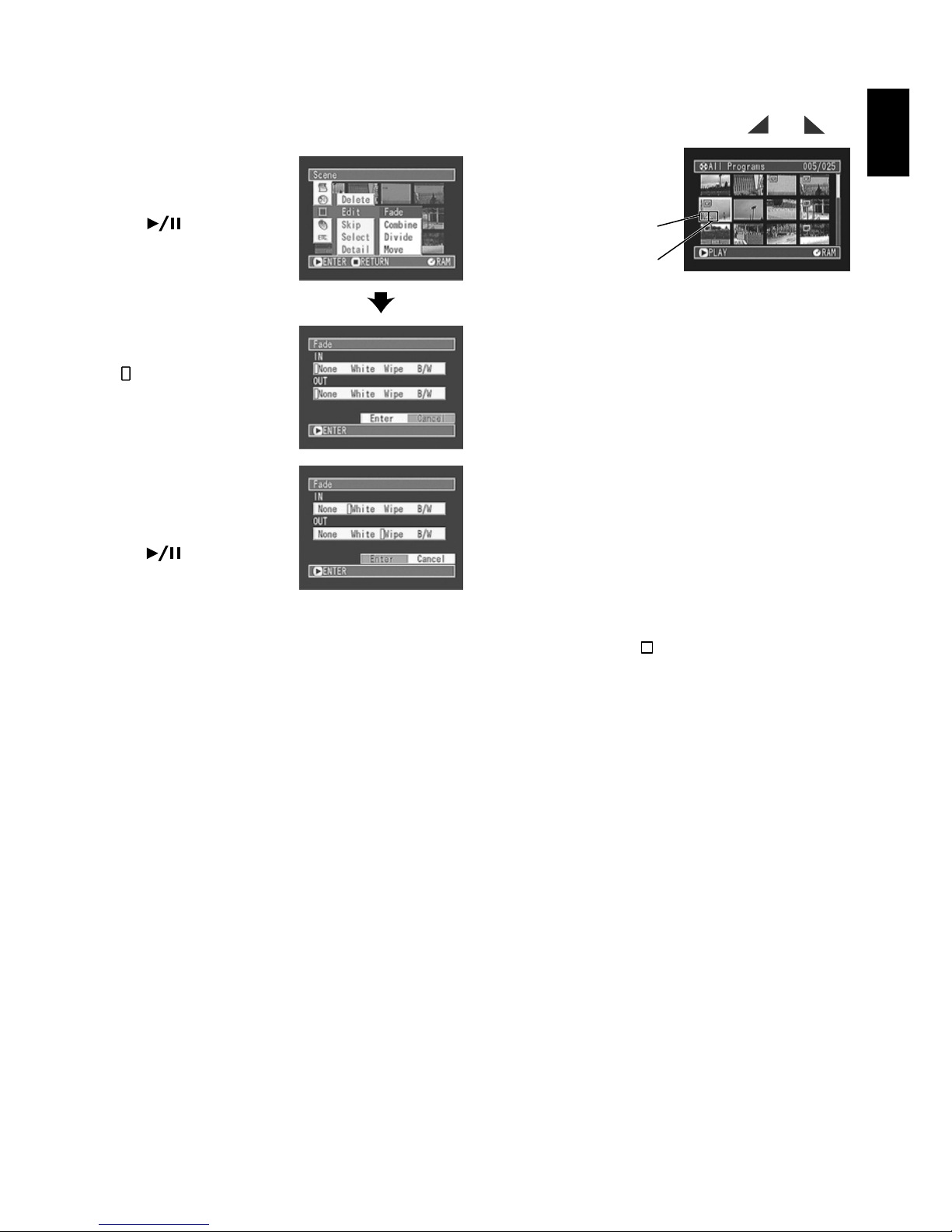
83
ENGLISH
1
Select the scene for adding special effects and
press the MENU button.
The Disc Navigation menu screen will appear.
2
Use the joystick to
choose, “Scene”, “Edit”,
“Fade”, and then press
the button.
The fade setting screen
will appear.
The options will appear
under IN and OUT: The
mark will be attached
to the currently selected
option.
3
Use the joystick to select
the special effects for
“IN” and “OUT”, choose
“Enter”, and then press
the button.
After the proceeding message appears, the
thumbnail display screen will be restored.
The scenes for which special effects have been
set will be attached with marks “ ”, “ ”.
Note: Setting fade will also fade the sound.
Note: Fading can also be set to either “IN” or
“OUT”.
Note: Any registered fade can be changed at
any time using the same procedure as above.
Note: Fade can also be added to on-screen in-
formation displayed during playback.
Note: If the playback time of scene is short, fade
will cut off midway.
Note: If you set fade-in and fade-out to a still im-
age or a movie with recording time of no more
than 3 seconds, only fade-in will be valid.
Note: No fade effect will operate if you start play-
back in the recording pause status.
Note: If you locate the start of a scene by skip-
ping, the image at the start of the scene will ap-
pear for a moment, and then fade will operate.
Note: The fade effect will not function during
frame advance, frame back, slow playback or
search playback.
Note: Pressing the
button on the screen for veri-
fication will restore the thumbnail display screen.
“In” effect
“Out” effect
Downloaded from www.ManualsFile.com manuals search engine
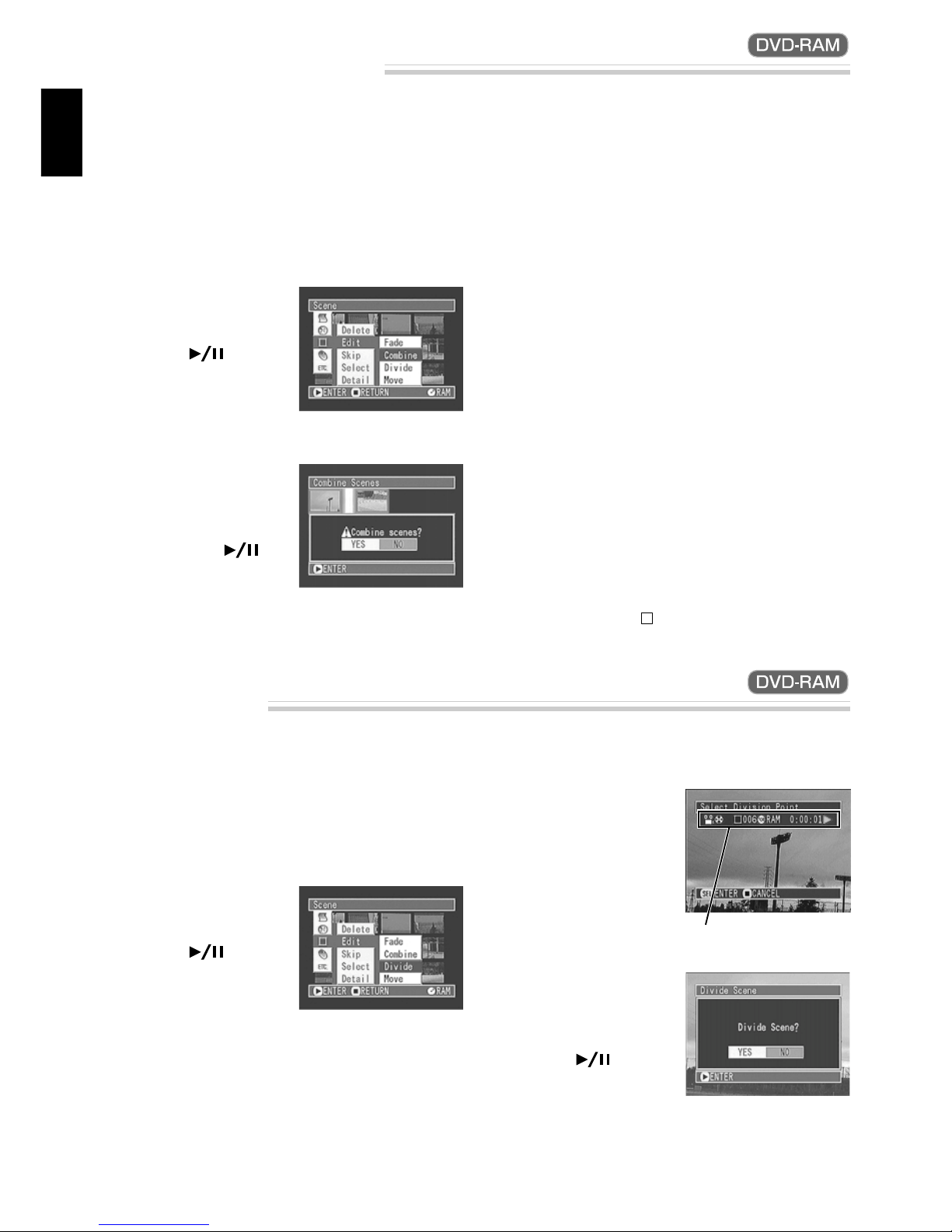
84
ENGLISH
Dividing Movies
You can divide a scene into two parts. To delete unnecessary portion of scene, first divide the scene, and
then delete the unnecessary portion. You can also cut out a part of scene and use it in the play list.
1
Use the joystick to select the scene to be divided,
and then press the MENU button.
The Disc Navigation menu screen will appear.
2
Use the joystick to
choose, “Scene”, “Edit”,
“Divide”, and then
press the button.
The “Select Division
Point” screen will ap-
pear, and playback of the
selected scene will start.
Combining Multiple Scenes
You can combine multiple scenes into one.
Be sure to select consecutive multiple scenes when combining.
The selected movies will be combined into one,
and the thumbnail display screen will be re-
stored: The first scene before combination will
appear as a thumbnail.
Note: Still images cannot be combined.
Note: If you choose “NO” on the screen for veri-
fying combination, combination will be canceled.
Note: To restore the separated status of a com-
bined scene, divide it.
Note: With special effects, the "in" effect of the
first scene in the selected range and the "out" ef-
fect of the last scene will be chosen.
Note: If you combine scenes from different pro-
grams (different recording dates), a message that
prompts you to update the control information will
appear when power is turned on and Disc Navi-
gation is first started (see page 101). Note that if
you choose “YES” for this message, the combined
scenes will be split into separate scenes.
If you choose “NO” for this message, the scenes
will be combined, but the same message will ap-
pear each time Disc Navigation is started. To pre-
vent this, when combining scenes from different
programs, create a new play list and combine the
scenes on it.
Note: Pressing the
button on the screen for veri-
fication will restore the thumbnail display screen.
1
Use the joystick to select the scenes to be com-
bined, referring to “Selecting Consecutive Scenes
Together” on page 71, and then press the MENU
button.
The Disc Navigation menu screen will appear.
2
Use the joystick to
choose, “Scene”, “Edit”,
“Combine”, and then
press the button.
The screen for verifying
combination of scenes
will appear.
3
If you are sure that you
wish to combine the
scenes, use the joystick
to choose “YES”, and
then press the but-
ton.
3
When you reach the
point where you want to
divide the scene, press
the SELECT button.
The screen for verifying
division of scene will
appear.
4
If you are sure that you
wish to divide the scene,
use the joystick to
choose “YES”, and then
press the button.
The scene will be divided at the specified point,
and the thumbnail display screen will be re-
stored, with the divided thumbnails, appearing
side by side.
Status bar of scene being
played back
Downloaded from www.ManualsFile.com manuals search engine
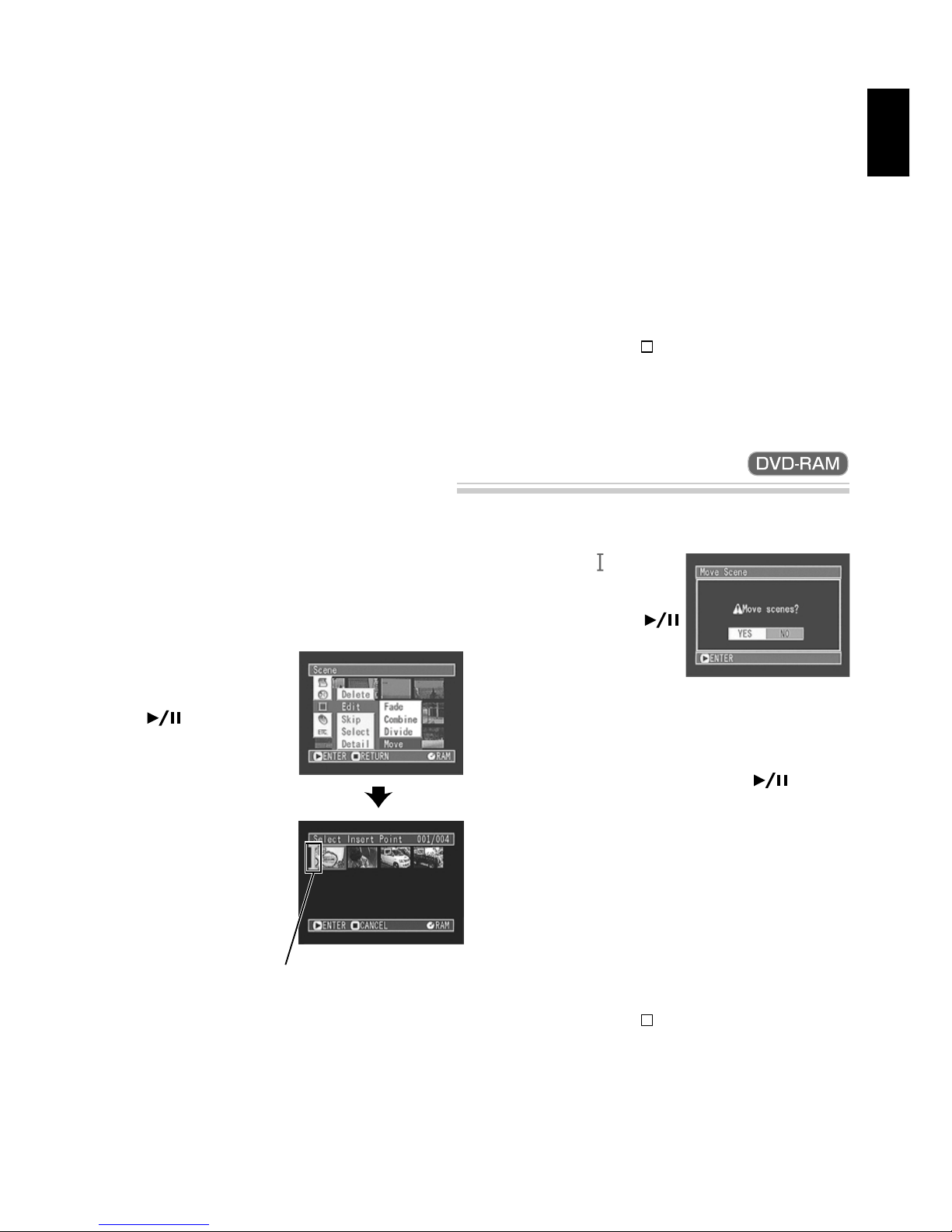
85
ENGLISH
Note: The status bar of scene being played back
can be switched off or on by pressing the DISPLAY
button.
Note: If you choose “NO” on the screen for veri-
fying division in step 4, division will be canceled.
Note: Search and frame advance are useful
when designating division points.
Note: If you press the MENU button while the
scene to be divided is being played back in step
2, the DVD video camera/recorder will enter the
playback pause status, and the “Go To” menu will
appear. You can jump to the first image, end im-
age or any specified point of the scene. (See
“Searching for Scene You Wish to View by Speci-
fying It (Go To)” for details on “Go To”.) You can
divide the scene at the point you have jumped
to.
Note: If a special effect has been added to the
original scene, the “In” effect will be added to the
first half of scene, and the “Out” effect, to the lat-
ter half.
Note: The division point may drift before or after
the designated point by approximately 0.5 sec-
onds.
Note: Since a scene with a skip set cannot be
played back, no division point can be specified:
Release the skip for the scene before dividing it.
Note: If the division point is at a still, a message
will appear, but no division will be made.
Note: If the division point is at the start or end of a
scene, a message will appear, but no division will
be made.
Note: A scene of 0.5 seconds or less cannot be
divided.
Note: If free space available on disc is insufficient,
division will not be possible: Delete unnecessary
scenes.
Note: Pressing the
button on the screen for veri-
fication will restore the thumbnail display screen.
Arranging Order of Scenes (Move)
You can move scenes within a play list to arrange the order as you want.
1
Select the scene to be moved, and then press the
MENU button.
The Disc Navigation menu screen will appear.
2
Use the joystick to
choose “Scene”, “Edit”,
“Move”, and then press
the button.
The “Select Insert Point”
screen will appear, and
the “I” mark will appear.
3
Move the “ ” mark to
the position where you
wish to move the scene,
and then press the
button.
The screen for verifying movement of scene will
appear.
4
If you are sure that you wish to move the scene,
choose “YES”, and then press the button.
The message for movement will appear, and
then the thumbnail display screen will be re-
stored.
Note: To move consecutive multiple scenes to-
gether, select scenes referring to “Selecting Con-
secutive Scenes Together” or “Selecting Random
Scenes” on page 71.
Note: Choosing “NO” on the screen for verifying
movement in step 4 will cancel movement.
Note: Still images can also be moved.
Note: Pressing the
button on the screen for veri-
fication will restore the thumbnail display screen.
Insertion position
Downloaded from www.ManualsFile.com manuals search engine
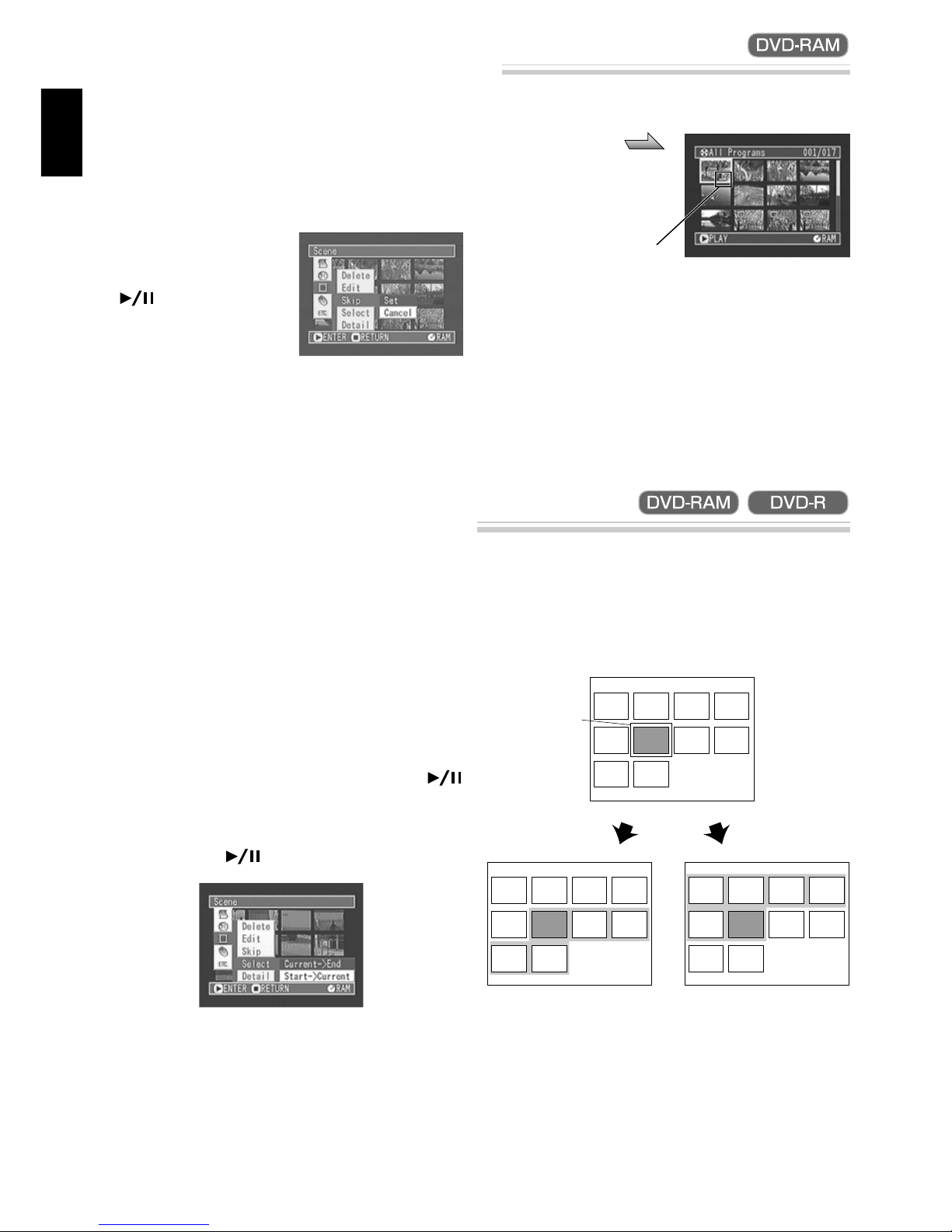
86
ENGLISH
Selecting Scenes Using Menu Screen
Using the Disc Navigation menu screen, you can simultaneously select consecutive scenes: This function
is useful when there are numerous scenes.
1
Use the joystick to select the first scene to be se-
lected.
2
Press the MENU button.
The Disc Navigation menu screen will appear.
3
Use the joystick to choose “Select” on the
“Scene” menu screen, and then press the
button.
4
Use the joystick to choose “Current→End”, and
then press the button.
The scenes from the one specified to the last
scene on disc will be selected.
Note: If you select “Start→Current” in step 4, the
scenes from the first scene on disc to the one speci-
fied will be selected.
Playing Back by Skipping Scenes (Skip)
You can specify “Skip” for scenes you do not want to play back: The selected scenes will be skipped.
1
Use the joystick to select a scene to be skipped,
and then press the MENU button.
The Disc Navigation menu screen will appear.
2
Use the joystick to
choose “Scene”, “Skip”,
“Set”, and then press the
button.
The message showing that skip is being set will
appear, and the thumbnail display screen will
be restored.
A skip mark “ ”
will be attached to the
scene for which skip-
ping has been set.
● Releasing Skip
Select the scene set to be skipped, and choose “Can-
cel” in step 2: The skip mark will disappear and
skipping of the scene will be released.
Note: If you wish to release skipping for multiple
scenes, select them referring to “Selecting Con-
secutive Scenes Together” or “Selecting Random
Scenes” on page 71.
Skip mark
Scene that the
cursor is on
Choose “Current→End”:
To select the scenes from
the one that the cursor is
on to the last scene on disc.
Choose “Start→Current”:
To select the scenes from
the first scene on disc to the
one that the cursor is on.
Downloaded from www.ManualsFile.com manuals search engine
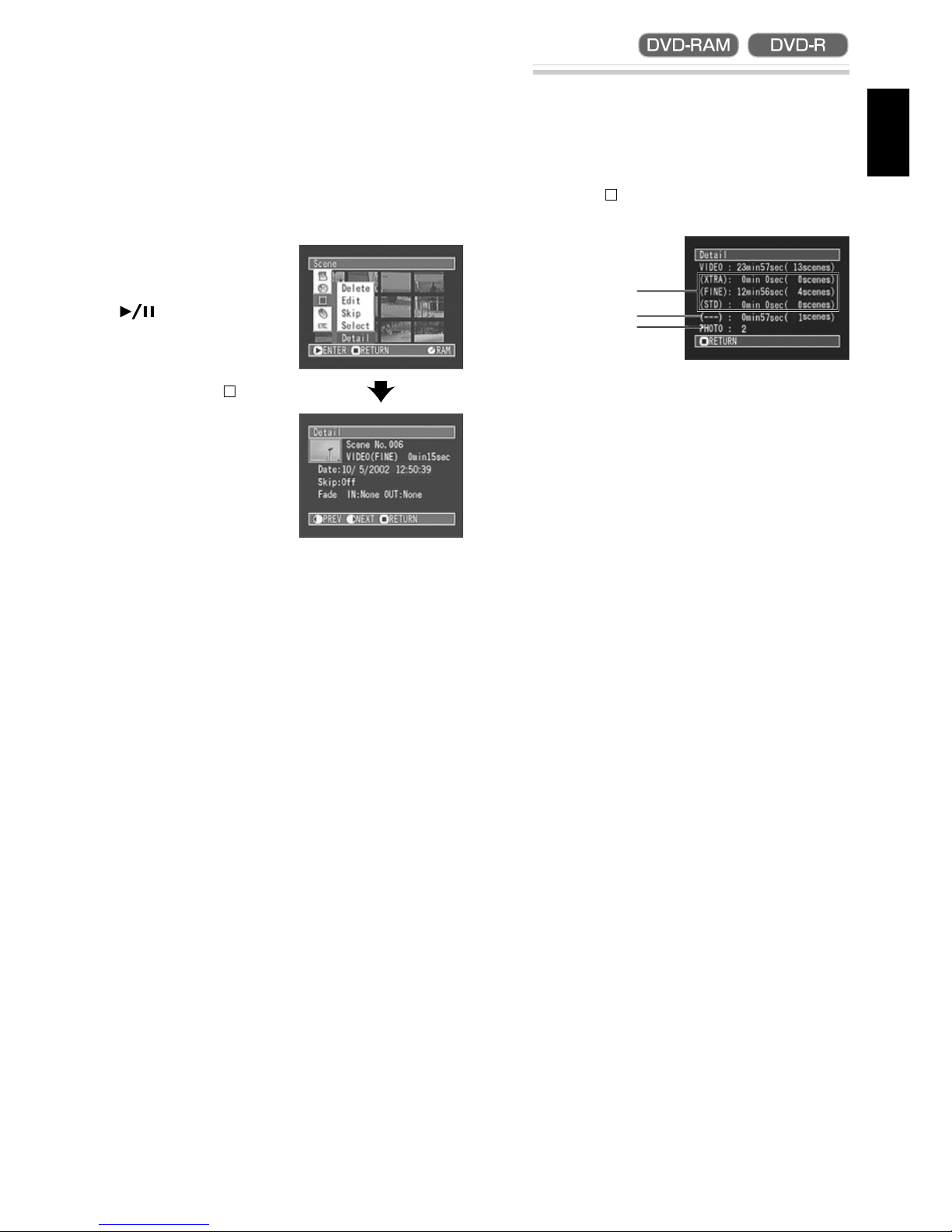
87
ENGLISH
Displaying Information Using Menu Screen
You can display various information for a scene: the recording mode, recording date/time and length,
special effects and movie quality mode.
1
Use the joystick to select the scene whose infor-
mation you wish to know, and then press the
MENU button: The Disc Navigation menu
screen will appear.
2
Use the joystick to
choose “Scene”, “De-
tail”, and then press the
button.
The detailed information
on the scene will appear.
Pressing the button
will restore the thumb-
nail display screen.
Note: Tilting the joystick
to right will display infor-
mation on the following
scene; tilting the joystick
to left will display informa-
tion on the preceding
scene.
If you have selected multiple scenes, the infor-
mation shown below will appear.
Pressing the button will restore the thumb-
nail display screen.
*
With DVD-R disc, the quality mode (FINE or STD)
selected first will appear.
**
Number of scenes whose quality mode is unknown:
This will appear when the disc has a scene recorded
on a device other than this DVD video camera/
recorder, only if the disc has a scene whose mode
is unknown.
Also, this will not appear when a DVD-R disc is used.
***
This will not appear with DVD-R disc, since no still
image can be recorded on it.
Note: If multiple scenes have been selected, the
total recording time of the selected scenes will ap-
pear.
*
**
***
(When using DVD-RAM disc)
Downloaded from www.ManualsFile.com manuals search engine
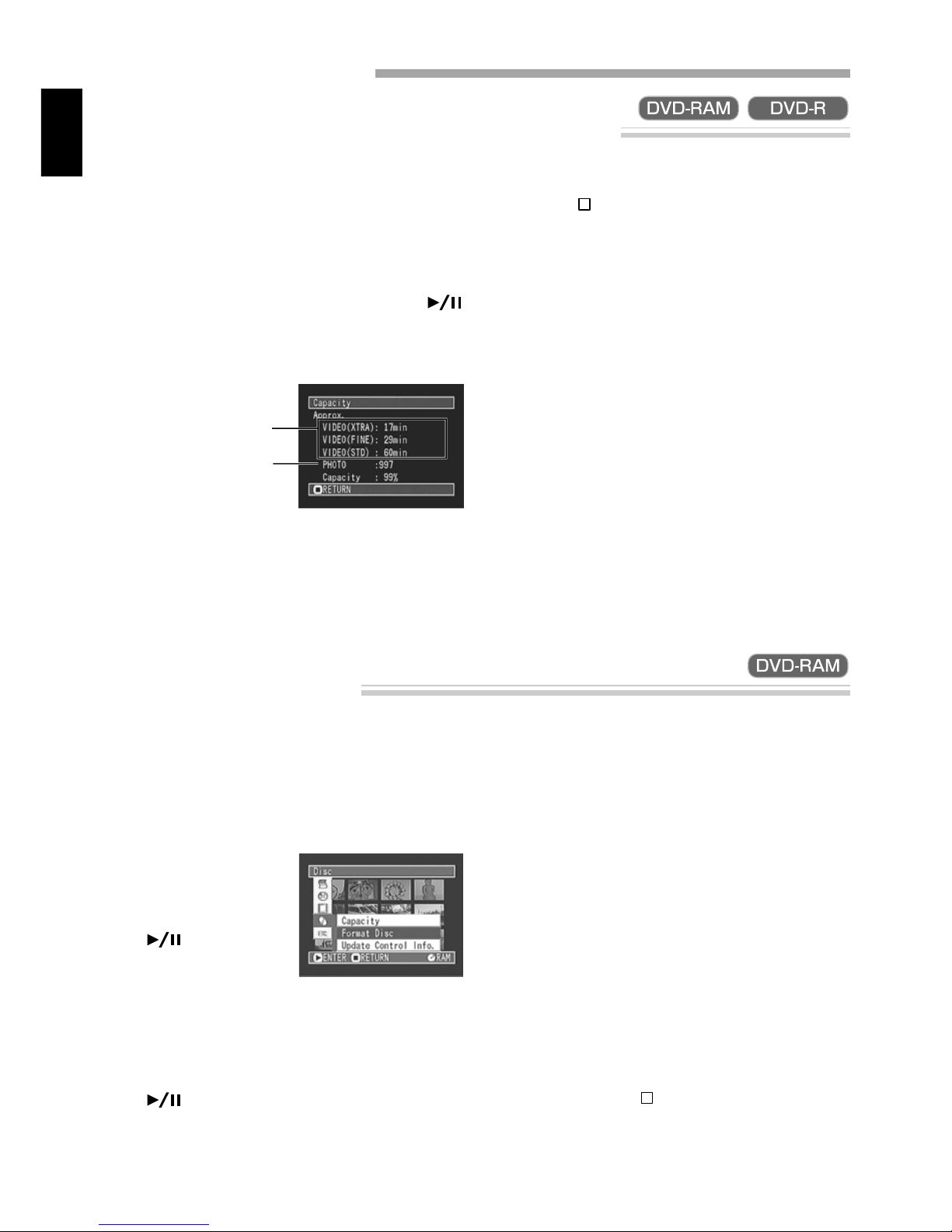
88
ENGLISH
Initializing DVD-RAM Disc
If you want to erase all data on a recorded disc and reuse it, you can initialize it rather than deleting the
data: Initialization is useful in this case since it takes less time than deleting all data.
1
Press the MENU button.
The Disc Navigation menu screen will appear.
2
Use the joystick to
choose “Format Disc”
on the “Disc” menu
screen, and then press
the button.
The screen for verifying “Format Disc” will ap-
pear.
3
If you are sure that you wish to format the disc,
use the joystick to choose “YES”, and then press
the button.
When initializing one side of the disc is com-
plete, the DVD video camera/recorder will re-
turn to the recording pause status.
Note: When initializing the other side of disc, turn
it over and start again from step 1.
Note: Choosing “NO” in step 3 will cancel initiali-
zation.
Note: Initializing a disc will delete all the recorded
contents on disc: Be careful not to delete data by
mistake.
Note: Be sure to use the AC adapter when initial-
izing disc so that the DVD video camera/recorder
is not turned off midway. If initialization is inter-
rupted by power off, the disc will not be initialized
correctly, or it may be damaged.
Note: It may not be possible to initialize a disc with
many scratches or dirt: Such a disc cannot be used.
Note: If you use a brand-new DVD-R disc, mes-
sage “Disc is not formatted” will appear: Initialize
the disc, following the subsequent messages (see
page 103).
Note: Pressing the
button on the screen for veri-
fication will restore the thumbnail display screen.
Verifying Remaining Free Space on Disc (Capacity)
You can find out how long you will be able to record on one side of disc.
1
Press the MENU button.
The Disc Navigation menu screen will appear.
2
Use the joystick to choose “Capacity” on the
“Disc” menu screen, and then press the
button.
The screen for checking “Capacity” will appear.
*
With DVD-R disc: The quality mode first used for re-
cording with disc will appear.
**
With DVD-R disc: This will not be displayed.
3
Press the button.
The Disc Navigation screen will be restored.
Note: With a write-protected disc, the remaining
space will always be displayed as “0”.
Note: The displayed remaining free space is only
for the side being currently recorded.
Disc Management
*
**
(When using DVD-RAM disc)
Downloaded from www.ManualsFile.com manuals search engine
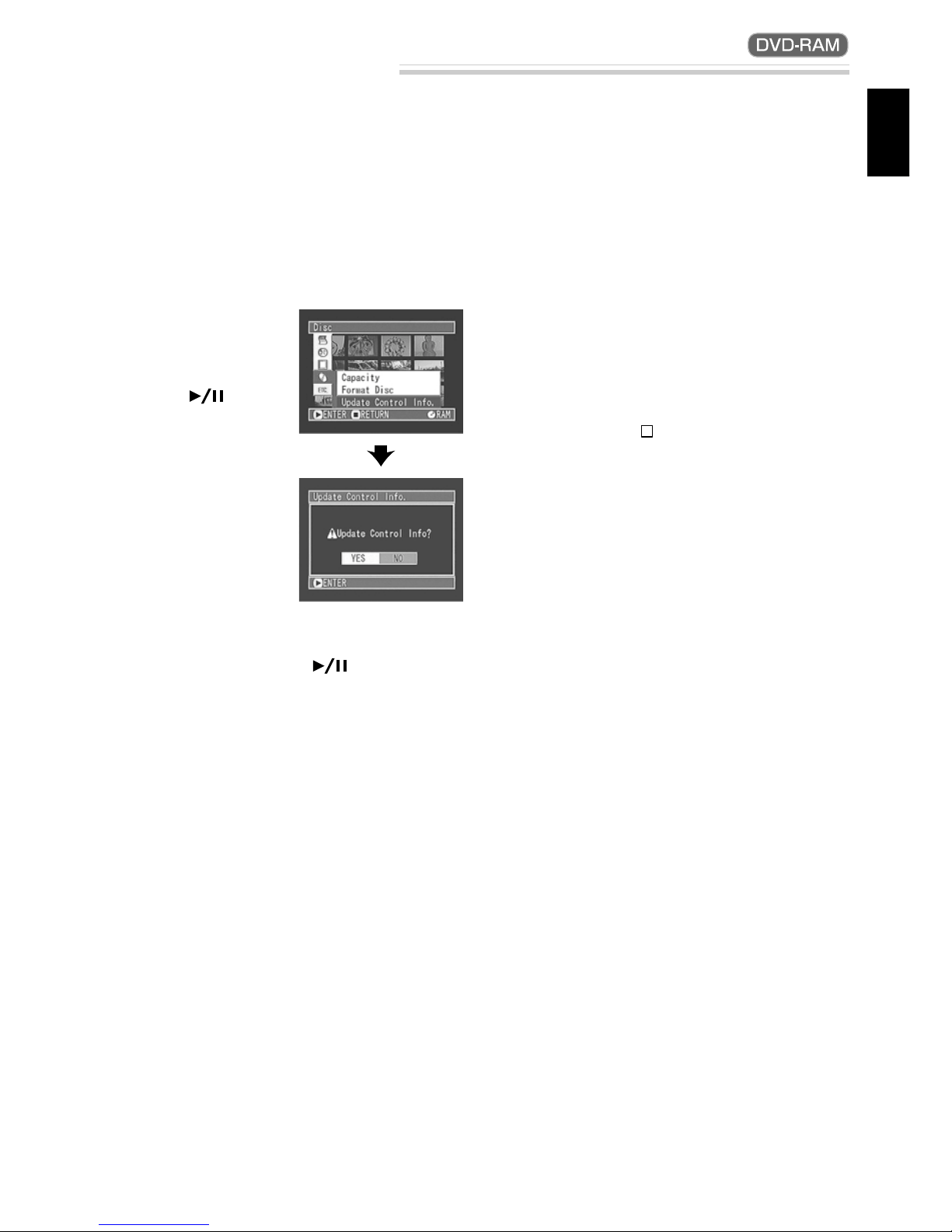
89
ENGLISH
Disc Navigation in this DVD video camera/recorder manages information on scenes, such as skip, fade
and thumbnails, in a specified manner. If you use another device to edit the video data recorded on this
DVD video camera/recorder, and then use the data again with Disc Navigation in this video camera/
recorder, the control information must be updated: It will be automatically updated each time the pages
on the thumbnail display screen are turned. This is useful when you have edited many scenes using
another device, since the control information can be updated all at once using Disc Navigation.
1
Press the MENU button.
The Disc Navigation menu screen will appear.
2
Use the joystick to
choose “Update Con-
trol Info.” on the “Disc”
menu screen, and then
press the button.
The screen for verifying
“Update Control Info.”
will appear.
3
If you are sure that you wish to update the con-
trol information, use the joystick to choose
“YES”, and then press the button.
The message for proceeding will appear, and
then the Disc Navigation menu screen will be
restored.
A black screen may appear while the message
for updating is displayed.
If you choose “NO” on the screen for verifying
updating of control information, updating will
be canceled.
Note: Be sure to use the AC adapter when up-
dating the control information so that the DVD
video camera/recorder is not turned off midway.
If updating of control information is interrupted by
power off, the control information will not be up-
dated correctly.
Note: Even if the control information on disc is up-
dated, the disc may no longer be usable on this
DVD video camera/recorder.
Note: It may take time to update the control in-
formation if the disc has many recorded scenes.
Note: Pressing the
button on the screen for veri-
fication will restore the thumbnail display screen.
Updating Control Information
Downloaded from www.ManualsFile.com manuals search engine
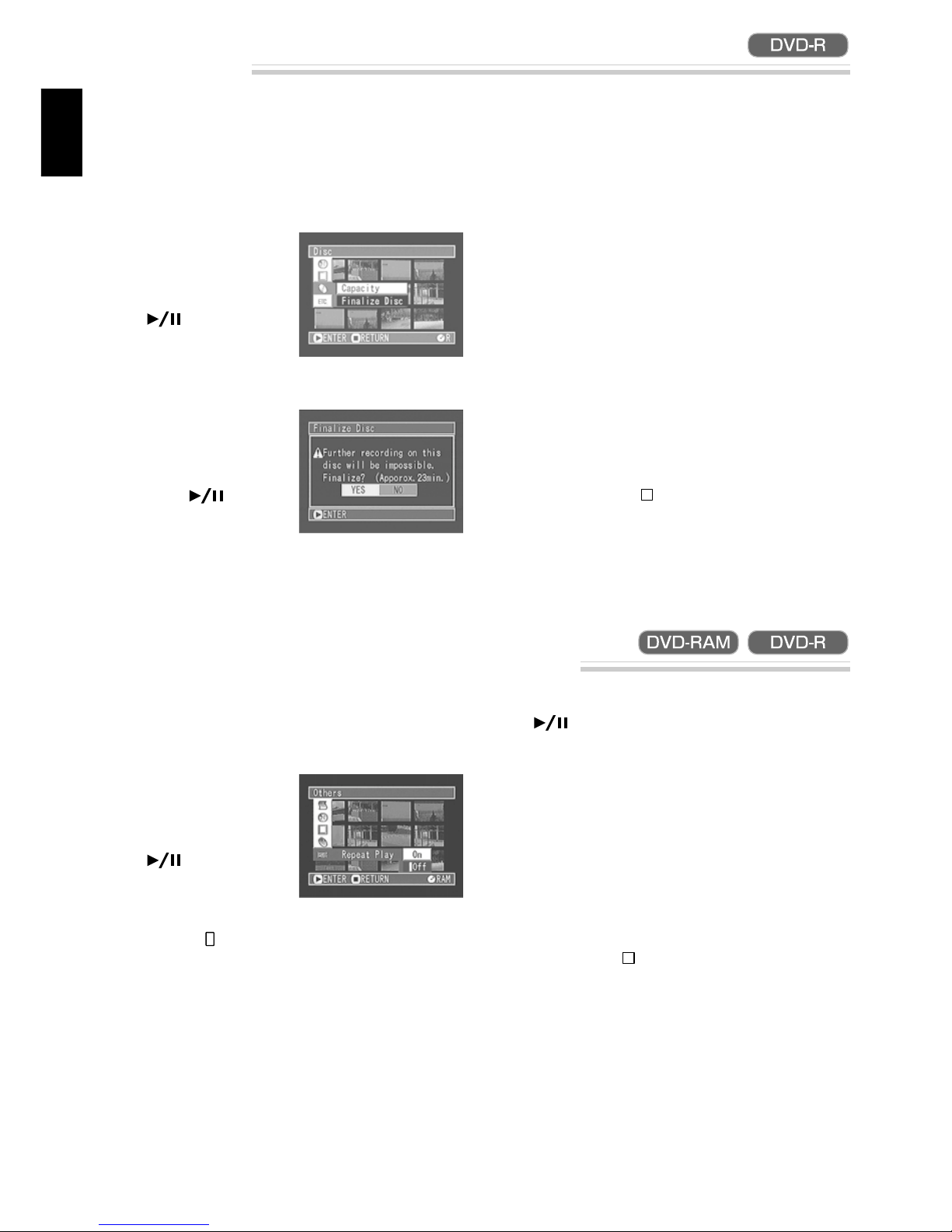
90
ENGLISH
Playing Back Scenes Repeatedly (Repeat Play)
1
Press the MENU button.
The Disc Navigation menu screen will appear.
2
Use the joystick to
choose “Repeat Play” on
the “Others” menu
screen, and then press
the button.
The options will appear
on the right of “Repeat
Play”: The mark will
be attached to the cur-
rently selected option.
3
Use the joystick to choose “On”, and then press
the button:
Repeat Play has now been set.
Choosing “Off” will cancel Repeat Play.
When Repeat Play is set:
If one scene has been selected: When playback
of the last scene is finished, playback of all scenes
will repeat from the first scene.
If the range for playback has been specified:
Playback of the scenes in that range will repeat.
Note: Press the button to terminate playback.
However, the Repeat Play setting will not be can-
celled.
Note: Still images can also be played back re-
peatedly.
Note: The Repeat Play setting is cancelled when-
ever the DVD video camera/recorder is turned off
or DISC EJECT button is pressed.
Finalizing Disc
1
Press the MENU button.
The Disc Navigation menu screen will appear.
2
Use the joystick to
choose “Finalize Disc”
on the “Disc” menu
screen, and then press
the button.
The disc will be final-
ized.
3
If you are sure that you
wish to finalize the disc,
use the joystick to
choose “YES”, and then
press the button.
When finalizing the other side of disc, turn the
disc over, and repeat the above procedure from
step 2.
If you wish to play back the contents recorded on this DVD video camera/recorder using a DVD player,
etc. that is compatible with 8 cm DVD-R disc, finalize the disc following the procedure below:
Note: You can play back a finalized DVD-R disc
on a compatible DVD player by specifying “DVD
video” (the program will be registered on the DVD
menu as a title).
Note: No recording can be done on any DVD-R
disc that has been finalized.
Note: If the disc in the DVD video camera/re-
corder has already been finalized, you cannot
choose “Finalize Disc”.
Note: Be sure to use the AC adapter when final-
izing disc. Finalization cannot be executed using
a battery pack. If finalization is interrupted by
power off, the disc will not be finalized correctly,
or it may be damaged.
Note: The time required to finalize disc that ap-
pears on the “Finalize Disc” screen is only for refer-
ence.
Note: The shorter the recording time on disc, the
longer it will take to finalize it.
Note: Pressing the
button on the screen for veri-
fication will restore the thumbnail display screen.
Downloaded from www.ManualsFile.com manuals search engine
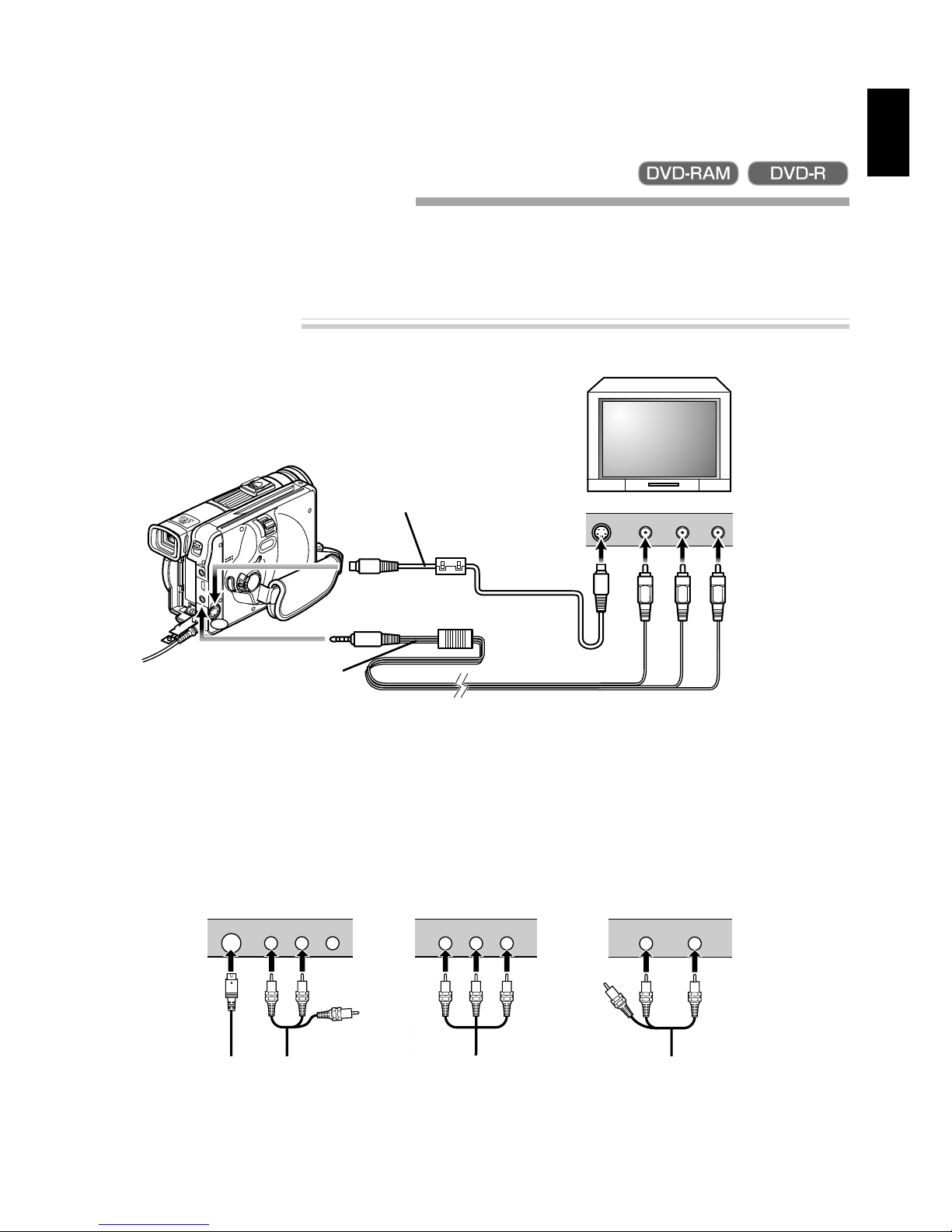
91
ENGLISH
Viewing on TV Screen
Connect this DVD video camera/recorder to a TV and you can play back the recorded video or
monitor the video being recorded on the TV screen. This is also useful when editing or playing back
with Disc Navigation.
Connecting to a TV
Use the provided AV input/output cable to connect the DVD video camera/recorder to a TV as follows:
Note: Using an S-VIDEO cable to connect the
DVD video camera/recorder to a TV will deliver
clearer playback pictures.
Note: Before connecting, make sure that the vol-
ume on TV is turned down: Forgetting this may
cause howling from the TV speakers.
Note: Insert the AV input/output cable plugs into
jacks straight: Obliquely inserting them could dam-
age the jacks.
Note: Disconnect the S-VIDEO cable before re-
moving the disc.
Connecting to Other Devices
This section explains about the connections to another AV device, such as TV, and how to transfer data
in DVD video camera/recorder to PC.
S-VIDEO VIDEO AUDIO
LR
S-VIDEO cable
To S-VIDEO
input/output jack *
To S-VIDEO
input jack *
To AV input/output jack
AV input/output cable
(provided)
To video/
audio
input jacks
* If your TV has an S-VIDEO input jack, the connection using S-VIDEO cable will be possible.
Input jacks
Yellow
WhiteRed
Stereo Type with
S-VIDEO Jack
Stereo Type Monaural Type
S-VIDEO VIDEOAUDIO
LR
VIDEOAUDIO
LR
VIDEOAUDIO
Downloaded from www.ManualsFile.com manuals search engine

92
ENGLISH
Viewing on TV Screen
Use the provided AV input/output cable to connect the DVD video camera/recorder to a TV as follows:
1
Turn the TV on and set the input selector to
“VCR” whichever applicable Video input.
Refer to the TV instruction manual for how to
switch the TV input.
2
Set the power switch to “ VIDEO” or
“ PHOTO” to turn the DVD video camera/
recorder on.
The image that the DVD video camera/recorder
is seeing will appear on the TV screen. You can
also monitor the image on the LCD screen or
viewfinder of the DVD video camera/recorder.
3
Perform playback or recording.
Turn down TV volume in record mode, or feed-
back could result.
Note: The infrared remote control is useful when
operating the DVD video camera/recorder while
viewing an image on TV screen. However, if you
use a Hitachi VCR, the remote control may inad-
vertently operate the VCR if it is near the DVD video
camera/recorder. To prevent this, set the remote
control code of the VCR to a position other than
“VCR2”.
Note: Information that the DVD video camera/
recorder is recording will appear on the TV screen:
You can also display only part of information or
switch off the display. Refer to “Switching On-
Screen Display Output On or Off” on page 63, and
press the DISPLAY button to switch the display sta-
tus.
Note: When copy-guarded disc is played back,
no image will appear on TV screen.
Note: If you use TV with wide mode (aspect ratio
16:9) and set the TV to the wide mode, the Disc
Navigation screen may malfunction. If this hap-
pens, release the wide mode setting on TV (see
the TV instruction manual for releasing the wide
mode).
Downloaded from www.ManualsFile.com manuals search engine
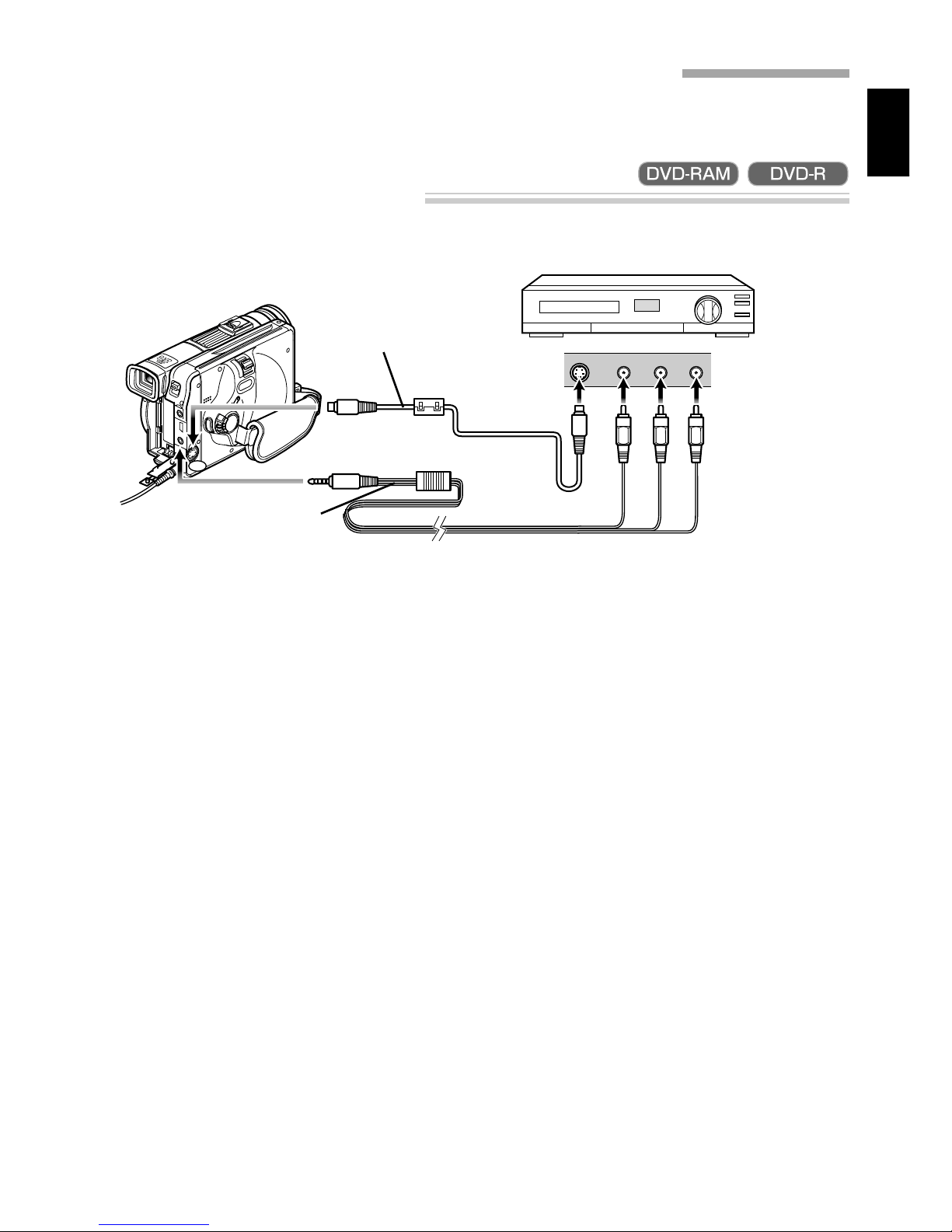
93
ENGLISH
S-VIDEO VIDEO AUDIO
LR
Connecting to Other AV Device
Use the AV input/output cable (provided) to connect the DVD video camera/recorder to other AV de-
vice as follows:
Note: If you operate the DVD video camera/re-
corder connected to another device, always
power the camera/recorder from AC outlet using
the AC adapter.
Note: In case of camera recording with this DVD
video camera/recorder, do not connect the AV
input/output cable to the output jacks of any other
device: If you do this, sound from the other de-
vice may leak to this DVD video camera/recorder.
Note: If you use a Hitachi VCR, it will be operated
by the remote control provided with the DVD video
camera/recorder. When recording an image from
a Hitachi VCR, change the remote control code
of the VCR to other than “VCR2”.
Note: If you increase the volume of speaker in this
DVD video camera/recorder when recording an
externally input image, noise may occur in the
image that is being recorded. To prevent this, re-
duce the speaker volume when recording an ex-
ternally input image.
Recording Image from Other AV Devices
You can transfer any image recorded on videotape, etc. to the DVD video camera/recorder via the
AV input/output jack, and record it on disc.
Output jacks
S-VIDEO cable
To S-VIDEO
input/output jack *
To S-VIDEO
output jack *
To AV input/output jack
AV input/output cable
(provided)
To video/
audio
output jacks
Yellow
WhiteRed
* If the AV device has an S-VIDEO output jack, the connection using S-VIDEO cable will be possible.
Downloaded from www.ManualsFile.com manuals search engine

94
ENGLISH
1
Set the input selection
on the DVD video cam-
era/recorder to “LINE”.
Switch the input refer-
ring to “Input Selec-
tion” on page 60.
2
Turn on the connected device, and start play-
back of picture.
The picture will appear on the LCD screen or
viewfinder of this DVD video camera/recorder.
3
Press the REC button.
Recording will start on this DVD video camera/
recorder.
The operation of this line-input recording is the
same as for recording movie (video).
Recording Image from Other Camcorder or AV Device
Note: Still images can also be recorded on DVD-
RAM disc. See “Changing Method for Recording
Stills” on page 61 for details, and “Recording Stills”
on page 43 for how to record still images.
Note: The “Input Source” setting will return to
“CAMERA” whenever DVD video camera/re-
corder is turned off.
Note: Recording of most images is prohibited by
the copy-guard signal to protect the copyright,
except for images recorded on camcorders for
personal enjoyment. These images cannot be re-
corded on this DVD video camera/recorder:
Typical copyright protected images include those
of DVD video, LD, prerecorded videotape, rental
videotape, digital satellite broadcast, etc.
Note: If a video signal that cannot be read by
this DVD video camera/recorder is present - even
in images recorded on camcorder for personal en-
joyment without copy-guard signal - the input im-
age may not be recorded normally.
Note: If the input signal is interrupted by switch-
ing the channel on TV or switching the signal using
video selector, normal recording cannot be per-
formed.
Downloaded from www.ManualsFile.com manuals search engine

95
ENGLISH
Cautions when connecting DVD video
camera/recorder to PC
Do not plug in or unplug any cables when
you are using PC to access the disc in the
DVD video camera/recorder:
• If you plug in or unplug the PC connection ca-
ble or power cable while the CHARGE/ACCESS
indicator is blinking, the data on disc may be
damaged.
The mode for connection to PC does not
function in the following cases:
• When DVD video camera/recorder is turned off.
• When no disc is in DVD video camera/recorder.
The icon displayed on PC will be CD-ROM
in the following cases:
• When a DVD-RAM disc or DVD-R disc is not
set in DVD video camera/recorder.
• When an unformatted DVD-RAM disc or a disc
other than UDF formatted is in DVD video cam-
era/recorder.
• When a DVD-R disc is not finalized.
The mode for connection to PC may not
function in the following cases:
• When a DVD-RAM disc formatted on a device
other than this DVD video camera/recorder is
inserted.
• When DVD video camera/recorder is connected
via USB HUB.
• When a USB device other than this DVD video
camera/recorder is connected to the same USB
bus.
The PC connection cable must be un-
plugged and then plugged in again when
using the mode for connection to PC in the
following cases:
• When the connected PC is set to suspended sta-
tus.
The following cannot be performed on this
DVD video camera/recorder when it is
connected to PC:
• Camera operation, using button on DVD video
camera/recorder.
• Power off, using the power switch.
The following functions are not supported:
• Writing ordinary file other than AV data.
• Writing and reading to/from the disc in DVD
video camera/recorder at the same time.
• Compression of drive or disc utility program.
• Writing to disc, using an application other than
that provided in PC kit.
• Formatting disc from PC.
In addition, take note of the following:
• The recording mode, playback status, special
effects, or title displayed on this DVD video cam-
era/recorder, will not be transferred to PC.
• The volume name of the DVD-RAM disc initial-
ized on this DVD video camera/recorder will
be displayed on PC as “Dvd_camera”; the vol-
ume name of the DVD-RAM disc initialized on
a device other than this DVD video camera/re-
corder will conform to the specifications of the
previous initializing device.
• Do not use the DVD video camera/recorder in
an environment of high temperatures for an ex-
tended period of time.
• Use an unformatted DVD-R disc to record data
from PC on this DVD video camera/recorder.
• When recording data from PC on DVD-RAM
disc using this DVD video camera/recorder, al-
ways use a brand-new DVD-RAM disc or a
DVD-RAM disc formatted on this DVD video
camera recorder.
Downloaded from www.ManualsFile.com manuals search engine

96
ENGLISH
Capturing Data for PC
You can capture the data recorded on this DVD video camera/recorder and transfer it to PC.
Using DZ-WINPC3(W) PC kit
Using the DZ-WINPC3(W) optional PC kit, you can capture the data of images recorded on this DVD
video camera/recorder and transfer it to your PC*.
You can also write video data edited on the PC to disc. See the instruction manual of DZ-WINPC3(W) PC
kit for details.
* There are numerous types of PC, including those personally assembled. Hitachi will occasionally
update compatibility information on Internet for PCs with which the PC kit can be operated: See
“Conditions for using DZ-WINPC3(W) PC kit” (shown below), the catalog and information on Internet,
to find out whether or not the PC kit can be used with your PC.
● Conditions for using DZ-WINPC3(W)
PC kit
To connect the DVD video camera/recorder to PC
using the DZ-WINPC3(W) PC kit, the PC must sat-
isfy the following conditions:
• Windows
®
98, 98 Second Edition, Me, 2000 Pro-
fessional, or XP
• IBM PC/AT compatible
• USB port (the USB2.0 port is necessary to trans-
fer data at a higher speed)
• CD-ROM or DVD-ROM drive equipped
● PC kit should include the follow-
ing:
• PC connection cable
• Device driver software for the DVD video cam-
era/recorder (not used with DZ-MV270E)
• UDF2.01 file system (InstantWrite)
• Software using still images (Photo Explorer Lite)
• Video editing/DVD writing software (DVD
Movie Factory SE for DVDCAM)
• DVD playback software (PowerDVD XP)
Downloaded from www.ManualsFile.com manuals search engine
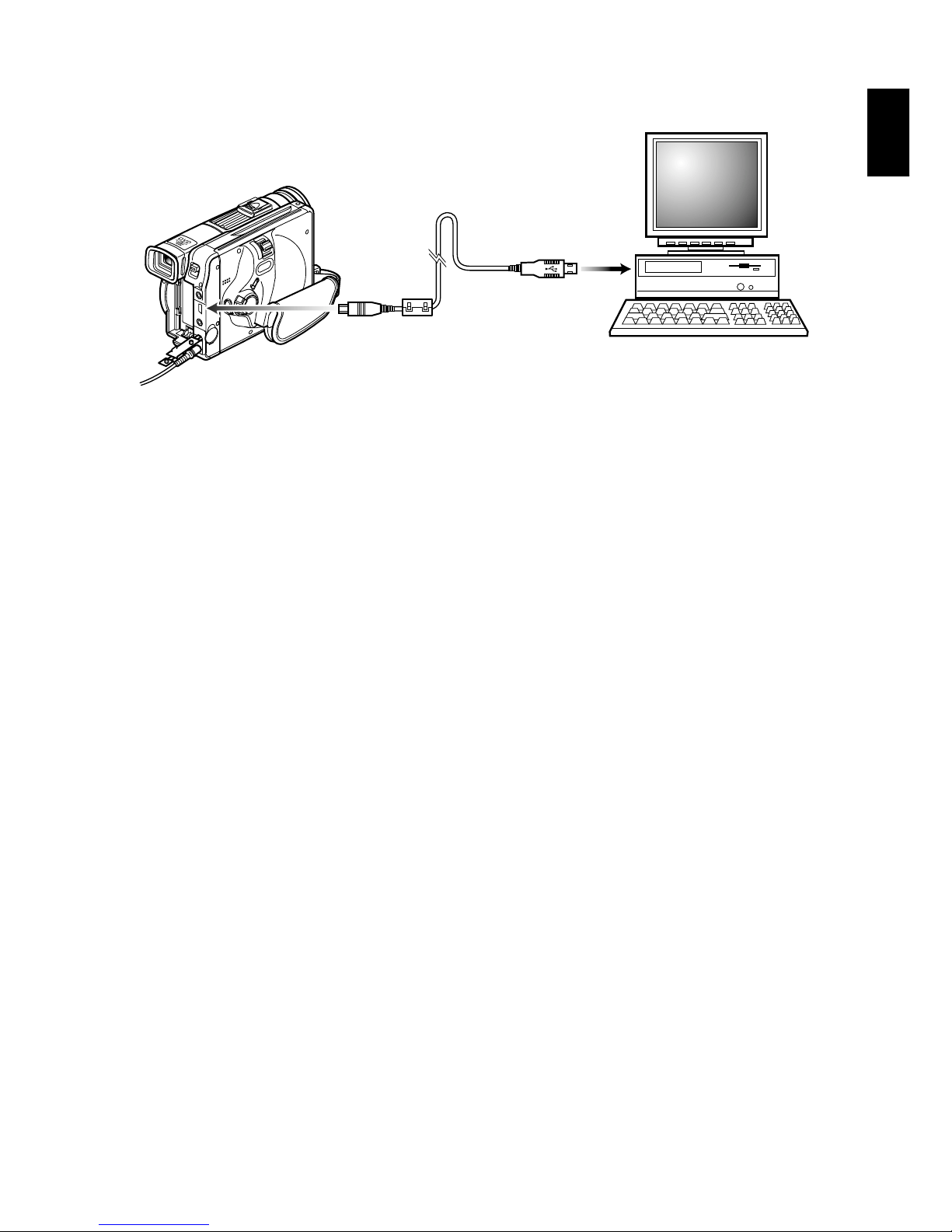
97
ENGLISH
● Connecting DVD video camera/recorder to PC via PC connection cable
Use the PC connection cable supplied with the DZ-WINPC3(W) optional PC kit to connect the DVD
video camera/recorder to a PC that has been turned off, as shown in the following illustration:
Note: Use the USB device driver provided with the
DVD video camera/recorder, not with the DZ-
WINPC3(W).
Note: When connecting this DVD video camera/
recorder to PC, you can also use a mini-USB B con-
nector 5-pin type cable that is compatible with
USB2.0 (generally available), as well as the PC con-
nection cable.
Note: The PC connection cable does not supply
power to the DVD video camera/recorder. Use the
AC adapter to power the DVD video camera/re-
corder.
Note: The PC connection cable supplied with the
DZ-WINPC3(W) optional PC kit is to be exclusively
used with the DVD video camera/recorder: A gen-
erally available USB cable cannot be used.
Note: Before connecting DVD video camera/re-
corder to PC, disconnect any other cables, such
as AV input/output cable, from the DVD video
camera/recorder.
Note: If you connect this DVD video camera/re-
corder to PC, nothing will appear in the viewfinder
or on the LCD screen. The CHARGE/ACCESS indi-
cator will blink only while the disc is being
accessed.
Note: If you wish to transfer data recorded on
DVD-R disc with this DVD video camera/recorder
to PC, finalize the DVD-R disc (see page 90).
Note: After transferring the data on disc to PC,
keep the original disc as your backup.
To PC connection terminal
Note: When capturing for PC the video data in-
put from another AV device and recorded on disc
in DVD video camera/recorder, note that data
may not be played back correctly.
Note: The DVD video camera/recorder con-
nected to PC should be used at normal room tem-
perature.
Note: Note that Hitachi does not guarantee op-
eration in the following cases:
•If connection is made using a cable other than
that supplied with the DZ-WINPC3(W) PC kit
Note: Connect the DVD video camera/recorder
to PC and use it at room temperature.
Note: Take care that the temperature of this DVD
video camera/recorder, when connected to PC,
does not rise excessively (reference for usage:
approx. 30 minutes at about 30°C.
Note: If you use a PC equipped with DVD-RAM
drive, change the provided UDF file system to the
UDF2.01 file system included in the DZ-WINPC3(W)
PC kit.
Note: If the DVD video camera/recorder is con-
nected to the USB1.1 port of PC, the data transfer
speed will be lower than when it is connected to
USB2.0 port.
Downloaded from www.ManualsFile.com manuals search engine

98
ENGLISH
Using Disc on PC
If your PC is compatible with the disc used, you can immediately use a disc removed from the cartridge
or caddy on PC.
● Making use of recorded still
images (with DVD-RAM disc only)
Still images are stored in the “DCIM”–“100HPNX1”
folder of disc as JPEG images (1280 × 960 pixels)*.
Use the still images on an application that is com-
patible with JPEG data.
* Stills from another AV device are JPEG images
(640 × 480 pixels).
● Making use of recorded movies
• When using DVD-RAM disc
Movies will be recorded conforming to DVD
video recording standard.
The DVD-RAM disc can be used on PCs that sat-
isfy the following conditions:
- Compatible with 4.7 GB DVD-RAM disc
- Equipped with DVD-RAM(RAM/R) drive that
is compatible with 8 cm disc
- UDF2.01 file system installed
When playing back or editing a DVD-RAM disc
on the PC, use the application software that con-
forms to the DVD video recording standard.
• When using DVD-R disc
Movies will be recorded conforming to DVD-
video standard.
The DVD-R disc can be used on PCs that are
equipped with one of the following drives:
- DVD-ROM drive compatible with 8 cm disc
- DVD-RAM(RAM/R) drive compatible with 8
cm disc
- DVD-R/RW drive compatible with 8 cm disc
When playing back or editing a DVD-R disc on
the PC, use the application software that con-
forms to the DVD-video standard.
Note: If you wish to write the images edited on
PC to a brand-new DVD-R disc, do not format the
new disc on this DVD video camera/recorder.
Note: If you wish to use a DVD-R disc recorded
on this DVD video camera/recorder directly on PC,
finalize the disc on the DVD video camera/re-
corder (see page 90).
Note: Writing of the images edited on PC to DVD-
RAM or DVD-R disc may not be possible, depend-
ing on the combination of PC and DVD-RAM or
DVD-R disc.
Downloaded from www.ManualsFile.com manuals search engine
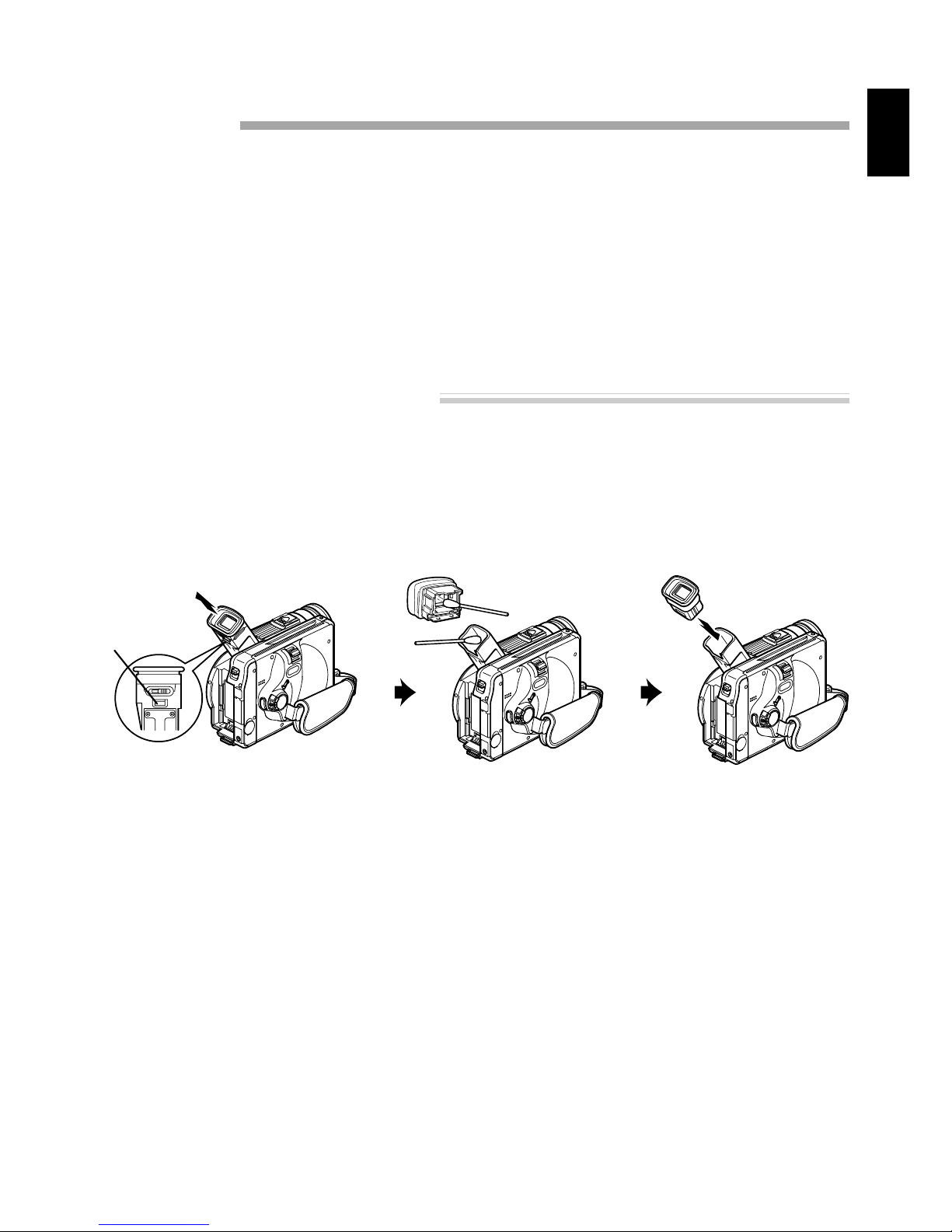
99
ENGLISH
Cleaning
Be sure to set the power switch to “POWER OFF” before cleaning this DVD video camera/recorder.
● Do not use benzene or thinner to
clean DVD video camera/re-
corder case
The coating of case could peel off or the case could
deteriorate. Wipe off dirt on the case with a moist
cloth which has been completely wrung out. When
using chemical cleaning cloth, follow instructions
for use.
● Cleaning LCD screen and lens
Use dry, soft cloth to wipe dirt off. When cleaning
the LCD screen, be careful not to use force, scratch
it, or subject it to impact: Doing such could cause a
defect in the screen, result in display unevenness,
or damage the LCD monitor.
Subsidiary Information
1
Push up the tab on the back of viewfinder to
remove the lens block of viewfinder.
2
Use a soft object, such as a cotton swab, to
clean the lens in viewfinder.
If dust adheres to viewfinder lens
Use a cotton swab to wipe it off. Do not use force when rubbing the lens: Doing so could damage it.
3
Reattach the lens block.
Check the orientation of lens block and slowly
fit it in until a click is heard.
Push up this
portion.
Downloaded from www.ManualsFile.com manuals search engine
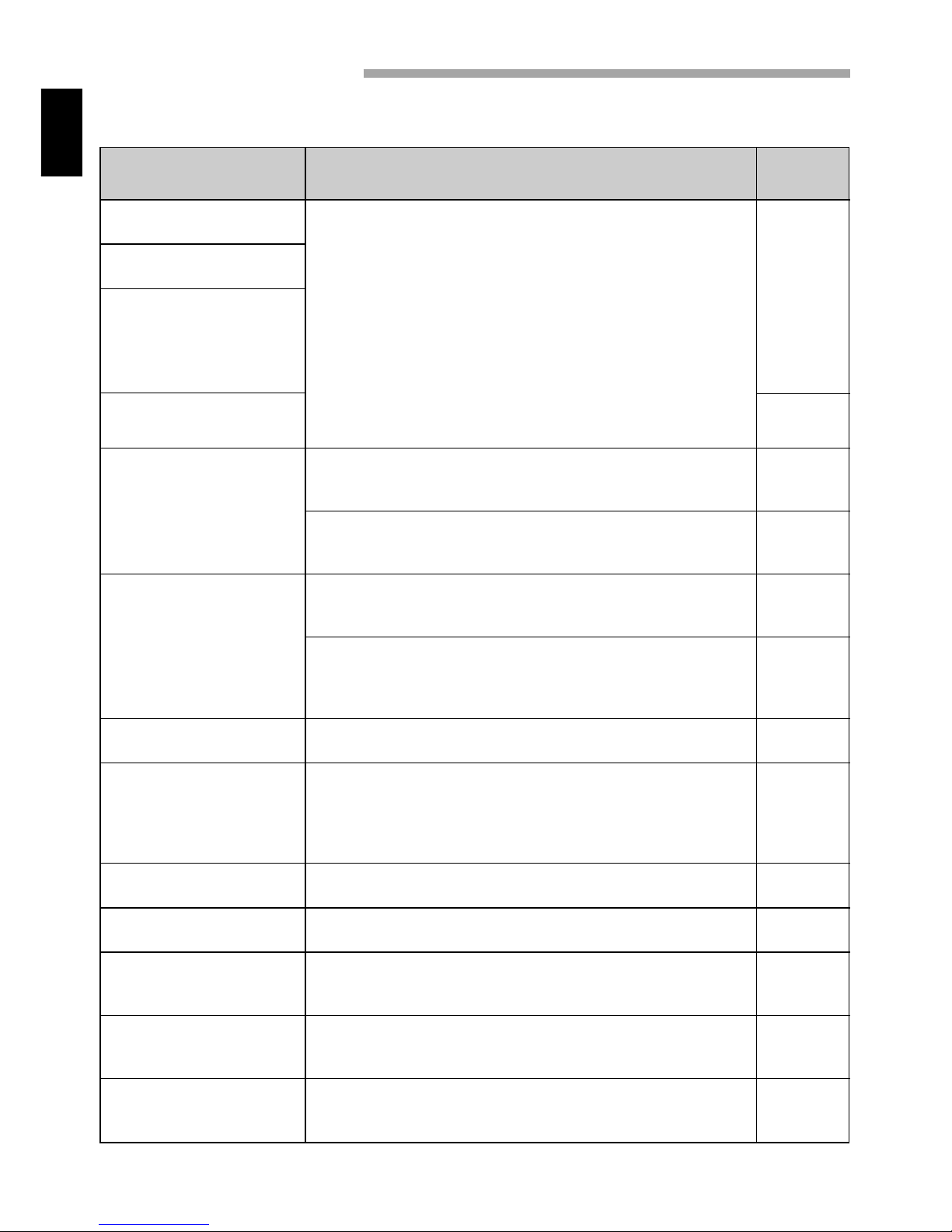
100
ENGLISH
Message Cause & Troubleshooting
Reference
page
(1) Error has occurred.
Please restart.
(2) Error has occurred.
Please reinsert a disc.
(3) Error has occurred.
Error code No. xxxx.
Please read the
manual.
(4) ERROR xxxx
Control Information Er-
ror.
Disc error.
No more scenes. Play
List was deleted.
Write protected.
Check disc cartridge.
Battery is almost
empty. Replace it.
Cannot combine. Se-
lect multiple scenes.
Cannot combine.
Deselect PHOTO
scenes.
Scenes over limit. Can-
not divide scenes.
Scenes over limit. Can-
not add scenes.
Error has occurred. Try to restart the DVD video cam-
era/recorder using the following methods:
(1) Turn power off, remove the battery pack or AC
adapter and reattach it, and then turn power on again.
(2) Turn power off, and reinsert the disc. Then turn power
on again.
(3) Take note of the number (xxxx), and then consult
your dealer.
Condensation might have occurred: Use the DVD
video camera/recorder only after it has dried.
(4) Try to repair using methods (1) and (2) above. If the
message still appears, take note of the number (xxxx)
and consult your dealer.
Mismatch may occur between the recorded image
and scene information.
Update the control information.
Disc may be dirty.
Remove the disc and wipe off fingerprints, dust, etc.
before reusing it, or use another disc.
Disc may be dirty.
Remove the disc and wipe off fingerprints, dust, etc.
before reusing it, or use another disc.
Mismatch in recording information may be caused by
editing done on some device other than this DVD video
camera/recorder.
Initialize the disc or use another disc.
All scenes are deleted from the play list.
Release write-protect of the cartridge. If the message
still appears, the disc may be software protected from
a device other than this DVD video camera/recorder.
To release this case, use a device that has executed
software-protect.
Replace with a charged battery, or use AC adapter
to power the DVD video camera/recorder.
Select a range of at least 2 scenes to be combined,
and then combine them.
Select only movies and combine them.
The number of entered scenes has reached the limit
that can be entered.
Delete several scenes.
The number of scenes entered in play list has reached
the limit that can be entered.
Delete several scenes.
Trouble Messages
A message may appear while you are operating the DVD video camera/recorder. If a message ap-
pears, refer to the following table and take appropriate corrective action.
30, 34,
37
89
23
23
88
79
25
31, 34
84
84
78, 79
78, 79
20
Downloaded from www.ManualsFile.com manuals search engine
101
ENGLISH
Message Cause & Troubleshooting
Reference
page
Cannot delete scenes.
Scene without control
info. Update control
information?
Disc is full. Cannot add
control info.
Disc is not formatted.
Format the disc now?
Disc error has oc-
curred. Format the
disc now?
Disc error has oc-
curred. Formatting is
not complete.
Disc error has oc-
curred. Keep disc in-
side & restart.
Disc full. Cannot ex-
ecute.
Drive overheat. Please
retry later.
Stop processing
This may occur when scene that was edited for divi-
sion, etc. is to be deleted.
Combine the divided scenes, and then delete them.
The thumbnail at the start of program or play list may
not appear when disc edited on device other than
this DVD video camera/recorder is used, or, when ed-
iting, such as combining, is performed on this DVD video
camera/recorder. Choose “YES” on screen for verifi-
cation.
If thumbnail information is insufficient, Disc Navigation
will automatically create thumbnails after it starts.
The number of entered scenes has reached the limit
that can be entered, so the control information for gen-
erating thumbnails cannot be added.
Combine several scenes or delete them.
Has the disc been initialized on a PC?
Choose “YES” and initialize the disc when using it on
this DVD video camera/recorder.
Has the disc been initialized on PC? Has initializing the
disc on PC been interrupted?
Choose “YES” and initialize the disc when using it on
this DVD video camera/recorder.
The disc may be dirty.
Remove the disc and wipe off fingerprints, dust, etc.
before reusing it, or use another disc.
Disc error could have occurred during editing of scenes.
Turn off the DVD video camera/recorder with the disc
being used in it, connect AC adapter, and then power
the DVD video camera/recorder again. Repair of
scenes will be tried.
If this message appears during recording, turn off the
DVD video camera/recorder with the disc loaded,and
then turn it on again. After that,operate the DVD video
camera/recorder following the instructions on screen.
If the battery is being used to power the DVD video
camera/recorder, the message “Use AC adapter.” will
appear. If an AC adapter is not handy,press the stop
( ) button,and then remove the disc. If the disc is in-
serted when the AC adapter is later used to power the
DVD video camera/recorder, the data may be re-
paired.
Delete unnecessary scenes before using this disc, or
use another disc.
The temperature inside the DVD video camera/re-
corder is too high, and reading or writing of the data
on disc may not be performed normally.
Turn the DVD video camera/recorder off and wait for
a while. The temperature will be effectively decreased
if the DVD video camera/recorder is placed in a well-
ventilated spot.
The button was pressed to stop processing of multi-
ple scenes.
78, 79
88
88
84
23
40, 42
40
81
75
84
Downloaded from www.ManualsFile.com manuals search engine
102
ENGLISH
Message Cause & Troubleshooting
Reference
page
(1) Data error in a part
of image file. Repair
disc now?
(2) Found error in im-
age file. Repair disc
now?
(3) Data error in all im-
age files. Repair all
data now?
Use AC adapter.
Error occurred. Please
replace disc or format
disc.
Error occurred. Please
replace disc.
Disc has no data.
Disc has no Play List.
Disc includes pro-
tected scenes. Delete
scenes.
Play Lists over limit.
Cannot execute.
Unselect multiple
scenes.
It is possible that the system cannot normally complete
writing of file when power is turned off for some reason
during recording or editing (deleting, dividing or com-
bining scenes, or creating play list). Selecting “YES” will
automatically repair the video file, but even if “NO” is
selected, the same message will appear when the DVD
video camera/recorder is turned on next time. (Do not
remove the disc while the DVD video camera/recorder
is recognizing it: Ignoring this will deactivate the file re-
pair function.)
Follow the instructions on screen, taking note of the fol-
lowing cautions:
•Data may not be repaired, depending on the timing
when power was turned off.
•Data may not be repaired normally if data recorded
on another recorder is mixed in.
•The repaired data may be different from the original
recorded content because of partial deletion of de-
fective portion.
•Since the date/time for repair is added to the repaired
data (only the corrected portion for partial repair), the
original date/time information will be lost.
•Since all movies, and then all stills, are repaired, the
order of recorded contents will be lost.
(In case of message (2) (3) only)
Scene cannot be repaired when the DVD video cam-
era/recorder is powered by a battery.
If the AC adapter is unavailable in handy place, re-
move the disc, use the opposite side, or use another
disc. To repair the removed disc, insert the disc into the
DVD video camera/recorder afterwards, and connect
the AC adapter.
Finalization is not possible when the DVD video cam-
era/recorder is powered by a battery pack: Use the
AC adapter for finalization.
Abnormality has occurred with the DVD-RAM disc to
be repaired. Initialize the disc before using it, or use the
other side of the same disc or another disc.
Abnormality has occurred with the DVD-R disc to be
repaired. Use the other side of the same disc or an-
other disc.
The MENU button was pressed with no scene recorded.
Switching of play list was selected with no play list stored.
The disc may be software protected from a device other
than this DVD video camera/recorder. To release this
case, use a device that has executed software-protect.
An attempt was made to create new play list or copy
play list, even though limit specified for play lists in the
video recording standard had already been stored.
Division or change in thumbnail was executed when
multiple scenes were selected.
—
34
—
—
—
88
76
71
75
Downloaded from www.ManualsFile.com manuals search engine
103
ENGLISH
Message Cause & Troubleshooting
Reference
page
Cannot move scene in
program mode.
(1) Disc is not format-
ted. If it formats, it be-
comes possible to use
for camera.
(2) However, when you
record from PC con-
nection terminal,
please do not format.
(3) Format the disc
now?
In DVD-R Disc, Video
mode of the disc re-
corded once cannot
be changed.
Finalize may not be
complete. Finalize
again now?
Disc error has oc-
curred. Finalizing is not
complete.
Scenes over limit. Can-
not move scenes.
Top scene cannot be
divided.
End scene cannot be
divided.
Photo cannot be di-
vided.
Cannot combine
scene.
Same scenes on Play
List will be deleted.
Delete scenes?
This disc is recorded by
the NTSC system.
Please replace disc.
This disc cannot be
used. Please replace
disc.
Move was executed when a program was selected.
DVD-R disc that was not initialized for camera use was
inserted.
With DVD-R disc, the movie quality mode once used
for recording cannot be changed.
Instantaneous shutoff occurred during finalizing, after
which power was supplied and disc was inserted.
Disc error occurred during finalizing, and finalizing failed.
Replace the disc.
An attempt was made to move a scene, even though
number of storable scenes was exceeded.
Division is not possible at the start of scene.
Division is not possible at the end of scene.
Still image cannot be divided.
Unless consecutive scenes are selected, they cannot
be combined.
This will appear when scenes are to be deleted.
This DVD video camera/recorder can use only discs
recorded on the PAL system. A disc recorded on the
NTSC system cannot be used on this DVD video cam-
era/recorder.
A disc that cannot be used on this DVD video cam-
era/recorder has been loaded. Check the type of disc.
—
23
81
84
84
84
85
69, 85
90
90
59
38
73
Downloaded from www.ManualsFile.com manuals search engine
104
ENGLISH
Message Cause & Troubleshooting
Reference
page
COPY PROTECTED
CHECK DISC
UNFORMAT DISC
END OF DISC
DISC ALMOST FULL
DISC ACCESS
NO DISC
CANNOT RECORD
PHOTOS
The video signal input to this DVD video camera/re-
corder may be copy-guarded.
Some prerecorded video materials, such as movies, are
guarded against copying.
Copy-guarded materials cannot be recorded on this
DVD video camera/recorder.
Disc that cannot be used on this DVD video camera/
recorder has been inserted or disc is damaged.
Check whether the type of disc is correct or not, or
whether the disc is write protected or not.
The disc is not initialized or it is damaged.
If this message appears, be sure to initialize the disc on
this DVD video camera/recorder before using it.
Reinitializing even a disc used on this DVD video cam-
era/recorder may be necessary (initializing will erase
all recorded contents on disc). If this message appears,
try to initialize the disc. If the same message still ap-
pears, the disc may be damaged: Use another disc.
The disc is full.
You cannot record on this disc anymore. Prepare another
disc or delete unnecessary movie scenes from this disc.
The disc will soon be full, and recording will be impossi-
ble.
Replace the disc.
The recorded scene is being stored on disc.
Wait until the message disappears, and you can start
to use the DVD video camera/recorder.
This DVD video camera/recorder is verifying whether
the correct disc has been inserted.
Wait until the message disappears, and you can start
to use the DVD video camera/recorder.
This message will be displayed for a little longer when
the date changes.
The disc has not been inserted.
Insert it.
This message may appear when the DVD video cam-
era/recorder or disc is moved from a cold place to a
warm place.
Condensation has occurred on the camera/recorder
lens or DVD-RAM drive. Do not remove the disc; leave
the DVD video camera/recorder turned off in a place
as dry as possible for 1-2 hours.
Are you using DVD-R disc? You cannot record still im-
age on DVD-R disc (recordable of still images from PC).
Use DVD-RAM disc to record still images.
42, 43
—
37
20
26
37
37, 81
23
88
94
Downloaded from www.ManualsFile.com manuals search engine

105
ENGLISH
Troubleshooting
Check to see the following before asking for a repair. If the suggested solution still cannot restore the
DVD video camera/recorder to normal, do not attempt to repair it yourself, but consult your dealer.
Power supplies
Symptom Cause and Correction
Reference
page
Power turns off im-
mediately after be-
ing turned on.
When power is
turned on, the LCD
screen will turn on
and off.
Power goes off
unexpectedly.
Power cannot be
turned off.
No image appears
on the LCD screen
or in the viewfinder.
Battery weakens
fast
Is battery charged?
Charge it.
Is Power Save set to “On”?
If the powered DVD video camera/recorder is left for as long
as 5 minutes without recording or playback with “Power Save:
On” specified, it will automatically turn off to save battery
power. To restart recording in this case, set the power switch
to “POWER OFF” and then set it to “ VIDEO”. You can also
specify “Power Save: Off” to stop automatic power off.
Remove the battery or AC adapter. In this case, the disc
cannot be removed. To remove the disc, reattach the
battery or AC adapter and turn the DVD video camera/
recorder on again.
Is DVD video camera/recorder connected to PC using PC
connection cable?
Unplug the PC connection cable.
Does DVD video camera/recorder stop at the end of the
scene to which wipe-out was set and played back.
Press the DISC NAVIGATION button.
Are you using the DVD video camera/recorder where the
temperature is very low?
The DVD video camera/recorder can normally be used
for 40 minutes to one hour with a fully charged DZ-BP14(R)/
DZ-BP16 (sold separately) battery, but this time will be
shorter at low temperatures. Prepare extra batteries.
Battery may be dead.
Replace it.
31
64
—
97
70, 82
32
33
Downloaded from www.ManualsFile.com manuals search engine
106
ENGLISH
Symptom Cause and Correction
Reference
page
Battery cannot be
charged.
Was the CHARGE/ACCESS indicator lit or blinking during
charging?
The battery might have been attached incorrectly to the
battery attachment platform on DVD video camera/re-
corder: Remove the battery, and then attach it again. If a
correctly attached battery cannot be charged, the bat-
tery is dead: Purchase a new one.
Is the battery abnormally hot?
Remove the battery, leave it for a while to cool down, then
charge it.
Is the ambient temperature too low or too high?
Charge the battery at 10-30°C.
Has the battery been unused for a long time?
Remove the battery, and then reattach it. If the battery is
still not charged, it may be dead: Purchase a new one.
32
During recording
Symptom Cause and Correction
Reference
page
Pressing the REC
button will not start
recording.
Recording starts
but stops immedi-
ately.
LCD screen is hard
to see.
Is input image copy-guarded?
Copy-guarded image cannot be recorded on this DVD
video camera/recorder.
Is disc scratched or does dirt or fingerprint adhere to it?
Clean the disc. If there is still no impr ovement, replace the
disc.
Is some other AV device directly connected to the video/
audio input jack of this DVD video camera/recorder?
If the AV device is connected via several other devices,
such as AV selector, the video signal may not be transmit-
ted incorrectly. In such a case, reduce the number of de-
vices through which the video signal is transmitted, or con-
nect AV device directly.
Are you attempting to record image from video game or
PC?
From some video games or PCs, image cannot be re-
corded on this DVD video camera/recorder.
Has brightness of LCD screen been adjusted?
Stop recording and adjust the brightness.
Is the DVD video camera/recorder being used outdoors?
Use the viewfinder. When using LCD monitor, adjust its an-
gle so that LCD screen is not exposed to direct sunlight.
23
95
41
40
31
31
—
22, 94
93
Downloaded from www.ManualsFile.com manuals search engine
107
ENGLISH
Symptom Cause and Correction
Reference
page
Focus is not correct.
In cases other than the above, set the power switch to
“POWER OFF”, and then set it to “ VIDEO” or “ PHOTO”
again.
Is it difficult to use auto focus with your subject?
Focus manually.
Does “MF” appear?
The DVD video camera/recorder is set to manual focus.
Focus the subject manually, or release manual focus.
Is the diopter control correctly adjusted if you are using
the viewfinder as a monitor?
Adjust the diopter control.
49
49
41
During playback
Symptom Cause and Correction
Reference
page
Recognition of disc
is not complete.
Pressing the play-
back button will not
start playback.
No playback pic-
ture appears on TV
screen.
Playback picture is
momentarily inter-
rupted.
Poor playback pic-
ture
Is disc dirty?
Use soft, dry cloth to clean it.
Has the image been recorded by devices other than this
DVD video camera/recorder?
Playback of image recorded on devices other than this
DVD video camera/recorder may be impossible on this
DVD video camera/recorder.
Has scene been edited by applications other than Disc
Navigation?
If the scene recorded on this DVD video camera/recorder is
edited with applications other than Disc Navigation, playback
may not be possible on this DVD video camera/recorder.
Is TV input selector set correctly?
Some TVs have multiple video input jacks. Check whether
the correct input was selected on TV to match the con-
nected jacks. If the DVD video camera/recorder is con-
nected to VCR, set its input selector to “external input
(LINE)”.
Is the DVD video camera/recorder connected to TV cor-
rectly?
Check the connections.
Is input selector of this DVD video camera/recorder set to
“LINE”?
Change it to “CAMERA” mode.
Is disc scratched or does dirt or fingerprint adhere to it?
Clean the disc.
Was the image input from analog VCR (VHS, 8 mm) and
recorded?
The problem may be improved if a VCR equipped with
TBC circuit is used for playback.
89
89
23
92
91
23
40
60
93
Downloaded from www.ManualsFile.com manuals search engine
108
ENGLISH
Symptom Cause and Correction
Reference
page
Playback picture is
greatly distorted.
No sound
Disc Navigation
thumbnails do not
appear.
Was recording of external input made with “Frame” speci-
fied?
Specify “Field” for “PHOTO Input” in record mode settings.
Is the TV volume control set correctly?
Adjust TV volume control, and be sure to adjust the vol-
ume on TV.
Was the image recorded from AV input/output jack with
interference?
Record image with no noise or disturbance.
61
Miscellaneous
Symptom Cause and Correction
Reference
page
Power does not
come on, or no op-
eration occurs by
pressing button.
The date and time
are incorrect.
Disc cannot be re-
moved.
Detach the battery or AC adapter, and use a fine tipped
pen to hold down the reset button for several seconds.
Then reattach the battery or AC adapter, and operate the
DVD video camera/recorder. Resetting the DVD video
camera/recorder will return the date/time and all setting
items on the menu screen to defaults: Reset the date/time
and each menu setting item as needed.
Has the DVD video camera/recorder been subjected to
impact?
The DVD video camera/recorder could be damaged.
Consult your dealer.
Has the DVD video camera/recorder been left unused for
a long period of time?
The internal backup memory may be discharged:
Charge it.
Has disc rotation stopped?
Disc cannot be removed unless rotation has stopped. Wait
before trying to remove it again.
Did you detach the battery or AC adapter before setting
the power switch to “POWER OFF”.
Connect the battery pack or AC adapter, set the power
switch to “ VIDEO” and then “POWER OFF”, and remove
the disc after the disc unlocking sound is heard.
110
—
35
39
39
—
92
Downloaded from www.ManualsFile.com manuals search engine
109
ENGLISH
Symptom Cause and Correction
Reference
page
DVD video cam-
era/recorder can-
not be operated
from remote con-
trol.
Disc cover cannot
be closed.
Operating sound is
heard cyclically.
Scene cannot be
deleted.
Is the remote control pointed at the infrared receiver on
DVD video camera/recorder?
Point it at the infrared receiver to operate the DVD video
camera/recorder.
Is the infrared receiver on DVD video camera/recorder
exposed to direct sunlight or strong fluorescent light, etc.?
The remote control cannot operate the DVD video cam-
era/recorder when strong light strikes the infrared receiver.
Adjust the place or angle of the DVD video camera/re-
corder.
Are there batteries in the remote control?
Also check the polarities of batteries. The batteries could
be dead: Try replacing them.
Is the DVD video camera/recorder powered?
Turn it on.
Is disc correctly inserted?
Was disc inserted until it locked?
Was disc inserted from wrong direction?
Remove the disc and then reinsert it.
This sound is heard because the disc is cyclically operated
and does not indicate a fault.
Is the cursor pointing to the scene to be deleted? If you
select a scene with yellow cursor when a scene already
selected (framed in red) exists, the scene framed in red
will be deleted. Carefully check the colors of cursor and
bar graph on the thumbnail display screen.
29
40
37
—
70, 81
Downloaded from www.ManualsFile.com manuals search engine
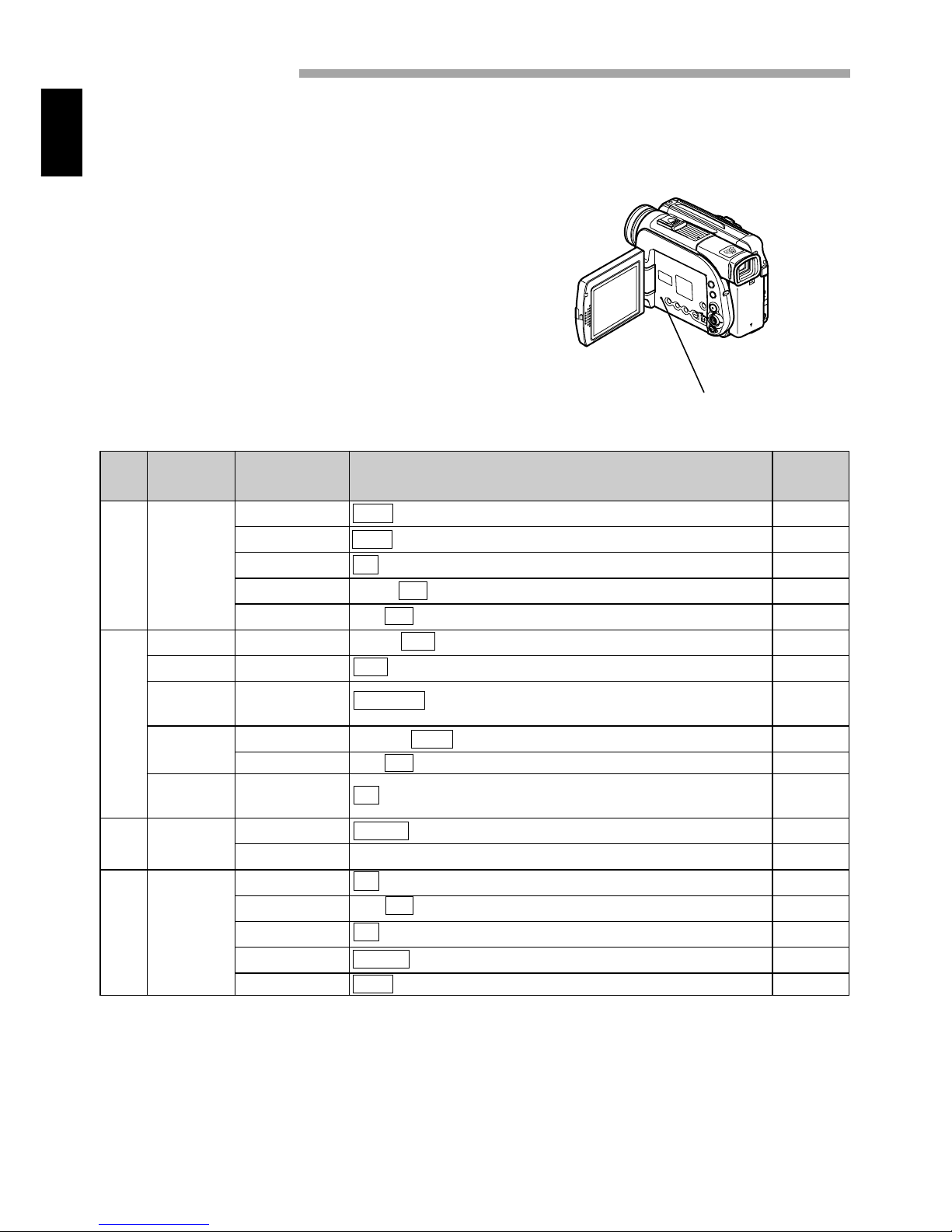
110
ENGLISH
System Reset
If the DVD video camera/recorder does not operate normally, perform “System Reset”: The DVD
video camera/recorder may recover to normal. “System Reset” will reset all settings to factory de-
faults. The date and time will also be reset: Set the date and time again before using the DVD video
camera/recorder.
1
Turn the DVD video camera/recorder off.
2
Use a fine tipped pen to hold down the reset
button for several seconds.
All settings will be reset.
Note: Do not press the reset button with undue
force.
RESET button
● List of setting items
DVD-RAM
DVD-R
DVD-RAM
DVD-R
DVD-RAM
DVD-R
DVD-RAM
DVD-RAM
DVD-R
DVD-RAM
DVD-R
DVD-RAM
DVD-R
Program AE
White Bal.
ElS
Dig.Zoom
16:9
VIDEO Mode
VIDEO Mode
Input Source
PHOTO Input
Self Timer
OSD Output
Date Mode
Date Set
Beep
Power Save
Record LED
Language
Demo Mode
Settings
Camera
Functions Setup
Record Functions
Setup
Date
Setup
Initial Setup
Item
Disc
used
Auto/Sports/Portrait/Spotlight/Sand&Snow/Low Light
Auto/Hold
On/Off
240x/48x/Off
On/Off
XTRA/FINE/STD
FINE/STD
CAMERA/LINE
Frame/Field
On/Off
On/Off
D/M/Y / M/D/Y / Y/M/D
1/1/2002 0:00
On/Off
On/Off
On/Off
English/Français/Español/Deutsch/Italiano
Auto/Off/Start
Page of
Setting
54
55
56
57
58
59
59
60
61
62
63
36
35
64
64
65
65
16
Downloaded from www.ManualsFile.com manuals search engine
111
ENGLISH
Major Specifications
CCD (number of effective pixels)
Lens
Focal length (converted to 35 mm
camera)
Focus
Zoom
Required minimum illumination
Viewfinder
LCD monitor
Electronic image stabilizer
Shutter speed
Flash [using Video Flash (optional)]
Self-timer recording
External microphone jack
Recording mode
Maximum DVD-RAM disc*
recordable (on both sides of disc)
time
DVD-R disc
(on one side of disc)
Maximum number of recordable stills*
(on both sides of DVD-RAM disc)
Recording DVD-RAM disc
format
DVD-R disc
Audio playback format
Recording medium
Jacks
1/4-inch interlaced
total number of pixels: approx. 1,160,000
movie: approx. 880,000
still: approx. 1,060,000
F2.0-2.7, f = 4.1-49.2 mm
Filter diameter: 37 mm
Movie: approx. 44-528 mm
Still: approx. 38-456 mm
Auto/Manual
Optical 12x, 48x-240x with digital zoom added
0.5 lx (in Low Light mode)
0.44-inch color TFT (approx. 180,000 pixels)
3.5-inch color TFT (approx. 200,000 pixels)
Electronic type
1/60 - 1/4000 second (movie)
(Auto/On/Off) Still recording only
Still recording only
External microphone jack / ø3.5 mm stereo mini-jack:
Recommended microphone impedance 600 Ω - 1 k Ω
Movie (with sound)
Still (only with DVD-RAM disc)
approx. 36~120 minutes (XTRA)
approx. 60 minutes (FINE)
approx. 120 minutes (STD)
approx. 30 minutes (FINE)
approx. 60 minutes (STD)
1998
Movie: Conforming to DVD video recording stand-
ard (MPEG Audio layer 2)
Still: Simultaneous recording, conforming to DVD
video recording standard (704 × 576 pixels)
and JPEG (1,280 × 960 pixels)
Movie: Conforming to DVD video recording stand-
ard (MPEG Audio layer 2)
MPEG Audio Layer 2, Dolby AC3, Linear PCM (only for playback)
8 cm DVD-RAM disc (conforming to DVD-RAM Ver. 2.1 Book 2.1)
8 cm DVD-R disc (conforming to DVD-R for General Ver. 2.0)
Video/audio input/output × 1, S-video input/output
× 1, External microphone input × 1, Digital input/out-
put terminal (connected to PC USB jack) × 1
* The total recordable time or recordable number of stills is half on each side of disc.
Downloaded from www.ManualsFile.com manuals search engine
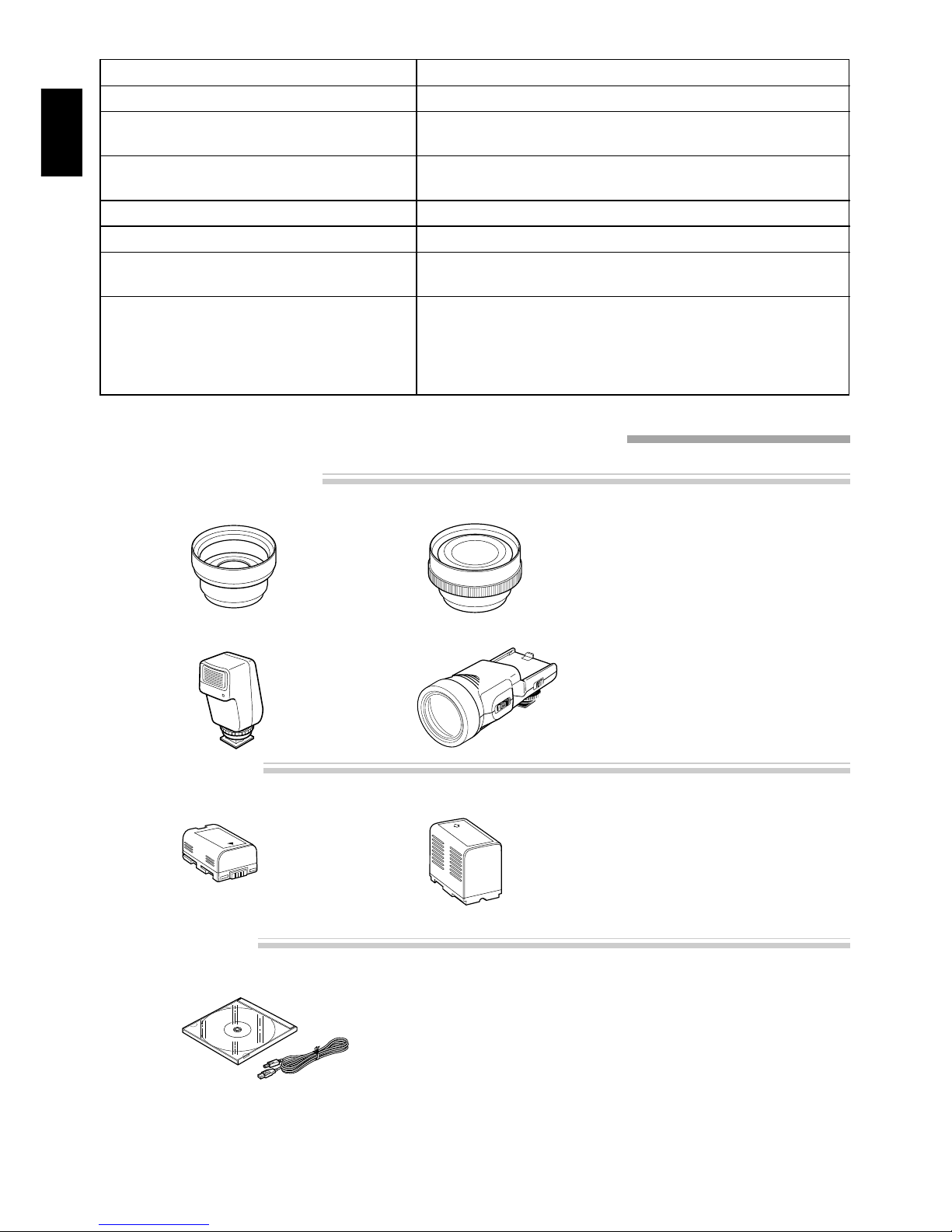
112
ENGLISH
Battery system
Power consumption
Dimensions
(W × H × D)
Operating temperature (humidity)
Storage temperature
Weight
Total weight when recording
Provided accessories
Lithium-ion
approx. 6.0 W when recording with LCD monitor off
approx. 88 × 101 × 143 mm (excluding hood and pro-
jections)
0-40 °C (less than 80%). 0-30 °C when connected to
PC
-20-60 °C
approx. 710 g (without battery or disc)
approx. 870 g (when using DZ-BP14(R)/DZ-BP16 (sold
separately) battery)
AC adapter, battery, AV input/output cable, infra-
red remote control, 2 “AA” batteries for remote con-
trol, lens cap, lens cap string, shoulder strap, power
cable, 2 ferrite cores, DVD-R disc, DVD-RAM disc, CD-
ROM, PC connection cable
Introduction to Optional Accessories
Camera Accessories
Wide conversion lens (DZ-WL1)
Tele-conversion lens (DZ-TL1)
Video flash (DZ-FLH3)
Video light (DZ-LD9)
Power Supplies
Battery pack (DZ-BP16)
Battery pack (DZ-BP28)
PC kit [DZ-WINPC3(W)]
• If you use the video light, you will need
a battery pack (DZ-BP16, DZ-BP28 (sold
separately)), in addition to the battery
used in the DVD video camera/recorder.
• When using optional accessories, be sure
to read the instruction manuals for each
accessory.
Miscellaneous
Downloaded from www.ManualsFile.com manuals search engine

113
ENGLISH
Number
16:9 .................................................................. 58
240x (Dig.zoom) ............................................. 57
3.5” type liquid crystal display ...................... 40
48x (Dig.zoom) ............................................... 57
8 cm DVD-R disc ............................................ 23
8 cm DVD-RAM disc ...................................... 23
A
AC adapter.................................................... 34
Accessory shoe ............................................ 112
Add (edit) ....................................................... 78
All programs ................................................... 73
Auto (program AE) ........................................ 54
Auto (white bal.)............................................ 55
Auto-focus ...................................................... 49
AV input/output jack ..................................... 91
B
B/W .................................................................. 82
Battery attachment platform ....................... 30
Battery eject button...................................... 30
Battery pack ................................................... 30
Attaching to DVD video/recorder........30
Charging ................................................. 31
Recordable time on DVD video/
recorder................................................... 32
Removing from DVD video/
recorder................................................... 30
Setting up................................................ 30
Beep................................................................ 64
Built-in battery ................................................. 30
C
Caddy............................................................. 24
Camera functions setup ......................... 17, 54
Capacity......................................................... 88
Cartridge ........................................................ 24
Charge/access indicator.............................. 31
Cleaning ....................................................... 111
Combine......................................................... 84
Connecting .................................................... 91
To other AV device ................................. 93
To PC........................................................ 93
To TV......................................................... 91
Copyright........................................................ 22
Create............................................................. 73
D
Date and time................................................ 35
Date setup...................................................... 35
DC cord connection terminal ...................... 31
Defaults........................................................... 66
Delete (edit) ................................................... 79
Delete (play list) ............................................. 80
Index
Delete (scene) ............................................... 81
Demo mode................................................... 16
Detail (scene) ................................................. 87
Dig. zoom........................................................ 57
Diopter control ............................................... 41
Disc .................................................................. 23
Disc eject button............................................ 39
Disc guide ....................................................... 37
Disc Navigation button ................................. 70
Disc Navigation Functions............................. 17
Display ............................................................. 51
Information LCD ..................................... 51
Liquid crystal display .............................. 40
Scenes information ................................ 87
Thumbnail................................................ 70
Viewfinder ............................................... 41
Display button ................................................ 52
Divide .............................................................. 84
DVD – R ........................................................... 23
DVD – RAM ..................................................... 23
E
Edit (play list) ................................................... 78
Edit (scene)..................................................... 82
Edit menu........................................................ 79
EIS..................................................................... 56
Exit (edit) ......................................................... 79
Exposure button............................................. 50
Exposure control............................................. 50
External microphone jack ............................. 42
Eyecup ............................................................ 41
F
Fade ................................................................ 82
Ferrite core...................................................... 28
Field (photo input) ......................................... 61
Finalize disc ..................................................... 90
FINE (video mode) ......................................... 59
Focus button................................................... 49
Format disc ..................................................... 88
Frame (photo input) ...................................... 61
Frame advance / frame back ..................... 45
H
Hand strap...................................................... 27
Hold (white bal.)............................................. 55
I
Image quality ................................................. 60
Information display mode............................. 51
Information LCD............................................. 51
Infrared receiver............................................. 29
Initial setup ...................................................... 64
Input source.................................................... 60
Downloaded from www.ManualsFile.com manuals search engine

114
ENGLISH
J
Joystick ............................................................ 10
L
Language....................................................... 65
LCD bright button.......................................... 41
Lens cap ......................................................... 28
Lens hood ....................................................... 48
Lock switch ..................................................... 42
Low light (program AE).................................. 54
M
Menu button............................................. 54, 72
MF .................................................................... 49
Move ............................................................... 85
O
Open button.................................................. 40
Optical 12x zoom lens ................................... 12
OSD output..................................................... 63
P
PC connection terminal ................................ 97
Play (play list) .................................................. 76
Play (program) ............................................... 73
Play list ............................................................. 75
Portrait (program AE)..................................... 54
Power save ..................................................... 64
Power switch ............................................ 35, 40
Program .......................................................... 73
Play .......................................................... 73
Switch ...................................................... 73
Title ........................................................... 74
Program AE..................................................... 54
R
Record button................................................ 42
Record functions setup ................................. 17
Recording indicator....................................... 65
Remote control .............................................. 29
Repeat play.................................................... 90
Reset................................................................ 66
Settings .................................................... 66
System ................................................... 110
Reset button................................................. 110
S
Sand & Snow (program AE).......................... 54
Scene .............................................................. 17
Combine ................................................. 84
Delete...................................................... 81
Detail ....................................................... 87
Divide....................................................... 84
Edit ........................................................... 82
Fade......................................................... 82
Move........................................................ 85
Select....................................................... 86
Skip ........................................................... 86
Searching for image...................................... 45
Select (scene) ................................................ 71
Select button.................................................. 71
Self timer ......................................................... 60
Shoulder strap ................................................ 27
Skip (scene) .................................................... 86
Speaker ........................................................... 44
Sports (program AE)....................................... 54
Spotlight (program AE).................................. 54
STD (video mode) .......................................... 59
Stereo microphone........................................ 42
Stop/cancel ................................................... 10
S-video output jack ....................................... 91
Switch (play list) .............................................. 76
Switch (program) ........................................... 73
T
Title (play list) .................................................. 80
Title (program)................................................ 74
U
Update control info. ...................................... 89
V
Video flash ...................................................... 43
Video light ...................................................... 42
Video mode ................................................... 59
FINE .......................................................... 59
STD ........................................................... 59
XTRA ......................................................... 59
Viewfinder....................................................... 41
Vol. button ...................................................... 44
W
WB.................................................................... 55
White ............................................................... 82
White Bal. ........................................................ 55
Wipe ................................................................ 82
X
XTRA (video mode)........................................ 59
Z
Zoom lever ...................................................... 47
Downloaded from www.ManualsFile.com manuals search engine

Hitachi, Ltd. Tokyo, Japan
International Sales Division
THE HITACHI ATAGO BUILDING,
No. 15 –12 Nishi Shinbashi, 2 – Chome,
Minato – Ku, Tokyo 105-8430, Japan.
Tel: 03 35022111
HITACHI EUROPE LTD,
Whitebrook Park
Lower Cookham Road
Maidenhead
Berkshire
SL6 8YA
UNITED KINGDOM
Tel: 01628 643000
Fax: 01628 643400
Email: consumer-service@hitachi-eu.com
HITACHI EUROPE S.A.
364 Kifissias Ave. & 1, Delfon Str.
152 33 Chalandri
Athens
GREECE
Tel: 1-6837200
Fax: 1-6835964
Email: service.hellas@hitachi-eu.com
HITACHI EUROPE GmbH
Munich Office
Dornacher Strasse 3
D-85622 Feldkirchen bei München
GERMANY
Tel: +49-89-991 80-0
Fax: +49-89-991 80-224
Hotline: +49-180-551 25 51 (12ct/min)
Email: HSE-DUS.service@hitachi-eu.com
HITACHI EUROPE S.A.
Gran Via Carlos III, 101-1
08028 Barcelona
SPAIN
Tel: 93 409 2550
Fax: 93 491 3513
Email: atencion.cliente@hitachi-eu.com
HITACHI EUROPE srl
Via Tommaso Gulli N.39, 20147
Milano, Italia
ITALY
Tel: +39 02 487861
Tel: +39 02 38073415 Servizio Clienti
Fax: +39 02 48786381/2
Email: customerservice.italy@hitachi-eu.com
HITACHI Europe AB
Box 77 S-164 94 Kista
SWEDEN
Tel: +46 (0) 8 562 711 00
Fax: +46 (0) 8 562 711 13
Email: csgswe@hitachi-eu.com
HITACHI EUROPE S.A.S
Lyon Office
B.P. 45, 69671 BRON CEDEX
FRANCE
Tel: 04 72 14 29 70
Fax: 04 72 14 29 99
Email: france.consommateur@hitachi-eu.com
HITACHI EUROPE LTD (Norway) AB
STRANDVEIEN 18
1366 Lysaker
NORWAY
Tel: 67 5190 30
Fax: 67 5190 32
Email: csgnor@hitachi-eu.com
HITACH EUROPE AB
Egebækgård
Egebækvej 98
DK-2850 Nærum
DENMARK
Tel: +45 43 43 6050
Fax: +45 43 60 51
Email: csgnor@hitachi-eu.com
HITACHI EUROPE AB
Neopoli / Niemenkatu 73
FIN-15140 Lahti
FINLAND
Tel : +358 3 8858 271
Fax: +358 3 8858 272
Email: csgnor@hitachi-eu.com
Hitachi Europe Ltd
Bergensesteenweg 421
1600 Sint-Pieters-Leeuw
BELGIUM
Tel: +32 2 363 99 01
Fax: +32 2 363 99 00
Email: sofie.van.bom@hitachi-eu.com
HITACHI EUROPE LTD
Na Sychrove 975/8
101 27 Praha 10 – Bohdalec
CZECH REPUBLIC
Tel: +420 267 212 383
Fax: +420 267 212 385
Email: csgnor@hitachi-eu.com
www.hitachidigitalmedia.com
Downloaded from www.ManualsFile.com manuals search engine