Operating and installation
instructions
Induction hobs
To avoid the risk of accidents or damage to the appliance it is
essential to read these instructions before it is installed and used for
the first time.
en-GB M.-Nr. 11 184 710

Contents
2
Warning and Safety instructions...................................................................... 4
Caring for the environment .............................................................................. 15
Guide to the appliance...................................................................................... 16
Hob...................................................................................................................... 16
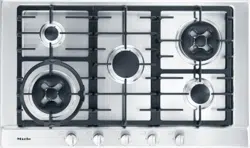
KM7200FR ................................................................................................... 16
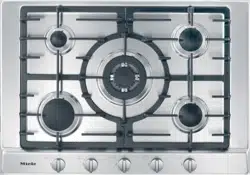
KM7201FR ................................................................................................... 17
KM7210FR ................................................................................................... 18
KM7262FR ................................................................................................... 19
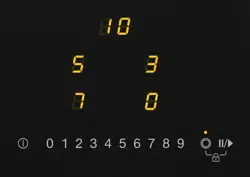
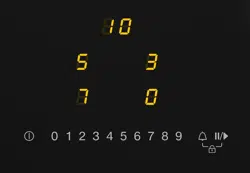
Controls and display ........................................................................................... 20
Cooking zones..................................................................................................... 22
Before using for the first time .......................................................................... 25
Cleaning the hob for the first time....................................................................... 25
Switching on the hob for the first time ................................................................ 25
How it works ...................................................................................................... 26
Noises.................................................................................................................. 26
Power management ............................................................................................ 27
Pans .................................................................................................................... 28
Tips on saving energy ...................................................................................... 30
Setting ranges.................................................................................................... 31
Operation............................................................................................................ 32
Using the appliance............................................................................................. 32
Switching on the hob .......................................................................................... 33
Setting the power level........................................................................................ 33
Changing the power level.................................................................................... 33
Switching off a cooking zone .............................................................................. 33
Residual heat indicator........................................................................................ 34
Power level setting - Extended setting range...................................................... 34
Auto heat-up ....................................................................................................... 35
Booster function.................................................................................................. 36
Keeping warm ..................................................................................................... 37
Timer................................................................................................................... 38
Minute minder ..................................................................................................... 38
Auto switch off .................................................................................................... 39
Using both timer functions at the same time ...................................................... 40
Additional functions .......................................................................................... 41
Stop&Go............................................................................................................ 41

Contents
3
Recall................................................................................................................... 41
Demonstration mode........................................................................................... 42
Displaying hob data............................................................................................. 42
Safety features................................................................................................... 43
System lock / Safety lock.................................................................................... 43
Safety switch-off ................................................................................................. 44
Overheating protection........................................................................................ 45
Programming ..................................................................................................... 46
Note for test institutes ...................................................................................... 49
Cleaning and care ............................................................................................. 50
Problem solving guide ...................................................................................... 52
Messages in the display...................................................................................... 52
Unexpected behaviour ........................................................................................ 53
Unsatisfactory results.......................................................................................... 54
General problems or technical faults................................................................... 54
Optional accessories ........................................................................................ 55
After sales service............................................................................................. 56
Contact in the event of a fault ............................................................................. 56
Data plate ............................................................................................................ 56
Warranty .............................................................................................................. 56
Installation.......................................................................................................... 57
Safety instructions for installation ....................................................................... 57
Safety distances.................................................................................................. 58
Installation notes ................................................................................................. 62
Building-in dimensions ....................................................................................... 63
KM7200FR ................................................................................................... 63
KM7201FR ................................................................................................... 64
KM7210FR ................................................................................................... 65
KM7262FR ................................................................................................... 66
Installation ........................................................................................................... 67
Electrical connection ........................................................................................... 68
Product data sheets ......................................................................................... 71

Warning and Safety instructions
4
This hob complies with all relevant local and national safety
requirements. Inappropriate use can, however, lead to personal
injury and material damage.
Read the operating and installation instructions carefully before
using the hob. They contain important information on safety,
installation, use and maintenance. This prevents both personal
injury and damage to the hob.
In accordance with standard IEC60335-1, Miele expressly and
strongly advises that you read and follow the instructions in the
chapter on installing the hob as well as the safety instructions and
warnings.
Miele cannot be held liable for injury or damage caused by non-
compliance with these instructions.
Keep these instructions in a safe place and pass them on to any
future owner.

Warning and Safety instructions
5
Correct application
This hob is intended for domestic use and use in other similar
environments.
This hob is not intended for outdoor use.
It is intended for domestic use only to cook food and keep it
warm. Any other use is not supported by the manufacturer and could
be dangerous.
This hob is not intended for use by people with reduced physical,
sensory or mental capabilities or lack of experience and knowledge,
unless they have been given supervision and instruction concerning
its use by a person responsible for their safety. They may only use
the hob unsupervised if they have been shown how to use it in a
safe way. They must be able to recognise and understand the
dangers of misuse.

Warning and Safety instructions
6
Safety with children
Children under 8 years of age must be kept away from the hob
unless they are constantly supervised.
Children over 8years of age may use the hob without supervision
if its operation has been clearly explained to them and they are able
to use it safely. Children must be able to understand and recognise
the possible dangers caused by incorrect operation.
Children must not be allowed to clean the hob unsupervised.
Please supervise children in the vicinity of the hob and do not let
them play with it.
The hob gets hot when in use and remains hot for a while after
being switched off. Keep children well away from the hob until it has
cooled down and there is no danger of burning.
Danger of burning! Do not store anything which might arouse a
child's interest in storage areas above or behind the hob. Otherwise
they could be tempted into climbing onto the appliance with the risk
of burning themselves.
Risk of burning and scalding. Place pots and pans on the cooking
zone in such a way that children cannot pull them down and burn
themselves.
Danger of suffocation! Whilst playing, children may become
entangled in packaging material (such as plastic wrapping) or pull it
over their head with the risk of suffocation. Keep packaging material
away from children.
Activate the system lock to ensure that children cannot switch on
the hob inadvertently. Use the safety lock when the hob is in use to
prevent children from altering the settings selected.

Warning and Safety instructions
7
Technical safety
Unauthorised installation, maintenance and repairs can cause
considerable danger for the user. Installation, maintenance and
repairs must only be carried out by a Miele authorised technician.
Damage to the hob can compromise your safety. Check the hob
for visible signs of damage. Do not use the hob if it is damaged.
Temporary or permanent operation on an autonomous power
supply system or a power supply system that is not synchronised
with the mains power supply (e.g. island networks, back-up systems)
is possible. A prerequisite for operation is that the power supply
system complies with the specifications of EN50160 or an
equivalent standard.
The function and operation of the protective measures provided in
the domestic electrical installation and in this Miele product must
also be maintained in isolated operation or in operation that is not
synchronised with the mains power supply, or these measures must
be replaced by equivalent measures in the installation. As described,
for example, in the current version of BS OHSAS 18001–2 ISO
45001.
The electrical safety of this hob can only be guaranteed when
correctly earthed. It is essential that this standard safety requirement
is met. If in any doubt please have the electrical installation tested by
a qualified electrician.
To avoid the risk of damage to the hob, make sure that the
connection data on the data plate (voltage and frequency) match the
mains electricity supply before connecting it to the mains.
Consult a qualified electrician if in doubt.
Do not connect the hob to the mains electrical supply by a multi-
socket adapter or extension lead. These are a fire hazard and do not
guarantee the required safety of the appliance.
For safety reasons, this hob may only be used after it has been
built in.

Warning and Safety instructions
8
This hob must not be used in a non-stationary location (e.g. on a
ship).
Never open the casing of the hob.
Touching or tampering with electrical connections or components
and mechanical parts is highly dangerous to the user and can cause
operational faults.
While the hob is under warranty, repairs should only be
undertaken by a Miele authorised service technician. Otherwise the
warranty is invalidated.
Miele can only guarantee the safety of the appliance when
genuine original Miele replacement parts are used. Faulty
components must only be replaced by Miele spare parts.
The hob is not intended for use with an external timer switch or a
remote control system.
The hob must be connected to the electricity supply by a qualified
electrician (see “Installation – Electrical connection”).
If the mains connection cable is damaged, it must be replaced
with a special mains connection cable by a qualified electrician (see
“Electrical connection” in the “Installation” chapter).
The hob must be disconnected from the mains electricity supply
during installation, maintenance and repair work. Ensure that power
is not supplied to the appliance until after it has been installed or
until any maintenance or repair work has been carried out.
Danger of electric shock. Do not use the hob if it is faulty, or if the
ceramic surface is cracked, chipped or damaged in any way. Switch
it off immediately. Disconnect the hob from the mains electricity
supply. Contact Miele Service.

Warning and Safety instructions
9
If the hob is installed behind a cabinet door, do not close the door
while the hob is in use. Heat and moisture can build up behind the
closed door. This can result in damage to the hob, the housing unit
and the floor. Do not close the door until the residual heat indicators
go out.
In areas which may be subject to infestation by cockroaches or
other vermin, pay particular attention to keeping the appliance and
its surroundings clean at all times. Any damage caused by
cockroaches or other vermin will not be covered by the warranty.

Warning and Safety instructions
10
Correct use
The hob gets hot when in use and remains hot for a while after
being switched off. There is a danger of burning until the residual
heat indicators go out.
Oil and fat can overheat and catch fire. Do not leave the hob
unattended when cooking with oil and fat. If it does ignite do not
attempt to put the flames out with water.
Disconnect the hob from the mains and use a suitable fire blanket,
saucepan lid, damp towel or similar to smother the flames.
Do not leave the hob unattended whilst it is being used. It should
be continually monitored whilst boiling and flash frying.
Flames could set the grease filters of a cooker hood on fire. Do
not flambé under a cooker hood.
Spray canisters, aerosols and other inflammable substances can
ignite when heated. Therefore do not store such items or substances
in a drawer under the hob. Cutlery inserts must be heat-resistant.
Do not heat an empty pan.
Do not heat up food in closed containers e.g. tins or sealed jars
on the hob, as pressure can build up in the container, causing it to
explode.
Do not cover the hob, e.g. with a hob cover, a cloth or protective
foil. The material could catch fire, shatter or melt if the hob is
switched on by mistake or if residual heat is still present.
When the appliance is switched on either deliberately or by
mistake, or when there is residual heat present, there is the risk of
any metal items left on the hob heating up, with the danger of
burning. Depending on the material, other items left on the hob could
also melt or catch fire. Damp pan lids might adhere to the ceramic
surface and be difficult to dislodge. Do not use the appliance as a
resting place. Switch the cooking zones off after use.

Warning and Safety instructions
11
You could burn yourself on the hot hob. Protect your hands with
heat-resistant pot holders or gloves when handling hot pots and
pans. Do not let them get wet or damp, as this causes heat to
transfer through the material more quickly with the risk of scalding or
burning yourself.
When using an electrical appliance, e.g. a hand-held food blender,
near the hob, ensure that the cable of the electrical appliance cannot
come into contact with the hot hob. The insulation on the cable
could become damaged.
Grains of salt, sugar and sand (e.g. from cleaning vegetables) can
cause scratches if they get under pan bases. Make sure that the
ceramic surface is clean before placing pans on it.
Even a light object can cause damage in certain circumstances.
Do not drop anything on the ceramic surface.
Placing hot pans on the sensors and indicators could damage the
electronics underneath. Do not place hot pans on the sensors or
indicators.
Do not allow solid or liquid sugar, or pieces of plastic or aluminium
foil to get onto the hob when it is hot, as they can damage the
ceramic surface when it cools down. If this should occur, switch off
the appliance and scrape off all the sugar, plastic or aluminium
residues whilst still hot, using a shielded scraper blade suitable for
use on glass. Wear oven gloves when doing this. Allow the ceramic
surface to cool down and then clean it with a suitable ceramic hob
cleaning agent.
Pans which boil dry can cause damage to the ceramic glass. Do
not leave the hob unattended whilst it is being used.
Only use pots and pans with smooth bases. Rough bases will
scratch the ceramic glass.
Lift pans into position on the hob. Sliding them into place can
cause scuffs and scratches.

Warning and Safety instructions
12
Because induction heating works so quickly, the base of the pan
could, under certain circumstances, heat up to the temperature at
which oil or fat self-ignites within a very short time. Never leave the
hob unattended during use!
Heat oil or fat for a maximum of one minute. Never use the
Booster function to heat oil or fat.
For people fitted with a heart pacemaker: Please note that the
area immediately surrounding the hob is electromagnetically
charged. It is very unlikely to affect a pacemaker. However, if in any
doubt, consult the manufacturer of the pacemaker or your doctor.
To prevent damage to items which are susceptible to
electromagnetic fields, e.g. credit cards, digital storage devices,
pocket calculators, etc, do not leave them in the immediate vicinity
of the hob.
Metal utensils stored in a drawer under the hob can become hot if
the appliance is used intensively for a long time.
The hob is fitted with a cooling fan. If a drawer is fitted directly
underneath the hob, ensure that there is sufficient space between
the drawer and its contents and the underside of the hob in order to
ensure sufficient ventilation for the hob.
If a drawer is fitted directly underneath the hob, do not store any
pointed or small items, paper, serviettes, etc. in the drawer. They
could get in through the ventilation slots or be sucked into the casing
by the fan and damage the fan or impair cooling.
Do not use twopans on a cooking zone or extended zone at the
same time.
If the cookware only partially covers a cooking or extended zone,
the handle could become very hot.
Always place cookware in the middle of a cooking or extended zone!

Warning and Safety instructions
13
The induction generators could be damaged or even destroyed if
you use an induction adapter plate for cookware. Do not use
induction adapter plates.

Warning and Safety instructions
14
Cleaning and care
Do not use a steam cleaning appliance to clean this hob.
The steam could reach electrical components and cause a short
circuit.
If the hob is built in over a pyrolytic oven, the hob should not be
used whilst the pyrolytic process is being carried out, as this could
trigger the overheating protection mechanism on the hob (see
relevant section).
Miele will guarantee to supply functional spare parts for a
minimum of 10years and up to 15years following the
discontinuation of your hob.
Caring for the environment
15
Disposal of the packing
material
The packaging is designed to protect
the appliance from damage during
transportation. The packaging materials
used are selected from materials which
are environmentally friendly for disposal
and should be recycled.
Recycling the packaging reduces the
use of raw materials in the
manufacturing process and also
reduces the amount of waste in landfill
sites.
Disposing of your old
appliance
Electrical and electronic appliances
often contain valuable materials. They
also contain specific materials,
compounds and components, which
were essential for their correct function
and safety. These could be hazardous
to human health and to the environment
if disposed of with your domestic waste
or if handled incorrectly. Please do not,
therefore, dispose of your old appliance
with your household waste.
Please dispose of it at your local
community waste collection / recycling
centre for electrical and electronic
appliances, or contact your dealer or
Miele for advice. You are also
responsible for deleting any personal
data that may be stored on the
appliance being disposed of. Please
ensure that your old appliance poses no
risk to children while being stored prior
to disposal.
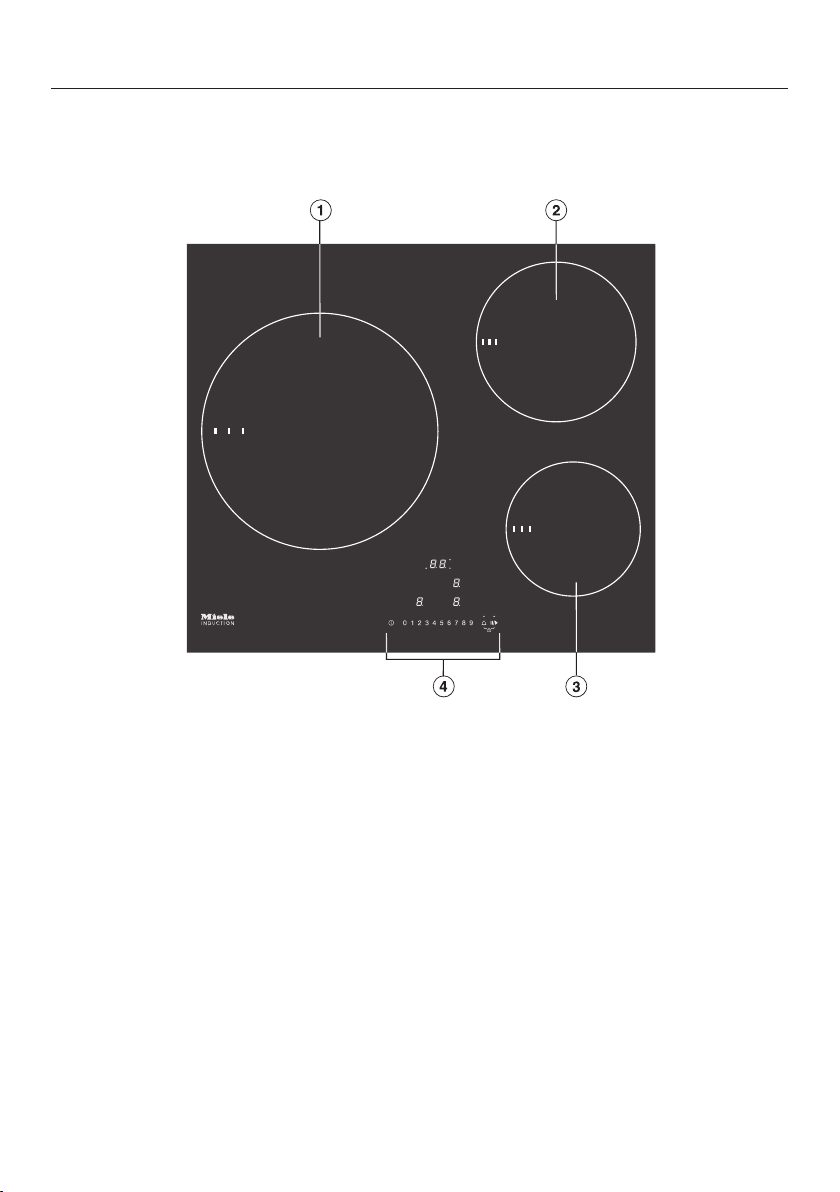
Guide to the appliance
16
Hob
KM7200FR
a
Cooking zone with TwinBooster
b
Cooking zone with TwinBooster
c
Cooking zone with TwinBooster
d
Controls and indicators
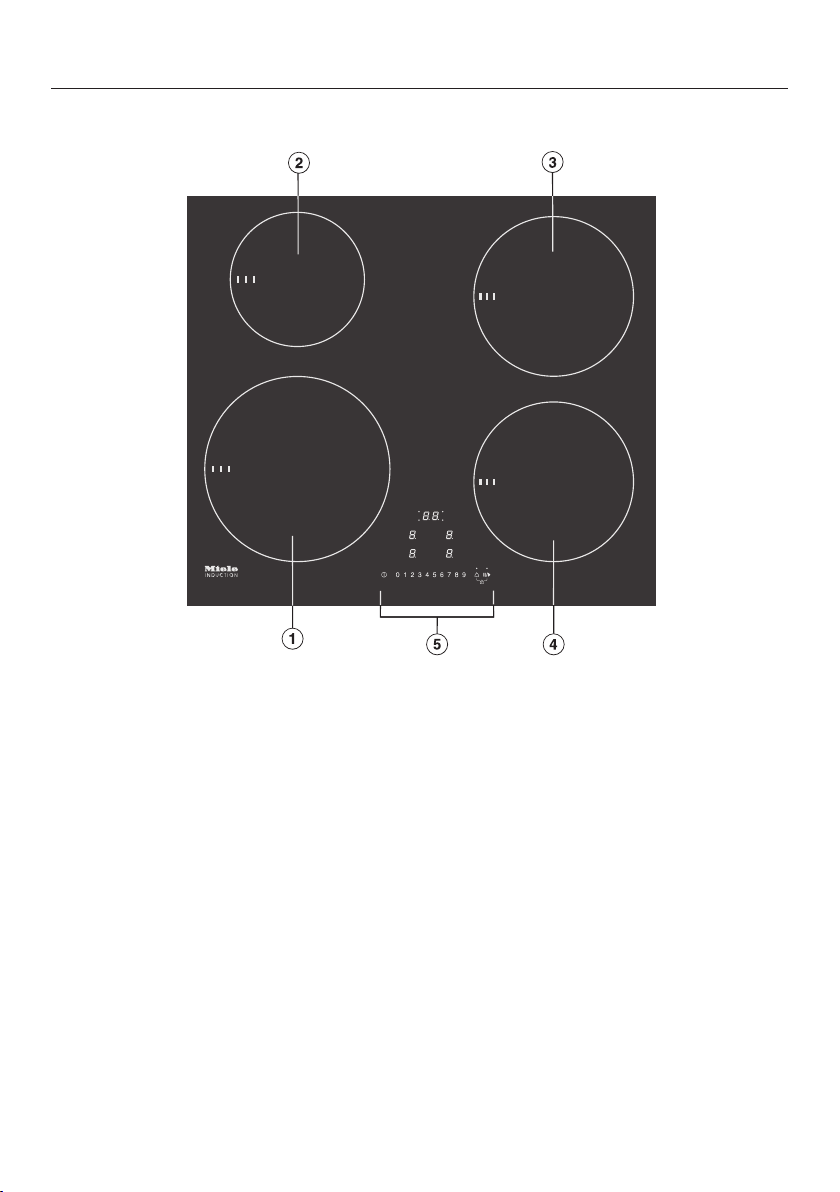
Guide to the appliance
17
KM7201FR
a
Cooking zone with TwinBooster
b
Cooking zone with TwinBooster
c
Cooking zone with TwinBooster
d
Cooking zone with TwinBooster
e
Controls and indicators
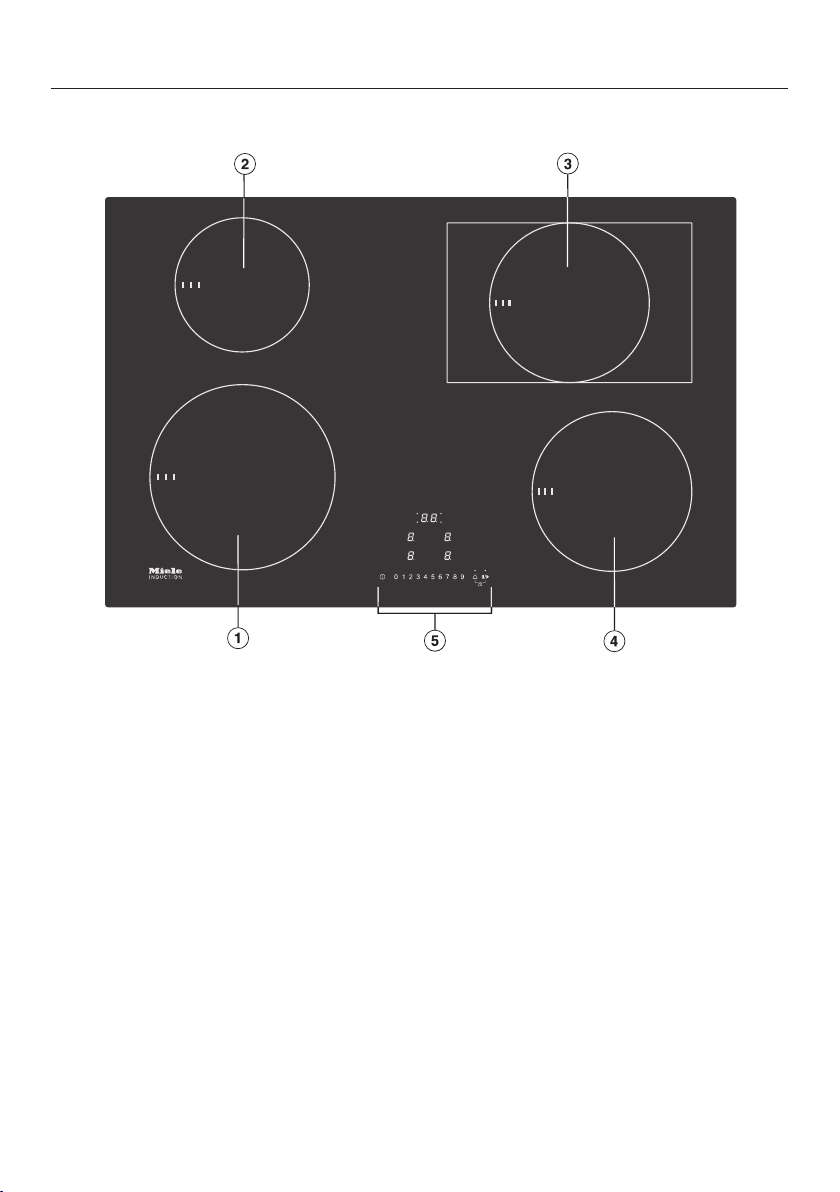
Guide to the appliance
18
KM7210FR
a
Cooking zone with TwinBooster
b
Cooking zone with TwinBooster
c
Extended zone with TwinBooster
d
Cooking zone with TwinBooster
e
Controls and indicators
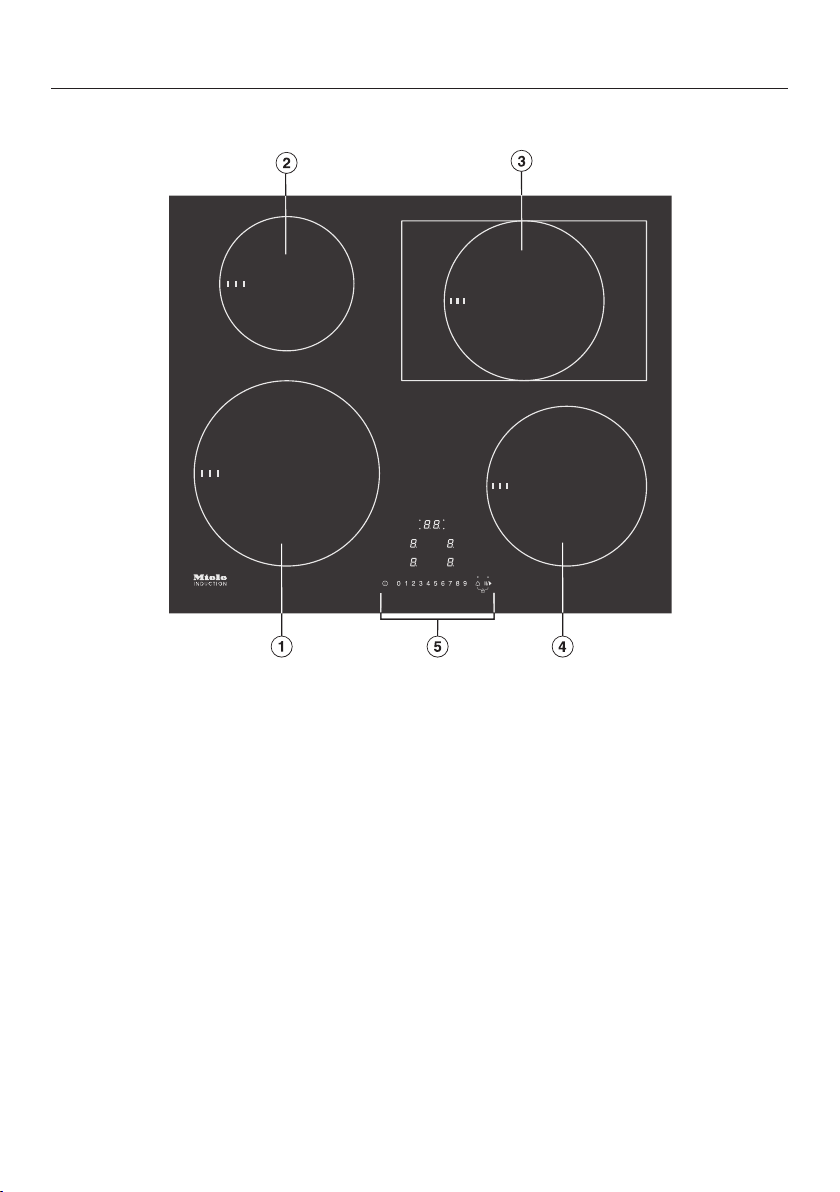
Guide to the appliance
19
KM7262FR
a
Cooking zone with TwinBooster
b
Cooking zone with TwinBooster
c
Extended zone with TwinBooster
d
Cooking zone with TwinBooster
e
Controls and indicators
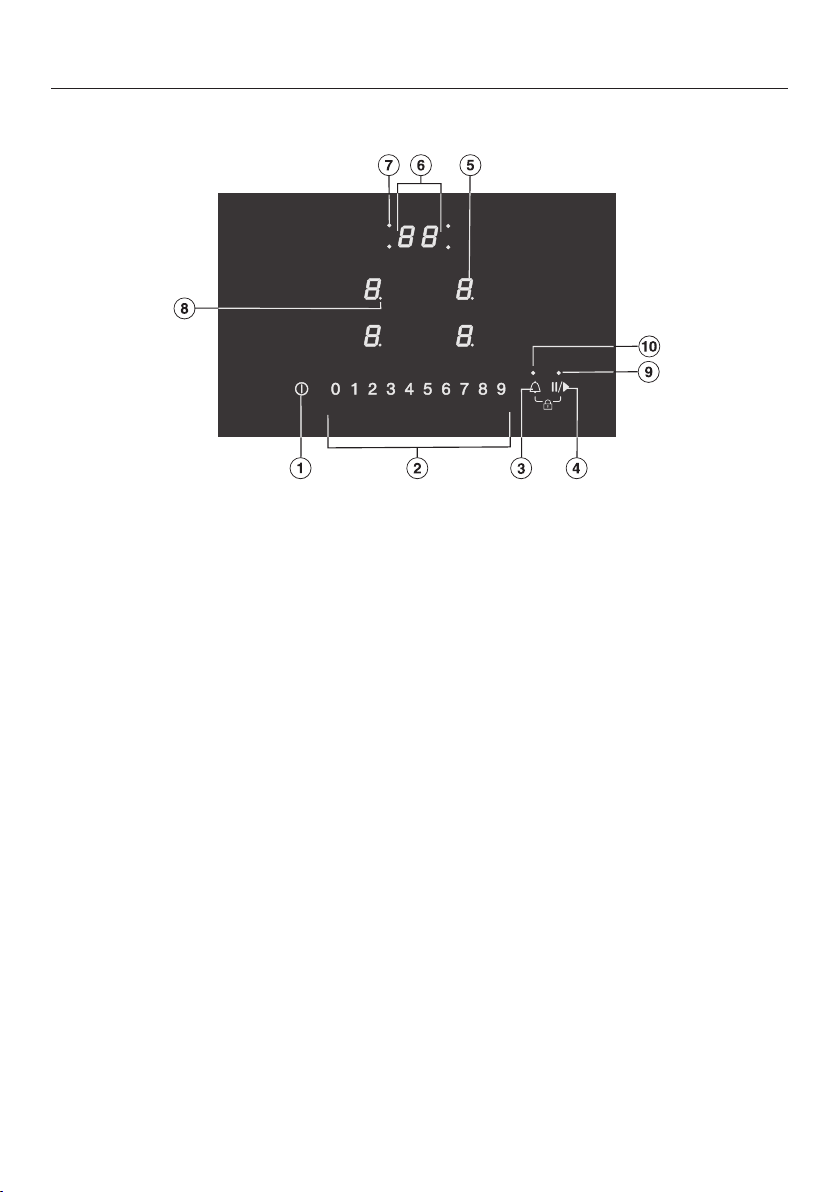
Guide to the appliance
20
Controls and display
Sensor controls
a
Hob On/Off
b
Numerical display
– To set the power level
– To set the times
c
Timer
– On/off
– For switching between timer functions
– For selecting a cooking zone
d
Stop&Go
To stop/start a cooking process in progress
e
Cooking zone selection and display
Cooking zone is ready for operation
to Power level
Residual heat
Auto heat-up
Cookware missing or unsuitable
TwinBooster level 1
TwinBooster level 2
Keeping warm

Guide to the appliance
21
Displays/indicator lights
f
Timer display
to Duration in minutes
System lock/safety lock is activated
Demo mode is activated
g
Cooking zone allocation auto switch off
Auto switch off for the cooking zone is activated
h
Power level – extended setting range
i
Stop&Go
Stop&Go function is activated
j
Timer
Guide to the appliance
22
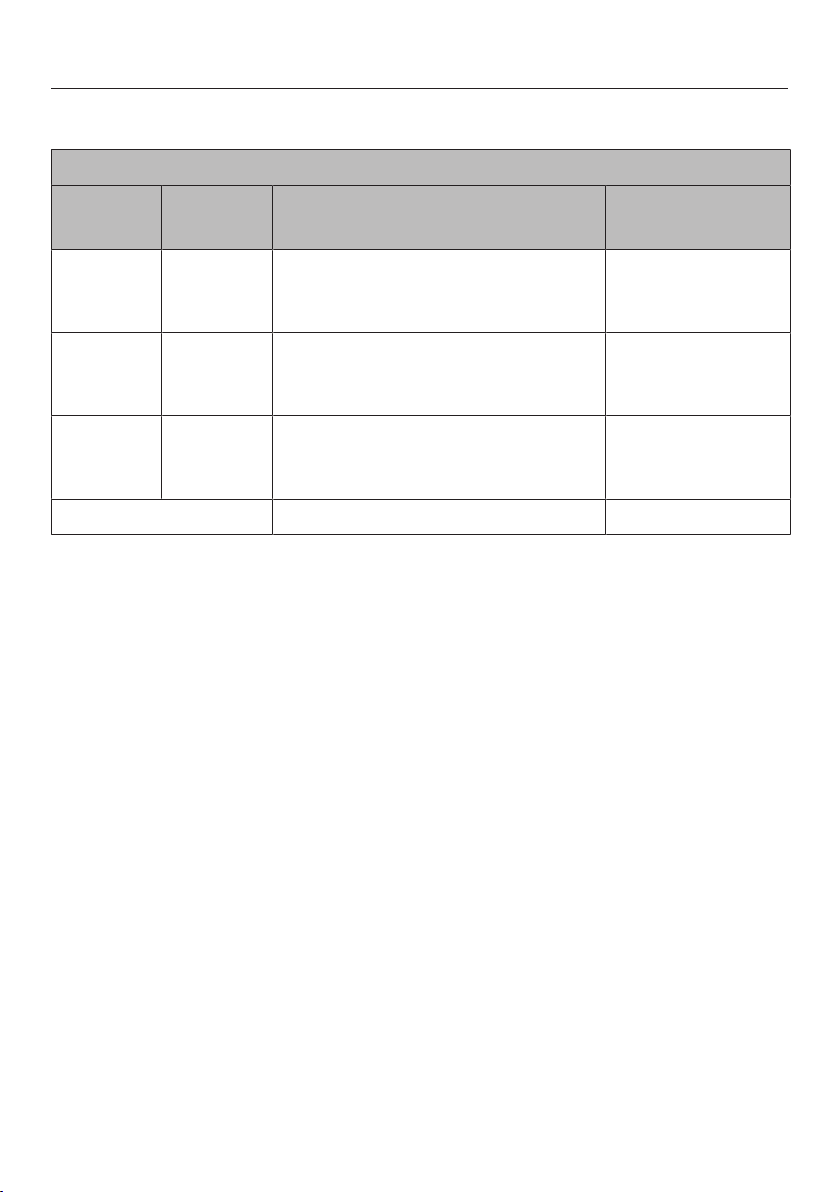
Cooking zones
KM7200FR
Cooking
zone
Øin cm
1
Max. rating
in watts for 230V
2
Linked cooking
zone
3
14–28 Normal
TwinBooster, level 1
TwinBooster, level 2
2600
3300
5500
and
14–19 Normal
TwinBooster, level 1
TwinBooster, level 2
1850
2500
3000
10–16 Normal
TwinBooster, level 1
TwinBooster, level 2
1400
1700
2200
Total 7300
1
Cookware with a base diameter within the given range may be used.
2
The power given may vary depending on the size and material of the cookware used.
3
The cooking zone is linked to this cooking zone electrically so that the rating can be increased; see
“Operation – Power management”.
Guide to the appliance
23
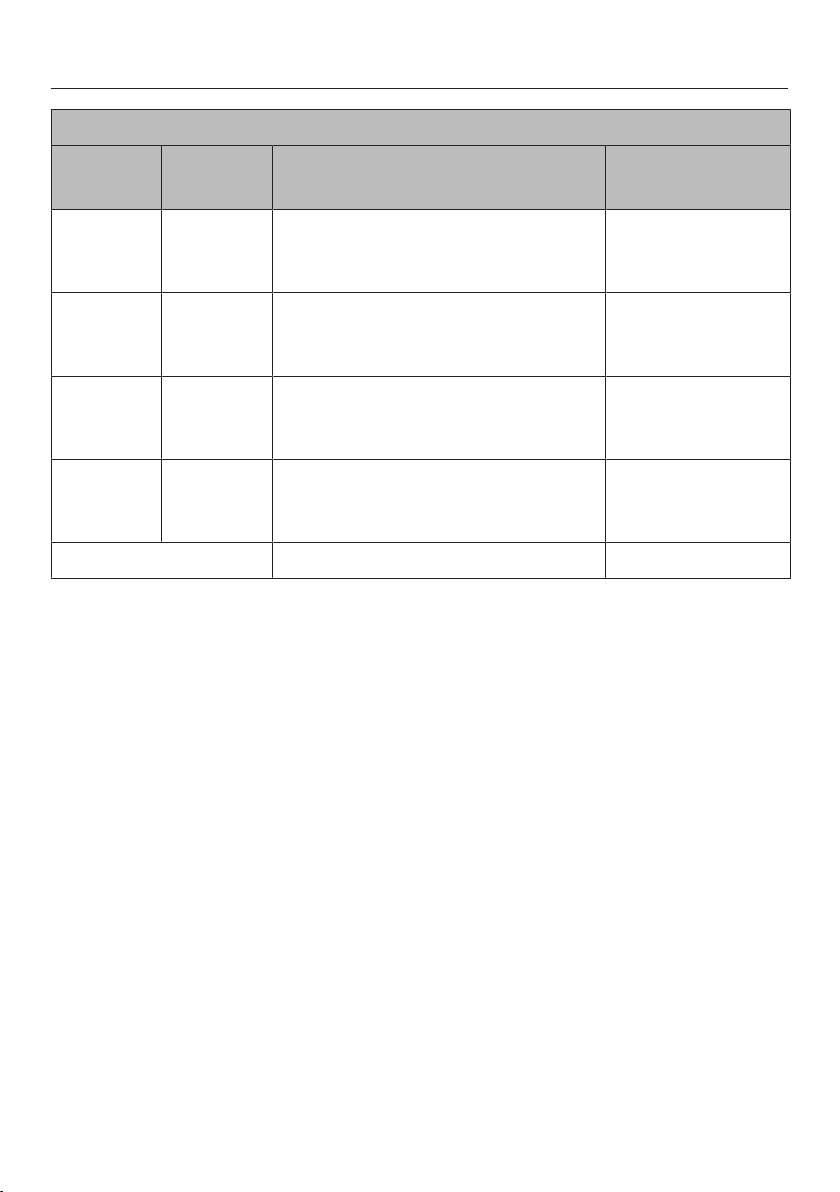
KM7201FR
Cooking
zone
Øin cm
1
Max. rating
in watts for 230V
2
Linked cooking
zone
3
16–22 Normal
TwinBooster, level 1
TwinBooster, level 2
2300
3000
3650
10–16 Normal
TwinBooster, level 1
TwinBooster, level 2
1400
1700
2200
14–19 Normal
TwinBooster, level 1
TwinBooster, level 2
1850
2500
3000
14–19 Normal
TwinBooster, level 1
TwinBooster, level 2
1850
2500
3000
Total 7300
1
Cookware with a base diameter within the given range may be used.
2
The power given may vary depending on the size and material of the cookware used.
3
The cooking zone is linked to this cooking zone electrically so that the rating can be increased; see
“Operation – Power management”.
Guide to the appliance
24
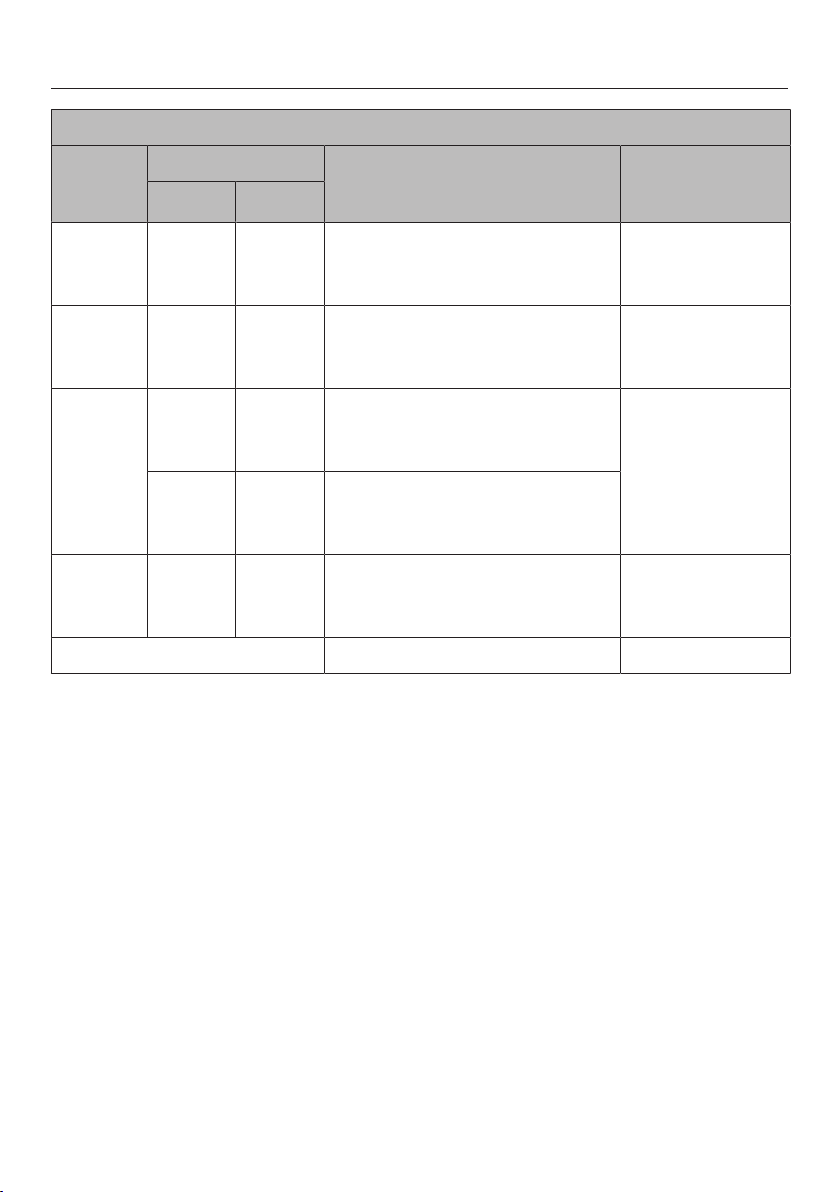
KM7210FR,KM7262FR
Cooking
zone
Size in cm Max. rating
in watts for 230V
3
Linked cooking
zone
4
Ø
1
2
16–22 – Normal
TwinBooster, level 1
TwinBooster, level 2
2300
3000
3650
10–16 – Normal
TwinBooster, level 1
TwinBooster, level 2
1400
1700
2200
14–19 – Normal
TwinBooster, level 1
TwinBooster, level 2
1850
2500
3000
– 19x29 Normal
TwinBooster, level 1
TwinBooster, level 2
2100
3000
3650
14–19 – Normal
TwinBooster, level 1
TwinBooster, level 2
1850
2500
3000
Total 7300
1
Cookware with a base diameter within the given range may be used.
2
The given range corresponds to the maximum base surface of the cookware that may be used.
3
The power given may vary depending on the size and material of the cookware used.
4
The cooking zone is linked to this cooking zone electrically so that the rating can be increased; see
“Operation – Power management”.
Before using for the first time
25
Please stick the extra data plate for
the appliance supplied with this
documentation in the space provided
in the “After sales service” section of
this booklet.
Remove any protective wrapping and
stickers.
Cleaning the hob for the first
time
Before using for the first time, clean
the hob with a damp cloth only and
then wipe dry.
Switching on the hob for the
first time
The metal components have a
protective coating which may give off a
slight smell when heated up for the first
time. The induction coils may also give
off a slight smell for the first few hours
of operation. This smell will be less
noticeable with each subsequent use
before dissipating completely.
The smell and any vapours given off do
not indicate a faulty connection or
appliance and they are not hazardous
to health.
Please note that the heating up time
on induction hobs is very much
shorter than on conventional hobs.

How it works
26
An induction coil is located under each
induction cooking zone. The coil
creates a magnetic field that reacts
directly with the base of the pan and
heats it up. The cooking zone itself is
heated up indirectly by the heat given
off by the pan.
An induction cooking zone only works
when cookware with a magnetic base is
placed on it (see “Cookware”).
Induction automatically recognises the
size of the cookware.
Risk of burning due to hot items.
When the appliance is switched on
either deliberately or by mistake, or
when there is residual heat present,
there is the risk of metal items placed
on the hob heating up.
Do not use the appliance as a resting
place for anything.
After use, switch the hob off with
the sensor control.
Noises
When using an induction hob, the
following noises can occur in the pan,
depending on what it is made of and
how it has been constructed.
Buzzing on the higher power settings.
This will decrease or cease altogether
when the power setting is reduced.
If the pan base is made of layers of
different materials (e.g. in a sandwiched
base), it might emit a crackling sound.
Whistling might occur if linked zones
(see “Operation - Booster”) are being
used at the same time, and the pans
also have bases made of layers of
different materials.
You might hear a clicking sound from
the electronic switches, especially on
lower settings.
A whirring sound, when the cooling fan
comes on. This switches on to protect
the electronics when the hob is being
used intensively. The cooling fan may
continue to run after the appliance has
been switched off.

How it works
27
Power management
The hob has a maximum total permitted
power consumption which cannot be
exceeded for safety reasons. You can
reduce the maximum total permitted
power consumption, see
“Programming”.
Cooking zones can be linked together
in pairs on the hob. This allows
additional power to be transferred from
one cooking zone to another.
The previously set setting has
precedence and the hob will operate
with this level.
If power is transferred from one cooking
zone to the linked cooking zone, the
power for the first cooking zone must
be reduced.
The possible values for the maximum
total permitted power consumption
and which cooking zones are linked
together can be found in “Overview –
Cooking zone data”.
If the new cooking zone requires more
power than the first cooking zone can
provide, this may result in the following
consequences for the first cooking
zone:
- The power level is reduced.
- Auto heat-up is deactivated. Cooking
continues at the set level. If the
power is not sufficient, the power
level will be reduced again.
- The Booster function is deactivated.
- The cooking zone is switched off.
If the most recently set power level is
reduced or the Booster function is
switched off, the power level for the
linked cooking zone can be increased
again.

Pans
28
Suitable pans
- stainless steel pans with a magnetic
base
- enamelled steel pans
- cast iron pans
Please be aware that the properties of
the pan base can affect the evenness
with which the food heats up (e.g. when
making pancakes). The base of the pan
must be able to distribute the heat
evenly. A sandwich base made of
stainless steel is particularly suitable.
Unsuitable pans.
- stainless steel pans without a
magnetic base
- aluminium or copper pans
- glass, ceramic or earthenware pots
and pans
Testing pans
To test whether a pan is induction-
compatible, hold a magnet to the base
of the pan. If the magnet sticks, the pan
is generally suitable.
No pan/unsuitable pan display
Thesymbol flashes alternately with
the power level selected in one of the
cooking zone displays
- if the cooking zone has been
switched on without a pan in place,
or if the pan is unsuitable (non-
magnetic base)
- if the diameter of the base of the pan
is too small
- if the pan is taken off the cooking
zone when it is switched on
If a suitable pan is placed on the
cooking zone within 3minutes, will go
out and you can continue as normal.
If no pan or an unsuitable pan is placed
on the cooking zone, the cooking zone
will switch off automatically after
3minutes.
Pans
29
Tips
- To make optimum use of the cooking
zones, choose cookware with a
suitable base diameter (see
“Overview – Cooking zone data”). If
the pan is too small it will not be
recognised.
- Position the cookware as centrally as
possible on the relevant cooking
zone/cooking area.
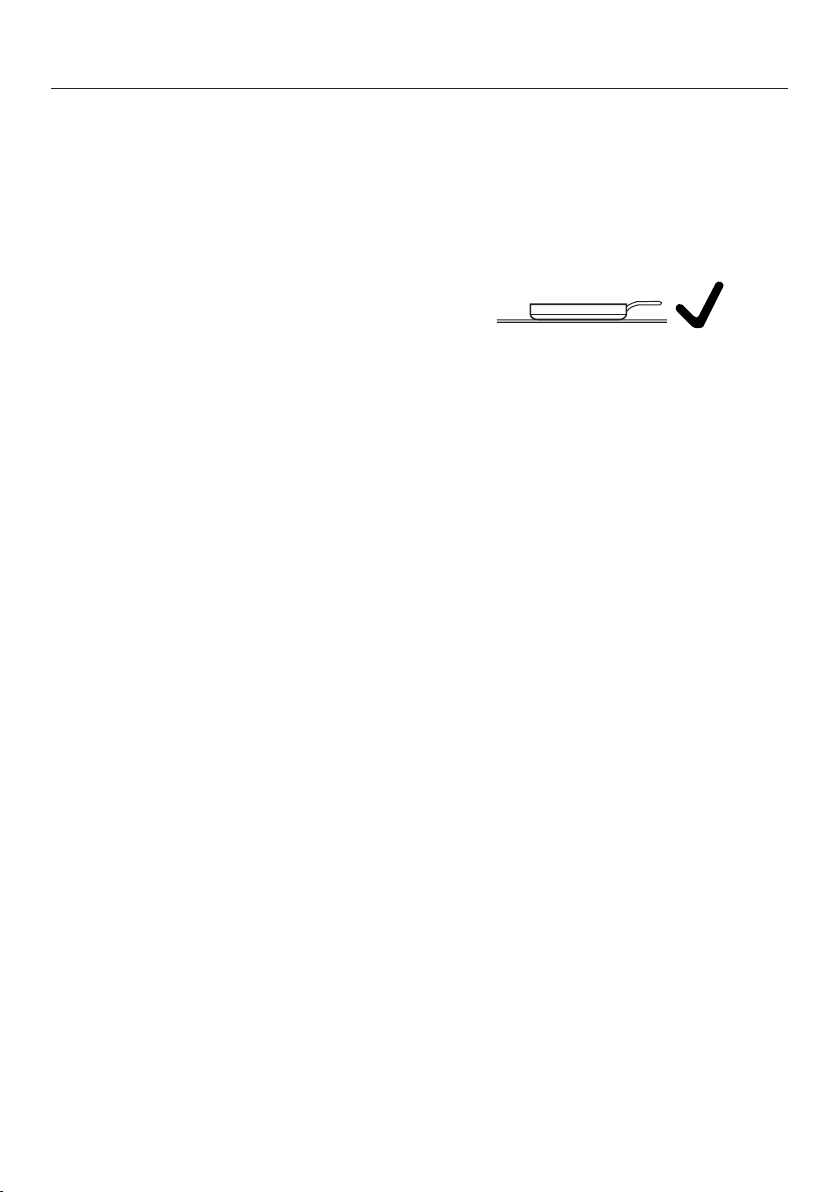
- Use only pots and pans with smooth
bases. Rough bases can scratch the
ceramic glass.
- Always lift cookware to move it. This
will help prevent scratching. If any
scratches do appear as a result of
cookware being pushed around, this
will not affect the function of the hob.
These scratches are normal signs of
use and are not grounds for making a
complaint.
- Please note that the maximum
diameter quoted by manufacturers
often refers to the diameter of the top
rim of the pots and pans. The
diameter of the base (generally
smaller) is more important.
- Where possible, use pans with
vertically straight sides. If a pan has
angular sides, induction also acts on
the sides of the pan. The sides of the
pan may discolour or the coating
may peel off.

Tips on saving energy
30
- Use a lid whenever possible to
minimise heat loss.
- Select a smaller pan when cooking
small quantities. A smaller pan uses
less energy than a larger pan with
very little in it.
- Cook with as little water as possible.
- Once food has come to the boil or
the oil in the pan is hot enough for
frying, reduce the heat to a lower
setting.
- Use a pressure cooker to reduce
cooking times.
Setting ranges
31
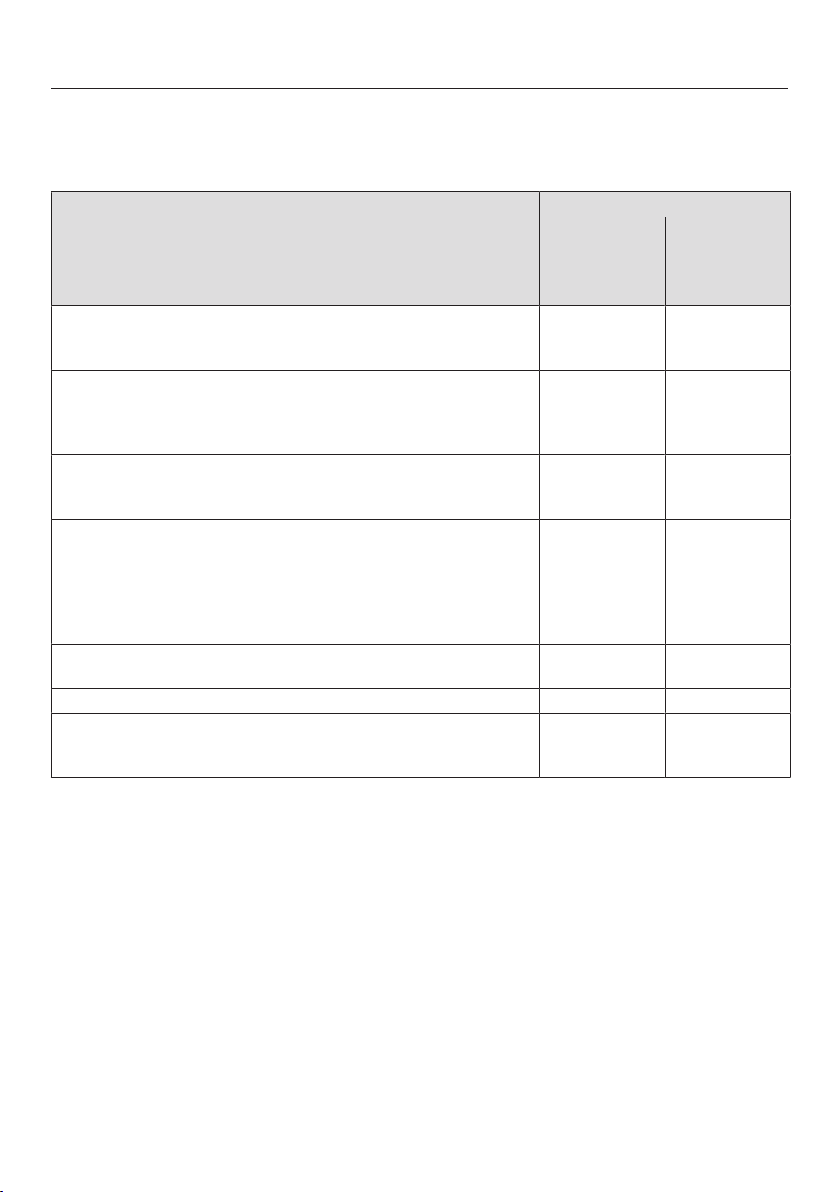
The hob is programmed with 9power levels at the factory. If you wish to fine-tune
a setting, you can extend the power level range to 17power levels (see
“Programming”).
Setting range
Factory
setting
(9power
levels)
Extended
setting
(17power
levels)
Melting butter
Melting chocolate
Dissolving gelatine
1–2 1–2.
Warming up small quantities of liquid
Keeping warm food which sticks easily
Cooking rice or porridge
Defrosting vegetables frozen in a block
2–4 2–3.
Warming up liquid and semi-solid food
Steaming fruit
Simmering potatoes (pans with lids)
4–6 3.–5.
Making omelettes or lightly fried eggs
Gently frying patties
Steaming fish and vegetables
Cooking dumplings and dried pulses
Defrosting and warming up frozen food
Thickening sauces, e.g. Hollandaise
5–7 4.–7.
Gently frying meat, fish, sausages, eggs (without overheating
the fat)
6–8 6–7.
Cooking potato fritters, pancakes, etc. 7–8 7–8.
Boiling large quantities of water
Bringing to the boil
Flash frying large amounts of meat
9 8.–9
These settings should only be taken as a guide. The power of the induction coils will vary
depending on the size and material of the pan. For this reason it is possible that the settings
will need to be adjusted slightly to suit your pans. As you use the hob, you will get to know
which settings suit your pans best. When using new pans that you are not familiar with, set
the power level below the one specified.
Operation
32
Using the appliance
This ceramic hob is equipped with
electronic sensor controls which react
to finger contact. For safety reasons, in
order to switch the appliance on, the
On/Off sensor needs to be touched
for a little longer than the other sensors.
Each time a sensor control is activated,
an audible signal sounds.
When the hob is switched off, only the
printed sensor control symbols and
numbers on the keybank are visible.
When the hob is switched on, all the
other sensors light up as well. More
sensors light up when the hob is
switched on.
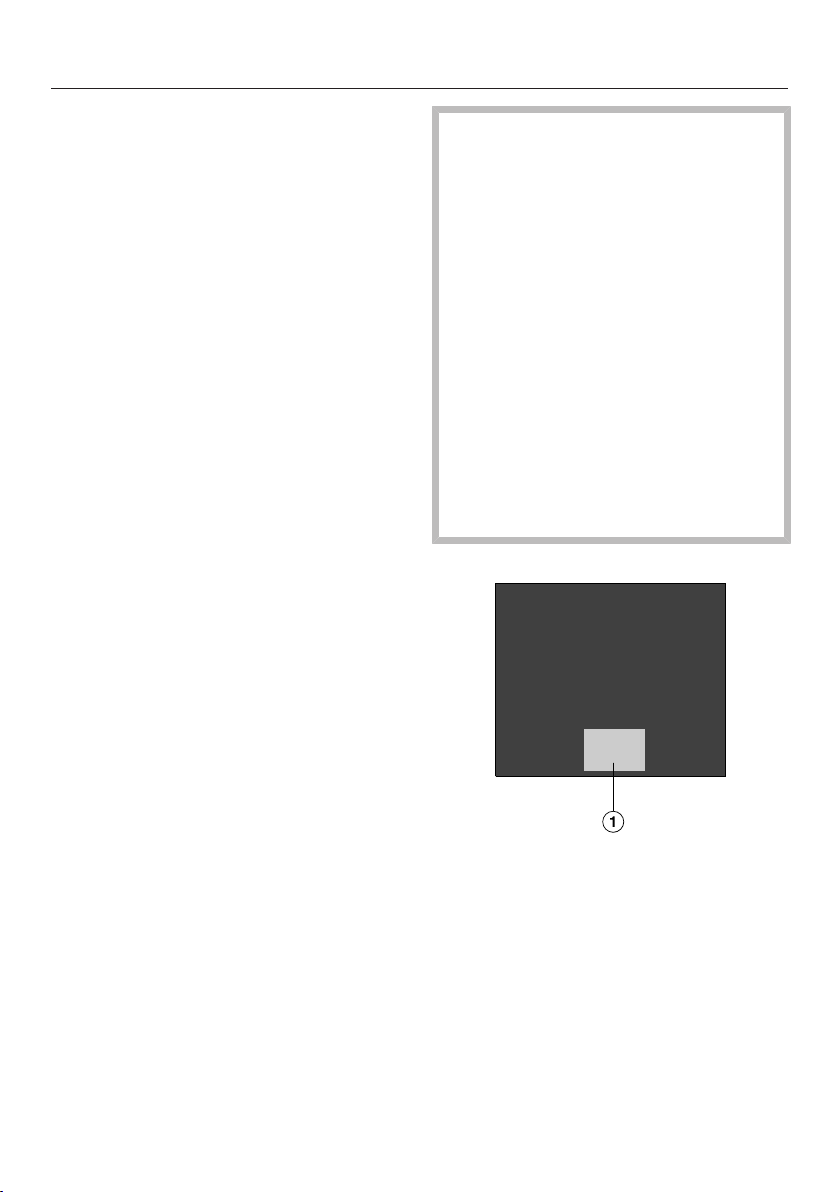
In order to set or alter a power level, the
cooking zones must be “active”. To
activate a cooking zone, touch the
sensor for selecting the relevant
cooking zone. The relevant cooking
zone indicator will begin to flash when
touched. While the indicator is flashing,
set or adjust the power level or set a
time.
Exception: If only one of the cooking
zones is in operation, you can alter the
power setting without activating the
cooking zone.
Malfunction due to dirty and/or
covered sensor controls.
If the sensor controls are dirty or
covered this could cause them to fail
to react, to activate a function or
even to switch the appliance off
automatically (see “Safety features”,
“Safety switch-off”). Placing hot
pans on the sensor controls/
indicators can damage the electronic
unit underneath.
Keep the sensor controls and
indicators clean.
Do not place anything over the
sensor control or indicators.
Do not place hot pans over the
sensor controls or indicators.
a
Sensor controls and indicators
Operation
33
Risk of fire with overheated food.
Unattended food can overheat and
catch alight.
Do not leave the hob unattended
whilst it is being used.
Please note that the heating up time
on induction hobs is very much
shorter than on conventional hobs.
Switching on the hob
Touch the sensor.
Other sensors will light up.
If no further entry is made, the hob will
switch itself off after a few seconds for
safety reasons.
Setting the power level
Permanent pan recognition is
activated as standard (see
“Programming”). When the hob is
switched on and you place a pan on a
cooking zone, the cooking zone
indicator starts to flash.
Place the pan on the cooking zone
you want to use.
The cooking zone indicator will begin to
flash.
Touch the appropriate sensor control
on the numerical keybank for the
power level you want.
The power level selected will flash for a
few seconds in the cooking zone
display and then light up constantly.
Changing the power level
Touch the relevant cooking zone
display.
The cooking zone display will begin to
flash.
Touch the appropriate sensor control
on the numerical keybank for the
power level you want.
Switching off a cooking zone
To switch a cooking zone off, touch
the display for the relevant cooking
zone.
The cooking zone display will begin to
flash.
Touch the0 sensor control on the
numerical keybank.
To switch off the hob and all the
cooking zones, touch the sensor.

Operation
34
Residual heat indicator
If the cooking zone is still hot, the
residual heat indicator will light up after
it has been switched off.
The bars of the residual heat indicator
go out one after the other as the
cooking zone cools down. The last
horizontal bar only goes out when the
cooking zone is safe to touch.
Risk of burning due to hot
cooking zones.
The cooking zones will be hot after
use.
Do not touch the cooking zones
while the residual heat indicators are
on.
Power level setting - Extended
setting range
Touch the numerical keybank in
between two number sensors.
The power level selected will flash for a
few seconds and then light up
constantly. The intermediate setting will
be represented by an illuminated dot
next to the number.
Operation
35
Auto heat-up
When Auto heat-up has been activated,
the cooking zone switches on
automatically at the highest setting and
then switches to the continued cooking
setting which you have previously
selected. The heat-up time depends on
which continued cooking setting has
been chosen (see chart).
Activating Auto heat-up
Briefly touch the display for the
required cooking zone.
Touch the sensor for the continued
cooking setting you want until a tone
sounds and lights up in the cooking
zone display.
The symbol flashes alternately with
the power setting selected in the
cooking zone display during the heat-
up time (see chart).
Changing the continued cooking
setting while the cooking zone is
heating up deactivates Auto heat-up.
Deactivating Auto heat-up
Briefly touch the display for the
required cooking zone.
Touch the continued cooking setting
you have set until the goes out.
or
Set another power level.
Continued
cooking setting*
Heat-up time
[min : sec]
1 Approx. 0:15
1. Approx. 0:15
2 Approx. 0:15
2. Approx. 0:15
3 Approx. 0:25
3. Approx. 0:25
4 Approx. 0:50
4. Approx. 0:50
5 Approx. 2:00
5. Approx. 5:50
6 Approx. 5:50
6. Approx. 2:50
7 Approx. 2:50
7. Approx. 2:50
8 Approx. 2:50
8. Approx. 2:50
9 –
* The continued cooking settings with a dot
after the number are only available if the
power level range has been extended (see
“Programming”).
Operation
36
Booster function
The cooking zones are equipped with a
Booster or TwinBooster (see “Guide to
the appliance – Hob”).
When the Booster function is activated,
the power is boosted so that large
quantities can be heated up quickly,
e.g. when boiling water for cooking
pasta. The boost in power is active for a
maximum of 15minutes.
When the Booster function is
activated, the settings for active
cooking zones may be changed, see
“Induction – Power management”.
The Booster function can be used on a
maximum of 2 cooking zones or 1
PowerFlex cooking area at the same
time.
The cooking zone will automatically
revert to power level9 at the end of the
booster time.
Activating TwinBooster
Level1
Touch the sensor control for the
cooking zone you wish to use.
Touch the 9sensor control on the
numerical keybank twice.
will appear in the cooking zone
display.
Level2
Touch the sensor control for the
cooking zone you wish to use.
Touch the 9sensor control on the
numerical keybank three times.
will appear in the cooking zone
display.
Deactivating TwinBooster
Touch the sensor control for the
cooking zone you wish to use.
Set another power level.

Operation
37
Keeping warm
This function is for keeping food warm
which has just been cooked and is still
hot. It is not for reheating food that
has gone cold.
The maximum duration for keeping food
warm is 2 hours.
- Only use pans for keeping food
warm. Cover the pan with a lid.
- Stir firm or viscous food (mashed
potatoes, stew) occasionally.
- Nutrients are lost when food is
cooked, and continue to diminish
when food is kept warm. The longer
food is kept warm, the greater the
loss of nutrients. Try to ensure that
food is kept warm for as short a time
as possible.
Setting the keeping warm function
Touch the sensor control for the
cooking zone you wish to use.
Touch the numerical keybank in
between sensor controls 0 and 1.
will appear in the cooking zone
display.

Timer
38
The hob has to be switched on if you
want to use the timer.
The timer can be used for the following
2 functions:
- For setting the minute minder
- For automatically switching a cooking
zone off
You can use the functions
simultaneously.
A duration of between 1min () and
99min () can be set.
Durations are entered in the order of
minutes in tens and then units.
Durations are entered using the
numerical display.
Examples:
59minutes = entry: 5-9
80minutes = entry: 8-0
After the first number has been entered,
the timer display will light up constantly.
After the second number has been
entered, the first number will move to
the left.
Minute minder
Setting the minute minder
Touch the sensor control.
The timer display flashes.
Set the required duration.
Touch the sensor control or wait
10seconds to start the minute minder.
Changing the minute minder duration
Touch the sensor control.
The timer display flashes.
Set the required duration.
Deleting the minute minder duration
Touch the sensor control.
Touch theon the numerical display.
Timer
39
Auto switch off
You can set a time after which a
cooking zone will switch off
automatically. This function can be
used for all cooking zones at the same
time.
If the time programmed is longer than
the maximum operating time allowed,
the cooking zone will be switched off
by the safety switch-off function (see
“Safety features – Safety switch-off”).
Setting the switch-off time
Select a power level for the cooking
zone you require.
Touch thesensor control
repeatedly until the allocation
indicator light for this cooking zone
starts to flash.
If several cooking zones are being
used, the indicator lights flash in a
clockwise direction, starting with the
front left zone.
The cooking zone allocation auto switch
off for this cooking zone flashes.
Set the required duration.
Touch the sensor control or wait
10seconds to start the switch-off time.
The indicator light for the cooking zone
will light up constantly.
To set a switch-off time for another
cooking zone, follow the same steps
as described above.
If more than one switch-off time is
programmed, the shortest time left will
be displayed, and the corresponding
indicator light will pulsate. The other
indicator lights will light up constantly.
If you want to show the time left for
another cooking zone which is
counting down in the background,
touch thesensor control
repeatedly until the indicator light for
the zone you require flashes.
Changing the switch-off time
Touch the sensor control
repeatedly until the indicator light for
the cooking zone you require
pulsates.
The timer display flashes.
Set the required duration.
Deleting the switch-off time
Touch the sensor control
repeatedly until the indicator light for
the cooking zone you require
pulsates.
The timer display flashes.
Touchon the numerical display.
Timer
40
Using both timer functions at
the same time
If you have programmed in one or more
switch-off times, and would like to use
the minute minder as well:
Touch thesensor control
repeatedly until the indicator lights of
the programmed cooking zones light
up constantly andstarts flashing
in the timer display.
Set the time as described above.
If you have set the minute minder and
would like to programme in one or more
switch-off times as well:
Touch the sensor control
repeatedly until the indicator light for
the cooking zone you require
pulsates.
Set the time as described above.
Shortly after the last entry, the timer
display switches to the function with the
shortest time left.
If you want to show the times left
counting down in the background:
Touch thesensor control
repeatedly until
- The indicator light for the desired
cooking zone pulsates (auto switch
off)
- The timer display pulsates (minute
minder)
Starting with the shortest duration, the
display will show the time left for all
active cooking zones and for the
minute minder in a clockwise
direction.
Additional functions
41
Stop&Go
When Stop&Go is activated, the power
of all cooking zones in use is reduced to
power level1.
The cooking zone power levels and the
timer settings cannot be altered; the
hob can only be switched off. The
minute minder, switch-off, Booster and
heat-up times continue to run.
When Stop&Go is deactivated, the
cooking zones will operate at the power
level previously selected.
If the function is not deactivated within
1hour, the hob will switch off.
Activating/Deactivating
Touch the sensor control.
Use this function when the sensors
need to be cleaned quickly or there is a
risk of boiling over.
Recall
If the hob is switched off by mistake
during use, this function can be used to
reset all settings. For this to work, the
hob must be switched on again within
10seconds of being switched off.
Switch the hob on again.
Immediately after switching the hob
on, touch one of the flashing cooking
zone sensor controls.

Additional functions
42
Demonstration mode
This function enables the hob to be
demonstrated in showrooms without
heating up.
Activating/deactivating
demonstration mode
Switch the hob on.
Touch and hold the0 and 2 sensor
controls on the numerical keybank at
the same time for 6seconds.
In the timer display, flashes
alternately with (demonstration mode
activated) or (demonstration mode
deactivated) for a few seconds.
Displaying hob data
The model number and software
version of the hob can be displayed.
There must not be any pots or pans on
the hob.
Model number/Serial number
Switch the hob on.
Touch and hold the0 and 4 sensor
controls on the numerical keybank at
the same time for 6seconds.
Numbers will appear, one after the
other, in the timer display separated by
a dash.
Example: (Model number
KM1234)– (Serial
number)
Software version
Switch the hob on.
Touch and hold the0 and 3 sensor
controls on the numerical keybank at
the same time for 6seconds.
Numbers will flash on and off, one after
the other, in the timer display:
Example: flashing alternately with =
Software version 123

Safety features
43
System lock / Safety lock
Your hob is equipped with a system
lock and a safety lock to prevent the
hob and the cooking zones being
switched on or any settings being
altered by mistake.
The system lock is activated when the
hob is switched off. If the system lock is
activated, the hob cannot be switched
on and the timer cannot be used. A set
minute minder time continues to count
down. The hob is programmed so that
the system lock must be activated
manually. The system lock can be
programmed to be activated
automatically 5minutes after the hob
has been switched off (see
“Programming”).
The safety lock is activated when the
hob is switched on. When the lock is
activated, the hob can be operated only
under certain conditions:
- The cooking zones and the hob can
only be switched off.
- A set minute minder time can be
modified.
If an unavailable sensor control is
touched whilst the system lock or
safety lock is activated, will appear in
the timer display for few seconds and a
tone will sound.
Activating the system lock
Touch the sensor for 6seconds.
The seconds can be seen counting
down in the timer display. When this
time has elapsed will appear in the
timer display. The system lock has been
activated.
Deactivating the system lock
Touch the sensor for 6seconds.
will appear briefly in the timer display
and then the seconds will be seen
counting down. The system lock is
deactivated once the time has elapsed.
Activating the safety lock
Touch and hold the and
sensors at the same time for
6seconds.
The seconds can be seen counting
down in the timer display. When this
time has elapsed will appear in the
timer display. The safety lock is
activated.
Deactivating the safety lock
Touch and hold the and
sensors at the same time for
6seconds.
will appear briefly in the timer display
and then the seconds will be seen
counting down. Once the time has
elapsed, the lock function is
deactivated.
Safety features
44
Safety switch-off
Safety switch-off if the sensors are
covered
Your hob will switch off automatically if
one or several of the sensors remain
covered for longer than 10seconds, for
example, by finger contact, food boiling
over or by an object such as an oven
glove or tea towel. will appear in the
timer display for a few seconds. If
the sensor is affected, will light up
until the object or soiling has been
removed.
will go out once you have removed
the object or cleaned the hob and the
hob will be ready to use again.
Excessive operating time
The safety switch-off mechanism is
triggered automatically if a cooking
zone is heated for an unusually long
period of time. This time depends on
the power level selected. If it has been
exceeded, the cooking zone switches
off and the residual heat indicator
appears. If you switch the cooking zone
on and off again, it is ready for
operation again.
The hob is programmed to safety
setting 0 at the factory. If necessary, a
higher safety setting with a shorter
maximum operating time can be set
(see chart).
Power level* Maximum operating time
[h:min]
Safety setting
0** 1 2
1 10:00 8:00 5:00
1. 10:00 7:00 4:00
2/2. 5:00 4:00 3:00
3/3. 5:00 3:30 2:00
4/4. 4:00 2:00 1:30
5/5. 4:00 1:30 1:00
6/6. 4:00 1:00 0:30
7/7. 4:00 0:42 0:24
8 4:00 0:30 0:20
8. 4:00 0:30 0:18
9 1:00 0:24 0:10
* The power levels with a dot after the
number are only available if the power level
range has been extended (see “Setting
range”).
** Factory default setting

Safety features
45
Overheating protection
All the induction coils and heat sinks for
the electronic module are fitted with an
overheating protection mechanism.
Before the induction coils or heat sinks
get too hot, the overheating protection
mechanism intervenes in one of the
following ways:
Induction coils
- Any Booster function in operation will
be switched off.
- The set power level will be reduced.
- The cooking zone turns off
automatically. will flash alternately
within the timer display.
You can use the cooking zone again as
usual when the fault message has gone
out.
Heat sinks
- Any Booster function in operation will
be switched off.
- The set power level will be reduced.
- The cooking zones switch off
automatically.
The affected cooking zones can only be
used again as usual once the cooling
element has cooled down to a safe
level.
The overheating protection may be
activated under the following
circumstances:
- The cookware being heated is empty.
- Fat or oil is being heated on a high
power level.
- There is insufficient ventilation to the
underside of the hob.
- A hot cooking zone is switched back
on after an interruption to the power
supply.
If, despite removing the cause, the
overheating protection mechanism
triggers again, contact customer
service.

Programming
46
You can adapt the programming of the
hob to your personal needs. Several
settings can be altered in succession.
After accessing programming mode,
(Programme) and (Code) will appear in
the timer display, and the indicators for
2 cooking zones.
The programme is shown in the left
hand cooking zone display, and the
code in the right hand cooking zone
display. From programme stage10 the
numbers appear alternately: flashes
alternately with .
Changing the programming
Accessing programming mode
With the hob switched off press both
the and sensor controls, until
appears in the timer display and 2
cooking zone displays light up.
Setting the programme
First touch the left-hand cooking
zone display and then touch the
relevant number on the numerical
keybank.
A dot will start to flash next to the
number.
Whilst the dot is flashing, press the
relevant number(s) on the numerical
keybank for the programme number.
Setting the code
First touch the right-hand cooking
zone display and then touch the
relevant number on the numerical
keybank.
A dot will start to flash next to the
number.
Whilst the dot is flashing, press the
relevant number(s) on the numerical
keybank for the code.
Saving the settings
Touch the sensor control until the
indicators go out.
Programming
47
Programme
1
Code
2
Settings
1
Demo mode
0
Demo mode off
1
Demo mode on
3
2
Power management
4
0
Off
1
3680W
2
3000W
3
2000W
4
1000W
3
Factory default setting
0
Do not restore factory default
settings
1
Restore factory default settings
4
Number of cooking zone power
levels
0
9 power levels + Booster
1
17 power levels + Booster
5
6
Audible tone when a sensor
control is touched
0
Off
6
1
Quiet
2
Medium
3
Loud
7
Timer buzzer
0
Off
1
Quiet
2
Medium
3
Loud
8
System lock
0
System lock can only be activated
manually
1
System lock activated automatically
9
Maximum operating time
0
Safety setting 0
1
Safety setting 1
2
Safety setting 2
12
Sensor controls reaction speed
0
Slow
1
Normal
2
Fast
Programming
48
Programme
1
Code
2
Settings
15
Permanent pan recognition
0
Permanent pan recognition off
1
Permanent pan recognition on
1
Unlisted programmes are not assigned.
2
The factory-set code is shown in bold.
3
After the hob has been switched on appears in the timer display for a few seconds.
4
The total hob power may be reduced in order to meet the local power supply provider’s
requirements.
5
In the text and charts, the extended power levels are shown with a dot after the number
for better understanding.
6
The audible tone for the On/Off sensor control cannot be switched off.
Note for test institutes
49
Test food acc. to EN60350-2
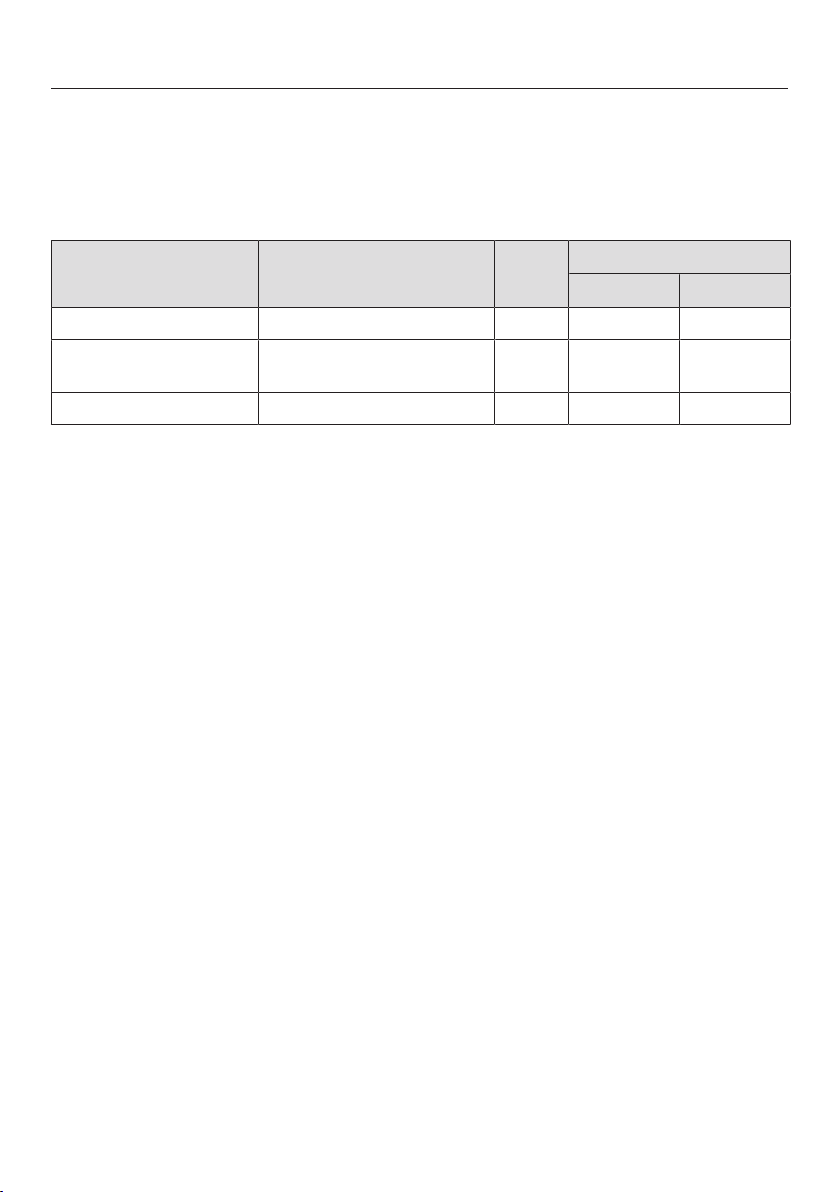
9 power levels are programmed at the factory.
For testing in accordance with the above standard, programme the hob to the
extended power level setting.
Test food
Pan base (mm)
Lid
Power level
Pre-heat Cooking
Heating oil up 150 No – 1–2
Pancakes 180
(Sandwich base)
No 9 5.–7.
Frying deep frozen chips According to the standard No 9 9
Cleaning and care
50
Risk of burning due to hot
cooking zones.
The cooking zones will be hot after
use.
Switch the hob off.
Allow the cooking zones to cool
down before cleaning the hob.
Risk of damage due to moisture
ingress.
The steam from a steam cleaning
appliance could reach live electrical
components and cause a short
circuit.
Do not use a steam cleaner to clean
the hob.
All surfaces could be discoloured or
damaged if unsuitable cleaning
agents are used. All surfaces are
susceptible to scratching.
Remove all cleaning agent residues
immediately.
Never use abrasive sponges or
cleaning agents.
Clean the hob after every use.
Dry the hob thoroughly after cleaning
with water to avoid limescale residue.
Unsuitable cleaning agents
To avoid damaging the surfaces of the
appliance, do not use:
- washing-up liquid
- cleaning agents containing soda,
alkalines, ammonia, acids or
chlorides
- cleaning agents containing descaling
agents
- stain and rust removers
- abrasive cleaning agents, e.g.
powder cleaners and cream cleaners
- solvent-based cleaning agents
- dishwasher cleaner
- oven sprays
- glass cleaning agents
- hard, abrasive brushes or sponges
(e.g. pot scourers) or sponges which
have been previously used and still
contain abrasive cleaning agents
- melamine eraser blocks
Cleaning and care
51
Cleaning the ceramic surface
Risk of damage by pointed
objects.
The seal between the hob and the
worktop could suffer damage.
The seal between the ceramic
surface and the frame could suffer
damage.
Do not use pointed objects for
cleaning.
Not all soiling and residues can be
removed using a solution of
washing-up liquid. An invisible film
can develop that can lead to
discolouration of the glass ceramic
surface. This discolouration cannot
be removed.
Clean the ceramic surface regularly
with a proprietary ceramic glass
cleaning agent.
Remove any coarse soiling with a
damp cloth and more stubborn
soiling with a shielded scraper blade
suitable for use on glass.
Then clean the ceramic glass surface
with the Miele ceramic and stainless
steel hob cleaner (see “optional
accessories”) or with a proprietary
ceramic glass cleaner applied with
kitchen paper or a clean cloth. Do not
apply the cleaner while the hob is still
hot, as this can result in marking.
Please follow the cleaning agent
manufacturer's instructions.
Finally wipe the glass ceramic surface
with a damp cloth and polish with a
soft, dry cloth.
Residues can burn onto the hob the
next time it is used and cause damage
to the glass ceramic surface. Ensure
that all cleaning agent residues are
removed.
Spots caused by limescale, water
and aluminium residues (spots with a
metallic appearance) can be removed
using Miele's ceramic and stainless
steel hob cleaner.
Risk of burning due to hot
cooking zones.
The cooking zones are hot during
use.
Wear oven gloves when removing
residues of sugar, plastic or
aluminium foil from a hot ceramic
surface with a shielded scraper
blade.
Should any sugar, plastic or
aluminium foil spill or fall onto the
hot ceramic surface while it is in use,
switch off the cooking zone.
Then carefully scrape off these
residues immediately whilst they are
still hot, using a scraper blade
suitable for use on glass.
Afterwards, clean the ceramic surface
in its cooled state, as described
above.
Problem solving guide
52
Many malfunctions and faults that can occur in daily operation can be easily
remedied. Time and money will be saved because a service call will not be
needed.
The following guide may help you to find the reason for a malfunction or a fault,
and to correct it.
Messages in the display
Problem Cause and remedy
In the cooking zone dis-
play, thesymbol will
flash alternately with
the selected power level
or.
An unsuitable pan has been placed on the hob.
Use suitable pans (see “Pans” in the “Induction”
chapter).
After the hob has been
switched on appears
in the timer display for a
few seconds.
The system lock or safety lock is activated.
Deactivate the system lock or safety lock (see
“System lock / Safety lock”).
After the hob has been
switched on appears
in the timer display
briefly. The cooking
zones do not heat up.
The hob is in demonstration mode.
Touch the0 and 2 sensor controls at the same
time until flashes alternately with in the timer
display.
flashes in the timer
display and the hob
switches off automatic-
ally.
One or more of the sensor controls are covered, e.g.
by finger contact, food boiling over or an object.
Clean off any dirt and/or remove the object (see
“Safety switch-off”).
will flash alternately
within the timer dis-
play.
The overheating protection mechanism has been
activated.
See “Safety features – Overheating protection”.
will flash alternately
with, or in the
timer display.
The fan is blocked or defective.
Make sure it has not been blocked by an object.
Remove the obstruction.
If this fault message continues to appear in the
display, contact the Customer Service
Department.
Problem solving guide
53
Problem Cause and remedy
A message not listed in
this table is appearing
in the timer display.
There is an electronic module fault.
Disconnect the power supply to the hob for
approx. 1minute.
If the problem persists after power has been
restored, please contact the Customer Service
Department.
Unexpected behaviour
Problem Cause and remedy
Power level9 is auto-
matically reduced if you
also set power level9
for the connected cook-
ing zone.
Operating both zones at power level9 exceeds the
permitted maximum power for the two zones.
Use a different cooking zone.
A cooking zone
switches off automatic-
ally.
It has been operated for too long.
You can use the cooking zone again by switching
it back on (see “Safety switch-off”).
The cooking zone is not
working in the usual
way on the power set-
ting selected.
The overheating protection mechanism has been
activated.
See “Safety features”.
A cooking zone or the
whole hob switches off
automatically.
The overheating protection mechanism has been
activated.
See “Safety features”.
The Booster has deac-
tivated early automatic-
ally.
The overheating protection mechanism has been
activated.
See “Safety features”.
Problem solving guide
54
Unsatisfactory results
Problem Cause and remedy
The food in the pan
does not heat up when
the Auto heat-up func-
tion is switched on.
A large amount of food is being heated up.
Start cooking at the highest power level and then
turn down to a lower one manually later on.
The pan is not conducting heat properly.
Use a different pot or pan which conducts heat
properly.
General problems or technical faults
Problem Cause and remedy
The hob or cooking
zones will not switch
on.
There is no power to the hob.
Check whether the mains fuse has tripped.
Contact an electrician or Miele Service (for the
minimum fuse rating, see data plate).
There may be a technical fault.
Disconnect the appliance from the mains
electricity supply for approx. 1 minute by
– tripping the relevant mains fuse or screwing the
fuse out completely, or
– switching off at the residual current device.
If, after resetting the trip switch in the mains fuse
box or the residual current current device, the
appliance will still not turn on, contact a qualified
electrician or Miele Service.
A smell and vapours are
given off when the new
appliance is being used.
The metal components have a protective coating.
When the appliance is used for the first time, this
causes a smell and possibly also vapour. The
material from which the induction coils are made also
gives off a smell in the first few hours of operation.
With each subsequent use, the odour is reduced until
it disappears completely. The smell and any vapours
given off do not indicate a faulty connection or
appliance and they are not hazardous to health.
An operating noise can
be heard after the appli-
ance has been switched
off.
The cooling fan runs until the hob has cooled down
and then switches off automatically.
Optional accessories
55
Miele offer a comprehensive range of
useful accessories as well as cleaning
and conditioning products for your
Miele appliances.
These products can be ordered through
the Miele Webshop.
They can also be ordered from Miele
(see end of this booklet for contact
details) or from your Miele dealer.
Cookware
Miele offers a wide range of cookware.
These have all been optimised for Miele
appliances in terms of functionality and
dimensions. Detailed information is
provided on the Miele website.
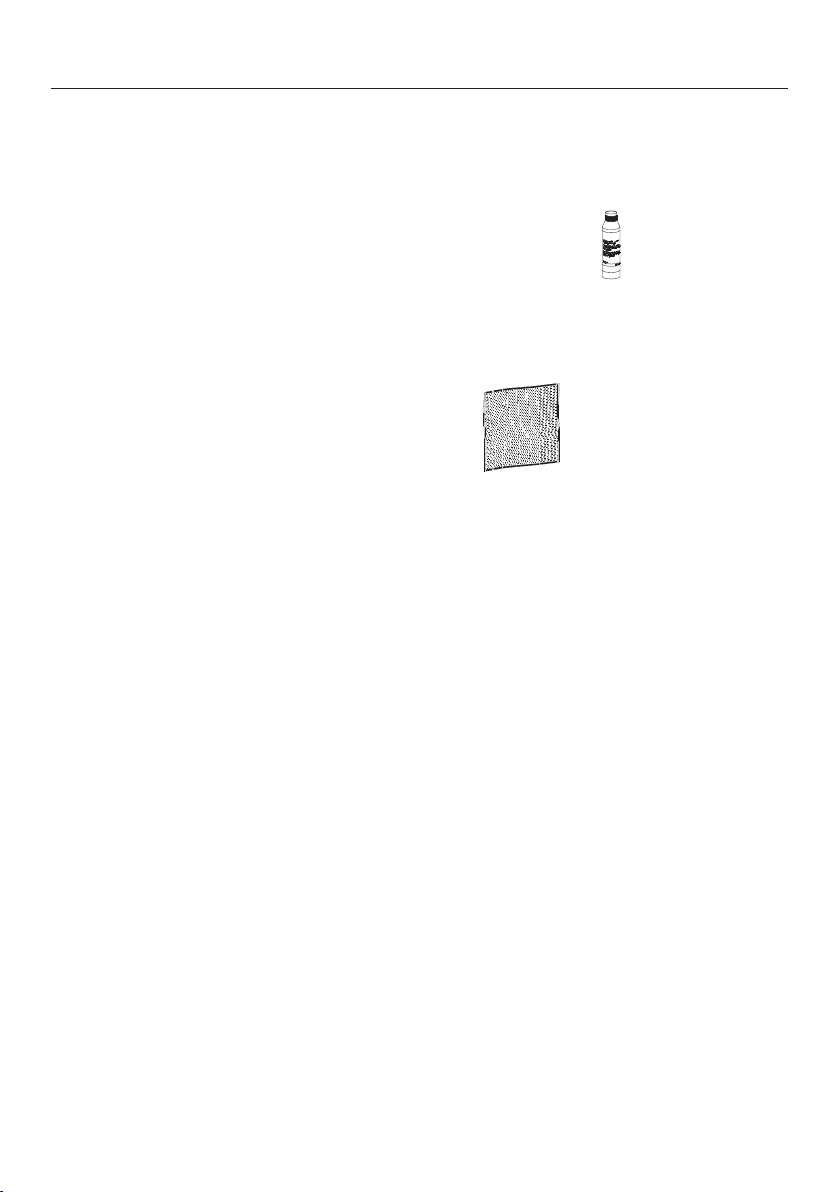
Cleaning and care products
Ceramic and stainless steel hob
cleaner 250ml
Removes heavy soiling, limescale
deposits and aluminium residues
Microfibre cloth
Removes finger marks and light soiling

After sales service
56
Contact in the event of a fault
In the event of any faults which you cannot remedy yourself, please contact your
Miele dealer or the Miele Customer Service Department.
You can book a Miele Customer Service Department call-out online at
www.miele.com/service.
Contact information for the Miele Customer Service Department can be found at
the end of this document.
Please quote the model identifier and serial number of your appliance (Fabr./SN/
Nr.) when contacting the Miele Customer Service Department. This information
can be found on the data plate.
Please note that telephone calls may be monitored and recorded for training
purposes and that a call-out charge will be applied to service visits where the
problem could have been resolved as described in this booklet.
Data plate
Stick the extra data plate supplied with the appliance here. Make sure that the
model number matches the one specified on the back cover of this document.
Warranty
For information on the appliance warranty specific to your country please contact
Miele. See back cover for address.
In the UK, your appliance warranty is valid for 2 years from the date of purchase.
However, you must activate your cover by calling 0330 160 6640 or registering
online at www.miele.co.uk.
Installation
*INSTALLATION*
57
Safety instructions for installation
Risk of damage from incorrect connection.
Incorrect installation can cause damage to the hob.
The hob must only be installed by a qualified person.
Risk of electric shock from mains voltage.
Incorrect connection to the mains supply may result in an electric shock.
The hob must be connected to the electrical supply by a qualified electrician
only.
Damage from falling objects.
Take care not to damage the hob when fitting wall units or a cooker hood above
it.
Fit the wall units and the cooker hood before the hob.
The veneer or laminate coatings of worktops (or adjacent kitchen
units) must be treated with 100°C heat-resistant adhesive which will
not dissolve or distort. Any backmoulds must be of heat-resistant
material.
The hob must not be installed over a fridge, fridge-freezer, freezer,
dishwasher, washing machine, washer-dryer or tumble dryer.
This hob must not be installed above ovens or cookers unless
these have a built-in cooling down fan.
After installation, ensure that nothing can come into contact with
the connection cable and that it is without hindrance.
The electrical cable may not come into contact with any moving
kitchen component (e.g. a drawer) or be subject to mechanical
obstruction which could damage it.
Observe carefully the safety clearances listed on the following
pages.
Installation
*INSTALLATION*
58
Safety distances
Safety distance above the hob
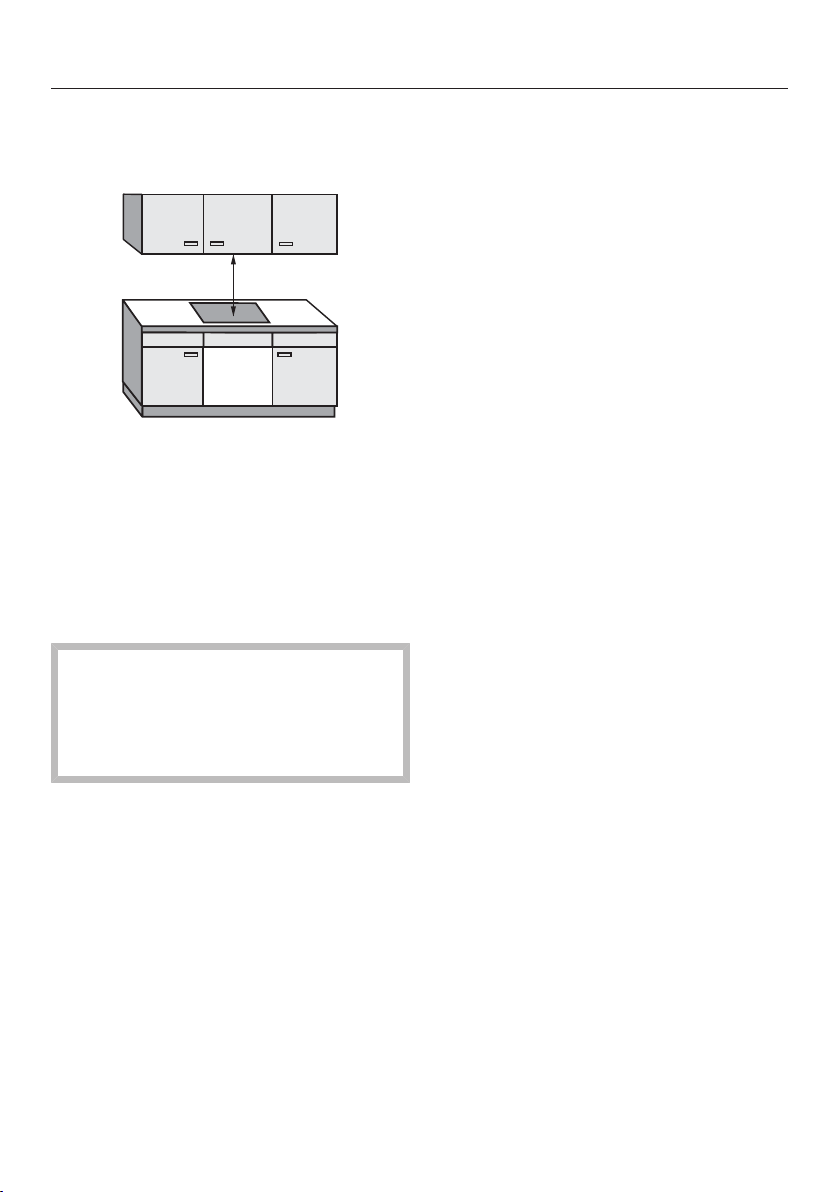
The safety distance specified by the
manufacturer of the cooker hood must
be maintained between the hob and the
cooker hood above it.
If combustible objects are installed
above the hob (e.g., cabinets, utensil
rail, etc.), a minimum safety distance of
500mm must be maintained.
When two or more appliances which
have different safety distances are
installed together below a cooker
hood, you should observe the
greatest specified safety distance.

Installation
*INSTALLATION*
59
Safety distances to the sides and
back of the appliance
It is advisable to install the hob with
plenty of space either side of it.
The minimum distance shown below
must be maintained between the back
of the hob and a tall unit or wall.
The minimum distance , shown
below must be maintained between a
tall unit or a wall to the left or right of
the hob with a minimum distance of
300mm on the opposite side.
Minimum distance between the back
of the worktop cut-out and the rear
edge of the worktop:
50mm
Minimum distance between the
worktop cut-out and a wall or tall unit to
the right of it:
50mm.
Minimum distance between the
worktop cut-out and a wall or tall unit to
the left of it:
50mm.
Not allowed
Highly recommended
Not recommended
Not recommended

Installation
*INSTALLATION*
60
Minimum safety distance underneath
the hob
To ensure sufficient ventilation to the
hob, a minimum safety distance must
be left between the underside of the
hob and any oven, intermediate shelf or
drawer.
The minimum safety distance between
the underside of the hob and
- Upper edge of oven: 15mm
- Upper edge of intermediate shelf:
15mm
- Upper edge of drawer: 5mm
- Base of drawer: 75mm
Intermediate shelf
It is not necessary to fit an intermediate
shelf underneath the hob, but one may
be fitted if you wish.
Leave a gap of 10mm at the back
between the cabinet and the
intermediate shelf to accommodate
the power cable.
A gap of 20mm is recommended at the
front between the cabinet and
intermediate shelf for better ventilation
of the hob.
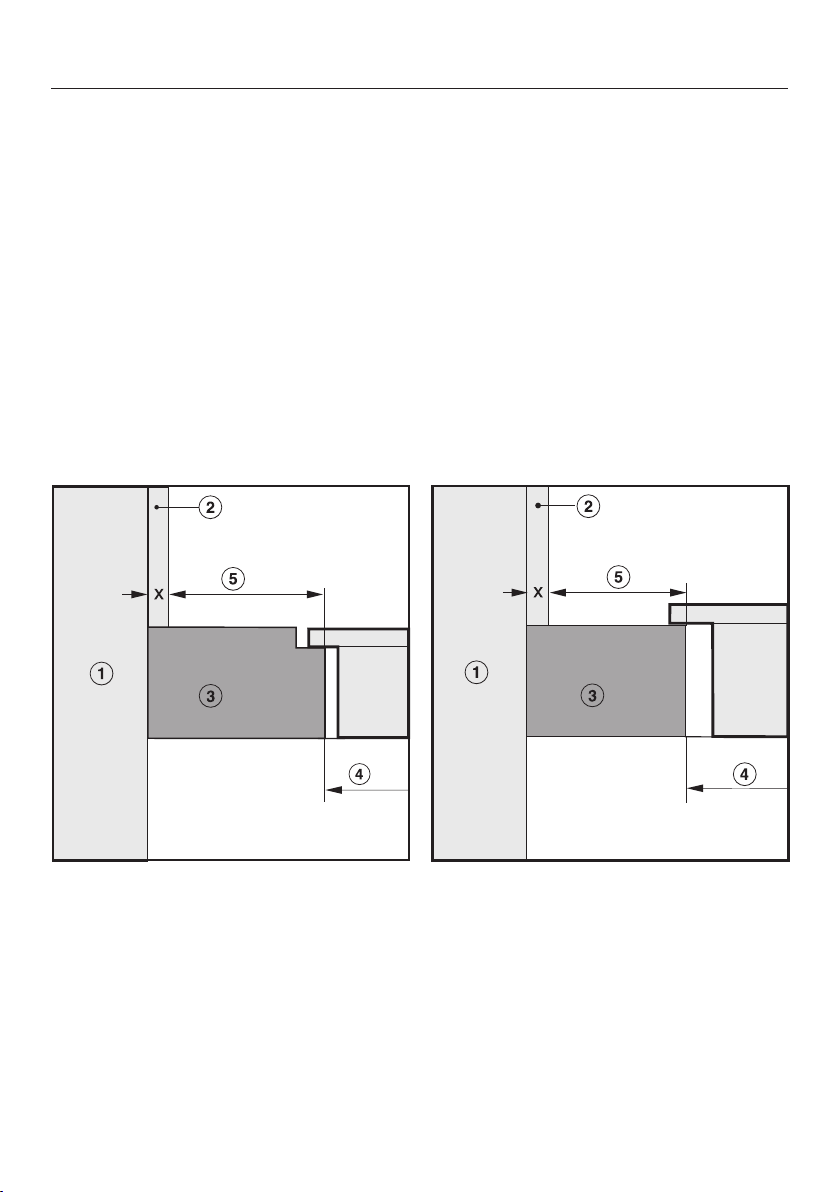
Installation
*INSTALLATION*
61
Safety distance when installing the appliance near a wall with additional
niche cladding
A minimum safety distance must be maintained between the worktop cut-out and
any niche cladding to protect it from heat damage.
If the niche cladding is made from a combustible material (e.g. wood) a minimum
safety distance of 50 mm must be maintained between the cut-out and the
cladding.
If the niche cladding is made from a non-combustible material (e.g. metal, natural
stone, ceramic tiles) the minimum safety distance between the cut-out and the
cladding will be 50 mm less the thickness of the cladding.
Example: 15 mm niche cladding
50mm - 15mm = minimum safety distance of 35mm
Flush-fitted hobs Hob with frame or bevelled edge
a
Masonry
b
Niche cladding dimension x = thickness of the niche cladding material
c
Worktop
d
Worktop cut-out
e
Minimum distance to
combustible materials 50mm
non-combustible materials 50mm - dimension x
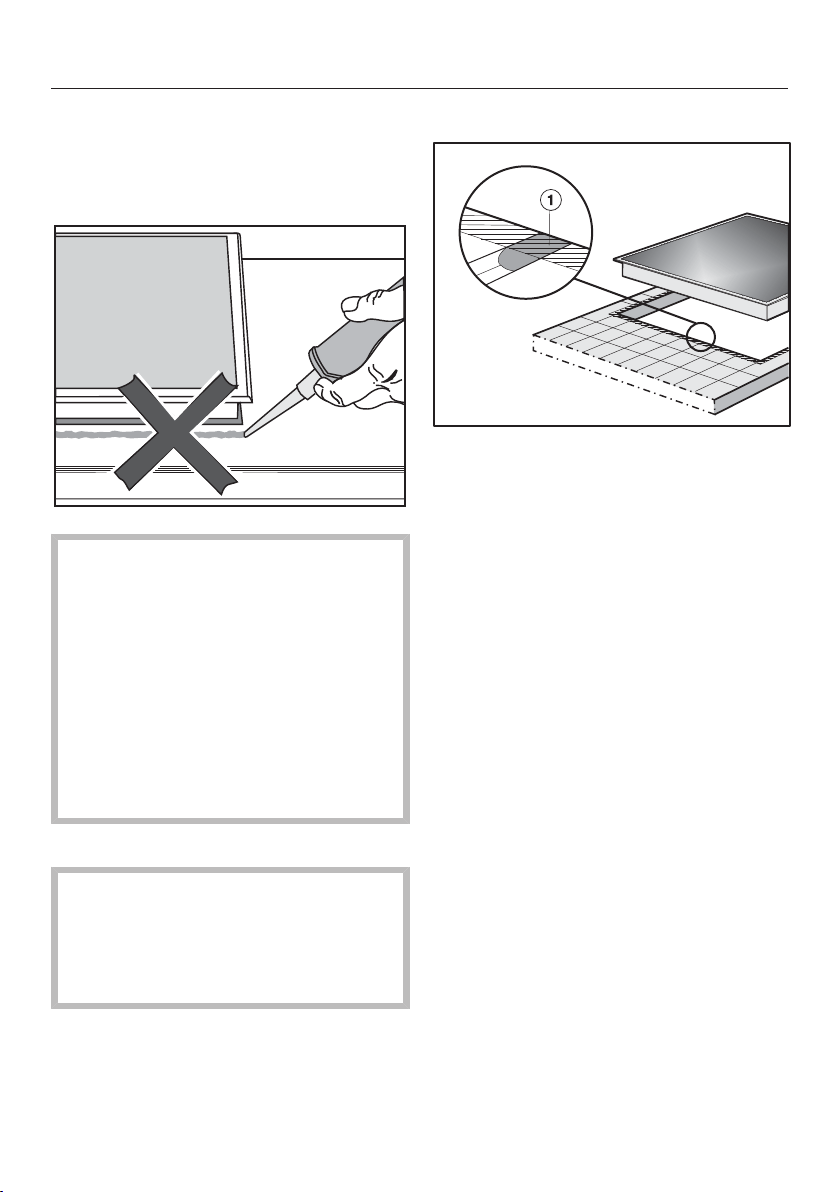
Installation
*INSTALLATION*
62
Installation notes
Seal between the hob and the
worktop
Damage caused by incorrect
installation.
Using sealant under the hob could
result in damage to the hob and the
worktop if the hob ever needs to be
removed for servicing.
Do not use sealant between the hob
and the worktop.
The sealing strip under the edge of
the hob provides a sufficient seal for
the worktop.
Sealing strip
Dismantling the hob for service
purposes may damage the sealing
strip underneath the edge of the hob.
Always replace the sealing strip
before reinstalling the hob.
Tiled worktops
Grout lines and the hatched area
underneath the hob frame must be
smooth and even. If they are not the
hob will not sit flush with the worktop
and the sealing strip underneath the
hob will not provide a good seal
between the hob and the worktop.
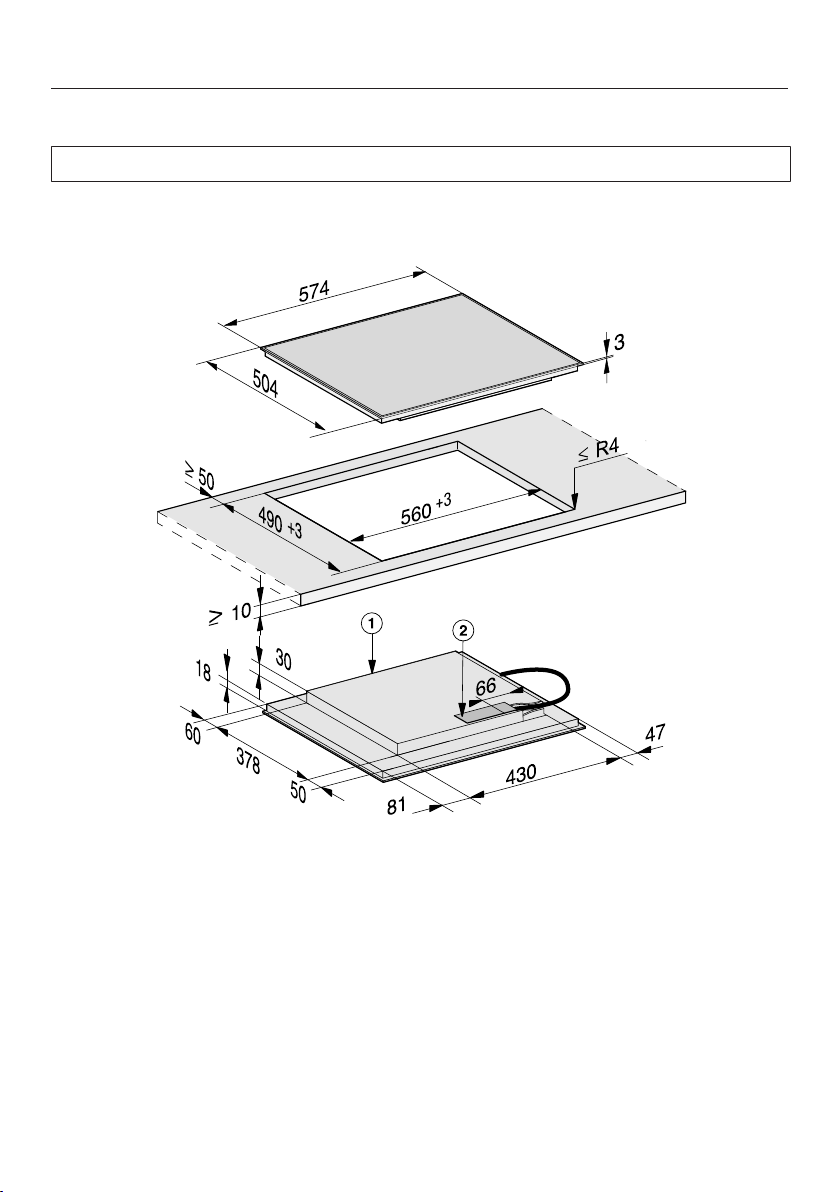
Installation
*INSTALLATION*
63
Building-in dimensions
All dimensions are given in mm.
KM7200FR
a
Front
b
Mains connection box
The mains connection cable (L=1440mm) is supplied loose
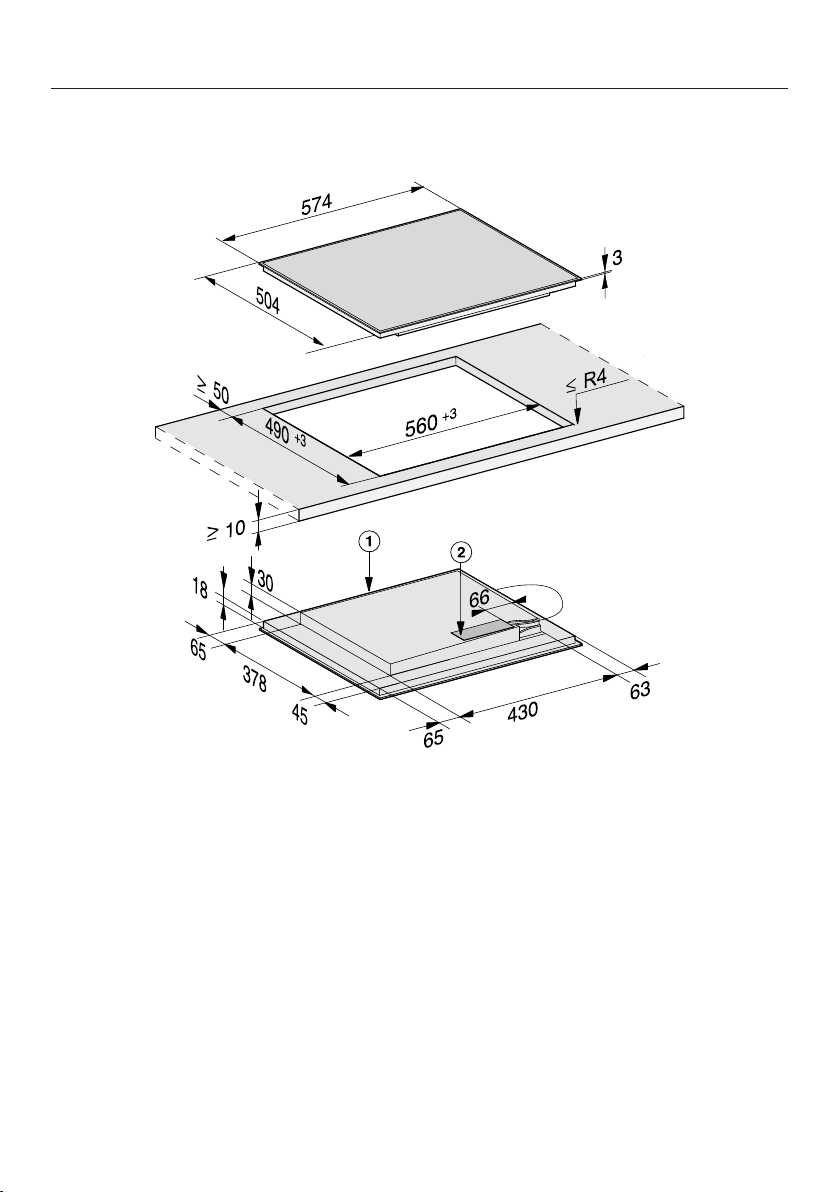
Installation
*INSTALLATION*
64
KM7201FR
a
Front
b
Mains connection box
The mains connection cable (L=1440mm) is supplied loose
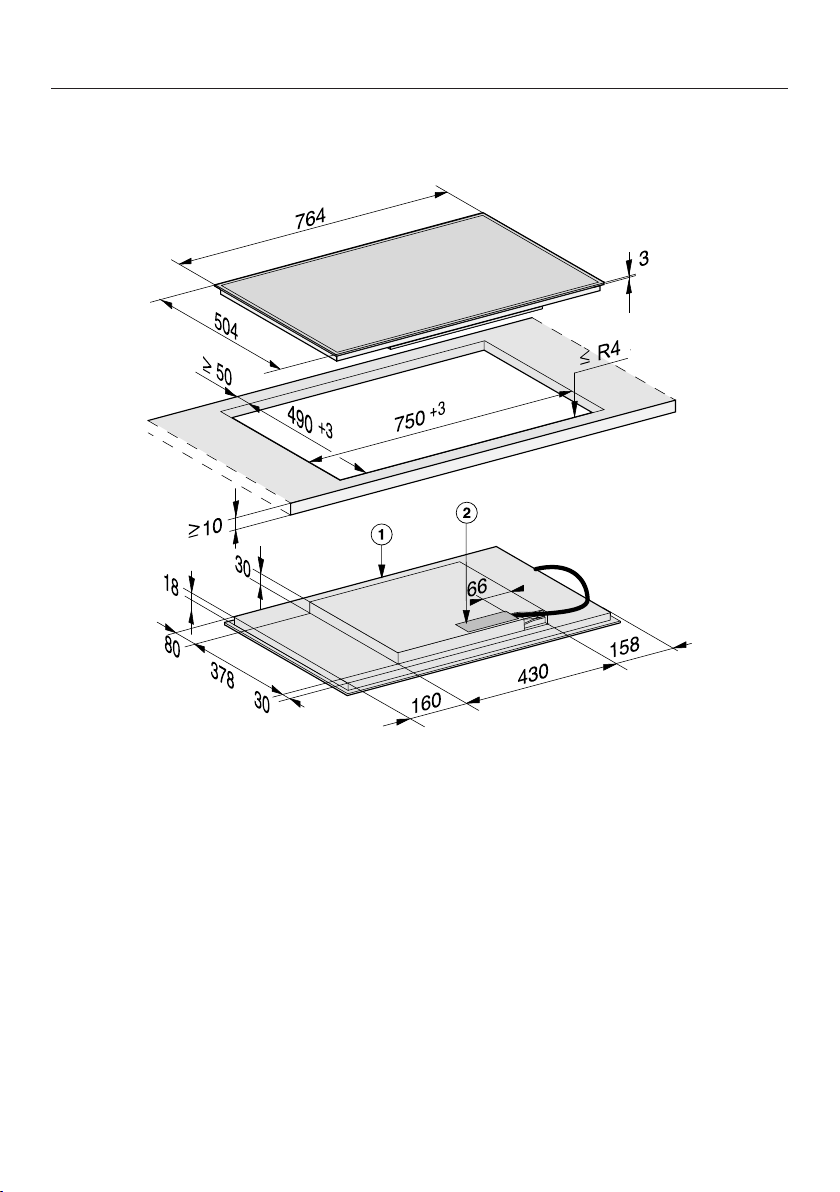
Installation
*INSTALLATION*
65
KM7210FR
a
Front
b
Mains connection box
The mains connection cable (L=1440mm) is supplied loose
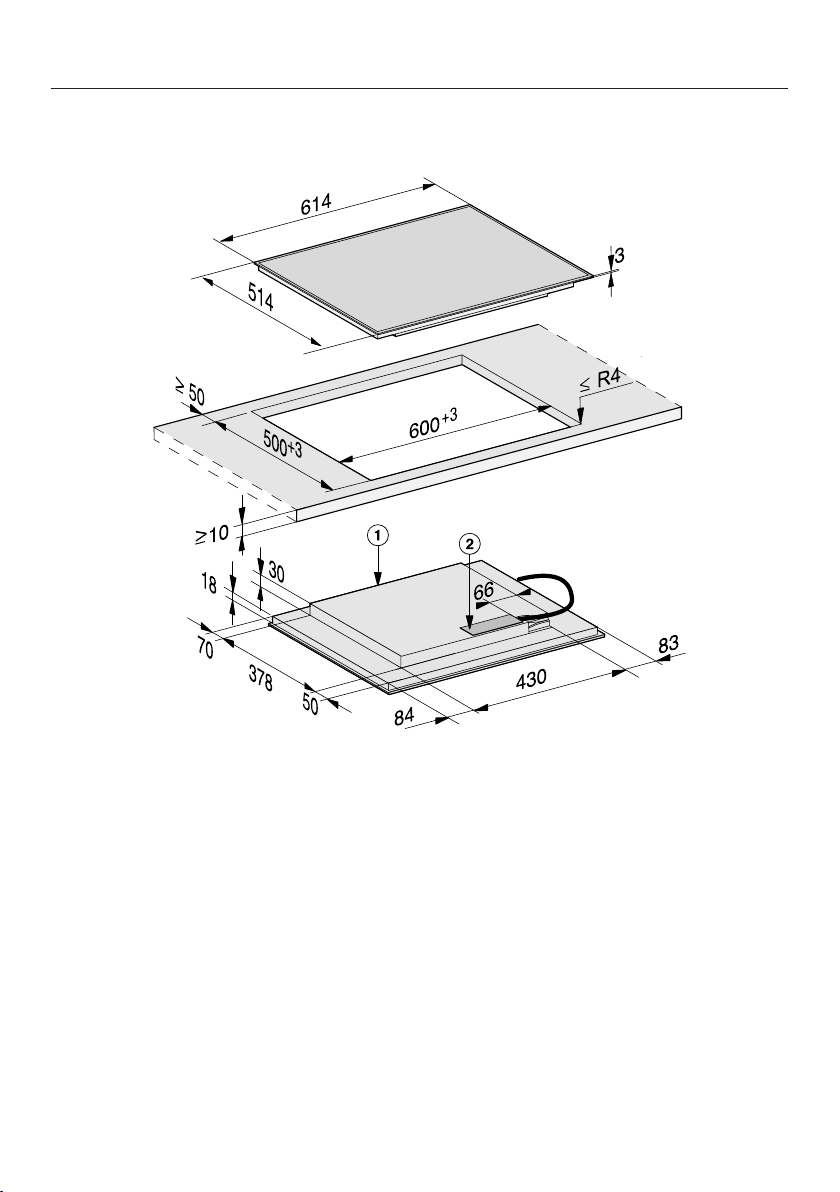
Installation
*INSTALLATION*
66
KM7262FR
a
Front
b
Mains connection box
The mains connection cable (L=1440mm) is supplied loose
Installation
*INSTALLATION*
67
Installation
Create the worktop cut-out.
Remember to maintain the minimum
safety distances (see “Installation –
Safety distances”).
Seal any cut surfaces on wooden
worktops with a special varnish,
silicone sealant or resin to prevent the
wood from swelling as a result of
moisture ingress. The sealant must
be heat-resistant.
Make sure that the sealant does not
come into contact with the top of the
worktop.
Stick the supplied sealing strip under
the edge of the hob. Do not apply the
sealing strip under tension.
Risk of damage from incorrect
connection.
The hob electronics may be
damaged if a short-circuit occurs.
The power cable must be connected
to the hob by a qualified electrician.
Connect the power cable by following
the instructions in the wiring diagram
on the hob (see “Installation –
Electrical connection”).
Feed the power cable for the hob
down through the worktop cut-out.
Place the hob centrally in the cut-out.
When doing this, make sure that the
seal of the appliance sits flush with
the worktop on all sides. This is
important to ensure an effective seal
all round.
If the seal does not sit flush with the
worktop in the corners, the corner
radius (≤R4) can be carefully cut to fit
using a jigsaw.
Connect the hob to the electricity
supply (see “Installation – Electrical
connection”).
Check that the hob works.

Installation
*INSTALLATION*
68
Electrical connection
Risk of damage from incorrect
connection.
Unauthorised installation,
maintenance and repairs can cause
considerable danger for the user.
Miele cannot be held liable for
damage or injury caused by
unauthorised installation,
maintenance or repair work, or by an
inadequate or faulty on-site earthing
system (e.g. electric shock).
This hob must be connected to the
electrical supply by a qualified
electrician.
The electrician must be familiar with
and comply with the national
regulations and any additional
regulations of the local electricity
provider (e.g. BS 7671 in the UK).
After installation, ensure that all
electrical components are shielded
and cannot be accessed by users.
Total power rating
See data plate
Connection data
The connection data is quoted on the
data plate. Please ensure these match
the household mains supply.
Please see wiring diagrams for
connection. (N.B. This appliance is
supplied single phase only in the UK /
AUS / NZ).
Residual current device
For extra safety, it is advisable to
protect the appliance with a suitable
residual current device (RCD) with a trip
range of 30 mA.
WARNING
THIS APPLIANCE MUST BE
EARTHED
Disconnecting devices
It must be possible to disconnect the
hob from the mains at all poles using
disconnecting devices. A contact
distance of at least 3mm must be
observed in the switched-off state. The
disconnecting devices are overcurrent
protection devices and residual current
protection devices.
Installation
*INSTALLATION*
69
Disconnecting from the mains
Risk of electric shock.
There is a risk of electric shock if the
appliance is connected to the mains
supply during repair or service work.
After disconnection, ensure the
appliance cannot be switched back
on by mistake.
To disconnect the appliance from the
mains power supply, do one of the
following depending on installation:
Safety fuses
Completely remove fuses.
Automatic circuit breakers
Press the (red) test button until the
middle (black) button springs out.
Built-in circuit breakers
Circuit breakers at least type B or C:
Switch the lever from 1 (on) to 0 (off).
Residual current device (RCD)
Switch the main switch from 1 (on) to
0 (off) or press the test button.
Mains connection cable
The hob must be connected to the
electrical supply with a special
connection cable, type H 05 VV-F (PVC
insulated) with a suitable diameter.
Please see wiring diagram for
connection. (N.B. This appliance is
supplied single phase only in the UK /
AUS / NZ).
See the data plate on the hob for the
correct voltage and frequency.
Replacing the mains connection
cable
Risk of electric shock.
Incorrect connection to the power
supply may result in an electric
shock.
The mains cable must only be
replaced by a qualified electrician.
When replacing the mains cable only
use cable type H05VV-F with a
suitable cross section. A suitable
connection cable is available to order
from Miele.
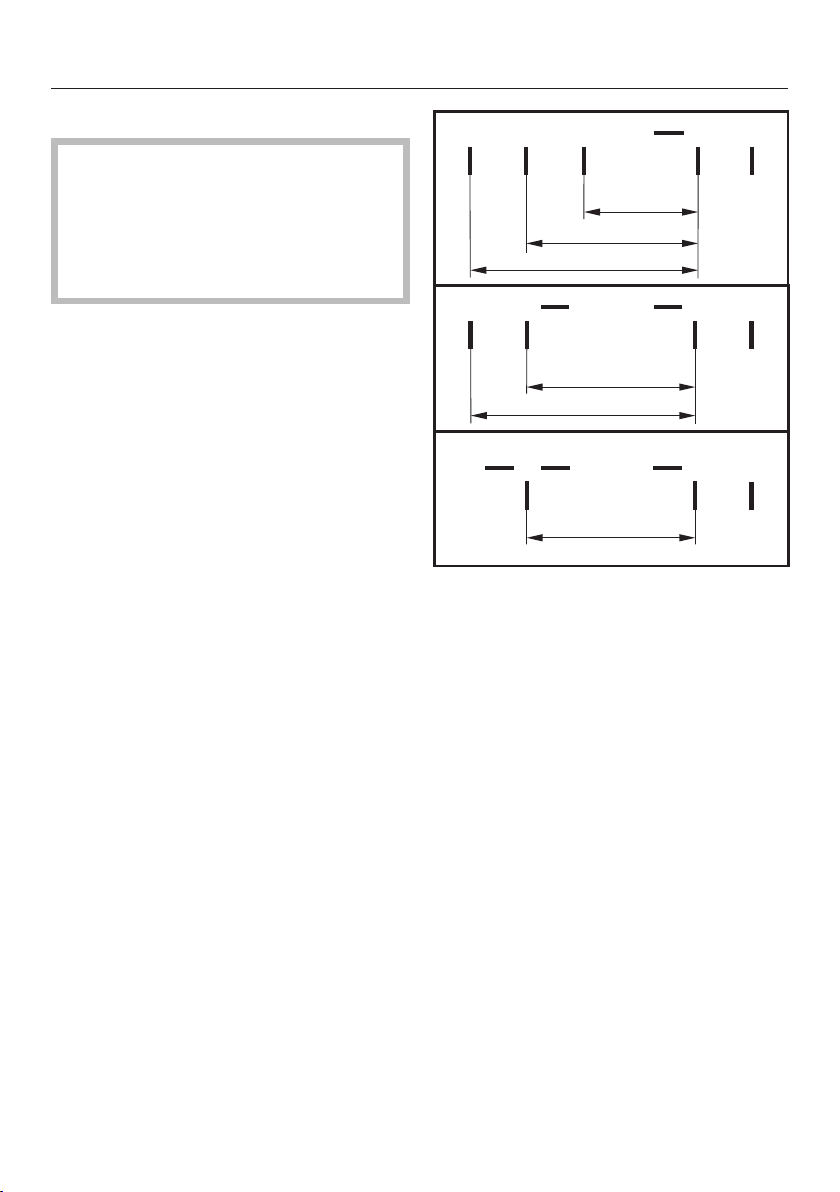
Installation
*INSTALLATION*
70
Wiring diagram
Some connection methods are not
permitted in all installation locations.
Ensure compliance with national
regulations and any additional
regulations issued by the local
electricity provider.
L1
200-240 V~
200-240 V~
200-240 V~
ab
cde
-
L2 L3 N
-
L2
b
L1
a cd
N
e
(L3)
200-240 V~
200-240 V~
a
L1
bcd
N
e
-
(L2)
200-240 V~
Product data sheets
71
The following data sheets apply to the models described in this operating
instruction manual.
Information for domestic electric hobs
In acc. with regulation (EU) No. 66/2014
MIELE
Model name/identifier KM 7200
Number of cooking zones and/or areas
For circular cooking zones: diameter of useful
surface area/cooking zone
For non-circular cooking zones or areas: length
and width of useful surface area per electric
cooking zone or area
1. = Ø 140-280mm
2. = Ø 140-190mm
3. = Ø 100-160mm
4. =
5. =
6. =
Energy consumption per cooking zone or area
calculated per kg (EC
electric cooking
)
1. = 176,0Wh/kg
2. = 174,0Wh/kg
3. = 180,0Wh/kg
Energy consumption for the hob calculated per kg
(EC
electric hob
)
176,7Wh/kg
Information for domestic electric hobs
In acc. with regulation (EU) No. 66/2014
MIELE
Model name/identifier KM 7201
Number of cooking zones and/or areas
For circular cooking zones: diameter of useful
surface area/cooking zone
For non-circular cooking zones or areas: length
and width of useful surface area per electric
cooking zone or area
1. = Ø 160-220mm
2. = Ø 100-160mm
3. = Ø 140-190mm
4. = Ø 140-190mm
5. =
6. =
Energy consumption per cooking zone or area
calculated per kg (EC
electric cooking
)
1. = 178,0Wh/kg
2. = 180,0Wh/kg
3. = 174,0Wh/kg
4. = 174,0Wh/kg
Energy consumption for the hob calculated per kg
(EC
electric hob
)
176,5Wh/kg
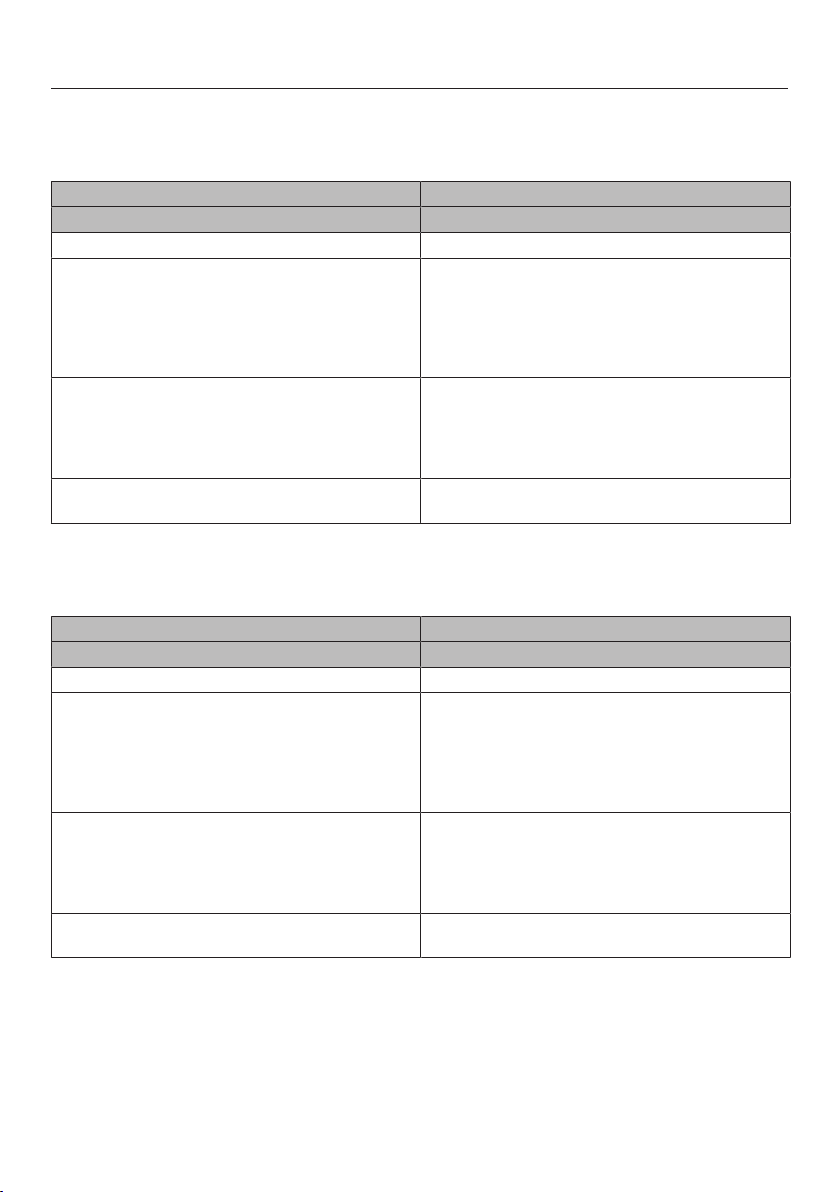
Product data sheets
72
Information for domestic electric hobs
In acc. with regulation (EU) No. 66/2014
MIELE
Model name/identifier KM 7210
Number of cooking zones and/or areas
For circular cooking zones: diameter of useful
surface area/cooking zone
For non-circular cooking zones or areas: length
and width of useful surface area per electric
cooking zone or area
1. = Ø 160-220mm
2. = Ø 100-160mm
3. = 190x290mm
4. = Ø 140-190mm
5. =
6. =
Energy consumption per cooking zone or area
calculated per kg (EC
electric cooking
)
1. = 178,0Wh/kg
2. = 180,0Wh/kg
3. = 172,0Wh/kg
4. = 174,0Wh/kg
Energy consumption for the hob calculated per kg
(EC
electric hob
)
176,0Wh/kg
Information for domestic electric hobs
In acc. with regulation (EU) No. 66/2014
MIELE
Model name/identifier KM 7262
Number of cooking zones and/or areas
For circular cooking zones: diameter of useful
surface area/cooking zone
For non-circular cooking zones or areas: length
and width of useful surface area per electric
cooking zone or area
1. =
2. = Ø 100-160mm
3. = 190x290mm
4. =
5. =
6. =
Energy consumption per cooking zone or area
calculated per kg (EC
electric cooking
)
1. = 178,0Wh/kg
2. = 180,0Wh/kg
3. = 172,0Wh/kg
4. = 174,0Wh/kg
Energy consumption for the hob calculated per kg
(EC
electric hob
)
176,0Wh/kg



United Kingdom
Miele Co. Ltd., Fairacres, Marcham Road, Abingdon, Oxon, OX14 1TW
Tel: 0330 160 6600, Internet: www.miele.co.uk/service, E-mail: [email protected]
Australia
Miele Australia Pty. Ltd.
ACN 005 635 398
ABN 96 005 635 398
Level 4, 141 Camberwell Road
Hawthorn East, VIC 3123
Tel: 1300 464 353
Internet: www.miele.com.au
Miele Electrical Appliances Co., Ltd.
1-3 Floor, No. 82 Shi Men Yi Road
Jing' an District
200040 Shanghai, PRC
Tel: +86 21 6157 3500
Fax: +86 21 6157 3511
E-mail: [email protected],
Internet: www.miele.cn
China Mainland
Miele (Hong Kong) Ltd.
41/F - 4101, Manhattan Place
23 Wang Tai Road
Kowloon Bay, Hong Kong
Tel: (852) 2610 1025
Fax: (852) 3579 1404
Email:
Website: www.miele.hk
Hong Kong, China
Miele India Pvt. Ltd.
1st Floor, Copia Corporate Suites,
Commercial Plot 9,
Mathura Road, Jasola,
New Delhi - 110025
E-mail: customercare@miele.in
Website: www.miele.in
India
Miele Ireland Ltd.
2024 Bianconi Avenue
Citywest Business Campus
Dublin 24
Tel: (01) 461 07 10
Fax: (01) 461 07 97
E-Mail: [email protected]
Internet: www.miele.ie
Ireland
Malaysia
Miele Sdn Bhd
Suite 12-2, Level 12
Menara Sapura Kencana
Petroleum
Solaris Dutamas No. 1
Jalan Dutamas 1
50480 Kuala Lumpur, Malaysia
Phone: +603-6209-0288
Fax: +603-6205-3768
Miele New Zealand Limited
IRD 98 463 631
8 College Hill
Freemans Bay, Auckland 1011
New Zealand
Tel: 0800 464 353
Internet: www.miele.co.nz
New Zealand
Miele Pte. Ltd.
29 Media Circle
#11-04 ALICE@Mediapolis
Singapore 138565
sTel: +65 6735 1191
Fax: +65 6735 1161
E-Mail: [email protected]
Internet: www.miele.sg
Singapore
Miele (Pty) Ltd.
63 Peter Place
Bryanston 2194
P.O. Box 69434
Bryanston 2021
Tel: (011) 875 9000
Fax: (011) 875 9035
E-mail: [email protected]
Internet: www.miele.co.za
South Africa
Miele Appliances Ltd.
Showroom 1
Eiffel 1 Building
P.O. Box 114782 - Dubai
Tel. +971 4 3044 999
Fax. +971 4 3418 852
800-MIELE (64353)
E-Mail: [email protected]
Website: www.miele.ae
United Arab Emirates
Manufacturer:
Miele & Cie. KG, Carl-Miele-Straße 29, 33332 Gütersloh, Germany
Thailand
Miele Appliances Ltd.
BHIRAJ TOWER at EmQuartier
43rd Floor Unit 4301-4303
689 Sukhumvit Road
North Klongton Sub-District
Vadhana District
Bangkok 10110, Thailand
Sheikh Zayed Road, Umm Al Sheif

M.-Nr. 11 184 710 / 05en-GB
KM 7200FR, KM7201FR, KM7210FR, KM7262FR