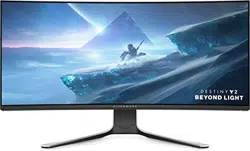

Alienware AW3821DW Monitor
User’s Guide
Model: AW3821DW
Regulatory model: AW3821DWb
Notes, cautions, and warnings
NOTE: A NOTE indicates important information that helps you make
better use of your computer.
CAUTION: A CAUTION indicates potential damage to hardware or loss
of data if instructions are not followed.
WARNING: A WARNING indicates a potential for property damage,
personal injury, or death.
© 2020-2022 Dell Inc. or its subsidiaries. All rights reserved. Dell, EMC, and other trademarks are
trademarks of Dell Inc. or its subsidiaries. Other trademarks may be trademarks of their respective
owners.
2022 - 04
Rev. A03

|3
Contents
Safety instructions . . . . . . . . . . . . . . . . . . . . . . . . . . . . . . 6
About your monitor . . . . . . . . . . . . . . . . . . . . . . . . . . . . . 7
Package contents . . . . . . . . . . . . . . . . . . . . . . . . . . . . . . . . . . . . 7
Product features . . . . . . . . . . . . . . . . . . . . . . . . . . . . . . . . . . . . . 9
Identifying parts and controls . . . . . . . . . . . . . . . . . . . . . . . . . 10
Front view . . . . . . . . . . . . . . . . . . . . . . . . . . . . . . . . . . . . . . . . . . . . . . . . .10
Top view . . . . . . . . . . . . . . . . . . . . . . . . . . . . . . . . . . . . . . . . . . . . . . . . . . . 11
Back view. . . . . . . . . . . . . . . . . . . . . . . . . . . . . . . . . . . . . . . . . . . . . . . . . . 11
Rear and bottom view . . . . . . . . . . . . . . . . . . . . . . . . . . . . . . . . . . . . . . .13
Monitor specifications . . . . . . . . . . . . . . . . . . . . . . . . . . . . . . . 16
Resolution specifications . . . . . . . . . . . . . . . . . . . . . . . . . . . . . 17
Supported video modes . . . . . . . . . . . . . . . . . . . . . . . . . . . . . . . . . . . . . .18
Preset display modes . . . . . . . . . . . . . . . . . . . . . . . . . . . . . . . . . . . . . . . .18
Electrical specifications . . . . . . . . . . . . . . . . . . . . . . . . . . . . . . . . . . . . . 20
Physical characteristics . . . . . . . . . . . . . . . . . . . . . . . . . . . . . . . . . . . . . .21
Environmental characteristics. . . . . . . . . . . . . . . . . . . . . . . . . . . . . . . . 22
Pin assignments . . . . . . . . . . . . . . . . . . . . . . . . . . . . . . . . . . . . . . . . . . . 23
Plug and Play capability. . . . . . . . . . . . . . . . . . . . . . . . . . . . . . 24
Universal Serial Bus (USB) interface . . . . . . . . . . . . . . . . . . .25
USB 3.2 Gen1 (5 Gbps) upstream connector. . . . . . . . . . . . . . . . . . . 25
USB 3.2 Gen1 (5 Gbps) downstream connector . . . . . . . . . . . . . . . . 26
USB ports. . . . . . . . . . . . . . . . . . . . . . . . . . . . . . . . . . . . . . . . . . . . . . . . . 26
LCD monitor quality and pixel policy. . . . . . . . . . . . . . . . . . .27
Ergonomics. . . . . . . . . . . . . . . . . . . . . . . . . . . . . . . . . . . . . . . . . 27
Handling and moving your display . . . . . . . . . . . . . . . . . . . . .29
Maintenance guidelines . . . . . . . . . . . . . . . . . . . . . . . . . . . . . .30
Cleaning your monitor . . . . . . . . . . . . . . . . . . . . . . . . . . . . . . . . . . . . . . 30

4|
Setting up the monitor. . . . . . . . . . . . . . . . . . . . . . . . . . 31
Attaching the stand. . . . . . . . . . . . . . . . . . . . . . . . . . . . . . . . . .31
Connecting the computer. . . . . . . . . . . . . . . . . . . . . . . . . . . . 35
Removing the monitor stand . . . . . . . . . . . . . . . . . . . . . . . . . 36
VESA wall mounting (optional). . . . . . . . . . . . . . . . . . . . . . . 38
Operating the monitor. . . . . . . . . . . . . . . . . . . . . . . . . . 39
Power on the monitor . . . . . . . . . . . . . . . . . . . . . . . . . . . . . . . 39
Using the joystick control. . . . . . . . . . . . . . . . . . . . . . . . . . . . 39
Using the rear-panel controls . . . . . . . . . . . . . . . . . . . . . . . . 40
Using the On-Screen Display (OSD) menu . . . . . . . . . . . . . .41
Accessing the menu system . . . . . . . . . . . . . . . . . . . . . . . . . . . . . . . . . . 41
OSD warning message . . . . . . . . . . . . . . . . . . . . . . . . . . . . . . . . . . . . . .53
Setting the maximum resolution . . . . . . . . . . . . . . . . . . . . . . 54
Using the tilt, swivel, and vertical extension . . . . . . . . . . . . 55
Tilt and swivel extensions . . . . . . . . . . . . . . . . . . . . . . . . . . . . . . . . . . . .55
Vertical extension . . . . . . . . . . . . . . . . . . . . . . . . . . . . . . . . . . . . . . . . . .55
Using AlienFX application. . . . . . . . . . . . . . . . . . . . . . .56
Prerequisites . . . . . . . . . . . . . . . . . . . . . . . . . . . . . . . . . . . . . . 56
Installing AWCC through Windows update . . . . . . . . . . . . 56
Installing AWCC from the Dell Support website . . . . . . . . 56
Navigating the AlienFX window . . . . . . . . . . . . . . . . . . . . . . 57
Creating a theme . . . . . . . . . . . . . . . . . . . . . . . . . . . . . . . . . . . 59
Setting lighting effects . . . . . . . . . . . . . . . . . . . . . . . . . . . . . . 60
Troubleshooting . . . . . . . . . . . . . . . . . . . . . . . . . . . . . . . 63
Self-test. . . . . . . . . . . . . . . . . . . . . . . . . . . . . . . . . . . . . . . . . . . 63
Built-in diagnostics . . . . . . . . . . . . . . . . . . . . . . . . . . . . . . . . . 64
Common problems. . . . . . . . . . . . . . . . . . . . . . . . . . . . . . . . . . 65
Product specific problems . . . . . . . . . . . . . . . . . . . . . . . . . . . 68
Universal Serial Bus (USB) specific problems . . . . . . . . . . . 70

|5
Appendix . . . . . . . . . . . . . . . . . . . . . . . . . . . . . . . . . . . . . 71
FCC notices (U.S. only) and other regulatory
information. . . . . . . . . . . . . . . . . . . . . . . . . . . . . . . . . . . . . . . . . 71
Contact Dell. . . . . . . . . . . . . . . . . . . . . . . . . . . . . . . . . . . . . . . . 71
EU product database for energy label and product
information sheet . . . . . . . . . . . . . . . . . . . . . . . . . . . . . . . . . . . 71

6 | Safety instructions
Safety instructions
CAUTION: Use of controls, adjustments, or procedures other than those
specified in this documentation may result in exposure to shock, electrical
hazards, and/or mechanical hazards.
• Place the monitor on a solid surface and handle it carefully. The screen is
fragile and can be damaged if dropped or hit sharply.
• Always be sure that your monitor is electrically rated to operate with the
AC power available in your location.
• Keep the monitor in room temperature. Excessive cold or hot conditions
can have an adverse effect on the liquid crystal of the display.
• Do not subject the monitor to severe vibration or high impact conditions.
For example, do not place the monitor inside a car trunk.
• Unplug the monitor when it is going to be left unused for an extended
period of time.
• To avoid electric shock, do not attempt to remove any cover or touch the
inside of the monitor.
About your monitor | 7
About your monitor
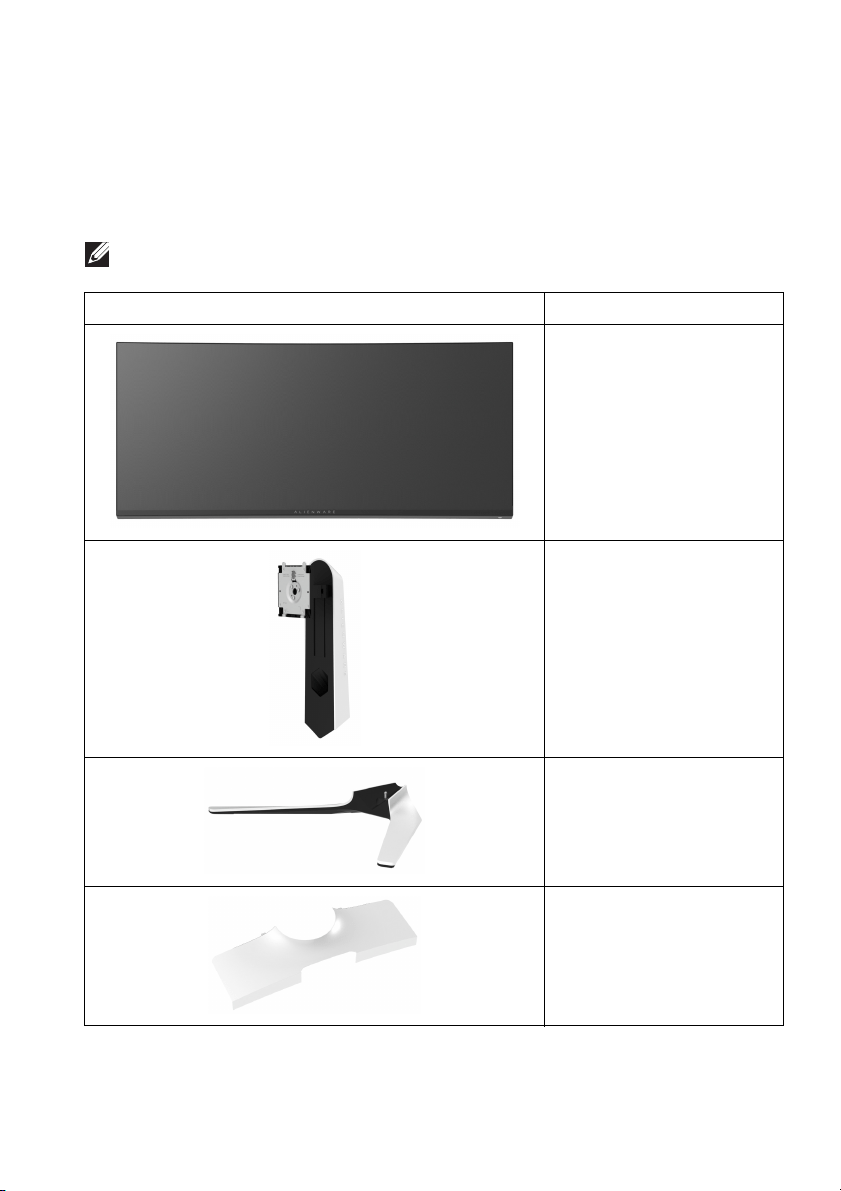
Package contents
Your monitor ships with the components shown below. If any component is
missing, contact Dell technical support. For more information see Contact Dell.
NOTE: Some components may be optional and may not ship with your
monitor. Some features or media may not be available in certain countries.
Component image Component description
Display
Stand riser
Stand base
I/O cover
8 | About your monitor
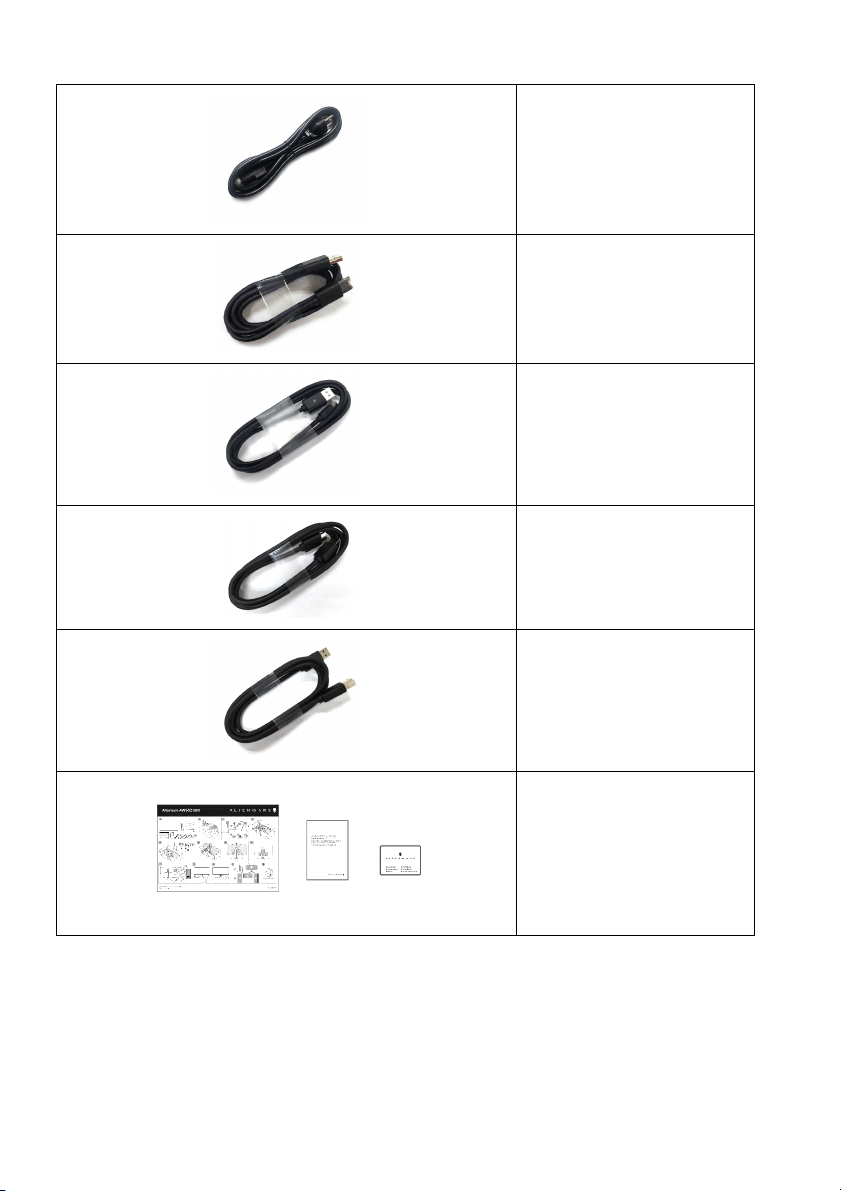
Power cable (varies by
country)
DisplayPort to DisplayPort
cable (1.8 meters)
Mini-DisplayPort to
DisplayPort cable (1.8
meters)
HDMI cable (1.8 meters)
USB 3.2 Gen1 (5 Gbps)
upstream cable (enables
the USB ports on the
monitor, 1.8 meters)
•Quick Setup Guide
• Safety, Environmental,
and Regulatory
Information
• Alienware Welcome
Ca
rd

About your monitor | 9
Product features
The Alienware AW3821DW monitor has an active matrix, Thin-Film Transistor
(TFT), Liquid Crystal Display (LCD) and LED backlight. The monitor features
include:
• 95.29 cm (37.52 inch) viewable area (measured diagonally). Resolution:
Up to 3840 x 1600 through DisplayPort and HDMI, with full-screen
support or lower resolutions, supporting a high refresh rate of 144 Hz.
• NVIDIA® G-SYNC® ULTIMATE monitor with a rapid response time of 1 ms
gray to gray in Extreme mode*.
• Color gamut of 130.6% sRGB and DCI P3 95%.
• Tilt, swivel, and height adjustment capabilities.
• Removable stand and Video Electronics Standards Association (VESA™)
100 mm mounting holes for flexible mounting solutions.
• Digital connectivity via 1 DisplayPort and 2 HDMI ports.
• Equipped with 1 SuperSpeed USB 5 Gbps (USB 3.2 Gen1) Type B
upstream port, 1 SuperSpeed USB 5 Gbps (USB 3.2 Gen1) Type-A
downstream charging port, and 3 SuperSpeed USB 5 Gbps (USB 3.2
Gen1) Type-A downstream ports.
• Plug and play capability if supported by your system.
• On-Screen Display (OSD) adjustments for ease of setup and screen
optimization.
• AW3821DW offers a couple of preset modes, including FPS (First-Person
Shooter), MOBA/RTS (Real-Time Strategy), RPG (Role-Playing Game),
SPORTS (Racing) and three customizable game modes for user's own
preference. In addition, key enhanced gaming features such as Timer,
Frame Rate, and Display Alignment are provided to help improve gamer's
performance and provide best-in game advantage.
• < 0.3 W in Standby Mode.
• VESA DisplayHDR™ 600.
• Optimize eye comfort with a flicker-free screen.
WARNING: The possible long-term effects of blue light emission from
the monitor may cause damage to the eyes, including eye fatigue, digital
eye strain, and so on. ComfortView feature is designed to reduce the
amount of blue light emitted from the monitor to optimize eye comfort.
*The 1 ms gray-to-gray mode is achievable in the Extreme mode to reduce
visible motion blur and increased image responsiveness. However, this may
introduce some slight and noticeable visual artifacts into the image. As every
system setup and every gamer's needs are different, Alienware recommends that
10 | About your monitor
users experiment with the different modes to find the setting that is right for
th
em.
Identifying parts and controls
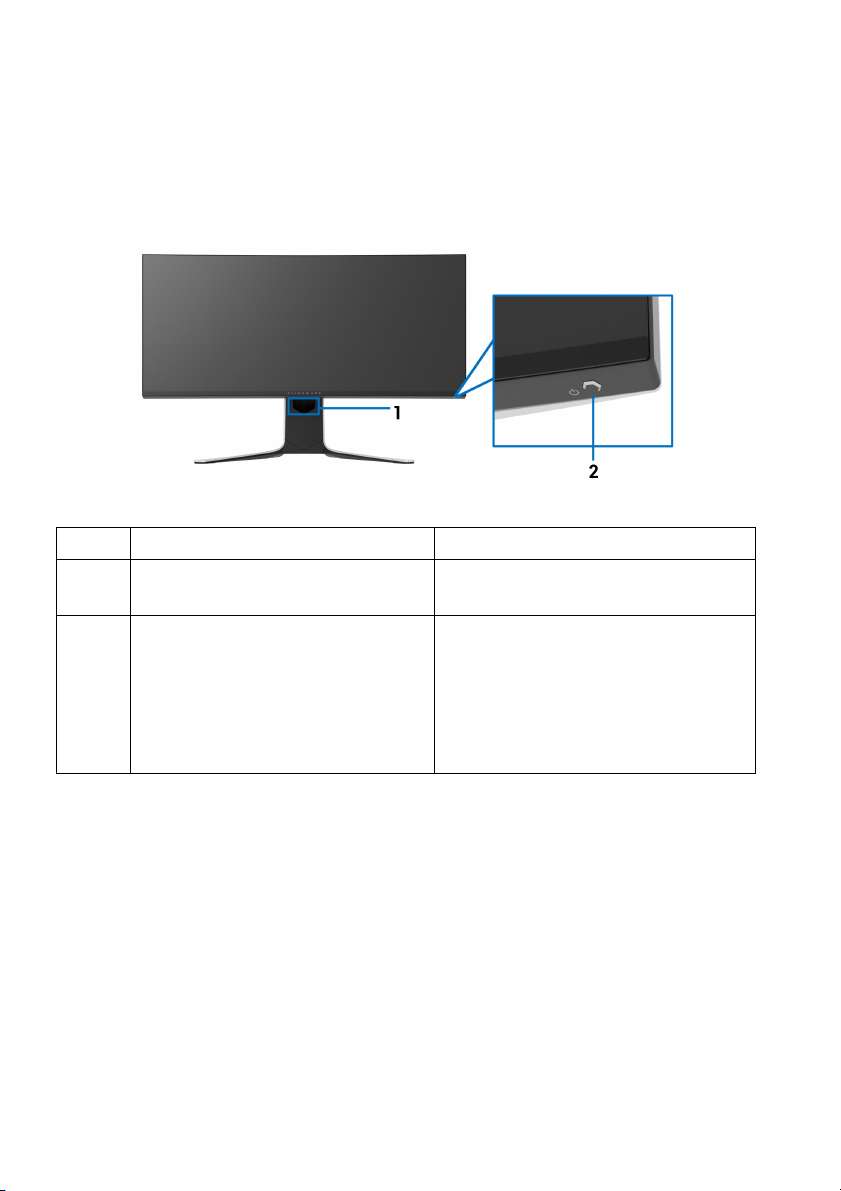
Front view
Label Description Use
1 Cable-management slot (on the
front side o
f the stand)
To organize the cables neatly.
2 Power On/Off button (with LED
indi
cator)
To turn the monitor on or off.
Solid blue light indicates that the
monitor is
turned on and
functioning normally. Blinking white
light indicates that the monitor is in
Standby Mode.
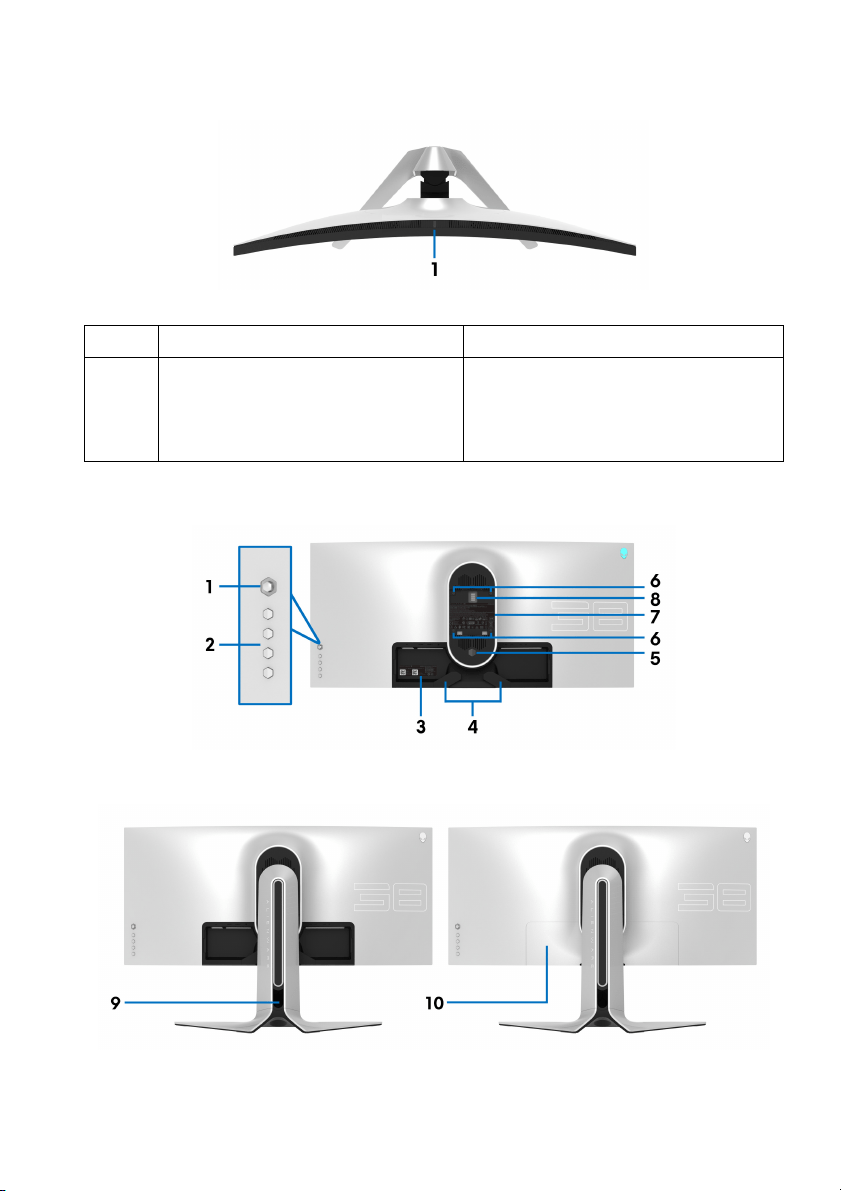
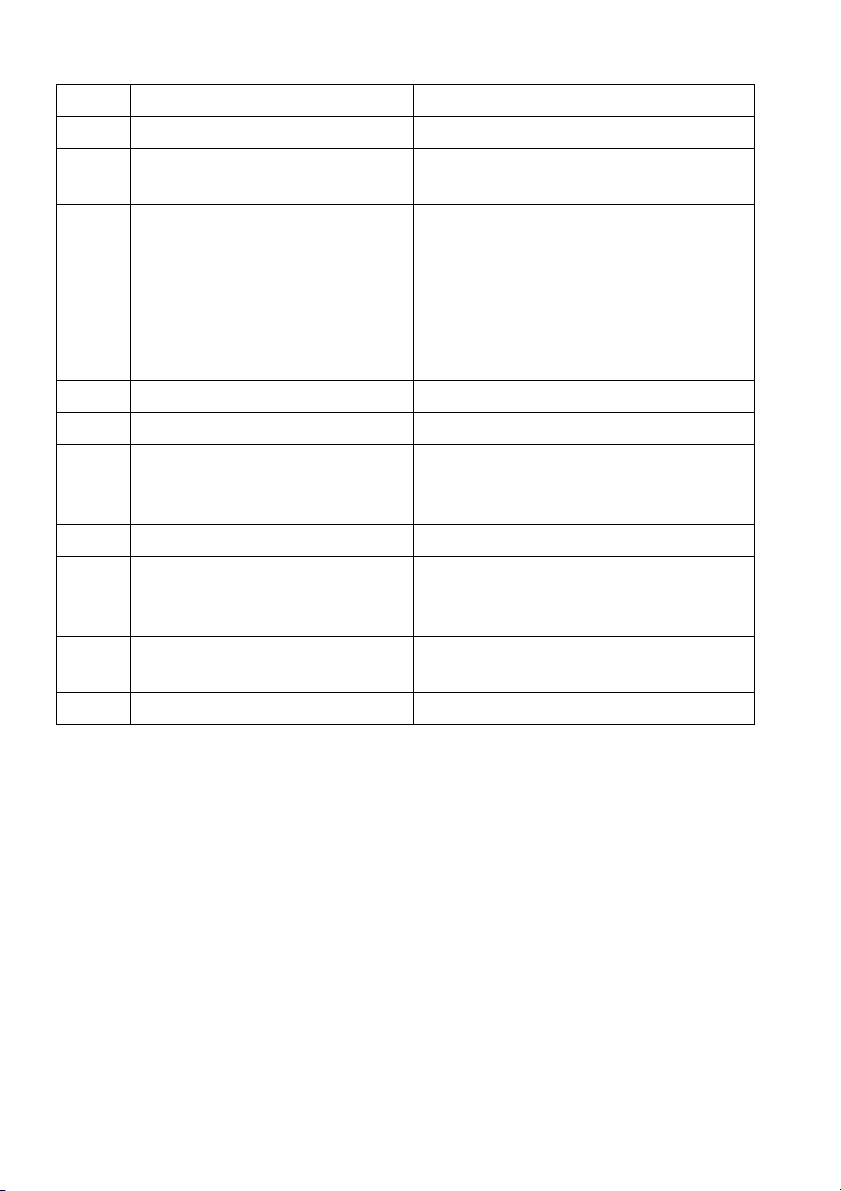
Label Description Use
1 Joystick Use it to control the OSD menu.
2 Function buttons For more information, see Operating
the monitor.
3 Barcode, serial number, and
Ser
vice Tag label
Refer to this label if you need to
contact Dell for technical support. The
Service Tag is a unique alphanumeric
identifier that enables Dell service
technicians to identify the hardware
components in your monitor and
access warranty information.
4 Cable-management clips (2) To organize the cables neatly.
5 Stand release button Releases the stand from the monitor.
6 VESA mounting holes (100 mm
x
100 mm - behind VESA
Cover)
Wall mount monitor using VESA-
compatible wall mount kit (100 mm x
100 mm).
7 Regulatory label Lists the regulatory approvals.
8 Lighting dock connector When the stand riser is attached to the
m
onitor, the dock supplies power to
the light on the stand.
9 Cable-management slot (at the
ba
ck of the stand)
To organize cables by routing them
through this slot.
10 I/O cover Protects the I/O ports.
12 | About your monitor
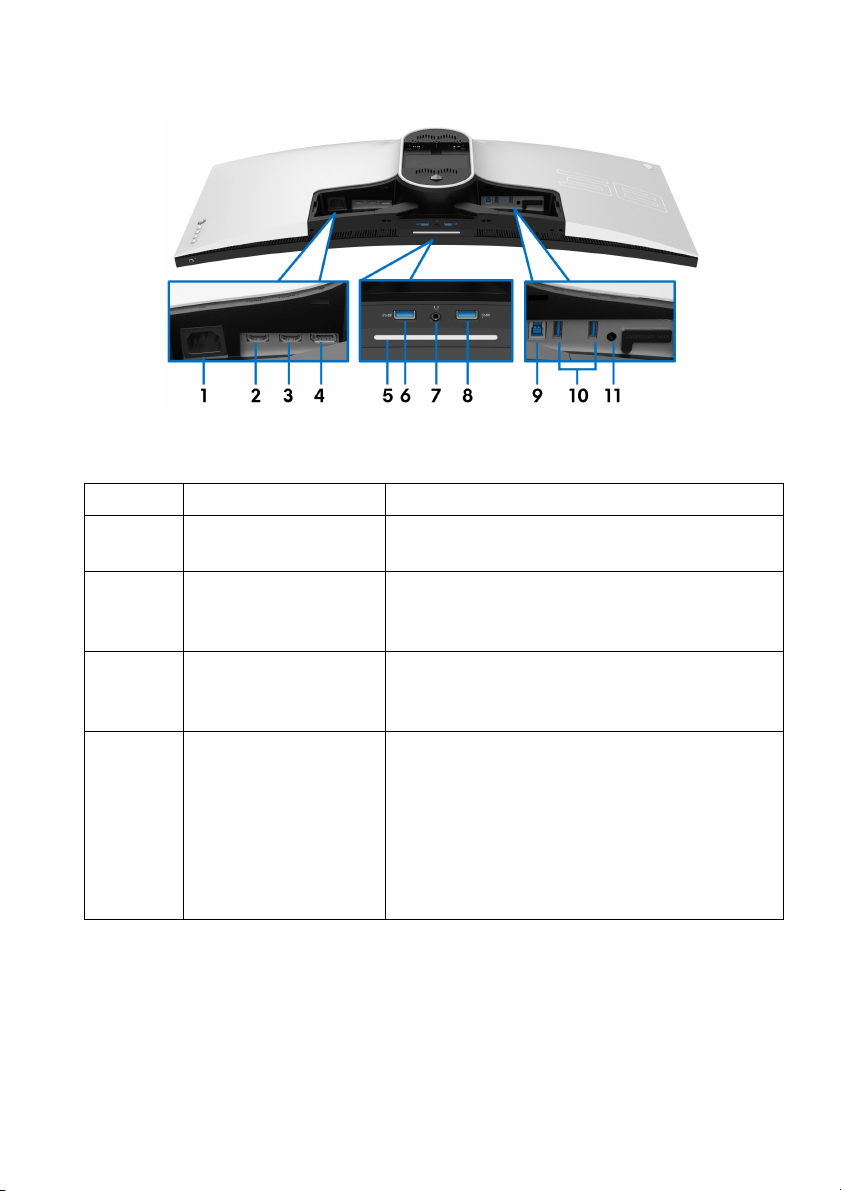
About your monitor | 13
Rear and bottom view
Rear and bottom view without monitor stand
Label Description Use
1 Power connector Connect the power cable (shipped with your
moni
tor).
2 HDMI port (HDMI 1) Connect your computer with the HDMI
c
able (one HDMI cable is shipped with your
monitor).
3 HDMI port (HDMI 2) Connect your computer with the HDMI
c
able (one HDMI cable is shipped with your
monitor).
4 DisplayPort • Connect your computer
with DisplayPort-
DisplayPort cable (shipped with your
monitor)
or
• Connect your computer with mini-
Displa
yPort-DisplayPort cable (shipped
with your monitor)
14 | About your monitor
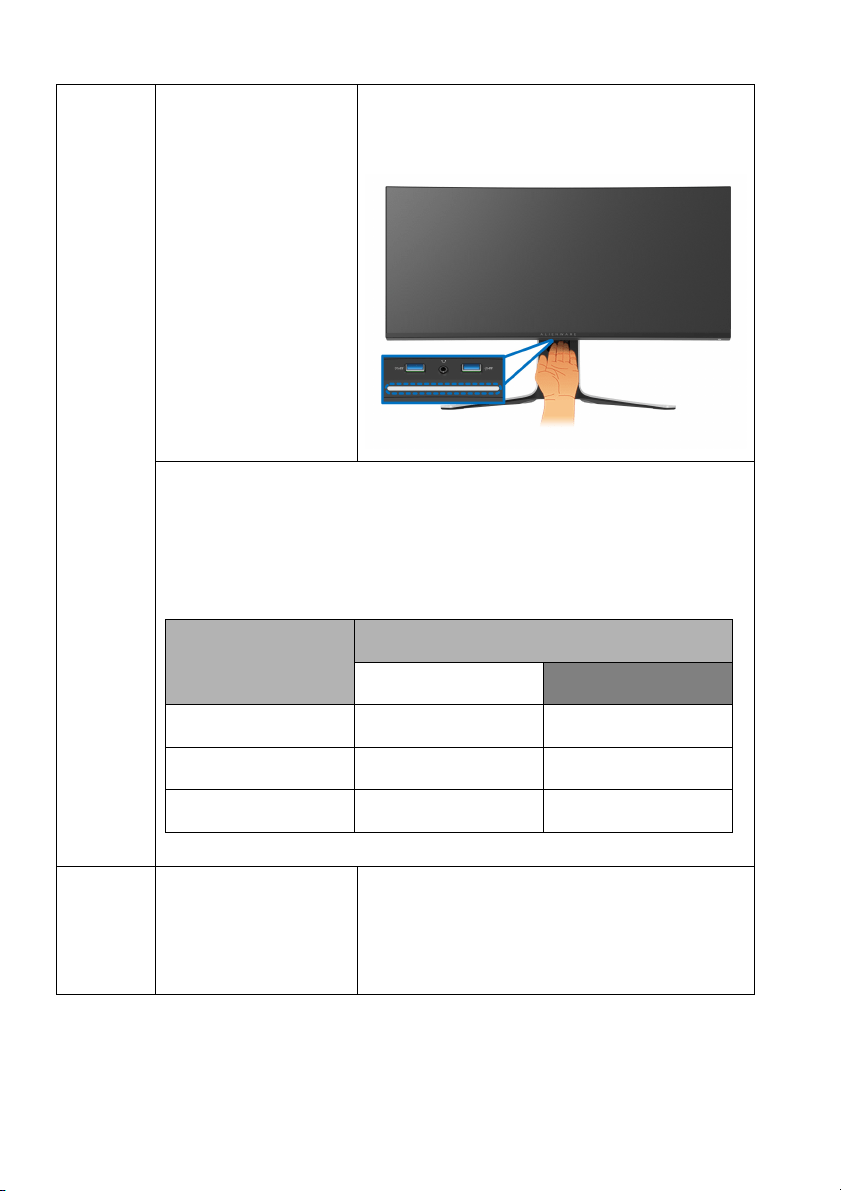
5 Downlights When the monitor set up is complete, tap the
touch sensor
at the bottom of the display to
turn the downlights on or off.
NOTE: The factory setting is on, so the downlights are active if the
power cable is connected. To change the default settings, see
AlienFX Lighting.
NOTE: When
the Spectrum function is On, the downlights are
turned off.
Monitor State
Downlights Status
When Spectrum is Off
When Spectrum is On
On Enabled Disabled
No Signal Enabled Disabled
Standby Enabled Disabled
6 SuperSpeed USB 5
Gbps (USB 3.2 Gen1)
Type-A downstream
port with Power
Charging
Connect to charge your USB device.
About your monitor | 15
*To avoid signal interference, when a wireless USB device has been connected
to a USB downstream port, it is not recommended to connect any other USB
devices to the adjacent port.
7 Headphone port Connect the headphone or speakers.
CAUTION: Increasing the audio output
beyond 50% on the volume control or
equalizer may increase the output voltage
on the headphones thereby increasing the
sound pressure levels.
8, 10 SuperSpeed USB 5
Gbps (USB 3.2 Gen1)
Type-A downstream
port (3)
Connect your USB 3.2 Gen1 (5 Gbps)
device.*
NOTE: To use these ports, you must connect
the USB cable (shipped with your monitor)
to the USB-upstream port on the monitor
and to your computer.
9 SuperSpeed USB 5
Gbps (USB 3.2 Gen1)
Type-B upstream port
Connect the USB cable (shipped with your
monitor) to this port and your computer to
enable the USB ports on your monitor.
11 Line-out port Connect your speakers.
NOTE: This port does not support
headphones.
16 | About your monitor
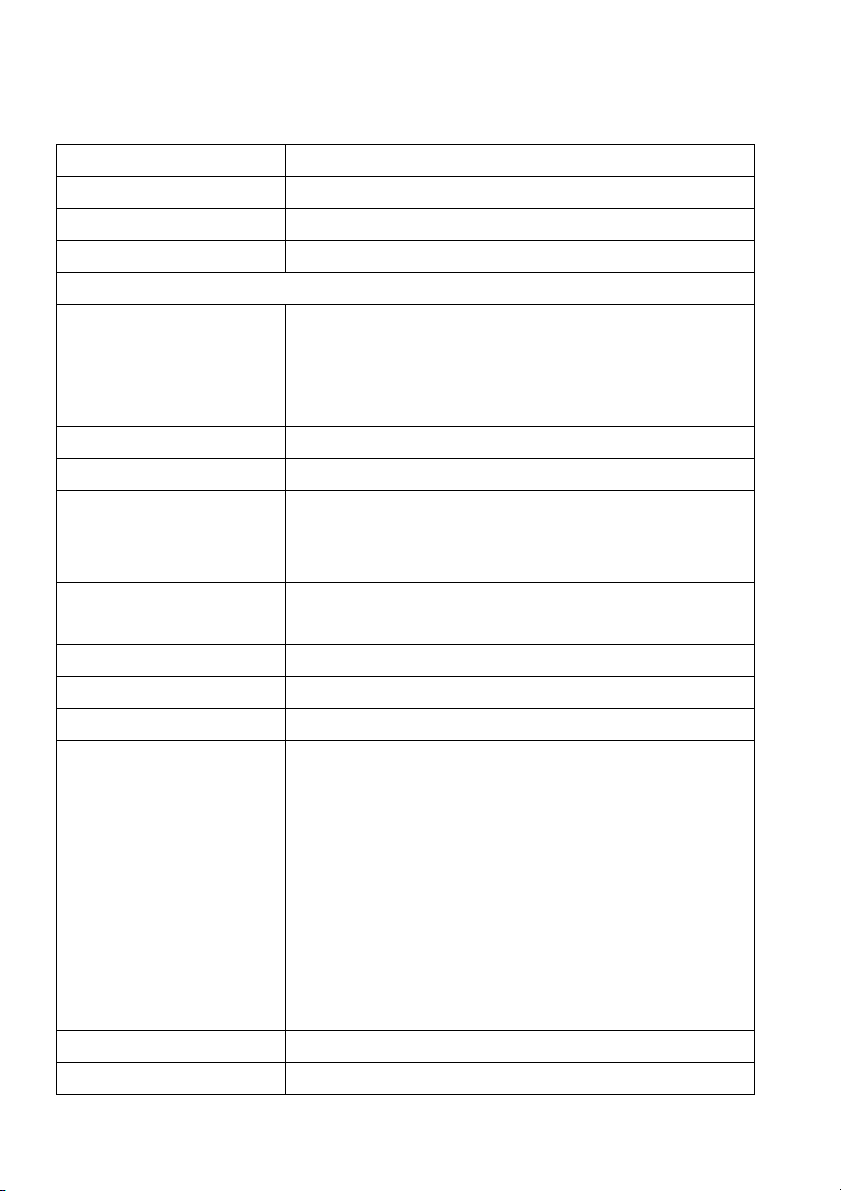
Monitor specifications
Model AW3821DW
Screen type Active matrix - TFT LCD
Panel technology IPS
Aspect ratio 21:9
Viewable image
Diagonal
Width (active area)
Height (active area)
Total area
952.9 mm (37.52 in.)
879.7 mm (34.63 in.)
366.5 mm (14.43 in.)
307758.9 mm
2
(477.01 in
2
)
Pixel pitch 0.22908 mm x 0.22908 mm
Pixel per inch (PPI) 110.874
Viewing angle
Vertical
Horizontal
178° (typical)
178° (typical)
Luminance output 450 cd/m² (typical)
600 cd/m² (HDR peak)
Contrast ratio 1000 to 1 (typical)
Faceplate coating Anti-glare with 3H hardness
Backlight LED edgelight system
Response time • 1 ms gray to gray in Extreme Mode*
• 2 ms gray to gray in Super Fast Mode
• 3 ms gray to gray in Fast Mode
*The 1 ms gray-to-gray mode is achievable in the
Extreme mode to reduce visible motion blur and
increased image responsiveness. However this may
introduce some slight and noticeable visual artifacts
into the image. As every system setup and every
gamer's needs are different, Alienware recommends
that users experiment with the different modes to
find the setting that is right for them.
Curvature 2300R (typical)
Color depth 1.07 billion colors
About your monitor | 17
Resolution specifications
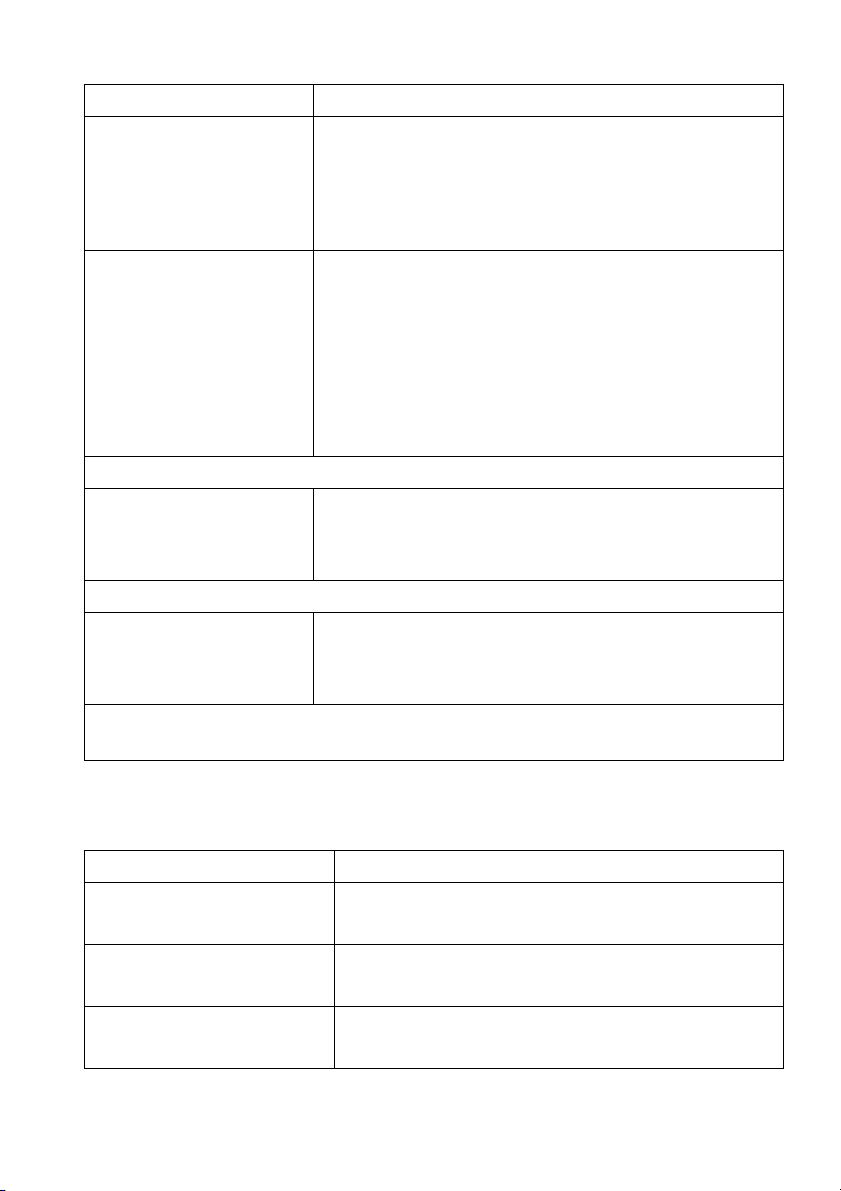
Horizontal scan range • DisplayPort 1.4: 246 to 246 kHz (automatic)
• HDMI 2.0: 30 to 141 kHz (automatic)
Vertical scan range • DisplayPort 1.4: 1 to 144 Hz
(automatic)
• HDMI 2.0: 24 to 120 Hz (automatic)
Maximum preset resolution • DisplayPort: 3840 x 1600 @ 144 Hz
• HDMI: 3840 x 1600 @ 85 Hz
Color gamut 130.6% sRGB and DCI P3 95%
Built-in devices • SuperSpeed USB 5Gbps (USB 3.2 Gen1) hub
(with
1 USB 3.2 Gen1 (5 Gbps) upstream port)
• 4 x SuperSpeed USB 5Gbps (USB 3.2 Gen1)
downst
ream port (including 1 port which supports
power-charging)
Connectivity • 1 x DisplayPort version 1.4 (rear)
• 2 x HDMI port version 2.0 (rear)
• 1 x USB 3.2 Gen1 (5 Gbps) upstream port (rear)
• 4 x USB 3.2 Gen1 (5 Gbps) downstream ports
(bo
ttom: 2; rear: 2)
• 1 x headphone port (bottom)
• 1 x audio line-out port (rear)
Border width (edge of monitor to active area)
Top
Left/Right
Bottom
11.0 mm
10.3 mm/10.3 mm
21.9 mm
Adjustability
Height adjustable stand
Tilt
Swivel
0 mm to 130 mm
-5° to 21°
-20° to 20°
NOTE: Do not mount
or use this monitor in portrait (vertical) orientation or
inverse (180°) landscape mount as it may damage the monitor.
Model AW3821DW
18 | About your monitor
Supported video modes
Video display capabilities (HDMI
&
DisplayPort playback)
480p, 576p, 720p, 1080p, QHD
Preset display modes
HDMI display modes
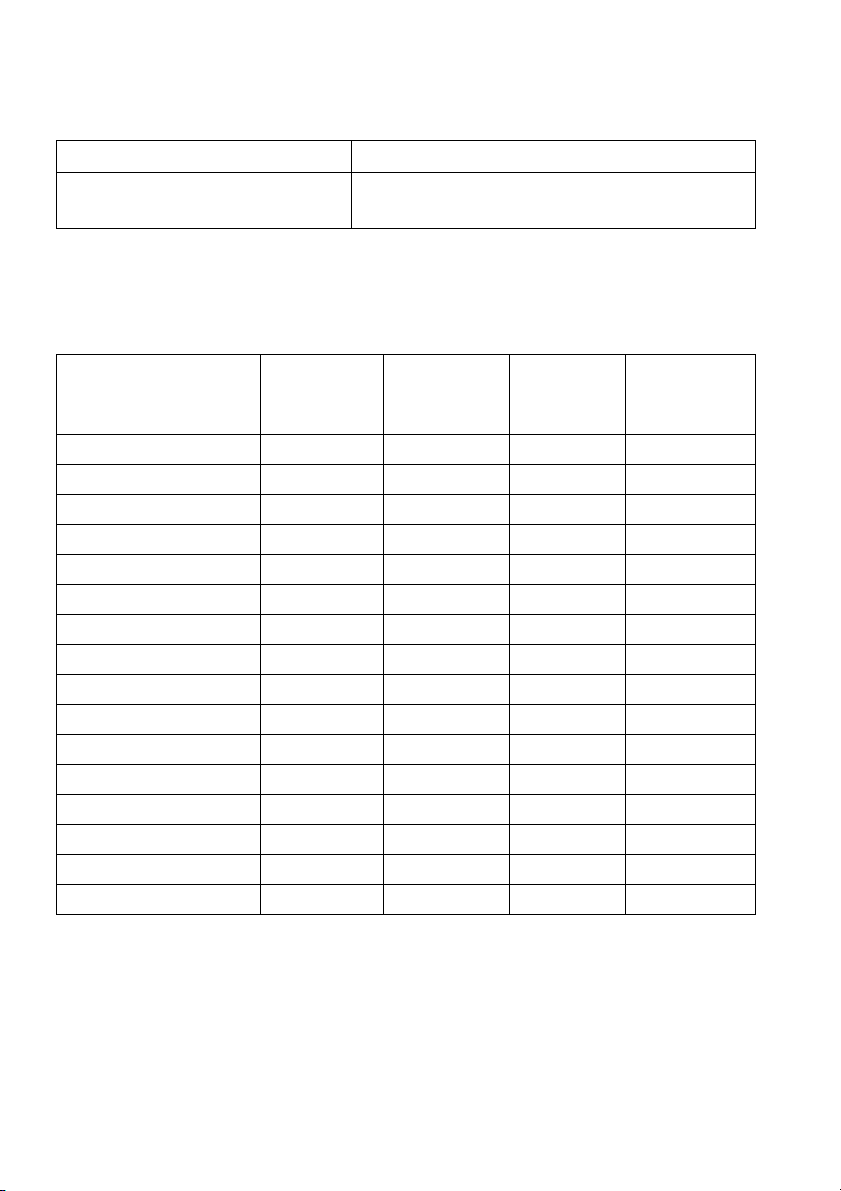
Display mode Horizontal
frequency
(kH
z)
Vertical
frequency
(Hz)
Pixel clock
(MHz)
Sync polarity
(Horizontal/
Vertical)
VESA, 640 x 480 31.47 60 25.175 -/-
VESA, 800 x 600 37.88 60 40 +/+
VESA, 1024 x 768 48.36 60 65 -/-
640 x 480p 31.48 60 25.18 -/-
720 x 480p 31.5 60 27.03 -/-
720 x 576p 31.25 50 27 -/-
1280 x 720p @ 50 Hz 37.5 50 74.25 +/+
1280 x 720p @ 60 Hz 45 60 74.25 +/+
1920 x 1080p @ 50 Hz 56.25 50 148.5 +/+
1920 x 1080p @ 60 Hz 67.5 60 148.5 +/+
1920 x 1080p @ 120 Hz 135 120 297 +/+
2560 x 1440 @ 60 Hz 89.43 60 243.25 +/-
2560 x 1440 @ 120 Hz 183 120 497.75 +/-
3840 x 1600 @ 30 Hz 49.2 30 196.65 +/-
3840 x 1600 @ 60 Hz 99.4 60 397.4 +/-
3840 x 1600 @ 85 Hz 141.6 85 566.25 +/-
Model AW3821DW
About your monitor | 19
DP display modes
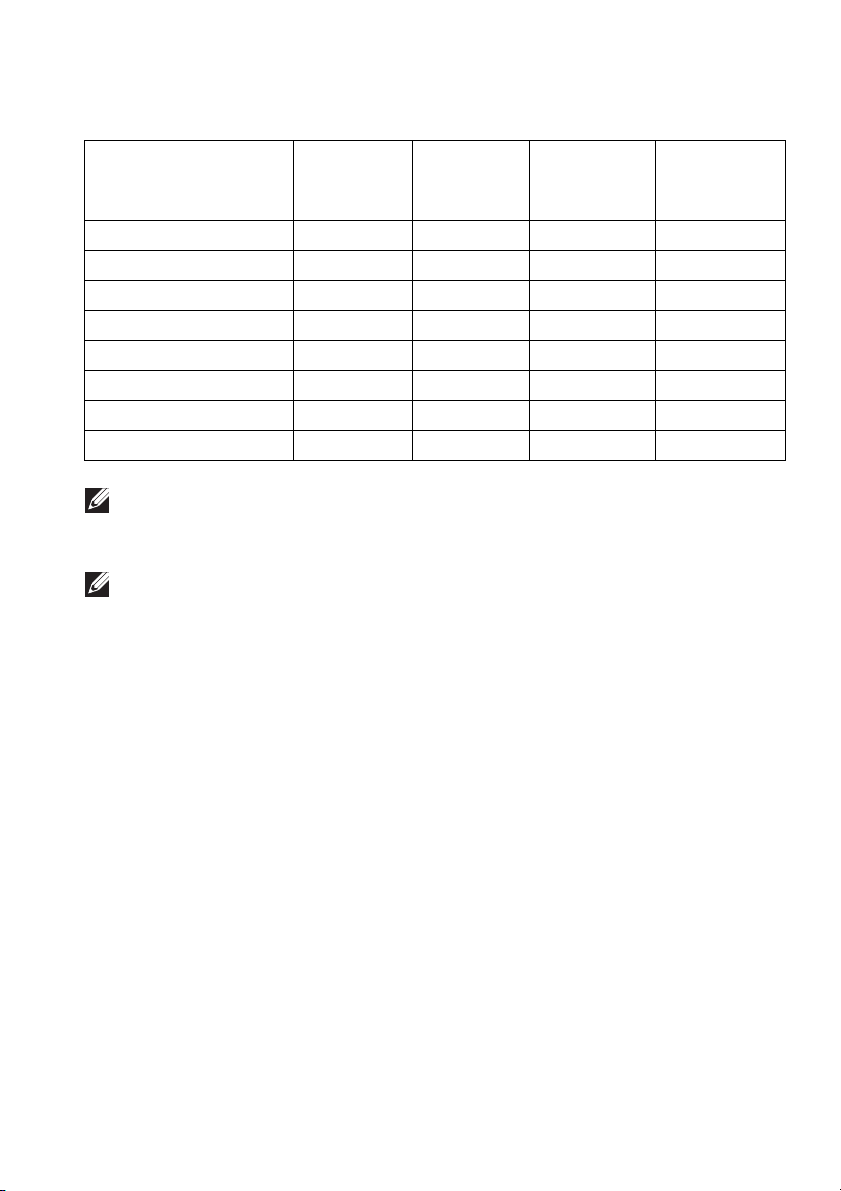
Display mode Horizontal
frequency
(k
Hz)
Vertical
frequency
(Hz)
Pixel clock
(MHz)
Sync polarity
(Horizontal/
Vertical)
VESA, 640 x 480 31.47 60 25.175 -/-
VESA, 800 x 600 37.88 60 40 -/-
VESA, 1024 x 768 48.36 60 65 -/-
3840 x 1600 @ 60 Hz 99.4 60 397.4 +/-
3840 x 1600 @ 85 Hz 141.6 85 566.25 +/-
3840 x 1600 @ 100 Hz 167.8 100 671 +/-
3840 x 1600@ 120 Hz 203.3 120 813 +/-
3840 x 1600 @ 144 Hz 246.8 144 987.25 +/-
NOTE: This monitor supports NVIDIA® G-SYNC® ULTIMATE. For
information about the graphic cards that support NVIDIA® G-SYNC®
ULTIMATE feature, see www.geforce.com.
NOTE: In order to get the full NVIDIA® G-SYNC® ULTIMATE
functionalities and experience, you must ensure that the monitor is
directly connected to the HDMI or DisplayPort with direct output from
Nvidia Graphics card on your PC.
20 | About your monitor
Electrical specifications
Video input signals HDMI 2.0/DisplayPort 1.4, 600 mV for each
differ
ential line, 100 Ω input impedance per differential
pair
AC input voltage/
frequency/cu
rrent
100 VAC to 240 VAC / 50 Hz or 60 Hz + 3 Hz / 1.8 A
(typical)
Inrush current • 120 V: 40 A (max.) at 0°C (cold start)
• 220 V: 80 A (max.) at 0°C (cold start)
Power consumption • 0.2 W (Off mode)
1
• 0.3 W (Standby Mode)
1
•43.5 W (On mode)
1
•125 W (Max.)
2
• 46.35 W (Pon)
3
• 144.04 kWh (TEC)
3
1
As defined in EU 2019/2021 and EU 2019/2013.
2
Max brightness and contrast setting with maximum power loading on all USB
ports.
3
Pon: Power consumption of On Mode measured with reference to Energy Star
test method.
TEC: Total energy consumption in kWh measured with reference to Energy
Star test method.
This document is informational only and reflects laboratory performance. Your
product may perform differently, depending on the software, components and
peripherals you ordered and shall have no obligation to update such
information.
Accordingly, the customer should not rely upon this information in making
decisions about electrical tolerances or otherwise. No warranty as to accuracy
or completeness is expressed or implied.
Model AW3821DW
About your monitor | 21
Physical characteristics
• Digital: HDMI, 19 pins
• Digital: DisplayPort, 20 pins
• Universal Serial Bus: USB, 9 pins
NOTE: D
ell monitors are designed to work optimally with the video cables that
are shipped with your monitor. As Dell does not have control over the different
cable suppliers in the market, the type of material, connector and process used
to manufacture these cables, Dell does not guarantee video performance on
cables that are not shipped with your Dell monitor.
Height (extended) 579.7 mm (22.82 in.)
Height (compressed) 449.7 mm (17.70 in.)
Width 894.9 mm (35.23 in.)
Depth 293.5 mm (11.56 in.)
Height 399.4 mm (15.72 in.)
Width 894.9 mm (35.23 in.)
Depth 130.1 mm (5.12 in.)
Height (extended) 453.8 mm (17.87 in.)
Height (compressed) 444.4 mm (17.50 in.)
Width 599.6 mm (23.61 in.)
Depth 293.5 mm (11.56 in.)
Weight with packaging 19.3 kg (42.49 lb)
Weight with stand assembly
and cabl
es
12.1 kg (26.77 lb)
Weight without stand assembly
(For wall
mount or VESA mount
considerations - no cables)
7.9 kg (17.49 lb)
Weight of stand assembly 3.6 kg (7.94 lb)
Model AW3821DW
Signal cable type
Dimensions (with stand)
Dimensions (without stand)
Stand dimensions
Weight
22 | About your monitor
Environmental characteristics
Arsenic-free glass and mercury-fre
e for the panel only
Operating 0°C to 40°C (32°F to 104°F)
Non-operating • Storage: -20°C to 60°C (-4°F to 140°F)
• Shipping: -20°C to 60°C (-4°F to 140°F)
Operating 10% to 80% (non-condensing)
Non-operating • Storage: 5% to 90% (non-condensing)
• Shipping: 5% to 90% (non-condensing)
Operating 5,000 m (16,404 ft) (maximum)
Non-operating 12,192 m (40,000 ft) (maximum)
• 426.5 BTU/hour (maximum)
• 177.42 BTU/hour (typical)
Model AW3821DW
Compliant stand
ards
Temperature
Humidity
Altitude
Thermal dissipation
About your monitor | 23
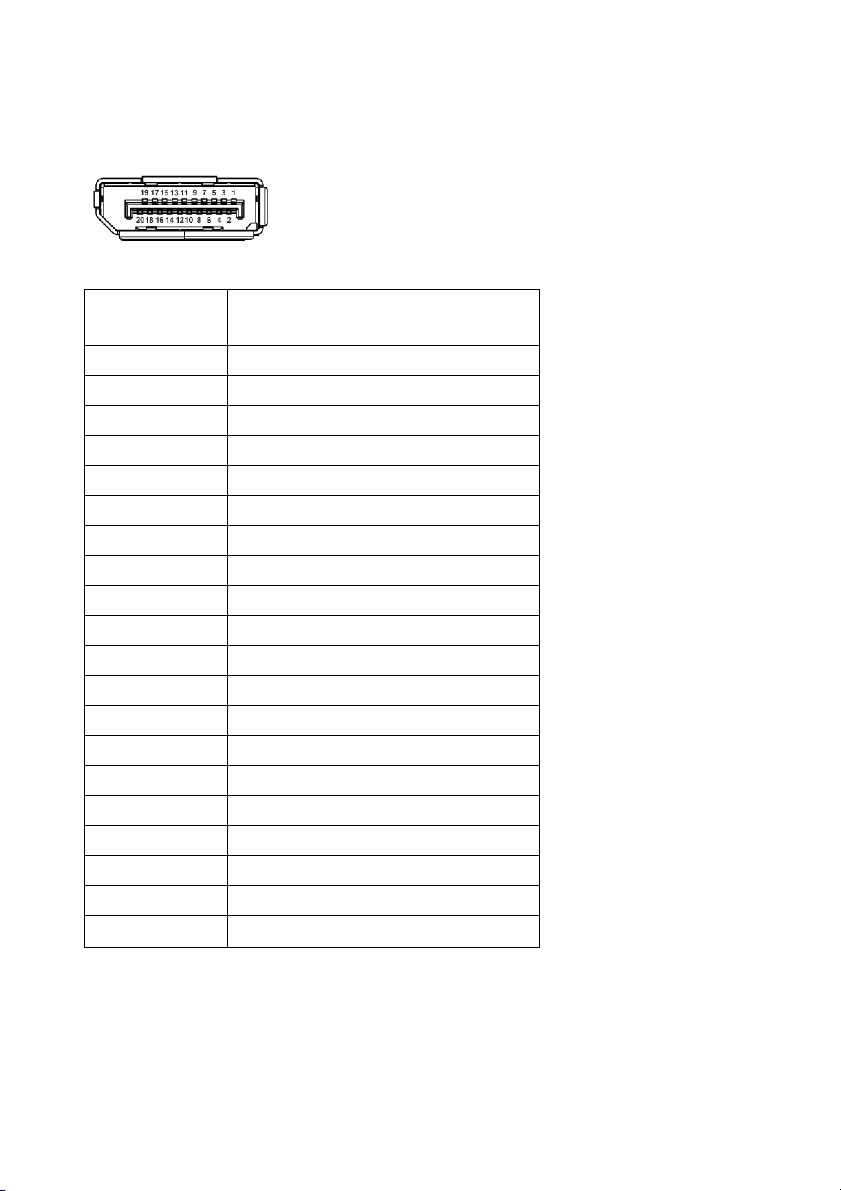
Pin assignments
DisplayPort connector
Pin number 20-pin side of the connected
signal cable
1 ML3 (n)
2 GND
3 ML3 (p)
4 ML2 (n)
5 GND
6 ML2 (p)
7 ML1 (n)
8 GND
9 ML1 (p)
10 ML0 (n)
11 GND
12 ML0 (p)
13 GND
14 GND
15 AUX (p)
16 GND
17 AUX (n)
18 Hot Plug Detect
19 Re-PWR
20
+3.3
V DP_PWR
24 | About your monitor
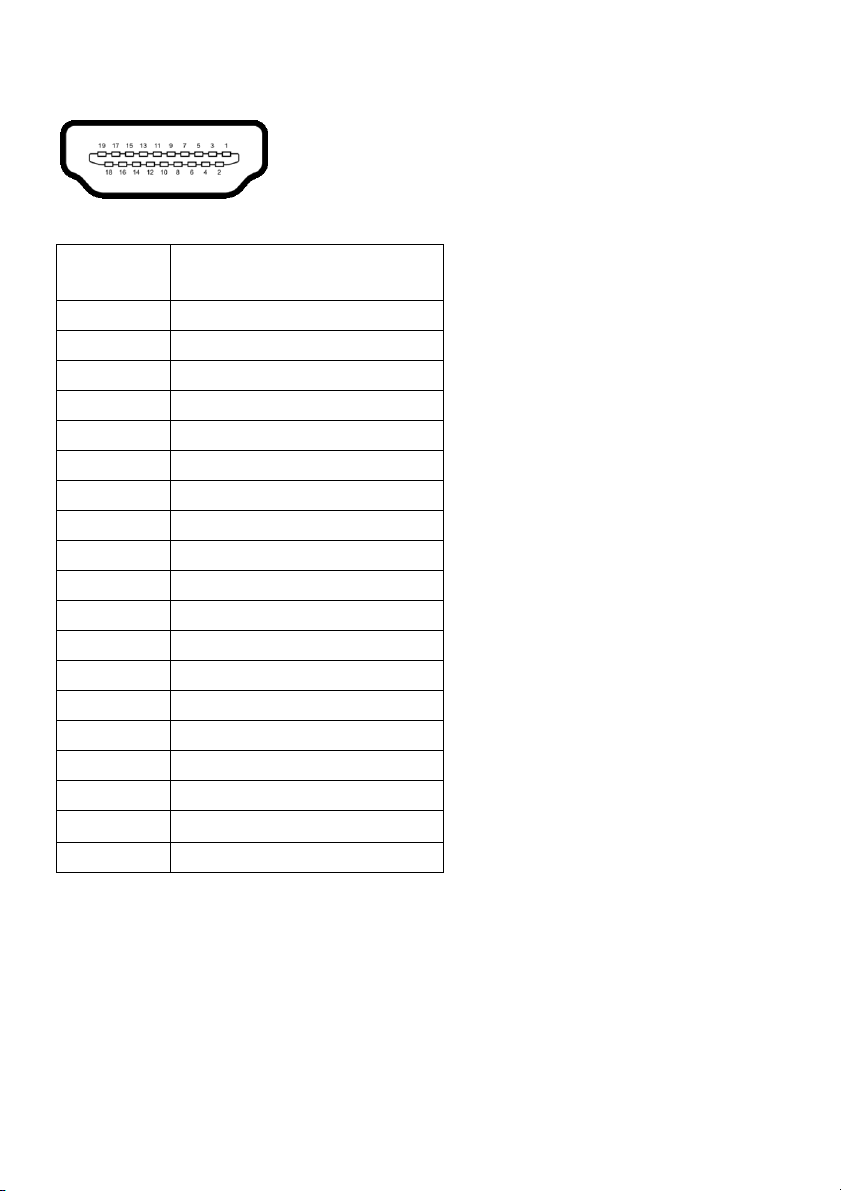
HDMI connector
Pin number 19-pin side of the connected
signal cable
1 TMDS DATA 2+
2 TMDS DATA 2 SHIELD
3 TMDS DATA 2-
4 TMDS DATA 1+
5 TMDS DATA 1 SHIELD
6 TMDS DATA 1-
7 TMDS DATA 0+
8 TMDS DATA 0 SHIELD
9 TMDS DATA 0-
10 TMDS CLOCK+
11 TMDS CLOCK SHIELD
12 TMDS CLOCK-
13 CEC
14 Reserved (N.C. on device)
15 DDC CLOCK (SCL)
16 DDC DATA (SDA)
17 DDC/CEC Ground
18
+5
V POWER
19 HOT PLUG DETECT
Plug and Play capability
You can connect the monitor to any Plug and Play-compatible system. The
monitor automatically provides the computer system with its Extended Display
Identification Data (EDID) using Display Data Channel (DDC) protocols so that
the system can configure itself and optimize the monitor settings. Most monitor
installations are automatic; you can select different settings if desired. For more
information about changing the monitor settings, see Operating the monitor.
About your monitor | 25
Universal Serial Bus (USB) interface
This section gives you information about the USB ports that are available on the
monitor.
Transfer speed Data rate Power consumption*
Super-Speed 5 Gbps 4.5 W (Max, each port)
High speed 480 Mbps 4.5 W (Max, each port)
Full speed 12 Mbps 4.5 W (Max, each port)
NOTE: This monitor is SuperSpeed USB 5 Gbps (USB 3.2 Gen1)
compatible.
*Up to 2 A on USB downstream port (with
battery icon) with battery
charging version-compliant devices or normal USB devices.
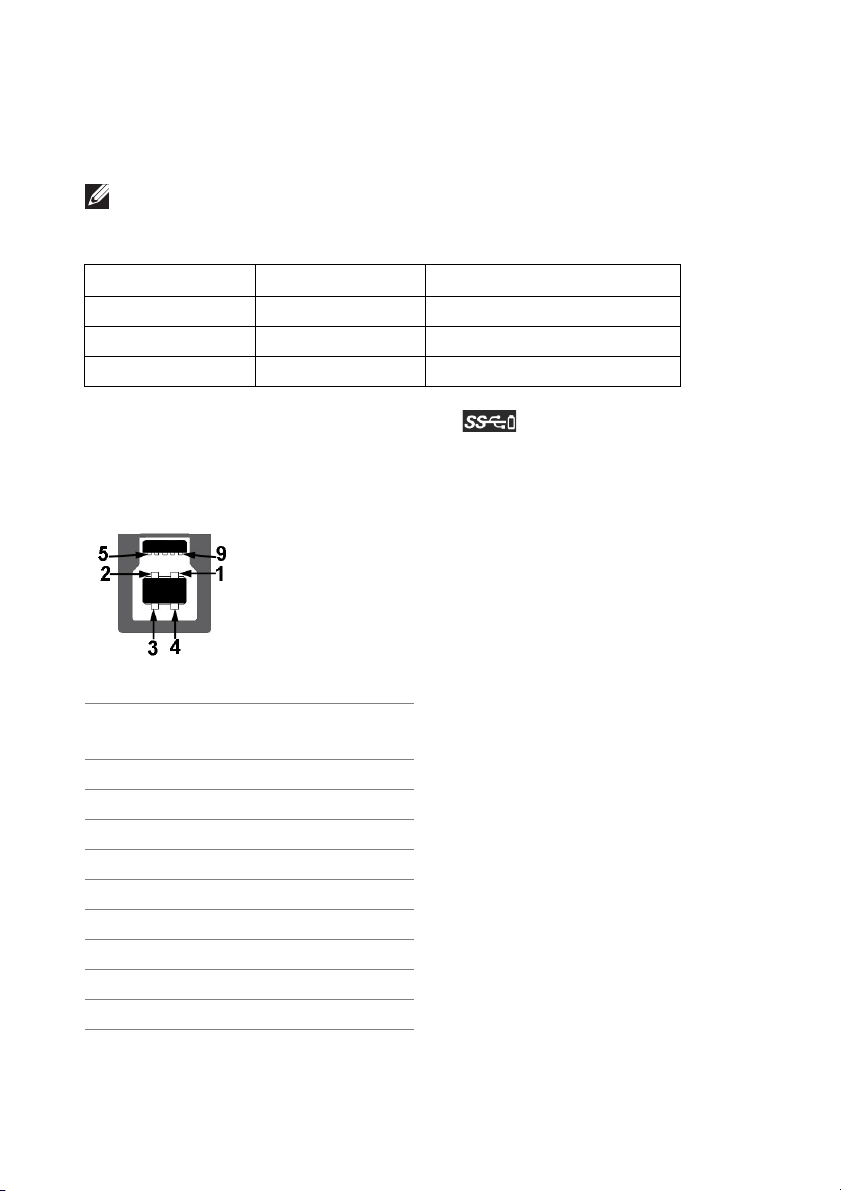
USB 3.2 Gen1 (5 Gbps) upstream connector
Pin number 9-pin side of the
connector
1 VCC
2 D-
3 D+
4 GND
5 SSTX-
6 SSTX+
7 GND
8 SSRX-
9 SSRX+
26 | About your monitor
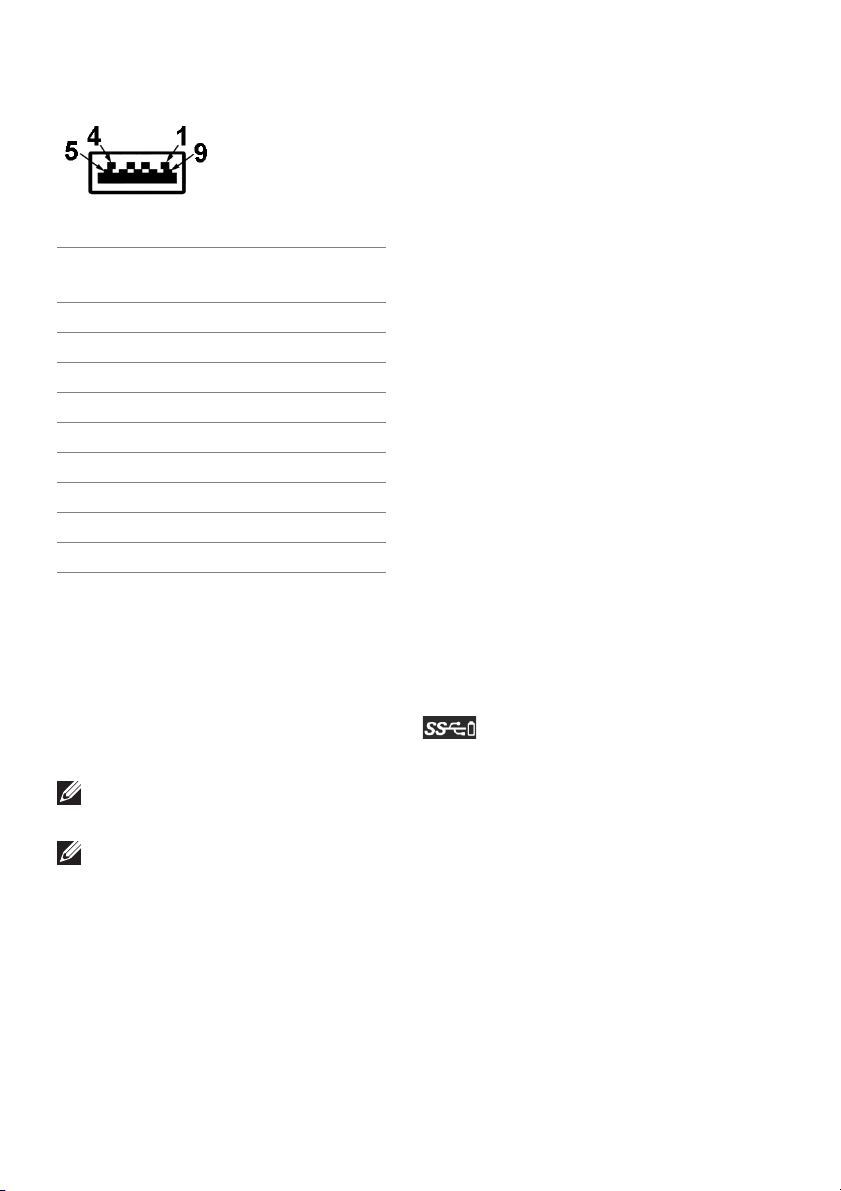
USB 3.2 Gen1 (5 Gbps) downstream connector
Pin number 9-pin side of the
connector
1 VCC
2 D-
3 D+
4 GND
5 SSRX-
6 SSRX+
7 GND
8 SSTX-
9 SSTX+
USB ports
• 1 x upstream - rear
• 2 x downstream - rear
• 2 x downstream - bottom
Power charging port - the port with
icon; supports up to 2 A fast-
charging capability if the devi
ce is BC1.2 compatible.
NOTE: SuperSpeed USB 5 Gbps (USB 3.2 Gen1) functionality requires a
SuperSpeed USB 5 Gbps (USB 3.2 Gen1)-capable computer.
NOTE: The USB ports on the monitor work only when the monitor is
turned on or in Standby mode. If you turn off the monitor and then turn it
on, the attached peripherals may take a few seconds to resume normal
functionality.

About your monitor | 27
LCD monitor quality and pixel policy
During the LCD monitor manufacturing process, it is not uncommon for one or
more pixels to become fixed in an unchanging state, which are hard to see and
do not affect the display quality or usability. For more information on Dell
Monitor Quality and Pixel Policy, see
www.dell.com/pixelguidelines.
Ergonomics
CAUTION: Improper or prolonged usage of keyboard may result in
injury.
CAUTION: Viewing the monitor screen for extended periods of time may
result in eye strain.
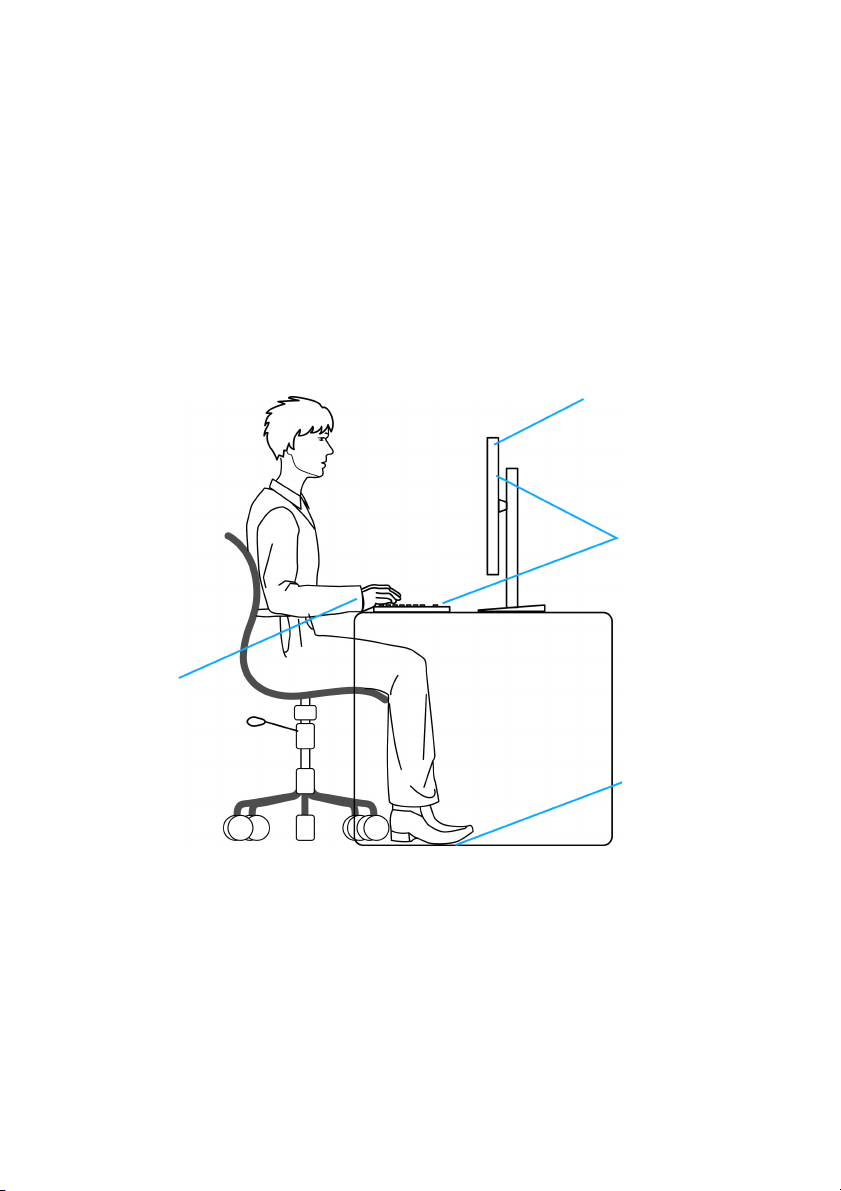
For comfort and efficiency, observe the following guidelines when setting up
and using your computer workstation:
• Position your computer so that the monitor and keyboard are directly in
front of you as you work. Special shelves are commercially available to help
you correctly position your keyboard.
• To reduce the risk of eye strain and neck/arm/back/shoulder pain from
using the monitor for long periods of time, we suggest you to:
1. Set the distance of the screen between 20 to 28 in. (50 - 70 cm) from
your eyes.
2. Blink frequently to moisten your eyes or wet your eyes with water after
prolonged usage of the monitor.
3. Take regular and frequent breaks for 20 minutes every two hours.
4. Look away from your monitor and gaze at a distant object at 20 feet
away for at least 20 seconds during the breaks.
5. Perform stretches to relieve tension in the neck, arm, back, and shoulders
during the breaks.
• Make sure that the monitor screen is at eye level or slightly lower when you
are sitting in front of the monitor.
• Adjust the tilt of the monitor, its contrast, and brightness settings.
• Adjust the ambient lighting around you (such as overhead lights, desk
lamps, and the curtains or blinds on nearby windows) to minimize
reflections and glare on the monitor screen.
• Use a chair that provides good lower-back support.
• Keep your forearms horizontal with your wrists in a neutral, comfortable
position while using the keyboard or mouse.
• Always leave space to rest your hands while using the keyboard or mouse.
28 | About your monitor
• Let your upper arms rest naturally on both sides.
• Ensure that your feet are resting
flat on the floor.
• When sitting, make sure that the weight of your legs is on your feet and not
on the front portion of
your seat. Adjust your chair's height or use a footrest
if necessary to maintain a proper posture.
• Vary your work activities. Try to organize your
work so that you do not have
to sit and work for extended periods of time. Try to stand or get up and
walk around at regular intervals.
• Keep the area under your desk clear of
obstructions and cables or power
cords that may interfere with comfortable seating or present a potential trip
hazard.
monitor screen at or
below eye level
monitor and
keyboard
positioned
directly in front
of the user
feet flat on the
floor
wrists relaxed
and flat
About your monitor | 29
Handling and moving your display
To ensure the monitor is handled safely when lifting or moving it, follow the
guidelines mentioned below:
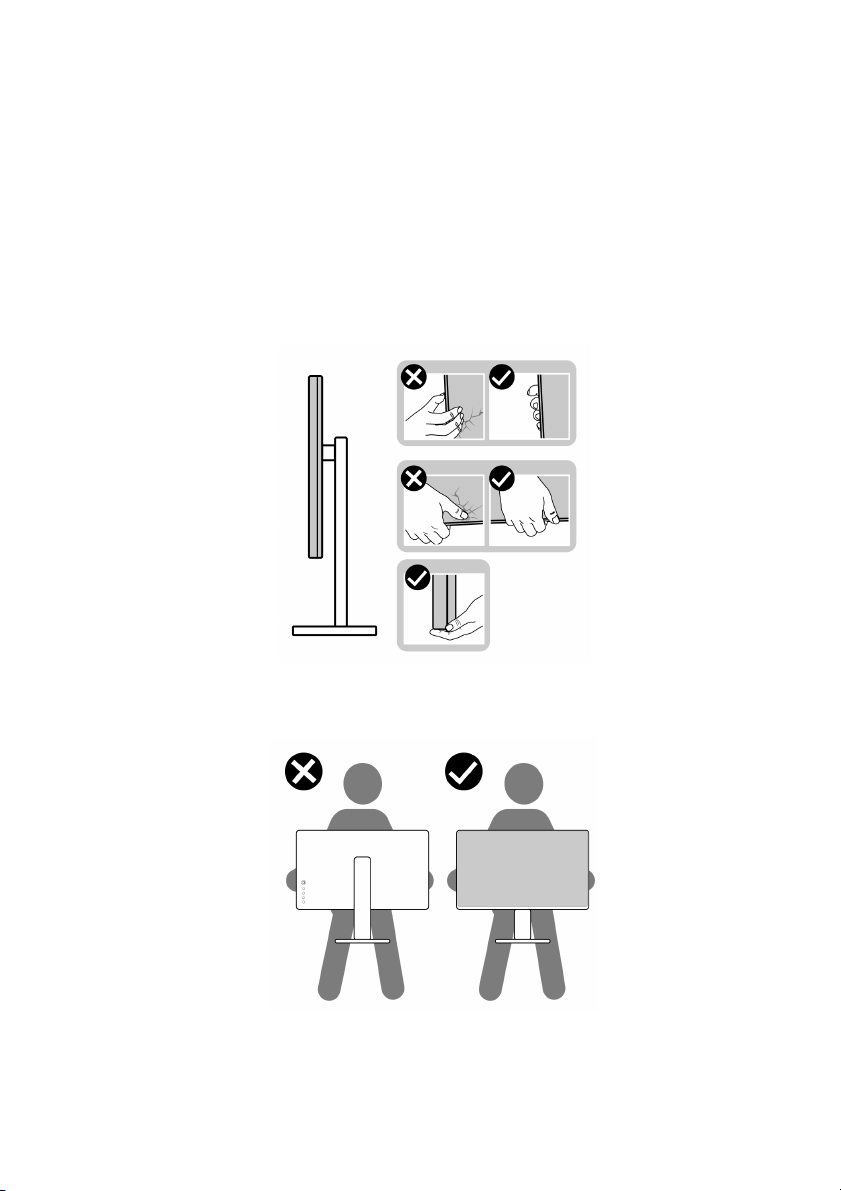
• Before moving or lifting the monitor,
turn off your computer and the
monitor.
• Disconnect all cables from the monitor.
• Place the monitor in the original box with
the original packing materials.
• Hold the bottom edge and the side of the
monitor firmly without applying
excessive pressure when lifting or moving the monitor.
• When lifting or moving the monitor, ensure the screen is facing away from
you and do not press on the display area to avoid any scratches or damage.
• When transporting the monitor, avoid any sudden shock or vibration to it.
30 | About your monitor
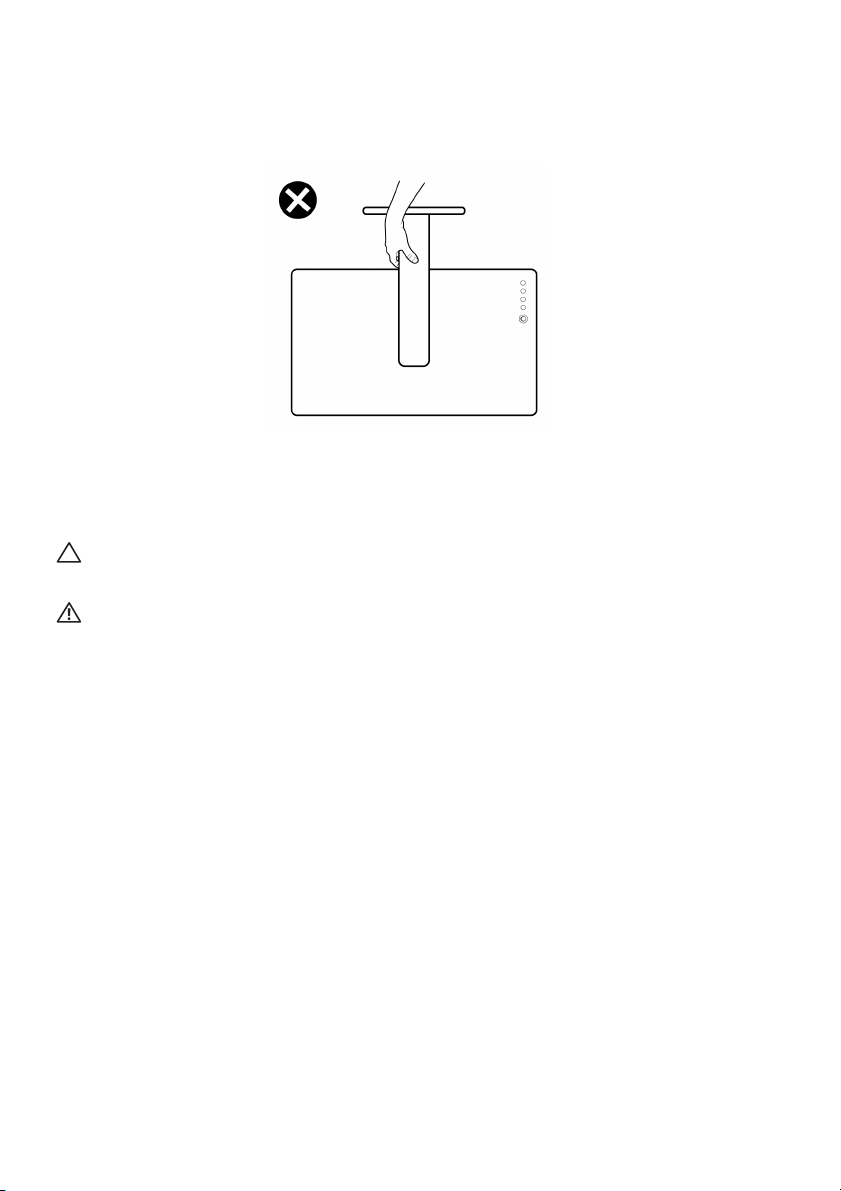
• When lifting or moving the monitor, do not turn the monitor upside down
while holding the stand base or stand riser. This may result in accidental
damage to the monitor or cause personal injury.
Maintenance guidelines
Cleaning your monitor
CAUTION: Read and follow the Safety instructions before clea
ning the
monitor.
WARNING: Before cleaning the monitor, unplug the monitor power
cable from the electrical outlet.
For best practices, follow the instructions i
n the list below when unpacking,
cleaning, or handling your monitor:
• To clean your anti-static screen, lightl
y dampen a soft, clean cloth with
water. If possible, use a special screen-cleaning tissue or solution suitable
for the anti-static coating. Do not use benzene, thinner, ammonia, abrasive
cleaners, or compressed air.
• Use a lightly-dampened, warm cloth to clean
the monitor. Avoid using
detergent of any kind as some detergents leave a milky film on the monitor.
• If you notice white powder when you unpack your monitor, wipe it off w
ith
a cloth.
• Handle your monitor with care as a darker-colored monitor may get
sc
ratched and show white scuff marks more than a lighter-colored monitor.
• To help maintain the best image quality on your monitor, use a dynamically
changing
screen saver and turn off your monitor when not in use.
Setting up the monitor | 31
Setting up the monitor
Attaching the stand
NOTE: The stand is not factory-installed.
NOTE: The following instructions are only applicable for the stand that
was shipped with your monitor. If you are attaching a stand that you
purchased from any other source, follow the set up instructions that were
included with the stand.
CAUTION: The following steps are important
to protect your curved
screen. Do follow the instructions below to finish up the installation.
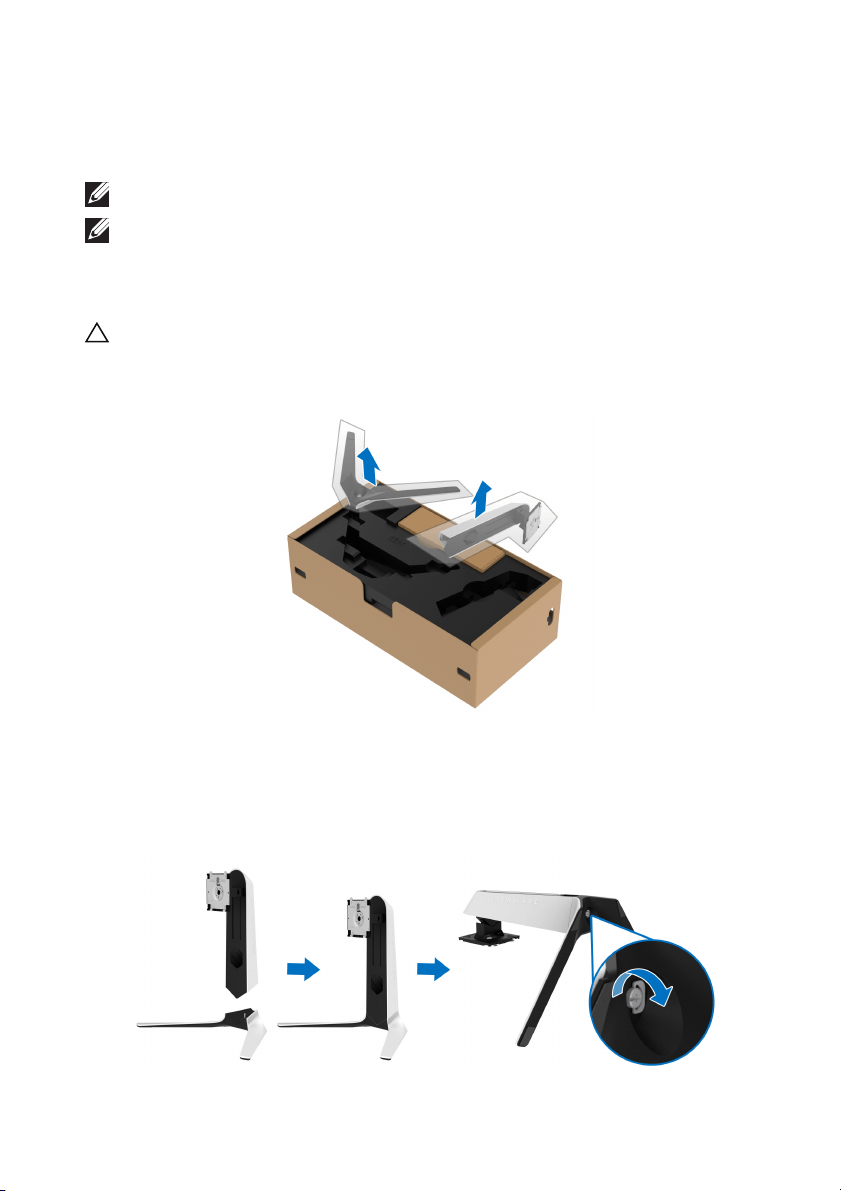
1. Re
move the stand riser and stand base from the packaging cushion.
2. Align and place the stand riser on the stand base.
3. Op
en the screw handle at the bottom of the stand base and turn it
clockwise to secure the stand assembly.
4. C
lose the screw handle.
32 | Setting up the monitor
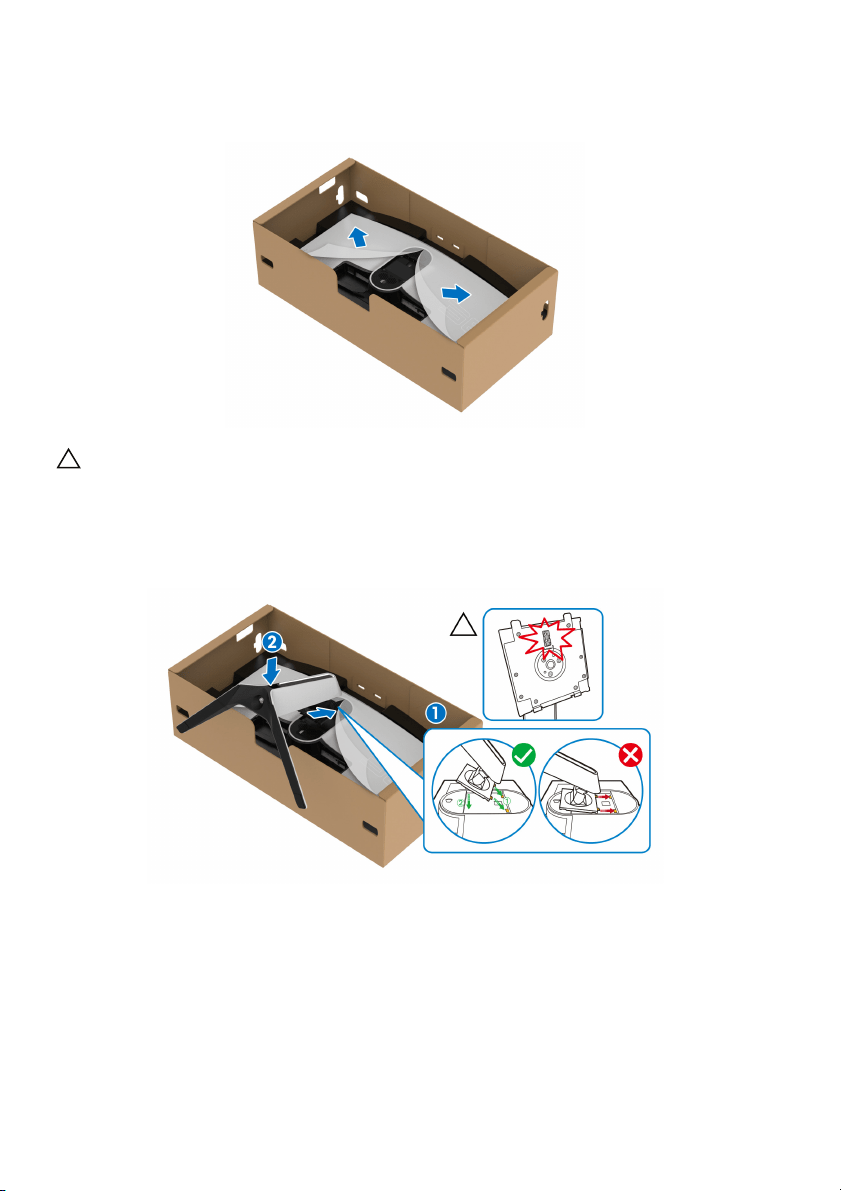
5. Open the protective cover on the monitor to access the VESA slot on the
monitor.
CAUTION: When connecting the stand assembly to the display, do not
plac
e the stand riser directly on the display back panel. Doing so may
damage the pogo pins on the stand due to misalignment.
6. C
arefully insert the tabs on the stand riser into the slots on the display back
cover and lower the stand assembly to snap it into place.
Setting up the monitor | 33
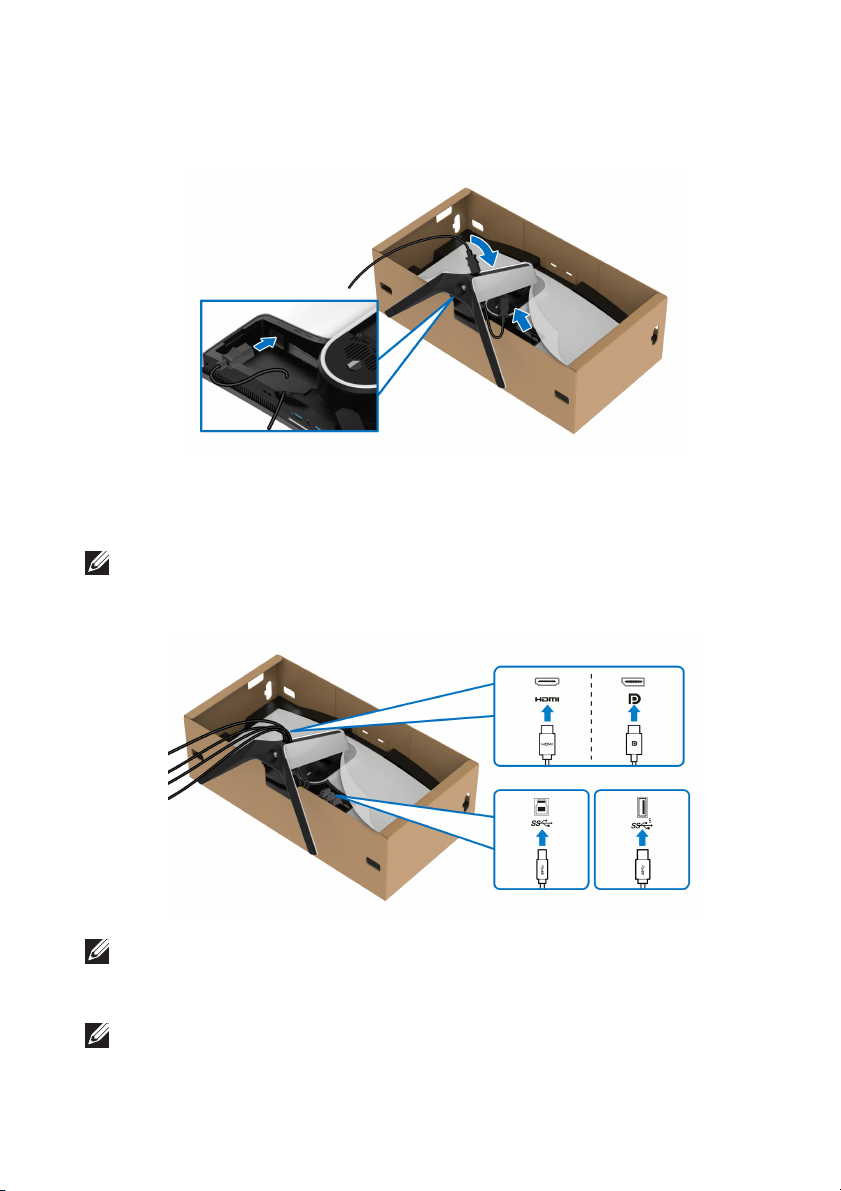
7. Route the power cable through the cable-management slot on the stand
and then through the cable-management clip at the back of the display.
8. Connect the
power cable to the monitor.
9. Route the required cables, such as USB 3.2 Gen1 (5 Gbps) upstream cable,
USB 3.2 Gen1 (5 Gbps) downstream cables, HDMI cable, and DisplayPort
cable through the cable-management slot on the stand.
NOTE: The USB 3.2 Gen1 (5 Gbps) cables are not shipped with your
display and sold separately.
10.Connect
the required cables to the monitor.
NOTE: Dell monitors are designed to work optimally with Dell supplied
inbox cables. Dell does not guarantee the video quality and performance
when using non-Dell cables.
NOTE: Route each cable neatly so that the cables are organized before
the I/O cover is attached.
34 | Setting up the monitor
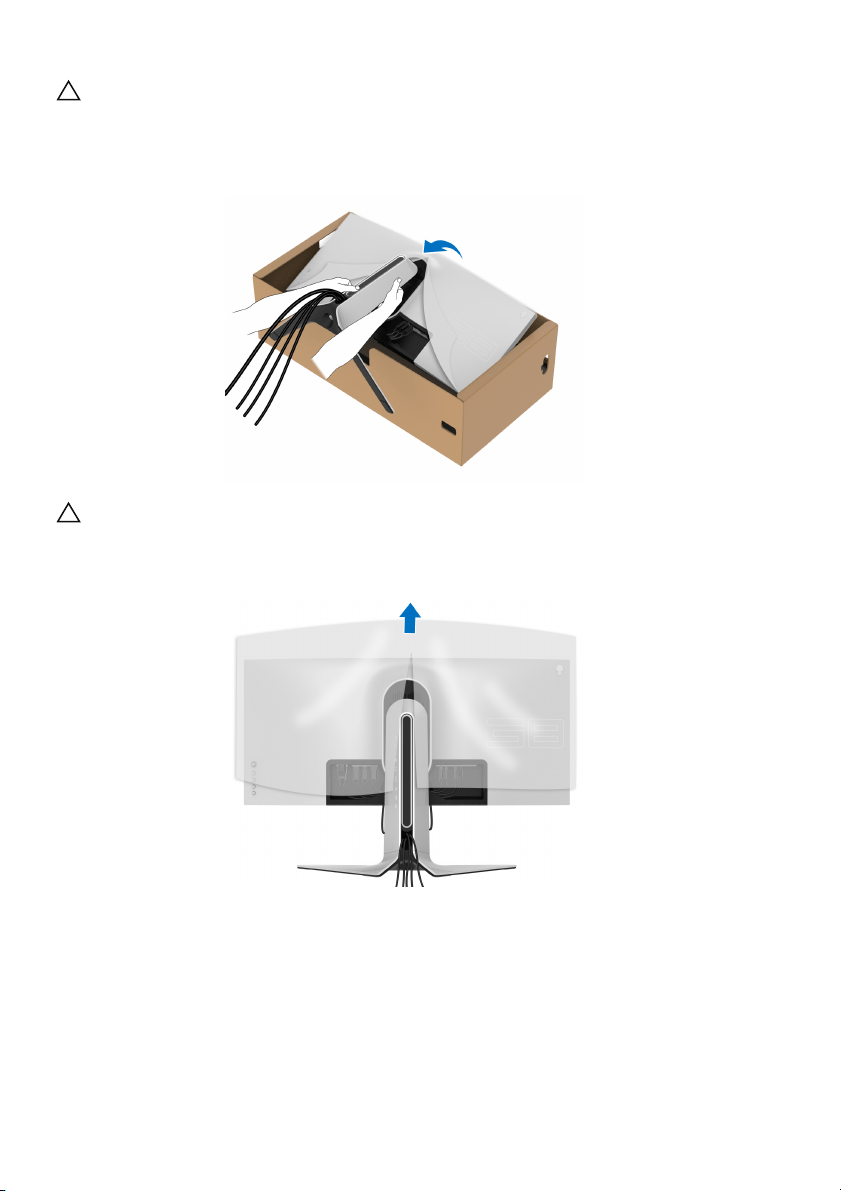
CAUTION: Do not plug the power cable into the wall outlet or turn on the
monitor until you are instructed to do so.
11. Hold the stand riser and lift the monitor carefully, then place it on a flat
surface.
CAUTION: Hold the stand riser firmly when lifting the monitor
to avoid
any accidental damage.
12. Lift the protective cover from the monitor.
Setting up the monitor | 35
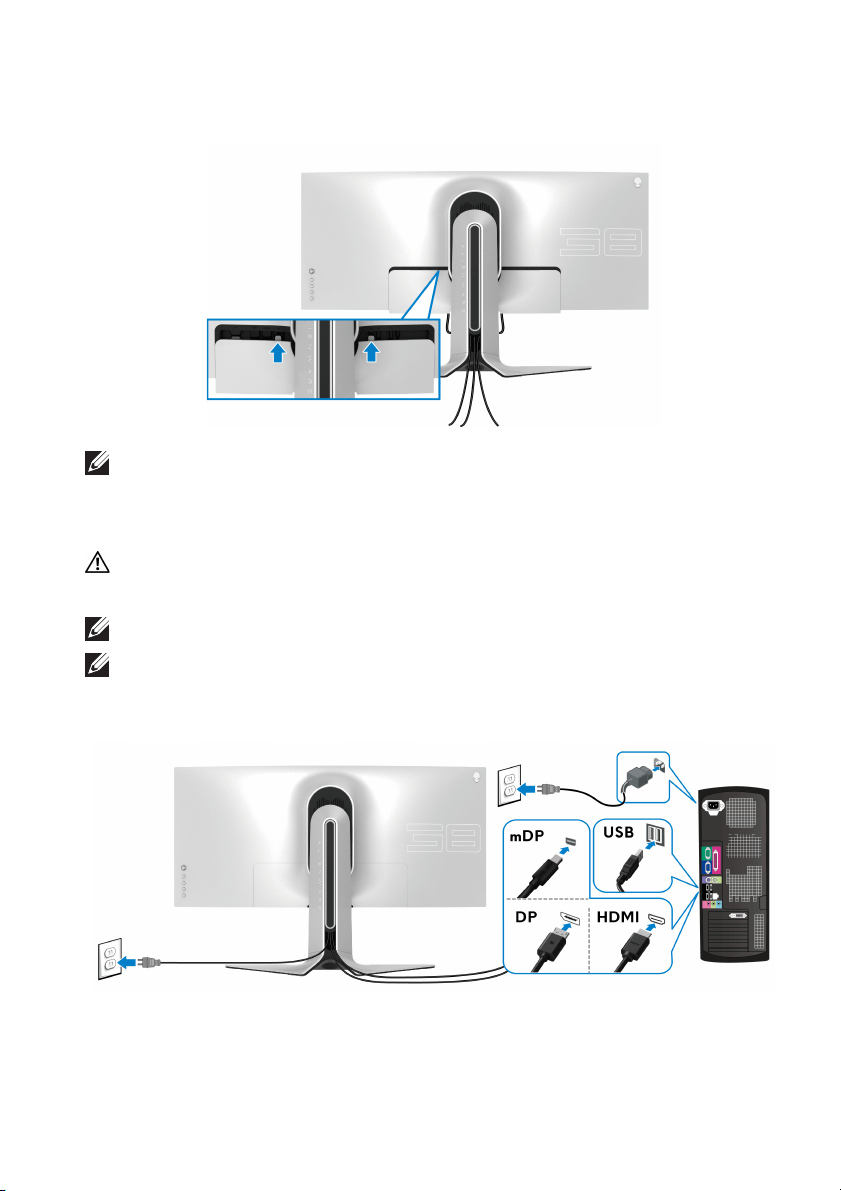
13. Slide the tabs on the I/O cover into the slots on the display back cover until
it snaps into place.
NOTE: Ensure that all cables pass through the I/O cover and cable-
management slot on the stand riser.
Connecting the computer
WARNING: Before you begin any of the procedures in this section,
follow the Safety instructions.
NOTE: Do not connect all cables to the computer at
the same time.
NOTE: The images are for the purpose of illustration only. Appearance of
the computer may vary.
To connect your monitor to the computer:
1. Connect the other end of the DisplayPort cable (or Mini-DisplayPort to
DisplayPort) or HDMI cable to your computer.
36 | Setting up the monitor
2. Connect
the other end of the USB 3.2 Gen1 upstream cable to an
appropriate USB 3.2 Gen1 port on your computer.
3. Connect
the USB 3.2 Gen1 peripherals to the USB 3.2 Gen1 downstream
ports on the monitor.
4. Plug the
power cables for your computer and monitor into a wall outlet.
5. T
urn on the monitor and the computer.
If your monitor displays an image, installation is complete. If it does not
disp
lay an image, see Common problems.
Removing the monitor stand
NOTE: To prevent scratches on the display when removing the stand,
ensure that the monitor is placed on a soft, clean surface.
NOTE: The following instructions are applicable only for removing the
stand that was shipped with your monitor. If you are removing a stand
that you purchased from any other source, follow the set up instructions
that were included with the stand.
To remove the stand:
1. Tur
n off the monitor.
2. Disconnect the cabl
es from the computer.
3. Plac
e the monitor on a soft cloth or cushion.
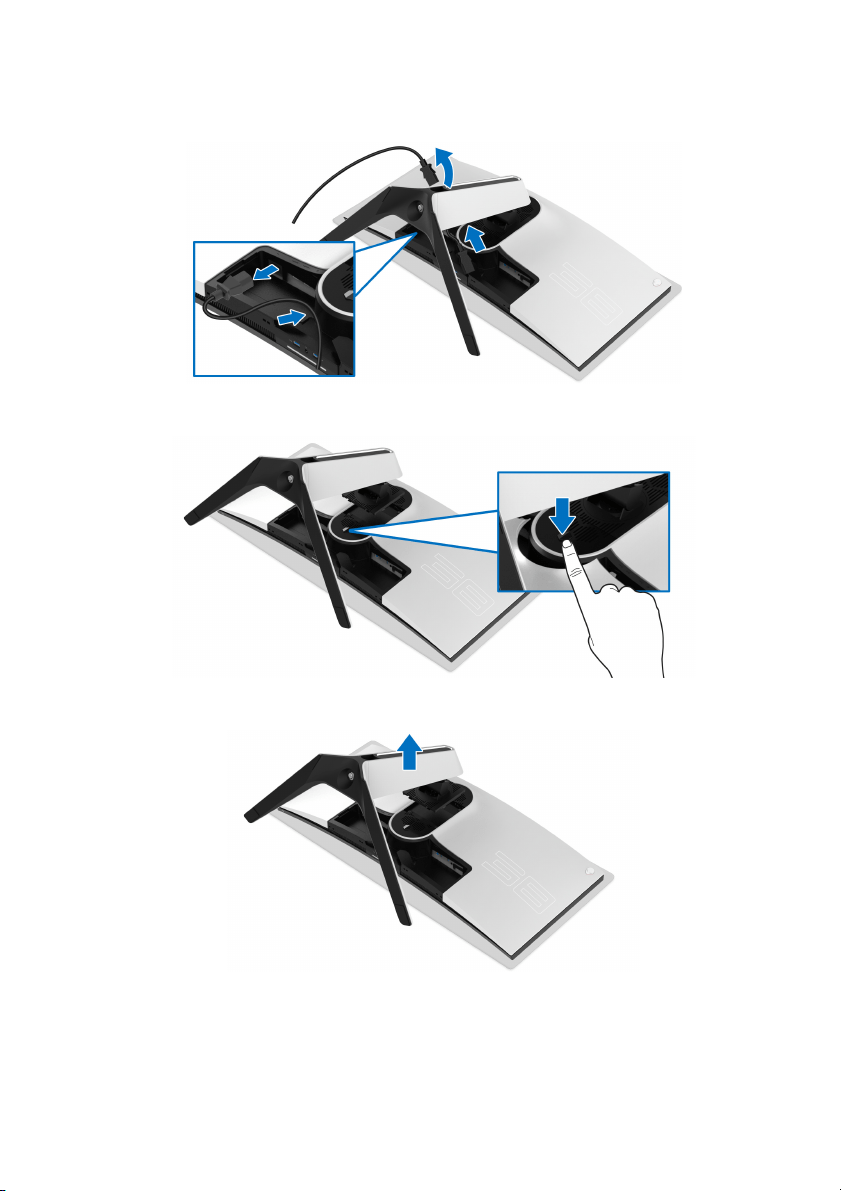
4. C
arefully slide and remove the I/O cover from the monitor.
Setting up the monitor | 37
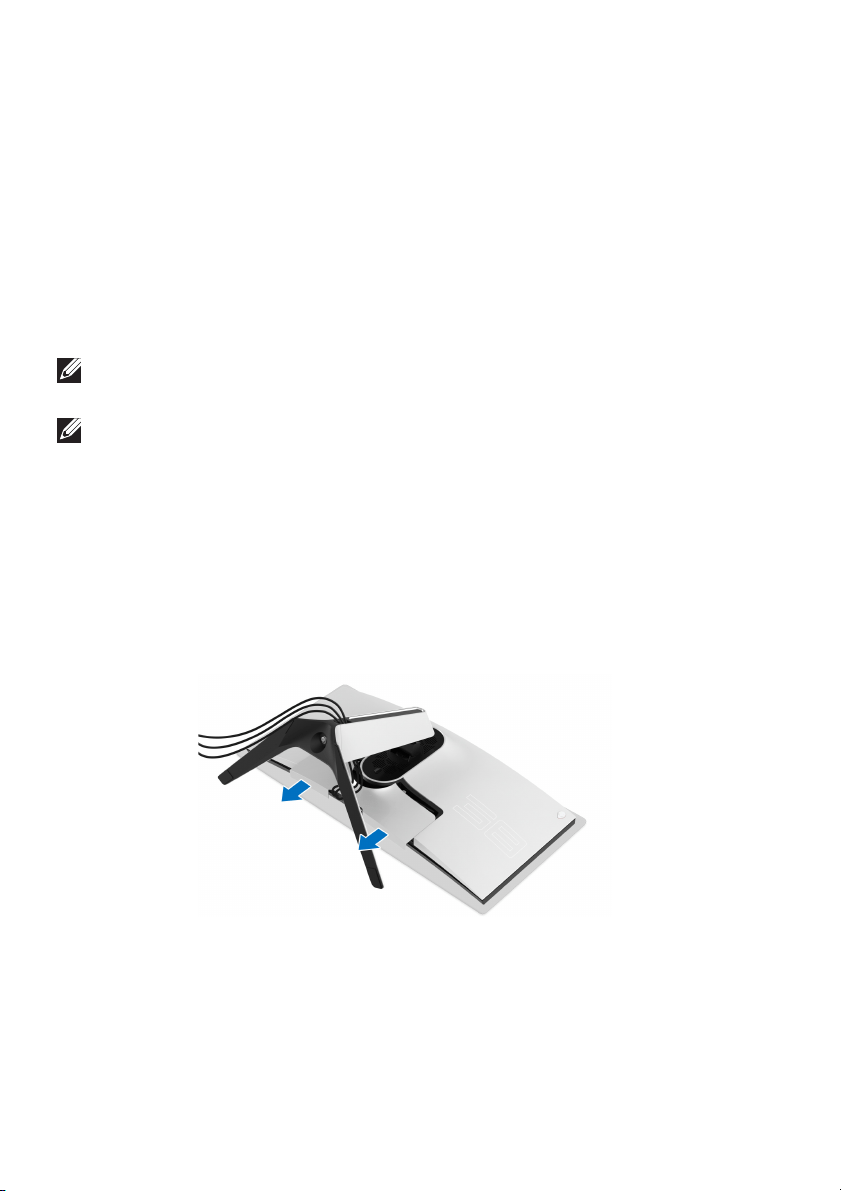
5. Disconnect the cables from the monitor and slide them out through the
cable-management slot on the stand riser.
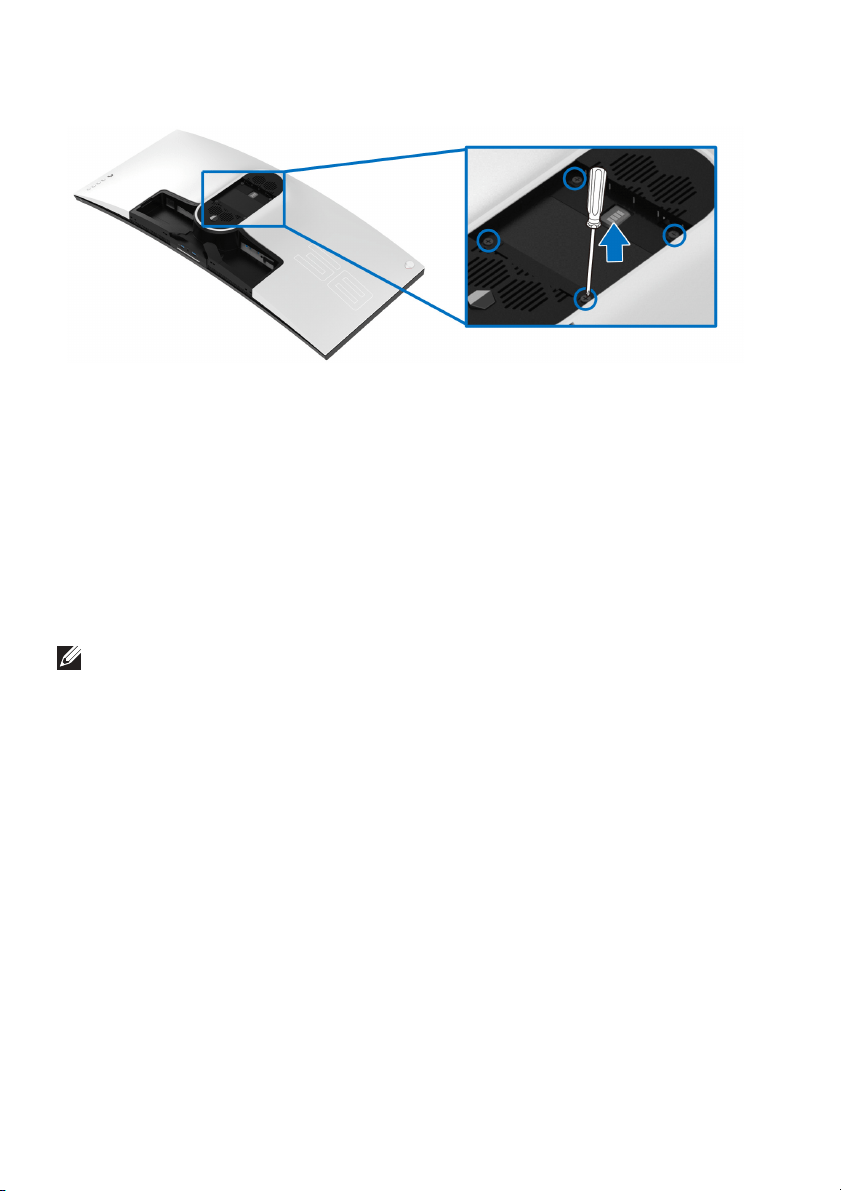
6. P
ress and hold the stand release button.
7. Lift the stand up and away from the monitor.
38 | Setting up the monitor
VESA wall mounting (optional)
(Screw dimension: M4 x 10 mm)
Refer to the instructions that come with the VESA-compatible wall mounting kit.
1. Plac
e the monitor panel on a soft cloth or cushion on a stable flat surface.
2. Remove
the monitor stand. (See Removing the monitor stand.)
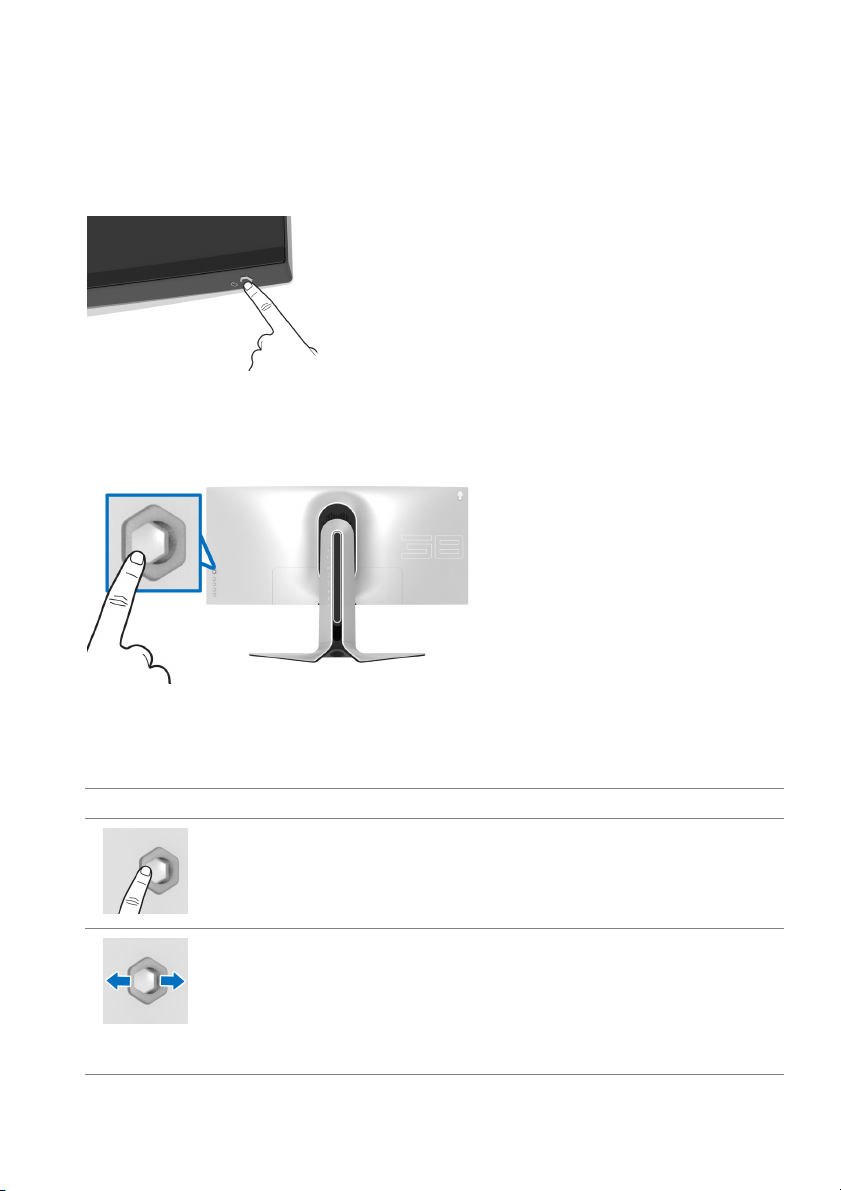
3. Us
e a Phillips crosshead screwdriver to remove the four screws securing the
plastic cover.
4. Attach the
mounting bracket from the wall mounting kit to the monitor.
5. M
ount the monitor on the wall. For more information, see the
documentation that shipped with the wall mounting kit.
NOTE: For use only with UL-listed wall mount bracket with minimum
weight or load bearing capacity of 31.6 kg.
Operating the monitor | 39
Operating the monitor
Power on the monitor
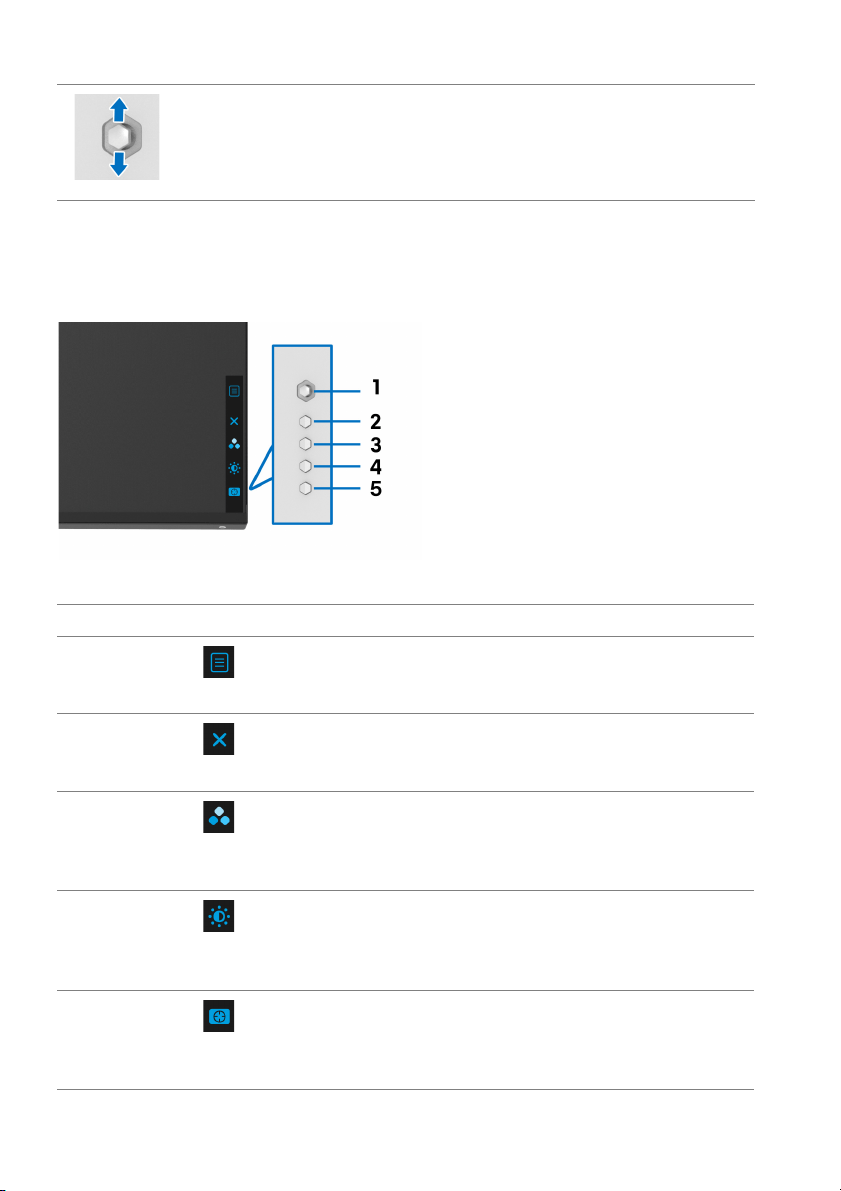
Press the power button to turn on the monitor.
Using the joystick control
Use the joystick control on the rear of the monitor to make OSD adjustments.
1. Press the joystick button to launch the OSD main menu.
2. M
ove the joystick up/down/left/right to toggle between options.
3. Press
the joystick button again to confirm the settings and exit.
Joystick Description
• When the OSD menu is on, press the button to confirm the
selection or save the settings.
• When the OSD menu is off, press the button to launch the
OSD mai
n menu. See Accessing the menu system.
• For 2-way (right and left) directional navigation.
• Move right to enter the submenu.
• Move left to exit from the submenu.
• Increases (right) or decreases (left) the parameters of selected
menu i
tem.
40 | Operating the monitor
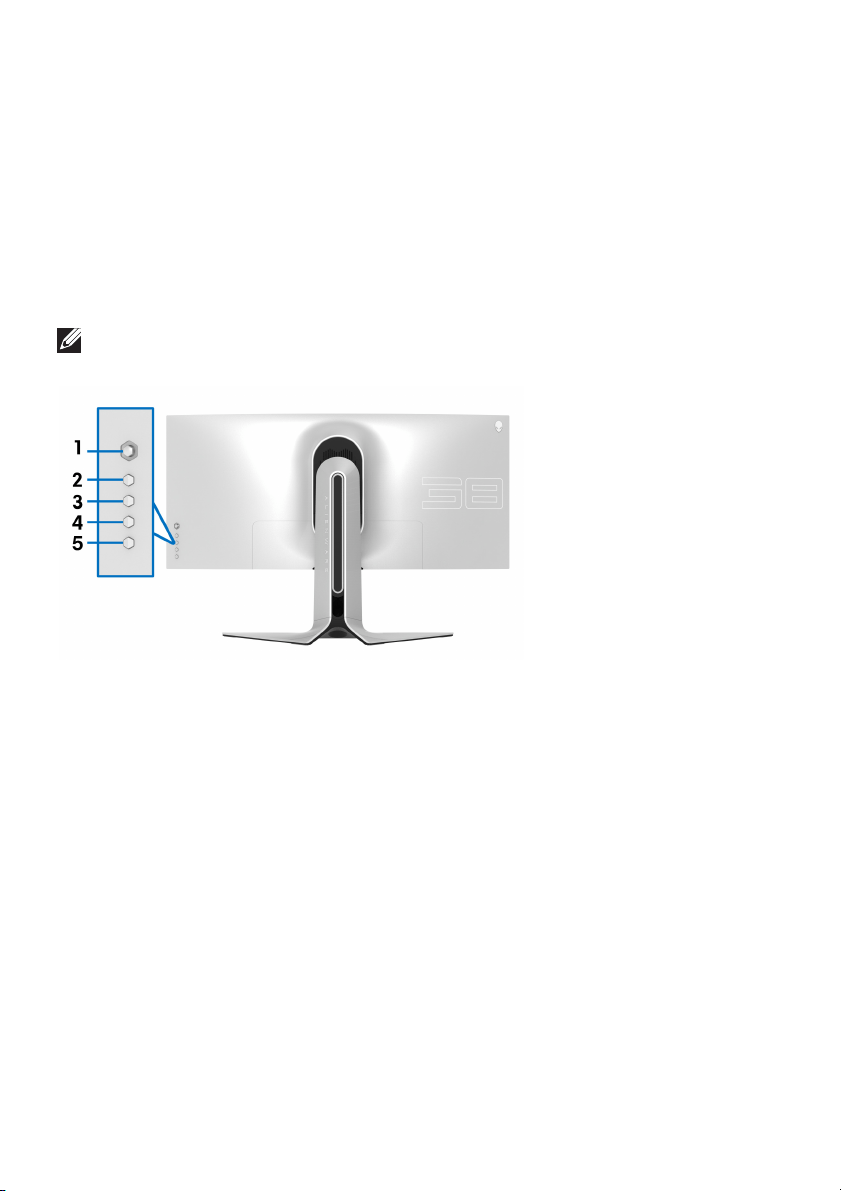
Using the rear-panel controls
Use the control buttons on the rear of the monitor to access the OSD menu and
shortcut keys.
The following table describes the rear-panel buttons:
Rear-panel button Description
1
To launch the OSD main menu. See Accessing
the menu system.
2
To exit the OSD main menu.
3
To specify a desired color mode from a preset
list.
4
To directly access the Brightness/Contrast
adjustment sliders.
5
To directly access the Dark Stabilizer
adjustment slider.
• For 2-way (up and down) directional navigation.
• Toggles between the menu items.
• Increases (up) or decreases (do
wn) the parameters of selected
menu item.
Menu
Exit
Shortcut key/
Preset Modes
Shortcut key/
Brightness/Contra
st
Shortcut key/
Dark Stabiliz
er
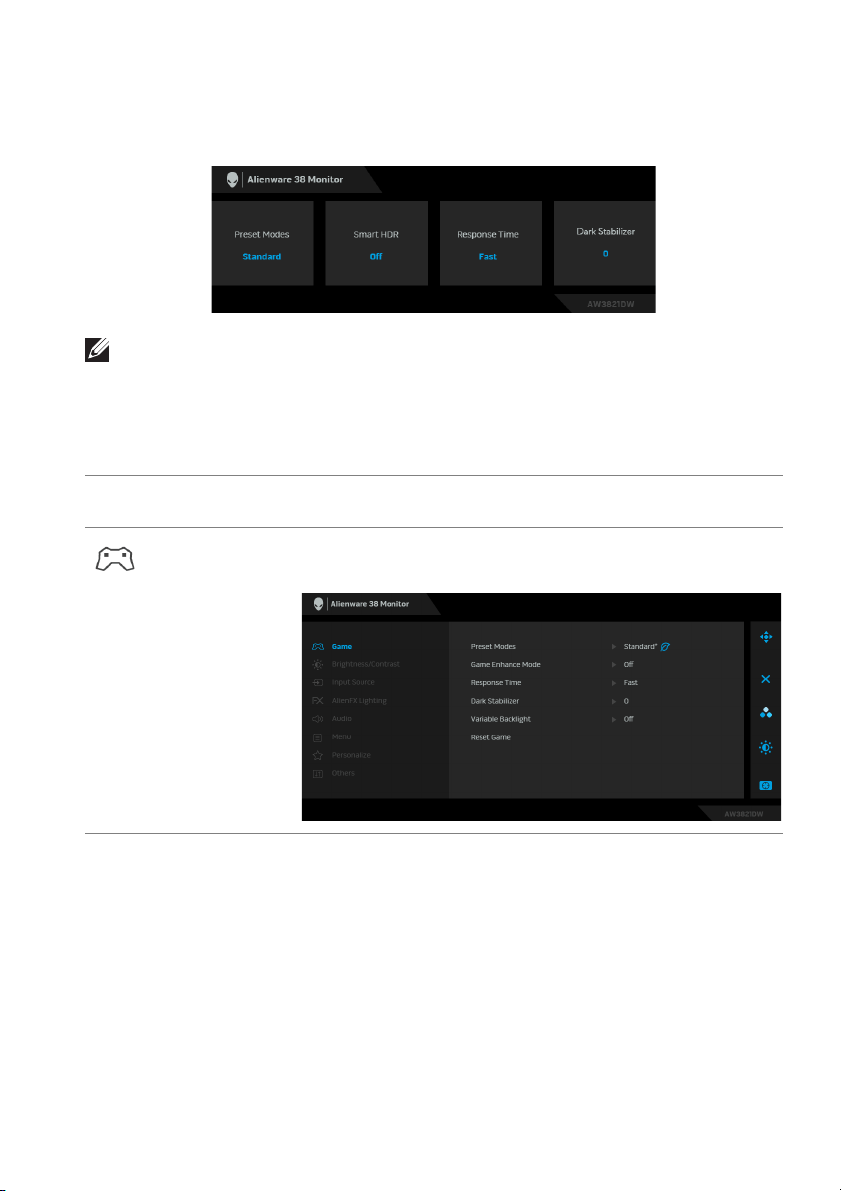
Operating the monitor | 41
When you press any of these button on the rear panel (including the
joystick
button), the OSD Status Bar appears to let you know the current settings of
some OSD functions.
NOTE: The Smart HDR state is enabled automatically when your display
detects HDR content. It cannot be enabled manually.
Using the On-Screen Display (OSD) menu
Accessing the menu system
Icon Menu and
submenus
Description
Game Use this menu to personalize your visual gameplay
experience.
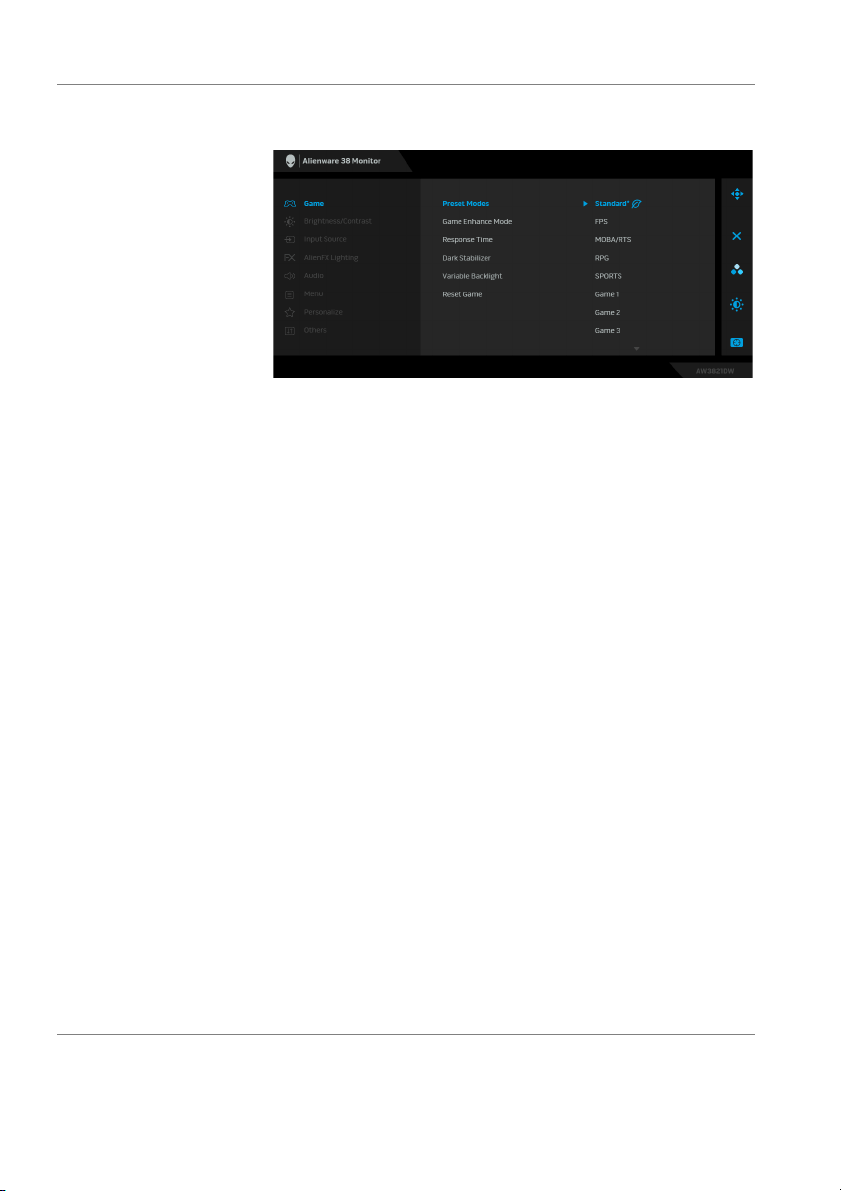
42 | Operating the monitor
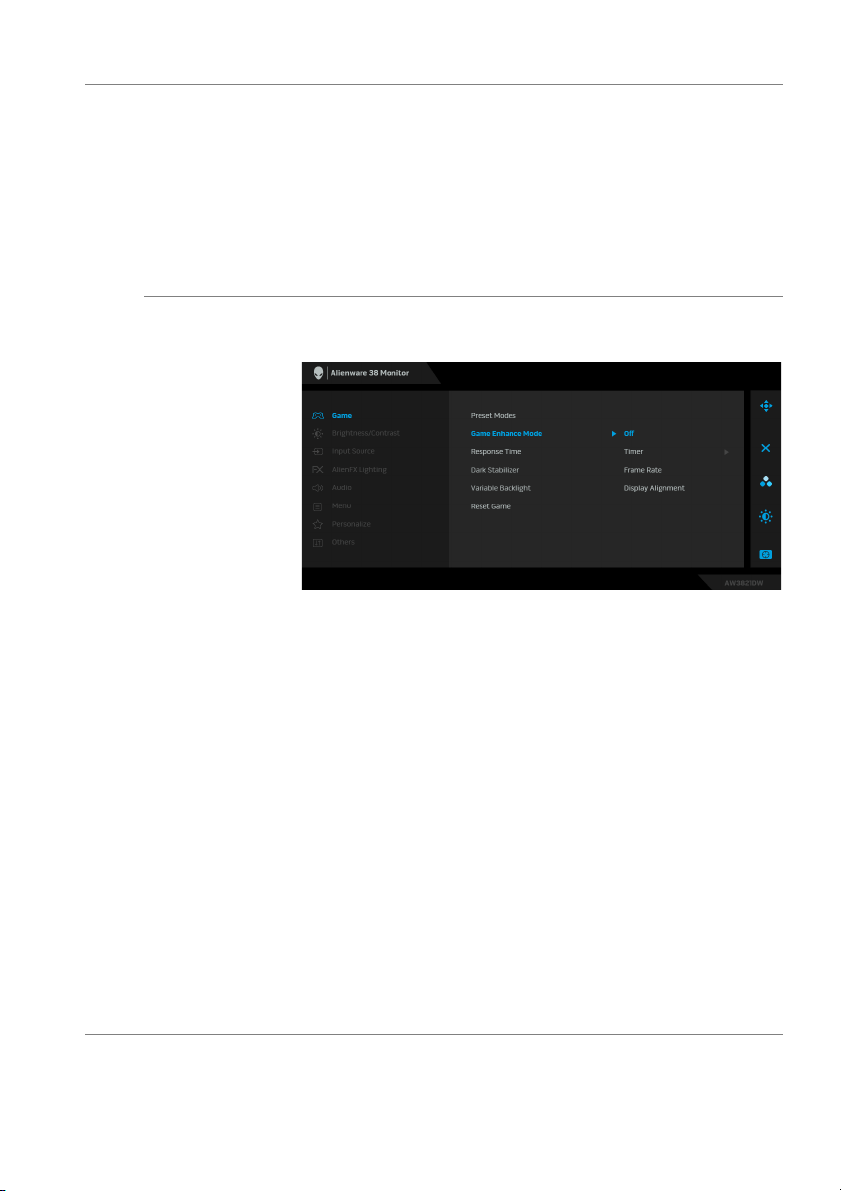
Preset Modes Allows you to choose from the list of preset color
modes
.
• Standard*: Loads the monitor's default color
settings. This is the default preset mode. (* means
DisplayHDR-compliant)
• FP
S: Loads color settings ideal for First-Person
Shooter (FPS) games.
• MOBA/RTS:
Loads color settings ideal for
Multiplayer Online Battle Arena (MOBA) and Real-
Time Strategy (RTS) games.
• RPG: Loads col
or settings ideal for Role-Playing
Games (RPG).
• SPORTS: Loads
color settings ideal for sports
games.
• Game 1/Game 2/
Game 3: Allows you to customize
the Response Time, color, and Dark Stabilizer
settings for your gaming needs.
• ComfortView: Dec
reases the level of blue light
emitted from the screen to make viewing more
comfortable for your eyes.
WARNING: The possible long-term effects of
blue
light emission from the monitor may cause
personal injury such as digital eye strain, eye
fatigue and damage to the eyes. Using monitor for
extended periods of time may also cause pain in
parts of body such as neck, arm, back and
shoulder. For more information, see Ergonomics.
Operating the monitor | 43
Preset Modes • Wa
rm: Presents colors at lower color temperatures.
The screen appears warmer with a red/yellow tint.
• Co
ol: Presents colors at higher color temperatures.
The screen appears cooler with a blue tint.
• Cu
stom Color: Allows you to manually adjust the
color settings. Use the joystick to adjust the three
colors (R, G, B) values and create your own preset
color modes.
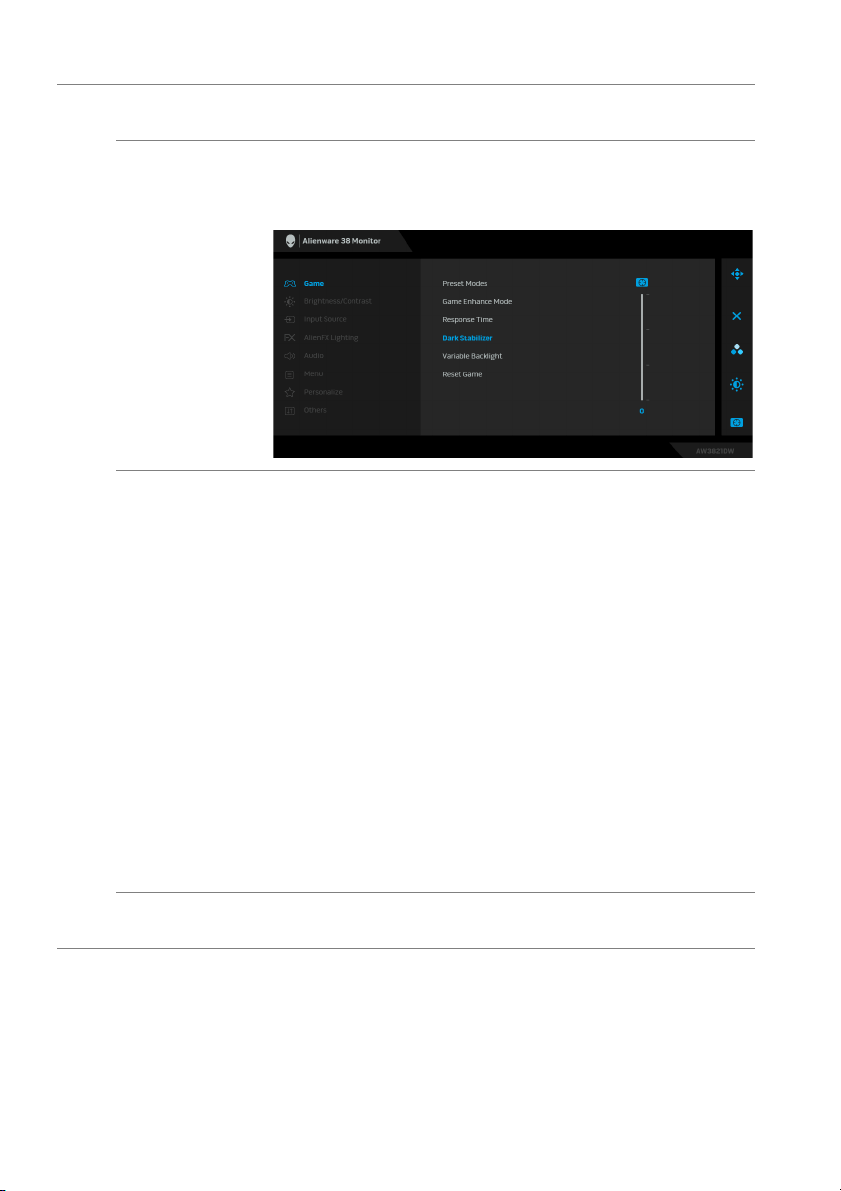
Game Enhance
Mode
The feature offers three available functions to enhance
your game
play experience.
• Off
Select to disable the functions under Game En
hance
Mode.
• Ti
mer
Allows you to disable or enable the timer at the upper
left
corner of the display. The timer shows the time
elapsed since the game starts. Select an option from
the time-interval list to keep you aware of the
remaining time.
• Fr
ame Rate
Select to display the current f
rames per second when
playing games. The higher the rate, the smoother the
motion appears.
• Display Alignme
nt
Activate the function to help ensure the perfect
a
lignment of the video contents from multiple displays.
44 | Operating the monitor
Response Time Allows you to set the Respo
nse Time to Fast, Super
Fast or Extreme.
Dark Stabilizer The feature improves the visib
ility in the dark gaming
scenarios. The higher the value (between 0 to 3), the
better visibility in dark area of the display image.
Variable
Backlight
Optimally adjusts display back-light by controlling the
brightness and dimming of the display based on the
preset mode selected.
• Mode
0: Ideal for gameplay.
• Mode
1: Suitable for hybrid usage such as playing
games and general desktop usage. When the
monitor is displaying the HDR content, this is the
default setting.
• Mode
2: Suitable for desktop usage, photo editing,
and so on.
• Off:
When the monitor is displaying the SDR
content, this is the default setting; When HDR
content is displayed, this option is disabled.
NOTE: Wh
en Mode 0, Mode 1, or Mode 2 is selected,
it is normal to experience change in localized back-
light brightness based on the content displayed.
Reset Game Resets all settings under the Game menu to th
e factory
defaults.
Operating the monitor | 45
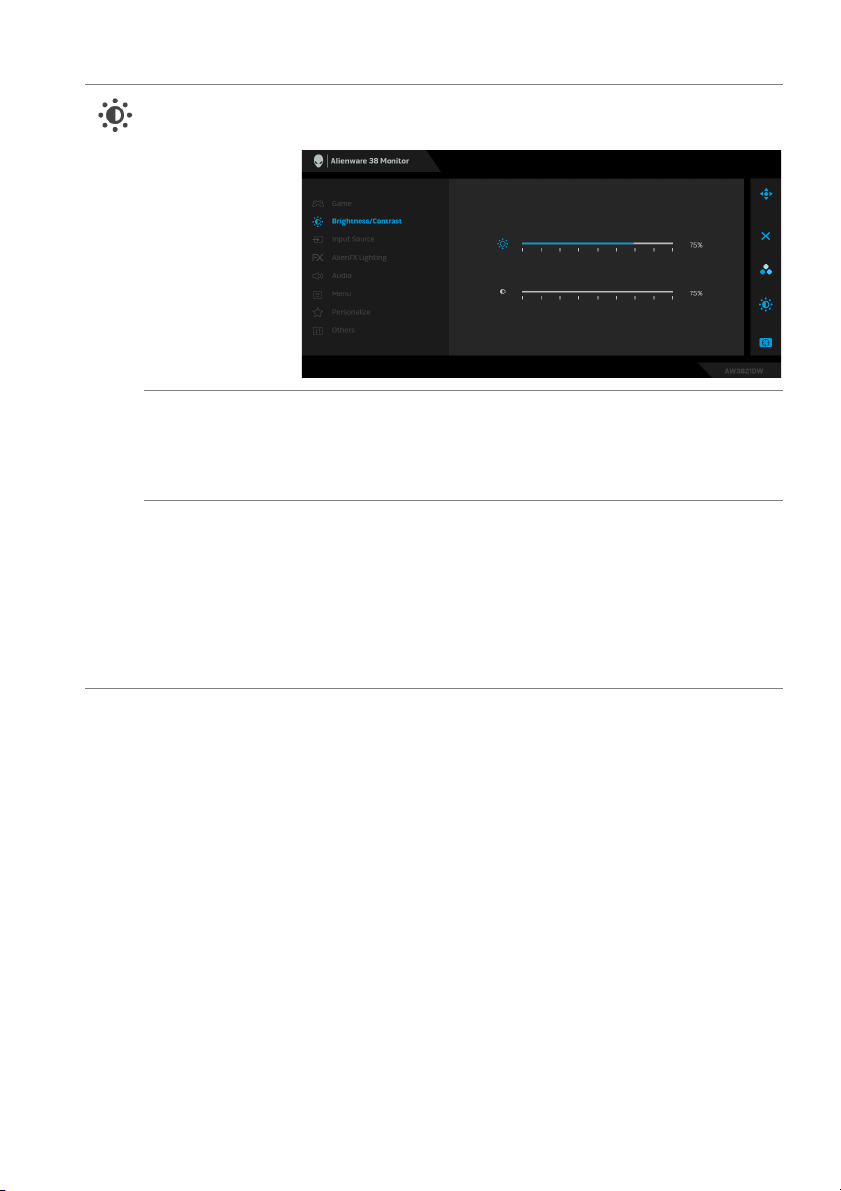
Brightness/
Contrast
Use this menu to activate Brightness/Contrast
adjustment.
Brightness Brightness adjusts the luminance of the backlight.
Move the joystick right to increase the brightness level
or move
the joystick left to decrease the brightness
level (mi
n. 0 / max. 100).
Contrast Adjust Brightness f
irst, and then adjust Contrast only if
further adjustment is necessary.
Move the joystick right to increase the contrast level or
move the
joystick left to decrease the contrast level
(mi
n. 0 / max. 100).
The Contra
st function adjusts the degree of difference
between darkness and lightness on the monitor screen.
46 | Operating the monitor
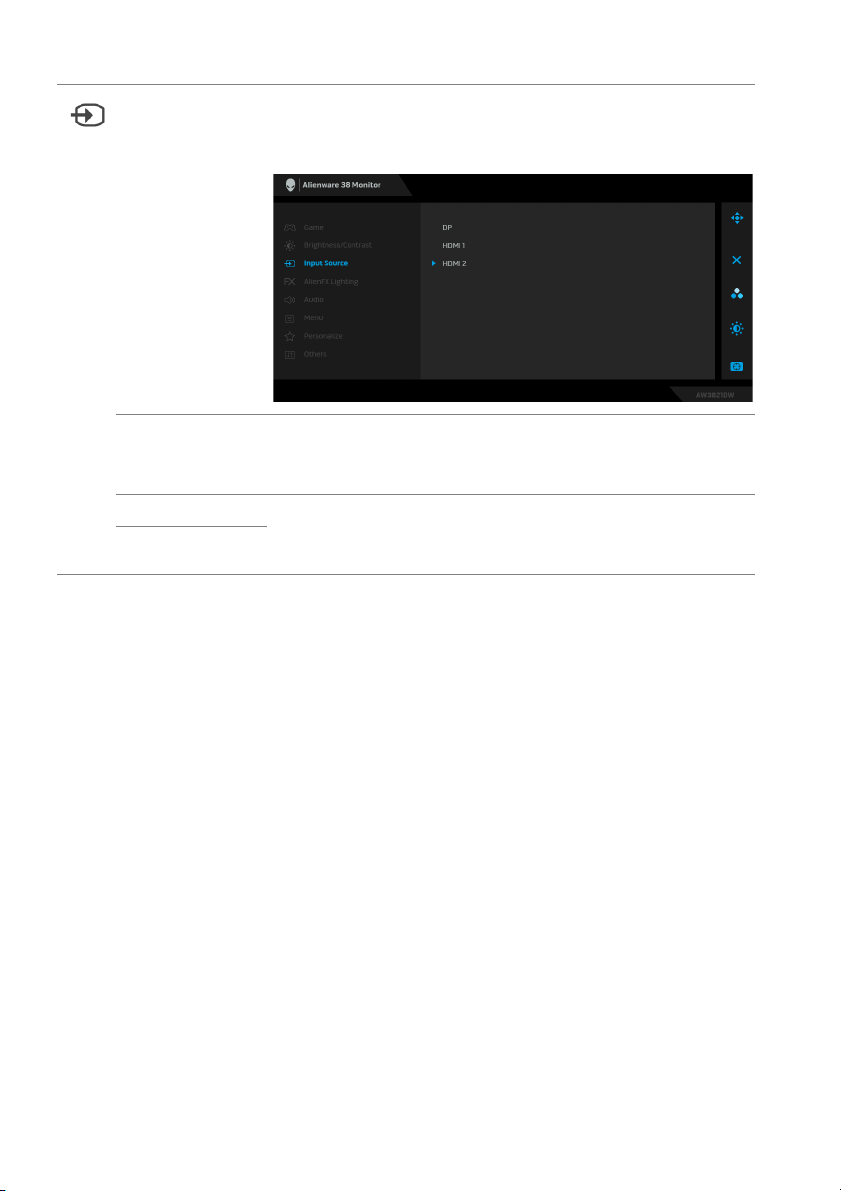
Input Source Use the Input Source menu to
select between the
different video signals that may be connected to your
monitor.
DP Select the DP input when you are using the
DisplayPort (DP) connector. Press the joystick button
to confirm the selection.
HDMI 1 Select the HDM
I 1 or HDMI 2 input when you are
using the HDMI connector. Press the joystick button to
confirm the selection.
HDMI 2
Operating the monitor | 47
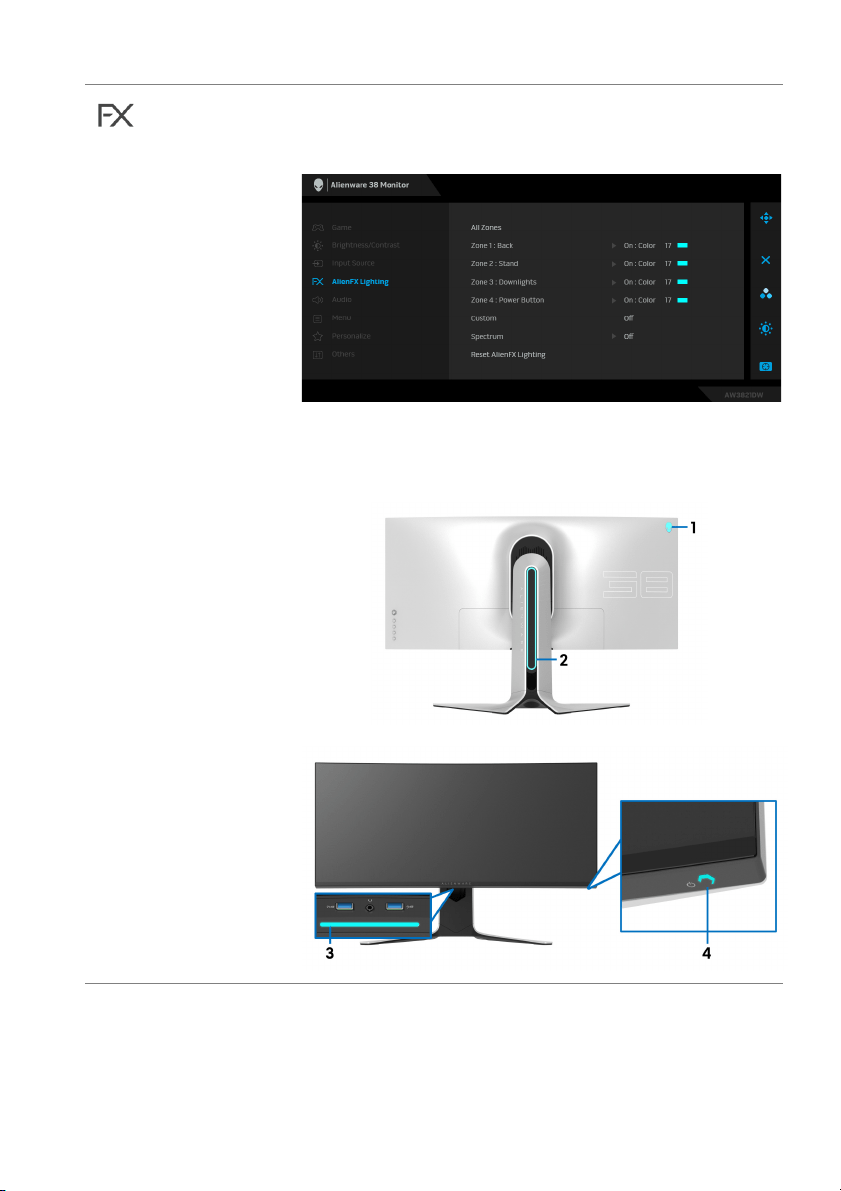
AlienFX
Lig
hting
Use this menu to adjust the LED light settings for the
Power button, Alienware logo, downlights on the
bottom of the monitor, and the light stripe on the stand.
Before making any adjustments, select any or all of
these 4 zones from the submenus. The illustration below
indicates the lighting zones.
48 | Operating the monitor
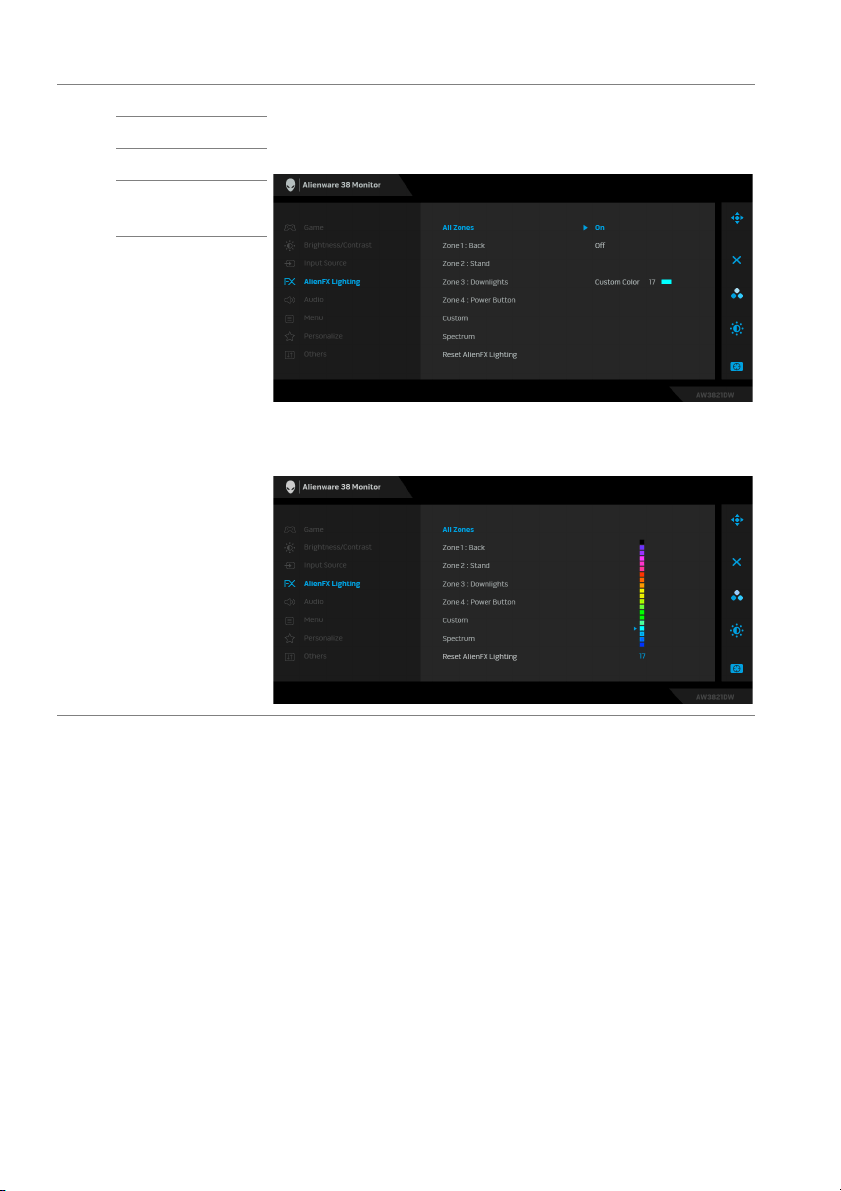
All Zones To specify an LED lighting color for the selected area,
sel
ect On and move the joystick to highlight the
Custom Color option.
Then you can make a selection from the list of 20
available colors by moving the joystick up or down.
Zone 1: Back
Zone 2: Stand
Zone 3:
Downlights
Zone 4: Power
Button
Operating the monitor | 49
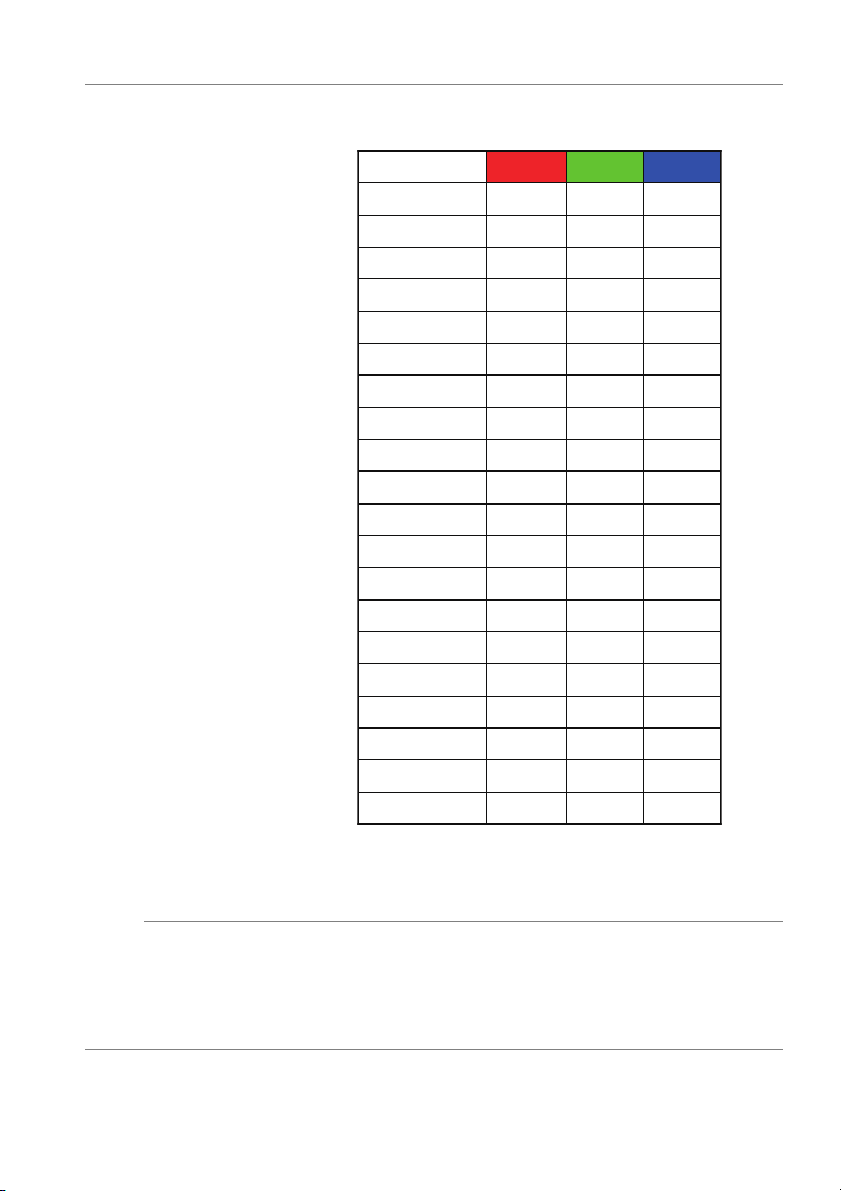
The following table depicts the color number and the
RGB cod
es used for the 20 LED colors.
1 0 0 0
2 63 0 255
3 100 0 240
4 255 0 255
5 239 12 175
6 255 0 89
7 255 0 0
8 255 45 0
9 255 75 0
10 255 120 0
11 204 255 0
12 127 255 0
13 76 255 0
14 0 255 0
15 0 255 25
16 0 255 63
17 0 240 240
18 0 63 255
19 0 25 255
20 0 0 255
No.
R
G
B
To turn off the AlienFX lights, select Off.
NOTE: These fu
nctions are only available when
Spectrum is disabled.
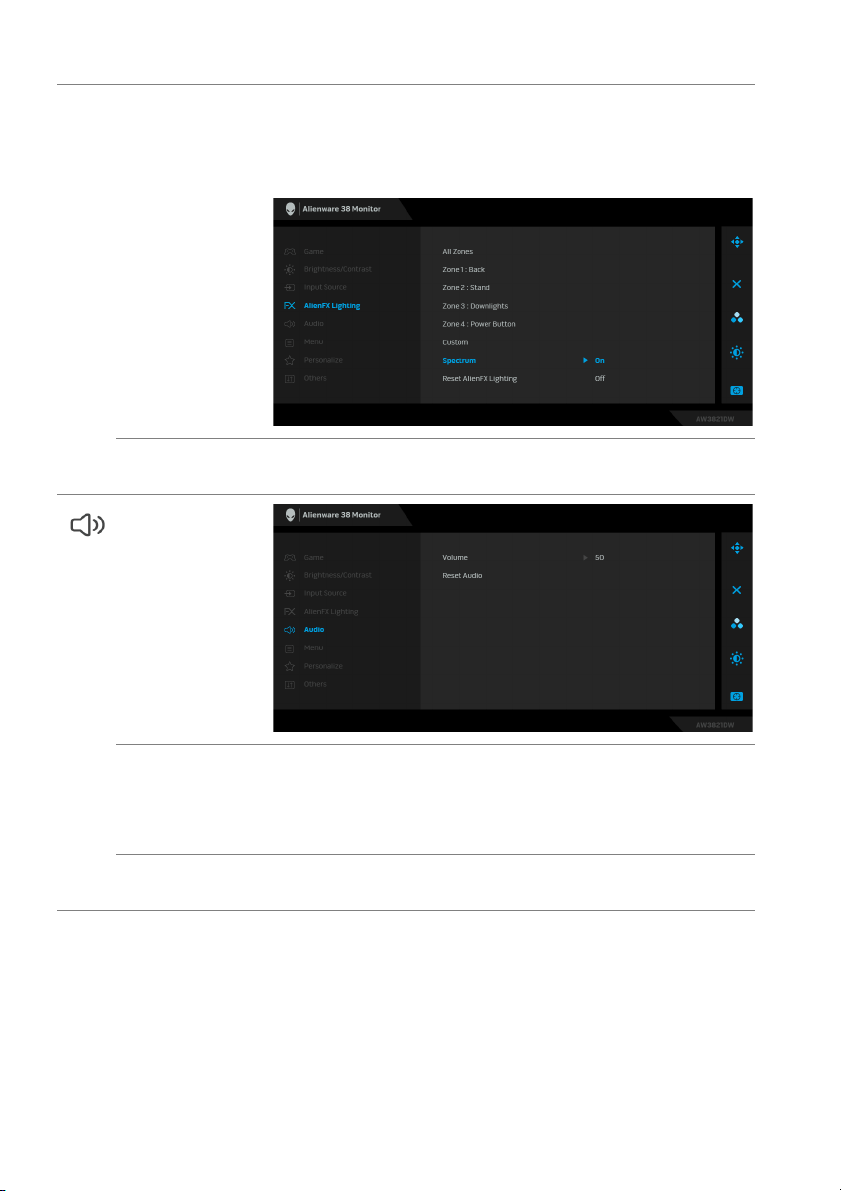
Custom It is a read-only menu. When you use Custom Color
or/and Spectrum to
make LED lighting adjustments,
this menu status shows Off; when you make the LED
lighting adjustments through AlienFX application, the
status changes to On.
50 | Operating the monitor
Spectrum When you select On, the Al
ienFX lights of 4 zones
glow and change colors in the sequence of the color
spectrum: red, orange, yellow, green, blue, indigo, and
violet.
Reset AlienFX
Lighting
Resets all settings under the AlienFX Lighting menu to
the factory defaults.
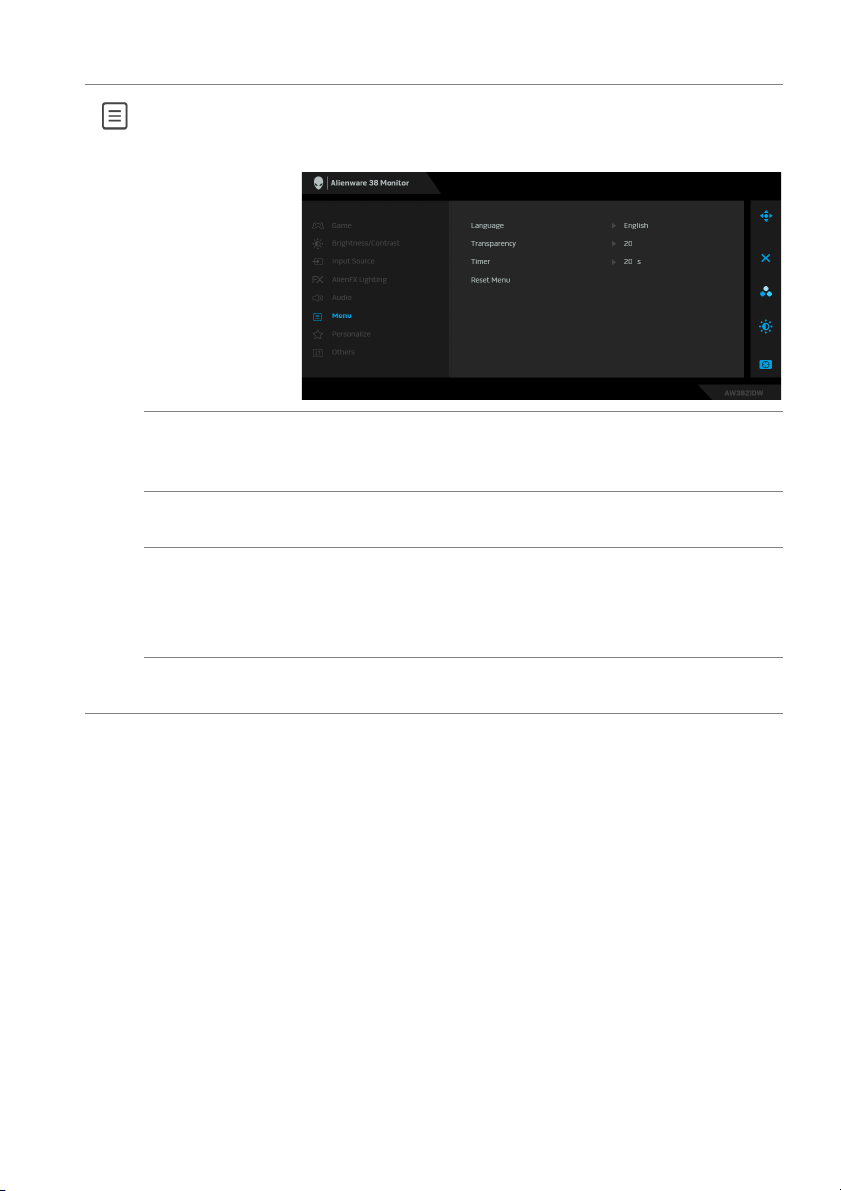
Audio
Volume Allows you to set the volume level of headphone
output.
Use the joystick to adjust the volume level from 0 to
100.
Reset Audio Resets all settings under the Audio menu to
the factory
defaults.
Operating the monitor | 51
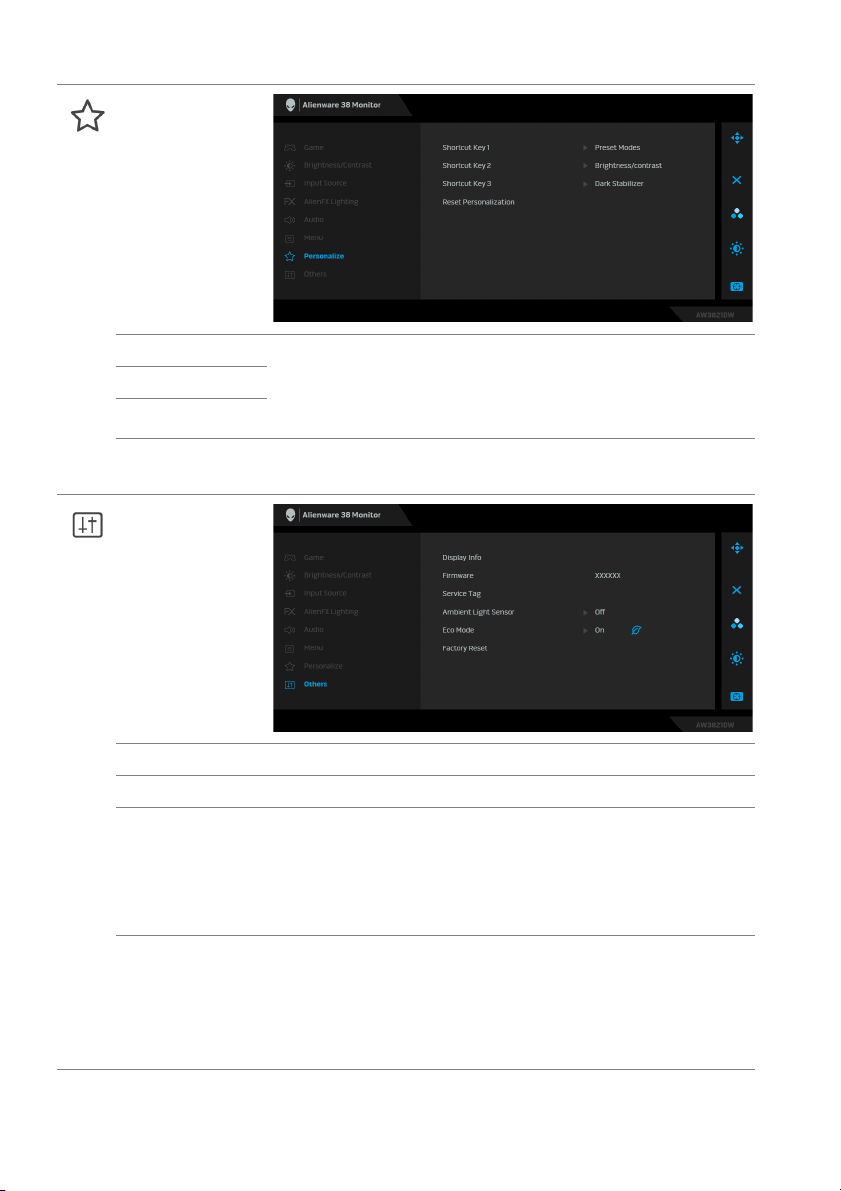
Menu Select this option to adjust the settings of the OSD,
such as, the
languages of the OSD, the amount of time
the menu remains on screen, and so on.
Language Sets the OSD display to one of the eight languages
(English, Spanish, French, German, Brazilian
Portuguese, Russian, Simplified Chinese, or Japanese).
Transparency Select this option to change the menu transparency by
moving the
joystick up or down (min. 0/max. 100).
Timer Sets the length of time for the OSD to remain active
after
you move the joystick or press a button.
Move the joystick to adjust the slider in 1 second
incremen
ts, from 5 to 60 seconds.
Reset Menu Resets all settings under the Menu
menu to the factory
defaults.
52 | Operating the monitor
Personalize
Shortcut Key 1 Allows you to choose a feature from Preset Modes,
Game Enhance Mode, Dark Stabilizer, Brightness/
Contrast, Input Source, or Volume and set it as a
shortcut key.
Shortcut Key 2
Shortcut Key 3
Reset
Personali
zation
Resets all settings under the Personalize menu to the
factory defaults.
Others
Display Info Displays the monitor's current settings.
Firmware Displays the firmware version of your monitor.
Service Tag Displays the Service Tag of your monitor. The Service
T
ag is a unique alphanumeric identifier that is required
when you contact Dell technical support, access
warranty information, search for latest drivers on Dell
support website and so on.
Ambient Light
Sensor
When you turn it On, t
he monitor automatically adjusts
the brightness of the display back-light based on
ambient light conditions. The default setting is Off.
NOTE: W
hen HDR content is displayed, this option is
disabled.
Operating the monitor | 53
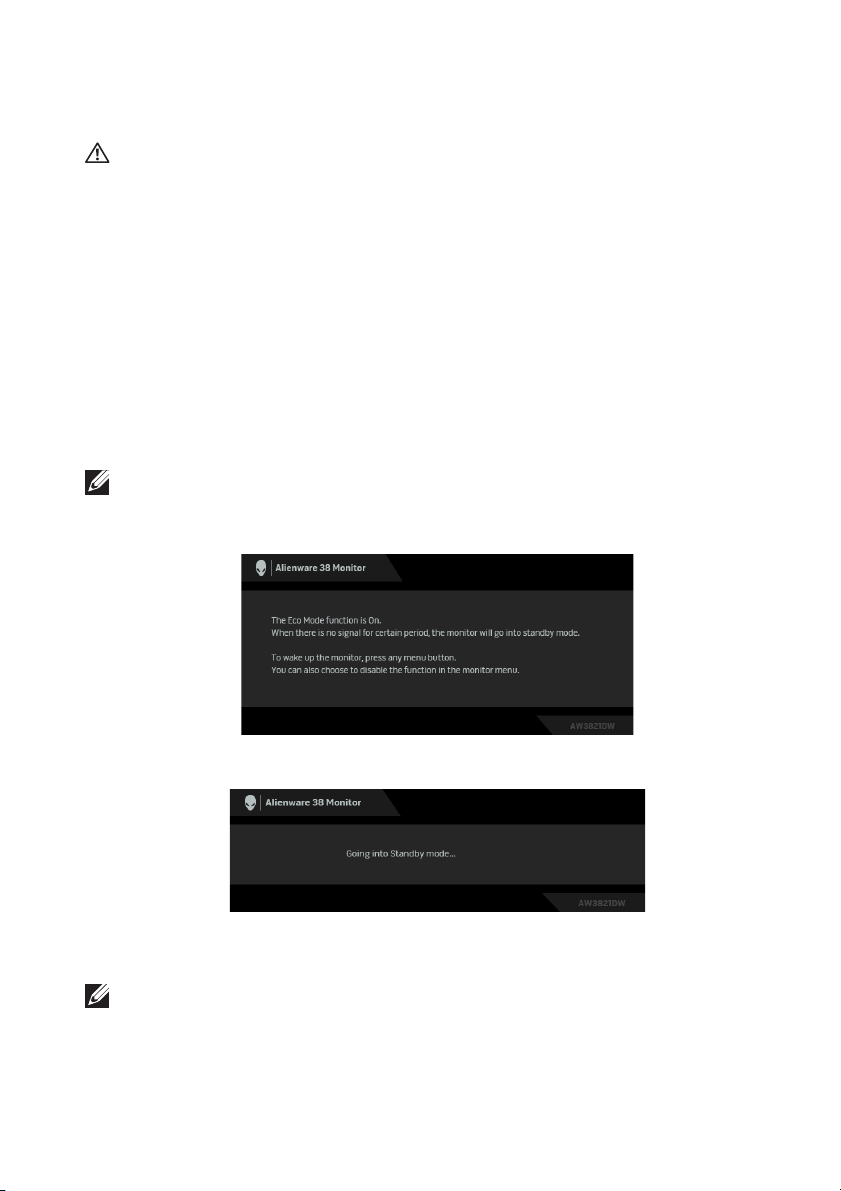
OSD warning message
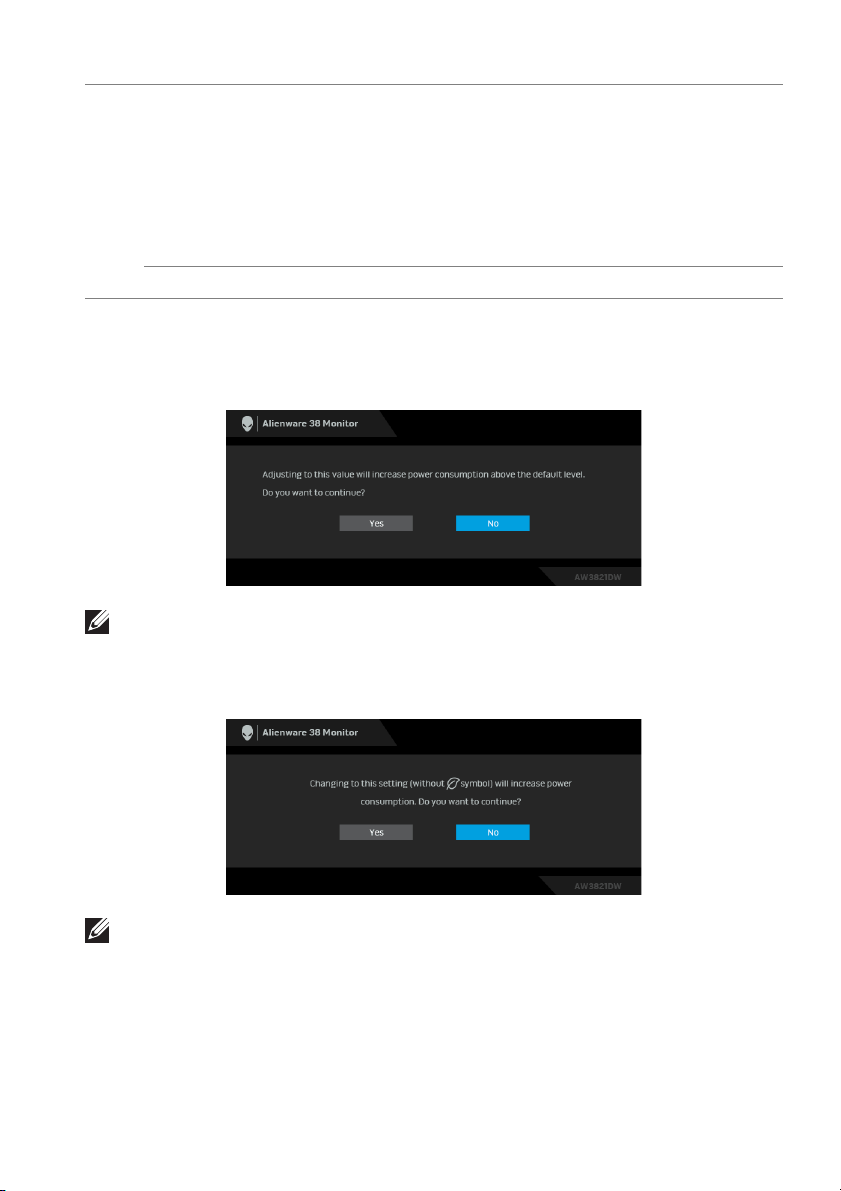
When you adjust the Brightn
ess level for the first time, the following message
appears:
NOTE: If you select Yes, the message will not appear next time when you
intend to change the Brightness setting.
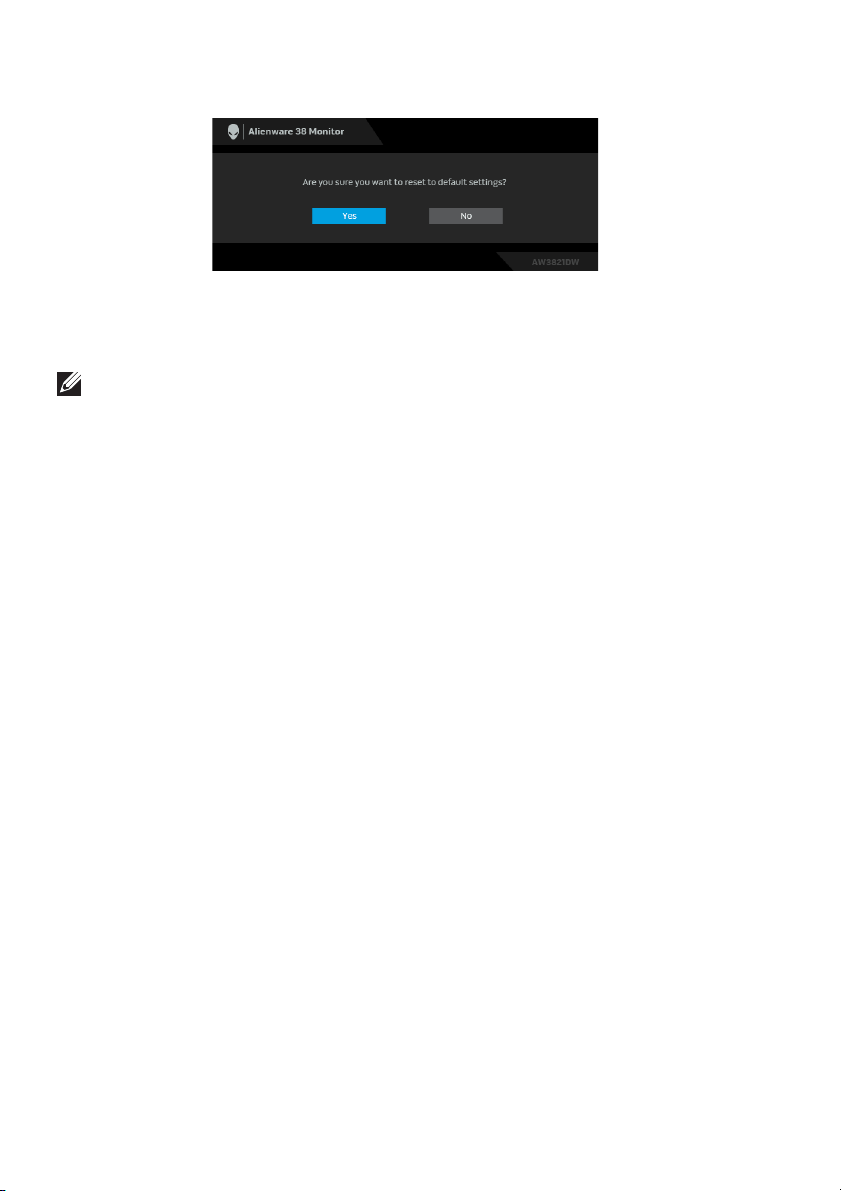
When you change the default setting of pow
er saving features for the first time,
such as Eco Mode or Preset Modes, the following message appears:
NOTE: If you select Yes for either of the features mentioned above, the
message will not appear next time when you intend to change the settings
of these features. When you perform a factory reset, the message will
appear again.
Eco Mode When the computer goes into standby mode, the Eco
Mode
enables the monitor to go into Standby mode as
well. The default setting is On. Selecting Off may
prevent the monitor from going into Standby mode.
NOTE: Pressing any button (includin
g the joystick
button) on the rear panel of the monitor may also wake
up the monitor after it goes into Standby mode.
Factory Reset Resets all OSD settings to the factory defaults.
54 | Operating the monitor
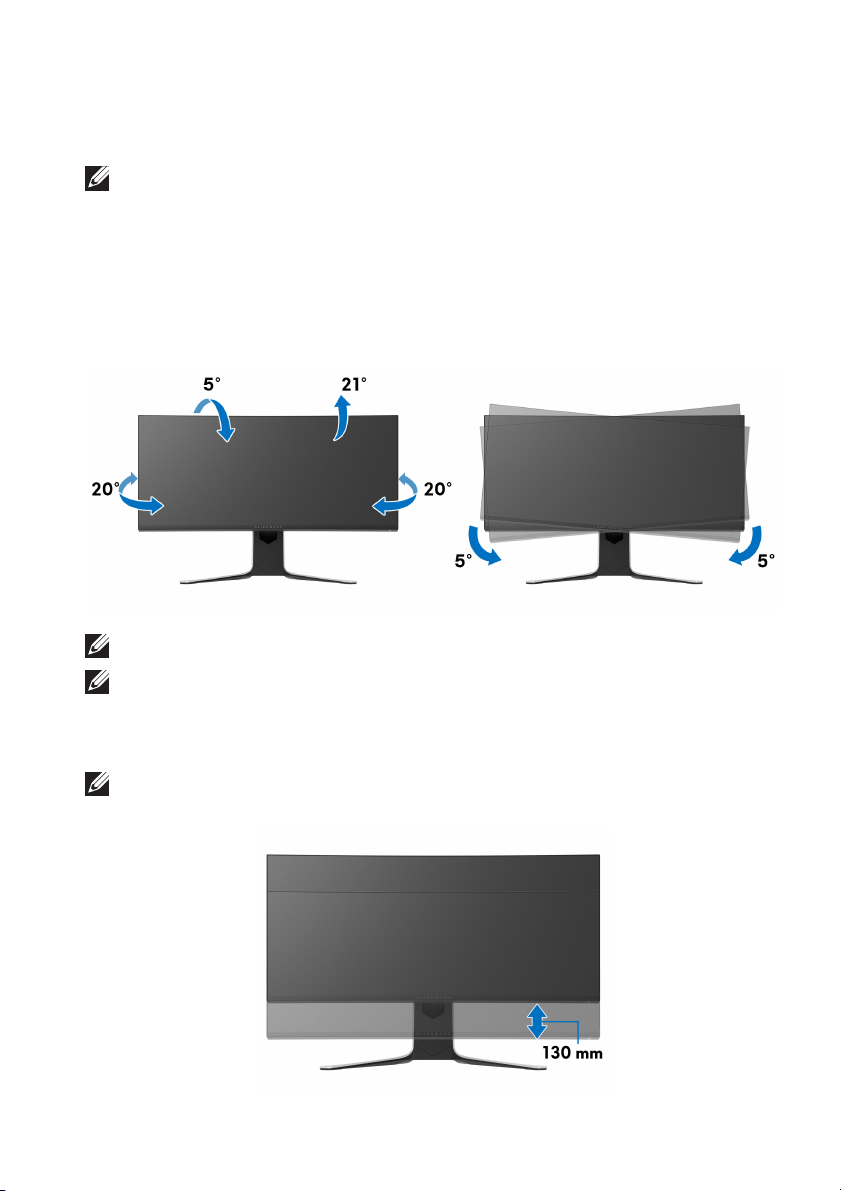
When Fac
tory Reset is selected, the following message appears:
See Troubleshooting for more information.
Setting the maximum resolution
NOTE: The steps may vary slightly depending on the version of Windows
you have.
To set the maximum resolution for the monitor:
In Windows 7, Windows 8, and Windows 8.1:
1. For Wi
ndows 8 and Windows 8.1 only, select the Desktop tile to switch to
classic desktop.
2. Right-c
lick on the desktop and click Screen Resolution.
3. If you have more than one monitor
connected, ensure that you select
AW3821DW.
4. Cl
ick the Screen Resolution dropdown list and select 3840 x 1600.
5. Cl
ick OK.
In Windows 10 and Windows 11:
1. Right-c
lick on the desktop and click Display settings.
2. If you h
ave more than one monitor connected, ensure to select
AW3821DW.
3. Cl
ick the Display Resolution dropdown list and select 3840 x 1600.
4. Cl
ick Keep changes.
If you do not see 3840 x 1600 as an optio
n, you must update your graphics
driver to the latest version. Depending on your computer, complete one of the
following procedures:
If you have a Dell desktop or laptop:
• Go to https://www.dell.com/support,
enter your service tag, and
download the latest driver f
or your graphics card.
If you are using a non-Dell comp
uter (laptop or desktop):
• Go to the support site for your computer
and download the latest graphic
drivers.
Operating the monitor | 55
• Go to your graphics card website and download the latest
graphic drivers.
Using the tilt, swivel, and vertical extension
NOTE: The following instructions are applicable only for attaching the
stand that was shipped with your monitor. If you are attaching a stand
that you purchased from any other source, follow the set up instructions
that were included with the stand.
Tilt and swivel extensions
With the stand attached to the monitor, you can tilt and swivel the monitor for
the most comfortable viewing a
ngle.
NOTE: The stand is not factory-installed.
NOTE: The slant angle of this monitor is between -5° and +5°, not
allowing for pivot movements.
Vertical extension
NOTE: The stand extends vertically up to 130 mm. The figure below
illustrates how to extend the stand vertically.

56 | Using AlienFX application
Using AlienFX application
You can configure the LED lighting effects across multiple distinct zones on your
Alienware monitor through AlienFX in AWCC (Alienware Command Center).
NOTE: If you have an Alienware Gaming Desktop or Laptop, you can
directly access AWCC to control the lightings.
NOTE: For more information, see Alienware Command Center Online
Help.
Prerequisites
Before installing the AWCC on a non-Alienware system:
• Ensure the OS of your computer is Windows 10 R3 or later.
• Ensure your internet connection is active.
• Ensure that the supplied USB 3.2 Gen1 (5 Gbps) upstream cable is
connected to both the Alienware monitor and the computer.
Installing AWCC through Windows update
1. The AWCC application is downloaded and will be automatically installed.
The installation takes a few minutes to complete.
2. Navigate to the program folder to ensure that the installation is successful.
Alternatively, you can find the AWCC application in the Start menu.
3. Launch AWCC and perform the following steps to download the additional
software components:
•In the Settings window, click Windows Update, and then click Check for
updates to check the Alienware driver update progress.
• If the driver update is not responding in your computer, install AWCC from
the Dell Support website.
Installing AWCC from the Dell Support website
1. Enter AW3821DW in the query field at www.dell.com/support/drivers,
and download the latest version of the following items:
• Alienware Command Center Application
• Alienware Gaming Monitor Control Center Driver
2. Navigate to the folder in which you saved the setup files.
3. Double-click the setup file and follow the on-screen instructions to
complete the installation.
Using AlienFX application | 57
Navigating the AlienFX window
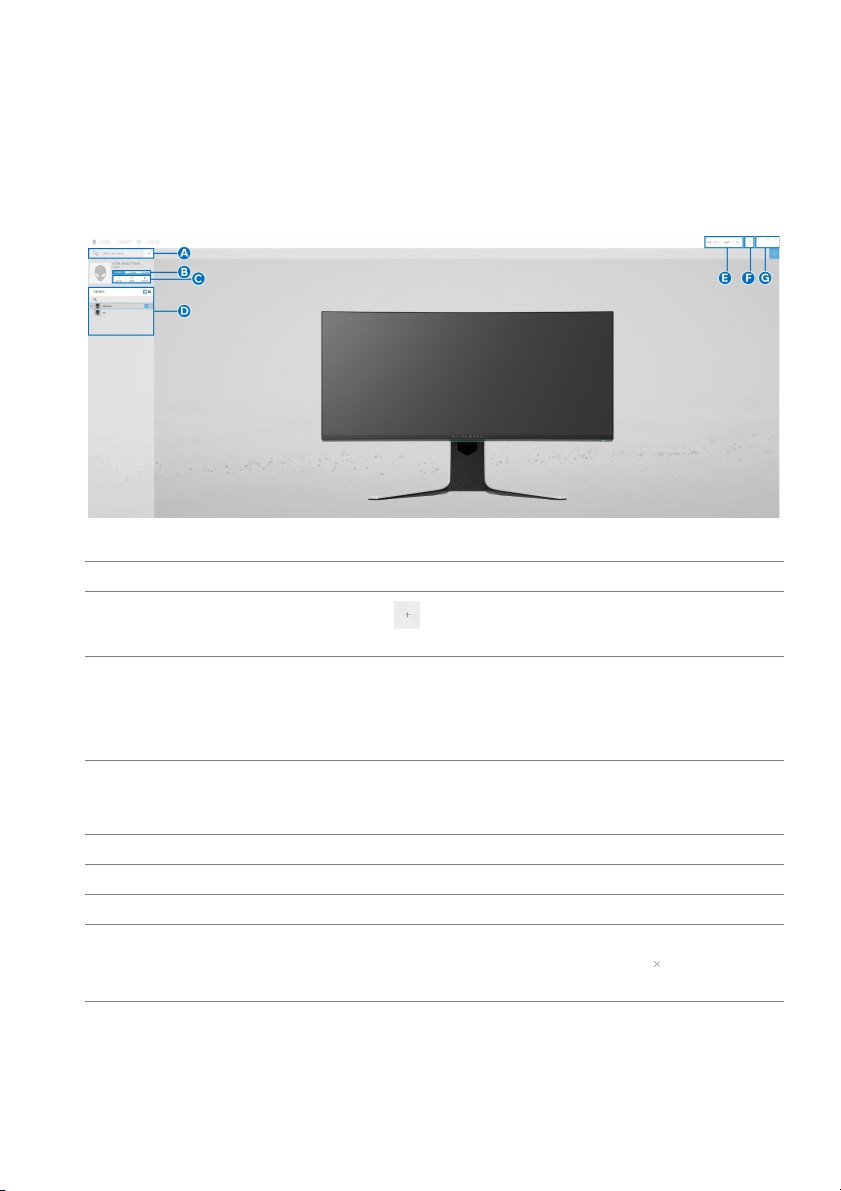
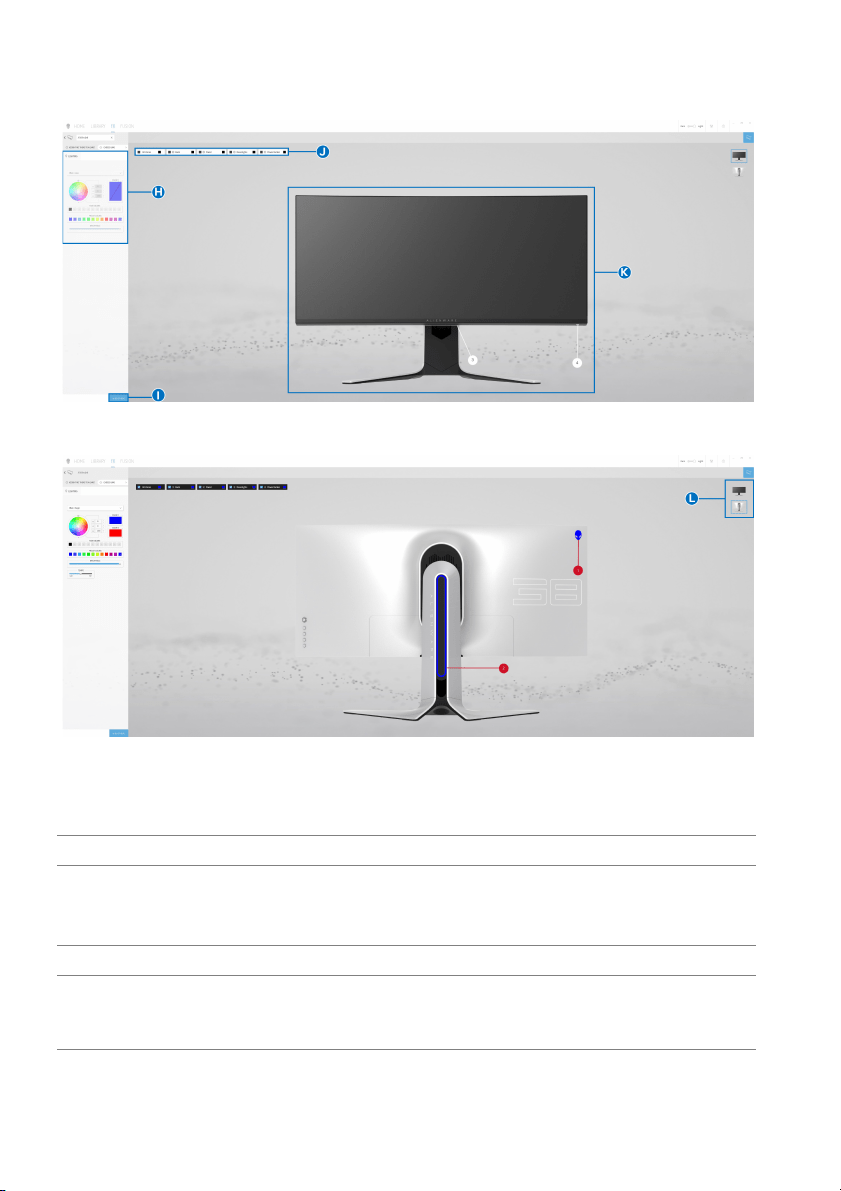
With the Alienware Command Center, AlienFX allows you to control the LED
lighting colors and transition effects for your Alienware monitor.
In the AWCC home screen, click FX
in the top menu bar to access the home
screen of AlienFX.
The following table describes the functions and features on the home screen:
No. Functions Descriptions
A CREATE NEW
THEME...
Click
and then enter a name in the text box to add
a theme.
B Edit controls • EDIT: Provides options for you to customize lighting
settings for your theme.
• GO D
IM: Makes the light dimmer.
• GO DARK: Turns off the light.
C Theme components You can use these components (LI
GHTING,
MACROS, SETTINGS) to make the selected theme as
an active theme.
D THEMES lis
t Displays the themes in list view or grid view.
E Background controls Adjusts the background animation effects.
F Help Click it to access the AWCC Online Help.
G Window controls You can use the buttons to minimize, maximize, or
res
tore the size of the window. When
is selected,
the application will close.
58 | Using AlienFX application
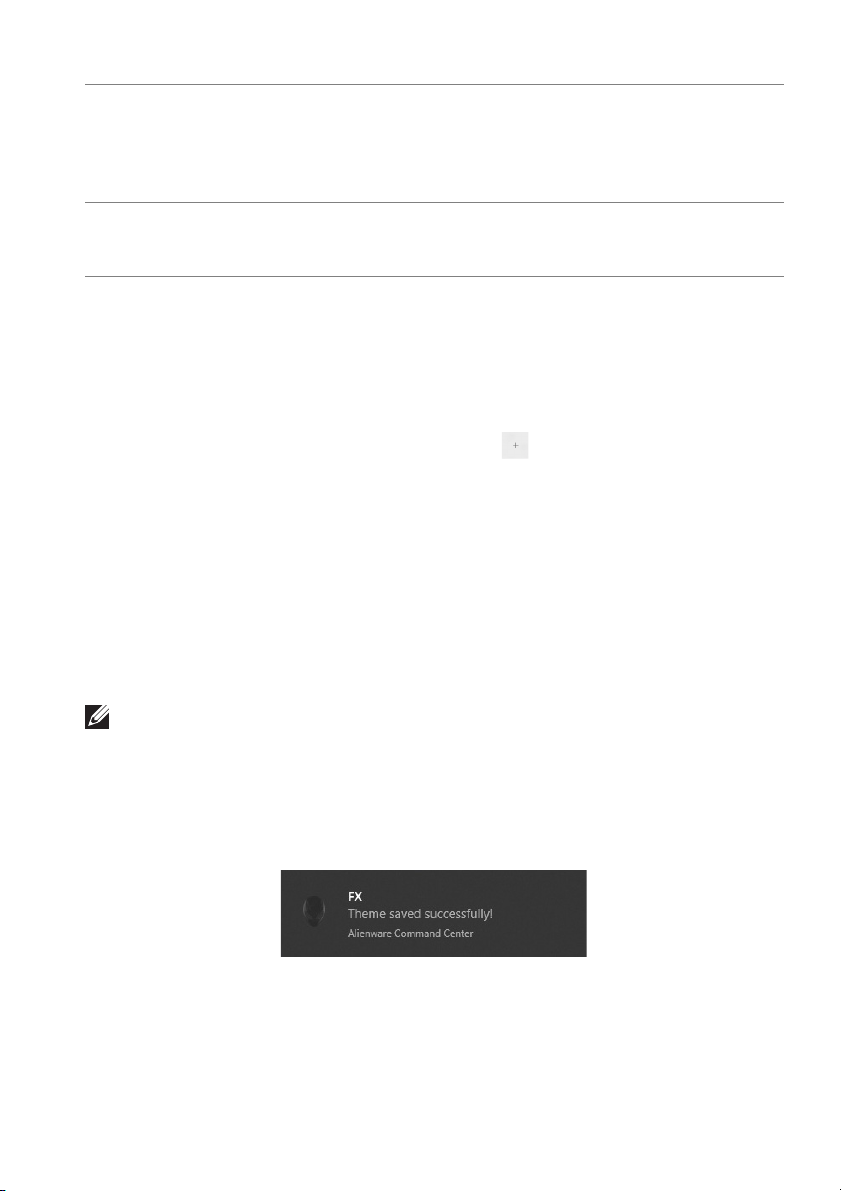
When you start to customize a theme, you should see the following screen:
Screen with the front view of monitor
Screen with the back view of monitor
The following table describes the functi
ons and features on the screen:
No. Functions Descriptions
H LIGHTING panel Use the controls in this panel to set up lighting effects
fo
r a theme.
See Setting lighting effects for details.
I SAVE THEME Click to save all adjustments and changes for the theme.
J Zone selection To make adjustments for a single
zone, click the specific
check box. To make adjustments for all zones, click the
All Zones check box.
Using AlienFX application | 59
Creating a theme
To create a theme with your preferred lighting settings:
1. La
unch AWCC.
2. Cl
ick FX in the top menu bar to access the home screen of AlienFX.
3. In the
top-left corner of the window, click to create a new theme.
4. In the
CREATE NEW THEME text box, type the theme name.
5. Sp
ecify the lighting zone(s) for which you want to make lighting
adjustments by:
• selecting the zone check box(es) above t
he live preview area, or
• clicking the numbered callout on the image of monitor
6. In the LIGHTING panel, select your preferred lighting effects from the
drop-down list, including Morph, Pulse, Color, Spectrum, Breathing, and
Static Default Blue. See Setting lighting effects for details.
NOTE: The Spectrum option is only available when you select All Zones to
make lighting adjustments.
7. Repeat step 5 and step 6 to make more configuration options available to
your preference.
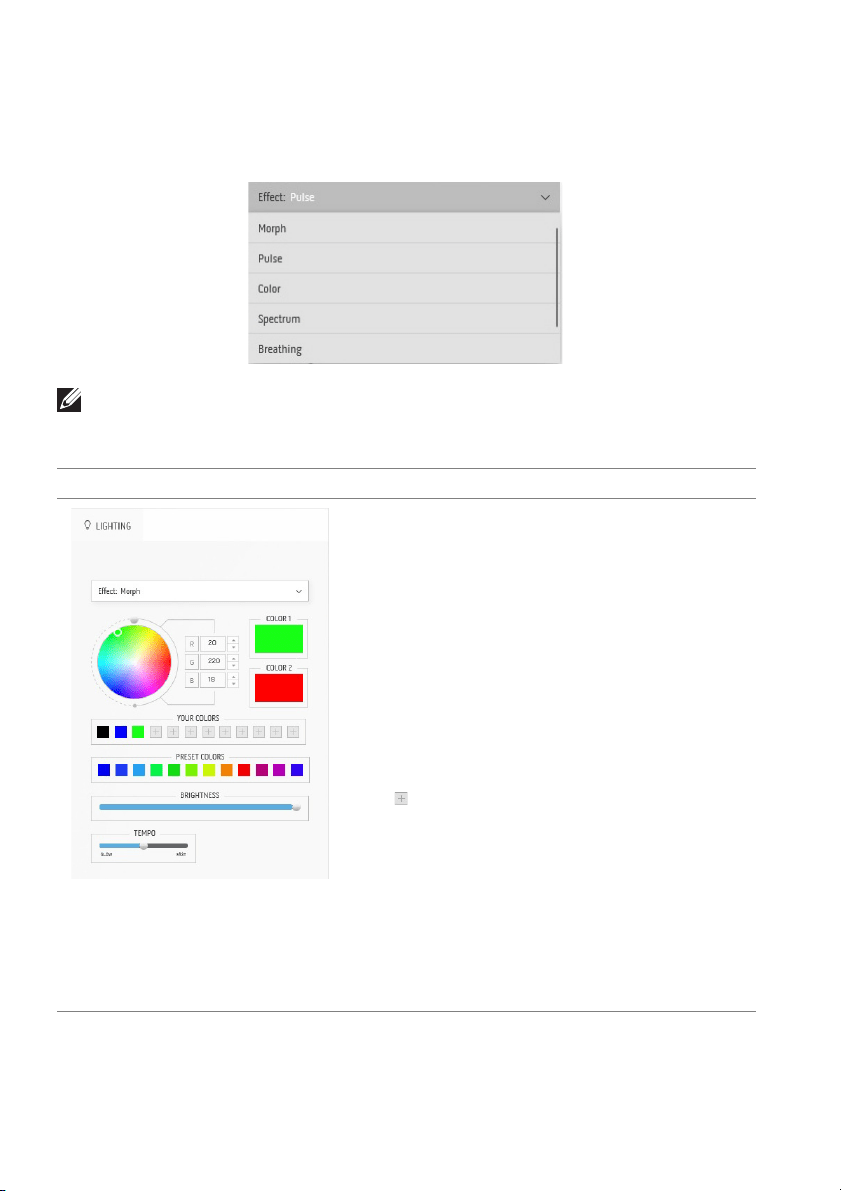
8. Wh
en done, click SAVE THEME. A toast notification appears in the right-
bottom corner of the screen.
K Live preview The lighting zones are with numbered callouts. You may
select a single zone by clicking the number on the
image. When you make lighting adjustments, the
preview of the monitor displays the new effects
simultaneously.
L Thumbnails Displays the thumbnails of the Alienware monitors
co
nnected to your computer. The image displayed in
the live preview area is selected from this thumbnail list.
60 | Using AlienFX application
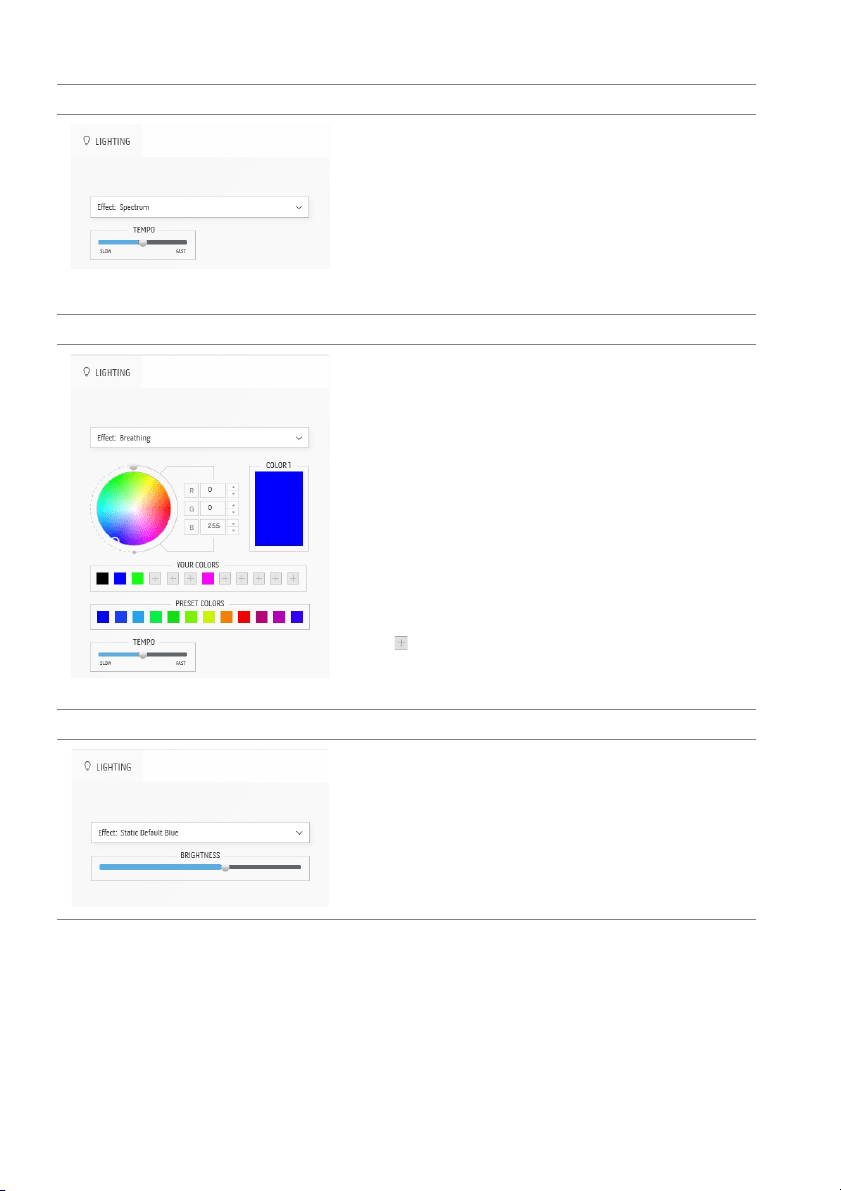
Setting lighting effects
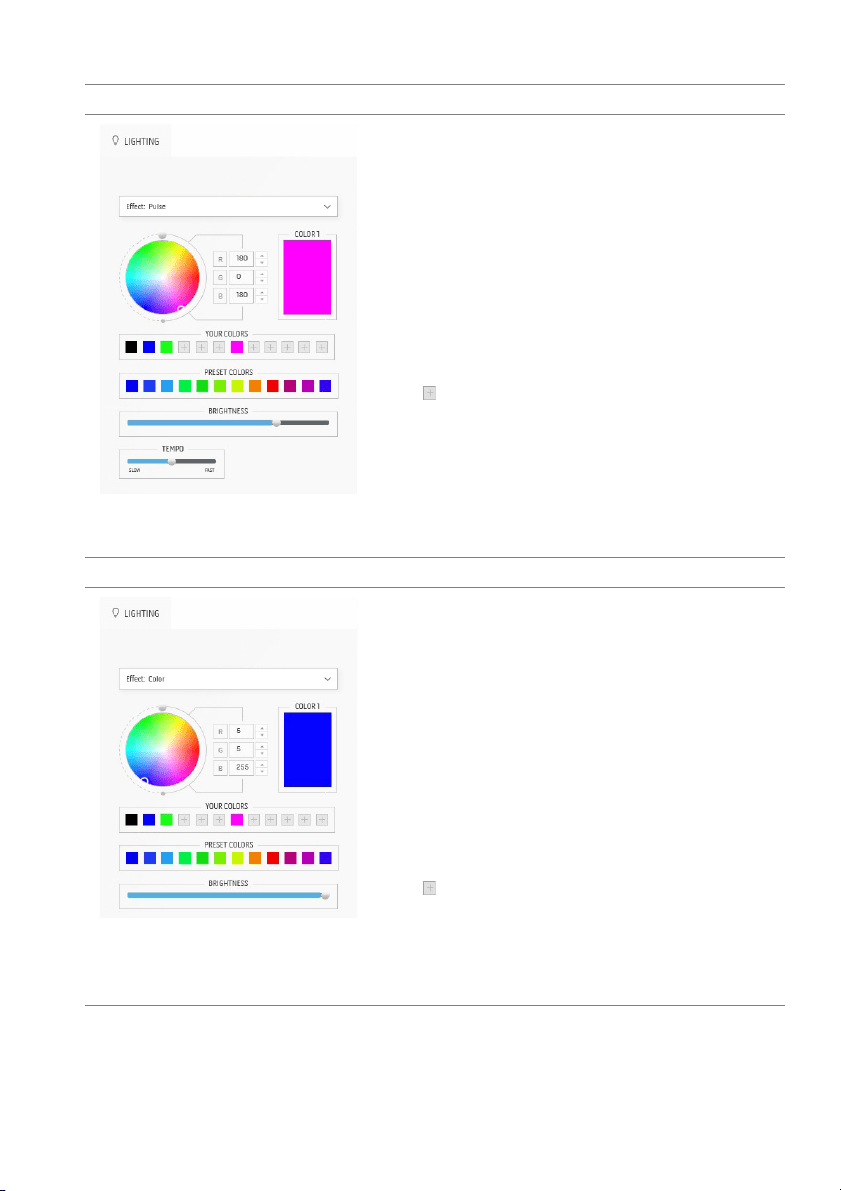
The LIGHTING panel provides various lighting effects. You may click Effect to
open a drop-down menu with available options.
NOTE: The options displayed may vary depending on the lighting zone(s)
you specified.
The following table provides an overview of
different options:
Morph Descriptions
The effect changes the light color into another
through a seamless transition.
To make the adjustments:
1. Pi
ck a preferred color from the color palette
or the list of PRESET COLORS. The selected
color and its RGB color codes will be
displayed on the right field.
NOTE: To change the color, use the up and down
arrow buttons beside the R/G/B boxes to edit the
color codes.
2. To
add the selected color to the list of YOUR
COLORS for quick access in the future, click
. At most 12 colors can be added to the list.
NOTE: To
remove an existing color chip from the
list, right-click on it.
3. Repeat th
e previous steps to specify Color 2
to be the ending light color.
4. Drag the BRIGHTNESS slider to adjust the
lightness of the color.
5. Drag the TEMPO slider to adjust the
transition speed.
Using AlienFX application | 61
Pulse Descriptions
The effect makes the light flash with a short pause.
To make the adjustments:
1. Pick a preferred color from the color palette
or the list of PRESET COLORS. The selected
color and its RGB color codes will be
displayed on the right field.
NOTE: To
change the color, use the up and down
arrow buttons beside the R/G/B boxes to edit the
color codes.
2. To
add the selected color to the list of YOUR
COLORS for quick access in the future, click
. At most 12 colors can be added to the list.
NOTE: T
o remove an existing color chip from the
list, right-click on it.
3. Drag the BRI
GHTNESS slider to adjust the
lightness of the color.
4. Drag the TEMPO slider to adjust the pulsing
speed.
Color Descriptions
The effect makes the LED light in a single static
color.
To make the adjustments:
1. Pick a preferred color from the color palette
or the list of PRESET COLORS. The selected
color and its RGB color codes will be
displayed on the right field.
NOTE: To
change the color, use the up and down
arrow buttons beside the R/G/B boxes to edit the
color codes.
2. To
add the selected color to the list of YOUR
COLORS for quick access in the future, click
. At most 12 colors can be added to the list.
NOTE: T
o remove an existing color chip from the
list, right-click on it.
3. Drag the BRI
GHTNESS slider to adjust the
lightness of the color.
62 | Using AlienFX application
Spectrum Descriptions
The effect makes the light change in sequence of
spectrum: red, orange, yellow, green, blue, indigo,
and violet.
You can drag the TE
MPO slider to adjust the
transition speed.
NOTE: The
option is available only when you select
All Zones to make lighting adjustments.
Breathing Descriptions
The effect makes the light change from bright to
dim.
To make the adjustments:
1. Pi
ck a preferred color from the color palette
or the list of PRESET COLORS. The selected
color and its RGB color codes will be
displayed on the right field.
NOTE: T
o change the color, use the up and down
arrow buttons beside the R/G/B boxes to edit the
color codes.
2. To
add the selected color to the list of YOUR
COLORS for quick access in the future, click
. At most 12 colors can be added to the list.
3. Drag the TEMPO slider to adjust the
transition speed.
Static Default Blue Descriptions
This effect makes the light solid blue.
You can drag the B
RIGHTNESS slider to change
the intensity of the color from strong to light.
NOTE: The
option is available only when you select
All Zones to make lighting adjustments.
Troubleshooting | 63
Troubleshooting
WARNING: Before you begin any of the procedures in this section,
follow the Safety instructions.
Self-test
Your monitor provides a self-test feature that allows you to check whether your
monitor is functioning properly. If your monitor and computer are properly
connected but the monitor screen remains dark, run the monitor self-test by
performing the following steps:
1. Turn off both your
computer and the monitor.
2. D
isconnect the video cable from the back of the computer. To ensure
proper Self-Test operation, disconnect all cables from the computer.
3. T
urn on the monitor.
NOTE: A dialog box with text should appear on the screen, indicating
that the monitor is working correctly and it is not receiving a video signal.
While in self-test mode, the power LED blinks white (default color).
When Eco Mode is On
When Eco Mode is Off
NOTE: This dialog box also appears during normal operation, if the video
cable is disconnected or damaged.
64 | Troubleshooting
4. Turn off your monitor and reconnect the video cable; then turn on both
your computer and the monitor.
After performing the above steps, if the monitor displays no video output, then
the
problem may be with the graphics card or the computer.
Built-in diagnostics
Your monitor has a built-in diagnostic tool that helps you determine if the screen
abnormality you are experiencing is an inherent problem with your monitor, or
with your computer and video card.
NOTE: You can run the built-in diagnostics only when the video cable is
unplugged and the monitor is in self-test mode.
To run the built-in diagnostics:
1. Ens
ure that the screen is clean (no dust particles on the surface of the
screen).
2. Press and
hold Button 3 for five seconds. A gray screen appears after one
second.
3. O
bserve if the screen has any defects or abnormalities.
4. Press B
utton 3 again. The color of the screen changes to red.
5. O
bserve if the screen has any defects or abnormalities.
6. Repeat
steps 4 and 5 to inspect the display in green, blue, black, and white
screens.
The test is complete when the white
screen appears. To exit, press Button 3
again.
If you do not detect any screen abnormalities
upon using the built-in diagnostic
tool, the monitor is functioning properly. Check the video card and computer.

Troubleshooting | 65
Common problems
The following table contains general information about common monitor
problems you might encounter and the possible solutions:
Common
symptoms
What you
experience
Possible solutions
No Video/
Power LED off
No picture • Ensure that the video cable connecting the
monitor and the computer is properly
connected and secure.
• Verify that the power outlet is functioning
properly using any other electrical
equipment.
• Ensure that the power button is depressed
fully.
• Ensure that the correct input source is
selected in the
Input Source menu.
No Video/
Power LED on
No picture or
no brightness
• Increase brightness and contrast controls in
the
Brightness/Contrast menu.
• Perform monitor self-test feature check.
• Check for bent or broken pins in the video
cable connector.
• Run the built-in diagnostics.
• Ensure that the correct input source is
selected in the
Input Source menu.
Poor Focus Picture is
fuzzy, blurry,
or ghosting
• Eliminate video extension cables.
• Reset the monitor to factory settings.
• Change the video resolution to the correct
aspect ratio.
Shaky/Jittery
Video
Wavy picture
or fine
movement
• Reset the monitor to factory settings.
• Check environmental factors.
• Relocate the monitor and test in another
room.

66 | Troubleshooting
Missing Pixels LCD screen
has spots
• Cycle power On-Off.
• Pixel that is permanently off is a natural
defect that can occur in LCD technology.
• For more information on Dell Monitor
Quality and Pixel Policy, see Dell support
site:
www.dell.com/pixelguidelines.
Stuck-on Pixels LCD screen
has bright
spots
• Cycle power On-Off.
• Pixel that is permanently off is a natural
defect that can occur in LCD technology.
• For more information on Dell Monitor
Quality and Pixel Policy, see Dell support
site:
www.dell.com/pixelguidelines.
Brightness
Problems
Picture too dim
or too bright
• Reset the monitor to factory settings.
• Adjust brightness and contrast controls in
the
Brightness/Contrast menu.
Geometric
Distortion
Screen not
centered
correctly
• Reset the monitor to factory settings.
Horizontal/
Vertical Lines
Screen has one
or more lines
• Reset the monitor to factory settings.
• Perform monitor self-test feature check
and determine if these lines are also in self-
test mode.
• Check for bent or broken pins in the video
cable connector.
• Run the built-in diagnostics.
Synchronization
Problems
Screen is
scrambled or
appears torn
• Reset the monitor to factory settings.
• Perform monitor self-test feature check to
determine if the scrambled screen appears
in self-test mode.
• Check for bent or broken pins in the video
cable connector.
• Restart the computer in the safe mode.
Safety Related
Issues
Visible signs of
smoke or
sparks
• Do not perform any troubleshooting steps.
• Contact Dell immediately.

Troubleshooting | 67
Intermittent
Problems
Monitor
malfunctions
on & off
• Ensure that the video cable connecting the
monitor to the computer is connected
properly and is secure.
• Reset the monitor to factory settings.
• Perform monitor self-test feature check to
determine if the intermittent problem
occurs in self-test mode.
Missing Color Picture missing
color
• Perform monitor self-test feature check.
• Ensure that the video cable connecting the
monitor to the computer is connected
properly and is secure.
• Check for bent or broken pins in the video
cable connector.
Wrong Color Picture color
not good
• Change the settings of the Preset Modes
in the Game menu OSD depending on the
application.
•Adjust R/G/B value under Custom Color
in the Game menu OSD.
• Run the built-in diagnostics.
Image retention
from a static
image left on
the monitor for
a long period of
time
Faint shadow
from the static
image
displayed
appears on the
screen
• Set the screen to turn off after a few
minutes of screen idle time. These can be
adjusted in Windows Power Options or
Mac Energy Saver setting.
• Alternatively, use a dynamically changing
screensaver.

68 | Troubleshooting
Product specific problems
Specific symptoms What you
experience
Possible solutions
Screen image is too
small
Image is
centered on
screen, but
does not fill
entire viewing
area
• Reset the monitor to factory settings.
Cannot adjust the
monitor with the
buttons on the rear
panel
OSD does not
appear on the
screen
• Turn off the monitor, unplug the power
cord, plug it back, and then turn on the
monitor.
No Input Signal
when user controls
are pressed
No picture, the
LED light
is
white
• Check the signal source. Ensure the
computer is not in the power saving
mode by moving the mouse or pressing
any key on the keyboard.
• Check whether the signal cable is
plugged in properly. Re-plug the
signal cable if necessary.
• Reset the computer or video player.
The picture does not
fill the entire screen
The picture
cannot fill the
height or width
of the screen
• Due to different video formats (aspect
ratio), the monitor may display in full
screen.
• Run the built-in diagnostics.
The displayed
pictures appear
incorrectly when the
DP/HDMI cable is
connected through
a USB- C adapter
or dock to your
notebook/desktop
Display will
freeze, has
black screen or
display
abnormal
screen
• Do not use a USB-C adapter or dock.
Connect the DP/HDMI cable directly
to your notebook/desktop.

Troubleshooting | 69
Screen flickering There are some
noticeable
flickering in
the displayed
pictures
• Use the native resolution of your
monitor (3840 x 1600 at 60 Hz) or
higher refresh rate.
• If the variable refresh rate (VRR) of
your device is turned on, turn off
variable refresh rate (VRR).
• If you are using an Nvidia graphics
card and G-Sync is turned on, turn off
G-Sync.
• If you are using an AMD graphics card
and Free-Sync is turned on, turn off
Free-Sync.
• Update the graphics card driver and
firmware to the latest version.
• Change the cable connecting the
monitor to the system. A defective
cable can cause the signal to break
while being transmitted across the
wire.
• Check the surroundings.
Electromagnetic fields can cause
screen flickering. If there is another
device plugged into the same power
strip as the monitor, try to remove it.

70 | Troubleshooting
Universal Serial Bus (USB) specific problems
Specific
symptoms
What you
experience
Possible solutions
USB interface
is not working
USB
peripherals are
not working
• Check that your monitor is turned on.
• Reconnect the upstream cable to your
computer.
• Reconnect the USB peripherals
(downstream connector).
• Switch off and then turn on the monitor
aga
in.
• Reboot the computer.
• Some USB devices like external portable
HDD requ
ire higher electric current;
connect the device directly to the computer
system.
SuperSpeed
USB 5 Gbps
(US
B 3.2
Gen1)
interface is
slow
SuperSpeed
USB 5
Gbps
(USB 3.2
Gen1)
peripherals
working slowly
or not working
at all
• Check that your computer is SuperSpeed
USB 5 Gbps
(USB 3.2 Gen1)-compatible.
• Some computers have USB 3.2, USB 2.0,
and USB 1.
1 ports. Ensure that the correct
USB port is used.
• Reconnect the upstream cable to your
computer.
• Reconnect the USB peripherals
(downstream connector).
• Reboot the computer.
Wireless USB
perip
herals
stop working
when a USB
3.2 device is
plugged in
Wireless USB
perip
herals
responding
slowly or only
working as the
distance
between itself
and its receiver
decreases
• Increase the distance between the USB 3.2
peripheral
s and the wireless USB receiver.
• Position your wireless USB receiver as close
as poss
ible to the wireless USB peripherals.
• Use a USB-extender cable to position the
wi
reless USB receiver as far away as possible
from the USB 3.2 port.

Appendix | 71
Appendix
WARNING: Safety instructions
WARNING: Use of controls, adjustments, or procedures other than those
specified in this documentation may result in exposure to shock, electrical
hazards, and/or mechanical hazards.
For information on safety instructions, see the Safety, Environmental, and
Regulatory Information (SERI).
FCC notices (U.S. only) and other regulatory information
For FCC notices and other regulatory information, see the regulatory
compliance website located at
www.dell.com/regulatory_compliance.
Contact Dell
For customers in the United States, call 800-WWW-DELL (800-999-3355).
NOTE: If you do not have an active Internet connection, you can find
contact information on your purchase invoice, packing slip, bill, or Dell
product catalog.
Dell provides several online and telephone-based support and service
options. Availability varies by country and product, and some services may
not be available in your area.
• Online technical assistance: www.dell.com/support/monitors
• Contacting Dell: www.dell.com/contactdell
EU product database for energy label and product information
sheet
AW3821DW: https://eprel.ec.europa.eu/qr/352735