User Manual for Electric Water Heater
GENERAL OPERATING INSTRUCTIONS
Operating your new tankless water heater is similar to using any traditional water heating system. However, it is very important that you carefully read all of the setup procedures and operating instructions and tips to ensure the maximum performance and energy savings from your new water heater. We recommend that all members of the household read these General Operating Instructions.
How your new water heater works:
This tankless water heater differs from a conventional storage water heater as it does not store hot water, but heats water as it flows through the heater.
The temperature of the hot water delivered by the heater depends on the wattage of the heating element, temperature of the incoming cold water and the water flow rate through the water heater.
It is important to keep in mind that all tankless water heaters are subject to a maximum flow rate. The heater will not be capable of heating water to desired temperature if the flow rate exceeds heaters capability. In order for the heater to operate properly, it must be carefully matched to its application and aerators should be used to limit water flow. See the Table I to determine the maximum flow rates and temperature rise for each model.
CAUTION Outlet water temperature may be higher when using the tankless heater at low flow rates or when used with high inlet water temperature.
Water Quality: Quality of water should be taken into consideration when installing and maintaining the water heater. Water conditions outside the recommended levels outlined below are not permitted and can damage the water heater. Manufacture reserves the right to deny any warranty claim regarding damage suffered due to use in water conditions not in accordance with the table below.
If water heater is installed in an area that is known to have hard water that cause scale build-up, the water must be treated and/or the heater exchanger flushed regularly to prevent damage to heat exchanger and/or heating elements.
A water treatment device or water softener should be installed to maintain optimal performance of the water heater in hard water areas. Contact customer service for additional information on these accessory kits.
MAINTENANCE
To ensure maximum performance of your water heater and to reduce the risk of a water leak, we recommend the following maintenance:
Inspect the connections on the inlet and outlet of the water heater at least on an annual basis for any signs of damage or failure. Any signs of damage, cracks, leakage or weakness should be addressed. Take care not to over tighten the connections. Serious internal damage to your water heater can occur if you over tighten the water heater connections at the unit.
IMPORTANT NOTES:
DANGER As with all electrical appliances, under no circumstances should you attempt to install, repair or disassemble this water heater without first shutting off all power to the unit directly at the fuse or circuit breaker. SERIOUS BODILY INJURY OR DEATH COULD OCCUR IF YOU IGNORE THIS WARNING.
When any maintenance is performed on the water heater or the home’s plumbing system that may introduce air into the plumbing pipes, it is important to turn the power off to the water heater and purge the air out of the lines before allowing the unit to power up. FAILURE TO DO SO COULD CAUSE PERMANENT DAMAGE TO THE HEATING ELEMENT AND VOID YOUR WARRANTY.
If you have a water supply with a high level of mineralization (hard water), you should increase the frequency of your maintenance.
USER INTERFACE
Power
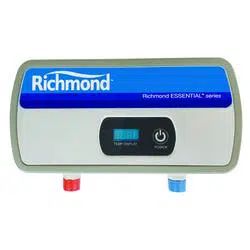
- Push the power button, the display will turn on
- Push the power button again, the display will turn off
DANGER Hotter water increases the potential for Hot Water SCALDS
CAUTION – removing the cover to change the temperature set point exposes electrical shock and burn hazards, which can cause INJURY or DEATH. Adjustment should only be done by a licensed plumber or electrician.
MOUNTING YOUR WATER HEATER
Your tankless water heater should be secured to the mounting surface with 4 screws (minimum 1” (25.4mm) long) follow the installation template for heaters. Make sure that the mounting surface is solid and secure, and ensure that the unit is level prior to securing the screws. For ease of installation and servicing, we recommend that this product be installed in an upright position with the inlet and outlet water connections at the bottom of the unit.
Recommended Clearances:
- 6” (304.8mm) above and below the heater
- 6” (152.4mm) in front of and to the sides of the heater
Flammable materials should be kept at least 24” (609.6mm) away from your water heater and the hot water outlet pipe.
PLUMBING INSTALLATION
Please follow all plumbing instructions carefully. We recommend that this product be installed by a licensed and qualified plumber in accordance with all applicable national, state, provincial, and local plumbing codes.
Installation Instructions
This water heater is supplied with ½” NPT fittings, DO NOT weld or use paste.
- STEP 1: Thoroughly flush cold supply line of debris and connect the HOT WATER line to the water heater OUTLET located on the left side of the heater when facing unit. Connect the COLD WATER line to the water heater marked COLD WATER INLET on the right side when facing unit.
- STEP 2: After tightening both fittings at the water heater, open several hot water faucets and allow water to run though the water heater for at least 2 to 3 minutes. This process purges all the air from the water lines and MUST be performed prior to turning on the power at the unit. FAILURE TO FOLLOW THIS STEP CAN CAUSE PERMANENT DAMAGE TO THE HEATING ELEMENTS. If any maintenance is performed on the water heater or the home’s plumbing system that may introduce air into the plumbing pipes, it is important to turn the power off to the water heater and purge the air out of the lines before allowing the unit to power up.
- STEP 3: Carefully inspect all connections, unions, and the pressure relief valve (if installed) for leaks.
IMPORTANT NOTES:
- 1. Do not solder any pipes with the unit connected to pipes – heat from soldering may damage the flow sensor. Doing so will void the warranty.
- 2. This automatic tankless water heater is equipped with both computer-controlled and electromechanical auto resetting thermostat switches for high-limited temperature protection. Since this product does not use a storage tank, the use of a temperature pressure relief valve (T&P) is not required for most installations. UL Standard 499 does NOT require that a pressure relief valve be used. However, a T&P valve may be required to meet installation codes in your area. If one is required, install the pressure relief valve in accordance with local codes and ensure that it operates correctly and that air is purged from the valve prior to installing the water heater. When connecting to Flex or High Temperature CPVC pipe, we recommend that a T&P valve be used for added safety. Please note: Installations in the Commonwealth of Massachusetts and State of Kentucky require a pressure relief valve. Please check your local installation codes for any special requirements.
- 3. The maximum operating water pressure is 150 PSI (1035 kPa). If the water pressure is higher, a pressure reducing valve must be installed on the main incoming water supply line prior to installing the electric tankless water heater.
- 4. Flexible water heater hoses are recommended to be used with your water heater as part of the installation. When connecting the inlet water pipe to the unit, make sure to use a wrench to hold the unit’s connection, and another wrench to tighten, so that the flow sensor on the unit will not be loosened or damaged. Serious internal damage to the water heater can occur if the inlet or outlet connections are over tightened or if solder connections were made.
- 5. We recommend that a manual shut-off valve (ball valve) is installed on the inlet and outlet of the water heater so that there is a convenient shut-off point available in the event that future maintenance or servicing is required. It is extremely important to flush the lines to eliminate all plumbing paste or residue in the lines caused by any welding or soldering before connecting pipes to the water heater.
We recommend that all the water pipes or hoses within 3’ (1m) of the inlet and outlet connections be rated for high temperature applications with a 150°F (66°C) minimum.
WARNING CHECK FOR LEAKS BEFORE PROCEEDING TO ELECTRICAL INSTALLATION
Installation Instructions
- STEP 1: Take each wire pair and connect them to one breaker (see wiring diagram). Make sure that each breaker is connected with one black wire and one red wire
- STEP 2: Using a suitable wire gauge that meets all applicable electrical codes for the size of the breakers used, run the correct sets of wire from the home’s main breaker panel to the tankless water heater.
- STEP 3: A separate ground conductor for each incoming circuit is required.
- STEP 4: DOUBLE CHECK the electrical connections to make sure they are correct and that all wire connections are tight and secure. Also confirm that the correct breaker size and wire gauge has been used and confirm that the unit has been connected to a ground in accordance with applicable codes.
- STEP 5: Confirm that all the air has been purged from the water lines prior to turning on power to the unit. Refer to STEP 2 in the plumbing installation section.
CAUTION Ensure that you have made the correct connections. You must follow the wire connection as shown to ensure proper operation of the unit. If you mix up one set of wires with another, the unit will not operate correctly even though it turns on and otherwise appears to function properly. The water heater is now installed and ready to use! Follow the General Operating Instructions to complete the setup. We highly recommend that this is done with the homeowner present.
TROUBLE SHOOTING GUIDE
Are you having problems with your water heater? Please call or email our customer service and technical support team for any help you may need. TOLL FREE 1-(800) 374-8806
The following table represents some of the most common technical support questions we receive. Before calling us, please read thoroughly to see if your question or problem is addressed.
|
PROBLEM
|
POSSIBLE CAUSE
|
SOLUTION
|
| Water heater is not heating at all (water is flowing but the unit is not heating - the outgoing water temperature is the same as the cold water supply) - the digital display does NOT light up. |
No power or incorrect wiring. |
Make sure the breakers at main electrical panel are ON. You may have a faulty breaker or unit may be wired incorrectly. |
| Flow rate is too low / water pressure is too low. |
Your water heater has an activation flow rate of approximately 0.3 GPM (1.1 LPM). If your water flow rate is less than this level, your unit will not activate. Increase the flow rate. |
| Water heater is not heating at all (water is flowing but the unit is not heating - the outgoing water temperature is the same as the cold water supply) The digital display DOES light up. |
Internal part failure. |
Please call us for technical assistance. |
| Water heater is heating, but the water temperature is not hot enough. |
Flow rate is too high. |
Depending on your incoming water temperature and the kW of your heater, your water flow rate may exceed the physical heating capacity of your water heater. Reduce the flow rate by installing an aerator |
| Crossed wires. |
If it’s a new installation, have your electrician double check the wiring. Is possible that the wiring is incorrect. |
| Voltage less than 120 or 240 volts. |
The heating elements on your water heater are design for 120 or 240 volts. When used with a lower voltage, they produce less heating power. You may need to upgrade to a larger input heater. |
| Mixing too much cold water. |
You do not need to mix as much cold water with your tankless water heater compared to when you use a conventional water heater. You may also have an anti-scald feature on your faucet that is mixing cold water. These types of faucets can usually be adjusted to reduce the amount of cold water mixed. |
| Voltage less than 120 or 240 volts. |
The computer chips in your tankless water heater are programmed with the expectation that your incoming line voltage is 120 or 240 volts. If you have less than 120 or 240 volts, it may affect the reading on your water heater’s digital display and cause it to read slightly higher than the actual output temperature. To compensate for this, increase the setting on your water heater if you need / want hotter water. |
| The water temperature at the faucet is less or greater than the temperature setting of my water heater. |
Anti-Scald pressure/balancing valve or tempering valve. |
Your faucet may have an anti-scald feature or a tempering valve that automatically mixes cold water even when you turn your control lever or handle to full hot. These devices are usually adjustable so you can turn off the cold mix completely. You can compensate for this by increasing the setting on your water heater if you need/want hotter water. |
| Thermal loss due to long pipe run |
As the hot water from the heater runs through the hot water delivery system to your faucet, some heat will be lost especially if it has long distance to travel or the pipes are cold. This is normal. You can compensate for this by increasing the setting on your water heater if you need/want hotter water. |
| Water temperature at the faucet is too hot |
Check your flow for too little flow, wrong aerator size, or internal part failure. Call us for technical assistance. |
USER INTERFACE
Power
- Push the power button, the display will turn on
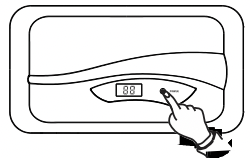
- Push the power button again, the display will turn off
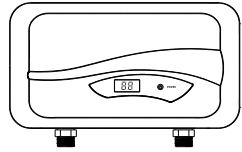
DANGER Hotter water increases the potential for Hot Water SCALDS
CAUTION – removing the cover to change the temperature set point exposes electrical shock and burn hazards, which can cause INJURY or DEATH. Adjustment should only be done by a licensed plumber or electrician.
Heater input: 3.5 kW -6.0kW
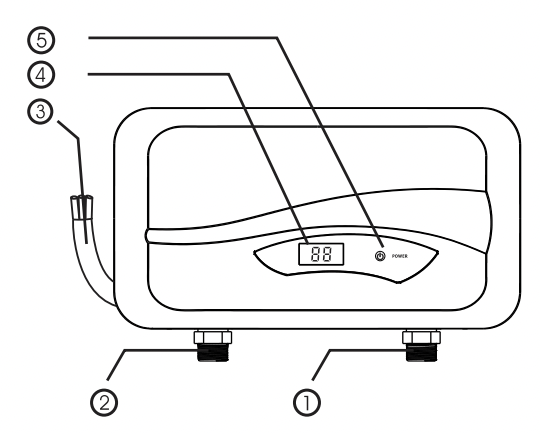
- Cold water inlet
- Hot water inlet
- 10 AWG Wire
- Outlet Temp. Display
- Power Button