®
_ _1_o1
_ Appliances
ELECTRIC AND
GASDRYERS
For questions about features, operation/performance, parts
accessories or service call 1-800-253-t301
In Canada, for assistance, call: 1-800-462-5681
for installation and service, calF: 1-800-807-6777
or visitour website at...www.whirlpooLcom or
wwwowhirlpool corn/canada
S]_CHEUSES
]_LECTRIQUESET
hGAZ
Guided'utilisation
et d entretlen
Pour assistance, composer le 1-800-461-5681,
pour installationou servicele 1-800-807-6777
ou visitez notresite web &www.whirlpool.com/canada
Tableof Contents/Tabledes mati_res..........................................2
8314832 --
TABLEOF
CONTENTS
DRYER SAFETY .................................................................. 3
PARTS AND FEATURES .................................................... 5
CHECKING YOUR VENT .................................................... 6
USING YOUR DRYER ......................................................... 7
Starting Your Dryer .......................................................... 7
Stopping and Restarting .................................................. 8
Loading Clothes ............................................................... 8
Drying, Cycle and Temperature Tips .............................. 8
Cycle Descriptions ........................................................... 8
Additional Features .......................................................... 9
CARING FOR YOUR DRYER ........................................... 11
Cleaning the Lint Screen ............................................... 11
Cleaning the Dryer Interior ............................................ 11
Removing Accumulated Lint from
Inside the Dryer Cabinet ................................................ 11
Changing the Drum Light .............................................. 12
TROUBLESHOOTING ....................................................... 12
ASSISTANCE OR SERVICE ............................................. 14
WARRANTY ....................................................................... 15
TABLEDES
MATURES
SECURITE DE LA SIeCHEUSE ........................................ 17
PIECES ET CARACTt_RISTIQUES .................................. 1_
VIeRIFICATION DU CONDUIT D'IeVACUATION ............. 2(
UTILISATION DE LA SIeCHEUSE .................................... 21
Mise en marche de la s_cheuse ................................... 21
Arr_t et remise en marche ............................................. 2",
Chargement des v_tements .......................................... 2;
Conseils pour s_chage, programme et temperature .. 2;
Description des programmes ........................................ 2"
Caract_dstiques suppl_rnentaires ................................ 2L
ENTRETIEN DE LA SECHEUSE ...................................... 2(
Nettoyage du filtre & charpie ......................................... 2(
Nettoyage de I'int_deur de la s_cheuse ....................... 2(
Comment enlever la charpie accumul_e de
I'int6deur de la sL=cheuse............................................... 2;
Changement de I'ampoule d'L_clairagedu tambour.... 2,
DlePANNAGE ..................................................................... 2_
ASSISTANCE OU SERVICE ............................................. 3(
GARANTIE ......................................................................... 3"
2
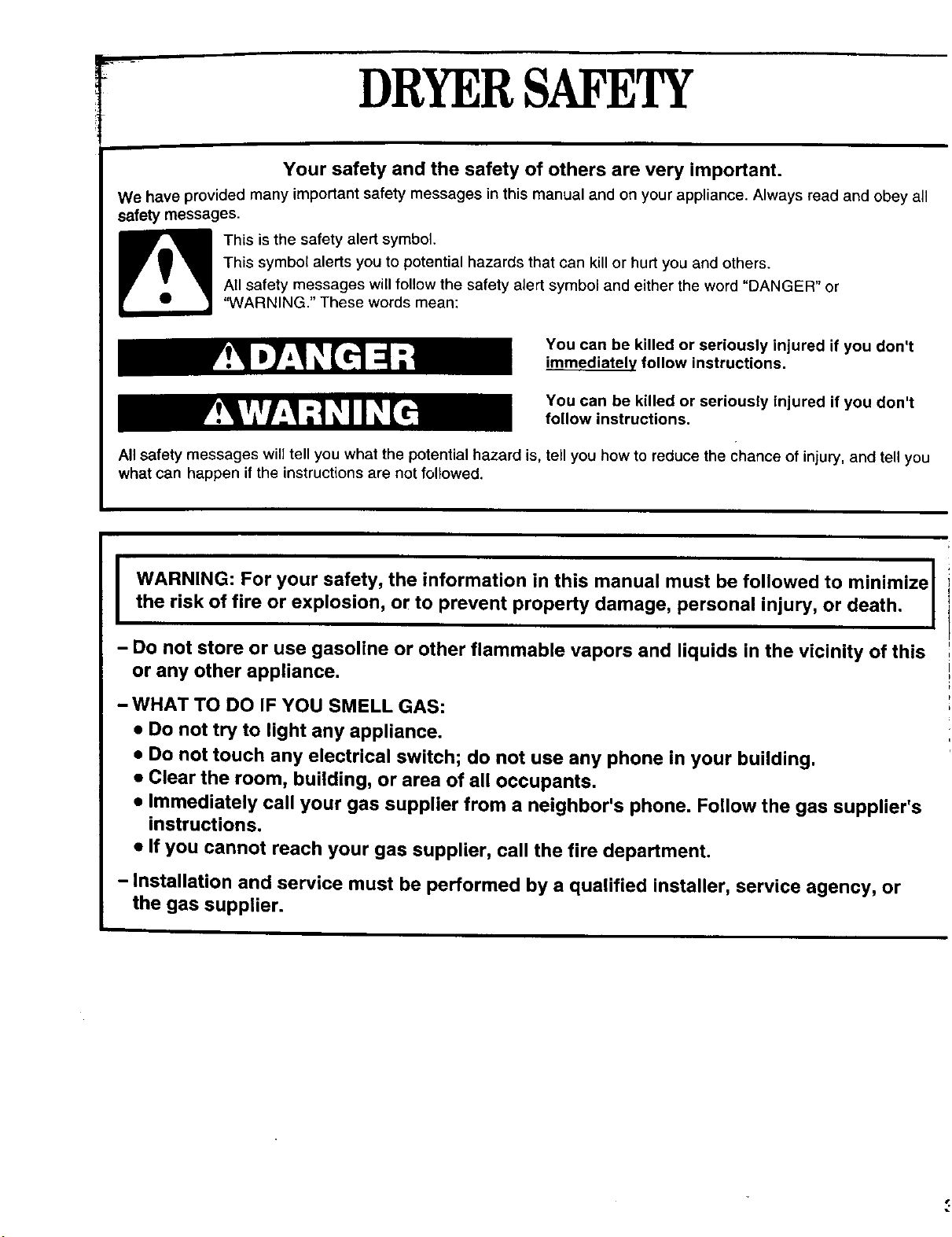
DRYERSAFETY
Your safety and the safety of others are very important.
We have provided many important safety messages in this manual and on your appliance. Always read and obey all
safety messages.
This is the safety alert symbol.
This symbol alerts you to potential hazards that can kill or hurt you and others.
All safety messages will follow the safety alert symbol and either the word "DANGER" or
"WARNING." These words mean:
You can be killed or seriously injured if you don't
immediately follow instructions.
You can be killed or seriously injured if you don't
follow instructions.
All safety messages will tell you what the potential hazard is, tell you how to reduce the chance of injury, and tell you
what can happen if the instructions are not followed.
I WARNING: For your safety, the information in this manual must be followed to minimizel
I
the risk of fire or explosion, or to prevent property damage, personal injury, or death. '1
m
- Do not store or use gasoline or other flammable vapors and liquids in the vicinity of this
or any other appliance.
- WHAT TO DO IF YOU SMELL GAS:
• Do not try to light any appliance.
• Do not touch any electrical switch; do not use any phone in your building.
• Clear the room, building, or area of all occupants.
• Immediately call your gas supplier from a neighbor's phone. Follow the gas supplier's
instructions.
• If you cannot reach your gas supplier, call the fire department.
- Installation and service must be performed by a qualified installer, service agency, or
the gas supplier.
IMPORTANT SAFETY INSTRUCTIONS
WARNING: To reduce the risk of fire, electric shock, or injuryto persons when using the dryer, follow basic
precautions, including the following:
• Read all instructions before using the dryer.
• Do not place items exposed to cooking oils in
your dryer: Items contaminated with cooking oils
may contribute to a chemical reaction that could
cause a load to catch fire.
• Do not dry articles that have been previously
cleaned in, washed in, soaked in, or spotted with
gasoline, dry-cleaning solvents, other flammable,
or explosive substances as they give off vapors
that could ignite or explode.
• Do not allow children to play on or in the dryer.
Close supervision of children is necessary when
the dryer is used near children.
• Before the dryer is removed from service or dis-
carded, remove the door to the drying compart-
ment.
• Do not reach into the dryer if the drum is moving.
• Do not install or store the dryer where it will be
exposed to the weather.
• Do not tamper with controls.
• Do not repair or replace any part of the dryer or
attempt any servicing unless specifically recom-
mended in this Use and Care Guide or in published
user-repair instructions that you understand and have
the skills to carry out.
• Do not use fabric softeners or products to eliminate
static unless recommended by the manufacturer of
the fabric softener or product.
• Do not use heat to dry articles containing foam rubber
or similarly textured rubber-like materials.
• Clean lint screen before or after each load.
• Keep area around the exhaust opening and adjacent
surrounding areas free from the accumulation of lint,
dust, and dirt.
• The interior of the dryer and exhaust ventshould be
cleaned periodically by qualified service personnel.
• See Installation instructions for grounding require-
ments.
SAVETHESEINSTRUCTIONS
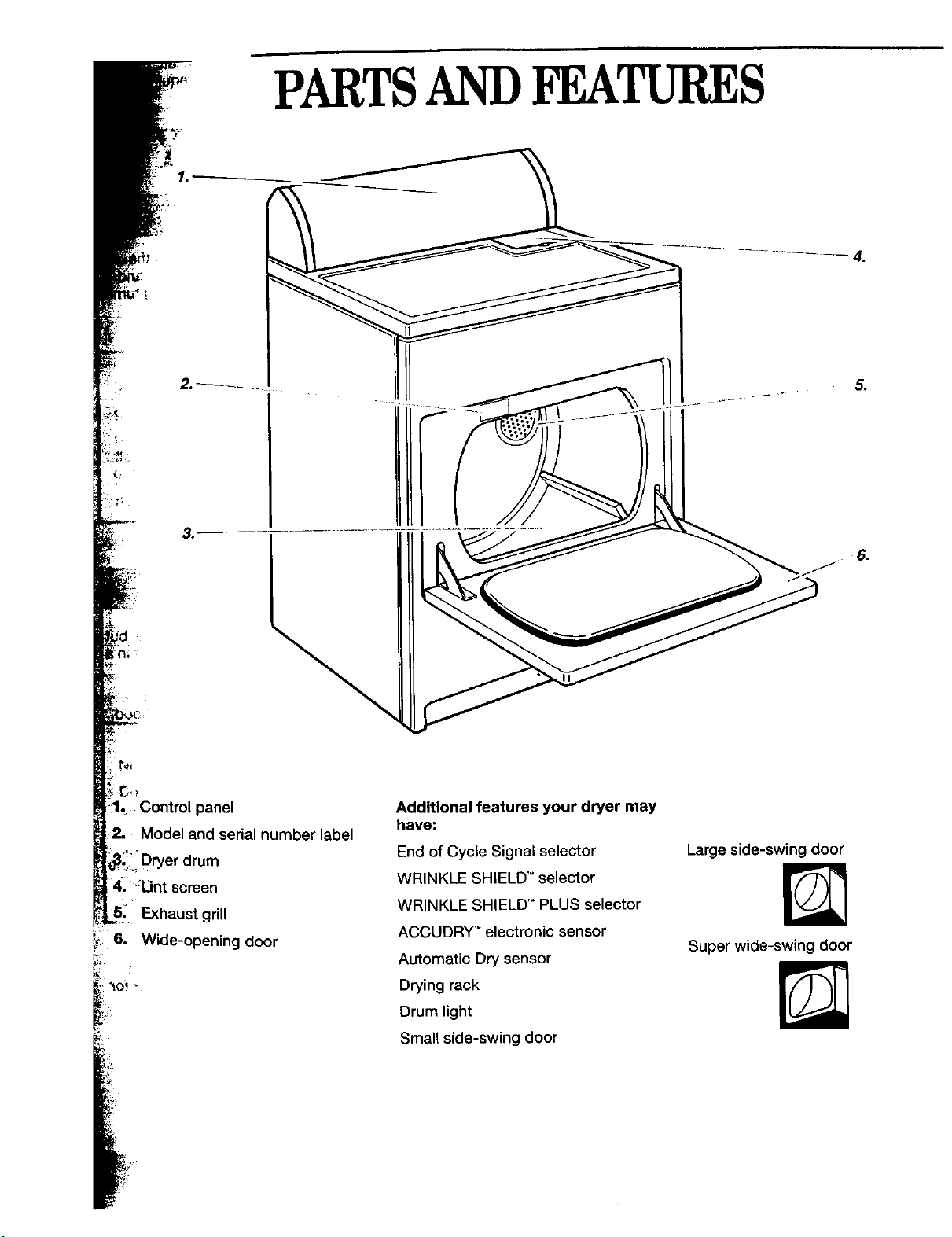
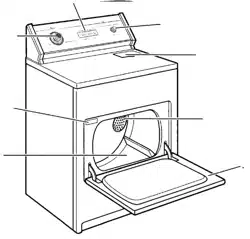
PARTSANDFEATURES
................ -- --4.
5.
3.
:%.; Control panel
Model and serial number label
_ Dryer drum
4. ,_lint screen
5r_il Exhaust grill
6. Wide-opening door
Additional features your dryer may
have:
End of Cycle Signal selector
WRINKLE SHIELD" selector
WRINKLE SHIELD" PLUS selector
ACCUDRY" electronic sensor
Automatic Dry sensor
Drying rack
Drum light
Small side-swing door
-6.
Large side-swing door
Super wide-swing door
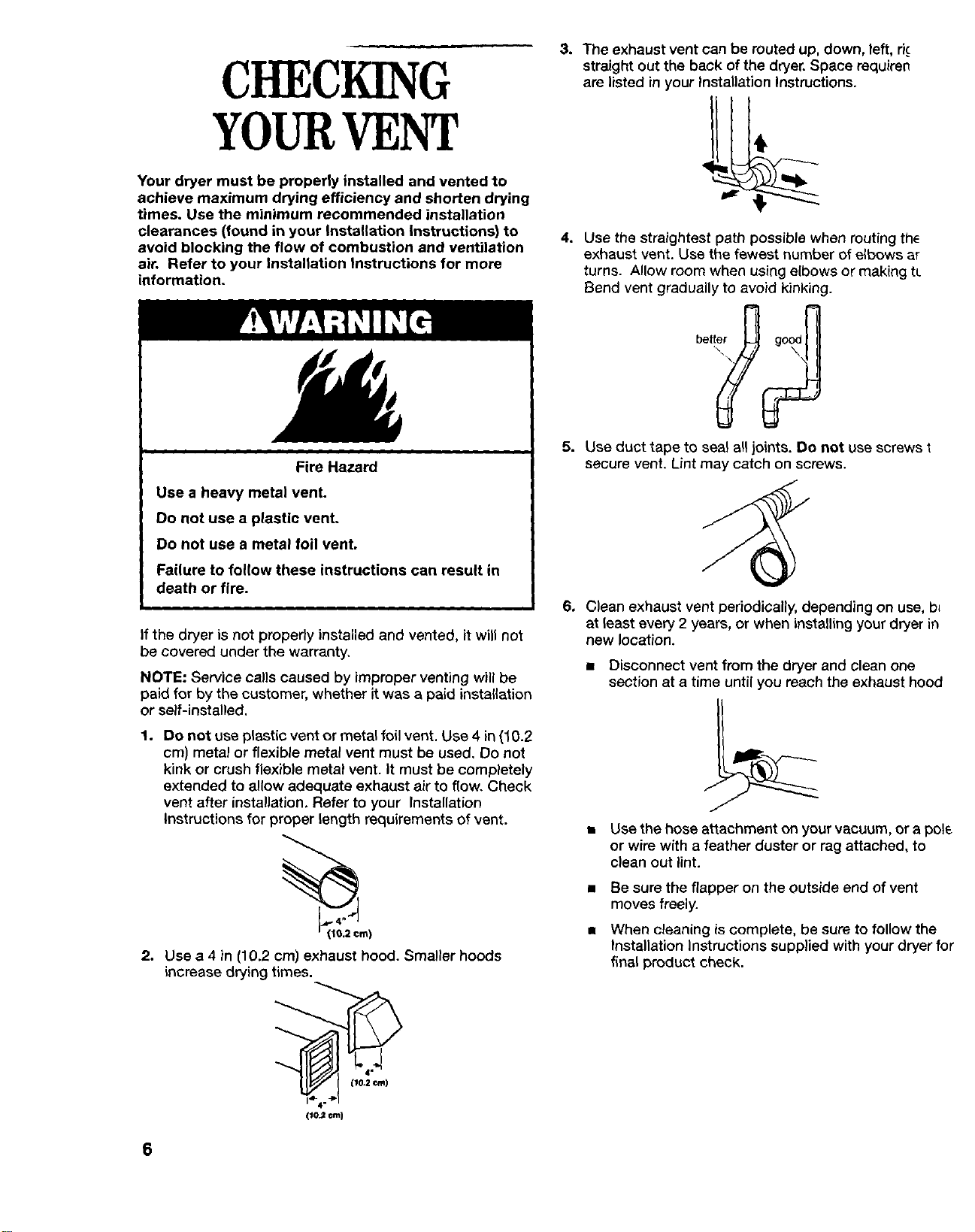
CHECKING
YOURVENT
Your dryer must be properly installed and vented to
achieve maximum drying efficiency and shorten drying
times. Use the minimum recommended installation
clearances (found in your Installation Instructions) to
avoid blocking the flow of combustion and ventilation
air. Refer to your installation Instructions for more
information.
Fire Hazard
Use a heavy metal vent.
Do not use a plastic vent.
Do not use a metal foil vent.
Failure to follow these instructions can result in
death or fire.
If the dryer is not properly installed and vented, it will not
be covered under the warranty.
NOTE: Service calls caused by improper venting will be
paid for by the customer, whether it was a paid installation
or self-installed.
1. Do not use plastic vent or metal foil vent. Use 4 in(10.2
cm) metal or flexible metal vent must be used. Do not
kink or crush flexible metal vent. It must be completely
extended to allow adequate exhaust air to flow. Check
vent after installation. Refer to your Installation
instructions for proper length requirements of vent.
2. Use a 4 in (10.2 cm) exhaust hood. Smaller hoods
increase drying times.
(10.2 cm)
3. The exhaust vent can be routed up, down, left, ri(
straight out the back of the dryer. Space requiren
are listed in your Installation Instructions.
4. Use the straightest path possible when routing th_
exhaust vent. Use the fewest number of elbows ar
turns. Allow room when using elbows or making tL
Bend vent gradually to avoid kinking.
UJ
5. Use duct tape to seal ell joints. Do not use screws t
secure vent. Lint may catch on screws.
6, Clean exhaust vent periodically, depending on use, b_
at least every 2 years, or when installing your dryer in
new location.
• Disconnect vent from the dryer and clean one
section at a time until you reach the exhaust hood
• Use the hose attachment on your vacuum, or a pol_
or wire with a feather duster or rag attached, to
clean out lint.
a Be sure the flapper on the outside end of vent
moves freely.
When cleaning iscomplete, be sure to follow the
installation Instructions supplied with your dryer for
final product check.
6
USING
YOURDRYER
Explosion Hazard
Keep flammable materials and vapors, such as
gasoline, away from dryer.
Do not dry anything that has ever had anything
flammable on it (even after washing).
Failure to follow these instructions can result in
death, explosion, or fire.
Fire Hazard
No washer can completely remove oil.
Do not dry anything that has ever had any type of
oil on it (including cooking oils).
Items containing foam, rubber, or plastic must be
dried on a clothesline or by using an Air Cycle.
Failure to follow these instructions can result in
death or fire.
StartingYourDryer
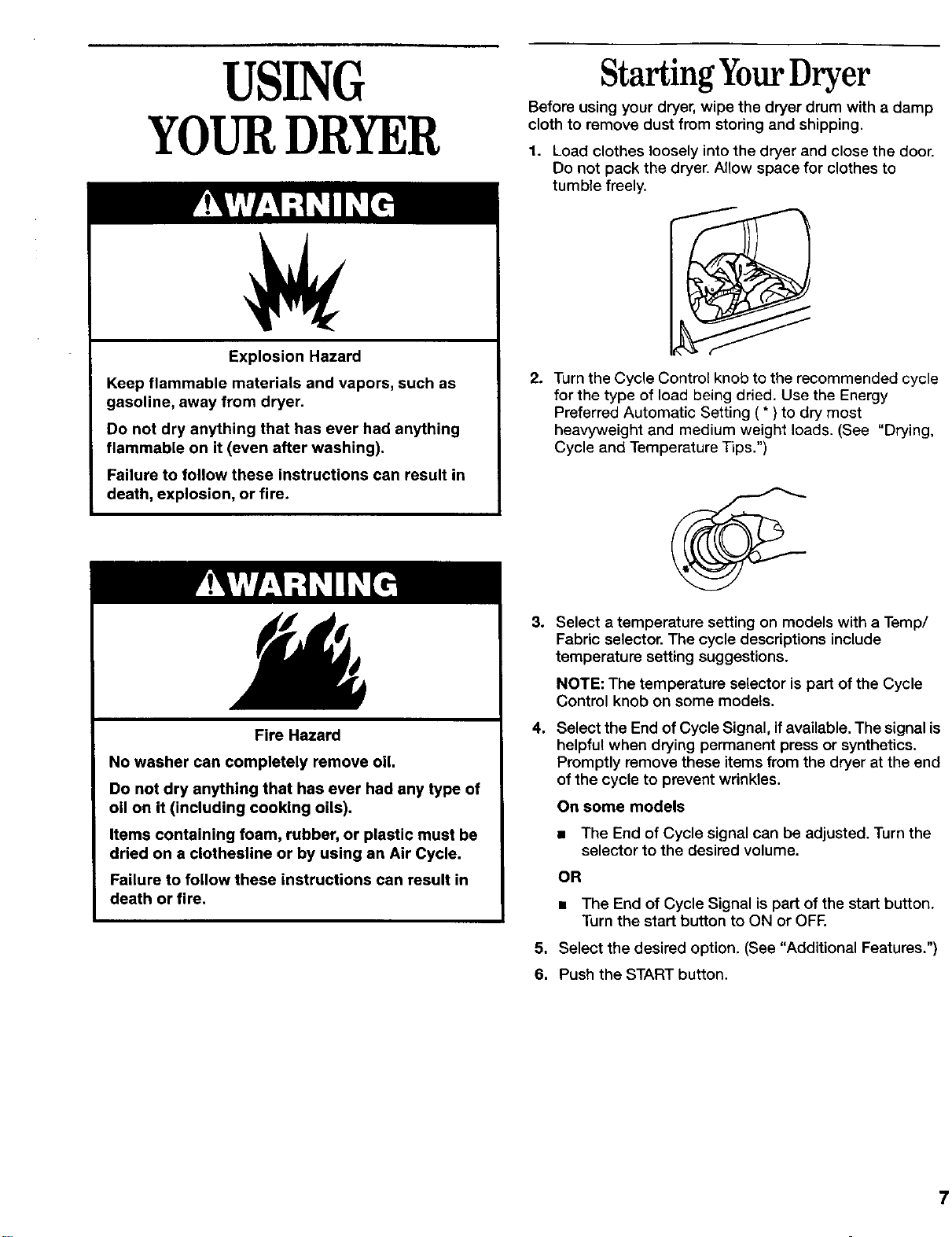
Before using your dryer, wipe the dryer drum with a damp
cloth to remove dust from storing and shipping.
1. Load clothes loosely intothe dryer and close the door.
Do not pack the dryer. Allow space for clothes to
tumble freely.
2. Turn the Cycle Control knob to the recommended cycle
for the type of load being dried. Use the Energy
Preferred Automatic Setting ( * ) to dry most
heavyweight and medium weight loads. (See "Drying,
Cycle and Temperature Tips.")
3,
,
Select a temperature setting on models with a Temp/
Fabric selector. The cycle descriptions include
temperature setting suggestions.
NOTE: The temperature selector is part of the Cycle
Control knob on some models.
Select the End of Cycle Signal, ifavailable. The signal is
helpful when drying permanent press or synthetics.
Promptly remove these items from the dryer at the end
of the cycle to prevent wrinkles.
On some models
• The End of Cycle signal can be adjusted. Turn the
selector to the desired volume.
OR
• The End of Cycle Signal is part of the start button.
Turn the start button to ON or OFE
Select the desired option. (See "Additional Features.")
5,
6. Push the START button.

Stoppingand Restarting
You can stop your dryer anytime during a cycle.
To stop your dryer
Open the dryer door or turn the Cycle Control knob to OFE
NOTE: The Cycle Control knob should point to an Off area
when the dryer is not in use.
To restart your dryer
1. Close the door.
2. Select a new cycle and temperature (ifdesired).
3. Push START.
,a ng Clothes
Load clothes loosely into the dryer. Do not pack the dryer.
Allow space for clothes to tumble freely. The chart
following shows examples of balanced toads that would
allow for proper tumbling.
Heavy work 3 pair of pants, 4 pair of jeans, 2 pair of
clothes overalls, 3 shirts
Delicates 3 camisoles, 1 robe, 4 slips,
6 undergarments, 2 sets of sleepwear,
1 child's outfit
Towels 10 bath towels, 10 hand towels, 14
wash cloths, 1 bath mat
Mixed Load 3 double sheets, 4 pillowcases,
8 T-shirts, 6 pair of shorts, 2 blouses
8 handkerchiefs
Cycle tips
• Dry most loads using the Energy Preferred Automati
setting ( * ).
• Use the no heat (air) cycle (if available) for rubber,
plastic or heat sensitive fabrics.
Temperature tips
If your dryer has multiple heat settings:
• Use a high heat setting for drying heavyweight item_
such as towels and work clothes.
• Use a medium heat setting for drying medium-weigI
items such as sheets, underwear, permanent press
fabrics, and some knits.
Use a low heat setting for drying lightweight items st
as lingerie, blouses, dresses, and some knits.
Use a no heat (air) setting for rubber, plastic or heat
sensitive fabrics.
• Line dry bonded or laminated fabrics.
If you are unsure of the temperature to select for a Ioa¢
select the lower setting rather than the higher setting
NOTE= If you have questions about drying temperature
for various loads, refer to the care label directions.
Cycle Descriptions
Yourmodel may vary fromthemodel shown.
TimedDrying 40 )_ AccuDry
_ns_ D_g
60
70
Drying, Cyde and
Temperature Tips
Select the correct cycle and temperature for your toad.
The Cycle Control knob does not move until the load is
almost dry. After Cool-Down, the knob automatically turns
to Off and tumbling stops.
Coot-Down tumbles the load without heat during the last
few minutes of all cycles. Cool-Down makes the loads
easier to handle.
Drying tips
• Follow care label directions when they are available.
• If you use fabric softener sheets, use only ones labeled
as "dryer safe." Follow package instructions.
• Remove the load from the dryer as soon as tumbling
stops to reduce wrinkling. This is especially important
for permanent press, knits, and synthetic fabrics.
off
Less
Dry
Dow_
90Minute 30Minute
{o_on) Off Io_]
Cycle Control knob
_1_En_gy Prefer
Automat_
Automatic cycle(s)
Use your Automatic cycle to dry most loads. Your dry(
uses either the electronic ACCUDRY" system or the
Automatic Dry control. The control senses the moistu_
level in the load and shuts off when the load reaches 1
selected dryness.
On some models
• Automatic Dry (High Heat) and (Low Heat)
Select the temperature by moving the Cycle Contl
knob to (High Heat) for bigger or heavier loads or
Heat) for smaller or lighter loads.
'.]
8
• Automatic Dry
Select the temperature from the temperature selector
based on the fabrics in your load.
NOTE: The Cycle Control knob featuring Automatic Dry is
not shown.
After drying a load in any of the Automatic cycles, check
the dryness.
If the load is drier than you like, select a setting closer to
Less Dry the next time you dry a similar load.
If a load is not as dry as you like, complete drying using a
Timed cycle. Select a setting closer to Very Dry the next
time you dry a similar load.
Drying time varies with an Automatic cycle. The type of
fabric, size of the load, and the dryness selected affect
drying time. See "Temperature tips."
Timed Drying cycle(s)
Use your Timed Drying cycle to complete drying if items
are still damp after the Automatic cycle. Also use Timed
Drying for heavyweight and bulky items such as
bedspreads and work clothes or large loads that require a
long drying time. Set the temperature selector, if available,
to High Heat.
On some models, you may use the Timed Dry cycle for
lightweight items such as lingerie or knits. Set the
temperature selector to Low Heat.
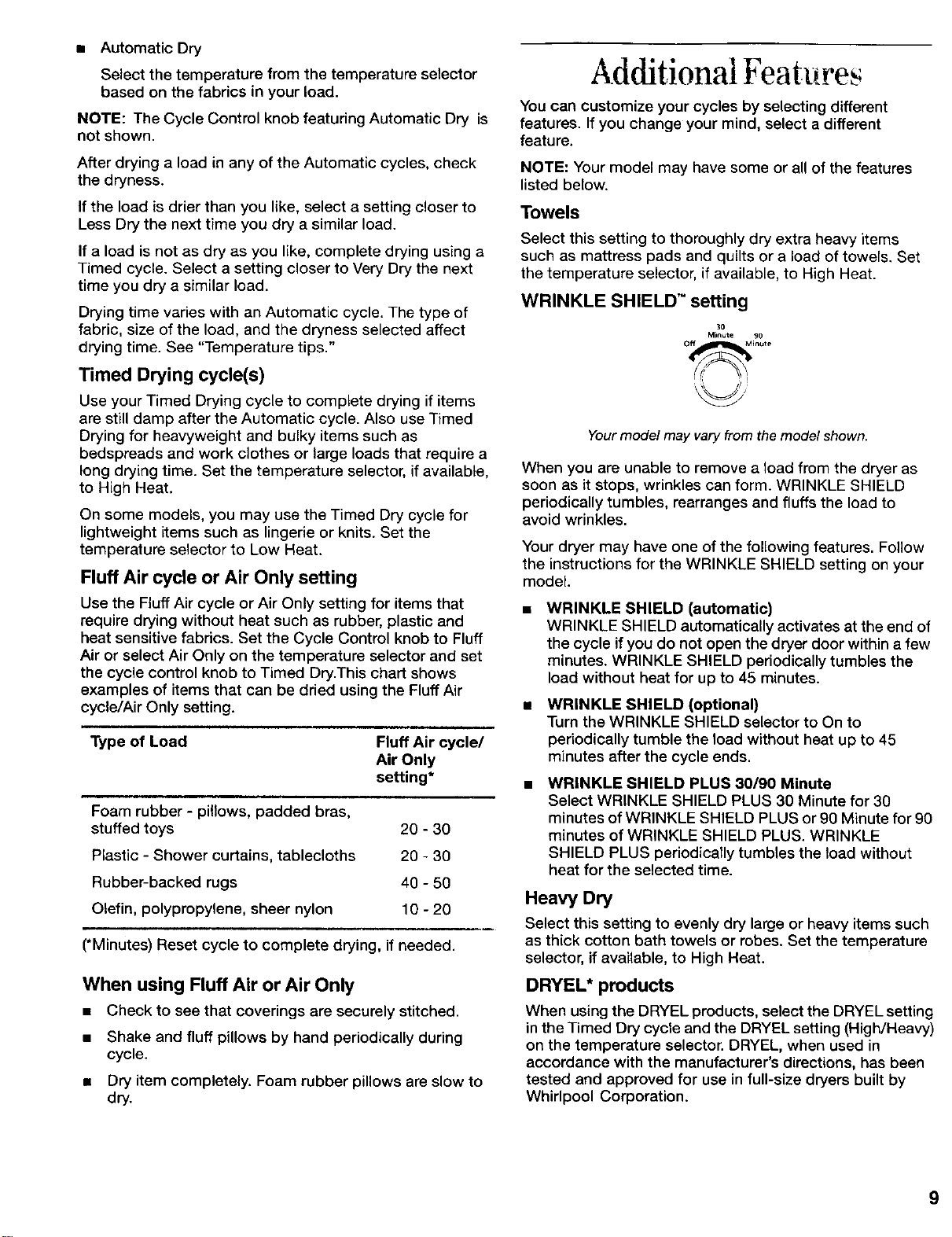
Fluff Air cycle or Air Only setting
Use the Fluff Air cycle or Air Only setting for items that
require drying without heat such as rubber, plastic and
heat sensitive fabrics. Set the Cycle Control knob to Fluff
Air or select Air Only on the temperature selector and set
the cycle control knob to Timed Dry.This chart shows
examples of items that can be dried using the Fluff Air
cycle/Air Only setting.
Type of Load Fluff Air cycle/
Air Only
setting*
Foam rubber - pillows, padded bras,
stuffed toys 20 - 30
Plastic - Shower curtains, tablecloths 20 - 30
Rubber-backed rugs 40 - 50
Olefin, polypropytene, sheer nylon 10 - 20
(*Minutes) Reset cycle to complete drying, if needed.
When using Fluff Air or Air Only
• Check to see that coverings are securely stitched.
• Shake and fluff pillows by hand periodically during
cycle.
• Dry item completely. Foam rubber pillows are slow to
dry.
Additional Featt-+re+
You can customize your cycles by selecting different
features. If you change your mind, select a different
feature.
NOTE: Your model may have some or all of the features
listed below,
Towels
Select this setting to thoroughly dry extra heavy items
such as mattress pads and quilts or a load of towels. Set
the temperature selector, if available, to High Heat.
WRINKLE SHIELD" setting
M=3n0ute 9O
Your model may vary from the model shown.
When you are unable to remove a load from the dryer as
soon as it stops, wrinkles can form. WRINKLE SHIELD
periodically tumbles, rearranges and fluffs the load to
avoid wrinkles.
Your dryer may have one of the following features. Follow
the instructions for the WRINKLE SHIELD setting on your
model
WRINKLE SHIELD (automatic)
WRINKLE SHIELD automatically activates at the end of
the cycle if you do not open the dryer door within a few
minutes. WRINKLE SHIELD periodically tumbles the
load without heat for up to 45 minutes.
WRINKLE SHIELD (optional)
Turn the WRINKLE SHIELD selector to On to
periodically tumble the load without heat up to 45
minutes after the cycle ends.
WRINKLE SHIELD PLUS 30190 Minute
Select WRINKLE SHIELD PLUS 30 Minute for 30
minutes of WRINKLE SHIELD PLUS or 90 Minute for 90
minutes of WRINKLE SHIELD PLUS. WRINKLE
SHIELD PLUS periodically tumbles the load without
heat for the selected time.
Heavy Dry
Select this setting to evenly dry large or heavy items such
as thick cotton bath towels or robes. Set the temperature
selector, if available, to High Heat.
DRYEL* products
When using the DRYEL products, select the DRYEL setting
in the Timed Dry cycle and the DRYEL setting (High/Heavy)
on the temperature selector. DRYEL, when used in
accordance with the manufacturer's directions, has been
tested and approved for use in full-size dryers built by
Whirlpool Corporation.
9
Damp Dry
Select this setting to dry items to a damp level or dry items
that do not require an entire drying cycle. Damp dry items
such as jeans (to prevent stiffness) or cotton clothes (to
make pressing easier). Set the temperature selector, if
available, to High Heat.
TUMBLE PRESS ®setting
Select this setting to remove wrinkles from items such as
clothes packed in a suitcase or items wrinkled from being
left in the dryer too long. Set the temperature selector, if
available, to Medium or Low Heat depending on the
fabrics in your load.
End of Cycle Signal
If your model has an End of Cycle Signal, the signal
sounds when a cycle is complete. If WRINKLE SHIELD'" is
selected, the signal sounds every few minutes. The signal
stops when you open the door.
End of Cycle Signal
On some models
The End of Cycle Signal isfixed.
OR
The End of Cycle Signal is selectable. The signal will sound
only ifthe signal is set to ON.
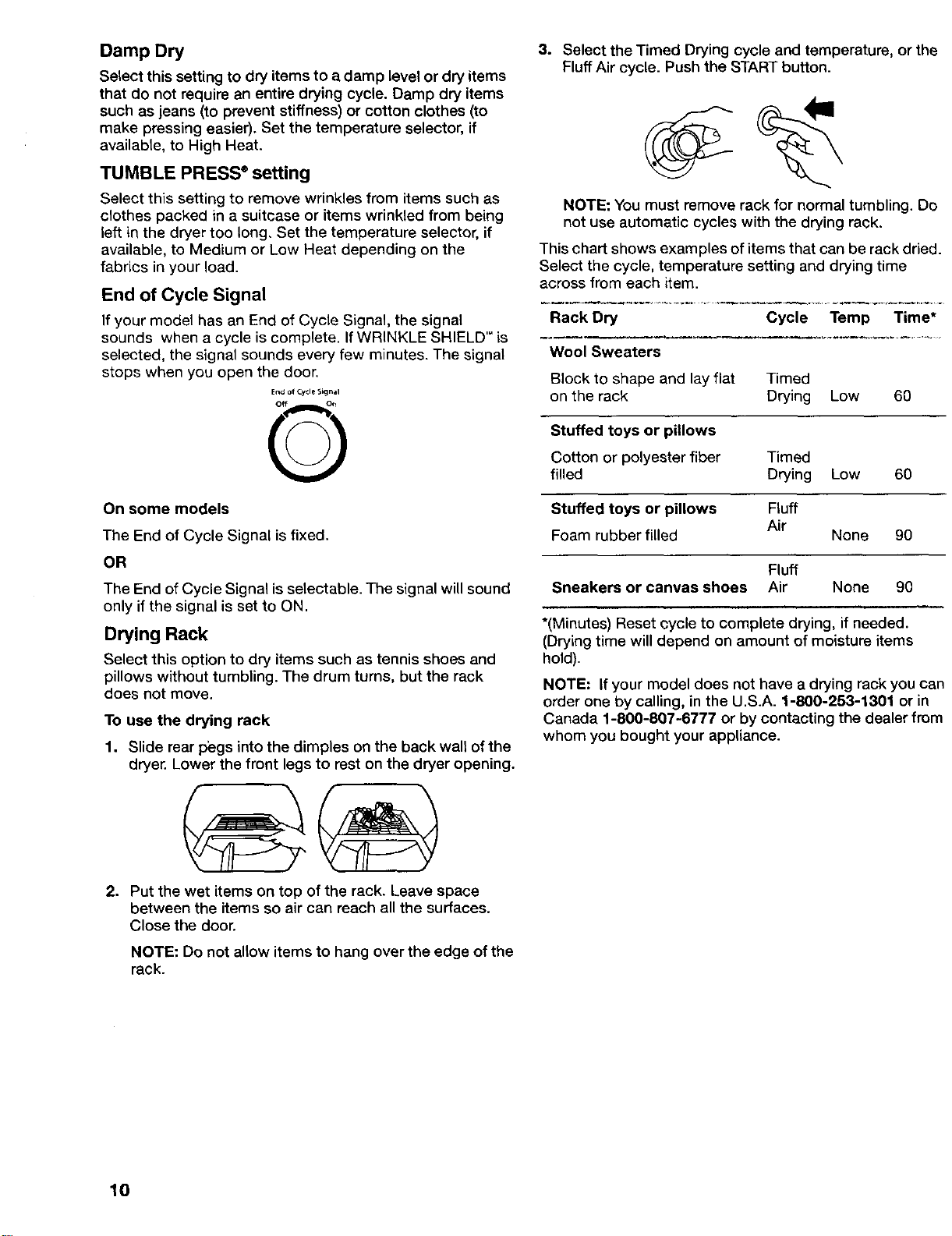
Drying Rack
Select this option to dry items such as tennis shoes and
pillows without tumbling. The drum turns, but the rack
does not move.
To use the drying rack
1. Slide rear pegs into the dimples on the back walt of the
dryer. Lower the front legs to rest on the dryer opening.
2. Put the wet items on top of the rack. Leave space
between the items so air can reach all the surfaces.
Close the door.
NOTE: Do not allow items to hang over the edge of the
rack.
3. Select the Timed Drying cycle and temperature, or the
FluffAir cycle. Push the START button.
NOTE: You must remove rack for normal tumbling. Do
not use automatic cycles with the drying rack.
This chart shows examples of items that can be rack dried.
Select the cycle, temperature setting and drying time
across from each item.
Rack Dry Cycle Temp Time*
Wool Sweaters
Block to shape and lay flat Timed
on the rack Drying Low 60
Stuffed toys or pillows
Cotton or polyester fiber Timed
filled Drying Low 60
Stuffed toys or pillows Fluff
Air
Foam rubber filled None 90
Fluff
Sneakers or canvas shoes Air None 90
*(Minutes) Reset cycle to complete drying, if needed.
(Drying time will depend on amount of moisture items
hold).
NOTE: If your model does not have a drying rack you can
order one by calling, in the U.S.A. 1-800-253-1301 or in
Canada 1-800-807-6777 or by contacting the dealer from
whom you bought your appliance.
10
CARINGFORYOUR
DRYER
Cleaning the Lint Screen
Every load cleaning
The lint screen is rotated on the top of the dryer. Clean it
before each load, A screen blocked by lint can increase
drying time,
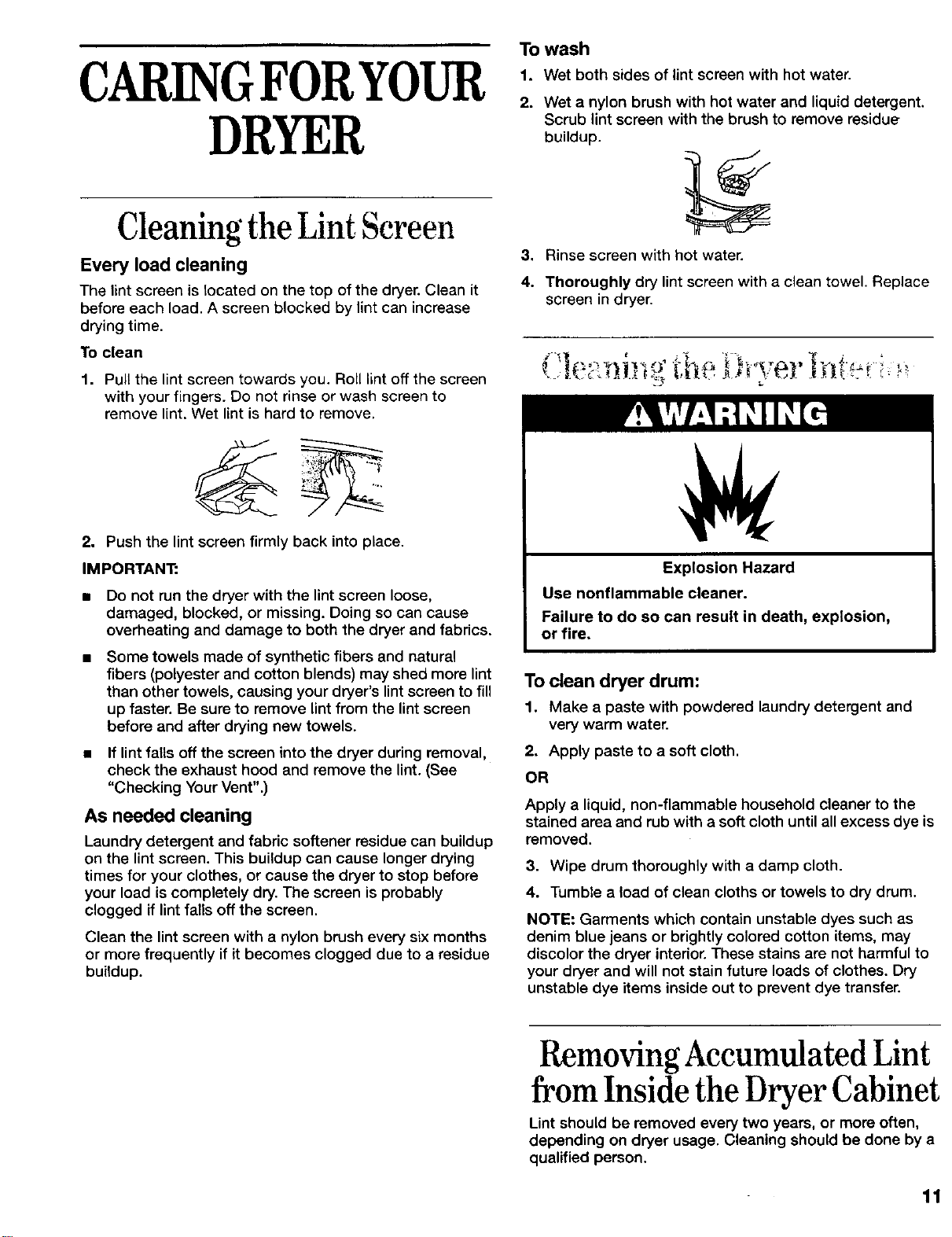
To clean
1. Pull the lint screen towards you. Roll lint off the screen
with your fingers. Do not rinse or wash screen to
remove lint. Wet lint is hard to remove.
2. Push the lint screen firmly back into place.
IMPORTANT:
• Do not run the dryer with the lint screen loose,
damaged, blocked, or missing. Doing so can cause
overheating and damage to both the dryer and fabrics.
Some towels made of synthetic fibers and natural
fibers (polyester and cotton blends) may shed more lint
than other towels, causing your dryer's lint screen to fill
up faster. Be sure to remove lint from the lint screen
before and after drying new towels.
• If lint falls off the screen into the dryer during removal,
check the exhaust hood and remove the lint. (See
"Checking Your Vent".)
As needed cleaning
Laundry detergent and fabric softener residue can buildup
on the lint screen. This buildup can cause longer drying
times for your clothes, or cause the dryer to stop before
your load is completely dry. The screen is probably
clogged if lint falls off the screen.
Clean the lintscreen with a nylon brush every six months
or more frequently if it becomes clogged due to a residue
buildup.
To wash
1. Wet both sides of lint screen with hot water,
2. Wet a nylon brush with hot water and liquid detergent,
Scrub lint screen with the brush to remove residue
buildup.
3, Rinse screen with hot water.
4. Thoroughly dry lint screen with a clean towel. Replace
screen in dryer.
Explosion Hazard
Use nonflammable cleaner.
Failure to do so can result in death, explosion,
or fire.
To clean dryer drum:
1. Make a paste with powdered laundry detergent and
very warm water.
2. Apply paste to a soft cloth.
OR
Apply a liquid, non-flammable household cleaner to the
stained area and rub with a soft cloth until all excess dye is
removed.
3. Wipe drum thoroughly with a damp cloth.
4. Tumble a load of clean cloths or towels to dry drum.
NOTE: Garments which contain unstable dyes such as
denim blue jeans or brightly colored cotton items, may
discolor the dryer interior. These stains are not harmful to
your dryer and will not stain future loads of clothes. Dry
unstable dye items inside out to prevent dye transfer.
Removing Accumulated Lint
from Inside the Dryer Cabinet
Lint should be removed every two years, or more often,
depending on dryer usage. Cleaning should be done by a
qualified person.
11
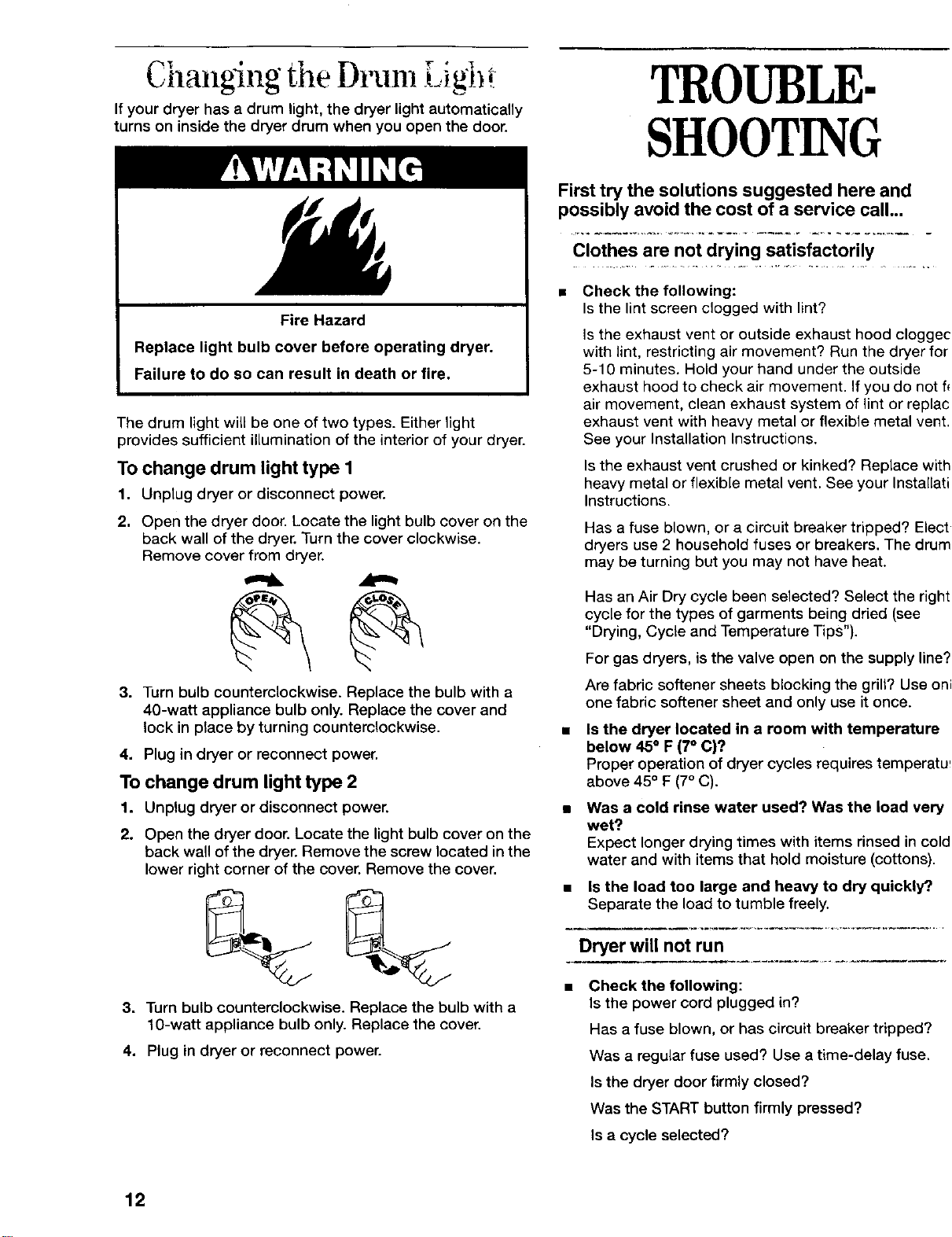
Changingthe Drum ,.
If your dryer has a drum light, the dryer light automatically
turns on inside the dryer drum when you open the door.
Fire Hazard
Replace light bulb cover before operating dryer.
Failure to do so can result in death or fire.
The drum light will be one of two types. Either light
provides sufficient illumination of the interior of your dryer.
To change drum light type 1
1. Unplug dryer or disconnect power.
2. Open the dryer door. Locate the light bulb cover on the
back wall of the dryer. Turn the cover clockwise.
Remove cover from dryer.
3. Turn bulb counterclockwise. Replace the bulb with a
40-watt appliance bulb only. Replace the cover and
lock in place by turning counterclockwise.
4. Plug in dryer or reconnect power.
To change drum light type 2
1. Unplug dryer or disconnect power.
2. Open the dryer door, Locate the light bulb cover on the
back wall of the dryer. Remove the screw located inthe
lower right corner of the cover. Remove the cover.
%
3. Turn bulb counterclockwise. Replace the bulb with a
10-watt appliance bulb only. Replace the cover.
4. Plug in dryer or reconnect power.
TROUBLE.
SHOOTING
First try the solutions suggested here and
possibly avoid the cost of a service call...
Clothes are not drying satisfactorily
Check the following:
Is the lint screen clogged with lint?
Is the exhaust vent or outside exhaust hood cloggec
with lint, restricting air movement? Run the dryer for
5-10 minutes. Hold your hand under the outside
exhaust hood to check air movement. If you do not fl
air movement, clean exhaust system of lint or replac
exhaust vent with heavy metal or flexible metal vent.
See your Installation Instructions.
Is the exhaust vent crushed or kinked? Replace with
heavy metal or flexible metal vent. See your Installati
Instructions.
Has a fuse blown, or a circuit breaker tripped? Elect
dryers use 2 household fuses or breakers. The drum
may be turning but you may not have heat.
Has an Air Dry cycle been selected? Select the right
cycle for the types of garments being dried (see
"Drying, Cycle and Temperature Tips").
For gas dryers, is the valve open on the supply line?
Are fabric softener sheets blocking the grill? Use oni
one fabric softener sheet and only use it once.
Is the dryer located in a room with temperature
below 45° F (7° C)?
Proper operation of dryer cycles requires temperatu,
above 45 ° F (7° C).
Was a cold rinse water used? Was the load very
wet?
Expect longer drying times with items rinsed in cold
water and with items that hold moisture (cottons).
• Is the load too large and heavy to dry quickly?.
Separate the load to tumble freely.
Dryer will not run
Check the following:
Is the power cord plugged in?
Has a fuse blown, or has circuit breaker tripped?
Was a regular fuse used? Use a time-delay fuse.
Is the dryer door firmly closed?
Was the START button firmly pressed?
Is a cycle selected?
12
Unusualsounds
Has the dryer had a period of non-use?
If the dryer hasn't been used for a while, there may be a
thumping sound during the first few minutes of
operation.
Is it a gas dryer?
The gas valve clicking is a normal operating sound.
Lint on load
• Is the lint screen clogged?
Clean lint screen. Check for air movement.
Is load properly sorted?
Sort lint givers (towels, chenille) from lint takers
(corduroy, synthetics). Also sort by color.
Is the load too big or too heavy?
Dry smaller loads so lint can be carried to the lint
screen.
Was the load overdried?
Use correct dryer settings for load type (see "Drying,
Cycle and Temperature Tips"). Overdrying can cause
lint-attracting static electricity.
• Was paper or tissue left in pockets?
Clean out pockets before drying.
• Is pilling being mistaken for lint?
Pilling (surface fuzz) is caused by normal wear and
laundering.
Stains on load or color change
• Was dryer fabric softener properly used?
Add dryer fabric softener sheets at the beginning of the
cycle when the load is cold. Do not add fabric softener
sheets to a warm load.
• Were items soiled when placed in the dryer?.
Items should be clean before being dried.
• Were items properly sorted?
Sort light colors from dark colors. Sort colorfast items
from noncolorfast items.
Items shrinking
• Was the dryer overloaded?
Dry smaller loads that can tumble freely.
Did the load overdry?
Check the manufacturer's care label. Match dryer
setting to load type (see "Drying, Cycle and
Temperature Tips").
Loads are wrinkled
Was load removed from dryer at the end of the
cycle?
Remove load as soon as tumbling stops.
Was dryer overloaded?
Dry smaller loads that can tumble freely.
Did load overdry?
Check the manufacturer's care label. Match dryer
setting to load type (see "Drying, Cycle and
Temperature Tips").
Odors
If the dryer is electric, is it being used for the first
time?
The new electric heating element may have an odor.
The odor will be gone after the first cycle.
If the dryer is gas, there may be a gas leak:
Turn off the gas supply line, leave your house and then
call your local gas company.
Have you recently been painting, staining or
varnishing in the area where your dryer is located?
If so, ventilate the area. When the odors or fumes are
gone from the area, re-wash the clothing and then dry
it.
Garment damage
• Checkthe following:
Were zippers, snaps, and hooks left open?
Were strings and sashes tied to prevent tangling?
Were care label instructions followed?
Were items damaged before drying?
13
ASSISTANCE
ORSERVICE
Before calling for assistance or service, please check
"Troubleshooting." It may save you the cost of a service
call. If you still need help, follow the instructions below.
When calling, please know the purchase date and the
complete model and serial number of your appliance. This
information will help us to better respond to your request.
If you need replacement parts
If you need to order replacement parts, we recommend
that you only use FSP®factory specified parts. These parts
will fit right and work right because they are made with the
same precision used to build every new WHIRLPOOL ®
appliance. To locate factory specified replacement parts in
your area, call our Consumer Assistance Center (in the
U.S.A.) or your nearest designated service center.
in the U.SA
Call the Whirlpool Consumer Assistance Center
toll free: 1-800-253-1301.
Our consultants provide assistance with:
• Features and specifications on our full line of
appliances.
• Installation information.
• Use and maintenance procedures.
• Accessory and repair parts sales.
• Specialized customer assistance (Spanish speaking,
hearing impaired, limited vision, etc.).
• Referrals to local dealers, repair parts distributors, and
service companies. Whirlpool designated service
technicians are trained to fulfill the product warranty
and provide after-warranty service, anywhere in the
United States.
To locate the Whirlpool designated service company in
your area, you can also look in your telephone directory
Yellow Pages.
For further assistance
If you need further assistance, you can write to Whirlpool
with any questions or concerns at:
Whirlpool Corporation
Consumer Assistance Center
c/o Correspondence Dept.
2000 North M-63
Benton Harbor, MI 49022-2692
Please include a daytime phone number in your
correspondence.
In Canada
Call the Inglis customer relations Center toll free:
1-800-461-5681 8:30 a.m. - 6:00 p.m. (EST)
Our consultants provide assistance with:
• Features and specifications on our full line of
appliances.
• Referrals tolocal dealers.
For service in Canada
Call 1-800-807-6777. Inglis Limited designated servi(
technicians are trained to fulfill the product warranty ;
provide after-warranty service, anywhere in Canada.
For further assistance
If you need further assistance, you can write to us wit
questions or concerns at:
Consumer Relations Center
Inglis Limited
1901 Minnesota Court
Mississauga, Ontario L5N 3A7
Please include a daytime phone number in your
correspondence.
14
WHIRI OOL *DRYER
ONE-YEAR FULL WARRANTY
For one year from the date of installation, when this dryer is operated and maintained according to instructions attached to or furnished
with the product, Whirlpool Corporation will pay for FSP_ replacement parts and repair labor to correct defects in materials or
workmanship. Service must be provided by a Whirlpool deslgneted service company.
Whirlpool Corporation will not pay for:
1. Service calls to correct the installation of your dryer, including venting. Heavy 4 in (10.2 cm) metal exhaust vent must be used. Refer
to the venting section of this manual and your Installation Instructions.
2. Service calls to instruct you how to use your dryer, to replace house fuses or correct house wiring or reset circuit breakers, or to
replace owner accessible light bulbs.
3. Repairs when your dryer is used in other than normal, single-family household use.
4. Damage resulting from accident, alteration, misuse, abuse, fire, floods, acts of God, improper installation (including, but not limited
to, venting with plastic or flexible foil), or installation not in accordance with local electrical and plumbing codes or use of products
not approved by Whirlpool Corporation.
5. Replacement parts or repair labor costs for units operated outside the United States and Canada.
6. Pickup and delivery. This product is designed to be repaired in the home.
7. Repairs to parts or systems resulting from unauthorized modifications made to the appliance.
8. In Canada, travel or transportation expenses for customere who reside in remote areas.
WHIRLPOOL CORPORATION AND INGMS LIMITED SHALL
NOT BE LIABLE FOR INCIDENTAL OR CONSEQUENTIAL
DAMAGES.
Some states or provinces do not allow the exclusion or limitation
of incidental or consequential damages, so this exclusion or
limitation may not apply to you. This warranty gives you specific
legal rights and you may also have other rights which vary from
state to state or province to province.
Outside the 50 United States, and Canada, this warranty does
not apply. Contact your authorized Whirlpool dealer to
determine if another warranty applies.
If you need service, first see "Troubleshooting." Additional help
can be found by checking "Assistance or Service," or by calling
our Consumer Assistance Center at 1-800-253-1301, from
anywhere in the U.S.A. or write: Whirlpool Corporation,
Consumer Assistance Center, c/o Correspondence Dept., 2000
North M-63, Benton Harbor, MI 49022-2692. For service in
Canada, call Inglis Limited at 1-800-807-6777.
11/99
Keep this book and your sales slip together for future
reference. You must provide proof of purchase or
installation date for in-warranty service.
Write down the following information about your dryer to better
help you obtain assistance or service if you ever need it, You will
need to know your complete model number and serial number.
You can find this information on the model and serial number
label/plate, located on your appliance as shown in "Parts and
Features."
Dealer name
Address
Phone number
Model number
Serial number
Purchase date
15