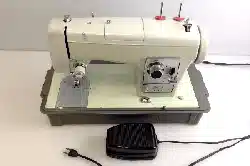
OWNER'S MANUAL
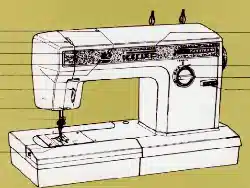
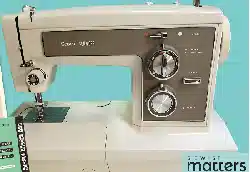
SEWING MACHINE
MODEL 385. 17622
SEARS, ROEBUCK AND CO.
Dear Customer:
You have just invested in a very fine zigzag sewing machine. Before using your new Kenmore machine,
please pause for a moment and carefully read this booklet which contains instructions on how to operate
and care for your machine.
Specific instructions are given on threading, tension adjustments, cleaning, oiling, etc. This will help you
obtain the best sewing results and avoid unnecessary service expense for conditions beyond our control.
Advice on the operation and care of your machine is always available at your nearest Sears Retail Store.
Please remember, if you have questions about your machine or need parts and service, always mention
the model number and serial number when you inquire.
Kenmore Sewing Machine
Record in space provided below the model number and serial
number of this appliance. The model number and serial number
are located on the nomenclature plate, as identified on Page 4 of
this booklet.
Model No. 385. Serial No.
Retain these numbers for future reference.
Z "
THIS MODEL IS A CENTER NEEDLE, LOW BAR SEWING MACHINE.
IMPORTANT SAFETY
INSTRUCTIONS
Your sewing machine is designed and constructed only for HOUSEHOLD use.
Read all instruction before using this sewing machine.
DA NGER- Toreduce the risk of electric shock;
1.
2.
3.
4.
An appliance should never be left unattended when plugged in. Always
unplug this appliance from the electric outlet immediately after using
and before cleaning.
Always unplug before relamping. Replace bulb with same type rated
15 Watts.
Do not reach for the appliance that has fallen into water. Unplug
immediately.
Do not place or store appliance where it can fall or be pulled into a tub
or sink. Do not place in or drop into water or other liquid.
WAR NING- To reduce the risk of burns, fire, electric shock,
orinjury to persons.
1. Do not allow to be used as a toy. Close attention is necessary when this
appliance is used by or near children.
2. Use this appliance only for its intended use as described in this manual.
Use only attachments recommended by the manufacturer as contained in
this manual.
Never operate this appliance if it has a damaged cord or plug, if it is not
working properly, if it has been dropped or damaged, or dropped into
water. Return the appliance to the nearest authorized dealer or service
center for examination, repair, electrical or mechanical adjustment.
4.
5.
6.
7.
8.
9.
10.
11,
12.
13.
14.
15.
Never operate the appliance with any air opening blocked. Keep
ventilation openings of the sewing machine and foot controller free from
accumulation of lint, dust, and loose cloth.
Never drop or insert any object into any opening.
Do not use outdoors.
Do not operate where aerosol (spray) products are being used or where
oxygen is being administered.
To disconnect, turn all controls to the off ('0") position, then remove
plug from outlet.
Do not unplug by pulling on cord. To unplug, grasp the plug, not the
cord.
Keep fingers away from all moving parts. Special care is required
around the sewing machine needle,
Always use the proper needle plate. The wrong plate can cause the
needle to break.
Do not use bent needles.
Do not pull or push fabric while stitching.
It may deflect the needle causing it to break.
Switch the sewing machine off ("O") when making any adjustment in
the needle area, such as threading needle, changing needle, threading
bobbin, or changing presserfoot, and the like.
Always unplug the sewing machine from the electrical outlet when
removing covers, lubricating, or when making any other adjustments
mentioned in the instruction manual.
SAVE THESE INSTRUCTIONS
SECTION 1.
SECTION 2.
SECTION 3.
TABLE •OF CONTENTS
KNOW THE MACHINE
A Portable Caseor Cabinet isAvailable .............. 3
Locate and Identify the Parts .................. 3_4
Identify the Accessories ........................ 4
PREPARE THE MACHINE FOR SEWING
Set Up the Machine ......................... 5_7
• Plug in the Machine and Switch on the Power ....... 5
• Foot Control Use .......................... 5
• Setting Spool Pins .......................... 6
• Adjust the PresserFoot Lever .................. 6
• Thread Cutter ............................ 6
• Free Arm Sewing: the Removable Extension Table , , . 7
• Accessories Storage Box ...................... 7
• Change the Presser Foot ...................... 7
Choose the Needle and Thread ................. 7_8
• To Change the Needle ....................... 7
• Check the Needle .......................... B
• Fabric, Needle, Thread and Stitch Length Chart ...... 8
Prepare the Bobbin ........................ 9_10
• To Remove the Bobbin Casefrom the Machine ...... 9
• Windthe Bobbin ....................... 9_10
• Insert the Bobbin into the Bobbin Case ........... 10
Prepare the Top Thread ..................... 11_12
• Thread the Needle ........................ 11
• Pick Upthe Bobbin Thread .................. 12
Adjust the Top Thread Tension ................ 13_14
Reverse Stitch Control ........................ 14
Stitch Selector ............................. 15
Stitch Length Control ........................ 16
Adjusting Stretch Stitch Balance ................. 16
Starting To Sew ............................ 17
LEARN THE STITCHES
Straight Stitches .......................... 18_22
• . Straight Stitch ........................... 18
• Usethe Seam Guides ....................... 18
• Turna Square Corner ...................... 1B
• Topstitching ............................ 19
• Left Needle Position ....................... l g
• Sew in a Zipper ........................ 20_21
• Use the Darning Plate ...................... 22
• Darning ............................... 22
Zigzag Stitches ........................... 23_31
• Basic Zigzag ............................. 23
• Satin Stitch ............................. 23
• Applique ............................... 24
• Bar Tacking ............................. 24
• Sew a Button ............................ 25
• Overcasting Stitch ......................... : 26
• Three-Step Zigzag ......................... 27
• Blind Hemming .......................... 28
• LaceWork .............................. 29
• Shell Stitching ........................... 29
• Box Stitching ............................ 30
• Fagoting Stitch .......................... 31
• Decorate with Geometic Patterns ............... 31
Stretch Stitches .......................... 32_35
• Straight Stretch .......................... 32
• Rick-Rack Stretch ........................ 32
• Smocking .............................. 33
• Overcast Stretch Stitching ................... 33
• Sergingor Pine Leaf Stretch Stitching ............ 34
• Elastic Stretch Stitch ....................... 34
• Herring Bone Stretch ....................... 35
• Decorative Stretch Patterns .................. 35
Buttonbholes ............................ 36_37
SECTION 4. PERFORMANCE PROBLEMS CHART
What to Do When ............... , • ........ 38_39
SECTION 5. CARE FOR THE MACHINE
Replacing the Light Bulb ...................... 40
Cleaning the Machine ...................... 40_41
• Clean the Feed Dogs ....................... 40
• Cleanthe Shuttle Race ..................... 41
Oiling the Machine .......................... 42
• Oil behing the Face Cover Plate and Under
Arm Cover Plate .......................... 42
• Oil the Underside ......................... 42
PARTS LIST ........................................ 43
INDEX ............................................ 44
"!
SECTION 1. KNOW THE MACHINE
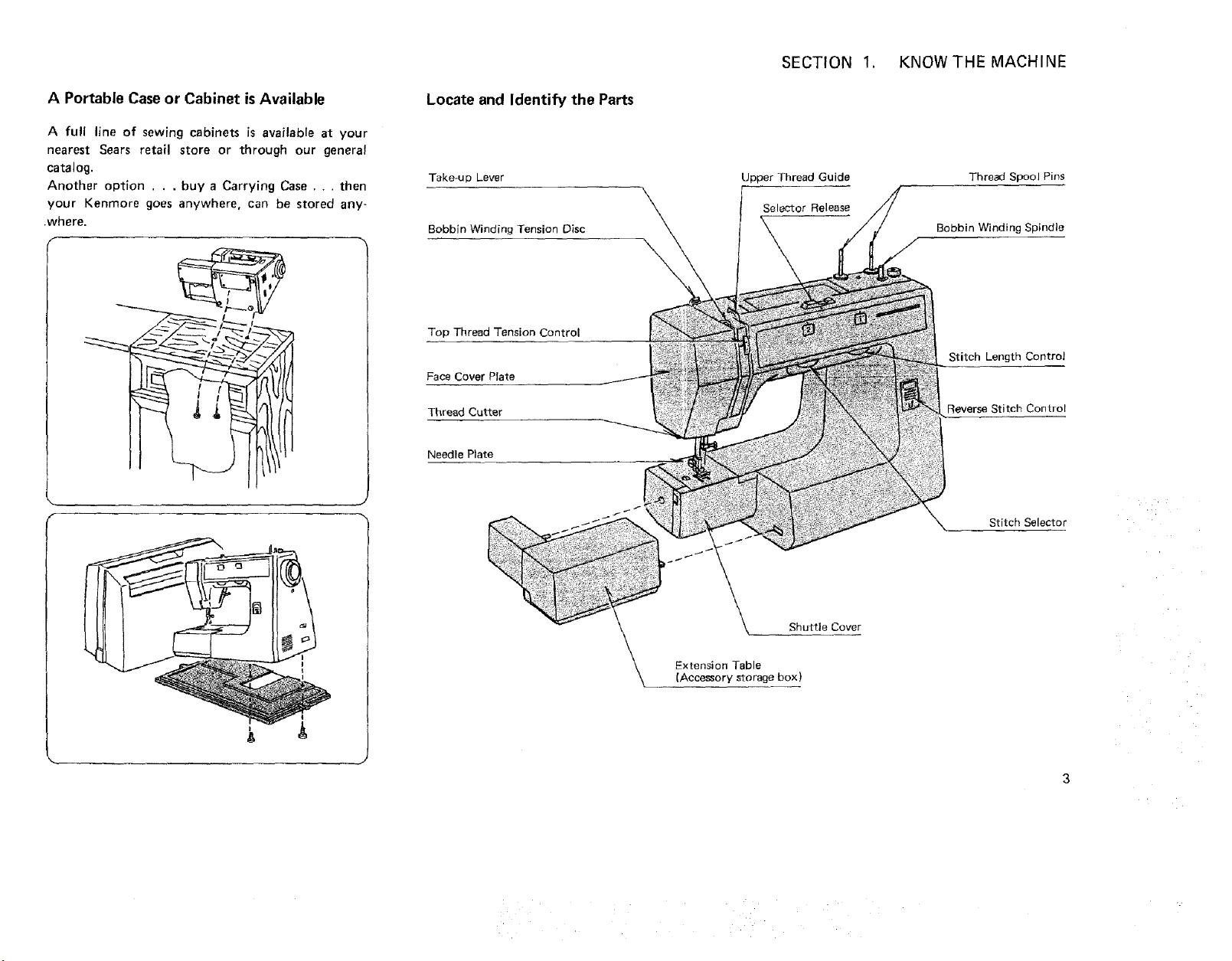
A Portable Caseor Cabinet isAvailable
A full line of sewing cabinets is available at your
nearest Sears retail store or through our general
catalog.
Another option . . . buy a Carrying Case . , . then
your Kenmore goes anywhere, can be stored any-
.where.
%
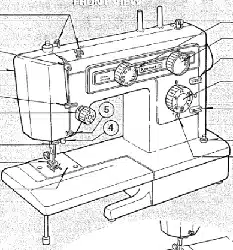
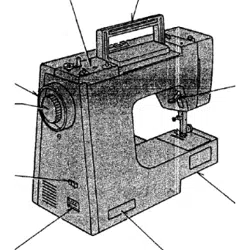
Locate and Identify the Parts
Take-up Lever
Bobbin Winding Tension Disc
Top Thread Tension Control
Face Cover Plate
Thread Cutter
Needle Plate
\
Upper Thread Guide
Selector Release
Shuttle Cover
Extension Table
(Accessory storage box)
Thread Spool Pins
Bobbin Winding Spindle
Stitch Length Control
Reverse Stitch Control
Stitch Selector
i,
SECTION 1.
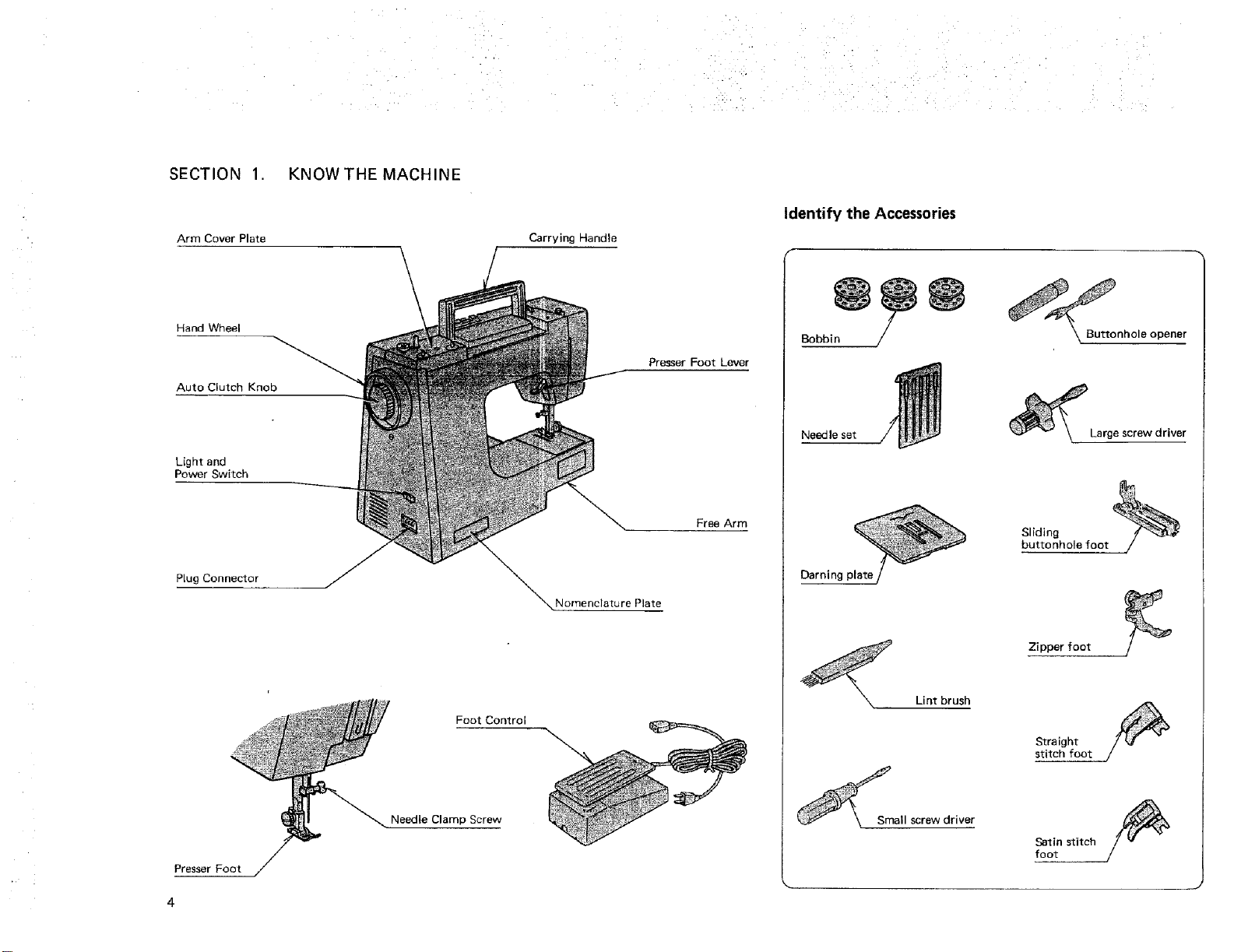
Arm Cover Plate
KNOW THE MACHINE
Carrying Handle
Identify the Accessories
Hand Wheel
Auto Clutch Knob
Light and
Power Switch
Plug Connector
Presser Foot
Presser Foot Lever
Free Arm
_Nomenclature Plate
Foot Control
Needle Clamp Screw
Bobbin
Darning plate
Lint brush
all screw driver
nhole opener
_ Large screw driver
Sliding
buttonhole foot
Zipperfoot
Straight
stitch foot
Satin stitch
foot
Set Up the Machine
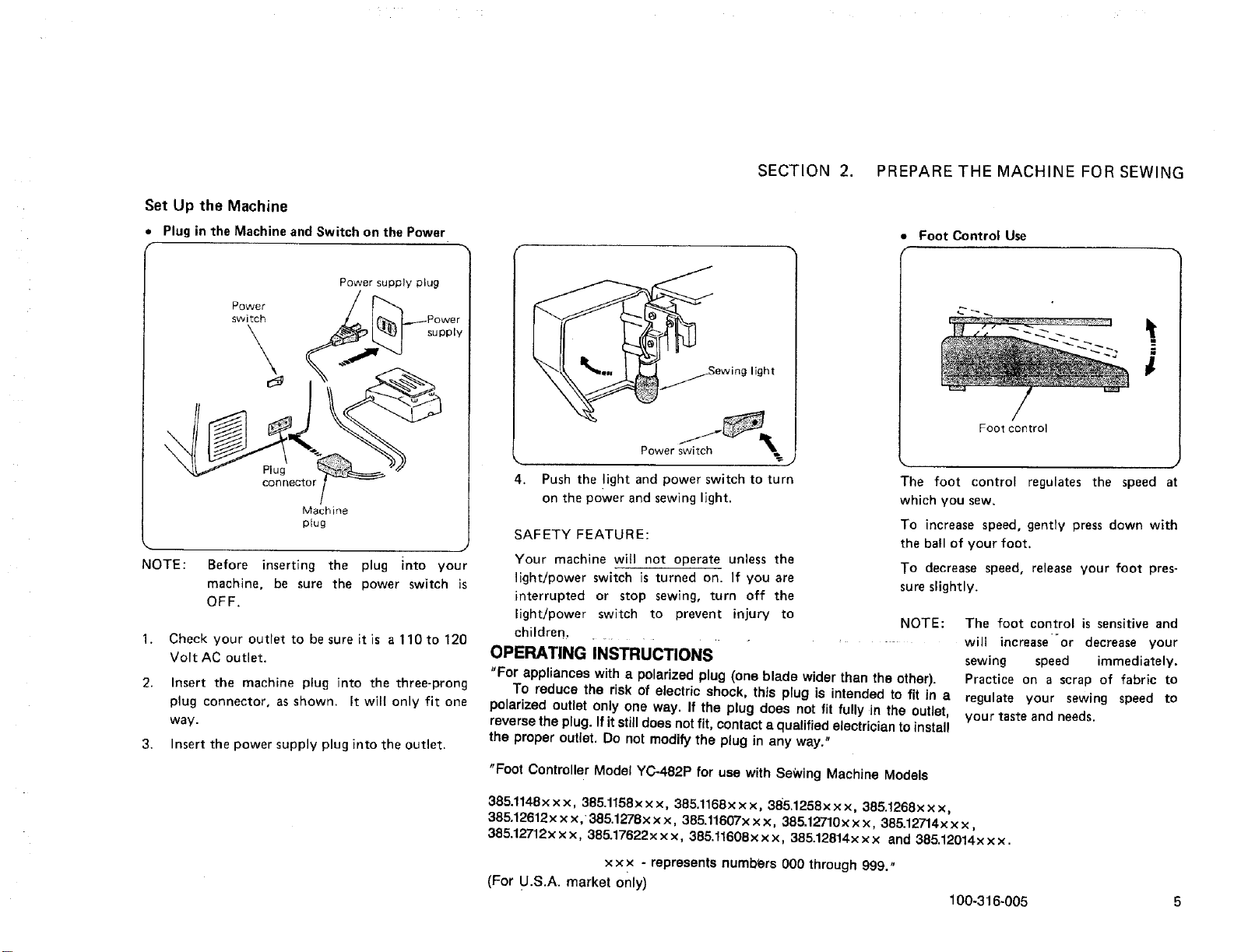
Plug in the Machine and Switch on the Power
SECTION
2. PREPARE THE MACHINE FOR SEWING
• Foot Control Use
NOTE:
1.
2.
3,
Plug
connector
Machine
plug
J
Before inserting the plug into your
machine, be sure the power switch is
OFF.
Check your outlet to be sure it is a 110 to 120
Volt AC outlet.
Insert the machine ptug into the three-prong
plug connector, as shown. It will only fit one
way.
Insert the power supply plug into the outlet.
light
4. Push the light and power switch to turn
on the power and sewing light.
SAFETY FEATURE:
Your machine will not operate unless the
light/power switch is turned on. If you are
interrupted or stop sewing, turn off the
light/power switch to prevent injury to
children, NOTE:
OPERATING INSTRUCTIONS
"For appliances with a polarized plug (one blade wider than the other).
To reduce the risk of electric shock, this plug is intended to fit in a
Foot control
The foot control regulates the speed at
which you saw,
To increase speed, gently press down with
the ball of your foot.
To decrease speed, release your foot pres-
sure slightly.
The foot control is sensitive and
wilt increase'or decrease your
sewing speed immediately.
Practice on a scrap of fabric to
regulate your sewing speed to
polarized outlet only one way. If the plug does not fit fully in the outlet, your taste and needs.
reverse the plug. If it still does not fit, contact a qualified electrician to install
the proper outlet. Do not modify the plug in any way."
"Foot Controller Model YC-482P for use with Sewing Machine Models
385.1148xxx, 385.1158xxx, 385.1168xxx, 385.1258xxx, 385.1268xxx,
385.12612x x x, 385.1278x xx, 385.11607x x x, 385.12710× x x, 385.12TI4x x x,
385.12712xxx, 385.17622xxx, 385.11608xxx, 385.12814xxx and 385.12014xx×.
x xx - represents numbers 000 through 999."
(For U.S.A. market only)
100-316-005 5
SECTION 2. PREPARE THE MACHINE FOR SEWING
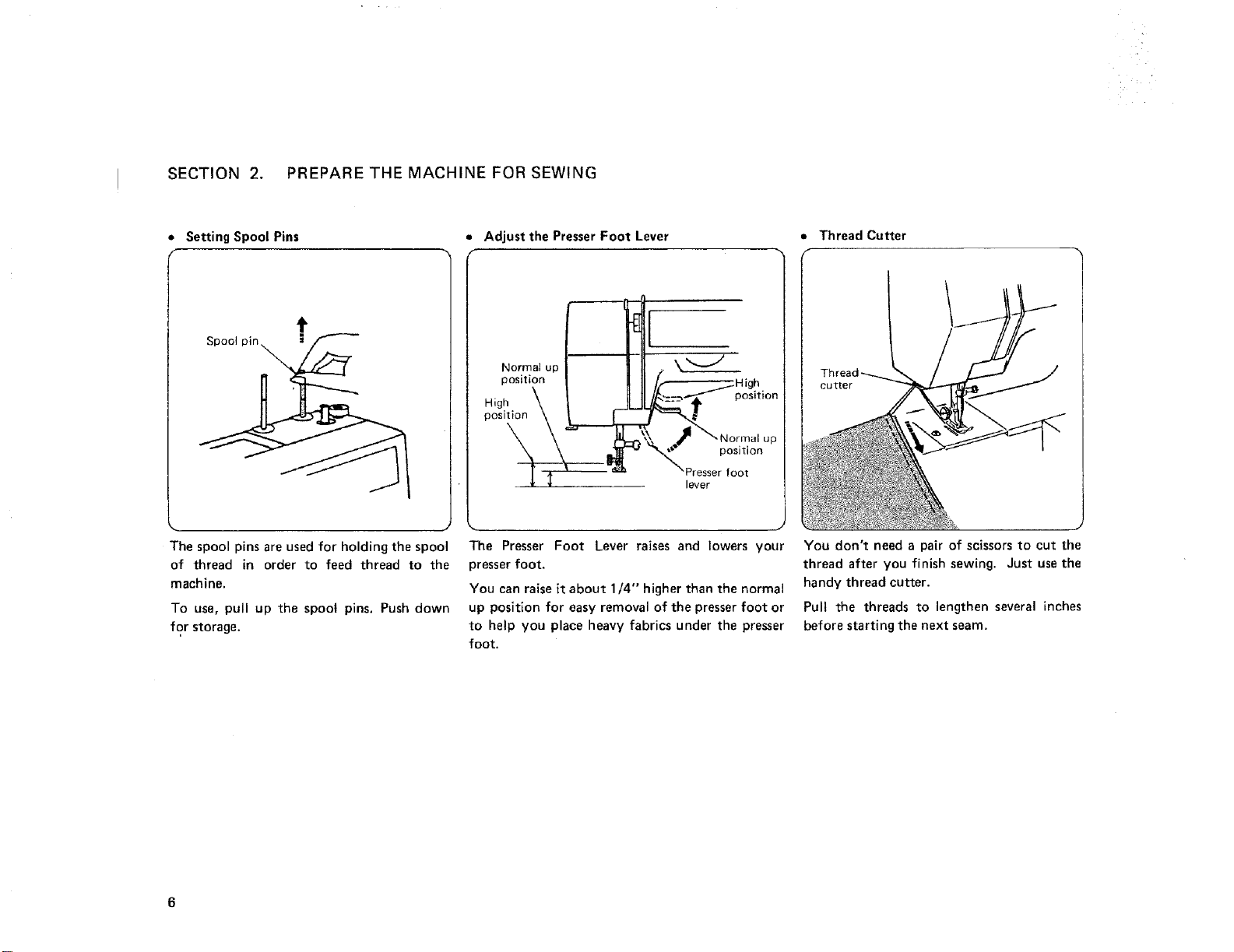
• Setting Spool Pins
f
t
Spool "
The spool pins are used for holding the spool
of thread in order to feed thread to the
machine.
To use, pull up the spool pins. Push down
for storage.
• Adjust the Presser Foot Lever
Normal up
position
positior
High
position
ip
position
Presser foo'_
lever
J
The Presser Foot Lever raises and lowers your
presser foot.
You can raise it about 1/4" higher than the normal
up position for easy removal of the presser foot or
to help you place heavy fabrics under the presser
foot.
• Thread Cutter
You don't need a pair of scissors to cut the
thread after you finish sewing. Just use the
handy thread cutter.
Pull the threads to lengthen several inches
before starting the next seam.
Set Up the Machine (Continued)
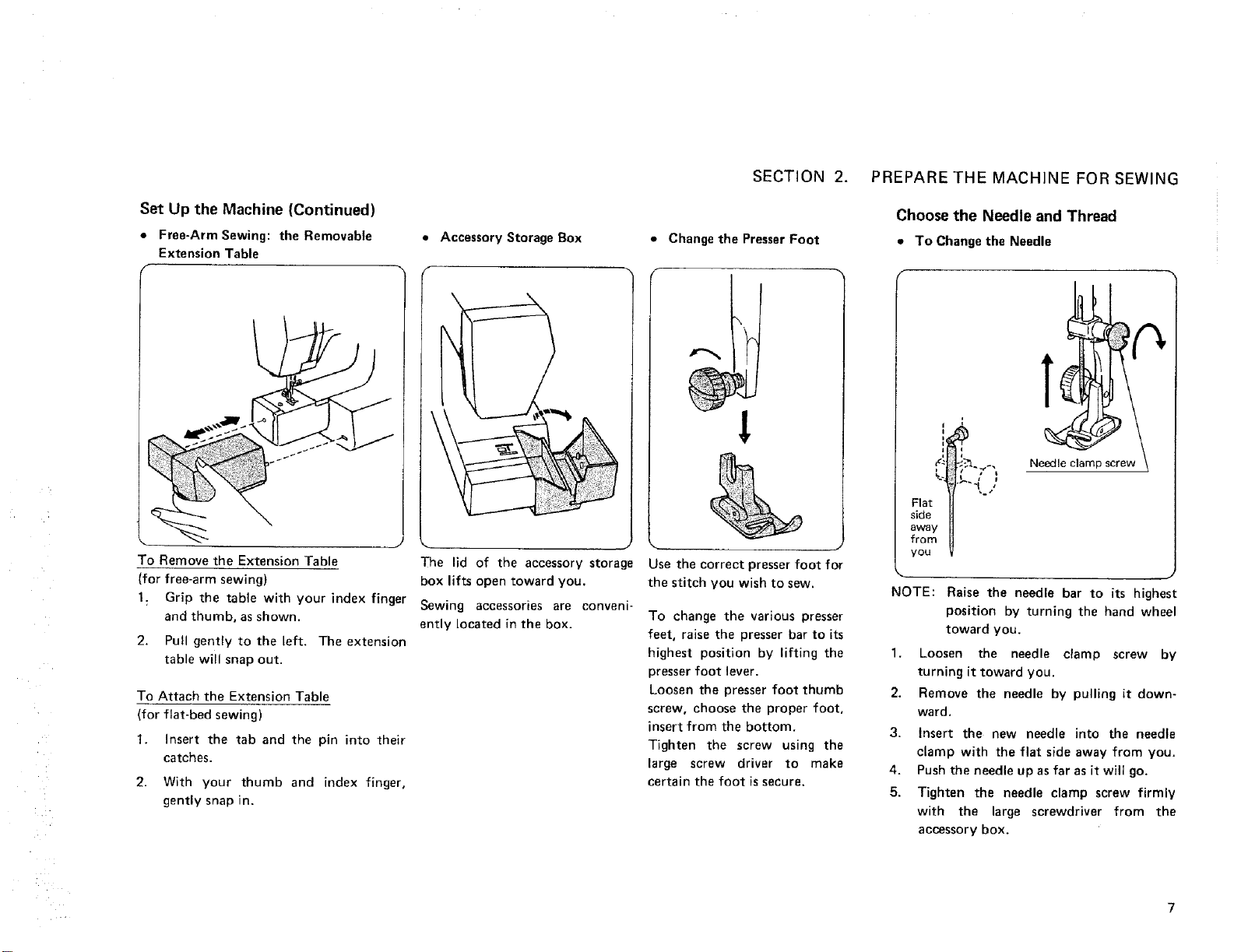
• Free-Arm Sewing: the Removable
Extension Table
• Accessory Storage Box
SECTION 2.
Change the PresserFoot
PREPARE THE MACHINE FOR SEWING
Choose the Needle and Thread
• To Changethe Needle
J
To Remove the Extension Table
(for free-arm sewing)
1. Grip the table with your index finger
and thumb, as shown.
2. Pull gently to the left, The extension
table will snap out.
The lid of the accessory storage
box lifts open toward you.
Sewing accessories are conveni-
ently located in the box.
To Attach the Extension Table
(for flat-bed sewing)
1. Insert the tab and the pin into their
catches.
2. With your thumb and index finger,
gently snap in.
!
Use the correct presser foot for
the stitch you wish to sew.
To change the various presser
feet, raise the presser bar to its
highest position by lifting the
presser foot lever.
Loosen the presser foot thumb
screw, choose the proper foot,
insert from the bottom.
Tighten the screw using the
large screw driver to make
certain the foot is secure.
%
Flat
side
away
fror£1
you
NOTE:
Needle clamp screw
)
Raise the needle bar to its highest
position by turning the hand wheel
toward you.
1. Loosen the needle clamp screw by
turning it toward you.
2. Remove the needle by pulling it down-
ward.
3. Insert the new needle into the needle
clamp with the flat side away from you.
4. Push the needle up as far as it will go.
5. Tighten the needle clamp screw firmly
with the large screwdriver from the
accessory box.
z ¸
r
,/• i ¸
SECTION 2. PREPARE THE MACHINE FOR SEWING
j
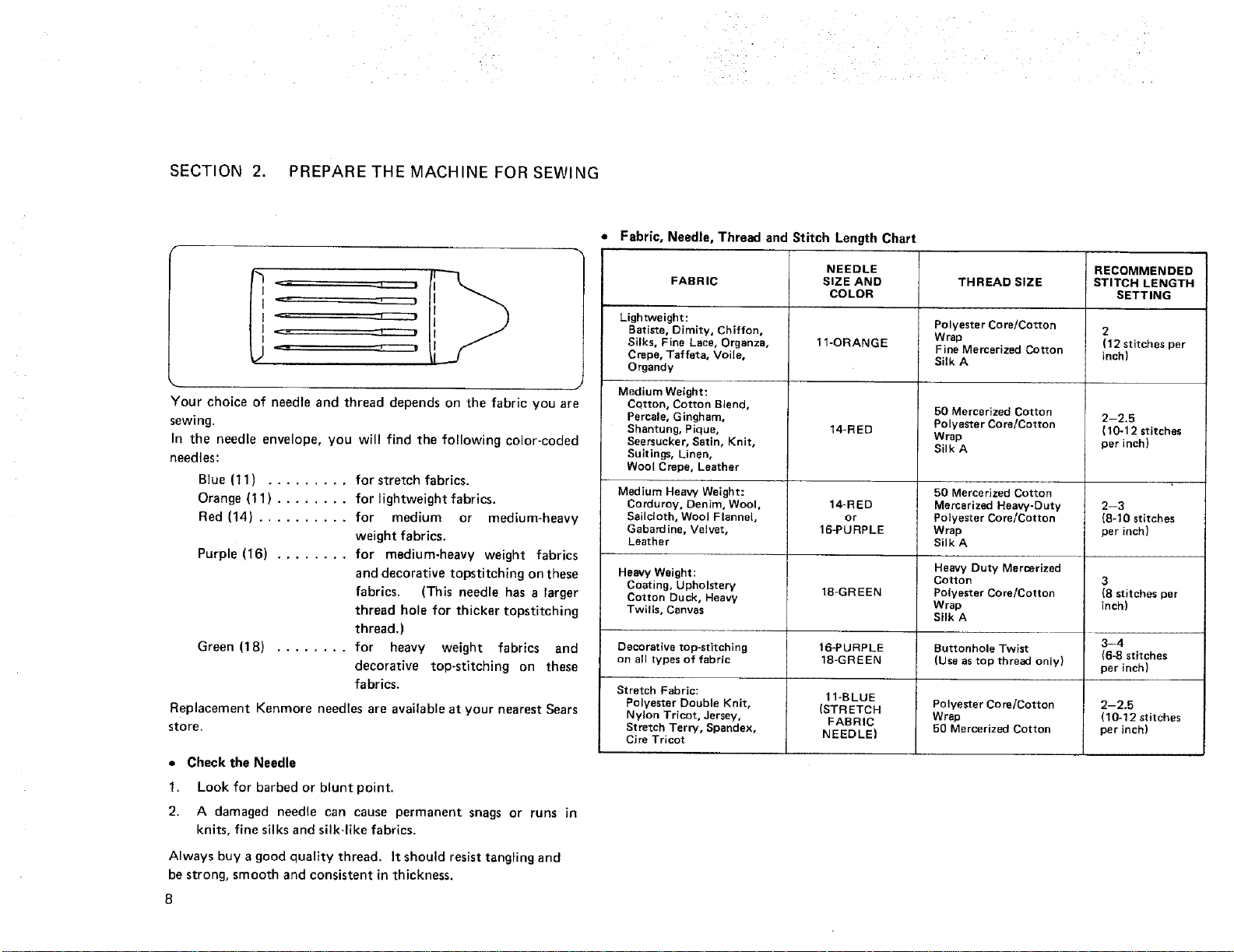
Your choice of needle and thread depends on the fabric you are
sewing.
In the needle envelope, you will find the following color-coded
needles:
Blue (11 ) ......... for stretch fabrics.
Orange (11 ) ........ for lightweight fabrics.
Red (14) .......... for medium or medium-heavy
weight fabrics.
Purple (16) ........ for medium-heavy weight fabrics
and decorative topstitching on these
fabrics. (This needle has a larger
thread hole for thicker topstitching
thread.)
Green (18) ........ for heavy weight fabrics and
decorative top-stitching on these
fabrics.
Replacement Kenmore needles are available at your nearest Sears
store.
• Check the Needle
1. Look for barbed or blunt point.
2. A damaged needle can cause permanent snags or runs in
knits, fine silks and silk-like fabrics.
Always buy a good quality thread. It should resist tangling and
be strong, smooth and consistent in thickness.
8
• Fabric, Needle, Thread and Stitch Length Chart
NEEDLE RECOMMENDED
FABRIC SIZE AND THREAD SIZE STITCH LENGTH
COLOR SETTING
Lightweight:
Batiste, Dimity, Chiffon, Polyester Core/Cotton 2
Silks, Fine Lace, Organza, 11-ORANGE Wrap (12 stitches per
Fine Mercerized Co,on inch)
Crepe, Taffeta, Voile,
Organdy Silk A
Medium Weight:
CQtton, Cotton Blend,
Percale, Gingham, 50 Mercerized Cotton 2-2.5
Shantung, Pique, 14-RED Polyester Core/Cotton (10-12 stitches
Seersucker, Satin, Knit, Wrap per inch)
Suiting, Linen, Silk A
Wool Crepe, Leather
Medium Heaw Weight: 50 Mercerized Cotton
Corduroy, Denim, Wool, 14-RED Mercerized Heavy-Duty 2--3
Sailcloth, Wool Flannel, or Polyester Core/Cotton {8-10 stitches
Gabardine, Velvet, 16-PURPLE Wrap per inch)
Leather Silk A
Heavy Weight: Heavy Duty Mercerized
Cotton 3
Coating, Upholstery
Cotton Duck, Heavy 18-GREEN Polyester Core/Cotton (8 stitches per
Twills, Canvas Wrap inch)
Silk A
I 3--4
Decorative top-stitching 16-PURPLE Buttonhole Twist (6-8 stitches
on all types of fabric 18-GREEN (Use as top thread only) per inch)
Stretch Fabric:
11-BLUE
Polyester Double Knit, {STRETCH Polyester Core/Cotton 2-2.5
Nylon Tricot. Jersey, FABRIC Wrap (10-12 stitches
Stretch Terry, Spandex, NEEDLE) 50 Mercerized Cotton per inch)
Cire Tricot
Prepare the Bobbin
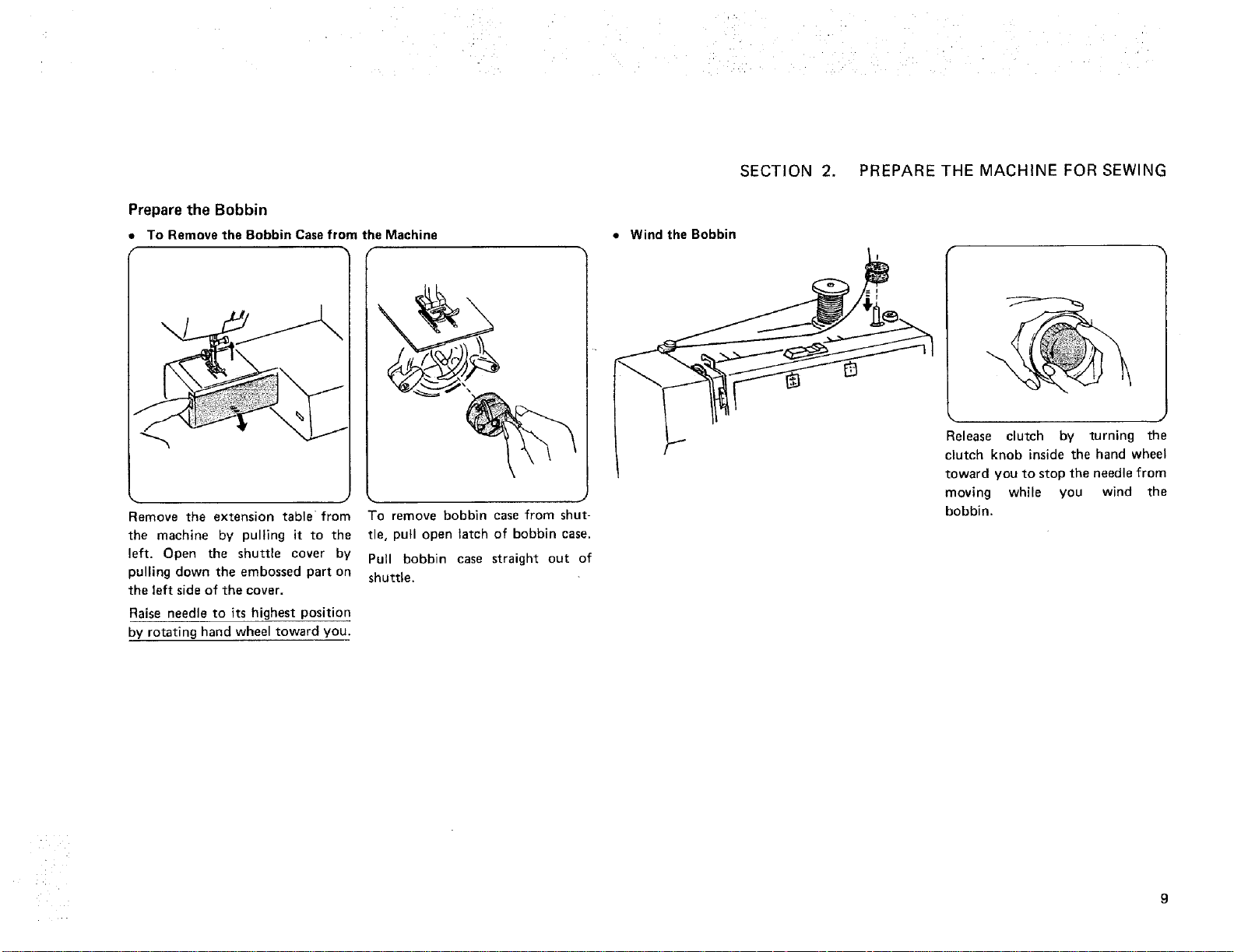
• To Remove the Bobbin Casefrom the Machine
Remove the extension table from
the machine by pulling it to the
left. Open the shuttle cover by
pulling down the embossed part on
the left side of the cover.
Raise needle to its highest position
by rotating hand wheel toward you.
J
To remove bobbin case from shut-
tle, pull open latch of bobbin case.
Pull bobbin case straight out of
shuttle.
• Wind the Bobbin
SECTION 2. PREPARE THE MACHINE FOR SEWING
Release clutch by turning the
clutch knob inside the hand wheel
toward you to stop the needle from
moving while you wind the
bobbin.
i•!
SECTION 2. PREPARE THE MACHINE FOR SEWING
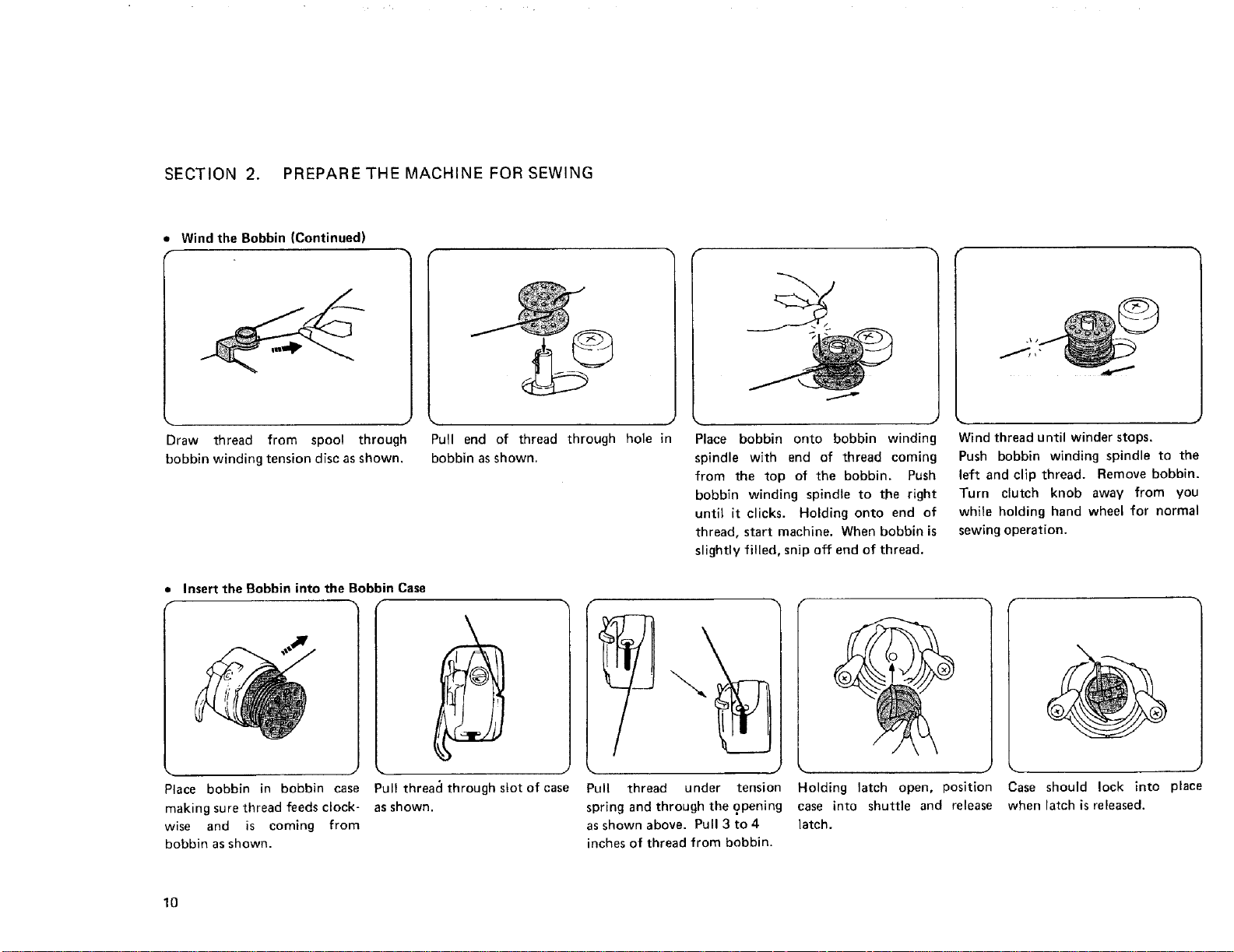
• Wind the Bobbin (Continued)
f
Draw thread from spool through
bobbin winding tension disc asshown,
)
Pull end of thread through hole in
bobbin as shown.
Place bobbin onto bobbin winding
spindle with end of thread coming
from the top of the bobbin. Push
bobbTn winding spindle to the right
until it clicks. Holding onto end of
thread, start machine. When bobbin is
slightly filled, snip off end of thread.
Wind thread until winder stops.
Push bobbin winding spindle to the
left and clip thread. Remove bobbin.
Turn clutch knob away from you
while holding hand wheel for normal
sewing operation.
• Insert the Bobbin into the Bobbin Case
Place bobbin in bobbin case
making sure thread feeds clock-
wise and is coming from
bobbin as shown.
Pull thread through slot of case
as shown.
Pull thread
,J
under tension
spring and through the opening
as shown above. Pull 3 to 4
inches of thread from bobbin.
J
Holding latch open, position Case should lock into place
case into shuttle and release when latch is released.
latch.
10
Prepare the Top Thread
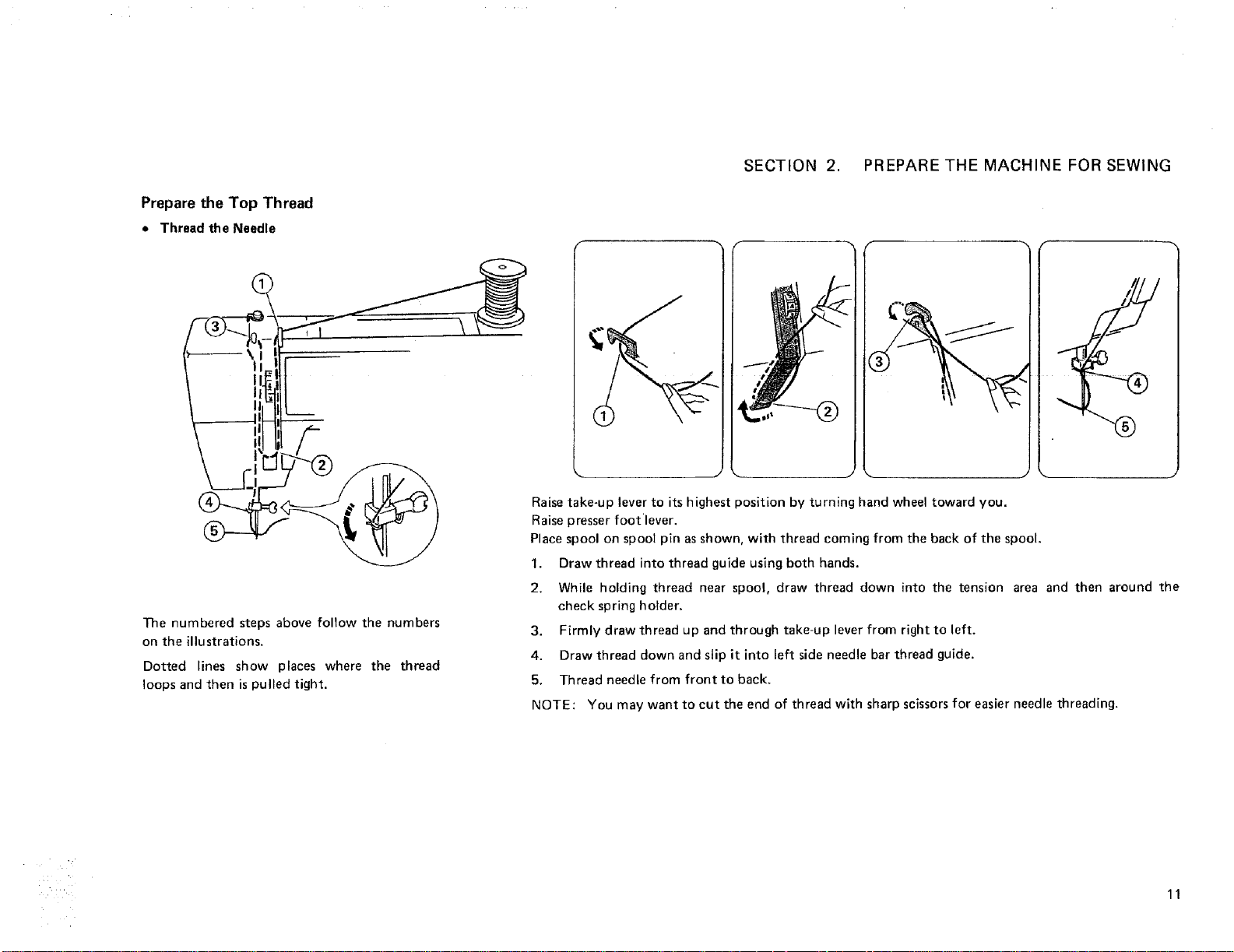
• Thread the Needle
The numbered steps above follow the numbers
on the illustrations.
Dotted lines show places where the thread
loops and then is pulled tight.
SECTION 2. PREPARE THE MACHINE FOR SEWING
J
Raise take-up lever to its highest position by turning hand wheel toward you.
Raise presser foot lever.
Place spool on spool pin as shown, with thread coming from the back of the spool.
1. Draw thread into thread guide using both hands.
2. While holding thread near spool, draw thread down into the tension area and then around the
check spring holder.
3. Firmly draw thread up and through take-up lever from right to left.
4. Draw thread down and slip it into left side needle bar thread guide.
5. Thread needle from front to back.
NOTE: You may want to cut the end of thread with sharp scissors for easier needle threading.
11
SECTION 2. PREPARE THE MACHINE FOR SEWING
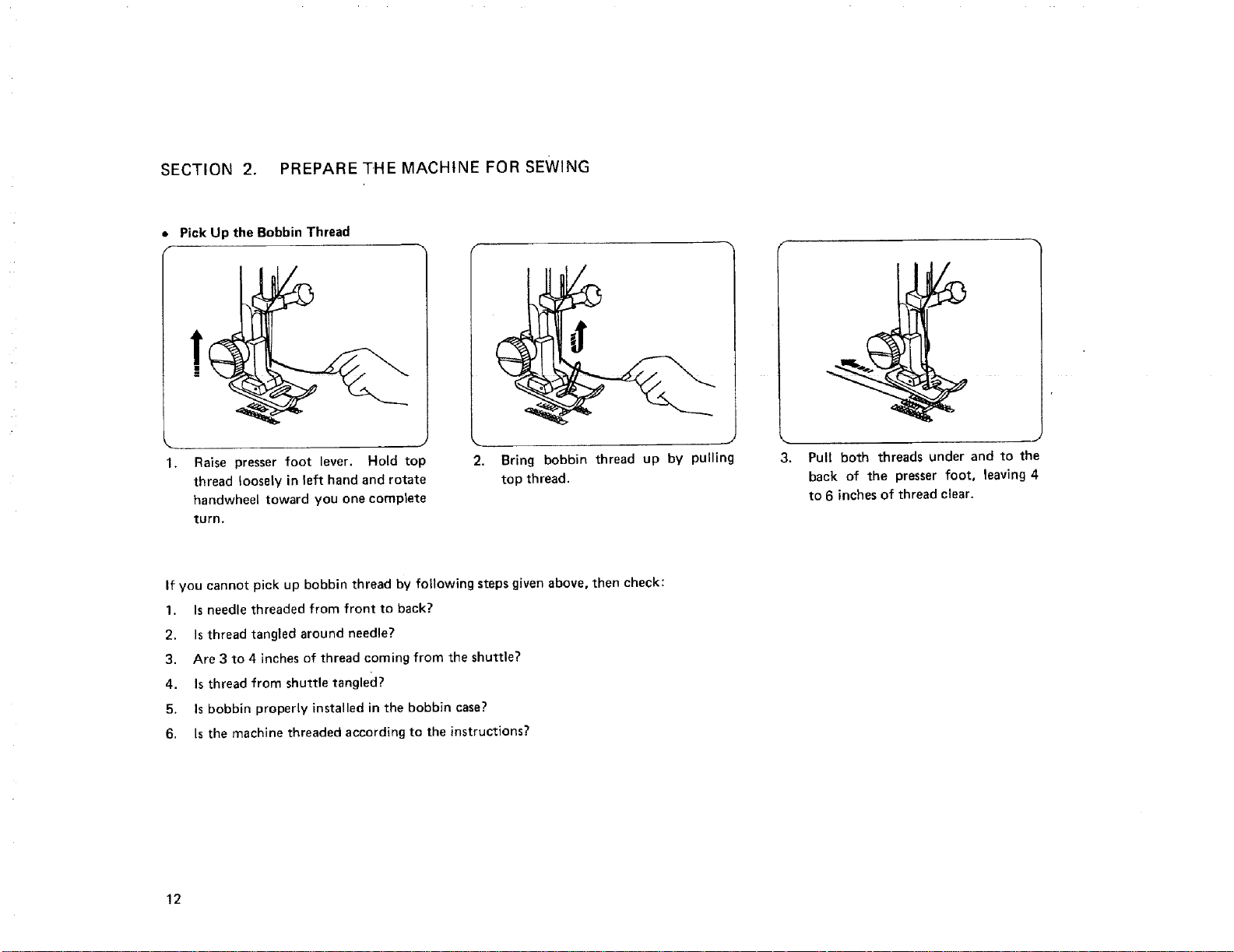
Pick Up the Bobbin Thread
!
1. Raise presser foot lever. Hold top
thread loosely in left hand and rotate
handwheel toward you one complete
turn.
2. Bring bobbin thread up by pulling
top thread.
3. Pull both threads under and to the
back of "the presser foot, leaving 4
to 6 inches of thread clear.
If you cannot pick up bobbin thread by following steps given above, then check:
1. Is needle threaded from front to back?
2. Is thread tangled around needle?
3. Are 3 to 4 inches of thread coming from the shuttle?
4. Is thread from shuttle tanglecl?
5. Is bobbin properly installed in the bobbin case?
6. Is the machine threaded according to the instructions?
12
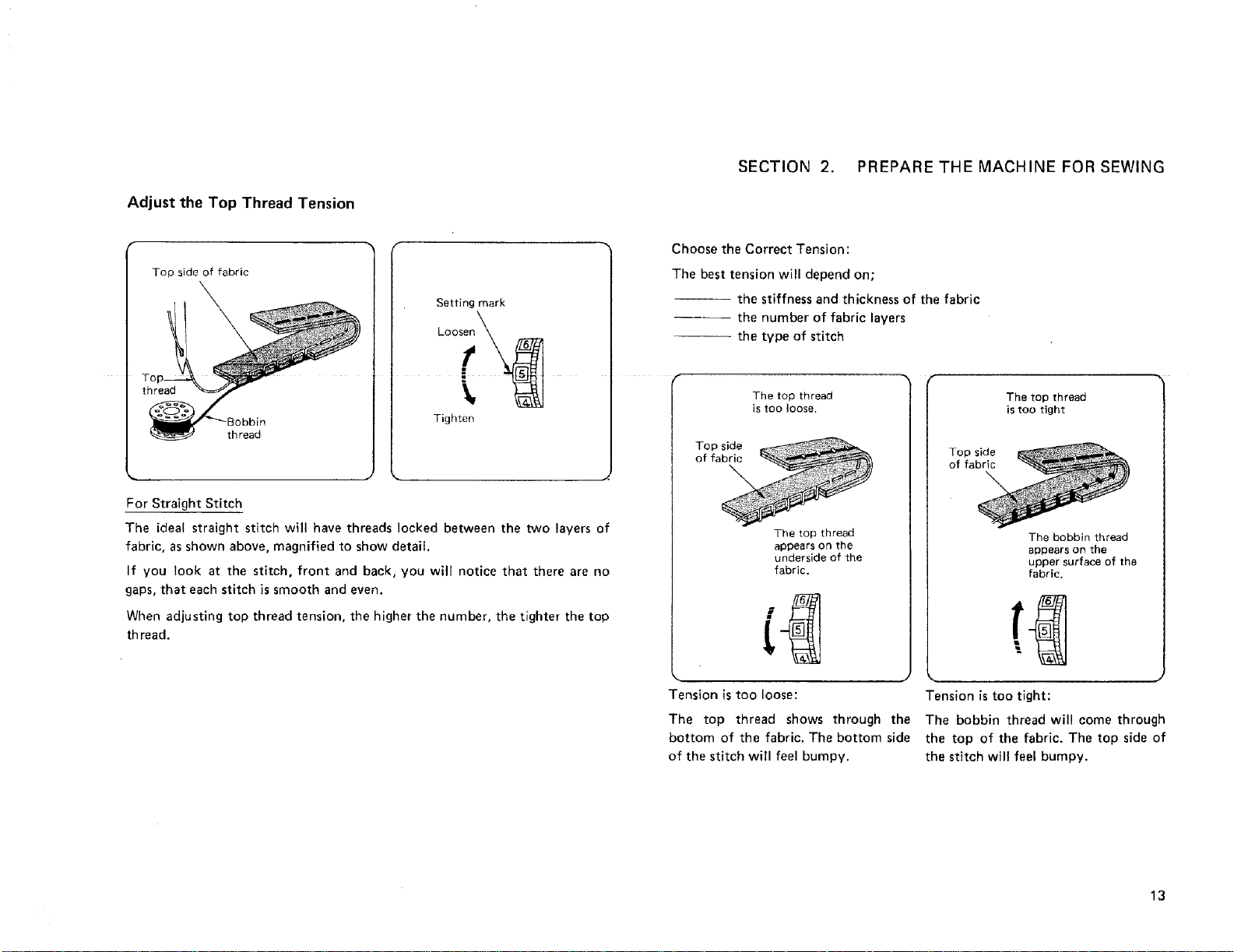
Adjust the Top Thread Tension
SECTION 2. PREPARE THE MACHINE FOR SEWING
Top side of fabric
thread
thread
Setting mark
(
Tighten
For Straight Stitch
The ideal straight stitch will have threads locked between the two layers of
fabric, as shown above, magnified to show detail.
If you look at the stitch, front and back, you will notice that there are no
gaps, that each stitch is smooth and even.
When adjusting top thread tension, the higher the number, the tighter the top
thread.
Choose the Correct Tension:
The best tension will depend on;
the stiffness and thickness of the fabric
the number of fabric layers
--- the type of stitch
The top thread
is too loose.
Top side
of fabric
The top thread
appears on the
underside of the
fabric.
Tension is too loose:
The top thread shows through the
bottom of the fabric. The bottom side
of the stitch will feel bumpy.
The top thread
is too tight
Top side
of fabric
The bobbin thread
appears on the
upper surface of the
fabric.
Tension is too tight:
The bobbin thread will come through
the top of the fabric. The top side of
the stitch wilt feel bumpy.
13
SECTION 2. PREPARE THE MACHINE FOR SEWING
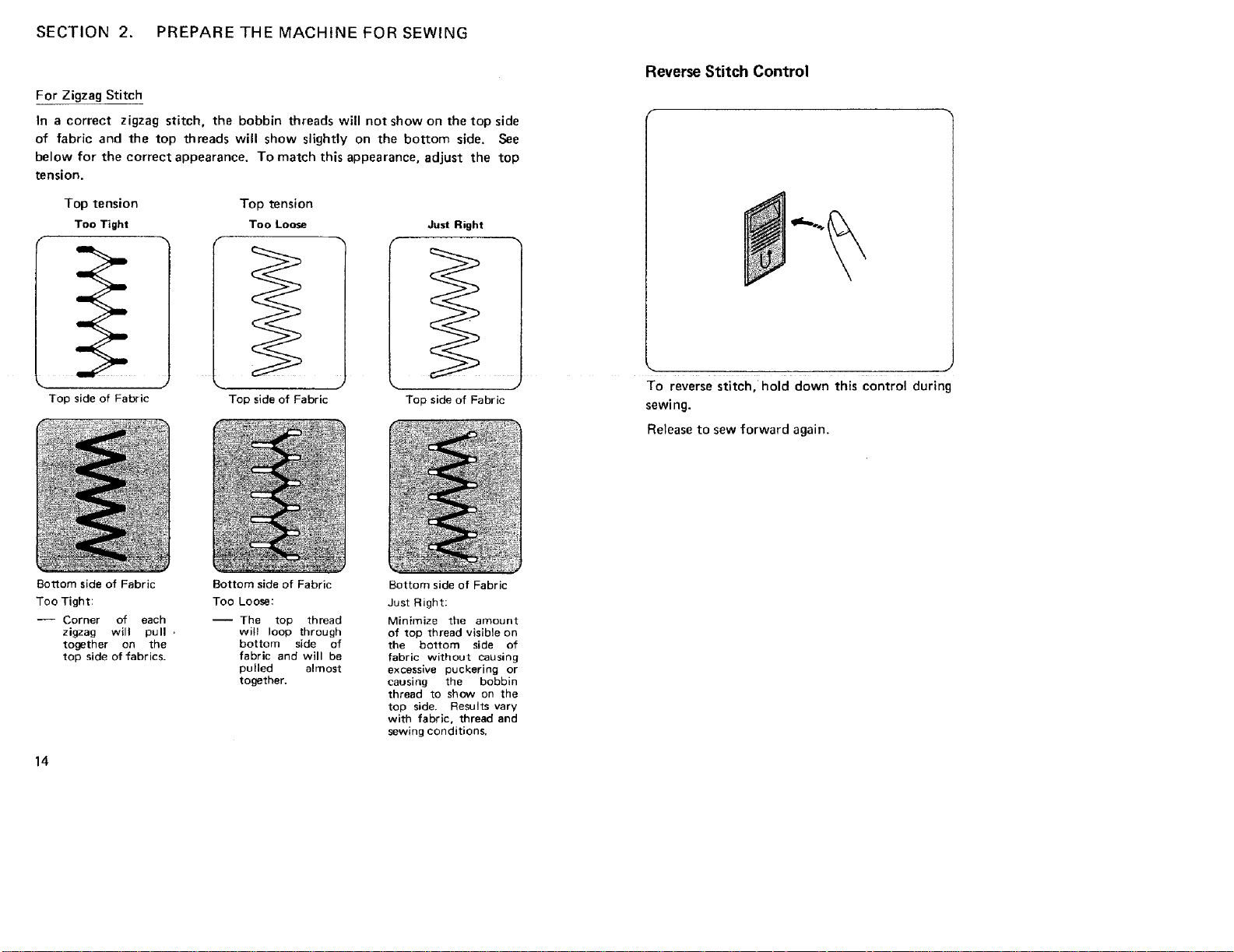
For Zigzag Stitch
In a correct zigzag stitch, the bobbin threads will not show on the top side
of fabric and the top threads will show slightly on the bottom side. See
below for the correct appearance. To match this appearance, adjust the top
tension.
Top tension
Too Tight
Top side of Fabric
Top tension
Too Loose
Top side of Fabric
Just Right
Top side of Fabric
Reverse Stitch Control
To reverse stitch, hold down this control during
sewing.
Release to sew forward again.
Bottom side of Fabric
Too Tight:
-- Corner of each
zigzag will pull .
together on the
top side of fabrics.
Bottom side of Fabric
Too Loose:
-- The top thread
will loop through
bottom side of
fabric and will be
pulled almost
together.
Bottom side of Fabric
Just Right:
Minimize the amount
of top thread visible on
the bottom side of
fabric without causing
excessive puckering or
causing the bobbin
thread to show on the
top side. Results vary
with fabric, thread and
sewing conditions.
14
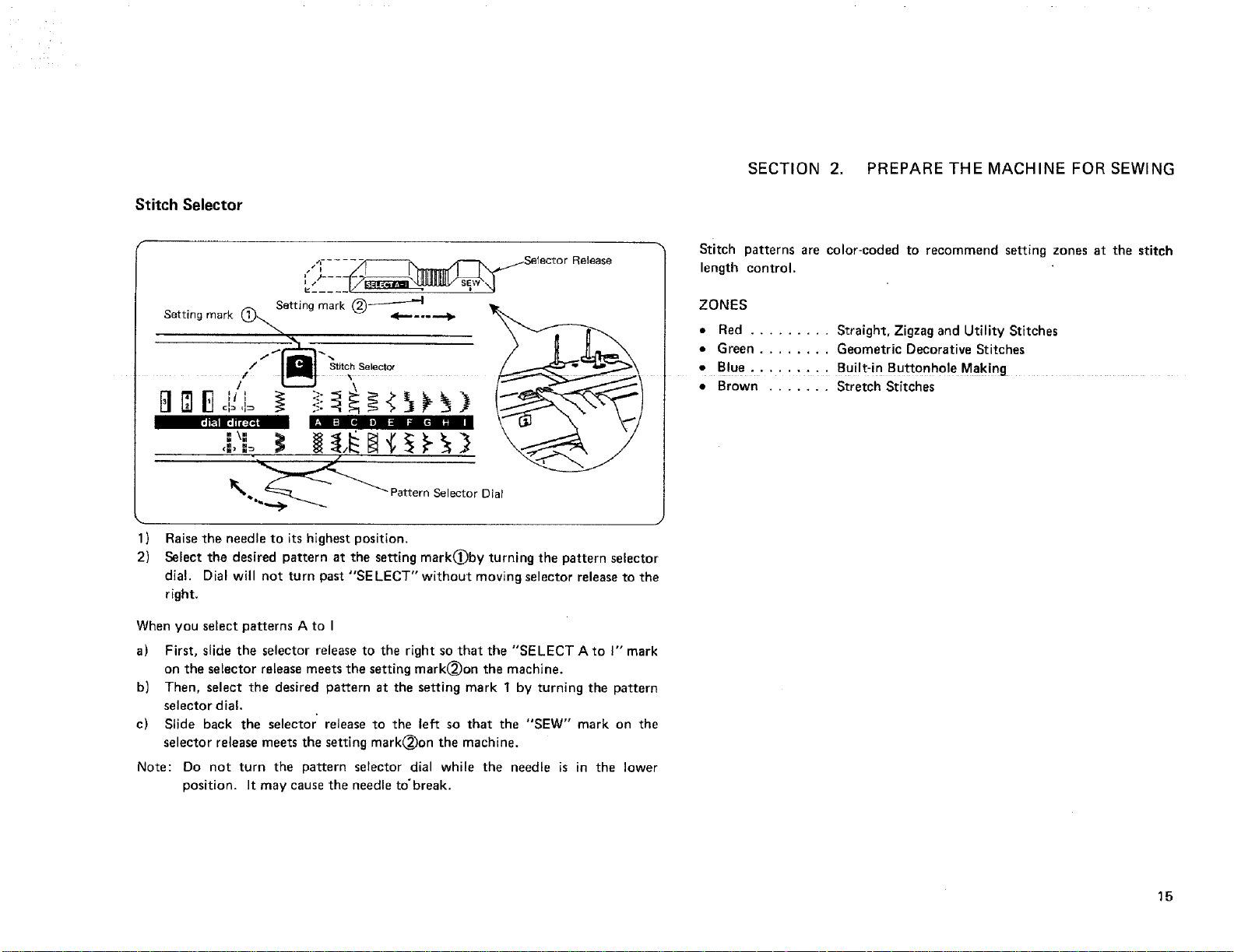
Stitch Selector
Jr. ..... I I Selector Release
Setting mark (_)_etting mark @_
/" "'_tito.Selector
=. = =
= \=
lt%.o_Pattern Selector Dial
1)
2)
Raise the needle to its highest position.
Select the desired pattern at the setting mark(_)by turning the pattern selector
dia!. Dial will not turn past "SELECT" without moving selector release to the
right,
When you select patterns A to I
a) First, slide the selector release to the right so that the "SELECT A to !" mark
on the selector release meets the setting mark@on the machine.
b) Then, select the desired pattern at the setting mark I by turning the pattern
selector dial.
c) Slide back the selector' release to the left so that the "SEW" mark on the
selector release meets the setting mark(_)on the machine.
Note: Do not turn the pattern selector dial while the needle is in the lower
position. It may cause the needle to'break.
SECTION 2. PREPARE THE MACHINE FOR SEWING
stitch patterns are color-coded to recommend setting zones at the stitch
length control.
ZONES
• Red ......... Straight, Zigzag and Utility Stitches
• Green ........ Geometric Decorative Stitches
• Blue ......... Built-in Buttonhole Making
• Brown ....... Stretch Stitches
15
SECTION 2. PREPARE THE MACHINE FOR SEWING
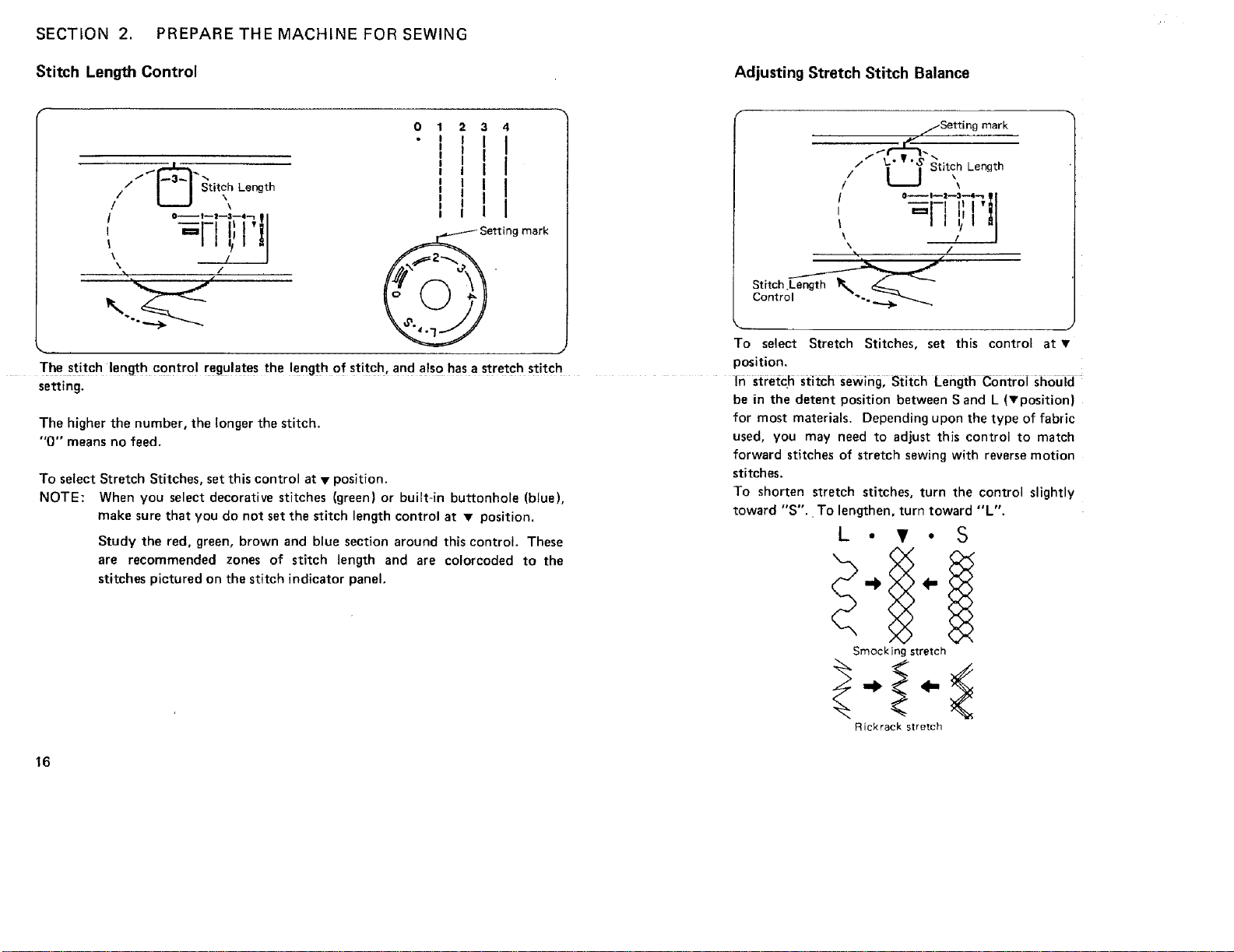
Stitch Length Control
Adjusting Stretch Stitch Balance
// Stitch Length
! \
/ o--1-1-3-,-_ lJ1,, =H!)t'
\
• i ,,¢/
0 3 4
I
I
I
I
etting mark
The stitch length control regulates the length of stitch, and also hasa stretch stitch
setting.
The higher the number, the longer the stitch.
"0" means no feed.
To select Stretch Stitches, set this control at • position.
NOTE: When you select decorative stitches (green) or built-in buttonhole (blue),
make sure that you do not set the stitch length control at • position.
Study the red, green, brown and blue section around this control. These
are recommended zones of stitch length and are colorcoded to the
stitches pictured on the stitch indicator panel.
,./-Setting mark
/ titch Length
/ \
t o--i--=-,,;--+--, +_
---- I Yn
,, = i] 1
Stitch ._
Control "'.._.._
To select Stretch Stitches, set this control at •
position.
be in the detent position between S and L (Vposition)
for most materials. Depending upon the type of fabric
used, you may need to adjust this control to match
forward stitches of stretch sewing with reversemotion
stitches.
To shorten stretch stitches, turn the control slightly
toward "S". To lengthen, turn toward "L"+
L - • • S
Smock ing stretch
Rickrack stretch
16
SECTION2. PREPARETHEMACHINEFORSEWING
StartingTo Sew
Now that you are familiar with the controls on your machine and with the accessories provided for the machine, you are ready to start to sew with your new
Kenmore sewing machine. Below are some good habits to follow each time you sit down to sew:
1. Inspect the needle. It should be straight, properly set and sharp on the point. It should be the correct size for the fabric and thread being used. Do not be
afraid to change your needle frequently. Many of the new fabrics made of synthetic blends tend to dull the needles more easily than fabrics made of natural
fibers.
2. Before placing the material on the machine, see that the ends of the threads have been drawn about 4 inches to the rear of the mach!ne_ Ho!don to threads
during the sewing of the first 3 or 4 stitches of the seam.
3. Test the machine stitch on a scrap of the fabric you plan to use. The fabric should be double thickness. Adjust the machine for the length of stitch and
tension suitable to the fabric.
4. Fabric should be placed under the presser foot with the bulk of the material to the left of the needle and the right edge of the material placed on the 5/8'"
seam marking on the needle plate when making a simple seam.
5, Run the machine at a slow even speed. The more pressure you put on the foot control, the faster the machine will sew.
6. Fasten each seam by back tacking sewing a few stitches in reverse.
7. Always finish sewing each seam with the needle at its highest point.
8. Guide the fabric gently with your hand in front of the needle. Never pull or hold the fabric in such a way that the normal feeding is altered.
9, When turning the hand wheel manually, always turn it toward you.
17
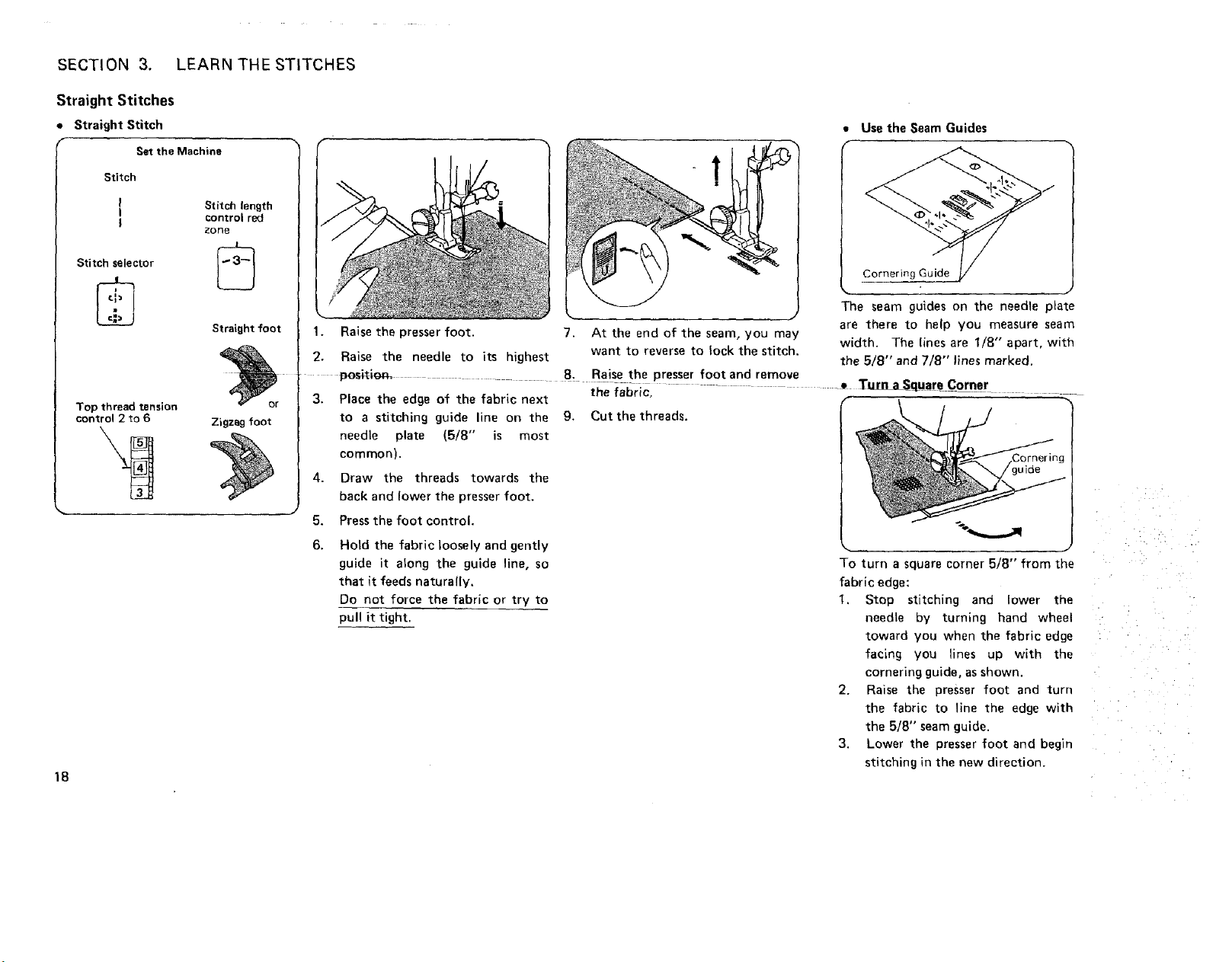
SECTION 3. LEARN THE STITCHES
Straight Stitches
Straight Stitch
Set the Machine
Stitch
I
I
I
Stitch selector
Top thread tension
control 2 to 6
Stitch length
control red
zone
Straight foot
Zigzag foot
18
1. Raise the presser foot.
7. At the end of the seam, you may
Use the Seam Guides
Cornering Guide
The seam guides on the needle plate
are there to help you measure seam
width. The lines are 1/8" apart, with
2. Raise the needle to its highest want to reverse to lock the stitch, the 5/8" and 7/8" lines marked.
position .... 8_ Raise the presser foot and remove
t T_o+uare Corner
the fabric, - .....
3. Place the edge of the fabric next _"
to a stitching guide line on the 9. Cut the threads. [
needle plate (5/8" is most
common), g
4. Draw the threads towards the
back and lower the presser foot.
5. Press the foot control.
6. Hold the fabric loosely and gently
guide it along the guide line, so To turn a square corner 5/8" from the
that it feeds naturally, fabric edge:
Do not force the fabric or try to 1, Stop stitching and lower the
pull it tight, needle by turning hand wheel
toward you when the fabric edge
facing you lines up with the
cornering guide, as shown.
2. Raise the presser foot and turn
the fabric to line the edge with
the 5/8" seam guide.
3. Lower the presser foot and begin
stitching in the new direction.
!i ii'i: i
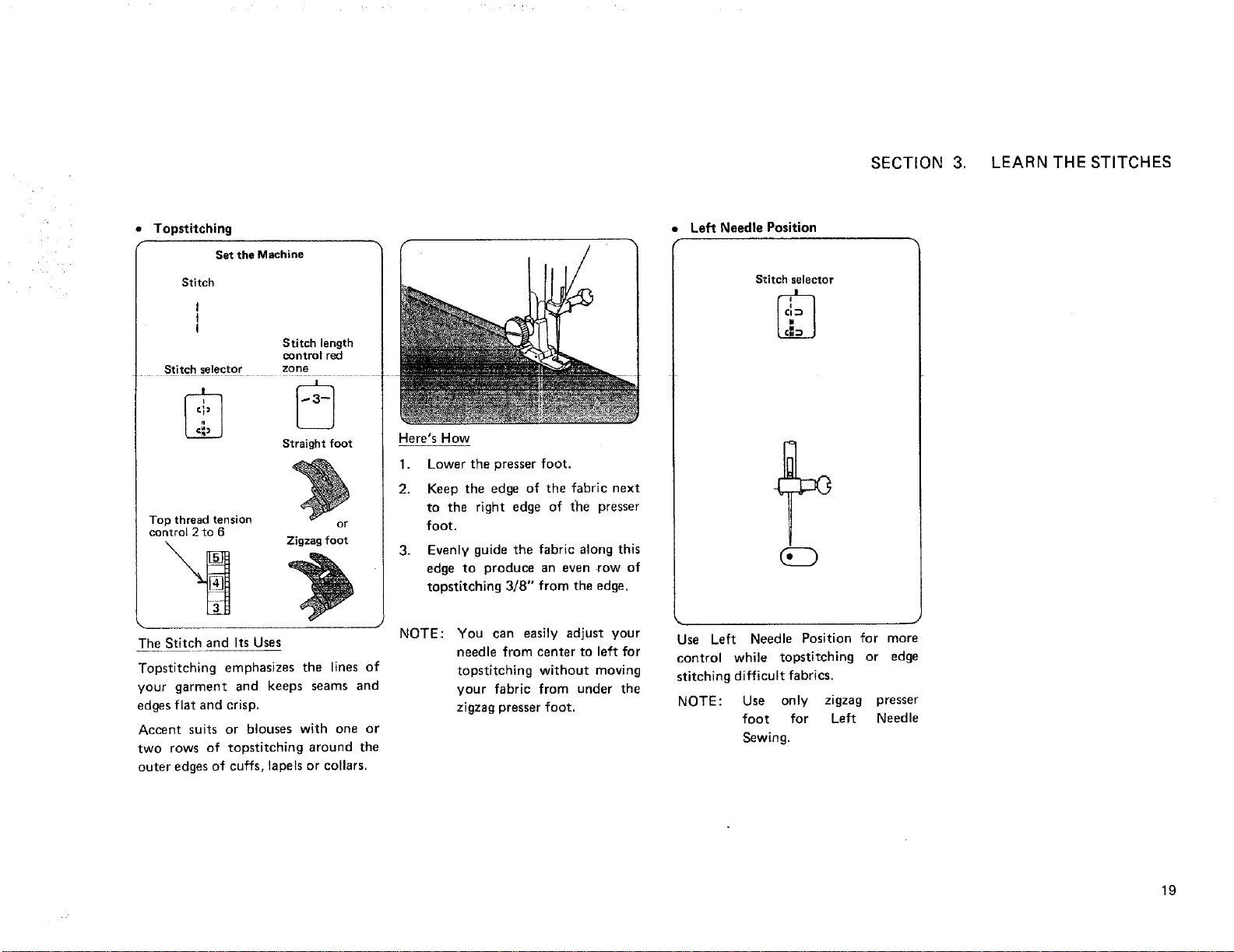
SECTION 3. LEARN THE STITCHES
• Topstitching
Set the Machine
Stitch
I
1
I
Stitch selector
Top thread tension
control 2 to 6
Stitch length
control red
zone
Straight foot
or
Zigzag foot
The Stitch and Its Uses
Topstitching emphasizes the lines of
your garment and keeps seams and
edges flat and crisp.
Accent suits or blouses with one or
two rows of topstitching around the
outer edges of cuffs, lapels or collars.
Here's How
1.
2.
3.
Lower the presser foot.
Keep the edge of the fabric next
to the right edge of the presser
foot.
Evenly guide the fabric along this
edge to produce an even row of
topstitching 3/8'" from the edge.
NOTE:
You can easily adjust your
needle from center to left for
topstitching without moving
your fabric from under the
zigzag presser foot.
Left Needle Position
Stitch selector
©
Use Left Needle Position for more
control while topstitching or edge
stitching difficult fabrics.
NOTE: Use only zigzag presser
foot for Left Needle
Sewing.
19
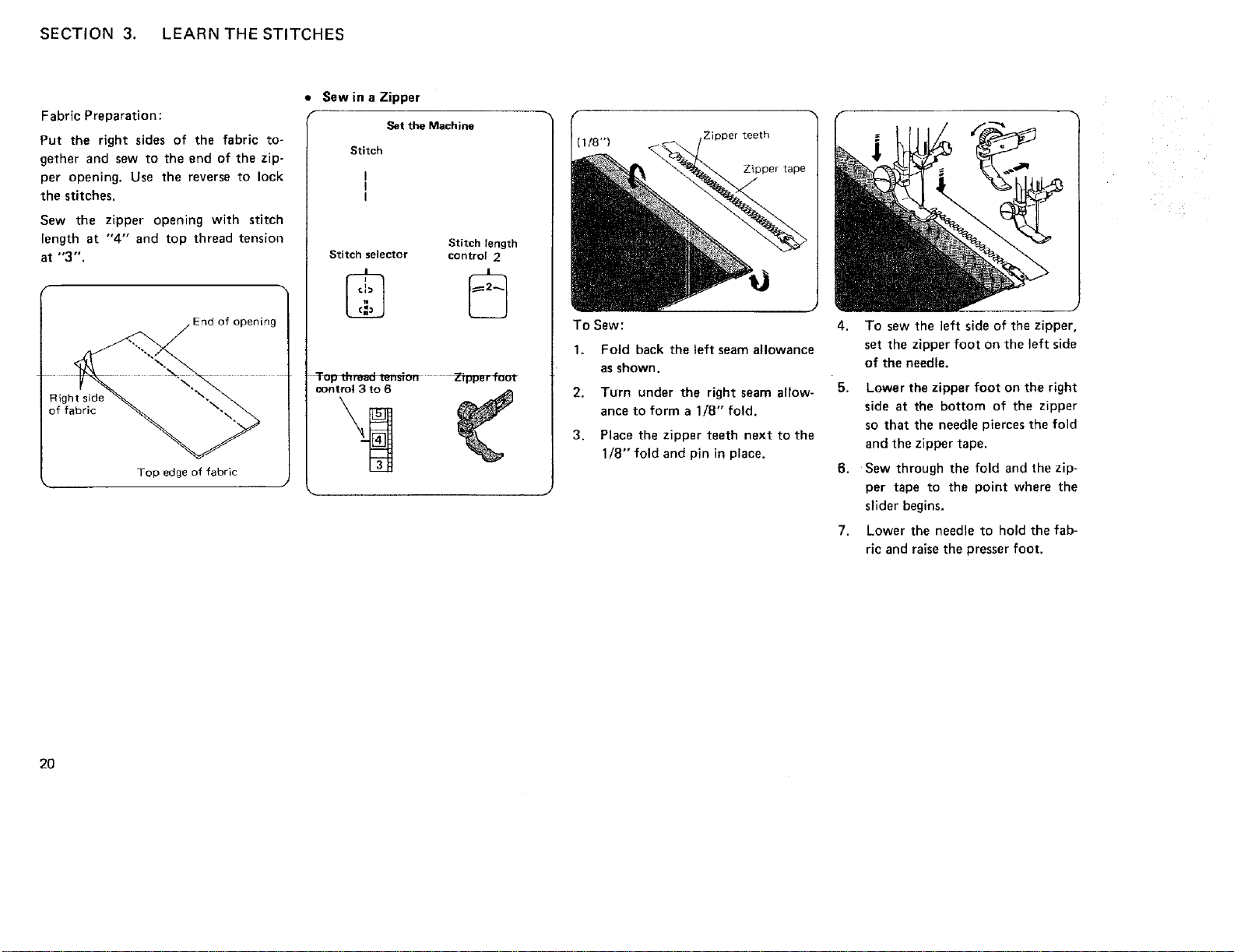
SECTION 3. LEARN THE STITCHES
Fabric Preparation:
Put the right sides of the fabric to-
gether and sew to the end of the zip-
per opening. Use the reverse to lock
the stitches.
Sew the zipper opening with stitch
length at "4" and top thread tension
at "'3"'.
• Sew in a Zipper
Set the Machine
Stitch
I
I
I
Stitch length
Stitch selector control 2
control 3 to 6
1/8")
To Sew:
1.
Zipper teeth
Zipper tape
Fold back the left seam allowance
asshown.
2. Turn under the right seam allow-
ance to form a 1/8" fold.
3. Place the zipper teeth next to the
1/8" fold and pin in place.
4.
5.
6.
7.
To sew the left side of the zipper,
set the zipper foot on the left side
of the needle.
Lower the zipper foot on the right
side at the bottom of the zipper
so that the needle pierces the fold
and the zipper tape.
Sew through the fold and the zip-
per tape to the point where the
slider begins.
Lower the needle to hold the fab-
ric and raise the presser foot.
2O
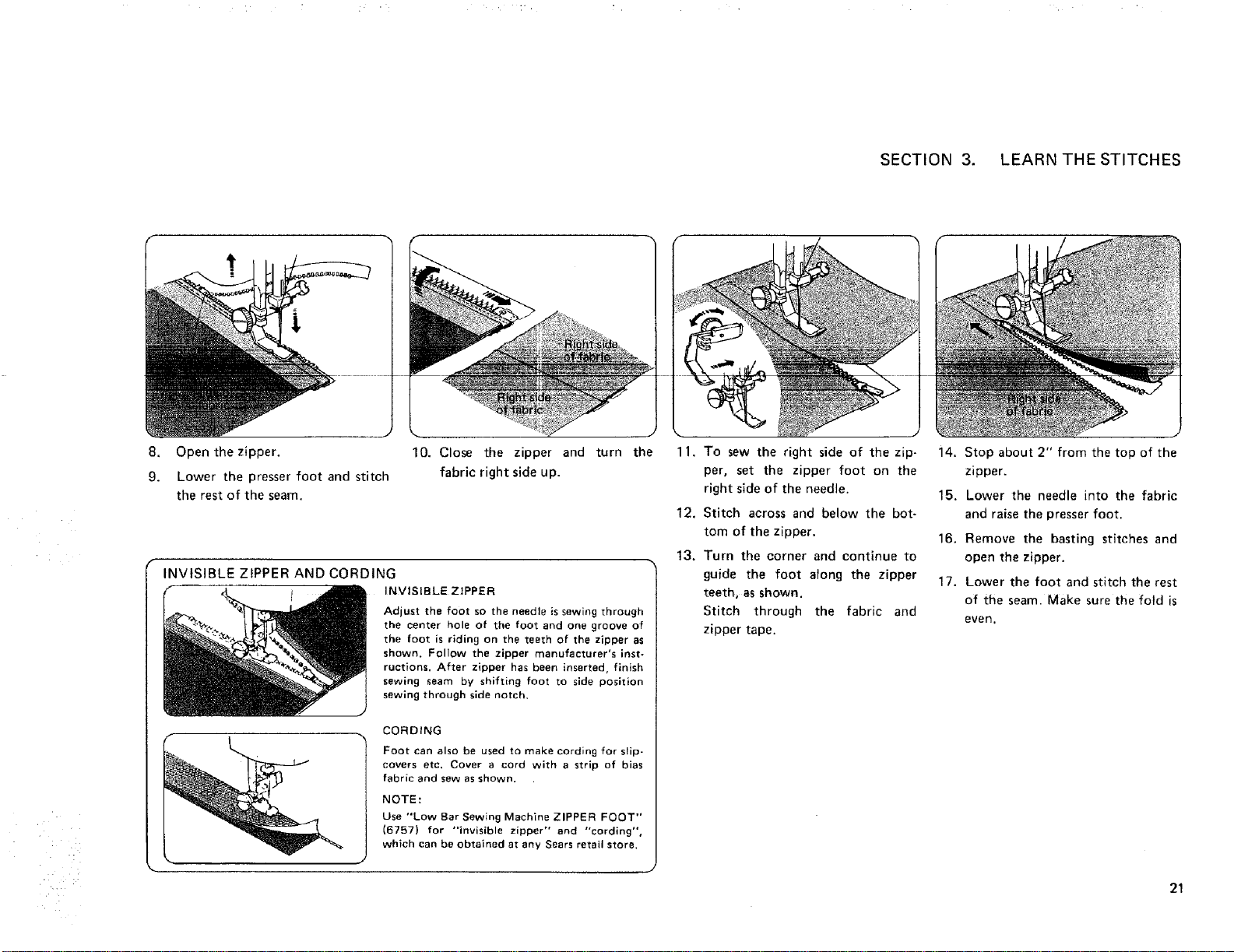
SECTION 3. LEARN THE STITCHES
8. Open theztpper. 10. Close the zipper and turn the
9. Lower the presser foot and stitch fabric right side up.
the rest of the seam.
INVISIBLE ZIPPER AND CORDING
! INVISIBLE ZIPPER
Adjust the foot so the needle is sewing through
the center hole of the foot and one groove of
the foot is riding on the teeth of the zipper as
shown. Follow the zipper manufacturer's inst-
ructions. After zipper has been inserted, finish
sewing seam by shifting foot to side position
sewing through side notch,
CORDING
Foot can also be used to make cording for slip-
covers etc. Cover e cord with a strip of bias
fabric end sew as shown.
NOTE:
Use "Low Bar Sewing Machine ZIPPER FOOT"
(6757) for "'invisible zipper" end "cording",
which can be obtained at any Sears retail store.
11. To sew the right side of the zip-
per, set the zipper foot on the
right side of the needle.
12. Stitch across and below the bot-
tom of the zipper.
13. Turn the corner and continue to
guide the foot along the zipper
teeth, as shown.
Stitch through the fabric and
zipper tape.
14, Stop about 2" from the top of the
zipper.
15. Lower the needle into the fabric
and raise the presser foot.
16. Remove the basting stitches and
open the zipper.
17. Lower the foot and stitch the rest
of the seam. Make sure the fold is
even.
21
SECTION 3. LEARN THE STITCHES
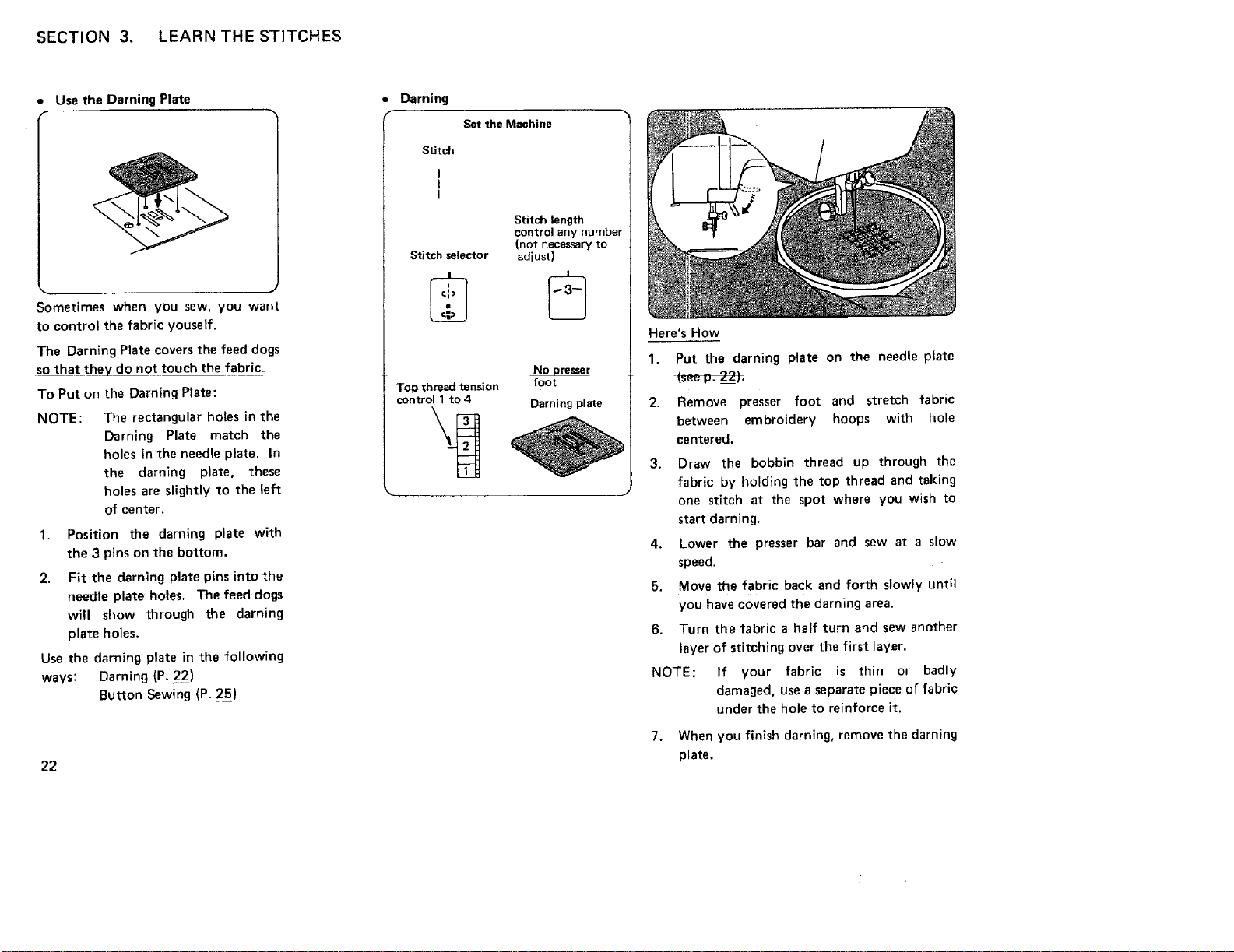
Use the Darning Plate
Sometimes when you sew, you want
to control the fabric youself.
The Darning Plate covers the feed dogs
so that they do not touch the fabric.
To Put on the Darning Plate:
NOTE: The rectangular holes in the
Darning Plate match the
holes in the needle plate. In
the darning plate, these
holes are slightly to the left
of center.
1. Position the darning plate with
the 3 pins on the bottom.
2. Fit the darning plate pins into the
needle plate holes. The feed dogs
will show through the darning
plate holes.
Use the darning plate in the following
ways: Darning (P. 22)
Button Sewing (P. 25)
Darning
Set the Machine
Stitch
I
I
I
Stitch selector
Stitch length
control any number
(not necessary to
adjust)
Top thread tension
control 1 to 4
No presser
foot
Darning plate
Here's How
1. Put the darning plate on the needle plate
2. Remove presser foot and stretch fabric
between embroidery hoops with hole
centered.
3. Draw the bobbin thread up through the
fabric by holding the top thread and taking
one stitch at the spot where you wish to
start darning.
4. Lower the presser bar and sew at a slow
speed.
5. Move the fabric back and forth slowly until
you have covered the darning area.
6. Turn the fabric a half turn and sew another
layer of stitching over the first layer.
NOTE: If your fabric is thin or badly
damaged, usea separate piece of fabric
under the hole to reinforce it,
7. When you finish darning, remove the darning
22 plate.
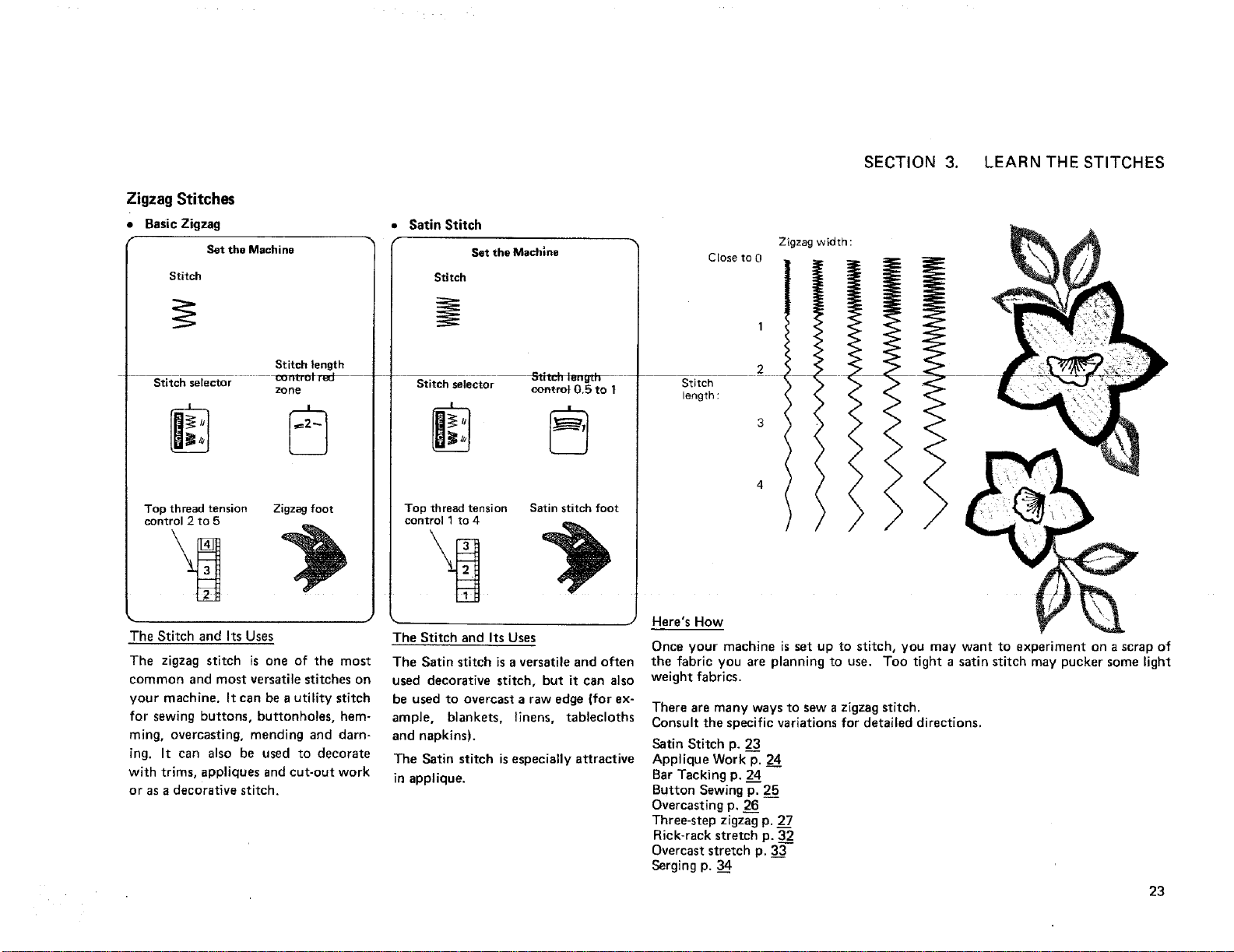
Zigzag Stitches
Basic Zigzag
Set the Machine
Stitch
Stitch length
Stitch selector _ntrul it_J
zone
Satin Stitch
Set the Machine
Stitch
Stitch selector
Top thread tension Zigzag foot
control 2 to 5
The Stitch and Its Uses
The zigzag stitch is one of the most
common and most versatile stitches on
your machine. It can be a utility stitch
for sewing buttons, buttonholes, hem-
ming, overcasting, mending and darn-
ing. It can also be used to decorate
with trims, appliques and cut-out work
or as a decorative stitch.
Top thread tension
control 1 to 4
Satin stitch foot
The Stitch and Its Uses
The Satin stitch is a versatile and often
used decorative stitch, but it can also
be used to overcast a raw edge (for ex-
ample, blankets, linens, tablecloths
and napkins).
The Satin stitch isespecially attractive
in applique.
SECTION 3. LEARN THE STITCHES
Zigzag width :
Close to 0
Stitch
length :
1
2
Here's How
Once your machine is set up to stitch, you may want to experiment on a scrapof
the fabric you are planning to use. Too tight a satin stitch may pucker some light
weight fabrics.
There are many ways to sew a zigzag stitch.
Consult the specific variations for detailed directions.
Satin Stitch p. 23
Applique Work p. 24
Bar Tacking p. 24
Button Sewing p. 25
Overcasting p, 26
Three-step zigzag p. 2__7
Rick-rack stretch p. 32
Overcast stretch p. 33
Serging p. 34
23
SECTION 3. LEARN THE STITCHES
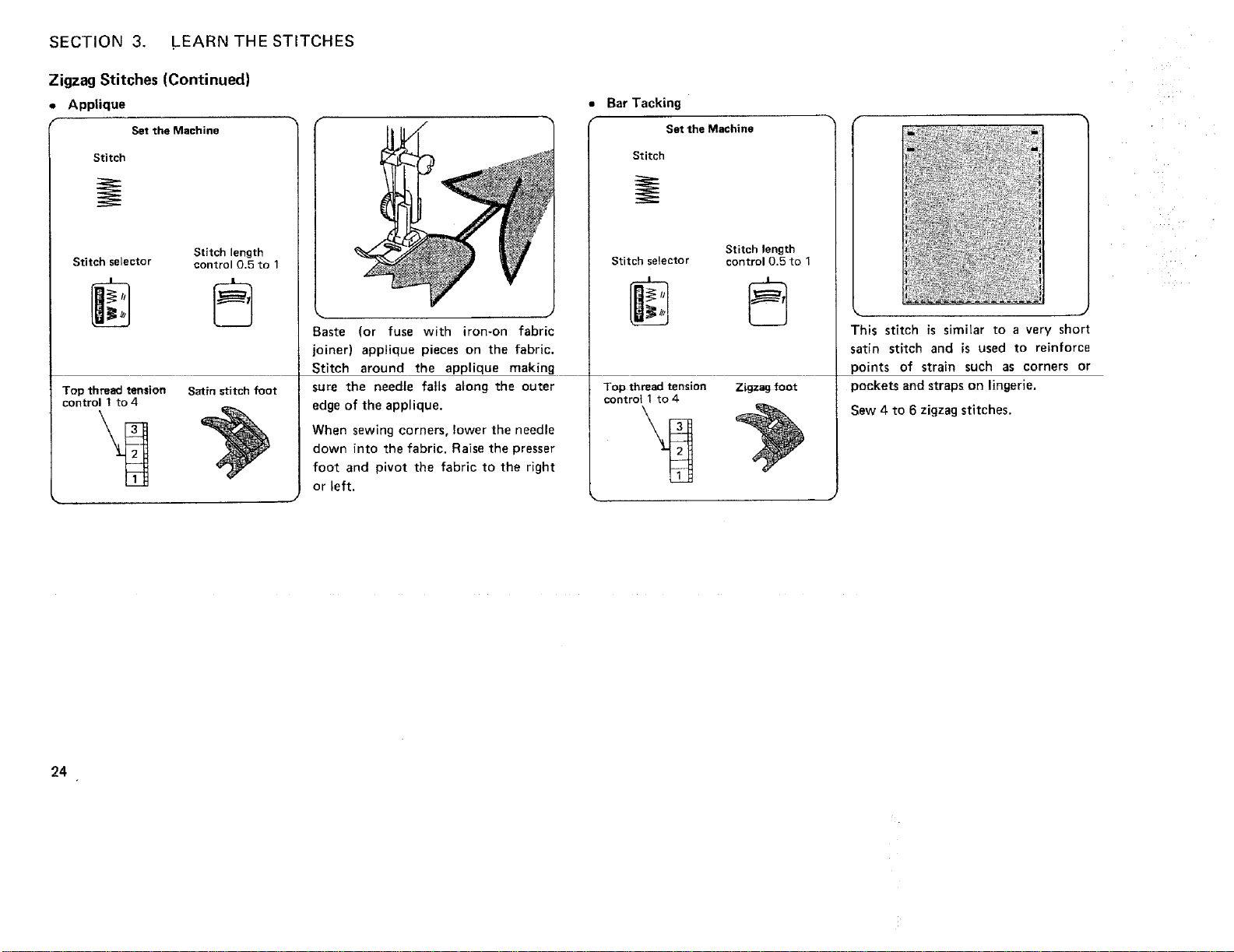
Zigzag Stitches (Continued)
• Applique
Set the Machine
Stitch
Stitch length
Stitch selector control 0.5 to 1
Top thread tension Satin stitch foot
control 1 to 4
Baste (or fuse with iron-on fabric
joiner) applique pieces on the fabric.
Stitch around the applique making
sure the needle falls along the outer
edge of the applique.
When sewing corners, lower the needle
down into the fabric. Raisethe presser
foot and pivot the fabric to the right
or left.
Bar Tacking
Set the Machine
Stitch
Stitch selector
Stitch length
control 0.5 to 1
Top thread tension
control 1 to 4
Zigzag foot
This stitch is similar to a very short
satin stitch and is used to reinforce
points of strain such as corners or
pockets and straps on lingerie,
Sew 4 to 6 zigzag stitches,
HI •
24
SECTION 3. LEARN THE STITCHES
Sew a Button
Set the Machine
Stitch
Stitch selector
Stitch length control
any number (not
necessary to adjust)
Zigzag foot
Top thread tension
control 1 to 4
Darning plate
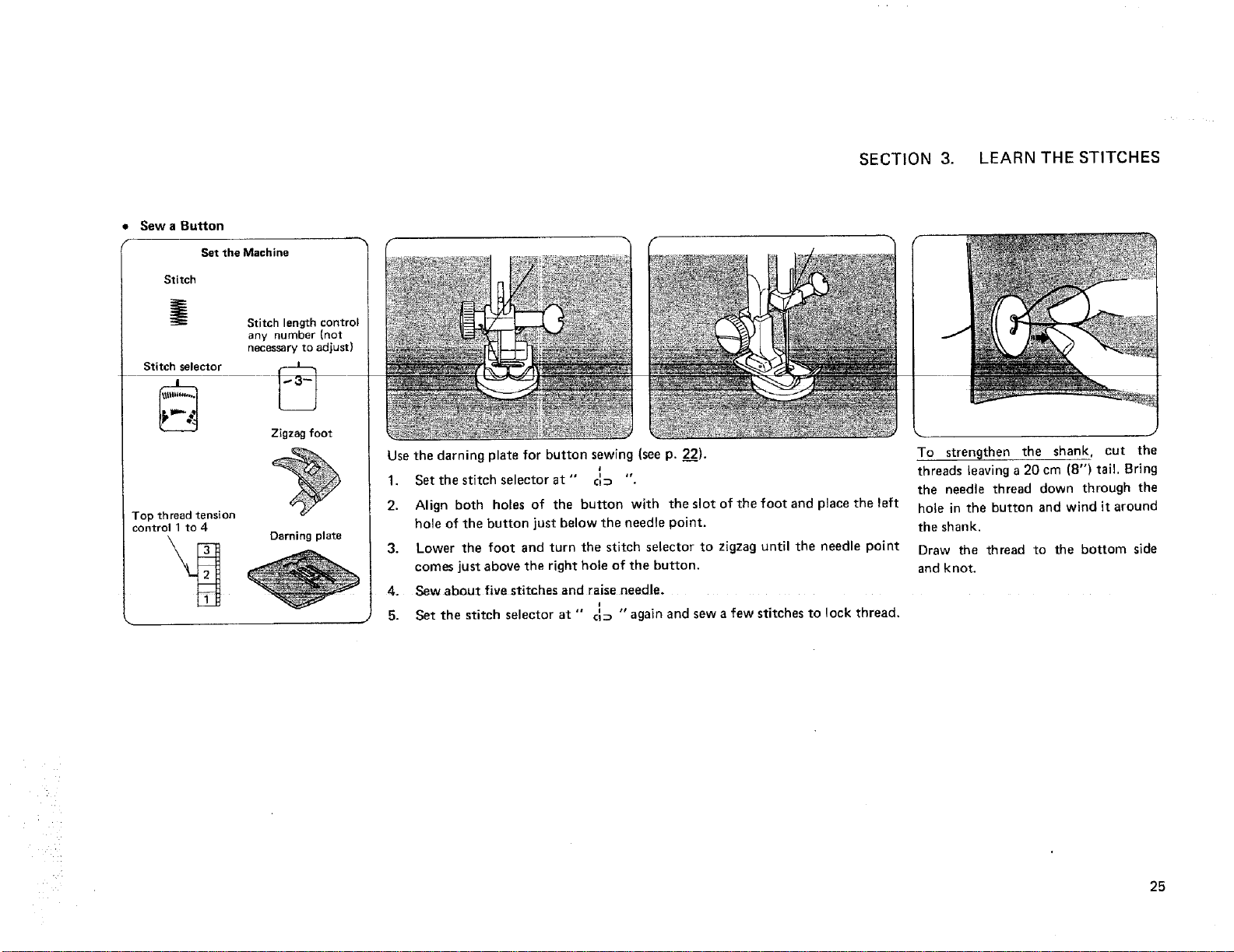
Use the darning plate for button sewing (see p. 22).
1. Set the stitch selector at " I ,,
CI _
2. Align both holes of the button with the slot of the foot and place the left
hole of the button just below the needle point.
3. Lower the foot and turn the stitch selector to zigzag until the needle point
comes just above the right hole of the button.
4. Sew about five stitches and raise needle.
,, I "again and sew a few stitches to lock thread.
5. Set the stitch selector at c1_
To strengthen the shank, cut the
threads leaving a 20 cm (8") tail. Bring
the needle thread down through the
hole in the button and wind it around
the shank.
Draw the thread to the bottom side
and knot.
25
SECTION 3. LEARN THE STITCHES
Zigzag Stitches (Continued)
• Overcasting Stitch
Set the Machine
Stitch
Stitch length
Stitch selector control 1 to 2
't j
Top thread tension Zigzag foot
control 1 to 4
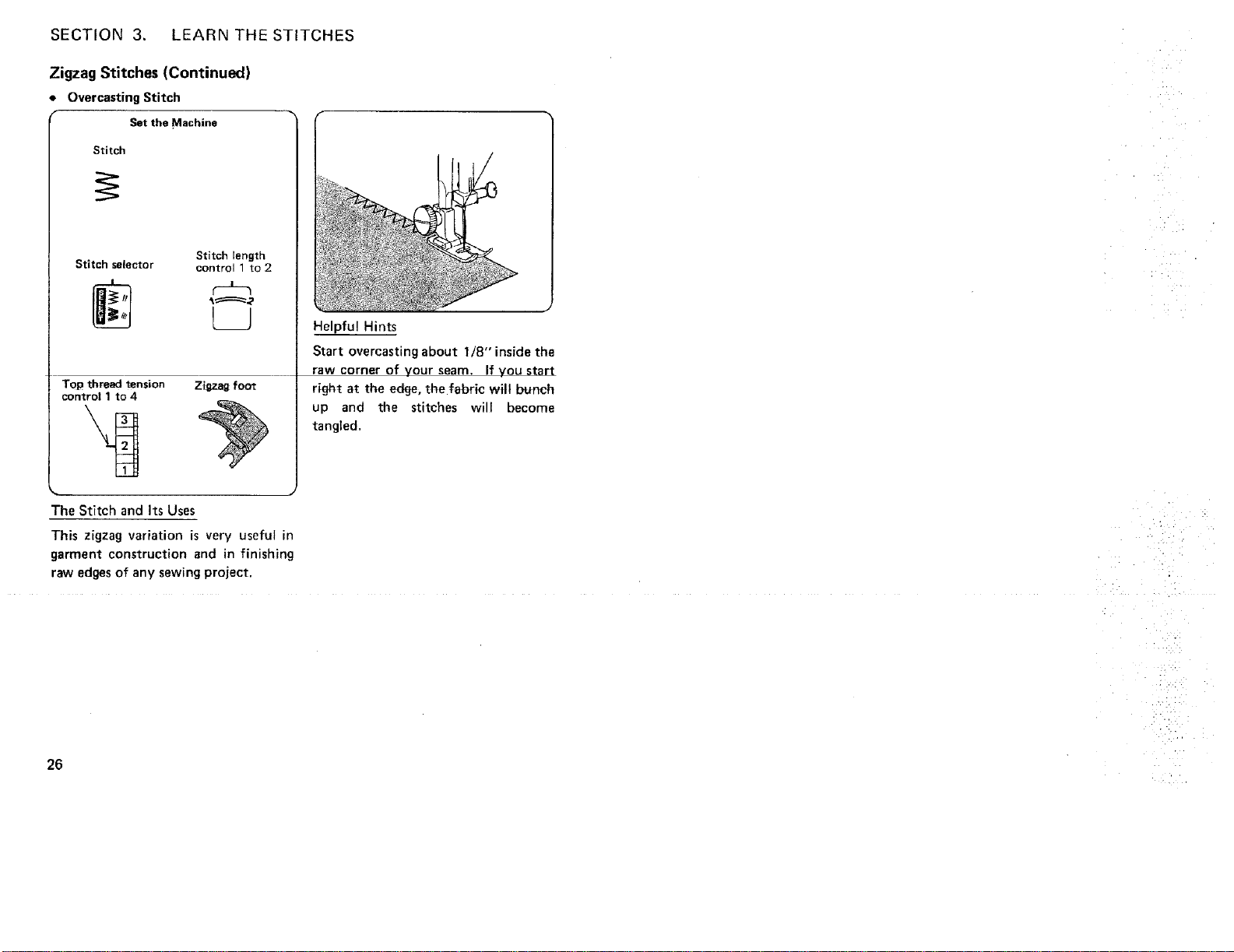
The Stitch and Its Uses
This zigzag variation is very useful in
garment construction and in finishing
raw edgesof any sewing project.
Helpful Hints
Start overcasting about 1/8" inside the
raw corner of your seam. If you start
right at the edge, the fabric will bunch
up and the stitches will become
tangled.
26
Zigzag Stitches (Continued)
Three-Step Zigzag
Set the Machine
Stitch
Selector release
I
Stitch selector
Stitch length
control 0.5 to 1
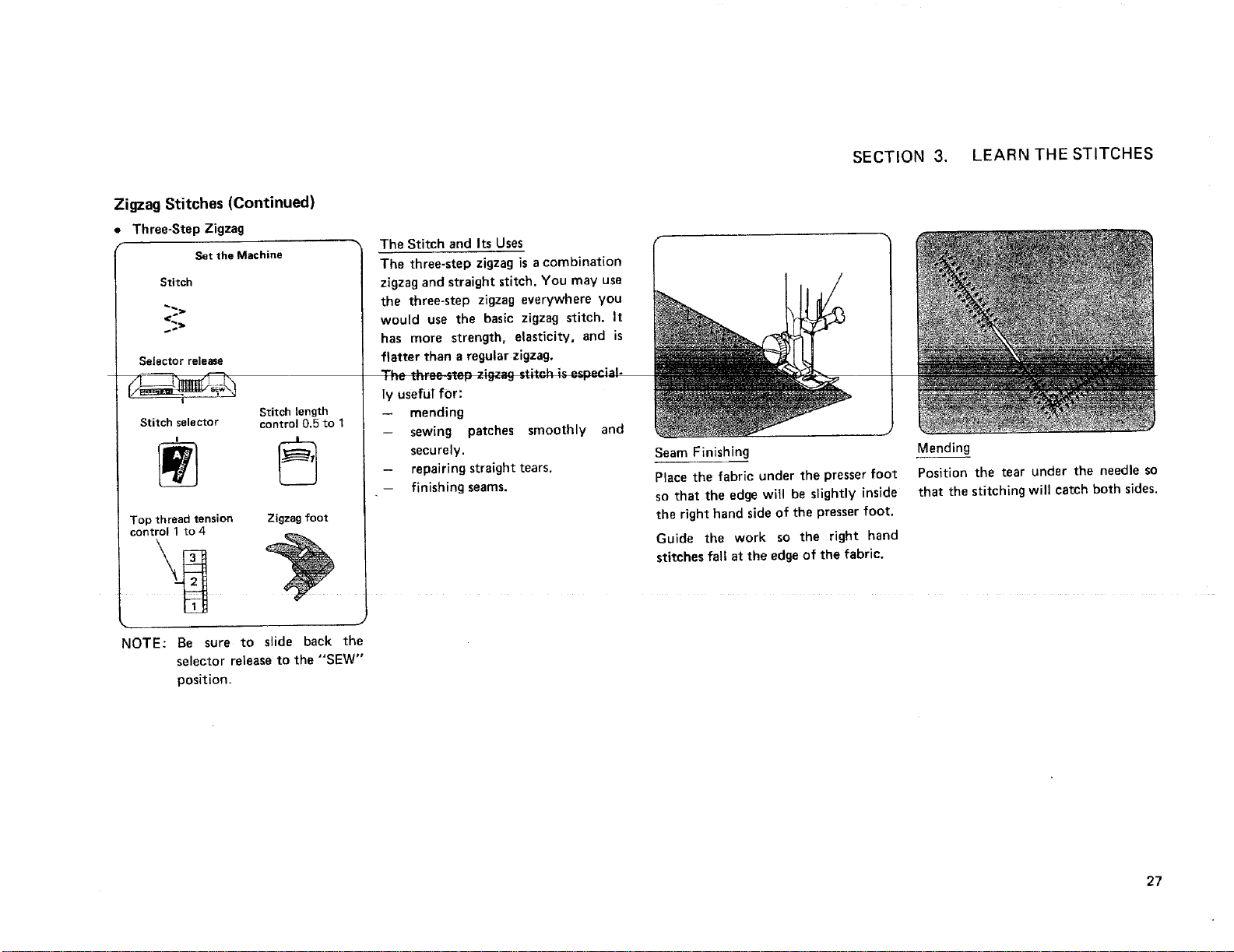
The Stitch and Its Uses
The three-step zigzag is a combination
zigzagand straight stitch. You may use
the three-step zigzag everywhere you
would use the basic zigzag stitch, It
has more strength, elasticity, and is
flatter than a regular zigzag.
mending
sewing patches smoothly and
securely,
repairing straight tears.
finishing seams.
Top thread tension Zigzag foot
control 1 to 4
NOTE: Be sure to slide back the
selector release to the "SEW"
position.
SECTION 3. LEARN THE STITCHES
Seam Finishing
Place the fabric under the presser foot
so that the edge will be slightly inside
the right hand side of the presserfoot.
Guide the work so the right hand
stitches fall at the edgeof the fabric.
Mending
Position the tear under the needle so
that the stitching will catch both sides.
27
SECTION 3. LEARN THE STITCHES
• Blind Hemming
Set the Ma_J_ine
Stitch
Selector retease
I
Stitch selector
Stitch tength
control 1 to 3
Top thread tendon Zigzag foot
control 1 to 4
%_
NOTE:
Be sure to slide back the
selector release to the "SEW"
position.
Light
Weight
Fabric
1/4"
Heavy
Weight
Fabric j
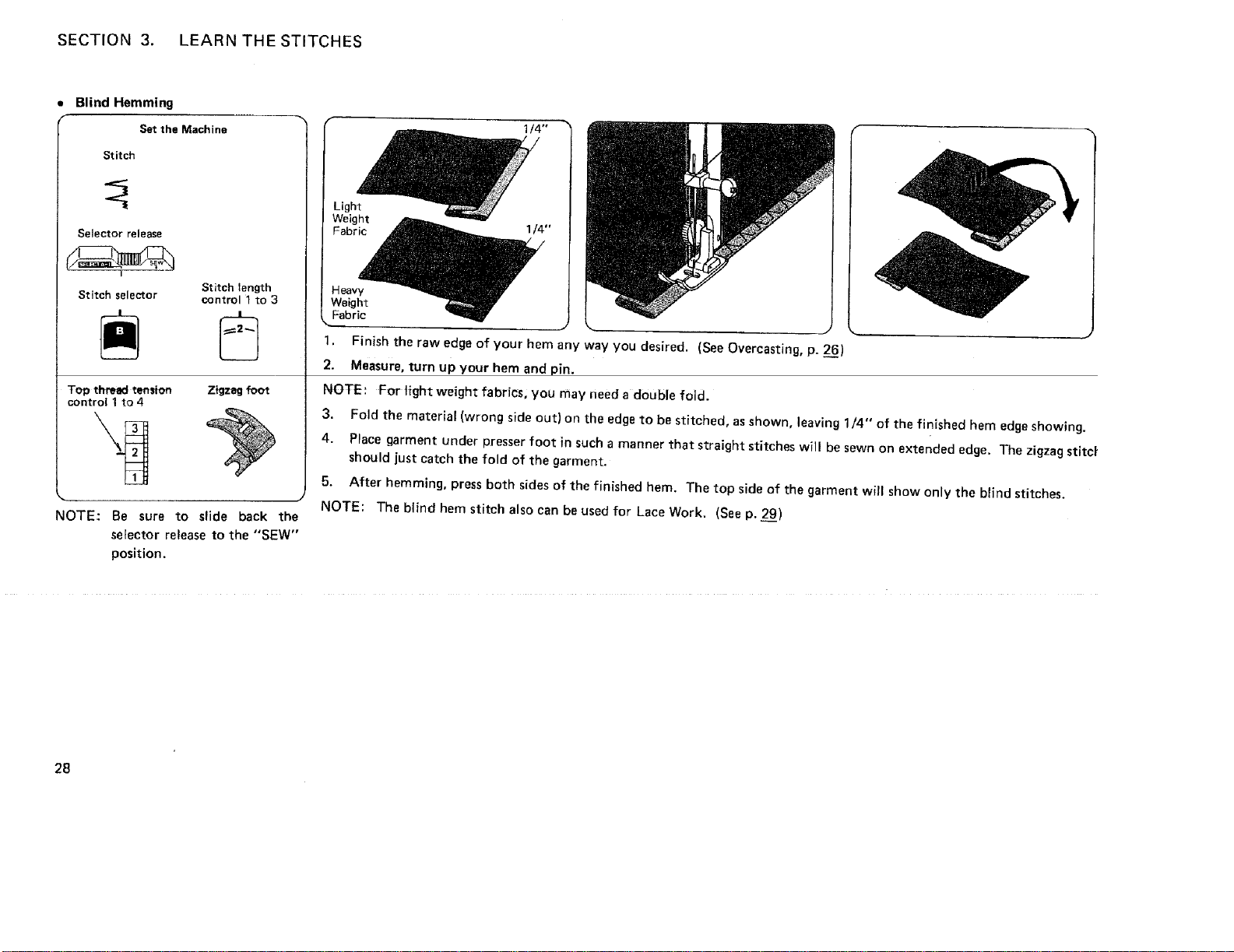
1. Finish the raw edge of your hem any way you desired. (See Overcasting, p. ?_66)
2. Measure, tUrn up your hem and pin.
NOTE: For light weight fabrics, you may need a double fold.
3. Fold the material (wrong side out) on the edge to be stitched, as shown, leaving 1/4" of the finished hem edge showing.
4. Place garment under presser foot in such a manner that straight stitches will be sewn on extended edge. The zigzag stitd
should just catch the fold of the garment.
5. After hemming, press both sides of the finished hem. The top side of the garment will show only the blind stitches.
NOTE; The blind hem stitch also can be used for Lace Work. (See p. 29)
28
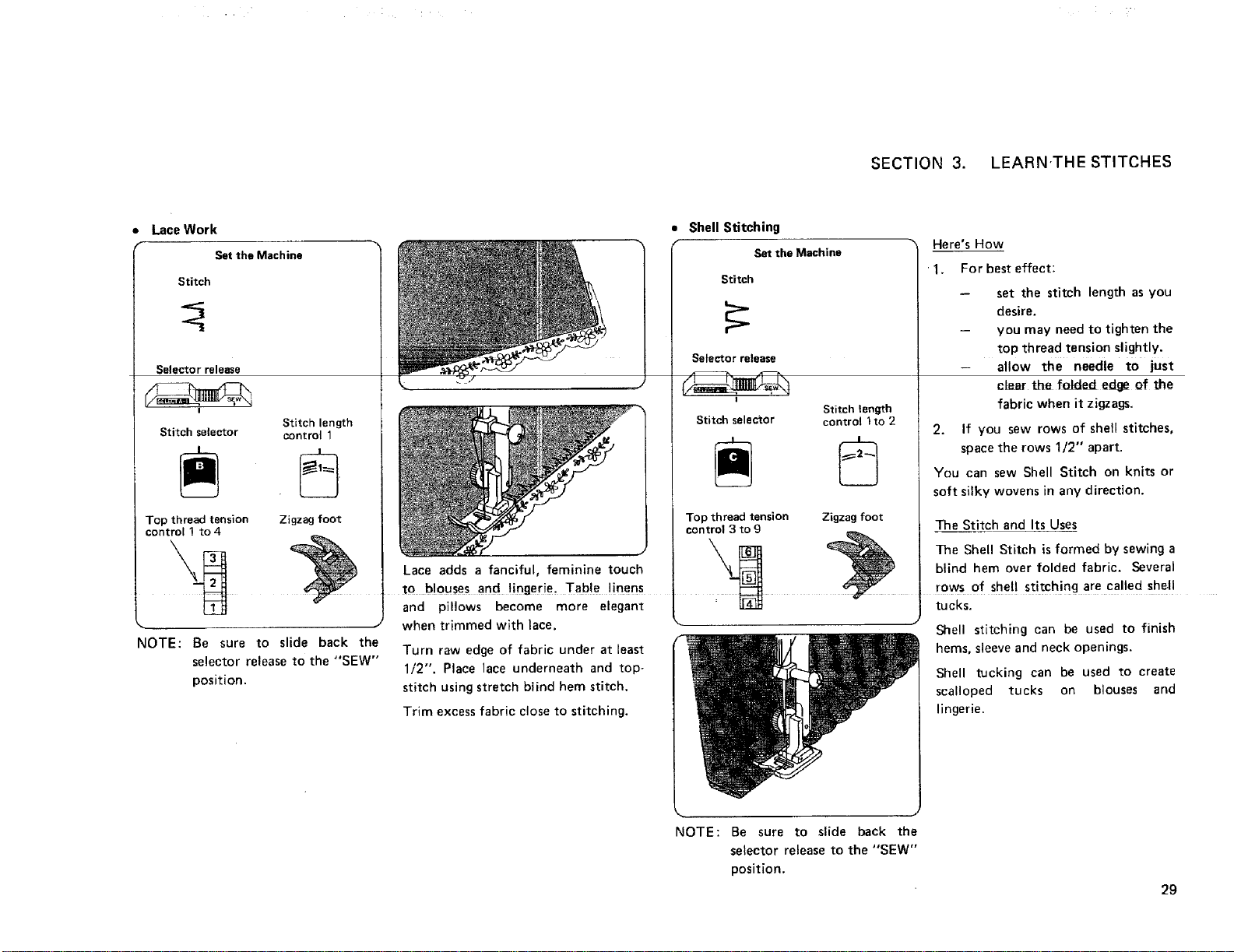
SECTION 3. LEARNTHE STITCHES
Lace Work
Set the Machine
Stitch
Selector release
I
Stitch selector
Stitch length
control 1
NOTE: Be sure to slide back the
selector release to the "SEW"
position.
Shell Stitching
Here's How
Set the Machine
1. For best effect:
Stitch
-- set the stitch length as you
desire.
- you may need to tighten the
top thread tension slightly.
Selector release
-- allow the needle to just
__._ clear the folded edge of the
!
Stitch length fabric when it zigzags.
Stitch selector control 1to 2
2. If you sew rows of shell stitches,
space the rows 1/2" apart.
_. You Shell Stitch on knits or
can sew
soft silky wovens in any direction.
Top thread tension Zigzag foot Top thread tension Zigzag foot
control 1 to 4 control 3 to 9 The Stitch and Its Uses
._ _ __ _ The Shell Stitch is formed by sewing a
Lace adds a fanciful, feminine touch blind hem over folded fabric. Several
_ to blouses and lingerie. TablelinenSandpillows become more elegant _ _ tucks.r°wsof shell stitching are called shetl
when trimmed with lace. i
Shell stitching can be used to finish
Turn raw edge of fabric under at least hems, sleeve and neck openings.
I/2". Place lace underneath and top- Shell tucking can be used to create
stitch using stretch blind hem stitch, scalloped tucks on blouses and
Trim excess fabric close to stitching, lingerie.
NOTE: Be sure to slide back the
selector release to the "SEW'"
position.
29
SECTION 3. LEARN THE STITCHES
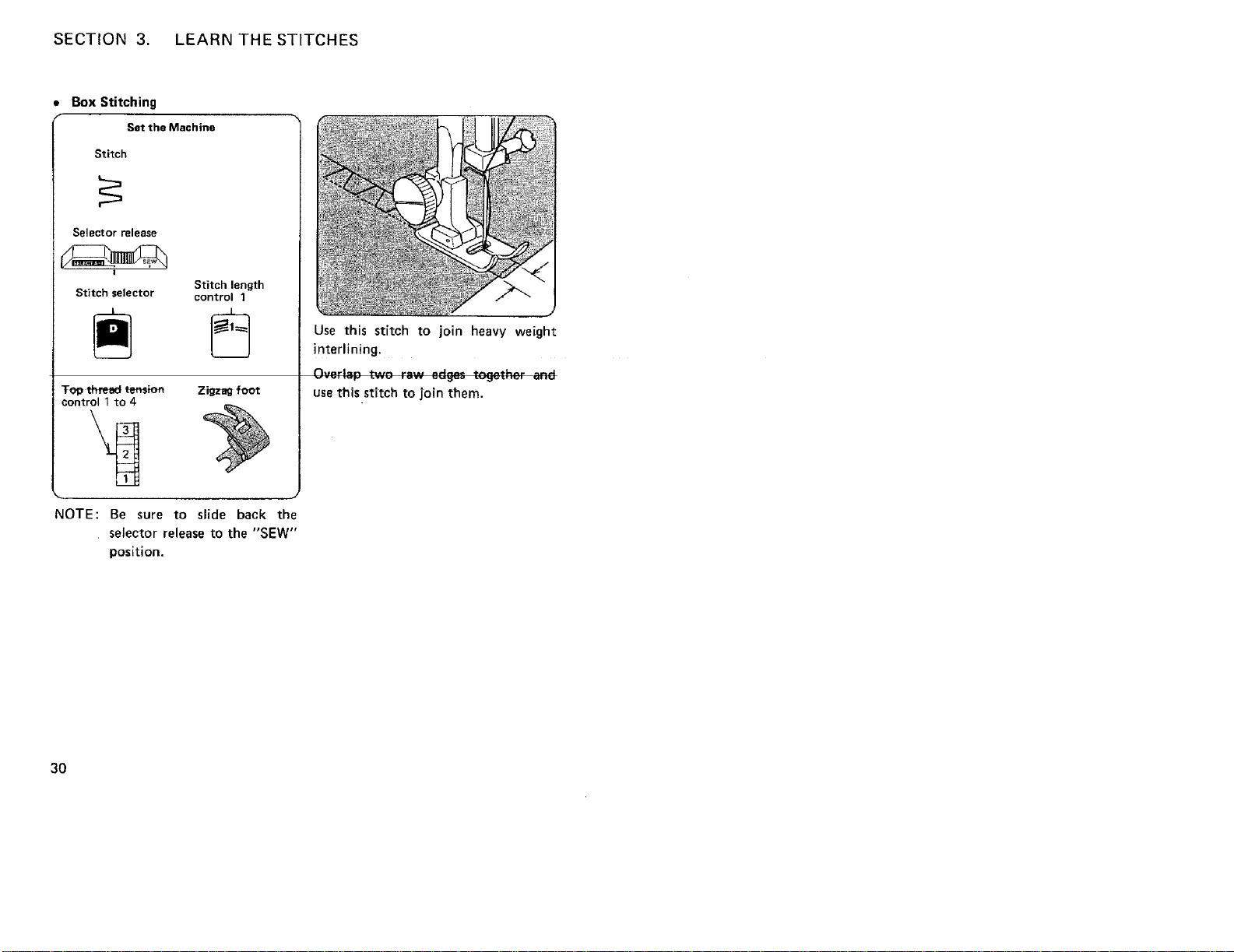
• Box Stitching
Set the Machine
Stitch
Selector release
I
Stitch selector
Stitch length
control 1
Top thread tension ZhTzagfoot
control 1 to 4
NOTE: Be sure to slide back the
selector release to the "SEW"
position.
Use this stitch to join heavy weight
interlining.
use this stitch to join them.
3O
SECTION 3. LEARN THE STITCHES
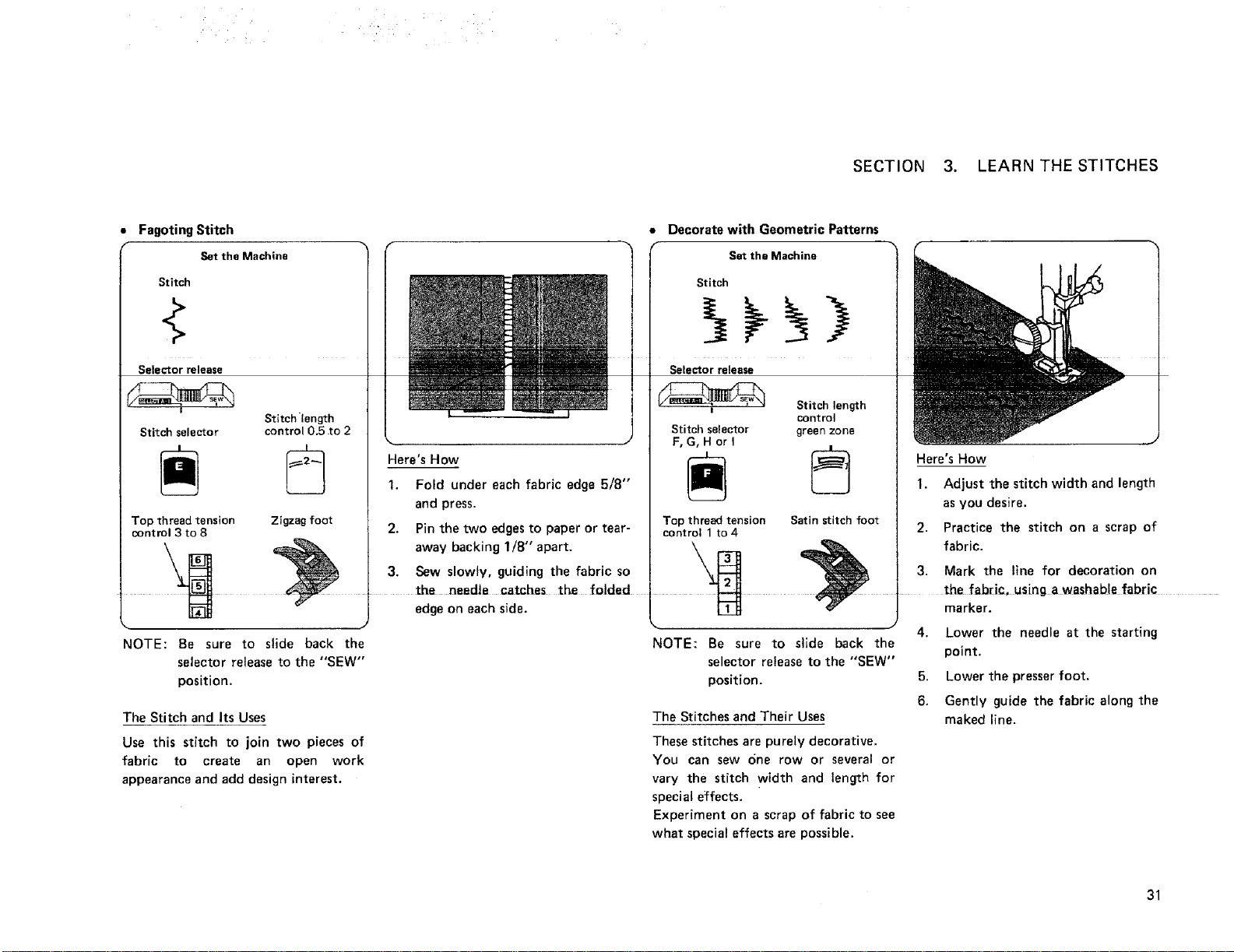
• Fagoting Stitch
Stitch
Selector release
I
Stitch selector
Stitch length
control 0.5 .to 2
Set the Machine
Top thread tension Zigzag foot
control 3 to 8
NOTE: Be sure to slide back the
selector release to the "SEW"
position.
The Stitch and Its Uses
Use this stitch to join two pieces of
fabric to create an open work
appearance and add design interest.
Here's How
1. Fold under each fabric edge 5/8"
and press.
2. Pin the two edges to paper or tear-
away backing 1/8" apart.
3. Sew slowly, guiding the fabric so
the needle catches the folded
edge on each side.
Decorate with Geometric Patterns
Set the Machine
Stitch
Selector release
!
Stitch selector
F,G,H or I
Stitch length
control
green zone
Top thread tension Satin stitch foot
control 1 to 4
NOTE: Be sure to slide back the
selector release to the "SEW"
position.
The Stitches and Their Uses
These stitches are purely decorative.
You can sew one row or several or
vary the stitch width and length for
special effects.
Experiment on a scrap of fabric to see
what special effects are possible.
Here's How
1. Adjust the stitch width and length
as you desire.
2. Practice the stitch on a scrap of
fabric.
3. Mark the line for decoration on
the fabric, using a washable fabric
marker,
4. Lower the needle at the starting
point.
5. Lower the presser foot.
6. Gently guide the fabric along the
maked line.
31
SECTION 3. LEARN THE STITCHES
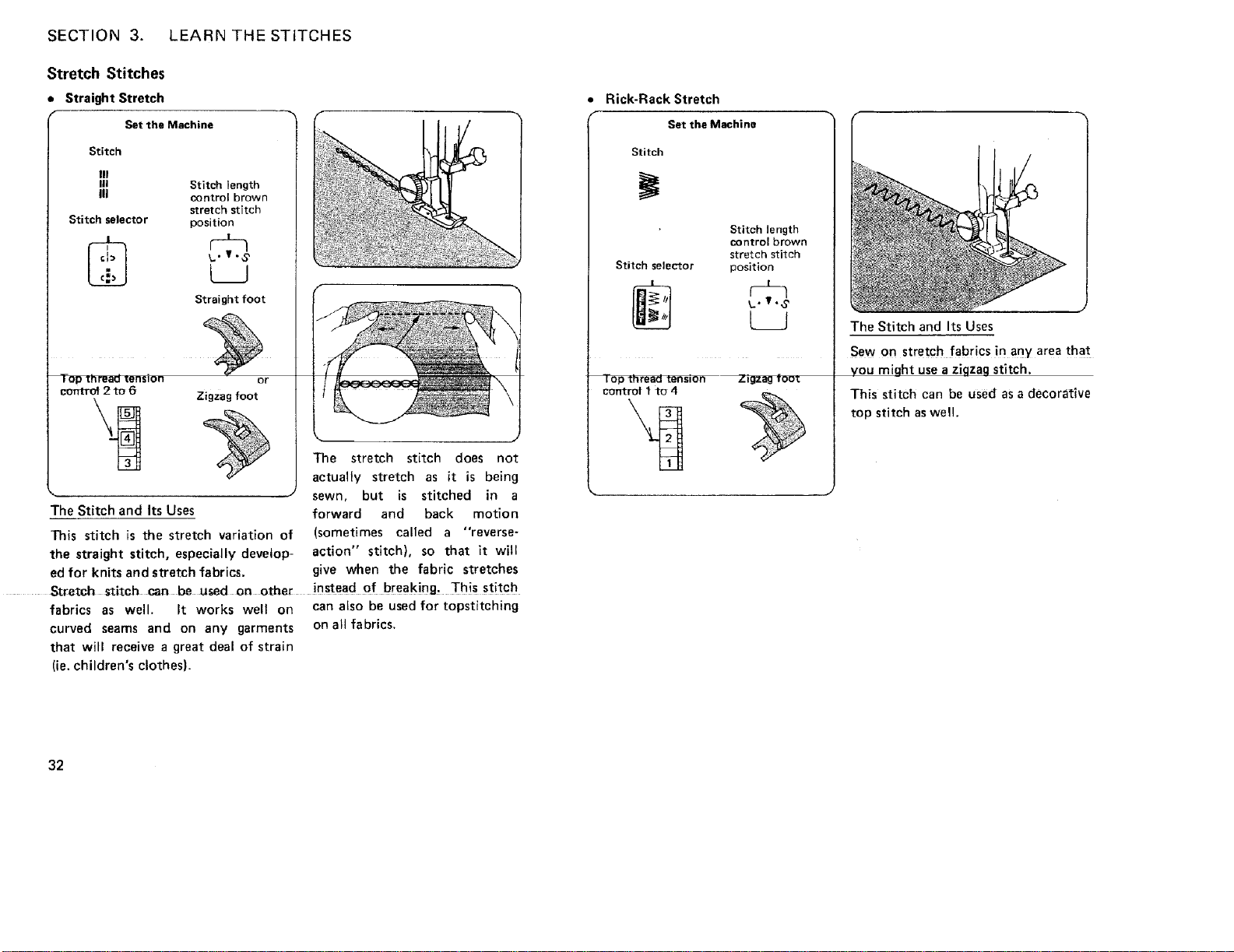
Stretch Stitches
StraightStretch
Set the Machine
Stitch
III
III
III
Stitch selector
Stitch length
control brown
stretch stitch
position
L__J
Straight foot
Top thread tension
control 2 to 6
or
Zigzag foot
The Stitch and Its Uses
!
\
The stretch stitch does not
actually stretch as it is being
sewn, but is stitched in a
forward and back motion
(sometimes called a "reverse-
action" stitch), so that it will
give when the fabric stretches
This stitch is the stretch variation of
the straight stitch, especially develop-
ed for knits and stretch fabrics.
Stretch stitch can be used on other !nstead of break!ng_ Th!s st!tch
fabrics as well. It works well on can also be used for topstitching
curved seams and on any garments on all fabrics.
that will receive a great deal of strain
(ie. children's clothes).
• Rick-Rack Stretch
Stitch
Set the Machine
Stitch length
control brown
stretch stitch
Stitch selector position
k__J
Top thread tension Zigzag fooz
control t to 4
The Stitch and Its Uses
Sew on stretch fabrics i n any area that
you might use a zigzag stitch.
This stitch can be used as a decorative
top stitch as well.
32
SECTION 3. LEARN THE STITCHES
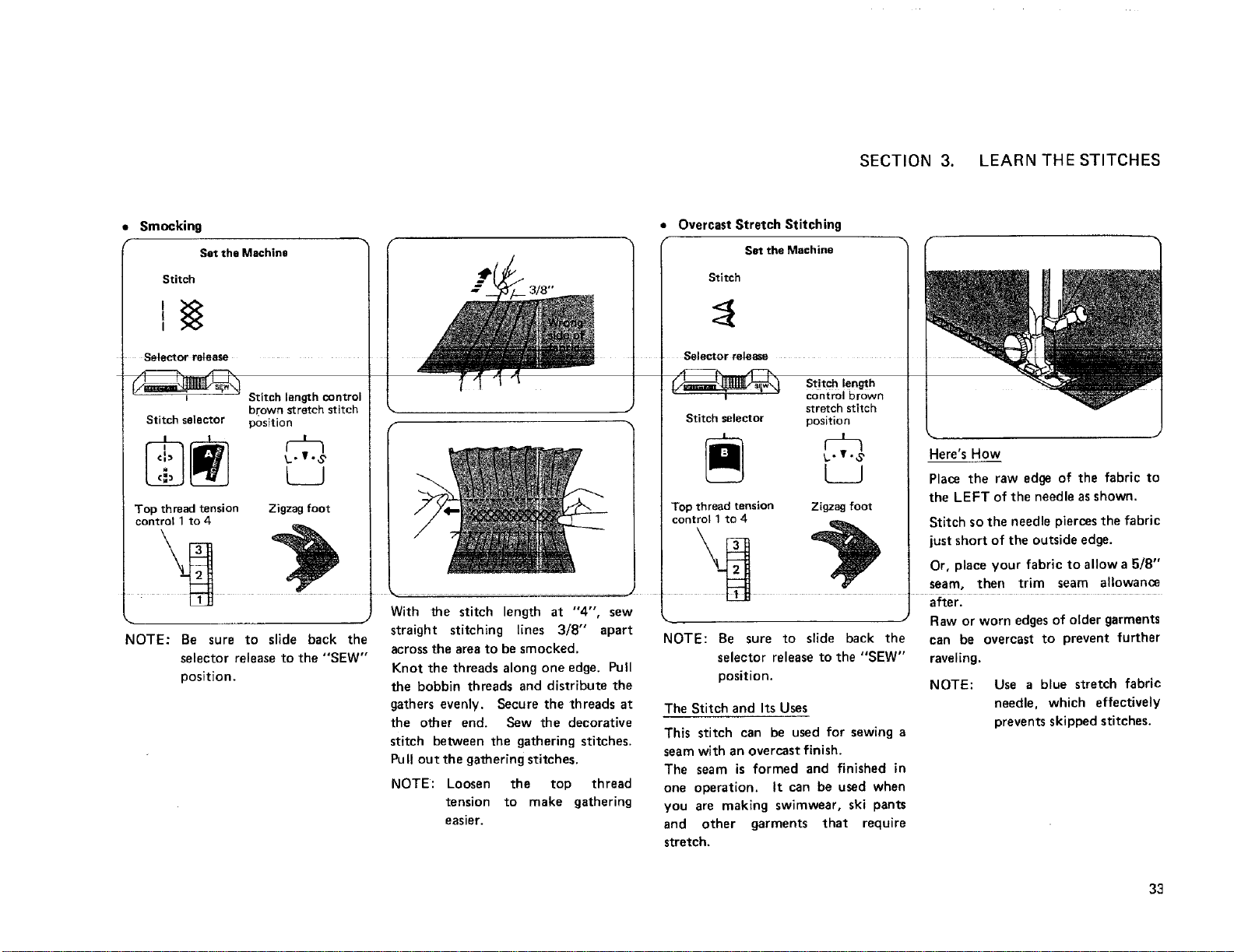
Smocking
Set the Machine
Stitch
Selector release
Stitch length control
brown stretch stitch
Stitch selector position
L_J
Top thread tension Zigzag foot
control 1 to 4
$
Overcast Stretch Stitching
Set the Machine
Stitch
Selector release
stit le.gth
control brown
NOTE: Be sure to slide back the
selector release to the "SEW"
Stitch selector
Top thread tension
control 1 to 4
stretch stitch
position
[__l
Zigzag foot
Here's How
Place the raw edge of the fabric to
the LEFT of the needle as shown.
Stitch so the needle pierces the fabric
With the stitch length at "4", sew
just short of the outside edge.
Or, place your fabric to allow a 5/8"
seam, then trim seam allowance
after.
Raw or worn edges of older garments
3osition.
straight stitching lines 3/8" apart
across the area to be smocked,
Knot the threads along one edge. Pull
the bobbin threads and distribute the
gathers evenly. Secure the threads at
the other end. Sew the decorative
stitch between the gathering stitches.
Pu II out the gathering stitches.
NOTE: Loosen the top thread
tension to make gathering
easier.
NOTE: Be sure to slide back the
selector release to the "SEW"
position.
The Stitch and Its Uses
This stitch can be used for sewing a
seamwith an overcast finish.
The seam is formed and finished in
one operation. It can be used when
you are making swimwear, ski pants
and other garments that require
stretch.
can be overcast to prevent further
raveling.
NOTE: Use a blue stretch fabric
needle, which effectively
prevents skipped stitches.
33
SECTION 3. LEARN THE STITCHES
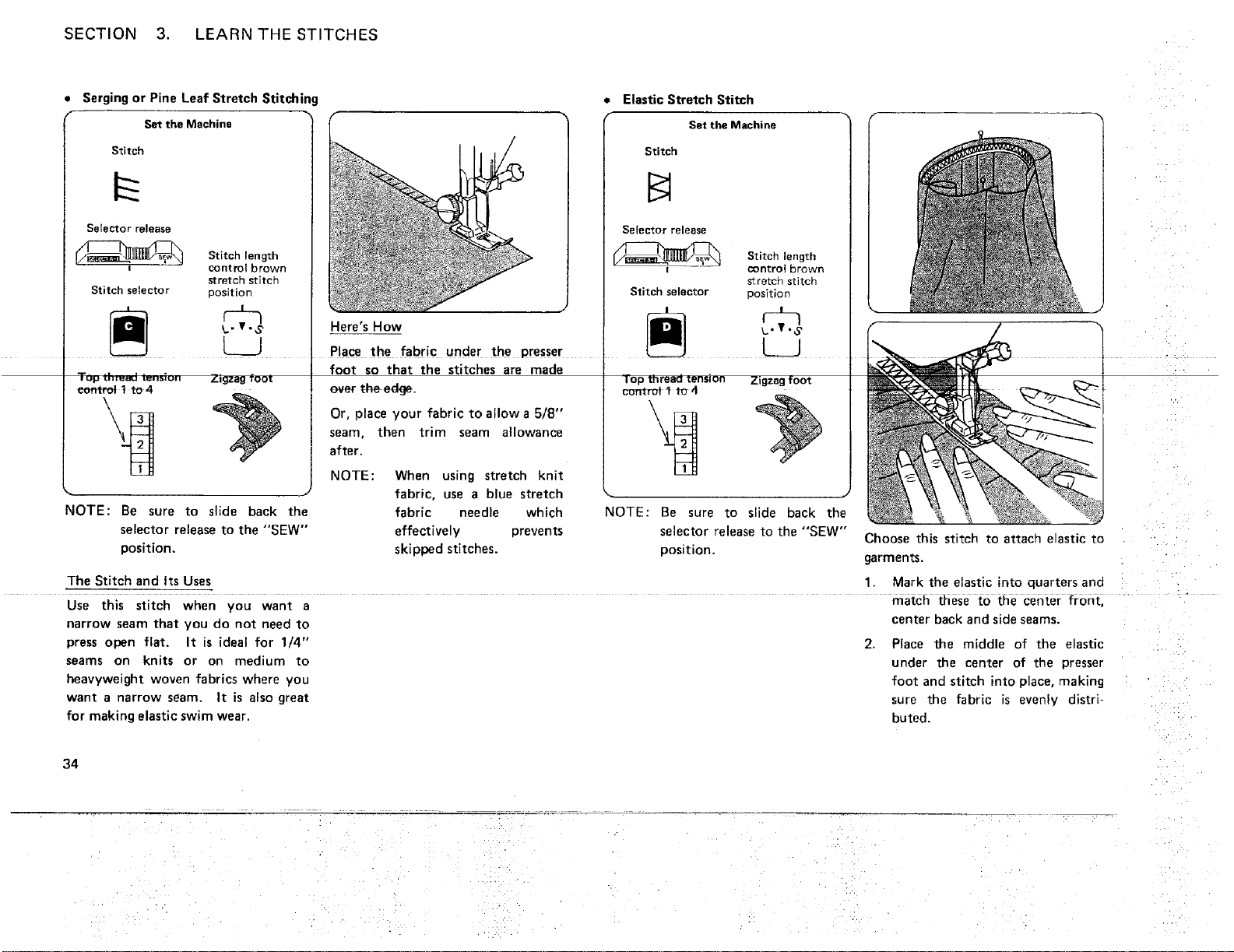
• Serglng or Pine Leaf Stretch Stitching
/-
Set the Machine
Stitch
Selector release
I
Stitch selector
Stitch length
control brown
stretch stitch
position
Here's How
Elastic Stretch Stitch
, /
Setthe Machine
Stitch
N
Selector release
I
Stitch selector
Stitch length
control brown
s_retcn stitch
position
:
"il
'i
NOTE: Be sure to slide back the
selector release to the "'SEW'"
position.
The Stitch and Its Uses
Use this stitch when you want a
narrow seam that you do not need to
press open fiat. It s ideal for 1/4"
seams on knits or on medium to
heavyweight woven fabrics where you
want a narrow seam. It is also great
for making elastic swim wear.
34
Place the fabric under the presser
foot so that the stitches are made
ever theedge.
Or, place your fabric to aglowa 5/8"
seam, then trim seam allowance
after.
NOTE:
When using stretch knit
fabric, use a blue stretch
fabric needle which
effectively prevents
skipped stitches.
Top thread tension Zigzag foot
control 1 t_4
NOTE: Be sure to slide back the
selector release to the "SEW"
position.
Choose this stitch to attach elastic to
garments.
1. Mark the elastic into quarters and
match these to the center front,
center back and side seams.
2,
/i••
Place the middle of the elastic
under the center of the presser
foot and stitch into place, making ' :
sure the fabric is evenly distri- .
buted. :
SECTION 3. LEARN THE STITCHES
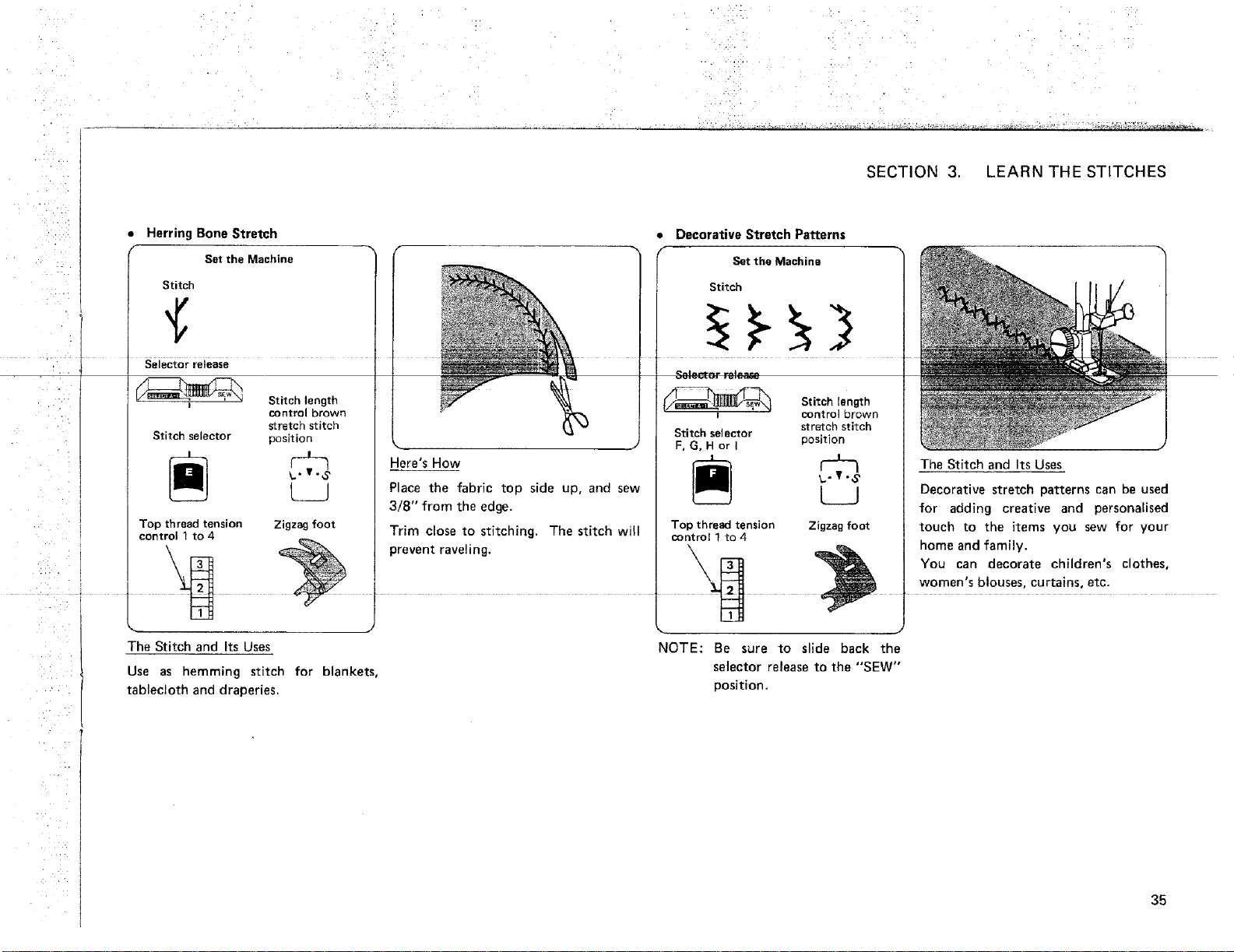
• Herring Bone Stretch
Set the Machine
Stitch
Selector release
!
Stitch selector
Stitch length
control brown
stretch st=tch
position
Top thread tension
control 1 to 4
The Stitch and Its Uses
Zigzag foot
Use as hemming stitch for blankets,
tablecloth and draperies.
Here's How
Place the fabric top side up, and sew
3/8" from the edge.
Trim close to stitching. The stitch will
prevent raveling.
Decorative Stretch Patterns
Set the Machine
Stitch
o.t^_ .... !....
l
Stitch selector
F, G,H or
Stitch length
coFIt rol Drown
stretch stitch
oosition
I____J
Top thread tension
control 1 to 4
Zigzag foot
NOTE: Be sure to slide back the
selector release to the "SEW'"
position,
The Stitch and Its Uses
Decorative stretch patterns can be used
for adding creative and personalised
touch to the items you sew for your
home and family.
You can decorate children's clothes,
women's blouses, curtains, etc.
35
SECTION 3. LEARN THE STITCHES
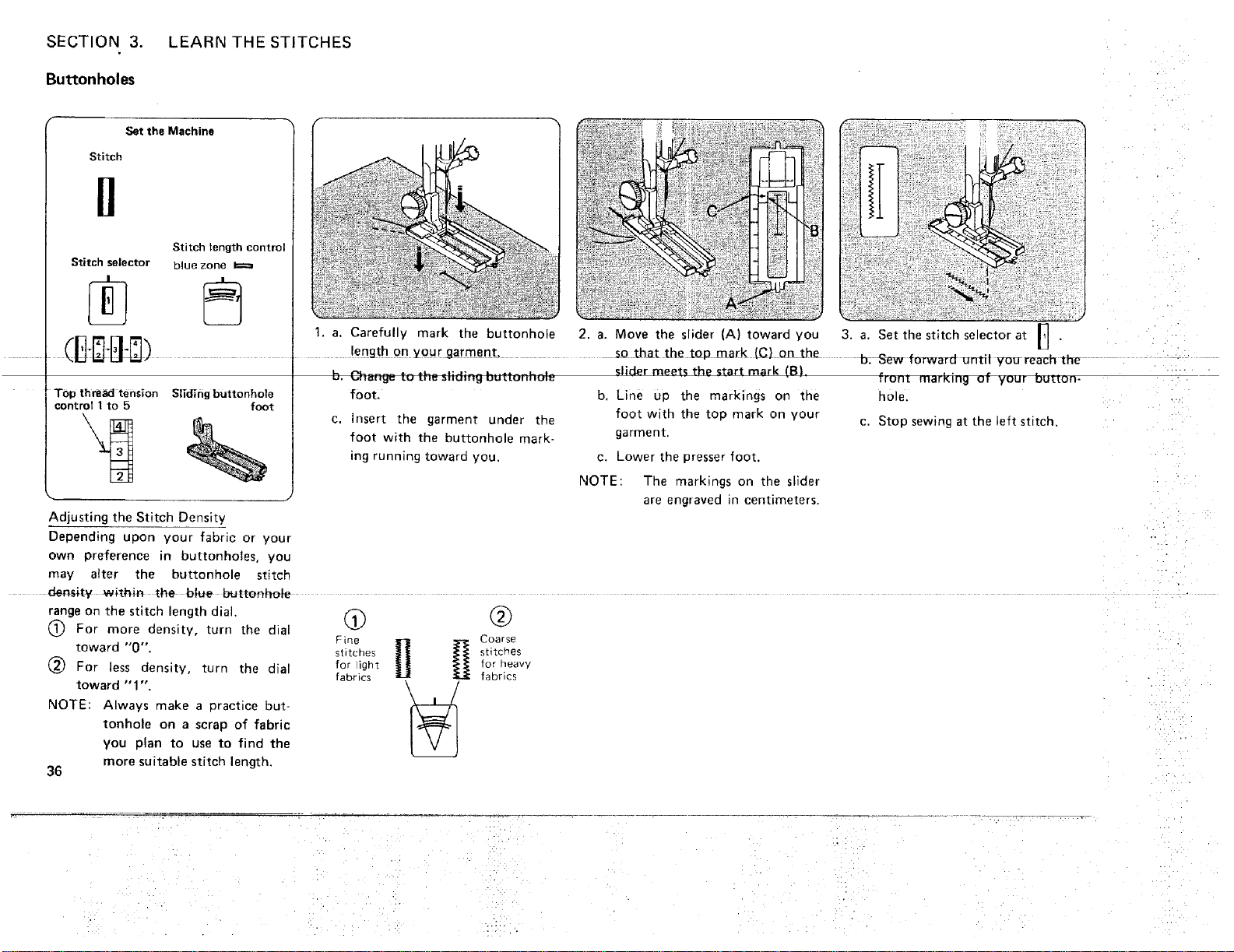
Buttonholes
Stitch
U
Set the Machine
Stitch length control
Stitch selector blue zone
1. a. Carefully mark the buttonhole
Top thread tension S|[d]ng buttonhole
control 1to 5 foot
Adjusting the Stitch Density
Depending upon your fabric or your
own preference in buttonholes, you
may a{ter the buttonhole stitch
density within _he blue _ttenhole
range on the stitch length dial.
(_ For more density, turn the dial
toward "0".
@ For less density, turn the dial
toward "1 ".
NOTE: Always make a practice but-
tonhole on a scrap of fabric
you plan to use to find the
more suitable stitch length,
36
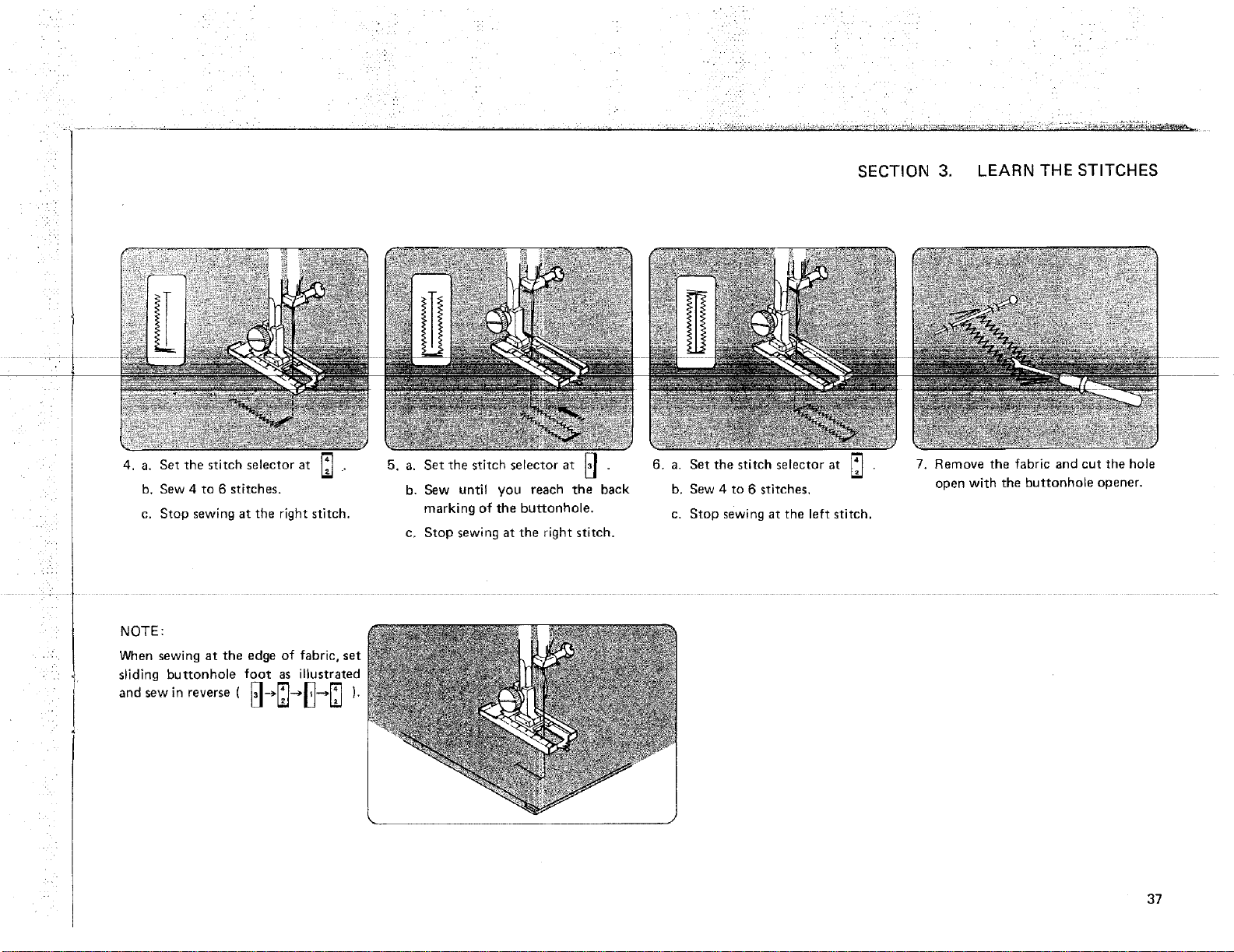
2. a. Move the slider (A) toward you
3. a. Set the stitch selector at _ .
length on yourgarment, so that the top _nark [C} on _he I_. Sew forward until yo_rreach the
slider meet_ th_ start mark (B) front marking of your bu[£on-
b, _ ....
_,,=Hy= tO the ..................
_IIIU|ll_ UU I.I.UI I! IU|l_
f0ot.
c, Insert the garment under the
foot with the buttonhole mark-
ing running toward you.
b. Line up the markings on the hole.
foot with the top mark on your
garment.
c. Lower the presser foot.
NOTE: The markings on the slider
are engraved in centimeters.
c. Stop sewing at the left stitch.
Q
Fine H _ Coarse
stitches stitches
for light for heavy
fabrics fabrics
" <>
_ _ • _ , i ¸
....
E
4
SECTION 3. LEARN THE STITCHES
t_
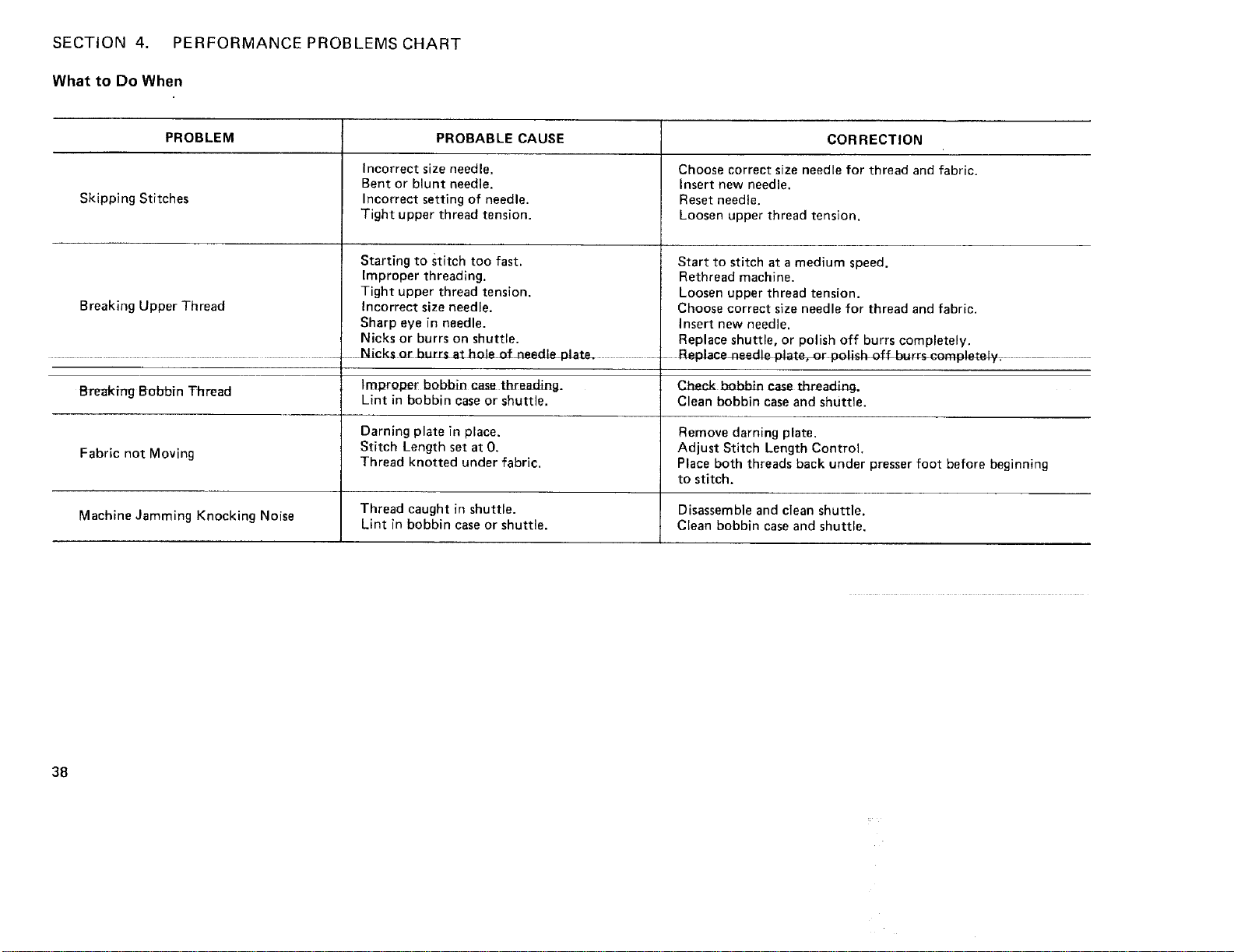
4, a. Set the stitch selector at
b. Sew 4 to 6 stitches.
c. Stop sewing at the right stitch
[1
5. a. Set the stitch selector at 131
b. Sew until you reach the back
marking of the buttonhole.
e. Stop sewing at the right stitch.
6. a. Set the stitch selector at _J
m
b. Sew 4 to 6 stitches.
c. Stop sewing at tne left stitch.
7. Remove the fabric and cut the hole
open with the buttonhole opener.
NOTE :
When sewing at the edge of fabric, set
sliding buttonhole foot as illustrated
and sewin reverse( ___>r__,lr_--_r_ ).
LI _ U _
37
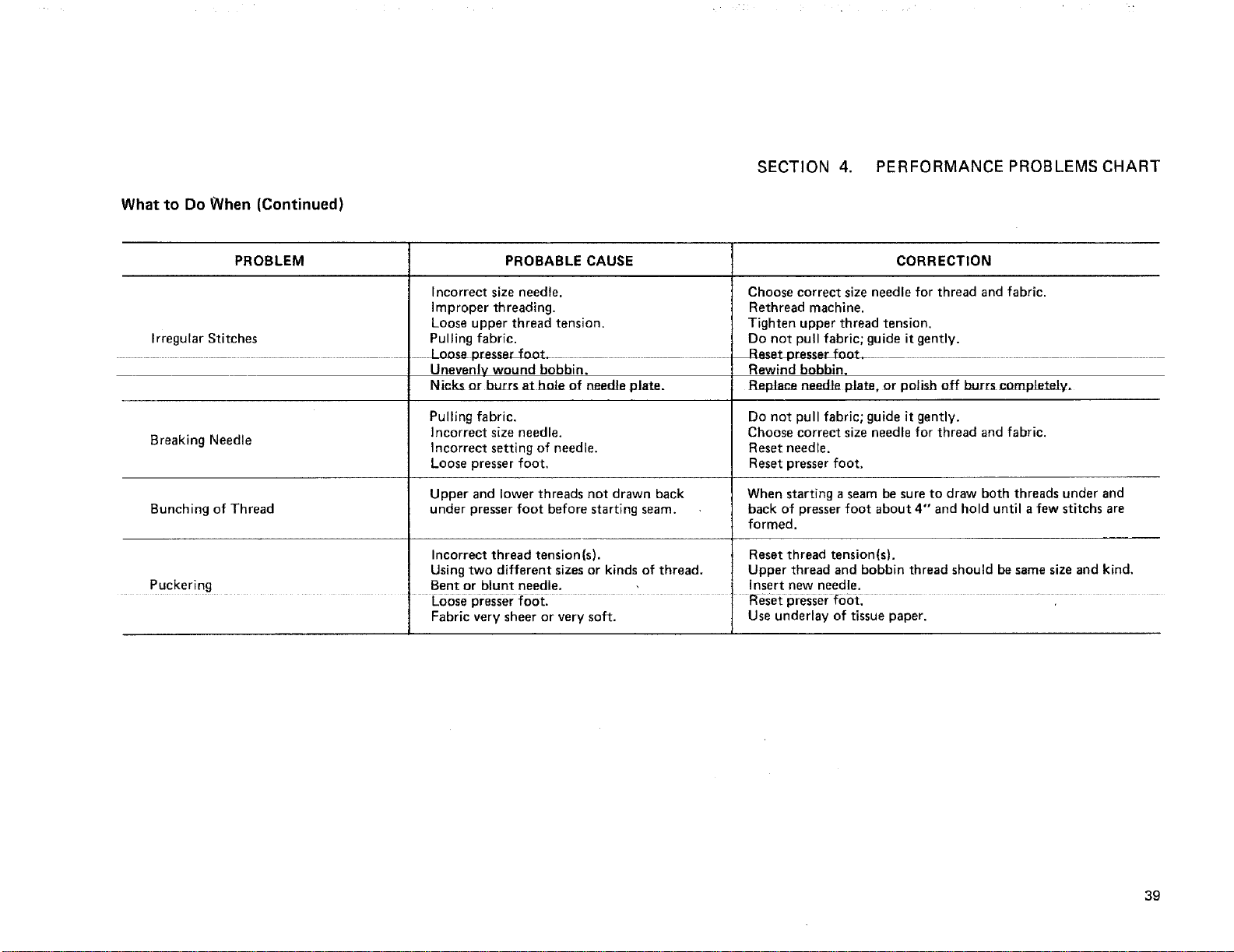
SECTION 4. PERFORMANCE PROBLEMS CHART
What to Do When
PROBLEM PROBABLE CAUSE CORRECTION
Incorrect size needle. Choose correct size needle for thread and fabric.
Bent or blunt needle. Insert new needle.
Skipping Stitches Incorrect setting of needle. Reset needle.
Tight upper thread tension. Loosen upper thread tension.
Breaking Upper Thread
Starting to stitch too fast.
Improper threading.
Tight upper thread tension.
Incorrect size needle.
Sharp eye in needle.
Nicks or burrs on shuttle.
Start to stitch at a medium speed.
Rethread machine.
Loosen upper thread tension.
Choose correct size needle for thread and fabric.
Insert new needle.
Replace shuttle, or polish off burrs completely.
Nicks o_bun_ at hole of_eedle plate_ Rep!ane needlep_ po!isl_of_burr_€on_y.
Breaking Bobbin Thread Improl_er bobbin casethreading. Check bobbin casethreading.
Lint in bobbin caseor shuttle, Clean bobbin caseand shuttle.
Fabric not Moving
Machine Jamming Knocking Noise
Darning plate in place.
Stitch Length set at 0.
Thread knotted under fabric.
Remove darning plate.
Adjust Stitch Length Control.
Place both threads back under presser foot before beginning
to stitch.
Thread caught in shuttle. Disassemble and clean shuttle.
Lint in bobbin case or shuttle. Clean bobbin case and shuttle.
38
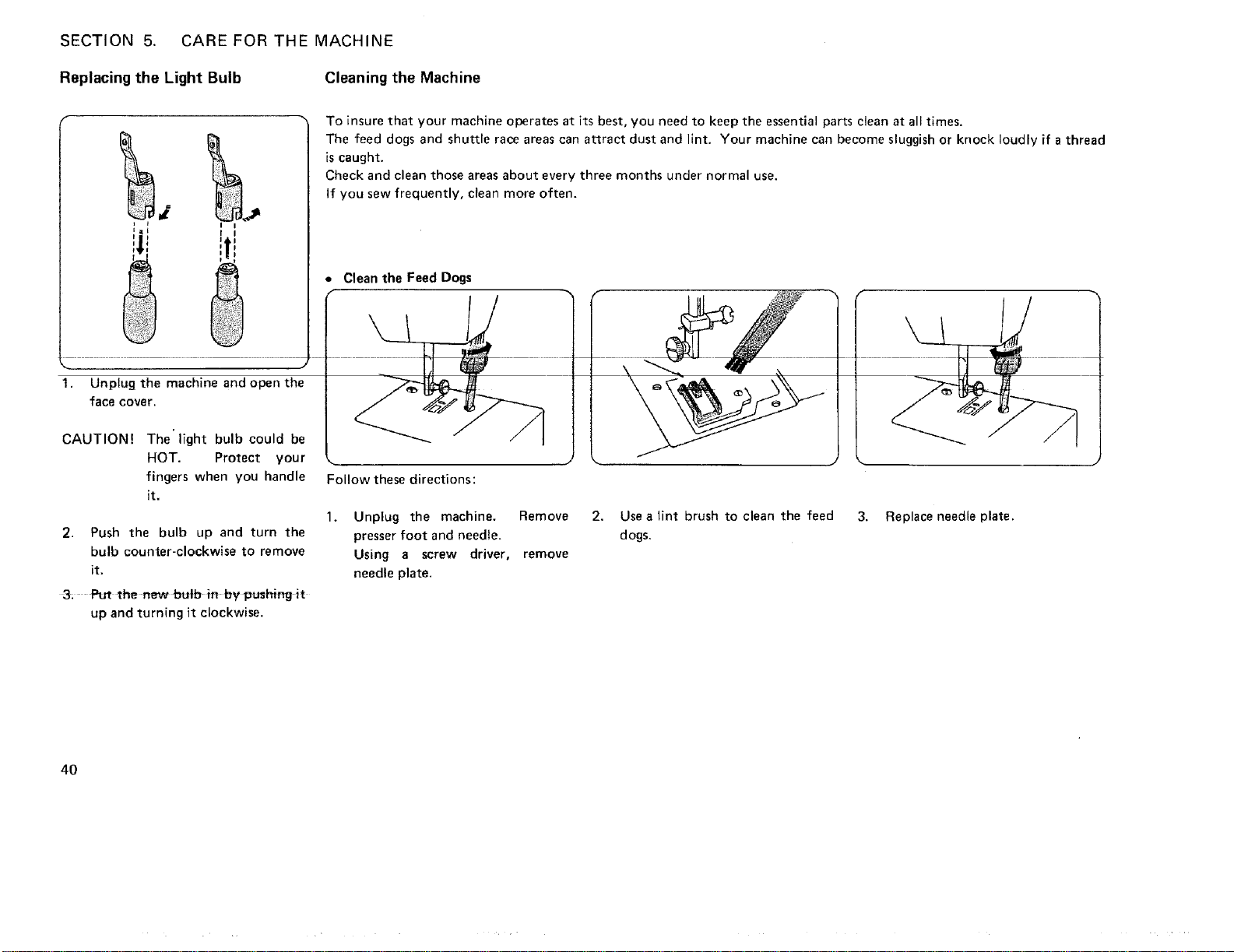
What to Do When (Continued)
SECTION 4. PERFORMANCE PROBLEMS CHART
PROBLEM PROBABLE CAUSE
Incorrect size needle.
Improper threading.
Looseupper thread tension.
Irregular Stitches Pulling fabric.
Loose pr_
Unevenly wound bobbin.
Nicks or burrsat hole of needle plate.
Pulling fabric.
Incorrect size needle.
Breaking Needle
Incorrect setting of needle.
Loose presser foot.
Upper and lower threads not drawn back
Bunching of Thread under presser foot before starting seam.
Incorrect thread tension(s).
Using two different sizesor kinds of thread.
CORRECTION
Choose correct size needle for thread and fabric.
Rethread machine.
Tighten upper thread tension.
Do not pull fabric; guide it gently.
RA_Rt pr_Ar fnnt
Rewind bobbin
needle plate, or polish off burrs completely.
Do not pull fabric; guide it gently.
Choose correct size needle for thread and fabric.
Reset needle.
Reset presser foot,
When starting a seam be sure to draw both threads under and
back of presser foot about 4" and hold until a few stitchs are
formed.
Reset thread tension(s).
Upper thread and bobbin thread should be same size and kind.
Puckering Bent or blunt needle. , 1 Insert new needle.
Fabric very sheer or very soft. Use underlay of tissue paper.
39
SECTION 5, CARE FOR THE MACHINE
Replacing the Light Bulb Cleaning the Machine
To insure that your machine operates at its best, you need to keep the essential parts clean at all times.
The feed dogs and shuttle race areas can attract dust and lint. Your machine can become sluggish or knock loudly if a thread
is caught.
Check and clean those areas about every three months under normal use.
If you sew frequently, clean more often.
• Clean the Feed Dogs
1. Unplug the machine and open the
face cover.
CAUTION!
The light bulb could be
HOT. Protect your
fingers when you handle
it.
2. Push the bulb up and turn the
bulb counter-clockwise to remove
it.
3; Put the new bulb in by pushing it
up and turning it clockwise.
Follow these directions:
Unplug the machine. Remove 2. Use a lint brush to clean the feed
presser foot and needle, dogs,
Using a screw driver, remove
needle plate.
3. Replace needle plate.
40
SECTION 5. CARE FOR THE MACHINE
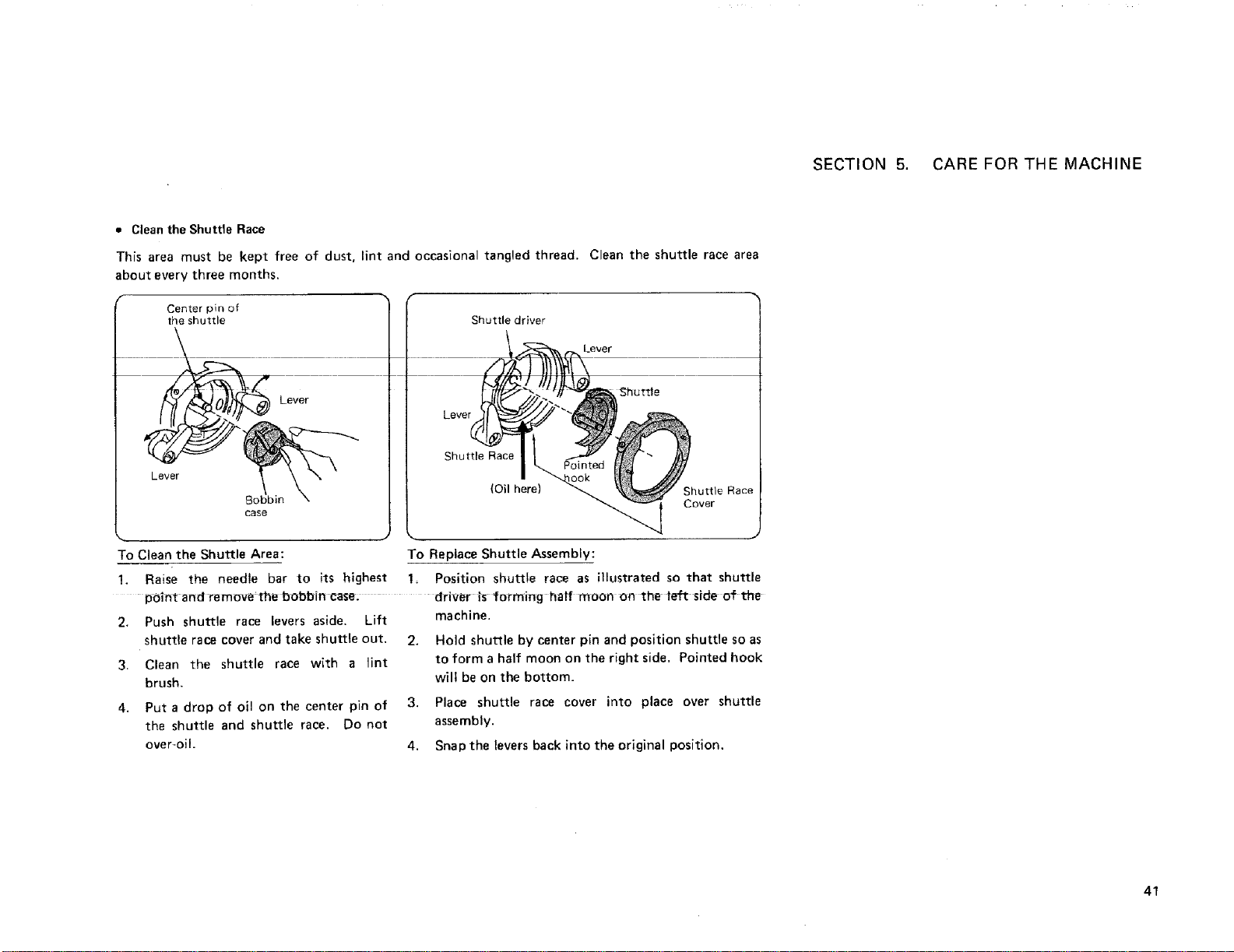
• Cleanthe Shuttle Race
This area must be kept free of dust, lint and occasional tangled thread. Clean the shuttle race area
about every three months.
Center pin of
the shuttle
Lever
Lever
Bobb
case
Shuttle driver
Lever
Lever
Shuttle Race
(Oil here) Shuttle Race
Cover
To Clean the Shuttle Area: To Replace Shuttle Assembly:
1. Raise the needle bar to its highest !, Position shuttle race as illustrated so that shuttle
point and remove the bobbin case: driver is forming half moon on the left side of the
2. Push shuttle race levers aside. Lift
shuttle race cover and take shuttle out.
3. Clean the shuttle race with a lint
brush.
4. Put a drop of oil on the center pin of
the shuttle and shuttle race. Do not
over-oil.
machine.
2. Hold shuttle by center pin and position shuttle so as
to form a half moon on the right side. Pointed hook
will be on the bottom.
3. Place shuttle race cover into place over shuttle
assembly.
4. Snap the levers back into the original position.
41
SECTION 5. CARE FOR THE MACHINE
Oiling the Machine
Oil the machine in all areas shown on this page at least once a year; otherwise the machine can become sluggish or will knock loudly. If you use the machine
frequently, oil the machine under the top cover about every three months. In case machine is not used for an extended time, oil it before sewing. Use good quality
sewing machine oil. One or two drops of oil is sufficient. Remove excess oil, otherwise it may stain fabric.
Kenmore sewing machine oil is available at your nearest Sears retail store.
NOTE: Unplug the machine before oiling. Remove needle and put needle bar in full down position.
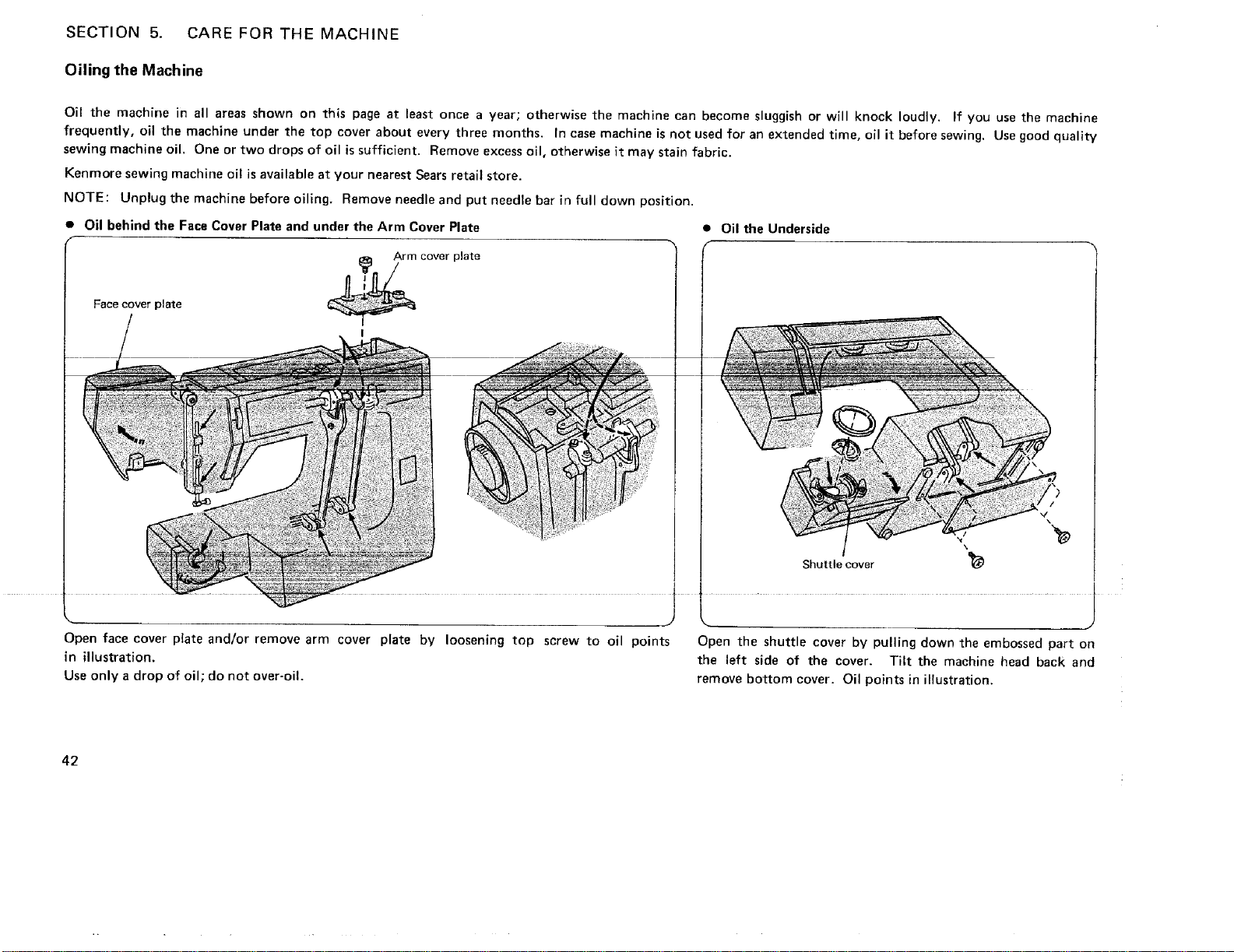
• Oil behind the Face Cover Plate and under the Arm Cover Plate
• Oil the Underside
Face cover plate
Arm cover plate
I
I
Open face cover plate and/or remove arm cover plate by loosening top screw to oil points
in illustration.
Use only a drop of oil; do not over-oil.
Shuttle cover
Open the shuttle cover by pulling down the embossed part on
the left side of the cover. Tilt the machine head back and
remove bottom cover. Oil points in illustration.
42
,ii
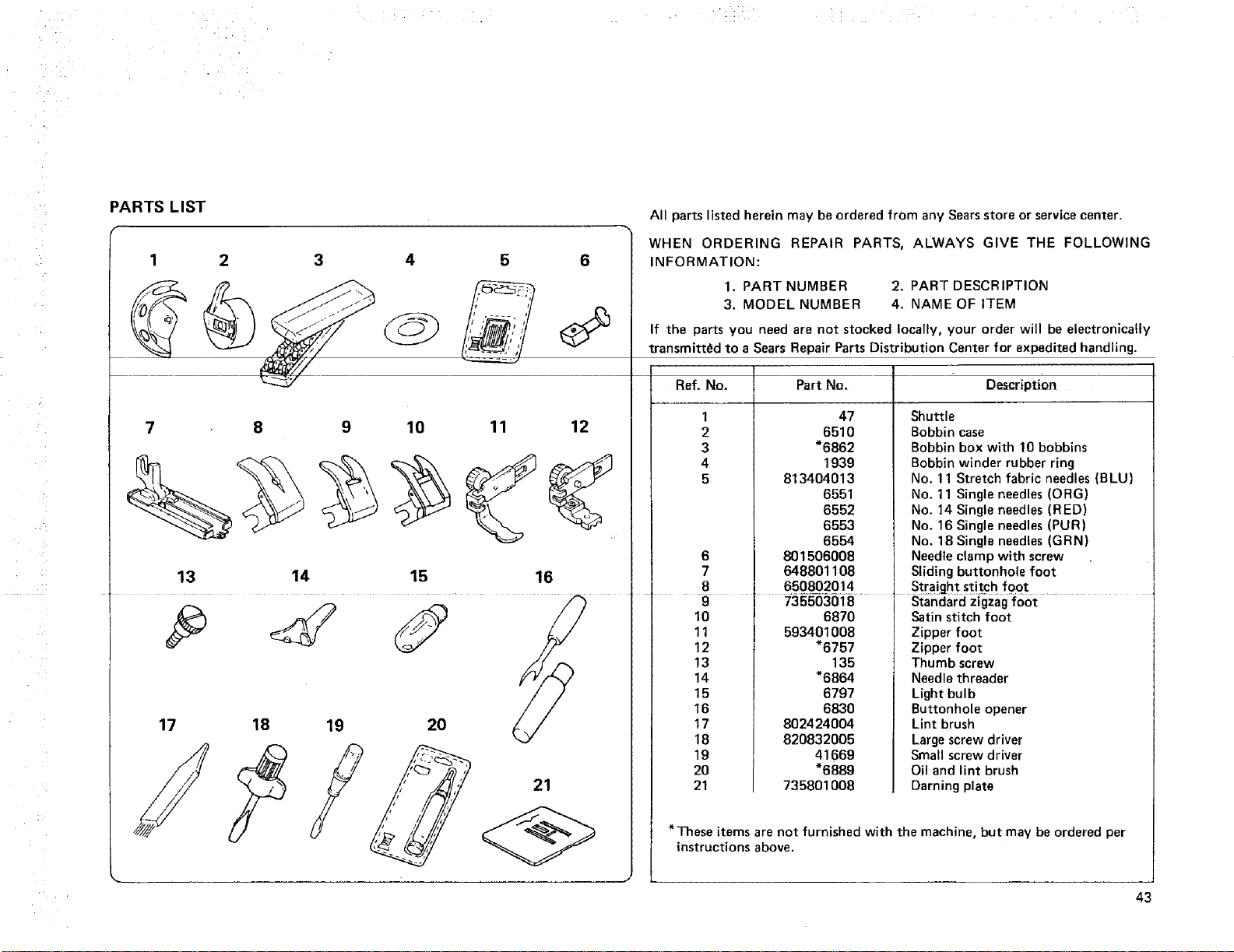
PARTS LIST
1 2 5 6
/ ' t J
i_ / i
All parts listed herein may be ordered from any Sears store or service center.
WHEN ORDERING REPAIR PARTS, ALWAYS GIVE THE FOLLOWING
INFORMATION:
1. PART NUMBER 2. PART DESCRIPTION
3. MODEL NUMBER 4. NAME OF ITEM
If the parts you need are not stocked locally, your order will be electronically
transmitted to a Sears Repair Parts Distribution Center for expedited handling.
Ref. No. Part No. Description
8
13 14
9 10 11 12
15 16
1 47
2 6510
3 *6862
4 1939
5 8134O4013
6551
6552
6553
6554
6 801506008
7 648801108
8 650802014
9 735503018
10 6870
11 593401008
Shuttle
Bobbin case
Bobbin box with 10 bobbins
Bobbin winder rubber ring
No. 11 Stretch fabric needles (BLU)
No. 11 Single needles (ORG)
No. 14 Single needles (RED)
No. 16 Single needles (PUR)
No. 18 Single needles (GRN}
Needle clamp with screw
Sliding buttonhole foot
Straight stitch foot
Standard zigzag foot
Satin stitch foot
Zipper foot
17
19 20 _ _
12
13
14
15
16
17
18
19
20
21
*6757
135
*6864
6797
6830
802424004
820832005
41669
*6889
735801008
Zipper foot
Thumb screw
Needle threader
Light bulb
Buttonhole opener
Lint brush
Large screw driver
Small screw driver
Oil and lint brush
Darning plate
*These items are not furnished with the machine, but may be ordered per
instructions above.
• 43
INDEX
A
Accessorystorage box ............... 3, 7
Adjusting stretch stitch balance ......... 16
Applique ........................ 24
Arm cover plate ................... 42
B
Bar tacking ...................... 24
Basic zigzag ...................... 23
Blind hemming .................... 28
Bobbin ................... 4, 9_10, 43
Bobbin case ............... 9_10, 41, 43
Bobbin thread .................. 12_13
Bobbin winding ................. 9_10
Bobbin winding tension disc .......... 3, 10
Bobbin winding spindle ............. 3, 10
Box stitching ..................... 30
Buttonhole .................... 36 _37
D...... k^l ....... 4 37 43
I_j ttt2n _€_wing ...... 25
C
Cabinet .......................... 3
Carrying handle .................... 4
Changing needle .................... 7
Changing presser foot ................ 7
Cleaning feed dogs and shuttle race .... 40_41
Clutch knob .................. 4, 9, 10
Cording ........................ 21
Cornering guide ................... 18
D
Darning ........................ 22
Feed dogs ....................... 40
Foot control .................... 4_5
Free arm sewing .................... 7
H
Hand wheel ..................... 3, 17
Herring bone stretch ................ 35
I
Invisible zipper .................... 21
L
Lace work ....................... 29
Large screw driver ................. 4, 43
Light and power switch ............. 4_5
Light bulb ................... 5, 40, 43
Lint brush ................... 4, 40, 43
N
Needle clamp screw .............. 4, 7, 43
Needle plate .................... 3, 40
Needle, thread and fabric chart .......... 8
O
Oiling .......................... 42
Overcasting stitch .................. 26
Overcast stretch stitching ............. 33
P
Parts list ........................ 43
Performance problems chart ......... 38_39
Pine leaf stretch stitching ............. 34
S
Satin stitch foot .......... 4, 23_24, 31,43
Satin stitch ...................... 23
Seam guides ...................... 18
Serging ......................... 34
Sewing light ....................... 5
Shell stitching .................... 29
Shuttle ....................... 41,43
Shuttle cover ..................... 3, 9
Shuttle race ...................... 41
Sliding buttonhole foot ....... 4, 36_37, 43
Small screw driver ................. 4, 43
Smocking ....................... 33
Spool pin ....................... 3, 6
Stitch length control ............... 3, 16
Stitch selector ................... 3, 15
Straight stitch .................. 1B_l 9
Straight stitch foot ........... 4, 19, 32, 43
Straight stretch ................... 32
T
Thread cutter ..................... 3, 6
Thread guide .................... 3, 11
Thread take-up lever ............... 3, 11
Thread tensions ................. 13_14
Three-step zigzag .................. 27
Topstitching ..................... 19
Top thread .................... 11_14
Top thread tension ......... ...... 13_14
Top thread tension control ............. 3
Turn a square corner ................ 18
Darningptate: :. :: ;:;: : :: 4; 19;22;25;43 Piugconnector_ _ _ _;;; ;;..;i ; i ._; 4_5 Zigzagfoot ,;;,.;,_;,,,t_t9;23_35,43
Portable case ...................... 3 Zigzag stitches .................. 23_31
E Power switch ...................... 5 Zipper application ............... 20_21
Elastic stretch stitch ................ 34 Presser foot ....................... 4 Zipper foot ............... 4, 20_21,43
Extension table ................... 3, 7 Presser foot lever .................. 4, 6
F
Fabirc, needle, thread and stitch
length chart B
Face cover plate .................. 3, 42
R
Replacing bobbin case ............. 9_10
Reverse stitch control .............. 3, 14
Rick rack stretch .................. 32
44
___411_ "_IFl_ 'lllb_ '_i" _ 'III'_ 'lib'_ 'till'_ "llb _ 'llh_ 11111._ illil._ "III I _FII* I '_lll_ '_lh _ IIIi_ qll, _ "llh _ "IPII._ IIII _ 'llbl_ 'III I 'Ii_ -IIII,..Ip_lI 'IIIiI "PlhI dlb- I qll 41- 'Jl_,_ 'llh
+ ÷
# #
+ +
WARRANTY +
FULL 25-YEAR WARRANTY ON SEWING MACHINE HEAD
# +
For 25 years from the date of purchase, Sears wilt, free of ch_ge, repair defects in material or workmanship which appear
---" in the mechanical components of the sewing machine head. #
__-= #
__=
FULL TWO YEAR WARRANTY ON ELECTRICAL EQUIPMENT OF SEWING MACHINE
il For two years from the date of purchase, Sears will, free of charge, repair defects in material or workmanship which -_
appear in the electrical equipment of the sewing machine, including electronic components, motor, wiring, switch and ()
# speed control #
FULL 90-DAY WARRANTY ON ALL PARTS AND MECHANICAL ADJUSTMENTS
P
For 90 days from the date of purchase, Sears wil!. free of charge, replac_ any parts and p_o_ide mechanical se_ice
_1 necessary for proper operation of the sewing machine, except for normal maintenance.
WARRANTY SERVICE IS AVAILABLE BY RETURNING THE SEWING MACHINE TO THE NEAREST SEARS SERVICE -
CENTER!DEPARTMENT IN THE UNITED STATES. l_
0 This warranty gives you specific legal rights, and you may also have other rights which vary from state to state.
SEARS, ROEBUCK AND CO., D/817 WA, Hoffman Estates, IL 60179
_-="
SEWING MACHINE
Now that you have purchased your Kenmore Sewing Machine, should a need ever exist for repair parts
or service, simply contact your nearest Sears Service Center. Be sure to provide all pertinent facts when
you call or visit.
The model number of your Sewing Machine will be shown on your nomenclature plate on the back of
your Sewing Machine. See page 4 for location.
WHEN ORDERING REPAIR PARTS, ALWAYS G VE THE FOLLOWING INFORMATION:
_PARTNUMBER =PANi DESCRiPTiON *MODEL NUMBER =NAMEOF iTEM
If the parts you need are not stocked locally, your order will be electronically transmitted to a Sears
Repair Parts Distribution Center for handling.
SEARS, ROEBUCK AND CO., Chicago, IL60684 U.S.A.
S-385 Printed in Taiwan Part No.735806302
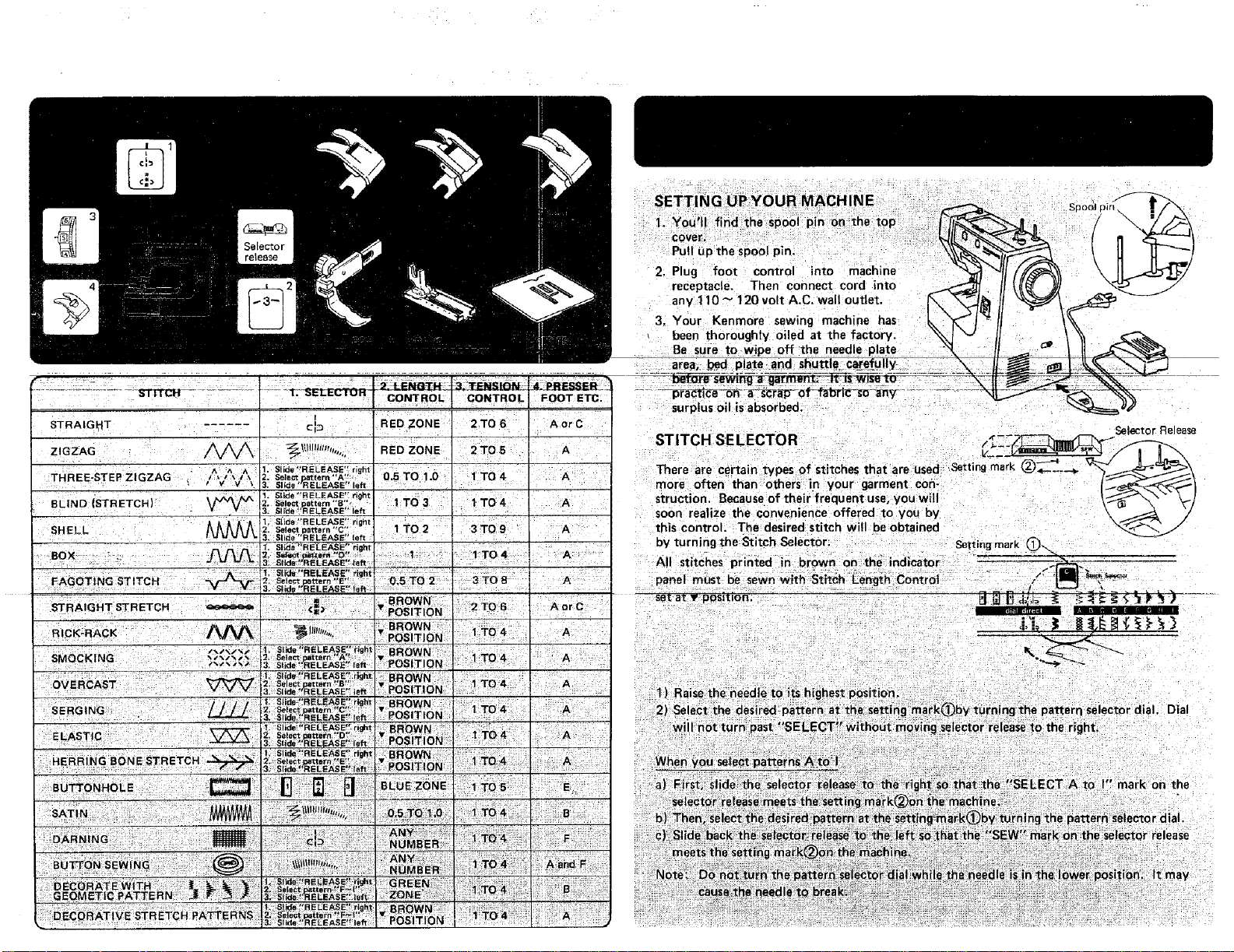
1.You' fndthe spool pn on the top
cover.
PUl! ul the spool pin,
2. Plug foot control into machine "_ _/t///f_
rocep=c eThenco,nectcord nto // 21
any110 _120 volt A, :. wall outlet, _'_ If _'_/
3 Your Kenmore sewillg mach ne has _ "_1 _ II
been thoroughty oile( at the factory. _ xJ H
Be sure to wipe off
• b_e sew_n_
Pul! up the spool pin,
foot control into machine
Then connect cord into
any 110 _ 120 volt A,C. wall outlet,
3 Your Kenmore sewing machine has
been thoroughty oiled at the factory.
Be sure to wipe off the needle plate
surplus oil isabsorbed.
STRAIGI_T
ZIGZAG
• A ^ ^
THREE-STEP Z GZAG \ / V V \
BLIND (STRETCH}
SHELL
BOX " _.- _-_
FAGOTING STITCH
i I
cl _ RED ZONE 2 TO 6 A or C
1. Slide"RELEASE'* right
2. Selact _attem "A"
Slide ' RELEASE" left
I. SIIde*'RELEASE'_ right
2..le= I_attern "S"- r _T03 l 1TO4 I A
3. Slide "RELEASE:" left / _ I
1 S{ide "RELEASE" right' . _ - I .... / --
2. Select pstlern"C : 1 /UZ 3_U_ I A
3 SIde"RELEASE"left
1. Sli_e _RE LEASE" right
2 Sabot em *'O _' ,
1. _kI_"FIEL_=ASE " right
2. Sele_ t_e_ "E _'
3. Stide "_aE LEASE" !_ft
_r-- SelectorRelease
STITCH SELECTOR m__
There are certain types Of stitches that are used Settingmark (_,_.......,.
more often than others in your garment con- k_
struction. Because of their frequent use, you will
soon realize the ccnvenience offered to you by
this control, The desired stitch will be obtained
by turningthe Stitch Selector.
I Slide "RELI_ASE" right
2 Select pattern "C '
3. SI_e'RELEASE left
1, Slide "RELEASE" right
2. Select ttern "D_" "
3. Stide"_a_L_ASE" left
t. Slide "RELEASE' rgh_
2 Setect ern "_E'_
3. Slide =_tEl_EASE'[eft
BROWN
pOS T ON
BROWN
POSTION
• BROWN
: PosITION
1)
ial.
FOS!_i0N , .....
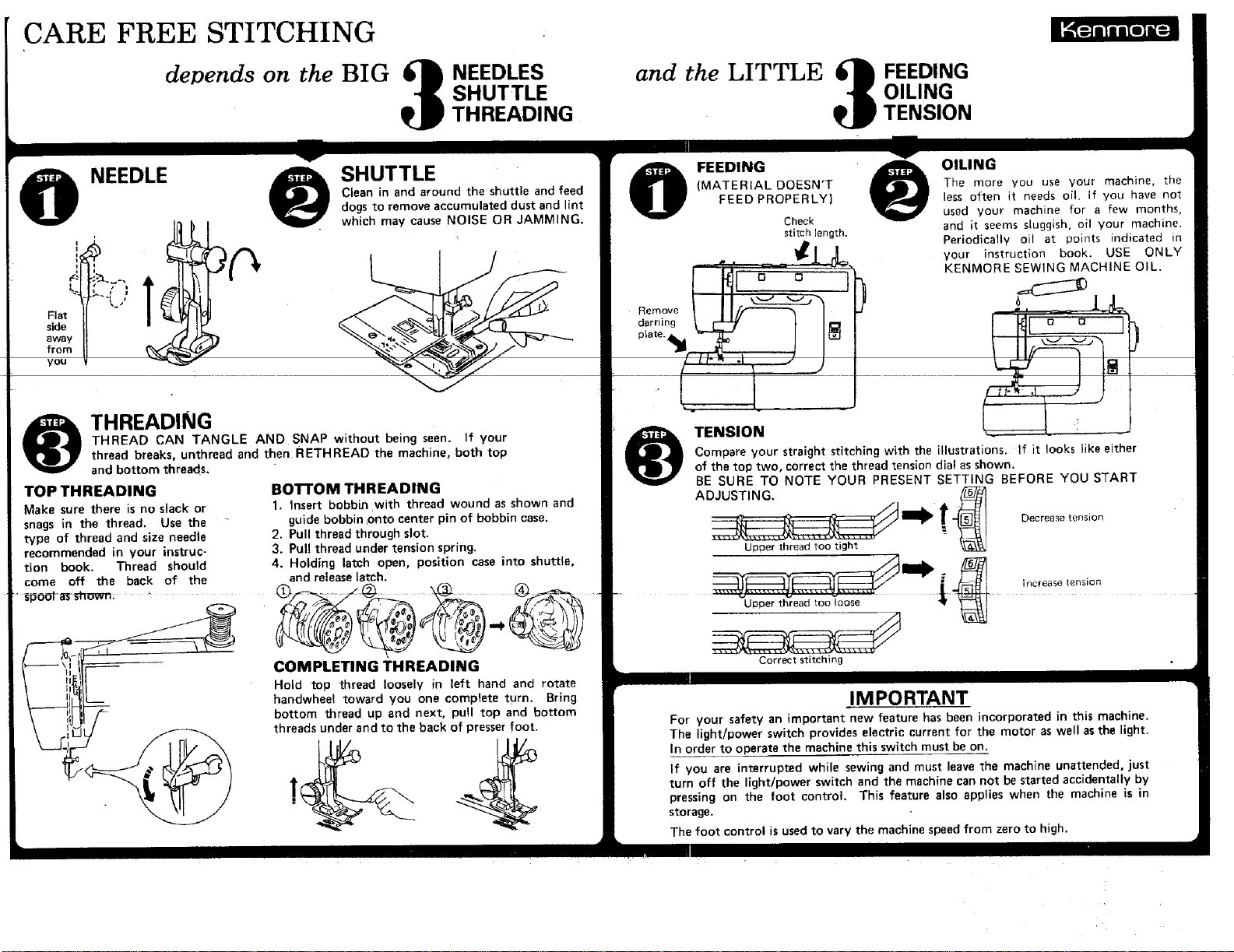
CARE FREE STITCHING
de/gends on the BIG
_ NEEDLES
SHUTTLE
THREADING
and the LITTLE
_ EEDING
OILING
TENSION
I
i+
,:(,=
P
Flat
side
away
from
you
F
V
r
Clean in and around the shuttle and feed
dogs to remove accumulated dust and lint
which may cause NOISE OR JAMMING.
FEEDING
(MATERIAL DOESN'T
FEED PROPERLY)
Check
stitch length.
o°+°[,,I
)
OILING
The more you use your machine, the
less often it needs oil. If you have not
used your machine for a few months,
and it seems sluggish, oil your machine.
Periodically oil at points indicated in
your instruction book. USE ONLY
KENMORE SEWING MACHINE OIL.
_) HREADING
THREAD CAN TANGLE AND SNAP without being seen. If your
thread breaks, unthread and then RETHREAD the machine, both top
and bottom threads,
TENSION _ -
Compare your straight stitching with the illustrations. If it looks like either
of the top two, correct the thread tension dial as shown.
TOP THREADING
Make sure there is no slack or
snags in the thread. Use the
type of thread and size needle
recommended in your instruc-
tion book. Thread should
come off the back of the
spoo| asshown+
Bo'rroM THREADING
1. Insert bobbin with thread wound as shown and
guide bobbin onto center pin of bobbin case.
2, Pull thread through slot.
3. Pull thread uader tension spring.
4. Holding latch open, position case into shuttle,
and release latch.
COMPLETING THREADING
Hold top thread loosely in left hand and rotate
handwheel toward you one complete turn. Bring
bottom thread up and next, pull top and bottom
threads under and to the back of presser foot.
BE SURE TO NOTE YOUR PRESENT SETTING BEFORE YOU START
ADJUSTING. _
_I_II_ t _ _ Decrease tension
Upper thread too tight
Correct stitching
IMPORTANT
For your safety an important new feature has been incorporated in this machine.
The light/power switch provides electric current for the motor as well asthe light,
In order to operate the machine this switch must be on.
If you are interrupted while sewing and must leave the machine unattended, just
turn off the light/power switch and the machine can not be started accidentally by
pressing on the foot control. This feature also applies when the machine is in
storage.
The foot control isused to vary the machine speed from zero to high.
h
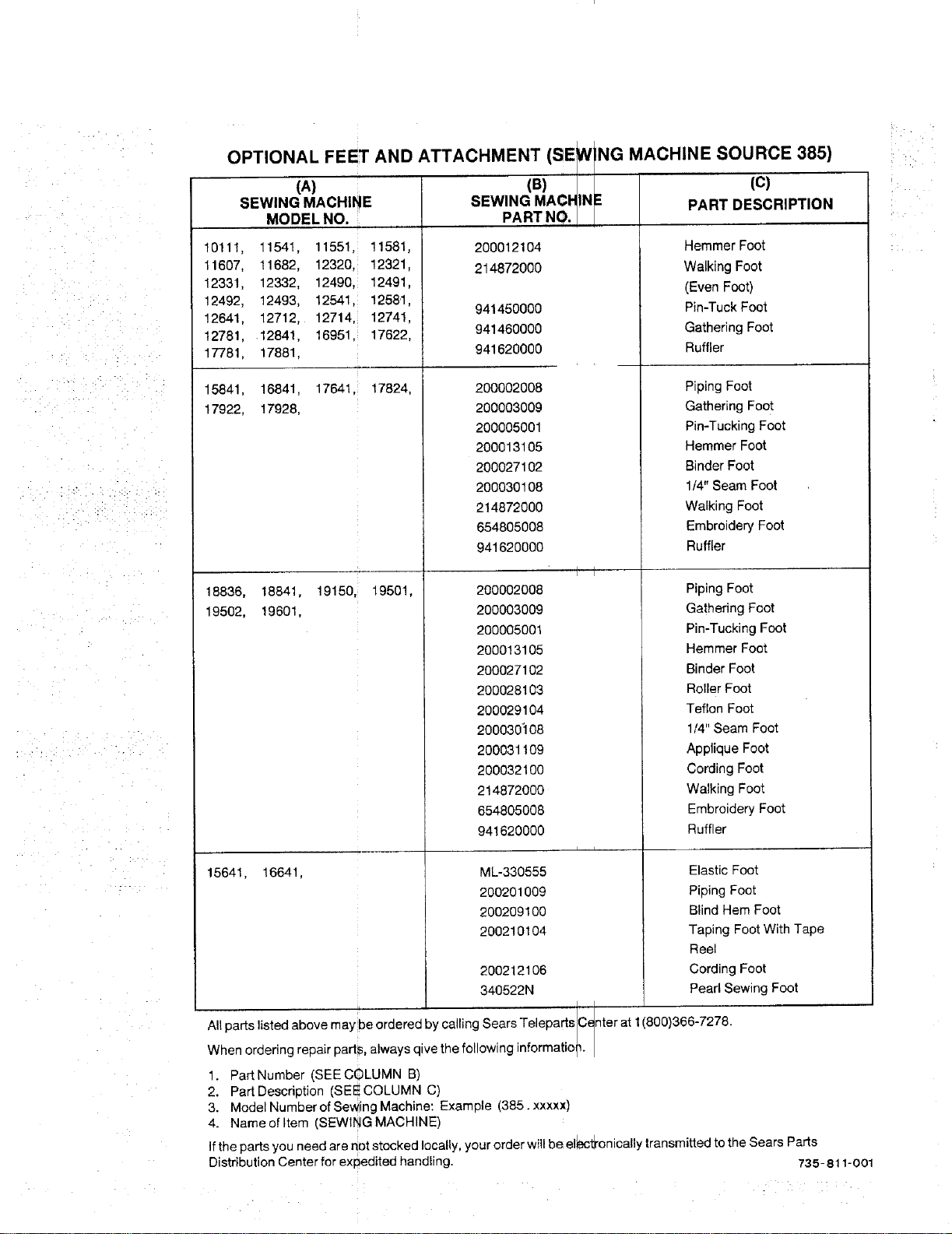
OPTIONAL FEET AND ATTACHMENT (SEWING MACHINE SOURCE 385)
(A) (B) " (C)
SEWING MACHINE SEWING MACHINE PART DESCRIPTION
MODEL NO PART NO__
11541, 11551, 11581,
11682, 12320, 12321,
12332, 12490, 12491,
12493, 12541, 1258'1,
12712, 12714, 12741,
12841, 16951, 17622,
17881,
10111,
11607,
12331,
12492,
12641,
12781,
17781,
15841, 16841,
17922, 17928,
18836, 18841,
19502, 19601.
17641,1 17824,
19150,1 19501,
15641. 16641,
200012104
214872000
941450000
941460000
941620000
200002008
200003009
200005001
200013105
200027102
20O0301O8
214872000
654805008
941620000
200002008
200003009
200005001
200013105
200027102
200028103
200029104
200030108
200031109
200032100
214872000
654805008
941620000
ML-330555
200201009
200209100
200210104
200212106
340522N
I I
Hemmer Foot
Walking Foot
(Even Foot)
Pin-Tuck Foot
Gathering Foot
Ruffler
Piping Foot
Gathering Foot
Pin-Tucking Foot
Hemmer Foot
Binder Foot
1/4" Seam Foot
Walking Foot
Embroidery Foot
Ruffler
Piping Foot
Gathering Foot
Pin-Tucking Foot
Hemmer Foot
Binder Foot
Roller Foot
Teflon Foot
1/4" Seam Foot
Applique Foot
Cording Foot
Walking Foot
Embroidery Foot
Ruffler
Elastic Foot
Piping Foot
Blind Hem Foot
Taping Foot With Tape
Reel
Cording Foot
Pearl Sewing Foot
oo
All parts listed above may be ordered by calling Sears Teleparts nter at 1(800)366-7278.
When ordering repair pads, always qive the following information.
1. Part Number (SEECOLUMN B)
2. Part Description (SEE COLUMN C)
3. Model Numberof SeWing Machine: Example (385. xxxxx)
4. Name of Item (SEWING MACHINE)
f the parts you need are not stocked locally your order witl be el_ectronically transmitted to the Sears Parts
D str bution Center for expedited handling. 735 811-OO1
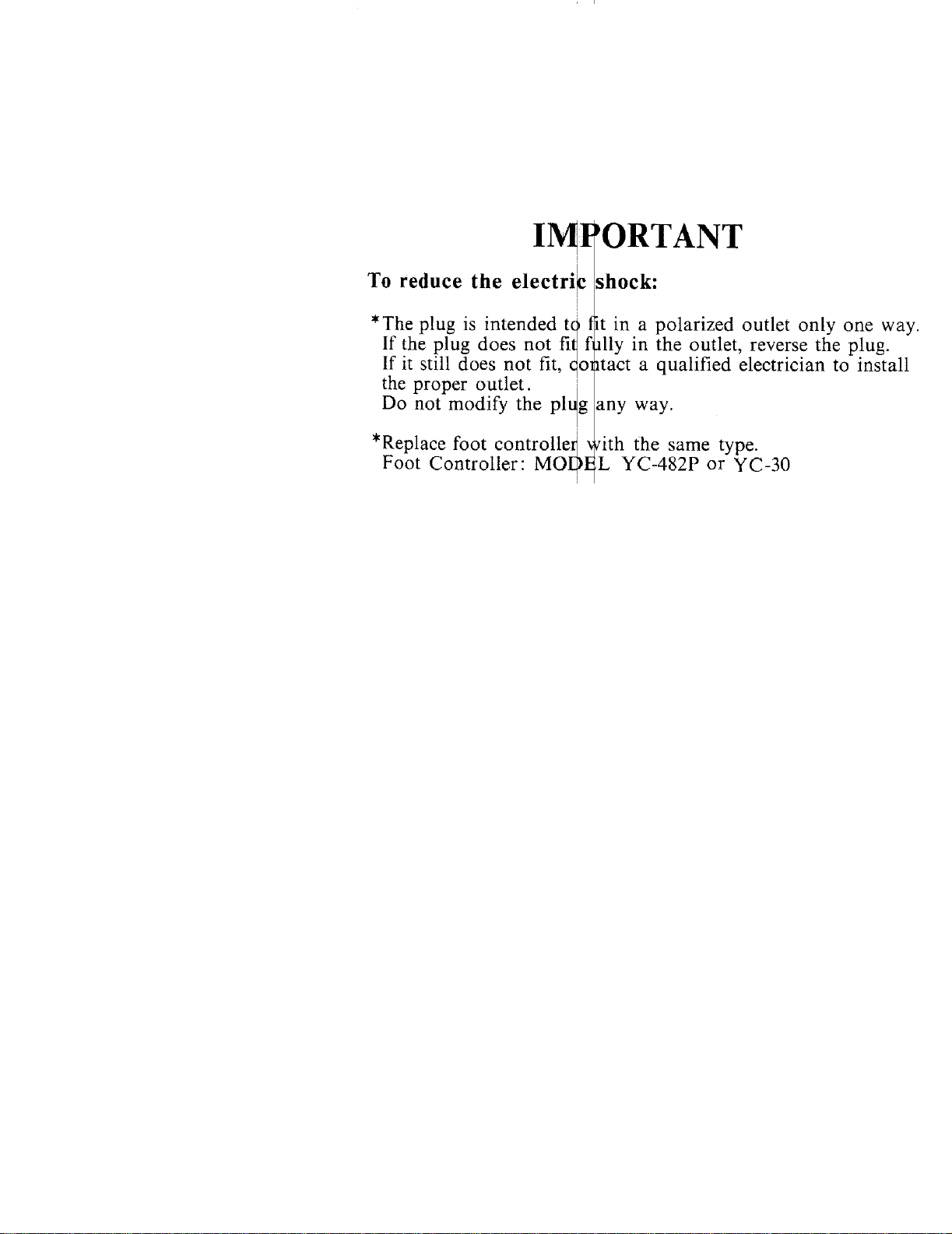
To reduce the elcctri_
I
i
*The plug is intended t_ !
If the plug does not fi_ f
If it still does not fit, 4ol
the proper outlet t_
Do not modify tl_e pl g
/
Replace foot controlle_
Foot Controller: MODE
l
'ORTANT
shock:
it in a polarized outlet only one way.
_lly in the outlet, reverse the plug.
tact a qualified electrician to install
tny way.
/ith the same type.
L YC-482P or YC-30